FM 3-14 SPACE SUPPORT TO ARMY OPERATIONS (MAY 2005) - page 3
FM 3-14 (FM 100-18) ________________________________________________________________
B-39. The SORC is a responsive, versatile analysis and support capability,
which includes a robust, fixed-site facility and a deployable capability.
Deployed packages may consist of personnel with up to a three-workstation
mobile production facility mounted in a vehicle.
B-40. The SORC’s mission is to provide access to spectral information,
products, and services and participate in activities to ensure emerging
spectral information technologies and capabilities are delivered to
operational and tactical forces. This is accomplished through SORC
participation in the Army G2 national to theater (NTT) program for federated
production of MASINT products. Tasking comes from USSTRATCOM or from
operational and tactical unit S2/G2 utilizing the RFI system and the
MASINT requirements system (MRS). The SORC uses the requirements
management system
(RMS) to request new NTM and high-resolution
commercial imagery to support mission requirements.
B-41. SORC members are subject matter experts in remote sensing
capabilities, to include commercial satellite data sources, tasking, and
analysis. Team members provide detailed, tailored exploitation of spectral
and radar data in support of operations. The SORC also creates geographic
information system (GIS) data and analysis products. Finally, the SORC
serves as a bridge between the research, development, and experimentation
communities and military units enabling new data sources and tactics,
techniques, and procedures (TTP) to be used to address military problems.
The SORC can make significant contributions during the planning phase and
should be included as early as possible in the MDMP.
B-42. The combination of computers and broadband communications
equipment within the SORC provides high bandwidth communications and
modular flexibility. The SORC has connectivity with the SMDCOC and
remote sites with a broadband commercial SATCOM capability with data
rates sufficient for transmitting and receiving imagery and large data files.
The SORC has access to nonsecure Internet protocol routing network
(NIPRNET), SIPRNET, and joint worldwide intelligence communications
system (JWICS). Computers and associated software packages are capable of
imagery and GIS production as well as spectral analysis. They also provide a
capability for two-dimensional display and mission route simulations and
three-dimensional terrain models and fly-throughs.
B-43. The SORC includes a representative from the NGA. The NGA provides
geospatial intelligence in all its forms, and from whatever source—imagery,
imagery intelligence, and geospatial—to ensure the knowledge foundation for
planning, decisions, and action. NGA affords easy access to geospatial
intelligence data for all stakeholders, creates tailored, customer-specific
geospatial intelligence, provides analytic services and solutions, and shares
insights.
B-44. The NGA provides support to the SORC through the NGA
USSTRATCOM support team. The National Geospatial-Intelligence Agency
support team (NST) is collocated with Headquarters (HQ), USSTRATCOM
and component command locations (including AFSPC and ARSTRAT SORC)
to conduct liaison between NGA and USSTRATCOM by facilitating the
exchange of policy, procedural, and requirements management issues;
B-10
FM 3-14
18 May 2005
______________________________________________________________________Appendix B
planning, programming, and budgeting issues; technical and analytical
support pertaining to the exploitation of geospatial intelligence; and other
activities of common interest.
B-45. NGA personnel are assigned to support geospatial intelligence
requirements associated with the following work role areas:
• NGA staff officers (NSOs) are assigned to oversee areas where the
geospatial intelligence function is broadly accomplished.
• Geospatial analysts (GAs) are employed at the command to assist in
those areas of the geospatial intelligence function that emphasize
spatial analysis of a thing or event and its symbolization and
visualization.
B-46. Specific NGA analytical support to SORC—
• Enhances mission capability through project teaming efforts in the
production of geospatial information products.
• Acquires and maintains NGA geospatial data sets (both standard and
nonstandard) to enable an up-to-date foundation level of geospatial
data on which to build SORC-generated products and information.
• Provides instruction on NGA, geospatial intelligence datasets, and
appropriate data applications.
• Acts as technical liaison between SORC and NGA.
• Provides security guidance to enable proper classification markings
and resolve releasibility issues to a wide variety of customers.
• Augments senior analyst expertise within the SORC on both
geospatial and intelligence community matters.
Capabilities
B-47. The SORC has two areas of emphasis. The first area is the exploitation
of all types of spectral imagery. This includes data from commercial, civil,
and other sources. The SORC uses data that ranges from low spectral
resolution four-band MSI sensors (such as Ikonos) to high spectral resolution
HSI sensors (such as Hyperion). The SORC can work with data across the
entire electromagnetic spectrum from the visible to the long-wave infrared
(LWIR). The SORC uses these data sources to create a wide variety of
products that support intelligence, topographic, and operational
requirements. Examples of products created from spectral data include—
• Image maps.
• Spectral analysis.
• Spectral target detection to cue other reconnaissance assets.
• Drop-zone analysis.
• Terrain categorization/vegetation analysis.
• Change detection products.
• Three-dimensional perspectives and fly-throughs.
• Specialized products.
18 May 2005
FM 3-14
B-11
FM 3-14 (FM 100-18) ________________________________________________________________
B-48. The SORC’s second area of emphasis is the exploitation of civil and
commercial imagery and data sources. This includes data from experimental
satellite sensors from National Aeronautics and Space Administration
(NASA) and other government agencies. It also includes working with SAR
imagery from commercial satellites and local data sources such as
commercial light detection and ranging (LIDAR) elevation data. Examples of
products created from civil and commercial data include—
• Image maps.
• Digital elevation data.
• Terrain categorization/vegetation analysis.
• Line-of-sight analysis.
• Change detection products.
• Shaded elevation products.
• Three-dimensional perspectives and fly-throughs.
• Specialized products.
B-49. The SORC supports joint, interagency, multinational, and Army
operations. The SORC acts as the conduit between organizations with
spectral data and experimental satellite sensors, and the operational units
that need to exploit that data. The SORC maintains relationships with, and
coordinates with, commercial satellite vendors, elements of the IC (such as
NGA and DIA), and other USSTRATCOM component exploitation elements
(such as the Navy Remote Earth Sensing Information Center [RESIC]). The
SORC provides products supporting tactical, operational, and strategic
decisionmaking and operations templating.
B-50. The SORC is manned by a combination of Government employees,
contractors, and military personnel (soldiers, sailors, and airmen). SORC
personnel have expertise in the exploitation of panchromatic, spectral, and
radar imagery. The SORC also has experience providing specialized GIS
products and working with experimental, nonstandard data sources. SORC
manning and equipment for deployed operations should be task organized
and tailored to best support each mission, based on METT-TC. The strength
of the SORC concept is its core group of subject matter experts providing
tailored support to augment front-line forces. The SORC provides a
comprehensive variety of force enhancement products and capabilities,
primarily in support of environmental monitoring and ISR.
ENVIRONMENTAL MONITORING
B-51. The SORC is able to enhance the current capability of the topographic
teams at every echelon. In addition to these enhancements, the SORC also
provides unique capabilities to the supported unit topographic element.
These include advanced spectral processing techniques, experience using
experimental data sets, and greater access to commercial and civil imagery
support. The SORC augments G2 capabilities by enabling the distribution of
specialized topographic imagery products to the staff and attached elements.
The SORC provides technical and production assistance to the organic and
attached topographic assets and more standard products such as image maps
and 3D fly-through products, which allow greater visualization of the AOR
B-12
FM 3-14
18 May 2005
______________________________________________________________________Appendix B
across all battlefield operating systems. The SORC can assist with the
production of other force protection products from commercial imagery that
can be shared with coalition and host-nation forces with appropriate
licensing.
B-52. The SORC provides tailored spectral analysis of SAR, multispectral,
and hyperspectral information for change detection, material classification,
and terrain/traffic analysis. Through analysis of a variety of data types, such
as commercial/DOD systems, SAR, and imagery collected at different
wavelengths, the SORC can determine specific ground conditions, such as
vegetation type and soil moisture, enabling detailed analysis of trafficability
conditions and vehicle traffic. The SORC can also assist with spectral
products such as post-conflict change detections, terrain categorizations,
vegetation analysis, specific ground conditions such as soil moisture,
environmental disaster impacts, economic support products, and other
specialized products.
INTELLIGENCE, SURVEILLANCE, AND RECONNAISSANCE
B-53. The SORC enhances current capability in the G2. The SORC
complements imagery analysis cells to provide additional tailored support
products from commercial imagery sources, spectral data sources, and its own
archive of GIS products. In support of unit intelligence requirements, the
SORC responds to RFI through the exploitation of spectral data from
commercial and government sources and by providing access to data from
commercial imagery sources, other government agencies, and experimental
platforms.
B-54. The SORC provides tailored spectral analysis of SAR, multispectral,
and hyperspectral information for change detection as well as target
detection and identification, and material classification:
• Through analysis of a variety of data types (such as commercial/DOD
systems, synthetic aperture radar [SAR], and imagery collected at
different wavelengths), the SORC can determine specific military
targets, and detect and defeat camouflage and concealment efforts.
An example would be assisting in the search for buried weapon
caches by identifying areas with recently disturbed earth.
• In addition, SORC analysis products can support post-conflict
assessment to include law of war investigations, weapon cache
detection and characterization, and postbattle assessments.
• In its role as coordinator and manager of spectral production
capabilities for USSTRATCOM, the SORC provides spectral products
and services across the theater and throughout the joint force. The
SORC is providing the nucleus for the creation of a MASINT node in
support of USSTRATCOM.
REACH
B-55. The point of contact for SORC support and all forward based
USASMDC/ARSTRAT elements is the SMDCOC. The SORC has organic
reach capabilities that enable forward deployed forces to tap into the
18 May 2005
FM 3-14
B-13
FM 3-14 (FM 100-18) ________________________________________________________________
complete spectrum of SORC capabilities, to include the ability to access large
data files.
Command and Control
B-56. The SORC is an operational element of the USASMDC G2. The SORC
fixed facility is operationally controlled and tactically controlled by the
USASMDC G2. The SORC supports multiple theaters of operation based on
G2 prioritization and tasking. While deployed, OPCON and TACON of SORC
teams is normally assigned to the supported headquarters. The SORC
responds to tasking from a deployed force (deployed Army corps, division,
task force, or joint element) through the unit G2 to the USASMDC G2
requirements manager.
B-57. A deployed SORC element is normally assigned to the highest level
headquarters in theater, enabling the greatest use of SORC assets. If the
SORC deploys an operational team away from the fixed SORC location, the
team may remain OPCON/TACON to ARSTRAT G2 through the SORC or be
assigned as OPCON/TACON to a supported unit. The retention of the
deployed SORC element as OPCON/TACON to SORC and ARSTRAT G2
allows complete synchronization of the entire SORC capability and TPED
architecture but is normally used only in situations in which SORC is
conducting operational test and evaluation of capabilities. The normal
designation of deployed SORC elements is OPCON/TACON to a supported
unit. This ensures that deployed SORC capabilities are leveraged and
synchronized with deployed unit operations. Reach to SORC fixed activities
remains in effect to provide additional capabilities as needed.
B-58. The SMDCOC provides a continuous reach capability to the SORC fixed
site facility from the field.
Tasking the Spectral Operations Resource Center
B-59. Organizations can request SORC production support through their
S2/G2 using the RFI/requirements system. While the RFI/requirement is
processed through Coliseum or MRS, informal reach coordination with
USASMDC/ARSTRAT through the supporting unit G2 can take place if the
requirement is an obvious SORC requirement (cannot be accomplished by
another MASINT node, the topographic team, or NGA). Supported units use
the SORC imagery worksheet (available on SIPRNET) as the planning
document for requesting support. The USASMDC G2 determines the priority
assigned to each tasking. Requests for a deployed SORC team are sent
through the USSTRATCOM global operations center with an information
copy provided to the SMDCOC.
SECTION VI - COMMERCIAL EXPLOITATION TEAM
B-60. The mission of the CET is to rapidly deploy to provide directly
downlinked commercial satellite imagery, commercial imagery spectral
analysis, and custom mapping products to deployed ARSSTs and supported
warfighters. The unit consists of seven military personnel (imagery analysts,
topographic analysts, satellite
operator/controllers,
and system
B-14
FM 3-14
18 May 2005
______________________________________________________________________Appendix B
administrators). The CET staffs and operates the mobile commercial imagery
direct downlink ground station providing directly downlinked imagery to
supported units. In addition to imagery, the CET also provides commercial
spectral imagery analysis products and value-added geospatial information
products such as image maps, perspective views, graphical overlays, and
change detections. The CET is fully tailorable based on mission and support
requirements and not limited to a specific configuration.
Capabilities
B-61. The CET receives and processes imagery using both the direct
downlink antenna, which collects imagery directly from the imaging satellite
and through “bent pipe” connectivity back to commercial vendors in CONUS.
Sources for the imagery include the NGA, commercial imagery vendors, Eagle
Vision II, and the ARSTRAT SORC. The CET maintains two deployment
capabilities: a spectral exploitation cell—transportable
(SPEC-TR), and a
commercial imagery direct downlink ground station (Eagle Vision II). These
capabilities can be used as stand-alone units or as a combined unit (for
example, using the Eagle Vision workstations for spectral imagery analysis).
B-62. When deployed, the CET connects directly to the supported unit
communications network to disseminate imagery and products. When the
CET is in garrison and supporting deployed ARSSTs, the CET posts products
through a page on the SORC portion of the USASMDC Web site. The CET
also hosts products on the SORC EarthWhere server to allow the imagery
and products to be accessed by other users.
Command and Control
B-63. The ARSTRAT 2nd Space Battalion has command and control of the
active duty commercial exploitation team. The CET primarily supports
ARSSTs by giving priority effort to deployed teams. The CET can function as
a stand-alone unit able to support various echelons, and will be OPCON to
the supported unit. The CET and ARSST coordinate with the G2 for imagery
data production requirements.
Tasking Commercial Exploitation Teams
B-64. Requests for CET support are made through the corps G3 space
element or through the SMDCOC. The CET responds to priority intelligence
requirements submitted by the ARSST, or by the supported unit if no ARSST
is assigned. Requests for new imagery collections are normally managed by
the supported unit’s G2/J2 collection management element.
SECTION VII - THEATER MISSILE WARNING
B-65. TMW detachments provide warning of TBM launches using joint
tactical ground station (JTAGS) equipment. JTAGS are deployable, joint
(Army and Navy) assets, which provide continuous in-theater processing and
dissemination of TBM cueing, alerting, and early warning in support of the
TES, and combatant commanders’ missions. Cueing is reporting TBM launch,
location, and velocity information to active defense weapon systems so they
18 May 2005
FM 3-14
B-15
FM 3-14 (FM 100-18) ________________________________________________________________
can more quickly target the incoming TBM. Alerting is getting out a fast,
initial data message to alert the theater as a whole that a TBM launched.
Early warning means following with more accurate information and refining
the initial description of the event (launch time and location, azimuth, impact
time and estimated impact area).
B-66. TMW detachments deploy from 1st Space Company-TMW, of the
ARSTRAT 1st Space Battalion. TMW detachments deploy so they can receive
threat indications or other event data directly from DSP satellites, and
quickly report to both theater and worldwide users by data (primary) and
voice (secondary). With their in-theater location, TMW detachments reduce
the possibility of single-point failures in long-haul communication
architectures. JTAGS equipment upgrades to multimission mobile processor
(M3P) equipment are underway.
Capabilities
B-67. TMW detachments provide combatant commanders a continuous 24-
hour capability to receive and process in-theater, direct downlinked data from
DSP sensors. The data is used to calculate high confidence estimates of TBM
launch point and time, impact point and time, and associated trajectory
information. The TMW detachment disseminates warning and alerting
information on TBMs and static infrared events of interest throughout the
theater.
B-68. A TMW detachment processes data from up to three DSP satellites to
determine launch points, state vectors, and predicted ground impact points
for TBMs. TMW JTAGS equipment ties directly into worldwide and theater
communications systems to disseminate critical information immediately.
Command and Control
B-69. USSTRATCOM retains COCOM of TMW detachments and provides
overall direction for their employment. Commanding General,
USASMDC/ARSTRAT maintains OPCON of all five TMW detachments.
Tasking Theater Missile Warning Detachments
B-70. Three TMW detachments are normally forward deployed and actively
support the EUCOM, PACOM, and CENTCOM theaters. Other TMW
detachments deploy based on the assessed capabilities and intentions of the
threat and the probability of ballistic missile employment. On
implementation of a combatant commander OPLAN or tasking from JCS, or
if a contingency necessitates deployment of additional TMW assets, a
combatant commander or JTF commander requests allocation and
deployment of a TMW detachment. The COCOM J3 makes the request to
JCS, which forwards the requirement to USSTRATCOM. If appropriate,
USSTRATCOM then tasks ARSTRAT.
B-16
FM 3-14
18 May 2005
______________________________________________________________________Appendix B
B-71. TMW detachment deployments are preplanned and comply with time-
phased force deployment data (TPFDD) airlift planning and integration
methods, or by a request for forces. Qualified personnel survey potential
deployment locations for theater TMW detachments to ensure satellite
visibility, security, logistics, and communication connectivity support the
mission.
18 May 2005
FM 3-14
B-17
Appendix C
Army Space Support Teams
The ARSSTs are USASMDC assets from the Active Army, USAR and
ARNG. ARSSTs rapidly deploy worldwide within 48 hours to augment
corps and division space expertise, normally within the G3 section, during
exercises and contingency operations, including combat operations. Their
primary support is at the operational and tactical levels. ARSSTs may be
assigned to support other levels in Army or non-Army units.
Capabilities
C-1. The mission of the ARSST is to deploy worldwide to provide force
enhanced space support during operations and exercises. The ARSST brings
with it a comprehensive variety of capabilities and products. Some are
organic capabilities, ranging from subject matter expertise to specific tools
such as topographic map printers. The strength of the support team concept
is in its forward presence, which gives a front-line awareness of Army
warfighter needs and the ability to provide fast, tailored solutions.
C-2. In coordination with the G3 space element, the ARSST provides
tailored, task organized space resources to assist the supported command in
the areas of SATCOM, PVT; environmental monitoring, ISR, missile
warning, and other theater-tailored space information. Each team is trained
and equipped to network using space information channels from many
sources.
C-3. ARSSTs provide space expertise. Team members have an in-depth
understanding of red, gray, and blue space orders of battle, the operational
capabilities and threats imposed, and implications for land force operations.
The ARSST also assists the supported command in space control
planning/understanding. When the supported command is a joint task force
(JTF), the ARSST can be a conduit for planning and requesting the
integration of Army space control capabilities in the operation.
C-4. The ARSST facilitates joint, interagency, and multinational, as well as
Army operations. ARSSTs assigned to the combined force land component
commander (CFLCC) host Air Force, Navy, and Marine planners and space
experts to improve multi-Service and joint operations.
C-5. In coordination with the G3 space element and the G2, ARSSTs support
the space contribution to the IPB process. In coordination with the G3 space
element, the ARSST supports the space estimate process. The ARSST
provides space operations assessments and information to the G2, G3, G6,
and other staff sections as appropriate. They, in turn, provide final staff
assessments and determine impacts on communications, operations, and
intelligence. The ARSST members integrate space into operations through
18 May 2005
FM 3-14
C-1

FM 3-14 (FM 100-18) ________________________________________________________________
participation in the military decisionmaking process by developing the space
operations annex and providing current space-related information. The
ARSST synchronizes space support and threat information in the unit
execution matrix.
C-6. Typically, soldiers who have widely varying military specialties and
experiences staff the ARSST. Table C-1 shows the typical team military
occupational specialty
(MOS) structure. Deployed ARSST staff and
equipment are task organized and tailored to best support each mission
based on METT-TC. The mission and required skill sets of the ARSST
changes as an operation proceeds through its various phases. ARSST member
makeup is not limited to the standard team. During stability or support
operations with limited threats and tactical operations, a full ARSST may not
be needed. It may be possible for a single FA 40 with reliable reach and
responsive support to successfully conduct all required operations. The non-
FA 40 members are generally career experts in their designated fields, and
have additional training to focus their skills on space. In addition, they
continuously work relevant Army space issues between deployments so they
are aware of the latest national, civil, commercial, and DOD space system
capabilities, including user equipment and combatant commander and Army
initiatives.
Table C-1. Typical ARSST composition
Title
MOS
Rank
Space operations officer
40A
O4
Space operations officer
25C
O3
Intelligence analyst
96B
E6
SATCOM systems operator
31S
E5
Topographic analyst
81T
E5
Information systems operator-analyst
74B
E4
C-7. The ARSST is a responsive, versatile space assessment and production
capability in a compact, efficient package that is agile and easily sustainable.
It is designed to maximize benefits of space capabilities to the warfighter
while minimizing the overhead investment required of the supported unit.
The ARSST is a deployable package with a minimal footprint. The equipment
will fit entirely on a single high mobility multipurpose wheeled vehicle
(HMMWV). The equipment package requires a 400-amp power bus and a
single 787 shelter. A second HMMWV is used to transport the team and
provide backup for the first. Additionally, the equipment set is C-130 air
transportable. A trailer mounted tactical quiet generator and environmental
control unit (ECU) provide necessary power, heating, and cooling. Computers
are upgradeable and based on common hardware and software.
C-8. The combination of computers and broadband communications
equipment within the ARSST provides redundant high bandwidth
communications and modular flexibility. The team has connectivity between
the SMDCOC and remote sites with a triple redundant space-based
C-2
FM 3-14
18 May 2005
______________________________________________________________________Appendix C
communications suite. The ARSST has broadband commercial SATCOM
communication capability with data rates sufficient for transmitting and
receiving large imagery and data files and tactical high frequency radio
communication, classified and unclassified. Computers and associated
software are capable of imagery production and limited imagery assessment.
They also provide a capability for two-dimensional display and mission route
simulations; three-dimensional terrain models and fly-throughs; and red,
gray, and blue area satellite coverage visualization.
Tasking During Full Spectrum Operations
SATCOM
C-9. The ARSST enhances current capability in the G6. It provides
situational awareness on the architecture of all satellite communications to
the channel level (SIPRNET, defense switched network [DSN], data circuits,
and other special circuits). The ARSST provides expertise for military
SATCOM constellations (UFO/FLTSAT UHF, DSCS-SHF, Milstar-EHF). It
can assist in requesting activation of residual/marginal capabilities, and
deconflict scheduled maintenance with critical operations. The ARSST tracks
each circuit from the corps to the channel level on each communication
satellite. It monitors the status of the satellites and reports scheduled and
unscheduled outages. It assists in resolving issues through the constellation's
controlling operations center. The ARSST also assists the supported unit,
through USASMDC, with issues in interacting with the RSSC and the
WSOC.
POSITION, VELOCITY, AND TIMING
C-10. The ARSST provides unique GPS reports that identify times of
degraded GPS accuracy. The reports provide the relative accuracy at specific
times and locations. ARSST also assists in mitigating degraded GPS accuracy
and the negative impact to the mission accomplishment of deep aviation
attacks, special operations forces (SOF) actions, and other operations. The
ARSST coordinates the requirements for use of GPS, denial of enemy use of
commercial GPS, and the necessity to counter enemy GPS jamming.
USSTRATCOM provides general GPS accuracy graphics for each combatant
commander AOR. ARSST products provide higher fidelity and are tailored to
specific missions.
C-11. The ARSST uses software programs to predict GPS reliability, thus
enabling the commander to plan for periods when GPS coverage may be less
than optimal. This GPS reliability analysis is relevant for precise fires and
SOF infiltration and exfiltration and could be significant for search and
rescue operations. The ARSST will fully integrate accuracy information into
operational planning and analysis for the space estimate. If reliability is
inadequate for Army operations, the SMDCOC and USSTRATCOM are
notified immediately. ARSST software tools provide the capability to monitor
the status of the GPS constellation
(including satellite downtimes for
maintenance or problems) and graphically display this information to staff
planners in the G2, G3, aviation brigade, or others. The ARSST works with
18 May 2005
FM 3-14
C-3
FM 3-14 (FM 100-18) ________________________________________________________________
fire support personnel to determine timeframes to request GPS-enhanced
theater support to optimize precision guided munition strikes.
ENVIRONMENTAL MONITORING
C-12. ARSST enhances interpretation of the impacts of space weather and
solar-event driven environmental conditions through interaction with the
SWO, combat weather team (CWT), and the supported Army staff. The
SWO/routinely receives both terrestrial and space weather information from
strategic and regional weather centers. This environmental information is
often remotely sensed from space and used to help make forecasts. The
SWO/CWT receives meteorological satellite
(METSAT) cloud imagery,
profiles, and surface weather information and applies it directly to combat
operations and resource protection. The SWO/CWT use G2-provided weather
effects interpretation software to determine the weather effects on
operations. This includes tools to overlay METSAT imagery on the COP and
enable machine-to-machine integration of weather in military
decisionmaking processes throughout the command post. At lower echelons
without ARSSTs, the G2 impact assessment software encompasses space
weather and terrestrial weather effects. At corps, where an ARSST is
assigned, the SWO/CWT receives the specification (observation) of current
space weather conditions, warnings, and forecasts from the Air Force
Weather Agency (AFWA). SWO/CWT provides this information to the ARSST
for detailed interpretation of the space weather effects on communications
and other operations disrupted by solar activity. The ARSST can help
interpret AFWA space weather specifications, warnings, and forecast data.
The ARSST works with the supported staff to mitigate space weather effects
by adjusting plans before impacts occur or helping communicators
understand that these limitations are from space weather, not equipment
failure.
C-13. The ARSST enhances the current capability of corps/Army
topographical teams. The ARSST has similarities to the supported unit
topographical capabilities but provides unique capabilities, and has greater
access to commercial and government imagery support. ARSST augments the
G2 capabilities by enabling wider distribution of topographic imagery
products to staff and attached elements. They provide three-dimensional fly-
through products, which allow three-dimensional visualization of the AOR
and near-real-time battlefield visualization across all battlefield operating
systems. The ARSSTs have access to unique Army space resources that
enhance imagery collection and analysis.
C-14. ARSSTs provide reach support from the SORC at ARSTRAT to leverage
the capabilities in change detection assessments to identify potential enemy
locations. In this process, archived imagery is merged with more recent
spectral imagery, and images are compared to identify changes over time
from one image to the other. The ARSST, in conjunction with the SORC,
assists the G2 in identifying potential locations for enemy positions. This
process enables ground forces to identify and destroy such things as hidden
enemy logistic sites. The SORC and ARSST process multispectral and
hyperspectral imagery. They can rectify and combine imagery having
different wavelengths to highlight particular ground conditions, such as
C-4
FM 3-14
18 May 2005
______________________________________________________________________Appendix C
certain types of vegetation or ground moisture content. The combination of
different imagery enables a trained imagery analyst to see features not
apparent in standalone imagery, such as evidence of earth excavation.
INTELLIGENCE, SURVEILLANCE, AND RECONNAISSANCE
C-15. In support of unit intelligence requirements, the ARSST responds to
space-related RFI, provides assessments of how the enemy will use its space
systems, and provides expertise on friendly force space-based intelligence
capabilities. The USASMDC G2 maintains a Web site (or similar information
posting capability) that details space database information, and posts the
space intelligence estimate for a given threat situation. When deployed, the
ARSST accesses the G2 and the SMDCOC via SIPRNET.
C-16. The team aids the staff in making optimal use of satellite
reconnaissance advance notice
(SATRAN) data that provides overflight
information on red and gray space systems. The ARSST uses SATRAN data
and the known capabilities and limitations of the red and gray space system
to portray when and where the force is most vulnerable to enemy
reconnaissance.
C-17. The ARSST has the technical space system expertise to assist in the
intelligence assessments of threat capabilities. The ARSST nominates targets
through the effects process to include enemy satellite facilities, space launch
facilities, and imagery production facilities. The teams have direct access to
space intelligence agencies at the combatant commander level
(USSTRATCOM).
C-18. The ARSST works with the topographic team to complement and
supplement its capability. Through reach to the ARSTRAT SORC, the ARSST
receives additional technical support and image products. The SORC
coordinates and manages spectral production capabilities for USSTRATCOM,
and provides spectral information, products, and services. Therefore,
operational spectral experience is available to the theater, including analysts
who can be used for joint applications.
C-19. A significant number of tactical maps are more than 15 years old.
ARSSTs use controlled image base (CIB) to combine different imagery types
to produce more current image map products. Satellite multispectral imagery
and position information from GPS can also be used to update and
supplement existing maps, enhancing their utility and accuracy. This
capability is provided for specific uses, not for general mapping of the theater.
These image map products are not used for targeting.
THEATER MISSILE WARNING
C-20. The ARSST provides information on the capabilities, limitations, and
operational status of space-based missile-warning systems. They also provide
commanders information on the ability to detect ballistic missiles beyond the
range of organic ground-based assets. ARSST provides information to air
defense artillery
(ADA) elements on the probability of detecting specific
missiles, given varied cloud heights and satellite early warning system
constellation status. The ARSST serves as a point of contact to
USSTRATCOM on issues concerning receiving early warning from space-
18 May 2005
FM 3-14
C-5
FM 3-14 (FM 100-18) ________________________________________________________________
based systems. They also provide detailed information on scheduled early
warning exercises to eliminate conflicts with real world operations.
SPACE CONTROL
C-21. The ARSST provides substantial space control related planning and
expertise to the staff. They assist in analyzing red order of battle and the
implications for unit mission accomplishment. The ARSST is knowledgeable
of potential space targets (such as space system ground antennas, space data
processing, distribution stations, communication links, and satellite control
stations). The ARRST provides denial, disruption, deception, degradation,
and destruction options in terms of analysis of targets and desired weapon
effects. The ARSST assists the staff, when possible, to ensure space control
surveillance, protection, prevention, and negation actions are fully integrated
at both the Army and joint command levels.
REACH
C-22. The SMDCOC includes the home station operations center (HSOC) for
ARSST support and all forward-based ARSTRAT space elements. The ARSST
has substantial organic reach capabilities that can be augmented by
supported unit communications assets.
Tasking During Stability and Support Operations
C-23. Generally, demands for SATCOM, PVT, environmental monitoring,
ISR, and TMW support could remain as high in stability and support
operations as in offensive and defensive operations. For example, the
supporting SATCOM architecture usually remains in place for a time, and
troubleshooting network problems is required. Army liaison is necessary to
re-assign Army users on new nets, or prioritize which users may be bumped if
communications capacities become restricted. Space-based navigation signals
from GPS might not be required for targeting, but may be critical for mine
clearing. Use of ISR capabilities could be significant in finding and destroying
weapons depots. Guidance in adjusting space support requirements from
maneuver to stability and support operations, more specifically for
application in postwar reconstruction support, follows.
SATELLITE COMMUNICATIONS
C-24. The ARSST acts as a watch officer, coordinator, and facilitator with the
Army, joint, or coalition communications directorate. In the beginning of
stability and support operations, the team should work with the
communications group and advise them of system problems that may arise
from space weather, interference, or system problems that the ARSST is
monitoring.
POSITION, VELOCITY, AND TIMING
C-25. The ARSST acts as the watch officer for the GPS, monitoring and
reporting on the health and positions of the constellations and providing
routine navigational accuracy
(NAVACC) reports. During stability and
support operations, it may be necessary to use GPS-guided munitions or
special operations that require event-driven NAVACC reports.
C-6
FM 3-14
18 May 2005
______________________________________________________________________Appendix C
ENVIRONMENTAL MONITORING
C-26. The ARSST acts as a watch officer and advisor with the space weather
officer. In the beginning of stability and support operations, the team should
monitor and issue warnings of space weather events and likely impacts. The
team advises the communications director and SWO on space weather, its
impacts, and Web sites that contain warnings and predictions of space
weather activities.
INTELLIGENCE, SURVEILLANCE, AND RECONNAISSANCE
C-27. There is a limited need for the ARSST to support imagery production
during stability and support operations. In addition to being collocated with a
topographic team, each division in theater has organic topographical sections
that may already be augmented by the NST, so expertise in imagery
production is already available. Nevertheless, the ARSST may provide
valuable support for coordination and dissemination of commercial imagery
and multispectral products.
C-28. With the end of major combat operations, SATRAN reports may not be
needed. However, the ARSST maintains a thorough knowledge of U.S.,
adversary, and commercial satellites in use in the AOR.
THEATER MISSILE WARNING
C-29. The ARSST acts as a backup watch officer to the echelon ADE. The
team acts as a coordinator between the ADE, TMW detachments, and theater
space operations. Once the ADE is educated and networked with the other
missile warning assets, the ARSST should “work itself out of a job.”
Combat Service Support Responsibilities
C-30. The ARSST is dependent on the supported unit to which it is assigned
for maintenance, transportation, supply, combat health support, field
services, human resources support, religious support, and other combat
service support (CSS) functions, as applicable.
C-31. Support for Army common supply items is available through the Army
supply system and the Army maintenance system, outlined in AR 710-2 and
AR 750-1.
C-32. Contractor logistic support
(CLS) is required for ARSST-unique
equipment. Reach capabilities, concerning maintenance, must be in place to
work in conjunction with CLS. Employment of civilian contractors on the
battlefield involves many considerations and hazards. DA Pam 715-16 and
FM 100-10-2 provide guidance and doctrine for commanders and staff
planners.
C-33. Equipment is sustained through corps or division assets, where
possible. This includes normal maintenance, repair, and replace actions on
computers and accessories, HMMWV, and 787 shelter. ARSST personnel
manage software and nonstandard equipment sustainment through the
SMDCOC and the USASMDC space brigade.
18 May 2005
FM 3-14
C-7
FM 3-14 (FM 100-18) ________________________________________________________________
C-34. A continuing challenge is how to work in a coalition environment
where most “SECRET US ONLY” products and information cannot be
shared. ARSSTs should seek appropriate foreign disclosure training tailored
to their assigned environment.
UNITED STATES ARMY SPACE AND MISSILE DEFENSE COMMAND
C-35. USASMDC is responsible for the following activities:
• Coordination of contracting activities required to support deployed
ARSSTs, and interface with supported unit contracting officers.
• Coordination with vendors to provide equipment and services.
• Emergency contracting support.
• Coordination of Army space support company (ARSSC) Web sites and
SIPRNET access.
SPACE BRIGADE
C-36. The space brigade is responsible for the following activities:
• Coordination of human resources support activities with the
supported command.
• Security planning and assistance.
• Coordination of the military entrance processing station calendar.
• Coordination of all deployment operational and exercise participation,
and the activities of the space battalion S3.
• Coordination of emergency resupply, transportation, and TPFDD
requirements with USASMDC G4, as required.
• Coordination of communications and bandwidth support
requirements.
1ST SPACE BATTALION
C-37. The 1st Space Battalion is responsible for the following:
• Coordination of human resources support and activities with
supported command and direct support to deployed ARSST
organizations.
• Emergency service support activities and coordination through the
SMDCOC.
• Lead agency coordination of service support activities for deployed
ARSST organizations and supported unit. Coordination for
transportation, supply and service tracking, and resupply.
• Battalion motor officer coordination for maintenance support for the
ARSSC HMMWV fleet.
193RD SPACE BATTALION
C-38. The 193rd Space Battalion is responsible for the following:
• Coordination of human resources support and activities with
supported command and direct support to deployed ARSST
organizations.
C-8
FM 3-14
18 May 2005
______________________________________________________________________Appendix C
• Emergency service support activities and coordination through the
SMDCOC.
• Lead agency coordination of service support activities for deployed
ARSST organizations, and coordination with supported unit.
Coordination for transportation, supply and service tracking, and
resupply.
ARMY SPACE SUPPORT COMPANY
C-39. ARSSC is responsible for—
• Supervising and controlling detachment CSS functions and systems.
• Establishing the standing operating procedure
(SOP) for CSS
functions (such as maintenance, supply, and human resources).
• Coordinating CSS from the supported unit and space battalion.
• Coordinating soldier sustainment and supply for assigned personnel.
SUPPORTED UNIT
C-40. Army standard equipment found in the ARSST is maintained through
the organizational support element of the supported unit and through the
direct support unit
(DSU) and other combat service support assets. An
advance element from the 1st Space Battalion and the ARSSC coordinate
support, establish maintenance accounts, and conduct other preliminary
coordination prior to the arrival of the team.
C-41. Standard item maintenance support during peacetime is in accordance
with established memorandums of understanding (MOUs) and interservice
support agreements.
C-42. During contingency operations, the ARSST receives organizational
maintenance support from the unit to which it is attached. Section personnel
can perform operator and unit level maintenance on ARSST-peculiar
equipment. Contractor support provides higher-echelon maintenance and
coordinates it through ARSSC headquarters.
C-43. Supply support for all classes of supply from the DOD supply system
during peacetime is in accordance with established MOUs. During
contingency operations, an ARSST is dependent on the headquarters it
supports for all classes of supply.
C-44. Each ARSST team is assigned two HMMWVs for transportation and to
provide workspace when integrated into the supported unit TOC. The space
brigade S4 works with the USASMDC G4 to coordinate transportation of unit
vehicles and personnel to the supported unit location. The space brigade S3
works with the USASMDC G3 to integrate ARSST personnel and equipment
into the supported unit TPFDD.
C-45. Reconstitution actions are based on priorities set by the commander
and result in the receipt of specified available resources needed to accomplish
the reconstitution mission. The ARSST company commander or team leader
determines the losses in soldiers and equipment, and assesses the unit's
ability to continue its mission. That information is reported to the supported
18 May 2005
FM 3-14
C-9
FM 3-14 (FM 100-18) ________________________________________________________________
commander and to USASMDC. Physical damage assessment is the
responsibility of the team chief.
C-46. Reorganization and regeneration may be executed separately, but are
usually accomplished in combination, depending on current and anticipated
situations, command priorities, resources, and time available. USASMDC
and the supported staff coordinate logistic linkup points for replacement
equipment and personnel. Standard equipment flows through DSU channels.
ARSST-peculiar equipment flows through CLS channels to the linkup point.
Contractor support personnel onsite assist in the reconstitution effort.
Replacement personnel flow through the supported commander's G1
replacement detachment.
C-47. If sustained operational contingency operations are planned, the
supported command probably provides facilities to accommodate the ARSST
and its organic equipment. The gaining command provides personnel needs,
such as dining facilities, living quarters, and religious and administrative
support.
C-48. The ARSST requires approximately 120 square feet (10 feet by 12 feet)
of space for operations. The site is normally inside, in close proximity to the
G2, G3, and the deep operations coordination cell.
C-49. Under special circumstances, the ARSST deploys with a deployable
rapid assembly shelter (DRASH) tent to use as a workspace shelter. The
team's computers and printers must be protected from dirt, dust, and
moisture as much as possible. Therefore, an outdoor work area is feasible
only when no other option is available. The supported unit is expected to
provide shelter for team member sleeping quarters.
C-50. The preferred source of electrical power is commercial. The minimum
power requirements for the work area are two 20-amp, 110-volt, 60-Hertz
circuits. Teams deploy with uninterruptible power supplies (UPS) for their
organic computers. Teams also deploy with a commercial gasoline-powered
generator for emergencies.
C-51. The supported unit makes the following available to the ARSST:
• Six Internet protocol (IP) addresses on the SIPRNET.
• One DSN line.
• One multiple subscriber equipment
(MSE)/tri-service tactical
(TRITAC) line.
• One tactical local area network
(TACLAN) or tactical satellite
communications interconnect module
(TACSIM)
(METT-TC
dependent).
• Other requirements are METT-TC dependent.
Command and Control
C-52. The 1st Space Battalion provides active and reserve force teams. The
193rd Space Battalion of the Colorado National Guard also provides teams.
Teams normally support the four active corps (I, III, V, XVIII), and SOCOM
as well as the Third and Eighth Armies (two per Army, or one at the Army
C-10
FM 3-14
18 May 2005
______________________________________________________________________Appendix C
and one at the ARFOR headquarters). Normally, specific team leaders are
consistently associated with a particular corps or army while any team could
be assigned to any headquarters.
C-53. While deployed the ARSST is normally OPCON and TACON to the
supported headquarters. If multiple ARSSTs are deployed to the same
theater, the G3 space element SOO, in coordination with the
USASMDC/ARSTRAT space brigade commander, designates which ARSST is
responsible for ensuring the ARSSTs coordinate activities and material. This
ARSST helps establish and maintain a high-fidelity COP, MDMP, space
contribution to the commander's IPB, and space estimate. This is normally
the ARSST attached to the highest level headquarters in theater, but should
METT-TC indicate that a different ARSST would better serve this function,
the space brigade commander can designate it instead. If all ARSSTs are
deployed at the division level, the space brigade commander designates the
ARSST responsible for ensuring in-theater team coordination. This ARSST
organizes and coordinates information from other theater ARSSTs and from
reach assets, and passes appropriate information back to ARSSTs and the
SMDCOC.
C-54. The Commanding General, USASMDC/ARSTRAT may designate an
Army space coordinating authority. If so, responsibility to coordinate ARSST
activities and material for situational awareness, MDMP, space contributions
to the commander's IPB, and the space estimate could be placed with the
Army space coordinating authority.
C-55. The SMDCOC provides a continuous reach capability to rapidly address
space force enhancement and space control issues for deployed ARSSTs
worldwide.
Tasking the Army Space Support Team
C-56. ARSST obtains support by contacting the corps G3 space element or the
ARSTRAT G3 through the SMDCOC. The ARSTRAT G3 prioritizes
deployment of ARSSTs according to worldwide mission issues.
18 May 2005
FM 3-14
C-11
Appendix D
Space Operations Officer
This appendix discusses specific support to Army units provided by SOOs.
The SOO provides space analysis and expertise, and specific products to
supported units, usually at the numbered army and corps level. SOOs
serve as permanently assigned staff officers, and are the space experts at
the tactical and operational levels. During increased activity associated
with exercises or operational deployments, an ARSST may augment the
SOO.
General
D-1. The SOO is responsible for providing space-related operational support
and expertise on space capabilities. The SOO integrates space force
enhancement and space control operations, and supports both deliberate and
crisis action planning.
D-2. Normally, one FA 40 SOO is assigned at the Army and corps staff. The
primary piece of equipment the SOO employs is the space operations system,
which relies on a SIPRNET backbone. The SOS provides the SOO with the
necessary connectivity and analysis tools to accomplish required tasks.
D-3. The SOO is operationally aligned with the G3 and provides an organic
space staff capability. The SOO routinely works in conjunction with other
members of the coordinating and special staffs (such as the G2, G6, fire
support element, and space weather officer). The SOO focuses on the
integration of the wide range of space capabilities available to the
commander. The SOO provides support to the staff to ensure they are fully
cognizant of space support to provide space-based communications, PVT
information, environmental monitoring, and ISR. Normally, only one SOO is
assigned to the army/corps G3 staff. During wartime operations and
exercises, the ARSST provides critical augmentation. The ARSST
accomplishes space-related tasks and provides a 24/7 space staff capability.
D-4. The SOO is careful not to cross organizational lines when representing
space-based capabilities. The coordination responsibilities discussed below as
they pertain to the G2, G3, G6, and G7, are guidelines for staff interaction.
The SOO does not provide unilateral answers about space capabilities that
should be provided by other G-staffs who have BOS proponency. The same is
true of information that should come from echelons above. In all cases, the
SOO ensures that space-related actions are fully coordinated with the
appropriate command and staff.
D-5. At the same time, this discipline does not cause the SOO to restrict
attention to only the immediate issues of the organizational element. It is
imperative that the SOO be aware of the total space picture. The SOO is
18 May 2005
FM 3-14
D-1
FM 3-14 (FM 100-18) ________________________________________________________________
aware of space C2 elements, such as the JFC space authority and other space
teams, such as the SST, adjacent unit ARSST, TMW detachments, national
intelligence support team (NIST). The SOO fully understands direct liaison
authority (DIRLAUTH) clearances and pursues any that are needed but not
already directed. Gaining necessary situational understanding requires the
SOO to network actively with a space community that will very likely be
dynamic.
Space Operations Officer Primary and Supporting Tasks
D-6. The SOO is charged to—
• Provide space-based expertise and services.
• Provide space input to the MDMP.
D-7. To properly execute assigned tasks, the SOO is aware of the challenges
the unit faces and is prepared to offer space solutions, when applicable. SOOs
are a significant conduit for space to the warfighter, and their effectiveness
can positively influence mission accomplishment.
D-8. The major SOO contribution to planning is support to the MDMP. The
SOO is fully involved in the process, flow of information, and decisions in the
headquarters. Additionally, the SOO works closely with the entire battle staff
to ensure space support is optimized to all BOS. However, the majority of the
SOO’s time is focused on the G2, G3, and G6 because these staffs rely most
heavily on space capabilities. Discussed below is how the SOO integrates into
MDMP planning, followed by specific ways the SOO works with the G2, G3,
and G6 staffs. To support the MDMP, SOOs—
• Analyze higher headquarters orders from a space perspective.
• Develop space specific specified, implied, and essential tasks.
• Develop the space estimate
(see appendix A for a detailed
explanation) and coordinate the estimate with other staff sections to
incorporate it into the mission analysis effort.
• Recommend space-specific PIR and/or information requirements to
the G2.
• Provide input to COA analysis.
• Integrate USSTRATCOM-unique capabilities in missile warning
(DSP), navigation (GPS), environmental monitoring, and SATCOM
capablities into staff planning.
• Ensure coordination and integration with all applicable IO cells.
• Integrate the ARSST into the MDMP planning effort.
• Analyze the potential employment of additional (other than ARSST)
ARSTRAT operational capabilities.
• Write annex N (Space) to be included in the applicable plan and/or
order, when a COA has been selected.
D-2
FM 3-14
18 May 2005
______________________________________________________________________Appendix D
G2/SPACE OPERATIONS OFFICER STAFF COORDINATION DUTIES
D-9. Coordination with G2 includes the following:
•
Ensure the G2 aerospace control element (ACE) is aware of allied,
enemy, and rest-of-the-world space order of battle (USSTRATCOM,
J2, JWICS, or SIPRNET home page).
•
Develop the space analysis contribution to the IPB (see appendix A).
•
Develop G2 space-related PIR/IR and recommend its inclusion in the
collection plan.
•
Maintain space situational understanding by regularly reviewing
ARSTRAT G2 and USSTRATCOM J2 intelligence products. Ensure
the ACE is aware of significant space intelligence data to incorporate
into the ACE all source analysis effort.
•
Monitor status of enemy space-related targets (user segment and
ground stations, communications links to and from the satellite, and
the satellites).
•
Ensure the G2 staff is aware of commercial and nonthreat foreign
space systems that may be utilized by the adversary. Provide space-
related recommendations/requirements to the collection manager.
•
Analyze effectiveness of DSP to identify threat missile activity and
support BDA and situational understanding requirements. Ensure
G2 is aware of DSP technical intelligence and battle space
characterization capabilities.
•
Provide space weather assessments and integrate space weather
updates into the space estimate. Monitor status of the DMSP
constellation.
•
Determine and monitor vulnerabilities to supporting space-based
surveillance, reconnaissance, or attack. Be familiar with the threat to
U.S. systems and protect those systems by minimizing or eliminating
the threat and implementing protection measures.
G3/SPACE OPERATIONS OFFICER STAFF COORDINATION DUTIES
D-10. Coordination with G3 includes the following:
• Maintain close coordination with the plans section to ensure space
integration into all future planning efforts.
• Maintain close coordination with the current operations section
regarding space input to staff update briefs, warning orders,
FRAGOs, and so forth.
• Provide recommendations to apply military, civil, and commercial
space systems and concepts for land force applications.
• Ensure the G3 understands the role of the ARSST, and integrate the
ARSST into daily operations. The ARSST provides space products
and support, and allows the SOO to sustain a 24/7 space staff
capability.
• Monitor the effectiveness of the TES to support command TBM early
warning requirements, in coordination with the ADE.
18 May 2005
FM 3-14
D-3
FM 3-14 (FM 100-18) ________________________________________________________________
•
Monitor status of friendly space systems, platforms and operations.
Ensure appropriate staff elements are notified of space-related issues
that may affect the operation.
•
Know the space command and control network within theater,
specifically, the location and mission of the entity assigned as space
authority and, if assigned, the Army space coordination authority.
•
Ensure BFT and GPS capabilities are optimally supporting the
Army/corps and subordinate elements. Execute staff planning and
training related to BFT.
•
Know the capabilities and limitations of U.S. space and associated
ground systems. Know what space-related support is available within
theater, for example TENCAP, TMW, USSTRATCOM support teams,
and NISTs.
•
In coordination with Air Defense Artillery Element, ensure
dissemination and warning of TBM attacks is timely and accurate.
Provide staff training on capabilities and limitations of DSP and
TMW.
•
In concert with the G2, G6 and G7, analyze and monitor the
command operations security
(OPSEC) posture from a space
perspective.
•
In concert with the G2, G3 (fire support coordinator [FSCOORD]/IO),
and G6, nominate enemy space assets for targeting, as required.
•
Implement space control prevention measures to prevent the
adversary from using friendly and allied systems, such as
communications channels and GPS signals.
•
Ensure measures are in place to protect U.S. and allied space assets,
such as force protection of ground stations and antennas, and/or
targeting the adversary’s means of threatening U.S. assets.
•
Ensure that critical ground segments of friendly space systems are
designated as restricted operations zones
(ROZs) in the Army
airspace command and control (A2C2) element plan and are on the
air defense/TMD defended asset list.
•
In garrison, supervise the corps space training program and monitor
the level of space capabilities training within the command.
G4/SPACE OPERATIONS OFFICER STAFF COORDINATION DUTIES
D-11. The SOO has potential responsibilities to assist the G4 in areas of—
• In-transit visibility tracking.
• Main supply route imagery.
D-4
FM 3-14
18 May 2005
______________________________________________________________________Appendix D
G6/SPACE OPERATIONS OFFICER STAFF COORDINATION DUTIES
D-12. Coordination with G6 includes the following:
• Ensure the G6 staff is aware of the space weather/enemy threat to
SATCOM that was developed in the space analysis for the IPB.
• Ensure G6 is aware of all service and commercial SATCOM
capabilities that may contribute to unit mission accomplishment.
• Determine and recommend to the G6 SATCOM related essential
elements of information.
• Ensure G6 is aware of Army SATCOM C2 organizations that
contribute to operational contingency support.
• In coordination with the G3, ensure BFT systems are functioning.
• Provide status of supporting SATCOM systems, to include known
deficiencies and planned outages.
G7/SPACE OPERATIONS OFFICER STAFF COORDINATION DUTIES
D-13. Coordination with G7 includes the following:
• Provide information on space-based products that could support IO
requirements.
• Provide a representative to the G7.
• Include IO requirements in the space operations appendix to the
operations annex.
• Coordinate IO requirements with higher headquarters for ARSTRAT
and USSTRATCOM support.
• Coordinate with the G7 targeting officer to include adversary space
system elements in the targeting process.
• Provide insight into the red/gray/blue space order of battle and blue
space operational status.
18 May 2005
FM 3-14
D-5
Appendix E
Space Support in the Employment Headquarters
The future force tactical headquarters is designed to perform tactical and
operational level missions. The tactical headquarters is ARFOR/JFLCC
capable without augmentation, and serves, with augmentation, as the
JTF headquarters. The tactical headquarters contains an SSE, nominally
consisting of two FA 40 SOOs. In peacetime or garrison operations, these
space experts form an SSE within the G3 current operations section. In
an operational or tactical situation, the SOOs in the SSE are in the main
command post and provide or coordinate space support for other
command posts. Generally, during field operations, one SOO provides
space insight for planning future operations while the other supports
current operations. The senior officer may adjust this support ratio,
depending on METT-TC. Because of the small size of the SSE, it may be
augmented by an ARSST.
E-1. The functions of the SSE at the main command post (CP) include the
following:
• Provide tactical and operational space planning and support to the
tactical headquarters.
• Advise on space force enhancement and space control mission areas.
• Advise on availability and use of military/civil/commercial space-
based assets.
• Advise regarding the capabilities, limitations, and status of missile
warning systems.
• Produce space support annex and space input to estimates/OPLANs/
FRAGOs/warning orders.
• Prepare the space estimate tab to the space support annex to the
OPLAN (see appendix A).
• Support preparation of space portion of IPB and space order of battle.
• Participate in initial targeting process.
• Advise regarding space support to IO.
• Provide space support products and services.
• Synchronize space operations and effects with TAC CP 1.
• Recommend/coordinate for additional space support and force
structure.
• Coordinate with higher headquarters space element.
E-2. The functions of the SSE at the TAC CP 1 include the following:
• Provide 24/7 space support to the tactical headquarters.
18 May 2005
FM 3-14
E-1
FM 3-14 (FM 100-18) ________________________________________________________________
• Advise regarding space force enhancement mission area.
• Advise regarding space control mission area.
• Advise on BFT capabilities and limitations.
• Advise on availability and use of military/civil/commercial space-
based assets.
• Advise on capabilities and limitations of threat and nonaligned space-
based assets.
• Provide tactical space products and support to TAC CP 1, subordinate
units of action (UAs), joint, multinational, and interagency forces.
• Participate in the targeting process.
• Provide PVT reliability data and navigation warfare advice, and
coordinate GPS enhancement.
• Integrate operational headquarters and Army space unit augmentees
into tactical headquarters operations.
• Assist coordinating SATCOM and ISR support.
• Monitor status of missile warning systems.
• Synchronize space operations and effects with the main CP.
• In coordination with SWO, provide weather effects analysis for
tactical space operations.
• Develop and update the space portion of the COP.
E-2
FM 3-14
18 May 2005
Appendix F
Army Space Organizations
Army proponency for space is assigned to USASMDC, which is a
MACOM. USASMDC is the Army Service component command for
USSTRATCOM.
F-1. As directed by Army General Order 5, the USASMDC was assigned as
a MACOM on 1 October 1997. The CG USASMDC serves as the Commander
of the ARSTRAT directly supporting the Commander, USSTRATCOM.
Additionally, the CG USASMDC serves as the Army specified proponent for
space- and ground-based midcourse missile defense.
F-2. The CG USASMDC/ARSTRAT commands all assigned forces, operates
assigned facilities, and leads the Army operational component to
USSTRATCOM. The CG USASMDC/ARSTRAT responds to Commander,
USSTRATCOM for operational taskings, coordinates and integrates Army
space resources and requirements into USSTRATCOM plans and operations,
and provides the USSTRATCOM commander an Army perspective in
planning for DOD space systems. Further, the CG USASMDC/ARSTRAT is
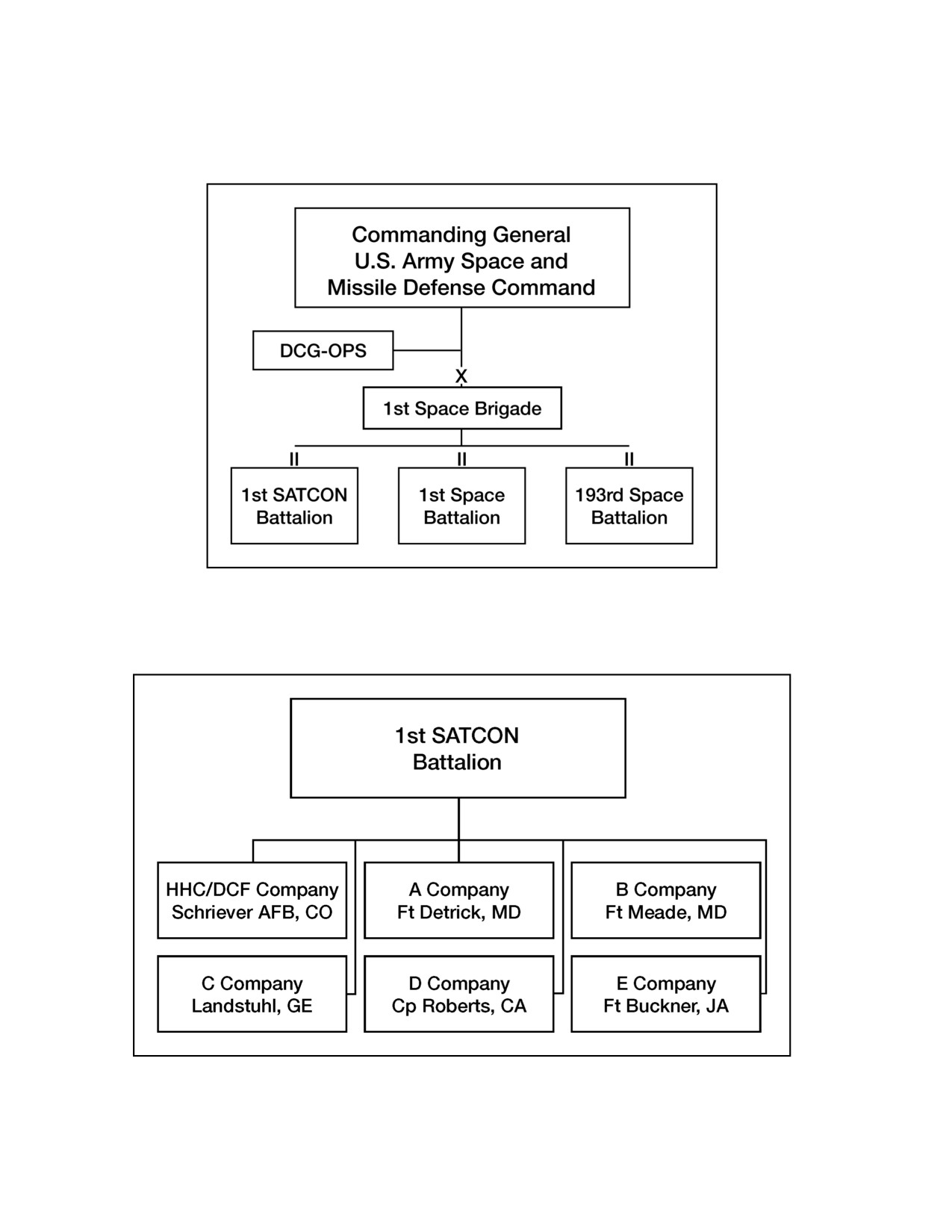
responsible for the HQ USASMDC/ARSTRAT Command General Staff; the
1st SATCON Battalion; the 1st Space Battalion; the 193rd Space Battalion
(Army National Guard); the Army astronaut program at the Johnson Space
Center in Houston, Texas; the Kwajalein Missile Range; and host support to
USASMDC offices located in Colorado Springs, Colorado. CG
USASMDC/ARSTRAT also serves as the Army representative for space
issues in joint forums.
18 May 2005
FM 3-14
F-1
FM 3-14 (FM 100-18) ________________________________________________________________
Figure F-1. USASMDC operational organization
Figure F-2. 1st SATCON Battalion organization
F-2
FM 3-14
18 May 2005
______________________________________________________________________Appendix F
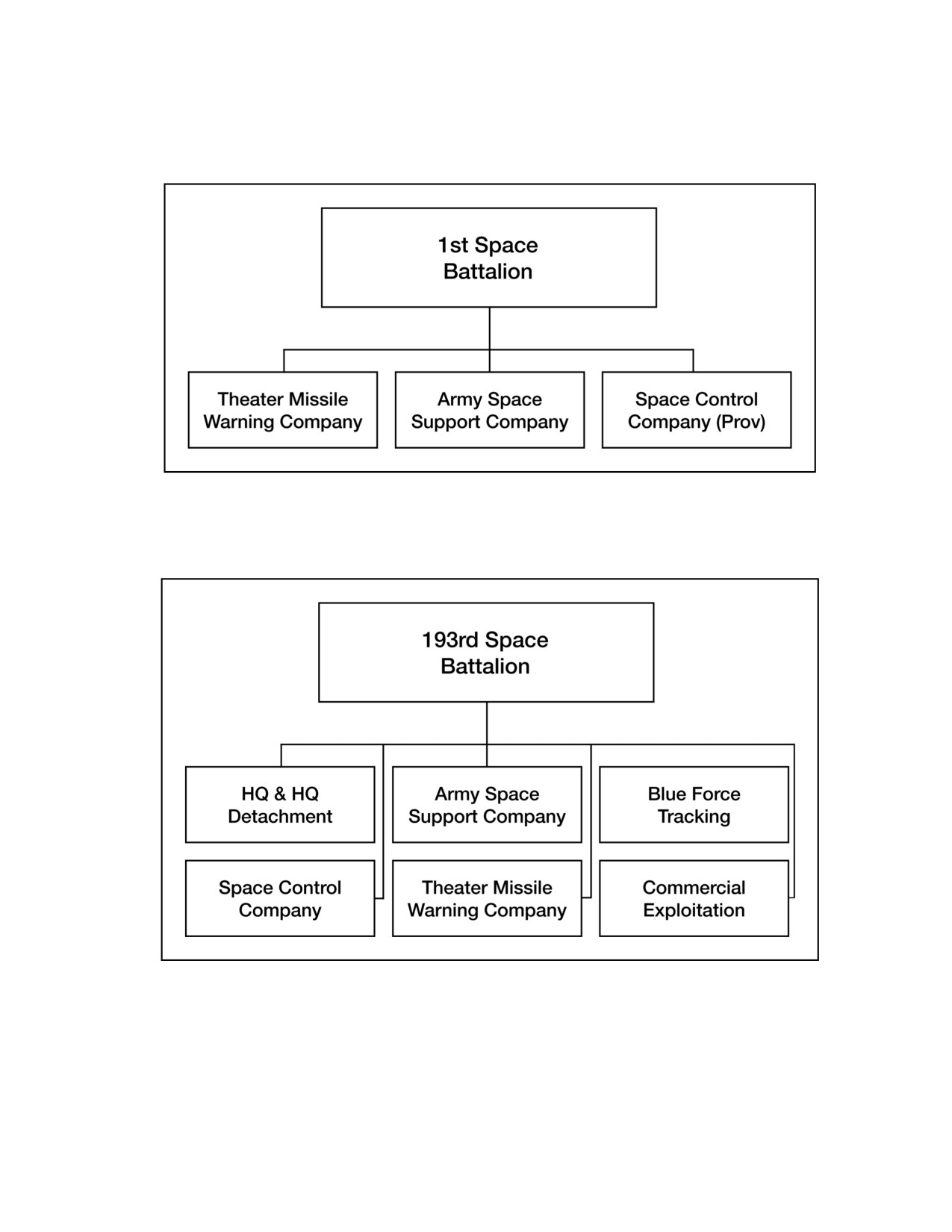
Figure F-3. 1st Space Battalion organization
Figure F-4. 193rd Space Battalion organization
18 May 2005
FM 3-14
F-3
Appendix G
Normalizing, Operationalizing, and Institutionalizing Space
The doctrine contained in this field manual aligns with higher-level
doctrine from FM
1 and FM 3-0, and applicable joint publications,
including JP 3-14. The intent of space doctrine at all levels is to maximize
the advantage of space to U.S. warfighters. This requires that space is
normalized, operationalized, and institutionalized. This appendix
discusses these goals in more detail.
Normalizing Space
G-1. To ensure the maximum use of space, the Army integrates space
capabilities into routine operations. The Army influences the design of future
space systems to provide required warfighting capabilities and leverage
technological initiatives from the other Services and commercial and civil
agencies. A space-literate force identifies innovative concepts and successfully
integrates capabilities into operations.
G-2. Joint space systems serve ground warfighter needs if space-based
components under development incorporate appropriate Army requirements.
This is a critical space-related responsibility for the Army. Urgency is driven
by the near-term developmental window of opportunity that occurs many
years (8 to 12 years or more) before a given space capability or improvement
is deployed. By sheer number of users and dependent functional activities,
operating Army elements are the greatest military users of space. The Army,
therefore, focuses most of its programmatic effort on the ground user
component of space systems—the user terminals.
G-3. The Air Force is the DOD executive agent for space and, together with
the NRO and the Navy, leads and resources the development of most U.S.
national and military space-based systems. These systems are developed and
acquired to meet the requirements of all national and military users.
However, cost, weight limitations, technology, support infrastructure, and
treaty obligations limit space system capabilities. Therefore, the interservice
and interagency competition to have their requirements recognized as a
priority is very keen.
G-4. Service requirements garner joint space program priority by the
substance of their analytical support and the quality of their articulation.
Joint program offices reconcile service and user community requirements
through a series of system and architecture “trade-offs” in a staffing process
that attempts to fit the highest priority requirements to the resources,
technology, and time available. Program leadership and degree of
programmatic support are key influencers. The Army’s challenge is to garner
maximum space capability support for ground warfighters while minimizing
18 May 2005
FM 3-14
G-1
FM 3-14 (FM 100-18) ________________________________________________________________
the Army programmatic commitment outside of its traditional role as a user,
rather than provider, of space force enhancement systems. Accomplishing
this takes a determined collaborative effort across all Army space
stakeholders at the MACOM and Headquarters, Department of the Army
Staff (ARSTAF) level. Only by placing well qualified functional area experts
in key positions; orchestrating cooperative efforts across traditional
functional and BOS-aligned combat development, force development, and
materiel development staffs; and consistently engaging in all pertinent joint
space program development efforts will the Army be certain that future space
systems meet soldiers’ needs, which include fully normalizing space in Army
operations.
Operationalizing Space
G-5. Operationalizing space means using space-based capabilities to provide
force enhancement and space control operations in near real-time. To provide
ground commanders with situational knowledge throughout the battlespace
requires responsive space systems to provide (or otherwise affect) information
in time to influence operations.
G-6. Operationalizing space is the result of considering warfighting uses for
space in a number of existing Army processes. The Army fully supports
research and development and space force planning based on desired
capabilities. Research and development focuses on exploitation of space.
Models and simulations aid in space capability development. Army space
modernization efforts focus on influencing desired capabilities to ensure joint
and national systems support the mission needs of land forces.
G-7. Operationalizing space also requires educating commanders on space
capabilities and limitations to allow them to successfully integrate space into
planning, exercises, training, and operations. The assignment of FA 40 SOO
at the joint and Army division and corps levels, along with core functional
area experts with ASI 3Y (Space) and ASI 3E (TENCAP) facilitates the
integration of space into planning and operations. These experts understand
how space capabilities enhance all phases of operations. A combination of FA
40 and FA 34 (strategic intelligence) officers is essential to providing an
accurate picture of how an adversary exploits space. Skillful employment of
all available space resources helps protect U.S. forces from adversary use of
space and helps establish the information superiority necessary for full-
spectrum dominance.
Note: Force enhancement, space control, and other space missions are
described in detail in chapter 2.
Institutionalizing Space
G-8. Institutionalizing space means making space part of the doctrinal way
the Army thinks and fights. It also involves having a vision and roadmap of
how the Army can best exploit space now and in the future.
G-2
FM 3-14
18 May 2005
______________________________________________________________________Appendix G
G-9. Space organizations are contributing significantly to maximizing the
utility of space for the warfighter. Army space-related organizations
contributed significantly over the past 30 years, bringing the utility of space-
based capabilities to the warfighter. Since the early 1970s, ASPO, through
the Army TENCAP program, has worked with the NRO to bring national
overhead capabilities to tactically deployed MI units, where the data is
combined with theater airborne and terrestrial sensor data in specially
designed equipment. In the late 1980s, INSCOM developed an MI space
battalion specifically designed to develop expertise in exploiting the new high
ground of space. Today this is the tactical exploitation system. Within the
decade, the tactical exploitation system will transition to DCGS-A.
G-10. The Signal Corps provides units for SATCOM operations. USASMDC
also provides space organizations. The Army is placing experienced space
experts in unit and staff positions to help ensure space operations lend
maximum support to the Army mission.
G-11. To further institutionalize space, space education and literacy
opportunities are expanding and improving at every level of the military
education system. While the Army War College and the Command and
General Staff College offer space electives, more standardized instruction for
all ranks is being fielded. Research libraries and the Center for Army Lessons
Learned (CALL) store extensive up-to-date reference materials that allow
analysis of current and historical operations and assist in the development of
innovative concepts.
G-12. Education and training for the Army cadre of space professionals plus
the officer intermediate level education curricula are deploying significant
space expertise out into the Army.
G-13. Army doctrine incorporates space to maximize the benefits of space
capabilities. The Army includes space when preparing any overarching
warfighting vision, capstone concept, or operational plan. Doctrine
development and space training programs, and the infrastructure to
administer them, increases the institutionalizing of space in the Army.
Army Space Master Plan
G-14. The Army space master plan (ASMP) is envisioned as the roadmap for
the Army’s use of space. It is a key enabler to accomplish Army missions and
objectives both now and into the future. It gives structure to the Army’s
efforts to institutionalize space activities. The biennial ASMP is the
culmination of a year’s effort, referred to as the Army space planning process
(SP2). This process results in a space roadmap to support the Army and joint
visions for transformational forces within the context of the national security
space environment. It identifies doctrine, organizations, training, materiel,
leadership and education, personnel, and facilities (DOTMLPF) solutions to
space mission needs and helps to better integrate the space capabilities
roadmap, and science and technology plans.
G-15. The ASMP provides the link between Army prioritized needed
capabilities and proposed space solutions. It presents an integrated
assessment of the most important Army space tasks, shortfalls, and solutions
18 May 2005
FM 3-14
G-3
FM 3-14 (FM 100-18) ________________________________________________________________
across all space functional areas. It considers all DOD and agency solutions
to Army space shortfalls. Further, it is driven by the space needs of the future
and concepts (such as network-centric warfare as related to the Army’s land
warfare mission) and is based on the guidance and priorities contained in the
Army plan.
G-16. Within the context of space mission categories provided in JP 3-14, the
ASMP identifies existing and needed space capabilities that enable required
Armywide capabilities. The SP2 bases the ASMP on Army coordinated
priorities for maintaining and advancing its core competencies. The ASMP
presents a long-term, macro-level view. The ASMP is a snapshot in time that
traces the deliberate connection between Army core competencies, its use of
space today, and a space roadmap. The ASMP addresses the increasing use of
space capabilities across the full spectrum of potential conflict well into the
future.
G-17. The ASMP results from an established process that includes not only
Army space combat developers but also stakeholders from across the Army
(such as Signal School, Military Intelligence School, and Maneuver Center).
Its goal is to determine which space capabilities the Army should pursue to
enable its six enduring capabilities. Space planners choose capabilities for
their relevance to land warfighting dominance and the soldier mission. The
ASMP seeks to identify those space capabilities that will affordably
accomplish the five essential space operations tasks detailed in the Army
space policy:
• Support situational understanding and joint battle command en
route, “off the ramp,” and on the move.
• Support precision maneuver, fires, and sustainment.
• Contribute to continuous information and decision superiority.
• Support increased deployability and reduced in-theater footprint.
• Protect the force during all phases of the operation.
G-18. Teams of experts explore the capability gaps precluding the Army from
accomplishing these five tasks. The process begins with national- and Army-
level guidance concerning what the Army needs, and proceeds through
functional area analysis, functional needs analysis, and functional solutions
analysis. Space planners forward for consideration by the Army proposed
solutions not yet documented as validated capability needs. The planners
generate timelines for phased development of new systems to ensure
synchronization with other Army transformation initiatives. The ASMP
captures, in one document, the capabilities needed to implement the Army
space policy.
G-4
FM 3-14
18 May 2005
Glossary
Acronyms and Abbreviations
A2C2
Army airspace command and control
ADA
air defense artillery
ADE
air defense element
AFB
Air Force base
AFDD
Air Force doctrine document
AFSPC
Air Force Space Command
AFWA
Air Force Weather Agency
AJ
antijam
AO
area of operations
AOI
area of interest
APOD
aerial port of debarkation
AOR
area of responsibility
AR
Army regulation
ARFOR
Army forces
ARSSC
Army space support company
ARSST
Army space support team
ARSTAF
Department of the Army Staff
ARSTRAT
United States Army Strategic Command
ASCC
Army Service Component Command
ASI
additional skill indicator
ASMP
Army space master plan
ASPO
Army Space Program Office
ATACMS
Army tactical missile system
BCST
broadcast
BDA
battle damage assessment
BFT
Blue Force tracking
BMD
ballistic missile defense
BOS
battlefield operating system
C2
command and control
C4ISR
command, control, computers, communications, intelligence,
surveillance, and reconnaissance
CALL
Center for Army Lessons Learned
CC&D
camouflage, concealment and deception
CCIR
commanders critical information requirements
18 May 2005
FM 3-14
Glossary-1
FM 3-14 (FM 100-18) ________________________________________________________________
CET
commercial exploitation team
CENTCOM
United States Central Command
CFLCC
combined forces land component commander
CG
Commanding General
CIB
controlled image base
CITO
Central Imagery Tasking Office
CJCS
Chairman of the Joint Chiefs of Staff
CJCSI
Chairman of the Joint Chiefs of Staff instruction
CLS
contractor logistic support
CMGS
consolidated mission ground station
COA
course of action
COBRA
collection of broadcasts from remote assets
COCOM
combatant command
COMARFOR
Commander Army Forces
CONUS
continental United States
COP
common operational picture
CP
command post
C-SCOC
consolidated system control and operations concept
CSS
combat service support
CWT
combat weather team
DA
Department of the Army
DCD
Directorate of Combat Development
DCG-O
Deputy Commanding General - Operations
DCGS-A
distributed common ground system - Army
DCI
Director of Central Intelligence
DDL
direct downlink
DIA
Defense Intelligence Agency
DIRLAUTH
direct liaison authority
DISA
Defense Information Systems Agency
DMSP
Defense Meteorological Satellite Program
DOD
Department of Defense
DODD
Department of Defense Directive
DOTMLPF
doctrine, organizations, training, materiel, leadership and education,
personnel, and facilities
DRASH
deployable rapid assembly shelter
DSCS
Defense Satellite Communications System
DSN
defense switched network
DSP
defense support program
Glossary-2
FM 3-14
18 May 2005