FM 3-14 SPACE SUPPORT TO ARMY OPERATIONS (MAY 2005) - page 2
________________________________________________________________________Chapter 2
space control negation. Using camouflage, concealment, and deception
(CC&D) to hide assets from adversary ISR satellites is another IO approach,
which is also space control negation.
SPACE FORCE APPLICATION
2-47. This mission area encompasses combat operations in, from, and
through space to influence the course and outcome of conflict. Space force
application operations consist of attacks against terrestrial-based targets
carried out by military weapon systems operating from, in, or through space.
According to JP 3-14, this includes ballistic missile defense (BMD). However,
BMD doctrine is beyond the scope of this manual and is not addressed here.
Other than BMD, the Army currently provides no space force application
weapon systems.
SPACE SUPPORT
2-48. Space support includes operations to deploy, sustain, and modernize
military systems in space. This mission area includes launching and
deploying space vehicles, maintaining and sustaining spacecraft on orbit, and
deorbiting and recovering space vehicles, if required. It involves actions to
sustain and maintain U.S. space-based constellations, such as space lift,
surveillance of systems in space, and the day-to-day telemetry tracking and
control (TT&C) needed for optimal performance and health of assets. It is a
combat service support operation to deploy and sustain military and
intelligence systems in space.
2-49. While space support is essential to enable exploitation of space
capabilities, space support is primarily the responsibility of the Air Force as
the DOD Space Executive Agent. The Army role in providing space support is
payload and network control of the DSCS constellation for DOD use. While
day-to-day satellite bus operations are provided by the Air Force through Air
Force satellite control network common user equipment, the Army maintains
a backup contingency control capability through its WSOCs.
18 May 2005
FM 3-14
2-13
Chapter 3
Space Operations in Land Warfare
In all environments, the initiative of Army leaders, agility of Army units,
depth of Army resources, and versatility of Army soldiers combine to
allow Army forces to conduct decisive full spectrum operations. Space
capabilities are thoroughly integrated into the force structure to enable
all of these Army operations, and are essential for mission
accomplishment. This chapter explains the integration between space
support and general Army operations.
SECTION I - SPACE CONTRIBUTIONS TO JOINT LAND WARFARE
3-1. Effective use of space enablers is essential to the conduct of successful
Army operations. Information provided by and through space-based systems,
coupled with information from airborne and terrestrial systems, increase
tempo and the number of offensive options. Better situational understanding
allows commanders to shift forces and efforts from one area to another.
Opportunities to exploit nonlinear operations in noncontiguous AO can be
created. Commanders can project attacking forces on multiple axes
throughout the AO. Lines of operations in the offense are related less by
geographic proximity than they are by purpose; thus commanders can
selectively bypass unfavorable terrain and unnecessary battles to focus
combat power at decisive points.
SPACE OPERATIONS ACROSS THE SPECTRUM OF CONFLICT
3-2. This section provides examples of how land operations are tied to space.
In conducting decisive full-spectrum operations, the Army depends on space
capabilities to accomplish missions in all environments and in performing
any combination of operations. Different phases of operations have varying
needs for space capabilities.
3-3. The Army conducts a variety of missions, extending from humanitarian
assistance and disaster relief to peacemaking and peacekeeping to major
theater wars, including conflicts involving the potential use of weapons of
mass destruction—the full range of operations. Commanders can tailor agile
and versatile Army forces to create combined arms teams for operations at
the strategic, operational, and tactical levels. Strategically responsive Army
forces move wherever needed and are capable of transitioning quickly from
one type of operation to another. Forces shift seamlessly from engagement to
deterrence to war to postwar reconstruction. As missions change from
promoting peace to deterring war, or from resolving conflict to war itself,
operations become more complex.
18 May 2005
FM 3-14
3-1
FM 3-14 (FM 100-18) ________________________________________________________________
3-4. Commanders conduct four types of operations
(offensive, defensive,
stability, and support) to accomplish missions in support of the joint force
commander’s objectives. Offensive operations aim at destroying or defeating
an enemy. Their purpose is to impose the will of the United States on the
enemy and achieve decisive victory. Defensive operations defeat an enemy
attack, buy time, economize forces, or develop conditions favorable for
offensive operations. Defensive operations alone normally cannot achieve a
decision. Stability operations promote and protect U.S. national interests
through a combination of peacetime developmental, cooperative activities and
coercive actions in response to crises. Support operations employ Army forces
to assist civil authorities, foreign or domestic, as they prepare for, and
respond to, crises and relieve suffering.
3-5. Transitioning between the four types of operations normally requires
adjustments in the space support needs. Offensive and defensive, or
maneuver, operations drive the most intense needs for space force
enhancement products, but space contributes to literally every Army
operation. Therefore, space contributions to stability and support operations
can be significant. For example, information needs may shift from targeting
data to environmental monitoring, providing insight into agricultural
production (spectral products can indicate the need for changes in irrigation
or fertilizer application) to aid reconstruction in postwar support operations.
SPACE CONTRIBUTIONS TO OFFENSIVE AND DEFENSIVE
OPERATIONS
Satellite Communications
3-6. SATCOM allows the commander to exercise effective C2 away from his
tactical operation center (TOC) (for example, beyond LOS battle command on
the move). The ability of the commander to lead from the front has always
been hampered by limited communications capabilities. Mobile SATCOM
enables the commander to receive a clear COP of the battle and remain at the
front to see and assess the situation. SATCOM is especially of assistance
during exploitation or pursuit, where units are moving swiftly and covering
significant distances.
3-7. SATCOM provides units with secure broadcast information from
dispersed locations around the globe. Army units can benefit directly from
intelligence data fusion and analysis. They can also receive near real time
(NRT) intelligence, exchange logistics information, coordinate movements
and plans, and, therefore, accomplish better planning and execution of
operations.
Position, Velocity, and Timing
3-8. GPS provides invaluable support to the unit conducting maneuver
operations. GPS is essential to effective command and control of maneuver
forces since the timing signal is used to synchronize communications
equipment. GPS, either as the sole source of guidance or coupled with other
means such as inertial navigation, is used for precise guidance of munitions.
This facilitates target destruction with minimal weapons used and greatly
reduces collateral damage. It also enables strikes in direct support of combat
3-2
FM 3-14
18 May 2005
________________________________________________________________________Chapter 3
action to be executed closer to friendly positions. Similarly, this GPS position
accuracy aids maneuver since soldiers and platforms can move to precise
locations along precise pathways. Combat search and rescue operations can
be executed with less exposure to danger since search platforms can
maneuver directly to locations precisely identified by GPS.
3-9. The deployment of friendly force tracking capabilities that use space-
based components adds another significant dimension in support of tactical
navigation operations. BFT capabilities allow the commander to track
friendly forces and maintain exact location information on subordinate
elements. Force location data is of great benefit for C2, situational
awareness, and avoiding fratricide incidents in the mayhem of combat. The
use of BFT devices associated with national technical means
(NTM) is
managed by Space-Based Blue Force Tracking Mission Management Center
(SB/BFT MMC).
(See appendix B for further discussion of SB/BFT MMC
capabilities.)
Environmental Monitoring
3-10. Space-based meteorological systems such as the Defense Meteorological
Satellite Program
(DMSP) provide timely and accurate weather, other
environmental conditions, and space environment data. Current technologies
provide the commander a clear understanding of the weather/environmental
impacts on operations throughout the depth of the battlespace. Space-based
environmental monitoring benefits for planning support to operations
include—
• Detect terrestrial weather throughout the area of responsibility.
• Detect space weather to forecast potential effects and understand
actual effects on communications and space-based assets.
• Detect soil moisture content (unrestricted, restricted, and severely
restricted terrain based on recent precipitation and analysis of soil
type).
• Detect obscurants and differentiate between dust, smoke, fog, oil
mist, and so forth.
• Detect ionospheric scintillation, which can impact UHF SATCOM and
GPS reliability.
• Increasing overall understanding of the area of responsibility by
using MSI/hyperspectral imagery (HSI).
Space Intelligence, Surveillance, and Reconnaissance
3-11. Current and near-term space-based electro-optics
(EO), synthetic
aperture radar (SAR), infrared moving target indicator (MTI), and MSI/HSI
and SIGINT capabilities provide the following to the corps and division:
• NRT information from sensor to shooter.
• Direct downlink of space-based ISR sensors into Army TENCAP
systems in support of both situation understanding and targeting.
• Measurement and signature intelligence (MASINT) to defeat enemy
CC&D operations.
18 May 2005
FM 3-14
3-3
FM 3-14 (FM 100-18) ________________________________________________________________
• Space-based information requirements (IR) to rapidly locate enemy
theater ballistic missiles, surface-to-air missiles, and multiple rocket
launcher system; support timely combat assessments; and provide
potential location information for combat search and rescue.
• Commercial space imagery to supplement national sources, providing
additional imagery to support planning, combat assessment, and
situation analysis.
Theater Missile Warning
3-12. Space-based missile detection capabilities assist the unit commander by
providing early warning of enemy theater ballistic missile launches via the
TES supporting the missile defense operational elements of active defense,
passive defense, attack operations and battle management, command,
control, communications and computers, and intelligence. TES broadcasts
data to forward units where the air defense element (ADE) coordinates
warning distribution to both subordinate units and allies. The TES warning
supports maneuver operations as follows:
• Identification of missile type (supporting passive defense). This may
help determine the appropriate force protection measures
(for
example, if the missile is capable of carrying a chemical warhead)
maneuver units may need to go to a higher mission-oriented
protective posture (MOPP) level.
• Predicted impact point and time (supporting passive defense). TES
cues units near the impact point to take protective action. A very
significant implication is that maneuver units confirmed not to be in
danger can continue normal operations.
• Estimated launch point (supporting attack operations). This provides
target intelligence in support of deep attack operations. The
commander may employ combat maneuver forces and/or fires to
attack mobile launch systems, their support areas, and installations.
Space Control
3-13. Space control operations ensure friendly unit access to space and deny
the enemy use of space. Ensuring friendly access to space enables maneuver
forces to benefit from space force enhancement. At the same time, space
control ensures the enemy is selectively denied use of space. This
significantly contributes to gaining and maintaining information superiority,
an obvious advantage to friendly maneuver operations. For example,
movement of troops and materiel often relies upon position information from
GPS. Some precise attack methods use the GPS signal to guide weapons to a
predetermined set of geographic coordinates. When adversaries jam the GPS
signal in an attempt to prevent Army use of it, the Army will often find and
destroy the jammers. This is an example of space control protection because
in restoring its use of the GPS signal the Army is protecting its ability to use
the space-based navigation capability.
3-14. Adversaries need not develop, launch, and operate their own space
capabilities; many are available commercially. An enemy could buy space-
based imagery, which could reveal troop movement, supply storage, and so
forth. Buying all rights to the imagery in advance to disallow adversary
3-4
FM 3-14
18 May 2005
________________________________________________________________________Chapter 3
access is a form of space control negation. Full-spectrum IO also provides
space control negation. Methods such as camouflage, concealment, and decoy
employment are used to disallow adversary satellites from “seeing” friendly
assets. Computer network attack and electronic warfare (EW) can be used
against enemy satellite control or data downlink and distribution stations.
(See FM 3-13 for use of these IO tools.)
3-15. A similar case is true for commercially available satellite
communications, or SATCOM. An enemy may gain a military advantage by
using SATCOM capabilities leased from a commercial vendor. Normally, it
would pay for communications channels on specific transponders on
commercial satellites. The vendors may elect to voluntarily deny enemy
access to the transponder. They may also accept an alternative lease
agreement, allowing friendly forces to take over the transponder. If the
vendor is sympathetic to the enemy (or neutral) and cannot make a business
case supporting either of the options described, it may be necessary to
selectively jam the transponder or specific channels to deny enemy use.
3-16. In extreme cases, ground stations providing access to the satellite in
question could be captured or destroyed to make further access impossible.
All the above are examples of space control negation that could be used to
support maneuver operations.
3-17. Space control prevention is accomplished to prevent an enemy from
using U.S. and allied space capabilities. If an enemy were to use the GPS
signal for navigation purposes in a specific situation, the Army could jam the
signal in a local area to prevent its use.
3-18. A final example of space control supporting maneuver operations is the
use of surveillance of space. Surveillance operations are continually ongoing
to ensure the current and future locations of all satellites are known with
reliable accuracy. Maneuver forces are warned when adversary space-based
ISR assets will be in a position to view and record U.S. activity. Forces can
then use CC&D techniques, if necessary, to protect themselves. This is an
example of force protection enabled by space control surveillance.
3-19. Friendly and adversary space capabilities can affect terrestrial
operations in a great many ways because forces are heavily dependent on
space force enhancement capabilities. Each of these uses comes to the
battlefield through specific channels involving ground stations/operations,
the satellites on orbit, and the communication links between the satellites
and the ground stations and users. Each of these channels provides various
points to be attacked or defended. This leaves a large number of options for
adequate space control operations in support of maneuver operations.
SPACE SUPPORT TO STABILITY AND SUPPORT OPERATIONS
3-20. Stability operations include a range of actions that Army forces conduct
outside the United States and its territories. Their purpose is to promote and
sustain regional and global stability. Stability operations are diverse,
continuous, and often long term. However, the credibility and staying power
of Army forces allow them to conduct these operations until the situation is
resolved. Army forces may execute stability operations as part of a theater
18 May 2005
FM 3-14
3-5
FM 3-14 (FM 100-18) ________________________________________________________________
engagement plan, smaller-scale contingency, or follow-on operation to a
campaign or major operation. They are inherently complex and place great
demands on leaders, units, and soldiers. Stability operations require the
mental and physical agility to shift among situations of peace, conflict, and
war and between combat and noncombat operations.
3-21. Army forces conduct support operations to relieve suffering and help
civil authorities prepare for, or respond to, crises. Army forces have
specialized capabilities and provide important support. Support operations
usually aim to overcome manmade or natural disaster conditions for a limited
time until civil authorities no longer need help. Support operations are
divided into two categories:
• Domestic support operations are conducted within the United States
and its territories.
• Foreign humanitarian assistance is conducted outside the United
States and its territories.
3-22. Space capabilities provide important contributions to Army stability
and support operations. Army deployments to Bosnia, Kosovo, Haiti and
other locations demonstrated the need to have timely and effective space
support when conducting the variety of peacekeeping, security assistance,
humanitarian aid, counterterrorism, and other operations that have become
common in the Army today. These space-based assets provide great
assistance in the conduct of both stability and support operations.
Satellite Communications
3-23. Numbered Armies, corps and divisions employed in stability and
support operations may find their subordinate units deployed over large
geographic areas, conducting a wide variety of mission requirements. In this
environment, SATCOM provides the primary means of ensuring reliable and
secure communications with all subordinate units.
Position, Velocity, and Timing
3-24. The GPS signal with its position information can be used in stability
and support operations to maintain a distance buffer between opposing forces
in a truce or stand-down situation. Providing both sides with GPS receivers
and the coordinates for a demarcation line may make it easier for forces on
both sides to remain on their own side of the demarcation. Forces equipped
with GPS receivers are not likely to cross over the demarcation inadvertently.
3-25. In stability and support operations, there are no clear boundaries
separating friendly units from insurgents, terrorists, or the local population.
BFT systems provide the commander the ability to track small unit patrols
and force protection teams that are often intermingled with the local
populace. This capability can be of great importance if a friendly force unit
needs to be quickly extracted from a difficult situation. BFT systems
automatically provide the exact location information necessary to track units,
and thus contribute to effective C2, situational awareness, and force
protection. GPS is used to map out minefields and facilitate mine clearing
operations.
3-6
FM 3-14
18 May 2005
________________________________________________________________________Chapter 3
Environmental Monitoring
3-26. Environmental monitoring provides a variety of capabilities,
including—
• Determining changes in activity in a given area. This can be
especially beneficial supporting counterdrug, law enforcement,
detecting and monitoring environmental damage, and other missions.
• Detecting soil moisture (determine trafficability, go/no go terrain, and
so forth).
• See through foliage (important benefits to counterinsurgent and law
enforcement operations).
• Timely receipt and access of weather observations from remote
locations.
Space Intelligence, Surveillance, and Reconnaissance
3-27. The same basic ISR capabilities described above to support maneuver
operations are tailored to support stability and support operations as well.
Space-derived ISR, especially EO imagery from commercial systems (because
it is unclassified), is used to give civil authorities the impression space-based
systems are always watching them. This creates uncertainty (in the target
audience’s mind) of their ability to do anything undetected. Unclassified EO
imagery can be shown to adversary leadership to prove the friendly force can
effectively monitor the actions of potential enemies of the United States.
Space-based ISR is used for disaster relief support, refugee management
support, consequence management, and so forth.
Theater Missile Warning
3-28. Shared early warning allows U.S. Forces to provide missile warning to
civilian populations of coalition partners, or neutral parties; this is
specifically called shared early warning. Sharing allows partners or neutral
parties to take protective measures that could help stabilize political and
military situations as well as help protect noncombatants.
Space Control
3-29. Space control is used to deny communications and propaganda tools,
such as TV and radio, to adversary leadership. Space surveillance systems
monitor the status of enemy and commercial satellite operations to determine
potential threat to friendly forces.
SECTION II - COMMAND AND CONTROL
JOINT SPACE OPERATIONS
3-30. JP 3-14 outlines two general situations for space command and control
operations: global C2 and theater C2. Due to the nature of orbiting space
assets, changes to satellite tasking to support one theater can affect other
theaters. Therefore, day-to-day command and control is accomplished from a
global perspective. Commander, USSTRATCOM is responsible for conducting
space operations and coordinating and conducting space campaign planning
18 May 2005
FM 3-14
3-7
FM 3-14 (FM 100-18) ________________________________________________________________
through the joint planning process in support of the national military
strategy.
3-31. Combatant commanders seek and employ space solutions for their
operational needs. They coordinate on USSTRATCOM campaign plans and
provide force protection in coordination with USSTRATCOM for space forces
not assigned to (but operating in) the area of responsibility (AOR).
3-32. USSTRATCOM delegates appropriate operational control to the
component commanders; components maintain this global perspective in
their space planning and operations. The Army component for
USSTRATCOM is USASMDC/ARSTRAT. The mission of
USASMDC/ARSTRAT is to conduct space operations and provide planning,
integration, control and coordination of Army forces and capabilities in
support of USSTRATCOM missions.
3-33. In joint operations, the joint force commander (JFC) is responsible for
coordinating the integration of U.S. space operations. During times of conflict
or large-scale contingencies, the JFC normally designates a “space authority”
within the joint force structure to coordinate and integrate space
requirements. It is important to limit the possibility of interference or
redundancy between various space operations, and deconflict space activities.
Assignment of the space authority is based on the missions and capabilities of
the commands and organizations involved.
3-34. The Commander Army Forces
(COMARFOR)/joint force land
component commander (JFLCC) may be designated as space authority at the
discretion of the JFC. This is most likely to happen if the Army has the
preponderance of space capabilities in theater or otherwise has sufficient
expertise available to justify JFC confidence, and has adequate C2 to fully
coordinate space issues. The nature and duration of the overall mission are
also factors when assigning the space authority. If COMARFOR/JFLCC is
the designated space authority, a space support team (SST) (see JP 3-14 for a
discussion of the SST) is normally assigned to support. The space authority
consolidates JFC component space requirements and issues, and coordinates
implementation through JFC to USSTRATCOM. The space authority
coordinates space operations, integrates space capabilities, and has primary
responsibility for in-theater joint space operations planning. Commander,
USSTRATCOM ensures coordination and integration from the global
perspective, and together with the space authority, ensures space activities
are coordinated, deconflicted, integrated, and synchronized at the theater
level. When acting as the space authority, COMARFOR/JFLCC exercises
direct liaison with other Service space components.
ARMY SPACE COMMAND AND CONTROL
3-35. At Secretary of Defense direction, Commander, USSTRATCOM
transfers designated space capabilities to the supported combatant
commander, subordinate JFC, or subordinate commander. These capabilities
are the forces provided by the Services to the CJCS and further allocated to
USSTRATCOM, or those forces directly assigned by the Service to the
component commands of USSTRATCOM. For the Army, these forces are
normally forces provided via USASMDC/ARSTRAT.
3-8
FM 3-14
18 May 2005
________________________________________________________________________Chapter 3
3-36. The Space and Missile Defense Command Operations Center
(SMDCOC) provides the USASMDC/ARSTRAT commander the means to
communicate and execute command and control of USASMDC space and
missile defense assets. It provides command situational awareness and
maintains command asset operational status. The SMDCOC provides
around-the-clock reach for space operations officers and deployed space
assets.
3-37. To ensure overall synchronization of space efforts, the JFC designates a
space authority to coordinate theater space operations and integrate space
capabilities
(per JP
3-14). Similarly, the Commanding General,
USASMDC/ARSTRAT may designate an Army space coordination authority
in support of the ASCC for the regional combatant commander, Army forces
(ARFOR), or JFLCC and theater space authority.
18 May 2005
FM 3-14
3-9
PART TWO
Tactics, Techniques, and Procedures
Like all Army operations, space operations follow the full spectrum operations
process described in FM
3-0. The process is actually a cycle of planning,
preparation, execution, and continuous assessment. These activities are sequential
but not discrete; they overlap and recur as circumstances demand (see FM 3-0 and
FM 6-0). Part Two is organized around this cycle.
Chapter 4
Planning, Preparing for, and Executing Space Operations
Planning is the means by which the commander envisions a desired
outcome, lays out effective ways of achieving it, and communicates to his
subordinates his vision, intent, and decisions, focusing on the results he
expects to achieve (FM 3-0). Preparation is an activity of the operations
process. Most preparations occur between receipt and execution of an
operation order (OPORD); however, preparation begins during planning
and often continues during execution. The need for responsive staff
coordination among the space operations elements intensifies during
execution as an operation progresses and variances from the OPORD
increase. This chapter discusses planning, preparing for, and executing
space operations.
SECTION I - PLANNING FOR SPACE OPERATIONS
4-1. Planning is the means by which the commander envisions a desired
outcome, lays out effective ways of achieving it, and communicates to his
subordinates his vision, intent, and decisions, focusing on the results he
expects to achieve (FM 3-0). Commanders and staffs above company level use
the military decision making process (MDMP) to plan operations. The G3
follows MDMP techniques to plan and synchronize space operations.
Planning space operations requires integrating it with all the other activities
and processes of the organization. Space element members synchronize their
activities with the overall operation.
4-2. Integrated space operations planning requires innovation and flexibility.
Some space assets, resources, and related activities require a long lead time
for planning and preparation. Some elements are executed before other
aspects of the overall operation. Others demand higher resolution and more
18 May 2005
FM 3-14
4-1
FM 3-14 (FM 100-18) ________________________________________________________________
up-to-date intelligence. For some, there is a long lag between execution and
assessment of their effects. Defined, but flexible, processes are used to
structure space operations planning. The G3 develops space operations
mission statements and concepts of support, which are the result of the
operations planning process.
4-3. The space operations mission statement is a short paragraph or sentence
describing what the commander wants space operations to accomplish and
the purpose for accomplishing it. The G3 space element develops the initial
space operations mission statement at the end of mission analysis based on
the restated mission, space operations-related essential tasks, commander’s
intent, and commander’s planning guidance. The space element develops the
final mission statement after the commander approves a course of action
(COA). The final mission statement includes the objectives for the approved
COA.
4-4. The space operations concept of support is a clear, concise statement of
where, when, and how space contributes to accomplishing the mission. It
directly supports the commander’s concept of operations. During COA
development, the space element develops a separate concept of support for
each COA the staff develops. The space operations concept of support is
written in terms of space objectives and space assets, resources, and related
activities.
4-5. Space operations objectives are clearly defined, obtainable aims that the
commander intends to achieve using space assets, resources, and related
activities. Accurate situational understanding is key to establishing space
objectives. Objectives serve a function similar to that of terrain or force-
oriented objectives in maneuver operations. They focus space operations on
things that support the commanders’ intent and concept of the operation.
Space objectives usually involve tasks covering more than one space mission
area. Space operations objectives are stated in terms of effects.
4-6. The G3 space element develops most space objectives concurrently with
concepts of support during COA development. At the same time, the G3
develops terrain or force-oriented objectives. However, some space objectives
may emerge during mission analysis. These include space objectives that are
present during all operations such as maintaining SATCOM connectivity,
maintaining space situational awareness, and monitoring space weather.
Others may be related to specified tasks from the higher headquarters. Space
objectives and tasks become part of the final space operations mission
statement. The G3 space element uses them to focus the conduct of space
tasks. Space operations tasks are tasks developed to support accomplishment
of one or more space operations objectives. The space element develops space
tasks during COA development and finalizes them during COA analysis.
4-7. With approval of a COA, the space operations concept of support for that
COA becomes the space operations concept of support for the operation.
During orders production, space tasks are assigned to the space element and
supporting space units. The most important space-planning product is the
space operations subparagraph or annex of the operation plan (OPLAN) or
OPORD.
4-2
FM 3-14
18 May 2005
________________________________________________________________________Chapter 4
4-8. The space element also determines implied tasks. This requires
identifying space-related tasks in the higher headquarters OPLAN/OPORD,
developing space-related implied tasks that support accomplishing the
mission, and assembling the critical asset list. All these products are refined
throughout the MDMP, based on continuous assessment of the friendly and
enemy situations.
4-9. The critical asset list is a list of space-related elements whose loss or
functional disruption would jeopardize mission accomplishment. At the
operational and strategic levels, this includes space centers of gravity.
Protecting critical assets and centers of gravity is an implied task for every
operation. This space critical asset list should be coordinated with the G7 to
ensure no critical force capability is overlooked.
4-10. The space element compares available space operations assets and
resources with tasks to identify capability shortfalls and additional resources
required. The space operations product for this task is a list of assets and
resources that can be employed. If the command needs additional space-
related assets or resources, the space element forwards the requirements to
the G3, who coordinates with higher headquarters.
SECTION II - PREPARING FOR SPACE OPERATIONS
4-11. Preparation is an activity of the operations process. Most preparations
occur between receipt and execution of an operation order
(OPORD);
however, preparation begins during planning and often continues during
execution. For example, a unit assigned a reserve or striking-force mission
prepares until the commander commits the unit. When a unit executing one
mission receives a warning order for a follow-on mission, it begins preparing
for that mission, while executing its current mission. Because many space
operations objectives and tasks require long or continuous periods,
preparation often starts earlier than for other types of operations. Initial
preparation for specific space operations elements may begin during
peacetime, although execution is during conflict or war.
4-12. Peacetime preparation by units involves building contingency planning
databases about the anticipated AO. These databases can be used for space
operations input to the space estimate and to plan initial space operations.
4-13. An important element of preparation is developing and implementing
the ability to coordinate among relevant units and agencies. Coordination
facilitates preparation in general and is key to synchronizing forces during
execution. Critical to the success of synchronized operations is the continuous
exchange of information among units, including after the operations plan is
approved. Coordination may be internal or external. Internal coordination
occurs within the unit headquarters. The space element initiates the explicit
and implicit coordinating activities within itself and with other staff sections.
Much of this coordination occurs during meetings, but element members are
monitoring other activities that might relate to space operations. The space
element coordinates with the G3 for movement of space operations assets and
resources during preparation.
18 May 2005
FM 3-14
4-3
FM 3-14 (FM 100-18) ________________________________________________________________
4-14. External coordination includes subordinate units and higher
headquarters. This coordination concerns space operations assets and
resources or forces that may not be under unit control during planning.
External coordination also includes coordinating with adjacent units or
agencies. In space operations, adjacent refers to any organization that can
affect a unit’s operations. Liaison is an important coordination means.
Effective liaison is through command liaison officers, and a member of the
space element may be part of a liaison team. Establishing liaison early in
planning supports effective coordination. Practical liaison can be achieved
through personal contact between space activities.
4-15. Force protection is a continuous process executed by all commanders,
regardless of mission, location, or threat. It consists of a broad set of unit
specific, coordinated actions conducted to protect the force. The space element
develops and initiates force protection actions during planning, but executes
them mainly during preparation and execution. Space operations actions
related to force protection include tasks involving all space activities. Threat
assessment begins during planning and continues during preparation. Force
protection measures may explicitly include space operations elements.
4-16. Resupplying, maintaining, and issuing special supplies or equipment to
space operations units takes place during preparation. Repositioning logistic
assets for units assigned space operations tasks also occurs during
preparation. The space element coordinates with the G4 to ensure that units
assigned space operations tasks receive the necessary support.
4-17. The G3 ensures that space operations-capable units made available to
the force are fully integrated into the command in a posture that allows them
to contribute effectively. This responsibility includes integrating support
received from USASMDC/ARSTRAT.
4-18. Criteria of success are but one part of assessment. Traditional
intelligence analyses and friendly reporting are still key to assessing space
operations effectiveness.
SECTION III - EXECUTING SPACE OPERATIONS
4-19. During execution, a challenge faced by the space element is how to
assess space operations execution and how to adjust space operations as the
operation unfolds. The need for responsive staff coordination among the space
operations elements intensifies during execution as an operation progresses
and variances from the OPORD increase. The decentralized nature of space
operations execution, combined with the multiple command levels involved,
cover a wide span that the space element coordinates.
4-20. Assessment is the continuous monitoring—throughout planning,
preparation, and execution—of the current situation and progress of an
operation, and the evaluation of it against criteria of success to make
decisions and adjustments. The space element compiles information from
many sources to maintain a continuous space operations assessment. The
primary objective of assessment is to determine whether space operations are
achieving their objectives. As the situation changes, the space element
4-4
FM 3-14
18 May 2005
________________________________________________________________________Chapter 4
modifies operations to ensure they remain fully synchronized with the overall
operation.
4-21. Monitoring space operations execution focuses principally on
maintaining the effectiveness of space operations. The space element uses the
critical assets list to monitor the status of critical friendly space activities and
the status of critical space systems.
4-22. Decisionmaking during execution includes executing space operations
as planned, adjusting space operations to a changing friendly situation, and
adjusting space operations to unexpected adversary actions. Space operations
may not be executed exactly as planned for a variety of reasons. The space
element’s challenge under these circumstances is to assess rapidly how
changes in space operations execution affect the overall operation and to
determine necessary follow-on actions.
4-23. Successful space operations execution relies on teamwork by several
staff sections and organizations and rapid information exchange among
them. As operations unfold, space operations objectives and tasks are
modified to provide effective support.
18 May 2005
FM 3-14
4-5
Appendix A
Space Input to Intelligence Preparation of the
Battlespace and Space Estimate
The space element prepares two separate products, the space estimate
and space-unique input to the IPB products. The space estimate is
prepared as a tab to the space annex to the OPLAN while the space
element provides space IPB to the G2. Both the space estimate and space
IPB process are systematic, continuous methods of analyzing and
documenting factors affecting space capabilities that affect the
battlespace. These space-unique products present the supported
commander and staff with information about the space situation that
pertains to accomplishing the unit mission. These products are designed
to support other staff estimates and the MDMP. The purpose of the space
estimate is to consider systematically the space dimension of the
battlefield. This appendix outlines the necessary content of space analysis
as a tool to determine how space potentially influences the battle.
Purpose
A-1. The purpose of space input to the IPB is to provide the G2 with a highly
detailed analysis of the space medium and its capabilities and effects within
the battlespace. IPB is an analytical methodology to reduce uncertainties
concerning the enemy and the battlespace, in three dimensions, and fuses air,
space, terrain, and weather into a consolidated, coordinated assessment. IPB
is the key to preparing for the next battle and, during peacetime, builds the
foundational data that will be updated and enhanced continuously and
simultaneously during operations.
A-2. Based on the factors of mission, enemy, terrain and weather, troops and
support available, time available, civil considerations
(METT-TC), staffs
down to brigade level need to determine how best to integrate space
capabilities and vulnerabilities into their mission analysis process. This effort
supports all facets of MDMP and is the key space situation analysis tool used
during the operation. The use of space systems significantly affects
operations involving communications, navigation, threat warning, weather,
terrain and oceans, and reconnaissance and surveillance. Throughout the
spectrum of an operation (from predeployment to mission completion), the
space impact on military operations is a key factor for which the commander
plans. The SOO, in coordination with the rest of the battle staff, ensures that
an effective space estimate process and space IPB is conducted and made
available to the staff and the commander.
18 May 2005
FM 3-14
A-1
FM 3-14 (FM 100-18) ________________________________________________________________
Space Input to the IPB process
A-3. The space element provides all space unique IPB products for
integration to the G2, in accordance with FM 5-0 and FM 6-0. These space
unique products are incorporated into the IPB products generated by the G2
for use in the planning, preparing, and executing of all operations. The SOO
must ensure that he is in close coordination with the G2 to reduce the
potential for redundant analysis.
A-4. The four steps of IPB (per FM 34-130) adequately describe the process
required for the space element to provide the space IPB input. Some
traditional IPB products developed by the G2 can be applied to the space
estimate effort. With some adjustment, the modified combined obstacle
overlay (MCOO) that addresses weather and terrain limits can be tailored to
support the space estimate. The four IPB analysis steps are—
• Describe the battlefield environment.
• Describe the battlefield effects.
• Understand the threat.
• Determine threat courses of action.
STEP 1—DESCRIBE THE BATTLEFIELD ENVIRONMENT
Identification of Space Area of Interest
A-5. Step 1 begins with identification of the supported unit AO. Once the AO
is identified, the area of interest (AOI) is coordinated with the G2. Based on a
clear understanding of the operational commander’s AO, the G2 specified
AOI, and the supported unit mission, the SOO determines a separate and
distinct space AOI. The space-specific AOI supports and complements the
total G2/G3 effort and is designed to depict the relevance of space to the
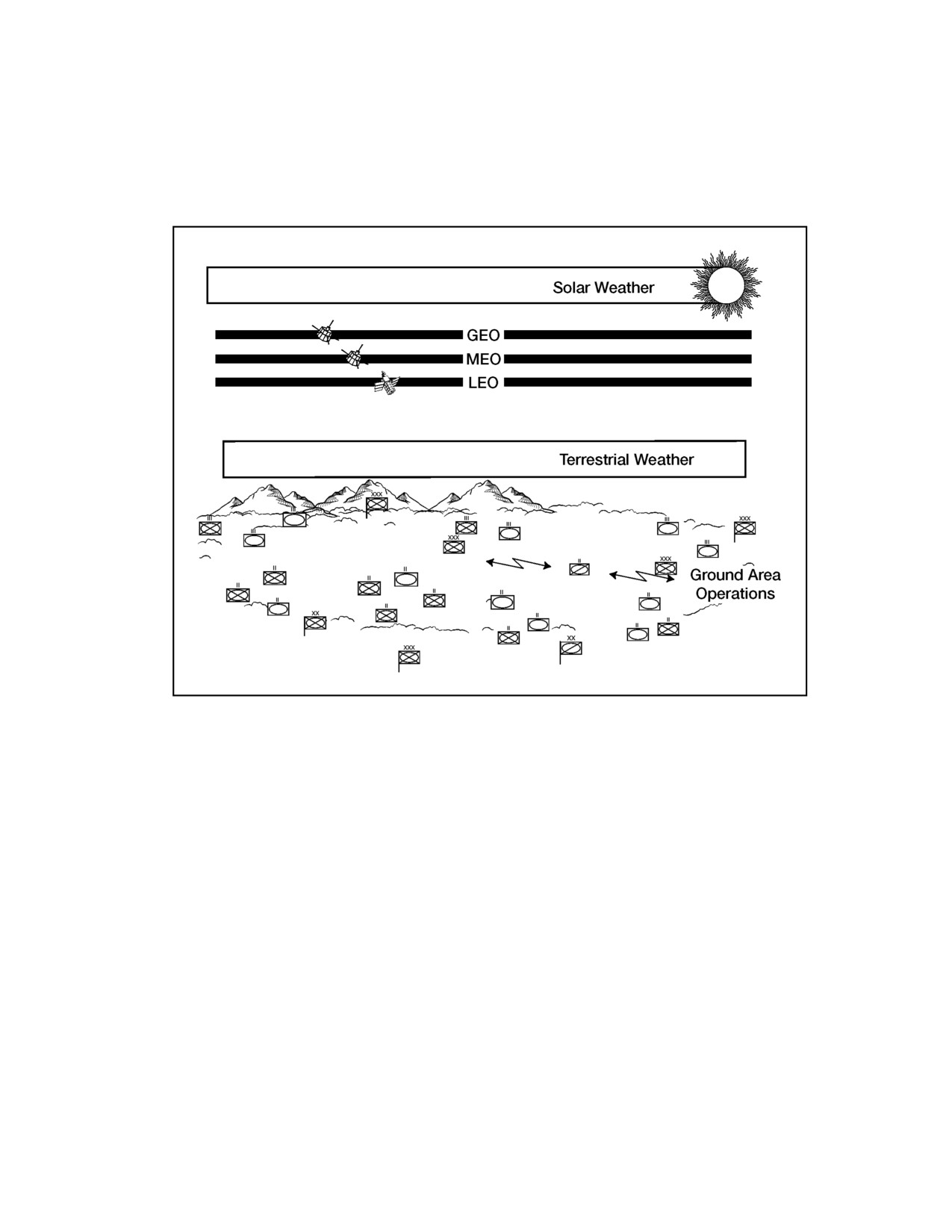
maneuver commander’s battle. The space AOI includes the region above and
adjacent to the ground AO
(see figure A-1). It starts at ground level,
continues through LEO, and terminates with the GEO. Satellites moving
through the identified space AOI, space weather, and key terrestrial space-
related locations (and associated terrestrial weather) are all considered in the
space IPB input, as well as in automated ISR collection management tools.
Space-related activity occurring anywhere outside of the designated space
AOI (such as solar weather, space launches, and ground station activity)
needs to be considered in this effort only if it directly impacts the operational
mission.
Initial Examination
A-6. Once the space AOI is identified, the G3 space element begins an initial
examination, in conjunction with the G2, of available intelligence and
information gaps that need to be addressed. During the initial examination,
the following issues may help determine the intelligence and information
gaps and areas where space-based sensors may be requested:
• Adversary space capabilities database development.
• Commercial space capabilities database development.
A-2
FM 3-14
18 May 2005
______________________________________________________________________Appendix A
• Blue space systems available to support the operation.
• Impact of solar and terrestrial weather on space operations.
Figure A-1. Space area of interest
STEP 2—DESCRIBE THE BATTLEFIELD EFFECTS
A-7. Step
2 includes solar and terrestrial weather and terrain analysis
relevant to space capabilities. Care is taken during this step to limit the focus
to the weather and terrain impacts on space operations; otherwise there is
duplication with the G2 effort. In fact, this step is conducted in close
coordination with the G2 staff weather officer (SWO) and terrain team to
ensure a complementary effort.
Impact of Solar Weather
A-8. The first task of step 2 is to examine the impact of solar weather on
space operations. The space environment consists of the full range of
electromagnetic radiation and charged particles (electrons and protons, which
constitute solar wind) that continually flow from the sun at varying
intensities. Several types of solar activity cause energetic particle streams to
intensify the normal (or background) levels of solar wind. These changes in
solar wind speed and density disturb the Earth's magnet field as they sweep
by, creating geomagnetic and ionospheric storms. The fundamental drivers of
space weather activity include solar flares (a rapid, intense variation in solar
18 May 2005
FM 3-14
A-3

FM 3-14 (FM 100-18) ________________________________________________________________
brightness, including a release of radiation across the electromagnetic
spectrum) and coronal mass ejections (huge bubbles of gas ejected from the
sun over the course of several hours). These solar weather disturbances can
significantly degrade selected military capabilities for periods ranging from
several minutes to a few hours. The potential for space weather to disrupt
friendly, civil, commercial, and adversary space systems needs to be
integrated early during step 2. Table A-1 is an example of a space estimate
product reflecting space weather battlefield effects.
A-9. The specific phenomena that need to be included in the solar weather
analysis effort include—
• Electromagnetic radiation that may interfere with communications
and radar systems during daylight hours.
• Energetic charged particles that degrade the performance of high-
latitude, ground-based communications and radar systems and that
disrupt or damage satellites.
• Solar wind events that cause ionospheric scintillation in the polar
areas and impair or disrupt satellite communications and GPS
signals.
Table A-1. Solar weather impact summary
Space WX threat
Systems impacted
Problem
Support available
Solar flare (X-rays)
HF communications
Shortwave fade (SWF)
SWF advisory
Solar radio bursts
Radars SATCOM
Radio frequency
Solar radio burst
interface/target mask
advisory
Radio frequency
interface
Ionospheric scintillation
SATCOM GPS
Signal fades lock loss
Scintillation forecasts
and after-the-fact
assessments
Impact of Terrestrial Weather
A-10. The second task of step 2 is determining the impact terrestrial weather
will have on space operations. The SWO has access to the Air Force Weather
Agency (AFWA) (Offutt Air Force Base [AFB], Nebraska) and to the theater
specific weather support element (for example, at Shaw AFB, South Carolina,
for United States Central Command [CENTCOM]) databases of terrestrial
weather information for the AO. The SOO tailors the SWO product to the
space analysis effort. The SOO develops a thorough understanding of the
mission and effectively analyzes the linkage between terrestrial weather and
space capabilities. Examples of factors related to weather analysis include—
• Terrestrial weather (such as heavy precipitation) impacting access to
satellites and interfering with SATCOM.
• Cloud cover impacting collection of EO imagery and data.
A-4
FM 3-14
18 May 2005
______________________________________________________________________Appendix A
Do weather systems with extensive heavy cloud cover dominate
the AO?
How much reliance will the G-2 have on space-based EO data?
• Degradation of space-based infrared due to cloud cover. If there is a
missile threat, the SOO determines if cloud cover inhibits detecting
and reporting on threat missile launches.
Relation Between Terrain and Space Support
A-11. The third task of the battlefield effects analysis effort focuses on the
relation between terrain and space support. All space-based ISR terrain
effects are adjudicated through automated means. Additional analysis for
other space-based products and services are evaluated through the basic
tenets of observation, cover and concealment, obstacles, key terrain, and
avenues of approach (OCOKA).
A-12. The space MCOO is the culminating product of step
2 and a
combination of the MCOO developed by the G2 terrain team, the space AOI,
and the space and terrestrial weather and terrain OCOKA factors discussed
above. The space MCOO may be used as a stand-alone product or
incorporated into the space situation template developed in step 4.
STEP 3—UNDERSTAND THE THREAT
A-13. Step 3 transitions from an environment orientation to a detailed focus
on adversary capabilities. The space element coordinates with the G2 staff for
this information. The desired end effect is knowledge of adversarial space
forces, the doctrinal principles that indicate how these space forces are
employed, recommended space high value targets (HVTs), and an initial
assessment of adversarial space courses of action.
A-14. Included in step 3 is an examination, in close coordination with the G2,
of key adversarial space capabilities, including civil and commercial space
assets. Important factors to include in step 3 are—
• A detailed review of the adversarial space order of battle (OB) and the
potential commercial space OB available to support the operations.
Knowledge of the space OB is the critical first step to understanding
the threat.
• An identification of space capabilities that will probably be employed
by the enemy in the specific operation that the G3 space element is
analyzing. These adversary space capabilities include organic space
systems, third-party space support, adversary access to space via
consortia, and direct adversary use of commercial space assets.
• An analysis of the following factors, regarding adversary force
enhancement operations—
ISR. What are the space-based (organic, commercial, third-party)
ISR systems available to support military operations? Does the
adversary use space ISR for strategic or tactical operations? What
are adversary TPED capabilities for space-based ISR? Does the
adversary have the ability to receive and disseminate information
in a timely manner to support the targeting process?
18 May 2005
FM 3-14
A-5
FM 3-14 (FM 100-18) ________________________________________________________________
Missile warning. Most potential adversaries have no missile
warning capability. However, the G3 space element should
consider what threat theater ballistic and cruise missile assets
are available, and the capability of friendly space-based warning
systems to collect and accurately identify potential threat missile
systems. The SOO does not need to analyze threat missile
targeting strategies (G2 role) nor attempt to duplicate the air
defense role in warning and dissemination.
Environmental monitoring. What space-based weather and
remote sensing assets are available to support the adversary?
Determine the doctrinal employment of these systems.
PVT. To what degree does the adversary rely on space-based
navigation? What are the key adversarial capabilities that rely on
PVT? How is it incorporated into critical operations?
SATCOM. What key military and commercial SATCOM systems
does the adversary employ? What is the reliance of the adversary
on SATCOM to perform effective C2?
•
A review of the adversary’s space control capabilities. This includes—
Jammers, ground-based EW, direct ascent weapons, or directed
energy capabilities that may be directed against friendly space
assets.
Friendly force space capabilities that may be targeted as part of the
enemy space control strategy.
Analysis of potential enemy space-related vulnerabilities.
Examples are enemy reliance on a single ground station, a single
satellite for weather support, poor resolution, or slow TPED
process for space ISR.
•
A recommendation of space-related HVTs. These HVTs could be
vulnerabilities uncovered by analysis or those used to support a
specific friendly force mission objective. The G3 space element can
develop the HVTs with the G2 staff and provide recommendations as
part of the targeting process. The HVTs should be considered for
potential negation operations.
•
A G2 coordinated analysis of general space-related courses of action
based on adversary doctrine.
Can the adversary adopt an aggressive space strategy for this
campaign?
What will be the adversary defensive strategy to conserve assets?
How will the adversary focus on CC&D to aid in survivability of
forces?
•
A space-related priority intelligence requirement (PIR) that can be
included in the overall list developed by the G2. If no space issue
warrants a PIR, a specific information requirement (SIR) can be
developed and included as a component to one of the G2-approved
PIR.
A-6
FM 3-14
18 May 2005
______________________________________________________________________Appendix A
STEP 4—DETERMINE THREAT COURSES OF ACTION
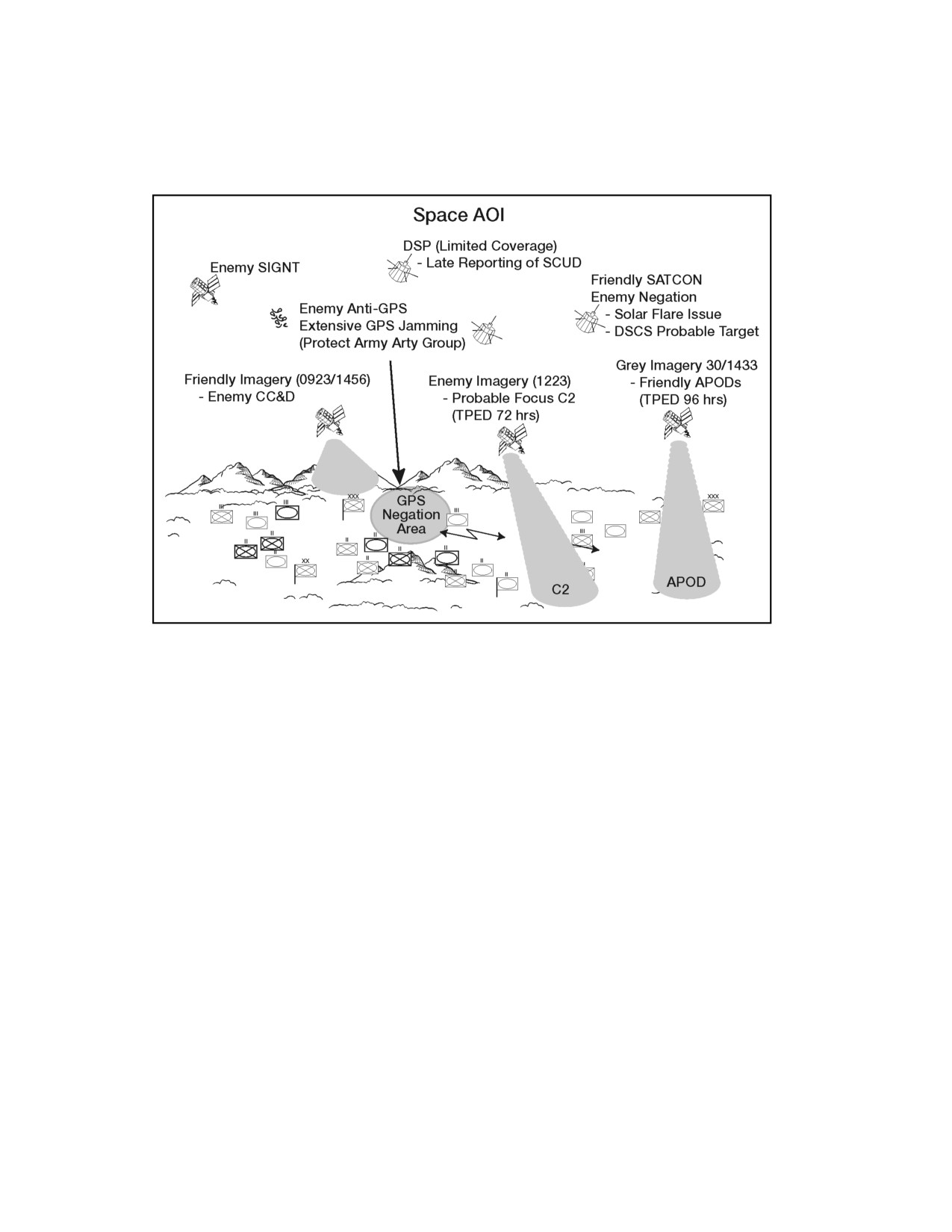
A-15. Step 4 of the IPB incorporates efforts from steps 1 through 3. The key
tool and most important product of step 4 is the space situation template
(figure A-2). The space situation template is a depiction of the space
situation: the who, what, where, when, and why of the space campaign. It is
an assessment and should be presented as such.
A-16. The situation template depicts how the staff believes space impacts the
supported command operations. Because it includes a detailed threat
analysis, the space situation template is coordinated with the staff prior to
being briefed or disseminated to the commander/staff. This template is an
excellent tool to depict graphically the adversary’s most probable COA as it
relates to the space aspects of the fight, to include the adversary’s perception
of how civil, commercial, and friendly satellites are employed. The space
situation template is considered the culminating piece of the space estimate
developed to support the mission analysis phase of MDMP. The space
situation template is tailored to reflect the impact that adversary, civil,
commercial, and friendly space systems have on the operational mission. The
following component pieces can be included in development of the space
situation template. Each of these component pieces is briefed as part of the
space mission analysis to help the rest of the battle staff clearly understand
the impact of space on the tactical operation. When building the space
situation template, consider—
• It is a snapshot in time (for example, 301200Z). This time relates
directly to a critical phase of the operation (for example, crossing the
line of departure or moving from a tactical assembly area).
• It focuses on the space AOI to show the direct relation of the space
AOI to the terrestrial maneuver AO.
• It depicts the general disposition of friendly and enemy maneuver
forces to show supporting space operations and the relevance of space
to the terrestrial battle.
• It graphically depicts space weather, and space-relevant terrestrial
weather and terrain impacts
(such as cloud cover that inhibits
satellite EO sensor collection).
• It reflects the implications of adversary use of space (such as what
satellite reconnaissance advanced notice capability the enemy
possesses) and informs the timing of the CC&D strategy.
A-17. The template depicts friendly satellite systems that may be targeted by
the enemy (such as CC&D) during a certain time to deceive friendly satellite
ISR collection. As part of this process, the SOO provides an assessment, such
as when and where the enemy will use CC&D to protect what it believes is a
high priority for friendly force ISR collection. The assessment includes when
and where the enemy may conduct electronic warfare to degrade friendly
SATCOM effectiveness and whether the adversary understands the reliance
the Army places on SATCOM to support extended range operations. The
template also reflects appropriate symbology to depict this activity, such as a
line from the enemy’s EW system to the targeted SATCOM.
18 May 2005
FM 3-14
A-7
FM 3-14 (FM 100-18) ________________________________________________________________
Figure A-2. Situation template
A-18. The situation template reflects an assessment of how the adversary
employs space and how civil and commercial satellites affect the battlefield.
This tool enables staff to project—
• The most probable adversary COA for organic, third-party, civil, and
commercial space assets.
• The probable targets for adversary collection, the means (EO, radar),
and the TPED process to get data to the adversary. An example
might be “anticipate the adversary will use EO against corps support
command because it is an HVT. The adversary’s dissemination
timelines support targeting fixed/semifixed facilities only.”
• How shutter control regulations impact the adversary’s ability to
receive commercial products. What actions are being worked at
higher echelons to prevent (or slow) use of commercial space by the
adversary?
• Critical adversary space and associated terrestrial nodes to
recommend for friendly targeting of high-payoff targets (HPTs). If the
adversary has a single point of failure for receipt of satellite imagery,
this could be an HPT. A key part of the space estimate effort during
step 4 is the identification of enemy space-related HPTs.
• An assessment of commercial imagery available to the press and its
impact on friendly force protection, deception, and maneuver
A-8
FM 3-14
18 May 2005
______________________________________________________________________Appendix A
operations. These capabilities can indirectly compromise friendly
force mission accomplishment.
A-19. The desired end state is that, on completion of step 4, the supported
commander and staff, through the integrated G2 IPB products, have a
thorough understanding of how space influences the coming operation, and
the ability to be proactive. The completed space IPB will—
• Set the stage for development of the space annex to the OPLAN.
• Contribute to the G2 collection priorities and analysis efforts.
• Provide valid HVT recommendations.
• Contribute to information superiority over the adversary.
• Influence COA development and mission execution.
A-20. The space IPB input remains valid throughout the operation and
should be updated and included in staff updates, as the situation dictates.
Although it is an extensive undertaking, a limited manned G3 space element
can produce a tailored and effective METT-TC focused space IPB input in a
reasonable time.
Space Estimate
A-21. The complementary product provided by the space element is the space
estimate. The space estimate is used to recommend the best use of available
space capabilities.
A-22. The space estimate should specifically address the space capabilities
and effects on courses of action from—
• GPS and PVT.
• BFT.
• Missile warning in coordination with air defense coordinator.
• SATCOM, in coordination with G6.
• Space control capabilities, limitations, and availability.
• Satellite operational status (figure A-3).
A-23. The space estimate should not address space-based ISR capabilities.
Instead, the space element should work closely with the collection manager
within the G2 to ensure that both commercial and national technical means
(NTM) assets are requested appropriately.
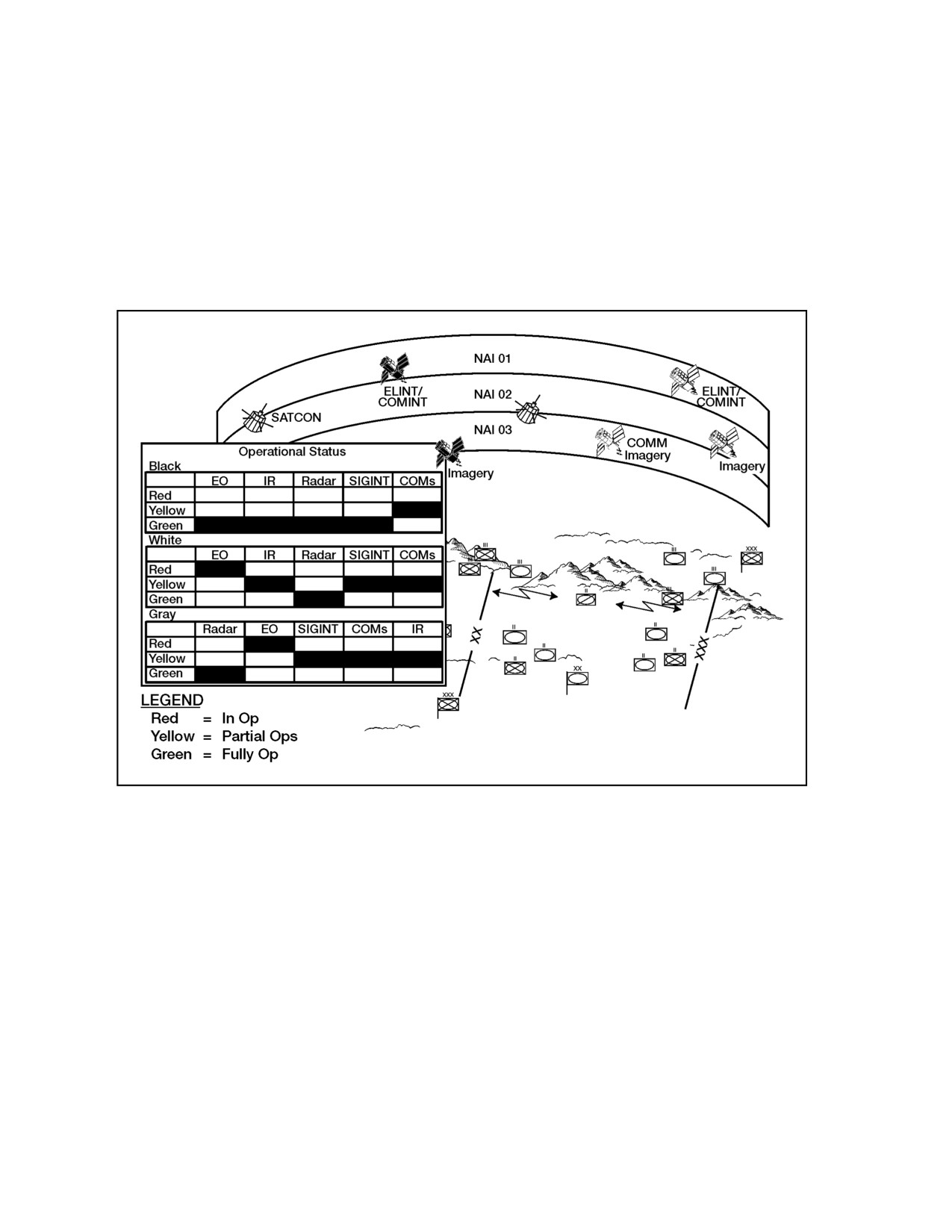
SATELLITE OPERATIONAL STATUS
A-24. The satellite operational status depicted in figure A-3 describes the
status of satellites that support
(or affect) the commander’s AO. This
includes analysis of key commercial (grey) satellites affecting operations
to the maximum extent possible. However, commercial satellite operators
generally will not report satellite and payload status to third parties.
Satellites may be nonoperational or partially operational for numerous
reasons:
18 May 2005
FM 3-14
A-9
FM 3-14 (FM 100-18) ________________________________________________________________
• Satellite sensor malfunction.
• Satellite maintenance, maneuvering, or repositioning.
• Space environment.
• Ground station control updating communications software or
installing upgrades to satellite systems.
Figure A-3. Satellite operational status
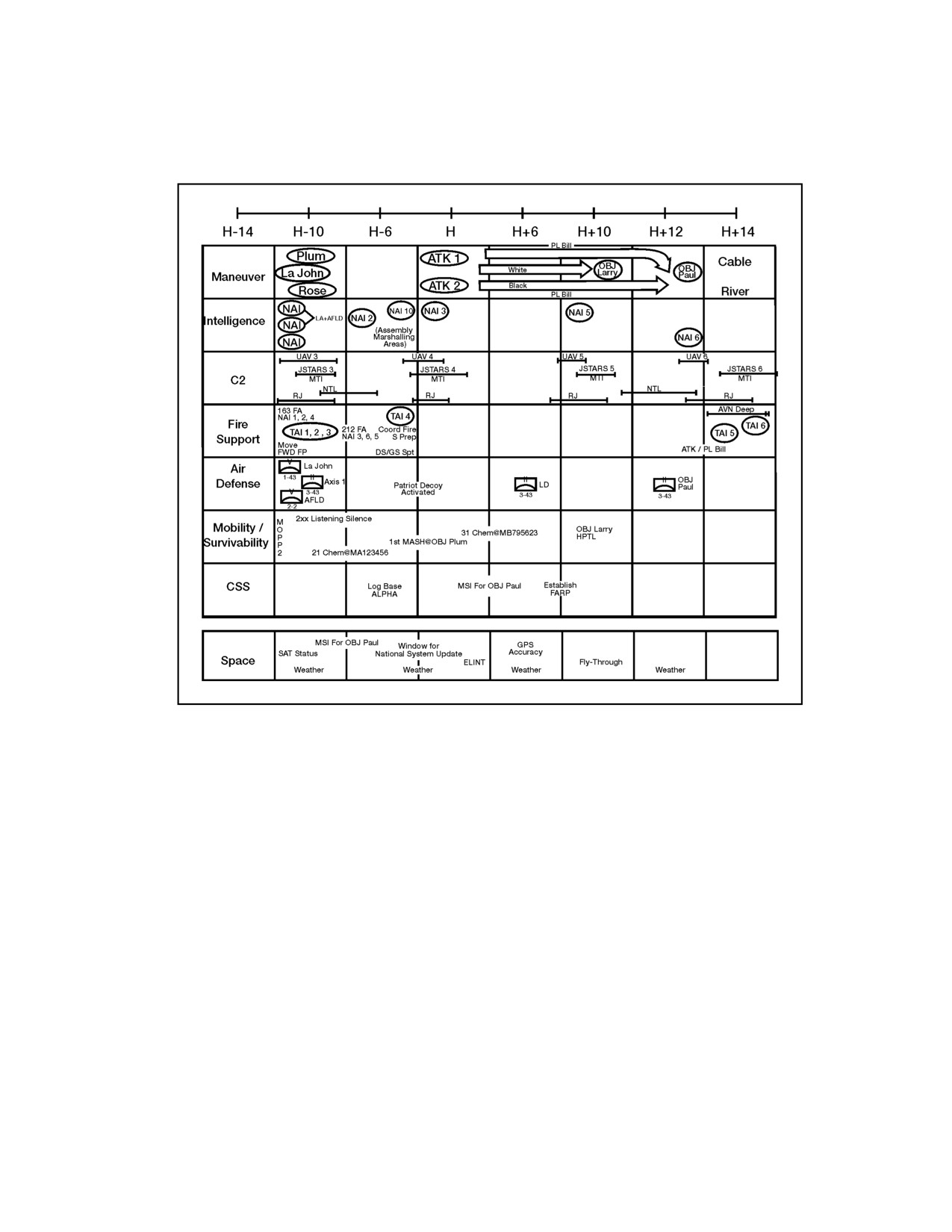
SPACE DECISION SUPPORT TEMPLATE
A-25. The space decision support template (SDST) depicted in figure A-4 is
used by the space element to portray the effects and support that space
assets have on the battlefield. Though space is not a battlefield operating
system (BOS), it is included in the SDST to highlight and clarify how to
synchronize space-based products and services into the operation.
A-10
FM 3-14
18 May 2005
______________________________________________________________________Appendix A
Figure A-4. Space decision support template
18 May 2005
FM 3-14
A-11
Appendix B
Army Space Capabilities
The Army maintains nondeployable and deployable space support to the
warfighter capabilities. These are units and teams that have routine, day-
to-day support responsibilities, or are intended to support contingencies
or other surge requirements. Combatant command authority (COCOM) of
all these capabilities remains with the USSTRATCOM commander.
Operational control
(OPCON) normally remains with Commanding
General, USASMDC/ARSTRAT.
SECTION I - USASMDC OPERATIONS CENTER
B-1. The SMDCOC serves as the primary operations center for USASMDC
and ARSTRAT. The SMDCOC is available to Army warfighters as an Army
space information center. The SMDCOC accomplishes this function by
maintaining space situational awareness, exploiting space planning tools,
and leveraging space expertise available within the SMDCOC, the ARSTRAT
staff, ARSTRAT battalions, and the joint space community. This reach
capability supports theater commanders and land component commanders
who require space resources for conducting land-based operations.
B-2. The SMDCOC facilitates 24-hour-a-day, real-time command and control
of ARSTRAT assets and maintains space situational awareness using global
and regional communication resources. The SMDCOC maintains the current
status of assigned forces, coordinates ARSTRAT mission execution, and
serves as the operations information fusion center for USASMDC—the focal
point for Army space operational missions, including space control, space
support, force enhancement, and combat support operations.
B-3. The SMDCOC oversees and monitors the operations and utilization of
ARSTRAT forces supporting space operations during peacetime, crisis, and
war. The SMDCOC forwards ARSTRAT forces status to the Army operations
center at the Pentagon. The SMDCOC is the conduit through which all
operations orders and fragmentary order (FRAGO) taskings are passed to
Army space forces from higher command authorities. The center also guides,
directs, assesses, and monitors the information flow between USSTRATCOM,
ARSTRAT, and subordinate ARSTRAT elements.
SECTION II - BLUE FORCE TRACKING MISSION MANAGEMENT CENTER
B-4. BFT is used to maintain situational awareness (SA) of location and
movement of friendly, or
“Blue Force,” assets. BFT is an element of
situational awareness and is often referred to as BFT/SA. Appropriately
outfitted assets transmit their location to a central data fusion facility. The
18 May 2005
FM 3-14
B-1
FM 3-14 (FM 100-18) ________________________________________________________________
location information can be correlated with other battlefield information such
as mapping, terrain, and adversary positions and forwarded for inclusion in
the commander’s COP.
B-5. Three architectures are available to provide BFT/SA. Each uses a GPS
receiver, which establishes its location and hands the data off to a
transmitter. The GPS receiver and transmitter are an integrated package
that can be mounted on a platform or carried by personnel. From this point,
the architectures differ. The transmitter is specifically designed to radio the
location information to one of three types of systems. The first is simply
another nearby platform that has direct LOS access so the radio signal can be
received. This platform will then be aware of the location of the transmitting
asset, and may pass the information along to a central gathering point. This
LOS system is limited to relatively local use and may experience outages as
individual platforms lose LOS access to one another. This architecture does
not involve the mission management center (MMC).
B-6. The second and third architectures are space-based; the battlefield
platform transmits its location information to a satellite. In the second
architecture, the satellite is a national system satellite that acts as a
transponder from which the information is eventually sent back to the SB-
BFT MMC. This system uses a specially designed waveform called the
collection of broadcasts from remote assets (COBRA) to transmit location
information from fielded assets through NTM and back to the SB-BFT MMC.
SB-BFT MMC personnel correlate the location information, then pass it back
to the global command and control system (GCCS) via SECRET Internet
protocol router network
(SIPRNET) or through a designated integrated
broadcast system satellite for broadcast over all or part of the area of
operations. This national system model using COBRA is the most reliable
and secure of the three architectures.
B-7. The final architecture relies on commercial SATCOM systems rather
than NTM. The commercial satellite hosts a transponder that sends the
signal back to a ground site where a C2 system manager gathers and
correlates individual platform location information. This correlated
information is sent to the joint task force
(JTF) headquarters and
incorporated into the COP. In some cases, the SB-BFT MMC may be part of
this commercial SATCOM system BFT/SA architecture.
Capabilities
B-8. The SB-BFT MMC provides warfighting combatant commands with
near-real-time (less than 15 seconds) BFT data gathered by space-based
systems, including NTM. This data is pushed as far forward as technically
possible. It serves as actionable Blue Force location information and leads to
more robust situational awareness and fratricide prevention. The SB-BFT
MMC is operated by USASMDC and is located in Colorado Springs, Colorado.
It is the critical BFT link between warfighters, national agencies, and a
variety of dissemination architectures, and is the central point of contact for
space-based BFT troubleshooting and coordination.
B-9. The SB-BFT MMC ensures requirements for use of the system, including
COBRA, are properly validated; coordinates BFT collection; and accomplishes
B-2
FM 3-14
18 May 2005

______________________________________________________________________Appendix B
transmission of correlated information back to the theater and relevant
headquarters. The SB-BFT MMC also ensures SB-BFT (COBRA) information
in the warfighter COP is accurate, timely, and actionable.
Mission Management Center Tasking
B-10. Organizations request SB-BFT MMC support through the SMDCOC.
SMDCOC contact information can be gained from the FA 40 in the space
element at the corps G3. USASMDC G3 will determine priority of requests
but normally all requests are supported.
SECTION III - SATCOM AND SATCOM SUPPORT CENTERS
B-11. USASMDC operates three RSSCs per direction of USSTRATCOM.
These centers, located in CONUS, Pacific Ocean area, and Europe, provide
theater communication planners with a single point of contact for planning
and managing SATCOM resources. Manned by representatives from each of
the services and Defense Information Systems Agency (DISA), the RSSC is
the theater SATCOM center-of-expertise for all military and commercial
satellite communications serving the warfighter. USSTRATCOM operates a
GSSC that serves global combatant commanders and other users.
Capabilities
B-12. RSSCs are the day-to-day operational interface with the user. All users
will be assigned to an RSSC as their focal point for SATCOM planning,
management, and access support. The GSSC supports global and national
users not assigned to an RSSC. Current assignments are listed in table B-1.
In general, the RSSCs support combatant commanders and their forces in
routine, deliberate, and crisis action planning of SATCOM resources. RSSC
personnel participate in planning conferences and meetings to identify and
plan theater SATCOM support requirements for mission operations. The
RSSCs process user satellite access requests and publish satellite access
authorizations (SAAs) for approved missions.
Table B-1. RSSC support assignments
RSSC
Supports
RSSC-CONUS
JFCOM
SOCOM
CENTCOM
SOUTHCOM
RSSC-Europe
EUCOM
RSSC-Pacific
PACOM
GSSC
USSTRATCOM
Defense
agencies
TRANSCOM
Other users
NORTHCOM
B-13. RSSCs perform the following day-to-day management functions for
SATCOM resources in direct support of combatant command assigned
theater forces and other users.
18 May 2005
FM 3-14
B-3
FM 3-14 (FM 100-18) ________________________________________________________________
• Accept and analyze satellite access requests and develop solutions.
• Plan resource assignments; coordinate resource sharing/borrowing;
publish SAAs.
• Assist combatant commander and user planners to implement
networks and adjudicate usage conflicts.
• Monitor SATCOM systems status (readiness) and outage information.
• Coordinate user response to satellite anomalies.
B-14. RSSCs support combatant commander and user deliberate and crisis
action planning.
• Assist combatant commander and user staffs in defining
requirements and developing OPLAN/CONPLAN communication
annexes.
• Perform “what if” drills, analyze scenarios, and provide assessments.
• Track resource utilization and recommend changes for optimizing
resources.
• Assist combatant commander and user planners to develop theater
policy and procedures.
• Provide training, technical assistance, and performance feedback to
end users.
B-15. RSSCs support theater spectrum management activities.
• Assist in electromagnetic interference (EMI) response activities.
• Assist in the JF
12 process by which spectrum allocations and
frequency assignments are approved.
B-16. RSSCs coordinate planning for SATCOM interfaces to the global
information grid (GIG).
• Facilitate interfaces to the teleport/gateways.
• Coordinate planning with GIG service providers.
B-17. RSSCs support the GSSC in maintaining global system awareness.
• Support assessment of SATCOM support for each combatant
command OPLAN.
• Monitor current SATCOM support and assess impact of system
changes and anomalies on current, planned, and future operations.
• Provide data updates on SATCOM resources allocated to specific
users.
• Coordinate allocation and resource sharing with other RSSCs.
• Develop contingency plans for catastrophic failure.
• Assist in system performance trend analysis.
• Assist in user performance trend identification and analysis.
B-18. RSSCs direct/coordinate SATCOM resource configuration changes with
network control facilities such as WSOCs, Milstar Satellite Operations
Center (MSOC), Naval Computer and Telecommunications Area Master
Station (NCTAMS).
B-4
FM 3-14
18 May 2005
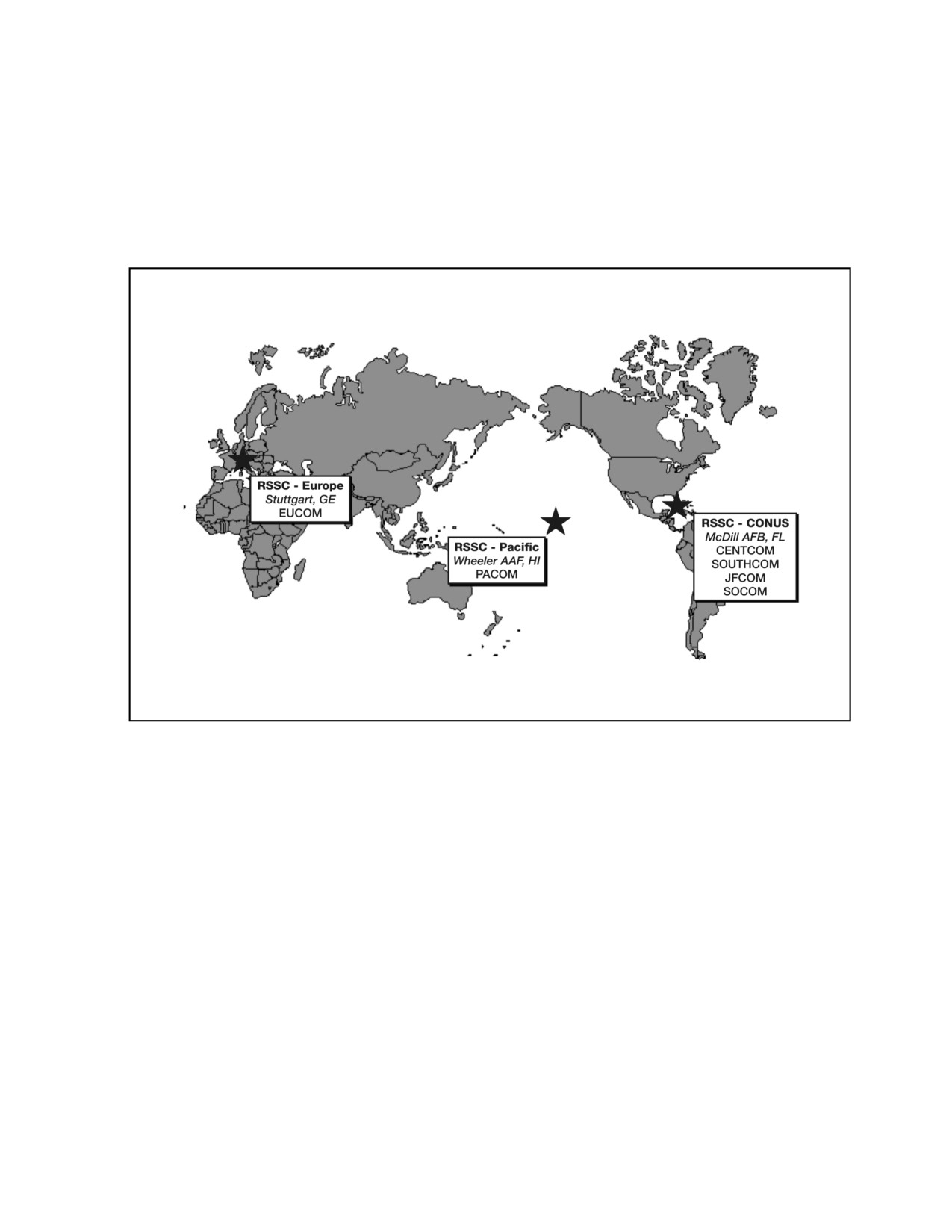
______________________________________________________________________Appendix B
LOCATIONS
B-19. USASMDC operates RSSCs in three fixed locations, as illustrated in
figure B-1. Current combatant command support assignments are also
depicted.
Figure B-1. RSSC locations
MANNING
B-20. The RSSCs are manned with planners from each USSTRATCOM
service component and DISA who are proficient in dealing with management
and control issues for their particular systems. Current manning
responsibilities are as follows:
• Army (USASMDC/ARSTRAT): Wideband/SHF SATCOM (such as
DSCS, WGS, and GBS).
• Navy (Naval Network Warfare Command [NNWC]/Naval Network
and Space Operations Command
[NNSOC]): Narrowband/UHF
SATCOM (such as FLTSAT and UFO).
• Air Force Space Command (AFSPC): Protected/EHF SATCOM (such
as Milstar and UFO).
• DISA: Commercial SATCOM (such as C, Ku, and mobile satellite
services [MSS]).
18 May 2005
FM 3-14
B-5
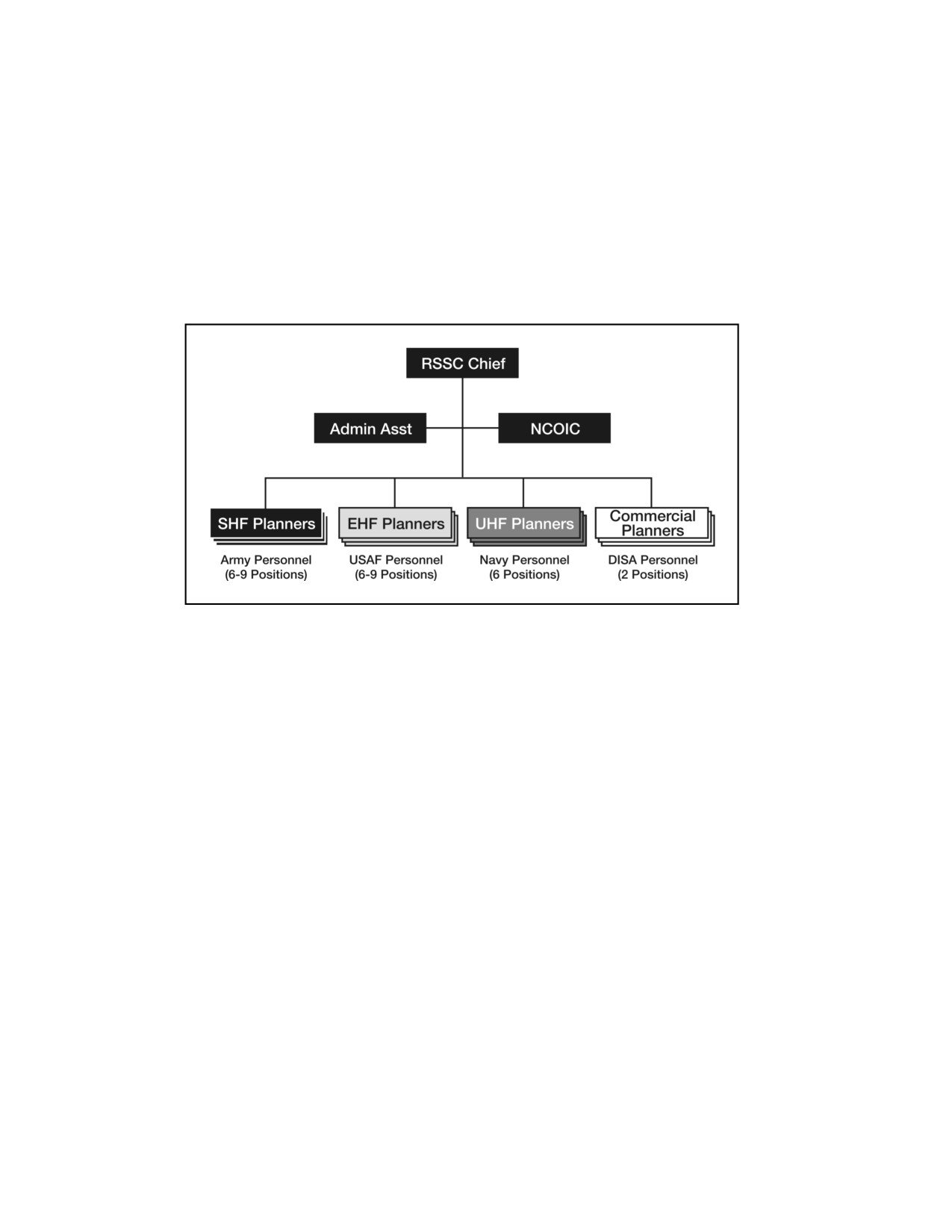
FM 3-14 (FM 100-18) ________________________________________________________________
B-21. USASMDC provides three personnel to oversee the RSSC directly. The
heart of each RSSC consists of individual SATCOM spectrum planning cells
manned by six to nine personnel (except for the commercial section). Figure
B-2 depicts this organization. USASMDC has assigned OPCON for day-to-
day operations but each service/agency has administrative control
responsibilities for assigned personnel. The centers are available 24/7.
Figure B-2. RSSC manning/organization
Command and Control
B-22. USSTRATCOM designated OPCON of RSSCs resides at USASMDC.
The RSSC provides direct support to the combatant command and theater
forces as the focal point for all SATCOM planning matters. RSSCs also
interact with the GSSC and network control organizations to coordinate and
facilitate the implementation of their plans.
Regional Satellite Communications Support Center Tasking Process
B-23. The RSSCs employ standardized processes for operational management
of SATCOM resources. These processes are described in the USSTRATCOM
consolidated system control and operations concept
(C-SCOC) and its
approved system annexes. Figure B-3 outlines the primary process for
satellite access. Request for additional support/products described above can
be made via the appropriate combatant commander or in many cases directly
to the RSSC.
B-6
FM 3-14
18 May 2005
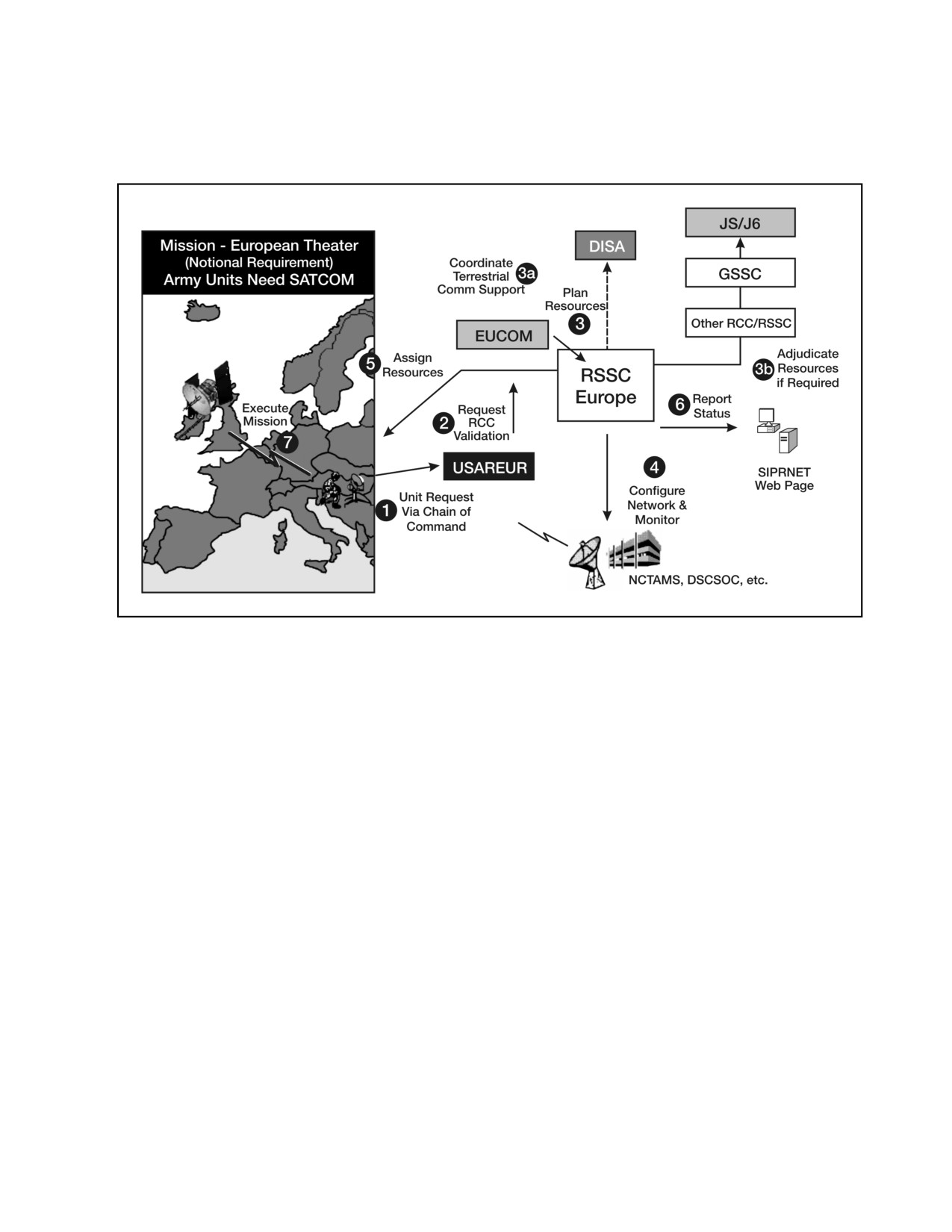
______________________________________________________________________Appendix B
Figure B-3. Requesting SATCOM access
B-24. A unit requiring satellite access submits a satellite access request via
its theater chain of command, including the theater service component, to the
regional combatant commander for review and validation. For units serving
global combatant commanders, such as United States Transportation
Command (USTRANSCOM), submit requests via the GSSC. For new urgent
requirements, submit requests to the joint staff J6 via the combatant
commander.
B-25. An approved satellite access request is sent to the appropriate RSSC for
analysis and planning. If sufficient resources are available, the RSSC
develops a SAA, coordinates pertinent terrestrial interfaces, provides data for
satellite configuration and control, and reports its status. If resources are
unavailable, the request is either denied or submitted for adjudication to
determine if resources can be borrowed or preempted from other users.
RSSCs also continually analyze resource assignments to make optimization
recommendations to combatant commanders and users.
B-26. Approved SAAs are sent to the originating unit authorizing operational
access. Additionally, RSSCs direct and coordinate resource configuration
directives with payload and network control centers
(such as WSOCs,
detailed in the next section), which implement and monitor communication
plans.
B-27. Although the individual payload and network control centers have
primary responsibility for monitoring and troubleshooting active networks,
18 May 2005
FM 3-14
B-7
FM 3-14 (FM 100-18) ________________________________________________________________
RSSCs liaison with combatant commanders, users, and control centers to
maintain situational awareness and respond to changing demands and
requirements.
Contingency Deployment
B-28. Each RSSC can deploy an element to provide onsite SATCOM planning
and management support for major or contingency operations. Potential
deployment locations include supported combatant command headquarters,
JTF joint/theater communications control centers
(JCCC/TCCC), or
supported combatant command component headquarters. This provides the
theater commanders short-term, direct access to the SATCOM systems
resident expert in the RSSC.
Augmentation
B-29. An RSSC may require additional support for extreme workloads during
contingencies, equipment failures, or personnel losses. The RSSC receives
augmentation support by another RSSC, ARSTRAT staff, or an ARSST to
ensure consistent support to the operational community.
SECTION IV - WIDEBAND SATCOM OPERATIONS CENTER
B-30. WSOCs provide payload control and network control for DOD
communications satellites providing SHF SATCOM for military forces. The
SHF band is used to carry high volumes of communications through large
terminals located around the world. The primary means for reach-back
communications from in-theater headquarters to those in CONUS is via SHF
communications through DSCS satellites.
B-31. The “payloads” are the radio frequency communications transponders
on DSCS and soon to be launched wideband gapfiller satellites. Each
transponder uses an assigned power level, frequency assignment, and
antenna beam focus. Payload control is responsible for configuring and
maintaining the satellite transponders for these variables at assigned levels.
B-32. Each of the DSCS satellites has a number of transponders and a very
large number of ground stations communicate through the satellites.
Satellite communications links go from a ground station through a satellite
and back to a distant ground station, a cycle called a “hop.” Multiple hops are
involved in some communications links. Around the world, many
communications satellites and ground stations are available, and collectively
form a network. Monitoring and correcting problems such as ground station
use of radio frequency signal power and bandwidth is called
“network
control.”
Capabilities
B-33. Five WSOCs around the world provide DSCS communications payload
control. Additionally, WSOCs constantly monitor the condition of assigned
satellites by watching for anomalies or problematic trends on the spacecraft,
B-8
FM 3-14
18 May 2005
______________________________________________________________________Appendix B
such as declining power output from solar arrays or unexpected buildup of
heat in electronic components.
B-34. Network control of the DSCS is also done at the WSOC. Power and
bandwidth are the commodities on the DSCS satellites, and the WSOCs
ensure all users get their allocated share of these resources. WSOC personnel
manage satellite resources and monitor user-compliance with joint staff-
established priorities and allocations. WSOCs act as the “honest broker,”
implementing the rules of access, bandwidth, and frequency allocations laid
out by the Joint Chiefs of Staff (JCS). Through this system, the WSOCs
provide continuous worldwide support to the Commander in Chief, the JCS,
the State Department, intelligence communities, the combatant commanders,
and the Services in their various communications missions.
Command and Control
B-35. ARSTRAT, through the
1st Satellite Control Battalion
(SATCON
Battalion), provides command and control and operational direction for the
WSOCs, including OPCON responsibility, while DISA provides technical
direction to the WSOCs and has tactical control (TACON) responsibility.
B-36. The mission of the 1st SATCON Battalion is to provide communications
network and satellite payload control of the DSCS by operating and
maintaining five WSOCs and a DSCS certification facility. The five WSOCs
are geographically located to provide
24-hour coverage of all assigned
satellites. Each lettered company of the
1st SATCON Battalion is
strategically positioned to provide command and control for one or more
DSCS satellites.
Wideband Satellite Communications Operations Center Tasking
Process
B-37. Each of the five WSOCs is tasked by its respective RSSC. Per this
tasking, the WSOCs execute satellite payload configuration changes, thereby
implementing payload and network control. The RSSCs task WSOCs after
accomplishing detailed planning to allocate network communications
resources properly, per configuration management requirements levied by
DISA. DISA acts in part on direction from USSTRATCOM, taking combatant
commander and other communications requirements from around the world
and direction from the Joint Staff.
SECTION V - SPECTRAL OPERATIONS RESOURCE CENTER
B-38. The Spectral Operations Resource Center (SORC) is a USASMDC asset
that provides exploitation capability of commercial and spectral data from
both space and airborne sensors. Analyses and products are provided to the
JFLCC down to the lowest tactical levels. Support can be provided through
the supported unit S2/G2 and SOO, ARSST, USSTRATCOM support teams
(SST), or the CET following doctrinal requests for information (RFI) and
requirements management procedures.
18 May 2005
FM 3-14
B-9