FM 3-14 SPACE SUPPORT TO ARMY OPERATIONS (MAY 2005) - page 1
*FM 3-14
(FM 100-18)
Field Manual
Headquarters
No. 3-14
Department of the Army
Washington, DC, 18 May 2005
Space Support to Army Operations
Contents
Page
Preface
vi
PART ONE
PRINCIPLES
Chapter 1
ARMY SPACE OPERATIONS
1-1
Section I - Space Operations Overview
1-1
Section II - The Characteristics of Space
1-3
Section III - Key Terms and Organizations
1-5
Section IV - Space as a Component of National Security Policy
1-6
National Space Policy
1-6
DOD Space Policy
1-8
Army Space Policy
1-8
Section V - Elements of Space Operations
1-9
Controlling and Exploiting Space to Enhance Land Warfighting Power
1-9
Space and the Army’s Enduring Capabilities
1-12
Section VI - Army Joint Space Operations Relationships
1-14
Section VII - The G3 Section and Space Operations
1-16
Section VIII - Army Space Cadre
1-17
Chapter 2
SPACE MISSION AREAS
2-1
Space Force Enhancement
2-1
Space Control
2-12
Space Force Application
2-13
Space Support
2-13
Chapter 3
SPACE OPERATIONS IN LAND WARFARE
3-1
Section I - Space Contributions to Joint Land Warfare
3-1
Space Operations Across the Spectrum of Conflict
3-1
Space Contributions to Offensive and Defensive Operations
3-2
Space Support to Stability and Support Operations
3-5
Section II - COMMAND AND CONTROL
3-7
Joint Space Operations
3-7
Army Space Command and Control
3-8
DISTRIBUTION RESTRICTION: Approved for public release; distribution is unlimited.
*This publication supersedes FM 100-18, 20 July 1995.
i
FM 3-14 (FM 100-18) ________________________________________________________________
PART TWO
TACTICS, TECHNIQUES, AND PROCEDURES
Chapter 4
PLANNING, PREPARING FOR, AND EXECUTING SPACE OPERATIONS... 4-1
Section I - Planning for Space Operations
4-1
Section II - Preparing for Space Operations
4-3
Section III - Executing Space Operations
4-4
Appendix A
SPACE INPUT TO INTELLIGENCE PREPARATION OF THE
BATTLESPACE AND SPACE ESTIMATE
A-1
Appendix B
ARMY SPACE CAPABILITIES
B-1
Section I - USASMDC Operations Center
B-1
Section II - Blue Force Tracking Mission Management Center
B-1
Section III - SATCOM and SATCOM Support Centers
B-3
Section IV - Wideband SATCOM Operations Center
B-8
Section V - Spectral Operations Resource Center
B-9
Section VI - Commercial Exploitation Team
B-14
Section VII - Theater Missile Warning
B-15
Appendix C
ARMY SPACE SUPPORT TEAMS
C-1
Appendix D
SPACE OPERATIONS OFFICER
D-1
Appendix E
SPACE SUPPORT IN THE EMPLOYMENT HEADQUARTERS
E-1
Appendix F
ARMY SPACE ORGANIZATIONS
F-1
Appendix G
NORMALIZING, OPERATIONALIZING, AND INSTITUTIONALIZING
SPACE
G-1
Glossary
.............................................................................................................. Glossary-1
Bibliography
........................................................................................................Bibliography-1
Index
.................................................................................................................... Index-1
Figures
Figure 2-1. Key SATCOM features
2-2
Figure 2-2. Global system-of-systems
2-4
Figure 2-3. Space-based ISR architecture
2-9
Figure A-1. Space area of interest
A-3
Figure A-2. Situation template
A-8
Figure A-3. Satellite operational status
A-10
Figure A-4. Space decision support template
A-11
Figure B-1. RSSC locations
B-5
Figure B-2. RSSC manning/organization
B-6
Figure B-3. Requesting SATCOM access
B-7
Figure F-1. USASMDC operational organization
F-2
Figure F-2. 1st SATCON Battalion organization
F-2
Figure F-3. 1st Space Battalion organization
F-3
Figure F-4. 193rd Space Battalion organization
F-3
ii
FM 3-14
18 May 2005
________________________________________________________________________ Contents
Tables
Table 2-1. SATCOM attributes
2-3
Table 2-2. Methods of dissemination
2-10
Table A-1. Solar weather impact summary
A-4
Table B-1. RSSC support assignments
B-3
Table C-1. Typical ARSST composition
C-2
18 May 2005
FM 3-14
iii
Preface
This manual establishes guidance for employing space capabilities to support U.S. Army land
warfighting dominance. It provides a general overview of space capabilities, reviews the direction
for using space for national security purposes, and outlines the relevance of particular space
capabilities to Army operations.
The doctrine in this manual documents Army thought for the best use of space capabilities. It
provides traditional doctrine and a basis for advancing intellectual discussion and improvement
of practical applications of space capabilities. This manual also contains tactics, techniques, and
procedures outlining how to plan, prepare for, and execute space operations. The appendixes
contain additional relevant information concerning use of space capabilities.
Space has domain characteristics vastly different from air, land, and sea. It would be misleading
to capture in this document all that is done now with space and imply that is the end of it. New
capabilities are commonplace in the space domain. Therefore, this manual is not a definitive
"desktop" handbook for soldiers. It is important that soldiers continue to look to the future with
responsiveness, adaptability, and flexibility toward what space can bring.
Unless this manual states otherwise, masculine nouns, and pronouns do not refer exclusively to
men.
This manual applies to the Active Army, the Army National Guard (ARNG), and the U.S. Army
Reserve (USAR). All soldiers, particularly senior operational commanders, their staffs, and space
operations subject matter experts, will use this manual. Army forces will likely deploy this
doctrine as part of a joint, interagency, or multinational military operation. Therefore, while this
manual supports Army operations, it does so in the context of Army operations as part of a joint,
interagency, or multinational task force.
The proponent for this field manual is the U.S. Army Space and Missile Defense Command
(USASMDC). Send comments and recommendations on DA Form 2028 (Recommended Changes
to Publications and Blank Forms) directly to—
USASMDC
ATTN: SMDC-IC (Future Warfare Center Directorate of Combat Development)
1330 Inverness Drive, Suite 440
Colorado Springs, CO 80910
Send electronic mail to: fdiccd@smdc.army.mil
iv
FM 3-14
18 May 2005
PART ONE
Principles
The objective of Army use of space is to support the Army's land dominance. Space
is undeniably a critical element of Army operations. Moreover, the need for the Army
to accomplish space operations is firmly established in policy and practice; in fact,
many space capabilities are already well integrated into Army operations. The space
mission areas are both critical and routine components of maneuver, stability, and
support operations. Army space operations support Army and joint warfighting, and
use of space capabilities is an inherently joint venture. This field manual is rooted in
basic Army and joint doctrine that is characteristically progressive and evolving.
Chapter 1
Army Space Operations
Space is the newest of the warfighting media, alongside air, land, and sea.
The harsh space environment, vast distances, and high speeds of orbiting
satellites are all very different from what the Armed Forces deal with in
the air, on land, and on or under the sea. Still, many of the principles that
successfully guide operations in those environments are applicable to the
space medium. The Army is committed to using space to its best
advantage. Indeed the advantages are so great that it is clearly
worthwhile to overcome the characteristic difficulties of the space
environment. Use of space-based capabilities is not only common; it is
critical, in Army operations.
SECTION I - SPACE OPERATIONS OVERVIEW
1-1. Space-based capabilities contribute to all Army operations. The Army
continually incorporates existing and emerging space capabilities to further
improve the effectiveness of its operations. The Army executes space
operations and contributes to establishing and maintaining space superiority
consistent with land warfighting dominance needs.
1-2. The Army of today leverages space capabilities to accomplish a wide
variety of missions. Space-based and space-enabled communications;
position, velocity, and timing; environmental monitoring; intelligence,
surveillance, and reconnaissance (ISR); and missile warning support are
robust capabilities that continue to be necessities for success on the
battlefield. Robust space capabilities are a prerequisite for the Army of the
18 May 2005
FM 3-14
1-1
FM 3-14 (FM 100-18) ________________________________________________________________
future. They enhance information superiority and situational awareness,
aiding high-tempo, noncontiguous, simultaneous distributed operations.
1-3. The medium of space begins above the atmosphere of the earth and
extends infinitely outward. Practically, however, the area between 90 miles
and 22,300 miles above the earth is used for orbiting earth satellites. This,
generally, is space as the Army uses the term. Operationally, space most
often indicates the practical use of space assets, including satellites in this
orbital envelope. Space assets are satellites in orbit, the ground equipment
that interfaces with them, and other ground systems performing space
missions. Space capabilities are derived from those assets. Space operations
are those enabling operations that create or present opportunities to employ
space to enhance the warfighting potential of the U.S. military and its allies
and friends.
1-4. Space forces are the space and terrestrial systems, equipment, facilities,
organizations, and personnel necessary to access, use, and control space for
national security (Joint Publication [JP] 1-02). Other personnel are directly
involved in routinely using space-based capabilities but are not “space forces”
per the joint definition in JP 1-02. This includes satellite communications
(SATCOM) equipment operators in signal battalions, satellite imagery
analysts, and soldiers using global positioning system (GPS) equipment, for
example. The reason for the distinction is that, as JP
3-14 indicates,
Department of Defense
(DOD) space forces
“…are directed by
[USSTRATCOM] component commanders…” whereas signal battalions,
imagery analysts, and most soldiers are commanded by their Army Service
component commander (ASCC) to the regional combatant commander or joint
force commander, not by the United States Strategic Command
(USSTRATCOM) ASCC.
1-5. Space operations are conducted by space forces and by personnel who
routinely facilitate the use of space assets, bringing satellite communications;
position, velocity, and timing; environmental monitoring; space-based
intelligence, surveillance, and reconnaissance (ISR), and missile warning to
the warfighter. Army space operations fall into two general categories:
controlling space and exploiting space. Controlling space means to affect
space to benefit U.S. efforts or detract from adversary efforts. Exploiting
space is making space-based capabilities available to benefit operations.
1-6. The ability of the Army to capitalize on space systems, along with the
ability to protect them and attack the adversary capability to use them, yield
military power, and contribute to U.S. military space superiority. Space
superiority is the degree of dominance in space of one force over another that
permits the conduct of operations by the former and its related land, sea, air,
space, and special operations forces at a given time and place without
prohibitive interference by the opposing force (JP 1-02). The purpose of space
superiority is to secure the freedom to take advantage of the capabilities
provided by space systems (JP 3-14).
1-2
FM 3-14
18 May 2005
________________________________________________________________________Chapter 1
SECTION II - THE CHARACTERISTICS OF SPACE
The Commission unanimously concluded that the security and well being of the
United States, its allies and friends depends on the nation’s ability to operate in
space.
Report of the Commission to Assess United States National Security Space Management and
Organization
1-7. Space is the high ground. Space systems, consisting of satellites on orbit,
ground stations, and launch bases, and the communication signals between
the satellites and ground equipment, give land forces the advantage of an
overlook of their battlefield from on high. Space hosts communications
transponders, observation posts for ISR, transmitters broadcasting location
and exact time information, sensors for weather and other environmental
data, and sensors that can warn of enemy actions.
Space is a medium like the land, sea, and air within which military activities
shall be conducted to achieve U.S. national security objectives.
JP 3-14
1-8. Space is the area above the earth’s atmosphere. Satellites orbiting the
earth are normally from 90 to 22,300 miles above the surface of the earth,
traveling on the order of 17,000 miles per hour. Below 90 miles, there is too
much atmospheric drag. The 1967 International Space Treaty dictates that
satellites on orbit must be allowed free passage over countries. Nations
cannot claim the space above them as their own, as they can the airspace.
This allows the United States, other countries, and commercial entities to
orbit satellites that freely traverse or occupy space.
1-9. Earth orbits are generally grouped into three basic categories defined by
their altitude above the earth:
• Low earth orbit (LEO)—90 to 1,000 miles above the earth. Satellites
in this orbit are close to the earth but moving quickly relative to the
ground. This orbit is used mainly for reconnaissance, communication,
and weather satellites, and manned space missions.
• Medium earth orbit (MEO)—1,000 to 12,000 miles above the surface
and used mostly for GPS satellites.
• Geosynchronous earth orbit
(GEO)—approximately
22,300 miles
above the earth. Satellites at this altitude in circular orbits in the
equatorial plane appear to be stationary relative to the surface of the
earth. This orbit is very useful for communications, weather, ISR, and
missile-warning satellites. This is the most used of the orbits.
1-10. There are two subcategories of orbits in terms of inclination to the
equatorial plane and eccentricity (how oval the orbit is, with zero eccentricity
being circular and the orbit becoming more oval as eccentricity increases), in
addition to altitude. The first of these is the polar orbit, which can be 1,000 to
12,000 miles in altitude and is inclined approximately 90 degrees from the
equatorial plane so the satellite goes over the earth’s poles. Satellites in these
orbits can view the entire surface of the earth over the course of several
18 May 2005
FM 3-14
1-3
FM 3-14 (FM 100-18) ________________________________________________________________
orbits. This is useful for weather, reconnaissance, and earth resources
monitoring satellite missions.
1-11. The second orbit subcategory is the highly elliptical orbit (HEO). These
orbits are oval-shaped with the earth near one end inside the oval. The
satellite goes from about 600 miles above the earth when it is closest, to
24,000 miles above the earth at the opposite end of the orbit. The orbit is
inclined so the total effect of the eccentricity and inclination is that the
satellite spends nearly all of its time over one hemisphere. The HEO is
popular for Russian communication, scientific, and ISR missions due to
Russia’s high northern latitude. It is used because standard geosynchronous
orbits do not provide adequate access to higher latitudes.
1-12. For perspective, if the Earth were represented by a basketball, most
LEOs would be within an inch of the surface of the basketball. GPS satellites,
in MEO, would be 14.5 inches above the ball, and satellites in a GEO would
be 27 inches above the ball. An important aspect of satellite utility comes to
light here. Consider the very small amount of the surface that can be seen
from the LEO at any one time and the much larger area visible from GEO.
Note also, GEO satellites can “see” more but are farther away so resolution
and signal strength become constraints, while at LEO the faster relative
speed of the satellite to the surface is a constraint. MEO orbits offer
something of a good compromise but are very harsh environmentally due to
high radiation levels. On the other hand, MEO orbits used by GPS are very
stable and therefore excellent for navigation satellites.
1-13. Except for those positioned in GEO, satellites are constantly moving
relative to the surface of the earth. A satellite may be able to view a point on
earth for just a short time. Nevertheless, satellites as part of a larger
constellation provide line-of-sight access to terrestrial terminals, linking
them globally. Satellites facilitate broadcast and point-to-point
communications. GPS satellites continually send position and timing data to
users anywhere in the world for navigation and synchronization. Weather
data is collected and disseminated far more efficiently than terrestrial
platforms alone would allow. Satellites are well suited for reconnaissance and
surveillance, photographic/mapping, and intelligence missions because they
provide access for observation.
1-14. In-place orbiting space assets are quite responsive to warfighter needs.
However, if the assets are not in place before the conflict or operation begins,
it is unlikely more assets will become available. It takes weeks to move
satellites from one orbit location to another, and this movement can deplete
limited fuel supplies and shorten the satellite’s operational life. Moving
satellites can also affect several theaters of operations. Finally, launching
new satellites can take months; the additional weeks or months required for
on-orbit checkout makes launching to augment a theater impractical for
short-term needs.
1-4
FM 3-14
18 May 2005
________________________________________________________________________Chapter 1
SECTION III - KEY TERMS AND ORGANIZATIONS
1-15. Space operations are divided into four general categories, or space
mission areas, per JP 3-14: force enhancement, space control, space force
application, and space support.
Force enhancement operations multiply joint force effectiveness by enhancing
battlespace awareness and providing needed warfighter support. There are five
force enhancement functions: ISR; integrated tactical warning and attack
assessment; environmental monitoring; communications; and position, velocity,
timing, and navigation. They provide significant advantage by reducing confusion
inherent in combat situations. They also improve the lethality of air, land, sea,
space, and special operations forces.
Space control operations will provide freedom of action in space for friendly forces
and, when directed, deny the same freedom to the adversary. They include
offensive and defensive operations by friendly forces to gain and maintain space
superiority and situational awareness of events that impact space operations.
The application of force would consist of attacks against terrestrial-based targets
carried out by military weapons systems operating in or through space. The force
application mission area includes ballistic missile defense and force projection.
Currently, there are no force application assets operating in space.
Space support operations consist of operations that launch, deploy, augment,
maintain, sustain, replenish, deorbit, and recover space forces, including the C2
network configuration for space operations.
JP 3-14
1-16. The United States Army Space and Missile Defense Command
(USASMDC), a major Army command (MACOM), is the Army proponent for
space. USASMDC is also the ASCC for USSTRATCOM, in this capacity
called Army Strategic Command (ARSTRAT).
“CG, U.S. Army Space and Missile Defense Command…[is the] supported
commander and Army proponent for planning, integration, control and
coordination of Army forces and capabilities in support of CDRUSSTRATCOM
mission areas: global strike, global ballistic missile defense, C4ISR, information
operations, and space operations and missions.”
Army Campaign Plan
1-17. ARSTRAT, as the Army operational component to USSTRATCOM,
executes command and control (C2) of ARSTRAT space forces worldwide.
ARSTRAT provides existing and emerging space capabilities to U.S. Forces
and allies to deliver decisive combat power on the battlefield. ARSTRAT
plans and executes continuous military space operations and ensures combat
readiness of assigned units supporting USSTRATCOM. ARSTRAT supports
all USSTRATCOM space-related operational mission areas and is the focal
point for the employment and integration of ARSTRAT space forces into
global, national, and military operations. ARSTRAT supports land component
commander
(LCC) operations plans and Army, USASMDC, and
USSTRATCOM policies and objectives.
18 May 2005
FM 3-14
1-5
FM 3-14 (FM 100-18) ________________________________________________________________
1-18. ARSTRAT commands a space brigade consisting of three space
battalions. An Active Army space battalion and an ARNG space battalion
provide theater missile warning
(TMW), space control, and space-based
capabilities and expertise to the warfighter. The satellite control battalion
provides communication satellite network and payload control. Successful
integration of space into Army operations results in practical proponency of
some space capabilities being executed outside USASMDC. For example,
SATCOM force integration is accomplished by the U.S. Army Signal Center,
which does lifecycle management of all major communications-electronics
systems under study, in development, or in use in the field Army. Space-
based ISR force integration is accomplished by the U.S. Army Intelligence
Center.
SECTION IV - SPACE AS A COMPONENT OF NATIONAL SECURITY POLICY
1-19. Historically, the policy of the United States has been to use space for
military advantage while developing civil and commercial use of space. The
national space policy clearly articulates this. Current national and DOD
space policy, joint direction, and Army space policy embrace the prudent use
of space for security purposes. These policies make it clear that space is a
critical element of U.S. defense capability and should be carefully and
purposefully developed, as appropriate by each Service, to help provide a
balanced overall capability for full-spectrum dominance.
NATIONAL SPACE POLICY
1-20. National policy
(Presidential Decision Directive National Security
Council-49/National Science and Technology Council-8 [PDD NSC-49/NSTC-
8]) issued in September
1996 recommits the U.S. space program to a
leadership role in the world. The United States will use space to preserve
peace and protect national security, civil, and commercial interests. The
policy reaffirms many of the goals of the previous policy while establishing
the new objective of economic competitiveness through the expansion of U.S.
commercial space activities. The specific goals of the space program are to—
• Promote international cooperation to further U.S. domestic, national
security, and foreign policies.
• Enhance knowledge of the Earth, the solar system, and the universe
through human and robotic exploration.
• Strengthen and maintain the national security of the United States.
• Enhance the economic competitiveness and scientific and technical
capabilities of the United States.
• Encourage state, local, and private sector investment in, and use of,
space technologies.
1-21. The policy identifies a set of guidelines for the major areas of civil
space, national security space, commercial space, and intersector
coordination. The United States will conduct those space activities necessary
for national security. The Secretary of Defense and the Director of Central
Intelligence (DCI) will oversee these activities. Prominent national security
space activities intend to—
1-6
FM 3-14
18 May 2005
________________________________________________________________________Chapter 1
• Improve U.S. ability to support military operations worldwide,
monitor and respond to strategic military threats, and monitor arms
control and nonproliferation agreements and activities.
• Ensure the Secretary of Defense and DCI closely coordinate defense
and intelligence space activities, integrate space architectures to the
maximum extent feasible, and continue to modernize and improve
their respective activities to collect against, and respond to, changing
threats, environments, and adversaries.
• Ensure critical capabilities necessary for executing space missions are
provided.
• Carry out research and development of technologies needed to
effectively verify international agreements to control special nuclear
materials and nuclear weapons by the Department of Energy in
coordination with DOD, the Arms Control and Disarmament Agency,
and DCI.
1-22. These activities contribute to U.S. national security by—
• Providing support for the United States’ inherent right of self-defense
and defense commitments to allies and friends.
• Deterring, warning and, if necessary, defending against enemy
attack.
• Ensuring hostile forces cannot prevent U.S. use of space.
• Countering, if necessary, space systems and services used for hostile
purposes.
• Enhancing operations of U.S. and allied forces.
• Ensuring U.S. ability to conduct military and intelligence space-
related activities.
• Satisfying military and intelligence requirements during peace and
crisis as well as through all levels of conflict.
• Supporting the activities of national policy makers, the intelligence
community, the President of the United States/Secretary of Defense,
combatant commanders and military services, other federal officials,
other government agencies, and continuity of government operations.
1-23. The national space policy has specific guidelines for DOD:
• DOD shall maintain the capability to execute the mission areas of
space support, force enhancement, space control, and force
application.
• DOD shall protect critical space-related technologies and mission
aspects.
• DOD, as launch agent for both the defense and intelligence sectors,
will maintain the capability to evolve and support those space
transportation systems, infrastructure, and support activities
necessary to meet national security requirements.
• DOD will pursue integrated satellite control and continue to enhance
the robustness of its satellite control capability.
18 May 2005
FM 3-14
1-7
FM 3-14 (FM 100-18) ________________________________________________________________
• The Secretary of Defense will establish DOD’s specific requirements
for military and national-level intelligence information.
• The Secretary of Defense, in concert with the DCI, may propose
modifications or augmentations to intelligence space systems, as
necessary.
• The United States will develop, operate, and maintain space control
capabilities to ensure freedom of action in space and, if directed, deny
such freedom of action to adversaries. The United States will
maintain and modernize space surveillance and associated battle
management command, control, communications, computers, and
intelligence to effectively detect, track, categorize, monitor, and
characterize threats to U.S. and friendly space systems.
• The United States will pursue a ballistic missile defense program.
DOD SPACE POLICY
1-24. DODD 3100.10 implements the national space policy and assigns
responsibilities for space and space-related activities. This directive states
that the primary DOD goal is to provide operational space force capabilities
to ensure the United States has the space power to achieve its national
security objectives in accordance with the national security strategy (NSS).
Space capabilities and applications will be integrated into the strategy,
doctrine, concepts of operations, education, exercises, and operations and
contingency plans of U.S. military forces. DOD operational space force
structure will be sufficiently robust, ready, secure, survivable, resilient, and
interoperable.
1-25. The management of DOD space activities will focus on improving both
national and international cooperation. The establishment of partnerships
between the defense space sector and the intelligence, civil, and commercial
space sectors will be pursued to ensure that all U.S. space sectors benefit
from the space technologies, facilities, and support services available to the
nation. Improvement of the coordination of defense and intelligence space
activities shall be a priority. International cooperation and partnership in
space activities with U.S. allies and friends shall also be pursued. Such
cooperation will strengthen the defense capabilities and alliance structures
that are crucial supports to national security.
ARMY SPACE POLICY
1-26. The Secretary of the Army and the Chief of Staff of the Army approved
the Army Space Policy in April 2003.
Space dominance and the full exploitation of space systems are vital to achieving
the precision, information superiority, and battle command capabilities essential
for executing the responsive, full spectrum, distributed operations envisioned for
Land Force units…. The Army’s functions are expanded to include the following:
Operate select spacecraft and space systems; Organize, train, equip, and provide
forces for Army and Joint Space Operations; Develop Army doctrine, tactics,
techniques, procedures and equipment employed by Army and Joint forces used in
the conduct of Space Operations; Interdict enemy space power through operations
1-8
FM 3-14
18 May 2005
________________________________________________________________________Chapter 1
on or from land; Participate with other Services in Joint operations, training and
exercises; and provide forces for DOD Space Operations when directed.
Army Space Policy
1-27. The Army space policy clearly indicates the commitment to develop and
use space, including the following:
• Operating space systems.
• Providing space forces.
• Developing and using equipment for space operations.
• Executing terrestrial-based space control.
• Providing appropriate doctrine and tactics, techniques, and
procedures.
1-28. The Army space policy confirms that Army access to, and use of, space
capabilities is essential to operational success. Army space and space-related
activities enhance operational support to warfighters and contribute to
successful execution of Army missions.
1-29. It is clear that the national space policy, DOD space policy, and Army
space policy reflect the critical importance of space for current and future
U.S. military operations. Space is already an integral part of Army operations
and will continue to contribute to the increasing effectiveness of the Army
and joint land warfighting dominance. The Army’s use of space and its effort
to further develop space capabilities for land warfare has been very effective.
The intent of this doctrine is to capture and codify the elements of that
success and provide the basis for continuing success.
SECTION V - ELEMENTS OF SPACE OPERATIONS
1-30. Space operations cover the entire spectrum of activities from launching,
controlling, and maintaining satellites to denying space capabilities to an
adversary. Space operations also include facilitating the use of space assets
and enabling soldiers to apply space capabilities to other Army operations.
These are all actions that contribute to using space to dominate the
battlefield and ensure superiority. Army space operations consist of those
activities concerned with controlling and exploiting space to enhance land
warfighting.
CONTROLLING AND EXPLOITING SPACE TO ENHANCE LAND
WARFIGHTING POWER
1-31. Army space power is the ability to control and exploit space assets to
contribute to U.S. land warfighting dominance. Army space power is a
terrestrial entity and is land warfare centric. The two primary functions—
control and exploit space—form the basis for leveraging space capabilities to
enhance Army operations. Of course, the Army is not solely responsible for
either of these. In the joint context, the majority of space operations are
accomplished by the Air Force, and the Army benefits from much of this.
18 May 2005
FM 3-14
1-9
FM 3-14 (FM 100-18) ________________________________________________________________
1-32. The prerequisite to exploiting space to U.S. advantage is the same as in
other realms of warfare: control the domain of operations. Land power cannot
function effectively without control of territory. Sea power cannot function
effectively without control of sea lanes. Air power cannot function effectively
without control of airspace. Accordingly, to exploit space, the first task is to
control it. Controlling space for security purposes is the same as controlling
the seas for security purposes. It is not necessary to exercise absolute control
over all enemy operations and movements on and in the sea. Rather, defense
forces control certain areas of the sea at critical times, and control certain
heavily used lines of communication at all times. There are so many ships
and boats over the broad expanse of the ocean that it may be impossible to
control all of them all the time. The same is true of space. The Armed Forces
require maximum control of particular space assets at particular times; this
requires the ability to exercise control of any space asset at any time. Note
that this is different from exercising control over all space assets all the time.
The Army may need to establish control of space relevant to battlefields
during specific periods, coinciding with preparation or execution of battlefield
operations, and at other times take no space control negation or prevention
actions.
(Space situation awareness and space control protection are
continuous processes and are always at work.) The essence of space control
for land force purposes is to exercise the Army’s will at decisive points for
space operations in support of the joint and Army land campaign.
1-33. FM
3-0 contains Army doctrine concerning decisive points in
operational design.
A decisive point is a geographic place, specific key event, or enabling system that
allows commanders to gain a marked advantage over an enemy and greatly
influence the outcome of an attack…. Normally, a situation presents more decisive
points than the force can control, destroy, or neutralize with available resources.
Part of operational art consists of selecting the decisive points that will most
quickly and efficiently overcome the enemy center of gravity.
FM 3-0
1-34. Accordingly, it is essential to control decisive points or exercise control
during specific, limited periods. When defense forces do this well, they
establish space superiority, which is the space equivalent to air, land, and sea
superiority. Having space superiority maximizes the contribution space can
make to land warfighting dominance.
1-35. Having established space control where and when necessary, the U.S.
can exploit space to gain maximum military advantage. The Army plays a
strategically responsive, decisive role across the range of military operations.
Whether joint, interagency, or multinational, Army military operations
include full-spectrum dominance capability. Units develop situations out of
contact, maneuver to positions of advantage, engage enemy forces beyond the
range of enemy weapons, destroy the enemy with precision fires, and conduct
tactical assault at times and places of their choosing. Commanders
accomplish this by maneuvering dispersed tactical formations linked by
battle command and enabled, in part, by integrated space systems.
1-10
FM 3-14
18 May 2005
________________________________________________________________________Chapter 1
1-36. Space-based capabilities enable the implementation of these concepts,
particularly with respect to achieving information superiority, creating
situational awareness, and operating within the high-tempo, noncontiguous,
simultaneous framework of distributed operations. Land forces should see
first, understand first, act first, and finish decisively as the means to
achieving tactical success. Space systems provide critical support to each of
these capabilities:
• See first: missile warning, space-based ISR, space control (in-theater
negation and surveillance), SATCOM.
• Understand first: SATCOM; Blue Force tracking (BFT); in-transit
visibility; information operations (IO); space control; and position,
velocity, and timing (PVT).
• Act first: space control, in-transit visibility, PVT, and SATCOM.
• Finish decisively: space control, PVT, precision engagement, ISR,
continuous battle damage assessment (BDA), and SATCOM.
1-37. Army space operations are guided by the five mission-essential tasks in
the Army space policy:
• Enable situational understanding and joint battle command en route,
off the ramp, and on the move.
• Support precision maneuver, fires, and sustainment.
• Contribute to continuous information and decision superiority.
• Support increased deployability by reducing the in-theater footprint.
• Protect the force during all phases of operations.
1-38. To accomplish these tasks, space-based capabilities and services
provide assured, responsive, and timely support all the way down to the
tactical level commander and will be fully integrated with other battlefield
systems, to include air and terrestrial-based systems. The Army continues to
routinely exploit communication, intelligence and surveillance, early
warning, position/navigation, weather, terrain, and environmental space
systems integrated through direct links and global broadcasts. Space system
support is generally transparent to the warfighter as it is often fused with
other system support into integrated processes and products.
1-39. Integrating civil, commercial, and foreign space assets will sometimes
be vital to mission accomplishment. However, interoperability issues and
leadership perspectives may make effective integration very difficult.
Similarly, integration of military space and intelligence capabilities may also
present interoperability issues and leadership challenges. The solutions for
these challenges are generally not found in creating exclusive space and
intelligence realms, but in purposeful integration that capitalizes on the
traditional missions and strengths of each.
1-40. Space is inherently joint. The Army, as an interdependent member of
the space community, relies on space products and services provided by the
other Services, DOD agencies, intergovernmental agencies, and commercial
space capabilities to enable situational understanding and joint battle
command. This fully integrated joint space capability provides depth,
persistence, and reach capabilities, from the national to tactical levels, that
18 May 2005
FM 3-14
1-11
FM 3-14 (FM 100-18) ________________________________________________________________
organic systems cannot provide. Space capabilities are, and will continue to
be, particularly valuable in remote and immature theaters with insufficient
or unreliable infrastructure. A joint seamless space-to-soldier continuum of
terrestrial air- and space-based sensors, networks, and information is the
goal, integrating space with land force and joint operations and contributing
to continuous information and decision superiority.
SPACE AND THE ARMY’S ENDURING CAPABILITIES
1-41. FM 1-0 details Army enduring capabilities. These capabilities support
the Army’s core competencies: to train and equip soldiers and grow leaders,
and provide relevant and ready land power capability to the combatant
commander as part of the joint team. Space has grown from a niche
capability that could be effectively employed only for specialized instances, to
routinely affecting each of the Army’s enduring capabilities.
SHAPING THE SECURITY ENVIRONMENT
1-42. The conspicuous and personal presence of the soldier in the field
markedly affects the Army’s ability to shape the security environment.
Adding to the soldiers’ ability to build confidence among U.S. allies and
signal a warning to potential adversaries is the routine use of sophisticated
combat multipliers such as GPS, SATCOM, and space-based remote sensing.
PROMPT RESPONSE
1-43. The ability to quickly begin to limit enemy achievement of objectives
and reversing success toward eventual decisive defeat is greatly facilitated by
space capabilities. This includes providing strategic warning through
intelligence, monitoring for force buildups through surveillance and
reconnaissance, precisely fixing the locations of force elements and providing
targeting information to Army attack elements, and finding optimum staging
areas and lines of communication.
MOBILIZING THE ARMY
1-44. Training, logistical, and operational challenges of an expanding Army
after presidential callup of additional forces are mitigated by space
capabilities. Communications, including surge capabilities, and satellite
tracking of material movements supporting increased deployments are good
examples.
FORCIBLE ENTRY OPERATIONS
1-45. Space-enabled capabilities
(such as en route mission planning and
rehearsal system
[EMPRS]) provide en route planning and intelligence
updates during troop travel. This allows soldiers to exploit optimum access
points to engage and prosecute with full fighting force from the instant they
contact the enemy.
SUSTAINED LAND DOMINANCE
1-46. The world’s premier land fighting force is the U.S. Army; the Army’s
ability to win and hold territory hinges not only on soldiers and firepower,
1-12
FM 3-14
18 May 2005
________________________________________________________________________Chapter 1
but also on comprehensive situational understanding enabled by space
assets.
•
Close with and destroy enemy forces. Knowing how and where to
strike the enemy to force his defeat is partly a function of knowing
the enemy strength, movement, and situation (such as terrain and
weather). Gaining and maintaining early, accurate, and
comprehensive knowledge of the evolving battlespace is facilitated by
indigenous Army capabilities to access information streams made
available by national and DOD assets, and the ability to sort and fuse
information and provide dissemination to battlefield planners and
commanders. This is facilitated by synoptic, or wide-area graphics of
the battlespace as well as detailed information features, both of which
can be provided partly through space-based ISR and environmental
monitoring resources.
•
Use precision fires and maneuver. Space assets help find and
identify targets and help fully understand their location and setting.
Terrain and weather are identified and factored in to maneuver
planning and choosing appropriate weapons. When precision-guided
munitions are selected, space-based navigation signals enable lethal
accuracy.
•
Gain information superiority. Information superiority is that
degree of dominance in the information domain that enables the
conduct of operations without effective opposition (JP 3-13). This
superiority is gained by having more timely and correct information
in the hands and minds of Army soldiers than in those of the
adversary. There are two implications. First, information must be of
correct fit, format, and function to be transformed to knowledge and
then to understanding. Second, adversary information should be
affected so it does not provide the enemy with knowledge and
understanding. Army space capabilities contribute to both. For
example, the Army capitalizes on space-based reconnaissance, which
provides information, and on space communications assets that move
the information to analysis and fusion centers and then back to field
commanders. The Army can also use space control to deny, disrupt,
degrade, or destroy adversary space-based information streams.
Facilitating friendly information while, if necessary, disrupting
adversary information ensures that information superiority belongs
to U.S. forces.
Information
superiority is that degree of dominance in the information
domainwhich permits the conduct of operations without effective opposition.
JP 3-13
• Command and control of joint and multinational forces. The
Army provides long-haul communications critical to C2 through its
defense satellite communications system (DSCS) constellation, and
through integration with other space systems such as Iridium,
international
maritime satellite
(Inmarsat),
international
telecommunications satellite (Intelsat), military strategic and tactical
relay satellite communication system
(Milstar), and ultra-high
18 May 2005
FM 3-14
1-13
FM 3-14 (FM 100-18) ________________________________________________________________
frequency (UHF) follow-on (UFO). Interoperability between command
elements across joint and multinational forces is a necessity the Army
will continue to use and develop.
•
Control and defend land, people, and natural resources. The
best success in controlling and defending land, people, and natural
resources requires maximizing situational understanding. Space force
enhancement capabilities make major contributions to that
understanding. The Army keeps pace with current and changing
situations in part through the use of multispectral imagery, weather
data from meteorological satellites, space-enabled in-theater
communications between Army units, and reach to multiple analysis
resources in the United States.
•
Conduct sustainment operations. Army multifunctional theater
support command and functional transportation (ground and aviation
lift), supply, engineer, finance, medical, and personnel units all
benefit from space capabilities adapted to improve their operations.
The most ubiquitous is intra- and inter-theater communications
provided through communication satellites and specialized Army
terminals. Another example is use of GPS to track supply movements
from embarkation at continental United States (CONUS) facilities
through points of debarkation to the soldiers intended to use the
supplies.
•
Support civil authorities. The Army uses these same organic space
capabilities previously mentioned in the execution of its
responsibilities in domestic and international contingencies,
including homeland security and defense.
SECTION VI - ARMY JOINT SPACE OPERATIONS RELATIONSHIPS
1-47. Space operations, by their nature, are joint operations. Each Service
component contributes to an integrated whole that is synchronized by the
joint force headquarters. All Army space operations flow from and support
the combatant commander’s campaign plan. Army space operations support
joint force missions and receive support from Service and other joint force,
government, civil, and commercial space assets. Based on unit mission, space
operations are integrated throughout the land component forces and other
components of the joint force to maximize the space contribution to the joint
fight (see JP 3-14 and FM 3-0).
1-48. The joint operations concepts
(JOpsC) document provided by the
Secretary of Defense articulates the overarching concept that describes the
conduct of future joint military operations.
Joint Operations Concepts. An overarching description of how the future joint
force will operate across the entire range of military operations. It is the unifying
framework for developing subordinate joint operating concepts, joint functional
concepts, enabling concepts, and integrated capabilities. It assists in structuring
joint experimentation and assessment activities to validate subordinate concepts
and capabilities-based requirements.
Joint Operations Concepts
1-14
FM 3-14
18 May 2005
________________________________________________________________________Chapter 1
1-49. The JOpsC supports the strategic guidance provided by the national
security strategy, the defense strategy articulated in the Quadrennial
Defense Review and the Defense Planning Guidance, and the military
strategy of the Department of Defense. To implement these strategies, the
JOpsC sets the goal of being full spectrum dominant, which is a driver for the
Army’s development of space operations capabilities.
Full spectrum dominance is the defeat of any adversary or control of any situation
across the full range of military operations.
Joint Operations Concepts
1-50. As the Army applies space capabilities to current operations and
develops future space capabilities, it builds toward the future joint force as
described in the JOpsC. The joint operating concepts (for homeland security,
major combat operations, stability operations, and strategic deterrence), joint
functional concepts
(for battlespace awareness, focused logistics, force
application, joint C2, and protection), and joint enabling concepts flow from
the JOpsC. Army space operations personnel contribute both to the
development of these concepts and to their execution.
1-51. Operational experience consistently demonstrates the need for joint
space doctrine. JP
3-14 lays the foundation of joint space doctrine by
establishing principles for the integrated employment of space capabilities.
The Air Force and Navy provide military satellites, the Air Force provides
launch services, the Army, Navy, and Air Force provide ground hardware,
and all Services use space capabilities. JP 3-14 recognizes that the Services
have unique roles to play in providing space capabilities, including specific
Army roles.
The Army is to provide space control operations and space support to the joint
force and Army component, coordinate and integrate Army resources in the
execution of
[USSTRATCOM] plans and operations, provide theater missile
warning through employment of joint tactical ground stations (JTAGS), provide
space support through the use of Army space support teams, and perform Defense
Satellite Communications System payload and network control. Additionally,
[USASMDC/ARSTRAT] functions as the SATCOM system expert for Wideband
Gapfiller System super-high frequency (SHF) communications satellites and is the
parent command for regional satellite communications support centers servicing
all combatant commands, their components, and the Defense agencies and other
users. U.S. Army Space and Missile Defense Command is the U.S. Army major
command that organizes, trains, equips, and provides forces to
[USASMDC/ARSTRAT] and plans for national missile defense.
JP 3-14
1-52. USSTRATCOM plans for and employs space forces to execute
operational missions. JP 3-14 assigned this mission to U.S. Space Command,
however that command was merged into USSTRATCOM in
2003.
USSTRATCOM controls assigned space forces through its component
commands: USASMDC/ARSTRAT, Naval Net Warfare Command
(NETWARCOM), and Air Force Space Command (AFSPC).
18 May 2005
FM 3-14
1-15
FM 3-14 (FM 100-18) ________________________________________________________________
1-53. JP 3-14 defines four primary space mission areas: space control, force
enhancement, space support, and force application, which are covered in
detail in this manual. Also, “…Commander, [USSTRATCOM] may…direct
space component commanders to provide tailored space support through
[space support teams].” The Army provides Army space support teams
(ARSSTs) (Appendix C), commercial exploitation teams (CETs) (Appendix B),
and TMW detachments
(Appendix B). The Army also provides space
capabilities, which do not require deployed teams. These are detailed in
appendixes and elsewhere in this manual.
SECTION VII - THE G3 SECTION AND SPACE OPERATIONS
1-54. The corps and division G3 has overall coordinating staff responsibility
for space operations at their level. The G3 section normally has assigned
officers and noncommissioned officers (NCOs) comprising a space element.
The space element provides space operations planning and coordinates space
mission execution. At the corps and division headquarters, one or more of
these individuals is a functional area (FA) 40, space operations officer (SOO).
Detailed information concerning the SOO is in appendix D. The G3
coordinates the space-related activities of other staff sections, primarily the
G2 and G6.
1-55. The G3 space element serves as the staff focal point for coordination of
most space activities. The primary function of the space element is to
synchronize space mission area activities throughout the operations process,
maximizing the positive impact of space-based capabilities on Army land
warfare. Space element members coordinate space operations objectives and
tasks with their counterparts at higher and lower echelons. The functions of
the space element can be fulfilled from within the G3 organization or by
various augmentation capabilities that are normally assigned to the G3. The
function and organization of augmentation units vary, depending on the
capabilities required.
Note. The employment tactical and operational headquarters include a space
support element
(SSE). Details are included in Appendix E. The SSE
provides much the same function as the space element in the corps and
division G3 as described here.
1-56. SOOs are aware of corps and division operations and plans and are
thoroughly educated in space capabilities available for theater operations.
The space element actively participates as their corps and divisions develop
and implement plans and operations. SOO identify opportunities for space
capabilities to provide effective solutions for warfighting problems. The SOO
advises the G3 to request an Army space support team
(ARSST) for
contingencies or exercises when space operations activities would otherwise
overwhelm the space element. Functions of the ARSST are in appendix C.
The ARSST normally deploys to the corps or to the division and supports the
space element.
1-57. The G3 space element and SOO also recommend to the G3 and
commander other space capabilities that should be used to support the
1-16
FM 3-14
18 May 2005
________________________________________________________________________Chapter 1
mission. These include the basic force enhancement capabilities already
covered in this chapter and those detailed in the appendixes to this manual,
which are the USASMDC operations center, space-based Blue Force Tracking
Mission Management Center, regional and global SATCOM support centers,
wideband SATCOM operations center, spectral operations resource center,
commercial exploitation teams, and TMW teams.
SECTION VIII - ARMY SPACE CADRE
1-58. The Army is developing a cadre of space professionals to acquire,
operate, maintain, and employ space systems as its dependence on space
continues to grow. This concerns the Army’s space education and literacy
training program for both the general Army and the Army’s cadre of space
professionals. Space is a functional area for the Army, dynamic by its very
nature, and inherently far-reaching in that it affects literally every Army
operation. Although the Army’s cadre of space professionals performs
operations that are space unique, every soldier needs to know how to use
space capabilities to enhance warfighter operations.
1-59. The Army is identifying and growing a cadre of soldiers ranging from
specially trained space professionals to those with specific skills to operate
space assets and related equipment. These soldiers go well beyond
“awareness” and are able to articulate the relationship between space
capabilities, the tenets of Army operations, enduring capabilities, and
elements of Army combat power. While the space cadre is not yet formally
defined, the Army has a recognized body of space capability experts with
extensive practical skills in using space-based capabilities for land
warfighting dominance.
1-60. The Army’s space cadre works in the disciplines of operations and
systems acquisition in virtually all ranks and grades. These personnel are
responsible for ensuring that space capabilities are fully integrated into the
warfighter’s operations. The Army’s space cadre currently informally consists
of those officers specifically trained as FA 40 SOOs and individuals in other
core functional areas who are performing, or have performed, space-related or
tactical exploitation of national capabilities program (TENCAP) functions in
the areas of space force application, space force enhancement, space control,
or space support. These individuals include acquisition corps personnel
working in the National Reconnaissance Office (NRO), Army Space Program
Office
(ASPO), and other intelligence-related research and development
positions and many of the operators working TENCAP, routine military
intelligence
(MI), and space control functions. The following types of
personnel may be included in the definition of Army space cadre when it is
formalized:
• FA 40 SOOs who were trained in various branches of the Army prior
to their designation as an SOO. The experience gained in various
branches adds depth to the knowledge base of the SOO and allows
them to further apply space concepts to other mission areas.
• Officers who possess the additional skill indicator (ASI) of 3Y (space)
and 3E (TENCAP), trained in the functional area branches. These
officers may be in the acquisition or research and development fields
18 May 2005
FM 3-14
1-17
FM 3-14 (FM 100-18) ________________________________________________________________
and play a fundamental role in meeting Army future requirements
for space.
• Acquisition specialists, primarily scientists, engineers, analysts and
acquisition personnel who are involved in research and procurement
of space systems. These personnel are critical to ensure basic system
integration. These personnel come from functional areas other than
space operations.
• Operations personnel who plan and execute space operations. These
SOOs, military operations planners, MI and strategic intelligence
officers, signal and air defense officers, and enlisted personnel who
are operating space systems are also responsible for integrating space
into warfighter operations.
• Sustainment and support personnel responsible for ensuring the
Army’s space systems are properly maintained and sustained,
including hardware and software maintenance for Army unique
systems. This discipline requires personnel with logistics
backgrounds.
1-61. For professional development purposes, a large number of officers with
the 3Y identifier are not considered part of the core space cadre for the Army.
They are not directly involved in the acquisition, operations, or
sustainment/support of space systems. However, these officers possess the
knowledge, skills, and attributes to assist the warfighter in integrating space
into combat operations.
1-18
FM 3-14
18 May 2005
Chapter 2
Space Mission Areas
Global power brings global responsibilities to our nation and the Army.
Among the Army’s array of formidable capabilities designed to fulfill
those responsibilities is its global space reach, with assets and operations
literally around the world. A doctrinal construct used to organize the
many resulting space issues is that of space mission areas. Consistent
with JP 3-14, the Army divides the space mission into four primary
mission areas: space force enhancement, space control, space force
application, and space support. Space capabilities are seamlessly
integrated with terrestrial land warfighting capabilities so there is no loss
of information at the interfaces, and just as important, no loss of time.
Continuity is maintained among sensors, shooters, and command and
control through thoughtful application of space capabilities. These four
mission areas are the operational foundation of Army space capabilities.
This chapter discusses the four mission areas.
SPACE FORCE ENHANCEMENT
2-1. Space force enhancement functions are similar to combat support
operations in that they improve the effectiveness of forces across the full
spectrum of operations by providing operational assistance to combat
elements. Command and support elements also integrate space force
enhancement functions into their operations. The functions include
communications; position, velocity, and timing; environmental monitoring;
ISR; and theater missile warning.
2-2. Civil, commercial, and allied capabilities may augment DOD systems to
support military space force enhancement requirements. The efficiencies
resulting from the use of these space capabilities can have a dramatic effect
on Army operations. Users should be aware of the vulnerabilities associated
with using civil, commercial, and allied space systems.
COMMUNICATIONS
2-3. Space-based communications offer many unique features to the
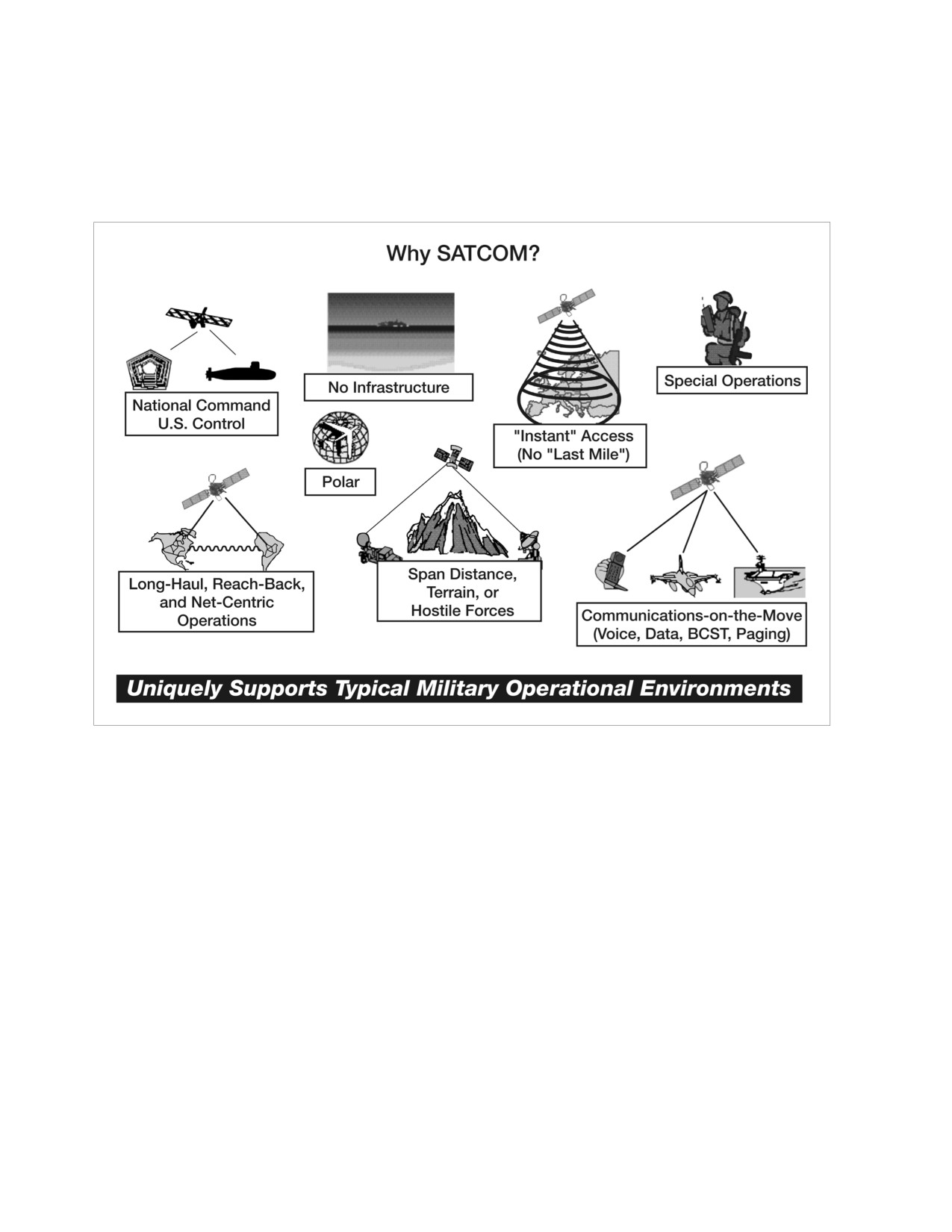
warfighter. Figure 2-1 illustrates some of these features. Using a global
network of military and commercial communication satellites, warfighters at
all levels of command can overcome limited infrastructure, execute reach-
back operations, enable two-way flow of data to critical nodes, provide
support to special users, and increase overall C2 effectiveness. Further,
satellite communications provide critical connectivity for maneuver forces
whose rapid movement and nonlinear deployments take them beyond
inherent line of sight
(LOS) communication networks. Finally, satellite
18 May 2005
FM 3-14
2-1
FM 3-14 (FM 100-18) ________________________________________________________________
communications are a key enabler to emerging transformational concepts of
net-centric operations.
Figure 2-1. Key SATCOM features
2-4. Satellite communications collectively provide an essential element of
national and DOD communications worldwide. They allow for information
transfer from the highest levels of government to the theater and tactical
level for all matters, to include operations, logistics, intelligence, personnel,
and diplomacy. SATCOM supports a variety of media, including voice, data,
and video services. The satellites are generally transparent to the user; they
do not create information, but they serve as a transport medium.
2-5. The frequency bands over which the military satellite communications
operate are ultra-high frequency
(UHF), super-high frequency
(SHF),
extremely high frequency (EHF), military Ka-band, commercial L- and S-
bands for narrowband communications, and commercial C-, Ku-, and Ka-
bands for wideband communications
(which correspond to SHF). The
frequency band and waveform of a signal influences the throughput capacity
and the degree of protection provided to the communications system (antijam
[AJ], low probability of intercept [LPI], and low probability of detection [LPD]
capabilities). Table 2-1 summarizes these general attributes.
2-2
FM 3-14
18 May 2005

________________________________________________________________________Chapter 2
Table 2-1. SATCOM attributes
Systems/spectrums
Advantages
Limitations
DOD narrowband (UHF)
Global coverage
Capacity
DOD wideband (SHF, Ka)
Near real-time transmission
Orbital considerations
DOD protected (EHF)
Data relay broadcast
Frequency constraints
Commercial narrowband (L-, S-
Security
Antenna size, data rate,
bands)
mobility
Flexibility
Commercial wideband (C-, Ka-,
Jamming, interference
Support to mobile forces
Ku-bands)
SATCOM Systems/Spectrums
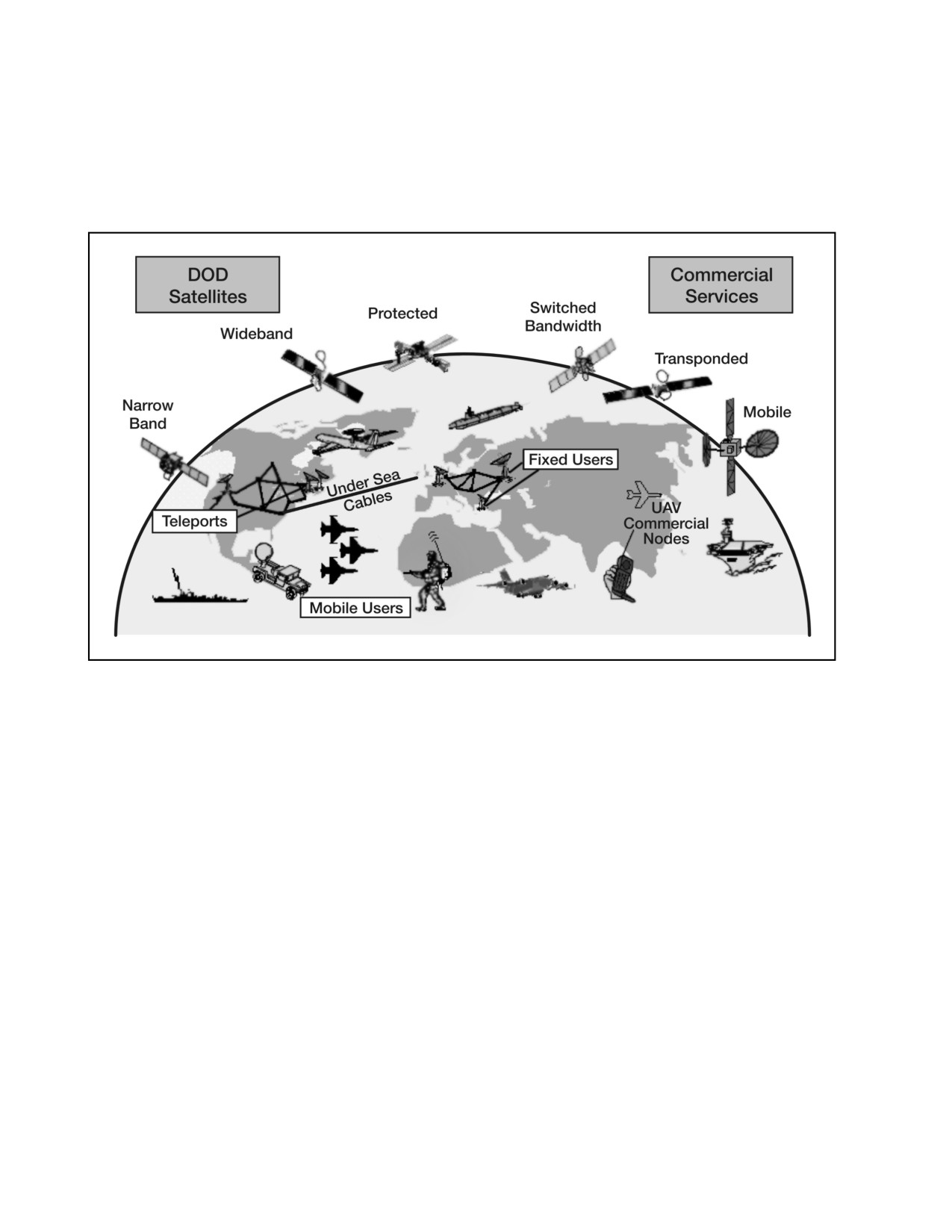
2-6. DOD employs a combination of military and commercial systems to
support its requirements (see figure 2-2).
2-7. DOD narrowband satellite communications systems support secure voice
and data transmission at relatively low data rates for both mobile and fixed
users, by providing access on a single dedicated channel or on a demand
assigned multiple access channel. In particular, these systems support highly
mobile, tactical users. Compact terminal equipment and omnidirectional
antennas allow deployed warfighters to conduct tactical C2 and quickly
exchange both voice and data communications. These systems typically
operate in the UHF frequency; examples include fleet satellite
communications system (FLTSAT), UHF follow-on (UFO), and the emerging
mobile user objective system (MUOS).
2-8. DOD wideband satellite communications support multichannel, secure
voice, and high data-rate communications for C2, crisis management, and
intelligence data transfer services. The heaviest use of wideband
communications is multiplexed, wideband, switched networks. Many
wideband users employ large, fixed ground terminals to support DOD
enterprise-wide voice, data, and video wideband networks. Smaller mobile
and relocatable terminals support exercises and deployed operations
requirements of tactical forces for high-capacity, multichannel
communications aboard ships and aircraft as well as in support of ground
forces. These systems typically operate in the SHF and Ka frequency;
examples include DSCS, global broadcast system (GBS), and the emerging
wideband gapfiller system (WGS).
2-9. DOD protected satellite communications support survivable voice and
data communications not normally found on other systems. Its unique
characteristics, such as its narrow beamwidth and use of spread spectrum
and frequency hopping, give it capabilities such as AJ and scintillation-
resistance along with LPI and LPD. Because of these capabilities, use of the
protected satellite communications frequency band has often been associated
with the most critical strategic forces and C2 systems, but these capabilities
are also in demand by tactical and special forces that require AJ and
LPI/LPD for the completion of their missions. These systems typically
18 May 2005
FM 3-14
2-3
FM 3-14 (FM 100-18) ________________________________________________________________
operate in the EHF frequency (examples include Milstar and EHF packages
on UFO satellites).
Figure 2-2. Global system-of-systems
2-10. Commercial satellite communications offer capabilities that can be
exploited to meet and augment the Department of Defense’s rapidly growing
information needs. Some wideband services and personal communications
services such as cell phones are examples of current commercial SATCOM
support to strategic and tactical mobile users. Commercial systems should
also be good candidates to support much of the Department of Defense’s
predictable, wideband fixed SATCOM needs, requiring little or no AJ
protection or U.S. control. Leasing commercial services may also afford the
Armed Forces of the United States faster access to advanced capabilities and
services than traditional government research, development, and acquisition
programs. However, in an environment where both the United States and its
potential adversaries have almost equal access to the same advanced
technologies and commercial services, sustaining military advantage may
largely rest on U.S. ability to integrate those technologies and commercial
services into its force structure faster and more effectively than the
adversary. These systems typically operate in the L-, C-, Ka-, and Ku-band
frequencies (examples include Iridium, Inmarsat, and Intelsat).
2-11. Not all DOD communications needs can
(or should) be met by
commercial means, especially in an unpredictable threat environment.
Competition for access with other customers, non-U.S. ownership or control of
2-4
FM 3-14
18 May 2005
________________________________________________________________________Chapter 2
commercial SATCOM services outside the borders of the U.S., and the lack of
quickly accessible commercial SATCOM capacity raise substantial questions
about the Department of Defense’s ready assured access to those services
when and where needed. Military-unique communication needs, such as
nuclear survivability; robust C2 links; netted voice; U.S. control; and secure,
protected, and/or covert communications, may not always be adequately
served by commercial means. Access and availability to commercial services
are based on the terms of the lease or contract that could be terminated at
militarily inconvenient times. Experience shows that foreign commercial
telecommunications media may sometimes become unreliable during periods
of political tension or open hostilities. While commercial SATCOM is an
important component of DOD communications, mission requirements are
thoroughly reviewed before employing these communications.
SATCOM Processes
2-12. There are two primary SATCOM planning processes: the requirements
process and the access process. The Joint Staff administers the requirements
process, which formally documents user needs for satellite communications
as a precondition for satellite access. USSTRATCOM, as the DOD SATCOM
operational manager (SOM), has responsibility for the day-to-day access
process, which authorizes users to access satellite communication resources.
These processes are further detailed in CJCSI 6250.01 and USSTRATCOM
consolidated system control and operations concept (C-SCOC) documentation.
Army Support to SATCOM
2-13. USASMDC operates three regional satellite communications support
centers (RSSC) , as directed by USSTRATCOM. These centers plan and
manage global communications support to the warfighter. They are multi-
Service organizations under USASMDC operational control, and provide a
single point of contact for UHF, SHF, EHF, and commercial satellite
communications support. Additionally, USASMDC provides manning to the
global satellite communications support center
(GSSC), operated by
USSTRATCOM, to perform a mission similar to the RSSC. See appendix B,
section III, for a detailed discussion of the RSSC and its capabilities.
2-14. USASMDC
1st Satellite Control
(SATCON) Battalion provides
communications network and satellite payload control of the DSCS by
operating and maintaining five wideband satellite communications
operations centers
(WSOCs) and a DSCS certification facility. See appendix
B, section IV, for a detailed description of the WSOC and its capabilities.
POSITION, VELOCITY, AND TIMING
2-15. The GPS provides precise, reliable position and time information,
enabling friendly forces to plan, train, coordinate, and execute operations
more effectively.
2-16. The Navstar GPS is a constellation of orbiting satellites and associated
ground control stations that provide navigation data to military and civilian
users all over the world. The system is operated and controlled by the Air
Force. Each GPS satellite broadcasts continuous navigation signals. With the
proper equipment, users can receive these signals to calculate time, location
18 May 2005
FM 3-14
2-5
FM 3-14 (FM 100-18) ________________________________________________________________
and velocity. Receivers are available for use in land vehicles, aircraft, and
ships, as well as for hand carrying.
2-17. GPS provides 24-hour navigation services, including—
• Extremely accurate, three-dimensional location information (latitude,
longitude, and altitude), velocity, and precise time (position accuracy
is within 16.5 feet [5 meters], velocity within a fraction of a mile per
hour, and time within ten billionths of a second).
• A worldwide common grid that is easily converted to any local grid.
• Passive all-weather operations.
• Continuous real-time information.
• Support to an unlimited number of users and areas.
• Support to civilian users at a slightly less accurate level.
2-18. Coded signals from the satellites are broadcast so properly equipped
users with direct LOS access to the satellites can receive them, and an
unlimited number of users can receive and use them at the same time. When
signals from at least four satellites can be received simultaneously, the GPS
receive equipment can calculate three-dimensional position and time. These
signals can be received and the calculations made in a high-dynamic
environment, so the GPS signal receive and processing equipment can be
used in precision-guided munitions as a means to increase their accuracy.
The position information is provided in a common grid system, which can be
automatically converted to latitude, longitude, and elevation, or other grid
systems can be used. GPS receive equipment is integrated in most Army
platforms.
2-19. Users must be aware that civil GPS receivers do not offer the same
performance or protection that military receivers provide. CJCS directives
prohibit using civil GPS equipment in combat or combat support roles.
2-20. GPS systems enhance navigational accuracy in featureless or obscured
terrain. They allow precise maneuver without sighting specific geographic
features. Soldiers can rendezvous to assigned points using GPS, either as a
waypoint or to join or support other troops. GPS is a passive system;
therefore, a soldier can receive and use the signal without emitting a signal
that might compromise location. The use of satellite-based navigation is
widespread not only for position information, but also for weapon system
applications.
2-21. Accuracy of the GPS navigation signal can be 16.5 feet or better, but
may exceed that value. Precision munitions may require greater accuracy;
therefore, GPS receive equipment is sometimes coupled with a terrain
matching system, terminal homing device, or automatic target recognition
capability to increase accuracy.
2-22. GPS is integrated in equipment such as field artillery cannon and
rocket systems and munitions that significantly increase delivery accuracy.
The Army tactical missile system (ATACMS) uses GPS and inertial sensor
systems for guidance. This system accurately delivers ordnance beyond the
capability of existing cannon and rockets. The GPS components enable
2-6
FM 3-14
18 May 2005
________________________________________________________________________Chapter 2
missile in-flight corrections that significantly improve accuracy over previous
inertial-guidance-only versions.
2-23. Offensive and defensive maneuver operations are enabled through
precision navigation aids and through networked command, control, and
communications capabilities that are dependent on timing signals on the
GPS transmission.
ENVIRONMENTAL MONITORING
2-24. Space-based equipment can identify environmental factors that might
affect operations in the four operational media of air, land, sea and space.
Knowledge of these factors enables commanders to avoid adverse terrestrial
environmental conditions (such as poor surface conditions or severe weather)
while taking advantage of other conditions to enhance operations. Multi-
spectral imagery
(MSI) provides military forces current information on
terrain, vegetation, and land use. It can also provide information on an area
of operation such as surface trafficability, vegetation, and beach conditions.
Imagery can be linked with precise location data from GPS to provide highly
reliable maps for ground operations.
INTELLIGENCE, SURVEILLANCE, AND RECONNAISSANCE
2-25. Space-based ISR is one component of the seamless ISR enterprise
comprising all joint and coalition air, ground, sea and space assets. The
advantages of space-based ISR complement and offset the disadvantages of
air and ground based ISR. Surveillance from space enables the warfighter to
overcome terrestrial LOS restrictions and affords coverage of virtually the
entire globe. In some cases, the only early surveillance available will be from
a space-based asset, especially in forced entry operations.
2-26. Space-based ISR sensor equipment provides no unique capabilities to
the holistic, complementary ISR enterprise. Space-based ISR uniqueness is a
function of characteristics of earth orbits, not the sensors themselves. For
example, ISR spacecraft may have frequent revisit rates and long dwell times
that produce a “near-persistent stare” capability and nearly global access.
2-27. While unfettered access from high and relatively safe earth orbits
provides a tremendous advantage for ISR, there are limitations. Spacecraft
must follow strict laws of motion and orbital mechanics. Revisit rates,
coverage area, and dwell time over areas targeted for observation are
functions of spacecraft orbits. For example, a HEO yields a long dwell time
but lacks global access, while a LEO provides global access but a short dwell
time.
2-28. Generally, only minor changes to these orbits can be made after initial
spacecraft insertion. Changes require prohibitively large quantities of fuel,
the same fuel used to keep the satellite properly oriented and properly placed
in its orbit
(a function called station keeping). When fuel is used for
significant orbit changes, it is no longer available for station keeping,
resulting in decreased mission life. (See chapter 1, section II, for the specific
orbits and their associate impacts.)
18 May 2005
FM 3-14
2-7
FM 3-14 (FM 100-18) ________________________________________________________________
2-29. A related limitation is predictability. Orbits are difficult to change and
can be mathematically calculated with good accuracy; therefore, predictions
(based on current orbit characteristics) of satellite locations can be made for
weeks and months in advance. This predictability makes space-based ISR
susceptible to camouflage, denial, and deception. In addition to these
limitations, ISR spacecraft are high-demand, low-density assets and cannot
satisfy all information requests.
2-30. Generally, all Army organizations gain access to space-based ISR
derived products through all-source fused intelligence products that were
derived and compiled from the entire complementary ISR architecture. For
those instances that spacecraft are the only available source of necessary
information, there is a strict and highly competitive process to make it
available.
2-31. The architecture for using space-based ISR involves numerous
organizations (both within and outside the Army). Figure 2-3 depicts the
process and architecture as an information requirement becomes a request
and finally a product returned to the original requester. Within the Army, an
information requirement moves up the echelons to the Defense Intelligence
Agency (DIA), where the determination may be made to use space-based ISR
to satisfy the requirement. At that point, standing organizations such as
Central Imagery Tasking Office
(CITO) and Overhead Collection
Management Center
(OCMC) evaluate, prioritize, and decide which
requirements will be designated for collection. All Services are represented in
these forums. However, due to the large number of requirements (mostly
generated by the intelligence community [IC] to support national leadership),
competition for each spacecraft’s collection capability is immense.
2-32. When a requirement is designated for collection, a tasking is sent to the
appropriate asset through a ground station. Once the tasking is collected,
there are three general methods by which the collected information is sent to
the original requester. They are direct downlink (DDL), theater downlink
(TDL), and reach. Table 2-2 provides an overview of the three different
methods. On its way to the requester, the collected data must go through an
exploitation center, such as Washington Naval Yard, regional signal
intelligence
(SIGINT) operations center, or
“in theater” to the tactical
exploitation system.
2-8
FM 3-14
18 May 2005
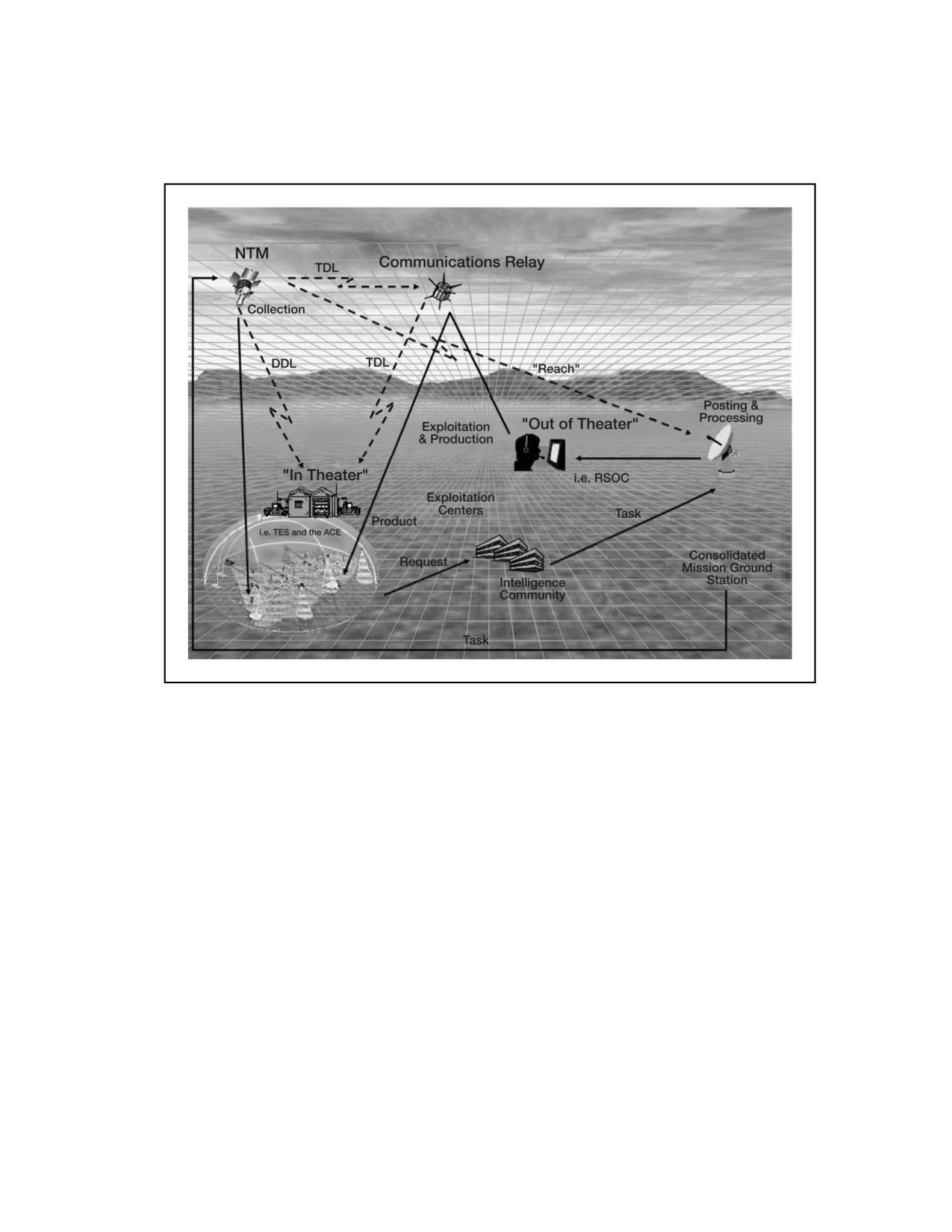
________________________________________________________________________Chapter 2
Figure 2-3. Space-based ISR architecture
2-33. The tactical exploitation system is the Army’s deployable, primary
system to access space-based ISR capabilities. It is the interface between
national systems and in-theater tactical forces. It receives, processes,
exploits, and disseminates data from direct downlinks and from ground
stations for national and theater platforms.
2-34. The tactical exploitation system function is currently being included in
the early spirals of the distributed common ground system—Army (DCGS-A)
development. DCGS-A will consolidate the capabilities and functionality
found in the tactical exploitation system and other select intelligence
systems, and migrate their capabilities into an integrated system. DCGS-A
enables the commander to achieve situational understanding by leveraging
multiple sources of data, information, and intelligence to synchronize the
elements of joint and combined arms combat power (maneuver, maneuver
support and maneuver sustainment support). DCGS-A is the Army’s primary
system for ISR tasking, processing, exploitation, and dissemination (TPED)
and will evolve to tasking, posting, processing, and using (TPPU). It supports
the commander’s ability to execute battle command, synchronize fires and
effects, rapidly shift battle focus, achieve situational understanding, and
protect the force.
18 May 2005
FM 3-14
2-9

FM 3-14 (FM 100-18) ________________________________________________________________
Table 2-2. Methods of dissemination
Method
Description
Advantages
Disadvantages
DDL
Spacecraft collects data, uses
• Timely (NRT).
• Limited access.
onboard processing (OBP), and
• Limited bandwidth.
immediately disseminates information
• Higher cost for
in NRT to multiple terrestrial
spacecraft (OBP,
receivers, generally using a broadcast
special transmitting
signal.
equipment, and
additional hardening).
TDL
Spacecraft collects data, usually uses
• Timely.
• Requires additional
OBP, and immediately disseminates
• Near-continuous
spacecraft.
information in NRT to another
access.
• Additional cost for
spacecraft or constellation with the
spacecraft (OBP).
• Higher
sole duty of relaying data to either
bandwidth.
• Additional “hops.”
multiple terrestrial receivers or a
designated receiver.
Reach
Generally, implies that the information
• Lower cost (initial
• Not as timely.
is sent back to a consolidated mission
processing sites
• Multiple “hops.”
ground station (CMGS) where it is
are fixed
• Requires substantial
processed, exploited (or sent to
facilities).
architecture to push
another organization for exploitation),
• Low risk of loss
information/products
and disseminated to the original
to site and
to operational/tactical
requester.
personnel (sites
sites with limited
are not in theater
bandwidth.
of conflict).
2-35. Through integration, networking and use of updated technology,
DCGS-A—
• Orchestrates, synchronizes, and integrates joint, interagency,
multinational, and Army ISR sensors in all operational phases across
the spectrum of conflict.
• Eliminates information barriers.
• Provides fusion and analytical capabilities to support situational
understanding.
• Supports targeting and effects.
• Provides BDA and effects damage assessment.
2-36. The Army leverages space-based ISR by submitting information
requirements through standard collection management processes and
procedures at all echelons, including national level. Space-based ISR is a
complementary capability to provide for commanders critical information
requirements
(CCIR) through the standard intelligence functions of
indications and warning (I&W), intelligence preparation of the battlespace
(IPB), situation development, support to force protection, support to
targeting, and BDA.
2-10
FM 3-14
18 May 2005
________________________________________________________________________Chapter 2
2-37. The ASPO provides the Army with robust capabilities to exploit
national ISR assets and products through execution of the Army TENCAP.
As such, it is fully integrated into the NRO and the IC. The Army has
numerous U.S. Army Forces Command
(FORSCOM) and U.S. Army
Intelligence and Security Command (INSCOM) deployed units providing
tactical TENCAP support throughout the force in MI battalions and brigades.
Additionally, Army soldiers are fully integrated in NSA, National Geospatial-
Intelligence Agency (NGA), the NRO facilities, as part of the IC, tasking and
exploiting national intelligence space systems on a daily basis.
THEATER MISSILE WARNING
2-38. Air and missile defense command and control nodes use theater missile
warning to cue active and passive defenses against enemy theater ballistic
missiles (TBMs). Active defense includes use of Patriot missiles to destroy
enemy TBMs before they impact their targets. Passive defenses include
taking cover and donning chemical warfare protective gear. Missile warning
sensors are hosted on platforms in space, in the air, and on the ground. The
defense support program
(DSP) provides space-based platforms. These
satellites have infrared sensors that detect heat emitted from sources such as
missiles during powered flight. Data from DSP satellites is transmitted to the
missile warning theater event system (TES) .
2-39. The missile warning TES has two unclassified components.
• The first is joint theater missile warning (TMW) detachments, which
are deployed to the area of operations (AO) and receive data directly
from DSP satellites in their fields of view. TMW detachments deploy
to provide onsite downlink, processing, and distribution of theater
ballistic missile warning information. TMW detachments identify
missile launch points, trajectory, and locations where warheads are
likely to impact. These detachments are transportable/mobile and,
therefore, can be located to optimize warning data receipt and missile
warning dissemination.
• The second component is the mission control station (MCS) located at
Buckley Air National Guard Base in Colorado. The MCS is a high
confidence operational system that provides assured theater missile
warning to warfighters worldwide. The MCS monitors all major
regional conflict areas and potential hot spots simultaneously by
fusing the full DSP constellation and other data sources into a
cohesive picture.
2-40. The United States also exchanges missile detection and warning
information with its allies and coalition partners. The objective of shared
early warning (SEW) is the continuous exchange of missile early warning
information derived from U.S. missile early warning sensors and, when
available, from the sensors of the SEW partners. Information on missile
launches is provided on a near real-time basis and is approximately the same
quality and timeliness as that which would be provided to U.S. Forces, if
collocated.
18 May 2005
FM 3-14
2-11
FM 3-14 (FM 100-18) ________________________________________________________________
SPACE CONTROL
2-41. Space control operations ensure freedom of action in space for the
United States and its allies and, when directed, deny an adversary freedom of
action in space. Space control involves five interrelated objectives:
• Surveillance of space to be aware of the presence of space assets and
understand real-time satellite mission operations.
• Protect U.S. and friendly space systems from hostile actions.
• Prevent unauthorized access to, and exploitation of, space systems.
• Negate hostile space systems that place U.S. interests at risk.
• Directly support battle management, command, control,
communications, and intelligence.
2-42. Surveillance of space is accomplished via a global array of ground and
space-based sensors collectively called the space surveillance network (SSN).
The SSN contributes to the space operational picture critical to the
operational commanders’ overall common operational picture (COP). The goal
is not only to know where satellites are located, but also to be aware of
friendly and adversary space capabilities and current operations. This
provides what is commonly referred to as space situational awareness. The
Army includes space situational awareness in the commander’s COP largely
through the commander’s IPB and the space estimate detailed in appendix A.
2-43. Space control protection ranges from guarding space facilities to
encrypting data and command links, to preemptive strikes against weapons
that endanger space assets. Space control prevention may be accomplished by
such operations as physically denying access to satellite uplink and downlink
footprints, monitoring communication channel usage, or selectively jamming
the GPS navigation signal used by the enemy. Space control negation is
accomplished by denying, disrupting, deceiving, degrading, or destroying
enemy space systems, including ground assets, orbiting assets, and
communications links between the two.
2-44. As stated in the Army space policy, the Army is to “interdict enemy
space power through operations on or from land” so terrestrial-based space
control is an Army responsibility for the purposes of supporting joint and
Army operations. The Army is not the sole provider of space control “on or
from land.”
2-45. IO tools may be used to accomplish space control. Information is
defined as “facts, data, or instructions in any media or form. It is the meaning
that humans assign to the data by means of the known conventions used in
their interpretation”
(JP
3-13). Therefore, any accomplishment of space
control, whether it is protecting U.S. space assets, preventing unauthorized
use of U.S. assets, negating those of the adversary, or simply surveilling
assets to note their location and function, affects information. Operations to
change the state of information, whether it is gaining more for U.S. use or
denying it to the adversary, can be related to information operations.
2-46. IO tools are helpful in executing some types of space control. Using
selected elements of IO to affect satellite control station operations or space
data processing and distribution are potential methods of accomplishing
2-12
FM 3-14
18 May 2005
///////////////////////////////////////