FM 3-9 Potential Military Chemical / Biological Agents and Compounds (December 1990) - page 3
FM 3-9
67
FM 3-9
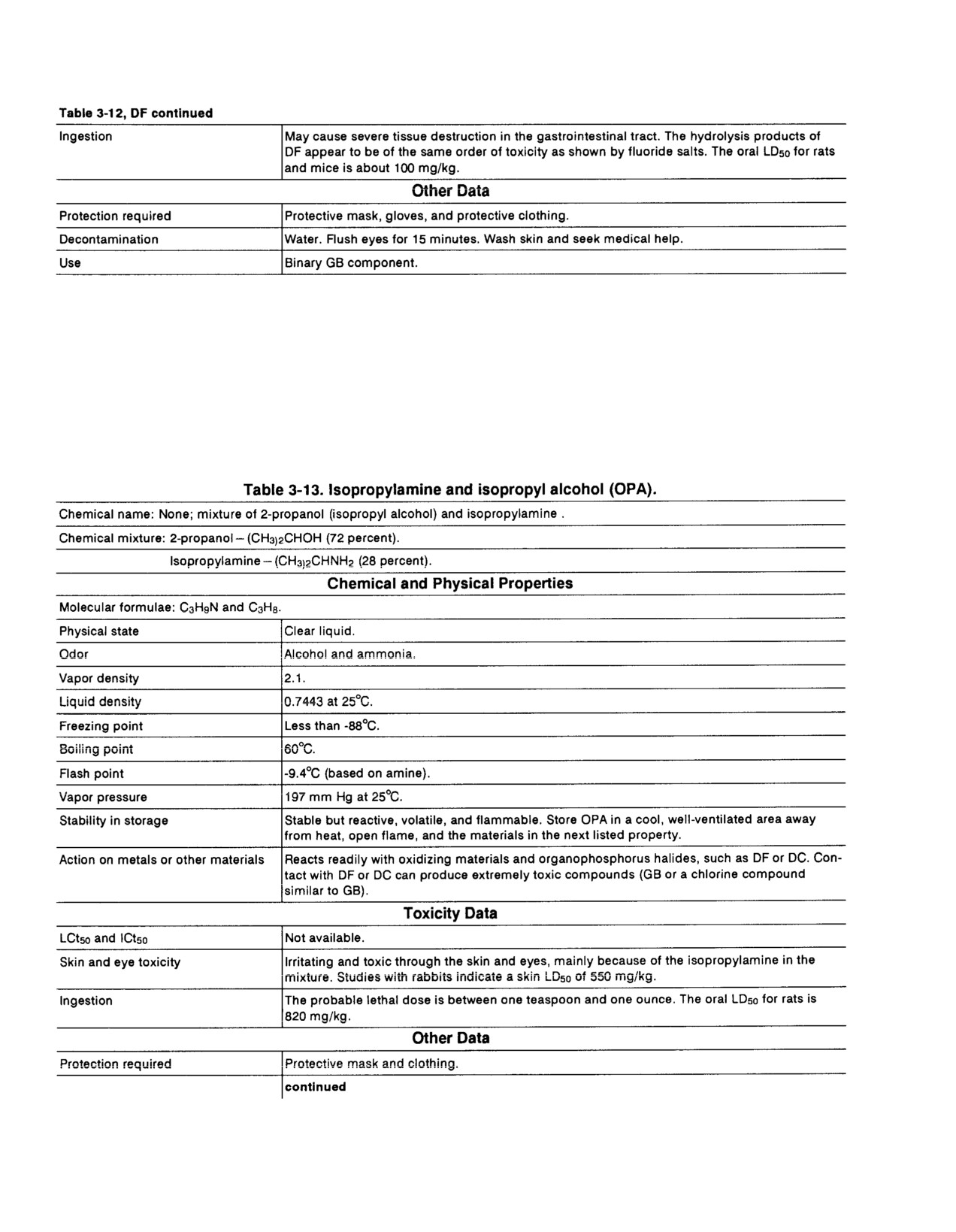
Isopropylamine and Isopropyl Alcohol (OPA)
The mixture known as OPA (Table 3-13) is relatively
In contact with skin and eyes OPA may cause severe
nontoxic compared to nerve agents. However, it is not
irritation. Ingestion causes nausea, salivation, and severe
without hazard. It is a highly volatile and flammable liquid
irritation of the mouth and stomach. Inhalation may cause
composed of 72-percent isopropyl alcohol and 28-percent
irritation of the lower respiratory tract, coughing, difficult
isopropylamine. It forms toxic oxides of nitrogen as well as
breathing, or loss of consciousness.
explosive mixtures in air.
68
FM 3-9
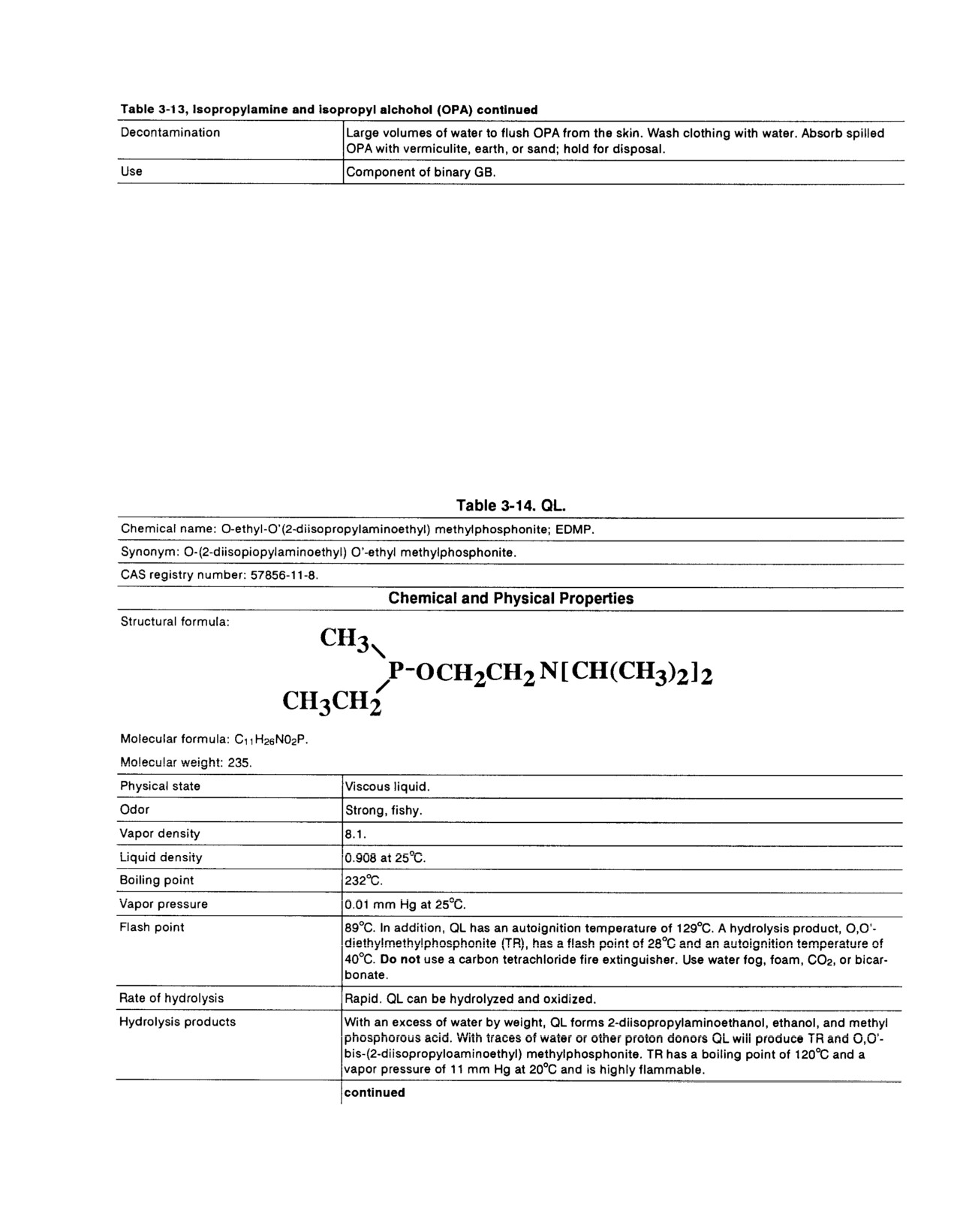
QL (EDMP)
One of the binary components for VX is QL, an or-
periods. Prolonged breathing of QL vapors may produce
ganophosphorous ester. An additional designation for QL
headaches and nausea.
is EDMP, an abbreviation for O,O’-ethyl (2-
Like DF and OPA, QL is not likely to be encountered as
diisopropylaminoethyl) methylphosphonite. The pure
a result of Threat action except in cases in which Threat
material is many times less toxic than VXbut is by no means
ordnance damages containers. Other possibilities of troop
harmless. It reacts with moisture and other substances to
exposure are leaking containers and accidents. In these
produce highly toxic materials as well as flammable
cases treat QL as a flammable liquid, because it reacts with
materials. It will ignite without application of spark or
moisture to produce highly flammable diethyl methylphos-
flame at 129°C (265oF). A hydrolysis product of QL ignites
phonite (TR). Never store or ship QL with sulfur or sulfur
at a much lower temperature.
compounds, such as NE or NM.
QL (Table 3-14) is a slight cholinesterase inhibitor, but
the body tissue and fluids do not store it for extended
69
FM 3-9
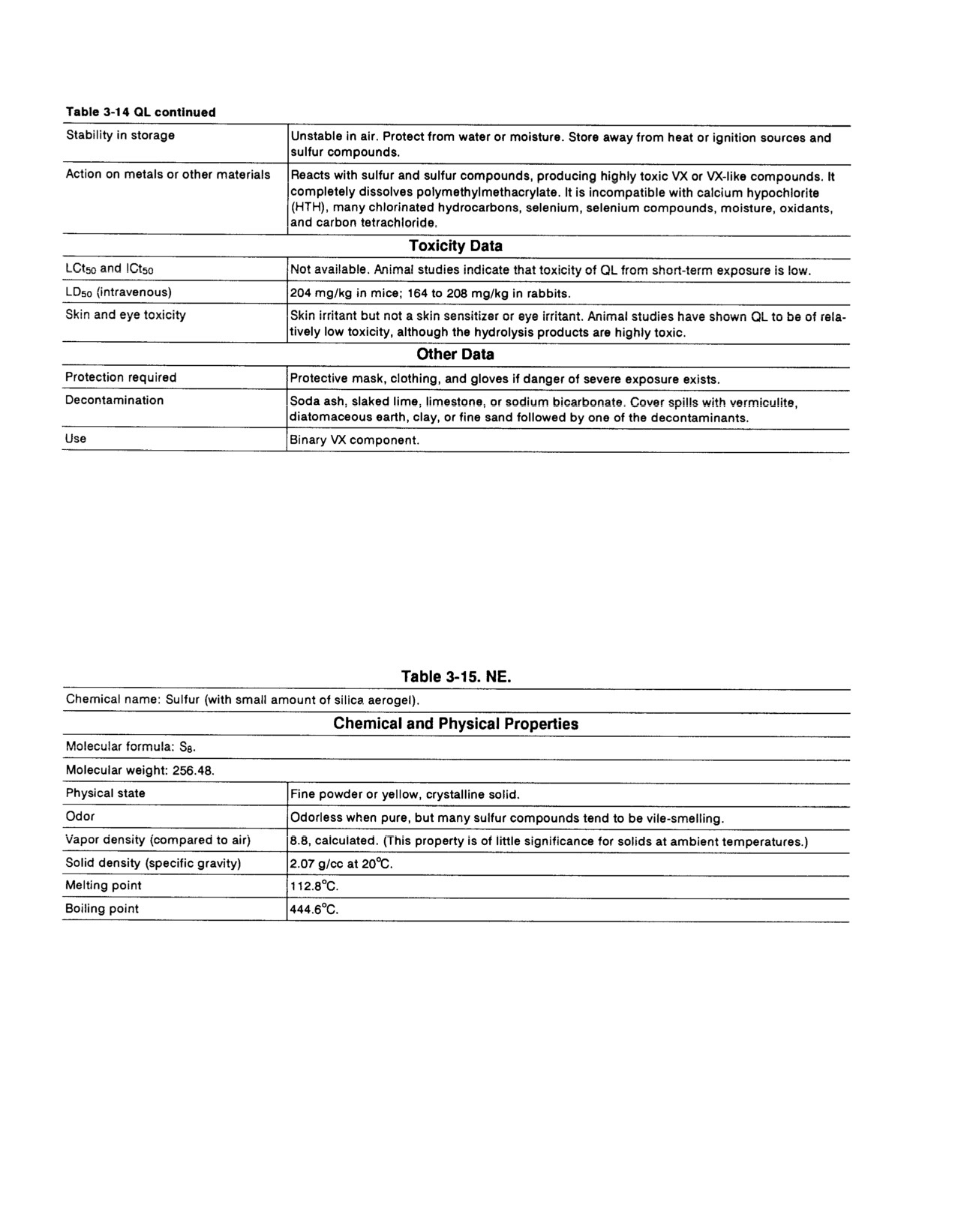
NE and NM
NE is the designation for a powdered elemental sulfur
of dimethylpolysulfides, containing some dissolved
mixture. The addition of an anticaking silica aerogel (Cab-
elemental sulfur. NM is a very persistent liquid material
O-Sil) prevents lumping and enhances the free-flowing
with a very obnoxious odor. There are indications of con-
characteristics of the sulfur powder. NE (Table 3-15) is one
siderable risk from short-term inhalation exposures to high
of the components for the production of binary VX.
airborne concentrations of NM. The molecular formula for
NM is a binary chemical intermediate that can substitute
NM is (CH3)2S., where n equals 2 to 6 + (average 5);
for sulfur in the production of binary VX. NM is a mixture
molecular weight average is 190.39.
Section III. Miscellaneous
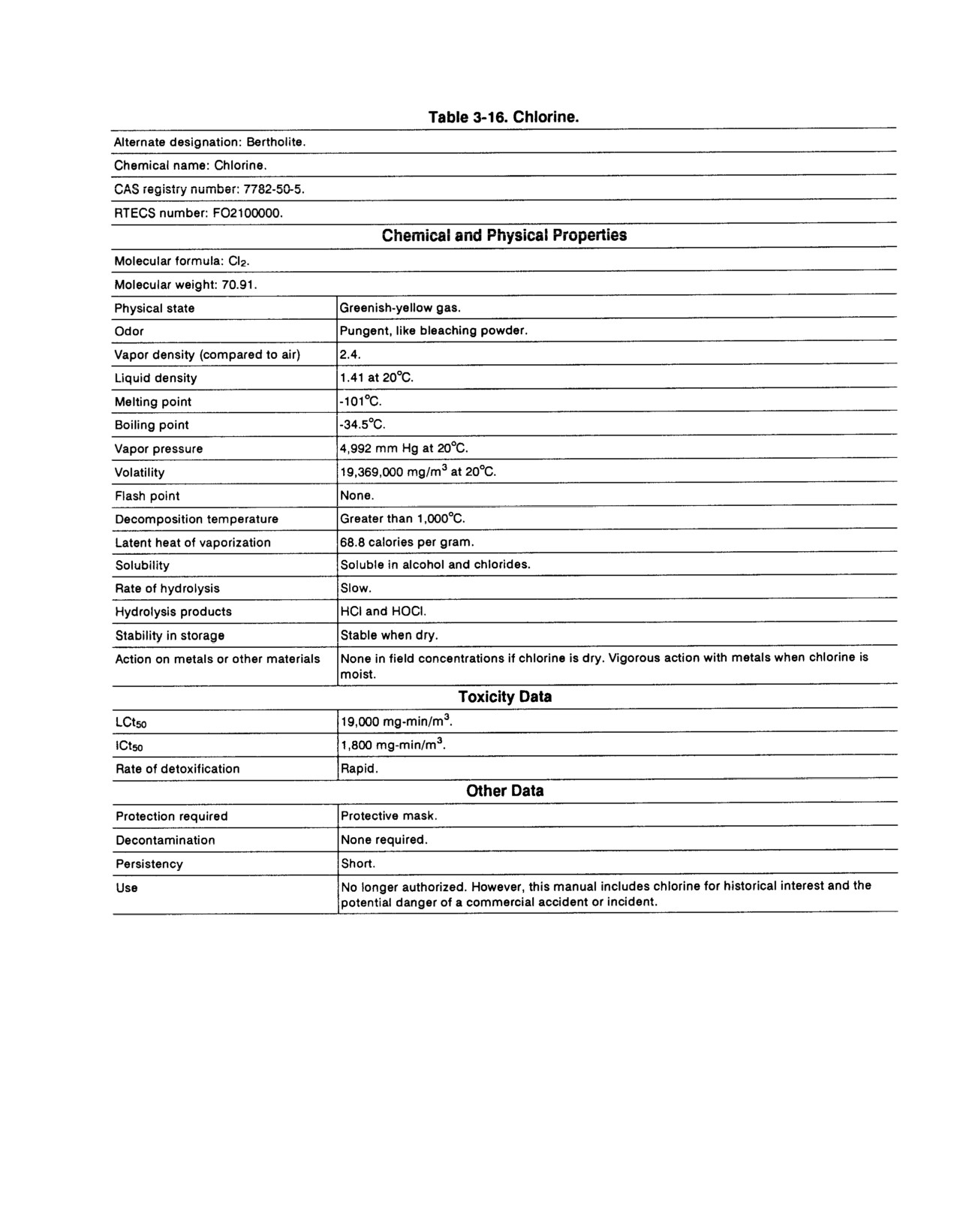
The Germans used chlorine in World War I. It has seen
A multitude of industrial processes use chlorine. It is also
no use as a chemical agent since then; more lasting and
an indispensable reagent in the manufacture of chlorinated
toxic agents have replaced it. Chlorine (Table 3-16) is a
organic materials and inorganic chlorides and chlorates. It
powerful irritant, first on the upper and then on the lower
is of particular value in water purification.
respiratory tract.
70
FM 3-9
71
FM 3-9
Chapter 4
Toxins
Toxins are poisonous chemicals produced by many different types of living
organisms. Toxins have been implicated as the means by which certain pathogenic
microorganisms produce their effects. Toxins that are highly toxic to humans and
that are stable, available, and manageable are important in the threat they present
in biological warfare. This chapter contains information on some of the possible
Threat toxins. These toxins represent the range of toxin agents that may be
available to the sophisticated user of biological weapons. However, weapon
systems could incorporate many other toxins.
Section I. Background
Many toxins were developed for medical use. This is
aerosols dissipate and also through secondary aerosoliza-
especially true of toxins from microorganisms and fungi.
tion.
Examples are atropine, morphine, streptomycin, and
The body absorbs particulate or liquid aerosols of toxins
penicillin. As a result commercial processes in many
through the respiratory tract, the skin, or mucous
countries prepare microbial and fungal products. The
membranes. Because mechanical or heat stress inactivate
technology exists for bulk production of some toxins. As a
some toxins, use of these toxins may require dissemination
general rule toxins are not chemically synthesized; they are
of large concentrations. Aerosol toxin attacks usually are
extracted from their natural sources.
not visible. However, because of the amount required to
The chemical nature of toxins is diverse (see Appen-
produce casualties and the color of the toxin or dissemina-
dix E). Some toxins are large proteins; some are smaller
tion medium, aerosolized solids may be visible as a dust
proteinlike (proteinaceous) compounds; others are non-
cloud or as powders on equipment and clothing.
proteins. The proteinaceous toxins are solids when pure
Bursting munitions and spray tanks may produce large
but dissolve in water-based solutions. Protein-based toxins
liquid drops to cause ground contamination, like ground
are generally less stable than nonprotein toxins. Some
contamination by chemical agents. Forces in southeast
toxins are extremely stable and may retain their potency for
Asia and Afghanistan used this method of dissemination to
years in storage. Toxins from plants and fungi tend to be
employ “yellow rain” mycotoxins. The Threat could use
more stable than those from animals.
ground-contaminating toxins to produce casualties or to
Biological agents (including toxins) may be expected to
deny terrain, equipment, or supply.
be disseminated either as an aerosol, a liquid, or a powder
Droplets of a solution or a suspension of a toxin would
(see Chapter 1). Based on the portals of entry, the charac-
cause surface contamination, including contamination of
teristics of agents used, and the results desired, different
food or water, and the toxin could enter the body through
methods of dissemination are feasible for biological attack.
the digestive tract. Some toxins (for example, mycotoxin
Toxins are tactical or strategic weapons. Some can effec-
T-2) are skin damaging and could penetrate the skin.
tively cover hundreds of square kilometers, and most could
In addition to tactical or strategic employment, toxins
cover at least several square kilometers.
pose a threat as weapons for covert, guerrilla, or terrorist
The Threat may use ground-bursting or airbursting
operations. With the vast number of toxins and delivery
munitions, aircraft spray tanks, or ground-level aerosol
options, the imagination of the user is the only limitation to
generators to produce aerosol clouds of toxins. Inhalation
covert dissemination of toxins. Saboteurs can contaminate
of these aerosols will produce casualties in a manner
closed ventilation systems, drinking water, lakes and rivers,
similar to that of chemical aerosols. The greatest threat
and food supplies. Assassins can also use some agents.
occurs with exposure of individuals to the cloud. There is
Physical and environmental factors determine the effec-
still a risk of respiratory, eye or oral exposure while the
tiveness of these methods. Mechanical or heat stress inac-
72
FM 3-9
tivate some toxins. (This does not apply to powdered toxin
chemical nerve agents such as pinpointing of pupils, con-
dissemination; it applies only to liquids.) Some toxins (for
vulsions, and rigid paralysis; or they may cause other
example, Staphylococcus enterotoxin, Type B) are stable
sumptoms such as blurred vision and light sensitivity due
in the environment and are more resistant than G- or
to dilation of pupils, tremors, seizures, confused behavior,
V-agents to heat, hydrolysis, or vaporization. Others, such
extreme muscle weakness, or rigid or limp (flaccid)
as botulinum toxin, have only a brief predictable persist-
paralysis.
ence unless rendered resistant to environmental condi-
Cytotoxins (“cell poisons”) produce a variety of effects
tions. Appendix F, Table F-1, summarizes the physical and
because of their distinct mechanisms. Some destroy cells.
chemical properties of toxins.
Others disrupt cell activities, such as protein synthesis, cell
The use of certain specialized techniques that are com-
regulation, or other biochemical processes. Symptoms may
mon to the production of pharmacological could in-
resemble those of chemical blister, vomiting, or choking
fluence the effectiveness of the toxin. Examples of these
agents; or they may resemble food poisonings or diseases.
techniques are micronizing (air-milling) and microencap-
Cytotoxins may cause nausea, vomiting, or diarrhea;
sulation. Micronizing is a technique used to reduce the
rashes, inflammation, or blistering, jaundice; or bleeding
particle size to increase absorption. This process is par-
or deterioration of tissue (necrosis). Appendix E discusses
ticularly important when exposure occurs primarily by in-
the chemical nature and mechanisms of action of toxins.
halation. Microencapsulation can make aerosol
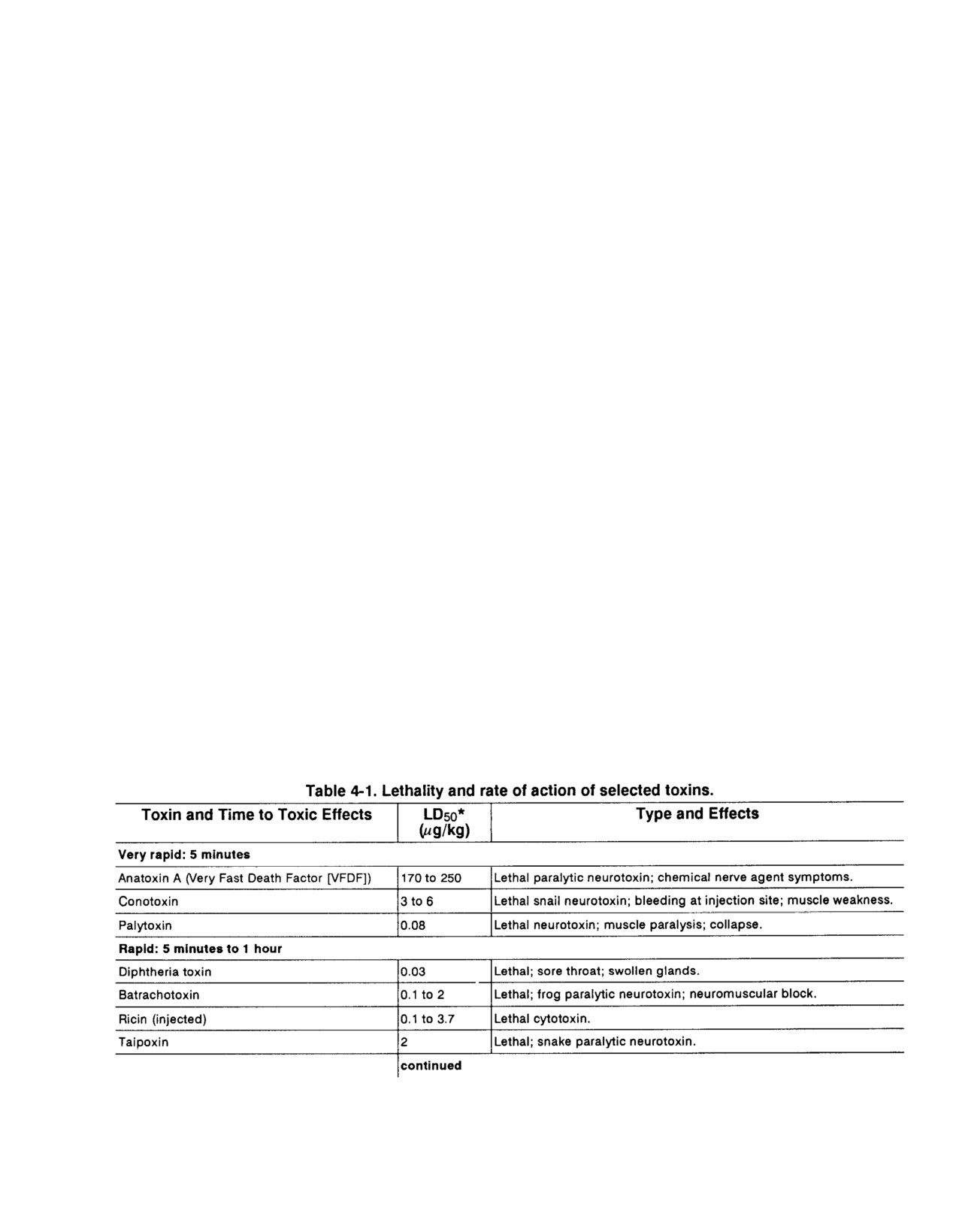
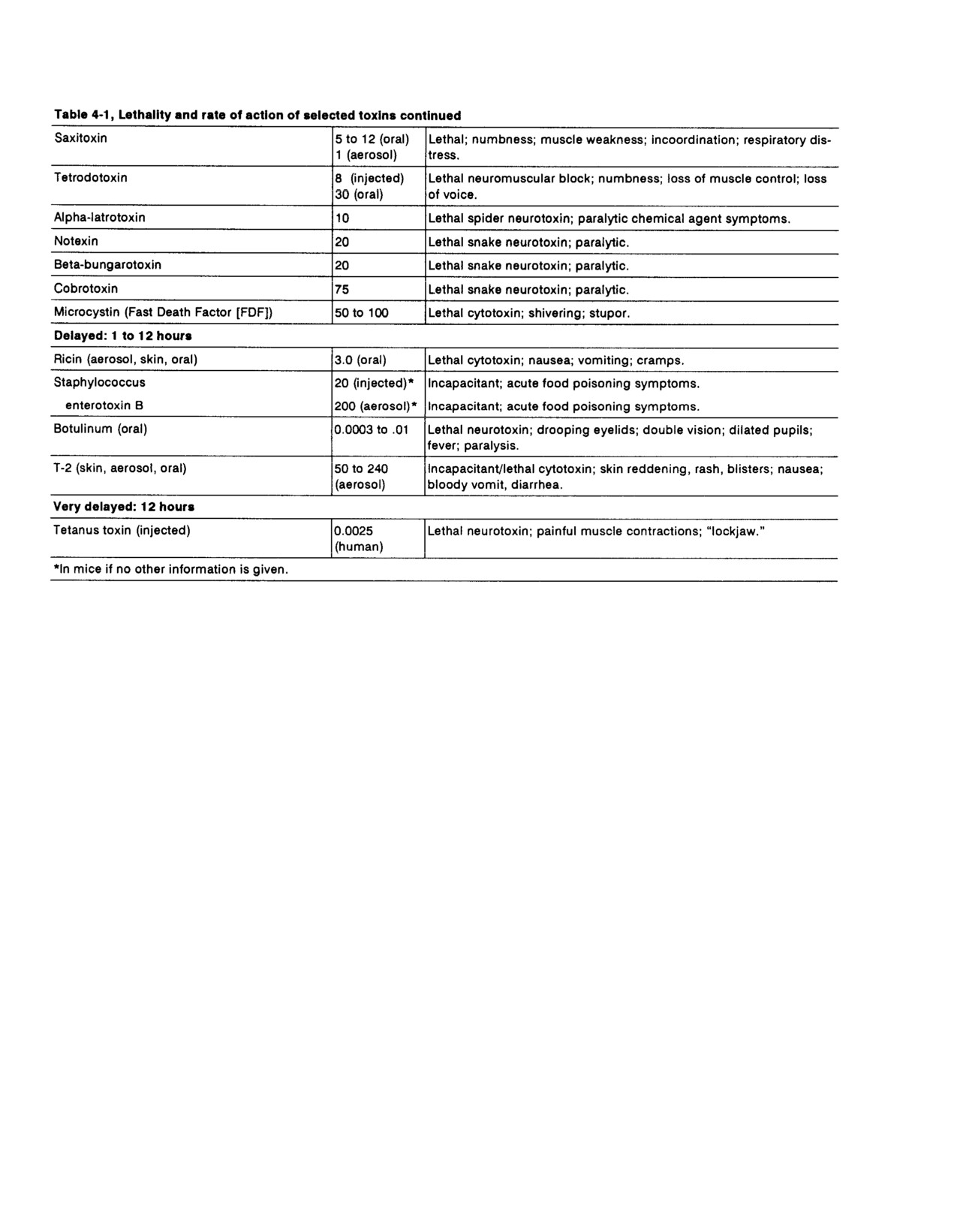
Toxins may produce lethal or nonlethal effects (Table
distribution of biological agents technically more feasible.
4-1). By weight, most toxins are thousands of times more
Encapsulation of agents in certain organic compounds
toxic than standard chemical agents. These effects depend
could enhance agent survivability in the environment
on the toxin, the dose received, and the route of entry. The
during dissemination. It could potentially allow more
time lapse between contamination and symptoms may vary
specific targeting of the agent within the body or enhance
from a few minutes to several hours. Many, if not most, of
absorption and retention.
the toxins are principally a threat by aerosol. Most toxicity
The actions and effects of toxins may closely resemble
data for toxins, however, is not in air concentration times
those of chemical warfare agents, such as nerve, blister,
the time (LCt50). Essentially all toxins are at least as toxic
vomiting, or choking agents. Most toxins of military sig-
by aerosol as by injected dose (LD50). Therefore, this
nificance cause casualties in two general ways and can be
manual expresses aerosol data as the dose of toxin actually
classified by the way they act:
received (LD50). Nearly all toxins of concern would require
Neurotoxins (“nerve toxins”) interfere with nerve im-
considerably higher oral doses than aerosol doses. Most of
pulse transmission. They have highly specific effects on the
the large protein toxins are not a significant threat by
nervous system. All neurotoxins do not produce the same
dermal or oral exposure unless there is an open wound.
symptoms or have the same mechanism of action. For
Toxins, even though of biological origin, are nonliving
example, they may stimulate or inhibit the release of acetyl-
chemical compounds; as such, they are not infectious or
choline, block receptors, or interfere with the activity of ion
contagious after dissemination. A summary of selected
channels. Neurotoxins may cause symptoms similar to
toxin effects is in Appendix F, Table F-2.
73
FM 3-9
We know little about the persistency of toxins. Persist-
Use soap and water or standard decontaminants (DS2,
ency depends on the physical and chemical properties of
STB, or HTH) to decontaminate equipment or supplies.
the toxin in question. Protein-based toxins are usually more
Washing the skin with soap and water (or flushing the skin
sensitive to UV light, heat, and oxidation than nonprotein
with copious amounts of water) will reduce the effective-
toxins, and would be less persistent in the environment.
ness of the toxins. Evacuate contaminated casualties in
Individual defensive measures normally associated with
accordance with unit SOP governing the evacuation of
a persistent chemical agent attack will protect personnel
chemical casualties.
against toxins. Upon recognition of an air- or ground-con-
The discussion on specific toxin characteristics outlines
taminating attack or onset of symptoms, personnel should
the sensitivity of each toxin to decontaminants. Some toxins
immediately mask and put on all protective equipment
are sensitive to alkalies, some to acids, and others to heat.
(MOPP4). Apply standard MOPP analysis procedures to
However, because the sensitivities are agent-dependent,
determine the MOPP level required to continue opera-
the recommended method of decontamination is removal
tions.
by scrubbing with soap and water.
Normal field equipment and procedures cannot decon-
Medical care for victims of toxin poisoning consists
taminate water taken from sources exposed to toxins (such
primarily of supportive care. Treat or prevent shock.
as rivers, ponds, or wells). Therefore, do not drink water
Monitor and support cardiac and respiratory functions as
from exposed sources. DO not consume food suspected of
necessary. Definitive medical care requires precise iden-
contamination. Water and food in approved closed con-
tification of the toxin, a capability not available in the field
tainers are safe for consumption after exterior decon-
for allpotential toxins. Antitoxin therapy is available for
tamination of the containers and inspection by qualified
some toxins after identification of the agent.
medical personnel.
Section II. Sources of Toxins
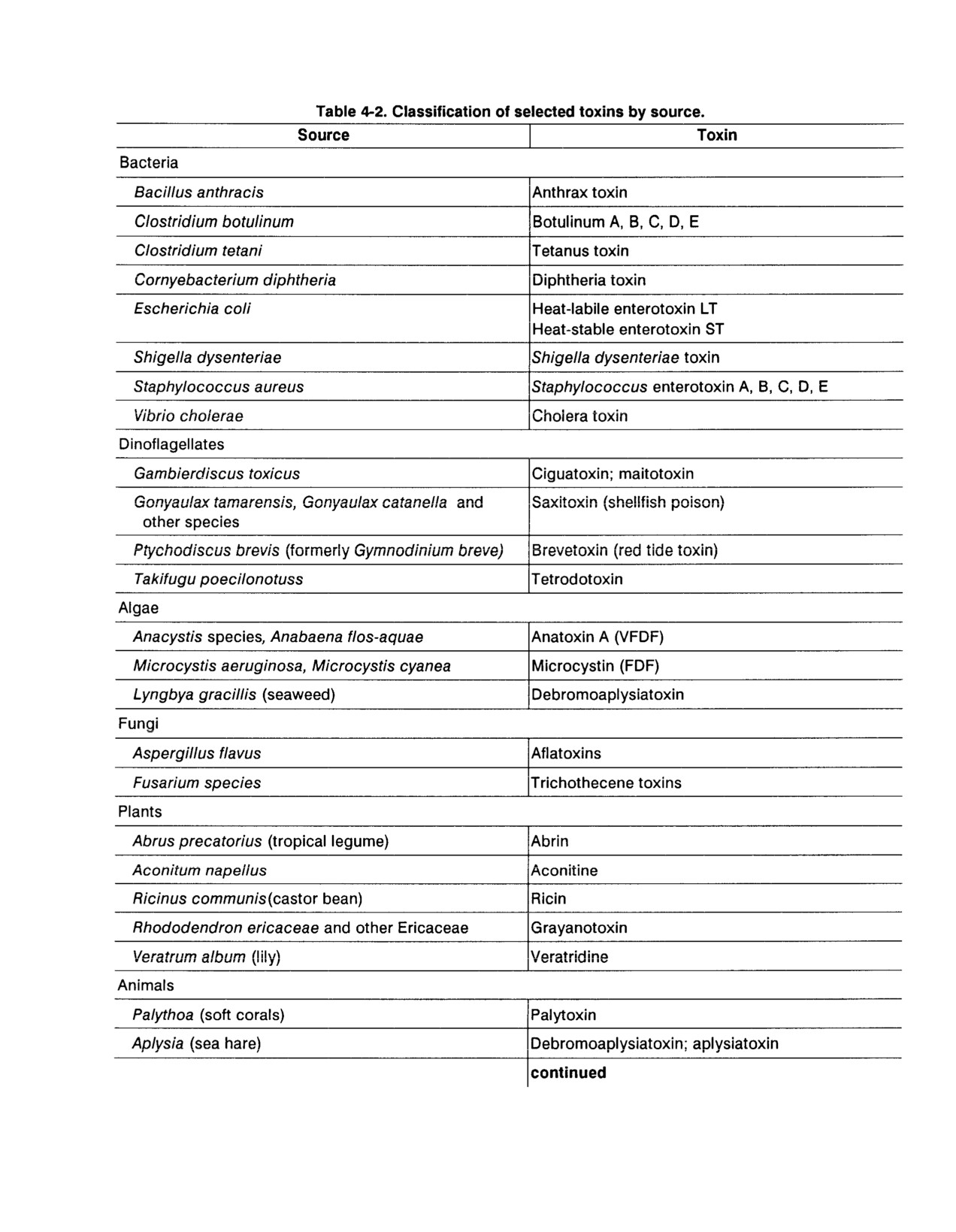
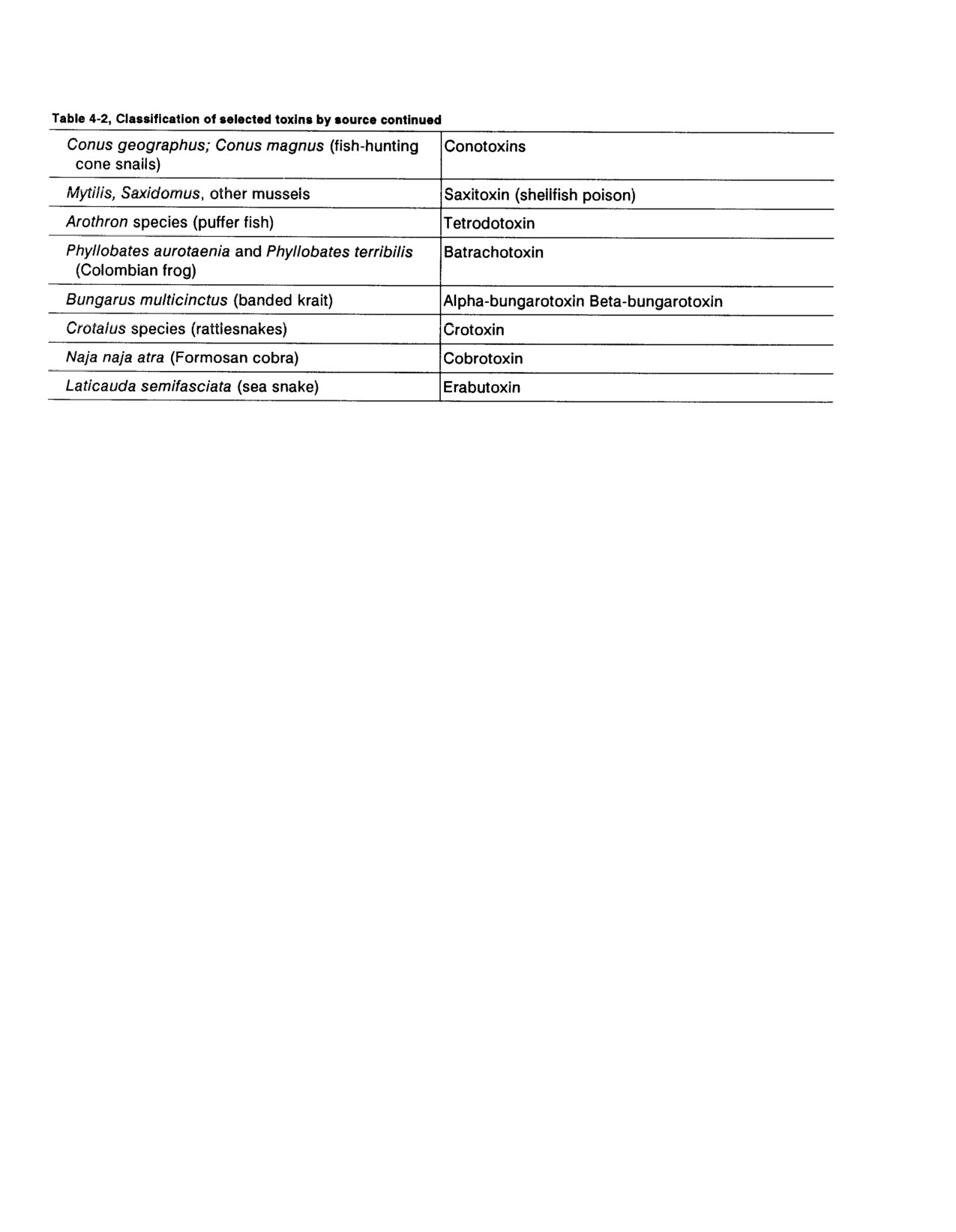
Toxin sources (Table 4-2) include bacteria, dinoflagel-
lates, algae, molds and fungi, plants, and animals. Section
III presents descriptions of specific toxins.
74
FM 3-9
75
FM 3-9
Bacterial
Toxins
Toxins produced by microorganisms cause a number of
tissue. Escherichia coli and Staphylococcus aureus are two
bacterial diseases. In the past these toxins have been
bacterial species that produce heat-stable exotoxins that
classed into two types - exotoxins and endotoxins. Clas-
have their primary action upon the digestive tract
sification of these toxins depends upon their chemical
(enterotoxins). These toxins produce severe nausea, vomit-
composition, resistance to heat, and method of release
ing, and diarrhea, but the possibility of death is remote.
from the pathogen. The toxins produced by microor-
Humans normally acquire these enterotoxins following in-
ganisms may be excreted into the surrounding medium
gestion of contaminated food or water, but these
(exotoxins) or retained with the cell (endotoxins).
enterotoxins may be aerosolized for warfare. Heat, acids,
or alkalies can detoxify many exotoxins because they are
Exotoxins
proteins.
Exotoxins are poisonous compounds that can diffuse
and that the cells that produce them can eliminate into the
Endotoxins
surrounding medium. Bacterial exotoxins are proteins of
Many organisms (particularly certain classes of bacteria)
varied molecular weights. They are a normal part of the
do not elaborate a soluble toxin from the living intact cells.
metabolic activities of the pathogen; some are enzymes.
Instead, their toxins are associated with their cell wall and
Various Clostridium species produce exotoxins associated
are not released until the cell disintegrates. Rickettsiae
with disease. Clostridium botulinum toxins are responsible
prowazekii, which causes typhus fever, produces an en-
for botulism; Clostridium tetani toxins cause tetanus;
dotoxin. This endotoxin causes the rapid destruction of the
Clostndium perfringens (causing gas gangrene) can
red blood cells and increases the permeability of blood
produce ten different exotoxins. Some of these attack and
vessels, resulting in hemorrhage.
destroy red blood cells; others cause death (necrosis) of
Algal Toxins
Algal toxins are by-products of algae. Most algae grow
the normal ecology of an area, contaminate potable water
either in fresh water or in salt water. An algal bloom may
supplies, and contaminate fishing areas of indigenous
produce enough toxin to kill fish or any animals that drink
populations. The physiological effects vary. These effects
the water. The types of molecules involved are diverse,
range from the acute toxicity of paralytic shellfish poison,
ranging from simple ammonia to complicated polypeptides
which produces death in a short period, to those that
and polysaccharides. Production of some is rather easy;
induce tissue changes after long exposure. Several of the
some are quite potent. Little testing has been done on the
toxins have undergone extensive study because of their
ability to weaponize them. No specific means of detection
dramatic effect on sodium-ion channels. These sodium-ion
is available. The greatest potential for the algal toxins as
channels help to control differences between levels of
agents lies in a subversive role. These agents could upset
sodium and potassium ions inside and outside normal cells.
76
FM 3-9
The blue-green algae and dinoflagellates represent the two
nodinium breve (Ptychodiscus brevis) and Gonyaulax are
groups with the greatest potential as biological agents.
primary sources of toxins. Their toxins are best known in
the United States as the causes of red tide and paralytic
Blue-Green Algae
shellfish poisoning (saxitoxin). A dinoflagellate (Takifigu
Algae in this group are very similar to bacteria. The
poecilonotus) may produce tetrodotoxin, associated with
group contains most of the toxic freshwater algae along
puffer fish.
with some of the toxic marine species. At least eight genera
Several basic differences exist between the red tide toxin
have exhibited toxic characteristics. The toxins of the blue-
and saxitoxin. The red tide toxin is an endotoxin; it is
green algae Microcystis, Anabaena, and Aphanizomenon
insoluble in water and very unstable. Saxitoxin is an ex-
affect the nervous system and represent potential sources
otoxin; it is very water soluble and stable to heat and acids.
of agents. Examples of toxins from blue-green algae in-
Saxitoxin had been believed to be the most potent algal
clude Anatoxin A, microcystin, and debromoaplysiatoxin.
toxin known. However, maitotoxin from the dinoflagellate
Gambierdiscus toxicus is now believed to be the most
Dinoflagellates
potent marine toxin.
Most of the toxic dinoflagellates are marine organisms
within the range of 40 to 60 microns in diameter. Gym-
Mycotoxins
Mycotoxins include a wide variety of chemical substan-
more likely of mixtures of agents than of a single agent;
ces produced by molds or fungi. The toxins are exotoxins.
these mixtures come from crude biological extracts.
Many molds produce more than one toxin, and in
numerous cases, combinations of mycotoxins enhance
Aflatoxins
toxicity. Many of these toxins and/or their producing
Aflatoxins are toxic nonproteinaceous compounds
species are threats as anticrop or antianimal agents. Some,
produced by strains of Aspergillus flavus. Natural grain
however, are threats as antipersonnel agents.
contamination by the fungus and its toxin represents a
Trichothecene mycotoxins, aflatoxins, and tremorgens may
serious problem in the USSR and other countries of the
be of greatest concern.
world. Aflatoxins are not only toxic; they also induce can-
cers, malformations, and mutations. Because their effects,
Trichothecenes
although severe, are relatively slow to appear, aflatoxins
The trichothecenes came to the attention of the military
may not be viable as agents. The aflatoxins have enhanced
primarily because of reports in the mid-1970s of yellow
effects in combination with other mycotoxins, notably with
(and other color) powder, dust, and “rain” incidents in
T-2 toxin.
Southeast Asia. Historically, the main interest in
trichothecenes resulted from health problems in humans
Tremorgens
and animals after they ate food contaminated with molds.
Tremorgenic mycotoxins affect the nervous system; they
Fusarium, Stachybotrys, and related fungi that infect food
produce severe trembling and loss of coordination and
and grains, such as corn, rye, barley, oats, millet, straw, and
consciousness. Some Aspergillus and Penicillium molds
hay, produce the toxins. These toxins are easily produced
produce tremorgenic mycotoxins. Tremorgens probably
and moderately potent. They cause damage by ingestion,
cause naturally occurring disorders of cattle and sheep
by eye or skin contact, or by inhalation. They are highly
known as “staggers.” Symptoms appear in laboratory
persistent and difficult to decontaminate. T-2 toxin is a
animals in about 30 minutes. Tremors and hypersensitivity
highly toxic member of the very large family of
to stimuli, such as noise or touch, usually last from 4 to 24
trichothecene mycotoxins. This manual describes it chiefly
hours and then subside. At lethal dosages animals have
because of it has been identified in the areas of attack; it
intermittent seizures leading to death. Some tremorgens
also is a specifically defined chemical that chemical or
cause immobility that may last for hours; recovery follows,
biological means can produce. However, employment is
and the victim appears to be normal.
Plant Toxins
Many plants have parts that are poisonous if they enter
certain lipid-soluble toxins from members of the lily family.
the body. Potential agents include the proteinaceous toxins
See descriptions under Ricin.
ricin and abrin (from castor beans and Abrus seeds) and
77
FM 3-9
Animal Toxins
A number of animals produce toxins that are described
tetrodotoxin from puffer fish. Snake venoms also contain a
in this manual. These toxins include batrachotoxin from the
large variety of toxic substances that affect nerves or
Colombian frog, palytoxin from soft corals, saxitoxin from
damage muscles and membranes.
various shellfish, conotoxins from marine snails, and
Section III. Specific Toxin Characteristics
This section describes specific toxins. Descriptions in-
also include the rate of action, mode of action, toxicity,
elude the use, source, physical and chemical properties,
stability, decontamination, and comments where ap-
route of entry, symptoms, and treatment. The descriptions
plicable. Figures show the structures of some of the toxins.
Anatoxin A (Very Fast Death Factor; VFDF)
Use
Mode of Action
Anatoxin A is a lethal, very rapid, paralytic neurotoxin.
This toxin binds to the same receptor as acetylcholine; it
stimulates the nerves and muscles in a similar manner.
Source
Acetylcholinesterase does not hydrolyze Anatoxin A, so
A freshwater, blue-green algae, Anabaena flos-aquae
stimulation continues until the neuron becomes
produces Anatoxin A. Culturing the algae can produce
depolarized. Evidence shows that this toxin also inhibits
significant quantities of Anatoxin A. Chemical synthesis
acetylcholinesterase.
could probably produce large quantities.
Toxicity
Physical and Chemical Properties
The LD50 in mice ranges from 170 µg/kg to 250 µg/kg,
Anatoxin A is a bicyclic alkaloid with a molecular weight
when injected intraperitoneally (ip). Dermal LD50 is
of 165. It is water-soluble, but heat, light, and alkalies will
greater than 2,100 µg/kg oral LD50 is 5,000 µg/kg. The CAS
destroy it.
registry number is 64285-06-9, and the RTECS number is
KM5527000.
Route of Entry
This toxin usually enters the body by ingestion. The toxic
Decontamination
algal blooms have caused the deaths of fish, livestock, and
Use hot, soapy water.
birds.
Comments
Rate of Action
The magnitude of
Symptoms begin in less than five minutes.
the threat from
Anatoxin A depends
Symptoms
on its toxicity. If the
When ingested, Anatoxin A causes symptoms typical of
toxicity for humans is
chemical nerve agents. These symptoms are twitching, in-
equal to the value for
coordination, tremors, paralysis, and respiratory arrest.
mice, this toxin could
Death results from paralysis; it may occur within minutes
be a serious threat. If
or up to three hours, depending upon the dose. Death in
the human toxicity is
closer to that for
mice occurs in two to five minutes.
ducks (LD50 of 50
Treatment
mg/kg ip), the threat
There is no specific treatment.
is considerably less.
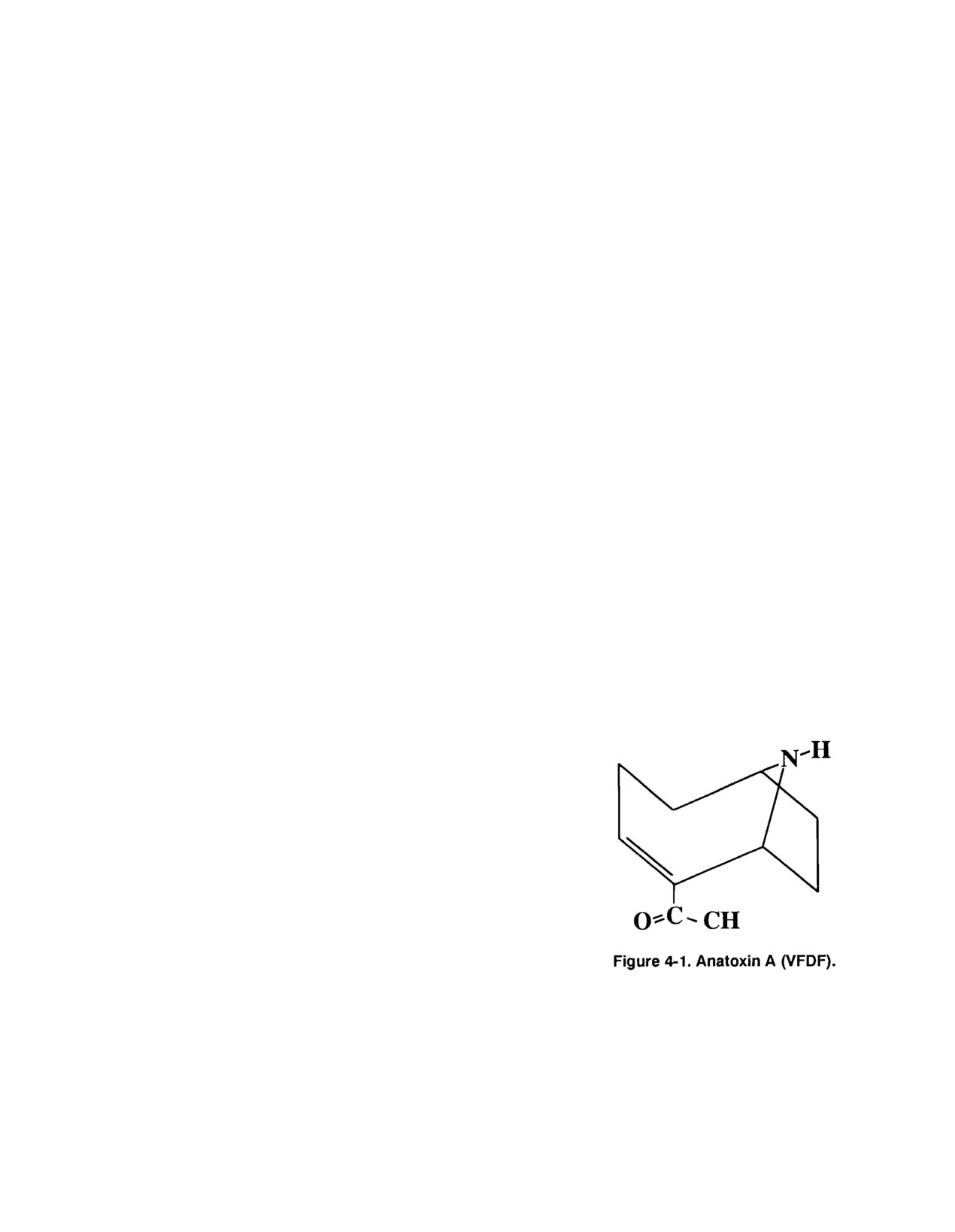
Figure 4-1 shows the
structure.
Batrachotoxin
Use
Source
Batrachotoxin is a rapid-acting, lethal, paralytic
Batrachotoxin comes from the skin of the Colombian
neurotoxin.
arrow frog (Phyllobates aureotaenia and related species).
78
FM 3-9
South American Indians cover the points of hunting darts
heart rhythms, convulsions, and cyanosis (bluish skin) in
with a mixture of toxins secreted by these frogs. Dried
rapid succession. A lethal dose in mice causes death in five
natural toxin remains active for at least a year. Chemical
to ten minutes by respiratory failure.
synthesis can produce the toxin.
Treatment
Physical and Chemical Properties
Victims should receive general supportive care. They
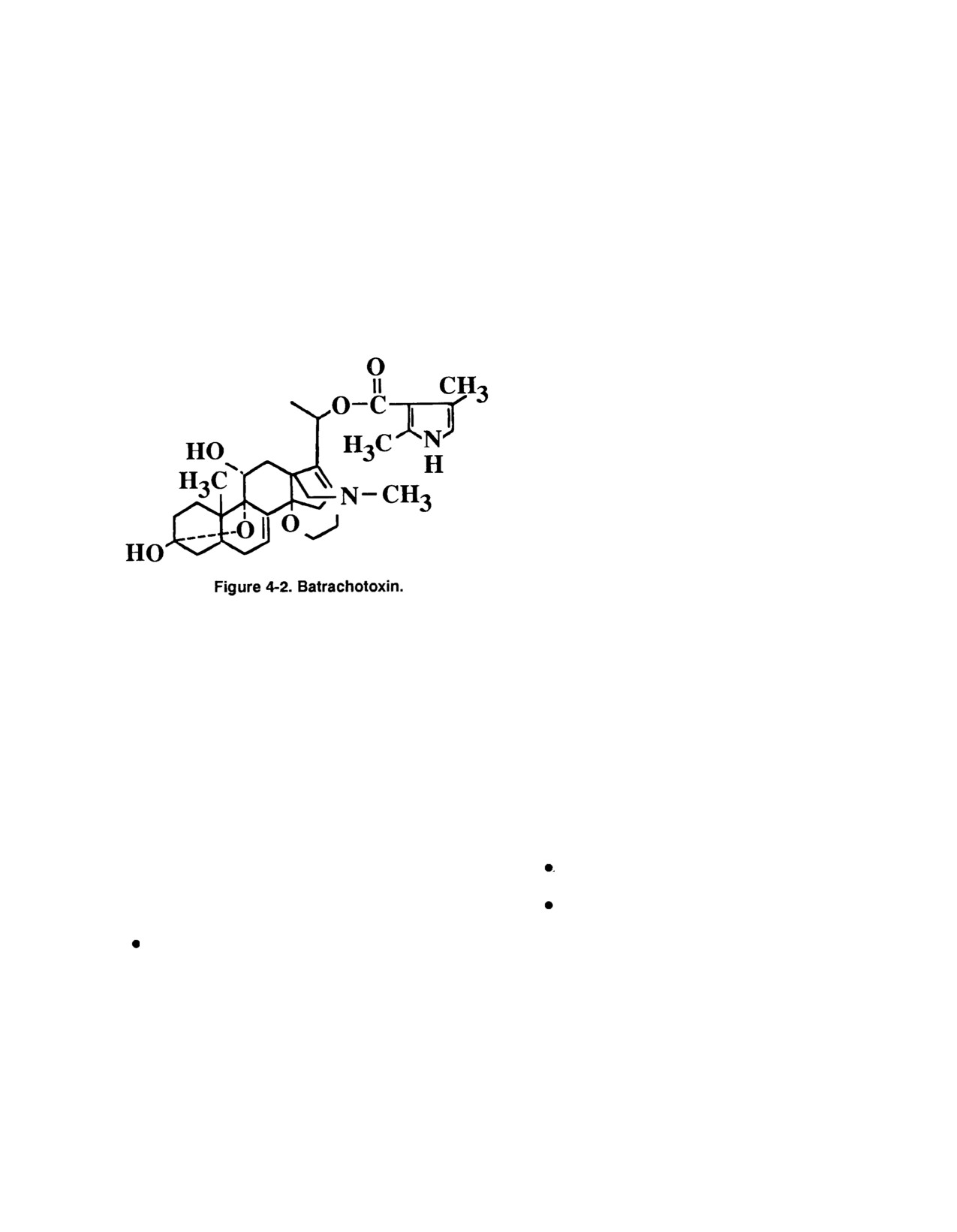
Batrachotoxin is a nonprotein, three-ring compound. It
may require artificial respiration and/or cardiac resuscita-
has a low molecular weight of 538. Batrachotoxin is not
tion and support. No antidote or antitoxin is available. In
soluble in water; however, it can dissolve in nonpolar or-
laboratory cultures tetrodotoxin blocks the effects of this
ganic reagents, such as fuels, fats, and oils. Because
toxin.
batrachotoxin is lipid-soluble, it is probably cumulative in
the body. Figure 4-2 shows the structure.
Mode of Action
Batrachotoxin binds to sodium channels of nerve and
muscle cells. It inhibits closure of the channels so the
neuron becomes completely depolarized and unable to
transmit a signal.
Toxicity
Batrachotoxin is about 10,000 times more lethal than
Sarin. Its LD50 is 0.1 to 2 µg/kg intravenously (in mice).
Combining batrachotoxin with scorpion venom makes it
twenty times more toxic. The CAS registry number is
23509-16-2, and the RTECS number is CR3990000.
Stability
Batrachotoxin is stable under both acidic and moderate-
ly alkaline conditions and is more active under alkaline
Route of Entry
conditions. It is somewhat nonpersistent.
In experiments, this toxin is usually injected. Inhalation
effects should be similar.
Decontamination
Use soap and water to remove contamination from per-
Rate of Action
sonnel. Because the toxin is nonpersistent, equipment
Batrachotoxin is rapid acting.
would likely not require decontamination. Should decon-
tamination prove necessary, use organic solvents if soap
Symptoms
and water are not available.
When given to animals, batrachotoxin causes loss of
balance and coordination, profound weakness, irregular
Other Similar Toxins
Veratridine, Aconitine, and Grayanotoxin are lipid-
Aconitine comes from the plant Aconitum napellus; its
soluble, channel-activating toxins similar to batrachotoxin;
molecular weight is 633.
they probably have a common site and similar mechanism.
Grayanotoxin comes from the leaves of rhododendron
These toxins are much less toxic than batrachotoxin.
and other Ericacae; its molecular weight is 398.
Veratridine is the most potent of the lipid-soluble toxins.
It comes from the lily family, genus Veratrum; its
molecular weight is 673.
Botulinum Toxin
Use
gases. It causes botulism, a specific and often fatal food
Botulinum toxin is a lethal, delayed-action, paralytic
poisoning. Dispersion could be by aerosol.
neurotoxin. It is considerably more poisonous than nerve
79
FM 3-9
Source
symptoms include difficulty swallowing and speaking,
Botulinum comes from the bacteria Clostridium
blurred or double vision, sensitivity to light, and muscular
botulinum and Clostridium parabotulinum. These bacteria
weakness progressing from the head downward. In severe
are rod-shaped, slightly motile, spore-forming, gram-posi-
cases, death results from respiratory paralysis. All person-
tive, anaerobic bacilli. The principal reservoir of these
nel possibly exposed to the toxin should seek immediate
bacteria is soil. Because these bacteria cannot grow in the
medical attention, because it is difficult to treat once
presence of oxygen, natural encounter with the toxin is in
symptoms appear.
improperly preserved, canned foods. The bacteria grow
and produce toxin while the food sits on the shelf. Growth
Treatment
requires a neutral to moderately alkaline medium. Acid
Medical care consists of supportive measures, including
conditions reduce the resistance of the bacteria to steriliza-
mechanical respiration. Antitoxin is available; its ad-
tion by heat, which helps explain why outbreaks never
ministration should take place immediately upon suspect-
implicate preserved acid fruits. Large-scale production is
ing botulism poisoning. Upon recognizing a case of
possible.
botulism, immediately search for all other possibly exposed
persons. Treatment after severe symptoms set in is usually
Physical and Chemical Properties
ineffective; the antitoxin will not reverse existing paralysis.
Botulinum toxin is a large protein (molecular weight
Recovery is very slow, and several months may pass before
900,000) that has smaller subunits of molecular weights
a victim regains certain muscle movements.
from 70,000 to 150,000. There are seven known types of
toxin (A through G); type A is of greatest military interest.
Mode of Action
The molecular weight of type A toxin is 150,000. The struc-
Botulinum toxin inhibits acetylcholine release. The toxin
tures of botulinum and tetanus toxins are very similar.
is highly specific for the nerve-muscle junctions and synap-
Purified toxin may be a white powder or a colorless
tic ganglia. The toxin acts presynaptically. Botulinum toxin
needlelike crystal. It readily dissolves in water when finely
probably does not cross the blood-brain barrier.
powdered. It is stable in solution up to seven days when
protected from heat and light. It can be used in solutions
Toxicity
or freeze-dried as a powder.
This toxin is among the most potent biological toxins
known. The exact lethal dose for humans is unknown, but
Route of Entry
it may be as low as 1 to 10 nanograms. Mortality rate is 60
This toxin normally enters the body through the digestive
percent or higher. Animal studies show an LD50 of 0.001
system in contaminated food. Fresh, well-cooked foods are
to 1 ng/kg. The LD50 in mice is about 0.3 ng/kg. Humans
not involved, as heat destroys the toxin. The bacteria do not
are less sensitive to botulinum toxin than mice are. The oral
grow or reproduce in the human body poisoning comes
LD50 for humans is about
1 µg/kg. Studies show that in-
entirely from the toxin already formed in the ingested
haled toxin is ten times to a hundred times more toxic than
material. Botulinum toxin differs from other bacterial
ingested toxin. The RTECS number is ED9300000.
toxins in that digestive tract secretions do not destroy it.
The toxin could possibly enter the body through breaks in
Stability
the skin or by inhalation, as in the case of laboratory
The persistency of this toxin varies. Botulinum toxin
accidents. Botulinum toxin in its powder form lends itself
decomposes within 12 hours in the air. It is stable for a week
to entry by inhalation or contamination of wounds.
in nonmoving water. It may persist indefinitely in food
when not exposed to air. This toxin is probably not UV-light
Rate of Action
sensitive; it is easily stabilized to environmental conditions.
Symptoms usually begin 12 to 72 hours after ingestion of
However, heat may destroy the toxin.
contaminated food; the delay may range from 2 hours to 8
days. The delay in symptoms depends upon the amount of
Decontamination
toxin and its absorption from thedigestive tract. If toxin
Basic skills decontamination for personnel would prove
dispersal is by aerosol, the onset is much more rapid
effective in neutralizing this toxin. If mustard may be
(averaging 3 to 6 hours), although symptoms remain the
present, use a l-percent to 2-percent hypochlorite solution
same. Introduction of botulinum through the skin is unlike-
(from household bleach, STB, or HTH). The toxin can
ly unless the skin is broken.
withstand acids, but bleach or other alkaline solutions can
destroy it. This toxin is sensitive to heat. Boiling for 15
Symptoms
minutes or, when in food, cooking for 30 minutes at 80°C
Initial symptoms include weakness, malaise, dizziness,
(176°F) will destroy it.
and in some cases nausea and profuse vomiting. Other
80
FM 3-9
Comments
great hazard, Immunization with botulinum toxoid is pos-
Because of its intense toxicity, water volubility, and dif-
sible for types A through E.
ficulty in detection, this agent could present a particularly
Other Clostridium Species
Other Clostridium species, which are anaerobic spore-
street dust, or feces. The purified (crystalline) toxin is
forming bacteria that produce toxins, include Clostridium
relatively unstable and very sensitive to heat. Its toxicity is
tetani and Clostridium perfringens. Employment of these
about the same as crystalline botulinum toxin. The lethal
toxins is less likely. Clostridium tetani produces tetanus
oral dose for humans is probably 0.2 to 0.3 mg. Clostridium
toxin, a lethal delayed-action paralytic neurotoxin, causing
perfringens toxin causes gas gangrene in tissues surround-
“lockjaw.” Tetanus toxin is produced after introduction of
ing a wound. Clostridium perfringens is similar to tetanus in
the tetanus spores into the body. They grow at the site of
its mode of transmission.
an injury, usually a puncture wound contaminated with soil,
Conotoxins
Conotoxins are small, proteinaceous neurotoxins from
aerosols. Alpha-conotoxin blocks the acetylcholine recep-
fish-hunting sea snails (Conus). The toxins are 13 to 14
tors and produces extreme muscle weakness (flaccid
amino acids long; they can easily be chemically synthesized
paralysis) and respiratory and circulatory failure. The
or produced by genetic engineering. Conotoxins are water-
LD50 in mice is 15 to 30 µg/kg. The estimated lethal dose
soluble and highly stable; dissemination could be by
for humans is 3 to 6 µg/kg.
Microcystin (Fast Death Factor; FDF)
Use
Symptoms
Microcystin is a lethal, rapid-acting cytotoxin.
Microcystin causes severe and rapid liver damage with
resulting shock, liver enlargement, and death in a matter of
Source
hours. Symptoms would vary with the dose received.
A freshwater, blue-green alga, Microcystis (Polycystis)
Symptoms in test animals include shivering and increased
aeruginosa, produces microcystin. Other freshwater, blue-
breathing rate and depth. These symptoms precede muscle
green algae may also produce it. Lyophilized (freeze-
twitching, convulsions, and gasping respiration before
dried) microcystin retains its toxicity. See comments.
death. In test animals given twice the lethal dose, death
occurs one to three hours after exposure.
Physical and Chemical Properties
Microcystin appears to be a family of small, cyclic pep-
Treatment
tides. The most common toxin in the family has a molecular
Victims should receive general supportive care. No an-
weight of 994; others are similar. Microcystin is derived
tidote or antitoxin is available. Substances that protect
from a polypeptide with a molecular weight of 1,790 to
against the mushroom alkaloid phalloidin (for example,
2,950. It is soluble in water, acids, bases, and some polar
rifampicin and deoxycholate) reduce cell deformation.
solvents, such as alcohol and acetone.
Mode of Action
Route of Entry
Microcystin deforms and disrupts cell membranes in the
Microcystin is potent in air-dried material. If Threat
liver. Test animals have shown extensive liver damage lead-
forces use it as a warfare agent, it would presumably enter
ing to circulatory collapse.
the body through the respiratory system. There are reports
of human exposure in which the victims drank water from
Toxicity
contaminated reservoirs.
Its LD50 in mice is 25 to 100 µg/kg (ip) with a survival
time of 30 to 90 minutes. The LD50 is much higher by oral
Rate of Action
or dermal routes. Each gram of lyophilized cells contains
See symptoms.
about 1 to 4 milligrams of toxin; toxicity of cellular material
is about 50 mg/kg. The RTECS number is XW5810000.
81
FM 3-9
Stability
Comments
Microcystin is heat-stable when dry but unstable to heat
We know relatively little about the physical and chemical
when wet. It is stable to acid but sensitive to highly alkaline
properties of this toxin. However, reports indicate the
conditions.
Soviets have done considerable research with it. Toxicity
appears to be associated with a plasmid. If it is, it should
Decontamination
be possible to clone the gene and have it expressed in
Use large amounts of soap and water. Because microcys-
another organism.
tin is soluble in water and sensitive to alkalies, large
amounts of water, STB, or DS2 will decontaminate supplies
and equipment.
Palytoxin
Use
Physical and Chemical Properties
Palytoxin is a lethal, rapid-acting neurotoxin.
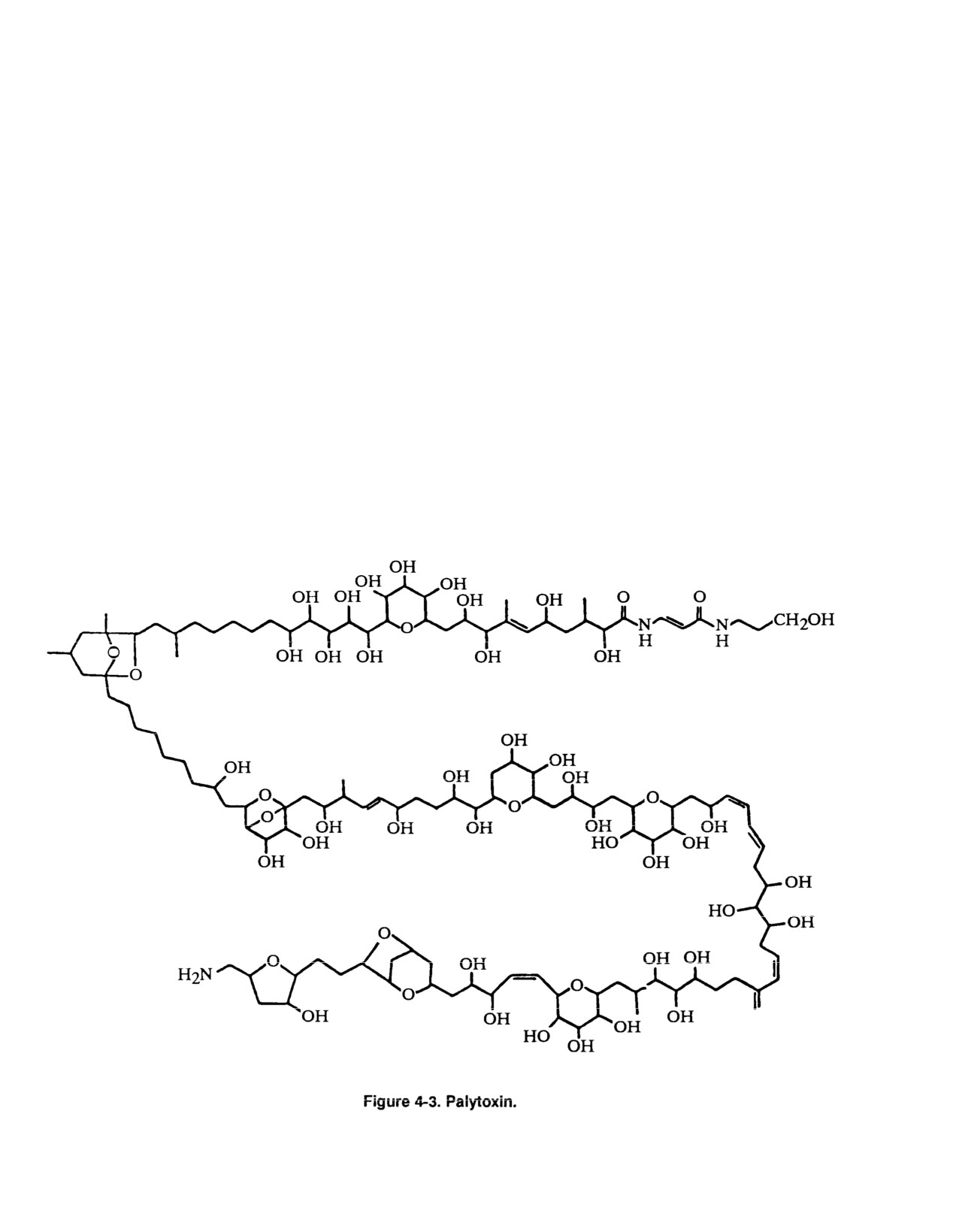
Palytoxin is a relatively large, nonproteinaceous toxin; its
molecular weight is 2,677. It is a polyhydroxy, long-chain
Source
macromolecule with a cyclic structure. It is soluble in water
A bacterium associated with soft corals of the genus
or alcohol. See Figure 4-3 for the structure.
Palythoa, which inhabit the digestive tract of filefish,
produce palytoxin. It can be isolated from the corals. See
comments.
82
FM 3-9
Route of Entry
tions exhibits delayed effects, causing the disintegration of
This toxin could enter the body by inhalation (as aerosol-
red blood cells.
ized toxin), ingestion, or absorption through the skin or
eyes. Absorption through intact skin requires high doses.
Toxicity
The LD50 is about 0.08 µg/kg in monkeys, 0.2 µg/kg in
Symptoms
cats, and 0.4 µg/kg in mice. Mouse LD50 through the skin
There have been no reported cases of human poisoning.
is 1,270 µg/kg. The CAS registry number is 11077-03-5, and
Experimental animals show symptoms of drowsiness,
the RTECS number is RT647500.
weakness, vomiting, respiratory distress, diarrhea, convul-
sions, shock, low body temperature, and death within 30 to
Stability
60 minutes after intravenous injection. Death may result
Palytoxin is stable to heat, acids, and alkalies.
from constrictions of the blood vessels of the heart.
Decontamination
Treatment
Because of the stability of this toxin in a variety of
Victims should receive general supportive care. There is
conditions, decontamination should include large amounts
no definitive human treatment. However, rapid ad-
of water.
ministration of steroids has reduced the severity of effects.
Comments
Mode of Action
The exotic nature of the biological source limits the
This toxin has a very potent effect on the coronary artery.
possibilities for extraction of this toxin. However, advances
It apparently causes irreversible depolarization of nerve
in genetic engineering could make the manufacture of this
and muscle tissue by an unknown mechanism, possibly
toxin possible.
affecting sodium channels. Palytoxin in high concentra-
Ricin
Use
Rate of Action
Ricin is a lethal, delayed-action cytotoxin; it is persistent
Initial symptoms usually appear between 6 to 10 hours
in the environment.
and 3 days. Clinical signs appear as early as 45 minutes after
oral administration if the victim has an empty stomach.
Source
This toxin comes from the seeds of the castor bean plant,
Symptoms
Ricinus communis. This relatively inexpensive, accessible,
The symptoms may include nausea, vomiting, bloody
natural source allows easy preparation of large quantities
diarrhea, abdominal cramps, breathing difficulty, renal
of ricin; therefore, there is little motivation to produce it
failure, and circulatory collapse. Victims may linger for 10
synthetically. Large-scale production of ricin by recom-
to 12 days before death or recovery, depending upon the
binant DNA techniques is probably possible.
dose received.
Physical and Chemical Properties
Treatment
Ricin is a lectin - a plant glycoprotein that binds and
Victims should receive general supportive care includ-
agglutinates animal cells. This toxin has a molecular weight
ing fluid input and support of circulation and respiration.
of 65,000. It consists of two polypeptide chains linked by a
Antitoxin is available; its early administration is necessary
disulfide bond. It is soluble and stable in water or dilute
to prevent severe tissue damage. Fluid input is critical, as
acid.
fluid losses of up to 2-½ liters are probable.
Route of Entry
Mode of Action
Ricin normally enters the body by ingestion. Aerosolized
Ricin inhibits protein synthesis.
ricin would enter the body by inhalation. The toxin attaches
to cell surfaces of a variety of tissues, particularly the
Toxicity
stomach lining if ingested or the moist, upper respiratory
The oral LD50 for humans is 1 mg/kg; a single seed can
tissues if inhaled.
be fatal. The LD50 in mice is about 3 µg/kg by injection or
aerosol. The CAS registry number is 9009-86-3, and the
RTECS number is VJ262500.
83
FM 3-9
Stability
Comments
Ricin is stable in water or dilute acid.
Immunizations are highly effective in animals.
Decontamination
As for most other toxins, use soap and water to remove
contamination from personnel, equipment, and supplies,
Saxitoxin (Paralytic Shellfish Poison)
Use
Symptoms
Saxitoxin is a lethal, rapid-acting, paralytic neurotoxin.
Ingested saxitoxin causes tingling or burning sensations
of the lips, face, and tongue. The sensations occur in finger-
Source
tips and gradually change to numbness, spreading to the
The first isolation of saxitoxin was from the toxic Alaska
arms, legs, and neck. Incoordination and associated
butter clam, contaminated by dinoflagellates of the genus
symptoms may occur. These associated symptoms include
Gonyaulax. (Shellfish and mussels become contaminated
a feeling of lightness, dizziness, vomiting, nausea,
while feeding on them.) Recently puffer fish that had in-
headache, drooling, rapid pulse, and abdominal pain.
gested Protogonyaulax revealed saxitoxin. The toxin has
Severe, generalized muscle weakness (flaccid paralysis)
also been identified in a freshwater, blue-green alga. See
can lead to death from respiratory failure in 1 to 24 hours.
comments.
If the casualty survives 18 hours, recovery is usually rapid
and complete.
Physical and Chemical Properties
This nonprotein compound is structurally related to
Treatment
tetrodotoxin. Saxitoxin normally appears as the
Induce vomiting and provide general supportive care.
dihydrochloride salt, a white powder that would lend to its
Artificial respiration may be necessary. Faulty identifica-
use in an aerosol. The toxin is very soluble in water and
tion of this toxin as nerve gas with resultant use of atropine
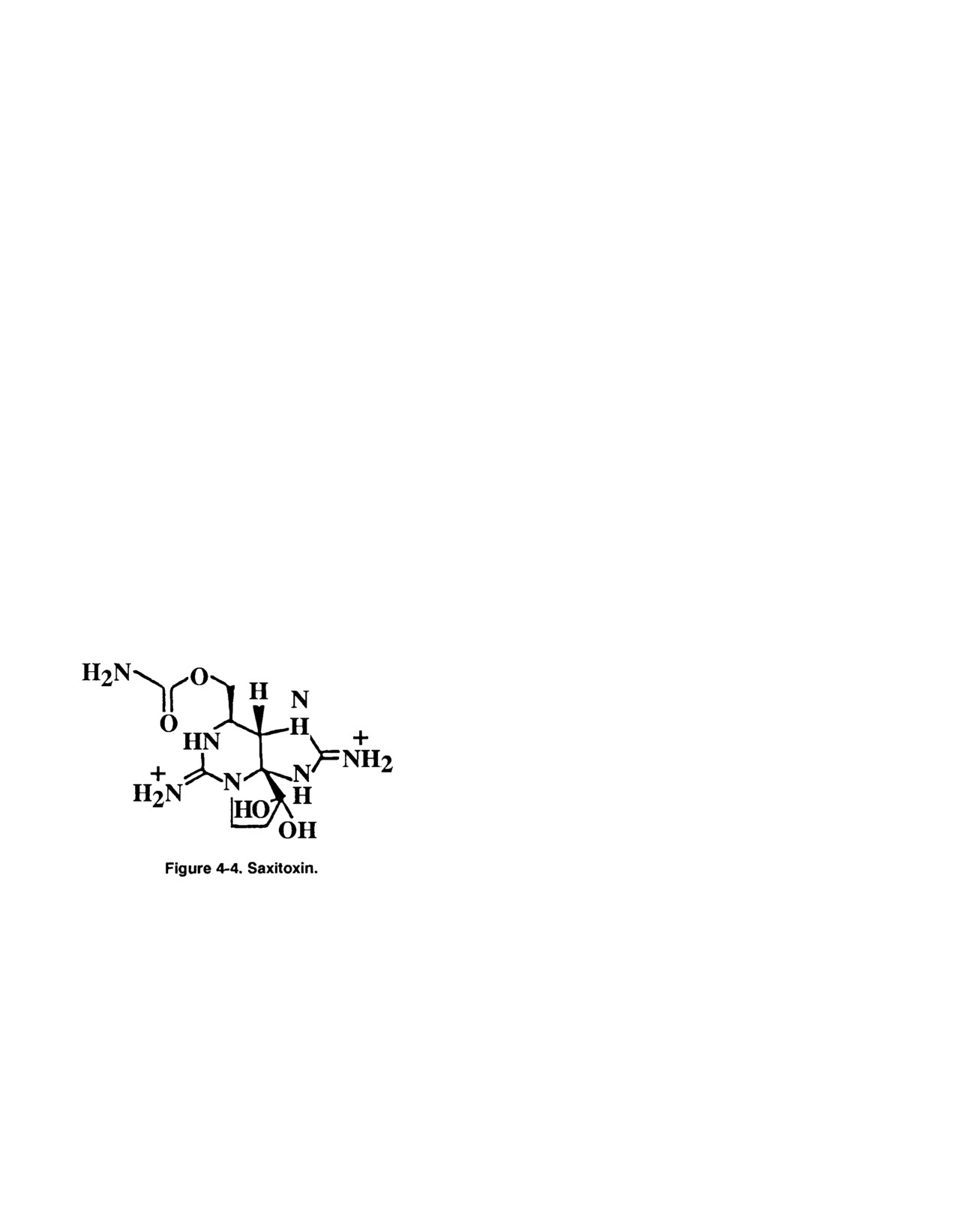
slightly soluble in alcohols. Figure 4-4 shows the structure.
would increase fatalities.
Mode of Action
Upon entry this toxin blocks transient sodium-ion chan-
nels and causes paralysis by blocking depolarization. Its
action is similar to that of tetrodotoxin.
Toxicity
The LD50 in mice is about 1 µg/kg through aerosol
exposure, about 8 µg/kg by injection, and 322 µg/kg orally.
Toxicity in humans (LD50 5.7 µg/kg) is similar to that in
mice when introduction of saxitoxin is directly into the
body. However, to humans it is much more toxic by mouth
(LD50 7 µg/kg), equivalent to direct introduction into the
body. A single contaminated mussel can contain up to 50
Route of Entry
lethal human doses. If aerosolized, the estimated LCt50 by
This toxin usually enters the body by ingestion, but in-
inhalation is 5 mg-min/m³. The estimated LCt50 by wound
halation is also possible. It also can enter the body through
contamination is 0.05 mg/person. As the dihydrochloride
wounds.
salt, the CAS registry number is 35554-08-0. The RTECS
number is UY8708600.
Rate of Action
Symptoms occur between ten minutes and four hours
Stability
(average 30 minutes) after ingestion of this toxin. Inhala-
Saxitoxin is relatively persistent. It is resistant to heat and
tion of the toxin will produce a more rapid onset. Injection
acid but very sensitive to alkaline solutions.
may cause death in less than 15 minutes.
84
FM 3-9
Decontamination
Comments
Decontaminate with soap and water. Any standard
Although chemical synthesis of saxitoxin is feasible, the
decontaminant is also acceptable, because saxitoxin is very
cost would probably prohibit production. Dinoflagellates
sensitive to alkalies.
are difficult to culture. However, production of the toxin
by culturing dinoflagellates will probably become feasible
in the future.
Scorpion Venom Toxins
Use
Treatment
Scorpion toxins are delayed-action neurotoxins.
Atropine counters some toxic effects in vitro (cell cul-
tures). Prevent and treat shock, and provide artificial
Source
respiration. Relieve pain with procaine. Do not use nar-
Toxins can be extracted from various scorpions. Large-
cotics. Barbiturates will lessen patient stress. Antivenin
scale manufacture of scorpion toxins would require genetic
are available, but maximum effectiveness requires ad-
engineering techniques.
ministration within two hours of exposure.
Physical and Chemical Properties
Mode of Action
Scorpion venom consists of a family of small, basic
These toxins disseminate through the bloodstream to the
proteins that are rigid in structure. The chemical structures
nervous system. They modify the sodium-ion channels,
of over 30 distinct scorpion toxins have been identified.
resulting in continuous release of acetylcholine and other
They are very similar with molecular weights of about
neurotransmitters.
7,000. The toxin components are water-soluble and heat-
stable.
Toxicity
The lethality of venom is 0.34 to 1.2 mg/kg in mice. The
Route of Entry
potency of the toxic components varies between species;
These toxins usually enter the body by injection. They
the most potent toxins have LD50 values of 0.02 mg/kg.
could also be aerosolized and would enter the body by
inhalation.
Stability
Scorpion venom would be relatively persistent. Scorpion
Rate of Action
toxins are very stable to heat, acids, bases, and denaturants.
This toxin has a somewhat delayed action; therefore,
They also are stable to enzymes that digest proteins
determining the nature of the attack could be difficult.
(proteases).
Symptoms
Decontamination
Localized pain and swelling usually occur upon injec-
Use soap and water to remove contamination from per-
tion. Mainly, scorpion toxins affect the cardiovascular and
sonnel, equipment, and supplies.
neuromuscular systems, similar to the effects of chemical
nerve agents. Initial symptoms in cases of exposure by
Comments
inhalation are unknown. Eyes may water and vision may
If combined with batrachotoxin and related toxins, the
dim. The pulse rate becomes rapid and irregular, and blood
venom is twenty times more toxic.
pressure increases. Breathing becomes difficult;
respiratory or congestive heart failure may occur in about
20 hours. Rigid paralysis may also result from exposure.
Snake Venoms and Toxins
Use
and coral snakes (elapids) and the rattlesnakes, copper-
Snake venoms consist of a rapid-acting mixture of toxins.
heads, and other vipers (crotalids). Whole snake venoms
are relatively unavailable. The toxins might be more avail-
Source
able. See comments.
A variety of poisonous species could serve as sources for
biological toxins. These species include the cobras, kraits,
85
FM 3-9
Physical and Chemical Properties
Cobra, mamba, and coral snake venoms contain car-
Generally, snake venoms are extremely complex mix-
diotoxins.
tures of water, low-molecular-weight protein toxins, en-
Necrotic toxins from pit viper venoms cause severe local
zymes, and salts. These venoms may contain a variety of
tissue destruction, including muscle destruction and
water-soluble toxins, including neurotoxins, cardiotoxins,
hemorrhaging. Myotoxin destroys muscles but not blood
and toxins that cause severe tissue destruction and hemor-
vessels. Dozens of hemorrhagic toxins, zinc-containing en-
rhage. The mixture of these toxins varies widely between
zymes (proteases) that act on proteins, have been isolated.
species.
The toxic protein components of snake venom vary in
Treatment
size and stability. Some are small proteins (for’ example,
Initial care for victims normally consists of measures for
cobra cardiotoxin with a molecular weight of 6,000 to
the treatment and prevention of shock. The victim should
7,000). Others are much larger (for example, textilotoxin
be calmed and evacuated. Circulation and/or respiration
with a molecular weight of 80,000). Large proteins are
may require support. Antisera are available, and ad-
usually less stable than small ones. Myotoxin is a small
ministration should take place as soon as possible. Ex-
polypeptide (with a molecular weight of 4,600) and is very
perimentally, neostigmine and atropine have been used in
stable. Cobratoxin (molecular weight of about 7,000) is
the treatment of victims of cobra neurotoxin.
relatively heat-stable. However, cardiotoxins (basic
proteins with a molecular weight of 6,000 to 7,000) lose
Mode of Action
their toxicity when heated to 90°C for 30 minutes. Exposure
The neurotoxins usually act by blocking transmission at
to ultraviolet light for 15 to 20 minutes will also cause them
the synapse. The other components have a variety of
to lose their toxicity.
destructive (necrotic and hemolytic) effects against target
tissues.
Route of Entry
Snake neurotoxins inhibit transmission before
These toxins usually enter the body by injection. How-
(presynaptic) or after (postsynaptic) the synapse.
ever, they could possibly be aerosolized and enter the body
Presynaptic inhibitors initially increase acetylcholine and
by inhalation. These toxins disseminate throughout the
then block acetylcholine release, causing a flaccid (limp)
body through the bloodstream and affect target tissues.
paralysis leading to circulatory and respiratory failure.
Venomous snakes, such as the tiger snake and taipan from
Rate of Action
Australia, the Asiatic banded krait, and the South
Snake venoms and toxins produce effects rapidly.
American rattlesnake produce presynaptic neurotoxins.
Postsynaptic inhibitors block the receptor for the
Symptoms
neurotransmitter acetylcholine, almost irreversibly. Ex-
Cobras, kraits, mambas, and coral snakes (elapids)
amples of postsynaptic inhibitors are cobratoxin from the
produce venom that primarily affects the nervous system.
Formosan cobra, erabutoxin from the sea snake, and alpha-
The active compounds of these venoms are neurotoxins,
bungarotoxin from the banded krait.
cardiotoxin, and enzymes. Venoms of most pit vipers, such
as rattlesnakes and copperheads, contain very small
Toxicity
amounts of neurotoxins. These venoms tend to cause
The potencies of snake venoms vary considerably. Varia-
severe local tissue destruction (necrosis), including muscle
tions range from 0.05 mgkg for the brown snake, 0.1 for
destruction, and hemorrhage.
the Taipan, 0.16 for the sea snake, and 0.56 for the cobra
Upon injection of neurotoxic components, initial
to 11.4 for the Eastern diamondback rattlesnake. As little
symptoms usually include pain and swelling at the site of
as 1 to 20 milligrams of a purified toxin component will
injection. Inhalation would probably result in several
usually prove fatal to the average human. The LD50 in mice
symptoms. These symptoms include fluid accumulation in
of some snake toxins are: taipoxin 1 µg/kg; beta-bun-
the lungs, painful and difficult breathing, drowsiness,
garotoxin 14 µg/kg; crotoxin 50 µg/kg; erabutoxin 150
drooping eyelids, blurred vision, vomiting, and difficulty in
µg/kg; cardiotoxin l,500 µg/kg; myotoxin 5,000 µg/kg.
speaking. A severe drop in blood pressure and shock fre-
quently follow. Convulsions and paralysis may occur.
Stability
Death may result from cardiac or respiratory failure or
The complex nature of whole snake venoms should make
shock.
them relatively nonpersistent in the environment. The
Cardiotoxins reduce the blood pressure and heart rate,
stability of the components varies.
cause heart irregularities, and eventually stop the
heartbeat; however, they have no direct neurotoxic activity.
Decontamination
If required, decontaminate with soap and water.
86
FM 3-9
Comments
The isolation or manufacture of individual components
might produce these toxins. Genetic engineering techni-
ques could enhance the process.
Staphylococcus Enterotoxin Type B (SEB)
Use
cially when the loss of body fluids is severe. Difficulty
This toxin is a rapid-acting toxin. The vomiting, diarrhea,
breathing, because of fluid accumulation in the lungs, may
and painful cramps associated with staphylococcal toxins
occur in severe inhalation cases.
make them effective incapacitants. The incapacitating ef-
fects (about a day) would last longer than those of many
Treatment
potential chemical incapacitants.
Rest and fluids will promote recovery. Seek medical care
if there is respiratory distress. Production of an antitoxin
Source
or toxoid vaccine should be possible, although none is
The bacteria Staphylococcus aureus produces
currently available.
Staphylococcus enterotoxin type B (SEB). Staphylococcal
food poisoning usually results from ingestion of the toxins
Mode of Action
rather than ingestion of the bacteria. Foods contaminated
The toxin interacts with receptors in the gut, causing a
with SEB have a normal appearance, odor, and taste. A
massive loss of fluids. The toxin also stimulates intense
potential natural hazard exists in situations involving mass
vomiting.
feedings and lack of refrigeration; improper food handling
is responsible for many natural outbreaks. Large-scale
Toxicity
production of the enterotoxin appears possible by recom-
Animals vary in susceptibility to this toxin. Humans
binant DNA techniques.
appear to be more sensitive to SEB than laboratory animals
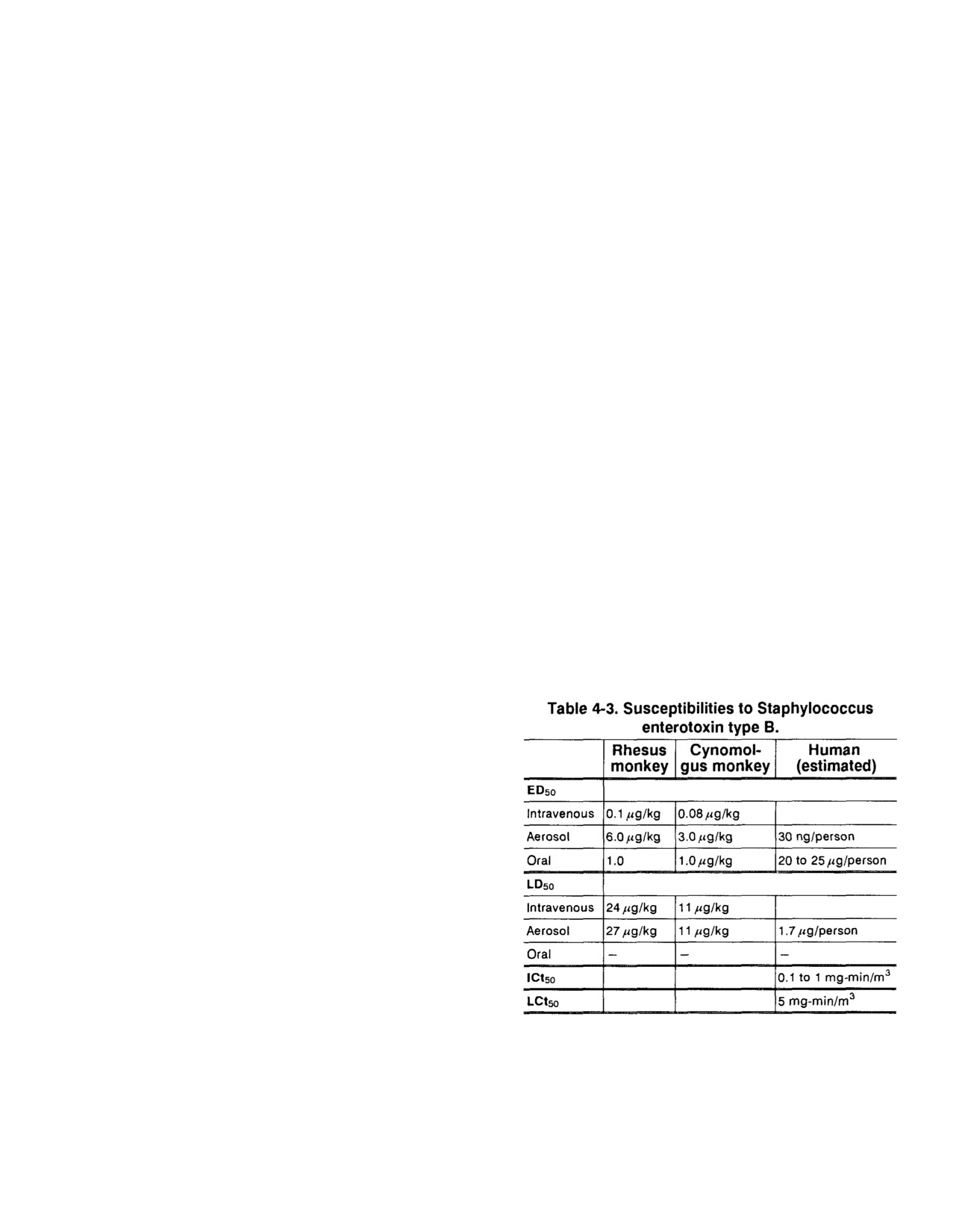
(see Table 4-3). This toxin is unusual in that lethal doses by
Physical and Chemical Properties
ingestion are hundreds of times higher than incapacitating
The staphylococcal enterotoxins are a group of globular
doses. Deaths rarely occur in healthy individuals with nor-
proteins with molecular weights ranging from 27,000 to
mal exposure to this toxin. However, if exposed through
35,000. There are at least eight types: A, B, C1, C2, C3, D,
tactical employment, victims could receive massive doses
E, and F. Purified Staphylococcus enterotoxin, type B is a
that could cause death.
white, fluffy material. The toxin is water-soluble and stable
in heat, cold, acids, and bases.
Route of Entry
Victims normally encounter this toxin as a food poison-
ing. However, inhalation of aerosolized toxin is possible.
Rate of Action
Symptoms usually occur within one-half to six hours
(average three hours) after ingestion. Symptoms can ap-
pear within a few minutes after exposure to large doses by
aerosol. The use of purified toxinwould probably result in
simultaneous incapacitation of all the troops. Use of the
bacteria would produce a longer effect, with some troops
recovering as others became ill.
Symptoms
Victims experience a sudden onset of vomiting, ab-
dominal cramps, nausea, explosive watery diarrhea, and
severe weakness. The symptoms usually continue 6 to 8
hours, rarely longer than 48 hours. Recovery usually occurs
Stability
spontaneously within a day with no residual effects. How-
The toxin resists acids, bases, and chlorine in amounts
ever, the victim may be weak for another few days, espe-
found in potable water. The toxin is quite stable to heat and
87
FM 3-9
freezing its destruction in food or water requires boiling
Comments
longer than 30 minutes. The organisms that produce the
The protective mask provides adequate protection from
toxin remain viable after 67 days of refrigeration.
inhalation of SEB disseminated as an aerosol. In the con-
text of biological warfare, several measures will reduce the
Decontamination
likelihood of casualties. These measures include effective
Use large amounts of soap and water to decontaminate
protection of food and water supplies (and containers for
personnel, equipment, and supplies. SEB is difficult to
transportation of food to remote sites), and the boiling of
decontaminate with active chlorine (STB, HTH). Formal-
all water (even if chlorinated). Measures also include the
dehyde detoxifies SEB.
use of high temperatures for cooking followed by immedi-
ate serving.
Tetrodotoxin
(TTX); Fugu Poison
Use
Symptoms develop more slowly with ingested toxin, taking
Tetrodotoxin is a rapid-acting, lethal, neurotoxic agent.
10 to 45 minutes.
Source
Symptoms
Tetrodotoxin comes primarily from the liver and ovary
Symptoms include nausea, vomiting, dizziness, paleness,
of puffer fish (Arothron). It also comes from some species
and malaise. The victim may experience tingling and prick-
of newt, octopus, frogs, and goby. Dinoflagellates
ling sensations that proceed to general numbness. Weak-
(Takifugu poecilonotus) also may produce it.
ness, dilation of pupils, twitching, tremor, and loss of
coordination follow. Severe, generalized muscle weakness
Physical and Chemical Properties
leading to death by respiratory arrest may occur within
Tetrodotoxin is a water-soluble, three-ring nonprotein
minutes of the onset of symptoms. Symptoms and
compound with a molecular weight of 319. Purified toxin
mechanisms are similar to saxitoxin poisoning, although
may occur as colorless crystals or a white powder (lending
tetrodotoxin also produces severe shock.
itself to aerosol delivery). It is soluble in dilute acetic acid
and slightly soluble in water or ether. Strong acids and in
Treatment
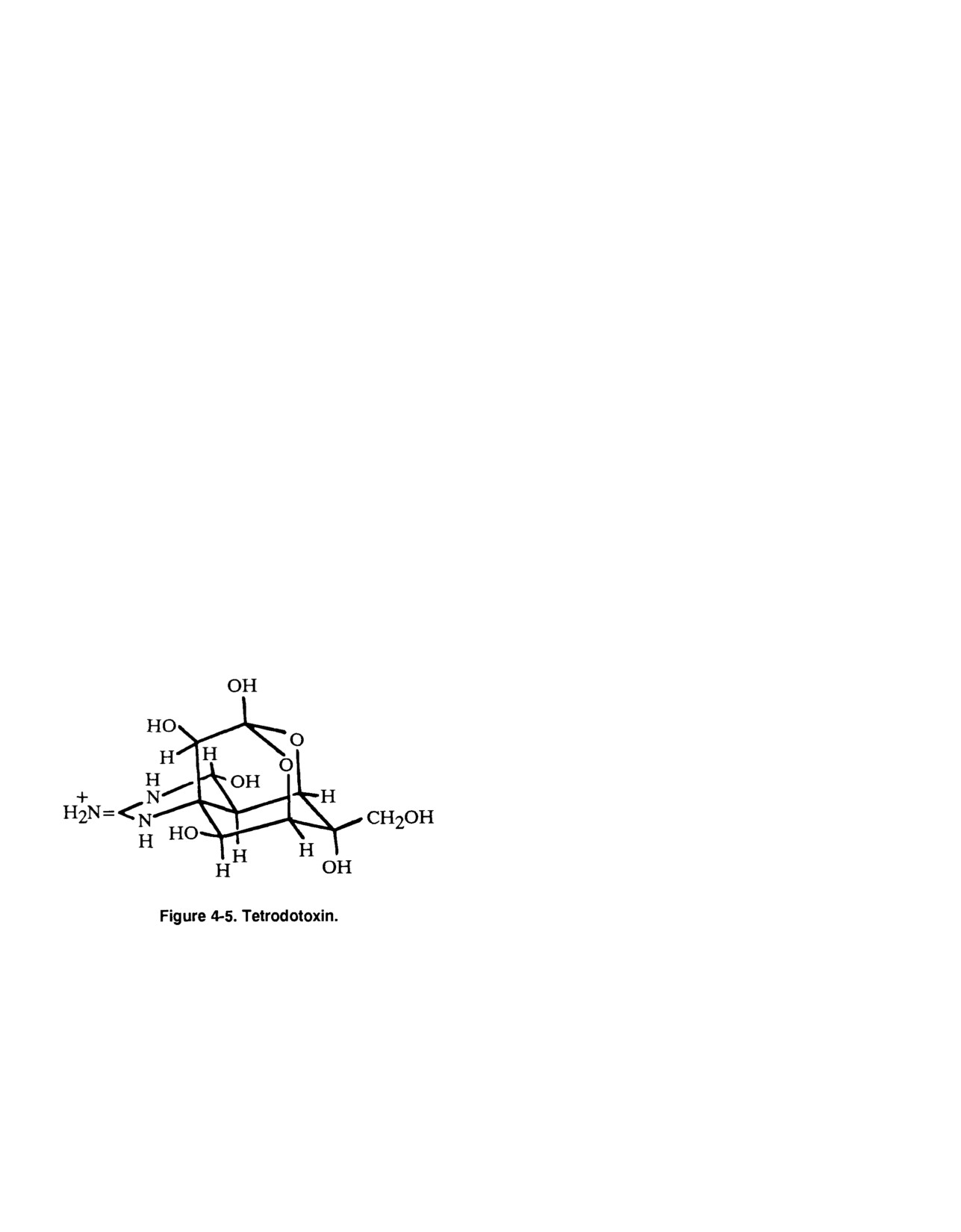
alkaline solutions destroy it. Figure 4-5 shows the structure.
Victims will require general supportive care with par-
ticular attention paid to maintaining respiration. Except at
very high doses, this toxin does not normally affect cardiac
function. No antidote or antitoxin is available. An-
ticholinergics, such as atropine, are not effective.
Mode of Action
Once inside the body, tetrodotoxin inhibits sodium-ion
channels in nerves and muscles. As a result, the nerve
impulse is lost and paralysis occurs. (It does not affect the
neuromuscular junction.)
Toxicity
The inhaled toxin is extremely potent with an LD50 of
about 100 to 200 µg/person (1.5 to 3 µg/kg). Ingested
tetrodotoxin requires a much larger dose (30 µg/kg) be-
cause of the destruction of the toxin by the acid in the
Route of Entry
stomach. The ingested toxin is still highly toxic, however.
The toxin usually enters the body by ingestion, but in-
The oral LD50 in mice is 435 µg/kg. Injected LD50 is 8 to
halation or entry through abraded skin is also possible. See
14 µg/kg in mice, dogs, and rabbits. The CAS registry
comments.
number for tetrodotoxin is 4368-28-9, and the RTECS
number is 101450000.
Rate of Action
The onset of symptoms occurs within minutes after in-
Stability
jection (and presumably after inhalation) of the toxin.
The toxin is stable to heat, but strong acids and alkaline
88
FM 3-9
Decontamination
Comments
Use water with STB to decontaminate equipment. DS2
The Japanese especially value puffer fish, called fugu in
will also break down tetrodotoxin. Decontaminate skin
the Orient, as a delicacy. The sensations of eating fugu
with soap and water.
probably result from the narcotic effect caused by ingestion
of low levels of tetrodotoxin. Tetrodotoxin is common in
Haitian voodoo as a toxin that creates zombies by direct
introduction into the blood through abraded skin.
Trichothecene (T-2) Mycotoxins
Use
the skin or eyes, inhalation (aerosols), or ingestion in con-
Trichothecene (T-2) mycotoxin may be suitable as a
taminated food or water.
nonlethal harassing agent. There is a marked difference
between the very low, effective (incapacitating) dose and
Protection
the high, lethal dose. Therefore, there may be many ill
Upon recognition of an attack or onset of symptoms,
casualties who will not die.
personnel should immediately mask and put on all protec-
tive equipment (MOPP4). Skin exposure to toxins may
Source
result in severe itching. This itching would make the
The trichothecenes are a family of about 40 rapidly
protective mask uncomfortable to wear. If vomiting occurs,
acting, fungal toxins (mycotoxins). They are primarily iso-
a damp cloth held over the nose and the mouth may help
lated from molds of the genus Fusarium found on infected
limit additional inhalation of toxins until the victim can
grain. Harvesting and extracting infected grain can
control the vomiting and redon the protective mask.
produce large amounts of these toxins.
Rate of Action
Physical and Chemical Properties
Time to effects after exposure depends on the dose.
These cytotoxins are nonproteins. Volubility in water or
Initial symptoms may occur within 1 hour after inhalation
other solvents depends on the structure of the toxin (that
or as long as 12 to 24 hours after skin contact. High doses
is, any hydroxyl, acetyl, and ester groups attached). Figure
produce vomiting, dizziness, rapid heart beat, and chest
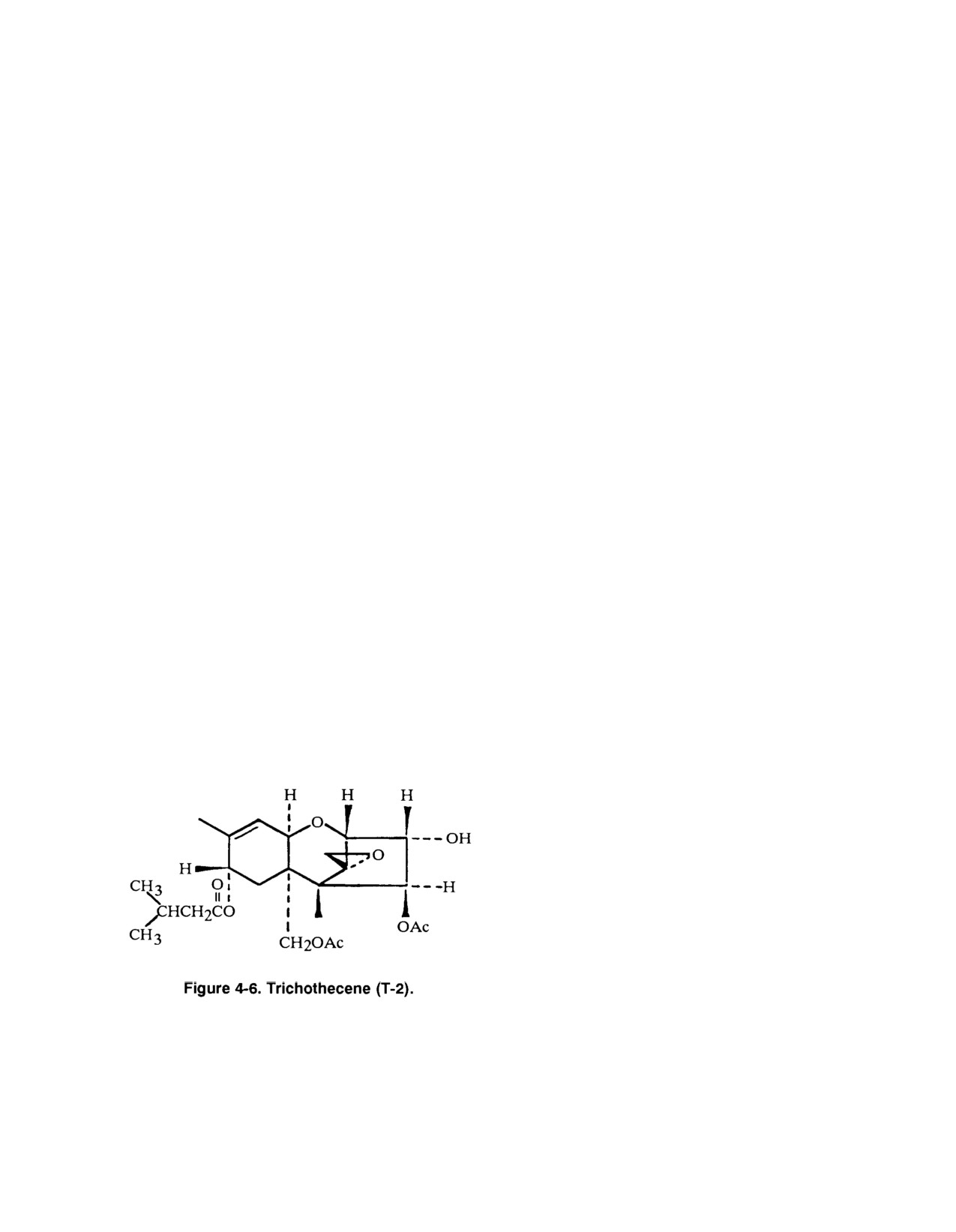
4-6 shows the structure. These toxins are heat-stable, usual-
pain within 10 to 30 minutes. Skin irritation is delayed 12
ly water-soluble, but sensitive to strong acids. Purified T-2
to 24 hours; death may occur within a day. After low,
toxin may occur as colorless crystals or as a clear to yel-
single-dose exposure, peak effects tend to occur in 1 to 3
lowish oil. The molecular weight of T-2 is 466. Figure 4-6
days; skin irritation may be the first symptom.
shows the structure.
Symptoms
Low-dose symptoms include nausea; shortness of
breath; dizziness; eye and skin irritation; formation of
small, hard blisters; and chest pains. Although
trichothecene symptoms may resemble those of blister
agents, nausea commonly occurs with exposure to these
toxins. Trichocethenes are “radiomimetics”; that is, they
mimic the effects of ionizing radiation. High doses can
result in additional symptoms, such as bloody vomit or
diarrhea and blistering of the skin, within hours. Death may
follow rapidly from high doses because of massive hemor-
rhaging and shock, or it may occur weeks later. The delayed
death would result from bone marrow suppression (lead-
ing to anemia and reduction in immunity), liver failure,
and/or internal bleeding.
Route of Entry
Treatment
Dissemination of trichothecenes is likely to be in powder
Victims require general supportive care. No antidote or
or smoke aerosol form or as large, liquid drops as a ground
antitoxin is available. For ingested toxin, repeated doses of
contaminant. (They have sometimes been called “yellow
oral charcoal can be helpful.
rain.”) These toxins enter the body by absorption through
89
FM 3-9
Mode of Action
removing T-2 toxin from the skin. The use of absorbents,
The precise mode of action is unknown. One effect is
such as diatomaceous earth, is not effective.
inhibition of protein synthesis. The toxin also affects clot-
Usually, soap and water will effectively remove toxin
ting factors in the blood, leading to hemorrhage. The most
from equipment and supplies. Total destruction requires
pronounced effects occur in rapidly dividing cells (that is,
strong bleach and sodium hydroxide (NaOH; lye) or strong
blood and bone marrow cells).
acids. STB and DS2 are effective decontaminants (30
minutes at 70°F [21°C] to 80°F [27°C] on nonporous sur-
Toxicity
faces). Household bleach diluted 50 percent with water or
The best estimate for the human lethal dose is 3 to 35
a mixture of bleach, vinegar, and water makes an effective
milligrams. The ED50 for vomiting is 0.1 mg/kg; and for skin
field expedient decontaminating agent for T-2 for a four-
irritation it is tenths of a microgram. Microgram doses can
hour contact time. T-2 resists decontamination even at very
cause irreversible injury to the eyes. Doses as low as 5
high temperatures. If contamination appears oily, fuels
nanograms (10-9 gram) may cause skin irritation. Doses as
would effectively remove it.
low as 14 µg/kg can cause sustained nausea for days.
Aerosol doses may well be ten times more potent than
parenteral doses. The CAS registry number for
trichothecene mycotoxins is 21259-20-1, and the RTECS
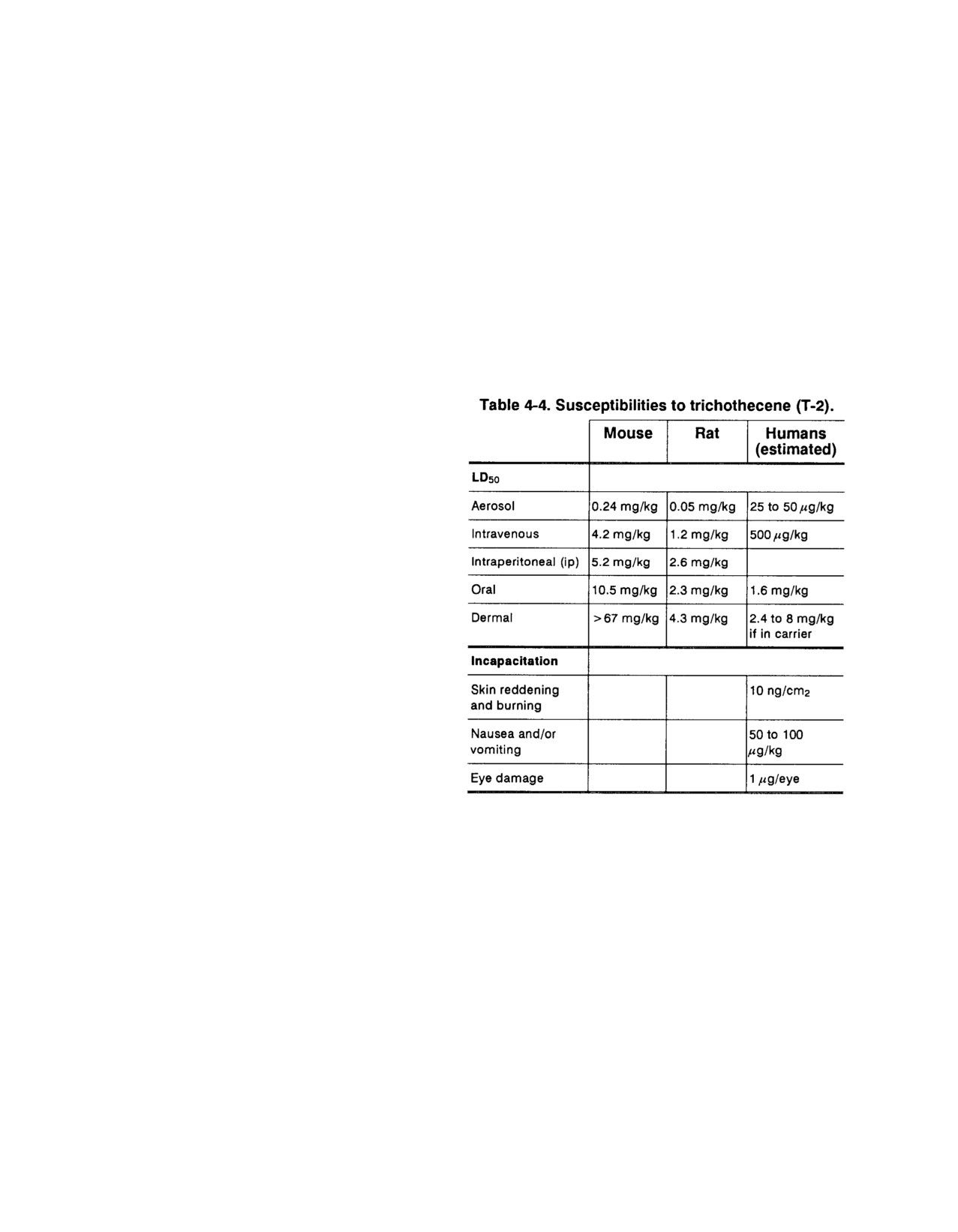
number is YD0100000. Table 4-4 shows susceptibilities to
this toxin.
Note: Small repeated doses may accumulate to lethal
levels.
Stability
The trichothecenes are very stable; storage for years at
room temperature produces no loss of activity. Environ-
mental persistency of T-2 is five to seven days. They are
heat-stable with no loss of activity noted after heating at
100°C for one hour. They are quite stable in solution.
Strong acids will abolish all toxic effects.
Decontamination
Rapid removal of toxins from the skin and eyes is essen-
tial. Use water or saline for the eyes; use soap and water
with repeated flushing for the skin. Flushing the skin with
water is an acceptable field expedient procedure for T-2
toxin if done within five minutes after exposure. The M258
and M258A1 skin decontamination kits are effective in
90
FM 3-9
Appendix A
Chemical Agent Physical Properties
Soldiers in the field do not need to know exact chemical composition of matter,
including chemical agents. However, the behavior of these agents in the environ-
ment directly results from their composition. Therefore, the composition is
important. Summary statements that describe the behavior of chemical agents use
such terms as vapor density, melting point, boiling point, and latent heat of
vaporization. Most of these terms relate to temperature. If you understand how
temperature affects matter, you will understand these terms. You will thus better
understand the behavior of agents.
Thermochemistry
The quantity of energy (calories) required to raise the
tion of the temperature of phase transition, such as that
temperature of one gram of material one degree Celsius is
occurring when melting or boiling is taking place, always
a characteristic property of the material known as the
takes place under equilibrium conditions.
specific heat. Specific heat changes predictably with
The number of calories of heat required to melt a gram
temperature so long as the material under observation does
of ice into water at 0oC is the latent heat of melting. As
not undergo a change in physical state. As heat is supplied
liquid water receives even more heat, its temperature in-
to ice, its temperature increases until it reaches the melting
creases until it reaches the boiling point. This is the
point. If the heat energy supply is very slow or if it stops
temperature at which the vapor pressure of the water
altogether, an equilibrium occurs. An equilibrium is a
equals the pressure of the atmosphere on the water. Boiling
condition in which the number of molecules per unit of time
points are normally established where the atmospheric
that are going from the solid to the liquid state equals the
pressure is equal to 760 mm Hg.
number going from the liquid to the solid state. Determina-
Molecular
Weight
Molecular weight (MW) is the value represented by the
weights. These very high molecular weights may indicate
sum of the atomic weights of all the atoms in the molecule.
that decontamination by fire is practical.
For example, the MW of ethyldichloroarsine, C2H5AsC12,
The MW gives an indication of the persistency of an
is as follows:
agent. Generally, the higher the number, the lower the rate
C (atomic weight =12)X 2 = 24.0
of evaporation and the greater the persistency. Another
H (atomic weight = 1) X 5 = 5.0
use for the MW is in calculating the vapor density.
As (atomic weight = 74.9)X 1 = 74.9
Molecular weight indicates the ability of a chemical to
Cl (atomic weight = 35.5)X 2 = 71.0
penetrate filters. Molecular weights of 29 or less are very
MW = 174.0
difficult to stop with activated charcoal filters. Examples
High molecular weights tend to indicate solids. Conver-
are ammonia (NH, MW 17) and carbon monoxide (CO,
3
sely, low molecular weights tend to indicate gasses. Agents
MW 28).
easily broken down by heat often have very high molecular
Vapor
Density
Vapor density is the ratio of the density of any gas or
temperature and pressure. It is a measure of how heavy the
vapor to the density of air, under the same conditions of
vapor is in relation to the same volume of air. Vapor density
91
FM 3-9
helps in estimating how long an agent will persist in valleys
Agents with low vapor densities rise. Agent AC is the
and depressions. The higher the vapor density, the longer
only militarily significant agent that is lighter than air.
the vapor will linger in low-lying areas.
Chemical agent clouds with high vapor densities seek lower
To calculate the vapor density, divide the MW by 29 (the
ground in much the same way as water poured on the
average MW of air). If the result is greater than 1.0, the
ground. Agents with high vapor densities tend to evolve
agent is heavier than air. The agent will tend to collect in
into long coherent streamers. For example, agent GB is
low-lying areas, such as foxholes and ditches, and in
almost five times as heavy as air. It can produce a streamer
vehicles. If the result is less than 1.0, the agent almost
40 meters wide by 22 kilometers long from a single round.
invariably is nonpersistent. It will quickly dissipate into the
Diffusion is usually a minor factor in the dissemination
atmosphere.
of chemical agents. This is especially so after air dilutes the
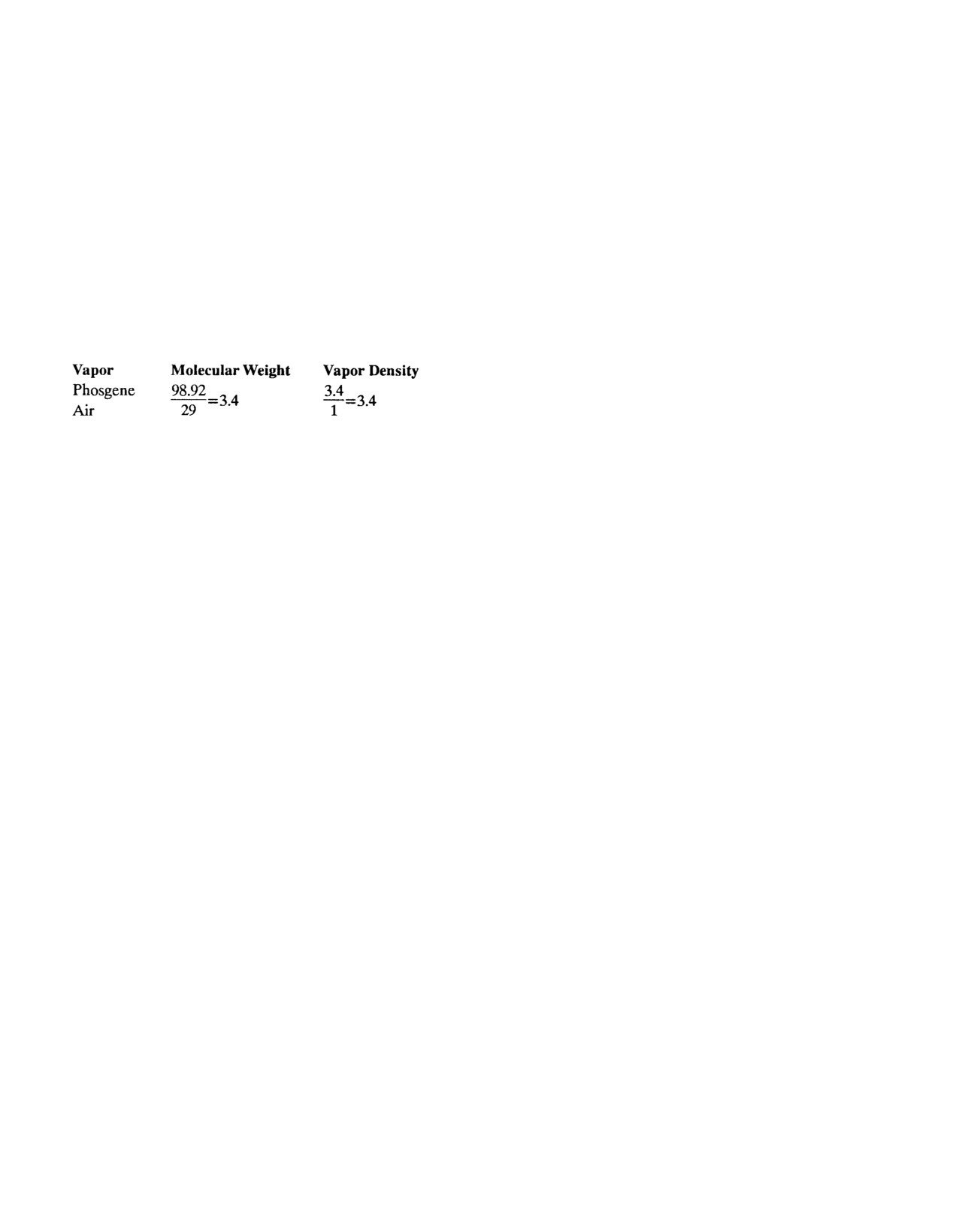
For example, phosgene, COC12, with an MW of 98.92,
chemical agent. Air currents and other influences tend to
has a vapor density of 3.4 times that of air. The calculation
offset any effects of diffusion or vapor density. Because
follows:
very high vapor densities cause agents to seek lower
ground, the agent can overcome the effects of wind to a
limited degree. These densities can actually cause the
agent cloud to go upwind if the upwind area is lower than
the downwind area and the wind is not very strong. This
Phosgene will persist five minutes or longer in the open
explains the upwind radius on all chemical hazard predic-
in the summer. Hydrogen cyanide, MW 27.02, may persist
tions.
only a minute under the same circumstances.
Liquid and Solid Densities
The density of a liquid chemical agent is the weight in
Note: Sometimes density is not the only factor that
grams of one cubic centimeter of the liquid at a specified
determines how an agent will distribute in water. An
temperature. The density of a solid chemical agent is the
example is HD. If agent HD falls on water, little globs
weight of one cubic centimeter of the solid at a specified
of HD will scatter throughout the depth of the water.
temperature. Liquid density in this manual is a measure of
The larger ones tend to coagulate and sink, forming
an agent’s weight in comparison to water (density 1.0). This
a layer at the bottom. The finer droplets or mist
comparison gives the specific gravity. Liquids form layers,
created by the explosion form a layer on top, one
and the one with the greatest density sinks to the bottom.
molecule thick, like an oil slick. Surface tension holds
The layer with the lowest density rises to the top.
the layer on the surface. If the slick is very thin, it will
If an agent is much denser than water, it will tend to sink
be iridescent, reflecting rainbowlike colors. If it is a
to the bottom and separate out. An example is mustard-
little thicker, it may not be noticeable.
lewisite (liquid density 1.66). If an agent has about the same
Liquid density is of interest in computing the chemical
density as water, such as the nerve agents, it will tend to mix
efficiency of a munition, because we always express
throughout the depth of the water. (However, GB is the
toxicities in units of weight. For example, a munition filled
only nerve agent that will actually dissolve in water.) The
with CG (liquid density about 1.4 at 20oC) will contain twice
nerve agents are slightly denser than water. Therefore, the
as much chemical agent by weight as a munition of the same
concentration of nerve agent will tend to increase with
volume filled with AC (liquid density about 0.7 at 10oC). It
depth. Agents that are less dense than water, such as AC
will also have a much higher chemical efficiency. To find
(liquid density 0.69), tend to float on water.
the chemical efficiency of a munition, divide the weight of
the filling by the total weight of the filled munition.
Melting Point
Melting point is the temperature at which a solid changes
store any WP-filled munition on its end. When the WP
to a liquid. White phosphorous (WP) presents an example
melts, the center of gravity will remain unchanged and thus
of the importance of melting point. It has a low melting
prevent instability of the munition in flight.
point. In temperatures above that melting point, you must
92

FM 3-9
Freezing Point
Freezing point is the temperature at which a liquid
Below their freezing points most agents become unreli-
changes to a solid. It is generally equivalent to the melting
able in creating casualties by direct effect. The effects
point. It is important to know the freezing point of a
result from secondary transfer. Warming the frozen agent
chemical agent, because dissemination characteristics vary
upon entering an enclosure or area where the temperature
markedly with physical state. For example, HD can freeze
is high enough will melt or vaporize the agent.
in a spray tank at low temperatures and cannot be dis-
pensed.
Boiling Point
Boiling point is the temperature at which the vapor
The higher the boiling point, the more slowly a liquid
pressure of a liquid equals the atmospheric pressure. The
evaporates at ordinary temperatures. For example, HD
boiling point represents the highest usable temperature of
boils at 217°C and evaporates relatively slowly at ordinary
a liquid agent. You can use it to estimate the persistency of
temperatures. CG boils at 7.5°C and evaporates rapidly at
a chemical (under a given set of conditions). The reason is
moderate temperatures. Thus, agents with low boiling
that the vapor pressure and the evaporating tendency of a
points are normally nonpersistent. Those with high boiling
chemical agent vary inversely with its boiling point.
points are persistent. The boiling point also gives an indica-
tion of the practicality for decontamination with hot air.
Vapor Pressure
Vapor pressure is the pressure exerted by a vapor when
the tactical use and duration of effectiveness of chemical
a state of equilibrium exists between the vapor and its liquid
agents. A potential chemical agent is valuable for employ-
(or solid) state. It is the pressure in a closed space above a
ment when it has a reasonable vapor pressure. One with
substance when no other gas is present. Vapor pressure
exceptionally high vapor pressure is of limited use. It
varies with temperature, so the temperature must be stated
vaporizes and dissipates too quickly. Examples are arsine
to determine vapor pressure. At any temperature any liq-
and carbon monoxide. On the other hand, mechanical or
uid (or solid) will have some vapor pressure, however
thermal means may effectively aerosolize and disseminate
small.
solid and liquid agents of very low vapor pressure. Vapor
Substances with high vapor pressure evaporate rapidly.
pressure and volatility are related. Translated into
Those with low vapor pressure evaporate slowly. The im-
volatility, vapor pressure is most understandable and use-
pact of vapor pressure on the rate of evaporation makes
ful.
vapor pressure a very important property in considering
Volatility
Volatility is the weight of vapor present in a unit volume
You need to know more than the vapor pressure or
of air, under equilibrium conditions, at a specified
volatility to judge the effectiveness of a chemical agent.
temperature. It is a measure of how much material (agent)
You must also consider the degree of toxicity of physiologi-
evaporates under given conditions. The volatility depends
cal action of the chemical agent. A highly toxic chemical
on vapor pressure. It varies directly with temperature. We
agent of relatively low volatility, such as GB, may be far
express volatility as milligrams of vapor per cubic meter
more lethal than a less toxic chemical agent of much higher
(mg/m3). Calculate it numerically by an equation derived
volatility, such as CG.
from the perfect gas law. This equation follows:
93
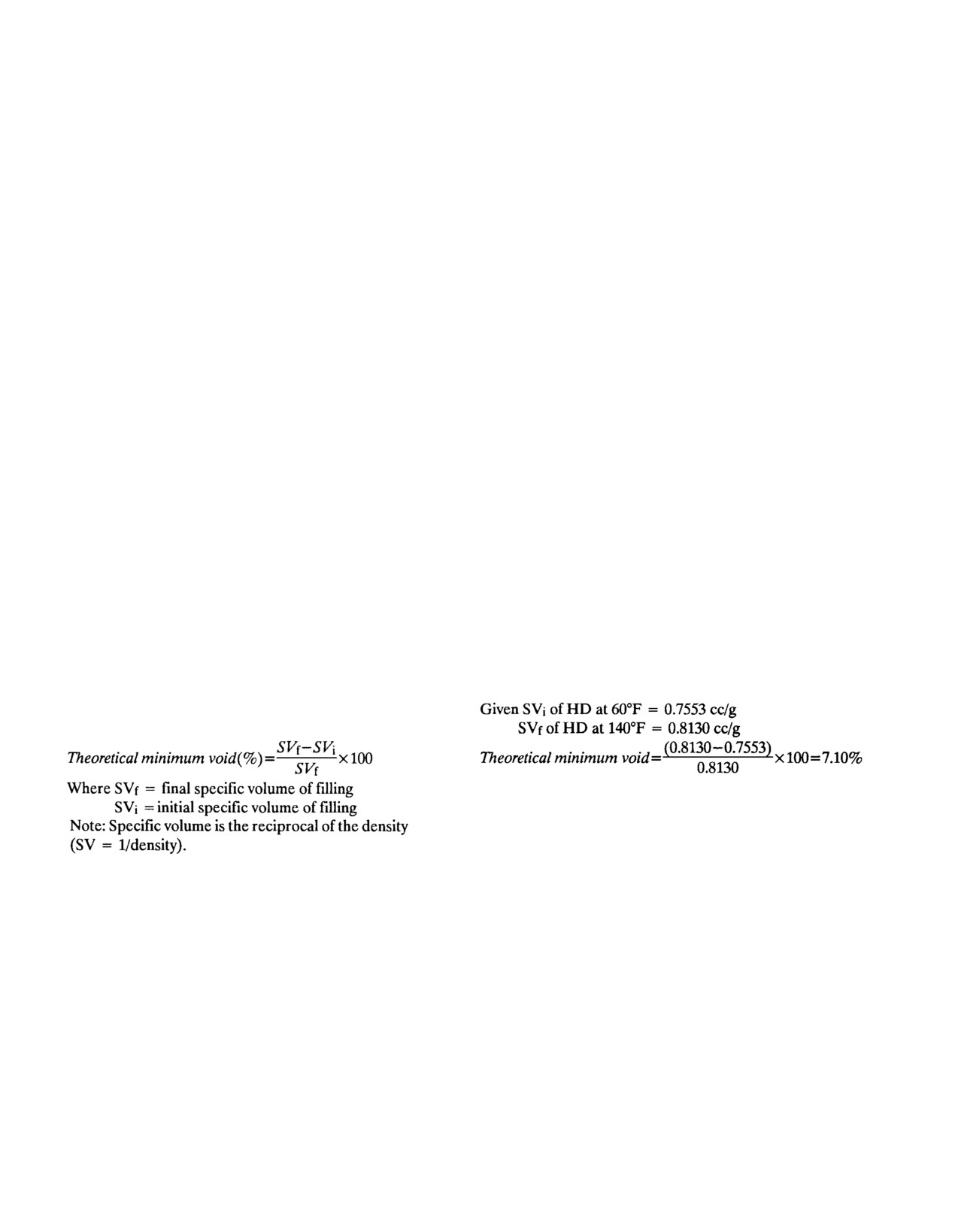
FM 3-9
Flash Point
The flash point is the temperature at which a chemical
flash point is of interest with chemical agents that have a
agent gives off enough vapors to be combustible upon
low enough flash point to cause them to burn when the
application of a flame under controlled conditions. The
containing munition bursts.
Decomposition Temperature
The decomposition temperature is that at which a
markedly lower than the boiling point) will usually mean
chemical breaks down into two or more substances. This
that dissemination of the chemical agent will cause exces-
temperature can be used to evaluate candidate chemical
sive decomposition.
agents. A low decomposition temperature (one that is
Latent Heat of Vaporization
The latent heat of vaporization is the heat required to
requires a quantity of heat equivalent to the latent heat of
change one gram of liquid into vapor without a change in
vaporization. The result is cooling of the chemical agent
temperature. That is, it is the total heat in calories that
and its surroundings, causing the vapor to settle. This
disappears at any given temperature when one gram of
settling action produces the effect known as “pancaking,”
liquid evaporates under an external pressure of one atmos-
that is, a spreading downward and outward of the newly
phere. This property is important in determining the be-
released agent. Some chemical agents show the desirable
havior of high-volatility chemical agents when released
pancaking effect to a greater degree than others. The
from shells or bombs. Most chemical agents are in liquid
reason is their high latent heats of vaporization. Examples
form within the munition. In some munitions the liquid is
of agents that exhibit good pancaking effect are CG and
under considerable pressure. When pressurized munitions
CK. Chemical agents that are liquid at ordinary tempera-
burst, the liquid may rapidly become vapor. This process
tures and pressures do not exhibit this effect.
Minimum Void
The theoretical minimum void is the minimum amount
As an example, use a filling temperature of 60oF and
of space that must be left in a container during filling. It
calculate the theoretical minimum void for a container of
allows for the expansion of the filling with increase in
mustard. The calculation follows:
temperature. Use the following formula to calculate the
theoretical minimum void:
The safety factor (Kc) is the amount of void you should
leave in a container in addition to the theoretical minimum
void. The specific operation determines the safety factor
Use this formula to calculate the percent of increase in
(expressed in percent of container volume). It is based on
the volume of the filling. Base it on the volume at the highest
the size and dependability of the container. (Allowance is
temperature to which the filling will be subjected. Calcula-
made for decreased quality of container metals under war-
tions with this formula will determine the minimum void
time procurement.) The safety factor is determined for
for any given filling, independent of container size or type.
each specific case. Calculate the actual void directly for any
temperature, using the following formula:
Actual void = theoretical minimum void + safety factor
(Kc)
94
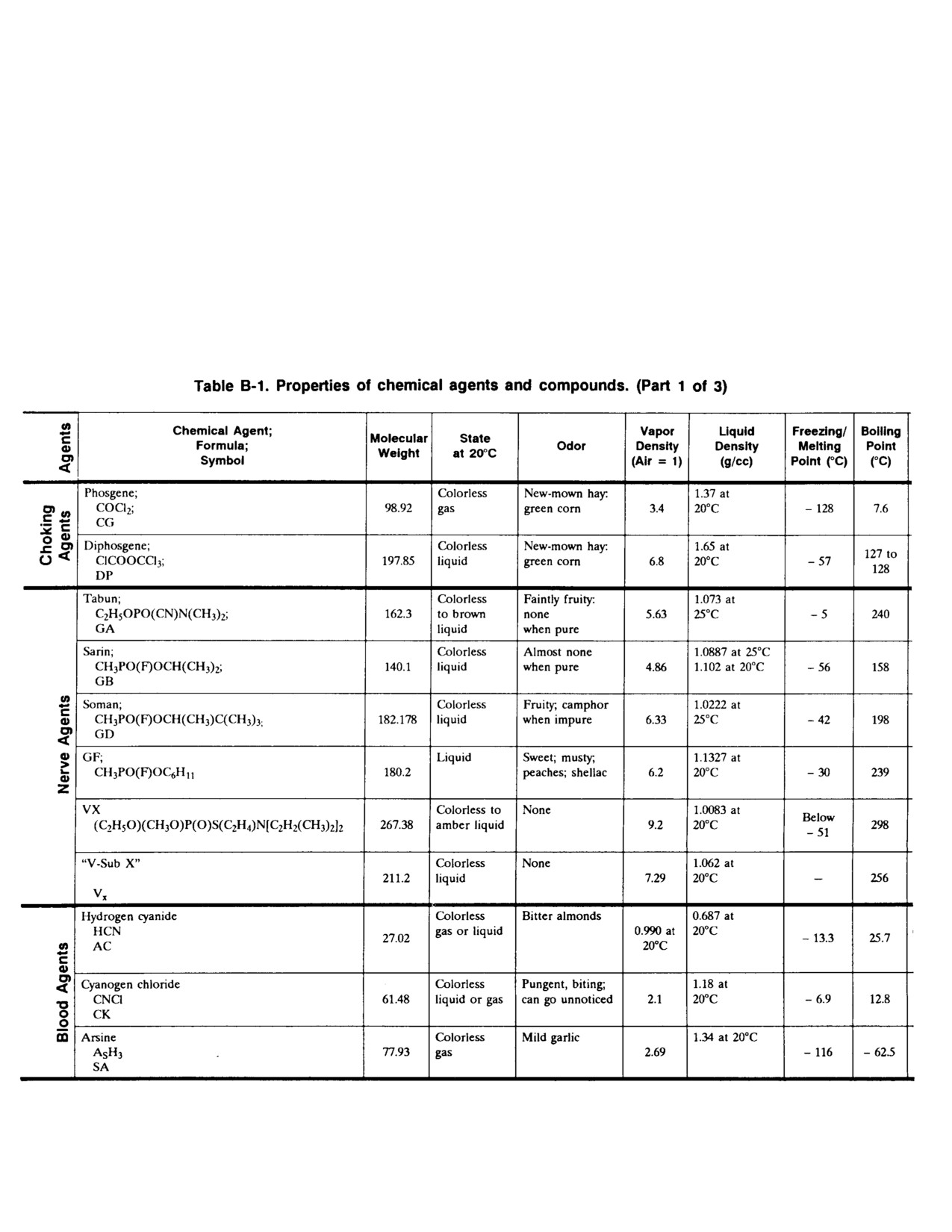
FM 3-9
Appendix B
Table of Chemical Agent Properties
Table B-1, on this and the next two pages, provides a
of agents. The next column shows specific agents. The
quick reference for Chemical Agent Properties. The ex-
remaining columns across the page show selected proper-
treme left column of each page shows the general classes
ties.
95
Continues
on next
page(s).
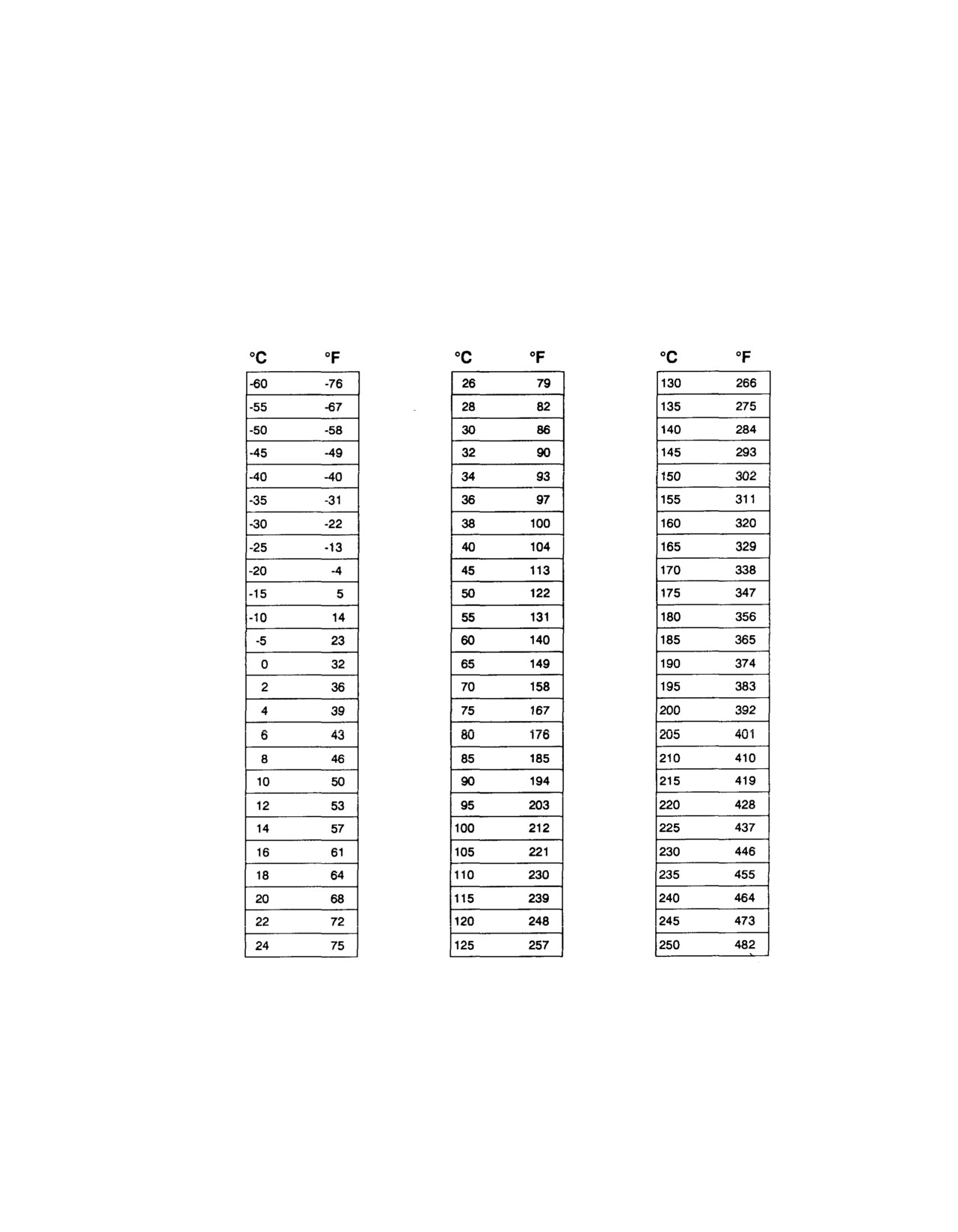
FM 3-9
Appendix D
Temperature Conversions
To convert Celsius to Fahrenheit, use this formula:
°F = 1.8 (°C) + 32°
To convert Fahrenheit to Celsius, use this formula
°C = (°F - 32°)/1.8
Use the following table as a quick reference.
99
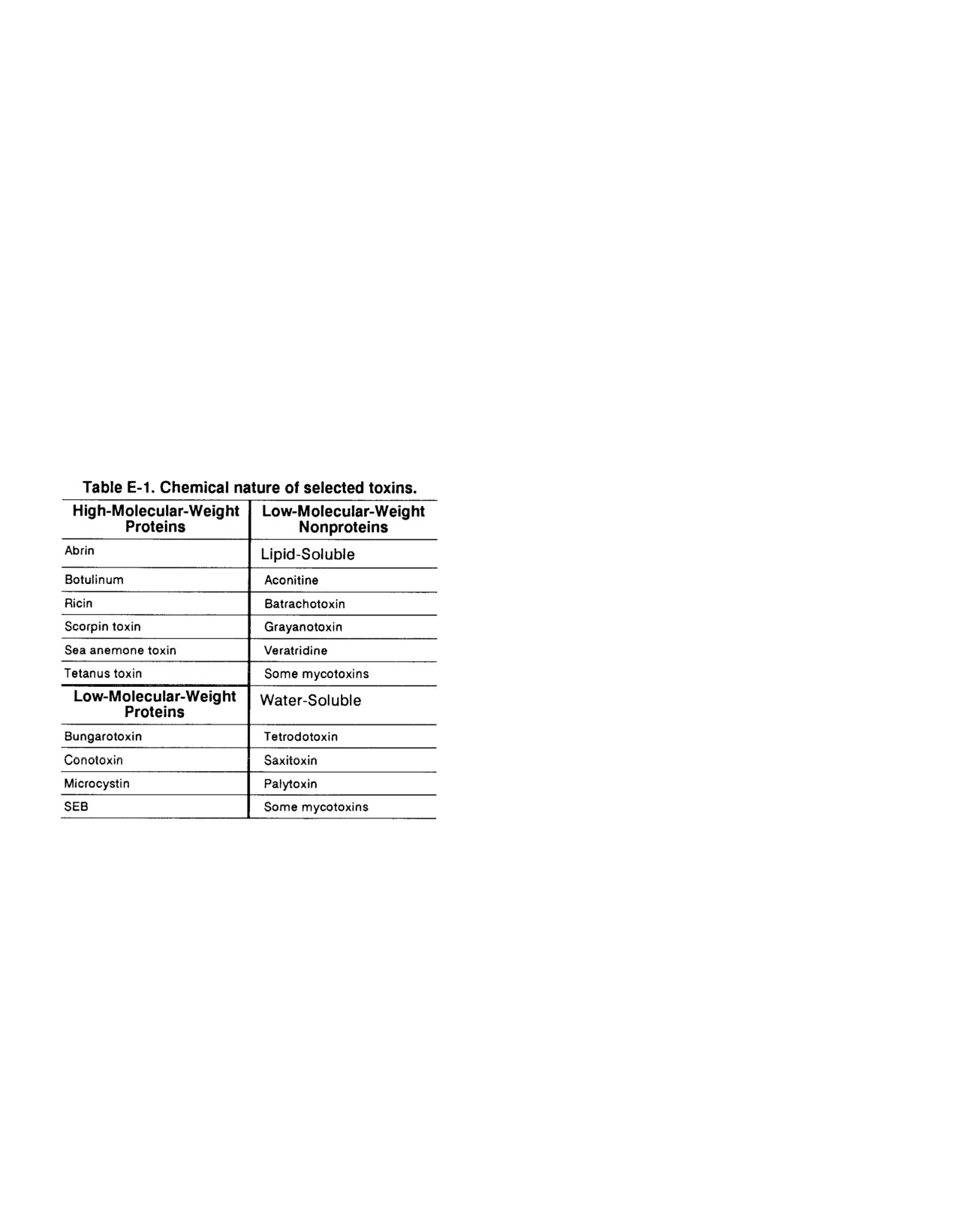
FM 3-9
Appendix E
Technical Aspects of Toxins
This appendix presents further information about the
technical aspects of toxins. These aspects include the
chemical nature of toxins and their mechanisms of action.
Chemical Nature of Toxins
The chemical nature of toxins affects their stability,
Proteinaceous toxins may be cytotoxins or neurotoxins.
volubility, and potential for chemical synthesis. A distinc-
Proteinaceous cytotoxins produce several naturally occur-
tion exists between those toxins that are proteinaceous
ring diseases. These diseases include anthrax, diphtheria,
(proteinlike) and those that are nonproteinaceous, low-
dysentery, pertussis, and plague. Chapter 4 describes the
molecular-weight compounds. Table E-1 identifies some
cytotoxins microcystin from freshwater algae and ricin
toxins by their chemical nature.
from castor beans. Proteinaceous neurotoxins include
botulinum and tetanus toxins. These neurotoxins also in-
clude toxins from snake and scorpion venoms (Chapter 4).
Low-Molecular-Weight Non-
Proteinaceous Toxins
Major sources of nonproteinaceous toxins are marine
organisms, freshwater blue-green algae, and fungi. Most
are neurotoxins. However, tricothecene mycotoxins inhibit
protein synthesis. Obtaining sufficient quantities from
natural sources to pose a serious threat would severely limit
military exploitation of these toxins.
Peptides
A number of small peptides (5 to 20 amino acids) appear
to act as neurotransmitter or “hormones” in the brain. They
integrate or modify responses, information, mood, aware-
ness, and consciousness.
The biological half-life of most small peptides and pep-
tide hormones (bioregulators) in the body is measured in
minutes. Peptides have low volatility and difficulty in pass-
ing through natural barriers, such as the skin. Chemical
Proteinaceous Toxins
analogues could reduce some of these limitations. The
The usual sources of proteinaceous toxins are unicellular
greatest threat could be from production inside a human,
organisms, such as bacteria. Also, snake and spider venoms
following infection with a new biological agent. Peptides
contain a mixture of proteinaceous as well as low-
are hydrolyzed by acid solutions.
molecular-weight toxins. Ricin from castor beans and
abrin from the tropical legume Abrus precatorius are also
Synthesis of Toxins and Peptides
proteins. The proteinaceous toxins are solids when purified
The possibility exists for toxin or peptide production by
but are soluble in water-based solutions. These toxins may
genetic engineering of microorganisms or by chemical syn-
be fluids in nature (for example, venoms). Large
thesis. Nonprotein, low-molecular-weight toxins or pep-
proteinaceous toxins are heat-sensitive. Smaller proteins
tides are more subject to manipulation and/or production
tend to be stable. In the case of protein toxins, vaccination
by genetic engineering than are the more complex proteins.
with an inactivated form of the toxin (toxoids) can induce
However, the potential exists for synthesis of some smaller
immunity in some instances.
components of proteins. Several protein toxins have had a
gene cloned and/or have a known sequence. These toxins
100
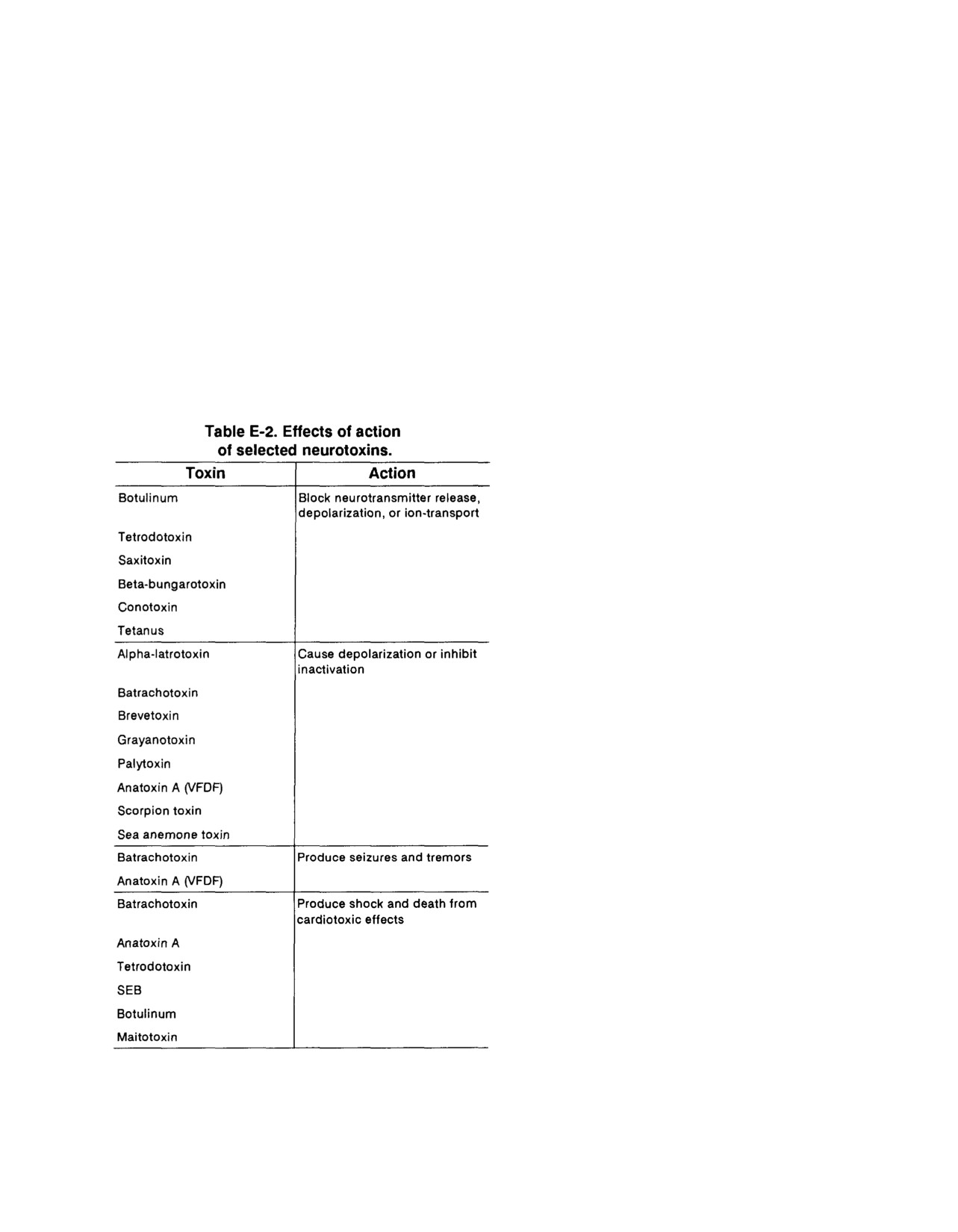
FM 3-9
include the heat-stable Escherichia coli and Staphylococcus
Chemical synthesis is possible for low-molecular-weight
enterotoxins, anthrax lethal factor, diphtheria toxin, ricin,
toxins, such as batrachotoxin, saxitoxin, and tetrodotoxin,
and tetanus toxin.
or peptides.
Mechanisms of Action
Classes of toxins according to their mechanisms of action
Presynaptic Neurotoxins
are neurotoxins and cytotoxins.
Presynaptic neurotoxins include microbial paralytic
toxins, such as botulinum and tetanus toxins, and snake
Neurotoxins
phospholipases. All can be lethal by aerosol. Botulinum
Neurotoxins can fall into subclasses according to the
and tetanus neurotoxins block the release of acetylcholine,
mechanism by which they create their toxic effects as
A variety of snake venoms also contain toxins that act
presynaptic neurotoxins, postsynaptic neurotoxins, ion-
presynaptically. They block release of acetylcholine from
channel-binding toxins, and ionophores.
nerve terminals, apparently through the activity of an en-
Table E-2 shows the effects of action of selected
zyme, phospholipase (PLA). Presynaptic neurotoxins may
neurotoxins.
lead to a rigid or a flaccid (limp) paralysis, depending on
the mechanism of action. Botulinum produces flaccid
paralysis. Tetanus produces rigid paralysis.
Postsynaptic Neurotoxins
Postsynaptic neurotoxins competitively block the acetyl-
choline receptor. They include snake alpha-toxins and con-
otoxin. The snake alpha-toxins include cobra neurotoxin,
alpha-bungarotoxin from the banded krait, and erabutoxin
from sea snakes. Marine fish-hunting cone snails (Conus)
are the natural source of conotoxin.
Ion-Channel-Binding Toxins
Channel-binding toxinsinterfere with the movement of
ions, such as sodium or potassium, through membranes.
The activity of nerve and muscle cells requires a balance of
these ions on each side of a membrane. These toxins come
from scorpion, snake, and bee venoms. These may not
appear highly toxic because of the low doses normally
encountered in nature. However, the toxicities based on
LD50 values make them potential biological warfare
agents.
Sodium-ion channel-binding toxins include scorpion
toxins and toxins from rattlesnakes and copperheads, such
as myotoxin A, gyrotoxin, and crotamine. These snake
channel-binding toxins are small, stable proteins. Their
dissemination as aerosols is possible. (Some low-
molecular-weight nonproteinaceous compounds, such as
batrachotoxin, also produce neurotoxic effects by binding
sodium-ion channels.)
Potassium-ion channel-binding toxinsinclude apamin.
Apamin is in bee venom. It is a small, neurotoxic protein
(18 amino acids with 2 disulfide bonds). This toxin blocks
potassium flow by binding to calcium-dependent potas-
sium-ion channels.
Symptoms and treatments for neurotoxins vary. The
Ionophores
reason is the variety of mechanisms by which they produce
Ionophores are molecules that promote the transfer of
their effects. Medical assistance for casualties is vital.
ions across membranes. Alpha-latrotoxin and diam-
101
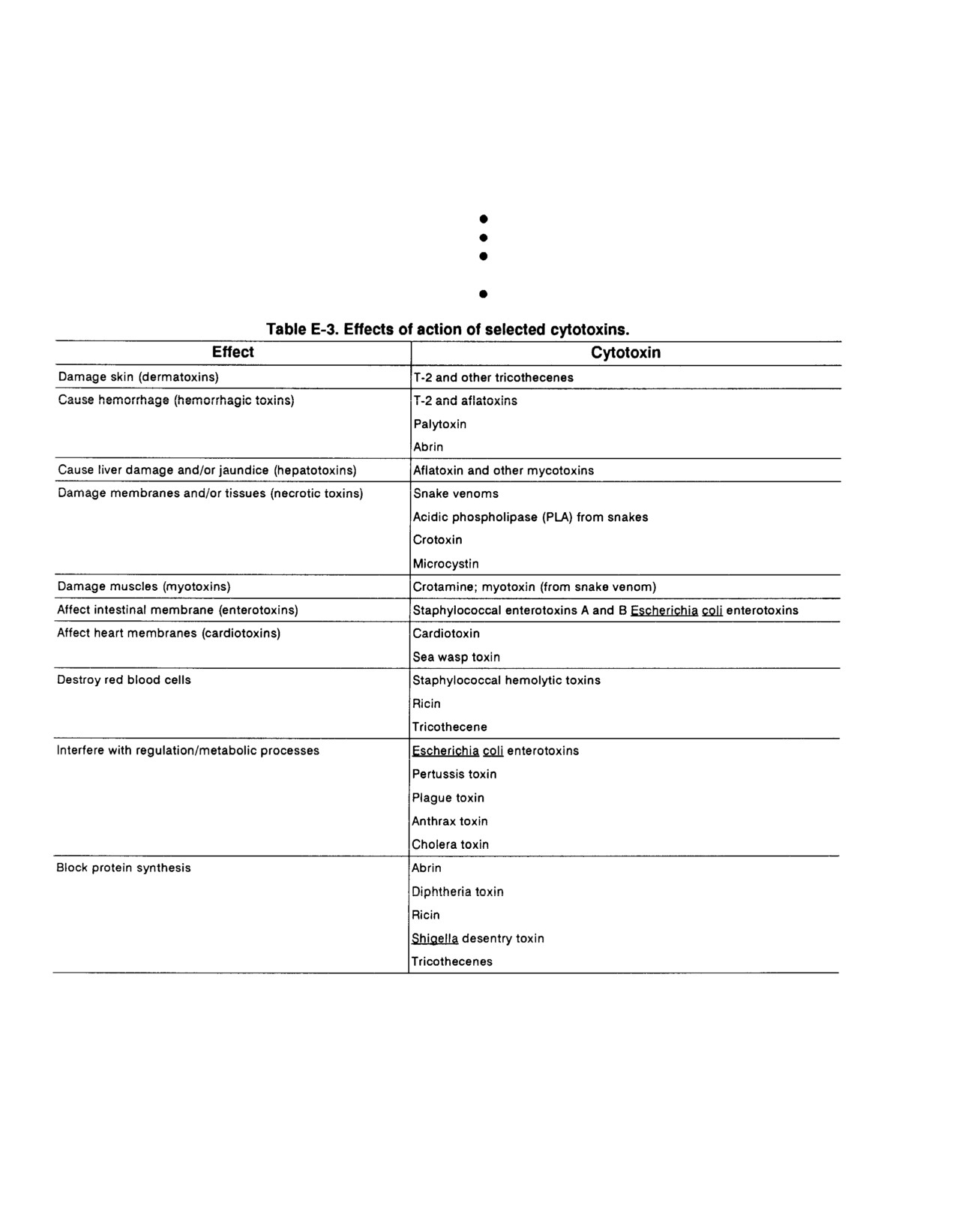
FM 3-9
photoxin are ionophores. Alpha-latrotoxin is the
by their effects. Those toxins that affect only selected tis-
neurotoxic component of black widow spider venom.
sues or systems are not literally cytotoxins. However, for
Diamphotoxin comes from a beetle pupa found in Africa.
purposes of this manual, these toxins fall into this group.
The Kung tribesmen use it for hunting.
Examples of toxins that have primary effects in a single
system include those that—
Cytotoxins
Affect the digestive tract (enterotoxins).
Cytotoxins literally affect all cell types in the body. They
Cause bleeding (hemorrhagic toxins).
cause cellular destruction or interfere with metabolic
Cause liver or kidney damage (hepatotoxins or
processes such as cell respiration or protein synthesis,
nephrotoxins).
common to all cells. Table E-3 identifies some cytotoxins
Inflame skin and mucous membranes.
102
FM 3-9
Appendix F
Tables of Toxin Properties
Tables on the following pages provide a quick reference
each table shows the general classes of agents. The next
to toxin characteristics. Table F-1 includes sources and
column gives specific agents. The remaining columns
toxicological information. Table F-2 summarizes the physi-
across the page present selected properties.
cal and chemical properties. The extreme left column of
103
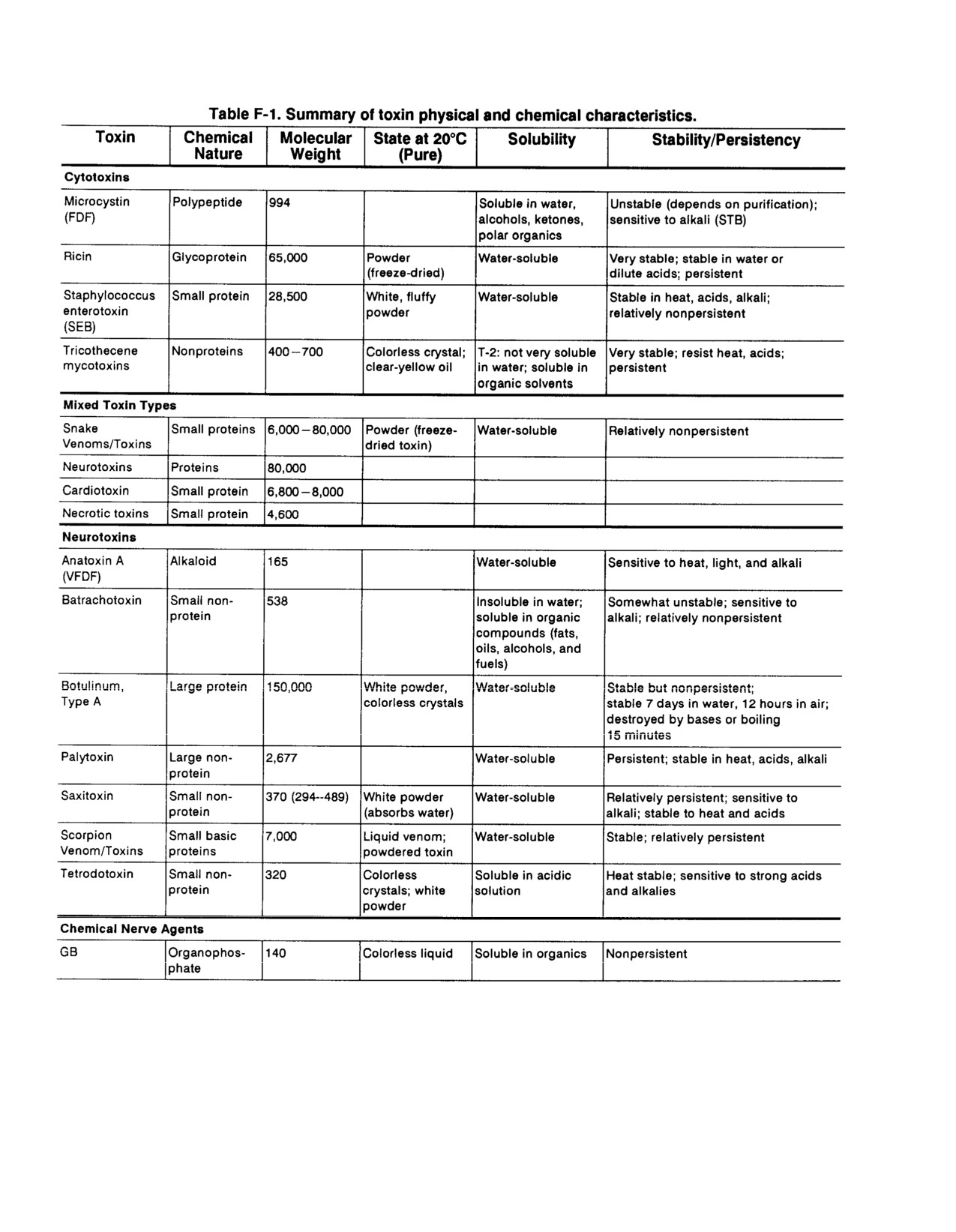
FM 3-9
104