FM 3-9 Potential Military Chemical / Biological Agents and Compounds (December 1990) - page 1
Army Field Manual No 3-9
Navy Publication No P-467
Air Force Manual No 355-7
Potential Military Chemical/
Biological Agents and
Compounds
Headquarters
Department of the Army
Department of the Navy
Department of the Air Force
Washington, DC, 12 December 1990 PCN 320 008457 00
FM 3-9
Preface
This field manual provides commanders and
The proponent of this publication is Head-
staffs with general information and technical
quarters, TRADOC. Submit recommended
data concerning chemical and biological
changes for improving this publication on DA
agents and other compounds of military inter-
Form 2028 (Recommended Changes to Publi-
est. It discusses the use; the classification; and
cations and Blank Forms) and forward it to
the physical, chemical, and physiological
Commandant, US Army Chemical School,
properties of these agents and compounds. It
ATTN: ATZN-CM-NF, Fort McClellan, AL
also discusses protection and decontamination
36205-5020. Send applicable Air Force com-
of these agents. In addition, it discusses their
ments by letter to HQ, USAF/XOOTM,
symptoms and the treatment of those
Washington, DC 20330-5054.
symptoms.
2
*FM 3-9 • NAVFAC P-467 • AFR 355-7
1

FM 3-9
2
United States Policy
Biological Agents - No Use
1. The United States will not use biological agents, including toxins
and all other methods of biological warfare, under any circumstances.
2. The United States will strictly limit biological research to defensive
measures.
Chemical Agents - No First Use
1. US armed forces will not use lethal or incapacitating chemical
agents first.
2. The United States will strictly reserve the right to retaliate, using
lethal or incapacitating chemical agents, against an enemy force that
has used them on US forces.
3. The authority to order or approve the first retaliatory chemical
strike rests with the president of the United States.
4. The United States will avoid risk to civilian populations to the
maximum extent possible.
FM 3-9
Chapter 1
Introduction
Nations have used toxic chemical agents in the past, and we cannot ignore the
possibility that they will use them in future conflicts. An understanding of chemical
and biological agents and other compounds of military interest is vital to our ability
to cope with their possible use against our forces. To develop an understanding of
chemical and biological agents and other compounds of military interest, you must
learn about several factors. You must learn about their historical use, the US
policy regarding their use, and the properties that cause a substance to be suitable
for use in military operations.
Section I. Background and Policy
Background
Chemical and biological (CB) operations are not new.
Documentation exists of more recent use of chemical
Historical records show previous use of chemicals, smoke,
agents and some biological agents in Afghanistan,
and flame in warfare. In World War I the Allies and the
Southeast Asia, and Southwest Asia.
Germans used them extensively. Many nations developed
After World War I various international accords recog-
and manufactured agents during World War II, and some
nized the potential for chemical and biological weapons
have used these agents since then.
and outlawed these weapons. Most nations, including the
As with chemicals, crude forms of biological warfare
Soviet Union, signed these treaties. However, recent
started in ancient times. Poisoning of water supplies with
evidence indicates some nations have not adhered to these
rotting carcasses was common practice. In the 1300s the
bans. A growing number of nations can employ biological
Tartars catapulted corpses of plague victims over the walls
and chemical, as well as conventional, munitions.
and into the besieged city of Kaffa. History suggests that
In addition to CB agents, related materials, such as
fleeing survivors of this siege caused the “black death,” a
irritants and herbicides, lend themselves to modern war-
plague epidemic that swept Europe. Pizarro in the 1500s
fare. The United States must prepare to defend against
and the British in the 1700s introduced smallpox among
these weapons and materials and to retaliate when ap-
Indians in the Americas as a means to win a war.
propriate. The next paragraph further discusses US policy
on the use of these weapons.
United States Policy
The United States seeks to achieve a verifiable,
forces. Only the president may order chemical weapons
worldwide ban on chemical weapons. Until a verifiable ban
retaliation.
is achieved, the US policy is to deter enemy chemical
Current US policy states that we will not use herbicides
weapons use through denying the enemy a significant
in war, unless our adversaries first employ them and the
military advantage for such use. US chemical weapons
president directs their use in retaliation. Executive Order
deterrence includes a viable NBC defense capability and a
11850 unilaterally renounces first use of herbicides in war,
credible retaliatory capability.
except to control vegetation within US bases and installa-
The United States will not use chemical weapons first
tions or around their immediate defensive perimeters.
against an enemy but reserves the right to retaliate should
The United States renounces the first use of riot control
an enemy use chemical weapons against US or Allied
agents (RCAs) in war except in defensive military modes
to save lives, such as in —
3
FM 3-9
Riot control situations in areas under direct and dis-
The president must approve the use of riot control
tinct US military control. This includes the control of
agents in war.
rioting prisoners of war.
The United States will not use biological agents, includ-
Situations in which civilians are used to mask or screen
ing toxins, regardless of source or manner of production,
attacks, and these agents can reduce or avoid civilian
or other methods of biological warfare under any cir-
casualties.
cumstances. The United States will strictly limit its biologi-
Rescue missions in remote or isolated areas. Examples
cal and toxin research program to defensive measures, such
are recovering downed aircrews and passengers and
as production of vaccines, antidotes, treatment, and
rescuing escaping prisoners of war.
protective equipment. US policy is in accordance with the
Rear-echelon areas outside the zone of immediate
1925 Geneva Protocol and the 1972 Biological Weapons
combat to protect convoys from civil disturbances, ter-
Convention, both of which the United States has signed and
rorists, and paramilitary operations.
ratified.
Security operations regarding the protection or
recovery of nuclear weapons.
Section II. Militarily Significant Aspects of Chemical Agents
Classification of Chemical Agents and Miscellaneous Compounds
We classify chemical agents and compounds according
tion permits acetylcholine, which transmits many nerve
to physical state, physiological action, and use. The terms
impulses, to collect at its various sites of action. The major
persistent and nonpersistent describe the time chemical
effects are—
agents remain in an area. These terms do not classify these
Muscle stimulation with uncoordinated contractions,
agents technically. We define chemical agents apart from
followed by fatigue and eventual paralysis.
military chemical compounds. Chemical agent use kills,
Pinpointed pupils; tightness in chest; nausea, vomiting,
seriously injures, or incapacitates people. These agents
and diarrhea; and secretions from the nose, mouth, and
include blood, nerve, choking, blister, and incapacitating
air passages.
agents. On the other hand, military chemical compounds
Disturbances in thought, convulsions, coma, and
are less toxic. Military chemical compounds include riot
depression of vital centers of the brain, leading to
control agents, herbicides, smoke, and flame materials.
death.
The term excludes chemical agents.
Blood Agents
Physical State
The body absorbs these chemical agents, including the
Chemical agents and military chemical compounds may
cyanide group, primarily by breathing. They poison an
exist as solids, liquids, or gases. To a certain extent the state
enzyme called cytochrome oxidase, blocking the use of
in which an agent normally exists determines its use, dura-
oxygen in every cell in the body. Thus, these agents prevent
tion of effectiveness, and physiological action. It also deter-
the normal transfer of oxygen from the blood to body
mines the type of munition used for its dissemination.
tissues. The lack of oxygen rapidly affects all body tissues,
especially the central nervous system.
Physiological Action
We classify agents and compounds by their physiological
Blister Agents (Vesicants)
actions as follows:
Both exterior and interior parts of the body readily
absorb these chemical agents. These agents cause inflam-
Choking Agents
mation, blisters, and general destruction of tissues. Agent
Choking agents attack lung tissue, primarily causing pul-
vapors attack moist tissue. Vulnerable areas include the
monary edema (“dryland drowning”). These chemical
eyes, mucous membranes, and respiratory tract. Eyes are
agents irritate and inflame tissues from the nose to the
very susceptible to blister agent.
lungs, causing a choking sensation.
Tear Agents (Lacrimators)
Nerve Agents
These compounds cause a large flow of tears and irrita-
These chemical agents, when inhaled, ingested, or ab-
tion of the skin. Some of these compounds are very irritat-
sorbed into the body through the skin, inhibit
ing to the respiratory tract. They sometimes cause nausea
cholinesterase enzymes throughout the body. This inhibi-
and vomiting.
4
FM 3-9
Vomiting Agents (Sternutators)
This category includes lethal and damaging (blister)
These compounds cause nausea and vomiting. They also
agents. Lethal chemical agents in field concentrations can
cause coughing, sneezing, pain in the nose and throat, nasal
produce death.
discharge, or tears. A headache may follow.
Incapacitating agents. Incapacitating agents produce
temporary physiological or mental effects, or both. Effects
Defoliants
may persist for hours or days after exposure. They may
These compounds cause trees, shrubs, and other plants
make individuals unable to perform their assigned duties.
to shed their leaves prematurely.
Victims do not usually require medical treatment, but
treatment speeds recovery.
Plant Growth Regulators
These compounds regulate (stimulate or inhibit) plant
Military Chemical Compounds
growth.
These compounds include riot control agents, training
agents and compounds, smokes, and herbicides.
Desiccants
Riot control agents (RCAs) produce transient irritating
These compounds remove water from plant tissues,
or disabling effects. These effects disappear within minutes
causing the plants to dry and shrivel.
after exposure ends. Governments widely use these com-
pounds for domestic law enforcement purposes.
Soil Sterilants
Training agents and compounds are chemicals that are
These compounds make a soil incapable of supporting
authorized for use in training. These chemicals enhance
higher plant life. Their effects may last one growing season
proficiency for operating in an NBC environment.
or many years.
Smokes are used for obscuring, screening, deceiving,
and identifying and signaling.
Use
Herbicides are chemical compounds that will kill or
Chemical agents and military chemical compounds may
damage plants.
be grouped according to use.
Note: This manual seeks to show only the general
relationship between chemical agent properties and
Chemical Agents
uses. FM 3-10-1, FM 3-11, FM 3-50, and FM 20-33
Chemical agents may be either toxic or incapacitating.
specifically cover use concepts.
Toxic agents. Toxic agents can produce incapacitation,
serious injury, or death when used in field concentrations.
Duration of Effectiveness of Chemical Agents
Several factors determine the time a chemical agent
determining the duration of effectiveness of an agent.
remains effective. These include the method of dissemina-
Gases (vapors), aerosols, and highly volatile liquids tend to
tion and the physical properties of the agent. Factors also
disperse rapidly after release. Thus, they present an imme-
include weather, terrain, and target conditions.
diate short-duration hazard. Large drops or splashes
remain a hazard longer than finely divided particles. Also,
Method of Dissemination
viscous materials tend to adhere and not spread or flow
The size of the particles disseminated greatly influences
readily. This can increase persistency. Appendix A discus-
the effectiveness of liquid or solid agents. Vapors or
ses physical properties.
aerosols (air-contaminating agents) do not persist as long
as do droplets of agents used to contaminate terrain and
Weather Conditions
materiel. In explosive munitions the degree of division
Many weather factors influence the duration of effec-
depends upon several factors. These factors are the
tiveness. The most important are temperature, tempera-
amount and the type of burster charge and the fuzing of the
ture gradient, wind speed, relative humidity, and
munition (air or ground burst). Nonexploding types of
precipitation. See FM 3-6 for a detailed discussion of the
munitions, such as aerosol generators and spray tanks, can
impact of weather on duration.
vary the degree of dispersion. Thus, these types influence
the duration of effectiveness of agents.
Temperature
The higher the ground or surface temperature, the
Physical Properties of the Agent
quicker a liquid chemical agent will evaporate from it. Low
Vapor pressure and volatility influence the rate of
temperatures may freeze some agents, thus reducing the
evaporation. These properties are especially important in
immediate contact hazard, but will increase persistency.
5
FM 3-9
Temperature Gradient
area but, in combination with the lower temperatures,
Often the temperature of the layer of air next to the
increases the duration.
ground is different to that of the air layers above. This gives
rise to a temperature gradient. Agents in a vapor state will
Conditions of Terrain or Target
remain near the ground during stable (inversion) condi-
Vegetation, soil, and contours play an important part in
tions. When an unstable (lapse) condition exists, air layers
the duration of effectiveness of an agent at the target. See
mix and agents disperse more quickly.
FM 3-6 for a detailed discussion of terrain impact.
Wind Speed
Vegetation
High winds increase the rate of evaporation of liquid
Liquid chemical agents cling to vegetation, increasing
chemical agents. High winds also disperse chemical clouds
the area for contact and evaporation. Because of low wind
more rapidly than low winds. A low wind speed allows
speeds and reduced temperatures, heavily wooded and
agent to persist longer. Also, the rate of spread will be slow.
jungle areas retain vapors longer.
Vapors and aerosols disperse rapidly in open county;
dangerous concentrations may remain longer in woods,
Soil
foxholes, and built-up areas.
Toxic liquids quickly soak into porous surfaces and
evaporate more slowly than from nonporous surfaces. This
Relative Humidity
increases the duration of any vapor hazard, although it
Relative humidity has little direct effect on most chemi-
reduces vapor cloud concentration.
cal agents. However, the choking agent phosgene (CG) and
the blister agent lewisite (L) rapidly decompose at relative
Contours
humidities over 70 percent.
Toxic clouds follow the contour of the surface of the
terrain. Chemical clouds tend to go around obstacles, such
Precipitation
as hills. Concentrations persist in hollows, low ground,
Heavy or lasting rains will wash liquid agent contamina-
depressions, foxholes, and buildings. Rough ground, in-
tion to low areas and stream beds and present a lingering
cluding that covered with tall grass or brush, slows chemical
hazard. Light rainfall can cause recurrence of a contact
cloud movement. Flat country (unless covered with tall
hazard. Snow tends to wash agents from the air. Snow cover
grass or brush) allows an even, steady movement. Urban
reduces the vapor concentration above the contaminated
areas form local “heat islands” that may alter significantly
the normal temperature gradient.
Requisites and Desirable Features of Chemical Agents
The combined physical, chemical, and toxicological
Capable of being handled and transported without
properties of a substance determine its suitability and ef-
extensive precautions.
festiveness as a chemical agent. These factors influence
whether the substance meets the requisite and desirable
Desirable Additional Features
features of a chemical agent.
A chemical agent should—
Have little or no corrosive action on the munition or
Requisites
container during storage.
A chemical agent must be—
Have such inherent properties that complete protec-
Toxic. Through its chemical properties in small con-
tion from the chemical agent is difficult for enemy
centrations it will produce damaging or lethal effects
personnel. If possible, the agent should be capable of
on man, animals, or plants.
minimizing the effectiveness of the protective equip-
Stable or capable of stabilization during the period
ment of potential enemies.
between its production and use.
Have a known physiological mechanism of action,
Producible from readily available raw materials in ade-
protective measures, and a method of medical treat-
quate quantities for effective military use.
ment or prophylaxis.
Capable of dissemination from a device feasible for
Be difficult to detect by ordinary methods before the
field use in sufficient concentration to produce the
onset of physiological and/or psychological effects.
desired effect on the target.
(Colorless, odorless, and nonirritating toxic chemical
agents are desirable.)
6
FM 3-9
Physical Properties
The physical properties impact on how a chemical agent
the volatility and the rate of evaporation of an agent. The
or compound is used. These properties also impact upon
rate of evaporation has a major effect upon the vapor
the defensive measures against its use. Some of the more
concentration. It also affects the duration of an agent
important physical properties are vapor density, vapor
hazard after dissemination. The boiling and freezing points
pressure, volatility, melting and freezing points, and liquid
of chemical agents influence their operational use and the
and solid densities. The vapor density determines whether
means of disseminating them. See Appendix A for a dis-
the agent is lighter or heavier than air; it thus determines
cussion of physical properties. Appendix B tabulates
whether the agent will settle to low areas or float away and
chemical agent physical properties and other data.
dissipate in the atmosphere. Vapor pressure determines
Chemical Properties
The chemical properties of an agent influence its
also be toxic. Examples include lewisite and other agents
stability, toxicity, and reactivity with water and other sub-
containing arsenic.
stances.
Stability in Storage
Hydrolysis
Stability in storage determines the practical usefulness
Hydrolysis is the reaction of a compound with the ele-
of an agent or chemical compound. If a candidate agent
ments of water whereby decomposition of the substance
decomposes in storage, it will have little value regardless
occurs. The reaction produces one or more new substan-
of any other properties that may recommend it. The addi-
ces.
tion of stabilizers to agents will slow decomposition and
Rapid hydrolysis aids in lowering the duration of effec-
polymerization.
tiveness of toxic chemical agents. For example, in the
presence of water or water vapor, lewisite (L) rapidly
Action on Metals, Plastics,
hydrolyzes. Therefore, it has a shorter duration of effec-
Fabrics, and Paint
tiveness than distilled mustard (HD).
The action between an agent or compound and certain
New substances (hydrolysis products) form when an
materials limits the use of that chemical or material.
agent or compound reacts with water. In certain cases
Chemicals that are acids or form acids have a corrosive
hydrolysis does not completely destroy the toxicity of an
effect on metals, leather, fabrics, and paints, except chemi-
agent or compound. The resulting hydrolysis products may
cal agent-resistant coatings.
Physiological Aspects
Chemical agents have various physiological effects upon
agents can contaminate food and drink, and therefore the
the human body. Most agents are used for their toxic effects
body can absorb them through the gastrointestinal tract.
to produce a harmful physiological and/or psychological
The onset and severity of signs may vary, depending upon
reaction when applied to the body externally, when
the route as well as the amount of exposure.
breathed, or when taken internally. Most agents cause a
Some agents are highly toxic if absorbed through the skin
disorganization of body functions, as described in Chap-
or eyes; others are nontoxic by those routes. Nerve agents
ter 2 for individual chemical agents and in Chapter 3 for
exert their full toxic effects through the skin, the eyes, and
chemical compounds.
the lungs. The primary blood agent hazard results from
inhalation, not skin or eye absorption because of agent
Routes of Entry
volatility. Liquid hydrogen cyanide (AC) can be toxic by
Chemical agents may enter the body by several routes.
absorption through the skin or the eyes. However, liquid
Any part of the respiratory tract, from the nose to the lungs,
AC rarely exists in a military situation. Skin and eye effects,
may absorb inhaled gases, vapors, and aerosols. Moist
although severe, are usually local. Blister agents damage
tissues, such as the lungs or eyes, absorb vapors most
skin and any other tissues that they contact; if absorbed in
rapidly. The skin, especially areas affected by sweat, can
sufficient quantity, these agents can cause systemic poison-
also absorb vapors. The surface of the skin, eyes, and
ing. The vomiting compounds and choking agents exert
mucous membranes can absorb droplets of liquids and
their effects only if inhaled. The tear compounds normally
solid particles. Wounds or abrasions are probably more
have little effect on the body except temporary irritation to
susceptible to absorption than the intact skin. Chemical
the eyes and upper respiratory tract.
7
FM 3-9
Dosage
How long the person held his or her breath during short
The dose is the amount of compound the body takes in
exposure.
or absorbs. It is usually expressed as milligrams per
Speed with which he or she donned the mask.
kilogram (mg/kg) of body weight. Median lethal dose
Proper fit of the mask.
describes the degree of toxicity of a substance.
Whether the body absorbed the agent through the skin.
Whether the agent stimulated the rate of breathing.
Median Lethal Dosage (LD50) of Liquid Agent
Rate and depth of breathing of the person at the time
The LD50 is the amount of liquid agent expected to kill
of exposure.
50 percent of a group of exposed, unprotected personnel.
Amount of physical exertion of the person at the time
of exposure.
Median Incapacitating Dosage (ID50) of Liquid
Rate of detoxification, especially if exposure was long.
Agent
For tabulation purposes we ignore such variables. The
The ID50 is the amount of liquid agent expected to
Ct values measure the amount of agent a person receives
incapacitate 50 percent of a group of exposed, unprotected
when breathing at a normal rate in a temperate climate with
individuals.
average humidity. Dosages are given for 70-kilogram (kg)
For airborne chemical agents, the concentration of agent
individuals with very light activity (for example, desk work)
in the air and the time of exposure are the important factors
with a breathing rate of 15 liters per minute. These values
that govern the dose received. The dosage may be inhaled
provide a basis to compare various agents.
(respiratory) or absorbed through the eyes (ocular) or
The skin vapor dosage is equal to the time of exposure
through the skin (percutaneous). Dosages are based on
in minutes of a person’s unprotected skin multiplied by the
short exposures - ten minutes or less. Toxicity is generally
concentration of the agent cloud. The particle size, the
identified by reference to the lethal dosage,
time, and the concentration affect the physiological effec-
tiveness of skin and respiratory vapor dosages. Retention
Median Lethal Dosage (LCt50) of a Vapor or
by the lungs and absorption through the skin are functions
Aerosol
of physical characteristics, such as particle size.
The median lethal dosage of a chemical agent employed
for inhalation as a vapor or aerosol is generally the LCt50.
Rate of Detoxification
The LCt50 of a chemical agent is the dosage (vapor con-
The human body can detoxify some toxic materials. This
centration of the agent multiplied by the time of exposure)
rate of detoxification is the rate at which the body can
that is lethal to 50 percent of exposed, unprotected person-
counteract the effects of a poisonous substance. It is an
nel at some given breathing rate. It varies with the degree
important factor in determining the hazards of repeated
of protection provided by masks and clothing worn by
exposure to toxic chemical agents.
personnel and by the breathing rate. If individuals are
Most chemical agents are essentially cumulative in their
breathing faster, they will inhale more agent in the same
effects. The reason is that the human body detoxifies them
time, increasing the dose received.
very slowly or not at all. For example, a one-hour exposure
to HD or CG followed within a few hours by another
Median Incapacitating Dosage (ICt50) of a Vapor or
one-hour exposure has about the same effect as a single
Aerosol
two-hour exposure. Continued exposure to low concentra-
For inhalation effect, the median incapacitating dosage
tions of HD may cause sensitivity to very low concentra-
is the ICt50. The ICt50 is the amount of inhaled vapor that
tions of HD. Other chemical agents also have cumulative
is sufficient to disable 50 percent of exposed, unprotected
effects. For example, an initial exposure to a small (less
personnel. The unit used to express ICt50 is mg-min/m3.
than lethal) amount of Sarin (GB) would decrease
Note: You may also express dosages in amounts
cholinesterase levels; a second quantity less than the LD50
other than the median dosage. For example, the
could be enough to kill. (Although the body can detoxify it
LCt25 is the dosage of vapor that would kill 25 percent
to some extent, GB is essentially cumulative.)
of a group of exposed, unprotected personnel; ICt90
Some compounds have a detoxification rate that is sig-
is the vapor dosage that would incapacitate 90 per-
nificant. Because the body detoxifies such chemical agents
cent of a group of exposed, unprotected personnel.
as AC and cyanogen chloride (CK) at a fairly rapid rate, it
takes high concentrations of these agents to produce max-
Modifying Factors
imum casualty effects.
After exposure to a chemical agent vapor a person may
show signs and symptoms that are less or more severe than
Rate of Action
expected. Severity depends upon some of the following
The rate of action of a chemical agent is the rate at which
variables:
the body reacts to or is affected by that agent. The rate
8
FM 3-9
varies widely, even to those of similar tactical or physiologi-
With the single exception of arsine (SA), the nerve
cal classification. For example, blister agent HD causes no
agents and the blood agents are very fast acting. Vomiting
immediate sensation on the skin. Skin effects usually occur
compounds also exert their effects within a short time after
several hours later (some cases result in delays of 10 to 12
inhalation. In general, agents that are inhaled or ingested
days before symptoms appear). In contrast, lewisite
will affect the body more rapidly than those that contact
produces an immediate burning sensation on the skin upon
the skin. To avert death, first-aid measures, such as ad-
contact and blistering in about 13 hours. Decontamination
ministering antidotes, generally must follow within a few
immediately (within four to five minutes) will prevent
minutes after the absorption of a lethal dosage of any
serious blister agent effects.
agents.
Agent Mixtures
Mixing chemical agents with each other or with other
In addition to changing the physical properties, mixing
materials can alter the characteristics and effectiveness of
agents together will create special problems through their
agents. This alteration occurs through changes in physical
physiological effects. These problems can produce difficul-
properties, physiological effects, or toxicity.
ty in identification, immediate and delayed effects, or con-
Mixtures may lower the freezing point, increasing agent
tact and vapor hazards occurring simultaneously. Some
effectiveness over a wider temperature range. Distilled
mixtures would make it difficult to maintain the seal of the
mustard has a freezing point of 14.5°C (55°F); but a mixture
mask.
(37:63) of it and lewisite will freeze at -25°C.
Mixing some agents can increase the toxic effects, either
The addition of thickeners or thinners to agents will
by a synergistic effect or by an improved absorption
increase or decrease persistency. Soman mixed with thick-
through the skin. For example, dimethylsulfoxide (DMSO)
eners will increase persistency. Riot control agents mixed
can penetrate the skin and carry substances mixed with it
with thinners will decrease persistency.
into the body at a very rapid rate.
Section III. Militarily Significant Aspects of Biological Agents
Classification of Biological Agents
Biological agents can be classified according to their
alkaloids, that come from a variety of biological sources.
biological type, uses, operational effects, and physiological
These sources include microorganisms and various plants
action. The terms persistent and nonpersistent describe
and animals. Although toxins were initially isolated from
the continuing hazard posed by the agent remaining in the
living organic sources, manufacture of some by chemical
environment. Do not use these terms to classify biological
synthesis or other biochemical processes is feasible. In-
agents.
dustrial fermentation processes can obtain large amounts
of highly concentrated bacterial toxins. Laboratories can
Types of Biological Agents
synthesize toxins composed of only 10 to 12 amino acids.
Biological agents can be classified as pathogens, toxins,
or other agents of biological origin, such as
Bioregulators/Modulators
bioregulators/modulators (BRMs).
Bioregulators/modulators (BRMs) are biochemical
compounds, such as peptides, that occur naturally in or-
Pathogens
ganisms. These peptides and other small molecules can act
Pathogens are disease-producing microorganisms, such
as neurotransmitters and/or can modify neural responses.
as bacteria, mycoplasma, rickettsia, fungi, or viruses.
It is feasible to produce some of these compounds by
Pathogens are either naturally occurring or altered by
chemical synthesis. It is probable that neuropeptides will
random mutation or recombinant deoxyribonucleic acid
become available soon as a result of research in the medical
(DNA) techniques. TM 3-216, FM 8-9, and FM 8-33 detail
community. Although BRMs have potential as biological
the characteristics of naturally occurring pathogens.
agents, this manual does not include them.
Toxins
Uses
Toxins are poisons naturally produced through the me-
Biological agents can be directed against personnel,
tabolic activities of living organisms. They are organic
plants, animals, or materiel. Food and industrial products
chemical compounds, such as proteins, polypeptides, and
can be rendered unsafe or unfit for use by contamination
9
FM 3-9
or by the effects resulting from contamination with biologi-
population is immune. Others will cause illnesses that are
cal agents.
essentially incapacitating.
Antipersonnel
Lethal Agents
Biological antipersonnel agents are those that are effec-
Lethal biological agents are those that could cause sig-
tive directly against humans. The Threat would select these
nificant mortality. Lethal agents can cause death in suscep-
agents on the basis of the agents’ ability to cause death or
tible people, but from a practical standpoint death occurs
disability. The Threat might use these agents against
only in a certain percentage of those exposed. The mor-
selected persons or groups or to produce mass casualties
tality rates vary according to several factors. These factors
over large areas. This use could result in physical and
include the characteristics of the agent, the route of entry,
psychological effects that could weaken or destroy the
the dose received, and, in the case of pathogens, the ability
ability to resist aggression. Potential biological antiperson-
of the host to resist infection.
nel agents include toxins, bacteria, rickettsiae, viruses, and
fungi.
Incapacitating Agents
Incapacitating agents usually do not kill healthy adults.
Antianimal
However, these agents can cause death in certain groups,
Biological antianimal agents are those that could be
such as the very young, the aged, or the infirm. Incapacitat-
employed against animals to incapacitate or destroy them
ing agents can cause infection or disease with militarily
through disease. The main purpose of the use of these
significant disability among susceptible, exposed people.
agents is to affect humans indirectly by limiting their food
supply. TM 3-216 contains information on potential an-
Transmissible Agents
tianimal agents.
Pathogens can be further classified as transmissible or
nontransmissible agents. Some pathogens cause disease
Antiplant
that is transmissible from person to person, which can lead
Biological antiplant agents are live organisms that cause
to an epidemic. However, other microorganisms are non-
disease or damage to plants. An enemy may use these
transmissible. Toxins are not living organisms; their effects
agents to attack food or economically valuable (cash or
cannot spread from person to person.
money) crops. The enemy could thereby reduce a nation’s
ability to resist aggression. TM 3-216 describes some an-
Physiological Action
tiplant agents.
The clinical effects of toxins may closely resemble those
of chemical warfare agents, such as nerve, blister, vomiting,
Antimateriel
or choking agents. Most toxins of military significance
Antimateriel agents are organisms that degrade or break
cause casualties primarily in one of two ways. These toxins
down some item of materiel. Most of the materiel damage
can be classified as either neurotoxins or cytotoxins by the
done by microorganisms is a result of natural contamina-
way they act.
tion that grows only under very special conditions of
temperature and relative humidity. Fungi are responsible
Neurotoxins
for damage to fabrics, rubber products, leather goods, and
Neurotoxins interfere with nerve impulse transmission
foodstuffs. Some bacteria can use petroleum products as
and could be called nerve toxins. The neurotoxins exert
an energy source, causing residues that might clog fuel or
highly specific effects upon the nervous system. Some
oil lines. Other bacteria produce highly acidic compounds
neurotoxins cause symptoms similar to those of chemical
that cause pitting in metals. The use of antimateriel biologi-
nerve agents leading to convulsions and rigid paralysis.
cal agents for military purposes appears unlikely. However,
However, the mechanism causing the symptoms does not
with advancing technology these agents could create
usually inhibit acetylcholine esterase. Many neurotoxins
potential problems with stockpiled materiel.
block the transmission of impulses along nerve and muscle
fibers. These neurotoxins can cause numbness or extreme
Operational Effects
weakness, tremors, and muscular incoordination leading to
The effects produced by biological agents can influence
severe muscle weakness and flaccid (limp or rag-doll)
the continued operational effectiveness of units in the field.
paralysis. Confusion, headache, blurred vision, and light
Biological agents can produce incapacitation, serious in-
sensitivity (because of dilation of pupils) may occur. Some
jury, or death. Biological agents are categorized arbitrarily
neurotoxins affect the central nervous system. Neurotoxins
as lethal or incapacitating. Some microorganisms or toxins
tend to act rapidly.
will cause diseases that are usually lethal unless the target
10
FM 3-9
Cytotoxins
Symptoms of exposure may resemble those of disease or of
Cytotoxins cause cellular destruction or interfere with
various chemical agents. Cytotoxin effects may include
metabolic processes, such as cell respiration or protein
irritation, blistering, and lesions of the skin; nausea or
synthesis. Cytotoxins exert effects upon a variety of tissues
vomiting; hemorrhaging, bloody diarrhea and vomit; dif-
or systems. These tissues or systems include the digestive,
ficulty in breathing or sudden death.
respiratory, and circulatory systems and the skin.
Duration of Effectiveness of Biological Agents
The duration of effectiveness of a biological agent refers
weather factors in determining duration of effectiveness.
to the persistency of the agent in the environment. It varies
Ultraviolet light affects most biological pathogens and
greatly between agents. It depends on the characteristics
some toxins (especially high-molecular-weight proteins).
of the agent, the influence of environmental factors, and
However, encapsulation (natural, such as bacterial spores,
any residual hazard generated through resuspension of
or man-made protective coverings), addition of dyes to the
settled biological particles by vehicle and troop movements
spray fluid, or possibly genetic engineering (of pathogens)
or wind.
may protect some agents from sunlight and other destruc-
tive natural forces. Impurities in crude toxin cultures can
Physical, Chemical, and Biological
stabilize the toxins and/or enhance toxicity.
Properties
FM 3-3 and FM 3-6 discuss the field behavior of biologi-
The duration of effectiveness of a biological agent does
cal agents. These manuals also discuss the impact of
not generally relate to its physical properties; vapor pres-
weather effects and terrain features (soil, vegetation,
sure or volatility are not significant factors for biological
relief) on duration. FM 8-9 discusses in detail the atmos-
agents. Some toxins (for example, Staphylococcus
pheric influence on biological aerosols of pathogens.
enterotoxin, Type B) are stable in the environment and are
more resistant to heat, hydrolysis, or vaporization than G-
Methods of Dissemination
or V-series nerve agents. The chemical structure of toxins
Biological agents may be disseminated as aerosols, liq-
can strongly influence the stability of the agent to environ-
uid droplets (toxins only), or dry powders. To a certain
mental factors. High-molecular-weight toxins, such as
extent the state in which an agent normally exists deter-
proteins, are usually more sensitive to ultraviolet (UV)
mines its use, duration of effectiveness, and physiological
light, heat, and oxidation than low-molecular-weight, non-
action. It also determines the type of system used for its
protein toxins. Many toxins are water-soluble.
dissemination. Live microorganisms usually grow in a
Because pathogens are live— exhibiting feeding, ex-
moist environment. Therefore, these agents may be dis-
cretory, respiratory, reproductive, and defensive func-
seminated in a liquid medium as wet aerosols. However,
tions—any factors that reduce the viability will reduce the
the technology exists to store microbiological materials as
duration of effectiveness. Environmental conditions affect
a powder (usually by a freeze-dried process), suitable for
most pathogens significantly unless altered or protected.
dissemination. Dissemination of spores and certain toxins
as dry powders is likely. Many toxins are water-soluble, and
Weather and Terrain Influences
dissemination could be as sprays or wet aerosols. In
Solar (ultraviolet) radiation, relative humidity, wind
general, agents disseminated as a dry powder will survive
speed, and temperature gradient are the most important
longer than those disseminated as wet aerosols.
Characteristics of Likely Potential Biological Warfare Agents
Major militarily significant characteristics for all biologi-
ease-causing agents against US forces. Several factors
cal warfare (BW) agents include —
would limit the selection. These limiting factors include
A susceptible population.
biological properties, environmental factors, and methods
Highly infectious or toxic properties.
of dissemination. FM 8-9 addresses biological operations
Availability or adaptability to a large-scale production.
and selection of live biological agents based on their char-
Stability in storage, in handling, and after dissemina-
acteristics.
tion.
Suitability for aerosol dispersion.
Route of Entry
Advances in technology have increased the capability for
The type of symptoms produced by biological agents
production and modification of biological materials. The
depends not only on the agent characteristics but also upon
Threat could use a considerable number of toxic or dis-
the route of entry. The places where pathogens gain entry
11
FM 3-9
into the body are the portals of entry. The three important
Infective Dose
portals of entry are the skin, the respiratory tract, and the
The infective dose is the number of microorganisms or
digestive tract. The respiratory system is much more sus-
spores required to produce an infection. It is comparable
ceptible to penetration than are the other portals of entry.
to the effective dose for chemical agents.
The lungs have a large surface area, very thin air sacs, and
a large blood supply. The body is more resistant to invasion
Lethal Dose
by microorganisms through the digestive tract and the skin.
Some pathogens produce toxins that can result in disease
However, penetration across the skin and mucous
(for example, Botulinum, cholera, diphtheria, typhus). The
membranes may occur. This is particularly true of abraded
median lethal dose (LD50) expresses the toxicity of
(broken) surfaces. Toxins (for example, mycotoxins) may
blotoxins. It is obtained from experimental animal inves-
also have a direct action on the skin or mucous membranes.
tigation. The extreme toxicity of many toxins causes the
Biological agents may be encountered by natural routes,
lethal dose to be much smaller than that of chemical agents.
such as in water and food or by vectors. However, the
Hence, units of micrograms (µg) or even nanograms (ng)
respiratory route appears most likely to cause mass casual-
may be used instead of milligrams (mg) in expressing
ties. As a result of inhalation, many pathogens will initially
toxicity.
produce flu-like symptoms or other effects on the
Most toxicity data are based on injection (into the blood
respiratory system. Within one to five days most pathogens
or into the body cavity) into animals. Estimates for human
will produce a unique pattern of illness. The pattern may
toxicity are made from animal data. Some human toxicity
be fever, sore throat, stiff neck, rash, necrologic or mental
data are based on accidental contact, ingestion, or inhala-
abnormalities, pneumonia, diarrhea, dysentery, hemor-
tion of these natural poisons.
rhaging, or jaundice. Toxins absorbed through the
respiratory tract might produce signs and symptoms very
Rate of Action
different from those acquired through natural occurrence.
The rate of reaction to toxins varies widely. Rapid-acting
For certain organisms causing gastrointestinal diseases,
toxins generally incapacitate within minutes. Delayed-ac-
the digestive tract is the expected route of entry. Typical
ting agents may take several hours to days to incapacitate.
symptoms include nausea, vomiting, diarrhea, or
The times given for the onset of symptoms and the descrip-
dysentery. The gastrointestinal tract is often the natural
tions apply to dosages at or about LD50 unless noted.
route of infection or intoxication for toxins (for example,
Dosages much larger than LD50 may occur during toxin
Botulinum toxin and Staphylococcal enterotoxins). The
employment in a BW attack, especially within zone I of the
signs and symptoms would be similar to the natural infec-
potential biological hazard area. Personnel exposed to
tion, however, the onset may be much more rapid.
these dosages may experience a faster onset and more
severe symptoms. Additional symptoms may also occur.
Dosage
The time to maximum effects for pathogens is normally
Most BW agents are, by weight, thousands of times more
more than 24 hours (unless the pathogen produces a toxin).
lethal or effective than equivalent amounts of chemical
However, the incubation periods of microorganisms used
warfare agents found in modern chemical arsenals. These
in BW may be far shorter than those expected by examining
BW agents also have greater downwind hazard distances
the natural disease. Initial dose inhaled may be many times
associated with air-contaminating clouds than do chemical
the infective dose. In addition, selective breeding or genetic
agents.
engineering may have altered the incubation period.
Comparison of Pathogens and Toxins
Biological agents, whether biological toxins or
exposure. Dosages given for toxicity are for 70-kilogram
pathogens, can be lethal or incapacitating. However, be-
individuals with very light activity (for example, desk work)
cause pathogens are live agents but toxins are nonliving
and a breathing rate of 15 liters per minute. Increased
biochemical compounds, there are major differences.
breathing rate (for example from increased activity) will
These differences are in their toxicity, stability, lethality,
decrease the respiratory dosages proportionally because a
and time to effects, as well as persistence in the field.
greater volume of agent is inhaled in the same time.
FM 3-3 addresses field characteristics of biological agents.
Dosages given are for less than two-minute exposure.
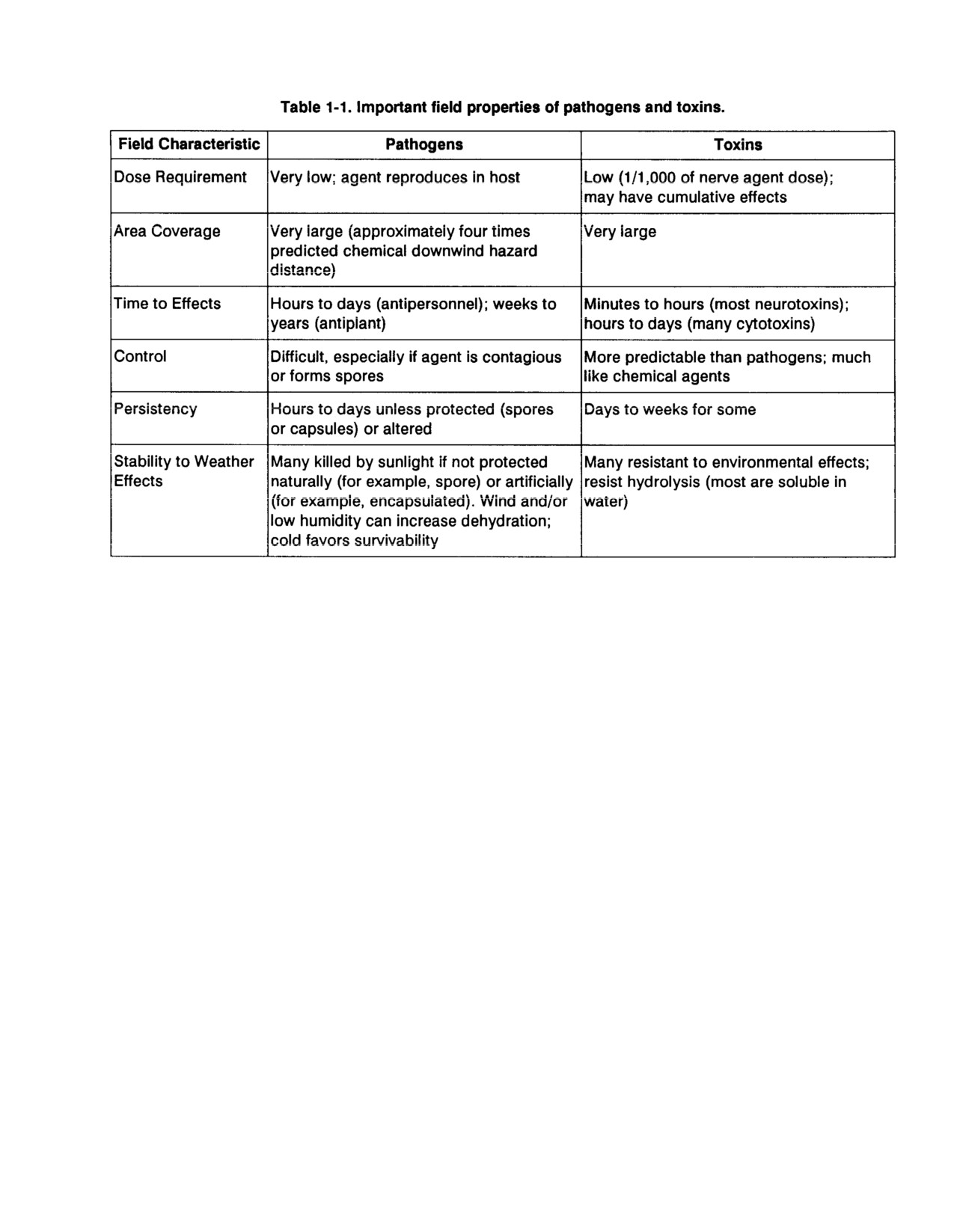
Table 1-1 summarizes important pathogen and toxin field
The same total dosages received through longer exposure
properties.
times at lower concentrations will reduce the symptoms
The response to the toxic agent is a function of the total
somewhat.
dose received, the length of exposure, and the route of
12
FM 3-9
13
FM 3-9
Chapter 2
Chemical Agents and Their Properties
Chemical agents can be separated into groups according to the potential severity
of their effects: lethal, blister, and incapacitating agents. This chapter contains the
physical, chemical, and physiological properties of specific chemical agents that
might be used or encountered in the field. It also gives brief information on their
use, detection, identification decontamination, and the protective measures to be
taken against them. As noted, Appendix B gives a comparison of the properties of
chemical agents. Temperatures are listed in degrees Celsius (C); other data are in
various metric units. Appendix C presents a table of English-metric equivalents.
Appendix D presents temperature conversions.
Section I. Lethal Chemical Agents
Lethal chemical agents are those agents that primarily
cause deaths among target personnel. They include the
choking, nerve, and blood agents.
Choking Agents
Choking agents injure an unprotected person chiefly in
CG is used as a delayed-casualty agent that causes fluid
the respiratory tract (the nose, the throat, and particularly
buildup in the lungs that can cause dryland drowning.
the lungs). In extreme cases membranes swell, lungs be-
During and immediately after exposure, coughing and
come filled with liquid, and death results from lack of
wheezing are likely however, exposure to low concentra-
oxygen; thus, these agents “choke” an unprotected person.
tions causes no ill effects for three hours or more. The
Fatalities of this type are called “dryland drownings.”
severity of poisoning cannot be estimated from the imme-
diate symptoms. The full effect is not usually apparent until
Phosgene (CG)
three or four hours after exposure. Severe cases can result
CG, normally a chemical agent with a short agent-cloud
in dryland drowning, usually within 24 hours. With proper
duration, was used extensively in World War I. In fact,
care a victim can recover if the amount of CG received is
more than 80 percent of World War I chemical agent
less than lethal. The protective mask provides protection.
fatalities resulted from CG.
If a person inhales some agent, he should continue normal
CG is a colorless gas with an odor similar to that of
combat duties unless he has respiratory distress.
new-mown hay, grass, or green corn, which may go un-
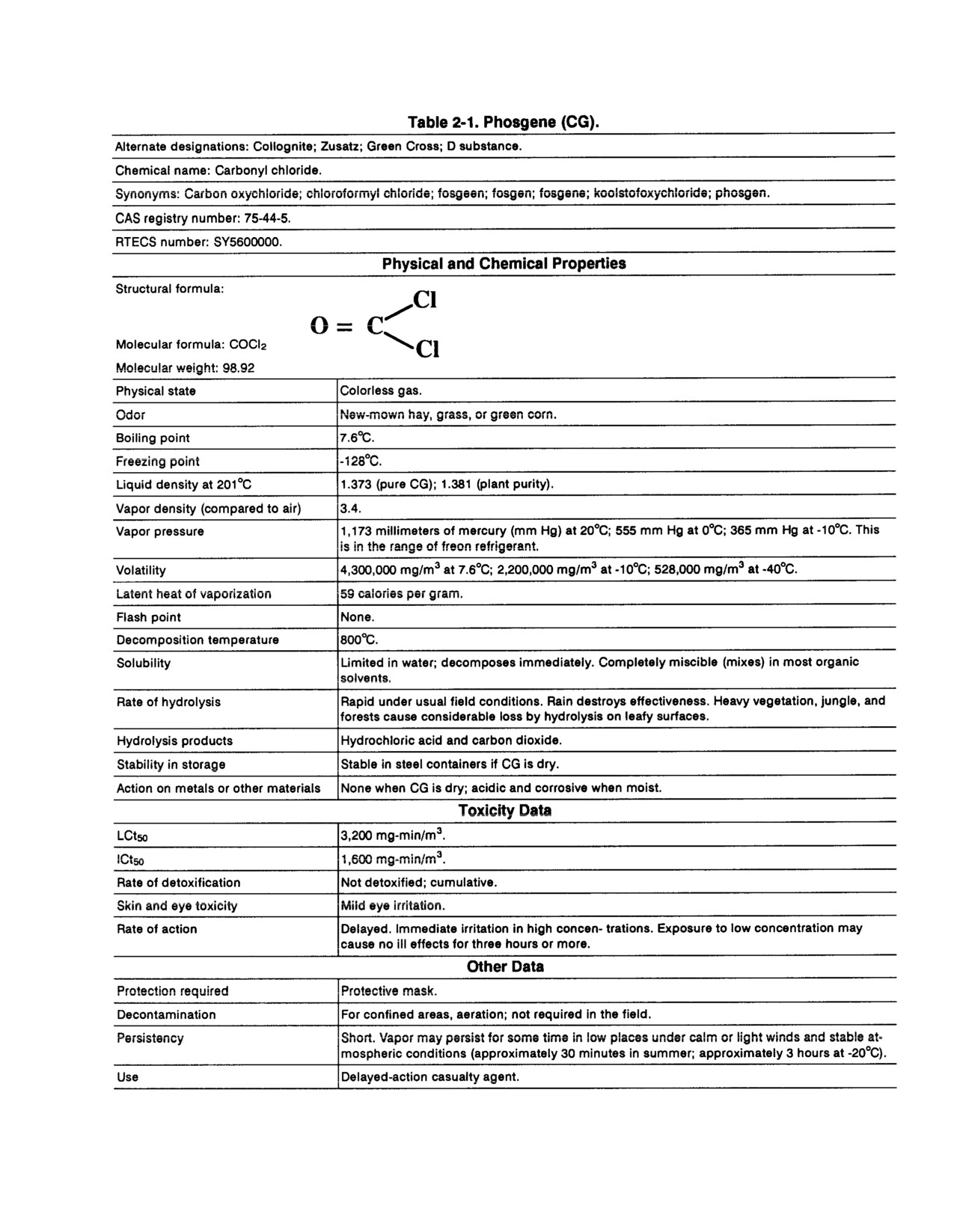
Selected data regarding the chemical properties and
noticed until at toxic levels. It tends to hug the ground;
toxicity of this agent follow (Table 2-l). These include
vapors may linger for some time in trenches and low places
Chemical Abstracts Service (CAS) registry number and
under calm or light winds. CG readily condenses to a
Registry of Toxic Effects of Chemical Substances
colorless liquid below 46°F (7.8°C). It reacts rapidly with
(RTECS) reference number.
water, so rain, fog, and dense vegetation reduce the con-
centration in the air.
14
FM 3-9
15
FM 3-9
Diphosgene (DP)
DP can produce delayed or immediate casualties,
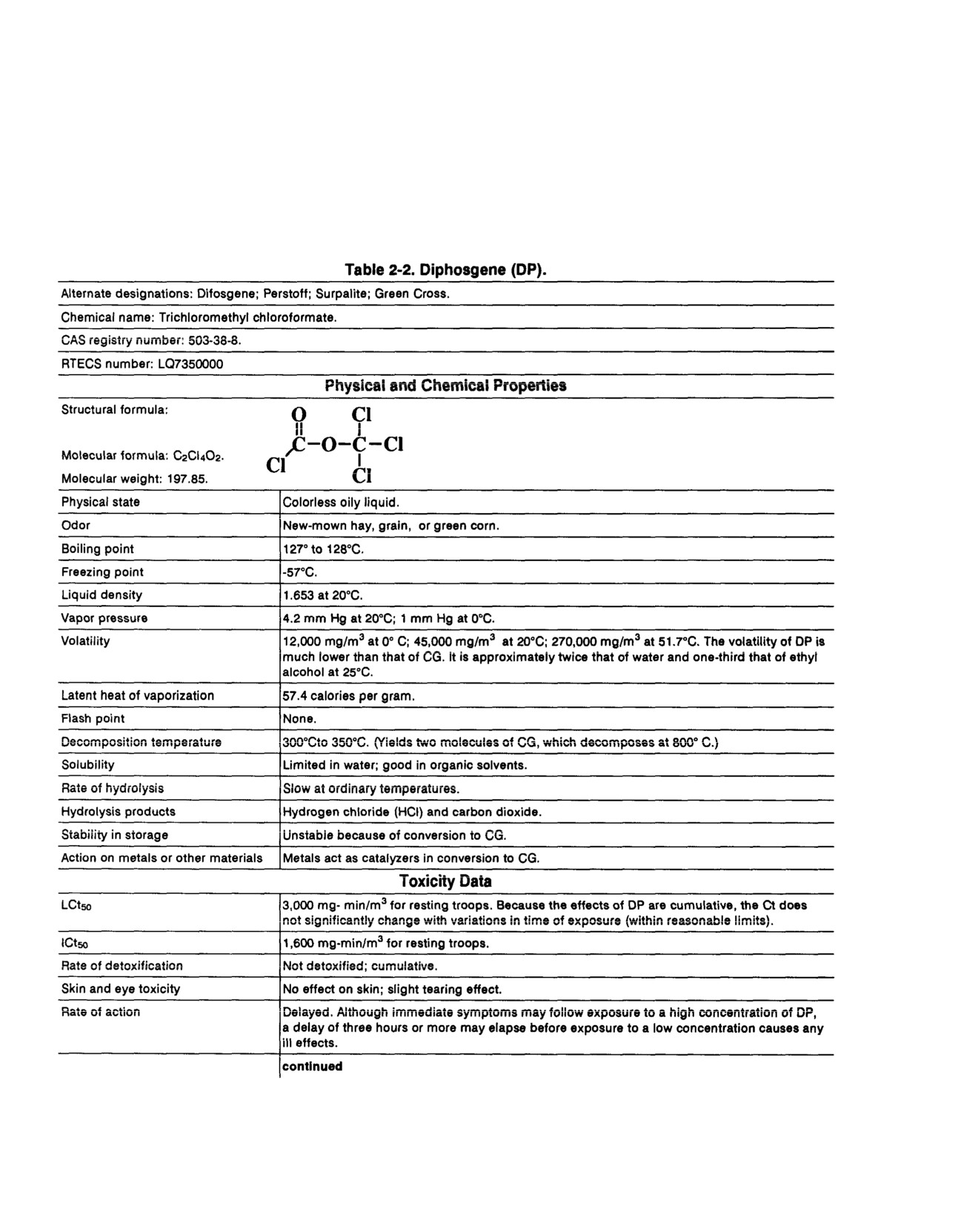
DP (Table 2-2) is a colorless liquid with an odor similar
depending upon the dosage received. Because the body
to that of new-mown hay, grain, or green corn. DP has a
converts DP to CG, the physical effects are the same for
much higher boiliig point than CG. Because DP has a
both agents. Immediate symptoms may follow exposure to
stronger tearing effect, it has less surprise value than CG
a high concentration of DP; a delay of three hours or more
when used on troops. Furthermore, its lower volatility
may elapse before exposure to a low concentration causes
(vapor pressure) adds to the difficulty of setting up an
any ill effects. The protective mask provides protection
effective surprise concentration.
from DP.
16

FM 3-9
Nerve Agents.
Nerve agents are organophosphate ester derivatives of
The ability of GB and GA to mix with water means that
phosphoric acid. They are generally divided into the G-
water could wash them off surfaces, that these agents can
agents, which in the unmodified state are volatile, and the
easily contaminate water sources, and that they will not
V-agents, which tend to be more persistent. Even G-agents
penetrate skin as readily as the more fat-soluble agents VX
are capable of being thickened with various substances to
and GD. G-agents spread rapidly on surfaces, such as skin;
increase the persistence and penetration of the intact skin.
VX spreads less rapidly, and the thickened agents very
The principal nerve agents are Tabun (GA), Sarin (GB),
slowly. The moist surfaces in the lungs absorb all the agents
Soman (GD), and VX. (In some countries the V-agents are
very well.
known as A-agents.)
Both the G- and V-agents have the same physiological
The G-agents are fluorine- or cyanide-containing or-
action on humans. They are potent inhibitors of the enzyme
ganophosphates. In pure form they are colorless liquids.
acetylcholinesterase (AChE), which is required for the
Their solubility in water ranges from complete miscibility
function of many nerves and muscles in nearly every mul-
for GB to almost total insolubility for GD. They have a
ticellular animal. Normally, AChE prevents the accumula-
weakly fruity odor but in field concentrations are odorless.
tion of acetylcholine after its release in the nervous system.
Clothing gives off G-agents for about 30 minutes after
Acetylcholine plays a vital role in stimulating voluntary
contact with vapor; consider this fact before unmasking.
muscles and nerve endings of the autonomic nervous sys-
The V-agents are sulfur-containing organophosphorous
tem and many structures within the central nervous system.
compounds. They are oily liquids with high boiling points,
Thus, nerve agents that are cholinesterase inhibitors per-
low volatility, and resultant high persistency. They are
mit acetylcholine to accumulate at those sites, mimicking
primarily contact hazards. They are exceptionally toxic; the
the effects of a massive release of acetylcholine. The major
limited amount of vapor they produce is sufficient to be an
effects will be on skeletal muscles, parasympathetic end
inhalation hazard. They have very limited volubility in
organs, and the central nervous system.
water and are hydrolyzed only minimally. V-agents affect
Individuals poisoned by nerve agents may display the
the body in essentially the same manner as G-agents.
following symptoms:
The nerve agents are all viscous liquids, not nerve gas
Difficulty in breathing.
per se. However, the vapor pressures of the G-series nerve
Drooling and excessive sweating.
agents are sufficiently high for the vapors to be lethal
Nausea.
rapidly. The volatility is a physical factor of most impor-
Vomiting, cramps, and loss of bladder/bowel control.
tance. GB is so volatile that small droplets sprayed from a
Twitching, jerking, and staggering.
plane or released from a shell exploding in the air may
Headache, confusion, drowsiness, coma, and convul-
never reach the ground. This total volatilization means that
sion.
GB is largely a vapor hazard. At the other extreme agent
The number and severity of symptoms depend on the
VX is of such low volatility that it is mainly a liquid contact
quantity and route of entry of the nerve agent into the body.
hazard. Toxicity can occur from the spray falling on one’s
When the agent is inhaled, a prominent symptom is pin-
skin or clothes and from touching surfaces on which the
pointing of the pupils of the eyes and dimness of vision
spray has fallen. GD is also mainly a vapor hazard, while
because of the reduced amount of light entering. However,
GA can be expected to contaminate surfaces for a suffi-
if exposure has been through the skin or by ingestion of a
ciently long time to provide a relevant contact hazard.
nerve agent, the pupils may be normal or only slightly to
Thickeners added to GD increase persistence in the
moderately reduced in size. In this event, diagnosis must
field. The thickened agents form large droplets that pro-
rely upon the symptoms of nerve agent poisoning other
vide a greater concentration reaching the ground and a
than its effects on the pupils.
greater contact hazard than the unthickened forms.
Exposure through the eyes produces a very rapid onset
The relative volubility of these compounds in water and
of symptoms (usually less than 2 to 3 minutes). Respiratory
soil is of significance because it relates to their disposition.
exposure usually results in onset of symptoms in 2 to 5
17
FM 3-9
minutes; lethal doses kill in less than 15 minutes. Liquid in
that age rapidly may resist treatment if it is not prompt.
the eye kills nearly as rapidly as respiratory exposure.
Therefore, an antidote enhancer, pyridostigmine bromide
Symptoms appear much more slowly from skin absorp-
(PB), is available to US forces in active theaters of opera-
tion. Skin absorption great enough to cause death may
tion. PB pretreatment increases the victim’s survivability
occur in one to two hours. Respiratory lethal dosages kill
when the antidote is used after exposure to nerve agents.
in one to ten minutes, and liquid in the eye kills nearly as
rapidly. Very small skin dosages sometimes cause local
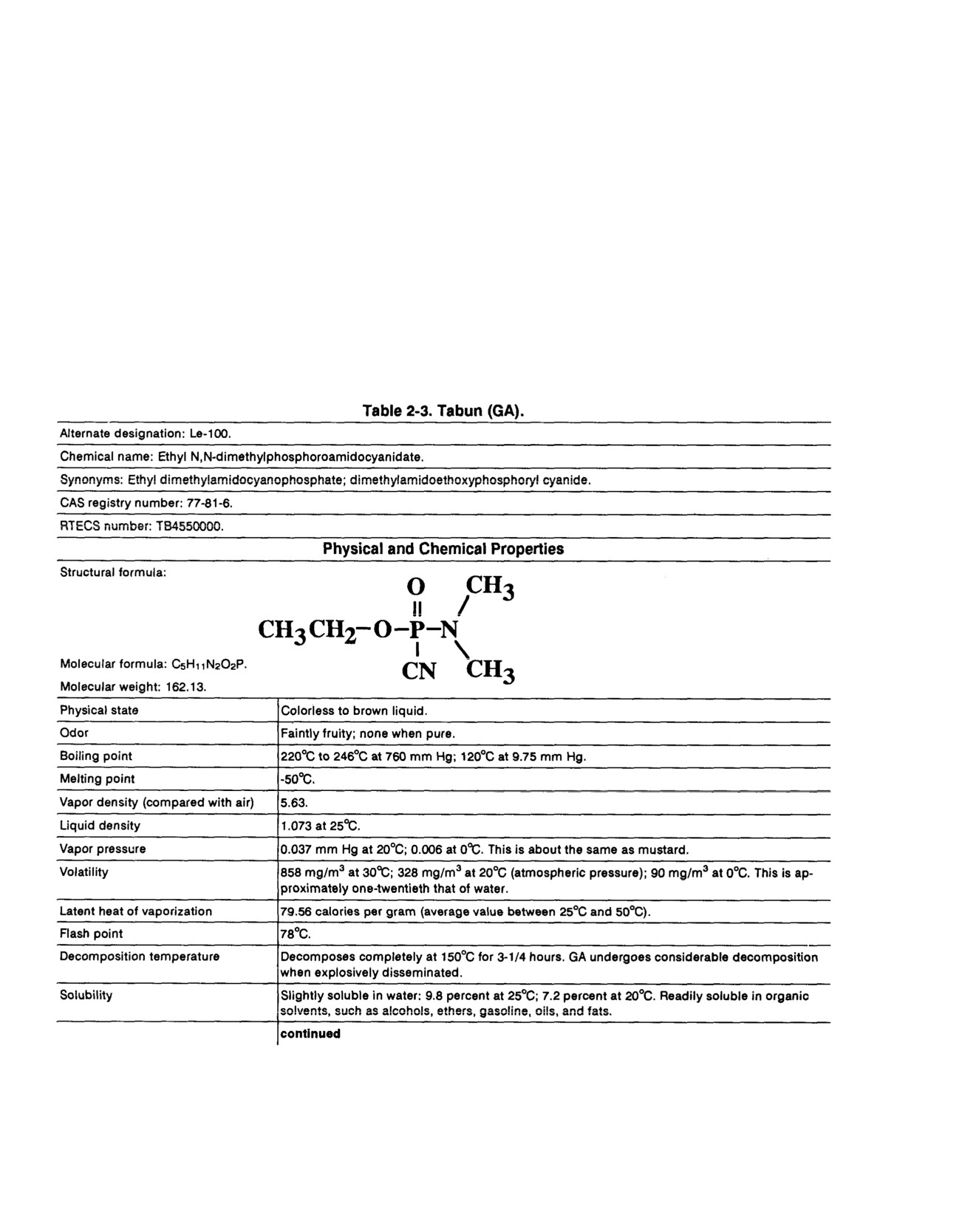
Tabun (GA)
sweating and tremors but little other effects. Nerve agents
GA is a brownish to colorless liquid that gives off a
are cumulative poisons. Repeated exposure to low con-
colorless vapor. GA (Table 2-3) was the first of the nerve
centrations, if not too far apart, will produce symptoms.
agents developed by the Germans before World War II. It
Treatment of nerve agent poisoning includes use of the
is about 30 times as toxic as phosgene, which was used in
nerve agent antidote (atropine and 2-PAM chloride).
WWI. It enters the body primarily through the respiratory
Atropine blocks acetylcholine; 2-PAM Cl, reactivates the
tract, but it is also highly toxic through the skin and diges-
enzyme AChE. As time passes without treatment the bind-
tive tract. It is approximately 20 times more persistent than
ing of nerve agents to AChE “ages” and the 2-PAM Cl can
GB but not as stable in storage.
no longer remove the agent. Certain agents, such as GD,
18
FM 3-9
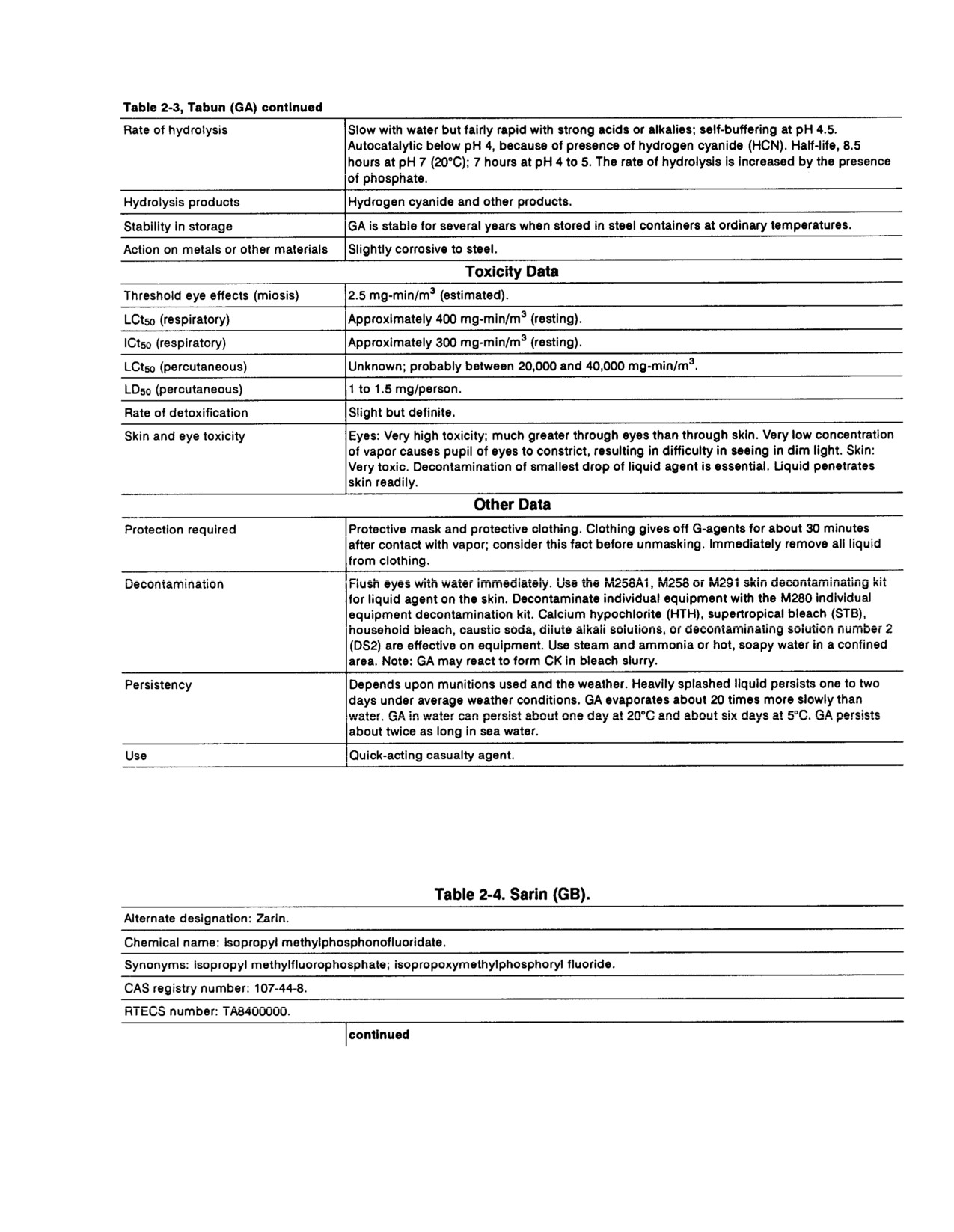
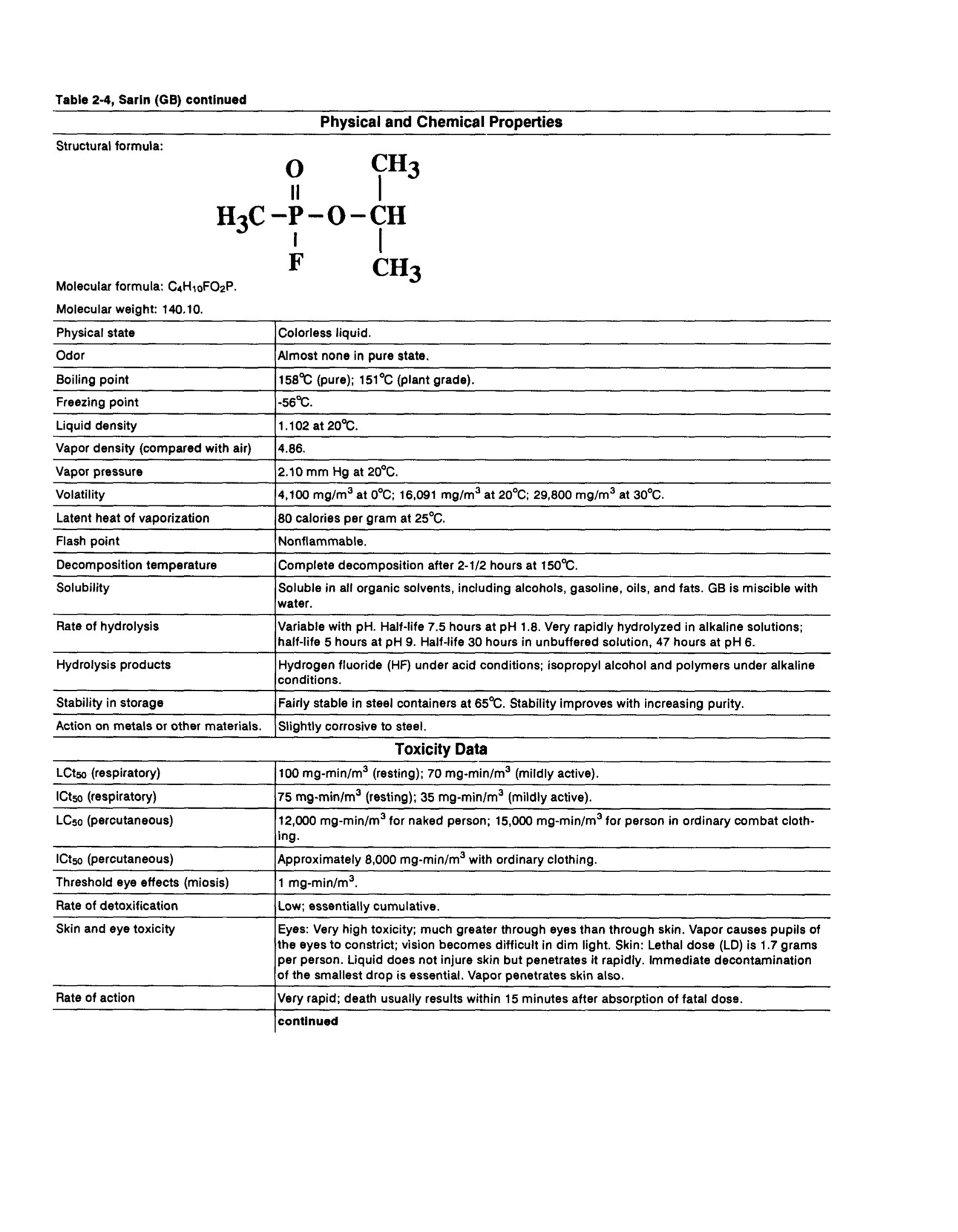
Sarin (GB)
The physiological symptoms of GB are essentially the same
The Germans developed GB after they developed GA,
as those of other nerve agents.
hence the designation GB (Table 2-4). It is a volatile liquid
at room temperature. Pure GB is odorless and colorless.
19
FM 3-9
20
FM 3-9
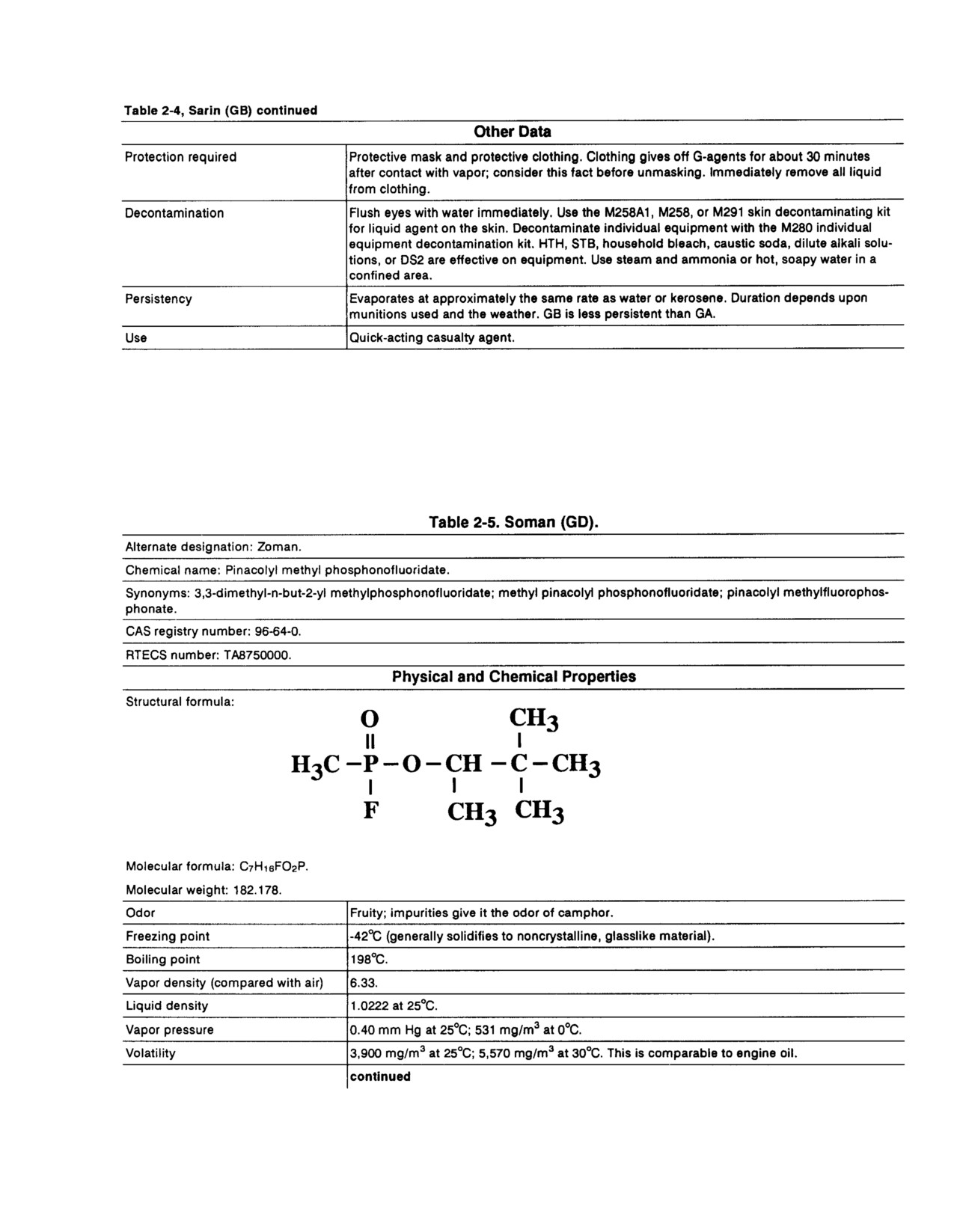
Soman (GD)
a few minutes antidotes are not as effective for GD poison-
GD is a colorless liquid that gives off a colorless vapor.
ing as they are for other nerve agents. The addition of agent
Soman is the most poisonous of the G-agents, apparently
thickeners increases GD persistency and hazard. The usual
because of the ease with which it can penetrate into the
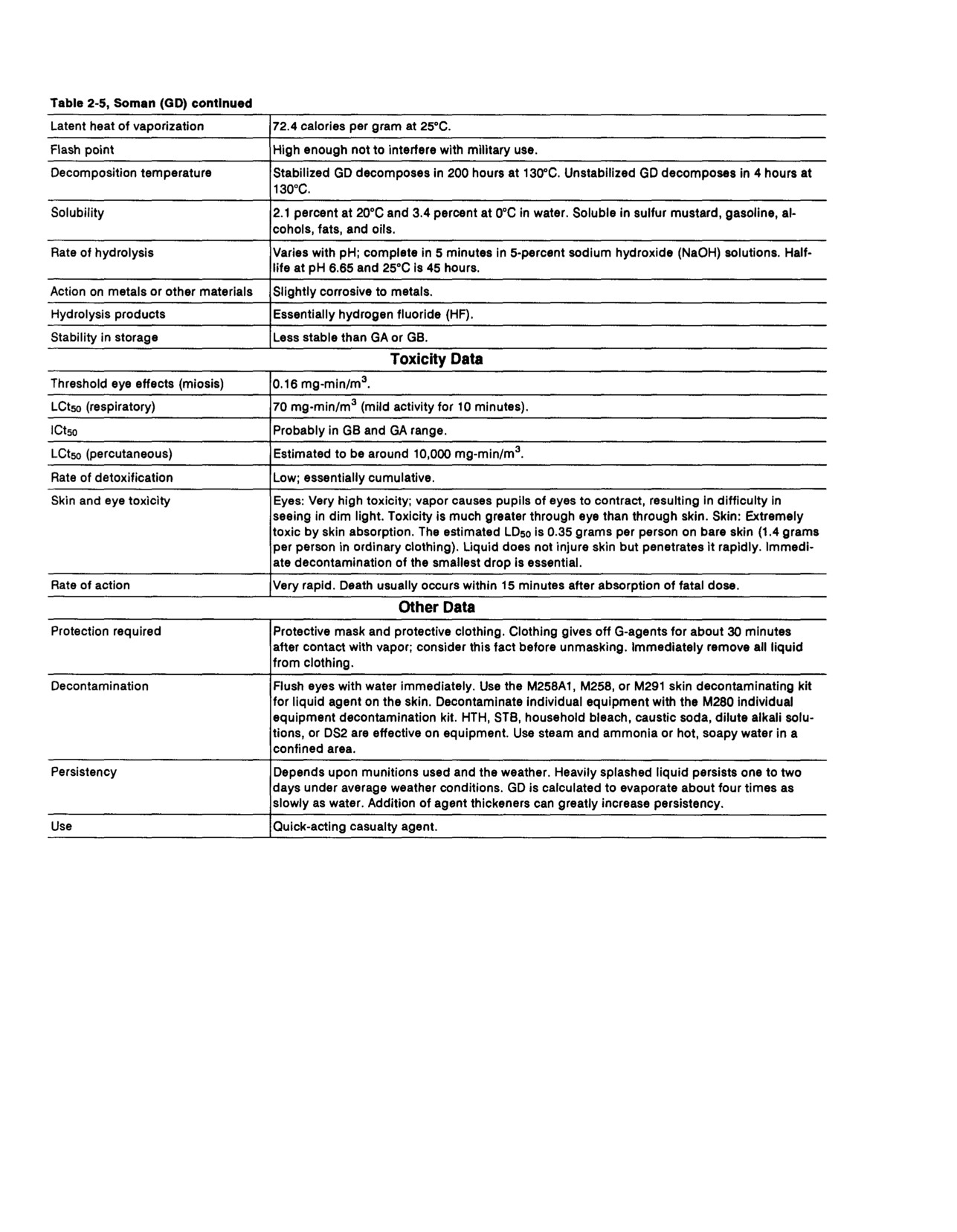
thickened form of GD is designated TGD. VR-55 is
central nervous system. The physiological effect of GD is
probably another designation for thickened Soman. See
essentially the same as that of GA and GB. However, after
Table 2-5.
21
FM 3-9
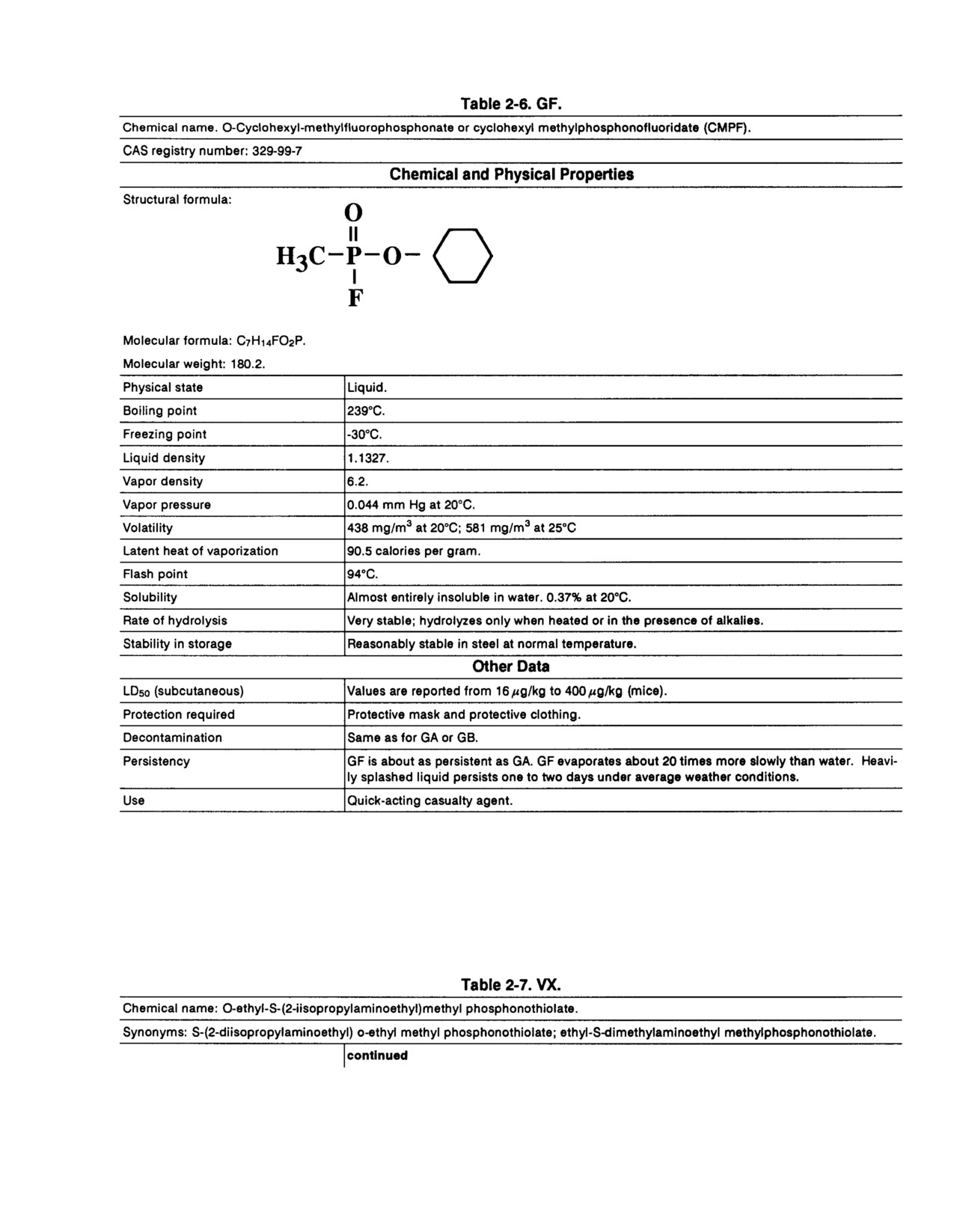
GF
through the skin and digestive tract. It is a strong
The agent GF is a fluoride-containing organophosphate.
cholinesterase inhibitor. Toxicity information reports
It is a potential nerve agent. It is a slightly volatile liquid
LD5O values in mice from 16 µg/kg to 400 µg/kg, compared
that is almost insoluble in water. It enters the body primari-
to LD50 of 200 µg/kg for Sarin. It is approximately 20 times
ly through the respiratory tract but is also highly toxic
more persistent that Sarin. See Table 2-6.
22
FM 3-9
VX
volatility, liquid droplets on the skin do not evaporate
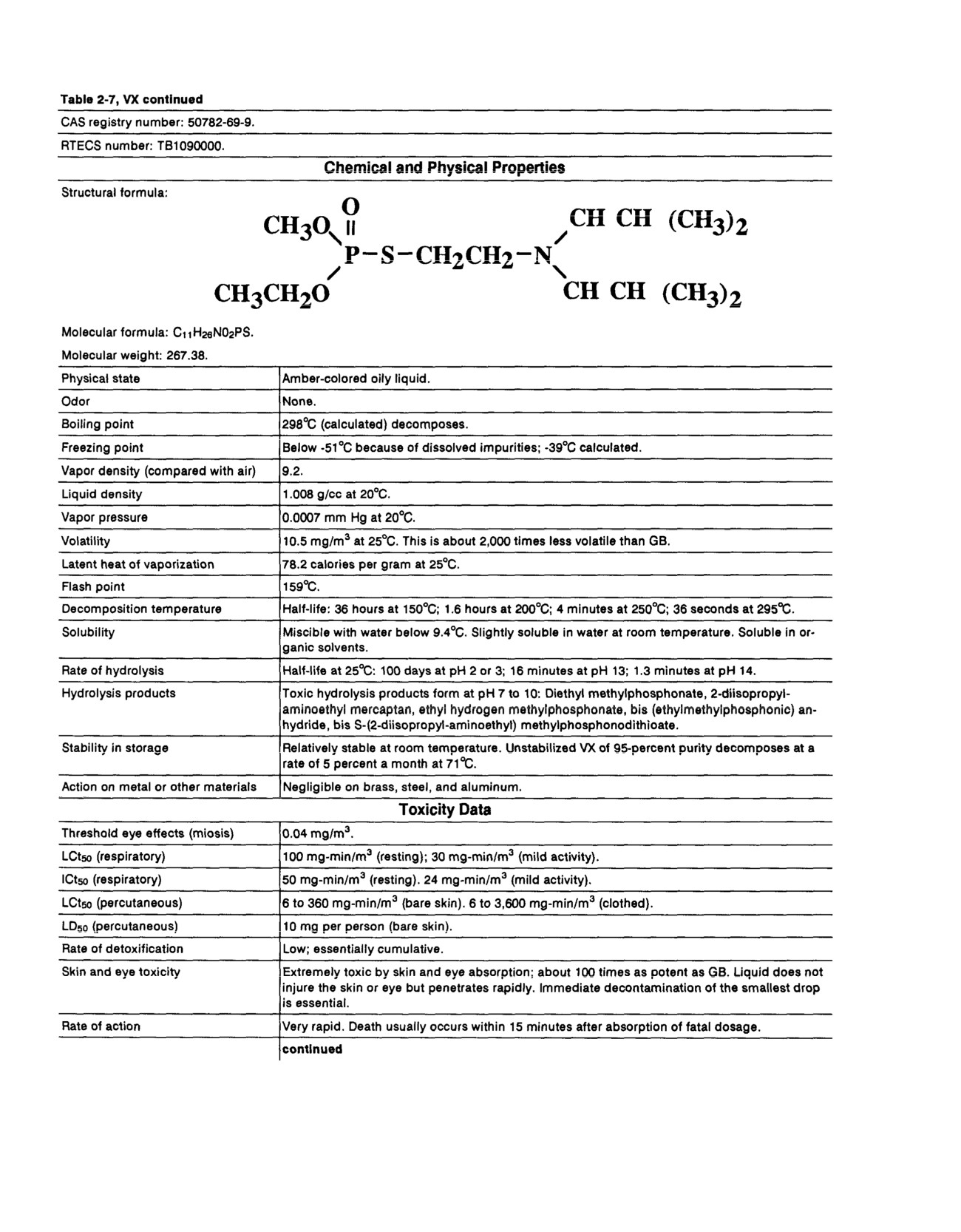
The US standard V-agent is VX (Table 2-7). It is a very
quickly, thereby increasing absorption. VX by this per-
persistent, odorless, amber-colored liquid, similar in ap-
cutaneous route is estimated to be more than 100 times as
pearance to motor oil. Although VX is many times more
toxic as GB. VX by inhalation is estimated to be twice as
persistent than the G-agents, it is very similar to GB in
toxic as GB.
mechanism of action and effects. Because VX has low
23
FM 3-9
24
FM 3-9
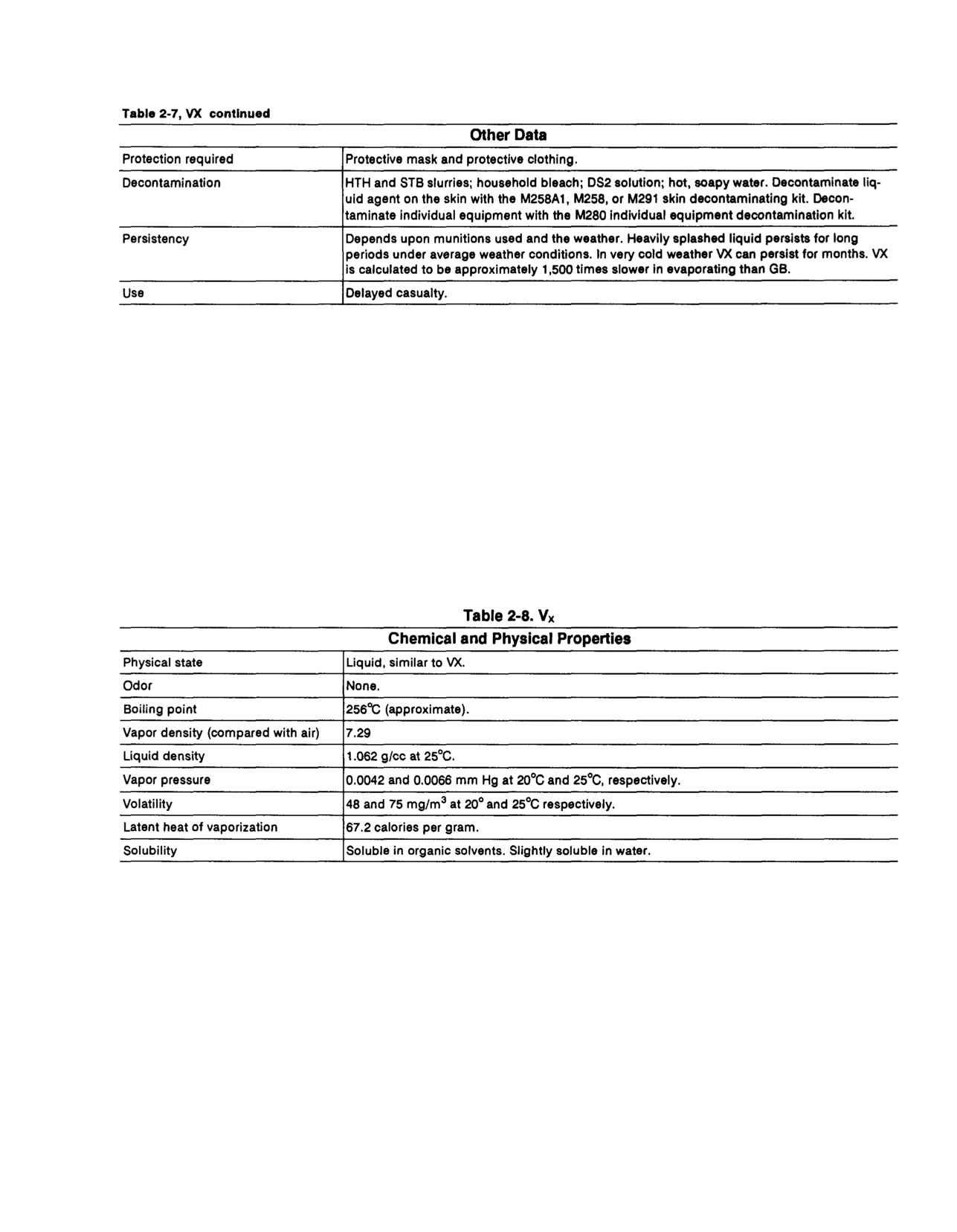
Vx
VX2 have been developed to decrease hazards of manufac-
Another V-agent of interest is Vx, called “V sub x“ (Table
turing storing, and handling unitary nerve agents. In binary
2-8). Another designation for Vx is “V-gas.” The properties
weapons two relatively nontoxic chemicals are mixed in
of Vx are similar to those of VX. It is nearly ten times more
flight to form the agent.
volatile than VX but is very persistent in comparison to the
GB2 is formed by the reaction of methylphosphonic
G-agents. The molecular weight of Vx is 211.2. Listed
dfluoride (DF) (see DF) with a mixture of isopropyl al-
values are calculated, Information on this agent is limited.
cohol and isopropylamine (OPA) (see OPA).
The physiological action, protection, and decontaminants
VX2, binaryVX, is formed by there action of O,O’-ethyl
for Vx are the same as for VX.
(2-diisopropylaminoethyl) methylphosphonite (see QL)
with sulfur (see NE and NM).
Binary Nerve Agents (GB2 and VX2)
Compounds used to produce the binary nerve agents are
GB2 and VX2 are the designations for Sarin (GB) and
not chemical agents themselves; Chapter 3 discusses these
agent VX which are formed in binary reactions. GB2 and
compounds.
Blood Agents
Most blood agents are cyanide-containing compounds,
concentrations both compounds cause effects within
absorbed into the body primarily by breathing. AC and CK
seconds and death within minutes in unprotected person-
are the important agents in this group. Blood agents are
nel. The cyanides affect body functions by poisoning the
highly volatile and, therefore, nonpersistent even at very
cytochrome oxidase system, this poisoning prevents cell
low temperatures. These agents can be dispersed by artil-
respiration and the normal transfer of oxygen from the
lery shell, mortar, rocket, aircraft spray, or bomb. AC has
blood to body tissues. Cyanogen chloride also acts as a
an odor like bitter almonds; CK is somewhat more pungent.
choking agent. The standard protective mask gives ade-
The odor of CK often goes unnoticed because CK is so
quate protection against field concentrations.
irritating to the eyes, nose, and respiratory tract. At high
25
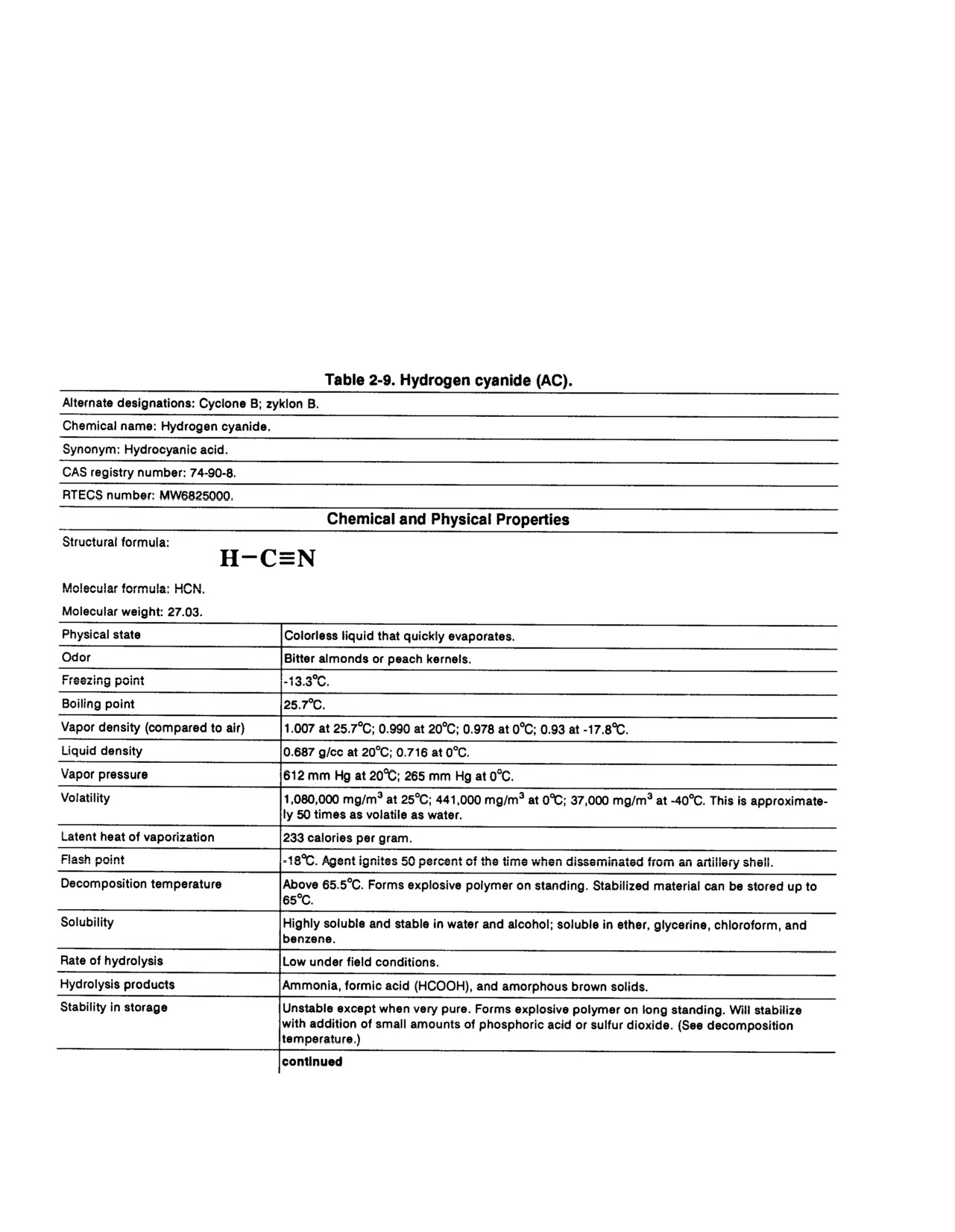
Hydrogen Cyanide (AC)
put on as fast as possible. The pink color of the casualty’s
Although the US armed forces do not stockpile AC
lips, fingernails, and skin suggests hydrogen cyanide
(Table 2-9), it is of interest because of its availability. It can
poisoning. Exposure to high concentrations may cause
be readily synthesized in large quantities and is commer-
instant loss of consciousness and death. A nonlethal dosage
cially available. Potential enemies may hold large stock-
will cause moderate symptoms, but the patient can recover.
piles. Some states use hydrogen cyanide for capital
Low doses have almost no effect on the body. AC is less
punishment. Pure AC is a nonpersistent, colorless liquid
persistent than other blood agents. The protective mask
that is highly volatile. It is used as a quick-acting casualty
provides protection against field concentrations of AC.
agent that causes death within 15 minutes after a lethal dose
Liquid AC can penetrate skin. However, because of its high
has been received.
volatility, liquid AC is not likely to be encountered in the
AC has a faint odor, similar to bitter almonds, that
field, and protective clothing is required only in very un-
sometimes cannot be detected even in lethal concentra-
usual situations.
tions. AC strongly stimulates breathing; the mask must be
26
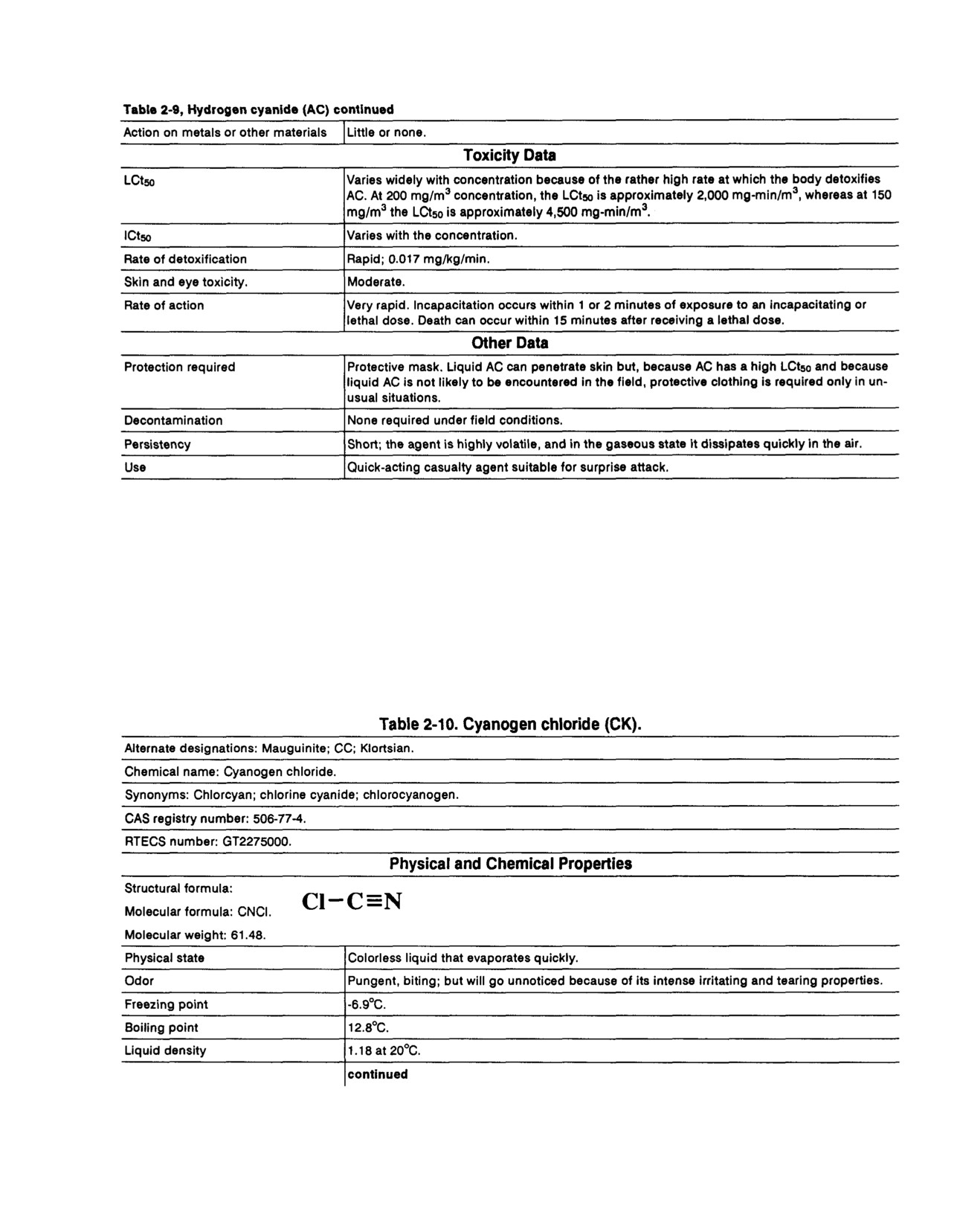
FM 3-9
Cyanogen Chloride (CK)
phosgene poisoning. Skin and eye toxicity are too low to be
CK (Table 2-10) is a colorless, highly volatile liquid with
of military importance, but CK is highly irritating to eyes
a pungent, biting odor that will go unnoticed because of the
and mucous membranes. The general action of CK, inter-
agent’s tearing and irritating properties. Although CK
ference with use of oxygen by the body tissues, is similar to
quickly evaporates, vapors may persist in the forest or
that of AC. However, CK differs from AC in that it has
jungle for some time under suitable weather conditions.
strong irritating and choking effects and slows breathing.
Normally, CK is nonpersistent and is used as a quick-acting
The protective mask protects against CK; a high concentra-
casualty agent.
tion, however, may degrade the falter and reduce the mask’s
CK irritates the respiratory tract similar to phosgene;
protective capability.
fluid may accumulate in the lungs much faster than in
27
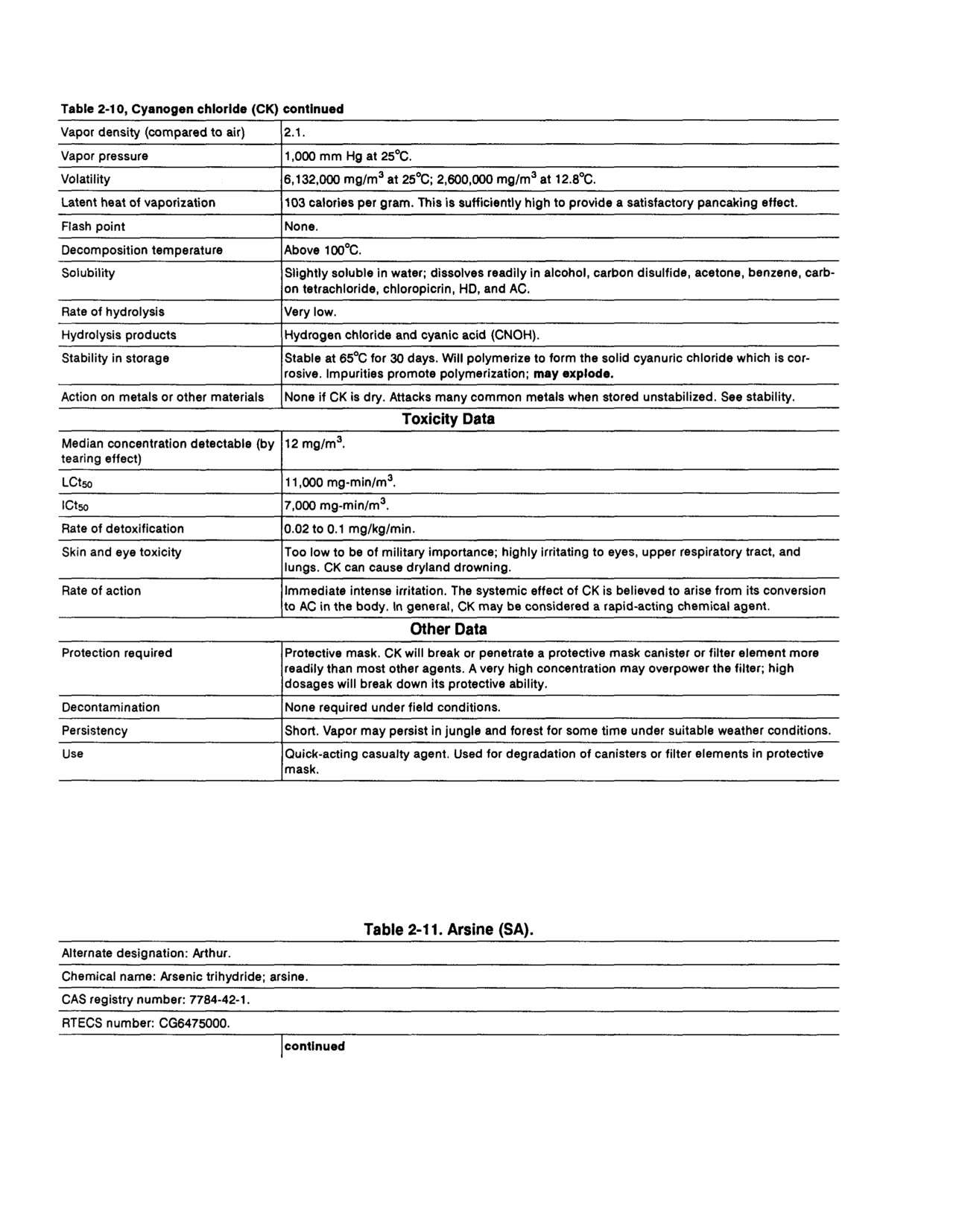
FM 3-9
Arsine (SA)
creased exposure causes chills, nausea, and vomiting.
SA is a gas with a mild, garliclike odor. It is used as a
Severe exposure damages blood, causing anemia. It is a
delayed-action casualty agent that interferes with the
carcinogen. The protective mask provides adequate
functioning of the blood and damages the liver and kidneys.
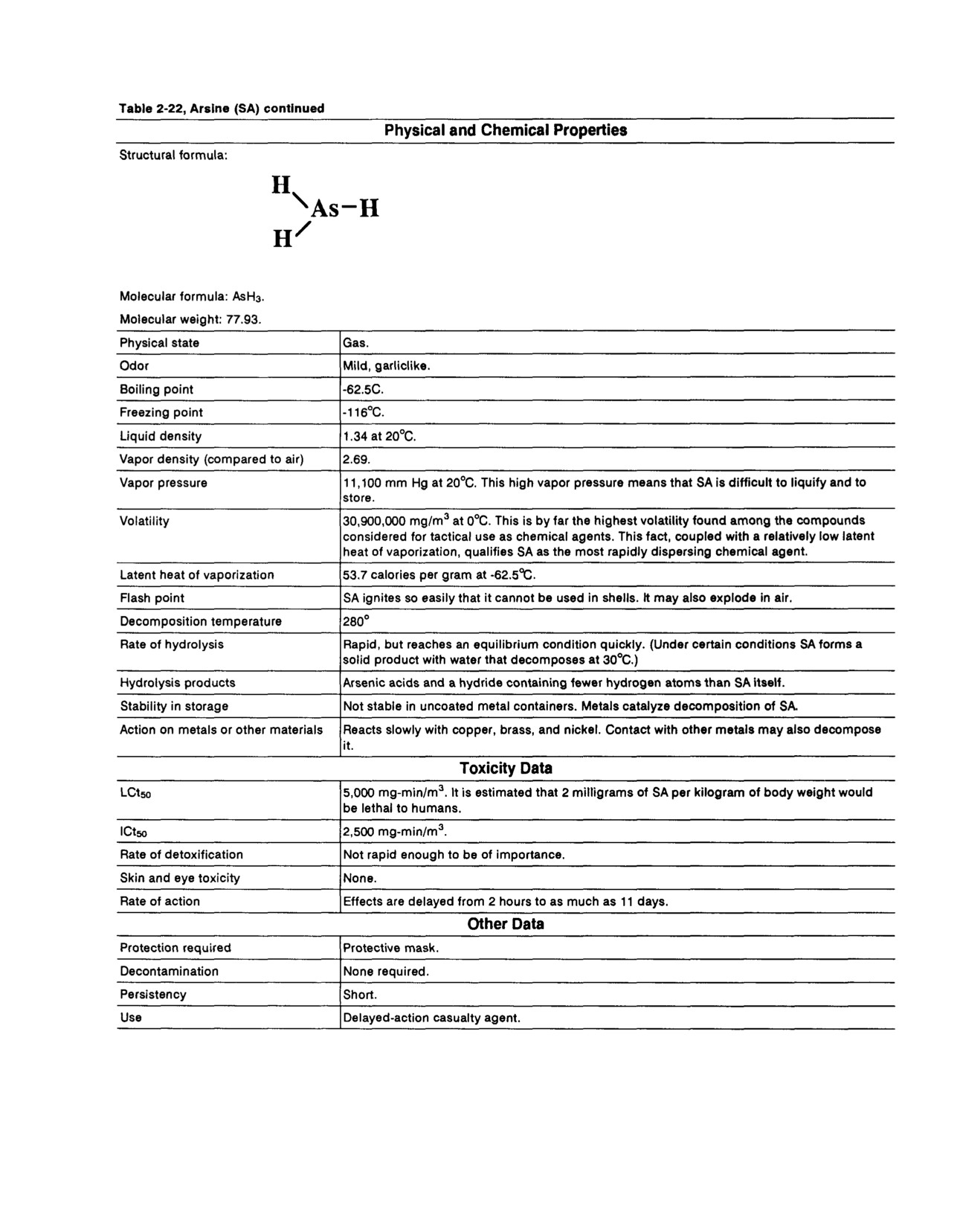
protection. See Table 2-11.
Slight exposure causes headache and uneasiness. In-
28
FM 3-9
29
FM 3-9
Section II. Blister Agents (Vesicants)
All of the blister agents are persistent, and all may be
phosgene oxime (CX), which cause immediate pain on
employed in the form of colorless gases and liquids. Blister
contact. CX produces a wheal (similar to a bee sting) rather
agents damage any tissue that they contact. They affect the
than a water blister, which the other blister agents produce.
eyes and lungs and blister the skin. They damage the
Note: Fluid in mustard agent blisters may be quite irritat-
respiratory tract when inhaled and cause vomiting and
ing fluid in lewisite blisters is nontoxic and nonvesicant.
diarrhea when absorbed. Vesicants poison food and water
Blister agents can be described as mustards, arsenicals,
and make other supplies dangerous to handle. They may
or urticants. The mustards (H, HD, HN-1, HN-2, and
produce lethalities, but skin damage is their main casualty-
HN-3) contain either sulfur or nitrogen. The next para-
producing effect. The severity of a blister agent burn direct-
graphs discuss the mustards. The arsenical (ethyl-
ly relates to the concentration of the agent and the duration
dichloroarsine [ED], methyldichloroarsine [MD], and
of contact with the skin. In addition to casualty production,
phenyldichloroarsine [PD]) are a group of related com-
blister agents may also be used to restrict use of terrain, to
pounds in which arsenic is the central atom. Arsenical
slow movements, and to hamper use of materiel and instal-
hydrolyze rapidly and are less toxic than other agents of
lations.
military interest. The discussion of arsenical chemical
During World War I mustard (H) was the only blister
agents appears later in this chapter. Also later in this
agent in major use. It had a recognizable, distinctive odor
chapter is a discussion of urticants and, specifically, the
and a fairly long duration of effectiveness under normal
principal urticant of military interest, CX. Mustards and
weather conditions. Since then, odorless blister agents have
arsenical are sometimes mixed to alter their properties for
been developed that vary induration of effectiveness. Most
military effectiveness; they may also be employed with
blister agents are insidious in action; there is little or no
thickeners.
pain at the time of exposure. Exceptions are lewisite and
Mustards
This group of agents includes the sulfur mustards (H and
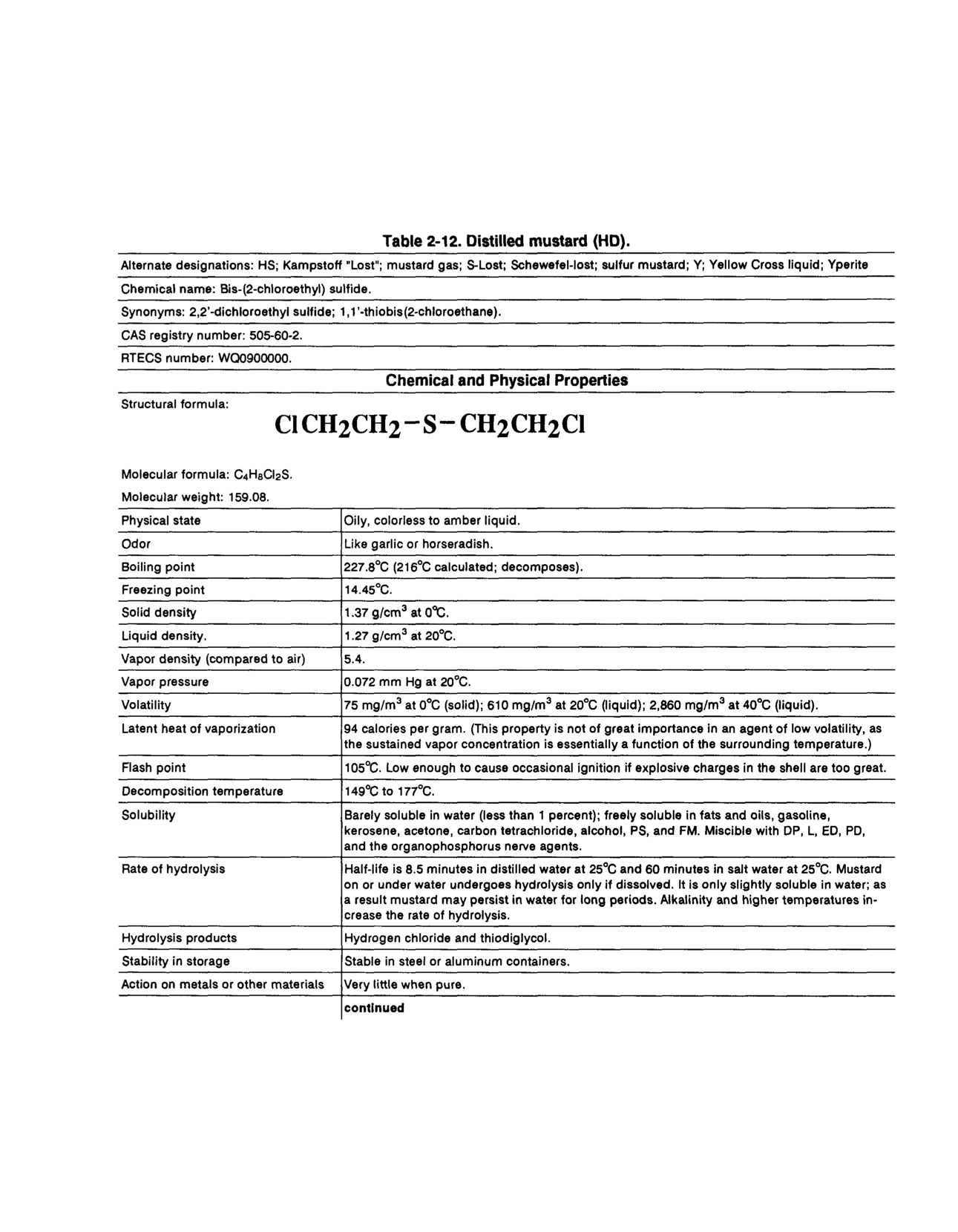
Distilled Mustard (HD)
HD) which are chlorinated thioethers, and the nitrogen
HD originally was produced from H by a purification
mustards (HN-1, HN-2, and HN-3) which are considered
process of washing and vacuum distillation. HD (Table
derivatives of ammonia. The nitrogen mustards have
2-12) is a colorless to amber-colored liquid with a garliclike
nitrogen as the central atom with the hydrogen atoms
odor. HD has less odor and a slightly greater blistering
replaced by various organic groups. Derivatives of the
power than H and is more stable in storage. It is used as a
nitrogen mustards have been used in the treatment of
delayed-action casualty agent, the duration of which
certain types of cancer. HD and HN-3 are the principal
depends upon the munitions used and the weather. Al-
military representatives of sulfur and nitrogen mustards.
though HD is heavier than water, small droplets will float
The mustards can penetrate skin and a great number of
on water surfaces and present a hazard.
materials. These materials include wood, leather, rubber,
The effects of HD are usually delayed for 4 to 6 hours,
and paints. Because of their physical properties, mustards
but latent periods have been observed for up to 24 hours.
are very persistent under cold and temperate conditions. It
The higher the concentration, the shorter the interval of
is possible to increase their persistency even more by dis-
time from exposure to the first symptoms. Mustard acts
solving them in thickeners. Mustards are less persistent in
first as a cell irritant and finally as a cell poison on all tissue
hot climates but can reach relatively high concentrations in
surfaces contacted. Early symptoms include inflammation
air because of greater evaporation rate.
of the eyes; inflammation of the nose, throat, trachea,
bronchi, and lung tissue; and redness of the skin; blistering
Levinstein Mustard (H)
or ulceration may follow. Effects may include a more “at-
Levinstein mustard is the original mustard (gas) of
ease” attitude, vomiting, and fever, beginning about the
World War I vintage. It contains about 30-percent sulfur
same time as skin reddening. The eyes are very sensitive to
impurities, which give it a pronounced odor. These im-
low concentrations; skin damage requires higher con-
purities lessen the effectiveness of H but depress its freez-
centrations. Wet skin absorbs more mustard than does dry
ing point two to five degrees. Other properties of H are
skin. For this reason HD exerts a casualty effect at lower
essentially the same as those for distilled mustard, which is
concentrations in hot, humid weather, because the body is
discussed next.
moist with perspiration. The protective mask and clothing
30
FM 3-9
provide adequate protection, but protection against large
more susceptible to local and overwhelming infections than
droplets, splashes, and smears requires impermeablecloth-
the normal individual. Injuries produced by HD heal much
ing. HD has a very low detoxification rate; therefore, very
more slowly and are more susceptible to infection than
small repeated exposures are cumulative in the body.
burns of similar intensity produced by physical means or by
Individuals also can become sensitized to mustard.
most other chemicals.
Amounts approaching the lethal dose make casualties
31
///////////////////////////////////////