FM 3-9 Potential Military Chemical / Biological Agents and Compounds (December 1990) - page 2
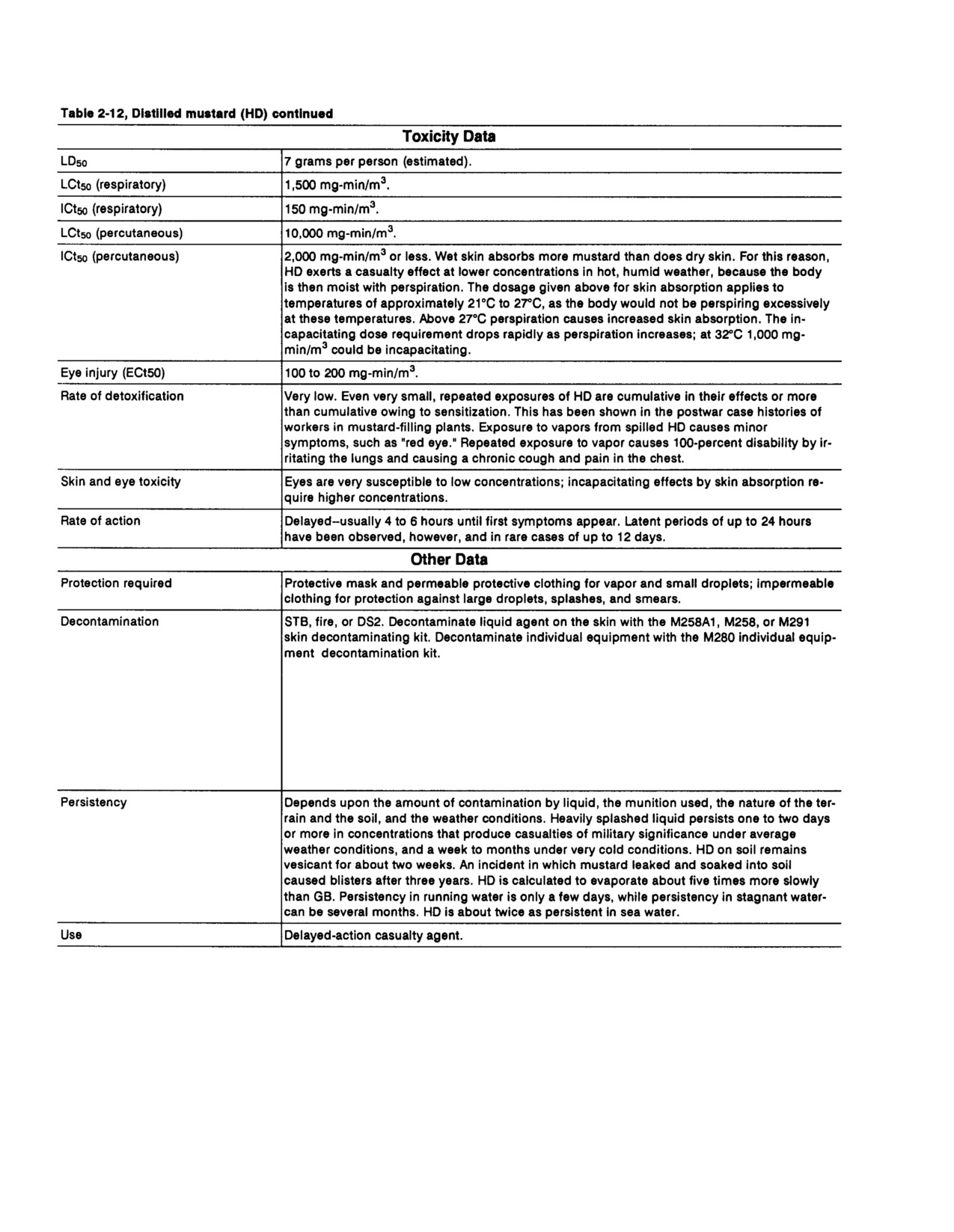
FM 3-9
Nitrogen Mustard (HN-1)
a delay of 12 hours or more before skin-damaging
HN-1 (Table 2-13) is similar to mustard in its properties
symptoms are felt.
and effects; however, it is more volatile and less persistent
Nitrogen mustards act more quickly on the eyes than
than mustard but only one-fifth as damaging and not as
does HD. The eyes are very susceptible to low concentra-
stable. HN-1 is a colorless liquid with a faint, fishy or musty
tions of nitrogen mustard, while a high concentration is
odor. It is used as a delayed-action casualty agent that has
required to significantly damage the skin or respiratory
tract insofar as single exposures are concerned. Mild vapor
32
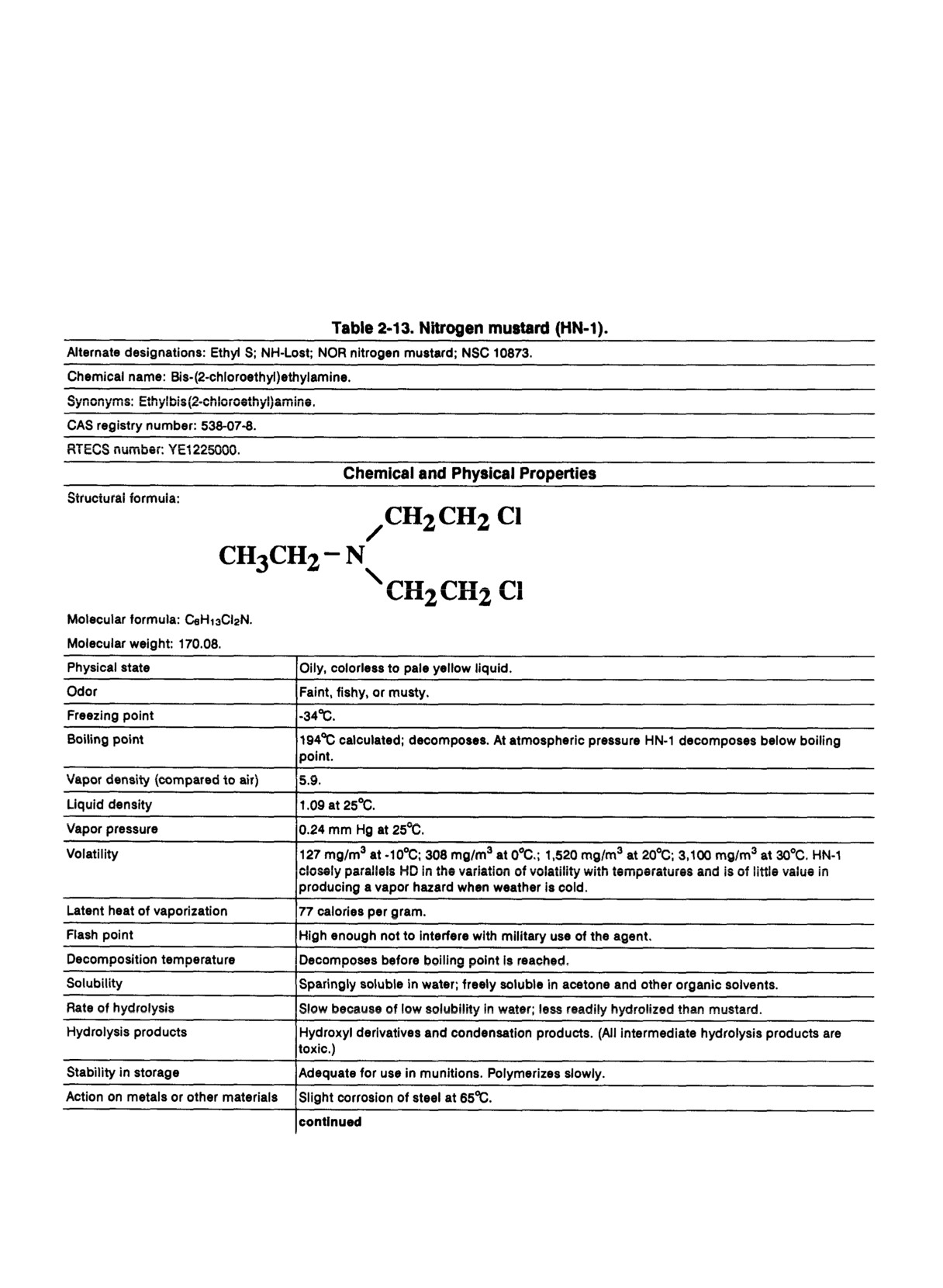
FM 3-9
exposure may produce no skin lesions. Severe vapor ex-
effects can progress to fever and labored breathing.
posure or exposure to liquid HN will result in redness of
Bronchial pneumonia may appear after 24 hours.
the skin, causing irritation and itching. Later blisters may
Following ingestion or systemic absorption, the nitrogen
appear in the red area. The skin lesions are similar to those
mustards injure the intestinal tract. Severe diarrhea, which
caused by HD. The body does not detoxify HN-l; there-
may be bloody, occurs. Ingestion of 2 to 6 milligrams causes
fore, it is cumulative.
nausea and vomiting.
Effects on the respiratory tract are the same as those of
The protective mask and protective clothing provide
mustard: irritation of the nose and throat, hoarseness
adequate protection, but protection against large droplets,
progressing to loss of voice, and a persistent cough. These
splashes, and smears requires impermeable clothing.
33
FM 3-9
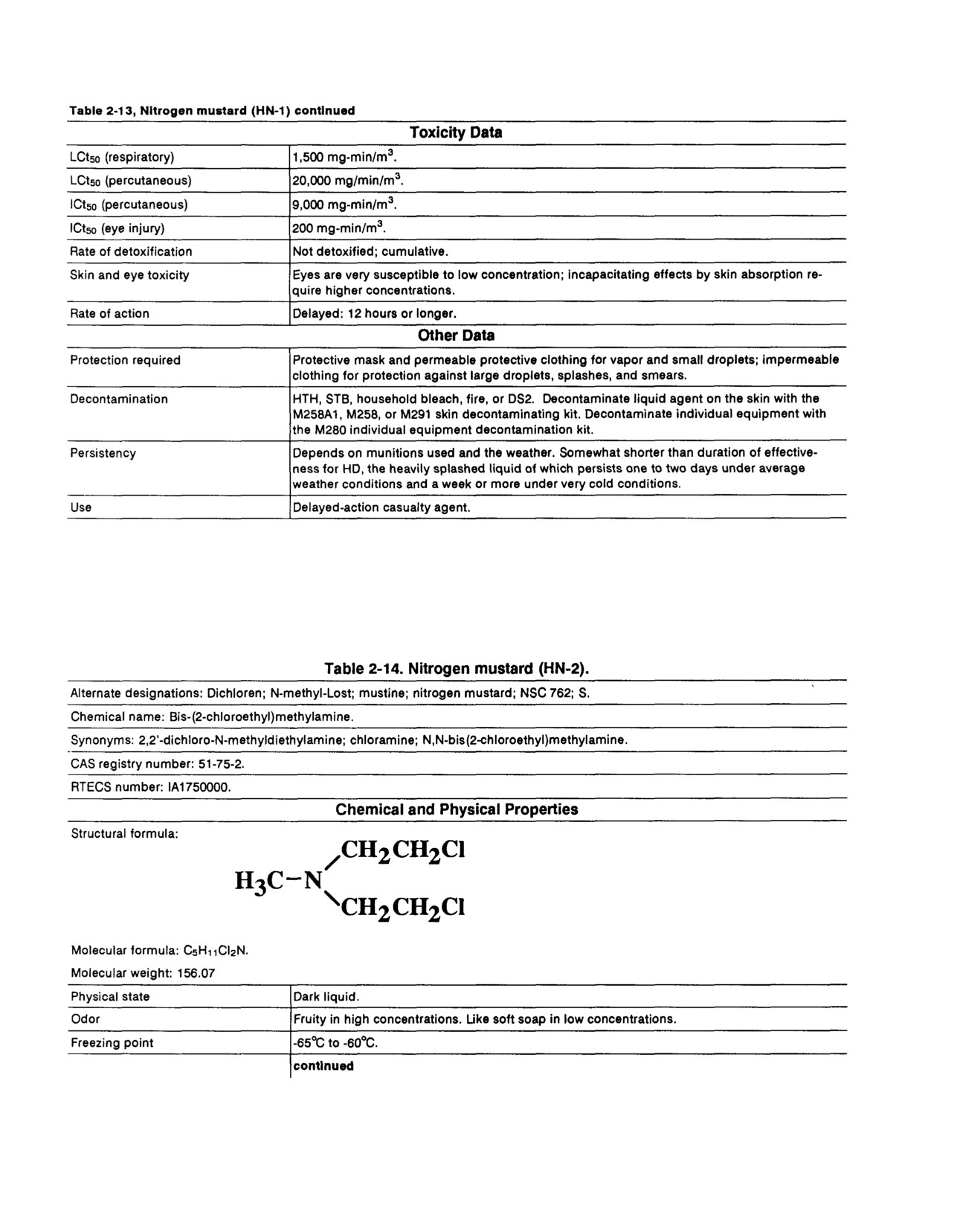
Nitrogen Mustard (HN-2).
agent. Skin effects are delayed 12 hours or longer after
HN-2 is a liquid with a fruity odor in high concentrations.
exposure. The protective mask and protective clothing
It is rated as somewhat more toxic than HN-1. HN-2 affects
provide adequate protection, but protection against large
the eyes in lower doses than do the other mustards. HN-2
droplets, splashes, and smears requires impermeable
has the greatest blistering power of the nitrogen mustards
clothing. See Table 2-14. HN-2 is highly unstable and is not
in vapor form but is intermediate as a liquid blistering
presently considered seriously as a chemical agent.
34
FM 3-9
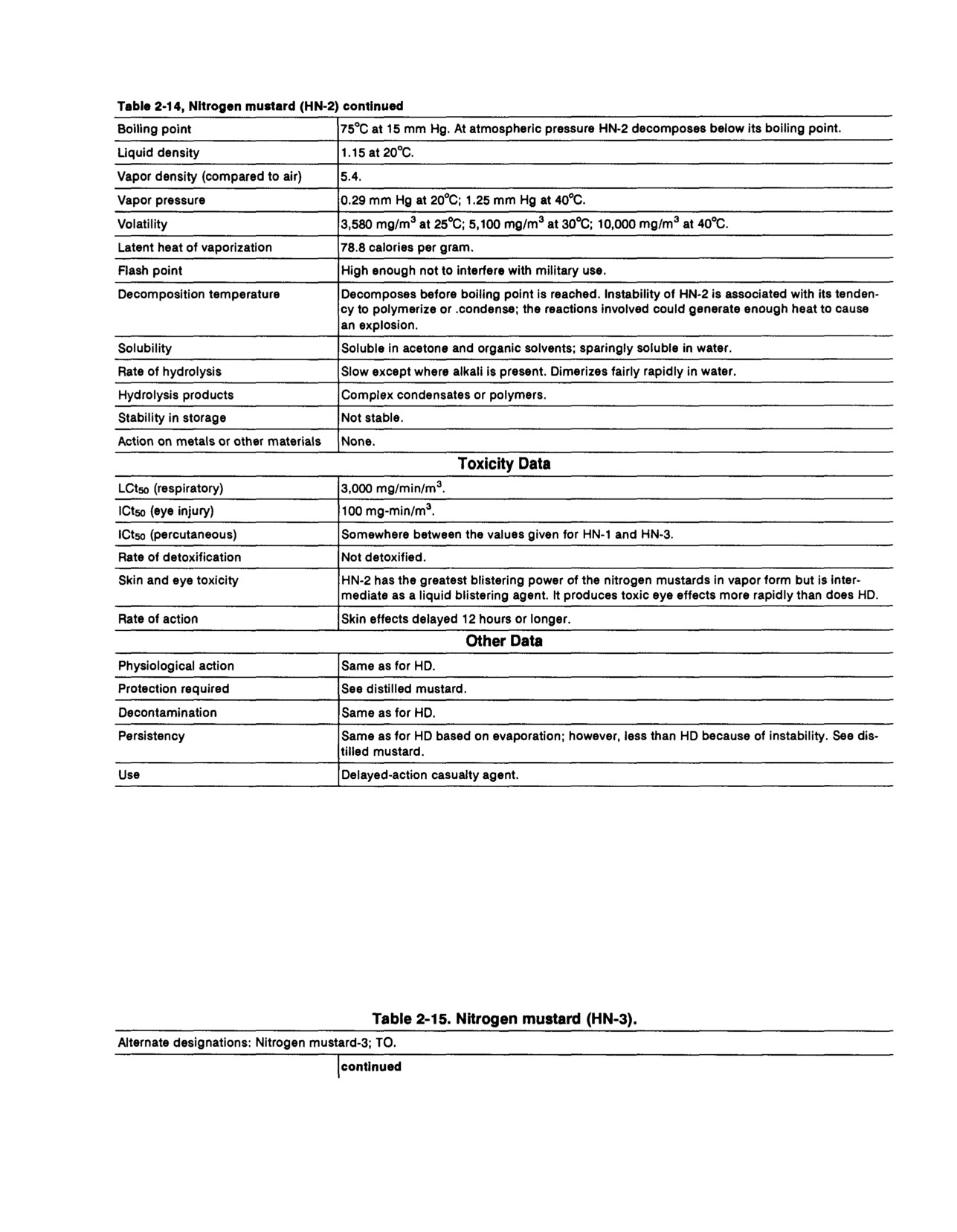
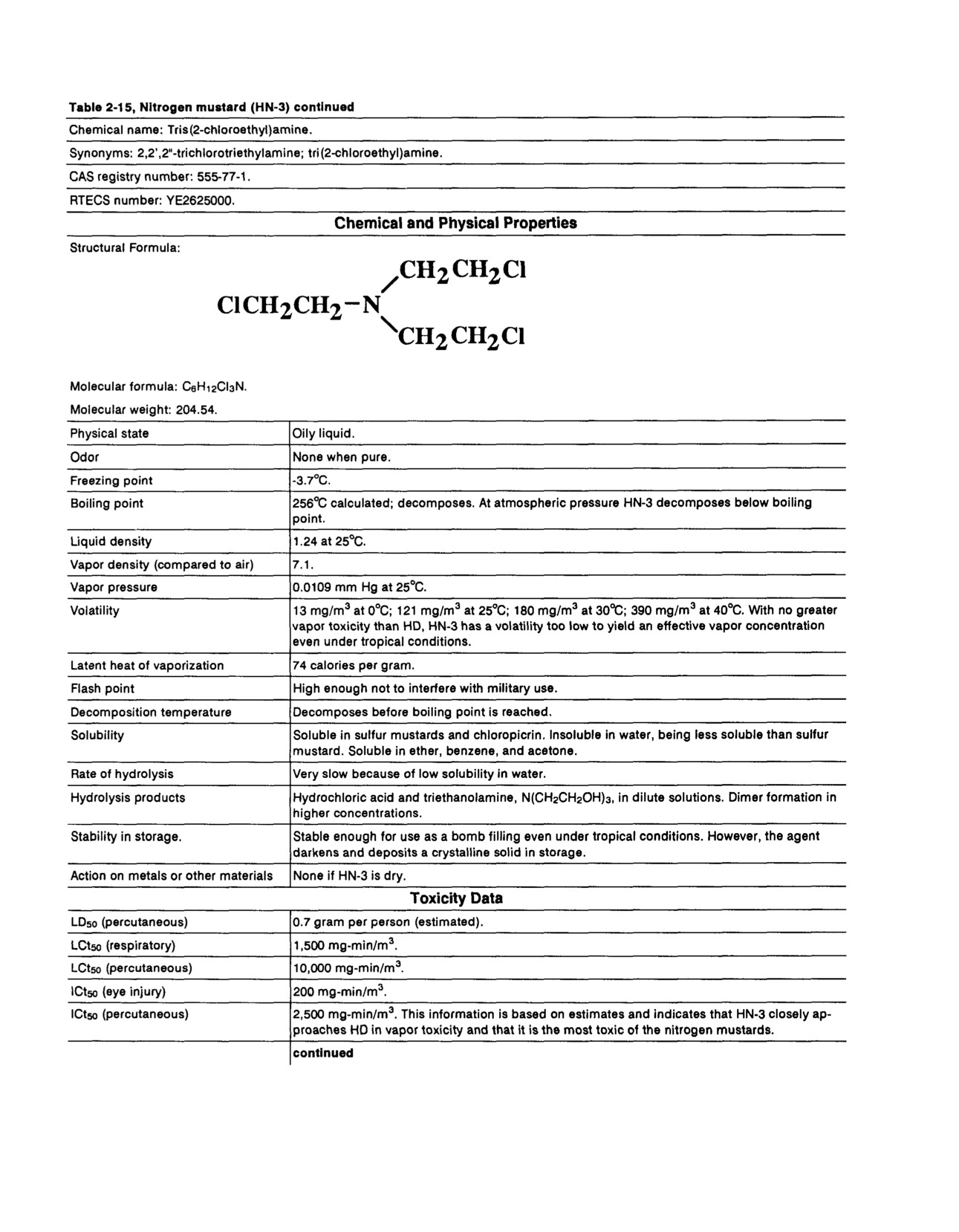
Nitrogen Mustard (HN-3).
ency that is considerably longer than HD. Because it is not
HN-3 is the principal representative of the nitrogen
detoxified, it is cumulative in the body. Most symptoms are
mustards because its vesicant properties are almost equal
delayed for four to six hours, but in some cases tearing, eye
to those of HD. It also is the most stable in storage of the
irritation, and intolerance to light develop immediately.
three nitrogen mustards. Because of its low volatility, HN-3
The protective mask and protective clothing provide ade-
does not constitute a grave vapor hazard to the skin in open
quate protection, but protection against large droplets,
air.
splashes, and smears requires impermeable clothing. See
HN-3 is a liquid that has no odor in its pure form. It is
Table 2-15.
used as a delayed-action casualty agent that has a persist-
35
FM 3-9
36
FM 3-9
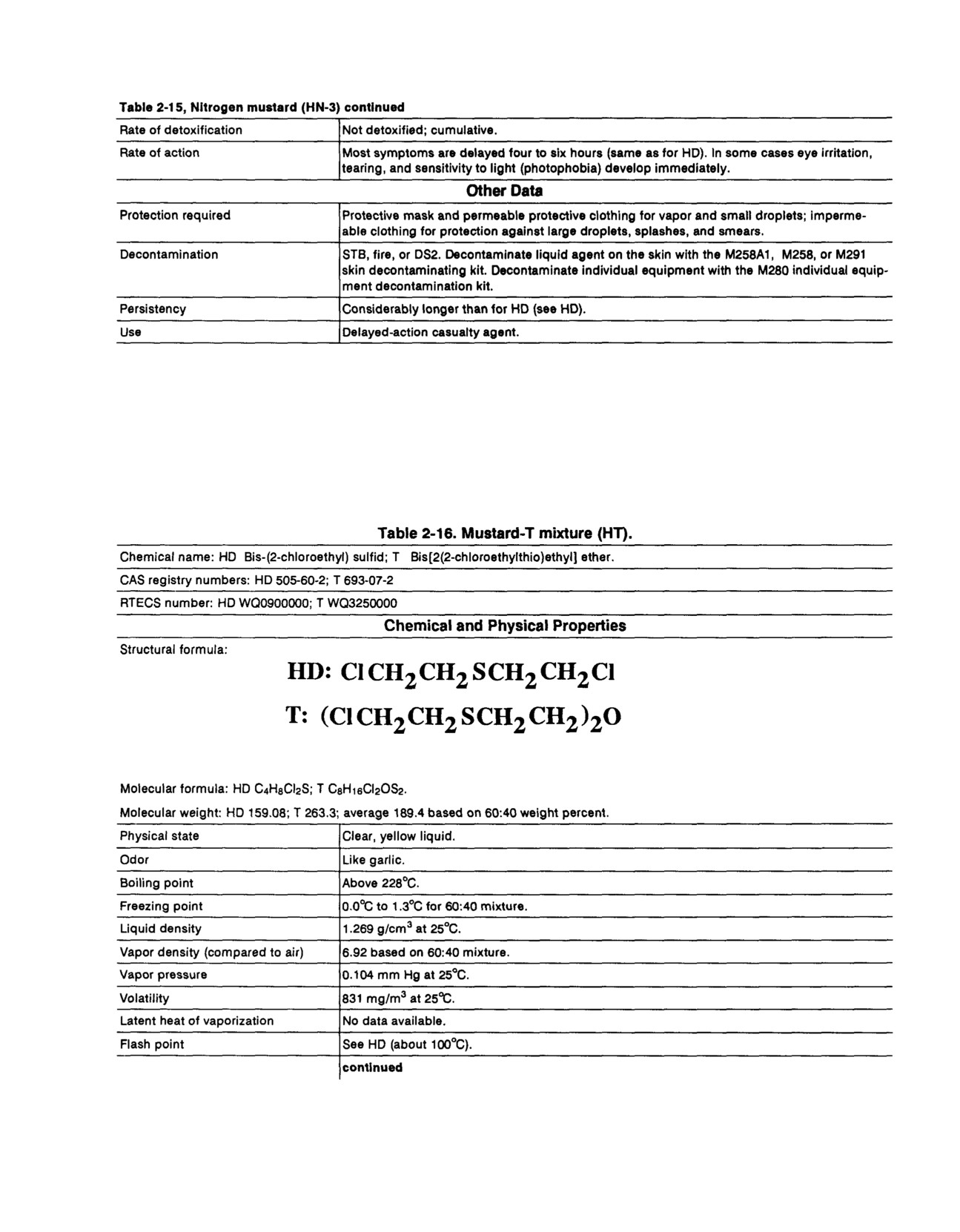
Mustard-T Mixture (HT).
essentially the same as those of HD, but HT is more stable,
HT is a clear, yellowish, highly viscous liquid. It has a
has a longer duration of effectiveness, and has a lower
garliclike odor similar to HD. It is a mixture of 60-percent
freezing point than HD. Its low volatility makes effective
HD and 40-percent T. T is a sulfur, oxygen, and chlorine
vapor concentrations in the field difficult to obtain. HT has
compound similar in structure to HD. HT is used as a
a strong blistering effect. In addition to causing blisters, it
delayed-casualty agent, the persistency of which depends
irritates the eyes and is toxic when inhaled. See Table 2-16.
on the munitions used and the weather. Properties are
37
FM 3-9
Arsenical
The arsenical vesicants are a group of related com-
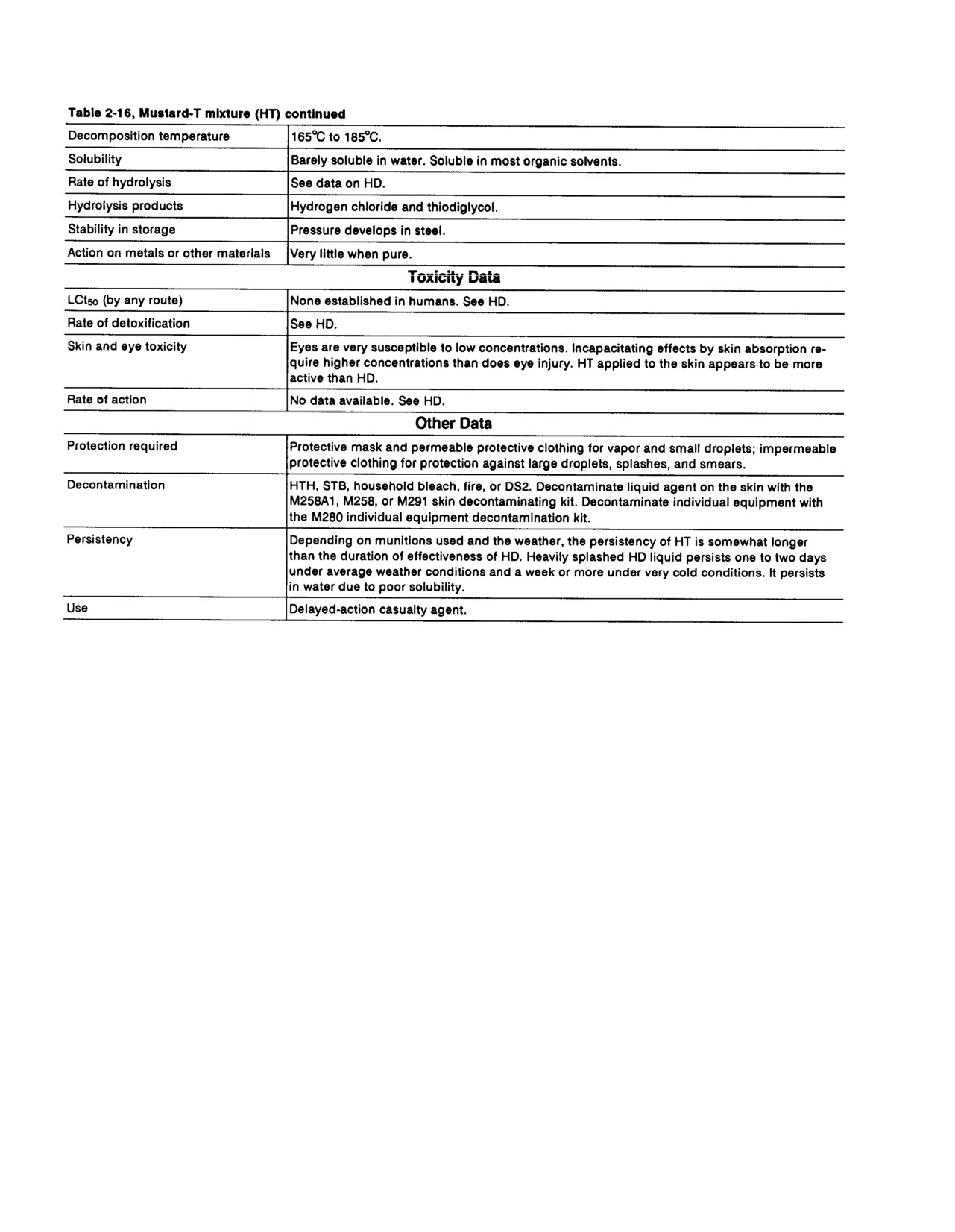
Lewisite (L).
pounds in which arsenic is the central atom. In these agents
Lewisite is the principal arsenical of military interest. It
the hydrogen atoms of arsine (AsH3) are replaced by
is a liquid with an odor like geraniums and very little odor
various organic groups and chloride or cyanide. The main
when pure. It is used as a moderately delayed-action
arsenical vesicants are lewisite (L), mustard-lewisite mix-
casualty agent with a persistency somewhat shorter than
ture (HL), and phenyldichloroarsine (PD).
that of HD. When humidity is high, L hydrolyzes so rapidly
All arsenical vesicants are colorless to brown liquids. In
that it is difficult to maintain a concentration sufficient to
general, they are more volatile than mustard and have fruity
blister bare skin. It produces effects similar to mustard.
to geraniumlike odors. They hydrolyze rapidly with water
One main difference is that L produces immediate pain.
to lose most of their vesicant properties. They are much
Lewisite warns of its presence by irritating the eyes and
more dangerous as liquids than as vapors. The liquids will
skin and has a rapid rate of action. Liquid L causes imme-
cause severe burns of the eyes and skin, whale field con-
diate burning sensation in the eyes and permanent loss of
centrations of vapors are unlikely to cause permanent sig-
sight if not decontaminated within one minute with large
nificant injuries. Absorption of either vapor or liquid
amounts of water. It has about the same blistering action
through the skin in adequate dosage may lead to systemic
on the skin as does HD, even though the lethal dosage for
intoxication or death. The rate of detoxification in sublethal
L is much higher. Skin exposure to L produces an immedi-
amounts is rapid. Immediate decontamination is necessary
ate and strong stinging sensation to the skin; reddening of
to remove the liquid agents, but decontamination is not
the skin starts within 30 minutes. Blistering does not appear
necessary for vapor unless pain is present. Inhaled vapors
until after about 13 hours. Skin burns are much deeper than
cause sneezing and may produce mild to moderate irrita-
those caused by HD. When inhaled in high concentrations,
tion of the upper respiratory tract. Arsenical are less toxic
lewisite may be fatal in as short a time as 10 minutes. The
than other blister agents of military interest.
body does not detoxify L. See Table 2-17.
38
FM 3-9
39
FM 3-9
Mustard-Lewisite Mixture (HL).
the body. Contamination of the skin produces immediate
HL is a variable mix of HD and L that provides a mixture
stinging of the skin, which turns red within 30 minutes.
of low freezing point for use in cold-weather operations or
Blistering, which tends to cover the entire area of the
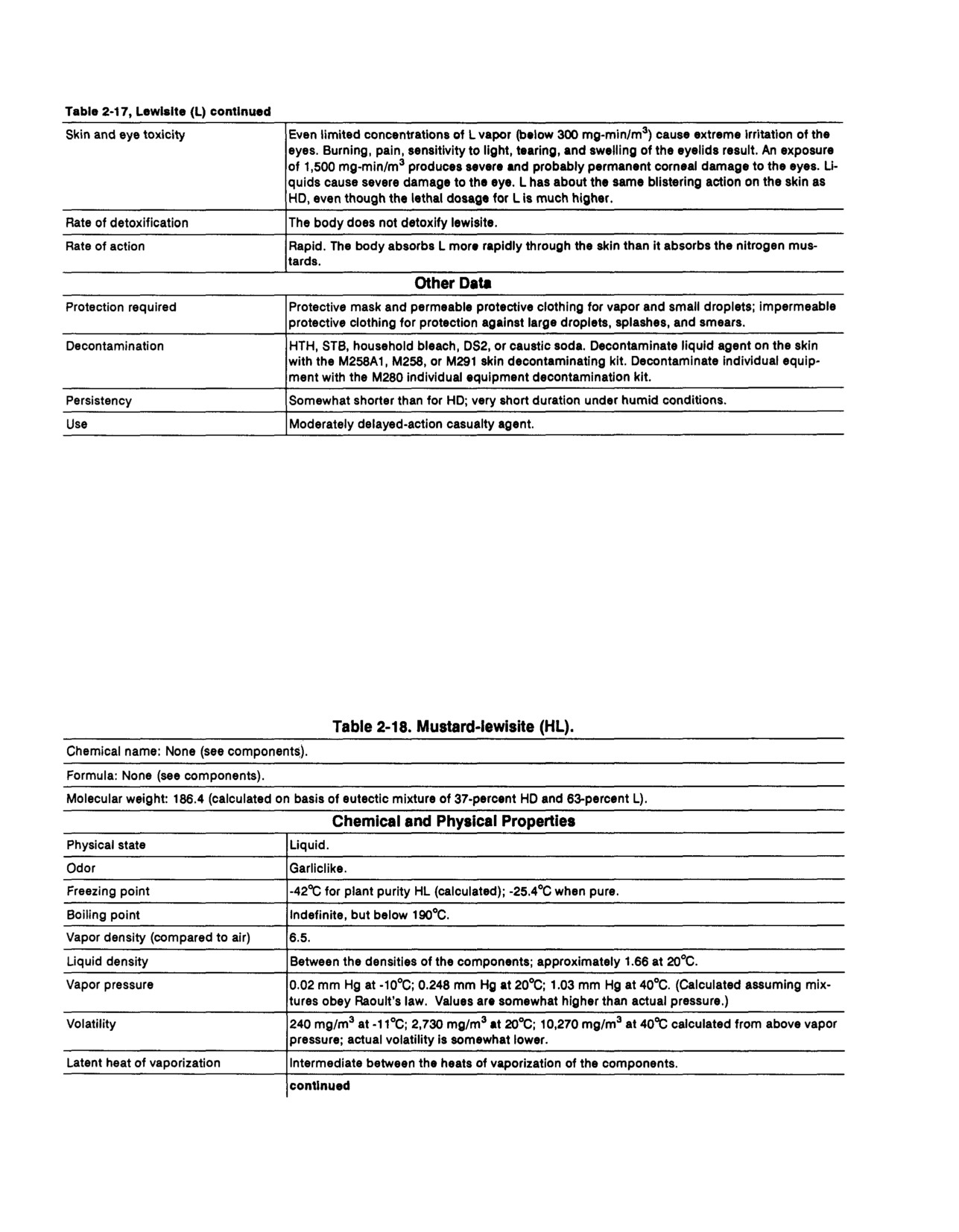
as high-altitude spray. Table 2-18 lists the properties for
reddened skin, is delayed for about 13 hours. Liquid HL
the mixture having the lowest possible freezing point, which
causes severe damage to eyes. The respiratory damage is
is 37-percent HD and 63-percent L by weight. Other mix-
similar to that produced by mustard, except in the most
tures, such as 50:50, may be prepared to meet predeter-
severe eases. In these eases fluid in the chest cavity may
mined weather conditions and have advantages over the
accompany fluid in the lungs. Liquid on the skin, as well as
3763 mixture because of the increased HD content. The
inhaled vapor, is absorbed and may cause poisoning
persistency of HL depends on the munitions used and the
throughout the body. These changes cause increased capil-
weather.
lary permeability, which eventually causes shock and death
HL has a garliclike odor from its HD content. It is used
because of the loss of fluid from the bloodstream.
as a delayed-action casualty agent that is not detoxified in
40
FM 3-9
Phenyldichloroarsine (PD)
PD has an immediate effect on eyes and a delayed effect
PD is a colorless liquid that is used as a delayed-action
of 30 minutes to 1 hour on skin. PD blisters bare skin but
casualty agent. Persistency depends on the munitions used
wet clothhg decomposes it immediately. The protective
and the weather. Although PD is classed as a blister agent,
mask and protective clothing provide adequate protection,
it also acts as a vomiting compound. Limited use of PD
but protection against large droplets, splashes, and smears
during World War I did not indicate any marked supe-
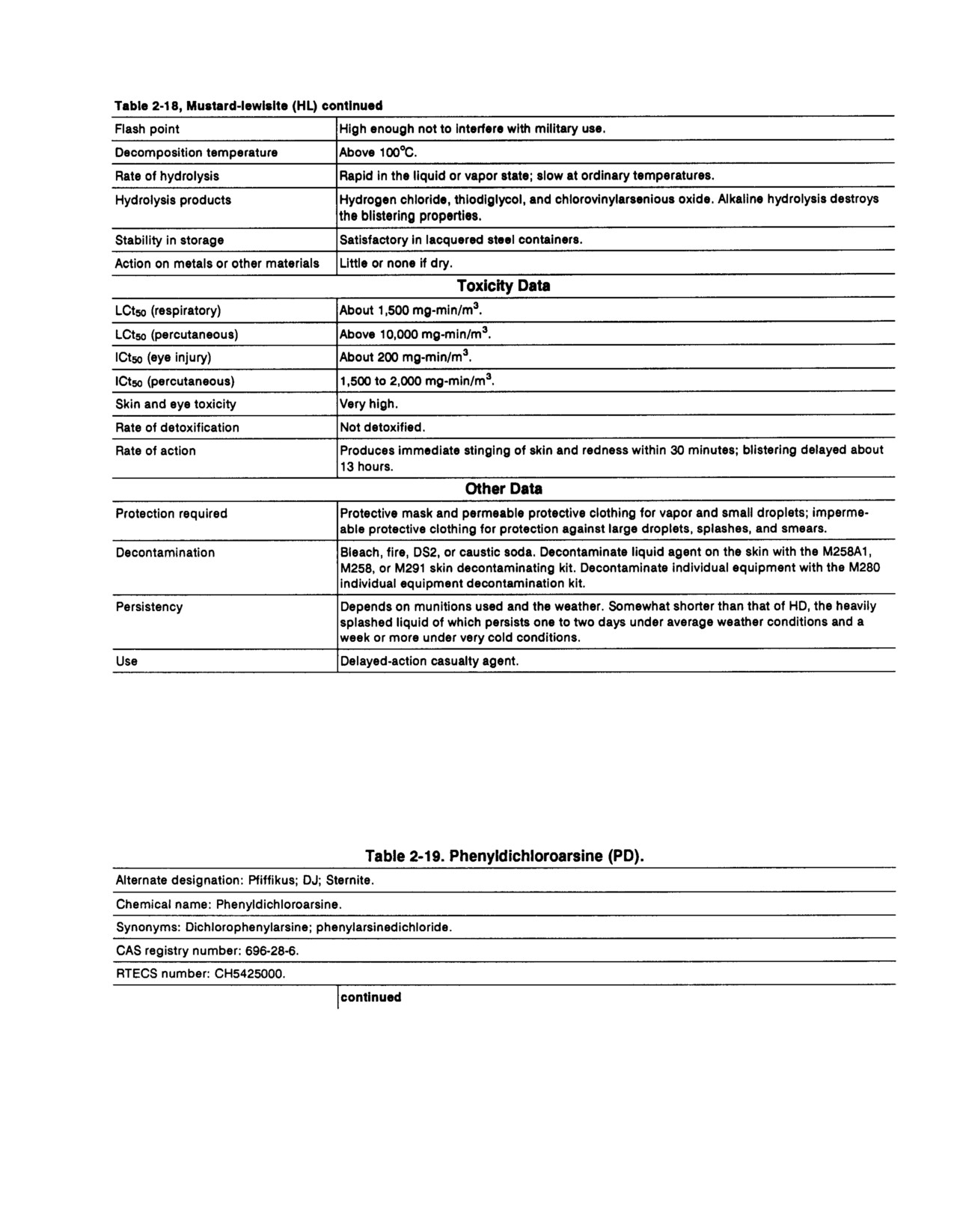
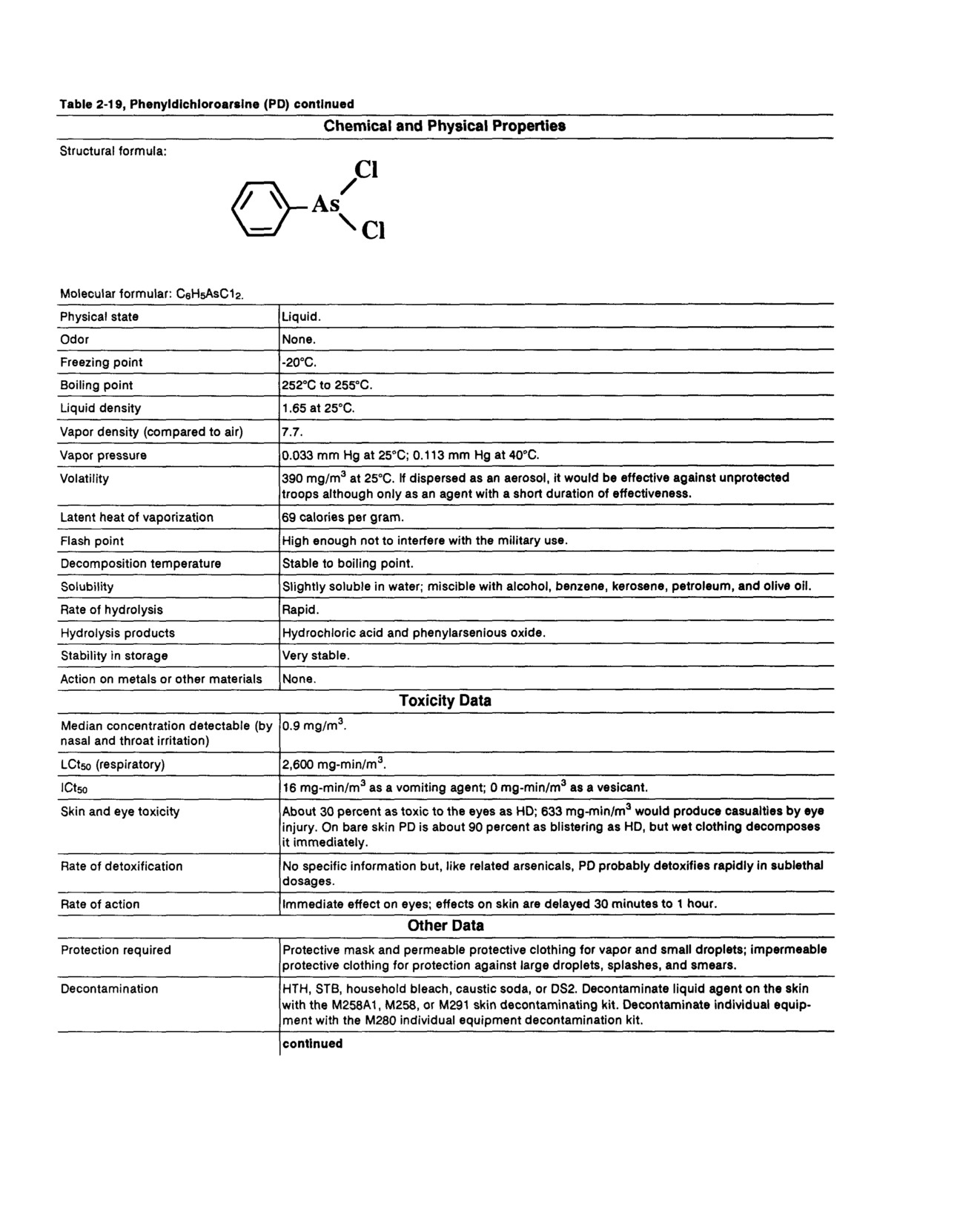
requires impermeable clothing. See Table 2-19.
riority over the other vomiting compounds used.
41
FM 3-9
42
FM 3-9
Ethyldichloroarsine (ED)
Like other chemical agents containing arsenic, ED is
ED is a liquid with a fruity but biting and irritating odor.
irritating to the respiratory tract and will produce lung
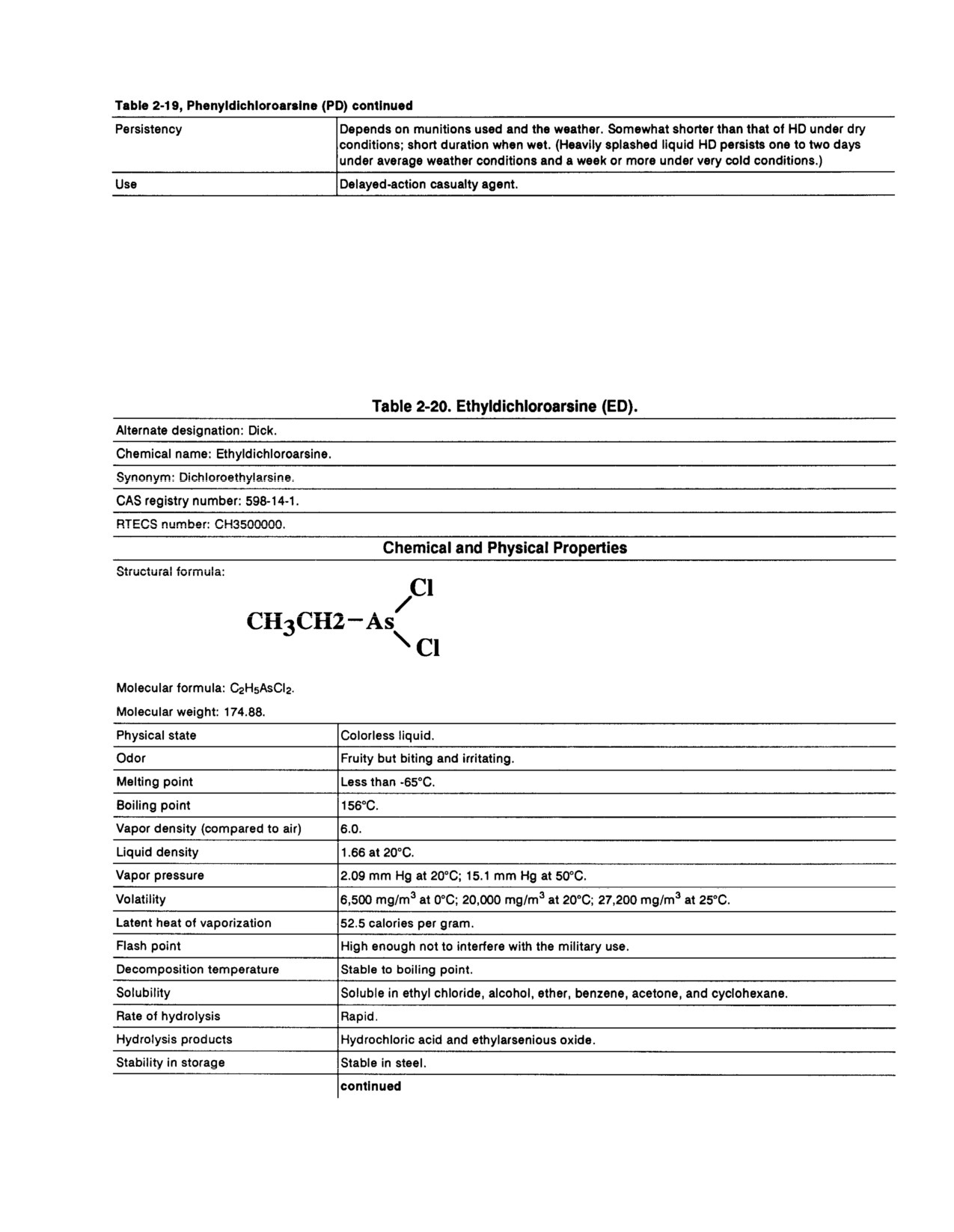
The Germans introduced ED (Table 2-20) in 1918 in an
injury upon sufficient exposure. The vapor is irritating to
effort to produce a volatile agent with a short duration of
the eyes, and the liquid may produce severe eye injury. The
effectiveness that would act more quicldy than diphosgene
absorption of either vapor or liquid through the skin in
or mustard and that would last longer in its effects than
sufficient amounts may lead to systemic poisoning or death.
phenyldichloroarsine (PD).
Prolonged contact with either liquid or vapor blisters the
skin.
43
FM 3-9
Methyldichloroarsine (MD)
the liquid may severely injure the eyes. The absorption of
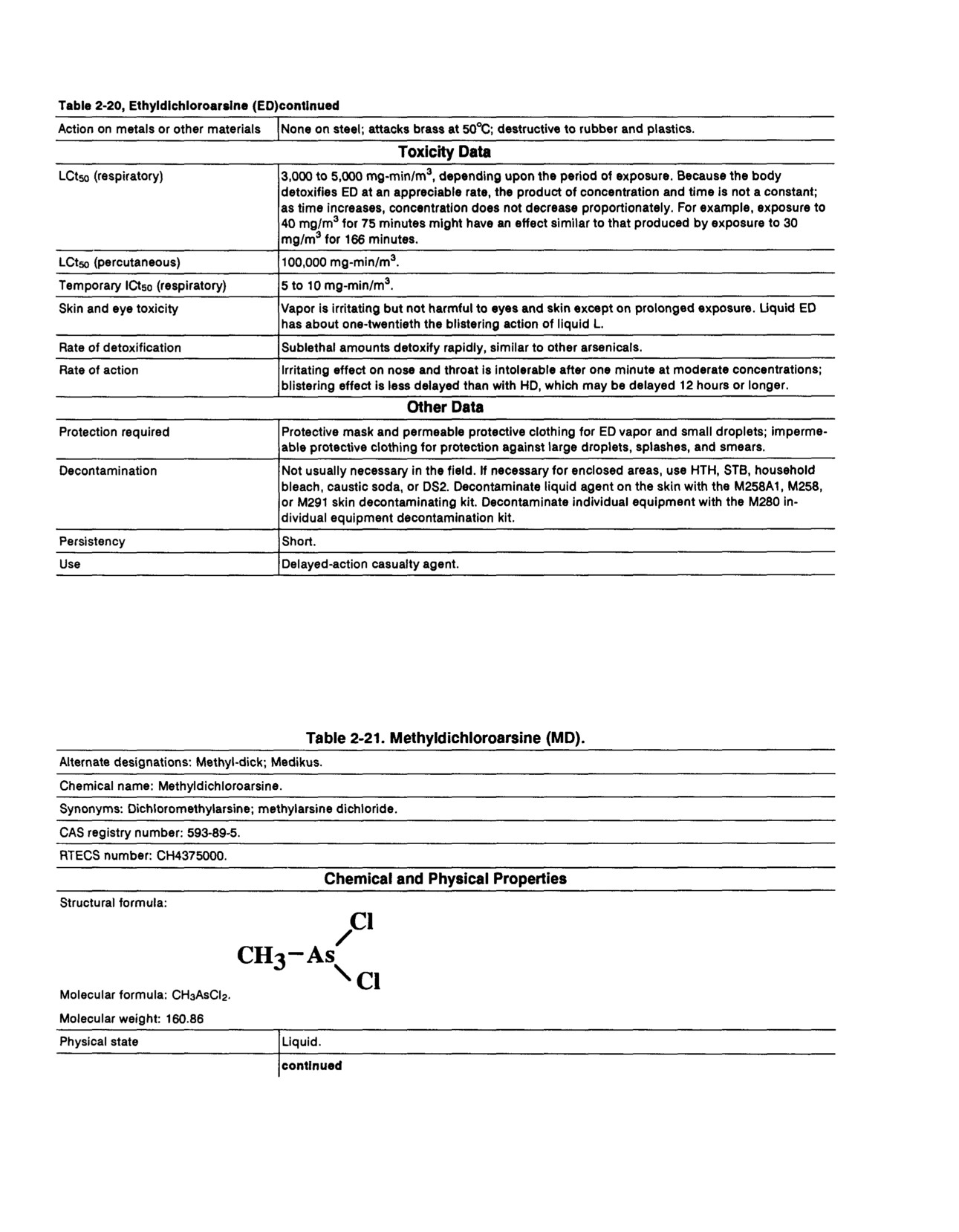
MD is similar to ethyldichloroarsine. Like L and the
either vapor or liquid through the skin in sufficient amounts
other arsenical, MD causes immediate irritation of the
may lead to systemic poisoning or death. Prolonged contact
eyes and nose with blistering effects delayed for hours. MD
with either liquid or vapor produces blistering of the skin.
is irritating to the respiratory tract and produces lung injury
Vapor concentrations required for blistering effect are
upon sufficient exposure. The vapor irritates the eyes, and
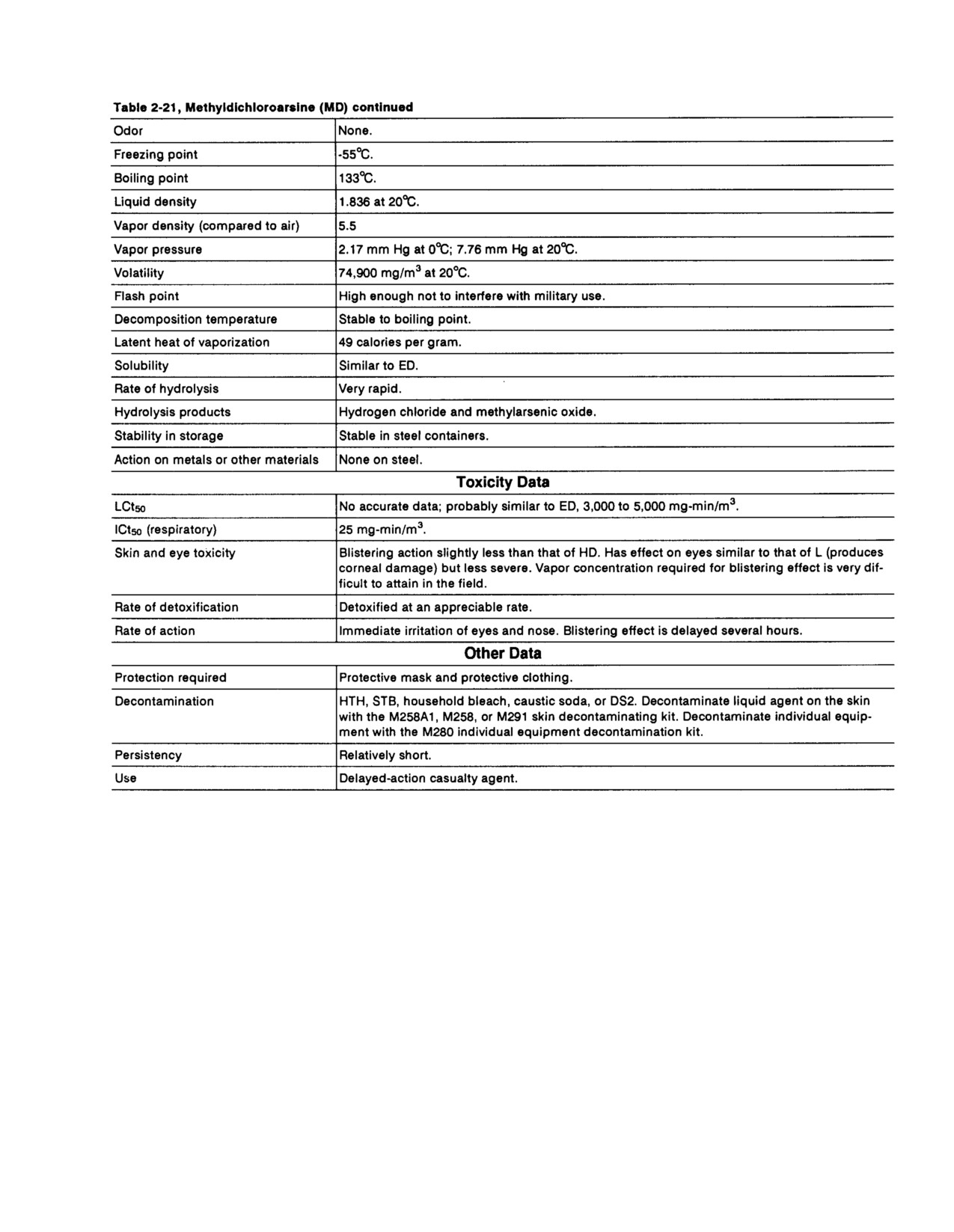
very difficult to attain in the field. See Table 2-21.
44
FM 3-9
Urticants
The urticants are compounds with a disagreeable,
CX produces immediate pain varying from a mild prick-
penetrating odor. They cause an immediate, severe, burn-
ling to almost intolerable pain resembling a severe bee
ing sensation; intense pain; and a feeling of numbness. They
sting. It has been called “nettle gas.” It causes violent irrita-
also cause swelling. Chemically, urticants are halogenated
tion to the mucous membranes of the eyes and nose. Even
oximes. The most important of these is dichloroformoxime,
at low temperatures it has sufficient vapor pressure to
also called phosgene oxime because of its similarity to
produce tearing. When CX comes in contact with the skin,
phosgene. It may appear as a colorless, crystalline solid or
the area becomes pale in 30 seconds and a red ring sur-
as a liquid.
rounds the area. A wheal forms in about 30 minutes, the
Phosgene oxime (CX) is one of the most violently irritat-
blanched area turns brown in about 24 hours, and a scab
ing substances known. However, because of its extreme
forms in about a week. The scab usually falls off in about 3
instability, pure CX is not likely to be used in military
weeks. Itching may be present throughout healing, which
operations.
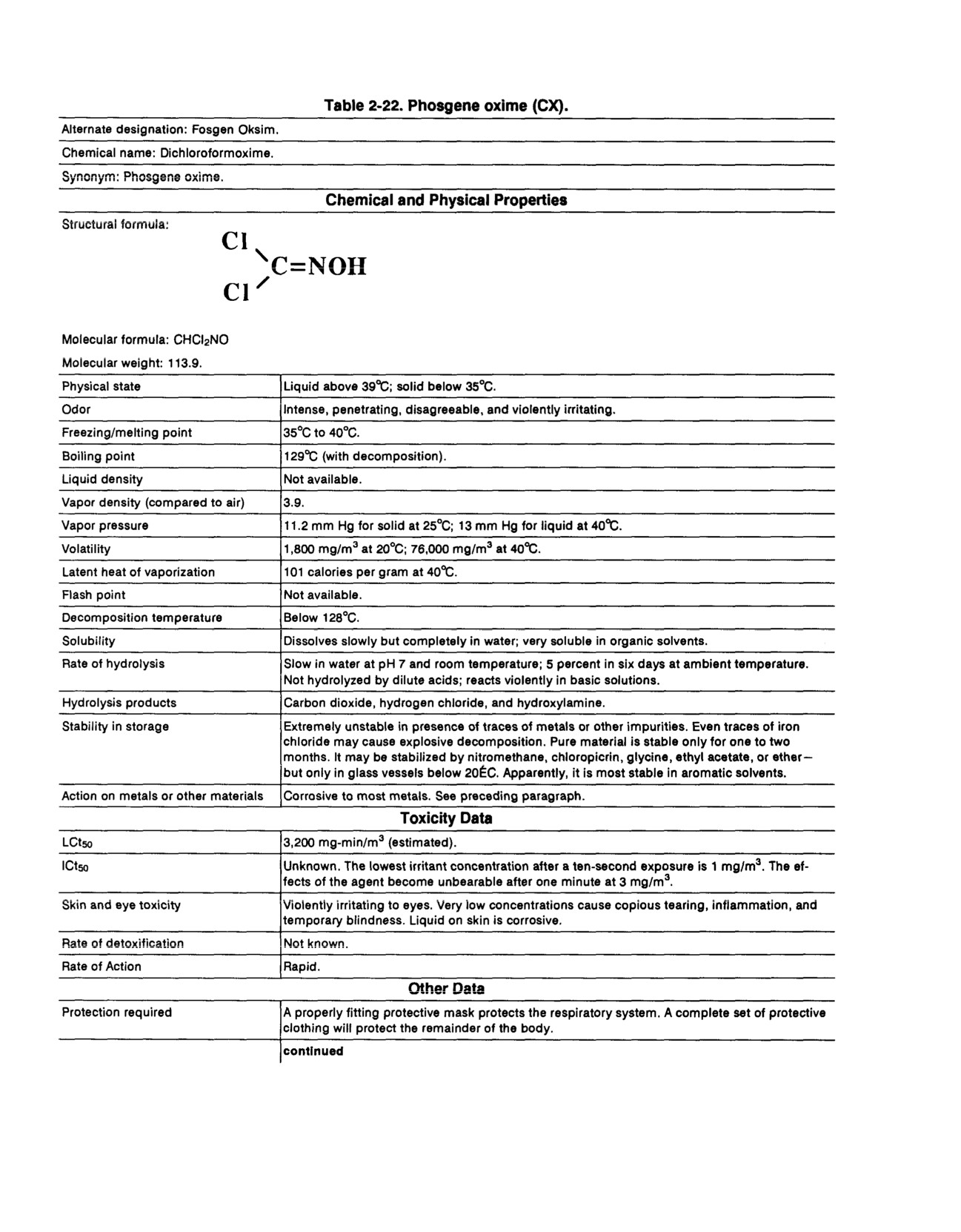
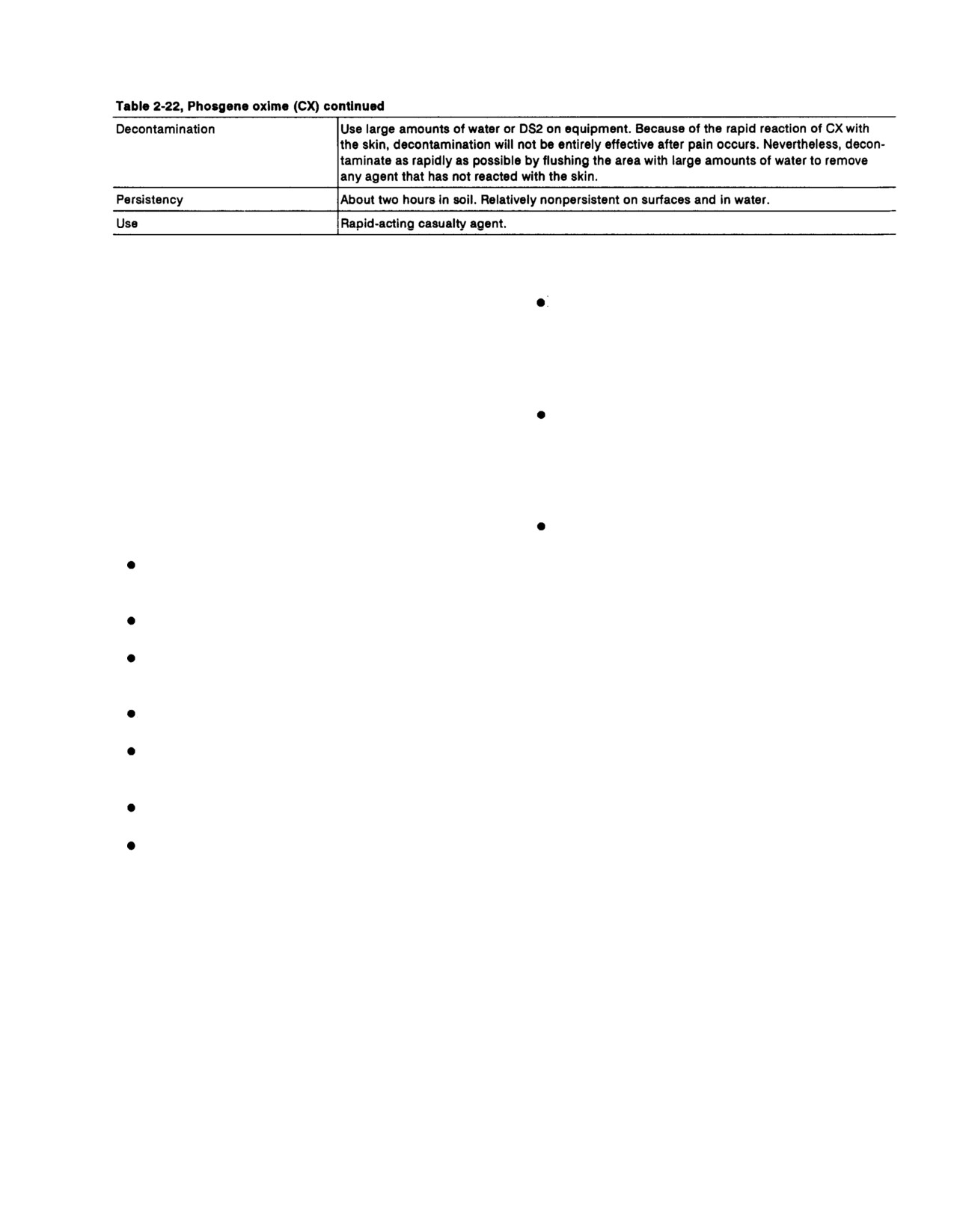
in some cases may be delayed beyond 2 months. See Table
2-22.
45
FM 3-9
46
FM 3-9
Section III. Incapacitating Agents
Incapacitating agents are chemicals that cause
Medical drugs that exert marked effects on the central
physiological or mental effects that lead to temporary dis-
nervous system, such as barbiturates, belladonna
ability. Unlike riot control agents with effects lasting only
alkaloids, tranquilizers, and many of the hallucinogens.
a few minutes, incapacitating agents produce effects that
These drugs, although effective and relatively safe, are
may last for hours or days after exposure to the agent has
logistically infeasible for large-scale use because of the
ceased. Incapacitating agents differ from other chemical
high doses required.
agents in that the lethal dose is many times greater than the
Agents of temporary effectiveness that produce reflex
incapacitating dose. Thus, they do not seriously endanger
responses that interfere with performance of duty.
life except in cases exceeding many times the effective dose,
These include skin and eye irritants that cause pain or
and they produce no permanent injury. Medical treatment,
itching (vesicants or urticants), vomiting or cough-
although not required, may speed recovery.
producing compounds (sternutators), and tear com-
Many compounds show potential as incapacitating
pounds (lacrimators).
agents. However, in actual use the term refers to those
Agents that disrupt basic life-sustaining systems of the
agents that—
body and thus prevent the carrying out of physical
Produce their effects mainly by altering or disrupting
activity. Examples include agents that lower blood
the higher regulatory activity of the central nervous
pressure; paralyzing agents, such as curare; fever-
system (CNS).
producing agents; respiratory depressants; and blood
Have effects that last hours or days rather than being
poisons. Although theoretically effective, such agents
momentary or fleeting, as with tear agents.
almost invariably have a low margin of safety between
Do not seriously endanger life except at concentrations
the effective doses and the possible lethal doses. Thus,
greatly exceeding the effective dose. They do not
they affect the basic purpose of an incapacitating agent,
produce permanent injury.
which is to reduce military effectiveness without en-
Allow recovery without treatment and without any per-
dangering life.
manent effects.
Despite restrictions imposed by the above definition, a
Are highly potent and logistically feasible.
great variety of mechanisms remain that could in theory
Incapacitating agents specifically do not include the
disrupt CNS regulation and maintenance of performance.
following:
Only two general types of incapacitating agents are likely
Lethal agents that are incapacitating at sublethal doses,
to be encountered in military use: the CNS depressants and
such as the nerve agents.
the CNS stimulants.
Substances that cause permanent or long-lasting injury,
such as blister agents and choking agents, and those
that cause eye injury.
Central Nervous System Depressants
CNS depressants are compounds that have the
Cannabinols and phenothiazine-type compounds are
predominant effect of depressing or blocking the activity
other potential incapacitating agents that seem to act basi-
of the central nervous system, often by interfering with the
tally as CNS depressants. The primary effects of these
transmission of information across synapses. An example
agents are to sedate and destroy motivation rather than
of this type of agent is BZ, which appears to block the
disrupt the ability to think.
action of acetylcholine in the same way that atropine does.
Other types of CNS depressants that could contain
BZ, however, has far greater relative potency than atropine
potential incapacitating agents are narcotics such as fen-
on the CNS.
tanyls or hypnotics.
47
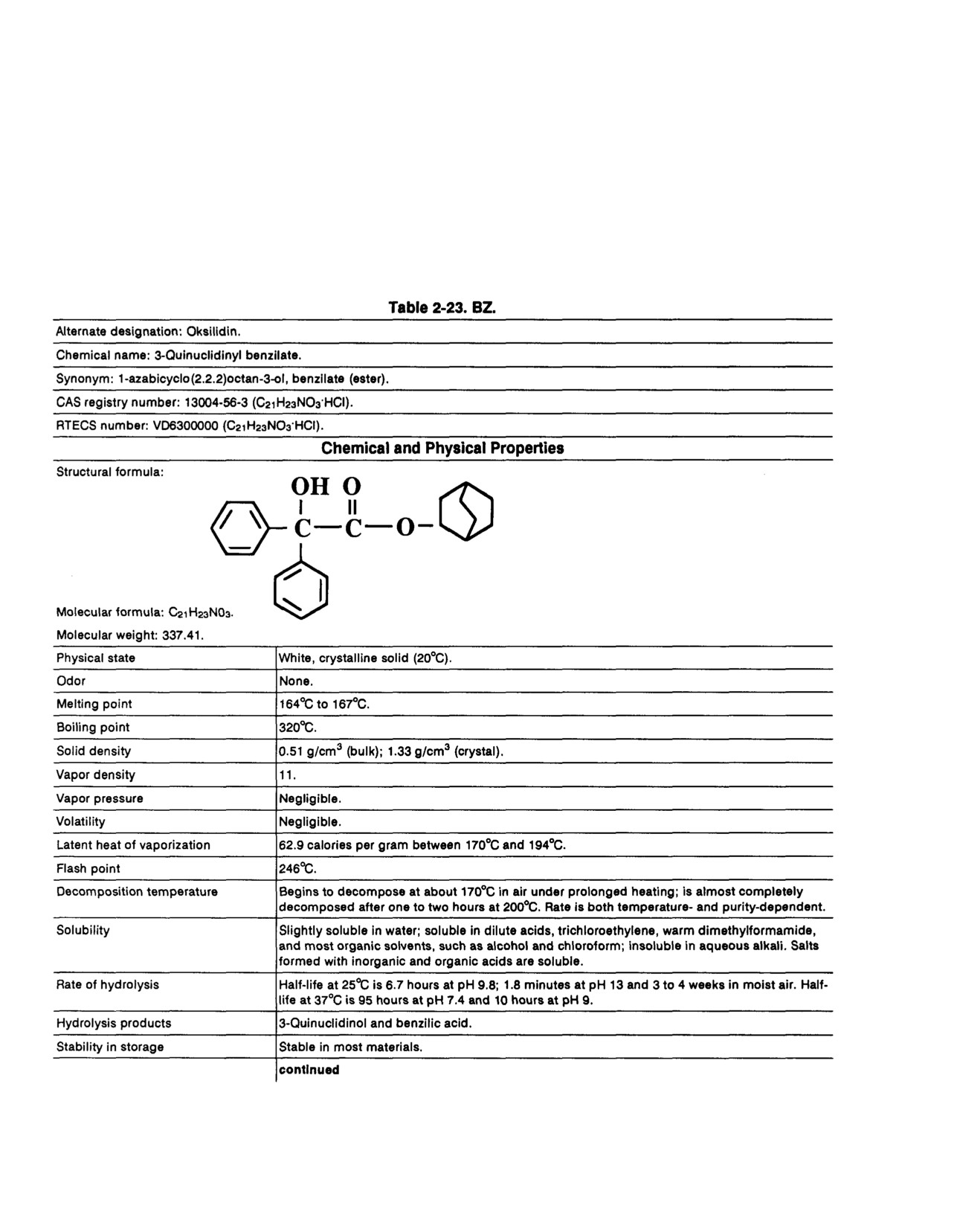
BZ.
sweating, and vision. General symptoms from agent BZ are
BZ, an odorless, white, crystalline solid, is a CNS depres-
fast heartbeat, dry skin and lips, blurred near vision (in-
sant. BZ is usually disseminated as an aerosol with the
creased pupil size), flushed skin, urinary retention, con-
primary route of entry into the body through the respiratory
stipation, and sedation progressing to stupor and
system; the secondary route is through the digestive tract.
interference with ordinary activity. High doses produce
Skin absorption is possible with proper solvents.
extreme excitement, delusions, and hallucinations; high
BZ affects the victim’s ability to remember, solve
doses completely destroy the ability to perform any military
problems, pay attention, and understand instructions.
task. An untreated casualty requires from three to four
Small doses of BZ cause sleepiness and decreased alert-
days to reach full recovery from the effects of BZ intoxica-
ness. BZ also affects circulation of the blood, digestion,
tion. See Table 2-23.
48
FM 3-9
Cannabinols and Phenothiazines.
from Cannabis and synthetic substances related to these
Cannabinols and phenothiazine compounds are other
parent materials have potential as incapacitants.
potential incapacitating agents that seem to act basically as
Tetrahydrocannabinol (THC) is the principal active com-
CNS depressants. The primary effects of these agents,
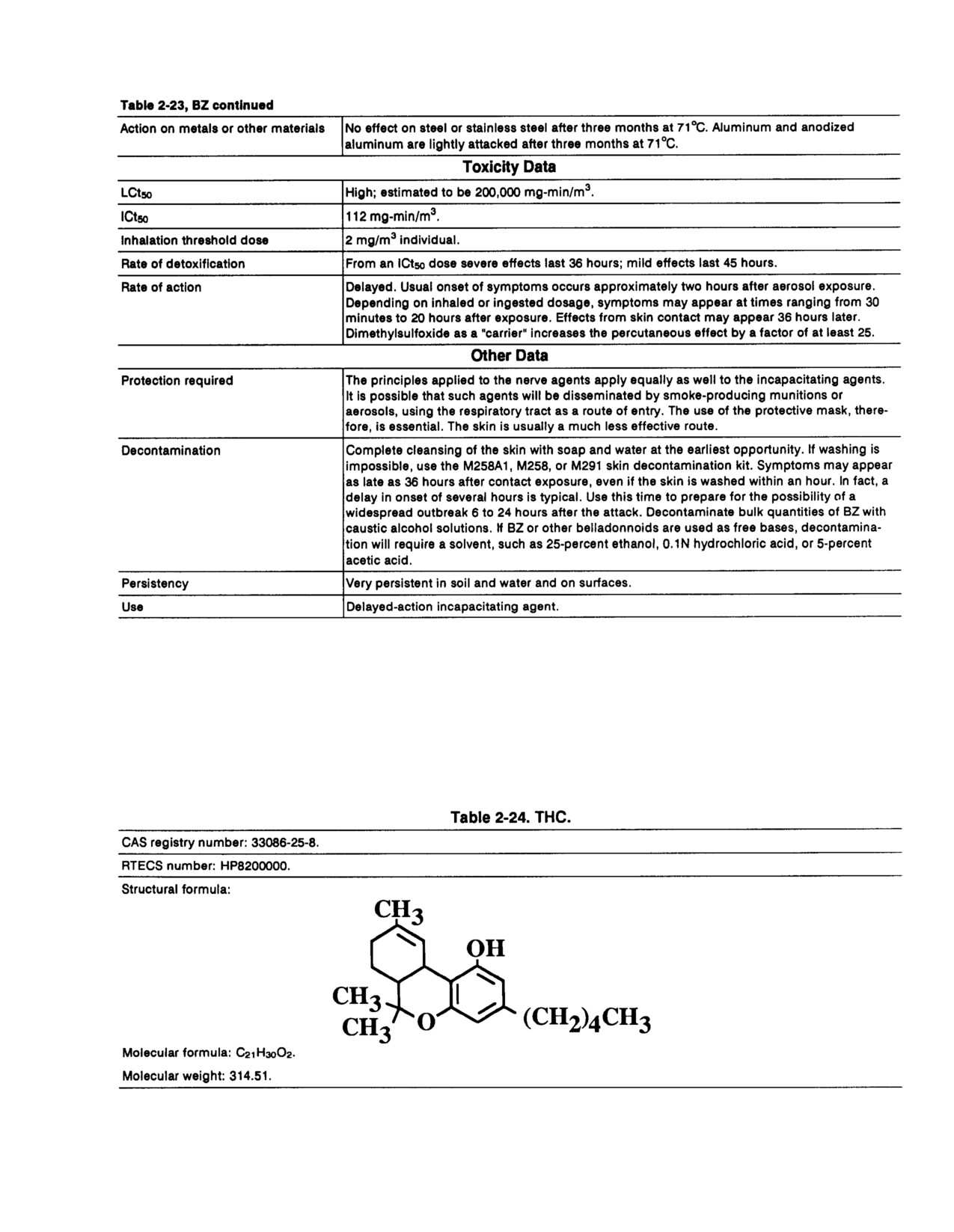
pound in marijuana. Table 2-24 shows the structure of the
however, are sedation and destruction of motivation rather
basic THC molecule.
than disruption of the ability to think.
Synthetic analogues contain longer or more complex
Cannabinol is an active substance contained in hashish
side chains and may involve the displacement of a double
and in marijuana (Cannabis). Substances derived directly
bond in one of the rings.
49
FM 3-9
Inhaled natural cannabis produces effects within a few
potent painkillers therapeutically available. One analogue
minutes. These effects peak at about one hour and subside
is 10,000 times as potent as morphine. Fentanyls depress
after three to four hours. Ingested compound produces
respiration and heart rate and cause lethargy, sedation, and
delayed, more prolonged effects. Some synthetic materials
immobilization. Large doses produce muscle rigidity. They
reportedly produce significant effects for up to several
would probably be disseminated as aerosols. As a potential
days. Signs and symptoms include feelings of unreality,
class of agents they have a rapid onset of action (10 to 90
intensification of sensations, difficulty in concentrating,
seconds) and are extremely potent in producing in-
lethargy, and sedation. No treatment is ordinarily required,
capacitation without loss of consciousness. Estimated ef-
and the effects subside spontaneously within a few hours.
fective intravenous doses range from 3 to 100 micrograms
Phenothiazine-like compounds have a very high safety
per kilogram (µg/kg). Effects last from minutes to several
index and would not be likely to involve any special medical
hours, depending on the structure. They can be dissemi-
care. The onset of action for phenothhzines is about five
nated as an aerosol. Decontamination would involve wash-
minutes, and effects last about one hour.
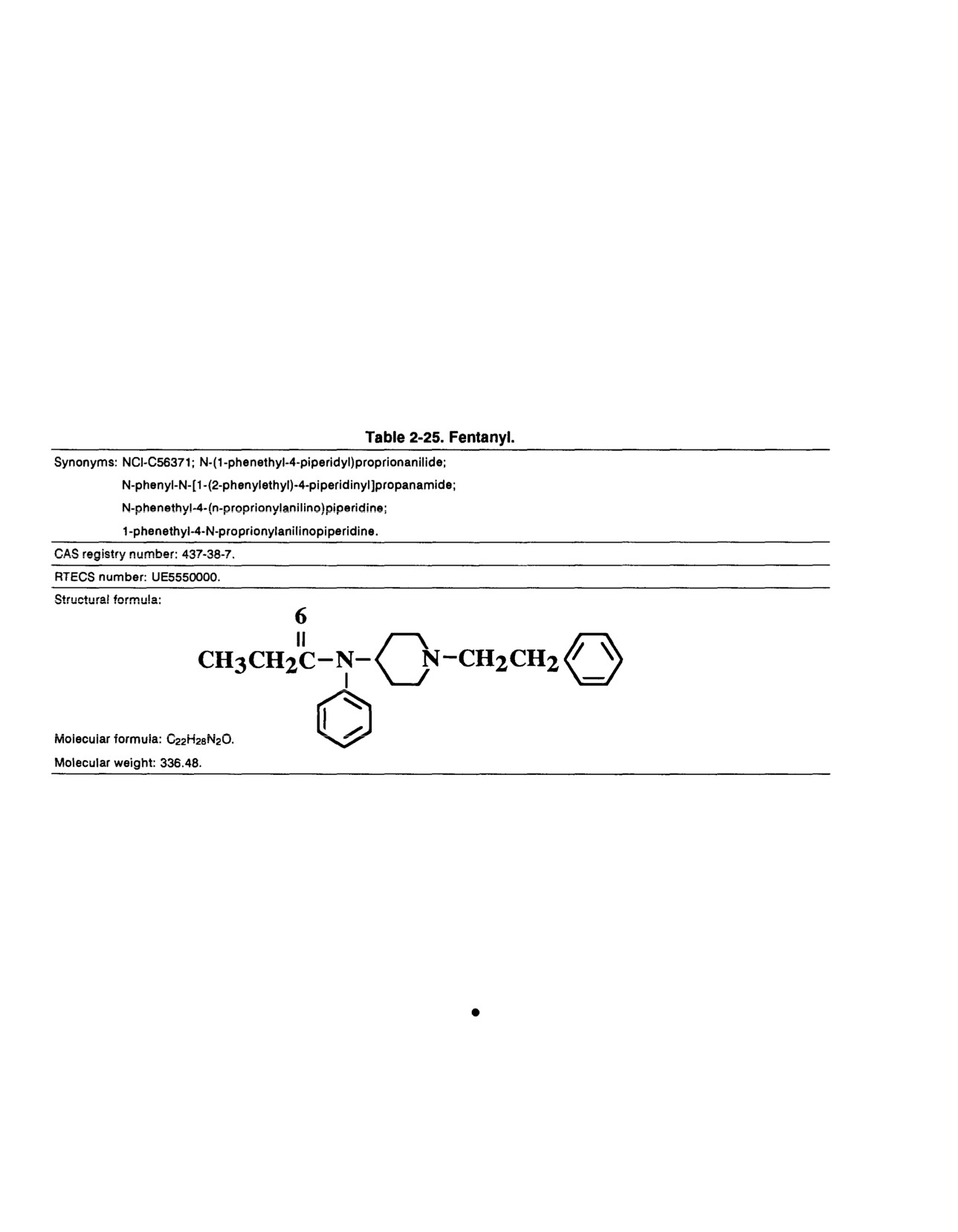
ing with water (acidified with acetic acid). Table 2-25 shows
the basic structure for fentanyls.
Fentanyls.
Fentanyls interact at the opiate receptor; that is, they act
like morphine and are narcotics. Fentanyls are the most
Central Nervous System Stimulants
CNS stimulants cause excessive nervous activity, often by
and inability to act in a sustained, purposeful manner. A
boosting or facilitating transmission of impulses that might
well-known drug that appears to act in this manner is
otherwise be insufficient to cross certain synapses. The
d-lysergic acid diethylamide (LSD). Large quantities of the
effect is to flood the brain with too much information,
amphetamines sometimes produce similar effects.
making concentration difficult and causing indecisiveness
First Aid for Incapacitating Agents
Effects of small amounts of most incapacitating agents
If the casualty has a loss of sense or feeling (stupor) or
are entirely temporary. However, large doses of some,
is in a coma, be sure that respiration is unobstructed
especially BZ compounds in tropical environments, can be
and turn him or heron the stomach with the head to the
serious and require first aid. The most important con-
side to avoid strangulation should vomiting occur.
siderations are the following:
50
FM 3-9
Regard ambulatory casualties as potentially capable of
resisting, and approach them with this possibility in
mind. To prevent them from injuring themselves or
others, confine them and isolate them, if possible, in a
safe area. If no other means are available, restrain them
by tying them each to a tree.
Remove weapons and other potentially harmful
materials from suspected casualties. This includes
cigarettes, matches, medications, and small items they
might ingest accidentally. Delirious casualties have
tried to eat items bearing only a superficial
resemblance to food.
The most important single medical consideration with
BZ is the possibility of heatstroke because the casualty
cannot sweat. Remove excessive clothing if the
temperature is more than 70°F. There is usually no
danger of severe dehydration in the first 12 hours,
despite dryness and coating of the lips and tongue,
unless persistent vomiting occurs. Give fluids only
when the casualty can drink unassisted. Check for blad-
der distention if voiding does not occur within 12 hours.
Reassurance and a firm but friendly attitude by person-
nel providing first aid will help if the casualties appear
to comprehend what is being said to them. Conversa-
tion is a waste of time, however, if a casualty is in-
coherent or cannot understand what is being said. In
such cases, the less said the better; the casualty benefits
more from prompt and vigorous restraint and evacua-
tion to a treatment facility.
Unfamiliar agents or mixtures of agents may be en-
countered in future field situations. In such an instance the
general principles of restraint, close observation, and sup-
portive medical care remain valid. The judgment of the
medical officer remains the only useful guide to action in
these complex and unforeseeable circumstances.
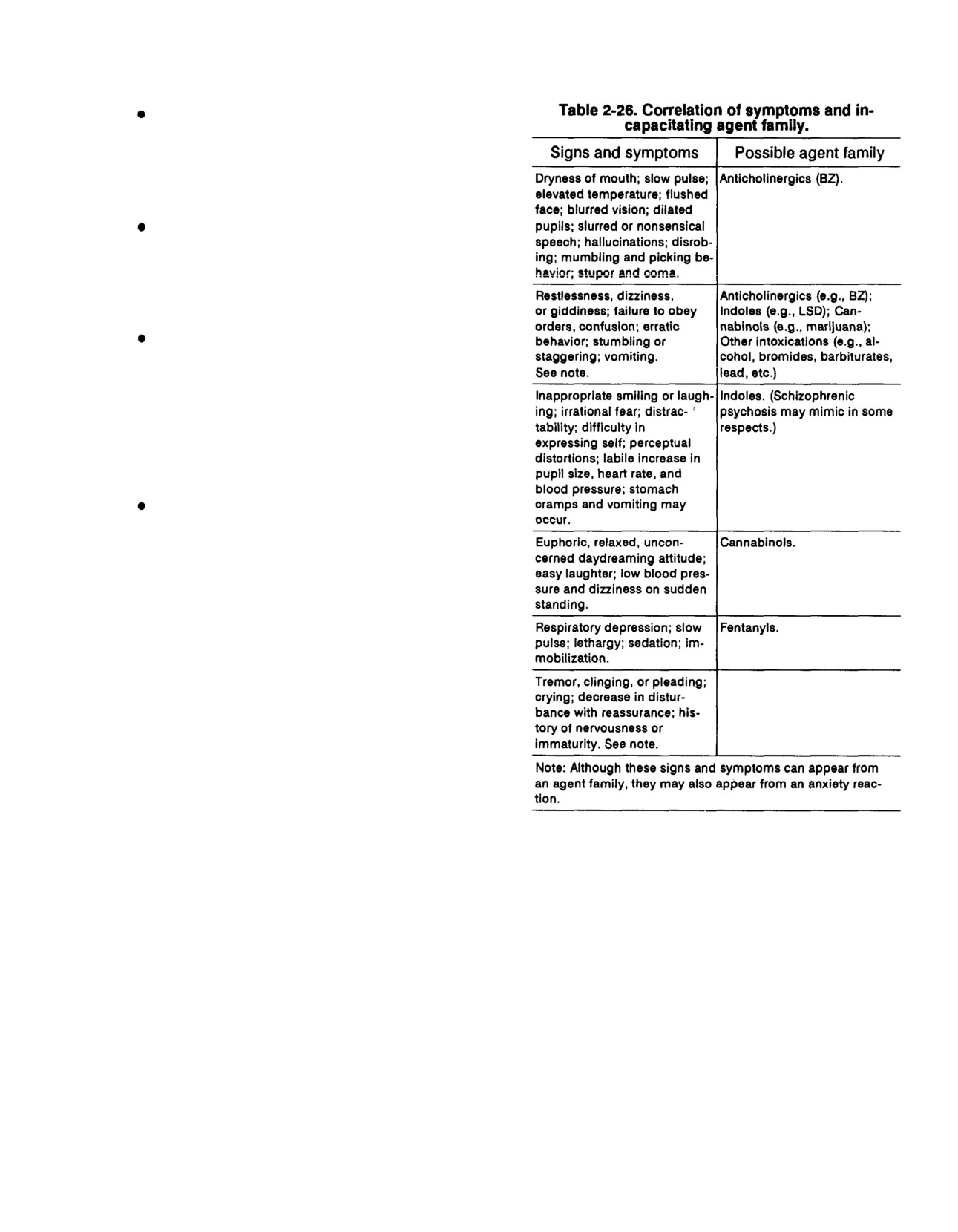
See TM 8-285 for diagnosis and treatment for in-
capacitating agents. Symptoms and possible agent families
are shown in Table 2-26.
51
FM 3-9
Chapter 3
Military Chemical Compounds
and Their Properties
Military chemical compounds include vomiting and tear-producing agents (riot
control agents); herbicides; and antimateriel, flame, and smoke materials. Vomit-
ing compounds are not authorized for use by US forces in combat or in training.
This chapter contains physical and chemical properties of tear-producing and
vomiting agents.
Section I. Tear-Producing and Vomiting Compounds
Tear-Producing Compounds
The tear compounds cause a flow of tears and irritation
chemicals obsolete for military employment. This chapter
of the skin. Because tear compounds produce only tran-
includes these materials, however, for complete coverage
sient casualties, they are widely used for training, riot
of compounds with potential for use against US forces. This
control, and situations where long-term incapacitation is
chapter also presents information regarding CN mixtures
unacceptable. When used against poorly equipped guerril-
as an example of how agent properties can be tailored to
la or revolutionary armies, these compounds have proved
the method of dissemination. This manual does not discuss
extremely effective. When released indoors, they can cause
herbicides or antimateriel, flame, or smoke materials.
serious illness or death. The following paragraphs discuss
the principal tear compounds of historic and current inter-
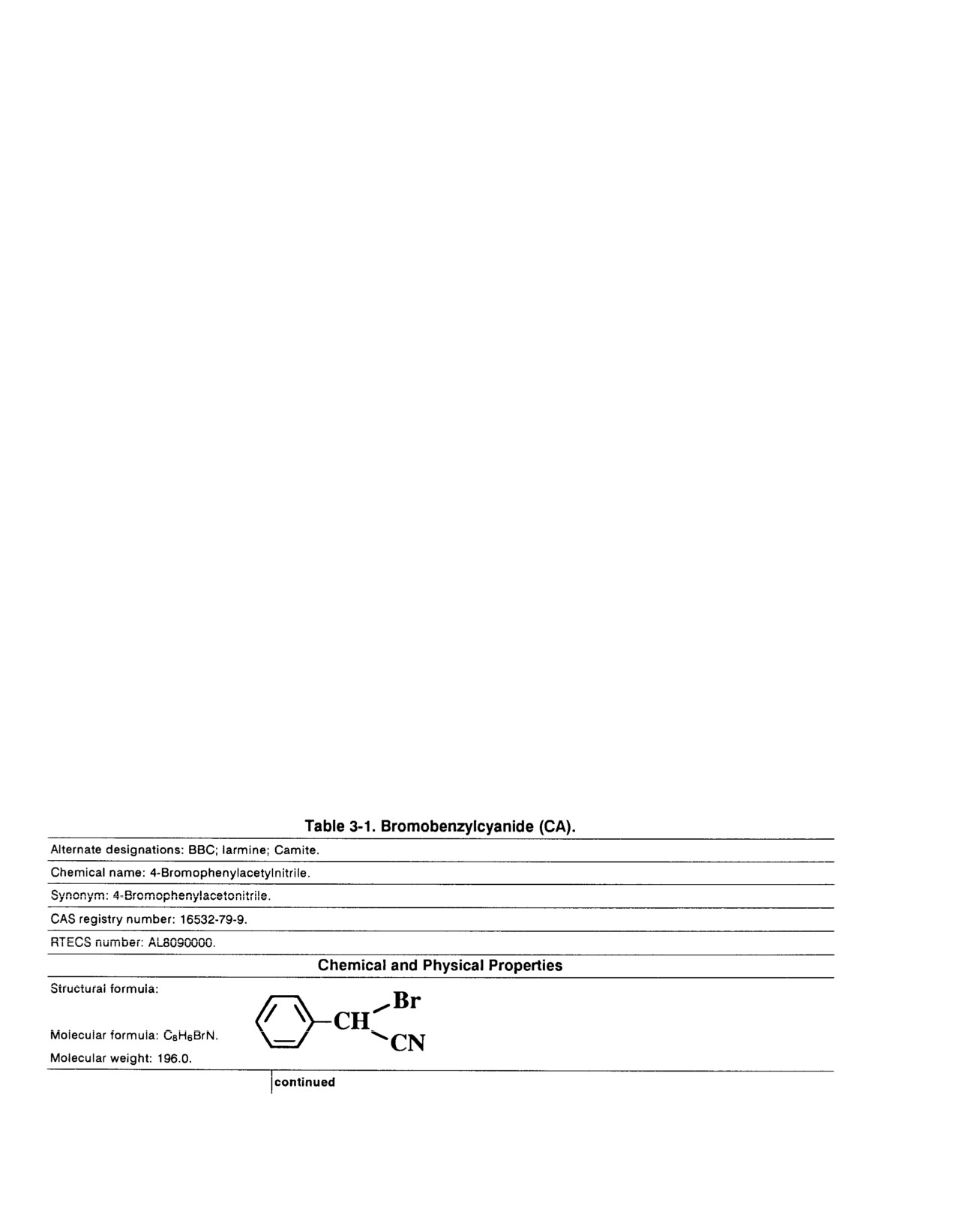
Bromobenzylcyanide (CA)
est.
CA was one of the first tear agents used. It is not as
The standard tear-producing agents currently in the US
effective as CN or CS and is obsolete. CA produces a
Army inventory for riot control are CS, CS1, CS2, CSX, and
burning sensation of the mucous membranes and severe
CR. The United States considers agent CN (popularly
irritation and tearing of the eyes with acute pain in the
known as mace or tear gas) and its mixtures with various
forehead. See Table 3-1.
52
FM 3-9
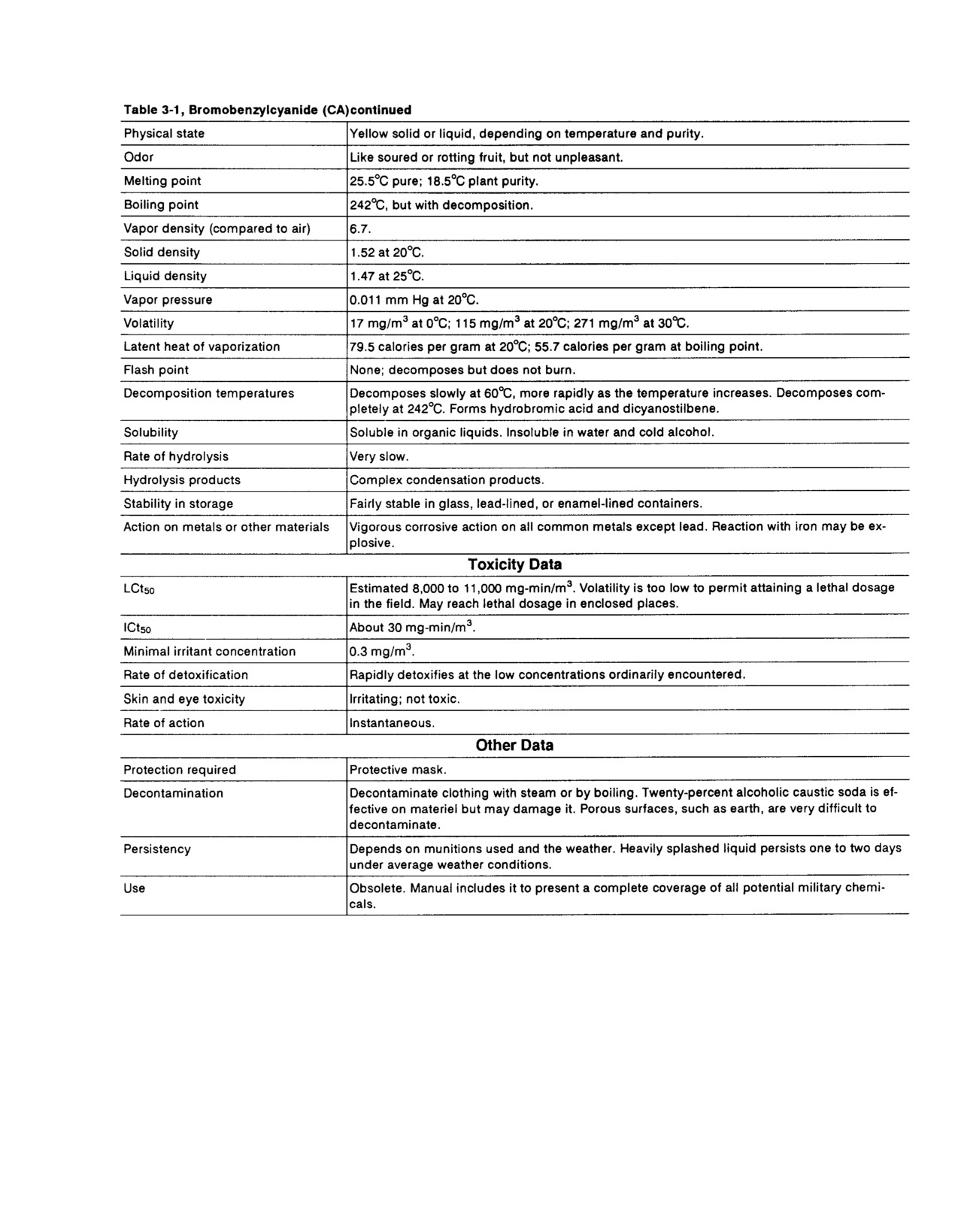
Chloroacetophenone (CN)
CN quickly irritates the eyes and upper respiratory pas-
The symbol CN identifies the riot control agent popular-
sages. In higher concentrations it causes copious tearing; a
ly known as tear gas. A more effective riot control agent,
tingling sensation, irritation, burning, and pain of the nose
CS, has replaced CN as a standarad RCA. Solutions of CN,
and throat; and burning and itching on tender areas of the
identified by the symbols CNC, CNB, and CNS, have also
skin, especially areas wet by perspiration. High concentra-
been employed as riot control agents. Because CN and
tions can cause blisters. The effects are similar to those of
mixtures containing CN are considered obsolete for
sunburn, are entirely harmless, and disappear in a few
military employment, the data that follows are primarily of
hours. Certain individuals experience nausea following ex-
academic and historical interest.
posure to CN. See Table 3-2.
53
FM 3-9
54
FM 3-9
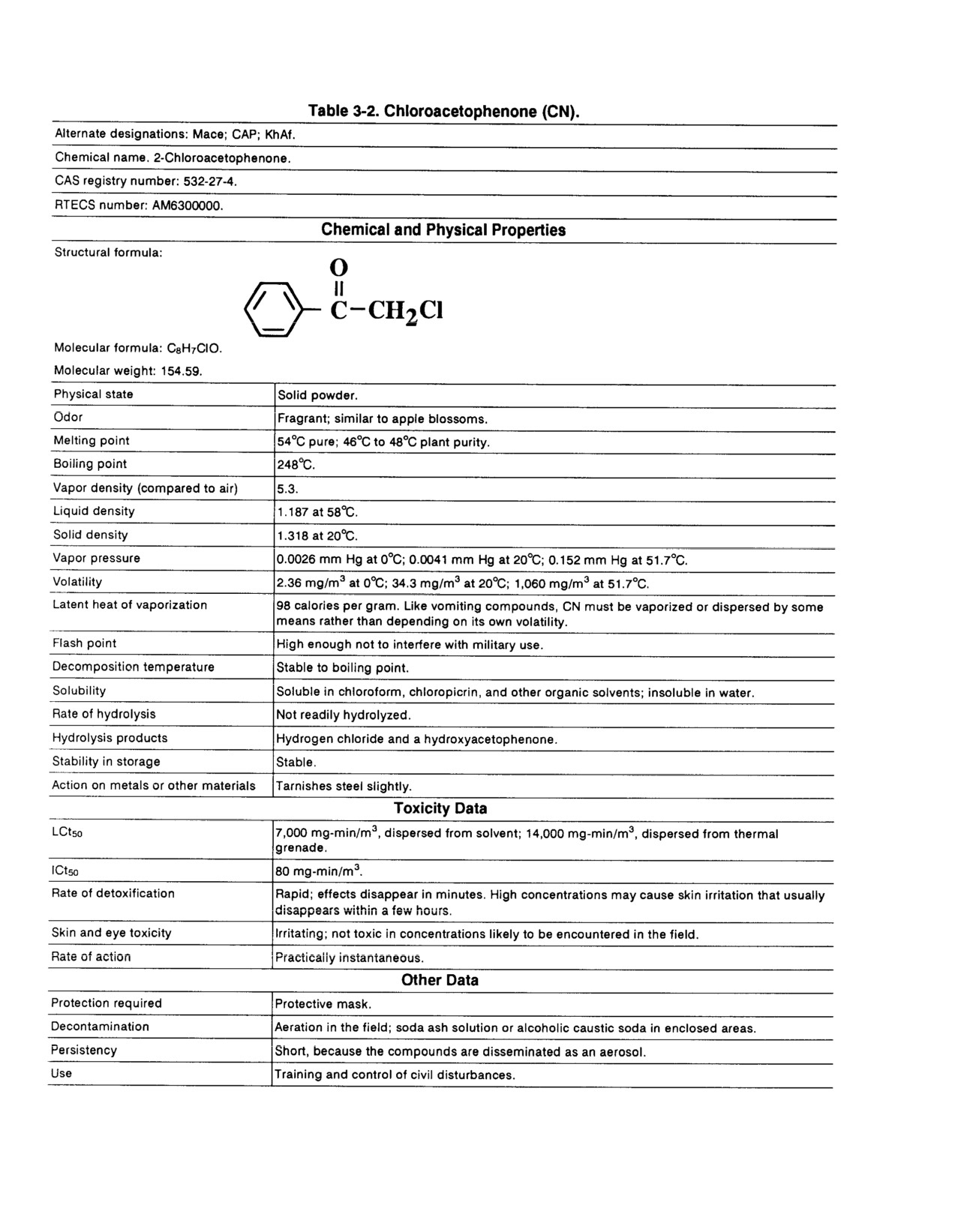
CNC
form. CNC (Table 3-3) causes a flow of tears, irritates the
The symbol CNC identifies a 30-percent solution of CN
respiratory system, and causes stinging of skin.
in chloroform. It was developed to deliver CN in liquid
55
FM 3-9
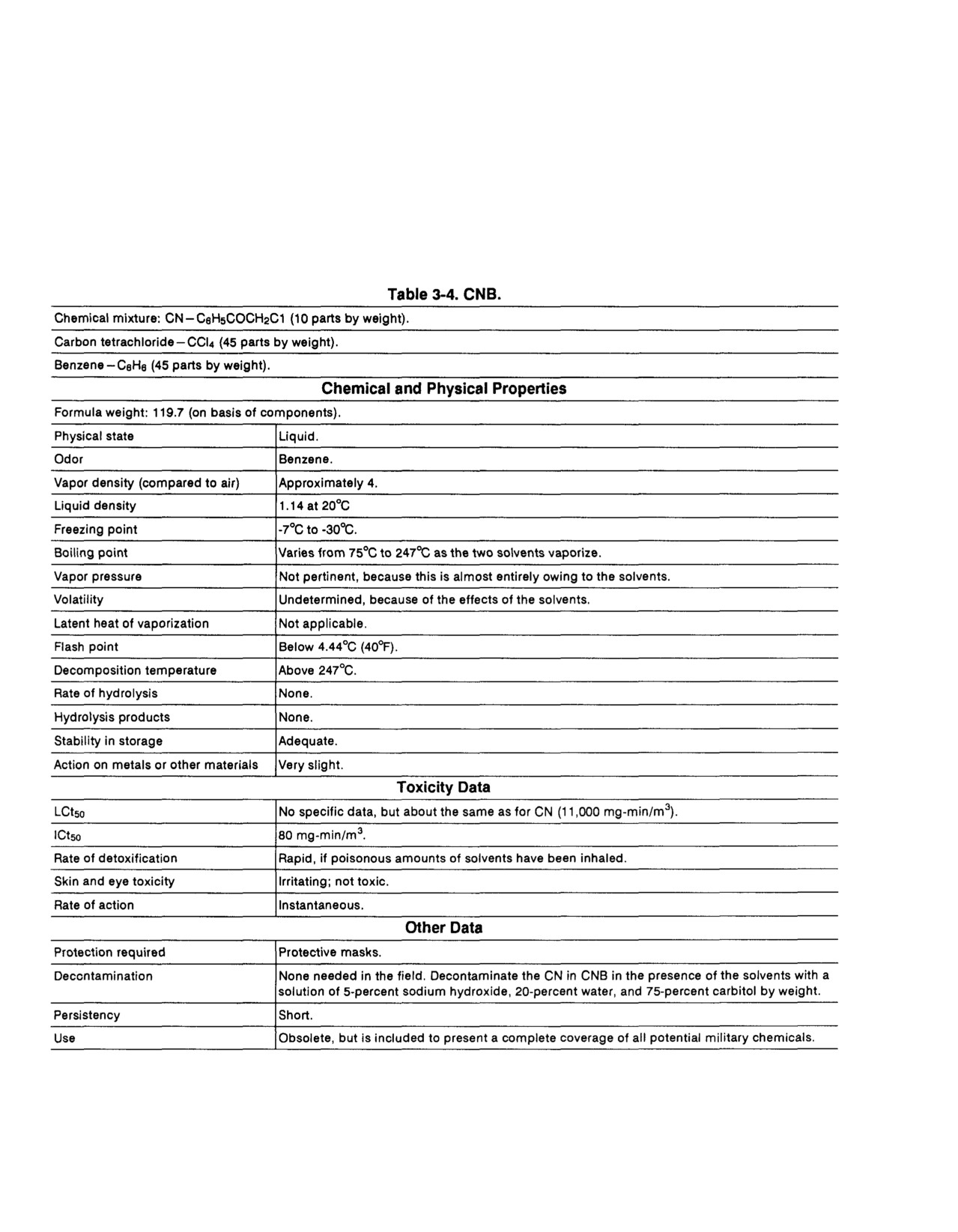
CNB
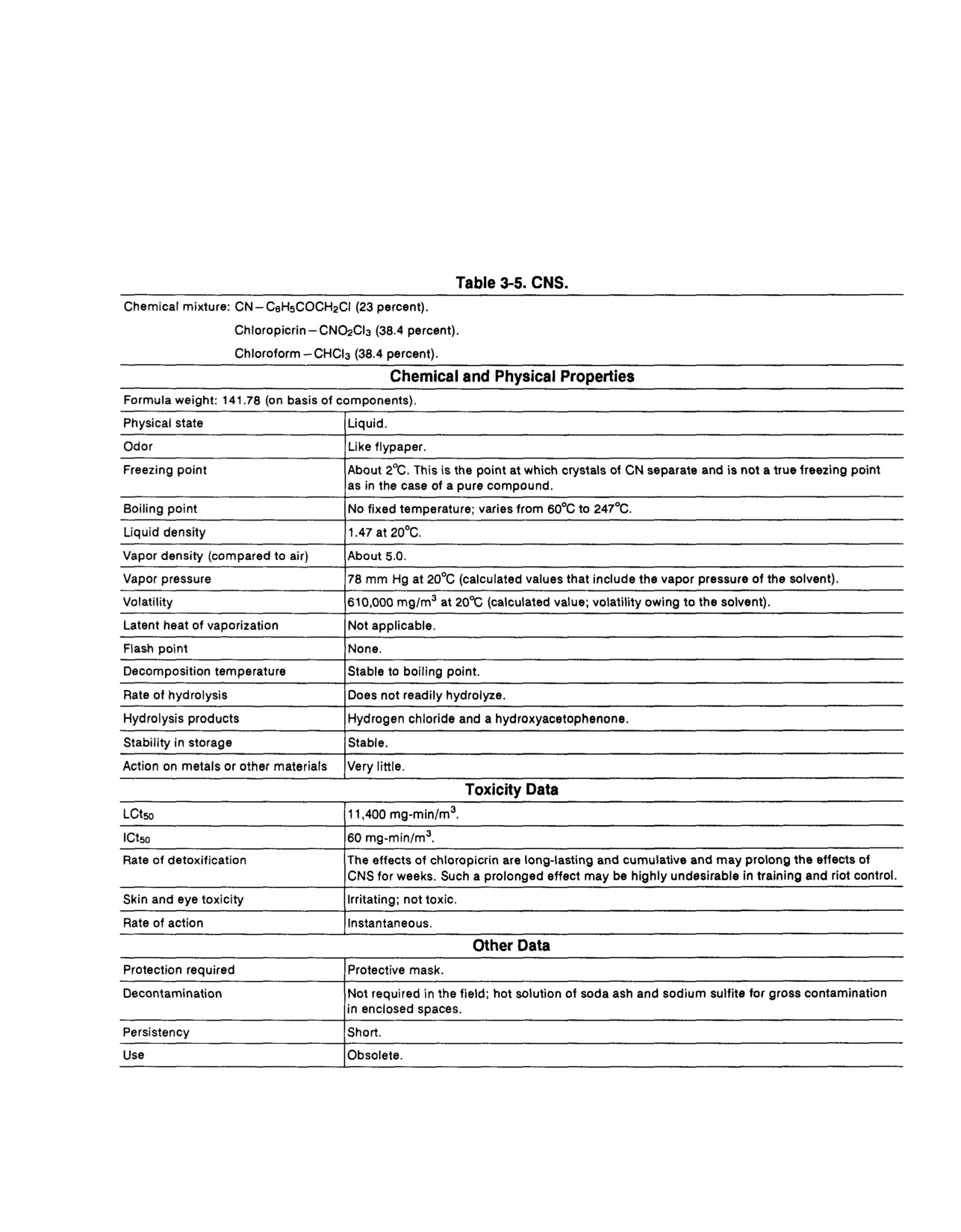
CNS
The symbol CNB (Table 3-4) identifies a mixture of
The symbol CNS (Table 3-5) identifies a mixture of
10-percent CN, 45-percent carbon tetrachloride, and 45-
23-percent CN, 38.4-percent chloropicrin, and 38.4-per-
percent benzene. It is a powerful lacrimator. US forces
cent chloroform. It is an example of multiple component
adopted CNB in 1920 and usedit until CNS replaced it.
mixtures developed to achieve desired dissemination char-
The advantage claimed for CNB was that its lower CN
acteristics. CNS was declared obsolete in 1957 and is no
content made it more satisfactory than CNC for training
longer in the supply system.
purposes. Actually, merely using a lower concentration
In addition to having the effects described under CN,
would obtain the same result with CNC.
CNS also had the effects of PS, which acts as a vomiting
56
FM 3-9
compound, a choking agent, and a tear compound. CNS
O-Chlorobenzylidene Malononitrile (CS)
may cause lung effects similar to those of phosgene and also
In 1959 the US Army adopted CS for combat training
may cause nausea, vomiting, colic, and diarrhea that may
and riot control purposes. By weight CS is about ten times
persist for weeks. The lacrimatory effects of PS are much
as effective as CN. Different forms of CS have different
less marked than those of CN and were relatively unimpor-
persistence characteristics because of their formulation,
tant for CNS. This is shown by the fact that tearing effects
dissemination, and rate of hydrolysis. CS exists as a family
were no greater with CNS than with CNC, which contains
of four forms: CS, CS1, CS2, and CSX.
no PS.
57
FM 3-9
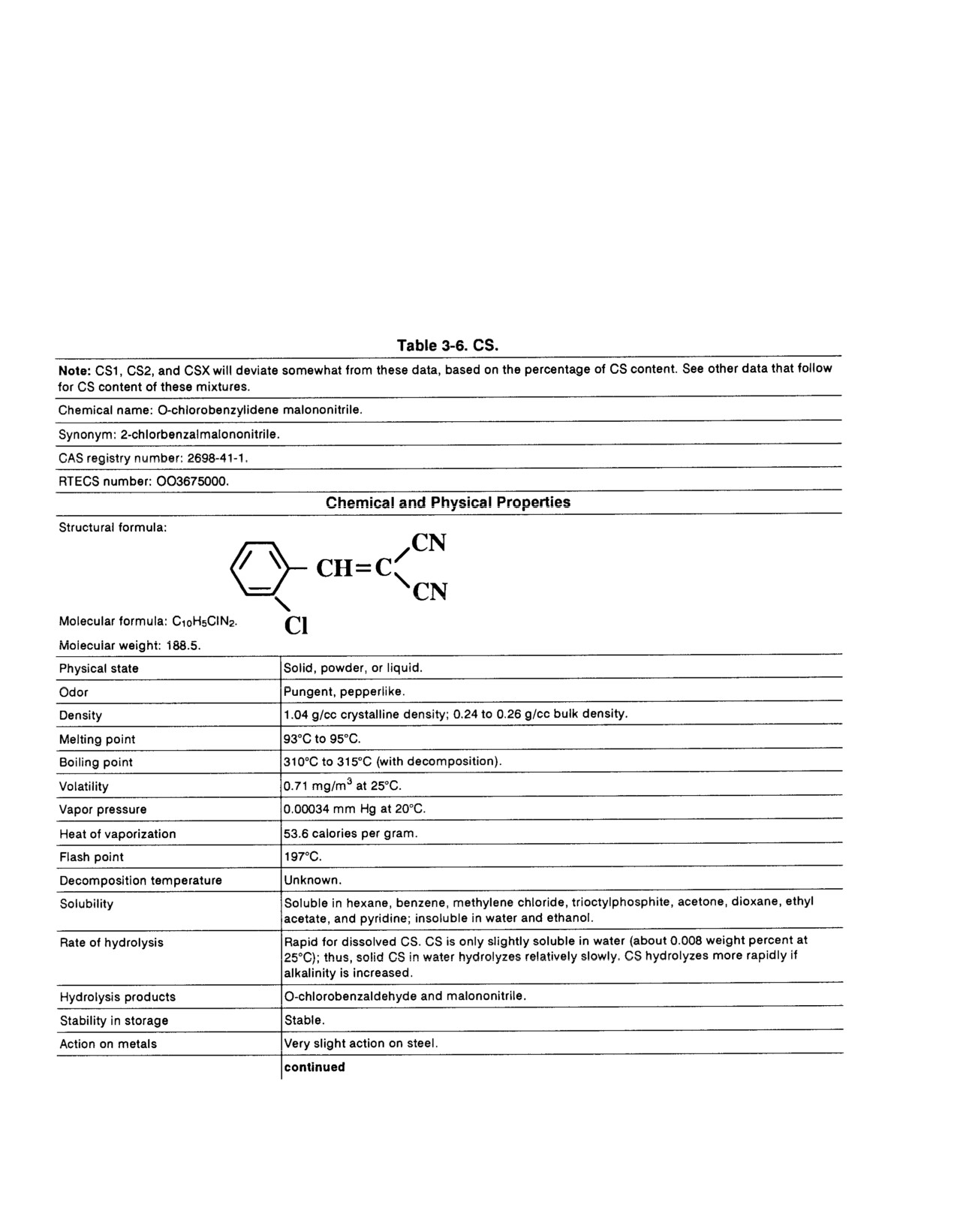
CS (Table 3-6) identities the white, crystalline form. In
in breathing, and chest tightness; involuntary closing of the
pure form it has a characteristic pungent, pepperlike odor.
eyes; stinging or burning on moist skin; heavy mucous
CS is thermally dispersed as a solid aerosol. CS in aerosol
formation in the nose with sinus and nasal drip; and dizzi-
form irritates the eyes, nose, and throat; insufficiently high
ness or “swimming” of the head.
concentration, it will cause militarily significant incapacita-
Exposure to field concentrations may cause nausea and
tion. Incapacitation results from the individual’s inability
vomiting. Prolonged exposure to CS on the skin may cause
to see or preoccupation with the agent’s effects.
severe irritation and blistering. Effects of the agent appear
CS produces immediate effects even in extremely low
almost immediately and will continue as long as the in-
concentrations. The symptoms of exposure to training con-
dividual is exposed. Affected individuals usually recover
centrations of CS include extreme burning of the eyes
within about ten minutes in fresh air.
accompanied by copious flow of tears; coughing, difficulty
58
FM 3-9
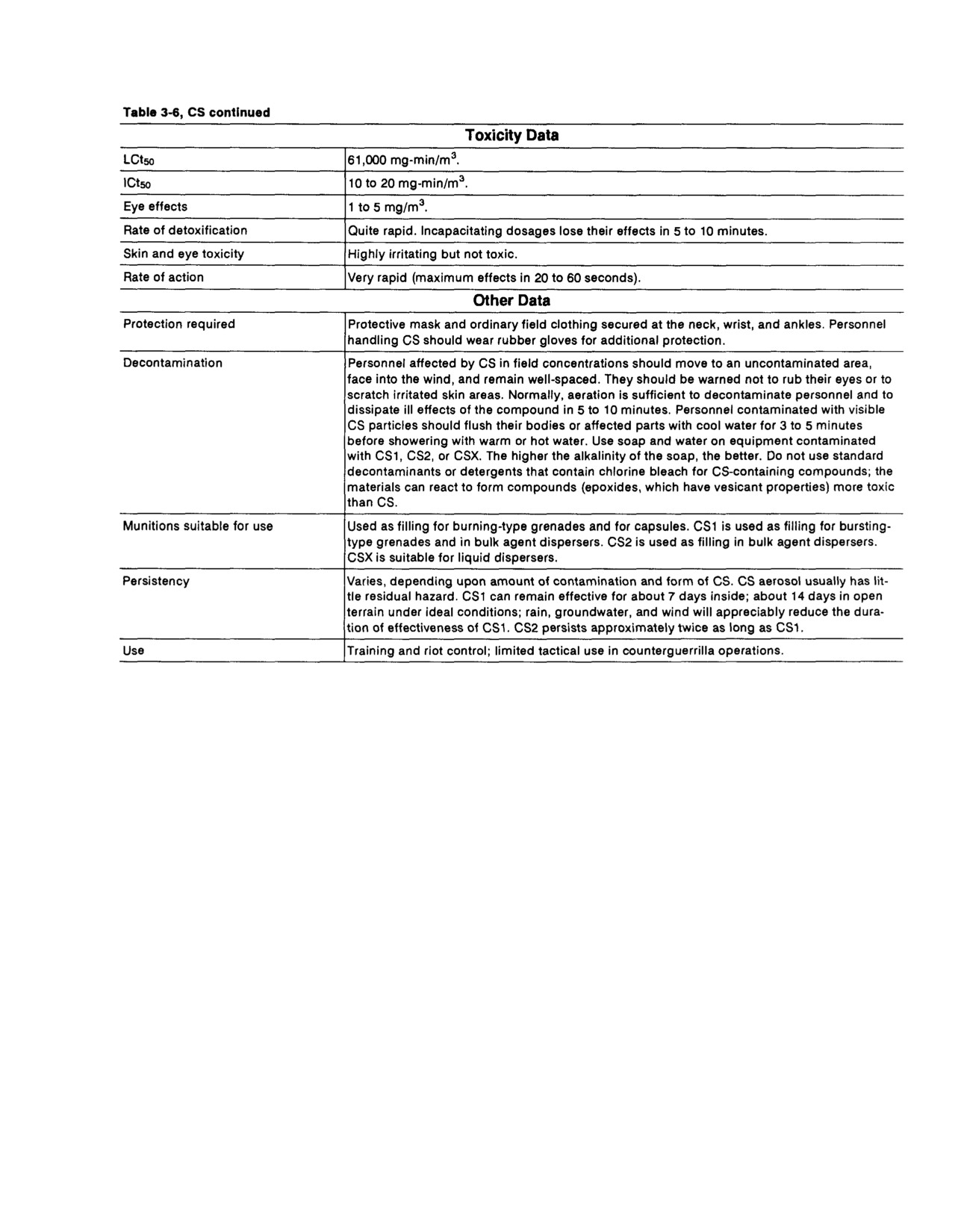
CS1 has been specially formulated to prolong persist-
times more effective. In addition, CR is much less toxic
ency and increase the effectiveness. Unlike CS, CS1 is a
than CS. CR is not used in its pure form (a yellow powder)
free-flowing (micropulverized) agent powder consisting of
but is dissolved in a solution of 80 parts of propylene glycol
95-percent crystalline CS blended with 5-percent silica
and 20 parts of water to form a 0.l-percent CR solution. It
aerogel. This formulation reduces agglomeration and
is used in solution as a riot control agent.
achieves the desired respiratory effects when dispersed as
CR immediately and severely stings the skin, eyes, nose,
a solid aerosol.
and throat of exposed personnel. Eye pain, discomfort, and
CS2 is CS blended with silicone-treated silica aerogel,
excessive tearing occur with sometimes painful sensitivity
which causes it to repel water. This treatment improves the
to strong light or temporary blindness. Nasal irritation,
physical characteristics of CS by reducing agglomeration
coughing, sneezing, and nasal drip also occur. Exposure of
and hydrolysis. This form of CS prolongs the effectiveness
the skin to CR results in a stinging or burning sensation with
for both immediate and surface contamination effects.
increased irritation on moist skin. Sometimes nausea and
When disturbed, CS2 reaerosolizes to cause respiratory
vomiting accompany these symptoms. Symptoms can per-
and eye effects.
sist for 15 to 30 minutes. Severity of symptoms increases
CSX is a form of CS developed for dissemination as a
with the CR solution concentration and in any environment
liquid rather than a powder. One gram of powdered CS is
of high temperature and humidity. With prolonged ex-
dissolved in 99 grams of trioctylphosphite (TOF). As with
posure skin sensitivity (similar to that associated with a
CS, CSX stings and irritates the eyes, skin, nose, throat, and
mild burn) that is renewed upon washing or rubbing may
lungs of exposed personnel.
occur for hours to days.
CR does not degrade in water and is quite persistent in
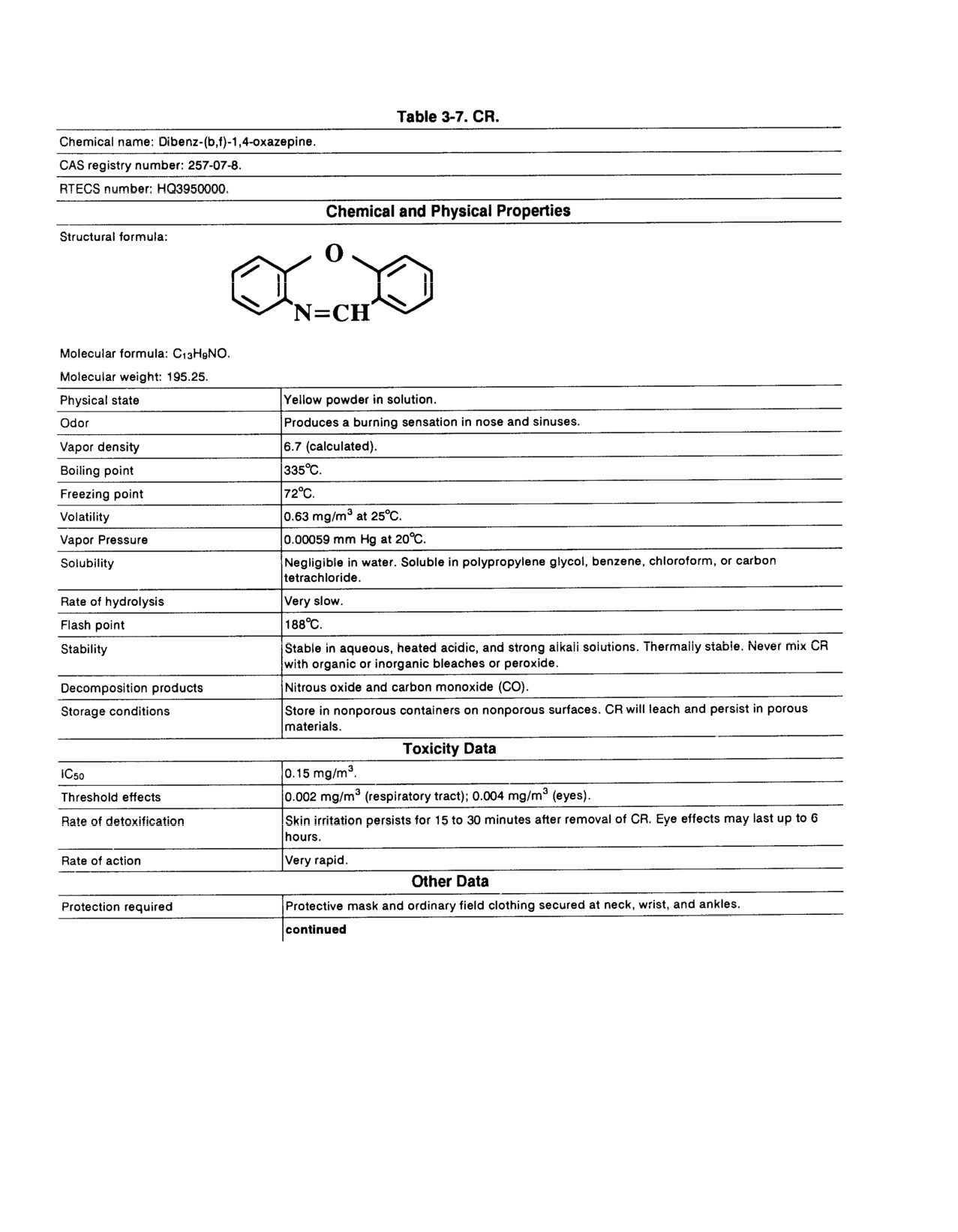
Dibenz-(b,f)-1,4-oxazepine (CR)
the environment. Under suitable conditions CR can persist
In 1974 the US Army approved the use of CR. CR has
on certain surfaces (especially porous) for up to 60 days.
much greater irritating properties than CS and is about five
Do not use bleach to decontaminate CR. See Table 3-7.
59
FM 3-9
60
FM 3-9
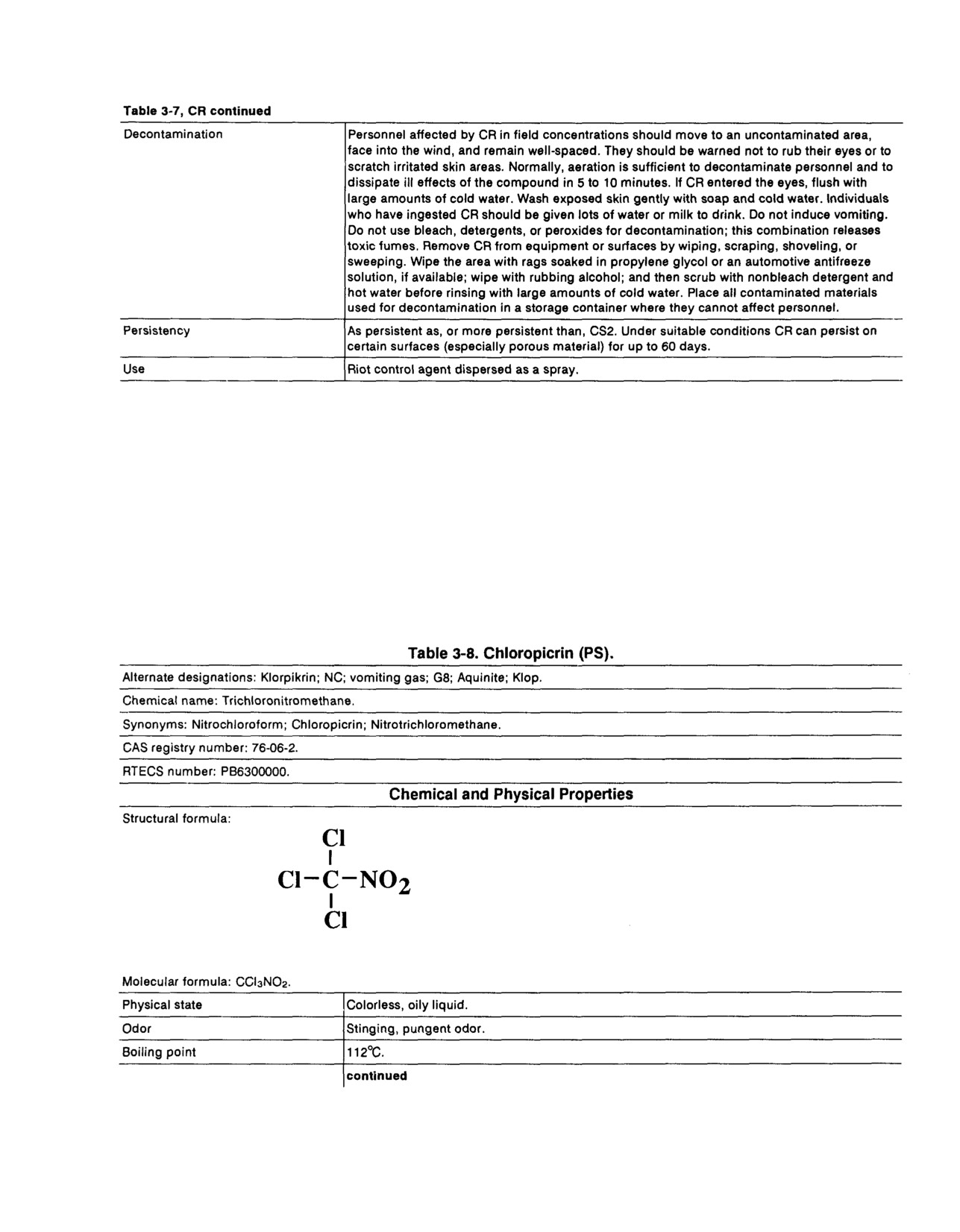
Chloropicrin (PS)
it causes severe burns on the skin that generally result in
PS is a pungent, colorless, oily liquid. It is very volatile
blisters and lesions.
and is usable during any season to produce incapacitating
Chloropicrin was used in large quantities by “all the
or lethal concentrations.
warring countries” during World War I. Chloropicrin was
PS (Table 3-8) is a powerful irritant whose vapors cause
used alone; more often it was mixed with chlorine, phos-
nose and throat irritation, coughing, and vomiting. As an
gene, diphosgene and tin chloride. It was stockpiled during
eye irritant, it produces immediate burning, pain, and tear-
World War II, generally in concentrations or mixtures to
ing. Even in very limited concentrations PS causes the
produce tearing. It is more toxic than chlorine but less toxic
eyelids to close. In high concentrations PS damages the
than phosgene (CG). Chloropicrin decomposes into
lungs, causing pulmonary edema. It is very soluble in fats
chlorine gas and nitrogen oxide near open fires, producing
and oils, and different organs absorb it. In the liquid form
toxic fumes. The protective mask protects against vapors;
protective clothing protects against the liquid agent.
61
FM 3-9
Vomiting Compounds (Sternutators)
Vomiting agents produce strong, pepperlike irritation in
Symptoms, in progressive order, are irritation of the eyes
the upper respiratory tract, with irritation of the eyes and
and mucous membranes, viscous discharge from the nose
tearing. They cause violent, uncontrollable sneezing;
similar to that caused by a cold, sneezing and coughing,
cough; nausea; vomiting and a general feeling of bodily
severe headache, acute pain and tightness in the chest,
discomfort. The vomiting compounds listed are normally
nausea, and vomiting. The effects of DM develop more
solids that vaporize when heated and then condense to
slowly than those of DA, and for moderate concentrations
form aerosols. They produce their effects by inhalation or
the effects last about 30 minutes after the person leaves the
by direct action on the eyes. Under field conditions vomit-
contaminated atmosphere. At higher concentrations the
ing compounds cause great discomfort to victims; when
effects may last up to several hours.
released indoors, they can cause serious illness or death.
The principal vomiting agents are diphenylchloroarsine
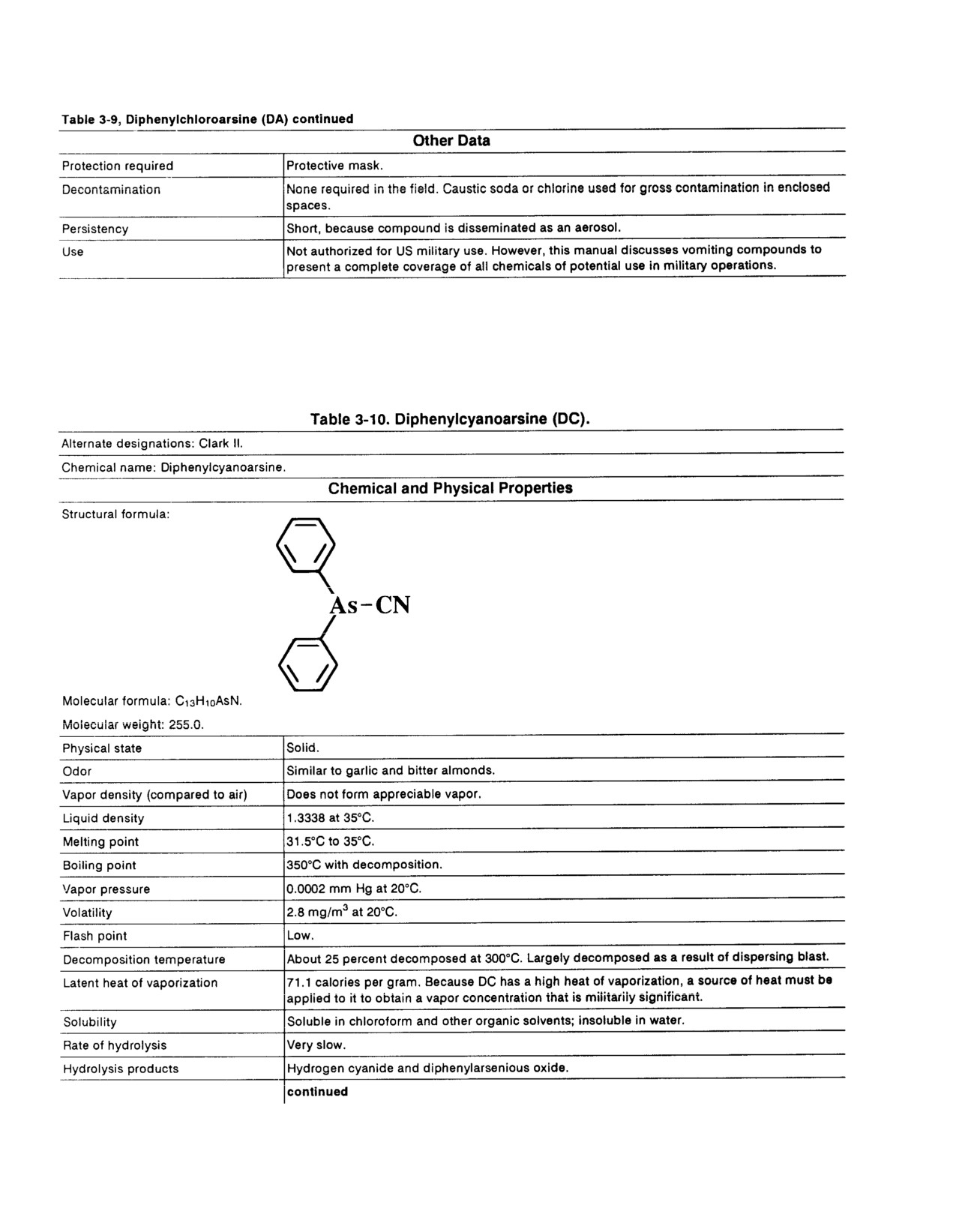
Diphenylchloroarsine (DA)
(DA), diphenylaminochloroarsine (DM; Adamsite), and
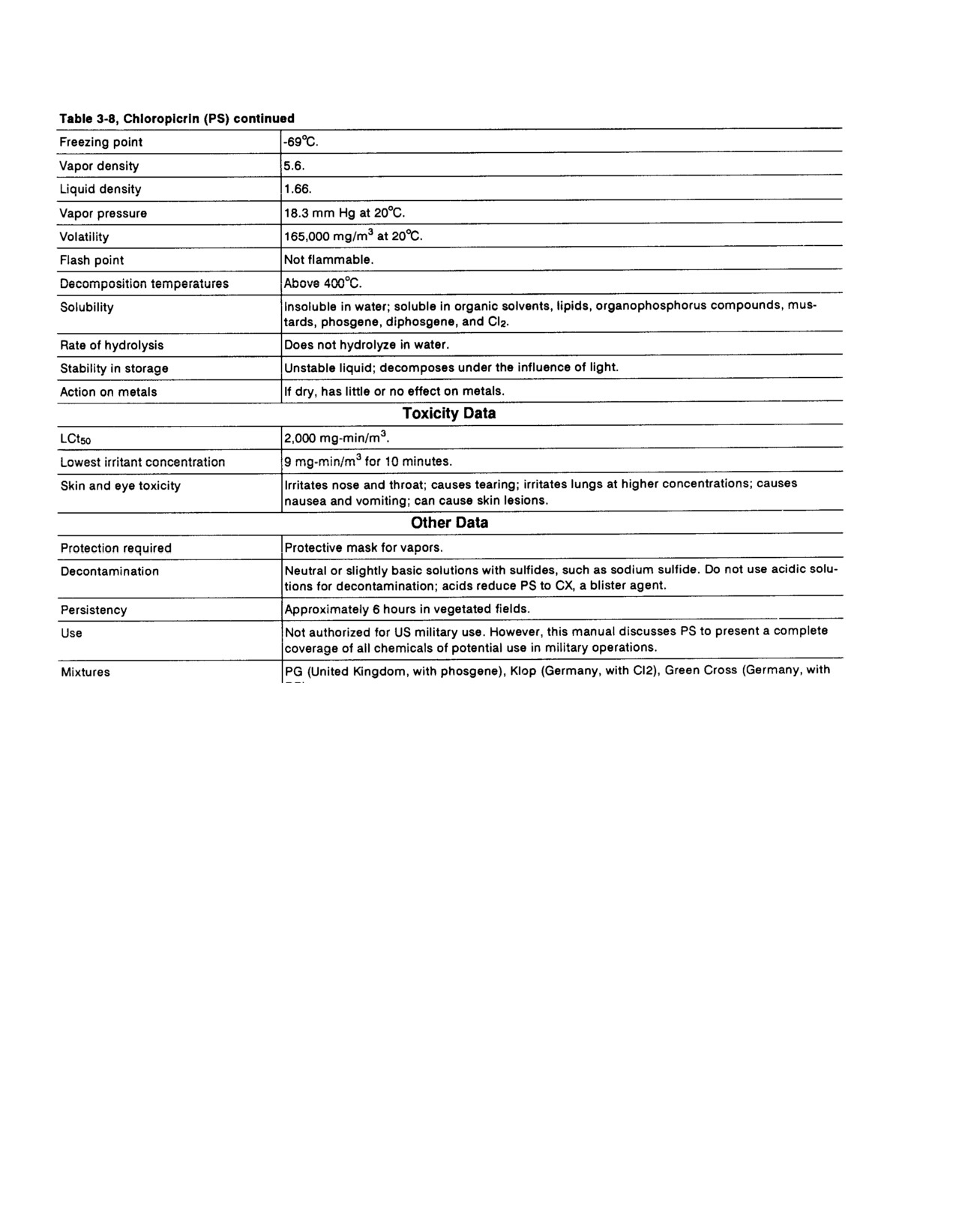
Agent DA contains arsenic and chlorine. The Threat
diphenylcyanoarsine (DC). Chloropicrin also is a vomiting
could use it to cause troops to remove their masks and
agent.
vomit, thereby exposing them to other agents. See Table
3-9.
62
FM 3-9
63
FM 3-9
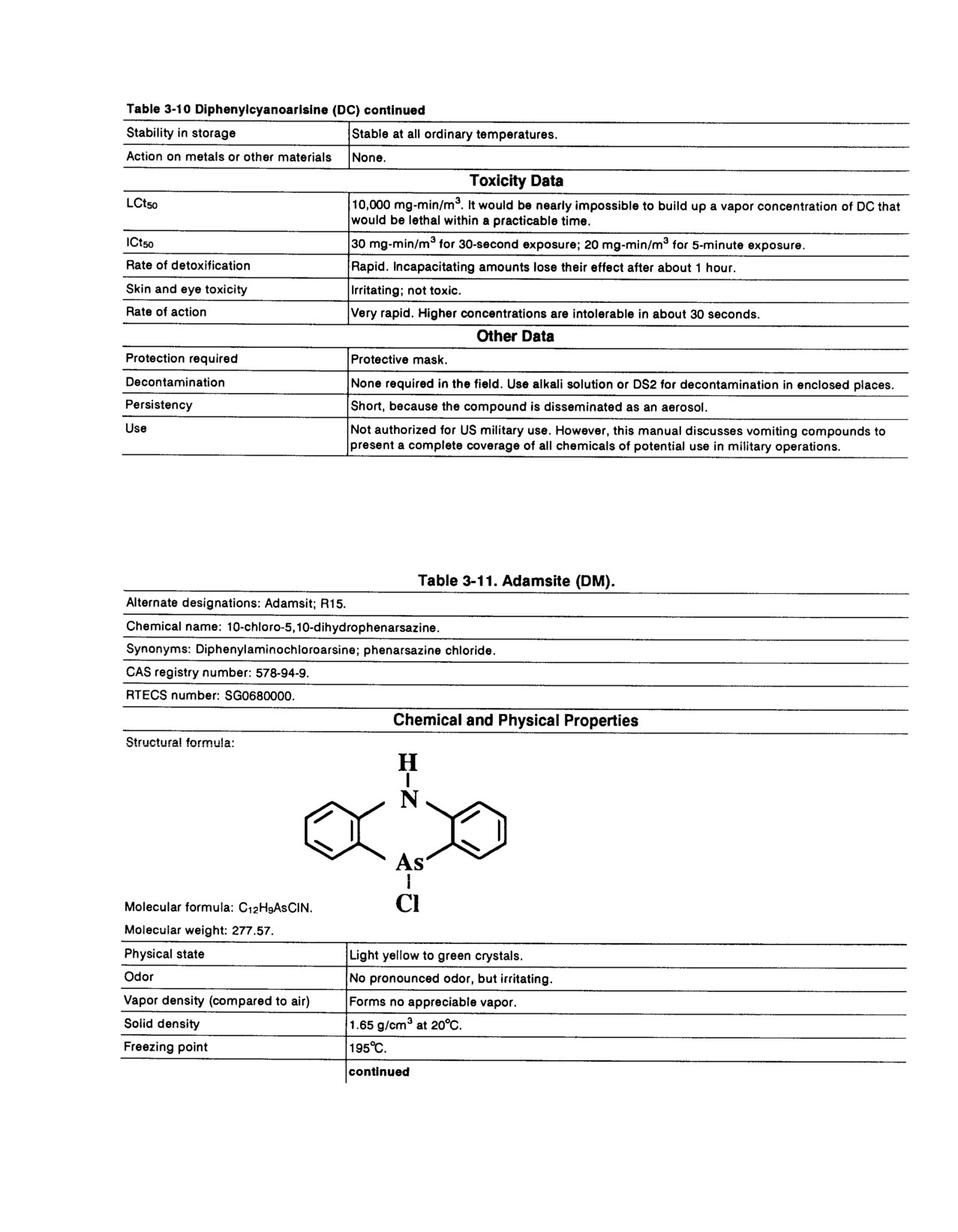
Diphenylcyanoarsine (DC)
centration last about 30 minutes after a person leaves the
The properties of DC are much like those of DA and
contaminated atmosphere. The effects from a higher con-
DM, and the Threat would use it in the same manner. DC
centration may last up to several hours. See Table 3-10.
is more toxic than DA. The effects from a moderate con-
64
FM 3-9
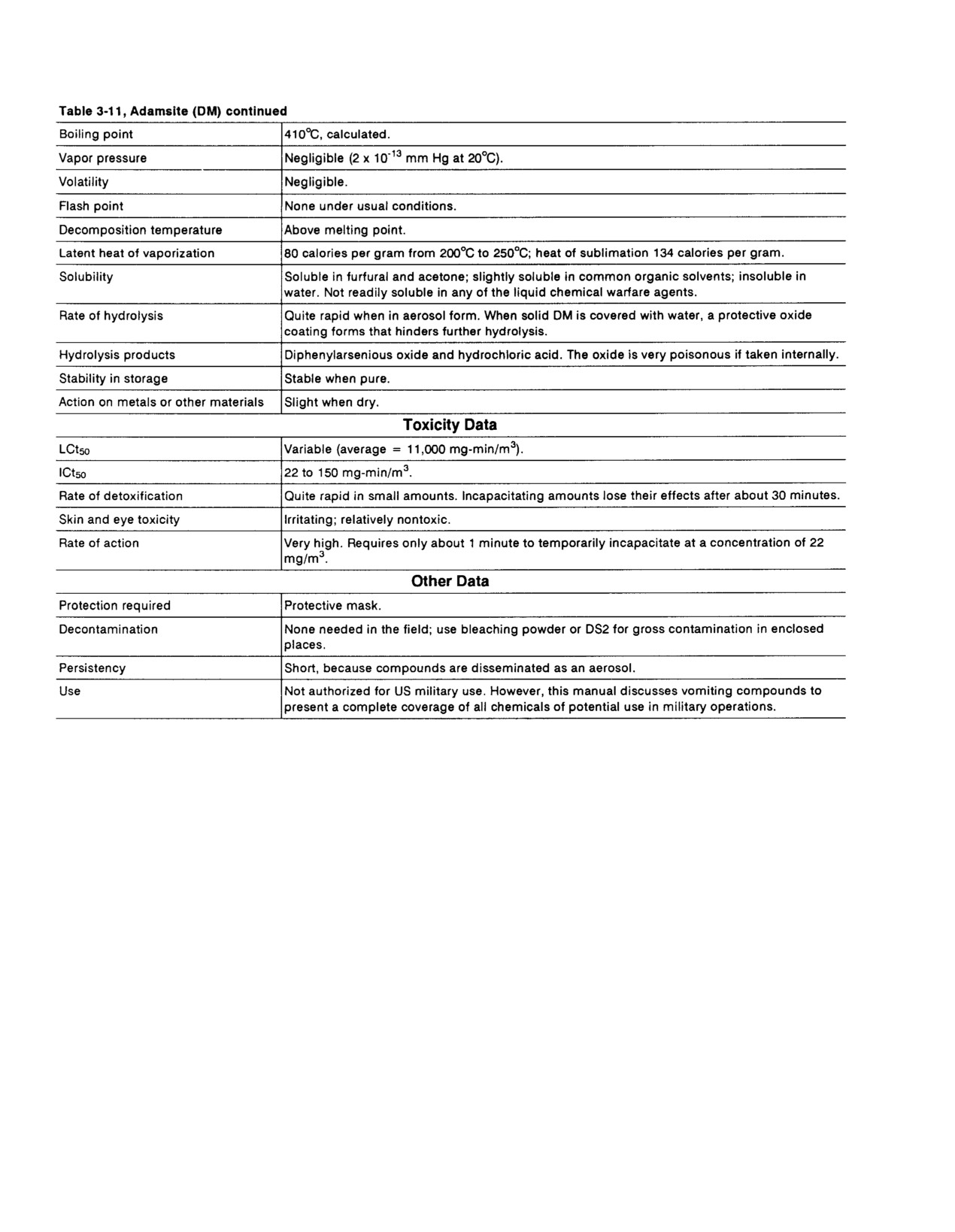
Adamsite (DM)
respiratory tract; it has no irritant effect on the skin. See
Adamsite was first produced during World War I. It is
Table 3-11.
disseminated as an aerosol and is effective only through the
65
FM 3-9
Section II. Binary Components
The binary nerve agents are GB2 and VX2. The com-
NE, which is powdered sulfur with a small amount of added
ponents of GB2 are DF and a mixture of isopropyl alcohol
silica aerogel to prevent caking.
and isopropyl amine (OPA). The components of VX2 are
Troop exposure to these materials could occur from
QL, which is designated chemically as O-(2-
leaklng containers, spills at production or storage facilities,
diisopropylaminoethyl)-O’ethyl methylphosphonite, and
or accidents during transport.
DF and DC
(MPOD)
Methylphosphonic difluoride (DF) and its precursor,
are relatively volatile compounds, the primary route of
methylphosphonic dichloride (DC), are organophos-
exposure is expected to be the respiratory system. How-
phonic acids. They will react with alcohols to form crude
ever, ingestion also results from inhalation exposures in
lethal nerve agents, such as crude GB. High overexposure
animals and could occur in humans. DF and DC vapors
may cause inhibition of cholinesterase activity. Although
have a pungent odor and may cause severe and painful
much less toxic than GB, DF and DC are toxic and cor-
irritation of the eyes, nose, throat, and lungs. Data provided
rosive materials.
are for DF only (Table 3-12). DC has similar properties.
Troop exposure could result from leaking DF containers
or accidents that disrupt packaging. Because DF and DC
66