FM 3-04 Army Aviation (JULY 2015) - page 3
Chapter 3
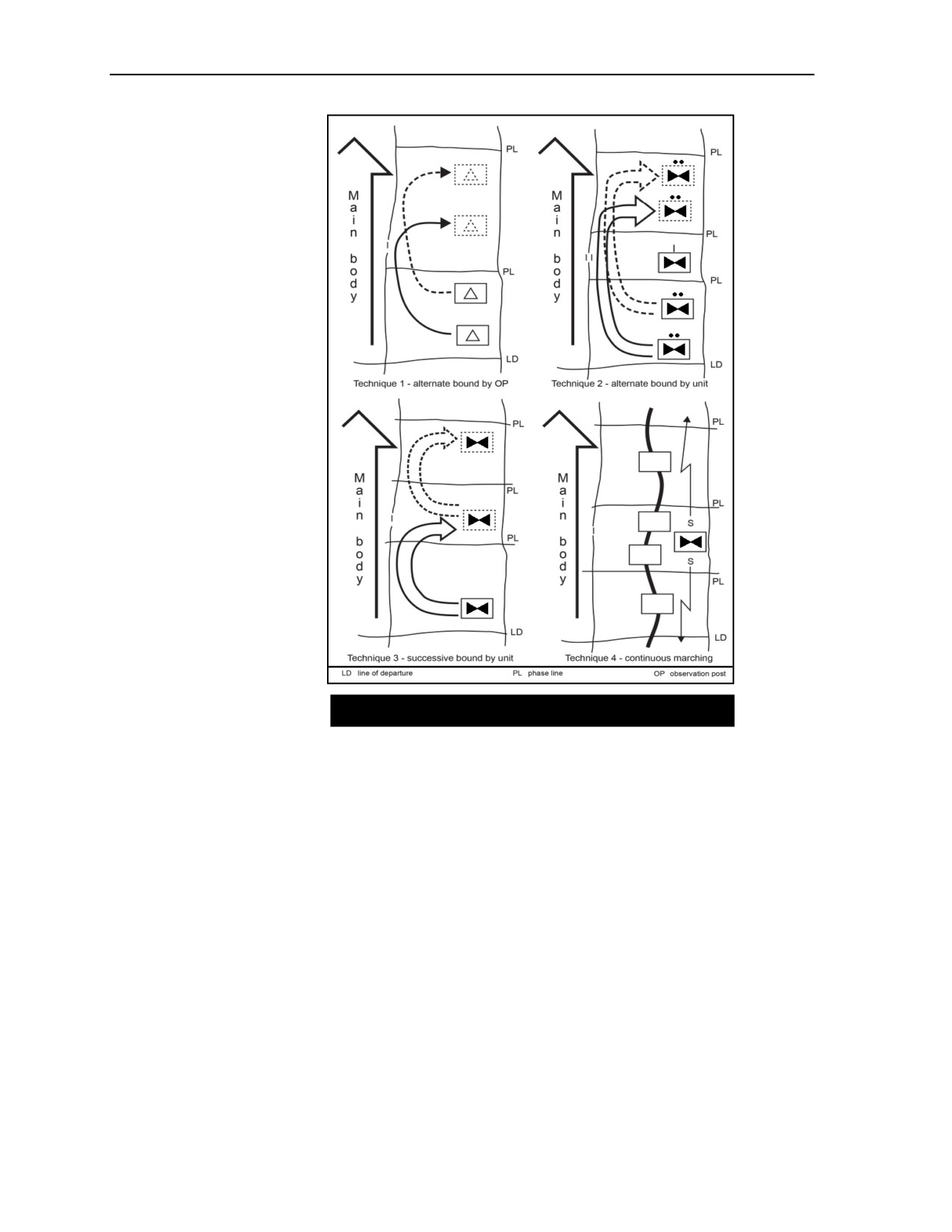
Figure 3-16. Screen movement methods
GUARD
3-100. Guard is a security task to protect the main body by fighting to gain time while also observing and
reporting information and preventing enemy ground observation of and direct fire against the main body.
Units conducting a guard mission cannot operate independently because they rely upon fires and functional
and multifunctional support assets of the main body (FM 3-90-2). A guard differs from a screen in that it is
a more robust security force with increased combat power and is expected to engage the enemy force, while
a screen is primarily a defensive force tasked with providing early warning, and is expected to avoid decisive
engagement. Army Aviation can support the ground maneuver units conducting guard operations, but cannot
conduct guard missions autonomously unless an aviation battalion task force or combat aviation brigade is
task organized with adequate ground maneuver forces. Army Aviation conducts the full range of tactical,
enabling and sustaining tasks when supporting or conducting a guard, including: attack, reconnaissance,
movement to contact, screen, air assault, air movement, aerial mission command, and aeromedical
evacuation.
COVER
3-101. Cover is a security task to protect the main body by fighting to gain time, observing and reporting
information, and preventing enemy ground observation of and direct fire against the main body (ADRP 3-
90). Aviation forces can be task organized to a BCT or larger element assigned a covering force mission.
Army Aviation conducts the full range aviation functions in support of the combined arms team assigned to
3-22
FM 3-04
29 July 2015
Army Aviation Operations
conduct cover, including: attack, reconnaissance, movement to contact, screen, air assault, air movement,
mission command support and aeromedical evacuation.
FUNDAMENTALS OF SECURITY
3-102. When planning and executing security operations, application of the following five fundamentals
informs the operations process and drives execution of successful security missions.
3-103. Provide early and accurate warning. Army Aviation provides depth to the security operation by
employing sensors and long-range observation techniques to detect enemy forces and provide early and
accurate warning. Early warning of threat activity should include a description of size, current disposition,
composition, location, direction of movement, and rate of advance to assist the staff in answering PIRs. The
distance the aviation security force operates from the main body is determined by mission variables, but at a
minimum it should operate far enough from the main body to prevent enemy forces from engaging or
observing the protected force. The earlier the aviation security force detects a threat, the greater the time the
protected force has to react. The use of UAS well forward of the screen line provides the security force with
additional early warning and reaction time to maneuver to further develop the situation. If the screen is
established at the LOA and the LOA is a forward unit boundary, coordination with the higher headquarters
is required if UAS are to operate forward to provide increased early warning and reaction time.
3-104. Provide reaction time and maneuver space. Based on the protected force commander’s desired
reaction time, Army Aviation operates at extended distances from the main body thus offering additional
time and space for the protected force commander to make an informed decision to employ forces. Based on
the commander’s intent, the aviation security force may transition to conduct offensive tasks to fix, delay, or
disrupt the enemy forces’ tempo and cohesion, providing reaction time and maneuver space to the protected
force.
3-105. Orient on the protected force, area, or facility. Whereas reconnaissance operations orient on the
reconnaissance objective, security operations orient on the protected force. The security force operates
between the enemy force and the protected force and is fully integrated in the protected force scheme of
maneuver. The movement and orientation of the security force is simultaneous and nested with the protected
force.
3-106. Perform continuous reconnaissance. The aviation security force provides continuous
reconnaissance through the persistent employment of UAS and continuous relief on station of AWTs/SWTs.
Reconnaissance is overlapping and redundant with ground security forces, when operating in the security
area, to ensure depth and mutual support. Based on the commander’s intent, aviation security forces
conducting reconnaissance will transition to hasty attacks to defeat enemy reconnaissance and security forces
to prevent the enemy from gaining observation on the main body. Additional aviation attacks may be
conducted to harass, impede or disrupt enemy main body forces. Aviation assault units may also infiltrate
and reposition ground maneuver security forces to provide redundant coverage of key NAIs or to establish
ambush locations to delay, block or disrupt attacking enemy forces. Positioning of FARPs, mission command
nodes, UAS launch sites and holding areas as far forward as mission variables allow ensures the aviation
force can sustain the required tempo with the least amount of combat power to maintain continuous
reconnaissance while retaining the flexibility to rapidly develop the situation once contact is gained.
3-107. Maintain enemy contact. Maintaining contact with the enemy develops the situation and allows
the commander to make well-informed decisions. Army Aviation’s inherent mobility and endurance allow
for aviation assets to rapidly gain and maintain enemy contact with the ability to develop the situation and
report the enemy’s actions as necessary. UAS provide persistent observation and allow manned aviation
systems to reposition to positions of advantage to maintain contact and further develop the situation.
Establishing subsequent screen lines and battle handover lines enable aviation security forces to maintain
contact in depth.
SECTION VI - AIR ASSAULT
3-108. An air assault is the movement of friendly assault forces by rotary-wing aircraft to engage and
destroy enemy forces or to seize and hold key terrain (JP 3-18). Air assaults extend the tactical and operational
29 July 2015
FM 3-04
3-23
Chapter 3
reach of the combined arms team by overcoming the effects of terrain, achieving surprise, and isolating,
dislocating or destroying enemy forces by rapidly massing combat power at the maneuver commander’s time
and place of choice. (See FM 3-99 for detailed air assault TTP.)
3-109. Army Aviation conducts air assaults in support of offensive, defensive and stability operations
throughout the depth and breadth of the AO. Army Aviation assault and heavy lift units, supported by attack
reconnaissance units, rapidly reposition personnel and equipment to enable the combined arms team to strike
over extended distances and terrain to attack the enemy where and when he is most vulnerable.
3-110. The air assault task force is the entire combined arms team conducting the air assault. The air assault
task force commander (AATFC) commands the combined arms team through all phases of the air assault and
is normally the ground maneuver brigade or battalion commander whose subordinate echelon constitutes the
main ground combat force. When task organized with ground maneuver forces and fires, an Army aviation
battalion task force or brigade can operate as the AATF. The aviation task force commander (or a designated
subordinate leader for air assaults below the battalion level) serves as the AMC and commands all aviation
forces through all phases of the air assault. The ground tactical commander (GTC) is the commander of the
largest ground maneuver force inserted during the air assault and assumes command of the ground tactical
force (GTF) in the LZ and upon initiation of the ground tactical plan.
3-111. Task organization of the aviation task force supporting the AATF is based on mission variables but
at a minimum always includes an assault element and an attack reconnaissance element as the foundational
aviation maneuver capability.
3-112. The assault element may be made up of assault helicopters, heavy lift helicopters, or a combination
of both. Aviation assault and heavy lift units transport ground maneuver forces and equipment from secure
or permissive PZs to either unsecure or secure LZs in the objective area. Based on mission variables and the
AATF commander’s intent, LZs may be directly on or very near the objective or offset from the objective.
The closer the LZ is to the objective, the greater the ability to rapidly mass combat power and with greater
likelihood of achieving surprise. Offset LZs are chosen when no suitable LZs are available, to enhance
survivability during the landing phase if the threat on the objective is high or when the ground force
commander desires to infiltrate into the objective. However, significant offset distances between the objective
and LZ location may reduce the element of surprise, may require a larger GTF and may allow the enemy
early warning and freedom to maneuver to gain a position of advantage. Availability, size and suitability of
LZs; size, disposition, and capabilities of the enemy; size and capabilities of the AATF; and the AATFC’s
intent drive the determination of LZ locations.
3-113. Army Aviation attack and reconnaissance units, utilizing MUM-T, conduct a range of tactical and
enabling tasks in support of the air assault, to include: air route reconnaissance, LZ/PZ reconnaissance,
attacks prior to and during the landing phase, attacks as shaping operations prior to the assault, and attacks,
screens and reconnaissance operations in support of the GTF after landing. Mission command of the
attack/reconnaissance element resides with the AMC until the GTF begins executing the ground tactical plan
where the attack/reconnaissance units typically become direct support or OPCON to the GTFC.
3-114. Air assaults are typically deliberately planned operations. They can be conducted in deep areas
forward of a unit’s forward boundary in linear areas of operation; in the higher echelon’s deep areas between
non-linear and non-contiguous areas of operation; or in the echelon support area to defeat enemy threats that
were either bypassed during offensive operations or that have infiltrated or penetrated the main battle area or
security area during the conduct of defensive or stability operations. Air assaults into the close fight are
generally in extremis but may be used to exploit success by reinforcing friendly ground maneuver forces on
an objective or to prevent friendly forces from being overrun. Based on mission and operational variables,
Army Aviation executes air assaults with elements as small as a team of assault and a team of attack
reconnaissance helicopters up to the aviation brigade level, either as a subordinate member of the combined
arms team or as the AATF headquarters when task organized with ground maneuver forces.
3-115. The amount of time required to plan and prepare an air assault is largely driven by the training level
of the ground and aviation forces that form the AATF, and the degree to which habitual relationships and
training allow the use of standardized procedures to reduce planning and preparation times. Planning times
can range from as short as 30 minutes for habitual quick reaction force missions up to 96 hours for larger
company, battalion or brigade air assaults in high threat areas.
3-24
FM 3-04
29 July 2015
Army Aviation Operations
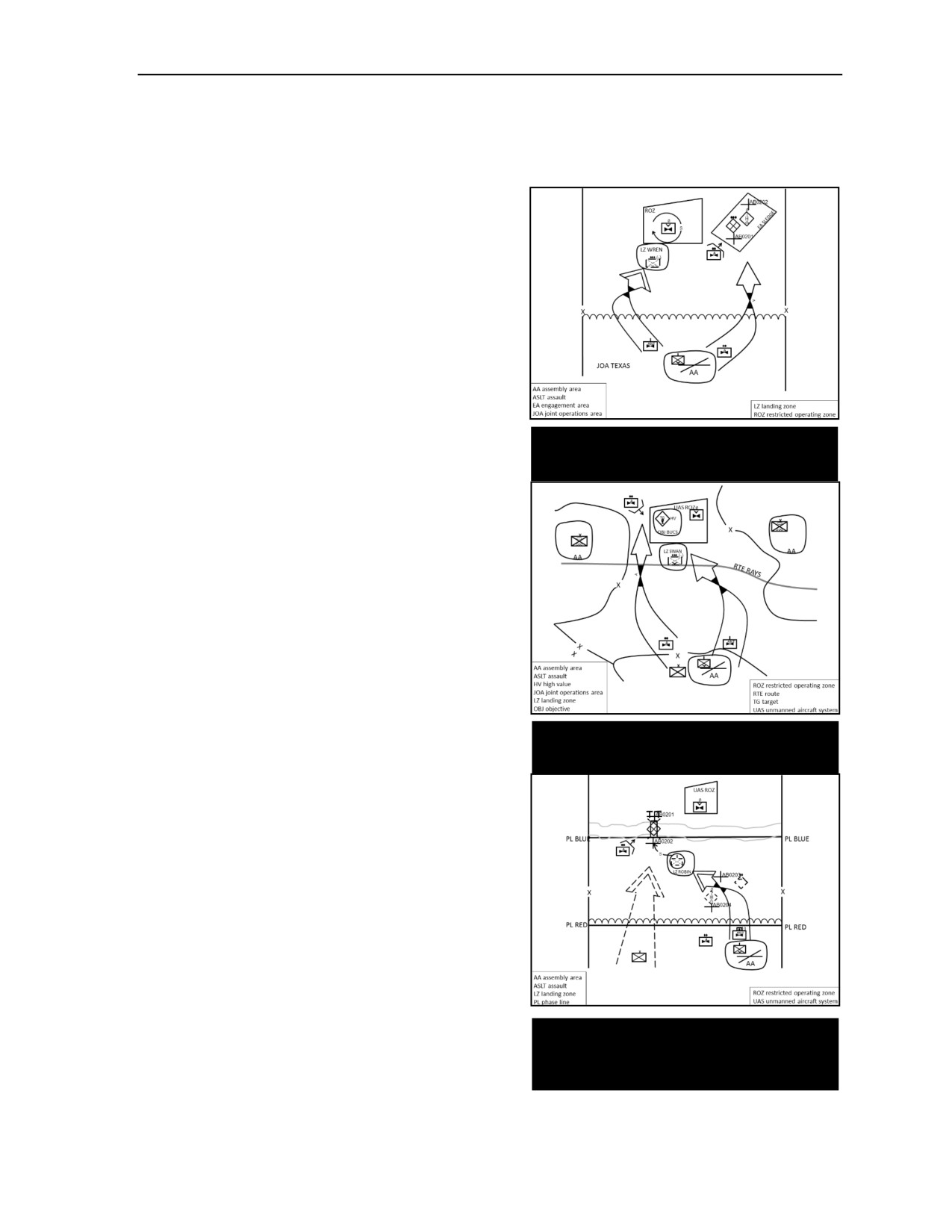
3-116. Examples of the continuum of air assault operations, from generally the smallest force with the least
required planning and synchronization efforts, to very large, high risk air assault operations that require
detailed planning and rehearsals include, but are not limited to—
z
A platoon
(minus) quick reaction force
(QRF) that is habitually aligned and is trained
with common SOPs air assaults to secure a
downed friendly UAS in an area with low air
defense threats and not occupied by friendly
ground maneuver forces (figure 3-17).
Figure 3-17. QRF air assault to secure
a downed friendly UAS
z
A platoon (minus) QRF air assaults to kill or
capture a high-value target
(HVT) that is
isolated on a small objective without a
superior enemy security or reaction force in
close proximity and low air defense threats
(figure 3-18).
Figure 3-18. QRF air assault to kill or
capture an HVT
z
An infantry company air assaults to seize a
lightly defended bridge within a linear deep
area just beyond the forward of the line of
troops to enable a BCT to maintain the
offensive tempo without executing a
deliberate wet gap crossing operation during
the attack (figure 3-19).
Figure 3-19. Infantry company air
assault to seize key terrain in support
of a BCT attack
29 July 2015
FM 3-04
3-25
Chapter 3
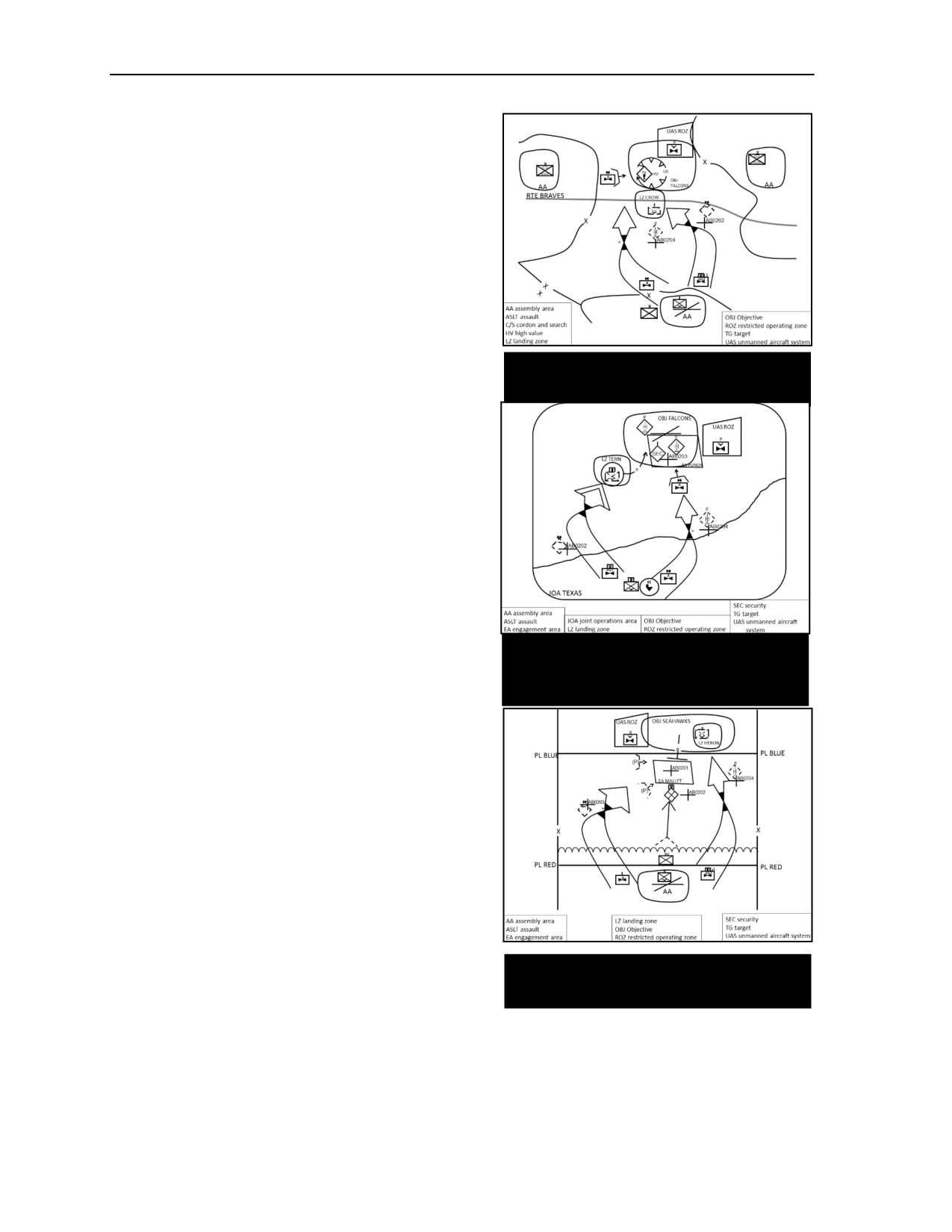
z
An infantry company air assaults to conduct
a cordon and search to kill or capture an HVT
in a small built up area located between non-
contiguous areas of operation (figure 3-20).
Figure 3-20. Infantry company air
assault to kill or capture an HVT
z
An infantry battalion task force air assaults to
seize a remote airfield in a non-contiguous
deep area and destroys local enemy security
forces to establish a lodgment during a forced
entry operation (figure 3-21).
Figure 3-21. Infantry battalion air
z
An infantry brigade air assaults to seize key
assault to seize a remote airfield and
terrain to block enemy forces retrograding
destroy local enemy security forces
during exploitation (figure 3-22).
3-117. The level of planning and preparation time
required for an air assault is driven by the operational
and mission variables, as well as the training level and
habitual relationship of the AATF. Although air assault
operations can be complex, maintaining continuous
running friendly and enemy estimates, using common
SOPs, maintaining continuous liaison and habitual
training
relationships
and continuous target
development through reconnaissance and IPB all
increase the agility of the AATF to seize the initiative
through reduced time required to plan, prepare and
execute.
(See FM
3-99 for detailed planning
considerations.) Regardless of how long an organization
takes to plan, brief, rehearse, and execute a mission, all
air assault operations use the following reverse planning
Figure 3-22. Infantry BCT air assault
sequence:
to block enemy forces retrograding
z
Ground tactical plan.
z
Landing plan.
z
Air movement plan.
z
Loading plan.
z
Staging plan.
3-26
FM 3-04
29 July 2015
Army Aviation Operations
3-118. The steps of the reverse planning sequence are developed collaboratively between the ground force
and aviation force. The foundation of the operation is the ground tactical plan, and is the plan from which all
others are developed.
3-119. The ground tactical plan is planned to accomplish the tactical mission, such as kill/capture an HVT,
establish blocking positions, destroy an enemy force or seize key terrain. The scheme of maneuver the GTFC
chooses to accomplish his mission drives the rest of the planning process to ensure the ground force arrives
at the right place with the right combat power to achieve surprise and overwhelm the enemy force. The AATF
is organized with sufficient combat power to seize initial objectives and protect LZs. The required combat
power should be delivered to the objective area consistent with aircraft and PZ capacities to take advantage
of surprise and shock effect.
3-120. When planning loads, squad integrity should be maintained by chalk and platoon integrity
maintained by serial to reduce mission command and span of control challenges during the landing phase
and initiation of the GTP. To perform its mission, an AATF must arrive intact at the LZ. The force must be
tailored to provide en route security and protection from the PZ, throughout the entire air route, and at the
LZ.
3-121. The AATF is organized with adequate sustainment to accomplish the mission or until designated
follow-on or linkup forces arrive. Units that support the air assault operation normally are placed in direct
support to the AATF to ensure close coordination and continuous, dedicated support throughout an operation.
3-122. Various elements perform specific tasks ensuring the successful execution of an air assault. Attack
reconnaissance units using MUM-T conduct reconnaissance, security, and attacks during all phases of the
operation. Indirect and joint fires provide fire support to set the conditions in the objective or to suppress
enemy air defense en route and on the objective before, during and after the air assault and continue to provide
supporting fires once the GTF is established on the ground. When planning assaults, the AATFC controls the
operation by using air corridors, air routes, primary and alternate LZs, EAs, ABF positions, screen lines,
HAs, phase lines (PLs), target reference points (TRPs), ACMs, NAIs, and TAIs. To define the AO, the
commander may also designate subordinate unit boundaries and objectives in the designated AO. These
control measures allow for decentralized actions and small-unit initiative to the greatest extent possible.
SECTION VII - AIR MOVEMENT
3-123. An air movement is the air transport of units, personnel, supplies, and equipment including airdrops
and air landings (JP 1-02) and are not synonymous with air assault. Air movement operations are a viable
means of transport and distribution in support of offensive, defensive, stability, and defense support of civil
authorities (DSCA). Loads can be configured internally or externally depending on mission variables, and
type aircraft available to conduct the air movement operation.
3-124. Air movement operations are conducted to reposition units, personnel, supplies, equipment, and
other critical combat elements in support of current and/or future operations. Air movement operations allow
the ground force commander to control the tempo of operations and meet the enemy force at the time and
place of choice as he sets conditions. Utility and cargo helicopters supplement ground transportation to help
sustain continuous offensive and defensive operations, and allow the supported commander to overcome
difficult terrain and time constraints on his operations.
3-125. Assault and GS helicopter units perform air movement on a direct support (DS) or GS basis. Though
air assault operations and air movement are separate missions, the planning sequence used for air assault
operations with modified phases are applied to an air movement. Army Aviation FW operations require a
detailed justification and validation for use and typically involve the air movement of limited critical
personnel, equipment, and supplies between intra-theater airfields when deployed.
INTERNAL LOAD OPERATIONS
3-126. Internal load operations are conducted by Army rotary-wing aircraft (CH-47, UH-60) and FW
aircraft (C-12, UC-35). However, the primary aircraft used for cargo is the CH-47, due to its size, airframe
configuration, and lift capabilities over utility-type assault helicopters. Large scale air movement operations
require detailed planning and mission command similar to air assaults. Most air movements are smaller and
29 July 2015
FM 3-04
3-27
Chapter 3
highly decentralized requiring as few as two rotary-wing or one FW aircraft but can be executed with
formations as large as an assault or GS battalion.
3-127. The CH-47 helicopter has an internal cargo handling system which allows for the transport of three
463L pallets or 10 standard warehouse pallets, permitting rapid load and offload of palletized cargo. At the
aft end of the aircraft, the rear ramp permits some internal drive-on and drive-off capabilities for light vehicles
and trailers. Internally the CH-47 helicopter can seat 33 passengers with baggage, or in an air casualty
evacuation configuration can carry up to 24 litter patients.
3-128. The UH-60 is used mainly for tactical transport of troops, supplies, and equipment. Depending on
how the seats are installed, the cargo compartment of the UH-60 can seat up to 11 combat-equipped troops
and two crew chiefs/door gunners.
3-129. The C-12 and UC-35 are used as intra-theater transport assets to move mission critical personnel
and light cargo. They are capable of self-deploying and transporting required personnel and equipment
(aircraft, crewmembers and maintenance personnel with personal equipment, tools and limited spare parts)
to conduct limited duration operations. These FW units support flights under the control of the Operational
Support Airlift Command.
EXTERNAL LOADS
3-130. Typical external loads include bulk supplies, fuel or water blivets, vehicles, trailers, material
handling equipment, towed artillery and other weapons systems, and bridging equipment. The supported unit
is responsible for preparing, weighing and rigging external loads. They must avoid overloading vehicles,
trailers, pallets and other containers beyond maximum weights that have been coordinated with the aviation
unit. If the aircraft is unable to lift the load or transport it the required distance, the supported unit must reduce
the weight by removing items. The aviation unit is the final determination of the load’s worthiness to fly and
determines in advance what portion of the load to carry internally or externally. Special consideration for the
size and condition (dust, debris) of the PZ and security of the LZ must be accounted for in the planning
process.
3-131. The CH-47 is equipped with a triple cargo-hook system that enables the external transport of vehicles
and trailers, towed howitzers in tandem, and to carry bulky, oversized or heavier items. The CH-47 is the
only Army aircraft capable of transporting the 155-mm towed howitzer and the heavier high-mobility
multipurpose wheeled vehicle variants. The triple cargo hooks help to stabilize external loads in flight. Some
lighter vehicles and other equipment can be lifted side-by-side. The UH-60 is equipped with a single point
cargo-hook system that enables the external transport of small vehicles, and bulky, heavy loads that do not
easily fit in the cabin of the aircraft.
UNIQUE PLANNING CONSIDERATIONS FOR AIR MOVEMENT
3-132. Air movements are not as complex in planning and execution as an air assault operation, but planning
must be detailed to meet the commander’s end state and the safety of the crew and passengers. A typical air
movement may be vulnerable to enemy contact as a majority of missions support troop movement and
equipment to established secure areas such as forward operating bases or combat out posts. The distances
and available low threat routes to the destination can induce limitations to the planning and execution of each
mission.
3-133. Air movement requires pre-coordination between the operations cells of aviation units and the units
supported maximizing troop and equipment movements and the efficient use of the air assets dedicated to
mission support. Air movements must be planned to maximize the capability and employment duration of
the aviation unit. These operations are especially effective in moving forces and equipment when—
z
Ground routes are limited, congested, damaged, or nonexistent.
z
Threat activities or obstacles restrict ground movement.
z
The supported unit does not have adequate available vehicles.
z
Time is critical.
z
PZs/LZs are the appropriate size with the requisite security to safely execute the operation.
3-28
FM 3-04
29 July 2015
Army Aviation Operations
SECTION VIII - AEROMEDICAL EVACUATION
3-134. Army aeromedical evacuation provides direct support, GS, and area support within the joint
operations area and joint security area in order to support the overall Army Health System mission. At the
tactical level, direct, or general support assets locate, acquire, treat and evacuate patients from the point of
injury to an appropriate medical treatment facility where the patient is stabilized, prioritized, and prepared
for further evacuation (if necessary) to a medical treatment facility capable of providing additional required
essential care.
3-135. Army aeromedical evacuation aircraft are dedicated assets that are designed, manned and equipped
to provide en route medical care to patients being evacuated and are used exclusively to support the medical
mission. The focus of the medical evacuation mission coupled with the dedicated platforms permit a rapid
response to calls for support. The medical evacuation unit operates in a ready alert status to rapidly respond
to evacuation missions and is not diverted to perform any other tasks. Although both air and ground
evacuations are used to transport patients—aeromedical evacuation is the preferred method of evacuation of
seriously wounded, injured and ill personnel. Trained flight paramedics and supporting medical providers
provide en route care during evacuation. The provision of en route care on air ambulances provides a
continuum of care that is instrumental in preserving life and reducing long-term disability. The speed, range
and flexibility of aeromedical evacuation permits patients to be moved directly to a treatment facility best
equipped to deal with the injury or medical condition requiring treatment. Additional missions assigned to
the air ambulance company include: patient movement in support of medical regulating requirements; shore-
to-ship and ship-to-shore medical evacuation; emergency movement of Class VIII blood, blood products, and
biologicals; and emergency movement of medical personnel and equipment.
3-136. Aeromedical evacuation companies typically task organize into one area support medical evacuation
platoon and four forward support medical evacuation platoons (FSMPs). Each aeromedical company is
capable of operating at up to five decentralized locations with three HH-60 aircraft each with their own
mission command and limited maintenance and sustainment capabilities. Due to the austere capabilities of
the FSMP, when possible, they should be co-located with an aviation battalion task force that can provide
security escort, mission command, sustainment and maintenance augmentation. Planning for aeromedical
evacuation coverage must consider the response time patient evacuation precedence crew experience given
the operational environment, and security requirements. (See ATP 4-02.2 for information on aeromedical
evacuation.)
AUTHORIZATION
3-137. The use of aeromedical evacuation assets for missions requires two authorizations—a medical
mission approval authority and a launch authority—as specified by the senior commander.
3-138. Medical mission approval authority. Medical mission authority begins at the theater-level through
the creation of the theater evacuation policy and the medical rules of eligibility documents by appropriate
medical officers. Once approved, these documents are published through the orders process and become the
foundation for what constitutes a valid medical mission. For aeromedical evacuation missions, the medical
approval authority is accomplished by verifying the details of the 9-line medical evacuation (MEDEVAC)
request with the policy contained in the theater evacuation policy and/or medical rules of eligibility. Once
confirmed that the mission request falls within the established theater guidance, the request becomes an
approved medical mission. The validation of the medical necessity to generate a requirement can include—
z
Transport of a casualty.
z
Patient precedence.
z
Requirement for blood or blood products.
z
An emergency resupply of medical-related supplies, equipment or personnel.
3-139. URGENT and URGENT-SURG MEDEVAC mission requests. DOD policy dictates the standard
completion time for URGENT and URGENT-SURG MEDEVAC mission requests as 1 hour, with the time
beginning to elapse once the MEDEVAC mission request is received by evacuation elements and stopping
when the patient is delivered to the appropriate medical treatment facility.
29 July 2015
FM 3-04
3-29
Chapter 3
3-140. Launch authority. The aviation commander considers the collective risk assessment of the mission
and determines final execution or launch authority. The operational aspects related to the collective risk
assessment include, but are not limited to—
z
Patient care requirement (most important factor).
z
The threat or enemy actions.
z
Rules of engagement.
z
Weather.
z
Fighter management.
z
Escort requirements.
z
Overall tactical situation.
MEDICAL OPERATIONS CELL
3-141. The medical operations cell (MOC) in the Aviation brigade staff provides assistance in planning and
coordination for air ambulance employment and utilization. The MOC performs the following functions:
z
Establishes flight procedures specific to aeromedical evacuation missions within the CAB. This
may include special routes or corridors as well as procedures for escort aircraft link-up.
z
Ensures lines of communication (LOCs) to supported units and higher echelons of medical
command are available. The MOC also ensures supported units understand aeromedical
evacuation procedures and capabilities—an educational endeavor that is an ongoing process.
z
Establishes aeromedical evacuation briefing and launch procedures.
z
Maintains awareness of the tactical and medical situation. Coordinates with medical regulators at
higher echelons to efficiently conduct GS and works in concert with adjacent units.
z
Assists the aviation maintenance company and GSAB or CAB staff in conducting aeromedical
evacuation operations.
AERIAL CASUALTY EVACUATION
3-142. Differentiated from aeromedical evacuations, aerial CASEVAC is the transport of injured personnel
with the use of Army Aviation assets that do not have onboard medical personnel or equipment. Aerial
CASEVAC is used in extreme emergencies, when the medical evacuation system is overwhelmed or
unavailable or as the situation dictates. Aerial CASEVAC provides the ground maneuver commander with a
quick response evacuation, but assumes greater risk due to the lack of medical personnel or equipment on
board the CASEVAC platform.
3-143. Aerial CASEVAC operations may be dedicated, designated, or opportunistic. Dedicated aerial
CASEVAC assets are employed with the sole purpose of transporting injured personnel, and while they are
not outfitted with medical personnel or equipment, they may have a combat life saver onboard. Designated
aerial CASEVAC assets perform other roles during the operation such as an air assault or air movement, but
they’re also specifically tasked with aerial CASEVAC operations as a contingency. Given the opportunity,
any Army Aviation lift aircraft that are available are capable of performing aerial CASEVAC operations
regardless of prior planning.
SECTION IX -MISSION COMMAND SUPPORT
3-144. Army Aviation enhances mission command by providing ground and air commanders the ability to
visualize, describe, direct, lead, and assess operations from the location of their choice on the battlefield.
Mission command support allows commanders to reposition rapidly to the decisive point on the battlefield,
develop the situation, and reach back to resources at their CP or a higher headquarters as required. Army
Aviation mission command assets provide a means for mission command to be comprehensive and provide
beyond line of site voice and data communications. Army Aviation executes mission command support
through the use of the mission command aircraft, UAS communication relay package (CRP), and air traffic
services (ATS) increasing a commander’s ability to integrate and synchronize operations.
3-30
FM 3-04
29 July 2015
Army Aviation Operations
COMMAND AND CONTROL AIRCRAFT
3-145. The command and control (C2) aircraft enables the maneuver commander to better understand,
visualize, describe, direct, lead, and assess operations over extended ranges and complex terrain. The CAC
provides the means by which air and ground commanders can rapidly traverse and see the area of operation.
The CAC does this by providing airborne mission command and aerial retransmission as directed. The
mission command UH-60 aircraft gives the commander an enhanced capability to C2 assets over extended
distances by performing mission command while moving, serving as an aerial tactical CP, and providing an
early entry CP. The onboard communications linkages allow for continuous contact between the commander
and committed forces. These linkages also help maintain situational awareness, issue and receive fragmentary
orders with graphics, synchronize fire and maneuver, and extend coverage. With networked digitized
communication systems, commanders and staffs assimilate significantly greater amounts of data faster and
with greater clarity. The CAC is organic to the GSAB of the CAB, and conducts mission command support
either DS or OPCON to the maneuver commander. The aviation unit providing the aircraft must coordinate
with the supported unit early to integrate the mission command aircraft during the planning process. The
aircrew of the mission command aircraft should attend orders and rehearsals of the supported unit to fully
understand the operational scheme of maneuver and to best integrate the aircraft into the plan.
3-146. Scheme of maneuver. Mission command support by a ground force commander occurs in a CAC
aircraft flying in controlled airspace. The most common ACMs used is an airborne command and control
area (ABC). Coordinated through the S-3 or S-3 (Air), air defense airspace management (ADAM)/BAE, or
other air planning element, the ABC does not conflict with current operations of the supported unit, and is in
an area that supports the maneuver commander’s plan. It may be necessary to plan for multiple ABCs. During
offensive operations, on-order ROZs are planned in order to allow mission command aircraft to maneuver
commensurate with the offensive tempo.
3-147. Threat. Aviation battalion intelligence staff officers (S-2s) and operations staff officers (S-3s) must
carefully analyze the threat and the impact potential threats may have upon aircraft operating in a ROZ. ROZ
operations may fix an aircraft over a piece of terrain for prolonged periods, thus an accurate threat assessment
must inform ROZ location selection. A careful analysis of the ROZ by the aviation unit will ensure that the
ROZ can support the ground maneuver commander's concept.
3-148. Communications. ROZ selection maximizes LOS communications with all elements of the ground
force, ideally extending the range maneuver forces may cover in an operation. A careful mission variable
analysis allows ROZ selection in an area that appropriately balances operational risk with mission
requirements.
3-149. Routes to/from the ROZ. Flight routes must be developed that will support the aircraft's transition
to the ROZ. These flight routes must be planned carefully, should avoid over flight of friendly artillery units
and should be opened and closed as needed through close coordination with the appropriate airspace element
or controlling agency. The detailed planning of air routes, similar to the procedural control offered by a ROZ,
enables success of the combined arms team through detailed planning.
3-150. Battlefield circulation of key leaders. The GSAB as well as the AHB execute missions that
facilitate mission command support through leadership battlefield circulation. In order to meet the circulating
leader’s intent, the supporting aviation unit needs to closely coordinate with the leader’s staff to ensure
thorough planning and analysis for each mission.
UNMANNED AIRCRAFT SYSTEM COMMUNICATIONS RELAY
PACKAGES
3-151. The Army, as part of a joint network, employs a three-tiered communications system. This network
has aerial, space, and terrestrial components provided by individual services, linking the various elements
of the joint force to the global information grid. UAS facilitate mission command by extending the network
as the commander circulates in the OE. Both UAS CRP packages enhance mission command by providing
extended-range voice communications between command posts, ground, and aviation units.
29 July 2015
FM 3-04
3-31
Chapter 3
3-152. The Gray Eagle is designed to support communications relay as one of its primary missions. The
Gray Eagle is equipped with a communications relay package-medium (CRP-M). It provides extended
tactical communications, enabling forces to communicate over the horizon and provides extension of the
voice data network. Meanwhile, the Shadow UAS provides an additional layer of communications relay
capability. This system provides a single channel of extended tactical voice communications.
3-153. Gray Eagle and Shadow UAS provide LOS communications relay; however, only the Gray Eagle is
able to provide over-the-horizon communications relay through satellite communication (SATCOM). A
careful analysis of mission variables will allow the loiter area to be selected in an area that provides security
and uninterrupted communications.
3-154. Terrain and Weather. Both natural and manmade features limit sensor effectiveness and mission
command. Flat terrain eases LOS issues while mountainous terrain may reduce UA range and data relay
capability. Additionally, communications (voice and video) degradation between UAS and ground maneuver
units may be experienced during inclement weather.
3-155. Enemy Threat. Aviation battalion S-2s and S-3s must carefully analyze the threat and the impact
potential threats can have upon aircraft working in the airspace above the battlefield. Since the Gray Eagle
and Shadow mostly operate above the coordinating altitude for extended periods, medium- and high-altitude
air defense artillery, surface-to-air missiles, and man-portable air defense systems threat need to be identified
and avoided. A careful analysis of the loiter area by the aviation unit ensures it can support the ground
maneuver commander's concept and remain clear of high threat areas.
3-156. Routes to/from the loiter area. Flight routes must be developed that will support the aircraft's
transition to and from the objective area and maximize their communications relay packages. These flight
routes must be planned carefully, should avoid over flight of friendly artillery units and should be opened
and closed as needed through close coordination with the appropriate airspace element or controlling agency.
SECTION X - PERSONNEL RECOVERY
3-157. Personnel recovery (PR) is the sum of military, diplomatic, and civil efforts to prepare for and
execute the recovery and reintegration of isolated personnel (JP 3-50). The Army personnel recovery process
(ARPR) is integrated into all echelons of the Army in several key ways. Incorporation of the ARPR into
regularly-performed elements, such as concepts of operations, operations orders, fragmentary orders, SOPs,
and battle drills, ensure that ARPR is properly integrated into the operations process during planning and
preparation. This also enables rapid execution of ARPR when required. Additionally, this integration
establishes coordination points with other staff and joint elements and ensures commanders are aware of
ARPR requirements.
3-158. Component Commanders are primarily responsible for implementing PR plans for isolated
personnel (IP) on the battlefield for their respective components. The Army integrates PR into all base unit
mission plans.
3-159. Army Aviation enhances the ground commander’s organic capabilities by providing rapid response.
Army Aviation may be designated as the recovery force or to assist in recovery efforts by providing the
extraction assets, aeromedical evacuation, escort, attacks, reconnaissance, and mission command support
assets to support the PR mission, enhancing the ground commander’s flexibility in resolving IP events. Unit
commanders initially plan to conduct PR operations in support of their own missions within the scope of
immediate recovery efforts.
3-160. Army Aviation provides rapid movement capability for quick reaction forces under the control of
the unit initiating immediate recovery efforts. Immediate recovery efforts begin as soon as an isolating event
is identified and authenticated. Isolating events may require rapid action to prevent potential capture and
exploitation of the IP. When the enemy situation or mission objectives do not allow for immediate recovery,
unit commanders may elect to transition to deliberate recovery efforts.
3-161. Army Aviation’s role in PR is in the execution of pre-established procedures and well-rehearsed
operations to report, locate, support, recover, and reintegrate isolated, missing, detained, or captured (IMDC)
personnel. Specifically, aviation is involved in the recovery of personnel within the unit’s or supported units’
3-32
FM 3-04
29 July 2015
Army Aviation Operations
AO when the IMDC personnel’s location is known. Four principle methods of recovery are used when
planning and executing recoveries:
z
Immediate recovery is the sum of actions conducted to locate and recover IMDC personnel by
forces directly observing the isolating event or, through the reporting process, determining IMDC
personnel are close enough for them to conduct a rapid recovery. Immediate recovery assumes the
tactical situation permits a recovery with the forces at hand without detailed planning or
coordination (JP 3-50).
z
Deliberate recovery is the sum of actions conducted by Army forces when an incident is reported
and immediate recovery is not feasible or was not successful. Weather, enemy actions, IMDC
personnel location, and recovery force capabilities are examples of factors that may require the
detailed planning and coordination of a deliberate recovery (JP 3-50).
z
Unassisted recovery comprises actions taken by IMDC personnel to achieve their own recovery
without outside assistance. An unassisted recovery typically involves an evasion effort by IMDC
personnel to get back to friendly forces or to a point where they can be recovered via another
method. While the code of conduct requires IMDC personnel make every effort to evade or escape,
commanders must strive to recover these personnel via one or a combination of methods (JP 3-
50).
z
External supported recovery (ESR) is the sum of actions conducted when immediate or deliberate
recovery is not feasible or was not successful. ESR is either the support provided by the Army to
other joint task force components, interagency organizations, or multinational forces, or the
support provided by these entities to the Army. CAS; intelligence, surveillance, and
reconnaissance; and airborne C2 are examples of capabilities that may be required from different
components to execute an ESR (JP 3-50).
3-162. An Army Aviation PR element may be organized with lift assets, attack helicopters, mission
command aircraft, and a ground security component with organic or attached medical personnel. Aircraft
will be equipped with the necessary or required navigation and communication equipment to locate and
communicate with isolated personnel, increasing their likely hood of recovery. Aircrews, mission
commanders, and ground recovery force will be trained and current in recovery operations. Depending on
the isolated personnel’s location, the assault helicopter recovery force is given the launch order and is
expected to hold at a point outside hostile fire range until execute order is given by the attack reconnaissance
unit AMC.
3-163. PR missions are a combat task, requiring the seizing and holding of a defined area of terrain for a
specified time. Commanders must have available resources to ensure security for those personnel on the
ground conducting the PR mission through all phases.
3-164. BAE personnel ensure aviation asset integration into the BCT PR plan. While detailed PR mission
planning cannot be conducted prior to any isolating event, contingency planning ahead of the operation will
decrease reaction time required for recovery force activation. Aviation provides organic lethal fires through
manned and unmanned armed aircraft. When aerial security is required, manned aircraft are the primary
selection due to rapid response to the developing scenario. Lift and assault aircraft provide transportation to
recovery force personnel, insertion of support equipment during denied landing events, medical support at
the point of recovery through the transportation of the IP, and extraction capability for unit personnel involved
in immediate recovery efforts.
3-165. During immediate PR events, the first aircraft on scene assumes duties as the on-scene commander
(OSC) during the conduct of the PR mission. During deliberate PR missions, the role of OSC is assigned by
the commander executing the PR mission. OSC duties are typically assigned to the aircraft with the ability
to maintain situational understanding and provide immediate fires in support of personnel on the ground.
Specific attention must be applied to commander’s intent with respect to the enemy influence which caused
the PR event to occur. Specific ROE may be required to facilitate protection of personnel during the recovery
phase of the mission. For more detailed PR information, see FM 3-50.
29 July 2015
FM 3-04
3-33
Chapter 4
Army Aviation Sustainment
SECTION I - OVERVIEW
4-1. Sustaining Army Aviation units in complex environments requires a logistics network capable of
projecting and providing the support and services necessary for extended operations in order to support the
ground maneuver commander through the entire range of military operations. While conducting aviation
sustainment operations, aviation commanders and staffs must adhere to the sustainment principles—
responsiveness, simplicity, flexibility, attainability, sustainability, survivability, economy, and integration.
These imperatives apply, across the spectrum of conflict, to units conducting offense, defense, and stability
operations.
4-2. Employing effective sustainment operations, aviation commanders will have the combat power
necessary to support decisive action essential to retaining and exploiting the initiative. For this reason,
sustainment must be planned and synchronized at every level of the operation. Commanders must know the
operational environment, understand requirements, track requisitions, and make crucial decisions ensuring
responsive sustainment.
4-3. This chapter addresses aviation sustainment requirements, and the capabilities aviation provides to
support the force. It focuses on the aviation specific details of the sustainment war fighting function and
elements of sustainment: logistics, personnel support, health service support, and their impact on aviation
operations.
SECTION II - LOGISTICS
MAINTENANCE
4-4. Army Aviation maintenance is a primary focus of the aviation commander as it drives the availability
of operational aircraft that can be used in support of the ground maneuver commander’s operational
requirements. It also determines the level of tactical mission support that each aircraft is able to perform
during mission execution. An efficient, properly resourced maintenance program will provide the maximum
number of aircraft available on a consistent basis for mission support.
TWO-LEVEL CONCEPT
4-5. Aviation maintenance uses the two-level maintenance concept mandated by AR 750-1: field and
sustainment levels. Field-level maintenance is accomplished at the brigade level and below with sustainment-
level support provided externally through units positioned in theater and various organizations, including
depots permanently located in the continental United States (CONUS). Aviation maintenance requirements
are prescriptive and must be considered in the planning process to ensure that adequate support is available
and provides planners with realistic airframe numbers to support tactical operations.
Field Level
4-6. Field-level maintenance is accomplished throughout the CAB by aviation flight companies/troops and
aviation maintenance companies/troops within each of the aviation maneuver battalions and the aviation
support company within the aviation support battalion (ASB).
4-7. Aviation flight companies perform scheduled maintenance with assigned maintenance personnel. They
also perform unscheduled field maintenance on assigned manned and unmanned aircraft provided that they
29 July 2015
FM 3-04
4-1
Chapter 4
have readily available parts and required tools to perform those maintenance tasks. Flight companies are
supported by the aviation maintenance company assigned to the aviation maneuver battalions. This
organization provides a robust capability that performs both scheduled and unscheduled aircraft maintenance.
In addition, the aviation maintenance company performs maintenance on aircraft components during in-depth
maintenance (complex services or phase), or to repair components during unscheduled maintenance.
4-8. The aviation maintenance company is organized with a production control (PC) section that develops
a maintenance execution plan to support mission requirements as determined by the unit commander. It is
fully supported with a quality control
(QC) section, a group of highly qualified and experienced
noncommissioned officers (NCOs) that provide technical oversight and safety on all associated maintenance
actions to ensure strict adherence to maintenance task performance and inspection.
4-9. The ASB is a CAB element that provides aviation field maintenance support through the aviation
support company (ASC). It is structured to support aviation battalions that cannot perform certain
maintenance tasks. The ASC can also provide maintenance augmentation to aviation battalions when support
is needed due to high operational tempo or other situations where augmentation is required such as with split-
based maintenance support operations. The ASC structure with sets, kits, outfits and tools enables enhanced
capabilities and capacity to conduct backshop component repairs not available across the rest of the CAB.
Sustainment Level
4-10. Sustainment-level maintenance consists of tasks on airframes or components that cannot be performed
by the CAB due to the lack of facilities, tools, technical skills or authorization. Typically, support is provided
by the theater aviation sustainment maintenance group (TASMG), original equipment manufacturers,
contract maintenance personnel, or depot organizations.
4-11. Operationally, the TASMG is a fixed-base dedicated theater aviation sustainment/depot (minus)
capability that provides 24-hour maintenance support for the deployed aviation maneuver commander. It is
able to perform both field and sustainment-level maintenance for manned and unmanned aviation systems,
battle damage repair, and repair and return of components and end items to support the National Maintenance
Program (NMP).
4-12. Depot support is facilitated by the Corpus Christi Army Depot (CCAD) and the Letterkenny Army
Depot. CCAD is the Army’s organic facility for the repair and overhaul of rotary-wing aircraft, engines, and
components. The Letterkenny Army Depot provides aviation specific system support to include the AH-64
target acquisition designation sight/pilot night vision sensor, and aviation ground power unit reset and
overhaul.
BATTLE DAMAGE ASSESSMENT AND REPAIR
4-13.Battle damage assessment and repair (BDAR) returns disabled equipment rapidly to combat or enables
the equipment to self-recover. For Army Aviation, the use of specialized aircraft damage assessment criteria,
repair kits, and trained personnel to assess damage, conduct repairs, and facilitate maintenance evacuation of
damaged aircraft. BDAR may be a technique used to facilitate a downed aircraft recovery team (DART)
mission. BDAR restores the minimum essential capabilities necessary to support a specific combat mission
or to enable equipment self-recovery. Operators/crew chiefs, aircraft maintenance personnel teams,
maintenance support teams, contact maintenance teams, and recovery teams may perform BDAR as
authorized by the commander.
DOWNED AIRCRAFT RECOVERY TEAM
4-14. Aircraft recovery is a pre-planned mission for all units with assigned or operational control of Army
aircraft and requires extensive coordination with supported and supporting units. The intent is to recover
aircraft with minimal risk to Soldiers and equipment involved in the operation. While DART composition
includes security personnel from within the aviation battalion, planning should also include security
contingencies from the supported unit during tactical missions.
4-2
FM 3-04
29 July 2015
Army Aviation Sustainment
4-15. The operational commander retains initial responsibility for DART. The PC officer is the principal
maintenance manager and coordinator for aviation maintenance company DART missions. The team consists
of select personnel who perform assessment, repairs, and recovery of downed aircraft. They are equipped,
trained, and rehearsed to accomplish aircraft recovery in various operational environments. If the DART
operation exceeds the capabilities of the aviation maneuver battalion, the officer in charge (OIC) coordinates
with the ASB to effect recovery of the downed aircraft. When required, the brigade S-3 and SPO coordinates
for external support for the DART through the ground unit assigned to the AO, or other logistics units during
ground recover missions.
SUPPLY
4-16. Aviation supply functions are automated and embedded into aircraft maintenance software that feeds
into Army logistics information systems (LIS). LIS increases combat effectiveness through the efficient
management of supplies, equipment, ammunition, maintenance, and through rapid reallocation of resources
to sustain troops.
4-17. The aviation maintenance company provides aviation battalion parts support. Assigned supply
personnel are responsible for managing the battalion's prescribed load list (PLL), and benchstock through
documented demand and command support justification. Aircraft supply support is a key function that must
be managed to ensure parts with projected requirements and demand support are justified for stockage on the
brigade-level support supply activity (SSA) authorized stockage list (ASL).
4-18. The ASC provides parts support for aircraft and components undergoing repair from supported units
through the work-order process. The ASC maintains a shop stock list (SSL), and benchstock that are tailored
for their maintenance support mission requirements. Supply support for maintenance of aviation ground
support equipment (GSE) and other non-aircraft items is conducted through the battalion’s forward support
company maintenance platoon. The maintenance platoon carries the battalion’s non-flight SSL and bench
stock.
4-19. The SSA within the ASB’s distribution company, manages the demand supported ASL owned by the
Army Material Command). The availability of aircraft repair parts is crucial to the maintenance support
mission and ultimately to the sustainment of serviceable aircraft systems and sub-systems.
OPERATIONAL CONTRACT SUPPORT
4-20. Unit manning limits the available man-hours that are dedicated to the maintenance mission. Efficient
use of maintenance personnel and time available maximizes their ability to perform critical aircraft and
component services and repair. Aircraft flight hour availability produced by a unit is affected by available
man-hours and the scheduled and unscheduled maintenance workload generated by mission requirements.
For this reason, maintenance capability must be managed through augmenting the force in anticipation of
prolonged and increased operational tempo. Commanders and unit maintenance personnel seek to accomplish
the maintenance mission with assigned personnel first and only rely on contractor augmentation when
operational requirements exceed unit capacity and capability.
4-21. Aviation units usually have an established contracted maintenance capability in peacetime. Contracted
maintenance requirements increase significantly during deployment and sustained combat operations. This
may include life-support operations, bulk commodities, and operational support. This increase must be
anticipated with enough lead-time to allow for systemic contractual timelines and deployment.
4-22. The supply officer is the primary staff officer responsible for OCS management, coordination, and
oversight. Though not usually appointed as a contracting officer representative (COR), the supply officer
monitors all contracts and ensures the execution of contracts meet the commander’s intent. When required,
the supply officer prepares Annex W of the operations order or plan. For further information on contract
support, see ATTP 4-10.
29 July 2015
FM 3-04
4-3
Chapter 4
KEY AVIATION MAINTENANCE PERSONNEL
AVIATION MATERIEL OFFICER
4-23. The brigade aviation materiel officer (BAMO) is the primary maintenance adviser to the CAB
commander. Working in conjunction with assigned aviation battalions, the BAMO recommends actions and
forecasts future capabilities based on the current and projected maintenance readiness. This process occurs
through the coordination of maintenance actions based on operational requirements, consultation with the
battalion/squadron maintenance leadership, and reviewing the daily status and monthly operational readiness
reporting of all aircraft in the CAB.
4-24. The BAMO standardizes the brigade’s maintenance program using Army regulations, technical
manuals, and Aviation and Missile Command (AMCOM) directives that affect assigned aircraft. The BAMO
provides maintenance and logistical information and requirements to the brigade commander and staff on
aviation and aviation-related systems. The BAMO focuses on fleet readiness reporting, aircraft bank time
management, flying hour program spending, aircraft transfers and frequently coordinates with elements
external to the CAB.
4-25. The ASB aviation materiel officer (AMO) serves in the SPO section of the HSC to facilitate brigade-
level sustainment issues and special staff actions. The AMO also participates in support planning as a key
advisor and subject matter expert to the SPO and the ASB commander. (See paragraph 4-26.) The AMO
focuses primarily on aircraft on ground, high priority, and turn-in of depot-level recoverable aircraft parts for
the CAB.
4-26. The aviation maneuver battalion AMO works with the logistics staff officer (S-4) and is an advisor to
the battalion commander and staff for aviation materiel issues. The AMO reviews reports and makes
recommendations on aviation logistics and maintenance. The AMO ensures close coordination with the
aviation maintenance company and the supporting ASB.
SUPPORT OPERATIONS OFFICER
4-27. The SPO is a staff officer in the ASB who provides supervision of the CAB’s daily sustainment
functions and logistical services for all aviation and ground systems. The SPO coordinates with the BAMO,
and battalion S-4s to establish maintenance priorities and resolve maintenance and logistics support issues.
The SPO conducts brigade-level coordination with the sustainment brigade, theater AFSB, and other logistics
units on behalf of the CAB. The support operations section is organized to coordinate logistics support, and
provide distribution management to the CAB. The SPO manages the petroleum, ammunition, movement
control, transportation, and assist in tracking and expediting release of supplies (repair parts). The SPO’s
primary focus is on customer support and increasing the responsiveness provided by subordinate maintenance
units.
PRODUCTION CONTROL OFFICER
4-28. The production control (PC) officer is the principal maintenance manager-coordinator in the aviation
maintenance company/troop or ASC and coordinates maintenance and sustainment actions at the
company/troop and battalion/squadron level. The PC OIC is the aviation maintenance company/troop or ASC
commander’s primary maintenance advisor for all internal production and maintenance activities.
The PC officer is responsible for controlling aviation maintenance production matters according to command
guidance and is the direct link between unit commanders, the aviation maintenance company/troop, and the
ASB’s ASC for internal and external production issues. The PC officer supervises preparation of reports and
records, facilitates appropriate DART capability and responsiveness, and coordinates any required internal
and external support for all maintenance activities.
4-4
FM 3-04
29 July 2015
Army Aviation Sustainment
QUALITY CONTROL OFFICER
4-29. The quality control (QC) officer is responsible for the internal management of the QC section, to
include quality assurance of all work performed by assigned technical inspectors. This is an extremely
technical position and requires a high-level of technical expertise and aircraft systems understanding.
4-30. Priority of work is coordinated with the PC officer, but QC makes determinations of airworthiness
independently and bases decisions on Army regulation, technical manuals, and published AMCOM
directives. The QC Officer ensures the battalion’s monthly maintenance and shop safety inspections are
conducted by technical inspectors.
4-31. The QC officer is an MTOE position in the ASC, but not within the AMC. However, it is often filled
in order to provide technical oversight and management of the section.
AVIATION MAINTENANCE OFFICER
4-32. Aviation maintenance officers, military occupational specialty
15D, plan and direct aviation
maintenance and logistics operations. They are Army aviators who hold an aeronautical rating, and command
the AMC, the ASC, and the ASB.
MAINTENANCE TEST PILOT
4-33. Maintenance test pilots (MTPs) manage and execute the unit commander’s maintenance program.
They provide advanced troubleshooting skills within their specific aircraft mission design series to facilitate
efficient repairs and maintenance, and are responsible for conducting maintenance test flights to determine
the airworthiness of the unit’s aircraft. They are primary advisors and are appointed by the unit commander
to fill maintenance specific MTOE positions within the CAB. Selected MTPs will fill maintenance examiner
(ME) positions to train, develop, and evaluate unit MTPs to enhance skills and proficiency.
AVIATION MAINTENANCE TECHNICIANS
4-34. Aviation maintenance technicians are aviation system integrators, technical experts, and managers that
direct the daily operations of their assigned sections to generate aircraft operational availability according to
DA mandated goals, regulations and command guidance. Aviation maintenance technicians provide supply
chain and project management oversight on personnel, facilities, and materials required to sustain and repair
Army manned and unmanned aircraft systems, armament systems, and aviation support equipment. They
serve as key aviation maintenance advisors to commanders from the AMC through theater support
commands.
SECTION III - PERSONNEL SERVICES
HUMAN RESOURCE SUPPORT
4-35. The personnel staff officer (S-1) has coordinating responsibility for finance, religious activities, public
affairs and legal services support of the unit. The S-1 is normally collocated with the S-4 in the sustainment
cell of the main CP.
LEGAL SUPPORT
4-36. The combat aviation brigade legal section includes a brigade judge advocate, a trial counsel, and a
senior paralegal NCO. The brigade legal section provides legal support to the command across the judge
advocate general’s corps’ six core legal disciplines: military justice, international law and operational law,
administrative and civil law, contract and fiscal law, claims, and legal assistance. The brigade judge advocate
is the primary legal advisor to the brigade commander and serves as a personal and special staff officer. The
trial counsel primarily administers all military justice matters for the brigade and will provide operational
law advice. The members of the brigade legal section serve as subject matter experts (SMEs) on the ROE,
29 July 2015
FM 3-04
4-5
Chapter 4
targeting, international law, law of armed conflict (including treatment of detainees, enemy prisoners of war,
civilians on the battlefield and other noncombatants), and all other legal aspects of operations. The paralegal
NCO provides administrative and paralegal support to the judge advocates in the legal section and supervises
the paralegals in the aviation battalions.
RELIGIOUS SUPPORT
4-37. The aviation brigade chaplain provides unit level religious support to all personnel assigned/attached
to the brigade including nondenominational coverage and ministry for mass casualties and hospitalized
members of the brigade. The chaplain advises the commander on religious, moral, and Soldier welfare and
morale issues. He or she establishes liaison with unit ministry teams (UMTs) of higher and adjacent units.
He or she also supervises aviation battalion chaplains and provides backup services as required. The chaplain
and chaplain's assistant compose the UMT, usually operating from the same location as the adjutant.
SECTION IV - HEALTH SERVICE SUPPORT
RESPONSIBILITY
4-38. The DOD aeromedical evacuation system consists of an Intra-Theater aeromedical evacuation mission
(typically performed by dedicated US Army rotary-wing aeromedical evacuation units), and an Inter-Theater
aeromedical evacuation mission (typically performed by designated United States Air Force FW assets)
which together, provide the vital linkage of assets required for a successful health service support (HSS)
system. The CAB supports the HSS function with medical personnel in the HHC at brigade and battalion
level, to provide casualty care within the brigade, and medical company, air ambulance organic to the GSAB
to provide aeromedical evacuation mission support within the supported area of operation.
AVIATION MEDICINE
4-39. Aviation medical support is directed by the brigade flight surgeon that coordinates with each of the
aviation battalion’s medical personnel.
4-40. The brigade flight surgeon, in conjunction with the physician assistant, operates the brigade aid station
normally located in the brigade AA. The brigade flight surgeon advises and assists commanders on matters
concerning the medical readiness of the command including preventive, curative, and restorative care. The
brigade flight surgeon, with subordinate unit flight surgeons, conducts flight physicals for unit personnel,
and determines requirements for the requisition, procurement, storage, maintenance, distribution,
management, and documentation of medical equipment and supplies for the unit.
MEDICAL EVACUATION
4-41. Aeromedical evacuation of casualties is provided by the HHS system through the use of organic
aeromedical evacuation assets within the CAB. Evacuation by air is the preferred method of evacuation of
seriously wounded and ill Soldiers. The aviation brigade has an organic aviation maintenance company
assigned to the GSAB. Within the GSAB, the medical company, air ambulance is organized to provide
support from four separate operational locations. These operational locations are typically with the aviation
TF, with HSS organizations, with a BCT, or with higher echelons in order to provide the most appropriate
aeromedical evacuation support throughout the AO. Air ambulance aircraft specifically equipped with
medical personnel and equipment necessary for providing the required en route care of casualties. When
aeromedical evacuation assets are not readily available or the medical mission requirement exceeds
capabilities, the utility and cargo helicopters may be required to conduct CASEVAC operations.
4-42. The medical company consists of 15 HH-60 aircraft that provides aircraft maintenance and logistics
support, aviation communications, and real-time operational picture associated with today’s combat
environment. HH-60 aircraft has maximum cabin space, placing sophisticated, life-saving instruments and
equipment for the medical attendants. HH-60 have the following unique capabilities that provide air
ambulance medical evacuation support for all categories of patients:
4-6
FM 3-04
29 July 2015
Army Aviation Sustainment
z
Oxygen-generating systems.
z
Night vision google (NVG)-compatible lighting throughout.
z
Environmental control system.
z
Medical equipment.
z
Patient monitoring equipment.
z
Neonatal isolettes.
z
Provisions for stowing intravenous solutions.
4-43. The air ambulance company has one area support medical evacuation platoon, and four FSMP,
consisting of three HH-60 aircraft to provide a task-organized means for medical evacuation at the DS and
GS level. The FSMP also provide emergency movement of medical personnel and emergency delivery of
whole blood, biological, and medical supplies and equipment.
4-44. In-flight care is provided by the critical care-trained nationally-registered flight paramedic (CC-NRP),
designated as 68WF2, and perform duties within the GSAB medical companies. This enhanced capability
focuses on providing critical en route care in order to maximize opportunity to save lives on the battlefield.
Depending on the medical needs of the patient(s), additional clinical providers may include the en route
critical care nurse (ECCN), the aeromedical physician assistant, or other emergency medicine providers.
MEDICAL LOGISTICS
4-45. General support transportation assets are the primary means of transportation for sustainment resupply
of Class VIII materiel. The SPO coordinates for replenishment and distribution of all medical supplies within
the CAB. Usually, theater transportation assets will be used to deliver medical supplies from the sustainment
area to the supported units. In some instances, however, air ambulances from the GSAB may be used to
transport emergency Class VIII resupply to requesting units.
SECTION V - OPERATIONAL IMPACTS
OPERATIONAL REACH
4-46. Operational reach is the distance and duration across which a joint force can successfully employ
military capabilities (JP 3-0). This ability is sustained through aviation’s ability to transport logistical supplies
and personnel where they are needed, and through firepower provided by attack and reconnaissance assets.
FORCE PROJECTION
4-47. Army Aviation enhances the Army’s operational reach through the unique capabilities of Army
aircraft, both manned and unmanned. Aviation mitigates the effects of time and distance because of their
speed and ability to maneuver over difficult terrain. Unmanned systems can provide sustained operations to
support the ground maneuver commander’s mission requirements because of their efficiency and ability to
loiter for extended periods. Sustainment of aviation assets provides a continual ability to project firepower
and to transport supplies and personnel into a rapidly expanding AO.
THEATER OPENING/CLOSING
4-48. Aviation provides Army forces the capability to rapidly deploy personnel, distribute materiel, and
retrograde equipment to multiple points of need to and from airports and seaports of debarkation. For
sustainment operations, the Assistant Chief of Staff, Operations and Plans, Aviation section at the Army
Service Component Command, corps, or division levels, are responsible for consolidating, prioritizing, and
processing aviation maneuver sustainment requests.
29 July 2015
FM 3-04
4-7
Chapter 4
BASING
4-49. Aviation can operate from austere field locations and can disperse its assets for protection purposes.
When operating from a centralized location, aviation requires a large area in order to perform maintenance,
and park and move large numbers of aircraft. Establishing and maintaining airfields enables the positioning
of aviation assets within the range of ground forces. This task becomes critical when airfields are host to a
variety of allied military, nongovernmental organizations (NGOs), and commercial air activities.
4-50. Potential airfields must be properly analyzed in order to determine dimension, and possible conflicts
between UAS and manned military and civilian aviation. A letter of agreement (LOA) may be necessary in
order to establish operational procedures, and requirements for placement of ground equipment. This
agreement will be made by both the UAS unit and air traffic control (ATC) for standardization, and airfield
operational safety.
4-51. An AME is located within the CAB S-3 section that coordinates essential airfield services necessary
to support assigned flight crews and aircraft. These services include weather support, firefighting capabilities,
airfield lighting, hazardous material/cargo handling, petroleum, oil and lubricant (POL) services, and
navigational aids (NAVAIDs).
EXPEDITIONARY CAPABILITY
4-52. The TAOG and AOB are organized and equipped to facilitate early entry contingencies and the
establishment of expeditionary airfields in support of Army Aviation operations. These organizations provide
expeditionary airfield management and mission command at theater-level airfields, forward operating bases,
and other areas designated by the theater aviation commander.
4-53. The AOB organization and its related ATC assets are deployed at locations requiring the operational
management of airfield activities or at locations without an organic air traffic services (ATS) element. The
AOB may conduct transition operations with a GSAB ATS company during an advancing movement or in
stability operations.
INTERMEDIATE STAGING BASE
4-54. The intermediate staging base (ISB) is a tailorable, temporary location used for staging forces,
sustainment and/or extraction into and out of an operational area. If tasked to operate the ISB, the Army
should have a primary role in the selection process. The ISB is located inside the theater but outside the AO
and combat zone. In cases where the joint force must secure a lodgment to project the force, an ISB may be
critical to success.
4-55. The TAOG with one or more attached AOBs may be required to establish an ISB airfield for staging
forces. The ISB airfield may be the initial reception and staging facility for Army Aviation movement into
the AO. The ISB airfield should include sufficient Army mission command, maneuver, sustainment and joint
support to enable force projection into the combat zone.
4-56. The longevity of the ISB varies according to circumstances. The airfield may function as a secure
facility for split-based operations during the following capacities or operations—
z
Logistics management for support area functions.
z
Restricted forward deployment to only those forces necessary to execute the mission (reduces
logistical footprint).
z
As the lodgment expands and tactical situation permits, the JFC can establish a theater staging
base within the AO, which may require the redeployment of the TAOG or the deployment of an
additional AOB as part of the process.
z
In addition to the ISB, the TAOG is capable of establishing ATC support at forward operating
bases and key helicopter LZs.
4-8
FM 3-04
29 July 2015
Army Aviation Sustainment
TACTICAL AIRFIELD MANAGEMENT
4-57. The management of an airfield must be established as soon as possible in order to ensure a rapid
transition to a safe and operational capability, and if required, an enduring airfield. If there are multiple
service customers assigned to an airfield, the JFC will designate a service as the senior airfield authority
(SAA). In some situations, an aviation brigade commander or an aviation task force commander may be
designated as the SAA.
4-58. Airfields increase the responsiveness and versatility of operations such as resupply and troop and
equipment movement. The support of special operations forces and interagency elements include all types of
aviation missions launched and recovered from Army airfields.
4-59. The air traffic services standardization element (ATSSE) of the TAOG provides oversight, technical
expertise, and standardization to Army airfields at theater level, and quality assurance for training and
certification of controllers and ATS maintenance personnel. It develops special use airspace for restricted
areas, transition areas, and control zones. The ATSSE serves as the primary staff coordinator for ATS matters
within the theater.
FORWARD ARMING AND REFUELING POINT
4-60. A FARP is a temporary facility that is organized, equipped, and deployed to provide fuel and
ammunition necessary for the employment of aviation maneuver units in combat. It allows commanders to
extend the range of their aircraft or significantly increase time on station by eliminating the need for aircraft
to return to the aviation unit’s central base of operations to refuel and rearm. This increases the operational
depth and breadth of aviation units in order to provide maximum support to the ground maneuver commander.
FARP operations require in-depth planning and coordination, and planners must consider the mission
variables when determining FARP site selection and support requirements. A FARP should meet unit mission
requirements, provide support throughout the battlefield under all conditions, and avoid threat observation
and engagement.
4-61. All aviation maneuver battalions have an organic forward support company with a distribution platoon
designated to perform FARP operations. The aviation support battalion and attack and reconnaissance
maneuver battalions are also assigned Class V and armament maintenance personnel within the component
repair platoon to provide re-arming and additional armament maintenance capability. The brigade S4
coordinates with the sustainment brigade to push bulk class III and V directly to the FARPs. The ASB SPO
monitors the support relationship and may provide supplementary pushes, conduct ammunition transfer and
holding point operations, and augments with additional FARP operation capabilities. FARP personnel are
responsible for providing security to the FARP. Aviation units should coordinate with the maneuver forces
responsible for the AO for additional air defense and ground security support as well as to ensure FARPs are
captured in the maneuver force’s scheme of maneuver. Refer to ATP 3-04.94 for further information.
FREEDOM OF ACTION
4-62. Successful sustainment enables freedom of action by increasing the number and quality of options
available to the commander. Freedom of action is enabled by aviation commanders preparing and putting
sustainment capabilities in place.
NEGOTIATIONS AND AGREEMENTS
4-63. Airspace coordination is critical to all Army Aviation operations. Operating within the host nation
environment requires agreed upon control measures to ensure safe operation of airspace that will be used
across a broad spectrum of users.
4-64. Host nation security is a major consideration for aviation operations and airfields where they routinely
operate. Aviation operations can require large areas in order to operate and may require augmentation from
host nation personnel. Use of host nation resources helps to reduce the aviation sustainment footprint and
allows greater freedom of action.
29 July 2015
FM 3-04
4-9
Chapter 4
4-65. Logistics support and transportation may be provided by host nation organizations and facilities.
Common classes of supply may be available and obtained from local civilian sources. Items include barrier
and construction materials, fuel for vehicles, and some food and medical supplies. Requisition and
distribution are coordinated through logistics and liaison channels.
SUSTAINMENT PREPARATION OF THE OPERATIONAL ENVIRONMENT
4-66. An analysis of the operational environment should identify aviation locations that will allow the
greatest freedom of action for commanders. They should identify optimal areas for aviation to operate that
can meet the needs of the ground maneuver commander with regards to proximity of forces and security.
Because of the complex nature of Army aircraft and maintenance support functions, infrastructure
requirements are critical. Consideration should be given to areas that can provide such necessities as shelter,
electricity, communications, and water for maintenance operations when possible. Facilities that can be used
to store equipment and supplies and provide areas to operate supply functions for aircraft and other unit
requirements should also be identified in order to reduce the logistical wait times and facilitate rapid
movement into the AO.
SUSTAINING OPERATIONAL TASKS
4-67. Aviation provides sustainment capability, internally and externally, and anticipates need in order to
develop a priority in support of operational mission requirements. Aviation units can be tasked to provide
critical support when reduced response times are required or in order to address high threat or availability
issues that may impede normal modes of support.
ENDURANCE
4-68. Endurance stems from the ability to maintain, protect, and sustain forces, regardless of how far away
they are deployed, how austere the environment, or how long land power is required.
DISTRIBUTION
4-69. Army rotary-wing aircraft provide support where terrain denies road delivery or in emergency
situations. Airdrop or air delivery may also be arranged. However, air movement is a relatively inefficient
means to transport heavy supplies and equipment and should be reserved for the support of major operations
in which air movement is essential for success or in situations where emergency resupply is vital for mission
accomplishment.
RISK MANAGEMENT
4-70. Aviation operations are inherently risky and are not only subjected to losses due to combat operations,
but remain vulnerable to risks associated with routine peacetime operations. Those risks must be managed in
order to provide continued support to the ground maneuver commander.
4-71. Risk management is that critical process which contributes to the endurance of an aviation force. It
identifies hazardous environments and helps commanders eliminate, reduce, or minimize risk associated with
mission and operational requirements in order to protect assets. It is an integral part of every planning process
and directly contributes to the availability of aircrews, aircraft, and the associated equipment that are critical
to mission support and accomplishment.
4-10
FM 3-04
29 July 2015
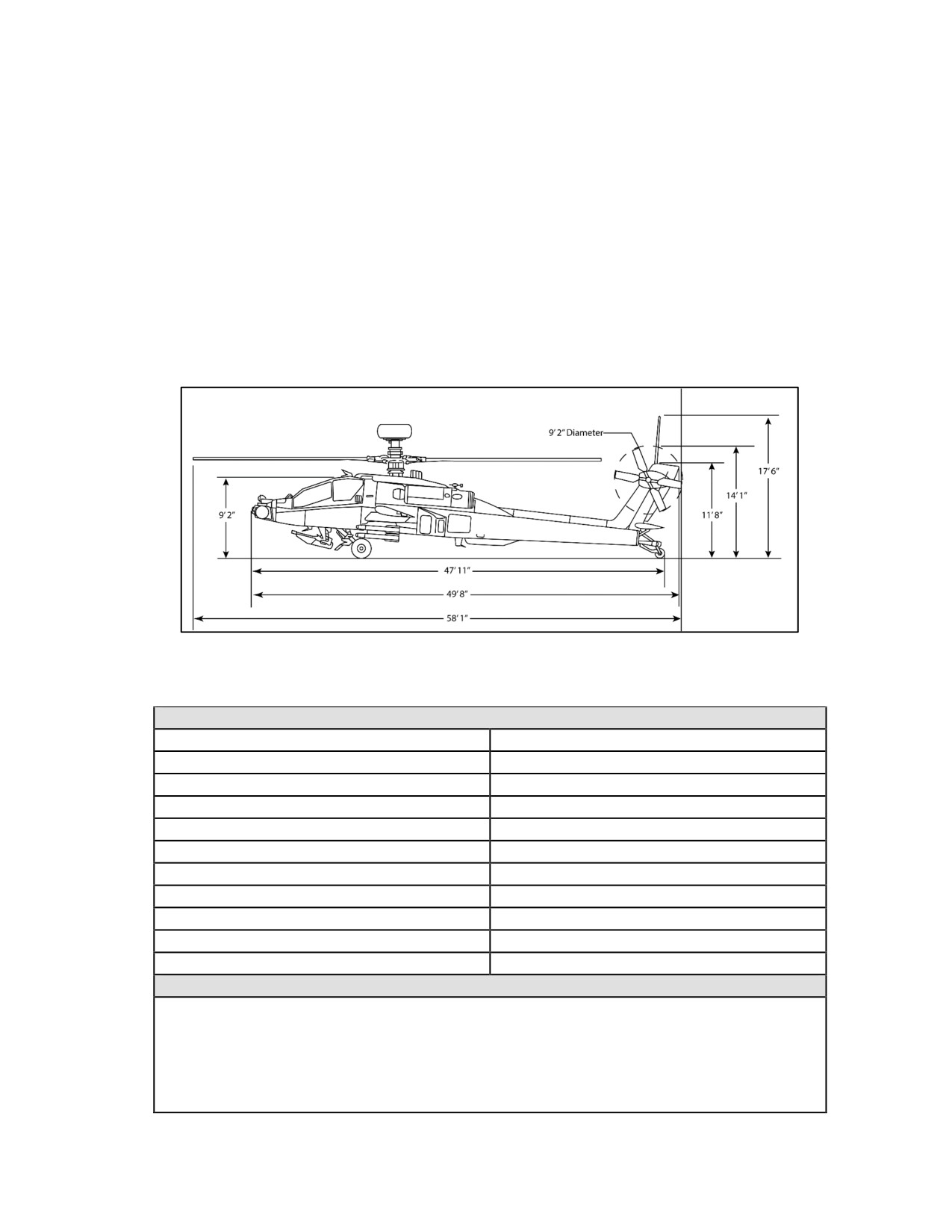
Chapter 5
Army Aviation Capabilities and Characteristics
AH-64D/E APACHE CHARACTERISTICS
5-1. The AH-64D/E Apache helicopter is a twin engine, tandem seat, aerial weapons platform capable of
performing attack, movement to contact, reconnaissance, and security operations. The combination of sensors
and armament systems the AH-64 employs allows the ground maneuver commander to gain a position of
relative advantage. Figure 5-1 and table 5-1 depict basic characteristics and dimensions of the Apache.
Figure 5-1. AH-64D/E Apache helicopter
Table 5-1. AH-64D/E Apache attack reconnaissance helicopter characteristics
Specifications:
Length (rotors turning)
58 feet 1 inch
Height: (rotors turning)
17 feet 6 inches
Width: (rotor turning)
48 feet
Fuselage length:
49 feet 8 inches
Fuselage length: (rotor turning)
58 feet 1 inch
Fuselage width:
16 feet 4 inches with wing stores
Main rotor diameter:
48 feet
Maximum gross weight:
23,000 pounds
Cruise airspeed:
110 to 120 knots*
Max continuous airspeed:
140 to 145 knots*
Combat radius :
120 kilometer*
Armament:
Max remote designated Hellfire missile range from aircraft: 8 kilometers (for shooter)
2.75 inch rockets: 3,000 to 5,000 meters for the multi-purpose sub-munitions (MPSM) and unitary
warhead with hovering fire most effective dispersion pattern.
30-millimeter cannon: maximum range: 4,200 meters up to 1,200 rounds.
30-millimeter cannon: maximum effective range: 1,500 to 1,700 meters
The Stinger anti-aircraft missile has a range of 200 meters to 4.5 kilometers
29 July 2015
FM 3-04
5-1
Chapter 5
Table 5-1. AH-64D/E Apache attack reconnaissance helicopter characteristics continued
Sensors:
Modernized target acquisition and designation system (MTADS) for use in low light and daytime. TV
allows autonomous laser designation of tank size target with image auto tracker at 6,000 meters, 4,000
meters using manual tracking.
MTADS/forward looking infrared (FLIR), (for use in day, night, weather, and obscurants). Allows
autonomous laser designation of tank-sized target with image auto tracker at 3,500 meters, 3,000 meters
using manual tracking.
Modernized pilot night vision system (MPNVS), (night weather and obscurants)
Fire control radar is capable of detecting, classifying, and prioritizing targets without line of sight or in
limited visibility and engaging with RF Hellfire missiles.
RF Interferometer identifies and prioritizes radar emitters based on pre-designated signatures.
Navigation Equipment:
Dual embedded GPS/inertial navigation system, Doppler radar, automatic direction finder (ADF), (AH-
64E) dual very high frequency omnidirectional range (VOR), ILS.
Additional Capabilities:
Use of infrared zoom laser illuminator designator (IZLID) laser for AGO to allow ground units to view laser
through NVDs.
Laser rangefinder and designator capable of returning range values from point to aircraft as well as
designating targets for autonomous and remote Hellfire engagements.
Tactical common data link (TCDL) for interoperability UA/GCS, United States Air Force/United States
Navy/United States Marine Corp FW A/C (LiNK-16).
Video from unmanned aircraft system for interoperability teaming (VUIT); video from cockpit to One
Station Remote Viewing Terminal.
All fuel cells are crashworthy, and ballistic tolerant.
The use of the auxiliary 100-gallon internal fuel tank will limit 30-millimeter ammunition to approximately
300 rounds; the 130-gallon internal auxiliary tank limits 30-millimeter ammunition to 100 rounds.
Fuel capacity: 370 gallons; average gallons per hour: 175
*Varies with factors such as temperature, wind, gross weight, internal versus external load, and time in the PZ and LZ.
ATTACK HELICOPTER ARMAMENT SYSTEMS
5-2. The AH-64D/E helicopter armament capabilities consist of a 30-millimeter cannon area weapon
system, a configurable 2.75-inch aerial rocket system, and a Longbow Hellfire modular missile system. These
systems can be mounted asymmetrically based on mission requirements on the four universal wing store
pylons (two on each side of the aircraft). The aircraft armament is can be attached or loaded in an
asymmetrical mix based on the mission. The wing stores may be configured to allow a mix of Hellfire
missiles and rockets to be carried. Each pylon may carry up to 19 rockets in a 19-shot pod or four Hellfire
missiles on attached launcher racks. Environmental conditions may significantly restrict weapons loads and
station time associated with those loads. In addition, the aircraft can attach and carry additional external and
internal auxiliary fuel tanks. The use of the auxiliary 100 gallon internal fuel tank limits 30mm ammunition
to approximately 300 rounds; the 130 gallon internal auxiliary tank limits 30mm ammunition to 100 rounds.
AREA WEAPON SYSTEMS
5-3. The M230E1 chain-driven cannon is an area weapon system mounted to a hydraulically driven turret
located under the forward fuselage below the cockpit. It has a rate of fire of 600 to 650 rounds per minute
with a maximum effective range of approximately 1,500 to 1,700 meters against area targets. The cannon
fires the M799 high explosive incendiary round and the M789 high explosive dual purpose (HEDP) round.
Each shell contains an explosive charge sealed in a shaped-charge liner. It can penetrate more than 2 inches
of armor at 2,500 meters and produces antipersonnel effects within a 4-meter radius. At typical engagement
ranges, HEDP ammunition will defeat infantry carrier vehicle-type targets. Training rounds include the M788
training purpose and the M848 dummy round. The aircraft can internal load and carry up to 1,200 rounds of
5-2
FM 3-04
29 July 2015
Army Aviation Capabilities and Characteristics
30mm ammunition based on the mix of other weapons systems and the mission. Running and diving fires
during an attack are limited by range source selection and often fired using the helmet sight at ranges of 1,000
meters.
AERIAL ROCKET SYSTEM
5-4. The 2.75-inch aerial rocket system is an area weapon system for use against enemy personnel and
equipment. Targets can vary from troops in the open to light armored vehicles, and other soft-skinned targets.
The rocket launcher can accommodate a various mix of warheads including: high explosive, multi-purpose
sub-munitions (MPSM), white or red phosphorous obscurants, overt or covert illumination, and flechette
rounds. The rocket can be selected to detonate on contact or as an airburst, depending on fusing and the type
of rocket selected. The AH-64 helicopter can carry up to four 19-shot launcher pods on four wing store
pylons, for a total of 76 rockets. The aircrew can launch single or multiple rockets at a time.
LONGBOW HELLFIRE MODULAR MISSILE SYSTEM
5-5. The Hellfire missile system is an air-to-ground point weapon system designed to destroy various types
of targets. The Hellfire missile suite currently consists of high explosive anti-tank, blast-fragmentation, and
thermo-baric missiles. These general groups of missiles are further designated by model number, used to
identify the type of missile. The A through F model missiles are the oldest variants, and referred to as semi-
active laser type 1 (SAL-1) missiles. The K through R model missiles are the newer variant and referred to
as SAL-2 type. The SAL-2 missiles have various capabilities with technological advantages over the older
SAL-1 missiles. The Hellfire missile will lock-on to a target by using guidance received by a laser designator
(LD) or by a radar scan and control. The SAL missile uses a pre-set LD code to lock-on to a specific target
being painted with a laser beam until it impacts the target. Target designation may be either remote or
autonomous. Remote target designation occurs when the target is designated by another laser source such as
other aircraft, ground forces, or an unmanned aircraft. The L model is a radio frequency (RF) Hellfire missile
which receives precision guidance from the fire control radar. The AH-64 can carry up to a total of 16 Hellfire
missiles on four wing-store pylons.
UH-60 L/M BLACKHAWK CHARACTERISITICS
5-6. The Sikorsky UH-60L/M Blackhawk is a twin-engine, dual-seat, utility helicopter. The primary
missions of the Blackhawk are air assault, air movement, mission command support, air MEDEVAC (HH-
60 variant), and as required, CASEVAC. It is designed to carry 11 combat-loaded air assault troops (seats
installed). It also can move light field artillery pieces and supporting stock. Figure 5-2 and table 5-2, page 5-
4, provide the basic description and characteristics of the UH-60L/M (more information can be found in TM
1-1520-237-10).
29 July 2015
FM 3-04
5-3
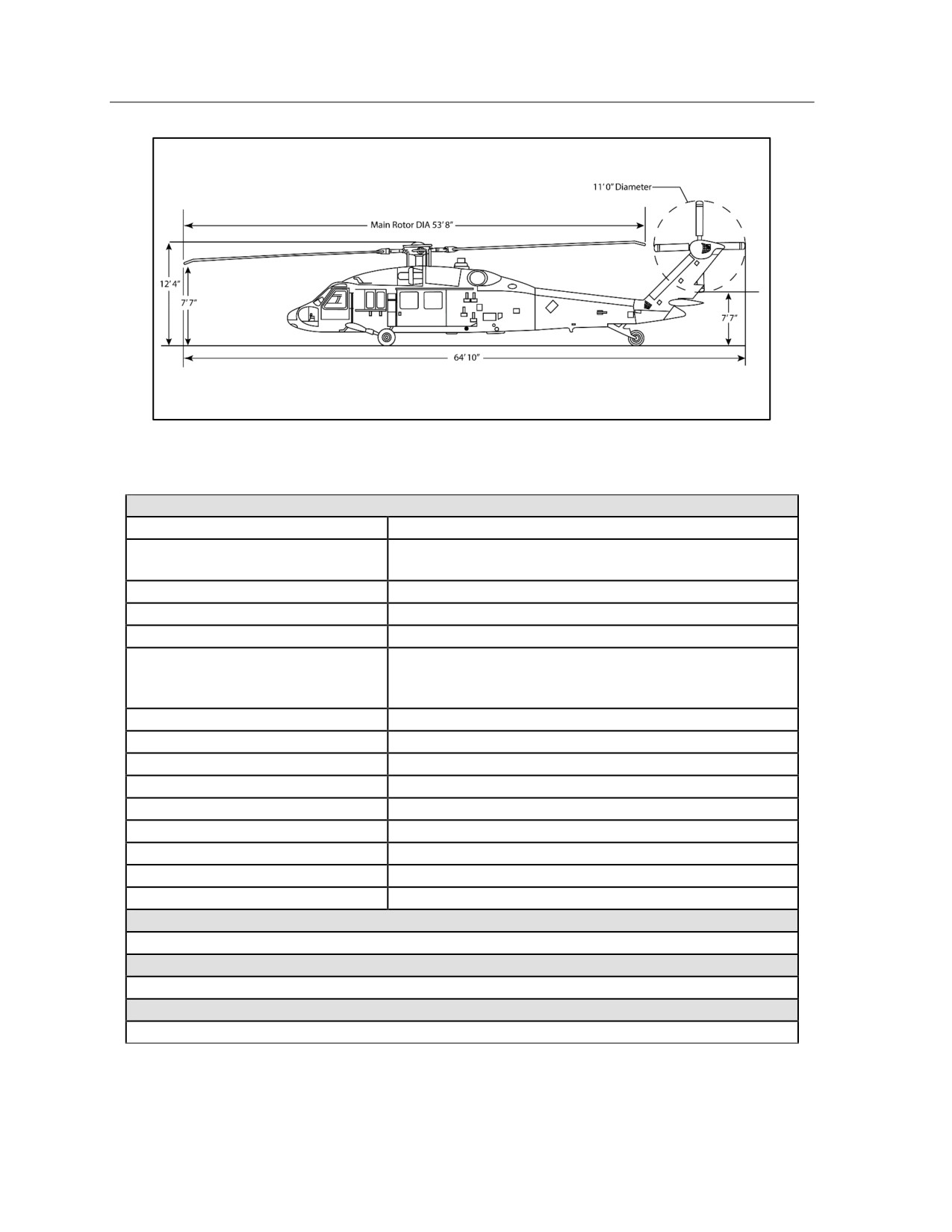
Chapter 5
Figure 5-2. UH-60 L/M Blackhawk helicopter
Table 5-2. UH-60L/M Black Hawk helicopter characteristics
Specifications:
Length: (rotor turning)
64 feet 10 inches
Height:
12 feet 4 inches at center hub
17 feet 11 inches at tail rotor (turning)
Width: (rotor turning)
53 feet 8 inches
Main rotor and tail rotor diameter:
53 feet 8 inches main rotor, 11 feet tail rotor at 20-degree angle
Fuselage Length:
41 feet 4 inches with rotors and pylons folded.
Fuselage Width:
9 feet 8.6 inches main landing gear
14 feet 4 inches at the stabilator
21 feet with ESSS installed
Cabin floor dimensions:
73 inches wide x 151 inches long
Cabin door dimensions:
69 inches wide x 54.5 inches high
Maximum gross weight:
22,000 pounds*
Maximum cargo hook load:
UH-60A: 8,000 pounds*
Maximum cargo hook load:
UH-60L&M: 9,000 pounds*
Cruise airspeed:
120 to 145 knots*
Airspeed with external sling-loads:
120 knots max
Max speed (level):
156 knots
Combat radius:
225 kilometers*
Armament:
2 x M240H (7.62mm machine guns)
Optics:
AN/AVS-6 NVG, FLIR (optional)
Navigation Equipment:
Doppler/GPS, VOR, ADF, navigation sets
5-4
FM 3-04
29 July 2015
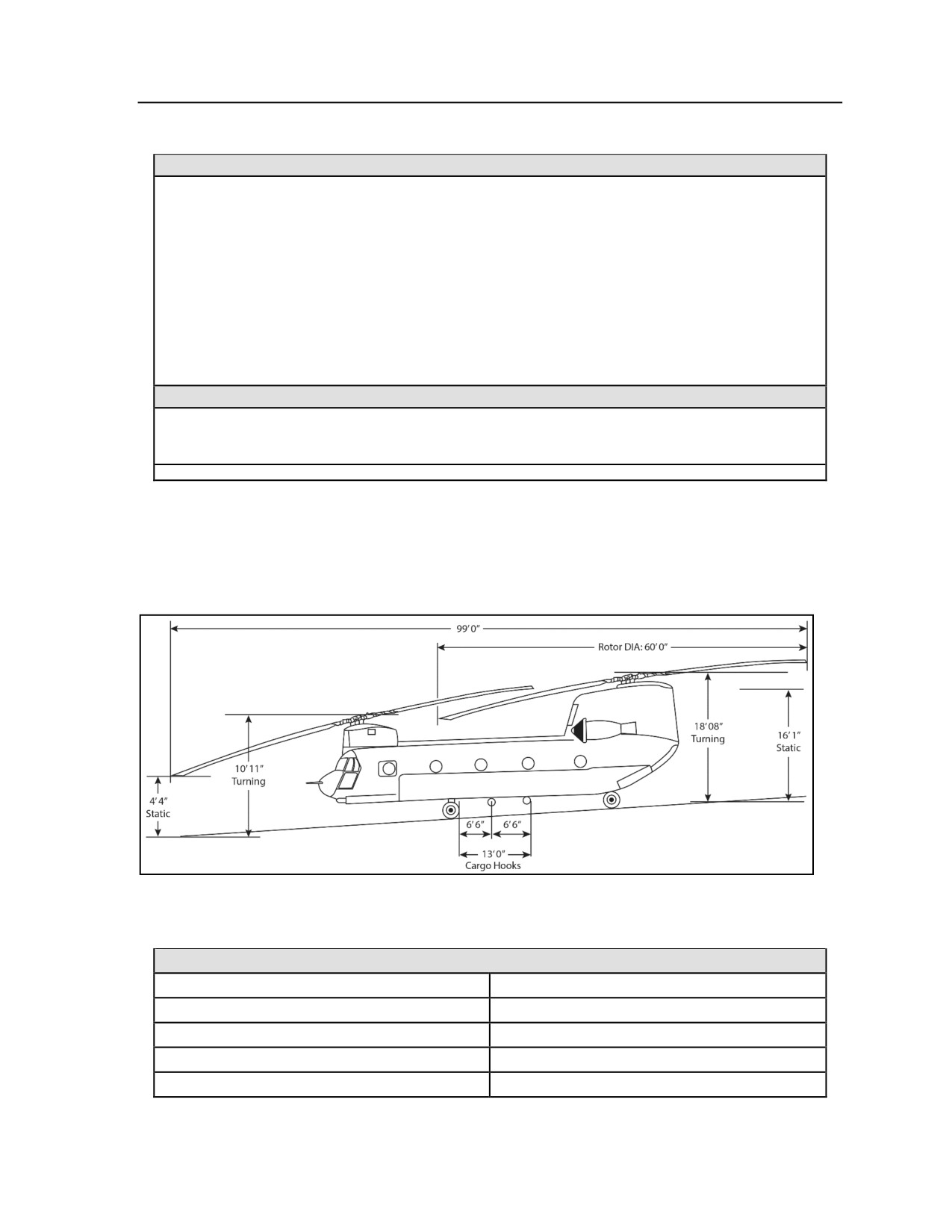
Army Aviation Capabilities and Characteristics
Table 5-2. UH-60L/M Black Hawk helicopter characteristics continued
Additional Capabilities:
The ESSS allows configuration for extended operations without refueling (5+ hours) (2 x 200
gallon fuel tanks) and ferry and self-deployment flights (4 x 200 gallon fuel tanks).
Fuel Capacity: 362; average gallons per hour: 178.
The enhanced mission command console (if installed), provides the maneuver commander with
an airborne platform supporting six secure FM radios, one high frequency (HF) radio, two very
high frequency (VHF) radios, and two ultra-high frequency (UHF) radios.
Can be configured with the volcano mine dispensing system; requires 8 hours to install.
Capable of inserting and extracting troops with FRIES/SPIES.
For HH-60 air ambulance version:
Rescue hoist: 600 pounds rescue hoist.
Patient capacity: six litter or ambulatory, or a combination.
Limitations:
Use of the ESSS for fuel tanks restricts access to the cabin doors for troops and bulky cargo or
litters. It also reduces the payload and maximum speed.
Cruise speed is decreased when conducting external load operations.
* varies with environmental/mission conditions.
CH-47D/F CHINOOK CHARACTERISITICS
5-7. The Boeing CH-47 Chinook is a twin-engine, tandem rotor heavy-lift helicopter. Its primary missions
are air assault, troop movement, and as required, CASEVAC. The versatility of the CH-47 enables rapid
repositioning of maneuver forces across the breadth and throughout the depth of an AO. Figure 5-3 and table
5-3 depict the basic dimensions and characteristics of the Chinook.
Figure 5-3. CH-47D/F Chinook cargo helicopter
Table 5-3. CH-47D/F Chinook cargo helicopter characteristics
Specifications:
Length (rotors turning)
98 feet 10 inches
Height: (rotors turning)
18 feet 11 inches
Width: (rotor turning)
60 feet
Fuselage length:
50 feet 9 inches
Fuselage width:
12 feet 5 inches
29 July 2015
FM 3-04
5-5

Chapter 5
Table 5-3. CH-47D/F Chinook cargo helicopter characteristics continued
Specifications:
Main rotor span:
60 feet
Cargo space:
Approximately 1,500 cubic feet
Cabin height
6 feet 6 inches
Floor space:
30 feet 6 inches long by 7 feet 6 inches wide
Maximum gross weight:
50,000 pounds
Max load for forward and aft hooks:
17,000 pounds
Max tandem load for forward and aft hooks:
25,000 pounds
Max load for center hook:
26,000 pounds
Cruise airspeed:
120 to 145 knots*
Max continuous airspeed:
170 knots*
Airspeed with external sling-loads:
120 knots max
Combat radius (16,000 pounds cargo):
50 nautical miles (90 kilometers)*
Combat radius (33 troops):
120 nautical miles (180 kilometers)*
Armament:
3 M240H 7.62mm machine guns (two cabin-mounted and one ramp-mounted)
Optics:
AN/AVS-6 NVG
Navigation Equipment:
Doppler/GPS, VOR, and ADF navigation sets
Additional Capabilities:
Can be configured with additional fuel for a mobile forward area refueling system (Fat Cow or Wet
Cow) or for ferrying/self-deployment missions.
CASEVAC: 24 litters and 1 ambulatory or 31 ambulatory.
Fuel Capacity: 1,030 gallons; average gallons per hour: 514.
Aircraft has an internal load winch to ease loading of properly configured cargo.
The CH-47D/F can sling-load most equipment in the light infantry, airborne, or air assault divisions.
Limitations:
Cruise speed is greatly decreased by light, bulk sling-loads.
*Varies with factors such as temperature, wind, gross weight, internal versus external load, and time in PZ/LZ.
MQ-1C GRAY EAGLE CHARACTERISTICS
5-8. The MQ-1C Gray Eagle is a multi-mission, multi-payload system that’s primary missions include long
endurance, near-real-time reconnaissance, and precision attack. It is organic to the attack reconnaissance
battalion in the combat aviation brigade and the military intelligence aerial exploitation brigade. (For more
information on Aerial Exploitation Brigade Gray Eagles, refer to TC 2-19.13 and TC 2-19.11.) Gray Eagles
may team with CAB manned aircraft or operate autonomously in support of ground force commander
objectives and information requirements. Figure
5-4, page
5-7, depicts the Gray Eagle in a basic
configuration; table 5-4, page 5-7, outlines air vehicle characteristics.
5-6
FM 3-04
29 July 2015
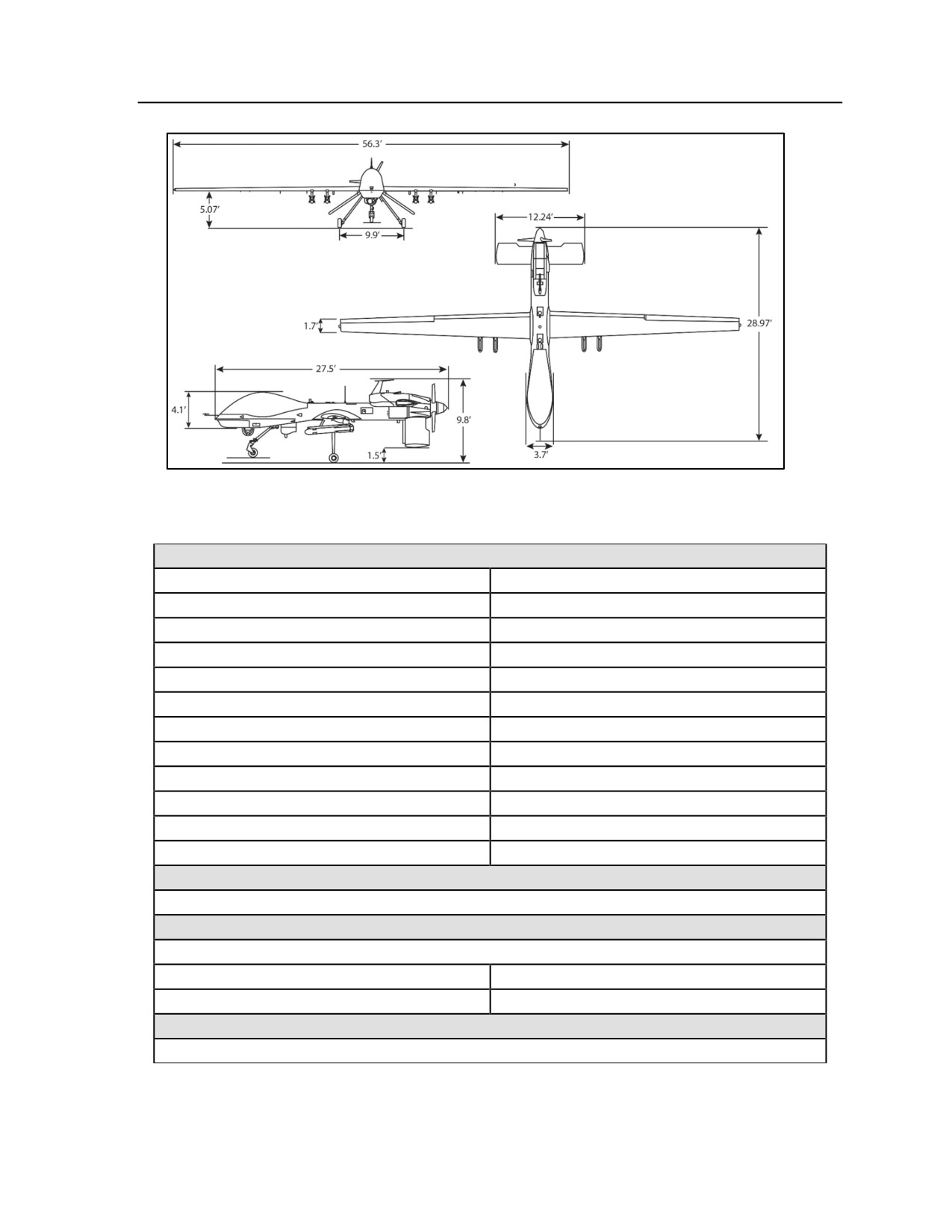
Army Aviation Capabilities and Characteristics
Figure 5-4. MQ-1C Gray Eagle unmanned aircraft
Table 5-4. MQ-1C Gray Eagle unmanned aircraft characteristics
Specifications:
Length:
29 feet
Height: (propeller turning)
9 feet 8 inches
Main wing span:
56.3 feet
Endurance:
22+ hours without armament
Propulsion:
Heavy fuel engine (1.7 or 2.0 liter)
Maximum gross take-off weight:
1.7L 3,200 pounds/2.0L 3,600 pounds
Altitude:
25,000 feet MSL
Runaway length requirement:
4500 feet at 9000 feet density altitude
Cruise airspeed:
80 knots*
Max continuous airspeed:
130 knots
Combat range (air data relay/SATCOM):
1200 kilometers
Combat range (LOS):
300 kilometers
Armament:
4 Hellfire missiles (aircraft specific variant)
Optics:
Electro-optical and infrared
Nominal ocular hazard distance
39 kilometers
Nominal ocular hazard distance
82 kilometers with 7x magnifying optics
Datalink Equipment:
Ku SATCOM, Ku TCDL
29 July 2015
FM 3-04
5-7

Chapter 5
Table 5-4. MQ-1C Gray Eagle unmanned aircraft characteristics continued
Additional Capabilities:
Laser classification: Class IV
Synthetic aperture radar (SAR), ground moving target indicator (GMTI)
Limitations:
Aircraft endurance is reduced when armed with Hellfire missiles.
*Varies with environmental conditions.
MQ-1C ARMAMENT SYSTEM
5-9. The MQ-1C Gray Eagle unmanned aircraft system is used in support of reconnaissance and
surveillance requirements. The MQ-1C can be outfitted with the Hellfire missile for attacking selected
targets. The MQ-1C uses a laser rangefinder (LR) and a laser designator (LD), which is used to determine
the range to the target and to designate targets for delivery of laser-guided munitions.
AGM-114-P+ AND AGM-114-R/R2 HELLFIRE MISSILE
5-10. The MQ-1C aircraft can carry the AGM-114 P+ and AGM-114R/R2 series of missiles. In the attack
configuration four missiles are carried, and in the reconnaissance/attack configuration two missiles are
carried. Both missiles incorporate an expanded engagement envelope from 180 to 360 degrees depending on
the AVs altitude and software series. The P+ is currently being phased out as the R model is fielded. The R
series of Hellfire missiles is the bridge to the Hellfire replacement which is the joint air to ground missile
(JAGM). The R series comes in two versions, the AGM-114R and the AGM-114R2. The AGM-114 R
incorporates an integrated blast fragmentation sleeve (IBFS) warhead which is unique to the Hellfire family
of missiles. This one warhead provides the commander with three capabilities. A high explosive anti-tank
(HEAT) capability with a pre-cursor charge for attacking reactive armor equipped tanks and other hard
targets, a blast fragmentation capability for light vehicles and personnel and a settable delay to allow the
warhead to penetrate through a wall or ceiling and into a structure maximizing the overpressure feature of
the warhead before detonation occurs. The AGM-114R2 additionally incorporates a height of burst (HOB)
capability which detonates the warhead approximately 3 feet prior to the missile impacting the target. This
HOB capability provides an increased probability of kill (Pk) by eliminating the attenuation of the fragments
by the ground. Danger close for both series of missiles is 120 meters. Table 5-5 outlines Hellfire II missile
characteristics.
Table 5-5. AGM-114P+/AGM-114R/R2 Hellfire missile characteristics
Diameter
17.8 centimeters (cm) (7 inches)
Wing span
33 centimeters (13 inches)
Length
163 centimeters (64 inches)
Weight
50 kilograms (110 pounds)
Propulsion
Solid fuel rocket
Guidance
Semi-active laser homing
Speed
Supersonic
Range
0.5-8 kilometers (546 yards-5 miles)
Payload
AGM-114P+ missile configurations: P-4A HEAT with fragmentation sleeve. N-4 Blast
fragmentation with Metallic augmented charge (overpressure) and delay fuse.
AGM-114R: IBFS warhead for all target sets. R2 warhead adds a HOB capability.
Trigger
Impact, HOB, Delay
Targets
AGM-114P+: Three warhead variants defeat an array of targets (including tanks,
light armored vehicles, trucks, bunkers, caves, and buildings.)
AGM-114R/R2: One warhead defeats an array of targets (including tanks, light
armored vehicles, trucks, bunkers, caves, and buildings.)
5-8
FM 3-04
29 July 2015
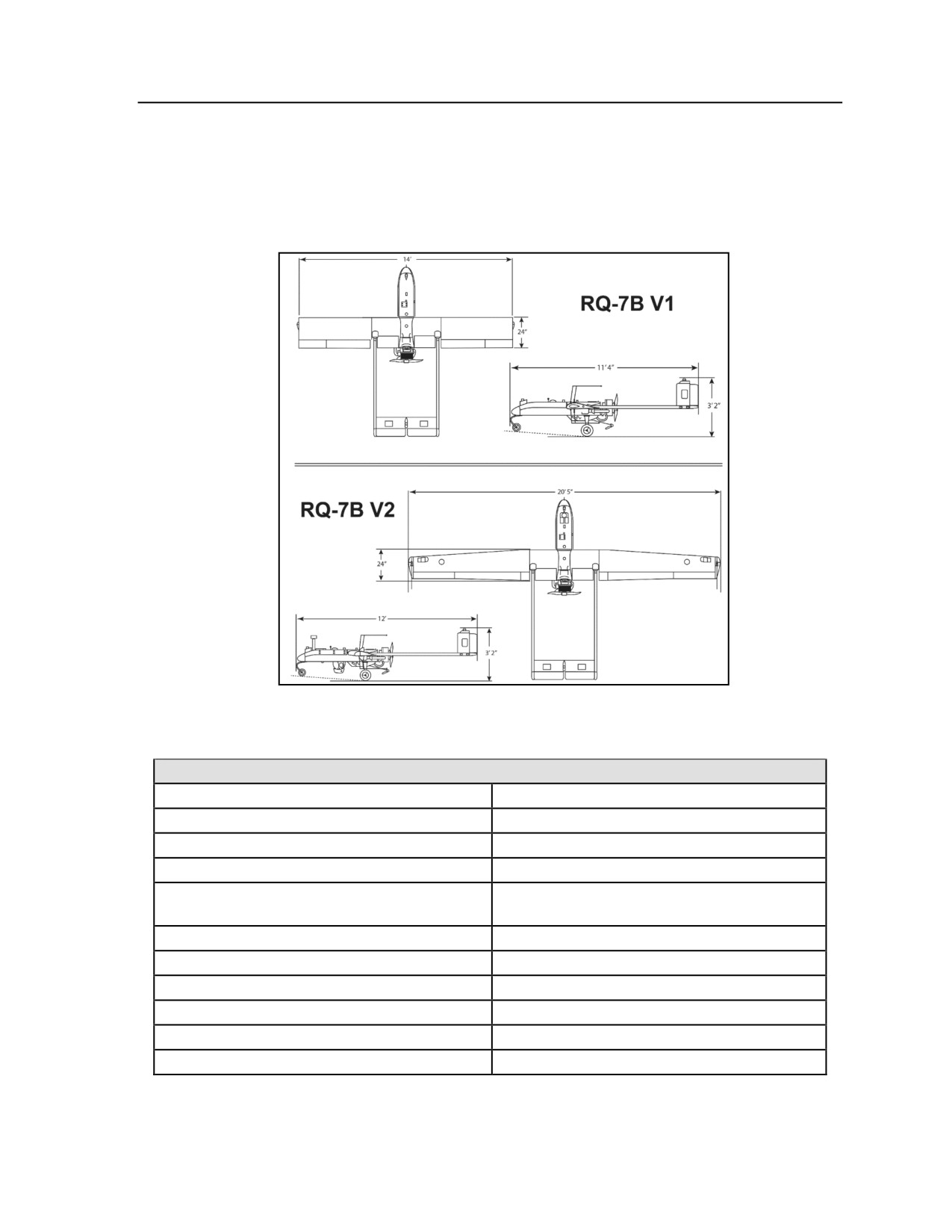
Army Aviation Capabilities and Characteristics
RQ-7BV1/V2 SHADOW CHARACTERISTICS
5-11. The RQ-7BV1/V2 is a FW tactical unmanned aircraft system with a primary mission of
reconnaissance. Organic to the attack reconnaissance squadron in the combat aviation brigade, Shadows may
team with CAB manned aircraft or operate autonomously in support of ground force commander objectives.
Figure 5-5, page 5-9, depicts the basic parameters of the RQ-7 B V1 and V2; table 5-6, page 5-9, depicts
characteristics.
Figure 5-5. RQ-7B Shadow unmanned aircraft system
Table 5-6. RQ-7B Shadow unmanned aircraft system characteristics
Specifications:
Length:
11 feet 4 inches
Height: (propeller turning)
3 feet 3 inches
Main wing span:
14 feet; 19 feet 8 inches (RQ-7Bv2)
Endurance:
5+ hours; 8+ hours (RQ-7Bv2)
Propulsion:
Fuel injected wankel rotary engine utilizing 100
Low Lead Aviation Gasoline.
Maximum gross take-off weight:
404 pounds/467 pounds (RQ-7Bv2)
Altitude:
15,000+ feet mean sea level
Launch and recovery requirements:
220 meters by 50 meters area
Cruise airspeed:
70-80 knots
Max dash airspeed:
110 knots
Combat range (line of sight):
125 kilometers
29 July 2015
FM 3-04
5-9

Chapter 5
Table 5-6. RQ-7B Shadow unmanned aircraft system characteristics continued
Armament:
Not at present
Optics:
Electro-optical, infrared, and laser pointer/laser rangefinder and laser designator.
Nominal ocular hazard distance
15 kilometers
Datalink Equipment:
RQ-7Bv1
Primary: 2.4-2.48 GHz band
Secondary: UHF-band
Video: 4.4-4.95 GHz C-band (CONUS*)
Video: 5.25-5.85 GHz (OCONUS*)
RQ-7Bv2-tactical common data link
Primary: TCDL Ku-band (Type I encryption)
Secondary: UHF-band (Type II advanced
encryption)
Additional Capabilities:
Laser classification: class IV designator, III-b rangefinder, III-b pointer
FM radio communications relay package
Limitations:
Aircraft is sensitive to weather conditions. Dust, rain, and low ceilings ground aircraft.
*CONUS-continental United States; OCONUS-outside the continental United States. GHz-gigahertz
C-12R/T3/F3 AIRCRAFT
5-12. The C-12 series of aircraft are pressurized, low wing, all metal aircraft powered by two PT6A-42
turboprop engines. The aircraft has all-weather capability and is distinguishable by its slender, streamlined
engine nacelles, four-blade propellers, T-tail, and dual aft body strakes. The basic mission of the aircraft is
to provide scheduled or unscheduled air transportation of passengers and/or cargo in any area of the world.
Table 5-7, page 5-10, depicts characteristics; figure 5-6, page 5-11, depicts the basic parameters of the C-12.
Table 5-7. C-12 aircraft specifications
Specifications:
Length:
43 feet 10 inches
Height:
14 feet 6 inches
Main wing span:
54 feet 6 inches
Propulsion:
2x PT6A-42 turboprop engines
Maximum gross take-off weight:
12,500 pounds
Service ceiling:
35,000 feet mean sea level
Cruise airspeed:
294 knots
Range:
3,658 kilometers
5-10
FM 3-04
29 July 2015
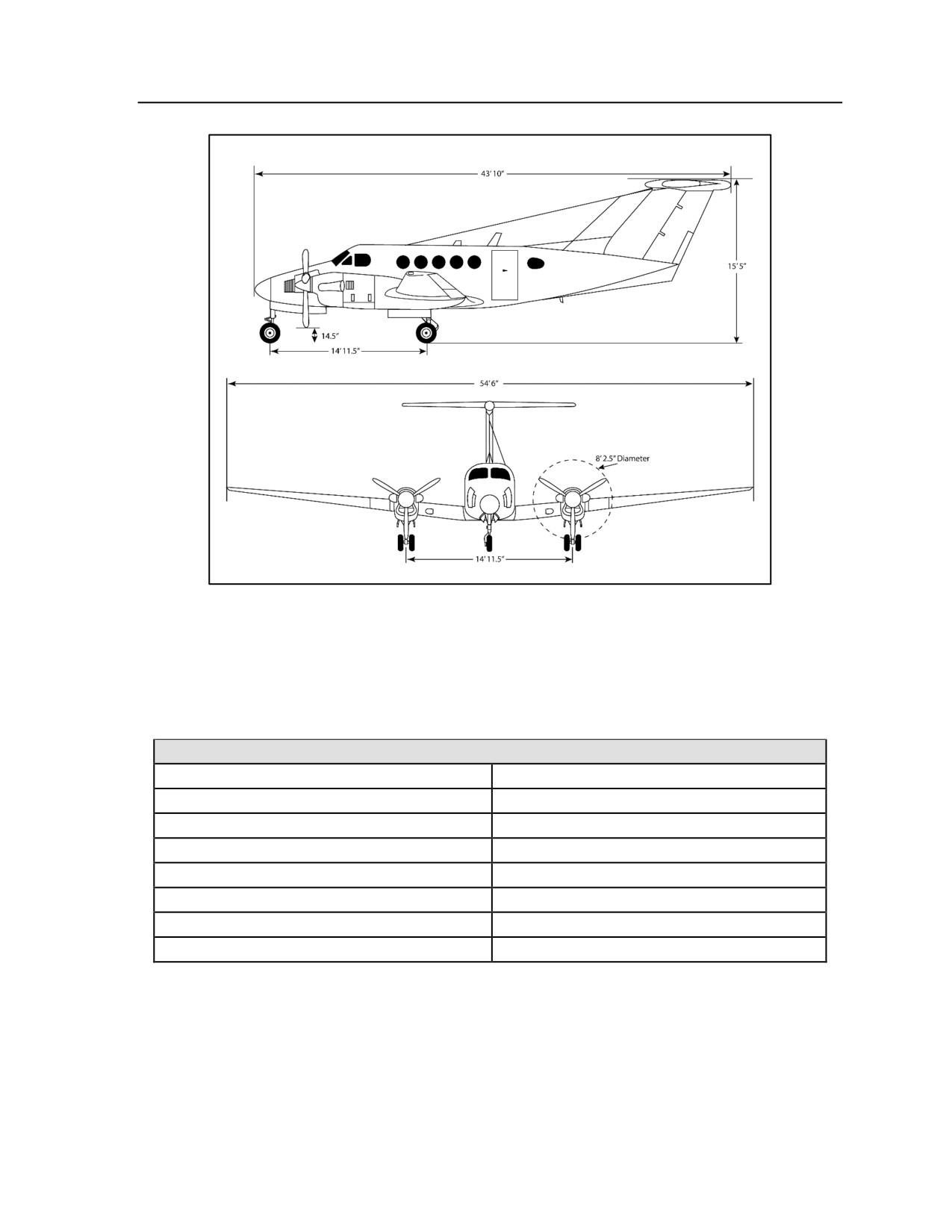
Army Aviation Capabilities and Characteristics
Figure 5-6. C-12 aircraft
UC-35 AIRCRAFT
5-13. The UC-35 is a twin-engine turbofan medium range aircraft. Its principle missions include air
movement of passenger and cargo (table 5-8, page 5-11, and figure 5-7, page 5-12).
Table 5-8. UC-35 aircraft specifications
Specifications:
Length:
48 feet 9 inches
Height:
15 feet 0 inches
Main wing span:
54 feet 2 inches
Propulsion:
2x JT15D-5D turbofan jet engines
Maximum gross take-off weight:
16,300 pounds
Service ceiling:
45,000 feet mean sea level
Cruise airspeed:
430 knots
Range:
2,925 kilometers
29 July 2015
FM 3-04
5-11
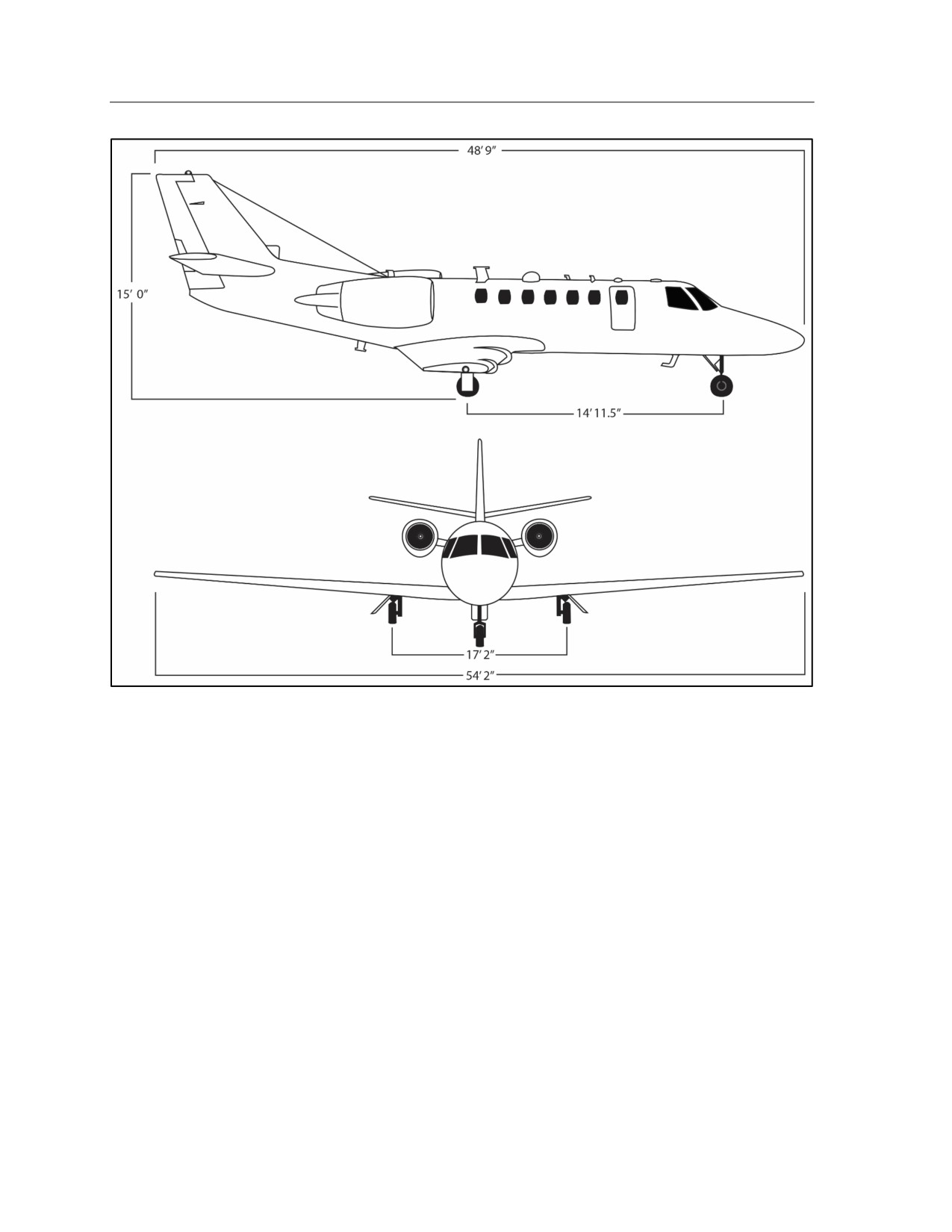
Chapter 5
Figure 5-7. UC-35 aircraft
AN/MSQ-135 MOBILE TOWER SYSTEM
5-14. Organic to the air traffic company in the CAB, the AN/MSQ-135 mobile tower system (MOTS) is a
rapid-deployable air traffic control (ATC) tower and airfield lighting system (ALS) that quickly establishes
air traffic services (ATS) for arrival, departure, and ground operations. Equipment is included to remotely
command airfield operations, including control of existing airfield lighting systems. The AN/MSQ-135
MOTS is transportable by all standard land, rail, and sea methods. Additionally, the complete AN/MQS-135
MOTS is transportable by C-17 and larger FW aircraft. However, only the ATC Tower, ALS
generator/equipment trailer, ALS lighting/equipment trailer, and ALS movers 1 and 2 can be sling-loaded by
CH-47 and larger rotary-wing aircraft. Figure 5-8 depicts an AN/MSQ-135 MOTS. For more information,
see TM 11-5895-1880-10.
5-12
FM 3-04
29 July 2015
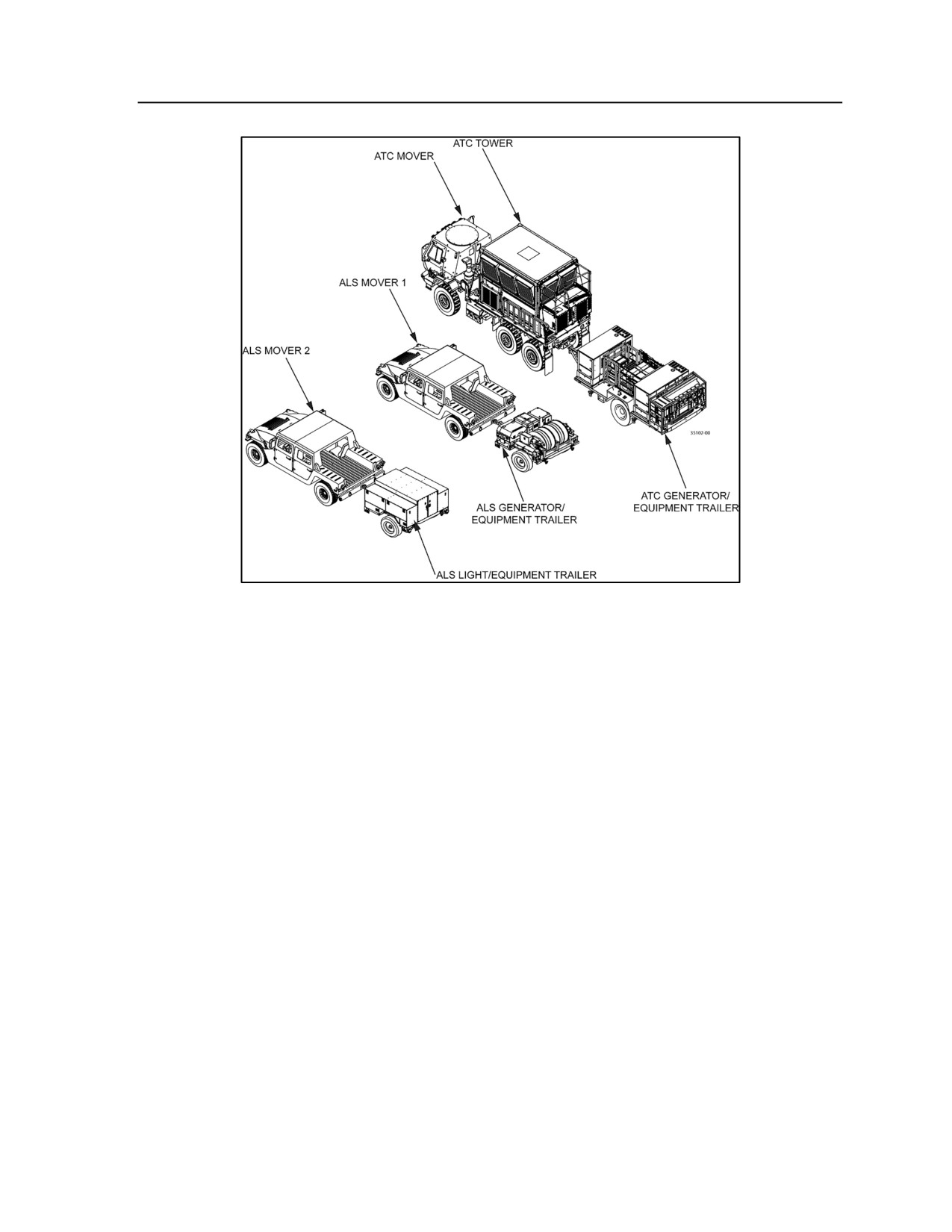
Army Aviation Capabilities and Characteristics
Figure 5-8. AN/MSQ-135 mobile tower system
5-15. Supervisor and operator workstations are able to communicate using secure and non-secure HF, UHF-
amplitude modulation (AM), VHF-AM, and VHF-FM radio frequencies. This enables controllers to manage
airspace from the surface to 10,000 feet out to a five mile radius. When assisted by appropriate NAVAIDs
(not organic) the AN/MSQ-135 MOTS provides ATS in all-weather conditions, night or day, for military
and civilian aircraft.
29 July 2015
FM 3-04
5-13