FM 3-04 Army Aviation (JULY 2015) - page 2
Army Aviation Organizations and Mission Command
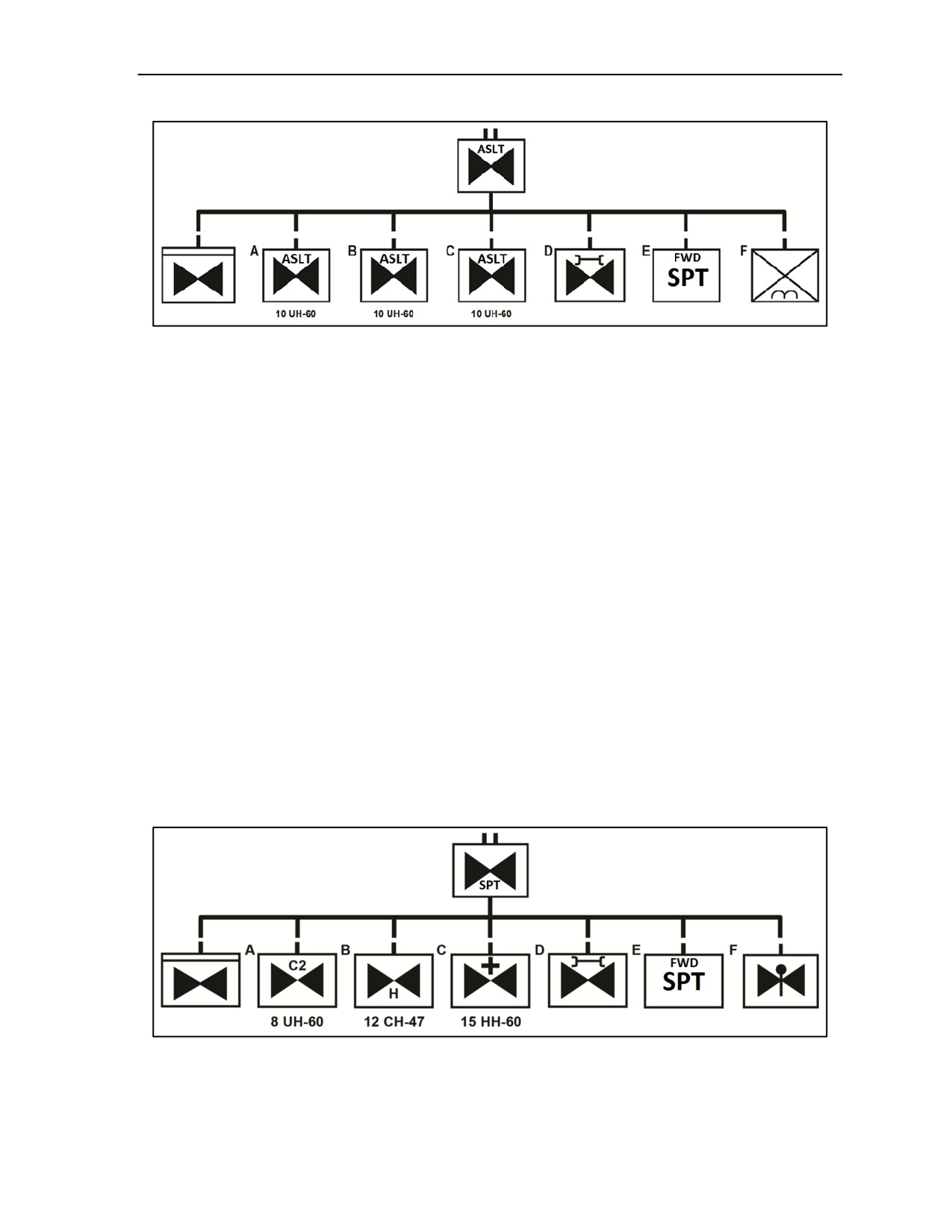
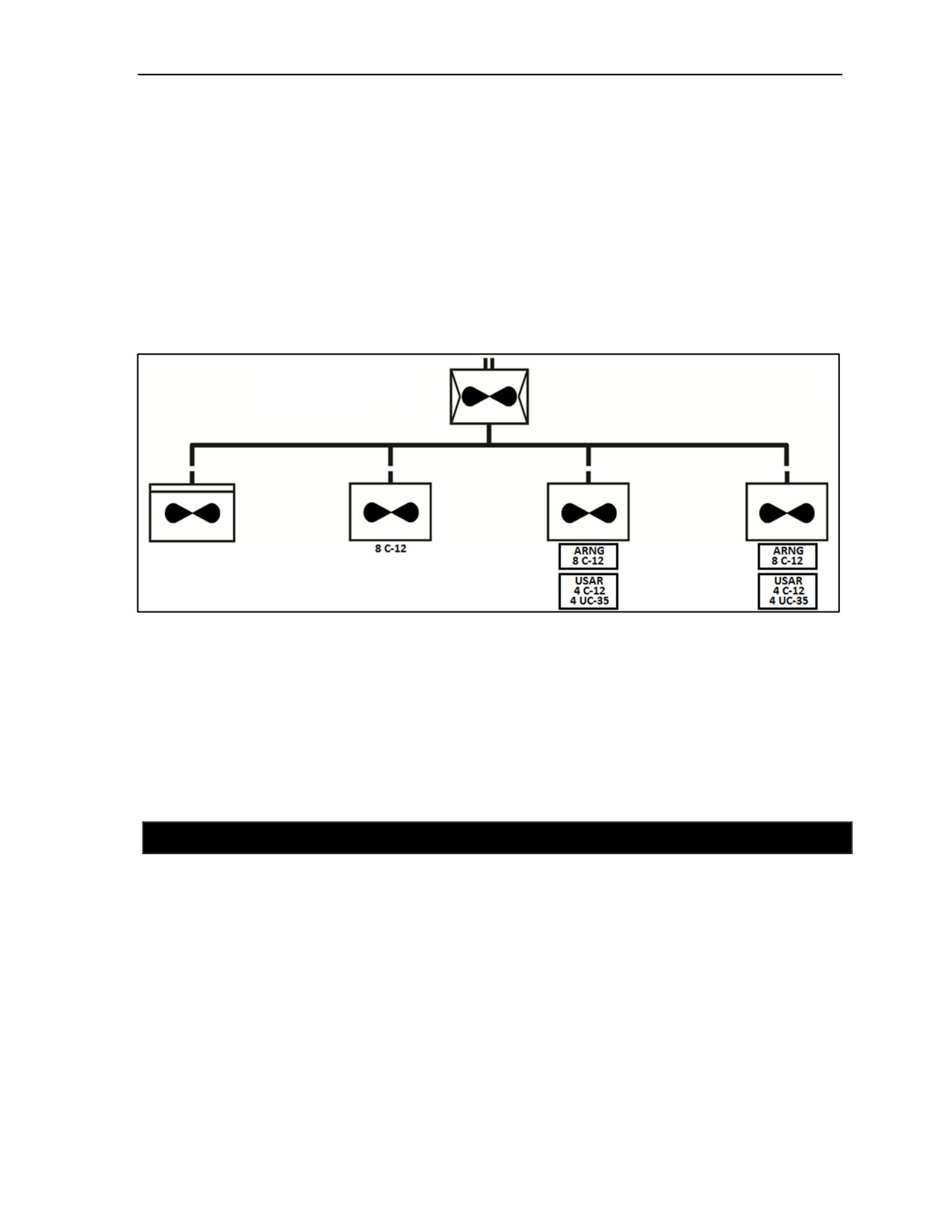
Figure 2-9. Assault helicopter battalion
CAPABILITIES
2-37. The AHB conducts the following tasks:
z
Air assaults.
z
Air movements.
z
CASEVAC.
z
Aerial mission command.
z
Personnel recovery.
z
Reconnaissance.
GENERAL SUPPORT AVIATION BATTALION
PURPOSE
2-38. The GSAB is a subordinate element of the CAB, ECAB, and TAB. The GSAB air assaults maneuver
forces; positions personnel, supplies and equipment; evacuates casualties; conducts PR; and enables mission
command in support of the combined arms team.
ORGANIZATION
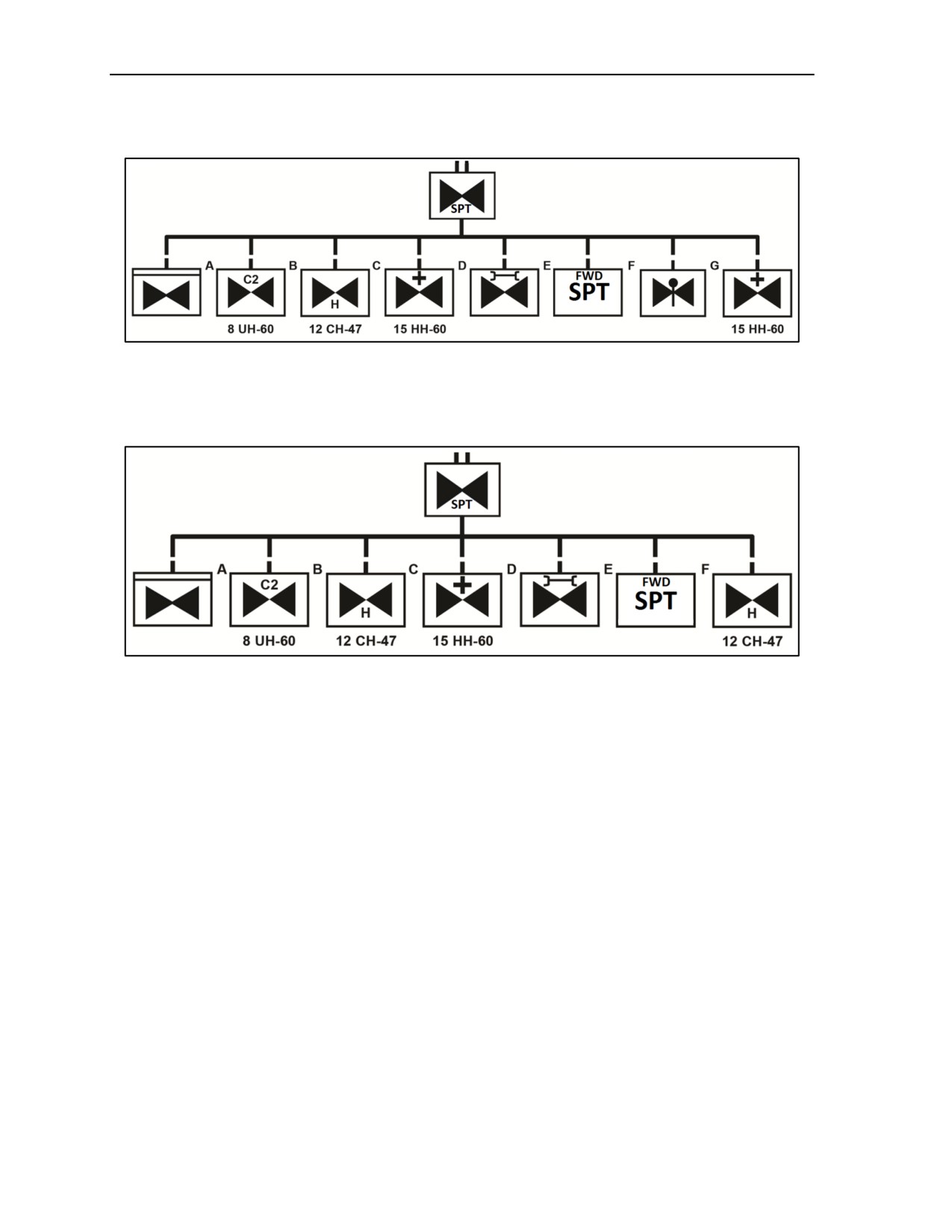
2-39. The GSAB in the CAB and TAB-A consists of an HHC, a command aviation company of 8 UH-60s,
a heavy lift company (HLC) of 12 CH-47s, an aeromedical evacuation company of 15 HH-60s, an aviation
maintenance company, a FSC, and an ATS company. Figure 2-10 provides the organizational structure for
the CAB and TAB-A GSAB.
Figure 2-10. General support aviation battalion (CAB)
2-40. The GSAB in the ECAB consists of an HHC, a command aviation company (CAC) of 8 UH-60s, an
HLC of 12 CH-47s, two aeromedical evacuation companies of 15 HH-60s each, an aviation maintenance
29 July 2015
FM 3-04
2-9
Chapter 2
company, a FSC, and an ATS company. Figure 2-11 provides the organizational structure for the ECAB
GSAB.
Figure 2-11. General support aviation battalion (ECAB)
2-41. The GSAB in the TAB-GS consists of a HHC, a CAC of 8 UH-60s, two HLCs with 12 CH-47s each,
an aeromedical evacuation company of 15 HH-60s, an aviation maintenance company, and a FSC. Figure 2-
12, page 2-10, provides the organizational structure for the TAB-GS GSAB.
Figure 2-12. General support aviation battalion (TAB-GS)
CAPABILITIES
2-42. The GSAB conducts the following tasks:
z
Air movement.
z
Aerial FARP support.
z
Air assaults.
z
PR.
z
Aerial mission command.
z
Aeromedical evacuation.
z
CASEVAC.
z
ATS.
AVIATION SUPPORT BATTALION
PURPOSE
2-43. The ASB is an element of the CAB, ECAB, and TAB. It provides aviation and ground field
maintenance, network communications, resupply, and medical support. The ASB provides maintenance
augmentation to aviation battalions when required.
2-10
FM 3-04
29 July 2015
Army Aviation Organizations and Mission Command
ORGANIZATION
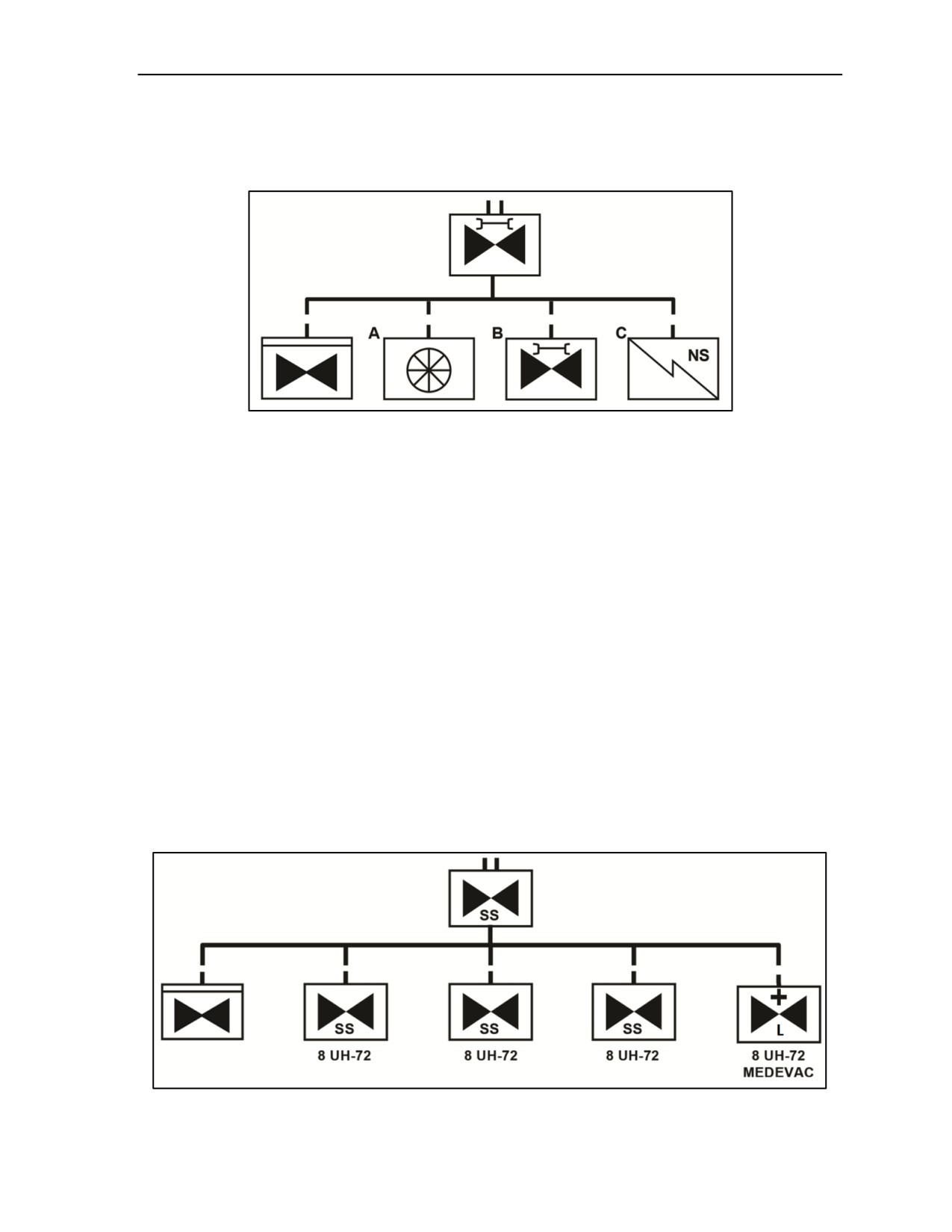
2-44. The ASB consists of a HHC, a distribution company, an aviation support company, and a network
support (NS) company. Figure 2-13 provides the organizational structure for the ASB.
Figure 2-13. Aviation support battalion
CAPABILITIES
2-45. The ASB performs the following tasks:
z
Ground vehicle and aviation maintenance and recovery operations.
z
Signal and NS to the CAB for mission command.
z
Aviation and ground sustainment operations for the aviation brigade.
z
Distribution management operations within the aviation brigade.
z
Role 1 Army health service support for the aviation brigade.
SECURITY AND SUPPORT BATTALION
2-46. The SSB is an element of the TAB-GS. It is a multi-purpose aviation unit that supports a variety of
federal, and state missions in permissive environments by providing accurate and timely reconnaissance
information; positioning of personnel, supplies, and equipment; evacuation of casualties; search and rescue;
and enabling mission command in DSCA operations.
ORGANIZATION
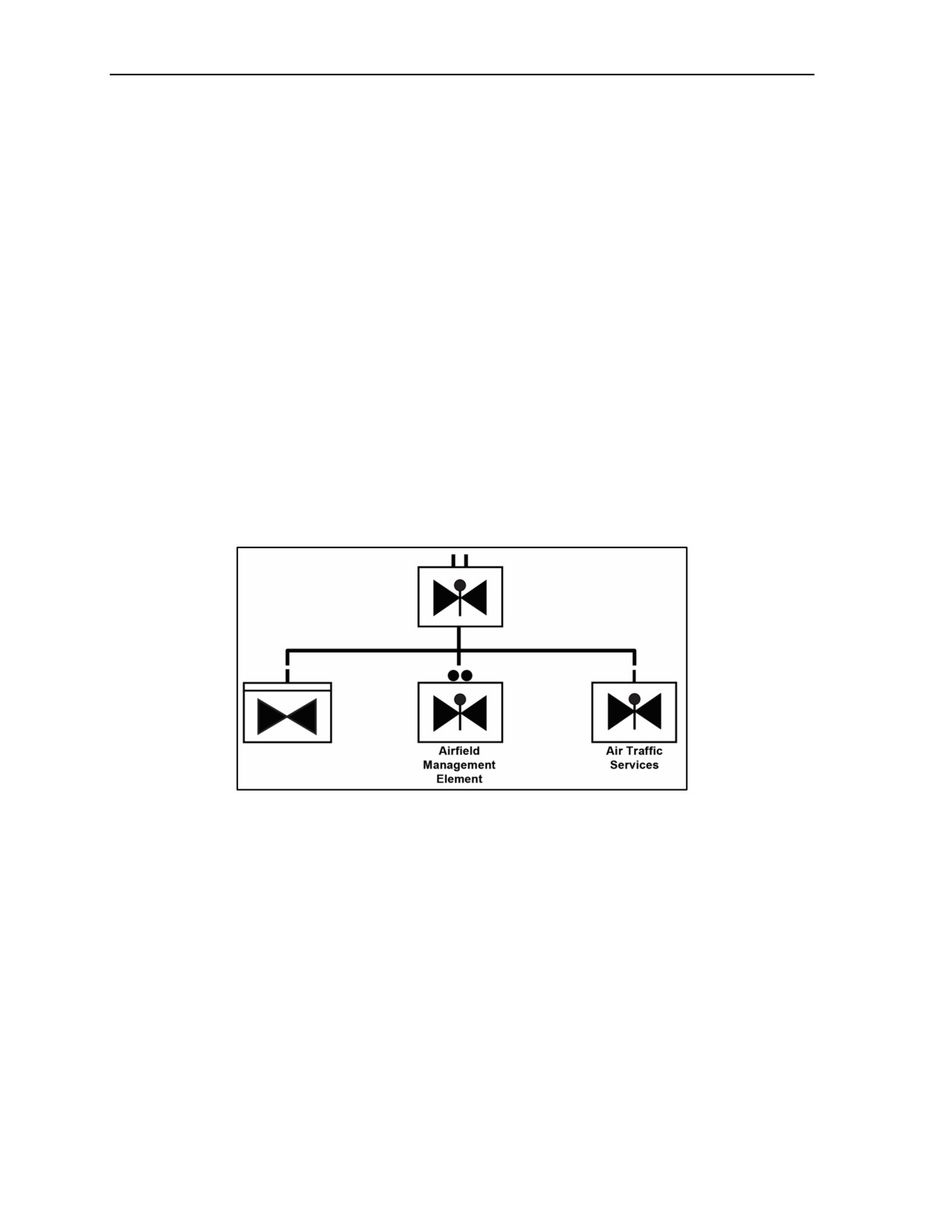
2-47. The SSB consists of a HHC, three security and support companies of eight UH-72s each for
reconnaissance and GS, and an aeromedical evacuation company of eight UH-72s. Figure 2-14 provides the
organizational structure of a SSB.
Figure 2-14. Security and support battalion
29 July 2015
FM 3-04
2-11
Chapter 2
CAPABILITIES
2-48. The SSB is designed to be deployed and employed in permissive environments and is organized using
a modular design. The SSB is capable of operating as a separate battalion, an ABTF, or task organize into
company or platoon elements to support assigned missions. The SSB conducts the following tasks:
z
Zone, route and area reconnaissance (permissive environments).
z
Air movement.
z
Aerial mission command.
z
Aeromedical evacuation.
z
CASEVAC.
z
Civil search and rescue operations.
AIRFIELD OPERATIONS BATTALION
PURPOSE
2-49. The AOB provides airfield management including airfield operations, flight dispatch services, and air
traffic control (ATC).
ORGANIZATION
2-50. The AOB consists of a HHC, an airfield management element (AME), and an ATS company. Figure
2-15 provides the organizational structure of an AOB.
Figure 2-15. Airfield operations battalion
CAPABILITIES
2-51. The AOB is capable of deploying to expeditionary or mature theaters to conduct airfield management
and ATS.
2-52. The AOB may relieve CAB ATS companies in place to allow CABs to reposition forward during
offensive operations or during sustained operations when additional airfields are required in the theater. The
AOB performs the following missions:
z
ATS.
z
Airfield management.
2-12
FM 3-04
29 July 2015
Army Aviation Organizations and Mission Command
THEATER FW BATTALION
PURPOSE
2-53. The theater FW battalion provides long-range air movement for inter-theater, intra-theater, and
garrison operations.
ORGANIZATION
2-54. The theater FW battalion consists of an HHC and three theater aviation companies. One of the theater
aviation companies consists of eight C-12s, while the other two differ based on whether they are ARNG or
United States Army Reserve (USAR). The USAR theater aviation companies consist of four C-12s and four
UC-35s, while the ARNG companies consist of eight C-12s (figure 2-16).
Figure 2-16. Theater FW battalion
CAPABILITIES
2-55. The theater FW battalion is designed to operate as a separate battalion, an ABTF, or task organize into
company or platoon elements to support assigned missions. The theater FW battalion conducts the following
tasks:
z
Air movement.
z
Aerial mission command support.
z
CASEVAC.
SECTION V - AVIATION SQUADRON/BATTALION TASK FORCES
2-56. Army Aviation is a modular force that typically task organizes as mission tailored ASTF/ABTF to
conduct operations. This task organization may be operationally controlled (OPCON) or attached to cover
the length of an operation or deployment.
2-57. The configuration of the ASTF/ABTF varies widely and is driven by mission variables. In general, an
ASTF/ABTF consists of an aviation squadron/battalion HHT/HHC with its organic aviation maintenance
troop/company (typically augmented) and FST/FSC, and two to five organic and non-organic aviation
maneuver companies and/or platoons. Based on the requirements of the mission, the aviation maneuver
companies/troops and platoons are typically a tailored mix of attack, reconnaissance, assault, heavy lift, UAS,
and aeromedical evacuation assets.
2-58. An ABTF, for example, that supports an infantry brigade combat team (BCT) conducting frequent air
assaults requires more assault and heavy lift aircraft. An ASTF/ABTF that supports an armor BCT tasked
with a covering force mission typically requires more attack reconnaissance aircraft. During semi-permanent
task organization, the mix of aviation maneuver troops/companies and platoons (and specific numbers and
29 July 2015
FM 3-04
2-13
Chapter 2
types of aircraft) is tailored to meet the predominant numbers and types of missions required for the supported
unit. When task organized as an ASTF/ABTF to accomplish one mission, the ASTF/ABTF is specifically
tailored for the mission.
2-59. Regardless of whether the task organization is OPCON or attached, maintenance (and possibly staff)
personnel and equipment augmentation is required from another aviation maneuver squadron/battalion that
detaches the troop/company or platoon to the ASTF/ABTF. The ASB may also provide additional
maintenance and sustainment equipment and personnel based on mission variables.
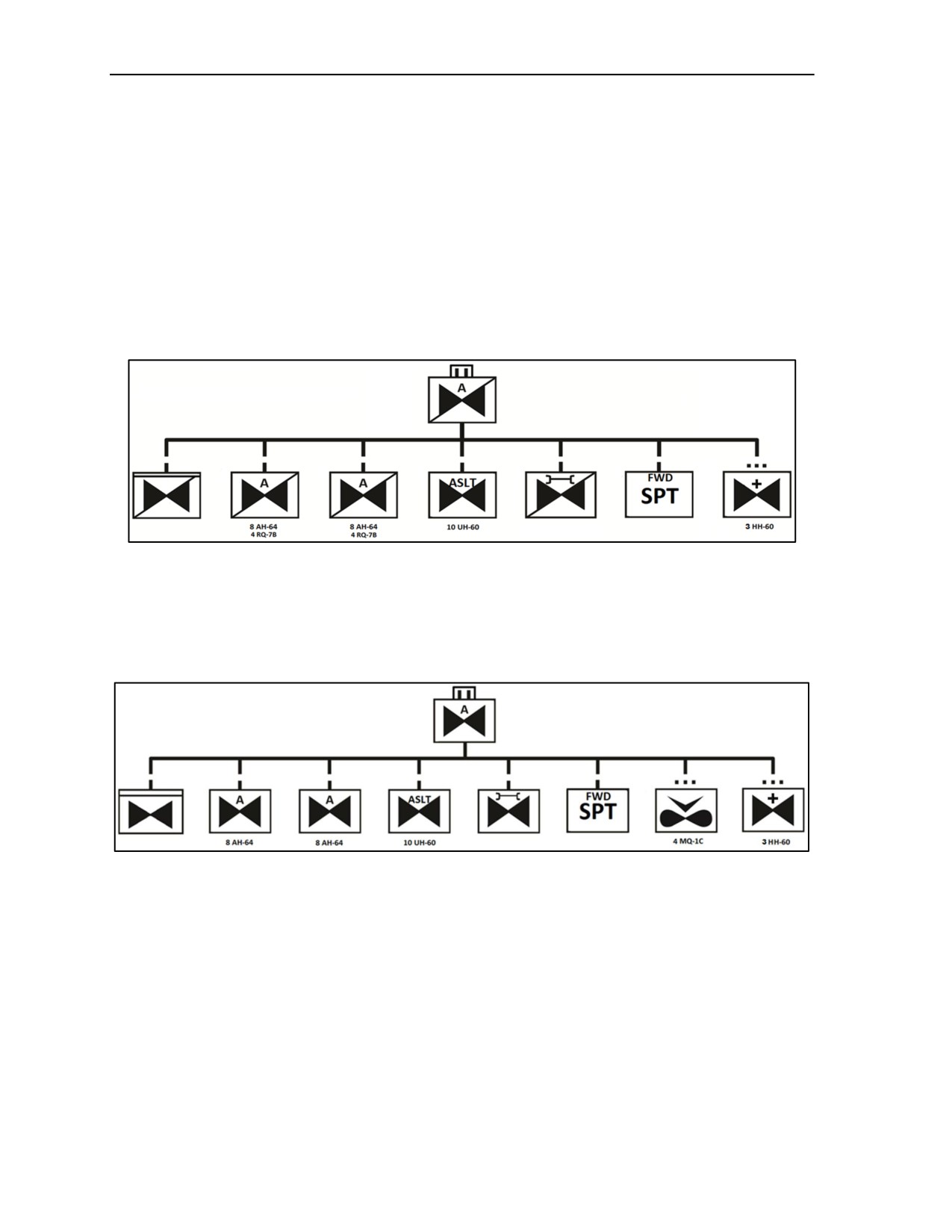
2-60. Figure 2-17 is an example of an ASTF that is built on an ARS HHT, aviation maintenance troop
(augmented) and FST with two organic ARTs and an attached AHC and forward support medical evacuation
platoon. This depicted ASTF is capable of conducting sustained reconnaissance, security, movement to
contact, aeromedical evacuation and attack operations, as well as, air movement and up to platoon level air
assaults.
Figure 2-17. Cavalry aviation squadron task force
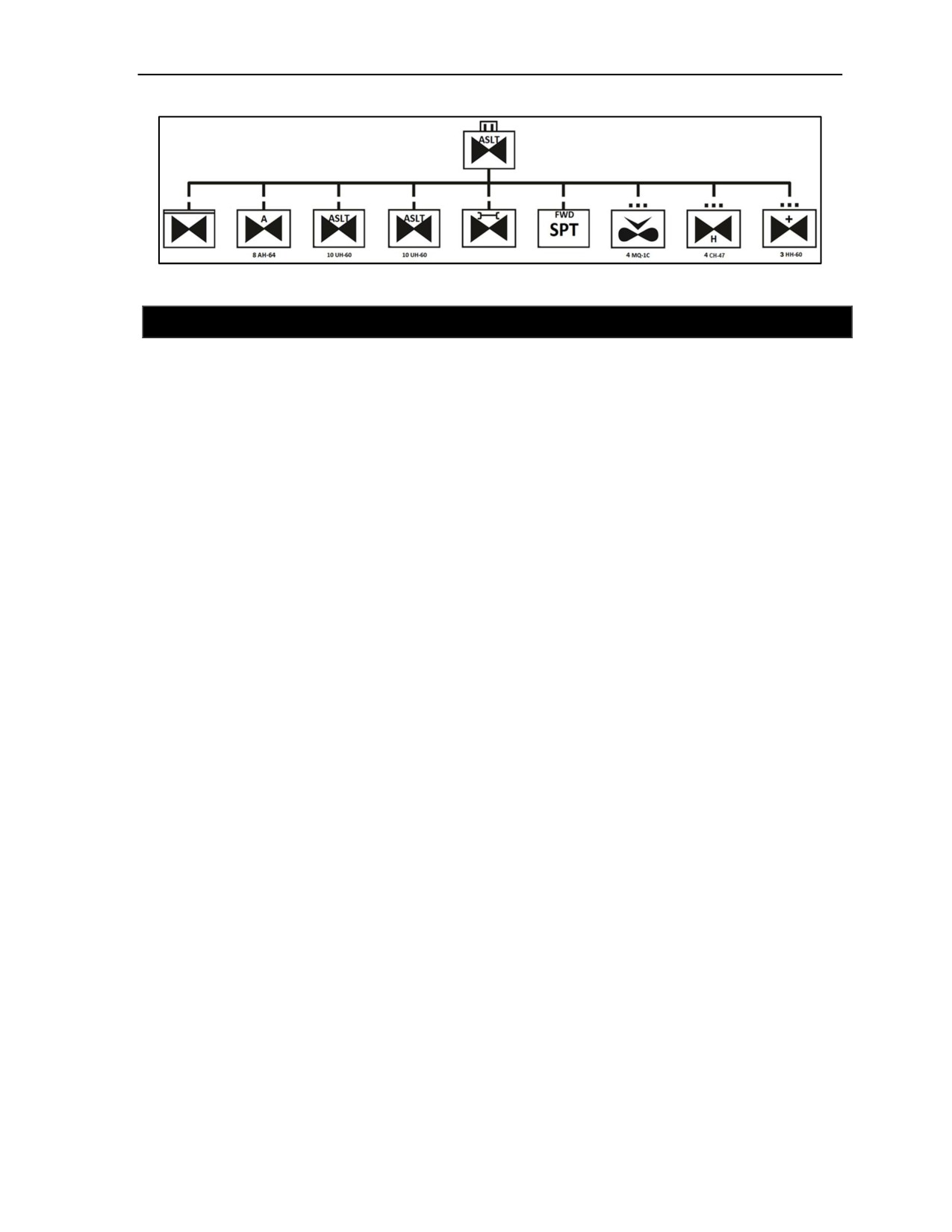
2-61. Figure 2-18 is one example of the composition of an attack-heavy ABTF. The foundation of the ABTF
is built on an ARB HHC, aviation maintenance company (augmented) and FSC, with two organic ARCs and
a Gray Eagle platoon, and an attached AHC and forward support medical evacuation platoon. The depicted
ABTF is capable of conducting attack, movement to contact, aeromedical evacuation, reconnaissance, and
security operations, as well as air movement and up to platoon level air assaults.
Figure 2-18. Attack aviation battalion task force
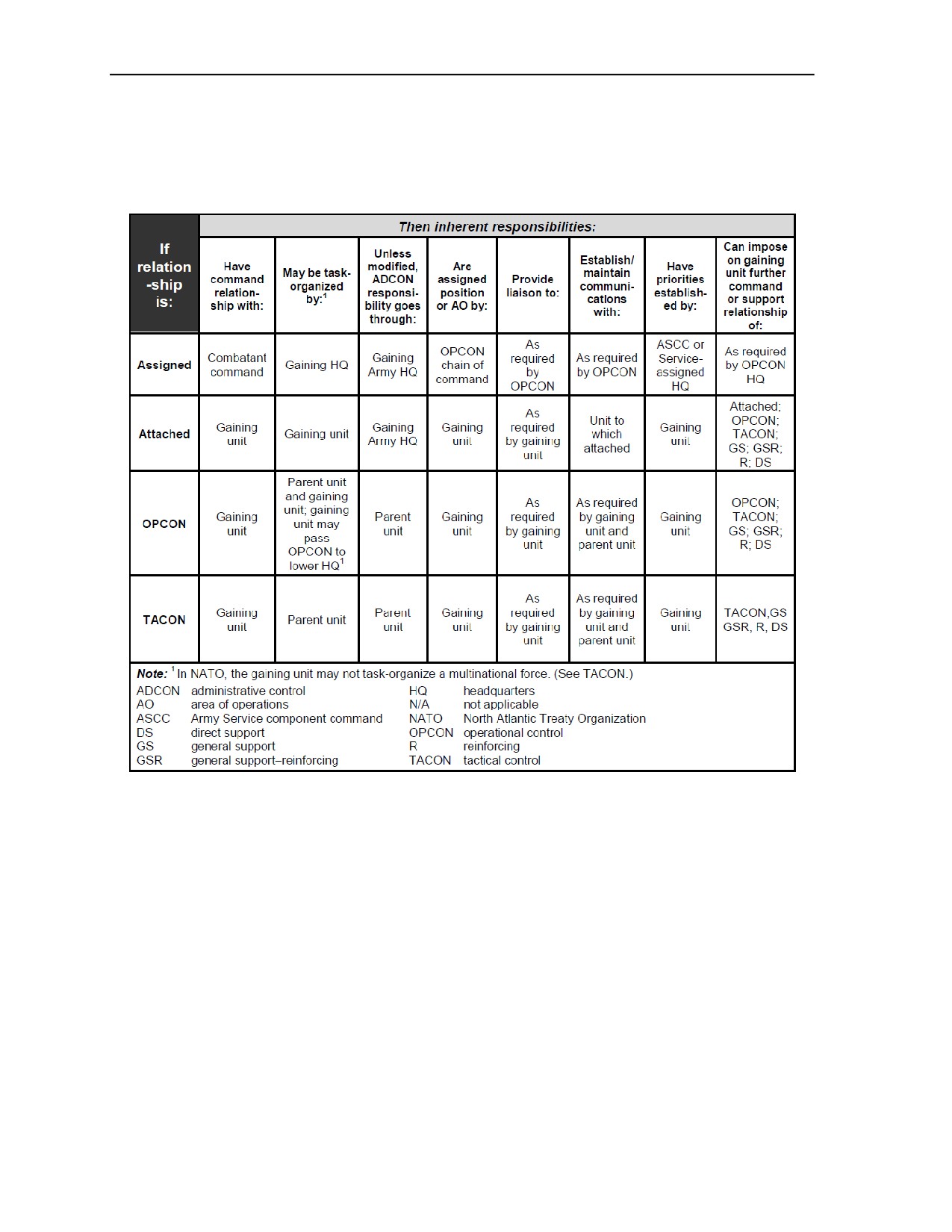
2-62. Figure 2-19, page 2-15, is an example of an assault-heavy ABTF. The foundation of the ABTF is built
on an AHB HHC, aviation maintenance company (augmented) and FSC, two organic AHCs, an attached
ARC, Gray Eagle platoon, heavy lift platoon and a forward support medical evacuation platoon. The depicted
ABTF is capable of conducting greater than a company-sized air assault, air movement, aeromedical
evacuation, as well as limited duration reconnaissance, security and attack operations.
2-14
FM 3-04
29 July 2015
Army Aviation Organizations and Mission Command
Figure 2-19. Assault aviation battalion task force
SECTION VI - COMMAND AND SUPPORT RELATIONSHIPS
2-63. Commanders build combined arms organizations using command and support relationships. Command
relationships define command responsibility and authority. Support relationships define the purpose, scope,
and effect desired when one capability supports another. Command and support relationships are fundamental
to effective air-ground operations. Operations orders placing units under command of a different headquarters
for any length of time must include a detailed summary of the relationship between the unit, its new
headquarters, and its parent unit. Typically, the smallest element Army Aviation detaches is a company sized
element with the exception of aeromedical evacuation assets which typically operate at the platoon level.
However, elements as small as platoons, teams and even individual aircraft may be cross-attached from one
Aviation formation and to another.
COMMAND RELATIONSHIPS
2-64. Command relationships for the ASTF/ABTF and subordinate units may be assigned, attached, or
placed under OPCON or TACON. The ABTF is only assigned OPCON or TACON to the combined arms
team when the ASTF/ABTF is to be used for a specific mission, and the effective time of the relationship is
short. Table 2-1, page 2-16, depicts command relationships.
ASSIGNED
2-65. Subordinates are assigned in order to place units or personnel in an organization where such placement
is relatively permanent, and/or where such organization controls or administers the unit or personnel for the
primary functions of the unit. Due to sustainment, standardization and safety requirements, aviation battalions
or ASTFs/ABTFs typically remain assigned to their parent CAB.
ATTACHED
2-66. Subordinates are attached when the placement of units or personnel in an organization is relatively
temporary. The commander of the unit that receives the attachment is responsible for the sustainment and
logistical support that is beyond the capability of the attached unit. An example of this relationship is an
aviation maneuver company that is attached to a sister aviation battalion to form an ASTF/ABTF.
OPERATIONAL CONTROL
2-67. OPCON is a command relationship that gives a commander the authority over subordinate forces to
organize and employ the forces, designate objectives, assign tasks, and give direction regarding
accomplishment of the mission. The commander exercising OPCON authority has no responsibility for
logistical sustainment of the supporting unit. A CAB may place an ABTF or company size unit OPCON to a
ground force for a specific mission requirement, usually of limited and short duration where no enduring
sustainment is required.
TACTICAL CONTROL
2-68. TACON is a command relationship that gives a commander authority over assigned or attached forces
or commands, or military capability or forces made available for tasking, which is limited to and is usually
29 July 2015
FM 3-04
2-15
Chapter 2
local direction and control of movements or maneuvers necessary to accomplish missions or assigned tasks.
The CAB frequently employs TACON during stability operations for short duration operations requiring a
high degree of air-ground operations, such as cordon and search or convoy security.
Table 2-1. Command relationships
SUPPORT RELATIONSHIPS
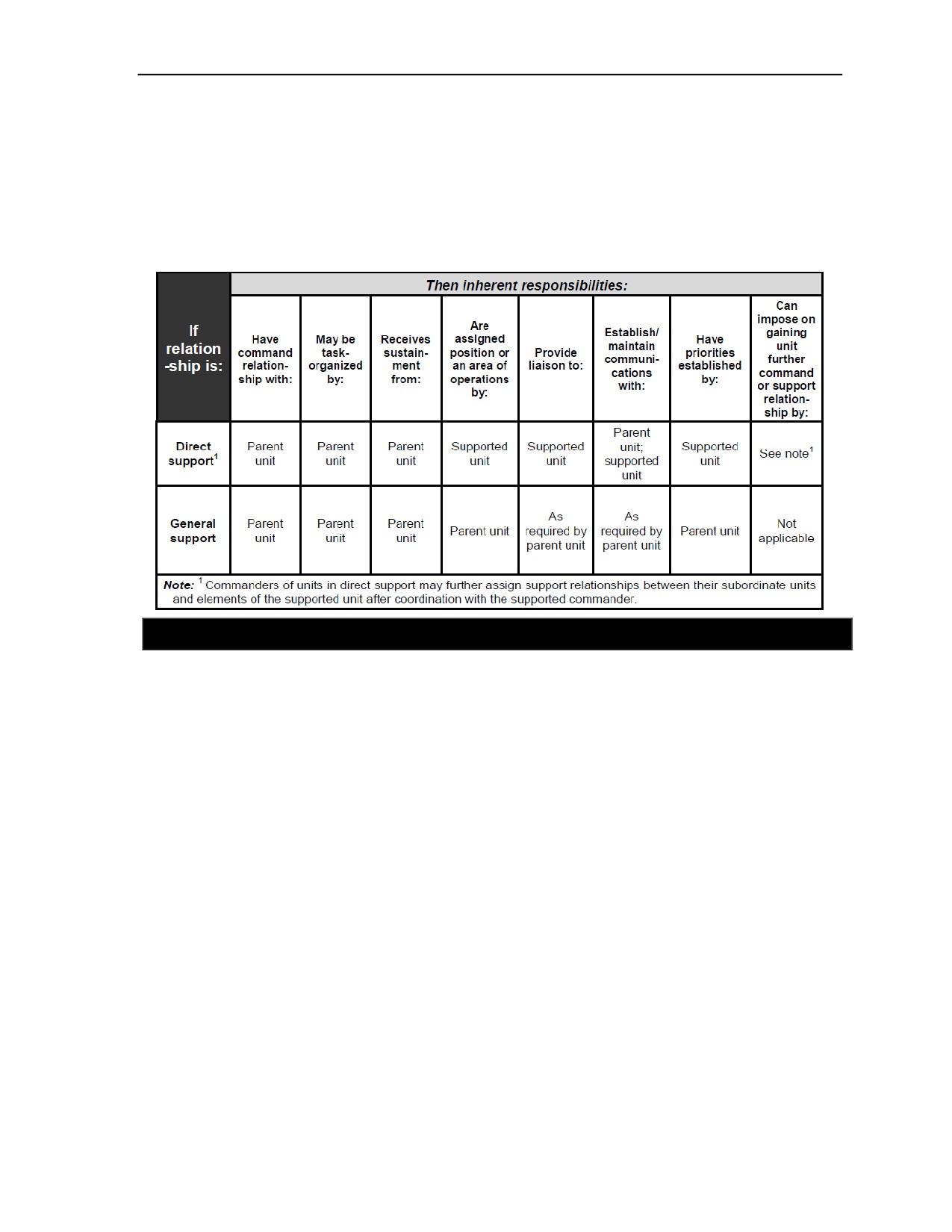
2-69. Support relationships are GS and direct support (DS). The aviation brigade or an ABTF may employ
utility and heavy lift assets in a GS role to conduct aerial sustainment by the movement of personnel and
equipment or aeromedical evacuation assets when area coverage of multiple units and AOs is required. An
ABTF is traditionally employed as DS to a BCT or higher headquarters. Table 2-2, page 2-17, depicts support
relationships.
DIRECT SUPPORT
2-70. DS is a support relationship requiring a force to support another specific force and authorizing it to
answer directly to the supported force's request for assistance. Army Aviation units may operate in a DS
support relationship allowing operations to be coordinated directly with the supported ground unit expediting
synchronization and improving effectiveness of the relationship. DS is typically the relationship established
when an ABTF is supporting a BCT or higher headquarters. This enables the CAB to effectively sustain the
ABTF and maintain the appropriate levels of safety, standardization and mission oversight.
2-16
FM 3-04
29 July 2015
Army Aviation Organizations and Mission Command
GENERAL SUPPORT
2-71. GS is the support that is given to the supported force as a whole and not to any particular subdivision
thereof. Army Aviation units may be placed in GS of several units. They receive GS missions from their
parent headquarters based upon support priorities established by the higher commander. When Army
Aviation units operate in a GS role, the ground maneuver unit must request support from the parent higher
headquarters of the aviation force.
Table 2-2. Support relationships
SECTION VII - AVIATION COMMAND POSTS
MAIN COMMAND POST
2-72. The main command post (CP) provides the aviation maneuver commander a central location to exercise
mission command. The main CP contains the necessary enablers to execute the operations process and to
control current operations.
2-73. The main CP is the primary mission command structure for the brigade and battalion. Its primary
missions are to control operations, maintain situational understanding, inform the commander’s decisions,
and prepare and publish orders and plans. The commander operates from the main CP when not operating
from the tactical CP, command vehicle, or an aircraft. The main CP’s primary functions include the
following:
z
Communicates and informs subordinate, higher, and adjacent units.
z
Informs and assists the commander and subordinate commanders.
z
Prepares and issues fragmentary orders, operation orders, operational plans, intelligence
summaries, intelligence reports, and situation reports.
z
Operates on a 24-hour basis.
z
Conducts future planning continuously.
z
Maintains running estimates continuously.
z
Maintains situational understanding and a common operational picture across the Army
warfighting functions.
z
Receives, evaluates, and processes combat information from subordinate units and higher
headquarters.
z
Maintains the necessary products to further the commander’s situational understanding.
z
Processes information into intelligence.
29 July 2015
FM 3-04
2-17
Chapter 2
z
Performs limited PED for UAS and AH-64 sensor data.
z
Conducts fire support planning.
z
Conducts airspace control planning and coordination.
z
Coordinates terrain management.
z
Coordinates and tracks sustainment requirements
(logistics, air and ground maintenance
capabilities, and status).
z
Makes recommendations to the commander.
z
Plans and orchestrates briefings, debriefings, and rehearsals.
TACTICAL COMMAND POST
2-74. The tactical CP is a facility containing a tailored portion of a unit headquarters designed to control
portions of an operation for a limited time (FM 6-0). The tactical CP is established to enhance mission
command of current operations and includes, at a minimum, operations, fires and intelligence staff
representatives. It can be deployed to higher or subordinate headquarters to facilitate parallel planning or
when extended distances preclude operation from the CP. The tactical CP must communicate with higher
headquarters, adjacent units, employed subordinate units, and the main CP. The tactical CP relies on the main
CP for planning, detailed analysis, and coordination.
2-75. The tactical CP is fully mobile and small in size to facilitate security and rapid and frequent
displacement. Its organizational layout, personnel, and equipment is mission variable dependent and should
be detailed in the unit standing operating procedures (SOPs).
2-76. While the S-3 section is responsible for the tactical CP, the tactical CP is normally comprised of the
command group, personnel from the intelligence staff officer (S-2) and operations staff officer (S-3), and the
fires cell. Augmentation may include the standardization officer, aviation mission survivability officer,
aviation safety officer, air liaison officer, and the personnel staff officer (S-1) and/or logistics staff officer
(S-4) (if the main CP is displacing).
SECTION VIII - AVIATION SPECIAL STAFF
2-77. Aviation organizations have a variety of unique special staff to assist the commander and other staff
members in performing their functional responsibilities. The aviation specific staff officers of note are the
aviation safety officer, the standardization officer, the aviation mission survivability officer, the master
gunner, the aviation materiel officer, the flight surgeon, and the medical operations officer.
AVIATION SAFETY OFFICER
2-78. The aviation safety officer is the primary advisor to the commander and staff on all safety matters
pertaining to unit operations and the health and welfare of personnel. The aviation safety officer monitors
and conducts hazard analysis of plans, training, operations and unit functional areas to advise commanders
on recommended corrective actions, policies, objectives, and priorities that improve performance.
STANDARDIZATION OFFICER
2-79. The standardization officer is a primary advisor to the commander for the aircrew training program.
The standardization officer is unique to aviation units in that he or she monitors and provides assistance to
the commander in the development and implementation of aircrew training programs and standardized
execution of unit mission essential tasks.
AVIATION MISSION SURVIVABILITY OFFICER
2-80. The aviation mission survivability officer is the primary advisor to the commander on the aviation
mission survivability program. This program encompasses combat survivability, combat aviation mission
analysis and planning, and PR operations. Combat survivability includes: aircraft survivability equipment
2-18
FM 3-04
29 July 2015
Army Aviation Organizations and Mission Command
and countermeasures, characterizing threat capabilities and limitations affecting the vertical scheme of
maneuver, and the combat tactics, techniques, and procedures of aviation forces.
AVIATION MASTER GUNNER
2-81. The aviation master gunner is the primary advisor to the commander for aircraft gunnery training
programs, to include helicopter door gunnery and UAS gunnery. While deployed in theater, the master gunner
manages helicopter gunnery training and sustainment as well as advises the commander and staff in the
selection of weapons, and employment techniques during the mission planning process.
AVIATION MATERIEL OFFICER
2-82. The aviation materiel officer is the commander’s primary advisor on generating aviation combat
power. The aviation materiel officer coordinates field and sustainment-level maintenance operations and
works closely with the staff and ASB support operations officer (SPO) to sustain aviation operations. The
aviation materiel officer monitors contract maintenance personnel and advises the commander on aircraft
modifications and safety-of-use, safety-of flight, aviation safety action messages, and other sustainment
related issues.
FLIGHT SURGEON
2-83. The flight surgeon advises the command on all aviation medicine matters to include flight status
qualification, support to aircrews, medical aspects of aircrew training, and monitoring the fit and use of
aviation life support equipment.
MEDICAL OPERATIONS OFFICER
2-84. The medical operations officer advises the commander and staff on medical evacuation operations.
They are responsible for planning medical evacuation operations, maintaining liaison with the medical
brigade and division patient movement cells, operating a medical evacuation control cell, and advising on
aircraft and patient movements.
SECTION IX - BRIGADE AVIATION ELEMENT
PURPOSE
2-85. The brigade aviation element (BAE) is a planning and coordination cell organic to all BCTs whose
purpose is to incorporate aviation into the ground maneuver commander’s scheme of maneuver. The BAE
focuses on providing employment advice and initial planning for aviation missions, UAS, airspace planning
and coordination, and synchronization with the tactical air control party and the fires cell.
ORGANIZATION
2-86. The BAE is comprised of the following aviation personnel:
z
Brigade aviation officer.
z
Assistant brigade aviation officer.
z
Aviation mission survivability officer.
z
UAS officer.
z
Operations sergeant.
z
Assistant operations sergeant.
z
Operations specialist.
29 July 2015
FM 3-04
2-19
Chapter 2
CAPABILITIES
2-87. The BAE performs the following tasks:
z
Integration and synchronization of aviation into the supported unit’s scheme of maneuver with
guidance from the CAB as necessary.
z
Employment planning advice for the employment of all manned and unmanned Army Aviation
units designated to support the BCT.
z
Tracking of the status of aviation assets in support of the BCT.
z
Direct coordination with CAB and aviation task forces.
z
Close integration and synchronization with liaison officers (LNOs) and fire support officers.
z
Airspace control planning and execution.
z
Enabling mission command of current operations.
SECTION X - AVIATION LIAISON TEAMS
PURPOSE
2-88. The aviation liaison team represents the supporting CAB or ASTF/ABTF at the supported maneuver
headquarters to conduct detailed planning and unit to unit coordination for the duration of a specific
operation. The CAB headquarters contains an aviation liaison team that facilitates coordination for operations
with higher headquarters and/or supported ground maneuver units. Aviation liaison teams are organic to the
aviation battalions and represent their units as directed to facilitate air-ground operations and planning.
Although a BAE conducts many of the functions traditionally performed by LNOs, the aviation liaison team
remains a critical part of the operations process and execution of air ground operations.
2-89. LNOs participate in the supported unit’s operations process ensuring aviation is effectively integrated
into planning. LNOs ensure supportability of the COA and relay a clear task and purpose to the parent
aviation unit. Battalion commanders empower LNOs to act on their behalf and ensure liaison teams are fully
resourced. LNOs maintain positive two-way communications with their parent aviation unit and do not
commit assets or approve changes to a plan without coordinating with the aviation battalion S-3 or
commander. LNOs perform the following tasks:
z
Understand and incorporate capabilities, limitations, and tactical employment of aviation and
assets.
z
Assist in the preparation of aviation estimates, plans, orders, and reports.
z
Assist in planning aviation missions.
z
Coordinate with airspace users and the higher airspace element for airspace management.
z
Maintain the operational status of aviation assets and their impacts on the supported unit’s mission.
z
Inform appropriate aviation units of current and possible future operations.
z
Maintain continuous communications with aviation units supporting the ground unit.
2-90. In general, the CAB sends a battalion-level LNO team to a supported ground maneuver battalion, since
ground maneuver battalions do not possess a BAE expert at that level. The LNO team should have
commissioned or warrant officers with operational experience in the employment of aviation assets for all
seven aviation core competencies. Their employment is temporary and mission specific since LNO team
members perform other staff functions within the ASTF/ABTF or CAB staffs.
CAPABILITIES
2-91. Liaison teams have access to current battalion status information to provide the most accurate common
operational picture of supporting aviation capabilities. Liaison teams are properly equipped and manned to
support 24-hour operations. Minimum equipment includes the following:
z
Compatible automation equipment to provide connectivity between supported unit and the
aviation battalion headquarters.
z
Necessary vehicles and equipment required to operate on the move.
2-20
FM 3-04
29 July 2015
Army Aviation Organizations and Mission Command
z
Two single channel air ground radio system radios and supporting antennas/equipment to monitor
command nets and communicate with aviation units.
z
Map of the AO with supporting battle-tracking tools and equipment.
z
Appropriate field manuals, Army tactics publications (ATPs), TCs, standard operating procedures,
charts, and checklists to assist in aviation planning and integration.
SECTION XI - AIRSPACE CONSIDERATIONS
2-92. Each operational area has specific operational requirements for airspace control. If/when assigned
responsibility for a volume of airspace, maneuver commanders exercise airspace control within their assigned
areas of operations through the integration of positive and procedural airspace control. In order to minimize
risk and maximize the effectiveness of Army Aviation, commanders must ensure detailed planning and
coordination with next higher airspace element in order to integrate their aircraft (manned and unmanned)
requirements into the airspace control plan and airspace control order (ACO).
2-93. Airspace control elements continuously monitor all airspace users to support their operations and those
transiting through the airspace over their AOs. This continuous situational awareness ensures that
commanders can react to any situation requiring immediate use of airspace to include unplanned aircraft
launch, aerial delivery of fires, immediate airspace control measures (ACMs), and indirect fire missions.
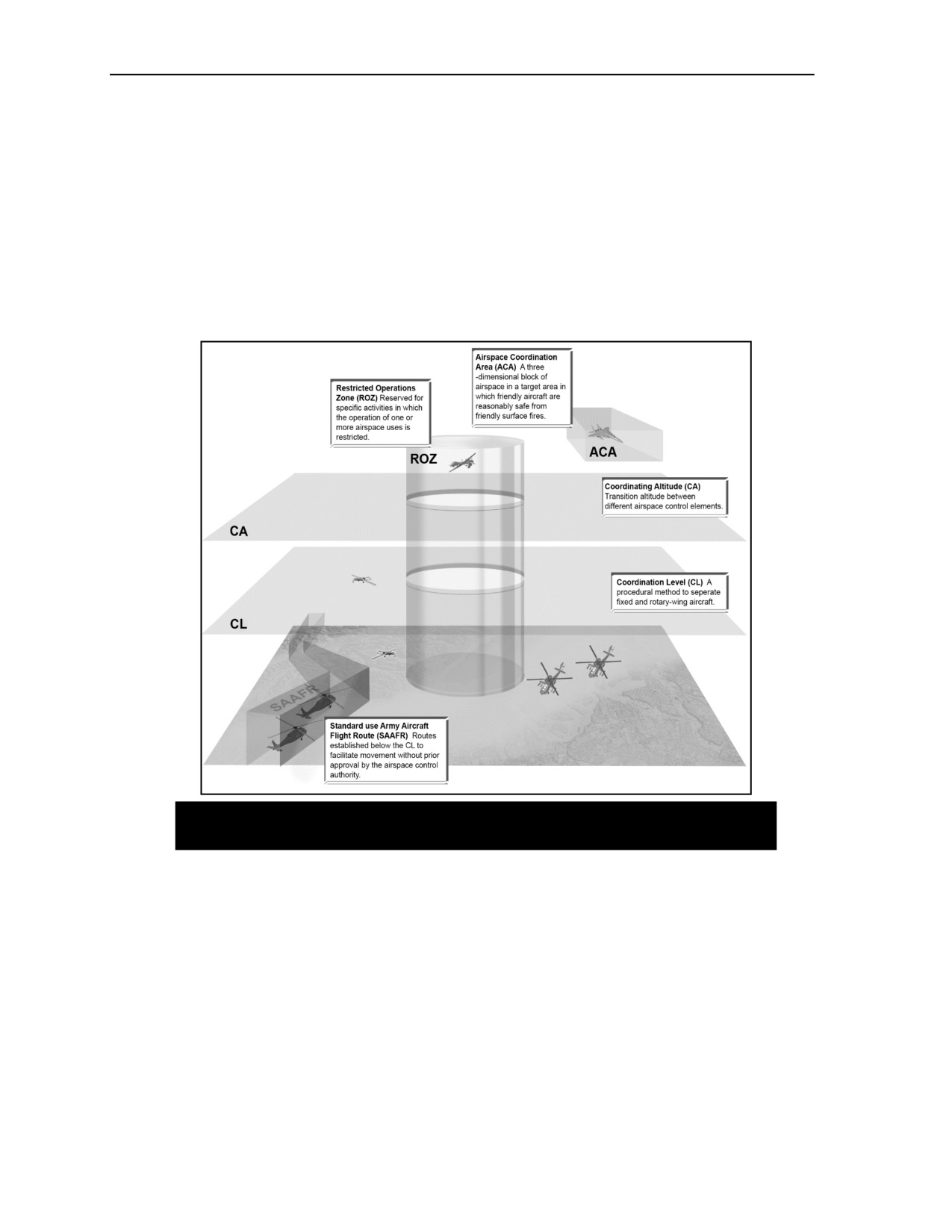
Common ACMs and fire support coordination measures for Army Aviation shown in figure 2-20, page 2-22,
are—
z
The coordinating altitude (CA) uses altitude to separate users and as the transition between
airspace control elements.
z
The coordination level (CL) is used to separate FW and rotary-wing aircraft by determining an
altitude below which FW aircraft normally does not fly.
z
The restricted operations zone (ROZ) is airspace reserved for specific activities in which the
operations of one or more airspace users are restricted.
z
Standard use Army aircraft flight routes (SAAFRs) are routes established below the CL to
facilitate movement without prior approval by the airspace control authority.
z
An airspace coordination area, a fire support coordination measure, is a three-dimensional block
of airspace in a target area in which friendly aircraft are reasonably safe from friendly-surface
fires.
z
All airspace users must coordinate with the appropriate airspace control elements when flying or
firing through a CA or CL.
2-94. The airspace element in the CAB is the air defense and airspace management (ADAM) cell located in
the brigade main CP, while in the BCT it is the ADAM/BAE. The ADAM cell has established links within
the theater air ground system, through the next higher airspace element and up to the airspace control
authority (ACA) normally located at an established air operations center. The ADAM cell integrates
information systems that interacts with the joint network (Link-16) to provide a three dimensional, joint,
integrated, near-real time, common air picture. With these systems, the ADAM cell coordinates immediate
and pre-planned ACMs as required to support operations. The ADAM cell receives airspace requirements
from brigade elements and coordinates these ACMs with the next headquarters airspace element. Pre-planned
ACMs are published on the ACO. Immediate ACMs are requested from subordinate brigade elements via
voice or digital communication and coordinated with the appropriate ACA designated airspace control
element and depicted on the common air picture when approved. The ADAM cell must continuously plan
for and monitor the operations of all airspace users that may affect the CAB or BCT operations.
2-95. When maneuvering Army Aviation, rotary-wing assets normally operate below the CL and UAS assets
operate above the CL using an air corridor, air route, or a ROZ. Army aircrews (rotary wing and UAS) must
contact the appropriate BCT when transiting that BCT AO for tactical, aircraft traffic, and procedural control
updates. When operating in controlled airspace such as division-assigned airspace, aircrews (rotary wing and
UAS) must contact the appropriate airspace control element.
2-96. When conducting the MUM-T TTP, UAS-extended endurance and unique launch/recovery
requirements may require attack weapons teams (ATWs)/Scout weapons teams (SWTs) to link up in flight.
29 July 2015
FM 3-04
2-21
Chapter 2
Once linked up, the AWT/SWT AMC assumes responsibility for the maneuvering of the UAS and directing
the UAS crew’s tactical focus. The UAS aircraft commander is still responsible for coordinating his
movement with the appropriate airspace element. Pre-coordination between UAS and AWT/SWT aircrews
to determine scheme of maneuver, engagement area (EA) development, frequency management, and crew
coordination prior to mission execution is critical to successful MUM-T operations. When conducting MUM-
T and required to engage with an armed UAS, the AMC is responsible for coordinating airspace (if not pre-
coordinated through pre-mission planning) that encompasses the UAS location, missile flight route, and
target location. When supporting a ground maneuver unit, the AMC coordinates the ROZ dimensions and
time with the ground maneuver commander and BCT ADAM cell. When assigned an AO, the AMC
coordinates the ROZ dimensions and time through the CAB ADAM cell. The CAB ADAM cell needs to
communicate regularly with the BCT ADAM cell to coordinate and relay ACMs required to maintain
situational awareness for the CAB commander.
Figure 2-20. Common Army airspace coordinating measures
2-22
FM 3-04
29 July 2015
Chapter 3
Army Aviation Operations
SECTION I - OVERVIEW
3-1. Army Aviation conducts air-ground operations (AGO) as the aerial maneuver force of the combined
arms team, or as an independent maneuver force in support of ground forces conducting offensive, defensive,
stability, and defense support of civil authorities (DSCA) operations. Regardless of the type of mission
performed by the ground force, most
aviation operations are offensive in nature
Table 3-1. Core competencies of Army Aviation
and designed to provide an asymmetric
The seven core competencies of Army Aviation are:
advantage. This enables the combined
Provide accurate and timely information collection on the
arms team to gain and maintain situational
enemy, terrain, local populations and friendly forces.
understanding, control operational tempo,
Provide reaction time and maneuver space.
achieve the element of surprise, seize,
Destroy, defeat, disrupt, divert, or delay enemy forces.
retain, and exploit the initiative, present the
Air assault ground maneuver forces.
enemy with multiple dilemmas, gain
Air move personnel, equipment, and supplies.
positions of relative advantage over an
Evacuate wounded or recover isolated personnel.
enemy force, and/or to prevent an enemy
Enable mission command over extended ranges and
force from gaining a position of relative
complex terrain.
advantage. Army Aviation’s seven core
competencies (table 3-1) are executed through the following tactical, enabling, and sustaining tasks:
movement to contact, attack, reconnaissance, security, air assault, mission command support, personnel
recovery (PR), air movement, and aeromedical evacuation.
SECTION II - MOVEMENT TO CONTACT
3-2. A movement to contact is an offensive task designed to develop the situation and establish or regain
contact. It prevents the premature commitment of friendly combat power. Executing a movement to contact
enables freedom of action to develop the situation and create favorable conditions to conduct subsequent
tactical or enabling tasks either by the force conducting the movement to contact or a follow on main body
force. The speed, range, lethality, long range communications and persistent reconnaissance capabilities of
Army Aviation attack reconnaissance units, using
manned-unmanned teaming
(MUM-T), make
Table 3-2. Fundamentals of a movement to
them ideally suited to conduct movement to
contact
contact. Army Aviation executes movement to
contact at the platoon to battalion or squadron
Focus all efforts on finding the enemy.
level, either independently, or as a member of the
Gain enemy contact early with the smallest
combined arms team. In either case, the
reconnaissance force within the allotted time.
movement to contact is organized with the
Maintain contact and fix the enemy while retaining
the freedom of maneuver to prevent premature
smallest acceptable security force forward to
commitment of the protected force.
initially gain and maintain contact with the enemy
Maintain adequate follow on combat power to
and a separate force capable of developing the
rapidly develop the situation after gaining enemy
situation based on the size of the expected enemy
contact.
force and commander’s intent. The fundamentals
Destroy, defeat, disrupt, divert, or delay enemy
of the aviation movement to contact in table 3-2
forces within capability or conduct battle handover
provide the framework for planning and
or bypass in accordance with the commander’s
intent.
execution.
3-3. Attack reconnaissance units plan and execute a zone reconnaissance with an enemy force oriented
focus as their part of a larger unit movement to contact. Terrain reconnaissance is only conducted as necessary
29 July 2015
FM 3-04
3-1
Chapter 3
to enable the follow on force assigned to develop the situation to execute subsequent tasks. The zone
reconnaissance is executed as rapidly as the terrain and enemy situation permits.
3-4. To maintain continuous reconnaissance, the attack reconnaissance unit rotates attack weapons teams
(AWTs) or Scout weapons teams (SWTs), as necessary. Continuous rotations of these teams in conjunction
with UAS, increases the depth and breadth of this aviation reconnaissance effort. It also enhances the
survivability of aviation assets, and enables persistent reconnaissance in zone with increased capability to
gain and maintain enemy contact and more options to develop the situation with maneuver and fires.
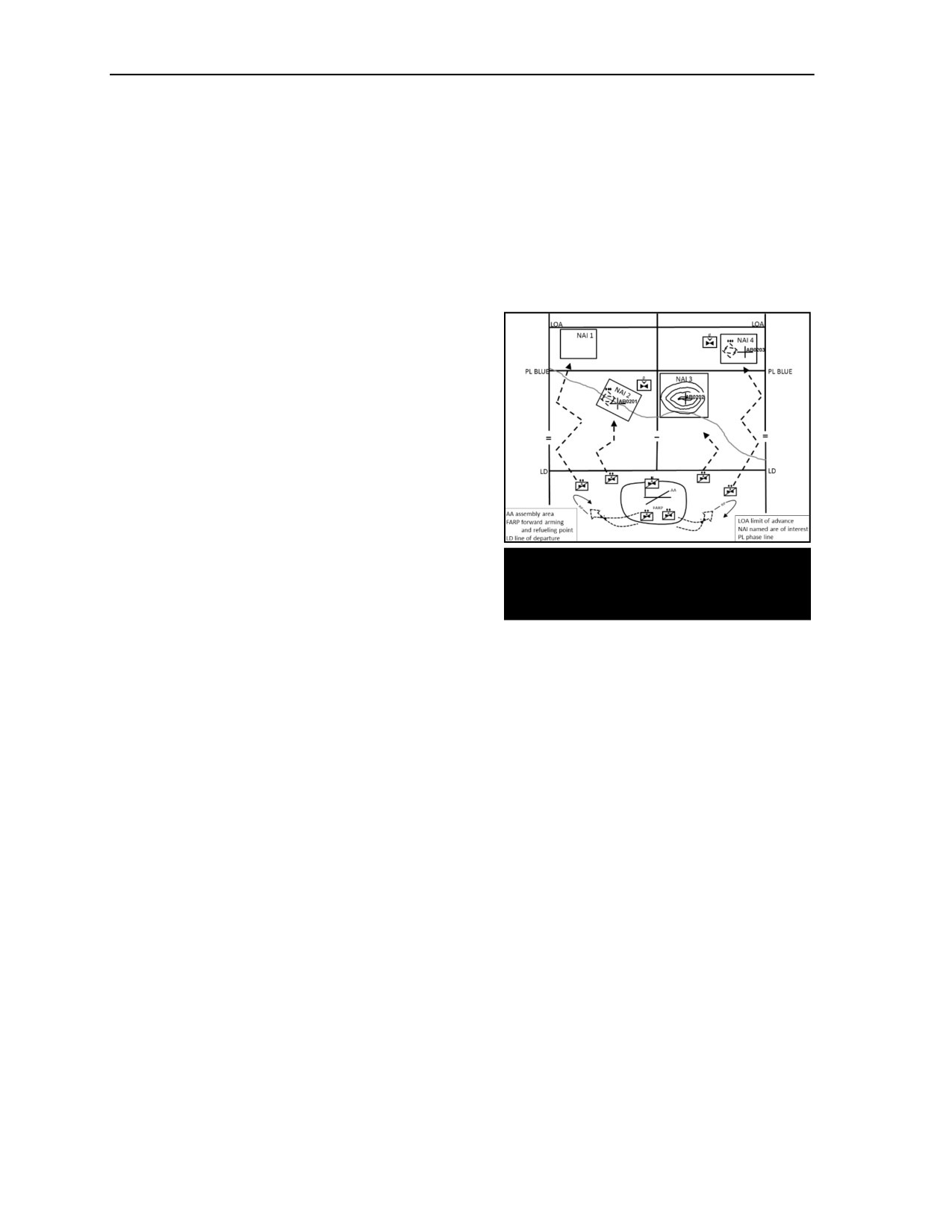
3-5. Once the attack/reconnaissance unit gains contact with the enemy, its aircraft deploy into locations
where they may continue to maintain contact and report the situation. The unit commander evaluates and
develops the situation. The commander then chooses a follow on COA based on the size and composition of
the enemy force and higher commander’s intent. The
aviation unit will execute the selected COA while
simultaneously recommending a COA to the higher
commander. If the size or composition of the enemy
force meets bypass criteria, the enemy is reported and
bypassed to continue the movement to contact. Normally
the unit will keep the bypassed force under observation.
This observation can be maintained using unmanned
systems. If the size and composition of the enemy force
meets engagement criteria the aviation unit commander
may attack to disrupt, defeat or destroy the enemy. The
unit may transition to a screen if the enemy force is too
large, or conduct a battle handover to a ground maneuver
force to further develop the situation. Figure
3-1
provides an example of movement to contact.
Figure 3-1. Attack reconnaissance
squadron conducts movement to
3-6. The aviation unit’s intelligence preparation of the
contact using MUM-T
battlefield
(IPB) effort focuses on determining the
characteristics of the AO that influence friendly and
enemy operations. This includes determining the likely composition, capabilities and most likely and most
dangerous courses of action of the enemy force. When the expected enemy contact is a mounted enemy force
that is expected to be moving, IPB focuses on high speed avenues of approach and cross mobility corridors
to gain greater understanding of the physical environment to enable rapid execution. When the enemy force
is dismounted and expected to be on the move, IPB is focused on determining dismounted avenues of
approach or infiltration routes. When operating against a defending or stationary enemy force, IPB focuses
on the best defensible terrain or areas that the enemy may use as cover and concealment for his main body
and security elements. IPB should also focus on natural obstacles, known manmade obstacles and the terrain
that is best suited for the emplacement of enemy obstacles that may disrupt friendly ground maneuver. If a
battle handover to ground units is expected, IPB should also focus on the terrain that enables effective battle
handover on the terrain most favorable for friendly ground maneuver forces to develop the situation.
3-7. When planning the scheme of maneuver, the Aviation commander controls the operation by using
phase lines (PL), objectives, contact points, checkpoints, and NAIs. Such control measures allow for
decentralized actions and small-unit initiative to the greatest extent possible. The Aviation commander
controls the depth of the movement to contact by using a limit of advance (LOA) or a forward boundary and
may designate one or more objectives (OBJ) to orient the force or limit the extent of the movement to contact.
3-8. The supported higher commander delineates bypass criteria, engagement criteria, and battle handover
criteria, as well as a desired end state to enable disciplined initiative in execution. This guidance is tied to
how the movement to contact enables the main body to accomplish subsequent tasks. Considerations for
determining these criteria include: available combat power, the anticipated size and capability of the enemy
force, proximity of friendly forces and their capabilities to further develop the situation, depth and breadth
of the area of operation, and availability of Army and joint fires. Based on the complexity of the operational
environment and expected size of the enemy force, the planning, prioritization and use of joint fires may be
required to successfully complete the mission and prevent premature decisive engagement or commitment of
the follow on force.
3-2
FM 3-04
29 July 2015
Army Aviation Operations
3-9. The Aviation unit commander determines the location and number of forward arming and refueling
points (FARPs) and UAS launch and recovery locations based on the depth and breadth of the AO, time
allocated, size of the Aviation force and the supported commander’s intent. The FARP and UAS launch and
recovery locations support relief on station to maintain continuous reconnaissance and develop the situation
to transition to subsequent tasks.
3-10. The inherent risks with movement to contact are driven by the unknown enemy situation, complexity
of continuous reliefs on station, battle handover transitions, and the hasty nature of developing the situation
while in contact. To mitigate risk, Aviation commanders should—
z
Use the minimal security force required to gain contact while accomplishing the mission within
the allotted time.
z
Maximize the use of UAS forward to provide reaction time and maneuver space.
z
Provide subordinates with control measures for not only their own areas of operations but also
adjacent areas of operations to control and deconflict maneuver and fires.
z
Develop and coordinate ACMs to enable freedom of action of manned and unmanned systems.
z
Plan and employ joints fires through the depth of the zone.
z
Employ communications relay packages, Army Airborne Command and Control System or
Airborne Battle Command Console aircraft to maintain communications over extended distances.
z
Position FARPs, UAS launch locations, and holding areas (HAs) forward to enable rapid turns of
combat power once enemy contact is gained.
z
And most importantly, use speed and audacity to develop the situation upon gaining contact.
SECTION III - ATTACK
3-11. Army Aviation attack reconnaissance units, employing MUM-T, conduct attacks in support of
offensive, defensive and stability operations throughout the depth of the AO. This is done either as a decisive
or shaping operation in support of ground forces.
3-12. Army Aviation conducts attacks at multiple echelons. These can range from elements as small as attack
or scout weapons teams using MUM-T, or a single armed UAS, up to the battalion or squadron level.
3-13. Army Aviation attacks are executed in support of friendly forces in close enemy contact or against
enemy forces out of contact with friendly forces. Both can be executed as either hasty or deliberate attacks
and are typically supported with integrated joint fires. The methods of employment are solely driven by
whether a friendly ground maneuver force is in direct contact with the targeted enemy force or not, which
further determines who controls the aviation maneuver and fires. Regardless of the methods employed, the
tactical task assigned to the attack reconnaissance unit is attack to destroy, defeat, disrupt, divert, or delay.
The higher commander’s choice of operational framework is not used to describe the type of attack tactics,
techniques, and procedures (TTP) employed.
3-14. To ensure success, Army Aviation attacks with the necessary combat power, tempo and intensity to
overwhelm the enemy force. Audacity, speed, concentration of combat power at the right time and place,
violence of execution, simultaneity of joint fires with ground and air maneuver, and maximizing the element
of surprise are all essential components of successful Army Aviation attacks.
ATTACKS AGAINST ENEMY FORCES IN CLOSE FRIENDLY CONTACT
3-15. Army Aviation, maneuvering as a member of the combined arms team, conducts attacks that enable
friendly ground maneuver forces in close enemy contact to seize, retain, or exploit the initiative. These attacks
can be either hasty or deliberate attacks based on the amount of time available to plan, prepare and execute.
Regardless of the time available, the ground maneuver commander in close enemy contact controls the
synchronization and integration of Army Aviation maneuver and the distribution and deconfliction of Army
Aviation fires.
3-16. Attacks in support of friendly units in close contact enable the higher commander to bring Army
Aviation combat power to bear simultaneously with other elements of combat power within the combined
arms team. The combined effects of aerial and ground fire and maneuver increases the combined lethality
29 July 2015
FM 3-04
3-3
Chapter 3
and protection of the combined arms team, enabling the commander to present the enemy with multiple
dilemmas while dictating the tempo of operations to gain and maintain a position of relative advantage.
3-17. Hasty or deliberate attacks on enemy forces in close contact with friendly forces are executed at each
Army Aviation maneuver echelon from an AWT/SWT using MUM-T, or a single armed UAS, up to elements
as large as a battalion or squadron. Ground commanders that plan for the possible employment of both hasty
and deliberate attacks throughout the depth of their close fight scheme of maneuver increase the likelihood
of success and reduce the risk of fratricide. Hasty attacks provide the combined arms team with the agility,
mobility and firepower to rapidly respond to unexpected enemy contact. However, hasty attacks should be
in extremis and not relied on to overcome a lack of planning for the employment and full integration of Army
Aviation attacks in the ground scheme of maneuver during the operations process. Deliberate attacks are
interdependent and fully integrated in the ground scheme of maneuver. This integration enables the maneuver
commander to maximize all available combat power at the chosen place and time.
3-18. The continuum of attacks against enemy forces in contact ranges from hasty attacks with AWTs against
an unexpected close contact between friendly and enemy forces, to a deliberate attack with an attack battalion
as part of a planned and integrated combined arms scheme of maneuver in the close fight. Some examples of
this continuum of attacks include, but are not limited to—
z
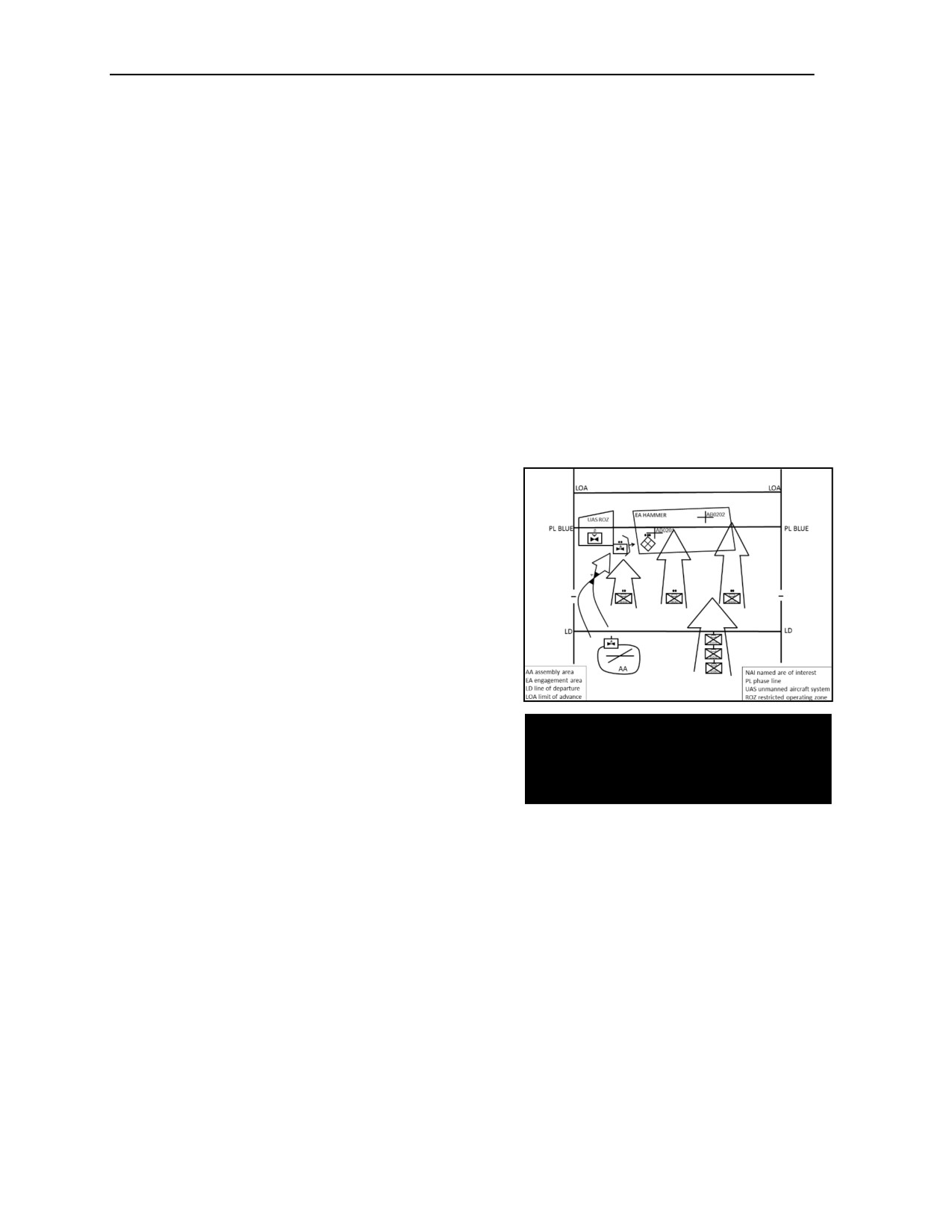
An AWT using MUM-T attacks to destroy an enemy platoon in close contact with a Stryker Scout
Platoon conducting security operations as the lead element of a battalion movement to contact.
During the operations process, the Stryker
battalion staff conducts detailed planning to
integrate Army Aviation attacks on known and
templated enemy forces throughout the depth of
the battalion’s AO. To ensure agility, freedom of
action and disciplined initiative, the Stryker
battalion staff in coordination with the
supporting aviation staff or LNO team, plans
detailed control measures in zone, to include
ACMs, attack by fire (ABF) positions, attack
routes, fire support coordination measures, HAs,
engagement criteria, and triggers and conditions
for employment. Once triggered, the AWT
attacks along preplanned routes to an ABF
position to destroy the enemy platoon, enabling
the Stryker battalion’s elements to maintain
Figure 3-2. Deliberate attack by an
tempo and freedom of action to continue to
attack weapons team in support of a
maneuver and gain contact with the enemy main
Stryker battalion conducting a
body (figure 3-2).
movement to contact
3-4
FM 3-04
29 July 2015
Army Aviation Operations
z
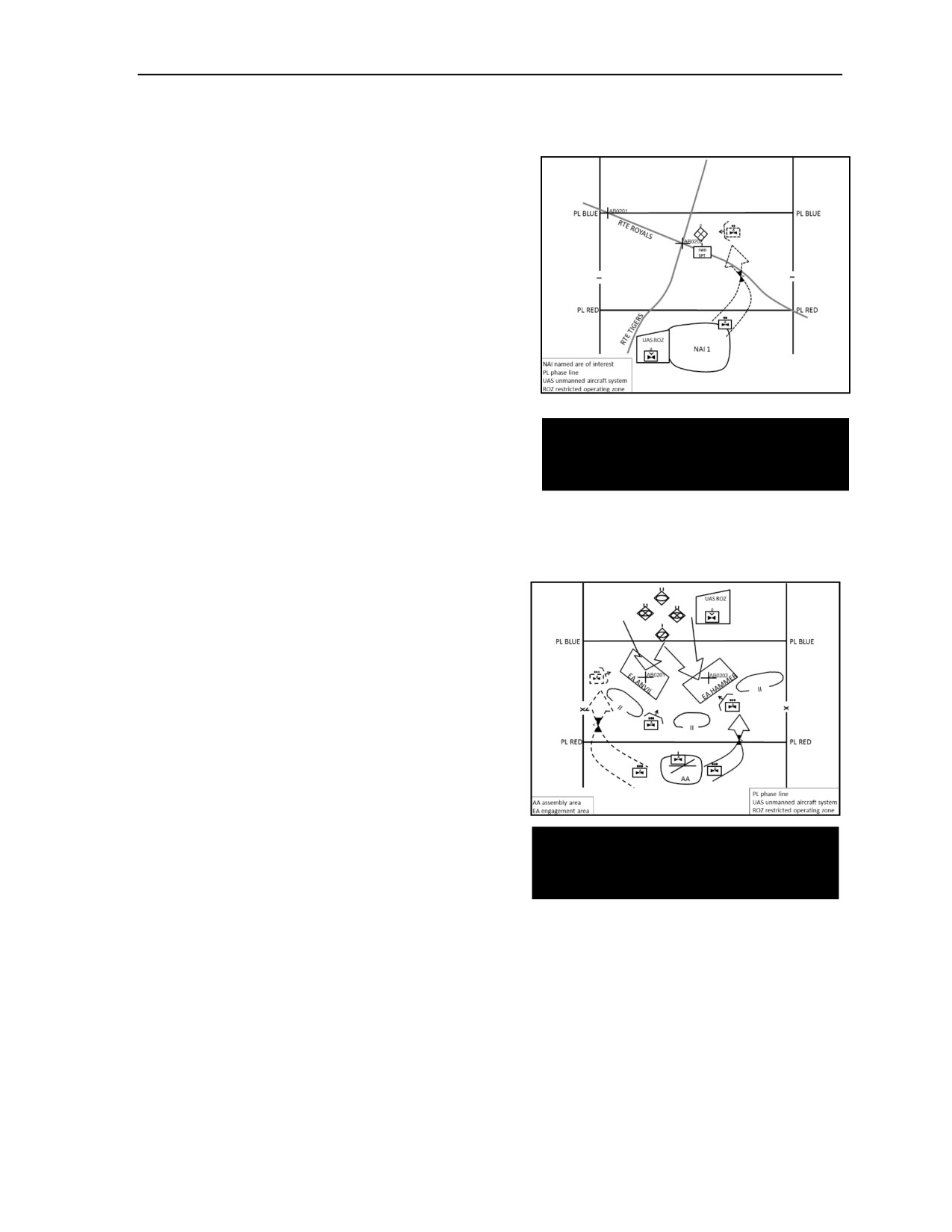
An AWT using MUM-T conducting area reconnaissance is dynamically retasked by the supported
higher headquarters to conduct a hasty attack in reaction to troops in contact between an
unexpected enemy dismounted force and a
friendly combat logistics patrol. Upon
retasking, the air mission commander directs
the UAS operator to continue the area
reconnaissance mission and repositions the
AWT to the location of the contact. The
commander of the combat logistics patrol uses
the standard Army attack aviation call for fire
(table A-2, appendix A) to enable the team to
conduct the hasty attack. The AWT gains
situational understanding of the friendly and
enemy forces and attacks to destroy the enemy
force under the control of the ground
commander in contact. The destruction of the
enemy force enables the combat logistics patrol
to break contact and continue mission (figure
Figure 3-3. Hasty attack by an attack
3-3). Following the attack, the AWT AMC
weapons team reacting to troops in
provides battle damage assessment, reports to
contact
higher and repositions to continue the area
reconnaissance mission as directed.
z
An attack reconnaissance company, employing MUM-T, attacks in support of a brigade combat
team (BCT) area defense to destroy the advance guard of an attacking enemy force in a preplanned
engagement area located in the BCT’s main
battle area. The purpose of the attack is to
prevent the enemy from penetrating the
defense and gaining a position of relative
advantage. The BCT staff, in coordination
with the supporting attack reconnaissance
battalion, staff or aviation LNO team, plans
the attack with pre-planned attack routes with
timed passage of lines, engagement areas
with layered target reference points,
integrated joint fires and multiple ABF
positions to effectively engage and destroy
the advancing enemy force through the depth
of the engagement area. The movement of the
enemy force in relation to UAS observed
Figure 3-4. Deliberate attack by an
NAIs triggers the timing of the attack (figure
attack/reconnaissance company in
3-4). The detailed planning and support from
support of a BCT’s area defense
higher echelons of command enables the
success of this interdependent and fully
integrated deliberate attack against an enemy force in close contact with friendly forces.
29 July 2015
FM 3-04
3-5
Chapter 3
3-19. During the planning process, the ground maneuver commander integrates the employment of attack
reconnaissance unit attacks into the scheme of maneuver to ensure their responsiveness, synergy and agility
during actions on the objective or upon contact with the enemy. Pre-mission development of control measures
provides a foundation for the successful integration of Army Aviation into the unit’s operations. Among these
control measures are engagement criteria; the triggers and conditions for execution; fire coordination
measures, such as target reference points; engagement areas and target reference points; and ACMs, such as
aerial ingress and egress routes and restricted operating zones.
3-20. Shared understanding within the combined arms team, through known standardized procedures and
habitual training, increases the likelihood of successful employment of attack reconnaissance units against
enemy forces in close contact with friendly forces. However, during in extremis situations, Army Aviation
attack reconnaissance units may conduct hasty attacks in support of all friendly ground units regardless of
their training level or habitual relationship, but with greater risk. The use of the standardized Army attack
aviation call for fire (table A-2, appendix A) ensures the minimum mission essential information is provided
from the ground commander in contact to the attack aviation air mission commander.
3-21. To maintain shared understanding and to prevent burdening the ground force commander in contact
during execution, the attack reconnaissance unit conducting hasty and deliberate attacks against enemy forces
in contact monitors on the primary supported ground unit voice command net and uses mission command
information systems (such as Blue Force Tracker) to gain and maintain situational understanding of friendly
forces. Use of these systems and effective pre-mission planning enables Army Aviation attack reconnaissance
units to rapidly execute actions on contact, and mitigates the risk of fratricide.
3-22. When conducting attacks against enemy forces in contact, targets may range from hundreds of meters
to several thousand meters from friendly forces. The attack reconnaissance unit uses terrain and the mutual
protection of ground maneuver forces to vary attack headings to remain unpredictable and limit exposure to
enemy fires. Once the engagement is complete, the attack reconnaissance unit air mission commander
provides the ground commander with a battle damage assessment. The air mission commander also provides
a follow-on recommendation, such as re-attack, execution of a follow-on task, or end-of-mission.
ATTACKS AGAINST ENEMY FORCES OUT OF FRIENDLY
CONTACT
3-23. Army Aviation rotary wing and UAS, maneuvering independently against an enemy force not in close
contact with friendly ground maneuver forces conducts hasty or deliberate attacks to divert, disrupt, delay or
destroy enemy capabilities before they can be brought to bear effectively on friendly forces. The Army
Aviation AMC controls the maneuver and fires of Army Aviation within an AO assigned by a higher
headquarters but the attack is still synchronized and/or integrated with the overall higher ground scheme of
maneuver. The higher headquarters that assigns the attack mission coordinates the required airspace with the
appropriate ACA.
3-24. These attacks are conducted at such a distance from friendly forces that detailed integration with
ground forces during actions on the objective is typically not required. Based on the nature of the target and
complexity of the operational environment, Army Aviation attacks against enemy forces out of contact may
be conducted as hasty attacks but most often are deliberate attacks that require detailed planning and the full
integration of manned and UAS, and the simultaneous or sequential employment of close air support, indirect
fires, and other enabling capabilities to mass effects, isolate, and destroy key enemy forces and capabilities.
3-25. Based on the mission and operational variables, attacks against enemy forces out of friendly contact
range from relatively low risk to extremely high-risk operations. They may be conducted by attack
reconnaissance elements ranging in size from a single armed UAS up to one or more attack reconnaissance
battalions or squadrons. The greater the distance, the greater the threat, the lower the target fidelity and the
more complex the target, the higher the mission risk and the more detailed the planning and integration
required by the assigning headquarters. Higher mission risk requires the supported higher headquarters to
prioritize required enabling capabilities to enable continuous reconnaissance, continuous target development,
and in depth integration of joint fires with detailed rehearsals and conditions checks prior to execution.
Consideration must also be given to how long attack assets are committed to higher risk attacks and weighed
against the totality of the operational risk to other ongoing or pending operations. The decision to execute
3-6
FM 3-04
29 July 2015
Army Aviation Operations
attacks against enemy forces out of friendly contact must be based on the overall operational risk versus the
reward of successful execution within the higher headquarters scheme of maneuver.
3-26. These attacks are typically deliberate attacks but, based on mission variables, may also be executed as
hasty attacks against emerging enemy targets of opportunity. If the enemy target is high payoff and outweighs
the risk of friendly losses or if the enemy threat to Aviation is known to be acceptable for hasty operations,
hasty attacks against enemy forces out of contact can be effective in seizing emerging opportunities to prevent
the enemy from gaining a position of relative advantage.
3-27. Army Aviation units attack enemy forces out of friendly contact throughout the depth and breadth of
an AO. They may be conducted beyond the forward line of own troops (FLOT) in linear, contiguous areas
of operation; in deep areas between non-linear and non-contiguous areas of operation; in close or security
areas inside large non-linear and contiguous areas of operation where ground forces are not present or not in
contact with the targeted enemy force; or in joint or special operations areas of operation where friendly
ground or surface forces are not present or not in contact with the targeted enemy force.
3-28. Hasty and deliberate attacks against enemy forces out of friendly contact are executed in support of
higher ground maneuver headquarters that can develop the target fidelity and provide enablers to support the
attack and can assign a subordinate AO to the attack reconnaissance unit. This is usually no smaller than a
ground maneuver battalion and is more typically a BCT, division or corps/Joint Force Land Component
Command headquarters. Examples of hasty and deliberate attacks against enemy forces out of contact with
friendly forces, from generally the lowest risk with the least required planning and synchronization efforts,
to very high risk operations that require detailed planning and the full range of joint fires and intelligence
capabilities include, but are not limited to—
z
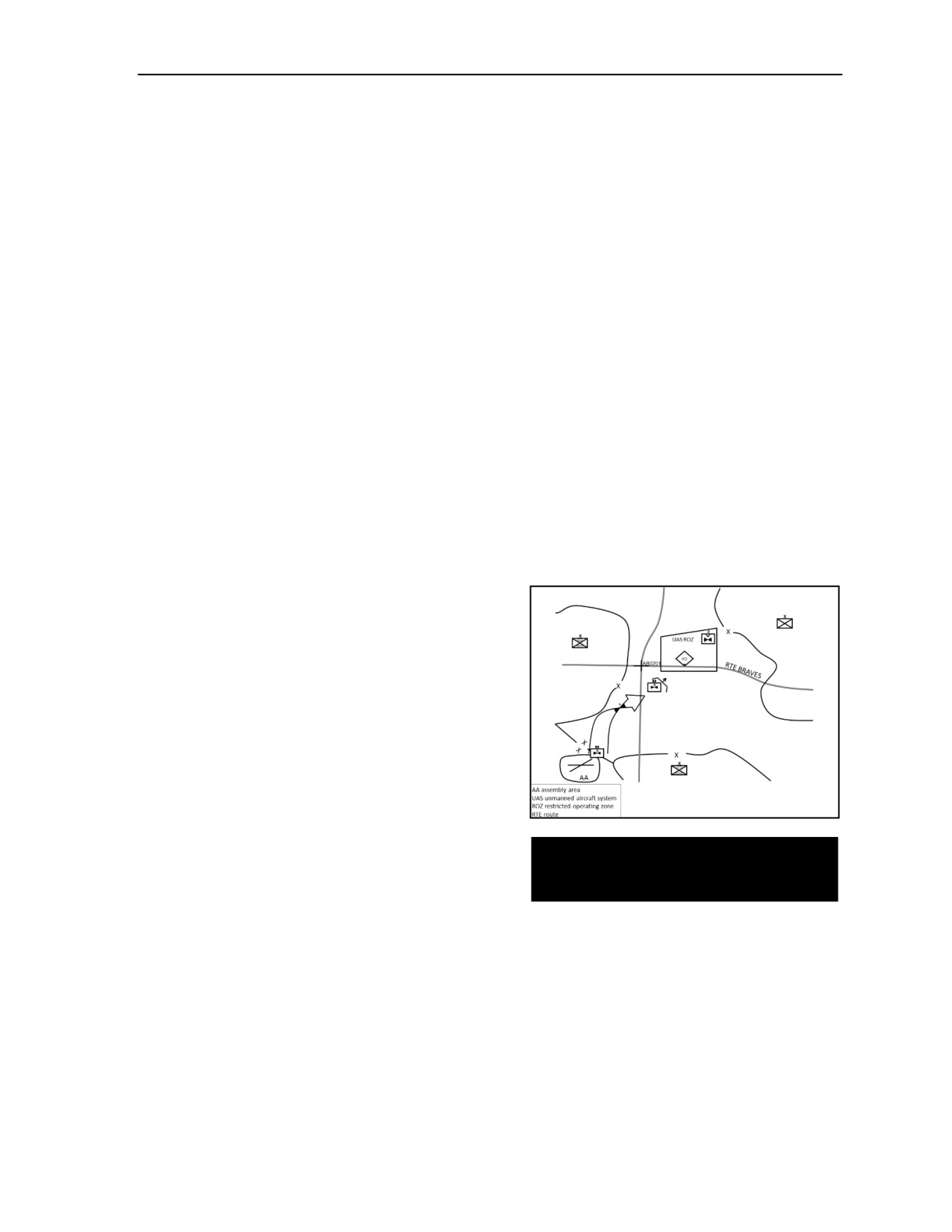
An attack weapons team using MUM-T conducts a hasty attack to destroy a dismounted enemy
team located by UAS while emplacing improvised explosive devices (IEDs) along a high speed
avenue of approach in a deep area between non-contiguous areas of operation. With the threat
assessment estimated as low, the higher
headquarters assigns an AO for the AWT to
conduct the attack and establishes ACMs.
The AMC maneuvers the AWT to the AO
and determines the fire control and method of
attack for the team. Relaying information via
the UAS, the AWT conducts the engagement
and destroys enemy force out of contact
before their capabilities can be brought to
bear effectively on friendly forces (figure 3-
5). Upon destruction of the enemy force, the
AMC provides battle damage assessment to
the higher headquarters and proceeds as
directed to a follow-on mission or mission
complete.
Figure 3-5. Hasty attack by an attack
weapons team against an enemy
force out of contact
29 July 2015
FM 3-04
3-7
Chapter 3
z
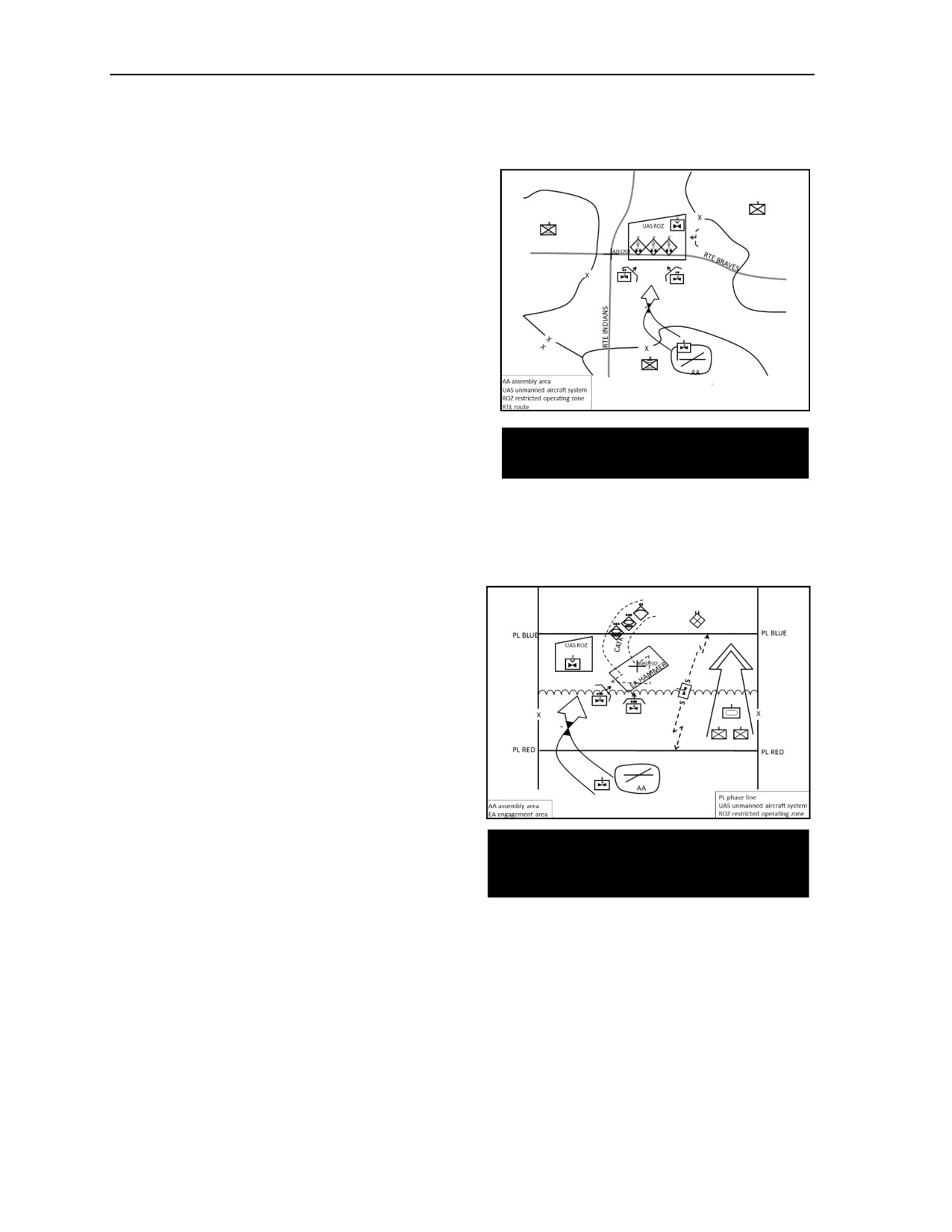
An attack reconnaissance platoon using MUM-T attacks to destroy a convoy of technical vehicles
that are not in friendly contact and repositioning along a high speed avenue of approach in a deep
area between BCT AOs. Assessing the threat to aviation as low in the area and seizing upon this
emerging opportunity to prevent the enemy
force from gaining a position of advantage
between BCT areas of operation in a non-
contiguous AO, the division headquarters
tasks an attack reconnaissance platoon to
conduct a hasty attack. The division staff
coordinates airspace measures and assigns an
engagement area to the attack reconnaissance
platoon to execute the attack. En route to the
engagement area, the AMC coordinates the
platoon attack while gaining situational
awareness and understanding via the UAS
observing the enemy convoy. As the convoy
approaches the engagement area, the AMC’s
teams are set in their ABF positions, have
positive identification of the enemy convoy,
Figure 3-6. Hasty attack by an attack
and initiates the attack (figure 3-6).
reconnaissance platoon
z
An attack reconnaissance company using
MUM-T attacks to defeat an enemy mechanized company, maneuvering to counter-attack into the
flank of a friendly combined arms battalion attack. During the operations process, the combined
arms team conducted detailed planning to integrate attacks to defeat expected counter-attacks
along the friendly route of march. A second attack reconnaissance company screens the flank of
the friendly ground maneuver force, as UAS conducts reconnaissance along key enemy avenues
of approach. A coordinated staff effort
with the higher headquarters and the
supporting aviation attack reconnaissance
unit or LNO team establishes an
engagement area and ABF positions, and
the combined arms team conducts
rehearsals prior to executing the operation.
The proper timing of an aerial passage of
lines on the ground maneuver force’s left
flank, synchronization of fire and
maneuver, and specific triggers enable the
attack reconnaissance company executing
the attack to occupy their ABF positions as
the enemy begins to enter the engagement
area. The AMC initiates fires from the
Figure 3-7. Deliberate attack by an
ABF positions, and the enemy force is
attack reconnaissance company to
unable to make contact and bring its
defeat an enemy counter-attack
capabilities to bear on the friendly main
body. Detailed planning enables the
combined arms team to attack with speed and surprise, while maintaining tempo throughout the
operation (figure 3-7).
3-8
FM 3-04
29 July 2015
Army Aviation Operations
z
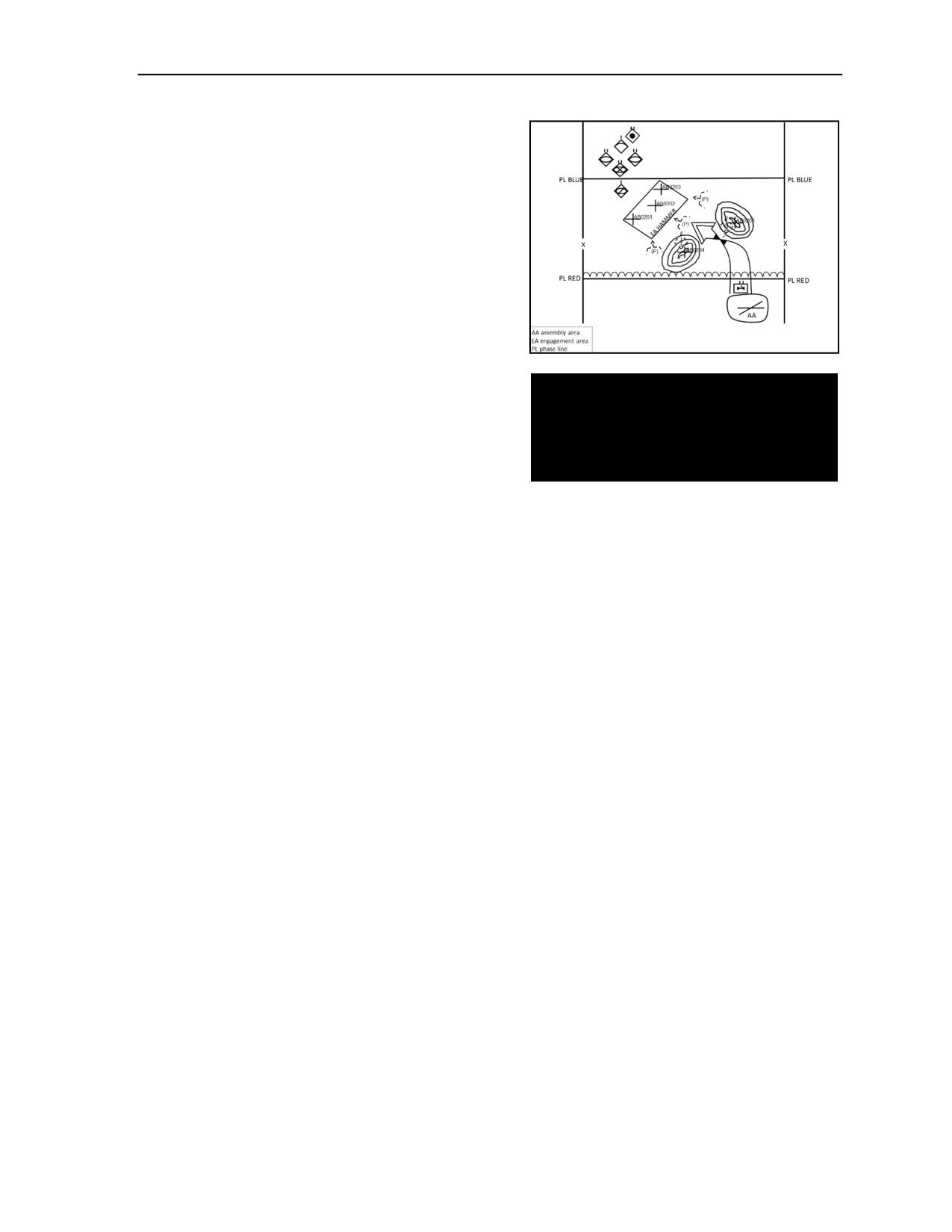
An ARB attacks across the FLOT to disrupt
an enemy mechanized regiment that is
conducting an approach march under the
protection of organic air defense systems
(figure 3-8). Enemy capabilities, actions, and
positions are identified through continuous
information
collection
and
target
development thus facilitating the deliberate
planning of the attack. The supported higher
headquarters identifies the most dangerous
and most likely enemy courses of action and
plans these attacks based on information
derived during IPB. Further coordination
must be made by the higher headquarters to
ensure a successful passage of lines and
synchronization and timing of preplanned
Figure 3-8. Deliberate attack by an
joint fires and suppression of enemy air
attack reconnaissance battalion to
defense to achieve the desired massing of
disrupt an enemy mechanized
effects, and enable ARB movement to ABF
regiment in a deep area of a linear
positions, respectively. Simultaneously, the
area of operations
ARB plans movements, ABF positions, and
methods of attacks in parallel while nesting with higher headquarters’ plan. The resultant attack
disrupts enemy capabilities before they can be brought to bear effectively on friendly forces, thus
providing the friendly main body reaction time and maneuver space.
3-29. Based on the depth of the attack against enemy forces out of contact, time allocated, echelon and size
of the Attack Aviation force, and the supported commander’s intent, FARPs and UAS launch and recovery
locations are positioned forward to support relief on station to maintain sustained attacks or attacks at
extended ranges.
3-30. The inherent risks with hasty and deliberate attacks against enemy forces out of friendly contact in
deep or security areas are driven by the fidelity of the enemy situation en route to, from and in the AO; the
depth and duration of the attack; the size and capabilities of the enemy force being attacked; the fidelity of
the target location; the proximity and capabilities of adjacent enemy forces; the time of day and weather
conditions; and the proximity and capabilities of friendly ground maneuver forces. To mitigate risk and when
time is available, the assigning higher headquarters and attack aviation staffs focus the operations process on
the following:
z
Target development, location and refinement.
z
Integration of joint fires and other enablers.
z
Maximizing the use of UAS forward to confirm target location and disposition.
z
Maximizing the use of terrain to mask maneuver along attack routes and in ABF positions.
z
Developing and coordinating ACMs to enable freedom of action for MUM-T.
z
Planning the integration of joint fires and enablers to limit enemy freedom of action and to destroy
or disrupt enemy air defense.
z
Planning and development of triggers and conditions to initiate the attack.
z
Conducting detailed rehearsals.
z
Employing communications relay packages, Army Aviation Command and Control System or
Airborne Battle Command System aircraft to maintain situational understanding over extended
distances.
z
Positioning FARPs forward to maximize weapons loads and station time.
z
Maximizing the element of surprise by attacking from unexpected directions and unexpected times
with speed and audacity.
z
Executing during hours of limited visibility.
29 July 2015
FM 3-04
3-9
Chapter 3
JOINT AIR ATTACK TEAM TACTICS, TECHNIQUES, AND
PROCEDURES
3-31. During attacks, the integration of joint fires increases the likelihood of gaining fire superiority over the
enemy force. Using the joint air attack team (JAAT) TTP is an effective method of bringing all available
firepower to bear on the enemy force. JAAT combines the effects of attack helicopters, UAS, joint CAS
aircraft, and may include joint indirect fires, all employed simultaneously against the same enemy target
array. During attacks that are against enemy forces not in contact with friendly forces, the AMC supported
by a forward air controller-airborne (FAC-A) synchronizes the combined effects of the JAAT to ensure that
maximum and continuous firepower is brought to bear on the intended enemy force. During attacks on enemy
forces that are in close contact with friendly forces, the ground maneuver commander supported by a joint
terminal attack controller (JTAC) or joint forward observer (JFO) is responsible for the synchronization and
deconfliction of fires in the close fight. For more information, see JP 3-09.
ROTARY-WING CLOSE AIR SUPPORT TACTICS, TECHNIQUES,
AND PROCEDURES
3-32. Army Aviation is an organic direct support (DS) asset for the Army. As such, Army Aviation is not
tasked by the joint force air component commander (JFACC) to support the joint force commander’s (JFC)
CAS or air interdiction apportionment guidance. However, Army Aviation attack reconnaissance units must
be familiar with and able to respond to and execute in accordance with terminal CAS procedures and TTP
when they accept terminal control by a JTAC or FAC-A during mission execution in support of the joint
force. ATP 3-09.32 outlines the terminal procedures and TTP for rotary-wing CAS execution. The CAS TTP
requires the use of a JTAC who is a qualified (certified) service member who, from a forward position, directs
the action of combat aircraft engaged in CAS and other air operations. One can also execute CAS with a
FAC-A who is a specifically trained and qualified aviation officer who exercises control from the air of
aircraft and indirect fires engaged in CAS of ground troops.
UNIQUE PLANNING CONSIDERATIONS FOR ATTACKS
3-33. When determining what level of planning and preparation is required to execute the attack, the
commander must balance the time available versus the advantage of executing with tempo and surprise with
the minimum mission essential information required to understand the friendly forces, terrain, weather and
enemy forces to achieve success. Taking too much time to develop perfect information can paralyze the
operations process, enables to enemy to continue to prepare or move, and may result in missed opportunities
to seize the initiative. It is normally better to err on the side of speed, audacity and momentum, with the
minimum mission essential information, than on attempting to gain complete situational understanding prior
to conducting attacks. Bold decisions give the best promise of success, but commanders must be able to
distinguish between having the right level and fidelity of minimum mission essential information required to
accept prudent risk versus poor or incomplete information that results in taking a gamble. The willingness to
take prudent risks requires military judgment to reduce risk by foresight and adequate planning to determine
the minimum mission essential information required to determine whether the risk is worth taking to seize
fleeting opportunities. Maintaining current and running estimates while executing continuous reconnaissance
and target development mitigates risk and enables commanders to have greater agility and shorter planning
cycles to conduct both hasty and deliberate attacks against enemy forces that are in or out of contact with
friendly forces.
3-34. During the operations process for attack operations, IPB efforts are focused on determining the
location, composition, disposition, capabilities and most likely and most dangerous courses of action of the
targeted enemy force. IPB also focuses on detailed terrain analysis to inform planning for attack routes, ABF
positions, engagement areas, fire support targets, and holding areas, as well as the effects on enemy
movement rates and formations.
3-35. IPB, when attacking against a moving enemy force, focuses on the most likely enemy high speed
avenues of approach and cross mobility corridors within the AO to determine the best terrain on which to
attack the enemy. Engagement areas are designated on terrain that provides the best friendly fields of fire
3-10
FM 3-04
29 July 2015
Army Aviation Operations
while enabling the attack aviation force to maneuver or ABF through the depth of the enemy formation using
adjacent terrain for cover and concealment, while limiting the enemy’s freedom of maneuver. Attack by fire
positions are selected to enable attack reconnaissance units to orient fires and maintain freedom of action
while maintaining maximum standoff during the engagement. Time-distance analysis determines enemy
expected rates of advance which establishes where to place NAIs to confirm or deny an enemy COA and to
trigger the attack, as well as where to best place indirect fire targets, groups and series to simultaneously
attack the enemy in depth with indirect and joint fires. Target areas of interest (TAIs), engagement areas
(EAs), ABF positions, attack routes, NAIs, and observation positions are planned in depth. This provides the
aviation force the maximum flexibility to maintain contact and exercise disciplined initiative to continue the
attack through the depth of the designated AO.
3-36. When conducting an attack against a defending or stationary enemy force, IPB focuses on the best
terrain to conduct the attack from while providing attack/reconnaissance units maximum standoff and
freedom to maneuver out of close contact with the enemy. Enemy reserve locations and counter-attack routes
are analyzed to further identify aviation ABF positions and EAs to limit the enemy’s freedom of action and
to attack the enemy through the depth of his defense either with direct or indirect fires.
3-37. When planning attacks, the commander controls the operation by using attack routes or axis’ of attack,
EAs, trigger lines, ABF positions, holding areas, phase lines (PLs), target reference points, ACMs, NAIs,
and TAIs. To limit the extent of the attack, the commander may also designate a limit of advance (LOA)
and/or subordinate unit boundaries in the designated AO. These control measures allow for decentralized
actions and small-unit initiative to exploit successful attacks to the greatest extent possible.
3-38. Attacks are triggered based on enemy events, time, friendly actions or a combination. The nature of
the target and the commander’s end state determines which method to use. A decision support matrix is a
helpful tool to assist commanders with the timing and sequencing of the attack and integration of supporting
enablers.
3-39. During execution, the Army Aviation attack reconnaissance units use maneuver, and direct and indirect
joint fires to place the enemy in a position of disadvantage where he can be easily defeated or destroyed by
keeping the enemy off-balance by continually reducing the enemy’s options. To achieve superiority over the
enemy force, the commander must take advantage of the range, precision and lethality of all available fires,
as well as by gaining and maintaining information superiority through in depth reconnaissance and by
continually maneuvering to positions of advantage using speed, maneuverability, maximum standoff and the
available terrain.
SECTION IV - RECONNAISSANCE
3-40. Reconnaissance is a mission undertaken to obtain, by visual observation or other detection methods,
information about the activities and resources of an enemy or adversary, or to secure data concerning the
meteorological, hydrographic, or geographic characteristics of a particular area (JP 2-0). Reconnaissance
operations allow the commander to understand the situation and visualize the battlefield by filling in critical
information gaps to mitigate risk, allocate resources and prioritize tasks. Effective reconnaissance allows the
commander to identify where the enemy is weak and/or strong, and the best place or opportunity to
concentrate combat power to gain and maintain a position of relative advantage or where and when to best
deny the enemy a position of relative advantage.
3-41. Army Aviation conducts reconnaissance as part of its parent organization’s focused information
collection efforts by either fighting for or collecting information by stealth and observation. Reconnaissance
is conducted before, during, and after operations to inform the IPB process and assists the commander with
the formulation, confirmation or modification of a COA.
3-42. Army Aviation attack reconnaissance units are specifically equipped, trained and organized to conduct
all forms of reconnaissance except special reconnaissance. Assault and GS aviation units can also perform
limited reconnaissance missions based on mission variables. However, regardless of whether reconnaissance
is assigned as a specified task or not, it is always an implied task for every aviation element to gather and
report information on enemy and friendly disposition, terrain, and civil activities observed during the course
of all operations.
29 July 2015
FM 3-04
3-11
Chapter 3
3-43. Army Aviation conducts reconnaissance at all echelons, from elements as small as an attack or scout
weapons team using MUM-T, or a single UAS, up to elements as large as an attack reconnaissance battalion
or squadron, either independently as a pure Aviation maneuver force or as part of a deliberately planned
scheme of maneuver as a member of the combined arms team. The size of the aviation reconnaissance force
is driven by the size of the AO, complexity and number of reconnaissance objectives, fidelity of the
information required by the commander, the enemy situation, and the time available to answer the
commander’s specified information requirements.
3-44. The commander orients aviation reconnaissance operations on reconnaissance objectives within the
designated AO. Reconnaissance objectives can be a terrain feature, geographic area, or enemy force for which
the commander requires further information. The commander determines reconnaissance objectives based
on his priority intelligence requirements (PIR). Based on the capabilities of the reconnaissance force and
available time to conduct the reconnaissance, the commander and staff further delineate the priority of tasks
and information collection efforts to ensure that the most critical information is collected to enable timely
decisions. The event template, terrain analysis and enemy situational template create information
requirements that in turn focus the collection effort and reconnaissance objectives.
3-45. The commander controls the reconnaissance operation by using routes, subordinate unit boundaries,
PLs, contact points, checkpoints, NAIs, fire support coordinating measures (FSCMs), ACMs, and objectives.
Such control measures allow for decentralized actions and small-unit initiative to the greatest extent possible.
The reconnaissance begins at the line of departure (LD) or start point (SP) and the depth of the reconnaissance
is controlled by using a LOA. Control measures are placed on recognizable terrain features when possible.
3-46. To enable disciplined initiative in execution, the commander provides reconnaissance objectives,
refined critical reconnaissance tasks, bypass criteria, engagement criteria and/or reconnaissance handover
criteria, the latest time the required information is of value (LTIOV) with date-time group (DTG), and an end
state that defines how the reconnaissance effort influences follow-on operations. This enables the aviation
reconnaissance force to develop and execute a reconnaissance plan that provides the required information
within the time necessary to inform the commander’s decisions.
3-47. Army Aviation conducts zone, route, and/or area reconnaissance, or reconnaissance in force when task
organized with ground maneuver forces. These forms of reconnaissance allow the commander and staff to
understand and visualize the environment, develop the situation, create options, and identify opportunities to
seize, retain, and exploit the initiative.
ZONE RECONNAISSANCE
3-48. Zone reconnaissance is a form of reconnaissance that involves a directed effort to obtain detailed
information on all routes, obstacles, terrain, and enemy forces in a zone defined by boundaries (ADRP 3-90).
3-49. Commanders assign zone reconnaissance missions to gain detailed situational understanding when the
enemy situation is vague and/or the understanding of the terrain is limited. Zone reconnaissance missions are
generally large, deliberate and thorough efforts to gain a significant amount of information. The aviation
reconnaissance force commander must balance time and assets available against the urgency and number of
information requirements required by the higher commander to ensure the force executes with the right tempo
and level of detail. Aviation reconnaissance forces provide the combined arms team with increased
reconnaissance depth, and speed, as well as long-range communications and the ability to conduct
reconnaissance in complex or no-go terrain.
3-50. During offensive operations, a zone reconnaissance is typically oriented forward of ground maneuver
forces along an axis of attack or axis of advance. This enables friendly maneuver forces to move or maneuver
within the zone at reduced risk due to greater situational understanding of the terrain, movement routes,
obstacles and enemy forces. During defensive operations, a zone reconnaissance may be conducted forward
of a defensive position to locate enemy reconnaissance or to provide the commander with terrain information
on where to best locate friendly obstacles, targets, engagement areas and/or counter-attack routes. During the
defense, the zone reconnaissance will typically transition to a screen when the limit of advance is reached or
when contact is made with an enemy force that is superior in size or in a position of advantage to the aviation
reconnaissance force. However, not all zone reconnaissance missions are conducted forward of friendly
forces. A zone reconnaissance may also be conducted to the rear or flanks of a friendly ground maneuver
3-12
FM 3-04
29 July 2015
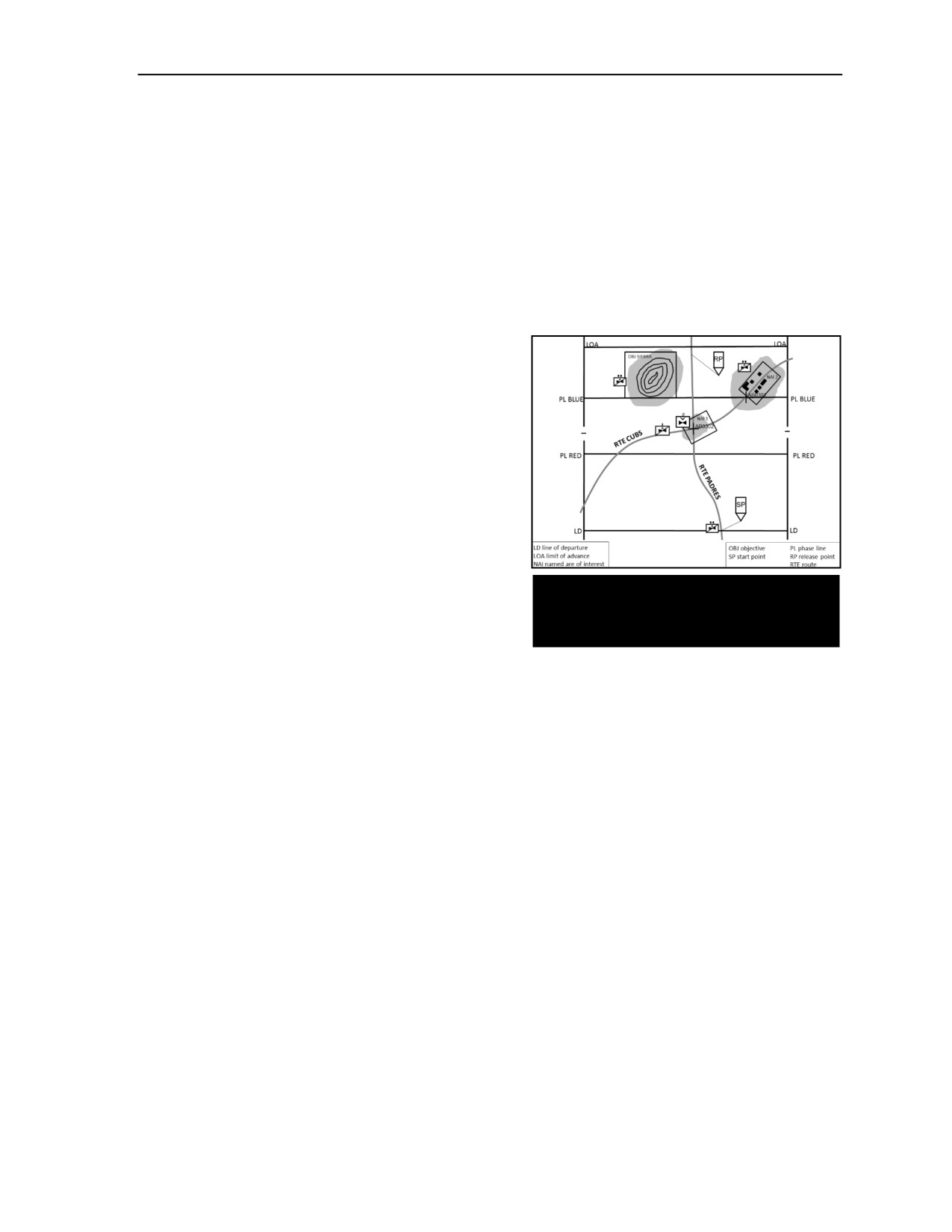
Army Aviation Operations
force to locate bypassed or infiltrating enemy forces or to provide the commander with greater situational
understanding of his AO.
3-51. The size of the zone, number of reconnaissance objectives, mission duration, LTIOV, enemy situation,
number of routes, number of built up areas and complexity of the terrain drives the reconnaissance tempo
and the size and task organization of the Aviation force conducting the zone reconnaissance. Although an
attack reconnaissance platoon using MUM-T is capable of conducting zone reconnaissance in a small zone
for a limited duration, zone reconnaissance missions typically require commitment of an attack
reconnaissance company/troop or battalion/squadron size force.
3-52. Unless the higher commander orders otherwise, the aviation reconnaissance force executes the below
listed critical tasks when assigned a zone reconnaissance mission. Figure 3-9 depicts an aviation force
conducting zone reconnaissance. If during the conduct of the mission, the aviation reconnaissance force is
unable to complete an assigned task, the unit reports and
awaits further instructions. The following are the critical
zone reconnaissance tasks accomplished by the aviation
reconnaissance force:
z
Find and report enemy forces in zone based
on PIR.
z
Based on engagement criteria, destroy or
defeat all enemy forces in zone within
capability.
z
Determine the trafficability of all terrain in
zone.
z
Conduct hasty visual inspection and
classification of all bridges, overpasses,
underpasses and culverts in zone.
Figure 3-9. Aviation reconnaissance
z
Locate and conduct hasty visual classification
force conducts a zone
of all obstacles, minefields, built up areas and
reconnaissance
barriers in zone.
z
Locate and conduct hasty visual classification
of all fords, crossing sites and bypasses around obstacles and built up areas in zone.
z
Report the above information, to include providing a sketch map, overlay and/or full motion video
feeds.
29 July 2015
FM 3-04
3-13
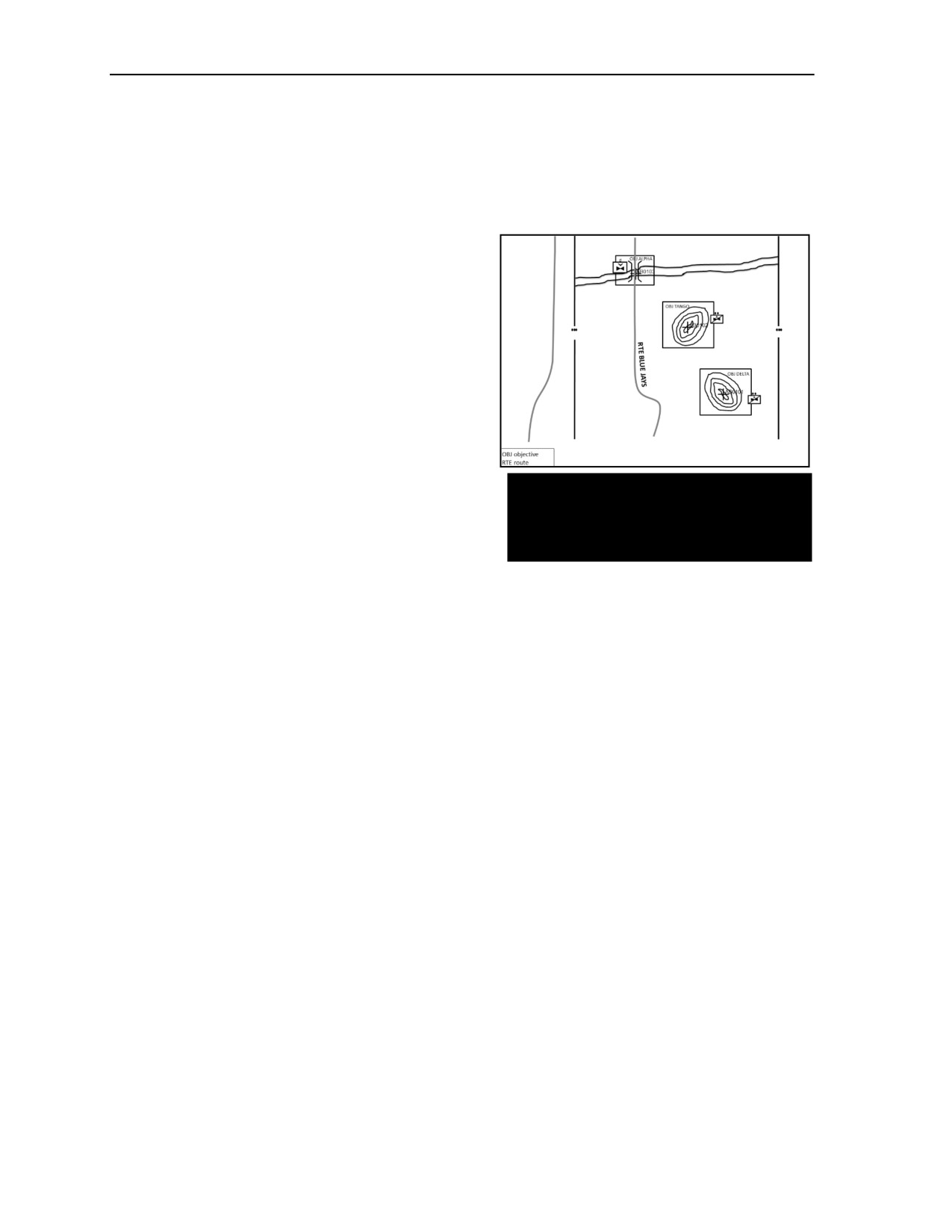
Chapter 3
AREA RECONNAISSANCE
3-53. Area reconnaissance is a form of reconnaissance that focuses on obtaining detailed information about
the terrain or enemy activity within a prescribed area (ADRP 3-90). This area may include a town, ridgeline,
airhead, wood line, or any other critical operational feature or area such as a LZ/PZ or bridge. The primary
difference between an area and zone reconnaissance is that in an area reconnaissance the unit conducting the
reconnaissance first moves to the area, then conducts
the reconnaissance. Area reconnaissance is typically
less complex and smaller than zone reconnaissance and
generally takes less time.
3-54. Army Aviation conducts area reconnaissance
with elements as small as a AWT/SWT using MUM-T,
up to elements as large as an attack reconnaissance
company or troop, either independently as a pure
aviation maneuver force or as part of a deliberately
planned scheme of maneuver as a member of the
combined arms team.
3-55. The size of the area, distance to the area, enemy
situation in and en route to the area, and whether the
area will be occupied in the future or not drives the task
Figure 3-10. Aviation reconnaissance
organization and scheme of maneuver for the aviation
force conducts three simultaneous
reconnaissance force. The control measures and critical
area reconnaissance missions
reconnaissance tasks for an area reconnaissance are the
same as a zone reconnaissance. Figure
3-10 is an
example of an aviation reconnaissance force conducting
an area reconnaissance of terrain and manmade areas of interest.
ROUTE RECONNAISSANCE
3-56. Route reconnaissance is a directed effort to obtain detailed information of a specified route and all
terrain from which the enemy could influence movement along that route (ADRP 3-90). The route may be a
cross country mobility corridor, an air route, or a road, highway or trail. The route reconnaissance provides
information on the condition of the route, trafficability of the route, intersecting routes or mobility corridors,
key terrain that directly influences the route, obstacles along the route, and any friendly, enemy or civilian
activity along the route.
3-57. Route reconnaissance is assigned either as a separate mission or as a specified task to a unit conducting
a zone or area reconnaissance. Army Aviation conducts route reconnaissance with elements as small as an
AWT/SWT using MUM-T, up to elements as large as an attack reconnaissance troop/company, either
independently as a pure aviation maneuver force or a member of the combined arms team.
3-58. The size of the aviation reconnaissance force is driven by the length of the route, complexity of the
terrain, fidelity of the information required by the commander, the enemy situation, and the time available
(LTIOV) to answer the specified information requirements. If detailed information is required for route and
bridge classification or obstacle clearance is required, the aviation reconnaissance force must be task
organized as a combined arms team.
3-59. The commander controls the route reconnaissance with lateral boundaries on each side of the route, a
start point at the beginning of the route, checkpoints at key intersections and turns along the route, and a
release point at the end of the route. An LD is establish along the route, just short of where enemy contact is
expected and an LOA is established beyond the release point and far enough out to encompass any terrain
that the enemy can use to influence the route. Additional control measures can include phase lines, TRPs,
and NAIs on adjacent key terrain or suspected enemy locations.
3-14
FM 3-04
29 July 2015
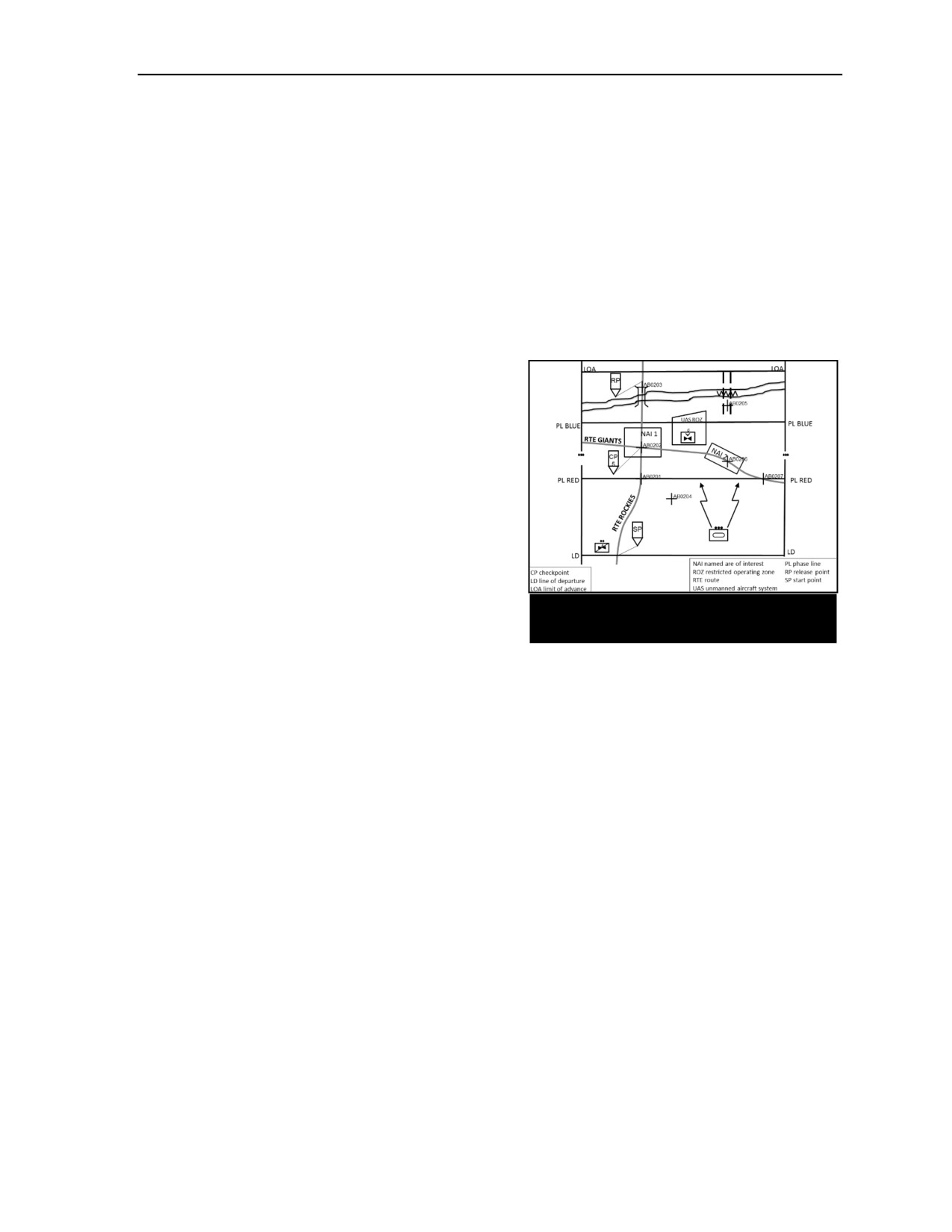
Army Aviation Operations
3-60. Unless the higher commander orders otherwise, the aviation reconnaissance force executes the
following tasks:
z
Find and report all enemy forces that can influence movement along the route.
z
Based on engagement criteria, clear all enemy forces that can influence movement along the route,
within capability.
z
Determine route trafficability based on the size, capabilities, mission and type of friendly force to
use the route.
z
Reconnoiter all terrain that the enemy can use to influence the route.
z
Reconnoiter all built-up areas, contaminated areas, and lateral routes along the route.
z
Evaluate and classify all bridges, defiles, overpasses, underpasses, and culverts along the route
z
Locate and conduct hasty visual classification of all obstacles, minefields, built up areas, wire
obstacles and barriers along the route.
z
Locate and conduct hasty visual
classification of all fords, crossing sites and
bypasses around obstacles and built-up areas
along the route.
z
Report the above information, to include
providing a sketch map, route overlay and/or
full motion video feeds.
3-61. If during the conduct of the mission, the aviation
reconnaissance force is unable to complete an assigned
task, the unit reports and awaits further instructions.
3-62. Figure 3-11 depicts aviation assets conducting a
route reconnaissance using MUM-T. While the attack
reconnaissance manned assets focus on the route, the
UAS reconnoiters the adjacent terrain in which the
Figure 3-11. Army Aviation conducting
enemy may influence the reconnaissance objective
route reconnaissance
during future operations.
RECONNAISSANCE IN FORCE
3-63. A reconnaissance in force (RIF) is a deliberate combat operation designed to discover or test the
enemy’s strength, dispositions, and reactions or to obtain other information (ADRP 3-90). Reconnaissance
in force is conducted as a combined arms operation at the battalion task force or higher level.
3-64. An ASTF or ABTF can conduct a limited reconnaissance in force when task organized with adequate
ground maneuver forces, but typically Army Aviation is task organized to the ground maneuver headquarters
tasked with reconnaissance in force. During a reconnaissance in force, subordinate aviation elements may
conduct the full range of tactical, enabling and sustaining tasks, including: attacks, air assaults,
reconnaissance, security, mission command support, and aeromedical evacuation.
3-65. A RIF is an aggressive, offensively oriented reconnaissance. The RIF is task organized and maneuvers
either by attacking or conducting a movement to contact to overwhelm enemy reconnaissance and security
forces to find the enemy main body and to determine enemy weaknesses for exploitation. It is a force oriented
reconnaissance, focusing on enemy forces versus the terrain and typically seeks some level of decisive
engagement. The end state of the reconnaissance is either extraction of the RIF or exploitation by a follow
on force.
3-66. The enemy situation, size of the zone, and the commander’s follow on concept of the operation drives
the task organization and scheme of maneuver. The less that is known about the enemy, the greater the combat
power required for the reconnaissance in force. The control measures associated with a RIF are similar to
either a movement to contact or frontal attack.
29 July 2015
FM 3-04
3-15
Chapter 3
3-67. The following tasks are accomplished by Army Aviation when supporting a reconnaissance in force:
z
Locate and determine the depth of the enemy security area.
z
Destroy enemy reconnaissance and security forces within capability.
z
Locate and report all obstacles and bypasses to enable the ground maneuver force to penetrate the
security area.
z
Locate and determine the disposition of the enemy main body.
z
Attack to destroy, defeat, disrupt, divert, or delay enemy main body forces within capability.
z
Determine enemy weaknesses that can be exploited.
z
Continuously report all information, including negative contact reports.
FUNDAMENTALS OF RECONNAISSANCE
3-68. When planning and executing reconnaissance operations, the application of the following seven
fundamentals inform the operations process and drive execution of successful reconnaissance missions.
3-69. Orient on reconnaissance objectives. Commanders direct reconnaissance operations by establishing
reconnaissance objectives with a specific task, purpose and focus. Reconnaissance objectives enable the
commander to focus the efforts of the reconnaissance force to ensure his information requirements on the
enemy, terrain and civil populations are met within the required time. The enemy situation, time available,
complexity of the terrain and the number, depth and types of reconnaissance objectives drive the task
organization and scheme of maneuver of the aviation reconnaissance force.
3-70. Do not keep reconnaissance assets in reserve. To provide continuous and focused reconnaissance
requires commanders to employ all available assets against reconnaissance objectives; however, this does
not mean to necessarily employ all assets simultaneously. Understanding the capabilities and limitations of
each asset, coupled with detailed planning, enables commanders to ensure that each of the different available
reconnaissance assets are employed to maximize their strengths to collect the required information while
providing mutual support and redundant coverage to the entire collection effort through the depth of the AO.
3-71. Ensure continuous reconnaissance. Due to the dynamic nature of the operational environment,
commanders ensure that reconnaissance is conducted continuously throughout the duration of the mission.
The use of UAS to provide persistent reconnaissance through the depth of the AO, coupled with AWTs/SWTs
conducting continuous relief on station, ensures the aviation reconnaissance force provides continuous
coverage of the designated reconnaissance objectives. Continuous reconnaissance using MUM-T enables
greater change detection in dynamic operating environments, increased flexibility to maintain contact with
acquired enemy forces, redundancy to enable detailed information collection to achieve the reconnaissance
objectives, and greater flexibility to further develop the situation when required.
3-72. Retain freedom of maneuver. Mobility and maneuver are essential to successful aviation
reconnaissance operations. Commanders consider how the aviation reconnaissance force is task organized,
the movement techniques used, and the planned scheme of maneuver, as well as bypass, reconnaissance
handover and engagement criteria to ensure the aviation reconnaissance force retains the freedom to
maneuver to achieve the commander’s end state. Decisive engagement between the aviation reconnaissance
force and enemy forces may be necessary if fighting for information is required to fully develop the situation.
But, decisive engagement must be balanced against the amount of time available to complete the mission and
the risk of the reconnaissance force becoming decisively engaged and possibly defeated by a superior enemy
force. Making contact with the smallest possible element, using redundant and different reconnaissance
capabilities, conducting effective counter-reconnaissance, maximizing stand-off, and employing suppressive
direct and indirect fires (when authorized) all contribute to reducing tactical risk while enabling the aviation
reconnaissance force to retain the freedom to maneuver.
3-73. Gain and maintain enemy contact. Using visual or technical means, the aviation reconnaissance
force locates and maintains enemy contact with the smallest force possible to prevent initial decisive
engagement while retaining freedom to maneuver and adequate combat power to develop the situation. Based
on the commander’s intent and contact criteria, maintaining contact with the enemy force provides real time
information on the enemy’s disposition, composition, strength and actions to enable the commander to make
timely and informed decisions based on current intelligence. Once contact is gained with an enemy force that
3-16
FM 3-04
29 July 2015
Army Aviation Operations
does not meet bypass criteria, the aviation reconnaissance force does not relinquish contact until directed to,
reconnaissance handover is complete, or the enemy force is destroyed based on engagement criteria.
3-74. Develop the situation rapidly. As timely collection of information requirements impact the
commander’s decisions, Army Aviation performs reconnaissance with the tempo required to meet the
requisite urgency to answer the necessary higher commander’s information requirements. If contact is made
with an enemy force, the aviation reconnaissance force reports immediately and conducts actions on contact
and develops the situation to quickly determine the composition, disposition, strength and activity of the
enemy prior to choosing a COA. Based on bypass criteria, engagement criteria and reconnaissance handover
criteria, the aviation reconnaissance force may transition to a hasty attack to destroy an enemy force,
transition to a screen and employ direct and indirect fires to harass and impede superior enemy forces then
conduct reconnaissance handover to a follow on force, or report and bypass to continue the reconnaissance
effort if the enemy force meets bypass criteria.
3-75. Report all information rapidly and accurately. Quick and accurate positive and negative reporting
is essential to ensure the commander receives the necessary information to make timely decisions. Reporting
focuses on answering the commander’s PIR. However, seldom can a PIR be answered on its own or in
isolation. Therefore, PIR are broken down into different elements and assigned as collection tasks within
orders. (See ATP 2-01 for further information.)
3-76. At the ABTF/ASTF level and above, PED is the execution of the related functions that converts and
refines reported data into usable information, distributes the information for further analysis, and provides
combat information to commanders and staffs. PED is the link that ensures the efficient use and distribution
of information following collection and reporting. While performing these functions, some of the
information will meet the criteria of combat information. In those cases, the combat information is
disseminated to commanders and staffs per standard operating procedure.
SECTION V - SECURITY
3-77. Security operations are those operations undertaken by the commander to provide early and accurate
warning of enemy operations to provide the force being protected with the time and maneuver space to react
to the enemy, and to develop the situation to allow the commander to effectively employ the protected force
(ADRP 3-90).
3-78. Security operations protect the force from surprise and reduce the unknowns. The protected force
ranges from friendly ground maneuver forces and facilities to the local population. Security operations can
be performed forward, to the rear, to the flanks or entirely around the protected force, whether stationary or
moving.
3-79. The primary difference between reconnaissance and security missions is the focus of the effort.
Reconnaissance missions focus on the enemy and terrain, while security missions focus on the force that is
being protected. However, reconnaissance is inherent to all security operations. Security operations serve as
an economy of force to prevent the premature commitment of other combat power.
3-80. Security operations encompass five tasks—screen, guard, cover, area security, and local security. The
screen, guard and cover security tasks each require increasing levels of combat power and subsequently
provide increasing levels of security to the protected force. However, the more combat power in the security
force, the less combat power available for the main body. Area security preserves the commander’s freedom
of action to conduct sustaining operations, mission command and reposition reserves. Local security is an
inherent responsibility of all units and provides immediate and local protection of the force.
3-81. Army Aviation attack reconnaissance units are specifically equipped, trained and organized to conduct
security operations, but the only security task that aviation can perform autonomously is the screen task.
Army Aviation conducts screens at all echelons, from elements as small as an AWT/SWT using MUM-T, up
to elements as large as an attack reconnaissance battalion or squadron, either independently as a pure aviation
maneuver force or as a member of the combined arms team.
3-82. The size of the aviation security force is determined by—
z
Size and follow-on mission of the protected force.
29 July 2015
FM 3-04
3-17
Chapter 3
z
Location and orientation of the security area.
z
Duration of the security mission.
z
Enemy situation.
z
Complexity of the terrain, and most importantly.
z
Required reaction time required by the protected force commander.
3-83. When Army Aviation is designated as the combined arms team security force headquarters, only
screen or guard missions can be assigned to an ASTF/ABTF, or aviation brigade headquarters task organized
with adequate ground maneuver forces. However, the security task assigned to subordinate aviation elements
is still screen. Due to the size, complexity and mission command requirements, Army Aviation is not assigned
the covering force headquarters mission but may be task organized to a BCT or higher ground maneuver
force assigned the covering force mission.
3-84. When task organized to a ground maneuver force with an area, screen, guard, or covering force security
mission, Army Aviation conducts the full range of tactical, enabling and sustaining tasks, to include: screen,
attack, reconnaissance, air assault, air movement, aeromedical evacuation, and mission command support.
3-85. During security operations, Army Aviation can perform the following tasks:
z
Screen the flanks or rear of a moving force or forward, to the flanks, or to the rear of a stationary
force.
z
Conduct zone and route reconnaissance or provide a forward security element for a moving ground
force.
z
Locate and destroy enemy reconnaissance and security forces in within the aviation unit’s AO or
attempting to penetrate the screen.
z
Employ indirect and direct fires to fix or delay enemy main body forces.
z
Conduct attacks to defeat or destroy enemy main body forces.
z
Conduct force oriented reconnaissance of all terrain and routes that influence the security area.
z
Locate and reconnoiter obstacles and determine bypasses forward of a moving force.
z
Air assault to seize an objective or to fix, block, or destroy an enemy force forward or to the flanks
of a moving or stationary force.
z
Infiltrate, exfiltrate, or resupply dismounted or mounted security units along a flank screen of a
moving force or forward of a stationary force.
z
Conduct aeromedical evacuation of the wounded and ill in the security area.
z
Conduct air movement of friendly forces in the security area.
z
Conduct mission command support to extend the range of communications networks to enable the
protected force increased situational understanding for early warning and reaction time.
3-86. Depending upon whether the aviation security force is protecting a moving or stationary force and
whether the security area is forward, to the rear, or to the flanks of the protected force, aviation security force
commanders use a variety of techniques when initially occupying positions within a security area or along a
screen line. When conducting a security mission for a stationary force, aviation security force commanders
consider how fast the security area must be occupied to meet mission requirements and what level of security
is required. If the enemy situation is unknown and time is limited, the aviation force conducts a movement
to contact through the security area to establish the screen at the limit of advance or prior to the limit of
advance if contact is gained with the enemy main body or a superior enemy force. If the enemy situation is
known and no substantial enemy forces are in the security area, the aviation security force can move rapidly
along planned routes to quickly establish the screen at the limit of advance. If time is available, the enemy
situation is vague, and/or the protected force commander requires detailed information in the security area,
the aviation security force conducts a zone reconnaissance to establish the screen line at the limit of advance
or once contact is gained with the enemy main body or a superior enemy force.
3-87. When conducting a security mission forward of a moving force, the aviation security force conducts a
zone reconnaissance or movement to contact forward of the ground security force, assists in maintaining
contact between the security force and the main body, assists in disengaging ground units, especially when
conducting battle handover and passage of lines with the main body, and conducts reconnaissance of terrain
3-18
FM 3-04
29 July 2015
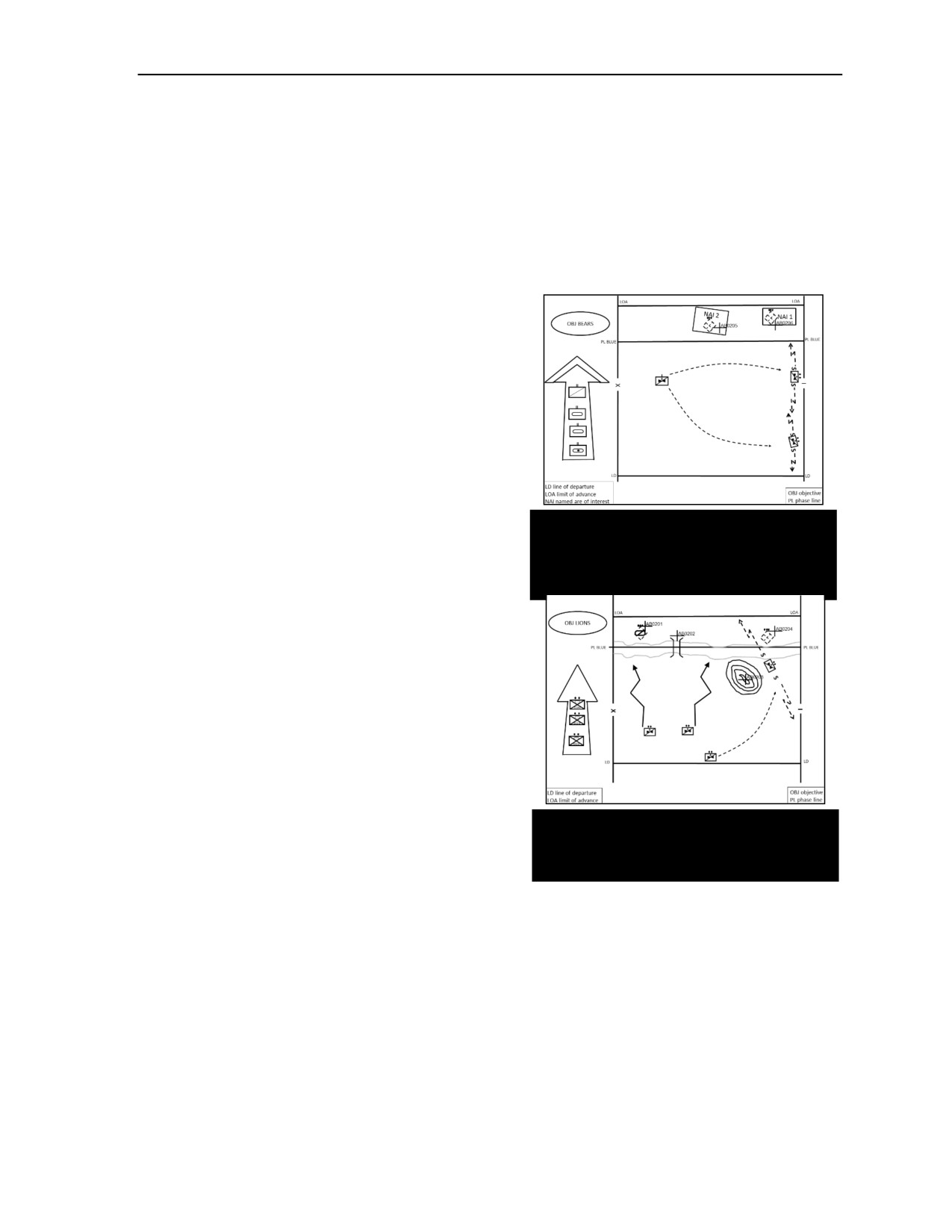
Army Aviation Operations
that is hard to reach or would require too much time to cover with ground reconnaissance assets. The
technique used depends upon the requirements of the protected force. If the force is moving through complex
terrain or terrain that is unknown, a zone reconnaissance is conducted far enough forward of the moving
protected ground force to locate enemy forces while providing the protected force with the required
information on trafficability of routes and movement corridors to enable freedom of maneuver. If the terrain
is known or easily trafficable and the enemy situation is unknown or vague, the aviation security force
conducts a movement to contact in zone with adequate distance to provide early warning of enemy actions
to enable to protected force time to react.
3-88. When conducting a flank security mission for a moving force, the Aviation security force may use
three techniques to occupy the flank security area:
z
Aviation security forces cross the LD
separately from the main body and deploy to
perform the mission to the flanks. This is used
when the enemy threat situation is known to
be low (figure 3-12).
Figure 3-12. Aviation assets conduct
flank security in support of a BCT
reconnaissance and main body
movement
z
Aviation security forces cross the LD
separately from the main body with lead
elements conducting a movement to contact
while trail elements occupy the flank screen.
This is used when the enemy threat situation
is unknown but knowledge or trafficability of
the terrain is known (figure 3-13).
Figure 3-13. Aviation assets conduct
security in support of Stryker platoon
movement
29 July 2015
FM 3-04
3-19
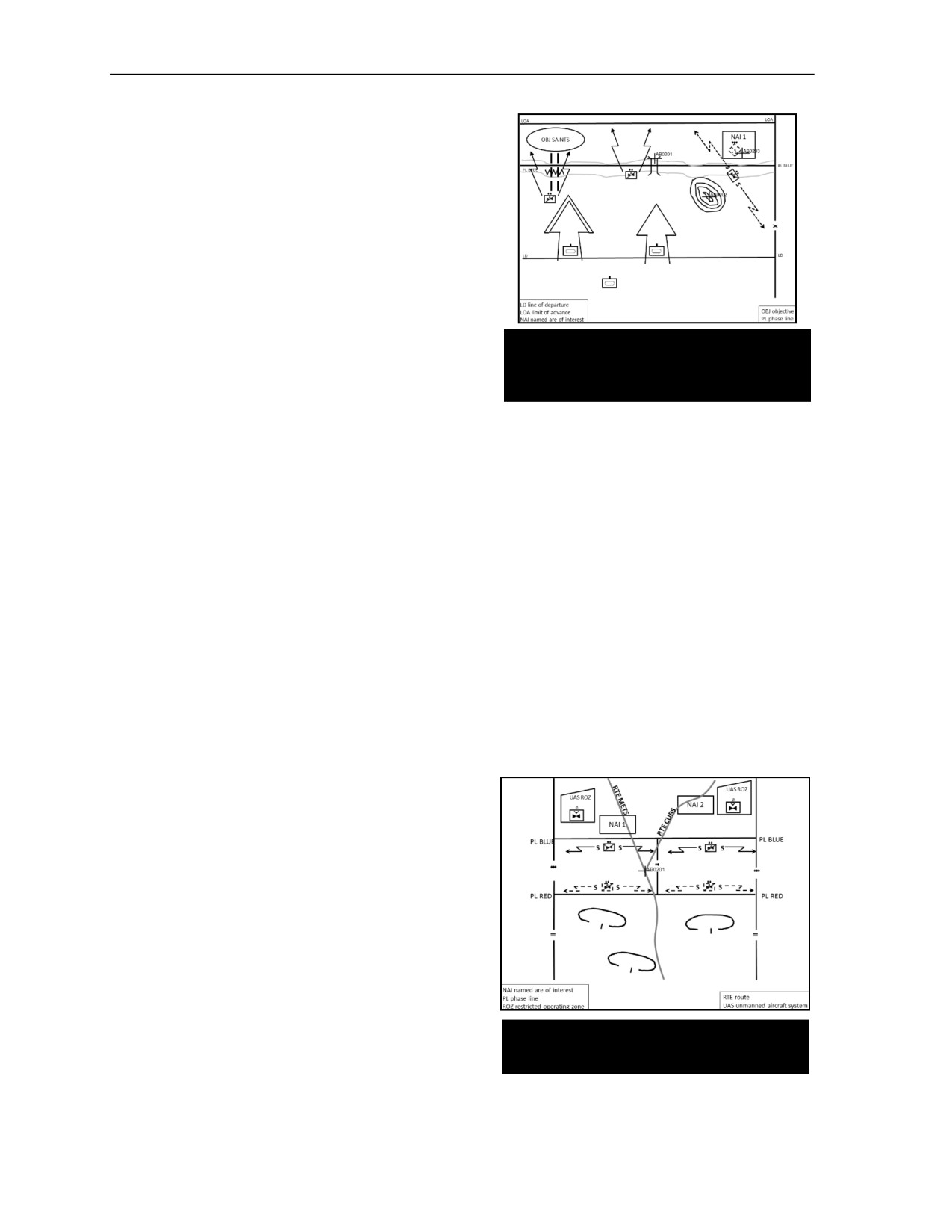
Chapter 3
z
Aviation security forces cross the LD with the
main body and conduct zone reconnaissance
out to the limit of advance (LOA). This is
used when the knowledge of the enemy and
terrain are vague and trafficability is of
greater concern to the protected force
commander than reaction time to enemy
contact (figure 3-14).
3-89. The aviation security force commander controls
the security operation by using a variety of control
measures, to include: screen lines, subordinate unit
Figure 3-14. Aviation assets conduct
boundaries, phase lines, contact points, checkpoints,
zone reconnaissance in support of a
NAIs, FSCMs, ACMs, observation posts and routes.
BCT main body movement
Such control measures allow for decentralized actions
and small-unit initiative to the greatest extent possible.
The security operation begins at the LD and the depth and reaction time provided by the security force is
controlled by using an LOA. To the flank of a moving force or to the flanks or forward of a stationary force,
the LOA is depicted as a screen line or a lateral unit boundary. When possible, all control measures are placed
on recognizable terrain features. If a lateral unit boundary is the LOA and a friendly ground maneuver unit
is operating to the flank, contact points are established to ensure contact is maintained with the adjacent
friendly units.
3-90. To enable disciplined initiative in execution, the protected force commander provides engagement,
battle handover and bypass criteria, the DTG the security area must be established, the duration of the security
mission and the reaction time required to enable the main body the required early warning to react and prevent
the enemy from achieving a position of relative advantage. This enables the aviation security force
commander to develop and execute a security plan that provides the required combat information within the
time necessary to inform the protected force commander’s decisions.
SCREEN
3-91. Screen is a security task that primarily provides early warning to the protected force (ADRP 3-90).
While a screen provides minimal protection as compared to a guard or cover, Army Aviation’s lethality,
speed and long range precision fires significantly enhances the level of protection and reaction time provided
by a screen.
3-92. Figure
3-15 depicts two SWTs screening a
security forward of a battalion area defense. UAS focus
on two primary avenues of approach into the security
area while the SWTs screen secondary routes in the
security area.
3-93. A screen is used to cover gaps between forces,
exposed flanks of stationary forces or to the rear or
flanks of a moving force. Screens are used when the
expectation of enemy contact is low, the enemy force is
expected to be small or the protected force requires
minimal reaction time. Screens are economy of force
missions to enable maximum combat power to remain
uncommitted in the protected force. If significant enemy
contact is expected or more reaction time is required,
Figure 3-15. SWT using MUM-T
other forms of security—guard or cover—are more
screens forward of a protected force
appropriate security tasks.
3-94. The screen force has the minimum combat power
required to provide the desired early warning, as well as destroy enemy reconnaissance forces with direct and
3-20
FM 3-04
29 July 2015
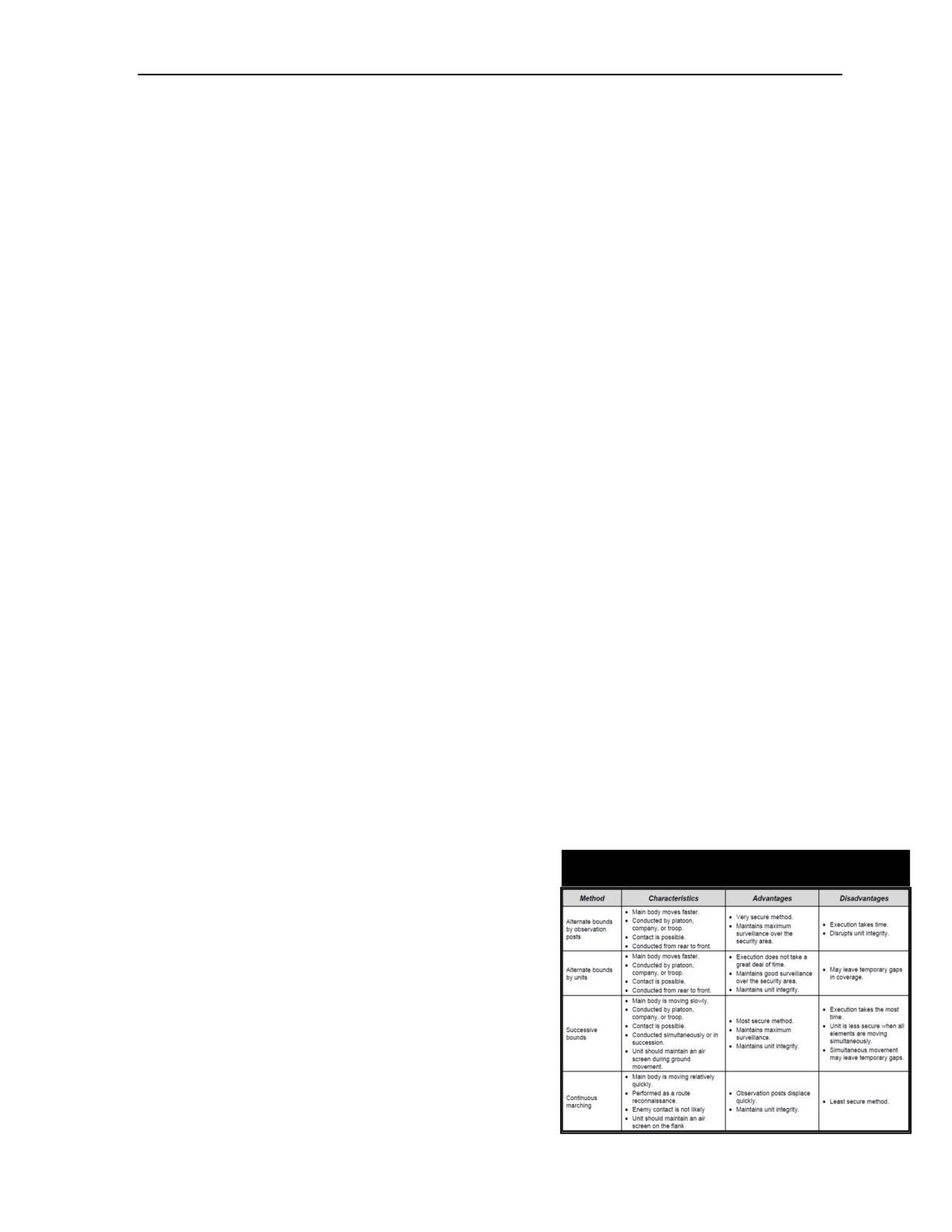
Army Aviation Operations
indirect fires; however, to preserve main body combat power, the screen force lacks adequate combat power
to become decisively engaged with enemy main body forces. Once contact is gained with the main body or
a superior enemy force, the screen force harasses and impedes the enemy force, then conducts battle handover
to a follow on force or the protected force.
3-95. Army Aviation attack reconnaissance asset’s endurance, mobility, lethality and sensors make them
ideally suited to operate as an independent screening force or as a part of a combined arms team conducting
security operations. Attack reconnaissance aircraft as well as UAS can acquire and engage targets at extended
ranges to provide maximum early warning and reaction time while not becoming decisively engaged.
Additionally, communication relay packages and non-line of sight communications enable effective reporting
at greater distances to allow increased security area size and depth to maximize early warning and reaction
time.
3-96. Critical tasks for an aviation security force conducting screens, include the following:
z
Allow no enemy to pass through the screen undetected and unreported.
z
Maintain continuous surveillance of all avenues of approach larger than a designated size (in
accordance with the protected force commander’s intent) into the security area.
z
Destroy or repel all enemy reconnaissance prior to the enemy gaining observation on the protected
force.
z
During defensive screens, locate the lead elements of the enemy and determine composition and
direction of movement.
z
Maintain contact with enemy forces and report all activity with the security area.
z
Maintain contact with the protected force main body and friendly security forces operating to its
flanks.
z
Impede or harass enemy forces within capability while displacing to subsequent screens or during
battle handover.
3-97. Screens can be either stationary or moving. Stationary screens are conducted to the front, flanks or rear
of a stationary protected force or to the flanks or rear of a moving protected force. Movement to contact or
zone reconnaissance is conducted to provide security forward of a moving protected force.
3-98. A stationary screen is established using a series of observation posts (OP) with overlapping fields of
observation. Using MUM-T with UAS focused on key NAIs that require persistent surveillance,
AWTs/SWTs conduct reconnaissance along the screen line focused on supporting NAIs, routes and mobility
corridors that support enemy movement. Along the screen line, the aviation security force typically remains
dynamic and maneuvers between OPs, using terrain to mask movement to ensure survivability and
overlapping or redundant coverage of NAIs. The number of NAIs and the frequency of coverage by the
aviation screening force is driven by how many other sensors and ground forces are committed to conducting
the screen, the distance the screen is from the protected force, and the expected enemy force that is attempting
to penetrate the screen. Based on the amount of space available for the security area, multiple screens are
planned in depth to allow the screening force to displace while maintaining contact and developing the
situation with enemy forces.
3-99. A moving screen is tied to the movement rates and axis
Table 3-3. Screen movement methods
of advance or attack of the moving protected force and is
conducted either to the rear
(seldom) or to the flanks
(primary) of the moving force. For a moving flank screen, the
screen force screens from the lead combat element (does not
include lead security and reconnaissance elements) of the
main body of the moving protected force to the rear of the
protected force. To maintain protection of the moving force,
the aviation security force executes a moving flank or rear
screen similar to a stationary screen with the exception of the
movement techniques used to occupy successive OPs along
the screen line. The advantages and disadvantages of the
various movement techniques to occupy a moving screen are
outlined in table 3-3 and figure 3-16, page 3-22.
29 July 2015
FM 3-04
3-21