FM 3-04 Army Aviation (JULY 2015) - page 1
Field Manual
Headquarters
Department of the Army
No. 3-04
Washington, DC, 29 July 2015
Army Aviation
Contents
Page
PREFACE
vii
INTRODUCTION
ix
Chapter 1
ARMY AVIATION’S ROLE IN UNIFIED LAND OPERATIONS
1-1
Section I - Overview
1-1
Section II - Core Competencies of Army Aviation
1-1
Provide Accurate and Timely Information Collection
1-1
Provide Reaction Time and Maneuver Space
1-2
Destroy, Defeat, Disrupt, Divert, or Delay Enemy Forces
1-3
Air Assault Ground Maneuver Forces
1-3
Air Movement of Personnel, Equipment, and Supplies
1-4
Evacuate Wounded or Recover Isolated Personnel
1-4
Enable Mission Command over Extended Ranges and Complex Terrain
1-5
Section III - Army Aviation in the Operational Framework
1-5
Operations in Deep, Close, and Security areas
1-5
Decisive, Shaping, and Sustaining Operations
1-7
Main and Supporting Efforts
1-8
Section IV - Operational Environment
1-8
Threat
1-9
Physical Environment
1-11
Conclusion
1-18
Chapter 2
ARMY AVIATION ORGANIZATIONS AND MISSION COMMAND
2-1
Section I - Overview
2-1
Section II - Aviation Brigades
2-1
Combat Aviation Brigade
2-1
Expeditionary Combat Aviation Brigade
2-2
Theater Aviation Brigade
2-3
Section III - Enabling Aviation Groups
2-5
Theater Airfield Operations Group
2-5
Theater Aviation Sustainment Maintenance Group
2-6
Section IV - Aviation Battalions and Squadrons
2-6
Attack Reconnaissance Squadron
2-6
Attack Reconnaissance Battalion
2-7
Assault Helicopter Battalion
2-8
Distribution Restriction: Approved for public release; distribution is unlimited.
i
Contents
General Support Aviation Battalion
2-9
Aviation Support Battalion
2-10
Security and Support Battalion
2-11
Airfield Operations Battalion
2-12
Theater FW Battalion
2-13
Section V - Aviation Squadron/Battalion Task Forces
2-13
Section VI - Command and Support Relationships
2-15
Command Relationships
2-15
Support Relationships
2-16
Section VII - Aviation Command Posts
2-17
Main Command Post
2-17
Tactical Command Post
2-18
Section VIII - Aviation Special Staff
2-18
Aviation Safety Officer
2-18
Standardization Officer
2-18
Aviation Mission Survivability Officer
2-18
Aviation Master Gunner
2-19
Aviation Materiel Officer
2-19
Flight Surgeon
2-19
Medical Operations Officer
2-19
Section IX - Brigade Aviation Element
2-19
Purpose
2-19
Organization
2-19
Capabilities
2-20
Section X - Aviation Liaison Teams
2-20
Purpose
2-20
Capabilities
2-20
Section XI - Airspace Considerations
2-21
Chapter 3
ARMY AVIATION OPERATIONS
3-1
Section I - Overview
3-1
Section II - Movement to Contact
3-1
Section III - Attack
3-3
Attacks Against Enemy Forces in Close Friendly Contact
3-3
Attacks Against Enemy Forces Out of Friendly Contact
3-6
Joint Air Attack Team Tactics, Techniques, and Procedures
3-10
Rotary-Wing Close Air Support Tactics, Techniques, and Procedures
3-10
Unique Planning Considerations for Attacks
3-10
Section IV - Reconnaissance
3-11
Zone Reconnaissance
3-12
Area Reconnaissance
3-14
Route Reconnaissance
3-14
Reconnaissance in Force
3-15
Fundamentals of Reconnaissance
3-16
Section V - Security
3-17
Screen
3-20
Guard
3-22
ii
FM 3-04
29 July 2015
Contents
Cover
3-22
Fundamentals of Security
3-23
Section VI - Air Assault
3-23
Section VII - Air Movement
3-27
Internal Load Operations
3-27
External Loads
3-28
Unique Planning Considerations for Air Movement
3-28
Section VIII - Aeromedical Evacuation
3-29
Authorization
3-29
Medical Operations Cell
3-30
Aerial Casualty Evacuation
3-30
Section IX -Mission Command Support
3-30
Command and Control Aircraft
3-31
Unmanned Aircraft System Communications Relay Packages
3-31
Section X - Personnel Recovery
3-32
Chapter 4
ARMY AVIATION SUSTAINMENT
4-1
Section I - Overview
4-1
Section II - Logistics
4-1
Maintenance
4-1
Battle Damage Assessment and Repair
4-2
Downed Aircraft Recovery Team
4-2
Supply
4-3
Operational Contract Support
4-3
Key Aviation Maintenance Personnel
4-4
Section III - Personnel Services
4-5
Human Resource Support
4-5
Legal Support
4-5
Religious Support
4-6
Section IV - Health Service Support
4-6
Responsibility
4-6
Aviation Medicine
4-6
Medical Evacuation
4-6
Medical Logistics
4-7
Section V - Operational Impacts
4-7
Operational Reach
4-7
Freedom of Action
4-9
Endurance
4-10
Chapter 5
ARMY AVIATION CAPABILITIES AND CHARACTERISTICS
5-1
AH-64D/E Apache Characteristics
5-1
Attack Helicopter Armament Systems
5-2
Area Weapon Systems
5-2
Aerial Rocket System
5-3
Longbow Hellfire Modular Missile System
5-3
UH-60 L/M Blackhawk Characterisitics
5-3
CH-47D/F Chinook Characterisitics
5-5
MQ-1C Gray Eagle Characteristics
5-6
29 July 2015
FM 3-04
iii
Contents
MQ-1C Armament System
5-8
AGM-114-P+ and AGM-114-R/R2 Hellfire Missile
5-8
RQ-7Bv1/v2 Shadow Characteristics
5-9
C-12R/T3/F3 Aircraft
5-10
UC-35 Aircraft
5-11
AN/MSQ-135 Mobile Tower System
5-12
Appendix A SUPPORT REQUESTS, BRIEFS, AND CHECKLISTS
A-1
GLOSSARY
Glossary-1
REFERENCES
References-1
INDEX
Index-1
Figures
Figure 1-1. Deep, close, and security operational framework
1-7
Figure 2-1. Combat aviation brigade
2-2
Figure 2-2. Expeditionary combat aviation brigade
2-3
Figure 2-3. Theater aviation brigade (general support)
2-4
Figure 2-4. Theater aviation brigade (assault)
2-4
Figure 2-5. Theater airfield operations group
2-5
Figure 2-6. Theater aviation sustainment maintenance group
2-6
Figure 2-7. Attack reconnaissance squadron
2-7
Figure 2-8. Attack reconnaissance battalion
2-7
Figure 2-9. Assault helicopter battalion
2-9
Figure 2-10. General support aviation battalion (CAB)
2-9
Figure 2-11. General support aviation battalion (ECAB)
2-10
Figure 2-12. General support aviation battalion (TAB-GS)
2-10
Figure 2-13. Aviation support battalion
2-11
Figure 2-14. Security and support battalion
2-11
Figure 2-15. Airfield operations battalion
2-12
Figure 2-16. Theater FW battalion
2-13
Figure 2-17. Cavalry aviation squadron task force
2-14
Figure 2-18. Attack aviation battalion task force
2-14
Figure 2-19. Assault aviation battalion task force
2-15
Figure 2-20. Common Army airspace coordinating measures
2-22
Figure 3-1. Attack reconnaissance squadron conducts movement to contact using MUM-
T
3-2
Figure 3-2. Deliberate attack by an attack weapons team in support of a Stryker battalion
conducting a movement to contact
3-4
Figure 3-3. Hasty attack by an attack weapons team reacting to troops in contact
3-5
Figure 3-4. Deliberate attack by an attack/reconnaissance company in support of a
BCT’s area defense
3-5
iv
FM 3-04
29 July 2015
Contents
Figure 3-5. Hasty attack by an attack weapons team against an enemy force out of
contact
3-7
Figure 3-6. Hasty attack by an attack reconnaissance platoon
3-8
Figure 3-7. Deliberate attack by an attack reconnaissance company to defeat an enemy
counter-attack
3-8
Figure 3-8. Deliberate attack by an attack reconnaissance battalion to disrupt an enemy
mechanized regiment in a deep area of a linear area of operations
3-9
Figure 3-9. Aviation reconnaissance force conducts a zone reconnaissance
3-13
Figure 3-10. Aviation reconnaissance force conducts three simultaneous area
reconnaissance missions
3-14
Figure 3-11. Army Aviation conducting route reconnaissance
3-15
Figure 3-12. Aviation assets conduct flank security in support of a BCT reconnaissance
and main body movement
3-19
Figure 3-13. Aviation assets conduct security in support of Stryker platoon movement
3-19
Figure 3-14. Aviation assets conduct zone reconnaissance in support of a BCT main
body movement
3-20
Figure 3-15. SWT using MUM-T screens forward of a protected force
3-20
Figure 3-16. Screen movement methods
3-22
Figure 3-17. QRF air assault to secure a downed friendly UAS
3-25
Figure 3-18. QRF air assault to kill or capture an HVT
3-25
Figure 3-19. Infantry company air assault to seize key terrain in support of a BCT attack 3-25
Figure 3-20. Infantry company air assault to kill or capture an HVT
3-26
Figure 3-21. Infantry battalion air assault to seize a remote airfield and destroy local
enemy security forces
3-26
Figure 3-22. Infantry BCT air assault to block enemy forces retrograding
3-26
Figure 5-1. AH-64D/E Apache helicopter
5-1
Figure 5-2. UH-60 L/M Blackhawk helicopter
5-4
Figure 5-3. CH-47D/F Chinook cargo helicopter
5-5
Figure 5-4. MQ-1C Gray Eagle unmanned aircraft
5-7
Figure 5-5. RQ-7B Shadow unmanned aircraft system
5-9
Figure 5-6. C-12 aircraft
5-11
Figure 5-7. UC-35 aircraft
5-12
Figure 5-8. AN/MSQ-135 mobile tower system
5-13
Tables
Introductory Table 1. New aviation terms
ix
Table 2-1. Command relationships
2-16
Table 2-2. Support relationships
2-17
Table 3-1. Core competencies of Army Aviation
3-1
Table 3-2. Fundamentals of a movement to contact
3-1
Table 3-3. Screen movement methods
3-21
Table 5-1. AH-64D/E Apache attack reconnaissance helicopter characteristics
5-1
Table 5-2. UH-60L/M Black Hawk helicopter characteristics
5-4
29 July 2015
FM 3-04
v
Contents
Table 5-3. CH-47D/F Chinook cargo helicopter characteristics
5-5
Table 5-4. MQ-1C Gray Eagle unmanned aircraft characteristics
5-7
Table 5-5. AGM-114P+/AGM-114R/R2 Hellfire missile characteristics
5-8
Table 5-6. RQ-7B Shadow unmanned aircraft system characteristics
5-9
Table 5-7. C-12 aircraft specifications
5-10
Table 5-8. UC-35 aircraft specifications
5-11
Table A-1. Air to ground check-in-brief
A-1
Table A-2. Attack aviation call for fire
A-1
Table A-3. 9-line CAS briefing format
A-2
Table A-4. Air mission request key elements
A-3
Table A-5. Air mission request instructions
A-4
vi
FM 3-04
29 July 2015
Preface
Field Manual (FM) 3-04 is the Army’s capstone doctrinal publication for conducting aviation operations. Its purpose
is to provide the context for employing and integrating Army aviation into unified land operations. FM 3-04 provides
a foundation for subordinate training doctrine, professional military education, leader development, and individual
and collective training.
This publication is written for all members of the Profession of Arms. Army headquarters (HQ) commanders and
staffs serving as joint or multinational task force (TF) headquarters should also refer to applicable joint or multinational
doctrine concerning the range of military operations and joint or multinational forces. Trainers and educators
throughout the Army also use this publication.
Commanders, staffs, and subordinates must ensure their decisions and actions comply with principles and expectations
of the Army profession and applicable United States (U.S.), international, and, in some cases, host-nation laws and
regulations. Commanders at all levels ensure their Soldiers operate in accordance with the law of war and the rules of
engagement (ROE) found in Army Doctrine Reference Publication (ADRP) 1 and FM 27-10.
FM 3-04 uses joint terms where applicable. Selected joint and Army terms and definitions appear in both the glossary
and the text. Terms for which FM 3-04 is the proponent publication (the authority) are italicized in the text and are
marked with the asterisk (*) in the glossary. Definitions for which FM 3-04 is the proponent publication are boldfaced
in the text. For terms used in this text but defined in other publications, the term is italicized and the number of the
proponent publication follows the definition.
This FM applies to the active Army, Army National Guard (ARNG)/Army National Guard of the United States, and
United States Army Reserve (USAR) unless otherwise stated.
The proponent of this publication is the United States Army Training and Doctrine Command (TRADOC); the
preparing agency is the Directorate of Training and Doctrine (DOTD), United States Army Aviation Center of
Excellence (USAACE). To send comments and/or recommendations for change, use Department of the Army (DA)
Form 2028 (Recommended Changes to Publications and Blank Forms) found on the United States Army Publishing
Directorate website. Comments may be e-mailed to DOTD at usarmy.rucker.avncoe.mbx.doctrine-branch@mail.mil,
or mailed to Commander, USAACE, ATTN: ATZQ-TDD, Fort Rucker, Alabama 36362-5263.
This publication has been reviewed for operational security.
29 July 2015
FM 3-04
vii
Introduction
To understand FM 3-04, the reader must first understand the doctrinal fundamentals contained in Army Doctrine
Publications (ADPs) 3-0, 3-90, 5-0, and 6-0 and ADRPs 3-0, 3-90, 5-0, and 6-0. The reader should also understand
the activities described in FMs 3-90-1, 3-90-2, and 3-99 in order to understand how Army Aviation operations execute
and support the elements of decisive action and their subordinate tactical, enabling, and sustaining tasks.
FM 3-04 updates previous doctrine and integrates aviation operations into unified land operations. The most
significant change is the introduction to air-ground operations (AGO), which replaces air-ground integration and better
describes Army Aviation operations in unified land operations. This publication focuses on the employment of Army
Aviation through AGO in support of ground maneuver units conducting decisive action across the range of military
operations and the conflict continuum.
Introductory table 1 introduces new terms addressed within this publication.
Introductory Table 1. New aviation terms
Term
Remarks
air-ground operations
Replaces air-ground integration
manned unmanned teaming
New term and definition
(MUM-T)
29 July 2015
FM 3-04
ix
Chapter 1
Army Aviation’s Role in Unified Land Operations
SECTION I - OVERVIEW
1-1. Unified land operations describes how the Army seizes, retains, and exploits the initiative to gain and
maintain a position of relative advantage in sustained land operations through simultaneous offensive,
defensive, and stability operations in order to prevent or deter conflict, prevail in war, and create the
conditions for favorable conflict resolution (ADP 3-0). Army Aviation integrates into unified land operations
by conducting air-ground operations (AGO) as the aviation maneuver force of the combined arms team. Air-
ground operations (AGO) are the simultaneous or synchronized employment of ground forces with
aviation maneuver and fires to seize, retain, and exploit the initiative. Employing the combined and
complimentary effects of air and ground maneuver and fires through AGO presents the enemy with multiple
dilemmas and ensures that Army Aviation is best positioned to support ground maneuver. This increases the
overall combat power, mission effectiveness, agility, flexibility, and survivability of the entire combined
arms team. AGO ensure that all members of the combined arms team, whether on the ground or in the air,
work toward common and mutually supporting objectives to meet the higher commander’s intent.
1-2. Effective AGO requires the full integration of aviation maneuver and ground maneuver as a combined
arms team. As a maneuver component in the ground scheme of maneuver, Army Aviation achieves
interdependence with ground forces through shared understanding of the operational environment, an
integrated or synchronized scheme of maneuver and fires, clearly defined triggers and conditions for
employment, shared understanding of the commander’s intent, clear command and support relationships, and
clearly defined roles and responsibilities that maximize the capabilities of each element of the combined arms
team, while offsetting the others’ limitations. As Army professionals, our shared understanding and mutual
trust are established and maintained through habitual training, persistent liaison, collaborative planning and
preparation, known standardized procedures, clear command and support relationships, and effective mission
rehearsals.
1-3. Although AGO require integration of movement to contact, attack, reconnaissance, security, air
assault, mission command support, air movement and/or aeromedical evacuation missions executed by Army
Aviation into the ground scheme of maneuver, this does not mean that greater planning times are always
required. More detailed planning and rehearsals are required when the combined arms team is newly formed,
but agility, speed of action, and mission success are significantly enhanced when habitual relationships are
established, liaison is imbedded throughout the operations process, procedures are standardized and
practiced, a common operational picture is maintained, and mutual trust is built through effective
relationships and shared understanding. A fully integrated combined arms approach using the concept of
AGO enables the combined arms team to win in an increasingly complex world.
SECTION II - CORE COMPETENCIES OF ARMY AVIATION
1-4. Army Aviation’s inherent mobility, speed, range, flexibility, lethality, precision, and persistent
reconnaissance capabilities provide the combined arms team conducting decisive action operations with
multiple options to seize, retain, and exploit the initiative to gain and maintain a position of relative advantage
through the following seven core competencies. These core competencies of Army Aviation may be executed
individually, simultaneously, or sequentially.
PROVIDE ACCURATE AND TIMELY INFORMATION COLLECTION
1-5. Through the conduct of zone, route, and/or area reconnaissance, movement to contact, or
reconnaissance in force when task organized, Army Aviation provides the commander with accurate and
29 July 2015
FM 3-04
1-1
Chapter 1
timely information on enemy force disposition, composition, location, strengths, weaknesses and direction
of travel when enemy forces are moving, as well as information on, population patterns of life, ground routes
and mobility corridors, urban areas and infrastructure, and man-made and natural obstacles.
1-6. The Army executes intelligence, surveillance and reconnaissance through the operations and
intelligence process and information collection. Information collection is an activity that synchronizes and
integrates the planning and employment of sensors and assets as well as the processing, exploitation, and
dissemination (PED) of systems in direct support of current and future operations (FM 3-55). A successful
information collection effort results in the timely collection and reporting of relevant and accurate
information, which either supports the production of intelligence or is disseminated as combat information.
1-7. Army Aviation attack and reconnaissance units conduct reconnaissance as a maneuver force with
manned and unmanned systems maneuvering interdependently. Manned-unmanned teaming (MUM-T) is
the integrated maneuver of Army Aviation rotary wing and unmanned aircraft systems (UAS) to
conduct movement to contact, attack, reconnaissance, and security tasks. MUM-T enables increased
depth and breadth of Aviation reconnaissance and maneuver, longer persistence over the reconnaissance
objective, increased ability to gain and maintain enemy contact, greater survivability and more options to
develop the situation with enhanced maneuver, fires, and mission command.
1-8. When supporting a ground maneuver headquarters conducting reconnaissance in force, Army Aviation
attack and reconnaissance units conduct movement to contact, then transition to the other tactical or enabling
tasks of attack, reconnaissance or security once enemy contact is gained. When task organized with the
required ground maneuver forces and fires, Army Aviation battalions or brigades can serve as the maneuver
task force headquarters to conduct a reconnaissance in force.
1-9. Army Aviation assault units may conduct infiltration and extraction of dismounted reconnaissance
elements to conduct detailed reconnaissance of designated reconnaissance objectives. They may also emplace
remote sensors on key avenues of approach and terrain features; conduct route, area and limited zone
reconnaissance; evacuate captured enemy personnel for intelligence exploitation or conduct continuous
resupply of ground reconnaissance elements to enable continuous maximum reconnaissance forward.
1-10. Army Aviation enables the combined arms team to determine the enemy’s intent and answers the
commander’s critical information requirements by either observation or fighting for information as required.
This enables the combined arms team to confirm or deny an enemy course of action (COA) and concentrate
combat power at the time and place of the maneuver commander’s choice to seize or retain the initiative.
1-11. The commander can task Army aviation units and assets with the mission to provide multi-intelligence
sensor data and information from manned and unmanned systems to the Army intelligence enterprise. Some
examples of sensor data include full motion video, synthetic aperture radar/moving target indications, and
signals intelligence. To meet these requirements, Army Aviation units must be augmented with the
appropriate communications capabilities in order to connect to the larger intelligence architecture. Signal and
military intelligence units coordinate and augment Army Aviation units in order to establish the necessary
communications connections and implement reporting procedures. Together, these units position the
communications systems and PED capabilities at the most effective location to ensure that the sensor data
and information is effectively analyzed across the Army intelligence enterprise.
PROVIDE REACTION TIME AND MANEUVER SPACE
1-12. Army Aviation security operations provide the combined arms team early and accurate warning of
enemy activities, reaction time and maneuver space to prevent surprise, and the ability to rapidly develop the
situation upon gaining enemy contact.
1-13. Army Aviation attack and reconnaissance units screen as a separate security force or as a sub-element
of a larger combined arms security force conducting screen, guard, cover or area security tasks. Employing
MUM-T enables the security force to expand the breadth and depth of the screen to maintain continuous
surveillance of avenues of approach, locate lead enemy elements, and maintain enemy contact to enable
increased early warning, reaction time and space for the main body to develop the situation while preventing
early deployment of friendly forces.
1-2
FM 3-04
29 July 2015
Army Aviation’s Role in Unified Land Operations
1-14. As the situation develops, Army Aviation attack and reconnaissance units can quickly transition from
the screen to conduct attacks to destroy or repel enemy reconnaissance, and/or lead security elements with
the necessary agility, long range acquisition and fires without becoming decisively engaged.
1-15. When task organized with adequate ground maneuver forces and fires, Army Aviation can operate as
the security task force headquarters, conducting screen, guard, and area security tasks.
1-16. Army Aviation security operations provide the combined arms team the required reaction time and
maneuver space to protect friendly forces, designated infrastructure, or civilian populations, while achieving
economy of force.
DESTROY, DEFEAT, DISRUPT, DIVERT, OR DELAY ENEMY
FORCES
1-17. Army Aviation conducts attacks during the execution of offensive, defensive, and stability operations
in support of the combined arms team throughout the depth and breadth of the area of operations (AO). Army
Aviation can destroy, defeat, disrupt, divert, or delay the enemy by conducting attacks with precise and
discriminate fires on enemy forces that may be either in contact or out of contact with friendly ground forces.
Regardless of whether the enemy is in contact or out of contact, attacks can be either deliberate or hasty in
nature based on the time available to plan, prepare, and execute.
1-18. Through the integration of MUM-T to support attacks, Army Aviation extends the reach of the
combined arms team through increased acquisition ranges, persistent reconnaissance, enhanced positive
identification, greater capability to maintain enemy contact, greater lethality, precision targeting of high-
value enemy capabilities, extended communications and real-time battle damage assessment.
1-19. When enemy forces are in close contact with friendly ground maneuver forces, Army Aviation attack
and reconnaissance units, in close coordination with the maneuver forces in contact, attack to destroy, defeat,
disrupt, divert, or delay enemy forces to enable the combined arms team to seize, retain, or exploit the
initiative. These attacks can be either hasty or deliberate. In either case, the ground maneuver commander in
contact is responsible for the integration and/or synchronization of Army Aviation in the ground scheme of
maneuver and controls the distribution and de-confliction of Army Aviation maneuver and fires during
execution. Airspace coordination is required with the appropriate airspace control authority.
1-20. When enemy forces are not in close contact with friendly ground maneuver forces, Army Aviation
attack and reconnaissance units maneuver independent of ground maneuver forces to attack to destroy, defeat,
disrupt, divert, or delay enemy capabilities before they can be brought to bear effectively against friendly
forces. These attacks can also be either hasty or deliberate. In either case, the Army Aviation maneuver
commander controls Army Aviation maneuver and fires within an AO assigned by a higher headquarters but
the attack is still synchronized and/or integrated with the overall higher ground scheme of maneuver. Based
on the complexity of the targeted enemy force and operational environment, Army Aviation attacks against
enemy forces out of friendly contact frequently are higher risk operations that require detailed planning by
the supported ground maneuver headquarters for the proper allocation, synchronization and integration of
joint fires, collection assets and other enabling capabilities.
1-21. Army Aviation attacks against enemy forces in or out of contact can be the decisive or shaping
operation at the tactical or operational level and enable the combined arms team to maintain the tempo of
operations while presenting multiple dilemmas to the enemy at the maneuver commander’s time and place
of choice.
AIR ASSAULT GROUND MANEUVER FORCES
1-22. Army Aviation conducts air assaults during offensive, defensive and stability operations throughout
the depth and breadth of the AO. Air assaults are combined arms operations conducted to destroy an enemy
force or to seize and hold key terrain.
1-23. Army Aviation assault and heavy lift units, supported by attack and reconnaissance units, rapidly
reposition personnel and equipment to enable the combined arms team to strike over extended distances and
terrain to attack the enemy where and when it is most vulnerable. Air assaults extend the tactical and
29 July 2015
FM 3-04
1-3
Chapter 1
operational reach of the combined arms team by overcoming the effects of terrain, achieving surprise, and
isolating, dislocating, or destroying enemy forces by rapidly massing combat power at the maneuver
commander’s time and place of choice.
1-24. The air assault task force (AATF) is the entire combined arms team conducting the air assault. The
AATF commander commands the combined arms team through all phases of the air assault and is normally
the ground maneuver brigade or battalion commander whose subordinate echelon constitutes the main
combat force. The aviation task force commander (or a designated subordinate leader for air assaults below
the battalion level) serves as the air mission commander (AMC) and commands all aviation forces through
all phases of the air assault and follow on ground tactical plan. The ground tactical commander (GTC) is the
commander of the largest ground maneuver force inserted during the air assault and assumes command of
the ground tactical force in the landing zone (LZ) and upon initiation of the ground tactical plan.
1-25. Army Aviation attack and reconnaissance units utilizing MUM-T conduct reconnaissance, security,
and hasty and deliberate attacks against enemy forces in and out of friendly contact under the control of the
AMC during the assault and may transition to the control of the GTC upon initiation of the ground tactical
plan. When task organized with ground maneuver forces and fires, Army Aviation battalions, squadrons or
brigades can operate as the AATF.
1-26. Army Aviation provides the combined arms team with the agility, mobility, lethality and the element
of surprise to rapidly mass combat forces and equipment, regardless of terrain, to seize the initiative by
attacking enemy forces or seizing objectives to exploit tactical and operational opportunities and exploit
enemy forces when most vulnerable.
AIR MOVEMENT OF PERSONNEL, EQUIPMENT, AND SUPPLIES
1-27. Army Aviation assault, general support (GS), heavy lift and fixed-wing (FW) units conduct air
movement of personnel, leaders, critical supplies, equipment and systems during the conduct of offensive,
defensive, stability, and defense support of civilian authorities (DSCA) operations throughout the depth and
breadth of the AO and area of interest (AOI).
1-28. Army Aviation rotary-wing aircraft conduct air movement using both internal and external (sling)
loads. The supported unit provides pick-up zone (PZ) and LZ control, load rigging, ground movement, and
certification. Army Aviation FW aircraft conduct air movement with internal loads between improved
airfields to move limited critical personnel and supplies in the AO or AOI. The loading and ground movement
of critical supplies and personnel for FW operations is typically controlled and executed through the
arrival/departure airfield control group.
1-29. Air movement operations can be conducted in support of a variety of operations, to include: foreign
humanitarian assistance, foreign disaster relief, homeland defense, non-combatant evacuation, routine and
emergency resupply of combat units, movement of barrier materials and munitions in the defense, movement
of fuel, ammunition and personnel over extended lines of communication to support the offense, and
battlefield circulation of key leaders.
1-30. Air movement operations reduce risk to the ground logistics units through economy of force, enable
operations in areas with limited ground lines of communications, faster repair and sustainment of combat
power, and forward positioning of key leaders to exercise mission command while sustaining the tempo of
operations and extending the tactical and operational reach of the combined arms team.
EVACUATE WOUNDED OR RECOVER ISOLATED PERSONNEL
1-31. Army Aviation air ambulance units conduct aeromedical evacuation. Aeromedical evacuation provides
en route medical care with trained personnel and specialized equipment to recover or move wounded at the
point of injury or from medical facilities to a higher level of medical care. Aeromedical evacuation is
conducted by air ambulance units in support of the joint force while conducting offensive, defensive, stability,
and DSCA operations through the depth and breadth of the AO.
1-32. Army Aviation assault, GS, and heavy lift units conduct casualty evacuation (CASEVAC) when
required. CASEVAC is the unregulated movement of wounded, injured, or ill to and between medical
1-4
FM 3-04
29 July 2015
Army Aviation’s Role in Unified Land Operations
treatment facilities with non-medical assets. CASEVAC lacks the provisions of en route care and is often
times the first step in a process that moves an injured Soldier from the point of injury.
1-33. Army Aviation is often the primary Army capability to transport the combined arms team personnel
recovery (PR) ground security and extraction force tasked to recover designated isolated personnel. PR
missions are combined arms operations and may require the employment of the full range of unified action
partners’ capabilities prior to and during execution. Army ground force commanders designate, train, and
posture the PR ground security and extraction force to enable rapid alert and movement by Army Aviation
units. Army Aviation provides assault, aeromedical evacuation, attack, reconnaissance, UAS, and mission
command support assets to support the PR mission.
1-34. Evacuation missions can be conducted in support of a variety of operations, to include foreign
humanitarian assistance, foreign disaster relief, DSCA, non-combatant evacuation, and all combat operations
across the range of military operations and the conflict continuum. Evacuation and recovery operations
reduce risk and increase survivability of the combined arms team while enabling greater freedom of action.
ENABLE MISSION COMMAND OVER EXTENDED RANGES AND
COMPLEX TERRAIN
1-35. Army Aviation enhances mission command by enabling the maneuver commander to better
understand, visualize, describe, direct, lead, and assess operations over extended ranges and in complex
terrain. Army Aviation enhances shared understanding of the operational environment through the execution
of movement to contact, attack, reconnaissance and security operations; accurate and timely reporting via
long range communications; dedicated mission command support platforms; UAS communications relay
packages; distribution of full-motion video sensor information; management of controlled airspace through
air traffic services; employment of aviation liaison teams; embedded aviation staff elements at brigade
combat team (BCT) and above headquarters; and battlefield circulation of key leaders.
1-36. Attack and reconnaissance units conducting movement to contact, attack, reconnaissance, and security
operations reporting via long-range communications and full-motion video provide the maneuver
commander with timely and accurate information to enable the commander to understand and visualize the
terrain, friendly and enemy forces. Air traffic services (ATS) enable the combined arms team to synchronize
UAS and manned aircraft in controlled airspace as the commander directs and leads ongoing operations.
Army Aviation liaison teams and embedded staffs assist the maneuver commander with visualizing and
describing how best to employ Army Aviation as a member of the combined arms team. Use of Army
Aviation dedicated mission command support aircraft enables the maneuver commander to position forward
to visualize, direct, lead, and assess ongoing operations. MUM-T enables the maneuver commander to
visualize and assess operations through timely battle damage assessment and detailed reconnaissance through
the depth of the AO.
SECTION III - ARMY AVIATION IN THE OPERATIONAL FRAMEWORK
1-37. To clearly articulate Army Aviation operations, commanders use one of the three doctrinal Army
operational frameworks—either individually or in combination—to describe the commander’s visualization
of how Army Aviation operates in time, space, and purpose. The three frameworks are deep, close, and
security; decisive, shaping and sustaining; or main and supporting efforts. The deep, close, and security
framework is usually associated with terrain orientation but can be applied to temporal or organizational
orientations. The decisive, shaping, and sustaining framework lends itself to a broad conceptual orientation
and defines the desired purpose of each component. The use of main and supporting efforts as a framework
provides prioritization of efforts among subordinate units. The use of any one or combination of the three
frameworks does not limit any of the seven core competencies of Army Aviation.
OPERATIONS IN DEEP, CLOSE, AND SECURITY AREAS
1-38. Deep operations involve efforts to prevent uncommitted enemy forces from being committed in a
coherent manner. The purpose of deep operations is frequently tied to other events distant in time, and space.
29 July 2015
FM 3-04
1-5
Chapter 1
(ADRP 3-0) Deep areas include the spaces between non-contiguous areas of operation or beyond the
designated boundaries of ground maneuver units in contiguous areas of operation.
1-39. Aviation operations in deep areas may include—
z
Attacks to destroy, defeat, disrupt, divert or delay enemy forces or high value capabilities that are
out of friendly contact using MUM-T or independent UAS attack-reconnaissance operations.
z
Reconnaissance operations by manned and/or unmanned aircraft
(UA) to obtain combat
information to answer priority intelligence requirements (PIR) on the terrain, enemy or civilian
populations.
z
Air assaults of conventional or special operations forces to seize an objective, destroy an enemy
force, or capture or kill a high value target.
z
Infiltrations of conventional and special operations forces to recover isolated personnel, emplace
sensors, conduct raids, establish special reconnaissance positions, or to conduct partisan linkup.
z
Air movements of supplies and personnel to ground maneuver units operating decentralized in
deep areas.
z
Evacuation of casualties from units operating in deep areas.
z
Personnel recovery of designated isolated personnel in deep areas.
1-40. Operations in close areas are operations within a subordinate commander’s AO. These AOs can be
linear, contiguous, or non-contiguous. Operations projected in close areas are usually against enemy forces
in immediate contact and are often the decisive operation (ADRP 3-0). Army Aviation executes operations
in the close area as a member of the combined arms team. Army Aviation can conduct all missions and tasks
when operating in the close area, to include: movement to contact, attack, reconnaissance, screen, air assault,
air movement, mission command support, and/or evacuation missions.
1-41. Security operations involve efforts to provide early and accurate warning, and time and maneuver
space to react to the enemy (ADRP 3-0). Army Aviation executes operations in the security area either fully
integrated with a ground security force as a combined arms team or in an economy of force role as a pure
aviation security force synchronized with the protected force maneuver plan when no ground maneuver force
is in the security area. In either case, Army Aviation operations are always nested in the higher ground scheme
of maneuver to protect the supported force from surprise and to enable the ground maneuver commander to
develop the situation without premature commitment of combat power. When operating with the combined
arms team in security areas, Army Aviation can conduct movement to contact, attacks, reconnaissance,
screens, air assaults, air movements, mission command and/or evacuation missions. When Army Aviation is
the primary maneuver force in security areas and not operating as a part of a combined arms team, Army
Aviation conducts movement to contact, reconnaissance, screen, attack, and evacuation nested with the
protected force’s scheme of maneuver. When task organized with adequate ground maneuver forces, Army
Aviation may serve as the security force headquarters conducting screen, guard, and area security operations.
1-42. In deep, close, and security operations, a commander may also designate a support area (figure 1-1,
page 1-7). In a contiguous AO, the support area is an area that extends from the rear boundary of the higher
unit to the rear boundary of the next subordinate unit. In a non-contiguous AO, the commander designates
an area as the support area (ADRP 3-0). The support area is where most of the echelons sustaining operations
occur. Army Aviation operations in the support area typically include air movement, aeromedical evacuation,
and mission command support, but may also include reconnaissance, attacks and security operations if there
is a threat to the support area. When conducting attacks, reconnaissance, and security operations, Army
Aviation typically operates as a combined arms team with the ground unit designated with the security
mission for the support area. If properly task organized with ground maneuver or security forces, Army
Aviation can operate as the security force headquarters for the support area.
1-6
FM 3-04
29 July 2015
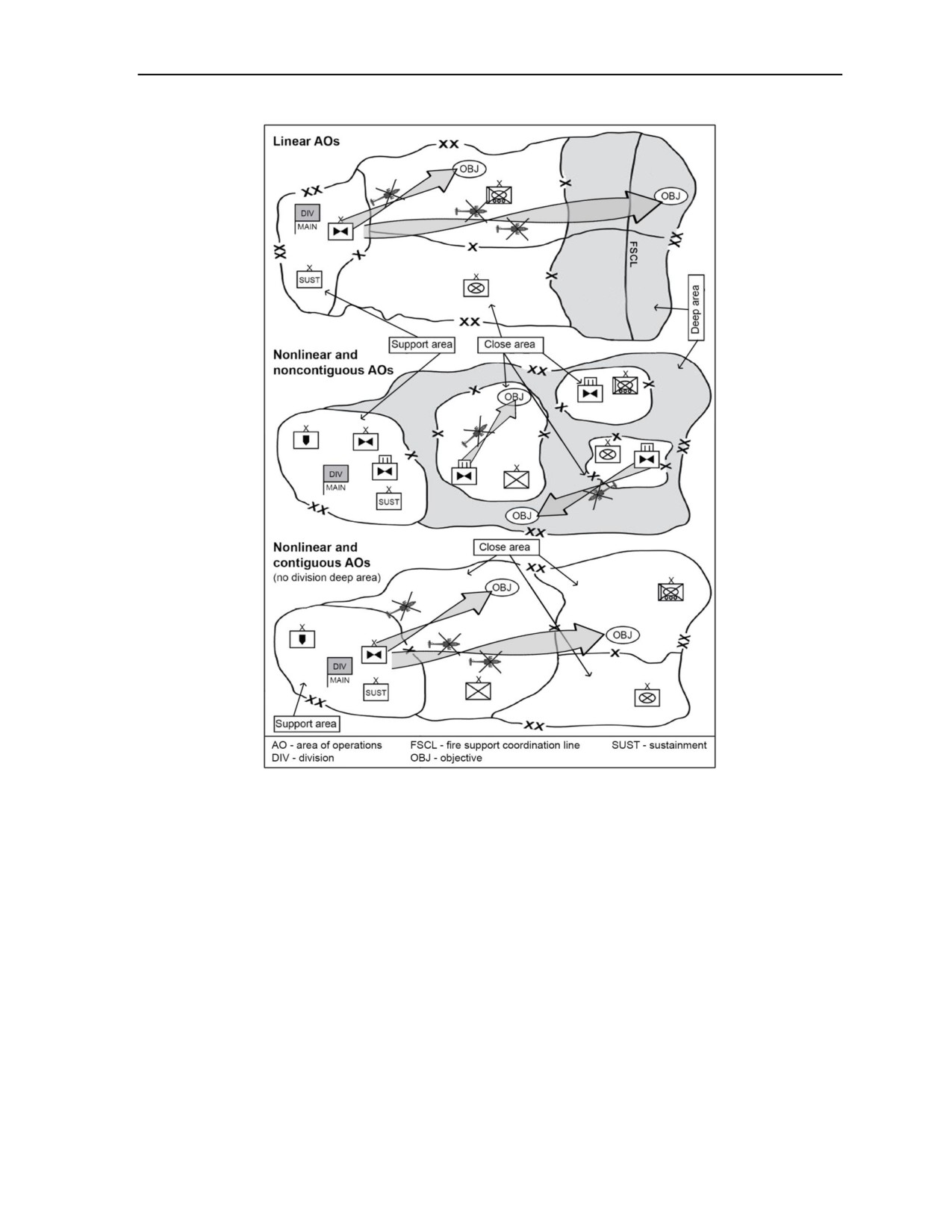
Army Aviation’s Role in Unified Land Operations
Figure 1-1. Deep, close, and security operational framework
DECISIVE, SHAPING, AND SUSTAINING OPERATIONS
1-43. Decisive operations are operations that directly accomplish the mission that determines the outcome
of a major operation, battle or engagement. The decisive operation is the focal point around which
commanders design an entire operation (ADRP 3-0). Army Aviation conducts all missions in direct support,
GS, tactical control (TACON) or operational control (OPCON) to the ground maneuver force tasked with
accomplishing the decisive operation (chapter 2). Army Aviation units are typically task organized with
ground maneuver forces as the combined arms team maneuver headquarters when designated as the decisive
operation.
1-44. Shaping operations are operations that establish conditions for the decisive operation through effects
on the enemy, other actors and the terrain (ADRP 3-0). During unified land operations, Army Aviation
conducts all missions and tasks in direct support, GS, TACON or OPCON to the ground maneuver forces
tasked with accomplishing shaping operations. Army Aviation units can also be assigned to accomplish
shaping operations without ground forces. During these operations, Army Aviation units conduct movement
to contact, attacks, reconnaissance, and/or screens to prevent the enemy from gaining a position of relative
29 July 2015
FM 3-04
1-7
Chapter 1
advantage. Finally, Army Aviation can conduct shaping operations in support of the joint task force and air
or maritime component commanders.
1-45. Sustaining operations differ from decisive and shaping operations because they focus on friendly
versus enemy forces (ADRP 3-0). Army Aviation conducts reconnaissance, attack, screen, air movement,
aeromedical evacuation, and mission command support when in support of a unit tasked with sustaining
operations. Army Aviation units typically are not sustaining operations headquarters.
MAIN AND SUPPORTING EFFORTS
1-46. The main effort is a designated subordinate unit whose mission at a given point in time is most critical
to overall mission success (ADRP 3-0). The designated main effort is typically weighted heavily with Army
Aviation combat power to achieve their mission. Army Aviation units may also be designated as the main
effort during specified phases of an operation when assigned as the maneuver headquarters operating
independently from ground maneuver or task organized as the maneuver headquarters of the combined arms
team.
1-47. The supporting effort is a designated subordinate unit with a mission that supports the success of the
main effort. The supporting effort is typically resourced with less Army Aviation combat power than the
main effort. Army Aviation units may also be designated as the supporting effort during specified phases of
an operation when assigned as the maneuver headquarters operating independently from ground maneuver
or task organized as the maneuver headquarters of the combined arms team assigned as a supporting effort.
SECTION IV - OPERATIONAL ENVIRONMENT
1-48. To prevent conflicts, shape the security environment, and win in a complex world requires agile Army
Aviation leaders and units with the training, leadership, and technologies necessary to overmatch the enemy.
Trained leaders and formations that are fully capable of operating under ambiguous and often unknowable
conditions, equipped with advanced technologies and capabilities, ensure that Army Aviation remains a
unique and asymmetric advantage for the Army and the United States.
1-49. The diversity of threats across the land, air, maritime, space, and cyberspace domains to United States
security and vital interests increases the need for Army forces to prevent conflict and shape security
environments while maintaining the capability to win by compelling enemies when required. Diverse
enemies employ traditional, unconventional, and hybrid strategies to threaten United States security and vital
interests. These threats emanate from the fielded forces of hostile nation states and from areas where state
weakness allows non-state actors or adversary organizations to operate. Conflict often arises from disorder
(the breakdown of peaceful and lawful behavior) and is accelerated by the speed of human interaction via
social media. In conflicts involving nation states, disorder often follows the defeat of enemy forces or the
collapse of a regime. Army forces are required to overcome the effects of this disorder through military
operations that integrate unified action partners’ capabilities. The ability to project power onto land from air,
maritime, space, and cyberspace domains remains vital to joint operations to achieve political outcomes.
1-50. The character of future warfare continues to evolve based upon assigned missions; emerging
technologies; the operational environment; and changes in an enemy’s capabilities, objectives, and resolve.
Army Aviation units and leaders must anticipate change while considering how continuities, such as those
reflected in the principles of war, the seven core competencies of Army Aviation and tenants of unified land
operations affect how Army Aviation must operate to accomplish future missions in the required operational
environment (OE). The OE is a composite of the conditions, circumstances, and influences that affect the
employment of capabilities and bear on the decisions of the commander (ADRP 3-0). The OE can be expected
to be complex where the environment is not only unknown, but unknowable and constantly changing. Army
Aviation leaders and those employing Army Aviation must understand current and emerging threats, threat
systems, friendly capabilities and limitations, as well as the operational variables and the mission variables
that are present and emerging in the OE.
1-8
FM 3-04
29 July 2015
Army Aviation’s Role in Unified Land Operations
THREAT
1-51. A threat is a combination of actors, entities, or forces that have the capability and intent to do harm to
United States forces, United States national interests or the homeland (ADRP 3-0). Threats can include
nation-states, national alliances, paramilitary or military forces, and/or individuals or groups of individuals.
When threats execute their intent to do harm to the United States, they become enemies.
1-52. Within the OE, Army Aviation can expect to encounter a wide range of actors that may include: nation
state enemy forces or adversaries, multinational friendly forces, intergovernmental agencies, non-
governmental organizations, private organizations, private security organizations, media, criminal
organizations, insurgents, violent extremists, tribes and ethnic groups. The intermixing of these actors and
elements, coupled with the operational and mission variables create the complex operational environment.
1-53. The term hybrid threat captures the complexity and blurring of the traditional elements of conflict. A
hybrid threat is the diverse and dynamic combination of regular forces, irregular forces, terrorist forces,
and/or criminal elements unified to achieve mutually benefitting effects (ADRP 3-0). The hybrid threat
employs traditional, unconventional, and hybrid strategies to threaten Army Aviation operations in support
of the combined arms team. The complexity and diversity of threats to Army Aviation are compounded by
proliferation. Current and emerging technologies consisting of traditional and non-traditional threats are
developed and evolve at a rapid pace. Traditional threats to aviation include; unguided projectiles, anti-
aircraft artillery (AAA), man-portable air defense systems (MANPADS), surface to air missiles (SAMs),
electronic warfare capabilities and armed aircraft. Non-traditional threats to aviation include; improvised
explosive devices, cyber capabilities, anti-tank guided missiles (ATGMs), passive detection, and directed
energy weapons. Coupling traditional and non-traditional threat weapons, hybrid threats constantly seek to
adapt their tactics, techniques, and procedures (TTP) to gain asymmetric advantages to overcome Army
Aviation’s overmatch at the point of contact.
1-54. Hybrid threats seek to disrupt Army Aviation operations through terrain denial, air route interdiction,
and intentional disruption of aviation areas of operation such as forward arming and refueling points
(FARPs), LZs, PZs, engagement areas (EAs), tactical assembly areas (TAAs), and airfields. Hybrid threats
also seek to exploit our ROE, weather and environmental limitations, multinational caveats and other
influencing political factors, while simultaneously disrupting our use of precision navigation and information
networks.
1-55. Employing information operations, cyber-attacks, deception, blending in with the population, terrorist
activities, small unit decentralized operations, and/or larger massed conventional operations to attempt to
achieve tactical overmatch, hybrid threats continuously adapt their TTP to achieve their desired effect at the
tactical, operational, and strategic levels of war.
1-56. Current and emerging threat systems and capabilities that enemy forces may employ against Army
Aviation include the following:
Unguided projectile weapons. Weapon systems which follow an unguided ballistic trajectory to include
small arms, rocket-propelled grenades, rockets, indirect fires and medium and heavy machine guns (12.7
to 14.5 millimeters) that can engage aviation systems at varying altitudes or against fixed Army Aviation
locations like FARPs, airfields and TAAs.
AAA. Weapon systems with the capability to fire exploding rounds of 20mm or greater which use visual,
electro-optical (EO), infrared (IR), or radar for acquisition and ballistic solutions that can engage aviation
systems up to high altitudes. AAA platforms include: dedicated wheeled and tracked AAA systems,
stationary gun emplacements, non-standard (technical) vehicles, and maritime platforms.
MANPADS. MANPADS are shoulder-fired, point-defense guided missile systems using the infrared or
ultra-violet spectrum with active infrared, ultra-violet, laser, or optical guidance that can engage aviation
systems. MANPADS can be employed dismounted, or mounted on ground vehicles, manned and UA,
or maritime platforms and are generally limited to the operator’s ability to visually acquire and track
aircraft prior to initiating launch.
SAMs. SAMs are short to long-range air defense systems using radar frequency (RF) and/or EO/IR
acquisition and/or guidance. SAMs are capable of engaging all types of aviation systems up to high
altitudes. SAMs are typically mounted on dedicated platforms, including stationary sites, wheeled or
29 July 2015
FM 3-04
1-9
Chapter 1
tracked vehicles, or maritime platforms. SAMs have the potential for employment as a component of an
integrated air defense system with supporting early warning and acquisition radars providing cueing;
however, a number of systems are fielded that can operate autonomously with on board acquisition and
targeting/guidance capabilities.
Antiradiation munitions (ARMs). ARMs are active homing projectiles designed to detect and home
on a radio emission source. Although initially intended for active engagement of emitting radar systems,
ARMs may be programmed and used to attack emitters employed on Army Aviation aircraft. ARMs
may be employed from threat rotary-wing and FW aircraft, as well as ground and maritime surface
platforms to engage aviation systems up to high altitudes.
Improvised explosive devices (IEDs). IEDs are typically devices made from readily available materials
which are low cost and are typically relatively simple to employ. Using non-standard methods of
employing explosive devices (such as artillery rounds, home-made explosives, mines) with improvised
triggering (such as IR, command wire, RF, pressure plate), IEDs can be employed to deny terrain,
interdict ground and air routes, create mass casualties in dense population areas, or deny the use of or
ambush friendly forces at point locations (such as LZs, buildings, observation positions). IEDs can
engage aviation systems when operating at low altitudes.
ATGMs. ATGMs are designed to defeat armored vehicles; however, they can also be employed against
low, slow flying rotary-wing aircraft. ATGMs typically rely on visual or electro-optical acquisition of
the target and are terminally guided by command wire, laser designation, passive EO/IR guidance, or
active RF guidance.
Anti-helicopter mines. Anti-helicopter mines are designed with specific triggering and terminal effects
to engage slow flying or hovering helicopters with the same intended purpose as IEDs.
Passive detection. These systems include image intensifiers/night vision goggles, IR systems, low-light
cameras, and acoustic or seismic detectors. These systems provide a detection capability based on
uncontrollable emissions and reflections of aircraft and some are readily available at low cost as
commercial off the shelf systems or as developed and fielded by peer and near peer adversaries. The use
of these capabilities significantly increases the potential for aircraft detection and the effectiveness of
visual acquisition systems (such as MANPADS, small arms, heavy machine guns) during low light
operations.
Meaconing, interference, jamming, and intrusion (MIJI). Hybrid threats continue to seek low-cost
commercial capabilities to disrupt/degrade communications, navigation, and precision munitions
employment. In addition to commercial off-the-shelf adaptation, peer and near-peer threats possess
specific capabilities dedicated to jamming and interference.
Threat aviation. Hybrid threat aviation capabilities may include military and civilian rotary-wing and
FW aircraft and military or commercial off-the-shelf UAS. In addition to air-to-air capabilities, FW and
rotary-wing threat systems may be employed to attack aviation assembly areas (AAs), LZ/PZs, and
FARPs with aerial delivered ground fires to disrupt aviation maneuver and mission command across the
AO. UAS pose additional unique threats to include reconnaissance and surveillance of Army Aviation
ground and air operations, employment as improvised explosive devices against stationary and slow
moving aircraft or ground operations, and hazards to flight in congested areas like airfields and high use
air corridors.
Cyber threats. Hybrid threats seek to disrupt mission command nodes and capabilities through
offensive cyber-attacks against unprotected or poorly protected networks and systems.
Directed energy. Directed energy threats include laser designators, laser range finders, and missile
guidance in beam riding munitions. Directed energy weapons, to include anti-personnel, anti-sensor, and
anti-material, use the transmitted energy to disrupt, deny, or destroy an aircraft or aircrew member. The
scope of directed energy weapons ranges from commercial off-the-shelf handheld laser pointers to high
power/frequency acoustic and RF transmitters. The employment of anti-sensor and anti-material systems
will normally be for point defense of crucial equipment or facilities with employment from vehicles or
fixed positions.
1-10
FM 3-04
29 July 2015
Army Aviation’s Role in Unified Land Operations
PHYSICAL ENVIRONMENT
1-57. Army Aviation must be able to fight under all conditions and anywhere in the world as a member of
the combined arms team. To employ aviation effectively, understanding and being able to exploit the physical
environment is essential throughout the operations process and during execution.
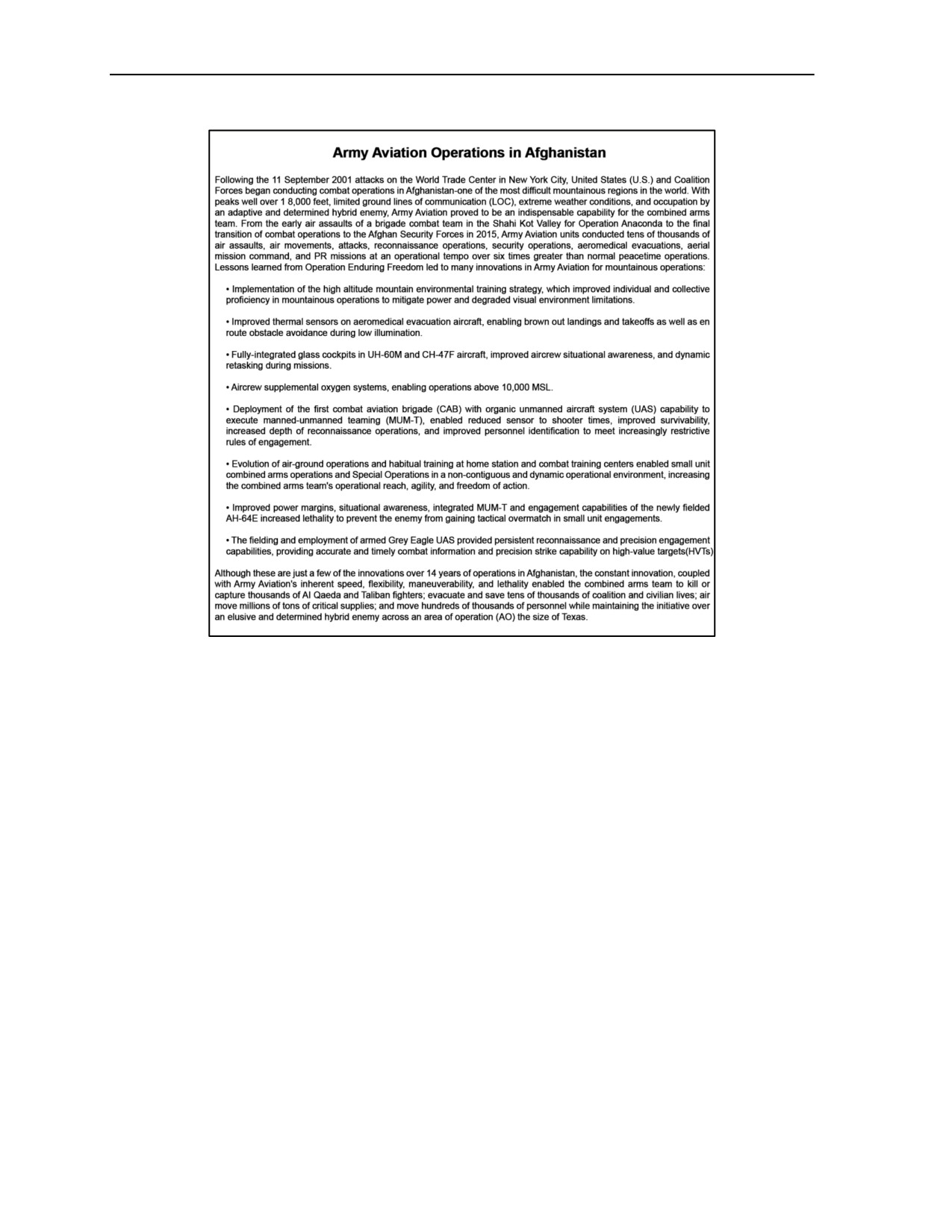
MOUNTAIN OPERATIONS
Capabilities
1-58. Army Aviation is ideally suited to conduct combat operations in mountainous terrain. Providing the
combined arms team with increased mobility, speed, and range, Army Aviation can effectively overcome the
limitations imposed on traditional ground mounted and dismounted maneuver in compartmentalized and
complex terrain. Mountains provide visual and audio masking that may limit threat acquisition ranges
enabling aviation maneuver forces to achieve greater tactical surprise and protection from long range
observation and engagements. The use of air assault and air movement operations enable the combined arms
team to rapidly reposition forces and materials at decisive points to retain greater freedom of action over the
enemy while achieving economy of force over large expanses of complex terrain with limited ground lines
of communication. The mobility and lethality of attack and reconnaissance helicopters and UAS provides
ground maneuver forces with precise direct fire and persistent reconnaissance beyond ground inter-visibility
lines and in broken terrain, reducing enemy freedom of action and the likelihood of enemy forces achieving
tactical surprise. Aeromedical evacuation capabilities in remote locations with limited or no road
infrastructure increases the combined arms team’s survivability and freedom of action. Army Aviation’s over
the horizon communication capabilities and ability to rapidly reposition ground maneuver leaders enhances
the combined arms team’s ability to perform mission command over extended distances and beyond line of
sight (LOS).
Limitations
1-59. Operations in high, hot mountainous environments can limit aviation maneuver due to reduced load
carrying capacity and maneuver power margins of aircraft. Depending upon the severity of the altitudes and
temperatures, trade-offs may be necessary between aircraft loads (weapons, cargo, personnel) and fuel
carried, as well as adjustments to TTP which can impact station time, maneuver in the objective area, landing
and pickup zone selection, and aircraft ranges. Additionally, trade-offs may require additional FARP
locations and/or more aircraft to complete a mission. Canalizing terrain reduces line of sight communications,
may limit the size or freedom of maneuver of aviation formations, and can drive predictable flight patterns
that can be targeted by the enemy. Detailed planning, varying mission timelines, choosing longer or multiple
routes, and employing non-line of sight or communications relay packages on UAS can mitigate canalizing
terrain limitations. Several unique weather factors also influence operations in mountainous terrain.
Unpredictable wind speeds, varying wind directions and frequent up and down drafts, coupled with high
density altitude, low ceilings that obscure terrain, increased frequency of turbulence and reduced night time
illumination due shadows and terrain masking of the moon or man-made light sources requires more detailed
planning, more experienced crews and adjustments to TTP. Severe cold weather is also prevalent during the
winter in mountainous terrain. Severe cold temperatures, snow, and ice increases time requirements for
aircraft preparation and launch due to deicing and snow removal, increased maintenance due to cold soaked
seals and electronics, and increased flight hazards due to white out, icing of blades and wings (non-deice
equipped systems) and loss of visibility due to falling or blowing snow. Aviation operations above 10,000
feet mean sea level (MSL) for more than an hour; above 12,000 feet for more than 30 minutes; above 14,000
feet for any period of time, require the use of supplemental oxygen for all Army rotary-wing aircraft.
Additionally, depending upon the height of terrain, UAS service ceilings may reduce the height above ground
of UAS operations which can increase their likelihood of visual or audio detection which could compromise
the ground scheme of maneuver while increasing UAS vulnerability to engagement.
29 July 2015
FM 3-04
1-11
Chapter 1
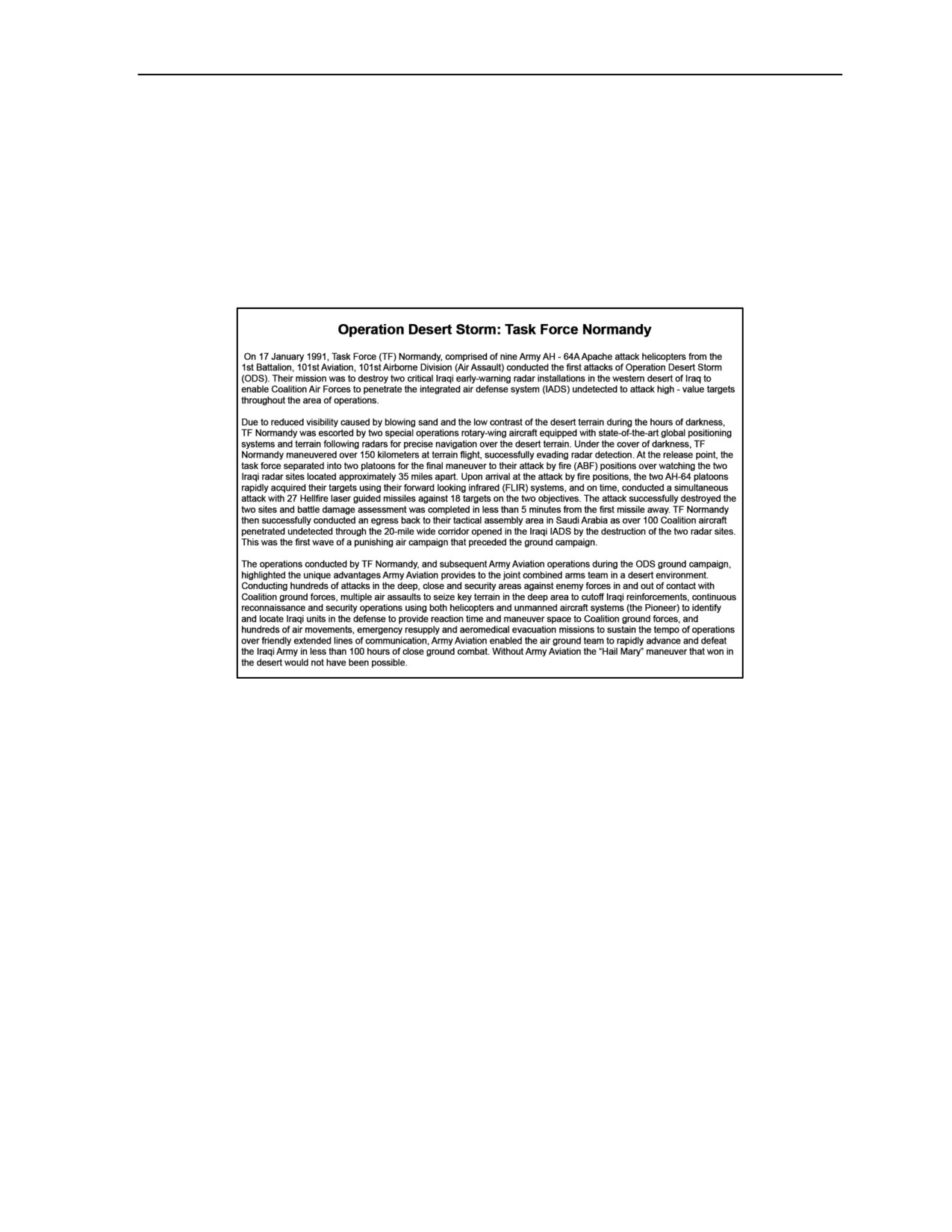
DESERT OPERATIONS
Capabilities
1-60. Army Aviation provides the combined arms team with enhanced capabilities to operate in desert
environments. The extended sensor, communications and weapons ranges of attack and reconnaissance rotary
wing and UAS enables long range engagement of targets and collection of combat information to confirm or
deny the commander’s PIR at the extended visual ranges typically associated with desert environments. Use
of air assaults through the depth of the AO to seize typically limited key terrain or road networks can enable
the combined arms team to counter the advantage of increased enemy ground maneuver speeds due to open
and trafficable terrain afforded in a desert environment. Use of air movements to reposition supplies,
ammunition and fuel over typically extended lines of communications enables greater tempo and agility,
while reducing operational risk to ground logistics and maneuver units. Use of aviation reconnaissance and
security operations forward or to the flanks of ground maneuver forces to identify obstacles, enemy forces
and the most suitable routes or axis of advance enables the combined arms team to maintain the tempo of
operations while protecting friendly units through economy of force. These examples above highlight how
Army Aviation’s speed, range, lethality and versatility enable the combined arms team to gain, maintain and
exploit a position of relative advantage in the desert environment.
Limitations
1-61. Blowing dust, sand, high temperatures, reduced visibility, low contrast and extended observation
ranges all present unique challenges to aviation operations in the desert environment. Much like mountainous
environments, extremely high temperatures can reduce the load carrying capacity of aircraft, requiring trade-
offs between fuel, cargo, personnel and munitions. High temperatures, along with dust and sand, increase
maintenance requirements. The expansion and contraction of seals during extreme temperature swings
1-12
FM 3-04
29 July 2015
Army Aviation’s Role in Unified Land Operations
increases the frequency of leaks and electronic component failures. Abrasion on rotor blades and other
dynamic surfaces requires more frequent cleaning, and can reduce component life, especially blades, bearing
assemblies and engines. Reduced visibility due to blowing sand, coupled with low contrast, increases the risk
of brownout during take offs and landings, especially in larger formations of aircraft which requires
experienced crews and detailed planning in the selection of LZs and PZs. En route, during low light and low
contrast conditions, height above terrain and obstacles is more difficult to judge and may require higher flight
altitudes and/or more experienced crews to reduce the likelihood of controlled flight into terrain or obstacles.
Sensors and terminal weapon effects are also impacted by reduced visibility and surface conditions in the
desert environment which may reduce weapon engagement ranges or increase the amount of munitions
expended to achieve target effects.
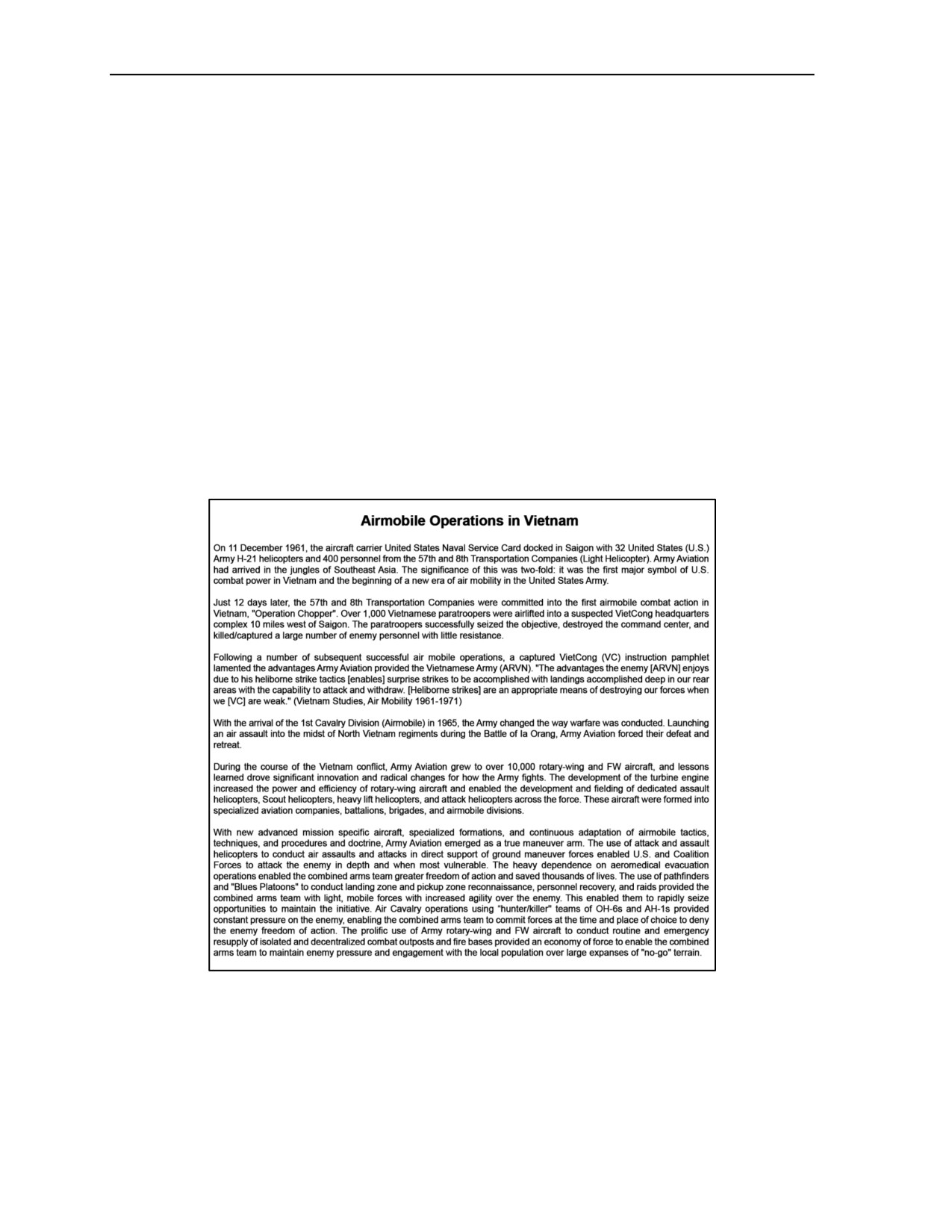
JUNGLE OPERATIONS
Capabilities
1-62. Much like in mountainous terrain, Army Aviation provides the combined arms team with a significant
mobility and firepower advantage over enemy ground maneuver forces in restricted terrain that is
characterized by dense vegetation, complex hydrography, and jungle canopy. Using air assault and air
movement operations, the combined arms team can rapidly reposition forces to interdict limited enemy
ground routes or seize objectives with less risk due to reduced threat visual and audio acquisition and direct
fire engagement windows. Attack and reconnaissance helicopters and UAS provide the combined arms team
with mobile and responsive reconnaissance and fires to support typically small, decentralized ground
operations in remote locations that may be out of the range of friendly artillery or against enemy targets that
may be more difficult to locate or attack with FW close air support (CAS). Aeromedical evacuation and air
movement of supplies and personnel enables greater flexibility for distributed ground operations in remote
locations, increasing the combined arms team’s freedom of action and ability to maintain pressure on enemy
forces and/or sustained engagement with local populations over larger areas of operation. The employment
of special patrol infiltration and exfiltration system (SPIES), fast-rope insertion and extraction system
(FRIES), hoist, aerial delivered resupply, and paradrop capabilities enables Army Aviation to conduct
infiltration and extraction of small teams, casualties and emergency supplies in remote locations without the
benefit of LZs or PZs.
29 July 2015
FM 3-04
1-13
Chapter 1
Limitations
1-63. Although the dense jungle vegetation reduces enemy observation and direct fires of Army Aviation
while en route, the lack of LZ/PZs, limited improved road infrastructure and the distributed nature of small
population centers typically characteristic of jungle areas of operation can result in greater predictability for
the enemy to target aviation operations during actions on the objective. The use of pathfinders, detailed
LZ/PZ reconnaissance, LZ preparatory fires, attack and reconnaissance helicopters and UAS providing
reconnaissance, security and attacks in support of infiltration and extraction, and deception operations can be
used to mitigate risk. The jungle canopy and dense vegetation also provides the enemy with greater cover
and concealment reducing the standoff ranges and increasing the vulnerability of attack and reconnaissance
aircraft which operate at lower altitudes and at closer ranges to detect and engage enemy forces. Jungle
canopy and dense vegetation can also cause early detonation of munitions warheads, requiring specialized
fusing or greater expenditure of munitions to achieve target effects. Jungle environments also have unique
and dynamic weather patterns that can impact aviation operations. Higher temperatures and altitudes can
reduce aircraft loads which impacts ordnance carried, aircraft performance, and station time. Frequent rain
showers and thunder storms will reduce visibility by obscuring terrain and obstacles, while increasing
possible maintenance actions due to corrosion of aircraft components and sensitivity of electronics to
humidity and visible moisture. Fog and mist in low lying littoral areas or inland river systems, especially
during dawn and dusk, can limit aviation operations at terrain flight altitudes and reduces sensor and weapon
employment ranges. Low ceilings and unpredictable thunderstorms may also impact the employment of
UAS.
MARITIME OPERATIONS
Capabilities
1-64. Army Aviation provides the combined arms team and joint force with enhanced capabilities to operate
in and from the maritime domain. Army Aviation operates in the maritime domain by using sea basing as a
method of projecting force into the land domain or by using sea basing or land basing to project combat
1-14
FM 3-04
29 July 2015
Army Aviation’s Role in Unified Land Operations
power in direct support of joint forces in the maritime domain. As a force projection platform, sea basing
enables Army Aviation to conduct operations from over the horizon into the land domain in support of the
combined arms team or over water in support of joint naval forces. Using sea basing to conduct air assaults,
air movement, attacks, or aeromedical evacuation from beyond the horizon into the land domain allows the
combined arms team to overcome anti-access and area denial (A2AD) measures prior to seizing and
establishing a lodgment. Based on the depth of the A2AD measures, sea basing provides Army Aviation the
ability to expand the options for entry into an AO due to the mobility of the basing platforms and the inherent
speed and range of Army Aviation. When appropriate, continued sea basing after seizing the lodgment can
also serve as an economy of force by reducing the aviation land footprint, sustainment and force protection
requirements. In support of joint or multinational naval forces, using Army Aviation to conduct
reconnaissance and attack operations over water enables the joint or multinational force commander to defeat
small boat and small surface combatant threats, counter piracy and drug threats, protect individual ships or
sea convoys, or attack A2AD (missile, gun, and radar) capabilities in the littorals. This enables the joint or
multinational force commander to maintain open sea lines of communication, protect maritime infrastructure
(oil rigs, offshore terminals, and harbors) and shipping, or deny enemy freedom of action in maritime choke
points (straits, sea lanes, and littorals).
Limitations
1-65. Rapidly changing weather conditions, sea state, low visibility, low contrast, and extended observation
ranges over water present challenges to Army Aviation in the maritime environment. In some maritime areas,
high temperatures may cause commanders to make load decisions between fuel, cargo, passengers, and
munitions. Extended operations in a salt water environment results in increased corrosion of critical parts and
will cause increased maintenance requirements. En route, during low light and low contrast conditions, height
above the water is more difficult to judge and may require higher flight altitudes to reduce the likelihood of
controlled flight into the water. Additionally, the size and number of the sea basing platforms directly impacts
the overall size of the aviation force and the number of aircraft that can operate simultaneously. This can
impact the combined arms teams’ ability to mass and maintain adequate aviation tempo in support of
operations over land. If A2AD measures are robust, stand-off of sea basing capabilities will require longer
routes, reducing station time in the objective unless additional FARPs are employed on land in the AO. Sea
basing also does not currently enable Army Aviation to employ organic UAS due to launch and recovery
limitations. Operating from ships and other maritime platforms requires specialized deck landing and
helicopter egress qualification and proficiency training as well as overwater flight proficiency, especially
during night operations. The storage of munitions on ships also requires specialized munitions, procedures,
training and safety.
29 July 2015
FM 3-04
1-15
Chapter 1
URBAN OPERATIONS
Capabilities
1-66. Urban areas are primarily the epicenters of human activity and will generate much of the friction in
future conflict. Urban operations range from operations in and around small built up areas, towns, and small
cities, to large urban complexes and megacities. Army Aviation can effectively overcome many of the
limitations imposed on traditional ground mounted and dismounted maneuver in this complex environment.
Army Aviation’s inherent speed, mobility, precision fires, and persistent reconnaissance capabilities provide
the combined arms team with a number of options to reduce the complexity of operations in an urban
environment. The use of Army Aviation to air assault small ground maneuver elements to secure
infrastructure, isolate urban areas, seize limited objectives, kill or capture high value targets, seize key terrain,
or to conduct cordon and search operations reduces the enemy’s freedom of action while economizing force
and reducing risk to ground movements. The use of persistent reconnaissance and precision fires by attack
and reconnaissance rotary-wing aircraft and UAS along key lines of communication, named areas of interest
(NAIs), key infrastructure or in support of small unit mounted and dismounted ground maneuver increases
the combined arms team freedom of action, protects the force and reduces the enemy’s ability to attain tactical
overmatch at the point of contact. Use of air ambulances equipped with rescue hoists to extract casualties
from secured, compartmented and congested areas enables the rapid evacuation of casualties, increasing the
ground maneuver force tactical reach while reducing the requirement to secure ground movement. Using
extended range and non-line of sight communications, Army Aviation can provide enhanced mission
command capabilities to the combined arms team through the use of UAS communication relay package or
Army airborne command and control system aircraft to overcome the limitations of ground maneuver line of
sight communications in urban terrain.
Limitations
1-67. Each urban area is unique and the challenges to successful aviation operations increase based on the
scale, makeup and complexity of the urban area. The availability of LZs/PZs are frequently limited to sports
fields, major roads, highway medians, roof tops, transition areas (unimproved open areas), vacant lots, and
urban green spaces. These areas are routinely cluttered with debris or other loose impediments that can
become airborne hazards during landings and takeoffs. The lack of LZ/PZs also enables easier enemy pattern
analysis of aviation operations to emplace ambushes or use IEDs. Significant vertical obstacles (such as light
poles, power lines, and antennas), coupled with the height of adjacent buildings, may limit approach and
departure paths for aircraft, restrict freedom of maneuver in the objective area and limit the number of aircraft
that can simultaneously operate in the LZ/PZs requiring greater power margins to maintain aircraft combat
maneuver capabilities. Adjacent buildings and structures also provide cover and concealment for enemy
forces and extend fields of view and fire from above the landing areas. Roof-top landing areas are typically
cluttered with vertical obstructions (such as antennas and building mechanical systems) that may limit the
size of touchdown areas, and based on the quality of the construction, may or may not be suitable to handle
aircraft weights upon landing. The presence of sub-terrain structures (such as tunnels, subways, and sewers),
as well as vast road networks bounded by vertical structures enables the enemy to rapidly reposition with
1-16
FM 3-04
29 July 2015
Army Aviation’s Role in Unified Land Operations
cover and concealment from observation and fires. During night operations, high intensity lighting may
reduce the effectiveness of using image intensifying night vision devices, degrading the ability to acquire
obstacles to flight and other aircraft, as well as limiting target acquisition capabilities for non-FLIR equipped
aircraft. In heavily industrialized urban areas, power generation plants and other heavy industry can create
localized areas of low to no visibility or layers of obscurants that impact both rotary-wing flight and UAS
sensor employment. During attack and reconnaissance operations, high population densities in urban areas
allow the hybrid threat to more easily blend in, increasing the difficulty of positive identification, and
increasing the risk of collateral damage during engagements. Urban landscape surfaces can increase direct
fire fragmentation effects due to less blast and fragmentation absorption like soft surfaces which may increase
target effect but also increases the danger of ricochets that risk fratricide or collateral damage. During
engagements of structures, shaped charge warheads on certain missile models are less effective in penetrating
structures and achieving internal blast effects which may require greater expenditure of ordnance to achieve
desired target effect. The prolific use of modern communications provides the enemy with early warning of
operations, limiting the advantage of surprise. Detailed technical reconnaissance of landing areas and
obstacles, use of UAS conducting persistent reconnaissance, maximizing the use of precision munitions,
operating during the hours of darkness at higher altitudes, conducting detailed rehearsals of actions on the
objective, use of FRIES and SPIES for small team infiltration and extraction, using common graphic control
measures tailored for floor and room identification in buildings and increasing flight altitudes are all measures
to consider for mitigating risk in urban areas.
OTHER ENVIRONMENTS
Pandemic Zones
1-68. A pandemic zone is a geographical area infected with a pandemic disease. Within the pandemic
environment, Army Aviation can conduct reconnaissance, convoy security, air movement of medical supplies
and construction materials, air movement of medical, survey or security teams, aeromedical operations, and
mission command support. Key considerations when operating in a pandemic zone are the difficulties
associated with decontamination or sterilization of aircraft and ground support equipment and the limitations
imposed on aircrews that are flying in personal protective equipment.
29 July 2015
FM 3-04
1-17
Chapter 1
Post-Disaster Zones
1-69. A post-disaster zone is an area that has been struck with a natural, technological, or sociological
disaster. As in a pandemic zone, Army Aviation can provide a wide range of capabilities that can overcome
the lack of available road networks and other infrastructure impacted in the disaster zone. Key considerations
include challenges to radio communications with local authorities, limited availability of host nation fuel
support, damage to airfields and other supporting infrastructure, limited LZ/PZs due to debris, and
deconfliction with other civil or non-governmental aviation operations in the disaster zone.
Chemical, Biological, Radiological, and Nuclear Conditions
1-70. Operations in chemical, biological, radiological, and nuclear (CBRN) environments challenge aviation
operations due to the lack of aircraft pressurization and the difficulty of conducting aircraft decontamination
when exposed to radiological or persistent forms of chemicals or biological agents. Aircrew and support
personnel performance is significantly degraded when operating in full protective posture. Key
considerations before deliberately conducting aviation operations in a CBRN environment include: impact
to future mission support due to long duration contamination of aircraft and support equipment; performance
impacts (especially in hot environments) on crews and support personnel or while conducting night
operations using night vision devices; the necessity to segregate or isolate contaminated aircraft and the
impact on maintaining this equipment; and the ability to spot decontaminate aircraft and equipment to reduce
the hazard of contamination transfer.
CONCLUSION
1-71. To prevent conflict, shape the security environment, and win in a complex world, leaders employing
Army Aviation must understand the complexity of the operational environment. Hybrid threats with a full
range of capabilities and fighting in highly complex and challenging environments with dynamic and ever
changing mission and operational variables will dominate the future security environment. Understanding
the capabilities and limitations of future threats and how to most effectively employ aviation in all physical
environments against the range of possible threats is essential for the combined arms team to execute
successful decisive action across the range of military operations and the conflict continuum.
1-18
FM 3-04
29 July 2015
Chapter 2
Army Aviation Organizations and Mission Command
SECTION I - OVERVIEW
2-1. Army Aviation formations are organized, trained and equipped to support the combined arms team at
the tactical and operational levels. The Army Aviation modified table of organization and equipment (MTOE)
force structure consists of four types of brigade-level aviation maneuver organizations and two types of
enabling group-level organizations. The brigade-level aviation maneuver organizations include—
z
Combat aviation brigades (CABs).
z
Expeditionary combat aviation brigades (ECABs).
z
Theater aviation brigade (assault) (TAB-A).
z
Theater aviation brigade (general support) (TAB-GS).
2-2. The enabling group-level aviation organizations provide the necessary support and sustainment
operations to ensure the aviation maneuver brigades are capable of completing their missions. These
organizations include—
z
Theater airfield operations group (TAOG).
z
Theater aviation sustainment maintenance group (TASMG).
2-3. The battalion- and squadron-level organizations of Army Aviation consist of the—
z
Attack reconnaissance squadron (ARS).
z
Attack reconnaissance battalion (ARB).
z
Assault helicopter battalion (AHB).
z
General support aviation battalion (GSAB).
z
Aviation support battalion (ASB).
z
Security and support battalion (SSB).
z
Airfield operations battalion (AOB).
2-4. Although the above MTOE organizations are multi-functional, given the complexity of the operational
environment (OE) and METT-TC requirements, aviation brigades and battalions are usually further task
organized to meet the requirements of an assigned mission. Task organization is routinely multi-component
and can include any combination of platoons, companies and battalions organized under the aviation brigade,
aviation squadron task force (ASTF) or aviation battalion task force (ABTF) headquarters. Aviation brigades
and squadrons/battalions can also be task organized with ground maneuver, joint aviation, and other non-
aviation joint and Army units.
SECTION II - AVIATION BRIGADES
COMBAT AVIATION BRIGADE
PURPOSE
2-5. The core competencies of the CAB are to provide accurate and timely information collection; provide
reaction time and maneuver space; destroy, defeat, disrupt, or delay enemy forces; air assault maneuver
forces; position personnel, supplies, and equipment; evacuate casualties and conduct personnel recovery
(PR); and enable mission command in support of the combined arms team. The CAB is organized to
synchronize operations of multiple aviation squadrons/battalions or ASTF/ABTF, ground maneuver
battalions, or companies and joint aviation units.
29 July 2015
FM 3-04
2-1
Chapter 2
ORGANIZATION
2-6. The MTOE CAB consists of a headquarters and headquarters company (HHC), ARS, ARB, AHB,
GSAB, and an ASB. Figure 2-1 provides the organization of the standardized CAB.
Figure 2-1. Combat aviation brigade
CAPABILITIES
2-7. The CAB is designed to be modular and tailorable, and is typically task organized as required to support
offensive, defensive, and stability operations in support of ground maneuver forces or in DSCA. The CAB
is designed to split into four aviation maneuver battalions, or battalion/squadron task forces, and one aviation
support battalion, based on METT-TC. The CAB can receive up to two additional aviation
battalions/squadrons or task forces without staff augmentation but will require additional maintenance
personnel and equipment.
2-8. The CAB performs the following mission tasks—
z
Movement to contact.
z
Attack.
z
Reconnaissance.
z
Security.
z
Air assault.
z
Aerial mission command.
z
Air movement.
z
Aeromedical evacuation.
z
CASEVAC).
z
Personnel recovery (PR).
EXPEDITIONARY COMBAT AVIATION BRIGADE
PURPOSE
2-9. The core competencies of the MTOE ECAB are to air assault maneuver forces; position personnel,
supplies and equipment; evacuate casualties and conduct PR; and enable mission command in support of the
combined arms team. When task organized with an ARB/ARS, ECABs also provide accurate and timely
information collection; provide reaction time and maneuver space; and destroy, defeat, disrupt, or delay
enemy forces.
ORGANIZATION
2-10. The ECAB consists of a HHC, two AHBs, a GSAB, and an ASB. Figure 2-2, page 2-3, provides the
organization structure of the ECAB.
2-2
FM 3-04
29 July 2015
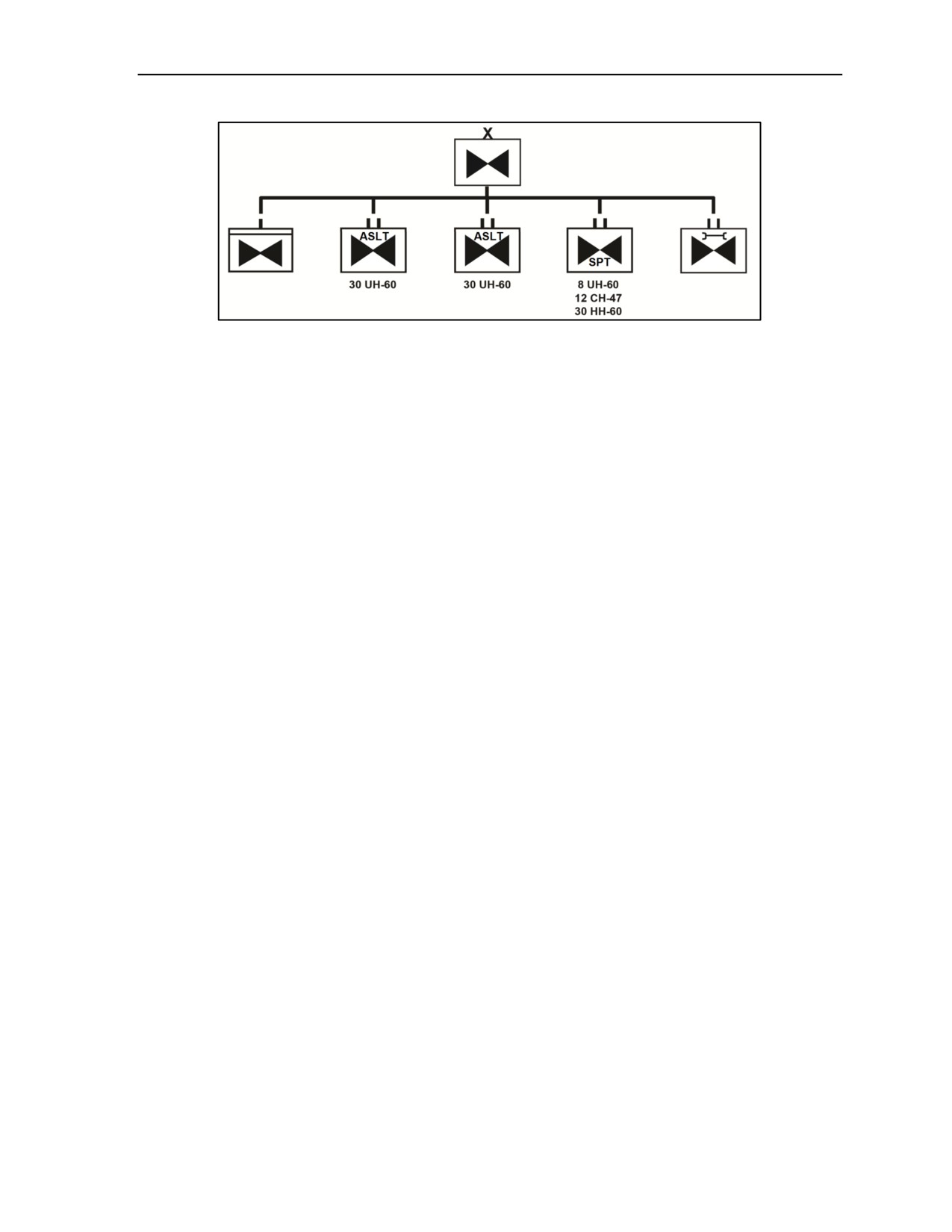
Army Aviation Organizations and Mission Command
Figure 2-2. Expeditionary combat aviation brigade
CAPABILITIES
2-11. The ECAB is designed to be modular and tailorable, and is typically task organized as required to
support offensive, defensive, and stability operations in support of ground maneuver forces or in defense
support of civilian authorities (DSCA). The ECAB is designed to split into three maneuver battalions, or
battalion task forces, and one aviation support battalion, based on mission variables. The ECAB can receive
up to two additional ASTFs/ABTFs without staff augmentation but will require additional maintenance
personnel and equipment. The ECAB performs the following tasks:
z
Air assault.
z
Aerial mission command.
z
Air movement.
z
Aeromedical evacuation.
z
CASEVAC.
z
PR.
z
Movement to contact (when task organized).
z
Attack (when task organized).
z
Reconnaissance (when task organized).
z
Security (when task organized).
THEATER AVIATION BRIGADE
PURPOSE
2-12. The MTOE TAB-GS provides accurate and timely reconnaissance in permissive environments;
positions personnel, supplies and equipment; evacuates casualties; conducts search and rescue; and enables
mission command in DSCA operations.
2-13. The MTOE TAB-A augments other aviation brigades or operates autonomously at the theater level to
air assault maneuver forces; position personnel, supplies, and equipment; evacuate casualties and conduct
PR; and enable mission command.
ORGANIZATION
2-14. The TAB-GS includes a HHC, six SSBs and a non-standard GSAB. The TAB-A includes a HHC, four
GSABs, and one ASB. Figure 2-3 and figure 2-4, page 2-4, provide the organizational structure for the TAB-
GS and TAB-A.
29 July 2015
FM 3-04
2-3
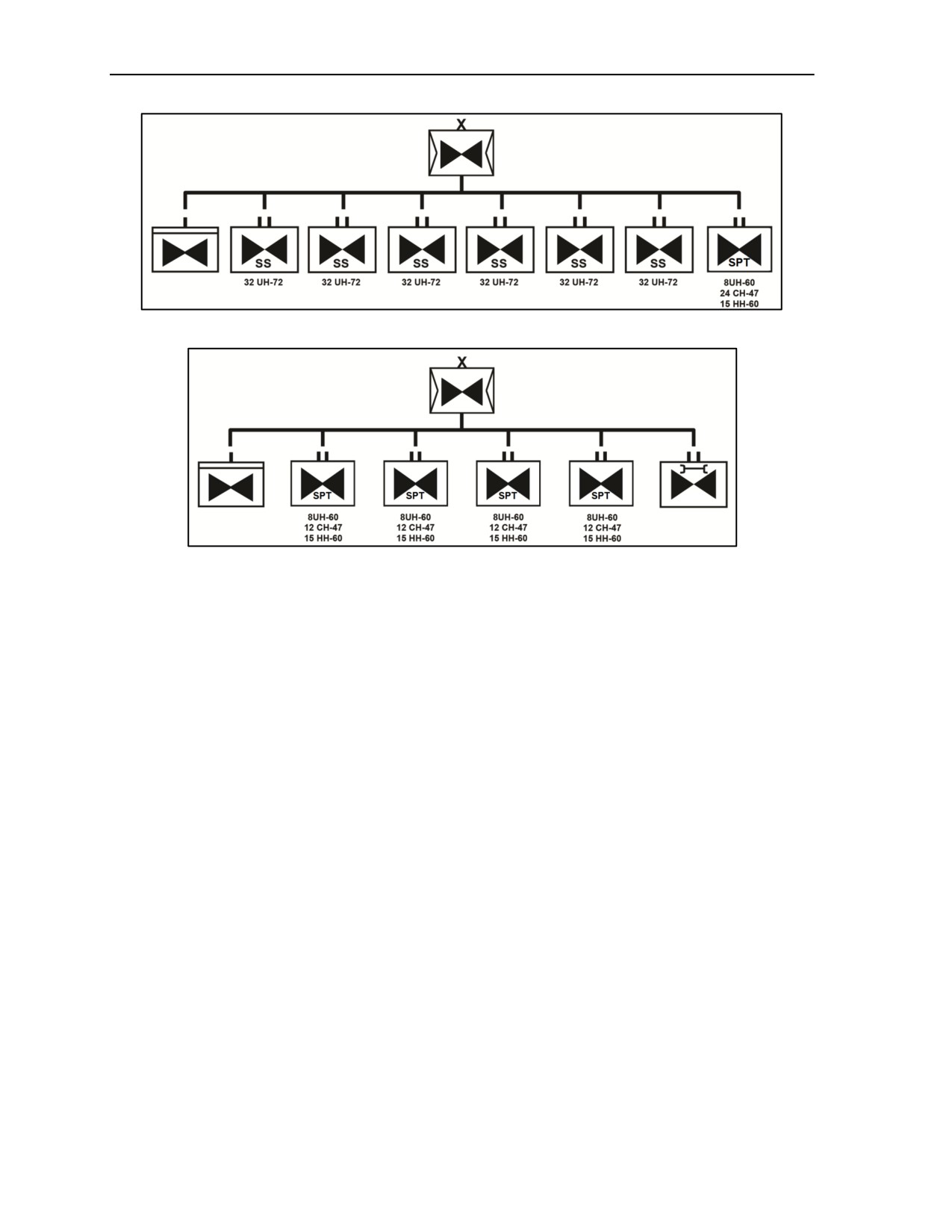
Chapter 2
Figure 2-3. Theater aviation brigade (general support)
Figure 2-4. Theater aviation brigade (assault)
CAPABILITIES
2-15. Although the TAB-GS headquarters with the GSAB and ASB has the capability of deploying in
support of global operations, the TAB-GS is a Northern Command asset and typically operates in
decentralized elements from the team to battalion level conducting DSCA.
2-16. The TAB-GS conducts the following tasks:
z
Permissive zone, route, and area reconnaissance.
z
Air movement.
z
Aeromedical evacuation.
z
Search and rescue.
z
Aerial mission command.
2-17. The TAB-A is a deployable operational level organization that typically reinforces other aviation
commands with subordinate battalions and companies or provides theater support autonomously. The TAB-
A may also be task organized with other aviation units to accomplish other traditional CAB or ECAB
missions and core competencies but requires mission command, staff and maintenance augmentation.
2-18. The TAB-A conducts the following tasks:
z
Air assault.
z
Air movement.
z
Aeromedical evacuation.
z
CASEVAC.
z
Aerial mission command.
z
Movement to contact (when task organized).
z
Attack (when task organized).
z
Zone, area, and route reconnaissance (when task organized).
z
Screen operations (when task organized).
2-4
FM 3-04
29 July 2015
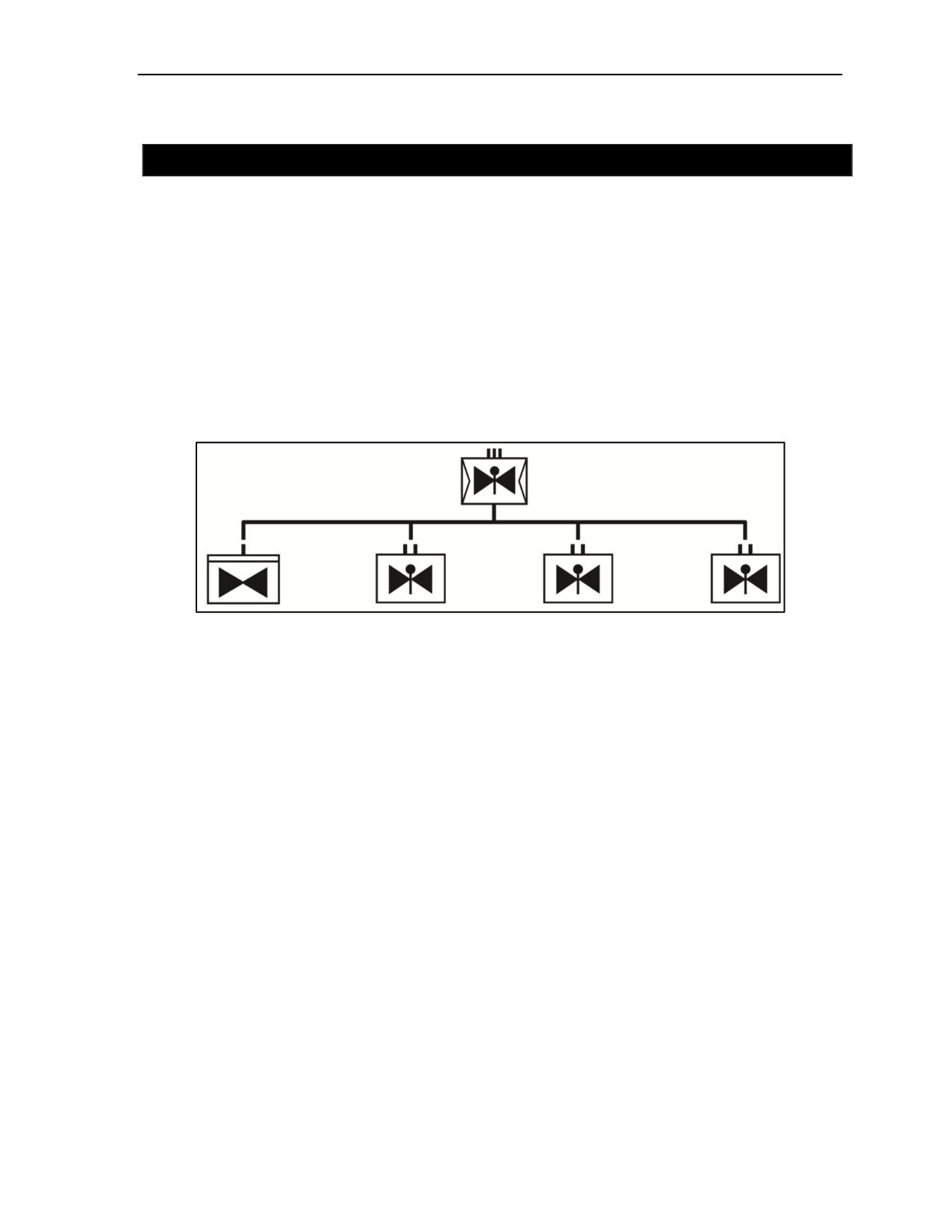
Army Aviation Organizations and Mission Command
z
PR (when task organized).
SECTION III - ENABLING AVIATION GROUPS
THEATER AIRFIELD OPERATIONS GROUP
PURPOSE
2-19. The TAOG provides airfield and air traffic services (ATS) support to the combined arms team. The
TAOG, when deployed with AOBs, conducts airfield management operations, provides local airspace control
for the AO in a joint environment, and provides oversight, sustainment, and maintenance support to the
theater ATS assets.
ORGANIZATION
2-20. The TAOG consists of a HHC and up to three AOBs. Figure 2-5 provides the organization structure of
a TAOG.
Figure 2-5. Theater airfield operations group
CAPABILITIES
2-21. The TAOG and its subordinate ATS organizations are an enabling component of the modular, scalable,
and tailored Army Aviation force and can support forcible and early entry contingency missions, as well as
sustained theater aviation operations. Air traffic operations are conducted overseas within contiguous and
noncontiguous areas, throughout the range of military operations. The ATS organizations support DSCA
missions in response to natural or man-made disasters, accidents, and incidents within the United States and
its territories.
2-22. The TAOG, the AOB, and the sub-element ATS units are optimized for theater aviation support and
deploy in total or are task organized by teams based on operational requirements. The TAOG is organized
and equipped to facilitate early deployment by establishing expeditionary airfields in support of Army, joint,
and multinational operations. The TAOG supports reception, staging, onward-movement, and integration
requirements for aviation assets arriving in the operations area, to include operation of heliports and helipads
at seaports of debarkation, and operations at aerial ports of debarkation.
2-23. The air traffic services standardization element (ATSSE) is a unique organizational design of the
TAOG. This element provides oversight, technical expertise, standardization to Army airfields at theater
level and quality assurance for training and certification of controllers and ATS maintenance personnel. It
develops special use airspace for restricted areas, transition areas and control zones. The ATSSE serves as
the primary staff coordinator for ATS matters within the theater area. The element is capable of splitting into
two teams for modularity and support of five AOBs employed across a wide geographical area throughout
the theater.
29 July 2015
FM 3-04
2-5
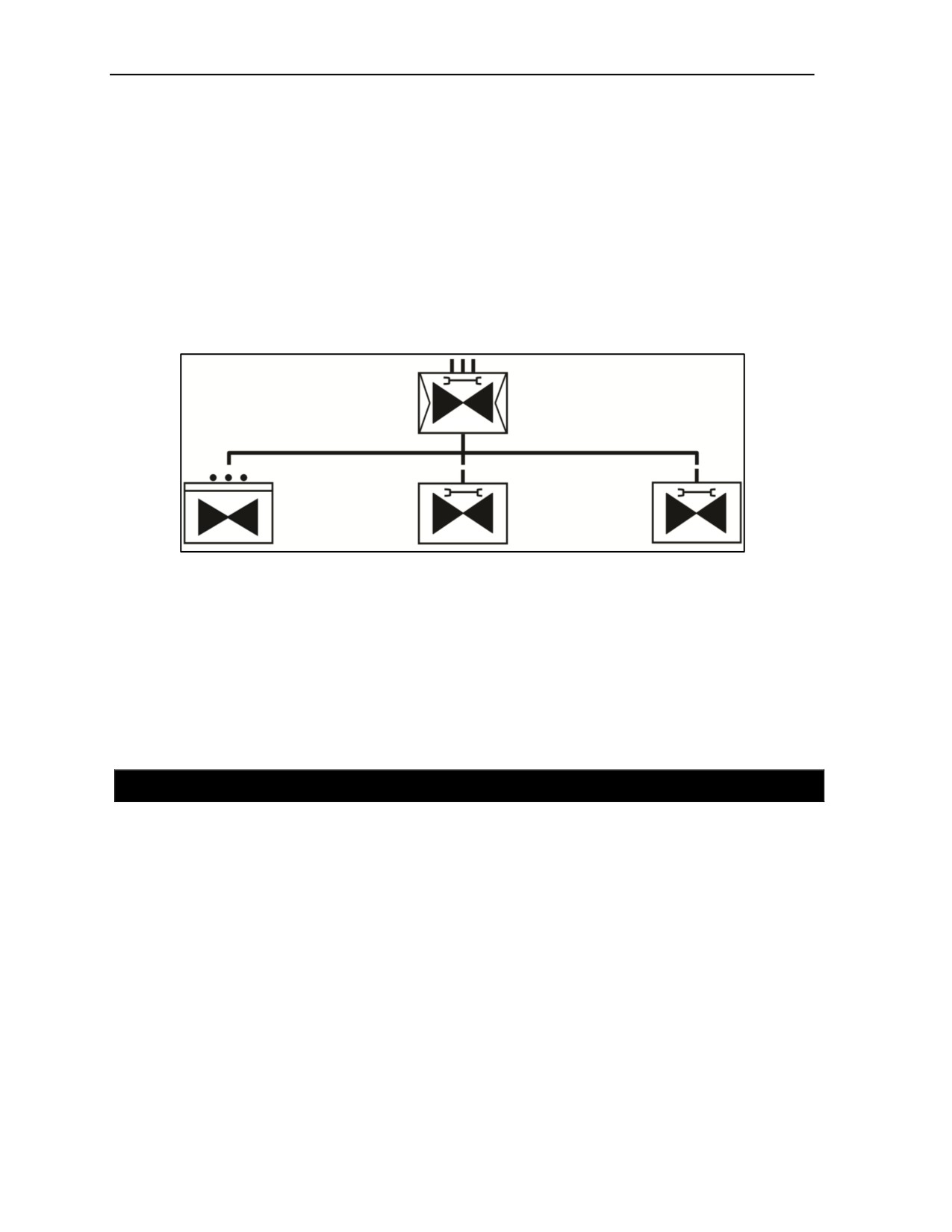
Chapter 2
THEATER AVIATION SUSTAINMENT MAINTENANCE GROUP
PURPOSE
2-24. The TASMG is resourced to provide aviation sustainment maintenance and limited depot sustainment
support at the theater level. The TASMG performs repairs and returns components/end-items to their
supported units, or to the supply system through the National Maintenance Program.
ORGANIZATION
2-25. The TASMG consists of a headquarters and headquarters detachment (HHD), an aviation support
company (ASC), and a group support company. Figure 2-6 provides the organizational structure of a
TASMG.
Figure 2-6. Theater aviation sustainment maintenance group
CAPABILITIES
2-26. When deployed, the TASMG is attached to the joint force sustainment HQ or expeditionary support
command and sets up at a secure location within an AO. It establishes and provides 24-hour, fixed-base
aviation field and sustainment maintenance, logistics, and other essential aviation sustainment support to
aviation units. The TASMG performs field maintenance, depot-level crash and battle damage repair, and
sustainment/depot-level repair of major end items. It also performs sustainment-level maintenance for aircraft
and aviation ground support equipment at fixed-land or sea-based locations. The TASMG assists deploying
aviation operational units in port operations.
SECTION IV - AVIATION BATTALIONS AND SQUADRONS
ATTACK RECONNAISSANCE SQUADRON
PURPOSE
2-27. As an element of the CAB, the ARS provides accurate and timely information collection; provides
reaction time and maneuver space; and destroys, defeats, delays, diverts, or disrupts enemy forces in support
of the combined arms team. Although the ARS is fully capable of conducting attacks, the integration of RQ-
7B UAS at the troop level make the ARS the best formation for conducting reconnaissance, security and
movement to contact as primary missions, with attack operations as a secondary mission.
ORGANIZATION
2-28. The ARS consists of a headquarters and headquarters troop (HHT), three attack reconnaissance troops
(ARTs) equipped with eight AH-64s and four RQ-7Bs each, an aviation maintenance troop, and a forward
support troop (FST). Figure 2-7, page 2-7, provides the organization structure of an ARS.
2-6
FM 3-04
29 July 2015
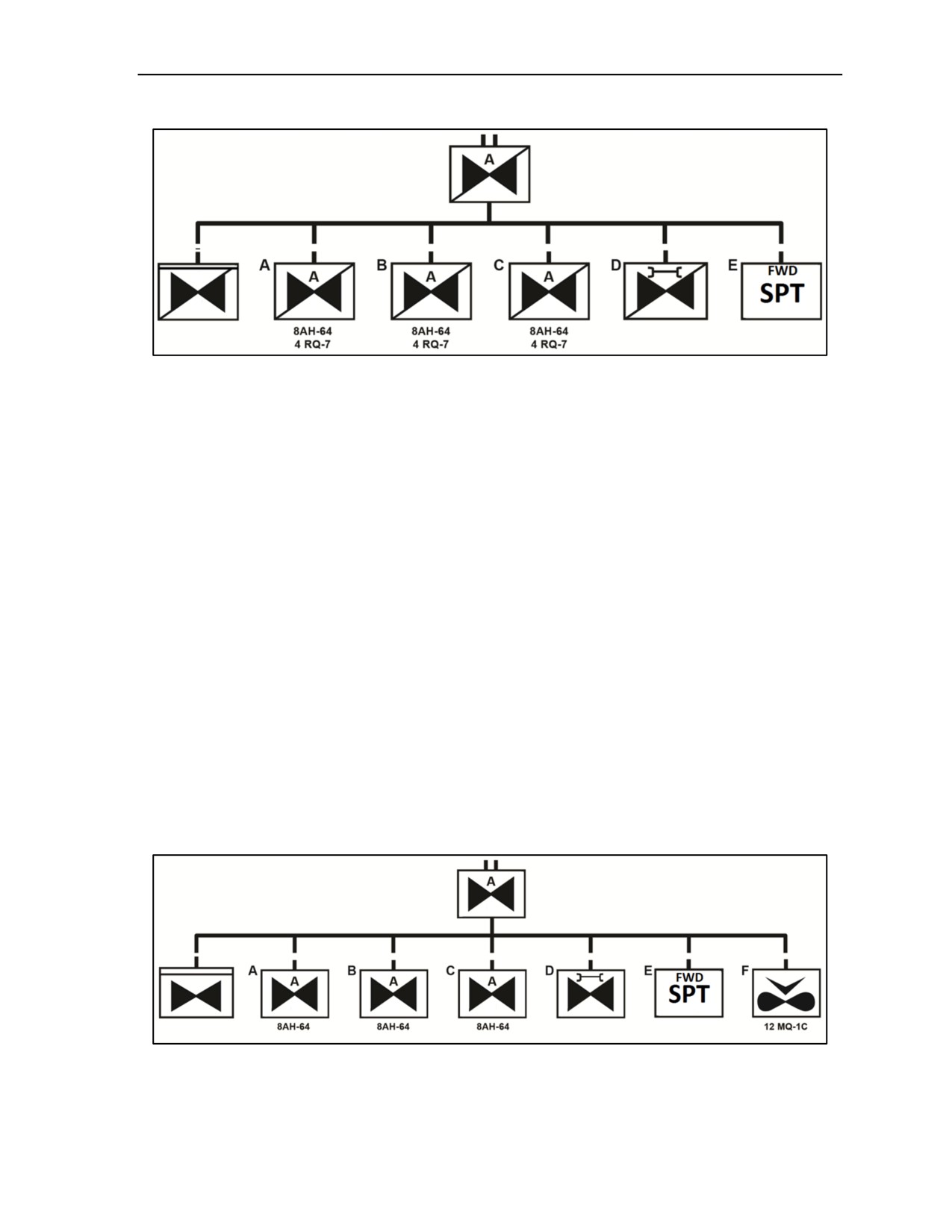
Army Aviation Organizations and Mission Command
Figure 2-7. Attack reconnaissance squadron
CAPABILITIES
2-29. The ARS conducts the following tasks:
z
Zone, route, and area reconnaissance.
z
Reconnaissance in force (when task organized).
z
Screen.
z
Guard and area security (when task organized).
z
Movement to contact.
z
Attack.
ATTACK RECONNAISSANCE BATTALION
PURPOSE
2-30. As an element of the CAB, the ARB provides accurate and timely information collection, provides
reaction time and maneuver space, and destroys, defeats, delays, diverts, or disrupts enemy forces in support
of the combined arms team. Although the ARB is fully capable of conducting reconnaissance, security and
movement to contact operations, it has less overall reconnaissance capability than the ARS due to the lack of
organic UAS at the company level unless the organic Gray Eagle company is released partially or in total
from division control to conduct dedicated MUM-T in support of the ARB.
2-31. The ARB consists of an HHC, 3 attack reconnaissance companies (ARCs) equipped with 8 AH-64s
each, a Gray Eagle company equipped with 12 MQ-1Cs (typically a division asset), an aviation maintenance
company, and a FSC (figure 2-8).
Figure 2-8. Attack reconnaissance battalion
29 July 2015
FM 3-04
2-7
Chapter 2
CAPABILITIES (ARB AND GRAY EAGLE COMPANY)
2-32. The ARB conducts the following tasks:
z
Attack.
z
Zone, route and area reconnaissance.
z
Screen.
z
Guard and area security (when task organized).
z
Movement to contact.
z
Reconnaissance in force (when task organized).
2-33. The Gray Eagle Company is a subordinate element of the ARB but is typically retained as a division
asset for mission tasking. When operating as a division asset, the Gray Eagle Company conducts the
following tasks:
Surveillance.
Zone, route and area reconnaissance.
Attack.
Battle damage assessment.
Mission command support.
2-34. When tasked by the division to support the CAB, the Gray Eagle company (or tasked subordinate
elements) maneuvers independently or with AH-64s from the ARB or ARS using MUM-T. MUM-T
significantly enhances the survivability, the depth, breadth and persistence of the reconnaissance effort and
increases the lethality by locating and attacking enemy forces with autonomous or remote fires in depth.
When supporting the CAB, the Gray Eagle company or subordinate elements conduct the following tasks:
z
Zone, route and area reconnaissance.
z
Attack.
z
Battle damage assessment.
z
Mission command support.
ASSAULT HELICOPTER BATTALION
PURPOSE
2-35. As a subordinate element of the CAB and ECAB, the AHB air assaults maneuver forces; positions
personnel, supplies and equipment; CASEVAC; conducts PR; and enables mission command in support of
the combined arms team. A pathfinder company is assigned to AHBs in three of the CABs (101st, 10th and
82nd CABs) to support PR, airborne, and air assault operations.
ORGANIZATION
2-36. The AHB consists of an HHC, three assault helicopter companies of 10 UH-60s each, an aviation
maintenance company, and a FSC. Additionally, the AHBs of the 10th, 82nd, and 101st CABs have an
organic Pathfinder Company. Figure 2-9, page 2-9, provides the organizational structure of the AHB with
the Pathfinder Company.
2-8
FM 3-04
29 July 2015
///////////////////////////////////////