FM 3-05.211 Special Forces Military Free-Fall Operations (APRIL 2005) - page 5
FM 3-05.211
UNITED STATES AIR FORCE DROP ZONE CONTROL OFFICER
11-8. The USAF DZCO represents the airlift commander. He supervises all
USAF personnel on the DZ. He also observes drop operations. Other
responsibilities include—
• Evaluating all factors that might adversely affect safety.
• If conditions make drop operations unsafe, directing the STT to relay
that information to the appropriate USAF commander as soon as
possible and to display the established NO DROP signal on the DZ.
• Directing the use of STT equipment.
• Canceling drops when requested to do so by the Army DZSO.
• Keeping the Army DZSO advised on ground wind speed on the DZ.
• Preparing the necessary log and reports for submission to the airlift
control element or the appropriate USAF commander.
SPECIAL TACTICS TEAM
11-9. The STT marks the DZs with proper navigational and identification
aids. The STT establishes ground-to-air communications at DZs, as well as
communications with designated control agencies. Other responsibilities
include—
• Providing the U.S. Army DZSO with surface weather and low-level (up
to 1,500 feet) winds aloft observations.
• Exercising air traffic control over aircraft in the vicinity of a specific
DZ, as directed.
MALFUNCTION OFFICER
11-10. The investigation of personnel, parachutes, and equipment
malfunctions receives the highest priority and is secondary in priority only to
medical aid for the injured. This investigation supersedes all other aspects of
the operation, to include ground tactical play. Prompt and accurate
investigations and reporting could save lives and equipment. The report
provides data to determine if a system or procedural training change is
necessary to prevent future occurrences. The MO is subordinate to the
DZSO/DZSTL and is a member of the DZ support team. Any assistance
required by the MO must pass through the DZSO/DZSTL, who controls the DZ.
11-11. The MO must be a commissioned officer, warrant officer, or NCO
(minimum grade of E5). The MO must be a trained parachute rigger who is
familiar with airdrop, parachute recovery, and aircraft personnel parachute
escape systems IAW AR 59-4, Joint Airdrop Inspection Records, Malfunction
Investigations, and Activity Reporting. The exception to the minimum grade
requirement is that for Air Force unilateral training loads, the DZ MO will be
a minimum grade of E4.
11-12. The organization that provides the air items will provide the MO. He
will be present on the DZ during all personnel and equipment drops and will
6 April 2005 FM 3-05.211/MCWP 3-15.6/NAVSEA SS400-AG-MMO-010/AFMAN 11-411(I)
11-5
FM 3-05.211
be familiar with requirements. The MO must have the following minimum
equipment in his possession during duty performance:
• A communication capability with the DZ control party.
• A good-quality camera to take photos of malfunctions or incidents
(video camera preferred). Photographic equipment is essential for the
proper performance of MO duties. Pictures of malfunctions greatly
assist in investigations.
• The forms and clerical supplies necessary to tag equipment and initiate
reports.
• Binoculars or night vision devices.
• Transportation to move around the DZ.
11-13. If a malfunction occurs, the MO immediately conducts an on-site
investigation of the causes of the malfunction. The MO photographs the
malfunctioned equipment, or the malfunction as it happens, and the
malfunction site that shows possible causes of the malfunction. The MO
secures, identifies, tags, and numbers airdrop equipment involved in the
malfunction incident. The MO then prepares and submits DD Form 1748-2,
Joint Airdrop Malfunction Report (Personnel-Cargo), to report all airdrop
malfunctions (IAW AR 59-4), as well as any other required reports.
NOTE: MOs must prepare complete and accurate MFF accident reports. The
fielding of new MFF equipment and the introduction of new MFF procedures
depends on the feedback of the reporting process to detect accident patterns.
There are several forms used by the Services in addition to DD Form 1748-2.
Appendix E contains an example of the amount of detail that should be
included in an accident report.
MILITARY FREE-FALL DROP ZONE MARKINGS
11-14. MFF infiltrations usually take place on blind DZs due to the general
ineffectiveness of visual markings when viewed from high altitudes (HALO)
and extended distances (HAHO). DZ identification is normally by location in
relation to major terrain features.
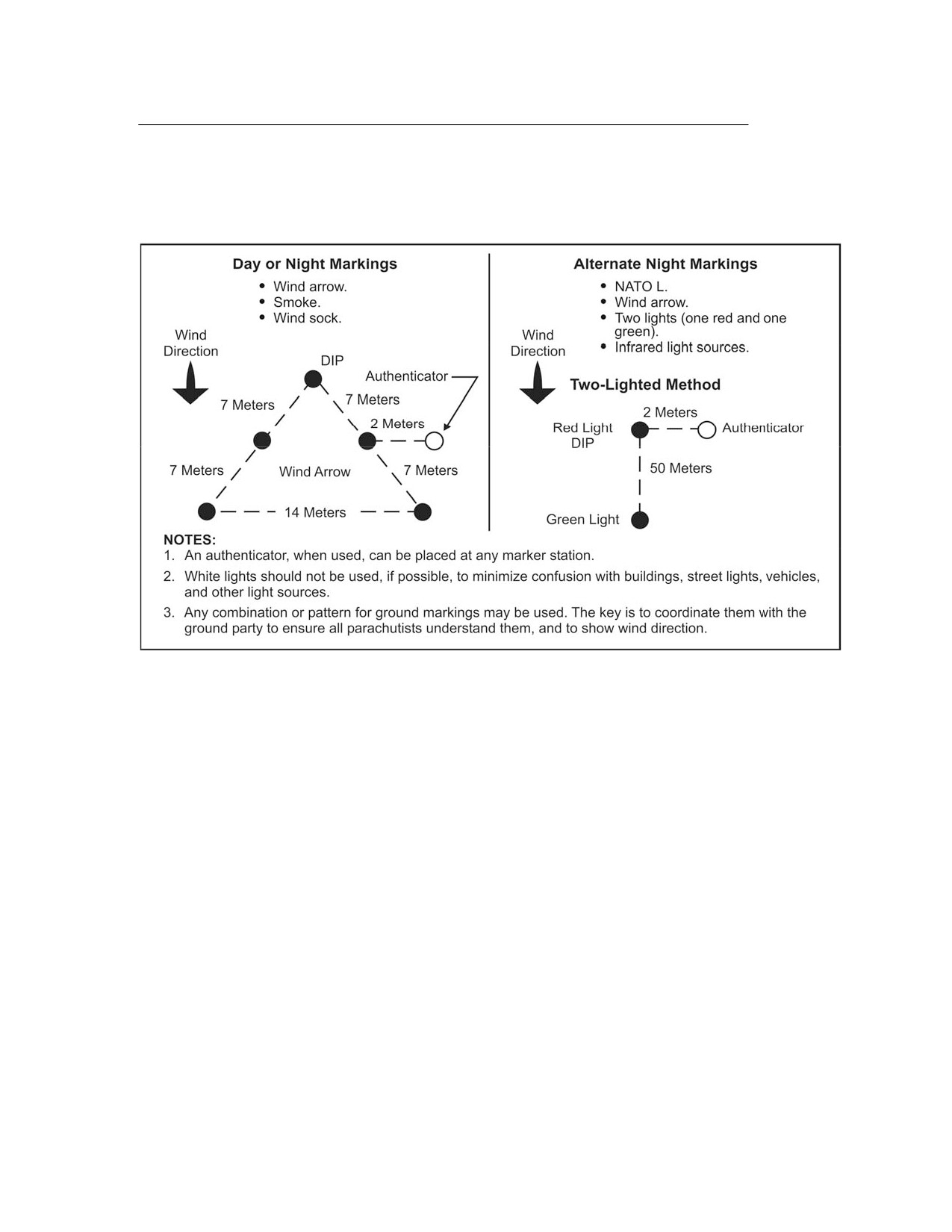
11-15. DZ markings are sometimes used when the tactical situation permits,
and it is desirable to indicate wind direction to the descending parachutists
(Figure 11-1, page 11-7). FM 3-05.210, Special Forces Air Operations; FM 3-21.38,
Pathfinder Operations; and AFI 13-217 outline approved marking techniques.
HIGH-ALTITUDE RELEASE POINT AND MILITARY
FREE-FALL DROP ZONE DETECTION
11-16. Location in relation to major terrain features identifies the HARP.
Appendix F contains methods of computing the HARP. The HARP may be
marked, if known, when the tactical situation permits. In heavily vegetated,
mountainous, or urban terrain and during conditions of restricted visibility,
DZs and HARPs may be difficult to detect. Electronic beacons or radar
transponders and appropriate tracking devices help aircraft personnel and
parachutists locate DZs or HARPs. Expedient methods, such as balloons and
pyrotechnics, may also help aircraft personnel and parachutists locate DZs or
HARPs. In situations where secrecy is important, aircraft and parachutists
11-6
FM 3-05.211/MCWP 3-15.6/NAVSEA SS400-AG-MMO-010/AFMAN 11-411(I)
6 April 2005
FM 3-05.211
equipped with automatic direction-finding equipment may conduct drops
using only the radio homing beacon. Parachutists may also use the
NAVSTAR GPS with portable terminals.
Figure 11-1. Military Free-Fall Drop Zone Markings
AIRCRAFT OR HIGH-ALTITUDE HIGH-OPENING
TEAM IDENTIFICATION
11-17. In air-to-ground identification, the aircraft or HAHO team identifies
itself to the reception committee by arriving in the objective area within the
specified time limit. The aircraft or HAHO team also identifies itself by
approaching at the designated drop altitude and track (aircraft).
11-18. In ground-to-air identification, the reception committee identifies
itself to the aircraft or team by displaying the correct marking pattern within
the specified time limit and using the proper authentication code signal.
AUTHENTICATION SYSTEM
11-19. There is no standard authentication system for UW reception
operations. During mission planning, the commanders concerned agree on
the authentication system they will use. Signal operation instructions
prescribe the authentication procedures.
11-20. Authentication may take the form of a coded light source, panel
signal, radio contact, homing beacon, or combinations thereof. Authentication
may be used individually or with the marking pattern. When using a homing
beacon or radar transponder for authentication, the commanders concerned
will jointly agree upon positioning and turn-on and turn-off times during
mission planning.
6 April 2005 FM 3-05.211/MCWP 3-15.6/NAVSEA SS400-AG-MMO-010/AFMAN 11-411(I)
11-7
This page intentionally left blank.
FM 3-05.211
Chapter 12
Deliberate Water Military Free-Fall Operations
This chapter outlines the policies, procedures, and restrictions for
conducting deliberate MFF operations into water DZs. Individual Services
will use their applicable regulations and SOPs when conducting Service-
pure MFF operations into water DZs. The procedures outlined in this
chapter are different from the emergency water-landing procedures
discussed in Chapter 9.
ADDITIONAL SUPPORT REQUIREMENTS
12-1. All basic parachute support operations outlined in Chapter 11 must be
used when conducting deliberate water parachute operations. Listed below is
the additional support needed for parachute operations using water DZs.
Parachutists should refer to individual Service regulations for additional
restrictions.
PARACHUTIST RECOVERY BOATS
12-2. A minimum of one power-driven parachutist recovery boat is required
for every parachutist being dropped on the same pass if parachutists are not
combat swimmer, combat diver, waterborne infiltration course (WIC), scout
swimmer, or second-class swimmer certified. If the parachutists are combat
swimmer, combat diver, WIC, scout swimmer, or second-class swimmer
certified, then the requirement is one parachutist recovery boat for every four
parachutists on the same pass.
12-3. The number of parachutists exiting the aircraft per pass will be
limited to the number of parachutist recovery boats available. Parachutist
recovery boats must have an inflatable boat or ladder rigged alongside if they
have a freeboard of more than three feet or if the boats do not provide an easy
platform for recovery of personnel. Boats assigned as parachutist recovery
platforms may only be used to assist in the recovery of equipment after all
parachutists have been recovered. The boat coxswain cannot act as the
DZSO/DZSTL, MO, safety swimmer, or medic.
EQUIPMENT RECOVERY BOATS
12-4. A minimum of one power-driven boat is required for every two
equipment platforms dropped on the same pass. Equipment recovery boats
are to be used in the recovery of equipment parachutes and platforms.
12-5. Recovery boats assigned to recover personnel do not meet this
requirement when parachutists and equipment are on the same pass.
Equipment recovery boats must be large enough to recover cargo parachutes
and platforms. The boat coxswain cannot act as the DZSO/DZSTL, MO,
safety swimmer, or medic.
6 April 2005 FM 3-05.211/MCWP 3-15.6/NAVSEA SS400-AG-MMO-010/AFMAN 11-411(I)
12-1
FM 3-05.211
SAFETY SWIMMERS
12-6. Safety swimmers must be qualified swimmer/divers IAW Service
publications. A minimum of one safety swimmer is required to be onboard
each recovery boat. The safety swimmer must have fins, a facemask, a knife,
a flare, and an inflatable life preserver. For night drops, safety swimmers
should have a light that is visible for 1 mile (for example, a chemlite) and an
emergency light visible for 3 miles (for example, a strobe light).
12-7. The safety swimmer will be used to recover personnel and equipment
and assist parachutists as needed. The safety swimmer cannot be assigned
additional duties, such as the DZSTL, MO, boat coxswain, or medic.
PARACHUTIST REQUIREMENTS
12-8. Currency requirements for conducting deliberate MFF water jumps
include the following:
• Parachutist swimmer qualification. Parachutists must be qualified
swimmers IAW Service regulations before making a water parachute
drop.
• First water jump. Personnel must be current parachutists to conduct
their first water jump. Their first water jump must be made during the
day and without combat equipment.
• First night water jump. Parachutist training requirements for
conducting night water jumps will be IAW Service publications.
• Jumper currency. Personnel who are not current can use a water jump
for refresher provided it is done during the day and without combat
equipment.
EQUIPMENT REQUIREMENTS
12-9. Equipment requirements for conducting deliberate MFF water jumps
include the following:
• Minimum equipment. Each parachutist must have the following
minimum equipment for a water jump:
Life preserver.
Long-sleeved top or wet suit.
Booties, coral shoes, jungle boots, or equivalent.
Fins.
Helmet.
Knife and approved day/night flare.
Chemlite (night operations only).
• Equipment waivers. Helmets can be waived by the commanding officer
based on operational requirements and a risk assessment (for example,
wet suit hoods or cold weather hoods).
• Flotation. Parachutists must ensure they wear enough flotation to
enable them to be positively buoyant in the water. If an injury occurs to
the parachutist, he must be able to float without swimming.
12-2
FM 3-05.211/MCWP 3-15.6/NAVSEA SS400-AG-MMO-010/AFMAN 11-411(I)
6 April 2005
FM 3-05.211
•
Inflatable life jacket. When using a UDT life preserver, parachutists
must route the parachute harness chest strap underneath the life
jacket to allow proper inflation in an emergency.
CAUTION
Routing the chest strap over the UDT vest will prevent
the life vest from inflating properly and may cause injury
to the parachutist.
•
Altimeters. Altimeters are required for every jump except water jumps
with delays less than 10 seconds. Units should coordinate for waivers
when conducting deliberate water MFF parachute operations without
an altimeter IAW their Service regulations.
•
Automatic ripcord releases. ARRs are required for all MFF parachute
operations. There are no waterproof ARRs currently available. Units
should coordinate for a waiver IAW their Service regulations when
conducting deliberate water MFF parachute operations without an ARR.
•
Safety lanyards. Only 80-pound cotton tape is authorized as the safety
lanyard for swim fins. The safety lanyards must be short enough not to
catch or snag on anything during exit.
•
Reserve static line. When making a deliberate water jump with the
military RAPS, parachutists must disconnect the RSL once they have a
good canopy over their heads. This action will prevent the reserve from
being deployed if the main is cut away while in the water.
•
Placement of fins. During an exit for a water parachute drop, the
jumper may wear his fins as described in one of the three methods
listed below. From each configuration, the parachutist must be able to
put the fins on either under canopy or in the water. The fins may be—
Worn on feet as normal with 80-pound safety lanyards. This
method may be used if the parachutist does not have to walk far to
exit. Short fins are recommended if the parachutist must walk in
the aircraft to exit.
Taped vertically to shins with foot through strap and 80-pound
safety line. Holding the fin vertically with the strap down, the
parachutist places his foot through the fin strap. He tapes the top
of the fin to the front of his leg, folding the end of the tape over to
make a quick-release tab. He then secures the fin to his ankle with
a short piece of 80-pound cotton tape.
Attached or fastened to a separate belt. The fins must be worn in
front on the parachutist’s thigh or in the back under the pack tray.
Fins must be placed so as not to interfere with parachute
deployment or the parachutist’s ability to remain stable during free
fall.
12-10. Whenever possible, the parachutist should wear his fins on exit. If the
parachutist does not have his fins on during exit, then he should wait to put
them on until after entering the water. This step will allow the parachutist
6 April 2005 FM 3-05.211/MCWP 3-15.6/NAVSEA SS400-AG-MMO-010/AFMAN 11-411(I)
12-3
FM 3-05.211
to concentrate on canopy grouping at low altitudes. Aircraft configuration and
SOP will determine the proper location.
DROP ZONE REQUIREMENTS AND MARKINGS
12-11. DZ requirements and markings for conducting deliberate MFF water
jumps include the following:
• Establishment of the DZ. The DZ must be established not less than 60
minutes before the TOT to allow time for the DZSO to monitor DZ
conditions.
• Surface winds. Surface winds shall not exceed 18 knots.
• Sea state. Sea state shall not exceed limits IAW Service publications.
• Water depth. The depth of the water must be at least 10 feet.
• Water temperature. Minimum safe water temperature for personnel
drops is
50 degrees F (10 degrees Celsius) unless an appropriate
exposure suit is worn. Partial or full exposure suits should be
considered whenever water temperatures are below 72 degrees F.
• Air-to-ground communications. Personnel must establish a positive
visual or electronic signal for DZ identification before the drop for
water parachute operations. Only a positive visual or electronic signal
for DZ identification is required; however, radio communications are
highly recommended to assist in verifying the DZ (USASOC units
require radio communications). Parachutists must use positive night
visual signals (for example, beacons, strobes) for night drops to avoid
confusion and to aid in positive identification.
• DZ communication. All DZ safety craft must be equipped with boat-to-
boat radio communications.
• DZ configuration. The DZ is configured IAW Service regulations.
PARACHUTIST PROCEDURES FOR WATER JUMPS
12-12. Parachutist procedures for conducting MFF water jumps include the
following:
• Water parachute jump. Procedures for a premeditated water parachute
jump after exiting the aircraft are described below. Parachutists—
Check parachute and locate other parachutists. Parachutists turn
canopy toward the DZ.
Disconnect RSL and release waistband.
Continue to steer and group with other parachutists to the target.
At no lower than 200 feet above the water, turn into the wind and
release the chest strap
(500 feet recommended with combat
equipment).
Confirm leg strap snap hook locations.
Flare canopy to land (land with half brakes for night jumps).
After entering the water, release leg straps and crawl out of the
harness.
12-4
FM 3-05.211/MCWP 3-15.6/NAVSEA SS400-AG-MMO-010/AFMAN 11-411(I)
6 April 2005
FM 3-05.211
Put fins on, if required.
Swim to the center of trailing edge (tail).
Hand the center of the trailing edge (tail) and harness to recovery
boat.
•
Reserve static line. When making an MFF water jump with the MC-4,
parachutists must ensure they disconnect the RSL once under a good
canopy. This action will prevent the reserve from being activated if the
main is cut away while in the water.
•
Life preserver use. If the parachutist is unable to stay above the water,
he must either add air using the oral inflation tube or inflate his life
preserver with the CO2.
•
High winds. If a parachutist is being dragged in high winds, he must
roll over on his back and attempt to collapse the canopy by pulling in
on one steering toggle. If this is not possible, he then performs a
cutaway on the RAPS. He must ensure the RSL system is disconnected
before cutaway of the main.
•
No-wind landings. In a no-wind landing condition, the canopy may
possibly land on top of the parachutist. If this occurs, parachutist must
remain calm and avoid getting tangled in the suspension lines. He
should create an air pocket by splashing the water and lifting the
canopy above the water. Then he finds a seam and follows it to the edge
of the canopy. In an emergency, the parachutist uses his knife to cut
through the canopy.
•
Equipment flotation. The reserve parachute will float for a short time;
however, if the parachute starts to sink, parachutist should make no
attempt to hang on or recover it.
DROP ZONE PROCEDURES FOR PICKUP
OF PARACHUTISTS AND EQUIPMENT
12-13. DZ procedures for pickup of parachutists and equipment include the
following:
• Recovery boat assignments. Recovery boats must have assigned duties
by the DZSTL so as to minimize confusion during the recovery
procedure. These assignments must be briefed by the DZSTL/DZSO
before setting up the DZ.
• Recovery priority. Recovery boats will first pick up any parachutist who
signals he is in trouble or has deployed his reserve parachute.
Parachutists always have priority for pickup over cargo chutes or
equipment.
• Approaching parachutists in the water. Boat coxswains must approach
the parachutist perpendicular to the wind to avoid drifting or being
blown over the parachutist or the parachute. Caution must always be
taken not to operate the propeller (screws) while the parachutist is
alongside in the water. The engine should be placed in neutral. If the
parachute gets entangled in the propeller (screws), the boat coxswain
turns the motor off while the safety swimmer frees it.
6 April 2005 FM 3-05.211/MCWP 3-15.6/NAVSEA SS400-AG-MMO-010/AFMAN 11-411(I)
12-5
FM 3-05.211
• Recovery of ram-air parachute systems. The parachutist must hand the
center of the trailing edge (tail) and then the harness to the boat
crewman. The suspension lines should be daisy-chained starting from
the harness end. After the lines are daisy-chained, the canopy will be
pulled in from the trailing edge (tail) first to allow the water to drain
out the leading edge (nose).
• Recovery of parachutes and platforms. Recovery of equipment after a
water parachute jump is only administrative. Combat conditions will call
for the sinking of parachutes and platforms. All swimmers except one
should be in the combat rubber raiding craft (CRRC) or move away from it
before sinking the platform. Parachutes and platforms may be
intentionally sunk on training jumps as long as procedures are used to
prevent the equipment from resurfacing and becoming a navigation
hazard.
NIGHT WATER PARACHUTE OPERATIONS
12-14. For night water MFF parachute training, parachutists are required
to be equipped with a light visible for 1 mile (chemlite), an emergency light
visible for 3 miles (strobe), and a flare for emergencies in the water. During
free fall and under canopy, parachutists display a light (for example, a
chemlite) visible for 1 mile as a safety measure to prevent mid-air collisions
or entanglements. Parachutists are not required to be marked for combat
situations.
WATER JUMPS WITH COMBAT EQUIPMENT
12-15. Requirements for water jumps with combat equipment include the
following:
• Combat equipment limitations. Jumping with combat equipment is
authorized for water parachute jumps. Parachutists should minimize the
amount of equipment they jump with in the water for safety reasons.
Parachutists are not authorized to jump with rifles rigged on
themselves. They must place rifles and other weapons in weapons bags.
Rifles rigged on the parachutists may easily entangle with suspension
lines in the water. Whenever possible, parachutists place as much
equipment as possible in the CRRC load except for individual survival
gear.
• Jumper currency. Parachutists conducting water parachute operations
with combat equipment must be current and have previously made at
least one noncombat equipment water parachute jump.
• Equipment rigging. Equipment packs jumped on the individual must
be rigged to be positively buoyant in water. Equipment should be dip-
tested for buoyancy before the jump. The equipment is rigged and
attached as described in Chapter 5.
• Parachutist procedures. When jumping equipment, it is recommended
to make the turn on final approach at 500 feet, but no lower than 200
feet, to allow additional time to unfasten the chest strap and lower the
equipment. After the parachutist enters the water, he must disconnect
the equipment after getting out of the harness.
12-6
FM 3-05.211/MCWP 3-15.6/NAVSEA SS400-AG-MMO-010/AFMAN 11-411(I)
6 April 2005
FM 3-05.211
Chapter 13
Jumpmaster Responsibilities
and Currency Qualifications
This chapter establishes the procedures and techniques that jumpmasters
use in MFF parachute operations. It delineates duties and
responsibilities, regardless of unit, location, and mission. Units may have
to supplement this guidance with SOPs to perform certain missions.
FM 3-21.220 includes further discussion on responsibilities during
airborne operations.
RESPONSIBILITIES
13-1 The airborne commander designates the key personnel for each
airborne operation. These key personnel are the primary jumpmaster,
assistant jumpmaster, oxygen safety personnel
(when required), DACO,
DZSO/DZSTL, and MO. Each aircraft has a designated primary jumpmaster,
an assistant jumpmaster, and oxygen safety personnel (when required). The
airborne commander gives the designated primary jumpmaster command
authority over, and responsibility for, all airborne personnel and their
associated equipment onboard a jump aircraft. The primary jumpmaster
assigns tasks to the assistant jumpmasters and oxygen safety personnel
appointed to help him. The primary jumpmaster can delegate authority but
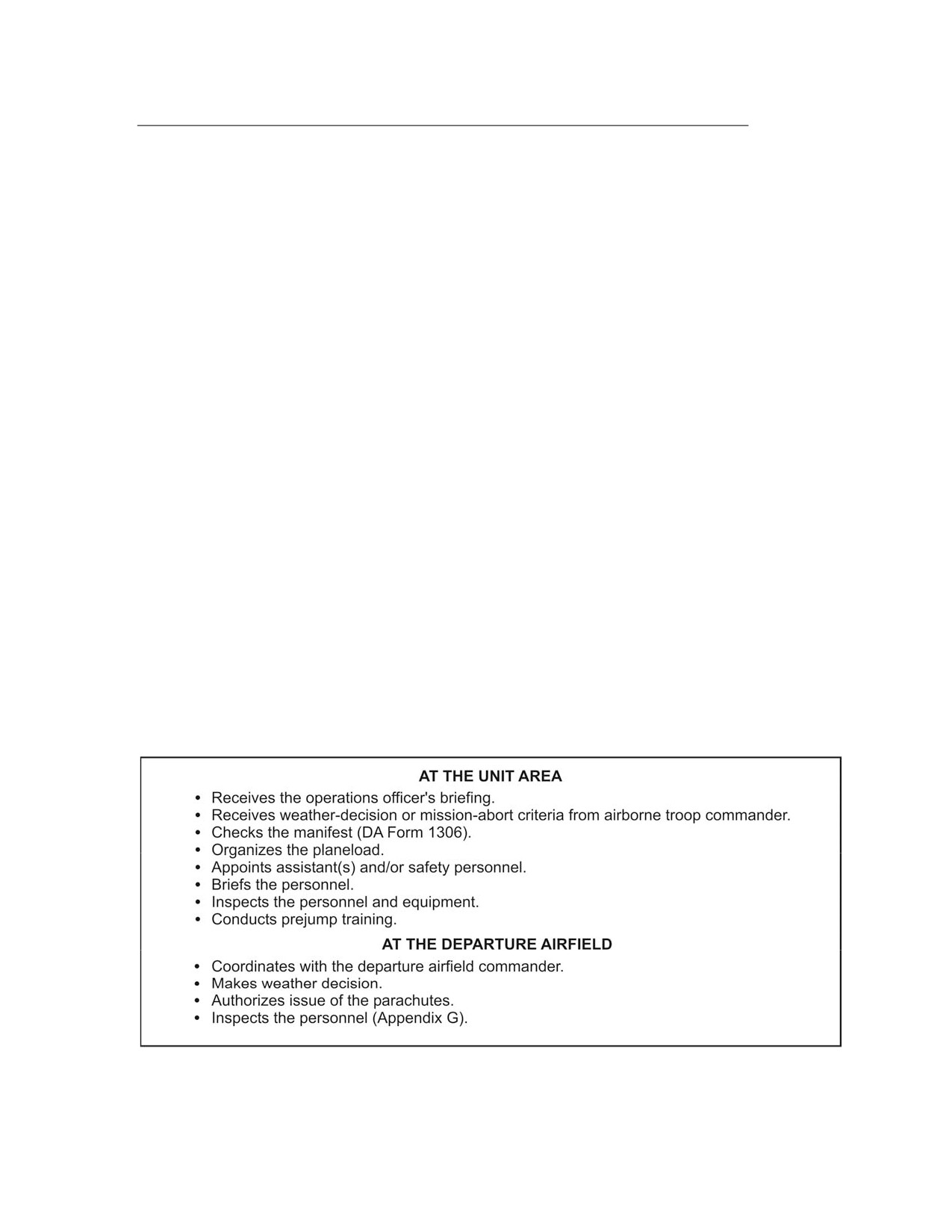
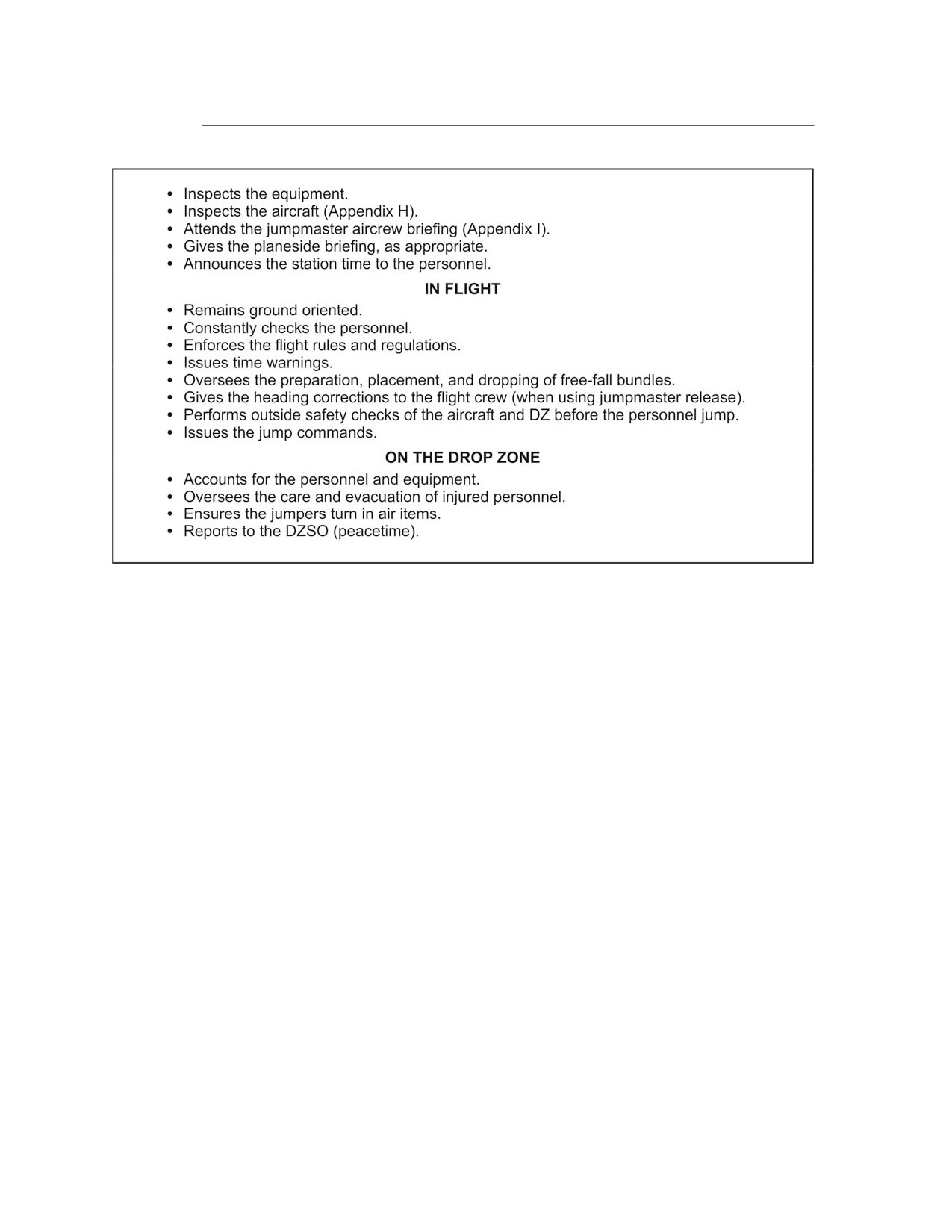
cannot delegate responsibility. Figure
13-1, pages
13-1 and
13-2, lists
jumpmaster responsibilities.
Figure 13-1. Jumpmaster Responsibilities
6 April 2005 FM 3-05.211/MCWP 3-15.6/NAVSEA SS400-AG-MMO-010/AFMAN 11-411(I)
13-1
FM 3-05.211
Figure 13-1. Jumpmaster Responsibilities (Continued)
QUALIFICATIONS
13-2. For appointment by the airborne commander as either a jumpmaster
or assistant jumpmaster for an airborne operation, the individual must be a
graduate of the MFF Jumpmaster Course (note below includes further
information). He must have performed jumpmaster duties within the
previous 6 months or attended MFF jumpmaster refresher training. An
assistant jumpmaster must have performed assistant jumpmaster duties at
least twice before being designated as a jumpmaster.
NOTE: The Commandant, USAJFKSWCS, is the proponent for the conduct
of MFF courses of instruction. Only graduates of a USAJFKSWCS-recognized
MFF jumpmaster course may perform duties as an MFF jumpmaster. The
only recognized Navy MFF jumpmasters are those who hold a Navy MFF
jumpmaster graduation certificate dated before 16 June 1989 or those who
have graduated from the USAJFKSWCS MFF Jumpmaster Course. The only
recognized Air Force MFF jumpmasters are those who have graduated from
the USAJFKSWCS MFF Jumpmaster Course and those previously qualified
Air Force free-fall jumpmasters who have undergone an MFF jumpmaster
upgrade certification using USAJFKSWCS criteria.
CARDINAL RULES
13-3. General rules stress that the jumpmaster must—
• Never sacrifice safety for any reason.
• Rehearse jumpmaster procedures on the ground.
• Arm his ARR before opening the jump doors or the ramp.
13-2
FM 3-05.211/MCWP 3-15.6/NAVSEA SS400-AG-MMO-010/AFMAN 11-411(I)
6 April 2005
FM 3-05.211
• Face the open jump door when in flight.
• Maintain a firm handhold on the aircraft when working in or close to
an open jump door or ramp.
• Never allow anyone in or near an open jump door or ramp who is not
wearing a helmet and safety harness or parachute. The helmet
requirement may be waived for deliberate water jumps.
CURRENCY AND REQUALIFICATION REQUIREMENTS
13-4. An MFF jumpmaster must be USAJFKSWCS-trained or have formally
undergone transitional training in a proponent-recognized school
environment from the MC-3 system to the RAPS. He must have performed
primary or assistant jumpmaster duties within the last 6 months where
parachutists actually exited the aircraft while using a jumpmaster-directed
release.
13-5. Previously qualified MFF jumpmasters who do not meet proficiency
and currency requirements will meet the following requalification
requirements:
• Undergo MFF parachutist refresher training outlined in Appendix B.
• Receive JMPI training for the primary MFF parachute system used in
his parent unit.
• Receive refresher training in wind drift (HARP) calculation for MFF
mission profiles.
• Receive oxygen equipment refresher training.
• Perform assistant jumpmaster duties for one MFF jump.
• Execute under-canopy navigation techniques specific to the navigation
aids unique to the parent unit.
An MFF jumpmaster who meets the currency criteria will conduct the
requalification and refresher training.
NOTE: Whenever possible, a jumpmaster-directed release should be used to
enhance MFF jumpmaster skills.
6 April 2005 FM 3-05.211/MCWP 3-15.6/NAVSEA SS400-AG-MMO-010/AFMAN 11-411(I)
13-3
FM 3-05.211
Appendix A
Military Free-Fall Critical Task Lists
This appendix includes the critical task lists for the MFF Basic Course,
the Advanced MFF Course, and the MFF Jumpmaster Course.
MILITARY FREE-FALL BASIC COURSE
A-1. Module 1: Ground Training (4 Tasks):
• Objective: To become familiar with rigging combat equipment, donning
the MC-4 parachute system, packing the MC-4, and body stabilization
techniques.
• Individual tasks:
331-202-2000: Rig Combat Equipment for MFF Operations.
331-202-2001: Don the MC-4 Ram-Air Parachute System.
331-202-2010: Pack the MC-4 Ram-Air Canopy.
331-202-2011: Perform Body Stabilization Techniques.
A-2. Module 2: Emergency Procedures (4 Tasks):
• Objective: To become proficient in MFF emergencies.
• Individual tasks:
331-202-2002: React to Aircraft Emergencies During Free-Fall
Operations.
331-202-2004: React to Emergencies While in Military Free Fall.
331-202-2006: React to MC-4 Ram-Air Canopy Emergencies During
Descent.
331-202-2009: React to Emergencies Associated With Landing an
MC-4 Ram-Air Canopy.
A-3. Module 3: Aircraft and Jump Procedures (4 Tasks):
• Objective: To become proficient in aircraft procedures, jumping, and
maneuvering the MC-4 parachute system.
• Individual tasks:
331-202-2005: Maneuver the MC-4 Ram-Air Canopy to a
Designated Drop Zone.
331-202-2008: Jump From an Aircraft During MFF Operations
While Wearing Combat Equipment and Portable Bailout System.
331-202-2012: Conduct MFF Operations Using Oxygen.
331-202-2013: Respond to Aircraft Procedure Signals and Jump
Commands During MFF Airborne Operations.
6 April 2005 FM 3-05.211/MCWP 3-15.6/NAVSEA SS400-AG-MMO-010/AFMAN 11-411(I)
A-1
FM 3-05.211
ADVANCED MILITARY FREE-FALL COURSE
A-4. Module 1: Wind Tunnel Training (1 Task):
• Objective: To become proficient in body stabilization in the Vertical
Wind Tunnel.
• Individual task: 331-202-2200: Conduct Vertical Wind Tunnel Training
for Military Free-Fall Parachutist Course Students.
A-5. Module 2: Maneuver the MC-4 Ram-Air Canopy (1 Task):
• Objective: To become proficient in maneuvering the MC-4 Ram-Air
Canopy to a designated drop zone.
• Individual task: 331-202-2005: Maneuver the MC-4 Ram-Air Canopy to
a Designated Drop Zone.
A-6. Module 3: Emergency Procedures (4 Tasks):
• Objective: To become familiar with aircraft emergencies, emergencies
while in free fall, during descent while under canopy, and when
landing an MC-4 Ram-Air Canopy.
• Individual tasks:
331-202-2002: React to Aircraft Emergencies During Free-Fall
Operations.
331-202-2004: React to Emergencies While in Military Free Fall.
331-202-2006: React to MC-4 Ram-Air Canopy Emergencies During
Descent.
331-202-2009: React to Emergencies Associated With Landing an
MC-4 Ram-Air Canopy.
A-7. Module 4: Pack and Don the MC-4 and Instructor-Certified Ram-Air
Parachute System (ICRAPS) (4 Tasks):
• Objective: To become proficient in packing and donning the MC-4 Ram-
Air Canopy and the ICRAPS.
• Individual tasks:
331-202-2010: Pack the MC-4 Ram-Air Canopy.
331-202-2001: Don the MC-4 Ram-Air Parachute System.
331-202-2201: Pack the Instructor-Certified Ram-Air Parachute
System (ICRAPS).
331-202-2202: Don the ICRAPS.
A-2
FM 3-05.211/MCWP 3-15.6/NAVSEA SS400-AG-MMO-010/AFMAN 11-411(I)
6 April 2005
FM 3-05.211
MILITARY FREE-FALL JUMPMASTER COURSE
A-8. Module 1: Ground Training (12 Tasks):
• Objective: To become proficient in inspecting jumpers, aircraft
procedures, and spotting.
• Individual tasks:
331-202-2001: Don the MC-4 Ram-Air Parachute System.
331-202-2010: Pack the MC-4 Ram-Air Canopy.
331-202-2100: Rig a Six-Man Prebreather Portable Oxygen System.
331-202-2101: Conduct a Jumpmaster Personnel Inspection.
331-202-2102: Issue Aircraft Procedure Signals and Jump
Commands Used in MFF Parachute Operations.
331-202-2103: Determine the Release Point for an MFF Jump.
331-202-2104: Compute Military Free-Fall (MFF) High-Altitude
Release Points (HARPs) for High-Altitude Low-Opening (HALO)
and High-Altitude High-Opening (HAHO) Operations.
331-202-2105: Compute the Altimeter and ARR Settings.
331-202-2106: Perform the Duties of an MFF Jumpmaster.
331-202-2107: Compute Automatic Ripcord Release Setting.
331-202-2108: Rig Specialized Equipment for MFF Operations.
331-202-2110: Conduct Military Free-Fall Jumper/Jumpmaster
Refresher Training.
A-9. Module 2: Emergency Procedures (3 Tasks):
• Objective: To become proficient in reacting to aircraft emergencies
during free-fall operations.
• Individual Tasks:
331-202-2002: React to Aircraft Emergencies During Free-Fall
Operations.
331-202-2006: React to MC-4 Ram-Air Canopy Emergencies During
Descent.
331-202-2009: React to Emergencies Associated With Landing an
MC-4 Ram-Air Canopy.
A-10. Module 3: Airborne Operations (2 Tasks):
• Objective: To become proficient in maneuvering and jumping the MC-4
parachute system.
• Individual Tasks:
331-202-2005: Maneuver the MC-4 Ram-Air Canopy to a
Designated Drop Zone.
331-202-2008: Jump From an Aircraft During MFF Operations
While Wearing Combat Equipment and Portable Bailout System.
6 April 2005 FM 3-05.211/MCWP 3-15.6/NAVSEA SS400-AG-MMO-010/AFMAN 11-411(I)
A-3
FM 3-05.211
CRITICAL TASK LIST
Rig Combat Equipment for MFF Operations
331-202-2000
Condition: Given a rucksack, an improved equipment attaching sling (IEAS), two quick
releases, a lowering line, and an M16 rifle.
Standards: The Soldier must—
1. Inspect the rucksack, the rifle, and related equipment for serviceability.
2. Rig a rear-mounted rucksack for use in MFF parachute operations.
3. Rig a front-mounted rucksack for use in MFF parachute operations.
4. Rig an M16 rifle for use in MFF parachute operations.
5. Execute procedures for donning and lowering a rear-mounted rucksack.
6. Execute procedures for donning and lowering the front-mounted rucksack.
Don the MC-4 Ram-Air Parachute System
331-202-2001
Condition: Given the required MFF-associated items, an FF-2 automatic ripcord release
(ARR), and a Ram-Air Parachute System (RAPS).
Standards: The Soldier must—
1. Identify the required MFF-associated items.
2. Inspect the component parts of the FF-2 ARR.
3. Attach the FF-2 ARR (with the appropriate millibar setting) to the RAPS.
4. Don the RAPS.
5. Perform postjump recovery of MFF equipment.
Pack the MC-4 Ram-Air Canopy
331-202-2010
Condition: Given a Ram-Air Parachute System.
Standards: Within 30 minutes, the Soldier must—
1. Place the main parachute canopy into the proper layout.
2. Fold the canopy.
3. Place the canopy into the deployment bag.
4. Form the locking stows.
5. Place the deployment bag into the harness container.
6. S-fold the bridle line; compress the pilot chute; and close the bottom flap, the
left flap, and the right flap on the main container.
7. Close the container.
A-4
FM 3-05.211/MCWP 3-15.6/NAVSEA SS400-AG-MMO-010/AFMAN 11-411(I)
6 April 2005
FM 3-05.211
Perform Body Stabilization Techniques
331-202-2011
Condition: Given an actual or a simulated free-fall environment.
Standards: The Soldier must—
1. Assume the poised and diving exit positions, maintaining control and stability.
2. Assume the proper positions for executing body turns (both right and left).
First, look to see if the area is clear.
3. Assume the proper body positions for performing an altimeter check and for
manually activating the main parachute.
4. Perform corrective actions in an actual or a simulated free-fall environment or
in the free-fall simulator.
React to Aircraft Emergencies During Free-Fall Operations
331-202-2002
Condition: Given an actual or a simulated emergency.
Standards: The Soldier must perform the actions the parachutist must take in response to—
1. An emergency situation on the ground.
2. A crash landing during takeoff.
3. An emergency bailout signal.
4. A main or reserve parachute deploying inside the aircraft.
React to Emergencies While in Military Free Fall
331-202-2004
Condition: Given a simulated emergency.
Standards: The Soldier must perform the correct procedures in response to an emergency—
1. During aircraft flight.
2. In free fall.
3. During parachute deployment.
4. Under canopy.
5. During landing.
6. While on the ground.
6 April 2005 FM 3-05.211/MCWP 3-15.6/NAVSEA SS400-AG-MMO-010/AFMAN 11-411(I)
A-5
FM 3-05.211
React to MC-4 Ram-Air Canopy Emergencies During Descent
331-202-2006
Condition: Given an actual or a simulated emergency.
Standards: The Soldier must perform the correct procedures in response to the following
situations:
1. Partial malfunction of the main parachute.
2. Nonemergency under canopy.
3. Entanglement with another parachutist.
4. Collision with another parachutist.
5. Entanglement with another parachutist and the higher parachutist has a good
canopy.
6. Entanglement with another parachutist and neither parachutist has a good
canopy.
React to Emergencies Associated With Landing an MC-4 Ram-Air Canopy
331-202-2009
Condition: Given an actual or a simulated emergency.
Standards: The Soldier must perform the correct procedures in response to—
1. An unintentional tree landing.
2. An unintentional wire landing.
3. An unintentional water landing.
4. Being dragged.
Maneuver the MC-4 Ram-Air Canopy to a Designated Drop Zone
331-202-2005
Condition: Given an actual or a simulated free-fall environment.
Standards: The Soldier must apply the techniques of grouping during—
1. Exit.
2. Free fall.
3. Canopy activation.
4. Canopy descent to land within 50 meters of a designated area.
A-6
FM 3-05.211/MCWP 3-15.6/NAVSEA SS400-AG-MMO-010/AFMAN 11-411(I)
6 April 2005
FM 3-05.211
Jump From an Aircraft During MFF Operations While Wearing
Combat Equipment and Portable Bailout System
331-202-2008
Condition: Given an actual or a simulated HAHO free-fall environment.
Standards: The Soldier must—
1. Prepare for the HAHO airborne operation.
2. Exit the aircraft in the prescribed manner.
3. Perform a timed, stable free-fall delay.
4. Assemble under canopy at a designated position within the formation.
5. Maintain a designated position in the flight formation from assembly under
canopy to landing.
6. Maneuver the parachute to land within 50 meters of the group leader.
Conduct MFF Operations Using Oxygen
331-202-2012
Condition: Given oxygen life-support equipment.
Standards: The Soldier must—
1. Prepare the MBU-12/P pressure-demand oxygen mask and the 106-cubic-inch
portable bailout oxygen system for use in an actual or a simulated oxygen MFF
parachute operation.
2. Operate the six-man prebreather portable oxygen system during aircraft flight.
3. React to MFF jumpmaster’s aircraft procedure signals, both with and without
combat and oxygen equipment.
4. React to MFF jumpmaster’s jump command signals in an actual or a simulated
MFF parachute operation, both with and without combat and oxygen
equipment.
5. Employ the procedures for using oxygen equipment during the prebreathing
phase, upon exiting the aircraft, in free fall, under canopy, and upon landing.
Respond to Aircraft Procedure Signals and Jump Commands
During MFF Airborne Operations
331-202-2013
Condition: Given an aircraft or an aircraft mock-up.
Standards: The Soldier must react to aircraft procedure signals and jump commands.
6 April 2005 FM 3-05.211/MCWP 3-15.6/NAVSEA SS400-AG-MMO-010/AFMAN 11-411(I)
A-7
FM 3-05.211
Conduct Vertical Wind Tunnel Training for Military Free-Fall Parachutist
Course Students
331-202-2200
Condition: Given an oxygen shop with related equipment.
Standards: The Soldier must identify the operational procedures and functions of oxygen
shop equipment.
Pack the Instructor-Certified Ram-Air Parachute System (ICRAPS)
331-202-2201
Condition: Given a classroom environment, weather data, and a list of related HAHO
equipment.
Standards: The Soldier must—
1. Plan HAHO operations.
2. Explain the proper way to exit an aircraft.
3. Explain the procedures used to perform a timed stable free-fall delay.
4. Explain how to maneuver a parachute from opening to a predetermined
assembly area as a group.
5. Explain how to maneuver a parachute to land within 50 meters of the group
leader.
Don the ICRAPS
331-202-2202
Condition: Given a Javelin harness container and a Falcon or a similar nine-cell ram-air
main parachute system.
Standards: Within 30 minutes, the Soldier must—
1. Place the main parachute canopy into the proper layout.
2. Fold the canopy.
3. Place the canopy into the deployment bag.
4. Stow the suspension lines.
5. Place the deployment bag into the container.
6. Close the container.
7. Stow the pilot chute.
8. Conduct an overall inspection of the parachute system.
A-8
FM 3-05.211/MCWP 3-15.6/NAVSEA SS400-AG-MMO-010/AFMAN 11-411(I)
6 April 2005
FM 3-05.211
Rig a Six-Man Prebreather Portable Oxygen System
331-202-2100
Condition: Given oxygen life-support equipment.
Standards: The Soldier must—
1. Explain equipment component parts and their nomenclature.
2. Plan for an MFF oxygen jump operation.
3. Inspect for cleanliness and proper function of all oxygen equipment as one
component part.
4. Execute an MFF oxygen jump operation.
5. Explain the physiological effects of an MFF oxygen jump operation.
Conduct a Jumpmaster Personnel Inspection
331-202-2101
Condition: Given four military free-fall parachutists rigged with or without combat
equipment and with or without oxygen equipment.
Standards: The Soldier must inspect the parachutists and identify any deficiencies within six
minutes (seven minutes when using the MC-4 kit bag).
Issue Aircraft Procedure Signals and Jump Commands
Used in MFF Parachute Operations
331-202-2102
Condition: Given an aircraft or a mock jump aircraft.
Standards: The Soldier must perform—
1. Aircraft procedures and jump commands used in MFF parachute operations.
2. Oxygen procedures used during MFF parachute operations.
3. An abort signal used during MFF parachute operations.
Determine the Release Point for an MFF Jump
331-202-2103
Condition: Given an aircraft in flight and a desired impact point (DIP).
Standards: The Soldier must—
1. Maneuver the aircraft by communications with the crew to a high-altitude
release point (HARP).
2. Adjust the HARP as required utilizing a drop zone safety officer’s (DZSO’s)
strike report.
3. Maneuver the aircraft by communications with the crew to the corrected HARP.
6 April 2005 FM 3-05.211/MCWP 3-15.6/NAVSEA SS400-AG-MMO-010/AFMAN 11-411(I)
A-9
FM 3-05.211
Compute Military Free-Fall (MFF) High-Altitude Release Points (HARPs)
for High-Altitude Low-Opening (HALO)
and High-Altitude High-Opening (HAHO) Operations
331-202-2104
Condition: Given wind direction, wind velocity, and a desired impact point (DIP).
Standards: The Soldier must—
1. Compute a HARP for an MFF HALO operation.
2. Plot a HARP for an MFF HALO operation.
3. Compute a HARP for an MFF HAHO operation.
4. Plot a HARP for an MFF HAHO operation.
5. Compute a HARP with a dogleg for an MFF operation.
6. Compute incompatible wind direction data and an MFF HARP.
7. Average incompatible wind direction data.
Compute the Altimeter and ARR Settings
331-202-2105
Condition: Given an MA2-30 altimeter, an FF-2 ARR, an Irvin calculator, the drop zone field
elevation, the activation altitude, and the aircraft altimeter setting.
Standards: The Soldier must—
1. Explain the function of the FF-2 ARR as a backup safety device.
2. Compute the millibar setting in hundredths of inches of mercury.
3. Set the FF-2 ARR within 2 millibars of the correct setting.
4. Prepare the FF-2 ARR for use.
5. Explain the procedure for setting the altimeter.
6. Set the altimeter to within 100 feet of the correct setting.
Perform the Duties of an MFF Jumpmaster
331-202-2106
Condition: Given an airborne operation assignment and an actual or mock jump aircraft.
Standards: The Soldier must execute the jumpmaster duties—
1. In the unit area.
2. At the departure airfield.
3. During flight.
4. On the drop zone.
A-10
FM 3-05.211/MCWP 3-15.6/NAVSEA SS400-AG-MMO-010/AFMAN 11-411(I)
6 April 2005

FM 3-05.211
Compute Automatic Ripcord Release Setting
331-202-2107
Condition: Given an MA2-30 altimeter, an FF-2 ARR, an Irvin calculator, the drop zone field
elevation, and the parachute activation altitude.
Standards: The Soldier must—
1. Explain the function of the FF-2 ARR as a backup safety device.
2. Compute the millibar setting in hundredths of inches of mercury (Hg).
3. Set the FF-2 ARR within 2 millibars of the correct setting.
4. Prepare the FF-2 ARR for use.
5. Explain the function of the AR2 as a backup safety device.
6. Compute the actuation altitude of the AR2 utilizing the Barometric calculator.
7. Prepare the AR2 for use.
8. Explain the procedure for setting the altimeter.
9. Set the altimeter to within 100 feet of the correct setting.
Rig Specialized Equipment for MFF Operations
331-202-2108
Condition: Given an MBU-12/P mask, a portable bailout oxygen system, and a six-man
prebreather.
Standards: The Soldier must—
1. Explain equipment component parts and their nomenclature.
2. Plan for an MFF oxygen jump operation.
3. Inspect for cleanliness and proper function of all oxygen equipment as one
component part.
4. Execute an MFF oxygen jump operation.
5. Explain the physiological effects of an MFF oxygen jump operation.
6 April 2005 FM 3-05.211/MCWP 3-15.6/NAVSEA SS400-AG-MMO-010/AFMAN 11-411(I)
A-11
FM 3-05.211
Conduct Military Free-Fall Jumper/Jumpmaster Refresher Training
331-202-2110
Condition: Given a maximum of 15 jumps during day and night conditions, an aircraft and
access to the door or ramp, and a minimum high-altitude environment of 8,000 feet AGL, with
and without basic combat equipment and supplemental oxygen.
Standards: The Soldier must demonstrate ability to accomplish the following—
1. Canopy control.
2. HAHO operations.
3. Aircraft procedures.
4. Body stabilization.
5. Grouping.
6. Rigging and jumping the ALICE ruck and rifle.
7. Night operations.
8. JMPI.
9. MFF calculations.
10. Oxygen procedures.
11. Jumpmaster procedures.
A-12
FM 3-05.211/MCWP 3-15.6/NAVSEA SS400-AG-MMO-010/AFMAN 11-411(I)
6 April 2005
FM 3-05.211
Appendix B
Military Free-Fall Parachutist Qualification
and Refresher Training Requirements
MFF parachuting skills are highly perishable. MFF personnel maintain
these skills through regularly scheduled training periods to develop the
necessary degree of proficiency. Otherwise, mission capability and
parachutist safety will suffer.
MEDICAL AND PHYSIOLOGICAL TRAINING
REQUIREMENTS
B-1 Each MFF parachutist must have met the following minimum
requirements to participate in MFF operations:
• Must have a current HALO physical examination IAW Service
regulations. Students attending the MFF course must have a HALO
physical IAW the USAJFKSWCS standard.
• Must have a current physiological training card (AF Form 1274) dated
within the last 5 years. A physiological training card is maintained by
undergoing physiological training every 5 years.
• To conduct MFF operations, must be a graduate of a USAJFKSWCS-
recognized MFF parachutist course.
• Must be a current MFF parachutist.
CURRENCY REQUIREMENTS
B-2. Currency does not equate to proficiency. Parachutists cannot consider
MFF airborne operations to meet pay requirements as proficiency jumps
unless the mission profile follows a tactical insertion profile. MFF
jumpmaster currency standards are outlined in Chapter 13. To meet the
minimum MFF currency standards, the parachutist must have—
• A current HALO physical (per Service requirements).
• A current USAF physiological training card (AF Form 702, Individual
Physiological Training Record, or AF Form 1274).
• Conducted an MFF jump within the last 180 days.
MILITARY FREE-FALL PARACHUTE REQUALIFICATION
AND REFRESHER TRAINING
B-3. Previously qualified MFF parachutists who, after meeting medical and
USAF chamber currency requirements, do not meet the proficiency and
6 April 2005 FM 3-05.211/MCWP 3-15.6/NAVSEA SS400-AG-MMO-010/AFMAN 11-411(I)
B-1
FM 3-05.211
currency requirements listed above, will undergo the following training to
become requalified:
• Attend emergency procedures class and suspended harness drills.
• Attend combat equipment rigging (combat pack and weapon) class.
• Attend canopy control and grouping under canopy class.
• Perform one daylight jump without combat equipment, stressing a stable
exit, maintaining heading, and pulling the ripcord at the prescribed
pull altitude while maintaining heading (plus or minus 500 feet).
• Perform one daylight jump with rifle and combat equipment, executing
a stable exit, making a left and right turn, stopping on heading, and
pulling the ripcord at the prescribed pull altitude (plus or minus 500
feet) while maintaining heading, and landing within 50 meters of the
group leader.
• Perform one night jump with rifle, combat pack
(rucksack), and
complete oxygen system, executing a manual parachute activation at
the prescribed pull altitude
(plus or minus 500 feet), and landing
within 50 meters of the group leader.
MILITARY FREE-FALL HIGH-ALTITUDE HIGH-OPENING
PARACHUTIST REQUALIFICATION AND REFRESHER TRAINING
B-4. Previously qualified MFF parachutists who do not meet proficiency and
currency requirements will, after becoming current as an MFF parachutist,
undergo the training outlined below. The intent of the following
recommendations is to build upon the training progression listed in the
previous paragraphs. In addition, the intent is to provide safe training and
increase parachutist skills, ability, and confidence, culminating in a HAHO
night combat equipment oxygen jump. Recommendations include the
parachutists make—
• One MFF ram-air parachute jump with combat equipment from not
higher than 13,000 feet AGL with opening not lower than 10,000 feet
AGL. They must land within 100 meters of the group leader.
• One MFF ram-air parachute jump with combat equipment and
complete oxygen system with opening not higher than 18,000 feet AGL
nor lower than 16,000 feet AGL. They must land within 100 meters of
the group leader.
• A daylight combat equipment jump at altitudes above 18,000 feet MSL,
depending upon the availability of USAF physiology technicians. For
familiarization purposes, prebreathing can still take place below 18,000
feet MSL.
B-2
FM 3-05.211/MCWP 3-15.6/NAVSEA SS400-AG-MMO-010/AFMAN 11-411(I)
6 April 2005
FM 3-05.211
Appendix C
Recommended Military Free-Fall
Training Programs
Commanders conduct oxygen-training jumps below 18,000 feet MSL to
eliminate the need for prebreathing. They conduct proficiency jumps as a
part of other training operations, such as field training exercises or Army
training and evaluation programs, to take advantage of available training
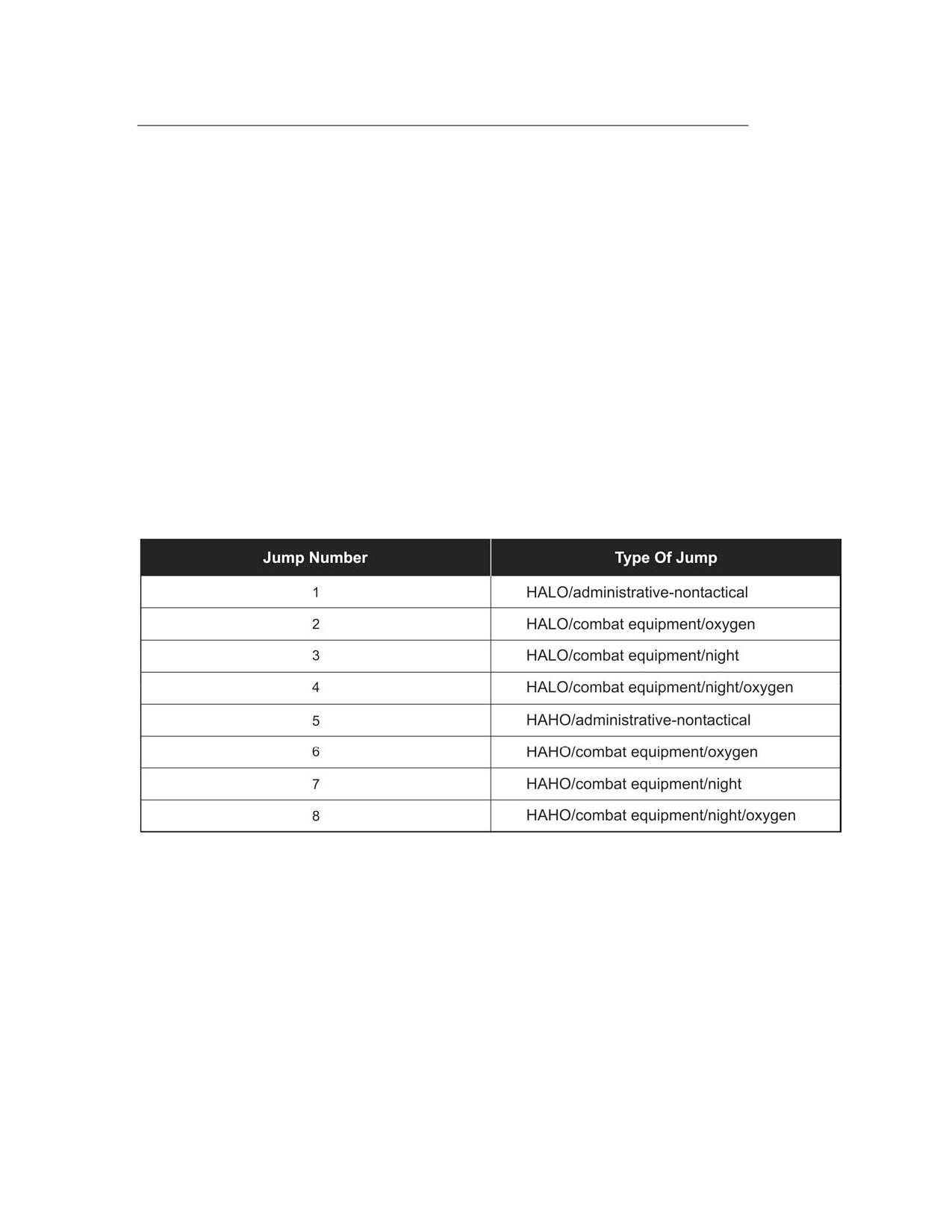
assets. Commanders follow a minimum program consisting of eight
parachute jumps per quarter (Table C-1). They do not plan more than four
proficiency jumps for any one day. Table C-2, pages C-2 through C-4,
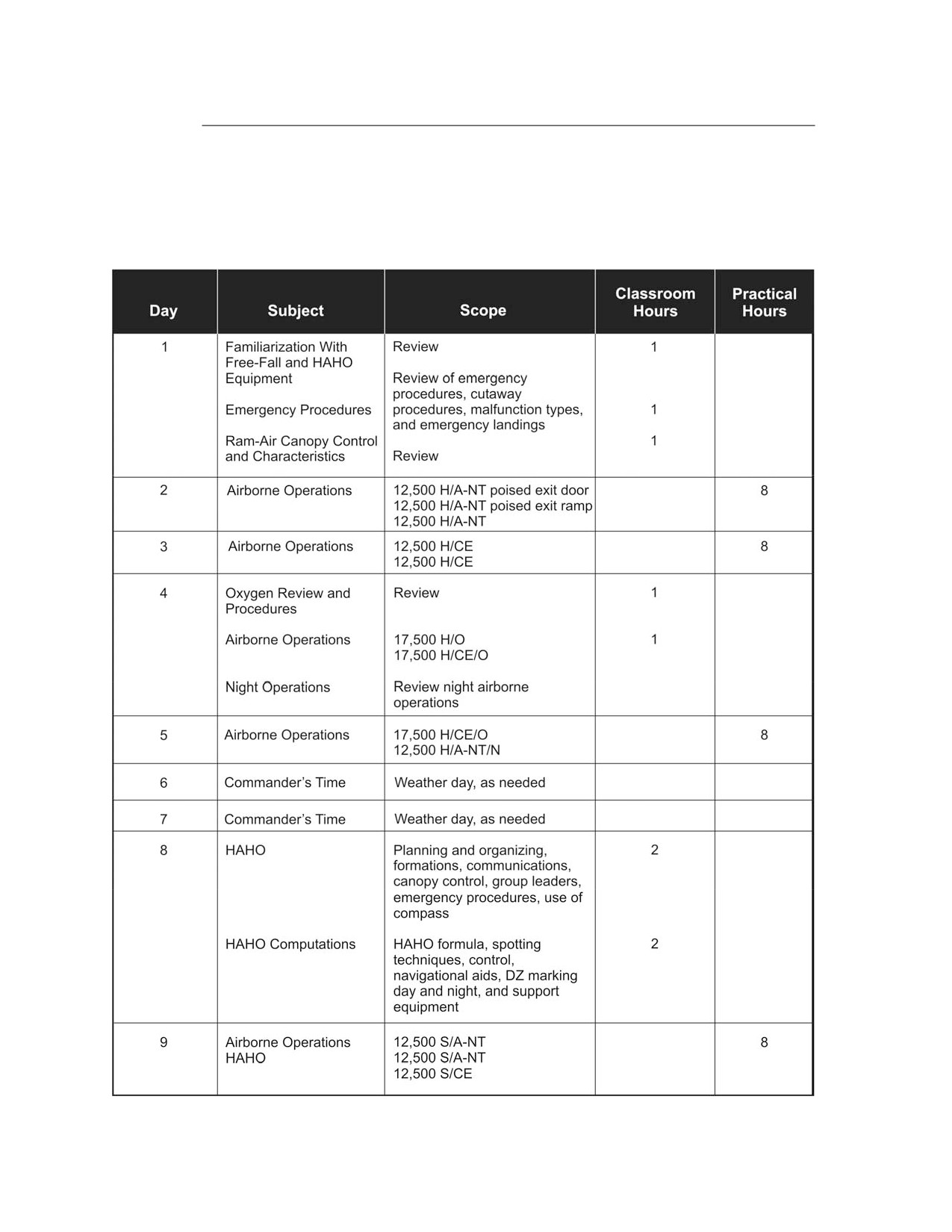
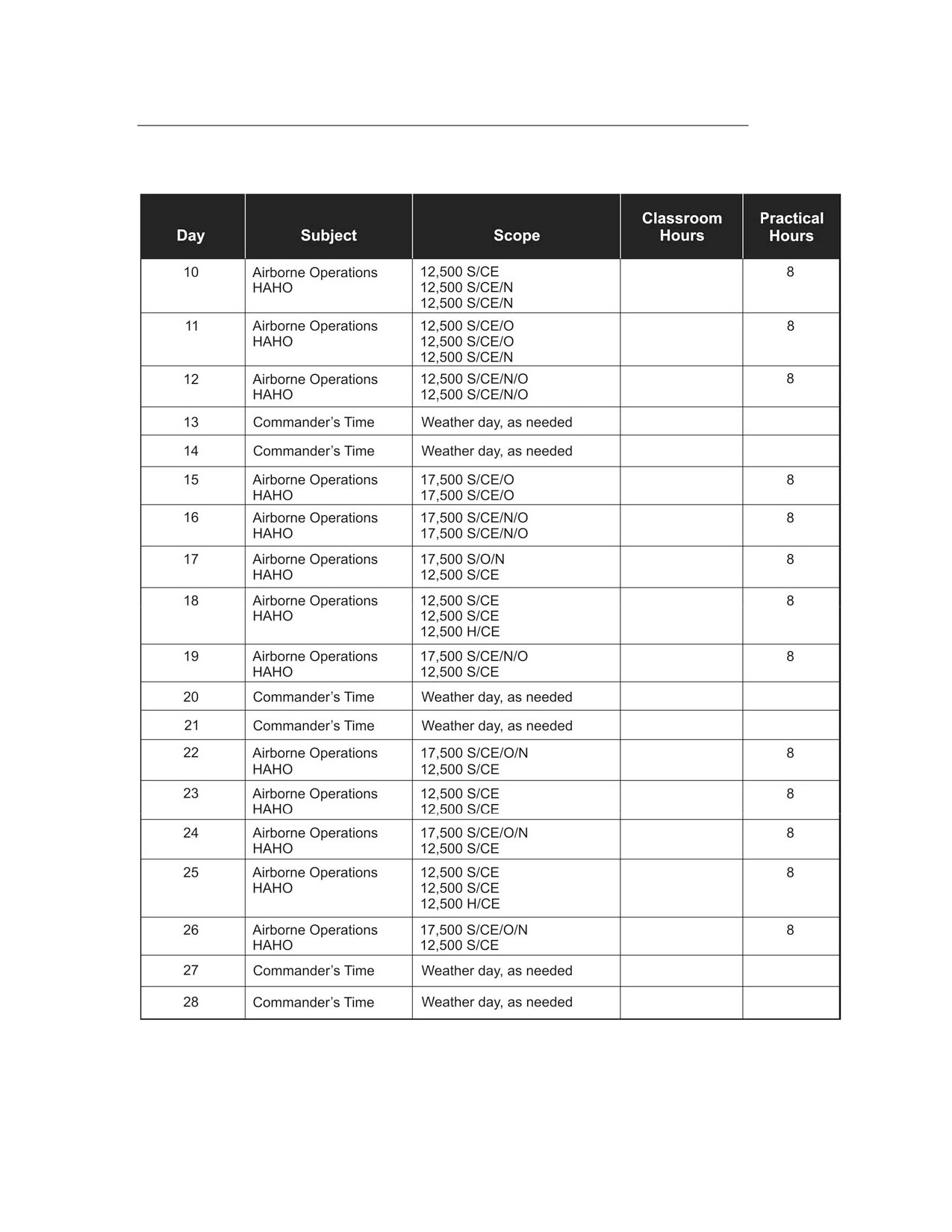
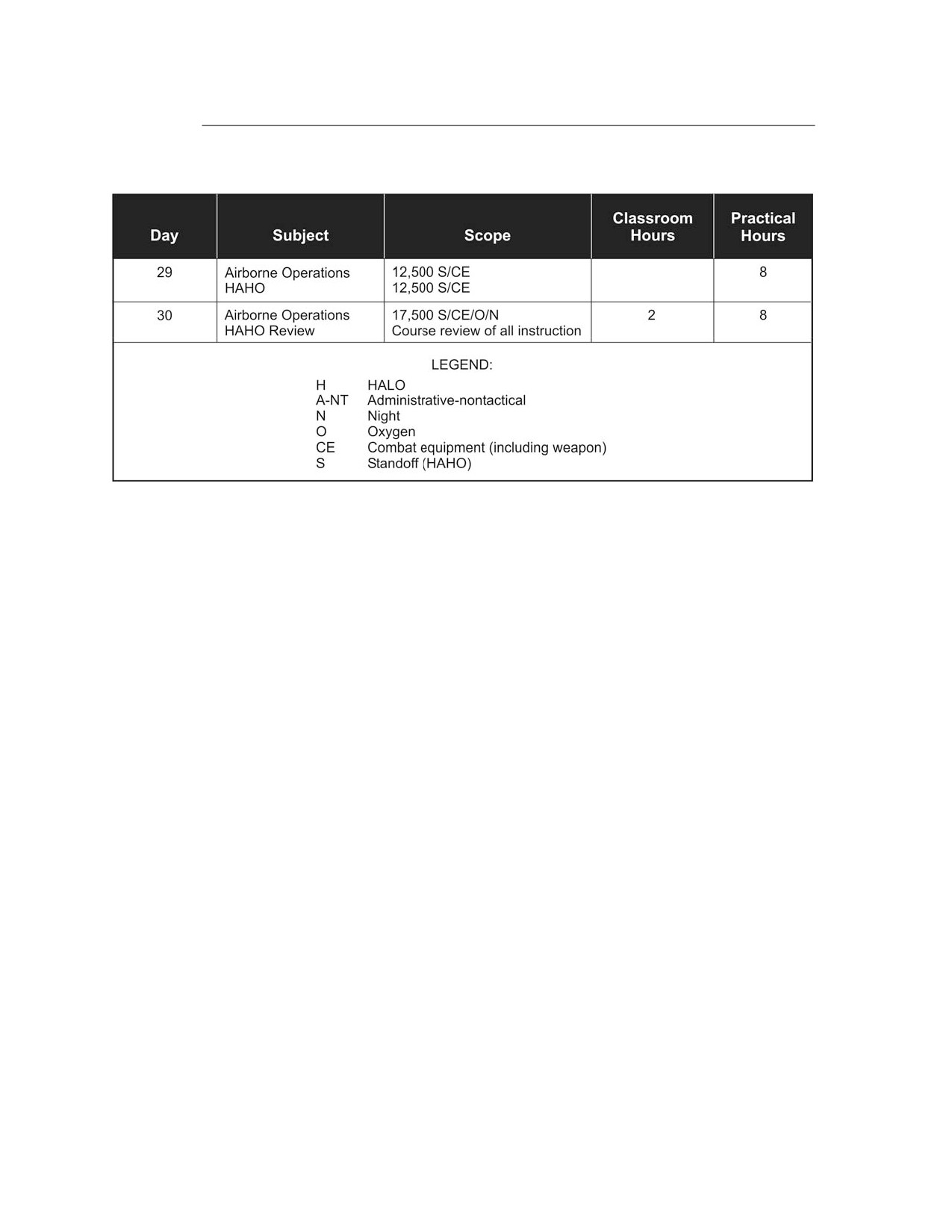
depicts a suggested 30-day predeployment training program.
Table C-1. Minimum Quarterly Training Guide
NOTE: Commanders must remember that for safety and parachutist
confidence, parachutists require a jump refresher before executing night
combat equipment jumps after prolonged periods of nonjumping.
Commanders may not be able to include the eight jumps depicted in Table
C-1 in the quarterly training plan; however, they follow the intent of the
progression where possible. For example, after a 3-month layoff, an element
should make a daylight jump before a night combat equipment jump.
NOTE: Units can fulfill oxygen-training requirements at altitudes below
18,000 feet MSL. A mission profile that is consistent with prebreathing
requirements can be flown without requiring the coordination with or the
presence of USAF physiological technicians. Training missions using full
oxygen equipment can be flown at altitudes below 13,000 feet MSL. Flights at
these altitudes would be consistent with any altitude’s oxygen use
6 April 2005 FM 3-05.211/MCWP 3-15.6/NAVSEA SS400-AG-MMO-010/AFMAN 11-411(I)
C-1
FM 3-05.211
requirements. These training mission profiles might occur in areas where
airspace restrictions are in force or when there are not enough aircrew
personnel.
Table C-2. Suggested 30-Day Predeployment Training Program
C-2
FM 3-05.211/MCWP 3-15.6/NAVSEA SS400-AG-MMO-010/AFMAN 11-411(I)
6 April 2005
FM 3-05.211
Table C-2. Suggested 30-Day Predeployment Training Program (Continued)
6 April 2005 FM 3-05.211/MCWP 3-15.6/NAVSEA SS400-AG-MMO-010/AFMAN 11-411(I)
C-3
FM 3-05.211
Table C-2. Suggested 30-Day Predeployment Training Program (Continued)
C-4
FM 3-05.211/MCWP 3-15.6/NAVSEA SS400-AG-MMO-010/AFMAN 11-411(I)
6 April 2005
FM 3-05.211
Appendix D
Suggested Military Free-Fall Sustained
Airborne Training
Sustained airborne training must be conducted within the 24-hour period
before station time of any MFF parachute operation. At a minimum, MFF
sustained airborne training must consist of the jumpmaster troop
briefing, a mock aircraft rehearsal, action procedures in free fall and
canopy flight, emergency procedures, canopy entanglement procedures,
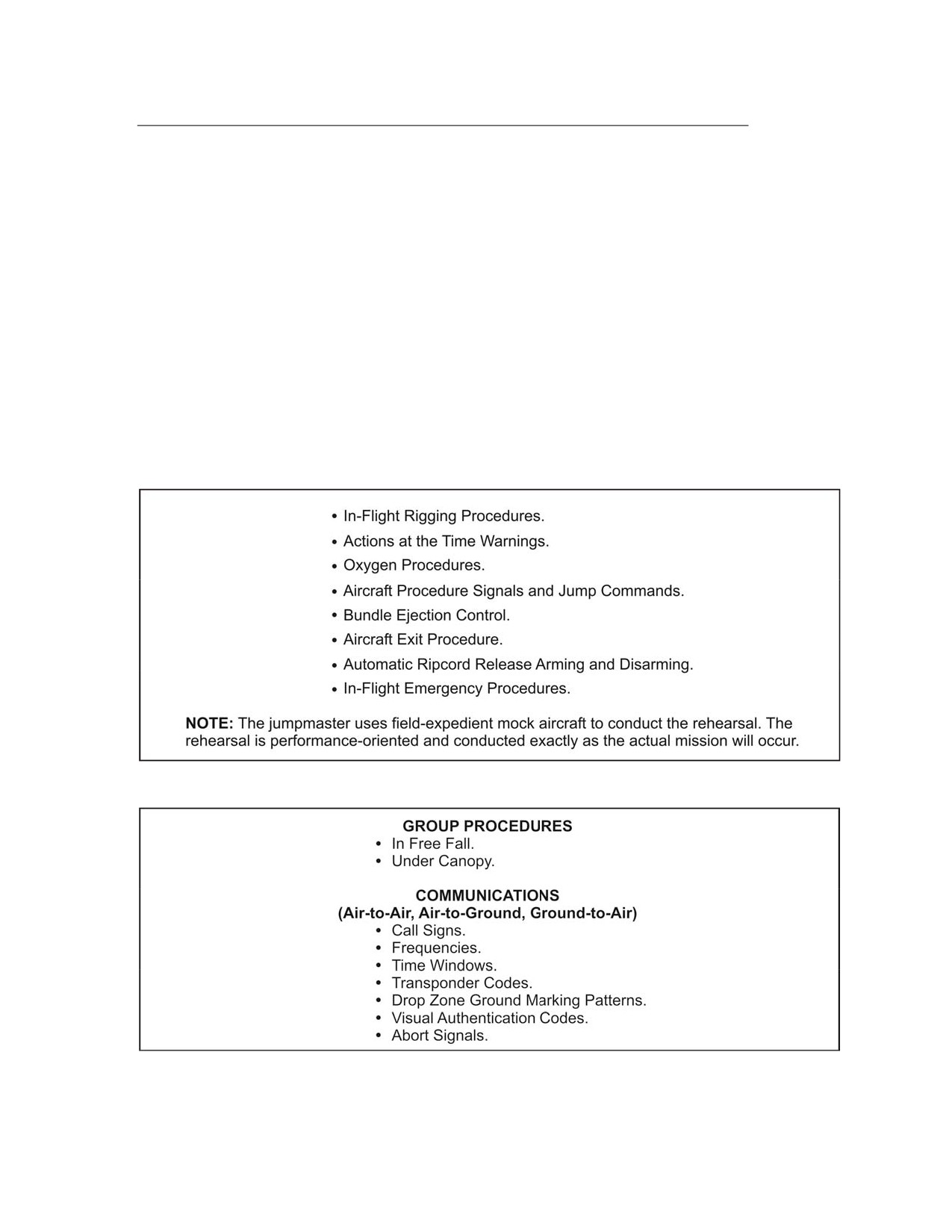
and landing procedures. Figures D-1 through D-6, pages D-1 through D-5,
provide outlines of the material to be covered during sustained training.
Figure D-1. Mock Aircraft Rehearsal
Figure D-2. Actions in Free Fall and Canopy Flight
6 April 2005 FM 3-05.211/MCWP 3-15.6/NAVSEA SS400-AG-MMO-010/AFMAN 11-411(I)
D-1
FM 3-05.211
Appendix E
Sample Accident Report
This appendix provides a sample accident report at Figure E-1 (DA Form
285-AB-R, U.S. Army Abbreviated Ground Accident Report
[AGAR]),
pages E-2 and E-3. It provides an example of the amount of information
that elements should provide in such reports.
6 April 2005 FM 3-05.211/MCWP 3-15.6/NAVSEA SS400-AG-MMO-010/AFMAN 11-411(I)
E-1
FM 3-05.211
Appendix F
High-Altitude Release Point Calculation
The effects of variable wind directions and speed must be accounted for
when determining the HARP for each MFF mission. Accurate wind data
is essential to calculate the HARP precisely. Commanders are cautioned
against planning pinpoint landings on targets when wind data is
questionable due to the source, timeliness of reporting, or other dynamic
meteorological conditions
(for example, thunderstorms or changing
fronts). Wind will affect the parachutist during free fall and canopy
performance after deployment.
OBTAINING WIND DATA
F-1. Military airfields, civilian airports or weather services, artillery
meteorological sections, or pilot teams in the operational areas can provide
wind data. Aircrew personnel can also determine wind data during flight as
the aircraft passes through different flight levels. (It is not advisable to use
this technique for actual infiltrations, as the data obtained en route to the
objective area may not reflect conditions at the objective area.)
RECORDING WIND DATA
F-2. The jumpmaster records the reported wind data according to altitude in
feet, direction in degrees, and speed (velocity) in knots. He records the wind
data for every 2,000 feet of altitude during free fall and every 1,000 feet of
altitude under canopy.
CALCULATING AND PLOTTING THE HARP
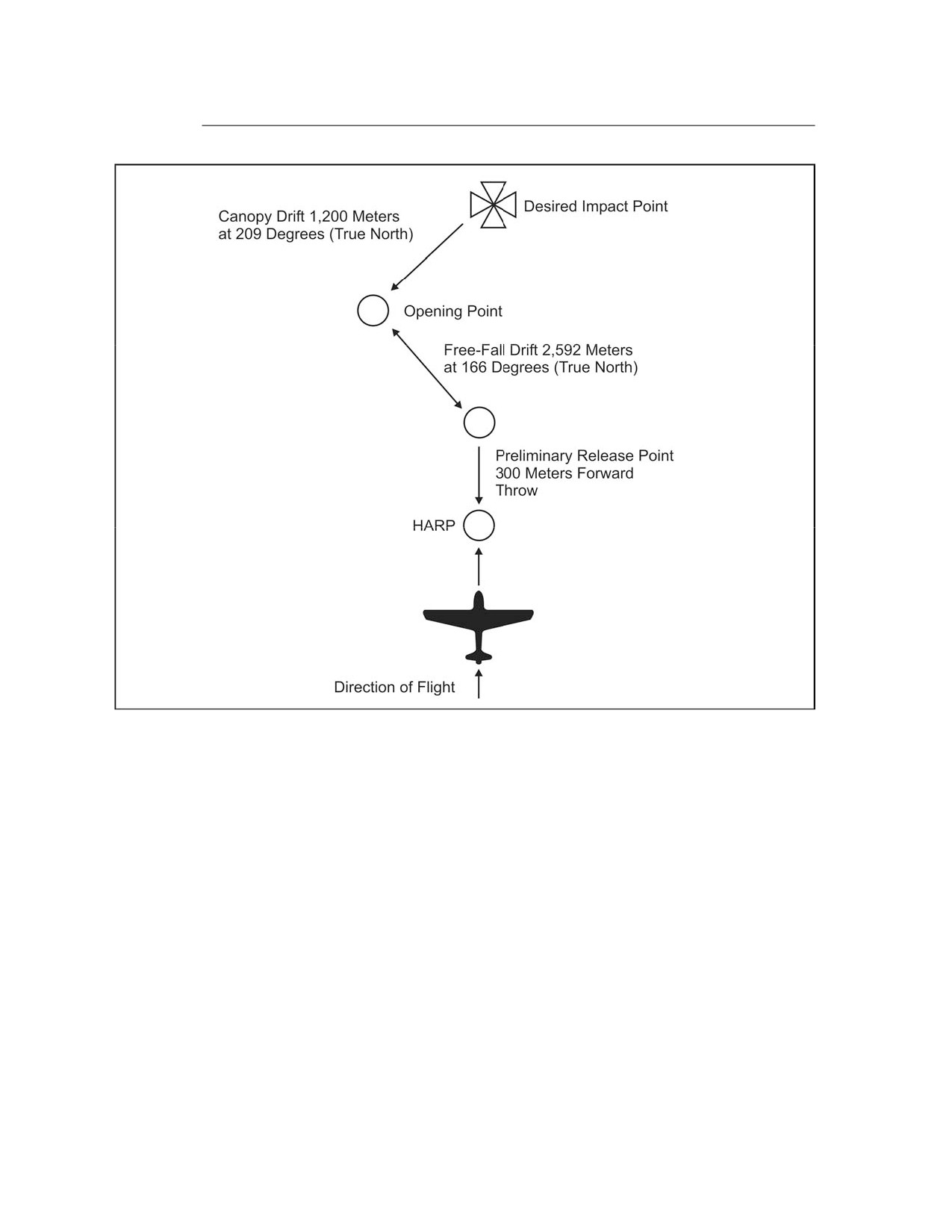
F-3. The jumpmaster calculates and plots the HARP’s location in reverse
sequence
(Figure F-1, page F-2). First, he calculates the distance and
direction from the DIP to the parachute opening point. Second, he calculates
the distance and direction from the parachute opening point to the
preliminary release point
(PRP). Third, he calculates the distance and
direction from the PRP (to compensate for forward throw) to the HARP.
F-4. Calculation of the HARP during HAHO operations may or may not
require calculation of free-fall drift, depending upon the length of free fall
required. For HAHO missions requiring less than 2,000 feet of free fall, the
jumpmaster disregards free-fall drift.
F-5. When plotting the HARP on a map, the jumpmaster converts the wind
direction from True North to a grid azimuth using the declination diagram.
6 April 2005 FM 3-05.211/MCWP 3-15.6/NAVSEA SS400-AG-MMO-010/AFMAN 11-411(I)
F-1
FM 3-05.211
Figure F-1. Plotting the HARP, Free-Fall, and Canopy Drift for a HALO Mission Profile
USING THE WIND DRIFT FORMULA AND CONSTANTS
F-6. The jumpmaster uses the wind drift formula D = KAV.
• D = distance in meters.
• K = constant (drift in meters per 1,000-foot loss of altitude in a 1-knot
wind).
• A = altitude in thousands of feet.
• V = average wind speed (velocity).
The jumpmaster also uses the following wind drift constants (K factors):
• K = 3 (parachutist in free fall).
• K = 25 (MC-3 parachute system and RAPS [HALO]).
• K = 48 (RAPS [HAHO]).
NOTE: The jumpmaster calculating the HAHO wind drift uses the constant
of the least performing canopy; for example, the U.S. Navy MT1-X-S uses the
S-type reserve that has a K factor of 60. Therefore, if a parachutist has to
activate his reserve parachute, he will still be able to glide to the DZ.
F-2
FM 3-05.211/MCWP 3-15.6/NAVSEA SS400-AG-MMO-010/AFMAN 11-411(I)
6 April 2005
FM 3-05.211
CALCULATING HALO FREE-FALL DRIFT AND DIRECTION
F-7. To determine the parachutist’s drift in free fall, the jumpmaster
calculates the average wind speed (velocity) and average wind direction from
the exit to the opening altitude. Opening altitude (4,000 feet in this example)
is not included since that is where the free fall stops. The wind data from
4,000 feet to 1,000 feet is calculated using the canopy drift constant.
EXAMPLE:
Altitude
Velocity
Direction
20,000
85
160
18,000
75
160
16,000
75
165
14,000
65
165
12,000
50
155
10,000
45
150
8,000
20
185
6,000
20
190
485 knots
1330 degrees
The jumpmaster determines the averages by—
• Determining the total free-fall distance from the exit (20,000) to the
opening (4,000). A = 20,000 - 4,000 = 16,000, or A = 16.
• Dividing the sum of the wind velocities
(435) by the number of
velocities (8). V = 435 ÷ 8 = 54.375, or V = 54 (rounded to nearest whole
number) knots average wind speed (velocity).
• Dividing the sum of the wind directions (1330) by the number of
directions (8). Direction = 1330 ÷ 8 = 166.25, or Direction = 166 degrees
(rounded to nearest whole number) average wind direction.
The jumpmaster substitutes the numerical values for the letters of the
D = KAV formula.
• D = (3) (16) (54).
• D = 2,592 meters at 166 degrees (True North).
NOTE: If using wind directions from 315 degrees to 045 degrees to calculate
the average wind direction, incompatible averages may result. To compen-
sate, the jumpmaster adds 360 degrees to directions of 001 to 045 degrees.
EXAMPLE:
Direction
Direction
345
345
350
350
345
345
010
010 (+360) = 370
015
015 (+360) = 375
350
350
1415 degrees
2135 degrees
Direction = 1415 ÷ 6 = 235.83 or D = 236 degrees (incorrect).
Direction = 2135 ÷ 6 = 355.83 degrees or D = 356 degrees (correct).
6 April 2005 FM 3-05.211/MCWP 3-15.6/NAVSEA SS400-AG-MMO-010/AFMAN 11-411(I)
F-3
FM 3-05.211
CALCULATING CANOPY DRIFT
F-8. To determine the parachutist’s drift under canopy, the jumpmaster
calculates the average wind speed (velocity) and direction from 1,000 feet to
the opening altitude.
EXAMPLE:
Altitude
Velocity
Direction
4,000
15
190
3,000
14
220
2,000
11
205
1,000
9
220
49
835
(Disregard surface winds.)
The jumpmaster determines the averages by—
• Dividing the sum of the velocities (49) by the number of velocities (4).
V = 49 ÷ 4 = 12.25, or V = 12 (rounded to nearest whole number)
average wind speed (velocity).
• Dividing the sum of the wind directions
(835) by the number of
directions (4). Direction = 835 ÷ 4 = 208.75 degrees, or 209 degrees
(rounded to the nearest whole number) average wind direction.
The jumpmaster substitutes the numerical values for the letters of the D =
KAV formula.
• D = (25) (4) (12).
• D = 1,200 meters at 209 degrees (True North).
CALCULATING FORWARD THROW
F-9. Compensation must be made for the distance a parachutist’s body
initially travels into the direction of flight due to forward speed (velocity).
The average forward throw, at normal high-performance aircraft exit speeds,
is 300 meters.
CALCULATING DOGLEGS
F-10. Two consecutive changes in wind direction of 90 degrees or more are
known as doglegs. Doglegs require separate calculations from the altitude
where the wind direction changes.
NOTE: A single 90-degree or greater change in wind direction is treated as
erroneous winds and will not be included in calculations.
CALCULATING THE HAHO HARP
F-11. To calculate the HAHO HARP, the jumpmaster uses the modified
D = KAV formula, as the intention is to maximize the linear distance traveled
using the gliding capability of the RAPS. For doglegs with less than 6,000
feet of vertical descent, the jumpmaster uses the standard D = KAV formula.
F-4
FM 3-05.211/MCWP 3-15.6/NAVSEA SS400-AG-MMO-010/AFMAN 11-411(I)
6 April 2005
FM 3-05.211
The jumpmaster uses the following HAHO gliding distance formula:
• D = (A - SF) (V + 20.8)
K
• D = gliding distance in nautical miles (nm).
• A = altitude in thousands of feet.
• SF = safety factor in thousands of feet.
• V = average wind speed (velocity) in knots.
•
20.8 = canopy speed constant.
• K = 48 (canopy drift constant).
F-12. The jumpmaster calculates the safety factor, which provides a buffer
area after exit to permit the parachutists to assemble under canopy and to
establish the landing pattern over the DZ. For example, the element
commander desires 1,000 feet for canopy assembly after exit and 2,000 feet to
establish the landing pattern. The safety factor is 3,000 feet. Therefore, SF = 3.
F-13. The jumpmaster calculates the total gliding distance in nautical miles. To
convert nautical miles to kilometers (km), the jumpmaster multiplies by 1.85.
F-14. When an element exits the aircraft in stick formation, the jumpmaster
compensates for dispersion between the parachutists. He obtains this figure
by dividing the total number of parachutists by 2 and then multiplying the
result obtained by 50 meters. He plots the calculated distance back into the
aircraft’s line of flight. This procedure places the middle of the stick on the
desired opening point.
F-15. The jumpmaster plots 300 meters back into the aircraft’s line of flight
to compensate for forward throw. The following are examples of HAHO
HARP calculations.
EXAMPLE 1: HAHO HARP CALCULATION.
Situation. The exit altitude is 14,000 feet. Twelve parachutists will exit the
aircraft in stick formation. The element commander desires 1,000 feet for
canopy assembly and a 1,000-foot arrival altitude over the DZ. Wind speed
and direction at altitude are—
Altitude
Velocity
Direction
14,000
25
090
12,000
22
080
10,000
21
090
9,000
21
090
8,000
20
085
7,000
18
080
6,000
18
080
5,000
17
085
4,000
16
080
3,000
12
075
2,000
12
080
1,000
08
080
210 knots
995 degrees
6 April 2005 FM 3-05.211/MCWP 3-15.6/NAVSEA SS400-AG-MMO-010/AFMAN 11-411(I)
F-5
FM 3-05.211
F-16. The jumpmaster—
• Determines the average wind speed: V = 210 ÷ 12 = 17.50, or V = 18
(rounded to nearest whole number) average wind speed.
• Determines the average wind direction: D = 995 ÷ 12 = 82.91, or D = 83
(rounded to nearest whole number) degrees (True North) average wind
direction.
• Determines the safety factor is 2 (minimum).
• Substitutes the numerical values for the letters of the formula:
D = (12 - 2) (20.8 + 18) ÷ 48.
D = (10) (38.8) ÷ 48.
D = 388.0 ÷ 48.
D = 8.0 nm at 83 degrees (True North).
• Determines the gliding distance: 8.0 nm x 1.85 = 14.80 km.
• Determines dispersion: (12 ÷ 2) x 50 = 300 meters.
• Determines forward throw: 300 meters.
• Converts the average wind direction to a grid azimuth and plots it on
the map to determine the opening point.
• Plots the dispersion and forward throw from the PRP to determine the
HARP (there is no free-fall drift in a HAHO, so the PRP is the opening
point).
• Determines the grid azimuth from the opening point to the DIP.
Converts the grid azimuth to a magnetic azimuth. The magnetic
azimuth is the compass heading followed to the DZ.
EXAMPLE 2: HAHO HARP CALCULATION WITH A DOGLEG.
Situation. Exit altitude is 15,000 feet. Twelve parachutists exit the aircraft in
stick formation. The element commander desires
1,000 feet for canopy
assembly and a 2,000-foot arrival altitude over the DZ. A change of wind
direction creates a dogleg at 9,000 feet AGL. Wind speed and direction at
altitude are—
Altitude
Velocity
Direction
14,000
33
210
12,000
30
210
10,000
29
180
92 knots
600 degrees
9,000
26
075
8,000
24
080
7,000
22
085
6,000
20
090
5,000
18
090
4,000
14
085
3,000
12
090
2,000
10
085
1,000
8
080
154 knots
760 degrees
F-6
FM 3-05.211/MCWP 3-15.6/NAVSEA SS400-AG-MMO-010/AFMAN 11-411(I)
6 April 2005
FM 3-05.211
JUMPMASTER CALCULATIONS (BELOW THE DOGLEG
FROM 9,000 TO 1,000 FEET)
F-17. The jumpmaster calculates the gliding distance and direction from the
DIP to the dogleg at 9,000 feet. He—
• Determines that the average wind speed (velocity) from 1,000 feet to
9,000 feet is 17.11 or V = 17 (rounded to the nearest whole number)
knots average wind speed.
• Determines that the average wind direction from 1,000 feet to 9,000
feet is 84.44 or 84 (rounded to the nearest whole number) degrees (True
North).
• Determines that the safety factor is 3. He must remember that in a
formula for a HAHO dogleg, the safety factor is 2 on the base leg and 1
on the dogleg to equal a total safety factor of 3.
• Establishes that altitude = 9,000 feet, or A = 9.
• Substitutes the numerical value for the letters of the formula:
D = (9 - 2) (20.8 + 17) ÷ 48.
D = (7) (37.8) ÷ 48.
D = 264.6 ÷ 48 = 5.5 nm x 1.85 = 10.1 km gliding distance at 84
degrees (True North).
JUMPMASTER CALCULATIONS (ABOVE THE DOGLEG
FROM 10,000 TO 14,000 FEET)
F-18. The jumpmaster calculates the gliding distance and direction from
10,000 feet to the exit altitude. He—
• Determines that the average wind speed (velocity) from 10,000 feet to
15,000 feet is 30.66 or 31 (rounded to the nearest whole number) knots.
• Determines that the average wind direction from 10,000 feet to 15,000
feet is 200 degrees (True North).
• Determines that the safety factor is 1.
• Establishes that altitude = 5,000 feet, or A = 5.
• Substitutes the numerical value for the letters of the formula:
D = (5 - 1) (20.8 + 31) ÷ 48.
D = (4) (51.8) ÷ 48.
D = 207.2 ÷ 48 = 4.3 nm x 1.85 = 7.9 or 8 km (rounded to the
nearest whole number) gliding distance at 200 degrees (True
North).
F-19. The jumpmaster converts the True North azimuths to grid azimuths.
He plots the glide path from the DIP to the dogleg, and plots the glide path
from the dogleg to the opening point. He calculates the dispersion for 12
parachutists (300 meters) and plots the PRP from the opening point. The
jumpmaster compensates for forward throw and plots the HARP.
F-20. The jumpmaster determines the grid azimuth from the opening point
to the DIP. He converts the grid azimuth to a magnetic azimuth. The
magnetic azimuth is the compass heading followed to the DZ. By holding a
single compass heading, the parachutist will maintain direction and follow a
6 April 2005 FM 3-05.211/MCWP 3-15.6/NAVSEA SS400-AG-MMO-010/AFMAN 11-411(I)
F-7
FM 3-05.211
curving path from the opening point to the DZ, rather than a path with
distinct turns.
NOTE: The safety factor above the dogleg and below the dogleg, when
combined, mathematically incorporates the desired effect over the complete
group.
F-8
FM 3-05.211/MCWP 3-15.6/NAVSEA SS400-AG-MMO-010/AFMAN 11-411(I)
6 April 2005
FM 3-05.211
Appendix G
Jumpmaster Personnel Inspection
Before each MFF parachute operation, the jumpmaster conducts a
systematic inspection of each parachutist’s parachute and combat
equipment for proper wear, fit, and attachment. All equipment being
airdropped will receive a JMPI. The jumpmaster must never sacrifice
safety for speed.
DANGER
Improper or incomplete jumpmaster personnel
inspections may result in death, serious injury, or
equipment loss and damage.
JMPI OF THE MC-4 HARNESS AND CONTAINER SYSTEM
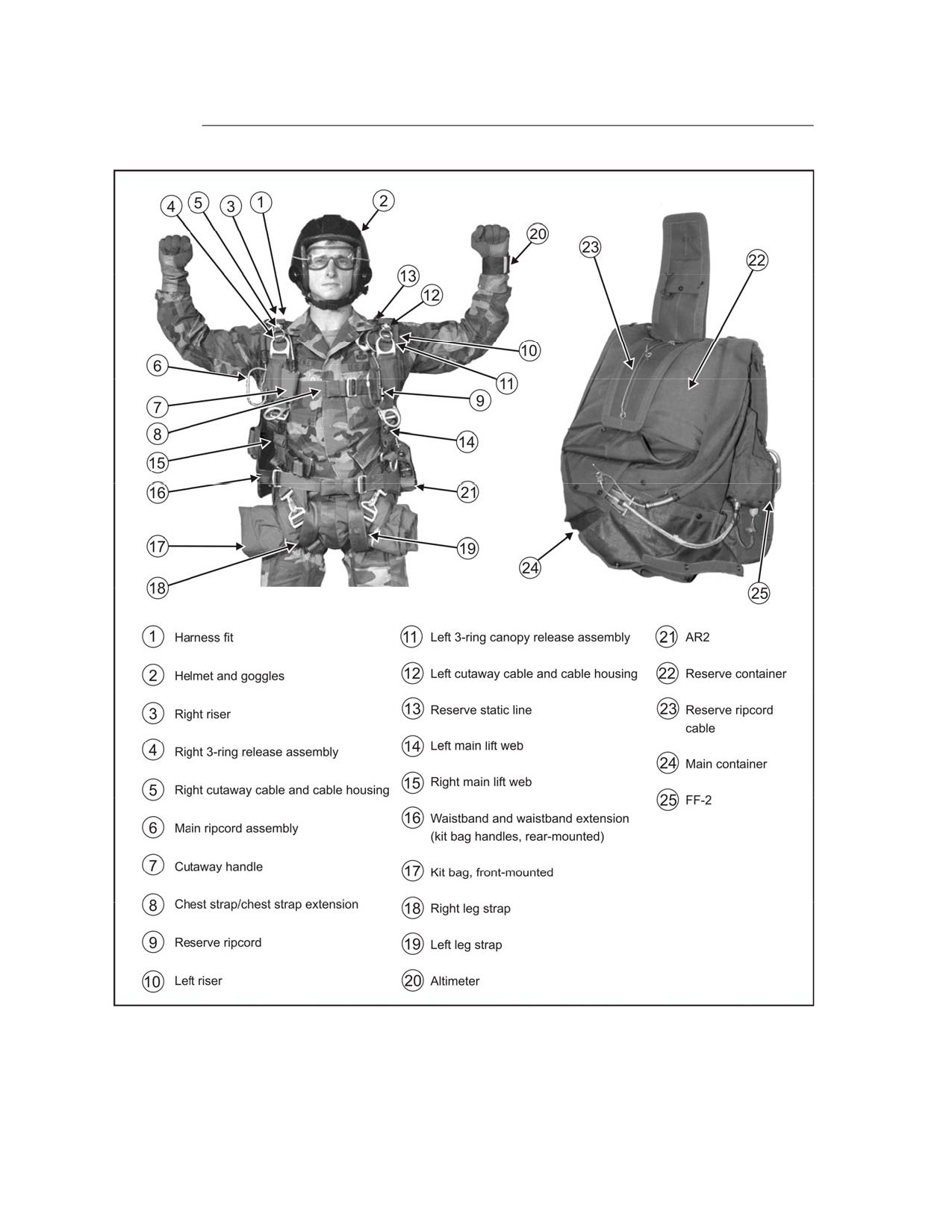
G-1. The jumpmaster uses the following sequence to detect and identify
deficiencies. With hands and eyes working together, he starts at the front of
the parachutist and moves to the rear, from top to bottom, right side to left
side (Figure G-1, page G-2).
NOTE: If making an oxygen jump, the jumpmaster first performs the oxygen
inspection sequence on page G-11. Then he continues with the following:
NOTE: If jumping in the vicinity of a water hazard, the jumpmaster follows
the inspection sequence for flotation devices on page G-14. Then he continues
with the following:
• Harness: Checks for proper fit before continuing the JMPI.
• Helmet and goggles:
Uses correct helmet: MC-3, Gentex HGU-55/P, Gentex lightweight
parachutist helmet, Bell helmet, or Protec helmet with free-fall liner.
Makes sure it fits properly and is serviceable.
Uses approved goggles (Kroop; military-issue sun, wind, and dust
goggles; or Gentex only).
Makes sure the lenses are clear and not cracked or scratched.
Makes sure the goggle strap is secured if worn outside of helmet.
Checks that bayonet receivers are present and securely attached.
Makes sure the two adjustment screws are present on the receiver
covers.
Checks chin strap for proper attachment and serviceability, with
excess stowed.
Right riser: Makes sure no twists are present in front or rear riser
from riser cover to 3-ring release assembly.
6 April 2005 FM 3-05.211/MCWP 3-15.6/NAVSEA SS400-AG-MMO-010/AFMAN 11-411(I)
G-1
FM 3-05.211
Figure G-1. JMPI Without Oxygen, Weapon, or Rucksack
G-2
FM 3-05.211/MCWP 3-15.6/NAVSEA SS400-AG-MMO-010/AFMAN 11-411(I)
6 April 2005
FM 3-05.211
•
Right 3-ring release assembly:
Checks for correct assembly—small ring, medium ring, and base
ring (elongated snowman effect).
Gives small and medium ring a one-quarter turn to check for free
movement.
•
Right main canopy release cable and cable housing:
Inspects for tacking and proper routing.
Makes sure the 3-ring locking loop is through the small ring and
the grommet on the riser and the eye on the cable housing (without
any twists or frays).
Rotates riser toward the parachutist’s neck, ensuring the release
cable is routed through the locking loop and the running end is
stowed in the stowage flute.
•
Main ripcord assembly:
Makes sure the housing is tacked properly.
Makes sure there are no broken strands on main ripcord cable.
Makes sure the two swage balls are present on the end of the
ripcord cable.
Checks that the main ripcord handle is properly seated in the
elastic pocket.
•
Cutaway handle (main canopy release ripcord):
Makes sure that the cutaway cables are not twisted more than 180
degrees.
Checks that the handle is seated in its pocket and the Velcro is
properly mated.
•
Chest strap:
Makes sure there are no twists and it is properly routed (to include
the chest strap extension).
Makes sure the excess is rolled under and stowed in the slack
retainer.
Makes sure it is properly routed through the friction adapter.
NOTE: If jumping with a weapon, jumpmaster follows the inspection
sequence on page G-14. Then he continues with the following:
• Reserve ripcord:
Makes sure it is properly seated in the elastic pocket.
Checks that the two swage balls are present on end of the reserve
ripcord cable.
Makes sure there are no broken strands.
Makes sure the cable is properly routed to the cable housing.
Makes sure the cable housing is tacked.
• Left riser: Makes sure there are no twists in the front or rear riser from
the riser cover to the 3-ring release assembly.
6 April 2005 FM 3-05.211/MCWP 3-15.6/NAVSEA SS400-AG-MMO-010/AFMAN 11-411(I)
G-3
FM 3-05.211
•
Left 3-ring release assembly:
Checks for correct assembly—small ring, medium ring, and base
ring (elongated snowman effect).
Gives the small and medium rings a one-quarter turn to check for
free movement.
•
Left main canopy release cable and cable housing:
Inspects for tacking and proper routing.
Makes sure the 3-ring locking loop is through the small ring and
the grommet on the riser and the eye on the cable housing (without
any twists or frays).
Rotates riser toward parachutist’s neck, making sure the release
cable is routed through the locking loop and the running end is
stowed in the stowage flute.
•
Reserve static line:
Makes sure the reserve static-line quick-release lanyard is
attached and snapped.
Makes sure the reserve static-line loop is attached to the release
shackle and routed correctly.
•
Left main lift web:
Checks that the large equipment attachment ring and V-ring are
present.
Makes sure the running end of the adjustment strap is rolled and
stowed in the slack retainer.
Makes sure there are no twists.
NOTE: If jumping with a rucksack, jumpmaster follows the inspection
sequence on page G-16. Then he continues with the following:
• Right main lift web:
Checks that the large equipment attachment ring and V-ring are
present.
Makes sure the running end of the adjustment strap is rolled and
stowed in the slack retainer.
Makes sure there are no twists.
Checks free-floating strap and oxygen fitting block for proper
attachment, and makes sure the four screws are present on the
back of the fitting block.
• Waistband, waistband extension, and kit bag handles (rear-mounted):
Makes sure the right wing flap is secured to the waistband.
Checks that there are no twists from its attachment point on the
right side of container to the left wing flap.
Makes sure the excess is rolled under and stowed in the slack
retainer.
G-4
FM 3-05.211/MCWP 3-15.6/NAVSEA SS400-AG-MMO-010/AFMAN 11-411(I)
6 April 2005
FM 3-05.211
Checks for proper routing through the waistband extension friction
adapter.
Checks the waistband extension is routed through the kit bag
handles (rear-mounted).
Checks the kit bag is positioned between the jumper’s back and the
main pack tray.
•
Right leg strap, kit bag handle (front-mounted):
Makes sure the snap hook gate closes and has proper spring
tension.
Makes sure the excess is rolled under and stowed in the slack
retainer.
Checks for correct routing, with no twist in leg strap or saddle.
Ensures the leg strap is routed through one kit bag carrying handle
(front-mounted).
•
Left leg strap, kit bag handle (front-mounted):
Makes sure the snap hook gate closes and has proper spring
tension.
Makes sure the excess is rolled under and stowed in the slack
retainer.
Checks for correct routing, with no twist in leg strap or saddle.
Ensures the leg strap is routed through one kit bag carrying handle
(front-mounted).
•
Altimeter, MA2-30:
Makes sure it is located on parachutist’s left wrist, that it fits
snugly, and it is properly attached (with 0 to the top).
Checks for proper free-fall altimeter setting.
Tells the parachutist to turn and continue the JMPI.
•
Reserve container:
Peels open the reserve ripcord protective flap.
Makes sure the reserve ripcord cable housing is tacked down.
Checks that the reserve static line is routed correctly, and that the
reserve ripcord cable runs through the reserve static-line ring and
fixed guide ring.
•
Reserve ripcord cable:
Checks that the reserve ripcord cable has no broken strands.
Makes sure it is routed on the left side of the grommets.
Makes sure the top pin is inserted at a 45-degree angle.
Makes sure the closing loops are not frayed.
6 April 2005 FM 3-05.211/MCWP 3-15.6/NAVSEA SS400-AG-MMO-010/AFMAN 11-411(I)
G-5
FM 3-05.211
Makes sure both pins are not seated past their shoulders.
Tells the parachutist to bend.
•
Main container:
Opens both protective flaps.
Makes sure the closing flaps are closed in the proper sequence
(bottom, left, right, top).
Makes sure the main ripcord cable housing is tacked.
Checks that main ripcord cable and ARR power cable are not
twisted around each other.
Makes sure the 2-inch cable extension with swage ball is at the
12 o’clock position (top).
Makes sure the closing loop is not frayed.
Makes sure the main pin is not seated past its shoulder.
•
The AR2: Jumpmaster does the normal JMPI sequence through the
inspection of the parachutist’s altimeter. After the altimeter inspection,
the jumpmaster continues with the following:
Visually inspects the aneroid leak indicator for proper ambient
altitude according to MSL elevation.
Ensures aneroid leak indicator window is not damaged.
Moves the JUMP/OFF switch to the JUMP position, ensuring that
the activation lever has spring tension.
Moves the JUMP/OFF switch to the OFF position.
Ensures the lower protector flap of the AR2 pocket is snapped and
secured.
Opens the top protector flap of the AR2 pocket and inspects the
altitude dial for proper setting. Closes the top protector flap.
Ensures the power cable housing retainer is finger-tight with no
threads showing.
Visually inspects to make sure the swage ball is not visible and
that the plastic seal retainer is present.
Inspects the remainder of the power cable housing for visible
damage.
Opens the reserve ripcord protector flap.
NOTE: Inspection procedures for the reserve-mounted AR2 differ
from this point forward and are located on page G-7.
Ensures the reserve ripcord cable is routed correctly through the
(first) reserve static-line assist ring and (second) fixed guide ring.
Ensures the reserve ripcord handle has no broken strands.
Makes sure the reserve ripcord handle is routed on the left side of
the grommets.
Ensures the reserve ripcord locking pin is inserted at a 45-degree
angle.
G-6
FM 3-05.211/MCWP 3-15.6/NAVSEA SS400-AG-MMO-010/AFMAN 11-411(I)
6 April 2005
FM 3-05.211
Ensures the reserve ripcord top locking pin is not shouldered or
bent.
Makes sure the continuous reserve top-closing loop is not frayed.
Ensures the reserve cable has no broken strands.
Ensures the reserve ripcord bottom-locking pin is not shouldered or
bent.
Makes sure the continuous reserve bottom-closing loop is not
frayed.
Opens the power cable protective flap and the two-part main
parachute protective flap.
Makes sure the main parachute closing flaps are closed in
sequence.
Makes sure the main ripcord cable housing is tacked.
Ensures the main ripcord cable is properly routed and has no
broken strands.
Ensures the 2-inch cable extension with swage ball has no broken
strands and is routed above the main locking pin.
Makes sure the main ripcord cable single-locking pin is not
shouldered or bent.
Makes sure the main closing loop is not frayed.
Ensures the main locking pin is routed through the power cable
eyelet.
Ensures the power cable eyelet is to the right of the main closing
loop.
Ensures the power cable eyelet is not in the grommet, and the
beveled edge of the eyelet is in direction of pull (toward mounting
bracket).
Ensures the AR2 power cable is properly mounted from the eyelet
to the mounting bracket and has no broken strands.
Ensures the AR2 mounting bracket screws are present and tight.
Checks that the AR2 power cable housing is properly secured in the
power cable protective flap.
Picks up the inspection as the reserve ripcord cable routes through
the reserve static-line guide ring and fixed guide ring. Continues
the normal JMPI sequence from this point through completion,
excluding any FF2-related item.
AND
•
The AR2 (Reserve-Mounted): Jumpmaster does the normal JMPI
sequence through the inspection of the power cable housing. After
opening the reserve ripcord protector flap, the jumpmaster continues
with the following:
Finds the two screws of the power cable housing mounting bracket,
and gives the bracket a shake to ensure it is secured in place.
6 April 2005 FM 3-05.211/MCWP 3-15.6/NAVSEA SS400-AG-MMO-010/AFMAN 11-411(I)
G-7
FM 3-05.211
Traces the power cable as it protrudes from the cable housing,
inspecting for proper routing and no broken strands.
Ensures the power cable eye is to the left of the grommet, not
inside the grommet, and the beveled edge is up.
Inspects the reserve ripcord cable for proper routing and no broken
strands.
Checks the routing of the reserve ripcord cable to ensure it runs
through the assist ring (little ring) of the RSL and then through the
guide ring (big ring).
Continues to inspect the reserve ripcord cable for proper routing
and no broken strands until coming to the top reserve locking pin.
At the top reserve locking pin, ensures the cable is to the right of
the grommet.
Inspects the pin to make sure it is not shouldered inside the
grommet and the pin is not bent.
Makes sure the continuous closing loop of the reserve is not frayed.
Continues inspecting down the cable to the bottom locking pin,
ensuring it is properly routed and there are no broken strands.
At the bottom reserve locking pin, inspects the pin to make sure it
is not shouldered inside the grommet and the pin is not bent.
Makes sure the continuous closing loop of the reserve is not frayed.
Instructs the parachutist to bend.
Opens up and pins the top protector flap of the main parachute
with the left hand while opening the FF-2 protector flap with the
right hand.
Makes sure the closing flaps are closed in the proper sequence
(bottom, left, right, top).
Makes sure the main ripcord cable housing is tacked.
Ensures the main ripcord cable is properly routed and has no
broken strands.
Ensures the 2-inch cable extension with swage ball is properly
routed and has no broken strands.
Makes sure the main locking pin does not come loose and is not
shouldered or bent.
Makes sure the main closing loop is not frayed.
Slaps the bottom of the container to indicate completion of the
JMPI.
OR
•
The FF-2:
Makes sure the withdrawal hook is routed around the main ripcord
pin and to the right of the closing loop.
Makes sure the withdrawal hook is not seated in the grommet.
G-8
FM 3-05.211/MCWP 3-15.6/NAVSEA SS400-AG-MMO-010/AFMAN 11-411(I)
6 April 2005
FM 3-05.211
Makes sure the knurled nut is finger-tight and at least three
threads are showing.
Makes sure the rubber bumper is present.
Moves the rubber bumper to check that the FF-2 power cable has
no broken strands.
Makes sure the locking key is properly seated and locked in the
stiffener plate.
Tells the parachutist to stand erect.
Follows the power cable housing forward to the knurled nut on the
body of the FF-2. Makes sure the knurled nut is finger-tight.
Checks that the arming pin is properly seated and locked in place.
Checks that the FF-2 is properly placed in its stow pocket and the
snap fasteners are secured.
Checks for correct millibar setting.
Checks reset indicator for proper alignment (no more than 50
percent off).
Taps parachutist to indicate completion of JMPI.
OR
•
The MK 2100: Jumpmaster does the normal JMPI sequence through
the inspection of the parachutist’s altimeter. After the altimeter
inspection, the jumpmaster continues with the following:
Goes to the parachutist’s left side.
Makes sure the arming pin is seated into the altitude sensing
device and the lanyard is tied in a half hitch around the top
restraining strap of the MK 2100 pocket.
WARNING
Jumpmaster must ensure the lanyard is not tied in
a half hitch around the MK 2100 cable.
Makes sure the cable from the altitude-sensing unit is connected
and secured to the cable protruding from the left side of the
container.
Makes sure the nuts on both cables are hand-tight and serviceable.
Pushes the button on the top of the altitude-sensing unit and
makes sure the red circuitry light is lit.
NOTE: Once the aircraft has taken off, the red light will not work.
Opens the reserve protective flap.
Makes sure the ripcord housing is tacked.
Picks up the inspection as the reserve ripcord cable routes through
the reserve static-line guide ring and fixed guide ring.
6 April 2005 FM 3-05.211/MCWP 3-15.6/NAVSEA SS400-AG-MMO-010/AFMAN 11-411(I)
G-9