FM 3-05.211 Special Forces Military Free-Fall Operations (APRIL 2005) - page 4
FM 3-05.211
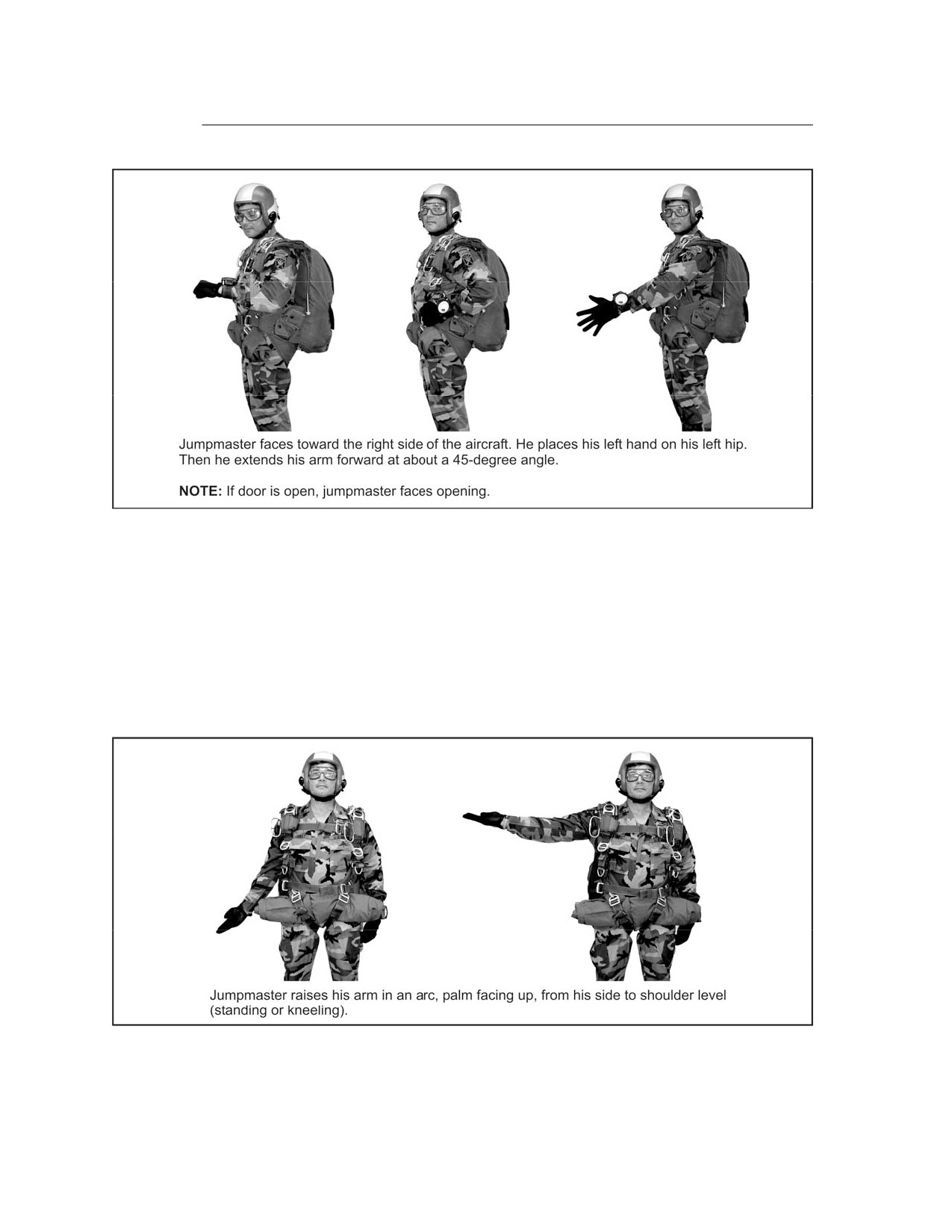
Figure 6-9. Arm ARR Command
STAND UP
6-11. The jumpmaster commands STAND UP about 2 minutes before TOT
(Figure 6-10). (Oxygen or equipment jumps may require additional time for
this command only; all other commands remain the same.) Upon receiving
this command, the parachutist stands up, receives pin check, faces the
jumpmaster, and checks his equipment. If jumping oxygen, the parachutist
also places his right hand on the ON/OFF valve of the bailout bottles and
grasps with his left hand the console hose at the AIROX VIII.
Figure 6-10. Stand Up Command
6-10
FM 3-05.211/MCWP 3-15.6/NAVSEA SS400-AG-MMO-010/AFMAN 11-411(I)
6 April 2005
FM 3-05.211
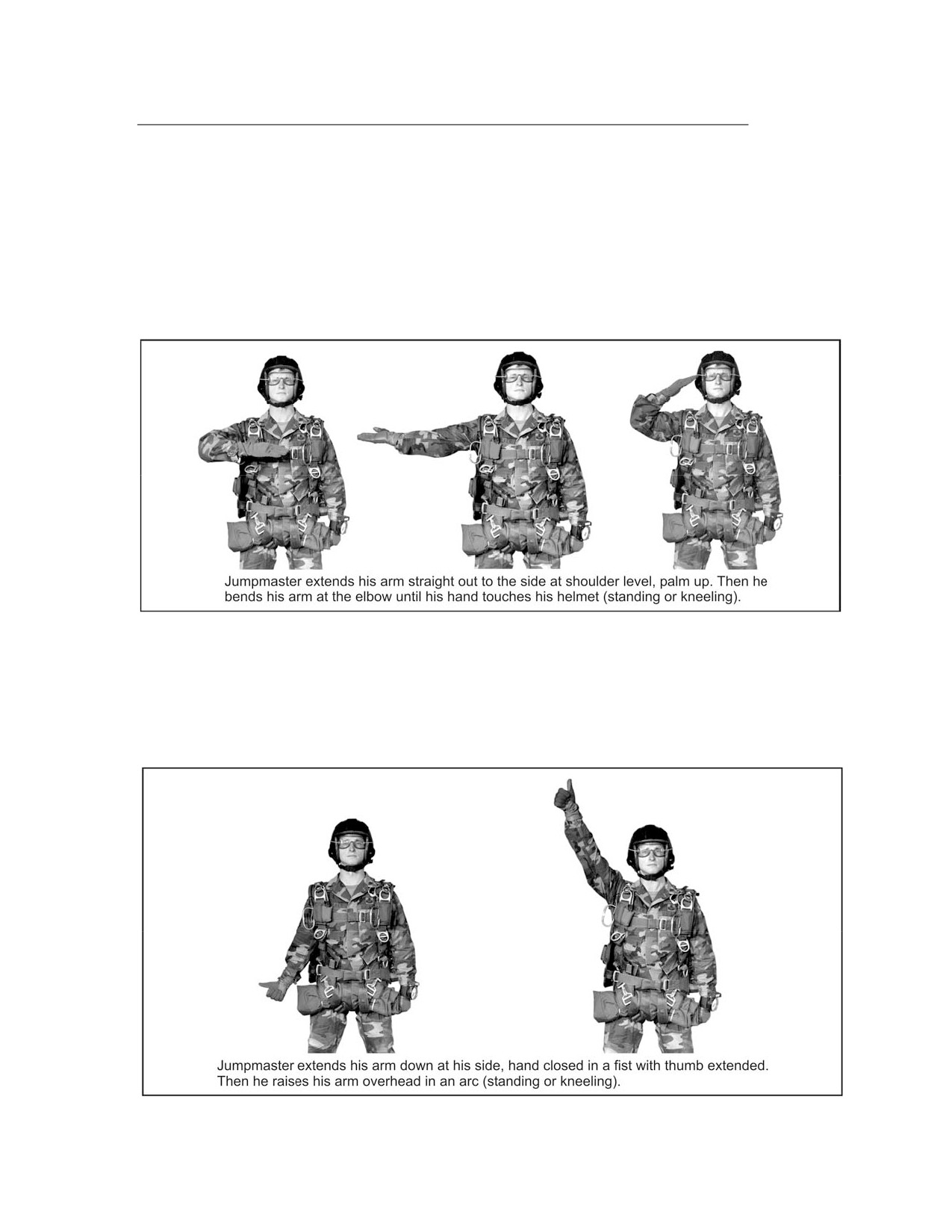
MOVE TO THE REAR
6-12. The jumpmaster commands MOVE TO THE REAR about 1 minute before
TOT (Figure 6-11). Upon receiving this command, the parachutist tightens
the combat pack’s shoulder straps around his legs, adjusts his goggles, and
moves to within 1 meter of the jump door or to the hinge of the cargo ramp. If
jumping oxygen, the parachutist must activate the bailout oxygen system,
check the flow indicator of the AIROX VIII, and disconnect from the oxygen
console before moving to the rear of the aircraft.
Figure 6-11. Move to the Rear Command
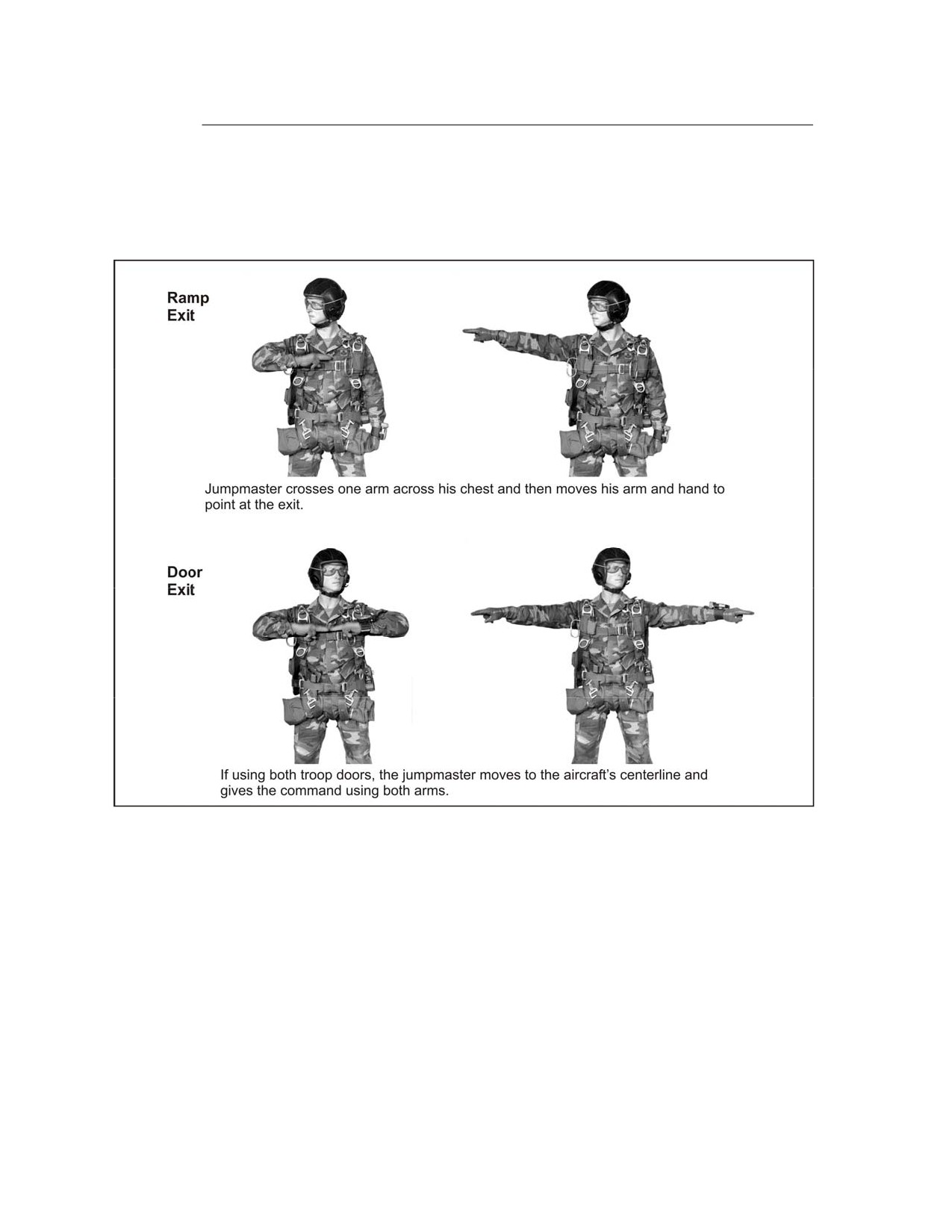
STAND BY
6-13. The jumpmaster commands STAND BY about 15 seconds before the exit
(Figure 6-12). Upon receiving this signal, the parachutist signifies readiness
by returning the jumpmaster’s signal and then moves to the jump door or the
cargo ramp.
Figure 6-12. Stand By Command
6 April 2005 FM 3-05.211/MCWP 3-15.6/NAVSEA SS400-AG-MMO-010/AFMAN 11-411(I)
6-11
FM 3-05.211
GO
6-14. The jumpmaster commands GO when the aircraft is over the release
point and the green jump light is on (Figure 6-13).
Figure 6-13. Go Command
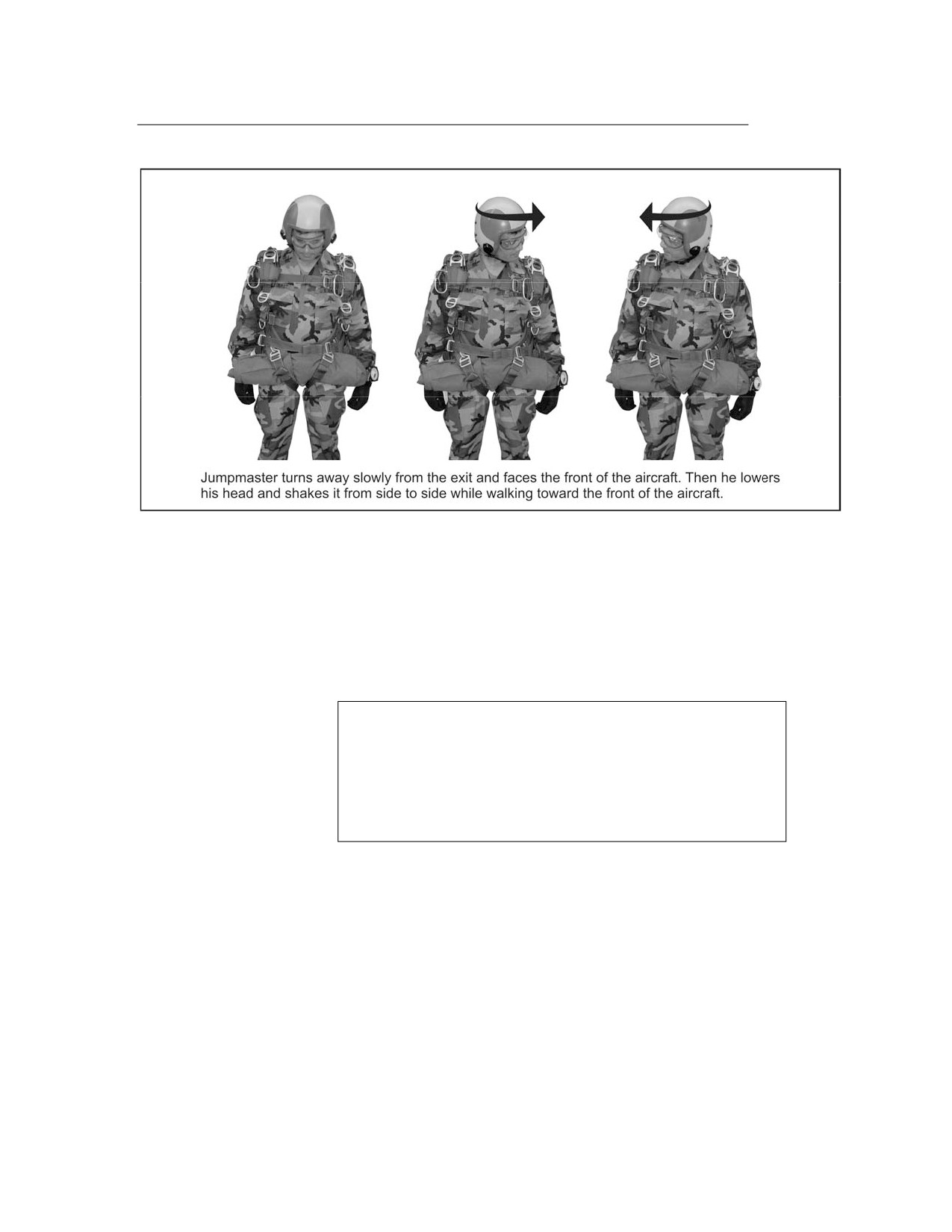
ABORT
6-15. The jumpmaster commands ABORT anytime an unsafe condition exists
inside or outside the aircraft (red jump light comes on) or on the DZ (Figure
6-14, page 6-13). Upon receiving this command, the parachutist returns to his
seat and sits down. If jumping oxygen, the parachutist reconnects to the
oxygen console, turns off the bailout system, and then sits down.
6-12
FM 3-05.211/MCWP 3-15.6/NAVSEA SS400-AG-MMO-010/AFMAN 11-411(I)
6 April 2005
FM 3-05.211
Figure 6-14. Abort
DISARM ARR
6-16. The jumpmaster gives the signal DISARM ARR by reversing the ARM ARR
signal. The assistant jumpmaster or jumpmaster checks the ARR to ensure it
is correctly disarmed and then performs a pin check on the main and reserve
parachutes. The parachutist on the right side of another parachutist can
more easily reinsert the arming pin.
Caution
If the jumpmaster has cocked his arm to give the
command GO, he must NOT move it when he gives the
abort signal. The parachutists may exit if the
jumpmaster moves his cocked arm.
6 April 2005 FM 3-05.211/MCWP 3-15.6/NAVSEA SS400-AG-MMO-010/AFMAN 11-411(I)
6-13
This page intentionally left blank.
FM 3-05.211
Chapter 7
Body Stabilization
The MFF parachutist must be able to exit an aircraft with his combat
equipment, fall on a designated heading, and manually deploy his main
parachute without losing stability. Body stabilization skills allow the
parachutist to group in free fall, cover small lateral distances with a
rucksack, move off a lower parachutist’s back in free fall, and turn to keep
the DZ or group leader in sight. The MFF parachutist maintains these
skills through regular MFF jumps and periodic refresher training. This
chapter addresses the body stabilization skills needed to make a night,
tactical MFF jump with combat equipment from oxygen altitudes.
Appendixes B and C provide recommendations for MFF proficiency
training programs, and Appendix D covers suggested sustained airborne
training.
TABLETOP BODY STABILIZATION TRAINING
7-1. Any stable tabletop or flat surface can be used for body stabilization
training. The parachutist lies on his stomach on the tabletop. At the
command GO, he lifts his arms and legs from the tabletop, assumes the poised
or diving exit position, then moves to the stable free-fall position (Figures 7-1
through 7-3, pages 7-1 and 7-2). Controlled movement positions during free
fall include turns, gliding, altimeter check, and main ripcord pull (Figures 7-4
through 7-7, pages 7-2 through 7-4).
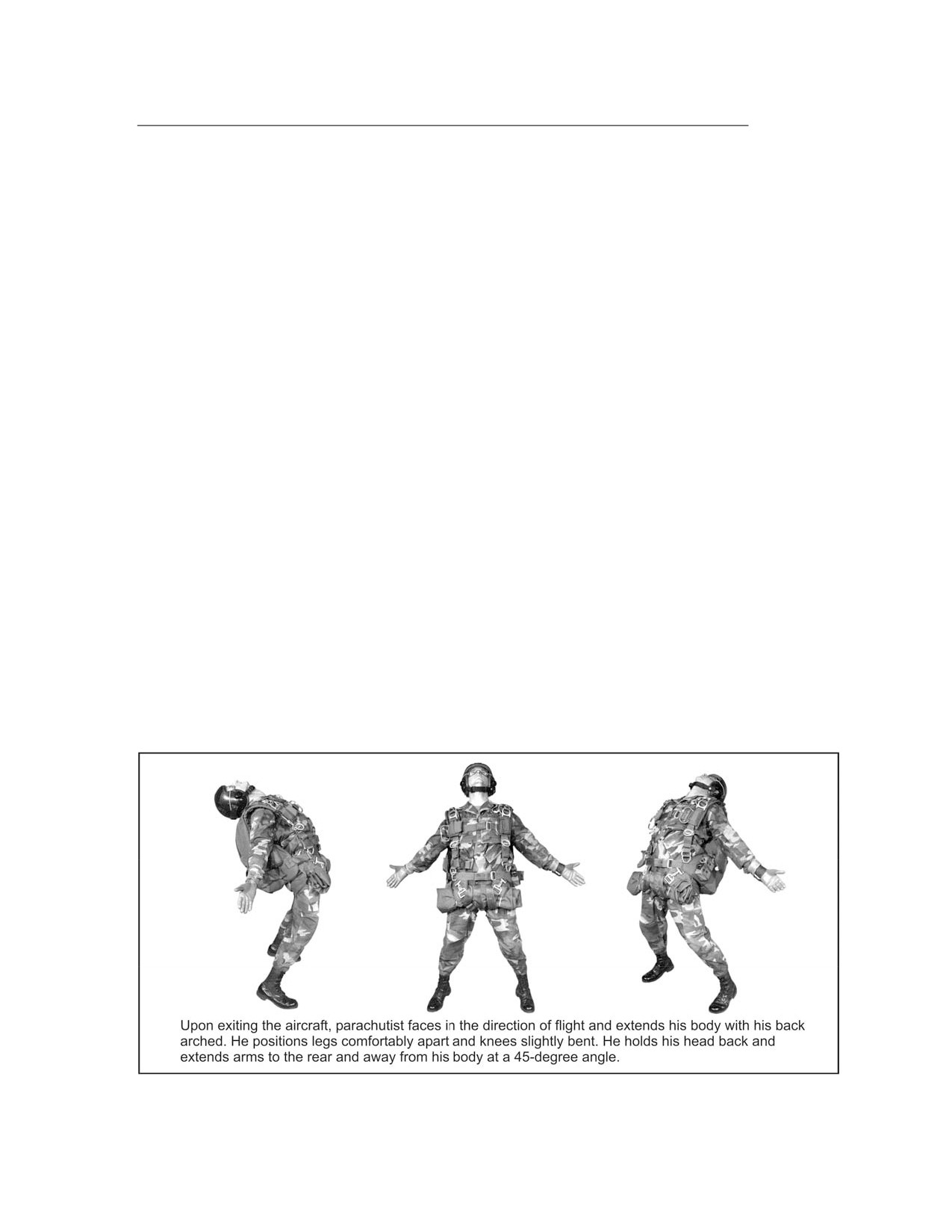
Figure 7-1. Poised Exit Position
6 April 2005 FM 3-05.211/MCWP 3-15.6/NAVSEA SS400-AG-MMO-010/AFMAN 11-411(I)
7-1
FM 3-05.211
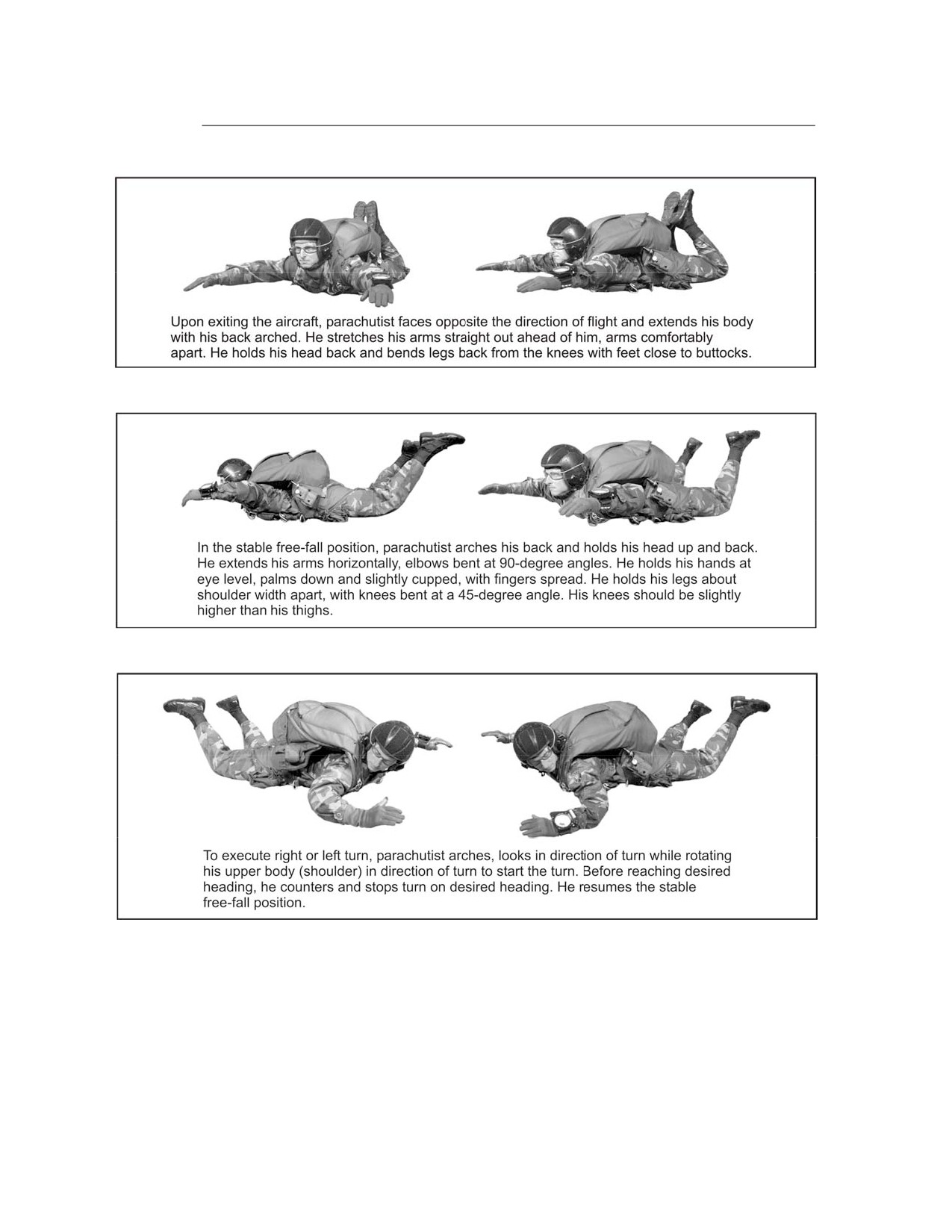
Figure 7-2. Diving Exit Position
Figure 7-3. Stable Free-Fall Position
Figure 7-4. Body Turn
7-2
FM 3-05.211/MCWP 3-15.6/NAVSEA SS400-AG-MMO-010/AFMAN 11-411(I)
6 April 2005
FM 3-05.211
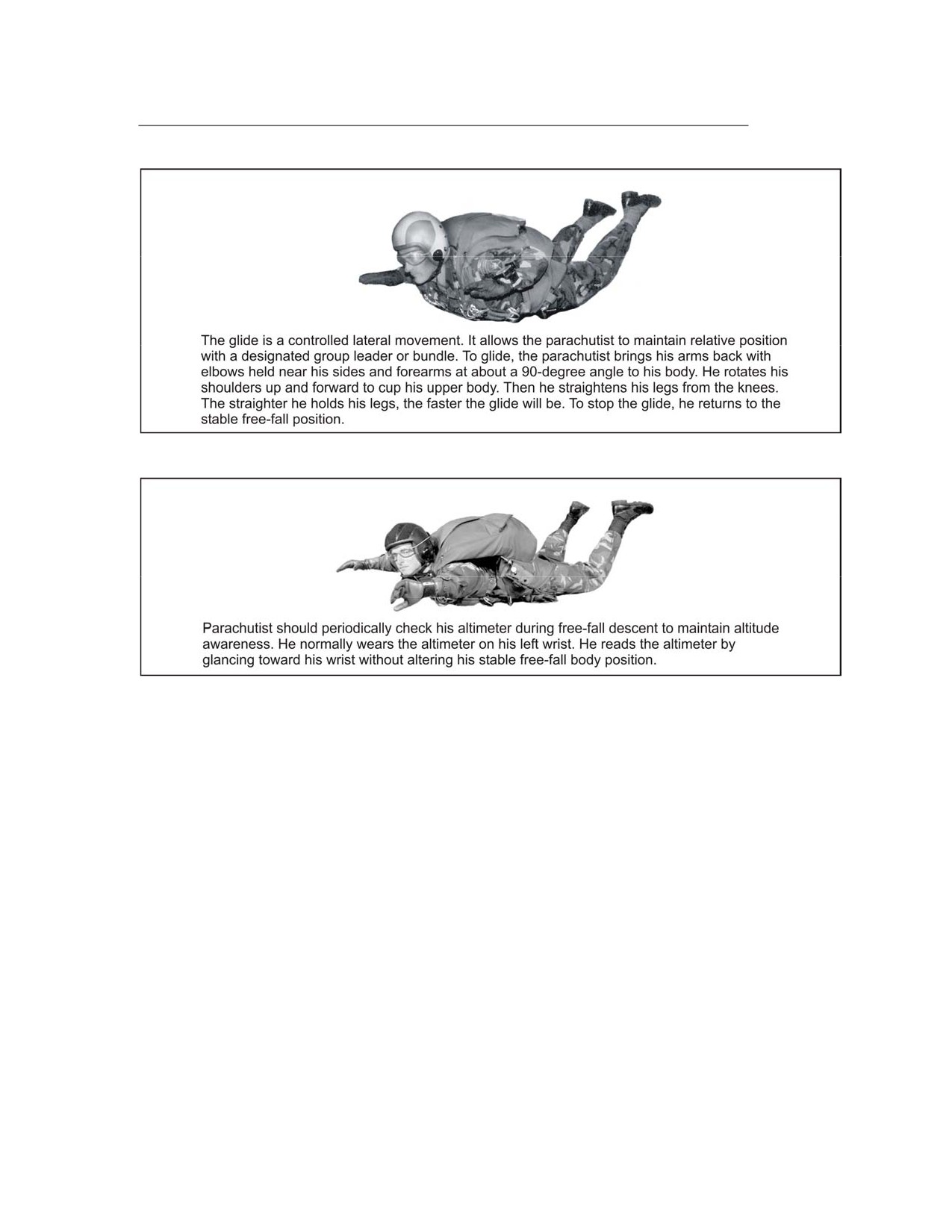
Figure 7-5. Gliding
Figure 7-6. Altimeter Check
RECOVERY FROM INSTABILITY
7-2. Instability creates a hazard to the parachutist and to other parachutists
in the air. Instability is the primary cause of MFF malfunctions. There are a
variety of reasons for instability. In most cases, it is caused by a parachutist
who does not present a symmetrical body position to the relative wind, either
on exit or in free fall. A contributing factor to instability in free fall is the
inadvertent shift or release of combat equipment. A flat spinning or tumbling
body motion characterizes instability. Instability is dangerous not only to the
parachutist experiencing it, but often to other parachutists in free fall with
him. Instability prevents tactical grouping.
NOTE: If a parachutist encounters any or all of these situations, he should
maintain altitude awareness and pull at the prescribed pull altitude.
6 April 2005 FM 3-05.211/MCWP 3-15.6/NAVSEA SS400-AG-MMO-010/AFMAN 11-411(I)
7-3
FM 3-05.211
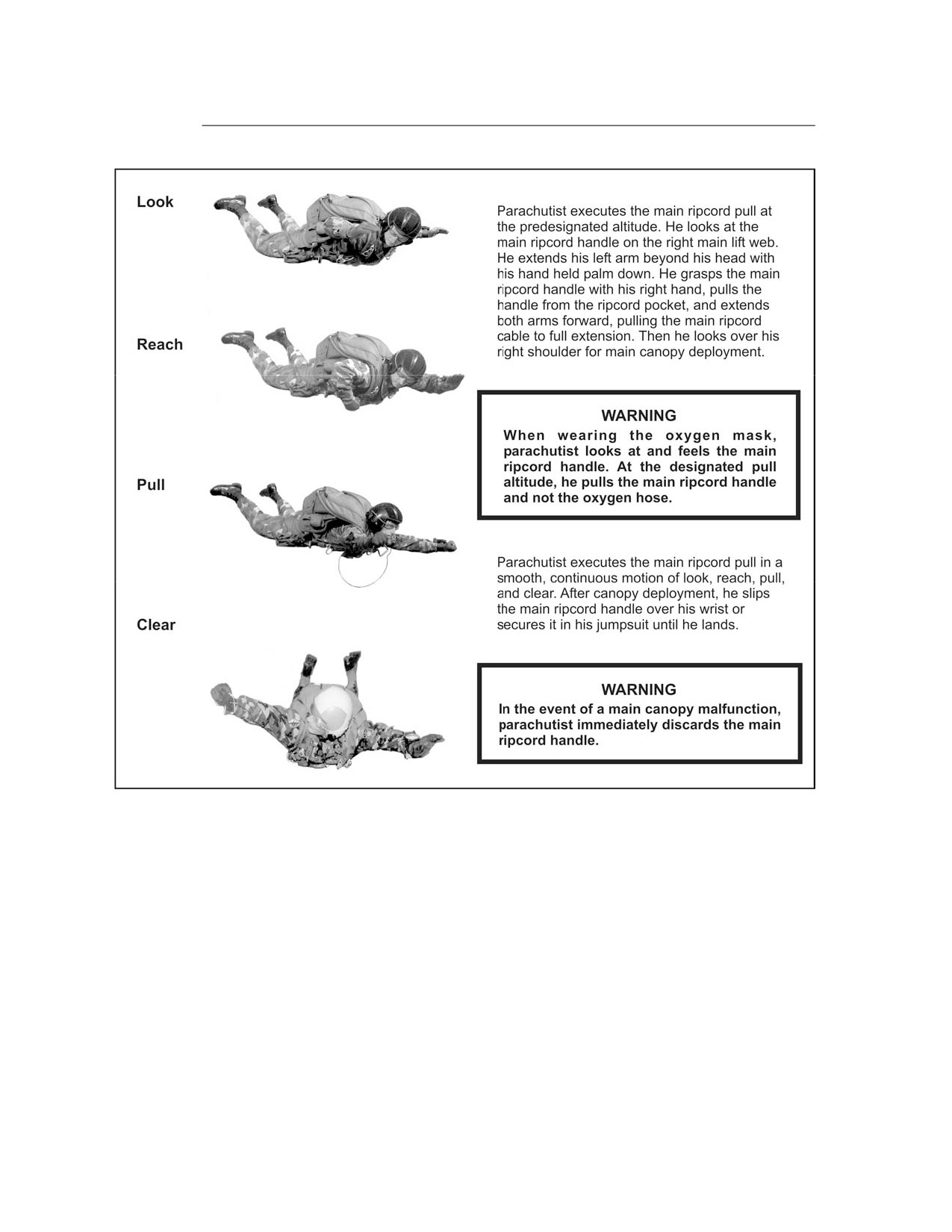
Figure 7-7. Main Ripcord Pull
RECOVERY FROM A FLAT (HORIZONTAL) SPIN
7-3. If the parachutist is spinning or falling on his back, he must first return
to a face-to-earth free-fall attitude by arching his body. Depending upon the
speed of his spin, sometimes this movement alone is enough to slow or stop a
flat spin. If he is still spinning after facing the earth, he must counter the
direction of the spin. He does this movement by looking in the opposite
direction of the spin
(for example, if spinning clockwise, he looks
counterclockwise) and making a hard body turn in that direction. He holds
this body position until the spin slows and stops. Depending on the amount of
momentum he developed before he started countering the spin, he may have
to hold this body position for several revolutions. Once the spin has stopped,
he checks his body position, makes an altimeter check, and continues with
the mission.
7-4
FM 3-05.211/MCWP 3-15.6/NAVSEA SS400-AG-MMO-010/AFMAN 11-411(I)
6 April 2005
FM 3-05.211
7-4. If a shift of the combat pack causes a flat spin, the parachutist may
have to adjust his body position to obtain stability or maintain a heading. The
severity of the shift (versus an inadvertent release) determines how much
adjustment of the knees, the angle of the lower leg, hand and arm placement,
or cocking of the hips he must make to counter the effect of a combat pack
that is now not symmetrical or square to the relative wind.
RECOVERY FROM TUMBLING
7-5. A bump during a group exit or breaking the arched body position
normally causes tumbling. If tumbling, the parachutist assumes the hard
arch body position until facing the earth. Then, he relaxes the hard arch and
assumes a stable free-fall body position. The time it takes to return to a face-
to-earth position will vary with the severity of the tumble, the body area
surface, and the parachutist’s combat equipment configuration. Presenting a
symmetrical body position to the relative wind on exit from the aircraft is the
most significant factor in preventing tumbling.
ALTITUDE AWARENESS
7-6. A parachutist who is unstable must remain altitude-aware. The stress
created by instability can cause a normal human phenomenon of temporal
(time) distortion. The resultant effect varies from individual to individual. It
can appear to be either time compression or a slowing down of perceived time
passage. He must not get so caught up in his attempts to recover stability
that he loses altitude awareness and forgets to manually activate his
parachute. He must never sacrifice the pull altitude for stability or the
continued attempts to obtain stability before the pull. An unstable
parachutist must remember that as he is falling, an area of low pressure is
created above him. Any altimeter reading while in this low-pressure area will
not reflect the correct altitude AGL. An example is a parachutist falling back
to earth who looks at his altimeter while holding it in front of his face. Due to
the low-pressure zone in which the altimeter is located, the parachutist will
read a higher altitude than where he actually is in feet AGL.
NOTE: Parachutists must remember that this pressure differential can cause
the altimeter to be off as much as 1,000 feet.
CORRECTIVE ACTIONS DURING FREE FALL
7-7. These actions are movements used to get off of a fellow parachutist’s
back. Primary movements include—
• Left or right turns into a safe direction.
• Forward glides (elbows into lazy “W,” legs extended) to clear airspace.
• Side slides left or right.
NOTE: A modification to a forward glide is the high-lift track. Only
experienced HALO-qualified parachutists can use this technique, and
only qualified MFF instructors will train parachutists on this technique.
6 April 2005 FM 3-05.211/MCWP 3-15.6/NAVSEA SS400-AG-MMO-010/AFMAN 11-411(I)
7-5
This page intentionally left blank.
FM 3-05.211
Chapter 8
Ram-Air Parachute Flight Characteristics
and Canopy Control
This chapter describes the RAPS canopy, its components, deployment
sequence, theory of flight, flight characteristics, and canopy control
procedures.
RAM-AIR PARACHUTE CHARACTERISTICS
8-1. The ram-air parachute canopy’s design is similar to an aircraft’s wings,
with curved upper surfaces (top skin) and flat lower surfaces (bottom skin).
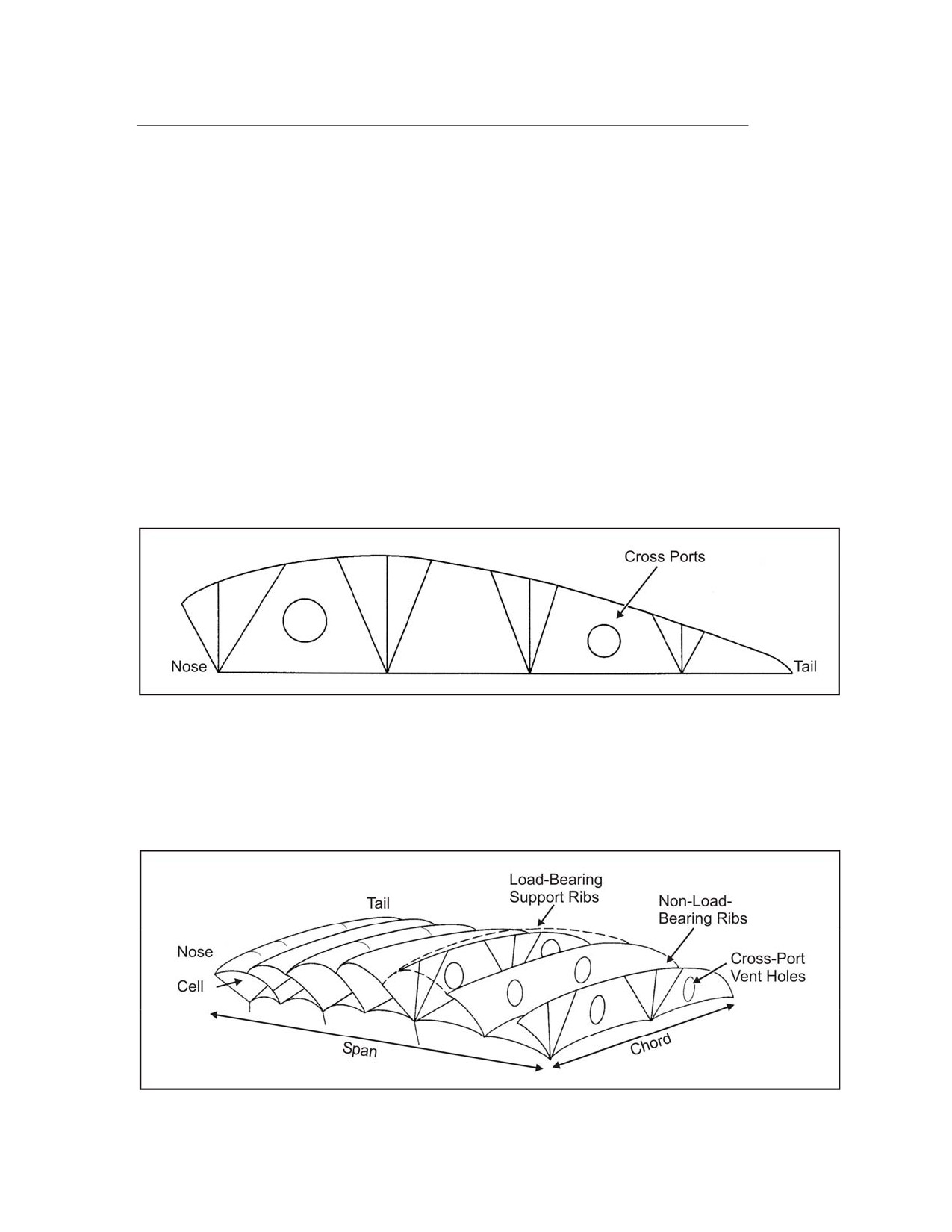
Support ribs maintain the airfoil shape of the canopy (Figure 8-1).
Figure 8-1. Shape of the Ram-Air Parachute Canopy
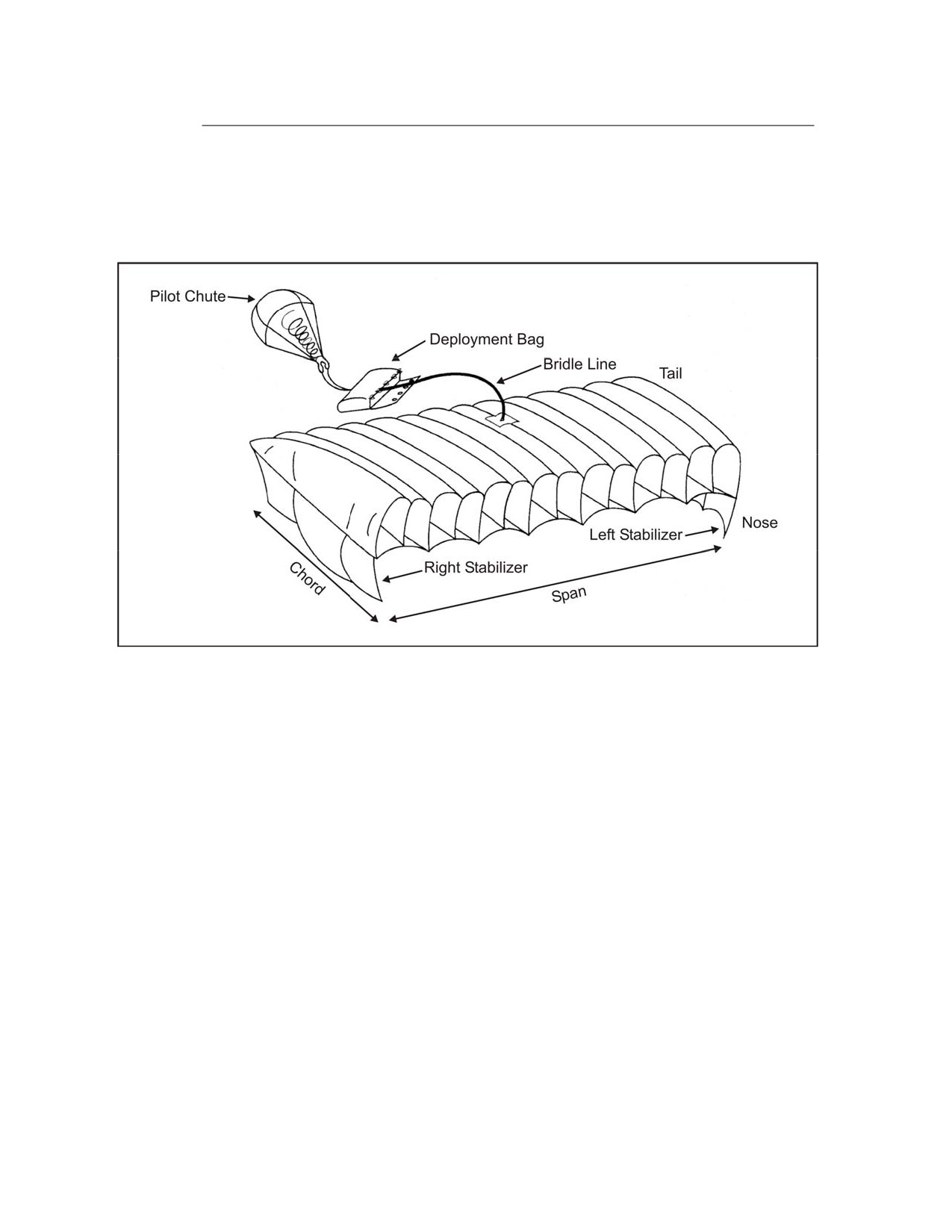
8-2. Reinforced, load-bearing support ribs serve as attaching points for the
suspension lines, and non-load-bearing ribs separate a cell into two
compartments. Cross-port vent holes in the support ribs equalize the internal
air pressure in a canopy. Figure 8-2 shows the structure of the ram-air
parachute canopy.
Figure 8-2. Structure of the Ram-Air Parachute Canopy
6 April 2005 FM 3-05.211/MCWP 3-15.6/NAVSEA SS400-AG-MMO-010/AFMAN 11-411(I)
8-1
FM 3-05.211
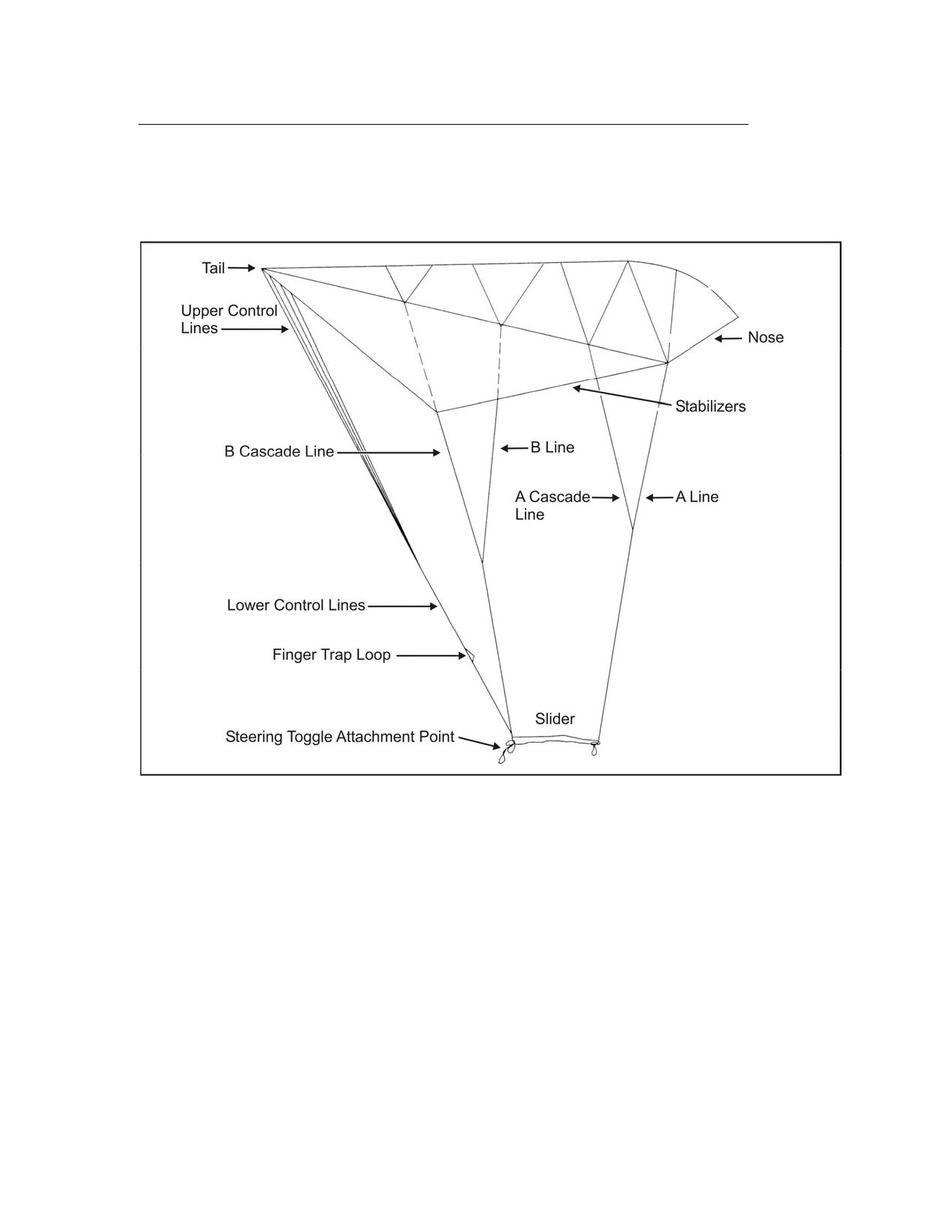
8-3. Nose, tail, chord, and span are terms of reference applied to ram-air
parachutes. The open portion at the front is called the nose, with the rear
being the tail. The distance from left to right is the span, and from nose to
tail is the chord. Figure 8-3 shows the components of the ram-air parachute.
Figure 8-3. Components and Nomenclature of the Ram-Air Parachute
8-4. The stabilizers are single-layered extensions of the canopy on the left
and right sides of the parachute. The stabilizers channel the airflow across
the chord and help to maintain straight and stable flight.
8-5. The military ram-air canopy has four suspension line groups. They are
identified from nose to tail as A, B, C, and D. A continuous line group is a line
attached to the parachute’s bottom skin that runs directly to the connector
link without having another line attached to it. The suspension lines
distribute a suspended load under the canopy without distorting the canopy’s
airfoil shape. Figure
8-4, page
8-3, shows the location of the ram-air
parachute components.
8-6. Upper control lines converge from points of attachment on the left and
right trailing edges of the tail, respectively, to common connection points with
the lower control lines. The lower control lines are attached to the upper
control lines and have a soft steering toggle secured to the lower end.
Deployment brake loops sewn into the lower control lines set the canopy
brakes for deployment. Figure 8-5, page 8-4, shows the components of the
lower portion of the ram-air parachute.
8-7. The sail slider is a rectangular piece of reinforced fabric with a large
grommet in each corner. The sail slider is a deployment device that retards
the opening of a ram-air parachute.
8-2
FM 3-05.211/MCWP 3-15.6/NAVSEA SS400-AG-MMO-010/AFMAN 11-411(I)
6 April 2005
FM 3-05.211
8-8. Plastic disks called slider stops are sewn to the stabilizers at suspension
line attachment points. These slider stops limit the upward travel of the sail
slider.
Figure 8-4. Location of Components of the Ram-Air Parachute
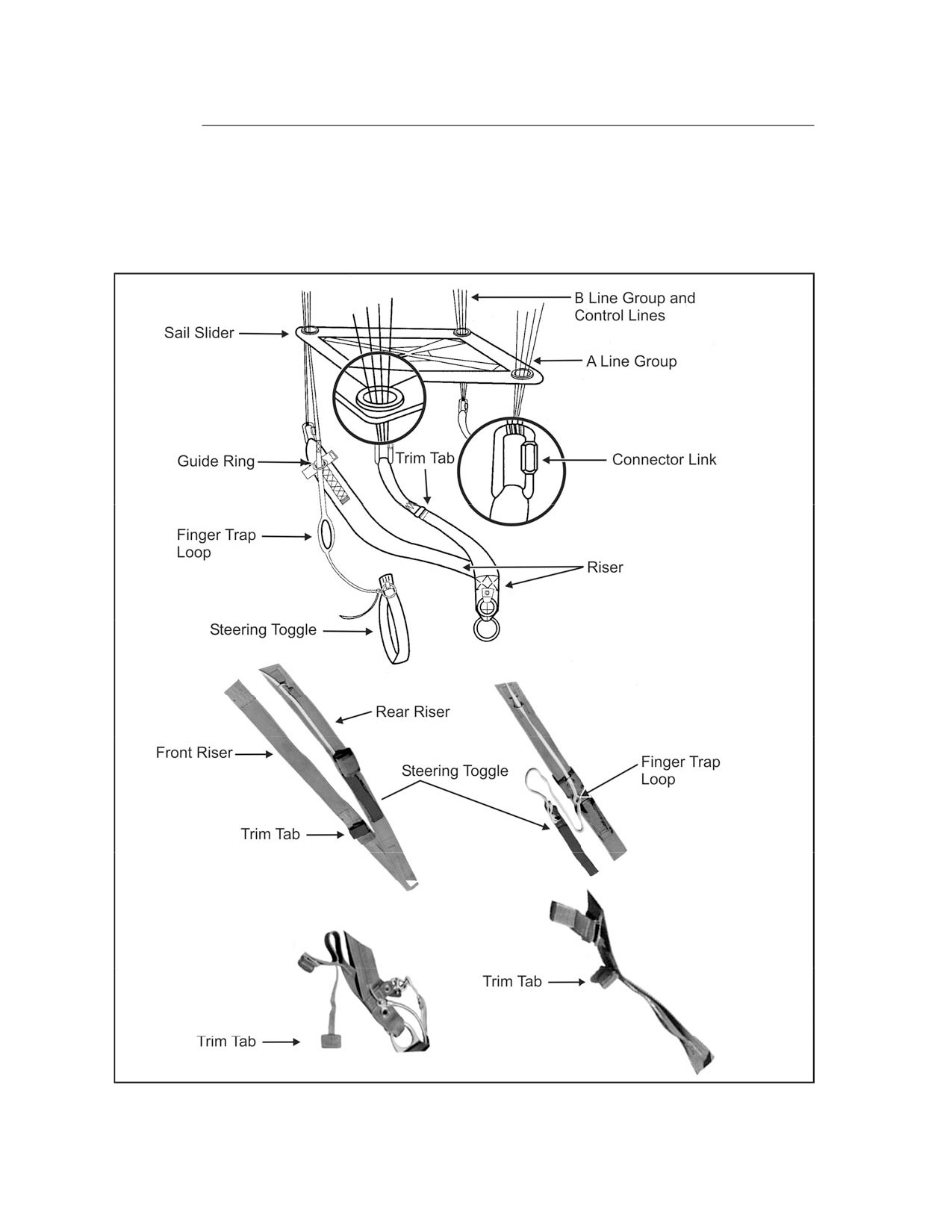
8-9. The suspension lines are attached to a connector link on each riser
(Figure 8-5, page 8-4). Trim tabs on the main parachute’s front risers shorten
the risers to create an artificial decrease in the canopy’s angle of attack into
the wind. Guide rings sewn to the rear risers function as anchor points for
the deployment brakes and guides for the lower control lines (Figure 8-5).
RAM-AIR PARACHUTE DEPLOYMENT SEQUENCE
8-10. At the prescribed parachute deployment altitude, the parachutist
manually activates his parachute. He grabs and unseats the main ripcord
handle in his right hand and fully extends his arm.
8-11. When the main ripcord pin clears the closing loop, the main pilot chute
opens the closing flaps, launches from the main parachute container, and
extends the pilot chute bridle. The bridle extracts the deployment bag from
the main container, and the suspension lines unstow from their retainer
bands. When the lines are fully extended, they pull the main parachute from
the deployment bag, and the canopy begins to inflate (Figure 8-6, page 8-5).
6 April 2005 FM 3-05.211/MCWP 3-15.6/NAVSEA SS400-AG-MMO-010/AFMAN 11-411(I)
8-3
FM 3-05.211
The sail slider retards the canopy’s deployment. As the canopy inflates, it
forces the sail slider down toward the risers as the suspension lines spread
apart. After complete canopy deployment, the parachutist pulls the steering
toggles from the deployment brake loops to release the control lines from the
deployment brakes setting to the full flight setting.
Figure 8-5. Detailed Lower Portion of the Ram-Air Parachute
8-4
FM 3-05.211/MCWP 3-15.6/NAVSEA SS400-AG-MMO-010/AFMAN 11-411(I)
6 April 2005
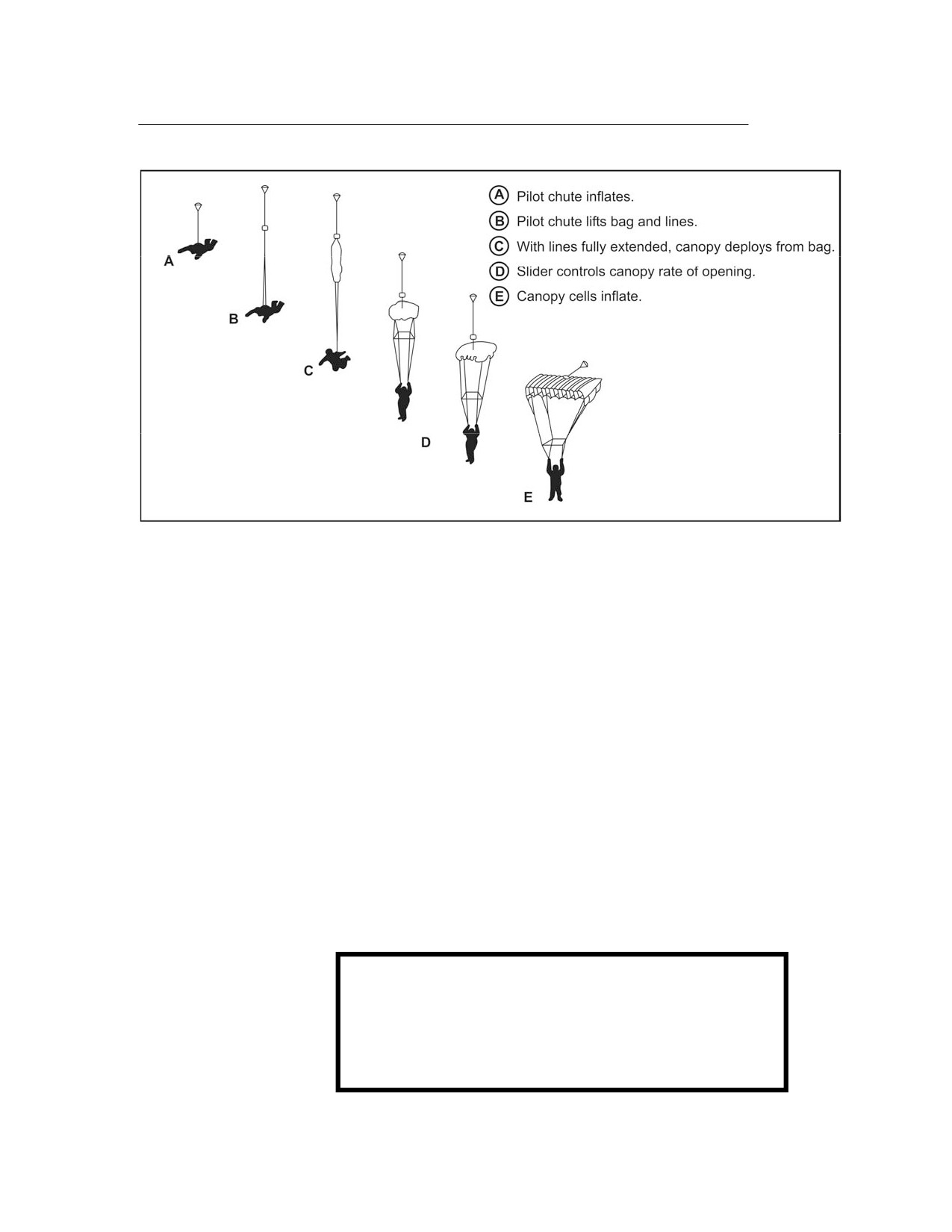
FM 3-05.211
Figure 8-6. Deployment Sequence
8-12. The parachutist follows the below procedures should he encounter an
uncontrollable situation requiring the initiation of emergency procedures:
• Discards the main ripcord handle.
• Looks at and grabs the cutaway handle with his right hand.
• Looks at and grabs the reserve ripcord handle with his left hand.
• Arches vigorously.
• Pulls the cutaway handle to full arm extension and releases it.
• Immediately pulls the reserve ripcord handle to full arm extension and
releases it.
• Performs postopening procedures.
8-13. This action allows the cutaway cables to clear the release loops
threaded through the small rings of the canopy release assembly. The three-
ring system activates the right side a moment before the left side to prevent
an entanglement. As the left riser set is jettisoned, it pulls the reserve static
line, usually deploying the reserve before manual activation of the reserve
ripcord. Figure
8-7, page
8-6, identifies the cutaway sequence and
deployment of the reserve parachute.
WARNING
The parachutist must first pull the cutaway handle
AND THEN the reserve ripcord handle to full arm
extension and discard them to make sure complete
emergency procedures are followed.
6 April 2005 FM 3-05.211/MCWP 3-15.6/NAVSEA SS400-AG-MMO-010/AFMAN 11-411(I)
8-5
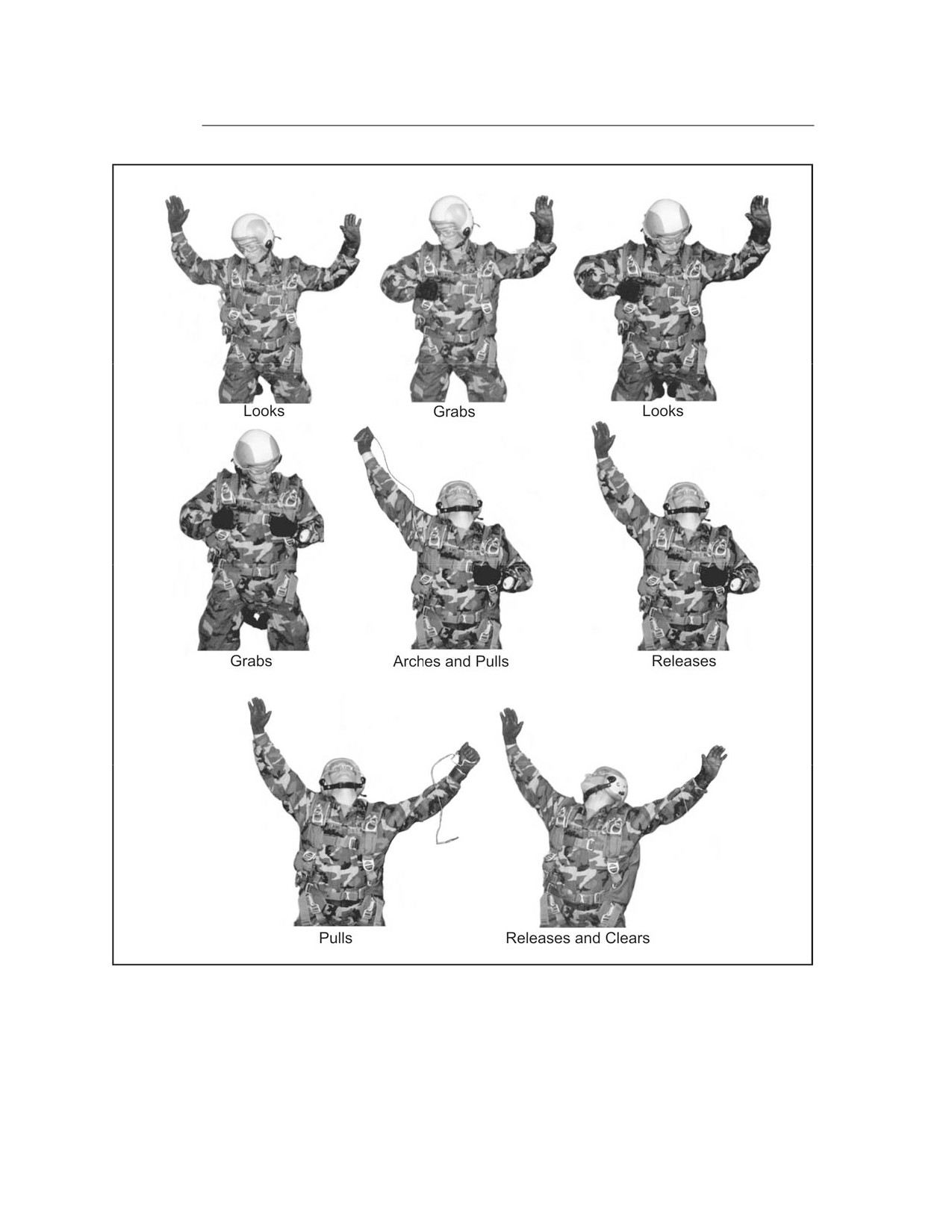
FM 3-05.211
Figure 8-7. Cutaway Sequence and Deployment of the Reserve Parachute
8-14. As the reserve ripcord pins clear the closing loops, the pilot chute
opens the closing flaps. The pilot chute deploys from the reserve parachute
container and, as it catches air, extends the 2-inch-wide high-drag bridle.
Upon extraction of the reserve free bag from the container, the free-stowed
suspension lines deploy from a pocket on the free bag and extract the reserve
8-6
FM 3-05.211/MCWP 3-15.6/NAVSEA SS400-AG-MMO-010/AFMAN 11-411(I)
6 April 2005
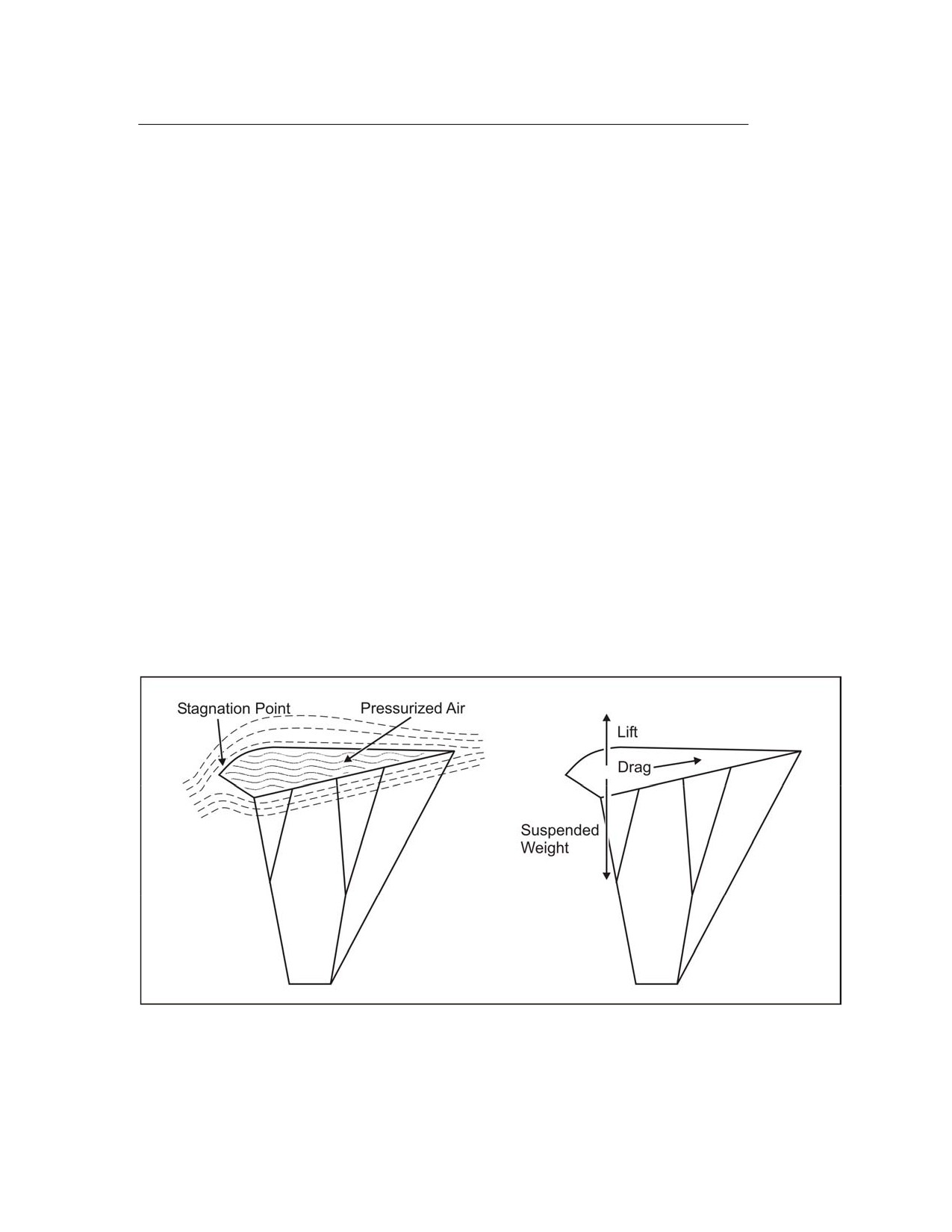
FM 3-05.211
parachute from the free bag. The free bag then completely separates from the
reserve parachute. As the canopy deploys, it forces the sail slider down the
suspension lines. When the parachutist releases the toggles from the
deployment brake loops, he releases the control lines from the deployment
brake setting to the full flight setting.
RAM-AIR PARACHUTE THEORY OF FLIGHT
8-15. The ram-air parachute is an inflated and pressurized fabric airfoil that
generates lift by moving forward through the air. The relative lengths of the
suspension lines maintain the airfoil’s angle of attack. In flight, the
parachutist keeps the wing’s leading edge at a slightly lower angle than the
trailing edge. Thus, this angle forces the canopy’s airfoil-shaped surface to
glide or plane through the air, very much like a glider in descending flight.
The wing-shaped ram-air parachute generates lift caused by the reduced
pressure of the airflow over the curved upper surface.
8-16. The ram-air parachute’s leading edge is open or physically missing,
forming intakes that allow the cells to be ram-air inflated. Internal air pressure
pushes a small amount of stagnant air ahead of the airfoil, forming an artificial
leading edge. The focal point of this stagnant air acts as a true leading edge,
deflecting the relative air above and below. Drag is the only force that retards
the wing’s forward motion through the air. Drag is created by the friction of air
passing over the canopy fabric, the suspension lines, and the parachutist and his
equipment. Gravity, plus the resultant sum of these aerodynamic forces on the
upper surface, acts to pull the ram-air parachute through the air and contributes
to the flat glide angle of the canopy (Figure 8-8).
Figure 8-8. Ram-Air Parachute Theory of Flight
8-17. Applying brakes on the ram-air parachute causes the trailing edge to
deflect downward, creating additional drag (Figure 8-9, page 8-8). This drag
produces a proportionate loss of airspeed but generates lift for a short time.
6 April 2005 FM 3-05.211/MCWP 3-15.6/NAVSEA SS400-AG-MMO-010/AFMAN 11-411(I)
8-7
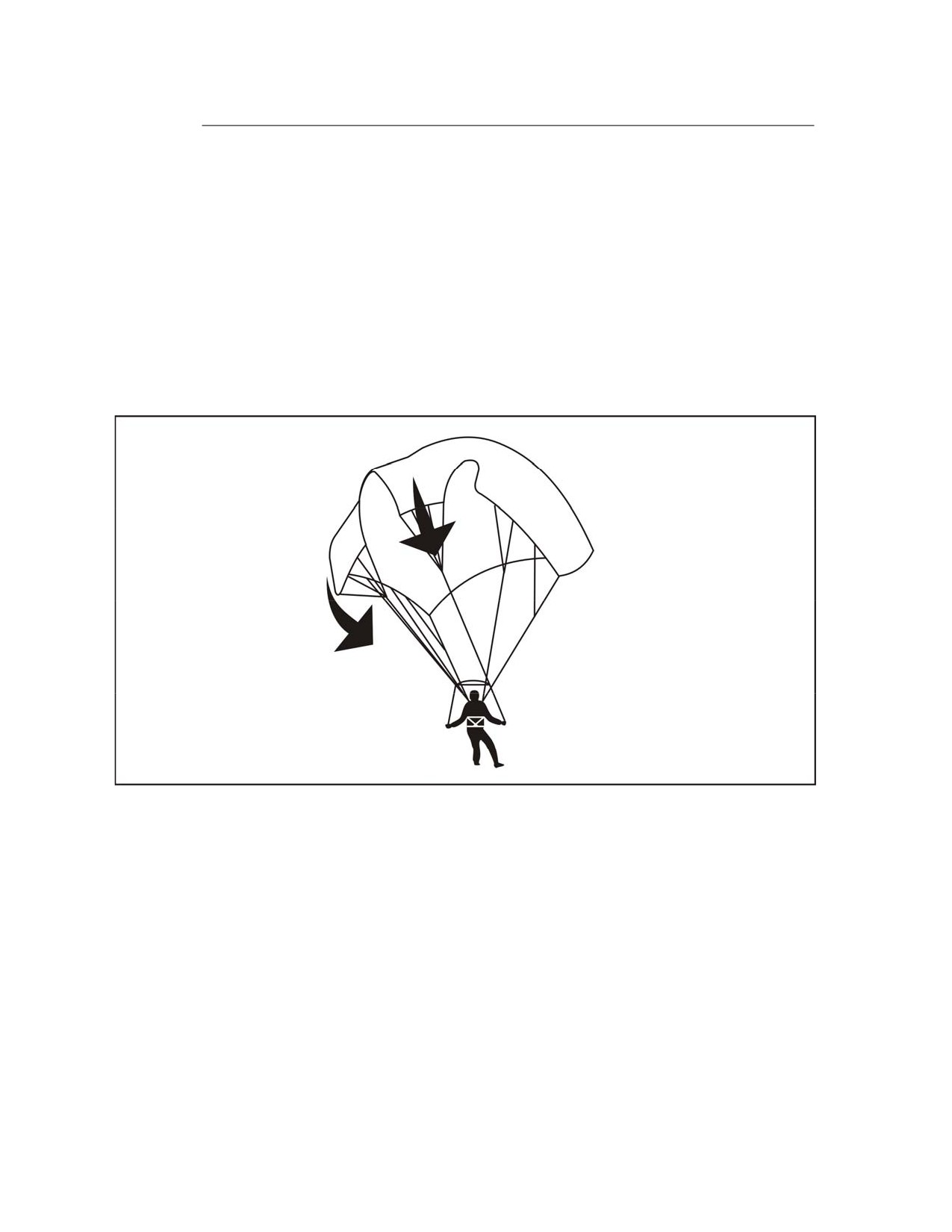
FM 3-05.211
Prolonged application of brakes results in a loss of airspeed and generated lift
and a steeper approach angle. As full brakes are reached, the wing ceases to
generate dynamic lift, resulting in an increased rate of descent at an almost
vertical descent angle. Depressing the toggles beyond full brakes causes the
parachute to cease flying and enter a stall.
8-18. Differential application of brakes (one side only, or one side more than
the other) produces an unbalanced drag force at the trailing edge. This drag
results in a yaw-type turn toward the side with the highest drag.
8-19. Because the slow side generates less lift, it tends to drop slightly in a
shallow banking motion, much like an airplane. This bank angle increases as
differential toggle displacement increases.
Figure 8-9. Applying Brakes on the Ram-Air Parachute
RAM-AIR PARACHUTE FLIGHT CHARACTERISTICS
8-20. The parachutist must remember that the ram-air parachute is a high-
performance gliding system. Because of its high performance, the ram-air
parachute is potentially dangerous in the hands of an inexperienced
parachutist. The parachutist must possess a working knowledge of the flight
capabilities and limitations of the ram-air parachute and must fully
understand the canopy control techniques.
8-21. The ram-air parachute is not overly complicated. It is basically a fabric
wing section. The parachutist must have a very basic knowledge of
aerodynamics to better understand its flight and handling characteristics.
8-22. The ram-air parachute planes or glides through the air at about 20 to
30 mph. It always flies at this speed regardless of wind conditions, except
when the parachutist applies brakes.
8-8
FM 3-05.211/MCWP 3-15.6/NAVSEA SS400-AG-MMO-010/AFMAN 11-411(I)
6 April 2005
FM 3-05.211
8-23. The flying speed is called airspeed and remains constant regardless of
whether the parachute is headed upwind, downwind, or crosswind. The only
variation in flying upwind or downwind is a change in ground speed that is
often mistaken for a change in airspeed.
8-24. Wind affects ground speed only and has no effect on airspeed. Brakes
applied with conventional control lines and toggles control the ram-air
parachute’s airspeed. Fifty percent of toggle travel on a ram-air parachute
will cause a speed reduction of close to 12 mph.
8-25. There is almost no surge on deployment, and there is no wind noise at
all until after releasing the brakes. A parachutist who has not been
previously exposed to the ram-air parachute’s flight characteristics can use
the wind noise created by forward speed as a rough airspeed indicator. A
reduction in the wind noise level can provide a stall warning.
8-26. After the parachutist becomes accustomed to the canopy, he may fail
to notice the wind noise. By this time he should have learned to fly the
canopy by feel, and he should notice the stall warning point and determine
this point at altitude under his canopy controllability check. The parachutist
will feel the canopy shudder as it loses lift and begins to stall. The
parachutist should remember that angle of attack, cross wind, and wind
turbulence can increase the stall point without warning.
8-27. The parachutist must remember that, in controlling the canopy’s
flight, how fast he moves the toggles from one position to another is as
critical as the relative position of the toggles. As a rule, rapid and generous
(more than 30 percent) application of both toggles will cause a rapid decrease
in airspeed, decelerating into the stall range at about 0 to 3 mph. (Depending
on the wind speed, the ground speed could still be very high.)
8-28. Due to the penetrating ability of the ram-air parachute, parachutists
often find it difficult to determine wind direction without the aid of a
windsock, streamer, or smoke on the ground. All landings should be made
facing into the wind.
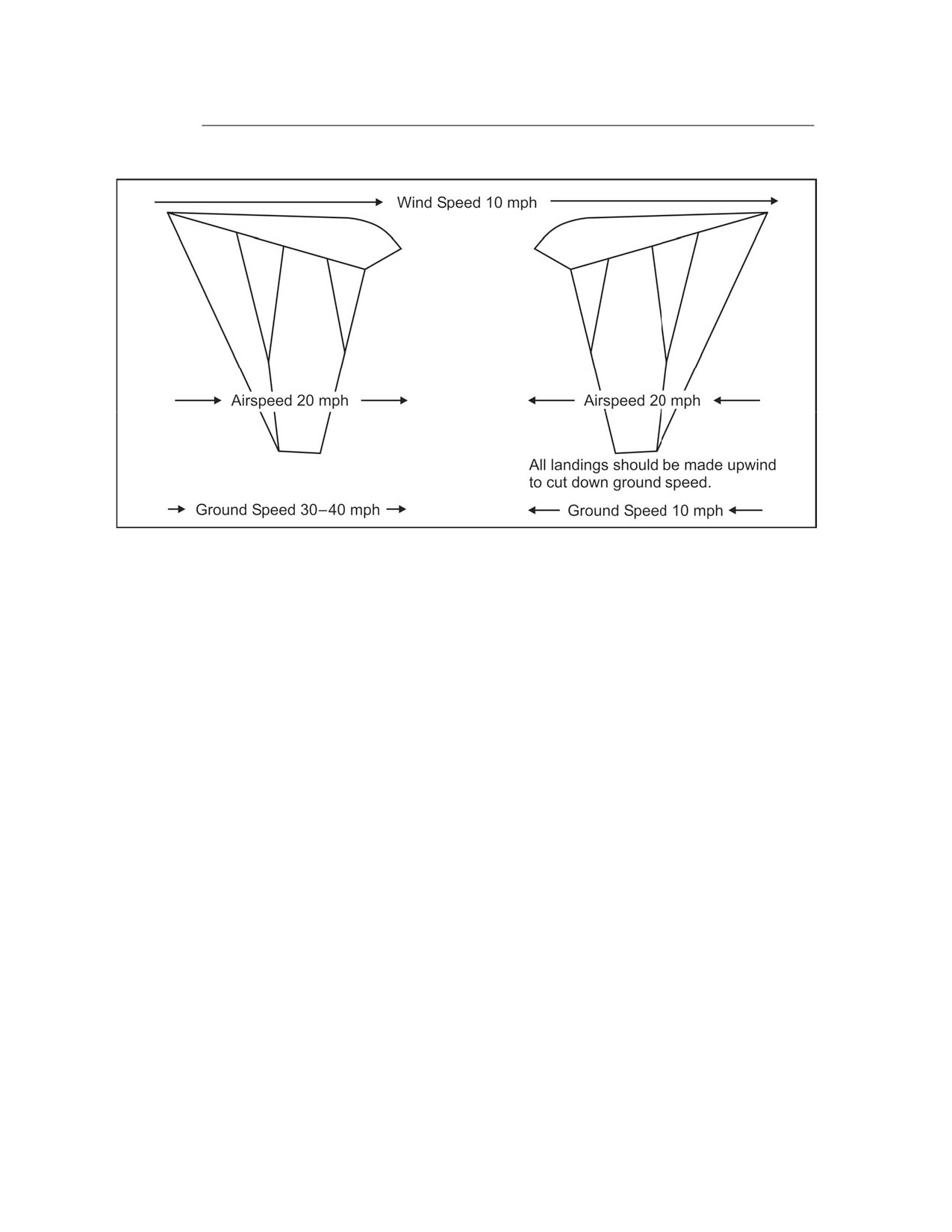
8-29. The ram-air parachute has a constant airspeed of 20 to 30 mph. If the
parachutist points the ram-air parachute downwind with a 10-mph wind, the
ground speed will be 30 to 40 mph. If he turns the ram-air parachute into the
wind and the winds are 10 mph, the airspeed remains the same but the
ground speed reduces by 10 mph. If the ram-air parachute faces into 20-mph
winds, the ground speed will be 0 mph (Figure 8-10, page 8-10).
CANOPY CONTROL
8-30. The overall objective of MFF parachuting is to land personnel and
equipment intact to accomplish the assigned mission. The free-fall
parachutist must know and employ the principles of canopy control as they
relate to the use of the ram-air parachute.
6 April 2005 FM 3-05.211/MCWP 3-15.6/NAVSEA SS400-AG-MMO-010/AFMAN 11-411(I)
8-9
FM 3-05.211
Figure 8-10. Controlling Ground Speed
8-31. Wind action, direction of canopy flight, and manipulation of the control
toggles primarily control the movement of the ram-air parachute. Upon
canopy deployment, the parachutist grabs the control toggles and performs a
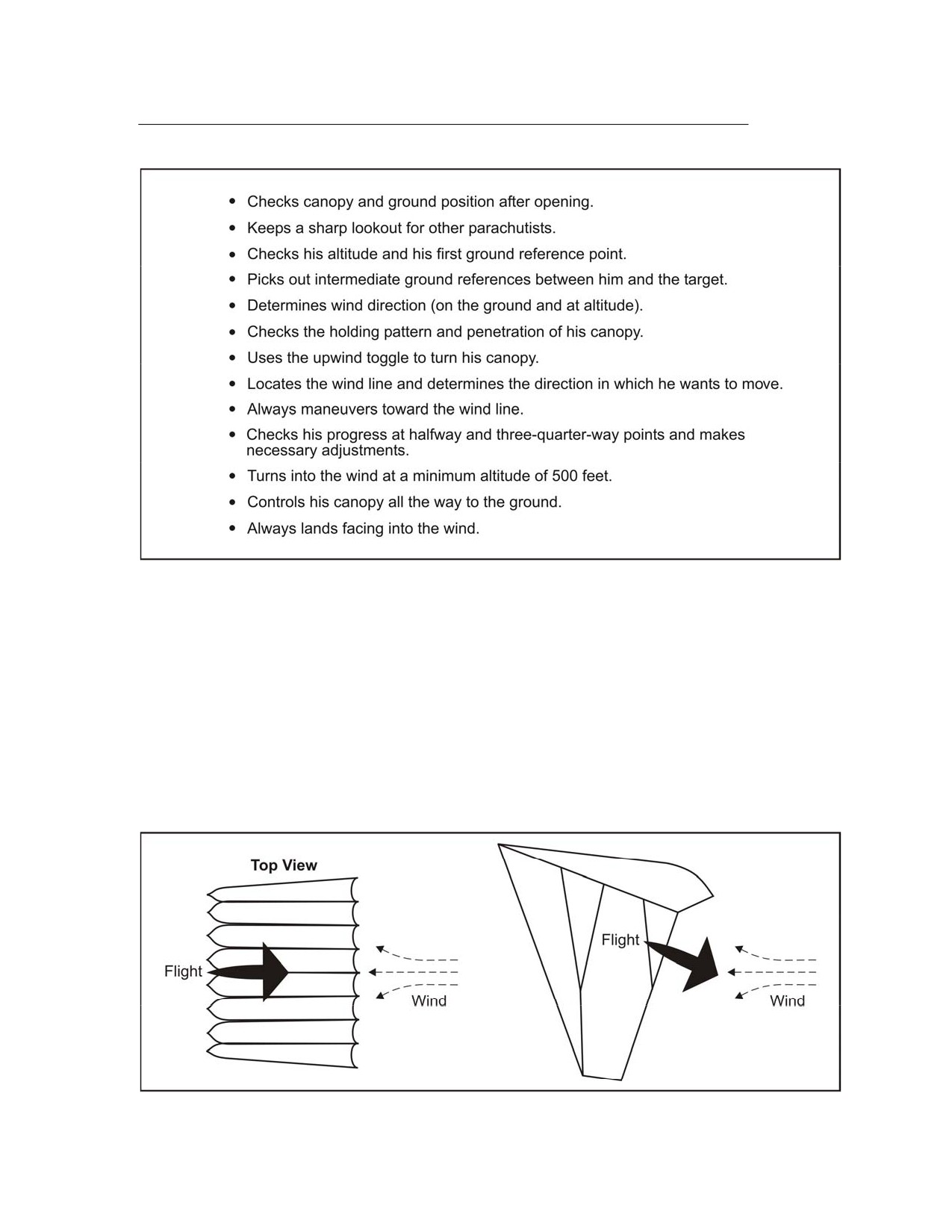
controllability check of the parachute. The purpose of this check is to
determine if the parachutist’s canopy is capable of landing him safely. Figure
8-11, page 8-11, contains a condensed guide to good canopy control.
8-32. The parachutist must first know wind direction and approximate
speed since the direction of his canopy’s flight, as determined by his toggle
manipulation, is in relation to wind action. The canopy’s shape, design, span,
and chord generate the ram-air parachute’s 20- to 30-mph glide. The flow of
air over and under the canopy’s wing shape provides the lift and forward
flight of the parachute. By specific manipulation of the toggles, the
parachutist may distort the trailing edge and cause the canopy to turn, to
vary forward speed, and to increase the rate of descent.
8-33. Canopy control involves the coordination of wind direction and speed,
canopy flight and penetration, and the parachutist’s own selective
manipulation and distortion of the canopy. Maneuvering the parachute
requires more than simply turning the canopy. A properly executed
parachute maneuver requires correct canopy manipulation to combine the
wind’s force and the canopy’s flight to move the parachute in a given
direction. The parachutist may have to hold into the wind, run with the wind,
or crab to the left or right while holding or running.
8-10
FM 3-05.211/MCWP 3-15.6/NAVSEA SS400-AG-MMO-010/AFMAN 11-411(I)
6 April 2005
FM 3-05.211
Figure 8-11. Parachutist Guide to Good Canopy Control
HOLDING MANEUVER
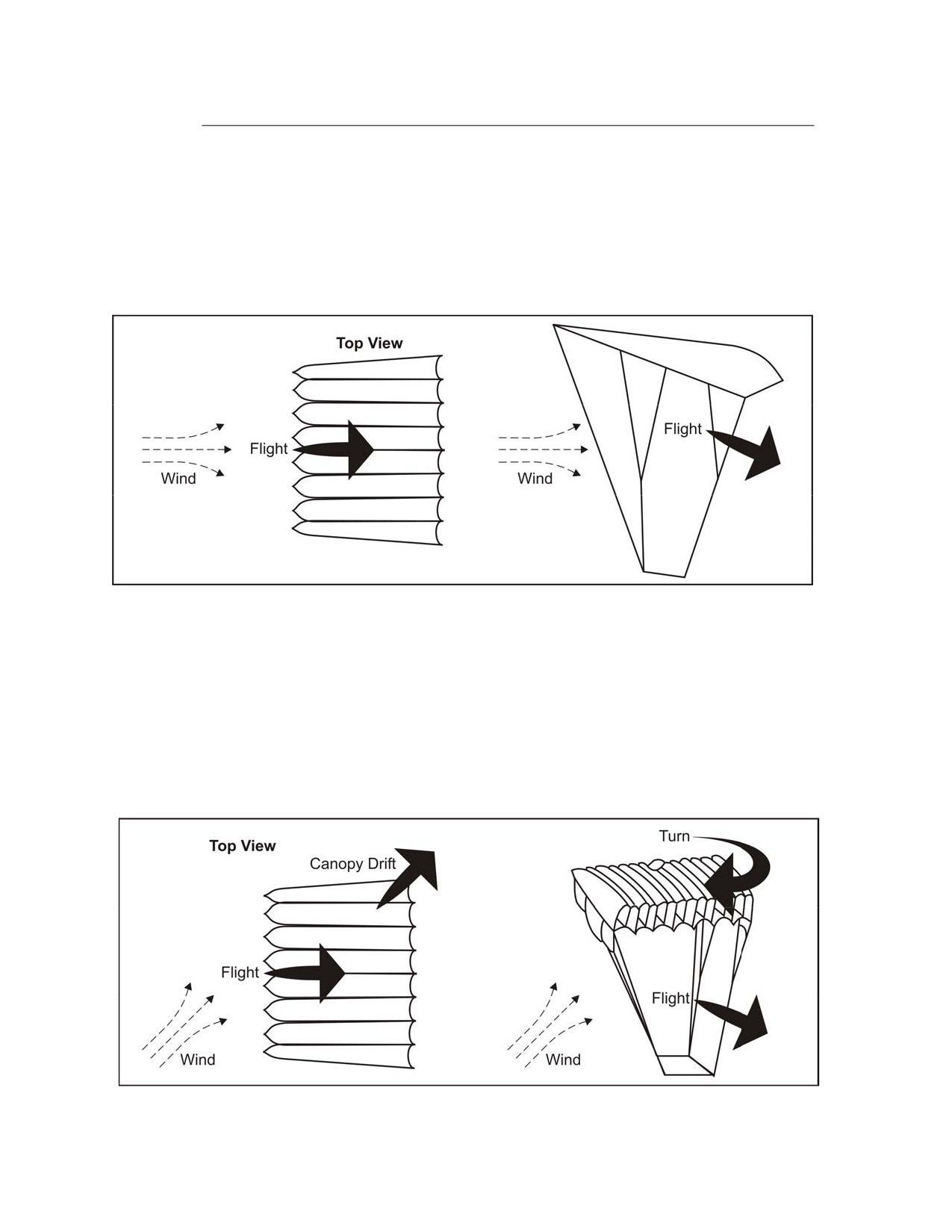
8-34. Pointing the canopy into the wind, or “holding,” aims the canopy flight
directly into the wind (Figure 8-12). This maneuver increases lift, has the
same effect as reduced wind speed, and slows the canopy’s forward
movement. The parachutist manipulates the toggles to maintain the position.
To crab to either direction while holding, he turns the canopy slightly in the
direction in which he wants to move. Turning the canopy too far may cause it
to become wind-cocked and move with the wind. As the parachutist’s canopy
begins to move in the desired direction, he manipulates the toggles to keep it
in position until he completes the maneuver.
Figure 8-12. Holding Maneuver
6 April 2005 FM 3-05.211/MCWP 3-15.6/NAVSEA SS400-AG-MMO-010/AFMAN 11-411(I)
8-11
FM 3-05.211
RUNNING MANEUVER
8-35. If the parachutist points the canopy with the wind, the combined glide
speed and the wind speed produce an increased canopy movement speed
called “running” (Figure 8-13). He manipulates the toggles to maintain the
canopy in position. To crab while running, the parachutist turns the canopy
slightly in the desired direction and maintains the position until he completes
the maneuver.
Figure 8-13. Running Maneuver
CRABBING MANEUVER
8-36. The parachutist performs a “crabbing” movement by pointing the
canopy at any given angle to the wind direction (Figure 8-14). The force of the
wind from one direction and the flight of the canopy at an angle to it move
the canopy at an angle to the direction of flight. The direction of flight varies
with the wind speed and the angle at which the parachutist points the
canopy. A canopy pointed at a downwind angle makes a sharper angle than
one pointed upwind.
Figure 8-14. Crabbing Maneuver
8-12
FM 3-05.211/MCWP 3-15.6/NAVSEA SS400-AG-MMO-010/AFMAN 11-411(I)
6 April 2005
FM 3-05.211
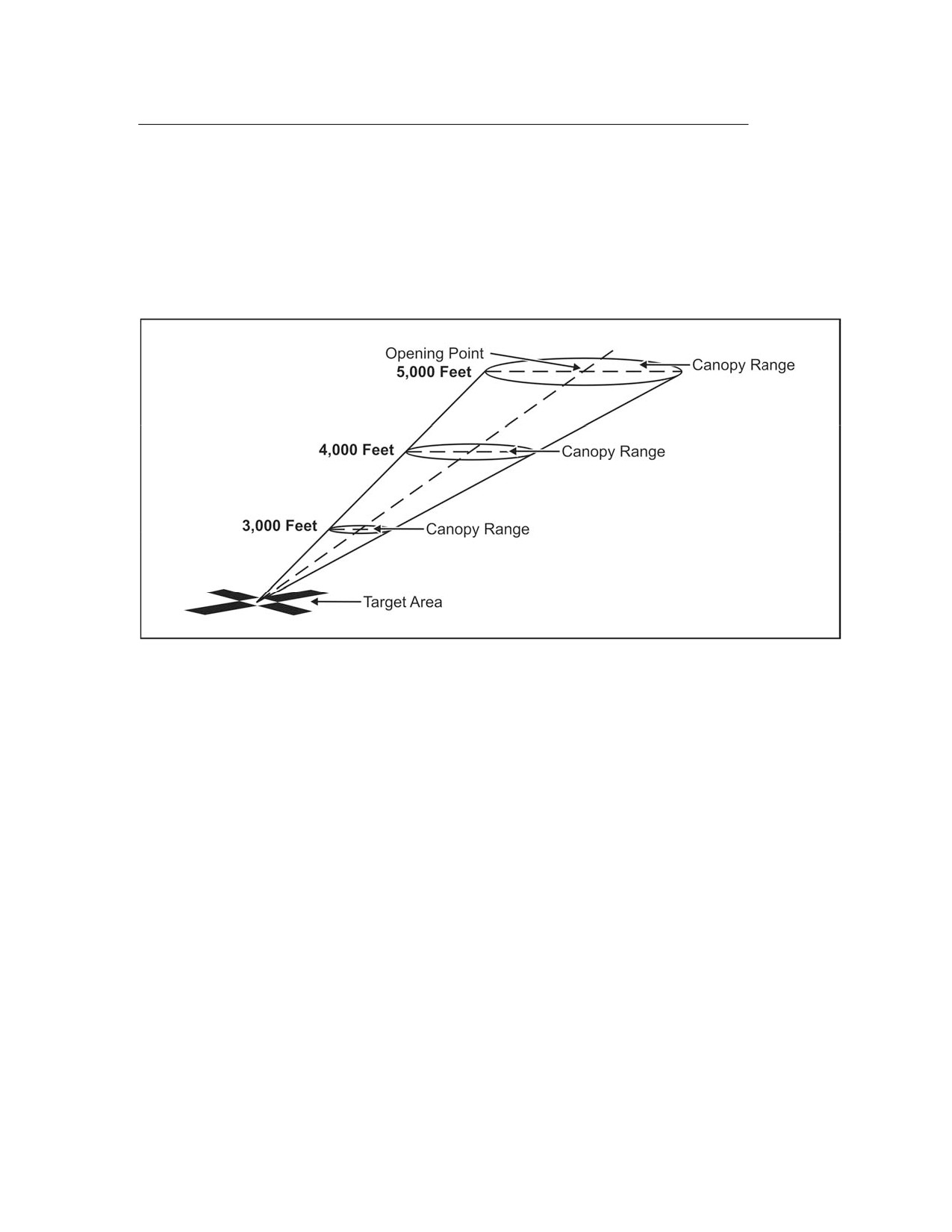
8-37. The effective canopy range and the wind line determine the course
(direction of movement) the parachutist follows in maneuvering toward the
target area. The effective canopy range is the maximum distance from which
the parachutist can maneuver the canopy into the target area from a given
altitude. It is greater at high altitudes and decreases proportionately at lower
altitudes, forming a cone- or funnel-shaped area (Figure 8-15). Changes in
wind direction and conditions may cause this range to shift in any direction.
Figure 8-15. Effective Canopy Range
8-38. A wind line is an imaginary line extending upwind from the target
area to the opening point. A wind line can be marked by ground references.
Accurate reference points are essential to effective parachute maneuver.
8-39. The parachutist checks his movement in relation to the ground. Winds
at altitude may be from different directions than those at the DIP.
8-40. The parachutist picks a ground reference point on the wind line,
halfway between the opening point and the target area. This point is the first
checkpoint that he can reach in half the opening altitude with correct canopy
manipulation. The second checkpoint is a reference point halfway between
the first checkpoint and the target area that he should reach in half the
remaining altitude.
8-41. The parachutist always tries to maintain the “upwind advantage.”
This advantage is a margin in his canopy range where he will not be blown
behind his target area and become unable to recover and land with his group.
8-42. The ram-air parachute is a highly maneuverable canopy capable of
360-degree turns in
3 to
5 seconds under normal conditions. Its
maneuverability comes from the parachutist’s use of its capabilities to vary
forward speed, rate of descent, turn, and crosswind movement.
8-43. Under normal conditions, the parachutist varies his forward speed and
rate of descent by using the canopy’s toggles. Immediately upon canopy
6 April 2005 FM 3-05.211/MCWP 3-15.6/NAVSEA SS400-AG-MMO-010/AFMAN 11-411(I)
8-13
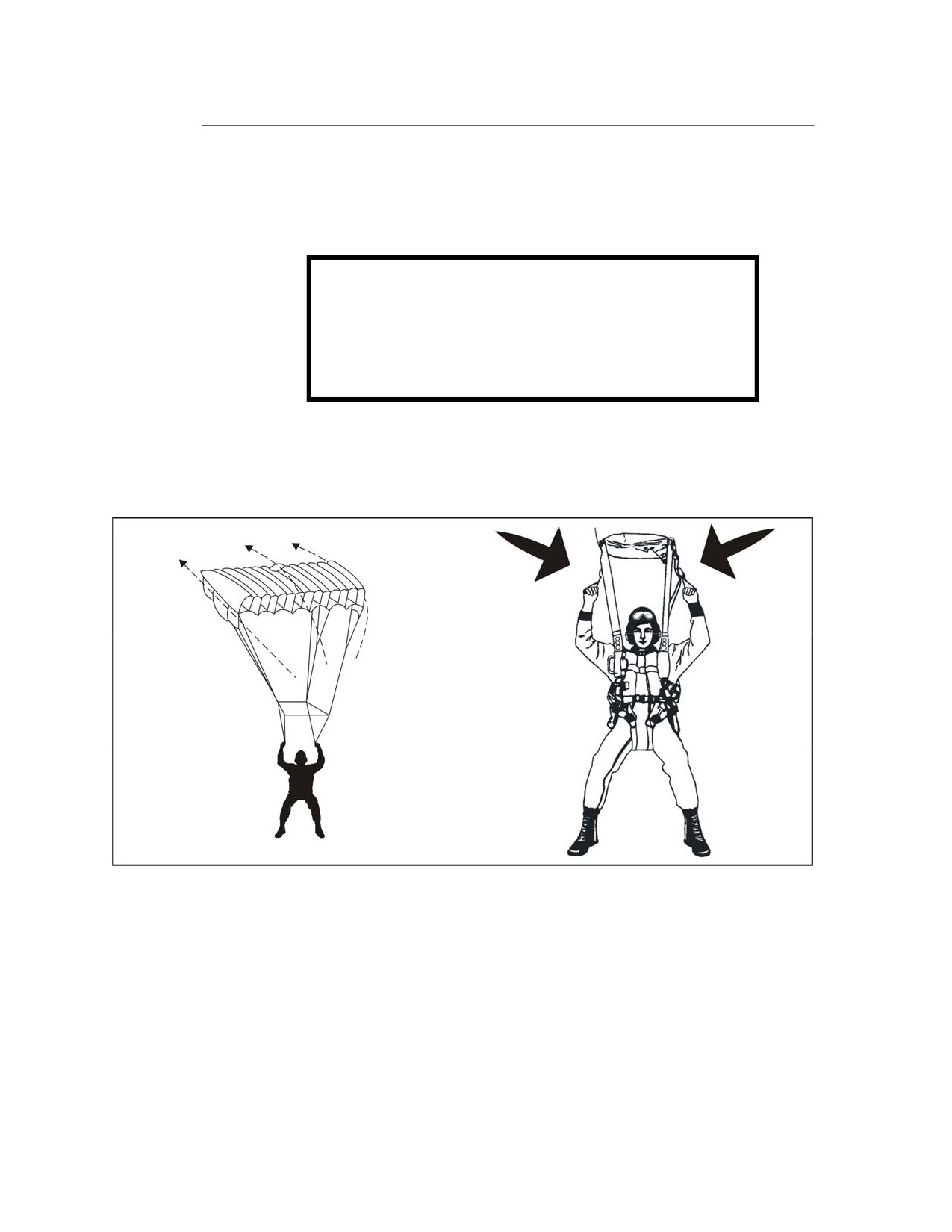
FM 3-05.211
deployment, he clears the toggles from the deployment brakes setting and
performs a controllability check. His toggle position at the stall point will be
at a different position as wind speed increases and when carrying heavy
equipment loads.
WARNING
Before attempting any maneuvers or turns, the
parachutist must be alert to prevent collisions with
other parachutists. This maneuver is especially
critical below 500 feet AGL.
FULL FLIGHT (NO BRAKES)
8-44. The maximum canopy flight and penetration for maneuvering are
obtained using full flight. The toggles are in the up position behind the rear
risers (Figure 8-16).
Figure 8-16. Full Flight
HALF BRAKES
8-45. The parachutist grasps the toggles and pulls them down to about
shoulder or chest level for the half-brakes position (Figure 8-17, page 8-15).
The canopy speed will decrease to about a 9- to 12-mph flight, and the rate of
descent will increase.
8-14
FM 3-05.211/MCWP 3-15.6/NAVSEA SS400-AG-MMO-010/AFMAN 11-411(I)
6 April 2005
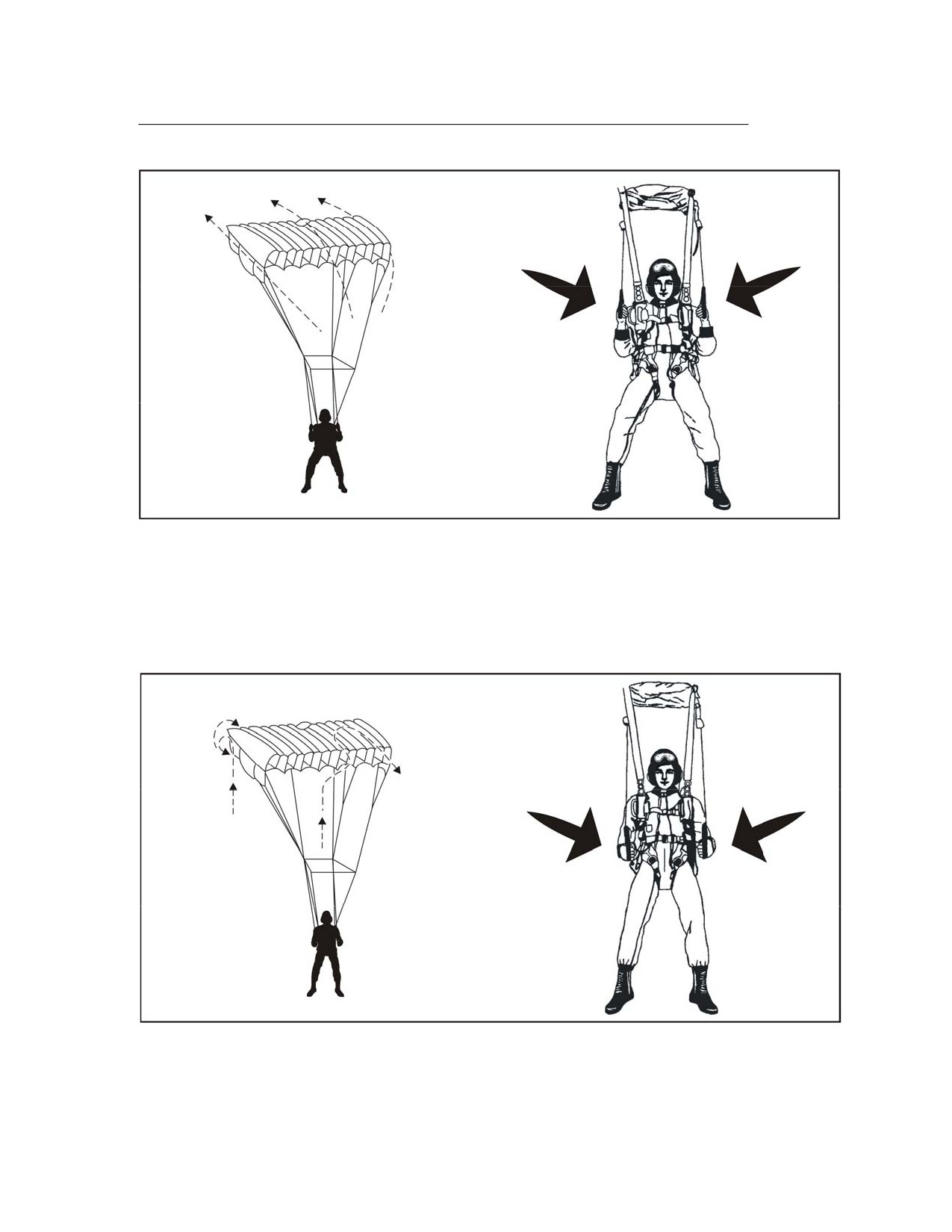
FM 3-05.211
Figure 8-17. Half Brakes
FULL BRAKES
8-46. The parachutist pulls the toggles to about waist level for full brakes
(Figure 8-18). The canopy stops moving forward and the rate of descent
increases. In the full-brakes position, the canopy is actually on the verge of a
stall.
Figure 8-18. Full Brakes
6 April 2005 FM 3-05.211/MCWP 3-15.6/NAVSEA SS400-AG-MMO-010/AFMAN 11-411(I)
8-15
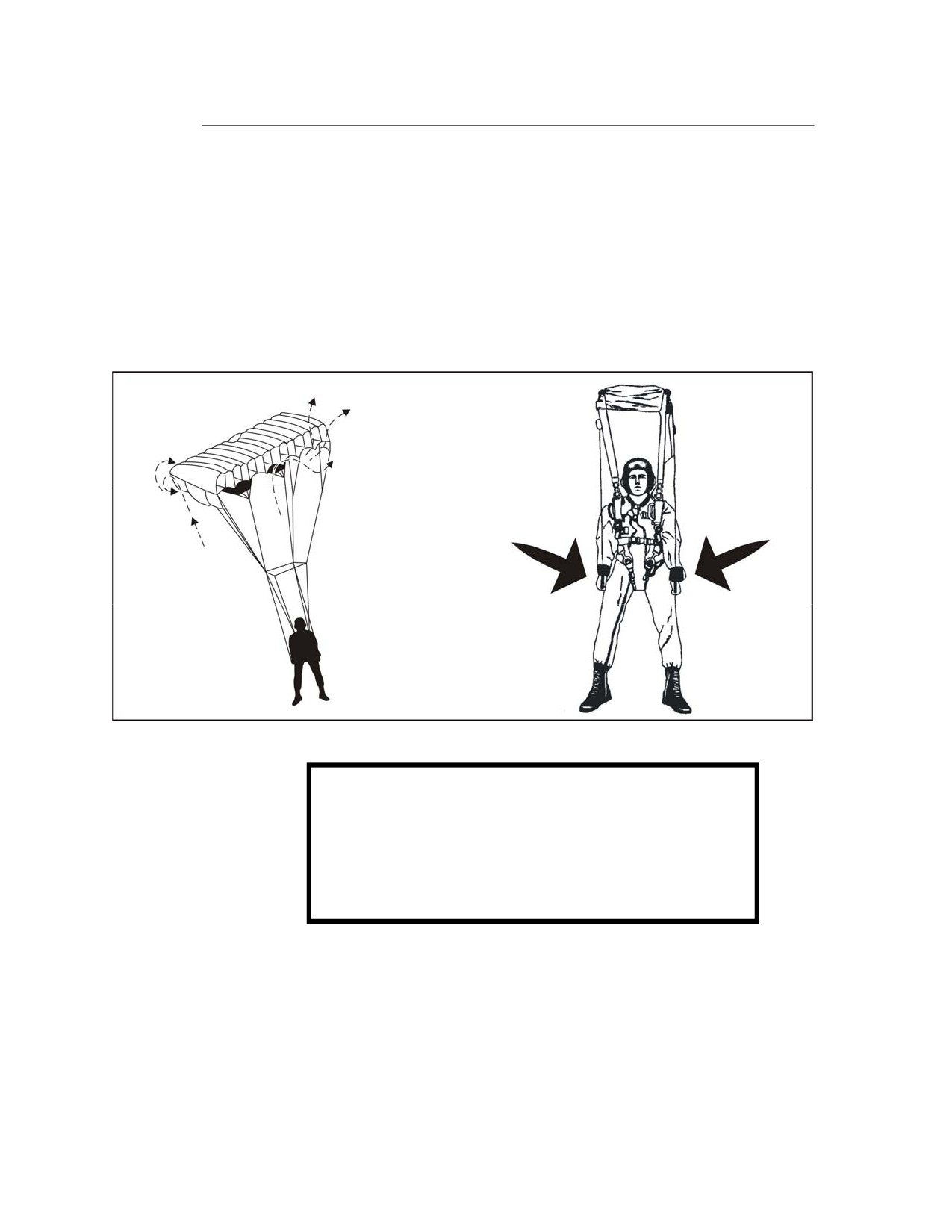
FM 3-05.211
STALL
8-47. A stall occurs when the parachutist pulls the toggles below the full-
brakes position (Figure 8-19). The angle of attack of the parachute’s nose and
wing change produce a very great amount of lift for a short time. As the
parachute loses forward airspeed and because the parachutist pulled the tail
down lower than the nose, the canopy will attempt to fly backward and the
rate of descent will increase to a hazardous degree. To regain forward
airspeed and flight, the parachutist slowly raises the toggles to the half-
brakes position to raise the tail.
Figure 8-19. Stall
WARNING
The parachutist does not move the toggles quickly
from the stall to the full-flight position, as the
canopy will surge forward with an increased rate of
descent. The parachutist must avoid stalling the
ram-air parachute below 500 feet AGL.
8-48. The parachutist can make turns from the full-flight, half-brakes, and
full-brakes positions. Turns from full flight are very responsive, but due to
the high forward speed, the turns will cover a wide arc. The parachutist
makes these turns by depressing either toggle, leaving the other one at the
guide ring. In this type of turn, the parachute will bank and actually dive,
causing the parachute to lose altitude quickly. The further the parachutist
depresses the toggle, the steeper the bank angle becomes.
8-49. Spiral turns are basically turns from full flight but maintained for
more than 360 degrees of rotation. The parachute will begin diving in a
8-16
FM 3-05.211/MCWP 3-15.6/NAVSEA SS400-AG-MMO-010/AFMAN 11-411(I)
6 April 2005
FM 3-05.211
spiral. The first turn will be fairly slow, with shallow bank angles, but the
turn speed and bank angle will increase rapidly while the parachutist
maintains the spiral.
NOTE: The parachutist should use trim tabs located on the front risers to
lose altitude, if required. During HAHO operation jumps, the trim tabs can
be used to make minor corrections to aid in staying on compass heading.
WARNING
Spiral turns are NOT recommended. They will cause
excessively fast diving speed with a rapid loss of
canopy control. If the parachutist makes a spiral
turn, he should be aware of other parachutists and
wind direction. He must NEVER make a spiral turn
below 500 feet AGL.
8-50. Turns from the half-brakes position result in almost flat turns. These
turns are desirable when flying the target approach legs.
8-51. Turns from full brakes are extremely fast, and heading changes are
quick and flat. To prevent the canopy from stalling, the parachutist makes
these turns by raising the opposite toggle.
8-52. The parachutist makes flared landings into the wind. He starts them
at an altitude of 10 to 15 feet, with room ahead for the actual touchdown. At
200 feet, he eases both toggles to the full-flight position, allowing airspeed to
build. At about 10 feet above the ground (depending on wind conditions), he
slowly pulls both toggles downward, timing the movement to coincide with
the full-brakes position at touchdown. The flared landing, when properly
executed, practically eliminates forward and vertical speed for a short period.
If the parachutist slows down the ram-air parachute before the flare point,
depressing the toggles will result in a
“sink.” On high wind days, the
parachutist must be aware that the canopy will react quicker during the
flare; therefore, the flare should be conducted slightly lower to the ground. If
the flare is conducted too high on a high wind day, the parachutist may
prematurely stall the canopy, falling backward on the ground. On low- or no-
wind days, the parachutist must be aware that the canopy will react slower
during the flare; therefore, the flare should be conducted slightly higher from
the ground. If the flare is conducted too low on a low- or no-wind day, the
parachutist may not have slowed the canopy down enough to perform a safe
landing.
WARNING
On a misjudged flare attempt, if the parachute enters
a stall, the parachutist initiates recovery procedures
by slowly raising the toggles about 6 inches. He
must be prepared to perform a PLF.
6 April 2005 FM 3-05.211/MCWP 3-15.6/NAVSEA SS400-AG-MMO-010/AFMAN 11-411(I)
8-17
FM 3-05.211
NOTE: In turbulent wind conditions, the parachutist maintains about 25
percent to half brakes to help keep the ram-air parachute inflated and stable.
NOTE: The parachutist can safely land the ram-air parachute in the half-
brakes position. This procedure is especially useful during night or limited-
visibility operations when he cannot see the ground or if recovering from a
stall. He must be prepared to perform a PLF upon ground contact.
LANDING APPROACHES
8-53. The ram-air parachute landing approach is similar to standard
aircraft practice consisting of a downwind leg, a base leg, and a final
approach upwind into the target (Figure 8-20, page 8-19). The parachutist
uses his altimeter to assist his visual altitude determination.
Downwind Leg
8-54. The parachutist flies the downwind leg along the wind line, passing
the target area at an altitude between 1,500 and 1,000 feet (depending on
winds), about 300 feet to the side of the target. He continues the downwind
leg about 300 to 400 feet downwind of the target (again, depending on winds).
Base Leg
8-55. When 300 to 400 feet past the target, the parachutist begins a gentle
90-degree turn to fly the base (crosswind) leg across the wind line. He usually
flies this leg at 30 to 60 percent brakes, depending on the wind conditions. He
may either shorten or extend the base leg to reach the turning altitude.
Under low-wind conditions, he flies the base leg to a turning point about 500
feet directly downwind of the target and at an altitude of 500 feet.
Final Approach
8-56. Under light-wind conditions
(0 to
5 knots) and 500 feet directly
downwind of the target, the parachutist makes a braked turn to turn toward
the target. He completes the final turn at approximately 500 feet and no
lower than 200 feet. On the final approach, braking techniques control
descent and flight. The parachutist performs any major control corrections
immediately while there is enough altitude and distance to the target. He
lowers his equipment at 200 feet.
WARNING
The parachutist avoids the turbulent air directly
behind and above a ram-air parachute by flying
offset to a parachute to his front or a minimum of
25 meters to the rear and above. He does not make
sharp or hook turns on the final approach or
attempt a 360-degree turn.
8-18
FM 3-05.211/MCWP 3-15.6/NAVSEA SS400-AG-MMO-010/AFMAN 11-411(I)
6 April 2005
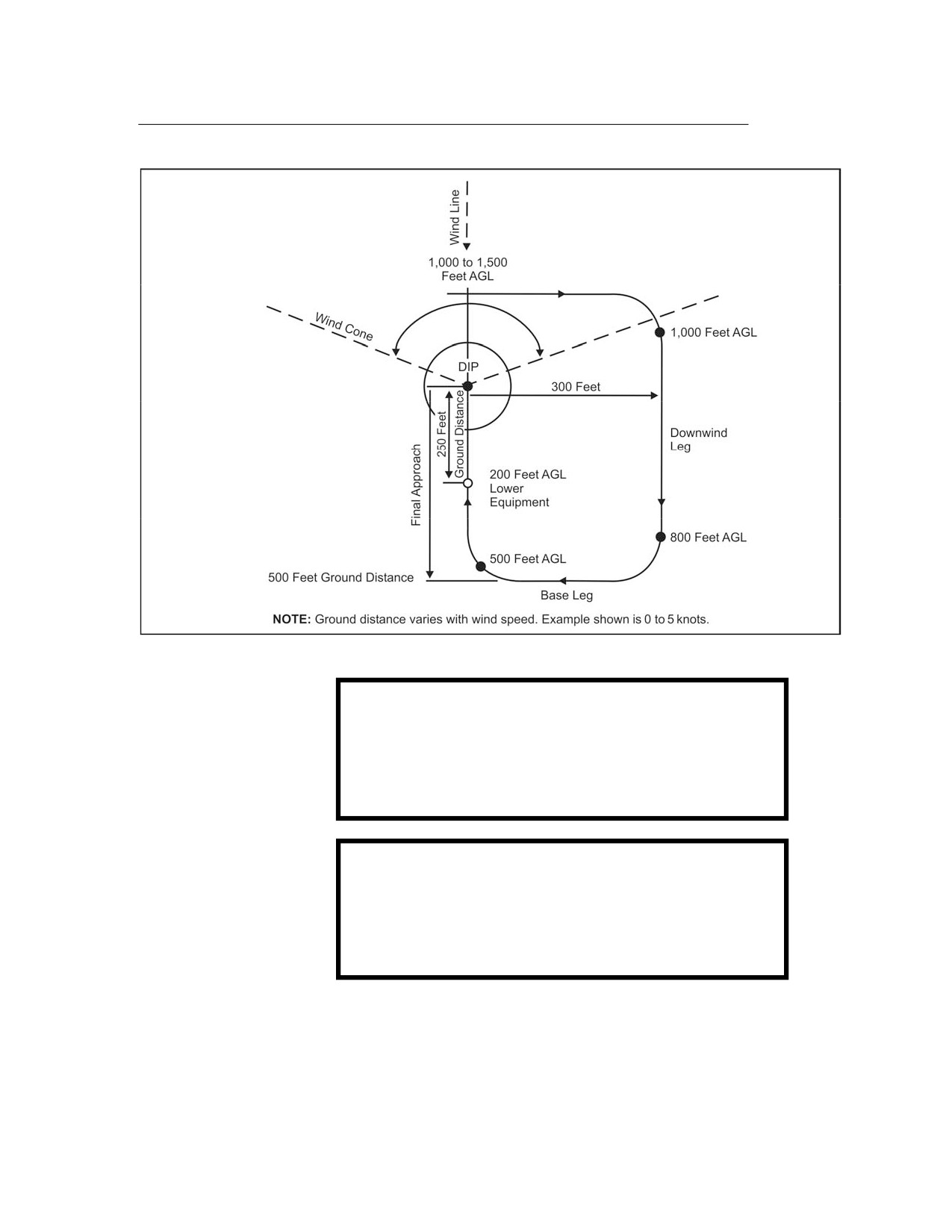
FM 3-05.211
Figure 8-20. Landing Approaches
WARNING
Landing while facing in a direction other than into
the wind results in higher lateral movement and
increased rate of descent, increasing the
probability of injury on impact.
WARNING
The parachutist maintains a sharp lookout for
fellow parachutists at 500 feet AGL and below to
avoid canopy collisions and entanglements. The
lower parachutist has the right-of-way.
TURBULENCE
8-57. Turbulence is the result of an air mass
(wind) flowing over
obstructions on the earth’s surface. Common obstructions are irregular
terrain
(bluffs, hills, mountains), man-made features (buildings, elevated
roadways, overpasses), or natural ones, such as tree lines. A disturbance of
the normal horizontal wind flow causes turbulence. As the air mass moves
6 April 2005 FM 3-05.211/MCWP 3-15.6/NAVSEA SS400-AG-MMO-010/AFMAN 11-411(I)
8-19
FM 3-05.211
around and over the obstruction, it transforms into a complicated pattern of
eddies and other irregular air movements. Turbulence generally affects the
flight of the parachute at the most critical time for the parachutist—the last
200 feet of canopy flight.
8-58. In general, with ground wind speeds less than 10 knots, both the
windward and leeward sides of an obstruction cause small eddies 10 to 50
feet in depth. When wind speeds are between 10 and 20 knots, obstructions
can cause currents that are several hundred feet in depth. Additionally, there
will still be eddies on the windward and leeward side near the obstruction. At
wind speeds greater than 20 knots, currents formed on the leeward side are
carried considerable distances beyond the object that created them. Only
minor eddies and currents form over smooth water surfaces. Turbulence is
worse over choppy swells closer to the surface of the water due to the wind
flow over a constantly changing surface configuration. Over mountains, even
light winds (moving air masses) pushed up mountainsides or redirected down
valleys can form major eddies and air currents that have violent, abrupt
characteristics. Additionally, in HAHO operations in mountains or around
hilly terrain, unstable air masses form currents that continue to grow in size
and complexity. The resultant turbulence can extend up to thousands of feet
AGL. Turbulence is caused by heat rising off roads, concrete, and urban
built-up areas and clearings.
8-59. An example of turbulence is the vortex created by aircraft taking off or
landing. The turbulence created by these aircraft can invert smaller aircraft
landing too closely behind them. Another example is the turbulence behind
another parachutist’s canopy. The parachutist who finds himself behind this
canopy will feel the turbulence it creates. Turbulence can exist around any
cloud mass. Individual clouds probably will not create turbulence. Clouds
that mark the leading edge of an air mass probably will contain strong
downdrafts. Cloud decks capping mountain ridges will contain very strong
downdrafts and abrupt turbulence. Those type cloud formations will contain
rapid pressure differentials. Altimeter readings should be suspect because
the parachutist could be 1,000 feet lower than the indicated altitude on the
altimeter.
8-60. The parachutist should avoid at all costs clouds that contain
thunderhead activity due to the violent turbulence associated with those
formations.
LAND AND SEA BREEZES
8-61. The thermal differences of air masses associated with the interface
along shorelines causes land and sea breezes. In the daytime, coastal
landmasses warm up faster than water. The air above the land rises, causing
a lower air density than over the water. The air flows from the water over the
land to replace the lower air density there. This phenomenon creates onshore
breezes known as sea breezes. It is most evident on clear, summer days in
lower latitudes. The same phenomenon occurs in reverse in the evening due
to the more rapid cooling of the landmass. The reversed process creates land
breezes. The airflow over obstacles near shoreline DZs creates turbulence;
when farther away from the coast, turbulence might not exist.
8-20
FM 3-05.211/MCWP 3-15.6/NAVSEA SS400-AG-MMO-010/AFMAN 11-411(I)
6 April 2005
FM 3-05.211
NOTE: If turbulence is encountered at altitude, parachutist should maintain
full flight.
VALLEY AND MOUNTAIN BREEZES
8-62. Winds generally flow upslope on warm days in mountainous terrain.
They flow downslope in the evening as the air masses cool. During the day,
the winds create valley breezes; at night, the reverse process creates
mountain breezes. These breezes, coupled with the airflow over obstacles, can
cause strong and unpredictable turbulence.
6 April 2005 FM 3-05.211/MCWP 3-15.6/NAVSEA SS400-AG-MMO-010/AFMAN 11-411(I)
8-21
FM 3-05.211
Chapter 9
Emergency Procedures for Military
Free-Fall Operations
Military free-fall airborne operations are inherently dangerous.
Emergencies may occur before or during takeoff, during flight, while in
free fall, or during canopy descent. Safety considerations require that
each parachutist be able to recognize an emergency situation and react
accordingly. Any departure from these emergency procedures may
interfere with the parachutist’s conditioned response. This action can lead
to a delay at a critical time with the potential of causing injury or death.
This publication strongly recommends that all parachutists follow these
established procedures.
REFRESHER TRAINING
9-1. The conditioned response executed as the correct procedure for a
particular emergency is a highly perishable skill. Refresher training must
include performance-oriented training with special emphasis on emergency
procedures and the actions required to respond successfully to any situation.
This training must take place before each MFF airborne operation. The
duration of the training should be commensurate with the time between
airborne operations and, at the very least, until each parachutist is confident
in his emergency procedure skills.
EMERGENCY MEASURES
9-2. The procedures established by this publication in response to emergency
situations have proven to be the most successful in both MFF training and
tactical environments. Figures 9-1 through 9-7, pages 9-1 through 9-3, and
Tables
9-1 through
9-5, pages
9-4 through
9-8, depict the emergency
procedures that may be used with the RAPS during emergency situations.
Parachutist—
• Learns the location of emergency exits and how to open them.
• Secures all loose items.
• Wears helmet.
• Fastens seat belt securely.
Figure 9-1. Emergency Preparations Before Takeoff
6 April 2005 FM 3-05.211/MCWP 3-15.6/NAVSEA SS400-AG-MMO-010/AFMAN 11-411(I)
9-1
FM 3-05.211
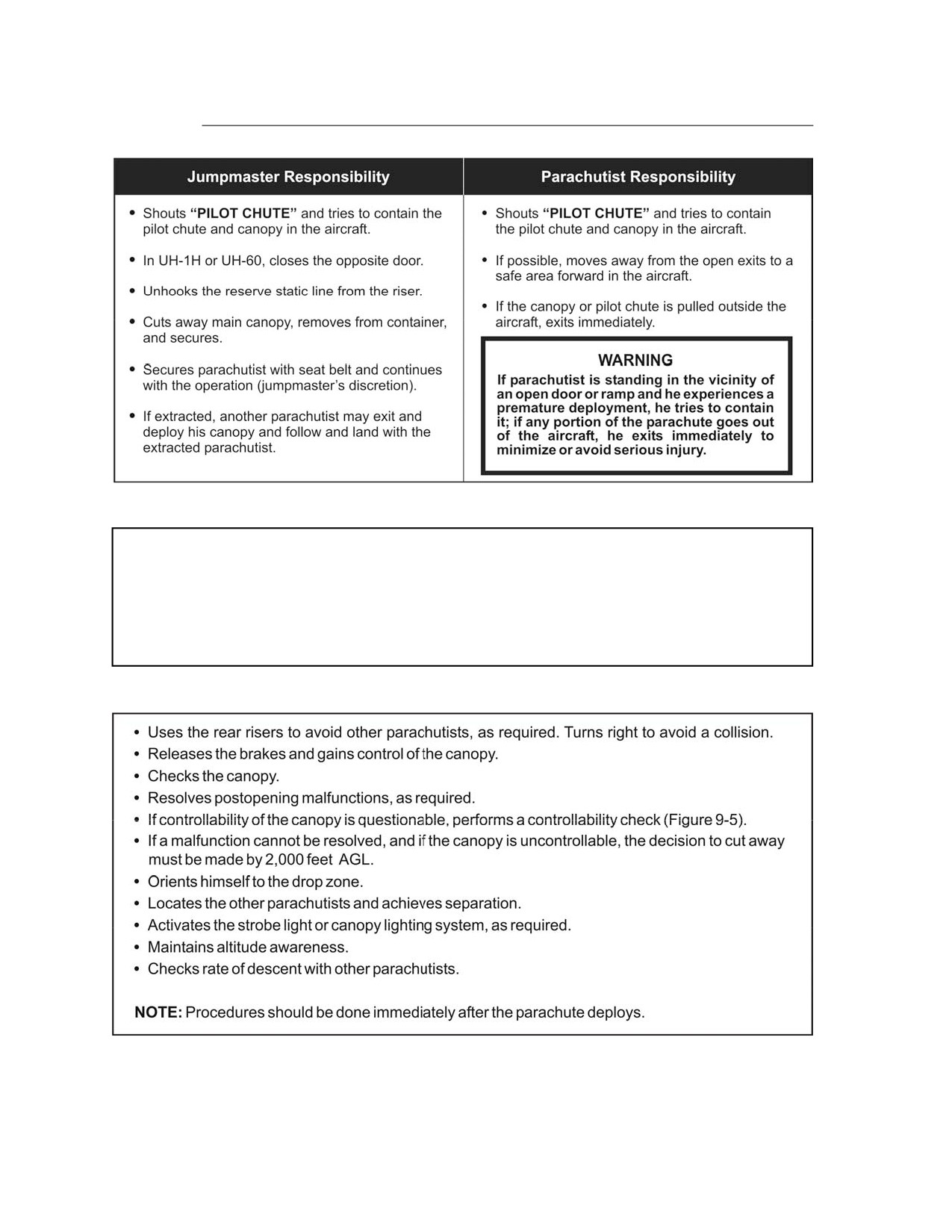
Figure 9-2. Procedures for Inadvertent Pilot Chute Deployment Inside the Aircraft
Parachutist—
• Pulls.
• Pulls at designated altitude.
• Pulls stable at the designated altitude.
• Never sacrifices altitude for stability.
Figure 9-3. Parachutist’s Four Priorities During Free Fall
Figure 9-4. Parachutist Postopening Procedures
9-2
FM 3-05.211/MCWP 3-15.6/NAVSEA SS400-AG-MMO-010/AFMAN 11-411(I)
6 April 2005
FM 3-05.211
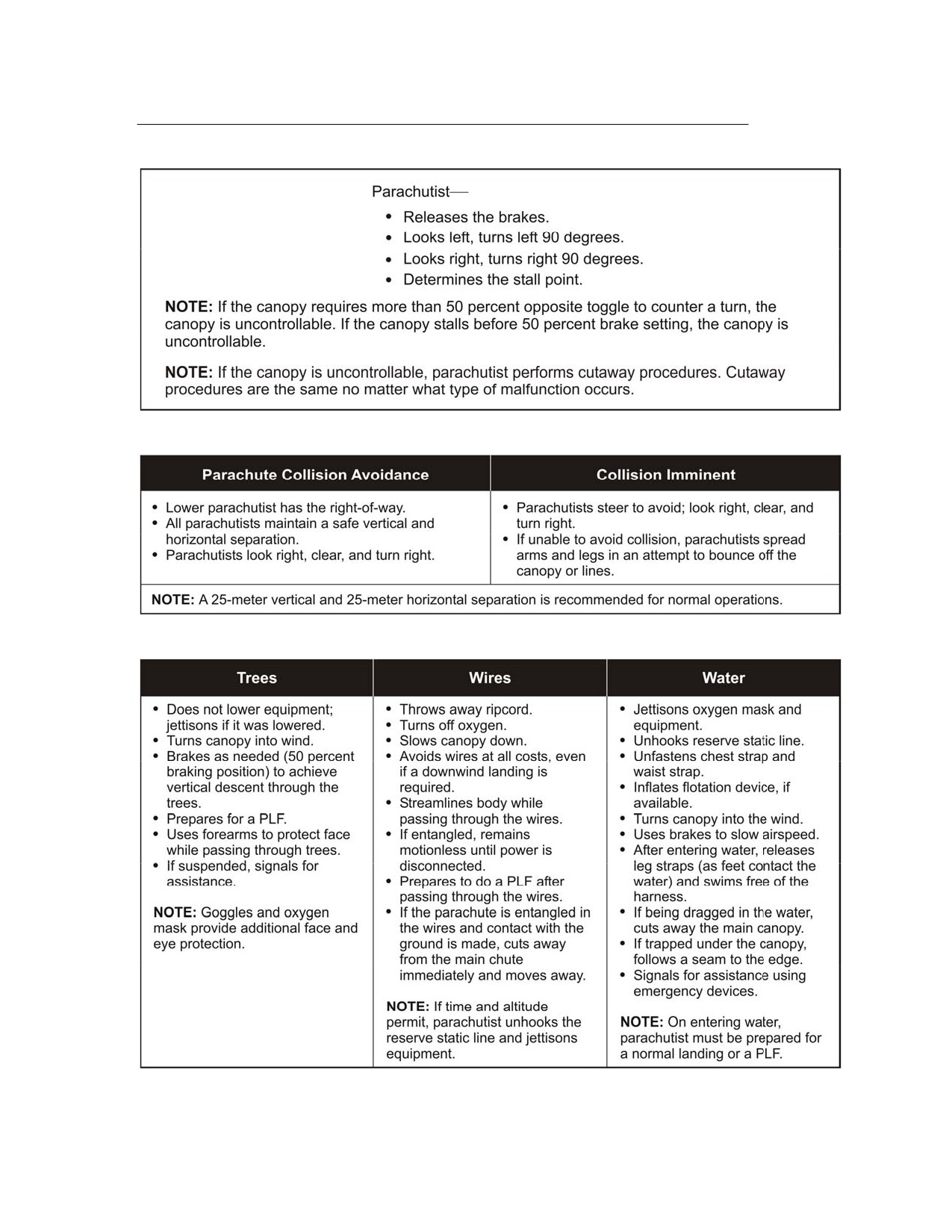
Figure 9-5. Controllability Check
Figure 9-6. Recommended Parachute Separation
Figure 9-7. Parachutist Emergency Landing Procedures
6 April 2005 FM 3-05.211/MCWP 3-15.6/NAVSEA SS400-AG-MMO-010/AFMAN 11-411(I)
9-3
FM 3-05.211
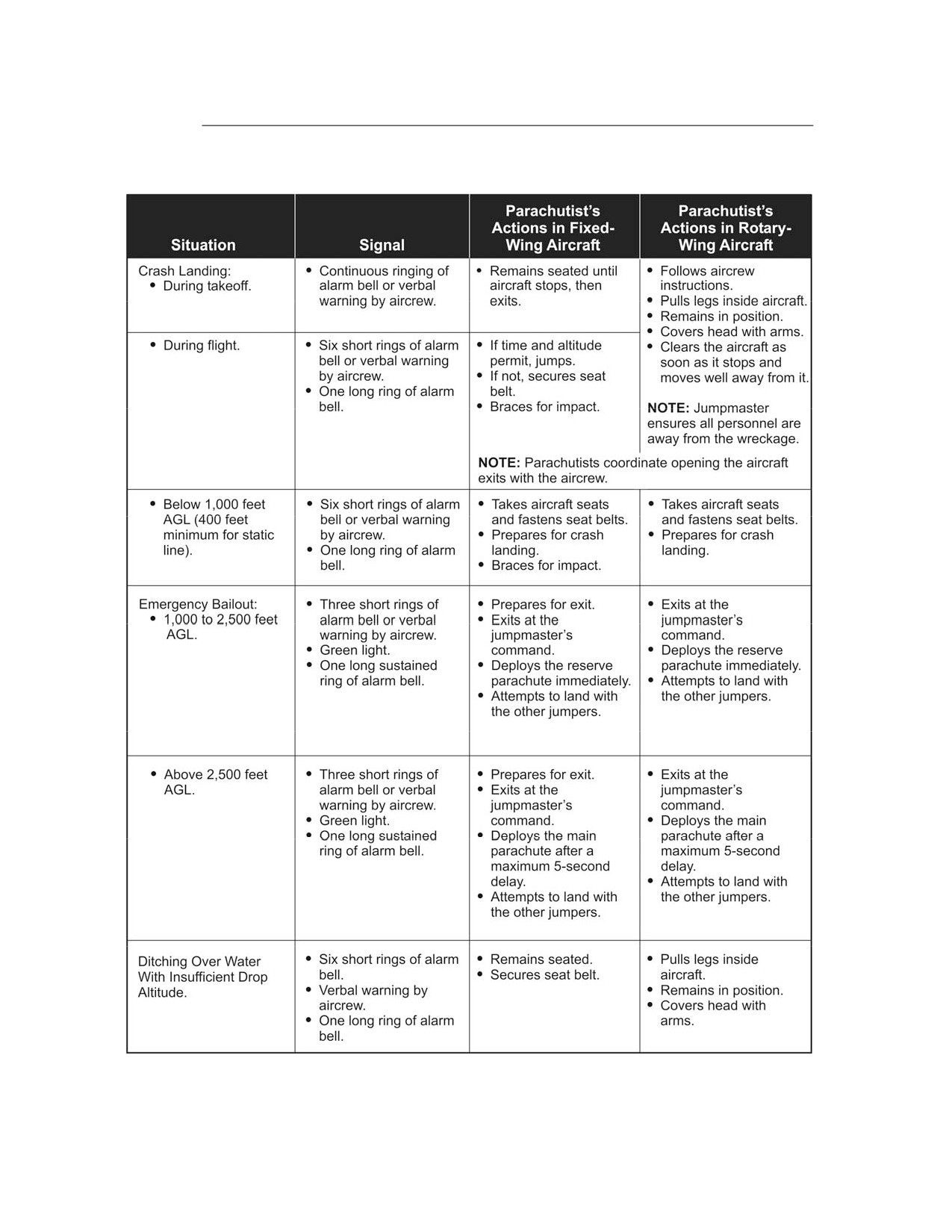
Table 9-1. In-Flight Emergency Procedures
9-4
FM 3-05.211/MCWP 3-15.6/NAVSEA SS400-AG-MMO-010/AFMAN 11-411(I)
6 April 2005
FM 3-05.211
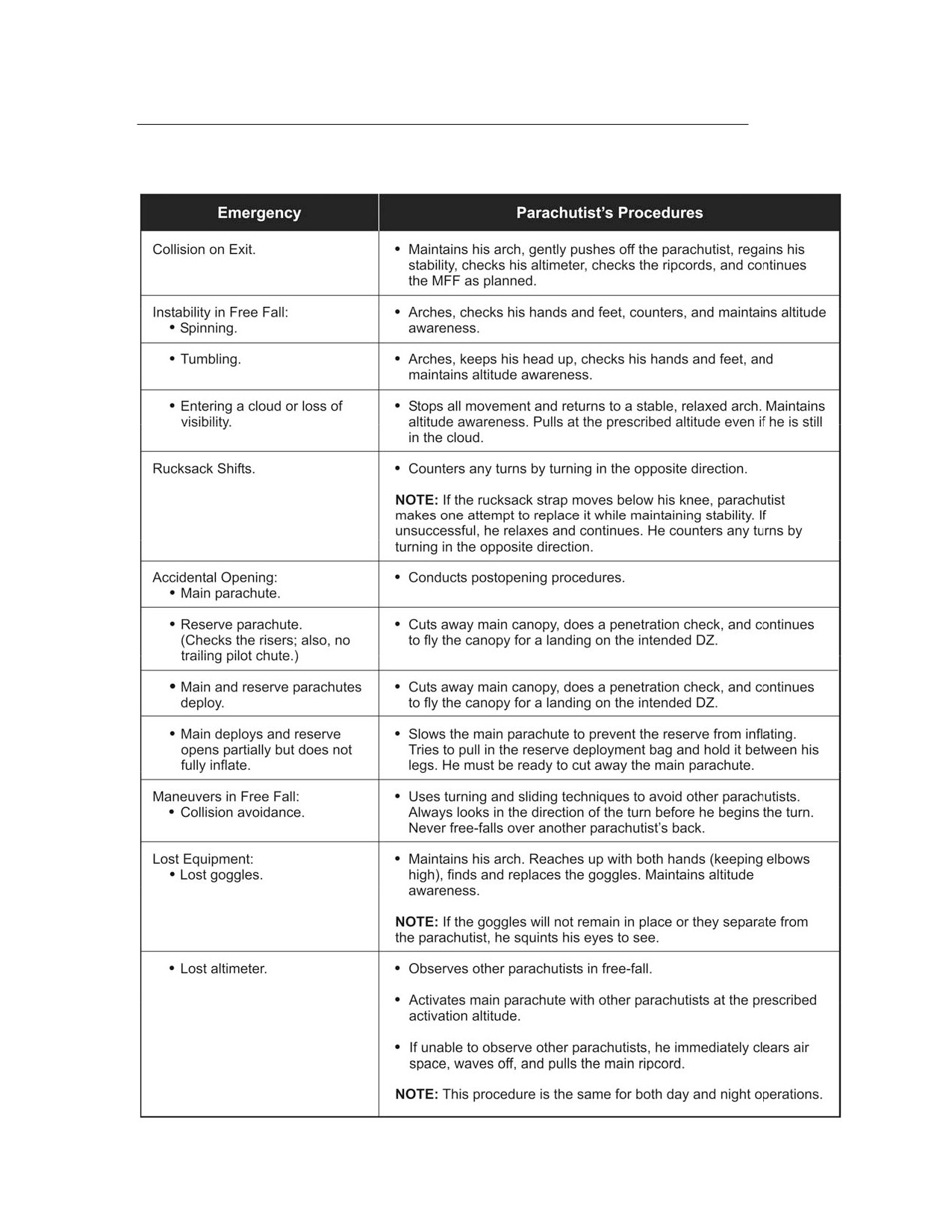
Table 9-2. Emergencies in Free Fall
6 April 2005 FM 3-05.211/MCWP 3-15.6/NAVSEA SS400-AG-MMO-010/AFMAN 11-411(I)
9-5
FM 3-05.211
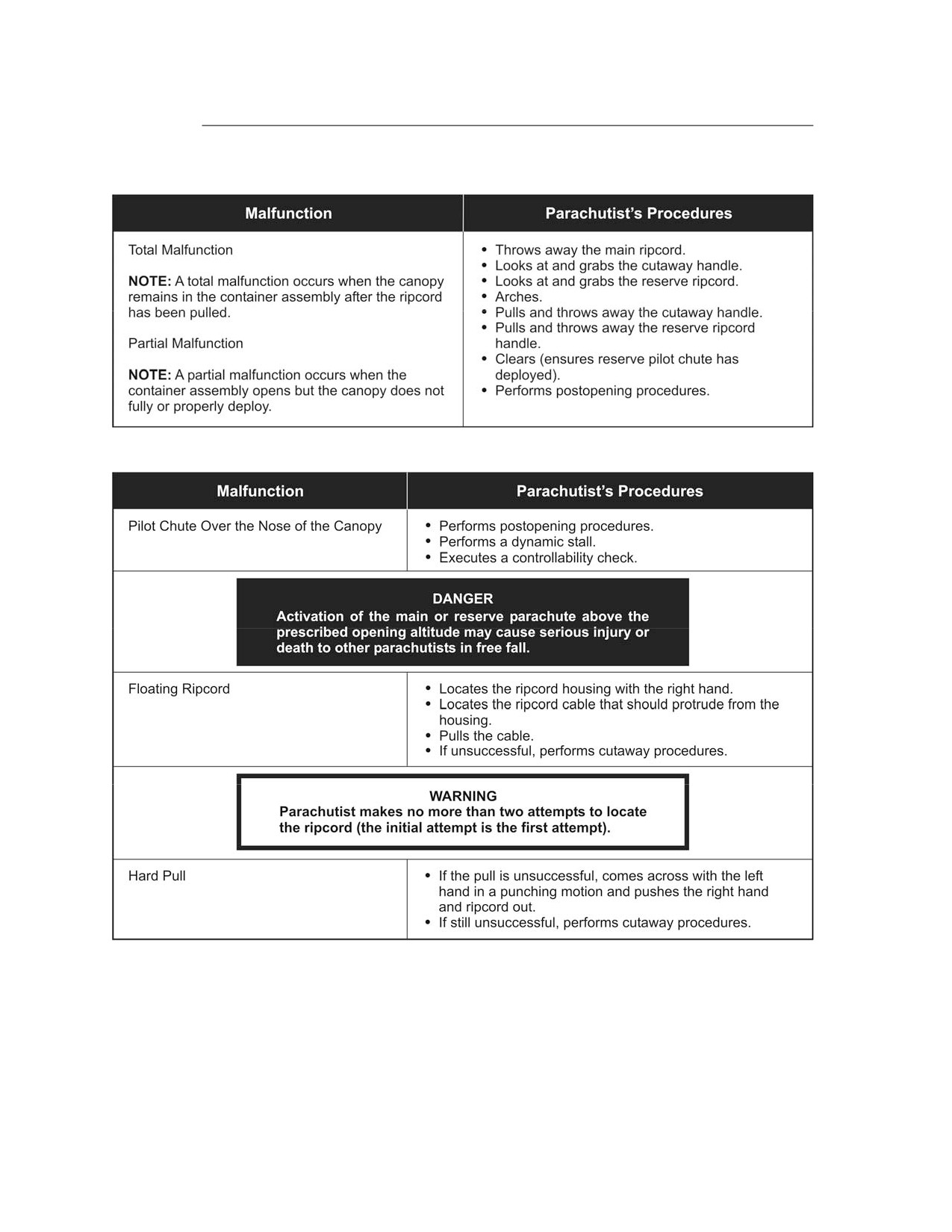
Table 9-3. Cutaway Procedures
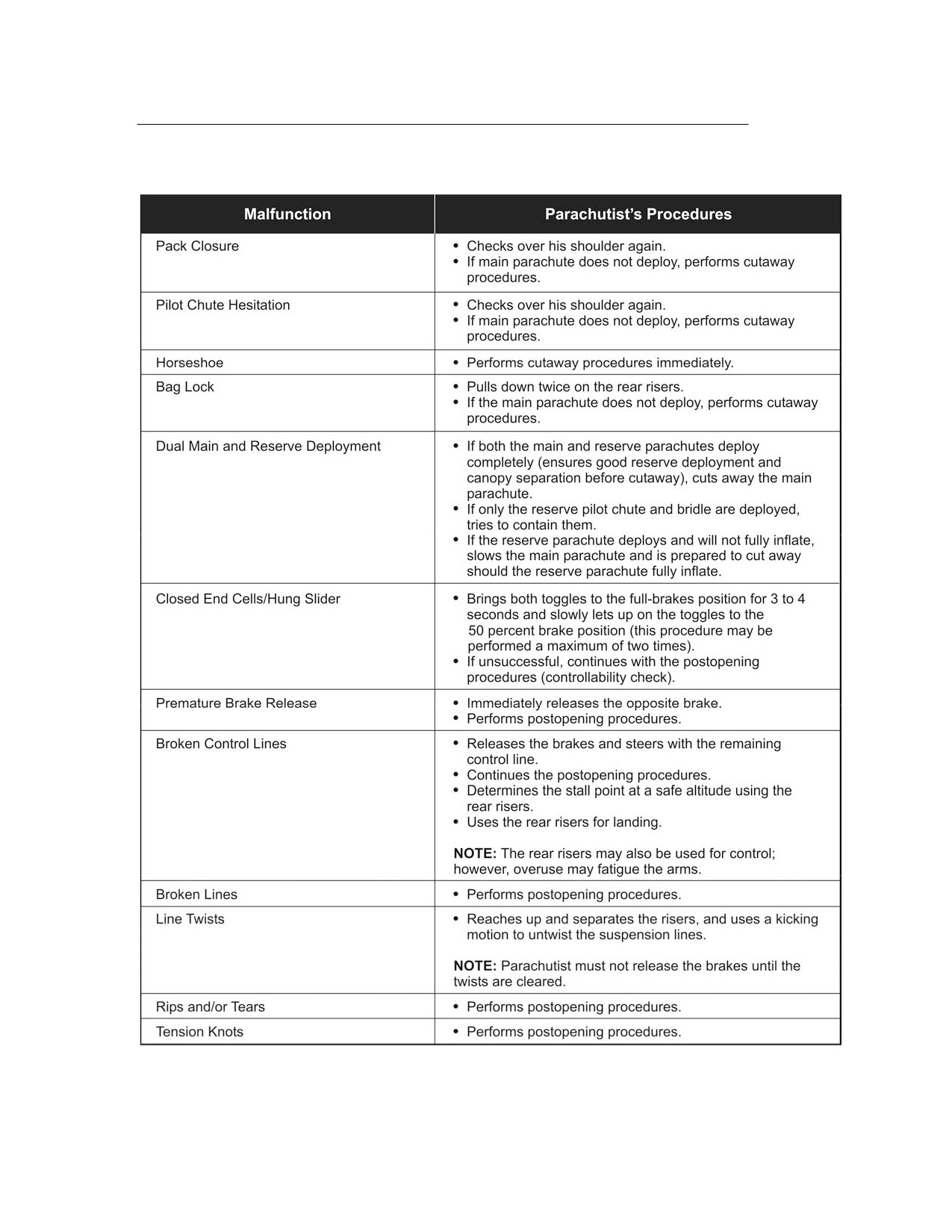
Table 9-4. Malfunction Procedures
9-6
FM 3-05.211/MCWP 3-15.6/NAVSEA SS400-AG-MMO-010/AFMAN 11-411(I)
6 April 2005
FM 3-05.211
Table 9-4. Malfunction Procedures (Continued)
6 April 2005 FM 3-05.211/MCWP 3-15.6/NAVSEA SS400-AG-MMO-010/AFMAN 11-411(I)
9-7
FM 3-05.211
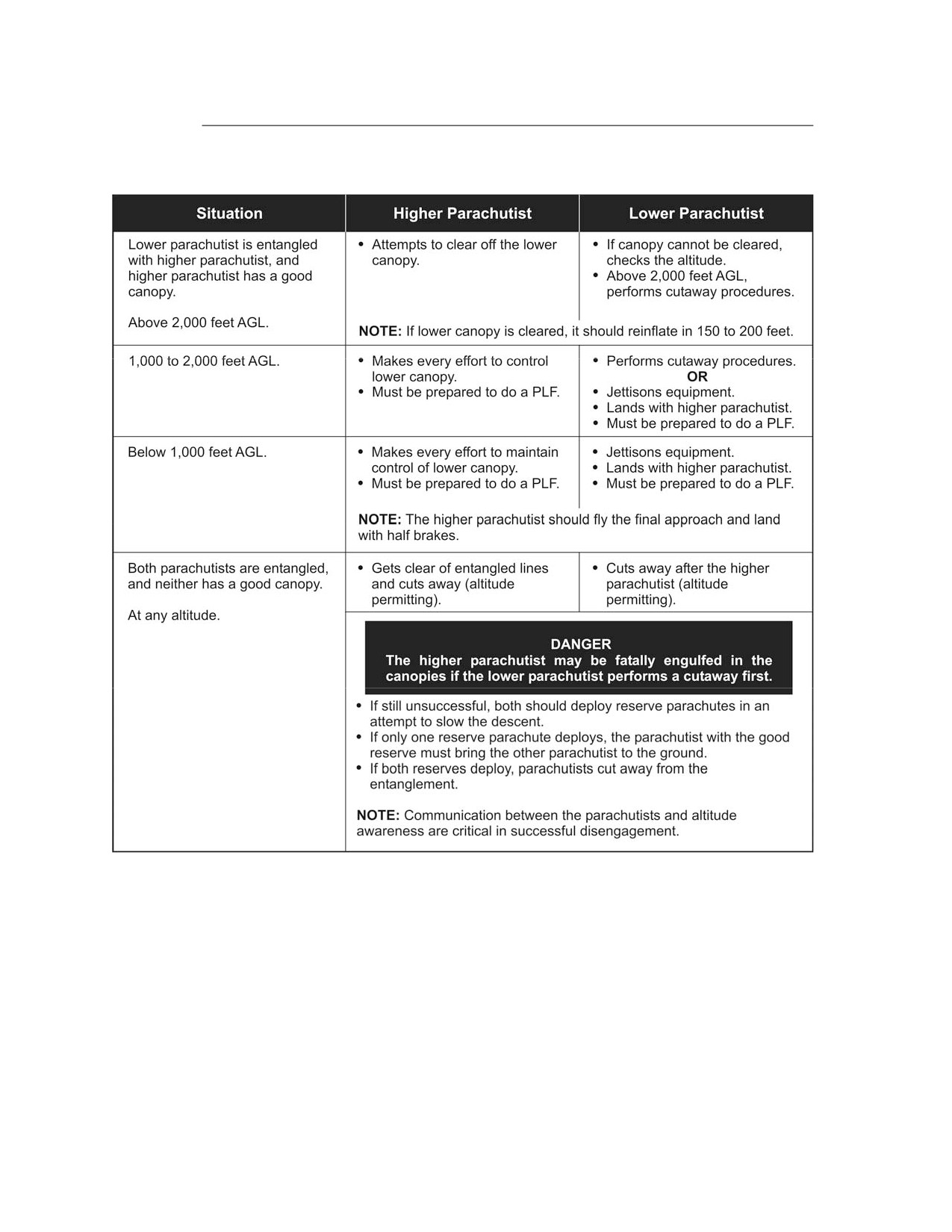
Table 9-5. Canopy Entanglement Procedures
9-8
FM 3-05.211/MCWP 3-15.6/NAVSEA SS400-AG-MMO-010/AFMAN 11-411(I)
6 April 2005
FM 3-05.211
Chapter 10
High-Altitude High-Opening
and Limited-Visibility Operations
Standoff delivery techniques offer the commander a unique method for
infiltrating trained operational elements. The RAPS gives the commander
a tactical capability to infiltrate these elements by parachute without
requiring the aircraft to overfly the intended DZ. These elements can be
released at an offset release point and navigate long distances under
canopy. The flight characteristics of the reserve parachutes of the RAPSs
are identical to the main parachutes. This fact increases the chance of a
successful infiltration should a cutaway from the main parachute take
place because of a malfunction.
NOTE: For parachute systems that have a smaller reserve canopy than
the main canopy, the mission commander planning the operation must
plan for contingencies that address the reduced glide capability should a
cutaway from the main parachute take place. Canopy openings at 6,000
feet AGL or above are considered HAHO jumps.
TECHNIQUES AND REQUIREMENTS
10-1. The parachutist uses a combination of delayed free-fall and HAHO
techniques if making exits at an altitude above 25,000 feet MSL. He can also
deploy his parachute at intermediate altitudes to minimize the chance of
parachute damage or injury to himself upon canopy deployment, while using
the glide advantage of the RAPS.
WARNING
The maximum deployment altitude of the MC-4
RAPS is 25,000 feet MSL.
10-2. The commander should consider altitude requirements when
conducting training at altitudes. The recommended altitude for routine
training is 17,500 feet MSL. Conducting training at this altitude eliminates
the need for oxygen prebreathing and minimizes the chance of parachute
damage and injury to the parachutist due to opening forces. The parachutist
is also less likely to encounter physiological problems and cold-weather
injuries.
10-3. HAHO standoff parachuting requires extensive airspace clearance.
Additionally, this training must take place in areas having alternate DZs
should the parachutist (or element) not be able to reach the primary DZ.
6 April 2005 FM 3-05.211/MCWP 3-15.6/NAVSEA SS400-AG-MMO-010/AFMAN 11-411(I)
10-1
FM 3-05.211
10-4. Accurate weather data is essential. Wind directions and speeds are
critical for route planning. Air temperatures are important for preparing
against exposure injuries.
WARNING
Icing conditions may occur at high altitude or
during adverse weather conditions. Ice formation
on the parachute canopy adversely affects its flight
characteristics by increasing the rate of descent
and decreasing its responsiveness.
SPECIAL EQUIPMENT
10-5. Special precautions must be taken to prevent exposure injuries to the
parachutist at high altitude. Gloves are necessary to protect the hands. The
gloves, however, must not interfere with the manual activation of the main
parachute or the performance of emergency procedures. The following
paragraphs discuss special equipment that the parachutist must use.
TOGGLE EXTENSIONS
10-6. Toggle extensions permit the parachutist to keep his hands at waist
level during extended flights. They also allow for improved blood circulation
to the hands and arms and lessen fatigue. Another technique is to leave the
brakes stowed and simply steer the parachute using the risers to make
needed corrections.
WARNING
Parachutists must not use the toggle extensions for
flaring.
COMPASS
10-7. Each parachutist needs a compass to determine direction should he
separate from the group or during limited visibility, such as when passing
through cloud layers. A marine-type, oil-dampened compass that is
unaffected by pressure changes or cold weather is recommended. The
compass must show direction regardless of its mounted attitude on the
parachutist. The parachutist takes care when mounting the compass to avoid
erroneous readings caused by interference from radios or other electronic
navigation aids. He adjusts the declination of his compass while wearing all
his accompanying equipment. This action will account for all magnetic
variances caused by accompanying metal objects.
ELECTRONIC NAVIGATION DEVICES
10-8. The parachutist mounts the electronic navigation or guidance devices
on the waistband enclosed in a padded container; thus, they do not interfere
10-2
FM 3-05.211/MCWP 3-15.6/NAVSEA SS400-AG-MMO-010/AFMAN 11-411(I)
6 April 2005
FM 3-05.211
with the manual activation of the main parachute or the performance of
emergency procedures. The use of such devices may also increase the
likelihood of detection during infiltration.
COMMUNICATION EQUIPMENT
10-9. The parachutist can use radios for air-to-air or air-to-ground
communications. He mounts the radio so that it also does not interfere with
the manual activation of the main parachute or the performance of
emergency procedures. The use of radios may increase the likelihood of
detection during infiltration.
FREE-FALL DELAYS
10-10. As an aircraft increases altitude, the aircraft’s true airspeed (TAS)
must increase to maintain a constant indicated airspeed due to decreased air
density. TAS is the actual speed of the aircraft through the air mass. When
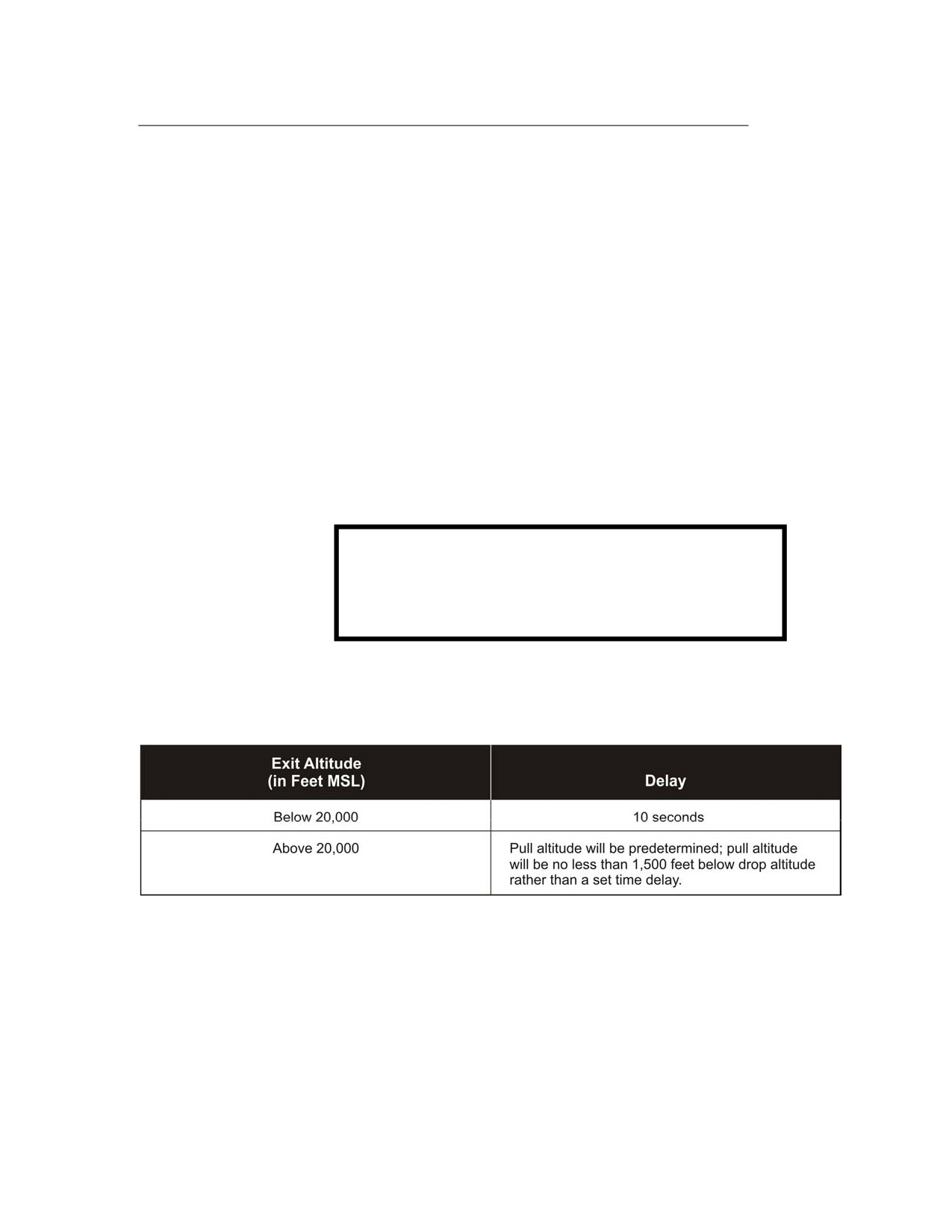
TAS exceeds terminal velocity, the parachutist must allow for longer delays
to decelerate to a safe speed for parachute deployment (Table 10-1).
WARNING
Failure to take the minimum required delay can
result in serious injury to the parachutist and
parachute damage.
NOTE: Jumpmasters must take into consideration the DZ (in feet AGL) for
any delays in parachute opening during MFF operations.
Table 10-1. Required Free-Fall Delays
PARACHUTE JUMP PHASES
10-11. The HAHO standoff parachute jump has four phases. Each of these
phases is discussed in the following paragraphs.
EXIT, DELAY, AND DEPLOYMENT
10-12. On the command GO, the group leader exits the aircraft. The
remainder of the element exits the aircraft at designated intervals using the
same exit technique as the group leader. Each parachutist free-falls for the
required delay or until reaching the predetermined pull altitude. The exit
interval will be established to assure canopy separation between parachutists
6 April 2005 FM 3-05.211/MCWP 3-15.6/NAVSEA SS400-AG-MMO-010/AFMAN 11-411(I)
10-3
FM 3-05.211
at opening. The exit interval will be based on type of aircraft, its speed, and
the mission requirements.
10-13. A parachutist experiencing a malfunction must immediately start
emergency procedures to minimize loss of altitude.
10-14. Upon deployment, the group leader checks with the element for
malfunctions, then assumes the initial flight heading. Should a member of
the element be beneath the group, the element must execute the rehearsed
tactical plan (lose altitude to reform the group or follow the low parachutist).
ASSEMBLY UNDER CANOPY
10-15. The opening altitude should be a minimum of 1,000 feet above any
cloud layer to allow enough altitude for the element to assemble under
canopy. Each parachutist flies his canopy to his rehearsed position within the
formation. Each parachutist assumes the group leader’s heading.
FLIGHT IN FORMATION
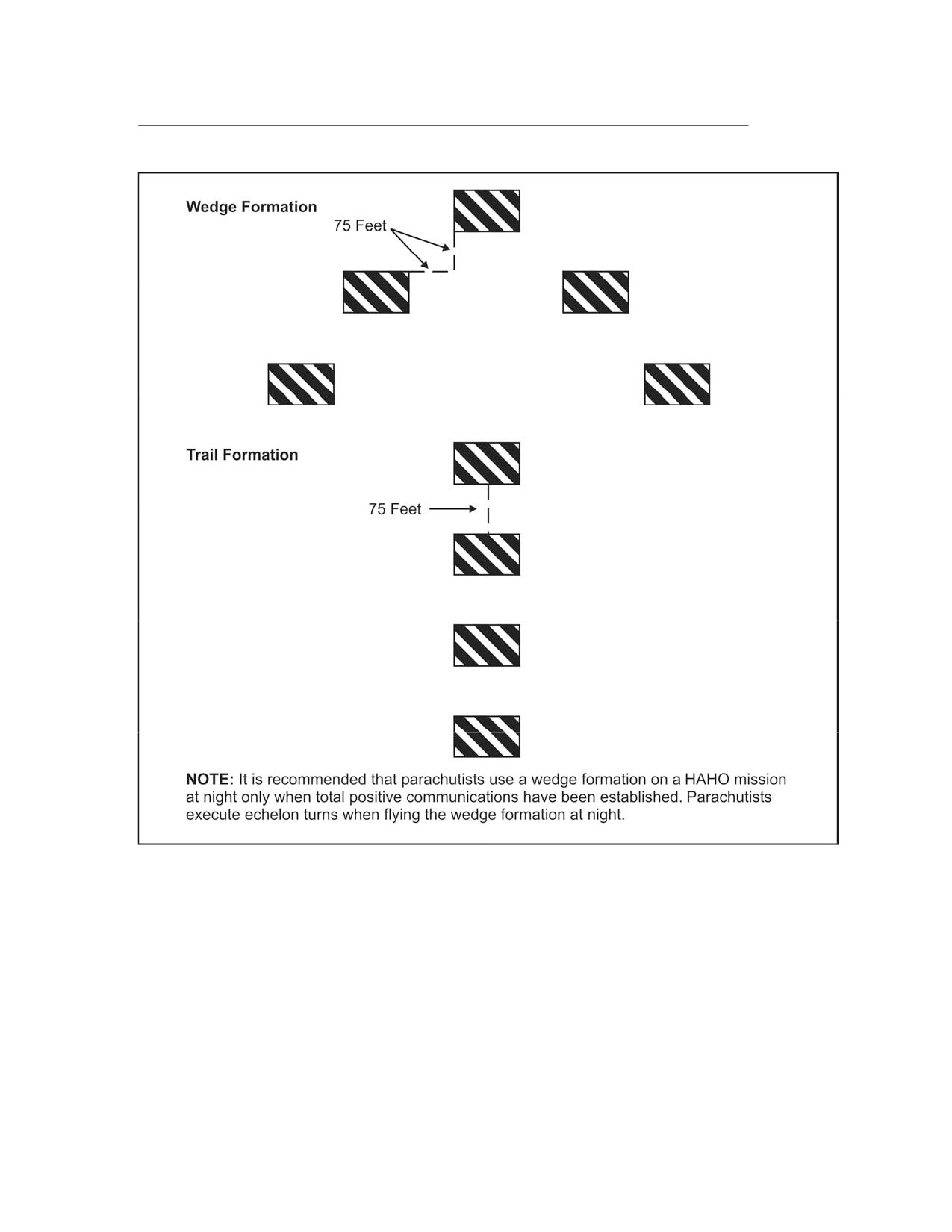
10-16. The “wedge” and the “trail” formations are the easiest to control and
to maintain in flight
(Figure
10-1, page
10-5). The group leader
(low
parachutist) has the primary responsibility for navigation. All parachutists
should have navigation aids when they jump.
10-17. Element members in the formation maintain relative airspeed and
position with the group leader. They do this maneuver by trimming their
canopies using the trim tabs on the front risers and by braking.
10-18. Under limited visibility conditions, such as when passing through a
cloud layer, each parachutist goes to half brakes and maintains the compass
heading until he regains visual contact with the formation or as stated in
unit SOP. Each parachutist must maintain altitude awareness and keep a
sharp lookout for other parachutists.
FINAL APPROACH AND LANDING
10-19. The group leader initiates the landing pattern at about 1,000 feet
AGL in the landing area. Each parachutist removes any trim tab settings to
prevent injury on landing from the increased forward speed.
10-20. The landings are staggered to avoid the turbulence directly above and
to the rear of the other ram-air canopies. Each parachutist prepares to do a
PLF should visibility prevent him from seeing the ground.
LIMITED-VISIBILITY OPERATIONS
10-21. MFF infiltrations during periods of limited visibility (adverse weather
or darkness) have a higher chance of success than strictly daylight
operations. Limited-visibility infiltrations offer surprise and increased
security due to reduced enemy observation capability. Limited-visibility
operations require a high degree of skill and individual discipline. A well-
rehearsed tactical plan executed by personnel proficient in MFF skills is
critical to success.
10-4
FM 3-05.211/MCWP 3-15.6/NAVSEA SS400-AG-MMO-010/AFMAN 11-411(I)
6 April 2005
FM 3-05.211
Figure 10-1. Assembly Flight Formations
ADVERSE WEATHER
10-22. Foggy, overcast, or mostly cloudy conditions effectively prevent
observation from the ground. However, adverse weather conditions present
special problems for the MFF parachutist. High winds and precipitation can
degrade canopy performance and make control difficult. Entering clouds may
cause disorientation and lead to detachment separation under canopy, free-
fall collisions, or canopy entanglements. The loss of depth perception due to
ground fog, smoke, or haze may prevent the parachutist from executing a
proper landing.
10-23. In free fall, the parachutist stops all maneuvering upon entering a
cloud. He activates the main parachute at the designated altitude, even if he
6 April 2005 FM 3-05.211/MCWP 3-15.6/NAVSEA SS400-AG-MMO-010/AFMAN 11-411(I)
10-5
FM 3-05.211
has not passed through the cloud layer. In clouds under canopy, he flies the
canopy at the half-brakes position to help prevent a mid-air collision during
limited visibility.
NIGHT OPERATIONS
10-24. Night MFF parachuting offers the same advantages as parachuting
during adverse weather, especially during the first quarter, new moon, and
last quarter moon phases. Night free-fall parachuting is the most
psychologically demanding of parachute operations. Extensive training must
take place at night. During this training, the parachutist develops confidence
in the equipment and his abilities.
10-25. Commanders must weigh the tactical situation when placing lighting
devices on the parachutist and on the parachute canopy for safety and control
during free fall and canopy flight. At a minimum, illumination devices are
used for altimeters and other instruments.
10-26. The use of oxygen dramatically improves night vision. Wearing the
oxygen mask until the landing is a recommended procedure. The commander
may consider using oxygen for all night free-fall operations, even if the
jumping altitude does not require it.
10-27. The jumpmaster can use night vision devices to help him while
spotting from the aircraft. The parachutist can also use them during canopy
flight as an aid to navigation and formation flying. He must have extensive
experience flying and landing with night vision goggles to overcome the loss
of depth perception. An additional factor to consider is that the night vision
goggles will seriously impair his night vision after using them for extended
periods.
WARNING
Night vision goggles should not be worn during free fall
because they restrict the parachutist’s ability to locate
the ripcord handle and the cutaway handle.
10-28. The lack of depth perception at night may prevent the parachutist
from executing a proper landing. The parachutist flies the parachute at the
half-brakes position and performs a PLF on contact with the ground. Various
night illumination techniques exist to identify parachutists, group leaders, or
subunit elements while under canopy. Some techniques involve attaching the
devices in the aircraft and some must be activated and placed on the canopy
before packing the parachute. Some of these techniques include rheostatic
electroluminescent riser lights, chemical lights on the parachutist’s body and
on the risers, and other electrical systems placed in pockets on the canopy’s
top skin.
10-6
FM 3-05.211/MCWP 3-15.6/NAVSEA SS400-AG-MMO-010/AFMAN 11-411(I)
6 April 2005
FM 3-05.211
Chapter 11
Military Free-Fall Drop Zone Operations
A DZ is any designated area where personnel and equipment may be
delivered by means of parachute or free drop. DZs for MFF operations are
selected during premission planning using all available intelligence
sources. DZs are selected by the ground unit commander and are located
where they can best support the ground tactical plan. The air mission
commander recommends approach headings and selects initial and
subsequent timing points based upon the routes to the DZ, terrain
obstructions, ease of DZ identification, and enemy defenses. Final
approval of selected DZs is a joint decision made by the ground unit
commander and the supporting air unit. This chapter outlines the basic
selection criteria, markings, and procedures used in support of MFF
operations, as well as the qualifications and responsibilities of key DZ
support personnel.
RESPONSIBILITIES
11-1. DZ size and selection are the joint responsibility of the air component
commander (ACC) or Commander, Air Force Special Operations Command
(COMAFSOC), and the supported force commander. The supporting air unit
is responsible for airdrop accuracy and safety of flight. The supported ground
unit is responsible for establishment, operation, safety on the DZ, and the
elimination or acceptance of ground hazards associated with the DZ. The
jumpmaster is responsible for accuracy when jumpmaster-directed release
procedures are used. AFI 13-217, Drop Zone and Landing Zone Operations,
has additional information.
DROP ZONE SELECTION CRITERIA
11-2. The joint force commander gives guidance on DZ size in operation
plans and operation orders. The ground unit commander selects the general
area of the DZ where it will best support the ground tactical plan. DZ
selection should be based on the following criteria:
• Mission supporting. Some of the main considerations when selecting a
DZ that supports the mission are—
Method of insertion (HALO or HAHO).
Elevation and drop altitude.
Location and capability of enemy forces.
Recognizability during limited visibility.
Distance from the objective area.
Terrain between the DZ and the objective area.
6 April 2005 FM 3-05.211/MCWP 3-15.6/NAVSEA SS400-AG-MMO-010/AFMAN 11-411(I)
11-1
FM 3-05.211
Built-up areas.
Time available for movement to the objective area.
Amount of equipment being carried.
Physical characteristics of available DZs and surrounding areas.
Relative number of obstacles in the area.
Proximity to alternate and contingency DZs.
•
Supporting aircraft. When considering the capabilities of the
supporting aircraft, parachutists take the following into account:
Type of aircraft.
Capabilities of the aircraft.
Skill level of the aircrew.
Availability of backup aircraft if the primary aircraft has
mechanical problems.
•
Infiltration route. The primary, alternate, and contingency DZs should
be selected so that the aircraft can overfly them in order without
making major course corrections. Air routes to and from the DZ should
not conflict with other air operations, restrictive terrain, restrictive
airspace, or fall within the enemy’s air defense umbrella.
•
Security. The DZ must provide security from the enemy threat. The DZ
should be located away from enemy positions and built-up areas.
•
Safety.
•
Weather and astronomical conditions. Seasonal weather and
astronomical conditions in the area must be considered. If conducting a
water jump, the tides, waves, currents, and sea state must be
considered.
•
Size. There is no minimum size for MFF DZs according to STANAG
3570 and AFI 13-217. The jumpmaster will determine the minimum
size of a MFF DZ based upon the experience and capabilities of the
parachutists. An area 50 meters by 100 meters is the recommended
minimum DZ size for training.
DROP ZONE SURVEYS
11-3. A DZ survey is required for all airdrop training missions involving
U.S. personnel and equipment. Completing the DZ survey process involves a
physical inspection of the DZ and documenting the DZ information on
AF Form 3823, Drop Zone Survey. The using unit completes the DZ survey
and forwards it through appropriate channels for review and approval. The
using unit is defined as the unit whose personnel or equipment are being
airdropped. The DZ survey review process involves the following steps:
• Step 1: The surveyor (AF Form 3823, item 4a) physically surveys the
DZ and completes the ground portion of AF Form
3823. Once
completed, AF Form 3823 is forwarded to the ground operations review
authority for approval (AF Form 3823, item 4c). The ground operations
review authority is normally the surveyor’s commander or designated
11-2
FM 3-05.211/MCWP 3-15.6/NAVSEA SS400-AG-MMO-010/AFMAN 11-411(I)
6 April 2005
FM 3-05.211
representative. This review ensures the AF Form 3823 is complete,
accurate, and meets the criteria for planned airborne operations.
• Step 2: Using unit forwards the survey to the USAF regional/wings
tactic office for a safety-of-flight review (AF Form 3823, item 4d). A
safety-of-flight review is completed by an airdrop-qualified pilot or
navigator on all DZ surveys. The purpose of a safety-of-flight review is
to ensure an aircraft can safely ingress and egress the DZ.
• Step
3: Regional/wings tactic office forwards the survey to the
appropriate operations group commander for review and final approval
(AF Form 3823, item 4e). This approval assures that the safety-of-flight
review has been conducted and the DZ is considered safe for specified
airdrop operations.
• Step 4: Once AF Form 3823, item 4e, has been completed the survey is
approved for use. Copies of the survey are forwarded to HQ
AMC/DOKT, 402 Scott Drive, Scott AFB, IL 62225-5320 for inclusion
into the Zone Availability Report (ZAR) database.
11-4. The ZAR is a comprehensive listing of approved assault zones
available for use by DOD. Use of the ZAR will expedite mission planning,
enhance safety, and avoid duplication of surveys. Information contained in
the ZAR does not replace the need for a completed DZ survey before
conducting airdrop operations. Completed surveys are available via facsimile
(FAX) on-demand system (also located at Scott Air Force Base [AFB], Illinois
[IL]) at DSN 576-2899 or commercial (618) 256-2899.
DROP ZONE PERSONNEL QUALIFICATIONS
AND RESPONSIBILITIES
11-5. The airborne commander designates key personnel for each airborne
operation. These key personnel are the primary jumpmaster (PJM), assistant
jumpmaster
(AJM), safety personnel, oxygen safety personnel
(when
required), departure airfield control officer (DACO), drop zone safety officer
(DZSO)/drop zone support team leader (DZSTL), and the malfunction officer
(MO). The qualifications and responsibilities of DZ support personnel are
listed in the paragraphs below. FM
3-21.220, Static Line Parachuting
Techniques and Training, includes further discussion of responsibilities
during airborne operations.
DROP ZONE SAFETY OFFICER/DROP ZONE SUPPORT TEAM LEADER
11-6. The DZSO/DZSTL must be a commissioned officer, warrant officer, or
noncommissioned officer (NCO) (E5 or above for proficiency jumps; E6 for
tactical jumps). The airborne commander makes sure the DZSO/DZSTL is a
current qualified static-line or MFF jumpmaster, has performed the duties of
assistant DZSO/DZSTL in support of an airborne operation involving
personnel or heavy equipment at least once, and is familiar with MFF
operations IAW this manual. The MFF jumpmaster briefs the DZSO/DZSTL
on the DZ markings, communications, and operating procedures that will
be used.
6 April 2005 FM 3-05.211/MCWP 3-15.6/NAVSEA SS400-AG-MMO-010/AFMAN 11-411(I)
11-3
FM 3-05.211
11-7. The DZSO/DZSTL has overall operational responsibility for the DZ.
He conducts a ground or aerial reconnaissance of the DZ before the drop to
make sure there are no safety hazards. Other responsibilities include—
• Establishing personal liaison with the USAF drop zone control officer
(DZCO) and STT, and discussing drop procedures (USAF troop carrier
aircraft).
• Clearing the DZ of unauthorized personnel and vehicles.
• Briefing and posting road guards, if required.
• Ensuring medical personnel are in position.
• Ensuring that the DZ is operational 1 hour before TOT.
• Establishing communications with the DACO not later than (NLT)
1 hour before TOT.
• Maintaining continuous surface wind readings NLT 12 minutes before
TOT. (Peacetime ground wind training limits will not exceed 18 knots.)
There are no winds aloft restrictions.
• Giving the pilot the ground winds and the CLEAR TO DROP or NO DROP
signal 2 minutes prior to the scheduled TOT.
NOTE: The CLEAR TO DROP or NO DROP signal that is relayed to the pilot 2
minutes prior to TOT does not indicate the final wind reading. A NO DROP
signal can be relayed to the pilot, any time afterwards, if surface winds
increase beyond the authorized limit.
• Receiving from the pilot the number of parachutists that have exited
the aircraft after each pass.
• Relaying strike reports to the aircraft pilot.
• During night drops, ensuring that all lights on or next to the DZ
(except for DZ markings) are turned off 15 minutes before drop time
and remain off during the jump.
• Directing the recovery crew to assist parachutists and to retrieve
equipment in trees.
• Assisting in medical evacuation of injured personnel from the DZ.
• Immediately after the completion of the jump, asking the pilot if any
personnel or equipment did not drop, and then relaying this
information to the airborne commander on the DZ.
• In the event a malfunction occurs, securing the equipment and
allowing no one to disturb it until the MO has completed his on-site
investigation. If an MO or an NCO is not physically located on the DZ,
the DZSO/DZSTL turns it over to an appropriate parachute
maintenance facility.
• Recording the necessary information for the parachute operation
report.
• Closing the DZ.
11-4
FM 3-05.211/MCWP 3-15.6/NAVSEA SS400-AG-MMO-010/AFMAN 11-411(I)
6 April 2005