FM 3-05.211 Special Forces Military Free-Fall Operations (APRIL 2005) - page 3
FM 3-05.211
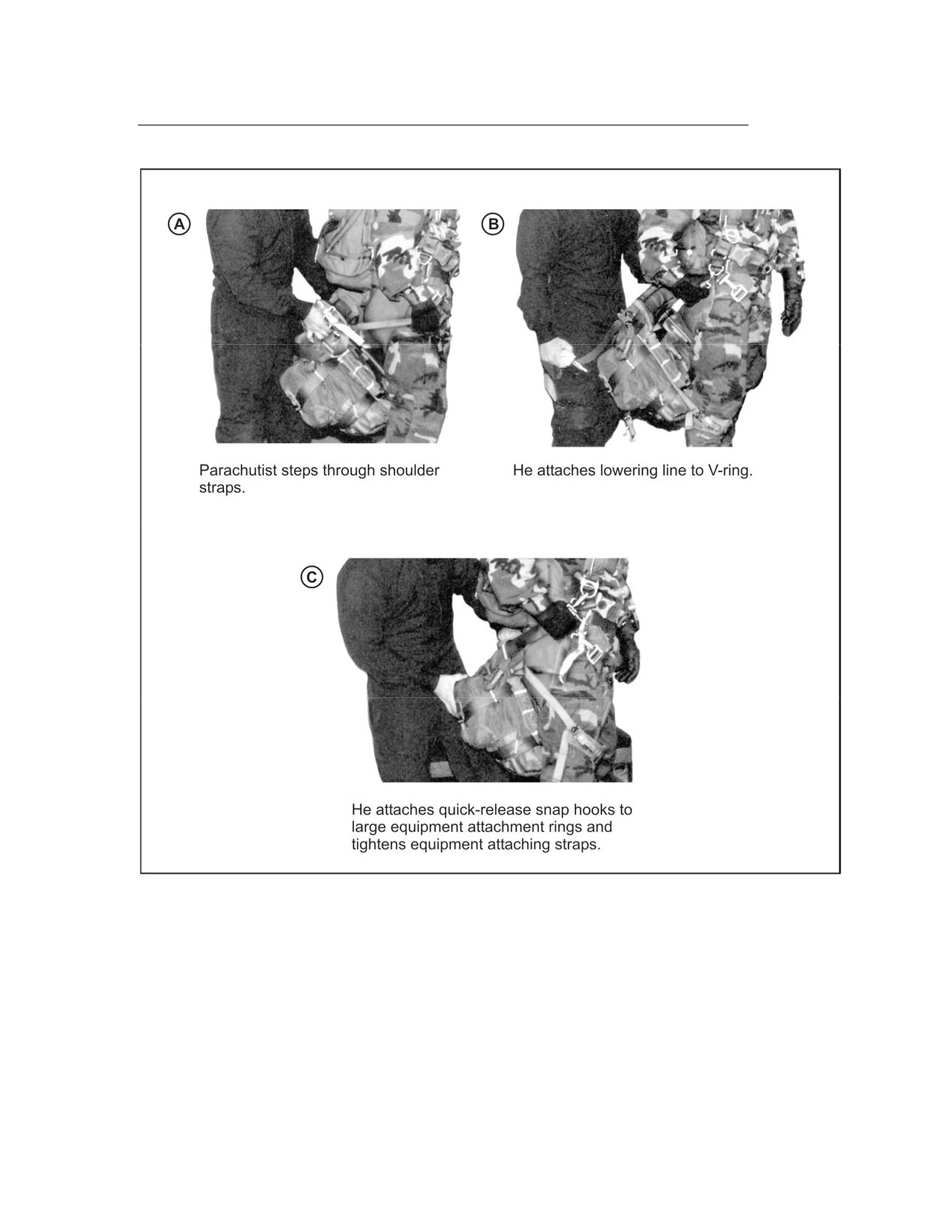
Figure 5-10. Attaching the Rear-Mounted Combat Pack
6 April 2005 FM 3-05.211/MCWP 3-15.6/NAVSEA SS400-AG-MMO-010/AFMAN 11-411(I)
5-13
FM 3-05.211
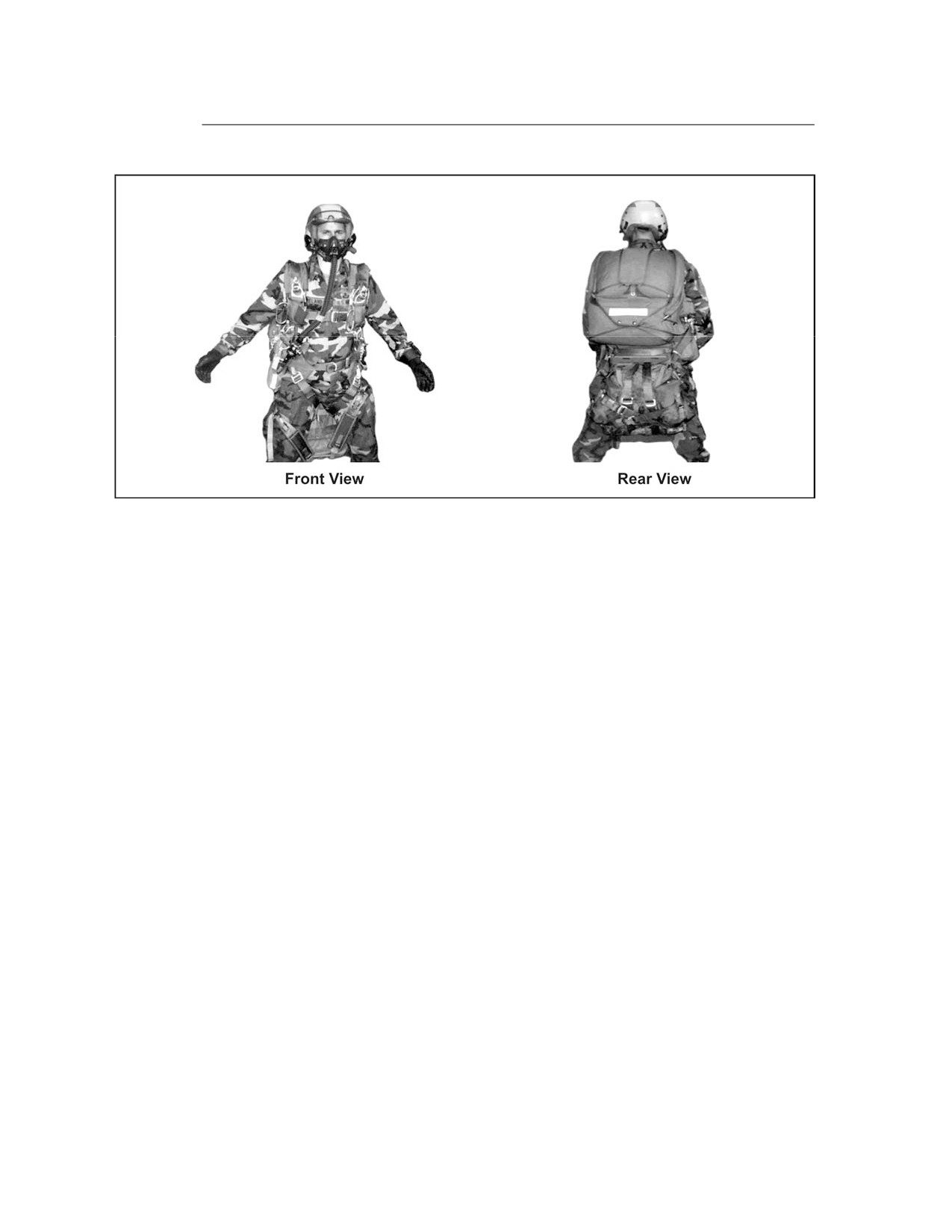
Figure 5-11. Parachutist With the Rear-Mounted Combat Pack
Attaching the Front-Mounted Combat Pack
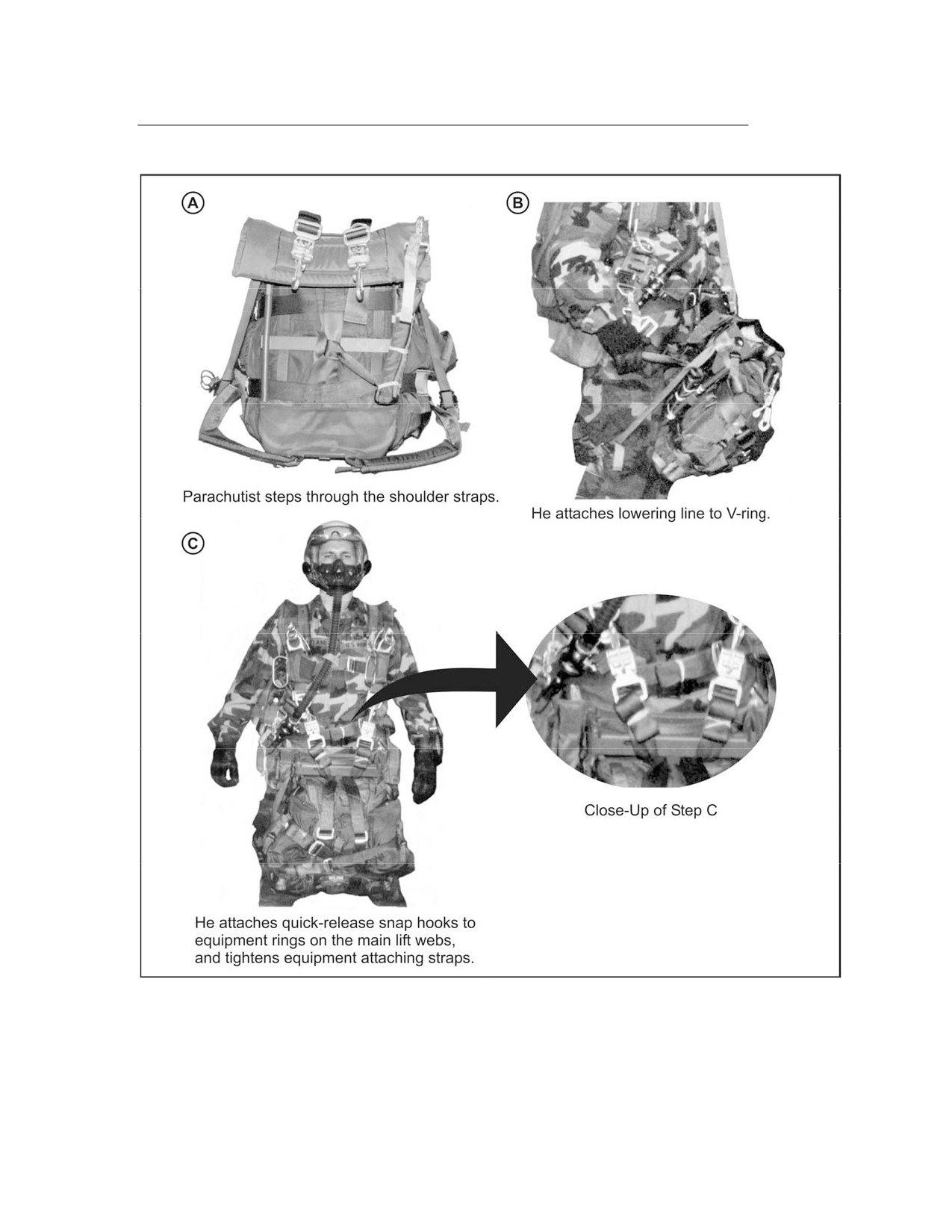
5-21. The parachutist—
• Loosens the shoulder straps.
• Faces the combat pack and steps through the shoulder straps, one leg
through each strap (Figure 5-12A, page 5-15).
• Attaches the lowering line to the right side lowering line attachment
V-ring on the parachute harness (Figure 5-9, page 5-12, and Figure
5-12B, page 5-15), ensuring it is routed between the rucksack or
combat pack shoulder strap and his body.
• Attaches the quick-release snap hooks to the equipment attachment
rings on the main lift webs (Figure 5-12C, page 5-15).
5-14
FM 3-05.211/MCWP 3-15.6/NAVSEA SS400-AG-MMO-010/AFMAN 11-411(I)
6 April 2005
FM 3-05.211
Figure 5-12. Attaching the Front-Mounted Combat Pack
Releasing the Combat Pack
5-22. After his canopy deploys and when he is clear of other
parachutists and has canopy control, the parachutist loosens the combat
pack’s shoulder straps and pulls them clear of the kit bag. At the same
6 April 2005 FM 3-05.211/MCWP 3-15.6/NAVSEA SS400-AG-MMO-010/AFMAN 11-411(I)
5-15
FM 3-05.211
time, he detaches the combat pack’s left side quick-release snap hook so
that the pack falls cleanly when released. When on his final approach
and 500 feet above the ground, he ensures that the ejector snap is still
connected, then releases the second quick-release snap hook
(the
parachutist may hang the rucksack from his feet). He ensures the
combat pack is fully lowered by 200 feet AGL. To jettison the combat
pack, he releases the lowering line’s quick-ejector snap, allowing the
pack to fall free.
WARNING
The parachutist lowers all rear-mounted combat
packs with frames to avoid injury upon landing.
NOTE: If the combat pack is lowered before 200 feet AGL or the final approach
and the parachutist has to make turns, the combat pack will start to swing and
the parachutist may impact the ground the same time as the pack.
USMC SINGLE-ACTION RELEASE PERSONAL EQUIPMENT
LOWERING SYSTEM
5-23. The Single-Action Release Personal Equipment Lowering System
(SARPELS) is a complete lowering system authorized for use by the USMC
for both static-line and MFF parachute operations. The SARPELS
was designed to provide a single-point release capability for personal
equipment carried by military parachutists. USMC TM
10121A-12&P,
Single-Action Release Personal Equipment Lowering System
(SARPELS),
provides further information.
5-24. The system consists of the SARPELS cargo carrier, two D-ring
attaching straps, two leg strap cable retainers with buckle and grommet, the
single-point release handle, a 15-foot static-line lowering line, and an 8-foot
MFF lowering line. The complete system weighs 9.5 pounds empty. The
SARPELS cargo carrier weighs 6 pounds empty and measures 22 inches long
by 18 inches wide by 24 inches high. The 8-foot MFF lowering line is made of
1-inch tubular nylon with a maximum capacity of 1,000 pounds.
Loading the SARPELS Cargo Carrier
5-25. The parachutist—
• Loads personal supplies and equipment in the SARPELS cargo
container in such a manner as to maintain the general shape of the
cargo container (Figure 5-13, page 5-17). He does not load more than
110 pounds into the cargo container.
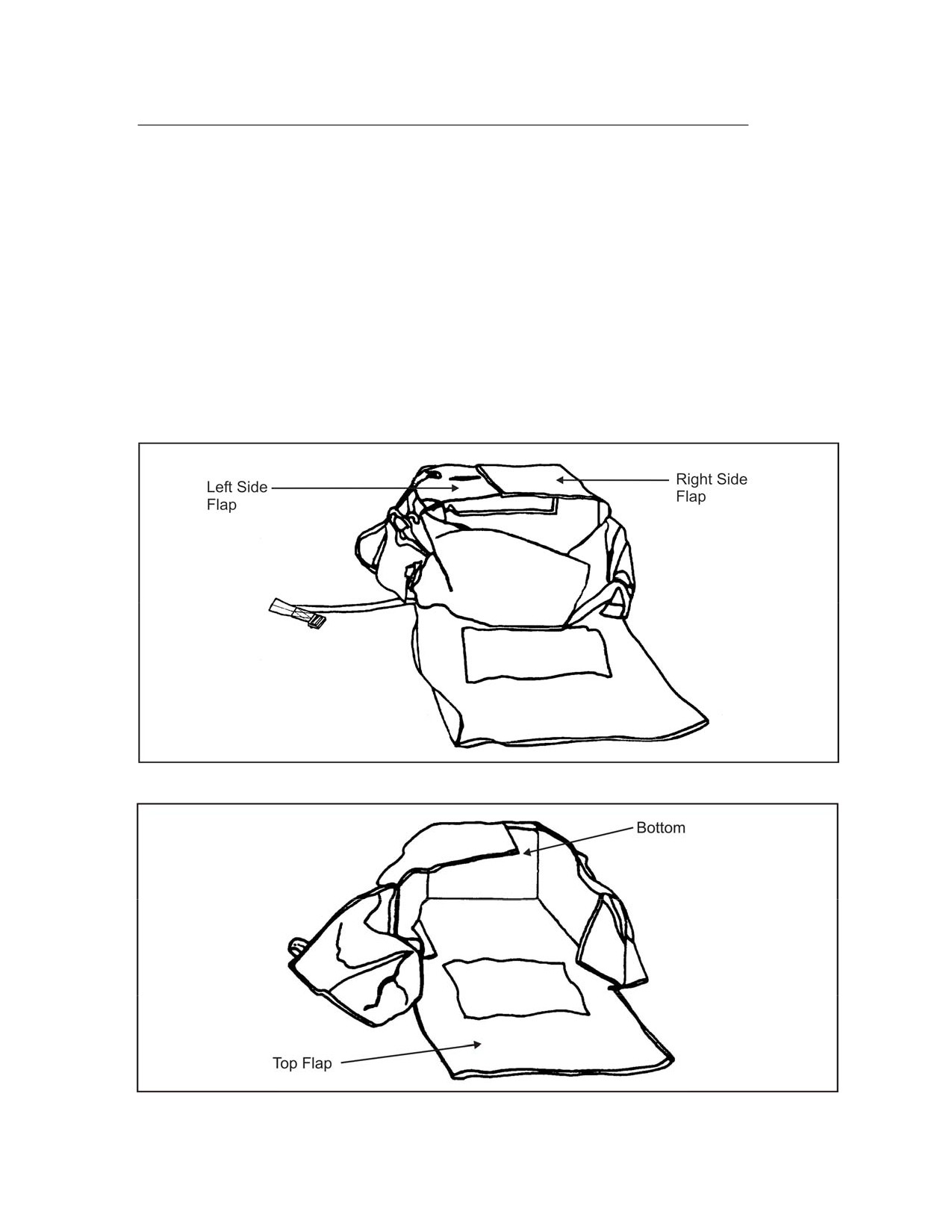
• Standing from the top of the SARPELS, folds over the left side flap and
then the right side flap (Figure 5-14, page 5-17).
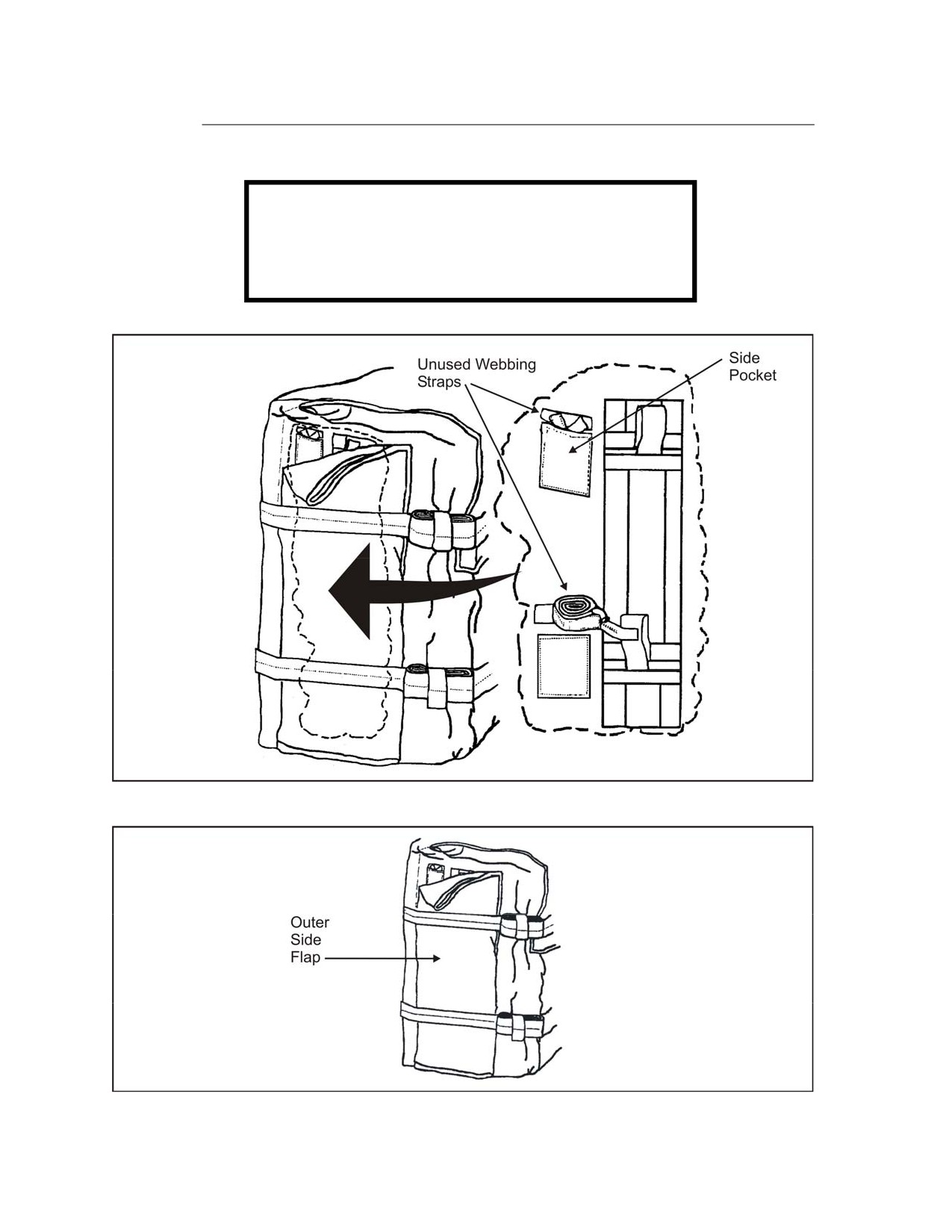
• Stows the unused webbing straps into the small side pockets on either
side of the SARPELS cargo carrier (Figure 5-15, page 5-18).
• Folds the outer side flaps in half and over the side pockets and straps
(Figure 5-16, page 5-18).
5-16
FM 3-05.211/MCWP 3-15.6/NAVSEA SS400-AG-MMO-010/AFMAN 11-411(I)
6 April 2005
FM 3-05.211
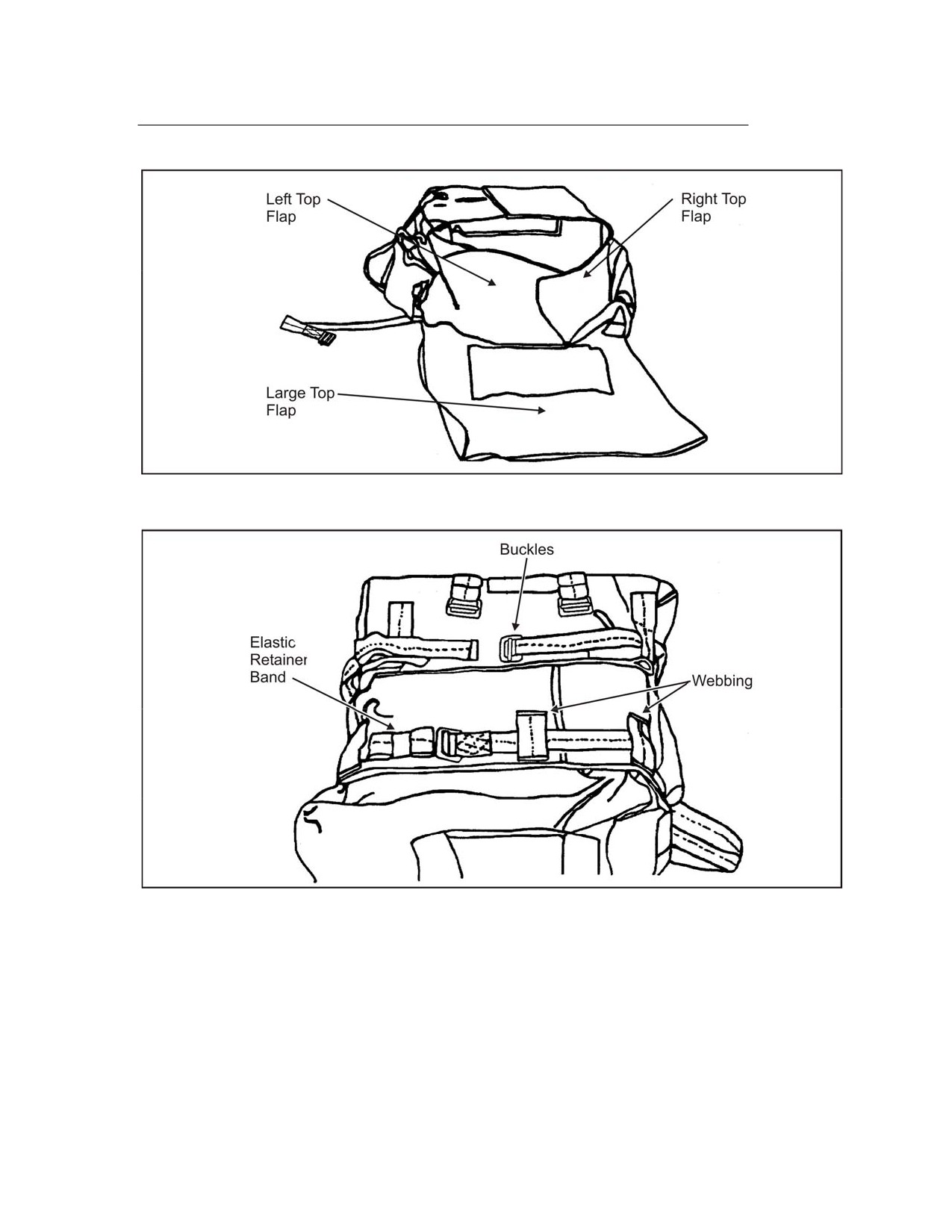
• Still standing at the top, folds the left top flap and then the right flap
(Figure 5-17, page 5-19).
• Folds over the large top flap (Figure 5-17).
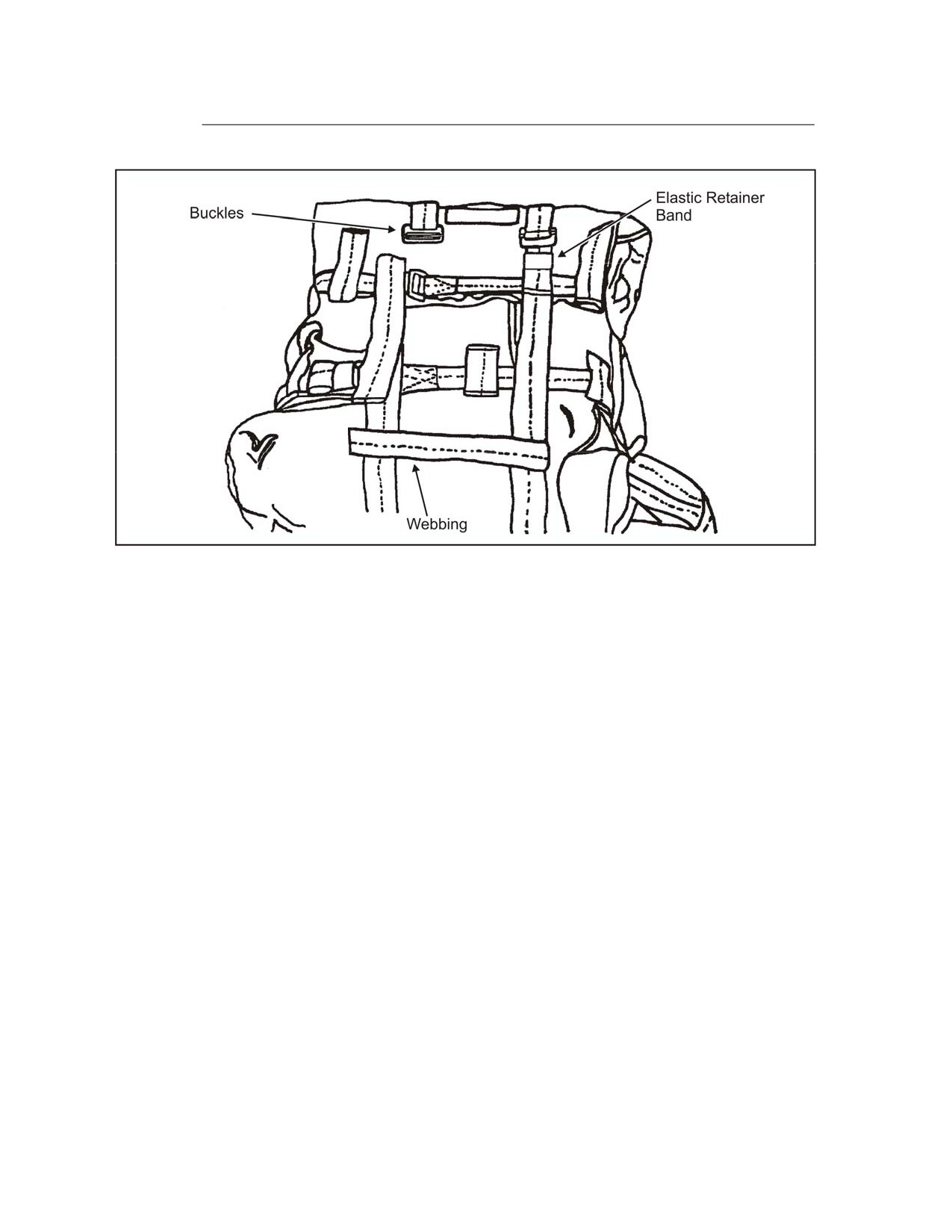
• Inserts the horizontal straps through the webbing and buckles (Figure
5-18, page 5-19). On the SARPELS model with three horizontal straps,
the top strap is optional, depending on the size of the cargo.
• Roll-folds the excess webbing of the horizontal straps and secures them
with the elastic retainer band.
• Inserts the vertical straps through the webbing and buckles (Figure
5-19, page 5-20).
• Roll-folds the excess webbing of the vertical straps and secures them
with the elastic retainer band.
Figure 5-13. Opened SARPELS Cargo Carrier
Figure 5-14. SARPELS With Folded Side Flaps
6 April 2005 FM 3-05.211/MCWP 3-15.6/NAVSEA SS400-AG-MMO-010/AFMAN 11-411(I)
5-17
FM 3-05.211
WARNING
Parachutists should not overload the SARPELS
cargo carrier. Personal injury may occur. The
maximum safe load is 110 pounds.
Figure 5-15. Stowage Pockets
Figure 5-16. Side Flap
5-18
FM 3-05.211/MCWP 3-15.6/NAVSEA SS400-AG-MMO-010/AFMAN 11-411(I)
6 April 2005
FM 3-05.211
Figure 5-17. Top Flaps
Figure 5-18. SARPELS With Secured Horizontal Straps
6 April 2005 FM 3-05.211/MCWP 3-15.6/NAVSEA SS400-AG-MMO-010/AFMAN 11-411(I)
5-19
FM 3-05.211
Figure 5-19. SARPELS With Secured Vertical Straps
Rigging the SARPELS Cargo Carrier
5-26. The parachutist—
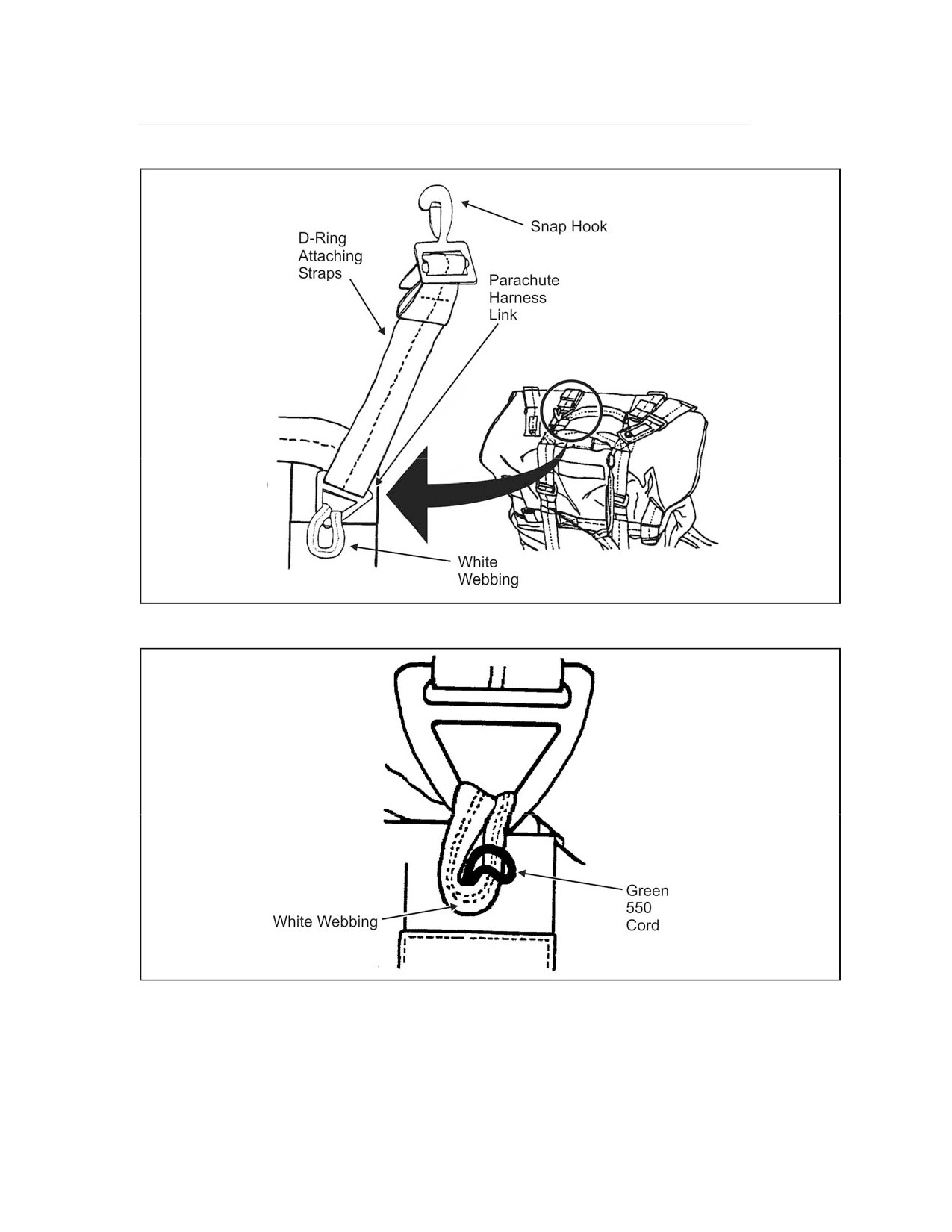
• Feeds the white webbing of the SARPELS cargo carrier through the
parachute harness link of the D-ring attaching straps (Figure 5-20,
page 5-21). He ensures that the opening to the snap hooks of the D-ring
attaching straps are facing down toward him.
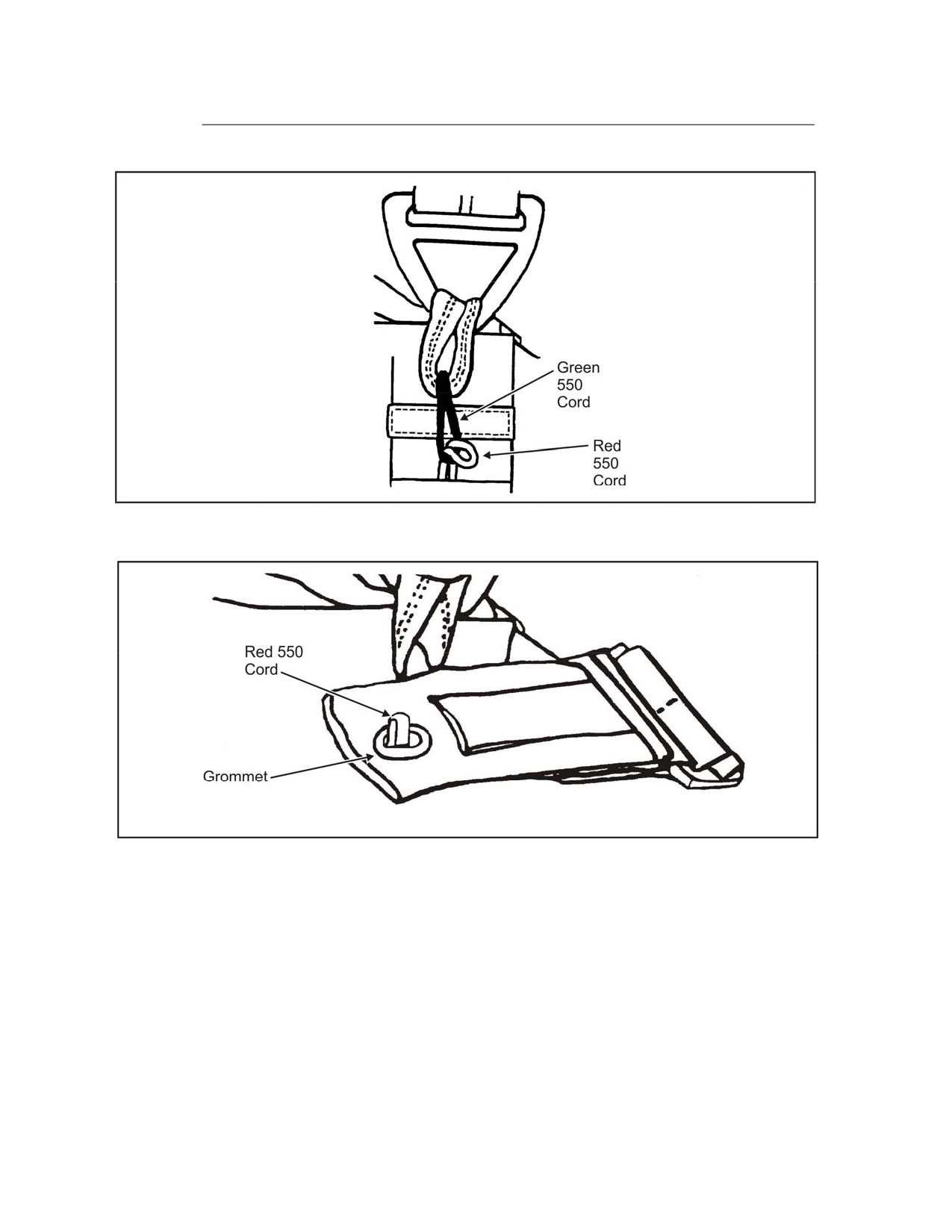
• Pulls the green 550 cord through the white webbing (Figure 5-21,
page 5-21).
• Pulls the red
550 cord through the green 550 cord (Figure 5-22,
page 5-22).
• Pulls the red 550 cord through the grommet of the leg strap (Figure
5-23, page 5-22).
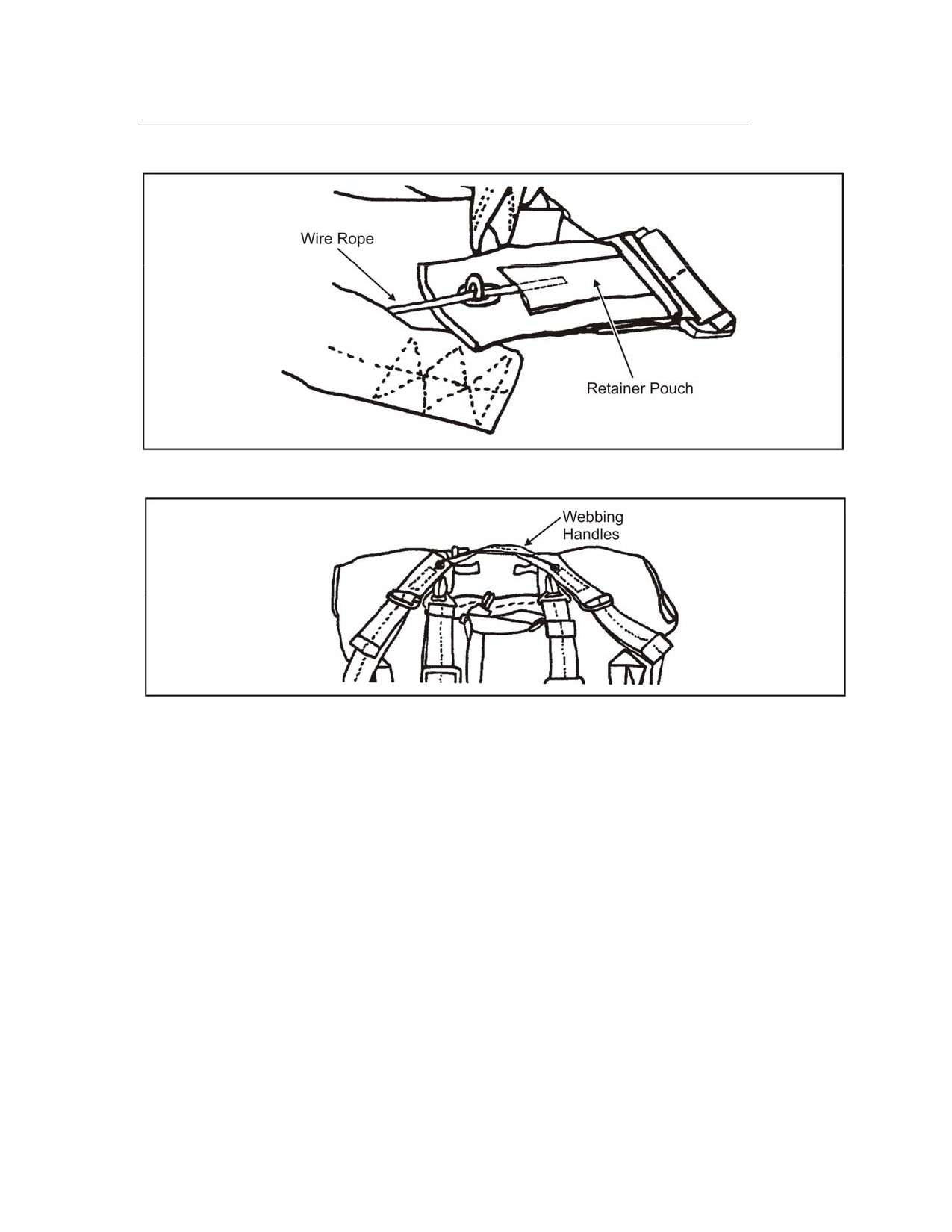
• Runs the wire rope of the single-action release handle between the
webbing handles (Figure 5-24, page 5-23). Then he runs the wire rope
through the red 550 cord and into the retaining pouch of the leg strap
cable retainers with buckle and grommet. NOTE: The dotted line
represents the wire rope hidden within the retainer pouch.
• Secures the single-point release strap with the Velcro within webbing
handles (Figure 5-25, page 5-23).
5-20
FM 3-05.211/MCWP 3-15.6/NAVSEA SS400-AG-MMO-010/AFMAN 11-411(I)
6 April 2005
FM 3-05.211
Figure 5-20. Inserting the White Webbing Through the Parachute Harness Link
Figure 5-21. Inserting the Green 550 Cord Through the White Webbing
6 April 2005 FM 3-05.211/MCWP 3-15.6/NAVSEA SS400-AG-MMO-010/AFMAN 11-411(I)
5-21
FM 3-05.211
Figure 5-22. Inserting the Red 550 Cord Through the Green 550 Cord
Figure 5-23. Inserting the Red 550 Cord Through the Grommet
5-22
FM 3-05.211/MCWP 3-15.6/NAVSEA SS400-AG-MMO-010/AFMAN 11-411(I)
6 April 2005
FM 3-05.211
Figure 5-24. Leg Strap Cable Retainer With Buckle and Grommet
Figure 5-25. SARPELS Release Assembly
Installing the 8-Foot Military Free-Fall Lowering Line
5-27. The parachutist—
• Uses the
8-foot-long lowering line for MFF operations using a
RAPS (MC-5).
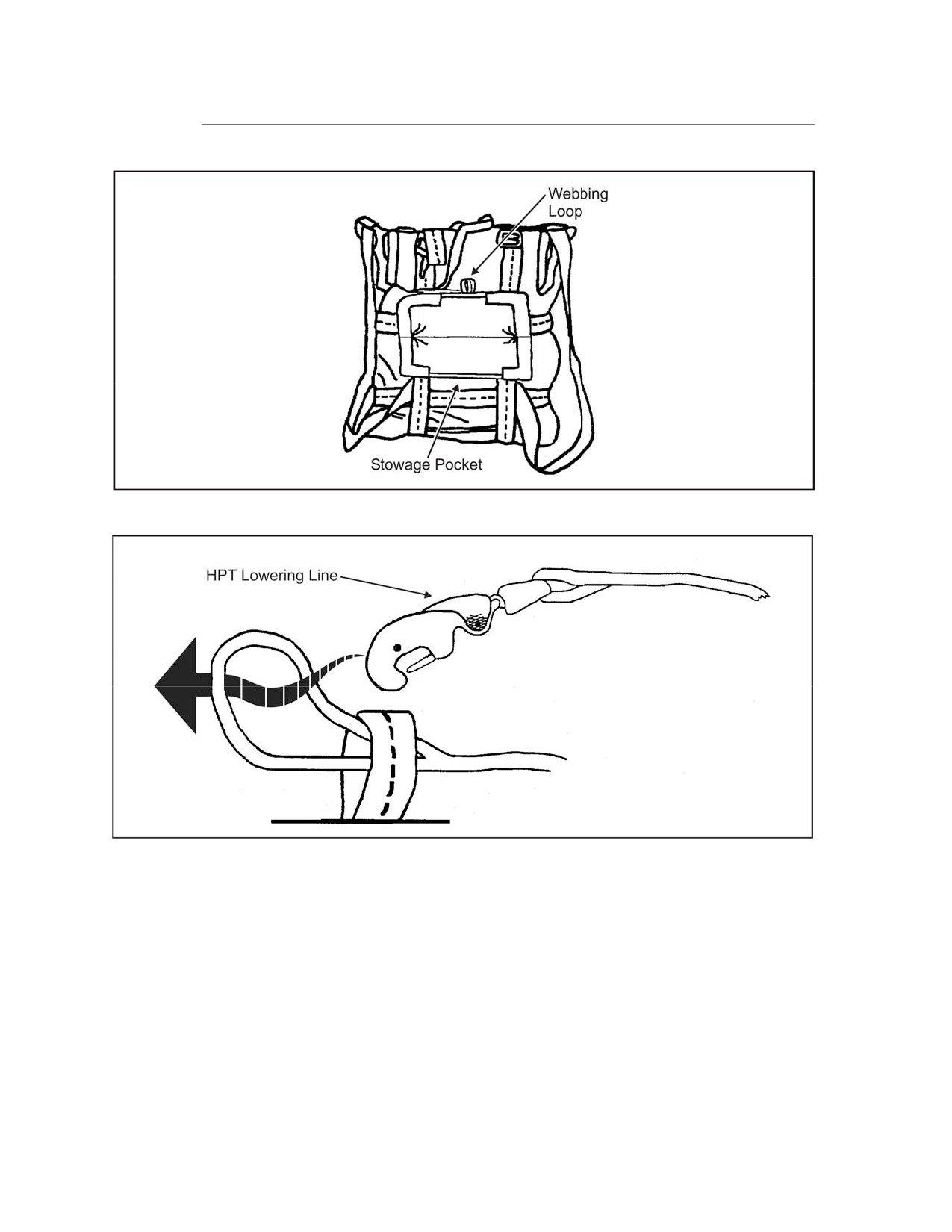
• Attaches the lowering line through the sewn webbing loop on the
backside of the SARPELS carrier at the top of the stowage pocket
(Figure 5-26, page 5-24).
• Feeds the sewn loop of the lowering line through the sewn loop on the
cargo carrier.
• Inserts the quick-ejector snap through the sewn loop of the lowering
line (Figure 5-27, page 5-24).
• Pulls the entire lowering line through the loop and cinches it down.
• S-folds the excess lowering line, secures it with an elastic retainer
band, and places it in the stowage pocket.
• Closes the stowage pocket with the Velcro.
6 April 2005 FM 3-05.211/MCWP 3-15.6/NAVSEA SS400-AG-MMO-010/AFMAN 11-411(I)
5-23
FM 3-05.211
Figure 5-26. Stowage Pocket With 8-Foot Lowering Line
Figure 5-27. Securing the 8-Foot Lowering Line to the Cargo Carrier
Mounting the SARPELS Cargo Container
5-28. The parachutist—
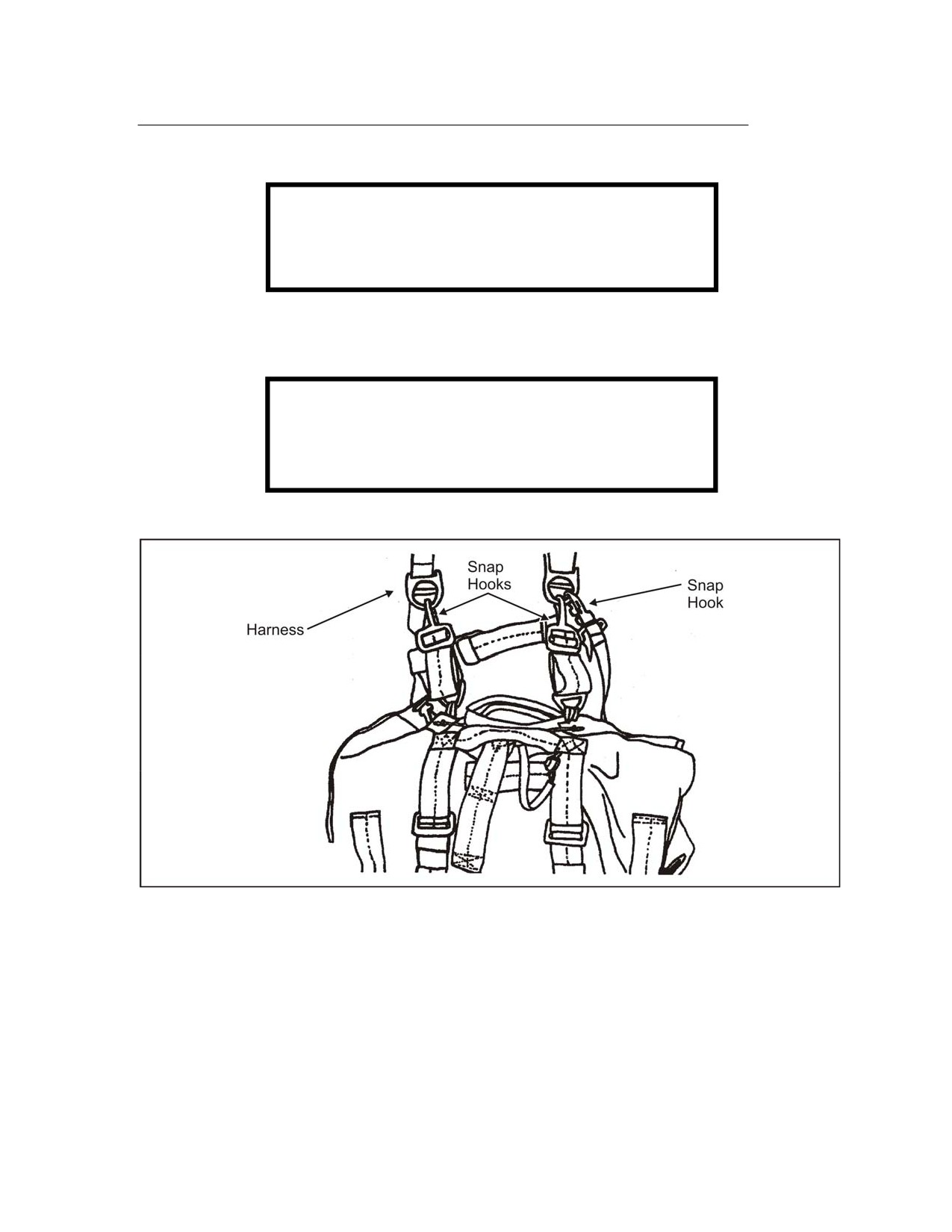
• Mounts the SARPELS cargo container to the large equipment
attachment rings on the parachute harness using the snap hook of the
D-ring attaching straps (Figure 5-28, page 5-25).
• Attaches the quick-ejector snap of the lowering line to the large
equipment attachment rings on the parachute harness.
• Ensures the SARPELS cargo carrier is securely in place and is
attached by the appropriate lowering line.
5-24
FM 3-05.211/MCWP 3-15.6/NAVSEA SS400-AG-MMO-010/AFMAN 11-411(I)
6 April 2005
FM 3-05.211
WARNING
Personal injury may occur if the wrong lowering
line is used.
• Once under canopy, and IAW unit SOP, pulls the white webbing of the
single-action release handle to lower the equipment load (Figure 5-29,
page 5-26).
WARNING
Parachutists must release the SARPELS cargo
carrier before landing to avoid personal injury.
Figure 5-28. Mounted SARPELS
6 April 2005 FM 3-05.211/MCWP 3-15.6/NAVSEA SS400-AG-MMO-010/AFMAN 11-411(I)
5-25
FM 3-05.211
HARNESS, SINGLE-POINT RELEASE
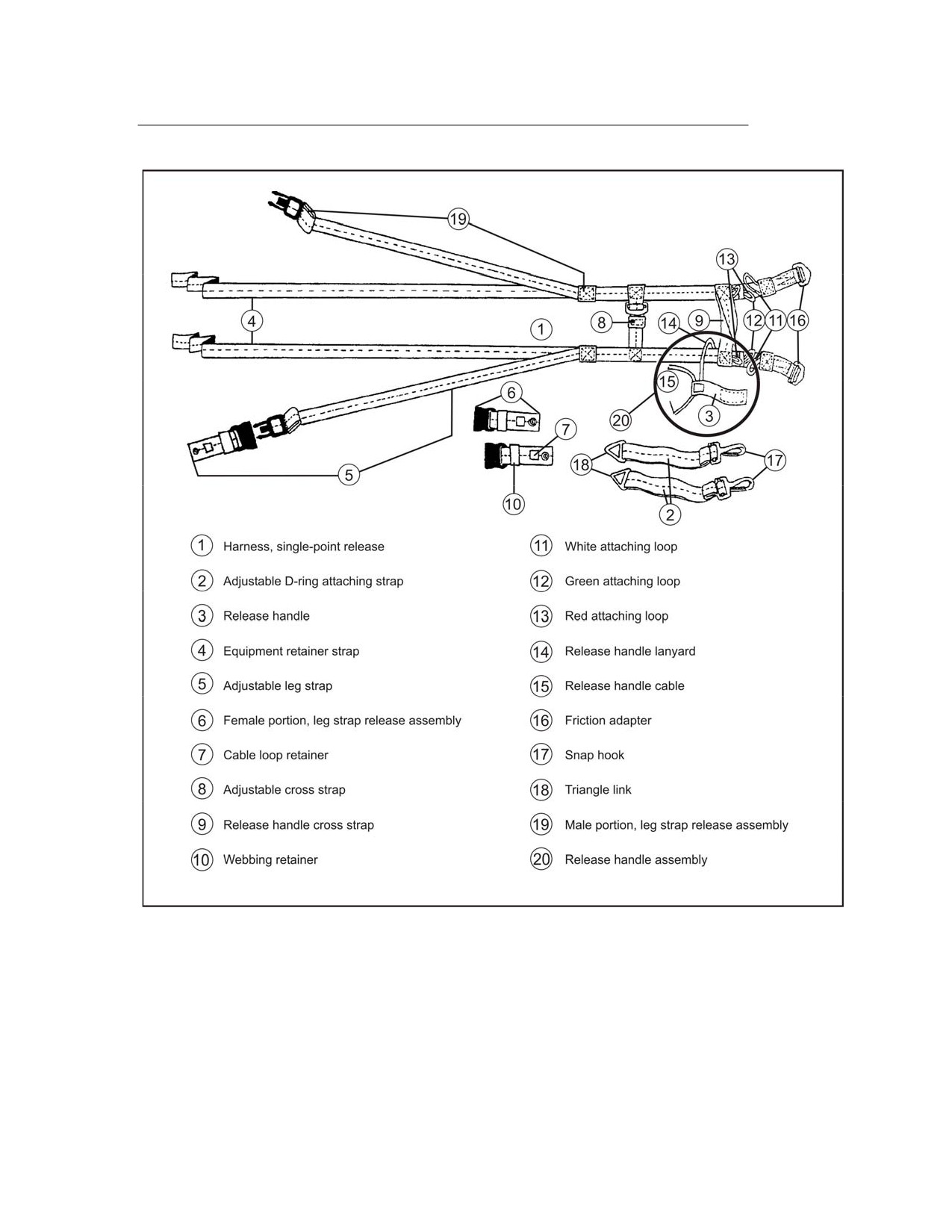
5-29. The harness, single-point release (HSPR) (Figure 5-30, page 5-27) is
an H-type design authorized for use by USMC MFF parachutists. It is made
of nylon webbing, has friction adapters to secure it around the load, and has
two adjustable D-ring attaching straps. To stabilize the pack to the
parachutist during movement in the aircraft, exit, free fall, and parachute
deployment, two adjustable leg straps secure the pack to the parachutist’s
right and left legs. The leg straps are equipped with the male portion of the
leg strap release assembly. The harness has a single-point release assembly
that simultaneously releases the load and leg straps from the parachutist
and parachute harness.
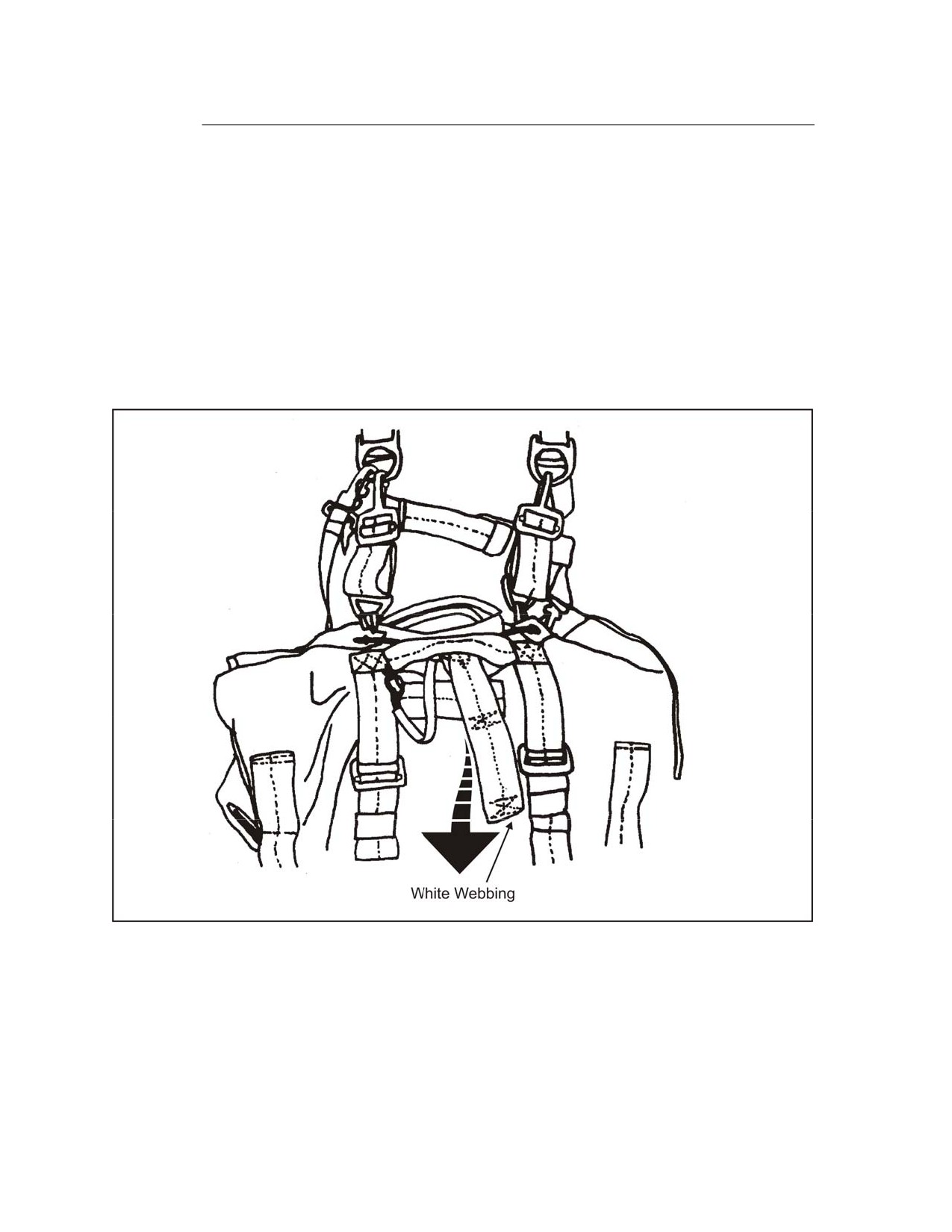
Figure 5-29. Single-Action Release Handle
5-26
FM 3-05.211/MCWP 3-15.6/NAVSEA SS400-AG-MMO-010/AFMAN 11-411(I)
6 April 2005
FM 3-05.211
Figure 5-30. Harness, Single-Point Release (NSN 1670-01-227-7992)
RIGGING THE ALL-PURPOSE, LIGHTWEIGHT, INDIVIDUAL,
CARRYING EQUIPMENT PACK WITH THE HSPR
5-30. Before attaching the HSPR to the all-purpose, lightweight, individual,
carrying equipment (ALICE) pack and Service-authorized combat pack, the
release handle and adjustable D-ring attaching straps are attached to the
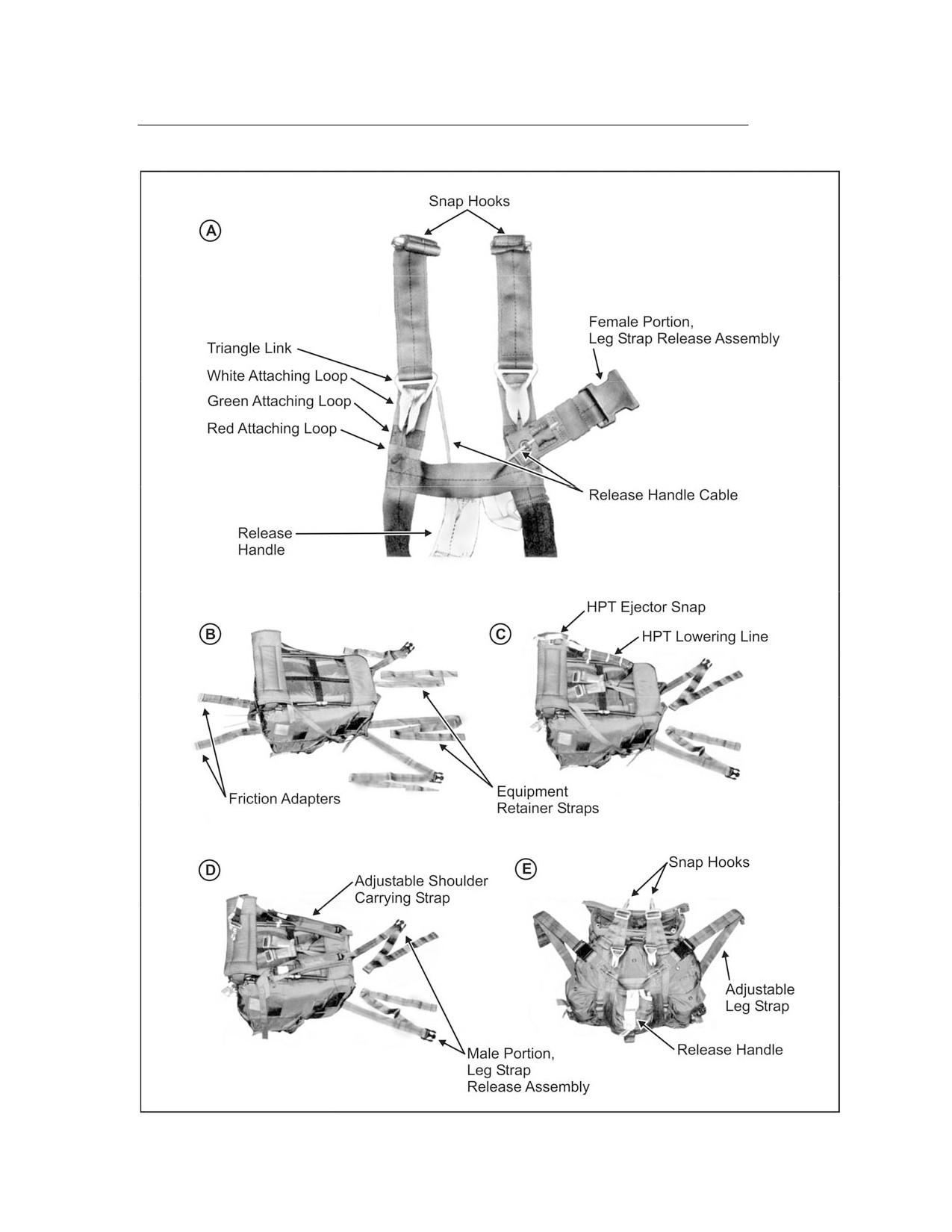
HSPR (Figure 5-31A, page 5-29).
6 April 2005 FM 3-05.211/MCWP 3-15.6/NAVSEA SS400-AG-MMO-010/AFMAN 11-411(I)
5-27
FM 3-05.211
5-31.
The parachutist—
•
Routes the two release handle cables between the two plies of the
release handle cross strap.
•
Attaches the pile tape of the release handle to the hook tape attaching
tab located between the plies of the release handle cross strap. He
ensures that the release handle lanyard is not misrouted.
•
Places the triangle links of the adjustable D-ring attaching straps on
top of the white attaching loops.
•
Routes the white attaching loop up through the triangle link.
•
Routes the green attaching loop up through the white attaching loop.
•
Routes the red attaching loop up through the green attaching loop.
•
Routes the red attaching loop through the grommet on the female portion
of the leg strap release assembly. He ensures that the cable loop retainer
on the female portion of the leg strap release assembly is facing up.
•
Routes the release handle cable through the red attaching loop and then
through the cable loop retainer. He repeats the process for the other strap.
•
Turns the harness over so that the adjustable D-ring attaching straps
are on the bottom.
•
Places the ALICE pack on top of the harness so that the middle outer
cargo pocket is placed between the release handle cross strap and the
adjustable cross strap.
•
Ensures the top of the pack is facing the equipment retainer straps
(Figure 5-31B, page 5-29).
•
Routes the equipment retainer straps underneath the top of the frame,
crosses them on the back of the pack to form an X, then routes them
underneath the frame and the backrest of the pack.
•
Routes the equipment retainer straps through their appropriate
friction adapters (a two- or three-finger quick release is optional; if
used, the quick-release loop is secured to the harness with tape or a
retainer band).
•
S-rolls the excess webbing and secures it with retainer bands or tape
(separates from the quick-release loop, if used).
•
Attaches the HPT lowering line in the same way as with the modified
H-harness for a front-mounted combat pack (Figure 5-31C). The 8-foot
HPT lowering line is normally used for MFF operations. Terrain
considerations may require use of a 15-foot HPT and is authorized.
NOTE: Oscillation under canopy is dramatically increased when using
the 15-foot HPT lowering line.
•
Tightens the shoulder straps (Figure 5-31D).
•
Routes the adjustable leg straps around the pack and attaches the
male portion of the leg strap release assembly to the female portion of
the leg strap release assembly, leaving it connected until it is time to
attach the combat pack to the parachutist (Figure 5-31E). HSPR leg
strap release (male portion) may be routed through the pack, between
the frame and pack, on shorter parachutists to allow tighter
attachment of the rucksack.
5-28
FM 3-05.211/MCWP 3-15.6/NAVSEA SS400-AG-MMO-010/AFMAN 11-411(I)
6 April 2005
FM 3-05.211
Figure 5-31. Rigging the HSPR
6 April 2005 FM 3-05.211/MCWP 3-15.6/NAVSEA SS400-AG-MMO-010/AFMAN 11-411(I)
5-29
FM 3-05.211
ATTACHING THE HSPR AND ALICE PACK TO THE PARACHUTIST
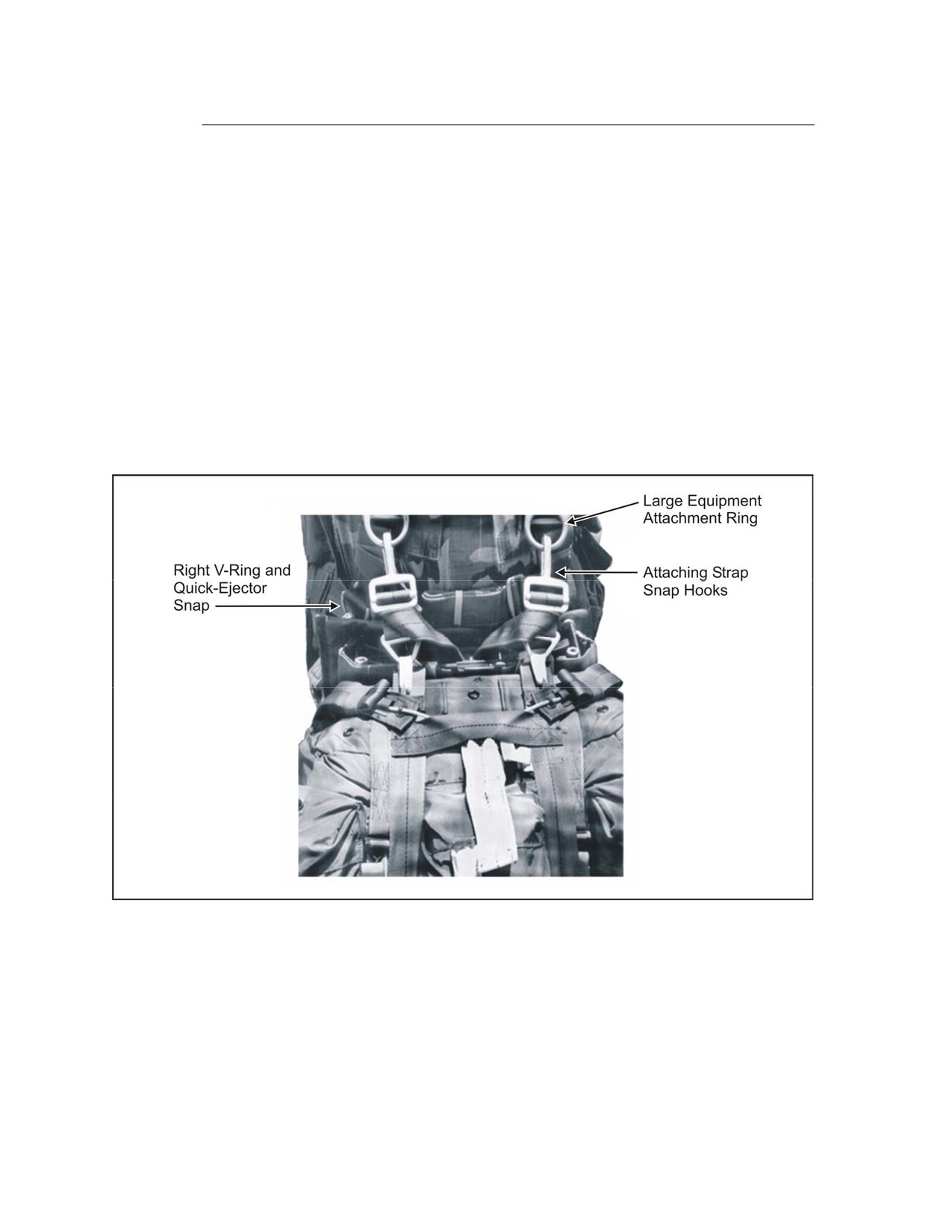
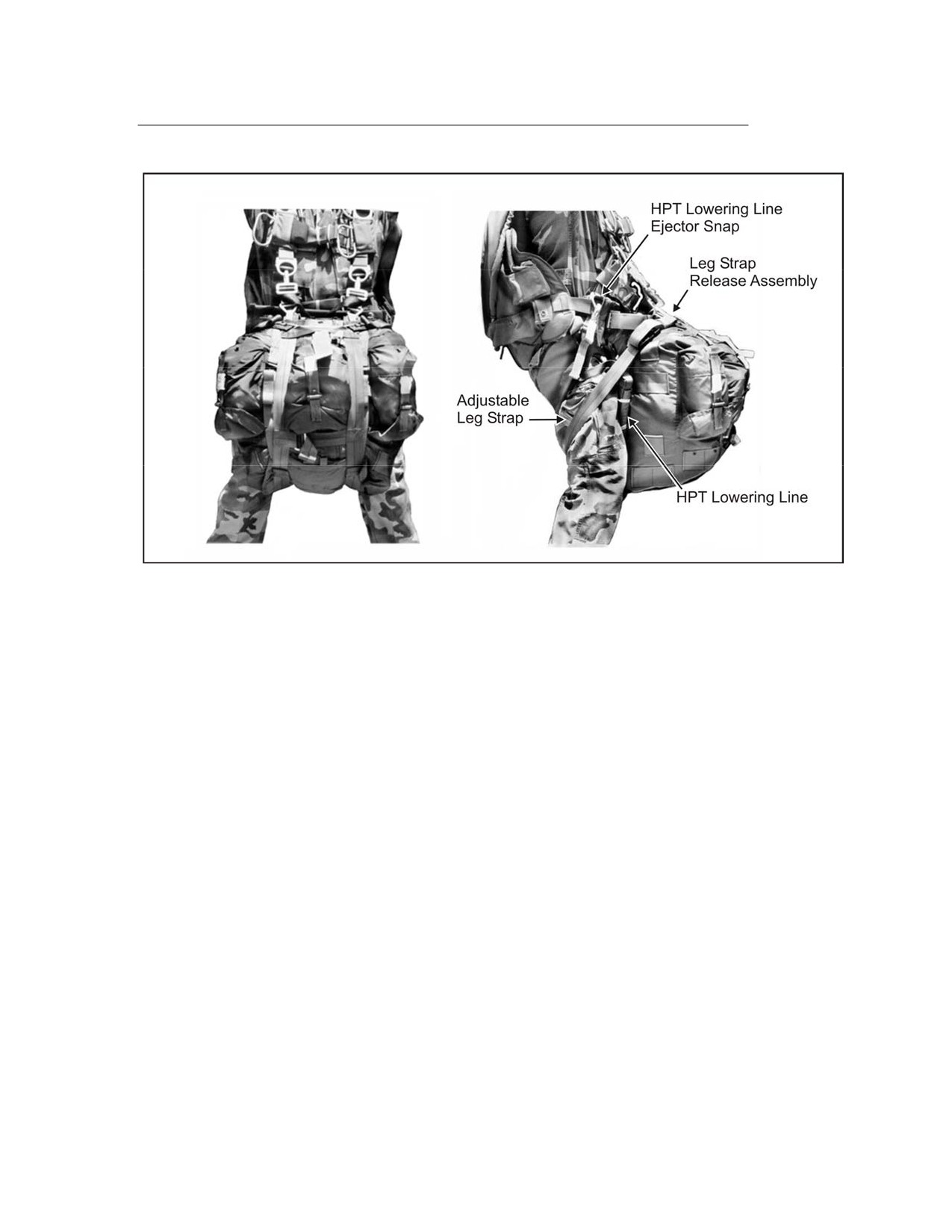
5-32. The buddy system is used to attach the HSPR to the parachutist. The
parachutist stands facing the HSPR-rigged ALICE pack and attaches the
ejector snap on the HPT lowering line to the right-side lowering line
attachment V-ring on the parachute harness. The buddy routes the lowering
line between the combat pack’s shoulder straps and the parachutist’s body.
The parachutist then grasps the harness by the two adjustable D-ring
attaching straps and secures the snap hooks to the large equipment
attachment rings on the main lift webs (Figure 5-32). The buddy routes the
adjustable leg straps around the parachutist’s legs and attaches the male
portion to the female portion of the leg strap release assembly. The
parachutist then pulls on the free-running ends of the adjustable D-ring
attaching straps and cinches the pack up to the large equipment attachment
rings. After this, the parachutist folds the excess webbing and secures it in
the webbing retainer (Figure 5-33, page 5-31).
Figure 5-32. Attaching the HSPR-Rigged Combat Pack
5-30
FM 3-05.211/MCWP 3-15.6/NAVSEA SS400-AG-MMO-010/AFMAN 11-411(I)
6 April 2005
FM 3-05.211
Figure 5-33. Parachutist With HSPR-Rigged Combat Pack
PARACHUTIST DROP BAG
5-33. The parachutist drop bag (PDB) is a fast, easy, and secure way of
carrying the parachutist’s rucksack and load-bearing equipment (LBE) in
free-fall or static-line operations. The bag opens and closes quickly so that the
equipment can be secured efficiently on the DZ. There are exterior pockets for
water and maps so that the parachutist does not have to get into his rucksack
on the aircraft. There is an integral 8-foot lowering line attached to the bag.
The bag is reversible with shoulder straps on both sides. The side with the
hardware for dropping is camouflage in color, allowing the parachutist to put
his parachute into it on the DZ for a hasty cache. The other side is dark gray,
which presents a visually lower profile so that equipment can be carried
through an airport. The following are recommended procedures for the use of
the PDB (Eagle Industries Jumper’s Kit Bag, Model JKB-JT).
5-34. The standard size of the PDB is medium; this size will allow most
parachutists to put a mission combat pack and LBE in the bag. The smallest
bag possible should be used so the straps can compress the load to prevent
the contents of the PDB from shifting.
LOADING THE DROP BAG
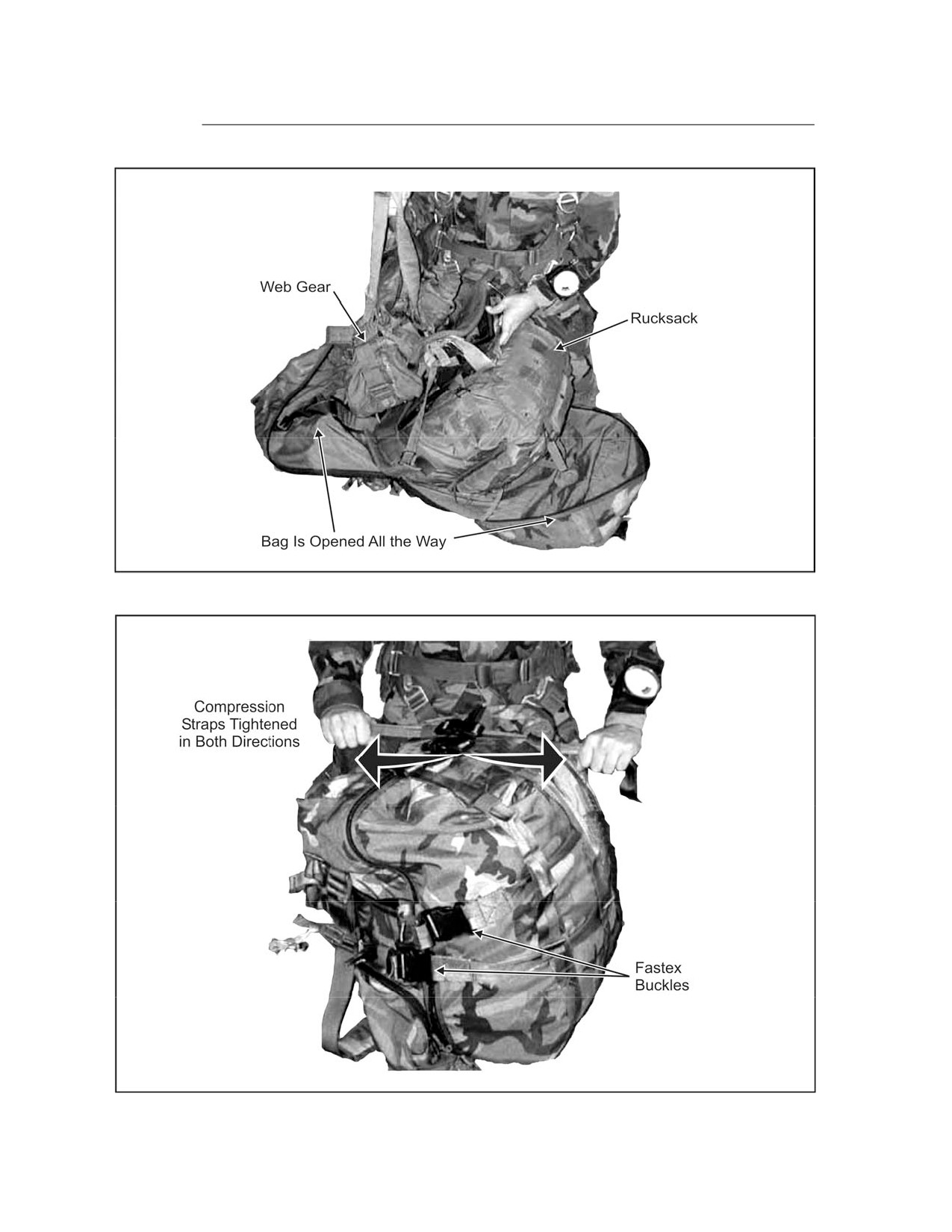
5-35. The parachutist opens the bag completely, forming an
“open
clamshell.” He places the rucksack and LBE on the open bag. The hip pad of
the rucksack should be against the top of the side facing the parachutist (as
the bag hangs on the harness). The parachutist then zips the bag shut and
connects and tightens the compression straps (Figures 5-34 and 5-35, page
5-32).
6 April 2005 FM 3-05.211/MCWP 3-15.6/NAVSEA SS400-AG-MMO-010/AFMAN 11-411(I)
5-31
FM 3-05.211
Figure 5-34. Loading the Drop Bag
Figure 5-35. Drop Bag Zipped Shut With Compression Straps Connected and Tightened
5-32
FM 3-05.211/MCWP 3-15.6/NAVSEA SS400-AG-MMO-010/AFMAN 11-411(I)
6 April 2005
FM 3-05.211
ATTACHING THE DROP BAG
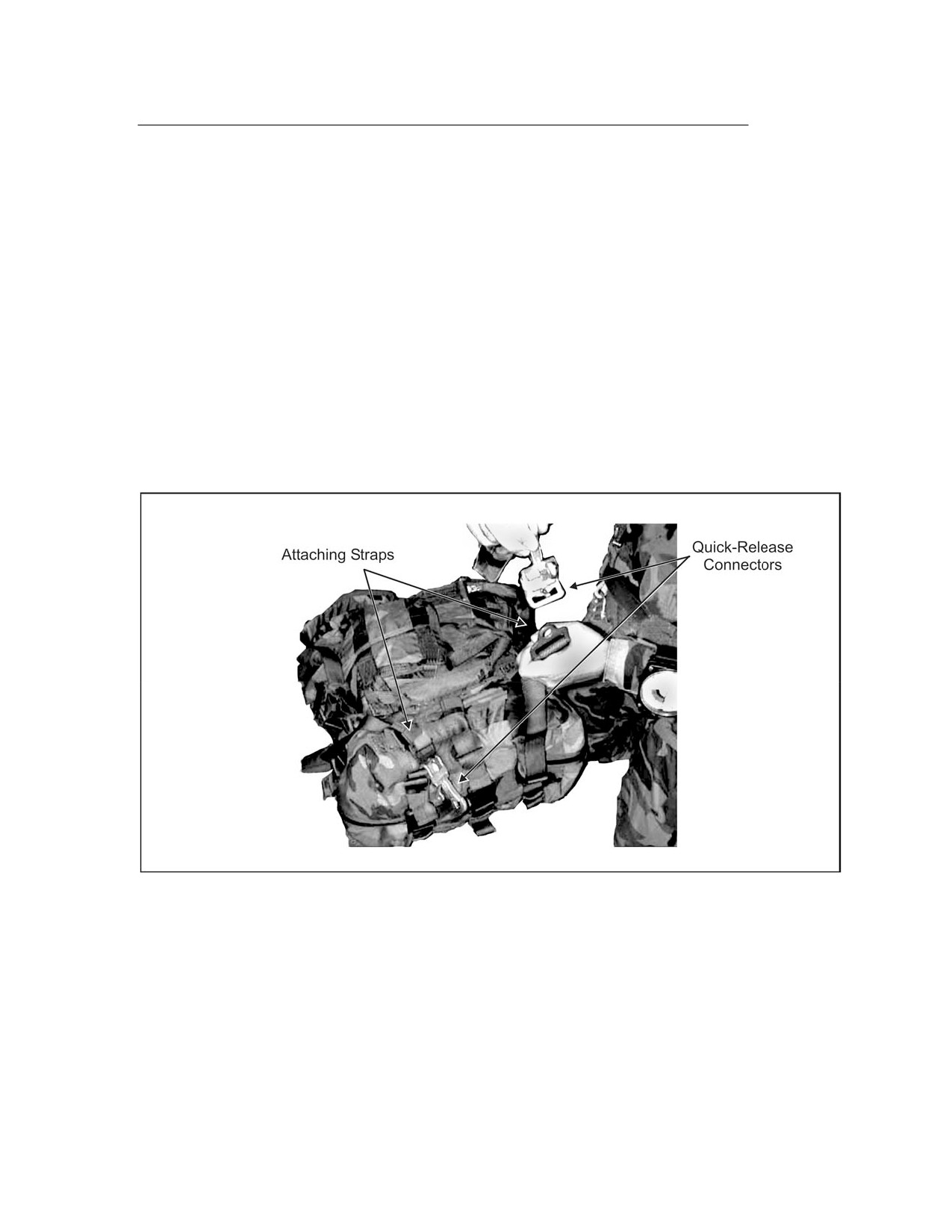
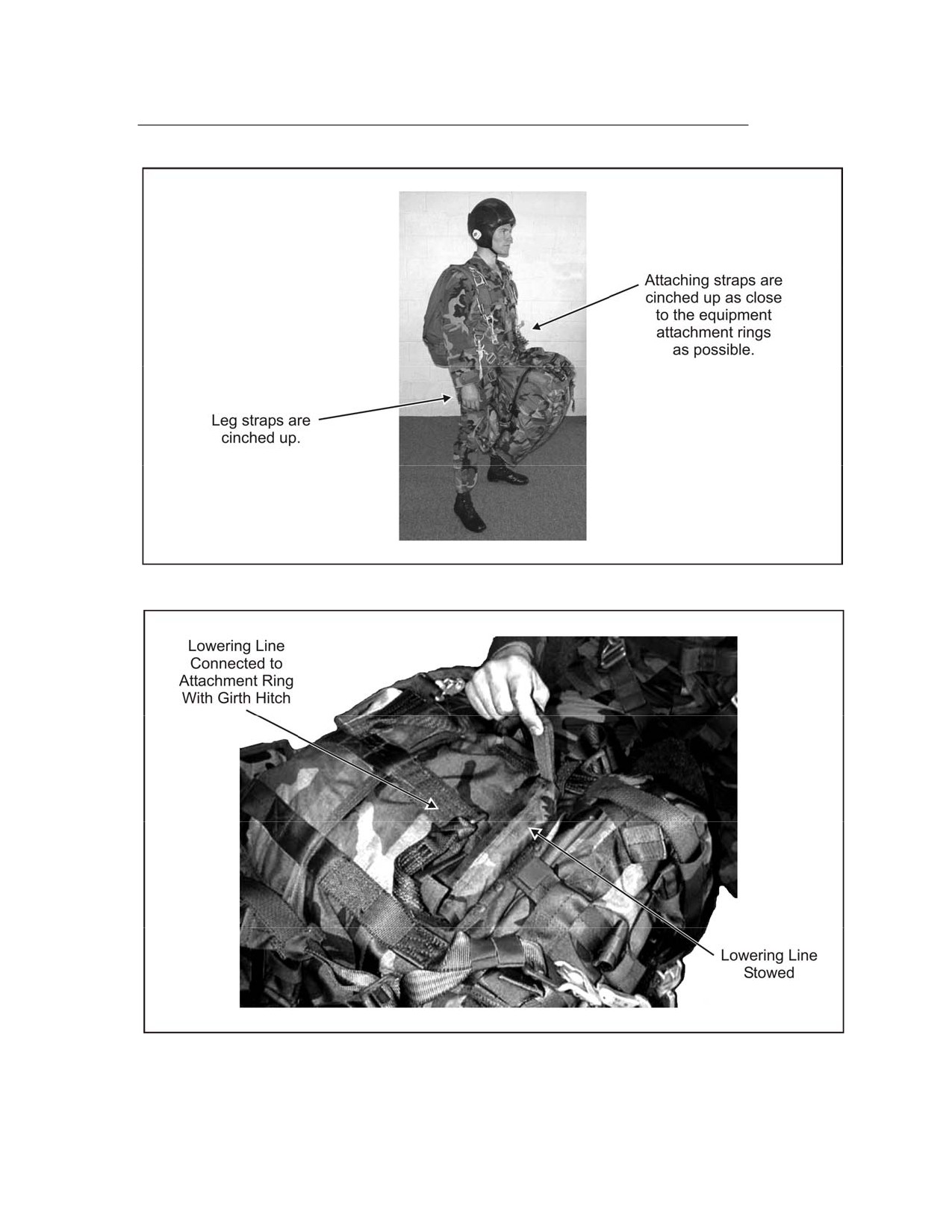
5-36. The PDB can be attached to the front or rear of the parachutist. The
PDB attaches to the parachutist by standard quick-release connectors
(Figure 5-36) found in any rigger facility. The equipment attachment straps
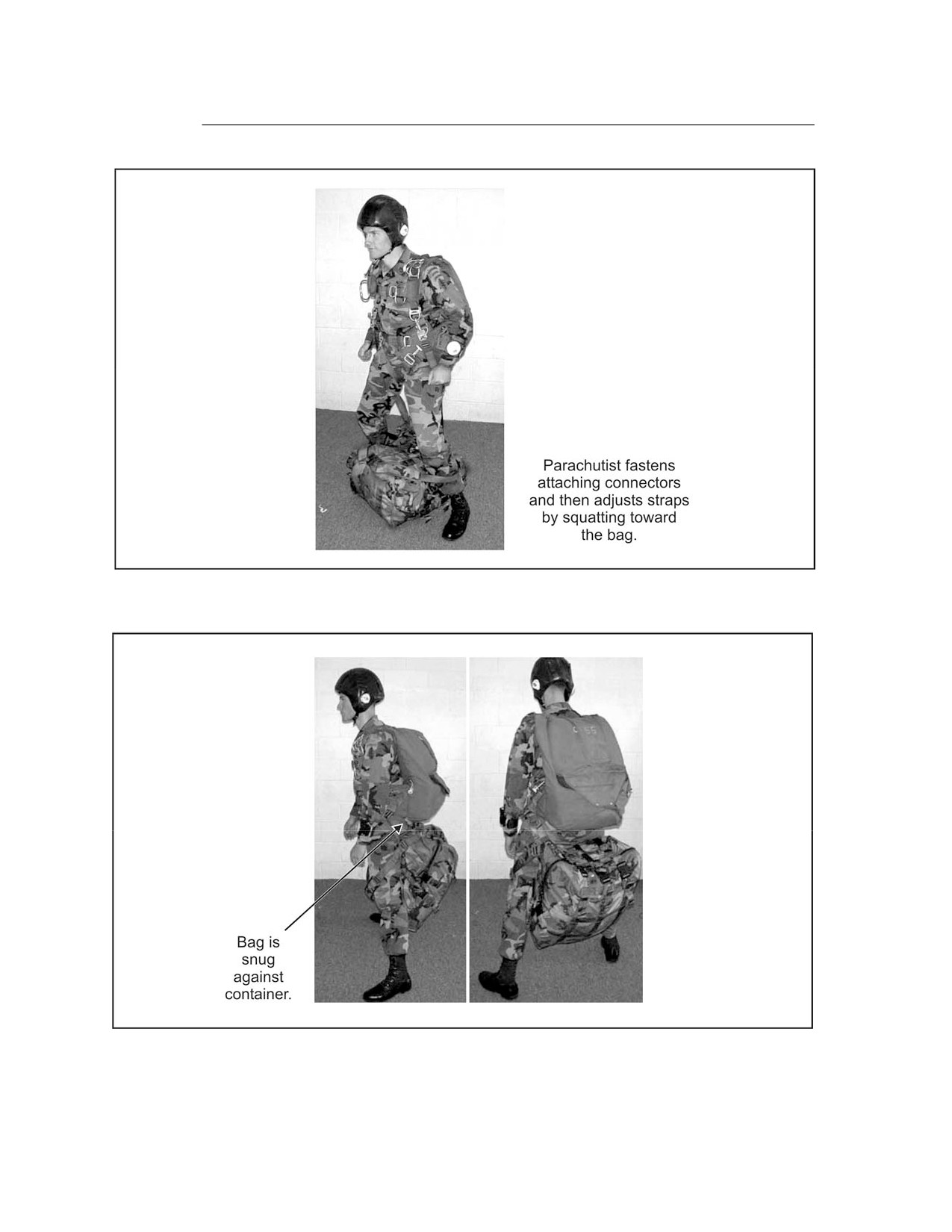
are long enough for the parachutist to connect the bag to his parachute
harness while the bag rests on the floor. The parachutist can tighten the
straps as he squats toward the bag (Figure 5-37, page 5-34). The bag should
be butted up against the bottom of the parachute container when jumping the
bag in the rear (Figure 5-38, page 5-34), and as close as possible to the
equipment attachment rings when jumping the bag in front (Figure 5-39,
page 5-35). The excess webbing on the attachment straps should be stowed in
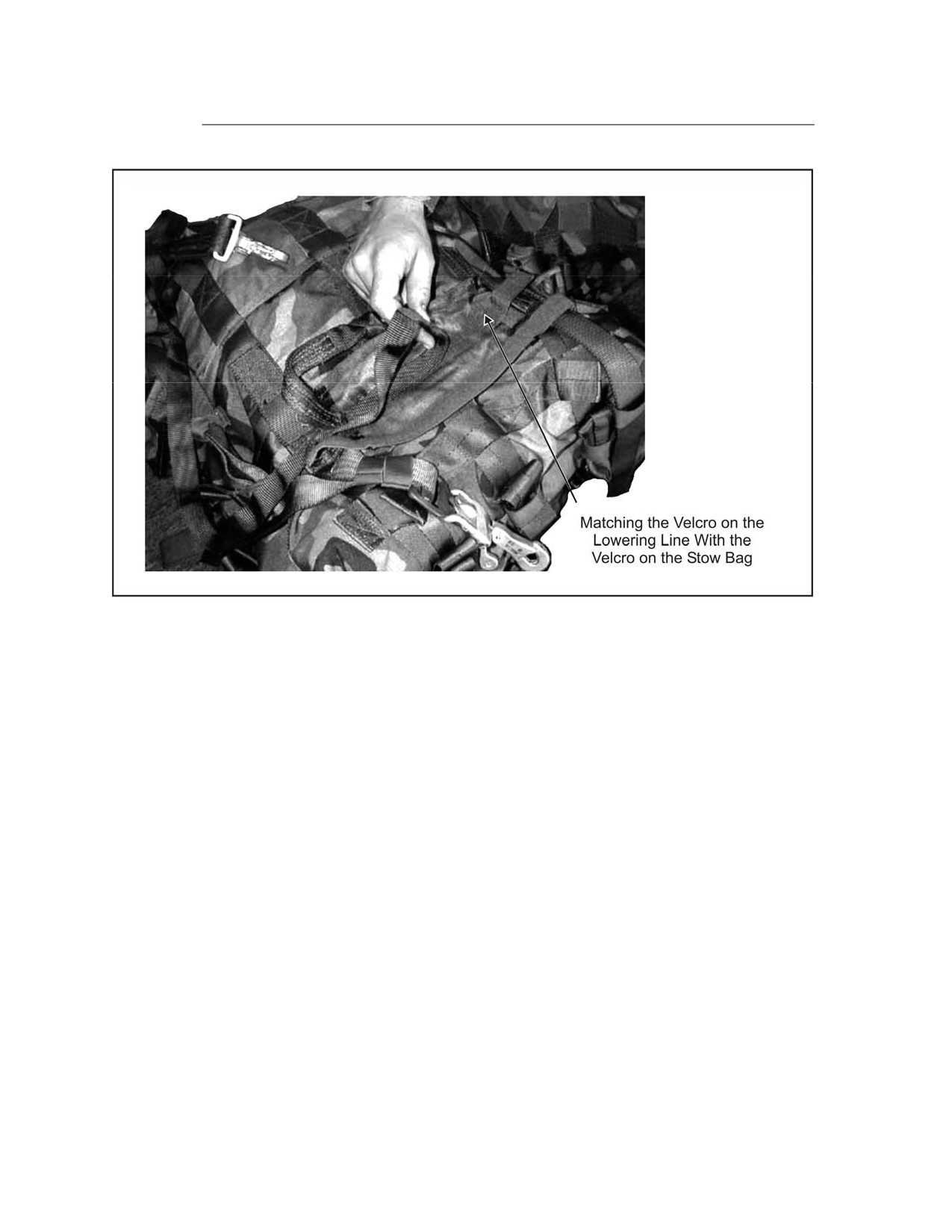
the elastic bands on the strap itself prior to jumping. The integral lowering
line is identical to that already used by parachutists. It attaches in the same
manner (Figure 5-40, page 5-35, and Figure 5-41, page 5-36). The integral
lowering line may also be girth hitched to a Stubi-85 and the equipment
lowering line V-ring to allow for quick derigging on the ground.
Figure 5-36. Drop Bag Attaches to the Parachutist by Standard Quick-Release Connectors
6 April 2005 FM 3-05.211/MCWP 3-15.6/NAVSEA SS400-AG-MMO-010/AFMAN 11-411(I)
5-33
FM 3-05.211
Figure 5-37. Parachutist Steps Through the Leg Straps and Attaches
the Lowering Line to the Parachute Harness
Figure 5-38. PDB Rigged for Rear-Mounted Jump
5-34
FM 3-05.211/MCWP 3-15.6/NAVSEA SS400-AG-MMO-010/AFMAN 11-411(I)
6 April 2005
FM 3-05.211
Figure 5-39. PDB Rigged for Front-Mounted Jump
Figure 5-40. Lowering Line Attached to the Attachment Ring on
the Drop Bag With a Girth Hitch or a Locking Carabiner
6 April 2005 FM 3-05.211/MCWP 3-15.6/NAVSEA SS400-AG-MMO-010/AFMAN 11-411(I)
5-35
FM 3-05.211
Figure 5-41. PDB Lowering Line
JUMPING THE DROP BAG
5-37. The bag is jumped in an identical manner as the standard rucksack.
The shoulder straps (used as leg straps while jumping) should be tightened
around the thighs, but not so tight as to restrict movement. Once under
canopy, the pull-tabs on the shoulder straps (leg straps) can be pulled to
loosen the straps from around the legs.
DERIGGING THE DROP BAG
5-38. Once on the ground, the parachutist detaches the lowering line from
the parachute. He then unbuckles all of the Fastex buckles securing the
compression straps around the bag. The zipper closing the bag can be ripped
open by pulling apart both sides of the bag, exposing the load. The
parachutist removes the load and puts the parachute into the bag for storage
or a hasty cache.
WEAPON-RIGGING PROCEDURES
5-39. An MFF parachutist can jump with his individual weapon exposed or
with it inside a weapons container or another approved container. Larger
weapons may be rigged horizontally on top of the combat pack or may be
parachutist-dropped when worn front-mounted.
5-36
FM 3-05.211/MCWP 3-15.6/NAVSEA SS400-AG-MMO-010/AFMAN 11-411(I)
6 April 2005
FM 3-05.211
EXPOSED WEAPONS CONSIDERATIONS
5-40. If the commander decides that parachutists are to jump with
weapons exposed, he must consider the increased risk of injury to the
parachutists. To minimize the risks of jumping with exposed weapons, the
commander should—
• Consider the proficiency and experience level of the parachutists.
• Conduct a thorough risk assessment that addresses the following risks
associated with jumping exposed weapons:
Interference with the oxygen system or AOD.
Interference with the parachutist’s exit from the aircraft.
Stability of the parachutist while in free fall.
Ability of the parachutist to perform pull procedures.
Ability of the parachutist to perform emergency procedures.
Deployment of the parachute.
Entanglement of the weapon with another parachutist’s
parachute should a midair entanglement occur.
Ability of the parachutist to perform a parachute landing
fall (PLF).
Injury to the parachutist during landing.
Damage to the weapon upon landing or when dragged on
the ground.
M16-SERIES AND M4 CARBINE-SERIES RIFLES
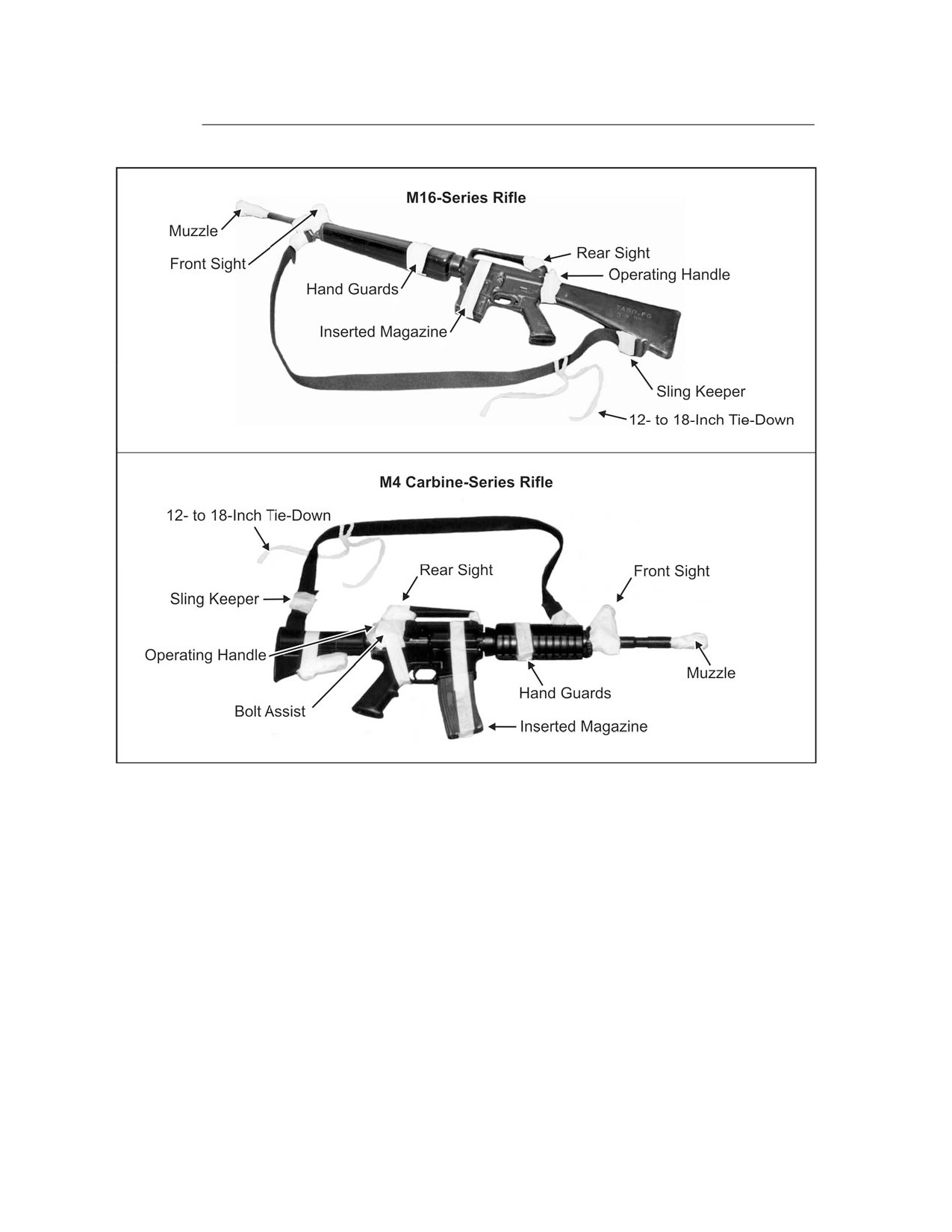
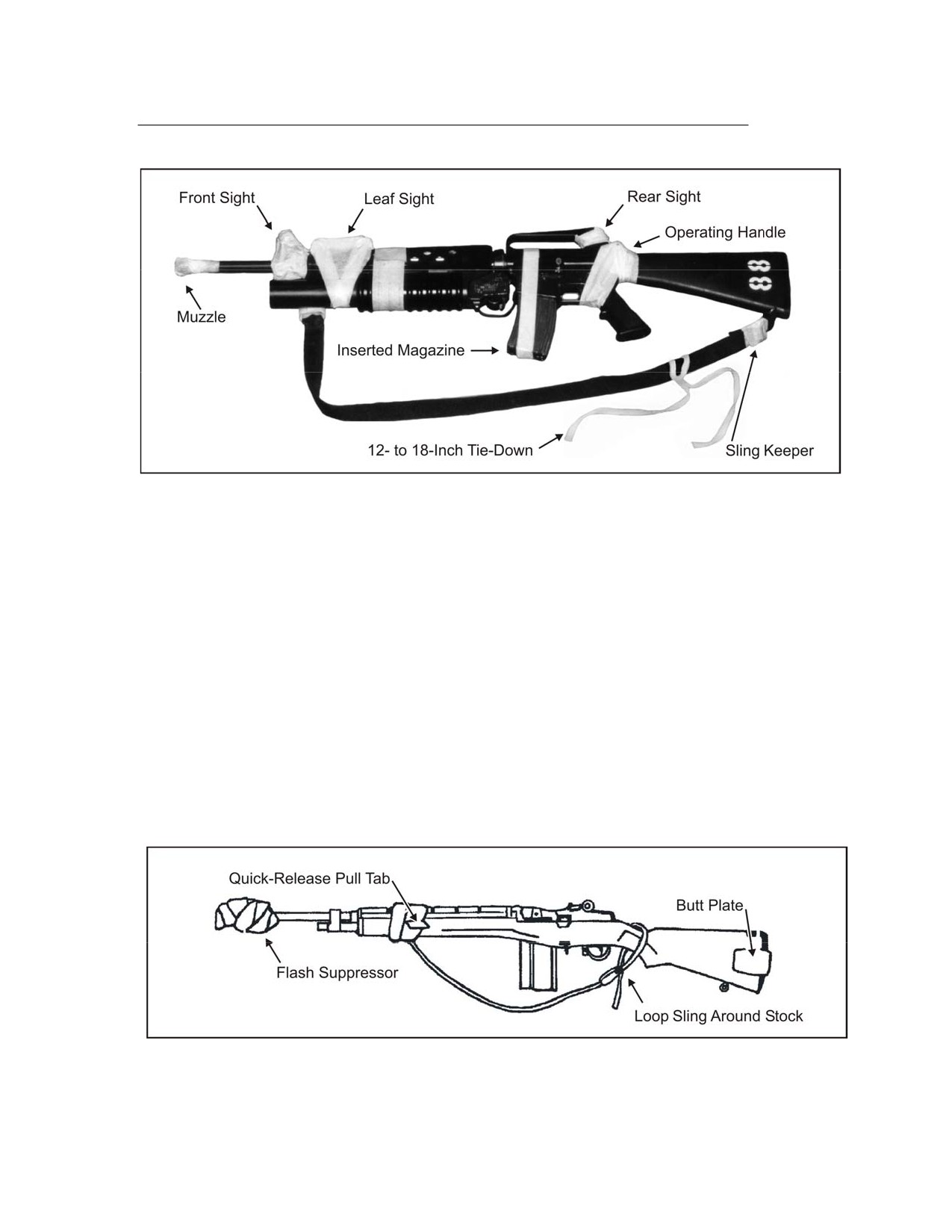
5-41. To prepare the M16-series and M4 carbine-series rifles for jumping
(Figure 5-42, page 5-38), the parachutist should—
• Extend the weapon sling all the way and tape the sling keeper in place.
NOTE: A padded sling should not be used as it may interfere with
emergency procedures when rigged on the parachutist.
• Pad and tape the side-mounted bolt assist and the operating handle.
• Pad and tape the muzzle and the sights to avoid possible entanglement
with the parachute suspension lines or dirt clogging the weapon
upon landing.
• Insert the magazine and tape it to the receiver, including the ejector
port cover, to prevent loss of the magazine and to keep debris from
entering the bolt area.
• Tape the hand guards to prevent their loss during free fall or
upon landing.
6 April 2005 FM 3-05.211/MCWP 3-15.6/NAVSEA SS400-AG-MMO-010/AFMAN 11-411(I)
5-37
FM 3-05.211
Figure 5-42. M16-Series and M4 Carbine-Series Rifles Rigged for Jumping
Tie-Downs
5-42. The parachutist should use a 12- to 18-inch tie-down of 1/4-inch cotton
webbing to secure the weapon. He should attach the tie-down to the weapon
sling or to a hard point on the weapon with a girth hitch knot.
Positioning
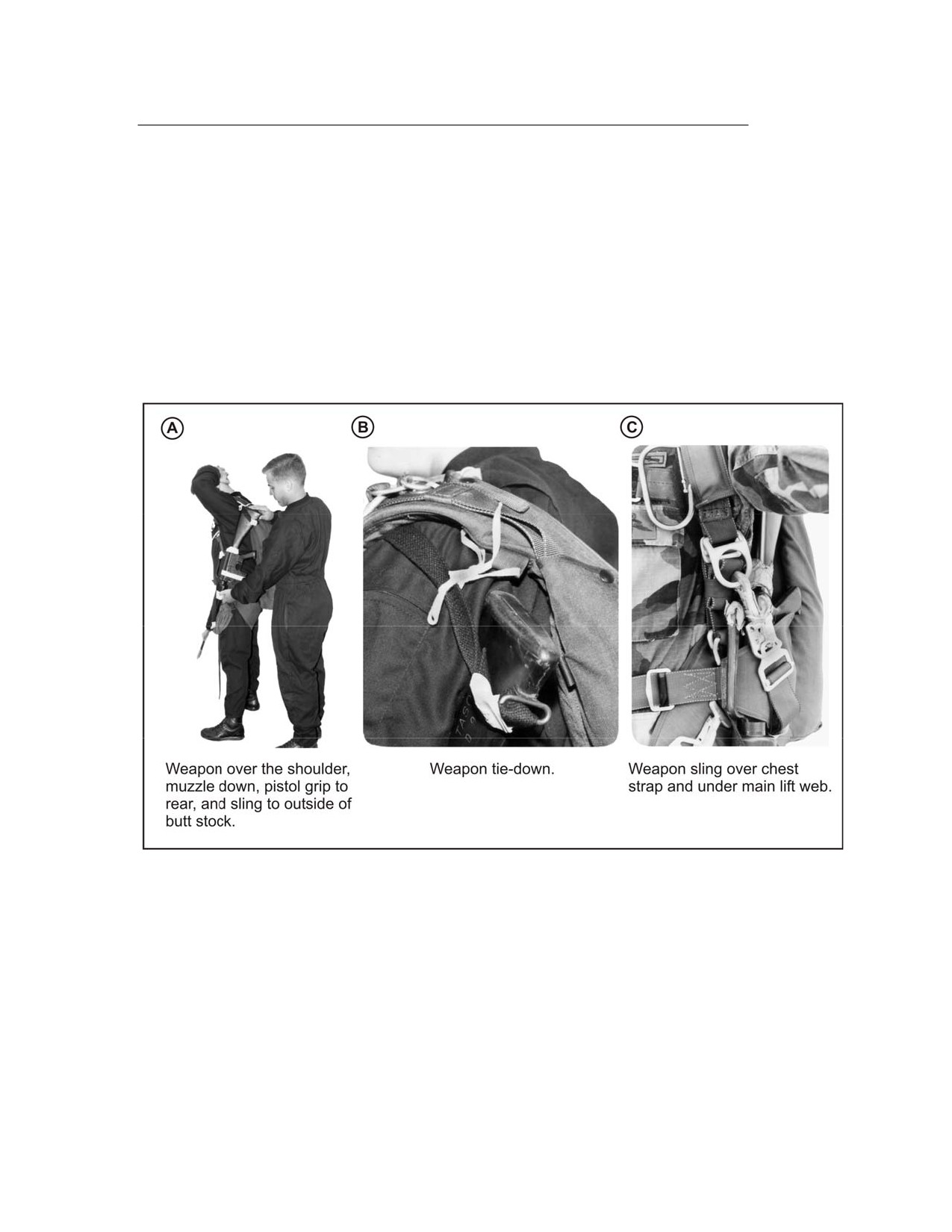
5-43. With the help of a buddy, the parachutist should sling his weapon over
his shoulder with the muzzle down, and rotate the pistol grip to his rear
(Figure 5-43, page 5-39). The parachutist and his buddy should then—
• Place the sling from the lower keeper (butt stock) on the outside of the
stock and over the parachutist’s shoulder.
• Run the sling under the main lift web and route the chest strap
through the sling. The buddy ties off the running ends of the 1/4-inch
5-38
FM 3-05.211/MCWP 3-15.6/NAVSEA SS400-AG-MMO-010/AFMAN 11-411(I)
6 April 2005
FM 3-05.211
cotton webbing to a weapon tie-down loop on the harness with a soft
knot (bowknot).
• Place the weapon between the wing flap and the parachutist with the
waistband routed over or through the weapon-carrying handle.
NOTE: If optics are mounted on the weapon, they must be free and clear
of the waistband.
• Tighten the waistband securely so that the weapon lies snugly against
the parachutist’s side.
The parachutist then assumes the basic free-fall position to test the fit of the
weapon.
Figure 5-43. Positioning the Weapon on the Parachutist
Dual Rigging
5-44. When rigging weapons on both sides of the harness, the buddy should—
• Place the larger weapon on the parachutist’s left side and the smaller
one on his right side.
NOTE: This setup minimizes interference with the oxygen system, if
used.
• Use standard weapon-rigging techniques to secure the weapon to
the parachutist.
6 April 2005 FM 3-05.211/MCWP 3-15.6/NAVSEA SS400-AG-MMO-010/AFMAN 11-411(I)
5-39
FM 3-05.211
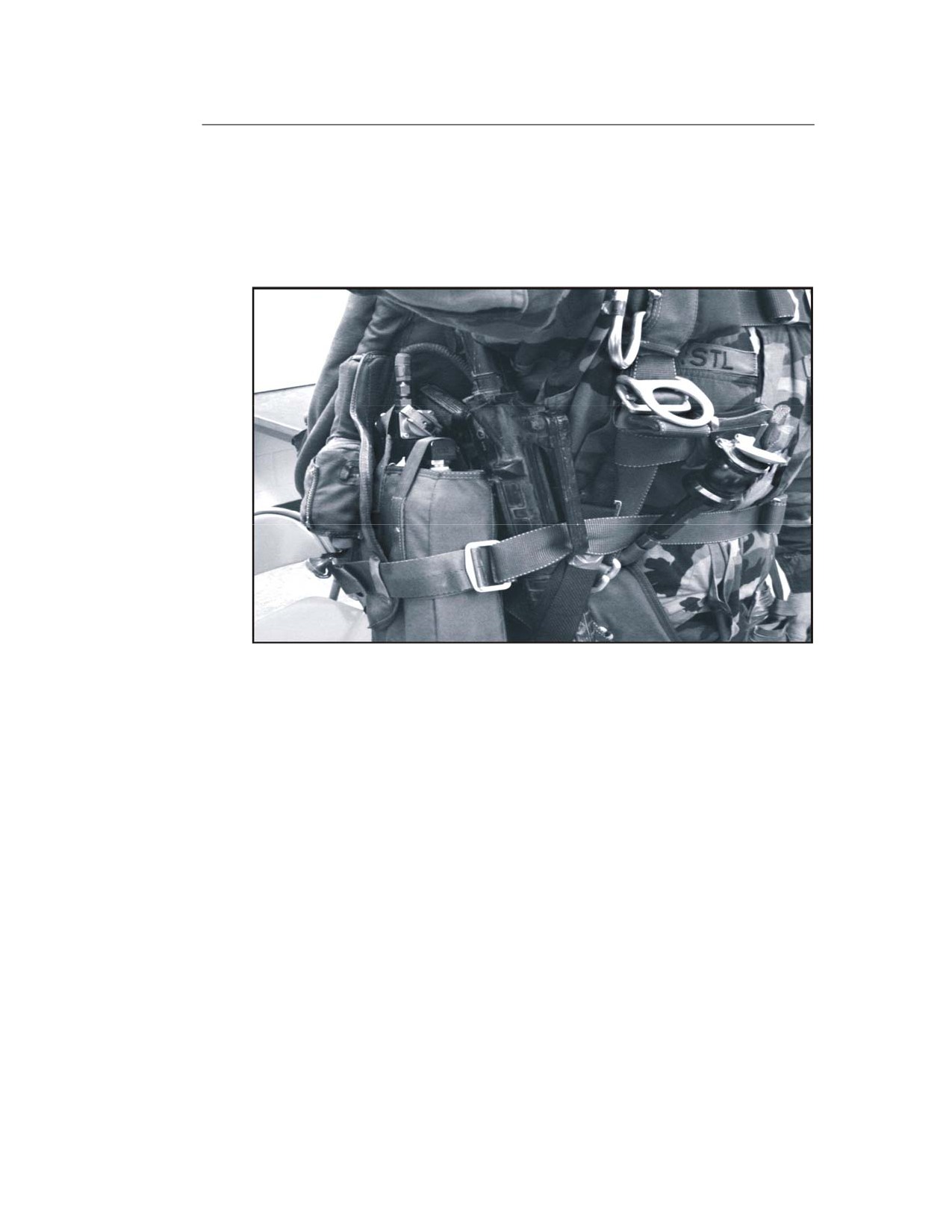
NOTE: When an oxygen system is used (Figure 5-44), the buddy should place
the weapon behind the oxygen bottles and against the parachutist’s body. The
buddy should carefully route the medium-pressure delivery hose over or
behind the weapon in a manner that does not restrict the flow of oxygen to
the parachutist.
Figure 5-44. Right-Side Weapon Rigging
M203 GRENADE LAUNCHER
5-45. The parachutist should prepare the M203 grenade launcher
(Figure 5-45, page 5-41) in the same manner as he prepares the M16-series
and M4 carbine-series rifles. Additionally, he should—
• Tape the hand guards and the grenade launcher barrel together with
the barrel latch covered.
• Remove the quadrant sight.
• Tape down the leaf sight.
Tie-Downs
5-46. The parachutist should follow the same procedures used for the
M16-series and the M4 carbine-series rifles.
Positioning
5-47. The parachutist and his buddy should follow the same procedures used
for the M16-series and the M4 carbine-series rifles.
5-40
FM 3-05.211/MCWP 3-15.6/NAVSEA SS400-AG-MMO-010/AFMAN 11-411(I)
6 April 2005
FM 3-05.211
Figure 5-45. M203 Rigged for Jumping
M14, G3, AND FN FAL RIFLES
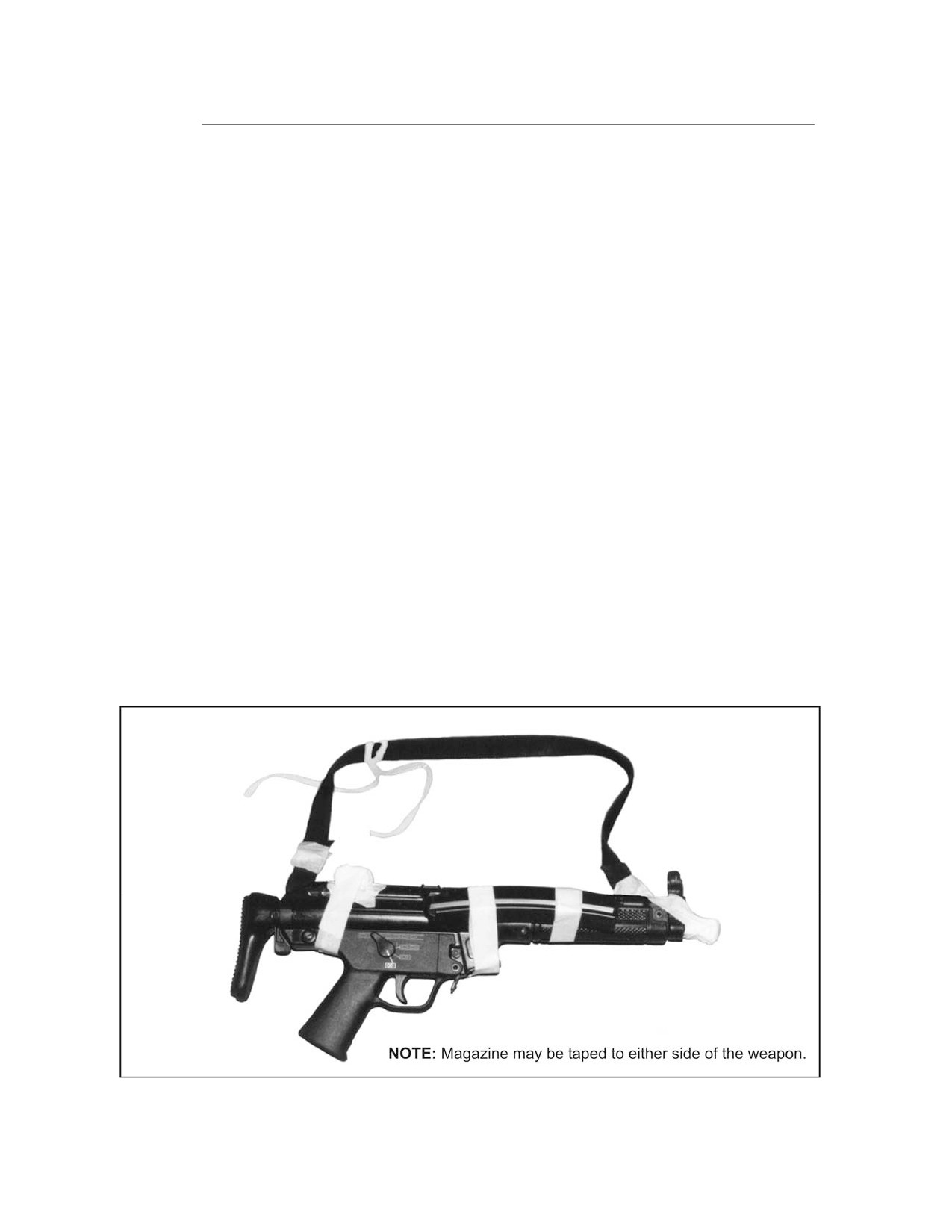
5-48. The parachutist should prepare the M14 (Figure 5-46), the G3, and the
FN FAL rifles as follows:
• Remove the sling from the weapon and the sling keeper from the sling.
• Form a loop by running the sling through the sling hook.
• Replace the sling by placing the loop around the small of the stock.
• Replace the sling keeper and secure the sling to the barrel, just below
the front sight, with a half hitch.
• Tape the butt plate closed.
• Pad and tape the flash suppressor, front sight, and bayonet lug.
NOTE: When jumping with larger weapons on the left side, the parachutist
should position the HPT lowering line to the left side to facilitate a
right-side PLF.
Figure 5-46. M14 Rigged for Jumping
6 April 2005 FM 3-05.211/MCWP 3-15.6/NAVSEA SS400-AG-MMO-010/AFMAN 11-411(I)
5-41
FM 3-05.211
Tie-Downs
5-49. The parachutist should use a 12- to 18-inch tie-down of 1/4-inch cotton
webbing to secure the weapon. He should attach the tie-down to the weapon
sling or to a hard point on the weapon with a girth hitch.
Positioning
5-50. With the help of a buddy, the parachutist should sling the weapon over
his left shoulder, with the muzzle down, and rotate the operating handle
away from his body. They then should secure the weapon to the parachutist
in the same manner as for the M16-series and the M4 carbine-series rifles.
LIGHT SNIPER SYSTEMS
5-51. The parachutist should prepare the light sniper systems as follows:
• Make an improvised sling. NOTE: Parachutist must not use a
standard marksmanship sling.
• Make sure the rifle has a secure portion where the sling can be attached.
• Tape the muzzle to protect it from debris upon landing.
• Tape and secure the bolt.
• Tape and pad the scope to protect it as necessary.
NOTE: If using a semiautomatic sniper system, the parachutist should follow
the same procedures he used to prepare the M16-series, the M4
carbine-series, and the M14 rifles
(Figure
5-47). If jumping with larger
weapons on the left side, the parachutist should position the HPT lowering
line to the left side to facilitate a right-side PLF.
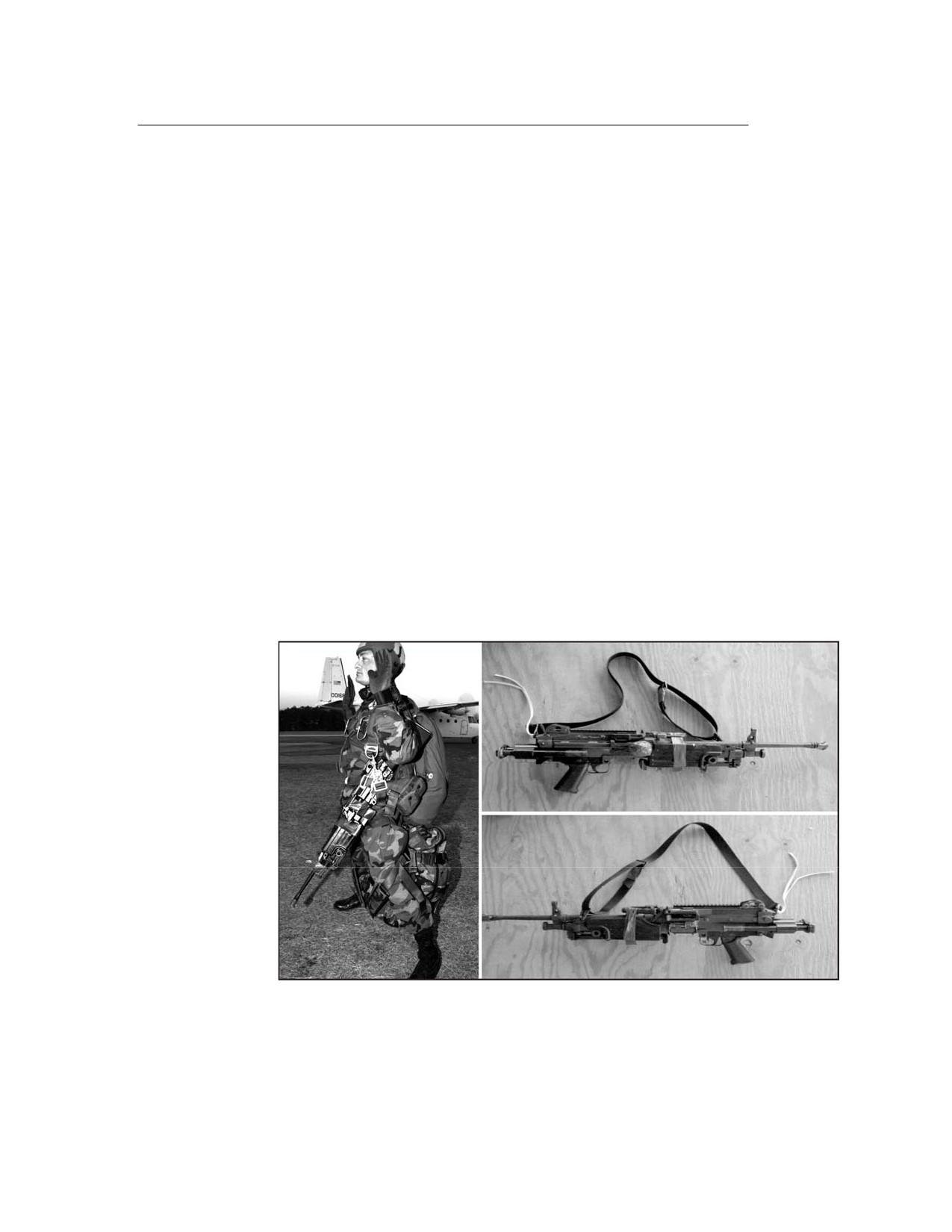
Figure 5-47. MP5 Rigged for Jumping
5-42
FM 3-05.211/MCWP 3-15.6/NAVSEA SS400-AG-MMO-010/AFMAN 11-411(I)
6 April 2005
FM 3-05.211
Tie-Downs
5-52. The parachutist should use a 12- to 18-inch tie-down of 1/4-inch cotton
webbing to secure the weapon. He should attach the tie-down to the weapon
sling or to a hard point on the weapon with a girth hitch.
Positioning
5-53. With the help of a buddy, the parachutist should sling the weapon over
his left shoulder, with the muzzle down, and the scope to the front or rear.
They then should secure the weapon to the parachutist in the same manner
as for the M16-series and the M4 carbine-series rifles.
MP5, MP5A3, AND MP5K SUBMACHINE GUNS
5-54. The parachutist should prepare the MP5 (Figure 5-48), MP5A3, and
MP5K submachine guns as follows:
• Remove the sling from the upper swivel.
• Fold the end of the sling and run the fold through the upper sling swivel.
• Pass the tip of the sling through the fold and fasten the snap.
• Close the ejector port cover and remove the magazine.
• Collapse the stock.
• Tape one magazine to the left of the receiver or carry it elsewhere.
• Cover and tape the muzzle.
Figure 5-48. M249 and Para M249 SAWs Rigged for Jumping
6 April 2005 FM 3-05.211/MCWP 3-15.6/NAVSEA SS400-AG-MMO-010/AFMAN 11-411(I)
5-43
FM 3-05.211
Tie-Downs
5-55. The parachutist should use a 12- to 18-inch tie-down of 1/4-inch cotton
webbing to secure the weapon. He should attach the tie-down to the weapon
sling or a hard point on the weapon with a girth hitch.
Positioning
5-56. With the help of a buddy, the parachutist should sling the weapon over
his shoulder, with the muzzle down, and rotate the pistol grip to his rear.
They then should secure the weapon to the parachutist in the same manner
as for the M16-series and the M4 carbine-series rifles.
M249 AND PARA M249 SQUAD AUTOMATIC WEAPONS
5-57. The parachutist can jump with the M249 squad automatic weapon
(SAW) exposed or in an equipment container. To prepare the weapon,
he should—
• Pad the optics as necessary. NOTE: Parachutists must not insert the
magazine and must not chamber rounds.
• Tape the muzzle to avoid debris entering the weapon upon landing.
• Wrap one piece of the tape around the fore grip of the weapon, securing
the carrying handle, hand guard, and bipod.
NOTE: The Para M249 SAW requires an additional piece of tape forward
the vertical grip on the hand guard. The parachutist should consider padding
the charging handle if the possibility of discomfort or injury exists. When
jumping with larger weapons on the left side, the parachutist should position
the HPT lowering line to the left side to facilitate a right-side PLF. Figure 5-48,
page 5-43, shows photographs of the M249 and Para M249 SAWs rigged for
jumping.
Tie-Downs
5-58. The parachutist should use a 12- to 18-inch tie-down of 1/4-inch cotton
webbing to secure the M249 SAW. The parachutist should attach the tie-
down to the weapon sling or to a hard point on the weapon with a girth hitch.
On the Para M249 SAW, he should attach the tie-down to a hard point on the
rear of the weapon.
Positioning
5-59. With the help of a buddy, the parachutist should sling the weapon over
his left shoulder, with the muzzle down, and rotate the pistol grip to his rear.
(NOTE: The Para M249 may be rigged with the weapon pistol grip to the
parachutist’s front or rear.) They then should secure the weapon to the
parachutist in the same manner as for the M16-series and the M4
carbine-series rifles.
M60 AND M240 MACHINE GUNS, OTHER LIGHT MACHINE GUNS,
AND .50-CALIBER SNIPER SYSTEMS
5-60. The parachutist must not jump the fully assembled and exposed
weapons while they are attached to the parachute harness during MFF
5-44
FM 3-05.211/MCWP 3-15.6/NAVSEA SS400-AG-MMO-010/AFMAN 11-411(I)
6 April 2005
FM 3-05.211
operations. The parachutist may break the weapons down and pack them
inside the combat pack, PDB, or a horizontally mounted kit bag with an
H-harness. They may also be jumped exposed horizontally attached to a
front-mounted combat pack or container.
PISTOLS
5-61. The parachutist can jump with a pistol in a shoulder holster or in an
equipment container. The parachutist should wear a shoulder holster under
his jumpsuit or other protective clothing. He should secure the pistol in the
holster by taping the holster closed or by using a lanyard.
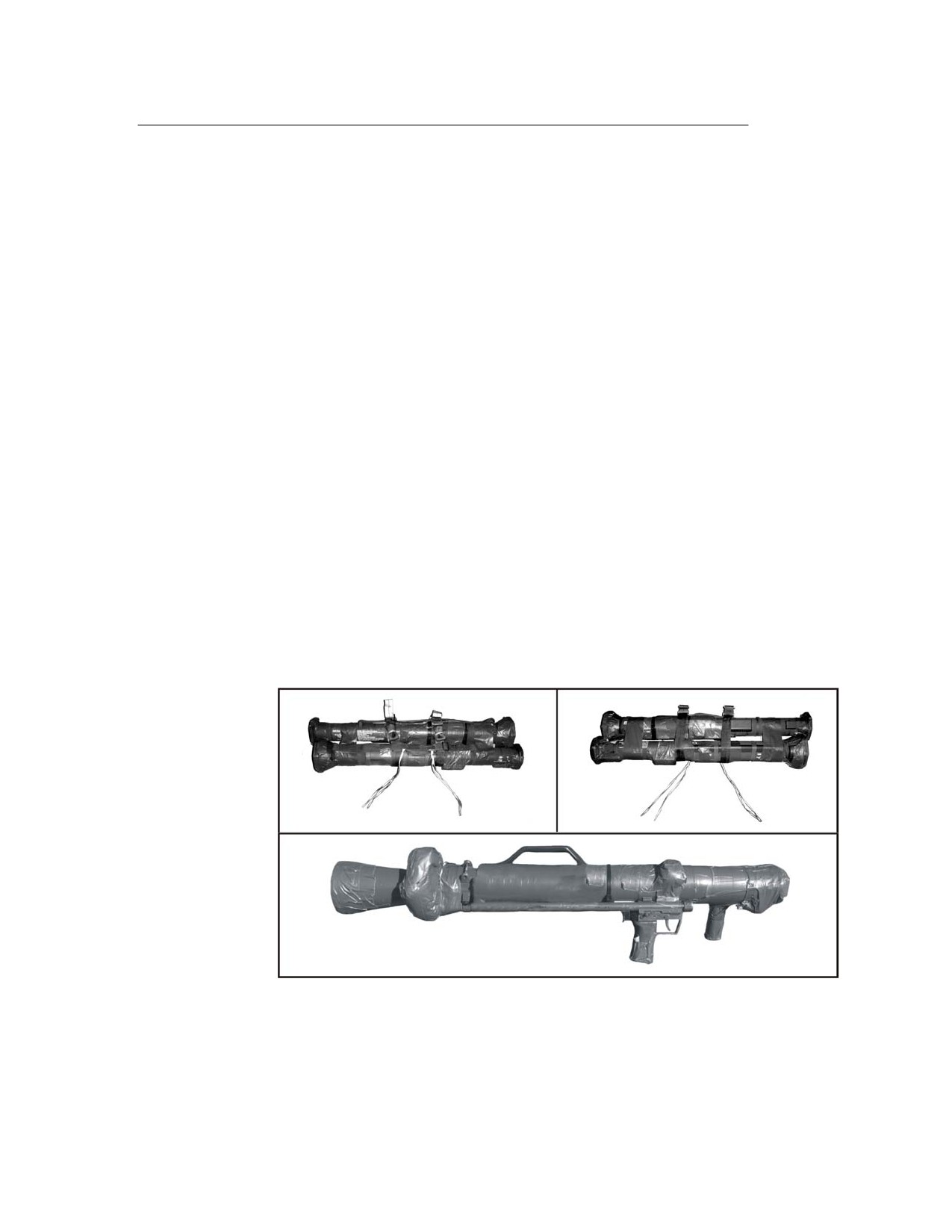
AT-4, 84-MILLIMETER CARL GUSTAF RECOILLESS RIFLE,
AND OTHER LIGHT ANTIARMOR WEAPONS
5-62. The recommended procedure for rigging the AT-4 and 84-millimeter
(mm) Carl Gustaf recoilless rifle
(RCLR) is to front-mount the weapon
horizontally on top of a combat pack or a PDB, or in an H-harness. This
arrangement limits the parachutist to a ramp-only exit because of the rigged
width of the parachutist. To rig these weapons for a front-mounted jump on
top of a combat pack or a PDB, the parachutist—
• Tapes and pads the end of the launch tube to prevent debris from
entering the tube upon landing. If the launch tube has removable end
caps, he tapes and secures them to the launch tube (Figure 5-49).
• Tapes the sling securely to the launch tube (Figure 5-49).
• Pads and tapes the weapon sights and the trigger mechanism
(Figure 5-49).
Figure 5-49. AT-4 and 84-mm Carl Gustaf Rigged for Jumping
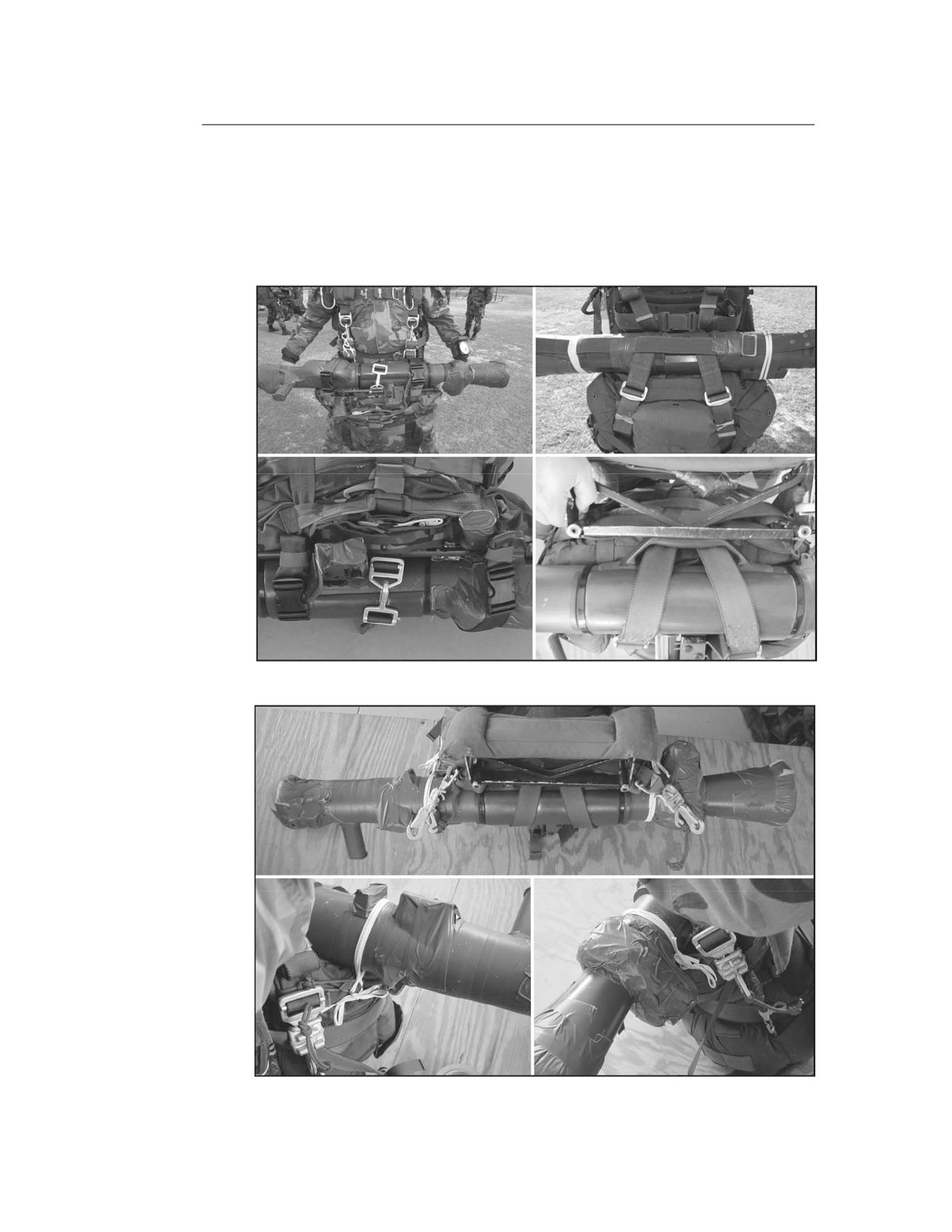
• Mounts the weapon system on top of the combat pack or PDB. He
routes the H-harness, Spider harness, or PDB vertical compression
straps over the weapon and through the carrying handle of the
Carl Gustaf or through the sling of the AT-4, and tightens securely
(Figure 5-50, page 5-46).
6 April 2005 FM 3-05.211/MCWP 3-15.6/NAVSEA SS400-AG-MMO-010/AFMAN 11-411(I)
5-45
FM 3-05.211
• Uses 1/4-inch cotton webbing to secure the weapon to the combat pack
or PDB. This method prevents lateral shifting of the weapon system
while in free fall (Figure 5-51).
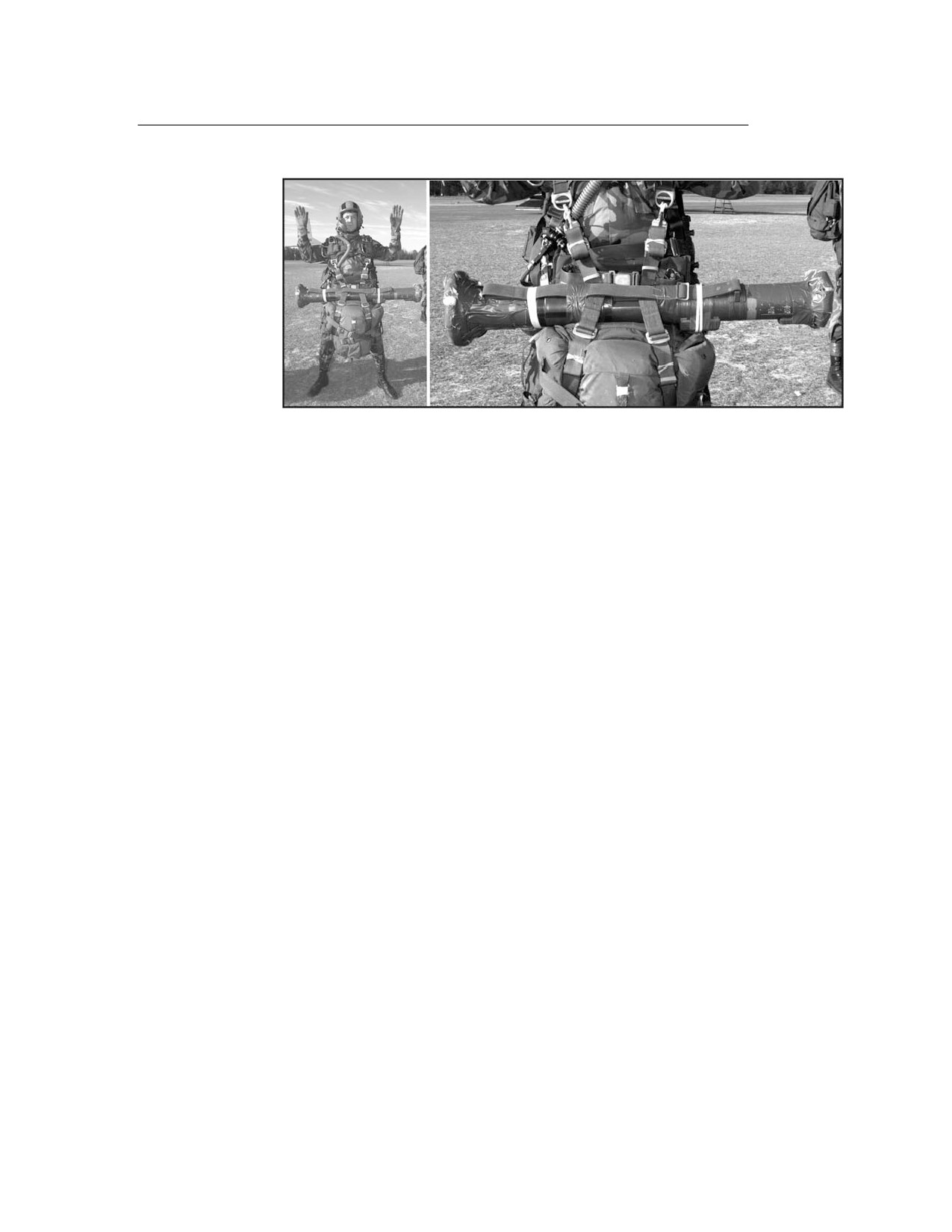
• Has a buddy attach the combat pack or PDB to the parachutist (Figure
5-52, page 5-47).
Figure 5-50. Routing of Vertical Compression Straps
Figure 5-51. Antiarmor Weapon Tie-Down Locations
5-46
FM 3-05.211/MCWP 3-15.6/NAVSEA SS400-AG-MMO-010/AFMAN 11-411(I)
6 April 2005
FM 3-05.211
Figure 5-52. Parachutist Rigged for Jumping With an AT Weapon
Mounted on Top of Combat Pack
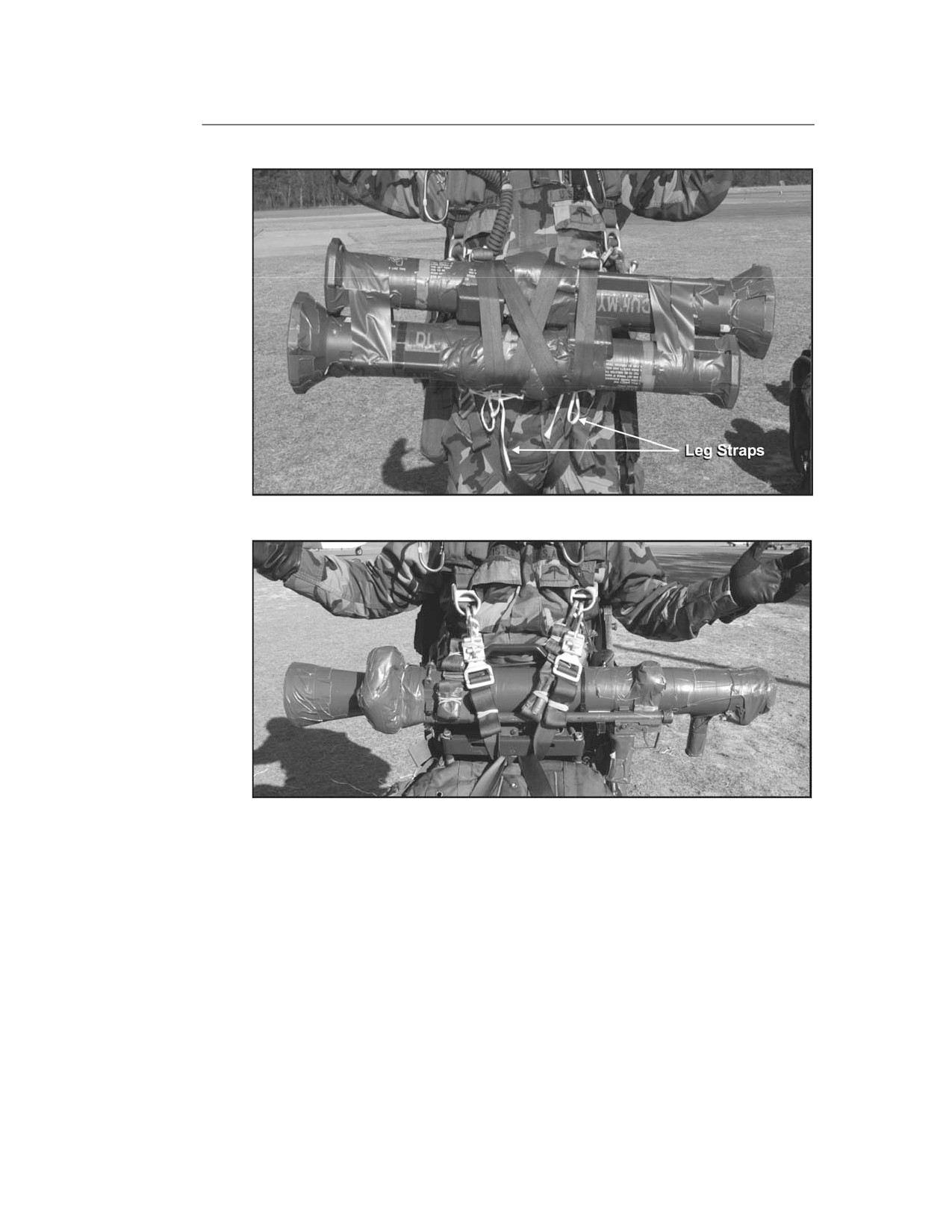
5-63. To rig the AT-4 or the 84-mm Carl Gustaf RCLR inside an H-harness
for a front-mounted jump (Figure 5-53, page 5-48), the parachutist—
• Tapes and pads the end of the launch tube to prevent debris from
entering the tube upon landing. If the launch tube has removable end
caps, he tapes and secures them to the launch tube.
• Tapes the sling securely to the launch tube.
• Pads and tapes the weapon sights and the trigger mechanism.
• Places the weapon system on top of the H-harness, then routes the
vertical compression straps around the launch tube and through the
sling or carrying handle, and tightens securely.
• Has a buddy attach the H-harness or weapon system to the parachutist
as follows:
If jumping a rear-mounted combat pack or PDB, uses a 12- to
18-inch piece of 1/4-inch cotton webbing to secure the H-harness or
weapon to the leg straps. This method prevents the weapon from
flying up into the parachutist’s face during free fall (Figure 5-53,
page 5-48).
If jumping a front-mounted combat pack or PDB, attaches the
H-harness or weapon to the equipment attachment rings first, and
then attaches the combat pack or PDB. The attachment straps of
the combat pack or container hold the H-harness or weapon system
securely in place (Figure 5-54, page 5-48).
6 April 2005 FM 3-05.211/MCWP 3-15.6/NAVSEA SS400-AG-MMO-010/AFMAN 11-411(I)
5-47
FM 3-05.211
Figure 5-53. Front-Mounted Weapon With Rear-Mounted Rucksack
Figure 5-54. Front-Mounted Weapon With Front-Mounted Rucksack
M224 60-MM MORTAR
5-64. The recommended procedure for rigging the M224 60-mm mortar is to
mount it horizontally on a combat pack or PDB in an H-harness. This
arrangement limits the parachutist to a ramp-only exit from the aircraft. The
parachutist should rig the M224 60-mm mortar for a front-mounted jump
(Figure 5-55, page 5-49), as follows:
• Tape and pad the end of the barrel to prevent debris from entering the
barrel upon landing.
• Tape the entire trigger guard and carrying handle, making a
smooth surface to prevent any entanglement of the parachute
during deployment.
5-48
FM 3-05.211/MCWP 3-15.6/NAVSEA SS400-AG-MMO-010/AFMAN 11-411(I)
6 April 2005
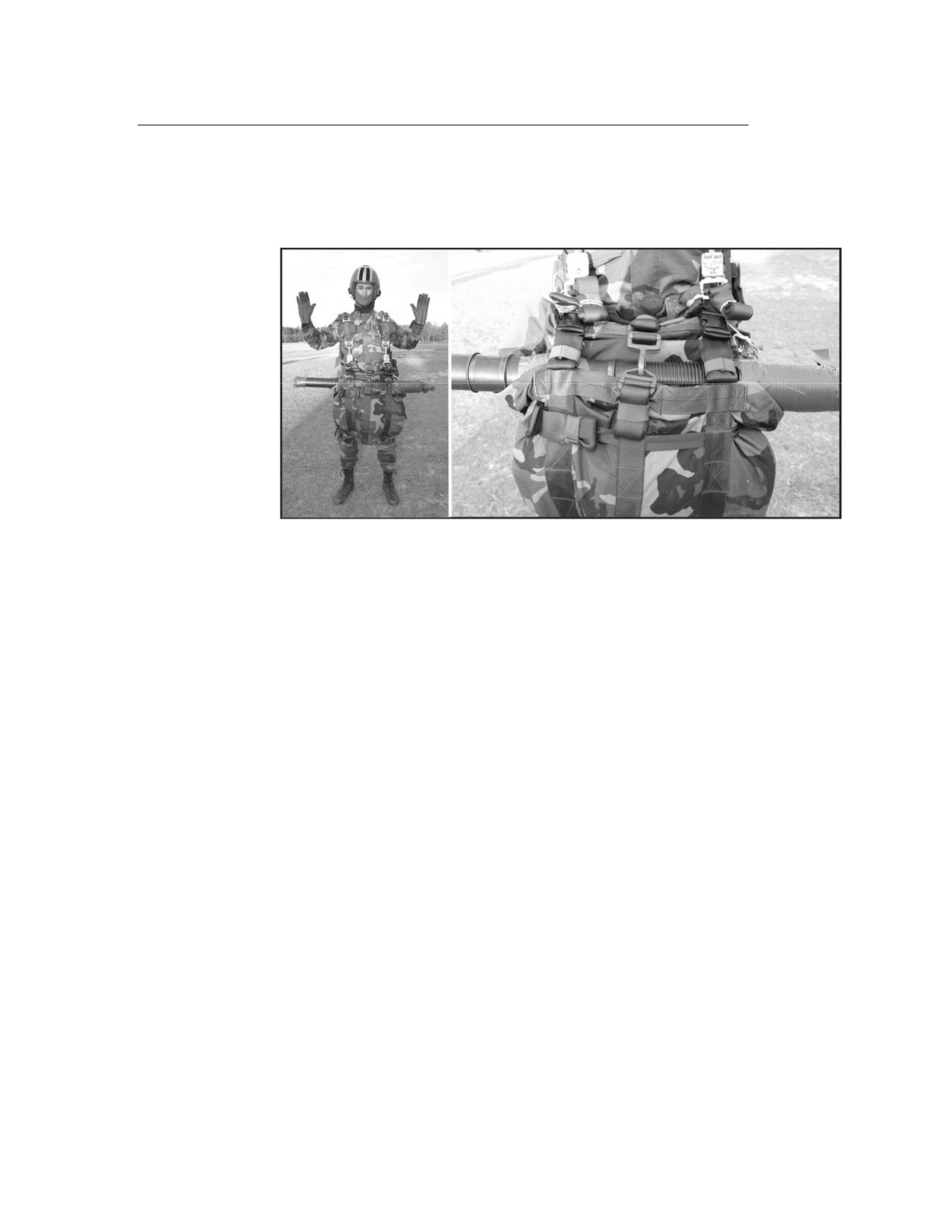
FM 3-05.211
• Mount the weapon on top of the combat pack or container and route the
H-harness or Spider harness or container vertical compression straps
over the weapon and through the improvised sling.
Figure 5-55. M224 60-mm Mortar Rigged for Front Mount
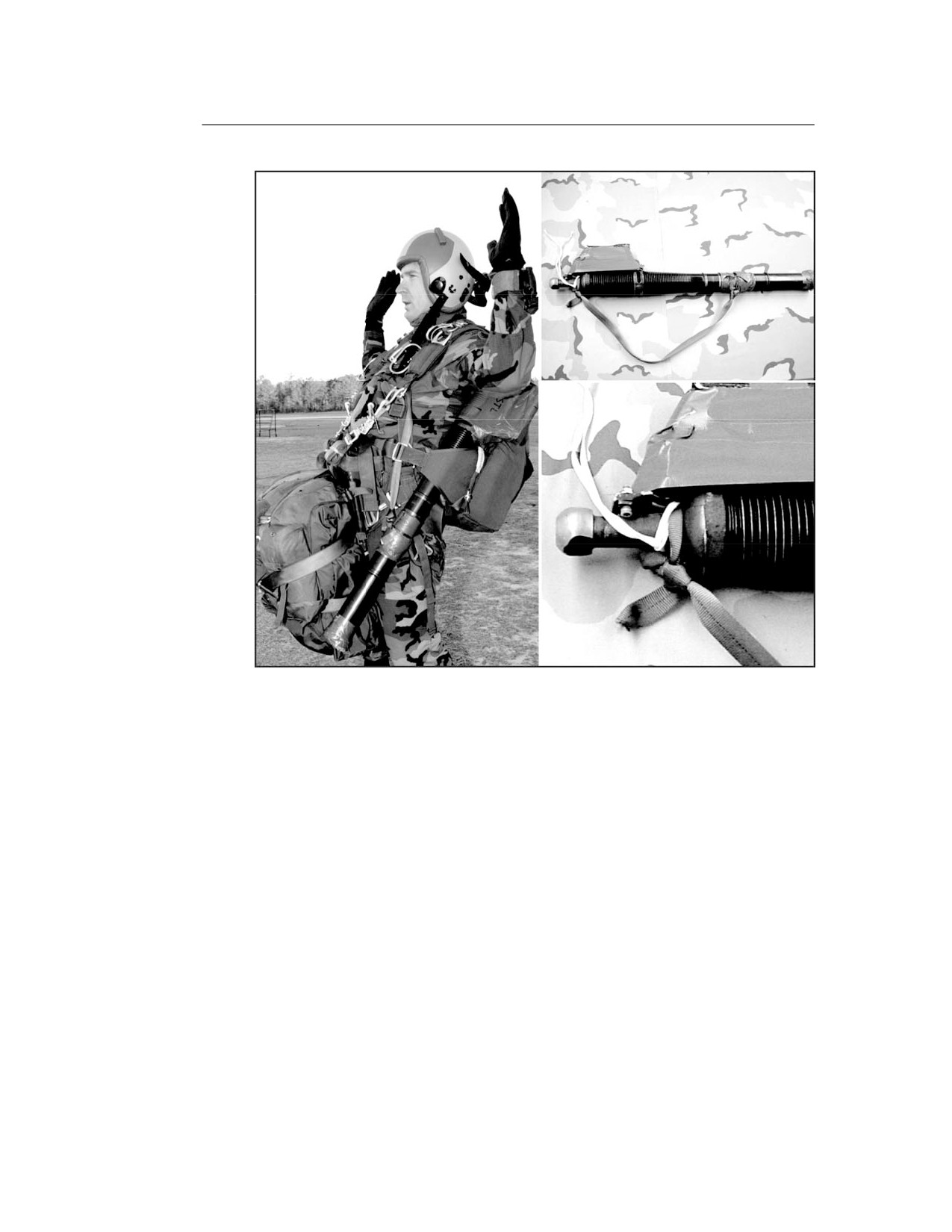
5-65. The parachutist should rig the M224 60-mm mortar (Figure 5-56, page
5-50) for a side-mounted jump as follows:
• Make an improvised sling with 1-inch tubular webbing.
• Run the webbing around the end of the mortar and through the trigger
guard.
NOTE: A secured clove hitch on the mortar barrel between the lower
section for the bipod mount holds the webbing in place.
• Tape the webbing in place to make sure it does not slide on the barrel.
• Tape the entire trigger guard and carrying handle, making a smooth
surface to prevent any entanglement of the parachute during deployment.
• Tape and pad the end of the barrel to prevent debris from entering the
barrel upon landing. When jumping with larger weapons on the left
side, the parachutist should position the HPT lowering line to the left
side to facilitate a right-side PLF.
Tie-Downs
5-66. The parachutist should use a 12- to 18-inch tie-down of 1/4-inch cotton
webbing to secure the weapon. He should attach the tie-down to the weapon
sling or a hard point on the weapon with a girth hitch.
POSITIONING
5-67. With the help of a buddy, the parachutist should sling the mortar over
his left shoulder, with the muzzle down, and rotate the trigger to his rear. He
should run the sling around the mortar to make sure tension pulls the trigger
assembly toward the container. The parachutist and his buddy should secure
the mortar in the same manner as for the M16-series and the M4
carbine-series rifles.
6 April 2005 FM 3-05.211/MCWP 3-15.6/NAVSEA SS400-AG-MMO-010/AFMAN 11-411(I)
5-49
FM 3-05.211
Figure 5-56. Left-Side Mount for M224 60-mm Mortar
OTHER WEAPONS
5-68. The parachutist can rig other weapons using the methods previously
described. User unit SOPs should specify ways to pack or rig similar types
of weapons, consistent with safety requirements. Units requiring technical
help should contact B Company, 2d Battalion, 1st Special Warfare Training
Group, USAJFKSWCS, Yuma, Arizona; Defense Switched Network
(DSN) 899-3626/3639.
LIFE PRESERVERS
5-69. Parachutists must wear military-approved flotation devices
(B-7,
LPU-10/P, or underwater demolition team [UDT] life vest) whenever the
planned flight path is over open bodies of water large enough to be
unavoidable with a maneuverable chute for one third or more of the distance
under canopy. They also wear them when an open body of water is within
1,000 meters of the planned impact point.
5-50
FM 3-05.211/MCWP 3-15.6/NAVSEA SS400-AG-MMO-010/AFMAN 11-411(I)
6 April 2005
FM 3-05.211
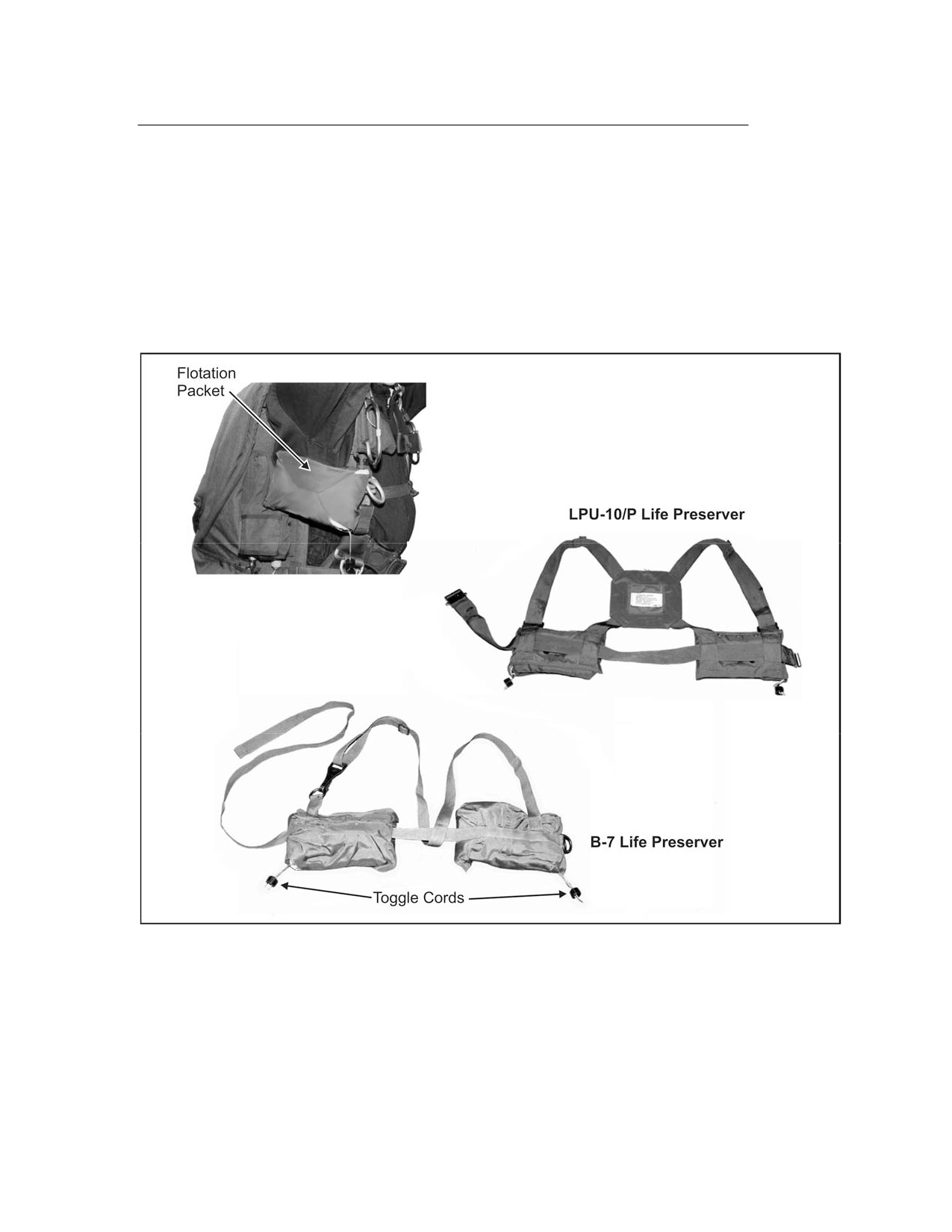
B-7 LIFE PRESERVER
5-70. The parachutist wears the B-7 over his uniform or jumpsuit and under
his parachute harness (Figure 5-57). He fits the B-7 by placing one flotation
packet under each arm, making sure the packet flaps are to the outside and
the toggle cords are down and to the front. He routes the shoulder strap from
front to rear over his left shoulder, under the back strap, then from rear to
front over his right shoulder and attaches it to the ring on the right flotation
packet.
Figure 5-57. B-7 and LPU-10/P Life Preservers
5-71. The parachutist adjusts the shoulder strap so that the flotation
packets fit snugly against his armpits. Before donning the parachute, he
attaches the chest strap to the attachment ring on the left flotation packet,
forming a quick release.
5-72. If there is a water emergency, the parachutist inflates the life
preserver by pulling the toggle cords located on each flotation packet. He can
also manually inflate it by blowing into the rubber hose located on each
6 April 2005 FM 3-05.211/MCWP 3-15.6/NAVSEA SS400-AG-MMO-010/AFMAN 11-411(I)
5-51
FM 3-05.211
flotation packet. He uses manual inflation only if the carbon dioxide (CO2)
inflation system fails to operate.
WARNING
The parachutist makes sure he does not wear the
B-7 life preserver with the flotation packets between
the parachute harness and his body. Serious injury
may result if inflated when worn incorrectly.
LPU-10/P LIFE PRESERVER
5-73. The LPU-10/P is a standard USAF CO2 cartridge-activated life
preserver assembly worn during flights over water or during airdrops when
water obstacles are near or on the intended DZ. It has an adjustable harness
and underarm inflation bladders. The LPU-10/P is designed to keep the
wearer’s head above water at weights up to 250 pounds for up to 10 minutes.
It is compatible with the USAF C-9, T-10, and MC-4 parachute harness
assemblies. It must be maintained IAW USAF TO 14S-1-102, Maintenance
Instructions With Parts Breakdown: USAF Flotation Equipment.
5-74. The LPU-10/P is worn under the parachute harness. The harness is
worn so that the inflatable packets are under the parachutist’s arms. The
manual inflating valves should be completely closed when donning the life
vest. The shoulder and waist straps are then adjusted to ensure the inflation
packet is one hand width beneath the armpit and not constrained by the
parachute harness.
WARNING
If the inflation packets are too snug under the
armpit, or if they are between the harness and the
parachutist’s body, the parachutist may experience
severe pain or crushed ribs during inflation.
5-75. The parachutist inflates the flotation bladders by pulling two toggle
cords (at the bottom of the vest) that activate CO2 cartridges that fill the
flotation bladders with gas. An alternate way to inflate the vest is by blowing
into the manual inflation valve rubber hoses located on the bottom side of
the wings. Manual inflation should only be used if the CO2 inflation valves
fail to operate.
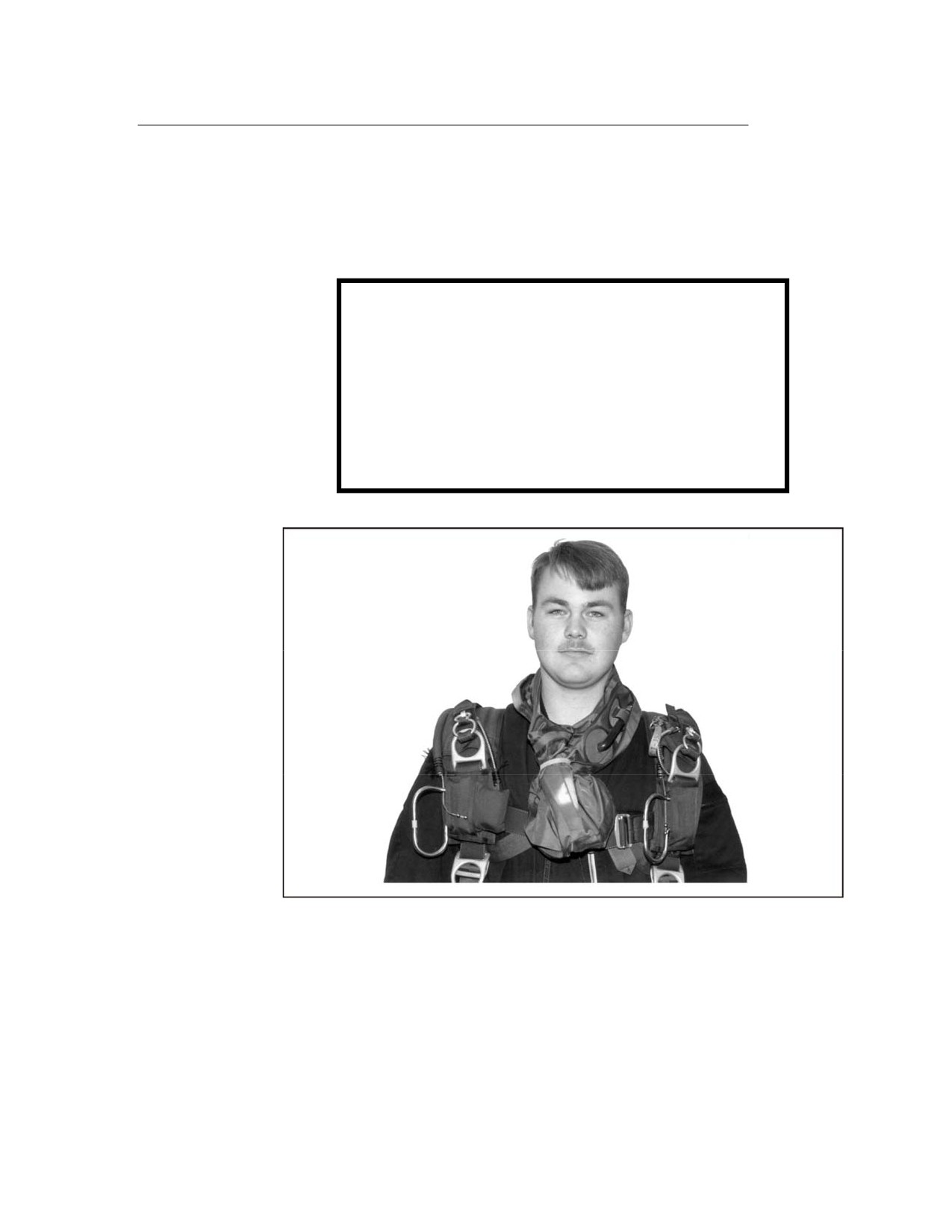
UNDERWATER DEMOLITION TEAM LIFE VEST
5-76. The UDT vest is put on over the uniform before donning the
parachute. The UDT vest is worn around the neck, with the straps passing
under the arms and fastened to the vest. The straps should be snug so the
vest does not move in free fall and interfere with the cutaway handle or the
reserve ripcord. The parachute chest strap passes between the UDT vest and
5-52
FM 3-05.211/MCWP 3-15.6/NAVSEA SS400-AG-MMO-010/AFMAN 11-411(I)
6 April 2005
FM 3-05.211
the parachutist (Figure 5-58). The UDT vest must be worn secured with a
lightweight rubber band around the middle to prevent interfering with the
cutaway handle and reserve ripcord handle. The oral inflation tube is routed
through its retainer loop. The oral inflation tube knurled nut is screwed down
in the open position to allow inflation.
WARNING
The parachutist must not wear the UDT life vest
with the flotation chamber worn between the
parachute chest strap and his body. Serious injury
may result if inflated when worn incorrectly.
Parachutists must protect the activation lanyard of
the UDT vest. Accidental inflation by the CO2
cartridges may result in obstruction of the reserve
ripcord and cutaway handles.
Figure 5-58. UDT Life Vest
6 April 2005 FM 3-05.211/MCWP 3-15.6/NAVSEA SS400-AG-MMO-010/AFMAN 11-411(I)
5-53
FM 3-05.211
Chapter 6
Aircraft Procedure Signals and Jump Commands
Aircraft noise, the MFF parachutist helmet, and the oxygen mask make
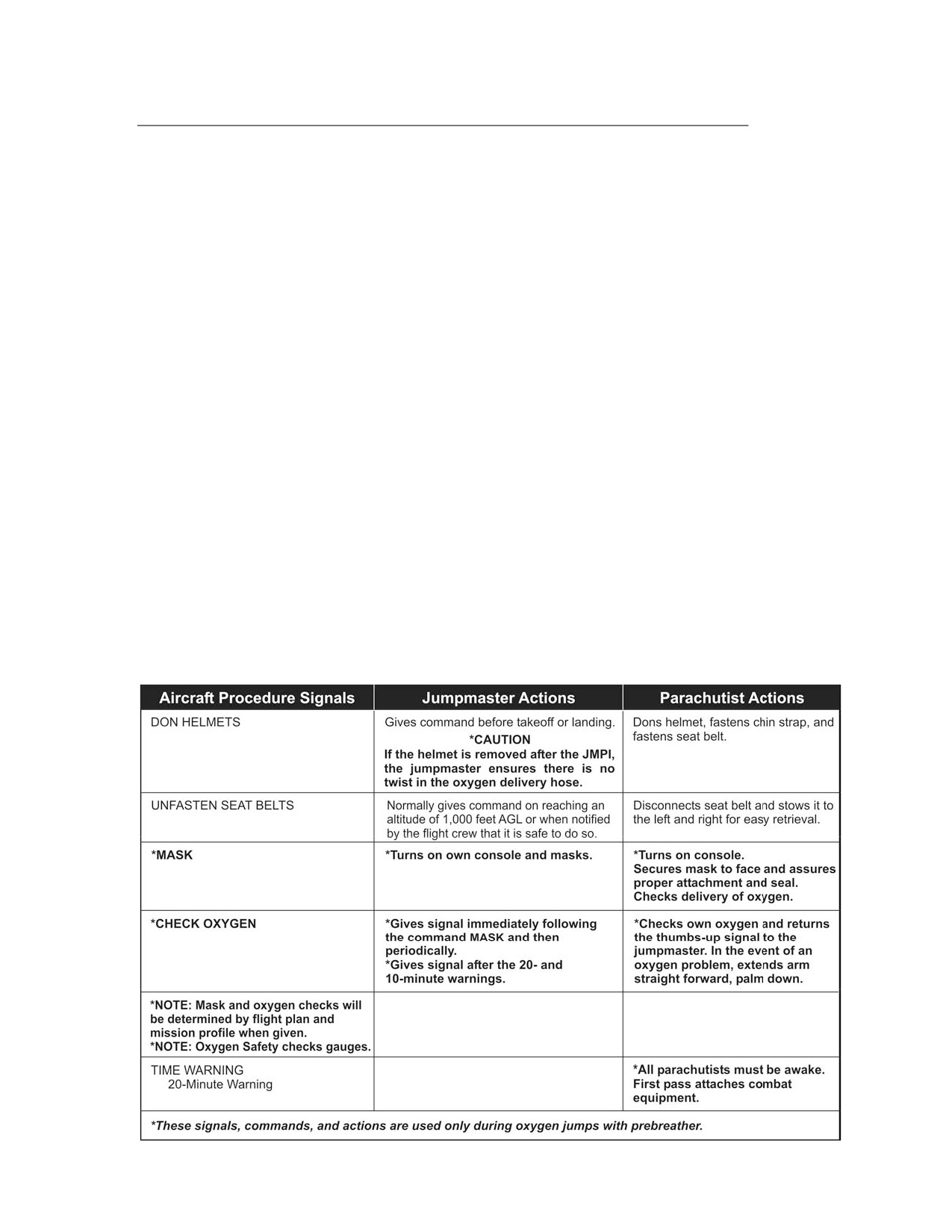
verbal communication extremely difficult. Therefore, the parachutist
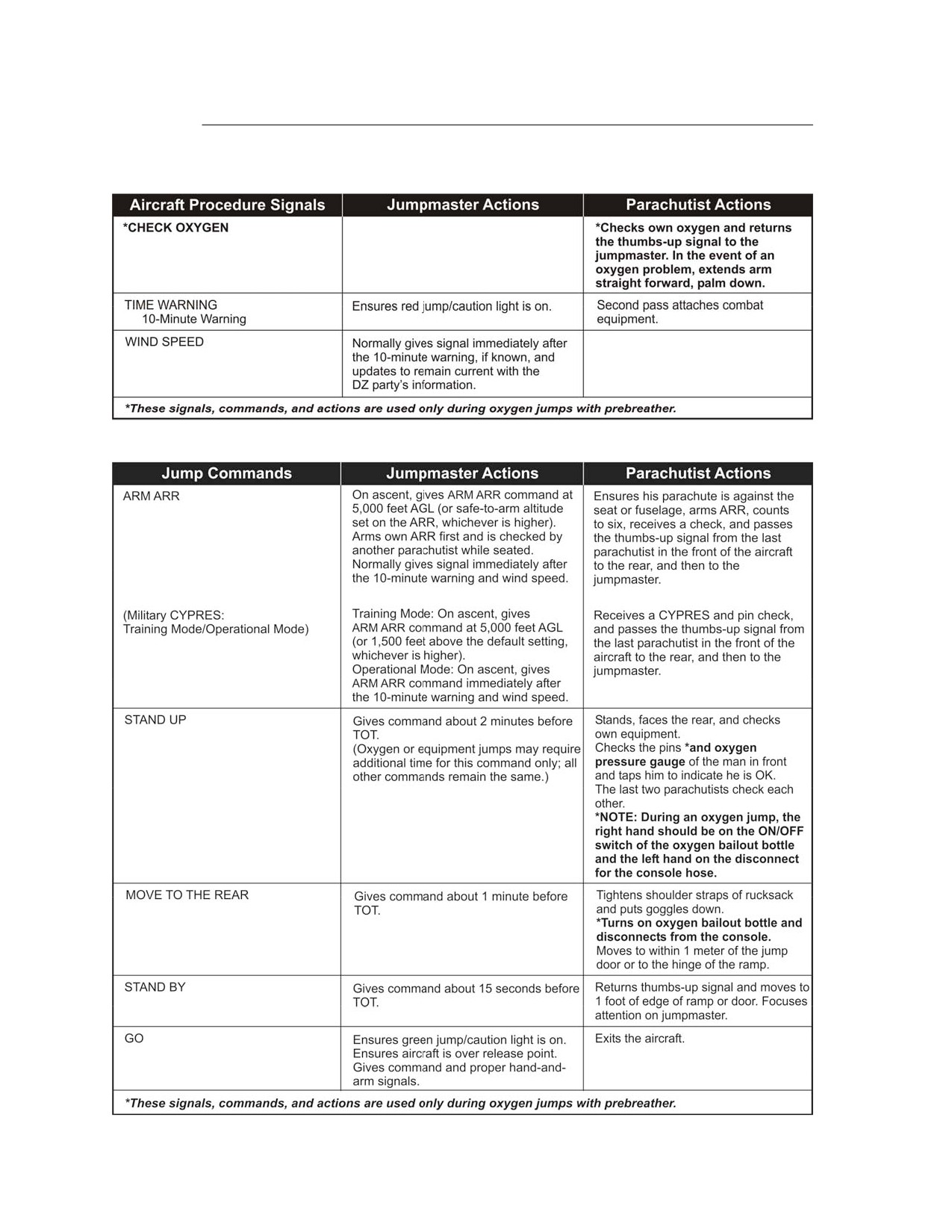
receives aircraft procedure signals (Table 6-1, pages 6-1 and 6-2) and
jump commands (Table 6-2, pages 6-2 and 6-3) by hand-and-arm signals.
The MFF parachutist must be thoroughly familiar with all signals and
the commands and the required actions for each one. Standardization of
procedural signals and jump commands permits interoperability of all
MFF-capable units. Safety significantly increases when the parachutist
understands the jumpmaster’s intent and the jumpmaster understands
the parachutist’s desired response.
AIRCRAFT PROCEDURE SIGNALS
6-1. Signals used between aircraft boarding and the jump command STAND
UP are procedure signals. The aircraft procedure signals discussed in the
following paragraphs begin before takeoff. The jumpmaster gives these
signals.
Table 6-1. Aircraft Procedure Signals (Oxygen and Nonoxygen Jumps)
6 April 2005 FM 3-05.211/MCWP 3-15.6/NAVSEA SS400-AG-MMO-010/AFMAN 11-411(I)
6-1
FM 3-05.211
Table 6-1. Aircraft Procedure Signals (Oxygen and Nonoxygen Jumps) (Continued)
Table 6-2. Aircraft Jump Commands (Oxygen and Nonoxygen Jumps)
6-2
FM 3-05.211/MCWP 3-15.6/NAVSEA SS400-AG-MMO-010/AFMAN 11-411(I)
6 April 2005
FM 3-05.211
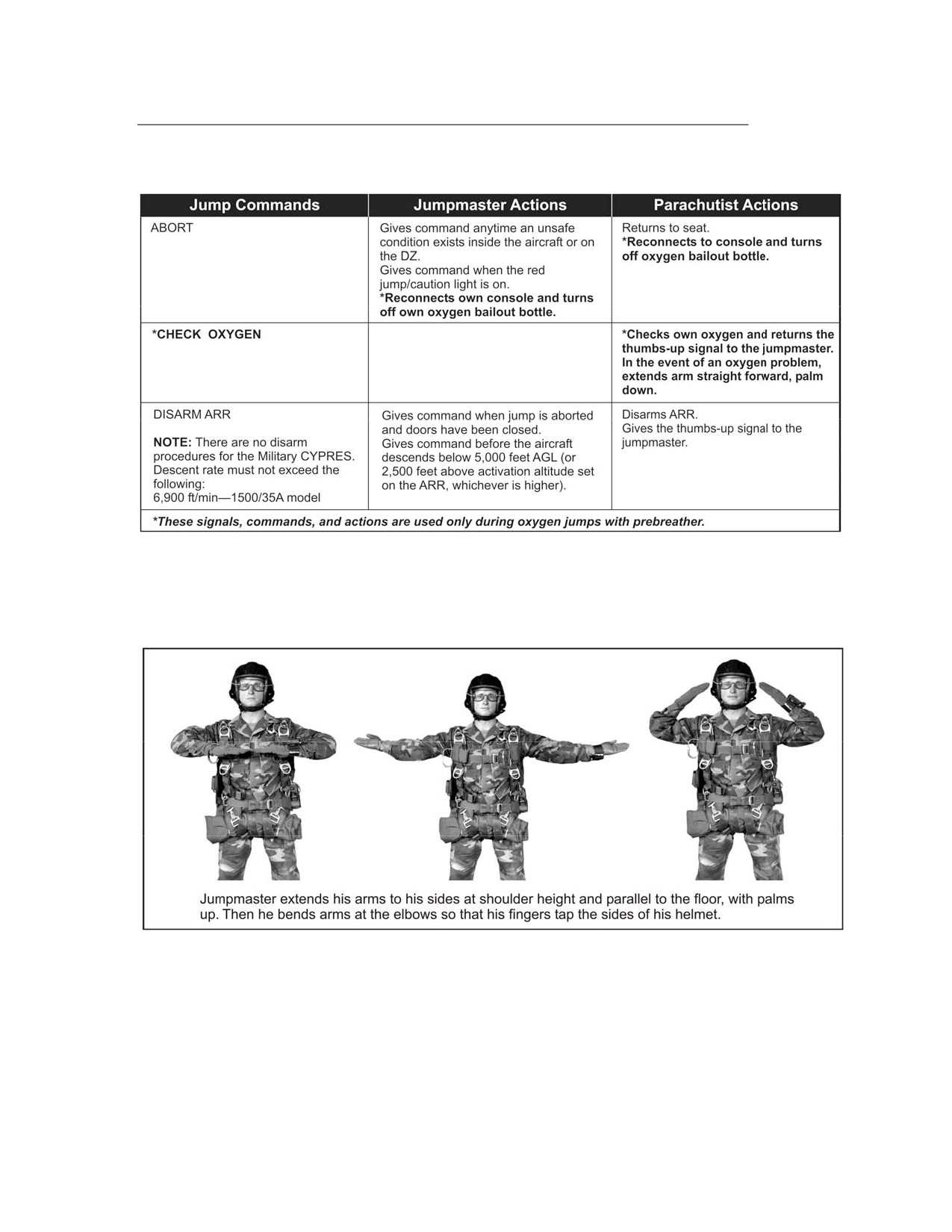
Table 6-2. Aircraft Jump Commands (Oxygen and Nonoxygen Jumps) (Continued)
DON HELMETS
6-2. The jumpmaster gives the signal DON HELMETS before takeoff (Figure
6-1). He may also give it during the flight. Upon receiving this signal, the
parachutist dons his helmet, fastens his chin strap, and fastens his seat belt.
Figure 6-1. Don Helmets Signal
6 April 2005 FM 3-05.211/MCWP 3-15.6/NAVSEA SS400-AG-MMO-010/AFMAN 11-411(I)
6-3
FM 3-05.211
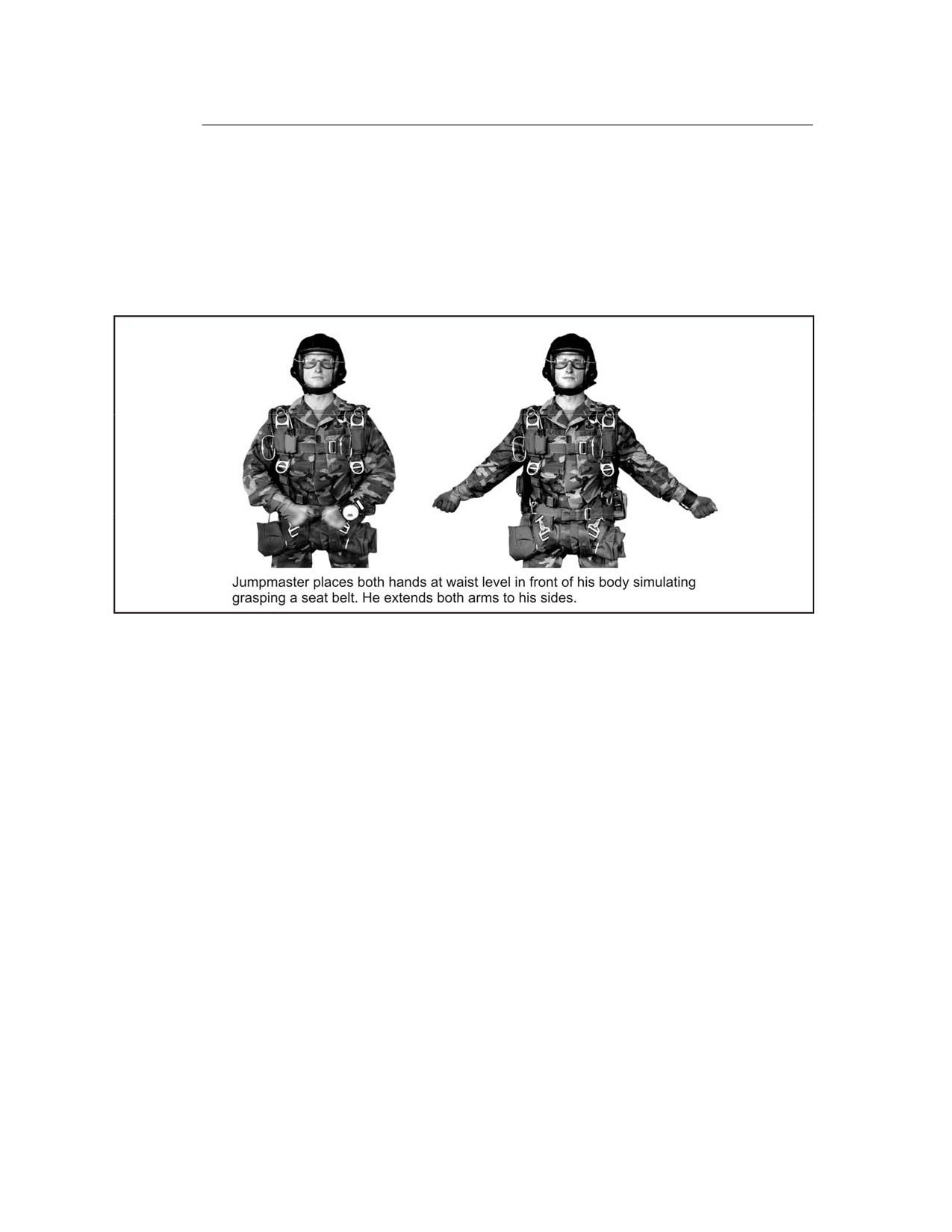
UNFASTEN SEAT BELTS
6-3. The jumpmaster normally gives the signal UNFASTEN SEAT BELTS upon
reaching an altitude of 1,000 feet AGL or when the flight crew chief indicates
that it is safe to do so (Figure 6-2). If the aircraft descends back through
1,000 feet AGL later in the flight, the parachutist refastens his seat belt upon
receiving the command DON HELMETS.
Figure 6-2. Unfasten Seat Belts Signal
EMERGENCY BAILOUT
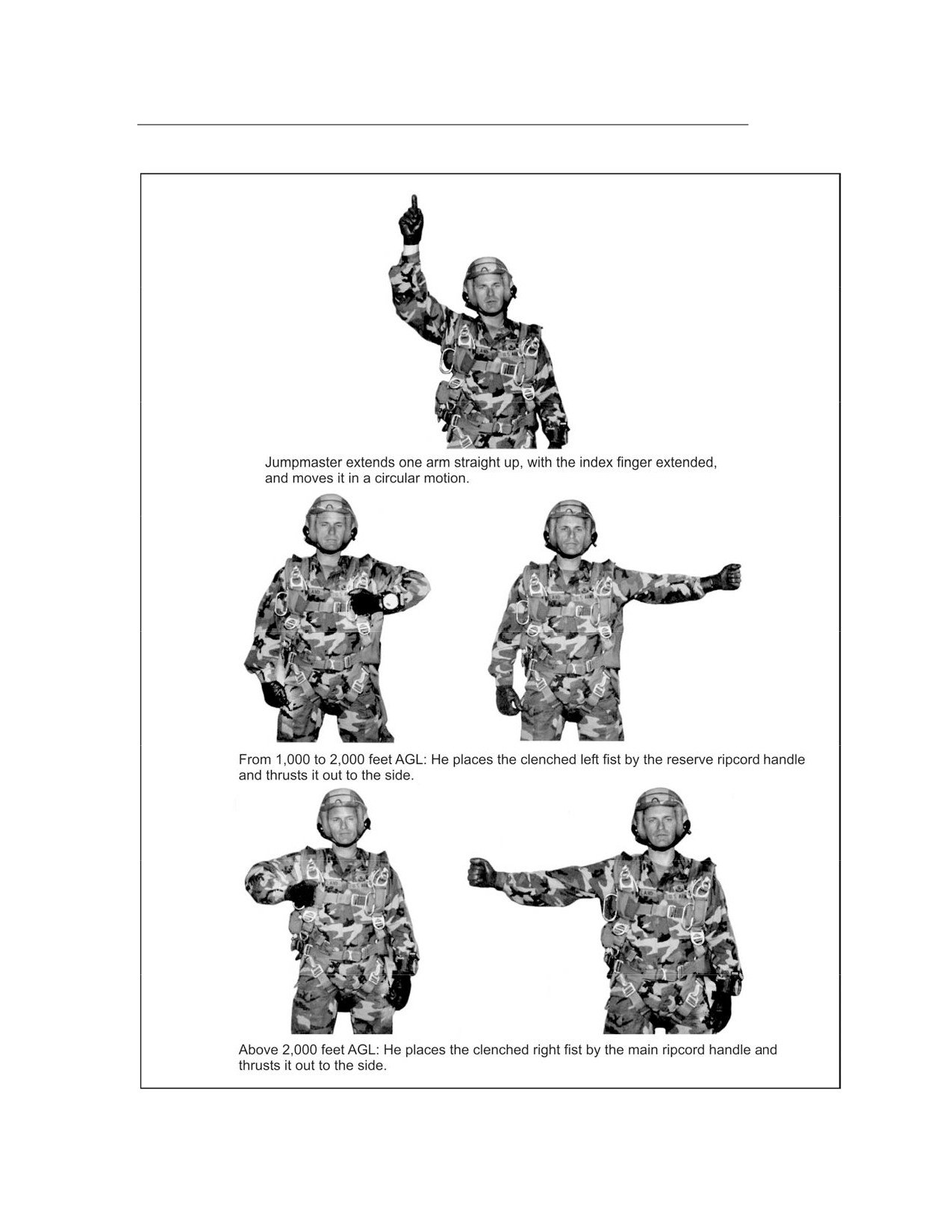
6-4. The jumpmaster gives the EMERGENCY BAILOUT signal for an emergency
exit during flight (Figure 6-3, page 6-5). Jump commands may be given if
time permits. If there is no time for the full jump command sequence, he
gives abbreviated signals immediately after the bailout signal:
• For exits from 1,000 to 2,000 feet AGL, the jumpmaster signals to
IMMEDIATELY EXIT, CLEAR, AND PULL THE RESERVE RIPCORD HANDLE.
• For exits at 2,000 feet AGL and above, the jumpmaster signals to
IMMEDIATELY EXIT, CLEAR, AND PULL THE MAIN RIPCORD HANDLE.
6-4
FM 3-05.211/MCWP 3-15.6/NAVSEA SS400-AG-MMO-010/AFMAN 11-411(I)
6 April 2005
FM 3-05.211
Figure 6-3. Emergency Bailout Signal
6 April 2005 FM 3-05.211/MCWP 3-15.6/NAVSEA SS400-AG-MMO-010/AFMAN 11-411(I)
6-5
FM 3-05.211
MASK
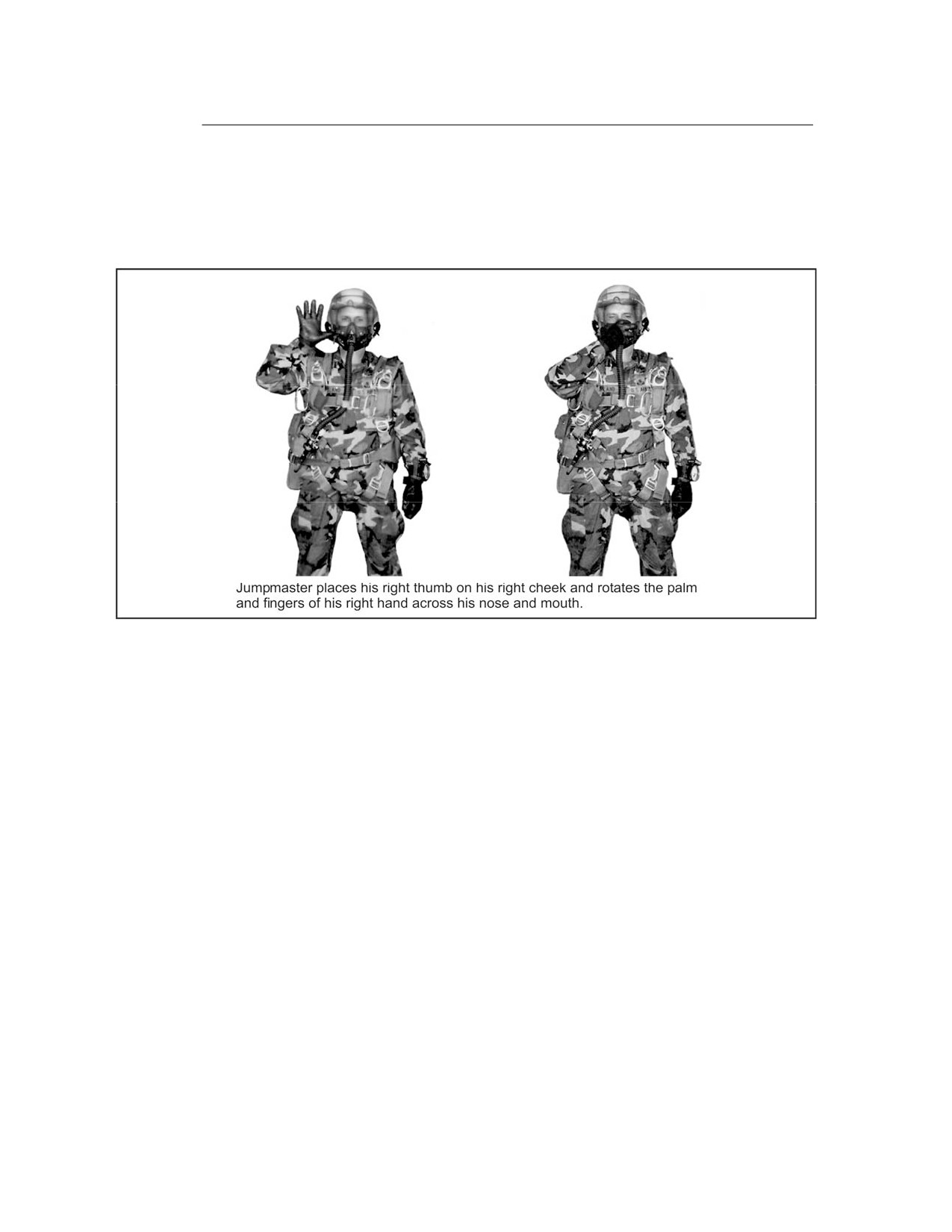
6-5. The jumpmaster signals MASK when the parachutist must begin using
supplemental oxygen (Figure 6-4). Upon receiving this signal, the parachutist
masks and checks to make sure the oxygen system is functioning properly.
Figure 6-4. Mask Signal
CHECK OXYGEN
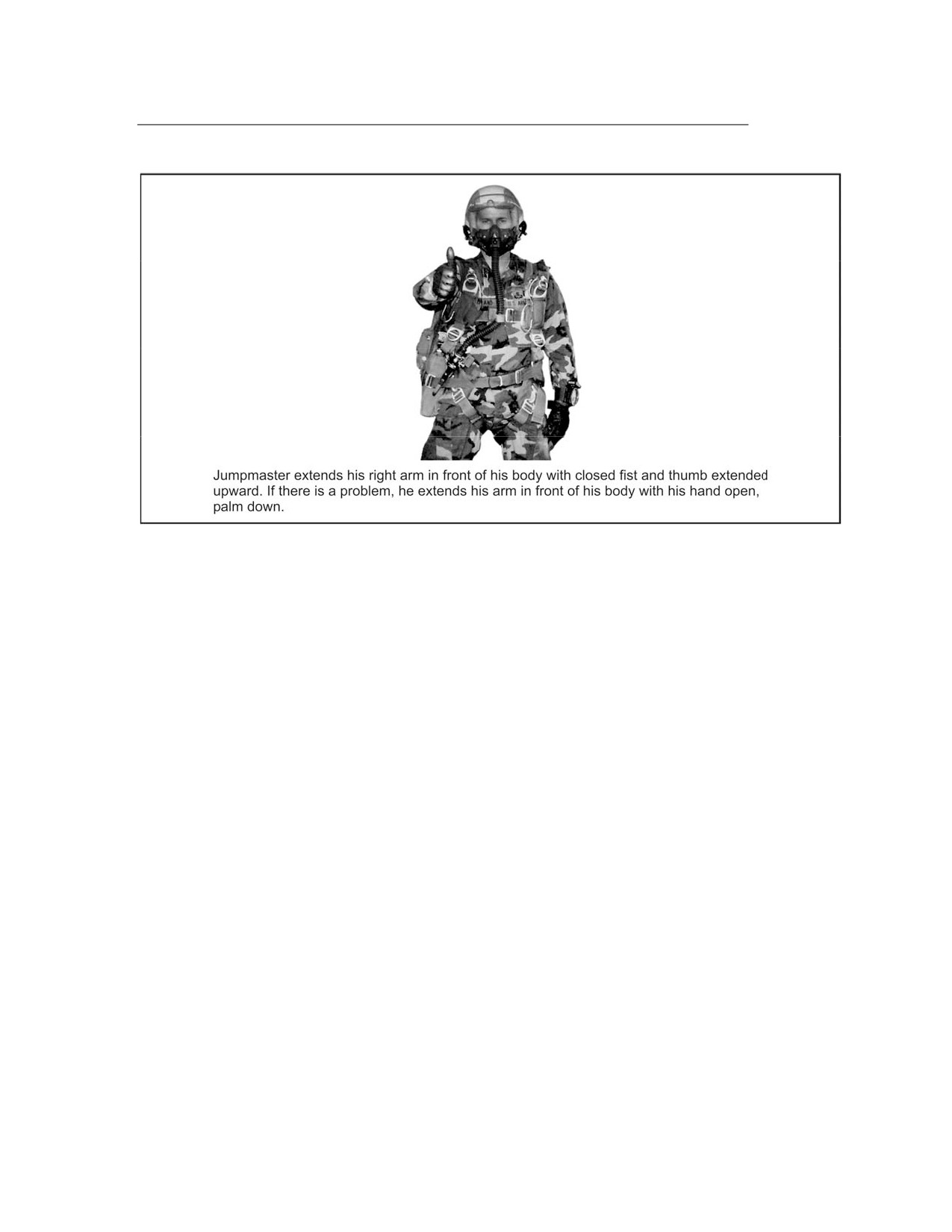
6-6. The jumpmaster signals CHECK OXYGEN immediately after the signal to
mask and periodically after that (Figure 6-5, page 6-7). At a minimum, he
gives it following the 20- and 10-minute time warnings. Upon receiving this
signal, the parachutist returns the signal if everything is functioning
correctly. If there is a problem, the parachutist extends an arm in front of his
body with his hand open, palm down.
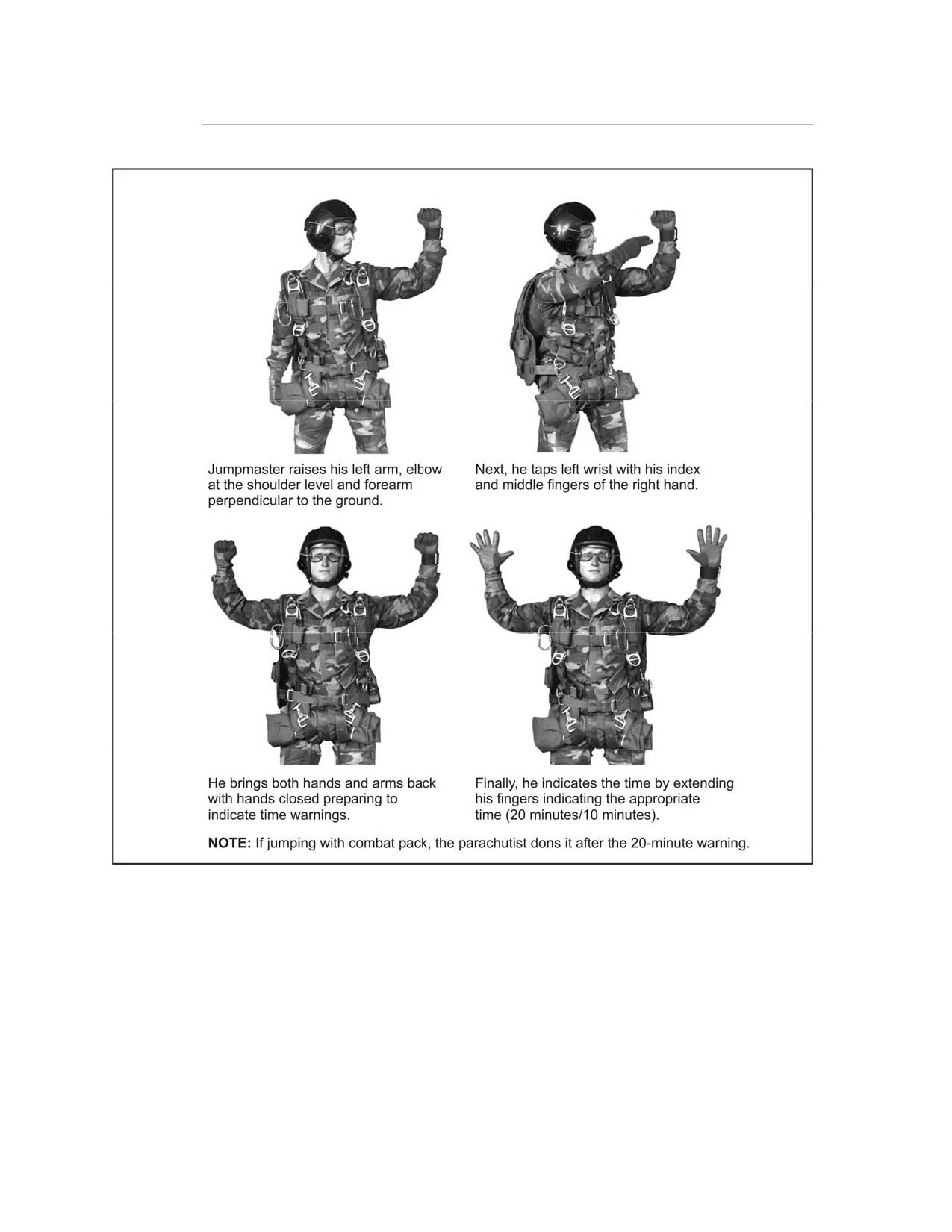
TIME WARNINGS
6-7. The jumpmaster receives time warnings from the flight crew. The
jumpmaster signals the TIME WARNINGS to the parachutist to allow him
adequate time to prepare for the jump (Figure 6-6, page 6-8). The parachutist
normally receives the time warnings 20 minutes and 10 minutes before TOT.
6-6
FM 3-05.211/MCWP 3-15.6/NAVSEA SS400-AG-MMO-010/AFMAN 11-411(I)
6 April 2005
FM 3-05.211
Figure 6-5. Check Oxygen Signal
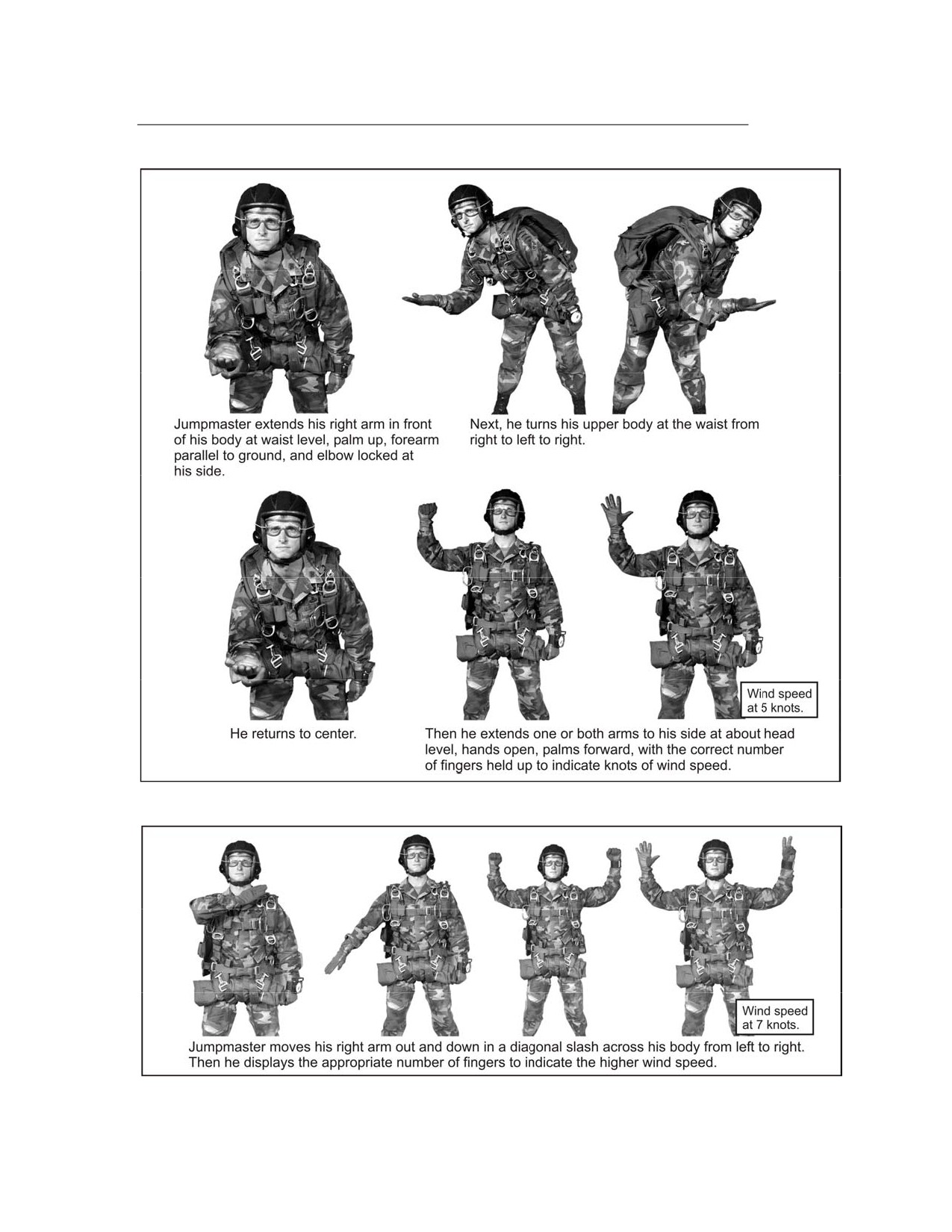
WIND SPEED
6-8. The jumpmaster signals WIND SPEED after the 10-minute time warning
(Figure 6-7, page 6-9). In gusting wind conditions, the jumpmaster gives the
wind speed signal first to indicate the lower wind speed. He follows with the
GUSTING WINDS signal to indicate the higher wind speed (Figure 6-8, page
6-9).
ARM ARR
6-9. The jumpmaster normally signals ARM ARR after the 10-minute time
warning (Figure 6-9, page 6-10). He can also give this signal anytime the
aircraft ascends above the safe-to-arm altitude for the specific ARR being
used, usually 5,000 to 6,000 feet AGL. Upon receipt of this signal, the
parachutist ensures his parachute is against the seat or fuselage, arms his
ARR, counts to six, gets a check from another parachutist, and passes the
thumbs-up signal from the front of the aircraft to the rear of the aircraft to
the jumpmaster.
JUMP COMMANDS
6-10. The jump commands discussed in the following paragraphs begin as
early as 2 minutes before the actual jump is made. The jumpmaster gives
these commands.
NOTE: The 2 MINUTE, 1 MINUTE, 15 SECOND, and GO commands can be given
with either hand, depending upon which side of the aircraft the MFF
jumpmaster is on.
6 April 2005 FM 3-05.211/MCWP 3-15.6/NAVSEA SS400-AG-MMO-010/AFMAN 11-411(I)
6-7
FM 3-05.211
Figure 6-6. Time Warning Command
6-8
FM 3-05.211/MCWP 3-15.6/NAVSEA SS400-AG-MMO-010/AFMAN 11-411(I)
6 April 2005
FM 3-05.211
Figure 6-7. Wind Speed Command
Figure 6-8. Gusting Winds Command
6 April 2005 FM 3-05.211/MCWP 3-15.6/NAVSEA SS400-AG-MMO-010/AFMAN 11-411(I)
6-9