FM 3-05.211 Special Forces Military Free-Fall Operations (APRIL 2005) - page 2
FM 3-05.211
WARNING
Parachutists must not tamper with internal
components of the calculator in any manner;
inaccurate readings could result.
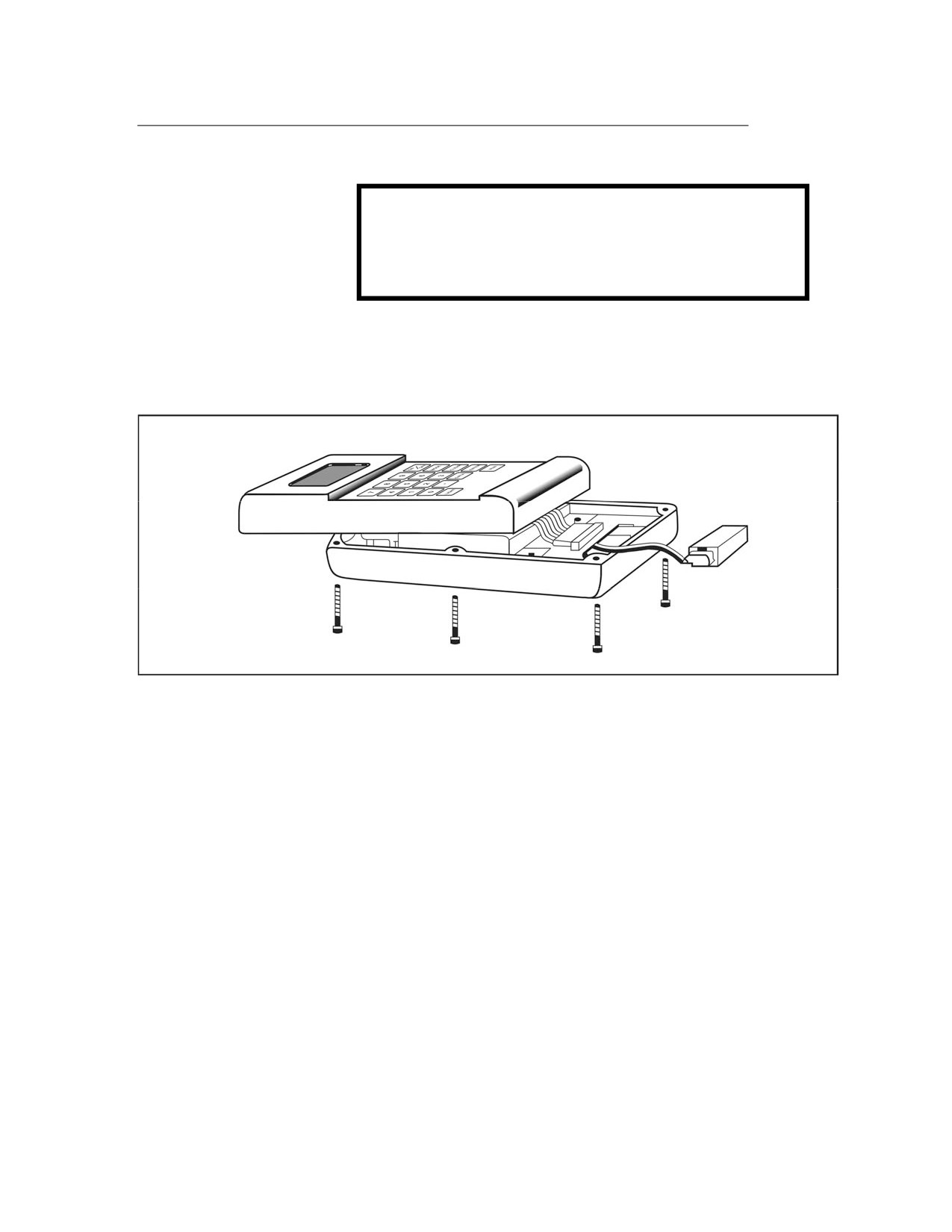
• Carefully lifts off the top half of the case. (A flexible ribbon cable
connects the top to the bottom.) The parachutist should not detach this
cable from the bottom half of the unit. He pivots the top half of the case
up over the bottom half as shown in Figure 3-7.
Figure 3-7. Battery Replacement
• Lifts the battery and its connector up out of the recess in the printed
circuit board. The parachutist must be careful not to damage the
connector or pull the cable beyond its slack length (approximately 2
inches). He snaps the battery out of the connector.
• Obtains a fresh battery of the same type
(9 volt
[V] alkaline
commercial) and snaps it onto the terminals of the connector. The
parachutist carefully pushes the slack length of the connector back
under the printed circuit board and replaces the battery in its recess.
• Fits the top half of the case back onto the bottom half and does not
install screws yet. While holding the two halves together, the
parachutist presses ON/OFF and verifies that ACTUATION
ALTITUDE appears, blinking, in the first display line and FT AGL is
displayed in the second line. If no display appears, the parachutist
makes sure—
The battery is correctly attached to the connector terminals.
The ribbon cable between the two halves of the case has not become
detached.
• Presses ON/OFF again to turn off the calculator.
6 April 2005 FM 3-05.211/MCWP 3-15.6/NAVSEA SS400-AG-MMO-010/AFMAN 11-411(I)
3-19
FM 3-05.211
• Maintains finger pressure to hold the two halves of the case together
while reinstalling the assembly screws. The parachutist must use care
in tightening the screws. The parachutist may find it helpful to place a
finger against the case joint to feel the amount of clearance remaining
between the two halves as each screw is tightened.
CAUTION
Parachutists must not overtighten screws. Stripped
threads may render the calculator unserviceable.
CLEANING
3-43. Parachutists clean the exterior surfaces of the calculator using a clean
cloth dampened with water and, if necessary, a little mild soap. They do not
use solvents or immerse the calculator in water or other liquids.
SENTINEL MK 2100
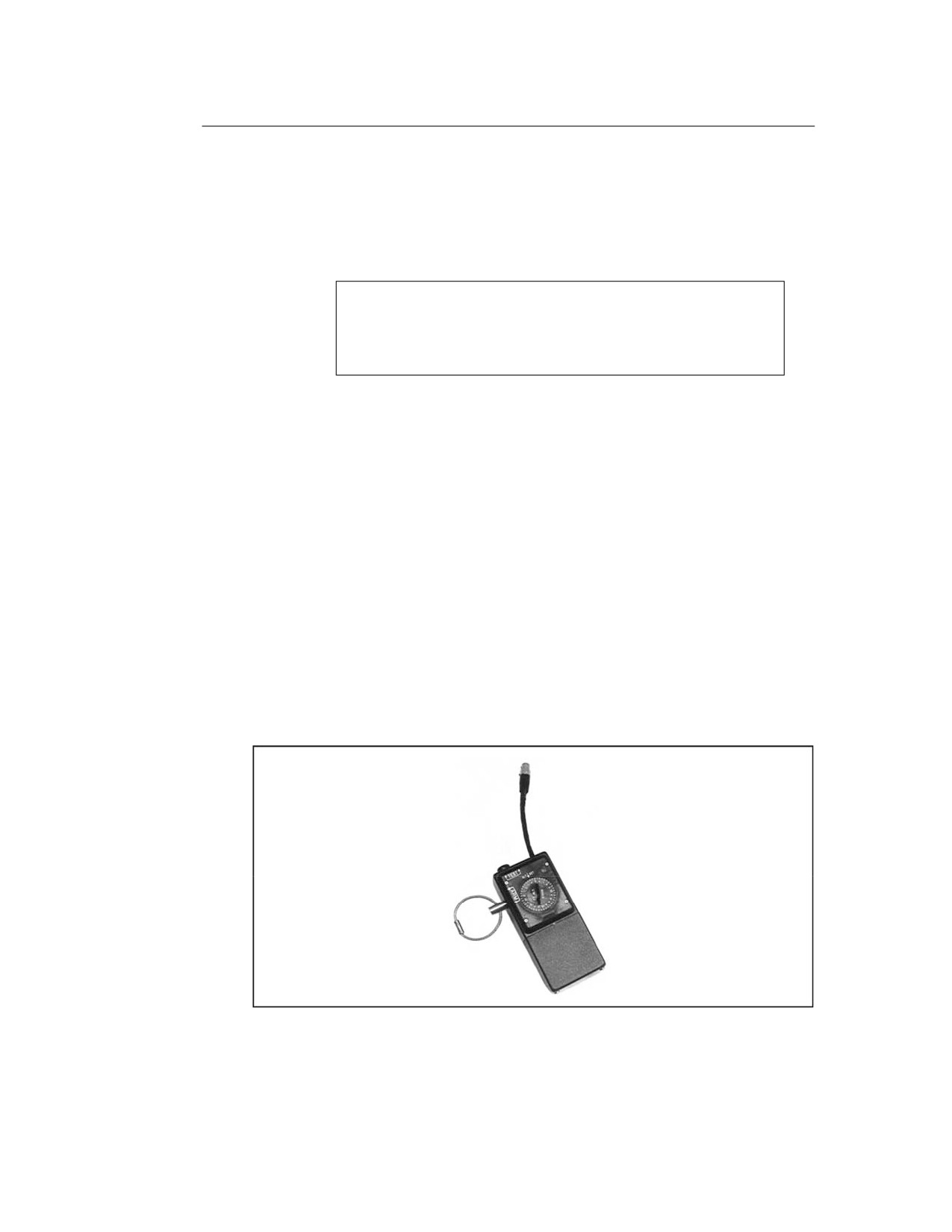
3-44. The Sentinel MK 2100 automatic emergency parachute release system
(Figure 3-8) is precision engineered to provide automatic emergency opening
of the parachute pack assembly. Altitude and rate of descent sensing
capability combined with reliable solid-state electronic circuitry provide
completely automatic operation while in the air. The electronic circuitry
supplies the power to the explosive detonating cartridge. When the explosive
cartridge fires, powerful expanding gases drive the actuating piston within
the power actuating cylinder with ample force and movement to extract the
pins from the locking cones on the reserve parachute. Properly calibrated, the
Sentinel MK 2100 can accurately sense the preset actuation altitude of 1,000
feet to 20,000 feet.
Figure 3-8. Sentinel MK 2100
3-20
FM 3-05.211/MCWP 3-15.6/NAVSEA SS400-AG-MMO-010/AFMAN 11-411(I)
6 April 2005
FM 3-05.211
MAJOR COMPONENTS
3-45. The Sentinel MK 2100 consists of four main operating elements. Each
of these elements is discussed below:
• Sensing unit. The sensing unit contains the following components:
An altitude sensing mechanism.
A rate of descent sensing mechanism.
A self-test indicating system for battery and actuator cartridge
condition checks.
A calibration mechanism.
• Actuator cartridge. Electrically detonated gas pressure provides energy
to operate the power ripcord.
• Power ripcord. The power ripcord converts explosive energy into
mechanical motion to activate the reserve ripcord.
• Batteries. The batteries are self-contained nicad batteries that exhibit
good low-temperature characteristics.
3-46. The built-in test circuit checks the batteries automatically every time
the unit is calibrated. The test circuit checks the battery capacity to operate
the unit and the electrical integrity of the actuating cartridge. A solid-state
electronic indicating light is used to provide “GO/NO-GO” system functioning
checks.
PRINCIPLE OF OPERATION
3-47. After exit from the aircraft, the rate of descent sensing element
automatically turns on when the vertical falling rate reaches approximately
50 percent of terminal velocity. Automatic disarming occurs when the rate of
descent falls below this level. Reserve activation only occurs when the preset
firing altitude is reached with a velocity greater than 50 percent of terminal
falling speed. Therefore, descent through the preset altitude under a
normally inflated canopy would not cause activation of the reserve assembly.
3-48. Should the parachutist’s rate of descent for any reason increase after a
normal opening due to canopy damage or destruction, the Sentinel MK 2100
will again automatically “rearm” itself as it senses the increased vertical
velocity above 50 percent of terminal velocity. The Sentinel MK 2100 also has
a unique operating characteristic that provides for automatic release
actuation within 1 to 4 seconds after a cutaway release is made from a
partially malfunctioned canopy below the preset altitude, if manual operation
does not occur sooner.
3-49. Manual-activation override of the system is inherently provided at all
times due to the integrated design of the power ripcord assembly and manual
ripcord.
3-50. As a safety feature, the Sentinel MK 2100 is able to fire only when the
preset firing altitude is approached from a 1,500 feet or higher altitude and
only for 60 seconds or so after passing the preset altitude on the way down.
After 60 seconds, a built-in timer disables the circuit until the unit is taken
above the preset altitude again and the cycle is repeated. An arming pin is
6 April 2005 FM 3-05.211/MCWP 3-15.6/NAVSEA SS400-AG-MMO-010/AFMAN 11-411(I)
3-21
FM 3-05.211
provided to completely disable the sensing unit and must be removed prior to
exit to enable proper operation.
SAFETY CONSIDERATIONS
3-51. An operational cartridge light indicates only that the electrical output
and wiring circuitry, up to and including the cartridge, is operational. It does
not ensure that the explosive charge is good.
3-52. A visual inspection of the charge before use is the only way to verify
whether the charge has been fired. (On occasion, it is possible for a fired
cartridge to still light the cartridge light.) This visual check should be
considered mandatory due to critical use of the Sentinel MK
2100 as
lifesaving equipment.
3-53. If anything appears abnormal or out of the ordinary when calibrating
or using the MK 2100, parachutists discontinue its use and return it for
repairs immediately.
3-54. If the jump is aborted for any reason, the arming pin must be
reinserted. This action is taken to avoid any possibility of the unit firing in a
rapidly descending aircraft.
3-55. Parachutists avoid operating the Sentinel MK 2100 unnecessarily. It
is an emergency system and should be treated as such.
3-56. During cold weather jumping, parachutists check the battery’s
condition prior to exit to determine if the lower temperature at jump altitude
has degraded the battery’s capacity to activate the cartridge.
MILITARY CYPRES
3-57. The Military CYPRES is an automatic activation device that meets the
needs and requirements of MFF operations (HALO and HAHO). The Military
CYPRES senses the rate of fall and altitude (AGL) by the use of pressure
relation of the set default altitude above a DZ
(training mode), or a
programmed virtual DZ (operational mode) by means of setting a calculated
pressure setting in millibars into the CYPRES unit. When the CYPRES falls
through the altitude window set above the DZ, either actual or virtual, at a
rate of fall at or beyond the default speed of the CYPRES, the CYPRES will
activate. The explosive-powered cutter assembly will activate electronically
and sever the reserve parachute’s special-made continuous closing loop to
allow positive opening of the reserve pack assembly. If the rate of fall is
slower than the set default speed, the CYPRES will not actuate.
COMPONENTS
3-58. The Military CYPRES has only three components—the control unit,
the processing unit, and the release unit. The Military CYPRES system is
water resistant for 15 minutes at a depth of 15 feet and is encased in a robust
case with rounded corners and edges.
3-22
FM 3-05.211/MCWP 3-15.6/NAVSEA SS400-AG-MMO-010/AFMAN 11-411(I)
6 April 2005
FM 3-05.211
Control Unit
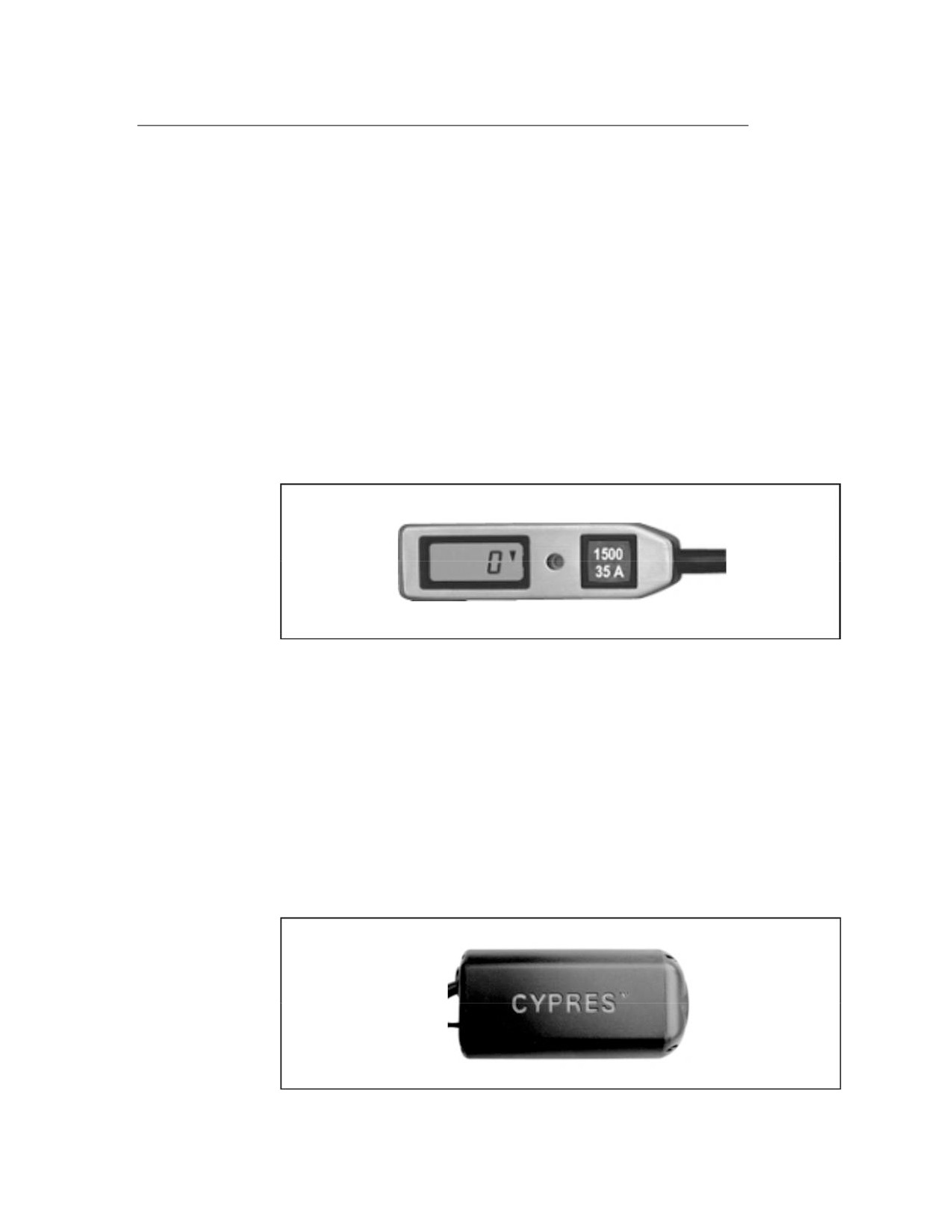
3-59. The control unit (Figure 3-9) provides the interface between the user
and the processing unit. The control unit allows the user to control functions
such as turning on the Military CYPRES and setting the Military CYPRES
with the proper millibar setting for the operational mode. The control unit
also allows the user to observe additional information about the unit, such as
the Military CYPRES’s serial number, the due date of the next maintenance,
and the current pressure in millibars at the present location. The user can
also observe that the unit is “ON” or “OFF” by observing the setting (0 arrow
down) for use in the training mode, or the setting (set to the proper millibar
setting) when used in the operational mode. The writing on the single
operating button lets the jumpmaster know which model of the Military
CYPRES is installed in the parachute system. Figure 3-9 depicts the control
unit for the Military CYPRES that has a default setting of 1,500 feet and a
fall rate setting of 35 meters per second (114 ft/sec or 78 mph).
Figure 3-9. Military CYPRES Control Unit
Processing Unit
3-60. The processing unit (Figure 3-10) contains computer software that
senses pressure for altitude sensing and rate of descent sensing means. It
automatically conducts self-testing every time the unit is turned on. While
“ON,” the processing unit conducts continuous calibrations (mode-dependent)
to update for weather changes.
NOTE: The processing unit is electromagnetic interference protected (for
example, radios will not cause the CYPRES to activate) and static electricity
protected. Accidental discharge of the release unit cutter is extremely
unlikely.
Figure 3-10. Military CYPRES Processing Unit
6 April 2005 FM 3-05.211/MCWP 3-15.6/NAVSEA SS400-AG-MMO-010/AFMAN 11-411(I)
3-23
FM 3-05.211
Release Unit
3-61. Release units are available for two-pin reserves for the MC-4. The
release unit (Figure 3-11) contains an explosive-powered cutter assembly that
is activated electronically to cut the reserve’s special-made continuous closing
loop to allow positive opening of the reserve pack assembly.
NOTE: The explosive-powered cutter is transportable on all military aircraft
and does not require any special load planning or transportation
considerations.
Figure 3-11. Military CYPRES Release Unit
MAINTENANCE
3-62. After the initial installation, the manufacturer completes all additional
maintenance every four years. The CYPRES unit will alert the user of nearing
maintenance, and the maintenance due date is easily available along with the
unit’s serial number. The serial number and maintenance due date of the
Military CYPRES can be checked by entering the operational mode. While in
the operational mode, the user enters a millibar setting of “1111.” The serial
number will then be displayed for 5 seconds, the screen will go blank, and then
the month and year of the next maintenance due date will be displayed for 5
seconds. In case of intentional or unintentional water jumps, a filter on the
processing unit must be changed. A spare filter is provided with each unit.
Additional filters may be ordered through the Army supply depot system.
MODES OF OPERATION
3-63. The Military CYPRES can be operated in one of two modes—training
and operational. The training mode is for simple HALO operations when the
departure airfield and the intended DZ are at the same elevation.
NOTE: The issue for the training mode is to ensure that the activation altitude
does not fall below 1,500 feet AGL, which is the lowest acceptable activation
altitude for a reserve-mounted AAD. It is possible, but not recommended with a
Military CYPRES with a default setting of 1,900 feet activation altitude (MFF
school usage only), that the training mode could be used for a DZ that is up to
but does not exceed 400 feet above the departure airfield. The training mode is
not to be used if the DZ is below the departure airfield.
3-64. The operational mode is the tactical use of the Military CYPRES and
should be used for any of the following five situations:
• The intended DZ elevation is below the elevation of the departure
airfield.
• The intended DZ elevation is greater than 400 feet above the departure
airfield.
3-24
FM 3-05.211/MCWP 3-15.6/NAVSEA SS400-AG-MMO-010/AFMAN 11-411(I)
6 April 2005
FM 3-05.211
• The intended flight path goes below the departure airfield elevation.
• The anticipated flight exceeds 1 1/2 hours from takeoff to time over
target (TOT).
• The mission requires the ability to set the AAD while in flight at any
altitude in a pressurized or unpressurized cabin.
Use of the Military CYPRES in the Training Mode
3-65. An initial switch-on at the DZ will suffice for any number of jumps,
provided they take place within 14 hours. If jump operations exceed 14 hours,
the Military CYPRES must be reset, turned off, and then turned on again.
NOTE: For the training mode only, the Military CYPRES must be switched
on at the departure airfield while on the ground; it must NOT be switched on
inside a flying aircraft or helicopter.
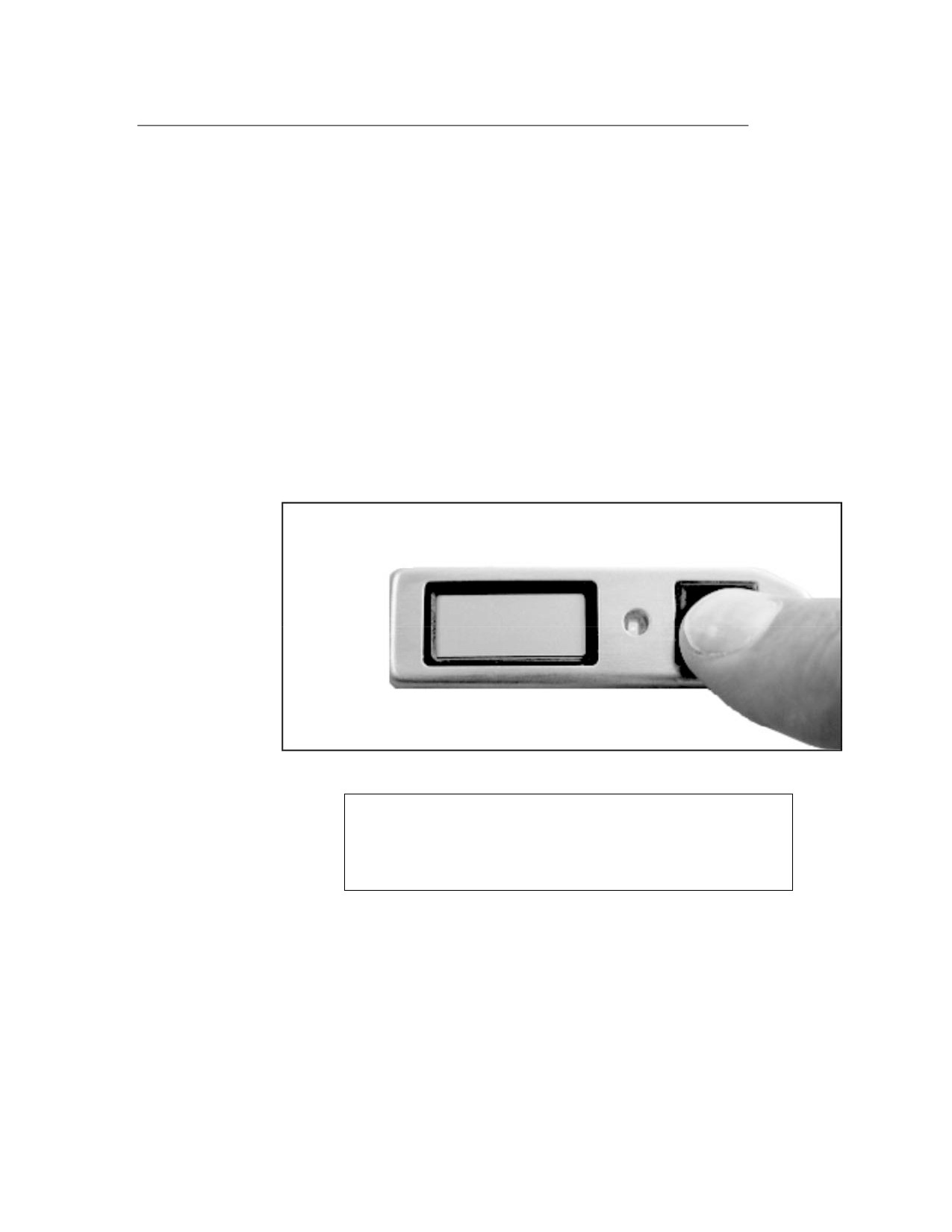
3-66. To operate the Military CYPRES in the training mode, the user
presses the push button on the control unit with his fingertip (Figure 3-12).
Figure 3-12. Turning on the Control Unit
CAUTION
User should not use a fingernail or any other sharp object
to press the push button.
3-67. The push button is the only means the user has to control the Military
CYPRES functions. For a parachutist, necessary handling is reduced to the
following two actions while operating in the training mode—switch on and
switch off.
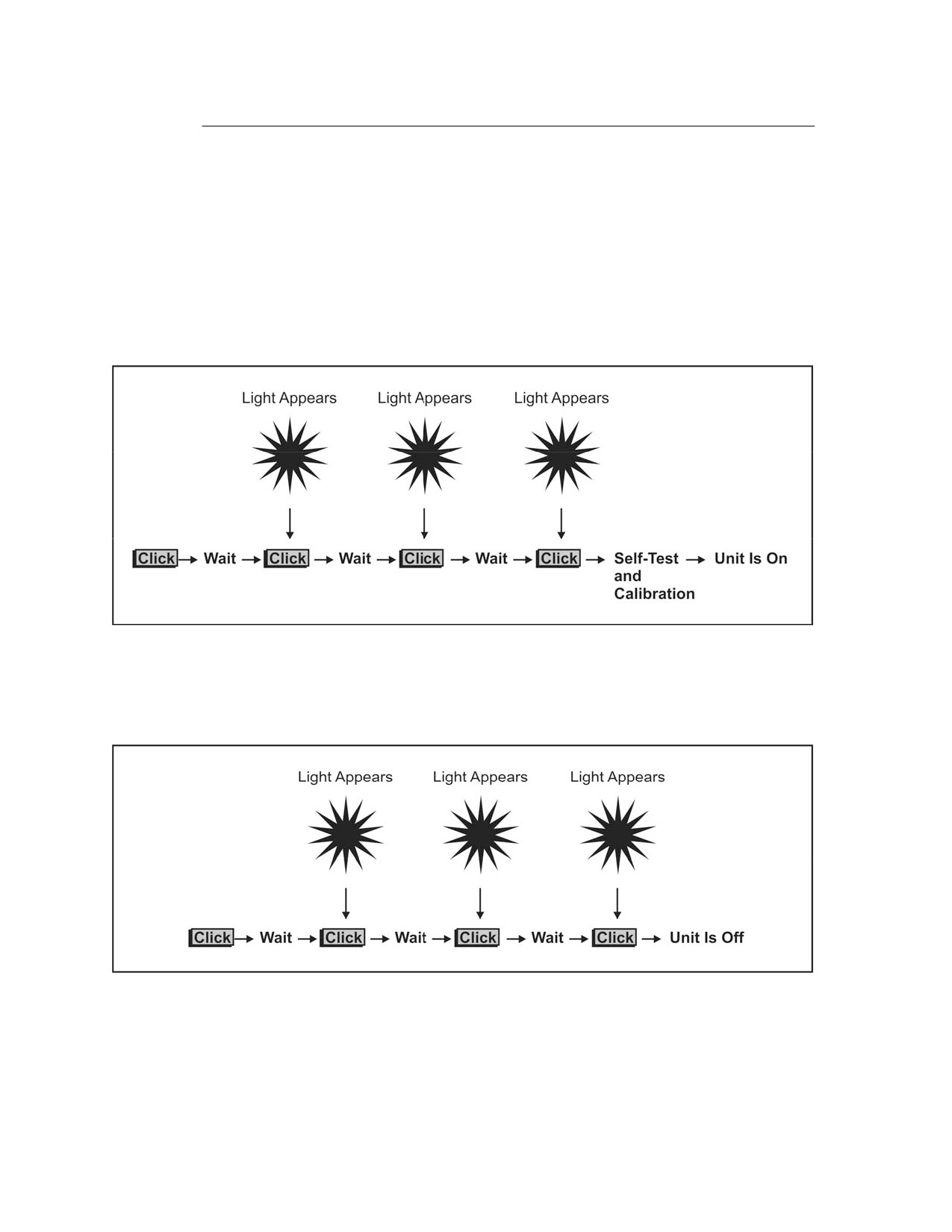
3-68. Switch On. The user starts the switch-on cycle by clicking the button
once. After approximately 1 second, the red light emitting diode (LED) will
glow. The user must acknowledge the red light immediately by clicking the
button again. This sequence—a click following the appearance of the red
light—will be repeated two more times. After a total of four clicks, the
Military CYPRES goes into self-test mode (Figure 3-13, page 3-26). If the
user does not act promptly after seeing the LED light, or if he pushes the
6 April 2005 FM 3-05.211/MCWP 3-15.6/NAVSEA SS400-AG-MMO-010/AFMAN 11-411(I)
3-25
FM 3-05.211
button too soon, the Military CYPRES will ignore the switch-on attempt. This
four-click initiation cycle has been designed to avoid accidental switch-on.
3-69. Once the switch-on procedure is finished, the unit will run through its
self-test. Upon completion of the self-test, the display will read “0” with the
arrow down. After 14 hours have passed, the unit will switch off automati-
cally. A manual switch-off is always possible using the push button. If the
self-test is not successful, an error code is shown on the display for
approximately 2 seconds. If this occurs, the user should consult a parachute
rigger.
Figure 3-13. Switch-On Procedure
3-70. Switch Off. The manual switch-off sequence is identical to the
switch-on procedure, except after the fourth click the unit will switch off
(Figure 3-14).
Figure 3-14. Switch-Off Procedure
3-26
FM 3-05.211/MCWP 3-15.6/NAVSEA SS400-AG-MMO-010/AFMAN 11-411(I)
6 April 2005
FM 3-05.211
WARNING
Should any of the following situations occur, the
Military CYPRES must be reset before the next jump:
• Jumpers miss the intended DZ and the landing
takes place in an area with an elevation greater
than
30 feet
(10 meters) above or below the
intended DZ. Or, on the return journey to the DZ,
the ground elevation changes greater than 30 feet
(10 meters) above or below the intended DZ.
• The unit is taken away from the airfield or DZ by
vehicle or carried by hand and later brought back
again.
• The total time for a single jump
(takeoff to
landing) exceeds 1 1/2 hours.
NOTE: General recommendation—if there is any doubt as to whether the
above-mentioned has occurred, the user should reset the CYPRES.
3-71. User and pilot considerations while operating in the training mode
include the following:
• Every Military CYPRES unit (in training mode) will fully arm itself at
an altitude of 1,500 feet above its default setting. For example, for the
model with a 1,900-foot default setting, the Military CYPRES will
automatically arm at 3,400 feet above the departure airfield.
• Pilots should never descend to an altitude below the elevation of the
departure airfield.
• If the aircraft can be pressurized, pilots should make sure that the
cabin remains open when the turbines are started up. A window, a
door, or the ramp should be left open slightly until after liftoff. Pilots
should make sure that the cabin pressure cannot build up above the air
pressure on the ground. (NOTE: The parachutists’ altimeters should
never go below “0.”)
• While descending, the aircraft should not exceed the vertical activation
speed in the activation window (78 mph direct descent for the MC-4).
Use of the Military CYPRES in the Operational Mode
3-72. The operational mode must be used when the intended DZ elevation is
different than that of the departure airfield. The only required information
that the Military CYPRES unit needs to operate is the millibar setting, which
is derived from the aircraft altimeter setting and the elevation of the target
DZ (MSL). The aircraft altimeter setting pressure information can be
obtained from the pilots (altimeter setting) or a weather station within 100
miles of the DZ. If the information is unavailable, the combat setting of 29.92
should be used. Once the jumpmaster obtains the altimeter setting and the
DZ elevation (-1600 feet to 30,000 feet MSL), the jumpmaster will calculate
the millibar setting that will be placed on the Military CYPRES by either the
6 April 2005 FM 3-05.211/MCWP 3-15.6/NAVSEA SS400-AG-MMO-010/AFMAN 11-411(I)
3-27
FM 3-05.211
CYPRES Military Absolute Adjust Circular Calculator or the CYPRES
Military Absolute Model Calculator.
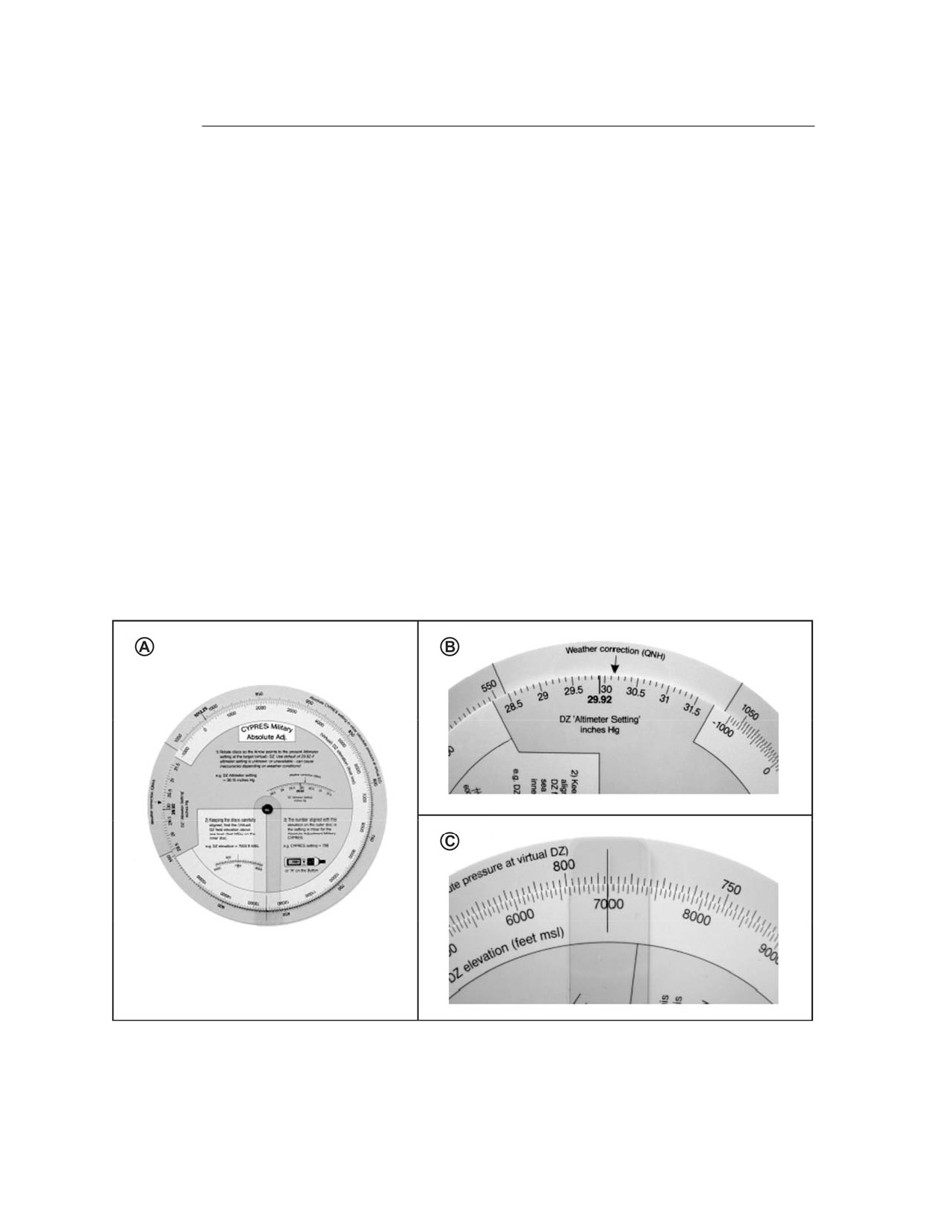
3-73. CYPRES Military Absolute Adjust Circular Calculator. The
jumpmaster obtains the forecasted aircraft altimeter setting for the DZ. If
flying a mission with limited weather information, the aircrew can provide
the altimeter setting en route to the drop area. The altimeter (pressure)
setting will be given in inches of mercury (Hg). The jumpmaster obtains the
setting to the nearest one-hundredth of an inch. Using the Military Absolute
Adjust Circular Calculator (Figure 3-15A), the jumpmaster determines the
absolute adjust millibar setting by—
• Rotating the discs so the arrow points to the present aircraft altimeter
setting at the target (virtual) DZ. A default of 29.92 is used if altimeter
setting is unknown or unavailable. NOTE: This setting can cause
inaccuracies depending on weather conditions; for example, DZ
altimeter setting = 30.15 inches Hg (Figure 3-15B).
• Keeping the discs carefully aligned, finding the DZ field elevation
above sea level (feet MSL) on the inner disc, and placing the “clock
hand” black indicator line on the ground elevation of the desired
(virtual) DZ (for example, DZ elevation = 7,100 feet) (Figure 3-15C).
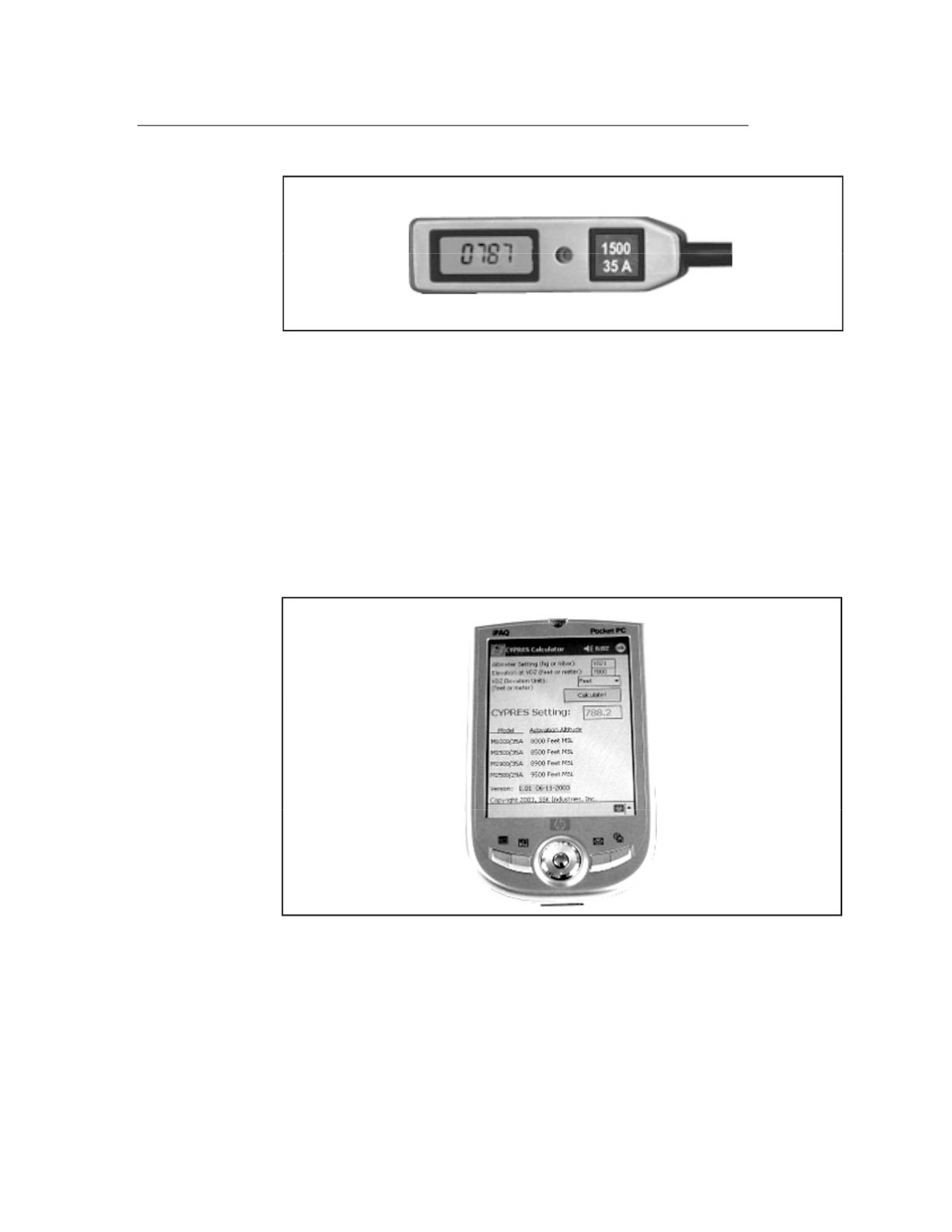
The number aligned with this elevation on the outer disc is the setting
in millibars for the absolute adjustment for the military CYPRES
(example 787 millibars) (Figure 3-16, page 3-29).
Figure 3-15. CYPRES Military Absolute Adjust Circular Calculator
3-28
FM 3-05.211/MCWP 3-15.6/NAVSEA SS400-AG-MMO-010/AFMAN 11-411(I)
6 April 2005
FM 3-05.211
Figure 3-16. Example of Military CYPRES Control Unit Setting
3-74. CYPRES Military Absolute Adjust Model Calculator. To use this
calculator (Figure 3-17), the jumpmaster—
• Enters the altimeter setting of the intended DZ or the aircraft
altimeter setting (in either Hg or millibars).
• Enters the DZ elevation (MSL).
• Selects from the drop down box the elevation scale (either feet or
meters).
• Clicks the ‘Calculate!’ button.
The value for the CYPRES setting is then displayed in the box.
Figure 3-17. CYPRES Military Absolute Adjust Model Calculator
3-75. To operate the Military CYPRES in the operational mode, the user
presses the push button on the control unit. The push button is the only
means the user has to control the Military CYPRES functions. For a
parachutist, necessary handling is reduced to the following four actions while
operating in the operational mode:
• Switch on.
• Increase altitude reference.
6 April 2005 FM 3-05.211/MCWP 3-15.6/NAVSEA SS400-AG-MMO-010/AFMAN 11-411(I)
3-29
FM 3-05.211
• Decrease altitude reference.
• Switch off.
The following paragraphs provide thorough descriptions of these four actions.
3-76. The Military CYPRES is switched on by clicking the push button four
times with very short clicks. The user starts the switch-on cycle by clicking
the button once. After approximately 1 second, the red LED light will glow.
The user must acknowledge the red light immediately by clicking the button
again. This sequence—a click following the appearance of the red light—will
be repeated two more times. The user holds the push button down on the
fourth click. After a total of four clicks, the Military CYPRES goes into self-
test mode (Figure 3-13, page
3-26). Immediately after the self-test, the
number “1000” appears.
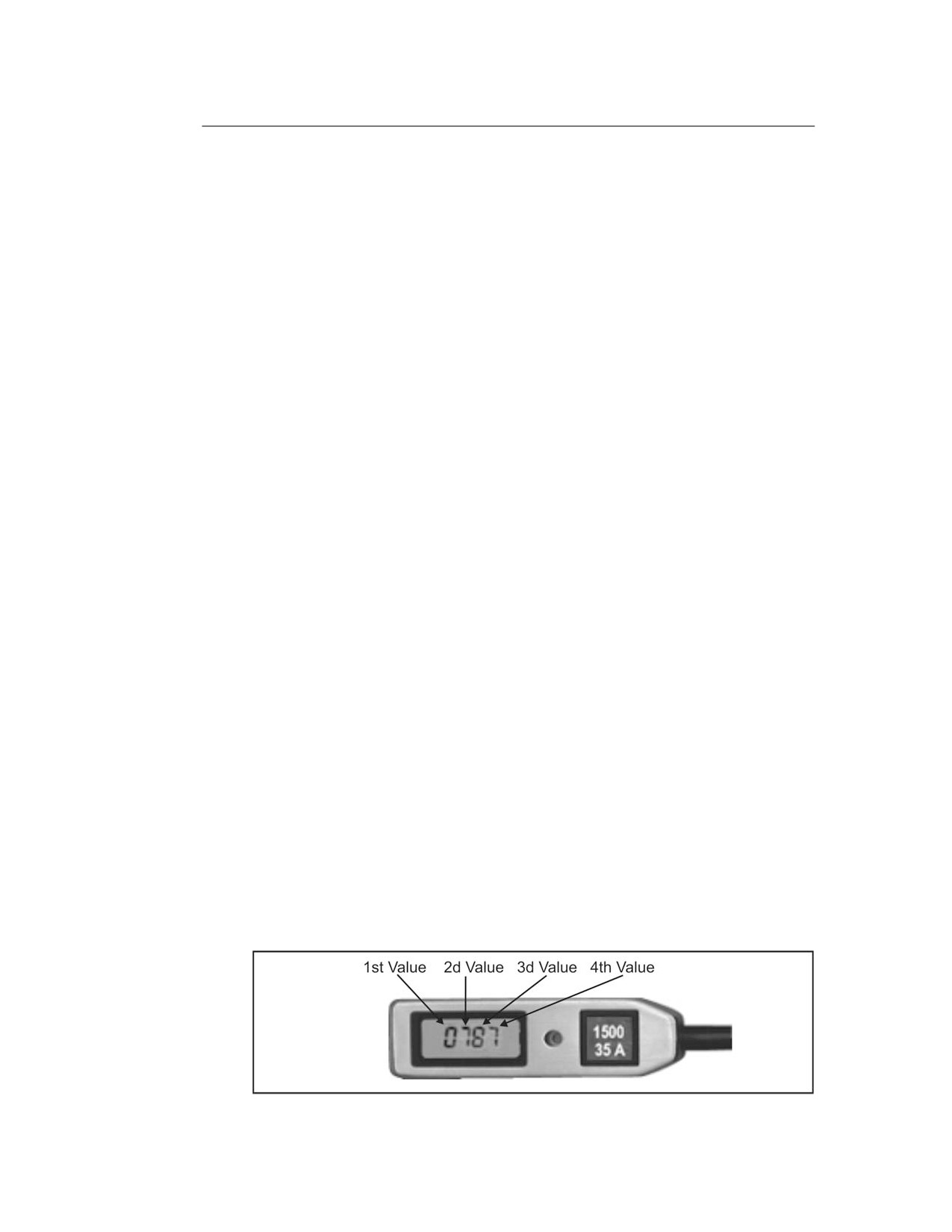
3-77. The”1” will alternate with “0.” The user lets go of the button to choose
“0” or “1.” The chosen value remains visible on the display (Figure 3-18).
3-78. The user presses and holds the button again. The second digit counts
from “0” through “9.” Once the user sees the second number he wants to
select, he lets go of the button at the chosen value. This value remains visible
on the display (Figure 3-18).
3-79. The user presses and holds the button again. The third digit counts
from “0” through “9.” Once the user sees the third number he wants to select,
he lets go of the button at the chosen value. This value remains visible on the
display (Figure 3-18).
3-80. The user presses and holds the button again. The fourth digit counts
from “0” through “9.” Once the user sees the fourth number he wants to
select, he lets go of the button at the chosen value. This value remains visible
on the display (Figure 3-18).
3-81. If the user missed a value, he keeps his finger on the button until the
value shows up again. (After “9” the display restarts automatically with “0.”)
3-82. The pressure adjustment and the display indication remain until the
unit is switched off. If the user has to change his setting, he must switch the
CYPRES off and on again.
NOTE: If the user tries to enter a pressure of less than 200 millibars
(approximately 39,000 feet above sea level) or more than 1,075 millibars
(approximately 1,600 feet below sea level), the Military CYPRES switches
itself off. The blank display indicates that the desired adjustment is outside
the specified parameters.
Figure 3-18. Example of Value Settings
3-30
FM 3-05.211/MCWP 3-15.6/NAVSEA SS400-AG-MMO-010/AFMAN 11-411(I)
6 April 2005
FM 3-05.211
3-83. User and pilot considerations while operating in the operational mode
include the following:
• Every Military CYPRES unit (in operational mode) will fully arm itself
when the millibar setting is inputted into the control unit.
• Descent to an altitude below the elevation of departure airfield will not
affect the Military CYPRES in the operational mode.
• When operating in the operational mode, the Military CYPRES can be
set in a pressurized or depressurized aircraft while in flight.
• While descending, the aircraft should not exceed the vertical activation
speed in the activation window (78 mph direct descent for the MC-4).
• The pilot should maintain a climb rate of no more than 1,000 feet per
minute (ft/min) if depressurized or a steady pressurized rate within
1,000 ft/min if pressurized.
6 April 2005 FM 3-05.211/MCWP 3-15.6/NAVSEA SS400-AG-MMO-010/AFMAN 11-411(I)
3-31
This page intentionally left blank.
FM 3-05.211
Chapter 4
Use of Oxygen in Support of Military
Free-Fall Operations
MFF parachuting is physically demanding. It exposes the parachutist to
temperature extremes, rapid pressure changes, and long exposures at
altitudes requiring supplemental oxygen. To prepare for this
environment, the MFF parachutist must be thoroughly familiar with the
physiological effects of oxygen, oxygen use, and the operation of oxygen
equipment. All personnel participating in MFF operations must meet the
physiological training requirements outlined in Appendix B, regardless of
altitude and type of aircraft used.
PHYSIOLOGICAL EFFECTS OF HIGH-ALTITUDE
MILITARY FREE-FALL OPERATIONS
4-1. Most physiological effects of high-altitude MFF operations fall into the
category of pressure-change hazards. These hazards usually include various
physiological symptoms. Based on Class C physiological mishaps since 1984,
the most common types have been sinus blocks and ear blocks, hypoxia,
decompression sickness, and hyperventilation. Each of these is discussed in
the following paragraphs. Procedures for physiological and oxygen
equipment-related emergencies are also discussed.
SINUS BLOCKS AND EAR BLOCKS
4-2. Sinus blocks and ear blocks normally occur when an MFF parachutist
jumps with a head cold or some other type of upper respiratory illness. Sinus
blocks and ear blocks usually occur during free-fall descent or during aircraft
pressurization. Performing a Valsalva maneuver as the parachutist feels his
ears getting “full” can clear most ear blocks. A Valsalva maneuver may clear
a sinus block but may require additional medical attention. Use of nasal
sprays may alleviate the symptoms associated with sinus and ear blocks.
HYPOXIA
4-3. Hypoxia is a condition caused by lack of oxygen. A reduction in the
partial pressure of oxygen in the atmosphere occurs as the parachutist
ascends. When the parachutist inhales, he receives fewer oxygen molecules.
The reduction of the partial pressure inhibits the body’s ability to transfer
oxygen to the tissues. The most common symptoms of hypoxia are blurred or
tunnel vision, color blindness, dizziness, headache, nausea, numbness,
tingling, euphoria, belligerence, loss of coordination, and lack of good
judgment. Corrective action for a parachutist who becomes hypoxic is to place
him on 100 percent oxygen and inform the aircraft commander. In extreme
cases, it may be necessary to descend the aircraft and evacuate the
6 April 2005 FM 3-05.211/MCWP 3-15.6/NAVSEA SS400-AG-MMO-010/AFMAN 11-411(I)
4-1
FM 3-05.211
parachutist to the nearest medical facility. If hypoxia goes unrecognized and
uncorrected, it can result in seizures, unconsciousness, or even death.
DECOMPRESSION SICKNESS
4-4. Decompression sickness (DCS) is a condition caused by the release of
nitrogen from body tissues. DCS usually occurs during unpressurized flights
above 18,000 feet MSL, but can occur at lower altitudes. Many factors
contribute to DCS. Facial hair can cause an insufficient seal of the oxygen
mask to the parachutist’s face, rendering prebreathing ineffective. Poor
physical conditioning and fatigue will make the individual more susceptible
to DCS. Alcohol use dehydrates the body, constricting the capillaries and
decreasing the efficiency of the cardiovascular system. Nicotine from tobacco
use hardens arteries and restricts blood flow to the capillaries, reducing the
efficiency of the cardiovascular system. Smoking also reduces the efficiency of
the lungs.
4-5. There are four types of DCS: the bends, chokes, neurological (central
nervous system) hits, and skin manifestations. Each of these is discussed in
the following paragraphs.
The Bends
4-6. The bends are the most common type of DCS. The most frequent
symptom is a deep, dull, and penetrating pain in major movable joints that
can increase to agonizing intensity. This pain may be significant enough to
make the parachutist feel as if he cannot move the joint. The affected
parachutist might also go into shock. Corrective action for a parachutist who
experiences the bends is to—
• Place him on 100 percent oxygen.
• Inform the aircraft commander.
• Descend the aircraft and pressurize the cabin to as close to sea level as
possible.
• Evacuate to the nearest medical facility with a recompression chamber.
A flight surgeon or aero medical examiner will determine if
compression therapy is required.
The Chokes
4-7. The chokes are a rare but potentially life-threatening form of DCS.
They are similar to the bends, but occur in the smaller blood vessels of the
lungs, resulting in poor gas exchange and oxygenation of the blood. The most
common symptoms are a deep, sharp pain near the breastbone; a dry,
nonproductive cough; the inability to take a normal breath; a feeling of
suffocation and apprehension; and possible shock symptoms, such as
sweating, fainting, and cyanosis. Corrective action for a parachutist who
experiences the chokes is the same as that stated in paragraph 4-6.
Neurological Hits
4-8. Neurological hits occur in extreme cases of DCS when the central
nervous system becomes affected. The affected parachutist may experience
4-2
FM 3-05.211/MCWP 3-15.6/NAVSEA SS400-AG-MMO-010/AFMAN 11-411(I)
6 April 2005
FM 3-05.211
vision disturbances, headaches, partial paralysis, loss of orientation,
delirium, and vertigo. Corrective action for a parachutist who experiences a
central nervous system hit is the same as that stated in paragraph 4-6.
Skin Manifestations or Paresthesia
4-9. Skin manifestations or paresthesia is caused by nitrogen bubbles
forming at the subcutaneous layer of the skin. The most common symptoms
are itching, hot and cold flashes, a creepy feeling or gritty sensation, mottled
reddish or purplish rash, and a tingling feeling of the affected area.
Corrective action for a parachutist who experiences any of these symptoms
is to—
• Place him on 100 percent oxygen.
• Keep him from scratching or exercising the affected area.
• Inform the aircraft commander.
4-10. Normally, the condition will dissipate upon descent. However, if the
parachutist is incapacitated due to the condition, further corrective action
is to—
• Descend the aircraft and pressurize the cabin to as close to sea level as
possible.
• Evacuate to a medical facility with a recompression chamber. A flight
surgeon or aero medical examiner will determine if compression
therapy is required.
HYPERVENTILATION
4-11. Hyperventilation is a condition characterized by abnormal shallow and
rapid breathing. Fear, anxiety, stress, intense concentration, or pain
normally causes hyperventilation. Symptoms are similar to hypoxia and
include lightheadedness, visual impairment, dizziness, numbness and
tingling of the extremities, and loss of coordination and judgment. Personnel
should conduct the following corrective actions:
• Calm the parachutist and have him talk, which will make him reduce
his rate and depth of breathing. The goal is to achieve a breathing rate
of 12 to 16 breaths per minute.
• Because of the similarity to hypoxia, continue or place him on 100
percent oxygen.
• Inform the aircraft commander.
• Reevaluate the parachutist’s conscious state. If he is not responsive,
treat the situation as an in-flight emergency and evacuate the
parachutist to the nearest medical facility.
PHYSIOLOGICAL AND OXYGEN EQUIPMENT-RELATED EMERGENCIES
4-12. Procedures for physiological and oxygen equipment-related
emergencies are discussed below. Personnel should—
• For in-flight emergencies, make sure the jumpmaster, oxygen safety,
and aircraft commander
(also United States Air Force
[USAF]
6 April 2005 FM 3-05.211/MCWP 3-15.6/NAVSEA SS400-AG-MMO-010/AFMAN 11-411(I)
4-3
FM 3-05.211
physiological technician if flight is above 18,000 feet MSL) are made
aware of the problem.
• Ensure that the parachutist is receiving 100 percent oxygen from the
console, the walk-around bottle, or an onboard aircraft regulator.
• Attempt to establish communications with the parachutist. Identify the
problem and take corrective actions, to include immobilizing the
affected areas, if possible.
• If the problem becomes progressive or severe, inform the aircraft
commander of the nature of the problem and declare an in-flight
emergency.
• Descend the aircraft and pressurize the cabin to as close to sea level as
possible.
• Evacuate to a medical facility with a recompression chamber. A flight
surgeon or aero medical examiner will determine if compression
therapy is required.
4-13. Parachutists should be aware of the symptoms of DCS and monitor
themselves on return to the ground. Some parachutists may have symptoms
of DCS during flight that they do not notice due to discomfort from the
parachute and equipment worn or that they do not report. Although these
symptoms usually resolve themselves upon returning to ground, some
personnel may continue to have symptoms. These personnel require prompt
medical evaluation since their illness is more severe.
OXYGEN FORMS
4-14. Oxygen is an odorless, colorless, tasteless gas that makes up
21 percent of the atmosphere. The remaining atmosphere consists of
78 percent nitrogen and 1 percent of other trace gases. There are four types of
oxygen in use today—aviation, medical, welding, and research. Aviation
oxygen is the only one suitable for MFF operations. The following paragraphs
discuss the various forms of aviator’s oxygen and their associated containers.
GASEOUS OXYGEN
4-15. Gaseous aviator’s breathing oxygen is designated Grade A, Type I,
Military Specification MIL-0-27210E. No other manufactured oxygen is
acceptable. The difference between aviator’s and medical or technical
(welder’s) oxygen is the absence of water vapor. The purity requirement for
aviator’s oxygen is 99.5 percent by volume. It may not contain more than
0.005 milligram of water vapor per liter at 760 millimeters of mercury at
68 degrees F. It must be odorless and free from contaminants, including
drying agents. The other types of oxygen may be adequate for breathing, but
they usually contain excessive water vapor that, with the temperature drop
encountered at altitude, could freeze and restrict the flow of oxygen through
the oxygen system the parachutist uses. The two types of gaseous aviator’s
breathing oxygen are as follows:
• Gaseous-low pressure. Low-pressure aviator’s breathing oxygen is
stored in yellow, lightweight, shatterproof cylinders. These cylinders
are filled to a maximum pressure of
450 psi; however, they are
4-4
FM 3-05.211/MCWP 3-15.6/NAVSEA SS400-AG-MMO-010/AFMAN 11-411(I)
6 April 2005
FM 3-05.211
normally filled in the range of 400 to 450 psi. They are considered
empty when they reach 100 psi. If a cylinder is stored at a pressure less
than 50 psi for more than 2 hours, it must be purged because of the
water condensation that forms.
• Gaseous-high pressure. High-pressure aviator’s breathing oxygen is
stored in lime green, heavyweight, shatterproof bottles stenciled with
AVIATOR’S BREATHING OXYGEN. These bottles can be filled to a
maximum pressure of 2,200 psi; however, they are normally filled in
the range of 1,800 to 2,200 psi.
LIQUID OXYGEN
4-16. Liquid aviator’s breathing oxygen is designated Grade B, Type II,
Military Specification MIL-0-27210E. The most common use of liquid oxygen
is in storage facilities and for aircraft oxygen supplies because a large
quantity can be carried in a small space.
OXYGEN REQUIREMENTS
4-17. The lower density of oxygen at high altitude causes many physiological
problems. For this reason, MFF parachutists and aircrews need additional
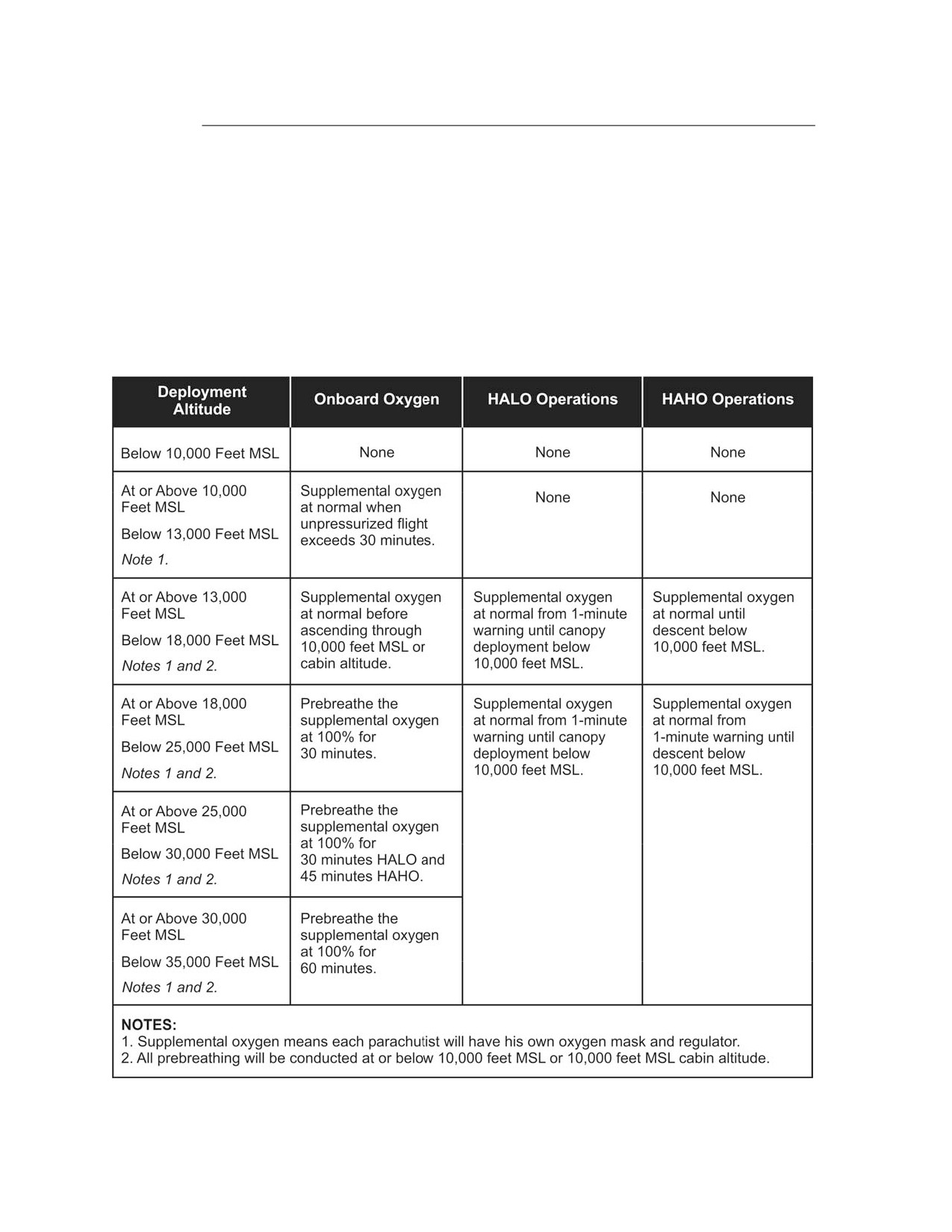
oxygen. Table 4-1, page 4-6, contains USAF-established requirements for
supplemental oxygen for the MFF parachutist during unpressurized flight.
Air Force Instruction (AFI) 11-409, High Altitude Airdrop Mission Support
Program, outlines these requirements. The following briefly describe the
requirements:
• All personnel will prebreathe 100 percent oxygen at or below 10,000
feet MSL pressure or cabin altitude below 10,000 feet MSL pressure on
any mission scheduled for a drop at or above 18,000 feet MSL.
• The required prebreathing time will be completed before the 20-minute
warning and before the cabin altitude ascends through 10,000 feet
MSL.
• Any break in prebreathing requires restarting the prebreathing period
or removing the individuals whose prebreathing was interrupted from
the mission.
• Prebreathing requires the presence of an Air Force physiological
technician onboard the aircraft.
• All personnel onboard during unpressurized operations above 10,000
feet MSL and higher will use oxygen. (Exception: Parachutists may
operate without supplemental oxygen during unpressurized flights up
to 13,000 feet MSL provided the time above 10,000 feet MSL does not
exceed 30 minutes each sortie.)
4-18. MFF parachuting is physically demanding. The higher jump altitudes
associated with MFF operations expose the body to rapid pressure changes
that require the use of supplemental oxygen. As a result, the MFF
parachutist must—
• Conduct no more than two oxygen jumps between 13,000 and 17,999
feet in a 24-hour period.
6 April 2005 FM 3-05.211/MCWP 3-15.6/NAVSEA SS400-AG-MMO-010/AFMAN 11-411(I)
4-5
FM 3-05.211
• Conduct no more than one oxygen jump above 18,000 feet in a 24-hour
period.
• Not conduct MFF operations within 24 hours of making a nonoxygen
dive.
• Not wear dark goggles on MFF operations that require prebreathing.
The jumpmaster and the oxygen safety technician must be able to see
the eyes of the jumpers to determine if they are having any
physiological problems.
Table 4-1. Supplemental Oxygen Requirements for MFF Parachutists
4-6
FM 3-05.211/MCWP 3-15.6/NAVSEA SS400-AG-MMO-010/AFMAN 11-411(I)
6 April 2005
FM 3-05.211
OXYGEN LIFE-SUPPORT EQUIPMENT
4-19. Life-support equipment consists of the oxygen mask, the portable
bailout oxygen system with the AIROX VIII assembly, the six-man
prebreather portable oxygen system, the MA-1 portable oxygen assembly,
and the prebreather attachment. This equipment is discussed in the
paragraphs below.
OXYGEN MASK
4-20. The oxygen mask is designed to be worn with parachutist helmets that
have bayonet lug receivers for the mask’s harness assembly. Oxygen enters
the face piece through the valve located at the front of the mask. Exhaled air
passes out through the same valve. The construction of the valve’s exhalation
port allows a pressure of only 1 millimeter of mercury greater than the
pressure of the oxygen being supplied by the regulator to force open the valve
and allow exhaled air to pass to the atmosphere. A 17.5-inch-long convoluted
silicone hose with a 3/4-inch internal diameter attaches to the mask. Inside
the hose is an antistretch cord that prevents extreme stretching and hose
separation during free fall. The mask has an integral microphone that adapts
to the aircraft’s communication system.
WARNING
Commercial sunblock, camouflage paint, and lip
balm used by MFF parachutists can cause oxygen
burns and flash burns when using nonmilitary-
approved petroleum, oil, and lubricant products with
oxygen.
Types of Oxygen Masks
4-21. There are several types of oxygen masks currently in use. The most
common of these masks are described below.
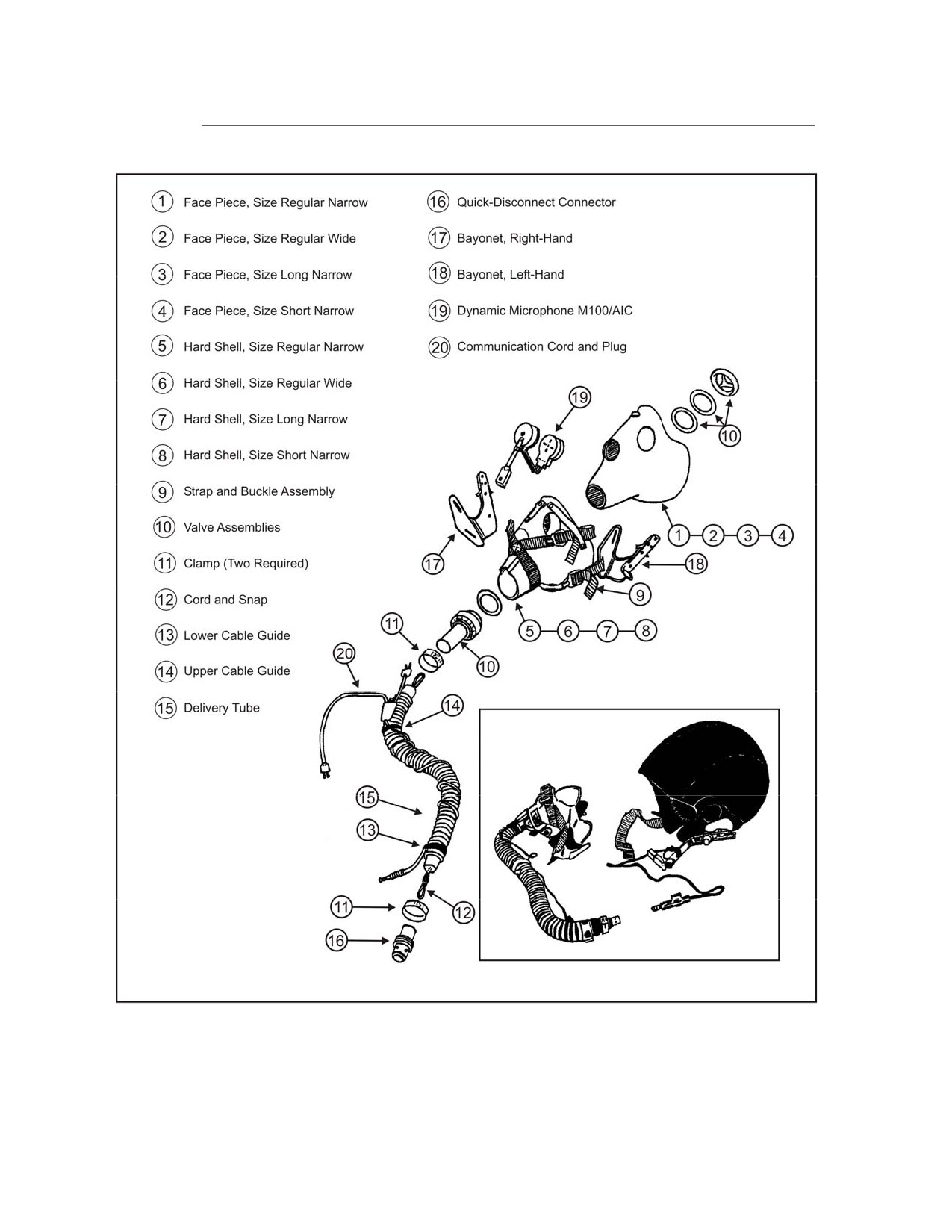
4-22. MBU-5/P. The MBU-5/P pressure-demand oxygen mask has been a
military standard for more than 15 years (Figure 4-1, page 4-8). It has a soft,
pliable silicone rubber face piece with a separate plastic outer shell. Four face
piece sizes are available.
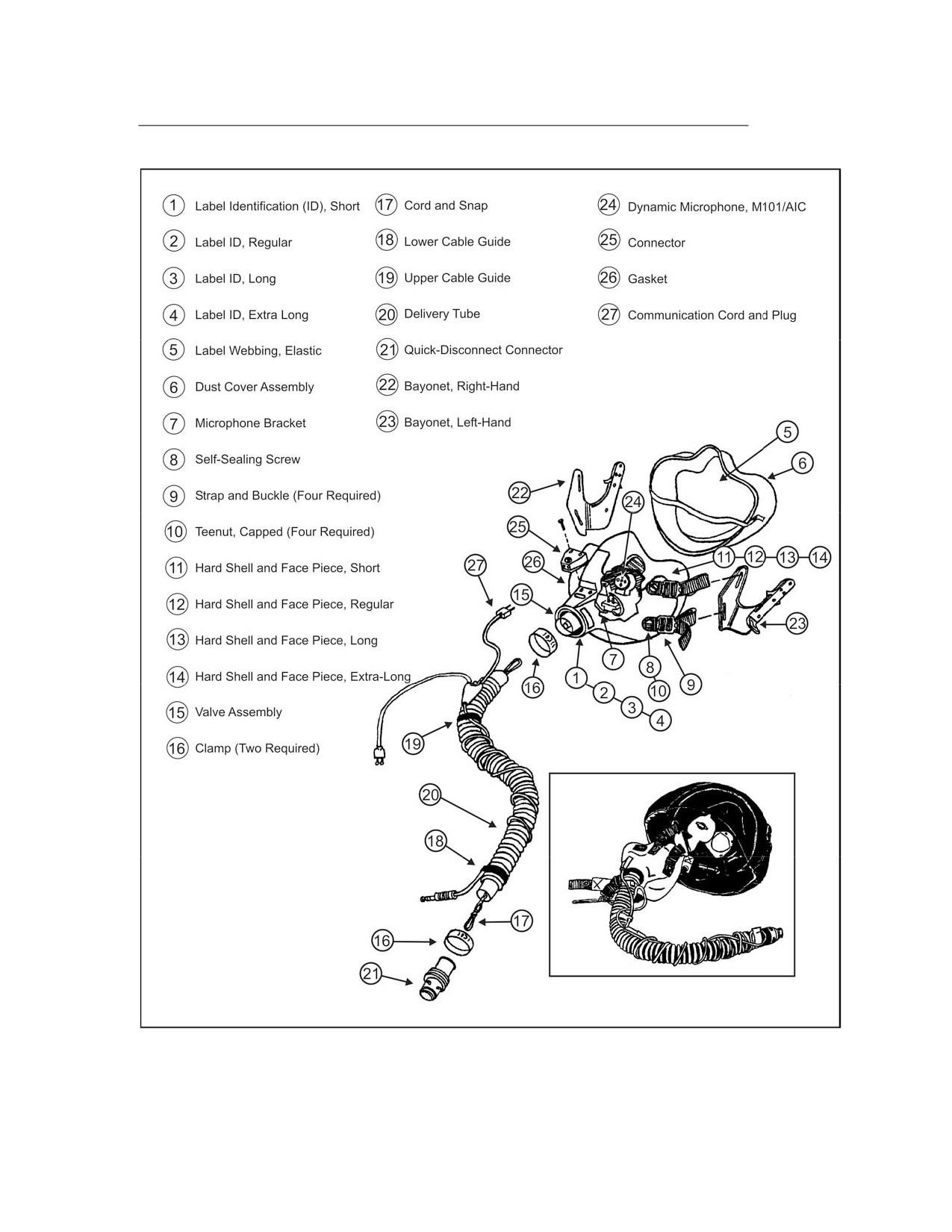
4-23. MBU-12/P. The MBU-12/P pressure-demand oxygen mask is a
replacement for the MBU-5/P mask (Figure 4-2, page 4-9). It has a soft,
supple silicone rubber face piece integrally bonded to a plastic hard shell. It
seals firmly during pressure breathing. It comes in four sizes to provide
proper fit and superior comfort during extended wear. The lower profile
design and four-point suspension are more stable than the MBU-5P mask
during free fall. Antiroll webs at the nose seal prevent downward roll-off. The
integral face piece and hard shell design permit good downward vision and
increased head mobility.
6 April 2005 FM 3-05.211/MCWP 3-15.6/NAVSEA SS400-AG-MMO-010/AFMAN 11-411(I)
4-7
FM 3-05.211
Figure 4-1. MBU-5/P Pressure-Demand Oxygen Mask Components
4-8
FM 3-05.211/MCWP 3-15.6/NAVSEA SS400-AG-MMO-010/AFMAN 11-411(I)
6 April 2005
FM 3-05.211
Figure 4-2. MBU-12/P Pressure-Demand Oxygen Mask Components
6 April 2005 FM 3-05.211/MCWP 3-15.6/NAVSEA SS400-AG-MMO-010/AFMAN 11-411(I)
4-9
FM 3-05.211
Fitting the Oxygen Mask
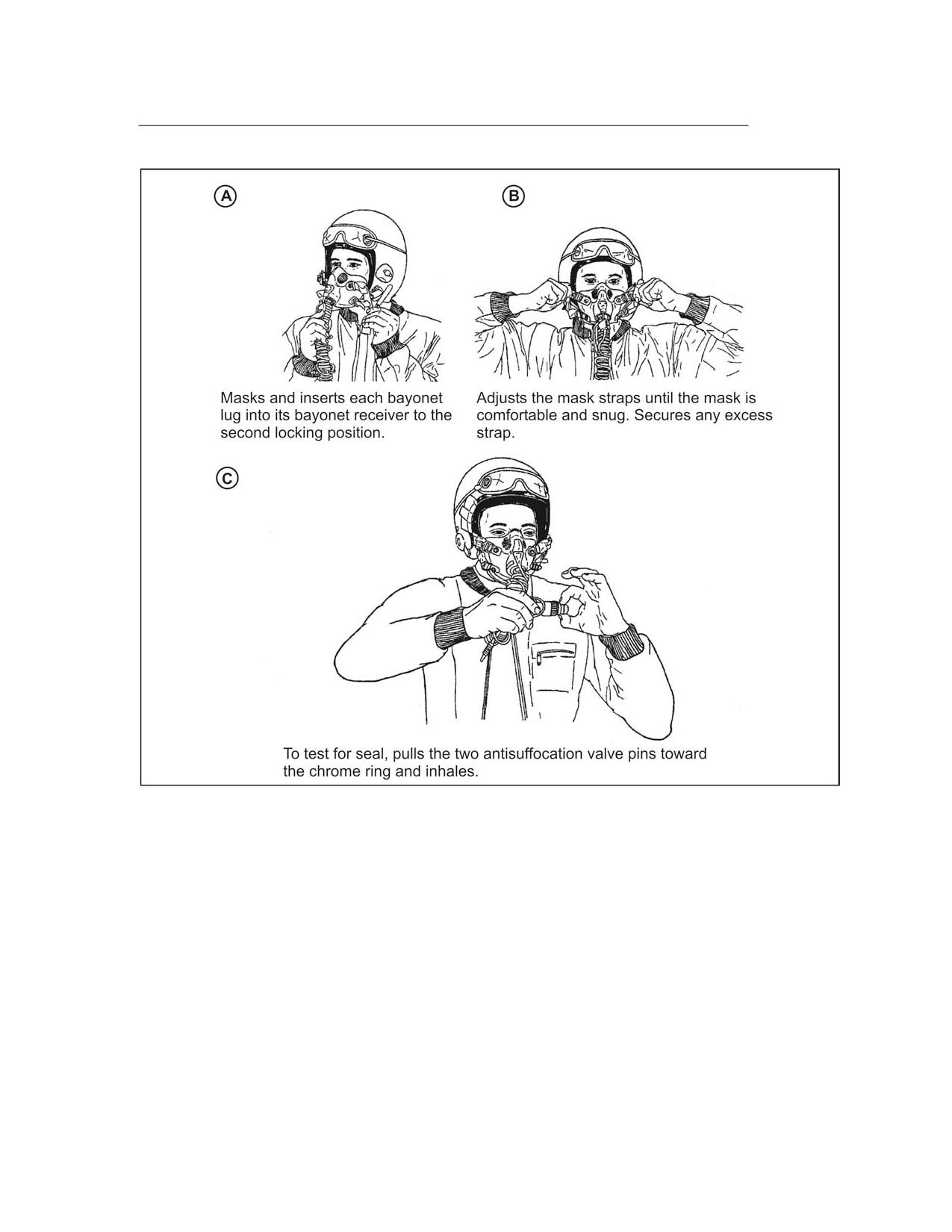
4-24. Trained personnel must supervise mask fitting (Figure 4-3, page 4-11).
When the mask fits properly, it should create a leak-tight seal around the
sealing flange throughout the range of pressure breathing forces
administered by regulators. The mask has a four-point suspension harness
with offset bayonet connectors that the parachutist attaches to the receivers
mounted on his helmet to fit the mask. For safety, and to make sure of proper
fit, the MFF parachutist should be issued the same mask and helmet for each
operation. To fit the oxygen mask, the parachutist—
• Loosens the adjustment screws on the receivers on the helmet
(depending on the type of helmet and bayonet receivers).
• Places the mask over his face and inserts each bayonet lug into its
bayonet receiver to the second locking position (Figure 4-3A).
• Adjusts the mask straps until the mask is comfortable and snug but
not so snug that the mask hinders his vision (Figure 4-3B). He also
secures any excess straps.
• To test for a proper seal, pulls the two pins of the antisuffocation valve
toward the chrome ring, closing the antisuffocation valve, and inhales
(Figure 4-3C). If the mask leaks around the face portion, he readjusts
the four straps and once again checks for a proper seal. If any other
portion of the mask leaks, the mask must be replaced. If a seal cannot
be made at the face portion, he exchanges the mask for the next size
and repeats the fitting process.
• Tightens the receiver adjustment screws and secures the excess straps
if a proper seal is achieved (depending on the type of helmet and
bayonet receivers).
Cleaning the Oxygen Mask
4-25. The parachutist cleans his oxygen mask after each use IAW
TM 55-1660-247-12, Operation, Fitting, Inspection and Maintenance
Instructions With Illustrated Parts Breakdown for MBU-12/P Pressure-
Demand Oxygen Mask. He carefully wipes all surfaces with gauze pads or a
similar lint-free material dampened with
70 percent isopropyl alcohol
(rubbing alcohol). If isopropyl alcohol is not available, a solution of warm
water and a mild liquid dishwashing detergent, such as Ivory, Joy, or Lux, is
used. To rinse, the parachutist wipes the mask with swabs soaked in clean
water, taking care not to wet the electronic parts. He allows the mask to
air-dry and stores it in a dust-free environment, away from heat and
sunlight. If the mask needs more extensive cleaning, the parachutist turns it
in to the supporting life-support facility.
4-10
FM 3-05.211/MCWP 3-15.6/NAVSEA SS400-AG-MMO-010/AFMAN 11-411(I)
6 April 2005
FM 3-05.211
Figure 4-3. Fitting the Oxygen Mask
106-CUBIC-INCH PORTABLE BAILOUT OXYGEN SYSTEM
WITH THE AIROX VIII ASSEMBLY
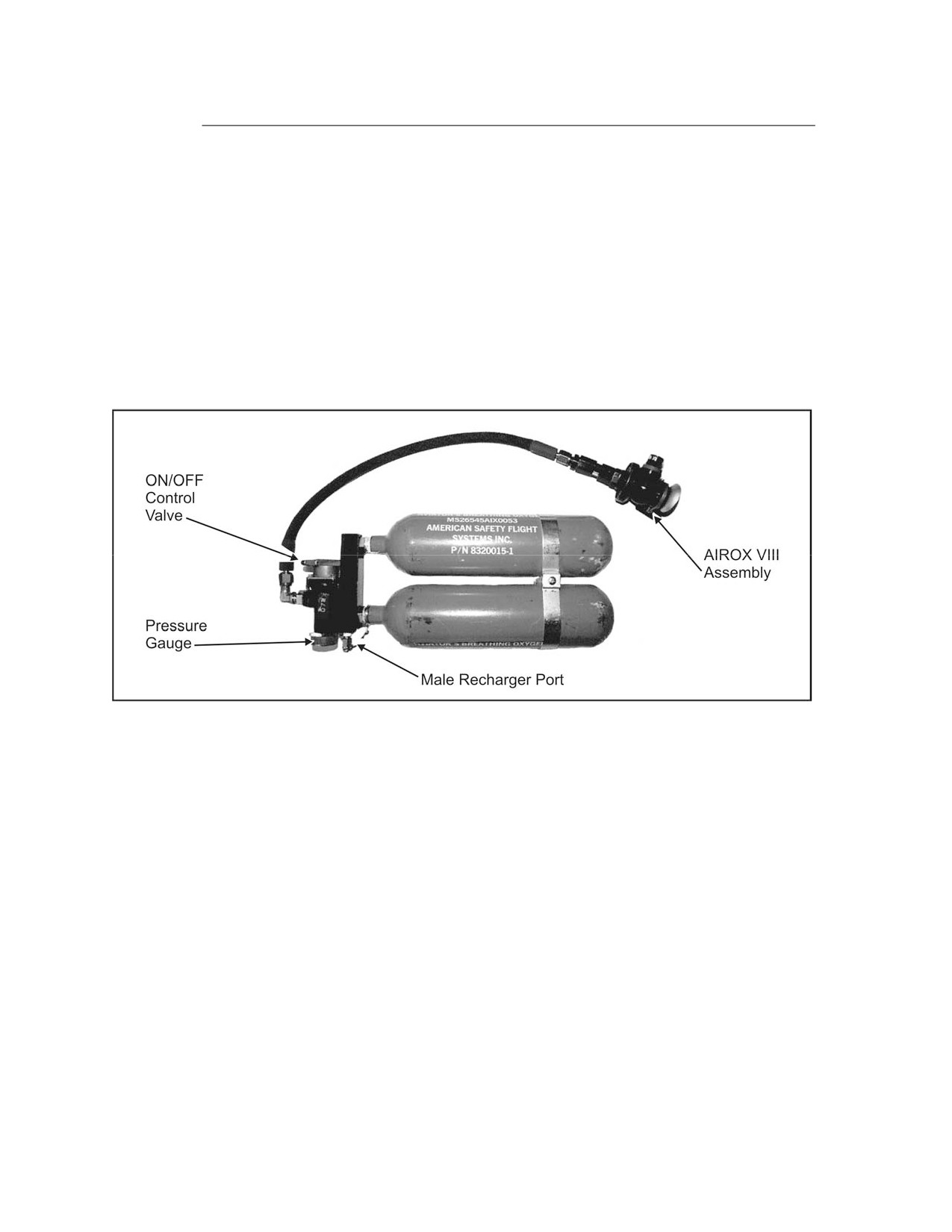
4-26. The portable bailout oxygen system with the AIROX VIII assembly is
a constant-flow oxygen metering system, consisting of a pressure reducer and
an oxygen and air controller with an integrated prebreather adapter. These
components increase oxygen duration and permit comfortable exhalation
with standard military pressure-demand masks and associated connectors
(Figure 4-4, page 4-12). This system requires minimum maintenance and—
• Has been approved for use from 0 to 35,000 feet MSL.
• Has an 8.2-liter-per-minute nominal oxygen flow.
• Has an oxygen reducer.
• Interfaces with the MBU-5/P and MBU-12/P masks.
• Has an oxygen and air controller that mates with the CRU-60/P or
MC-3A connectors.
6 April 2005 FM 3-05.211/MCWP 3-15.6/NAVSEA SS400-AG-MMO-010/AFMAN 11-411(I)
4-11
FM 3-05.211
• Has a charging valve.
• Has a 20-micron oxygen/60 mesh air inlet filter.
• Contains two 2.6-inch siphon tubes that protect the oxygen reducer
from foreign matter in the cylinders.
• Has a toggle-type ON/OFF control.
• Has an oxygen relief valve.
• Reduces exhalation difficulty associated with constant-flow oxygen
systems.
• Uses two 53-cubic-inch high-pressure cylinders.
• Weighs approximately 10.5 pounds.
Figure 4-4. The 106-Cubic-Inch Portable Bailout Oxygen System
With the AIROX VIII Assembly
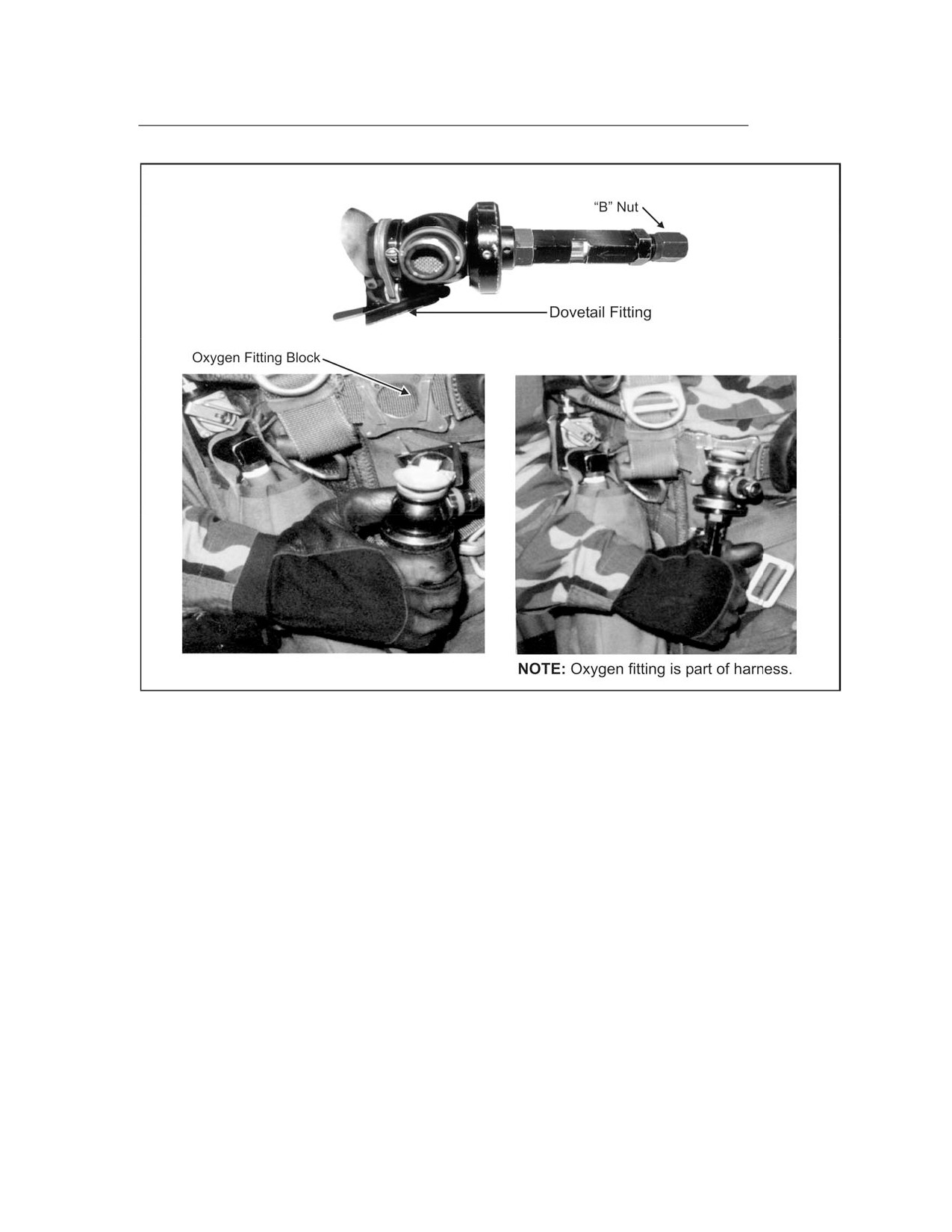
4-27. The AIROX VIII assembly (Figure 4-5, page 4-13) provides the MFF
parachutist with a standoff parachuting capability up to 35,000 feet MSL. It
extends the duration of two 53-cubic-inch oxygen cylinders and permits the
use of any pressure-demand mask and associated oxygen connectors. The
AIROX VIII assembly also eliminates the back pressure associated with
constant-flow oxygen systems and requires almost no maintenance.
4-28. The parachutist cannot overbreathe the system. When inhaling more
volume than the unit delivers, an ambient air valve opens up negating the
breathing starvation sensation felt with other constant-flow systems as
cylinder pressure decreases.
4-29. The AIROX VIII assembly has a special prebreather adapter that
allows simultaneous hookup of the prebreather unit and the bailout system to
the AIROX unit. The parachutist makes only one disconnection upon
standing up. The connection from the prebreather connects to the ambient air
port on the AIROX unit, thus preventing any ambient air from entering the
parachutist’s system while prebreathing. When preparing to exit the aircraft,
the parachutist stands up, turns on the bailout system, disconnects from the
prebreather, and jumps.
4-12
FM 3-05.211/MCWP 3-15.6/NAVSEA SS400-AG-MMO-010/AFMAN 11-411(I)
6 April 2005
FM 3-05.211
Figure 4-5. AIROX VIII Assembly
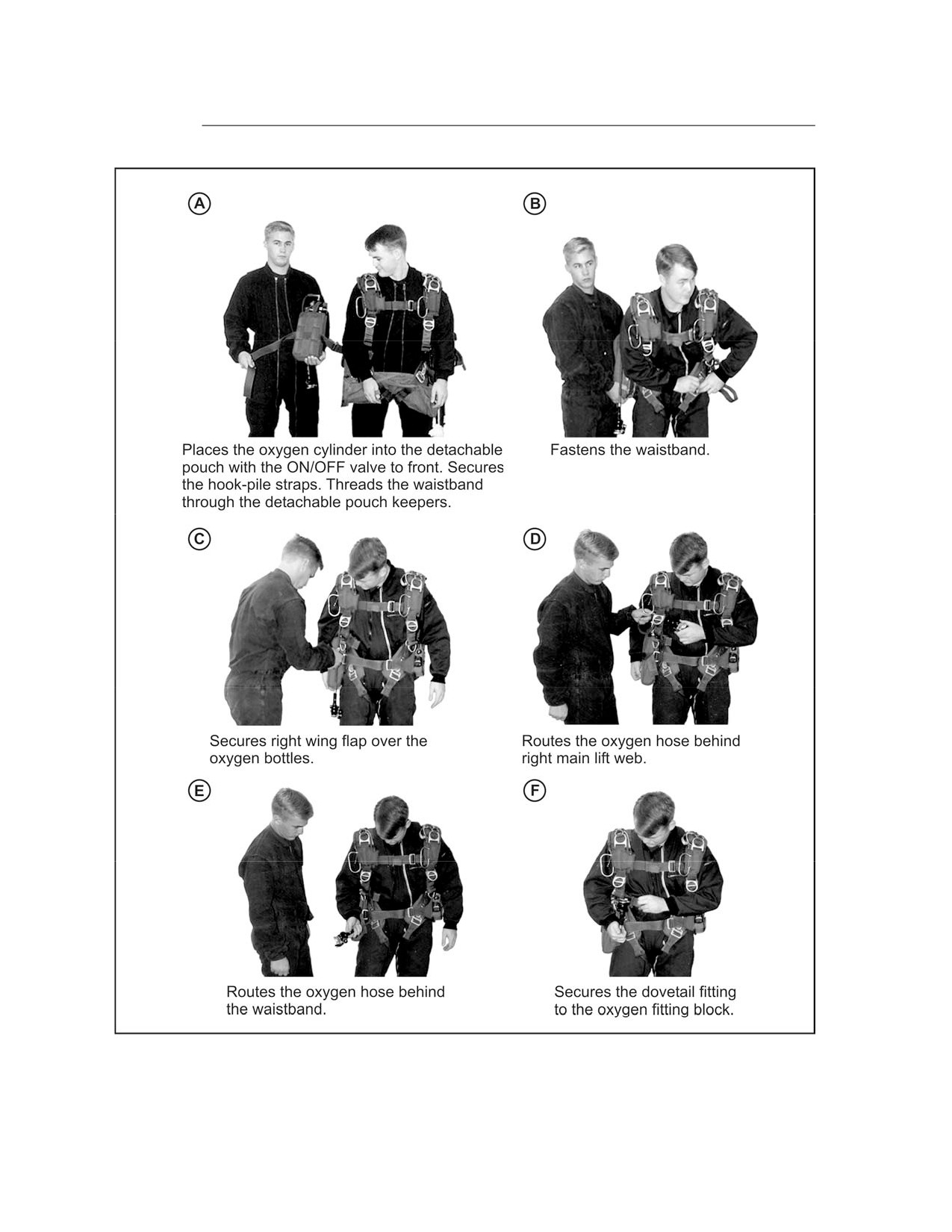
4-30. To rig the AIROX VIII assembly with the portable bailout oxygen
system to the RAPS (Figure 4-6, page 4-14), the parachutist—
• Places the oxygen cylinders into the detachable pouch with the
ON/OFF valve to his front. He secures it with the hook-pile straps. He
threads the waistband through the center keepers on the detachable
pouch (Figure 4-6A).
• Fastens the waistband (Figure 4-6B).
• Tightens the right wing flap over the oxygen bottles (Figure 4-6C).
• Routes the oxygen hose between his body and the right main lift web
and under the waistband on his right side (Figure 4-6D and E).
• Routes the oxygen hose over the waistband and secures the dovetailed
fitting in the oxygen-fitting block (Figure 4-6F).
• Tightens the waistband.
• Ensures the center keepers point toward the body.
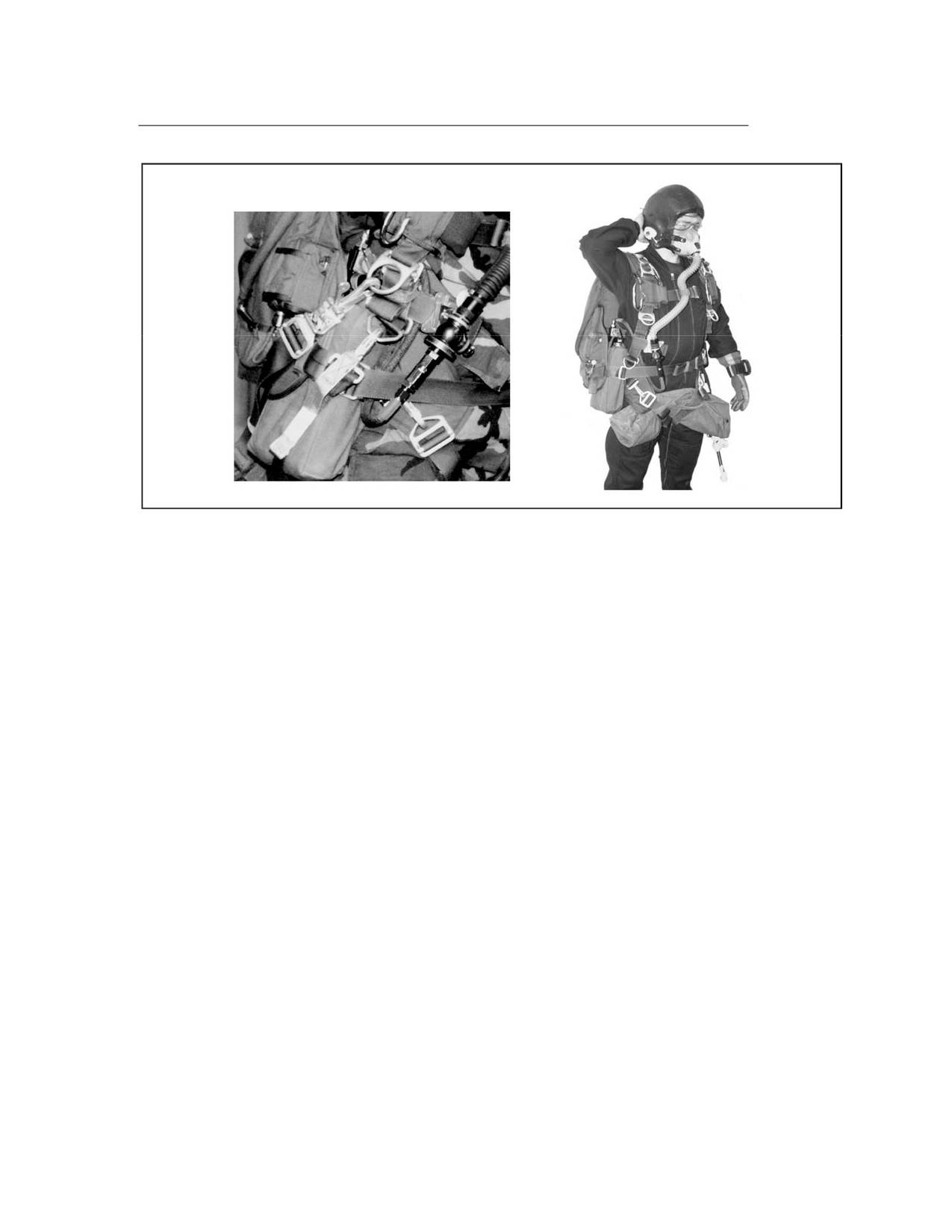
Figure 4-7, page 4-15, shows the completed rigging of the portable bailout
oxygen system with the AIROX VIII assembly to the RAPS.
6 April 2005 FM 3-05.211/MCWP 3-15.6/NAVSEA SS400-AG-MMO-010/AFMAN 11-411(I)
4-13
FM 3-05.211
Figure 4-6. Rigging the Portable Bailout Oxygen System
With the AIROX VIII Assembly to the RAPS
4-14
FM 3-05.211/MCWP 3-15.6/NAVSEA SS400-AG-MMO-010/AFMAN 11-411(I)
6 April 2005
FM 3-05.211
Figure 4-7. Completed Rigging of the Portable Bailout Oxygen System
With the AIROX VIII Assembly to the RAPS
SIX-MAN PREBREATHER PORTABLE OXYGEN SYSTEM
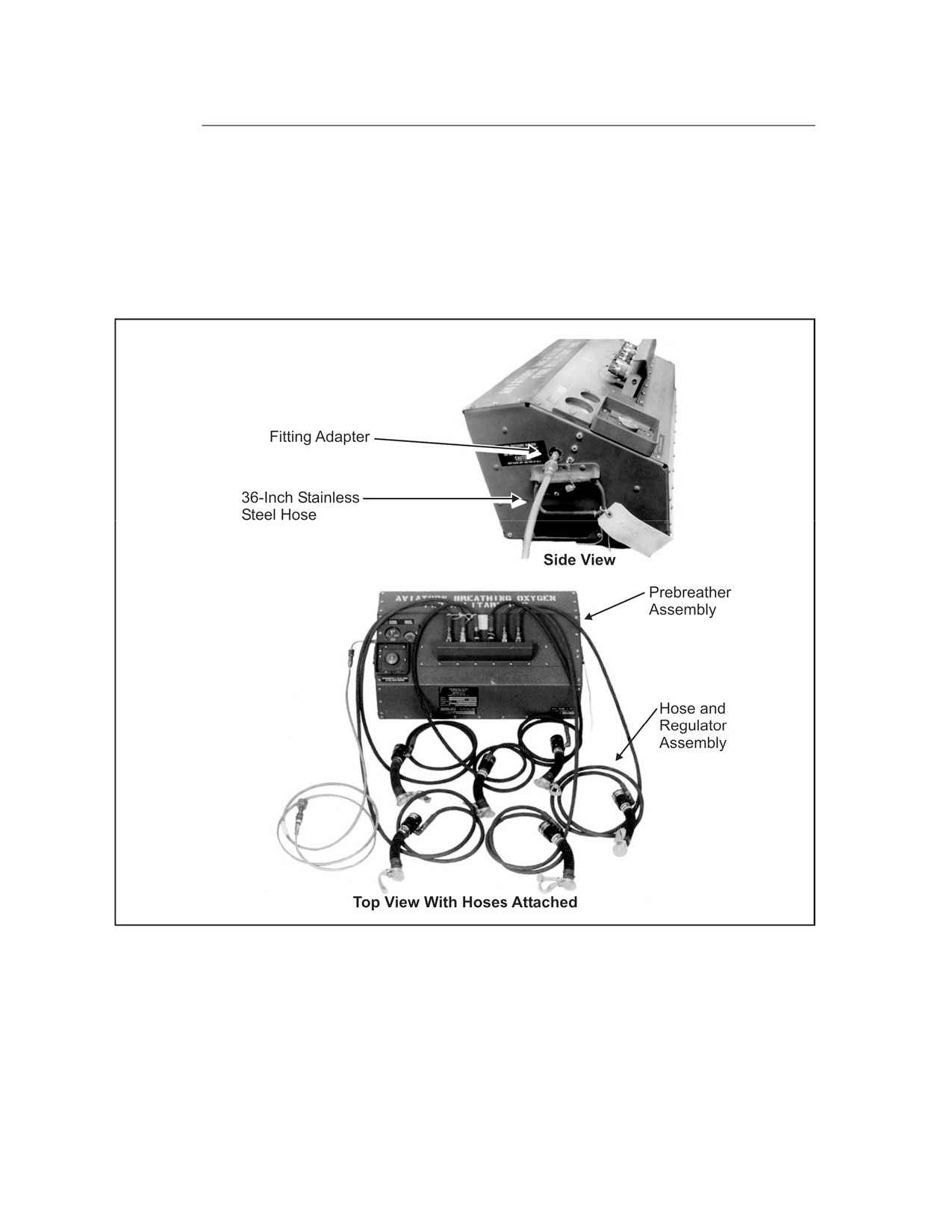
4-31. The six-man prebreather portable oxygen system was designed as a
self-contained, easy-to-operate, small, lightweight, and nearly maintenance-
free oxygen system (Figure 4-8, page 4-16). Oxygen duration is based on
altitude and individual consumption requirements.
4-32. The system’s size was designed to fit under the troop seats on a
C-141B aircraft. The system is secured to the existing 10,000-pound floor
fittings. On the C-130 aircraft, the 5,000-pound tie-downs are used to secure
it. The outer housing consists of 4130 aircraft sheet steel, and recesses or
steel guards protect the system’s critical components. Color-coding identifies
certain parts, such as hoses and their mating parts, to prevent their
misconnection.
4-33. The six-man console system has 100 percent oxygen capability for 45
minutes for five parachutists while ascending to 35,000 feet MSL.
NOTE: With the CRU-79/P regulator, the system has an operational ceiling
of 50,000 feet MSL.
Other system features are listed below:
• Weighs 106 pounds when filled.
• Measures 27.3 inches wide, 13.37 inches deep, and 10.99 inches high.
• Can provide oxygen for one to six parachutists.
• Has modular components.
• Is constructed to survive an 8G forward crash load.
• Has a recessed refilling point.
• Has an easily gripped and guarded ON/OFF knob.
6 April 2005 FM 3-05.211/MCWP 3-15.6/NAVSEA SS400-AG-MMO-010/AFMAN 11-411(I)
4-15
FM 3-05.211
• Has color-coded and -indexed oxygen connectors to help ensure proper
hose connections, and includes optional hose lengths to fit parachutist
seating requirements.
• Has a steel guard around oxygen hose connectors.
• Interfaces with any pressure-demand mask and associated connectors.
• Can be refilled while being used.
Figure 4-8. Six-Man Prebreather Portable Oxygen System
4-16
FM 3-05.211/MCWP 3-15.6/NAVSEA SS400-AG-MMO-010/AFMAN 11-411(I)
6 April 2005
FM 3-05.211
MA-1 PORTABLE OXYGEN ASSEMBLY
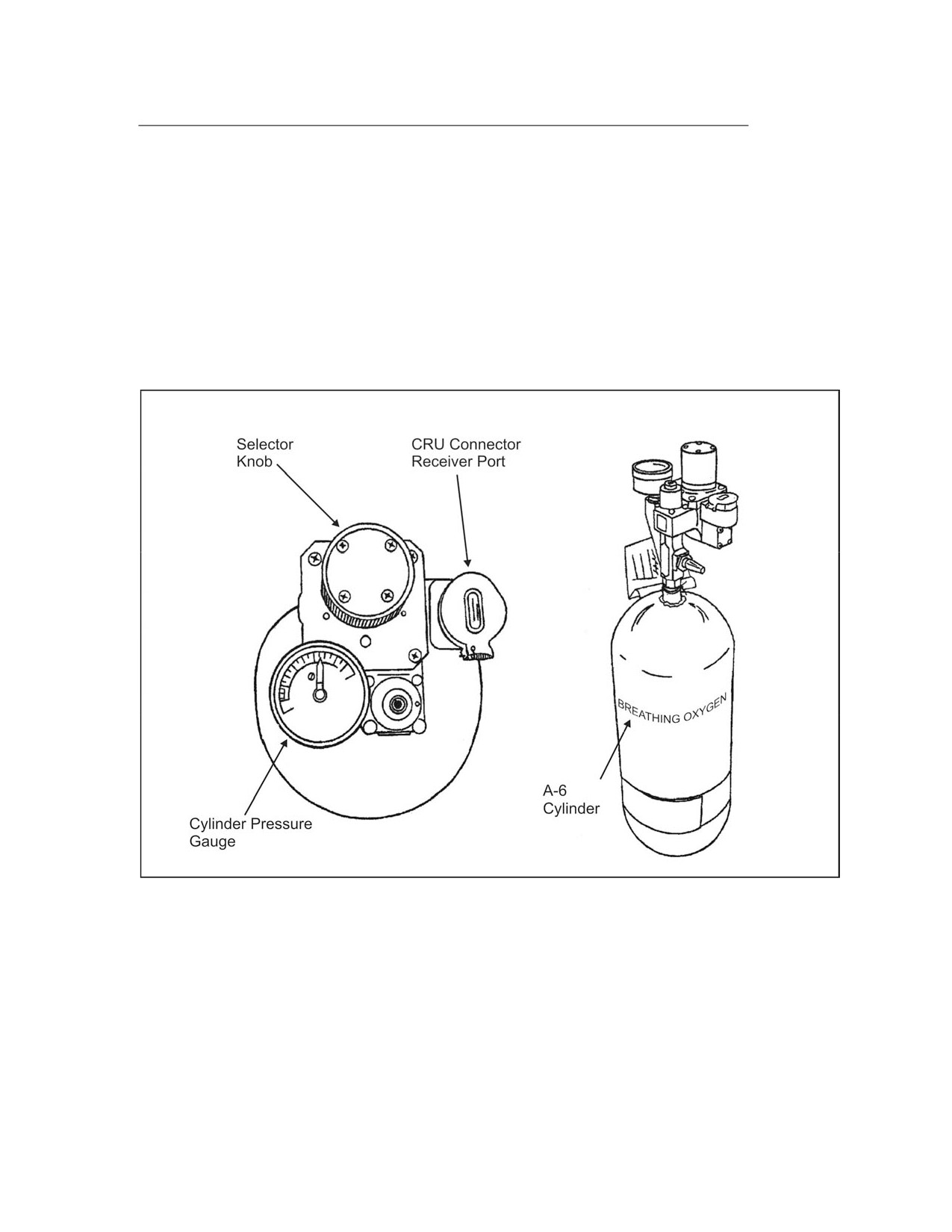
4-34. The MA-1 portable oxygen assembly is a low-pressure system capable
of supplying the parachutist with breathing oxygen for normal or emergency
use (Figure 4-9). It is commonly called the walk-around bottle. The MA-1 is
filled from the aircraft’s oxygen supply. Pressure is indicated on the cylinder
pressure gauge. The cylinder is considered full at 300 psi and empty at 100
psi. The MA-1 is operated by placing the selector knob at one of the four
settings (NORM [normal], 30M, 42M, and EMER [emergency]) and breathing
directly through the connector regulator unit (CRU) connector receiver port
or an attached oxygen mask.
Figure 4-9. MA-1 Portable Oxygen Assembly
PREBREATHER ATTACHMENT
4-35. The prebreather oxygen assembly is normally located under the troop
seats, and the oxygen supply hoses are routed up and behind the seats. The
prebreather may also be positioned centerline in the aircraft using
10,000-pound tie-down fittings
(C-141B),
5,000-pound tie-down fittings
(C-130), or securing straps.
4-36. When using 10,000-pound tie-down fittings, the parachutist places the
two large holes in the base plate of the prebreather over existing
10,000-pound tie-down fitting holes in the floor of the aircraft. Through the
6 April 2005 FM 3-05.211/MCWP 3-15.6/NAVSEA SS400-AG-MMO-010/AFMAN 11-411(I)
4-17
FM 3-05.211
openings in the side of the prebreather, he places two 10,000-pound fittings
(one through each end) into the mating receptacle now visible through the
prebreather’s base plate. He then locks the fittings in place. These fittings
will provide all the security necessary to hold the prebreather in place.
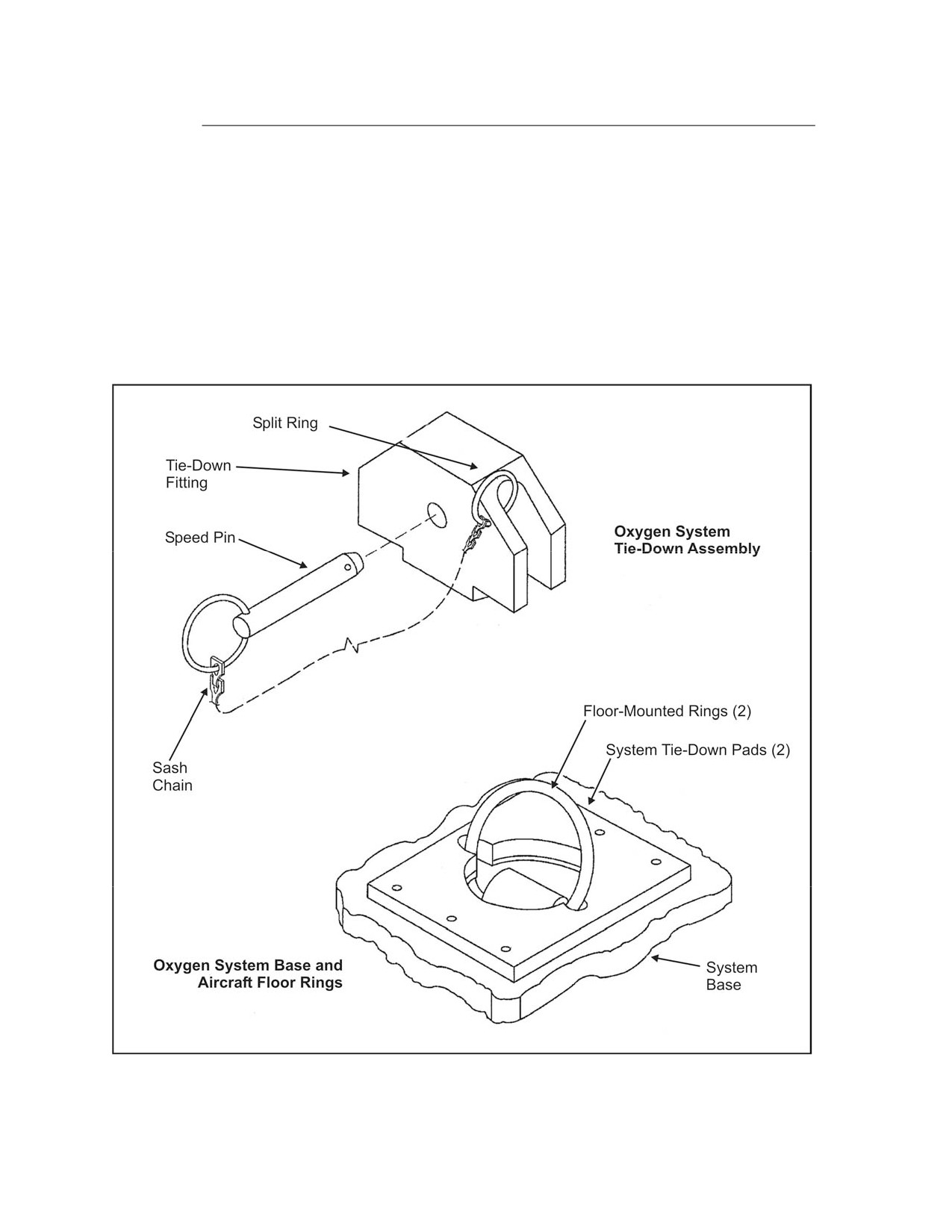
4-37. When using the oxygen console tie-down assembly, the parachutist
places the two large holes in the prebreather’s base plate over the attached
5,000-pound ringed tie-down fittings. Next, he places the securing adapters
over the exposed rings and pushes the pins through the holes in the adapters
until they lock. These fittings will provide all the security necessary to hold
the prebreather in place (Figure 4-10).
Figure 4-10. Tie-Down Assembly and Installation
4-18
FM 3-05.211/MCWP 3-15.6/NAVSEA SS400-AG-MMO-010/AFMAN 11-411(I)
6 April 2005
FM 3-05.211
4-38. Cargo straps are not necessary for added security when using the
10,000-pound tie-down fittings or oxygen console tie-down assembly. If cargo
straps are used in place of the tie-down fittings, the parachutist places the
straps through the securing access holes at each end of the prebreather and
cinches tightly to existing fittings.
NOTE: The prebreather carrying handles are not stressed for use as securing
points.
THE “PRICE” CHECK
4-39. Each letter of the acronym PRICE represents an area of or a specific
item of oxygen equipment that the parachutist must check. The PRICE check
makes no provision for inspecting the mask or protective helmet. The
parachutist checks—
• P - Pressure. He checks for full pressure on the particular system in use.
• R - Regulator. He checks everything on the particular regulator in use.
He checks for dents, cracks, broken gauges, grease or oil, and movement
of dials and levers. He checks the entire oxygen delivery system for
leaks.
• I - Indicator. He checks to make sure the flow indicator shows that gas
is flowing through the regulator from the storage system.
• C - Connections. He checks all hose connections.
• E - Emergency equipment. He does a complete PRICE check on any
emergency oxygen equipment and the complete bailout system.
OXYGEN SAFETY PERSONNEL AND PREFLIGHT CHECKS
4-40. Oxygen safety personnel must be onboard each aircraft during MFF
operations using supplemental oxygen. They must have received physio-
logical training and unit-level technical training on the oxygen systems being
used. For jumps from 18,000 feet or above, a USAF physiological technician
will be requested with the aircraft and will be onboard for the jump. The
oxygen safety personnel or the USAF physiological technician will—
• Plan for all oxygen equipment required for the mission. He will provide
one additional mask of each size and one additional complete bailout
system per six parachutists, and plan for one additional open oxygen
station per every six parachutists in the event of a hose or regulator
failure.
• Conduct preflight inspection and preflight operational checks of all
oxygen equipment (Figures 4-11 and 4-12, pages 4-20 through 4-22).
• Supervise the transportation of and installation onboard the aircraft of
prebreathers and oxygen cylinders.
• Issue oxygen supply hoses to each parachutist and supervise hose
connection.
• Make sure the parachutists mask properly, fully open shutoff valves on
the prebreathers, and receive oxygen after the aircraft procedure signal
MASK is given.
• Periodically check oxygen pressure and equipment function during use
(every 10 minutes).
6 April 2005 FM 3-05.211/MCWP 3-15.6/NAVSEA SS400-AG-MMO-010/AFMAN 11-411(I)
4-19
FM 3-05.211
• Monitor each parachutist for signs of hypoxia, the bends, or the chokes.
• Assist the parachutist with the activation of the bailout systems and
inspect all bailout systems to make sure they were activated.
• Check the parachutist’s hose connections on the AIROX VIII. If the
parachutist still indicates a problem, the technician activates
the
bailout system, moves the parachutist to an open station, and
the
technician deactivates the bailout system.
Cylinders are lime green and stenciled in white with the words AVIATOR’S BREATHING OXYGEN.
No cracks, dents, or gouges are in the cylinders.
Cylinder clamp and roller are secured and on the bottom one-third of the cylinders.
Cylinders are tight into the pressure reducer body.
Reducer body is not cracked or damaged.
Filler valve, pressure gauge, and relief valve are tight into the pressure reducer body.
Cap on the filler valve is secure, and the filler cap lanyard is secured to both the cylinder and filler
valve.
Pressure gauge face is not damaged, and the dial indicator is not sticking.
ON/OFF control valve is secured to the pressure reducer body with four Allen screws.
Guide rails of the ON/OFF control valve are undamaged. Operating lever operates properly, and
the detent will hold the valve in the ON and the OFF positions.
Union elbow is secured tightly to the top of the pressure reducer, and the elbow directs the hose
over the pressure gauge.
Hose assembly is not frayed or crushed, and the cloth covering is not worn and is free of oil and
other contaminants.
Hose assembly is securely attached to the union elbow and flow indicator.
There is no obvious damage to the flow indicator body, the arrow points toward the AIROX, and the
flow indicator is securely attached to the AIROX.
View glass is clear, indicating a no-flow condition, and the white sleeve, yellow sleeve, and spring
are present.
Blue tamper-proof dot is present directly below the ambient airport.
Equalization port is free of foreign objects or debris.
Brass set screw and brown tamper-proof dot are present.
Body of the AIROX is not damaged or cracked.
Ambient air port is securely attached to the AIROX and not damaged, and the safety lock wire and
screw are intact.
Chrome ring is present and rotates freely.
Gasket is present, clean, and free of nicks or tears.
Inlet orifice is free of foreign objects or debris, and the screen is present and not damaged.
Cover of the outlet orifice is spring-loaded and seats properly.
Figure 4-11. Portable Bailout Oxygen System Preflight Inspection
and Operational Checklist
4-20
FM 3-05.211/MCWP 3-15.6/NAVSEA SS400-AG-MMO-010/AFMAN 11-411(I)
6 April 2005
FM 3-05.211
Outlet orifice is free of foreign objects or debris, and the screen is present and not damaged.
Dovetail mounting plate is securely attached to the bracket.
There is no damage to the dovetail mounting plate.
Locking lever is spring-loaded and functions properly.
Preflight Operational Function Check Procedures
Ensure the system is fully charged at 70 degrees F.
Connect a mask to the outlet orifice and ensure that it is secure and that excessive force is not
required to connect and disconnect.
Turn the system on and seal the mask to the face.
Inhale—yellow sleeve (on flow indicator) rises.
Exhale—yellow sleeve falls. Inhalation should be normal with no undue exertion.
Ensure there is no oxygen flow from the relief valve.
Turn the system off, reseal the mask to the face, and ensure you can breathe through the ambient air
port.
Connect a hose and regulator assembly to the ambient air port; ensure that it is secure and that
excessive force is not required to connect and disconnect.
Figure 4-11. Portable Bailout Oxygen System Preflight Inspection
and Operational Checklist (Continued)
Preflight Inspection of 6-Man Prebreather
Unit has no obvious damage.
Gauge faces are not broken.
Dial indicators are not sticking.
All screws are present and not coming loose.
Handles are not separating from unit.
Filler cap is present and tied down to unit.
All female disconnect plugs are present and tied down to disconnect.
Female disconnects are not distorted, and the pins of the male connectors of hose assemblies will
engage with the collar of the female disconnect.
Female disconnects are safety-wired to the adjacent female disconnect.
Connector manifold guard does not interfere with the operation of the female disconnects or male
connectors of the hose and regulator assembly.
Both sets of screws in the ON/OFF knob are present and not backing out.
ON/OFF valve stem is not bent.
Container is not cut, damaged severely, or corroded.
Unit is fully charged to 1,800 psi at 70 degrees F.
Figure 4-12. Sample Prebreather Preflight Inspection and Operational
Function Checklist
6 April 2005 FM 3-05.211/MCWP 3-15.6/NAVSEA SS400-AG-MMO-010/AFMAN 11-411(I)
4-21
FM 3-05.211
Preflight Inspection of the Hose and Regulator Assembly
Each male connector has the proper amount of pins (red: 2 pins, yellow: 3 pins, gray: 4 pins), and the
mating probe is not distorted.
Male connector is tight into hose assembly.
Wire wrapping is not frayed, and hose is not crushed.
Cloth covering is free of oil and other contaminants.
Red male connector is connected to 72-inch hose, yellow connector to 90-inch hose, and gray connector
to 98-inch hose.
Hose is tightly connected to regulator.
Regulator is not cut or cracked.
No foreign object or debris is in equalization port.
Hose and check-valve assembly is clamped to regulator, and clamp is safety wired.
Cover is spring-loaded and seats evenly over check valve.
Check valve is spring-loaded.
Preflight Operational Function Check Procedures
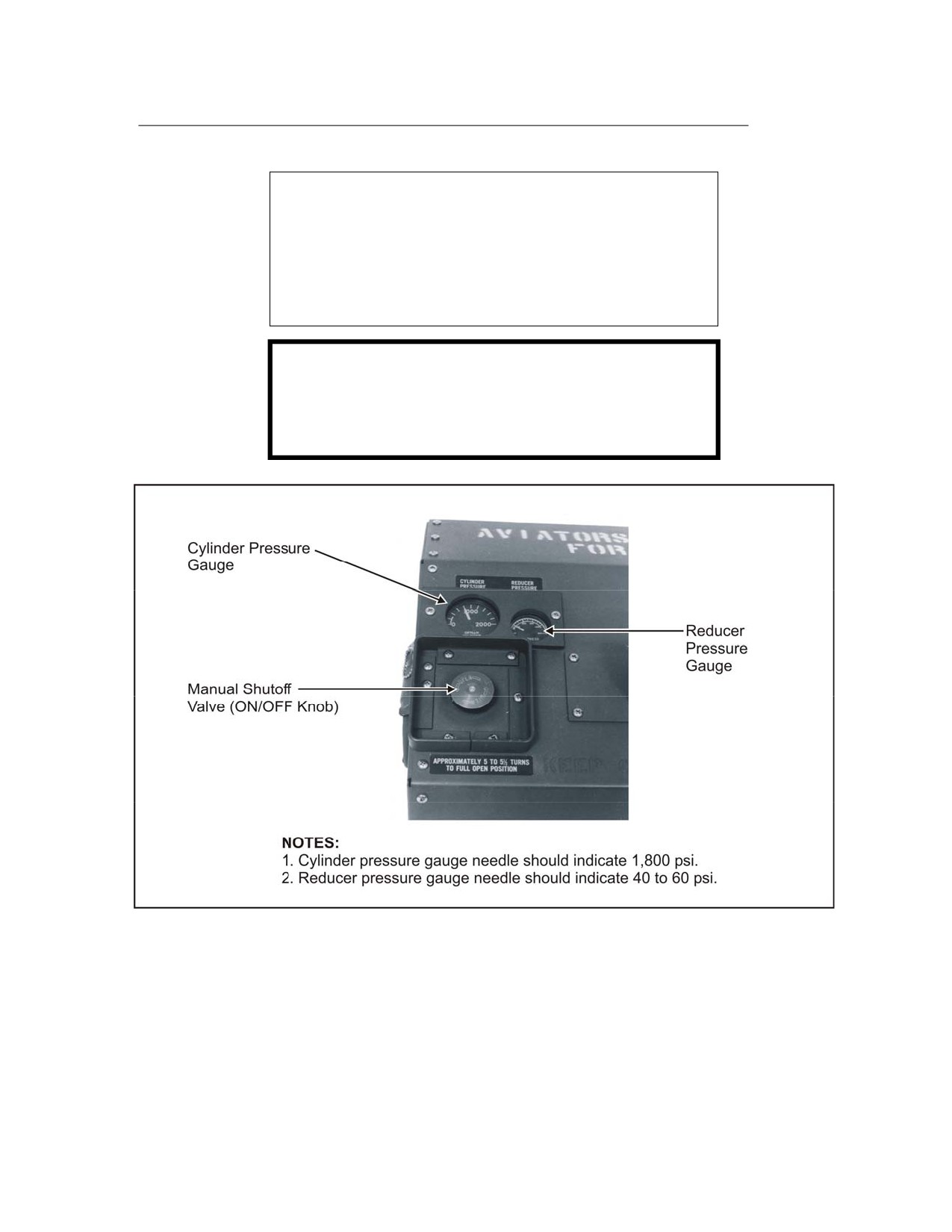
Turn the shutoff valve counterclockwise to the fully opened position (about 5 1/2 turns) (Figure
4-13, page 4-23).
Ensure the reducer pressure gauge indicates 40 to 60 psi (Figure 4-13).
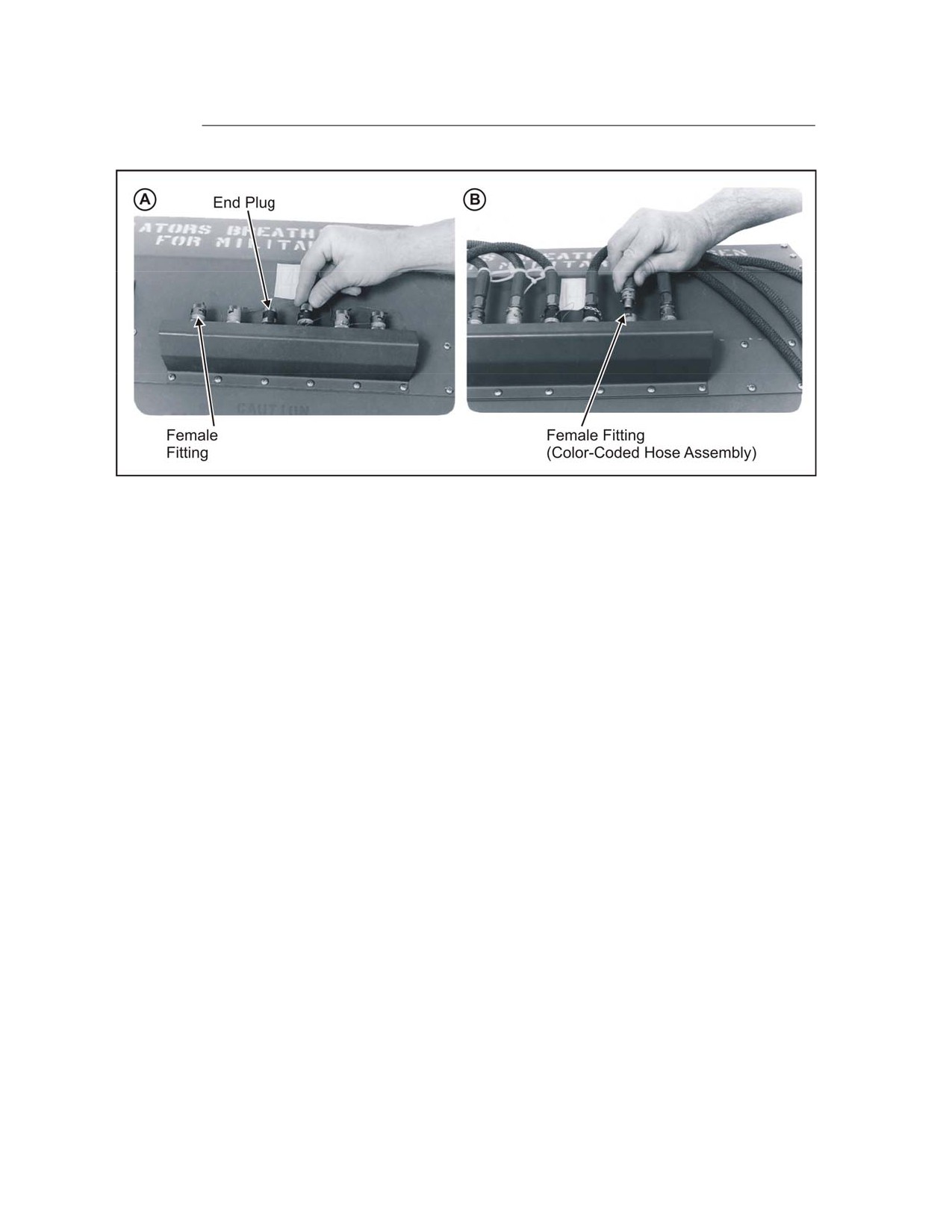
Remove each disconnect plug, depress the poppet of each disconnect (Figure 4-14A, page 4-24),
and ensure oxygen flows from each disconnect.
Close shutoff valve and ensure reducer pressure remains steady (40 to 60 psi).
Bleed off the pressure through the disconnect manifold.
Install all hose and regulator assemblies to their appropriate disconnect (Figure 4-14B, page 4-24).
(Be sure to bleed manifold pressure before attaching hose and regulator assemblies.)
Connect an MBU-12/P mask to each hose and regulator assembly.
Open shutoff valve (about 5 1/2 turns).
Listen for and feel the oxygen flow from each mask. Disconnect all but one mask and note the
reducer pressure for 3 to 5 seconds. The reducer pressure should not drop below 40 psi.
Hold the mask to the face and inhale. Inhalation shall be normal with no undue exertion to breathe
oxygen. Remove mask from hose and regulator assembly; ensure check valve closes and that
there is no flow from the hose and regulator assembly. Repeat the above step for each hose and
regulator assembly.
Close shutoff valve and bleed manifold pressure through one or more check valves until reducer
pressure indicates zero.
Monitor reducer pressure for 15 minutes. Ensure gauge indicator remains at zero.
Figure 4-12. Sample Prebreather Preflight Inspection and Operational
Function Checklist (Continued)
4-22
FM 3-05.211/MCWP 3-15.6/NAVSEA SS400-AG-MMO-010/AFMAN 11-411(I)
6 April 2005
FM 3-05.211
CAUTION
Failure to properly connect the hose and regulator
assemblies to the prebreather using the above
procedures could possibly damage the diaphragm of the
CRU-79/P regulator and render the equipment
inoperative.
WARNING
Personnel must NEVER partially close the shutoff
valve during oxygen use; it will result in a restriction
of oxygen flow to the parachutist.
Figure 4-13. Pressure Gauge and Manual Shutoff Valve
6 April 2005 FM 3-05.211/MCWP 3-15.6/NAVSEA SS400-AG-MMO-010/AFMAN 11-411(I)
4-23
FM 3-05.211
Figure 4-14. Removing End Plugs and Depressing Poppets
OXYGEN HANDLING AND SAFETY
4-41. Due to limited contact with oxygen and its handling, personnel may
not fully appreciate the danger involved. Improper use and handling can
result in property damage, serious injury, and death. Personnel handling
oxygen must—
• Keep oil and grease away from oxygen. They must not handle oxygen
equipment with greasy hands or clothing. They do not let fittings,
hoses, or any other oxygen equipment get smeared with petroleum-
based products, lubricants, hydraulic fluid, or dirt. A drop of oil or
lubricant in the wrong place can cause an explosion.
• Keep oxygen away from fires. Small fires rapidly become large fires in
the presence of oxygen supplies. Personnel handling oxygen must never
permit smoking near oxygen equipment, while handling oxygen
supplies, or when using oxygen life-support equipment.
• Handle cylinders and valves carefully. Before opening cylinder valves,
they make sure the cylinder is firmly supported. They never let a
cylinder drop or tip over. Dropping a cylinder can damage or break the
valve, allowing the gas to escape and to propel the cylinder a great
distance, which is an obvious hazard. Personnel open and close the
valves only by hand. If they cannot open and close them by hand, they
must return the cylinder to the depot for repair.
4-24
FM 3-05.211/MCWP 3-15.6/NAVSEA SS400-AG-MMO-010/AFMAN 11-411(I)
6 April 2005
FM 3-05.211
Chapter 5
Equipment and Weapon Rigging Procedures
Free-fall parachutists will normally operate with individual equipment
that includes clothing and equipment in keeping with the climatic
conditions, food, and survival items. In addition, each parachutist will
have a weapon, free-fall parachutist’s jump helmet, goggles, and
altimeter. Free-fall parachutists jump and carry all detachment
equipment and supplies as individual loads. If selected items must be
dropped as accompanying supplies, they pack these supplies in
appropriate aerial delivery containers.
EQUIPMENT AND WEAPON PACKING CONSIDERATIONS
5-1. The parachutist can attach or wear his individual equipment and
weapon in several configurations (for example, exposed, placed in containers,
or a mix of the two). Unit SOPs specify ways to pack equipment that are
consistent with safety requirements. As a rule, units pack hard, bulky, or
irregularly shaped (nonaerodynamic) items in containers. Parachutists can
use rucksack rigging systems approved by their Service Test Board.
5-2. The parachutist packs his individual equipment in containers, kit bags,
or the medium or large combat pack. He then attaches it to the equipment
rings on the parachute’s main lift web. He may front or rear mount the combat
pack using the improved equipment attaching sling or the H-harness
(modified). He may attach both a front- and rear-mounted rucksack and
equipment as long as he is under the 360-pound “all-up” total weight (to
include personnel, gear, and weight of canopy suspended below the parachute).
He should lower combat packs or any equipment that weighs more than 35
pounds.
5-3 The parachutist pads fragile items, such as weapon sights. He does not
place crushable items, such as the protective mask, directly under the
attaching harnesses. Exposed weapons or equipment, snap hooks, and
projections are potential safety hazards that the parachutist tapes.
PARACHUTIST AND PARACHUTE LOAD LIMITATIONS
5-4 Commanders must not overload the parachutist with equipment. The
variety and weight of equipment and weapons that can be attached to a
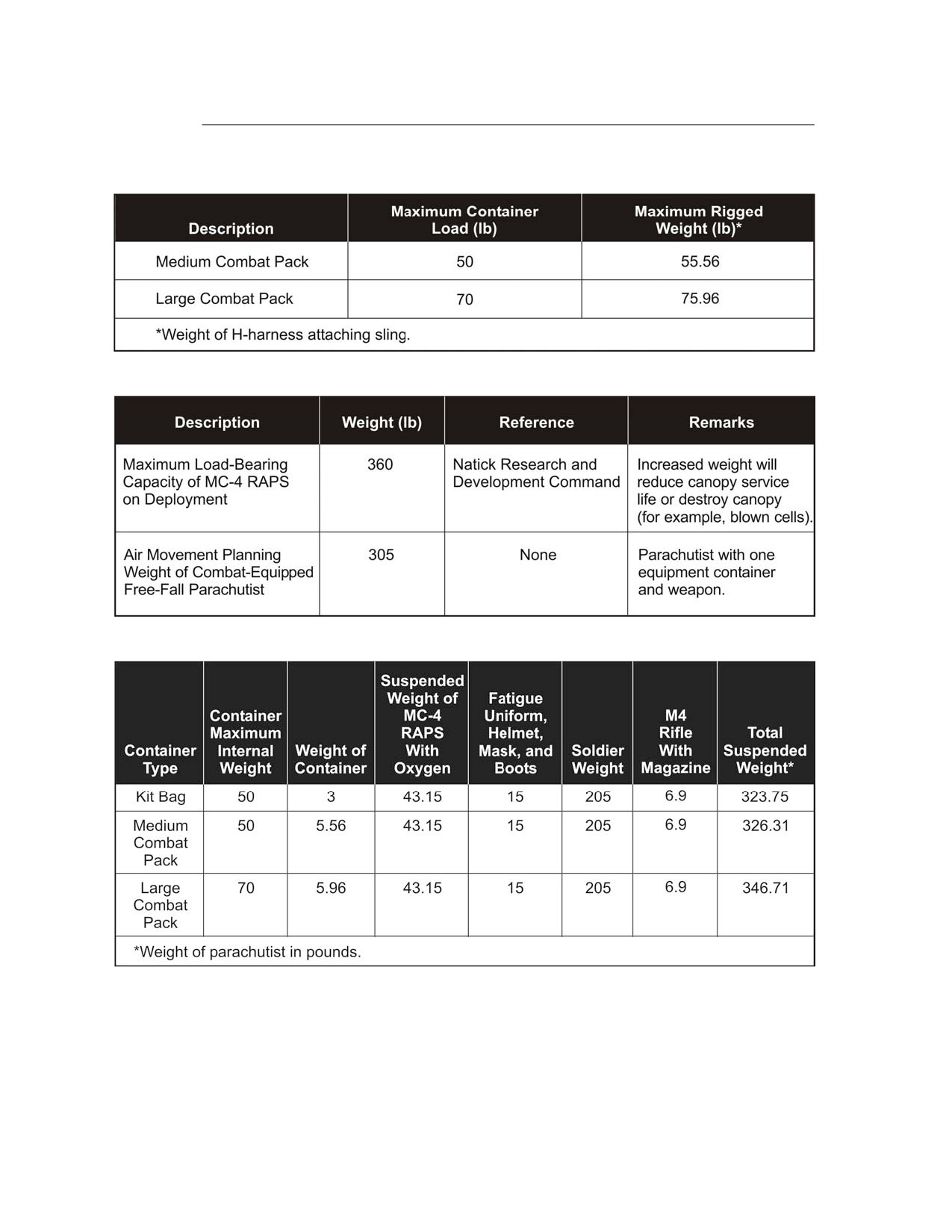
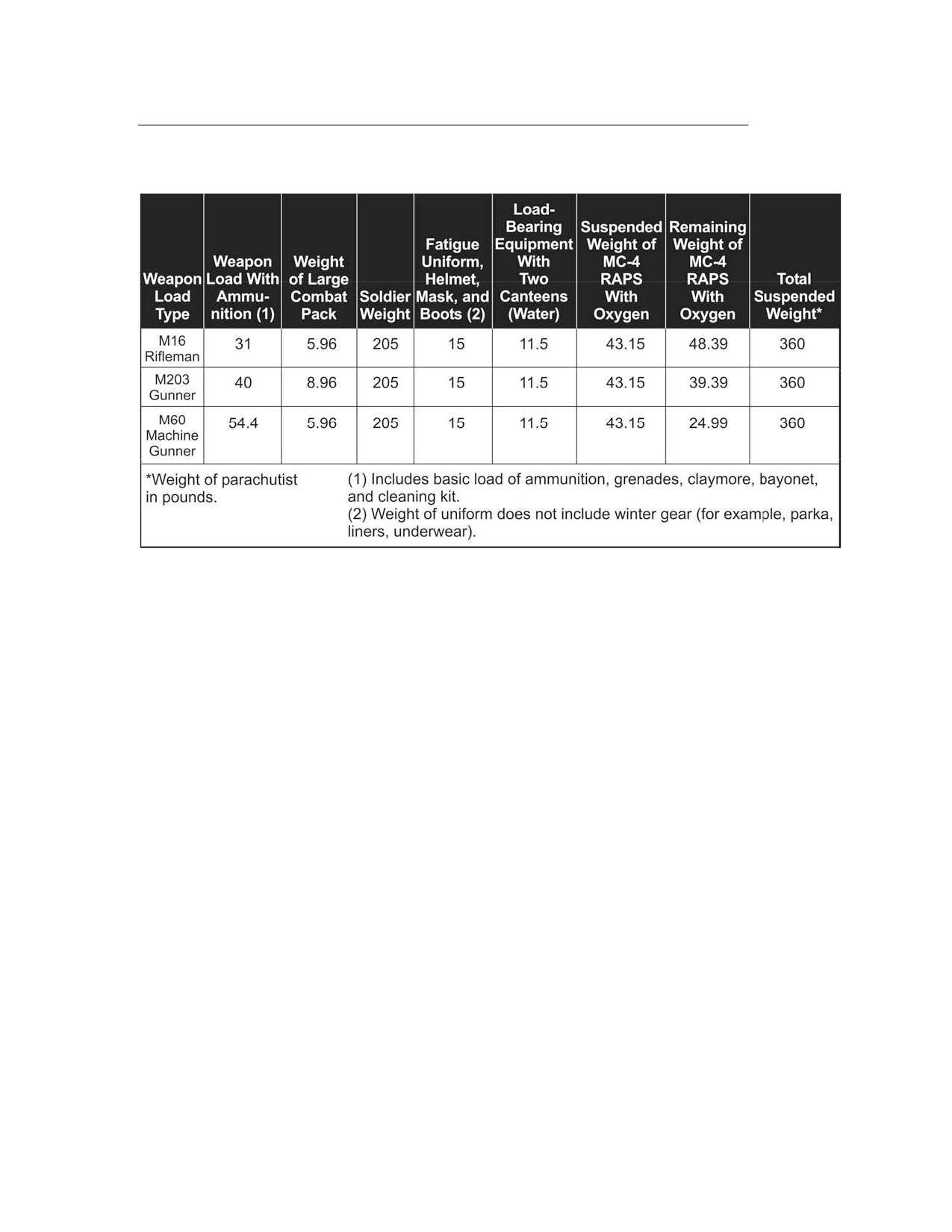
parachutist (Tables 5-1 through 5-4, pages 5-2 and 5-3) may exceed the safe
design limits of the MC-4 RAPS. Overloading can result in parachute
damage, unsafe descent rates, and injury to the parachutist. Also, the
parachutist’s actions and the time available to release the tie-down straps
and to lower the equipment may interfere with his control of the parachute
close to the ground.
6 April 2005 FM 3-05.211/MCWP 3-15.6/NAVSEA SS400-AG-MMO-010/AFMAN 11-411(I)
5-1
FM 3-05.211
Table 5-1. Container Weight Limits
Table 5-2. Parachute Load Limits
Table 5-3. Weight of Parachutist With Two Equipment Loads
5-2
FM 3-05.211/MCWP 3-15.6/NAVSEA SS400-AG-MMO-010/AFMAN 11-411(I)
6 April 2005
FM 3-05.211
Table 5-4. Weight of Parachutist With Two Equipment Loads and Basic Load
HOOK-PILE TAPE (VELCRO) LOWERING LINE ASSEMBLY
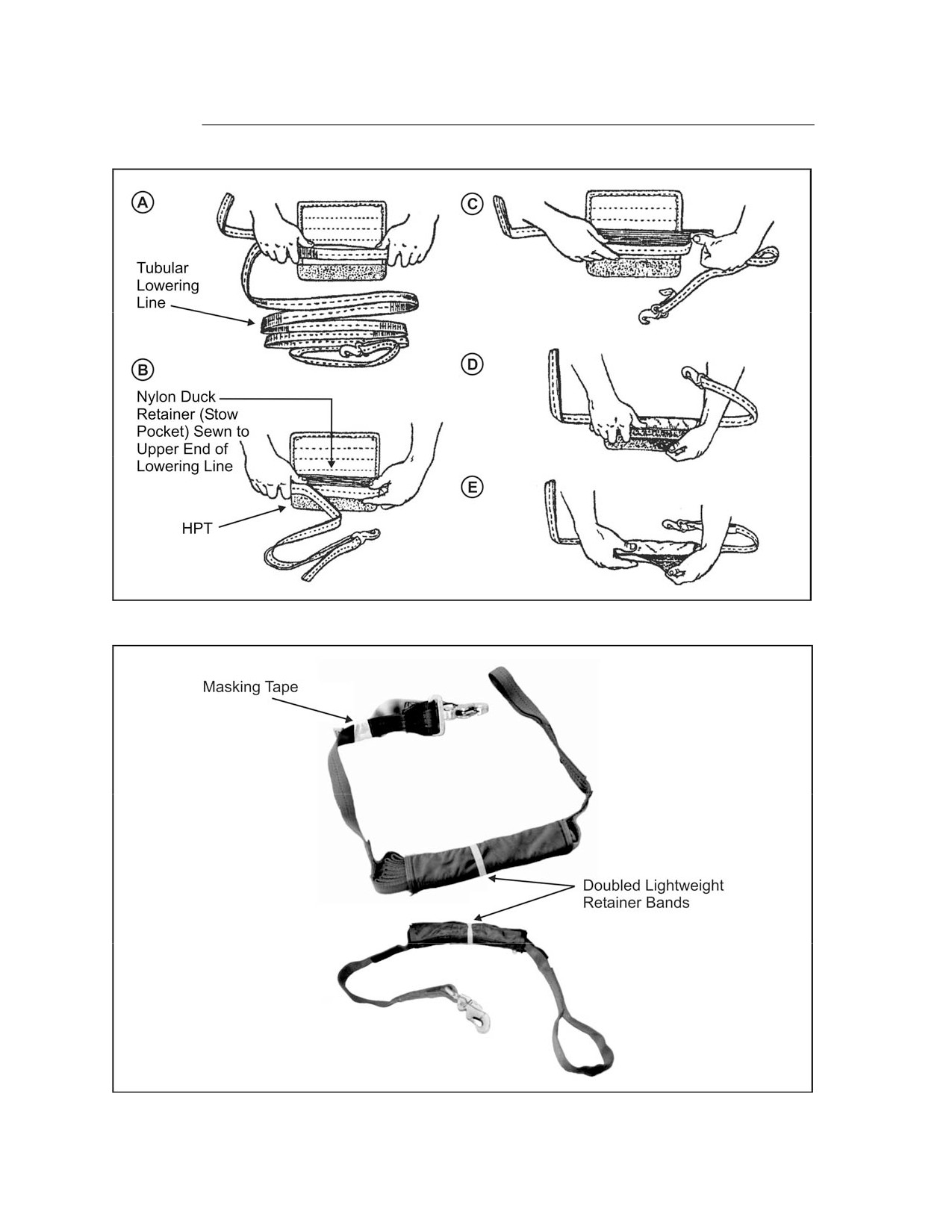
5-5. Figure 5-1, page 5-4, shows the steps (A through E) for stowing a hook-
pile tape
(HPT) lowering line assembly. The current HPT lowering line
assembly (National Stock Number [NSN] 1670-01-067-6838) consists of—
• An 8- or 15-foot lowering line (the 8-foot lowering line is recommended
for most equipment) made of 1-inch-wide tubular nylon.
• A 9- by 7-inch nylon duck retainer (stow pocket) sewn to the upper end.
The flaps have HPT sewn to the edges.
• A metal (parachute harness) ejector snap with a yellow safety release.
NOTE: The yellow release lanyard should be removed or, if it remains
attached to the HPT lowering line, it should be taped to the lowering line
with one single wrap of masking tape the length of the lanyard, leaving one
to two inches exposed at the top of the lanyard.
NOTE: To help prevent the inadvertent, premature deployment of the
lowering line, the parachutist places a double-looped retainer band around
the middle of the stowed lowering line retainer pocket before attaching it to
the combat pack (Figure 5-2, page 5-4).
6 April 2005 FM 3-05.211/MCWP 3-15.6/NAVSEA SS400-AG-MMO-010/AFMAN 11-411(I)
5-3
FM 3-05.211
Figure 5-1. Stowing the HPT Lowering Line Assembly
Figure 5-2. Stowed Lowering Lines With Retainer Bands Emplaced
5-4
FM 3-05.211/MCWP 3-15.6/NAVSEA SS400-AG-MMO-010/AFMAN 11-411(I)
6 April 2005
FM 3-05.211
COMBAT PACKS AND OTHER EQUIPMENT CONTAINERS
5-6. The following paragraphs discuss the use of harnesses, equipment
attachment slings, and lowering lines in preparing and rigging kit bags and
different packs.
H-HARNESS (MODIFIED)
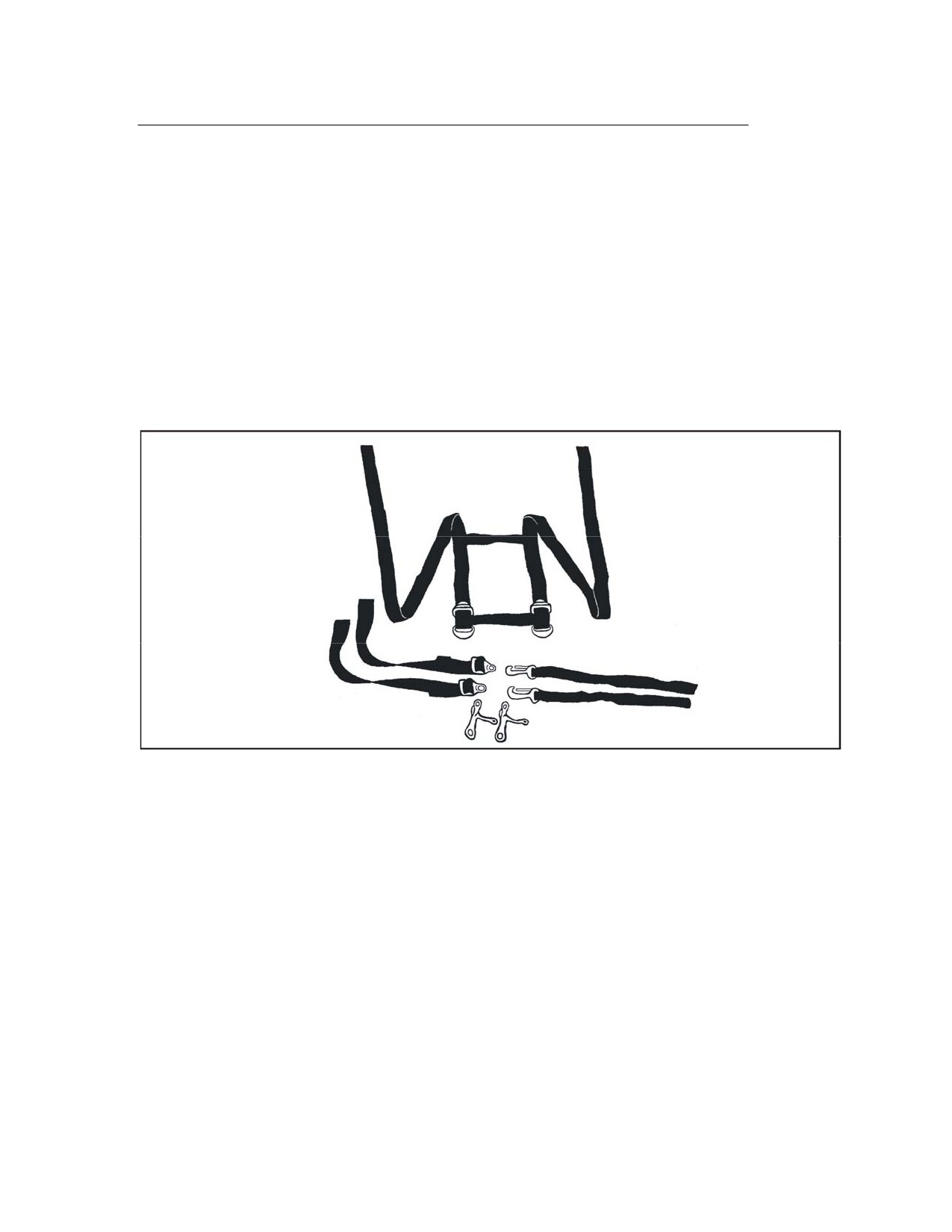
5-7. The modified H-harness consists of two
84-inch nylon straps held
together by two 11-inch straps (Figure 5-3). One end of each strap has two
friction adapters attached 3 inches apart. Two 24-inch or 36-inch equipment
attachment straps with adjustable lugs and two quick-release ejector snap
hooks are part of the assembly. The H-harness is used to rig the kit bag and
combat packs to the parachute harness.
Figure 5-3. H-Harness With Attaching Straps
AVIATOR’S KIT BAG/MC-4 KIT BAG
5-8. The parachutist uses the canvas aviator’s kit bag or the MC-4 kit bag to
jump individual equipment, such as the load-carrying equipment or properly
padded machine gun groups.
Preparing the Bag
5-9. The parachutist packs the equipment IAW the unit SOP. He carefully
places sharp-edged objects in the bag so that they are not against his body
when he attaches the bag to the parachute harness. He unfastens the snaps,
undoes the slide fastener, and folds down the top of the kit bag (about one
half its filled bulk) to pack the equipment. When packed, the parachutist zips
the bag and fastens the snaps. He gathers up the excess bag material and
folds it on top so as to expose the handles.
6 April 2005 FM 3-05.211/MCWP 3-15.6/NAVSEA SS400-AG-MMO-010/AFMAN 11-411(I)
5-5
FM 3-05.211
Attaching the H-Harness to the Kit Bag
5-10. The parachutist takes the two end web adapters and lays out the
harness (with the adapters nearest the body and the second two adapters
on top). He connects the equipment attachment straps as outlined below.
The parachutist—
• With the adjustable lug nearest the body, threads the attachment
strap’s end under the attaching bar of the second friction adapter and
back over the top of the bar.
• Tightens the strap, leaving about 3 inches between the nap and the
bar, and repeats this step for the remaining strap.
• Places one quick-release snap hook on each adjustable lug.
• Lays out the H-harness with the attachment straps down and the snap
hook openings up.
• Attaches the H-harness to the kit bag by centering the bag on the
harness 6 inches from the snap hooks.
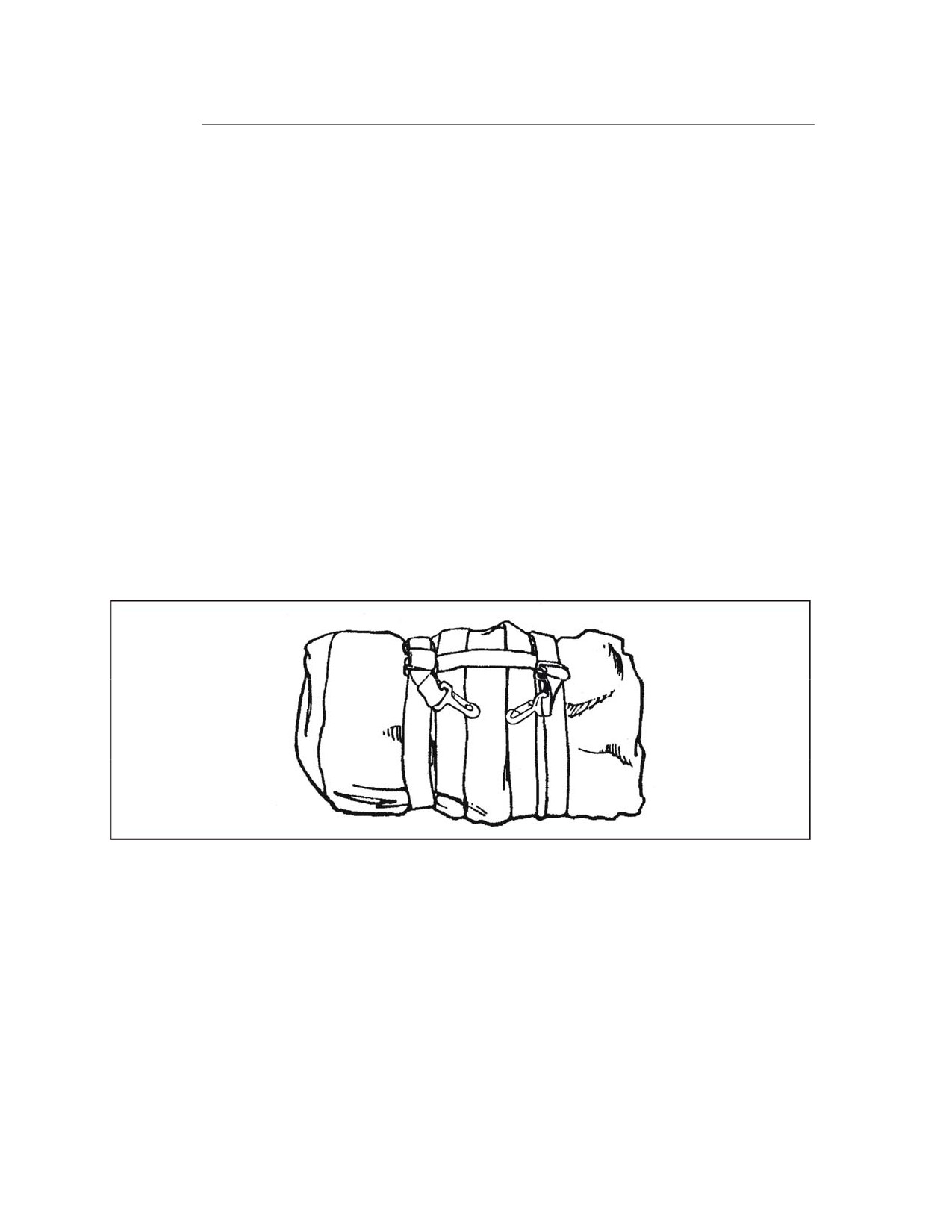
• Places the H-harness straps around the kit bag and threads them
through the friction adapters to form a quick release.
• Threads the snap hooks on the attaching straps through the handles of
the kit bag. He rolls and tapes any excess straps (Figure 5-4).
Figure 5-4. H-Harness Attached to the Kit Bag
Attaching the Kit Bag to the Parachutist
5-11. When completely rigged, the parachutist attaches the H-harness to
himself. He runs the attachment straps through the handles of the kit bag
and then attaches them to the equipment attachment rings on the parachute
harness. If wearing a front-mounted aviator’s kit bag and a rear-mounted
combat pack, the parachutist hooks up the kit bag quick-release snap hooks
to the equipment attachment rings first. He then hooks up the combat pack
quick-release snap hooks to the outside of the kit bag’s snap hooks.
5-6
FM 3-05.211/MCWP 3-15.6/NAVSEA SS400-AG-MMO-010/AFMAN 11-411(I)
6 April 2005
FM 3-05.211
COMBAT PACKS
5-12. The parachutist attaches medium and large combat packs by using the
modified H-harness or the improved equipment attachment sling. Combat
packs can be either front- or rear-mounted.
Packing the Combat Pack
5-13. The parachutist—
• Places equipment in the combat pack and places padding between the
load and the front portion of the pack.
• Fills the outside pockets with nonfragile items (full pockets help to
position the H-harness and attachment sling).
• Closes the combat pack by engaging the drawstrings and tie-down
straps.
• Routes the running ends of the waist straps behind the frame and
secures them by tying or taping.
Rigging the Medium Combat Pack Without the Pack Frame
5-14. The parachutist—
• Turns the pack upside down.
• Places the H-harness on his pack so that the cross straps are in front of
the pack and the friction adapters are touching the bottom of the pack.
• Runs the harness straps over the top of the pack and crosses the straps
at the center of the back of the pack.
• Runs the straps through the friction adapters.
• Threads the equipment attaching straps through the intermediate
friction adapters.
• Attaches the quick-release snap hooks to the adjustable lugs.
Rigging the Medium and Large Combat Packs With the Pack Frame,
Modified H-Harness, and Lowering Line
5-15. The parachutist—
• Positions the modified H-harness on the floor or ground with the
friction adapters down. He places the pack, frame up, over the harness
making sure that the cross straps are to the top of the pack and the
friction adapters are touching (or near) the bottom of the frame (Figure
5-5, page 5-8).
• Runs the harness straps over the top of the pack and then under the
top portion of the frame.
• Runs the harness straps under the horizontal bar of the frame and
crosses them at the center of the back of the pack. He continues to run
the straps under the frame and secures them to the friction adapters.
• Routes the loop end of the lowering line under the crossed diagonal
straps. He passes the running end of the lowering line through its own
loop and tightens it, making sure he centers the lowering line at the
intersection of the straps.
6 April 2005 FM 3-05.211/MCWP 3-15.6/NAVSEA SS400-AG-MMO-010/AFMAN 11-411(I)
5-7
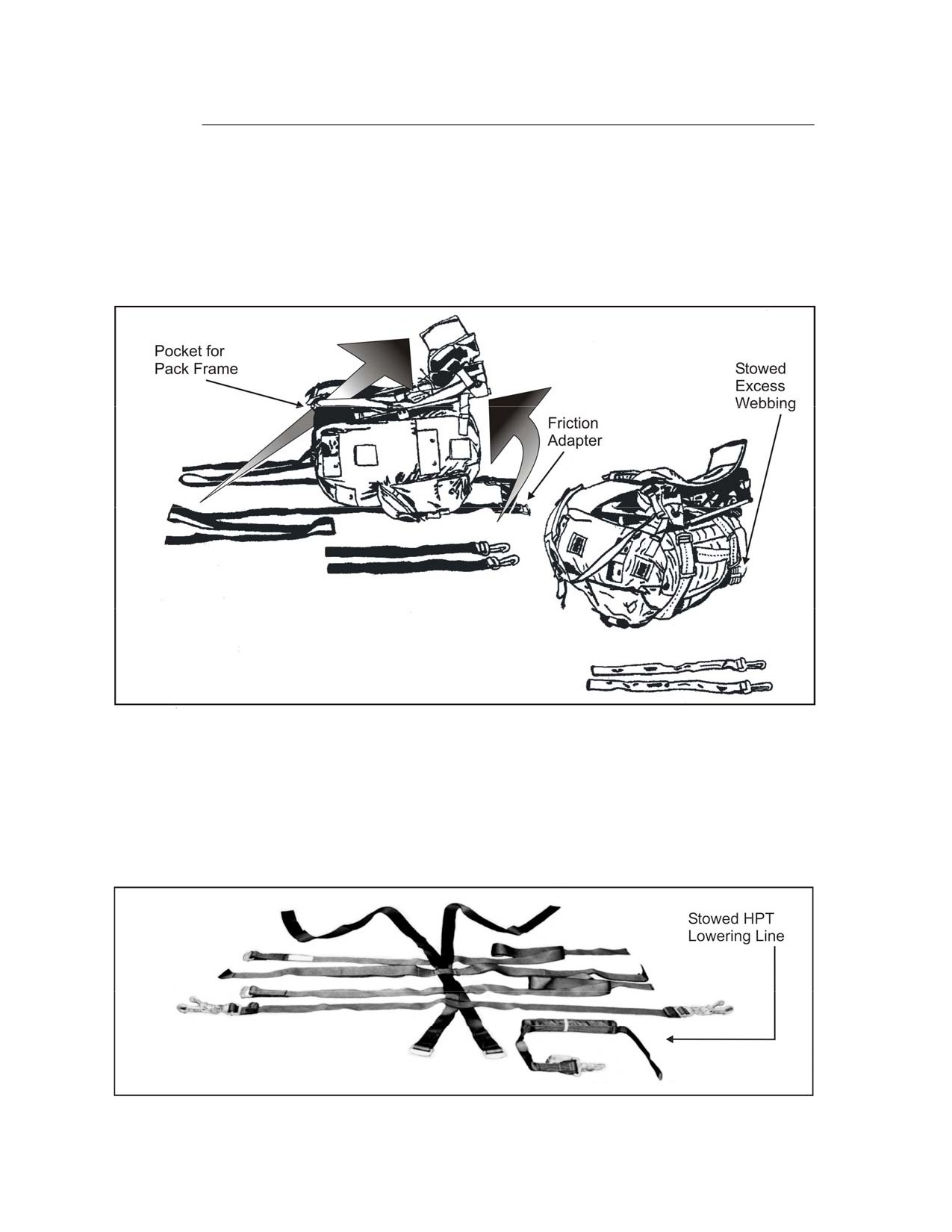
FM 3-05.211
• Secures the lowering line stow pocket to the pack frame with retainer
bands. He leaves the portion with the quick-ejector snap free for
attachment to the parachute harness.
• Threads the equipment attaching straps through the intermediate
friction adapters, attaches a quick-release snap hook to each adjustable
lug, and rolls and tapes any excess straps.
Figure 5-5. Combat Pack and Frame Rigged With the Modified H-Harness
IMPROVED EQUIPMENT ATTACHMENT SLING
5-16. The improved equipment attachment sling
(Figure
5-6) was a
component of the MC-3 MFF system. The parachutist modifies this sling by
removing the leg straps with HPT closures or folds and tapes the leg straps
so that he cannot use them. This sling is used to rig combat packs to the
parachute harness.
Figure 5-6. Improved Equipment Attachment Sling and Lowering Line
5-8
FM 3-05.211/MCWP 3-15.6/NAVSEA SS400-AG-MMO-010/AFMAN 11-411(I)
6 April 2005
FM 3-05.211
Rigging the Large Combat Pack With the Improved Equipment Attachment
Sling (Spider Harness) and Lowering Line
5-17. The parachutist—
• Tightens and secures all straps on the pack and positions the pack with
the frame up (Figure 5-7A, page 5-10).
• Positions the harness on the frame with the friction adapters on the
diagonal locking straps at the bottom of the frame and the running
ends at the top of the frame.
• Routes the diagonal locking strap friction adapters under the pack
frame’s base.
• Routes the anchor straps (parachute harness attaching straps with
adjustable quick-release lugs) and lateral locking straps under the
shoulder straps and over the pack frame.
• Turns the pack over and routes the running ends of the diagonal
locking straps around the long axis of the pack, across the straps at the
center of the back.
• Secures the diagonal locking straps to the respective friction adapters
that protrude beneath the bottom of the pack frame (Figure 5-7B).
• Tightens the lateral locking straps and secures them around the pack
and to their respective friction adapters (Figure 5-7C).
NOTE: If the pack is small, the parachutist crosses and tightens the
lateral locking straps and secures them around the pack and to their
opposite friction adapters.
• Folds and secures the running ends of all straps to themselves with
tape or ties them with 1/4-inch cotton webbing.
• Places the combat pack in an upright position.
• Attaches a quick-release snap hook to each adjustable lug so that the
latch handles face away from his body when he attaches the combat
pack to the equipment rings (Figure 5-7D).
WARNING
The parachutist tapes all combat pack shoulder
strap quick-ejector releases to preclude inadvertent
release in free fall, causing instability.
Attaching the Lowering Line
5-18. The parachutist—
• Routes the loop end of the lowering line under the crossed diagonal
straps between the diagonal straps and the loop on the backside of the
diagonal straps.
6 April 2005 FM 3-05.211/MCWP 3-15.6/NAVSEA SS400-AG-MMO-010/AFMAN 11-411(I)
5-9
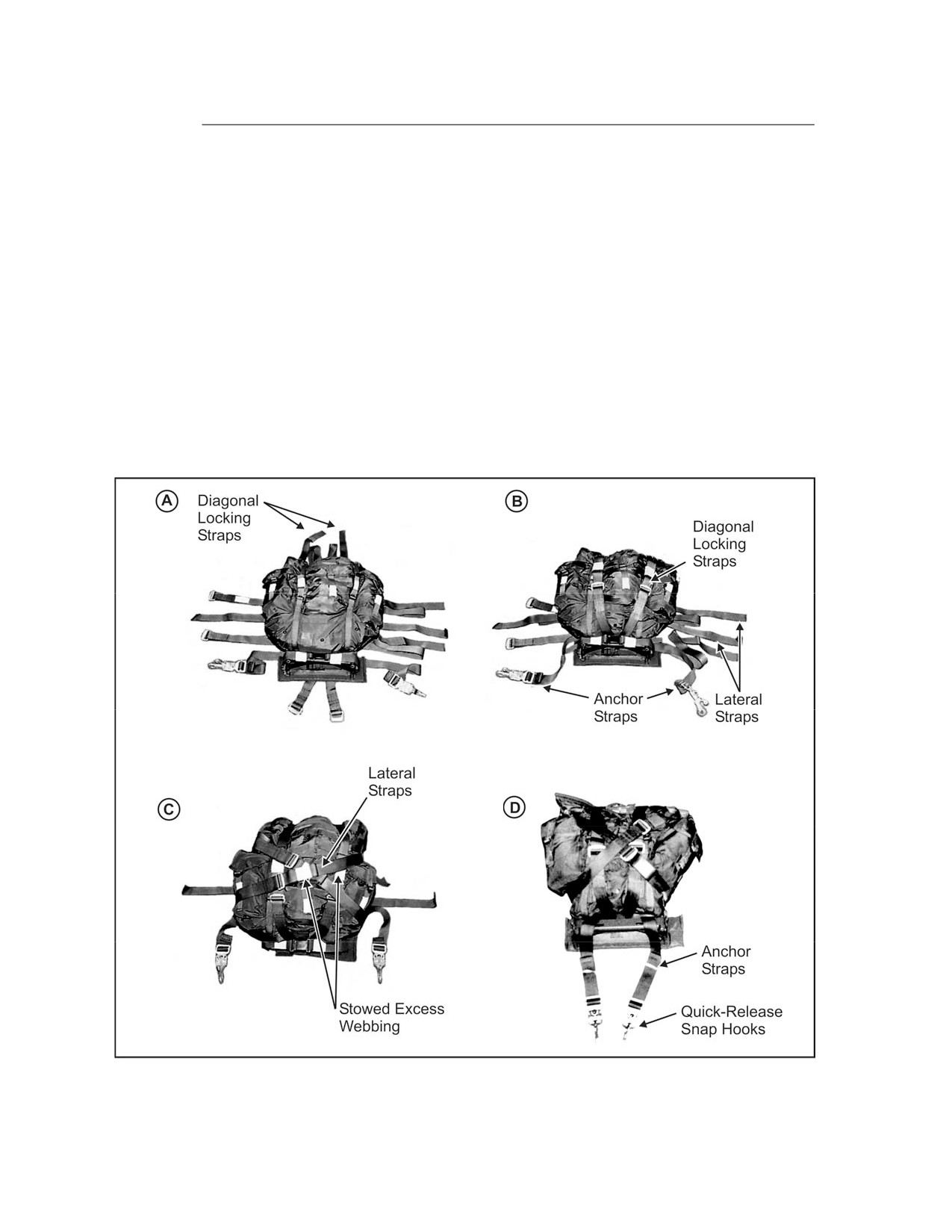
FM 3-05.211
• Passes the running end of the lowering line through its own loop and
tightens it (Figure 5-8, page 5-11).
• Makes S-folds with the remainder of the lowering line and places the
S-folds into the retainer pocket.
• Secures the retainer pocket to the appropriate side of the pack frame
(right side for front mount, left side for rear mount) with retainer
bands. He uses three retainer bands: two on the frame and one double-
wrapped around the center of the lowering line.
• Removes the yellow release lanyard or, if it remains attached to the
HPT lowering line, tapes it to the lowering line with one single wrap of
masking tape the length of the lanyard, leaving 1 to 2 inches exposed
at the top of the lanyard.
• Attaches the lowering line quick-ejector snap to the right side lowering
line attachment V-ring (Figure 5-9, page 5-12).
Figure 5-7. Combat Pack and Frame Rigged With the Improved
Equipment Attachment Sling
5-10
FM 3-05.211/MCWP 3-15.6/NAVSEA SS400-AG-MMO-010/AFMAN 11-411(I)
6 April 2005
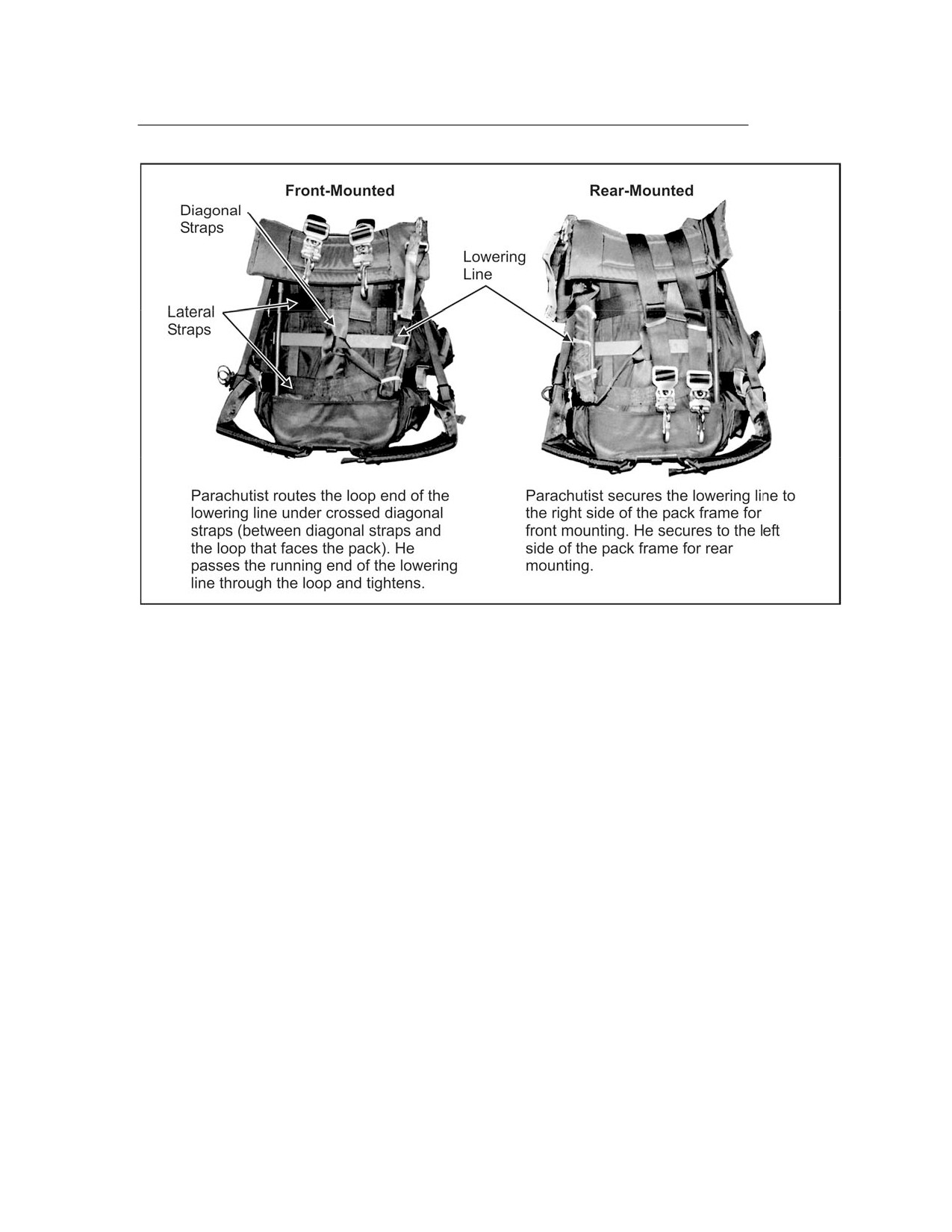
FM 3-05.211
Figure 5-8. Attaching the Lowering Line to the Combat Pack
Attaching the Combat Pack
5-19. The parachutist attaches the combat pack with frame to himself in the
same manner as the combat pack without frame.
Attaching the Rear-Mounted Combat Pack
5-20. The parachutist—
• Loosens the shoulder straps and steps through the shoulder straps, one
leg through each strap (Figure 5-10A, page 5-13).
• Attaches the lowering line to the right side lowering line attachment
V-ring on the parachute harness (Figure 5-9, page 5-12, and Figure
5-10B, page 5-13).
• Attaches the quick-release snap hooks to the large equipment
attachment rings on the main lift webs, has No. 2 lift up on the pack,
and pulls the slack out (Figure 5-10C, page 5-13). In this last step, the
parachutist could pull out the slack by himself by squatting and sitting
on the pack.
Figure 5-11, page 5-14, shows the parachutist wearing the rear-mounted
combat pack.
6 April 2005 FM 3-05.211/MCWP 3-15.6/NAVSEA SS400-AG-MMO-010/AFMAN 11-411(I)
5-11
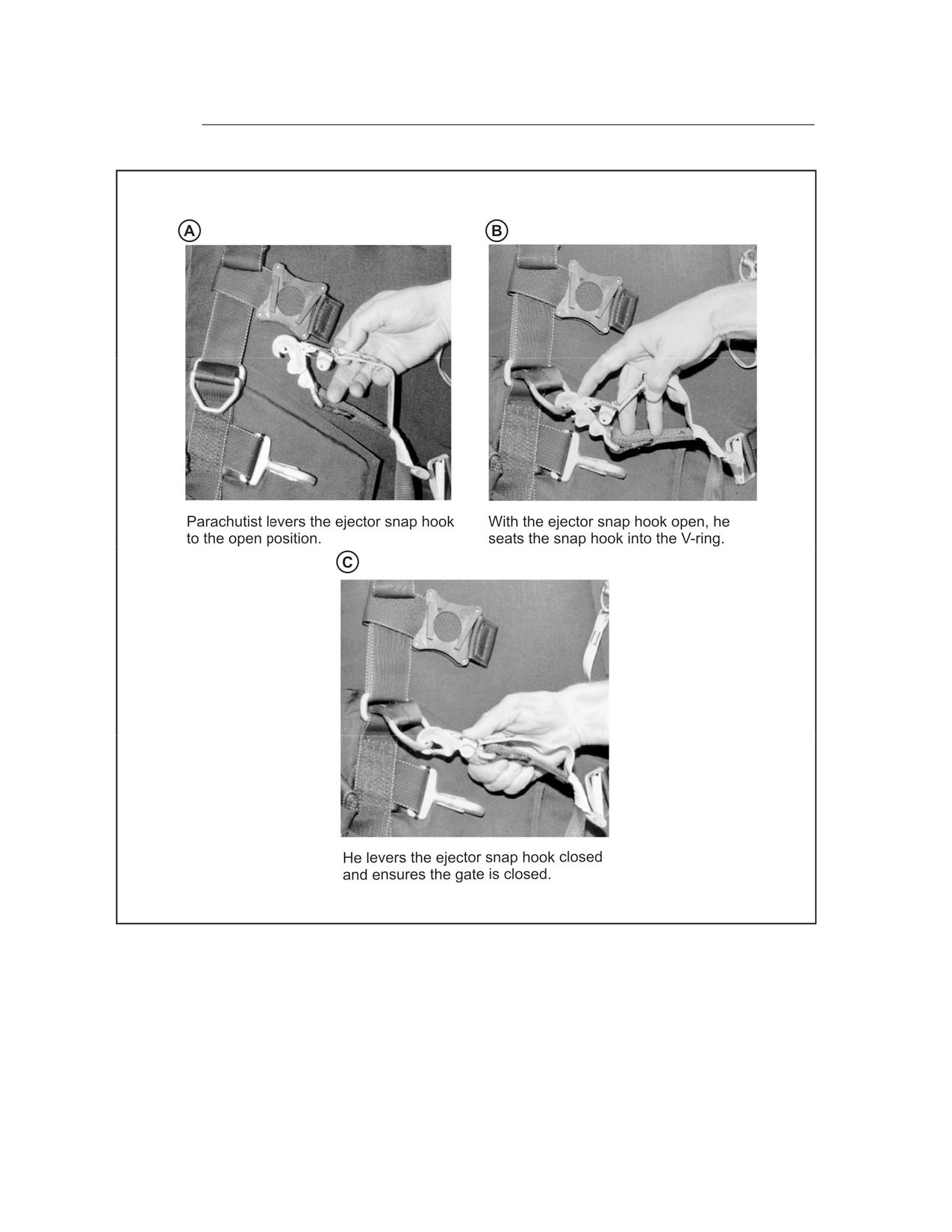
FM 3-05.211
Figure 5-9. Lowering Line Attached to the Lowering Line Attachment V-Ring
5-12
FM 3-05.211/MCWP 3-15.6/NAVSEA SS400-AG-MMO-010/AFMAN 11-411(I)
6 April 2005