FM 3-05.211 Special Forces Military Free-Fall Operations (APRIL 2005) - page 6
FM 3-05.211
Makes sure the reserve ripcord cable moves freely in the cable
housing.
Makes sure the reserve cable is routed to the left of the top
grommet.
Makes sure the top ripcord pin is at a 45-degree angle inserted
through the withdrawal cable eyelet.
Makes sure both ripcord pins are fully seated.
Continues the normal JMPI sequence from this point through
completion excluding any FF-2-related item.
OR
•
The CYPRES: Jumpmaster does the normal JMPI sequence through
the inspection of the parachutist’s altimeter. After the altimeter
inspection, the jumpmaster continues with the following:
Opens the reserve protector flap and pins it up and out of the way.
Traces the control cable and inspects for any damage and proper
routing.
Makes sure the control cable is properly routed through the
binding tape guide.
Makes sure the binding tape is properly tacked to the reserve top-
closing flap.
Makes sure the control unit is set at the proper default for the
current free-fall operation.
Makes sure the control unit LED indicator light is not lit.
Checks that the control unit digital readout screen shows the
proper altitude setting.
Inspects the reserve ripcord cable for proper routing and no broken
strands.
Makes sure the reserve ripcord cable runs through the assist ring
(little ring) of the RSL and then through the guide ring (big ring).
At the top reserve locking pin, ensures the reserve ripcord cable is
to the right of the grommet.
Inspects the pin to make sure it is not shouldered inside the
grommet and the pin is not bent.
Makes sure the continuous CYPRES closing loop of the reserve is
not frayed.
Continues to inspect the reserve ripcord cable to the bottom locking
pin, making sure it is properly routed and there are no broken
strands.
At the bottom reserve locking pin, inspects the pin to make sure it
is not shouldered inside the grommet and the pin is not bent.
Makes sure the continuous CYPRES closing loop of the reserve is
not frayed.
G-10
FM 3-05.211/MCWP 3-15.6/NAVSEA SS400-AG-MMO-010/AFMAN 11-411(I)
6 April 2005
FM 3-05.211
Opens up and pins the top protector flap of the main parachute and
opens the FF-2 protector flap.
Makes sure the closing flaps are closed in the proper sequence
(bottom, left, right, top).
Makes sure the main ripcord cable housing is tacked.
Inspects the cable for proper routing and no broken strands.
Continues past the locking pin and inspects the 2-inch extension
for proper routing and no broken strands.
Ensures the 2-inch extension terminates with a single steel swage
ball.
Pinches the swage ball to ensure the main locking pin does not
come loose.
Inspects the pin to make sure it is not shouldered inside the
grommet and the pin is not bent.
Makes sure the main closing loop is not frayed.
Slaps the bottom of the container to indicate completion of the
JMPI.
JMPI FOR THE MC-4 RAPS WITH THE 106-CUBIC-INCH
PORTABLE BAILOUT OXYGEN SYSTEM
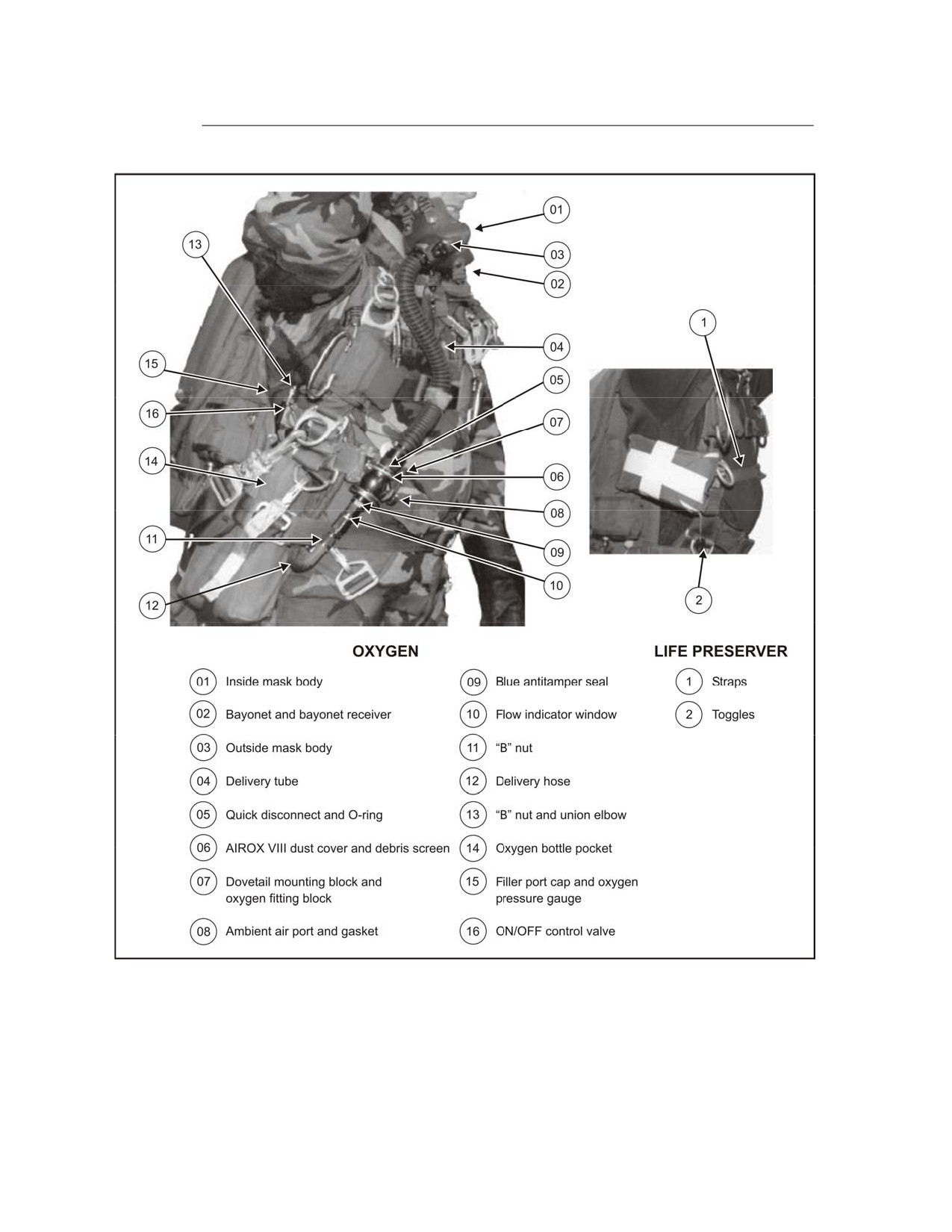
G-2. The jumpmaster inspects the entire oxygen system before inspecting the
harness/container system. The recommended inspection sequence for the
MC-4 RAPS with the oxygen system follows (Figure G-2, page G-12):
• Inspects the inside of the mask, making sure there is no debris, the
four self-sealing screws are present, the combination valve retainer is
present, and the portion that matches with the parachutist’s face is not
torn or damaged in any way that would cause the parachutist to have
an improper seal or fit.
• Attaches the mask to the left side bayonet receiver.
• Checks for proper fit and seal. Makes sure there is no damage to the
hard shell or soft shell portion of the mask. Makes sure the four capped
tee nuts secure the four attaching straps to the hard shell portion of
the mask, and the excess is either taped or tacked. Checks that the
combination valve is of the correct type (green exhalation port flaps
only), the delivery tube clamp is present and attached properly, and
there is no damage to the delivery tube at its attachment point to the
combination valve.
• Detaches the oxygen mask from the left side bayonet receiver. Inspects
the oxygen mask delivery tube to make sure there is no damage (checks
for holes, discoloration, or deterioration). Makes sure the delivery tube
retainer is present and attached correctly. Checks that the elastic slack
retainer is around the chest strap and that the Velcro is mated around
the delivery tube.
6 April 2005 FM 3-05.211/MCWP 3-15.6/NAVSEA SS400-AG-MMO-010/AFMAN 11-411(I)
G-11
FM 3-05.211
Figure G-2. JMPI With Oxygen and Life Preserver
• Moves to the quick-disconnect assembly. Inspects the delivery tube
clamp to make sure that it is present and attached properly. Makes
sure there is no damage to the delivery tube at its attachment point to
the quick-disconnect. Disconnects the delivery tube from the AIROX
VIII. Inspects the quick disconnect to make sure that there is no debris
inside the quick disconnect and that the antisuffocation valve moves
G-12
FM 3-05.211/MCWP 3-15.6/NAVSEA SS400-AG-MMO-010/AFMAN 11-411(I)
6 April 2005
FM 3-05.211
freely, has correct spring tension, and returns to the closed position.
Inspects the gasket (O-ring) to make sure it is present and the beveled
lip portion is up (not reversed).
•
Inspects the AIROX VIII. Disconnects the oxygen mask delivery tube.
Makes sure the dust cover is present and serviceable. Checks that the
debris screen is present and is not damaged or corroded. Checks that there
is no debris inside the AIROX VIII. Reconnects the oxygen mask delivery
tube, making sure the quick-disconnect assembly is fully seated.
•
Grasps the AIROX VIII and moves the entire assembly gently up and
down to check that the dovetail mounting plate is correctly mated with
the oxygen fitting block. Inspects the oxygen fitting block to make sure
it is assembled correctly and the four attachment screws are present
and secure on the back of the oxygen fitting block.
•
Checks the ambient air port of the AIROX VIII. Visually inspects the
inside of the ambient air port to make sure the debris screen is present
and is not damaged or corroded. Checks that there is no debris inside
the ambient air port. Inspects the antisuffocation valve to make sure it
has correct spring tension and returns to the closed position. Inspects
the gasket (O-ring) to make sure it is present and that the beveled lip
portion is up (not reversed).
•
Inspects the blue antitamper seal (blue dot of paint). Makes sure it is
present and aligned.
•
Grasps the “B” nut, giving it a slight turn to make sure it is tight. (The “B”
nut attaches the delivery hose [medium pressure] to the AIROX VIII.)
•
Follows the delivery hose
(medium pressure) from its point of
connection on the AIROX VIII and checks for proper routing. Makes
sure the delivery hose is routed from the AIROX VIII over the outside
of the waistband. Checks that the delivery hose then makes a 180-
degree bend and runs under the waistband and between the
parachutist's body and his right main lift web. Checks that it then runs
to the union elbow.
•
Checks the “B” nut at its point of attachment to the union elbow for
tightness by giving it a slight twist. Then gives the union elbow a slight
twist, checking for proper tightness to the reducer manifold.
•
Pushes up on the bottom of the oxygen bottle pocket with the left hand
while the right hand is on the manifold and pulls the bottles away from
the parachutist’s body. Moves to the overpressure relief valve making
sure it is seated by pushing in on the cap. While in this position with
the oxygen bottles away from the parachutist’s body, inspects the
waistband from its point of attachment on the container to the right
wing flap friction adapter. Makes sure the waistband is not twisted and
the waistband is routed through both of the center loops on the oxygen
bottle pocket. Checks that the oxygen system is between the waistband
and right wing flap.
•
Tells the parachutist to bend. Inspects the filler port cap making sure
it is present and finger tight. Checks that the oxygen pressure gauge
indicates adequate pressure. The needle on the oxygen pressure gauge
must be on the number 1 of 1800 psi or higher to be correct.
6 April 2005 FM 3-05.211/MCWP 3-15.6/NAVSEA SS400-AG-MMO-010/AFMAN 11-411(I)
G-13
FM 3-05.211
• Tells the parachutist to stand erect. Turns the ON/OFF control valve
on and listens for a flow of oxygen out of the oxygen mask. Makes sure
the ON/OFF control valve can be locked in the ON position. Turns the
ON/OFF control valve off, making sure it can be locked in the OFF
position.
G-3. This sequence completes the JMPI of the
106-cubic-inch portable
bailout oxygen system. The jumpmaster returns to the normal JMPI
sequence for the MC-4 RAPS.
JMPI FOR THE MC-4 RAPS WITH FLOTATION DEVICES
G-4. The recommended JMPI sequence for the MC-4 with flotation devices
follows (Figure G-2, page G-12):
• B-7 and LPU-10/P life preservers:
Checks that the life preserver straps are over the uniform and
under the parachute harness (B-7 chest strap fastened with a quick
release).
Ensures flotation packets fit under the armpits, with the flaps to
the outside, and the toggles down and to the front. Makes sure no
part of the flotation packet is under the parachute harness.
• UDT life vest:
Makes sure the life vest is worn around the neck with all straps
under the parachute harness, including the parachute harness
chest strap. The vest is secured with a rubber band to prevent
interference with the cutaway handle and the reserve ripcord.
Makes sure the inflatable portion of the vest does not go under the
chest strap.
Unscrews the CO2 cartridge to make sure it has not been fired.
Reinserts the cartridge into its fitting and ensures it is finger-tight.
Makes sure the protective flap does not cover the toggle.
G-5. Jumpmaster returns to the normal JMPI sequence for the MC-4 RAPS.
JMPI FOR THE MC-4 RAPS WITH WEAPON (M16A1/A2 AND M4A1)
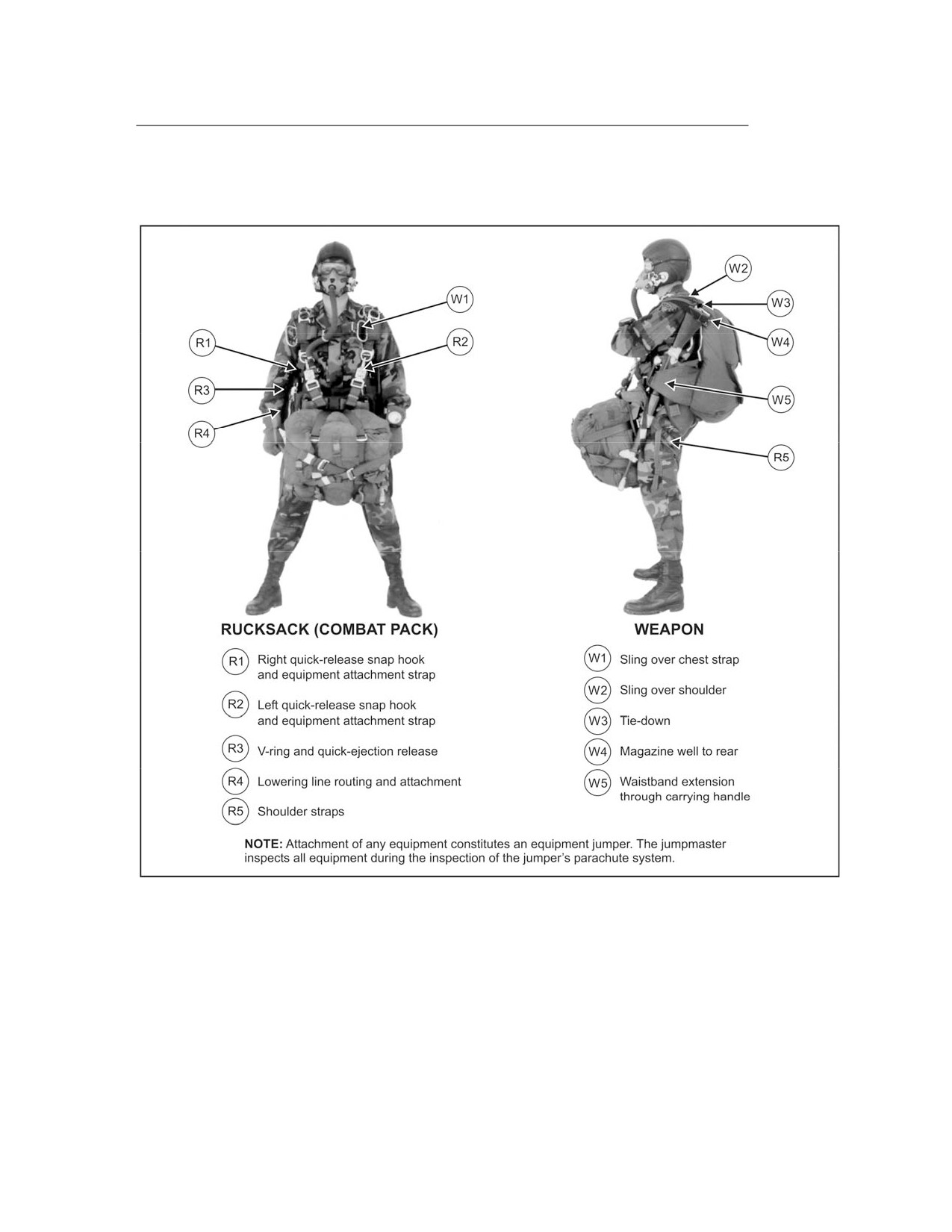
G-6. The jumpmaster follows the normal JMPI sequence until he encounters
the weapon sling over the chest strap extension. The recommended inspection
sequence for the MC-4 RAPS with weapon follows (Figure G-3, page G-15):
• Makes sure the sling is routed over the chest strap extension and
under the left main lift web.
• Makes sure the sling is routed over the parachutist’s shoulder.
• Checks that the weapon tie-down is secured around the weapon sling
about 6 inches from the swivel on the stock of the weapon.
• Makes sure the sling is routed to the outside of the weapon butt stock
and that the weapon magazine is to the parachutist’s rear.
• Checks that the weapon is placed between the left wing flap and the
parachutist with the waistband extension routed through the weapon-
carrying handle.
G-14
FM 3-05.211/MCWP 3-15.6/NAVSEA SS400-AG-MMO-010/AFMAN 11-411(I)
6 April 2005
FM 3-05.211
G-7. The jumpmaster goes to the reserve ripcord handle and continues the
normal JMPI.
Figure G-3. JMPI for Weapon, Front-Mounted Rucksack
6 April 2005 FM 3-05.211/MCWP 3-15.6/NAVSEA SS400-AG-MMO-010/AFMAN 11-411(I)
G-15
FM 3-05.211
JMPI FOR THE MC-4 RAPS WITH REAR- OR FRONT-MOUNTED
COMBAT PACK (RUCKSACK)
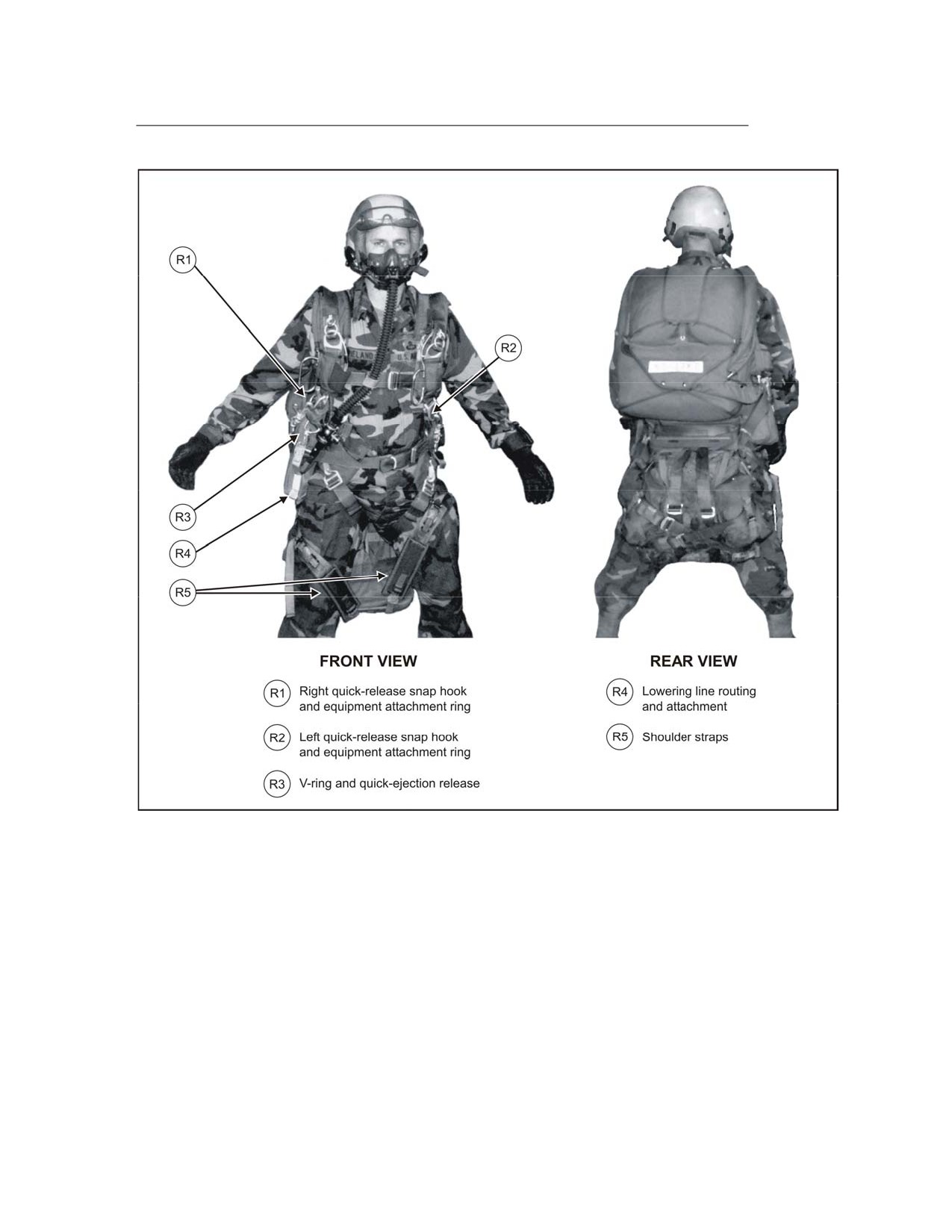
G-8. The recommended inspection sequence for the MC-4 parachute
assembly with the combat pack (rucksack) follows (Figures G-3, page G-15,
front-mounted, and G-4, page G-17, rear-mounted). The jumpmaster follows
the normal JMPI sequence until he arrives at the equipment attachment ring
on the left main lift web. Then the jumpmaster—
• Makes sure the left quick-release snap hook has proper spring tension
and that the gate is closed. Makes sure the quick-release is seated.
Follows the left attachment strap around to the improved equipment
attachment sling, making sure it is not routed under any portion of the
MC-4 harness or rucksack frame.
• Makes sure the right quick-release snap hook has proper spring
tension and that the gate is closed. Makes sure the quick-release is
seated. Follows the right attachment strap around to the improved
equipment attachment sling, making sure it is not routed under any
portion of the MC-4 harness or rucksack frame.
• Inspects the HPT lowering line assembly at its point of attachment on
the right V-ring. Makes sure the gate on the quick-ejector release is
closed and that the locking arm is locked. Checks the routing of the
tubular nylon to the nylon duck container (stow pocket), making sure it
is routed free of any portion of the MC-4 parachute system or the
rucksack frame and is located between the parachutist’s leg and the
shoulder strap of the rucksack.
• Checks the running end of the HPT lowering line for proper
attachment. Makes sure it is attached between the lateral locking
straps where the diagonal straps cross. Checks that the running end of
the lowering line passes through its own loop and is tightened down.
• Grasps both shoulder straps and pulls to the outside of the
parachutist’s legs to make sure they are attached correctly and that the
parachutist has a leg through each shoulder strap.
G-9. Jumpmaster returns to the JMPI inspection sequence at the left main
lift web large equipment ring.
G-16
FM 3-05.211/MCWP 3-15.6/NAVSEA SS400-AG-MMO-010/AFMAN 11-411(I)
6 April 2005
FM 3-05.211
Figure G-4. JMPI With the Rear-Mounted Rucksack
6 April 2005 FM 3-05.211/MCWP 3-15.6/NAVSEA SS400-AG-MMO-010/AFMAN 11-411(I)
G-17
This page intentionally left blank.
FM 3-05.211
Appendix H
Sample Aircraft Inspection Checklist
SFODs primarily use USAF troop carrier aircraft when conducting MFF
operations and proficiency training. The preparation of the aircraft for
parachute operations is an aircrew responsibility. The jumpmaster,
accompanied by the aircraft loadmaster, inspects the aircraft and
coordinates any activities particular to the airborne operation
(for
example, loading and placement of oxygen consoles). At a minimum, the
jumpmaster checks the exterior and interior areas of the aircraft directly
related to the airborne operation. FM 3-21.220 contains the specific items
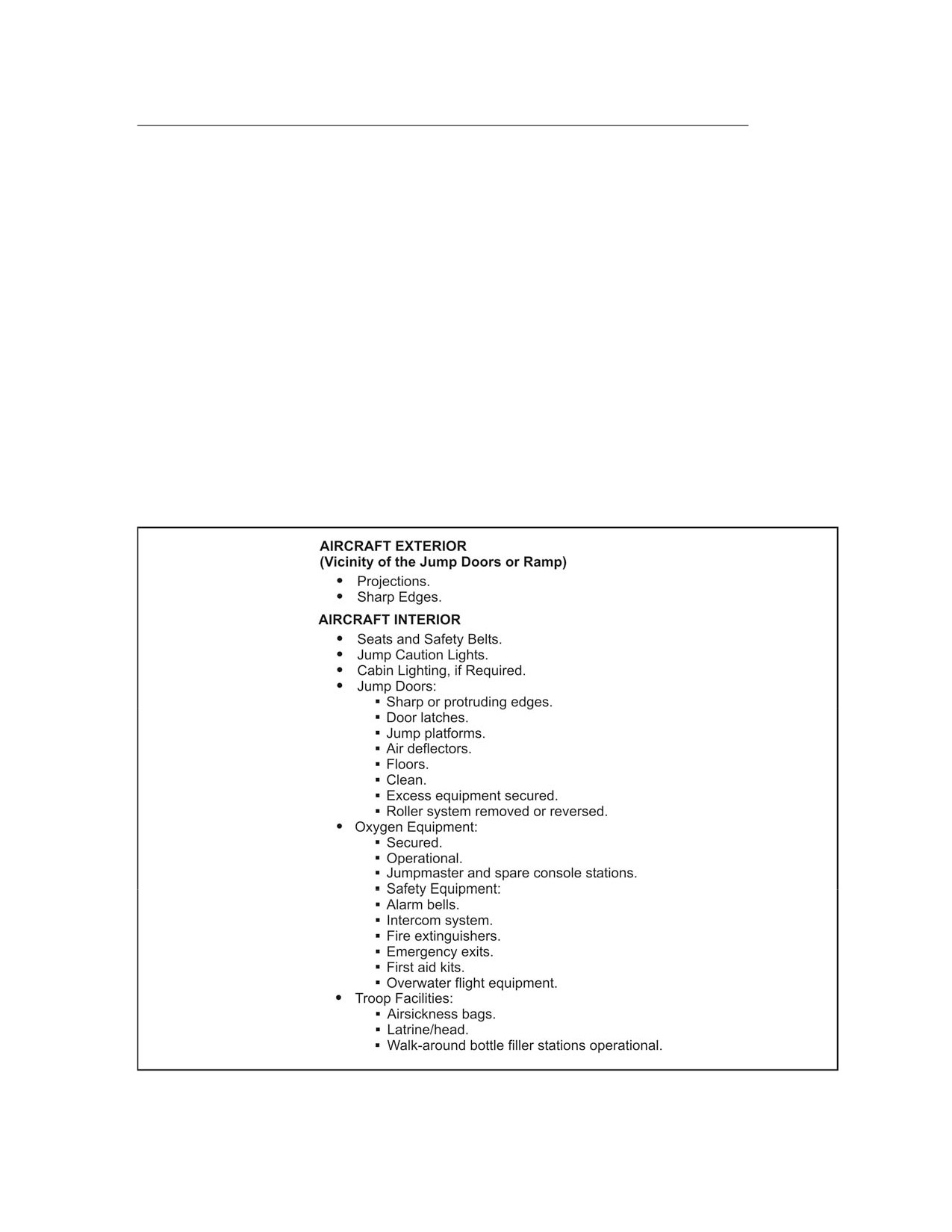
that must be inspected and the peculiarities of certain aircraft. Figure
H-1 contains a sample aircraft inspection checklist.
Figure H-1. Sample Aircraft Inspection Checklist
6 April 2005 FM 3-05.211/MCWP 3-15.6/NAVSEA SS400-AG-MMO-010/AFMAN 11-411(I))
H-1
This page intentionally left blank.
FM 3-05.211
Appendix I
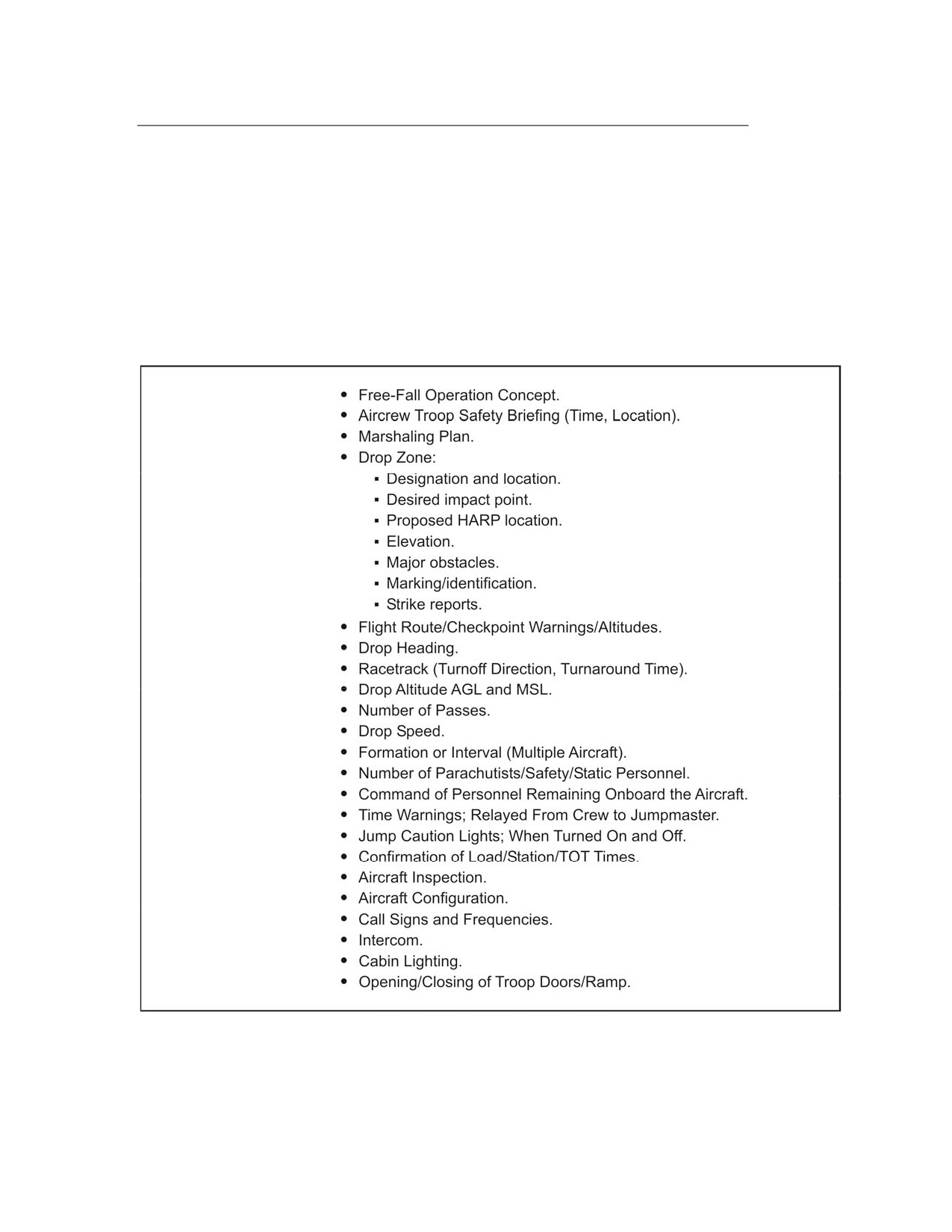
Jumpmaster Aircrew Briefing Checklist
The jumpmaster briefs the aircrew as a part of his duties at the departure
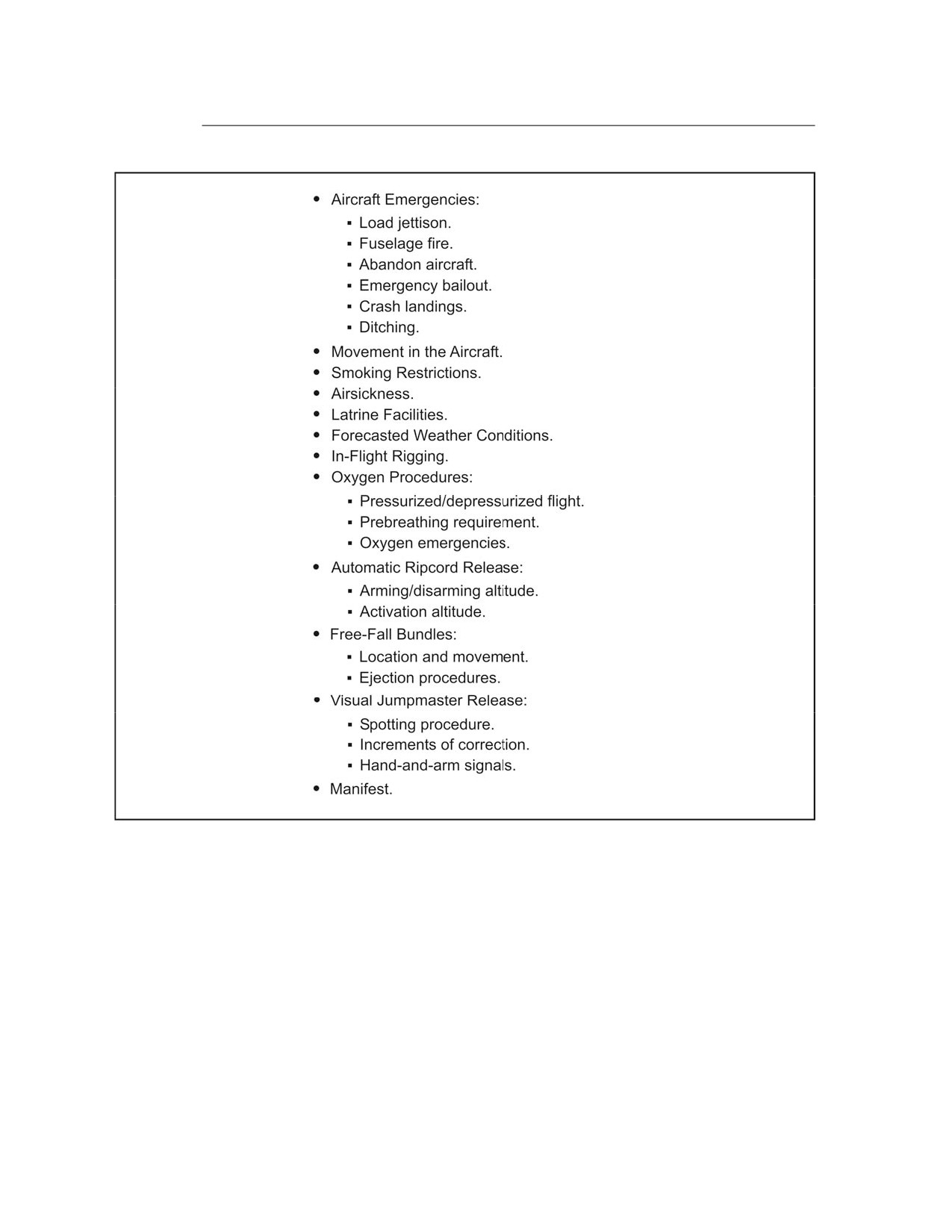
airfield. He uses the following checklist (Figure I-1, pages I-1 and I-2) to
brief the aircrew.
Figure I-1. Sample Jumpmaster Aircrew Briefing Checklist
6 April 2005 FM 3-05.211/MCWP 3-15.6/NAVSEA SS400-AG-MMO-010/AFMAN 11-411(I)
I-1
FM 3-05.211
Figure I-1. Sample Jumpmaster Aircrew Briefing Checklist (Continued)
I-2
FM 3-05.211/MCWP 3-15.6/NAVSEA SS400-AG-MMO-010/AFMAN 11-411(I)
6 April 2005
FM 3-05.211
Glossary
AAD
automatic activation device
abort
To terminate a mission for any reason other than enemy action. It
may occur at any point after the beginning of the mission and
prior to its conclusion. (JP 1-02)
ACC
air component commander
AF
Air Force
AFB
Air Force Base
AFI
Air Force Instruction
AGL
above ground level—The actual distance of the aircraft above
the ground, normally expressed in feet.
AJM
assistant jumpmaster
ALICE
all-purpose, lightweight, individual carrying equipment
alignment
The heading in relation to the release point.
altimeter
A device to determine altitude.
AMC
Air Mobility Command
AO
area of operations
AOD
automatic opening device
ARR
automatic ripcord release—A mechanical device designed to
automatically extract the ripcord pin(s) at a predesignated
altitude.
automatic ripcord
A circular slide rule-type of instrument used by the jumpmaster
release calculator
to calculate the setting on the FF-2 ARR.
body stabilization
A movement made in free fall to attain and maintain a stable
body position.
body turn
A movement made in free fall to effect a turn by moving the upper
torso either to the right or left.
CO2
carbon dioxide
COA
course of action
COMAFSOC
Commander, Air Force Special Operations Command
control lines
The lines that connect the toggles and turn slots, and by which
the parachutist may control the action of his canopy.
crabbing
A movement made in free fall to maneuver the canopy at an angle
to the direction of the wind.
CRRC
combat rubber raiding craft
6 April 2005 FM 3-05.211/MCWP 3-15.6/NAVSEA SS400-AG-MMO-010/AFMAN 11-411(I) Glossary-1
FM 3-05.211
CRU
connector regulator unit
cutaway
A term used for jettisoning the main canopy in the event of a
malfunction.
CYPRES
Cybernetic Parachute Release System
DA
direct action
DACO
departure airfield control officer
DAF
departure airfield
DCS
decompression sickness
departure airfield
An airfield on which troops and/or materiel are enplaned for
flight. (JP 1-02)
DIP
desired impact point—A desired spot for parachute landings on
the DZ.
DOD
Department of Defense
dogleg
A term used to describe calculations when the directional
difference in winds is 90 degrees or more at two consecutive
altitudes.
drop time
The actual time parachutists exit the aircraft.
DSN
Defense Switched Network
DZ
drop zone—A specific area upon which airborne troops,
equipment, or supplies are airdropped. (JP 1-02)
DZCO
drop zone control officer
DZSO
drop zone safety officer—The officer responsible for the
conduct of operations on the DZ.
DZSTL
drop zone support team leader
E5
Sergeant (SGT); petty officer second class (PO2)
E6
Staff Sergeant (SSG); petty officer first class (PO1)
EPA
evasion plan of action
ETC
electronic test chamber
F
Fahrenheit
FAX
facsimile
FID
foreign internal defense
FM
field manual
ft/min
feet per minute
ft/sec
feet per second
glide
A position used to permit forward movement to prevent collision
with other parachutists. Parachutists bring the hands toward the
Glossary-2 FM 3-05.211/MCWP 3-15.6/NAVSEA SS400-AG-MMO-010/AFMAN 11-411(I)
6 April 2005
FM 3-05.211
shoulders. They do not break the arch in their back. They extend
their legs slightly.
GPS
global positioning system
grouping
A technique used to enable parachutists to fall together in the air,
remain together under canopy, and land as a compact tactical
unit.
guide ring
A ring attached to the rear risers through which the control lines
pass.
HAHO
high-altitude high-opening
HALO
high-altitude low-opening
HARP
high-altitude release point
heading
The direction of flight.
Hg
mercury
holding
A term used when the canopy is pointed directly into the wind (as
opposed to crabbing or running).
HPT
hook-pile tape
HQ
headquarters
HSPR
harness, single-point release
hypoxia
A lack of oxygen.
IAW
in accordance with
ID
identification
impact point
A point on the ground where the parachutist should land.
in
inches
JMPI
jumpmaster personnel inspection—An inspection by the
military free-fall jumpmaster similar to that of the static-line
jumpmaster to ensure all safety requirements have been met.
jump commands
The commands given by the jumpmaster to the parachutists on
his sortie to control the parachutists’ actions between the
2-minute warning and exit.
jumpmaster
The assigned airborne-qualified individual who controls
parachutists from the time they enter the aircraft until they exit.
km
kilometer(s)
lb
pound(s)
LBE
load-bearing equipment
LED
light emitting diode
loadmaster
An Air Force technician qualified to plan loads, to operate
auxiliary materials handling equipment, and to supervise loading
and unloading of aircraft. (JP 1-02)
6 April 2005 FM 3-05.211/MCWP 3-15.6/NAVSEA SS400-AG-MMO-010/AFMAN 11-411(I)
Glossary-3
FM 3-05.211
lowering line
A cord designed to allow a parachutist to lower a rucksack or a
piece of equipment to the ground prior to his own impact.
LOX
liquid oxygen
LPU
life preserver unit
malfunction
A discrepancy in the deployment or inflation of the parachute
that can create any faulty, irregular, or abnormal condition
increasing the parachutist’s rate of descent, or a condition in
which the canopy is uncontrollable.
MARCORSYSCOM
Marine Corps Systems Command
mb
millibar(s)—A unit of measurement of barometric pressure used
when setting the FF-2 ARR.
MDMP
military decision-making process
METT-TC
mission, enemy, terrain and weather, troops and support
available, time available, civil considerations
MFF
military free fall
mm
millimeter
MO
malfunction officer
mph
miles per hour
MSL
mean sea level
NAVAIR
Naval Air Systems Command
NCO
noncommissioned officer
NLT
not later than
nm
nautical mile
nonoxygen jump
A parachute jump, normally below 10,000 feet, that does not
require the use of oxygen equipment.
nonoxygen procedures
The signals given by the jumpmaster to control the action of the
parachutists between takeoff and the 2-minute time warning
when oxygen is not used.
NSN
National Stock Number
opening point
The point on the ground over which the parachutist deploys his
canopy.
oxygen check
A visual check made by the jumpmaster to see that each
parachutist is receiving oxygen.
oxygen jump
A free-fall parachute jump requiring the use of oxygen, normally
at any altitude above 10,000 feet.
oxygen mask
A face mask that may be connected to an oxygen supply, allowing
parachutists to operate above nonoxygen altitudes.
oxygen procedures
The procedures used by parachutists and the jumpmaster when
they jump using oxygen equipment.
Glossary-4 FM 3-05.211/MCWP 3-15.6/NAVSEA SS400-AG-MMO-010/AFMAN 11-411(I)
6 April 2005
FM 3-05.211
partial malfunction
A situation in which the canopy does not fully deploy.
PDB
parachutist drop bag
physiological training
The training conducted by the Air Force to enable parachutists to
identify oxygen equipment and systems and explain the effects of
high-altitude physiology, cabin pressurization, and hazardous
noise and stress.
pilot briefing
A briefing the jumpmaster gives the pilot to clarify any points
related to the airborne operation, such as drop signal, time, or
alternate DZ.
PJM
primary jumpmaster
PLF
parachute landing fall
power cable
A cable through which power is transmitted from the FF-2 ARR
to the pins, securing the parachute opening.
prebreathing time
The time spent prior to a high-altitude drop when the
parachutists and jumpmaster breathe 100 percent oxygen.
PRICE
pressure, regulator, indicator, connections, and emergency
equipment
PRP
preliminary release point—The point above the ground at
which the initial vector stops and the free-fall drift factor begins.
psi
pounds per square inch
RAPS
Ram-Air Parachute System
RCLR
recoilless rifle
reset indicator
A window on the FF-2 ARR through which the release time-delay
mechanism is checked.
RP
release point—The point over which parachutists exit the
aircraft.
RSL
reserve static line
running
A technique used for pointing the canopy in the direction of the
wind.
safe-to-arm altitude
An altitude 5,000 feet AGL or 2,500 feet above the ARR activation
altitude, whichever is higher.
SARPELS
Single-Action Release Personal Equipment Lowering System
SAW
squad automatic weapon
SEAD
suppression of enemy air defenses
SF
safety factor
SFOD
Special Forces operational detachment
SOF
special operations forces
SOP
standing operating procedure
6 April 2005 FM 3-05.211/MCWP 3-15.6/NAVSEA SS400-AG-MMO-010/AFMAN 11-411(I)
Glossary-5
FM 3-05.211
spotting
A technique used by the jumpmaster to visually align the aircraft
and release the parachutists at the proper release point.
SR
special reconnaissance
STANAG
Standardization Agreement
STT
special tactics team—A team consisting of combat control,
combat weather, and pararescue personnel.
TAS
true airspeed
terminal velocity
The velocity at which a falling object attains its maximum,
constant speed, normally about 125 miles per hour for a free-fall
parachutist.
time warnings
The warnings given by the jumpmaster, in minutes, to alert the
parachutist to the time remaining before exiting the aircraft.
TM
technical manual
toggles
The nylon loops attached to lines that control the forward speed of
the canopy and left and right maneuvering, mounted on the front
side of the front risers.
TOT
time over target
total malfunction
A type of malfunction in which the parachute remains in the pack
tray.
TTP
tactics, techniques, and procedures
UDT
underwater demolition team
U.S.
United States
USAF
United States Air Force
USAJFKSWCS
United States Army John F. Kennedy Special Warfare Center
and School
USASOC
United States Army Special Operations Command
USMC
United States Marine Corps
USN
United States Navy
USSOCOM
United States Special Operations Command
UW
unconventional warfare
V
volt
walk-around bottle
A large, low-pressure oxygen cylinder that may be used by either
the jumpmaster or safety personnel not connected to the oxygen
console or the aircraft oxygen system.
WATC
wrist altimeter test chamber
WIC
waterborne infiltration course
wind drift formula
A formula used to locate the proper release point.
Glossary-6 FM 3-05.211/MCWP 3-15.6/NAVSEA SS400-AG-MMO-010/AFMAN 11-411(I)
6 April 2005
FM 3-05.211
wind line An imaginary line extending upwind from the target area to the
opening point.
ZAR Zone Availability Report
6 April 2005 FM 3-05.211/MCWP 3-15.6/NAVSEA SS400-AG-MMO-010/AFMAN 11-411(I)
Glossary-7
This page intentionally left blank.
FM 3-05.211
Bibliography
Air Force Publications
AFI 11-401. Aviation Management. 12 June 2003.
AFI 11-403. Aerospace Physiological Training Program. 20 February 2001.
AFI 11-409. High Altitude Airdrop Mission Support Program. 1 December 1999.
AFI 11-410. Personnel Parachute Operations. 5 January 2004.
AFI 13-217. Drop Zone and Landing Zone Operations. 1 May 2003.
TO 14S-1-102. Maintenance Instructions With Parts Breakdown: USAF Flotation Equipment.
1 April 1986 (Change 26, 11 March 2003).
TO 15X-2-6-1. Operation and Maintenance Instructions With Illustrated Parts Breakdown,
Portable Pre-Breather Oxygen System, Portable Oxygen System, Oxygen Charging
System, 106 Cubic Inch Portable Oxygen System. (TM 10-1660-276-12&P.) 1 August
1997.
Army Publications
DA Form 285-AB-R. U.S. Army Abbreviated Ground Accident Report (AGAR).
FM 3-05.210. Special Forces Air Operations. 31 August 2004.
FM 3-21.38. Pathfinder Operations. 1 October 2002.
USASOC Regulation 350-2. Training Airborne Operations. 27 September 2001.
Joint and Multi-Service Publications
AR 59-4. Joint Airdrop Inspection Records, Malfunction Investigations, and Activity
Reporting. (AFJ 13-210(I); OPNAVINST 4630.24C; MCO 13480.1B.) 1 May 1998.
DOD Directive 5100.1. Functions of the Department of Defense and Its Major Components.
1 August 2002.
FM 3-21.220. Static Line Parachuting Techniques and Tactics. (MCWP 3-15.7;
AFMAN 11-420; NAVSEA SS400-AF-MMO-010.) 23 September 2003.
Military Series Altimeter Manual. (Issue # 40/07214/99, Issue C.) June 2001.
TM 10-1670-287-23&P. Unit and Direct Support Maintenance Manual Including Repair
Parts and Special Tools List for MC-4 Ram-Air Free-Fall Personnel Parachute System
(NSN 1670-01-306-2100). (TO 14D1-2-468-2; TM 09011A-23&P; NAVAIR 13-1-38.)
30 July 2003.
6 April 2005 FM 3-05.211/MCWP 3-15.6/NAVSEA SS400-AG-MMO-010/AFMAN 11-411(I) Bibliography-1
FM 3-05.211
TM 10-1670-300-20&P. Unit and Direct Support Maintenance Manual Including Repair
Parts and Special Tools List for Ancillary Equipment for: Military Free-Fall System,
Helmet, Free-Fall, Parachutists, Type I (NSN 8415-01-018-4910) (8415-01-018-4911)
(8415-01-018-4912) Helmet, Free-Fall, Parachutists, Type II (8415-01-018-4913)
(8415-01-018-4914) (8415-01-018-4915) Goggles (8465-01-004-2893) Altimeter,
Parachutists (6660-01-213-9035) Sling Assembly, Equipment Attaching (1670-01-008-
7755) Line, Equipment Lowering (XXX-XX-XXX-XXXX) Release Assembly, Ripcord,
Automatic, Type FF2 (1670-01-213-8145). (TO 14D1-2-469-2; NAVAIR 13-1-42.)
31 July 1995.
TM 10-1670-305-23&P. Unit and Direct Support Maintenance Manual (Including Repair
Parts and Special Tools Lists) for Automatic Ripcord Release, AR2, Model 451 (NSN
1670-01-369-7914) Test Chamber Assembly, AR2, Model 452 (1670-01-370-0752)
Electronic Test Chamber Assembly, AR2, Model 453 (1670-01-468-9471).
(TO 14D2-11-1; NAVSEA SS400-AY-MMO-010; Marine Corps TM 1670-23&P.)
21 June 2000.
TM 55-1660-247-12. Operation, Fitting, Inspection and Maintenance Instructions With
Illustrated Parts Breakdown for MBU-12/P Pressure-Demand Oxygen Mask, Part No.
834-75-01 (NSN 1660-01-081-9157LS), 834-75-02 (1660-01-073-7595LS), 834-75-03
(1660-01-073-7596LS) and 834-75-04 (1660-01-081-2368LS). (TO 15X5-3-6-1.) 1 April
1981 (Change 17, 1 September 1991).
USSOCOM Directive 10-1. Organization and Functions, Terms of Reference for Component
Commanders. 19 November 2001.
Marine Corps Publications
M.C. Order 3500.20A. Marine Corps Parachuting and Diving Policy and Program
Administration. 21 December 2000.
USMC TM 09770A-12&P/1A. Operational Instructions and Organizational Maintenance
With Illustrated Parts Breakdown for the Ram-Air Parachute Assembly MC-5. 31 January
1997.
USMC TM 10121A-12&P. Single Action Release Personal Equipment Lowering System
(SARPELS). September 1997.
Navy Publications
COMNAVSPECWARCOMINST 3000.3. Naval Special Warfare (NSW) Air Operations
Manual. June 1991 (Change 2, February 1992).
NAVAIR 13-1-21. Organizational Maintenance With Illustrated Parts Breakdown,
MT-1XS/SL Ram-Air Parachute Assembly. August 1994.
OPNAVINST 3501.225A. Navy Premeditated Personnel Parachuting (P3) Program.
13 January 1998.
Bibliography-2 FM 3-05.211/MCWP 3-15.6/NAVSEA SS400-AG-MMO-010/AFMAN 11-411(I) 6 April 2005