Fire and Rescue Manual Volume 2. Fire Service Operations Incident Command (3rd Edition 2008) - part 3
Chapter
Incident Command
4
Chapter 4 - Incident Risk Management
4.1
Introduction
outweighed by the savings in legal costs,
compensation, and the need to replace
The overriding priority of any incident Commander
equipment.
is the safety of all that may be affected by the
●● Legal - Fire Authorities, in common with
incident. This must be established by identifying
other employees have many legal duties in
the hazards and risks that are present, identifying
respect of safety. These require employees
and adopting appropriate control measures and
to ensure, so far as is reasonably practicable,
ensuring that safe systems of work are implemented
the health, safety and welfare of employees
and maintained. This will ensure that personnel can
and others affected by their work activities.
carry out their duties and remain safe whilst doing
In order to achieve this they must carry
so. Pre-planning is pivotal, where foreseeable events
out and record suitable and sufficient risk
exist generic risk assessments must be carried out.
assessments, then implement the control
Only after this process can FRS’s consider that
measures necessary to ensure an acceptable
they have taken all appropriate action to ensure
level of safety. Both the risk assessments
the safety of their personnel and members of the
and the control measures must be regularly
public etc.
monitored and reviewed to confirm their
continuing validity.
The ‘Dynamic Management of Risk ‘ has been
defined as: “the continuous process of identifying
Employees have a legal duty to take care of their
hazards, assessing risk, taking action to eliminate
own safety and that of others who may be affected
or reduce risk, monitoring and reviewing, in the
by their acts or omissions. They must also co-
rapidly changing circumstances of an operational
operate with their employer in health and safety
incident”.
matters.
There are moral, economic and legal reasons for
To enable an effective risk assessment to be
the FRS to take the ‘management of health and
performed it is necessary to understand the
safety’ seriously.
following concepts:
●● Moral - As caring employers, organisations
●● Hazard: which is something with the
want to ensure the safety of their employees
potential to cause harm, e.g. falling roof tiles
at all times.
●● Risk: which is a measure of the likelihood
●● As professional bodies, the aim is to
of harm from a particular hazard occurring
discharge their duties to the community to
and the severity of the consequences, e.g. a
the highest possible standards at all times.
fire at derelict property involving the roof
●● Economic - Good health and safety
may result in an increased risk of injury
management is always cost effective.
from falling roof tiles. The severity of this
The money invested in safety is always
occurrence could be significant if a crew
member were hit by the tile.
Incident Command
63
●● Control measure: this is any measure taken
An important part of risk management at this
to reduce risk, e.g. remove the hazard
level is the post incident review. This allows
i.e. roof tiles, or prevent access into the
relevant information to be recorded and fed back
immediate area where harm could be caused.
in to the Strategic decision making process via the
Section 4.11 ‘Hierarchy of Risk Control’
Systematic level, in order that safety standards can
gives further examples of how control
be constantly improved.
measures can be applied at an incident.
Upon arrival at an incident the first task of the IC
In order to provide an acceptable level of protection
must be to gather all available information relating
at operational incidents, the organisations health and
to the incident. This is likely to include information
safety management must operate at three different
obtained at the pre-planning stage and available on
levels - Strategic, Systematic and Dynamic.
risk cards or electronic storage media. This is in
addition to information from the caller, received en-
●●
Strategic - Strategic health and safety
route or passed on by persons already in attendance
management is carried out by FRS
i.e. occupiers or other agencies.
Management Teams and the Fire Authority.
They demonstrate management’s
The IC must then apply professional judgement
commitment to safety by setting the
in conjunction with the Standard Operating
organisation’s health and safety policy, deciding
Procedures to decide the most appropriate course
priorities, providing resources and promoting
of action, weighing the benefits of proceeding with
a positive health and safety culture.
a task against the benefits likely to be gained. It is
●●
Systematic - Systematic health and safety
important to ‘think before you act rather than act
management is carried out by recognised
before you think’. The consequences of a wrong
departments within the organisation.
decision at this stage may be irreversible.
Initially, risk assessors identify the hazards
likely to be encountered at the various
There will be occasions when rapid intervention
types of operational incident and assess the
may be necessary to effect immediate rescues, or to
level of risk presented by these hazards.
prevent escalation of the incident. When faced with
Management Teams act upon the results
these situations, personnel are likely to be eager
of the risk assessments and commissions
to commence operations immediately on arrival.
departments to develop and implement
The highest level of Incident Command will be
additional control measures. These could, for
required to ensure personnel undertaking any role
example, be information, personal protective
do not act outside agreed safety procedures. In such
equipment (PPE), and equipment, systems
circumstances, the IC must ensure that personnel
of work, instruction, training and safety
are not subjected to unacceptable risks which will
supervision.
outweigh the benefits. It is the responsibility of the
●●
Dynamic - Dynamic risk management is
IC to carry out a DRA and decide whether operations
carried out by all personnel at an operational
should continue or adopt a defensive approach until
incident. The main responsibility lies with
further information has been gathered.
the Incident Commander who must identify
the hazards, assess the risks, and then make
4.2
FRS Operational
professional judgements in order to use
Risk Philosophy
the available resources in such a way as to
The benefits of proceeding with a task must be
achieve an acceptable level of safety during
weighed carefully against the risks, it is important
work activities.
to “think before you act rather than act before
you think”.
64
Fire Service Manual
The following statements embrace the philosophy
planning should therefore include detailed risk
of the service’s approach to managing risk at an
and task analysis and consideration must always
incident:
be given to ensure that the attendance of critical
resources are mobilised as soon as possible.
In a highly calculated way, firefighters:
4.3
Risk Assessment in
●● will take some risk to save saveable lives.
the Fire Service
●● may take some risk to save saveable
Operational procedures and practices are designed
property.
to promote safe systems of work. To minimise the
●● will not take any risk at all to try to save
risk of injury Incident/Sector Commanders must
lives or properties that are already lost.
ensure that recognised safe systems of work are
being used so far as is reasonable and practicable.
Therefore, if after implementing all available
Where possible, operational crews should work
control measures, the cost (in terms of risk to
together in teams, and whenever practicable the
life) of proceeding with a task still outweighs
teams should be made up of people who are familiar
the benefit, the IC must not permit operations to
with each other and have trained together.
proceed but consider viable alternative courses
of action. This is a critical and defining aspect of
When necessary, safety briefings must be carried
operational command responsibility. To discharge
out and, as the incident develops, or where the risks
this competently requires a detailed knowledge
of injury increases, those briefings must be more
of the principles and regulations surrounding
precise, and appropriate precautions taken.
risk assessment and a sound understanding of
the factors influencing safety within the ‘fire’
and rescue domain of the present situation. Pre-
Incident Command
65
4.3.1
Statutory Requirements
employees. It also requires employers to have
a general policy with respect to the health
Fire and Rescue Authorities, as the employers,
and safety at work of their employees and the
have statutory duties towards their employees and
organisation and arrangements for the time
others who may be affected by the way in which
being in place for carrying out that policy.
they carry out their undertaking. Employees also
●● Section 3 requires employers to conduct their
have statutory responsibilities for themselves and
undertaking in such a way as to ensure, so
anyone who may be affected by their actions or
far as is reasonably practicable, that people
inactions. In practice, high standards of health
they do not employ who may be affected are
and safety management can only be achieved if all
not exposed to risks to their health and safety;
concerned co-operate in delivering effective and
●● Section 7 requires employees to take
safe systems of work.
reasonable care of their own health and safety
and of the health and safety of others who
Incident Commanders are responsible for
may be affected by their acts or omissions at
implementing safe systems of work at incidents.
work and to co-operate with their employer
In deciding whether the health and safety of
as far as is necessary to enable the employer
employees is, so far as is reasonably practicable
to comply with their duties.
being ensured, a number of factors have to be taken
into account. These include considering the benefit,
Management of Health and Safety at Work
in terms of saving life, versus risk. Whilst it may
Regulations 1999
be suitable to commit appropriately equipped and
●●
Regulation 3 requires employers to make a
trained personnel into a hazardous environment for
suitable and sufficient assessment of the risks
the purpose of saving life, it may be unsuitable in
to the health and safety of their employees to
a similar situation where it is known there are no
which they are exposed at work and the risks
lives to be saved.
to the health and safety of persons they do
not employ arising out of the conduct of their
Fire and Rescue Services should carry out suitable
undertaking, to identify the measures that
and sufficient assessments of the risks involved
are needed to comply with their statutory
in responding to incidents. Following paragraphs
duties;
explain how this requirement is implemented in the
●●
Regulation 5 requires employers to put
FRS, with its wide range of unpredictable and fast-
in place arrangements for the effective
changing incidents. The key elements of the risk
planning, organising, control, monitoring
assessment process8 are:
and review of the control measures;
●●
Regulation 10 requires employers to provide
●● identification of the hazards;
employees with comprehensible and relevant
●● decide who might be harmed and how;
information on the health and safety
●● evaluate the risks and decide on precautions;
risks identified by the assessment and the
●● record the findings and implement them;
preventive and protective measures;
●● review the assessment and update if necessary.
●●
Regulation 11 requires employers, where
they share a workplace (for example, an
The key legal requirements include:
incident ground), to co-operate with the
other employers and take all reasonable steps
Health and Safety at Work etc. Act 1974
to co-ordinate the control measures.
●● Section 2 requires employers to ensure,
so far as is reasonably practicable, the
health, safety and welfare at work of their
8 INDG163 (rev2) Five steps to risk assessment - free on HSE website
66
Fire Service Manual
4.3.2
Generic Risk Assessment
Generic Risk Assessments provide information on
Due to the scope and nature of FRS operations
●● The scope of the activity
there are a wide range of activities to cover. This
●● Significant hazards and risks
can potentially make risk assessment a time
●● Key control measures
consuming activity. To minimise this and avoid
●● Technical references
duplication and inconsistent approach, Generic
●● List of considerations
Risk Assessments (GRAs)have been produced to
●● Summary (in the form of a table)
assist FRS with their regulatory requirements. Fire
Service Guide, Volume 3 - ‘A Guide to Operational
Risk Assessment’ contains a wide range of risk
4.3.3
Dynamic Risk Assessment
assessments that all commanders should be aware
The term Dynamic Risk Assessment (DRA) is used
of when formulating operational plans.
to describe the continuing assessment of risk that
is carried out in a rapidly changing environment
GRAs form the foundation for Dynamic Risk
at incidents (see DRA model in Figure 4.1, p.70).
Assessments (DRAs), FRS Standard Operating
The outcome of a Dynamic Risk Assessment is the
Procedures (SOPS) and training schemes. They
declaration of a Tactical Mode (See section 4.5).
also assist in the completion of Analytical
Risk Assessments (ARA’s) at incidents
(see
Dynamic Risk Assessment takes into account the
Appendix 1).
continually and sometimes rapidly evolving nature
of an incident and is a continuous process. This is
further complicated for the FRS commander in
that often rescues have to be performed, exposures
protected and stop jets placed before a complete
Incident Command
67
appreciation of all material facts has been obtained.
As the incident develops, changing circumstances
It is nevertheless essential that an effective risk
may make the original course of action
assessment is carried out at all operational incidents.
inappropriate, for example:
In a high risk, low time environment the Incident
Commander must implement greater levels of
●● Fire fighting tactics may change from
control and apply appropriate control measures, in
defensive to offensive or vice versa.
order to reduce risk to an acceptable level. Only
●● New hazards and their associated risks
then can crews be committed into the hazard area.
may arise e.g. the effects of fire on building
stability.
A DRA must be reviewed continuously and updated
●● Existing hazards may present different risks.
as required, and as a result of which it is important
●● Personnel may become fatigued.
to declare a ‘Tactical Mode’. The mode must be
communicated to everyone on the incident ground
Incident and Sector Commanders, therefore,
and transmitted over the main scheme radio where
need to manage safety by constantly monitoring
it will be recorded and time stamped. For example,
the situation and reviewing the effectiveness of
during Offensive operations, new information is
existing control measures.
received concerning fire spread to a previously
unaffected out-building containing cylinders.
During the development stage of the incident, the
A new Defensive Tactical Mode should now be
DRA will form the basis of the analytical risk
declared (See section 4.5.4 Defensive Mode).
assessment (see section 4.10).
Although the dynamic management of risk is
4.4.1
Risk Control Process:
continuous throughout the incident, the focus of
Initial Stage of Incident
operational activity will change as the incident
There are 6 steps in the initial assessment of risk:
evolves. It is useful to consider the process during
the three separate stages of an incident
1.
Evaluate the situation
2.
Introduce and declare Tactical Mode
●● The Initial Stage
3.
Select safe systems of work
●● The Development Stage
4.
Assess the chosen systems of work
●● The Closing Stage
5.
Introduce additional control measures
6.
Re-assess systems of work and additional
4.4
Managing the Risk
control measures
If an incident develops to the extent that sectors are
Step 1
Evaluate the situation
designated, Sector Commanders will be responsible
The Incident Commander will need to evaluate
for the health and safety of all personnel within
the situation at the earliest opportunity. This will
their sector. Sector Commanders may feel that
commence immediately following receipt of the
they can supervise safety within their own sectors.
call by reference to information provided during
Alternatively the Sector Commander may feel it
pre-planning arrangements. These take many forms
necessary to nominate a Safety Officer (see section
and include 7(2)(d) information, SOP’s, fire plans,
4.12). This officer will be responsible to the Sector
GRA’s etc. On arrival the Incident Commander will
Commander.
need to identify hazards, assess the risk to crews,
the public, the environment and analyse resource
(NB: although the Safety Officer must report to the
requirements to decide on the most appropriate
Incident Commander or Sector Commander, the
course of action.
organisation of the Safety Officers will be managed
by the Safety Sector if one has been established.)
68
Fire Service Manual
In order to identify hazards the Incident Commander
Step 4
Assess the chosen systems of work
will initially need to consider:
Once a course of action, be it offensive or defensive,
has been identified Incident Commanders need to
●● Operational intelligence information
make a judgement as to whether or not the risks
available from risk cards, fire safety plans,
involved are proportional to the potential benefits
SOPs, GRAs and crews etc.
of the outcome. If YES proceed with the tasks after
●● Incident information available from the
ensuring that:
owner or responsible person at the scene.
●● The nature of the tasks to be carried out.
●● The objectives, both individual and team are
●● The significant hazards presented by the
understood.
incident.
●● Responsibilities have been clearly allocated.
●● The risks presented to:
●●
Safety measures and procedures are understood.
-- firefighters,
-- other emergency service personnel,
If NO then go back to step 3.
-- the public and
-- the environment
Step 5
Introduce additional control measures
-- The resources that are available e.g.
Incident Commanders will need to eliminate,
experienced personnel, appliances and
or reduce, any remaining risks to an acceptable
equipment, specialist advice.
level, if possible, by introducing additional control
measures, such as use of:
Step 2
Introduce and declare Tactical Mode
The declaration of a Tactical Mode, which is the
●● Personal Protective Equipment e.g. safety
simple expression of whether it is appropriate to
glasses, safety harnesses
proceed to work in a hazard area or not, is a device
●● Breathing Apparatus
to enable commanders of dynamic emergency
●● Specialist personnel or equipment e.g. HP,
incidents to demonstrate their compliance with the
TL/ALP, USAR
principles of risk assessment and be seen to have
●● Safety Officer(s)
done so. The detail of the process can be found in
section 4.5. However, in simple terms, after a rapid
Step 6 Re-assess systems of work and
appraisal of the situation the Incident Commander
additional control measures
will either be comfortable in announcing ‘offensive
The DRA model requires the IC to review the plan
mode’, which is the most usual mode of operation,
based upon changes to existing information and
or if not must announce ‘defensive mode’ until
the risks presented to the crews. Once the Tactical
sufficient additional information has been gathered,
Mode has been declared the review process starts.
control measures taken, etc. to allow ‘offensive’ to
By continually returning to step 1 ‘evaluate the
be declared.
situation’ the cycle continues.
Step 3
Select safe systems of work
Even when a safe system of work is in place the
The Incident Commander will then need to
IC must take into account changing priorities as
review the options available in terms of standard
this may alter the perception of risk. Where risks
procedures. Incident Commanders will need to
are present, an assessment of the benefits gained
consider the possible systems of work and choose
by performing the tasks must be made taking into
the most appropriate for the situation.
account the possible consequences. Thus:
The starting point for consideration must be
●● If the benefits outweigh the risks, proceed
procedures that have been agreed in pre-planning
with the tasks.
and training and those personnel available at the
●● If the risks outweigh the benefit do NOT
incident have sufficient competence to carry out
proceed with the tasks, but consider viable
the tasks safely.
alternatives.
Incident Command
69
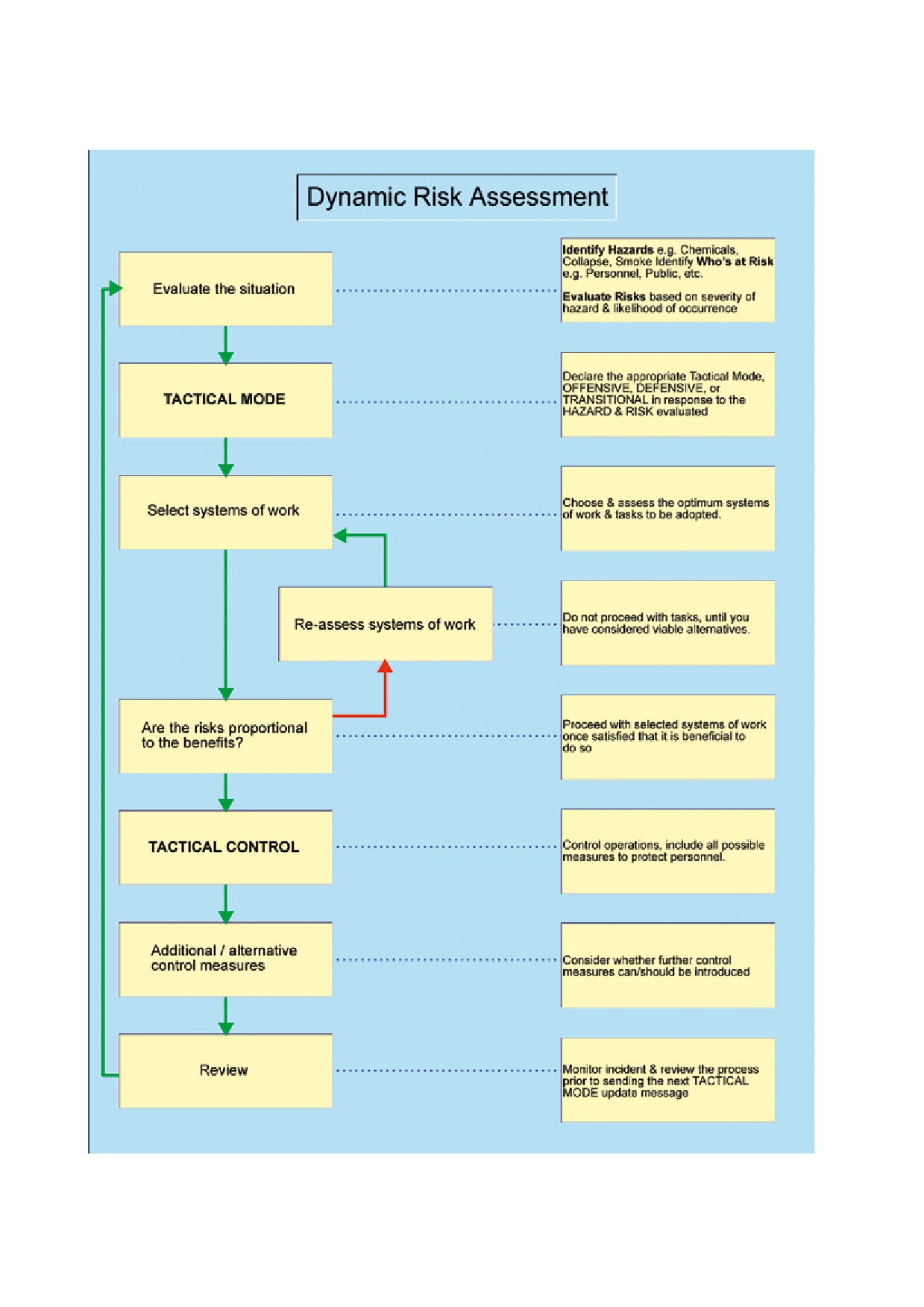
Figure 4.1
70
Fire Service Manual
4.5
The Tactical Mode
If the Incident Commander is unsure whether it is
safe to announce “Offensive”, or confirm offensive
4.5.1
General
operations, then
‘Defensive Mode’ must be
Tactical Mode is the term used to describe the
announced. As soon as the Incident Commander is
outcome of the strategic decision which has
able, a review of the DRA should be conducted. This
been taken by the IC which in turn provides the
approach is referred to as ‘Default to Defensive’.
operating framework within which all tactical
operations will be conducted. It is often the only
The key to effective use of Tactical Mode procedure
strategic decision taken at an incident. A Tactical
is speed of application. The process is founded on
Mode is required for all incidents and must be kept
the psychology of naturalistic decision making
current at all times.
and specifically ‘recognition primed decision
making’. The ability of the Incident Commander
In any sector or incident which has not been
to accept risk exposure will be dependent upon the
sectorised, there are two possible modes of
recognition of the adverse impact from an event
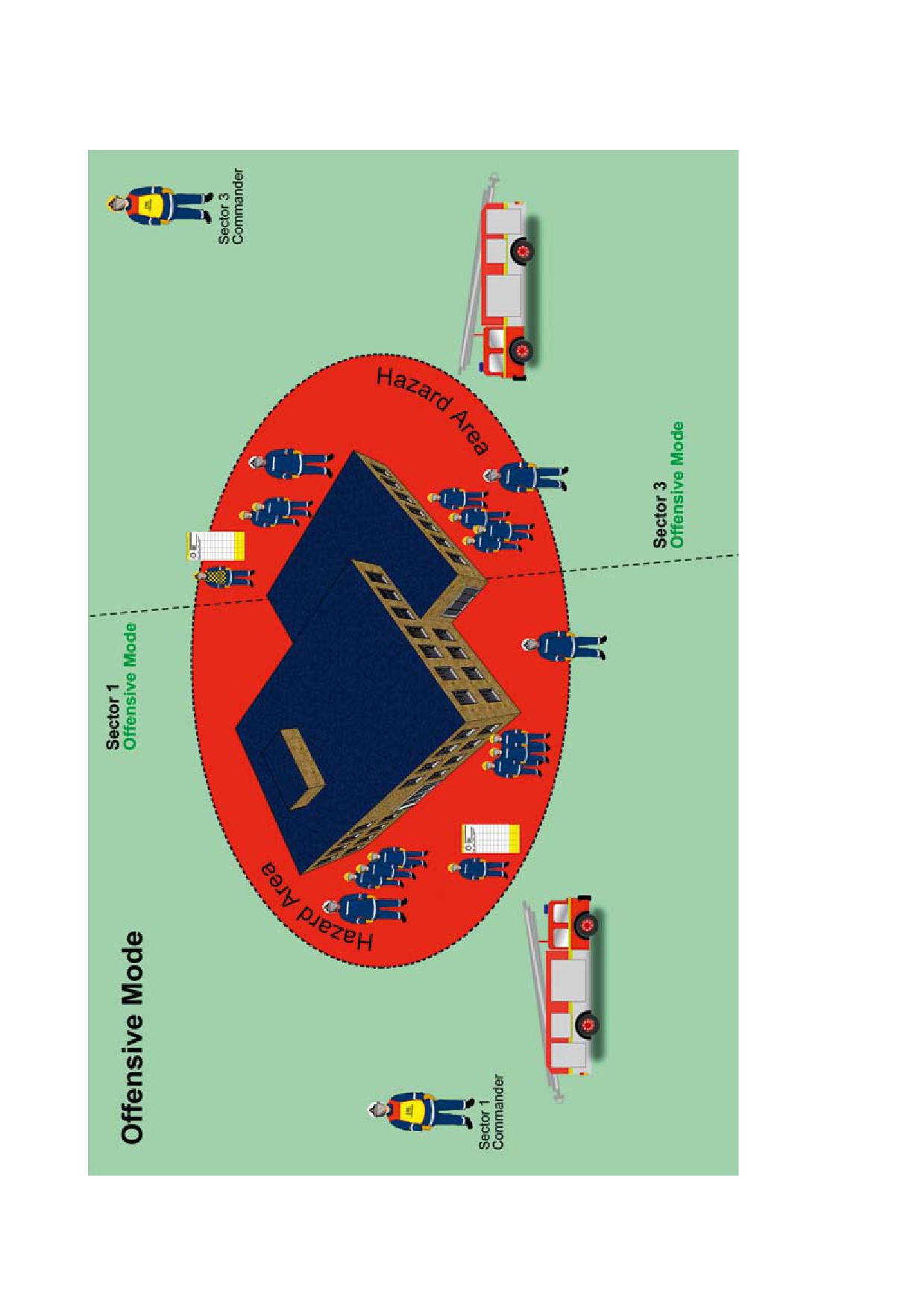
operation; these are “Offensive” and “Defensive”.
e.g. the decision versus the risk, this is termed as
Where safe systems of work are deployed and
‘risk appetite’. More details about these theories
adequate control measures implemented the mode
can be found in Appendix 3 but in application the
of operation is likely to be ‘Offensive’. However
principles are the same.
where the risk to crews is excessive ‘Defensive’
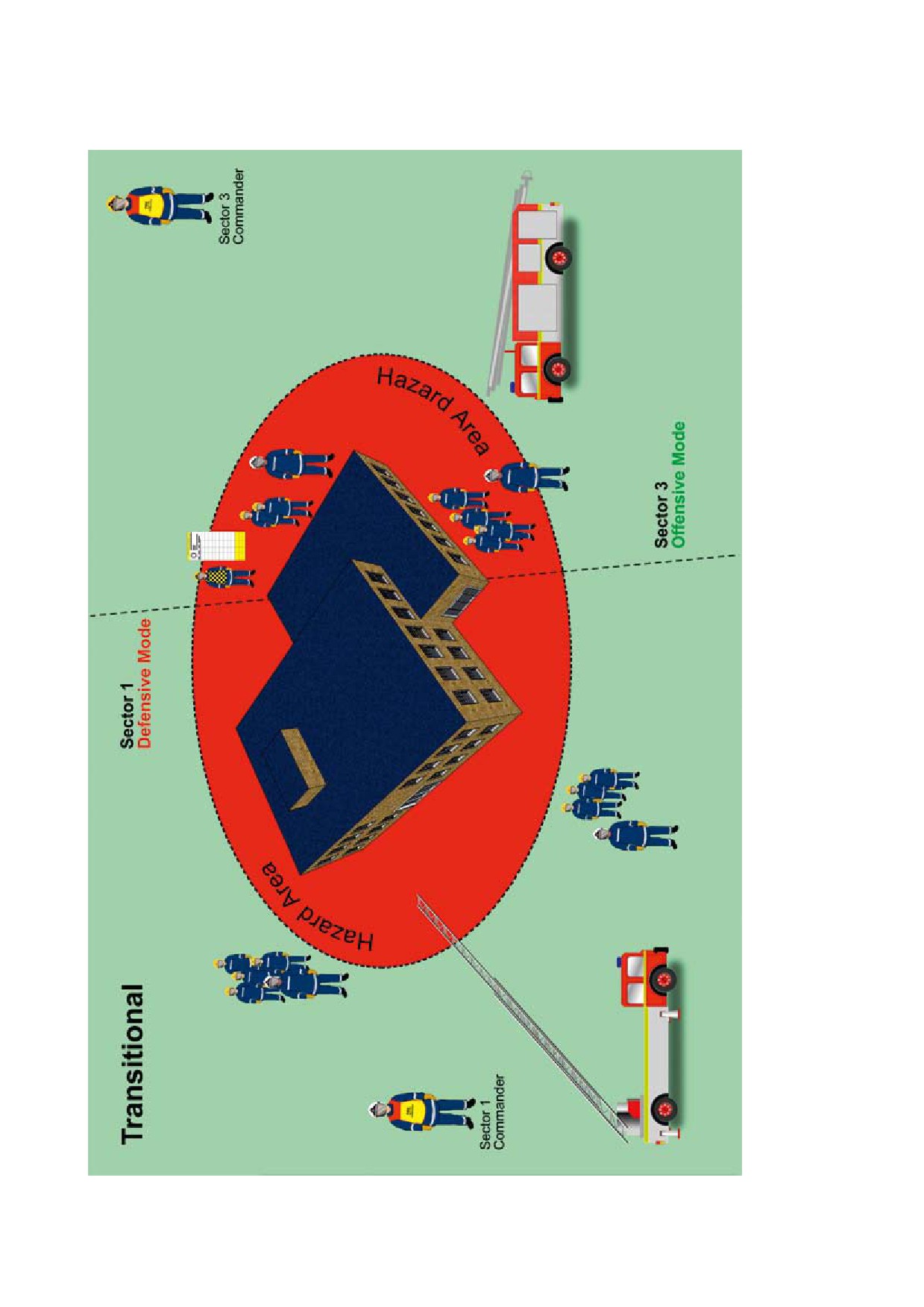
mode will be declared. Where an incident is
Tactical Modes that can be declared at an
sectorised and the mode of operation varies between
incident are:
sectors, i.e. both Offensive and Defensive modes
are in operation at the same time at an incident, the
4.5.3
Offensive Mode
incident is deemed to be in “Transitional Mode”.
This mode may apply to a sector, and/or the entire
incident.
On arrival at an incident the Incident Commander
must establish what and where are the most
This is where the operation is being tackled from
significant hazards to crews. The Incident
within the perceived hazard area. The Incident
Commander must be aware that the hazard area
Commander will have established that potential
may well extend beyond the boundaries of the
benefits outweigh the identified risks, so the
building. The hazard area is defined as ‘an area
Incident Commander will be committing crews
in which significant hazards have been identified’.
into a relatively hazardous area, supported by
The Incident Commander must decide if the level
appropriate equipment, procedures and training.
of risk to crews is justifiable within this area’.
Greater levels of control and additional control
measures may be required.
4.5.2
Default to Defensive
At a critical incident where immediate action is
Offensive Mode is the normal mode of operation
required, the Incident Commander will make
used at, for example, house fires, road traffic
judgement based on the information available,
collisions and industrial premises to fight the fire,
about whether it is safe to proceed with offensive
effect rescues or close down plant, etc.
operations. If the Incident Commander determines
that the available control measures are insufficient
For example, a fire in a derelict property may well
to effectively manage health and safety, a defensive
be fought from the outside using a jet through a
approach must be adopted until a safer alternative
window. This may be a defensive tactic; however
approach to dealing with the incident can be
operations are carried out within the hazard area
implemented.
(due to the significant hazard of unsecured roof tiles
Incident Command
71
being identified). Offensive Mode would be declared
and suitable and sufficient control measures put in
place to deal with the risk of falling roof tiles i.e.
PPE, crew briefing and safety officers.
Further examples:
●● Committing BA crews to a smoke filled or
toxic atmosphere (hazard area) to rescue
persons or undertake firefighting action is an
offensive action.
●● Committing crews to a structural collapse
(hazard area) to undertake rescues is an
offensive action.
●● Committing crews into a hazard area at an
RTC to perform a rescue is an offensive
action.
●● Committing a crew to fight a fire in a field is
an offensive action.
4.5.4
Defensive Mode
This mode may apply to a sector and/or the entire
incident.
●●
Road Traffic Collision involving a chemical
This is where the operation is being fought with
tanker leaking a hazardous substance, no
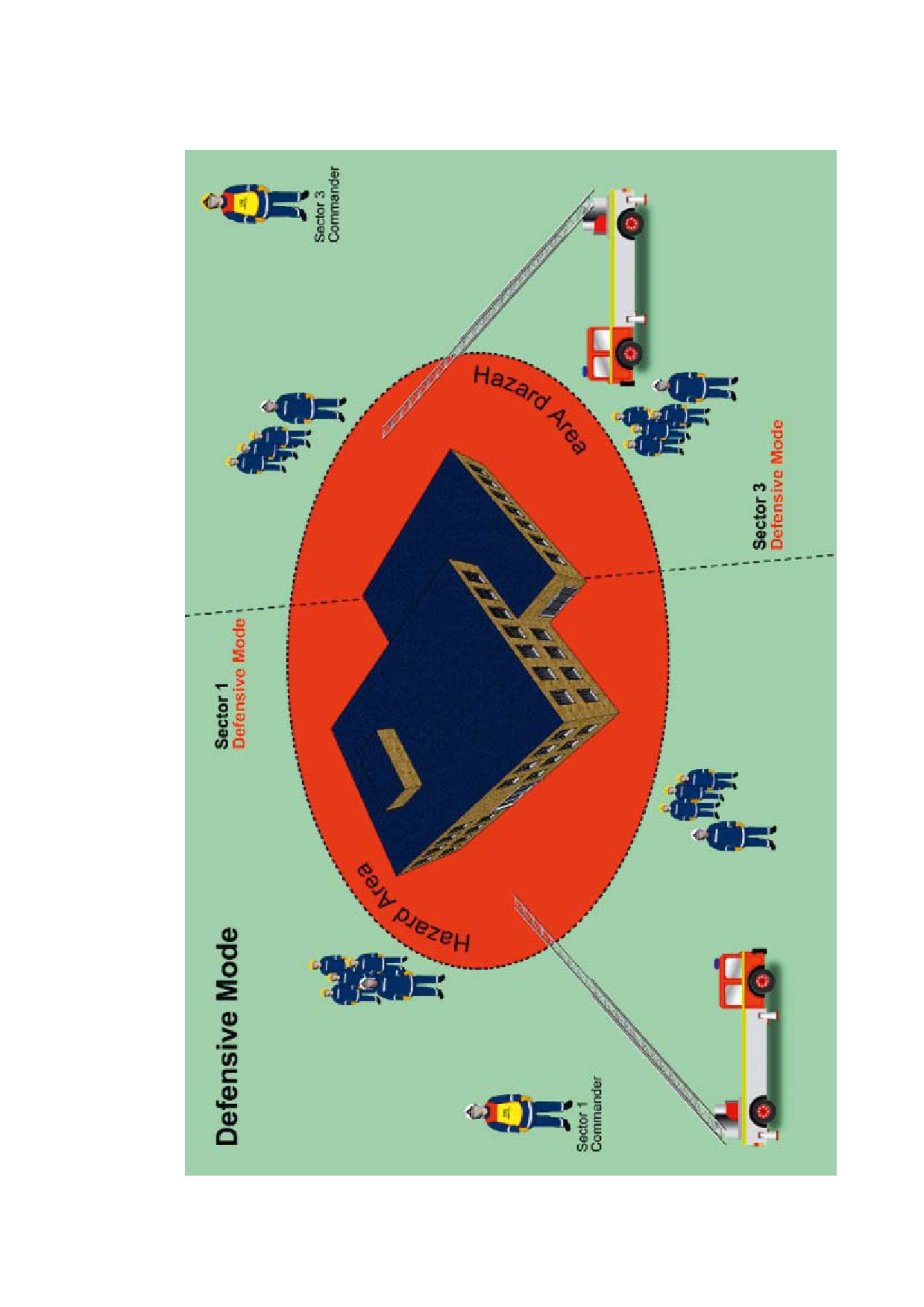
a defensive position. In Defensive Mode, the
persons reported. Crews are standing by
identified risks outweighs the potential benefits, so
awaiting attendance of a specialist advisor
no matter how many additional control measures
and second tanker for decanting.
are put into place the risks are too great.
In these circumstances the Incident Commander
4.5.5
Transitional Mode
would announce Defensive Mode. For example,
Transitional is declared when both Offensive
fight the fire with ground monitor jets and aerial jets
and Defensive tactics are being carried out at an
and protect exposure risks and adjoining property
incident at the same time but in different sectors.
without committing crews into the hazard area.
It never applies to an individual sector or scene of
operation but always to the whole incident.
Examples of Defensive:
‘Transitional’ Mode is not in itself strictly a tactical
●● Withdrawing a crew from a hazardous area
mode of operation but is a codified description of
because the risk has increased.
the incident status signifying that Offensive and
●● Using jets from outside a hazard area.
Defensive operations are in use in one or more
●● Standing by awaiting expert advice, before
sectors. It is intended to warn personnel that their
committing crews.
actions may affect the safety of teams working
●● Standing by awaiting specialist equipment.
in a different Tactical Mode in other sectors. For
example, crews may be working in ‘defensive
mode’ and using a water tower to fight a fire in a
warehouse, however crews from a different sector
72
Fire Service Manual
may have been committed into the building to
4.7
Using Tactical Mode when
perform a specific task. By communicating to all
Sectors are in Use
personnel throughout the incident ground that the
When the incident has been sectorised, the Incident
incident is Transitional, this will prompt the Sector
Commander will remain accountable for the
Commander responsible for the water tower to
Tactical Mode at all times and Sector Commanders
consider whether this action may compromise the
are obliged to seek approval for any change of
safety of those inside the building.
Tactical Mode in their sector. For example, should
a Sector Commander wish to deploy personnel
4.6
Announcement and
into the hazard area, moving from a defensive to
Recording of Tactical Mode
an offensive mode, then permission must be sought
A Tactical Mode should be decided upon and
from the IC. This process is essential for the IC’s
announced at all incidents. As the incident grows
overall situational awareness of the incident.
and the Incident Commander’s span of control
increases, it is essential that all personnel are
However, in an emergency situation the Sector
aware of the tactics on the incident ground and the
Commander will need to quickly respond to
prevailing Tactical Mode.
changing conditions e.g. signs of collapse, discovery
of cylinders etc. and move from offensive to
The first first and subsequent informative messages
defensive mode. In such circumstances, the Sector
to FRS control should include a confirmation of the
Commander will carry out a DRA, initiate the
Tactical Mode for the information of oncoming
relevant actions, remove personnel from the hazard
appliances and officers. For better clarity over
area and then inform the IC. Only in exceptional
the radio, some FRSs have found it helpful to use
circumstances, such as persons reported, crews in
the phonetic alphabet to prefix or suffix defensive
distress etc. may a Sector Commander move from
with ‘Delta’, offensive with ‘Oscar’ or transitional
defensive to offensive mode and subsequently
with ‘Tango’.
advise the IC. The IC will amend the Tactical Mode
accordingly in that sector.
A typical Informative Message might be
‘Informative message from SM Black at Green
Sector Commanders must be involved in any
Street, Anytown: factory premises, used for textile
intervention by the IC to amend the Tactical Mode.
manufacturing, three floors, 20m x 20m. All floors
The change can be implemented effectively and
well alight, three ground monitors in use, “WE
personnel made aware of the current mode in
ARE IN DEFENSIVE ‘DELTA’ MODE”.
use. However, the proposal to change mode will
normally be initiated by the Sector Commander.
This should then be updated by informing FRS
control of which mode the incident is in at frequent
intervals or as and when the risk to crews changes
(see section 4.10 - Analytical Risk Assessment).
Informing FRS control ensures the recording and
time stamping of the decision. When an Analytical
Risk Assessment is conducted the outcome is
recorded on the appropriate forms.
Incident Command
73
74
Fire Service Manual
Incident Command
75
76
Fire Service Manual
4.8
Responsibilities within
Any message sent should include the current
Tactical Mode which is in operation at the incident.
Tactical Mode
This should be repeated at regular intervals or as
Everyone on the incident ground has a responsibility
the risk to crews change, until all FRS operations
for their safety and the safety of others. Although
have finished.
specific responsibilities are outlined below, if
anyone sees anything developing which may
The Incident Commander should review and
compromise the safety of others, they have a clear
confirm the Tactical Mode on initial and
duty to intervene to prevent harm. This duty is
all subsequent briefings to Crew and Sector
absolute.
Commanders. If appropriate a Safety Officer(s)
should be appointed.
4.8.1
Incident Commander
The Incident Commander is at all times accountable
Where an Operational Commander has been
for approving and declaring the Tactical Mode. An
appointed, they will be responsible for approving
assessment of the incident should be made and
changes of the Tactical Mode for the sectors under
an appropriate plan implemented. The prevailing
their control and ensuring that the IC is aware of
Tactical Mode should ref lect the Incident
the prevailing modes at all times.
Commanders plan and associated risks at the
incident.
4.8.2
Sector Commanders
Sector Commanders should continually monitor
conditions and operational priorities in the sector
and ensure that the prevailing Tactical Mode
Incident Command
77
remains valid. The Sector Commander must liaise
Although a hazard area has been identified by the
with the Incident Commander to ensure the current
IC, a decision has been made that crews should
Tactical Mode is appropriate.
operate within that hazard area, so the incident is
in Offensive Mode.
Sector Commanders must immediately react to
adverse changes, withdrawing personnel from risk
Later, the fire on the ground floor has been knocked
areas without delay if necessary and advise the
down. The BA team with a hose reel enters ground
Incident Commander of the change in conditions
floor to continue fire fighting. The incident is still
as soon as possible thereafter.
in Offensive Mode.
If appropriate, Sector Commanders should
Example 2
consider appointing Safety Officers, either for
The incident is a 2-pump RTC with persons trapped.
specific areas of concern (e.g. structure stability,
Crews are working on the vehicles to carry out
dangerous terrain, etc) or for general support. Such
rescues. The incident is not sectorised.
Safety Officers should report directly to the Sector
Commander but must liaise with other Safety
Because the vehicle being worked on and the
Officers at every opportunity.
surrounding environment of the roadway etc
constitute a hazard area in the opinion of the IC,
It is essential to update the Tactical Mode to the
and a decision has been made that crews should
crews working in the sector at a suitably frequent
operate within that hazard area, the incident is in
interval.
Offensive Mode.
Example 3
4.8.3
Crew Commanders
A 2-pump grass fire occurs on a railway
All Crew Commanders should continually monitor
embankment. All firefighting operations are being
conditions in the risk area and draw the attention of
conducted at a safe distance from either the track
the Sector Commander to significant developments,
or associated overhead line equipment. Crews are
also react immediately to adverse changes and
standing by awaiting a confirmation that the status
withdraw crew members from the risk area without
of caution has been passed to the rail operator. No
delay where necessary.
personnel have been committed to the embankment
and no other operations are under way. The incident
Note: firefighters should also continually monitor
is not sectorised.
conditions in the risk area as part of the Safe Person
Concept.
The IC has identified the main hazard area as the rail
track, any overhead line equipment and determined
4.9
Examples of Application
that crews should not venture anywhere near this
of Tactical Mode
hazard, therefore the IC declares that the incident
Example 1
is in Defensive Mode.
The incident is a 3-pump house fire. The ground
floor is well alight and there are persons reported,
Later, caution has been confirmed and safe
believed to be in a first floor bedroom. A large jet
systems of work are being observed. Crews are
has been got to work through a front window to
now working on the embankment but the hazard
knock down the fire on the ground floor.
is much reduced by the control measures which
have been taken, so the IC now declares that the
Two BA teams have been committed from the
incident is in Offensive Mode.
rear door up the stairs to search the first floor. The
incident is not sectorised.
78
Fire Service Manual
Example 4
As a general guide in these circumstances, if
A 2-pump RTC with a chemical tanker involved.
conditions within a large building allow a Sector
The tanker is leaking an unidentified substance.
or Incident Commander and associated staff to
No persons are reported trapped. The road is
work within the building, then the risk assessments
closed and crews are standing by upwind and
should be made on the basis of specific areas or
uphill awaiting attendance of a specialist advisor
compartments within the building rather than the
and second tanker for decanting.
whole building. Commanders and support staff
should always work from an area of relative safety,
The IC has identified a hazard zone and decided
so only crews committed beyond that area into a
that because neither persons nor the environment is
more hazardous environment could be considered
at risk crews will not be committed until the nature
as being committed offensively
of the chemical is established, and specialist advice
on tactics obtained. Therefore the IC declares that
Therefore, although crews are inside the mall,
the incident is in Defensive Mode.
the IC has determined that the hazard zone is the
affected unit. Because crews are operating outside
Later, when full hazard information has been
of the main hazard zone, the IC has declared that
received and advice from the Environment
the incident is in Defensive Mode.
agency about potential harm to the environment
considered, the IC commits a crew in chemical
Example 6
protection suits to prevent the substance entering
A fire is being dealt with in a multi-occupancy,
a drain. No operations are yet being conducted at
single story range of premises. Crews in sector 1 are
the crash scene.
fighting a severe fire in a storage unit with two large
jets and an aerial monitor. They are outside the risk
Because crews are now, with suitable protection and
area identified by the Sector Commander, therefore
using safe systems of work, operating within the
they are in defensive mode. Crews in sector 2 and
hazard zone, the incident is in Offensive Mode.
4 (sector 3 is not in use) are conducting damage
control operations in adjoining retail units using
Example 5
BA. They are within an identified risk area, albeit a
The incident involves a 5-pump retail unit fire in
low risk and are therefore in offensive mode.
a covered shopping mall. The retail unit is heavily
involved in fire, all persons are accounted for.
Because the incident has been sectorised and
Smoke is issuing from the front of the unit into the
‘offensive’ and ‘defensive’ modes are in use, the
shopping mall but is being contained and vented
overall incident is declared as being ‘transitional’.
from a large atrium roof space. The smoke level is
several metres above the mall floor and is stable.
4.10
Analytical Risk Assessment
Having carried out the DRA and established a
Operations in the mall are taking place in fresh
Tactical Mode, the Incident Commander will be
air and crews are within easy reach of final exits.
aware of the immediate hazards, the people at risk
The back of the unit is outside the mall. Smoke
and the control measures necessary to protect
is issuing from the unit’s roof and from an open
those people. This initial assessment now forms
loading bay.
the basis of a more detailed risk assessment, which
in the FRS is termed “Analytical Risk Assessment”
Crews are at work inside the mall with jets into the
(ARA).
front of the retail unit. Crews are at work at the rear
of the unit with jets through the loading bay. No
crews have made an entry to the retail unit.
Incident Command
79
Due to the continually changing nature of
identified risks. Where this is the case, the Incident
the environment at an incident, the Incident
Commander is likely to declare the incident
Commander must ensure that as soon as resources
‘Offensive’ and commit crews into a ‘Hazard Area’
permit, an ARA is carried out and, when necessary,
to perform an identified role. Where this approach
new control measures implemented whenever the
is appropriate the Incident Commander must
hazard or degree of risk demands it. The ARA
endeavour to reduce the risks to an acceptable level
must be recorded. The outcome of the review of the
to complement the training, safe systems of work
risk assessment will either confirm that the DRA
and specialist equipment the UKFRS has adopted.
and chosen Tactical Mode was correct, or will
result in a change of mode with the appropriate
The expression ‘Hierarchy of Control Measures’ is
announcements and action occurring without
used to detail, in preferential order, measures that
delay. It will also form the basis of a future or
may be implemented to eliminate or reduce risk.
ongoing DRA.
The mnemonic ‘ERIC PD’ can be used as a prompt
to assist in the process.
At smaller incidents that do not require
sectorisation, responsibility for the completion of
●●
Eliminate the risk or substitute it for
the analytical review of the risk assessment lies with
something less dangerous, e.g. declare
the Incident Commander or nominated suitable
defensive mode at an incident thus preventing
person. At incidents that have been sectorised, the
personnel access into the hazard area, or
responsibility for the analytical risk assessment
substitute a hand operated branch for a
may be delegated to the Sector Commanders. The
ground monitor, again removing personnel
Incident Commander remains accountable for
from the hazard area.
approving the Tactical Mode on all occasions.
●●
Reduce the risk by preventing or reducing
the number of personnel that come into
The ARA should be kept constantly under review.
contact with it or reducing the time of the
Whenever the risk to crews changes (or at 20
exposure to the risk.
minute intervals, whichever is the sooner) the
●●
Isolate the risk by separating persons from
Tactical Mode should be reviewed and the risk
the risk, e.g. the use of a physical barrier to
assessment confirmed or changed as required.
protect a casualty from cutting operations
Any documentation used should be updated if the
during extrication from a vehicle following a
information or overall assessment has changed
collision.
after such a review.
●●
Control the risk, e.g. the IC would adopt
safe systems of work e.g. tactical ventilation
For incidents where a formal debrief may take
could be used to improve conditions within
place, the ARA documentation should be submitted
the building, in conjunction with the
to the Incident Commander for use at the debrief.
appropriate standard operating procedures.
Analytical Risk Assessments should be kept for
●●
Personal Protective Equipment (PPE), is
audit and periodic review purposes. An example
always the last line of defence because it
of a procedure to conduct a review and record
doesn’t contribute to a safer environment,
the outcome of the risk assessment is shown in
in the FRS it must be assumed that all
Appendix 1.
personnel are provided with suitable and
well maintained PPE and that this is utilised
at every incident. The use of additional
4.11
Risk Control Measures
PPE can be requested where circumstance
It has already been discussed that the IC has a
dictates e.g. the use of eye protection at a
decision to make at every incident to determine
Road Traffic Collision (RTC) or chemical
whether the potential benefits outweighs the
protection suits at a chemical spill.
80
Fire Service Manual
●● Discipline - ensure that discipline is
4.12
The Role of a Safety Officer
maintained throughout the exposure to the
A Safety Officer may be designated at any
risk; it may be tempting for example to
time during an incident by either the Incident
remove PPE while communicating with a
Commander or Sector Commander as appropriate.
casualty at an RTC, where this is in the hazard
This person should be suitably qualified and of
area personal safety will be compromised.
appropriate experience. Where appropriate (for
Training plays a key part in maintaining
example at larger incidents requiring sectorisation)
discipline on the incident ground.
a Safety Officer for the incident may be appointed
by the Incident Commander to co-ordinate the role
It is not possible to implement suitable control
of other Safety Officers and take responsibility for
measures for an incident prior to arrival and before
any Health & Safety reporting issues (e.g. accident
the subsequent risk assessment is performed.
investigations). In addition, the Safety Officer
Generic Risk Assessments identify possible
for the incident, who is referred to as the “Safety
hazards, risks and control measures at a range
Sector Commander” may be responsible for the
of incidents, thus ensuring personnel adopt a
following:
consistent approach to managing risk.
●● To survey operational sectors, identifying
Incident Commanders ideally have access to the
hazards, and advise the Sector Commander
appropriate Generic Risk Assessment information
as appropriate
whilst en-route or in attendance at an incident, to
●● To liaise with Sector Safety Officers, to
assist with the identification of suitable control
support and exchange information
measures. This, in conjunction with other
●● To confirm the validity of the initial risk
specific facts regarding the premises, for example
assessment and record as appropriate
information gained on risk visits, will assist the IC
●● To collate and record Analytical Risk
to formulate an effective plan.
Assessment
Incident Command
81
●● To act as an extra set of eyes and ears to the
●● evaluate the situation gathering all available
Sector Commanders in monitoring the safety
information
of personnel
●● declare a Tactical Mode. (As an outcome
●● Liaise with IC or Operations Commander
of the DRA. ‘Defensive Mode’ would
ensure that crews are operating in a safe
Safety Officers will be responsible for following list,
environment thus reducing risk of injury.
which is not exhaustive and updating the Incident
Operating in an ‘Offensive Mode’ would
Commander of any changing circumstances.
require additional control measures.)
●● brief the crews ensuring that all relevant
●● Identify safety issues
information is passed regarding the hazards,
●● Initiate corrective action
incident objectives and the plan
●● Maintain safe systems of work;
●● committing BA crews in accordance with
●● Ensure all personnel are wearing appropriate
approved guidance
personal protection equipment
●● ensure a safety jet is provided for the
●● Observe the environment
protection of crews
●● Monitor physical condition of personnel
●● options for tactical ventilation to reduce or
●● Regularly review
remove smoke and hot gases
●● Record an Analytical Risk Assessment
●● alternative safe means of access and egress
●● thermal image cameras for BA crews
The following two examples identify some safety
●● appointing a Safety Officer where
considerations for a safety officer at operational
resources allow
incidents.
Example 2 RTC
Example 1 Derelict property fire
At a Road Traffic Collision some of the potential
At a fire in a derelict property some of the hazards
hazards may include:
present may include:
●● moving traffic
●● structural collapse
●● vehicles involved and their loads
●● difficult access /egress
●● airbags, pre-tensioners or hazardous
●● unsafe floors and staircases
materials
●● the presence of asbestos
●● the occupants of the vehicles or others
●● discarded or deliberately placed hypodermic
involved
needles or other booby traps
●● broken glass or sharp metal and plastics
●● the unstable state of utilities and services due
●● hypodermic needles
to vandalism
●● soft and uneven ground where a vehicle has
●● poor state of repair of the structure, e.g. roof
left the carriageway
tiles
●● contamination by body fluids
●● contents and fire loading of building
●● manual handling
●● specialist rescue equipment i.e. those
The likelihood of injury to crews is increased due
operated by hydraulic fluid etc.
to state of the building and subsequent hazards.
●● alternative powered vehicles e.g. dual fuel
Therefore, it will be necessary to assess the risk to
●● fluoroelastomers, fuel/brake fluid lines
crews against the benefits of saving the building or
●● composite materials e.g. carbon fibres
life should ‘persons’ be involved.
Possible control measures may include: (this list is
not exhaustive)
82
Fire Service Manual
The likelihood of injury to crews is increased
4.13
Closing Stages of the Incident
due to working in close proximity to the vehicle
During the closing stage of an incident, personnel
and subsequent hazards. Therefore, it will be
must not become complacent. The process of
necessary to assess the risk to crews and implement
task and hazard identification, assessment of risk,
appropriate control measures.
planning, organisation, control, monitoring and
review of the preventive and protective measures
Possible control measures may include: (this list is
must continue until the last appliance leaves the
not exhaustive)
incident ground.
●● evaluate the situation gathering all available
There are usually fewer reasons for accepting risks
information
at this stage because there are fewer benefits to be
●● declare a Tactical Mode as an outcome of
gained from the tasks being carried out. Officers
the DRA.
should, therefore, have no hesitation in halting
●● brief the crews ensuring that all relevant
work in order to maintain safety.
information is passed on
●● request assistance from the Police for traffic
Debriefing forms an essential part of the
management
management of health and safety on the incident
●● cone area off in the absence of the Police
ground. Debriefs may vary in style and content
●● wear high visibility clothing
depending upon the scale of the incident. To
●● additional PPE i.e. surgical gloves, eye and
assist the Incident Commander, an officer can
ear protection, dust masks etc.
be nominated to help gather information for the
●● cover exposed sharp material
debrief. Debriefing will identify any significant
●● ensure close supervision to ensure correct
information or lessons learnt. Whenever possible,
techniques are adopted
the Incident Commander should debrief crews
●● appointment of a Safety Officer(s)
prior to leaving the incident.
Incident Command
83
Details of all ‘near misses’, i.e. events that could
4.14
Summary
have, but did not on this occasion
●●
Evaluate situation
●●
Carry out DRA and announce Tactical Mode
result in personal injury or equipment damage,
●●
Communicate Tactical Mode
must be recorded. Experience has shown that there
●●
Commence operations
are a number of near misses prior to an accident
●●
Review Tactical Mode
occurring. If we fail to eradicate the causes of a
●●
A risk assessment must be performed at all
near miss, we will probably fail to prevent injury
incidents
or damage in the future. Appropriate information
●●
The Incident Commander remains
must then be fed back into the strategic decision
accountable for declaring the Tactical Mode
making process via the Systematic Level (see
on all occasions
reference to HSG 65 below) in order to:
●●
The Incident Commander may delegate
the completion of the Analytical Risk
●● Review performance of the organisation,
Assessment to other suitable personnel when
team and individuals
appropriate
●● Improve procedures and equipment
●●
There are two operational Tactical Modes
●● Develop staff and training strategies
- Offensive and Defensive
●● For audit purposes
●●
Sectors can only be in Offensive Mode or
Defensive Mode
Equipment, PPE, systems of work and training etc
●●
If combinations of Offensive Mode and
can all be improved as part of this performance
Defensive Mode are in use, the whole
management system. HSG 65 - Successful Health
incident (which must have been sectorised)
and Safety Management gives further guidance
will be deemed to be in Transitional Mode.
on the principles of effective health and safety
This is an operational code which signals to
management in the workplace.
any individual with a responsibility for their
own, or others’ safety that both offensive and
It is important to highlight any unconventional
defensive operations are being carried out at
system or procedure used which was successful or
the same time.
made the working environment safe. It is equally
important to highlight all equipment, systems or
The Tactical Mode must be current and recorded as
procedures which did not work satisfactorily or made
appropriate, throughout the incident.
the working environment unsafe. More information
on closing down incidents and debriefing can be
When a Tactical Mode has been decided, the
found in Chapter 2 (2.17 and 2.20)
Incident Commander must ensure that everyone
on the incident ground is aware of it.
Confirmation of the prevailing Tactical Mode must
be maintained between Incident, Sector and Crew
Commanders throughout the incident.
Chapter
Incident Command
5
Chapter 5 - Command Competence
5.1
Introduction
to be able to apply ICS to different situations.
The ability to do this consistently is the key
This chapter explains the term competence and
and the introduction of the Integrated Personal
the assessment of competence of the Incident
Development System (IPDS) was brought in to
Commander (IC) against National Occupational
achieve this.
Standards (NOS).
At the very heart of IPDS is the term competence.
Incident Command is a safety critical function for
IPDS supports competence by describing the
all managers who have a responsibility to respond
systems that are necessary to ensure that UKFRS
to incidents. It is essential that organisations are able
can be sure that its people are safe.
to provide evidence that their ICs at all levels are
competent and that the ICs themselves understand
5.2
Definition of Competence
and maintain competence.
Competence is concerned with:
The key elements of the process are:
●● outcomes, and the impact made upon
1.
The definition of competence
performance,
2.
National Occupational Standards
●● measurement against standards
3.
Workplace Assessment
●● reviewing progress towards achieving the
4.
Personal Development Records
outcome; i.e. competent performance
5.
Continuing Personal Development (CPD)
Competence is the ability to consistently use
It is important that the organisation and the
knowledge, skills and understanding to the
individual are able to learn continuously from
standards expected in employment, to meet
the successes and challenges experienced during
changing demands and solve problems.
Incident Command. Competence and the assessment
of competence are fundamental to performance
The features of occupational competence should
management, which states that if performance isn’t
encompass:
being measured, it isn’t being managed.
●● Personal effectiveness - being able to get
The process of the assessment of competence
things done appropriately. It embraces the
in terms of knowledge, skills, experience and
ability to successfully deal with situations
understanding is explained below.
and to interact with people employed in
the workplace and being able to deal with
Throughout this manual, guidance is provided
contingencies as they arise, getting organised
on good practice regarding Incident Command,
and getting results of the right quality in a
however, it does not describe the significant
reasonable time.
professional knowledge and understanding needed
Incident Command
85
●● A range of occupational skills - the skills,
the means for assessing performance in a job. In
standards and practices associated with an
the early 1980s, the Government were determined
occupation.
to improve the effectiveness of British Industry
●● The ability to transfer knowledge, skills and
by introducing national standards of occupational
experience to situations e.g. experiences
competence. These standards were to be ‘explicit,
gained and utilised within other contexts.
agreed, widely accessible, flexible, progressive
●● Personal qualities and attributes i.e. problem
and testable’ (Manpower Services Commission
solving, planning and implementing (as per
1981). National Occupational Standards are
FSC 51/2004)
concerned with what an individual can do, not
just what they know.
The Incident Commander will be operating within a
risk environment that is possibly wide and complex,
The Qualifications and Curriculum Authority
with many variables added by the actual situation
provides guidance that NOS should focus upon the
being dealt with. The IC will have to satisfy four
critical aspects of competence at work. NOS can
inter-related components; these are:
also be used for training, appraisals, recruitment,
retention planning and Continuous Professional
●● Task skills, which are routine and largely
Development (CPD) needs.
technical components.
●● Task management skills to manage a group
The concept of assessing competence against
of tasks and prioritise between them.
(NOS) units, elements and the performance criteria
●● Contingency management, which means the
can be a complex process.
skills to recognise and deal with things that
go wrong and with the unexpected.
Regarding Incident Command there are 3 separate
●● Role/job environmental skills, which are
standards that provide learning outcomes for the
about ensuring safety, interacting with
National Occupational Standards, listed opposite.
people and the ability to deal with the
environmental factors required in fulfilling
5.4
Unit
the wider role.
A unit of competence defines the broad functions
carried out in a particular job role. It is the smallest
It is important that the individual is not only able
sub-division of a key area of work.
to demonstrate adequately those physical skills
involved in carrying out a range of tasks, but can
As an example:
manage a range of tasks at the same time. This must
be done while planning contingency arrangements
Lead, Monitor and Support people to resolve
to cope if something goes wrong or there is an
operational incidents
(unit EFSM2). A unit
unexpected problem to solve. This must be achieved
describes a workplace activity that can be performed
whilst considering the wider environmental issues
by a single person.
and personal/interpersonal skills that are most
appropriate to the situation.
5.5
Element
5.3
National Occupational
Each unit is made up of at least two elements
Standards
that provide a description of the main activities
necessary for the completion of the unit.
NOS are statements of the skills, knowledge and
Therefore for Unit EFSM2, this unit comprises
understanding needed in employment and clearly
of 3 elements, i.e.
define the outcomes of competent performance.
They are benchmarks of performance, providing
86
Fire Service Manual

WM 7 Lead & Support people to
For those who respond to incidents in charge of fire appliances
resolve operational incidents
and crews (Crew Manager and Watch Manager)
EFSM module database 008 describes the learning outcomes
for those developing in this role
EFSM 2
For those who respond to incidents of a more complex nature
to support initial crews (Station, Group and Area Managers and
Lead Support & Monitor people to
also Brigade Managers who are required to assume tactical
resolve operational incidents
command at incidents)
EFSM module database 027 describes the learning outcomes
for those developing in this role
ESFM 1
For those who respond to incidents to provide strategic advice
and support (Area and Brigade Managers)
Provide Strategic Advice and
support to resolve operational
EFSM module database 045 describes the learning outcomes
incident
for those developing in this role
2.1
Review and determine incident status.
●● Role, responsibilities and level of authority at
2.2
Assume responsibility and implement action
operational incidents
to support those involved in the incident.
●● Lines of communication at incidents and the
2.3
Debrief following resolution of incident
incident command system
The element is the sub-division of a unit of
5.8
Workplace Assessment
competence; it is a description of what a person
Workplace assessment is a process for assessing
should be able to do. It encompasses some action or
people against NOS in the course of normal day to
outcome, having real meaning in the occupational
day activity. It helps to maintain skills, knowledge
sector to which it relates.
and understanding and provides evidence that
people are competent. If there are shortfalls in
5.6
Performance Criteria
performance these become part of the development
Each element of competence will have performance
required for the people concerned. To ensure that
criteria, each of which consist of a short statement
the assessment process is effective it is important
that has two components, a critical outcome and
to ensure that:
an evaluative statement. Successful achievement of
an element will be recognised when the individual
●● Line managers/ assessors understand the
being assessed meets the stated performance
requirements of the NOS
criteria. As an example, see Section 5.13 Guidance
●● A person’s performance is judged against the
for Assessors.
NOS
●● The nature and formats of assessment
processes are known by those participating
5.7
Knowledge and Understanding
●● Opportunities that occur naturally in day to
This describes what must be known and understood
day work should be identified. Where this is
and how this knowledge applies to the job. As an
not possible then appropriate Development
example, part of the knowledge for unit EFSM2 is:
Activities need to be constructed. For
example, at the higher levels of Incident
Incident Command
87
Command, where naturally occurring
and the effects of a fire upon the structure. The
opportunities are not available on a regular
IC must also be aware of the capabilities of the
basis, then simulation could be used.
available resources in order to make an effective
●● People and assessors generate, collect and
deployment.
record relevant evidence to demonstrate
competence
An IC must consider many other factors, to varying
●● Assessors make decisions and provide
degrees. A Crew Manager (CM) at a relatively
feedback
small incident who is working at the operational
●● Decisions and feedback are recorded
level must have a highly detailed knowledge and
understanding of the professional fire domain.
The assessor judges this evidence against all of
Wider political or social implications factor less
the performance criteria and makes a decision that
in the resolution of smaller scale incidents so
the standards have been met or that a development
while the CM must have an appreciation that these
need has been identified.
considerations exist, they need not concentrate too
much on them.
5.9
Knowledge and Understanding
In contrast, a Brigade Manager (BM), working at
in Incident Command
major incidents, possibly involving the strategic or
In order to function effectively, ICs must possess
‘Gold’ level, must have a detailed understanding of
knowledge and understanding of the domain in
the political, social and environmental implications
which they are operating (and of the domains
that the incident may generate. The BM’s specific
operating above and below). For example, to make
domain knowledge and understanding does not
an appropriate assessment of risk in a building, there
need to be as technically detailed as that of the CM.
must be an appreciation of building construction
For example, the BM in charge of a 25 pump fire
88
Fire Service Manual
does not need to know how to operate the pumps
Any overall judgement of competence should not
which are delivering the water to the incident,
be based upon one assessment only; it must be part
but does need to know the issues associated with
of a process conducted over time. It is necessary
reinstating normality for FRS and the business
to practice and be re-assessed, maintaining
community.
competence by Continuous Professional
Development. More frequent assessment is needed
Commanders at any level must also understand
for higher risk tasks and tasks where associated
that all incidents have a wide impact. A car fire
skills may decay more quickly.
may have impacted upon the car’s owner, who now
has no car and cannot get to work. At the other end
5.10
Evidence
of the spectrum, a large fire at a factory making
It is a basic principle of vocational competence
components for cars may result in the laying off
that competence can only be demonstrated against
of hundreds of workers. Incidents impact upon
the NOS, on several occasions and in various
the natural environment; water run off can cause
conditions and contexts. It therefore follows that
pollution that may persist for many years. Closure
evidence gathered to support the demonstration of
of a major transportation link as a result of an
competence during incident command must also
incident can have national economic implications.
be gathered according to:
A tactical or Silver Command Officer can be
●● Observation of workplace activity
seen to need a different balance of all these skills.
●● Observation of simulated activity
Although it can be argued that domain knowledge
(Development Activities)
and understanding is of equal importance here, the
officer working at this level has a significant level
This may be supported by:
of support via the command team and Command
Support and needs to begin to look outwards from
●● Products of a person’s work
the incident.
●● Witness testimony
●● Personal statements
The comparison of the knowledge and understanding
●● Outcomes from questioning
of the domain against the wider organisational
●● Debriefing
considerations can be viewed as a sliding scale and
is represented in the graph below.
Domain Knowledge
and Understanding
Wider Organisational
Operational
Tactical
Strategic
Level
Level
Level
Incident Command
89
In all cases regarding Incident Command, direct
●● A recording methodology is required to
observation is crucial but can be supported by
support the demonstration of competence
questioning or other means to explore the skills,
and further development needs of people
knowledge, understanding and how, why and when
●● This methodology must complement the
the evidence was produced.
IPDS and withstand the scrutiny of audit
(this is necessary to confer consistency and
The Assessment Process
transferability across organisations)
In most instances it will be line managers who will
●● Systems should be non-bureaucratic and
carry out workplace assessments, although they
encourage people to feel that they ‘own’ their
may also be completed by:
development
●● The systems should inform the development
●● Trainers at a training/development centre
planning process on a needs basis, for
●● Other service assessors (e.g. observers at
individual, teams or the organisation
exercises/simulations)
●● Other independent assessor’s e.g. external
5.12
Continuing Personal
organisations during Gold Command
Development
simulation exercises at the Fire Service College
Personal Development to meet the NOS and IPDS
●● People with specialist skills who are qualified
is a phased approach, incorporating:
Regardless of who carries out the assessment, all
●● Acquisition of knowledge skills and
assessors must be familiar with the relevant NOS
understanding
and suitably trained and competent to do so.
●● Application of knowledge skills and
understanding in the workplace
If the assessment is to gather evidence for a relevant
●● Maintenance of knowledge skills and
qualification (S/NVQ) then the assessor must be
understanding and CPD
qualified to do so.
Quality Assurance
It is important to note that in the wider personal
FRSs should have in place a system that will
context personnel may be in one or more phases
ensure that the assessment process is fair and
in any point in their career. An individual may
consistently applied. Question and answer sessions
progress through the phases above as they change
underpin workplace assessments and is one of
role and develop upwards adopting a different IC
eight components of IPDS. More information can
role on behalf of their organisations.
be sourced in FSC 11/2003.
As the world around us changes and the core
functions of FRSs widen, it is important that
5.11
Personal Development Records
learning for ICs is designed to ensure that they
FRSs require a means by which they can:
can continue to operate competently within their
current role.
●● Record achievements
●● Record competence
CPD is an intrinsic part of Personal and
●● Record development needs
Organisational Development (POD). Implementing
effective CPD will give rise to both direct
Whichever system is adopted the following
and indirect costs. FRSs should view this as
principles apply:
an investment that may be expected to accrue
savings over time. In particular the maintenance
90
Fire Service Manual
and further development of knowledge, skills and
●● Mitigate risk to the organisation from the
understanding through equitable development
potential occurrence of negligent acts
programmes will help organisations to:
●● Support fairness and equality policies
●● Support national and European initiatives for
●● Support the safe person concept
life long learning
●● Meet duties under relevant law and
●● Meet the requirements of quality assurance/
regulations
development initiatives, e.g. Investors in
●● Meet the staff development implications of
people (IIP), ISO 9000 etc.
business risk management and organisational
development policies
Incident Command
91
5.13
Guidance for assessors
of the garage. Upon attendance, the crew were met
by the occupier of the garage who stated that there
The following are provided as examples only.
was a car on fire inside the garage.
Demonstration of competence against WM7.1
Example scenario:
A crew has been mobilised to a report of a fire at
a vehicle repair workshop. Whilst mobile the crew
could see a plume of smoke rising from the vicinity
Performance Criteria
Example characteristics of an Incident Commander’s
performance which would meet the required standard
Collect and confirm information
The Incident Commander discussed generic risks present in
relevant to the known and
garage fires with the crew whilst mobile and asked the occupier
anticipated risks to people,
whether all persons had been accounted for and about the
property and the environment
presence of specific hazards such as acetylene cylinders,
services, inspection pits, containers of fuel, materials which
could be harmful to the environment, construction of the
building, duration of the fire etc. Details of the hazards, such
as location, quantity etc were confirmed with the occupier and
the details were communicated to the crew members. The
Incident Commander also considered wider implications such as
previous incidents involving the same premises or other factors
such as racial or other criminally motivated factors which may
have led to the premises falling victim to arson.
Plan action to lead and support
The Incident Commander devised and communicated a safe
the crew’s response to the
and effective plan of action, considering the requirement for
incident
any additional resources and taking into account the resources
available and their skills. Clear briefings were given to crew
members to enable them to understand exactly what they were
required to do and that they were fully aware of the risks present
in the premises.
Develop objectives through risk
A DRA was conducted and objectives were planned in accordance
assessment
with the DRA. The details of the DRA were communicated to all
and a suitable Tactical Mode was declared and communicated
to Control. Significant safety findings were recorded effectively.
92
Fire Service Manual