Fire and Rescue Manual Volume 2. Fire Service Operations Incident Command (3rd Edition 2008) - part 2
It is important to note that if an incident does not
Other responsibilities of Command Support include:
demand the use of an Operations Commander due
to the number of sectors, or the activity within the
●●
To act as first contact point for all attending
sectors, then this extra tier is best omitted from the
appliances and officers and to maintain a
command structure. There is no advantage in over
physical record of resources in attendance at
structuring an incident with additional tiers if they
the incident.
are not needed.
●●
To operate the main-scheme radio link to the
mobilising control, to allocate fire ground
In the event that an incident requires more than
radio channels and to log all relevant data.
one Operations Commander to maintain the span
●●
To assist the IC in liaison with other
of control then it is essential to ensure that their
agencies, where appropriate a dedicated
call signs are suitably distinguishable, either by
Liaison Officer may be appointed.
descriptive terms i.e. High Street Operations,
●●
To direct all resources to the required
Quayside Operations etc. or by alphanumeric terms
operational location or marshalling area
i.e. Alpha Operations, Bravo Operations etc., and
as instructed by the IC and to record their
that sectors understand exactly which operations
operational status.
command they fall within and are reporting to. If
●●
To maintain a record of the findings of the
the facility exists, consideration should be given
risk assessment and operational decisions
to allocating different fireground or tactical radio
made or actions taken as a result of it.
channels to each operations command, e.g. sectors 1
●●
To allocate and record specific roles and
to 4 on one channel reporting to Alpha Operations,
assignments of supporting officers.
sectors 5 to 8 reporting to Bravo Operations on a
●●
To record information about sectors, such
separate radio channel.
as the name of the Sector Commander, the
identification of each sector, the physical
2.11.3 Command Support
boundaries where appropriate, the resources
deployed and requested and the Tactical
Command Support should be introduced at all
Mode in operation.
incidents to assist the IC in the management of
the scene. It should be initiated as soon as is
To assist with the function of the ‘initial’ command
practically possible as the importance of laying
support duties, a support pack should be provided
the foundations of command support in the early
on all vehicles that may warrant its use.
stages of an incident cannot be over emphasised. A
suitably experienced member of personnel should
At larger incidents where a dedicated Command
be nominated to operate Command Support.
Support vehicle is mobilised an officer should be
This may be a firefighter during the early stages
delegated the task of heading the Command Support
operating in, or adjacent to an appliance at a smaller
team (or Sector), with the task of supporting the IC.
incident. The task being delegated to a suitably
trained and experienced officer as an incident
Also at larger or escalating incidents, command
develops and more resources become available.
support, which at this time may have become the
The function may be managed from an appliance
Command Support Sector, may also be responsible
not directly involved in operations, an officer’s car
for the following duties:
or a dedicated command vehicle of some kind.
Command Support should be clearly identified at
●● To arrange the positioning of appliances
every incident.
and to some extent marshalling. This may
need to become a specific function assigned
to a dedicated support sector. Close liaison
Incident Command
33
with the police or Highways Agency Traffic
●● Mapping the progress of the incident.
Officers may be required to keep congestion
●● Logging decisions made and the rationale
to a minimum.
behind them.
●●
Liaising with crews of specialist units such
●● Constructing time lines and utilising them to
as BA Main Control, Urban Search and
prompt the IC regarding progress.
Rescue and High Volume Pumping etc. to
ensure that they are utilised fully in support
The amount of activity and span of control within the
of the incident.
Command Support Sector must itself be continually
●●
Arranging for additional resources or
monitored and where required additional staff
specialist equipment as requested by the IC,
should be requested to support the function.
in support of Sector Commanders.
●●
Liaising with other agencies as necessary,
2.11.4 The Command Team
when such agencies attend an incident a
The command team comprises of the IC and any
system of ‘logging’ personnel must be
other staff that are operating in a supporting role
implemented, especially if they are to
i.e. Command Support, Operations Commander
enter the inner cordon. Supervision for
and despite the likelihood of working from a remote
such personnel may need to be arranged
location, Sector Commanders.
and a safety brief delivered prior to their
deployment.
At incidents requiring specialist equipment i.e.
●●
Briefing designated personnel of their tasks
USAR, HVP or Mass Decontamination etc, a
and safety critical information.
specialist advisor may be deployed to assist the IC,
●●
Arranging for relief crews and equipment to
in an advisory capacity only.
ensure sustainability of deployment.
34
Fire Service Manual
FRS’s will almost certainly adopt different
Efforts have been made to avoid patterns and
approaches to which roles and functions form part of
colours used by other agencies wherever possible,
the command team, however the aim is to integrate
but in the absence of a national multi-agency policy
and record decision making and communication
of identification it may be necessary to clarify
between the IC and those performing operational
roles at the time. It should be noted that the above
tasks. Some of the command support functions
patterns are for use at conventional incidents and
may take place from a location remote from the
the patterns described do not conflict with other
incident, particularly at major or multi-agency
task specific requirements for use on motorways,
incidents.
railways, airports etc. Common sense indicates,
however, that a full command structure is unlikely
to be established on a motorway carriageway or a
2.12
Identification of
railway embankment with live traffic.
Command Roles
The command team comprises officers holding a
In addition to the above the following are patterns
variety of roles and it is essential for each to be
of uniform that appear in the forthcoming diagrams
easily identified. At any incident, but in particular at
and are for illustration purposes only.
cross border and other large incidents where officers
who may not know each other personally have to
work together, it is important that a commonly
understood means of identification of roles is used.
The following means of identification are not part
of any standard but are in common usage:
Incident Commander - White surcoat
(or in Scotland, red and white quadrants)
Sector Commander - Yellow surcoat with
red shoulders
Operations Commander - Red surcoat
Command support - Red and white
chequered surcoat
Incident Command
35
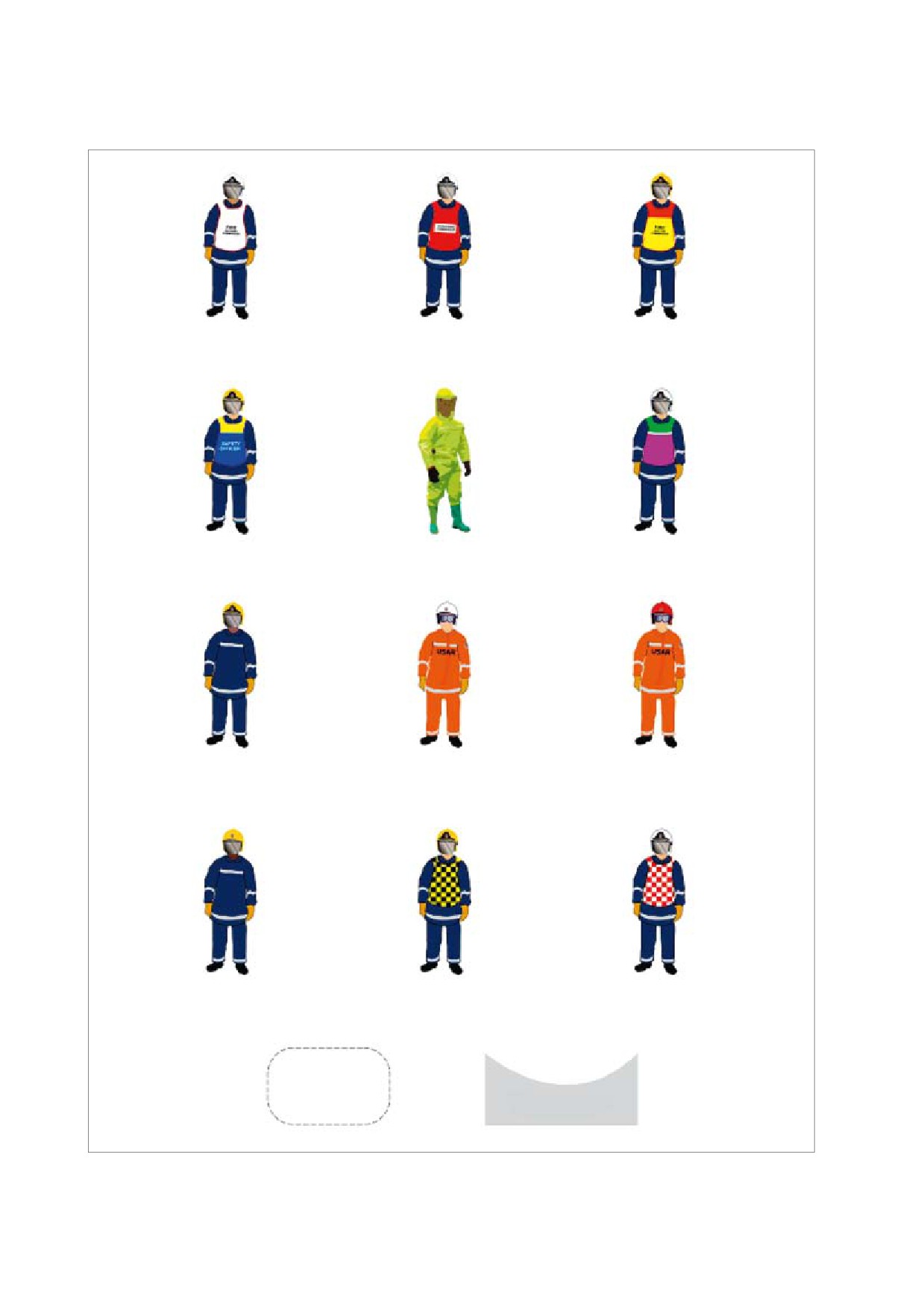
Incident
Operations
Sector
Commander
Commander
Commander
Safety
Gas Tight
Mass Decontamination
Officer
Suit Wearer
Director/Assistant
Crew
USAR
USAR
Commander
Team Leader
Team Member
Crew
BA Entry
Command Support
Member
Control Officer
Officer
Sector
Boundary
Support Area
Key for the following diagrams
36
Fire Service Manual
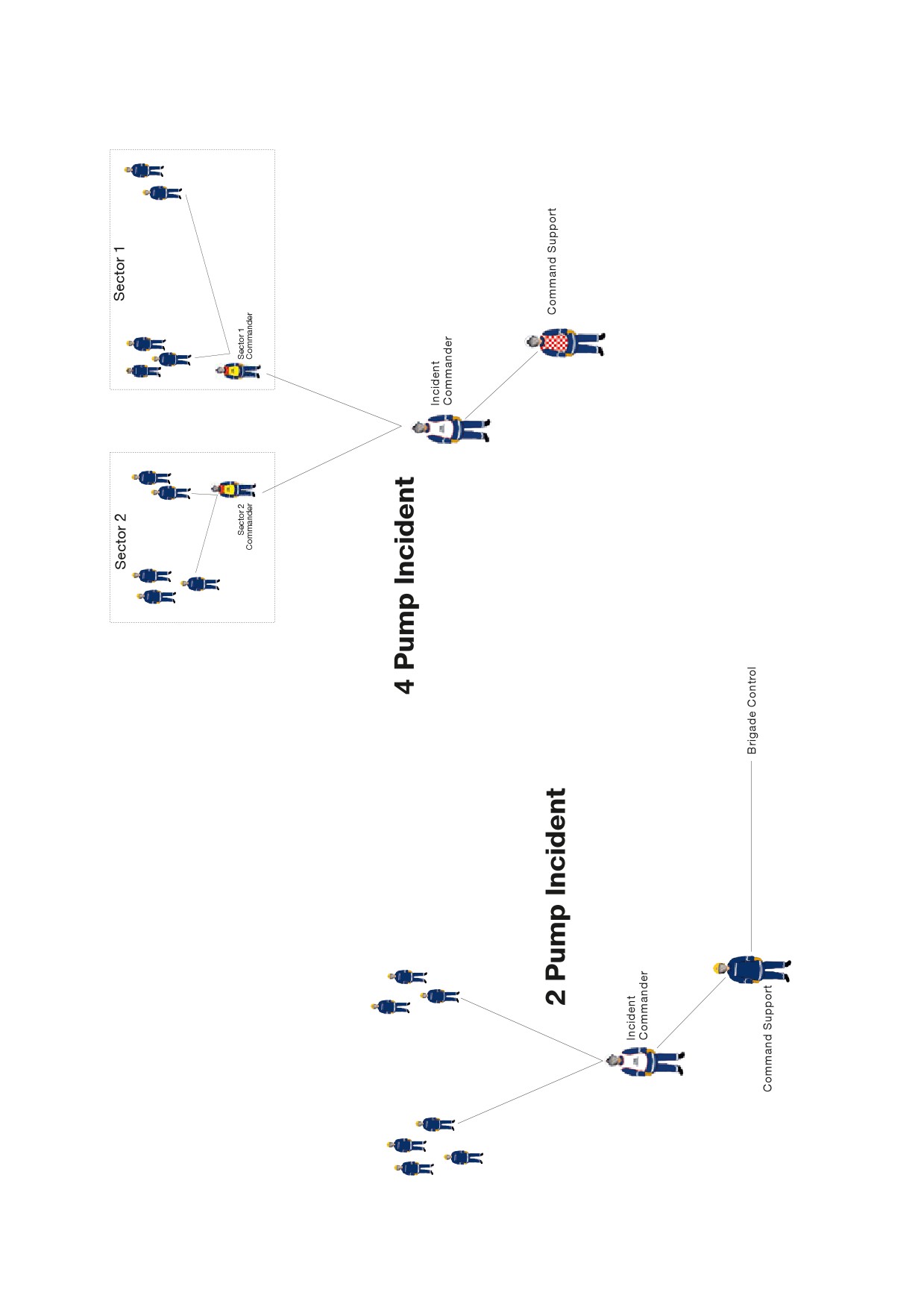
Incident Command
37
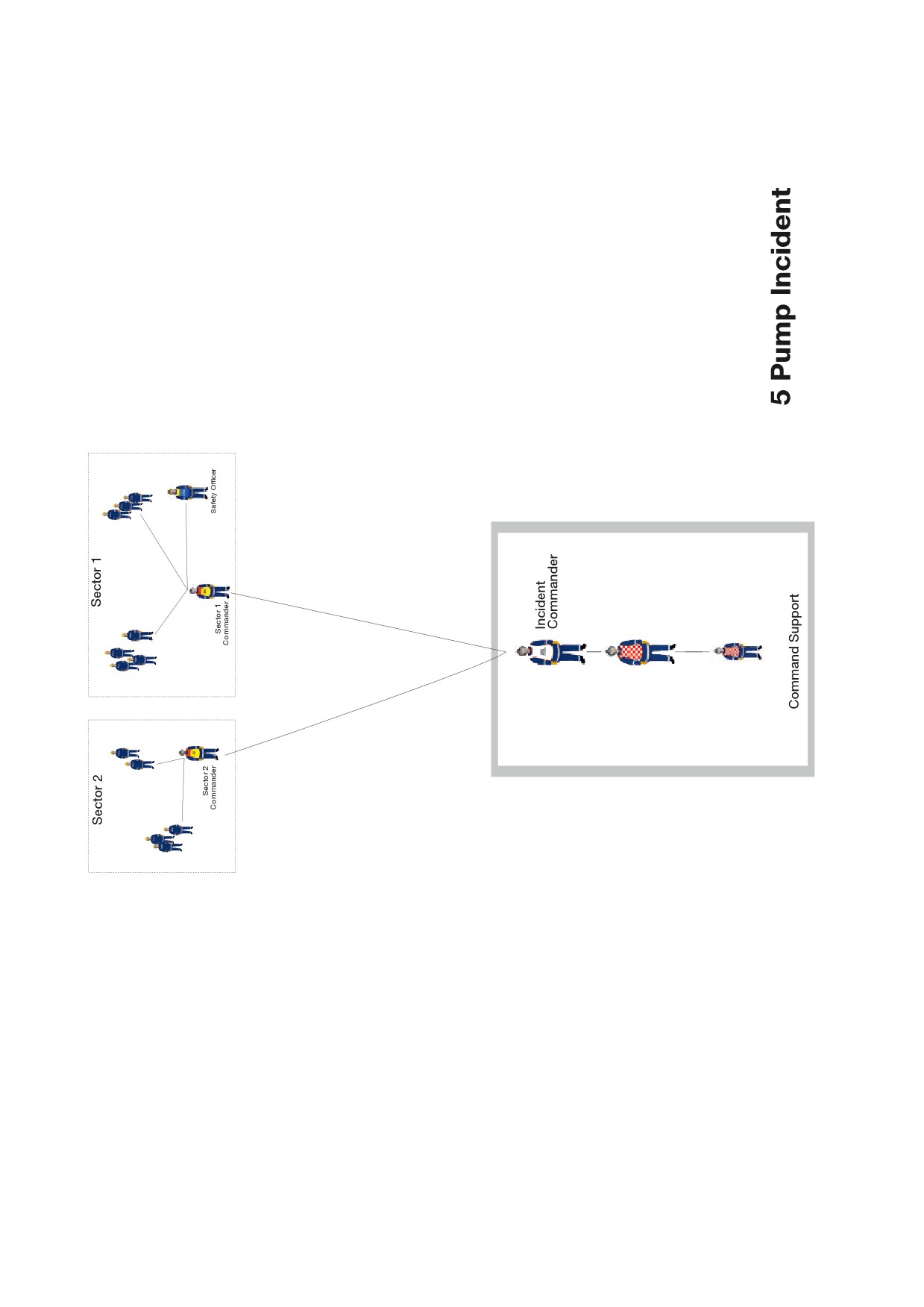
38
Fire Service Manual
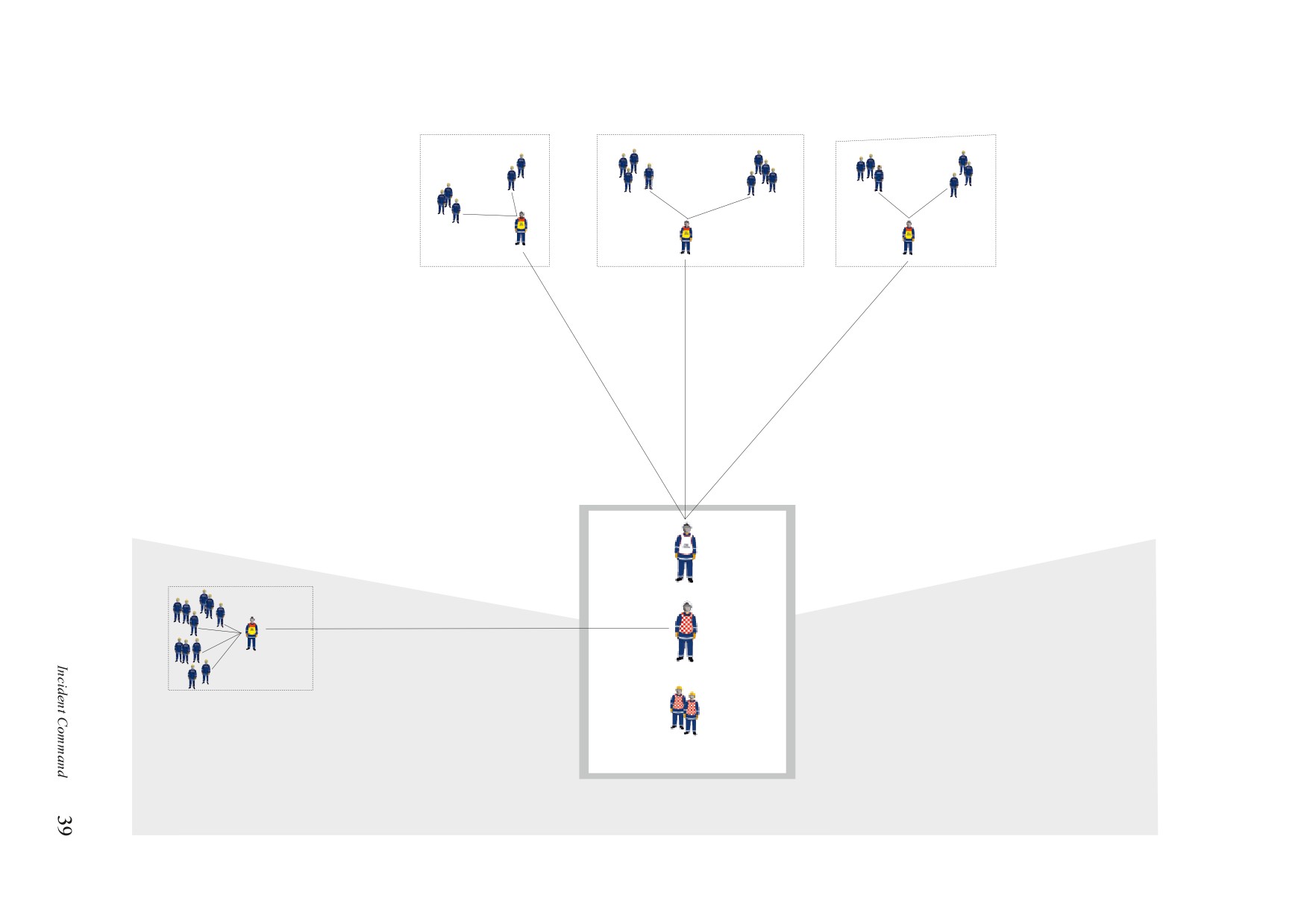
Sector 2
Sector 1
Sector 3
Sector 2
Commander
Sector 1
Sector 3
Commander
Commander
Operational Sectors
Incident
Commander
Support Sectors
Water Sector
Commander
Water Sector
Command Support
Command Team
8 Pump Incident
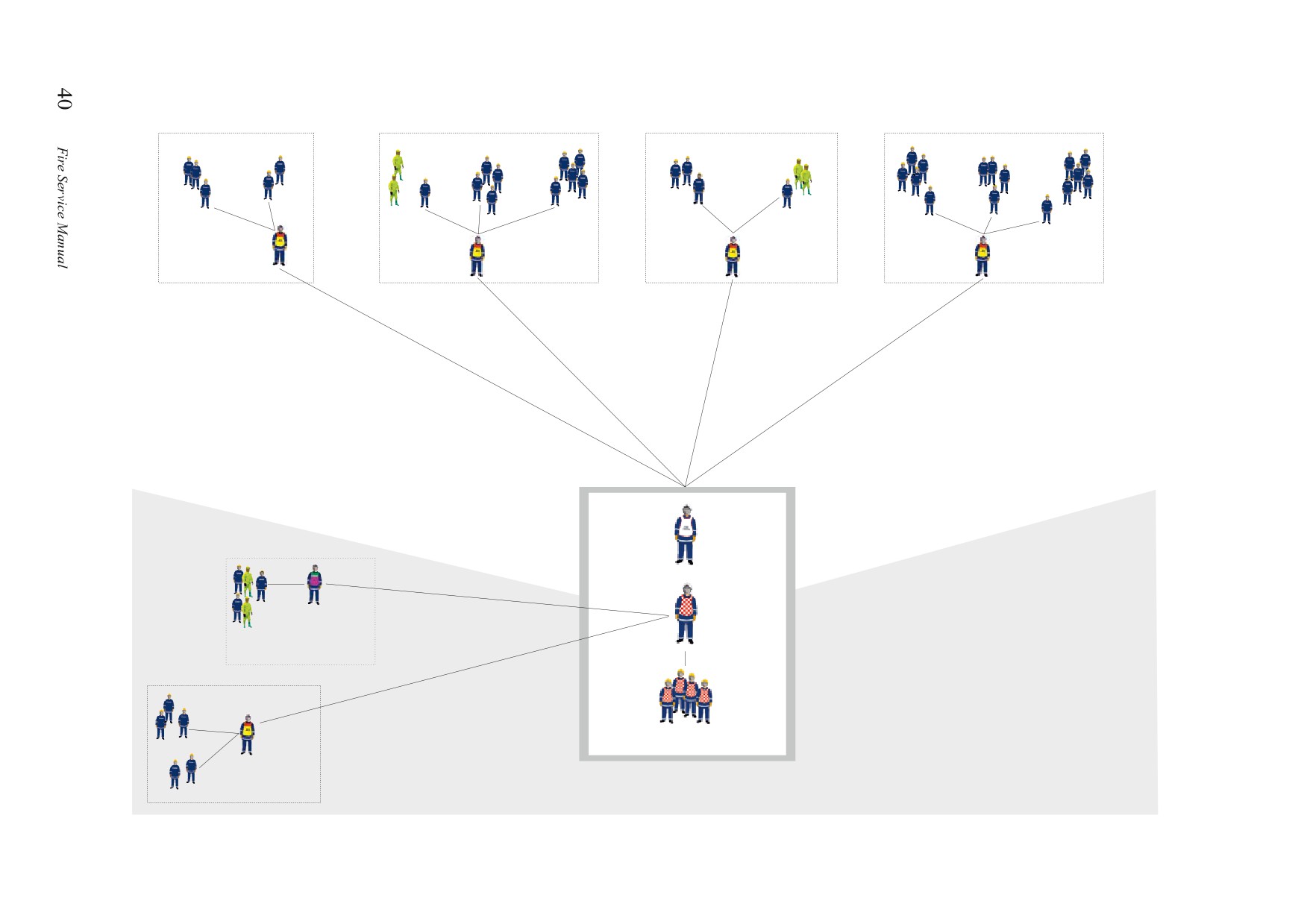
Sector 2
Sector 1
Sector 3
Sector 4
Sector 2
Sector 1
Sector 3
Sector 4
Commander
Commander
Commander
Commander
Operational Sectors
Incident
Commander
Decontamination
Director
Support Sectors
Decontamination
Sector
Water Sector
Command Support
Commander
Command Team
8 Pump Incident
Water Sector
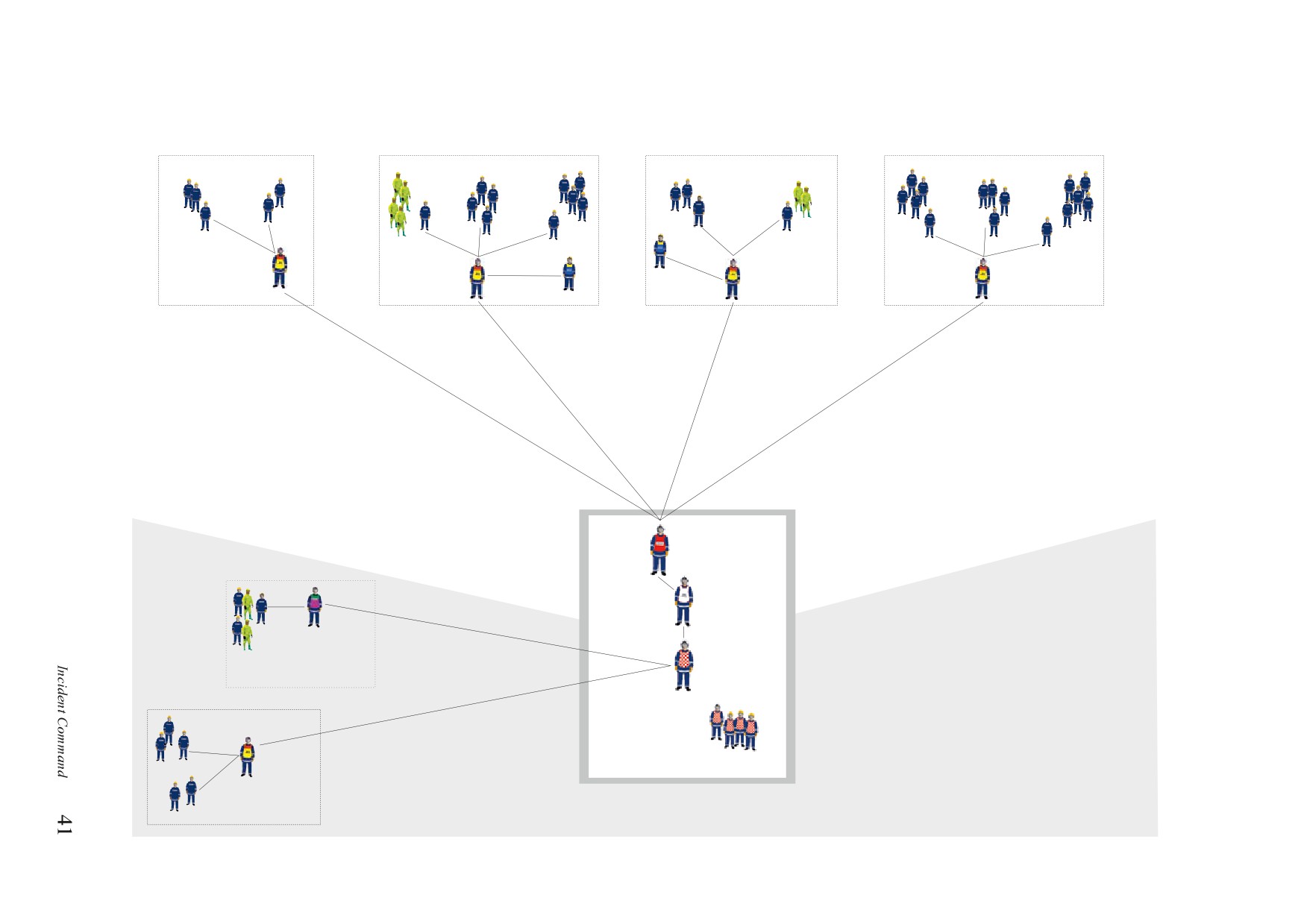
Sector 2
Sector 1
Sector 3
Sector 4
Sector 2
Sector 1
Sector 3
Sector 4
Commander
Commander
Commander
Commander
SafetyOfficer
Operational Sectors
Operations
Commander
Incident
Commander
Decontamination
Director
Support Sectors
Decontamination
Sector
Water Sector
Command Support
15 Pump Incident with
Commander
Command Team
Ops Commander
Water Sector
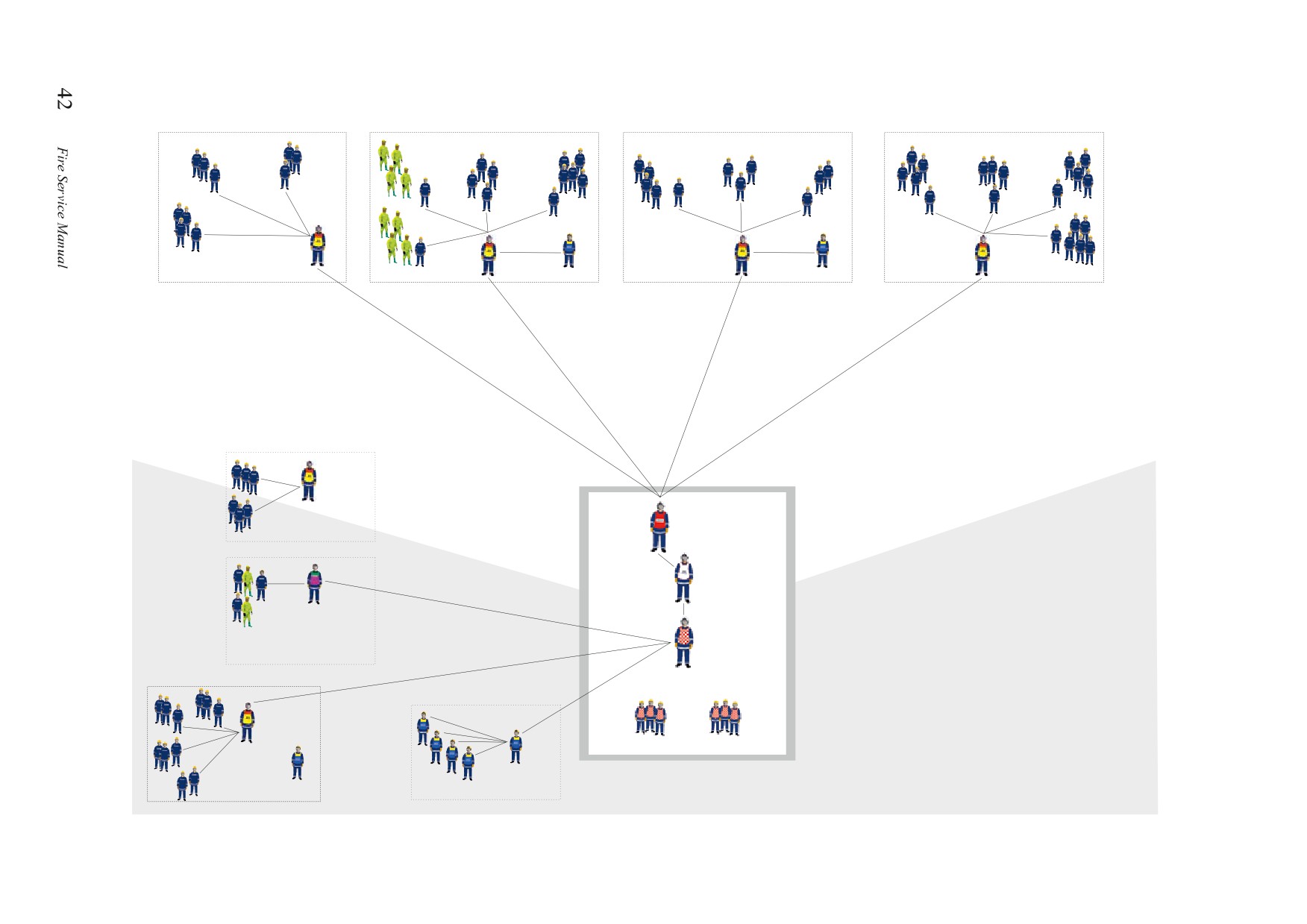
Sector 2
Sector 1
Sector 3
Sector 4
Sector 2
Sector 4
Commander
Sector 1
Sector 3
Commander
Commander
Commander
Safety Officer
Operational Sectors
Foam Sector
Commander
Operations
Foam Sector
Commander
Incident
Commander
Decontamination
Director
Support Sectors
Decontamination
Sector
Water Sector
Commander
Command Support
25 Pump Incident with
Command Team
SafetyOfficer
Safety Sector
Ops Commander
Water Sector
Sector 3
Sector 4
Sector 5
Sector 6
Sector 3
Sector 4
Commander
Sector 5
Sector 6
Commander
Commander
Safety Officer
Commander
Sector 2
Sector 7
Sector 2
Sector 7
Commander
Commander
Sector 1
Sector 8
Safety Officer
Sector 1
Commander
Sector 8
Commander
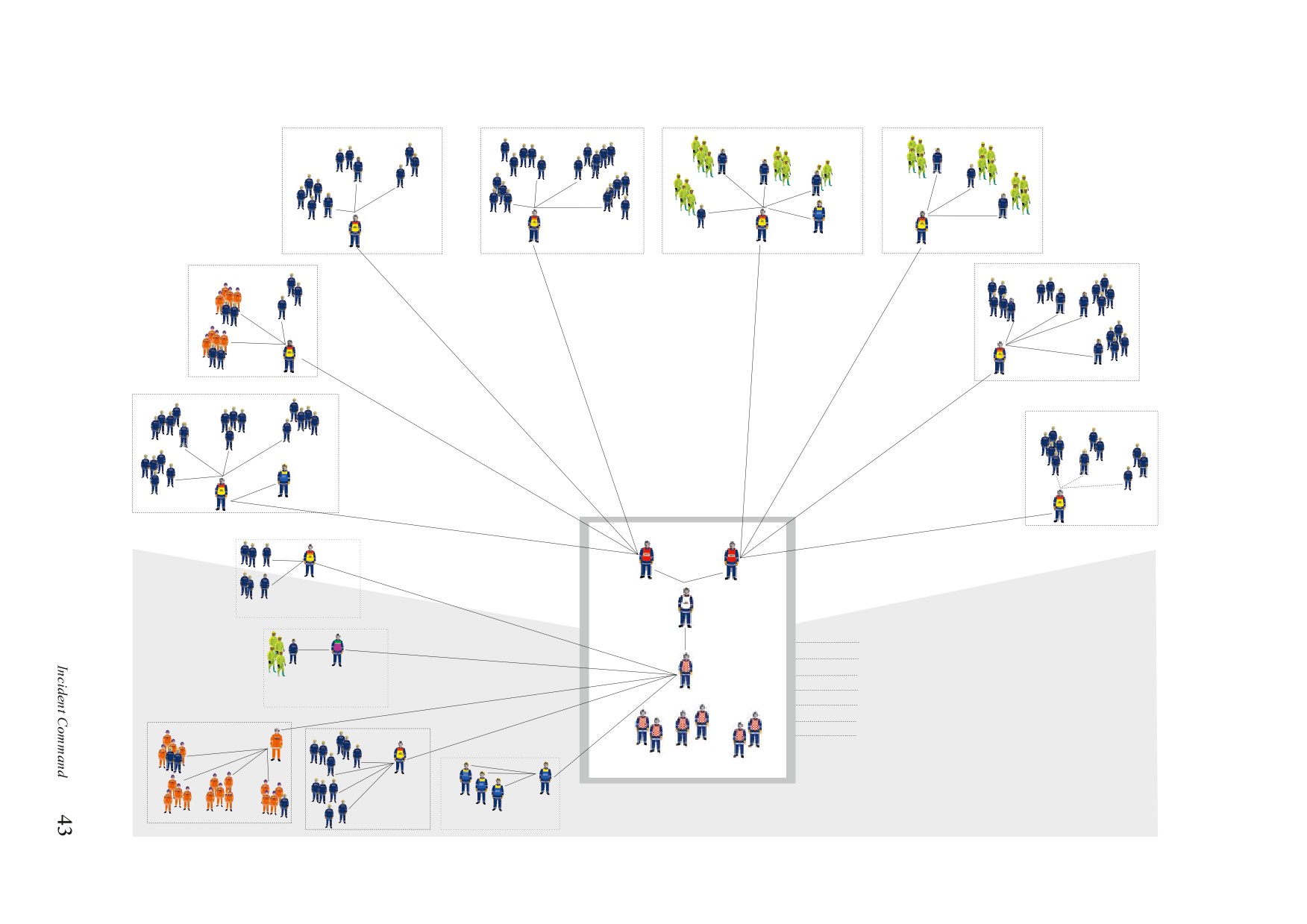
Operational Sectors
Operations
Operations
Foam Sector
Commander
Commander 1
Commander 2
Foam
Sector
Incident
Support Sectors
Commander
Ambulance Liaison
Environment Agency
Decontamination
FRS Control
Director
Decontamination
Police Liaison
Sector
Press
Council
USAR Sector
Commander
Emergency Planning
Command Support
Water Sector
Commander
40 Pump Incident Multi
Command Team
USAR Sector
Ops Commanders
Water Sector
Safety Sector
2.13
Briefing & Information
3.
Establish communications with other agencies.
(This may employ communications equipment
Effective communication is of critical importance
on agreed channels or simple direct verbal
at all incidents. Information has to be relayed
communication.)
accurately from the IC to the crews carrying out
4.
Establish communications with Sector
the work and vice-versa so that the crews are aware
Commanders for regular reporting between
of the tactics being employed and the IC is aware of
sectors and the IC and between Sector
developments on the incident ground. The IC also
Commanders themselves.
has a duty to relay messages and information back
5.
Utilise local systems. Some new and complex
to mobilising control to ensure an accurate picture
buildings and structures, particularly those
of the incident is maintained and recorded.
extending underground, have communication
systems installed for emergency services’ use.
The effective briefing of crews is essential. This
may commence en route to an incident and will
The above duties will invariably be the role of
be supplemented on arrival once a risk assessment
Command Support under the guidance of the IC.
has been performed. Following the initial
assessment, crews will be briefed as to the tasks to
2.15
Inter-Agency Liaison
be undertaken and the hazards and risks they will
face. The extent of the briefing will depend largely
The IC must establish and maintain effective
on the nature and extent of the incident; the pre-
liaison with all other agencies, as appropriate.
briefing for small fires that crews regularly deal
This will include tactical liaison with other
with is likely to be relatively straightforward. On
emergency services to co-ordinate operational
the other hand, at incidents where crews have little
activities effectively, and liaison with technical
experience and where there is a high risk factor,
specialists whose specific knowledge may be
the briefing will need to be comprehensive. The
critical in helping to resolve the incident. There is
need to debrief crews that have withdrawn from
also a need to maintain effective liaison with the
a working area during the incident should not be
media, if in attendance, in order that appropriate
overlooked as valuable safety critical information
and accurate information is made available. This
may be sourced at this time.
is best done in conjunction with other emergency
services and other agencies that are present to
avoid conflicting reports.
2.14
Communications
The IC must establish effective arrangements for
Where there has been a work-related death the
communications. Information is one of the most
terms of the Work Related Death Protocol6 will
important assets on the incident ground; information
apply. The police will initially be responsible for
must be gathered, orders issued and situation
investigating the death and may require assistance
reports received. The needs of other agencies must
in securing evidence. The Protocol is between
be assessed and provided for. Regular situation
the police, Health and Safety Executive, Crown
reports should be passed to the IC from all sectors
Prosecution Service and the Local Government
via the established communication links.
Association. The Office of the Rail Regulator,
Rail Accident Investigation Branch, Civil Aviation
The IC will need to:
Authority, Maritime and Coastguard Agency and
the Fire and Rescue Service have agreed to abide
1.
Establish communication links with FRS
by the principles of the Protocol.
control.
2.
Ensure that incident ground radio channels
and call signs have been correctly allocated.
6 Work-related deaths: a protocol for liaison available on HSE’s website
44
Fire Service Manual
The command structures and responsibilities of
After the initial cordon has been established to
the other emergency services are summarised in
secure the scene, usually by the police, the incident
Chapter 3. The methods in which services relate
is usually divided into two types of cordon:
to each other is described in the publication
‘Emergency Response and Recovery’ HM
2.16.1 Inner Cordon
Government November 2005, non statutory
An inner cordon is used to control access to the
guidance to the Civil Contingencies Act 2004 Ch 3
immediate scene of operations. Access to the area
Responding Agencies, 2005.
controlled by an inner cordon, which by definition
is a high hazard zone, should be restricted to
2.16
Cordon Control
the minimum numbers required for work to be
undertaken safely and effectively. However, if
Cordons are employed as an effective method of
the incident is the consequence of a suspected
controlling resources and maintaining safety on
criminal act, the police will assume overall control
the incident ground. The IC must consider the
of the area and liaison between the two services
safety of fire-fighters, the public, members of
will determine entry and exit protocol. Personnel
other emergency services and voluntary agencies
should only enter when they have received a full
attending. However, it must be noted that overall
briefing and been allocated specific tasks.
responsibility for the health and safety of personnel
working within the inner cordon remains with
The Civil Contingencies Act guidance document
the individual agencies. Such agencies should
entitled
‘Emergency Response and Recovery’
ensure that personnel arriving at the scene have
states in Section 3.7 that “Fire and Rescue Services
appropriate PPE and are adequately trained and
are trained and equipped to manage ‘gateways’
briefed for the work they are to undertake within
into the inner cordon, if requested to do so by the
the cordon. Where this is not the case, the matter
police”. Capacity to discharge this responsibility
must be referred to the command level.
Incident Command
45
varies considerably across the UK, therefore it
●● Post-incident considerations
is important that local planning and exercising
is conducted to ensure misunderstandings about
2.18
Maintaining Control
roles and responsibilities do not occur during an
The process of task and hazard identification,
incident.
assessment of risk, planning, organisation, control,
monitoring and review of the control measures
In terms of accounting for the safety and whereabouts
must continue until the last appliance leaves the
of personnel, it is already a responsibility of
incident ground.
ICs, delegated to Sector Commanders when the
incident has been sectorised, to be aware of which
As the urgency of the situation diminishes, the
personnel and crews are active in their sector.
IC may wish to nominate an officer to gather
This responsibility may be more effectively
information for the post-incident review. In some
discharged if the Sector Commander has a sector
cases this officer should start to take brief statements
command folder or board, as used by some FRS’s
from crews before they leave the incident, whilst
already. The addition of space for other agencies’
events are still fresh in their minds, these records
personnel, together with checklists for PPE, escorts
may form part of the contemporaneous notes should
if necessary, and details of working location, is a
they be required.
minor but necessary addition. It would also be
necessary to consider a safety briefing, a record of
Details of all near misses i.e. occurrences that
their presence and agreed evacuation signals.
could have caused injury must be recorded because
experience has shown that there are many near
2.16.2 Outer Cordon
misses for every accident that causes harm. There
This is used to prevent access by the public into
is usually no reason for having to accept significant
an area used by the emergency services while they
operational risks at this stage. At the closing stages
are attending an incident. The police will usually
of the incident, the responsibility for health and
control outer cordons. A traffic cordon may then
safety must be handed over to the appropriate
further supplement the outer cordon and the
person.
police, in liaison with the FRS and the ambulance
service, will identify safe routes into and out of the
At the closing stages of the incident the
cordon for further emergency vehicles and other
responsibility for health and safety must be handed
attending agencies.
over to the appropriate person.
Marshalling areas will usually be located within the
2.19
Welfare
outer cordon area if one or more are established.
The welfare of personnel is an important
2.17
The Closing Stage
consideration. It must be given particular attention
by the command team at arduous or protracted
of the Incident
incidents where the normal replacement of
So far only the initial and developing stages of an
personnel is delayed or prevented. Supervisors
incident have been addressed, however the closing
will continually monitor the physical condition of
stages must also be considered and complacency
crews, and where necessary relief crews must be
must be avoided. The key activities involved in the
anticipated and managed in an appropriate way.
closing stages of an incident are:
Welfare considerations such as the provision of
●● Maintaining control and transfer of health
food and drink, toilet facilities and possibly shelter
and safety
from the elements should, where possible, be
●● Welfare
46
Fire Service Manual
provided outside the immediate incident area and
Where a formal post-incident review is required
always away from any risk of direct or indirect
it should be held at a venue that is suitable and
contamination.
convenient for those to be invited to attend. Copies
of relevant documentation should be available and
provision made for recording proceedings, outcomes
2.20
Debriefing
and learning points. Notes of the outcomes and
The IC and anyone nominated to gather information
details of action taken, or planned, to address the
at the incident should supervise completion of any
learning points raised should be made available to
necessary documentation and ensure that this is
the relevant people as soon as practicable.
complete, accurate and able to be made available
promptly.
2.21
Post-Incident Considerations
Debriefing plays an important part in promoting
The majority of the activities and processes centre
improvements in personal and organisational
around the emergency phase of an incident.
performance and should take place whenever
However, there are issues which involve the FRS
there is an opportunity to improve standards
for well beyond the emergency phase. Examples
of service delivery. Such post-incident reviews
include the following:
may be informal or formal; they can range from
something as simple as brief discussions on return
●● Post-mortem enquiries and Coroner's
to station from a minor incident, to a large multi-
hearings
agency debrief or a Public Enquiry following a
●● Fire investigation
major incident. The format chosen for the review
●● Accident investigation (where a death has
should be appropriate to the nature of the incident
or may result then the ‘Work Related Death
attended and should be conducted in a manner
Protocol’ must be adhered )
that promotes open, supportive and constructive
●● Public or judicial enquiries
discussion of all aspects of the incident. If the
●● Litigation
performance of individuals is considered in the
●● Financial costs to the brigade i.e. damaged
review, then this should be measured against the
equipment
standards relevant to the role of each individual.
●● Criminal Investigation
Effective performance and meritorious conduct
●● Incident debriefing and evaluation
should be acknowledged where appropriate.
●● Fire safety issues
●● Learning and recommendations, both local
Following an incident, any significant information
and national
gained or lessons learned relating to existing
●● Critical incident - ongoing emotional and
operationalintelligenceinformationmust be fed back
welfare support
into the policy and procedures of the organisation.
This includes personal protective equipment (PPE),
The IC must, at the earliest convenient time, attempt
the provision and use of communications, other
to assess what the post-incident considerations
systems of work, instruction, training, and levels
might be. On the basis of this assessment, the
of safety supervision etc.
following tasks might need to be undertaken:
It is equally important to highlight any
1.
Scene Preservation: As soon as it is identified
unconventional methods or procedures which
that detailed examination of the scene might
were used successfully or made the working
be required as part of a criminal investigation,
environment safer.
efforts must be made to preserve the scene
from any further interference and to secure
Incident Command
47
evidence. Where there is a work-related fatality
6.
Before finally closing an incident and
the procedures in the Work Related Death
withdrawing all FRS resources, the IC
Protocol should be followed.
should inform the person having ongoing
2.
Recording and Logging: This might include a
responsibility for health and safety on the
written log available from FRS control room,
incident ground, or their agents, that FRS
in the Command Unit during the incident or
operations have closed down and indicate all
voice recording of critical messages. The early
hazards still present. In the absence of advice
attendance and planned deployment of service
from other appropriate agencies, the IC may
photographic/video personnel can prove to be
wish to give advice on how the hazards may
of great benefit in this area. The obtaining of
ultimately be dealt with and advice about
security videos from on-site equipment can
appropriate interim control measures. The
often be of value in subsequent investigations.
IC must ensure that the responsible person
Action on this matter needs to be taken without
fully understands the hazards and accepts
delay, as some systems will re-use the tapes.
responsibility for ensuring health and safety
3.
Impounding Equipment: Where accidents or
on the site; this may include the control of
faults have occurred, any associated equipment
potential environmental hazards caused by
should be preserved for later investigation.
FRS operations.
Should major malfunction of FRS equipment
7.
In a similar way, security issues, particularly
occur, in addition to the normal required
where premises are left vulnerable, must be
notification being carried out, any associated
properly communicated to those accepting
guidance involving any external agency or
responsibility from the FRS commander.
department (i.e. Health and Safety Executive)
FRS’s may wish to consider some form
which it is a requirement to inform, should be
of documentary evidence of this kind of
observed.
handover.
4.
Identification of Key Personnel: The names
and location of witnesses to important events
should be obtained and recorded for later
interviews. It may be necessary or appropriate
to commence interviewing during the incident.
5.
Managing the closure of the incident: This
includes considerations such as proper
handovers as the incident reduces in size,
continued vigilance regarding the hazards
that continue to exist or newly emerge,
making appliances and crews available again
at the earliest possible time, and ensuring that
site occupiers, neighbours and others who
have been affected by the incident are kept
appropriately informed.
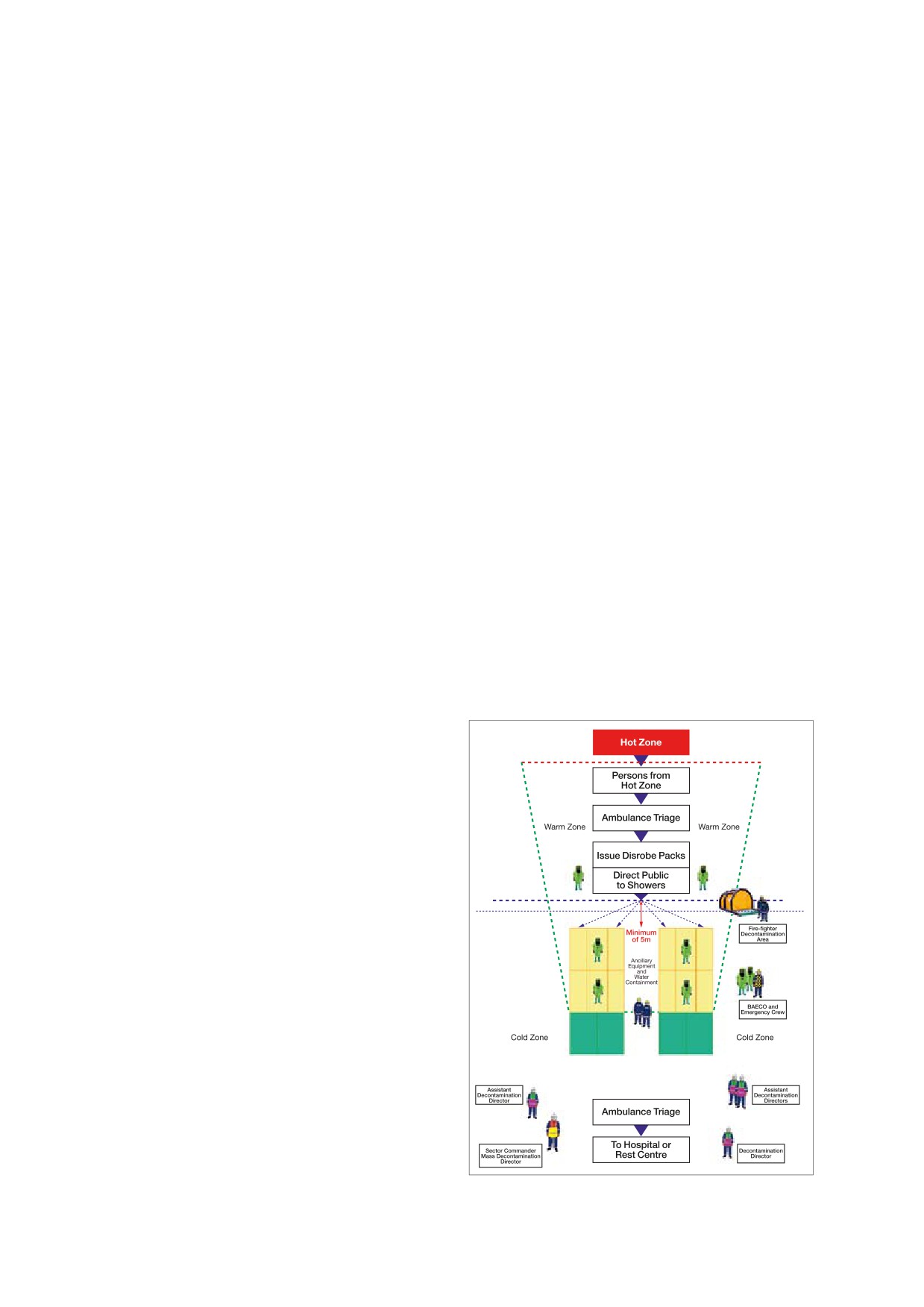
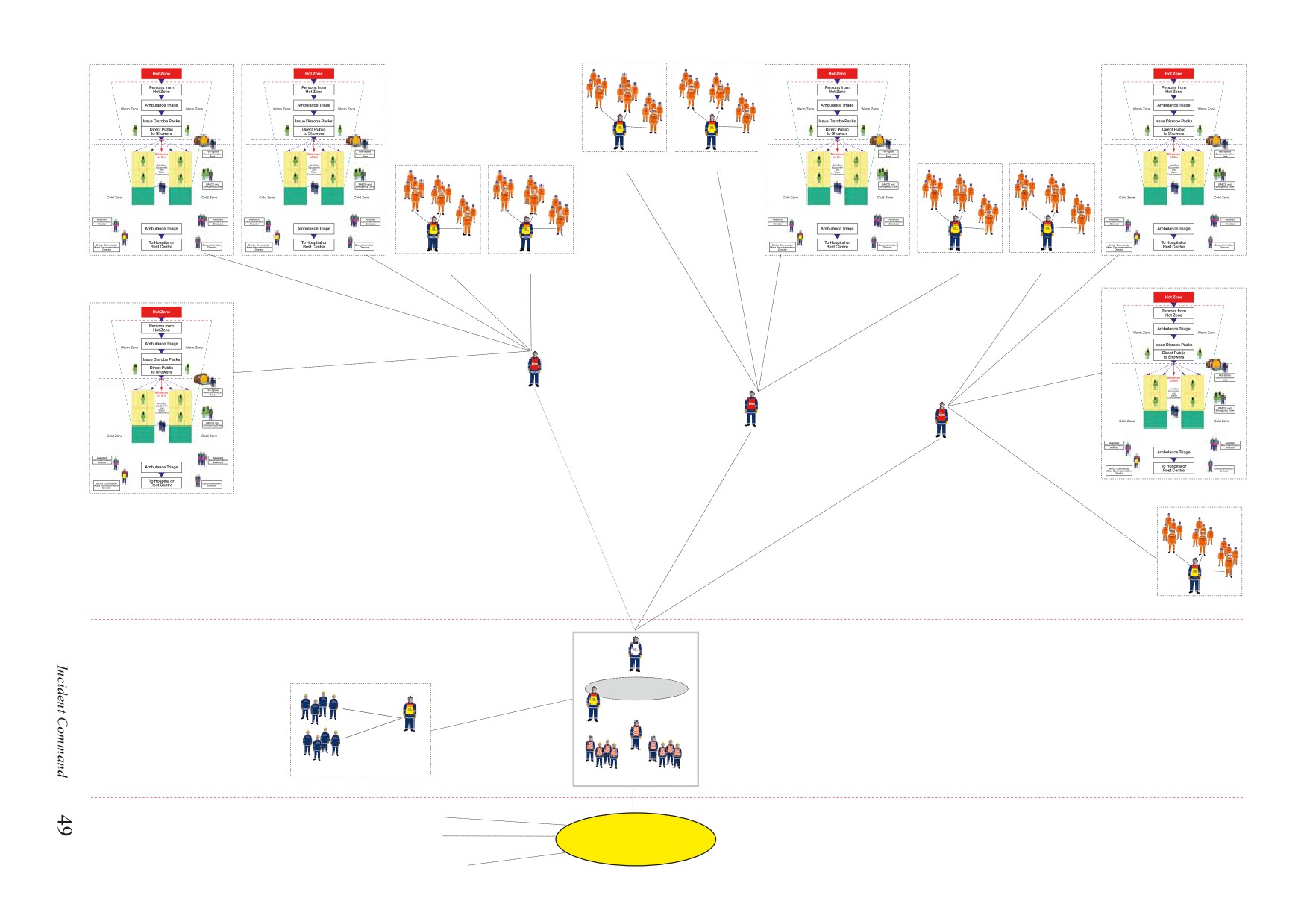
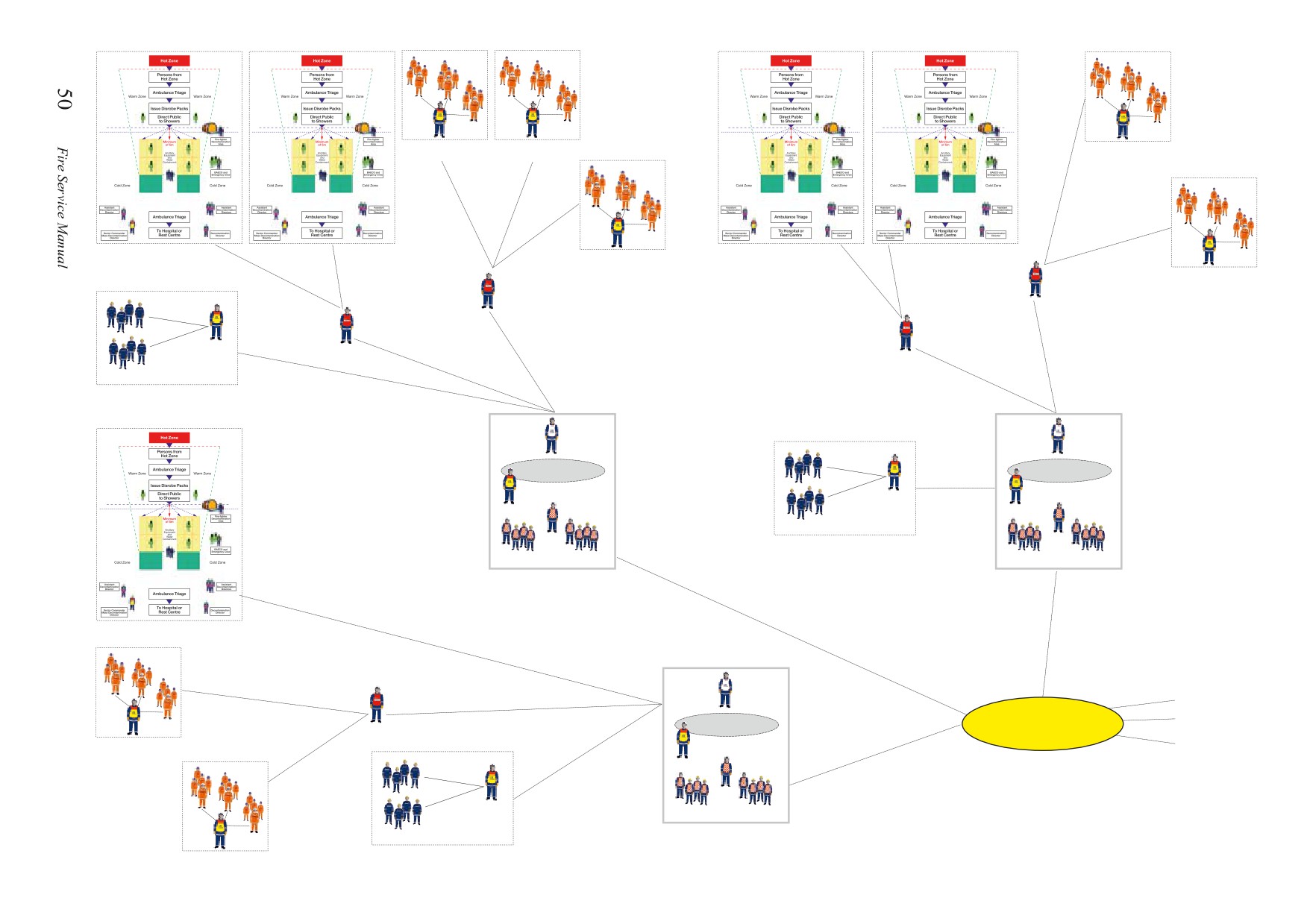
Detail of Mass Decontamination Team
structure - see diagram page 49
48
Fire Service Manual
Sector 1
Sector 2
Commander
Commander
Urban Search and Rescue
Urban Search and Rescue
Sector 1
Sector 2
Sector 2
Sector 3
Sector 3
Sector 1
Commander
Commander
Commander
Commander
Urban Search and Rescue
Urban Search and Rescue
Urban Search and Rescue
Urban Search and Rescue
Mass Decon Team 2
Mass Decon Team 3
Sector 2
Sector 3
Mass Decon Team 1
Sector 3
Sector 1
Mass Decon Team 1
Operations
Commander
Area 1
Operations
Commander
Operations
Area 2
Commander
Area 3
Mass Decon Team 1
Mass Decon Team 1
Details shown on page 48
Sector 2
Commander
Urban Search and Rescue
Inner Cordon
Sector 2
Incident
Commander
Fire
Silver Command
Water Sector
Commander
Water Sector
Command Team
Command Support
Outer Cordon
Logistics
CBRN Incident Command Structure
Planning
Gold
Multiple Operations Command
Finance/
Command
Administration
(Single catastrophic incident in one jurisdiction)
Sector 1
Sector 2
Sector 1
Commander
Commander
Commander
Urban Search and Rescue
Urban Search and Rescue
Urban Search and Rescue
Sector 1
Sector 2
Sector 1
Sector 3
Commander
Mass Decon Team 1
Mass Decon Team 2
Mass Decon Team 1
Mass Decon Team 2
Sector 2
Urban Search and Rescue
Commander
Sector 3
Urban Search and Rescue
Operations
Sector 2
Commander
Operations
Search and Rescue
Commander
Search and Rescue
Operations
Commander
Operations
Mass Decontamination
Commander
Mass Decontamination
Water Sector
Commander
Water Sector
Incident
Incident
Commander
Commander
Fire
Fire
Silver Command
Silver Command
Water Sector
Commander
Water Sector
Command Team
Command Team
Command Support
Command Support
Mass Decon Team 1
Incident
Operations
Commander
Commander
Logistics
Search and Rescue
Fire
Gold
Planning
Sector 1
Commander
Silver Command
Command
Finance/
Urban Search and Rescue
Sector 1
Administration
Command Team
Command Support
CBRN Incident Command Structure
Sector 2
Water Sector
with Silver Command
Commander
Urban Search and Rescue
(Separate incidents in same jurisdiction)
Sector 2
Chapter
Incident Command
3
Chapter 3 - Command within
the UK Resilience Framework
mid 1990’s it was clear that the civil defence and
3.1
Introduction
emergency planning framework was no longer fit
Management and command of the most serious
for purpose. A review was commenced involving all
incidents is rarely a single agency task. The Incident
the major stakeholders, including local authorities,
Command system was developed to ensure that FRS
emergency services, and other government
structures and protocols would fit seamlessly with
departments. Issues such as the “Y2K Millennium
those of partner organisations and the UK’s overall
Bug”, or millennium date change problem, became
approach to integrated emergency management.
typical of the type of issue attracting attention from
That approach has been significantly revised and
the planning and response communities, as did the
updated to reflect the new nature of the risks and
fuel crisis, foot and mouth disease and other non-
threats that the country faces on a daily basis, and
hostile action types of risk.
is formalised in the Civil Contingencies Act 2004,
including associated guidance and regulations.
This perspective changed on 11th September
FRS commanders need to understand clearly the
2001, or “9/11”. The subsequent consultation and
various entities, and players, at various levels
preparations, and resulting legislation, primarily
within the UK’s resilience framework, including
the CCA 2004, and for FRSs the Fire and Rescue
knowledge of the powers and duties of officials at
Services Act of 2004, has provided an expanded
key levels. This chapter examines that framework.
range of duties. This has been accompanied by
detailed guidance for authorities to ensure that they
The Civil Contingencies Act 2004 (CCA 2004)
will be able to deliver what is expected of them at
brought together elements of a number of older
the required times, be able to work effectively with
statutory provisions, including the Defence of
other partners, and have means in place to continue
the Realm Act of 1914, the Emergency Powers
their operations at times of challenge to their own
Acts of 1920 and 1964 and the Civil Defence Act
infrastructures.
1948, which have all now been repealed (with the
exception of S.2 of the Emergency Powers Act of
For FRSs, the post 9/11 environment demanded
1964, which allows the Defence Council to authorise
that their own capabilities be developed to cope
“the temporary deployment of Service personnel
with a wider range of disruptive challenges to
on urgent work of national importance”).
the community. This programme, which became
known as the “New Dimension” programme,
The UK’s emergency preparedness was previously
delivered the capability to deal with mass
closely linked with the civil defence framework
decontamination incidents; to detect, identify and
that developed post World War Two, during the
monitor chemical substances; pump high volumes
period of the cold war. Even before that, the focus
of water over large distances; search for, and rescue
was clearly changing, with the Civil Protection in
persons from, urban collapses, landslides etc; and
Peacetime Act 1986 making provision for resources
effectively command and control the large scale of
previously allocated to civil defence to be used in
operations that may be necessary when bringing
preparation for peacetime emergencies. By the
these capabilities into play.
Incident Command
51
The Civil Contingencies Act 2004 Part 1 covers
likely to have a role in most emergencies that could
‘arrangements for civil protection’. The Act
generate ministerial interest or national/regional
applies to England, Scotland and Wales with
press coverage. Government departments may also
some differences in application. In Scotland, civil
use GOs to cascade information and guidance to
protection is a devolved matter and therefore the
local responders. Regional Resilience Teams (RRT)
responsibility of the Scottish Executive, whereas
have been set up in each of the GOs to co-ordinate
the Welsh Assembly Government in Wales
the response of the whole GO area, and to act as
exercises authority. In Northern Ireland the ‘Civil
the first point of contact for any resilience issues
Contingencies framework’ discharges the principles
in normal working hours. RRTs act as support
contained within the Civil Contingencies Act 2004.
for lead government departments’ representatives
(The Fire & Rescue Service is not a Category One
when they need to operate in the regions or support
Responder in Northern Ireland). In general Category
Gold level or other operational decision making
One and Two Responders are obliged to co-operate
groups during emergencies.
with each other and other organisations engaged in
response in the same local resilience area. Each local
3.2.2
Government Liaison Team
residence area is based on a police area.
Government Office provides the focus for
communication to and from the Strategic Co-
A more detailed explanation of the slight differences
ordinating Group (SCG), the Lead Government
of the arrangements within the devolved
Department and the Government Liaison Team
administrations will be found in the Appendices
(GLT). This would be headed by a senior Home
5 to 7.
Office official in the event of the incident being
a result of terrorist action. Otherwise the team
Category One and Two Responders have a duty
would normally be headed by the Regional
to share information with each other. Information
Resilience Director of the GO. The team consists
sharing is considered both good practice, and
of representatives from central government who
also essential to underpin co-operation. Although
assist the Gold Commander by:
there is an initial presumption that all information
can be shared, there are in fact certain limits on
●● Keeping the Cabinet Office Briefing Room
disclosure. It is important when working in this field
(COBR) fully informed of the involvement of
to understand the categorisation of information,
the incident.
and the constraints on how it may be used. This
●● Accelerating liaison between the Gold
is described in Chapter 3 of the document entitled
Commander and COBR when Central
Emergency Preparedness
(HM Government,
Government involvement is required in
November 2005); statutory guidance that supports
decision making.
the Civil Contingency Act 2004.
●● Ensuring that the local interest is taken fully
into account at COBR, and conversely to
3.2
Local and Regional Structures
ensure that the Government’s views are kept
in mind at the scene.
Before considering the FRS roles and
●● Ensuring smooth communication flow
responsibilities, the local and regional structures
between COBR and the incident.
and machinery that come into play during times of
crisis or major emergency should be examined.
3.2.3 The Local Resilience Forum
The Local Resilience Forum (LRF), comprising
3.2.1
Government Offices of the Regions
Category 1 Responders as defined by the Civil
The nine Regional Government Offices (GOs) offer
Contingencies Act 2004, is the basic mechanism
a single point of access to central government for
through which local government, emergency
local responders in English regions. The GOs are
52
Fire Service Manual
services and utility services co-operate under the
An LRF may be chaired by a representative of
Act. The Act requires that Category 1 Responders
any Category One Responder organisation, but
attend the LRF, and the guidance offers model
in most cases this function is undertaken by the
terms of reference for it, which includes ensuring
police. Equally, the secretariat for the group will
joint policy positions, risk assessments, planning,
be provided by one of the leading Category 1
exercising etc.
Responder organisations, often a local authority.
Category One Responders under the CC Act
The provisions of the Regulations in Scotland are
include:
largely the same as in England and Wales, however
Local authorities
the LRF is called the Strategic Co-ordinating
Police (local and British Transport Police)
Group, which if not properly understood gives
Fire and Rescue Authorities
potential for misunderstanding with the English
Ambulance Services
model. Additional Regulations made by Scottish
National Health Service (including Primary Care
Ministers determine how Category One and Two
Trusts, Strategic Health Authorities and Local
Responders within devolved administrations
Health Boards)
should co-operate with each other.
Health Protection Agency (the HPA will represent
port health authorities if applicable)
3.2.4
The Regional Resilience Forum
Environment Agency
Unlike LRFs, Regional Resilience Forums (RRF’s)
Maritime and Coastguard Agency
are not statutory bodies. They are not hierarchically
superior to LRFs or inferior to other national level
Category Two Responders under the CC
committees. This status is defined as “subsidiary”.
Act include:
An RRF’s main function is to provide regional
Electricity distributors and transmitters
co-ordination of multi-agency resilience activities
Gas distributors
and delivery. A RRF will undertake a range of
Water and sewerage undertakers
functions, including compiling a regional risk
Telephone service providers
map; considering policy initiatives in the area of
Railway operators
civil protection that emanate from government;
Airport operators
facilitating information sharing, including lessons
Ports
from exercises and incidents at home and abroad,
Highways Agency
and co-ordinating multi-agency exercises and
HSE
training. RRFs are usually chaired by the Regional
Resilience Director of the Government Office of
Other Co-operating Bodies under the CCA
the Region. The main exception is that in London
include:
this function is performed by the Minister of
Regional Resilience Teams
the Crown with the London portfolio. London is
Military
unusual in the fact that the LRF and the RRF are
Voluntary Sector
effectively the same body, given the boundaries
of the Metropolitan Police Service, which is co-
It is often the individual officials who represent
terminous with the area of the London Fire Brigade
their organisations as LRF members who find
and the London Ambulance Service.
themselves with operational responsibilities during
the emergency response phase. Therefore, in
3.2.5
The Regional Civil
effect, the LRF constitutes the group of responders
Contingencies Committee
engaged in planning and preparation, which
becomes the Strategic Coordinating Group (SCG)
In a similar way to an LRF which will, at times
or multi-agency Gold group, in times of emergency
of emergency, convene operationally in the guise
response.
of a Strategic Co-ordinating Group, the RRF
Incident Command
53
member organisations may convene as a Regional
appointed by central government, to deliver the
Civil Contingencies Committee
(RCCC) On
strategic objectives set by government to resolve
occasions the same individual may represent their
the emergency.
organisation in both LRF and RRF arenas. This is
usually a consequence of a particular organisation’s
3.3
Central Government’s Role
geographical and operational boundaries.
Although the vast majority of crises, however
significant, are handled effectively at local level,
The RCCC can come into play to co-ordinate the
from time to time, in the most complex and large
response to, and recovery from, an emergency at
scale incidents, central government support and co-
regional level in England. The RCCC is likely to
ordination is necessary to control the emergency.
be convened only rarely and only when it can add
Government will consider the overall strategic
value to a response.
position and provide direction where necessary.
Information will be provided from a range of sources,
There are three levels of RCCC meetings;
including the local SCGs, the Joint Terrorism
Analysis Centre (JTAC), scientific advisory groups
Level 1 - Preparedness in the phase prior to an
via the Lead Government Department (LGD) and
Emergency
other key stakeholders. Consideration may be
given to such issues as the mobilisation of national
Level 2 - Co-ordination of Response in the
assets and military resources, managing the public
Region.
information and international or diplomatic aspects
of the emergency, ensuring a common picture of
Level 3 - Declaration of Special Legislative
the situation is developed, and assessing the likely
Measures.
development of the situation to enable the recovery
phase to commence as early as possible. Central
The role at Level One, where the committee will be
government will also make decisions involving
chaired by the GO Director, is one of monitoring and
the prioritisation of use of scarce resources during
assessing the situation which may be developing,
multi-site incidents, consulting the devolved
and establishing a state of preparedness.
administrations where appropriate, and give
consideration to whether existing legislation is
Level Two meetings are intended to co-ordinate
adequate to cope with the challenge, and if not,
a response to an emergency across a region. It is
implement emergency powers.
possible that a request to perform this role would
come from a Strategic Co-ordinating Group at
3.3.1
Cabinet Office Briefing Room
a local level. Level Two meetings are also co-
ordinated by the GO Director, or in the case of
The Cabinet Office Briefing Room (COBR,
an event where a clear lead from a government
sometimes referred to as “Cobra”) can be activated
department could be identified, e.g. a health or
to support the co-ordination and decision making
veterinary crisis, then the chair would be provided
that may be required. Officials and key stakeholders
by that department.
will meet and prepare advice for ministers on the
most pressing issues.
Level Three meetings are only called when
Emergency Powers under Part Two of the Civil
There are three levels of emergency described in
Contingencies Act 2004 have been invoked and
the central government’s concept of operations:
have to be managed. A Level Three meeting would
be chaired by a Regional Nominated Co-ordinator,
54
Fire Service Manual
Level 1
3.4
Roles of the Emergency
“Significant”: In this case the Lead Government
Services and Military
Department (LGD) leads. The COBR facility is not
Chapter 3 of the document entitled ‘Emergency
fully activated but provides cross-government co-
Response and Recovery’ HM Government 2005
ordination. Examples of this level would be prison
outlines the roles and responsibilities of each of the
riots or severe weather.
main agencies and sectors that are likely to become
engaged in the response to, and the recovery from
Level 2
an incident.
“Serious”: At this level where the situation threatens
a wide or prolonged impact COBR is activated,
Cabinet Office or the LGD would chair meetings
3.4.1
Role of the Fire and Rescue Service
of officials.
The primary role of the FRS in an emergency
is to rescue people trapped by fire, wreckage or
Level 3
debris, and to prevent further escalation of an
“Catastrophic”: Where the situation threatens the
incident by controlling or extinguishing fires
highest and most serious level of impact COBR
and taking other preventative measures. Other
would be fully activated and lead the response. It
responsibilities include:
is likely that the Prime Minister or a senior cabinet
level minister would chair the meetings.
●● Dealing with released chemicals or other
contaminants in order to render the incident
site safe or recommend exclusion zones.
Incident Command
55
●● Assist other agencies with the removal of
●● Co-ordinating search activities on land
large quantities of flood water.
following an event where it is possible that
●● Assist the Ambulance Service with casualty
persons may not be located in the immediate
handling and the police with body recovery.
vicinity of a disaster scene.
●● Manage gateways into the inner cordon if
requested to do so by the police, recording
3.4.3
Role of the Health Service
the entry and exit of personnel. Note: the
The role of the Ambulance Service is to co-
health and safety of personnel working in
ordinate the on-site National Health Service (NHS)
the inner cordon remains with the individual
response, and to determine to which hospital
agencies, however in the absence of
casualties are transported, depending on the types
appropriate personal protective equipment
of injuries sustained.
(PPE), refusal into the risk area should be
considered.
The Ambulance Service will also (in conjunction
●● Assist the National Health Service (NHS)
with a Medical Incident Officer):
with the decontamination of casualties
by undertaking where required the mass
●● Endeavour to sustain life through effective
decontamination of the general public where
emergency treatment at the scene.
large numbers of people have been exposed
●● Determine the priority for release of
to chemical, biological, radiological or
trapped casualties and decontamination
nuclear substances (CBRN).
in conjunction with the Fire and Rescue
Service.
3.4.2
Role of the Police
●● Transport the injured in order of priority to
receiving hospitals.
The police will co-ordinate the activities of those
responding at and around the scene of a land
3.4.4
Role of the Military
based sudden impact emergency. The saving
and protection of life is the priority, but as far as
The national structure, organisation, skills,
possible the scene is to be preserved to safeguard
equipment and training of the Armed Forces may
evidence for subsequent investigations. Other
be of benefit to the civil authorities in managing
responsibilities include:
the response to and recovery from emergencies.
This support is governed by the Military Aid to
Establishing and maintaining cordons around the
Civil Authorities (MACA) arrangements. However
incident, in particular an outer cordon to facilitate
the Armed Forces maintain no standing forces for
the work of other agencies.
MACA tasks, and assistance will be provided on
an availability basis only. Therefore it is essential
●● Where terrorist action is suspected the police
that responding agencies do not base plans upon
will assume overall control of an incident.
the assumption of military assistance. The Armed
●● Carrying out a search for secondary devices
Forces should only be called upon as a last resort
and performing an assessment of associated
and approval is required by the Defence Minister.
risks involving terrorist incidents.
●● Oversee any criminal investigation including
In normal circumstances, the ‘concept’ of the Lead
the preservation and retrieval of evidence.
Government Department taking charge of an event
●● Process information surrounding casualties
is applied, however in the event of a terrorist attack,
and the identification and removal of
or when the local responses are overwhelmed
fatalities on behalf of the HM Coroner.
Central Government would take charge.
56
Fire Service Manual
Military Aid to Civil Authorities supports the civil
3.6
FRS Resilience
authorities in the fulfilment of civil objectives,
The Government’s national capabilities programme
principally in peace. MACA is subdivided into 3
refers to “resilience” as the ability to manage
categories:
disruptive challenges, for example, responding to
terrorist attacks or other events such as widespread
●●
Military Aid to other Government
flooding within the UK. Part of this resilience
Departments (MAGD) - is the aid provided
programme is to build capacity in the UK’s Fire
by the Armed forces on urgent work of
and Rescue Authorities to be able to deal safely and
national importance or in maintaining
effectively with major incidents on a local, regional
supplies and services essential to life, health
or national level.
and safety of the community.
●●
Military Aid to the Civil Power (MACP)
The UK FRS’s structure for responding to major
- the provision of military assistance (armed
emergencies has been developed, and updated,
if appropriate) to the Civil Power in the
to complement, and benefit from, the structures
maintenance of law, order or public safety.
described above.
The Civil Power is normally construed as the
Chief Constable in the relevant area.
The New Dimension programme, in conjunction
●●
Military Aid to the Civil Community
with the Fire and Resilience Directorate of
(MACC) - is the provision of unarmed
the Department for Communities and Local
military assistance:
Government ensured that Fire and Rescue
-- To the civil authorities when they have
Authorities were suitably equipped and trained
an urgent need for help to prevent or deal
to deal safely and effectively with major CBRN
with the aftermath of a natural disaster or
and conventional terrorist incidents on a national
a major incident.
scale. The “enhanced capability” programme
-- To civil sponsors, either by carrying
saw the allocation of resources to strategically
out special projects of significant social
positioned Fire and Rescue Services of Incident
value to the community or by attaching
Response Units (IRU), Detection, Identification
individual volunteers full-time for
and Monitoring (DIM) teams, Urban Search and
specific projects.
Rescue (USAR) teams, Enhanced Command
Support (ECS) and High Volume Pumps (HVPs).
3.5
Structured Response
to a Major Incident
These were part of a range of measures taken to
In order to achieve a combined and co-ordinated
improve resilience in the UK which include the
response to a major incident the capabilities of the
following.
FRS must be closely linked with other agencies.
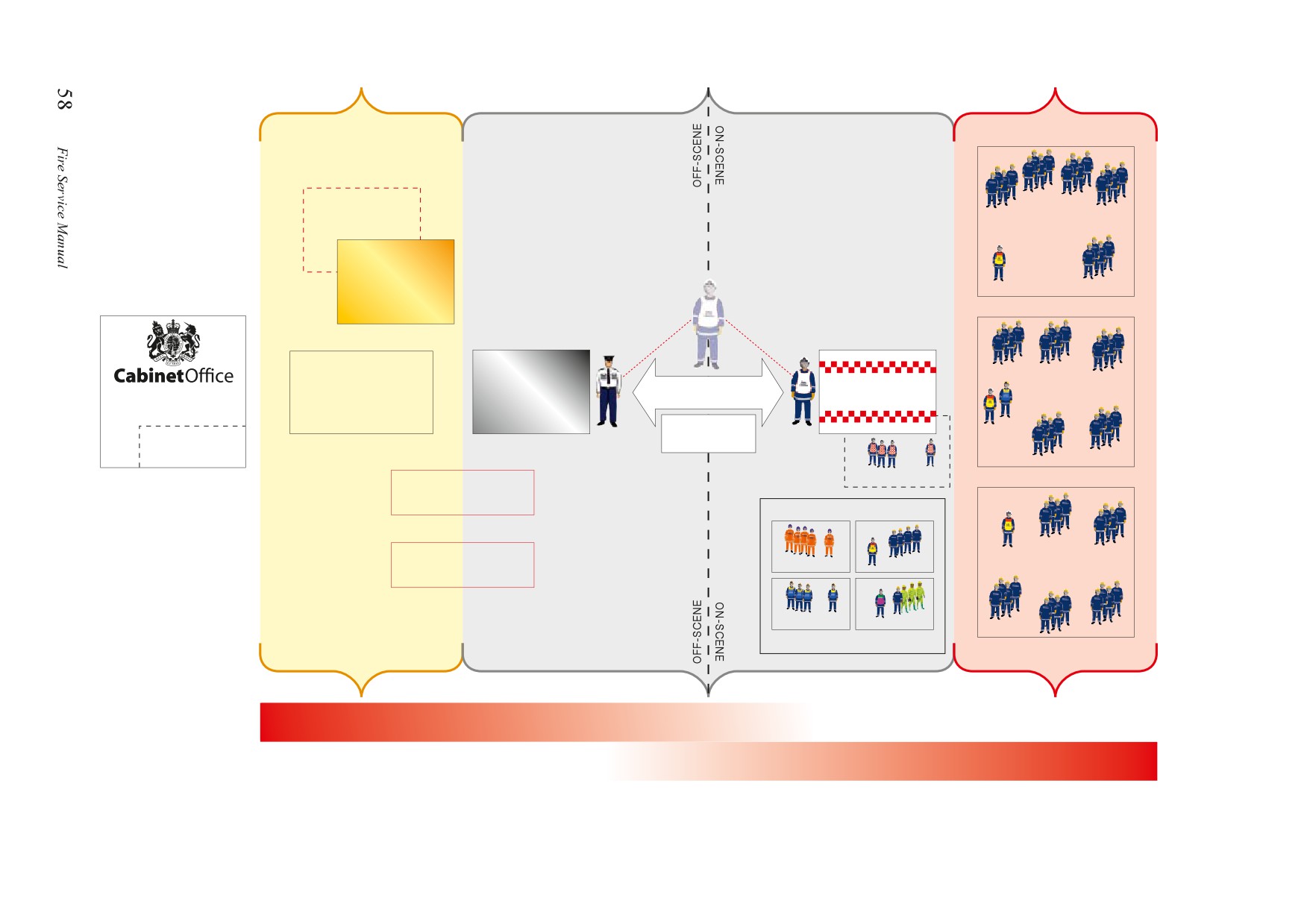
A generic command structure has been agreed
3.6.1
FRS National Co-ordination Centre
nationally which can be employed for all significant
The New Dimension programme resulted in many
incidents. Gold, Silver and Bronze are in common
specialist units being located in FRSs across
use in most responding organisations, referring
the UK. To ensure that all of this equipment and
to levels of command at Strategic, Tactical and
specialised crews can form a coherent and effective
Operational respectively For a detailed examination
response to catastrophic incidents, the Fire and
of the roles at each level please see Chapter 1, and
Rescue Service National Co-ordination Centre
for the operational duties at each level, Chapter 2
(FRSNCC) was established to co-ordinate the
of this manual.
mobilisation and deployment of New Dimension in
collaboration with local or regional control centres.
In the longer term the continued delivery
Incident Command
57
Operational Sectors
Regional Civil
Contingencies Committee
RCCC
Sector 1
Multi-Agency
Gold
Strategic
Communications Centre
SCC
Commmunities and
Local Government
Multi-Agency
Fire Silver
Incident
Briefing Room
Sector 2
Emergency Room
Silver
Commander
Command
COBR
(Fire and Rescue)
Location determined
Incident Management
by the nature of
Recovery Group
the incident
IMRG
Command Support
Affected
Control Centre
Support Sectors
FRSNCC
Fire & Rescue Service
USAR
Water
Sector 3
National Coordination Centre
Safety
Mass Decon
Support Sectors
Operational Sectors
Strategic Advice
Tactical Advice
of a robust national co-ordinating capability will
3.6.3
Convoy Procedure
be closely linked with the development of Regional
In planning for large scale incidents, and following
Control Centres.
the formalisation of national mutual assistance
arrangements, it can be seen that from time to time
The FRSNCC’s principal role is to co-ordinate
there may be the need to move large numbers of
the national and cross regional mobilisation and
vehicles and personnel around the UK. A guidance
deployment of all New Dimension resources in
note has been issued by the Fire and Resilience
response to a major incident. It will do so in close
Directorate which supports this. All guidance will
co-operation with the Communities and Local
of course be kept current.
Government Emergency Room (Fire and Rescue)
where these arrangements have been activated,
For example, all FRSs have been equipped by
and control room staff in both the affected FRS
Communities and Local Government with the
and those FRSs being asked to assist. To enable
capability to deal with mass decontamination of
it to undertake this role and maintain a database
the public, in the form of Incident Response Units
of resource availability, FRSNCC continuously
(IRU’s). In the event of a Chemical, Biological,
monitors and tracks New Dimension resources,
Radiological and Nuclear (CBRN) attack anywhere
using information provided by Fire and Rescue
in the UK, the mobilisation of the IRU’s and
Services.
supporting appliances will take place. FRSs are
expected to pre-plan for this in conjunction with
3.6.2
FRS Mutual Assistance
the guidance document and their respective police
The existence of a national mutual aid agreement
force, where Convoy Assembly Points (CAP) will
allows individual Fire and Rescue Authorities
be identified as a starting point.
to secure assistance from other authorities in
the event of a major incident. Authorities have
3.6.4 Strategic Holding Area
for many years provided mutual support across
Convoys of vehicles converging on a city or other
borders for responses to emergencies through the
geographical point which has been affected by a
shared availability of fire crews and appliances. It
serious incident need to be managed and marshalled
is important that this good practice is universally
effectively. Accordingly, Strategic Holding Areas
applied at local, regional and national level to ensure
(SHA) have been identified at key locations on the
an effective and efficient response to incidents.
motorway and trunk road network. A SHA is an
area which will be used to ‘hold’ FRS resources
Every FRA in England has agreed to participate
and national assets of all kinds in response to an
under the terms of the National Mutual Aid
incident. It will be an area with suitable space and
Programme.7 Each FRA has confidence in being
facilities to accommodate large numbers of crews,
able to request or provide assistance from each
appliances and equipment where these resources
other should a serious incident occur. Full FRA
can standby, or rest whilst awaiting deployment
participation in the protocol also means that the
to marshalling areas and from there to the scenes
task of the FRSNCC co-ordinating New Dimension
of operations. The SHAs are part of an overall
resources during serious incidents, is greatly
deployment plan to support the operations on the
assisted. The protocol has enabled FRAs to agree in
ground, and of the FRSNCC.
advance the terms under which they can support each
other during an incident such as a terrorist attack.
7 DCLG 20th July 2006; Fire and Rescue Service Circular 42/2006 invited FRSs to participate in the National Mutual aid Protocol for
Serious Incidents; FRSC 75/2006 of 12 Dec 2006 indicated that all FRSs agreed to participate.
Incident Command
59
The responsibility for co-ordination and
●● Under the direction of the IC, to facilitate
communication within the SHA will initially rest
crew reliefs and rotation, and a structured
with the commander of the Enhanced Command
rehabilitation of personnel and equipment to
Support facility.
their point of origin in conjunction with the
FRSNCC (the FRSNCC will co-ordinate the
3.6.5
Enhanced Command Support
recovery of ND resources).
●● Co-ordinate or conduct additional activities
Enhanced Command Support (ECS) will facilitate
as requested by the FRSNCC or the IC.
the management of national assets following
mobilisation to a large incident. It will be adaptable,
flexible and complement the ICS.
3.6.6
FRS National Support
Arrangements
●● It will be located at the SHA and provide
At times of the most serious challenge to the Fire and
a communications link to the IC through
Rescue Services of the UK, and to assist in ensuring
Command Support.
that operations are at all times co-ordinated and
●● ECS will co-ordinate resources into,
effective, various teams of advisors have been
within and out of the SHA, facilitating the
established to advise government ministers and
provision of logistics support to USAR, MD
senior civil servants who may have to make critical
and HVP teams.
decisions that will impact on operations. There
●● Provide communication links between the
will in addition be specialists available to advise
IC, FRSNCC, the National Advisory Team
Incident Commanders, Sector Commanders and
members and groups advising senior civil
other relevant officials at a tactical and operational
servants and ministers.
level in specialist areas including USAR, MD,
HVP, DIM etc.
60
Fire Service Manual
3.6.7
Communities and Local Government
The Communities and Local Government
Emergency Room (Fire and Rescue)
Emergency Room (Fire and Rescue) has seven
During incidents where a FRS has made the
principal roles:
request for National support or proactively on
receipt of such information which identifies a
1.
Providing structured, trusted advice and
possible threat to the critical national infrastructure
secretarial support to Director FRD and
or major emergency , the Communities and Local
the CFRA and event information to other
Government Emergency Room (Fire and Rescue),
Government departments and Ministers as
together with the FRSNCC, will be actively
directed by CFRA or Director of FRD
involved in the co-ordination of resources. Certain
2.
Acting as a FRS central Government hub for
circumstances could also identify the need for
the collection, distribution and provision of
pre-deployment of resources in a preparedness
operational, logistical and policy information
phase to ensure that they are closer to the possible
relating to FRS activity at events of National
threatened area prior to any occurrence.
significance
3.
Linking to the Regional Resilience Teams (the
During activation the Emergency Room (Fire and
RRT cell offers links through to Government
Rescue), should be considered as the hub of the
Offices) to provide accurate information on
advisory and co-ordination framework and will
the whole incident to the Director FRD and
be the key point for providing national advice
others as appropriate.
and co-ordination relating to the use of FRS/
4.
Co-ordinating cross Government and
Government assets during any major emergency.
international support to assist the Incident
In close liaison with FRSNCC, personnel will plan
Command System
and advise on national co-ordination and will be
5.
Providing cross-government and FRD
responsible for ensuring that the most effective
developed strategic advice to the FRSNCC,
distribution of FRS/Government assets during any
Gold Command tier and NSAT
major emergency is achieved with the maintenance
6.
Maintaining liaison with FRSNCC and
of national resilience.
Operational Commanders on the progress of
the event(s)
The Emergency Room (Fire and Rescue) will
7.
To assist with the co-ordination of overseas
provide comprehensive advice and support
deployments and reception of teams from
capability to the affected FRS, the Fire and
outside of the UK (working closely with DFID,
Resilience Directorate
(FRD) and Ministers,
EU etc)
the Cabinet Office Briefing Room (COBR), the
Chief Fire and Rescue Adviser (CFRA), the
Activities in support of these roles could include
National Strategic Advisor Team (NSAT), and
but not be limited to:
the FRSNCC. Their responsibilities will also
include the preparation of timely information in
●● The proactive cross government/international
the form of briefings and support to any other
planning during a major emergency
key stakeholder as required (e.g. Environmental
●● Liaison with intelligence services and other
Agency, PNIC, DEFRA).
relevant bodies
●● Assisting with the logistic function
responsibility for obtaining additional
resources from outside the FRS (e.g. foam
from the Ministry of Defence/Civil Aviation
Authority/industry or Urban Search and
Rescue from the French Government)
Incident Command
61
●●
Recognising obstacles that may impact on
●● When a decision has been made to seek
the affected authority’s ability to provide
international support, CLG Emergency
adequate support to the emergency and
Room may have a specific role with
supporting/prioritising in the areas of
arranging this. The UK aims to be self
concern as quickly as possible to ensure that
sufficient in dealing with events, and any
the response is not adversely affected
decision to seek overseas aid would require
●● Preparing briefs, guides, submissions to
policy approval, and likely to be brokered
ministers as directed by Director of FRD or
through Cabinet office
the CFRA
●● Liaison with Devolved Administrations
●● Ensuring that sufficient national cover
Emergency Rooms.
is being maintained whilst an incident is
being managed and prioritising resource
The Communities and Local Government
deployment in the event that there is more
Emergency Room (Fire and Rescue) main location
than one incident occurring
is London Victoria with a number of contingency
●● Providing support to the affected FRS
fallback locations
(Fire Service College and
as necessary.
Guildford).
62
Fire Service Manual