Voice Radio Communications Guide for the Fire Service (June 2016) - part 3
Voice Radio Communications Guide
66
for the Fire Service
This page intentionally left blank.
67
Section 8 | Interoperability
SECTION 8 —
Interoperability
This definition of interoperability is taken from the
a jurisdiction. This task was often too difficult
DHS SAFECOM project:
for a single fire department to tackle. The DHS
published the National Interoperability Field
“The ability of Public Safety responders
Operations Guide36 (NIFOG) in 2007. This guide
to share information via voice and data
is a comprehensive listing of interoperability
communications systems on demand, in
frequencies in all frequency bands and identifies
real time, when needed, and as authorized.”
both federal and nonfederal frequency listings.
It is a common practice and advisable to include
In general, interoperability refers to the ability of
these frequencies in standard radio programming
emergency responders to work seamlessly with
templates. This allows interoperability between
other disciplines, jurisdictions, systems or products
disciplines, jurisdictions, and multiple levels of
without any special effort. Wireless communications
government — federal, state, county and local.
interoperability specifically refers to the ability of
emergency response officials “to share information
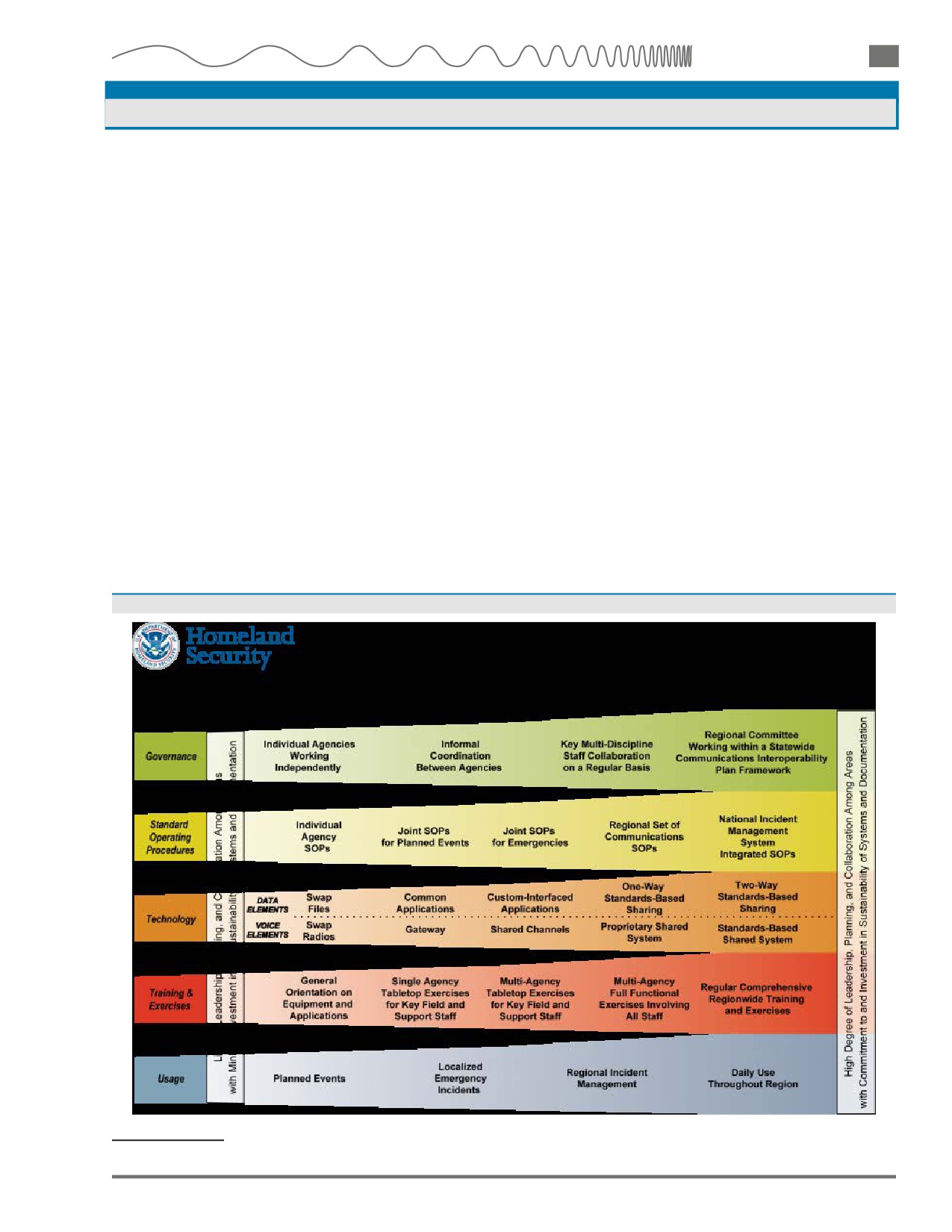
Interoperability Continuum
via voice and data signals on demand, in real time,
when needed, and as authorized” (DHS SAFECOM).
DHS, in collaboration with public safety agencies,
developed the Interoperability Continuum to
Frequency Coordination
provide a roadmap to achieve interoperability
(Figure 8.1). The continuum is a visual
Identifying interoperability frequencies often
depiction of the multidimensional elements of
required research by frequency coordinating
interoperability.
bodies or individual frequency coordinators from
Figure 8.1. Interoperability Continuum
Voice Radio Communications Guide
68
for the Fire Service
Each lane in the continuum represents one element
• Standard operating procedures (SOPs) —
needed to attain some level of interoperability.
agencies have joint SOPs for planned events to
Ideally, the right side of the chart is the highest
use the interoperability frequencies.
level of interoperability. When looking at the
• Technology — shared channels from the NIFOG.
chart, an organization may have some elements
• Training and exercises — multiagency tabletop
of the continuum on the right with others in the
prior to a planned event.
middle or to the left. While ideally the goal is to
• Planned event.
have all elements on the right side, the reality is the
Day to Day
capability in each lane may vary, but the goal is to
deliver interoperability as defined by the Office of
Most interoperability efforts are driven by the
Emergency Communications (OEC)/SAFECOM.
need to meet day-to-day operational requirements
(Figure 8.2). In many large urban areas, the
An example of this would be use of “shared
responsible fire department may not require day-
channels” for a planned event, elements of each
to-day interoperability, while some departments
lane provides a component of the interoperability.
interoperate on a daily basis. Since Sept. 11,
• Governance — regional committee working
2001, there has been significant attention toward
within a statewide communications
efforts to expand interoperability past the day-
interoperability framework. The state has a plan
to-day needs of a public safety agency to address
for use of shared channels. This could be use of
extraordinary events and incidents. Interoperability
nationally recognized interoperability channels
is required and necessary in today’s world. Where
in the NIFOG.
and how it happens is based on a logical analysis of
operational practices and requirements.
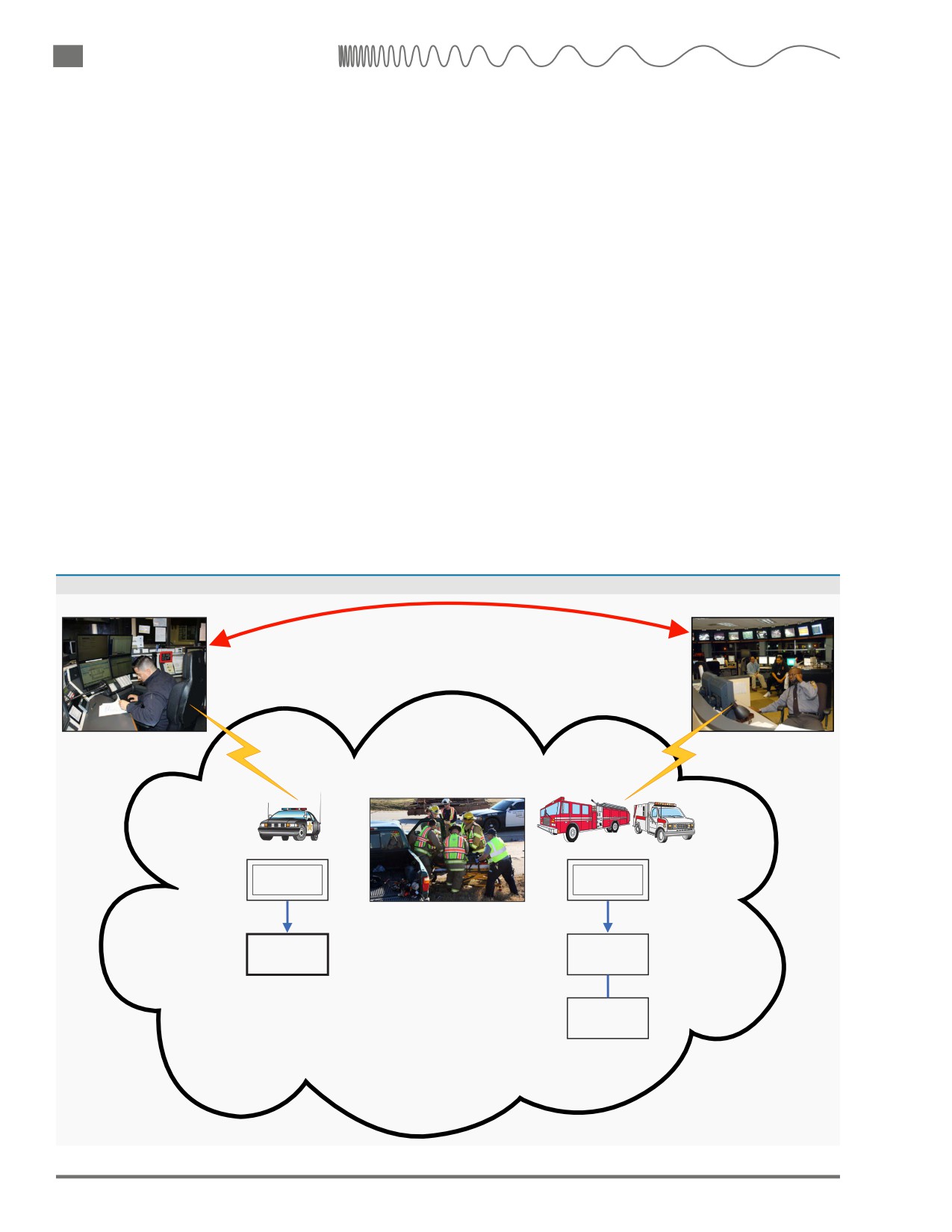
Figure 8.2. Response to a Motor Vehicle Crash
Police Dispatch
Fire/EMS Dispatch
Data, Phone or Radio
Communications
Motor Vehicle
Accident
Fire/EMS
Law Enforcement
VHF Fire Channel
LE Channel 7
3
1. Fire & Law Enforcement
dispatched from their
Traffic Investigation
Dispatch Center.
Fire
Traffic Control
Triage/Treatment
2. Each on separate radio
system.
3. Interoperability achieved by
Ambulance
dispatch center cooperation.
Transportation
4. On-scene interoperability
achieved by face to face
communications
(Figure courtesy Mike Wieder and Ron Jeffers, Union City, New Jersey)
Section 8 | Interoperability
69
Many fire departments have interoperability with
the National Incident Management System Incident
other fire departments. Interoperability between
Command System (NIMS-ICS) Command structure.
agencies in the same discipline is intradiscipline
The technical staff should receive the appropriate
interoperability. Interdiscipline interoperability
training to fulfill these roles successfully. COMLs in
is between different disciplines. Intradiscipline
the NIMS-ICS Command structure provide a central
interoperability is the easiest to achieve, since
point of contact to develop a communications
there is a common language, terminology and
plan to meet the interoperability needs on a large
tactical objectives. Interdiscipline interoperability
incident and manage the Communications Unit to
may not share common terminology or have the
meet the communications needs on an incident.
same tactical objectives. These factors should be
Communications Unit
considered in determining where interoperability
occurs in the command structure. A prime example
The use of a Communications Unit has proven
is when law enforcement responds to a house fire
to improve interoperability on incidents. The
for traffic control. Each discipline has very different
individuals that fill these roles understand the
tactical objectives. As the fire responders fight
technology and have a good understanding of
the fire using the “common language” of the fire
operational requirements. The Communications
service, this terminology may not be understood
Unit is tasked with supporting all communications
by the law enforcement component. In addition,
needs on the incident. These requirements may be
understanding when to talk and when not to
to provide operability in difficult situations where
talk becomes a safety issue. In these situations,
there are limited communications resources or in
interoperability may be face-to-face coordination
some instances no communications infrastructure.
with the command element or coordination at the
The Communications Unit consists of:
dispatch center level. In the example below, both
disciplines respond to a motor vehicle crash —
•
COML: This position is tasked with the
fire/EMS for medical care and law enforcement for
management of communications on the
traffic investigation and traffic control.
incident. Responsibilities include:
--
Operational communications.
The respective dispatch centers send the appropriate
--
Interoperability.
response for each discipline on separate radio
-–
Allocation of communication resources.
channels and maybe even on different systems.
-–
Developing prioritization of the
Each responds, and when on-scene, they coordinate
communications unit.
at the task level face to face. If a shared dispatch
--
Management of the communications unit.
center and radio system were used, both units
-–
Knowledge of local interoperability plans,
could be assigned on a common channel. SAFECOM
area and systems is helpful.
would consider this a high level of interoperability.
•
Communications Technician (COMT): This
Large Incidents
position is the technical person assigned to
implement technologies as directed by the
As incidents grow, interoperability should be
COML. Knowledge of the following is necessary:
planned for in the Command structure. When
--
Radio systems.
developing interoperable Command structures,
-–
Gateways.
many interoperability tools may be employed.
-–
Portable radios.
Technical staff plays a pivotal role in providing
-–
Telephone.
these technology tools to meet the operational
-–
Data systems.
requirements. The technical staff must be familiar
-–
Knowledge of local area, systems is helpful.
with the operational objectives and Command
structure to supply the appropriate technological
•
Incident Communications Manager (INCM):
tools. NFPA 1221 recommends the use of a
This position manages Radio Operators
Communications Officer at all major incidents and
(RADOs) and communications center functions
a Communications Unit Leader (COML) is part of
on incident if required.
Voice Radio Communications Guide
70
for the Fire Service
-–
Management of the communications center.
of this might be the Super Bowl, the presidential
--
Staffing of RADOs to cover operation
Inauguration Day, or other large special events. It is
periods.
not always necessary to deploy a Communications
--
Monitoring of radio channels as
Unit. Some events may only require a COML to
required by the IC or Operations Chief.
develop the radio plan. The important takeaway
--
Recording and routing of messages.
is knowing where this capability is in your area.
The state and federal governments have spent a
• RADO: This position is responsible for
substantial amount of money to train personnel
communicating on assigned radio channels.
as COML or COMT. Most states have a Statewide
--
Documenting notable events or radio traffic.
Interoperability Coordinator (SWIC). The SWIC in
your state can assist you in identifying the COML
Jurisdictions need to understand the capabilities
or COMT personnel in your state.
and resources the Communications Unit provides
and develop a deployment plan for incidents or
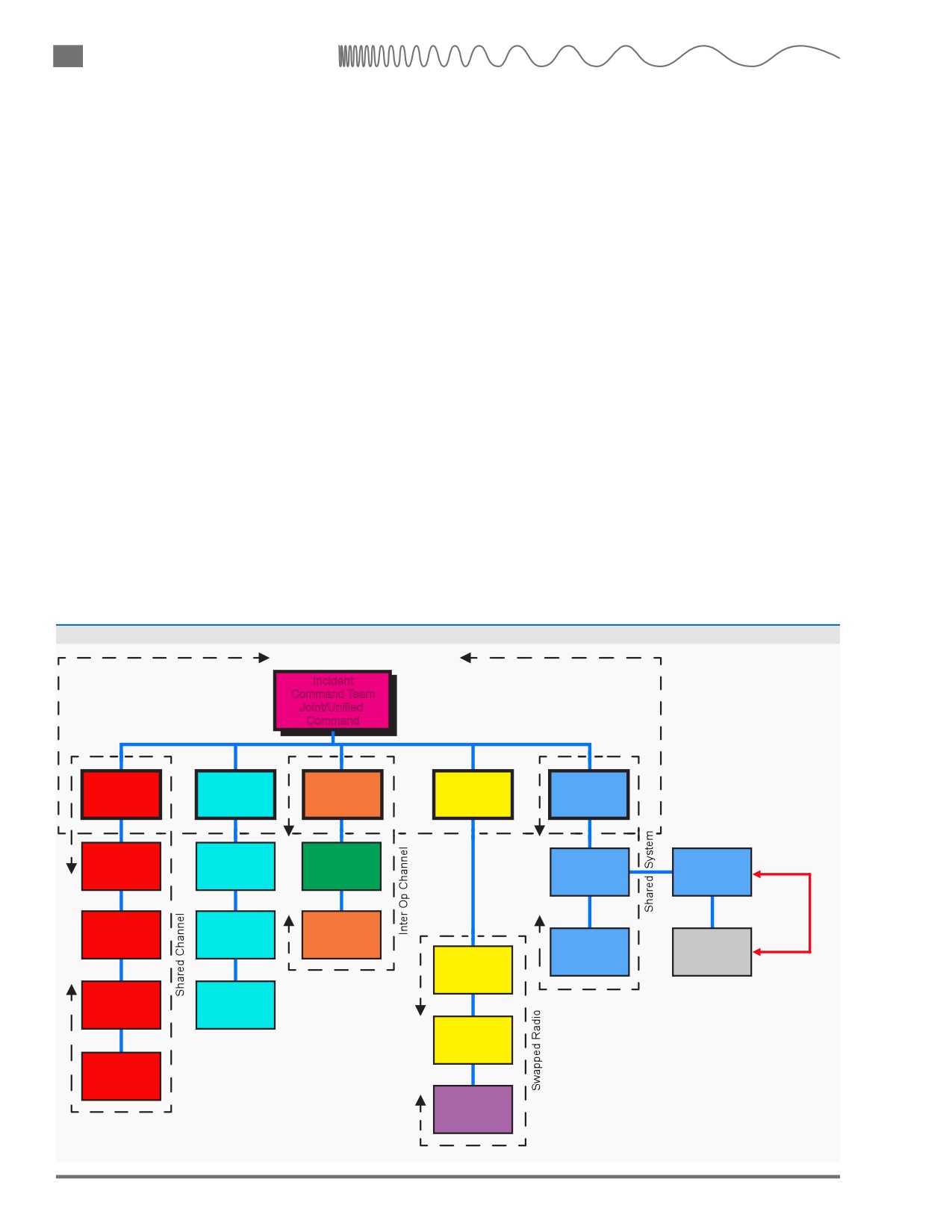
The example below is a large Command structure
events where a COML would provide benefit. It
where multiple technologies are employed to
is important to note that day to day our dispatch
achieve the appropriate level of interoperability for
centers provide this function. The centers allocate
the incident (Figure 8.3). When interoperating,
and coordinate frequencies/talkgroups and
determining the number of channels needed to
provide communications resources as needed by
support the incident must be a consideration. It
operations. The Communications Unit’s role is
is always important to account for the amount
to allow the dispatch centers to maintain normal
of radio traffic on a channel and to reserve some
operations. A Communications Unit may be
airtime for unforeseen needs such as a mayday.
implemented on large incidents that last many
Complex operations that are communications
operational periods or special events that require
intensive should have their own channel to ensure
complicated interoperability plans. A good example
that there is adequate on-air time and reserve
Figure 8.3. Incident Communications
Incident
Face-to-Face
Command Team
Communications
Joint/Unified
Command
Fire
Hazmat
EOD
Law Enforcement
Medical
Operations Branch
Branch
Branch
Branch
Branch
Y Fire Dept
VHF Interop
Trunked PD
X Police Dept
UHF Med 2
VHF Fire Tac 1
VTAC 3
Tac 7
Trunked PD Tac 5
Entry
North Division
Triage
Traffic Group
Group
South Traffic
X Fire Dept
Group
X Police Dept
VHF Interop
Division
VHF Tac 1
UHF Med 2
Trunked PD Tac 5
VTAC 3
Trunked PD Tac 8
Trunked PD Tac 9
Patch
Sheriff Tac 3
Decon
To
East Division
Treatment
Group
PD Tac 9
Y Fire Dept
Group
Crowd Control Group
North Traffic
VHF Interop
VHF Tac 1
UHF Med 2
VTAC 3
Y Police Dept
Division
Bomb Group
Trunked PD Tac 5
Sheriff Dept
Trunked PD Tac 7
Trunked PD Tac 10
UHF Sheriff Tac 2
Trunked PD Tac 9
West Division
Transportation
Y Fire Dept
Group
VHF Tac 1
UHF Med 2
Bomb Techs
Trunked PD Tac 9
South Division
Y Fire Dept
VHF Tac 1
Highway Patrol
EOD
Trunked PD Tac 9
Swapped Radios
Section 8 | Interoperability
71
capacity for unforeseen events. Shared or patched
The NIFOG37 is a comprehensive listing
channels can be used when there are common
of interoperability frequencies. The guide
tactical objectives. Before patching channels
lists frequencies for federal and nonfederal
or using gateways that essentially tie channels
interoperability in all bands. It is a common
together, the amount on each of the channels
practice and advisable to include these frequencies
must be considered. If both of the channels are
in standard radio programming templates. This
near saturation, the patch or gateway will make
allows interoperability between disciplines,
communications nearly impossible. Below is an
jurisdictions and multiple levels of government —
example of a large-scale multidiscipline Command
federal, state, county and local.
structure where multiple technologies are used to
The Interoperability Continuum is a tool developed
achieve interoperability.
to respond to an event and address all elements
Many technologies are available to achieve
needed to achieve optimal interoperability.
interoperability, and often the simplest solutions
Interoperability can be intradiscipline or
are overlooked in favor of complex technological
interdiscipline:
solutions. The simple solutions usually are the
Intradiscipline:
quickest to implement and easiest to understand. In
some instances, face-to-face communications may
• Like disciplines such as fire department to
provide the desired level of interoperability, while
fire department or law enforcement to law
in other cases other methods may be necessary.
enforcement.
In Figure 8.3, a joint Command structure in a
• Common tactical objectives.
common location allowed the use of face-to-
• Common language and terminology.
face communications for coordination. When a
• Easiest to achieve.
common Command location is not employed, a
Interdiscipline:
strategic-level Command channel is an option.
• Different disciplines such as fire department to
Many technologies are used to achieve
law enforcement.
interoperability, and many other factors have an
• Different tactical objectives and priorities.
impact on interoperability. SAFECOM is a program
• Different terminology.
within the U.S. DHS that is tasked with achieving
Communications Unit
communications interoperability for local, tribal,
The use of a Communications Unit has proven
state and federal emergency response agencies.
to improve interoperability on incidents. The
SAFECOM has many documents available that
Communications Unit consists of:
will guide and assist in achieving interoperability.
SAFECOM documentation is available at http://
• COML: This position is tasked with the
www.dhs.gov/safecom.
management of communications on the
incident.
Summary — Interoperability
• COMT: This position is the technical person
DHS SAFECOM definition: “The ability of
assigned to implement technologies.
Public Safety responders to share information
• INCM: This position manages the
via voice and data communications systems
communications center functions.
on demand, in real time, when needed, and
• RADO: Communicates on assigned radio
as authorized.”
channels.
Interoperability refers to the ability of emergency
responders to work seamlessly with other
disciplines, jurisdictions, systems or products
without any special effort.
Voice Radio Communications Guide
72
for the Fire Service
This page intentionally left blank.
Radio Spectrum
Section 9
Licensing and the Federal
73
|
Communications Commission
SECTION 9 —
Radio Spectrum Licensing and the Federal Communications Commission
The FCC is an independent agency of the U.S.
and international spectrum needs are met while
government established by the Communications Act
making efficient use of this limited resource.”38
of 1934. It is made up of seven bureaus, organized
“NTIA is also collaborating with the Federal
by function, that are responsible for various
Communications Commission to make available a
communications areas. The bureau that is most
total of 500 megahertz of federal and nonfederal
involved in public safety issues is the Public Safety
spectrum over the next 10 years for mobile and
and Homeland Security Bureau (PSHSB), which:
fixed wireless broadband use. This initiative,
to nearly double the amount of commercial
… is responsible for developing,
spectrum, will spur investment, economic growth,
recommending, and administering the
and job creation while supporting the growing
agency’s policies pertaining to public
demand by consumers and businesses for wireless
safety communications issues. These
broadband services.”39
policies include 911 and E911; operability
and interoperability of public safety
The use of RFs by the federal government, and
communications; communications
those operating under federal authority such as
infrastructure protection and disaster
national Urban Search and Rescue teams, is given
response; and network security and
by the Office of Spectrum Management (OSM) in
reliability. The Bureau also serves
the NTIA, a part of the Department of Commerce.
as a clearinghouse for public safety
The FCC does not set rules for use of radio
communications information and takes the
spectrum by federal users but does coordinate
lead on emergency response issues.
use with the NTIA according to international
law. While nonfederal agencies are not subject to
As this description implies, the PSHSB is
NTIA regulation, they may be affected by these
responsible for rulemaking, licensing, education
rules through partnerships and interoperability
and outreach to public safety agencies. Portions
agreements, and all operations are subject to the
of the activities of the PSHSB were previously
authority under which they operate.
carried out by the Wireless Telecommunications
Bureau, particularly the rulemaking and licensing
Rulemaking
functions. The outreach and coordination functions
When the FCC believes that a change is needed to
were added to create a single bureau to handle all
the rules, generally it will first issue a Notice of
public safety issues.
Inquiry (NOI) asking for general information on the
The rules established by the FCC are located in
issues related to the change. Next, the commission
CFR Title 47. The section of these regulations that
will issue a Notice of Proposed Rulemaking (NPRM)
applies directly to LMR systems used by public
outlining the proposed rule change. The NPRM
safety entities is located in Part 90 of 47 CFR. The
allows the public to comment on the proposed
Part 90 rules govern the operation of radio systems,
change and proposed modifications. After the FCC
as well as the frequencies available for use, what
reviews the comments and proposals, it may issue
types of agencies are eligible to use the frequencies,
one or more Reports and Orders (R&O) that provide
and the procedures for licensing these frequencies.
the final details on the rule changes. This process
may repeat as necessary to refine the rule change.
While the FCC provides licensing and spectrum
In addition, a type of appeals process is allowed,
management for nonfederal users, the NTIA is the
known as a Petition for Reconsideration. During the
federal coordinating body. “Many Federal agencies
process, public presentations, comment documents,
use radio frequency spectrum to perform vital
and expert testimony are heard by the FCC. Fire
operations. NTIA manages the federal government’s
departments and professional organizations may
use of spectrum, ensuring that America’s domestic
participate in all portions of the process.
Voice Radio Communications Guide
74
for the Fire Service
Licensing
The FCC created two radio service pools of
channels, the industrial/business (I/B) pool and
The FCC also governs the licensing of RFs to
the public safety (PS) pool. The FCC recognized
agencies, and this process is handled separately
that mission critical communications require
from the rulemaking process, although issues that
different coordination standards than general
arise during the licensing process may result in
business channels that are heavily shared and
future rule changes.
certified different coordinators for each pool. To
the extent possible, PS channels are coordinated to
The licensing process starts with the agency
be either exclusive/semiexclusive in an area or to
defining the requirements for communications
match regional and state plans for interoperability.
systems, including the type of radio system, the
Within the PS pool, there are several subcategories:
frequency band needed, the number of users that
(Each subcategory has been assigned a two-
will use the proposed system, and the number of
letter identifier.)
frequencies or frequency pairs required.
• Police (PP).
After the requirements are defined, the agency
• Fire (PF).
finds the specific frequencies through a frequency
• Forestry conservation (PO).
search conducted by the agency, a consultant or
• Highway maintenance (PH).
a manufacturer. The FCC website has tools to
• Special emergency (PS).
help agencies search for frequencies, including
• Emergency medical (PM).
the Universal Licensing System (ULS), which is
• General use channels (PX).
used to search for existing licenses, as well as for
processing applications. The ULS also can be used
Except for PX channels, the FCC recognizes a
to search for other agency licenses for examples on
home coordinator for each subcategory. The home
preparing a new license. Specific design parameters
coordinator has traditionally been the nonprofit
will be required to license the frequencies,
association that represents the licensees in
including the transmitter locations, tower height,
each category.
antenna height, and transmitter power output.
Transmitter power output must be specified as
For the PS pool, the FCC has certified four
“Effective Radiated Power,” which increases the
frequency coordinators, as follows:
actual power output from the transmitter by a gain
• PP: APCO.
factor specific to the antenna used in the system.
• PF: IAFC/International Municipal Signal
After all the system parameters and frequencies are
Association (IMSA).
determined, an application for license is prepared
• PO: Forestry Conservation Communications
and sent to a frequency coordinator. The FCC
Association (FCCA).
requires that almost all applications for two-way
• PH: American Association of State Highway and
or paging radio station licenses be reviewed by a
Transportation Officials (AASHTO).
FCC-certified frequency coordinator before the
• PM/PS: IAFC/IMSA.
applications can be submitted to the FCC. The
• PX: Any of the above.
coordinator performs many functions for both
The FCC allows any of the four certified coordinators
the applicant and the FCC. The coordinator can
to coordinate any public safety subcategory, but
assist the applicant in the selection of channels
requires that if the coordinator is not the home
and equally importantly ensure that all requested
coordinator, advice and consent are received from
channels can be used without causing unacceptable
the home coordinator. The coordinators have settled
interference to other licensees. The coordinator
on a $100 fee per channel, called an interservice
also reviews the entire application for accuracy,
fee, for the home coordinators’ review. While other
including information about the applicant, the
coordinators can coordinate a PF channel, the
proposed radio site and facilities, and compliance
applicant will pay an extra $100 for that coordination
with applicable FCC rules and regulations.
versus having the coordination performed by IAFC.
Radio Spectrum
Section 9
Licensing and the Federal
75
|
Communications Commission
In addition, the IAFC rate for coordinating a PF
no plans to move to other bands. However,
channel is the lowest of the rate cards for any of the
the population growth in large metropolitan
coordinators. It just makes good economic sense
areas has created rising demand for more RFs.
to use IAFC for coordination of fire or general use
In many areas of the country, all available VHF
channels. And, because of its partnership with IMSA,
and UHF frequencies are assigned to agencies,
as described below, interservice fees also do not
leaving no space for growth. The FCC, working
apply to PM/PS channels.
with equipment manufacturers and public safety
communications organizations, has developed
Once the application passes the frequency
several programs to increase the available
coordination process, the application is submitted
frequencies for public safety communications.
to the FCC through the automated ULS. While
the FCC does not charge public safety agencies
National Public Safety Planning Advisory Committee
for licenses, there is a cost associated with the
The first major expansion of frequencies allocated
frequency coordination. Agencies can enter the
to public safety took place in 1986 when the
license information into the ULS and track it as
FCC created the National Public Safety Planning
it proceeds. The FCC uses a computer system to
Advisory Committee (NPSPAC) to develop
perform automated checks on the license and then
frequency allocations on the 800 MHz band. Prior
will assign the license request to an examiner who
to the NPSPAC process, public-safety-licensed
will perform more extensive checks on the details
frequencies in the 800 MHz band were combined
of the application. The examiner then will either
with commercial business and cellular companies,
grant the license or return it to the applicant for
and the available frequencies were very limited.
modification or additional documentation. If the
The NPSPAC frequencies were put under the
request does not conform to FCC rules, it may be
control of 55 Regional Planning Committees
rejected outright and will require a reapplication.
(RPCs). The RPCs are responsible for creating
regional frequency plans that take into account
If the application does not conform to the FCC
agency needs, including metropolitan, rural,
rules in Part 90, the applicant may request a waiver
and statewide, and are responsible for initial
of the rules. The waiver process is complicated, and
coordination of applications.
waivers are not granted frequently. An example of
a waiver that has been granted is the use of UHF
Narrowbanding Below 512 Megahertz
TV Channels 14 and 16 for public safety use in
The NPSPAC process provided additional frequency
the New York and Los Angeles metropolitan areas.
spectrum for new systems operating in the 800
These areas had significant needs for additional
MHz band, but most fire and police departments
frequencies in the 1980s, before the 700 MHz and
in the U.S. still operate in the VHF or UHF bands
800 MHz public safety bands were established. The
(Figure 9.1). To increase the available frequency
agencies involved presented the needs along with
spectrum for public safety in the VHF and UHF
extensive documentation on why the needs could
bands, the FCC began investigation into narrowing
not be fulfilled with current frequency allocations.
the bandwidth for frequencies in this band.
Departments that wish to pursue a waiver must
present a detailed, well-thought-out case to
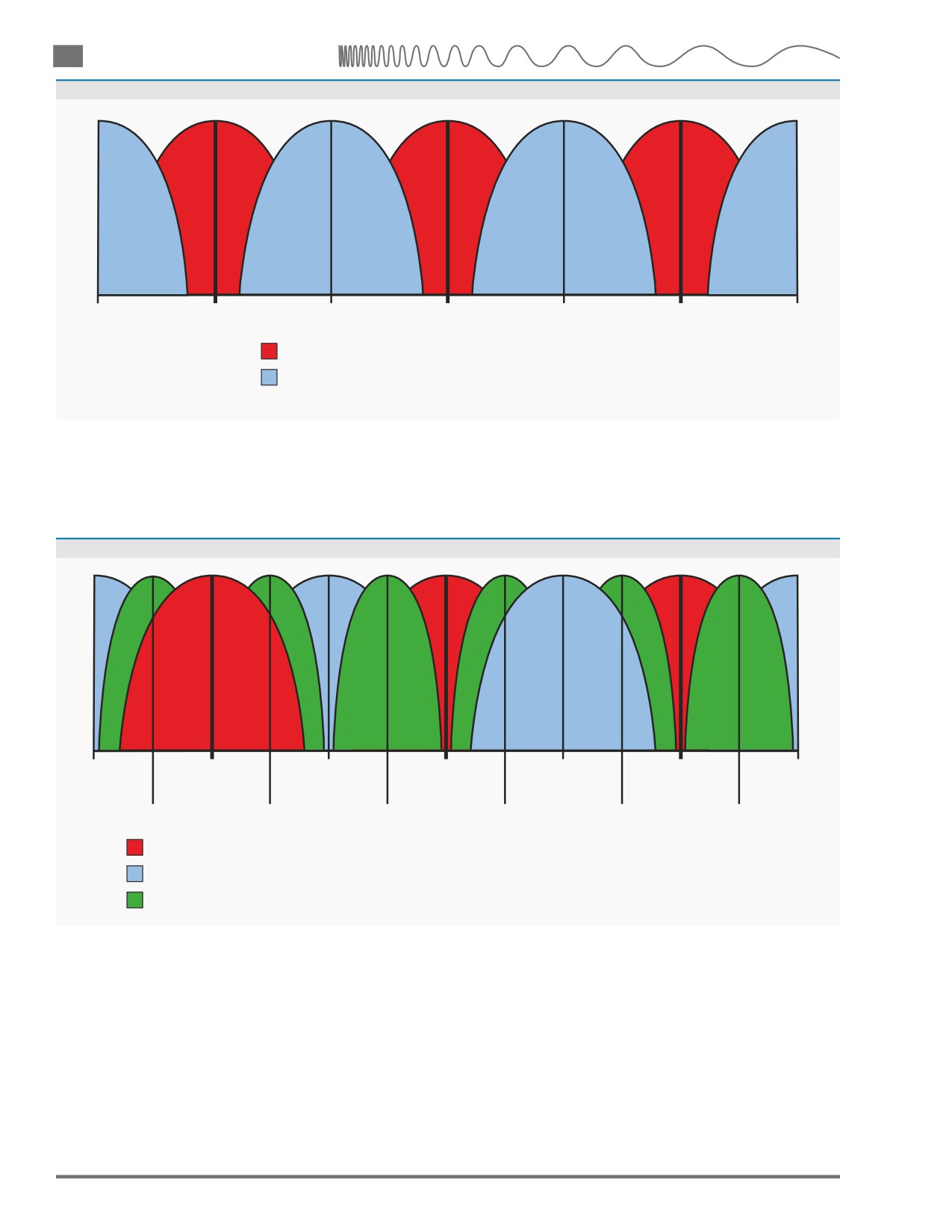
In the VHF band, channels were spaced 15 kHz
be successful.
apart, with transmitters operating with 25 kHz
bandwidth. In addition, as shown in Figure 9.1,
Federal Communications Commission Actions
adjacent transmitters were separated geographically
to Increase Public Safety Spectrum
to minimize interference. It became apparent that
as the population served by these departments
Historically, all public safety systems used
grew, their spectrum needs would grow as
frequencies in the VHF low, VHF high, and UHF
well, and the existing band plan would become
bands, with the systems progressing to higher
inadequate for the needs.
frequencies as technology improved. Many fire
and police departments in the U.S. still use radio
systems in the VHF and UHF bands and have
Voice Radio Communications Guide
76
for the Fire Service
Figure 9.1. Before Narrowbanding
150.815
150.830
150.845
150.860
150.875
150.890
150.905
Original VHF channels spaced at 30 kHz intervals.
Geographically separated VHF channels spaced
15 kHz from original VHF channels.
With no unused spectrum available in these bands,
Each frequency in the new plan was spaced 7.5 kHz
the FCC proposed narrowing the bandwidth of
from the previous and had a bandwidth limited to
the existing frequency assignments, dividing each
12.5 kHz.
existing frequency channel in half (Figure 9.2).
Figure 9.2. After Narrowbanding
150.815
150.830
150.845
150.860
150.875
150.890
150.905
150.8225
150.8375
150.8525
150.8675
150.8825
150.8975
Old 25 kHz bandwidth channels spaced at 30 kHz intervals
Old 25 kHz bandwidth channels spaced at 15 kHz from the original channels
12.5 kHz bandwidth channels at 7.5 kHz spacing from existing channels
The FCC developed a schedule in 1995 for
The first phase began in 1997 with the FCC
migration from the current band plan to the
denying certification for equipment that operated
new narrowband plan. This plan is often called
with 25 kHz bandwidth if it did not also operate at
“refarming” to relate it to changing the crops in
12.5 kHz or equivalent bandwidth. This prevented
a field. The schedule for refarming established
manufacturers from making equipment that would
by the FCC was divided into phases, with each
not be able to be used once the future phases
phase increasingly restricting the use of wideband
came into effect. The FCC predicted that most
systems to encourage migration to narrowband.
(wideband) equipment manufactured before this
date would become obsolete and unserviceable
before the mandatory narrowband deadline.
Radio Spectrum
Section 9
Licensing and the Federal
77
|
Communications Commission
At the time of this original order, the FCC also
capable of operating at this narrower bandwidth. In
made other orders with respect to expansion of
the UHF and 700/800 MHz bands, repeater pairs
existing systems, creation of new systems, and the
are preallocated, leading to a simpler TDMA system
manufacture and importation of equipment. These
implementation. In the VHF bands, there are no
orders staggered the restrictions over several years
predefined transmit/receive pairs, making it difficult
in an attempt to make the transition to narrowband
to aggregate sufficient channels to provide for four-
communications less painful to local agencies.
or two-slot TDMA repeated systems. If spectrum use
Unfortunately, the complexity of the rules confused
pressure continues, expect that the FCC will again
many agencies and in 2004, before the new rules
visit the issue of narrowbanding below 512 MHz.
took effect, the FCC modified the order to have two
Public Safety Wireless Advisory Committee
deadlines, one in 2011 and the other in 2013.
Although the NPSPAC process provided additional
In January 2011, the FCC stopped accepting
frequencies in the 800 MHz band, the need for
applications for new systems, modifications to
more capacity became evident in the early 1990s.
existing systems, and transmitters that operated
This increasing need for more frequency spectrum
using a bandwidth greater than 12.5 kHz or
was not limited to nonfederal agencies, as the
equivalent. In addition, the FCC prohibited the
federal government had not made modifications
manufacture or import of radio equipment that
to federal agency needs in many years. The FCC
was capable of operating on a bandwidth greater
established the PSWAC in 1993 under direction
than 12.5 kHz or equivalent.
from Congress to address the RF spectrum needs of
The final phase began in January 2013, and it
federal, state and local agencies over the next five
prohibited the operation of radios and radio
years, and over the next 15 years. The goal was to
systems that did not comply with the narrowband
develop a plan to allocate additional spectrum for all
requirements. All radios, portable, mobile, repeaters,
users, as well as establish plans for communications
and base stations that operated in the VHF or UHF
interoperability between all levels of government.
bands would be replaced, and the systems they
The final report of the PSWAC recommended
operated in would be redesigned by this date.
the allocation of 2.5 MHz of spectrum below
The FCC’s actions to refarm the VHF and UHF
512 MHz for federal, state and local public safety
bands resulted in perhaps the most confusing set of
interoperability, and the addition of approximately
orders ever from the FCC concerning public safety
25 MHz of new spectrum over the next five years
communications, resulting in many unnecessary
and 70 MHz over 15 years for federal, state and
system replacements. These replacements included
local public safety use. Although to date only
departments transitioning to systems that did not
approximately one-third of the new spectrum
meet their operational needs and were unnecessarily
requested has been allocated for state and local
costly to procure, operate and maintain. Agencies
public safety use, this is more than any request in
were able to keep existing communications systems
the last 20 years.
that were used for years, provided that they
700 Megahertz Spectrum Allocation
modernized the equipment and system design by
transitioning to 12.5 kHz bandwidth frequencies
As a result of the PSWAC’s recommendation that
and equipment prior to 2013.
additional spectrum be allocated to public safety,
the FCC allocated 24 MHz of new spectrum. This
Further Narrowbanding
allocation, from 764 MHz through 776 MHz
The FCC has proposed further narrowing the
and 794 MHz through 806 MHz, was part of the
bandwidth of channels below 512 MHz to 6.25
spectrum previously allocated to TV Channels
kHz bandwidth but has not issued rules related to
60 through 69. This spectrum became available
a forced migration to this narrower bandwidth at
for use by public safety through the transition of
the time of this publication. One of the reasons
television stations to digital systems. This portion
for this is the lack of FDMA subscriber equipment
of spectrum was chosen because it was adjacent
Voice Radio Communications Guide
78
for the Fire Service
to the existing 800 MHz band also used for public
the frequencies used by TV Channels 70 through
safety communications, and radio equipment could
83. This spectrum was available for use by public
be designed easily to operate in both bands.
safety, business and industrial users, and cellular
systems. The FCC allocated 70 channels to public
The FCC issued an order that described the rules
safety and interleaved these with other channels for
for the use of the new frequency band, as well as
business and industrial users. Interleaving means
the new band plan in 1998. The order split the
that one channel was allocated to business, the
allocation of frequencies into four basic classes:
next for industrial, and the next for public safety.
This repeated, creating an allocation layered with
• General-use frequencies.
public safety sandwiched between other users.
• State frequencies.
Every public safety channel had a nonpublic-safety
• Interoperability frequencies.
system on either side. Later, many of these channels
• Wideband frequencies.
were allocated to Specialized Mobile Radio (SMR)
The general-use frequencies could be licensed by
systems, which are private trunked radio systems
both state and local entities, and the allocation and
used by businesses. Figure 9.3 shows the interleaved
use of the channels would be governed by an FCC-
frequency allocation, with SMR systems on either
approved regional plan developed by stakeholders
side. The 800 MHz NPSPAC band is the block
in the region. The state frequencies would be
labeled Public Safety to the right of the Upper 200
licensed to each state and would be allocated in
Enhanced Specialized Mobile Radio (ESMR) block.
any manner the state desired. The interoperability
Figure 9.3. 800 MHz Band Before Reconfiguration
frequencies could be licensed by state, local
Mobile and Control Station Transmit Frequencies (in MHz)
and, to a limited degree, federal agencies, and
806
809.75
816
821
824
the allocation and use of the frequencies would
NPSPAC
General
Interleaved Spectrum
ESMR (Nextel)
(Public
be governed by a plan produced by a State
Category
(inc. Nextel)
(Upper 200)
Safety)
Interoperability Executive Committee (SIEC) in
851
854.75
861
866
869
each state. The wideband channels were intended
Base Station Transmit Frequencies (MHz)
to provide the ability to develop regional and local
high-speed data systems.
In the early 1990s, FleetCall (later to become
Nextel) started to develop a digital SMR network
The FCC reconfigured the 700 MHz band plan
that incorporated the same features as cellular
in 1997, which modified the public safety
systems. This system used frequencies in the SMR
narrowband (primarily voice) spectrum to be
bands, as well as frequencies in the interleaved
located at 769-776/799-805 MHz. The previously
band. Traditional cellular systems were not allowed
designated wideband spectrum was reconfigured
to operate in these bands, but FleetCall received
and redesignated for broadband operation, with a
waivers from the FCC to operate the new system.
guard band between broadband and narrowband
At the same time, the deployment of cellular
spectrum segments. Subsequently, the public safety
systems was increasing at a rapid pace.
community, including the fire service, fought for
and successfully obtained an additional 10 MHz
One of the two bands assigned to cellular systems,
of spectrum for broadband operation to support
the Cellular A band, is directly adjacent to the
video and data. In summary, the 700 MHz band
NPSPAC 800 MHz band. The NPSPAC band is also
for public safety now consists of a total of 12 MHz
adjacent to the Upper SMR band. With FleetCall
for voice with a total of 20 MHz for broadband
systems on both sides of the interleaved band, and
high-speed data and imaging, and 2 MHz dedicated
this and other systems interleaved — along with
to guard band between the voice and broadband
SMR systems and cellular sandwiching the NPSPAC
operations to help minimize interference.
band — public safety systems were in a bad place.
800 Megahertz Reconfiguration
Both the FleetCall system and cellular systems are
designed with a large number (30 or more) of
The initial frequency allocations in the 800 MHz
transceiver sites throughout the system’s coverage
band were made available in 1974 by reallocating
Radio Spectrum
Section 9
Licensing and the Federal
79
|
Communications Commission
area. Compare this with the typical public safety
band had been relocated away from the Cellular A
system with one or two sites. The public safety
band and was much less likely to suffer significant
systems were bound to have interference, but
interference from nonpublic-safety systems.
none of the system operators that were likely to
T-Band
interfere with the public safety systems recognized
the potential.
The T-Band supplies a significant number of
channels to support public safety operations as
By the late 1990s, the interference problem with
well as regional interoperability to 11 of the largest
public safety systems in the 800 MHz band
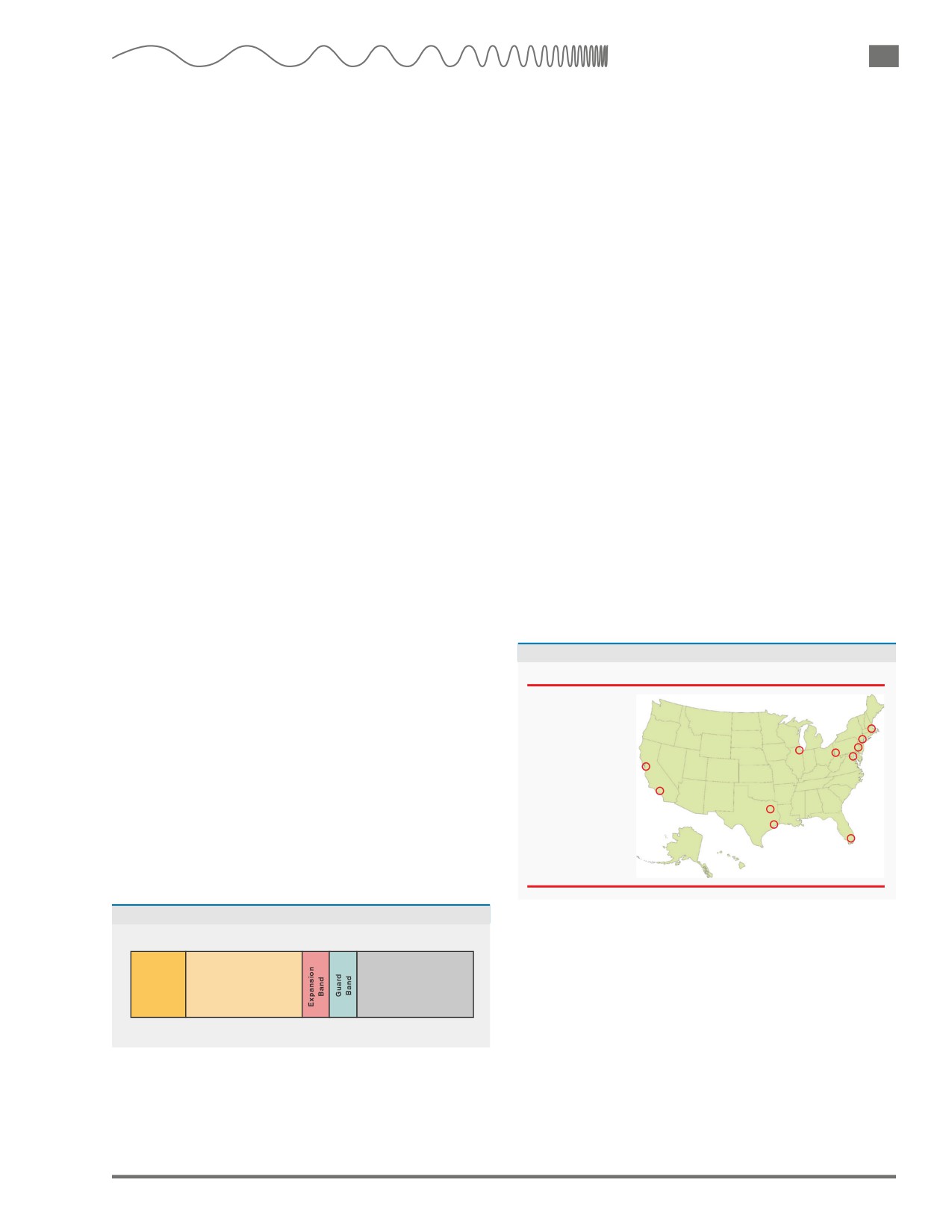
metropolitan areas. The 11 metropolitan areas are
had become well-recognized, and agencies
Boston, Chicago, Dallas, Houston, Los Angeles,
were demanding action to restore the ability to
Miami, New York, Philadelphia, Pittsburgh, San
communicate on emergency incidents. To its credit,
Francisco and the District of Columbia (Figure 9.5).
the FCC began a process to classify the problem
The T-Band lies within the UHF spectrum between
and find a solution. At that time, the FCC ordered
470-512 MHz. As a result of the Middle Class Tax
that systems operators in the affected bands must
Relief and Job Creation Act of 2012, the FCC was
take steps to minimize interference effects in
ordered to recover and auction the T-Band spectrum
2004. The FCC also ordered that the 800 MHz
by February 2021. Within two years of the auction
band would be reconfigured to further minimize
close (early 2023), the FCC is required to clear public
the interference from Nextel and Cellular A band
safety operations from this portion of the band.
systems under a process known as “rebanding.”
Currently, the FCC has placed a freeze on all new
Under the rebanding process, Nextel was to fund
expanded T-Band operations for public safety and
the effort of relocating existing systems in an
industrial and business operations. The challenge
equitable manner and in return would receive
now is to remove all public safety off the T-Band,
additional frequencies in the 1.9 MHz band. To
which is proving to be costly and complex due to
supervise the rebanding process, the FCC appointed
spectrum allocation.
an independent consulting company, BearingPoint,
Figure 9.5. T-Band Locations
as the Transition Administrator (TA). The TA had the
Amount of T-Band Spectrum
responsibility of managing the process, including
Boston (12 MHz)
establishing the schedule, monitoring the process,
Chicago (12 MHz)
Dallas/Fort Worth (6 MHz)
x
and facilitating resolution of conflicts. The process
Houston (6 MHz)
x
Los Angeles (24 MHz)
x
x
x
was divided into four “waves” that grouped together
Miami (6 MHz)
x
New York/NJ (18 MHz)
x
the regions that would be reconfigured. All waves
Philadelphia (12 MHz)
Pittsburgh (12 MHz)
x
were scheduled to be reconfigured by the end of the
San Francisco (12 MHz)
Washington DC/MD/VA (12 MHz)
x
second quarter of 2008 with the exception of Wave
x
Public Safety portion of
4, which contained U.S./Canada or U.S./ Mexico
this spectrum varies by market
x
border areas. The reconfiguration of these areas was
subject to treaty negotiations that delayed the process.
Figure 9.4. 800 MHz Band After Reconfiguration
Stu Overby, NPSTC Presentation, APCO Int’l, T-Band Background and
Mobile and Control Station Transmit Frequencies (in MHz)
NPSTC Report Summary, Aug. 21, 2013
806
809
815
816
817
824
In March 2013, NPSTC convened a T-Band working
NPSPAC
Public Safety
(Public
B/ILT
ESMRel
group to study the giveback and its implications
Safety)
Noncellular SMR
for public safety communications, including the
851
854
860
861
862
869
potential costs of relocation efforts. The full report
Base Station Transmit Frequencies (MHz)
is available on the NPSTC website and cites costs,
spectrum alternatives, and limited spectrum
The reconfigured band in Figure 9.4 shows that
gains as potential limitations (SAFECOM T-Band
the public safety portions of the new band would
Giveback pp.1-2).
be isolated from the ESMR portion of the band
where Nextel operated. In addition, the NPSPAC
Voice Radio Communications Guide
80
for the Fire Service
The migration from T-Band presents a number
On Oct. 17, 2014, the FCC released the narrowband
of problems for local jurisdictions and their
reserve channels (24 12.5 kHz channels) to general
public safety responders. The two biggest issues
use under the administration of the RPC for the
are the likelihood that funding generated by the
benefit of state and local public safety users. Public
spectrum auction will not be sufficient to pay for
safety users still rely on LMRs for communication.
the migration and that there may not be sufficient
At the time of this publication, Voice over LTE
alternate spectrum available in these busy metro
(VoLTE) and the National Public Safety Broadband
areas to migrate to. In the Boston area alone, over
Network (NPSBN) are not suitable options for
6,000 public safety radios operate on the T-Band.
mission critical voice for public safety users.
A 2015 study commissioned by the IAFF concluded
FCC Public Notice Jan. 9, 2015.
that there were over 700 jurisdictions that would
• A five-year priority access window for T-Band
be impacted by the changes to T-Band use by their
incumbents to license the former reserve
fire, EMS, and law enforcement responders.
spectrum (from Jan. 9, 2015 to Jan. 9, 2020).
A requirement of the act is that proceeds are to
• The date for filing RPC Plan Amendments
assist with spectrum relocation. However, the
to incorporate the former reserve spectrum
proceeds will not cover all costs associated with
(June 2, 2015).
this. An estimate from 2013 expects costs to
exceed 5.9 billion dollars for spectrum relocation
• The date by which certain licensees must
(Figure 9.6). Private sector relocation costs are not
reprogram their deployable trunked systems to
considered, which may decrease the percentage
operate on the former reserve channels. (See
of auction funding to be used for public safety
FCC Public Notice DA 15-34 for specific dates.)
spectrum reallocation.
The FCC requires that T-Band incumbents seeking
Figure 9.6. Breakdown of the $5.9 Billion in Costs
reserve channels (1) commit to returning to the
Commission an equal amount of T-Band spectrum
8%
16%
and (2) obtain RPC concurrence.
13%
System
Grant Guidance
Sites
OEC encourages states to update Statewide
Repeaters
22%
Communications Interoperability Plans (SCIPs) to
Subscribers
address FCC directives affecting current or planned
23%
Other
public safety communications systems, including
Planning
T-Band migration, and has advised grantees to
18%
consult the FCC, their SWIC, and their frequency
coordinator during project planning to ensure
projects or upgrades planned for systems operating
Licensees are required by law to migrate from the
in the T-Band are coordinated and align with the
T-Band spectrum to another unidentified spectrum.
state’s migration plans.
There are limited options for a replacement
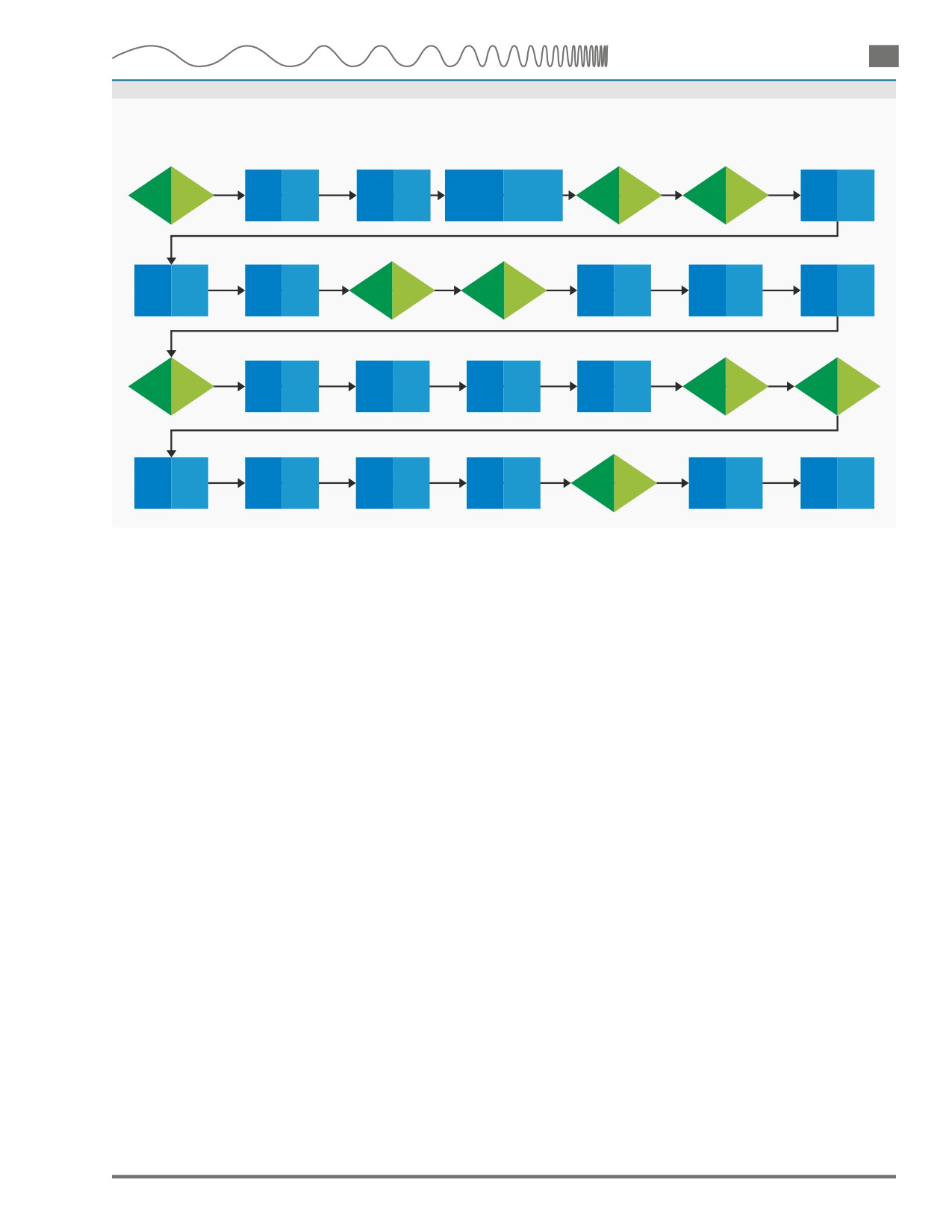
The following (Figure 9.7) is an example timeline
spectrum. The VHF, UHF and 700/800 MHz bands
providing proposed steps for transitioning to a
have few available channels. However, in response
new system.
to Public Law 112-96, the FCC issued rules and
guidance related to the required T-Band transition.
Radio Spectrum
Section 9
Licensing and the Federal
81
|
Communications Commission
Figure 9.7. Sample T-Band Giveback Transition Timeline
SAMPLE T-BAND GIVEBACK TRANSITION TIMELINE
The following is an example timeline providing proposed steps for transitioning to a new system.
Start
Year 1
Year 2
Identify
Identify
Identify Possible Funding
Determine
Approve
License
Need for
Develop Base
Available
Sources (bonds, general
FFunding
Funding Source
Available
New System
Requirements
Spectrum
fund, fees, partnership)
Source
Selection
Spectrum
Year 3
Develop
Proposal
Draft Request
Identify
Legal/
Detailed
Issue
Development/
Review Vendor
for Proposal
Potential
Statutory Approval
System
RFP
Response From
Proposals
(RFP)
Vendors
for RFP
Requirements
Vendors
Year 4
Year 5
Negotiate
Site Selection
Select
Award
Develop Final
With Community
Approve Final
Approve System
Vendor
Contract With
System Design
Contract
System Design
and Zoning
Test Plan
Vendor(s)
Officials
Year 6
Year 7
Build System
Test System
Deploy
System
Transition to
Decommission
Test System
Acceptance
Components
Components
System
New System
Old System
Summary — Radio Spectrum Licensing and
Not all of the responsibility for the lack of
the Federal Communications Commission
adequate spectrum for public safety response
lies with the FCC or the various coordinating
One problem that is common to all
agencies. Public safety agencies themselves often
recommendations for increasing the spectrum
perpetuate this inadequacy through their actions
allocated to public safety agencies is accurately
(or inactions). The insistence by many agencies
defining “public safety agencies.” Another lies in
to maintain “stovepipe” communications systems
the politics of the allocations. Many state and local
that duplicate the coverage of other systems and
governments, and their communications managers
do not operate with neighboring agencies is one
in particular, lobbied to include “public service” or
of the most egregious examples. The efficiency of
“public safety support” agencies in those eligible to
frequency use could be increased dramatically if
license spectrum allocated to public safety.
all agencies were committed to cooperative system
development with the goal of maximum frequency
The result of this is that agencies that do not
use among all agencies in a system.
support the emergency response aspect of public
safety are eligible for licenses under the new
The FCC and communications equipment industry
rules. This includes such diverse groups as school
are driven by the need to accommodate additional
bus companies, road and highway maintenance
users in a limited amount of radio spectrum and
crews, and public solid-waste disposal agencies. In
economic forces. Any technical change to spectrum
essence, any state or local government workgroup
use requirements has the possibility to affect
is eligible for licensing spectrum allocated to
the operational performance of a radio system,
public safety, no matter how removed the agency
negatively or positively. The fire service has an
is from emergency response activities. The benefit
opportunity to be a part of the solution to this issue
to state and local governments is that they can
through coordinated, organizational participation in
build communications systems that support all
the process. If the fire service cannot communicate
divisions with spectrum allocated to public safety.
its needs, or if the fire service voice is fragmented,
Unfortunately, this is done by exploiting the
then a solution will be imposed by others, and
public’s understanding of what falls under the
it is unlikely that that solution will meet all the
umbrella of public safety and ultimately reducing
operational needs of the service.
the spectrum available for emergency response.
Voice Radio Communications Guide
82
for the Fire Service
The FCC was ordered to recover and auction the
• The date by which certain licensees must
T-Band spectrum by February 2021. Within two
reprogram their deployable trunked systems to
years of the auction close (early 2023), the FCC is
operate on the former reserve channels. (See
required to clear public safety operations from this
FCC Public Notice DA 15-34 for specific dates.)
portion of the band.
The T-Band supplies a significant number of
• A five-year priority access window for T-Band
channels to support public safety operations as
incumbents to license the former reserve
well as regional interoperability to 11 of the largest
spectrum (from Jan. 9, 2015 to Jan. 9, 2020).
metropolitan areas. The 11 metropolitan areas are
Boston, Chicago, Dallas, Houston, Los Angeles,
• The date for filing RPC Plan Amendments
Miami, New York, Philadelphia, Pittsburgh, San
to incorporate the former reserve spectrum
Francisco and the District of Columbia.
(June 2, 2015).
83
FirstNet
Section 10 |
SECTION 10 —
First Responder Network Authority or FirstNet
History
priority access for public safety users, backup power
and networking requirements, and other features
Nationwide Public Safety Broadband Network
necessary to provide a high-reliability system. The
In December 2006, the FCC made a statement of
PSST also became the licensee for the 10 MHz of
opinion in an NPRM:
reallocated public safety spectrum.
We believe that the time may have come
The D Block auction occurred along with other
for a significant departure from the
auctions in the first quarter of 2008. There was
typical public safety allocation model the
one bidder for the D Block, but the reserve price
Commission has used in the past … While
(minimum bid) set by the FCC was not met, and
this system has had significant benefits for
D Block was not auctioned successfully. After the
public safety users, in terms of permitting
auction, there was some discussion that the
them to deploy voice and narrowband
requirements for the system set forth in the BID
facilities for their needs, the system has
created too much uncertainty as to the cost of
also resulted in uneven build-out across the
constructing the system. This, along with the
country in different bands, balkanization
uncertainty of how many public safety agencies
of spectrum between large numbers of
would participate, may have led to the
incompatible systems, and interoperability
unsuccessful auction.
difficulties if not inabilities.
In January 2015, the AWS-3 radio spectrum auction
This statement predicted the activities that would
was held and generated $44.9 billion. The proceeds
occur in April and June 2007, with the FCC’s
of the auction provided the funding for FirstNet
Proposed Rulemaking and Second Report and
and will finance technological upgrades to 911
Order on the 700 MHz band. In this rulemaking,
emergency systems and contribute over $20 billion
the FCC proposed to create a nationwide public
to deficit reduction.
safety broadband data system by rebanding the
When the nationwide broadband network is
700 MHz public safety band to reallocate the 10
successfully built, it will be the first system of its
MHz wideband frequency allocation and combine
size built specifically for public safety requirements
this with 10 MHz of new spectrum that would
and could serve as an evaluation model for a
be auctioned. The FCC would allow a single
possible nationwide voice system in the future.
nationwide licensee for the reallocated 10 MHz of
existing spectrum and would auction the other 10
Formation of FirstNet
MHz of new spectrum, known as the D Block.
FirstNet40 is an independent authority within the
The auction would seek to find a bidder that would
U.S. Department of Commerce’s NTIA. “Signed
purchase the rights to the 10 MHz of D Block
into law (P.L. 112-96, Title VI) on February 22,
spectrum and would then have the rights to combine
2012, the Middle Class Tax Relief and Job Creation
this with the 10 MHz of public safety spectrum to
Act created the First Responder Network Authority
form a nationwide commercial and public safety
(FirstNet). The law gives FirstNet the mission to
network. The FCC rules stated that the network must
build, operate and maintain the first high-speed,
meet the requirements of public safety agencies and
nationwide wireless broadband network dedicated
appointed the Public Safety Spectrum Trust (PSST)
to public safety. FirstNet will provide a single
Corporation to represent the interests of public
interoperable platform for emergency and daily
safety. The PSST developed a Bidder Information
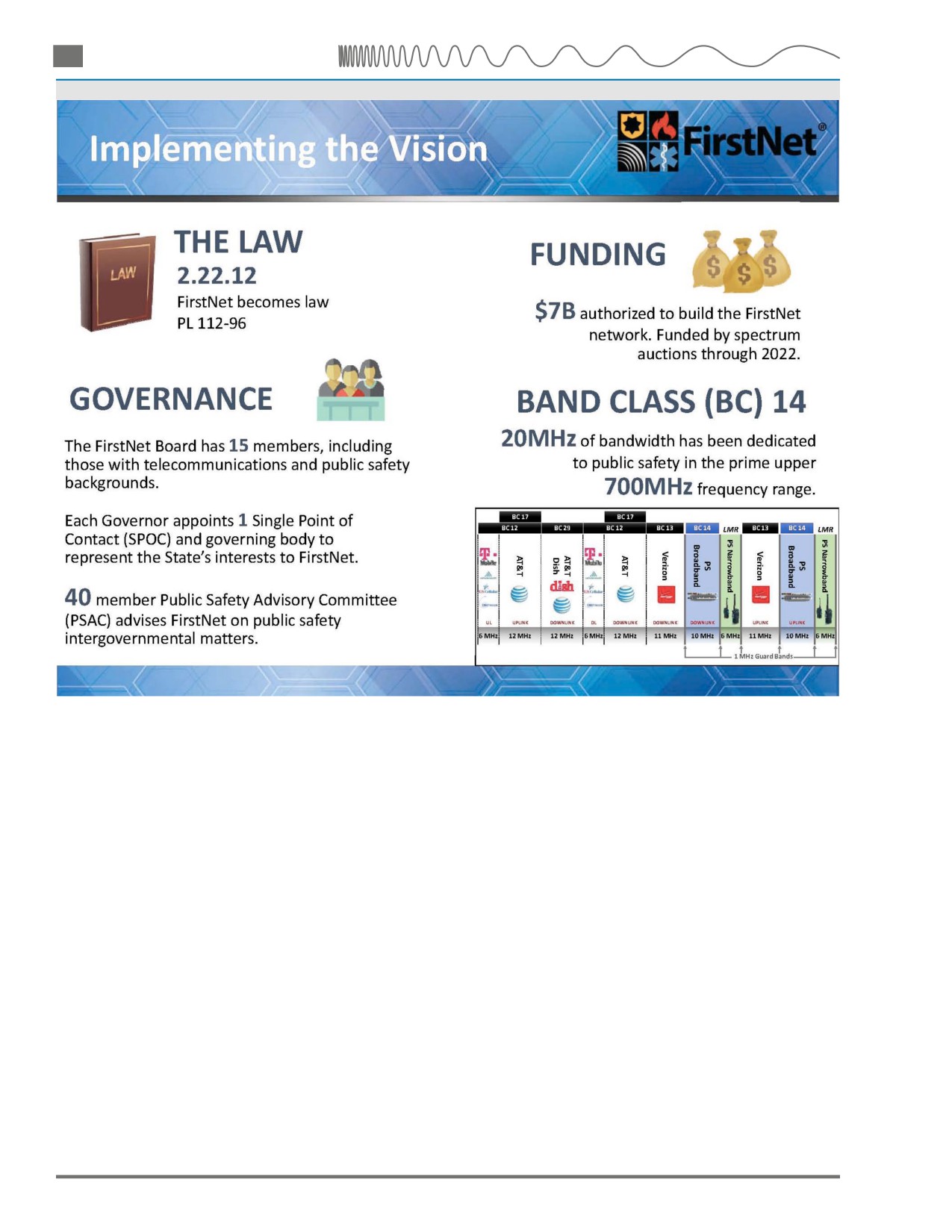
public safety communications”41 (Figure 10.1).
Document (BID) that outlined the requirements the
new system must meet. These specifications included
Voice Radio Communications Guide
84
for the Fire Service
Figure 10.1. FirstNet Beginnings
As noted in Figure 10.1, FirstNet is managed by a
The board is responsible for the strategic decisions
15-member board of directors. The FirstNet board
regarding the direction of FirstNet.
consists of:
In Figure 10.1, there is a 40-member PSAC that
• Secretary of Homeland Security (or designee).
reports to the board on specific issues related to
• Attorney general of the U.S. (or designee).
public safety operations. The members of this
• Director of Office of Management and Budget
committee represent the voice of public safety
(or designee).
and should be contacted regarding public safety
• Twelve individuals to be appointed by the
issues. The listing of PSAC members can be found
Secretary of Commerce.
• The appointments shall have:
advisory-committee.
--
Not fewer than three individuals to
represent collective interests of states,
localities, tribes and territories.
--
Not fewer than three individuals who have
served as public safety professionals.
FirstNet
85
Section 10 |
Figure 10.2. FirstNet Organization With Appointees
FirstNet Organization
Chief Technical Officer (CTO)
Board
JEFF BRATCHE
(Acting)
Chief Executive Officer
Sue
air
Chief Admin. Officer (CAO)
Jeff Johnson, Vice Chair
MICHAEL POTH
FRANK FREEMAN
Barry Boniface
Chris Burbank
Chief Financial Officer (CFO)
Neil Cox
President
KIM FARINGTON (Acting)
Ron Davis
TJ KENNEDY
James Douglas
Chief Information Officer (CIO)
Edward Horowitz
JIM GWINN
David Mader
Kevin McGinnis
Office of Chief Counsel (OCC)
Annise Parker
JASON KARP (Acting)
Ed Reynolds
Suzanne Spaulding
Chief User Advocacy Officer
Richard Stanek
TJ KENNEDY
Teri Takai
Director of
Director of
Director of Outreach
Director of
Director of
State Consultation
State Plans
AMANDA HILLIARD
Government Affairs
Communications
DAVE BUCHANAN
RICHARD REED
ED PARKINSON
RYAN OREMLAND
Vicki Lee (Associations)
Chris Algiere (Federal)
Doug Harder
Josh Ederheimer (Law
Thomas Shull
Jeremy Zollo (State/Local)
Enforcement)
Jeanette Kennedy
Natasha Marstiller
Kristi Wilde (SPOCs)
Sept. 30, 2015
As of Sept. 30, 2015, the FirstNet general manager
Figure 10.3. Public Safety Allocation in the 700 MHz Band
reports the business of FirstNet to the board
(Figure 10.2). The FirstNet organization is similar
to a commercial telecommunications company.
FirstNet
Local
FirstNet
Local
PS Entities
PS Entities
Public
Public
Public
Public
Public
Public
As part of the act, FirstNet was allocated 20 MHz
Downlink
Safety
Safety
Safety
Uplink
Safety
Safety
Safety
Verzion
5 MHz
5 MHz
5 MHz
Verzion
5 MHz
5 MHz
5 MHz
of frequency spectrum to manage for deployment
BB1
BB2
NB-V
BB1
BB2
NB-V
of the Radio Access Network that is part of the
BC 14
BC 14
FirstNet system.
Public Safety 700 MHz Allocations
Legend
FirstNet = First Responder Network Authority
Total Allocation
34 MHz
PS Entities = Public Safety Narrowband Licenses
Broadband Portion (10 x 10)
20 MHz
As you can see in Figure 10.3, the frequencies
BB = Broadband
Narrowband Portion (6 x 6)
12 MHz
N-V = Narrowband Voice (e.g., P25 systems)
Guardband Portion (1 x 1)
2 MHz
allocated are near some of the commercial carriers.
PS-GB = Public Safety Guardband
Part of the cost reduction and containment strategy
FCC allocated spectrum to public safety for broadband data services
Commercial Mobile Carriers
is investigating options that would allow FirstNet
to share access of the assigned spectrum with
FirstNet Frequency Allocation42
commercial providers. At present, it is being looked
a mechanism to remove nonpublic safety from the
at as a creative way to maximize the use of the
frequencies in time of emergency. Public safety
spectrum and create funding streams for future
would always maintain priority in the system.
sustainment. It is important to note that if shared,
provisions in the new LTE standards would provide
Voice Radio Communications Guide
86
for the Fire Service
“FirstNet was created to be a force-multiplier
commercial providers and will have to demonstrate
for first responders — to give public safety 21st
the added value to warrant additional cost to the
century communication tools to help save lives,
public safety community. FirstNet is mandated to
solve crimes and keep our communities and
be self-sustaining. This will require it to charge
emergency responders safe. To do that, FirstNet
subscription fees like the commercial carriers to
will build a new Band Class 14 network designed to
maintain, operate and upgrade the network. The
be reliable, functional, safe and secure, and provide
FirstNet tenet states “To offer services that meet the
optimal levels of operational capability at all times.
needs of public safety at a cost that is competitive
For the first time, public safety communications
and compelling to users.”
will be based on commercial standards. This will
Accessibility
bring the benefits of lower costs, consumer-driven
economies of scale and rapid evolution of advanced
FirstNet is being designed to provide data access
communication capabilities.”43
for public safety in times of emergency anywhere
in the U.S. or U.S. territories. In recent history,
In the future, FirstNet may provide a single
the commercial systems have failed to provide
interoperable platform for emergency and daily
connectivity when overwhelmed by spikes in usage
public safety communications. The FirstNet
from the general public. Current systems do not have
network will fulfill a fundamental data transport
priority built in to ensure public safety access during
need of the public safety community as well
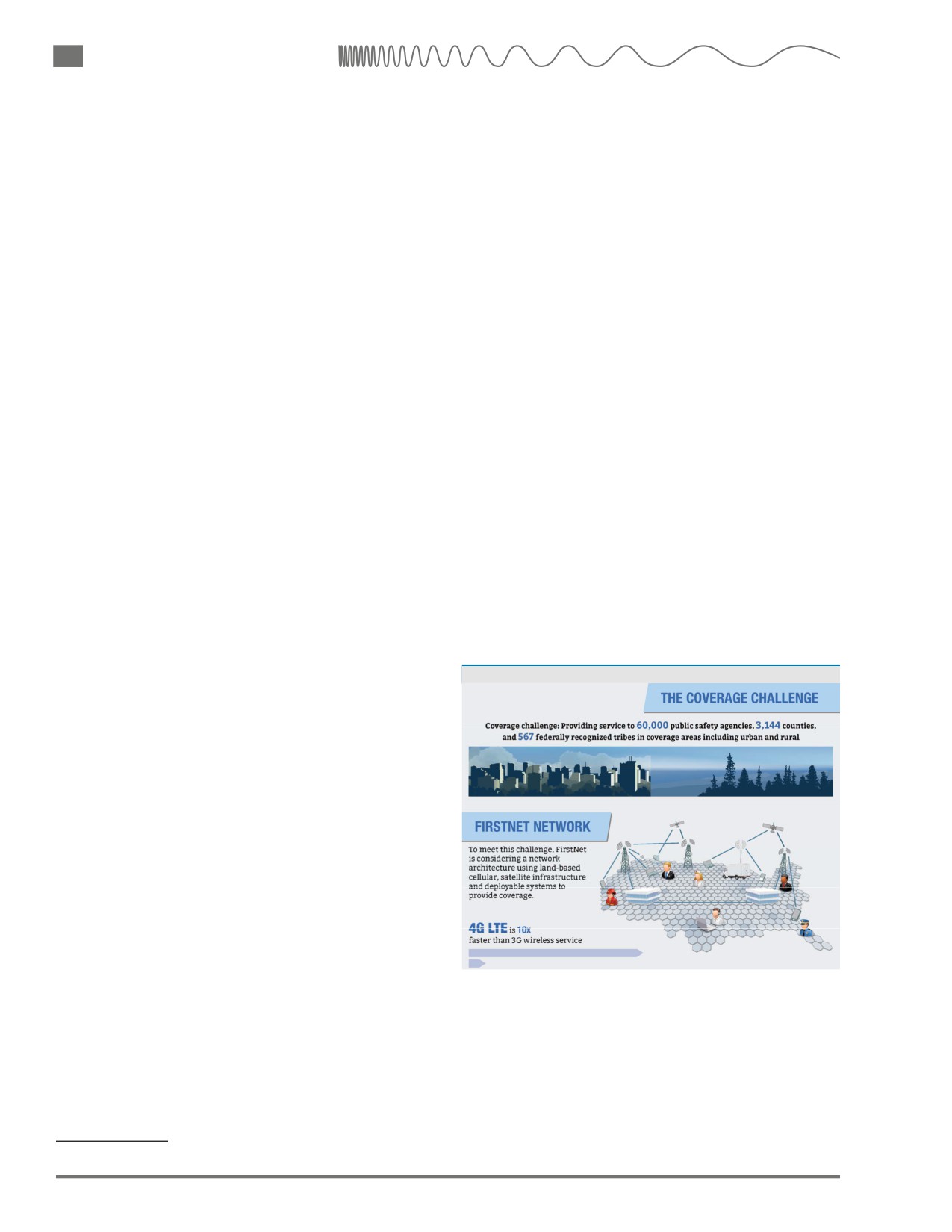
these high-traffic periods (Figure 10.4). This was
as the last remaining recommendation of the
documented during the Boston Marathon Bombing
9/11 Commission.
(April 2013) and the Virginia earthquake (August
FirstNet is a data system being developed to meet
2011). In both incidents, the cell systems were unable
the needs of first responders. It is envisioned as a
to handle the intense demand for services. FirstNet
4G LTE system for public safety designed to be:
will move public safety off the commercial systems
and be designed to handle public safety traffic during
• Competitively priced.
similar events or incidents.
• Highly survivable and accessible.
• Secure.
Figure 10.4. The Coverage Challenge
• Public safety focused. Provide public safety
functionalities, such as Mission Critical Voice.
Cost
FirstNet has been allocated $7 billion for the build-
out of the system. Telecommunications experts have
differing opinions on the approach FirstNet will take
to deploy the system, which will impact the system
cost. While $7 billion is a large sum of money, it is
a fraction of the cost that commercial carriers have
invested in infrastructure. FirstNet is working with
each state to develop requirements, inventory and
available resources to share and identify the state
stakeholder groups. FirstNet hopes to use sharing
A component of accessibility is system coverage.
agreements to help contain build-out costs.
The system is required to cover all population
FirstNet, like the commercial providers, will be
centers as well as rural and wilderness areas.
a subscriber-based system. Public safety is not
System design will include fixed infrastructure
mandated to move data transport to FirstNet.
and deployable infrastructure to achieve the
FirstNet will be in direct competition with the
coverage goals. Options to achieve the coverage
FirstNet
87
Section 10 |
goals also include possible spectrum sharing with
like the commercial systems today. We all realize
commercial carriers, but no specifics will be
that if we do not have system coverage, we do not
available until the system design is completed.
have connectivity. Off-network communications
is mandatory in the fire service application. If the
Survivability
system does not cover the interior of all buildings,
which is a certainty, then off-network capability
Being a public safety system, FirstNet is being
is required to maintain communications with
designed to survive extreme weather and seismic
all personnel on the fireground. The reason we
events. Public safety radio systems are expected to
use LMR systems is that they, in general, provide
be operable when these events happen to maintain
communications where commercial networks do
the ability to respond to the needs of the public.
not. For FirstNet Mission Critical Voice to replace
This equates to building the infrastructure to public
LMR systems, it must either provide coverage
safety standards that require redundant power
everywhere or provide an off-network capability
sources, hardened sites, towers that will survive
that would allow units to communicate directly
extreme weather, and back haul connections that
without infrastructure.
will remain intact. The NPSTC recently released a
document “Defining Public Safety Grade Systems
The primary application for FirstNet is data
and Facilities”44 that describes the Public Safety
transmission and Internet access. FirstNet could
Grade. The document covers physical properties
replace commercially provided data access needed
of the radio sites, antenna masts, connectivity
for mobile computing used in CAD systems.
requirements, redundant power sources, and many
Another application might be the data connectivity
others. The document is a good reference for
needed for fire station alerting.
building voice radio systems sites as well.
Possible Fire Service Uses
Security
• Data connectivity for mobile computing/CAD.
In this age of computer hacking, denial of service
• Hot spot for vehicles.
attacks, and data breeches, security is a key element
• Electronic patient care reporting.
of FirstNet. The system is being designed to provide
• Application based.
data service for the law enforcement community
--
CAD.
as well as many other disciplines that have data
--
Hand-held dispatch.
security requirements. FirstNet is envisioned as
--
Accountability and location.
a secure wireless data network with the security
--
Monitoring.
needed to allow transport of sensitive information.
-–
EMS.
The elements of security are being developed but
--
Protocols.
will be in place when FirstNet is deployed.
--
Drug doses.
--
Pharmacological ID.
Public Safety Focus
--
Fire.
Mission Critical Voice is a capability that is
--
Accountability and location of
under development. Mission Critical Voice was
personnel.
presented as a replacement for LMR systems. This
--
Reference material (Emergency
is a capability that is being worked on and is not
Response Guidebook, SOPs).
currently available. There are no definite dates
--
Extrication (where to cut vehicles).
for completion, and FirstNet has not been built.
When smartphones entered the market, the
Based on these two factors, it is recommended to
number of applications was small when compared
maintain current LMR systems until FirstNet and
to present. Like the explosion of applications in the
Mission Critical Voice are deployed. A component
private sector, a similar explosion will occur when
of Mission Critical Voice to be watchful for is
public safety embraces this technology platform
off-network capabilities. FirstNet will operate a lot
(Figure 10.5).
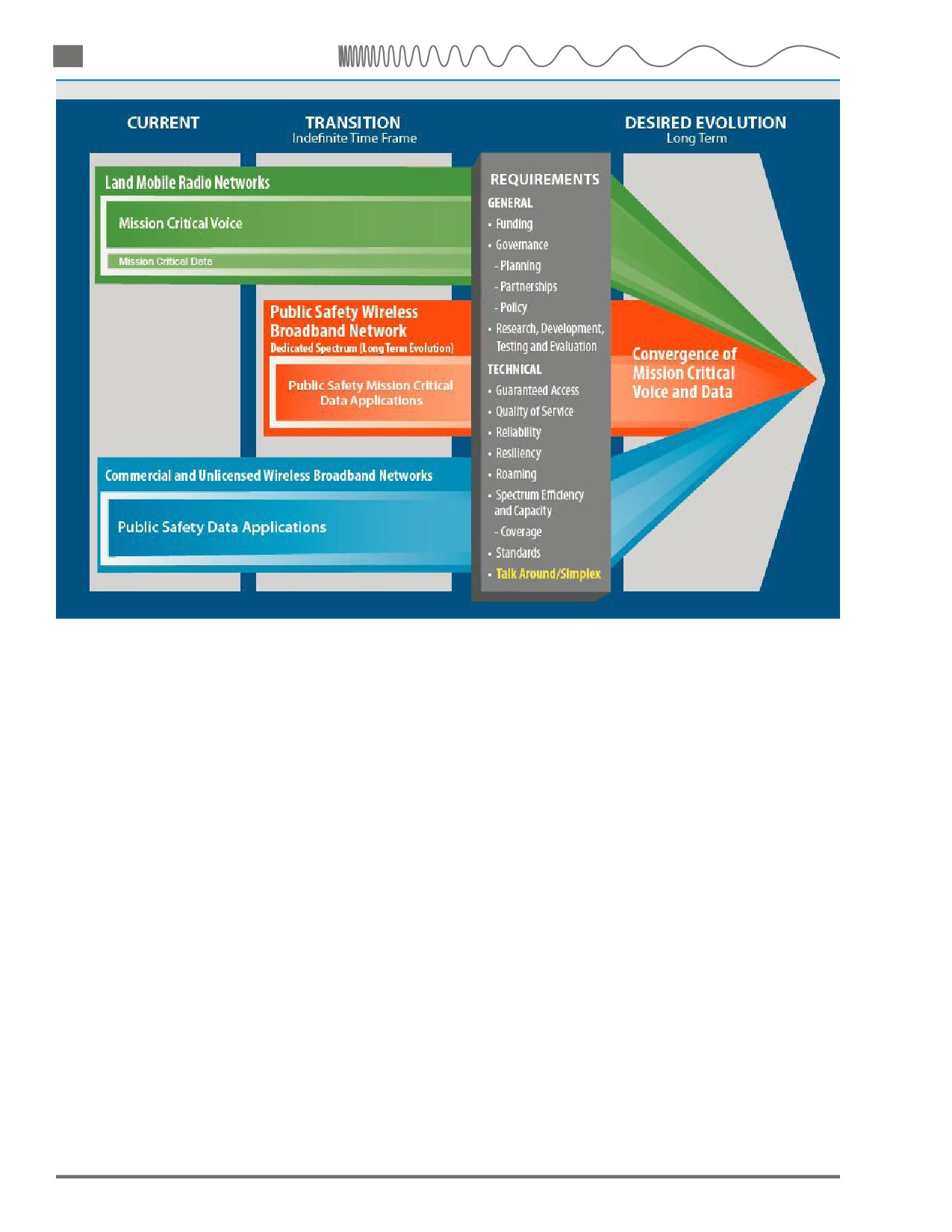
Voice Radio Communications Guide
88
for the Fire Service
Figure 10.5. Public Safety Communications Evolution
Public Safety Communications Evolution, May 2014, Department of Homeland Security, SAFECOM
Long term, it is envisioned that FirstNet will provide
FirstNet in the future may provide a single
a technology convergence in the future. This
interoperable platform for emergency and daily
concept would merge current data transport and
public safety communications. The FirstNet
LMR functions into the FirstNet technology platform
network will fulfill a fundamental data transport
as depicted in Figure 10.5. The convergence of
need of the public safety community as well as
technology is possible, but the fire service will
the last remaining recommendation of the 9/11
need to validate and verify that the systems being
Commission.
proposed provide the capabilities needed to operate
in the firefighting environment. We also need to
FirstNet is a data system being developed to meet
require capabilities that provide the safety margins
the needs of first responders. It is envisioned as a
required to operate safely on the fireground.
4G LTE system for public safety designed to be:
Ruggedized devices must also be available to
• Competitively priced.
withstand the rigors of the firefighting environment.
• Highly survivable and accessible.
Summary — FirstNet
• Secure.
• Public safety focused. Provide public safety
Signed into law on Feb. 22, 2012, the Middle Class
functionalities.
Tax Relief and Job Creation Act created FirstNet.
• Mission Critical Voice: Off-network
The law gives FirstNet the mission to build, operate
communications capability is mandatory.
and maintain the first high-speed, nationwide
FirstNet has stated that Mission Critical Voice,
wireless broadband network dedicated to public
which is most important to the fire service,
safety. FirstNet was allocated 20 MHz of frequency
will be one of the last elements to be brought
spectrum in the 700 MHz band to manage for
on line.
deployment of the Radio Access Network that is
part of the FirstNet system.
FirstNet
89
Section 10 |
FirstNet is being designed to provide data access
Long term, it is envisioned that FirstNet will
for public safety in times of emergency anywhere
provide a technology convergence in the future.
in the U.S. or U.S. territories. In recent history,
This concept would merge current data transport
the commercial systems have failed to provide
and LMR functions into the FirstNet technology
connectivity when overwhelmed by spikes in usage
platform. Maintaining current LMR systems is
from the general public.
necessary until FirstNet technology is deployed,
tested, and proven reliable in the fire service
FirstNet is being designed to survive extreme
environment and equivalent coverage needed by
weather and seismic events. Public safety radio
the fire service is attained. As of the development
systems are expected to be operable when these
of this report, FirstNet has not yet made decisions
events happen to maintain the ability to respond
on the actual design of either the broadband
to the needs of the public. FirstNet is also being
network or the costs public safety agencies will
designed with security features that will meet
incur for its use.
the needs of the fire service and more stringent
requirements of law enforcement.
The primary application for FirstNet is data
transmission and Internet access. FirstNet could
replace commercially provided data access needed
for mobile computing used in CAD systems.
Voice Radio Communications Guide
90
for the Fire Service
This page intentionally left blank.
Glossary
91
Glossary
Analog FM Radio: operates by causing the transmitting frequency of the radio to change directly with the
microphone audio. The transmitter frequency variations are proportional to the amplitude of the input audio.
Association of Public Safety Communications Officers (APCO): serves the needs of public safety
communications practitioners worldwide and the welfare of the general public as a whole by providing
complete expertise, professional development, technical assistance, advocacy and outreach.
Atmospheric Ducting: a horizontal layer in the lower atmosphere in which the vertical refractive index
gradients are such that radio signals are guided or ducted and tend to follow the curvature of the Earth.
Base Station Radio: located at fixed locations and usually powered by AC utility power.
Bidirectional Amplifier (BDA): used to extend radio coverage within structures to the outside of structures.
Channel Bandwidth: the amount of radio spectrum used by the signal transmitted by a radio.
Continuous Tone-Coded Squelch System (CTCSS): mixes a subaudible tone with the audio from the
microphone and transmits the resulting signal. When a radio receives a signal with tone-coded squelch,
the CTCSS decoder attempts to match the tone present in the received signal with the desired tone. If the
correct tone is present, the receiver is unsquelched and audio is routed to the speaker.
Decibel: a logarithmic unit used to express the ratio between two values of a physical quantity, often
power or intensity.
Directional (Yagi) Antenna: an antenna that radiates or receives greater power in one direction allowing
for increased performance and reduced interference from unwanted sources.
Direct Radio System: When the signal is received from the radio initially transmitting the signal, the
communication is direct. (That is, there is no intervening radio or system.)
Downtilt Antenna: directional antenna tilted to increase energy immediately below the antenna while
reducing the maximum distance the signal will travel.
Dynamic Regrouping: allows an authorized system administrator to assign a radio or radios to a specific
talkgroup remotely.
Emergency Alarm: When a user presses the emergency button on the portable, an emergency message is
sent to any dispatchers using radio consoles.
Emergency Call: a call that is initiated by an “emergency alarm” activation. The “emergency call” is a
high-priority voice transmission in the trunked system. The emergency call elevates the talkgroup to a high
priority to ensure communications with the initiator of the call.
Federal Communications Commission (FCC): a federal governmental board charged with regulating
broadcasting and interstate communication by wire, radio and television.
Feedback: when radios operating in close proximity receive the transmitted signals from the receiving
radios nearby. This creates a loop effect and introduces unwanted interference in the communications
system. This is very common when operating on direct/simplex channels when the transmit and receive
frequency is the same.
Voice Radio Communications Guide
92
for the Fire Service
First Responder Network Authority (FirstNet): an independent federal government authority tasked with
cost-effectively creating a nationwide broadband data network and providing wireless services to public
safety agencies across the country. FirstNet is an independent authority within the U.S. Department of
Commerce’s NTIA.
Fixed-Site Antenna: antennas mounted on towers or buildings to provide the dispatch to or repeater
coverage throughout the service area.
Frequency Coordination: a technical and regulatory process that is intended to remove or mitigate RF
interference between different radio systems that use the same operational frequency.
Half-Duplex Communication: uses two RFs for communication. The transmitting radio transmits on
Frequency 1, and that signal is received by the repeater. The repeater then repeats the transmission on
Frequency 2, and this signal is received by the receiving radio.
IAFF Fire Ground Survival (FGS) Program: The purpose of the FGS program is to ensure that training for
mayday prevention and mayday operations are consistent between all firefighters, COs and chief officers.
Institute of Electrical and Electronics Engineers (IEEE): promotes the engineering process of creating,
developing, integrating, sharing and applying knowledge about electro- and information technologies.
Interference: unwanted RF signals disrupt the use of your radio.
Intermodulation: frequency variation of two or more electromagnetic waves transmitted simultaneously
through a nonlinear electronic system.
International Electrotechnical Commission (IEC) Standards Ingress Protection (IP) Codes: IP codes are
international standards that test for IP into an electrical enclosure.
International Municipal Signal Association (IMSA): designated as the frequency coordinator for all
public safety agencies.
Interoperability: the ability of public safety responders to share information via voice and data
communications systems on demand, in real time, when needed, and as authorized.
Land Mobile Radio (LMR): wireless communications system intended for use by users in vehicles
(mobiles) or on foot (portables).
Military Standard 810 (MIL-STD): a standard for reliability and ruggedness, developed by the military, to
provide an environmental test protocol that would prove qualified equipment would survive in the field.
Mobile Radio: Mobile radios are designed to be mounted in vehicles and get their power from the
vehicles’ electrical system. Generally, these radios have better antennas, receivers and provide higher power
when transmitting from a vehicle.
Modulation: Modulation is the process of varying a higher frequency carrier wave to transmit information.
Multigroup Call: a call that transmits to two or more talkgroups simultaneously.
Narrowbanding: an effort to ensure more efficient use of the VHF and UHF spectrum by requiring all
VHF and UHF public safety and Industrial/Business LMR systems to migrate to at least 12.5 kHz efficiency
technology by Jan. 1, 2013.
National Association of State Telecommunications Directors (NASTD): a member-driven organization
whose purpose is to advance and promote the effective use of information technology and services to
improve the operation of state government.
Glossary
93
National Fire Protection Association (NFPA): a U.S. trade association, albeit with some international
members, that creates and maintains private, copyrighted, standards and codes for usage and adoption by
local governments.
National Institute of Standards and Technology (NIST): the federal technology agency that works with
industry to develop and apply technology, measurements and standards.
National Public Safety Telecommunications Council (NPSTC): a volunteer federation of 15 public safety
organizations, whose mission is to improve public safety communications and interoperability through
collaborative leadership. NPSTC’s members are the organizations representing fire, EMS, law enforcement,
transportation, and other telecommunications organizations (http://www.npstc.org/).
National Telecommunications and Information Administration (NTIA): executive branch agency that is
principally responsible by law for advising the president on telecommunications and information policies.
NTIA is responsible for federal frequency coordination.
NFPA 1221: Standard for the Installation, Maintenance, and Use of Emergency Services Communications Systems.
NFPA 1561: Standard on Emergency Services Incident Management System and Command Safety.
NFPA 1802: Standard on Personal Portable (Hand-Held) Two-Way Radio Communications Devices for Use by Emergency Services
Personnel in the Hazard Zone.
NIST Technical Note 1477: Testing of Portable Radios in a Firefighting Environment.
NIST Technical Note 1850: Performance of Portable Radios Exposed to Elevated Temperatures.
Office of Emergency Communications (OEC): supports and promotes communications used by
emergency responders and government officials to keep America safe, secure and resilient. The office leads
the nation’s operable and interoperable public safety and national security and emergency preparedness
communications efforts.
Omnidirectional Antenna: a class of antenna that radiates radio wave power uniformly in all directions
in one plane.
Over the Air Programming (OTAP): allows system administrators to program radios over the air.
Over the Air Rekeying (OTAR): allows system administrators to rekey encryption codes over the air.
Personal Alert Safety System (PASS): monitors an emergency responder’s motion and automatically emits
an audible signal to summon aid in the event that the user becomes incapacitated or needs assistance.
Portable Radio: hand-held radios powered by rechargeable, replaceable battery packs.
Private Call: allows one radio to call another radio and to carry on a conversation without any other radios
hearing the conversation.
Project 25 (P25): a suite of standards for digital radio communications for use by federal, state/province,
and local public safety agencies in North America to enable them to communicate with other agencies and
mutual-aid response teams in emergencies.
Radio Alerting: feature that allows radios to be alerted to notify the user of incoming traffic.
Radio Console Equipment: used by dispatchers to control base station radios and repeaters and allow the
dispatcher to receive and transmit on one or more radios simultaneously.
Voice Radio Communications Guide
94
for the Fire Service
Radio Frequency (RF): any frequency within the electromagnetic spectrum associated with radio
wave propagation.
Radio Spectrum: the range of electromagnetic frequencies used in radio transmission, lying between 10
kHz and 300,000 MHz.
Receiver Desensitization Interference/Receiver Overload: caused by nearby high-level transmitter
signals that overload the initial parts of the radio’s signals.
Receiver Multi-Coupler: a device for connecting several receivers or transmitters to one antenna in such a
way that the equipment impedances are properly matched to the antenna impedance.
Receiver Voters: compares the audio from all receivers and routes the audio from the receiver with the
best audio quality to the dispatcher.
Remote Speaker Microphone (RSM): a corded radio accessory that has a speaker/microphone
combination that can attach closer to the user’s mouth.
Repeated Radio System: the portable transmit frequency is received by the repeater and retransmitted on
the portable receive frequency at a higher power to extend range or increase penetration.
Repeater Duplexer: a tuned electronic device that permits the use of the same antenna for transmitting
and receiving.
Request for Proposal (RFP): a solicitation, often made through a bidding process, by an agency or
company interested in procurement of a commodity, service or valuable asset to potential suppliers to
submit business proposals.
SAFECOM: mission is to improve designated emergency response providers’ interjurisdictional and
interdisciplinary emergency communications interoperability through collaboration with emergency
responders across federal, state, local, tribal, and territorial governments, and international borders.
Selective Disabling: allows radios to be remotely disabled if lost or stolen.
Short Message Service (SMS): Since the radios are digital, many trunked systems support sending short
messages across the network.
Simplex Communication: when one radio transmits and the other radio receives on the same RF channel.
Simulcast Transmitter Systems: multiple transmitters simultaneously transmit on the same frequency to
increase the coverage footprint or provide in-building penetration.
Simultaneous Transmissions: multiple users trying to talk at the same time causing communications
interference.
Squelch Circuit: used to mute the output of the radio receiver when no desirable signal is present and
unmute when a signal of the appropriate strength is present.
Talk-Around System: a radio accessory that attaches to the SCBA facepiece, may offer multiple talk-around
channels that allow users to talk with each other in the hazard zone.
Talkgroup: equivalent of a channel on a conventional system. In a trunked system, there may be
more talkgroups than RF channels. The design is based on the probability that not all channels are
required simultaneously.
Glossary
95
Telecommunications Industry Association (TIA): represents manufacturers and suppliers of global
communications networks through standards development, policy and advocacy, business opportunities,
market intelligence, and events and networking.
Telephone Interconnect: allows users to answer or make calls to telephone users from the radio.
Terrain Blocking: materials such as metal and earth completely block radio waves due to their
composition and density. Radio waves can travel through some materials such as glass or thin wood but
the strength is reduced.
Time Division Multiple Access (TDMA): a channel access method for trunked radio systems. It allows
several users to share the same frequency channel by dividing the signal into the different time slots.
Transmitter Combiner: allows multiple transmitters to connect to a single antenna.
Trunked Radio Systems: trunking borrows technologic concepts from telephone systems to assign RFs to
active calls, improving the spectrum efficiency.
Ultra High Frequency (UHF): designation for the range of RFs in the range between 300 MHz and
3 gigahertz.
Vehicular Repeater: a repeater that is mounted in a vehicle and is often used to enhance system coverage.
This can be to provide more range or in-building penetration.
Very High Frequency (VHF): designation for the range of RFs in the range between 30 MHz to 300 MHz.
Vocoder/Codec: the algorithm and electronic components that perform the function of converting analog
voice to a digital data packet and also provide the decoding of the signal as well.
Voice Amplifier: a PPE accessory that attaches to the SCBA facepiece and amplifies the user’s voice.
Wavelength: the distance between the crests of an electromagnetic wave. Wavelength is a factor in
determining antenna length.
Voice Radio Communications Guide
96
for the Fire Service
This page intentionally left blank.
Acronyms
97
Acronyms
AASHTO
American Association of State Highway
FEMA
Federal Emergency Management
and Transportation Officials
Agency
AHJ
authority having jurisdiction
FGS
Fire Ground Survival
ANSI
American National Standards Institute
FirstNet
First Responder Network Authority
APCO
Association of Public Safety
FM
frequency modulation
Communications Officers
FPIC
Federal Partnership for Interoperable
BDA
bidirectional amplifier
Communications
BID
Bidder Information Document
FRG
First Responders Group
CAD
computer-aided dispatch
gpm
gallons per minute
CDMA
code division multiple access
GPS
Global Positioning System
CFLs
compact fluorescent lights
HIPAA
Heath Insurance Portability and
Accountability Act
CFR
Code of Federal Regulations
HSGP
Homeland Security Grant Program
CG
Channel GuardTM
Hz
hertz
cm
centimeter
IAFC
International Association of Fire Chiefs
CO
Company Officer
IAFF
International Association of Fire
COML
Communications Unit Leader
Fighters
COMT
Communications Technician
I/B
industrial/business (radio service pool)
CTCSS
Continuous Tone-Coded Squelch
IC
Incident Commander
System
ICT
information and communications
DAS
Distributed Antenna System
technology
dB
decibel
ID
identification
DCS
Digital-Coded Squelch
IDLH
immediately dangerous to life and
health
DHS
U.S. Department of Homeland Security
IEC
International Electrotechnical
DVSI
Digital Voice System Inc.
Commission
EMS
Emergency Medical Services
IEEE
Institute of Electrical and Electronics
ERU
Emergency Response Unit
Engineers
ESMR
Enhanced Specialized Mobile Radio
IFC
International Fire Code
FCC
Federal Communications Commission
IFSTA
International Fire Service Training
Association
FCCA
Forestry Conservation Communications
Association
IMSA
International Municipal Signal
Association
FDMA
frequency division multiple access
Voice Radio Communications Guide
98
for the Fire Service
INCM
Incident Communications Manager
OTAP
over the air programming
IP
Ingress Protection
OTAR
over the air rekeying
kHz
kilohertz
PASS
Personal Alert Safety System
LCD
liquid-crystal display
PL
Private LineTM
LED
light-emitting diode
PPE
personal protective equipment
LMRs
Land Mobile Radios
PS
public safety (radio service pool)
LODD
line-of-duty death
PSAC
Public Safety Advisory Committee
LTE
Long Term Evolution
PSHSB
Public Safety and Homeland Security
Bureau
MHZ
megahertz
PSST
Public Safety Spectrum Trust
MIL-STD
Military Standards
PSWAC
Public Safety Wireless Advisory
NASTD
National Association of State
Committee
Telecommunications Directors
PTT
push-to-talk
NFPA
National Fire Protection Association
RADO
Radio Operator
NIFC
National Interagency Fire Center
R&O
Reports and Orders
NIFOG
National Interoperability Field
Operations Guide
RF
radio frequency
NIMS-ICS National Incident Management System
RFI
request for information
Incident Command System
RFP
request for proposal
NIST
National Institute of Standards and
RPC
Regional Planning Committee
Technology
rpm
revolutions per minute
NOI
Notice of Inquiry
RSMs
remote speaker microphones
NPRM
Notice of Proposed Rulemaking
RVS
receiver voter system
NPSBN
National Public Safety Broadband
Network
SCBA
self-contained breathing apparatus
NPSPAC
National Public Safety Planning
SCIPs
Statewide Communications
Advisory Committee
Interoperability Plans
NPSTC
National Public Safety
SIEC
State Interoperability Executive
Telecommunications Council
Committee
NTIA
National Telecommunications and
SMR
Specialized Mobile Radio
Information Administration
SOPs
standard operating procedures
ODP
Office for Domestic Preparedness
SWIC
Statewide Interoperability Coordinator
OEC
Office of Emergency Communications
TA
Transition Administrator
OSM
Office of Spectrum Management
TDMA
time division multiple access
Acronyms
99
TIA
Telecommunications Industry
USFA
U.S. Fire Administration
Association
VHF
very high frequency
TICs
thermal imaging cameras
VoLTE
Voice over LTE
UASI
Urban Areas Security Initiative
VR
vehicular repeater
UHF
ultra high frequency
Wi-Fi
wireless fidelity
ULS
Universal Licensing System
WMD weapons of mass destruction
USDA U.S. Department of Agriculture