Voice Radio Communications Guide for the Fire Service (June 2016) - part 2
Conventional
31
Section 4 |
Radio Systems
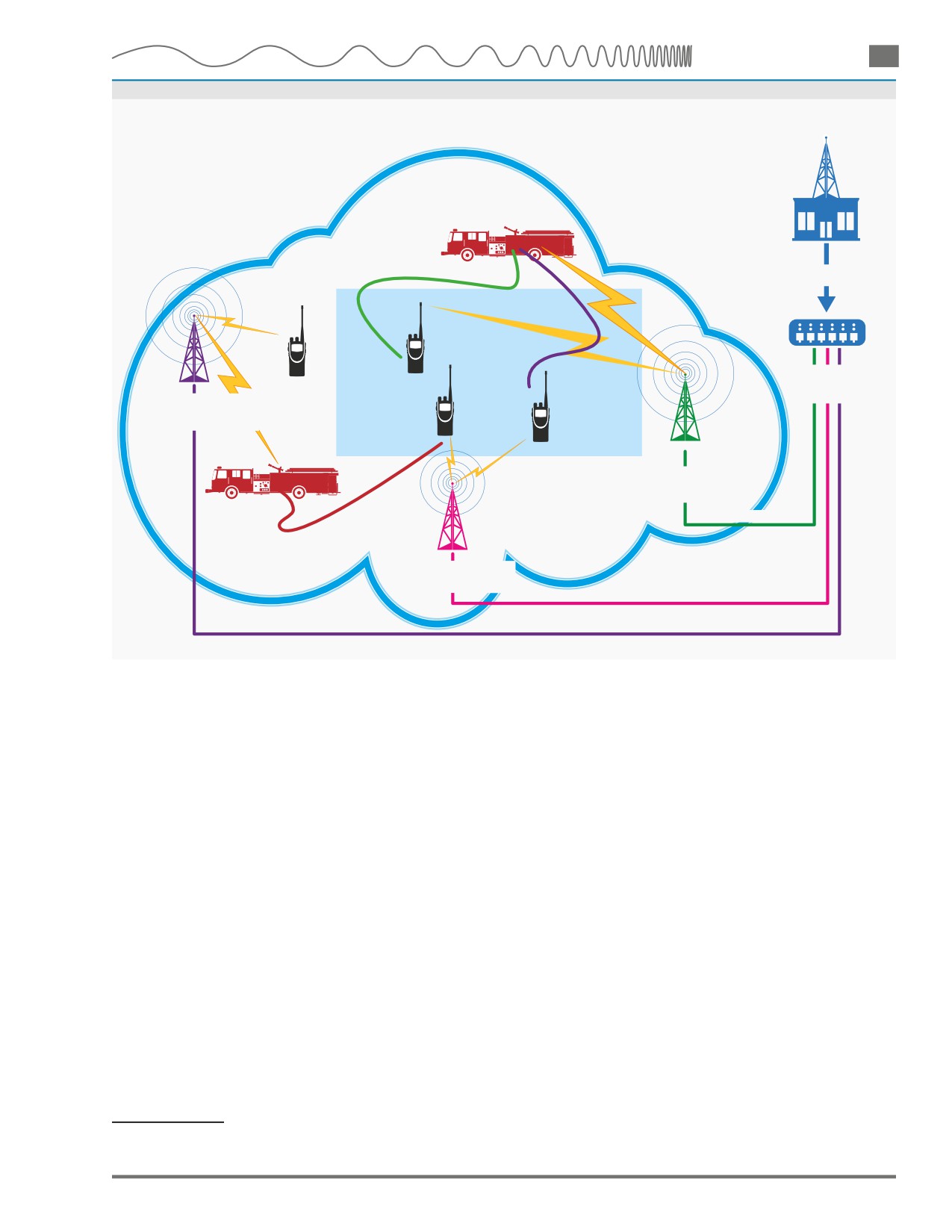
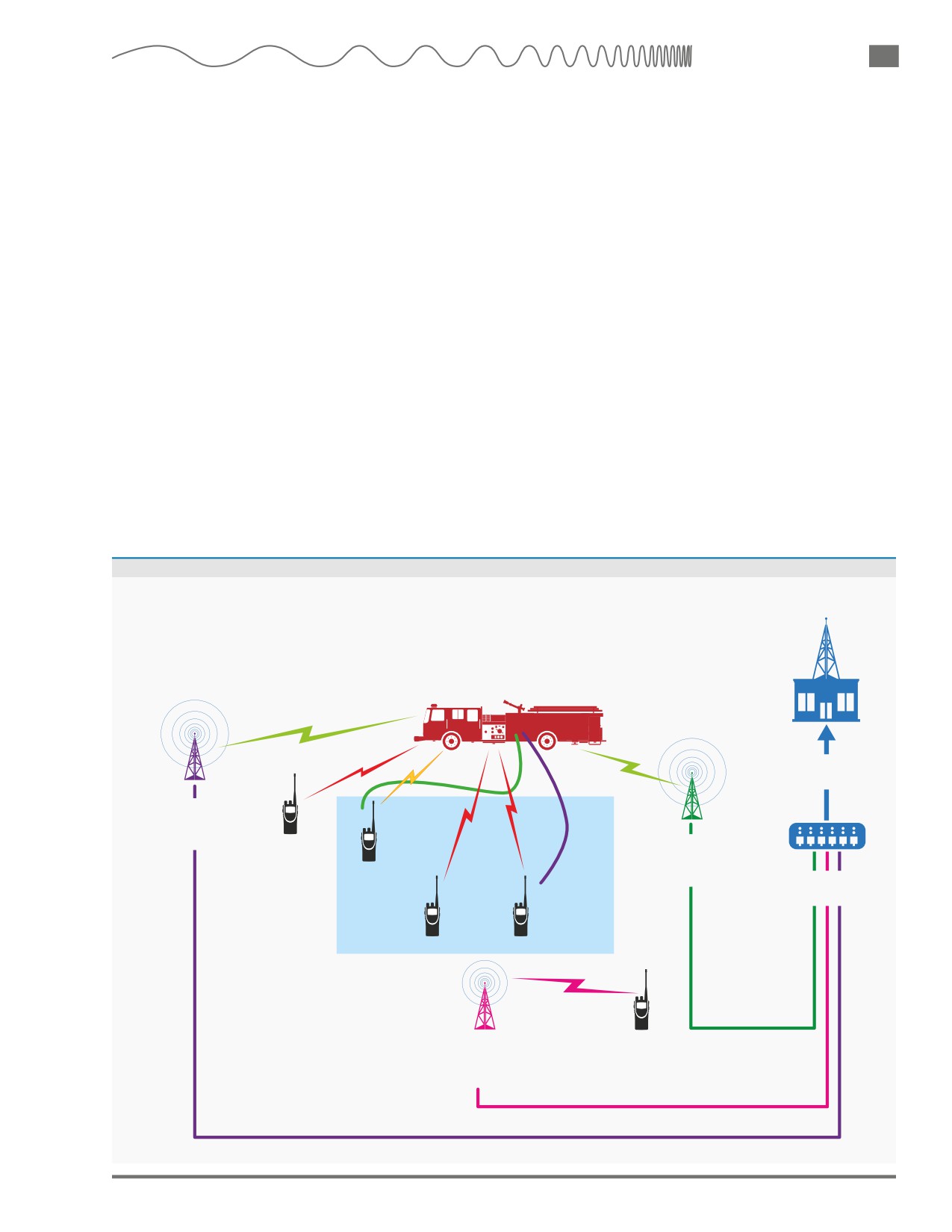
Figure 4.6. Simulcast — Dispatch Center Transmit — Fireground Communications
Dispatch Center
Pump 1
Receives
from Site 3
Transmit Audio
E-1
Receives
from Site 3
Control
E-4
Equipment
Transmit/Receive Receives
E-3
E-2
from Site 1
Receives
Receives
from Site 2
from Site 2
Transmit/Receive
Site 3
Pump 3
Site 3 Transmit Audio
Receives
from Site 1
Transmit/Receive
Site 2
Site 2 Transmit Audio
Site 1 Transmit Audio
Alerting
minutes depending on delays in the commercial
data service. If the commercial data system is
Many users of conventional analog systems use
congested during a disaster, the delays may be
paging as a method of alerting personnel or
significant. Data and phone congestion were
fire stations of an incident or other important
identified as a weakness in the Boston Bombing19
information. In an analog system, the use of
and the Virginia earthquake.20
two-tone paging accomplishes this. This feature
has proven to be a low cost method of alerting
Summary — Conventional Radio Systems
for professional and volunteer firefighters.
There are a wide variety of radio systems in
Unfortunately, digital radio systems cannot pass
use today. There are simple systems that use a
the tones required for two-tone alerting. The use
conventional analog repeater to trunked systems
of commercial paging services may be required
that employ the latest technologies.
to provide paging services in digital or trunked
systems. Recently, companies are providing
Direct Communications
applications for smartphones that provide the ability
Radios using direct communications are not
to notify smartphone users using commercial data
dependent on infrastructure to communicate
services, if the users’ dispatch system feeds the
to other units on the fireground. Direct
application with the required data. You must be
communications are limited in range, so they are
aware that these notifications may not happen in
commonly used as fireground tactical channels.
real time and may be delayed by a few seconds to
20 August 2011, http://www.pcmag.com/article2/0,2817,2391635,00.asptrunked-radio-system-problems/.
Voice Radio Communications Guide
32
for the Fire Service
Using simplex communications maintains positive
Simulcast
communications between the IC, exterior on-scene
Simulcast systems are employed when trying to
units, and interior units without the reliance
cover a large service area. Simulcasting allows the
on exterior communications systems. There are
dispatch centers to transmit simultaneously from
limitations in range due to the portable radios
multiple transmitters that cover a larger geographic
having limited power. Awareness on the fireground
area. The advantages of a simulcast system are
is important; if a communication attempt to the
the coverage of a large area, with high signal
IC from the interior is heard and the IC does
levels throughout the area, while using only a
not answer, that might be a cue to relay the
single frequency.
information. Dispatch centers can employ receiver
Alerting
voters and high-powered transmitters to allow
reliable communications with fireground units.
Many users of conventional analog systems use
paging as a method of alerting personnel or
Repeaters
fire stations of an incident or other important
Provide wide area coverage for portable radios.
information. In an analog system, the use of
The portable signal is received and retransmitted
two-tone paging accomplishes this. Unfortunately,
at a higher power to extend the range.
digital radio systems cannot pass the tones required
Communications with repeaters are dependent
for two-tone alerting. The use of commercial
on the repeater as part of the communications
paging services may be required to provide paging
infrastructure. Coverage to the repeater can be
services in digital or trunked systems.
degraded when operating on the interior of a
building. Use of talk-around allows users to use
the output frequency to bypass the repeater. This is
referred to as a talk-around frequency.
Trunked
33
Section 5 |
Radio Systems
SECTION 5 —
Trunked Radio Systems
Trunked radio systems are complex radio systems
units, and a voice communications exchange is
that were developed to improve the efficiency of
known as a call. A basic trunked radio system has
the use of available radio spectrum. In conventional
a system controller that controls the assignment
(nontrunked) radio systems, an RF is dedicated to a
of the repeaters, called voice traffic repeaters, to
single function or workgroup. When the RF is not
individual calls. The radios communicate with the
in use, it cannot be used by another function or
system controller, for example to request the use of
workgroup. Trunking borrows technologic concepts
a voice traffic repeater, by sending data messages
from telephone systems to assign RFs to active calls,
to the system controller on a special dedicated
improving the efficiency of frequency use.
channel called the control channel. The system
controller acknowledges these communications and
Like a conventional repeated radio system, trunked
sends information to the radios using the control
radios communicate with each other through
channel as well. The radios also can communicate
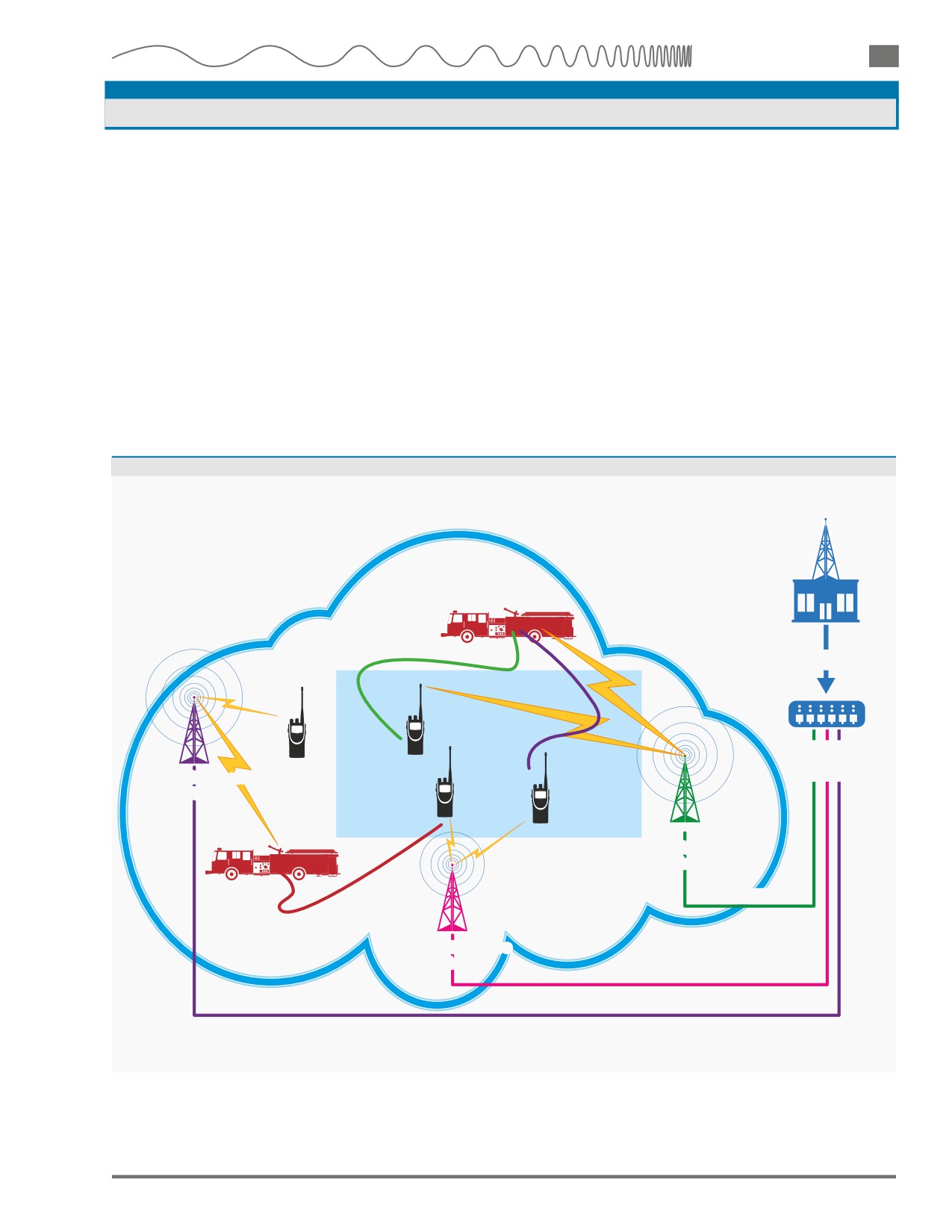
two or more repeaters (Figure 5.1). In a trunked
some information using the voice traffic channels
system, the radios often are known as subscriber
after a call has been terminated.
Figure 5.1. Trunked Radio System — Dispatch Center Transmitting
Dispatch Center
Pump 1
Receives
from Site 3
Transmit Audio
E-1
Receives
from Site 3
Control
Equipment
E-4
Transmit/Receive
Receives
E-3
E-2
Site 1
from Site 1
Receives
Receives
from Site 2
from Site 2
Transmit/Receive
Site 3
Pump 3
Site 3 Transmit Audio
Receives
from Site 1
Transmit/Receive
Site 2
Site 2 Transmit Audio
Site 1 Transmit Audio
Actual frequencies are assigned
dynamically by the control equipment.
Voice Radio Communications Guide
34
for the Fire Service
The voice traffic repeaters are shared among
Any time that the radio is powered on and the user
all users of the system. They also are known as
changes talkgroups, the radio will tell the system
resources. In complex systems that use encryption
the new talkgroup selection, and the system will
and dispatch consoles, other equipment is
confirm the selection. In this way, the system
necessary for the operation of these features, and
tracks the currently selected talkgroup for all radios
they are considered shared resources.
registered on the system.
The radio industry uses the term “talkgroup”
When the radio is switched off by the user, the
to distinguish among physical frequencies or
radio transmits a message to the system controller
channels used in conventional radio systems. This
telling the system to deregister the radio. The radio
terminology often is confusing, since from the
then will wait for an acknowledgment from the
actual radio user’s point of view, a talkgroup and a
system before actually powering off.
conventional channel are the same; they are both
Talkgroup Call
communications paths. The distinction is made by
the technologists to differentiate a physical channel
When a radio user wishes to transmit on a
or frequency from the logical channel or talkgroup.
talkgroup, he or she presses the PTT switch, just
as with a conventional radio. The radio then sends
The system controller and other parts of the
the trunking system a request to transmit, using
trunked radio system maintain a log of all activity
the control channel. The trunking system checks
that occurs in the system, as well as statistical
to see if the requested talkgroup is free and if there
information on the operation of the system. These
are available voice traffic repeaters. If these are true,
system logs can be used in the event of a suspected
then the system assigns a voice traffic repeater to
anomaly in the operation of the system to help
the call and instructs all radios with the talkgroup
determine the cause.
selected to change frequencies to the voice traffic
Basic Trunked Radio Operations
repeater frequency. The system also sends a
message to the requesting radio telling it that it
Radio On/Off — Registration/Deregistration/Talkgroup
may proceed with its transmission. This causes
Affiliation
the user’s radio to play a tone sequence (typically
When a trunked radio is powered on initially, it
three short beeps) to tell the radio user that he
begins operation by telling the system controller
or she may proceed with the transmission. The
that it is active, along with the talkgroup currently
radio’s transmission is received by the voice traffic
selected on the radio, using the control channel. If
repeater and retransmitted to the other radios on
the registration is successful, the radio is registered
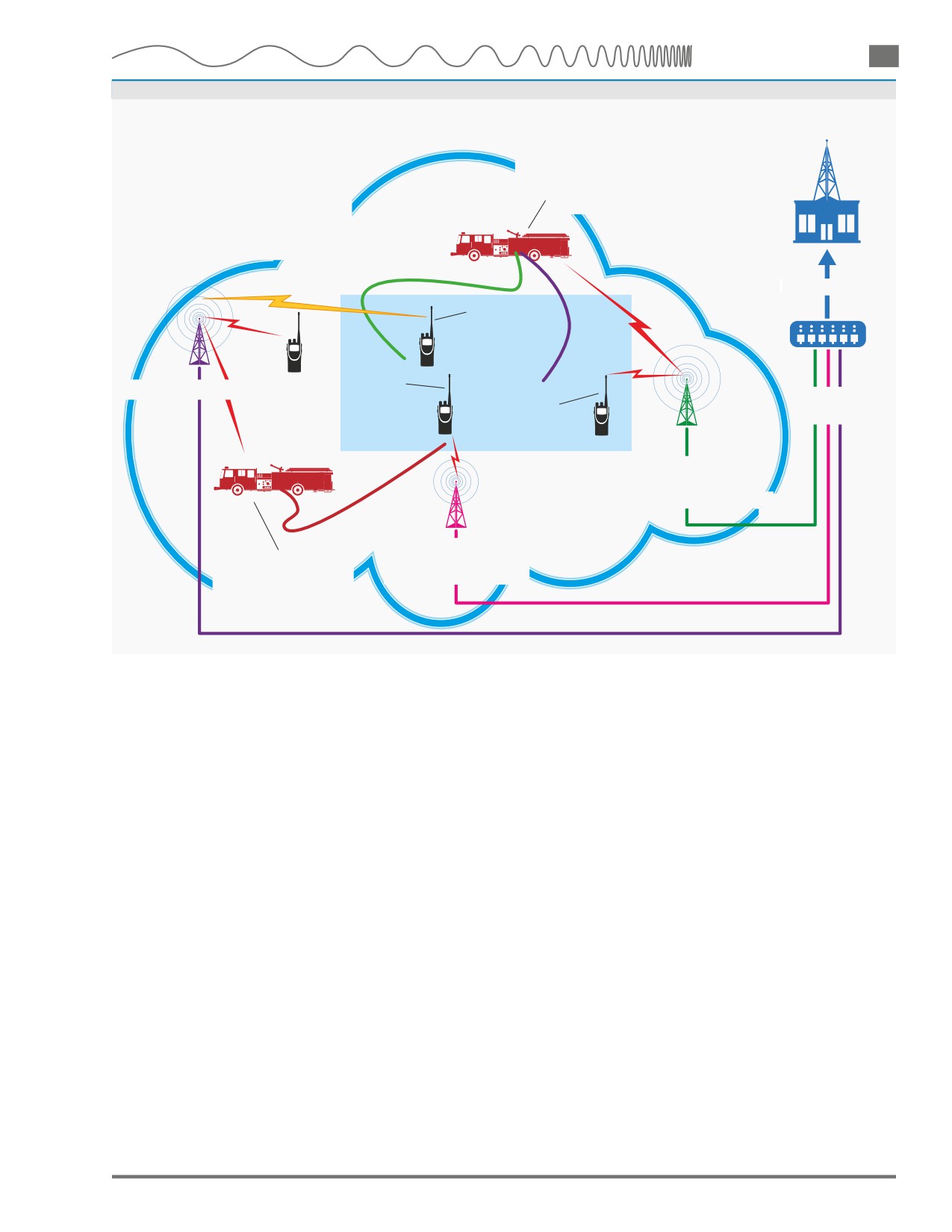
the frequency (Figure 5.2).
on the system and now can receive and transmit; if
the registration is not successful, the radio will not
operate on the system.
Trunked
35
Section 5 |
Radio Systems
Figure 5.2. Trunked Radio System — Portable Radio Transmit — Fireground Communications
Dispatch Center
Actual frequencies are assigned
dynamically by the control equipment:
Pump 1
1. Transmit/Receive Site 1 receives
Receives E-1
E-1 P25 digital message and routes
P25 digital message
E-1 data to system control equipment.
from system
2. System sends P25 digital transmit
message to Site 1.
Receive Audio
E-1
Transmits to
system in
P25 digital
E-4
E-3
E-2
Transmit/Receive Site 1
Receives E-1
Receives E-1
Receives E-1
Control
P25 digital
P25 digital
P25 digital
Equipment
message
message from
message from
from system
system
system
Transmit/Receive Site 3
Transmits E-1 P25 digital
message
Site 3 Transmit
P25 Data
Transmit/Receive Site 2
Pump 3
Transmits E-1 P25 digital
Receives E-1
message
P25 digital message
Site 2 Transmit P25 Data
from system
Site 1 Receive and Transmit P25 Data
If there are no voice traffic repeaters available for
timeout is reached, the system tells all radios on
the call, the system will place the request in a busy
the talkgroup to change channels to the control
queue in order of priority, send a busy message
channel and releases the voice traffic repeater
to the requesting radio, and wait a short time for
for use for other requests. If another request is
resources to become available. If the resources
received before the resources are released, then the
become available, the transmission proceeds. If the
system immediately grants the requesting radio’s
resources do not become available before the wait
transmission request and does not need to tell the
time expires, the system transmits a message to the
other radios to switch frequencies.
requesting radio telling it that the request failed.
Designing a Trunked Radio System
The radio will play a tone (commonly called a
“bonk”) to the user, indicating the failure.
Trunked radio systems are complex combinations
of radio equipment with computer control systems
Call Disconnection
and require skilled engineering to design an
When the transmitting user is finished with
effective system properly. Trunked radio systems
the transmission, he or she will release the PTT
have been in use for over 20 years, and the
switch. This causes the radio to send a message on
manufacturers of these systems are fully capable
the control channel telling the system that it can
of delivering a system that is technically reliable.
release the resources assigned to the transmission.
These systems are designed and manufactured to be
Depending on the configuration of the talkgroup,
as reliable as conventional radio systems. Trunked
the system either waits a few seconds for additional
systems can be deployed in either analog or digital
transmission requests before releasing the resources
technologies, depending on the frequency band
or it releases the resources immediately. Once the
they are deployed on.
Voice Radio Communications Guide
36
for the Fire Service
The design of the overall system, including
the telephone. Proper user education and the
the system’s coverage and capacity, involves
establishment of a formal communications order
considerable effort to produce a communications
model can help prevent unnecessary system load.
system that is effective for the community and
Site capacity is determined by the number of radio
agencies that will use it. The system must have
channels on a site. For instance, a low capacity site
the capacity to accommodate the needs of all of
might have five radio channels. The five-channel
the users of the system and must provide usable
site allows four simultaneous voice calls, and
coverage in all of the agency’s service areas. It
the fifth channel is the control channel (FDMA
is critical to have the end users involved in the
system). A high capacity site in the system could
specification of these parameters.
have 20 channels that would allow 19 simultaneous
Capacity Design
voice calls and one control channel. If four users
being serviced by the low capacity site monitor
The capacity of a trunked radio system is the amount
high volume traffic on four separate talkgroups in
of communications traffic that the system can
the high capacity site, the low capacity site can get
support in a given amount of time. The frequencies
busied out due to the users “dragging traffic” onto
in the trunked radio system are shared among users
the low capacity site. System administrators must
and assigned to conversations, as necessary. If there
work with operational personnel to determine the
are more talkgroups (i.e., channels) than there
number of wide-area talkgroups that are allowed
are frequencies, which is often the case, then the
on the system. Wide-area talkgroups must be
potential exists for calls to be blocked.
used appropriately to minimize busies caused by
dragging unwanted traffic into low capacity sites.
It is most desirable for public safety users to never
Other talkgroups may be restricted to specific sites
have a call blocked, although this never can be
in the system to minimize dragging traffic into
guaranteed in a system with shared frequencies.
unwanted areas. Site restrictions can be done by the
Manufacturers use statistical models to estimate
user or the talkgroup. This gives the administrators
the traffic presented to the trunked radio system.
flexibility in being able to meet the needs of
These models are based on historical traffic
responders and maintaining system performance.
information collected from other customers, along
with predictions of usage based on experience
Coverage Design
with similar agencies. This historical information
may not represent operations in your agency. In
Trunked radio systems that are for firefighting
addition, the traffic information may not represent
operations must be designed to provide radio
peak loading but only average loading. If the system
coverage inside buildings. System manufacturers
is designed and constructed for average loading,
estimate what the system will require in terms of
and performs as designed with average loads, then
radio tower sites and other system components
it may not be able to provide adequate service
to provide coverage on the street. This becomes
when confronted with abnormally high loads.
the base signal reference level and is referred to as
These high loads can occur during natural disasters
zero decibel (dB). In-building coverage levels are
or large-scale incidents such as train derailments,
dictated by the construction of the buildings from
plane crashes, or multialarm fires.
which the users need to communicate. The heavier
the construction, the higher the signal level needed
An important concept is that all users of a trunked
to provide RF penetration into the structure.
radio system affect the system’s performance and
can affect other users. The channels used by the
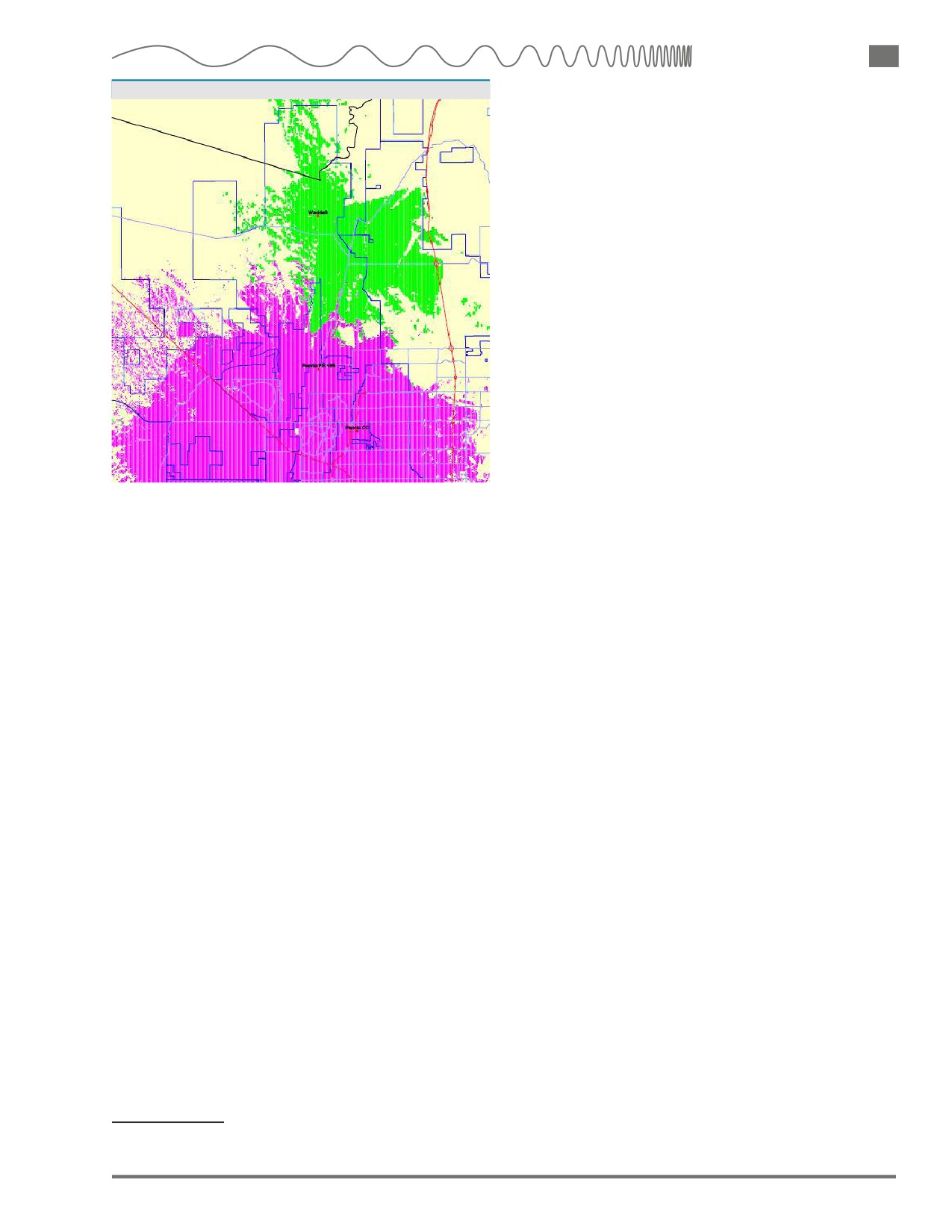
During system design, the service area is analyzed,
system are shared among all users of the system,
and geographic areas are categorized based on the
and like any other shared resource, all users must
structures within them (Figure 5.3). For example,
be aware of their impact on other users and must
the central area of a city may have high-rise
act accordingly. For example, some users may
structures that require the highest penetration
talk excessively and use the trunking system to
signal levels. The area surrounding the high-rise
discuss issues best discussed face to face or on
district may consist of midrise and warehouse
Trunked
37
Section 5 |
Radio Systems
Figure 5.3. Coverage Map
trunked system is very different from a simplex
area. In a trunked system, no coverage means no
communications.
Since trunked radio systems can have several levels
of RF penetration, the users of the system need to
be aware that a particular building type in one area
of the system may have communications, while
the same building in another area may not have
communications.
Coverage Enhancement Devices
The following devices are coverage enhancers
for trunked and conventional systems. The same
theory applies in both trunked and conventional
applications. They receive a weak signal and
retransmit at a level that allows the system to
capture the signal. The coverage enhancement
devices have been placed in this section due
structures requiring less signal level to penetrate
to being discussed in most trunked system
the structure. In suburban areas, even less signal
deployments. Trunked systems commonly use
generally is required to communicate on the
these devices to achieve coverage requirements.
interior of a structure. Areas with the greatest RF
Bidirectional Amplifiers
penetration demand will have a higher number of
radio sites than areas with lesser penetration. When
To overcome system in-building coverage
a building such as a hospital or school is built in a
difficulties, BDAs often are used to rebroadcast the
predominately suburban area, the radio system will
trunked system in buildings (Figure 5.4). BDAs
not provide in-building communications because
also can be used with conventional duplex radio
the area was designed for residential structures.
systems. There are many types of BDAs; all require
Interior radio system coverage is dependent on
electrical power and some type of antenna system.
the ability of the system designer to estimate
The antenna systems are often installed in the
the signal loss accurately for each building type.
plenum spaces of commercial structures. Most BDA
During testing performed by NIST, building
systems include battery backup power to keep them
losses as high as 50 dB were found in a 14-story
operational if a loss of commercial power occurs.
apartment building.21 For reference, a 50 dB loss
BDAs work well for incidents such as Emergency
equals 1/100,000th of the transmitted signal. The
Medical Services (EMS) calls and law enforcement
actual RF losses encountered are often much higher
incidents where there is no fire involvement in
than the standard recommendations that system
the building or building systems. In a structure
manufacturers use. This can result in marginal
with active fire, the building and building systems
in-building communications in many structures.
are affected directly. The building environment
System manufacturers and designers will never
changes with the introduction of fire. Temperatures
guarantee, and it is impractical to expect, 100
rise, and particulate matter is suspended in the
percent coverage. It is impossible to guarantee
atmosphere. Firefighter actions to eliminate the
100 percent coverage in any city. There is always
fire can also have a detrimental effect on BDA
some corner of a building that a radio system does
systems. As water is applied to the fire, steam is
not cover. The problem with no coverage from a
generated that may have an effect on electronic
21 Radio Propagation Measurements during a Building Collapse: Applications for First Responders, Conclusions and Discussion
p. 3, Christopher Holloway, Galen Koepke, Dennis Camell, Kate A. Remley and Dylan Williams.
Voice Radio Communications Guide
38
for the Fire Service
equipment. Acids are formed when moisture mixes
square footage by some percentage of the original,
with suspended materials. These acids can cause
or in all-new construction. The 2012 International
intermittent failure of exposed electrical contacts
Fire Code (IFC) requires that “All new buildings
over time. As with all electronics, BDAs are subject
shall have approved radio coverage for emergency
to failure when exposed to high heat and moisture.
responders within the building based upon
Other actions taken during firefighting operations
the existing coverage levels of the public safety
also could destroy the BDA system. Firefighters
communication systems of the jurisdiction at the
checking for extension using pike poles may
exterior of the building.”23 In addition to requiring
inadvertently tear the BDA antenna system down,
radio coverage, IFC, Section 510 specifies technical,
rendering the BDA useless and causing loss of
installation and maintenance requirements for
communications inside the building.
in-building public safety radio coverage systems.
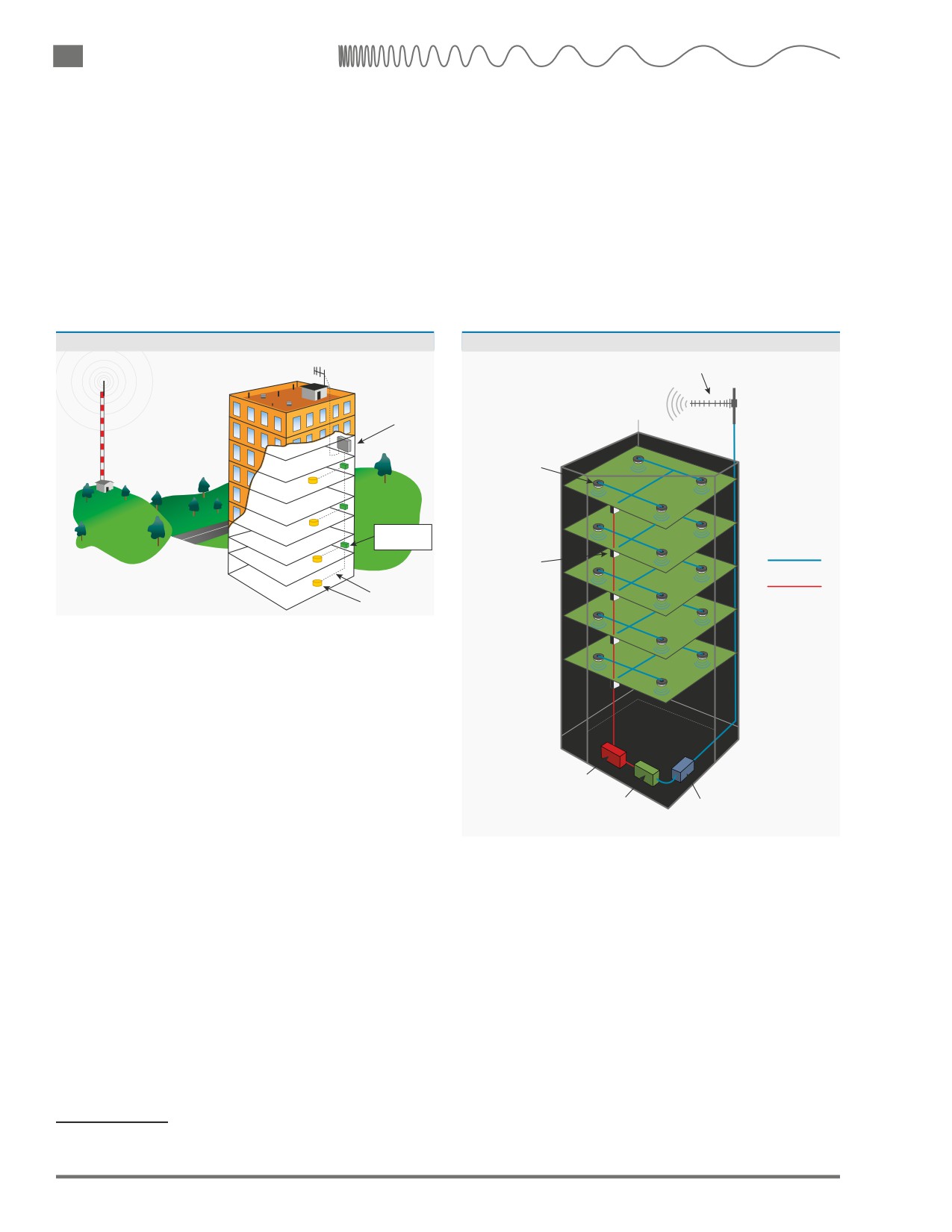
Figure 5.4. In-Building Communications System
Figure 5.5. In-Building Distributed Antenna System
Donor (Roof) ANT
Directional Yagi antenna
BDA
Antenna
Antenna Taps
or Splitters
Fiber distribution
unit (remote)
Low Loss Coaxial Cable
BASIC RF DISTRIBUTION
SYSTEM COMPONENTS
Coax Cables
Fiber Optic Cable
Indoor Antennas
Identifying the buildings that need BDAs and
installation of the equipment is a monumental
task, especially in fast-growing metropolitan areas.
BDAs, like any other transmitters, require periodic
maintenance to keep the equipment operating at
peak performance. To maintain BDAs in a system
requires staffing and technical expertise to keep the
Fiber distribution hub
equipment operating properly. As building density
Service provider
BDA
increases in a given area, a building that did not
head-end
need a BDA when constructed may need one as it
Drawing credit: http://www.l-com.com/what-is-a-distributed-antenna-
is surrounded by new construction. This requires
system-das
periodic RF surveys to determine if new BDAs are
An array of antennas is installed on each floor in
needed. In 2013, the FCC made changes to the Part
some installations of BDAs (Figure 5.5). These
90 rules that require installation by FCC licensees
systems often provide better coverage due to having
and qualified installers. The revision to Part 90
more antennas on each floor to bring the signal
also requires registration of signal boosters. These
in for retransmission or redistribution inside. The
actions were taken to control harmful interference.22
Distributed Antenna System (DAS) approach is
Many municipalities have developed fire codes that
commonly deployed in complex structures, such
require installation of this equipment. The codes
as high-rise buildings or airport terminals. In
often require BDAs when a building exceeds some
Figure 5.5, each floor has a DAS that is connected
square footage value, during additions increasing
by low loss coaxial cable. The coaxial cable is
23 IFC 2012 First Printing, Section 510.
Trunked
39
Section 5 |
Radio Systems
terminated on each floor at a fiber distribution
the repeater, and then retransmitted to the other
unit. Fiber optic cables run between each floor
portable radios on the fireground (Figure 5.6). The
to connect the fiber distribution units. All of the
VR retransmits all radio traffic from the repeater
fiber distribution units are connected to a fiber
(transmit and receive) onto the trunked system
distribution hub. The hub is connected to the RF
talkgroup. Radios that are not in range of the VR are
head-end and to the BDA and then by coaxial
capable of bidirectional communication through the
cable to the exterior antenna. These systems can
wide-area coverage provided by the trunked system.
be very complex, and their survivability in a fire is
In the repeater mode of operation, fireground
dependent on the standards or codes that they are
radios are not communicating directly with
built to.
one another. The radios are dependent on the
Vehicular Repeaters
repeater for communications. If an interior crew
encounters an area where it does not have repeater
Some municipalities have recognized the weaknesses
coverage, it can switch to a talk-around channel to
in BDA systems and have installed vehicular
communicate directly with other interior crews.
repeaters (VRs) on fire apparatus to provide in-
building coverage that is suitable for firefighting
If the unit on talk-around can hear the repeater
operations. Each apparatus is equipped with a VR
but the repeater does not receive the transmitted
that is activated manually prior to entering the
traffic, the unit on talk-around can transmit — and
involved structure. These repeaters are operated
on the repeater output with units in direct range
in the repeater mode, meaning that the users
on the repeater channel. Units on the repeater
transmit from the portable radio, it is received by
channel will be receiving the transmissions directly
Figure 5.6. Trunked System — Portable Transmit — Vehicular Repeater
Dispatch Center
Pump 1 VR
1. Receives E-1 analog on
2. VR repeats fireground analog
F1 and repeats on F2.
to trunked system talkgroup
for wide-area coverage.
Talkgroup
call
Talkgroup
call
Receive Audio
from VR
Transmit/Receive Site 1
E-1
Receives talkgroup call
Transmits
from VR
on duplex
E-4
Transmit/Receive Site 3
analog F1
Receives E-1
Receives talkgroup
analog on F2
call from VR
Control
from VR
E-3
E-2
Equipment
Receives E-1
Receives E-1
analog on F2
analog on F2
from VR
from VR
Site 3 Transmit/
Receive P25 Data
• The dispatch center communicates
with the fireground using a trunked
Portable
Transmit/Receive Site 2
system talkgroup.
Receives E-1 from Trunked
Receives talkgroup call
System Transmit/Receive Site 2
from VR
• The VR repeats the dispatch
center traffic to the analog
Site 2 Transmit/Receive P25 Data
duplex channel.
Site 1 Transmit/Receive P25 Data
Voice Radio Communications Guide
40
for the Fire Service
from the talk-around unit. When the units on
Emergency Call
the repeater channel respond, they will transmit
An emergency call is similar to a normal talkgroup
through the repeater, and the talk-around unit will
call or a multigroup call, but the radio initiating
receive the traffic on the repeater output channel.
the call is in emergency mode after having its
emergency button pressed.
If the unit on talk-around cannot transmit or
receive traffic from the repeater, the unit on
Emergency calls are initially processed in the same
talk-around will only be able to transmit to units
way as talkgroup calls or multigroup calls. The
within range of the portable. The units on the
difference in processing occurs when resources
repeater channel will receive the talk-around
are not immediately available for assignment to
traffic, but since the talk-around unit cannot hear
the emergency call. If resources are not available,
transmissions from the repeater, the units on the
the emergency call can be processed in two ways:
repeater channel will be required to change to the
top-of-queue or ruthless preemption, depending on
talk-around to have bidirectional communications.
the configuration of the trunked radio system.
The other interior crews need to change to the
If the system is configured for top-of-queue, the
talk-around channel to communicate with the
request for resources is placed on the busy queue
out-of-range crew. When talk-around is used, the
in front of all other requests. When the resources
unit on talk-around can hear radio traffic through
become available, the emergency call is assigned
the repeater but cannot transmit to other units
the newly available resources immediately.
unless those units also change to talk-around. The
talk-around function can cause some confusion
If the system is programmed for ruthless
unless the unit that switched to talk-around clearly
preemption, the request for resources is not queued,
communicates the channel change to other units
and instead, the voice repeater for the lowest priority
on the fireground.
existing talkgroup is reassigned to the emergency
call. To accomplish this, the receiving radios on
Other Trunking System Features
the existing lower priority call are instructed to
terminate that call, and the radios on the emergency
Trunked systems are feature-rich and can provide
call are instructed to tune to the frequency of that
much more than just voice traffic. Some of the
voice repeater. Unfortunately, the transmitting radio
features greatly decrease the labor required to
on the lower-priority call cannot be instructed to
maintain and update fleets of radios. To maintain
terminate the call. This can cause the emergency
the ability to have voice traffic, these features must
radio to compete with the lower-priority radio,
be accounted for in system design to build the
resulting in distorted audio or no audio.
capacity to maintain the reliability needed to carry
the voice traffic.
Radio Alerting
Emergency Alarm
Individual radios can be alerted to notify the user
of incoming traffic. Some agencies use this when
There are two different emergency features in
dispatching units. A radio or radios assigned to
trunked radio systems: emergency alarm and
a specific unit will be alerted much like a pager
emergency call. When a radio user presses the
when traffic for them is inbound.
emergency button on the radio, the radio switches
to the control channel and transmits an emergency
Location Services
alarm message. This message is processed by the
Many trunked systems integrate the ability to
system, and an indication of the activation of the
receive location information from radios in the
alarm is presented to any dispatchers using radio
field if they are equipped with GPS. This feature
consoles. The benefit of the emergency alarm feature
allows tracking of units when they are receiving
is that it is possible to send the alarm message even
GPS signals from the satellites. This location service
when all repeaters in the system are busy. Thus, even
has severe limitations in the fire service due to loss
when the talkgroup is in use, an emergency alarm
of signal when entering buildings.
can be sent by a firefighter in trouble.
Trunked
41
Section 5 |
Radio Systems
Multigroup Call
Over the Air Programming
A multigroup call is a call that transmits to two
The newest systems will soon be offered with over
or more talkgroups simultaneously. The system
the air reprogramming. Again as with OTAR, over
can be configured to wait for all talkgroups
the air programming (OTAP) will allow updates
in the multigroup to become available before
to entire fleets of radios without the need to bring
initiating the call or configured to begin the
them to a radio technician. Some radios use Wi-Fi
call immediately, with busy talkgroups joining
to provide the needed bandwidth to provide OTAP.
when their calls are complete. During the call,
In Wi-Fi-enabled radios, the radio uses the Wi-Fi
all associated talkgroups act as a single talkgroup.
connection for OTAP. This method of OTAP does
Because of this, after the initial multigroup
not impact trunked radio system performance.
transmission completes, a user in one of the
Short Message Service
associated talkgroups can call all users in the
associated talkgroups. In a busy system, this
Since the radios are digital, many trunked systems
can keep the multigroup call in progress for a
support sending short messages across the
significant amount of time, severely disrupting
network. This has the possibility to send dispatch
operational communications.
information over the network if the radios are
equipped with a liquid-crystal display (LCD) screen.
Dynamic Regrouping
Selective Disabling
The dynamic regrouping feature allows an
This feature allows radios to be disabled if lost or
authorized system administrator to assign a radio to
stolen. Radios can be remotely disabled to maintain
a specific talkgroup remotely. The purpose of this
security of encrypted channels.
feature is to allow multiple radios to be grouped
together on a talkgroup for operational purposes.
Private Call
This feature is limited in function due to the
The private call feature allows one radio to call
potential delays while the radio is assigned to the
another radio and to carry on a conversation
new talkgroup. Because of this, few agencies use
without any other radios hearing the conversation.
this for critical operations.
The radio user initiating the call must select the
Over the Air Rekeying
called radio from a list or know the numerical ID
Encryption allows the voice traffic to be
of the called radio. Some more advanced radios
unintelligible unless both the transmit radio
allow the user to change numbers in a cellphone-
and receive radio have a common key. While
like phone book, making this feature more usable.
mentioned in the trunked section, encryption is
A problem with the private call feature is that it
an available option on conventional systems as
is very difficult to predict the capacity or loading
well. Encrypted operations require the use of a
impact of this feature during system design. When
“key” to decode scrambled signals. Trunked system
the system is in operation, high private call usage
operators that use encryption periodically change
can cause other system users to experience more
the keys to maintain security on the system. The
talkgroup busy signals than the design would
changing of the keys requires that all radios that
predict. Some system operators prohibit the use
use the encryption key be changed or rekeyed.
of private call to eliminate the possibility of these
Changing keys or rekeying was labor intensive,
calls affecting more critical operations.
requiring each radio to be individually rekeyed.
Most contemporary trunked systems have over
Telephone Interconnect
the air rekeying (OTAR) available for encrypted
The telephone interconnect feature allows system
operations. The use of OTAR has greatly decreased
users to answer or make calls to telephone users
the labor required to maintain and rekey the
from the user’s radio, similar to a cellular phone.
portable radios on a system. The rekeying process
The difference between telephone interconnects
in older systems required that each and every radio
and a cellphone is that the trunked user cannot
on a system be manually rekeyed one by one.
transmit and receive simultaneously. Telephone
Voice Radio Communications Guide
42
for the Fire Service
interconnect was a much more valuable feature
• Capacity.
before the cellphone became commonplace. In
--
Number of users.
addition, similarly to private call, it is difficult to
-–
Number of talkgroups.
predict telephone interconnect usage during system
-–
Peak traffic load.
design. Telephone interconnect can have adverse
• Coverage.
effects on system capacity.
--
Geographic area.
--
Levels of coverage.
Summary — Trunked Radio Systems
--
In-building penetration.
Trunked radio systems are the most complex
Coverage Enhancement Devices
of public safety radio systems. As with all radio
While discussed in the trunked section, coverage
systems, the coverage of the trunked radio system
enhancement devices can be used in other system
is the key to its safe operations for the firefighters.
types. BDAs are commonly used in trunked system
Users can live with systems that lack telephone
deployments to achieve in-building coverage goals.
interconnects, private calling, and paging, but
The systems installed vary in complexity based on
they cannot operate safely inside a hazardous
the building. An example of a complex installation
atmosphere with a radio system that does not
might be a large airport. Simple installations might
provide reliable communications.
be installed to achieve coverage in a specific area
Basic Trunked Radio Operations
of a building, such as a jail. VRs can repeat local
signals from the fireground to a wide-area system,
In trunked radio operations, the radios request
such as a trunked system.
functions of the system, such as requesting a
voice call. These system requests require constant
Features
handshaking between all of the units in the system
Trunked radio systems offer many functions and
to operate.
features not available in conventional systems.
The design of a trunked system is a very
During system design, it is important to identify
deliberate process that requires analysis of current
the features that will be used and plan for their
communications requirements and forecasting
implantation when the system is deployed. OTAR
what will be required in the future. When systems
and OTAP are features that are extremely helpful
are being designed, these are some of the key
in management of radios in the system. Some
elements to consider:
features can impact the performance of the system,
or the feature may not work in the fire service
environment.
Portable Radio
Section 6
Selection
43
|
and Use
SECTION 6 —
Portable Radio Selection and Use
General
Ergonomics
The success of a fire service radio system project
Today’s radios are an integral part of firefighting and
hinges on the performance of the portable radio.
a key component of fireground safety. The form and
If the portable radio has poor performance, the
fit of the radios for firefighting have not improved
end user relates it to the performance of the radio
much over the past decade. Buttons and knobs have
system as a whole. All the firefighter knows is that
increased in size as compared to the radios of the
when the PTT was pressed, the communications
1980s and 1990s, but firefighters have the same
worked or did not work.
difficulties operating radios while in PPE. Radio
knobs are still difficult to manipulate with a gloved
Manufacturers offer radios at different price points
hand, even though it is required as a component of
to meet market need. As with any other product,
NFPA 1221 (2013 edition) (Figure 6.1).
the options and performance levels increase with
the cost. Usually there are three tiers of radios
The radios of today can be programmed with
available. At the lowest level are nonruggedized
hundreds of channels or talkgroups. The large
radios meant for users who do not handle
number of channels/talkgroups has made “hard
radios in a rough manner and do not operate
switches” that correspond with a channel/
in environmental extremes. The second level of
talkgroup impossible. To select channels on radios
radio is for the user who needs more reliability
with added channel capabilities requires LCDs and
and performance features. The highest tier radios
“soft keys” to provide access. In firefighting, the
are focused on the public safety user. They offer
LCDs are not readable in smoky environments, and
the highest levels of performance and reliability
the soft keys cannot be pressed with a gloved hand.
and have the most options available. Radios with
When programming the radio, take care to make
the most options are typically more complex and
firefighting radio channels easily accessible.
require appropriate training and reinforcement to
Environmental Technical Standards
maintain proficiency. At this level, the radios often
are submersible and have intrinsically safe options.
Radios are designed to operate in environmental
Submersible radios are a very worthwhile option
ranges. The harsh environment of firefighting is
for the fire service, considering the possibility of
hard on equipment and personnel. To provide
radios getting wet or exposed to steam.
reliable communications, it is common to purchase
Figure 6.1. NFPA 1221 9.3.6.6: Portable radios shall be designed to allow channels to be changed while emergency
response personnel are wearing gloves
(Photos courtesy Cody Worrell)
Voice Radio Communications Guide
44
for the Fire Service
ruggedized communications equipment. The
environment. The specification sheets often
technical specifications and testing protocols used
reference a letter designation behind the MIL-STD.
to determine if a device is rugged can be confusing.
The letter designation represents the revision level
Manufacturers use several testing protocols to
of the MIL-STD being tested to. The latest revision
determine if the device is “Public Safety Grade.”
is MIL-STD 810 F. Earlier revisions of MIL-STD 810
Some of the more common standards encountered
were generic up to revision C. Subsequent revisions
are Military Standards (MIL-STD) and International
became more tailored to the actual environment
Electrotechnical Commission (IEC) standards.
the equipment would operate in. Manufacturers
sometimes only perform specific test components
International Electrotechnical Commission
of the MIL-STD. For instance, an equipment
Ingress Protection Codes
specification may read “MIL-STD 810 F for water,
dust and shock resistance.” When we see MIL-STD
Ingress Protection (IP) codes are international
810, we assume that the equipment is ruggedized
standards that test for IP into an electrical
and will survive the firefighting environment. We
enclosure. Manufacturers use this code to rate
need only look to the temperature specification to
intrusion against solid objects from hands to dust
see that this is questionable. MIL-STD 810F actually
and water in electrical enclosures. The rating
has two temperature specifications depending on
consists of the letters “IP” followed by two digits.
where the equipment is to be used (Table 6.1).
The standard is intended to provide an objective
testing protocol to reduce subjective statements
The table shown is the high temperature table
such as “waterproof.” The first digit represents
from MIL-STD 810F. A similar table is included
the size of the object that is protected against, and
in MIL-STD 810F for low temperatures. Most
the second digit represents the water protection.
manufacturers test to the “Basic Hot” and “Basic
More detailed information on this standard can be
Low” temperature levels. This temperature range
found at www.iec.ch, International Electrotechnical
is from approximately minus 30 C to 60 C (minus
Committee, IEC 60529.
22 F to 140 F). These temperature extremes do
not replicate the environments that firefighters
Military Standards
encounter. Radios that are available today are still
In the 1970s and 1980s, radios were manufactured
manufactured to this specification.
to various industry standards for ruggedness
How Many?
and technical stability. In the 1990s, radio
manufacturers adopted MIL-STD 810 as a standard
After defining the technical and operational
for reliability and ruggedness. MIL-STD 810
requirements of the radio, the number of radios
was developed by the military to provide an
needed has to be determined. Departments have to
environmental test protocol that would prove
identify who needs radios. A portable radio for each
qualified equipment would survive in the field.
firefighter provides the highest level of safety. In
MIL-STD 810 is a test protocol written for the
addition to firefighters, radios for support and other
military environment, not the firefighting
fire department functions should be considered.
Table 6.1. Military Standard 810F High Temperature Table
Design Type
Location
Ambient Air C (F)
Induced C (F)
Basic Hot
Many parts of the world, extending outward from hot category of the
30-43
30-63
United States, Mexico, Africa, Asia, and Australia, southern Africa,
(86-110)
(86-145)
South America, southern Spain, and southwest Asia.
Hot
Northern Africa, Middle East, Pakistan and India, southwestern
32-49
33-71
United States and northern Mexico.
(90-120)
(91-160)
Portable Radio
Section 6
Selection
45
|
and Use
Additional guidance can be found in the following
9.3.6.10 Spare batteries shall be maintained in
NFPA standards:
quantities that allow continuous operation as
determined by the authority having jurisdiction
NFPA 1561
(AHJ).
6.3 Emergency Traffic.
9.3.6.11 A minimum of one spare radio shall be
provided for each 10 units, or fraction thereof,
6.3.1* To enable responders to be notified of an
in service.
emergency condition or situation when they are
assigned to an area designated as immediately
What Type?
dangerous to life and health (IDLH), at least
one responder on each crew or company
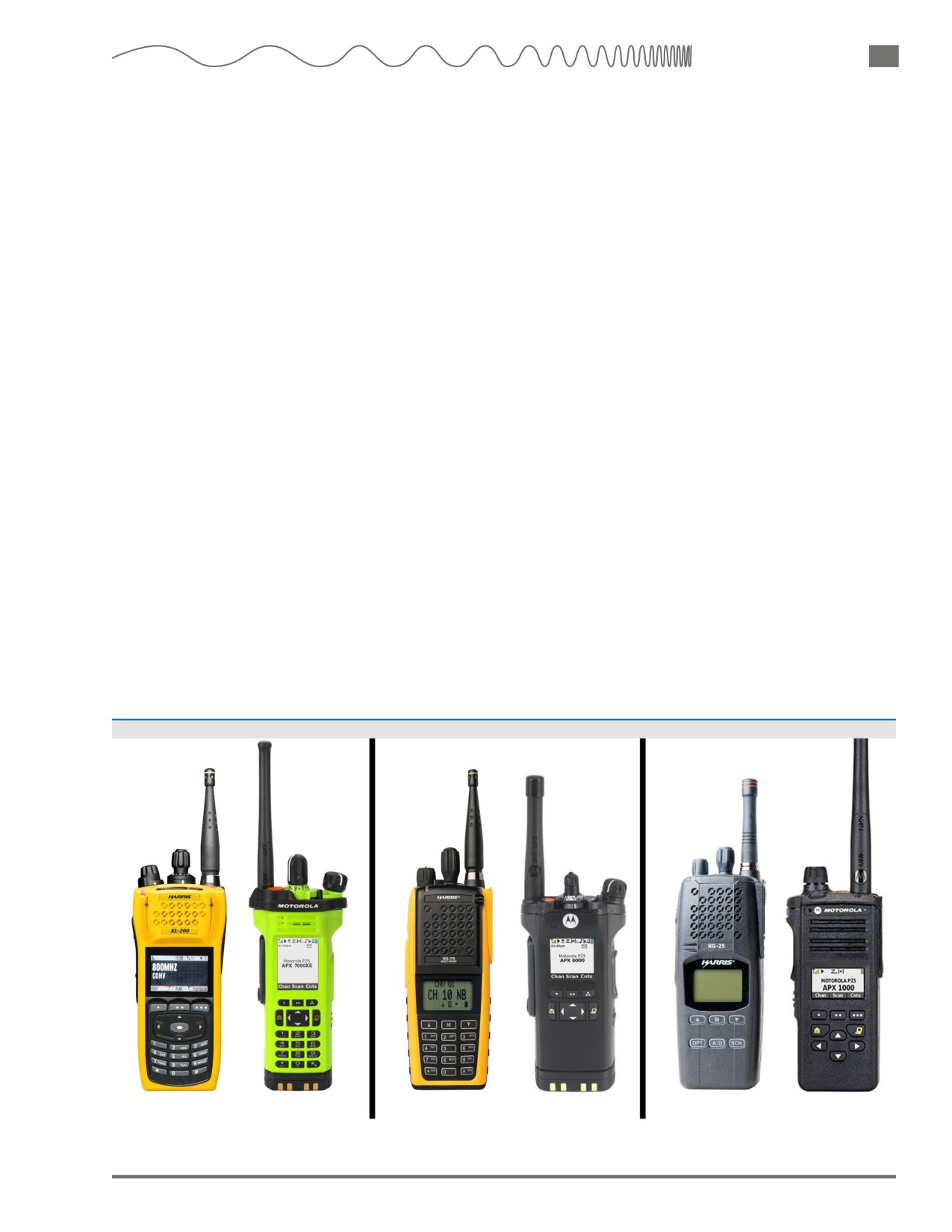
Since radios are tiered based on performance and
shall be equipped with a portable radio and
ruggedness, there can be significant cost savings
each responder on the crew or company shall
by buying high-tier radios for responders and the
be equipped with either a portable radio or
appropriate lower tiered radios for support staff
another means of electronic communication.
(Figure 6.2).
NFPA 1221
High-tier: High-tier radios should be provided
to each firefighter. This level of radio gives the
9.3.6 Two-Way Portable Equipment.
highest level of performance and reliability that
radio manufacturers can provide. Within each
9.3.6.1 All Emergency Response Units (ERUs)
tier, there may be options that provide additional
shall be equipped with a portable radio that is
capabilities or functions. If using radios for EMS
capable of two-way communication with the
and fire functions, encryption may be required for
communications center.
operations with law enforcement agencies or to
9.3.6.2 Portable radios shall be manufactured
comply with the Health Insurance Portability and
for the environment in which they are to be
Accountability Act of 1996 (HIPAA) requirements.
used and shall be of a size and construction
that allow their operation with the use of a
gloved hand.
Figure 6.2. Examples of Various Tiered Radios
High-Tier
Mid-Tier
Low-Tier
(Photos courtesy Motorola Solutions and Harris)
Voice Radio Communications Guide
46
for the Fire Service
Mid-tier: Mid-tier radios may be appropriate
National Institute of Standards and
for users who do not enter into the firefighting
Technology Testing
environment. This type of radio would be a good
NIST has performed testing on portable radios that
choice for EMS functions. Again, encryption may
closely replicates the firefighting environment.
be required to meet HIPAA requirements.
Technical Note 1477
Low-tier: Low-tier radios are an option for some
support staff. These radios provide communications
Technical Note 147724 test results exposed the
for users who are not in harsh environments and
vulnerability of the portable radios to elevated
may not need all the functionality of the higher
temperature conditions and emphasized the need
tier radios.
to protect the radios when used in firefighting
situations. Radios tested inside the turnout gear
Multiband
pocket showed that the turnout gear pocket was
Multiband radios are now offered and can
able to protect the radios and allow them to operate
provide added levels of interoperability or provide
at the Thermal Class III temperature of 260 C (500
flexibility to improve operability. The selection of
F). This contrasts with tests where the radios were
which multiband radio may require assistance from
exposed directly to the airflow, in which the radios
the spectrum coordinators in your department or
did not survive at Thermal Class II conditions and
area of operation. Depending on the manufacturer
beyond. In all but one test, the exposed radios
of the radio, the radios are commonly triband
were able to operate properly at the Thermal Class
(VHF, UHF, 700/800 MHz) or dual band. In
I temperature of 100 C (212 F), above the listed
dual band radios, a decision on which two bands
maximum operating temperature of 60 C (140 F).
provide the best use in your jurisdiction will have
Failure of the electronics due to heating was not
to be decided. The access to multiple bands has
permanent for the radios. In all cases where the
the capability of providing interoperability with
radio casing was not damaged, the radios regained
other jurisdictions or disciplines you interact with.
normal operating function once they had cooled
Having access to multiple bands and channels does
sufficiently. Permanent damage to the casing, such
not create interoperability. Interoperability must be
as difficulty turning knobs or pressing buttons, did
planned, coordinated, agreed upon, trained for and
occur for some radios whose casings experienced
practiced to be effective when you need it.
melting. Permanent damage also occurred to the
external speaker/microphones, especially due to
Having access to multiple bands also can enhance
the melting of the connecting cables.
operability. In the metropolitan area of Phoenix,
Arizona, use of multiband allows the firefighters in
Technical Note 1850
the region to use a 700/ 800 MHz trunked radio
Technical Note 185025 was released in September
system for dispatch and EMS-related calls. Fire
2014. The purpose of this study was to determine
calls are run on VHF analog direct channels. This
the firefighting environment that the radios operate
model allows the participating fire departments to
in. While NFPA 1221 states: “Portable radios shall
use the trunked system for interoperability with
be manufactured for the environment in which
law enforcement, meet wide-area communications
they are to be used and shall be of a size and
needs, and use VHF direct for operations with
construction that allow their operation with the use
local command, such as at fire incidents. Having
of one hand,”26 no standard had been developed
two systems has the added benefit of providing
to quantify the firefighting environment. Seven
redundant systems for increased reliability. Just
radios were tested to measure radio performance at
a few years ago, they had to operate on two
elevated temperatures. At 100 C (212 F), all radios
different radios.
maintained frequency. When the radios were
24 Available at http://www.fire.nist.gov/bfrlpubs/NIST_TN_1477.pdf.
26 NFPA 1221-13, 9.3.6.2.
Portable Radio
Section 6
Selection
47
|
and Use
Figure 6.3. Various Types of Firefighting Equipment and National Fire Protection Association Temperature Rating
(Figure courtesy Mike Worrell)
subjected to 160 C (320 F) for 15 minutes, all of the
tests to create a standard for communications
radios experienced frequency drift, and some radios
equipment. In addition to defining the environment
completely stopped transmitting. This is quite
and developing testing, the group is working
alarming and clearly indicates the need to protect
to establish ergonomics standards so that the
the radios as noted in Technical Note 1477.
communications equipment is easier to use in
the firefighting environment. In addition to
NFPA 1802, Standard on Personal Portable
defining the environmental requirements and test
(Hand-Held) Two-Way Radio Communications
procedures, the working group is also identifying
Devices for Use by Emergency Services
mandatory safety features of the radio. Most
Personnel in the Hazard Zone
manufacturers have the features available, but the
jurisdiction programming the radio must identify
In response to a line of duty death in San
and program each feature and select the correct
Francisco, the San Francisco Fire Department
value for the firefighting environment. Often, the
asked the NFPA Standards Council to approve a
function or characteristic of each button varies
new project to develop a standard for portable
depending on who is programming the radio. The
communications devices used in firefighting.
NFPA 1802 Technical Committee is developing the
The Council approved the project and assigned
standard set of safety features.
its development to the Technical Committee on
Electronic Safety Equipment. Committee work on
Fire Radio Features
NFPA 180227 began in March 2013 to establish
minimum requirements for the proper function
Many features are available in modern radios. Like
of the communications equipment that operates in
automobiles, stripped-down versions of radios are
hostile thermal, IDLH, and nonhostile emergency
available. When options are added, the cost rises.
scene environments. The goal is to increase the
To identify the desired features, focus and user
reliability of the communications equipment used
groups can assist in developing the radio feature
by firefighters. The document, when issued, will
sets that meet users’ needs. Today’s radios are
not address interoperability, and its scope will be
extremely flexible in programming features and
limited to the performance of the portable radio in
the functions of buttons on the radio. Cooperation
the firefighting environment.
between the radio vendor and technical provider
for your radio system will be instrumental
Figure 6.3 is a comparison of equipment used in
in filtering through all of the programming
firefighting. It is easy to recognize that the NFPA
parameters. Some of the newer features that
temperature rating of the radio does not equal the
increase firefighter safety are:
same capabilities of other equipment in use by
firefighters. The working group in cooperation with
• Voice channel announcement: This feature uses
representatives from many fire departments, NIST,
voice prompts to notify the firefighter what
and the equipment manufacturers are working
channel the radio is on as the channel select
to define the operating environment and develop
knob is moved.
Voice Radio Communications Guide
48
for the Fire Service
• Emergency indications: Radios on the
9.3.6.7 Single-unit battery chargers for portable
fireground receive an indication of emergency
radios shall be capable of fully charging the
activations on the assigned channel.
radio battery while the radio is in the receiving
mode.
• Personnel accountability: There are more radio
ID numbers available in new systems. This
9.3.6.8 Battery chargers for portable radios shall
makes it possible for each radio to have an
automatically revert to maintenance charge
individual ID code enabling identification of
when the battery is fully charged.
the unit and specific position of the unit on
9.3.6.9 Battery chargers shall be capable
an emergency activation. ID of the individual
of charging batteries in a manner that is
firefighter is possible if it is tied to roster
independent of and external to the portable
information in a CAD system.
radio.
• Tones: Many radios use tones as an indication
9.3.6.10 Spare batteries shall be maintained
of trunked system access, out of range, repeater
in quantities that allow continuous operation
access, encrypted channel, and other reasons.
as determined by the authority having
Use of tones may provide added awareness to
jurisdiction.
the firefighter and increase safety.
9.3.6.11 A minimum of one spare portable
For guidance on the minimum feature set a radio
radio shall be provided for each ten (10) units,
should have, refer to NFPA 1221, Section 9.3.6.28
or fraction thereof, in service.
9.3.6 Two-Way Portable Equipment
9.3.6.12 Portable radios used by first responders
9.3.6.2 Portable radios shall be manufactured for
who might encounter hazardous conditions
the environment in which they are to be used
likely to cause fire or explosion because of
and shall be of a size and construction that allow
the release of flammable liquids or gases shall
their operation with the use of one hand.
be rated as Intrinsically Safe by a recognized
testing authority if determined necessary by the
9.3.6.3 Portable radios equipped with key pads
authority having jurisdiction.
that control radio functions shall have a means
for the user to disable the key pad to prevent
Portable Radio User Training Guide
inadvertent use.
Firefighters often lack the basic knowledge and
9.3.6.4 All portable radios shall be equipped
training of their portable radios, systems, and the
with a carrier control timer that disables
capabilities of each. Training is required to form
the transmitter after a predetermined time
a basic operating knowledge and awareness of
that is determined by the authority having
their radios. The awareness should include regular
jurisdiction.
training and familiarization with the radio. The
IAFF Fire Ground Survival (FGS) program states that
9.3.6.5 Portable radios shall be capable of
“no probationary firefighter should enter the field
multiple-channel operation to enable on-
without having practiced requesting resources and
scene simplex radio communications that are
calling a Mayday. Furthermore, fire departments
independent of dispatch channels.
must have an ongoing training program specifically
focused on using the radio” (IAFF FGS). Radios
9.3.6.6 Portable radios shall be designed to
are often the only way to communicate on the
allow channels to be changed while emergency
fireground, especially in the case of an injured
response personnel are wearing gloves.
or downed firefighter. The next paragraphs will
provide a simple and basic understanding of radio
operations. It is not a prescriptive answer for every
28 NFPA 1221-13.
Portable Radio
Section 6
Selection
49
|
and Use
situation nor will it go over every single type of
•
Discipline: ICs are often overwhelmed by
radio. The goal is for users to understand how to
excess information on the radio. Radio
care for their radio, how to wear their radio, radio
discipline on the fireground will help
discipline, and training.
to determine if information needs to be
transmitted on the radio. If face-to-face
When a firefighter arrives to the fire station or is
communications are possible between
checking his or her equipment prior to engaging
members of a crew and the information is not
in work, it usually involves placing his or her gear
needed by the IC, don’t get on the radio.
and equipment in a ready state. Depending on
where you work or who you work for, the radio
•
Microphone location: Placing a microphone
may not be a big part of this routine. If it is not a
too close to the mouth or exposing the
major part of the routine, then it should be. The
microphone to other fireground noise may
radio provides the means to summon help for you
result in unintelligible communications. When
or your fellow firefighter. A basic radio check-off
transmitting in a high-noise environment,
would include proper inspection of the radio’s
shield the microphone from the noise source.
physical properties, such as knobs, switches and
Hold the microphone a couple of inches from
the antenna as well as the radio’s functionality.
the mouth or, when speaking through an SCBA
Users should also have some knowledge and
mask, place the microphone near the voice port
understanding of battery/power supply life,
on the facepiece.
rotation and maintenance. They should also be
•
Voice level: Use a loud, clear and controlled
aware of the effect of temperature on the battery/
voice when speaking into a microphone.
power supply. Further questions about radios can
When users are excited, their speech often is
be answered in this report, your department’s
louder and faster. These transmissions often
technical personnel, or the manufacturer.
are unintelligible and require the IC to ask for
Users and their behaviors have an impact on the
a rebroadcast of the information, resulting in
effectiveness of fireground communications. Human
more radio traffic on the channel.
factors, such as the way we speak and organization
Managing these human factors will have a positive
of reports, affect communications. Technical
impact on fireground communications. Reporting
factors obviously have an impact on fireground
should be complete, necessary, and in a controlled,
communications. Like any other technology, users
clear voice. These actions will reduce the amount
need to know the limitations of the technology and
of repeat transmissions on the fireground and
how to use the tool appropriately.
reduce air time.
Human Factors
Technical Factors
When we talk on the radio, each of us
In some cases, communications problems are
subconsciously performs a process before we speak.
caused by a technical issue. Users need to recognize
Managing this process will provide more effective
technical problems and take corrective action
communications. Key aspects of managing this
to improve communications. Training users to
process include the following:
understand the system they use, as well as features
• Organization: Before speaking, formulate what
of the system such as VR and BDA, may help users
information is being communicated, and put
to more readily recognize communications issues
the information in a standardized reporting
and take corrective action to rectify them. Radio
template. For instance, a standard situational
users often blame the radio or system for coverage
report might contain Unit ID, location,
problems. In many cases, users’ actions can
conditions, actions and needs. This method
improve communications.
forces users to fill in the blanks, answer all the
necessary questions, and filter out unnecessary
information.
Voice Radio Communications Guide
50
for the Fire Service
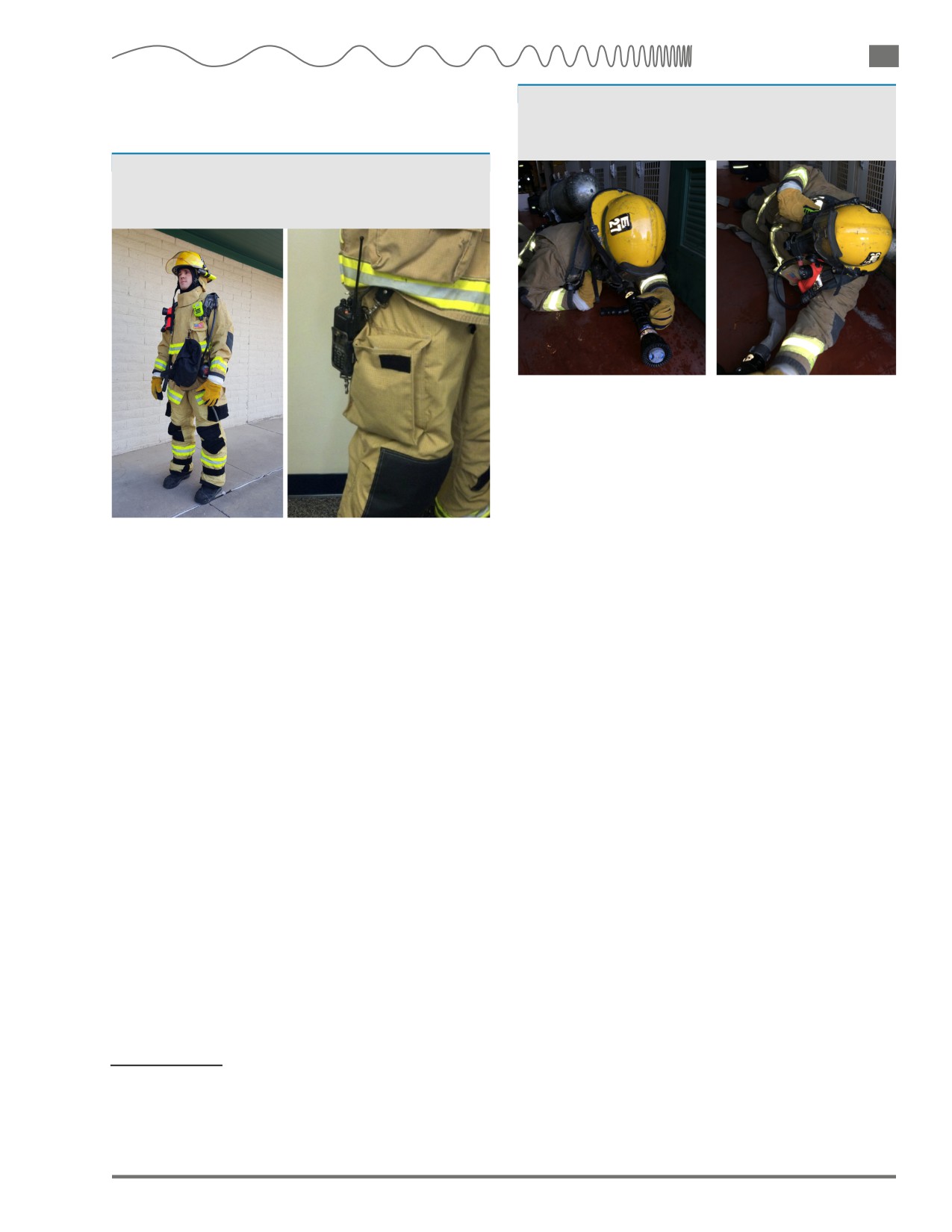
Figure 6.4. Radio Placement
(Photos courtesy Cody Worrell)
Where to Wear Your Radio
There have been many studies, blogs and articles
written on the best practices for carrying your
Now that the radio is ready to be placed into
portable radio, the most prevalent being the coat
service, the decision of where to wear the radio
pocket versus the radio strap underneath the coat
will have to be made (Figure 6.4). Most firefighters
with the speaker microphone protruding from the
haven’t given much thought to where the radio
top of the firefighter’s coat. A number of factors
should be worn. Not much thought has been given
play into the decision on where to carry, with pros
because the limitations are not fully understood.
and cons to both locations. The takeaway is to
Many firefighters assume that the equipment they
understand the limitations of what is issued to you
are given is bulletproof and tested to all of the
and maximize the performance by your actions.
same standards. The radios that the fire service uses
No single location is optimal in all situations. A
are far from bulletproof, and where the radio is
user that understands this limitation can react to
worn will have an effect on radio performance. In
a no transmit or no receive situation by changing
order to decide on where to wear the radio, radio
something (i.e., body position or radio orientation).
accessories will also need to be looked at since they
are a part of the ensemble.
Radios in the fire service vary greatly. Many were
designed for public safety; however, manufacturers
Many users do not use a radio pocket or case. In
are now offering radios with “fire features.” The
the middle photo of Figure 6.4, the Company
fire features include larger knobs but still can pose
Officer’s (CO’s) radio (left) is clipped to the exterior
a challenge to manipulate with gloved hands. Take
of the coat, while the firefighter’s radio is protected.
one look at the knobs and buttons on some fire
The trade-off is that the radio is exposed to heat
service radios, and it will be obvious that they are
and steam but is in a better transmitting position.
not made for firefighters because they are difficult
When unprotected, the radio may fail to operate
to use with gloved hands. The other agencies
when needed. NIST tested seven different radios at
that use our same radios don’t find themselves
a temperature of 320 F for 15 minutes; all radios
transmitting with gloves on in environments that
experienced an issue. After testing concluded,
are hot and wet. All radios are susceptible to heat
three radios failed to recover, while the other four
and moisture — to what degree, it may vary.
worked properly after cooling down. When a radio
Regardless, all firefighters should follow some basic
is in a pocket, the temperature reduction is 135 to
rules on where to wear their radio. If firefighters
167 degrees Fahrenheit cooler, which may keep the
are leaving the radio exposed, they are exposing
radio at the proper operating temperature, which
themselves to danger and run the risk of making
was also tested by a NIST study.
the radio inoperable. Protect the radio at all costs.
Most turnout coats have radio pockets to protect
Portable Radio
Section 6
Selection
51
|
and Use
the radio, but some may not. Many departments
Figure 6.6. Firefighter crawling in a poor transmit-
use radio harnesses as well to aid in protecting and
receive position. In the second picture, the firefighter
carrying the radio (Figure 6.5).
has adjusted position for better transmit. Note that the
body is no longer shielding the antenna.
Figure 6.5. Firefighter on the left with proper wearing of
radio in pocket. Note minimal radio speaker microphone
cord exposure. Firefighter on the right demonstrates use
of the shoulder harness and leather case.
(Photos courtesy Cody Worrell)
Section 2, Recommendation 5 in the IAFC “Portable
Radio Best Practices” states: “When practical
consider the use of accessories, such as speaker
microphones, throat microphones, and in-ear
microphones, to reduce the impact of background
noise” (IAFC Best Practices, p.18). Another factor
(Photos courtesy Cody Worrell)
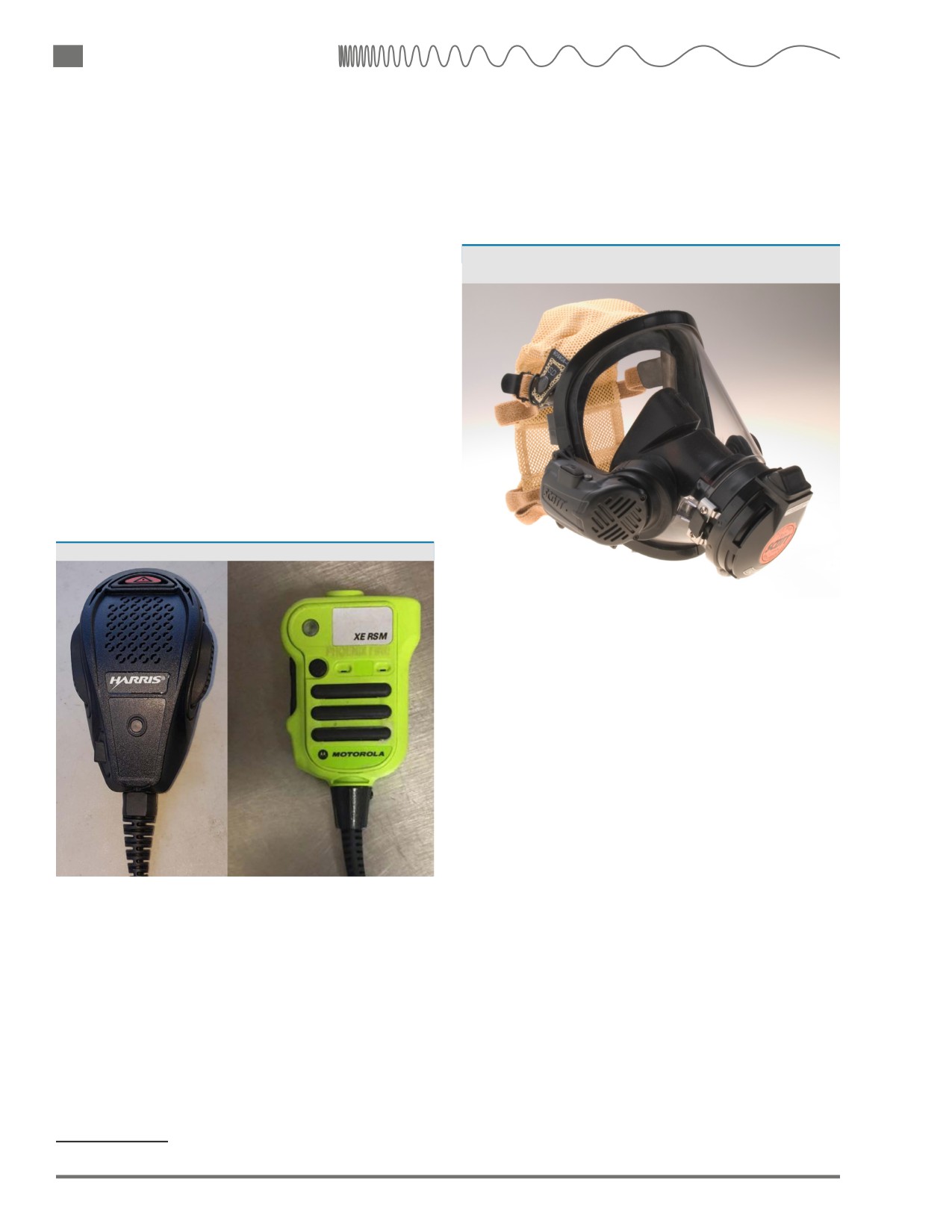
is the use of remote speaker microphones (RSMs)
An important factor in where the radio is worn
and other accessories that allow the radio to
depends on the antenna. Portable radio antennas
be protected in a harness or pocket from heat.
are designed to work in an upright position, so
Radio pocket protection has been proven by
the radio waves can transmit out. All firefighters
NIST Technical Note 1477 where temperatures in
reading this should have questions popping up
the pocket were 135 to 167 degrees Fahrenheit
in their minds. Firefighters often find themselves
cooler than outside the pocket29 (converted to F).
crawling on the floor on top of their radio.
Other common radio accessories found in the fire
Being in this position limits the capabilities of
service are remote speaker mics, amplifiers and
the antenna; however, the user should be able to
talk-around systems. RSMs connect to the radio
adjust and to help this. Depending on where the
with a pin connection and have a cord that attaches
radio is will determine what may need to be done.
to the speaker and microphone (Figure 6.7). The
If the radio is in the pocket, the firefighter may
RSM is also commonly referred to as a lapel mic.
need to turn over to transmit. If the radio is worn
RSMs have been in use for a long time and are
around the waist, the firefighter may not need to
recommended as a best practice by the IAFC30
do anything if the radio is exposed. The important
because they can dramatically reduce the impact
thing to note is that the radio needs to be exposed
of background noise on audio intelligibility. RSM
so that it can transmit effectively. The other aspect
problems were documented in the Houston Fire
to carrying a radio will be the accessories used in
Department31 and San Francisco Fire Department32
conjunction with it (Figure 6.6).
line-of-duty deaths (LODDs) reports.
In San Francisco, an LODD report concluded that
“victim 1’s remote speaker/microphone failed
due to high heat/fire, causing constant transmit
condition. This disabled the radio from transmitting
29 NIST 1477, p. 6.
30 http://www.iafc.org/files/digProb_PortableRadioBestPractices.pdf, Section 2, p. 18.
31 Houston Fire Dept. Southwest Inn Recovery Committee Final Report and Recommendations Sept. 1, 2014.
32 San Francisco Fire Dept. Safety Investigation Report Line of Duty Deaths 133 Berkeley Way June 2, 2011 Box 8155
Incident #11050532.
Voice Radio Communications Guide
52
for the Fire Service
or receiving after 60 seconds.” The biggest problem
only effective if the user places the radio or RSM
has been the cord that connects the speaker/
in the correct area when speaking. The user will
microphone to the radio body. The cord can melt
position his or her radio 1 to 2 inches from the
causing a short. When the short occurs, the radios
audio source when in use as recommended by the
are sometimes keyed up, unbeknownst to the user,
IAFC “Portable Radio Best Practices” report. Once
or inoperable. The user needs to protect the cord
again, it is important to note that the temperature
to help prevent this from happening. The cord can
rating of the equipment needs to be known.
be tucked into the radio pocket or underneath the
Figure 6.8. Example of a Self-Contained Breathing
jacket where temperatures are significantly cooler.
Apparatus Voice Amplifier
It is worth noting that some manufacturers offer
cords that can withstand 500 F temperatures, as
well as having more firefighter friendly features.
These are just two solutions; there is no prescriptive
answer. Furthermore, the IAFC recommends that
special attention be paid when selecting radio
accessories to ensure that they are compatible
with the environment that they are to be used
in.33 What the last sentence is saying is that not all
cords are created equal, so the user must know
the temperature ratings of his or her equipment
because they may be different.
Figure 6.7. Remote Speaker Microphone Examples
(Photo courtesy Scott Safety)
The third accessory is a talk-around system. Some
SCBA manufacturers produce a talk-around system
that attaches to the facepiece. The models may offer
multiple talk-around channels that allow users to
talk with each other on the fireground. A benefit
of this system is that users can talk to each other
without tying up airtime on the tactical channel.
Airtime is available for important information and
maydays. This type of system would aid in mayday
situations because interior crews communicate
without being on the tactical channel. The systems
also can attach to the radio. There is a switch to
(Photos courtesy Harris and Motorola Solutions)
allow you to talk through the radio. The talk-around
Amplifiers are attached to the SCBA facepiece
system may have a PTT button on the facepiece
(Figure 6.8). The amplifiers do not connect to the
itself. The RSM cord is the same that is used for this
radio; they only amplify the voice of the user out
system as well. The dangers listed above in the RSM
of the SCBA mask. A benefit of the amplifier is that
section apply to this piece of equipment as well.
users do not need to significantly raise their voice
The question of where to wear the radio depends
to be heard. Transmissions sound better and more
on all of the factors discussed above. Proper
controlled because the users are not required to
placement should be where the radio transmits
yell. The amplifiers operate off batteries that need
and receives reliably. There is no prescriptive
to be tested and maintained. The amplifiers are
answer for where the radio should be. The radio
33 IAFC “Portable Radio Best Practices.”
Portable Radio
Section 6
Selection
53
|
and Use
should be protected and in a place where the user
Summary — Portable Radio Selection and Use
is comfortable operating it with his or her given
Portable radio equipment is what the firefighter
equipment. Proper placement of the radio has
sees and has the most impact on fireground
been a researched topic by multiple agencies and
communications. Firefighters expect the radio is
departments. The research has shown that the radio
going to work when the PTT is pressed. Multiple
needs to be protected, or it may malfunction.34,35
tiers of radios are available at different price points.
Placing the radio in a turnout coat pocket resulted
Select the appropriate radio for entering the hazard
in a temperature difference of 135 F to 167 F.
zone. Today’s radios have better ergonomics than in
Coverage
the past, and firefighters should be able to operate
them with a gloved hand.
When communicating on the fireground, some
areas of a building may be difficult to communicate
Radios are currently manufactured to meet MIL-
from. When encountering these areas, move to
STD 810. Environmental specifications for this
a location where communications are possible.
standard range from minus 22 F to 140 F. This has
Areas that may improve communications are near
proven to be a weakness.
windows and doors.
NFPA 1561 and 1221 are guiding documents
Accessories
on the type and capabilities of the radio and
should be referenced during radio purchases or
Many accessories are available for radios. Use of
system design.
accessories that protect the radio from heat and
steam allows the radio to operate in high-heat
NIST Technical Notes
environments. Each user group may have specific
1477: This study tested radios in the firefighting
working conditions that require some accessories
environment and proved that radios protected
to make radio communications easier. Common
from the direct heat increased the survivability of
accessories include carrying cases, speaker
the radios.
microphones, ear pieces, chargers, battery types,
and optional antennas. A few considerations when
1850: This study tested seven radios and subjected
evaluating radio accessories are:
the radios to 320 F for 15 minutes. All radios
experienced frequency drift, and some completely
• Is the accessory approved for firefighter use in
stopped transmitting.
the IDLH environment?
NFPA 1802
• Does the accessory hinder the firefighter in
Draft development of this document began in
donning PPE?
March 2013 with the establishment of minimum
requirements for the proper function of the
• Can buttons/controls be manipulated with PPE?
communications equipment that operates in hostile
• Is there a method to disengage accessory in case
thermal, IDLH, and nonhostile emergency scene
of snare or malfunction?
environments. Turnouts, thermal imaging cameras
(TICs) and PASS units are all rated for 500 F for five
User and focus groups will help identify the
minutes. The radio is the only piece of equipment
accessories needed to support your department’s
that does not meet the 500 F rating. The standard,
needs.
when issued, will also mandate basic safety
functions on the radio.
User Guide
As with any equipment used in the fire service,
training is a key factor in successful use of the
34 NIST TN 1850.
35 NIST TN 1477.
Voice Radio Communications Guide
54
for the Fire Service
equipment. This is especially true when in high
--
No single location is optimal in all
stress situations. Users need to be aware of actions
situations. A user that understands this
that they can take to successfully communicate:
limitation can react to a no transmit or no
receive situation by changing something
• Organized thought process.
(i.e. body position or radio orientation).
• Discipline — when to speak, what to speak,
--
RSM use.
controlled voice (speed and amplitude).
• Recognition of coverage (poor transmit or
• Equipment.
receive):
--
Component location — microphones, voice
--
Change radio or body position — get the
ports, antennas.
antenna vertical.
--
Position where the radio is worn —
--
Move toward windows or exterior of the
protected.
building and retransmit.
System
Section 7
Design and
55
|
Implementation
SECTION 7 —
System Design and Implementation
Project Organization
If your community is working on a
communication system that will be shared by
Designing and implementing a communications
other entities in addition to the fire service, you
system is an extremely complicated process. It is
need to be collaborating with representatives of
important to create a structured organization to
those organizations. You’ll face the challenge of
provide input, carry out decision-making, and
giving each agency’s needs appropriate weight. The
conduct implementation work on the project. Get
law enforcement component of the system may
the organization established before beginning
often drive the overall direction of the project, but
the project.
it’s essential for the fire service to make system
designers aware of the needs of the fire service
Everyone affected by the fire communications
and to make sure that the system is designed to
system should have a hand in its selection. This
accommodate those needs.
doesn’t mean everyone participates at every step,
but it does mean stakeholders must be consulted
Each community has a different approach to
and their needs given serious consideration. If any
organizing the planning effort. Typical efforts
constituency gets left out of the planning process,
include:
those needs may get overlooked, and the result
could be a system that fails to meet the requirements
• A steering committee with top leadership
and expectations of the entire community.
setting the overall policy agenda. Every attempt
should be made to have fire department
When creating the project organization, be careful
management and labor leadership as
to clearly define the roles various workgroups have
participants on the steering committee at the
in the organization. The term “user” often has
project’s earliest stages.
different meanings to different people, so using a
more descriptive term is best to avoid confusion.
• Working groups that are assigned to complete
Some example roles include:
specific tasks and report back to the steering
committee. If you are appointed to one of
• Front-line firefighters and the teams that
these groups, it sometimes can be difficult to
support them in the field.
determine exactly what your role is supposed
• Dispatchers and others who provide support
to be — both as a group and as individuals. It
away from the scene.
is important that fire department management
• Operational supervisors.
and labor are involved in establishing the goals
• Department and other organizational business
and expectations for each work group.
management.
• Union representatives.
Requirements Definition
• Elected officials.
You may be collaborating with other departments to
• Personnel from other agencies that collaborate
build a shared multiagency network, or you may go
with the fire service.
it alone on a system for the fire service only. Either
Interoperability is a major concern in today’s
way, the more you learn about your department’s
world. The ability of public safety agencies to
needs, the more effectively you can represent the
communicate with each other is critical when
perspective of the fire service in your community.
events require them to coordinate a joint response.
The design and procurement of radio systems for
Many localities are answering this need by
fire departments is technical and very expensive.
designing large networks that will be shared by
Many departments rely on expertise outside of the
multiple departments and sometimes by multiple
fire service to advise them on communications
cities and counties.
technologies. Often these technical experts do not
have a complete understanding of the fire service
Voice Radio Communications Guide
56
for the Fire Service
or special requirements related to fireground
community and the risks involved before putting
communications. As a result, many communications
together a plan for the ultimate system.
systems are built to design parameters based on
Plan for Change
incomplete or inaccurate information.
Communications needs can change over time due
The development of a Requirements Definition
to community changes, such as population growth,
provides an opportunity to analyze communications
density changes, geographic expansion, alliances
needs based on operational practices and
with other communities, and evolving issues in
inherent risks associated with fire operations. The
homeland security and all-hazards management.
Requirements Definition also provides a measurable
Any investment you make today should have the
parameter set to evaluate the current radio system.
potential to grow tomorrow.
Identify Operational Needs
Organizational changes like budget constraints,
The planning horizon for a new communications
staffing changes, departmental realignments, the
system can range from a few months to several
creation of new work teams and task forces, greater
years. Once installed, the system could have a life
collaboration with state and federal agencies can
of 10 years or more. The following are some things
also affect communications needs. Will you be
that must be considered.
hiring more firefighters, opening or closing stations,
or fielding specialized teams such as hazardous
Operational needs should be grouped into three
materials, weapons of mass destruction (WMD),
different categories based on the frequency of use:
wildland firefighting, technical rescue, or others?
There are a number of other things to consider.
1. Everyday incidents that all departments engage
in, including structure fires, vehicle crashes,
•
Be prepared with statistics that reinforce your
location of fire facilities, etc.
department’s importance to the community.
This includes how many incidents you handle
2. Mutual and automatic aid responses that occur
each year, how many citizens receive service
less frequently but are still common.
each year, and how many lives are saved. These
3. Major incidents like disaster responses
can be hard to quantify, but some research
requiring long-duration coordination between
should produce numbers you can use.
local, state and federal agencies with heavy
•
Be familiar with your department’s planning
logistical support.
initiatives, and be prepared to talk about
When considering the operational needs in these
anticipated growth, addition of fire stations,
categories, it is important that the everyday incident
potential incidents, and disaster scenarios to
operations are not compromised for the rare
demonstrate the importance of fire service
complex incident.
preparedness.
Major disaster response communications can
•
Focus on results. It’s not a question of how
be accommodated by using regional or national
many antenna towers you have; it’s whether
resources to supplement the everyday system, just
firefighters can communicate to coordinate
as regional or national resources supplement the
tasks and strategies or hear emergency traffic
response and recovery response. This does not
or a mayday call when they’re working inside a
mean that communications planning for large-scale
building. Emphasize how each decision affects
incidents is not necessary, only that you may not
the safety of your personnel and citizens.
need a system that accomplishes all possibilities,
With the current focus on interoperability, don’t
no matter how unlikely. A large and complex
lose sight of the basic mission. It is still more
radio system will be more complex for users, be
important to be able to respond effectively and
more costly upfront, and require more operation
safely to the everyday incidents than it is to provide
and maintenance cost than a system designed
for every possible (and unlikely) disaster scenario.
for routine incidents. Consider the needs of the
System
Section 7
Design and
57
|
Implementation
This is not to say that interoperability is not
commercial and backup power sources, and
important, but don’t sacrifice a system that you can
communications backhaul (telephone lines, data
use for a rarely used feature.
circuits, and microwave systems).
Evaluation of Current System
Funding
What is the current state of your fire
After the needs are identified, the budget can be
communications? This is not an easy question to
developed. If the budget is developed too early, the
answer. It’s not uncommon for a department to use
system design may be unduly constrained. When
more than one communications system, and even
this happens, it is inevitable that functionality and
with the same equipment, procedures can vary
performance will be lost. Once the budget is set,
markedly. Collecting this information and pulling
it will be very difficult to get additional funding
it all together in one place is a necessary step that
later to “get it right,” especially if other agencies are
requires the commitment of time and resources.
pushing forward.
An assessment of your current communications
One method for getting a rough budget in place is
will help in identifying gaps in your
to survey similar agencies with similar needs on
communications infrastructure and plans,
the cost of their system or hiring a consultant to
and identifying what it does well will assist in
make a system design recommendation and cost
determining the need for a new system, or if
estimate based on your system needs. Another
updating the old system would be cost effective.
method is to issue a request for information (RFI)
to manufacturers and system integrators describing
Few departments keep statistics about radio usage
your operational communications needs and
and performance, so you’ll have to generate
requesting a rough not-to-exceed cost for a system.
much of this information from scratch. Many
Regardless of the method used for the estimate,
departments use technical staff, vendors or bring
this type of information will be very rough since
in a consultant at this phase, especially to help
the system design will be based on incomplete
with the more technical aspects of the job, such
information and limited detail. It is difficult to get a
as charting call traffic and measuring grade
solid cost without going through a complete system
of service. A consultant also can be helpful in
design with a specific manufacturer’s equipment.
collecting “softer” data. Soft data might include
user perception of the current system or where
Alternative Funding Sources
users feel where improvements need to be made.
Funding is a huge issue, but it should not be
Sometimes it’s easier for an outsider to interview
your first consideration when assessing your
users and get their honest feedback on how the
communications requirements. With the
system works or doesn’t work for them.
renewed focus on public safety and first-response
It may be beneficial to create scenario descriptions
capabilities, more funding is becoming available
that describe all communications flows for various
through federal, state and regional government
types of incidents from receipt of the call by the call
grants. Examples include:
taker, through dispatching units, unit response, and
• State Homeland Security Grant Program (HSGP)
incident management and logistics support. Consider
and Urban Areas Security Initiative (UASI),
all aspects of the communications including the
administered by DHS through the Office for
use of pagers and station alerting, mobile data, and
Domestic Preparedness (ODP)
wide-area and fireground voice communications.
The most expensive communications system will be
security-grant-program).
of little use if a major function performed today is
left out of the future system.
• Assistance to Firefighters Grant Program,
administered by FEMA (https://www.fema.gov/
Finally, consider the state of physical infrastructure,
welcome-assistance-firefighters-grant-program).
such as communications building condition and
susceptibility to weather effects, tower condition,
Voice Radio Communications Guide
58
for the Fire Service
• USFA document “Funding Alternatives
Enlist the support of community leaders. Once
for Emergency Medical and Fire Services”
you have developed your proposal summary, look
for individuals or groups representing academic,
publications/fa_331.pdf).
political, professional, and lay organizations that
may be willing to support the proposal in writing.
In some cases, it may be feasible to participate in
The type and caliber of community support is
joint investments with other agencies or nearby
critical to your proposal’s ability to survive the
communities. This will allow for networking
initial and subsequent review phases.
facilities, such as core systems, repeater systems,
fire-alerting systems, and towers. Costs can be
You probably can develop the proposal without
shared among several different organizations. This
hiring a grant writer. Most fire grant programs
also improves day-to-day interoperability among
are designed so that an astute member of any fire
these organizations.
department can write a successful application.
FEMA has a help desk staffed with competent
Explore leasing agreements and other financing
professionals who help applicants through the
alternatives as opposed to immediately committing
process. In addition to the help desk, FEMA offers
upfront capital investment. Phased implementation
free grant-writing seminars and supports a website
plans and adaptable networks that start small and
with helpful grant information (https://www.fema.
add more capabilities over time as the funding
gov/welcome-assistance-firefighters-grant-program).
becomes available are also an option. Do not
allow cost to become a barrier that prevents your
Evaluation of Proposed Technologies
community from building the fire communications
system its citizens and your colleagues deserve.
After collecting the description of the current
communications system, armed with a
Grant Writing
Requirements Definition and rough budget, a
comprehensive evaluation of your current system
If you decide to try to obtain grant funding, it
and proposed technologies can be made. The
is important that you get started on the grant
proposal early and spend the necessary time to
Requirements Definition becomes the scorecard
get the proposal right. A successful grant proposal
where the current and proposed technologies can
is well-prepared, thoughtfully planned, and
be graded on compliance, partial compliance,
concisely packaged.
or noncompliance. All components of the
Requirements Definition may not be compliant
Become intimately familiar with the grant criteria
in all technologies. Each department will have
and the eligibility requirements. You must be
to evaluate each component of the Requirements
able and willing to meet these requirements. You
Definition and derive an importance factor to
might find that eligibility would require providing
determine if noncompliance or partial compliance
services otherwise unintended, such as working
is acceptable for its department.
with particular client groups or involving specific
institutions. You may need to modify your concept
Technical Options and Conceptual Design
to fit. Talk to the grant information contact person
What technology is available to close the gaps
to determine whether funding is still available,
between operational needs, federal, state and local
what the applicable deadlines are, and what process
mandates, and the current system? Select the best
the agency will use for accepting applications.
combination of technologies that close the gaps
Determine whether any similar proposals have
without compromising the mission. Keep in mind
already been considered in your locality or state.
the safety of firefighters, mission effectiveness, and
Check with legislators and area government agencies
long-term sustainability when making decisions.
and related public and private agencies that currently
may have grant awards or contracts to do similar
New technologies: While you can’t predict every
work. If a similar program already exists, you may
future capability, you can read news reports and
need to reconsider submitting the proposed project,
technology journals for emerging systems, pilot
particularly if duplication of effort may be perceived.
programs, and development projects. Look for
System
Section 7
Design and
59
|
Implementation
military spinoffs that will be adapted to the fire
how to perform the assigned tasks? If the answer is
service. This is how we got TICs for locating
“no” to any of these questions, consider getting the
fire victims and missing personnel, GPS location
assistance of a consultant or integrator.
systems, and radios that can operate using different
Even if you have some degree of technical capability
frequency bands and protocols as needed. Radio
in-house, use of an outside contractor brings
networks will be able to support a range of new
the benefit of experience. The contractor has (or
features in the coming years. Even if you don’t have
should have) more experience than you in dealing
the funding to activate these features today, you may
with communications challenges and providing
choose to invest in a system that will be capable of
communications project oversight. Contractors
supporting them later. These may include:
also provide an outsider’s viewpoint, which can be
• Voice-activated intercom systems that would
valuable when there are conflicting requirements.
allow multiple interior attack firefighters to
Contractors can be hired to perform a single, clearly
communicate while keeping their hands free.
defined task or to take on a more comprehensive
• Large, accessible buttons on turnout gear to
role in the project implementation. Often, it’s wise
enable immediate distress signaling.
to hire a consultant for a small-scale project and see
• Radio-linked PASS devices that alert a Safety
how he or she performs before turning over large-
Officer if a firefighter remains motionless for
scale responsibility for a major project.
too long.
If you decide to use a contractor, ask these
• Encryption to maintain operational security
questions before you hire:
when needed.
•
Have you worked with other public safety
As an advocate for the fire service, you can use
agencies before?
these tips to help ensure that your concerns will
not be lost in the shuffle. While many of these
•
Have you worked with fire departments before?
technological improvements will prove to be
Discuss some typical issues in fire department
beneficial to firefighters in the future, this guide is
operational communications to see how
directed primarily at voice communications.
familiar the contractor is with the issues and
risks to the fire service.
Should You Hire a Consultant or System
Integrator?
•
Have you worked with fire departments of
our size?
Consultants can provide technical knowledge about
systems — and should have up-to-date knowledge
•
Are you able to provide assistance to overcome
of what various manufacturers can provide to
budget issues, such as grant writing,
meet differing communications needs — and
understanding the bond process, and creative
can provide design and procurement assistance,
financing solutions?
as well as implementation project management.
Manufacturer-neutral system integrators can
•
What types of systems have resulted from
provide equipment and labor to design and
your work?
implement a complete system and will typically be
•
What are some of your successes, what were
responsible for providing the final working system.
some of your failures, and how did you
Time, staffing and know-how are factors in deciding
overcome them?
whether to hire a consultant or integrator. Do you
•
Who are your references, and how can we
have people with the necessary technical capabilities
contact them?
and an understanding of complex modern
communications systems? Does your organization
•
Investigate relationships between the
have time to do the job alone? Can you obtain the
contractors and vendors.
necessary staff internally? Do your people know
Voice Radio Communications Guide
60
for the Fire Service
Where to Get Advice
--
DHS SAFECOM program: The SAFECOM
program’s mission is to help local, tribal,
Whether or not you use a contractor, investigate
state and federal public safety agencies
these alternative sources of assistance and
improve response through more effective
information:
and efficient interoperable communications
•
Other communities: Chances are that another
agency similar to you has been through this
--
DHS Science and Technology Directorate,
process already. Look at other departments
Office for Interoperability and Compatibility
of comparable size, contact their committee
Office of Emergency Communications: This
members, and arrange a meeting or conference
is an operating unit within DHS Science and
call where you can “pick their brains.”
Technology’s First Responders Group (FRG),
which provides the science and technology
•
Conferences: Attend fire and public safety
that enables emergency communications
conferences with an eye for communications
and facilitates the seamless exchange of
sources. Programs, panels, vendor displays,
information to protect property and save
demo projects … they’re all good places to get
information and hook up with others who have
experience they’re willing to share.
--
SAFECOM provides guidance, tools, and
templates on communications-related
•
Vendors: Manufacturers and system integrators
issues and supports research and testing of
often can provide brochures, white papers, and
communications products for public safety
similar information resources. This is another
place to find information about technical issues.
An established vendor understands that well-
--
APCO is a professional organization whose
informed customers are the best customers and
mission “… provides leadership; influences
that providing accurate information is one way
public safety communications decisions
to build a strong, lasting relationship and ensure
of government and industry; promotes
the customer’s long-term satisfaction. Be cautious
professional development; and, fosters the
of vendors who are in business solely to make
development of technology for the benefit
money, not necessarily to meet your needs.
of the public.” APCO sponsors the P25
Currently, there is a lack of real competition due
digital radio standards process. APCO’s focus
to the extremely small number of companies
is primarily on technical and operational
who build these systems. You must have a strong
standards relating to communications
labor/management commitment not to use
systems and communications centers
a system until it is proven to be safe and cost
effective and to get the best system performance
from the contractor.
--
The National Public Safety
Telecommunications Council (NPSTC)
•
Government and professional organizations:
is a federation of federal, state, and local
Several national organizations act as
associations and agencies. It serves as a
clearinghouses for information about public
liaison among the FCC, Congress and
safety communications. Again, a word of
appointed officials involved in public safety
caution: While the organizations listed below
communications. NPSTC was originally
do good work in the areas of interoperability
formed to implement the recommendations
and system standardization, no other
of the Public Safety Wireless Advisory
organization outside of the IAFF is focused on
Committee (PSWAC). NPSTC has taken on a
the special needs of firefighters involved in
wide range of activities related to spectrum
interior operations.
policy coordination and the development of
new technologies (www.npstc.org).
System
Section 7
Design and
61
|
Implementation
--
NFPA: The mission of the international
communications and the greening of
nonprofit NFPA, established in 1896, is to
technology. TIA is accredited by American
reduce the worldwide burden of fire and
National Standards Institute (ANSI) (http://
other hazards on the quality of life by
providing and advocating consensus codes
--
National Interagency Fire Center (NIFC):
and standards, research, training, and
The U.S. Department of Agriculture (USDA)
education. The world’s leading advocate of
and the Department of the Interior provide
fire prevention and an authoritative source
information on the use of radios in fighting
on public safety, NFPA develops, publishes,
wildland fires. Much of this information
and disseminates more than 300 consensus
also applies to communications on
codes and standards intended to minimize
structural fires. The information includes
the possibility and effects of fire and other
portable and mobile radio testing results,
risks (http://www.nfpa.org/).
including digital radios, and training on
--
IAFF is the driving force behind nearly
various topics (https://www.nifc.gov/
every advance in the fire and emergency
NIICD/index.html).
services in the 21st century. With
Procurement
headquarters in the District of Columbia
and Ottawa, Ontario, the IAFF represents
Based on the identified funding and the conceptual
more than 300,000 full-time professional
design, the next step is to solicit companies to
firefighters and paramedics in more than
construct the system. The procurement process
3,100 affiliates. IAFF members protect
typically will involve the development of a request
more than 85 percent of the population
for proposals (RFPs). The purchasing itself can
in communities throughout the U.S. and
often be assisted by using existing procurement
Canada (http://www.iaff.org/).
agreements, such as state contracts or cooperative
purchasing contracts. Be cautious, however, as
--
IAFC represents the leadership of
these purchasing agreements are typically targeted
firefighters and emergency responders
at commodity purchasing and often do not take
worldwide. Their members are the world’s
into account the complexities in purchasing wide-
leading experts in firefighting, EMS,
area communications systems. This can make a
terrorism response, hazardous materials
seemingly simple purchase much more costly as
spills, natural disasters, search and rescue,
items are purchased “a la carte.” System integration
and public safety policy. Since 1873, the
costs may dramatically increase the overall system
IAFC has provided a forum for fire and
cost. Also, a complex system procurement can
emergency service leaders to exchange
include services such as system engineering services,
ideas, develop professionally, and uncover
communications building and tower construction,
the latest products and services available to
microwave system design and installation, and
first responders (http://www.iafc.org/).
project management services that cannot be
--
TIA is the leading trade association
purchased as simple line items from a price sheet.
representing the global information and
Developing the Request for Proposals
communications technology (ICT) industry
through standards development, policy
The more information about your community,
initiatives, business opportunities, market
your department, and your needs that you write
intelligence and networking events. With
into an RFP, the better. Vendors need to know
support from hundreds of members,
about your operational needs and your current
TIA enhances the business environment
systems, so they can propose appropriate solutions.
for companies involved in telecom,
If it’s not in the RFP, you can’t expect to have
broadband, mobile wireless, information
it addressed properly in the proposals. Use the
technology, networks, cable, satellite,
labor/management process to document user
unified communications, emergency
Voice Radio Communications Guide
62
for the Fire Service
requirements for operations as the foundation for
Some questions to ask about the proposed system
all of the designs and studies that will follow. This
and equipment:
is not about technologists and engineers telling
•
Does the system cover your routine and
you what technology you need. This is about you
automatic/mutual-aid service area?
telling local government leaders and vendors what
you need to support operations in the field.
•
What is the vendor’s solution for fireground
communications where the network doesn’t
It is very important to involve the agency’s
provide 100 percent coverage? What will
purchasing personnel early in the purchasing
users do if they are outside the range of your
process. This helps ensure that all state and local
network system or indoors where signals don’t
purchasing requirements are followed and that
penetrate?
important contract language is included in the RFP.
The RFP should include a summary of all of the
•
Does the system have enough capacity to
steps taken to get to the RFP stage, including the
handle routine and abnormal incidents? What
results of the requirements gathering and current
happens if the system becomes overloaded?
system analysis. The more background information
you can provide to potential bidders, the closer
•
How do other public safety and nonpublic
their proposals will match your needs. In addition,
safety users affect the fire department’s use of
by removing uncertainty from the purchasing
the system?
process, you reduce the bidder’s risk, hopefully
•
How will the system facilitate interoperability
reducing the overall price.
with communications systems used by the
The RFP development stage is a good time to have a
departments with whom you have mutual-aid
consultant involved in reviewing the requirements
agreements?
and possibly assisting in the preparation of the
•
How will it alert units of dispatches in fire
RFP itself. Much of the RFP can be tedious to
stations and when out of the station? Can the
develop, and selecting a consultant who has done
system accommodate any paging needs?
this work before will reduce the burden on the
agency members.
•
Fire-capable end-user equipment (submersible,
etc.) is more costly than the radios commonly
Evaluating Request for Proposals Responses
recommended for police departments; be sure
Modern radio networks employ many different
the quote includes equipment for the usage
technologies. The best choice for your community
environment.
usually boils down to striking the right balance
•
Are the accessories you need included
between initial cost and long-term capabilities. You
with each radio (battery charger, speaker
need a system that fits your needs and available
microphones, etc.)?
resources today, with the potential to grow and add
more capabilities tomorrow.
Also, look for an understanding that deploying a
new network is not just a technical challenge but
Vendors’ responses to your RFP not only should
also a major organizational change that requires a
detail the type of system they’re proposing but also
full support structure.
explain why they’re recommending it over the
alternatives. Vendors should be ready to answer any
The vendor’s response should include:
questions you have about the reasoning behind the
• Clear identification of how the technology will
recommended system design. Be sure vendors are
support your operations and not affect them
recommending this design because it best meets
negatively. Radio systems should be designed
your specific requirements.
and implemented to support your work, not vice
versa. Your existing internal procedures should
not be affected negatively by the new system.
System
Section 7
Design and
63
|
Implementation
•
A phased rollout plan for gradual transition
new one? How will their procedures change?
from your current system to the new one.
What new features will be available? Which,
if any, of the old features will change or
•
An upgrade/migration plan for making further
become unavailable?
changes in the future.
• What’s different for the dispatchers? For field
•
User training information before, during
supervisors? For personnel back at the station?
and after implementation. This is far more
For personnel using the in-vehicle radios? For
important than most people realize.
administrators and network managers?
•
System testing and acceptance procedures.
• Will users still be able to use their old
equipment, or will they be required to learn
•
Scenario-based training.
new equipment?
•
Life cycle maintenance, network performance
• What successes and pitfalls have been
monitoring, and repair procedures.
experienced by other fire departments
•
Software upgrades for radios and the system
implementing this type of system? What have
infrastructure. To evaluate the solution
you learned from previous deployments?
proposed by each vendor, you’ll need to
Training and Transition
understand the relative advantages of the
technological choices each are recommending.
Ensure that all firefighters and command staff
The next chapter will help.
members train with the system often prior to final
switch over. Inadequate training is an especially
Implementation
critical problem and could endanger the lives of
Involve the right people throughout the
firefighters and the citizens they protect.
implementation process. Thoroughly test the
Training is far more than simply knowing how
system as it is built to ensure that it is meeting
to turn on the radio and which buttons to press.
needs and expectations.
Training must not become a one-time experience.
Successful implementation/integration requires
Firefighters need initial exposure, formal training,
careful attention from the beginning to design
and opportunities to incorporate radio usage
compatible links and then test, test and test again.
into other training and simulation exercises. The
The vendor’s engineers must have a detailed plan
integration plan also may cover interoperability
that identifies all of the systems to be integrated
with systems in other departments or jurisdictions.
and defines which capabilities will be made to
Interoperable communications must be tested with
work together and when. The plan also should
the joint cooperation of these other agencies and,
include schedules and priorities and whether the
perhaps, their system vendors as well. Training can
new network will be made operational before all of
be broken down into phases, as described below,
the integration is completed.
that lead from general information on the system
to specific operational aspects of the system, and
Encourage everyone to ask questions and make
finally to periodic refresher training.
comments. You will want to handle concerns and
objections early, before they have the chance to
• Awareness: This phase provides general
evolve into rumors and long-standing gripes.
information. A series of videos, using a live
representative, explains what’s different about
Before the contract is signed, ask the vendor
the new system and expectations for the new
or consultant to explain the following and
equipment. The goal is to create interest, not
begin to share that information with the rest of
to provide detailed information, and hopefully
your department:
begin to create champions within your system.
• What operational differences will our users
notice between our current system and the
Voice Radio Communications Guide
64
for the Fire Service
•
Education: Additional videos are distributed to
• The engineer’s academy, captain’s academy,
provide more detailed information on topics
and command officer’s academy, as well as
such as how to use your radio and what the
special team training, should integrate radio
direct operational implications are of the new
communication throughout the curriculum.
system or subscriber equipment. The videos
Implementation Lessons Learned and
may be broadcast over the department’s video
Feedback
network or local cable public safety access
channel and also can be available in the station
During the first few months after the initial cutover
for firefighters to view at will. Lesson plans
to a new system, collect and analyze information
should be available on the department’s website.
regularly on the operation of the system. Share
this information among all members of the
•
Training: Six months to one year before the
implementation team and, if issues are found that
system’s operational deployment, use of the new
affect operations, share that with the field users.
radios is integrated into fireground training
scenarios and in-building tactical preplan
All members must be involved in providing
surveys. Training is structured in a three-month
feedback on system issues and must be kept
cycle. The first month, trainees focus on how
involved with the solutions. Get buy-in from
to use the radio. In the second month, there’s
the system operator and technical staff to take
a walk-through. In the third month, the radios
field user input seriously. Encourage all members
are part of a live drill, complete with smoke,
to report perceived deficiencies in the system,
while trainees wear full turnouts. After this
and follow up with the users with updates on
three-month cycle is completed, a new lesson
their reports. If it appears to the users that their
plan is used in the next quarter, and the cycle
feedback is not acted on, they will stop providing
continues until the entire set of training classes
that feedback. It is important to ensure that
has been completed.
management is honest with users about the
operation and safety of the system. If something
•
Transition: By the time the network is
isn’t working properly, disclose it, and find a work-
operational and transition begins, users will have
around until the solution is found and in place.
had six months to one year of hands-on training.
Two-thirds of the total training time is hands-
Long-Term Operation and Maintenance
on. Mobile radio training takes place at the time
of installation of the equipment in the truck.
Ensure that adequate funding is allocated to the
operation and maintenance of the system. Just like
•
Refreshers: Quarterly refresher training (with
fire apparatus, the system must be maintained, and
an emphasis on lessons learned) and just-in-
equipment must be replaced as it becomes unable
time updates should continue to be given,
to serve the agency’s needs. Continuously solicit
as well as an annual refresher on fireground
feedback to keep on top of any problems that come
communications.
up with the system over time. Throughout the life
of the new network, fire service representatives
Beyond this training program, which was designed
will need a way to handle such ongoing
to support the rollout of the new radios, there
responsibilities as:
are implications for other training organizations
and curricula.
• Answering users’ questions and helping them
solve problems.
Communications training must be integrated
into all phases of recruit training and company
• Operating and maintaining modern radio
training programs:
systems is expensive. Long-term planning is
required to maintain software and hardware
• Recruit training should incorporate radios from
that is required to keep systems operating at
the beginning. In the past, radios were not used
peak levels. This is especially true of trunked
during recruit training, and a rookie’s first day
radio systems that require frequent software
on the job was the first day he or she was given
updates/upgrades, and these eventually lead
a radio.
System
Section 7
Design and
65
|
Implementation
to required hardware changes. If a decision is
• Gather information on the communications
made to fall behind and not maintain current
needs of field personnel and compare this to
software or hardware, the system is at risk of
the radio systems they use. This comparison
becoming nonsupported.
will result in a gap analysis that shows the
deficiencies in the current system. The current
• Incorporating radio usage into new training
system description along with the gap analysis
programs and exercises, and presenting
can be used to produce a specification for the
refresher courses.
new radio system.
• Monitoring the performance of the system
After the specification is established, a budget
and collecting reports of problems, such as
can be developed using the requirements and
buildings that lack coverage or situations in
cost estimates developed from similar systems or
which there were not enough channels or
through talks with potential vendors. Be cautious
talkgroups available.
in reducing the system functionality if the cost is
determined to be too large. Removing coverage or
• Implementing network interoperability links
features from the system to reduce cost could affect
to support new mutual-aid agreements with
the usability or safety of the entire system.
other communities.
Once the implementation of the system has begun,
Summary — System Design and
familiarization and training should start as well.
Implementation
Early, simple training will provide end users with
Developing and implementing a new
information on the system in a more controlled
communications system can be a complex and
manner. If users don’t get the information they are
expensive project. In the case of a large system,
seeking, they will find it through another path or
it may be the most expensive and most complex
will develop their own.
project a department has ever undertaken. These
After the new system has been placed into
facts make it critical that the project is managed
operation, it is critical to follow up with end users
adequately.
on the operation of the system. Over time, users
• Establish a project team that includes
will find design, implementation and performance
fire department management and labor
issues with the system that were not discovered
representation early in the project lifetime.
prior to cutover, or that occurred after cutover.
Timely resolution of these issues will ensure that
• Involve all stakeholders and ensure that they
your successful project remains successful in the
continue to participate in the implementation
eyes of its users.
process.