Voice Radio Communications Guide for the Fire Service (June 2016) - part 1
Voice Radio Communications Guide
for the Fire Service i
Acknowledgment
The U.S. Fire Administration (USFA) is committed to using all means possible for reducing the incidence of
injuries and deaths to firefighters. One of these means is to partner with organizations that share this same
admirable goal. One such organization is the International Association of Fire Fighters (IAFF). As a labor
union, the IAFF has been deeply committed to improving the safety of its members and all firefighters
as a whole. This is why the USFA was pleased to work with the IAFF through a partnership supported by
the U.S. Department of Homeland Security (DHS), Science and Technology Directorate, First Responders
Group, Office for Interoperability and Compatibility to develop this second edition of the “Voice Radio
Communications Guide for the Fire Service.” The USFA gratefully acknowledges the following leaders of
the IAFF for their willingness to partner on this project:
General President Harold Schaitberger
General Secretary-Treasurer Thomas Miller
Assistant to the General President
Occupational Health, Safety and Medicine Patrick Morrison
International Association of Fire Fighters, AFL-CIO, CLC
Division of Occupational Health, Safety and Medicine
1750 New York Ave., NW
Washington, DC 20006
202-737-8484
The IAFF also would like to thank Robert Athanas, Firefighter, Fire Department City of New York; Todd
Bianchi, Captain, District of Columbia Fire Department; Jim Brinkley, IAFF Director of Occupational
Health and Safety; Joseph Brooks, Radio Supervisor, Boston Fire Department; Thomas Chirhart, DHS; Billy
Freeman, Lieutenant, Memphis Fire Department; Missy Hannan, Graphic Artist, International Fire Service
Training Association (IFSTA)/Fire Protection Publications, Oklahoma State University; Ron Jeffers, Union
City, New Jersey; Christopher Lombard, Captain, Seattle Fire Department; Andy MacFarlane, Phoenix,
Arizona; Kevin Roche, FACETS Consulting; Wes Rogers, Lieutenant, Fairfax County Fire and Rescue
Department; William Troup, USFA; Mike Wieder, Associate Director, IFSTA/Fire Protection Publications,
Oklahoma State University; Cody Worrell, Firefighter, Phoenix Fire Department; and Mike Worrell,
Battalion Chief, Phoenix Fire Department, for their efforts in developing this report.
The Federal Emergency Management Agency (FEMA) does not endorse, approve, certify or recommend
any contractors, individuals, firms or products. Contractors, individuals or firms shall not claim they or
their products are “FEMA approved” or “FEMA certified.”
Voice Radio Communications Guide
iii
for the Fire Service
Table of Contents
Acknowledgment
i
Table of Contents
iii
Section 1 — Introduction
1
Purpose
1
Why the Fire Service is Different
1
Summary — Fire Service Environment
2
Section 2 — Basic Radio Communication Technology
5
Radio Spectrum
5
Wavelength
6
Channel Bandwidth
7
Radio Wave Propagation
8
Interference
9
What Affects System Coverage?
10
Fixed-Site Antennas
11
Downtilt
13
Portable Radio Position
13
Mobile and Portable Antennas
14
Summary — Basic Radio Communication Technology
15
Section 3 — Digital and Analog Radio
17
Analog Radios
17
Digital Radios
18
Digital Audio Processing
19
Analog and Digital Comparisons
19
Program 25 History
21
Program 25 Interoperability
21
Program 25 Characteristics in High-Noise Environments
21
Self-Contained Breathing Apparatus Mask Effect on Communications
22
Program 25 Digital for Firefighting
22
Summary — Digital and Analog Radio
23
Section 4 — Conventional Radio Systems
25
Direct and Repeated Radio Systems
25
Direct/Simplex Communications on the Fireground
25
Receiver Voters — Improve Field Unit to Dispatcher Communications
26
Repeaters — Improve Field Unit to Dispatch and Off-Scene Units
28
Simulcast Transmitter Systems
30
Alerting
31
Summary — Conventional Radio Systems
31
Section 5 — Trunked Radio Systems
33
Basic Trunked Radio Operations
34
Talkgroup Call
34
Call Disconnection
35
Designing a Trunked Radio System
35
Capacity Design
36
Coverage Design
36
Coverage Enhancement Devices
37
Voice Radio Communications Guide
iv
for the Fire Service
Vehicular Repeaters
39
Other Trunking System Features
40
Summary — Trunked Radio Systems
42
Section 6 — Portable Radio Selection and Use
43
General
43
Ergonomics
43
Environmental Technical Standards
43
International Electrotechnical Commission Ingress Protection Codes
44
Military Standards
44
How Many?
44
NFPA 1561
45
NFPA 1221
45
What Type?
45
Multiband
46
National Institute of Standards and Technology Testing
46
Technical Note 1477
46
Technical Note 1850
46
NFPA 1802, Standard on Personal Portable (Hand-Held) Two-Way Radio Communications Devices for Use by
Emergency Services Personnel in the Hazard Zone
47
Fire Radio Features
47
Portable Radio User Training Guide
48
Human Factors
49
Technical Factors
49
Where to Wear Your Radio
50
Coverage
53
Accessories
53
Summary — Portable Radio Selection and Use
53
Section 7 — System Design and Implementation
55
Project Organization
55
Requirements Definition
55
Identify Operational Needs
56
Plan for Change
56
Evaluation of Current System
57
Funding
57
Alternative Funding Sources
57
Grant Writing
58
Evaluation of Proposed Technologies
58
Technical Options and Conceptual Design
58
Should You Hire a Consultant or System Integrator?
59
Where to Get Advice
60
Procurement
61
Developing the Request for Proposals
61
Evaluating Request for Proposals Responses
62
Implementation
63
Training and Transition
63
Implementation Lessons Learned and Feedback
64
Long-Term Operation and Maintenance
64
Summary — System Design and Implementation
65
Voice Radio Communications Guide
v
for the Fire Service
Section 8 — Interoperability
67
Frequency Coordination
67
Interoperability Continuum
67
Day to Day
68
Large Incidents
69
Communications Unit
69
Summary — Interoperability
71
Section 9 — Radio Spectrum Licensing and the Federal Communications Commission
73
Rulemaking
73
Licensing
74
Federal Communications Commission Actions to Increase Public Safety Spectrum
75
Further Narrowbanding
77
Public Safety Wireless Advisory Committee
77
700 Megahertz Spectrum Allocation
77
800 Megahertz Reconfiguration
78
T-Band
79
Summary — Radio Spectrum Licensing and the Federal Communications Commission
81
Section 10 — First Responder Network Authority or FirstNet
83
History
83
Formation of FirstNet
83
Cost
86
Accessibility
86
Survivability
87
Security
87
Public Safety Focus
87
Possible Fire Service Uses
87
Summary — FirstNet
88
Glossary
91
Acronyms
97
Voice Radio Communications Guide
vi
for the Fire Service
This page intentionally left blank.
Introduction
1
Section 1 |
SECTION 1 —
Introduction
Purpose
The fire service is diverse. Departments range
from those that are very large in size and have
The past few decades have seen major advancements
multimillion dollar budgets to small departments
in the communications industry. Portable
that rely on pancake breakfasts or bake sales to
communications devices have gone from being used
augment the operating budget. All departments,
mainly in public safety and business applications to
professional or volunteer, require reliable
a situation where they are in every home and in the
communications. The size of the budget does not
hands of almost every American man, woman and
change the physics or RF properties. All departments
child. As users are added, there is more stress on
and firefighters need to understand basic radio
the system, and there is only so much room on the
principles to remain safe on the fireground and use
radio spectrum. The communications industry and
communications equipment effectively.
the government have responded by making changes
to the system that mandate additional efficiency.
Why the Fire Service is Different
These advancements have improved radio
The life safety of firefighters and citizens depends on
frequency (RF) spectrum efficiency but have
reliable, functional communication tools that work
added complexity to the expansion of existing
in the harshest and most hostile of environments.
systems and the design of new systems. Some of
All firefighters, professional and volunteer, operate
these advances in technology are mandated by the
in extreme environments that are markedly different
Federal Communications Commission (FCC), while
from those of any other radio users. The radio is the
others are optional. Many users of public safety
lifeline that connects the firefighters to command
spectrum have endured the time, effort and costs
and outside assistance when in the most desperate
associated with narrowbanding. This effort created
of situations. To operate safely in these dynamic
additional capacity in the existing spectrum,
environments, it is imperative that firefighters have
but performance of some existing systems was
the ability to immediately communicate information
degraded when converted from 25 kilohertz
accurately. The importance was not lost by the
(kHz) to 12.5 kHz. Even with narrowbanding,
firefighting community when they adopted the
the appetite for RF spectrum continues to grow,
internationally recognized terminology mayday3
necessitating continued efforts for spectral
to signify an emergency situation. The mayday is
efficiency. “The migration to 12.5 kHz efficiency
often the “last chance” to get outside assistance, and
technology will require licensees to operate more
the fire service’s ear is always listening for that call
efficiently, either on narrower channel bandwidths
of distress.
or increased voice paths on existing channels.
Environment
This will allow creation of additional channels
Firefighters operate lying on the floor, in zero
within the same spectrum, thereby supporting
visibility, high heat, high moisture, and wearing
more users.”1 The costs and operational effects of
self-contained breathing apparatus (SCBA)
these changes are significant. The actual RF physics
facepieces that distort the voice. The incidents we
associated with moving to narrowband with no
operate on can be chaotic with an intense amount
other system changes resulted in loss of range.2
of fast-paced communications until the incident
Navigating through the complex technological and
is stabilized. The fireground is filled with an
legal options of public safety communications led
extraordinary amount of noise. The only way to
to the development of this guide to assist the fire
really understand the amount and intensity of the
service in the decision-making process.
3 National Fire Protection Association (NFPA) 1561, Standard on Emergency Services Incident Management System and Command Safety, 2014
edition, Chapter 6, 6.3.2.1.
Voice Radio Communications Guide
2
for the Fire Service
noisy environment is to experience it. The engines
The fire service is a small part of the public safety
that drive pumps operating at high rpm, the sound
communications market and an even smaller part
of a circular saw blade sinking into a metal roll-up
of the overall communications market. This has
door, the roaring sound from an operating fire hose
resulted in one-size-fits-all public safety radios
nozzle, the distorted high-volume voices straining
and systems that do not always meet the needs of
through the mechanical voice ports of an SCBA
the fire service as a whole or those of a specific
facepiece are all part of our operating environment.
department. When you consider the extreme
Along with all of those challenges, we are enduring
operating environment and the protective clothing,
the prickly sensation of heat on our ears and hands.
the fire service is unique among public safety and
We adjust our position to “fluff up” the insulation
other municipal communications users.
in our turnouts, and even though our environment
Fire Service Communications Model
is hot, we have to keep a “cool head.”
The fire service operates in a staged state with
We wear bulky safety equipment to overcome the
resources located in fire stations. Calls are dispatched
temperature extremes that we are subjected to.
to specific units based on their location in relation
The thermal extremes we encounter drive us to
to the incident. When more than one unit responds
the floor and require us to crawl on our hands and
to an incident, an on-scene Command structure is
knees or operate while lying down. These positions
established to coordinate fire attack, provide safety
are not the optimal position to communicate with
and accountability, and manage resources.4 The
a device using radio waves. Gloves eliminate the
units assigned to these incidents work for the local
manual dexterity required to operate portable radio
Incident Commander (IC) who is the focal point
controls, hoods and flaps that protect ears affect the
of communications on the fireground. During
ability to hear clearly, vision is diminished by the
the initial attack, fireground communications are
smoky environment, and SCBA facepieces distort
fast-paced and chaotic to the untrained listener.
and reduce the field of view. The facepieces impede
The dispatch center assumes a support role and
voice communications, requiring the use of a loud
simultaneously documents specific fireground
voice to overcome the mechanical voice port unless
events, handles requests for additional resources,
the facepiece is equipped with some type of voice
and may record fireground tactical radio traffic.
amplifier. All of the above are barriers to using
radios effectively on the fireground. This requires
Summary — Fire Service Environment
firefighters to be intimately familiar with the radio
The fire service operates in unique and
equipment — being able to feel what the controls
challenging environments. The fire service
are by tactile sense and operating the radio.
recognizes the significance and importance of
Operations are conducted inside of buildings with
radio communications. The radio is the lifeline
various types of construction and size. The interiors
for firefighters in trouble. Use of the mayday term
of buildings can be as open as a warehouse or as
signifies the importance of the radio by using an
confusing as a maze. Buildings can be as simple
internationally recognized term when in distress.
as a large shed to a multistory, energy efficient
Factors that separate fire from other disciplines:
high-rise with many floors above and below.
• Communications pace — communications
The construction type and materials used affect
on the fireground are fast-paced and may be
fireground communications by not allowing radio
chaotic.
waves to penetrate the buildings. All of these factors
• Work position — firefighters are often on the
must be considered in order to communicate in a
floor crawling. This is not the optimal position
safe and effective manner on the fireground.
for radio transmissions.
Radio system manufacturers have designed and
• Visibility challenges — heavy smoke and
developed radios and radio systems that meet the
dark situations require users to be intimately
needs of the majority of users in the marketplace.
familiar with the equipment.
4 NFPA 1561, 2014 edition, Annex G.
Introduction
3
Section 1 |
• SCBAs pose several challenges:
• Gloves and other personal protective equipment
--
Voice ports on facepieces are difficult to
(PPE) restrict vision, hearing and the manual
communicate through.
dexterity required to operate radio controls.
--
Visibility — restricts field of vision.
• Buildings vary greatly in construction and
• Temperature and humidity:
complexity. All buildings to some degree resist
--
High heat.
penetration of radio waves. The RF resistance
-–
High humidity.
varies on construction type, size and layout.
• High noise environments — difficult to
communicate from the high noise area and
difficult to hear in a high noise environment.
Basic Radio
Section 2
Communication
5
|
Technology
SECTION 2 —
Basic Radio Communication Technology
When talking about fire department communications
All technologies have strengths and weaknesses.
systems, usually we are talking about what are
Understanding those characteristics is important
traditionally called Land Mobile Radio (LMR)
in making decisions related to the technologies.
systems. It is important for firefighters and fire
No matter what a salesperson will tell you during
officers to have a basic knowledge of radio system
the procurement process, no system is without
technologies to help them during the design,
risk, and all have had users who were not satisfied
procurement or use of the radio system. By having
with some aspect of the system. The key is in
this basic understanding, you will be able to
understanding the technology enough to ask
participate effectively in critical discussions with
questions, understand the answers, and make a
technical staff, consultants, and manufacturers to
successful evaluation.
get the safest, most effective voice communications
Radio Spectrum
system for your firefighters, command staff,
and community.
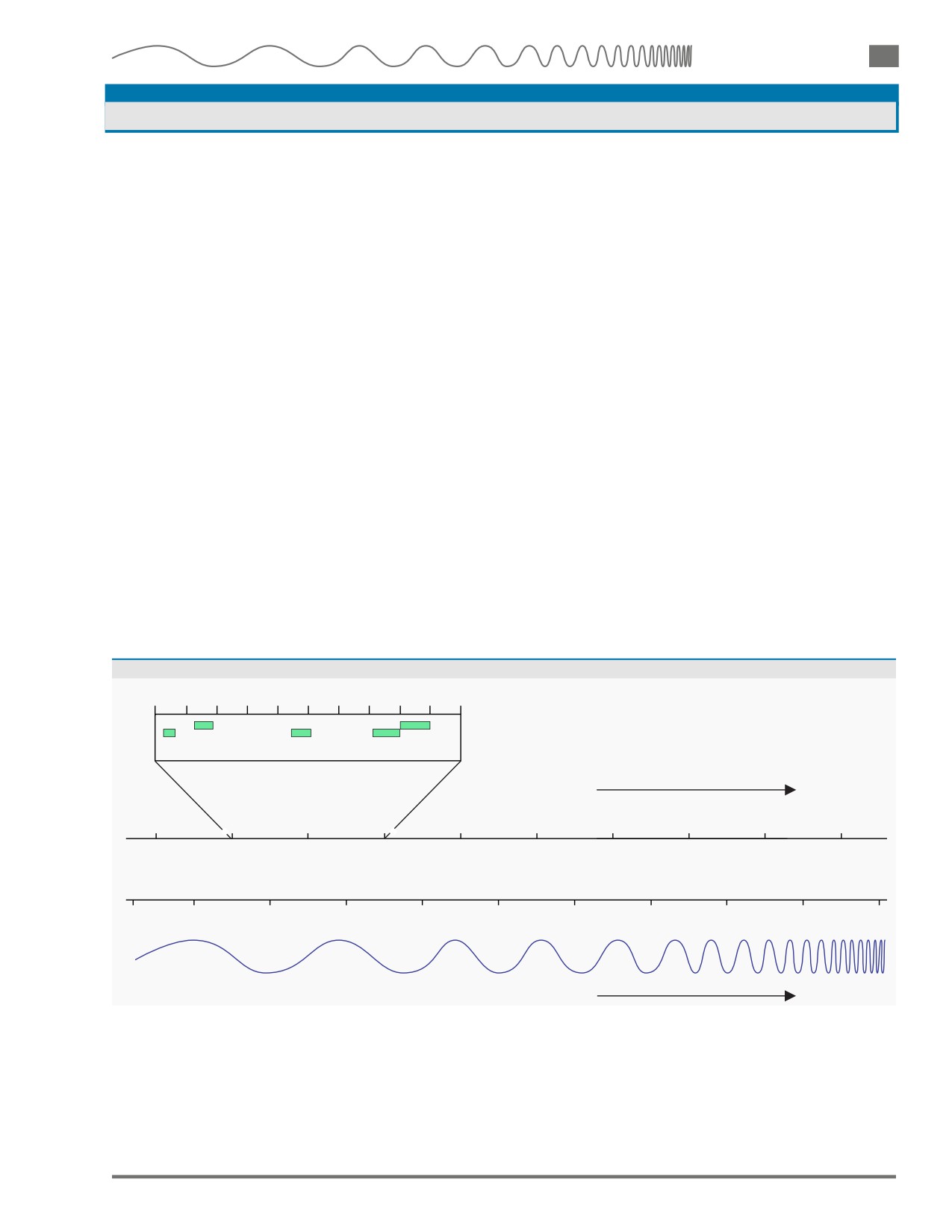
Radio communications are possible because of
electromagnetic waves. There are many types of
Most radio system users do not need or have a
electromagnetic waves, such as heat, light and radio
detailed understanding of the technology behind
energy waves. The difference between these types
the systems they use. However, such knowledge
of waves is their frequency and their wavelength.
is important for those involved in procurement
The frequency of the wave is its rate of oscillation.
of the systems, in developing procedures for the
One oscillation cycle per second is called one hertz
use of the systems, and in training field users to
(Hz). The types of electromagnetic energy can be
have a more comprehensive understanding of their
described by a diagram showing the types as the
limitations, capabilities and operation.
frequency of the waves increases (Figure 2.1).
Figure 2.1. The Electromagnetic Spectrum
10
100
200
300
400
500
600
700
800
900
1000
MHz
MHz
MHz
MHz
MHz
MHz
MHz
MHz
MHz
MHz
MHz
VHF
700
VHF
High
UHF
700
MHz
Low
MHz
Frequency Increases
1
10
100
1000
10
100
1000
10
100
1000
MHz
MHz
MHz
MHz
GHz
GHz
GHz
THz
THz
THz
Infra
Visible
Ultra
AM Radio
FM Radio/TV
Wireless LAN
Radar/Microwave
Red
Light
Violet
1km
100m
10m
1m
10cm
1cm
1mm
100μm
10μm
1μm
100nm
1000m
1000μm
1000nm
Wavelength Decreases
Voice Radio Communications Guide
6
for the Fire Service
When describing the frequencies used by common
frequency band of the radio but use the wavelength
radio systems, we use metric prefixes to quantify
to classify the radio. A VHF radio would be referred
the magnitude of the frequency. A typical
to as a 2 meter rig and a UHF radio would be a 70
frequency used in fire department radio systems
centimeter (cm) radio (Figure 2.3).
is 154,280,000 Hz. This is a frequency designated
Figure 2.3. Radio Signal Wavelengths
by the FCC as a mutual-aid radio channel.5 After
dividing the frequency by the metric system
6 Meters (50 MHz)
50.1
prefix “mega,” equal to 1,000,000, this becomes
154.280 megahertz (MHz).
Public safety LMR systems are allowed to operate
50.0
54.0 MHz
in portions of the radio spectrum under rules
2 Meters (144 MHz)
prescribed by the FCC.6 These portions of the
144.1
spectrum are called bands, and LMR systems
typically operate with frequencies in the 30 MHz
(very high frequency (VHF) low), 150 MHz (VHF
144.0
148.0 MHz
high), 450 MHz (ultra high frequency (UHF)), 700
MHz, and 800 MHz bands. Also, UHF spectrum
1.25 Meters (222 MHz)
in the T-Band, 470-512 MHz, is available to public
safety within a 50 mile radius of the eleven largest
metropolitan areas.7
219.0
220.0
222.0
225.0 MHz
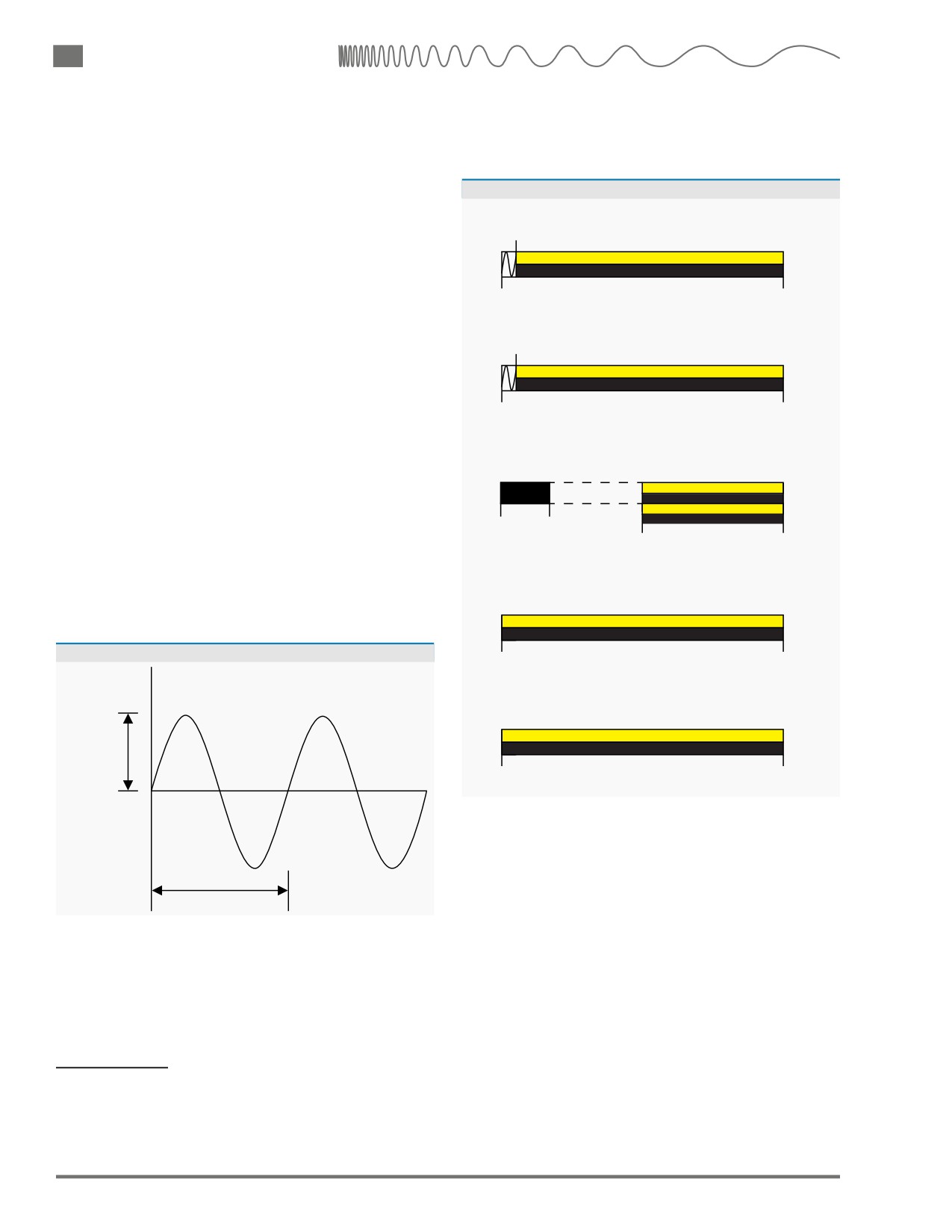
The wavelength is the distance between two crests
of the wave. The frequency and wavelength are
70 cm (420 MHz)
inversely related so that as the frequency of the wave
increases, the wavelength decreases (Figure 2.2).
Figure 2.2. Electromagnetic Wave
420.0
450.0 MHz
33 cm (902 MHz)
Amplitude
902.0
928.0 MHz
Figure a component of http://www.arrl.org/files/file/Regulatory/
Band%20Chart/Hambands_bw.pdf
A typical portable radio antenna is tuned to the
frequency. We commonly hear the term one-
Wavelength
quarter wave or one-half wave antennas. What
this means is that the wavelength is multiplied by
Wavelength
0.25 or 0.5 to determine an optimal length for a
transmitting or receiving antenna.
The wavelength of the radio signal is a determining
factor in the size and design of the antenna. Wave
The length of a radio antenna is related to the signal
length is an actual distance that is usually measured
wavelength with which the antenna is designed to
in meters. Ham radio operators often do not refer to
operate. In general, the higher the frequency of the
5 U.S. DHS, Office of Emergency Communications, National Interoperability Field Operations Guide, Version 1.5, January 2014.
6 Code of Federal Regulations (CFR), Title 47, Part 90, Subpart B, 90.20.
7 The Middle Class Tax Relief and Job Creation Act of 2012 requires the FCC to auction the public safety T-Band spectrum by
February 2021, and to clear public safety from the band within two years of conclusion of that auction. (Please see p. 79 of this
document for additional information.)
Basic Radio
Section 2
Communication
7
|
Technology
waves used by the radio, the shorter the antenna
of information. Standard bandwidth has decreased
on the radio. As you can see, the length of the
several times in the past to accommodate more
antenna is based on science. The practice of putting
users. However, there is a theoretical limit below
a nonapproved longer antenna on a portable radio
which the bandwidth cannot be decreased. In
for a perceived performance improvement can
addition, the actual width of a channel often
actually damage a radio and should be discouraged.
is slightly greater than the minimum width, to
Users should always consult with their radio service
provide some space on each side of the signal for
provider before making any component change to
interference protection from adjacent channels. For
maintain proper performance.
the purposes of radio licensing, the FCC sets the
maximum and minimum bandwidth for channels
Channel Bandwidth
in each frequency band.
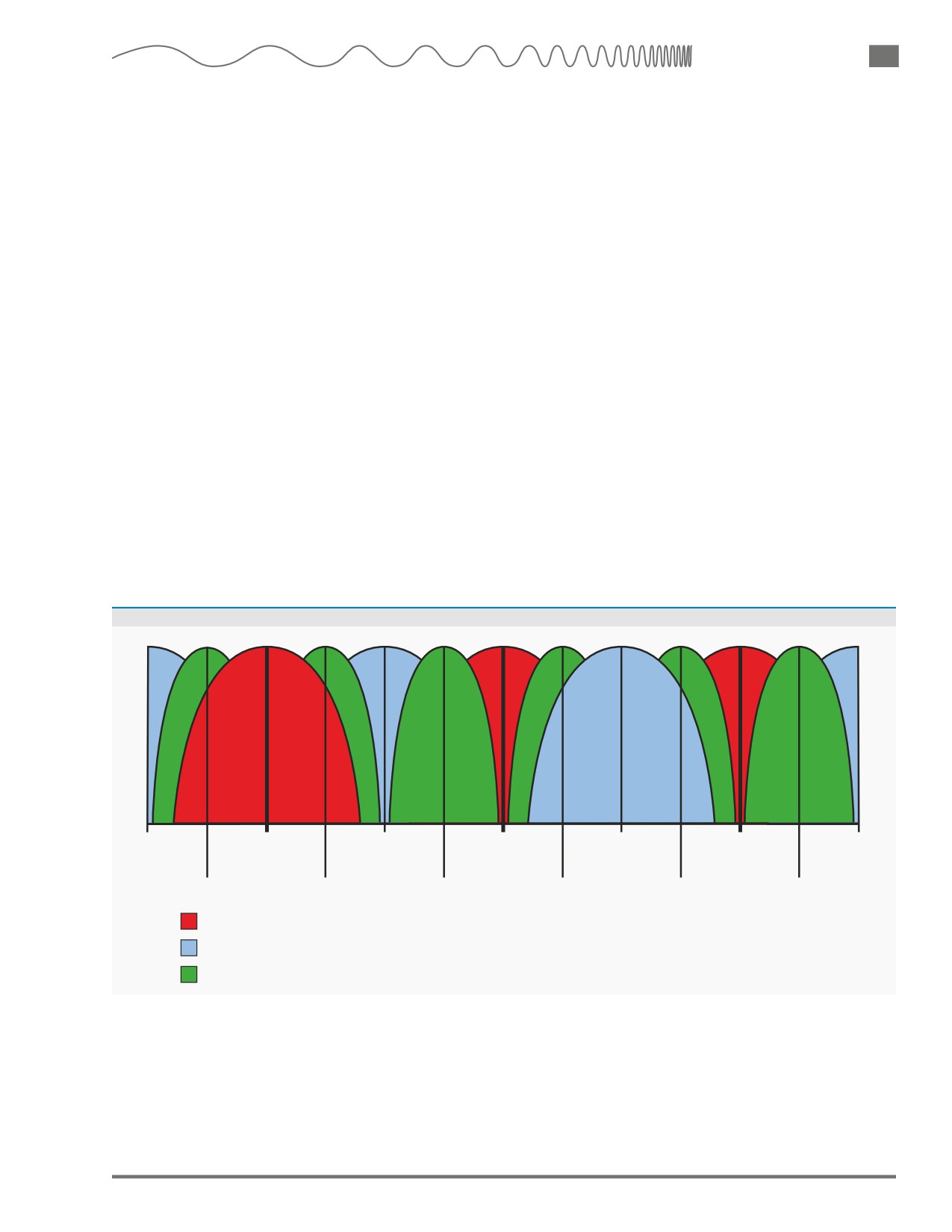
The radio spectrum is divided into channels. Each
The bandwidth of channels typically used in
radio channel is designated by a frequency number
LMR is measured in thousands of Hz, or kHz. In
that designates the center of the channel, with half
an effort to place more communications activity
of the bandwidth located on each side of the center.
within a limited radio spectrum, permitted
bandwidth has been decreasing. Under older
Radio channel bandwidth is the amount of
licensing rules, some of which are still in effect,
radio spectrum used by the signal transmitted
typical channel bandwidths were 25 kHz. Rule
by a radio. The greater the bandwidth, the more
changes effective Jan. 1, 2013, now require
information that can be carried by the signal
frequencies below 512 MHz to have bandwidths
in the channel. Minimum channel bandwidth
of 12.5 kHz. The narrowbanding of this spectrum
typically is limited by the state of technology and
increased the channels available for licensing
the bandwidth required to carry a given amount
(Figure 2.4).
Figure 2.4. Channel Bandwidth
150.815
150.830
150.845
150.860
150.875
150.890
150.905
150.8225
150.8375
150.8525
150.8675
150.8825
150.8975
Old 25 kHz bandwidth channels spaced at 30 kHz intervals
Old 25 kHz bandwidth channels spaced at 15 kHz from the original channels
12.5 kHz bandwidth channels at 7.5 kHz spacing from existing channels
Voice Radio Communications Guide
8
for the Fire Service
Figure 2.5. Two Slot Time Division Multiple Access
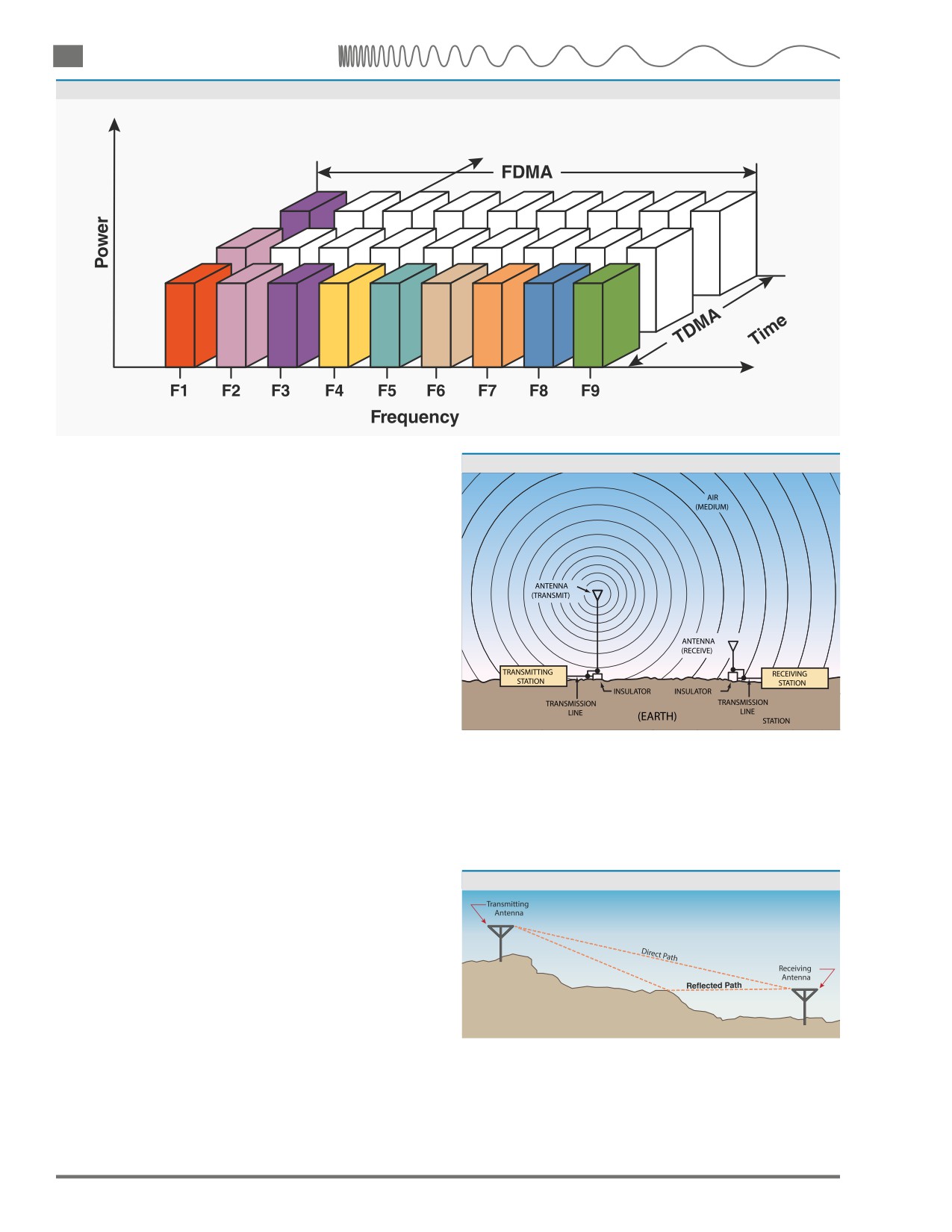
Spectrum efficiency is further improved by
Figure 2.6. Electromagnetic Signal Radiation
creating time slots within the bandwidth allocated
thus creating two talk paths. As you can see in
Figure 2.5, each frequency has two time slots
that allow two talk paths on a single frequency.
Digital radio technology allows use of frequency
division multiple access (FDMA) or time division
multiple access (TDMA) technologies. FDMA is
being employed on many P25 Phase 1 trunked
radio systems using 12.kHz and 25 kHz channels.
A newer iteration of P25 — that is, P25 Phase 2 —
uses TDMA technology to provide an effective 6.25
kHz bandwidth or in industry terms, a 6.25 kHz
equivalent bandwidth. Digital is optional in most
Radio signals emitted from an antenna travel both
bands but is required on interoperability channels
a direct path to the receiving antenna and a path
in the 700 MHz band.
reflected from the ground or other obstacles. This
Radio Wave Propagation
reflection causes the wave to travel a longer distance
than the direct wave, as shown in Figure 2.7.
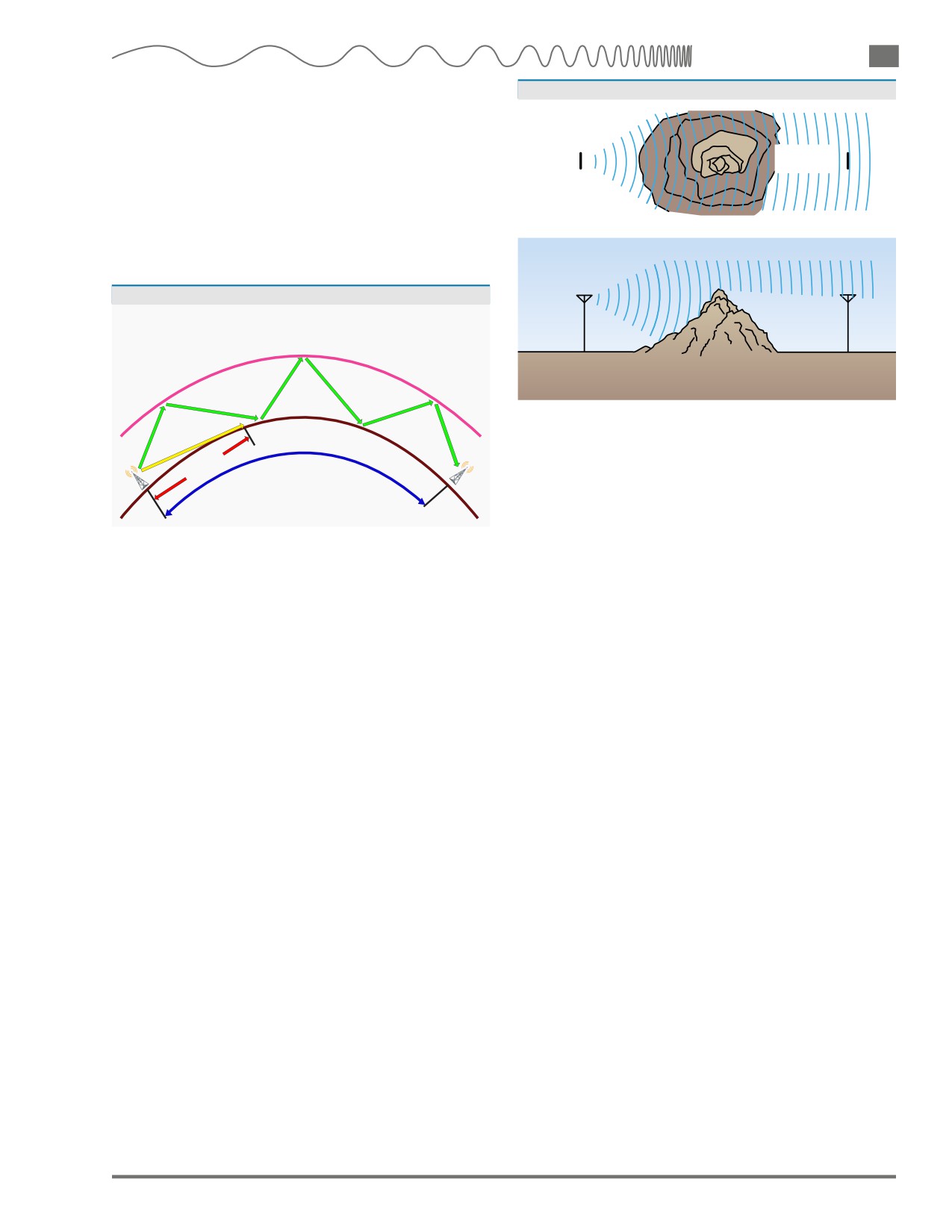
To send a radio signal from a transmitter to a
Figure 2.7. Signal Paths
receiver, the transmitter generates electromagnetic
energy and sends that energy through a
transmission line to an antenna. The antenna
converts that energy into electromagnetic radio
waves that travel at the speed of light outward
from the antenna. If another antenna is located
in the path of the waves, it can convert the waves
back into energy and send that energy through a
transmission line to a receiver (Figure 2.6).
Basic Radio
Section 2
Communication
9
|
Technology
The waves traveling over
the
reflected
path then
Figure 2.9. Terrain Blocking
interfere with the direct
waves,
causing
an effect
known as multipath
interference.
Multipath
Transmitter
interference causes a
variation
in
the
signal
level
Shadow
Zone
at the receiver. The signal
may
be
higher
or lower
than the direct signal
depending
on
the
position
of the receiver’s antenna.
As
the
antenna
is
moved
A Top View
around, the signal varies,
and
the
user
hears a signal
that goes from strong
and
clear
to
weak
and
noisy.
Figure 2.8. Atmospheric Ducting
Atmospheric Ducting
Warm Air Layer
Transmitter
Receiver
B Side View
Cold Air
Interference
Normal
RF interference can be either natural or man-made.
Line of Sight
Range
Extended range due to
Interference from internal noise occurs naturally
ducting effect of
atmosphere
in all electronic equipment due to the nature of the
electronic circuit itself. Manufacturers take this into
account during equipment design, and obtaining
The atmosphere can have an effect on the range of
a low-noise design is not particularly difficult. In
radio waves. While on the surface this might be
addition, natural noise is produced by sunspot
thought of as good, it is not. RFs are assigned and
activity, cosmic activity, and lightning storms.
reassigned with enough geographic separation so
This noise usually is of small magnitude and not
they don’t interfere. At times, atmospheric layers
significant for most LMR communications. The
can form causing a ducting effect (Figure 2.8). The
exception to this is the VHF low band that is affected
radio waves are usually limited to a line of sight
significantly by severe sunspot activity, sometimes to
range. When these atmospheric ducts form, the radio
the point of completely prohibiting communications.
wave propagates out and hits the warm air layer and
bounces between the warm air and ground, greatly
More significant to radio communications systems
increasing the range. The increased range often is the
is the interference produced by man-made sources.
cause of interference on the far end due to the reuse
There are many sources of interference that you
of the frequencies. This condition is more prevalent
may encounter. Some interference sources are
in the lower frequency bands.
expected, such as vehicle ignitions, electric motors,
and high-voltage transmission lines, but computers,
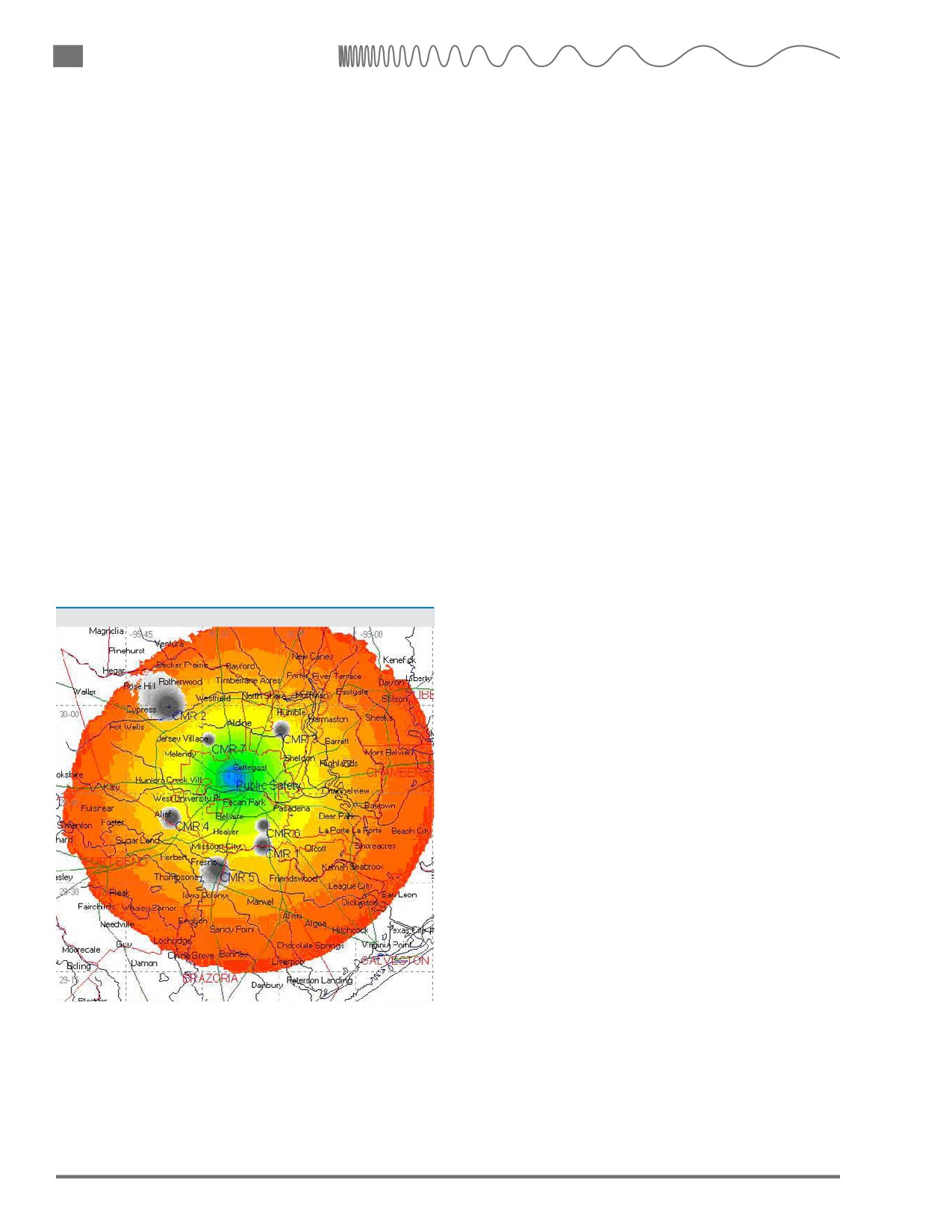
Radio waves can travel through some materials,
light ballasts, and new energy efficient bulbs (both
such as glass or thin wood, but the strength is
compact fluorescent lights (CFLs) and light-emitting
reduced due to absorption as they travel through.
diodes (LEDs)) emit radio signals that can interfere
Materials such as metal and earth completely block
with public safety radios.
the waves due to their composition and density. In
In general, man-made interference decreases
addition, some materials will reflect radio waves,
with an increase in frequency. The UHF band
effectively blocking the signal to the other side.
and, initially, the 800 MHz band are much less
Because buildings are built from many types of
susceptible to man-made interference than the
materials, the radio waves can be passed through
VHF low and high bands. When systems are not
some, be reflected by some, and be absorbed by
subject to significant interference, they are said
others. This, along with the complex interior
to be “noise limited,” in contrast to “interference
design of a building, creates a very complex
limited.” The large number of transmitters used by
environment for radio communications inside a
cellular telephone companies has created intense
building (Figure 2.9).
interference in the 800 MHz band.
Voice Radio Communications Guide
10
for the Fire Service
Although the separation of the channels allocated
outside a radio in the transmission line or through
to cellular companies has reduced this interference,
rusty tower bolts or guy wires. Intermodulation
communications problems still can occur when a
can be difficult to identify, due to the large
user is operating close to a cellular transmission
number of frequencies that may be present at large
facility. This type of interference is particularly a
communications sites.
problem when the user is located near a cellular
Receiver desensitization interference, also called
facility and the user’s radio system site is located
receiver overload, is caused by nearby high-level
much further away. This creates a situation called
transmitter signals that overload the initial parts
“near-far” interference. The user’s system signal
of the radio’s receiver. This overload prevents the
strength is low, and the cellular signal is high,
receiver from detecting the weaker desired signals,
keeping the user’s radio from receiving the desired
making the receiver nonfunctional. Receiver
signal. The 800 MHz band always was regarded
desensitization occurs near high-power radio sites,
as the “cleanest” band with respect to man-made
such as television and radio stations, and also can
interference, and systems initially were noise
occur in poorly designed repeater systems where
limited. However, all systems in the band now
the transmit and receive frequencies are too close
must be designed for maximum interference
in frequency.
from nearby transmitters, which requires more
transmitter locations and higher power, creating
Several things can be done to reduce or eliminate
more costly systems.
interference. The first is the use of high-quality
radio equipment. High-quality equipment has
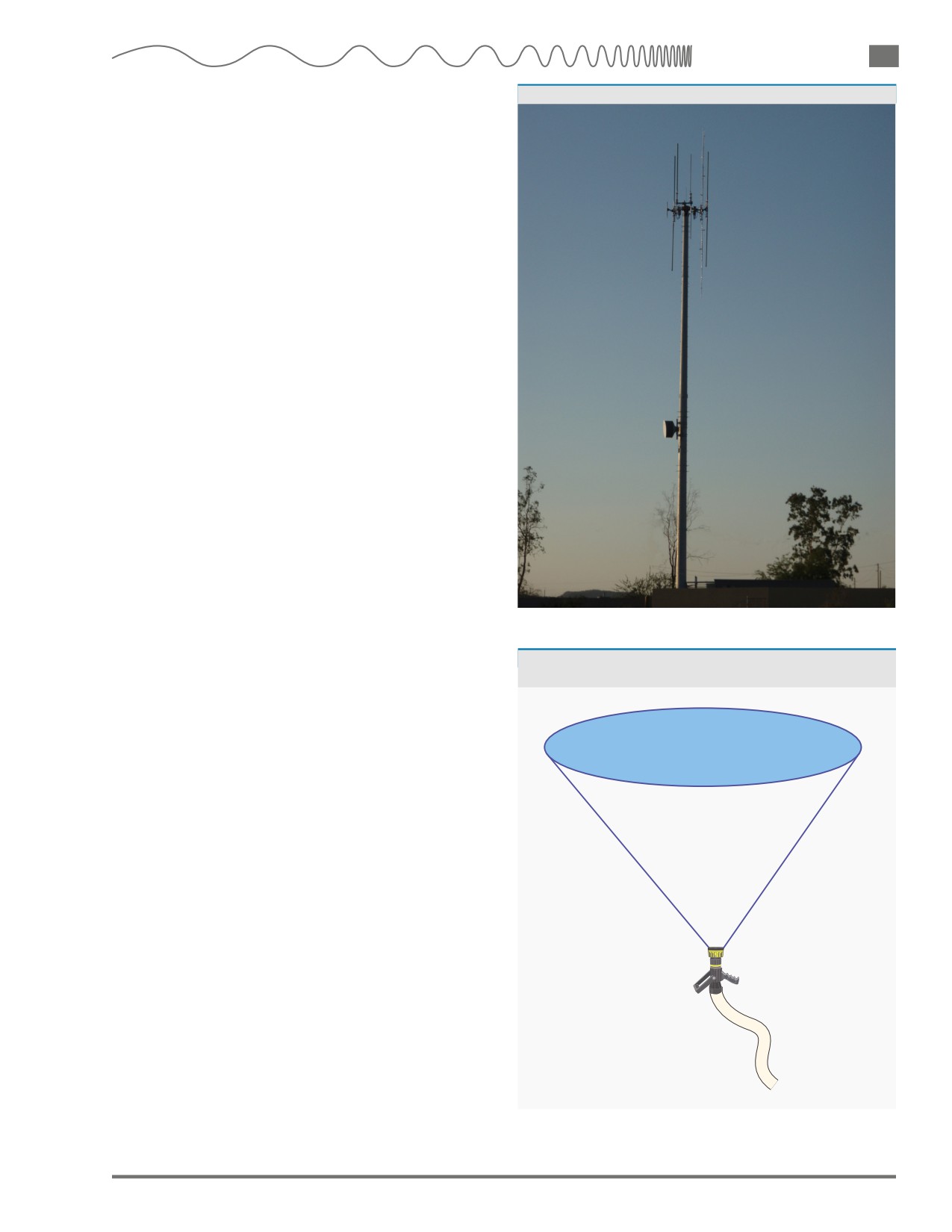
Interference from cellular transmitters is illustrated
better transmitter and receiver performance that
in Figure 2.10. The blue area in the center is the
minimizes interference and reduces its effects.
public safety transmitter, and in the center of the
The use of receiver multicouplers, transmitter
gray areas are the cellular transmitters.
combiners, and repeater duplexers reduce the
Figure 2.10. Gray Areas are Near-Far Interference Holes
possibility of intermodulation and receiver overload
by filtering the transmitter and receiver signals
to ensure only those signals actually used by the
system are passed through.
Radio system designers can reduce the possibility
of their systems causing interference by selecting
appropriate designs. By selecting the appropriate
antenna and adjusting transmitter power levels, the
system can minimize interference with other users
of the same frequency. This allows more efficient
use of the available radio spectrum and keeps more
resources available for all users.
What Affects System Coverage?
The coverage of a radio communications system
generally is described as the useful area where
the system can be used reliably. Many factors
affect coverage, including the radio power output,
Intermodulation interference is caused directly
antenna height and type, and transmission line
by the mixing of two or more radio signals. The
losses. However, the factor that most influences
mixing most commonly occurs inside the receiver
system coverage is the height of the antenna
or transmitter of a radio. This mixing can create
above the surrounding ground and structures.
a third signal that is radiated from the antenna
As systems age, the coverage of the system can
out to other radios. The mixing also can occur
change due to man-made structures that are built.
Basic Radio
Section 2
Communication
11
|
Technology
System designers place antennas on towers or
Figure 2.11. Antenna Tower and Antenna
mountain tops to provide a more direct path from
the transmitter to the receiver. In the case of one
portable radio user transmitting directly to another
portable radio user, having the radio antenna as
high as feasible (hand-held at shoulder height)
significantly improves system coverage.
Antennas have three major properties: operating
frequency, polarization, and radiation pattern. In
general, these properties apply whether the antenna
is used for transmitting or receiving. The operating
frequency of an antenna is the frequency at which
the antenna acts as specified by its manufacturer. The
antenna may operate outside its design frequency,
but the performance of the antenna will be reduced.
In LMR systems like those used by public safety,
most antennas are vertically polarized. You can see
evidence of this with the wire antennas mounted
on the roofs of vehicles. Like car antennas designed
for FM broadcast radio, they stick up vertically
from the surface of the vehicle.
The radiation pattern of the antenna is the shape
of the relative strength of the electromagnetic
(Photo courtesy Mike Worrell)
signal emitted by the antenna. This depends on
the shape of the antenna. The radiation pattern can
Figure 2.12. Fog nozzle set to wide angle sprays in all
be adjusted through antenna selection to provide
directions — 150 gpm
coverage where desired and to minimize coverage
(and interference) in undesired directions.
Fixed-Site Antennas
Fixed-site antennas are mounted on towers or
buildings to provide the dispatch or repeater
coverage throughout the service area (Figure 2.11).
The antennas used must be designed to operate in
the system’s frequency band and, for best power
coupling, should have a center frequency as close as
possible to the actual operating frequency.
The radiation pattern for the antenna should be
selected to provide a signal in the desired sections
of the coverage area and have minimal coverage
outside the desired coverage area. This will help
ensure that the system is not interfering with
other systems unnecessarily. The most basic
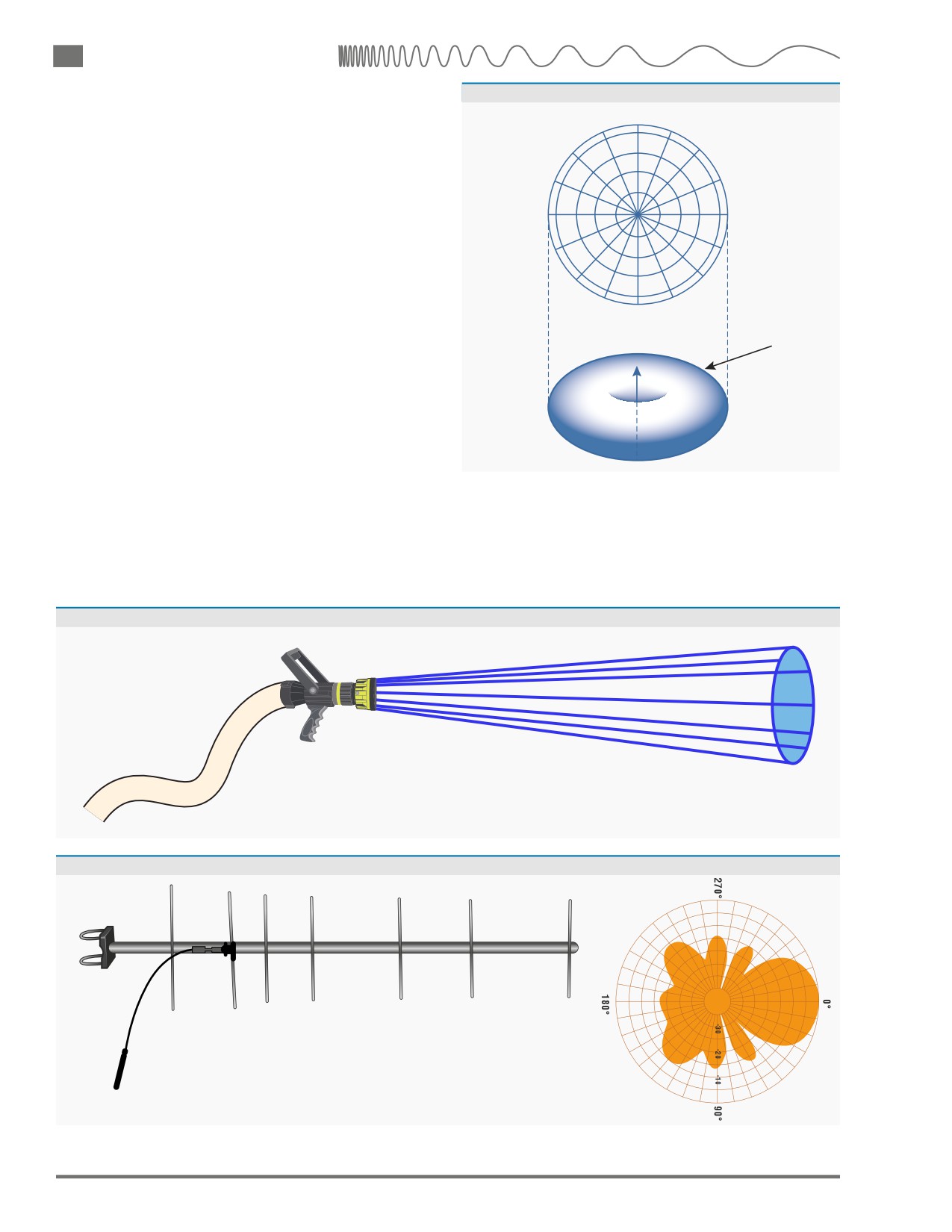
practical antennas are omnidirectional and have
approximately equal coverage for 360 degrees
around the antenna. In fire service terms, a nozzle
set to a wide angle fog would be equivalent to an
omnidirectional antenna (Figures 2.12 and 2.13).
Voice Radio Communications Guide
12
for the Fire Service
However, as shown in Figure 2.13, the antenna
Figure 2.13. Omnidirectional Antenna Pattern
pattern is more like a slightly flattened donut. This
0°
causes an area immediately under the antenna to
have lower signal strength, and less coverage, than
farther away from the antenna.
Horizontal
Pattern
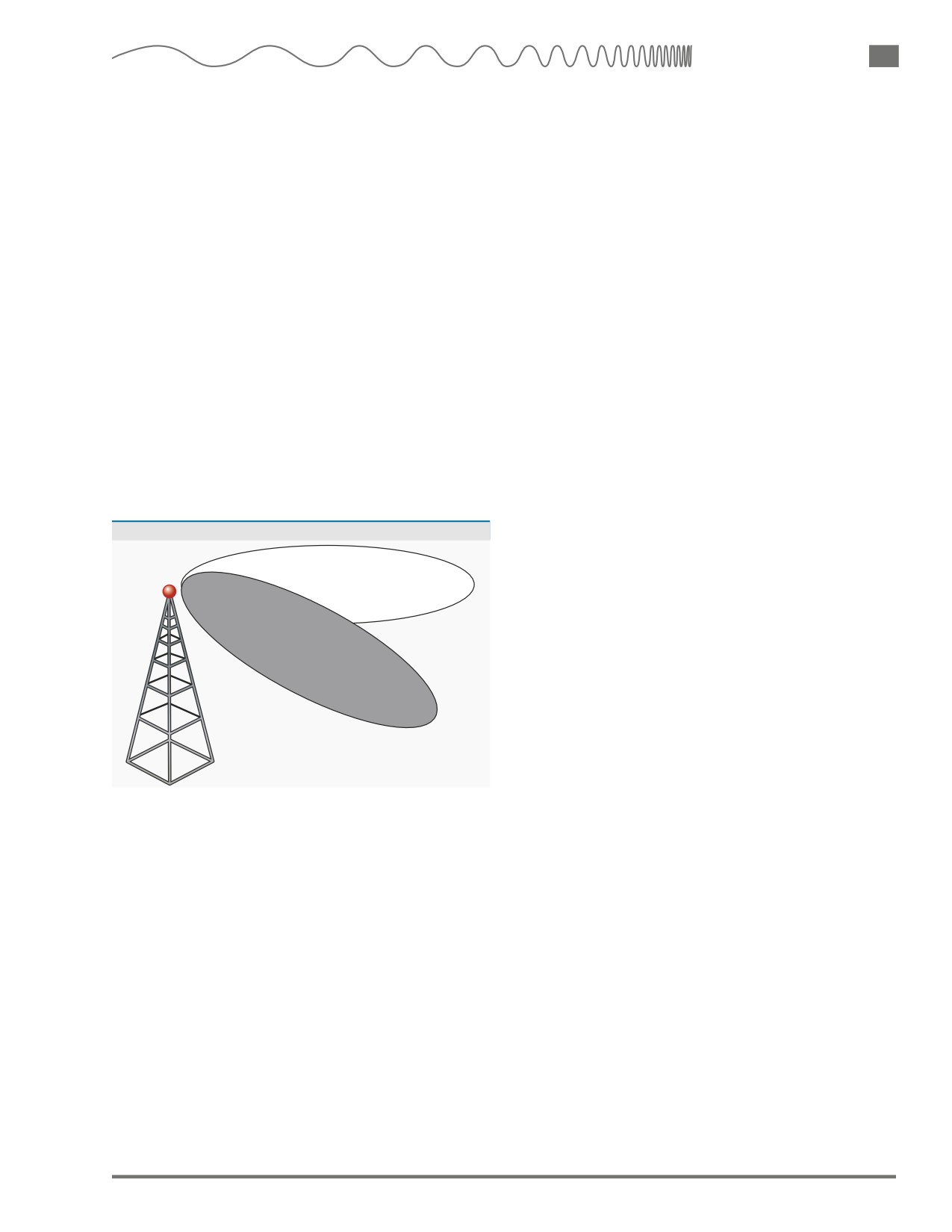
Directional antennas are used to direct the signal
270°
90°
toward the users and away from unwanted
areas. The antenna is said to have gain over an
omnidirectional antenna in the direction of highest
signal. If we think of this in fire terms, when
180°
we place a fog nozzle to straight stream, we are
Antenna
directing the same gpm in a focused direction as
Axis
Solid
Pattern
depicted in Figure 2.14. There is no increase in
energy, but it is now focused in a specific direction.
Directional antennas essentially do the same with
RF energy. Figure 2.15 shows a directional antenna
called a Yagi, along with its radiation pattern
looking down on the antenna. The pattern shows
a stronger signal from the front of the antenna and
a weaker signal from the back. The signal strength
protrusions behind the main signal are called
lobes, and, in most cases, antenna designers strive
to minimize this unintended signal.
Figure 2.14. Fog nozzle set to straight stream focuses energy in one direction — 150 gpm
Figure 2.15. Directional (Yagi) Antenna and Pattern
Basic Radio
Section 2
Communication
13
|
Technology
Downtilt
Portable Radio Position
When an antenna is located on top of a mountain
The principles discussed earlier affect the
or tall building, the coverage loss created by
performance of the portable radio. When a user
the “hole” in the radiation donut may have
transmits from a portable radio using a speaker
a significant impact on coverage in the area
microphone and it is against the body, RF energy
immediately around the antenna. To compensate
is blocked altering the omnidirectional radiation
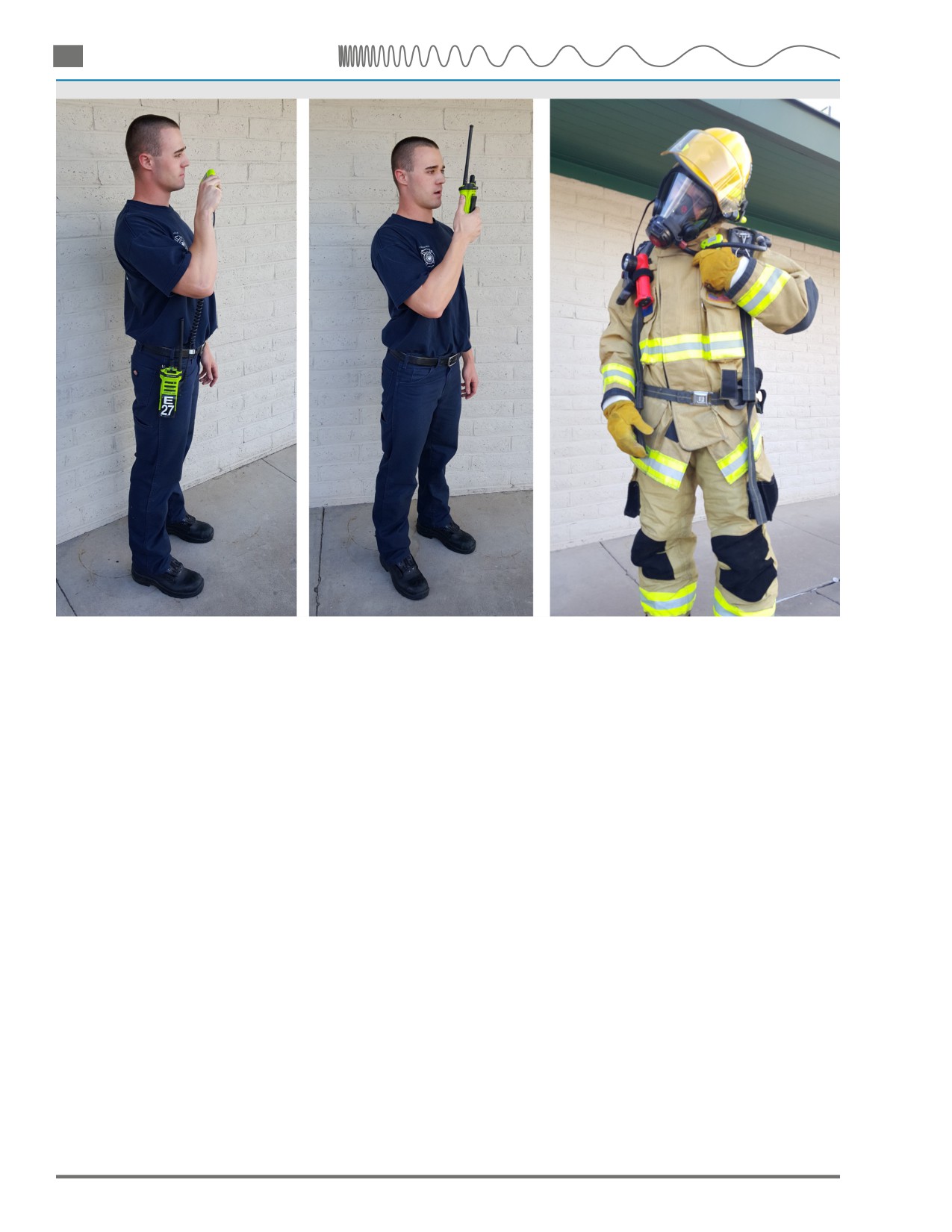
for this, directional antennas can be tilted
pattern. If you place your fog nozzle on wide and
slightly to direct more of the signal downward
place it next to an object, that pattern is altered, and
(Figure 2.16). This tilting is known as mechanical
the stream is not directed in the desired direction.
downtilt and increases the energy immediately
The same happens with the RF energy when the
below the antenna while reducing the maximum
radio is against your body. Some energy is absorbed,
distance the signal will travel. Unfortunately, when
and the remaining signal is shadowed by your body.
using an omnidirectional antenna, tilting the
Antennas must be oriented in the correct position
antenna down in one direction will result in tilting
for optimal performance. When an antenna is tilted
the pattern up on the opposite side of the antenna.
out of vertical, the signal received is not as strong
For this reason, special antennas with electrical
as it would be if vertical. There is no ideal location
downtilt are used when omnidirectional coverage
to wear the radio as a firefighter. As firefighters, we
is required, such as on a tall building in the center
need to be aware of the radio position particularly
of the coverage area.
when having difficulty communicating. As our
Figure 2.16. Downtilt
position is changed, the effectiveness of the radio
changes with the new position. We must be educated
users and know that we might need to alter our
position or move the radio to better communicate.
Simply reorienting the radio will often correct a
communications problem (Figure 2.17).
Voice Radio Communications Guide
14
for the Fire Service
Figure 2.17. Radio Antenna Placement
Signal altered by body.
Radio held vertically for best performance.
Radio position to SCBA voice port is good.
Radio protected in pocket.
(Photos courtesy Cody Worrell)
Mobile and Portable Antennas
Portable antennas usually are provided by the
portable radio manufacturer and are matched to
In general, all mobile and portable radio antennas
the radio. In some cases, alternative antennas can
are omnidirectional to provide coverage 360 degrees
be selected for the radio to overcome specific user
around the radio user.
conditions.
Vehicle antennas should be mounted so that they
When a portable radio is worn at waist level,
are not obstructed by equipment mounted on
such as with a belt clip or holster, the user’s body
the top of the vehicle. Light bars, air-condition
absorbs some of the signal transmitted or received
units, and master-stream appliances are some
by the radio. In addition, the antenna is at a much
typical obstructions found on fire service vehicles.
lower level than if the user were holding the radio
Some obstructions, such as aerial ladders on truck
to his or her face for transmitting.
companies, cannot be avoided, and the designer
must select the best compromise location.
Since the radio system is designed for use with the
antenna oriented vertically, the performance of the
Vehicle antennas mounted on the roof of fire
radio is reduced when the antenna is horizontal.
apparatus can be damaged by overhead doors, trees
This is particularly important for firefighters, since
and other obstructions. Ruggedized low-profile
the radio they use may become oriented horizontally
antennas often are a better choice, even if they
when they are crawling low inside a structure fire.
have a lower gain than a normal whip antenna. A
properly mounted intact antenna with a lower gain
is much better than a damaged antenna of any type.
Basic Radio
Section 2
Communication
15
|
Technology
Summary — Basic Radio Communication
Interference from undesired radio waves is always
Technology
a possibility in a radio system. The potential for
natural interference decreases as the frequency
Radio communication takes place using
band increases, but man-made interference
electromagnetic waves that travel from the
is very high in the 800 MHz band due to the
transmitter to the receiver. These waves are defined
proximity of cellular and other nonpublic safety
by the number of oscillations per second or Hz.
communications systems. This interference can
Wavelength is an actual length in distance that
make it difficult to communicate effectively in the
is determined by the operating frequency. The
presence of the interference.
wavelength is a key factor in the determination
of the antenna length. Antennas are tuned to the
When designing radio communications systems,
operating frequency of the radio. The practice
the designers must take into account the
of putting a longer antenna on to increase
presence of reflecting or absorbing materials and
performance should be discouraged and can result
interference. This may require constructing taller
in damage to the radio.
towers to support the antennas or increasing
the power of the transmitters to overcome the
Radio channel bandwidth is the amount of radio
loss of signal strength and interference. The
spectrum used by the signal transmitted by a radio.
system’s design must account for local terrain,
The greater the bandwidth, the more information
trees, buildings and the density of interference-
that can be carried by the signal in the channel.
generating sources.
Minimum channel bandwidth is limited by the
state of technology and the bandwidth required
Antennas are designed with radiation patterns to
to carry a given amount of information. Standard
direct RF in the desired direction. This is very
bandwidth has decreased several times in the past
similar to the use of a fog nozzle on the fireground.
to accommodate more users. Rule changes effective
The nozzle can be adjusted in a wide pattern to
Jan. 1, 2013, now require frequencies below 512
spread a set gpm or can be set to straight stream to
MHz to have bandwidths of 12.5 kHz. Digital radio
focus the same gpm in a specific direction.
technology allows use of TDMA, and it is being
When using a portable radio, users must remember
employed on many P25 trunked radio systems to
that their body absorbs some of the RF energy and
increase capacity, even though it is not mandated.
the antenna must be oriented properly for the best
Use of TDMA provides an effective 6.25 kHz
radio performance. There is no ideal location to
bandwidth or in industry terms a 6.25 kHz
wear the radio as a firefighter. As firefighters, we
equivalent bandwidth.
need to be aware of the radio position particularly
Transmitted radio waves can be reflected or absorbed
when having difficulty communicating. As our
by materials, such as buildings, the earth or trees,
position is changed, the effectiveness of the radio
reducing the strength of the wave when it reaches
changes with the position. We must be educated
the receiving antenna. Elevating the transmitting or
users and know that we might need to alter our
receiving antenna will reduce the likelihood of the
position or move the radio to better communicate.
wave being affected by buildings or trees because the
Simply reorienting the radio will often correct a
path to the receiver will be more direct.
communications problem.
Voice Radio Communications Guide
16
for the Fire Service
This page intentionally left blank.
Digital and
17
Section 3 |
Analog Radio
SECTION 3 —
Digital and Analog Radio
Several different types of radios are used in the fire
Base station radios are located at fixed locations
service. These radios can be classified as mobile,
and usually are powered by AC utility power.
portable or fixed. They operate in either analog
Base stations are generally higher in performance
or digital mode on direct, repeated or trunked
than mobile and portable radios, with higher
systems. This section discusses the operation of
powered and more stable transmitters and more
these types of radios and the features, benefits
sensitive and interference-resistant receivers.
and problems associated with their use in the
Some fire departments equip fire stations with
fire service. All technologies have strengths and
base station radios to provide enhanced coverage
weaknesses. It is important for the fire service to
throughout their service area and to provide
understand the strengths and weaknesses of all
backup communications in the event of a primary
communications technologies to be able to make
communications system failure.
informed decisions to keep members safe.
Repeaters are similar to base stations, but they
Mobile radios are designed to be mounted in
can transmit and receive at the same time,
vehicles and get their power from the vehicle’s
retransmitting the signal received by the receiver.
electrical system. They can be of either a one- or
Repeaters are used to extend the coverage of
two-piece design, with the radio itself separated
portable or mobile radios.
from the controls. An external antenna is
Radio console equipment is used by dispatchers to
connected to the radio and permanently mounted
control base station radios and repeaters and allow
to the vehicle. Mobile radios usually have better
the dispatcher to receive and transmit on one or
performance than portable radios, including better
more radios simultaneously. The consoles typically
receivers and more powerful transmitters. One
have individual volume and transmit controls for
exception to this is that mobile radios used in
each radio as well as a master volume and transmit
trunked radio systems may or may not have more
control. Headsets can be connected to the consoles
powerful transmitters because the systems are
along with footswitches, allowing dispatchers to
designed for portable use, reducing the need for
operate the console hands-free so they can operate
high-powered transmitters.
computer equipment simultaneously.
Portable radios are hand-held radios powered by
Analog Radios
rechargeable, replaceable battery packs or power
sources. They usually have an external rubber
The human voice is an analog signal. It is
antenna attached to the top of the radio.
continuously varying in frequency and level.
Analog radios have been in use since the invention
Mobile and portable radios have similar controls
of voice radio in the early 1900s. The type of
to perform their essential functions. These include
analog radio used today was invented in the 1930s
things such as changing channels, adjusting the
to improve on the older radio’s poor immunity to
speaker volume, and transmitting. The common
noise. These radio systems use FM to modulate the
names for these controls are the channel (or
transmitted signal with the user’s voice. The main
talkgroup) selector, volume adjustment, and push-
advantage of FM over older radio system types is
to-talk (PTT) switch. Some radios, particularly
that FM radios tend to reject (interfering) signals
those intended for fire and police use, will have an
that are weaker than the desired signal.
orange or red emergency button. This button may
be programmed to indicate to the radio system and
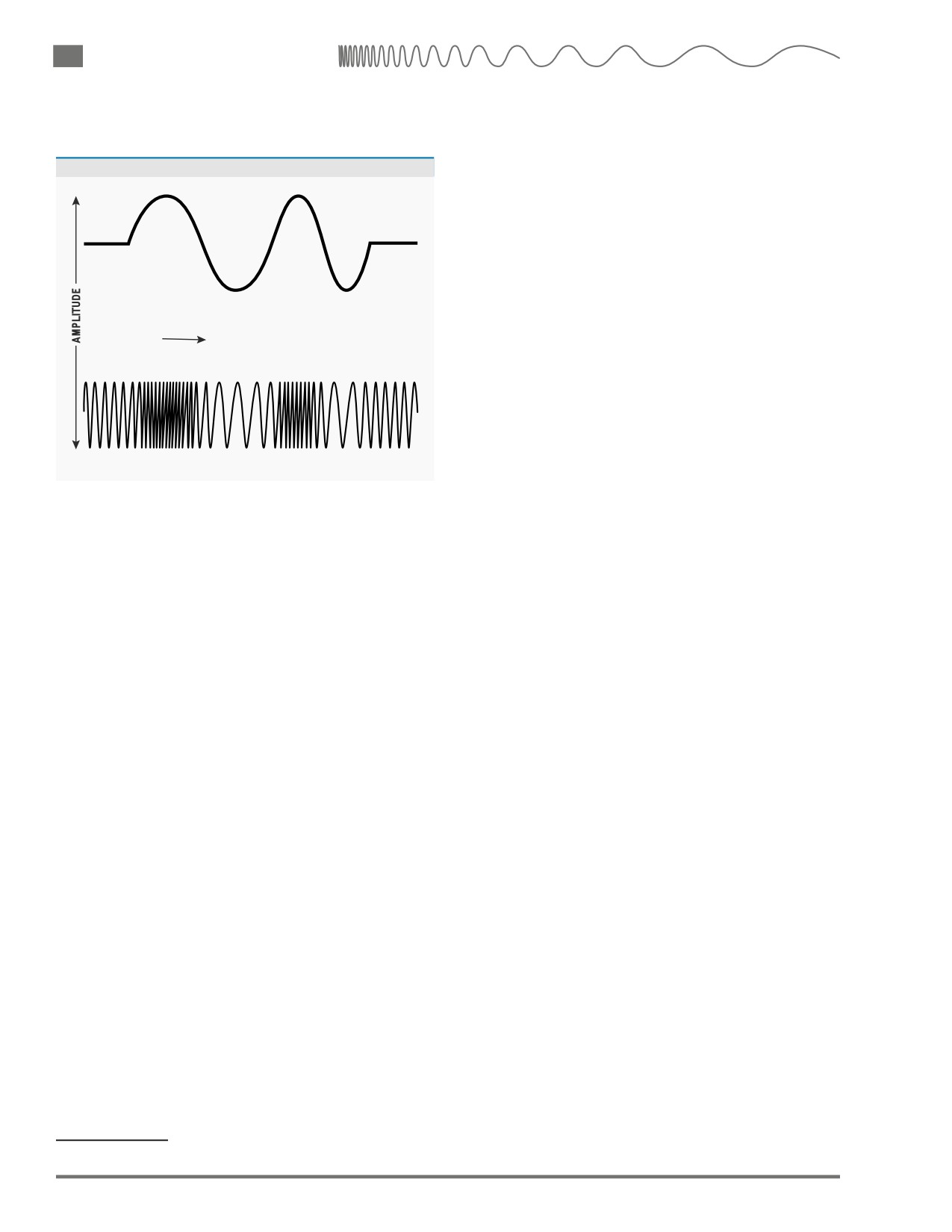
Analog FM radios operate by causing the
to other users that a user has an emergency. Older
transmitting frequency of the radio to change
radios may have a squelch adjustment knob, but
directly with the microphone audio. Initially, the
most modern radios have internal control settings
signal is filtered to remove any frequencies above
or adaptive squelch so that a squelch adjustment
human voice, but no other changes are made to
knob is no longer necessary.
Voice Radio Communications Guide
18
for the Fire Service
the signal. Figure 3.1a shows an example signal from
Digital Radios
the microphone, and Figure 3.1b shows the resulting
To improve audio quality and spectrum efficiency,
change in frequency of the transmitted signal.
radio manufacturers introduced digital radios.
Figures 3.1a and b. Frequency Modulation
Digital radio also provides a pathway for the FCC
to improve efficiency and to meet the increasing
requests for the radio spectrum. This is evidenced
by a mandate to narrowband 700 MHz channels
to a 6.25 kHz equivalent bandwidth by Dec. 31,
2016. However, this mandate was eliminated by
an FCC ruling made October 2014. The FCC stated
(A)
the following “We conclude that the December
TIME
31, 2016 narrowbanding implementation deadline
is no longer viable. The record indicates that
requiring narrowbanding by December 2016
would force many licensees to modify or replace
existing systems well before the end of their useful
life. In addition, we share the concerns expressed
(B)
by many commenting parties about the maturity
of 6.25 kilohertz-capable equipment, including
FM radios constantly have a signal at the output
the lack of developed open standards governing
of the receiver, and a squelch circuit is used to
major system components.”8 The FCC recognized
mute the output of the radio receiver when no
that many of the systems affected by the mandate
desirable signal is present. Squelch circuits mute
would have been newer systems and that the
the output automatically until the signal is strong
mandate would require modification of systems
enough to unmute. Older radios had adjustable
that were not near end of life.
squelch level controls, allowing the user to make
the radio less sensitive if there was interference.
Digital radio continues to be plagued with
However, most new radios have squelch levels that
difficulties in processing voice with high
are adjustable only by radio technicians using radio
background noise. Advancements have been made
programming software.
in the signal processing, but there continues to be
instances where digital radios struggle. The prime
To further reduce received noise and interference,
examples continue to be Personal Alert Safety
well-designed analog radio systems use Continuous
System (PASS) devices and SCBAs with vibrating
Tone-Coded Squelch System (CTCSS) or Digital-
regulators that signify low air.
Coded Squelch (DCS). CTCSS is also known by
proprietary names such as Private Line™ (PL) or
In the digital world, when a user speaks into the
Channel Guard™ (CG).
microphone the radio samples the speech and
assigns the sample a digital value. A vocoder (voice
CTCSS mixes a subaudible tone with the audio from
coder) or codec (coder/decoder) in the radio
the microphone and transmits the resulting signal.
performs the function of converting analog voice
When a radio receives a signal with tone-coded
to a digital data packet. The digital data packet can
squelch, the CTCSS decoder attempts to match the
vary in the number of bits. The use of digital audio
tone present in the received signal with the desired
was expected to reduce static and increase the range
tone. If the correct tone is present, the receiver is
of radios in weak signal conditions. P25 vocoder
unsquelched, and audio is routed to the speaker.
manufacturer Digital Voice System Inc. (DVSI)
has improved the Enhanced Vocoder’s ability to
recognize and suppress high frequency noise. The
result is improved voice quality and intelligibility
8 FCC Report and Order, October 2014, FCC-14-172.
Digital and
19
Section 3 |
Analog Radio
in high frequency noise such as PASS alarms. These
4. The modulator modulates the RF with the
improvements improve the performance of digital
digital data.
radios on the fireground. Radio manufacturers also
5. The modulated RF signal is boosted in power
continue to improve the technology by employing
by transmitter amplifier.
noise canceling features and embedding noise
filtering options in the radios.
6. The signal is transmitted from the radio antenna.
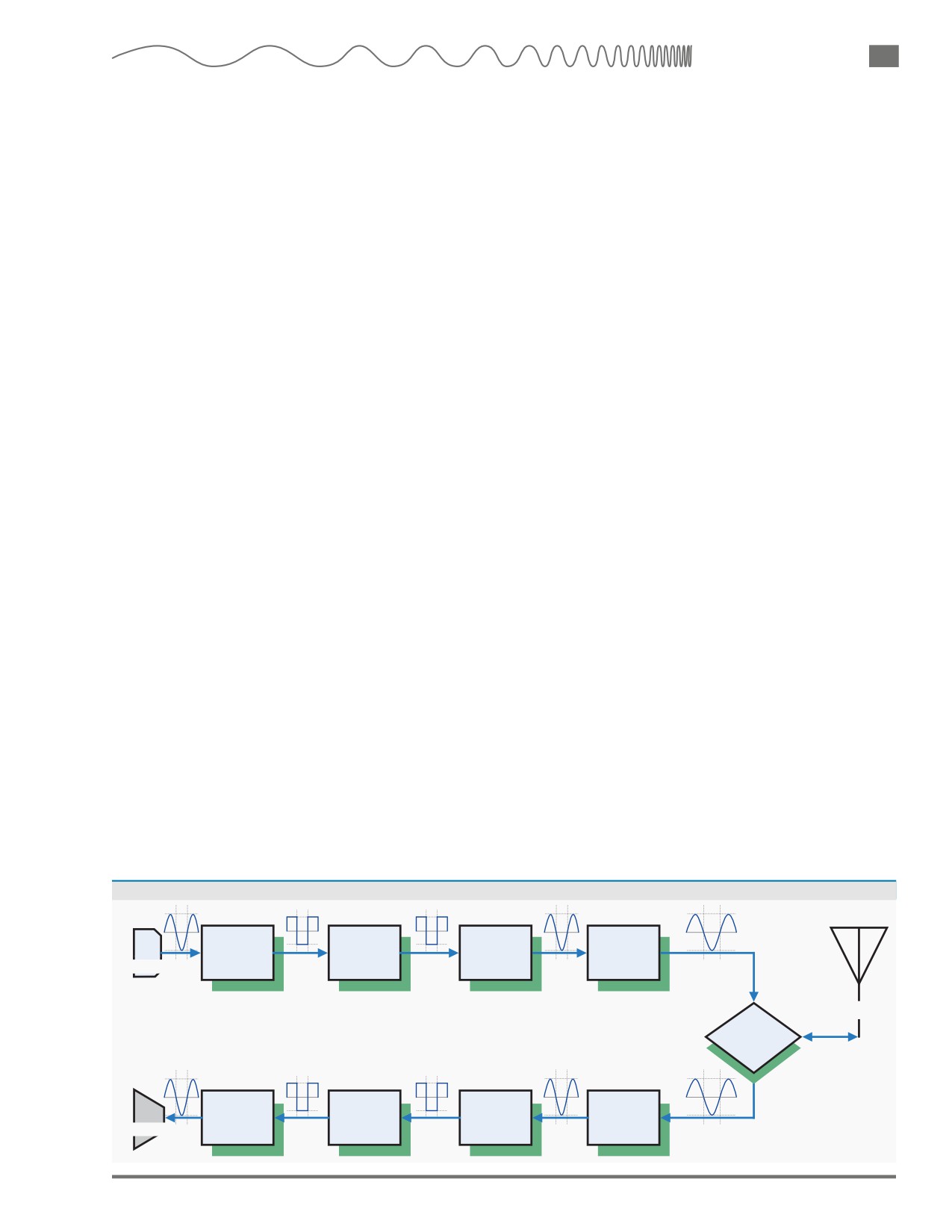
Digital Audio Processing
Receiving radio:
In digital radios, analog voice is converted to a
1. The modulated RF is received by antenna.
digital interpretation from an audio sample received
from the microphone (Figure 3.2). P25 digital
2. The received RF signal is boosted to a usable
radios have very limited data rates and bandwidth
level by the receive amplifier.
available to transport the digitized voice. P25 digital
3. The signal is demodulated by a demodulator.
vocoders are designed to encode and decode the
This removes the RF component of the signal
frequency range and elements of human voice. For
leaving the digital data component.
example, digital radios do not accurately reproduce
pure tones. The inability to transmit tones affects
4. Digital data is decoded by the vocoder into
departments that use tones to alert firefighters of
digitized speech.
specific events on the fireground. Human speech is
a constant variation in frequency and amplitude. If
5. Speech data is converted to an analog signal by
you attempt to transmit a pure tone, the received
a digital to analog converter (D/A converter).
audio will not be a true reproduction of the source,
6. Analog is sent to the speaker.
and it is noticeably different.
Analog and Digital Comparisons
This is a basic explanation of how analog voice is
processed by the radio.
Distance
As the radio user travels further from the
Transmitting radio:
transmitting radio, the signal strength decreases.
1. The user speaks into the microphone.
The signal strength directly affects the ability of the
radio to reproduce intelligible audio.
2. The audio is sampled and converted to a digital
interpretation by an analog to digital converter
In an analog system, the clarity and intelligibility
(A/D converter).
of the transmission, as received by the user,
decreases directly as the signal level decreases. The
3. The vocoder converts the digitized speech into
noise (static) in the signal progressively increases
digital data.
in strength, while the desired signal decreases
Figure 3.2. Digital Radio
Radio
Analog to
Frequency
Digital
Vocoder
Modulator
Power
Microphone
Converter
Amplifier
Antenna
Transmit
Receive
Switch
Digital to
Receive
Analog
Vocoder
Demodulator
Amplifier
Speaker
Converter
Voice Radio Communications Guide
20
for the Fire Service
until the transmitting user cannot be heard over
Voice Intelligibility
the noise. When the signal level is high, the voice
The ability to understand the digital radio
quality is high. As the signal level decreases, the
transmissions has been a focus of many fire
voice quality decreases in a predictable manner
departments. After implementation of P25 digital
giving the user hints that the signal is getting
systems, it was discovered that digital audio was
weaker. This characteristic adds to the situational
not the same as analog, and the performance
awareness allowing the user to make decisions
differences were most prevalent during fire
about the environment.
operations. One of the most significant differences
was attempting communications with a vibrating
When a digital user transmits to a receiver, the
low air alarm or a PASS device alarming.
transmitted signal decreases just as the analog signal
decreases. However, the digital transmission contains
In 2007, the International Association of Fire
extra data providing error correction and allowing
Chiefs (IAFC) formed a working group to address
audio to be recovered despite declining signal. As
potential problems with P25 digital radio.
the receiver travels further from the transmitter, the
The working group consisted of fire service
signal level decreases to the point where the error
personnel, other public safety representatives,
correction cannot correct all errors in the signal.
wireless radio manufacturers, manufacturers of
When this point is reached, the receiving users will
fire apparatus and equipment, and consultants
hear some distortion in the signal and may hear
to address potential problems found in digital
some strange nonspeech noises. These noises are
radios in the presence of loud background
often referred to as digital artifact. Once this point
noise.9 Funding for this effort was provided
is reached, a small reduction in signal level will
jointly by the DHS Office of Interoperability
cause the number of errors to exceed the ability of
and Compatibility, the National Institute of
the system to compensate, and all audio will be lost.
Standards and Technology (NIST) Office of Law
Enforcement Standards, and the Federal Partnership
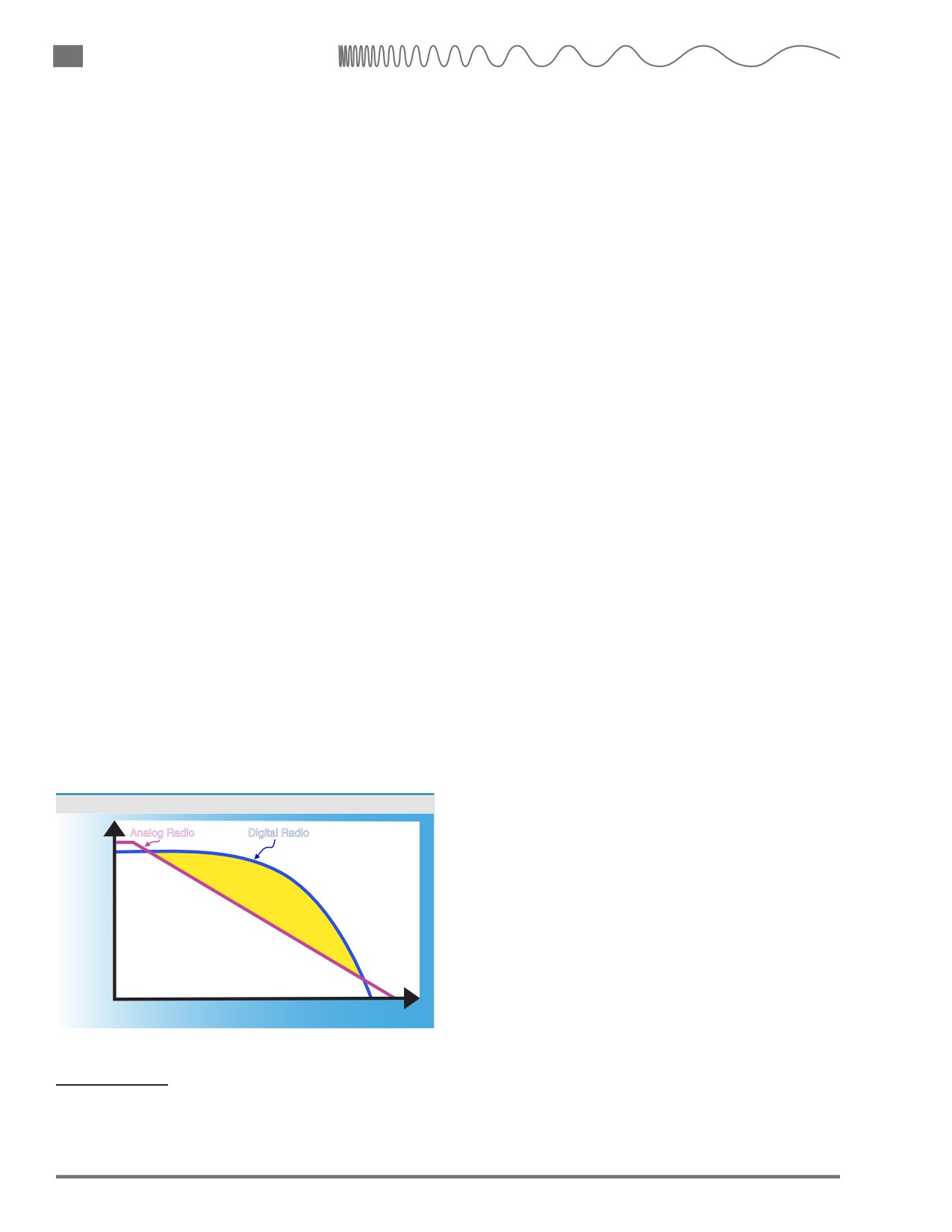
Although digital radios provide a larger range of
for Interoperable Communications (FPIC). As a
usable signal levels, the lack of advanced indication
result of the findings of the IAFC workgroup, the
of signal level decrease allows users to get closer to
National Telecommunications and Information
complete loss of communication with less warning
Administration (NTIA) allocated resources to
than an analog radio. As you note in Figure 3.3,
perform testing of the P25 vocoders in the
the analog signal voice quality decreases in a near
firefighting environment. NTIA TR-08-45310 was
linear rate as signal level decreases. In comparison,
released in 2008. The report identified performance
digital voice quality has a steeper degradation when
differences between digital and analog radios. As
it reaches lower signal levels.
we move forward in time, technology continues to
Figure 3.3. Analog Versus Digital Signal
advance. Emerging technologies and new vocoders,
such as the ones used in cellphone technology (4G
Analog Radio
Digital Radio
High
Long Term Evolution (LTE)), required testing. In
response to emerging digital voice technologies,
Performance
additional testing was performed by the NTIA.
Voice
Difference
NTIA report 13-49511 documents the performance
Quality
of the different technologies in the firefighting
environment. This next section will focus on the
performance contrast between digital radio and
Low
analog radio.
High
Low
RF Signal Level
John C. Hardwick, Ph.D., President, DVSI Presentation to NFPA 1802
Technical Committee, Nov. 19, 2014, Tucson, Arizona
10 NTIA Technical Report TR-08-453 Intelligibility of Selected Radio Systems in the Presence of Fireground Noise: Test Plan and
Digital and
21
Section 3 |
Analog Radio
Program 25 History
are developed to provide digital voice and data
communications suited for public safety and first
The Association of Public Safety Communications
responder applications.12
Officers (APCO), representing the public safety
technical community and the Telecommunications
Program 25 Interoperability
Industry Association (TIA), recognized that
P25 does not address any operational or
there would be a requirement to move to digital
interoperability needs. P25 also does not provide
technology. This provided an opportunity to
a fire department with interoperability unless it
develop an open standard that would allow different
is planned for. A lone agency on P25 is no more
manufacturers to build equipment that could operate
interoperable than being on a UHF system trying
together. The goal was to introduce competition
to interoperate with a department on VHF. P25
into the market, help control costs, and provide a
only provides manufacturers with a common
technology platform for improved interoperability.
digital language for the radios and system
Up until the development of this standard, each
infrastructures. The use of the P25 standard
manufacturer had proprietary digital radios that
has provided a common platform that allows
could interoperate only with like radios. Working
technical interoperability between systems. This,
with the TIA, APCO coordinated the work of
in turn, provides the technical path to provide
manufacturers to develop the APCO P25 standard for
interoperability for public safety operators.
digital radios. Modern public safety digital radios use
P25 system standards also were meant to allow
this standard. P25 is the national standard for public
radios from different manufacturers to operate on
safety digital radios but also is backward compatible
any other P25-trunked radio system. While the
for analog use. This standard was developed to allow
intent was to provide complete interoperability
radios from multiple manufacturers to communicate
between different trunked systems and portable
directly using a common digital language, to
manufacturers, the P25 standard allows
define standards for trunked radio systems to allow
manufacturers to implement nonstandard features.
multiple manufacturers to operate on a common
So a P25 radio may not have full functionality on
platform, and to provide a roadmap for future
a trunked system of a different manufacturer. The
features and capabilities.
trunked systems available today offer many features
The TIA Engineering Committee (TR-8)
and have complicated roaming schemes. If you are
formulates and maintains standards for private
purchasing devices from a different manufacturer
radio communications systems and equipment
than your trunked system, care must be taken to
for both voice and data applications. TR-8
thoroughly test to ensure all of the features you
addresses all technical matters for systems and
expect to use are functional.
services, including definitions, interoperability,
Program 25 Characteristics in High-Noise
compatibility and compliance requirements. The
Environments
types of systems addressed by these standards
include business and industrial dispatch
When P25 is used in settings where the
applications as well as public safety (such as police,
background noise level is within limits set in the
ambulance and firefighting) applications.
P25 standard, it provides usable audio. However,
the P25 vocoder was not designed to operate in the
Much of the work of the committee relates to the
high-background-noise environments encountered
formulation of the TIA-102 series standards for
on the fireground. When the P25 vocoder was
APCO Project 25. These are standards sponsored
being developed, the designers tested intelligibility
by the Association of Public Safety Officials
of the digital audio with high ambient noise levels
International, the National Association of State
at the receiving radio. The P25 vocoder is unable
Telecommunications Directors (NASTD), and
to differentiate the spoken voice from the high
agencies of the federal government. P25 standards
Voice Radio Communications Guide
22
for the Fire Service
background noise and assigns a digital value that
Simultaneous Transmissions
does not accurately represent the voice. The result is
When on the fireground, communications are
unintelligible audio or broken audio with digitized
often very fast, and many users are often trying
noise artifact. Users of P25 radios have been
to communicate at the same time. This can result
affected by many common fireground noises. The
in simultaneous transmissions. Simultaneous
SCBA alerting systems for low air or inactivity and
transmissions can be a hindrance to fireground
PASS devices have made the audio transmitted from
communications, and there is a difference between
digital radios unusable. P25 radios transmitting
analog and digital. In analog simultaneous
from high-noise environments do not perform to
transmissions, the result is a warble-like tone
the same levels as analog radios.
behind the voice. The technical term for this
is heterodyning or mixing of frequencies. In
Self-Contained Breathing Apparatus Mask
analog, the receivers can hear that two units
Effect on Communications
are transmitting and can ask for a repeat of the
The effect of SCBA masks on the human
transmission. In digital, if the two signals are
voice was published by the Institute of
equal in strength, the receiver may quiet due to
Electrical and Electronics Engineers (IEEE)
a corruption of the data stream. This can occur
Communications Magazine.
in any digital simplex/direct or digital repeated
system where access is not controlled. Trunked
The testing in the IEEE article documents the
systems only allow one user to transmit at a time,
effects of the SCBA system on voice intelligibility.
so this situation is highly unlikely.
Based on the testing, the conclusion was that
“SCBA systems are frequently used by firefighters
Program 25 Digital for Firefighting
and other public service personnel who rely on
Fire departments and other emergency service
speech radio communications to perform their
agencies have successfully implemented digital
work. The SCBA mask acoustically distorts speech
radio systems. However, fire departments around
and the breathing system produces noises that
the country have reported difficulties with
can detrimentally affect speech communications,
digital radios.14 A simple Internet search of “Fire
especially when a digital speech codec is used
Department Digital Radio Problems” will yield a
in the communications link. Both speech
long list of problems encountered by firefighters
intelligibility and speech quality are detrimentally
using digital technology.15 To say that all digital is
affected by SCBA equipment use.”13
bad would be an incorrect statement. Each instance
Feedback
must be analyzed individually for the cause. What
is important is to understand the cause of the
The presence of feedback can be affected by the type
communications problem and either design it
of system the radio is on. In simplex/direct systems,
out of the system or avoid use of the technology
the presence of feedback is all radios are on the same
when it is does not meet operational requirements.
frequency. If transmitting near many other radios set
This analysis should be done for any technology
on high-volume settings, the receiving radios squeal
employed on the fireground. Studies performed
due to a feedback loop that is created. In digital
by NIST, IAFC and portable radio manufacturers
radios, the same conditions exist, but the radios
have supported the findings from the field users.
emit what sounds like “crickets.” In both analog
Fire departments need to consider the performance
simplex and digital simplex, it is important for users
differences between digital and analog technologies
to be aware of this characteristic and shield the
when researching new communications systems.
microphones from the other radios that are nearby.
13 IEEE Communications Magazine, January 2006, “The acoustic properties of SCBA equipment and its effects on speech
communication,” William M. Kushner, Member IEEE, S. Michelle Harton, Member IEEE, Robert J. Novorita, Member IEEE,
and Michael J. McLaughlin, Fellow IEEE.
15 This website is a collection of information on radio system that can be of value: http://blog.tcomeng.com/index.php/digital-
trunked-radio-system-problems/.
Digital and
23
Section 3 |
Analog Radio
This is supported by NFPA 1221, Standard for the
environment. Manufacturers took advantage of
Installation, Maintenance, and Use of Emergency Services
digital audio processing to remove the noise or
Communications Systems, (2013 edition). It requires
use noise canceling using one microphone to
a tactical analog channel for on-scene
detect the spoken audio and a second to detect the
communications.
background noise. While these methods can work,
it is important to note that this has increased the
9.3.1.3 A communications radio channel,
complexity of programming the radio. A missed
separate from the radio dispatch channel, shall
check box when programming the radio can have
be provided for on-scene communications.
detrimental effects. All new radio configurations
must be thoroughly tested to ensure proper
9.3.1.4 At a minimum, the tactical
operation. The days of just buying an off-the-shelf
communications channel identified in 9.3.1.3
speaker microphone and it working are gone.
shall be capable of analog simplex mode.
Summary — Digital and Analog Radio
When fireground noise of high amplitude is
introduced, the voice translation ability of the P25
There are multiple radio types in use by the
radio decreases and generates audio that is poor or
fire service. Mobile radios are usually mounted
not intelligible. These problems are worsened when
in vehicles. Mobile radios usually have better
the firefighter is speaking into the portable radio
performance than portable radios. Mobile radios
through an SCBA facepiece. Bone microphones,
usually have better receivers and more powerful
throat microphones and microphones in the
transmitters. Mobile radios used in trunked radio
facepiece minimize the interference caused by
systems may or may not have more powerful
background noise by isolating the transmitted voice
transmitters. Portable radios are hand-held
from background noise. Speaker microphones are
radios powered by rechargeable or replaceable
subject to the same problems that are found with
battery packs. They usually have an external
the microphone on the portable radio.
rubber antenna attached to the top of the radio.
Portable radios have power limitations and suffer
The configuration of the P25 vocoder is limited in
performance degradation based on where the user
its capability to translate the human voice in the
operates from and where the radio is worn. Base
presence of common fireground noise or through
station radios are located at fixed locations, and
a facepiece. The studies performed by NIST and
usually are powered by AC utility power. Base
IEEE illustrate that digital radio intelligibility when
station radios generally are higher in performance
talking through an SCBA facepiece is degraded.
than mobile and portable radios. Repeaters are
This can pose a safety hazard for fireground
similar to base stations, but they can transmit and
operations. To maintain safety, fire departments
receive at the same time, retransmitting the signal
should consider using portable radios that
received by the receiver. Repeaters are used to
incorporate analog modulation for operations
extend the coverage of portable or mobile radios.
where the firefighter is using an SCBA.
Analog radios have been in use since the invention
Radios using the P25 digital technology have
of voice radio in the early 1900s. The type of
performed well for other fire service functions, such
analog radio used today was invented in the 1930s
as on emergency medical incidents and support
to improve on the older radio’s poor immunity to
functions on the fireground where an SCBA is not
noise. These radio systems use FM to modulate the
required, as well as law enforcement operations.
transmitted signal with the user’s voice.
The difficulties presented by the inability of P25
radios to produce intelligible voice messages in the
To improve audio quality and spectrum efficiency,
presence of fireground noise is a significant safety
radio manufacturers introduced digital radios.
concern and should be considered seriously by
Digital radio also provides a pathway for the FCC
public safety radio system designers and users.
to improve efficiency and to meet the increasing
requests for the spectrum.
P25 radio manufacturers recognized the need to
filter or cancel background noise in the firefighting
Voice Radio Communications Guide
24
for the Fire Service
P25 digital radios have different performance
is vital. Local fire departments need to test all
characteristics from analog radios. Digital radio in
elements of the communication system to ensure
some environments provides clear voice with no
reliability (SCBA, radios, and any accessories such
background noise. The fire service environment is a
as speaker microphones, in-mask communications
challenging environment to operate in, and digital
systems, etc.).
radios have performance degradation in several
NFPA 1221 (2013 edition) requires a tactical analog
areas. The specific areas to be concerned with are:
channel for on-scene communications.
• Radio use with an SCBA.
9.3.1.3 A communications radio channel,
• Intelligibility in a high-noise environment.16,17
separate from the radio dispatch channel, shall
• PASS device.18
be provided for on-scene communications.
• Vibrating low-air alarms.
• Feedback.
9.3.1.4 At a minimum, the tactical
communications channel identified in 9.3.1.3
Fire departments need to consider the performance
shall be capable of analog simplex mode.
differences between digital and analog
technologies when researching new trunked
The P25 standard continues to be the most common
communications systems.
radio platform and will be into the foreseeable
future. P25 systems offer a common radio language
An analog simplex channel is a requirement in
that provides a path to interoperability, but as
NFPA 1221 (2013 edition). The availability of
with any system, interoperability has to be part of
analog simplex channel(s) for firefighting
the plan.
applications when the firefighter is using an SCBA
16 Position Paper — Background Noise and Radio Performance, http://content.motorolasolutions.com/promo/sayitloud/
FRI_Paper_RO-99-2169_3.pdf.
17 NTIA Technical Report TR-08-453 Intelligibility of Selected Radio Systems in the Presence of Fireground Noise: Test Plan and
18 National Public Safety Telecommunications Council (NPSTC) Brief — August 2008: International Association of Fire Chiefs
Investigate Fireground Noise and Digital Radio Transmissions.
Conventional
25
Section 4 |
Radio Systems
SECTION 4 —
Conventional Radio Systems
There are a wide variety of radio systems in
the portable radio transmit frequency is received
use today. There are simple systems that use a
by the repeater and retransmitted on the portable
conventional analog repeater to complex trunked
receive frequency at a higher power to extend range
systems that employ the latest technologies.
or increase penetration.
Conventional systems are generally categorized as
Direct/Simplex Communications on the
nontrunked. Conventional systems are not computer
Fireground
controlled systems that require data infrastructure
and controllers to manage radio traffic. Trunked
Using simplex communications maintains positive
systems, on the other hand, do require data
communications between the IC, exterior on-scene
infrastructure, and the portable units on a trunked
units, and interior units without the reliance on
system are infrastructure dependent. It is important
exterior communications systems. Maintaining
that users of the system understand how the
positive communications is especially important
system works. This does not mean that they need
in “mayday” situations. When users on simplex
to know the technical details of the system, but
radios are deployed to the interior of a structure,
how to make it or adjust it to achieve reliable
they create a radio receiver network. As more and
communications. In today’s world, most of us carry
more radios move into the structure, the strength
a mobile communications device, either a cellphone
of the network increases. If Engine 1 calls mayday,
or smartphone. We may not understand what code
the probability of another radio on the interior
division multiple access (CDMA), FDMA, 1XRTT,
receiving the transmission is high. If the mayday is
3G or 4G are, but we do use these systems and are
not heard by the IC, another radio operator on the
able to make these systems work for us. An example
interior can act as a human repeater to repeat the
would be walking inside of a building, and your 4G
message to the IC. In addition, the number of radios
indication is absent, and the signal level indicator
in a structure creates redundancy, whereas reliance
has one bar. You know that these indications mean
on a single repeater or trunked system creates a
that you need to move to an area with better
single point of failure. Simplex communications
cellular coverage. It has become second nature to
allow direct communications with the initiator of
us, and we need to have the same comfort level
the mayday and other crews on the fireground.
with the radio systems when we do the dangerous
work of firefighting. The following sections
This is an example of direct/simplex
describe some typical system configurations. Each
communications with no infrastructure (Figure
and every system can vary based on how the
4.1). This means that there is no infrastructure to
system is programmed or how the portable radios
support receiving and transporting the fireground
are programmed. It is incumbent on us to train
communications to the dispatch center, and without
firefighters on the operational capabilities and
remote transmitters, the dispatch center is not able to
limitations of these systems and their ability to
transmit to the fireground. When the radios involved
provide reliable communications.
in direct communication are portable radios, the
communication distance typically is limited to a
Direct and Repeated Radio Systems
few miles; for mobile radios the distance can be
50 to 100 miles. Often this is referred to as “line-
Radios communicate when the transmitter sends out
of-sight communication,” and this makes direct/
a signal that is received by one or more receiving
simplex radio communication most suitable for
radios. When the signal is received from the radio
tactical use by units on an incident scene. Command
initially transmitting the signal, the communication
systems that use these types of channels often have
is direct. (That is, there is no intervening radio or
a command channel. In this type of system, the
system.) When one radio transmits and the other
dispatch center monitors the command channel and
radios receive, this type of communication is known
the IC relays the relevant information received on the
as simplex communication. In a repeated system,
direct/simplex channel onto the command channel.
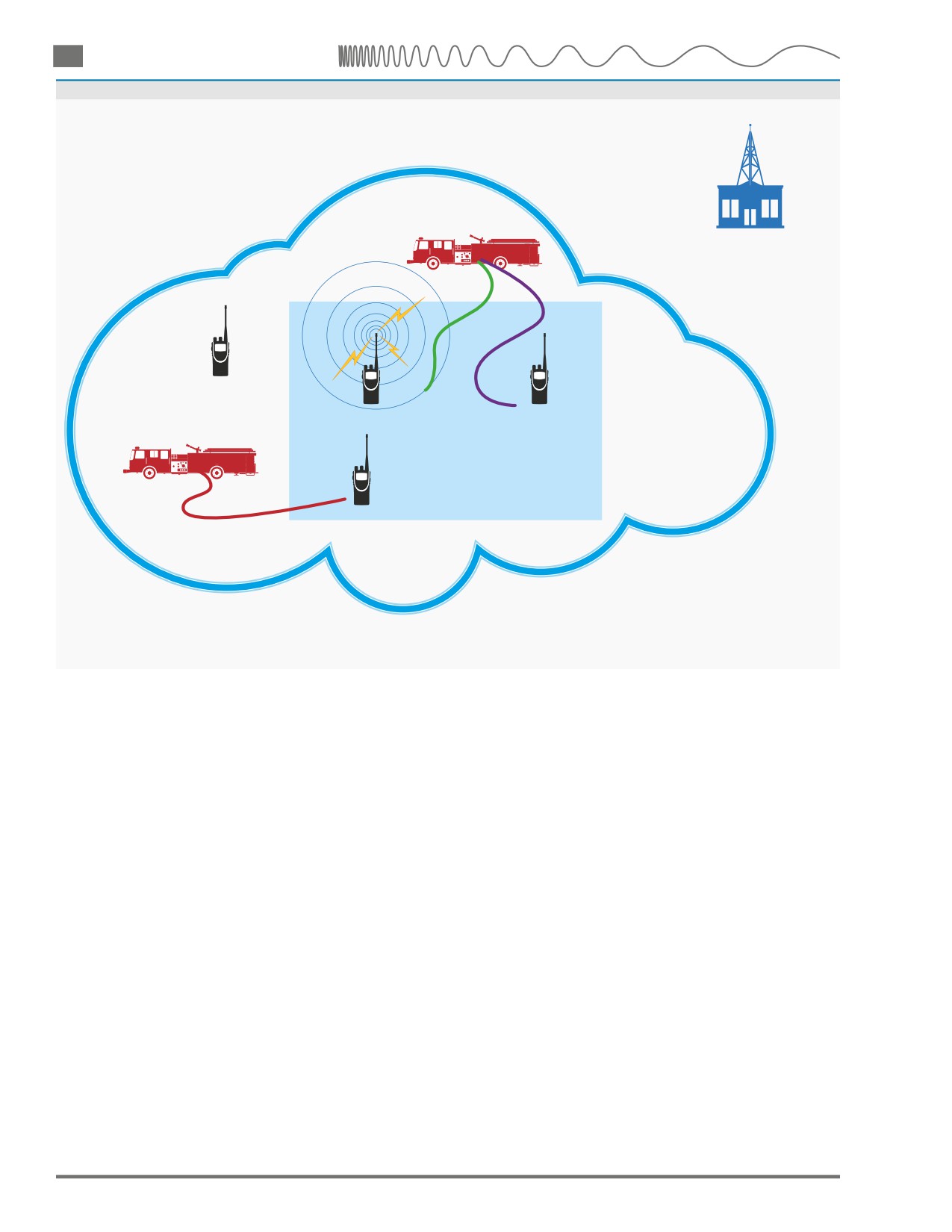
Voice Radio Communications Guide
26
for the Fire Service
Figure 4.1. Direct/Simplex Without Transmit/Receive Infrastructure
Pump 1
Receives
Dispatch Center
Out of Receiver Range
E-4
Receives
E-1
Transmits
E-2
Pump 3
Receives
Receives
E-3
Receives
The cloud represents the maximum transit range of the portable radio.
The direct communication method is the simplest
second group is far enough away that it does not
form of radio communication and is easily
hear the first group’s communications, then the
affected by terrain blocking, including man-made
channel can be reused. This minimizes the number
structures such as buildings. If an obstruction
of channels needed by an agency.
is between the transmitting and receiving
When a radio system must cover a larger area,
radios, communication may not be possible.
or when terrain or other obstructions limit the
Users must be aware that some buildings due
distance a system can cover, additional equipment
to size or construction cause communications
is needed to overcome these limitations.
difficulty. Many jurisdictions place warnings in
computer-aided dispatch (CAD) systems to alert
Receiver Voters — Improve Field Unit to
users of structures with known communications
Dispatcher Communications
difficulties. Users can be advised to use human
repeaters to communicate to the IC. Additionally,
Dispatch centers connected to high-powered
awareness on the fireground is important; if a
transmitters provide the dispatch center with
communication attempt to the IC from the interior
talk-out capability. Transmitters are elevated to
is heard and the IC does not answer, that might
achieve better line-of-sight communications with
be a cue to relay the information. The short-range
the service area. High-powered transmitters ensure
nature of direct communication also allows one
that the dispatch center transmissions are heard
radio channel used by one communicating group
throughout the service area and provide some level
to be reused by another group further away. If the
of in-building coverage (Figure 4.2).
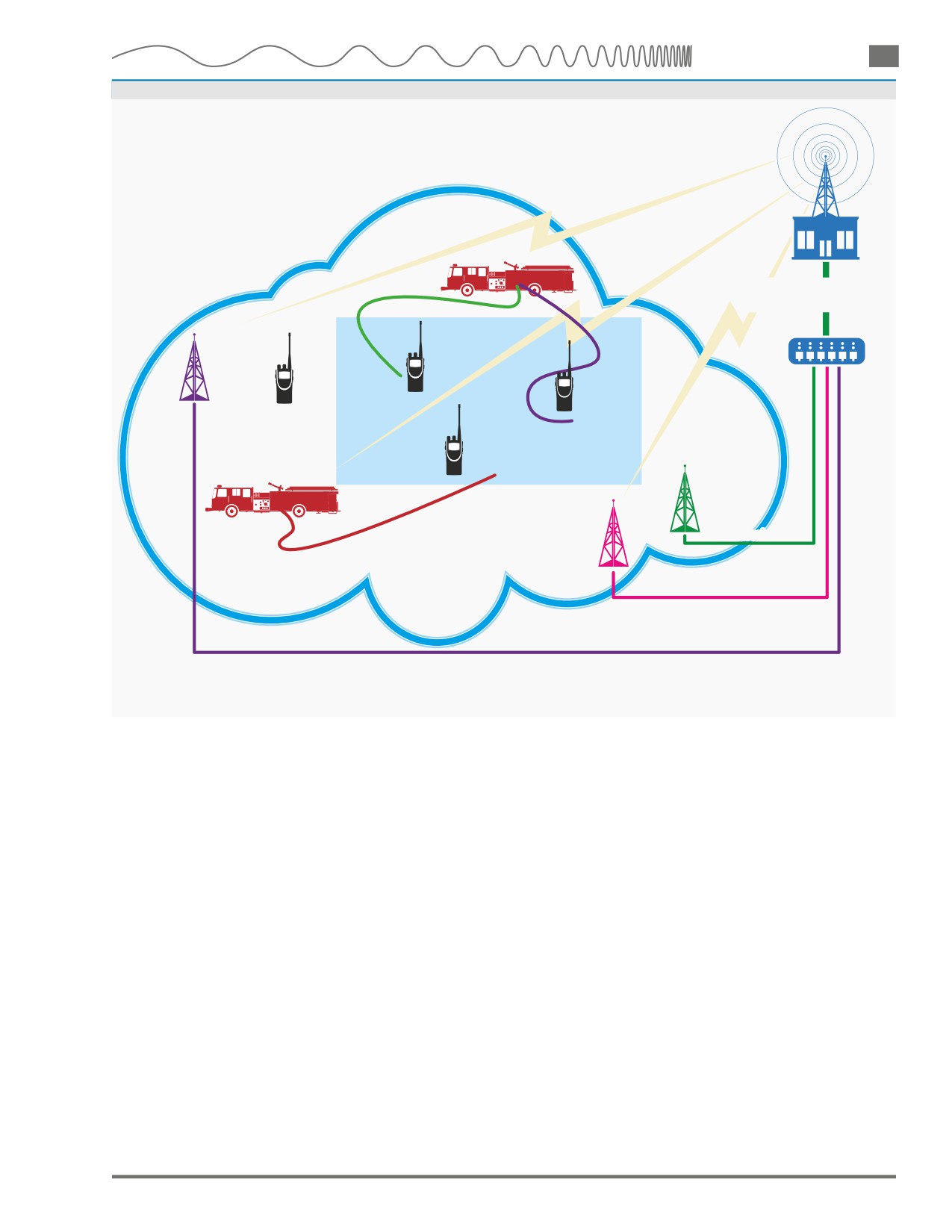
Conventional
27
Section 4 |
Radio Systems
Figure 4.2. Direct/Simplex With Transmitter/Receiver Infrastructure Dispatch Center Transmitting
Pump 1
Receives
Site 3 Voted Best Audio
Routed to Dispatch Center
Receive
E-1
Site 1
Receives
E-4
E-2
Receives
Receives
E-3
Receives
Receive
Site 3
Pump 3
Receive
Site 3 Receive Audio
Receives
Site 2
Site 2 Receive Audio
Site 1 Receive Audio
The dispatch center’s high-power transmitter
allows all radios on the fireground to receive.
Portable radios have limited power and cannot
The receiver voter and its network of receivers are
always transmit a signal strong enough to
referred to as the RVS. The RVS usually is located
reach the transmitter sites. To provide a more
at the dispatch center. The receiver voter compares
balanced system, receivers are networked together
the audio from all receivers and routes the audio
throughout the service area in a receiver voter
from the receiver with the best audio quality to
system (RVS) (Figure 4.3). Comparison of the
the dispatcher. This type of system provides very
received audio signal takes place in a receiver voter.
reliable fireground communications and supports
fireground simplex channels.
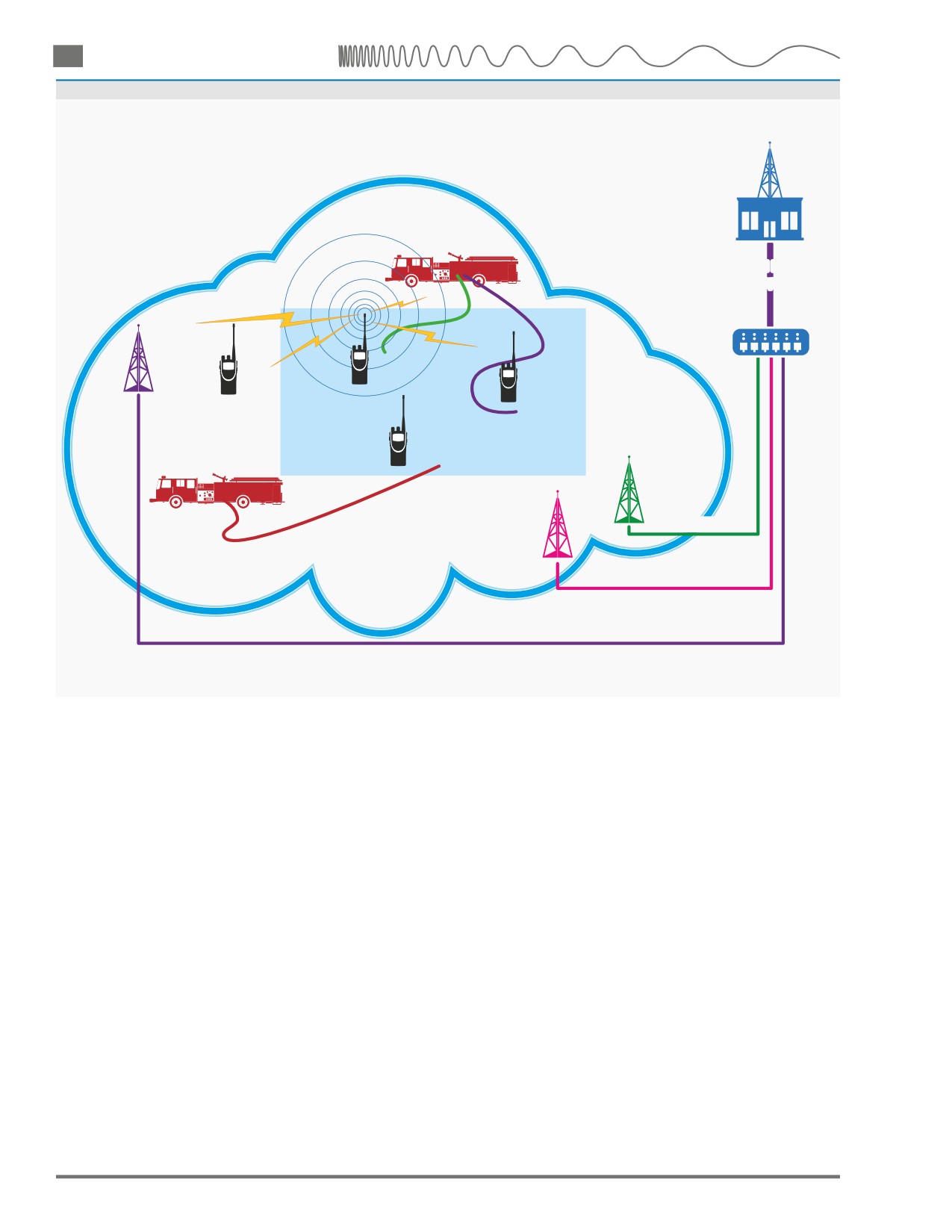
Voice Radio Communications Guide
28
for the Fire Service
Figure 4.3. Direct/Simplex Communications With Transmit and Receive Infrastructure Portable Transmitting
Dispatch
Center
Pump 1
Receives
Site 1 Voted
Best Audio
Routed to Dispatch Center
Receive
Site 1
E-1
Transmits
E-4
E-2
Receives
Receives
E-3
Receives
Receive
Site 3
Pump 3
Receive
Site 3 Receive Audio
Receives
Site 2
Site 2 Receive Audio
Site 1 Receive Audio
The cloud represents the maximum transmit range of the portable radio.
Repeaters — Improve Field Unit to Dispatch
communication, uses two RFs for communication.
and Off-Scene Units
The transmitting radio transmits on Frequency 1
(F1), and that signal is received by the repeater.
Receiver voters are one solution to get
The repeater then repeats the transmission on
communications from a radio user to the dispatch
Frequency 2 (F2), and this signal is received by the
center, but another solution is needed to get
receiving radio. By locating the repeater on a high
the communication to other radio users. One
building or mountain, the range of transmissions
type of system that can solve this problem is a
from the transmitting radio can be more than
repeated radio system (Figure 4.4). Repeated
doubled and can reach over obstacles effectively.
radio communication, also known as half duplex
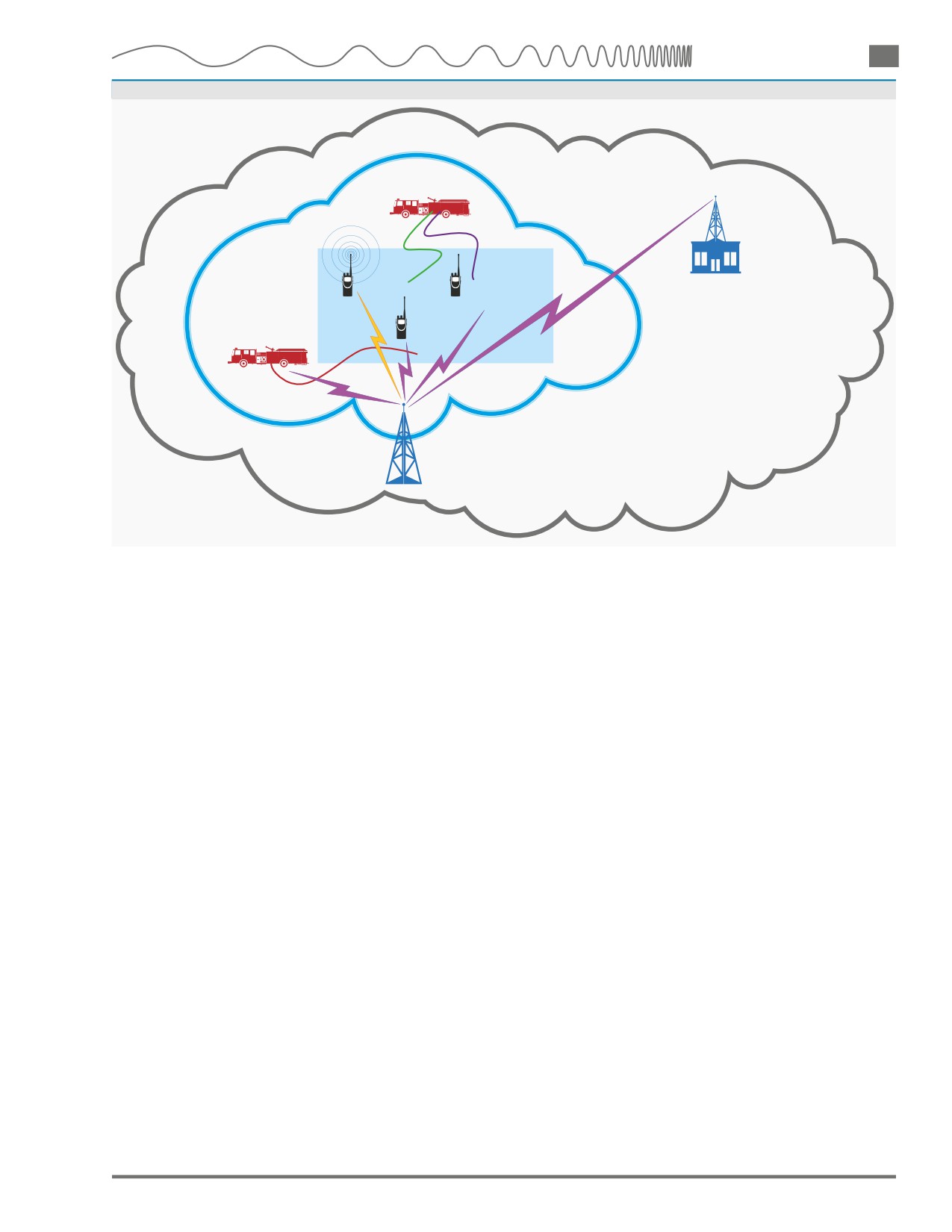
Conventional
29
Section 4 |
Radio Systems
Figure 4.4. Repeater System — Portable Transmitting — Fireground Communications
Pump 1
Receives F2
E-1
Maximum Range
Transmits
E-2
Dispatch Center
of Portable
on F1
Receives
F2
Receives F2
Pump 3
E-3
Receives
Receives
F2
Repeater Maximum
Repeater receives low power signal on F1
Range
from E-1 portable and retransmits on F2 at
high power to extend range. Portables on
fireground are not in direct communication.
Another solution to improving communication
Figure 4.5 shows a method to overcome this
between field units inside buildings or tunnels and
limitation. If unit E-1 is unable to communicate
dispatch and off-scene units is the bidirectional
with other units on the fireground using the
amplifier (BDA). BDAs can be used with half
repeater system, E-1 can switch to talk-around
duplex radio systems to extend coverage from
mode on the radio. This mode allows the unit to
inside the structure to outside the structure and
transmit in direct mode to other radios on the
vice versa, but BDAs do not operate with simplex
fireground and receive from the units in either
radio systems. BDAs are discussed in more detail in
direct or repeated mode. Since the radio is not
Section 5 — Trunked Radio Systems.
able to reach the repeater, the dispatch center
cannot hear the radio, although other radios on the
The significant operational difference between
fireground can hear the unit. A unit that switches
direct and repeated communications is that with
to talk-around should announce this immediately
direct communication, the transmitting radio’s
so other units know that they also may need to
signal only needs to reach other radios directly
switch to communicate with the isolated unit.
on the incident scene. With a repeated system,
the signal must reach the closest repeater location,
which may be much further from the incident than
the receiving radios.
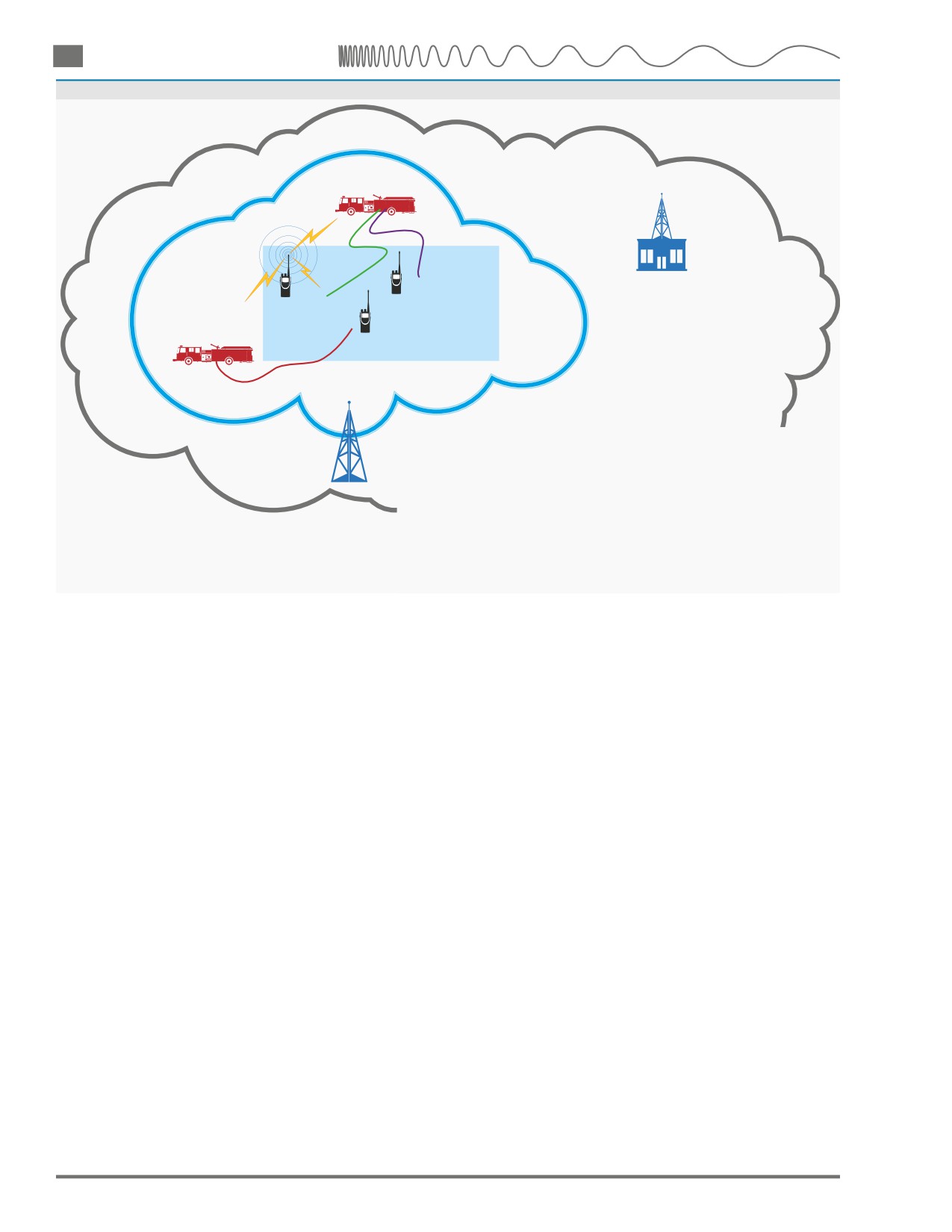
Voice Radio Communications Guide
30
for the Fire Service
Figure 4.5. Repeater System — Portable Transmit Talk-Around — Fireground Communications
Pump 1
Receives F2
Maximum Range
E-2
Transmits F1
Dispatch Center
of Portable
E-1
Receives F2
Transmits F2
Receives F2
Pump 3
E-3
Receives F2
Transmits F1
Receives F2
Repeater Maximum
Range
1. E-1 is unable to communicate with repeater and changes
Receive F1
channels to talk-around channel F2. This is the repeater
Transmit F2
output frequency.
2. Other units on the fireground will hear E-1 but need
to go to F2 to communicate with E-1.
3. Dispatch center unable to receive due to limited range
of portable
Simulcast Transmitter Systems
In addition, the audio source sent to the transmitters
must be synchronized so that the radio user hears
When a radio system must cover a large area but the
the same signal from each transmitter. The system
number of available frequencies is limited, a simulcast
consists of a simulcast controller and two or more
transmitter system may be the solution (Figure 4.6).
simulcast transmitters. The advantages of a simulcast
With this system, multiple transmitters simultaneously
system are the coverage of a large area, with high
transmit on the same frequency. The transmitters
signal levels throughout the area, while using only a
must be precisely synchronized so that the signals
single frequency.
they transmit do not interfere with each other.
///////////////////////////////////////