STUDY MATERIAL FOR THE CERTIFICATE OF FITNESS EXAMINATION F-02 FIRE GUARD FOR SHELTERS (Citywide) - 2011

Revised 12-2-14
FIRE DEPARTMENT
● CITY OF NEW YORK
STUDY MATERIAL FOR THE
CERTIFICATE OF FITNESS EXAMINATION
F-02
FIRE GUARD FOR SHELTERS (Citywide)
TABLE OF CONTENTS
Notice of Examination
3
1. Introduction
6
1.1 F-02 Certificate of Fitness Requirements
6
1.2 Denial, Non-Renewal, Suspension and Revocation of C of Fs
7
2. Definitions
8
3. Fires in Homeless Shelters
10
4. Fire Guard Responsibilities
13
4.1 Fire Guard Patrols
15
4.2 Fire Guards on Duty
16
4.3 Out-of-Service Conditions
17
4.4 Fire Watch Patrol Record
17
5. Typical Causes of Fire in Shelters
17
5.1 Common Problems in Shelters
20
6. Non-fire Emergencies in Shelters
22
6.1 Medical Emergencies in Shelters
22
6.2 Bomb or other Explosion Threats in Shelters
23
6.3 Chemical Incident or Release in Shelters
23
7. Emergency Reporting
24
8. Fire Alarm Systems
25
8.1 Types of Fire Alarm Initiating Devices
25
8.2 Manual or Pull station Alarm-Initiating Devices
28
8.3 Carbon Monoxide Devices
30
8.4 Sprinkler Water Flow Detector
30
8.5 Audio & Visual Notification Devices
31
8.6 Communication System
32
9. Sprinkler System
32
10. Standpipe System
33
11. Portable Fire Extinguishers
34
11.1 Different Types of Portable Fire Extinguishers
34
11.2 Labeling
38
11.3 PFE Monthly Inspection
38
11.4 PFE Annual Servicing
39
2
NOTICE OF EXAMINATION
Title:
Examination for Certificate of Fitness for F-02 - Fire Guard for
Shelters (Citywide)
Date of Exam: Written exams are conducted Monday through Friday (except legal
holidays) 8:00 AM to 2:30 PM.
REQUIREMENTS FOR WRITTEN EXAM
Applicants who need to take the exam must apply in person and bring the following
documents:
1. Applicants must be at least 18 years of age.
2. Applicants must have a reasonable understanding of the English language.
3. Applicant must provide two forms of identifications; at least one identification
must be government issued photo identification, such as a State-issued
Driver’s License or Non Driver’s License or a passport.
4. Applicants must present a letter of recommendation from his/her employer.
The letter must be on official letterhead, and must state the applicant’s full
name, experience and the address where the applicant will work. If the
applicants are self-employed or the principal of the company, they must
submit a notarized letter attesting to their qualifications. For more info:
5. Applicants must present a completed application for certificate of fitness (A-20
6. Applicants not currently employed may take the exam without the
recommendation letter. If the applicants pass the exam, FDNY will issue a
temporary letter with picture for the job seeking purpose. The C of F card will
not be issued unless the applicants are employed and provide the
recommendation letter from his/her employer.
7. Special note:
The F-44 will continue to be accepted as a valid certificate of fitness until
the expiration date indicated on the card. Upon the expiration date of the
F-44 Certificate of Fitness for Fire Guard for Shelters you must take and
pass the new F-02 Certificate of Fitness examination. You will be unable to
renew the F-44 Certificate of Fitness after it expires.
Once the F-44 holder obtains an F-02 Certificate of Fitness, he or she can
perform all fire guard duties within the shelter. F-02 Certificate of Fitness
holders are NOT required to obtain an additional F-01 Certificate of Fitness
for Citywide Fire Guard for Impairment. F-02 Certificate of Fitness holders
can perform F-01 duties in shelters only.
8. APPLICATION FEE:
Pay the $25 application fee in person by one of the following methods:
Cash
Credit card (American Express, Discover, MasterCard, or Visa)
Debit card (MasterCard or Visa)
Personal or company check or money order (made payable to the New
York City Fire Department)
3
For fee waivers submit: (Only government employees who will use their C of F for
their work- related responsibilities are eligible for fee waivers.)
A letter requesting fee wavier on the Agency’s official letterhead
stating applicant full name, exam type and address of premises;
AND
Copy of identification card issued by the agency
A convenience fee of 2.49% will be applied to all credit card payments.
9. EXAM INFORMATION
The F-02 exam will consist of 20 multiple-choice questions, administered
on a “touch screen” computer monitor. It is a time-limit exam. A passing
score of at least 70% is required in order to secure a Certificate of Fitness.
Call
(718) 999-1988 for additional information and forms.
Please always check for the latest revised booklet at FDNY website
before you take the exam.
10. If all the requirements are meet and pass the exam a certificate will be
issued the same day. Applicant who fails the exam will receive a failure
report. To retake the exam applicants will need to submit a new application
and payment.
RENEWAL REQUIREMENTS
This Certificate of Fitness must be renewed every THREE YEARS. The renewal fee is
$15. FDNY also reserves the right to require the applicants to take a re-
examination upon submission of renewal applications.
You will receive a courtesy notice of renewal 90 days before the expiration date.
However, it is your responsibility to renew your Certificate. It is very important to
renew your C of F before it expires. Renewals submitted 90 days (up to one year)
after the expiration date will incur a $25 penalty in addition to the renewal fee.
Certificates expired over one year past expiration date will not be renewed. New
exams will be required.
To change a mailing address:
Submit a letter requesting the change of mailing address and a copy of your C of
F with $5.00 fee.
To change a work location,
Submit a letter from your current employer (on company letterhead) confirming
that you are an employee and stating your new work location with a copy of
your C of F and a $5.00 fee
To request a replacement certificate:
Submit a driver’s license or passport, social security number, mailing address
and a $5.00 fee.
The certificate can be renewed On-line, by Mail or in Person.
4
Renewal online
If you are an individual, make sure you have your 12 digit Certificate of Fitness
Access ID. This can be found on your Renewal Notice. If you do not have your
Renewal Notice, your Access ID is your 8 digit Certificate of Fitness number and the
last four digits of your social security number. If you are submitting renewals on
behalf of a company's employees, the company must be approved by FDNY and have
an 8 digit Company Code. To request approval, email pubrenew@fdny.nyc.gov.
Renewal fee can be paid by one of the following methods:
Credit card (American Express, Discover, MasterCard, or Visa)
Debit card (MasterCard or Visa)
E-check
A fee exempted applicants cannot renew online only by mail or in person.
If all the requirements are met, the certificate of fitness will be mailed out within 10
days.
For online renewal go to: https://paydirect.link2gov.com/FDNYCOF/ItemSearch
Renewal by mail
Mail your Renewal Notice (if you did not receive a Renewal Notice, a copy of your
certificate), along with your fee payment
Personal or company check or money order (made payable to the NYC
Fire Department)
For fee waivers submit: (Only government employees who will use their C of F for
their work- related responsibilities are eligible for fee waivers.)
A letter requesting fee waiver on the Agency’s official letterhead stating
applicant full name, exam type and address of premises; AND
Copy of identification card issued by the agency
and if applicable, supporting documents to:
NYC Fire Department (FDNY)
Cashier's Unit
9 MetroTech Center, 1st Floor
Brooklyn, NY 11201
If all the requirements are met, the certificate of fitness will be mailed out within
four to six weeks.
Renewal in person
Submit your Renewal Notice (or if you did not receive a Renewal Notice, a copy of
your certificate), along with your fee payment by one of the following methods:
Cash
Credit card (American Express, Discover, MasterCard, or Visa)
Debit card (MasterCard or Visa)
Personal or company check or money order (made payable to the New
York City Fire Department)
For fee waivers submit: (Only government employees who will use their C of F for
their work- related responsibilities are eligible for fee waivers.)
5
A letter requesting fee waiver on the Agency’s official letterhead stating
applicant full name, exam type and address of premises; AND
Copy of identification card issued by the agency
and if applicable, your supporting documents to:
NYC Fire Department (FDNY)
Cashier's Unit
9 MetroTech Center, 1st Floor
Brooklyn, NY 11201
If all the requirements are met, the certificate of fitness will be issued the same day.
A convenience fee of 2.49% will be applied to all credit card payments for
original or renewal certificates.
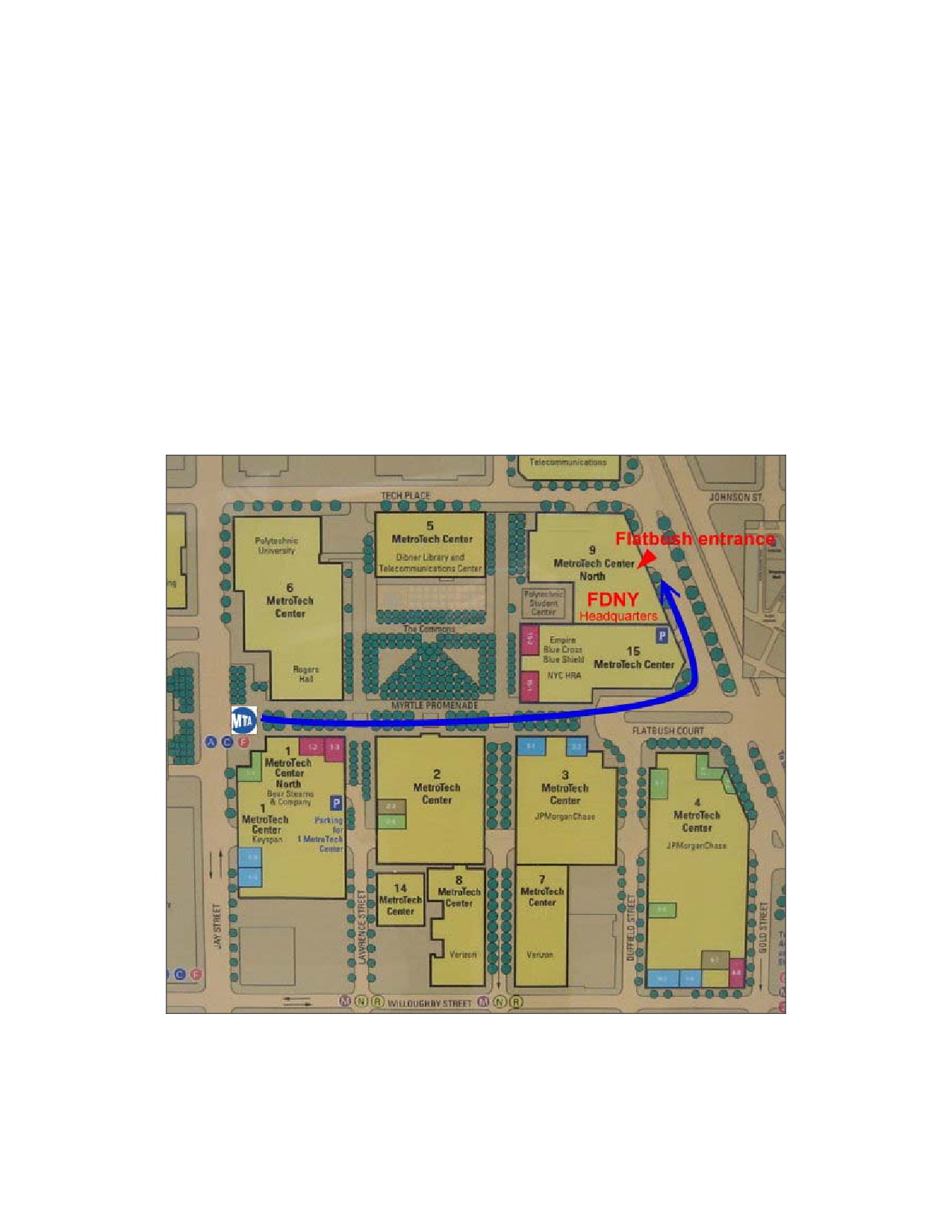
EXAM SITE: FDNY Headquarters, 9 MetroTech Center, Brooklyn, NY. Enter
through the Flatbush Avenue entrance
(between Myrtle
Avenue and Tech Place).
6
SAMPLE QUESTIONS
Which of the following are allowed to be used while taking a Certificate of Fitness
examination at 9 Metro Tech Center?
I. cellular phone
II. study material booklet
III. reference material provided by the FDNY
IV. mp3 player
A. III only
B. I, II, and III
C. II and IV
D. I only
Only reference material provided by the FDNY is allowed to be used during Certificate of
Fitness examinations. Therefore, the correct answer would be A. You would touch “A” on
the computer terminal screen.
If the screen on your computer terminal freezes during your examination, who should
you ask for help?
A. the person next to you
B. the firefighters
C. the examiner in the testing room
D. the computer help desk
If you have a computer related question, you should ask the examiner in the testing room.
Therefore, the correct answer would be C. You would touch “C” on the computer terminal
screen.
If you do not know the answer to a question while taking an examination, who should
you ask for help?
A. the person next to you
B. the firefighters
C. the examiner in the testing room
D. you should not ask about test questions since FDNY staff can not assist applicants
You should not ask about examination questions or answers since FDNY staff cannot assist
applicants with their tests. Therefore, the correct answer would be D. You would touch "D"
on the computer terminal screen.
7

1. Introduction
Buildings or parts thereof occupied or operated to be occupied by emergency shelters
shall be continuously patrolled by a fire guard. Every area of the building shall be
patrolled at least once every hour. F-02 holders may additionally be assigned to monitor
the areas in a shelter in which a fire protection system is out of service for fires.
Fire guards are responsible for the safety of all shelter occupants and employees by
eliminating fire hazards and assisting in the evacuation of occupants during drills and in
case of an emergency. Fire guards are responsible for making sure that fire safety
regulations are being complied with in the shelter. They should be familiar with and
knowledgeable of the location and operation of all fire alarm systems in the shelter in which
they are employed. Fire guards are supervised by the impairment coordinator, Coordinator
of Fire Safety & Alarm Systems or Fire Safety Director on the premises. Fire guards must
also maintain records of their patrols.
1.1 F-02 Certificate of Fitness Requirements
Buildings operating as emergency shelters have the unique requirement of fire guards on
the premises at all times. Fire guards in shelters have a larger span of responsibility than
fire guards in most other occupancies. It is imperative that fire guards make consistent
patrols as required, and are also knowledgeable about the procedures to follow when
performing a fire watch in the case of an out-of-service situation. Prior to the
implementation of the F-02 Certificate of Fitness, fire guards in homeless shelters who were
on the premises performing patrols on a daily basis held F-44 Certificates of Fitness for
Fireguards for Shelters. F-44 Certificate of Fitness holders were NOT qualified to perform
fire watch in an out-of-service condition. In the past, if such a situation did occur, the
building owner would be required to ensure that F-01 Citywide Fire Guard for Impairment
Certificate of Fitness holders were on the premises to perform fire watch during the out-of-
service condition. The F-02 Certificate of Fitness eliminates the gap between the F-44 and
F-01 Certificates of Fitness. F-02 holders are qualified to work in shelters with homeless
occupants on a daily basis and to perform hourly patrols, and are additionally qualified to
perform fire watch in an out-of-service situation. The information below explains the
relationship between the different Certificates of Fitness:
Perform hourly patrols
F-44 Fireguards for Shelters
Specific to shelters
Not qualified to perform fire watch in
out-of service situations
F-01 Citywide Fire Guard for Impairment
Citywide Certificate of Fitness (non
premise-related)
Qualified to perform fire watch in out-
of-service situations
8
Qualified to perform hourly patrols in
F-02 Fire Guards for Shelters
shelters
Qualified to perform fire watch in out-
of-service situations
Citywide Certificate of Fitness
F-02 Certificates of Fitness are valid for a period not to exceed three years from the date of
issuance. At the end of this period, the certificate expires unless the commissioner
approves its renewal. Please be advised that certificate renewals shall be at the discretion
of the commissioner in the interest of public safety. The department may review the
certificate holder’s qualifications and fitness and may require a certificate holder to
complete a department-approved continuing education program and/or provide other proof
of the holder’s continuing qualifications and fitness.
The use of the word “should” throughout these study materials generally refers to policies,
procedures and/or best practices recommended by the FDNY, and may not be a codified
requirement.
The use of the word
“shall” throughout these study materials generally refers to a
requirement of the Fire Code or the FDNY.
1.2 Denial, Non-Renewal, Suspension and Revocation of Certificates
Certificate of Fitness holders should be aware that they may be required to demonstrate
their knowledge and proficiency in their duties related to their certificate at the time of
original and renewal application, and at any time Fire Department representatives are
conducting an inspection of the premises. The Fire Department can deny, not renew,
suspend or revoke a certificate for misconduct, which would include the failure of the
certificate holder to properly fulfill his or her duties for any reason.
In addition to any other penalties provided by law, misconduct on the part of an applicant
or holder of a certificate of fitness shall be grounds for denial, non-renewal, suspension or
revocation of a certificate, and denial of an application for a certificate or the opportunity to
take a certificate examination. Such misconduct includes, but is not limited to:
the failure of certificate holders to properly fulfill their duties
any false and fraudulent conduct in connection with an application for a
certificate or the duties of a certificate holder, including:
o false or fraudulent statements or submissions
o unauthorized changes to or use of a certificate or possession of a
fraudulent certificate
o cheating on an examination
o impersonating another person or allowing oneself to be impersonated
9
the failure to promptly notify the Fire Department of any change in the
applicant’s or certificate holder’s residence address, or work location
any other conduct that decreases the integrity or reliability of an applicant or
certificate holder
compromising the integrity or confidentiality of a Fire Department examination
2. Definitions
BUILDING OCCUPANTS - All persons in the shelter, including employees, clients, staff and
visitors.
CENTRAL STATION COMPANY - A facility that receives alarm signals from a protected
premise and retransmits or otherwise reports such alarm signals to the FDNY.
EMERGENCY PREPAREDNESS PLAN - Emergency preparedness plans ensure that, in the
event of a fire or a non-fire emergency, there are procedures in place that can be timely
implemented to provide the information, guidance, direction and assistance needed to
protect the safety of building occupants, including, if necessary, effecting their evacuation,
relocation or sheltering in place. Such emergency preparedness plans shall assure that
knowledgeable assistance is readily available on the premises to emergency response
personnel responding to a fire or non-fire emergency at the premises. The emergency
preparedness plan is also known as the fire safety and evacuation plan and/or emergency
action plan.
EVACUATION - the emptying of a building of all building occupants in response to a fire or
an emergency.
FIRE ALARM SYSTEM - any system, including any interconnected fire alarm sub-system,
of components and circuits arranged to monitor and annunciate the status of fire alarm or
supervisory signal-initiating devices.
FIRE GUARD - A person holding a Certificate of Fitness for such purposes, who is trained
in and responsible for maintaining a fire watch.
FIRE PROTECTION SYSTEM - Approved devices, equipment and systems or combinations
of systems used to detect a fire, activate an alarm, extinguish or control a fire, control or
manage fire alarm systems, sprinkler systems and standpipe systems.
FIRE WATCH - A temporary measure intended to ensure continuous and systematic
surveillance of a building or portion thereof by one or more qualified individuals for the
purposes of identifying and controlling fire hazards, including detecting early signs of fire,
raising an alarm of fire, notifying the department, and performing such other fire safety
duties as may be prescribed by the commissioner.
10
IMPAIRMENT - Any condition in which a fire protection system cannot perform its
designed fire safety function. Fire protection systems include sprinkler systems, standpipe
systems and fire alarm systems. Examples of an impaired sprinkler or standpipe system
may include an out-of-service fire pump. An example of an out-of service fire alarm system
may include a shutdown of a floor’s fire alarm system detecting devices (to prevent an
unnecessary alarm) while torch work associated with construction work is conducted.
IMPAIRMENT COORDINATOR - The person designated by the building owner who is
responsible for ensuring that proper notification and safety precautions are taken when a
standpipe system, sprinkler system or fire alarm system is out of service. In the absence of
a specific designee, the owner shall be considered the impairment coordinator.
NON-FIRE EMERGENCY - A biological, chemical or nuclear incident or release; declaration
of emergency by a lawful authority; explosion; medical emergency; natural disaster; or other
emergency affecting the premises or the safety of building occupants.
OWNER - The owner of the freehold of any real property (as defined in section two of the
Real Property Law), or of a lesser estate therein, a mortgage or vendee in possession,
assignee of rents, received, executor, trustee, lessee, agent or any other person, firm or
corporation, directly or indirectly in control of real property. Any reference in this code to
the owner of any building, structure or premises shall be deemed to designate collectively
any and all of the foregoing, including, but not limited to, the owner of the freehold or lesser
estate therein and a managing agent designated by such owner pursuant to Section 27-
2098 of the New York City Administrative Code.
OWNER/OCCUPANT RESPONSIBILITY - The owner shall be responsible at all times for
the safe maintenance of a building, structure and premises in accordance with this code.
Correction and abatement of violations of this code and the rules shall be the responsibility
of the owner. If an occupant creates, or allows to be created, hazardous conditions in
violation of this code or the rules, the occupant shall also be responsible for the abatement
of such hazardous conditions.
TWO-WAY VOICE COMMUNICATION - a form of transmission in which both parties
involved have the ability to transmit information. This is useful during an emergency, and
allows staff members to report the conditions of a fire emergency from the fire floor back to
the FEDC or FSD in the lobby at the fire command center. Two way voice communication
uses warden phones that are placed at several locations throughout the building, usually
near the exit stairways in the building.
11
3. Fires in Homeless Shelters
Homelessness is a significant problem in New York City, and the number of men, women
and children that need shelter continues to rise. In 2013, it was estimated that over 45,000
people spent the night in a New York City homeless shelter and approximately 19,000 of
those people were children. In 2012, just 35% of families with children who applied to stay
in city shelters were accepted, down from 52% in 2007. The number of people seeking
housing in shelters in the city is increasing significantly, and with it comes new fire safety
concerns. It is imperative that fire guards ensure that shelters are maintained in a manner
that provides for the safety of the residents and employees in the event of a fire or other
emergency, to immediately correct or report any fire safety violations that arise and to be
familiar with the emergency preparedness plan.
Unfortunately, in New York City and elsewhere, disastrous fires have occurred in homeless
shelters. Fortunately, the lessons learned from these fires can be used to help prevent
them from occurring in the future. Three significant fires that occurred in homeless shelters
are listed below:
Fire Summary:
Location: Homeless shelter in Paris, Texas
Date: 2009
A 42 bed shelter housing 28 men caught fire due to ignition of a table inside the shelter that
was piled high with donated clothing. More than 20 residents evacuated the shelter as a
result of smoke and flames after several men attempted to extinguish the flames with pans
of water. There was a heavy smoke condition in the shelter, making it difficult to see and
even more difficult to evacuate. Five men who lived on the second floor were killed in the
blaze. An investigation of the fire determined that the building had no sprinkler system, fire
alarms or smoke detectors. Records indicated that the shelter hadn’t been inspected for at
least five years, even though inspections were required on an annual basis. The shelter was
used as a drop-off point for paper products, rags, clothing, furniture and other material.
Lessons Learned:
Periodic Fire Department inspections
should be conducted as required
Excess debris and improper storage is
a fire hazard
Lack of fire prevention devices in the
shelter increases the probability of
fatal fires
A firefighter outside of the shelter after the Paris, Texas fire
12
Fire Summary:
Location: Homeless shelter in Bronx, NY
Date: December 7, 2012 and December 9, 2012
At this Bronx, NY shelter, improperly stored mattresses were ignited in two separate
incidents only two days apart. The first incident occurred when a child was playing with a
match, and set a mattress on fire on the second floor of the building. This was a small fire
that resulted in no injuries and was quickly extinguished. The second fire started when
another child was playing with matches who also ignited a mattress that had been stored in
the building’s lobby. Smoke and flames from the resulting fire spread into the stairwell and
the upper floor hallways. There were no building wide alarms or hallway smoke detectors in
the building to notify occupants of the fire. Two building occupants tried to use portable
fire extinguishers to extinguish the fire but found them empty and inoperable. With the
smoke and flames having filled the hallways, many occupants tried to escape by using the
fire escapes. However, occupants reported that some of the fire escapes were broken,
having missing steps and jammed ladders. The fire resulted in four adults and two children
being seriously injured. It was determined that the mattresses that were involved in these
fires had not been properly removed from the building. Instead, they were stacked in the
lobby and propped against walls in common areas of the building. It was also determined
that the fire escapes were not in good working order, many of the fire extinguishers were not
operable, and that the building did not have a fire alarm or sprinkler system. All of these
factors contributed to the devastation that resulted from this fire.
Pictures show the interior of the Bronx, NY shelter after the second mattress fire. There
was severe smoke and fire damage in the hallways and stairwells.
Lessons Learned:
Excess debris and improper storage presents a fire hazard
Lack of a building wide fire alarm system will cause significant delays in
implementing a building evacuation
Fire escapes must be inspected to ensure that they are in working order
Fire extinguishers must be visually inspected monthly to ensure that they are in
working order
13
Fire Summary:
Location: Homeless shelter in New York, NY
Date: August 28, 2012
A homeless shelter in New York City caught fire and required complete evacuation. The fire
started when a lit cigarette left unattended by a tenant ignited a mattress on the fourth
floor. The fire was quickly extinguished by the building’s sprinkler system. One resident
suffered from and was treated for smoke inhalation. Fortunately, the fire was confined to
a single apartment. The shelter had recently been fined more than $45,000 by the
Department of Buildings for safety violations, including a violation for failure to provide
sprinkler protection. Records show that the building had seven active building violations at
the time of the fire.
Lessons Learned:
Periodic Fire Department inspections should be conducted
Ignition sources, such as lit cigarettes, should not be left unattended
Fire safety education may be beneficial to homeless shelter residents
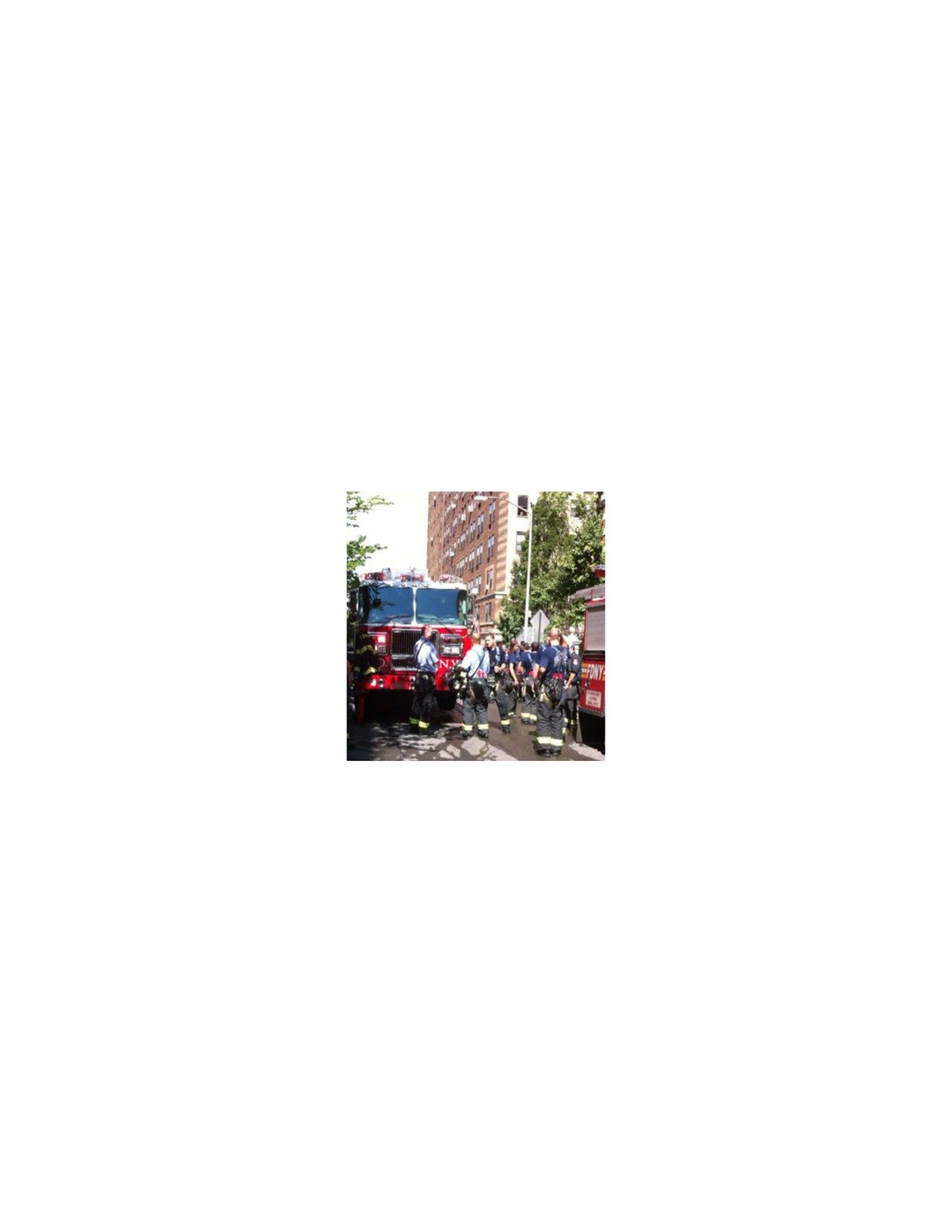
Picture shows firefighters in the street near the New York, NY shelter after the fire was extinguished.
The fire was ignited by an unattended cigarette.
All three shelter fires demonstrate how important it is for shelter staff to be proactive. Fire
guards and other safety staff should make it a priority to identify any potential fire safety
violations and correct them before they are identified by the Fire Department or Buildings
Department.
14
4. Fire Guard Responsibilities
Fire guards in shelters are responsible for the following:
Being familiar with the fire alarm system of the shelter in which they are
employed and the emergency preparedness plan for that shelter.
Continuously patrolling all areas of the shelter at least once an hour.
Continuously patrolling the area(s) affected by the out-of-service fire protection
system, keeping constant watch for fires.
Maintaining a record of patrols
Immediately reporting any fire to the department and notifying emergency
preparedness staff designated for the shelter.
Assisting with evacuating shelter occupants and other employees during
emergency drills and actual emergencies.
Fire guards should be trained in the use of portable fire extinguishers and
equipped with a portable fire extinguisher, or be aware of the location of a readily
accessible portable fire extinguishers in the area of patrol
Performing other fire-safety related duties as dictated by their supervisors.
F-02 Certificate of Fitness holders are generally supervised by one of the following:
F-80 Certificate of Fitness holder for Coordinator of Fire Safety & Alarm Systems
in Shelters
F-58 Certificate of Fitness holder for Fire Safety Director
Impairment Coordinator
In most shelters the role of the Impairment Coordinator will be delegated by the building
owner to either the F-80 or F-58 Certificate of Fitness holder. In the absence of a specific
designee, the building owner shall be considered the impairment coordinator. All shelters
require either an F-80 or F-58 holder on the premises at all times depending on the type of
fire alarm system installed. F-80 holders are required in any building or occupancy required
to have a one-way voice communication system, regardless of occupancy classification, and
that is operated or occupied for more than fifteen persons for a period of more than 30 days,
including emergency shelters.
The Certificate of Occupancy is the official document that establishes the maximum
number of occupants authorized to be in the shelter. If the Certificate of Occupancy
establishes the lawful occupancy as being more than 15 persons, an F-80 C of F holder is
required, even if there are actually less than 15 persons in the building at any particular
time. Any shelter that is required to or voluntarily installs a fire alarm system with two way
voice communication will require a Fire Safety Director on the premises.
The F-02 Certificate of Fitness holder will take direction regarding their responsibilities from
their supervisor. If an out-of service condition occurs, the F-02 C of F holder who is
performing regular fire watch patrols in that area may continue to patrol the area
surrounding the out-of-service condition while paying special attention to the fire hazard. It
is at the discretion of the F-02 C of F holder’s supervisor to assign fire guards their patrols.
F-02 Certificate of Fitness holders should be knowledgeable of and prepared to fulfill any of
these responsibilities.
15
It is likely that the F-02 Certificate of Fitness holder will be familiar with the shelter in
which they are performing a fire watch due to the fact that fire guards are required on the
premises at all times. Regardless, the Certificate of Fitness holder must be familiar with the
emergency preparedness plan for the shelter and should receive an orientation from their
supervisor or other responsible person designated by the building owner upon the start of
their employment.
Fire guards and their supervisors should review the topics and questions below:
Does the fire guard have a working cell phone for the purpose of communicating
with their supervisor, other staff and to call 911 if necessary?
If the answer is no, the fire guard must obtain a working cell phone
prior to starting their patrols
Are fire extinguishers provided in the fire guards area of responsibility?
If yes, where are they located?
If no, the fire guard must carry an extinguisher with them
Are fire alarm pull stations provided and operational in the fire guard’s area of
responsibility?
If yes, the fire guard should be made aware of their location.
If no, the procedures that will be used to notify the building occupants
of a fire should be discussed.
Discuss the name and contact information of building personnel to notify upon
discovery of building hazards or fire. This information should be readily available
to the fire guard during patrols.
Discuss information regarding the extent of any out-of-service condition in the
fire guard’s area of responsibility?
Is the alarm system operational?
If no, what area or area(s) are out-of-service?
Is the sprinkler system operational?
If no, what area or area(s) are out-of-service?
Is the standpipe system operational?
If no, what area or area(s) are out-of-service?
Are there hazardous materials stored and/or being used on the premises?
o If hazardous materials are present, the fire guard should assess the risk of the
out-of-service situation. The risk may be affected by the following
The level of danger of the hazardous materials
The quantity of the hazardous materials
The number of building occupants in the affected area
The characteristics of the building occupants
Will shelter residents require extra assistance during an
evacuation?
Are there special needs residents in the shelter?
The number of impaired fire protection systems in the building.
How many building occupants are in the shelter?
What type of building occupancy is the shelter?
What is the extent of the fire protection systems in other building areas?
16
4.1 Fire Guard Patrols
Fire guards are responsible for patrolling every area of the shelter at least once every hour.
Some shelters assign a fire guard to patrol a particular area of responsibility. For example,
if there are four floors in a shelter, depending upon the floor area of each floor, there may be
four fire guards on duty at all times, one patrolling each floor. During their patrol they
must look for signs of fire and investigate any signs of smoke in the shelter. They must also
be alert for any fire safety violations and upon discovery, report them immediately to their
supervisor. In many cases, the fire guard will be capable of correcting the fire safety
violation during the course of conducting his/her fire guard duties. Ultimately, the
Impairment Coordinator must ensure that the violation is corrected.
Shelters should be patrolled regardless if an out-of-service condition is present or not. Every
area of the shelter should be patrolled at least once every hour. Individual fire guards may
be assigned to both perform hourly patrols and perform fire watch during an out-of-service
situation. All patrols must be recorded by the fire guard. Please reference the section “Fire
Watch Patrol Record” for more detailed information. Patrols may vary depending on the
shelter.
During patrols, fire guards must ensure that they are adhering to the following
guidelines:
Inspect all exits, stairways and hallways to determine condition and availability
for use. All exits, stairways and hallways must be kept free of obstructions.
Obstructions may prevent occupants from exiting the shelter in case of an emergency.
Provisions shall be made for adequate clear routes of exit with doors opening in the
direction of travel.
Locks, bolts and chains must not be installed on exit doors while the shelter is occupied.
If locks are discovered they must be removed immediately. The fire guard must then
report the fire safety violation to the building owner. The building owner must make sure
that the chains or locks are removed.
Examine all doors in the area of patrol to determine operation conditions and
availability for use. Particular attention must be paid to the stairways and other areas
of the shelter where fire doors are installed. Exit into the stairway must be available
from each floor of the building. Panic hardware may be installed on the door. The panic
hardware permits the occupants to exit quickly from the premises in case of an
emergency. The fire guard must make sure that the fire doors are present and are in
good working order.
Ensure fire doors are equipped with hold open devices. The fire guard must make
sure that hold-open devices and automatic door closers, where provided, are operating
properly. When fire doors are equipped with hold open devices interconnected to a
building's fire alarm system, such device will release, allowing the door to close
automatically upon activation of the building's fire alarm system. During the period that
a hold-open device or automatic door closer is out of service for repairs, the door it
operates must remain in the closed position. Swinging fire doors shall close from the
full-open position and latch automatically. The door closer shall exert enough force to
close and latch the door from any partially open position.
Ensure that exits are properly identified and that hallways, stairways, etc. are
properly lit. Emergency lighting shall be provided for such exits. Exit directional signs
shall clearly indicate the path of egress. Exit directional signs posted above doors and
emergency lighting must be illuminated as required by the building code.
17
The entire premises must be checked daily for potential ignition sources. Any
potential ignition sources that are discovered must be corrected or removed immediately.
Enforcement of smoking prohibitions. The fire guard should make sure that smoking
does not occur in the shelter. Smoking tends to occur in bathrooms, hallways and
stairwells, so the fire guard should pay particular attention to those areas.
Continuously inspect the shelter for accumulation of rubbish. Trash and garbage
must not be allowed to accumulate anywhere inside the shelter. Accumulated trash is a
fire hazard. It may be easily ignited by a stray spark. All trash and garbage must be
promptly removed from the building to an approved outdoor location, and removed from
the premises as necessary to prevent it from becoming a fire hazard. Any accumulation
of rubbish or garbage should be promptly reported to the building owner.
Be knowledgeable of the location and the use of fire extinguishers and fire alarm
pull stations when required. All fire extinguishers and pull stations must be clearly
visible. The fire guard must know how to activate the fire alarm pull station in case of a
fire.
Fire guards should visually inspect the sprinkler and standpipe systems
(if
applicable). Fire guards must report all defects to their supervisor. Serious defects
must be reported to the Fire Department.
Check sleeping areas for fire hazards and typical causes of fire. Fire guards should
inspect sleeping areas in shelters for potential fire hazards. Shelter clients sometimes
tamper with portable fire extinguishers, smoke detectors and carbon monoxide
detectors. Sprinkler heads are often tampered with or painted over in sleeping areas as
well. Fire guards should be aware of these hazards and the typical causes of fire in
shelters (listed below) and should report them to their supervisor, if found.
Be on the lookout for suspicious behavior. Fire guards should also be aware that
sometimes fires in shelters are started intentionally. All shelter employees should be
aware of and must pay close attention to any type of suspicious behavior. Fire guards
who witness suspicious behavior should inform their supervisor immediately.
4.2 Fire Guards on Duty
Fire watch patrols by a trained person holding an F-02 certificate of fitness shall be
conducted within a shelter whenever the shelter is occupied. A sufficient number of fire
guards shall be provided such that each floor or area in which the fire protection system(s)
are out of service is patrolled at least once an hour.
The FDNY recommends that the minimum number of certified fire guards on duty to
perform fire watch shall be a ratio of one fire guard for every 250 occupants.
The area patrolled by each fire guard may be further limited by the Fire Department
depending on the configuration of the premises, impediments to patrol, nature of the
occupancy, fire risk, and other fire safety considerations.
18
4.3 Out-of-Service Conditions
When a required fire protection system in a shelter (e.g. sprinkler system, fire alarm system
or standpipe system) is out of service, the building should be evacuated or a fire watch shall
be maintained by one or more persons holding an F-02 certificate of fitness. The decision to
evacuate or continue a fire watch is at the discretion of the Impairment Coordinator. Since
fire guards are already on continuous patrol in shelters, additional fire guards are not
required when a fire protection system is out of service. The fire guard who would normally
be assigned to patrol the area of the out-of-service condition may continue patrolling that
area while paying special attention to the fire hazard. Fire guards should be made aware if
the out-of-service system hinders the egress routes of the affected area. For more
information regarding out-of-service situations, please reference Chapter 9 of the 2013 Fire
Code.
In some cases, Fire Department personnel may be on scene and provide additional direction
on the number of required fire guards or other fire protection measures that may be
required until such time as the out-of-service fire protection system is restored to good
working order.
4.4 Fire Watch Patrol Record
All parts of the premises, including sleeping areas, must be continuously patrolled by an
F-02 certificate of fitness holder. A written record of the fire watch patrol required by the
Fire Code and the Rules of the City of New York shall be maintained on the premises or
other approved location for a minimum of 3 years, unless a different period of time is
specified. The commissioner may prescribe the form and format of such recordkeeping.
Records shall be made available for inspection by any department representative, and a
copy of such records shall be provided to the department upon request, without charge. The
department additionally may require that certain records be filed with the department.
Electronic filings may be made in lieu of paper filings, when approved.
An approved method of supervising the conduct of the fire watch, such as a watchman's
clock and key stations, shall be provided.
The fire watch patrol record must be signed by the fire guard. The following items should be
recorded in the log:
(a) the number of patrols or fire watch inspections conducted
(b) any defects discovered
(c) violations that have been noticed
(d) the date, name, Certificate of Fitness number and signature of the fire guard who
conducted the patrols or fire watch inspections
19
5. Typical Causes of Fire in Shelters
Fire guards should be familiar with the typical causes of fire in a homeless shelter so that
they can be aware of these hazards and prevent fires. If fire guards become aware of a fire
hazard they should inform their supervisor immediately. Typical causes of fire in homeless
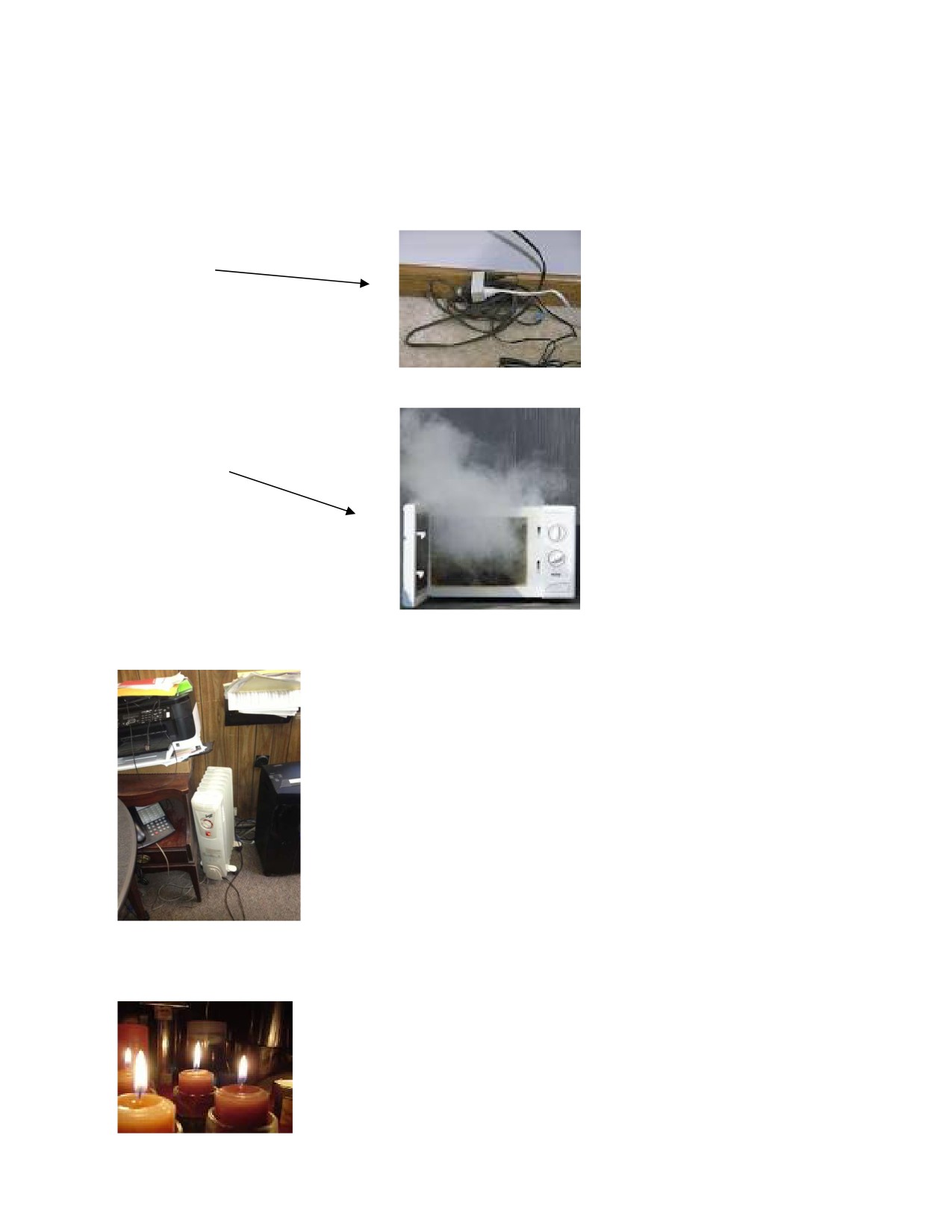
shelters are listed below:
Overloaded extension
cords
Unattended and prohibited
microwaves
Misuse of portable heaters
Unattended candles
20
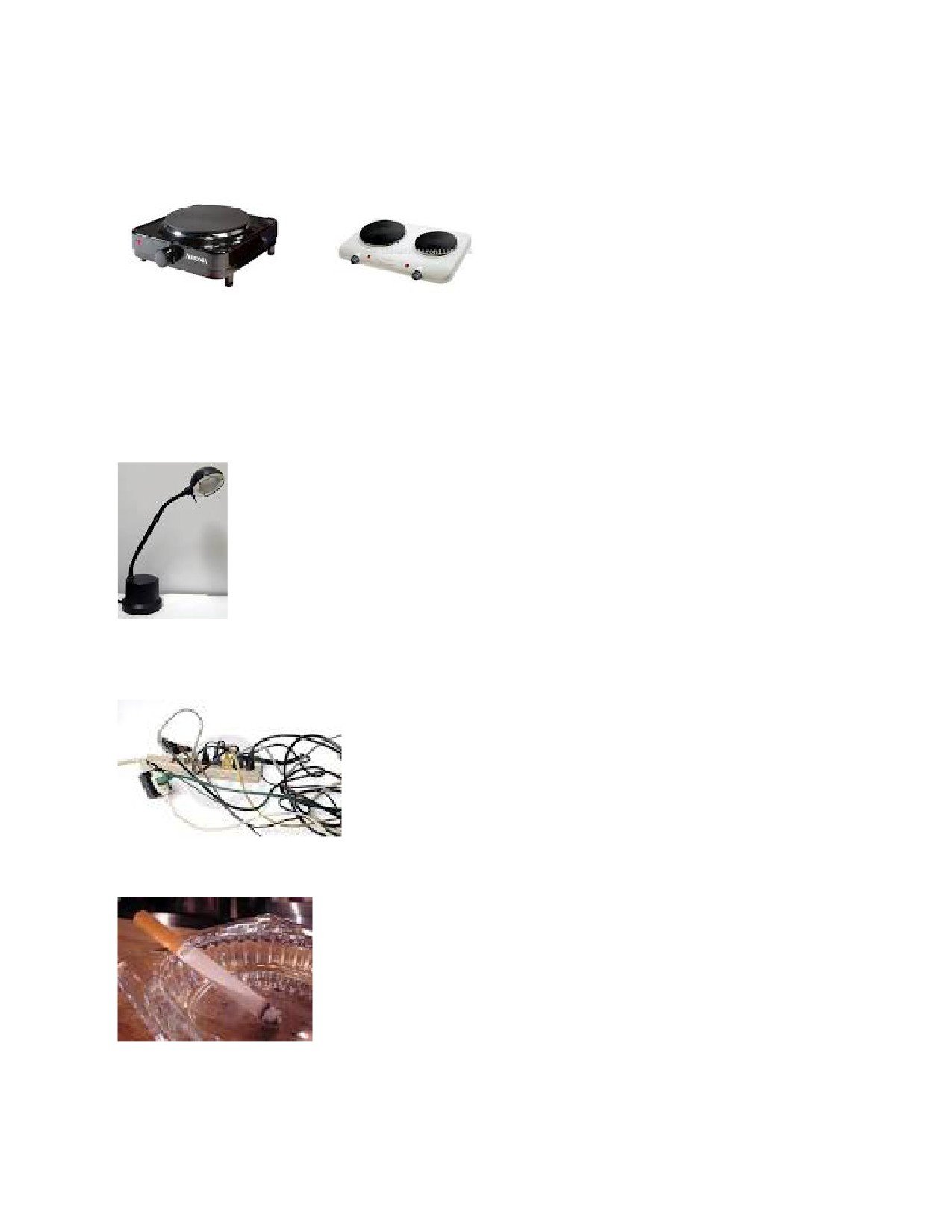
Hot plates
Halogen lamps
Overloaded electrical outlets and power strips
Unattended cigarettes or smoking in prohibited areas
21
Unattended or improperly used ovens and stoves
5.1 Common Problems in Shelters
The following is a list of common problems found in shelters that can endanger the safety of
building occupants and employees. Fire guards should be familiar with these problems so
that they can avoid their occurrence.
1. Failure to maintain proper recordkeeping
The fire guard must ensure that all required records of fire guard patrols and fire
watch are updated and kept on the premises in accordance with the New York City
Fire Code.
2. Failure to Facilitate the Inspection and Maintenance and Testing of Fire Alarm
Systems
Fire guards who notice that a fire alarm system is in need of inspection, maintenance
or testing during their patrols must notify their supervisors immediately.
3. Lack of Knowledge Regarding Proper Actions to take when a Fire Protection
System is Out-of-Service
Fire guards must ensure that they are following the procedures outlined in Chapter 9
of the New York City Fire Code and their supervisor’s instructions upon the discovery
of an out-of-service situation within a shelter.
4. Improper Storage
Recycle bins and trash containers are often stored within the shelter corridors and
stairwells which obstruct means of egress and can be a fire hazard if a fire erupts.
Additionally, client’s personal items are often found in the hallways, blocking means
of egress. Items are often improperly stored in hallways, under stairwells, inside
mechanical rooms, within stairwells and electrical rooms. Sometimes this extra
storage obstructs sprinkler heads.
22
Hallway obstructions
Mattresses improperly stored in the passageway
leading to the stairwell
5. Required Fire-rated doors
Required fire-rated doors in stairwells, boiler rooms, and electrical rooms are often
“propped” open when they should not be. In some shelters, door hardware such as
knobs and latching mechanisms are broken or disabled. Improper hardware is
sometimes used on the doors. Fire guards must ensure that Fire-rated doors remain
closed and that any improper hardware is removed, and damaged hardware is
repaired or replaced.
Fire doors illegally propped open Fire doors illegally suspended open
with a portable fire extinguisher
23
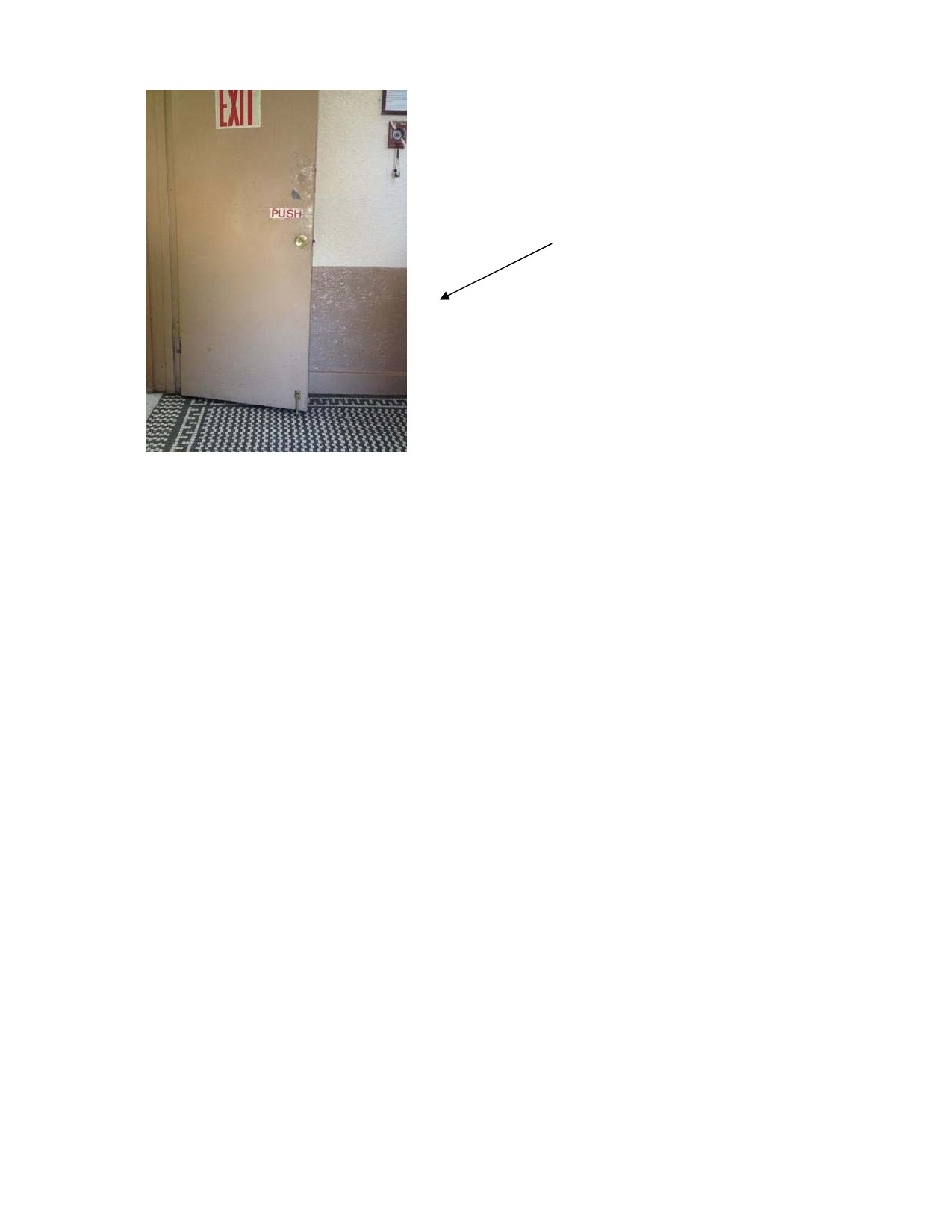
Fire door propped open
with a doorstop, which is
illegal
6. Open flames, unauthorized use of portable heating appliances and smoking
Fire guards must ensure that unlawful activities are not taking place in shelters.
7. Emergency Lighting
Fire guards should immediately notify their supervisors if they discover that battery
operated emergency light fixtures are functioning.
6. Non-fire Emergencies in Shelters
6.1 Medical Emergencies in Shelters
If a fire guard becomes aware of an injury or other medical emergency at the shelter
premises, they should call
911 and provide as much of the following information as
possible. The fire guard is NOT required to have specific medical knowledge or training,
however when communicating with medical responders the ability to provide this
information is helpful.
o
Caller location and the location of the victim(s) (if different from your location),
including the business name, street address, cross street, floor and room
number (if applicable)
o
Caller name and telephone number for a return call
o
The number of victim(s)
o
The victim(s)’s chief complaint or present condition (e.g. bleeding, breathing
erratically, conscious/unconscious, etc)
o
Any hazards involved
The caller should follow the exact instructions of the 911 operator and emergency
personnel.
24
Fire guards should assist their supervisor in alerting trained employees who are CPR
qualified, as noted in the emergency preparedness plan. Only trained employees
should provide first aid assistance. If there are no trained employees on the
premises, designate a responsible person to stay with the victim(s).
Fire guards should assist their supervisor with arranging an elevator to be placed on
stand by (if the shelter has elevators).
The victim should not be moved unless the victim(s)’s location is unsafe.
The fire guard should assist their supervisor in controlling access to the scene.
The fire guard should assist the supervisor in assigning a designated person to meet
the ambulance at the nearest entrance or emergency access point and direct them to
victim(s)
6.2 Bomb or other explosion threats in Shelters
If a person receives a suspicious package and is unable to verify its contents, they should
follow the emergency reporting protocol below:
Call 911 and provide the following information:
o Your location and the location of the suspicious package (if different from your
location), including the business name, street address, cross street, floor and
room number (if applicable)
o Name and telephone number for return call
Do not touch/move/open the article
6.3 Chemical incident or release in Shelters
In case of a major spill, the Fire Department must be notified by calling 911
immediately. After calling 911, the caller’s supervisor should be notified.
The caller should wait for and follow instructions from the first respondent.
25
7. Emergency Reporting
Any owner, occupant or other person who becomes aware of a fire or explosion or any other
emergency shall immediately report such emergency to the department. No owner or other
person shall issue any directive or take any action to prevent or delay the reporting of a fire
or other emergency to the department.
A durable, legible sign setting forth the following information for reporting a fire or other
emergency (including the text to be inserted based on the building’s location) shall be
posted in a conspicuous location in the lobby of the main front entrance of a Group A, B, E,
F, I M and R-1 building:
Fire alarm box at ______________________________ and __________________________
(Name of street)
(Name of street)
or
To report a fire by telephone dial “911” or, depending upon the borough in which the
property is located, insert one of the following telephone numbers:
Bronx properties
(718) 430-0200
Brooklyn properties
(718) 965-8300
Manhattan properties
(212) 570-4300
Queens properties
(718) 476-6200
Staten Island properties (718) 494-4296
The fire guard must be provided with at least one approved means for notification of the
Fire Department and any staff on the premises responsible for the implementation of the
emergency preparedness plan. Fire guards can use cell phones to make immediate
notifications. Fire guards should ensure that there is enough power to cover their shift.
Notifying by phone is the most direct and effective way to notify the Fire Department.
When a fire is discovered the fire guard must also activate the fire alarm pull station when
available. The fire guard must notify the Fire Department and their supervisor. The fire
guard’s supervisor will also issue instructions to the fire guard that must be followed. For
example, the supervisor may instruct the fire guard how to take the safest evacuation route
from the building.
In case of a fire emergency, building occupants may have to be evacuated. Occupants on
the fire floor and the floor above are most seriously threatened by the spread of the fire and
must be evacuated first. If the fire guard is responsible for assisting in the evacuation, the
fire guard should remain composed and in control of the situation. He/she should speak in
a clear and concise manner when assisting with the evacuation. The fire guard's
instructions and his/her actions play an important role in reducing panic during an
emergency. Occupants should be instructed to be calm and move quickly to the nearest
exit in an orderly manner. The fire guard should guide the occupants not to use the
elevators and should identify the stairwells or other routes of egress for occupants and
direct them to use only those stairwells or routes of egress.
In summary, the notification procedures should be:
Call 911 or the Fire Department Dispatcher number in the borough where the
building is located.
Notify the building occupants using the fire alarm pull station, if available.
Notify the designated building personnel (e.g. F-80 or F-58 Certificate of Fitness
holder or building owner).
26
8. Fire Alarm Systems
Building owners must ensure that their shelters have fire alarm systems approved by the
New York City Fire Department. Fire guards should receive training on and be familiar with
the fire alarm system in their shelter. If they become aware of any aspect of the fire alarm
system that is impaired or out of service, they must notify the impairment coordinator
immediately. However, fire guards are prohibited from installing or modifying components of
the fire alarm system.
Fire alarm systems are classified as automatic, manually activated, or both. If a fire
condition occurs, the alarm system warns the building occupants and employees by
activating loud sirens, bells, speakers, horns and flashing lights. The flashing lights are
otherwise known as strobes.
8.1 Types of Fire Alarm Initiating Devices
A. Automatic Detection Devices - Automatic detection devices have sensors which
detect heat, smoke or the flow of water in a fire alarm system. The different types of
automatic detection devices are described below:
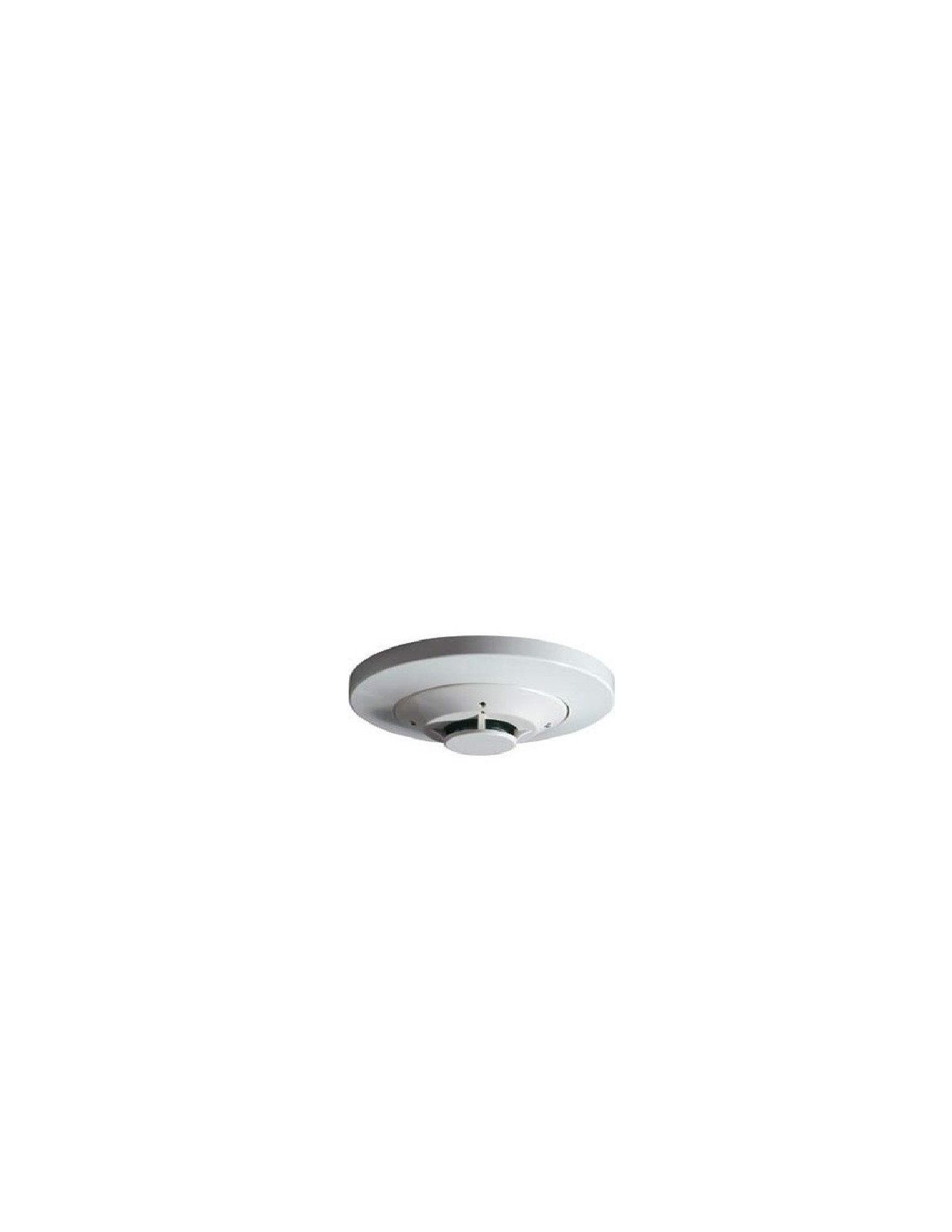
B. Area Smoke Detector - A smoke detector is a device that detects visible or
invisible particles of combustion. Smoke detectors have been shown to be very
effective in reducing fire damage and loss of life. Smoke detectors should be cleaned
and maintained every six months only by an S-97 or S-98 Certificate of Fitness
holder.
Smoke detector
C. Elevator lobby smoke detectors - Smoke detectors that when
activated will recall elevators automatically to the designated landing.
D. Beam detectors are used to protect large areas where area smoke detectors are
not practical. This detector consists of a light beam that when broken by any
combustible particle will trigger the detector.
E. Duct smoke detectors are designed to sample air flow in the HVAC air duct and
to detect the presence of particles of combustion. These smoke detectors will upon
activation, shutdown the system’s fan.
27
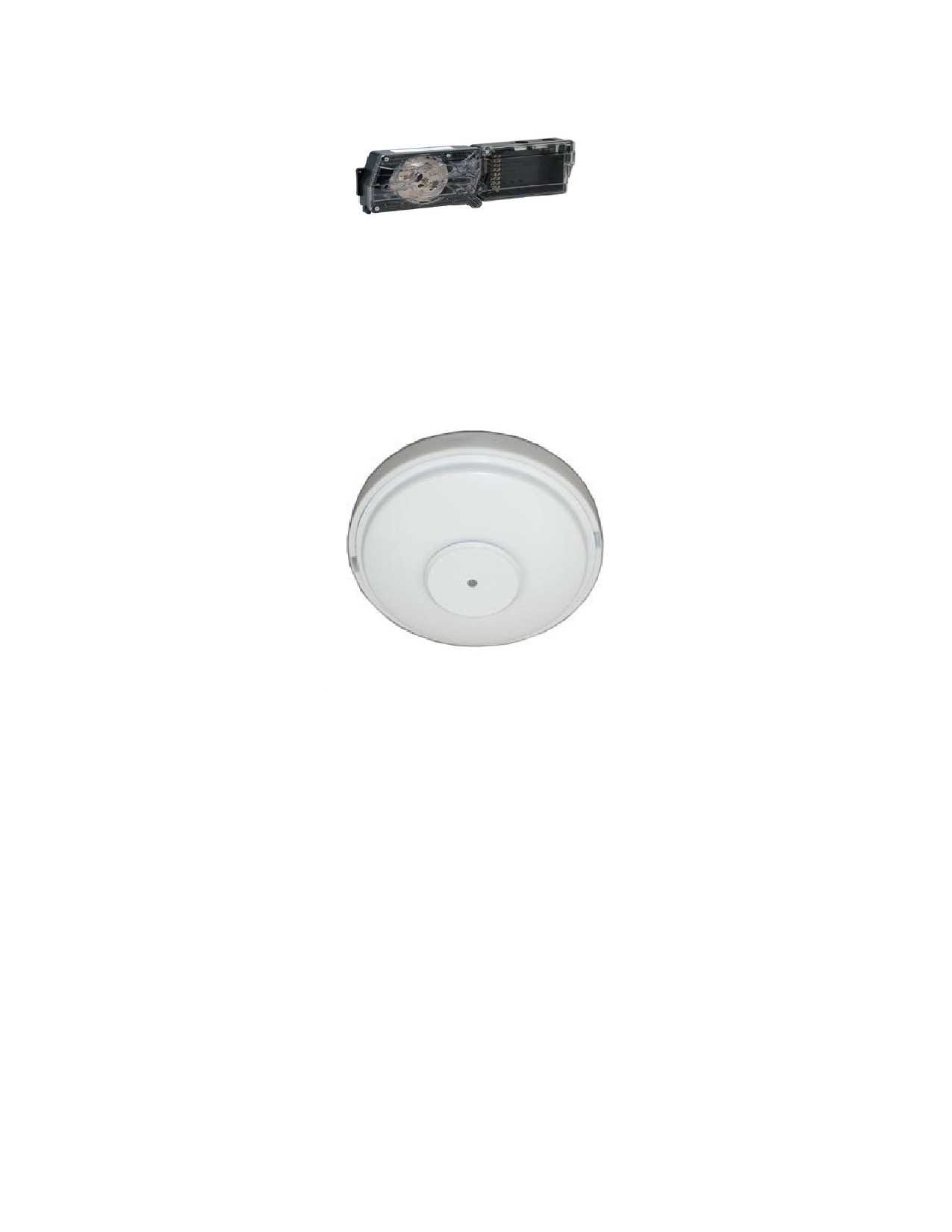
Duct smoke detector
F. Heat Detector - A sensor that detects abnormally high temperatures or rate of
temperature rise. Heat detectors have been shown to be very effective in reducing fire
damage.
Heat Detector
Heat detectors are available in two general types: rate-of-rise and fixed temperature. Heat
detectors can only be tested by authorized fire alarm technicians. Fire guards should notify
their supervisor if they encounter a detector that has become defective or inoperable.
a. The rate-of-rise heat detectors activate the alarm when the room temperature
increases at a rapid rate of 12-15 Fahrenheit (F) per minute. This type of detector
is more sensitive than the fixed temperature detector. The rate-of-rise heat detector
does not have to be replaced after it has been activated.
28
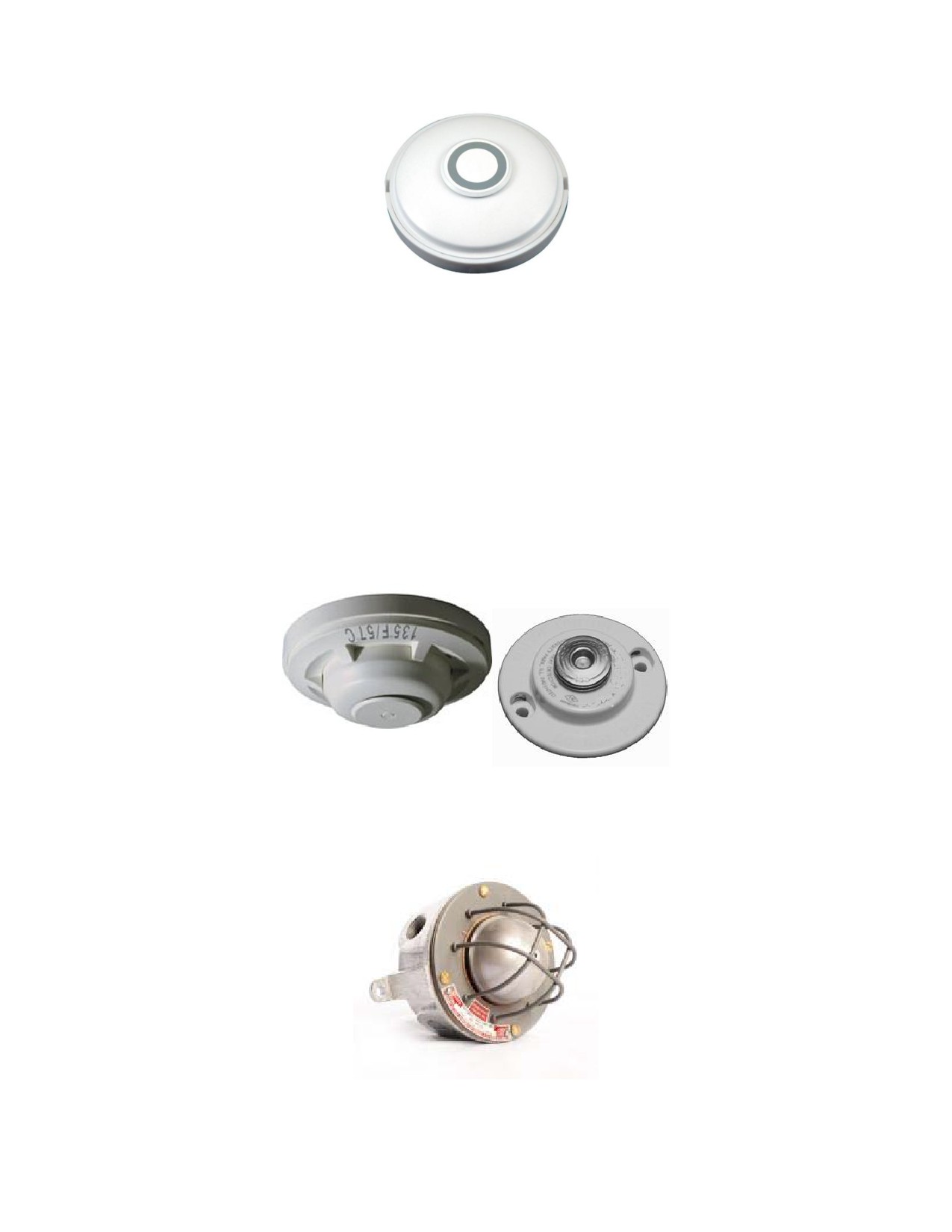
Rate-of- rise heat detector
b. Fixed-temperature heat detectors trigger the alarm when the detector
components melt at a preset temperature level. The fixed-temperature heat detectors
normally require replacement after they have activated an alarm. However,
intelligent heat detectors will usually reset themselves.
The fixed-temperature heat detectors consist of two electrical contacts housed in a
protective unit. The contacts are separated by a fusible element. The element melts when
the temperature in the room reaches a preset level. This allows the contacts to touch. When
the contacts meet the detector activates the fire alarm.
Fixed-temperature heat detectors
Heat detector with protective mechanical guard
29
Where subject to mechanical damage, a heat detector shall be protected by an approved
UL/FM mechanical guard as shown in the picture above. This guard will also make it more
difficult for building occupants to tamper with the detectors. Proper preventative measures
shall always be taken to protect all fire alarm initiating devices, especially during
construction work within the shelter.
8.2 Manual or pull station alarm-initiating devices:
All building occupants and employees must be knowledgeable and trained how to manually
activate the alarm initiating devices. Generally, these pull stations are installed at several
locations on the premises and are usually located near the exits of a building. Activating
the pull station is the most effective way to notify building occupants and employees
in case of an emergency.
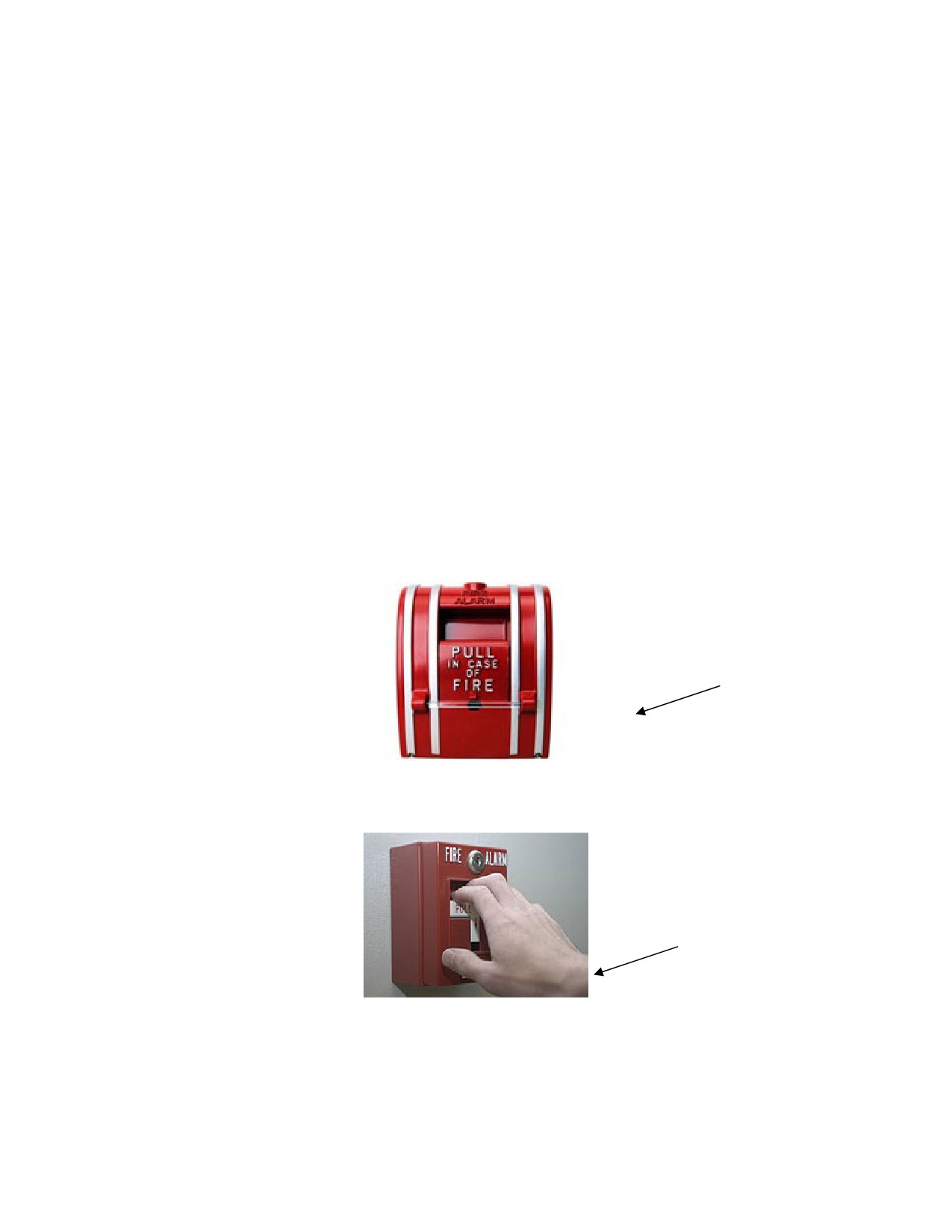
There are two types of manual alarm initiating devices. They are called single action and
double action stations.
A. Single action pull stations: Single action stations require only one step to activate
the alarm. The cover on these alarm stations serves as a lever. An example of a single
action station is shown below. This kind of alarm station is often found indoors, e.g., in
office buildings. When the cover is pulled down, it allows a switch inside to close. This
sends the alarm signal.
Single action station
Activating a
single action
station
B. Double action pull stations: Double action stations require two steps in order to
activate the alarm. The user must first break a glass, open a door or lift a cover. The
user can then gain access to a switch or lever which must then be operated to
initiate an alarm. To activate this type of alarm station the cover must be lifted before
the lever is pulled. This kind of double action station is often found indoors. Another
30
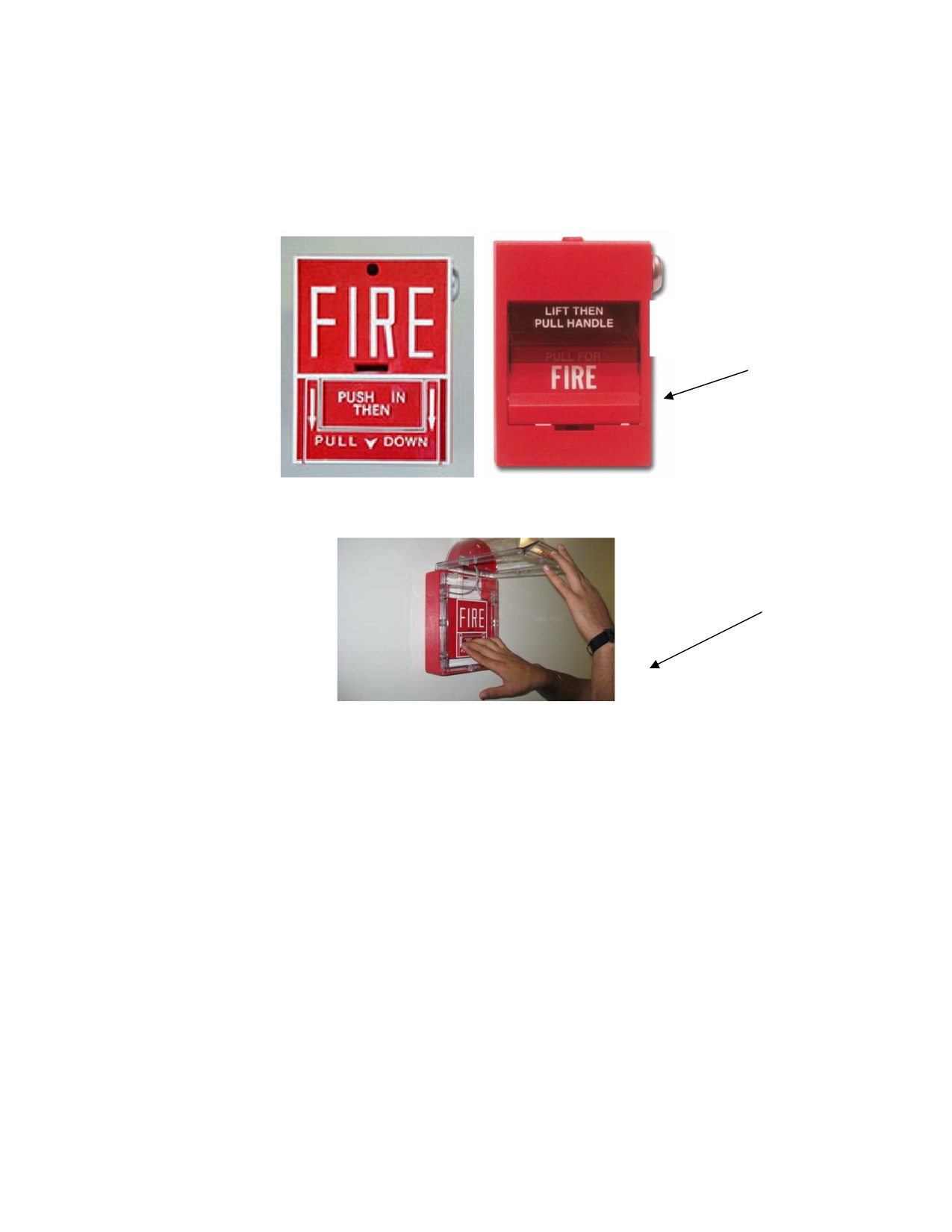
kind of double action break glass station requires someone to break a small pane of
glass with a small metal mallet.
At least one extra glass plate is required for each fire alarm box. Extra glass plates
must be stored on the premises.
Double action
stations
Activating a
double action
station
Fire guards must know how to manually operate each alarm station on the premises. Once
activated, the fire alarm system can not be re-set at the fire alarm manual pull station only.
The alarm must be re-set at a main Fire Alarm Control Panel (FACP) after the pull station is
reset to its normal condition. The alarm may be re-set by building personnel only after
being instructed to do so by a Fire Department representative. Once activated, a key may be
required to reset the manual pull station.
Fire guards should be aware that in some buildings, Fire Alarm pull stations may exist that
have a white stripe across them. Prior to 2008 a manual pull station shall have a white
stripe across it which would indicate that such station will send a signal to the central
monitoring company. However, since 2008, the requirement of such stripe no longer exists.
Any fire alarm system which was designed under the 2008 building code in any occupancy
shall transmit a signal to the central monitoring company.
Although buildings constructed after 2008 may not have pull boxes with white stripes, it is
still important that fire guards are knowledgeable about which manual fire alarm pull
stations send a signal to the Central Station Company and which pull stations do not. All
fire alarm pull stations installed or relocated after April 1, 1984 should be installed so that
31

the handle is approximately four feet from the floor and it is located within 5 feet of the exit
doorway opening. Manual stations should never be blocked or obstructed.
8.3 Carbon Monoxide Devices
Carbon Monoxide Alarm - A single or multiple-station alarm responsive to carbon
monoxide, containing a build-in initiation sensor, notification device, and power supply
(battery or electric with battery backup) and is not connected to a system. Most homeless
shelters require carbon monoxide alarms.
Carbon Monoxide Detectors
Carbon Monoxide Detector - A device that is responsive to carbon monoxide and is
connected to the fire alarm control panel.
Carbon monoxide detectors are required in any building that has fossil (gas and oil) fuel
burning equipments.
Carbon monoxide detector
A carbon monoxide detector is a device indicating a concentration of carbon monoxide at or
above the alarm threshold that could pose a risk to the life safety of the occupants and that
requires immediate action. Carbon monoxide detectors shall be installed, tested, and
maintained by qualified personnel in accordance with the manufacturers published
instructions.
If a carbon monoxide detector is in alarm condition and cannot be reset, this could indicate
that carbon monoxide is still in the premises. Until such time that carbon monoxide can be
excluded as the source of the alarm, the assumption should be that carbon monoxide is
present and appropriate life safety precautions should be followed.
8.4 Sprinkler Water Flow Detector
A sprinkler water flow detector is a device which initiates an alarm indicating a flow of water
in a sprinkler system. It is designed to signal when water flows through the fire protection
system.
Water flow detector
32
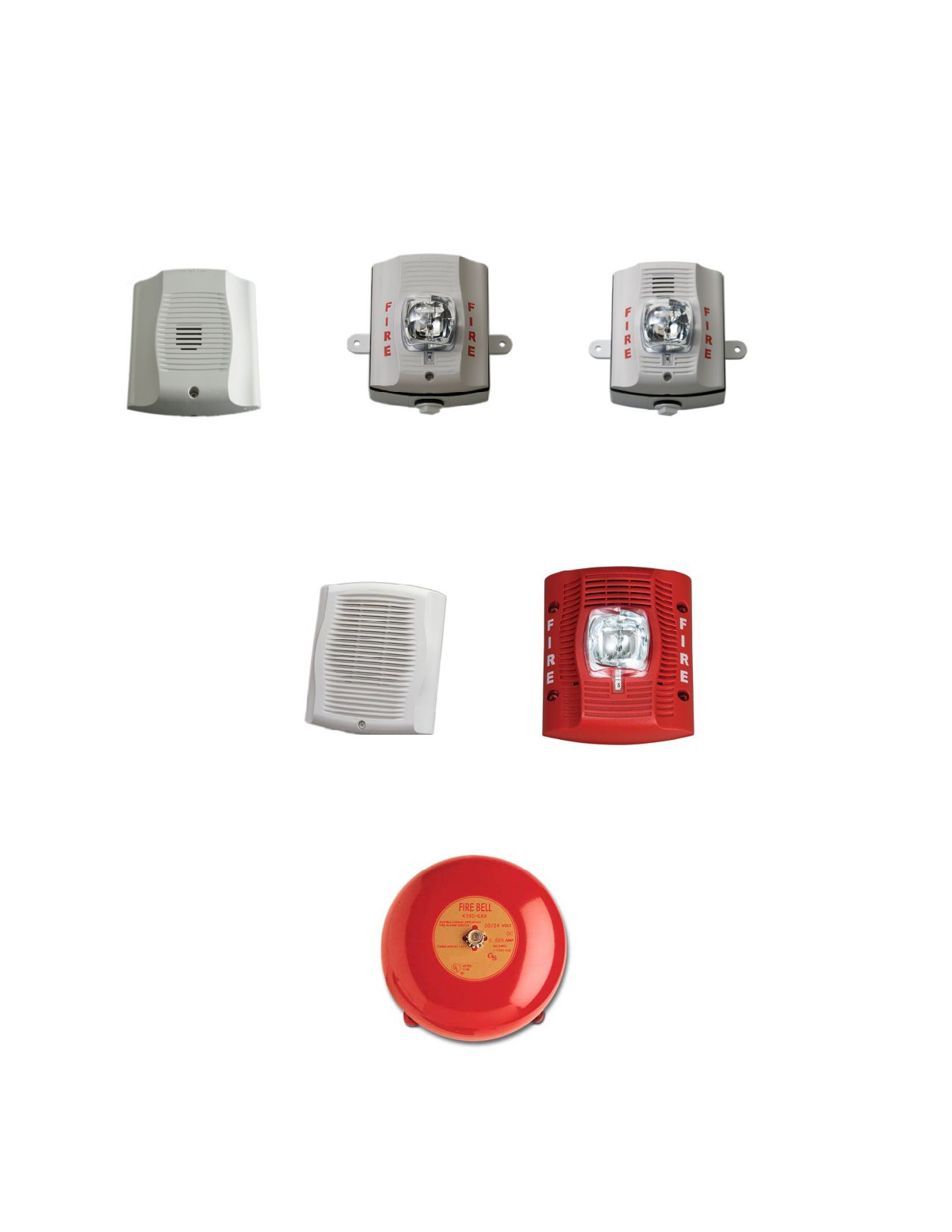
8.5 Audio and Visual Notification Devices
Audio and visual notification devices are fire alarm system components such as bells,
horns, speakers, lights or text displays that provide audible, tactile or visible out puts or
any combination thereof.
A. Horns, Horn/Strobes
Horns
Strobes
Horn Strobes
B. Combination speaker / strobe appliances
Speaker
Speaker strobe
C. Gongs/Bells
Gongs/Bells
33
8.6 Communication System
A functioning communication system is required as a part of most fire alarm systems. One
way-voice communication systems are generally found in homeless shelters.
One way voice communication entails the use of a public address system. Some buildings
also have a public address system installed which is not part of the approved fire alarm
system. Although not approved, the public address system may be used to warn and
instruct building occupants in case of a fire emergency. Communication systems that are
part of the fire alarm system should only be used for fire and drill related purposes.
Two way voice communication is a form of transmission in which both parties involved
have the ability to transmit information. This is useful during an emergency, and allows
staff members to report the conditions of a fire emergency from the fire floor back to the
FEDC or FSD in the lobby at the fire command center. Two way voice communication uses
warden phones that are placed at several locations throughout the building, usually near
the exit stairways in the building.
9. Sprinkler System
Sprinkler systems are required by law in buildings occupied as homeless shelters.
Sprinklers are devices for automatically distributing water on a fire. Sprinkler systems are
intended to control the spread of fire. Activation of the sprinkler system shall cause an
alarm to be transmitted to an approved central station and will also sound an alarm
throughout the shelter.
The two different types of sprinklers are Automatic Sprinkler systems and Non-Automatic
sprinkler systems. In most shelters, the sprinkler system is automatic since shelters are
heated.
Automatic Sprinkler System - consists of a series of pipes at or near the ceiling of each
story of a building. The pipes are filled with water or compressed air, and equipped with
automatic devices to release water for fire fighting. These devices are called sprinkler
heads. Automatic sprinkler systems require water-flow devices.
Non-automatic Sprinkler System
- under normal conditions the pipes in the non-
automatic sprinkler systems are dry. Water is supplied when necessary by pumping water
into the system through the Fire Department connection.
Sprinkler heads must never be painted over and must not accumulate dust and debris.
Sprinkler heads that have been painted over or have accumulated debris or foreign material
must be replaced immediately with a new sprinkler head. If they are not replaced, they will
not open at the desired temperature and this will prevent the sprinkler head from
functioning properly in a fire emergency. The pictures below show examples of sprinkler
heads that have been painted.
34
The Coordinator of Fire Safety & Alarm Systems or the Fire Safety Director are responsible
for ensuring that the inspection, testing and maintenance of the sprinkler system takes
place as required and on schedule. Depending on the type of sprinkler system in the
shelter, inspections, testing and maintenance could occur on a variety of different
frequencies. The F-80 or F-58 holder is responsible for verifying that the person who is
inspecting, testing, or maintaining the system has the proper C of F and/or license and that
a written record of their work is kept on the premises. Annually and once every five years
sprinkler systems must be tested and maintained by either a master fire suppression piping
contractor with an S-12 C of F, or a person who possesses a master plumber license in
addition to an S-12 C of F. For the full inspection, testing, and maintenance schedule for
sprinkler systems, fire guards should reference NFPA 25. It is also highly recommended
that fire guards familiarize themselves with the S-12 Certificate of Fitness for Citywide
Sprinkler Systems, which can be found on the FDNY website at the web address below:
df
10. Standpipe Systems
Standpipe systems provide water that firefighters can manually discharge through hoses
onto a fire. Water is fed into a piping system. The piping runs vertically and horizontally
throughout the building. The pipes running vertically are usually called risers. The risers
are usually located in the stairwell enclosures or in the hallways in the building. The piping
system supplies water to every floor in the building.
Standpipe systems are used in buildings where it may be difficult for the Fire Department
to pump water on the fire. For example, standpipe systems are required in buildings that
are over 75 feet in height. The top of the standpipe riser extends up onto the roof.
The Coordinator of Fire Safety & Alarm Systems or Fire Safety Director is also responsible
for ensuring that the inspection, testing and maintenance of the standpipe system will take
place on schedule. Automatic and non-automatic standpipe systems shall be inspected,
tested and maintained by a competent person holding a C of F, employed by the owner, to
see that all parts of the system are in good working order, and that the Fire Department
connection or connections, if any, are ready for immediate use by the Fire Department. A
detailed record shall be kept of each inspection for examination by any representative of the
Fire Department.
35
The Coordinator of Fire Safety & Alarm Systems or Fire Safety Director is responsible for
verifying that the person who is inspecting, testing, or maintaining the system has the
proper C of F and/or license and that a written record of their work is kept on the premises.
Annually and once every five years standpipe systems must be tested and maintained by
either a master fire suppression piping contractor with an S-13 C of F, or a person who
possesses a master plumber license in addition to an S-13 C of F. For the full inspection,
testing, and maintenance schedule for standpipe systems, fire guards should reference
NFPA 25. It is also highly recommended that Coordinators fire guards familiarize
themselves with the S-13 Certificate of Fitness for Citywide Standpipe Systems, which can
be found on the FDNY website at the web address below:
df
11. Portable Fire Extinguishers
Fire guards must be familiar with the different types of portable fire extinguishers. They
should know how to operate the extinguishers in a safe and efficient manner. They must
know the difference between the various types of extinguishers and when they should be
used. Portable fire extinguishers weighing 40 lbs. or less must be installed so that the top of
the extinguisher is not more than 5 ft above the floor. Hand-held portable fire extinguishers
weighing more than 40 lbs. must be installed so that the top of the extinguisher is not more
than 3.5 feet above the floor. The clearance between the bottom of the extinguisher and the
floor must not be less than 4 inches. In other words, no fire extinguisher is allowed to be
on the floor.
Fire extinguishers must be located in conspicuous locations where they will be readily
accessible and immediately available for use. These locations must be along normal paths
of travel.
In the event that a fire extinguisher has been discharged, it must be fully recharged or
replaced prior to being used again. Portable fire extinguishers are important in preventing a
small fire from growing into a catastrophic fire; however, they are not intended to fight large
or spreading fires. Portable fire extinguishers should only be used when there is an
available means of egress that is clear of fire. By the time the fire has spread, fire
extinguishers, even if used properly, will not be adequate to extinguish the fire. Such fires
should be extinguished by the building fire extinguishing systems or trained firefighters
only.
In case of any fire, 911 must be called. Fire extinguishers must be used in accordance with
the instructions painted on the side of the extinguisher. They clearly describe how to use
the extinguisher in case of an emergency. Fire guards should be familiar with the use of
portable fire extinguishers. When operating a fire-extinguisher, fire guards should
remember the acronym P.A.S.S. to make sure it is used properly. P.A.S.S. stands for Pull,
Aim, Squeeze, Sweep. Specifically, fire guards should ensure that they do the following:
Pull the pin from the handle
Aim the nozzle at the base of the fire
Squeeze the lever
Sweep the nozzle from side to side until the fire extinguisher is emptied.
36

11.1 Different Types of Portable Fire Extinguishers
Fire extinguishers are classified by the type of fire that they will extinguish. Some fire
extinguishers can only be used on certain types of fires, while other fire extinguishers are
made to extinguish more than one type of fire. The portable fire extinguisher classification
is indicated on the right side of the extinguisher. For more detailed information regarding
the different portable fire extinguisher classifications and the types of fires they extinguish,
reference the chart below.
A Class A fire extinguisher is used for ordinary combustibles, such as
wood, paper, some plastics and textiles. This class of fire requires the
heat-absorbing effects of water or the coating effects of certain dry
chemicals. Extinguishers that are suitable for Class A fires should be
identified by a triangle containing the letter “A.” If in color, the triangle
should be green.
A Class B fire extinguisher is used for flammable liquid and gas fires
such as oil, gasoline, etc. These fire extinguishers deprive the fire of
oxygen and interrupt the fire chain by inhibiting the release of
combustible vapors. Extinguishers that are suitable for Class B fires
should be identified by a square containing the letter “B.” If in color, the
square should be red.
A Class C fire extinguisher is used on fires that involve live electrical
equipment which require the use of electrically nonconductive
extinguishing agents. (Once the electrical equipment is de-energized,
extinguishers for Class A or B fires may be used.) Extinguishers that are
suitable for Class C fires should be identified by a circle containing the
letter “C.” If in color, the circle should be blue.
A Class D fire extinguisher is used on combustible metals such as
magnesium, titanium, sodium, etc., which require an extinguishing
medium that does not react with the burning metal. Extinguishers that
are suitable for Class D fires should be identified by a five-point painted
star containing the letter “D.” If in color, the star should be yellow.
A Class K fire extinguisher is used on fires involving cooking media (fats,
grease and oils) in commercial cooking such as restaurants. These fire
extinguishers work on the principal of saponification. Saponification
takes place when alkaline mixtures such as potassium acetate,
potassium citrate or potassium carbonate are applied to burning cooking
oil or fat. The alkaline mixture combined with the fatty acid creates
soapy foam on the surface which holds in the vapors and steam and
extinguishes the fire. These extinguishers are identified by the letter K.
The most commonly sold portable fire extinguishers (PFEs) are labeled ABC extinguishers.
Class ABC extinguishers are often the primary PFE in shelters. Class ABC extinguishers
are dry chemical extinguishers that can be used to extinguish regular combustible fires,
flammable liquid fires, and fires involving electrical equipment. ABC extinguishers are
usually red in color and range in size from 5-20 lbs. The pictures below show an example
of a Class ABC portable fire extinguisher.
37
Class A portable fire extinguishers are available but are not as prevalent as Class ABC
extinguishers. Class A PFEs are also known as Air Pressurized Water
(APW) fire
extinguishers. Water is an extinguishing agent for regular combustibles.
These extinguishers are usually silver in color and
approximately 3 feet in height and weigh approximately 25
lbs. Class A portable fire extinguishers are useful in buildings
and occupancies that primarily contain Type A combustible
materials. These PFEs should ONLY be used on ordinary
combustible fires. The picture to the right shows an example
of a typical Class A portable fire extinguisher.
Class A PFE
Portable fire extinguishers with a classification of “BC” are used to extinguish flammable
liquid fires and electrical equipment fires. Portable fire extinguishers with a classification of
just “B” or a classification of just “C” do not exist.
“BC” portable fire extinguishers are red
in color and range in size from five
5-100 lbs. or larger. Class BC portable fire
extinguishers are filled with sodium bicarbonate or potassium bicarbonate. An example of
a BC portable fire extinguisher is shown below:
38
As mentioned above, a portable fire extinguisher with just a “C” classification does not exist.
The “C” classification indicates ONLY that the extinguishing agent is a non conductor and is
safe to use on live electrical fires.
“C” fires will have either an “A” component, such as
ordinary combustibles around the electrical item, or a “B” component such as an oil filled
transformer or some electrical device involving flammable liquids. This is the reason “C”
classifications are only attached to either a “B” or “AB” fire extinguisher. This classification
specifies the fire extinguisher that is most appropriate for extinguishing the fire.
Class K portable fire extinguishers are often found in kitchens and are used to extinguish
combustible cooking fluids such as oils and fats. There are different extinguishing agents
found in fire extinguishers labeled Class K. Some of these extinguishing agents are dry and
some are wet. Potassium bicarbonate is used in some dry chemical fire extinguishers and a
chemical mist is used in some wet chemical fire extinguishers. The extinguishing agents in
a Class K fire extinguisher are sometimes electrically conductive and should only be used
AFTER the power has been turned off in the electrical appliance. An example of a Class K
fire extinguisher is shown in the pictures below:
39
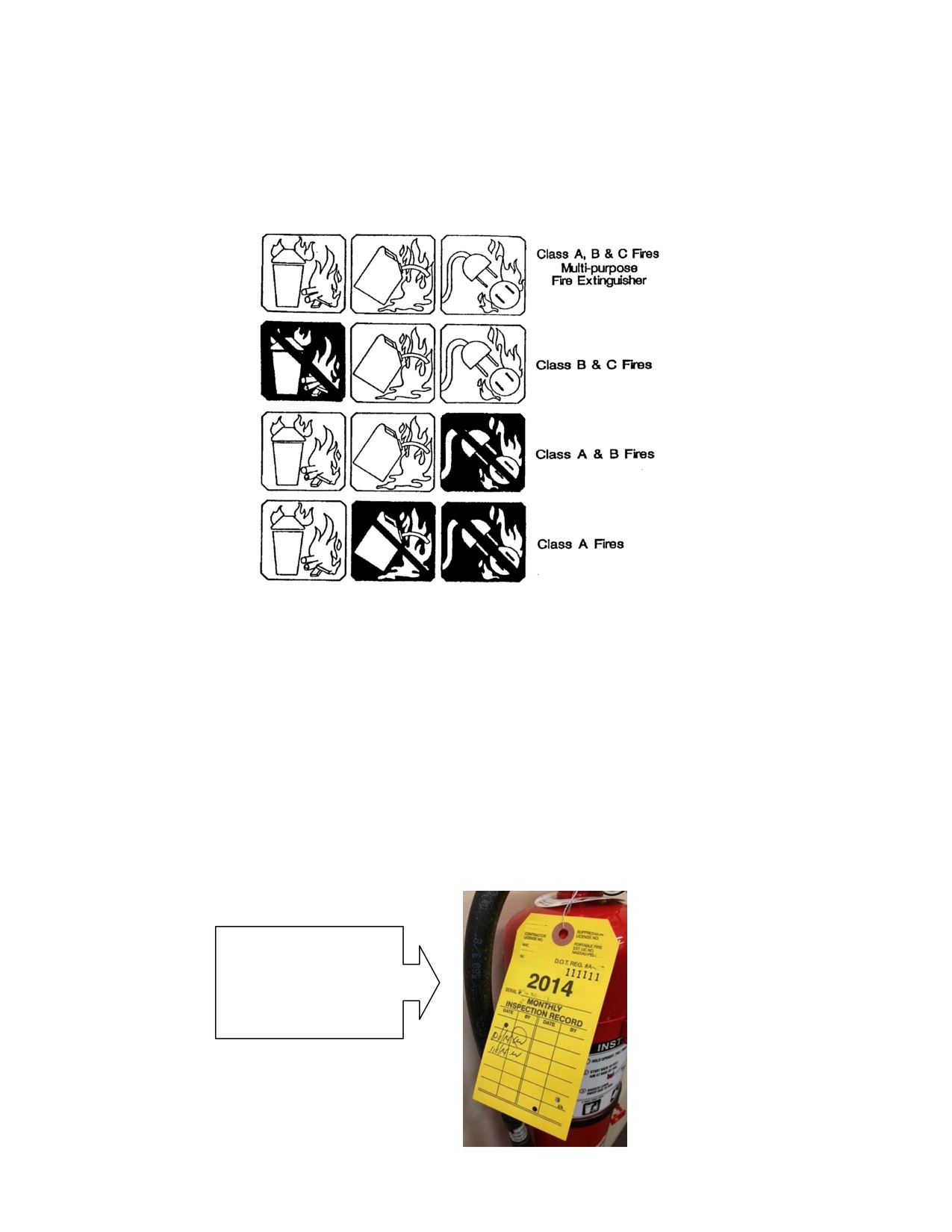
11.2 Labeling
Portable fire extinguishers are labeled so users can quickly identify the classes of fire on
which the extinguisher will be effective. The marking system combines pictures of both
recommended and unacceptable extinguisher types on a single identification label. The
following is an example of typical labels.
11.3 Portable Fire Extinguisher Monthly Inspection
Portable fire extinguishers are required to be inspected monthly. The building owner is
responsible for designating a person to perform a monthly visual inspection. This inspection
is a “quick check” that a fire extinguisher is available and will operate. It is intended to give
reasonable assurance that the fire extinguisher is fully charged and operable. This is done
by verifying that it is in its designated place, that it has not been actuated or tampered
with, and that there is no obvious or physical damage or condition to prevent its operation.
The information on the monthly inspection record must include the date the inspection was
performed, the person performing the inspection, and those portable fire extinguishers
found to require corrective action. Such recordkeeping must be attached to the
extinguisher. Labels or markings indicating fire extinguisher use, or classification, or both
shall be placed on the front of the fire extinguisher.
Monthly inspection
record located on
the front of a
portable fire
extinguisher
40
11.4 Portable Fire Extinguisher Annual Servicing
Servicing is a thorough examination of the Portable Fire Extinguisher (PFE). It is intended
to give maximum assurance that the PFE will operate effectively and safely. It also includes
any necessary repair or replacement. Servicing the PFE will reveal if hydrostatic testing or
internal maintenance is needed. A separate certificate of fitness is required to service,
maintain and/or recharge a PFE. A Servicing Company certificate is also required for a
company providing such service. Coordinator of Fire Safety & Alarm Systems in Homeless
Shelters or Fire Safety Directors are responsible for making arrangements to have all the
extinguishers serviced at least once a year by a qualified technician holding a Certificate of
Fitness for the servicing of portable fire extinguishers. PFEs must be serviced at least
annually or at the time of hydrostatic testing, or when physical damage to the cylinder is
visible during a monthly inspection. PFEs removed for servicing must be replaced by a
similar PFE and must be of at least equal rating.
41