Airbus A318/319/320/321. FLIGHT CREW TECHNIQUES MANUAL (2005-2022) - page 12
PROCEDURES
ABNORMAL AND EMERGENCY PROCEDURES
A318/A319/A320/A321
FLIGHT CREW
MISC
TECHNIQUES MANUAL
Some items need to be highlighted:
-
The flight crew must ensure that the differential pressure (Delta P) is equal to 0.
When automatic pressure control is operative, the flight crew can rely on the CPC, and the Delta
P check is therefore not applicable.
If the automatic pressure control systems fails during flight, the CAB PR SYS 1+2 FAULT ECAM
alert requires to set the MAN V/S CTL sw to FULL UP position during final approach to cancel
any residual cabin pressure. However, since the residual pressure sensor indicator (installed in
the cabin door) is inhibited when slides are in the armed position, the EMER EVAC procedure
requires an additional Delta P check.
L2
Note:
At least one automatic cabin pressure control system must be operative at departure.
Therefore, the Delta P check does not apply to the case of an emergency evacuation
following a rejected takeoff.
-
L1
"CABIN CREW (PA)…ALERT" reminds the captain to provide the cabin crew with the
appropriate evacuation instructions, as necessary (In case of RTO, this is done during the RTO
flow pattern). Cabin crew must be aware that the flight crew is still in control of the situation. In
certain circumstances, this will avoid any unwanted or unnecessary evacuation initiated by the
cabin crew.
-
"EVACUATION…INITIATE" requires the captain to confirm whether the emergency evacuation
is still required. If still required, the captain:
• Notifies the cabin crew to start the evacuation
• Activates the EVAC COMMAND pb
• Advises ATC, if required.
This will be done preferably in this order for a clear understanding by cabin crew.
On ground with engines stopped, only the right dome light is operational and the three positions
(BRT, DIM, OFF) of the dome light sw remain available, allowing the EMER EVAC procedure
completion.
The flight crew will keep in mind that as long as the evacuation order is not triggered, the flight
crew may defer or cancel the passengers' evacuation. As soon as the evacuation order is
triggered, this decision is irreversible.
When the aircraft is on battery power, the cockpit seats must be operated mechanically.
PIA A318/A319/A320/A321 FLEET
PR-AEP-MISC P 7/34
FCTM
← C →
12 JAN 22
PROCEDURES
ABNORMAL AND EMERGENCY PROCEDURES
A318/A319/A320/A321
FLIGHT CREW
MISC
TECHNIQUES MANUAL
Ident.: PR-AEP-MISC-A-00019305.0001001 / 20 MAR 17
TASKSHARING
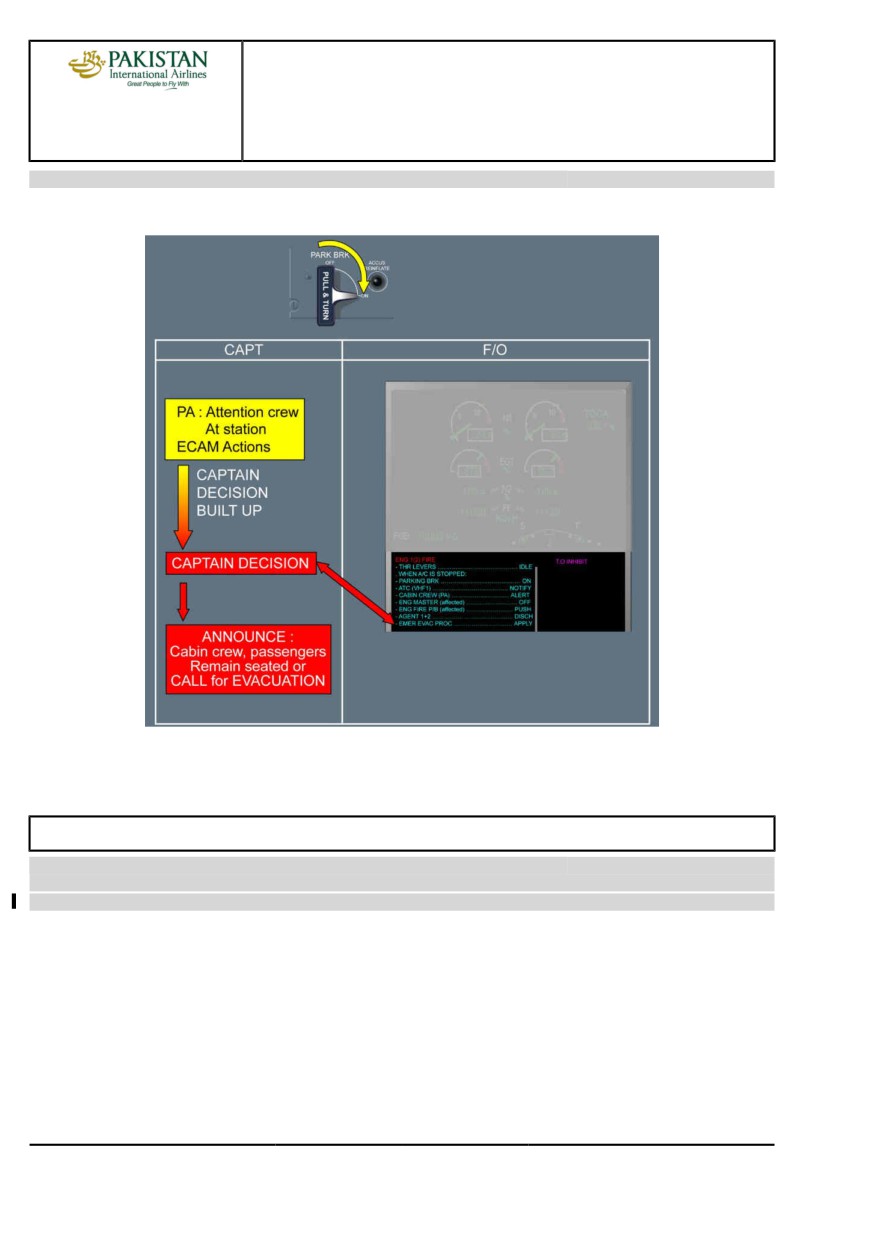
When applying the EMER EVAC procedure, the F/O can select the engine masters OFF and push
the FIRE pb, without any confirmation from the Captain.
EMER LANDING
Ident.: PR-AEP-MISC-00019308.0002001 / 20 MAR 17
Criteria: 31-1492, P14629, SA
1 Applicable to: MSN 02155-02719, 02789-02944, 03060, 05152-07792
In some rare cases, the loss of all engines occurs at a very low height above ground level, and there
is not sufficient time to attempt an engine relight. Therefore, the flight crew may not be able to apply
the ENG ALL ENGINES FAILURE procedure. The flight crew must use the remaining time to fly the
aircraft to an appropriate landing spot, and to prepare the aircraft for touchdown (ditching or forced
landing).
The EMER LANDING procedure is provided in the QRH close to the EMER EVAC procedure.
PIA A318/A319/A320/A321 FLEET
PR-AEP-MISC P 8/34
FCTM
← C to D →
12 JAN 22
PROCEDURES
ABNORMAL AND EMERGENCY PROCEDURES
A318/A319/A320/A321
FLIGHT CREW
MISC
TECHNIQUES MANUAL
The EMER LANDING procedure provides the flight crew with the following items and actions to
perform, for the best possible touchdown:
- The landing gear position
- The slats/flaps configuration
- The speed
- The pitch attitude, in the case of ditching.
Flight crew actions that are considered as basic airmanship (notify the ATC, notify the cabin crew,
etc.) are not included in the EMER LANDING procedure.
WHEN TO APPLY THE EMER LANDING PROCEDURE
The flight crew must rapidly decide to apply either the ENG ALL ENGINES FAILURE procedure, or
the EMER LANDING procedure, depending on their assessment of the situation.
To make their decision, the flight crew should take all the following parameters into account:
- The aircraft altitude
- The remaining time before touchdown
- The rate of descent
- The flight crew workload
- The weather conditions
- The suitable landing surface options
- The technical state of the aircraft, etc.
EMER LANDING
Ident.: PR-AEP-MISC-00019308.0001001 / 20 MAR 17
Criteria: SA
Applicable to: MSN 02758, 03031, 03097-04392
In some rare cases, the loss of all engines occurs at a very low height above ground level, and there
is not sufficient time to attempt an engine relight. Therefore, the flight crew may not be able to apply
the ENG DUAL FAILURE procedure. The flight crew must use the remaining time to fly the aircraft to
an appropriate landing spot, and to prepare the aircraft for touchdown (ditching or forced landing).
The EMER LANDING procedure is provided in the QRH close to the EMER EVAC procedure.
The EMER LANDING procedure provides the flight crew with the following items and actions to
perform, for the best possible touchdown:
- The landing gear position
- The slats/flaps configuration
- The speed
- The pitch attitude, in the case of ditching.
Flight crew actions that are considered as basic airmanship (notify the ATC, notify the cabin crew,
etc.) are not included in the EMER LANDING procedure.
PIA A318/A319/A320/A321 FLEET
PR-AEP-MISC P 9/34
FCTM
← D →
12 JAN 22
PROCEDURES
ABNORMAL AND EMERGENCY PROCEDURES
A318/A319/A320/A321
FLIGHT CREW
MISC
TECHNIQUES MANUAL
WHEN TO APPLY THE EMER LANDING PROCEDURE
The flight crew must rapidly decide to apply either the ENG DUAL FAILURE procedure, or the
EMER LANDING procedure, depending on their assessment of the situation.
To make their decision, the flight crew should take all the following parameters into account:
- The aircraft altitude
- The remaining time before touchdown
- The rate of descent
- The flight crew workload
- The weather conditions
- The suitable landing surface options
- The technical state of the aircraft, etc.
FLIGHT CREW INCAPACITATION
Ident.: PR-AEP-MISC-00018202.0001001 / 03 NOV 21
Applicable to: ALL
GENERAL
Flight crew incapacitation is a real safety hazard that occurs more frequently than many of
the other emergencies. Incapacitation can occur in many forms, that range from sudden
death to partial loss of function. Sometimes the flight crew does not have any symptom before
incapacitation.
DETECTION
In order to help with the early detection of flight crew incapacitation, the Crew Resource
Management (CRM) principles should be applied:
- Correct crew coordination that involves routine monitoring and aural crosschecks. The
absence of standard callouts at the appropriate time may indicate incapacitation of one flight
crewmember
- If one flight crewmember does not feel well, the flight crew must inform the other flight
crewmember.
Other symptoms, for example incoherent speech, a pale and(or) fixed facial expression, or
irregular breathing, may indicate the beginning of incapacitation.
ACTION
In the case of flight crew incapacitation, the fit flight crewmember should apply the following
actions:
PIA A318/A319/A320/A321 FLEET
PR-AEP-MISC P 10/34
FCTM
← D to E →
12 JAN 22
PROCEDURES
ABNORMAL AND EMERGENCY PROCEDURES
A318/A319/A320/A321
FLIGHT CREW
MISC
TECHNIQUES MANUAL
-
Take over and ensure a safe flight path:
• Announce ″I have control″
• If the incapacitated flight crewmember causes interference with the handling of the aircraft,
press the sidestick pb for 40 seconds
L2
The time required of 40 s includes the time necessary for AP deactivation (if AP engaged)
and the time for offside sidestick deactivation.
L1
•
Keep or engage the onside AP, as required
• Perform callouts (challenge and response included) and checklists aloud.
-
Inform the ATC of the emergency
-
Take any steps possible to contain the incapacitated flight crewmember. These steps may
involve cabin attendants
-
In order to reduce the workload, consider:
• Early approach preparation and checklists reading
• Automatic Landing
• Use of radar vectoring and long approach.
-
Land at the nearest suitable airport after consideration of all pertinent factors
-
Arrange medical assistance onboard and after landing, providing as many details as possible
about the condition of the affected flight crewmember
-
Request assistance from any medically qualified passenger, except for flight with only two flight
crewmembers onboard (i.e. freighter or ferry flight).
HANDLING THE AIRCRAFT IN THE CASE OF SEVERE DAMAGE
Ident.: PR-AEP-MISC-00019240.0001001 / 20 MAR 17
Applicable to: ALL
In the event of severe damage to the aircraft, the flight crew’s immediate action should be to “fly
the aircraft". In severe damage cases, it might be necessary for the flight crew to revert to the use
of a “back to basics" flying techniques, where bank, pitch, and thrust are the primary parameters
to manually control. In addition, as for any flight phase, the flight crew must continue to perform all
navigation and communication tasks.
If the damage significantly affects aircraft aerodynamics, flight controls, or engines, then aircraft
handling qualities may be affected. Therefore, the flight crew should perform an assessment of
aircraft handling qualities as soon as possible, in order to identify how pitch, roll, and yaw are
controllable.
During assessment of the flight controls, the flight crew should apply smooth sidestick input and
should limit the bank angle to 15°, in order to prevent possible destabilization of the aircraft. In
addition, the flight crew should avoid use of the speedbrakes before the end of the flight, unless
necessary.
PIA A318/A319/A320/A321 FLEET
PR-AEP-MISC P 11/34
FCTM
← E to F →
12 JAN 22
PROCEDURES
ABNORMAL AND EMERGENCY PROCEDURES
A318/A319/A320/A321
FLIGHT CREW
MISC
TECHNIQUES MANUAL
To assess aircraft handling qualities, the flight crew must keep the following basic principles in mind:
- Elevators, ailerons, and rudder are the primary flight controls.
- In addition to use of the elevators, use of the THS (via longitudinal trim control) may also be
necessary in order to control pitch.
- On all Airbus aircraft, engines are mounted under the wing. As a consequence a thrust increase
results in a pitch-up effect, and a thrust decrease results in a pitch-down effect.
- If damage to the aircraft is severe, it may be necessary to use abnormal flying techniques to
maintain control of the aircraft. Each flight control can be used to compensate for an inoperative or
damaged surface. For example, the flight crew can compensate for a lack of roll efficiency via the
use of rudder input. As another example, the application of asymmetrical thrust enables the flight
crew to indirectly control roll, with a slightly delayed response.
CAUTION
Sudden commanded full, or nearly full, opposite rudder movement against a sideslip
can generate loads that exceed the limit loads and possibly the ultimate loads and
can result in structural failure.
This is true even at speeds below the maximum design maneuvering speed, VA.
As soon as control of the aircraft is ensured:
- Depending on the severity of the damage to the aircraft, the flight crew may attempt to use
automation. However, if the autopilot and the flight director remain available, their operation may
be erratic. Therefore, the flight crew should monitor carefully the AP behaviour, and must be
prepared to immediately revert to manual flying techniques.
- The flight crew can start ECAM actions, if applicable. An assessment of the flight deck indications
may provide the flight crew with useful information about affected systems. When possible and
depending on the situation, a visual check can also provide important information.
Prior to landing and at an appropriate altitude, the flight crew must perform an assessment of aircraft
handling qualities in landing configuration in order to help determine an appropriate strategy for
approach and landing. The flight crew must perform this analysis at different speeds down to VAPP.
If it becomes difficult to control the aircraft when the aircraft goes below a specific speed, the flight
crew must perform the approach landing at a speed above this specific speed. The result of the
above-mentioned assessments helps to build the correct follow up strategy. The quantity of flight
crew workload required to maintain control of the aircraft is one of the decision factors to take into
account for this strategy. Good flight crew coordination is essential throughout the assessment
process. The flight crew should share their own understanding and view of the situation with their
other flight crewmembers.
PIA A318/A319/A320/A321 FLEET
PR-AEP-MISC P 12/34
FCTM
← F
12 JAN 22
PROCEDURES
ABNORMAL AND EMERGENCY PROCEDURES
A318/A319/A320/A321
FLIGHT CREW
MISC
TECHNIQUES MANUAL
LOW ENERGY
Ident.: PR-AEP-MISC-00019309.0001001 / 20 MAR 17
Applicable to: ALL
GENERAL
The SPEED, SPEED, SPEED aural alert announces a low energy situation. This situation requires
a flight crew action to increase energy.
For more information, Refer to FCOM/DSC-22_40-30 Low - Energy Aural Alert.
LOW ENERGY RECOVERY
Increase the thrust and/or adjust the pitch depending on the circumstances, until the aural alert
stops.
OVERSPEED
Applicable to: ALL
Ident.: PR-AEP-MISC-B-00016353.0001001 / 20 MAR 17
GENERAL
The flight crew must not intentionally exceed VMO/MMO (350 kt/M 0.82) during the flight.
However, during normal operations, the aircraft may temporarily exceed VMO/MMO due to wind
gradients.
The aircraft is designed to fly up to the maximum structural speed at which the aircraft structure
will not be damaged. However, in the case of overspeed, the aircraft may encounter vertical
load factors that may exceed the aircraft limits. In this case, exceeding VMO/MMO requires
maintenance inspection.
PIA A318/A319/A320/A321 FLEET
PR-AEP-MISC P 13/34
FCTM
G to H →
12 JAN 22
PROCEDURES
ABNORMAL AND EMERGENCY PROCEDURES
A318/A319/A320/A321
FLIGHT CREW
MISC
TECHNIQUES MANUAL
Ident.: PR-AEP-MISC-B-00016354.0001001 / 03 NOV 21
OVERSPEED PREVENTION
Overspeed Prevention Technique
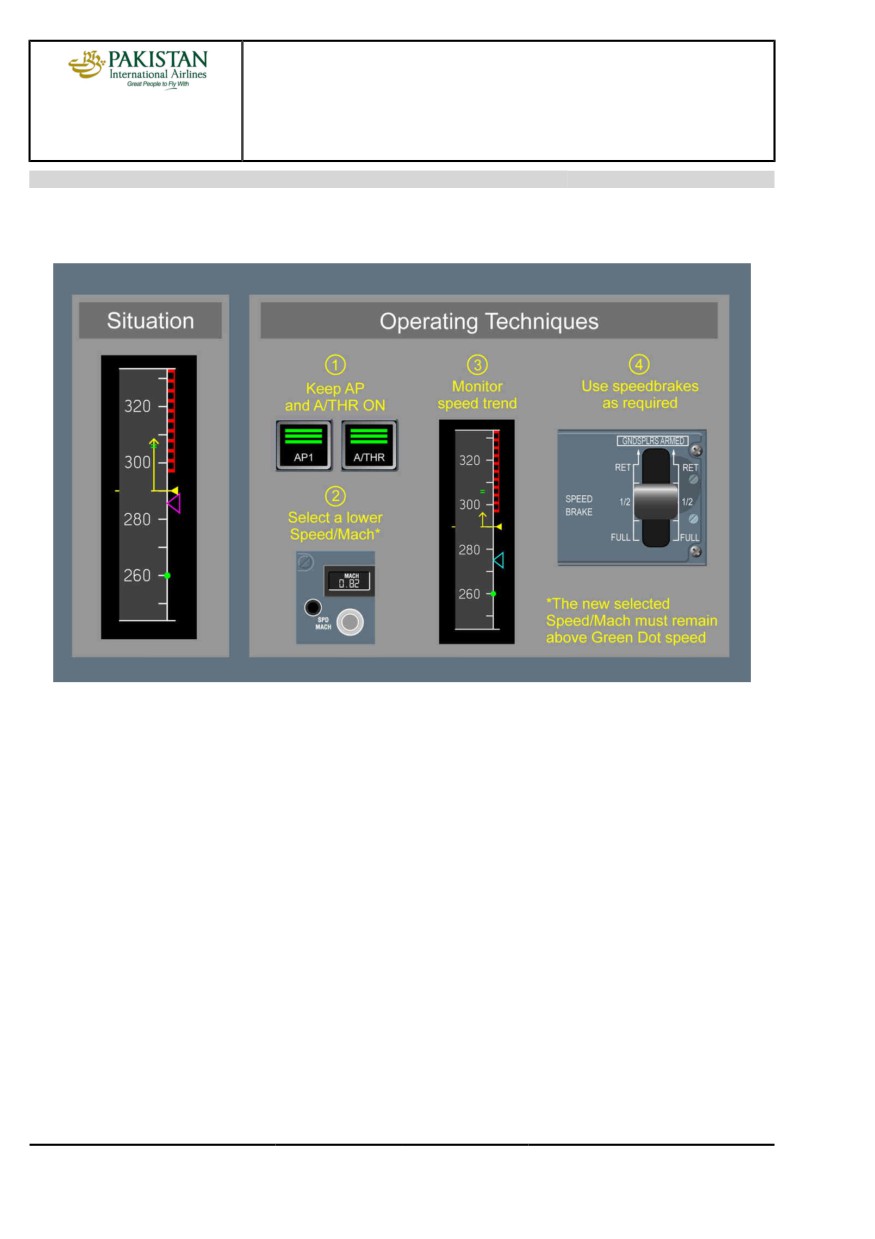
If the aircraft encounters significant speed variations close to VMO/MMO during flight, the following
operating techniques apply.
It is recommended to keep the AP and A/THR engaged. This enables to keep the intended flight
path while thrust reduces to idle, if necessary.
The flight crew selects a lower target speed in order to increase the margin to VMO/MMO.
However, the flight crew should not reduce the target speed below Green Dot, which is the
minimum recommended speed during the flight.
After the selection of the lower target speed, the flight crew monitors the speed trend arrow on the
PFD. If the aircraft continues to accelerate, and if the speed trend arrow approaches or exceeds
VMO/MMO, the flight crew uses the appropriate position of speed brakes depending on the rate of
acceleration. The length of the speed trend arrow is a good indication of the rate of acceleration.
For more information, Refer to FCOM/DSC-31-40 Airspeed.
PIA A318/A319/A320/A321 FLEET
PR-AEP-MISC P 14/34
FCTM
← H →
12 JAN 22
PROCEDURES
ABNORMAL AND EMERGENCY PROCEDURES
A318/A319/A320/A321
FLIGHT CREW
MISC
TECHNIQUES MANUAL
Note:
- The use of speed brakes is an efficient deceleration mean, that is certified for the
whole flight envelope. However, the use of speed brakes results in a reduction of
the speed envelope. The use of speed brakes increases VLS and reduces the buffet
margin at high altitude.
- The use of speed brakes results in a pitch up effect, but the AP and the normal law
compensate for it.
For the descent in DES mode and managed speed, the flight crew should enter descent wind data
that is as accurate as possible. This results in an optimized managed speed and vertical profile.
This action results in a speed during descent which would be approximately the managed speed
target. For more information, Refer to FCOM/DSC-22_30-40 Managed Speed/Mach Target.
Ident.: PR-AEP-MISC-B-00019238.0001001 / 03 NOV 21
OVERSPEED RECOVERY
Overspeed Recovery Technique
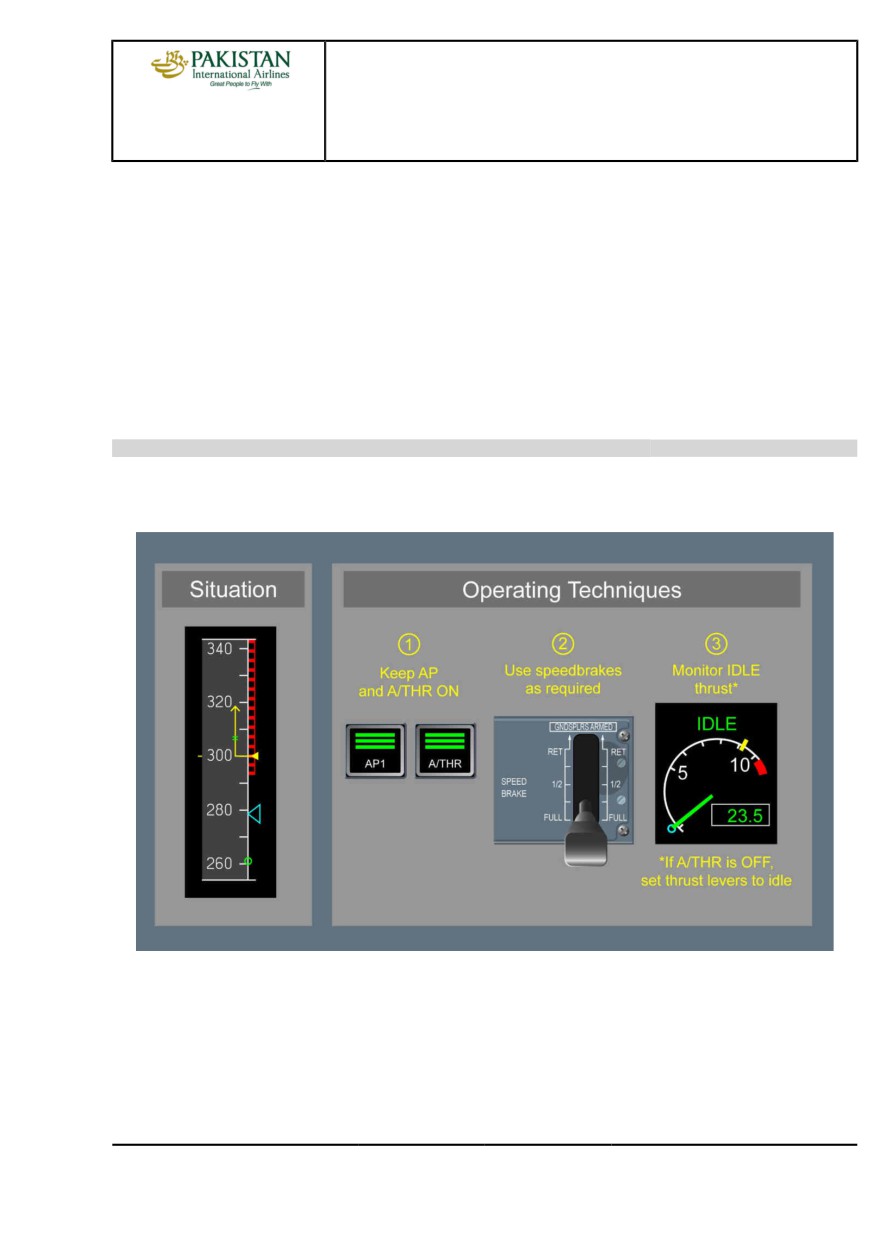
The flight crew must apply the overspeed recovery technique if the speed/Mach exceeds
VMO/MMO.
The OVERSPEED alert is triggered if the speed/Mach exceeds VMO +4 kt/MMO +M 0.006, and
lasts until the speed is below VMO/MMO. Refer to FCOM/PRO-ABN-OVERSPEED OVERSPEED
- ANNUNCIATION.
The flight crew should keep the AP engaged.
PIA A318/A319/A320/A321 FLEET
PR-AEP-MISC P 15/34
FCTM
← H →
12 JAN 22
PROCEDURES
ABNORMAL AND EMERGENCY PROCEDURES
A318/A319/A320/A321
FLIGHT CREW
MISC
TECHNIQUES MANUAL
In order to minimize overspeed, the flight crew should extend the speed brakes to the most
appropriate lever position, depending on the overspeed situation.
If the A/THR is ON, keep it engaged and check that the thrust is reducing to idle. There is no
operational advantage in manually setting all thrust levers to idle for overspeed recovery. The
engine thrust reduction is the same in both cases.
If the A/THR is OFF, set all thrust levers to idle.
In the case of severe overspeed, the AP automatically disengages and then, the high speed
protection activates in normal law. As a result, the aircraft encounters an automatic pitch up. Refer
to FCOM/DSC-27-20-10-20 Protections - High Speed Protection - Activation Condition.
Note:
The AP does not automatically disengage as soon as the speed reaches the green bars
(that represent the threshold when the high speed protection activates) on the PFD. The
AP disengagement depends on the speed variations and the high speed protection logic.
The high speed protection is designed to request the appropriate demand of vertical load factor.
Therefore, the flight crew should smoothly adjust the pitch attitude to avoid excessive load factors.
Note:
The flight crew must disregard the FD orders while the high speed protection is active.
The FD orders do not take into account the high speed protection.
The flight crew should keep the speed brakes because the use of the speed brakes is compatible
with the high speed protection.
Ident.: PR-AEP-MISC-B-00019239.0001001 / 20 MAR 17
WHEN THE SPEED IS BELOW VMO/MMO
When the aircraft speed is below VMO/MMO with a sufficient speed margin, the flight crew should
retract the speed brakes and should select a new speed target. If the flight crew retracts the speed
brakes when the speed is close to VMO/MMO, the speed may exceed VMO/MMO again at speed
brake retraction. If the A/THR is OFF, the flight crew should manually adjust the thrust levers.
After severe overspeed, the flight crew should recover the flight path smoothly, and then should
engage the AP in accordance with the recommended procedure for AP engagement. Refer to
AS-FG-10-1 Recommended Practice for Autopilot (AP) Engagement.
Ident.: PR-AEP-MISC-B-00016355.0001001 / 03 DEC 19
REPORTING
The flight crew must report any type of overspeed event (i.e. if the OVERSPEED warning is
triggered) to the maintenance. This report results in appropriate maintenance actions.
Ident.: PR-AEP-MISC-B-00016356.0001001 / 20 MAR 17
LINK BETWEEN VMO/MMO AND TURBULENCE
The significant speed variations near VMO/MMO and above VMO/MMO may be one of the first
indications of possible severe turbulence.
PIA A318/A319/A320/A321 FLEET
PR-AEP-MISC P 16/34
FCTM
← H →
12 JAN 22
PROCEDURES
ABNORMAL AND EMERGENCY PROCEDURES
A318/A319/A320/A321
FLIGHT CREW
MISC
TECHNIQUES MANUAL
For more information, Refer to PR-NP-SP-10-10-3 Introduction.
OVERWEIGHT LANDING
Ident.: PR-AEP-MISC-00005692.0038001 / 15 NOV 21
Applicable to: ALL
Should an overweight landing be required, a long straight in approach, or a wide visual pattern,
should be flown in order to configure the aircraft for an early stabilized approach.
The early stabilized approach technique should be used, and VAPP established at the FAF. The
speed will be reduced to reach VLS at runway threshold, to minimize the aircraft energy.
At high weight, VFE NEXT (CONF 1 or CONF 2) may be below the manoeuvring speed (Green Dot
or S speed). To extend the Slats/Flaps, the crew must select the speed on FCU to decelerate to VFE
NEXT.
At very high weight, if VFE CONF 1 is below VLS, the flight crew must disconnect the A/THR to
decelerate to VFE CONF 1.
When established at CONF 1 or CONF 2, the crew can reengage A/THR (if disconnected) and use
manage speed again.
The crew will elect the landing configuration based on landing performance computation:
• If aircraft weight is below the maximum weight for go-around in CONF 3, landing will be performed
CONF full (and go-around CONF 3) as it is the preferred configuration for optimized landing
performance
• If aircraft weight is above the maximum weight for go-around in CONF 3, landing will be performed
CONF 3 (and go-around CONF 1+F). The CONF 1+F meets the approach climb gradient
requirement in all cases (high weights, high altitude and temperature).
If a go-around CONF 1+F is carried out following an approach CONF 3, VLS CONF 1+F may be
higher than VLS CONF 3 +5 kt. The recommendation in such a case is to follow SRS orders which
will accelerate the aircraft up to the displayed VLS. It should be noted, however, that VLS CONF 1+F
equates to 1.23 VS1G whereas the minimum go-around speed required by regulations is 1.13 VS1G.
This requirement is always satisfied.
The crew should be aware that the transition from -3 ° flight path angle to go around climb gradient
requires a lot of energy and therefore some altitude loss.
Taking into account the runway landing distance available, the use of brakes should be modulated to
avoid very hot brakes and the risk of tire deflation.
When the aircraft weight exceeds the maximum landing weight, structural considerations impose
the ability to touch down at 360 ft/min without damage. Thus, if vertical speed exceeds 360 ft/min at
touch down, a maintenance inspection is required.
PIA A318/A319/A320/A321 FLEET
PR-AEP-MISC P 17/34
FCTM
← H to I
12 JAN 22
PROCEDURES
ABNORMAL AND EMERGENCY PROCEDURES
A318/A319/A320/A321
FLIGHT CREW
MISC
TECHNIQUES MANUAL
REJECTED TAKEOFF
Applicable to: ALL
Ident.: PR-AEP-MISC-C-00016357.0001001 / 20 MAR 17
FACTORS AFFECTING THE REJECTED TAKEOFF (RTO)
Experience has shown that a rejected takeoff can be hazardous, even if correct procedures are
followed.
Some factors that can detract from a successful rejected takeoff are as follows:
- Tire damage
- Brakes worn or not working correctly
- Brakes not being fully applied
- Error in gross weight determination
- Incorrect performance calculations
- Incorrect runway line-up technique
- Initial brake temperature
- Delay in initiating the stopping procedure
- Runway friction coefficient lower than expected.
Thorough pre-flight preparation and a conscientious exterior inspection can eliminate the effect of
some of these factors.
During the taxi-out, the takeoff briefing should be confirmed. Any change to the planned conditions
requires the crew to re-calculate the takeoff data. In this case, the crew should not be pressurised
into accepting a takeoff clearance before being fully ready. Similarly, the crew should not accept
an intersection takeoff until the takeoff performance has been checked.
The line-up technique is very important. The pilot should use the over steer technique to minimize
field length loss and consequently, to maximize the acceleration-stop distance available.
Ident.: PR-AEP-MISC-C-00016358.0001001 / 03 NOV 21
DECISION MAKING
A rejected takeoff is a potentially hazardous manoeuvre and the time for decision making is
limited. It is not possible to list all the factors that could lead to the decision to reject the takeoff.
However, in order to help the Captain to make a decision, the ECAM inhibits the warnings that are
not essential from 80 kt to 1 500 ft (or 2 min after lift-off, whichever occurs first). Therefore, any
warning received during this period must be considered as significant.
SPEED CONSIDERATIONS
To assist in the decision making process, the takeoff is divided into low and high speeds
regimes, with 100 kt being chosen as the dividing line. The speed of 100 kt is not critical but was
PIA A318/A319/A320/A321 FLEET
PR-AEP-MISC P 18/34
FCTM
J →
12 JAN 22
PROCEDURES
ABNORMAL AND EMERGENCY PROCEDURES
A318/A319/A320/A321
FLIGHT CREW
MISC
TECHNIQUES MANUAL
chosen in order to help the Captain make the decision and to avoid unnecessary stops from
high speed.
Below 100 kt:
The decision to reject the takeoff may be taken at the Captain's discretion, depending on
the circumstances.
The Captain should seriously consider discontinuing the takeoff, if any ECAM
warning/caution is activated.
Above 100 kt, and below V1:
Rejecting the takeoff at these speeds is a more serious matter, particularly on slippery
runways. It could lead to a hazardous situation, if the speed is approaching V1. At these
speeds, the Captain should be "go-minded" and very few situations should lead to the
decision to reject the takeoff:
1. Fire warning, or severe damage
2. Sudden loss of engine thrust
3. Malfunctions or conditions that give unambiguous indications that the aircraft will not fly
safely
4. Any red ECAM warning
5. Any amber ECAM caution listed below:
- F/CTL L(R) SIDESTICK FAULT
- ENG 1(2) FAIL
- ENG 1(2) REVERSER FAULT
- ENG 1(2) REVERSE UNLOCKED
- ENG 1(2) THR LEVER FAULT
Exceeding the EGT red line or nose gear vibration should not result in the decision to reject
takeoff above 100 kt.
In case of tire failure between V1 minus 20 kt and V1, unless debris from the tires has
caused serious engine anomalies, it is far better to get airborne, reduce the fuel load, and
land with a full runway length available.
The V1 call has precedence over any other call.
Above V1:
Takeoff must be continued, because it may not be possible to stop the aircraft on the
remaining runway.
DECISION CALLOUTS
The decision to reject the takeoff and the stop action is the responsibility of the Captain and
must be made prior to V1 speed. It is therefore recommended that the Captain keeps the hand
PIA A318/A319/A320/A321 FLEET
PR-AEP-MISC P 19/34
FCTM
← J →
12 JAN 22
PROCEDURES
ABNORMAL AND EMERGENCY PROCEDURES
A318/A319/A320/A321
FLIGHT CREW
MISC
TECHNIQUES MANUAL
on the thrust levers until the aircraft reaches V1, whether the Captain is Pilot Flying (PF) or Pilot
Monitoring (PM).
- If a malfunction occurs before V1, for which the Captain does not intend to reject the takeoff,
the Captain will announce the intention by calling "GO".
- If a decision is made to reject the takeoff, the Captain calls "STOP". This call both confirms
the decision to reject the takeoff and also states that the Captain now has control. It is the
only time that hand-over of control is not accompanied by the phrase "I have control".
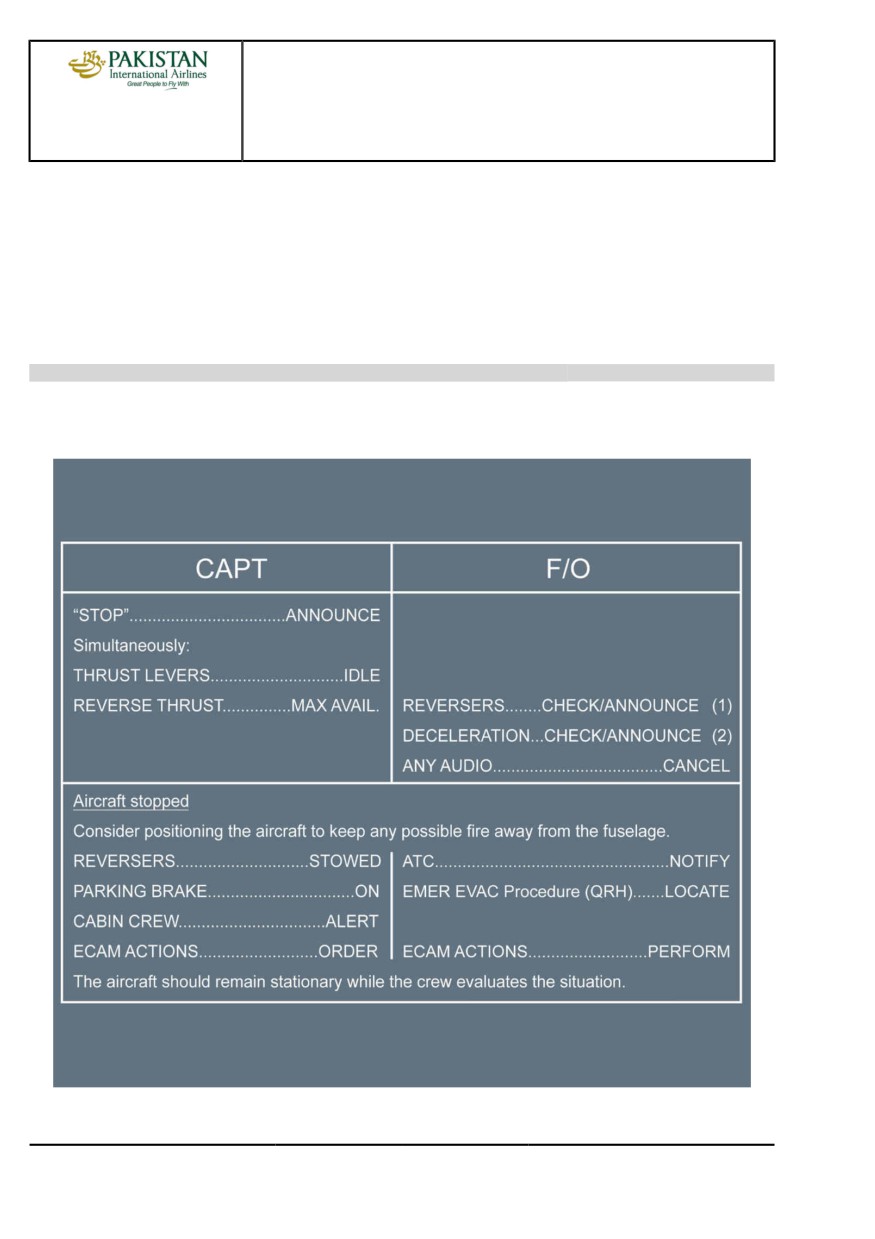
Ident.: PR-AEP-MISC-C-00016359.0002001 / 15 NOV 21
RTO TECHNIQUE
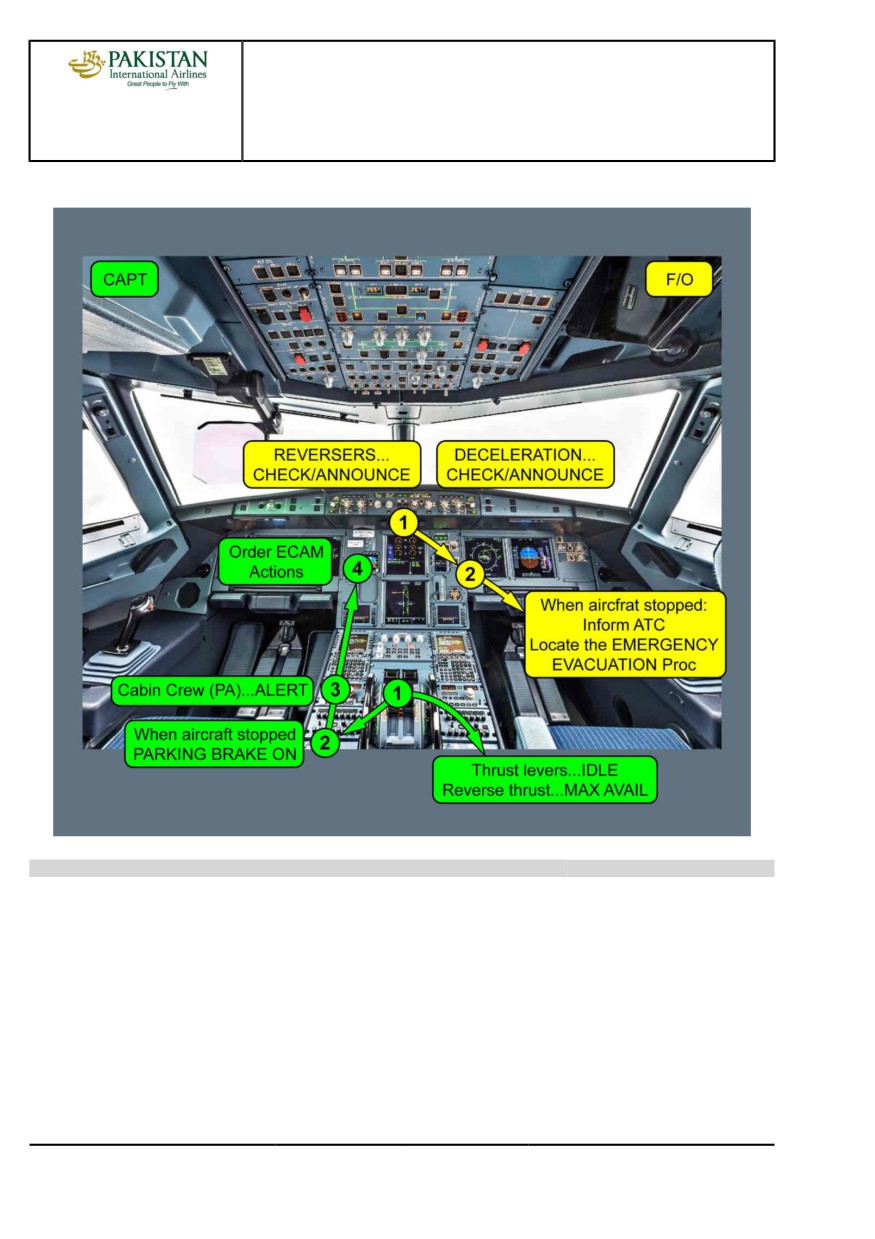
If a RTO procedure is initiated, the following task sharing will be applied:
PIA A318/A319/A320/A321 FLEET
PR-AEP-MISC P 20/34
FCTM
← J →
12 JAN 22
PROCEDURES
ABNORMAL AND EMERGENCY PROCEDURES
A318/A319/A320/A321
FLIGHT CREW
MISC
TECHNIQUES MANUAL
(1)
:
Full reverse thrust may be used until coming to a complete stop. But, if there is enough
runway available at the end of the deceleration, it is preferable to reduce reverse thrust
when passing 70 kt.
(2)
:
- Announcing the deceleration means that the deceleration is felt by the crew, and
confirmed by the Vc trend on the PFD. If the autobrake is on, the DECEL light may
come on when the actual deceleration is 80 % of the selected rate. However, the
DECEL light is not an indicator of the proper autobrake operation and is not a criteria
to confirm the deceleration. For instance, the DECEL light might not appear on a
contaminated runway, with the autobrake working properly, due to the effect of the
antiskid
- If a rejected takeoff is initiated and MAX autobrake decelerates the aircraft, the captain
will avoid pressing the pedals (which might be a reflex action)
- If the autobrake is inoperative or if the takeoff is rejected prior to 72 kt (autobrake
not active and no deployment of spoilers), the captain simultaneously reduces thrust
and applies maximum pressure on both pedals. The aircraft will stop in the minimum
distance, only if the brake pedals are maintained fully pressed until the aircraft comes
to a stop
- If the brake response does not seem appropriate for the runway condition, FULL
manual braking should be applied and maintained. If IN DOUBT, TAKE OVER
MANUALLY
- If normal braking is inoperative, immediately apply the Loss of Braking procedure
(Refer to FCOM/PRO-ABN-BRAKES [MEM] LOSS OF BRAKING).
After a rejected takeoff, if the aircraft comes to a complete stop using autobrake MAX, release
brakes prior to taxi by disarming spoilers.
Do not attempt to vacate the runway, until it is absolutely clear that an evacuation is not necessary
and that it is safe to do so.
PIA A318/A319/A320/A321 FLEET
PR-AEP-MISC P 21/34
FCTM
← J →
12 JAN 22
PROCEDURES
ABNORMAL AND EMERGENCY PROCEDURES
A318/A319/A320/A321
FLIGHT CREW
MISC
TECHNIQUES MANUAL
RTO FLOW PATTERN
Ident.: PR-AEP-MISC-C-00020585.0001001 / 20 MAR 17
TAKEOFF FOLLOWING RTO
Depending on the technical condition of the aircraft and the reason for the RTO (e.g. ATC
instruction), the flight crew may consider a new takeoff attempt subsequent to the RTO.
In this case, the flight crew should:
- Reset both FDs and set FCU
- Restart Standard Operating Procedures from the AFTER START checklist.
PIA A318/A319/A320/A321 FLEET
PR-AEP-MISC P 22/34
FCTM
← J
12 JAN 22
PROCEDURES
ABNORMAL AND EMERGENCY PROCEDURES
A318/A319/A320/A321
FLIGHT CREW
MISC
TECHNIQUES MANUAL
STALL RECOVERY
Ident.: PR-AEP-MISC-D-00016361.0001001 / 20 MAR 17
Applicable to: ALL
DEFINITION OF THE STALL
The stall is a condition in aerodynamics where the Angle of Attack (AOA) increases beyond a point
such that the lift begins to decrease.
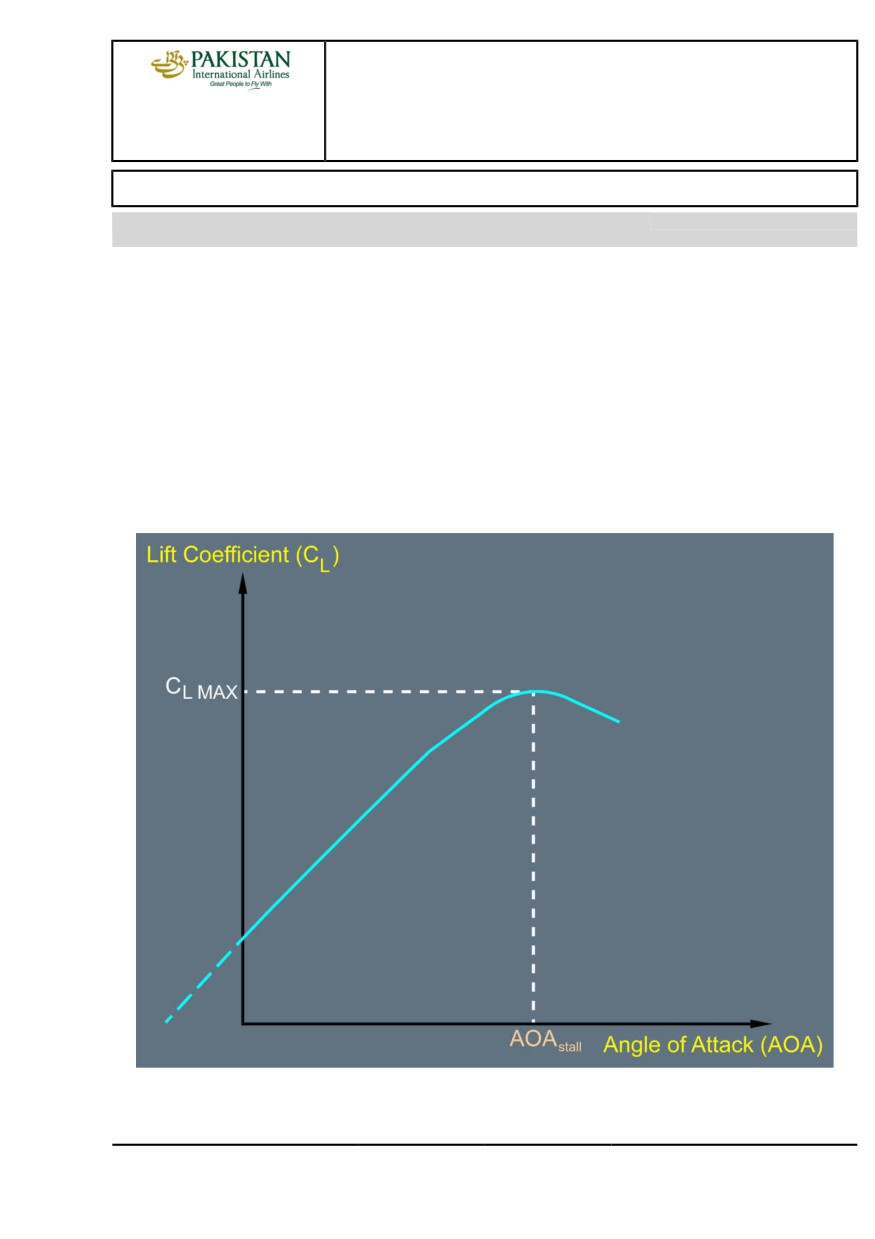
As per basic aerodynamic rules, the lift coefficient (CL) increases linearly with the AOA up to a
point where the airflow starts to separate from the upper surface of the wing. At and beyond this
point, the flight crew may observe:
- Buffeting, which depends on the slats/flaps configuration and increases at high altitude due to
the high Mach number
- Pitch up effect, mainly for swept wings and aft CG. This effect further increases the AOA.
Lift Coefficient versus Angle of Attack
PIA A318/A319/A320/A321 FLEET
PR-AEP-MISC P 23/34
FCTM
K →
12 JAN 22
PROCEDURES
ABNORMAL AND EMERGENCY PROCEDURES
A318/A319/A320/A321
FLIGHT CREW
MISC
TECHNIQUES MANUAL
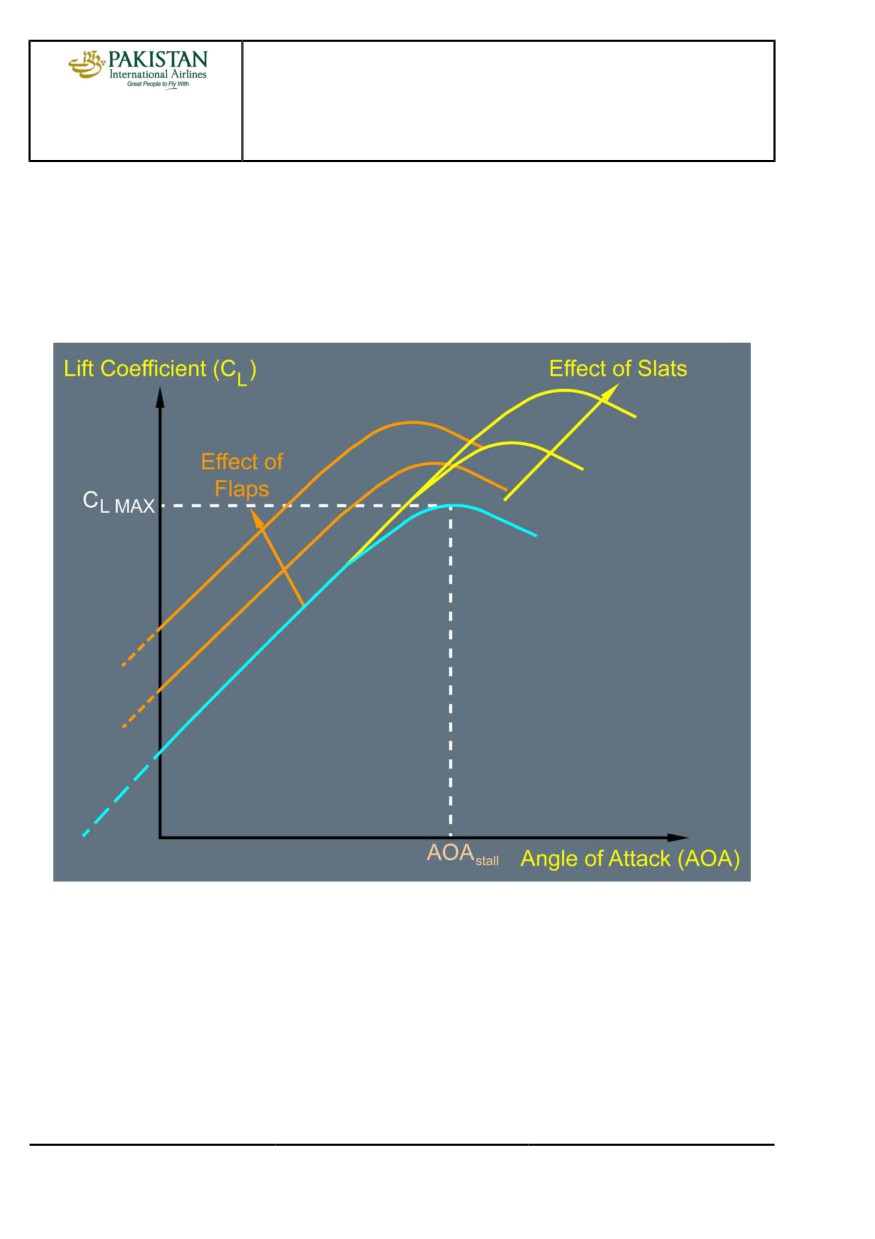
If the AOA further increases up to a value called AOAstall, the lift coefficient will reach a maximum
value called CL MAX.
When the AOA is higher than AOAstall, the airflow separates from the wing surface and the lift
coefficient decreases. This is the stall.
The stall will always occur at the same AOA for a given configuration, Mach number and altitude.
Influence of Slats and Flaps on Lift Coefficient versus Angle of Attack
Slats and Flaps have a different impact on the Lift coefficient obtained for a given AOA. Both Slats
and Flaps create an increase in the maximum lift coefficient.
PIA A318/A319/A320/A321 FLEET
PR-AEP-MISC P 24/34
FCTM
← K →
12 JAN 22
PROCEDURES
ABNORMAL AND EMERGENCY PROCEDURES
A318/A319/A320/A321
FLIGHT CREW
MISC
TECHNIQUES MANUAL
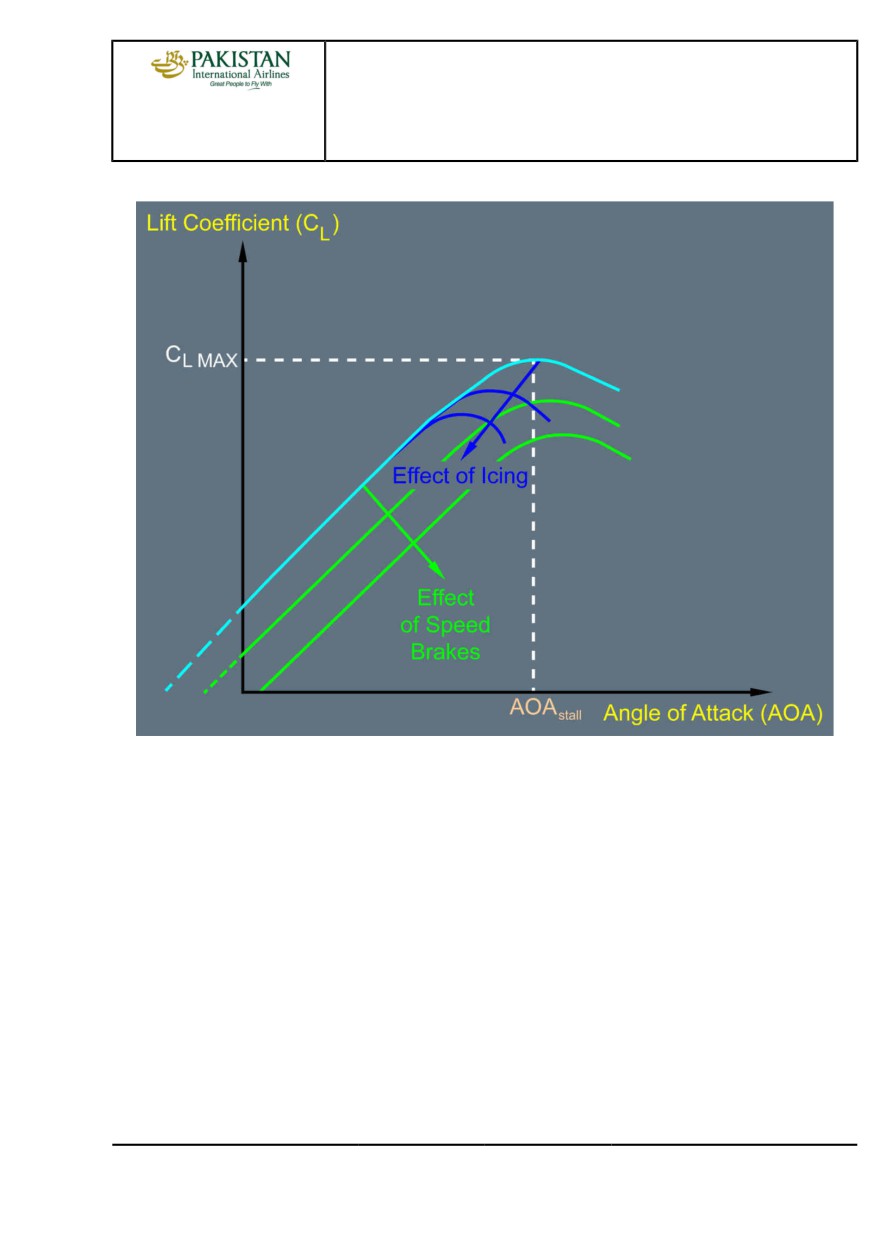
Influence of Speed Brakes and Icing on Lift Coefficient versus Angle of Attack
On the contrary, speed brake extension and ice accretion reduce the maximum lift coefficient.
Flight control laws and stall warning threshold take into account these possible degradations.
To summarize, loss of lift is only dependant on AOA. The AOAstall depends on:
- Aircraft configuration (slats, flaps, speed brakes)
- Mach and altitude
- Wing contamination
PIA A318/A319/A320/A321 FLEET
PR-AEP-MISC P 25/34
FCTM
← K →
12 JAN 22
PROCEDURES
ABNORMAL AND EMERGENCY PROCEDURES
A318/A319/A320/A321
FLIGHT CREW
MISC
TECHNIQUES MANUAL
Ident.: PR-AEP-MISC-D-00016362.0002001 / 20 MAR 17
Criteria: 31-1482, P14628, SA
2 Applicable to: MSN 02719-02758, 02926-03097, 05152-07792
STALL RECOGNITION
The flight crew must apply the stall recovery procedure as soon as they recognize any of the
following stall indications:
- Stall warnings
Aural and visual stall warnings are designed to sound and appear on PFD when AOA exceeds a
given threshold, which depends on the aircraft configuration. These warnings provide sufficient
margin to alert the flight crew in advance of the actual stall even with contaminated wings.
- Stall buffet
Buffet is recognized by airframe vibrations that are caused by the non-stationary airflow
separation from the wing surface when approaching AOAstall.
When the Mach number increases, both the AOAstall and CL MAX will decrease.
The stall warnings are set close to AOA at which the buffet starts. For some Mach numbers the
buffet may appear just before the stall warnings.
Ident.: PR-AEP-MISC-D-00016362.0001001 / 20 MAR 17
Criteria: SA
Applicable to: MSN 02155-02274, 02789, 04392
STALL RECOGNITION
The flight crew must apply the stall recovery procedure as soon as they recognize any of the
following stall indications:
- Aural stall warning
The aural stall warning is designed to sound when AOA exceeds a given threshold, which
depends on the aircraft configuration. This warning provides sufficient margin to alert the flight
crew in advance of the actual stall even with contaminated wings.
- Stall buffet
Buffet is recognized by airframe vibrations that are caused by the non-stationary airflow
separation from the wing surface when approaching AOAstall.
When the Mach number increases, both the AOAstall and CL MAX will decrease.
The aural stall warning is set close to AOA at which the buffet starts. For some Mach numbers
the buffet may appear just before the aural stall warning.
PIA A318/A319/A320/A321 FLEET
PR-AEP-MISC P 26/34
FCTM
← K →
12 JAN 22
PROCEDURES
ABNORMAL AND EMERGENCY PROCEDURES
A318/A319/A320/A321
FLIGHT CREW
MISC
TECHNIQUES MANUAL
Ident.: PR-AEP-MISC-D-00019236.0001001 / 20 MAR 17
Applicable to: ALL
STALL RECOVERY
- The immediate key action is to reduce AOA:
The reduction of AOA will enable the wing to regain lift.
This must be achieved by applying a nose down pitch order on the sidestick. This pilot action
ensures an immediate aircraft response and reduction of the AOA.
In case of lack of pitch down authority, it may be necessary to reduce thrust.
Simultaneously, the flight crew must ensure that the wings are level in order to reduce the lift
necessary for the flight, and as a consequence, the required AOA.
As a general rule, minimizing the loss of altitude is secondary to the reduction of the AOA as the
first priority is to regain lift.
As AOA reduces below the AOAstall, lift and drag will return to their normal values.
- The secondary action is to increase energy:
When stall indications have stopped, the flight crew should increase thrust smoothly as needed
and must ensure that the speed brakes are retracted.
Immediate maximum thrust application upon stall recognition is not appropriate. Due to the
engine spool up time, the aircraft speed increase that results from thrust increase, is slow and
does not enable to reduce the AOA instantaneously.
Furthermore, for under wing mounted engines, the thrust increase generates a pitch up that
may prevent the required reduction of AOA.
When stall indications have stopped, and when the aircraft has recovered sufficient energy, the
flight crew can smoothly recover the initial flight path. If in clean configuration and below FL 200,
during flight path recovery, the flight crew must select FLAPS 1 in order to increase the margin to
AOAstall.
Ident.: PR-AEP-MISC-D-00019237.0002001 / 10 MAY 21
Criteria: 31-1482, P14628, SA
3 Applicable to: MSN 02719-02758, 02926-03097, 05152-07792
STALL WARNING AT LIFTOFF
If the stall warnings are triggered at liftoff, the flight crew must fly the appropriate thrust and pitch
for takeoff in order to ensure a safe flight path and attempt to stop the stall warnings.
The flight crew applies TOGA thrust in order to get the maximum available thrust. Simultaneously,
the flight crew must target a pitch angle of 15 ° and maintain wings level in order to ensure safe
climb.
Then, when a safe flight path and speed are achieved, if the stall warnings are still activated the
flight crew must consider that they are spurious warnings.
Spurious stall warnings at liftoff may be triggered in the case of:
PIA A318/A319/A320/A321 FLEET
PR-AEP-MISC P 27/34
FCTM
← K →
12 JAN 22
PROCEDURES
ABNORMAL AND EMERGENCY PROCEDURES
A318/A319/A320/A321
FLIGHT CREW
MISC
TECHNIQUES MANUAL
- Damage to the AOA probes
- Ice Ridges degrading pitot and AOA
- Wake Vortex.
Ident.: PR-AEP-MISC-D-00019237.0001001 / 10 MAY 21
Criteria: SA
Applicable to: MSN 02155-02274, 02789, 04392
STALL WARNING AT LIFTOFF
If the aural stall warning sounds at liftoff, the flight crew must fly the appropriate thrust and pitch for
takeoff in order to ensure a safe flight path and attempt to stop the stall warning.
The flight crew applies TOGA thrust in order to get the maximum available thrust. Simultaneously,
the flight crew must target a pitch angle of 15 ° and maintain wings level in order to ensure safe
climb.
Then, when a safe flight path and speed are achieved, if the aural stall warning is still activated the
flight crew must consider that it is a spurious warning.
Spurious stall warnings at liftoff may be triggered in the case of:
- Damage to the AOA probes
- Ice Ridges degrading pitot and AOA
- Wake Vortex.
VOLCANIC ASH ENCOUNTER
Ident.: PR-AEP-MISC-00020616.0001001 / 20 MAR 17
Applicable to: ALL
Avoid flight into areas of known volcanic activity.
If a volcanic eruption is reported while the aircraft is in flight, reroute the flight to remain well clear
of the affected area (volcanic dust may spread over several hundred miles). If possible, stay on the
upwind side of the volcano (at least 20 NM upwind of it if it is erupting).
In hours of darkness or in meteorological conditions that obscure volcanic dust, one or several of the
following phenomena indicate that the aircraft may be flying into ash cloud:
• smoke or dust in the cockpit,
• acrid odor similar to electrical smoke,
• at night, the appearance of St. Elmo’s fire and static discharges around the windshield,
• bright white or orange glow appearing in the engine inlets,
• sharp, distinct beams from the landing lights,
• multiple engine malfunctions, such as rising EGT, decreasing power, stall, or flame out.
PIA A318/A319/A320/A321 FLEET
PR-AEP-MISC P 28/34
FCTM
← K to L →
12 JAN 22
PROCEDURES
ABNORMAL AND EMERGENCY PROCEDURES
A318/A319/A320/A321
FLIGHT CREW
MISC
TECHNIQUES MANUAL
REPORTING
• Whenever operating in areas affected by volcanic activity, flight crews should be aware of
volcanic reporting procedures and be familiar with the use of the ICAO Special Air Report of
Volcanic Activity (Model VAR).
• If the aircraft encounters a volcanic ash cloud, the flight crew should report the location, altitude,
and direction of drift for the ash cloud to ATC, flight conditions and crew duties permitting.
UPSET PREVENTION AND RECOVERY
Applicable to: ALL
Ident.: PR-AEP-MISC-E-00020629.0001001 / 20 MAR 17
DEFINITION OF UPSET
An aircraft upset is an undesired aircraft state characterized by unintentional divergences from
parameters normally experienced during operations. An aircraft upset may involve pitch and/or
bank angle divergences and may lead to inappropriate airspeeds for the conditions.
An upset condition exists any time an aircraft diverges from what the flight crew is intending to do.
Deviations from the desired aircraft state will become larger until the flight crew takes action to
stop the divergence. Return to the desired aircraft state can be achieved through natural aircraft
reaction to accelerations, auto-flight system response or flight crew intervention.
Ident.: PR-AEP-MISC-E-00020630.0001001 / 20 MAR 17
UPSET PREVENTION
The prevention of an upset situation is possible thanks to an effective monitoring of:
- The environment (turbulences, icing conditions, weather)
- The aircraft energy state
- The aircraft flight path
- The aircraft technical state (Flight controls laws, systems failure).
All flight crew members are responsible of the monitoring to ensure that the aircraft state is
understood and correct for the situation.
Each flight crew member should:
- Know and understand the expected aircraft state for the situation
- Communicate expectations
- Keep track of current aircraft state
- Detect and communicate deviations from the intended situation
- Assess risk and decide on a response
- Update and communicate understanding.
PIA A318/A319/A320/A321 FLEET
PR-AEP-MISC P 29/34
FCTM
← L to M →
12 JAN 22
PROCEDURES
ABNORMAL AND EMERGENCY PROCEDURES
A318/A319/A320/A321
FLIGHT CREW
MISC
TECHNIQUES MANUAL
An efficient monitoring and effective coordination and communication are keys to prevent upset
situations. As such, the flight crew should be able to assess the energy, to stop any flight path
divergence, and to recover a stabilized flight path before the upset situation.
Ident.: PR-AEP-MISC-E-00020631.0001001 / 20 MAR 17
RECOVERY TECHNIQUES
The flight crew must be or become aware of the upset situation, i.e. recognize and confirm the
situation before they take appropriate actions.
COMMUNICATION
Communication between crew members will assist in the recognition of upset situation and
recovery actions. At the first indication of a flight path divergence, the first pilot who observes
the divergence must announce it. The flight crew must use the flight instruments as primary
means to analyze the upset situation.
SITUATION ANALYSIS
The situation analysis process is to:
- Assess the energy (airspeed, altitude, attitude, load factor, thrust setting, position of drag and
high-lift devices and the rate of change of those conditions)
- Determine the aircraft attitude (pitch and bank angle)
- Communicate with other crew member(s)
- Confirm attitude by reference to other indicators:
• For a nose low upset, normally the airspeed is increasing, altitude is decreasing and the
Vertical Speed Indicator (VSI) indicates a descent
• For a nose high upset, the airspeed normally is decreasing, altitude is increasing and the
VSI indicates a climb.
A stalled condition can exist at any attitude and could be recognized by stall buffet and/or stall
aural alert. If the aircraft is stalled, apply the stall recovery procedure. Refer to PR-AEP-MISC
Definition of the Stall
REFERENCES FOR RECOVERY
The Primary Flight Display (PFD) is a primary reference for recovery.
Pitch attitude is determined from the PFD pitch reference scale. Even in extreme attitudes,
some portion of the sky or ground indications is present to assist the pilot in analyzing the
situation. The bank indicator on the PFD should be used to determine the aircraft bank.
Other attitude sources should be checked: Standby Attitude Indications, the pilot monitoring
(PM) instruments, or references outside the cockpit when possible.
PIA A318/A319/A320/A321 FLEET
PR-AEP-MISC P 30/34
FCTM
← M →
12 JAN 22
PROCEDURES
ABNORMAL AND EMERGENCY PROCEDURES
A318/A319/A320/A321
FLIGHT CREW
MISC
TECHNIQUES MANUAL
ACTIONS FOR RECOVERY
An overview of actions to take to recover from an upset would gather three basic activities:
- Assess the energy (become situationally aware)
- Stop the flight path divergence
- Recover to a stabilized flight path.
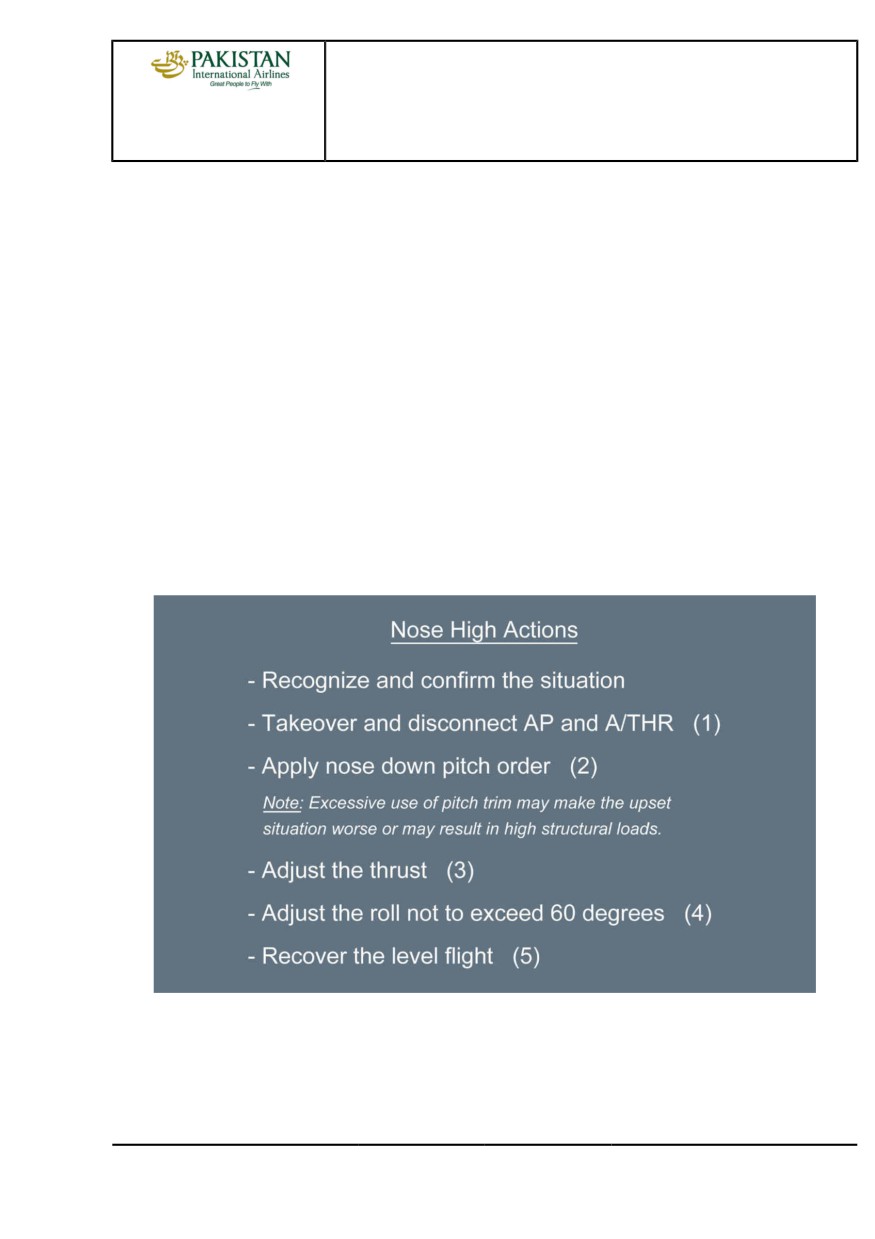
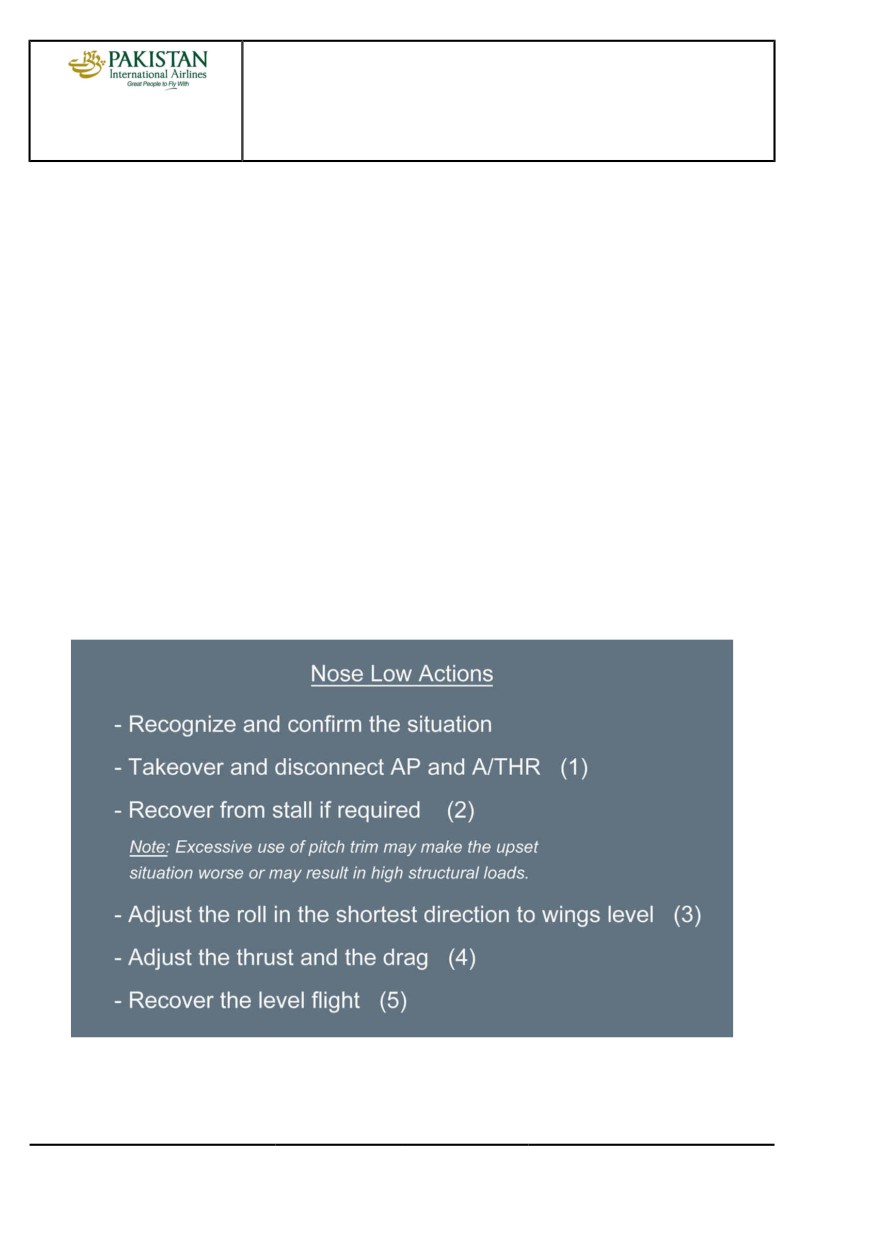
The Nose high/Nose low techniques represent a logical progression for recovering the aircraft.
They are not necessarily procedural. The sequence of actions is for guidance only and
represents a series of options for the pilot to consider and to use depending on the situation.
The flight crew may apply these actions or part of these actions, mainly if the recovery is
effective.
Depending on the situation, the PF should apply the required actions (See figures "Nose High"
and "Nose Low").
During the maneuver, the PM must monitor the airspeed and the attitude throughout the
recovery. The PM must also announce the flight path divergence if the recovery maneuver is not
efficient.
Nose High Actions
Notes:
(1)
If the AP and A/THR responses enable to stop the flight path divergence, the flight
crew may keep the AP and A/THR engaged.
PIA A318/A319/A320/A321 FLEET
PR-AEP-MISC P 31/34
FCTM
← M →
12 JAN 22
PROCEDURES
ABNORMAL AND EMERGENCY PROCEDURES
A318/A319/A320/A321
FLIGHT CREW
MISC
TECHNIQUES MANUAL
(2)
The flight crew must apply as much nose down pitch order as required to obtain a
nose down pitch rate.
In the case of lack of pitch down authority, the flight crew may use incremental inputs
on the trim (nose down) to improve the effectiveness of the elevator control.
(3)
Select up to maximum thrust available while ensuring adequate pitch control.
Increasing thrust may reduce the effectiveness of nose-down pitch control. It may be
necessary to limit or reduce thrust to the point where control of the pitch is achieved.
(4)
The bank angle must not exceed 60 degrees.
If all normal pitch control techniques are unsuccessful, the flight crew can keep the
current bank or bank the aircraft to enable the nose to drop toward the horizon.
The bank angle should be the least possible to start the nose down and never
exceed approximately 60 degrees. If the bank angle is already greater than 60
degrees, the flight crew should reduce it to an amount less than 60 degrees.
The flight crew must avoid entering a stall due to premature recovery at low speed or
excessive g-loading at high speed.
(5)
Recover to level flight at a sufficient airspeed while avoiding a stall due to premature
recovery at low speed, or excessive g-loading at high speed.
Nose Low Actions
Notes:
PIA A318/A319/A320/A321 FLEET
PR-AEP-MISC P 32/34
FCTM
← M →
12 JAN 22
PROCEDURES
ABNORMAL AND EMERGENCY PROCEDURES
A318/A319/A320/A321
FLIGHT CREW
MISC
TECHNIQUES MANUAL
(1)
If the AP and A/THR responses enable to stop the flight path divergence, the flight
crew may keep the AP and A/THR engaged.
(2)
Even in a nose low situation, the aircraft may be stalled and it would be necessary to
recover from a stall first.
(3)
In general, a nose low, high-angle-of-bank requires prompt action, because the
decreasing altitude is rapidly being exchanged for an increasing airspeed.
The flight crew must avoid entering a stall due to premature recovery at low speed or
excessive g-loading at high speed.
(4)
The flight crew should reduce the thrust and/or use the speedbrakes to control the
speed.
(5)
Recover to level flight at a sufficient airspeed while avoiding a stall due to premature
recovery at low speed, or excessive g-loading at high speed.
PIA A318/A319/A320/A321 FLEET
PR-AEP-MISC P 33/34
FCTM
← M
12 JAN 22
PROCEDURES
ABNORMAL AND EMERGENCY PROCEDURES
A318/A319/A320/A321
FLIGHT CREW
MISC
TECHNIQUES MANUAL
Intentionally left blank
PIA A318/A319/A320/A321 FLEET
PR-AEP-MISC P 34/34
FCTM
12 JAN 22
PROCEDURES
ABNORMAL AND EMERGENCY PROCEDURES
A318/A319/A320/A321
FLIGHT CREW
NAV
TECHNIQUES MANUAL
ADR/IRS FAULT
Ident.: PR-AEP-NAV-00019311.0003001 / 21 JAN 21
Criteria: P15825, P9171, SA
Applicable to: MSN 07784-07792
Each ADIRS has two parts (ADR and IRS), that may fail independently of each other. Additionally the
IRS part may fail totally or may be available in ATT mode.
Single NAV ADR FAULT or NAV IRS FAULT are simple procedures, and only require action on the
switching panel as indicated by the ECAM.
Dual NAV ADR or NAV IRS failures will cause the loss of AP and A/THR and the flight controls revert
to ALTN law.
In the case of a triple ADR failure, AP and A/THR are lost and the flight controls revert to ALTN law.
The NAV ADR 1+2+3 FAULT warning is triggered and the ECAM procedure requires to switch OFF
the 3 ADRs and to press the BKUP SPD/ALT pb in order to display the BUSS and GPS altitude
information.
There is no procedure for IRS 1 + 2 + 3 failure but the ECAM status page will give approach
procedure and inoperative systems. In this unlikely event, the standby instruments are the only
attitude, altitude, speed and heading references
Note:
To switch off an ADR, the flight crew must use the ADR pb. Do not use the rotary selector,
because this would also cut off the electrical supply to the IR part.
ADR/IRS FAULT
Ident.: PR-AEP-NAV-00019311.0002001 / 20 MAR 17
Criteria: 34-1397, P9171, SA
1 Applicable to: MSN 02719-05746
Each ADIRS has two parts (ADR and IRS), that may fail independently of each other. Additionally the
IRS part may fail totally or may be available in ATT mode.
Single NAV ADR FAULT or NAV IRS FAULT are simple procedures, and only require action on the
switching panel as indicated by the ECAM.
Dual NAV ADR or NAV IRS failures will cause the loss of AP and A/THR and the flight controls revert
to ALTN law.
In the case of a triple ADR failure, AP and A/THR are lost and the flight controls revert to ALTN
law. The NAV ADR 1+2+3 FAULT warning is triggered and the ECAM procedure requires that the
3 ADRs be switched OFF, to replace the PFD's normal speed scale and altitude indication by the
Back-Up Speed Scale (BUSS) and GPS altitude information.
There is no procedure for IRS 1 + 2 + 3 failure but the ECAM status page will give approach
procedure and inoperative systems. In this unlikely event, the standby instruments are the only
attitude, altitude, speed and heading references
PIA A318/A319/A320/A321 FLEET
PR-AEP-NAV P 1/22
FCTM
A →
12 JAN 22
PROCEDURES
ABNORMAL AND EMERGENCY PROCEDURES
A318/A319/A320/A321
FLIGHT CREW
NAV
TECHNIQUES MANUAL
Note:
To switch off an ADR, the flight crew must use the ADR pb. Do not use the rotary selector,
because this would also cut off the electrical supply to the IR part.
ADR/IRS FAULT
Ident.: PR-AEP-NAV-00019311.0001001 / 20 MAR 17
Criteria: SA
Applicable to: MSN 02155-02274
Each ADIRS has two parts (ADR and IRS), that may fail independently of each other. Additionally the
IRS part may fail totally or may be available in ATT mode.
Single NAV ADR FAULT or NAV IRS FAULT are simple procedures, and only require action on the
switching panel as indicated by the ECAM.
Dual NAV ADR or NAV IRS failures will cause the loss of AP, A/THR and flight controls revert to
ALTN law.
Due to the low probability of a triple ADR failure, the associated procedure will not be displayed on
the ECAM. In this case, the crew will refer to QRH procedure for ADR 1 + 2 + 3 failure.
There is no procedure for IRS 1 + 2 + 3 failure but the ECAM status page will give approach
procedure and inoperative systems. In this unlikely event, the standby instruments are the only
attitude, altitude, speed and heading references.
Note:
To switch off an ADR, the flight crew must use the ADR pb. Do not use the rotary selector,
because this would also cut off the electrical supply to the IR part.
UNRELIABLE AIRSPEED INDICATIONS
Ident.: PR-AEP-NAV-00019312.0001001 / 21 JAN 21
Applicable to: ALL
PREFACE
The ADRs detect most of the failures affecting the airspeed or altitude indications. These failures
lead to:
- Lose the associated speed or altitude indications in the cockpit
- Trigger the associated ECAM alerts.
However, there may be cases where an airspeed and/or altitude output is erroneous, while the
ADRs do not detect it as erroneous. In such a case, no ECAM alert is triggered and the cockpit
indications may appear to be normal whereas they are actually false. Flight crews must have in
mind the typical symptoms associated with such cases in order to detect this situation early and
apply the "UNRELIABLE SPEED INDICATION" QRH procedure.
PIA A318/A319/A320/A321 FLEET
PR-AEP-NAV P 2/22
FCTM
← A to B →
12 JAN 22
PROCEDURES
ABNORMAL AND EMERGENCY PROCEDURES
A318/A319/A320/A321
FLIGHT CREW
NAV
TECHNIQUES MANUAL
MAIN REASONS FOR ERRONEOUS AIRSPEED/ALTITUDE DATA
The most probable reason for erroneous airspeed and/or altitude information is an obstruction of
the pitot and/or static probes. Depending on how the probe(s) is obstructed, the effects on cockpit
indications differ.
It is highly unlikely that the aircraft probes will be obstructed at the same time, to the same degree
and in the same way. Therefore, the first effect of erroneous airspeed/altitude data in the cockpit
will most probably be a discrepancy between the various indications (CAPT PFD, F/O PFD and
STBY instruments).
CONSEQUENCES OF OBSTRUCTED PITOT TUBES OR STATIC PROBES
All the aircraft systems which use anemometric data, have built-in fault accommodation logics.
The fault accommodation logics rely on a voting principle: When the data provided by one source
diverges from the average value, the systems automatically reject this source and continue
to operate normally using the remaining two sources. The flight controls system and the flight
guidance system both use this voting principle.
NORMAL SITUATION
Each ELAC receives speed information from the three ADRs and compares the three values. The
ELACs do not use the pressure altitude.
Each FAC receives speed and pressure altitude information from the three ADRs and compares
the three values.
ONE ADR OUTPUT IS ERRONEOUS AND THE TWO REMAINING ARE CORRECT
The ELACs and the FAC and/or FMGC eliminate the erroneous ADR.
If one ADR deviates, and if this ADR is used to display the speed information on either the
CAPT or F/O PFD, a NAV IAS DISCREPANCY and/or a NAV ADR DISAGREE ECAM caution is
triggered. Furthermore, the autoland capability is downgraded to CAT 3 SINGLE.
TWO ADR OUTPUTS ARE ERRONEOUS, BUT DIFFERENT, AND THE REMAINING ADR IS
CORRECT, OR IF ALL THREE ADRS ARE ERRONEOUS, BUT DIFFERENT :
Both the AP and A/THR disconnect. The ELACs trigger the NAV ADR DISAGREE ECAM caution.
The flight controls revert to alternate law without high and low speed protection.
On both PFDs:
- The SPD LIMflag appears
- No VLS, no VSW and no VMAX are displayed
This situation is latched for the remainder of the flight, until the ELACs are reset on ground, without
any hydraulic pressure.
However, if the anomaly is only transient, the AP and the A/THR can be re-engaged when the
disagree disappears.
PIA A318/A319/A320/A321 FLEET
PR-AEP-NAV P 3/22
FCTM
← B →
12 JAN 22
PROCEDURES
ABNORMAL AND EMERGENCY PROCEDURES
A318/A319/A320/A321
FLIGHT CREW
NAV
TECHNIQUES MANUAL
ONE ADR IS CORRECT, BUT THE OTHER TWO ADRS PROVIDE THE SAME ERRONEOUS
OUTPUT, OR IF ALL THREE ADRS PROVIDE CONSISTENT AND ERRONEOUS DATA :
The systems reject the correct ADR and continue to operate using the two erroneous but
consistent ADRs. The flight crew can encounter such a situation when, for example, two or all
three pitot tubes are obstructed at the same time, to the same degree, and in the same way.
(Flight through a cloud of volcanic ash, takeoff with two pitots obstructed by foreign matter (mud,
insects)).
EXAMPLE OF FAILURE CASES AND THEIR CONSEQUENCES
The following chart provides a non-exhaustive list of the failure cases and their consequences
on airspeed and altitude indications. It should be noted that the cases described below cover
situations where probes (e.g. pitot) are totally obstructed. There can be multiple intermediate
configurations with similar, but not exactly identical consequences.
FAILURE CASE
CONSEQUENCES
Water accumulated due to heavy
Transient speed drop until water drains. IAS
rain. Drain holes unobstructed.
fluctuations. IAS step drop and gradual return to normal.
Water accumulated due to heavy
Permanent IAS drop.
rain. Drain holes obstructed.
Ice accretion due to pitot heat failure, or transient pitot
Total pressure leaks towards static pressure.
blocked due to severe icing. Unobstructed drain holes.
IAS drop until obstruction cleared/fluctuation,
if transient erratic A/THR is transient.
Ice accretion due to pitot heat failure, or pitot obstruction
Total pressure blocked. Constant IAS in
due to foreign objects. Obstructed drain holes.
level flight, until obstruction is cleared.
In climb, IAS increases. In descent, IAS decreases.
Abnormal AP/FD and A/THR behavior :
a. AP/FD pitch up in OP CLB to hold target IAS.
b. AP/FD pitch down in OP DES to hold target IAS
Total obstruction of static ports on ground.
Static pressure blocked at airfield level. Normal indications
during T/O roll. After lift-off altitude remains constant.
IAS decreases, after lift-off. IAS decreases, when
aircraft climbs. IAS increases, when aircraft descends.
The above table clearly illustrates that no single rule can be given to conclusively identify all
possible erroneous airspeed/altitude indications cases.
PIA A318/A319/A320/A321 FLEET
PR-AEP-NAV P 4/22
FCTM
← B →
12 JAN 22
PROCEDURES
ABNORMAL AND EMERGENCY PROCEDURES
A318/A319/A320/A321
FLIGHT CREW
NAV
TECHNIQUES MANUAL
IN-SERVICE EXPERIENCE OF HIGH ALTITUDE PITOT OBSTRUCTIONS
Analysis of the in-service events shows that:
- The majority of unreliable speed events at low altitude are permanent situations, due to the
obstruction of pitot probes by rain, severe icing, or foreign objects (refer to the table above).
- At high altitude, typically above FL 250, the cases of unreliable speed situation are mostly a
temporary phenomenon: They are usually due to contamination of the pitots, by water or ice,
in particular meteorological conditions. In-service experience shows that such a contamination
typically disappears after few minutes, allowing to recover normal speed indications.
POTENTIAL EFFECTS ON THE BAROMETRIC ALTITUDE
If the barometric altitude is unreliable, the Flight Path Vector (FPV) and the Vertical Speed (V/S)
are affected.
In addition, the ATC transponder may transmit an incorrect altitude to ATC or to other aircraft,
which can lead to confusion. Therefore, the flight crew should advise ATC of the situation without
delay.
Because the barometric altitude may be erroneous, the Autopilot (AP) may not be able to maintain
accurately the level flight.
"UNRELIABLE SPEED INDICATION" QRH PROCEDURE
Ident.: PR-AEP-NAV-00019313.0003001 / 03 NOV 21
Criteria: P15825, P9171, SA
Applicable to: MSN 07784-07792
INTRODUCTION
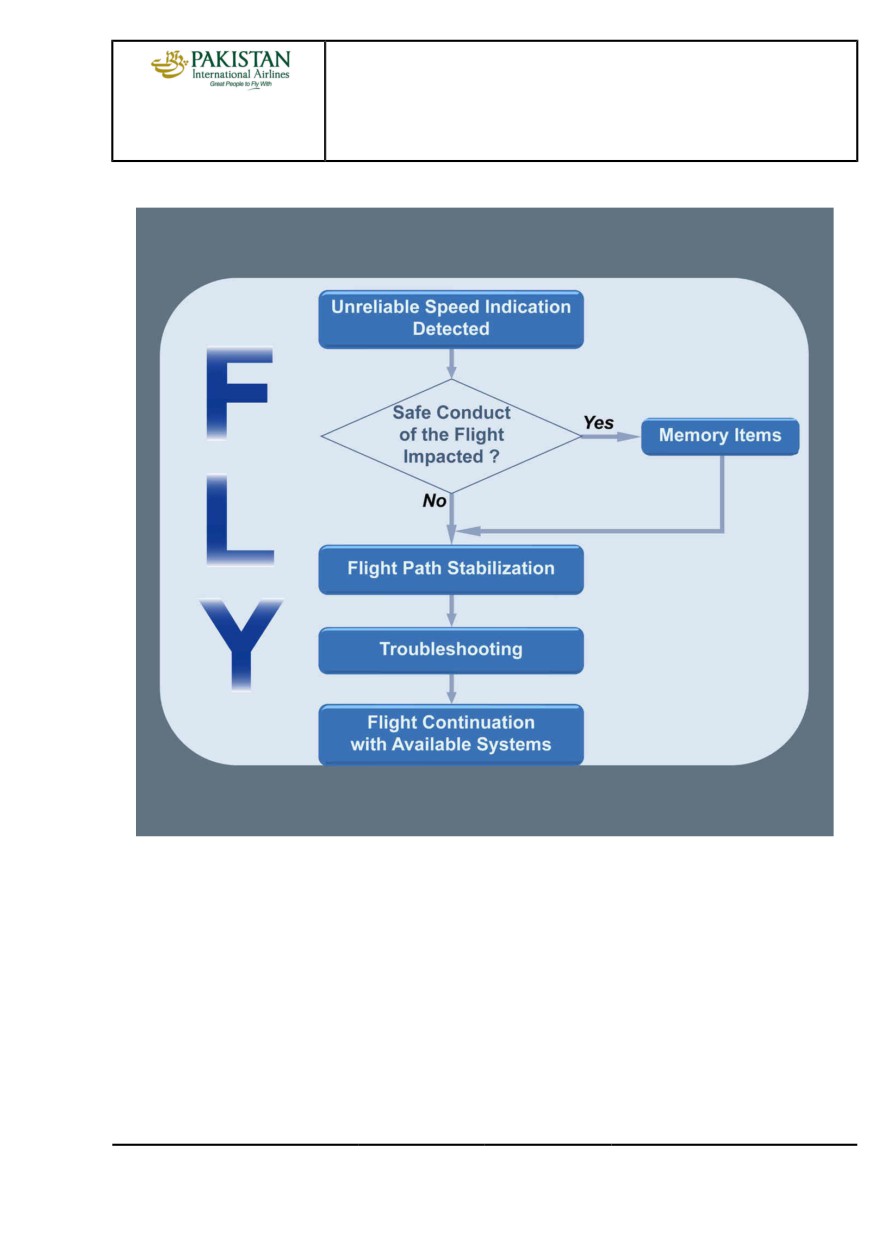
The "UNRELIABLE SPEED INDICATION" procedure has two objectives:
- To fly the aircraft
- To identify and isolate the affected ADR(s).
It includes the following steps:
1. Memory items (if necessary)
2. Flight path stabilization
3. Troubleshooting and isolation
4. Flight using pitch/thrust references or the BUSS (below FL 250), if the troubleshooting has not
enabled to isolate the faulty ADR(s).
PIA A318/A319/A320/A321 FLEET
PR-AEP-NAV P 5/22
FCTM
← B to C →
12 JAN 22
PROCEDURES
ABNORMAL AND EMERGENCY PROCEDURES
A318/A319/A320/A321
FLIGHT CREW
NAV
TECHNIQUES MANUAL
WHEN TO APPLY THIS PROCEDURE?
The flight crew should consider applying the “UNRELIABLE SPEED INDICATION” procedure
when:
- The “ADR CHECK PROC... APPLY” or the "UNREL SPD PROC... APPLY" is displayed on
ECAM, for example due to the NAV ADR DISAGREE alert, or due ANTI ICE ALL(CAPT+F/O)
(CAPT+STBY)(F/O+STBY) PITOT alert
- The flight crew suspects an erroneous indication, without any ECAM alert.
The flight crew can suspect an erroneous speed/altitude indication, in the following cases:
- A speed discrepancy (between ADR 1, 2, 3 and standby indications)
- Fluctuating or unexpected changes of the indicated airspeed or altitude
- Abnormal correlation between the basic flight parameters (pitch, thrust, airspeed, altitude, and
vertical speed indications). For example:
• The altitude does not increase, whereas there is an important nose-up pitch and high thrust
• The IAS increases, whereas there is an important nose-up pitch
• The IAS decreases, whereas there is an important nose-down pitch
• The IAS decreases, whereas there is a nose-down pitch and the aircraft is descending.
- An abnormal behavior of the AP/FD and/or the A/THR
- The STALL warning triggers or the OVERSPEED warning triggers, and this is in contradiction
with the indicated airspeeds. In this case:
• Rely on the STALL warning. Erroneous airspeed data does not affect the STALL warning,
because the STALL warning is based on AOA data.
• Depending on the situation, the OVERSPEED warning may be false or justified. When the
OVERSPEED VFE warning triggers, the appearance of aircraft buffet is a symptom that the
airspeed is indeed excessive.
- The barometric altitude is not consistent with the RA height (when the RA is displayed)
- The aerodynamic noise reduces whereas the indicated airspeed increases, or vice versa
- In approach, it is not possible to extend the landing gear using the normal landing gear system.
Note:
Flight crew coordination is important. The PM should confirm any discrepancy:
- Between the standby airspeed indication and the speed indication on PM's PFD
- Between PM's PFD and PF's PFD.
PIA A318/A319/A320/A321 FLEET
PR-AEP-NAV P 6/22
FCTM
← C →
12 JAN 22
PROCEDURES
ABNORMAL AND EMERGENCY PROCEDURES
A318/A319/A320/A321
FLIGHT CREW
NAV
TECHNIQUES MANUAL
HOW TO APPLY THIS PROCEDURE?
MEMORY ITEMS
The flight crew must ensure a safe flight path. If the safe conduct of the flight is affected, the flight
crew applies the memory items.
The memory items enable to rapidly establish safe flight conditions for a limited period of time in all
phases of flight and in all aircraft configurations (weight and slats/flaps).
The flight crew must apply the memory items, if the flight crew have a doubt on their ability to
safely fly the aircraft in the short term with the current parameters:
- The flight crew has lost situation awareness, or
- The current pitch and thrust are not appropriate for the current flight conditions, or
- The aircraft has an unexpected flight path for the current flight conditions.
PIA A318/A319/A320/A321 FLEET
PR-AEP-NAV P 7/22
FCTM
← C →
12 JAN 22
PROCEDURES
ABNORMAL AND EMERGENCY PROCEDURES
A318/A319/A320/A321
FLIGHT CREW
NAV
TECHNIQUES MANUAL
When the PF has stabilized the target pitch and thrust values, the flight crew applies the QRH
procedure without delay. The flight crew must apply the QRH procedure without delay, because
flying with the memory pitch/thrust values for an extended period of time can lead to exceed the
aircraft speed limits.
Note:
The flight crew must respect the STALL warning.
FLIGHT PATH STABILIZATION
According to the procedure, the flight crew can:
- Level off the aircraft then keep the flight path stabilized, or
- Keep the flight path stabilized.
Note:
If the flight crew has applied the memory items, then the flight crew must level off the
aircraft to stabilize the flight path.
The objective of these two conditions is to have a stabilized flight path to start the troubleshooting.
In all cases, the initial actions are to disconnect the automations. This prevents the FG to use
erroneous data for the computation of the aircraft guidance. Initial disconnection of the automation
can prevent:
- Erroneous orders, if AP/FD are engaged
- Erroneous thrust change, if A/THR is engaged.
Refer to Example of Failure Cases and their Consequences.
Note:
If the A/THR automatically disconnects, the Thrust Lock function activates. The thrust
is locked at its level at the moment of the disconnection until the flight crew moves the
levers. The thrust may be locked at idle, due to normal A/THR behavior, or due to the
use of erroneous data.
Below FL 250, the flight crew uses the reversible BUSS,
See Reversible Backup Speed Scale (BUSS).
Above FL 250, the flight crew can:
- Use the Pitch/Thrust tables of the QRH, See Pitch/Thrust Tables.
- Keep the flight path stabilized.
The GPS altitude can be used to confirm that the aircraft is maintaining level flight.
Note:
A difference may exist between the barometric altitude and the GPS altitude.
When the BUSS is activated, the GPS altitude is displayed on the associated PFD.
The GPS altitude remains available on the MCDU GPS MONITOR page.
PIA A318/A319/A320/A321 FLEET
PR-AEP-NAV P 8/22
FCTM
← C →
12 JAN 22
PROCEDURES
ABNORMAL AND EMERGENCY PROCEDURES
A318/A319/A320/A321
FLIGHT CREW
NAV
TECHNIQUES MANUAL
TROUBLESHOOTING AND ISOLATION
In order to identify and isolate the faulty ADR(s), the flight crew must crosscheck speed and
altitude indications on CAPT PFD, F/O PFD and STBY instruments.
To help the identification of the affected ADR(s), the flight crew can use:
- The Pitch/Thrust tables of the QRH procedure, or
- The reversible BUSS when below FL 250.
The Pitch/Thrust tables provide the resulting speed for a given aircraft weight and flight level.
WARNING
Do not instinctively reject an outlier ADR.
When one indication differs from the others, the flight crew may be tempted to reject the outlier
information. However, the flight crew should be aware that two or even all three ADRs can provide
identical but erroneous data.
When the flight crew has identified the affected ADR(s), the flight crew must turn off the affected
ADR(s). As a consequence this triggers the corresponding ECAM alerts. The flight crew must
apply the associated procedures to address all the consequences on the various aircraft systems.
- If the flight crew identifies at least one ADR to be reliable: the flight crew must use it
- If the flight crew cannot identify the affected ADR(s) or if all speed indications remain
unreliable, the flight crew must turn two ADRs off to prevent the flight control laws from using
two consistent but unreliable ADR data. The flight crew must keep one ADR on. For flight
continuation, the flight crew uses:
• Above FL 250, Pitch/Thrust tables of the QRH
• Below FL 250, the BUSS.
FLYING TECHNIQUE
PITCH/THRUST TABLES
When flying the aircraft with unreliable speed and/or altitude indications, it is recommended to
change only one flight parameter at a time (i.e. speed, altitude or configuration).
If the FPV is reliable (i.e. barometric altitude is reliable), or with the GPS altitude
information:
- Maintain level flight (FPV on the horizon or constant GPS altitude)
- Adjust thrust
- Observe the resulting pitch attitude, and compare it with the recommended pitch target in
the table:
• If the pitch necessary to maintain level flight is above the pitch target of the table, the
aircraft is slow. Then increase the thrust.
• If the pitch necessary to maintain level flight is below the pitch target of the table, the
aircraft is fast. Then decrease the thrust.
PIA A318/A319/A320/A321 FLEET
PR-AEP-NAV P 9/22
FCTM
← C →
12 JAN 22
PROCEDURES
ABNORMAL AND EMERGENCY PROCEDURES
A318/A319/A320/A321
FLIGHT CREW
NAV
TECHNIQUES MANUAL
When the pitch required to maintain level off gets close to the table pitch target, re-adjust
thrust to keep this target pitch.
When the conditions are stabilized, the resulting thrust should be close to the value
provided in the table.
This technique enables a fast stabilization of the speed while maintaining level flight.
If the FPV is not reliable and the GPS altitude information is not available (no means
to ensure level flight):
Adjust pitch and thrust according to QRH tables, and wait for speed stabilization.
Expect a significant time to stabilize the flight path and important altitude variations during
the stabilization.
REVERSIBLE BACKUP SPEED SCALE (BUSS)
For the description of the BUSS, Refer to FCOM/DSC-34-NAV-10-30-10 Backup Speed Scale.
The Reversible BUSS can be activated and deactivated at flight crew discretion:
- On CAPT side only, or
- On F/O side only, or
- On both sides at the same time.
The flight crew adjusts the pitch and thrust to fly the green area of the speed scale.
The BUSS is directly based on the current AOA. Any longitudinal input on the stick will induce
an AOA change, and therefore will cause the BUSS to move. If not, the flight crew must
disregard the BUSS and use Pitch/Thrust tables.
When the reversible BUSS is active:
- The onside AP/FD and A/THR must be disconnected
- The STALL warning remains operative
- Do not use the HUD
-
CAUTION
When flying with the BUSS, do not use the speed brakes.
Flying with speed brakes extended affects the relationship between the speed and AOA, and
therefore the BUSS may provide erroneous data.
For approach, the flight crew should perform an early stabilized approach.
The flight crew should change the aircraft configuration with level wings.
To retract or to extend flaps, apply the following technique:
- Before retracting the next flaps configuration, fly the upper part of the green band
- Before extending the next flaps configuration, fly the lower part of the green band.
This technique limits the excursion in the amber zones when changing the flaps configuration.
PIA A318/A319/A320/A321 FLEET
PR-AEP-NAV P 10/22
FCTM
← C →
12 JAN 22
PROCEDURES
ABNORMAL AND EMERGENCY PROCEDURES
A318/A319/A320/A321
FLIGHT CREW
NAV
TECHNIQUES MANUAL
"UNRELIABLE SPEED INDICATION" QRH PROCEDURE
Ident.: PR-AEP-NAV-00019313.0002001 / 03 NOV 21
Criteria: 34-1397, P9171, SA
2 Applicable to: MSN 02719-05746
INTRODUCTION
The "UNRELIABLE SPEED INDICATION" procedure has two objectives:
- To fly the aircraft
- To identify and isolate the affected ADR(s).
It includes the following steps:
1. Memory items (if necessary)
2. Flight path stabilization
3. Troubleshooting and isolation
4. Flight using pitch/thrust references or the BUSS (below FL 250), if the troubleshooting has not
enabled to isolate the faulty ADR(s).
WHEN TO APPLY THIS PROCEDURE?
The flight crew should consider applying the “UNRELIABLE SPEED INDICATION” procedure
when:
- The “ADR CHECK PROC... APPLY” is displayed on ECAM, for example due to the NAV ADR
DISAGREE alert, or
- The flight crew suspects an erroneous indication, without any ECAM alert.
The flight crew can suspect an erroneous speed/altitude indication, in the following cases:
- A speed discrepancy (between ADR 1, 2, 3 and standby indications)
- Fluctuating or unexpected changes of the indicated airspeed or altitude
- Abnormal correlation between the basic flight parameters (pitch, thrust, airspeed, altitude, and
vertical speed indications). For example:
• The altitude does not increase, whereas there is an important nose-up pitch and high thrust
• The IAS increases, whereas there is an important nose-up pitch
• The IAS decreases, whereas there is an important nose-down pitch
• The IAS decreases, whereas there is a nose-down pitch and the aircraft is descending.
- An abnormal behavior of the AP/FD and/or the A/THR
- The STALL warning triggers or the OVERSPEED warning triggers, and this is in contradiction
with the indicated airspeeds. In this case:
• Rely on the STALL warning. Erroneous airspeed data does not affect the STALL warning,
because the STALL warning is based on AOA data.
• Depending on the situation, the OVERSPEED warning may be false or justified. When the
OVERSPEED VFE warning triggers, the appearance of aircraft buffet is a symptom that the
airspeed is indeed excessive.
PIA A318/A319/A320/A321 FLEET
PR-AEP-NAV P 11/22
FCTM
← C →
12 JAN 22
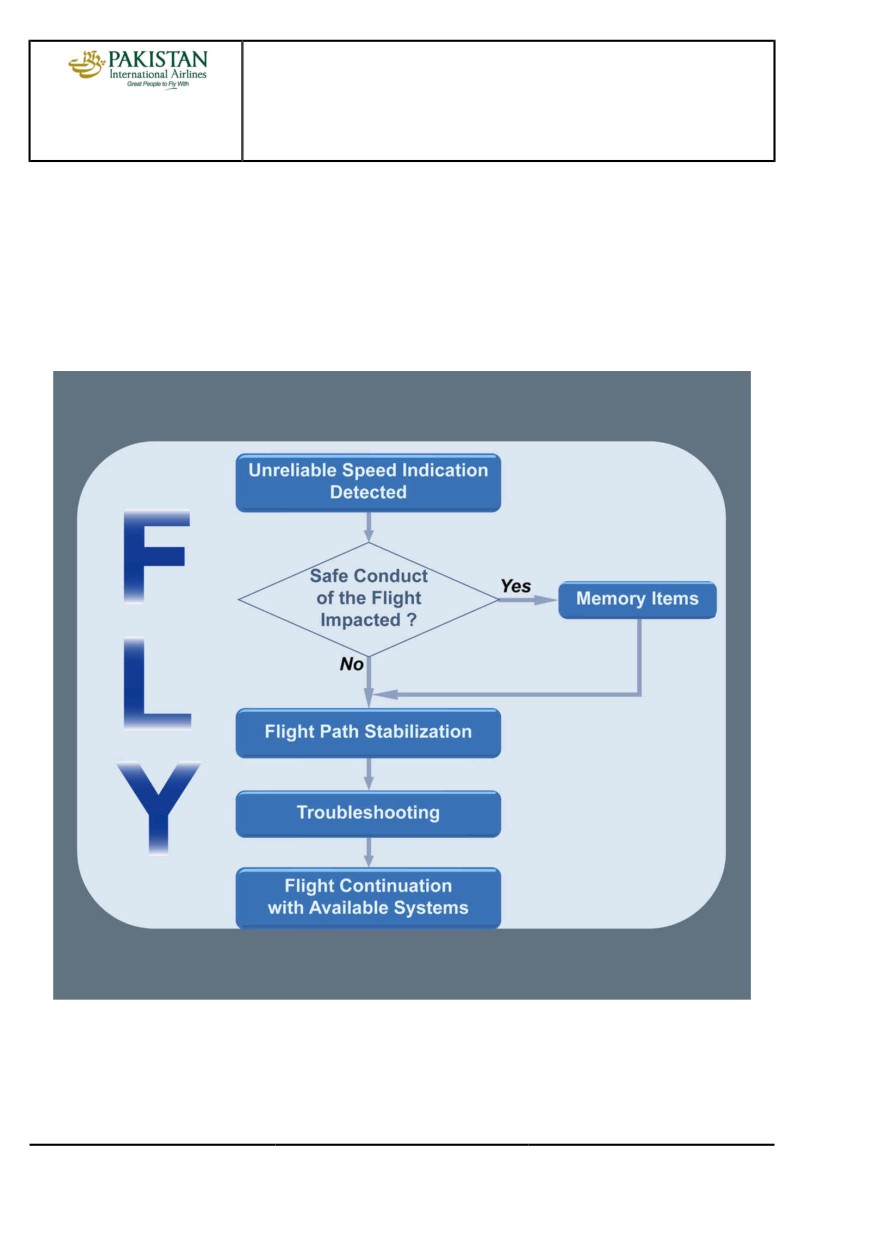
PROCEDURES
ABNORMAL AND EMERGENCY PROCEDURES
A318/A319/A320/A321
FLIGHT CREW
NAV
TECHNIQUES MANUAL
- The barometric altitude is not consistent with the RA height (when the RA is displayed)
- The aerodynamic noise reduces whereas the indicated airspeed increases, or vice versa
- In approach, it is not possible to extend the landing gear using the normal landing gear system.
Note:
Flight crew coordination is important. The PM should confirm any discrepancy:
- Between the standby airspeed indication and the speed indication on PM's PFD
- Between PM's PFD and PF's PFD.
HOW TO APPLY THIS PROCEDURE?
MEMORY ITEMS
The flight crew must ensure a safe flight path. If the safe conduct of the flight is affected, the flight
crew applies the memory items.
PIA A318/A319/A320/A321 FLEET
PR-AEP-NAV P 12/22
FCTM
← C →
12 JAN 22
PROCEDURES
ABNORMAL AND EMERGENCY PROCEDURES
A318/A319/A320/A321
FLIGHT CREW
NAV
TECHNIQUES MANUAL
The memory items enable to rapidly establish safe flight conditions for a limited period of time in all
phases of flight and in all aircraft configurations (weight and slats/flaps).
The flight crew must apply the memory items, if the flight crew have a doubt on their ability to
safely fly the aircraft in the short term with the current parameters:
- The flight crew has lost situation awareness, or
- The current pitch and thrust are not appropriate for the current flight conditions, or
- The aircraft has an unexpected flight path for the current flight conditions.
When the PF has stabilized the target pitch and thrust values, the flight crew applies the QRH
procedure without delay. The flight crew must apply the QRH procedure without delay, because
flying with the memory pitch/thrust values for an extended period of time can lead to exceed the
aircraft speed limits.
Note:
The flight crew must respect the STALL warning.
FLIGHT PATH STABILIZATION
According to the procedure, the flight crew can:
- Level off the aircraft then keep the flight path stabilized, or
- Keep the flight path stabilized.
Note:
If the flight crew has applied the memory items, then the flight crew must level off the
aircraft to stabilize the flight path.
The objective of these two conditions is to have a stabilized flight path to start the troubleshooting.
In all cases, the initial actions are to disconnect the automations. This prevents the FG to use
erroneous data for the computation of the aircraft guidance. Initial disconnection of the automation
can prevent:
- Erroneous orders, if AP/FD are engaged
- Erroneous thrust change, if A/THR is engaged.
Refer to Example of Failure Cases and their Consequences.
Note:
If the A/THR automatically disconnects, the Thrust Lock function activates. The thrust
is locked at its level at the moment of the disconnection until the flight crew moves the
levers. The thrust may be locked at idle, due to normal A/THR behavior, or due to the
use of erroneous data.
To level off the aircraft, the flight crew uses Pitch/Thrust tables of the QRH, Pitch/Thrust Tables.
The GPS altitude can be used to confirm that the aircraft is maintaining level flight.
Note:
A difference may exist between the barometric altitude and the GPS altitude.
The GPS altitude remains available on the MCDU GPS MONITOR page.
PIA A318/A319/A320/A321 FLEET
PR-AEP-NAV P 13/22
FCTM
← C →
12 JAN 22
PROCEDURES
ABNORMAL AND EMERGENCY PROCEDURES
A318/A319/A320/A321
FLIGHT CREW
NAV
TECHNIQUES MANUAL
TROUBLESHOOTING AND ISOLATION
In order to identify and isolate the faulty ADR(s), the flight crew must crosscheck speed and
altitude indications on CAPT PFD, F/O PFD and STBY instruments.
To help the identification of the affected ADR(s), the flight crew can use the Pitch/Thrust tables of
the QRH procedure.
The Pitch/Thrust tables provide the resulting speed for a given aircraft weight and flight level.
WARNING
Do not instinctively reject an outlier ADR.
When one indication differs from the others, the flight crew may be tempted to reject the outlier
information. However, the flight crew should be aware that two or even all three ADRs can provide
identical but erroneous data.
When the flight crew has identified the affected ADR(s), the flight crew must turn off the affected
ADR(s). As a consequence this triggers the corresponding ECAM alerts. The flight crew must
apply the associated procedures to address all the consequences on the various aircraft systems.
- If the flight crew identifies at least one ADR to be reliable: the flight crew must use it and turn off
affected ADR(s)
- If the flight crew cannot identify the affected ADR(s) or if all speed indications remain unreliable,
the flight crew must:
• Above FL 250, turn two ADRs off to prevent the flight control laws from using two consistent
but unreliable ADR data. The flight crew must keep one ADR on. For flight continuation, the
flight crew uses Pitch/Thrust tables of the QRH.
• Below FL 250, turn off all ADRs then use the BUSS for the flight continuation.
FLYING TECHNIQUE
PITCH/THRUST TABLES
When flying the aircraft with unreliable speed and/or altitude indications, it is recommended to
change only one flight parameter at a time (i.e. speed, altitude or configuration).
If the FPV is reliable (i.e. barometric altitude is reliable), or with the GPS altitude
information:
- Maintain level flight (FPV on the horizon or constant GPS altitude)
- Adjust thrust
- Observe the resulting pitch attitude, and compare it with the recommended pitch target in
the table:
• If the pitch necessary to maintain level flight is above the pitch target of the table, the
aircraft is slow. Then increase the thrust.
• If the pitch necessary to maintain level flight is below the pitch target of the table, the
aircraft is fast. Then decrease the thrust.
PIA A318/A319/A320/A321 FLEET
PR-AEP-NAV P 14/22
FCTM
← C →
12 JAN 22
PROCEDURES
ABNORMAL AND EMERGENCY PROCEDURES
A318/A319/A320/A321
FLIGHT CREW
NAV
TECHNIQUES MANUAL
When the pitch required to maintain level off gets close to the table pitch target, re-adjust
thrust to keep this target pitch.
When the conditions are stabilized, the resulting thrust should be close to the value
provided in the table.
This technique enables a fast stabilization of the speed while maintaining level flight.
If the FPV is not reliable and the GPS altitude information is not available (no means
to ensure level flight):
Adjust pitch and thrust according to QRH tables, and wait for speed stabilization.
Expect a significant time to stabilize the flight path and important altitude variations during
the stabilization.
BACKUP SPEED SCALE (BUSS)
For the description of the BUSS, Refer to FCOM/DSC-34-NAV-10-30-10 General.
When the BUSS is active:
- The AP/FD and A/THR must be disconnected
- The F/CTL Laws are in Alternate law
- The STALL warning remains operative
- Cabin pressure must be controlled manually
- Depending on the ADIRS standard, the FPV can be available on one or both PFDs as soon
as the flight crew switch off all ADRs
- Do not use the HUD
-
CAUTION
When flying with the BUSS, do not use the speed brakes.
Flying with speed brakes extended affects the relationship between the speed and AOA, and
therefore the BUSS may provide erroneous data.
The flight crew adjusts the pitch and thrust to fly the green area of the speed scale.
The BUSS is directly based on the current AOA. Any longitudinal input on the stick will induce
an AOA change, and therefore will cause the BUSS to move. If not, the flight crew must
disregard the BUSS and use Pitch/Thrust tables.
When the flight crew turns off all ADRs, the NAV ADR 1+2+3 FAULT alert triggers. The flight
crew apply the associated procedure then, as requested by the ECAM, apply the “ALL ADR
OFF” QRH procedure. This QRH procedure provides guidance to:
- Manually control the cabin pressure
- Prepare the approach and landing.
For approach, the flight crew should perform an early stabilized approach.
The flight crew should change the aircraft configuration with level wings.
PIA A318/A319/A320/A321 FLEET
PR-AEP-NAV P 15/22
FCTM
← C →
12 JAN 22
PROCEDURES
ABNORMAL AND EMERGENCY PROCEDURES
A318/A319/A320/A321
FLIGHT CREW
NAV
TECHNIQUES MANUAL
To retract or to extend flaps, apply the following technique:
- Before retracting the next flaps configuration, fly the upper part of the green band
- Before extending the next flaps configuration, fly the lower part of the green band.
This technique limits the excursion in the amber zones when changing the flaps configuration.
"UNRELIABLE SPEED INDICATION" QRH PROCEDURE
Ident.: PR-AEP-NAV-00019313.0001001 / 03 NOV 21
Criteria: SA
Applicable to: MSN 02155-02274
INTRODUCTION
The "UNRELIABLE SPEED INDICATION" procedure has two objectives:
- To fly the aircraft
- To identify and isolate the affected ADR(s).
It includes the following steps:
1. Memory items (if necessary)
2. Flight path stabilization
3. Troubleshooting and isolation
4. Flight using pitch/thrust references.
WHEN TO APPLY THIS PROCEDURE?
The flight crew should consider applying the “UNRELIABLE SPEED INDICATION” procedure
when:
- The “ADR CHECK PROC... APPLY” is displayed on ECAM, for example due to the NAV ADR
DISAGREE alert, or
- The flight crew suspects an erroneous indication, without any ECAM alert.
The flight crew can suspect an erroneous speed/altitude indication, in the following cases:
- A speed discrepancy (between ADR 1, 2, 3 and standby indications)
- Fluctuating or unexpected changes of the indicated airspeed or altitude
- Abnormal correlation between the basic flight parameters (pitch, thrust, airspeed, altitude, and
vertical speed indications). For example:
• The altitude does not increase, whereas there is an important nose-up pitch and high thrust
• The IAS increases, whereas there is an important nose-up pitch
• The IAS decreases, whereas there is an important nose-down pitch
• The IAS decreases, whereas there is a nose-down pitch and the aircraft is descending.
- An abnormal behavior of the AP/FD and/or the A/THR
PIA A318/A319/A320/A321 FLEET
PR-AEP-NAV P 16/22
FCTM
← C →
12 JAN 22
PROCEDURES
ABNORMAL AND EMERGENCY PROCEDURES
A318/A319/A320/A321
FLIGHT CREW
NAV
TECHNIQUES MANUAL
- The STALL warning triggers or the OVERSPEED warning triggers, and this is in contradiction
with the indicated airspeeds. In this case:
• Rely on the STALL warning. Erroneous airspeed data does not affect the STALL warning,
because the STALL warning is based on AOA data.
• Depending on the situation, the OVERSPEED warning may be false or justified. When the
OVERSPEED VFE warning triggers, the appearance of aircraft buffet is a symptom that the
airspeed is indeed excessive.
- The barometric altitude is not consistent with the RA height (when the RA is displayed)
- The aerodynamic noise reduces whereas the indicated airspeed increases, or vice versa
- In approach, it is not possible to extend the landing gear using the normal landing gear system.
Note:
Flight crew coordination is important. The PM should confirm any discrepancy:
- Between the standby airspeed indication and the speed indication on PM's PFD
- Between PM's PFD and PF's PFD.
PIA A318/A319/A320/A321 FLEET
PR-AEP-NAV P 17/22
FCTM
← C →
12 JAN 22
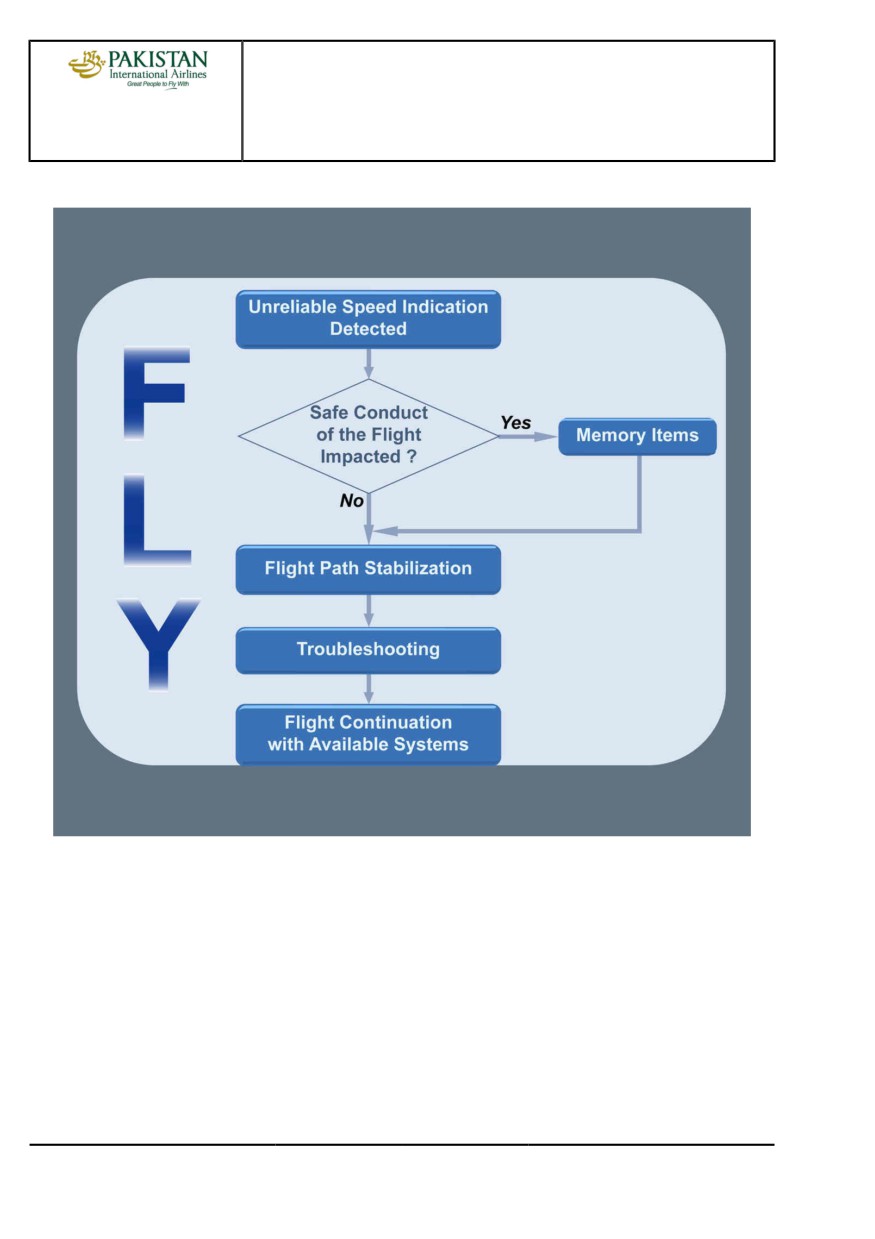
PROCEDURES
ABNORMAL AND EMERGENCY PROCEDURES
A318/A319/A320/A321
FLIGHT CREW
NAV
TECHNIQUES MANUAL
HOW TO APPLY THIS PROCEDURE?
MEMORY ITEMS
The flight crew must ensure a safe flight path. If the safe conduct of the flight is affected, the flight
crew applies the memory items.
The memory items enable to rapidly establish safe flight conditions for a limited period of time in all
phases of flight and in all aircraft configurations (weight and slats/flaps).
The flight crew must apply the memory items, if the flight crew have a doubt on their ability to
safely fly the aircraft in the short term with the current parameters:
- The flight crew has lost situation awareness, or
- The current pitch and thrust are not appropriate for the current flight conditions, or
- The aircraft has an unexpected flight path for the current flight conditions.
PIA A318/A319/A320/A321 FLEET
PR-AEP-NAV P 18/22
FCTM
← C →
12 JAN 22
PROCEDURES
ABNORMAL AND EMERGENCY PROCEDURES
A318/A319/A320/A321
FLIGHT CREW
NAV
TECHNIQUES MANUAL
When the PF has stabilized the target pitch and thrust values, the flight crew applies the QRH
procedure without delay. The flight crew must apply the QRH procedure without delay, because
flying with the memory pitch/thrust values for an extended period of time can lead to exceed the
aircraft speed limits.
Note:
The flight crew must respect the STALL warning.
FLIGHT PATH STABILIZATION
According to the procedure, the flight crew can:
- Level off the aircraft then keep the flight path stabilized, or
- Keep the flight path stabilized.
Note:
If the flight crew has applied the memory items, then the flight crew must level off the
aircraft to stabilize the flight path.
The objective of these two conditions is to have a stabilized flight path to start the troubleshooting.
In all cases, the initial actions are to disconnect the automations. This prevents the FG to use
erroneous data for the computation of the aircraft guidance. Initial disconnection of the automation
can prevent:
- Erroneous orders, if AP/FD are engaged
- Erroneous thrust change, if A/THR is engaged.
Refer to Example of Failure Cases and their Consequences.
Note:
If the A/THR automatically disconnects, the Thrust Lock function activates. The thrust
is locked at its level at the moment of the disconnection until the flight crew moves the
levers. The thrust may be locked at idle, due to normal A/THR behavior, or due to the
use of erroneous data.
To level off the aircraft, the flight crew uses Pitch/Thrust tables of the QRH, Pitch/Thrust Tables.
The GPS altitude can be used to confirm that the aircraft is maintaining level flight.
Note:
A difference may exist between the barometric altitude and the GPS altitude.
The GPS altitude remains available on the MCDU GPS MONITOR page.
TROUBLESHOOTING AND ISOLATION
In order to identify and isolate the faulty ADR(s), the flight crew must crosscheck speed and
altitude indications on CAPT PFD, F/O PFD and STBY instruments.
To help the identification of the affected ADR(s), the flight crew can use the Pitch/Thrust tables of
the QRH procedure.
The Pitch/Thrust tables provide the resulting speed for a given aircraft weight and flight level.
WARNING
Do not instinctively reject an outlier ADR.
PIA A318/A319/A320/A321 FLEET
PR-AEP-NAV P 19/22
FCTM
← C →
12 JAN 22
PROCEDURES
ABNORMAL AND EMERGENCY PROCEDURES
A318/A319/A320/A321
FLIGHT CREW
NAV
TECHNIQUES MANUAL
When one indication differs from the others, the flight crew may be tempted to reject the outlier
information. However, the flight crew should be aware that two or even all three ADRs can provide
identical but erroneous data.
When the flight crew has identified the affected ADR(s), the flight crew must turn off the affected
ADR(s). As a consequence this triggers the corresponding ECAM alerts. The flight crew must
apply the associated procedures to address all the consequences on the various aircraft systems.
- If the flight crew identifies at least one ADR to be reliable: the flight crew must use it
- If the flight crew cannot identify the affected ADR(s) or if all speed indications remain
unreliable, the flight crew must turn two ADRs off to prevent the flight control laws from using
two consistent but unreliable ADR data. The flight crew must keep one ADR on. For flight
continuation, the flight crew uses the Pitch/Thrust tables of the QRH.
FLYING TECHNIQUE
PITCH/THRUST TABLES
When flying the aircraft with unreliable speed and/or altitude indications, it is recommended to
change only one flight parameter at a time (i.e. speed, altitude or configuration).
If the FPV is reliable (i.e. barometric altitude is reliable), or with the GPS altitude
information:
- Maintain level flight (FPV on the horizon or constant GPS altitude)
- Adjust thrust
- Observe the resulting pitch attitude, and compare it with the recommended pitch target in
the table:
• If the pitch necessary to maintain level flight is above the pitch target of the table, the
aircraft is slow. Then increase the thrust.
• If the pitch necessary to maintain level flight is below the pitch target of the table, the
aircraft is fast. Then decrease the thrust.
When the pitch required to maintain level off gets close to the table pitch target, re-adjust
thrust to keep this target pitch.
When the conditions are stabilized, the resulting thrust should be close to the value
provided in the table.
This technique enables a fast stabilization of the speed while maintaining level flight.
If the FPV is not reliable and the GPS altitude information is not available (no means
to ensure level flight):
Adjust pitch and thrust according to QRH tables, and wait for speed stabilization.
Expect a significant time to stabilize the flight path and important altitude variations during
the stabilization.
For the approach, a wide pattern and an early stabilized approach are recommended.
PIA A318/A319/A320/A321 FLEET
PR-AEP-NAV P 20/22
FCTM
← C →
12 JAN 22
PROCEDURES
ABNORMAL AND EMERGENCY PROCEDURES
A318/A319/A320/A321
FLIGHT CREW
NAV
TECHNIQUES MANUAL
For the final approach, prefer a standard ILS approach with a -3 ° G/S, if available. If the
final descent is started with stabilized speed, on a -3 ° flight path with the thrust setting
recommended in the table, the resulting pitch attitude should be close to the recommended
table pitch value. If an adjustment is required, vary the thrust.
DUAL RADIO ALTIMETER FAILURE
Ident.: PR-AEP-NAV-00019314.0001001 / 28 MAY 20
Applicable to: ALL
The Radio Altimeters (RAs) provide inputs to a number of systems, including the GPWS and
FWC for auto-callouts. They also supply information to the AP and A/THR modes, plus inputs to
switch flight control laws at various stages. Although the ECAM procedure for a RA 1 + 2 FAULT is
straightforward, the consequences of the failure on the aircraft operation require consideration.
Instead of using RA information, the flight control system uses inputs from the LGCIU to determine
mode switching. Consequently, mode switching is as follows:
- On approach, DIRECT LAW becomes active when the L/G is selected down and provided AP is
disconnected. At this point, "USE MAN PITCH TRIM" is displayed on the PFD.
- After landing, ground law becomes active when the MLG is compressed and the pitch attitude
becomes less than 2.5 °.
It is not possible to capture the ILS using the APPR pb and the approach must be flown to CAT 1
limits only. However, it is possible to capture the localiser using the LOC pb.
Furthermore, the final stages of the approach should be flown using raw data in order to avoid
possible excessive roll rates if LOC is still engaged. Indeed, as the autopilot gains are no longer
updated with the radio altimeter signal, the AP/FD behaviour may be unsatisfactory when
approaching the ground.
There will be no auto-callouts on approach, and no "RETARD" call in the flare
The GPWS/EGPWS will be inoperative; therefore terrain awareness becomes very important.
Similarly, the "SPEED, SPEED, SPEED" low energy warning is also inoperative, again requiring
increased awareness.
PIA A318/A319/A320/A321 FLEET
PR-AEP-NAV P 21/22
FCTM
← C to D
12 JAN 22
PROCEDURES
ABNORMAL AND EMERGENCY PROCEDURES
A318/A319/A320/A321
FLIGHT CREW
NAV
TECHNIQUES MANUAL
Intentionally left blank
PIA A318/A319/A320/A321 FLEET
PR-AEP-NAV P 22/22
FCTM
12 JAN 22