CHEMICAL, BIOLOGICAL, RADIOLOGICAL, AND NUCLEAR DEFENSE (CBRND) FUNCTIONAL NEEDS ANALYSIS. FINAL REPORT (2005) - page 29
For Official Use Only
CBRND Functional Needs Analysis/Functional Solution Analysis
Chapter 17. Tactical Sustain Tasks
17.15.3
Functional Solution Analysis
17.15.3.1
DOTLPF Assessment Summary
This section states the deficiencies and suggests potential non-materiel solutions. If there are no
solutions or there are only partial solutions for a particular deficiency, the deficiency is then
reassessed in the IMA section.
1.
Deficiency: HTH/household bleach is corrosive.
Non-Materiel Solutions: None.
2.
Deficiency: Limited ability to decontaminate remote and hard-to-reach surfaces
Non-Materiel Solutions: None.
3.
Deficiency: Inability to decontaminate ventilation system.
Non-Materiel Solutions: Doctrine (partial): Need methodology/requirements to
decontaminate ventilation systems without major disassembly.
4.
Deficiency: Inability to decontaminate porous materials with absorbed contamination.
Non-Materiel Solutions: None.
5.
Deficiency: Liquid decontaminants incompatible with electronics and sensitive equipment.
Non-Materiel Solutions: None.
6.
Deficiency: Applicability of decontaminants in a ship interior environment is unknown.
Non-Materiel Solutions: None.
7.
Deficiency: Lack of doctrine for performing operational and thorough/detailed
decontamination including responsibilities (shipyard vs. ship’s crew).
Non-Materiel Solutions: Doctrine: Need NSTM 470/070 revisions.
8.
Deficiency: Limited capability to remove suspended agents from atmosphere.
Non-Materiel Solutions: None.
9.
Deficiency: Inability to decontaminate contaminated boilers.
Non-Materiel Solutions: Doctrine (partial): Need methodology/requirements to
decontaminate boilers.
17.15.3.2
IMA Assessment Summary
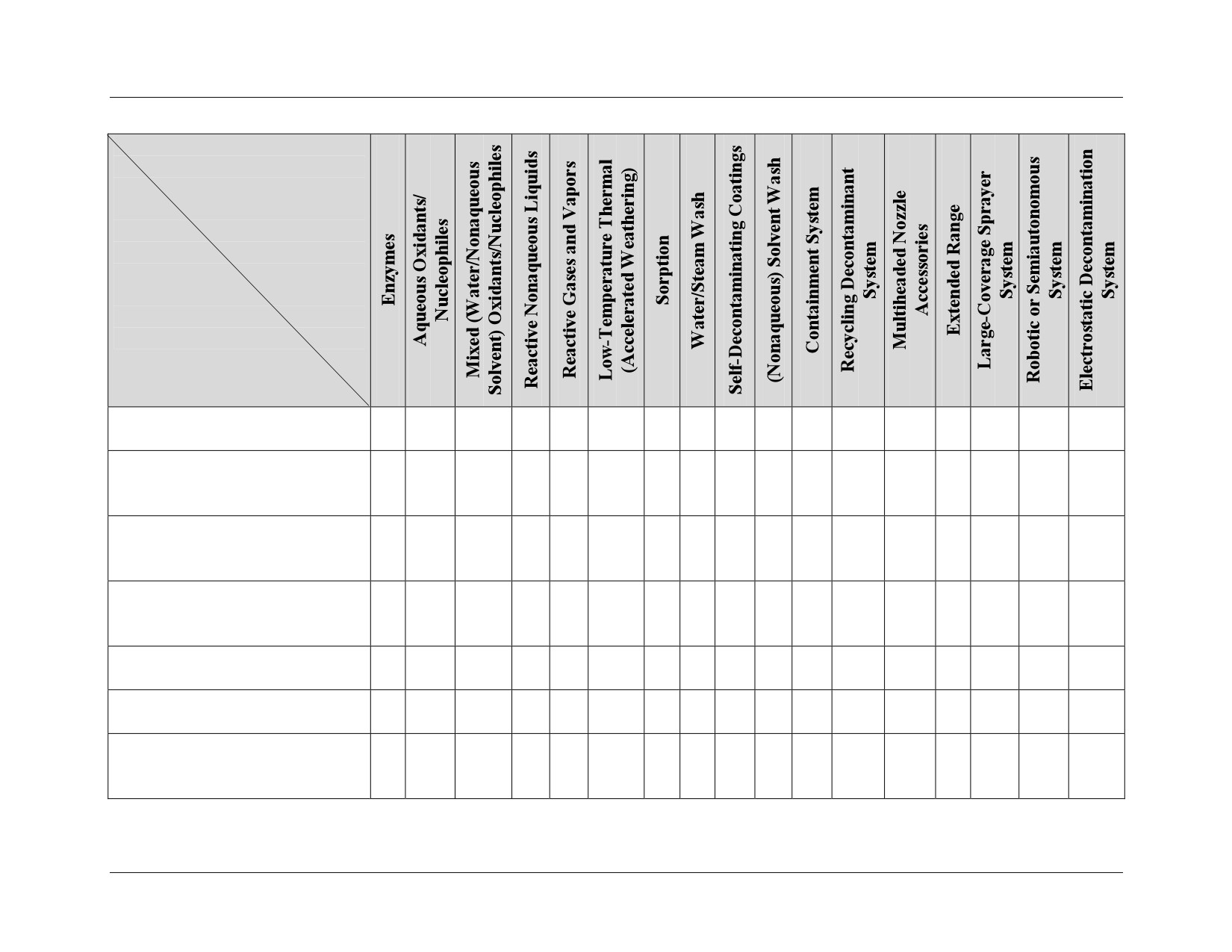
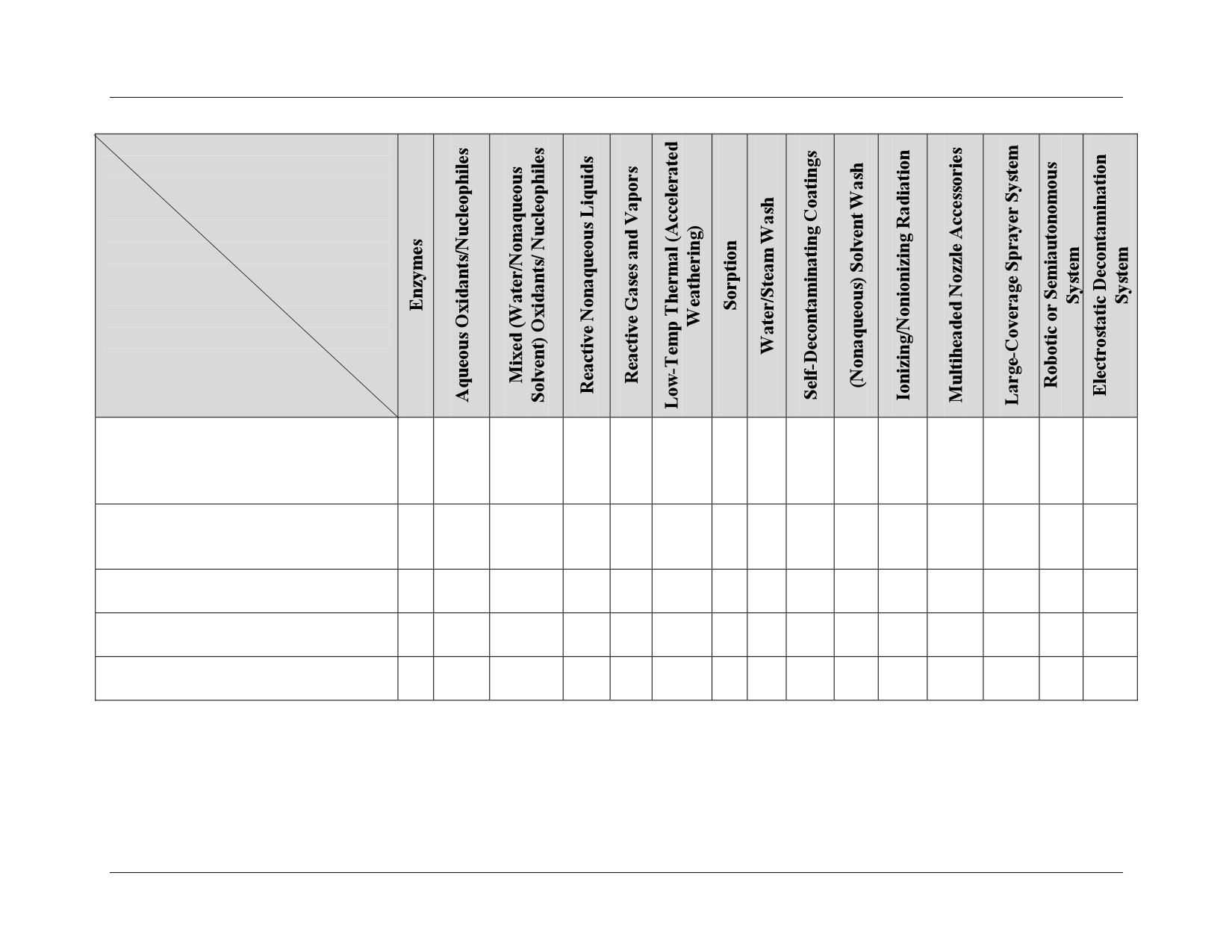
Table 17.15-2 identifies which of the materiel approaches might address specific materiel gaps
identified in the DOTMLPF assessment.
146
For Official Use Only
For Official Use Only
CBRND Functional Needs Analysis/Functional Solution Analysis
Chapter 17. Tactical Sustain Tasks
Table 17.15-2. TASUST 15: IMA Assessment
Ideas for Materiel
Approaches
(IMA)
Identified Gaps
HTH/household bleach is
X
X
X
X
X
X
X
X
X
X
X
corrosive.
Liquid decontaminants
incompatible with electronics
X
X
X
X
and sensitive equipment.
Applicability of decontaminants
in a ship interior environment is
X
X
X
X
X
X
X
unknown.
Limited ability to decontaminate
remote and hard-to-reach
X
X
X
X
X
X
X
X
X
X
X
surfaces.
Inability to decontaminate
X
X
X
X
X
X
X
X
ventilation system.
Inability to decontaminate
X
X
X
absorbent materials.
Limited capability to remove
suspended agents from
X
X
X
X
atmosphere.
147
For Official Use Only
For Official Use Only
CBRND Functional Needs Analysis/Functional Solution Analysis
Chapter 17. Tactical Sustain Tasks
17.16 Task TASUST 16: Decontaminate assault craft
17.16.1
Functional Area Analysis
17.16.1.1
Definition
To decontaminate the exterior and interior of assault craft, ancillary and riverine boats, etc.
Includes minimizing effects of contaminants and decontaminants on operations. Levels of
decontamination include immediate, operational, and thorough. Objectives of each of these
levels are identified as follows:
• Immediate: Minimize casualties, save lives, and minimize spread of contamination.
• Operational: Reduce level of contamination to regenerate combat power.
• Thorough: Reduce CBRN contamination to negligible.
17.16.1.2
Derivation
UJTL (TA 7, TA 7.1), Protection Joint Functional Concept.
17.16.1.2.1
Supported Tasks: OPSUST 8, OPSUST 11
17.16.1.2.2
Lateral Task: TASHA 24
17.16.1.2.3
Supporting Task: N/A
17.16.1.3
Condition
Perform this task under conditions of:
Physical
1. Extremely rough sea state. (C1.2.1.3)
2. Tropical, arctic, and arid climate. (C1.3.1)
3. All seasons. (C1.3.1.1)
4. Precipitating and stormy weather. (C1.3.1.3)
5. Hot and very cold air temperature. (C1.3.1.3.1)
6. Liquid, freezing, and frozen precipitation. (C1.3.1.3.6.1)
7. Negligible light. (C1.3.2.1)
8. Nuclear effects. (C1.3.3.1)
9. Chemical effects. (C1.3.3.2)
10. Biological effects. (C1.3.3.3)
Military
1. Stressful mission. (C2.1)
2. Location—afloat. (C2.1.4.1)
3. Minimal to short time available. (C2.1.5)
148
For Official Use Only
For Official Use Only
CBRND Functional Needs Analysis/Functional Solution Analysis
Chapter 17. Tactical Sustain Tasks
4. Marginal forces allocated. (C2.2.3)
5. Low personnel capability. (C2.2.4)
6. Negligible personnel experience. (C2.2.4.5)
7. Severe personnel fatigue. (C2.2.4.6)
8. Ambiguous threat existence. (C2.9.3)
Civil
1. Limited or negative foreign government support. (C3.1.2.3)
2. Aggressively opposed foreign public opinion. (C3.1.2.4)
3. High mission priority. (C3.1.3.2)
17.16.2
Functional Needs Analysis
17.16.2.1
Capabilities and Deficiencies Assessment Summary
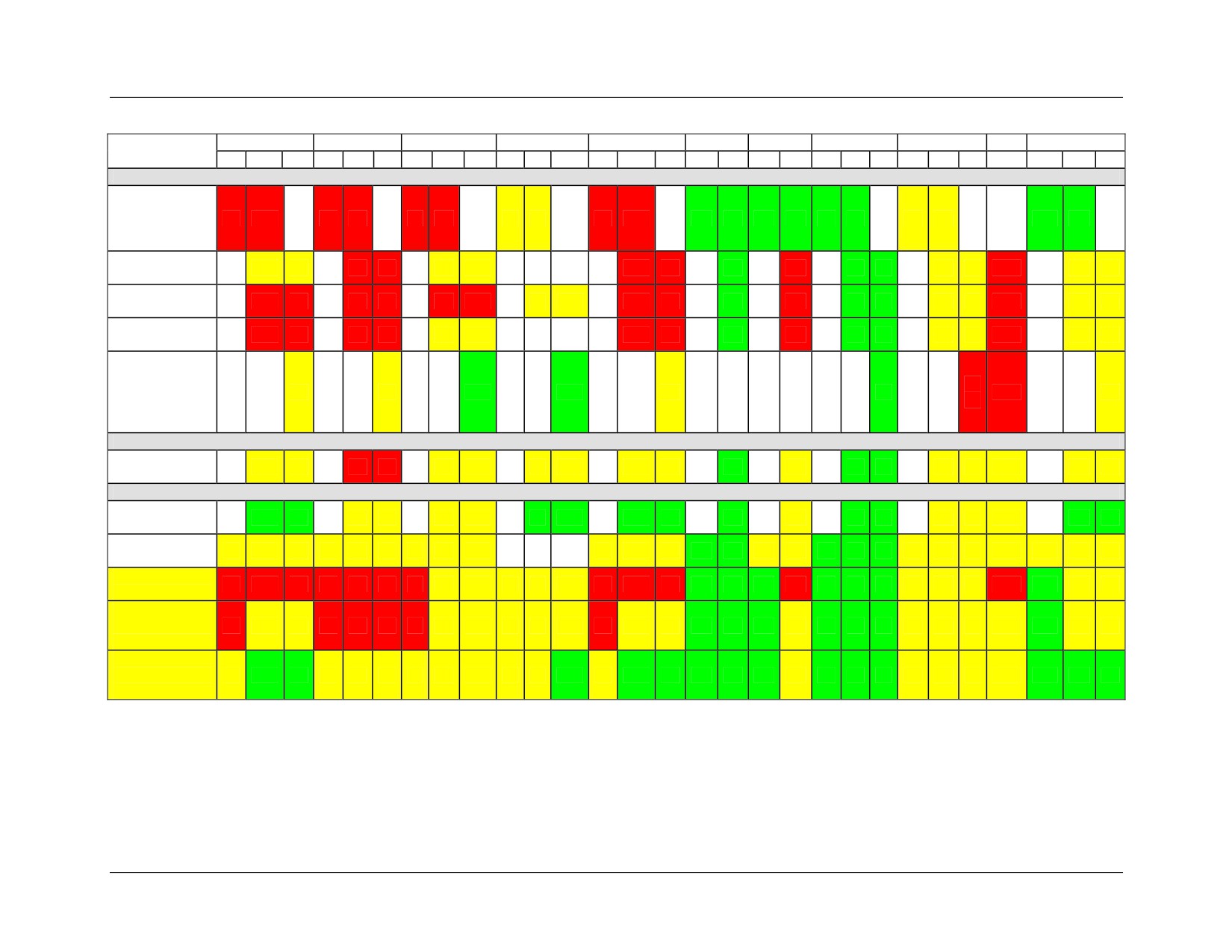
Table 17.16-1 presents individual and overall current, near-/mid-term, and far-term capabilities
to perform the task to the designated standard. There are five current capabilities used to
accomplish this task and two projected capabilities to be added in the future.
Current Capabilities and Deficiencies
The current capabilities exist at the immediate, operational, and thorough levels involving the
use of countermeasure washdown systems, HTH, water, general detergents, soapy water and the
equipment to apply the decontaminants. In thorough decontamination capabilities involve gross
removal of contamination using tools such as grinders, sanders, and needleguns in a shipyard or
drydock environment. There are some capabilities that work better than others, but effectiveness
is always increased when more than one capability is utilized. The best overall capability is the
use of HTH for chemical and biological agents. For radiological agents, however, general
detergents mixed with water are recommended. The negative aspects of HTH are that it has
corrosive and possible toxic characteristics. These decontaminants have the ability to corrode
surfaces and damage equipment on the exterior of assault craft.
Projected Near/Mid-Term Capabilities and Deficiencies
The projected near/mid-term capabilities and deficiencies evaluated were associated with
JSTDS-SS Increment I.
Projected Far-Term Capabilities and Deficiencies
The projected far-term capabilities and deficiencies evaluated were associated with JSTDS-SS
Increment II and JPDS Increments I and II.
149
For Official Use Only
For Official Use Only
CBRND Functional Needs Analysis/Functional Solution Analysis
Chapter 17. Tactical Sustain Tasks
Table 17.16-1. TASUST 16: Capabilities and Deficiencies Assessment
M1
M2
M3
M4
M5
M6
M7
M8
M9
M10
M11
Capabilities
I
O
T
I
O
T
I
O
T
I
O
T
I
O
T
I
O
I
O
I
O
T
I
O
T
T
I
O
T
Current
Seawater/
CMWD/
N/
N/
N/
N/
N/
N/
31
3
32
3
33
3
N/A
44
4
N/A
35
3
96
97
88
8
99
9
710
7
N/A
1011
10
Firemain
A
A
A
A
A
A
Systems
HTH
N/
N/
N/
N/
N/
N/
N/
N/
N/
N/
512
5
3
3
513
5
N/A
3
3
814
115
9
9
516
5
317
N/A
718
7
A
A
A
A
A
A
A
A
A
A
General
N/
N/
N/
N/
N/
N/
N/
N/
N/
3
3
019
0
3
3
4
4
3
3
8
1
9
9
5
5
3
N/A
7
7
Detergent
A
A
A
A
A
A
A
A
A
Steam
N/
N/
N/
N/
N/
N/
N/
N/
N/
N/
020
0
0
0
5
5
N/A
021
0
8
1
9
9
5
5
3
N/A
7
7
A
A
A
A
A
A
A
A
A
A
Gross Physical
Removal/
N/
N/
N/
N/
N/
N/
N/
N/
N/
N/
N/
N/
N/
N/
N/
N/
3
N/
Shipyard and
N/A
5
522
1023
1024
N/A
525
9
027
N/A
528
A
A
A
A
A
A
A
A
A
A
A
A
A
A
A
A
26
A
Floating
Drydock
Near/Mid-Term
JSTDS-SS
N/
N/
N/
N/
N/
N/
N/
N/
N/
729
7
3
3
5
5
4
4
730
7
9
531
9
9
5
5
532
N/A
7
7
Increment I
A
A
A
A
A
A
A
A
A
Far-Term
JSTDS-SS
N/
N/
N/
N/
N/
N/
N/
N/
N/
1033
10
5
5
5
5
10
10
1034
10
9
5
9
9
5
5
5
N/A
10
10
Increment II
A
A
A
A
A
A
A
A
A
JPDS Increment
N/
N/
7
7
7
5
5
5
5
5
5
N/A
7
7
7
9
9
5
5
9
9
9
7
5
5
5
7
7
7
I/II
A
A
Current Overall
3
3
3
3
3
3
3
435
5
4
4
4
3
3
3
9
8
8
336
9
9
9
7
5
5
3
10
7
7
Capabilities
Near/Mid-Term
Overall
3
7
7
3
3
3
3
5
5
4
4
4
3
7
7
9
9
8
5
9
9
9
7
5
5
5
10
7
7
Capabilities
Far-Term
Overall
7
10
10
5
5
5
5
5
5
4
4
10
7
10
10
9
9
8
5
9
9
9
7
5
5
5
10
10
10
Capabilities
150
For Official Use Only
For Official Use Only
CBRND Functional Needs Analysis/Functional Solution Analysis
Chapter 17. Tactical Sustain Tasks
FAA Measure
Elaboration
Scale
M1
(Yes/No) Contaminated by-products
Contaminated by-products are controlled.
10: Yes, Complete (100%).
are controlled?
Where by-products are less than 100%
7: Yes, Substantial (~75%).
controlled, measures must be in place to
5: Yes, Partial (~50%).
prevent cross-contamination from
3: Yes, Minimal (~25%).
becoming an unacceptable hazard.
0: No, Contaminated by-products cannot be controlled and present
an unacceptable hazard.
M2
(Level) Of chemical contamination
The level of chemical contamination is
10: Decontaminate all CWAs, NTAs, TIMs to general population
after decontamination procedures.
acceptable after decontamination
exposure limits.
operations from a starting liquid
7: Decontaminate all CWAs, all NTAs, and some TIMs to a level
challenge of 10 g/m2. Agents defined as
that will allow unprotected exposure.
current-generation CWAs, NTAs, TIMs,
5: Decontaminate all CWAs and some NTAs to a level that will
and TICs.
allow unprotected exposure.
3: Decontaminate most CWAs to a level that will allow
unprotected exposure.
0: No effective decontaminant or process.
M3
(Level) Of biological contamination
The level of biological contamination (to
10: 0 CFU/PFU/m2—total removal or neutralization of toxins
after decontamination procedures.
include toxins) is acceptable after
against all threat agents.
decontamination operations from starting
9: 0 CFU/PFU/m2—total removal or neutralization of toxins
challenges of greater than 1.0 × 10⁸
against nine or more key threat agents.
CFU/PFU/m2. Vegetative and
8: 0 CFU/PFU/m2—total removal or neutralization of toxins
nonvegetative bacteria are measured in
against eight or more key threat agents.
CFU/m2, and viruses are measured in
7: 0 CFU/PFU/m2—total removal or neutralization of toxins
PFU/m2.
against seven or more key threat agents.
6: 0 CFU/PFU/m2—total removal or neutralization of toxins
against six or more key threat agents.
5: Less than infective dose levels/casualty-producing toxin
exposure levels against five or more key threat agents.
4: Less than infective dose levels/casualty-producing toxin
exposure levels against four key threat agents.
3: Less than infective dose levels/casualty-producing toxin
exposure levels against three key threat agents.
2: Less than infective dose levels/casualty-producing toxin
exposure levels against two or more key threat agents.
1: Less than infective dose levels/casualty-producing toxin
exposure levels against one key threat agent.
0: More than infective dose levels/casualty-producing toxin
exposure levels.
151
For Official Use Only
For Official Use Only
CBRND Functional Needs Analysis/Functional Solution Analysis
Chapter 17. Tactical Sustain Tasks
M4
(Level) Of radiological
The level of radiological contamination is
10: Total removal to natural backg1round level.
contamination after decontamination
acceptable after decontamination
8: ≤0.11 cGy/hour residual dose rate.
procedures.
operations from a starting challenge of
6: ≤0.22 cGy/hour residual dose rate.
4 g/m2 of insoluble radioactive
4: <0.33 cGy/hour residual dose rate.
contaminants, 37-200 μm in size and
2: 0.33 cGy/hour residual dose rate.
185 GBq/m2 gamma activity.
0: Removal capabilities limited or ineffective, allowing excessive
0.33 cGy/hour equates to an exposure that
residual dose rates >0.33 cGy/hour.
can cause mild incapacitation in 2.5% or
less of unprotected, not previously
exposed personnel.
M5
(Yes/No) Cross-contamination is
Cross-contamination is controlled. Where
10: Yes, Complete (100%).
controlled?
cross-contamination is less than 100%
7: Yes, Substantial (~75%).
controlled, measures must be in place to
5: Yes, Partial (~50%).
prevent cross-contamination from
3: Yes, Minimal (~25%).
becoming an unacceptable hazard.
0: No, Cross-contamination cannot be controlled and presents an
unacceptable hazard.
M6
(Time) To initiate immediate and
Initiate immediate decontamination
Immediate
Operational
operational decontamination
procedures in time to meet mission
10: Immediately
10: Immediately
procedures.
requirements.
9: <1 minute
9: 15 minutes
8: <2 minutes
8: 30 minutes
Initiate operational decontamination
7: <3 minutes
7: 45 minutes
procedures in time to meet mission
6: <4 minutes
6: <1 hour
requirements.
5: <5 minutes
5: <2 hours
4: <7 minutes
4: <3 hours
3: <9 minutes
3: <4 hours
2: <12 minutes
2: <5 hours
1: <15 minutes
1: <6 hours
0: >15 minutes
0: >6 hours
M7
(Time) To conduct immediate and
Time required for one warfighter to carry
10: Immediately
operational decontamination
out immediate and operational
9: <1 minute
procedures.
decontamination procedures on 300 m2 of
8: <2 minutes
surface area.
7: <3 minutes
6: <4 minutes
5: <5 minutes
4: <7 minutes
3: <9 minutes
2: <12 minutes
1: <15 minutes
0: >15 minutes
152
For Official Use Only
For Official Use Only
CBRND Functional Needs Analysis/Functional Solution Analysis
Chapter 17. Tactical Sustain Tasks
M8
(Percent) Of systems that require
The quantity of repairs or parts
10: 0%
repair or replacement due to the
replacements required due to
9: <1%
effects of decontamination.
decontamination process must be
8: <2%
minimized.
7: <3%
6: <4%
5: <5%
4: <6%
3: <7%
2: <8%
1: <9%
0: ≥10%
M9
(Yes/No) Decontamination
Decontamination procedures must be
10: No negative impacts on operations.
procedures are logistically
logistically supportable.
7: Limited negative impact on operational capability.
supportable?
5: Moderate negative impact on operational capability.
3: Major negative impact on operational capability.
0: Not logistically supportable.
M10
(Time) To conduct thorough
Time required for one warfighter to carry
10: Immediately
decontamination.
out thorough decontamination procedures
9: <1 minute
on 300 m2 of surface area.
8: <2 minutes
7: <3 minutes
6: <4 minutes
5: <5 minutes
4: <10 minutes
3: <15 minutes
2: <20 minutes
1: <30 minutes
0: >30 minutes
M11
(Yes/No) There is effective DOTLPF
Refers to non-materiel elements
10: DOTLPF is adequate for all tasks to be performed with this
in place to conduct task?
associated with the execution of a task
system without limitations that cause significant impact upon
with the system.
operations.
7: DOTLPF is adequate for most of the tasks to be performed with
this system without limitations that cause significant impact upon
operations.
5: Many critical aspects of DOTLPF for the task to be performed
with this system are addressed.
3: Some critical aspects of DOTLPF for the task to be performed
with this system are addressed.
0: DOTLPF is completely inadequate or does not exist for the
tasks to be performed with this system.
153
For Official Use Only
For Official Use Only
CBRND Functional Needs Analysis/Functional Solution Analysis
Chapter 17. Tactical Sustain Tasks
1 M1 - (Yes/No) Contaminated by-products are controlled? 3: Yes, Minimal (~25%).
2 M2 - (Level) Of chemical contamination after decontamination procedures. 3: Decontaminate most CWAs to a level that will allow unprotected exposure.
3 M3 - (Level) Of biological contamination after decontamination procedures. 3: Less than infective dose levels/casualty-producing toxin-exposure levels against three key threat
agents.
4 M4 - (Level) Of radiological contamination after decontamination procedures. 4: <0.33 cGy/hour residual dose rate.
5 M5 - (Yes/No) Cross-contamination is controlled? 3: Yes, Minimal (~25%).
6 M6 - (Time) To initiate immediate decontamination procedures. 9: <1 minute.
7 M6 - (Time) To initiate operational decontamination procedures. 9: 15 minutes.
8 M7 - (Time) To conduct immediate and operational decontamination procedures. 8: <2 minutes
9 M8 - (Percent) Of systems that require repair or replacement due to the effects of decontamination. 9: <1%.
10 M9 - (Yes/No) Decontamination procedures are logistically supportable? 7: Limited negative impact on operational capability.
11 M11 - (Yes/No) There is effective DOTLPF in place to conduct task? 10: DOTLPF is adequate for all tasks to be performed with this system without limitations that cause
significant impact upon operations.
12 M1 - (Yes/No) Contaminated by-products are controlled? 5: Yes, Partial (~50%).
13 M3 - (Level) Of biological contamination after decontamination procedures. 5: Less than infective dose levels/casualty-producing toxin-exposure levels against five or more key
threat agents.
14 M6 - (Time) To initiate operational decontamination procedures. 8: 30 minutes.
15 M7 - (Time) To conduct immediate and operational decontamination procedures. 1: <15 minutes.
16 M9 - (Yes/No) Decontamination procedures are logistically supportable? 5: Moderate negative impact on operational capability.
17 M10 - (Time) To conduct thorough decontamination. 3: <15 minutes.
18 M11 - (Yes/No) There is effective DOTLPF in place to conduct task? 7: DOTLPF is adequate for most of the tasks to be performed with this system without limitations that
cause significant impact upon operations.
19 M2 - (Level) Of chemical contamination after decontamination procedures. 0: No effective decontaminant or process.
20 M1 - (Yes/No) Contaminated by-products are controlled? 0: No, Contaminated by-products cannot be controlled and present an unacceptable hazard.
21 M5 - (Yes/No) Cross-contamination is controlled? 0: No, Cross-contamination cannot be controlled and presents an unacceptable hazard.
22 M2 - (Level) Of chemical contamination after decontamination procedures. 5: Decontaminate all CWAs, some NTAs to a level that will allow unprotected exposure.
23 M3 - (Level) Of biological contamination after decontamination procedures. 10: 0 CFU/PFU/m2—total removal or neutralization of toxins against all threat agents.
24 M4 - (Level) Of radiological contamination after decontamination procedures. 10: Total removal to natural backg1round level.
25 M5 - (Yes/No) Cross-contamination is controlled? 5: Yes, Partial (~50%).
26 M9 - (Yes/No) Decontamination procedures are logistically supportable? 3: Major negative impact on operational capability.
27 M10 - (Time) To conduct thorough decontamination. 0: >30 minutes.
28 M11 - (Yes/No) There is effective DOTLPF in place to conduct task? 5: Many critical aspects of DOTLPF for the task to be performed with this system are addressed.
29 M1 - (Yes/No) Contaminated by-products are controlled? 7: Yes, Substantial (~75%).
30 M5 - (Yes/No) Cross-contamination is controlled? 7: Yes, Substantial (~75%).
31 M7 - (Time) To conduct immediate and operational decontamination procedures. 5: <5 minutes.
32 M10 - (Time) To conduct thorough decontamination. 5: <5 minutes.
33 M1 - (Yes/No) Contaminated by-products are controlled? 10: Yes, Complete (100%).
34 M5 - (Yes/No) Cross-contamination is controlled? 10: Yes, Complete (100%)
35 M3 - (Level) Of biological contamination after decontamination procedures. 4: Less than infective dose levels/casualty-producing toxin-exposure levels against four key threat
agents.
36 M7 - (Time) To conduct immediate and operational decontamination procedures. 3: <9 minutes.
154
For Official Use Only
For Official Use Only
CBRND Functional Needs Analysis/Functional Solution Analysis
Chapter 17. Tactical Sustain Tasks
17.16.3
Functional Solution Analysis
17.16.3.1
DOTLPF Assessment Summary
This section states the deficiencies and suggests potential non-materiel solutions. If there are no
solutions or there are only partial solutions for a particular deficiency, the deficiency is then
reassessed in the IMA section.
1.
Deficiency: CMWD is corrosive.
Non-Materiel Solutions: Doctrine: Include freshwater rinse after CMWD has been secured
in operational doctrine.
2.
Deficiency: CMWD delivery systems have insufficient nozzles to cover all surfaces.
Non-Materiel Solutions: Doctrine: Increase area coverage requirements. Facilities:
Conduct CMWD area coverage analysis and initiate repair requirement as necessary.
3.
Deficiency: Effectiveness of CMWD is degraded if not activated prior to attack.
Non-Materiel Solutions: Doctrine: Include CMWD procedures and requirements into newly
developed doctrine.
4.
Deficiency: Insufficient training in procedures for assault craft decontamination.
Non-Materiel Solutions: Training: Develop a chemical, biological, and radiological defense
(CBRD) Amphibious Operations Training Plan to include requirements and incorporate them
into the appropriate sections of the Surface Force Training Manual, which provides guidance
of the overall Surface Force Training Program.
5.
Deficiency: HTH is corrosive to various surfaces and materials.
Non-Materiel Solutions: None.
6.
Deficiency: No current doctrine on assault craft decontamination.
Non-Materiel Solutions: Doctrine: Develop doctrine for CBRD amphibious operations that
include such topics as specific assault craft decontamination methodologies.
7.
Deficiency: Inability to decontaminate ventilation system interiors.
Non-Materiel Solutions: None.
8.
Deficiency: Inability to decontaminate large flexible skirt system on Landing Craft Air
Cushion.
Non-Materiel Solutions: None.
17.16.3.2
IMA Assessment Summary
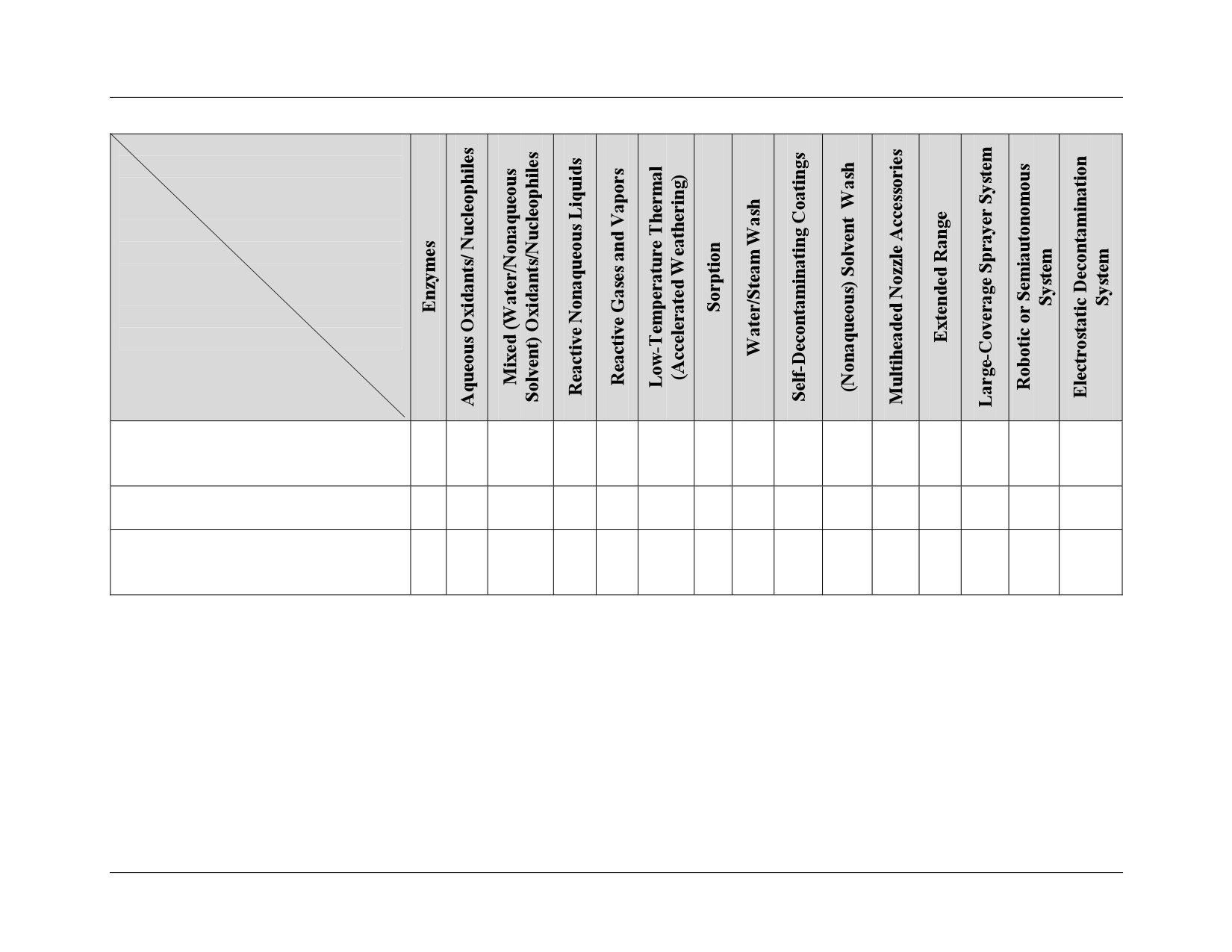
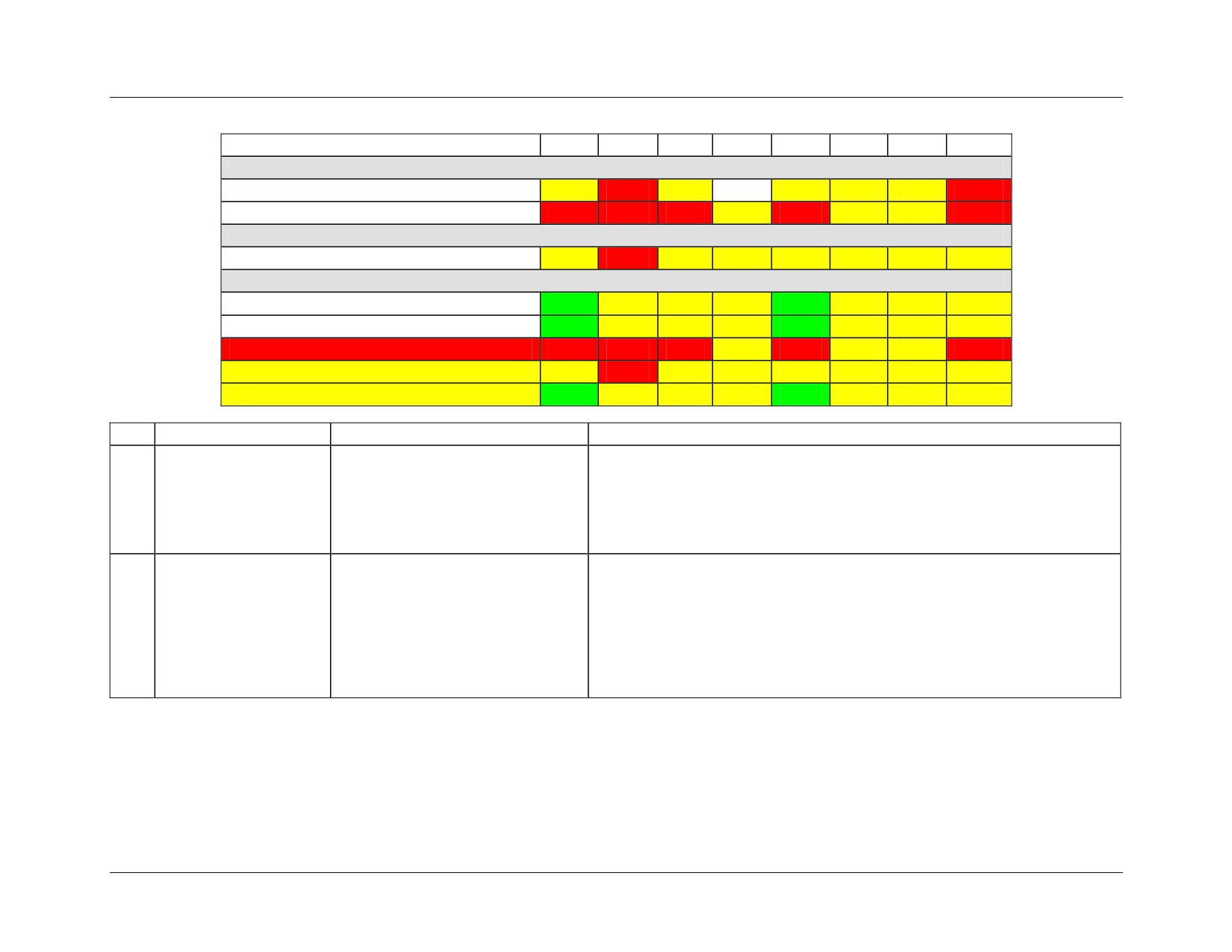
Table 17.16-2 identifies which of the materiel approaches might address specific materiel gaps
identified in the DOTMLPF assessment.
155
For Official Use Only
For Official Use Only
CBRND Functional Needs Analysis/Functional Solution Analysis
Chapter 17. Tactical Sustain Tasks
Table 17.16-2. TASUST 16: IMA Assessment
Ideas for Materiel
Approaches
(IMA)
Identified Gaps
Primary decontaminant (HTH) is
corrosive to various surfaces and
X
X
X
X
X
X
X
X
X
X
X
materials.
Inability to decontaminate ventilation
X
X
X
X
X
system interiors.
Inability to decontaminate large
flexible skirt system on Landing
X
X
X
X
X
X
Craft Air Cushion.
156
For Official Use Only
For Official Use Only
CBRND Functional Needs Analysis/Functional Solution Analysis
Chapter 17. Tactical Sustain Tasks
17.17 Task TASUST 17: Decontaminate aircraft
17.17.1
Functional Area Analysis
17.17.1.1
Definition
To decontaminate the exteriors and interiors of fixed-wing, rotary-wing, and tilt-rotor aircraft.
Includes minimizing effects of contaminants and decontaminants on operations in a manner that
is within the confines of the aircraft manufacturers’ specifications. Levels of decontamination
include immediate, operational, and thorough. Objectives of each of these levels are identified as
follows:
• Immediate: Minimize casualties, save lives, and help limit contamination exposure and
spread.
• Operational: Limit contamination exposure and spread and help to sustain operations by
providing temporary and, in some cases, long-term relief from wearing IPE by
crewmembers, maintainers, and passengers.
• Thorough: Reduce or eliminate the need for wearing IPE by crewmembers, maintainers, and
passengers.
17.17.1.2
Derivation
UJTL (TA 7, TA 7.1), Protection Joint Functional Concept.
17.17.1.2.1
Supported Tasks: OPSUST 8, OPSUST 11
17.17.1.2.2
Lateral Task: TASHA 24
17.17.1.2.3
Supporting Task: N/A
17.17.1.3
Condition
Perform this task under conditions of:
Physical
1. Extremely rough sea state. (C1.2.1.3)
2. Tropical, arctic, and arid climate. (C1.3.1)
3. All seasons. (C1.3.1.1)
4. Precipitating and stormy weather. (C1.3.1.3)
5. Hot and very cold air temperature. (C1.3.1.3.1)
6. Liquid, freezing, and frozen precipitation. (C1.3.1.3.6.1)
7. Negligible light. (C1.3.2.1)
8. Nuclear effects. (C1.3.3.1)
9. Chemical effects. (C1.3.3.2)
10. Biological effects. (C1.3.3.3)
157
For Official Use Only
For Official Use Only
CBRND Functional Needs Analysis/Functional Solution Analysis
Chapter 17. Tactical Sustain Tasks
Military
1. Stressful mission. (C2.1)
2. Location—airborne/ashore/afloat. (C2.1.4.1)
3. Minimal to short time available. (C2.1.5)
4. Marginal forces allocated. (C2.2.3)
5. Low personnel capability. (C2.2.4)
6. Negligible personnel experience. (C2.2.4.5)
7. Severe personnel fatigue. (C2.2.4.6)
8. Limited, little, or no lift assets. (C2.5.2)
9. Some or no interoperability. (C2.2.6)
10. Limited or no host-nation support. (C2.8.5)
11. Ambiguous threat existence. (C2.9.3)
Civil
1. Limited or negative foreign government support. (C3.1.2.3)
2. Aggressively opposed foreign public opinion. (C3.1.2.4)
3. Moderate mission priority. (C3.1.3.2)
17.17.2
Functional Needs Analysis
17.17.2.1
Capabilities and Deficiencies Assessment Summary
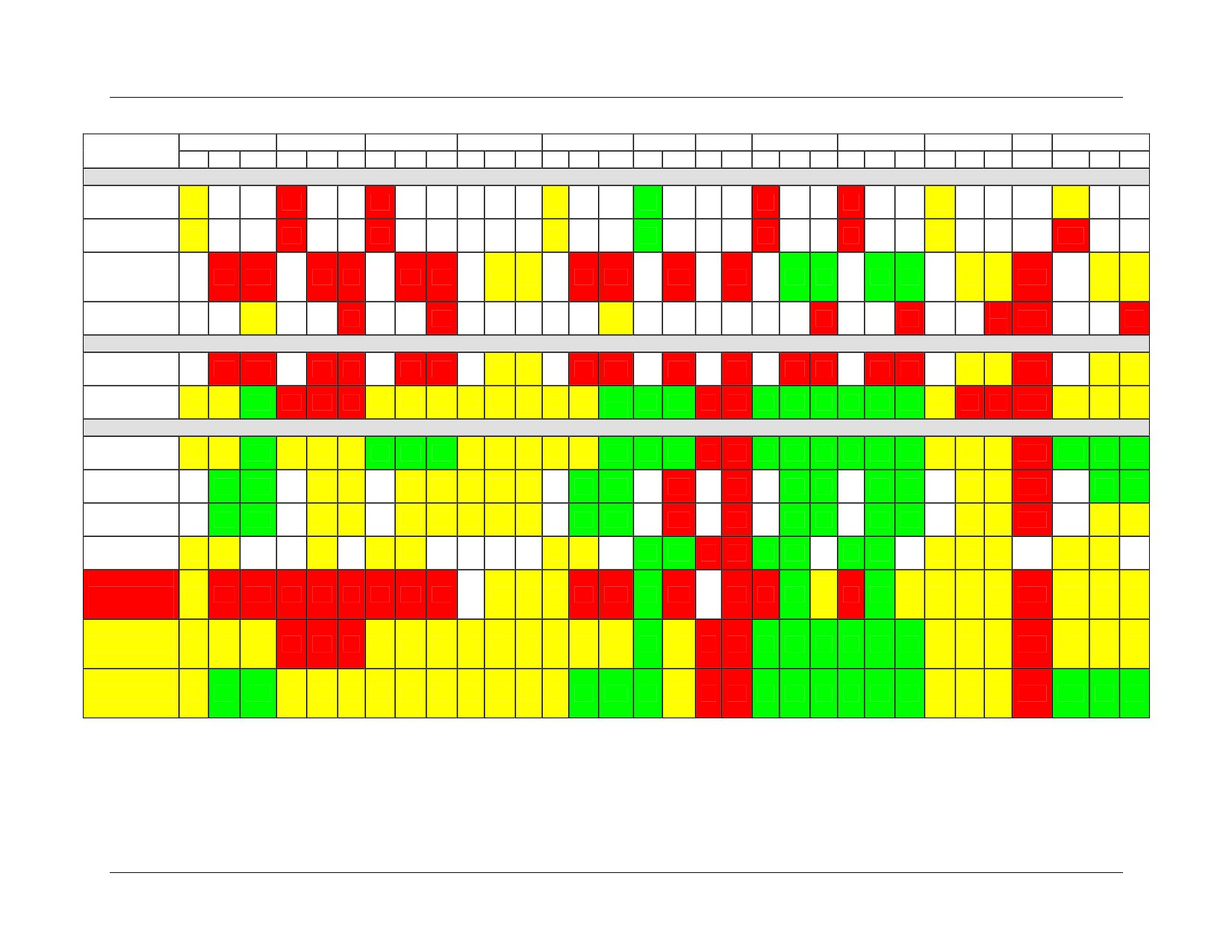
Table 17.17-1 presents individual and overall current, near-/mid-term, and far-term capabilities
to perform the task to the designated standard. There are a total of four current capabilities used
to accomplish this task and four projected capabilities to be added in the future. Capabilities for
aircraft decontamination exist at the immediate, operational, and thorough levels of
decontamination.
Current Capabilities and Deficiencies
The current capabilities for decontaminating aircraft exteriors and aircraft interiors are limited.
Standard decontaminants that can neutralize chemical or biological agents are typically not
compatible with either exterior or interior aircraft materials. Using warm soapy water on large
exterior surfaces is often counterproductive, as many aircraft panels are not watertight and the
contamination is simply moved from the skin to areas under the aircraft’s panels or even into the
interior of the aircraft. Therefore, weathering, including flying, is the primary decontamination
method for large exterior aircraft surfaces. For radiological contamination, however, washing
with soap and water to remove contaminants may also be required, as weathering does not
degrade radioactive materials as it does with chemical and biological agents. Operational
decontamination on those exterior and interior surfaces that will be continually touched is
performed using M295 decontamination kits or soapy (detergent) water. For interior
decontamination, the use of forced hot air is also a viable option for some agents, but is
ineffective against V-series nerve agents. Spot-cleaning with M295 decontamination kits or
soapy (detergent) water, along with removal (when possible) of contaminated items, is
158
For Official Use Only
For Official Use Only
CBRND Functional Needs Analysis/Functional Solution Analysis
Chapter 17. Tactical Sustain Tasks
performed when possible. There is currently no proven method to decontaminate the cockpit
areas of aircraft, primarily due to the presence of sensitive electronics. Additionally, many
sensitive aircraft equipment items, such as wiring harnesses, are nonremovable by operational
units. To ensure flight safety, nerve agent efficacy requirements for aircraft decontamination
must achieve levels well below those at which the onset of meiosis could occur.
Projected Near/Mid-Term Capabilities and Deficiencies
The projected near/mid-term capabilities and deficiencies evaluated were associated with
JSTDS-SS Increment I and JPID Increment I.
Projected Far-Term Capabilities and Deficiencies
The projected far-term capabilities and deficiencies evaluated were associated with JSTDS-SS
Increment II, JSTDS-LS Increments I and II, JPID, Increment II and JPDS Increments I and II.
159
For Official Use Only
For Official Use Only
CBRND Functional Needs Analysis/Functional Solution Analysis
Chapter 17. Tactical Sustain Tasks
Table 17.17-1. TASUST 17: Capabilities and Deficiencies Assessment
M1
M2
M3
M4
M5
M6
M7
M8
M9
M10
M11
M12
Capabilities
I
O
T
I
O
T
I
O
T
I
O
T
I
O
T
I
O
I
O
I
O
T
I
O
T
I
O
T
T
I
O
T
Current
M291/M295
N/
N/
N/
N/
N/
N/
N/
N/
N/
N/
N/
N/
N/
N/
N/
N/
N/
N/
N/
N/
N/
71
N/A
32
13
74
85
16
17
78
N/A
79
Kits
A
A
A
A
A
A
A
A
A
A
A
A
A
A
A
A
A
A
A
A
A
M100SDS Kit
N/
N/
N/
N/
N/
N/
N/
N/
N/
N/
N/
N/
N/
N/
N/
N/
N/
N/
N/
N/
N/
7
N/A
3
1
7
8
1
1
7
N/A
310
A
A
A
A
A
A
A
A
A
A
A
A
A
A
A
A
A
A
A
A
A
Aircraft
N/
N/
N/
N/
N/
N/
N/
N/
N/
N/
Cleaning
311
3
012
0
313
3
414
4
315
3
116
117
918
9
919
9
520
5
121
N/A
7
7
A
A
A
A
A
A
A
A
A
A
Compounds
Forced Hot
N/
N/
N/
N/
N/
N/
N/
N/
N/
N/
N/
N/
N/
N/
N/
N/
N/
N/
N/
N/
N/
3
N/
522
3
223
524
1
1
026
N/A
3
Air
A
A
A
A
A
A
A
A
A
A
A
A
A
A
A
A
A
A
A
A
A
25
A
Near/Mid-Term
JSTDS-SS
N/
N/
N/
N/
N/
N/
N/
N/
N/
N/
3
3
0
0
3
3
4
4
3
3
1
1
227
2
228
2
5
5
1
N/A
7
7
Increment I
A
A
A
A
A
A
A
A
A
A
JPID
10
729
7
1030
3
3
3
5
5
731
4
4
4
7
7
8
8
1
1
9
9
9
9
9
9
7
3
3
1
7
7
7
Increment I
32
Far-Term
JPID
7
7
10
533
5
5
834
8
8
4
4
4
7
7
10
8
8
1
1
9
9
9
9
9
9
7
7
7
1
1035
10
10
Increment II
JSTDS-SS
N/
N/
N
N/
N/
N/
N/
N/
N/
10
10
5
5
5
5
4
4
4
10
10
1
1
9
9
9
9
5
5
1
N/A
10
10
Increment II
A
A
A
A
A
A
A
A
A
JSTDS-LS
N/
N/
N/
N/
N/
N/
N/
N/
N/
10
10
5
5
5
5
4
4
4
10
10
1
1
9
9
9
9
5
5
1
N/A
7
7
Increment I/II
A
A
A
A
A
A
A
A
A
JPDS
N
N/
N/
N/
N/
N/
N/
N/
N/
7
7
NA
5
5
5
7
7
NA
8
8
1
1
9
9
9
9
7
5
5
N/A
7
7
Increments I/II
A
A
A
A
A
A
A
A
A
Current
N/
N/
5
37
Overall
7
3
3
3
3
3
1
3
3
4
4
7
3
3
8
1
1
1
9
36
1
9
5
7
5
5
1
538
7
5
A
A
Capabilities*
Near/Mid-
Term Overall
7
5
7
3
3
3
7
5
5
4
4
4
7
5
7
8
539
1
1
9
9
9
9
9
9
7
5
5
1
7
7
7
Capabilities
Far-Term
Overall
7
10
10
5
5
5
7
5
5
4
4
4
7
10
10
8
5
1
1
9
9
9
9
9
9
7
5
5
1
10
10
10
Capabilities
*While the table suggests a low “yellow” rating for current overall capabilities, there is currently a lack of approved aircraft decontaminants that possess adequate efficacy to allow
unprotected exposure of aircrews and maintenance personnel to decontaminated aircraft. This capability is currently materiel compatibility and technology constrained.
160
For Official Use Only
For Official Use Only
CBRND Functional Needs Analysis/Functional Solution Analysis
Chapter 17. Tactical Sustain Tasks
FAA Measure
Elaboration
Scale
M1
(Yes/No) Contaminated by-
Contaminated by-products are
10: Yes, Complete (100%).
products are controlled?
controlled. Where by-products are less
7: Yes, Substantial (~75%).
than 100% controlled, measures must
5: Yes, Partial (~50%).
be in place to prevent cross-
3: Yes, Minimal (~25%).
contamination from becoming an
0: No, Contaminated by-products cannot be controlled and present an
unacceptable hazard.
unacceptable hazard.
M2
(Level) Of chemical
The level of chemical contamination
10: Decontaminate all CWAs, NTAs, TIMs to general population exposure
contamination after
is acceptable after decontamination
limits.
decontamination
operations from a starting liquid
7: Decontaminate all CWAs, all NTAs, and some TIMs to a level that will
procedures.
challenge of 10 g/m2 for external
allow unprotected exposure.
surfaces and 1 g/m2 for internal
5: Decontaminate all CWAs and some NTAs to a level that will allow
surfaces. Agents defined as current-
unprotected exposure.
generation CWAs, NTAs, TIMs, and
3: Decontaminate most CWAs to a level that will allow unprotected exposure.
TICs.
0: No effective decontaminant or process.
M3
(Level) Of biological
The level of biological contamination
10: 0 CFU/PFU/m2—total removal or neutralization of toxins against all threat
contamination after
(to include toxins) is acceptable after
agents.
decontamination
decontamination operations from
9: 0 CFU/PFU/m2—total removal or neutralization of toxins against nine or
procedures.
starting challenges of greater than 1.0
more key threat agents.
× 108 CFU/PFU/m2. Vegetative and
8: 0 CFU/PFU/m2—total removal or neutralization of toxins against eight or
nonvegetative bacteria are measured
more key threat agents.
in CFU/m2, and viruses are measured
7: 0 CFU/PFU/m2—total removal or neutralization of toxins against seven or
in PFU/m2.
more key threat agents.
6: 0 CFU/PFU/m2—total removal or neutralization of toxins against six or
more key threat agents.
5: Less than infective dose levels/casualty-producing toxin exposure levels
against five or more key threat agents.
4: Less than infective dose levels/casualty-producing toxin exposure levels
against four key threat agents.
3: Less than infective dose levels/casualty-producing toxin exposure levels
against three key threat agents.
2: Less than infective dose levels/casualty-producing toxin exposure levels
against two or more key threat agents.
1: Less than infective dose levels/casualty-producing toxin exposure levels
against one key threat agent.
0: More than infective dose levels/casualty-producing toxin exposure levels.
161
For Official Use Only
For Official Use Only
CBRND Functional Needs Analysis/Functional Solution Analysis
Chapter 17. Tactical Sustain Tasks
M4
(Level) Of radiological
The level of radiological
10: Total removal to natural backg1round level.
contamination after
contamination is acceptable after
8: ≤0.11 cGy/hour residual dose rate.
decontamination
decontamination operations from a
6: ≤0.22 cGy/hour residual dose rate.
procedures.
starting challenge of 4 g/m2 for
4: <0.33 cGy/hour residual dose rate.
external surfaces and 0.4 g/m2 for
2: 0.33 cGy/hour residual dose rate.
internal surfaces, of insoluble
0: Removal capabilities limited or ineffective, allowing excessive residual dose
radioactive contaminants, 37-200 μm
rates >0.33 cGy.
in size and 185 GBq/m2 gamma
activity. 0.33 cGy/hour equates to an
exposure that can cause mild
incapacitation in 2.5% or less of
unprotected, not previously exposed
personnel.
M5
(Yes/No) Cross-
Cross-contamination is controlled.
10: Yes, Complete (100%).
contamination is
Where cross-contamination is less
7: Yes, Substantial (~75%).
controlled?
than 100% controlled, measures must
5: Yes, Partial (~50%).
be in place to prevent cross-
3: Yes, Minimal (~25%).
contamination from becoming an
0: No, Cross-contamination cannot be controlled and presents an unacceptable
unacceptable hazard.
hazard.
M6
(Time) To initiate
Initiate immediate decontamination
Immediate
Operational
immediate and operational
procedures in time to meet mission
10: Immediately
10: Immediately
decontamination
requirements.
9: <1 minute
9: 15 minutes
procedures.
8: <2 minutes
8: 30 minutes
Initiate operational decontamination
7: <3 minutes
7: 45 minutes
procedures in time to meet mission
6: <4 minutes
6: <1 hour
requirements.
5: <5 minutes
5: <2 hours
4: <7 minutes
4: <3 hours
3: <9 minutes
3: <4 hours
2: <12 minutes
2: <5 hours
1: <15 minutes
1: <6 hours
0: >15 minutes
0: >6 hours
162
For Official Use Only
For Official Use Only
CBRND Functional Needs Analysis/Functional Solution Analysis
Chapter 17. Tactical Sustain Tasks
M7
(Time) To conduct
Time required for one warfighter to
10: Immediately
immediate and operational
carry out immediate and operational
9: <1 minute
decontamination
decontamination procedures on
8: <2 minutes
procedures.
300 m2 of surface area.
7: <3 minutes
6: <4 minutes
5: <5 minutes
4: <7 minutes
3: <9 minutes
2: <12 minutes
1: <15 minutes
0: >15 minutes
M8
(Percent) Of interior
The quantity of systems that may be
10: 0%; system and/or process approved by all A/C SPOs.
areas/systems unusable due
rendered unserviceable by
9: <1%; system and/or process approved by all A/C SPOs.
to the effects of
decontamination process must be
8: <2%; system and/or process approved by all A/C SPOs.
decontamination.
minimized. Decontamination
7: <3%; system and/or process approved by all A/C SPOs.
systems/processes require approval by
6: <4%; system and/or process approved by all A/C SPOs.
aircraft system program offices (A/C
5: <5%, system and /or process is approved by most A/C SPOs.
SPOs).
4: <6%; system and/or process is approved by the majority of A/C SPOs.
3: <7%; system and/or process is approved by the majority of A/C SPOs.
2: <8%; system and/or process is approved by some A/C SPOs.
1: <9%; system and/or process is approved by some A/C SPOs.
0: ≥10%; system and/or process not approved by any A/C SPO.
M9
(Percent) Of systems that
The quantity of repairs or parts
10: 0%; system and/or process approved by all A/C SPOs.
require repair or
replacements required due to
9: <1%; system and/or process approved by all A/C SPOs.
replacement due to the
decontamination process must be
8: <2%; system and/or process approved by all A/C SPOs.
effects of decontamination.
minimized. Decontamination
7: <3%; system and/or process approved by all A/C SPOs.
systems/processes require approval by
6: <4%; system and/or process approved by all A/C SPOs.
A/C SPOs.
5: <5%, system and /or process is approved by most A/C SPOs.
4: <6%; system and/or process is approved by the majority of A/C SPOs.
3: <7%; system and/or process is approved by the majority of A/C SPOs.
2: <8%; system and/or process is approved by some A/C SPOs.
1: <9%; system and/or process is approved by some A/C SPOs.
0: ≥10%; system and/or process not approved by any A/C SPO.
M10
(Yes/No) Decontamination
Decontamination procedures must be
10: No negative impacts on operations.
procedures are logistically
logistically supportable.
7: Limited negative impact on operational capability.
supportable?
5: Moderate negative impact on operational capability.
3: Major negative impact on operational capability.
0: Not logistically supportable.
163
For Official Use Only
For Official Use Only
CBRND Functional Needs Analysis/Functional Solution Analysis
Chapter 17. Tactical Sustain Tasks
M11
(Time) To conduct
Time required for one warfighter to
10: Immediately
thorough decontamination.
carry out thorough decontamination
9: <1 minute
procedures on 300 m2 of surface area.
8: <2 minutes
7: <3 minutes
6: <4 minutes
5: <5 minutes
4: <10 minutes
3: <15 minutes
2: <20 minutes
1: <30 minutes
0: >30 minutes
M12
(Yes/No) There is effective
Refers to non-materiel elements
10: DOTLPF is adequate for all tasks to be performed with this system without
DOTLPF in place to
associated with the execution of a task
limitations that cause significant impact upon operations.
conduct task?
with the system.
7: DOTLPF is adequate for most of the tasks to be performed with this system
without limitations that cause significant impact upon operations.
5: Many critical aspects of DOTLPF for the task to be performed with this
system are addressed.
3: Some critical aspects of DOTLPF for the task to be performed with this
system are addressed.
0: DOTLPF is completely inadequate or does not exist for the tasks to be
performed with this system.
1 M1 - (Yes/No) Contaminated by-products are controlled? 7: Yes, Substantial (~75%).
2 M2 - (Level) Of chemical contamination after decontamination procedures. 3: Decontaminate most CWAs to a level that will allow unprotected exposure.
3 M3 - (Level) Of biological contamination after decontamination procedures. 1: Less than infective dose levels/casualty-producing toxin-exposure levels against one key threat
agent.
4 M5 - (Yes/No) Cross-contamination is controlled? 7: Yes, Substantial (~75%).
5 M6 - (Time) To initiate immediate decontamination procedures. 8: <2 minutes.
6 M8 - (Percent) Of interior areas/systems unusable due to the effects of decontamination. 0: ≥10%, System and/or process not approved by any aircraft system program office
(A/C SPO).
7 M9 - (Percent) Of systems that require repair or replacement due to the effects of decontamination. 1: <9%; system and/or process is approved by some A/C SPOs.
8 M10 - (Yes/No) Decontamination procedures are logistically supportable? 7: Limited negative impact on operational capability.
9 M12 - (Yes/No) There is effective DOTLPF in place to conduct task? 7: DOTLPF is adequate for most of the tasks to be performed with this system without limitations that
cause significant impact upon operations.
10 M12 - (Yes/No) There is effective DOTLPF in place to conduct task? 3: Some critical aspects of DOTLPF for the task to be performed with this system are addressed.
11 M1 - (Yes/No) Contaminated by-products are controlled? 3: Yes, Minimal (~25%).
12 M2 - (Level) Of chemical contamination after decontamination procedures. 0: No effective decontaminant or process.
13 M3 - (Level) Of biological contamination after decontamination procedures. 3: Less than infective dose levels/casualty-producing toxin-exposure levels against three key threat
agents.
14 M4 - (Level) Of radiological contamination after decontamination procedures. 4: <0.33 cGy/hour residual dose rate.
15 M5 - (Yes/No) Cross-contamination is controlled? 3: Yes, Minimal (~25%).
16 M6 - (Time) To initiate operational decontamination procedures. 1: <6 hours.
164
For Official Use Only
For Official Use Only
CBRND Functional Needs Analysis/Functional Solution Analysis
Chapter 17. Tactical Sustain Tasks
17 M7 - (Time) To conduct immediate and operational decontamination procedures. 1: <15 minutes.
18 M8 - (Percent) Of interior areas/systems unusable due to the effects of decontamination. 9: <1%; system and/or process approved by all A/C SPOs.
19 M9 - (Percent) Of systems that require repair or replacement due to the effects of decontamination. 9: <1%; system and/or process approved by all A/C SPOs.
20 M10 - (Yes/No) Decontamination procedures are logistically supportable? 5: Moderate negative impact on operational capability.
21 M11 - (Time) To conduct thorough decontamination. 1: <30 minutes.
22 M1 - (Yes/No) Contaminated by-products are controlled? 5: Yes, Partial (~50%).
23 M3 - (Level) Of biological contamination after decontamination procedures. 2: Less than infective dose levels/casualty-producing toxin-exposure levels against two or more key
threat agents.
24 M5 - (Yes/No) Cross-contamination is controlled? 5: Yes, Partial (~50%).
25 M10 - (Yes/No) Decontamination procedures are logistically supportable? 3: Major negative impact on operational capability.
26 M11 - (Time) To conduct thorough decontamination. 0: >30 minutes.
27 M8 - (Percent) Of interior areas/systems unusable due to the effects of decontamination. 2: <8%; system and/or process is approved by some A/C SPOs.
28 M9 - (Percent) Of systems that require repair or replacement due to the effects of decontamination. 2: <8%; system and/or process is approved by some A/C SPOs.
29 M1 - (Yes/No) Contaminated by-products are controlled? 7: Yes, Substantial (~75%).
30 M1 - (Yes/No) Contaminated by-products are controlled? 10: Yes, Complete (100%).
31 M3 - (Level) Of biological contamination after decontamination procedures. 7: 0 CFU/PFU/m2—total removal or neutralization of toxins against seven or more key threat
agents.
32 M5 - (Yes/No) Cross-contamination is controlled? 10: Yes, Complete (100%).
33 M2 - (Level) Of chemical contamination after decontamination procedures. 5: Decontaminate all CWAs, some NTAs to a level that will allow unprotected exposure.
34 M3 - (Level) Of biological contamination after decontamination procedures. 8: 0 CFU/PFU/m2—total removal or neutralization of toxins against eight or more key threat
agents.
35 M12 - (Yes/No) There is effective DOTLPF in place to conduct task? 10: DOTLPF is adequate for all tasks to be performed with this system without limitations that cause
significant impact upon operations.
36 M8 - (Percent) Of interior areas/systems unusable due to the effects of decontamination. 5: <5%, system and /or process is approved by most A/C SPOs.
37 M9 - (Percent) Of systems that require repair or replacement due to the effects of decontamination. 5: <5%, system and /or process is approved by most A/C SPOs.
38 M12 - (Yes/No) There is effective DOTLPF in place to conduct task? 5: Many critical aspects of DOTLPF for the task to be performed with this system are addressed.
39 M6 - (Time) To initiate immediate and operational decontamination procedures. 5: <2 hours.
165
For Official Use Only
For Official Use Only
CBRND Functional Needs Analysis/Functional Solution Analysis
Chapter 17. Tactical Sustain Tasks
17.17.3
Functional Solution Analysis
17.17.3.1
DOTLPF Assessment Summary
This section states the deficiencies and suggests potential non-materiel solutions. If there are no
solutions or there are only partial solutions for a particular deficiency, the deficiency is then
reassessed in the IMA section.
1.
Deficiency: Primary means to decontaminate (hot soapy water) is ineffective in
decontaminating most chemical and biological hazards.
Non-Materiel Solutions: Doctrine-Partial. The contamination of aircraft should be avoided
by all means possible. Exposure of aircraft to potentially contamination-producing events
should be minimized if not avoidable. Critical aircraft assets should be protected from being
contaminated at all times to the maximum extent possible. Aircrews must be prepared to
operate in protective clothing and equipment for extended time frames if the continued use of
contaminated aircraft is required.
2.
Deficiency: Persistent chemical hazards do not evaporate in a timely manner under normal
conditions.
Non-Materiel Solutions: None.
3.
Deficiency: Inability to remove chemical agents deposited on porous/absorbent material.
Non-Materiel Solutions: None.
4.
Deficiency: Lack of doctrine for operational and thorough decontamination on board ship.
Non-Materiel Solutions: Doctrine: Develop doctrine for procedures and requirements to
decontaminate all aircraft and surfaces during flight operations in a CBRD environment to
include immediate, operational, and thorough decontamination.
5.
Deficiency: Inability to decontaminate hard-to-reach places (cracks and crevices).
Non-Materiel Solutions: None.
6.
Deficiency: Decontaminants are corrosive and can damage aircraft.
Non-Materiel Solutions: None.
17.17.3.2
IMA Assessment Summary
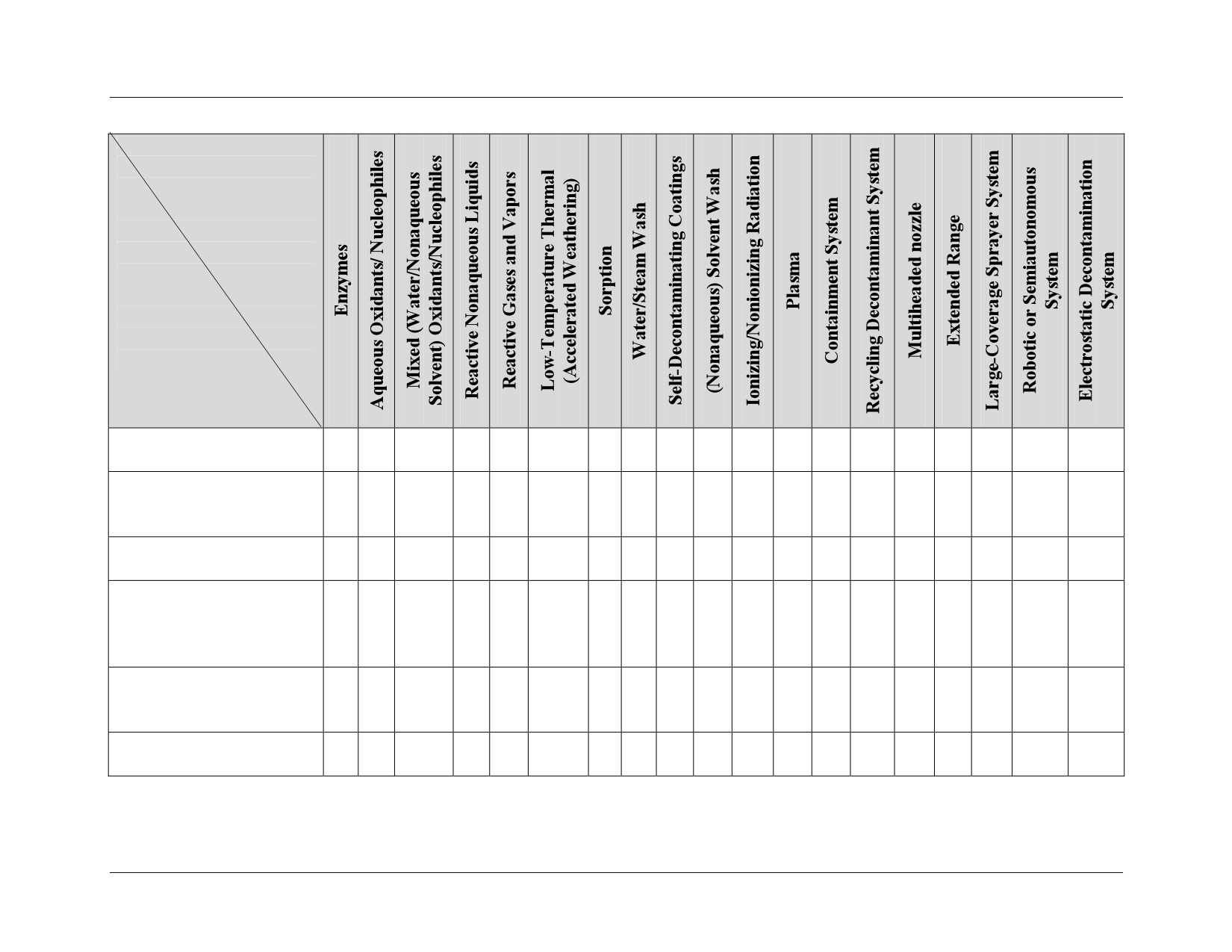
Table 17.17-2 identifies which of the materiel approaches might address specific materiel gaps
identified in the DOTMLPF assessment.
166
For Official Use Only
For Official Use Only
CBRND Functional Needs Analysis/Functional Solution Analysis
Chapter 17. Tactical Sustain Tasks
Table 17.17-2. TASUST 17: IMA Assessment
Ideas for Materiel
Approaches
(IMA
Identified Gaps
Primary means to decontaminate (hot
soapy water) is ineffective in
X
X
X
X
X
X
decontaminating most chemical and
biological hazards.
Persistent chemical hazards do not
evaporate in a timely manner under
X
X
X
normal conditions.
Inability to remove agent deposited
X
X
X
X
X
X
on porous/absorbent material.
Inability to decontaminate hard-to-
X
X
X
X
X
X
reach places (cracks and crevices).
Decontaminants are corrosive and can
X
X
X
X
X
X
X
X
X
X
X
damage aircraft.
167
For Official Use Only
For Official Use Only
CBRND Functional Needs Analysis/Functional Solution Analysis
Chapter 17. Tactical Sustain Tasks
17.18 Task TASUST 18: Decontaminate fixed-facility exteriors
17.18.1
Functional Area Analysis
17.18.1.1
Definition
To decontaminate the exterior of fixed facilities such as buildings, warehouses, shelters, hangers,
etc.
17.18.1.2
Derivation
UJTL (TA 7, TA 7.1), Protection Joint Functional Concept.
17.18.1.2.1
Supported Task: OPSUST 11
17.18.1.2.2
Lateral Task: TASHA 24
17.18.1.2.3
Supporting Task: N/A
17.18.1.3
Condition
Perform this task under conditions of:
Physical
1. Tropical, arctic, and arid climate. (C1.3.1)
2. All seasons. (C1.3.1.1)
3. Precipitating and stormy weather. (C1.3.1.3)
4. Hot and very cold air temperature. (C1.3.1.3.1)
5. Liquid, freezing, and frozen precipitation. (C1.3.1.3.6.1)
6. Negligible light. (C1.3.2.1)
7. Nuclear effects. (C1.3.3.1)
8. Chemical effects. (C1.3.3.2)
9. Biological effects. (C1.3.3.3)
10. Varied surface materials.
Military
1. Stressful mission. (C2.1)
2. Marginal forces allocated. (C2.2.3)
3. Low personnel capability. (C2.2.4)
4. Negligible personnel experience. (C2.2.4.5)
5. Severe personnel fatigue. (C2.2.4.6)
6. Limited, little, or no lift assets. (C2.5.2)
7. Limited or no host-nation support. (C2.8.5)
8. Ambiguous threat existence. (C2.9.3)
168
For Official Use Only
For Official Use Only
CBRND Functional Needs Analysis/Functional Solution Analysis
Chapter 17. Tactical Sustain Tasks
Civil
1. Disputed legality. (C3.1.1.4)
2. Adversarial media relations. (C3.1.1.5)
3. Limited or negative foreign government support. (C3.1.2.3)
4. Aggressively opposed foreign public opinion. (C3.1.2.4)
5. Moderate mission priority. (C3.1.3.2)
6. Presence of internationally significant cultural sites. (C3.2.4)
17.18.2
Functional Needs Analysis
17.18.2.1
Capabilities and Deficiencies Assessment Summary
Table 17.18-1 presents individual and overall current, near-/mid-term, and far-term capabilities
to perform the task to the designated standard. There are two current capabilities used to
accomplish this task and three projected capabilities to be added in the future.
Current Capabilities and Deficiencies
The current capabilities exist at the immediate, operational, and thorough levels involving the
use of STB, HTH, DF-200 Decontamination foam, and soap and water, applied with applicators
such as M12A1, M17 Lightweight Decontamination System. Deficiencies include the inability to
decontaminate hard-to-reach areas and porous materials such as building materials, along with
the lack of a neutralizing, noncorrosive decontaminant.
Projected Near/Mid-Term Capabilities and Deficiencies
The projected near/mid-term capabilities and deficiencies evaluated were associated with
JSTDS-SS Increment I.
Projected Far-Term Capabilities and Deficiencies
The projected far-term capabilities and deficiencies evaluated were associated with JSTDS-LS
Increments I AND II and JPDS Increments I and II.
169
For Official Use Only
For Official Use Only
CBRND Functional Needs Analysis/Functional Solution Analysis
Chapter 17. Tactical Sustain Tasks
Table 17.18-1. TASUST 18: Capabilities and Deficiencies Assessment
Capabilities
M1
M2
M3
M4
M5
M6
M7
M8
Current
HTH/STB
51
32
53
N/A
54
55
46
37
Flushing/ Hot soapy water
38
09
310
411
312
5
4
3
Near/Mid-Term
JSTDS-SS Increment I
713
3
5
4
714
5
4
515
Far-Term
JSTDS-LS Increment I/II
1016
517
5
4
1018
5
619
5
JPDS Increment I/II
10
5
5
4
10
5
6
5
Current Overall Capabilities
3
3
3
4
3
5
4
3
Near/Mid-Term Overall Capabilities
7
3
5
4
7
5
4
5
Far-Term Overall Capabilities
10
5
5
4
10
5
6
5
FAA Measure
Elaboration
Scale
M1
(Yes/No) Contaminated
Contaminated by-products are
10: Yes, Complete (100%).
by-products are
controlled. Where by-products are less
7: Yes, Substantial (~75%).
controlled?
than 100% controlled, measures must
5: Yes, Partial (~50%).
be in place to prevent cross-
3: Yes, Minimal (~25%).
contamination from becoming an
0: No, Contaminated by-products cannot be controlled and present an
unacceptable hazard.
unacceptable hazard.
M2
(Level) Of chemical
The level of chemical contamination
10: Decontaminate all CWAs, NTAs, TIMs to general population exposure limits.
contamination after
is acceptable after decontamination
7: Decontaminate all CWAs, all NTAs, and some TIMs to a level that will allow
decontamination
operations from a starting liquid
unprotected exposure.
procedures.
challenge of 10 g/m2 for external
5: Decontaminate all CWAs and some NTAs to a level that will allow unprotected
surfaces and 1 g/m2 for internal
exposure.
surfaces. Agents defined as current-
3: Decontaminate most CWAs to a level that will allow unprotected exposure.
generation CWAs, NTAs, TIMs, and
0: No effective decontaminant or process.
TICs.
170
For Official Use Only
For Official Use Only
CBRND Functional Needs Analysis/Functional Solution Analysis
Chapter 17. Tactical Sustain Tasks
M3
(Level) Of biological
The level of biological contamination
10: 0 CFU/PFU/m2—total removal or neutralization of toxins against all threat
contamination after
(to include toxins) is acceptable after
agents.
decontamination
decontamination operations from
9: 0 CFU/PFU/m2—total removal or neutralization of toxins against nine or more
procedures.
starting challenges of greater than 1.0
key threat agents.
× 108 CFU/PFU/m2. Vegetative and
8: 0 CFU/PFU/m2—total removal or neutralization of toxins against eight or more
nonvegetative bacteria are measured
key threat agents.
in CFU/m2, and viruses are measured
7: 0 CFU/PFU/m2—total removal or neutralization of toxins against seven or
in PFU/m2.
more key threat agents.
6: 0 CFU/PFU/m2—total removal or neutralization of toxins against six or more
key threat agents.
5: Less than infective dose levels/casualty-producing toxin exposure levels against
five or more key threat agents.
4: Less than infective dose levels/casualty-producing toxin exposure levels against
four key threat agents.
3: Less than infective dose levels/casualty-producing toxin exposure levels against
three key threat agents.
2: Less than infective dose levels/casualty-producing toxin exposure levels against
two or more key threat agents.
1: Less than infective dose levels/casualty-producing toxin exposure levels against
one key threat agent.
0: More than infective dose levels/casualty-producing toxin exposure levels.
M4
(Level) Of radiological
The level of radiological
10: Total removal to natural backg1round level.
contamination after
contamination is acceptable after
8: ≤0.11 cGy/hour residual dose rate.
decontamination
decontamination operations from a
6: ≤0.22 cGy residual dose rate.
procedures.
starting challenge of 4 g/m2 of
4: <0.33 cGy/hour residual dose rate.
insoluble radioactive contaminants,
2: 0.33 cGy residual dose rate.
37-200 μm in size and 185 GBq/m2
0: Removal capabilities limited or ineffective, allowing excessive residual dose
gamma activity. 0.33 cGy/hour
rates >0.33 cGy/hour.
equates to an exposure that can cause
mild incapacitation in 2.5% or less of
unprotected, not previously exposed
personnel.
M5
(Yes/No) Cross-
Cross-contamination is controlled.
10: Yes, Complete (100%).
contamination is
Where cross-contamination is less
7: Yes, Substantial (~75%).
controlled?
than 100% controlled, measures must
5: Yes, Partial (~50%).
be in place to prevent cross-
3: Yes, Minimal (~25%).
contamination from becoming an
0: No, Cross-contamination cannot be controlled and presents an unacceptable
unacceptable hazard.
hazard.
171
For Official Use Only
For Official Use Only
CBRND Functional Needs Analysis/Functional Solution Analysis
Chapter 17. Tactical Sustain Tasks
M6
(Yes/No)
Decontamination procedures must be
10: No negative impacts on operations.
Decontamination
logistically supportable.
7: Limited negative impact on operational capability.
procedures are
5: Moderate negative impact on operational capability.
logistically supportable?
3: Major negative impact on operational capability.
0: Not logistically supportable.
M7
(Time) To complete the
Time required to conduct thorough
10: Immediately
decontamination mission
decontamination on 3000 m2 of
9: <15 minutes
for fixed sites.
surface area.
8: <30 minutes
7: <45 minutes
6: <1 hour
5: <1.5 hours
4: <2 hours
3: <2.5 hours
2: <3 hours
1: <4 hours
0: >4 hours
M8
(Yes/No) There is
Refers to non-materiel elements
10: DOTLPF is adequate for all tasks to be performed with this system without
effective DOTLPF in
associated with the execution of a task
limitations that cause significant impact upon operations.
place to conduct task?
with the system.
7: DOTLPF is adequate for most of the tasks to be performed with this system
without limitations that cause significant impact upon operations.
5: Many critical aspects of DOTLPF for the task to be performed with this system
are addressed.
3: Some critical aspects of DOTLPF for the task to be performed with this system
are addressed.
0: DOTLPF is completely inadequate or does not exist for the tasks to be
performed with this system.
1 M1 - (Yes/No) Contaminated by-products are controlled? 5: Yes, Partial (~50%).
2 M2 - (Level) Of chemical contamination after decontamination procedures. 3: Decontaminate most CWAs to a level that will allow unprotected exposure.
3 M3 - (Level) Of biological contamination after decontamination procedures. 5: Less than infective dose levels/casualty-producing toxin-exposure levels against five or more key
threat agents.
4 M5 - (Yes/No) Cross-contamination is controlled? 5: Yes, Partial (~50%).
5 M6 - (Yes/No) Decontamination procedures are logistically supportable? 5: Moderate negative impact on operational capability.
6 M7 - (Time) To complete the decontamination mission for fixed sites. 4: <2 hours.
7 M8 - (Yes/No) There is effective DOTLPF in place to conduct task? 3: Some critical aspects of DOTLPF for the task to be performed with this system are addressed.
8 M1 - (Yes/No) Contaminated by-products are controlled? 3: Yes, Minimal (~25%).
9 M2 - (Level) Of chemical contamination after decontamination procedures. 0: No effective decontaminant or process.
10 M3 - (Level) Of biological contamination after decontamination procedures. 3: Less than infective dose levels/casualty-producing toxin-exposure levels against three key threat
agents.
11 M4 - (Level) Of radiological contamination after decontamination procedures. 4: <0.33 cGy/hour residual dose rate.
12 M5 - (Yes/No) Cross-contamination is controlled? 3: Yes, Minimal (~25%).
172
For Official Use Only
For Official Use Only
CBRND Functional Needs Analysis/Functional Solution Analysis
Chapter 17. Tactical Sustain Tasks
13 M1 - (Yes/No) Contaminated by-products are controlled? 7: Yes, Substantial (~75%).
14 M5 - (Yes/No) Cross-contamination is controlled? 7: Yes, Substantial (~75%).
15 M8 - (Yes/No) There is effective DOTLPF in place to conduct task? 5: Many critical aspects of DOTLPF for the task to be performed with this system are addressed.
16 M1 - (Yes/No) Contaminated by-products are controlled? 10: Yes, Complete (100%).
17 M2 - (Level) Of chemical contamination after decontamination procedures. 5: Decontaminate all CWAs, some NTAs to a level that will allow unprotected exposure.
18 M5 - (Yes/No) Cross-contamination is controlled? 10: Yes, Complete (100%).
19 M7 - (Time) To complete the decontamination mission for fixed sites. 6: <1 hour.
173
For Official Use Only
For Official Use Only
CBRND Functional Needs Analysis/Functional Solution Analysis
Chapter 17. Tactical Sustain Tasks
17.18.3
Functional Solution Analysis
17.18.3.1
DOTLPF Assessment Summary
This section states the deficiencies and suggests potential non-materiel solutions. If there are no
solutions or there are only partial solutions for a particular deficiency, the deficiency is then
reassessed in the IMA section.
1.
Deficiency: Immediate response capability is limited.
Partial Non-Materiel Solutions: Doctrine (partial): Promulgate doctrine, policy,
procedures, and TTPs for immediate response capability to assess and characterize
contamination and mitigate resolve contamination. Organization (partial): Develop
organization structures, capacities, and considerations to support decontamination. Training
(partial): Develop institutional and unit-level training, exercises, and evaluations, including
participation by surrounding civil authorities as appropriate, to perform decontamination of
contaminated facilities. Leadership (partial): Provide awareness for contaminated facilities
through operations, training, and guidance for prioritization of decontamination efforts to
maintain operational capabilities, willingness, and ability to adapt and change tasking as
necessary to consider presence of contamination and maintain operational effectiveness.
Personnel (partial): Develop requirements necessary for eligible civilians to support
missions and to meet minimum standards for safe use of CBRND resources. Facilities
(partial): Supporting infrastructure (e.g., power production, water management, logistics,
etc.) to support planned decontamination efforts.
2.
Deficiency: Time required for weathering may be extensive.
Non-Materiel Solutions: Doctrine: Modify doctrine to include more specific procedures for
weathering of contaminated facilities. Training: Train individuals on weathering risks,
processes, and procedures.
3.
Deficiency: Runoff may be contaminated.
Non-Materiel Solutions: Doctrine (partial): Modify doctrine to consider contaminated
runoff as an operational consideration. Doctrine should address how to dispose of or
neutralize runoff. Training (partial): Modify training to consider contaminated runoff as an
operational consideration. Training should address how to dispose of or neutralize runoff.
4.
Deficiency: Decontaminants may be incompatible with each other.
Non-Materiel Solutions: Doctrine (partial): Change doctrine to provide procedures so that
decontaminants can be used in series in some way that will reduce the ill effects of the
incompatibility. Training (partial): Modify soldier training to ensure understanding of the
incompatibilities and the solutions.
5.
Deficiency: Persistent spores difficult to decontaminate.
Non-Materiel Solutions: None.
6.
Deficiency: Operational and thorough decontamination procedures are time/labor-intensive.
174
For Official Use Only
For Official Use Only
CBRND Functional Needs Analysis/Functional Solution Analysis
Chapter 17. Tactical Sustain Tasks
Non-Materiel Solutions: Doctrine (partial): Modify existing doctrine, policy, and
procedures to address reduced manpower and equipment requirements for decontamination.
Training (partial): Modify institutional and unit-level training to include reduced manpower
and equipment requirements for decontamination.
7. Deficiency: Inability to decontaminate hard-to-reach areas using current applicators.
Non-Materiel Solutions: None.
8. Deficiency: Inability to decontaminate absorbent materials.
Non-Materiel Solutions: Doctrine (partial): Modify doctrine to include procedures for
removing or replacing porous materials.
17.18.3.2
IMA Assessment Summary
Table 17.18-2 identifies which of the materiel approaches might address specific materiel gaps
identified in the DOTMLPF assessment.
175
For Official Use Only
For Official Use Only
CBRND Functional Needs Analysis/Functional Solution Analysis
Chapter 17. Tactical Sustain Tasks
Table 17.18-2. TASUST 18: IMA Assessment
Ideas for Materiel
Approaches
(IMA)
Identified Gaps
Runoff may be
X
X
X
X
X
X
X
X
X
contaminated.
Decontaminants may be
incompatible with each
X
X
X
X
X
X
X
other.
Persistent spores difficult
X
X
X
X
X
X
to decontaminate.
Operational and thorough
decontamination
X
X
X
X
X
X
X
X
X
X
X
X
X
X
procedures are time/labor-
intensive.
Inability to decontaminate
hard-to-reach areas using
X
X
X
X
X
X
X
X
X
X
X
X
X
current applicators.
Inability to decontaminate
X
absorbent materials.
176
For Official Use Only
For Official Use Only
CBRND Functional Needs Analysis/Functional Solution Analysis
Chapter 17. Tactical Sustain Tasks
17.19 Task TASUST 19: Decontaminate fixed-facility interiors
17.19.1
Functional Area Analysis
17.19.1.1
Definition
To decontaminate the interior of fixed facilities such as buildings, warehouses, shelters, hangers,
etc. Includes minimizing effects of contaminants and decontaminants on operations.
17.19.1.2
Derivation
UJTL (TA 7, TA 7.1), Protection Joint Functional Concept.
17.19.1.2.1
Supported Task: OPSUST 11
17.19.1.2.2
Lateral Task: TASHA 24
17.19.1.2.3
Supporting Task: N/A
17.19.1.3
Condition
Perform this task under conditions of:
Physical
1. Hot and very cold air temperature. (C1.3.1.3.1)
2. Negligible light. (C1.3.2.1)
3. Nuclear effects. (C1.3.3.1)
4. Chemical effects. (C1.3.3.2)
5. Biological effects. (C1.3.3.3)
6. Varied surface materials.
Military
1. Stressful mission. (C2.1)
2. Marginal forces allocated. (C2.2.3)
3. Low personnel capability. (C2.2.4)
4. Negligible personnel experience. (C2.2.4.5)
5. Severe personnel fatigue. (C2.2.4.6)
6. Limited, little, or no lift assets. (C2.5.2)
7. Limited or no host-nation support. (C2.8.5)
8. Ambiguous threat existence. (C2.9.3)
Civil
1. Disputed legality. (C3.1.1.4)
2. Adversarial media relations. (C3.1.1.5)
177
For Official Use Only
For Official Use Only
CBRND Functional Needs Analysis/Functional Solution Analysis
Chapter 17. Tactical Sustain Tasks
3. Limited or negative foreign government support. (C3.1.2.3)
4. Aggressively opposed foreign public opinion. (C3.1.2.4)
5. High mission priority. (C3.1.3.2)
6. Presence of internationally significant cultural sites. (C3.2.4)
17.19.2
Functional Needs Analysis
17.19.2.1
Capabilities and Deficiencies Assessment Summary
Table 17.19-1 presents individual and overall current, near-/mid-term, and far-term capabilities
to perform the task to the designated standard. There are three current capabilities used to
accomplish this task and two projected capabilities to be added in the future.
Current Capabilities and Deficiencies
The principal capabilities associated with the decontamination of fixed facility interiors include
STB, HTH, and soap and water. These decontaminants are applied using applicators such as
scrub brushes, mops, rags as well as gas generators. Current deficiencies include the lack of
doctrine and TTPs for interior decontamination, inability to decontaminate porous materials and
hard-to-reach areas such as ventilation systems, and the lack of noncorrosive decontaminants.
Projected Near/Mid-Term Capabilities and Deficiencies
The projected near/mid-term capabilities and deficiencies evaluated were associated with JPID
Increment I.
Projected Far-Term Capabilities and Deficiencies
The projected near/mid-term capabilities and deficiencies evaluated were associated with JPID
Increment II and JPDS Increments I and II.
178
For Official Use Only
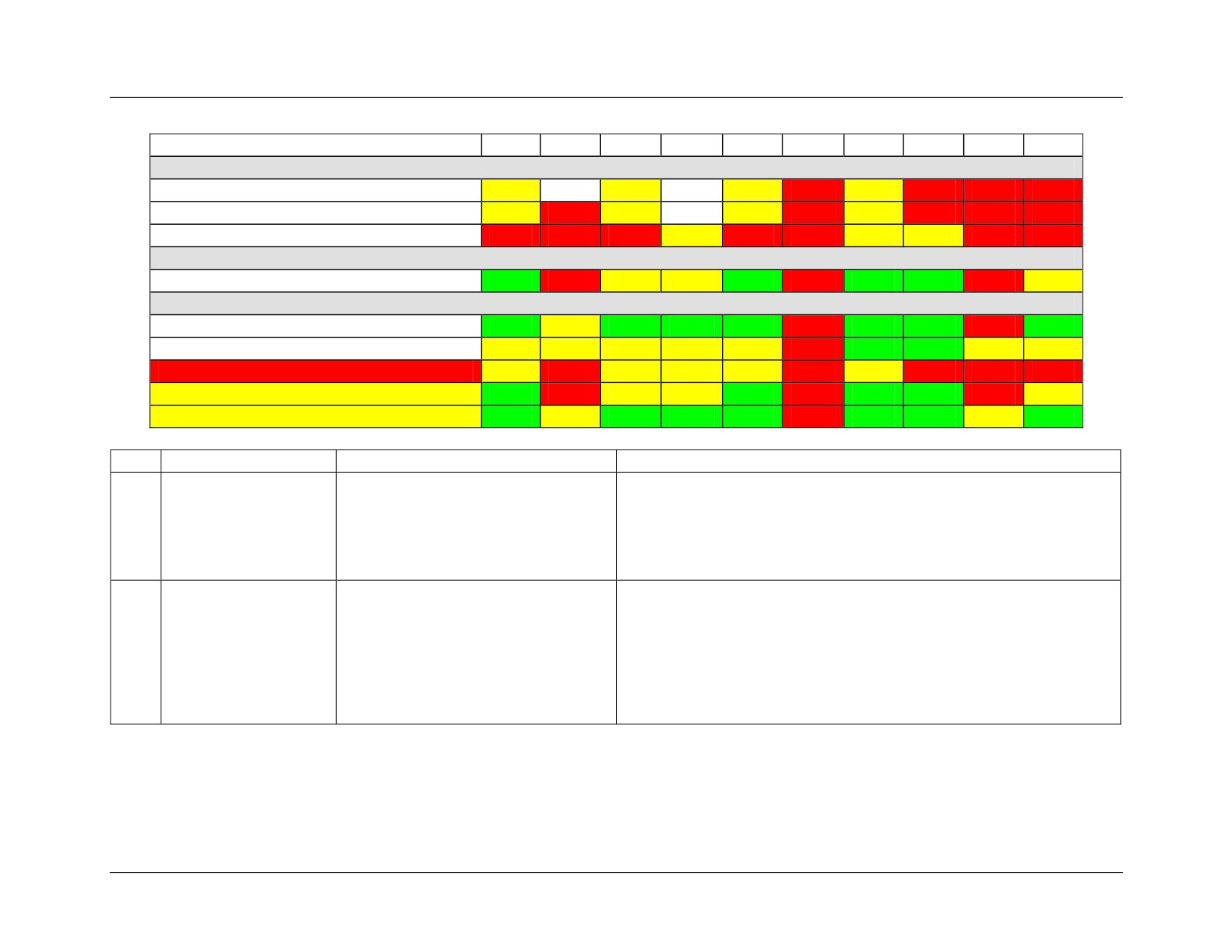
For Official Use Only
CBRND Functional Needs Analysis/Functional Solution Analysis
Chapter 17. Tactical Sustain Tasks
Table 17.19-1. TASUST 19: Capabilities and Deficiencies Assessment
Capabilities
M1
M2
M3
M4
M5
M6
M7
M8
M9
M10
Current
Topical Disinfectant Solutions
51
N/A
52
N/A
53
14
55
06
37
38
HTH/STB
5
39
5
N/A
5
1
5
0
3
3
General Detergent
310
011
312
413
314
1
5
515
3
3
Near/Mid-Term
JPID Increment I
1016
3
717
4
1018
319
920
821
3
722
Far-Term
JPID Increment II
10
523
824
825
10
3
9
8
3
1026
JPDS Increment I/II
727
5
5
4
728
3
9
8
529
7
Current Overall Capabilities
5
3
5
4
5
1
5
230
3
3
Near/Mid-Term Overall Capabilities
10
3
7
5
10
3
9
8
3
7
Far-Term Overall Capabilities
10
5
8
8
10
3
9
8
5
10
FAA Measure
Elaboration
Scale
M1
(Yes/No) Contaminated
Contaminated by-products are controlled.
10: Yes, Complete (100%).
by-products are
Where by-products are less than 100%
7: Yes, Substantial (~75%).
controlled?
controlled, measures must be in place to
5: Yes, Partial (~50%).
prevent cross-contamination from
3: Yes, Minimal (~25%).
becoming an unacceptable hazard.
0: No, Contaminated by-products cannot be controlled and present an
unacceptable hazard.
M2
(Level) Of chemical
The level of chemical contamination is
10: Decontaminate all CWAs, NTAs, TIMs to general population exposure
contamination after
acceptable after decontamination
limits.
decontamination
operations from a starting liquid
7: Decontaminate all CWAs, all NTAs, and some TIMs to a level that will
procedures.
challenge of 1 g/m2). Agents defined as
allow unprotected exposure.
current-generation CWAs, NTAs, TIMs,
5: Decontaminate all CWAs and some NTAs to a level that will allow
and TICs.
unprotected exposure.
3: Decontaminate most CWAs to a level that will allow unprotected exposure.
0: No effective decontaminant or process.
179
For Official Use Only
For Official Use Only
CBRND Functional Needs Analysis/Functional Solution Analysis
Chapter 17. Tactical Sustain Tasks
M3
(Level) Of biological
The level of biological contamination (to
10: 0 CFU/PFU/m2—total removal or neutralization of toxins against all
contamination after
include toxins) is acceptable after
threat agents.
decontamination
decontamination operations from starting
9: 0 CFU/PFU/m2—total removal or neutralization of toxins against nine or
procedures.
challenges of greater than 1.0 ×
more key threat agents.
108 CFU/PFU/m2. Vegetative and
8: 0 CFU/PFU/m2—total removal or neutralization of toxins against eight or
nonvegetative bacteria are measured in
more key threat agents.
CFU/m2, and viruses are measured in
7: 0 CFU/PFU/m2—total removal or neutralization of toxins against seven or
PFU/m2.
more key threat agents.
6: 0 CFU/PFU/m2—total removal or neutralization of toxins against six or
more key threat agents.
5: Less than infective dose levels/casualty-producing toxin exposure levels
against five or more key threat agents.
4: Less than infective dose levels/casualty-producing toxin exposure levels
against four key threat agents.
3: Less than infective dose levels/casualty-producing toxin exposure levels
against three key threat agents.
2: Less than infective dose levels/casualty-producing toxin exposure levels
against two or more key threat agents.
1: Less than infective dose levels/casualty-producing toxin exposure levels
against one key threat agent.
0: More than infective dose levels/casualty-producing toxin exposure levels.
M4
(Level) Of radiological
The level of radiological contamination is
10: Total removal to natural backg1round level.
contamination after
acceptable after decontamination
8: ≤0.11 cGy/hour residual dose rate.
decontamination
operations from a starting challenge of
6: ≤0.22 cGy/hour residual dose rate.
procedures.
0.4 g/m2 of insoluble radioactive
4: <0.33 cGy/hour residual dose rate.
contaminants, 37-200 μm in size and
2: 0.33 cGy residual dose rate.
185 GBq/m2 gamma activity.
0: Removal capabilities limited or ineffective, allowing excessive residual
0.33 cGy/hour equates to an exposure that
dose rates >0.33 cGy.
can cause mild incapacitation in 2.5% or
less of unprotected, not previously
exposed personnel.
M5
(Yes/No) Cross-
Cross-contamination is controlled. Where
10: Yes, Complete (100%).
contamination is
cross-contamination is less than 100%
7: Yes, Substantial (~75%).
controlled?
controlled, measures must be in place to
5: Yes, Partial (~50%).
prevent cross-contamination from
3: Yes, Minimal (~25%).
becoming an unacceptable hazard.
0: No, Cross-contamination cannot be controlled and presents an
unacceptable hazard.
180
For Official Use Only
For Official Use Only
CBRND Functional Needs Analysis/Functional Solution Analysis
Chapter 17. Tactical Sustain Tasks
M6
(Time) To conduct
Time required to conduct thorough
10: Immediately
decontamination.
decontamination on 3000 m2 of surface
9: <15 minutes
area.
8: <30 minutes
7: <45 minutes
6: <1 hour
5: <2 hours
4: <4 hours
3: <6 hours
2: <8 hours
1: <12 hours
0: >12 hours
M7
(Percent) Of interior
The quantity of systems that may be
10: 0%
areas/systems unusable
rendered unserviceable by
9: <1%
due to the effects of
decontamination process must be
8: <2%
decontamination.
minimized.
7: <3%
6: <4%
5: <5%
4: <6%
3: <7%
2: <8%
1: <9%
0: ≥10%
M8
(Percent) Of interior
The quantity of repairs or parts
10: 0%
area/systems and
replacements required due to
9: <1%
contents/materials that
decontamination process must be
8: <2%
require repair or
minimized.
7: <3%
replacement due to the
6: <4%
effects of
5: <5%
decontamination.
4: <6%
3: <7%
2: <8%
1: <9%
0: ≥10%
M9
(Yes/No)
Decontamination procedures must be
10: No negative impacts on operations.
Decontamination
logistically supportable.
7: Limited negative impact on operational capability.
procedures are
5: Moderate negative impact on operational capability.
logistically supportable?
3: Major negative impact on operational capability.
0: Not logistically supportable.
181
For Official Use Only
For Official Use Only
CBRND Functional Needs Analysis/Functional Solution Analysis
Chapter 17. Tactical Sustain Tasks
M10
(Yes/No) There is
Refers to non-materiel elements
10: DOTLPF is adequate for all tasks to be performed with this system
effective DOTLPF in
associated with the execution of a task
without limitations that cause significant impact upon operations.
place to conduct task?
with the system.
7: DOTLPF is adequate for most of the tasks to be performed with this
system without limitations that cause significant impact upon operations.
5: Many critical aspects of DOTLPF for the task to be performed with this
system are addressed.
3: Some critical aspects of DOTLPF for the task to be performed with this
system are addressed.
0: DOTLPF is completely inadequate or does not exist for the tasks to be
performed with this system.
1 M1 - (Yes/No) Contaminated by-products are controlled? 5: Yes, Partial (~50%).
2 M3 - (Level) Of biological contamination after decontamination procedures. 5: Less than infective dose levels/casualty-producing toxin-exposure levels against five or more key
threat agents.
3 M5 - (Yes/No) Cross-contamination is controlled? 5: Yes, Partial (~50%).
4 M6 - (Time) To conduct decontamination. 1: <12 hours.
5 M7 - (Percent) Of interior areas/systems unusable due to the effects of decontamination. 5: <5%.
6 M8 - (Percent) Of interior area/systems and contents/materials that require repair or replacement due to the effects of decontamination. 0: ≥10%.
7 M9 - (Yes/No) Decontamination procedures are logistically supportable? 3: Major negative impact on operational capability.
8 M10 - (Yes/No) There is effective DOTLPF in place to conduct task? 3: Some critical aspects of DOTLPF for the task to be performed with this system are addressed.
9 M2 - (Level) Of chemical contamination after decontamination procedures. 3: Decontaminate most CWAs to a level that will allow unprotected exposure.
10 M1 - (Yes/No) Contaminated by-products are controlled? 3: Yes, Minimal (~25%).
11 M2 - (Level) Of chemical contamination after decontamination procedures. 0: No effective decontaminant or process.
12 M3 - (Level) Of biological contamination after decontamination procedures. 3: Less than infective dose levels/casualty-producing toxin-exposure levels against three key threat
agents.
13 M4 - (Level) Of radiological contamination after decontamination procedures. 4: <0.33 cGy/hour residual dose rate.
14 M5 - (Yes/No) Cross-contamination is controlled? 3: Yes, Minimal (~25%).
15 M8 - (Percent) Of interior area/systems and contents/materials that require repair or replacement due to the effects of decontamination. 5: <5%.
16 M1 - (Yes/No) Contaminated by-products are controlled? 10: Yes, Complete (100%)
17 M3 - (Level) Of biological contamination after decontamination procedures. 7: 0 CFU/PFU/m2—total removal or neutralization of toxins against seven or more key threat
agents.
18 M5 - (Yes/No) Cross-contamination is controlled? 10: Yes, Complete (100%).
19 M6 - (Time) To conduct decontamination. 3: <6 hours.
20 M7 - (Percent) Of interior areas/systems unusable due to the effects of decontamination. 9: <1%.
21 M8 - (Percent) Of interior area/systems and contents/materials that require repair or replacement due to the effects of decontamination. 8: <2%.
22 M10 - (Yes/No) There is effective DOTLPF in place to conduct task? 7: DOTLPF is adequate for most of the tasks to be performed with this system without limitations that
cause significant impact upon operations.
23 M2 - (Level) Of chemical contamination after decontamination procedures. 5: Decontaminate all CWAs, some NTAs to a level that will allow unprotected exposure.
24 M3 - (Level) Of biological contamination after decontamination procedures. 8: 0 CFU/PFU/m2—total removal or neutralization of toxins against eight or more key threat
agents.
25 M4 - (Level) Of radiological contamination after decontamination procedures. 8: ≤0.11 cGy/hour residual dose rate.
26 M10 - (Yes/No) There is effective DOTLPF in place to conduct task? 10: DOTLPF is adequate for all tasks to be performed with this system without limitations that cause
significant impact upon operations.
182
For Official Use Only
For Official Use Only
CBRND Functional Needs Analysis/Functional Solution Analysis
Chapter 17. Tactical Sustain Tasks
27 M1 - (Yes/No) Contaminated by-products are controlled? 7: Yes, Substantial (~75%).
28 M5 - (Yes/No) Cross-contamination is controlled? 7: Yes, Substantial (~75%).
29 M9 - (Yes/No) Decontamination procedures are logistically supportable? 5: Moderate negative impact on operational capability.
30 M8 - (Percent) Of interior area/systems and contents/materials that require repair or replacement due to the effects of decontamination. 1: <9%.
183
For Official Use Only
For Official Use Only
CBRND Functional Needs Analysis/Functional Solution Analysis
Chapter 17. Tactical Sustain Tasks
17.19.3
Functional Solution Analysis
17.19.3.1
DOTLPF Assessment Summary
This section states the deficiencies and suggests potential non-materiel solutions. If there are no
solutions or there are only partial solutions for a particular deficiency, the deficiency is then
reassessed in the IMA section.
1.
Deficiency: Insufficient doctrine to provide specific procedure for interior fixed-facility
immediate decontamination.
Non-Materiel Solutions: Doctrine: Revise current doctrine FM 3-11.34 to include interior
facility immediate, operational, and thorough decontamination. Organization: Organizational
structures (e.g., manning, tasking, etc.) and capabilities to complete immediate
decontamination of facility interiors to including addressing organizational issues (e.g., who
provides CBRND equipment, support forces to train and equip, etc.) related to provision of
CBRND resources to eligible civilians (e.g., civilian contractors, government employees.
etc.). Training: Institutional and unit-level training and evaluations, including participation
by surrounding civil authorities as appropriate, for facility interior immediate
decontamination. Personnel: Requirements eligible civilians supporting the mission meet
minimum standards for use of CBRND equipment. Facilities: Designate supporting
infrastructure for conducting decontamination and residual management.
2.
Deficiency: Runoff may be contaminated.
Non-Materiel Solutions: Doctrine (partial): Modify doctrine to consider contaminated
runoff as an operational consideration. Doctrine should address how to dispose of or
neutralize runoff. Training (partial): Modify training to consider contaminated runoff as an
operational consideration. Training should address how to dispose of or neutralize runoff.
3.
Deficiency: Decontaminants incompatible with each other.
Non-Materiel Solutions: Doctrine (partial): Change doctrine to provide procedures so that
decontaminants can be used in series in some way that will reduce the ill effects of the
incompatibility. Training (partial): Modify soldier training to ensure understanding of the
incompatibilities and the solutions.
4.
Deficiency: Many decontaminants are toxic and corrosive (HTH/STB/paraformaldehyde,
etc.).
Non-Materiel Solutions: None.
5.
Deficiency: Peroxyacetic acid is caustic and corrosive at concentrations of 10% or greater.
Non-Materiel Solutions: None.
6.
Deficiency: Peroxyacetic acid can be used on only hard surfaces.
Non-Materiel Solutions: None.
7.
Deficiency: Flushing does not neutralize agents.
Non-Materiel Solutions: None.
184
For Official Use Only
For Official Use Only
CBRND Functional Needs Analysis/Functional Solution Analysis
Chapter 17. Tactical Sustain Tasks
8. Deficiency: Some use of decontaminants requires additional operator protection.
Non-Materiel Solutions: Training (partial): Institutional and unit-level training in CBRND
protective equipment for decontamination operations Personnel (partial): Requirements
eligible civilians supporting the mission meet minimum standards for use of CBRND
equipment.
9. Deficiency: Areas difficult to reach for decontamination.
Non-Materiel Solutions: None.
10. Deficiency: Toxic agent sodium bisulfate is used to break down the chlorine dioxide gas.
Non-Materiel Solutions: None.
11. Deficiency: Chlorine dioxide can produce architectural damage, damage to electrical
equipment, and/or produce strain resistance to antimicrobials.
Non-Materiel Solutions: None.
12. Deficiency: Radiological contamination removal is time-intensive.
Non-Materiel Solutions: None.
13. Deficiency: Ventilation decontamination will require more time and extensive labor and
costs.
Non-Materiel Solutions: Doctrine (partial): Develop doctrine for fixed facility interior
decontamination to ensure efficient, cost-effective operations Training (partial): Train
individuals on fixed-facility interior decontamination procedures.
14. Deficiency: Time/labor/high cost-intensive.
Non-Materiel Solutions: None.
15. Deficiency: Inability to decontaminate porous materials.
Non-Materiel Solutions: None.
17.19.3.2
IMA Assessment Summary
Table 17.19-2 identifies which of the materiel approaches might address specific materiel gaps
identified in the DOTMLPF assessment.
185
For Official Use Only
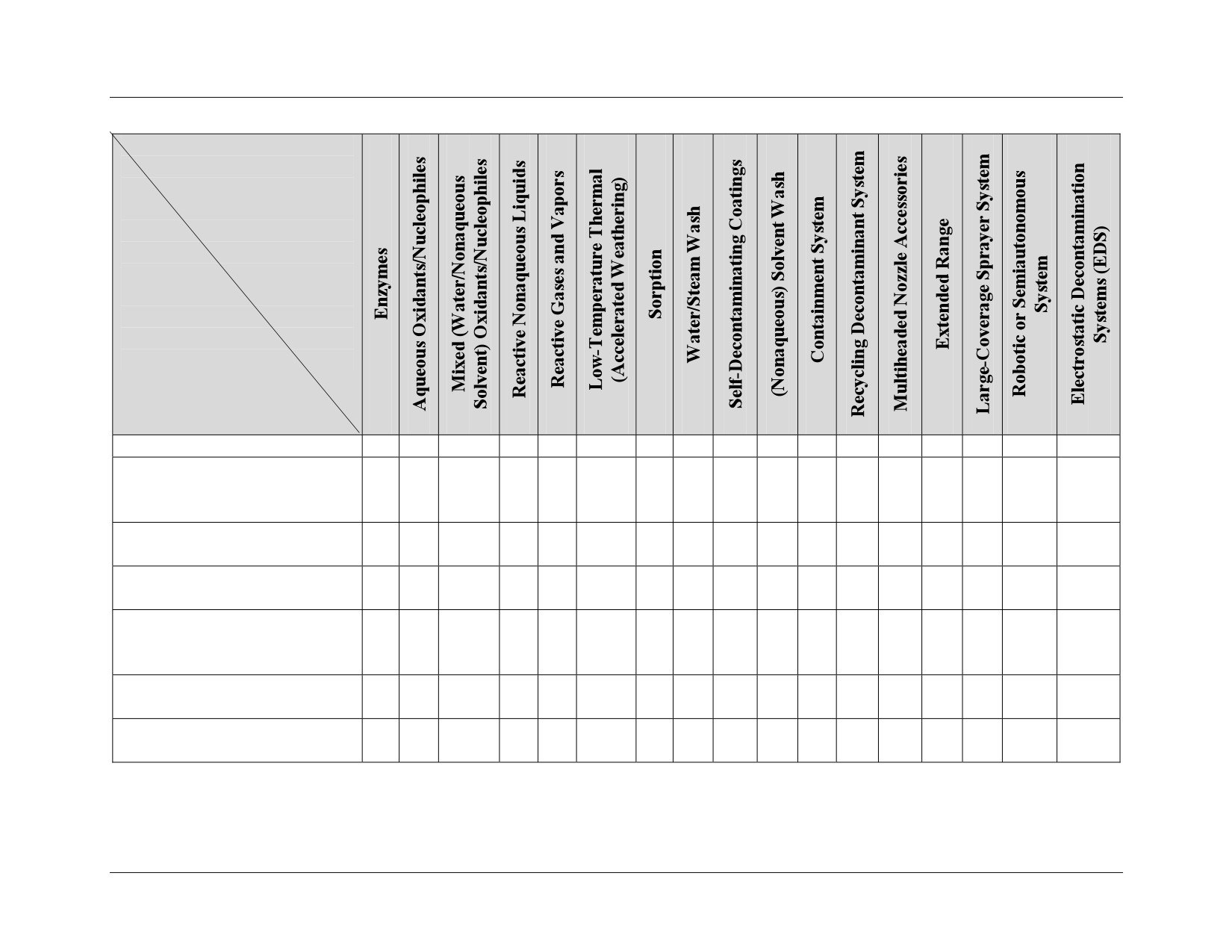
For Official Use Only
CBRND Functional Needs Analysis/Functional Solution Analysis
Chapter 17. Tactical Sustain Tasks
Table 17.19-31. TASUST 19: IMA Assessment
Ideas for Materiel
Approaches
(IMA)
Identified Gaps
Runoff may be contaminated.
X
X
X
X
X
X
Many decontaminants are
toxic and corrosive (HTH/
X
X
X
X
X
X
X
X
X
X
X
STB/paraformaldehyde, etc.)
Areas difficult to reach for
X
X
X
X
decontamination.
Radiological contamination
X
X
X
X
removal is time-intensive.
Ventilation decontamination
will require more time and
X
X
X
X
extensive labor and costs.
Time/labor/high cost-
X
X
X
X
X
X
X
X
X
X
X
X
X
X
intensive.
Inability to decontaminate
X
X
porous materials.
186
For Official Use Only
For Official Use Only
CBRND Functional Needs Analysis/Functional Solution Analysis
Chapter 17. Tactical Sustain Tasks
17.20 Task TASUST 20: Decontaminate open areas
17.20.1
Functional Area Analysis
17.20.1.1
Definition
To decontaminate terrain that must be occupied or cannot otherwise be avoided.
17.20.1.2
Derivation
UJTL (TA 7, TA 7.1), Protection Joint Functional Concept.
17.20.1.2.1
Supported Tasks: OPSUST 8, OPSUST 11
17.20.1.2.2
Lateral Task: TASHA 24
17.20.1.2.3
Supporting Task: N/A
17.20.1.3
Condition
Perform this task under conditions of:
Physical
1. Tropical, arctic, and arid climate. (C1.3.1)
2. All seasons. (C1.3.1.1)
3. Precipitating and stormy weather. (C1.3.1.3)
4. Hot and very cold air temperature. (C1.3.1.3.1)
5. Liquid, freezing, and frozen precipitation. (C1.3.1.3.6.1)
6. Negligible light. (C1.3.2.1)
7. Nuclear effects (C1.3.3.1)
8. Chemical effects. (C1.3.3.2)
9. Biological effects. (C1.3.3.3)
10. Variety of surfaces to be decontaminated (i.e., soil, concrete).
Military
1. Stressful mission. (C2.1)
2. Marginal forces allocated. (C2.2.3)
3. Low personnel capability. (C2.2.4)
4. Negligible personnel experience. (C2.2.4.5)
5. Severe personnel fatigue. (C2.2.4.6)
6. Limited, little, or no lift assets. (C2.5.2)
7. Little or no reception facilities. (C2.5.4.1)
8. Little pier space. (C2.5.4.1.1)
9. Little or no bed-down facilities. (C2.5.4.2.1)
10. Limited or no host-nation support. (C2.8.5)
187
For Official Use Only
For Official Use Only
CBRND Functional Needs Analysis/Functional Solution Analysis
Chapter 17. Tactical Sustain Tasks
11. Ambiguous threat existence. (C2.9.3)
Civil
1. Disputed legality. (C3.1.1.4)
2. Adversarial media relations. (C3.1.1.5)
3. Limited or negative foreign government support. (C3.1.2.3)
4. Aggressively opposed foreign public opinion. (C3.1.2.4)
5. Moderate mission priority. (C3.1.3.2)
6. Presence of internationally significant cultural sites. (C3.2.4)
17.20.2
Functional Needs Analysis
17.20.2.1
Capabilities and Deficiencies Assessment Summary
Table 17.20-1 presents individual and overall current, near-/mid-term, and far-term capabilities
to perform the task to the designated standard. There are five current capabilities used to
accomplish this task and two projected capabilities to be added in the future.
Current, Near/Mid-Term Capabilities and Deficiencies
The current capabilities and deficiencies associated with the decontamination of terrain include
weathering, flushing with water, soil removal, covering and neutralizing with appropriate
decontaminants. Deficiencies include the requirement for large amounts of personnel, equipment
and time, as well as the ineffectiveness of the process.
Projected Far-Term Capabilities and Deficiencies
The projected far-term capabilities and deficiencies evaluated were associated with JSTDS-SS
Increment II and JSTDS-LS Increments I and II.
188
For Official Use Only
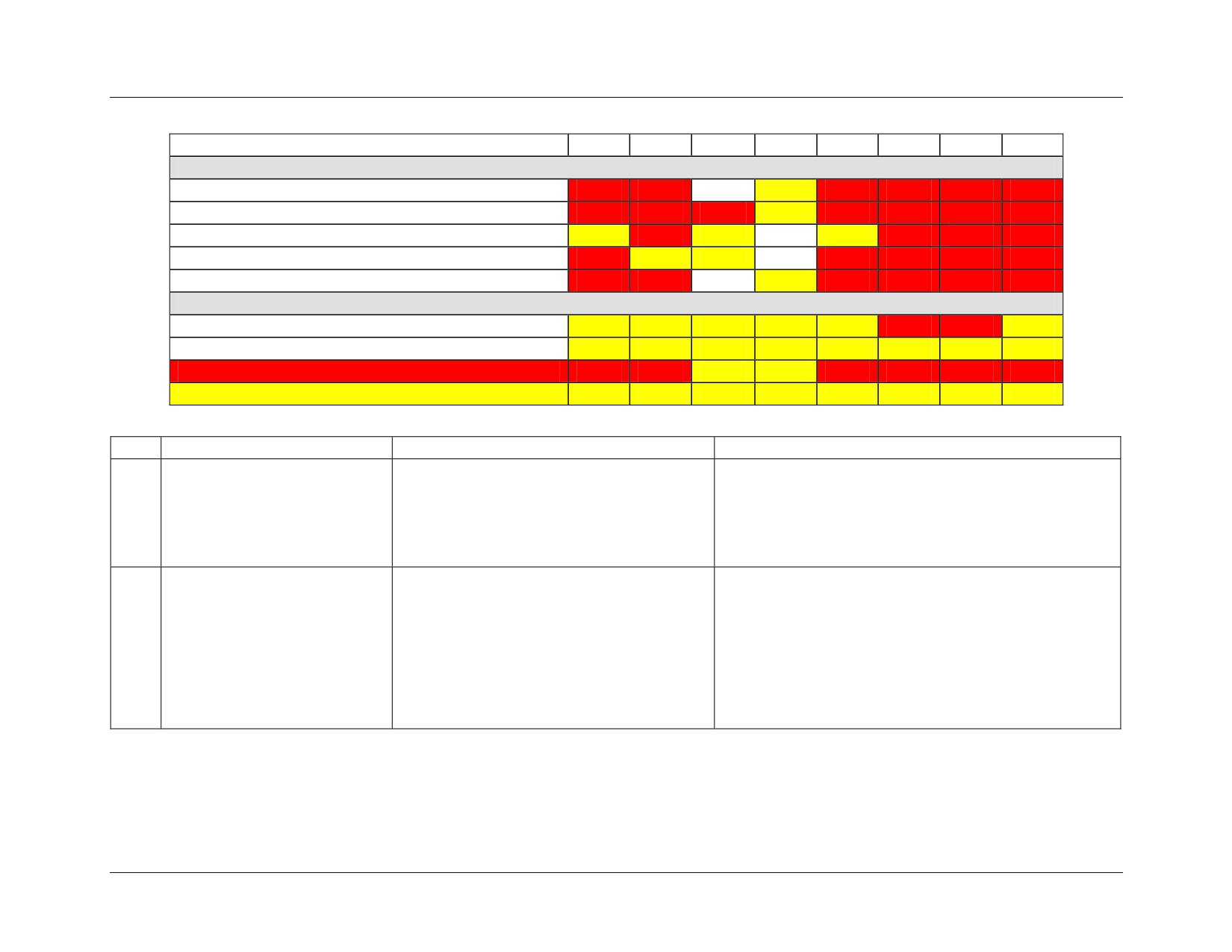
For Official Use Only
CBRND Functional Needs Analysis/Functional Solution Analysis
Chapter 17. Tactical Sustain Tasks
Table 17.20-1. TASUST 20: Capabilities and Deficiencies Assessment
Capabilities
M1
M2
M3
M4
M5
M6
M7
M8
Current
Covering
31
02
N/A
43
34
35
06
37
Hot Soapy Water
3
0
08
4
3
3
39
3
STB/HTH
510
311
512
N/A
513
3
3
3
Burning
3
514
5
N/A
3
3
3
3
Removal
3
0
N/A
4
3
015
0
3
Far-Term
JSTDS-SS Increment II
7
5
5
4
7
3
3
5
JSTDS-LS Increment I/II
7
5
5
4
7
516
517
718
Current /Near/Mid-Term Overall Capabilities
3
3
5
4
3
3
3
3
Far-Term Overall Capabilities
7
5
5
4
7
5
5
7
FAA Measure
Elaboration
Scale
M1
(Yes/No) Contaminated by-
Contaminated by-products are controlled. Where
10: Yes, Complete (100%).
products are controlled?
by-products are less than 100% controlled,
7: Yes, Substantial (~75%).
measures must be in place to prevent cross-
5: Yes, Partial (~50%).
contamination from becoming an unacceptable
3: Yes, Minimal (~25%).
hazard.
0: No, Contaminated by-products cannot be controlled and
present an unacceptable hazard.
M2
(Level) Of chemical
The level of chemical contamination is
10: Decontaminate all CWAs, NTAs, TIMs to general
contamination after
acceptable after decontamination operations
population exposure limits.
decontamination procedures.
from a starting liquid challenge of 10 g/m2.
7: Decontaminate all CWAs, all NTAs, and some TIMs to a
Agents defined as current-generation CWAs,
level that will allow unprotected exposure.
NTAs, TIMs, and TICs.
5: Decontaminate all CWAs and some NTAs to a level that
will allow unprotected exposure.
3: Decontaminate most CWAs to a level that will allow
unprotected exposure.
0: No effective decontaminant or process.
189
For Official Use Only
For Official Use Only
CBRND Functional Needs Analysis/Functional Solution Analysis
Chapter 17. Tactical Sustain Tasks
M3
(Level) Of biological
The level of biological contamination (to include
10: 0 CFU/PFU/m2—total removal or neutralization of toxins
contamination after
toxins) is acceptable after decontamination
against all threat agents.
decontamination procedures.
operations from starting challenges of greater
9: 0 CFU/PFU/m2—total removal or neutralization of toxins
than 1.0 × 10⁸ CFU/ PFU/m2. Vegetative and
against nine or more key threat agents.
nonvegetative bacteria are measured in CFU/m2,
8: 0 CFU/PFU/m2—total removal or neutralization of toxins
and viruses are measured in PFU/m2.
against eight or more key threat agents.
7: 0 CFU/PFU/m2—total removal or neutralization of toxins
against seven or more key threat agents.
6: 0 CFU/PFU/m2—total removal or neutralization of toxins
against six or more key threat agents.
5: Less than infective dose levels/casualty-producing toxin
exposure levels against five or more key threat agents.
4: Less than infective dose levels/casualty-producing toxin
exposure levels against four key threat agents.
3: Less than infective dose levels/casualty-producing toxin
exposure levels against three key threat agents.
2: Less than infective dose levels/casualty-producing toxin
exposure levels against two or more key threat agents.
1: Less than infective dose levels/casualty-producing toxin
exposure levels against one key threat agent.
0: More than infective dose levels/casualty-producing toxin
exposure levels.
M4
(Level) Of radiological
The level of radiological contamination is
10: Total removal to natural backg1round level.
contamination after
acceptable after decontamination operations
8: <0.11 cGy/hour residual dose rate.
decontamination procedures.
from a starting challenge of 0.4 g/m2 of
6: <0.22 cGy/hour residual dose rate.
insoluble radioactive contaminants, 37-200 μm
4: <0.33 cGy residual dose rate.
in size and 185 GBq/m2 gamma activity. 0.33
2: 0.33 cGy/hour residual dose rate.
cGy/hour equates to an exposure that can cause
0: Removal capabilities limited or ineffective, allowing
mild incapacitation in 2.5% or less of
excessive residual dose rates >0.33 cGy.
unprotected, not previously exposed personnel.
M5
(Yes/No) Cross-contamination is
Cross-contamination is controlled. Where cross-
10: Yes, Complete (100%).
controlled?
contamination is less than 100% controlled,
7: Yes, Substantial (~75%).
measures must be in place to prevent cross-
5: Yes, Partial (~50%).
contamination from becoming an unacceptable
3: Yes, Minimal (~25%).
hazard.
0: No, Cross-contamination cannot be controlled and presents
an unacceptable hazard.
190
For Official Use Only
For Official Use Only
CBRND Functional Needs Analysis/Functional Solution Analysis
Chapter 17. Tactical Sustain Tasks
M6
(Yes/No) Decontamination
Decontamination procedures must be logistically
10: No negative impacts on operations.
procedures are logistically
supportable.
7: Limited negative impact on operational capability.
supportable?
5: Moderate negative impact on operational capability.
3: Major negative impact on operational capability.
0: Not logistically supportable.
M7
(Time) To conduct
Time required to decontaminate 10,000 m2 of
10: Immediately
decontamination.
surface area.
9: <15 minutes
8: <30 minutes
7: <45 minutes
6: <1 hour
5: <2 hours
4: <3 hours
3: <4 hours
2: <8 hours
1: <12 hours
0: >12 hours
M8
(Yes/No) There is effective
Refers to non-materiel elements associated with
10: DOTLPF is adequate for all tasks to be performed with
DOTLPF in place to conduct
the execution of a task with the system.
this system without limitations that cause significant impact
task?
upon operations.
7: DOTLPF is adequate for most of the tasks to be performed
with this system without limitations that cause significant
impact upon operations.
5: Many critical aspects of DOTLPF for the task to be
performed with this system are addressed.
3: Some critical aspects of DOTLPF for the task to be
performed with this system are addressed.
0: DOTLPF is completely inadequate or does not exist for the
tasks to be performed with this system.
1 M1 - (Yes/No) Contaminated by-products are controlled? 3: Yes, Minimal (~25%).
2 M2 - (Level) Of chemical contamination after decontamination procedures. 0: No effective decontaminant or process.
3 M4 - (Level) Of radiological contamination after decontamination procedures. 4: <0.33 cGy residual dose rate.
4 M5 - (Yes/No) Cross-contamination is controlled? 3: Yes, Minimal (~25%).
5 M6 - (Yes/No) Decontamination procedures are logistically supportable? 3: Major negative impact on operational capability.
6 M7 - (Time) To conduct decontamination. 0: >12 hours.
7 M8 - (Yes/No) There is effective DOTLPF in place to conduct task? 3: Some critical aspects of DOTLPF for the task to be performed with this system are addressed.
8 M3 - (Level) Of biological contamination after decontamination procedures. 0: More than infective dose levels/casualty-producing toxin-exposure levels.
9 M7 - (Time) To conduct decontamination. 3: <4 hours.
10 M1 - (Yes/No) Contaminated by-products are controlled? 5: Yes, Partial (~50%).
11 M2 - (Level) Of chemical contamination after decontamination procedures. 3: Decontaminate most CWAs to a level that will allow unprotected exposure.
191
For Official Use Only
For Official Use Only
CBRND Functional Needs Analysis/Functional Solution Analysis
Chapter 17. Tactical Sustain Tasks
12 M3 - (Level) Of biological contamination after decontamination procedures. 5: Less than infective dose levels/casualty-producing toxin-exposure levels against five or more key
threat agents.
13 M5 - (Yes/No) Cross-contamination is controlled? 5: Yes, Partial (~50%).
14 M2 - (Level) Of chemical contamination after decontamination procedures. 5: Decontaminate all CWAs, some NTAs to a level that will allow unprotected exposure.
15 M6 - (Yes/No) Decontamination procedures are logistically supportable? 0: Not logistically supportable.
16 M6 - (Yes/No) Decontamination procedures are logistically supportable? 5: Moderate negative impact on operational capability.
17 M7 - (Time) To conduct decontamination. 5: <2 hours.
18 M8 - (Yes/No) There is effective DOTLPF in place to conduct task? 7: DOTLPF is adequate for most of the tasks to be performed with this system without limitations that
cause significant impact upon operations.
192
For Official Use Only
For Official Use Only
CBRND Functional Needs Analysis/Functional Solution Analysis
Chapter 17. Tactical Sustain Tasks
17.20.3
Functional Solution Analysis
17.20.3.1
DOTLPF Assessment Summary
This section states the deficiencies and suggests potential non-materiel solutions. If there are no
solutions or there are only partial solutions for a particular deficiency, the deficiency is then
reassessed in the IMA section.
1.
Deficiency: No capability to respond and deliver decontaminant in a timely manner.
Partial Non-Materiel Solutions: Doctrine/Training (partial): Develop doctrine and training
to ensure efficient response.
2.
Deficiency: Time required for weathering may be extensive.
Non-Materiel Solutions: Doctrine (partial): Modify doctrine to include more specific
procedures for weathering of terrain. Training (partial): Train individuals on weathering
risks, processes, and procedures.
3.
Deficiency: Removing significant amounts of contaminated soil are time, labor and materiel
intensive.
Non-Materiel Solutions: None.
4.
Deficiency: Use of STB slurry is time- and material-sensitive.
Non-Materiel Solutions: None.
5.
Deficiency: Lack of efficient applicators for large areas.
Non-Materiel Solutions: None.
6.
Deficiency: Flushing is less effective against thickened agents.
Non-Materiel Solutions: None.
7.
Deficiency: Covering is only applicable to alpha and some beta emitters, ineffective for
gamma emitters.
Non-Materiel Solutions: Doctrine: Develop procedures to quickly and effectively remove
gamma hazards.
17.20.3.2
IMA Assessment Summary
There are four physical processes and five chemical processes as well as containment and a
recycle system that are applicable for the decontamination of personnel. Table 17.20-2 identifies
which of the materiel approaches might address specific materiel gaps identified in the
DOTMLPF assessment.
193
For Official Use Only
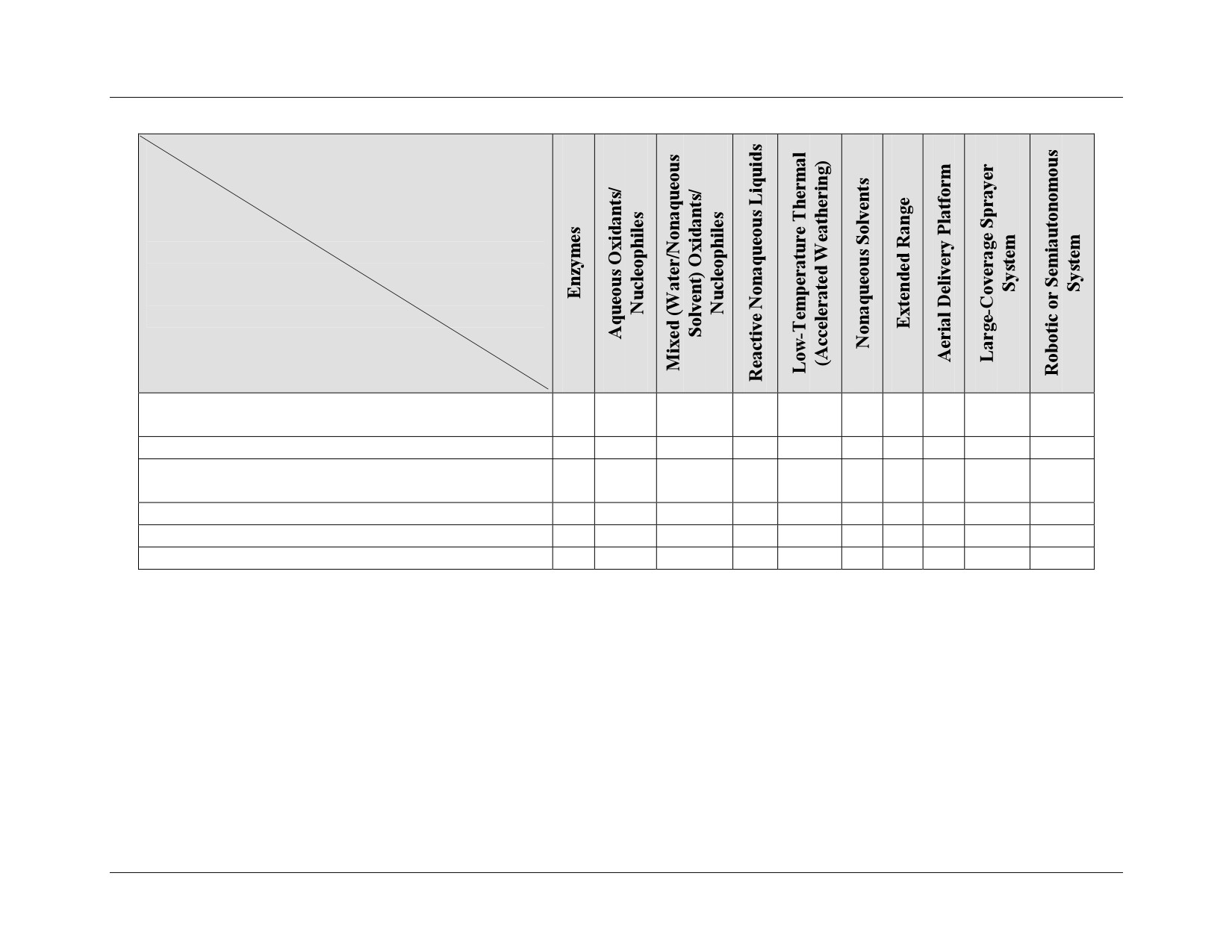
For Official Use Only
CBRND Functional Needs Analysis/Functional Solution Analysis
Chapter 17. Tactical Sustain Tasks
Table 17.20-2. TASUST 20: IMA Assessment
Ideas for Materiel
Approaches
(IMA)
Identified Gaps
Covering is applicable only to alpha and some beta
X
emitters, ineffective for gamma emitters.
Agent may eventually penetrate covering.
X
Removing significant amounts of contaminated soil
X
X
X
X
X
X
X
X
is time-, labor-, and materiel-intensive.
Use of STB slurry is time- and material-sensitive.
X
X
X
X
X
X
Flushing is less effective against thickened agents.
X
X
X
X
X
Lack of efficient applicators for large areas.
X
X
X
X
X
X
X
X
194
For Official Use Only
For Official Use Only
CBRND Functional Needs Analysis/Functional Solution Analysis
Chapter 17. Tactical Sustain Tasks
17.21 Task TASUST 21: Decontaminate cargo and supplies, including POL, ammunition,
and packaged food
17.21.1
Functional Area Analysis
17.21.1.1
Definition
To decontaminate pallets, containers, and their packaging materials, along with supplies such as
petroleum, oil, and lubricants (POL); ammunition; and packaged food. Includes minimizing
effects of contaminants and decontaminants on operations.
17.21.1.2
Derivation
UJTL (TA 7, TA 7.1), Protection Joint Functional Concept.
17.21.1.2.1
Supported Tasks: OPSUST 8, OPSUST 11
17.21.1.2.2
Lateral Task: TASHA 24
17.21.1.2.3
Supporting Task: N/A
17.21.1.3
Condition
Perform this task under conditions of:
Physical
1. Extremely rough sea state. (C1.2.1.3)
2. Tropical, arctic, and arid climate. (C1.3.1)
3. All seasons. (C1.3.1.1)
4. Precipitating and stormy weather. (C1.3.1.3)
5. Hot and very cold air temperature. (C1.3.1.3.1)
6. Liquid, freezing, and frozen precipitation. (C1.3.1.3.6.1)
7. Negligible light. (C1.3.2.1)
8. Nuclear effects. (C1.3.3.1)
9. Chemical effects. (C1.3.3.2)
10. Biological effects. (C1.3.3.3)
Military
1. Stressful mission. (C2.1)
2. Location—ashore/afloat. (C2.1.4.1)
3. Minimal to short time available. (C2.1.5)
4. Marginal forces allocated. (C2.2.3)
5. Some to no interoperability. (C2.2.6)
6. Low personnel capability. (C2.2.4)
7. Negligible personnel experience. (C2.2.4.5)
195
For Official Use Only
For Official Use Only
CBRND Functional Needs Analysis/Functional Solution Analysis
Chapter 17. Tactical Sustain Tasks
8. Severe personnel fatigue. (C2.2.4.6)
9. Limited, little, or no lift assets. (C2.5.2)
10. Negligible CONUS resupply. (C2.8.3)
11. Limited or no host-nation support. (C2.8.5)
12. Limited or negligible commercial procurement. (C2.8.6)
13. Ambiguous threat existence. (C2.9.3)
Civil
1. Limited or negative foreign government support. (C3.1.2.3)
2. Aggressively opposed foreign public opinion. (C3.1.2.4)
3. Moderate mission priority. (C3.1.3.2)
17.21.2
Functional Needs Analysis
17.21.2.1
Capabilities and Deficiencies Assessment Summary
Table 17.21-1 presents individual and overall current, near-/mid-term, and far-term capabilities
to perform the task to the designated standard. There are 10 current capabilities used to
accomplish this task and one projected capability to be added in the future.
Current Capabilities and Deficiencies
The current capabilities and deficiencies associated with the decontamination of cargo and
supplies (including POL, ammunition, and packaged food). According to subject matter experts,
the decontamination of fuel is not required. For the others, weathering is the principal capability
if time allows; however, alternatives include the use of STB, HTH, and soap and water applied
with appropriate applicators or scrub brushes and wipes. Many of these decontaminants are
corrosive and may have damaging effects. Weathering is time-consuming.
Projected Near/Mid-Term Capabilities and Deficiencies
In the near/mid-term future, the introduction of the JSTDS decontamination system will provide
specified decontaminants, if required, capable of rapidly decontaminating CBRN/TIM hazards
from the surfaces of cargo and supplies (including POL, ammunition, and packaged food).
Projected Far-Term Capabilities and Deficiencies
In the far-term future, the JSTDS decontamination system will provide specified
decontaminants, if required, capable of rapidly decontaminating CBRN/TIM hazards on
cargo and supplies (including POL, ammunition, and packaged food).
196
For Official Use Only
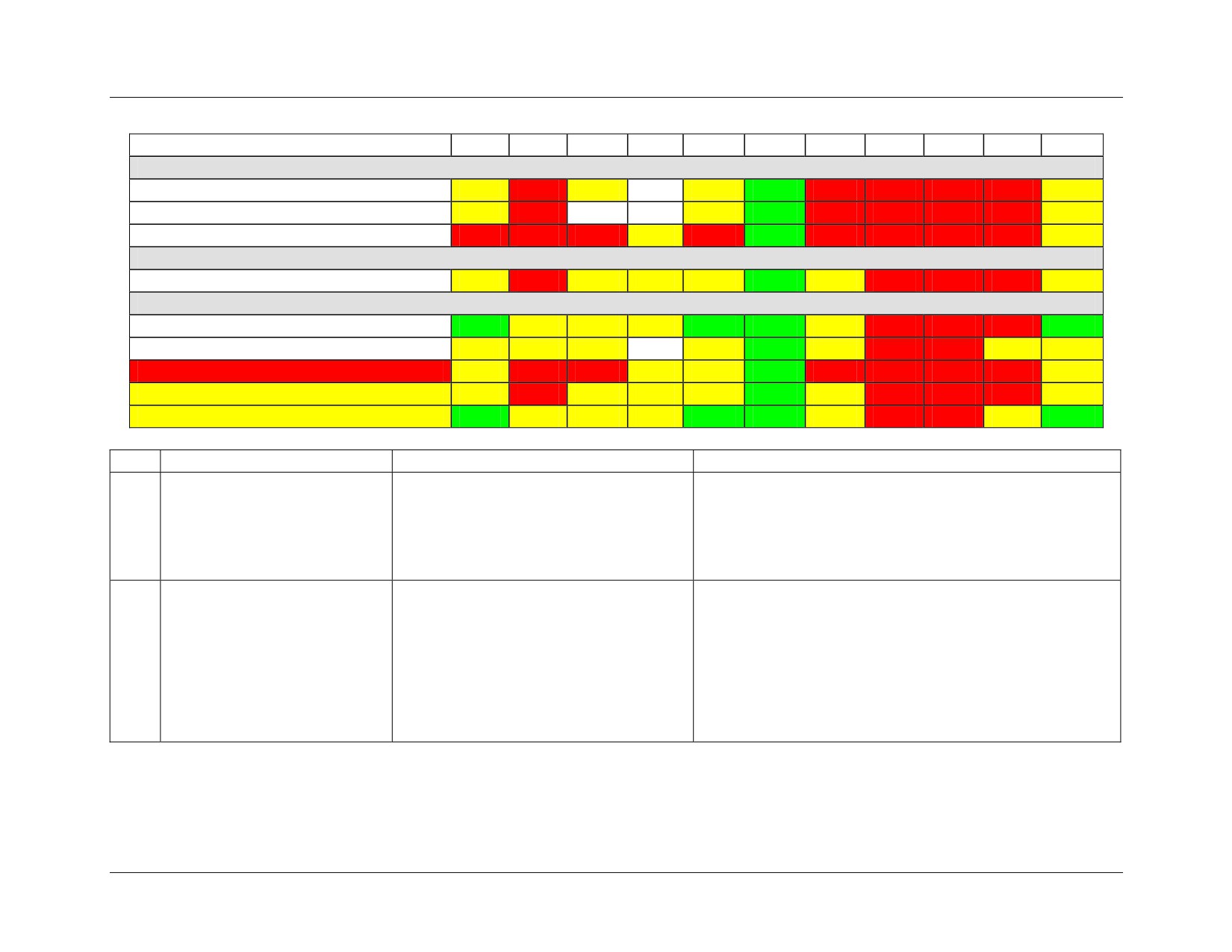
For Official Use Only
CBRND Functional Needs Analysis/Functional Solution Analysis
Chapter 17. Tactical Sustain Tasks
Table 17.21-1. TASUST 21: Capabilities and Deficiencies Assessment
Capabilities
M1
M2
M3
M4
M5
M6
M7
M8
M9
M10
M11
Current
STB/HTH
71
32
53
N/A
74
85
16
07
08
39
510
M100 SDS
7
3
N/A
N/A
7
911
1
0
0
3
5
Hot soapy water
312
013
314
415
316
8
1
0
0
3
5
Near/Mid-Term
JSTDS-SS Increment I
7
3
5
4
7
8
517
0
0
3
718
Far-Term
JSTDS-SS Increment II
1019
520
5
4
1021
8
5
0
0
3
1022
JPDS Increments I/II
7
5
5
N/A
7
9
5
0
0
523
7
Current Overall Capabilities
7
3
3
4
7
8
1
0
0
3
5
Near/Mid-Term Overall Capabilities
7
3
5
4
7
8
5
0
0
3
7
Far-Term Overall Capabilities
10
5
5
4
10
8
5
0
0
5
10
FAA Measure
Elaboration
Scale
M1
(Yes/No) Contaminated by-
Contaminated by-products are controlled.
10: Yes, Complete (100%).
products are controlled?
Where by-products are less than 100%
7: Yes, Substantial (~75%).
controlled, measures must be in place to
5: Yes, Partial (~50%).
prevent cross-contamination from becoming
3: Yes, Minimal (~25%).
an unacceptable hazard.
0: No, Contaminated by-products cannot be controlled and
present an unacceptable hazard.
M2
(Level) Of chemical
The level of chemical contamination is
10: Decontaminate all CWAs, NTAs, TIMs to general population
contamination after
acceptable after decontamination operations
exposure limits.
decontamination procedures.
from a starting liquid challenge of 10 g/m2.
7: Decontaminate all CWAs, all NTAs, and some TIMs to a level
Agents defined as current-generation CWAs,
that will allow unprotected exposure.
NTAs, TIMs, and TICs.
5: Decontaminate all CWAs and some NTAs to a level that will
allow unprotected exposure.
3: Decontaminate most CWAs to a level that will allow
unprotected exposure.
0: No effective decontaminant or process.
197
For Official Use Only
For Official Use Only
CBRND Functional Needs Analysis/Functional Solution Analysis
Chapter 17. Tactical Sustain Tasks
M3
(Level) Of biological
The level of biological contamination (to
10: 0 CFU/PFU/m2—total removal or neutralization of toxins
contamination after
include toxins) is acceptable after
against all threat agents.
decontamination procedures.
decontamination operations from starting
9: 0 CFU/PFU/m2—total removal or neutralization of toxins
challenges of greater than 1.0 × 10⁸ CFU/
against nine or more key threat agents.
PFU/m2. Vegetative and nonvegetative
8: 0 CFU/PFU/m2—total removal or neutralization of toxins
bacteria are measured in CFU/m2, and
against eight or more key threat agents.
viruses are measured in PFU/m2.
7: 0 CFU/PFU/m2—total removal or neutralization of toxins
against seven or more key threat agents.
6: 0 CFU/PFU/m2—total removal or neutralization of toxins
against six or more key threat agents.
5: Less than infective dose levels/casualty-producing toxin
exposure levels against five or more key threat agents.
4: Less than infective dose levels/casualty-producing toxin
exposure levels against four key threat agents.
3: Less than infective dose levels/casualty-producing toxin
exposure levels against three key threat agents.
2: Less than infective dose levels/casualty-producing toxin
exposure levels against two or more key threat agents.
1: Less than infective dose levels/casualty-producing toxin
exposure levels against one key threat agent.
0: More than infective dose levels/casualty-producing toxin
exposure levels.
M4
(Level) Of radiological
The level of radiological contamination is
10: Total removal to natural backg1round level.
contamination after
acceptable after decontamination operations
8: ≤0.11 cGy/hour residual dose rate.
decontamination procedures.
from a starting challenge of 0.4 g/m2 of
6: ≤0.22 cGy/hour residual dose rate.
insoluble radioactive contaminants, 37-
4: <0.33 cGy/hour residual dose rate.
200 μm in size and 185 GBq/m2 gamma
2: 0.33 cGy/hour residual dose rate.
activity. 0.33 cGy/hour equates to an
0: Removal capabilities limited or ineffective, allowing excessive
exposure that can cause mild incapacitation
residual dose rates >0.33 cGy.
in 2.5% or less of unprotected, not previously
exposed personnel.
M5
(Yes/No) Cross-contamination is
Cross-contamination is controlled. Where
10: Yes, Complete (100%).
controlled?
cross-contamination is less than 100%
7: Yes, Substantial (~75%).
controlled, measures must be in place to
5: Yes, Partial (~50%).
prevent cross-contamination from becoming
3: Yes, Minimal (~25%).
an unacceptable hazard.
0: No, Cross-contamination cannot be controlled and presents an
unacceptable hazard.
198
For Official Use Only
For Official Use Only
CBRND Functional Needs Analysis/Functional Solution Analysis
Chapter 17. Tactical Sustain Tasks
M6
(Time) To initiate
Initiate thorough decontamination procedures
10: Immediately
decontamination procedures.
within adequate amount of time.
9: 15 minutes
8: 30 minutes
7: 45 minutes
6: <1 hour
5: <2 hours
4: <3 hours
3: <4 hours
2: <5 hours
1: <6 hours
0: >6 hours
M7
(Time) To conduct
Time required per item for thorough
10: Immediately
decontamination procedures.
decontamination.
9: <1 minute
8: <2 minutes
7: <3 minutes
6: <4 minutes
5: <5 minutes
4: <7 minutes
3: <9 minutes
2: <12 minutes
1: <15 minutes
0: >15 minutes
M8
(Percent) Of cargo/supplies
The quantity of cargo/supplies that may be
10: 0%
unusable due to the effects of
rendered unserviceable by decontamination
9: <1%
decontamination.
process must be minimized.
8: <2%
7: <3%
6: <4%
5: <5%
4: <6%
3: <7%
2: <8%
1: <9%
0: ≥10%
199
For Official Use Only
For Official Use Only
CBRND Functional Needs Analysis/Functional Solution Analysis
Chapter 17. Tactical Sustain Tasks
M9
(Percent) Of cargo/supplies that
The quantity of repairs or parts replacements
10: 0%
require repair or replacement due
required due to decontamination process
9: <1%
to the effects of decontamination.
must be minimized.
8: <2%
7: <3%
6: <4%
5: <5%
4: <6%
3: <7%
2: <8%
1: <9%
0: ≥10%
M10
(Yes/No) Decontamination
Decontamination procedures must be
10: No negative impacts on operations.
procedures are logistically
logistically supportable.
7: Limited negative impact on operational capability.
supportable?
5: Moderate negative impact on operational capability.
3: Major negative impact on operational capability.
0: Not logistically supportable.
M11
There is effective DOTLPF in
Refers to non-materiel elements associated
10: DOTLPF is adequate for all tasks to be performed with this
place to conduct task?
with the execution of a task with the system.
system without limitations that cause significant impact upon
operations.
7: DOTLPF is adequate for most of the tasks to be performed
with this system without limitations that cause significant impact
upon operations.
5: Many critical aspects of DOTLPF for the task to be performed
with this system are addressed.
3: Some critical aspects of DOTLPF for the task to be performed
with this system are addressed.
0: DOTLPF is completely inadequate or does not exist for the
tasks to be performed with this system.
1 M1 - (Yes/No) Contaminated by-products are controlled? 7: Yes, Substantial (~75%).
2 M2 - (Level) Of chemical contamination after decontamination procedures. 3: Decontaminate most CWAs to a level that will allow unprotected exposure.
3 M3 - (Level) Of biological contamination after decontamination procedures. 5: Less than infective dose levels/casualty-producing toxin-exposure levels against five or more key
threat agents.
4 M5 - (Yes/No) Cross-contamination is controlled? 7: Yes, Substantial (~75%).
5 M6 - (Time) To initiate decontamination procedures. 8: 30 minutes.
6 M7 - (Time) To conduct decontamination procedures. 1: <15 minutes.
7 M8 - (Percent) Of cargo/supplies unusable due to the effects of decontamination. 0: ≥10%.
8 M9 - (Percent) Of cargo/supplies that require repair or replacement due to the effects of decontamination. 0: ≥10%.
9 M10 - (Yes/No) Decontamination procedures are logistically supportable? 3: Major negative impact on operational capability.
10 M11 - There is effective DOTLPF in place to conduct task? 5: Many critical aspects of DOTLPF for the task to be performed with this system are addressed.
11 M6 - (Time) To initiate decontamination procedures. 9: 15 minutes.
200
For Official Use Only
For Official Use Only
CBRND Functional Needs Analysis/Functional Solution Analysis
Chapter 17. Tactical Sustain Tasks
12 M1 - (Yes/No) Contaminated by-products are controlled? 3: Yes, Minimal (~25%).
13 M2 - (Level) Of chemical contamination after decontamination procedures. 0: No effective decontaminant or process.
14 M3 - (Level) Of biological contamination after decontamination procedures. 3: Less than infective dose levels/casualty-producing toxin-exposure levels against three key threat
agents.
15 M4 - (Level) Of radiological contamination after decontamination procedures. 4: <0.33 cGy/hour residual dose rate.
16 M5 - (Yes/No) Cross-contamination is controlled? 3: Yes, Minimal (~25%).
17 M7 - (Time) To conduct decontamination procedures. 5: <5 minutes.
18 M11 - There is effective DOTLPF in place to conduct task? 7: DOTLPF is adequate for most of the tasks to be performed with this system without limitations that cause
significant impact upon operations.
19 M1 - (Yes/No) Contaminated by-products are controlled? 10: Yes, Complete (100%).
20 M2 - (Level) Of chemical contamination after decontamination procedures. 5: Decontaminate all CWAs, some NTAs to a level that will allow unprotected exposure.
21 M5 - (Yes/No) Cross-contamination is controlled? 10: Yes, Complete (100%).
22 M11 - There is effective DOTLPF in place to conduct task? 10: DOTLPF is adequate for all tasks to be performed with this system without limitations that cause significant
impact upon operations.
23 M10 - (Yes/No) Decontamination procedures are logistically supportable? 5: Moderate negative impact on operational capability.
201
For Official Use Only
For Official Use Only
CBRND Functional Needs Analysis/Functional Solution Analysis
Chapter 17. Tactical Sustain Tasks
17.21.3
Functional Solution Analysis
17.21.3.1
DOTLPF Assessment Summary
This section states the deficiencies and suggests potential non-materiel solutions. If there are no
solutions or there are only partial solutions for a particular deficiency, the deficiency is then
reassessed in the IMA section.
1. Deficiency: Some decontaminants may damage sensitive parts on ammunition.
Non-Materiel Solutions: None.
2.
2 Deficiency: Decontaminants, such as STB/HTH, may remove critical markings or corrode
ammunition.
Non-Materiel Solutions: Doctrine (partial): Modify doctrine to include more detailed
ammunition-specific decontamination protocol.
3. Deficiency: Weathering is time-consuming.
Non-Materiel Solutions: Doctrine (partial): Modify doctrine to include specific weathering
procedures.
4. Deficiency: Cargo support items such as netting and wood pallets may absorb chemical
agents.
Non-Materiel Solutions: None.
17.21.3.2
IMA Assessment Summary
Table 17.21-2 identifies which of the materiel approaches might address specific materiel gaps
identified in the DOTMLPF assessment.
202
For Official Use Only
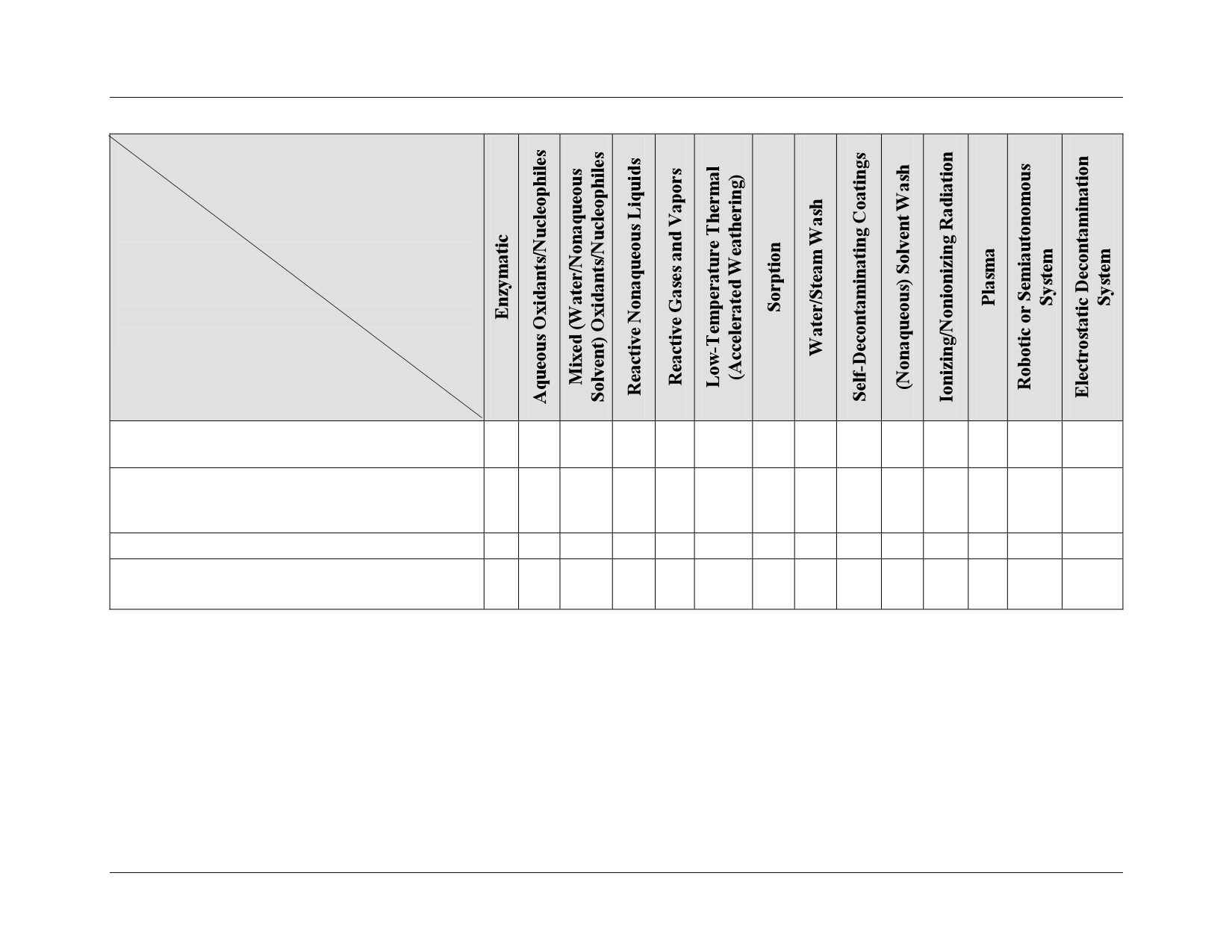
For Official Use Only
CBRND Functional Needs Analysis/Functional Solution Analysis
Chapter 17. Tactical Sustain Tasks
Table 17.21-2 TASUST 21: IMA Assessment
Ideas for Materiel
Approaches
(IMA)
Identified Gaps
Some decontaminants may damage sensitive
X
X
X
X
X
X
X
X
X
X
X
X
X
X
parts on ammunition.
Decontaminants, such as STB/HTH, may
remove critical markings or corrode
X
X
X
X
X
X
X
X
X
X
X
X
ammunition.
Weathering is time-consuming.
X
X
X
X
X
X
X
X
X
X
X
X
X
Cargo support items such as netting and wood
X
X
X
X
pallets may absorb chemical agents.
203
For Official Use Only
For Official Use Only
CBRND Functional Needs Analysis/Functional Solution Analysis
Chapter 17. Tactical Sustain Tasks
17.22 Task TASUST 22: Conduct transload operations
17.22.1
Functional Area Analysis
17.22.1.1
Definition
To support force deployment and sustainment operations by conducting the transload of cargo
and passengers. This task includes the movement of cargo/passengers from uncontaminated to
contaminated lift platforms for subsequent movement into contaminated air/sea ports of
debarkation. Retrograde cargo and redeploying passengers departing contaminated areas must be
thoroughly decontaminated to meet internationally accepted decontamination standards (when
available).
17.22.1.2
Derivation
UJTL (ST 1.1.2, ST4, ST4.2.2.2, ST8.4.3, ST9.4), Air Mobility Operations In a Chemical and
Biological Environment.
17.22.1.2.1
Supported Task: OPSUST 11
17.22.1.2.2
Lateral Task: N/A
17.22.1.2.3
Supporting Task: N/A
17.22.1.3
Condition
Perform this task under conditions of:
Physical
1. Extremely rough sea state. (C1.2.1.3)
2. Tropical, arctic, and arid climate. (C1.3.1)
3. All seasons. (C1.3.1.1)
4. Precipitating and stormy weather. (C1.3.1.3)
5. Hot and very cold air temperature. (C1.3.1.3.1)
6. Liquid, freezing, and frozen precipitation. (C1.3.1.3.6.1)
7. Negligible light. (C1.3.2.1)
8. Persistent CBRN effects. (C1.3.3.1-3)
Military
1. Stressful mission. (C2.1)
2. Marginal forces allocated. (C2.2.3
3. Some or no interoperability. (C2.2.6)
4. Low personnel capability. (C2.2.4)
5. Negligible personnel experience. (C2.2.4.5)
6. Severe personnel fatigue. (C2.2.4.6)
204
For Official Use Only
For Official Use Only
CBRND Functional Needs Analysis/Functional Solution Analysis
Chapter 17. Tactical Sustain Tasks
7. Limited, little, or no lift assets (C2.5.2)
8. Limited or no host-nation support. (C2.8.5)
9. Ambiguous treat existence. (C2.9.3)
Civil
Limited or negative foreign government support. (C3.1.2.3)
Aggressively opposed foreign public opinion. (C3.1.2.4)
High mission priority. (C3.1.2.4)
17.22.2
Functional Needs Analysis
17.22.2.1
Capabilities and Deficiencies Assessment Summary
Table 17.22-1 shows the capabilities and deficiencies associated with conducting isolation
operations. Capabilities encompass the component or unit commander establishing specific plans
and executing transload operations following directives passed down from the joint task force
(JTF) commander. Deficiencies include limited resources to conduct transload operations.
Current Capabilities and Deficiencies
The component or unit commander must plan and execute a transload operation, which
comprises the transfer of cargo and personnel from a strategic aircraft into a tactical aircraft.
Table 17.22-1 shows overall capabilities and deficiencies associated with conducting transload
operations. Deficiencies include the lack of developed plans to conduct transload operations.
Other deficiencies involve the lack of preexisting agreements that allow forces to cross borders
and utilize host-nation or foreign nation’s assets. In addition, personnel lack training in the
conduct of transload operations. The overall current capability is “yellow.”
Projected Near/Mid-Term Capabilities and Deficiencies
No foreseeable change in capability in the near/mid term. The overall capability in the near/mid
term remains “yellow.”
Projected Far-Term Capabilities and Deficiencies
Improvements in decontamination capability and the incorporation of the results of exercises and
experiments will improve DOTLPF in the far term. Overall capability will improve to “green.”
205
For Official Use Only
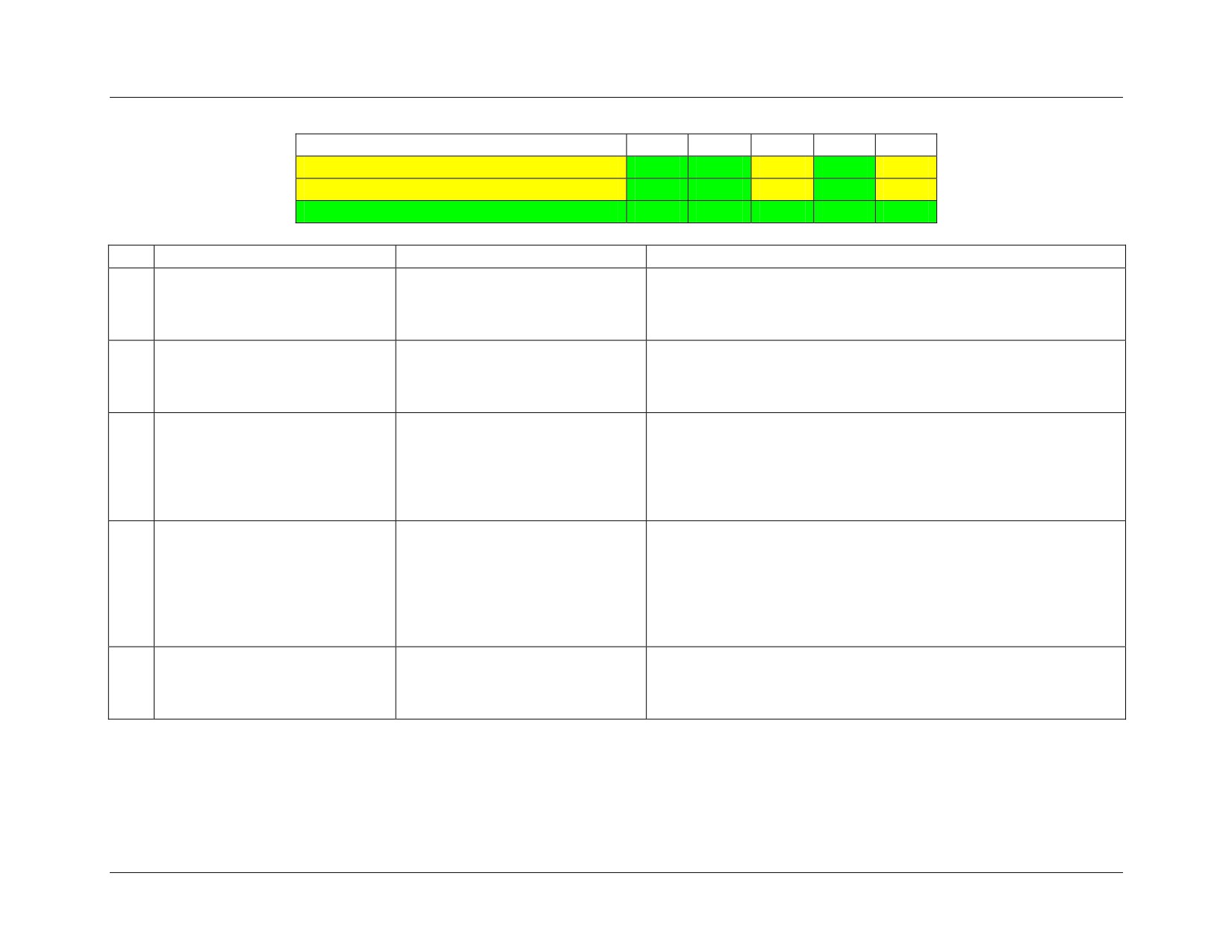
For Official Use Only
CBRND Functional Needs Analysis/Functional Solution Analysis
Chapter 17. Tactical Sustain Tasks
Table 17.22-1. TASUST 22: Capabilities and Deficiencies Assessment
Capability: Transload Operations
M1
M2
M3
M4
M5
Current Overall Capabilities
8
8
6
8
6
Near/Mid-Term Overall Capabilities
8
8
6
8
6
Far-Term Overall Capabilities
8
8
10
8
10
FAA Measure
Elaboration
Scale
M1
Clean and contaminated zones are
The establishment of clean and
8-10: Full capability to establish clean and contaminated zones.
established at the transload site to
contaminated zones at the transload
4-7: Partial capability to establish clean and contaminated zones.
separate clean and dirty lift assets,
site used to separate clean and dirty
1-3: Limited capability to establish clean and contaminated zones.
cargo, and passengers.
lift assets, cargo, and passengers.
0: No capability to establish clean and contaminated zones.
M2
An exchange zone is established to
The establishment of exchange zones
8-10: Full capability to establish an exchange zone.
prevent the spread of contaminants.
at the transload site is used to
4-7: Partial capability to establish an exchange zone.
prevent the spread of contamination.
1-3: Limited capability to establish an exchange zone.
0: No capability to establish an exchange zone.
M3
Retrograde cargo and redeploying
The cargo and personnel (OCONUS)
8-10: Full capability to decontaminate cargo and personnel.
personnel at the transload site are
are decontaminated to internationally
4-7: Partial capability to decontaminate cargo and personnel.
decontaminated to internationally
accepted standards (when available)
1-3: Limited capability to decontaminate cargo and personnel.
accepted standards (when
by the assigned decontamination
0: No capability to decontaminate cargo and personnel.
available) by the unit of
unit.
assignment.
M4
Cargo/passenger transload site is
The cargo and/or passenger transload
8-10: Full capability to identify transload site.
identified for transload of
site is identified for transload of
4-7: Partial capability to identify transload site.
deploying forces and sustainment
deploying forces and sustainment
1-3: Limited capability to identify transload site.
cargo from uncontaminated to
cargo from uncontaminated to
0: No capability to identify transload site.
contaminated lift assets for
contaminated lift assets for
movement into contaminated ports
movement into contaminated ports of
of debarkation.
debarkation or final destination.
M5
There is effective DOTLPF in place
Assessment of the extent of
8-10: Complete DOTLPF in place to execute task.
to conduct task.
DOTLPF to enable task
4-7: Partial DOTLPF in place to execute task.
performance.
1-3: Limited DOTLPF in place to execute task.
0: No DOTLPF in place to execute task.
206
For Official Use Only
For Official Use Only
CBRND Functional Needs Analysis/Functional Solution Analysis
Chapter 17. Tactical Sustain Tasks
17.22.3 Functional Solution Analysis
17.22.3.1
DOTLPF Assessment Summary
This section addresses the deficiencies and suggests potential non-materiel solutions. If there are
no non-materiel solutions, or there are only partial solutions, the remaining non-materiel need is
then stated. Materiel needs are assessed in the IMA section.
1. Deficiency: Lack of training to support transload operations.
Non-Materiel Solutions: Training: Develop new training programs that will provide
knowledge, skills, and abilities for units conducting transload operations. Programs include
training areas and facilities for units to stay proficient and rehearse various transload mission
scenarios.
2. Deficiency: Lack of defined treaties and agreements to allow transload operations.
Non-Materiel Solutions: Doctrine: Develop treaties and agreements with coalition nations
and host-nations to support transload operations. Facilities: The agreements must include
crossing borders and the execution of missions to conduct transload operations such as
airfield utilization.
17.22.3.2
IMA Assessment Summary
The analysis of this task has determined the need for non-materiel solutions only, and therefore
no IMAs are required.
207
For Official Use Only
For Official Use Only
CBRND Functional Needs Analysis/Functional Solution Analysis
Chapter 17. Tactical Sustain Tasks
17.23 Task TASUST 23: Produce potable water in a contaminated environment
17.23.1
Functional Area Analysis
17.23.1.1
Definition
To produce potable water from a contaminated source. The spectrum includes individual means
of production as well as large-scale efforts.
17.23.1.2
Derivation
UJTL (TA 7, TA 7.1), Protection Joint Functional Concept.
17.23.1.2.1
Supported Tasks: OPSUST 8, OPSUST 11
17.23.1.2.2
Lateral Task: N/A
17.23.1.2.3
Supporting Task: N/A
17.23.1.3
Condition
Perform this task under conditions of:
Physical
1. Somewhat accessible subsurface water. (C1.1.2.3)
2. High saline content. (C1.2.1.5)
3. Great ocean ice thickness. (C1.2.1.11)
4. Arctic and arid climate. (C1.3.1)
5. Very cold air temperature. (C1.3.1.3.1)
6. Nuclear effects. (C1.3.3.1)
7. Chemical effects. (C1.3.3.2)
8. Biological effects. (C1.3.3.3)
Military
1. Stressful mission. (C2.1)
2. Location—ashore/afloat. (C2.1.4.1)
3. Minimal to short time available. (C2.1.5)
4. Marginal forces allocated. (C2.2.3)
5. Low personnel capability. (C2.2.4)
6. Severe personnel fatigue. (C2.2.4.6)
7. Some or no interoperability. (C2.2.6)
8. Limited, little, or no lift assets. (C2.5.2)
9. Limited or no host-nation support. (C2.8.5)
10. Limited or negligible commercial procurement. (C2.8.6)
11. Ambiguous threat existence. (C2.9.3)
208
For Official Use Only
For Official Use Only
CBRND Functional Needs Analysis/Functional Solution Analysis
Chapter 17. Tactical Sustain Tasks
Civil
1. Limited or negative foreign government support. (C3.1.2.3)
2. High mission priority. (C3.1.3.2)
17.23.2
Functional Needs Analysis
17.23.2.1
Capabilities and Deficiencies Assessment Summary
Table 17.23-1 shows the current capabilities and deficiencies for the production of potable water.
Capabilities include reverse osmosis, batch chlorination, and filtering. Deficiencies include the
inability to purify chemically and radiologically contaminated water on an individual basis as
well as a limited number of reverse osmosis water purification units (ROWPUs) with centralized
production and distribution.
Current Capabilities and Deficiencies
Reverse osmosis is a purification process in which filtered water is pumped against a
semipermeable membrane under great pressure. The membrane allows product water to pass
through while rejecting the impurities, both suspended and dissolved. Extremely high pressures
must be used to get a useful volume of water passing through a unit area of membrane. Chlorine
is the disinfectant agent usually specified for military use. Presently, this is the only widely
accepted agent that destroys organisms in water and leaves an easily detectable residual that
serves as a tracer element. Sudden disappearance of chlorine residual signals potential
contamination in the system. No other available disinfectant is as acceptable or adaptable for
potable water treatment operations as chlorine. A major disadvantage is that chlorine reacts with
certain organic compounds to form trihalomethanes, a known carcinogen. Table 17.23-1 lists the
overall capabilities and deficiencies associated with the bulk water production (reverse osmosis
and chemical means) and whether the means are adequate for current operations. Individual and
small unit water production is nonexistent for chemically and radiological contaminated water.
There are currently no projected capabilities being assessed that would increase effectiveness in
conducting and completing this task.
Projected Near/Mid-Term Capabilities and Deficiencies
No foreseeable change in capability in the near/mid term.
Projected Far-Term Capabilities and Deficiencies
No foreseeable change in capability in the far term.
209
For Official Use Only
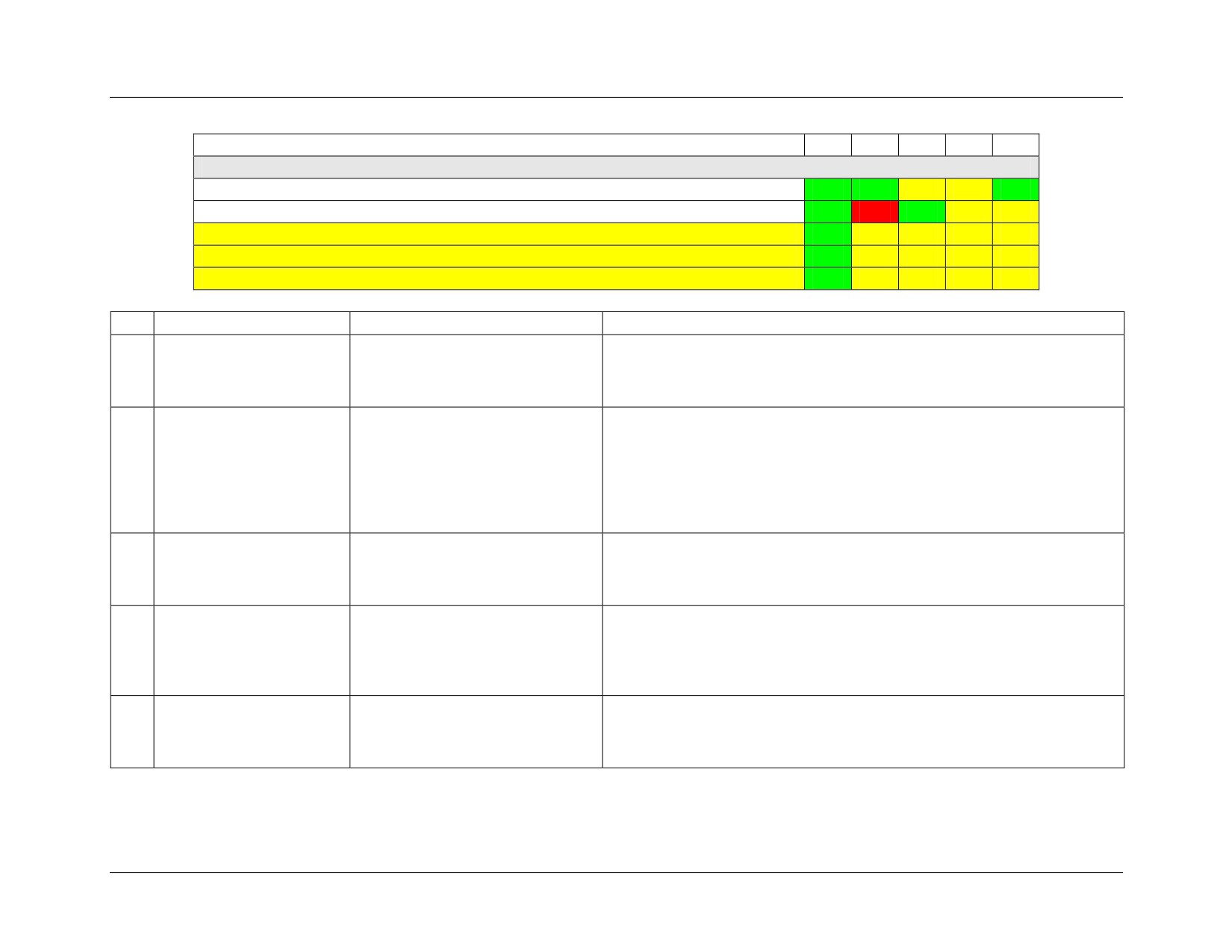
For Official Use Only
CBRND Functional Needs Analysis/Functional Solution Analysis
Chapter 17. Tactical Sustain Tasks
Table 17.23-1. TASUST 23: Capabilities and Deficiencies Assessment
System/Measure
M1
M2
M3
M4
M5
Current
Reverse Osmosis Water Purification Unit (Chemical, Biological, Radiological)
8
10
6
6
8
Chemical Disinfectants (Biological) Chlorination
8
3
8
6
6
Current Overall Capabilities
8
7
7
6
7
Near/Mid-Term Overall Capabilities
8
7
7
6
7
Far-Term Overall Capabilities
8
7
7
6
7
FAA Measure
Elaboration
Scale
M1
Volume/time to complete
Assessment of the acceptability of
8-10: Acceptable throughput to meet operational requirement.
decontamination process.
water throughput rates to meet
4-7: Marginal throughput to meet operational requirement.
operational requirement.
1-3: Limited throughput to meet operational requirement.
0: Throughput does not meet operational requirement.
M2
Water is potable.
Extent to which capability yields
8-10: Capability yields potable water in all circumstances and under full range
potable water under varying
of contaminants.
circumstances and in the presence of
4-7: Capability yields potable water under most circumstances and with most
range of contaminants.
contaminants.
1-3: Capability yields potable water only under select circumstances or for
select contaminants.
0: Capability is ineffective in producing potable water.
M3
Decontamination procedures
Extent to which decontamination
8-10: Capability and procedures are fully supportable.
are logistically supportable.
procedures are logistically
4-7: Capability and procedures are somewhat supportable.
supportable.
1-3: Capability and procedures can only be supported with great effort.
0: Capability and procedures are not logistically supportable.
M4
Coordination exists with
Extent to which coordination is
8-10: Complete coordination with all assets (leadership, medical, logistics, etc.).
water purification assets.
performed with all purification
4-7: Partial coordination.
assets, including unit leadership,
1-3: Limited coordination.
medical, logistics, and purification
0: No coordination of assets.
unit.
M5
There is effective DOTLPF
Extent to which DOTLPF exists to
8-10: Complete DOTLPF in place to execute task.
in place to conduct task.
support execution of the task.
4-7: Partial DOTLPF in place to execute task.
1-3: Limited DOTLPF in place to execute task.
0: No DOTLPF in place to execute task.
210
For Official Use Only
For Official Use Only
CBRND Functional Needs Analysis/Functional Solution Analysis
Chapter 17. Tactical Sustain Tasks
17.23.3
Functional Solution Analysis
17.23.3.1
DOTLPF Assessment Summary
This section addresses the deficiencies and suggests potential non-materiel solutions. If there are
no non-materiel solutions, or there are only partial solutions, the remaining non-materiel need is
then stated. Materiel needs are assessed in the IMA section.
1. Deficiency: No individual capability to purify water that has been contaminated by chemical
or radioactive materials.
Non-Materiel Solutions: None.
2. Deficiency: The number of ROWPUs and centralized distribution and production are limited.
Non-Materiel Solutions: Doctrine: Increased use of bottled and brick water sources in lieu
of additional water purification teams and equipment could provide additional water supplies
at the expense of heavy logistical burdens in transportation and distributions. Personnel:
Additions of personnel and equipment could reduce loads placed on existing teams.
3. Deficiency: Current chemical disinfectants do not neutralize some spores. (Biological)
Non-Materiel Solutions: None.
17.23.3.2
IMA Assessment Summary
Table 17.23-2 identifies which of the materiel approaches might address specific materiel gaps
identified in the DOTMLPF assessment.
211
For Official Use Only
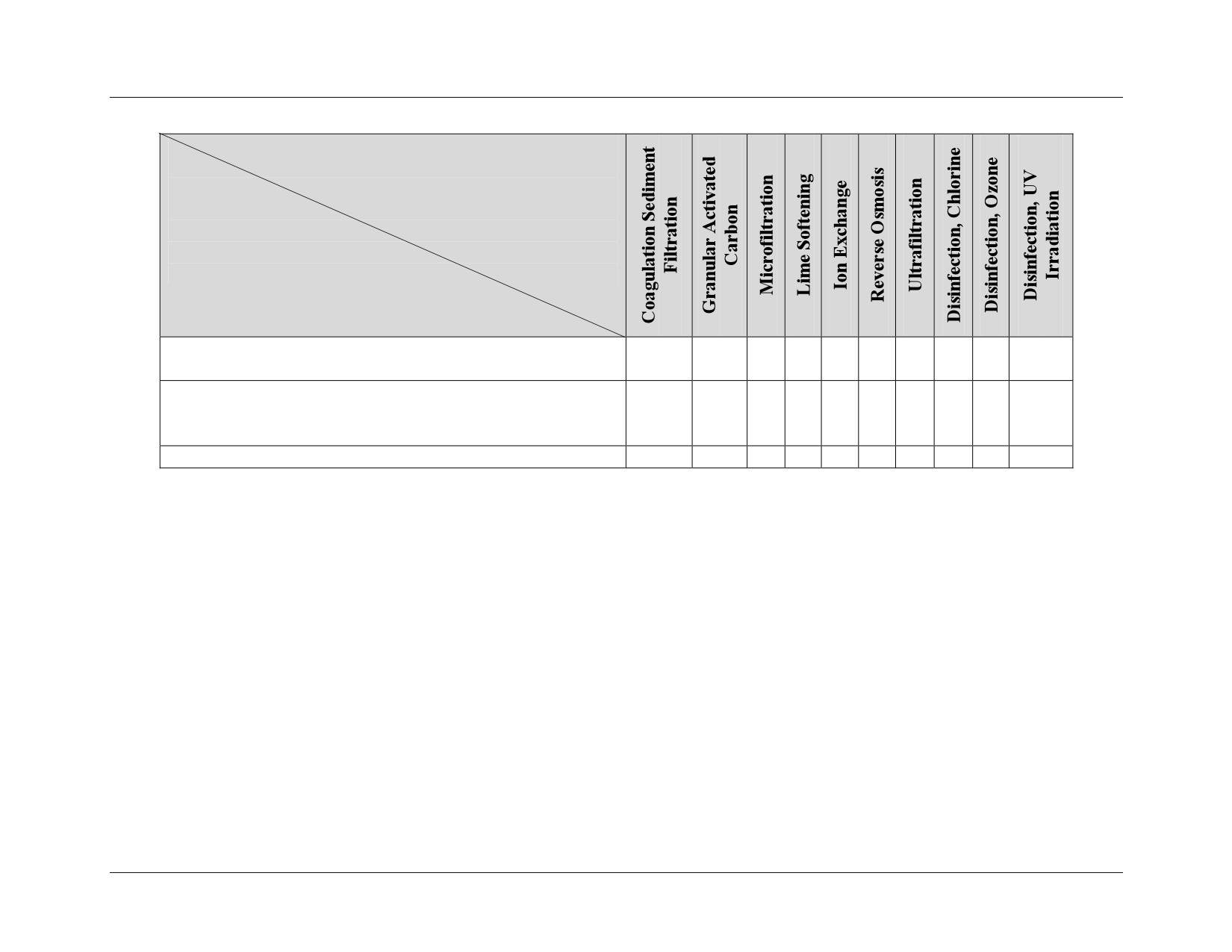
For Official Use Only
CBRND Functional Needs Analysis/Functional Solution Analysis
Chapter 17. Tactical Sustain Tasks
Table 17.23-2. TASUST 23: IMA Assessment
Ideas for Materiel
Approaches
(IMA)
Identified Gaps
No individual capability to purify water that has been
X
X
X
X
contaminated by chemical or radioactive materials.
Limited number of ROWPUs and centralized distribution
and production. (More efficient field-expedient replacement
X
X
X
X
X
X
X
X
X
X
with a lighter, logistical tail possibly portable).
Does not neutralize some spores. (Biological)
X
X
X
X
X
X
X
212
For Official Use Only
For Official Use Only
CBRND Functional Needs Analysis/Functional Solution Analysis
Chapter 17. Tactical Sustain Tasks
17.24 Task TASUST 24: Conduct tactical risk assessment of units, equipment, facilities,
activities, or terrain that are contaminated for restoration prioritization and timing
17.24.1
Functional Area Analysis
17.24.1.1
Definition
To assess units, equipment, facilities, activities, or terrain that are contaminated to determine
restoration prioritization and whether or not the timing of such operations must be modified to fit
the tactical situation. The component commander makes this assessment in the context of his
tactical priorities. Decisions are designed to preserve operational tempo.
17.24.1.2
Derivation
OPSUST 3.
17.24.1.2.1
Supported Tasks: OPSUST 1, OPSUST 6, OPSUST 8, OPSUST 9, OPSUST 10,
OPSUST 11
17.24.1.2.2
Lateral Task: TASHA 6
17.24.1.2.3
Supporting Task: N/A
17.24.1.3
Condition
Perform this task under conditions of:
Physical
1. Persistent CBR effects. (C1.3.3.1-3)
Military
1. Stressful mission. (C2.1)
2. No mission preparation. (C2.1.3)
3. Negligible personnel experience. (C2.2.4.5)
4. Moderate rear-area security. (C2.7.1)
5. Fully developed state of conflict. (C2.10.1)
Civil
1. Limited foreign government support. (C3.1.2.3)
213
For Official Use Only
For Official Use Only
CBRND Functional Needs Analysis/Functional Solution Analysis
Chapter 17. Tactical Sustain Tasks
17.24.2
Functional Needs Analysis
17.24.2.1
Capabilities and Deficiencies Assessment Summary
Table 17.24-1 discusses the capability that currently exists to perform the task to the designated
standard. Any tactical unit staff has a team of operational planners and command and control
specialists and most have CBRN subject matter experts. This team of experts has the skill to
conduct tactical risk assessment of units, equipment, facilities, activities, or terrain that are
contaminated for restoration prioritization and timing, but there are some deficiencies that impact
on the speed they will be able to operate.
Current Capabilities and Deficiencies
Any tactical unit staff has the ability to assist the unit commander to direct, control, and
coordinate operations of assigned and attached forces, to assess units, equipment, facilities,
activities, or terrain that are contaminated to determine restoration prioritization and to
coordinate plan for changes required by the status of subordinate component commands. Table
17.24-1 lists the overall capabilities and deficiencies associated with the staff’s ability to assess
contamination reports for operational degradation implications and restoration operation
requirements. While the staff has the ability to manually assess the situation and determine
priorities, it is unlikely they will be able to meet the time requirements without automated
assistance and the development of specific doctrine and TTPs. There are currently no projected
capabilities being assessed that would increase effectiveness in conducting and completing this
task.
Projected Near/Mid-Term Capabilities and Deficiencies
There are currently no projected capabilities being assessed that would increase effectiveness in
conducting and completing this task.
Projected Far-Term Capabilities and Deficiencies
There are currently no projected capabilities being assessed that would increase effectiveness in
conducting and completing this task.
214
For Official Use Only
For Official Use Only
CBRND Functional Needs Analysis/Functional Solution Analysis
Chapter 17. Tactical Sustain Tasks
Table 17.24-1. TASUST 24: Capabilities and Deficiencies Assessment
Capability: Tactical Unit Staff
M1
M2
M3
M4
M5
M6
M7
M8
M9
Current Overall Capabilities
6
6
6
6
6
6
6
6
3
Near/Mid-Term Overall Capabilities
6
6
6
6
6
6
6
6
3
Far-Term Overall Capabilities
6
6
6
6
6
6
6
6
3
FAA Measure
Elaboration
Scale
M1
Time after contamination until reports
Capability enables rapid reporting of
8-10: Full capability.
are received.
contamination.
4-7: Partial capability.
1-3: Limited capability.
0: No capability.
M2
Time after contamination reports are
Capability enables rapid assessment of
8-10: Full capability.
received until unit operational risk
contamination reports.
4-7: Partial capability.
assessment is completed.
1-3: Limited capability.
0: No capability.
M3
Time after unit operational risk
Capability enables rapid formulation of
8-10: Full capability.
assessment is completed that operation
operational priorities.
4-7: Partial capability.
priorities are determined.
1-3: Limited capability.
0: No capability.
M4
Percent accuracy of data
None required.
8-10: Accuracy of transmitted/disseminated data is very good.
transmitted/disseminated.
4-7: Accuracy of transmitted/disseminated data is good.
1-3: Accuracy of transmitted/disseminated data is poor.
0: Accuracy of transmitted/disseminated data is very poor.
M5
Percent of information passed within
Capability enables rapid
8-10: Full capability.
established time criteria.
transmission/dissemination of
4-7: Partial capability.
information.
1-3: Limited capability.
0: No capability.
M6
Percent accuracy of unit operational
None required.
8-10: Accuracy of assessment is very good.
risk assessment.
4-7: Accuracy of assessment is good.
1-3: Accuracy of assessment is poor.
0: Accuracy of assessment is very poor.
M7
Percent accuracy of restoration
None required.
8-10: Accuracy of priority determination is very good.
operation priority determination.
4-7: Accuracy of priority determination is good.
1-3: Accuracy of priority determination is poor.
0: Accuracy of priority determination is very poor.
215
For Official Use Only