CHEMICAL, BIOLOGICAL, RADIOLOGICAL, AND NUCLEAR DEFENSE (CBRND) FUNCTIONAL NEEDS ANALYSIS. FINAL REPORT (2005) - page 27
For Official Use Only
CBRND Functional Needs Analysis/Functional Solution Analysis
Chapter 17. Tactical Sustain Tasks
Capabilities
Task
CBRN Tactical Sustain Task Title
Near/Mid-
Far-
Number
Current
Term
Term
Diagnose chemical effects on personnel and
TASUST 5
MWAs.
•
•
•
Diagnose biological effects on personnel and
TASUST 6
MWAs.
•
•
•
Diagnose radiological effects on personnel and
TASUST 7
MWAs.
•
•
•
TASUST 8.
Treat chemical effects on personnel and MWAs.
•
•
•
Treat biological effects on personnel and
TASUST 9
MWAs.
•
•
•
Treat radiological effects on personnel and
TASUST 10
MWAs.
•
•
•
Decontaminate individual and crew-served
TASUST 11
weapons.
•
•
•
Decontaminate vehicles, weapons, and
TASUST 12
nonsensitive equipment.
•
•
•
TASUST 13
Decontaminate sensitive equipment.
•
•
•
TASUST 14
Decontaminate ship exteriors.
•
•
•
TASUST 15
Decontaminate ship interiors.
•
•
•
TASUST 16
Decontaminate assault craft.
•
•
•
TASUST 17
Decontaminate aircraft.
•
•
•
TASUST 18
Decontaminate fixed facility exteriors.
•
•
•
TASUST 19
Decontaminate fixed facility interiors.
•
•
•
TASUST 20
Decontaminate open areas.
•
•
•
Decontaminate cargo and supplies, including
TASUST 21
POL, ammunition, and packaged food.
•
•
•
TASUST 22
Conduct transload operations.
•
•
•
6
For Official Use Only
For Official Use Only
CBRND Functional Needs Analysis/Functional Solution Analysis
Chapter 17. Tactical Sustain Tasks
Capabilities
Task
CBRN Tactical Sustain Task Title
Near/Mid-
Far-
Number
Current
Term
Term
Produce potable water in a contaminated
TASUST 23
•
•
environment.
•
Conduct tactical risk assessment of units,
equipment, facilities, activities, or terrain that
TASUST 24
are contaminated for restoration prioritization
•
•
•
and timing.
Assess the impact of restoration activities on
TASUST 25
•
•
•
tactical objectives.
Provide tactical guidance to forces with
TASUST 26
contaminated units.
•
•
•
Conduct salvage operations to recover critical
TASUST 27
materiel.
•
•
•
TASUST 28
Conduct exploitation operations.
N/A
N/A
N/A
TASUST 29
Conduct disposition/destruction operations.
N/A
N/A
N/A
TASUST 30
Conduct monitoring and redirection operations.
N/A
N/A
N/A
OVERALL
•
•
•
17.0.3
FSA Summary
The paragraphs below summarize the assessment of all potential doctrine, organization, training,
materiel, leadership and education, personnel, and facilities (DOTMLPF) (non-materiel and
materiel) solutions for the capability gaps identified in the FNA section. The materiel approaches
address current, developmental, and emerging technologies for possible materiel solutions.
17.0.3.1
DOTMLPF
The DOTMLPF solutions identified in this chapter are associated primarily with
decontamination and CBRND medical operations for joint forces. Non-materiel and materiel
solutions have been identified. Non-materiel solutions include such things as development of
TTPs for operational and thorough decontamination of sensitive equipment and fixed facilities
(interior and exterior), along with applicable training programs. Non-materiel solutions for the
treatment of personnel and MWAs involve the updating of doctrine and training to include most
up-to-date treatment guidelines. Remaining materiel requirements include the need for
decontaminants that are nontoxic, noncorrosive, and environmentally friendly. These
decontaminants must neutralize agents on a variety of surfaces, such as aircraft skin and sensitive
equipment, while using little or no water. In addition, they must be compatible with each other.
Other remaining decontamination materiel requirements include application devices that allow
7
For Official Use Only
For Official Use Only
CBRND Functional Needs Analysis/Functional Solution Analysis
Chapter 17. Tactical Sustain Tasks
for decontamination of porous surfaces, along with hard-to-reach and large areas while
protecting the operator from spray-back or extensive individual protective equipment (IPE)
requirements. Remaining materiel requirements for the treatment and diagnosis of personnel and
MWAs includes the development of therapeutics and diagnostic systems.
17.0.3.2
IMA
The following are the Key Attributes for Sustain. The near- to mid-term procedures and
equipment used to support operational and thorough decontamination of personnel and their
associated equipment must be improved to significantly increase throughput while reducing
personnel and logistics support. Decontamination of individual equipment and weapons (not
sensitive) should eliminate the need for manual scrubbing and provide for throughput rates
sufficient to support operational decontamination of personnel. Standard equipment coatings
should be developed to prevent agent penetration and/or neutralize the agent. The far-term
operational decontamination capabilities should eliminate the requirement for thorough
decontamination. This may be accomplished through a combination of IPE design, new
technology, and TTPs to allow individuals to remove contaminated IPE without logistical
support or assistance from other personnel. All CBRN IPE should be capable of being
decontaminated and reissued. Future decontamination capabilities should be capable of removing
contamination from equipment down to a level that allows its return to the continental United
States (CONUS).
Table 17.0-2 summarizes possible materiel approaches that address the remaining materiel
requirements of the DOTMLPF assessment for decontamination tasks. These approaches are in
various stages of development. Therefore, some are more readily applicable than others. There
are seven IMAs that relate to decontaminants that remove chemical and biological agents
through a chemical process and an additional six that remove chemical and biological agents
through physical processes. Additionally, there are 10 IMAs that could resolve identified
deficiencies in current applicators used for decontamination operations throughout the joint
forces.
Table 17.0-3 summarizes possible materiel approaches that address the remaining materiel
requirements of the DOTMLPF assessment for the treatment and diagnosis tasks.
8
For Official Use Only
For Official Use Only
CBRND Functional Needs Analysis/Functional Solution Analysis
Chapter 17. Tactical Sustain Tasks
Table 17.0-2. Decontamination IMAs
Materiel Approach
Description
Chemical Processes
1. Enzymes
Based on highly specialized catalysts of biological derivation that speed up the rate of reactions
• Stored physical state: powder,
at physiological temperatures. Though enzymes can be stored in powder form, enzymatic-based
liquid
decontaminants are typically delivered in buffered water solutions. A particular advantage of
• Delivered physical state: liquid,
enzyme systems is that they are generally nontoxic, noncorrosive, nonflammable, and
foams, gels, aerosols
environmentally safe. Enzymes of interest include organophosphorous acid anhydrolase
(OPAA), squid diisopropylfluorophosphotase (DFPase), and organophosphorous hydrolase
• Related system(s): containment
(OPH).
2. Aqueous oxidants/nucleophiles
Aqueous solutions containing oxidants and nucleophiles that neutralize chemical and
• Stored physical state: liquid,
biological agents. Some examples include calcium hypochlorite, chloramines-B,
powder
DF200 (Sandia foam), fichlor, oxime, and chlorine dioxide solutions.
• Delivered physical state: liquid,
foams, gels, wipes, aerosols,
• Related system(s): containment
3. Mixed (water/nonaqueous
Oxidants and nucleophiles contained within mixed aqueous/nonaqueous solutions. This idea
solvent) oxidants/nucleophiles
for materiel approach includes microemulsions, i.e., thermodynamically stable mixtures of
• Stored physical state: liquid
water, oil, surfactants, and cosurfactants that appear macroscopically as a homogenous phase.
• Delivered physical state: liquid,
Water-insoluble agents are dissolved into the organic phase of the microemulsion and react
foams, gels, wipes, aerosols
with the water-soluble decontaminant at the water/nonaqueous solvent interface. Some
examples include mixed sodium hydroxide and sodium sulfide solution.
• Related system(s): containment,
recycle
4. Reactive nonaqueous liquids
Nonaqueous solutions containing nucleophiles that neutralize chemical and biological
• Stored physical state: liquid
agents. Some examples include monoethanolamine, and CD-1.
• Delivered physical state: liquid,
foams, gels, aerosols
• Related system(s): containment,
recycle
9
For Official Use Only
For Official Use Only
CBRND Functional Needs Analysis/Functional Solution Analysis
Chapter 17. Tactical Sustain Tasks
5. Reactive gases and vapors
Volatile chemicals that can neutralize chemical agents and inactivate biological agents.
• Stored physical state: compressed
Reactive gases and vapors are useful for the decontamination of interior surfaces. Some
gas
examples include ozone, chlorine, chlorine dioxide, and vaporized hydrogen peroxide.
• Delivered physical state: gas,
vapor
• Related system(s): containment,
recycle
6. Active (self-decontaminating)
Coatings that contain catalytically reactive sites, such as fluorine substituents, that
coatings
decontaminate chemical and biological agents on contact. Self-decontaminating coatings
• Stored physical state: N/A
would most likely be applied to vehicle exterior surfaces, filters, and shelter materials.
• Delivered physical state: N/A
Examples include reactive ion exchange resins and polyoxometalate catalysts for chemical
agents and Triosyn quaternary ammonium triiodide coatings and Veridian aerogel coatings for
• Related system(s): N/A
biological agents. Some biocidal coatings are already available.
7. Plasmas
A gas capable of conducting an electric current is ionized through energetic electron impact.
• Stored physical state: feed gas
As a result, reactive ions and radicals are formed, which can decompose chemical agents and
(possibly)
denature biological agents. Cold (not thermal) plasmas, which are most likely to be used for
• Delivered physical states: gas
decontamination, are most effective if used within a closed container. Small personal gear and
sensitive equipment are the most likely targets for decontamination. Plasmas should be able to
• Related system(s): containment,
penetrate porous surfaces and little or no waste will be produced, as the plasma will
recycle
decompose the agent to benign, typically gaseous, by-products. Technology is in the research
and development (R&D) phase, and Markland Technologies, AGT, and MicroEnergy
Technologies are developing platforms.
Physical Processes
8. Low-temperature thermal
Physical removal of chemical agents and possibly neutralize biological agents through the
(accelerated weathering)
application of hot air. The effectiveness of hot air decontamination varies with respect to the
• Stored physical state: N/A
physical properties of the agent and the surface being decontaminated. For example, additional
• Delivered physical state: gas
heat and time are required to fully remove neat chemical agent deposited on a porous or
adsorbent surface than on a nonporous, nonadsorbent surface.
• Related system(s): containment,
recycle
9. Sorption
Materials that physically remove agent from surfaces (e.g., skin) via adsorption or absorption.
• Stored physical state: wipe
The agent either remains intact within the sorbent material and makes the sorbent toxic or is
• Delivered physical state: wipe
detoxified in situ by reactive species placed into the sorbent material. Fuller’s earth is an inert
• Related system(s): N/A
sorbent, whereas the M100 SDS sorbent is reactive.
10
For Official Use Only
For Official Use Only
CBRND Functional Needs Analysis/Functional Solution Analysis
Chapter 17. Tactical Sustain Tasks
10. Water/steam wash
Physically removed agents through the application of water or steam to surfaces at low to high
• Stored physical state: liquid
pressures. Removal of agents from surfaces is highly dependent upon the nature of the surfaces
• Delivered physical states: liquid,
(i.e., surfaces which are flat and smooth can be more readily decontaminated than curved
gas (steam)
porous surfaces). Low-pressure water can be used to decontaminate skin. The addition of soap
can enhance dissolution of water-insoluble contamination.
• Related system(s): containment,
recycle
11. (Nonaqueous) solvent wash
Physical removal of agents from a surface by washing the molecules away using alcohol,
• Stored physical state: liquid
nonozone-depleting fluorocarbon compounds, diesel fuel, etc. The agent is diluted, though not
• Delivered physical states: liquid
likely detoxified (particularly for chemical agents). In open environments, solvents are often
applied using pressurized sprayers such a power washer or aerosol sprayer. Solvents can also
• Related system(s): containment,
be used in an enclosed environment to effectively decontaminate sensitive equipment. In
recycle
closed environments, their decontamination effectiveness can be enhanced by heating them or
using them in conjunction with ultrasonics or supersonic sprays. After a decontamination
cycle, the solvents can often be recycled for further use before being discarded and detoxified.
Examples include alcohols, ethers, ketones, aromatics, and hexane.
12. Ionizing/nonionizing radiation
Radiation of sufficient energy to cause denaturing/inactivation of biological agents and
• Stored physical state: N/A
degradation of chemical agents. Ionizing radiation (e.g., gamma, x-ray, and electron beam)
• Delivered physical states: N/A
causes ionization of exposed molecules. Gamma irradiation has been widely used for the
sterilization of medical and pharmaceutical supplies and foods. Nonionizing radiation (e.g.,
• Related system(s): containment
ultraviolet [UV] radiation) can promote activation of exposed molecules, which may lead to
chemical reactions such as rearrangement and dissociation. Both chemical and biological
agents could be degraded through nonionizing radiation. Radiation-based decontamination
systems could prove effective for biological decontamination of personal gear and small
equipment and possibly human remains. There may also be potential applications associated
with biological decontamination of vehicles, aircraft and facility interiors. The Surebeam
Ebeam System is an example of an electron beam system that is used to irradiate mail.
13. Electrostatic decontamination
A system that operates on a simple interaction of UV light rays and a photooxidative solution
system (EDS)
(patent pending). The system works by spraying a thin layer (25 μm) of liquid photosensitizer
onto a contaminated surface, then illuminating the surface with high-fluence UV light.
Application Systems
14. Multiheaded nozzle accessories
Based on the inability to decontaminate hard-to-reach places with current applicators, may
require modification/new development, including multiheaded nozzle accessories to increase the
spray pattern. May also require ability disseminate various physical states of decontaminants.
11
For Official Use Only
For Official Use Only
CBRND Functional Needs Analysis/Functional Solution Analysis
Chapter 17. Tactical Sustain Tasks
15. Extended range
Based on the inability to decontaminate hard-to-reach places with current applicators, there is a
requirement to modify or develop a sprayer that is able to reach high and low areas by
extending its length as necessary. Also it may require the ability to disseminate various
physical states of decontaminants.
16. CMWD (ship) modification
Based on the inability to neutralize agents on ship’s surfaces because of the utilization of
saltwater through the CMWD. The current system could be modified to allow the injection of a
decontaminant into the CMWD saltwater flow.
17. Large coverage (operator-
Based on the inability to decontaminate large open areas or large facility exteriors with current
encapsulated) sprayer system
applicators, a large-scale applicator must be developed that will provide a large coverage of
decontaminant but at the same time provide total protection for the operator from backsplash,
possibly some type of encapsulation.
18. Aerial platform application
Various aerial platforms, both fixed and rotary wing, have proven capabilities to deliver water
systems
and retardants in support of fighting wildfires. These same capabilities could potentially have
utility supporting wide area decontamination.
19. Enhanced thorough personnel
A system of systems approach to enhance thorough personnel decontamination capabilities. A
decontamination processing
system of systems approach can more rapidly and effectively decontaminate personnel and
systems
their associated individual protective equipment and other individual equipment to include
weapons and sensitive equipment.
20. Robotic or semiautonomous
Robotic or semiautonomous systems that reduce equipment and manpower requirements.
systems
System must be versatile and able to utilize all decontaminants in various physical forms and
also be effective in reducing time requirements.
Miscellaneous
21. Containment
The ability to control and contain decontamination waste (e.g., runoff) to minimize cross-
contamination hazards and enable safe waste disposition. Containment is not an independent
system, can be a property of decontamination system. All chemical and physical process IMAs
are amenable to containment. (Note: Containment is an intrinsic property of active coatings
and sorbents.)
22. Recycling
The ability to recover, reprocesses, and reuse the decontaminant. Recycling is not an
independent system, can be a property of decontamination system. Enzymatic, mixed
(water/nonaqueous solvent) oxidants/nucleophiles, reactive nonaqueous liquids, reactive gases
and vapors, plasmas, low-temperature thermal, water/steam wash, and (nonaqueous) solvent
wash systems may be amenable to recycling.
12
For Official Use Only
For Official Use Only
CBRND Functional Needs Analysis/Functional Solution Analysis
Chapter 17. Tactical Sustain Tasks
23. Decontaminating bandage
Neutralizes agent and does not damage underlying tissue or inhibit wound healing. Could be a
cloth bandage impregnated with decontamination product or be applied as a liquid bandage.
Table 17.0-3. Diagnostics/Treatment Ideas for Materiel Approaches
Materiel Approach
Description
Chemical Effects Diagnostics
1. Portable chemical agent
Field-hardened, compact, and portable kits capable of presumptive detection, identification,
identification tests and diagnostic
and quantification of chemical agents in clinical samples.
methods
2. Advanced laboratory tests and
Laboratory-based tests and diagnostic methods capable of confirmatory detection,
diagnostic methods
identification, and quantification of chemical agents (and high-priority toxic industrial
chemical [TICs]) in clinical samples.
3. Large-volume laboratory
Laboratory-based automated testing capable of presumptive detection, identification, and
diagnostic testing
quantification of chemical agents (and high-priority TICs) in clinical samples. Has the
capability to process large numbers of samples in a short amount of time. Gives a quick
“go/no-go” indication as to the need for and type of treatment required.
Biological Effects Diagnostics
1. Portable biological agent
Field-hardened, compact, and portable kits capable of rapid presumptive detection,
identification tests and diagnostic
identification, and quantification of biological agents in clinical samples.
methods
2. Advanced laboratory tests and
Laboratory-based tests and diagnostic methods capable of rapid confirmatory detection,
diagnostic methods
identification, and quantification of biological agents in clinical samples from patients in early
stages of infection. May use antigen/antibody testing methodologies to eliminate the need for
culturing live agents to perform diagnosis.
3. Large-volume laboratory
Laboratory-based automated testing capable of presumptive detection, identification, and
diagnostic testing
quantification of biological agents in clinical samples from patients in early stages of infection.
Has the capability to process large numbers of samples in a short amount of time.
Radiological Effects Diagnostics
1. Individual dosimeters
Lightweight and provides accurate indication of whole and partial body exposure. Can also
differentiate different types and amounts of exposure. Advanced technologies/dosimeters that
identify dose rate of exposure over time. Can be worn by individual or MWAs.
13
For Official Use Only

For Official Use Only
CBRND Functional Needs Analysis/Functional Solution Analysis
Chapter 17. Tactical Sustain Tasks
2. Laboratory dosimeters
Lightweight and provides accurate indication of whole- and partial-body exposure. Can also
differentiate different types and amounts of exposure. Advanced technologies/dosimeters that
identify dose rate of exposure over time.
3. Rapid diagnostics
Rapid identification tests and diagnostic methods that are field-hardened, compact, and
portable. Should be easy to use and require minimal amount of sample preparation. Simple and
sensitive field-portable diagnostic assays for radiation exposure. Gives accurate indication of
radiation exposure. Eliminates the need for shipping specimens for confirmatory testing.
4. Individual detector
Detector that can be worn by individual or MWAs. Provides rapid identification of type and
amount of radiation. Is simple to use, field-hardened, compact, and easy to use and maintain.
Chemical Effects Treatment
Nerve Agent Exposure
1. Next-generation oximes
AKA, “Next-Generation Oxime Candidate for Nerve Agent Treatment.” Development of new
oxime(s) more effective than 2-pralidoxime (2-PAM) against classic and nontraditional nerve
agents.
2. Nontraditional nerve agent
Compounds or medical strategies that demonstrate the ability to prevent, interrupt, or terminate
medical countermeasures
the action of nontraditional nerve agents.
3. Injectable nanoparticles for in
Several potential drugs being investigated.
vivo removal of overdose toxins
from blood
Cyanide Exposure Treatment
4. Next-generation cyanide
Cyanide antidotes that do not have significant adverse and contraindications and that can be
antidotes
administered by buddy-aid, MWD handler, or other non-VS personnel. Compounds/
biomolecules of interest include Stroma-free methemoglobin, 8-aminoquinoline analogs of
primaquine (e.g., WR242511), and alpha-ketoglutaric acid.
Blister Agent Exposure Treatment
5. Intracellular scavengers
Biomolecules that prevent DNA alkylation through intracellular scavengers. N-acetyl cysteine
is an example.
6. Biochemical inhibitors/
Biomolecules that affect the cellular processes related to vesicant exposure. Examples include
modulators
mimosine (cell cycle inhibitors that prevent deoxyribose nucleic acid [DNA] strand breaks),
niacinamide (PARP inhibitors that prevents PARP [poly(ADP)-ribose polymerase] activation),
BAPTA, Dimercaprol (calcium modulators that prevents disruption of calcium), and sulfonyl
fluorides (protease inhibitors that prevent proteolytic activation).
14
For Official Use Only
For Official Use Only
CBRND Functional Needs Analysis/Functional Solution Analysis
Chapter 17. Tactical Sustain Tasks
Pulmonary Agent Exposure Treatment
7. Vesicant agent antidote
Licensed therapeutic for vesicant exposure (FY2010-19) is expected to reduce, if not
eliminate, deficiency.
8. Antiinflammatories
Nonsteroidal, antiinflammatory drugs (NSAIDs) that can be administered by buddy-aid or
MWD handler.
9. Pulmonary edema-reducing
Post-exposure pulmonary agent antidote that reduces pulmonary edema and consequently
treatments
decreases the requirement for supplemental oxygen therapy and chance of developing
pneumonia.
10. Next-generation
Nonaminophylline bronchodilator that can be administered by buddy-aid or MWD handler and
bronchodilators
has minimal side effects.
Biological Effects Treatment
1. Immunostimulants
Induce a short-term, nonantigen-specific enhancement of the immune system. Could benefit
humans and MWDs with potential exposure to many different pathogens.
2. Monoclonal antibodies
Provide immediate protection from specific bacterial or viral agents. If used as post-exposure
treatment, need rapid diagnostic to correctly identify pathogen involved, since this dictates the
appropriate antibodies to be used.
3. Next-generation/new antibiotics
Improvement/development of medications produced by or derived from certain fungi, bacteria,
and other organisms that can destroy or inhibit the growth of other microorganisms. Used to
treat bacterial infections. Antibiotics may also be synthetically produced in a laboratory.
4. Next-generation/new antitoxins
Improvement/development of substances (sometimes the product of a specific microorganism
and sometimes naturally present in the blood or tissues of an animal), capable of producing
immunity from certain diseases, or of counteracting the poisonous effects of pathogenic
bacteria.
5. Next-generation/new antivirals
Improvement/development of herbs, drugs, or agents capable of destroying viruses or
inhibiting their growth or multiplication until the body is capable of destroying the virus itself.
6. Immunomodulators
Disease-modifying chemicals that alter, suppress, or stimulate the body’s immune system.
7. Next-generation/new vaccines
Vaccines are typically indicated as prophylaxis either pre- or post-exposure; however, use of
vaccines as treatment.
8. New therapeutics
Potential development of new therapeutics using following technologies: systemic
corticosteroids, platelet activating factor antagonists, transition state inhibitors, bioadhesion,
and anticoagulant proteins.
15
For Official Use Only
For Official Use Only
CBRND Functional Needs Analysis/Functional Solution Analysis
Chapter 17. Tactical Sustain Tasks
Radiological Effects Treatment
1. Radioprotectants
Exposure to ionizing radiation causes defects in hemopoiesis that result in low numbers of
circulating blood cells and platelets as well as in an increased susceptibility to infection and
hemorrhage. Need to conduct research on drugs that enhance recovery from the hemopoietic
syndrome. Drugs designed to ameliorate or prevent damage caused by radiation. Develop
radioprotective drugs that have low toxicity when used over long periods of time. Develop
next generation of radioprotective drugs with longer duration of activity. Could be delivered
through slow-release system (i.e., dermal patch) to reduce need for daily dosing.
2. Immunomodulators
Drugs that increase the immune system’s capability to respond to a foreign substance.
3. Countermeasures
Cytokines can help stimulate production of white blood cells. Cell line stimulants capable of
restoring the immune competence of bone marrow that would allow survival from a previously
lethal dose of radiation.
4. Next-generation/new blocking
Drugs that block the effects of radiation within the body. Example is potassium iodide, which
agents
blocks the absorption of radioactive iodide by the thyroid.
5. Next-generation/new chelating
Chelating drugs reduce the amount of time the isotope stays in the body. Develop next-
agents
generation chelating agents that have reduced toxicity for the removal of internally deposited
radioisotopes.
6. Cell line stimulants
Cell line stimulants capable of restoring the immune competence of bone marrow that would
allow survival from a previously lethal dose of radiation.
7. New antibiotics
Development of new antibiotics and testing of current antibiotics to determine which are most
effective at controlling the infections that occur after high-dose-radiation injury. Probiotics are
one class that should be considered.
8. Nitroxides
Over the past decade, stable nitroxide compounds have been identified as a unique class of
antioxidants with demonstrated radioprotective properties. Studies have shown that nitroxides
protect against radiation-induced DNA damage, chromosome aberrations, mutation induction,
cell killing, and lethality in mice that receive whole-body irradiation. Whether these agents
provide radioprotection for low-level radiation doses remains to be determined. They are
currently in clinical trials to evaluate their anticarcinogenic potential.
9. Cytoprotectants
The ability to prevent radiotherapy-induced toxicity without affecting antitumor efficacy has
the potential to enhance the therapeutic benefit for cancer patients without increasing their risk
of serious adverse effects. In vitro studies with the active metabolite of amifostine (WR-1065)
have shown it to prevent both radiation-induced cell death and radiation-induced mutagenesis.
16
For Official Use Only
For Official Use Only
CBRND Functional Needs Analysis/Functional Solution Analysis
Chapter 17. Tactical Sustain Tasks
17.1
Task TASUST 1: Decontaminate personnel
17.1.1
Functional Area Analysis
17.1.1.1
Definition
To decontaminate all personnel: military and eligible civilians. This task assumes that
individuals are in protective MOPP gear. Levels of personnel decontamination include
immediate, operational, and thorough. Objectives of each of these levels are identified as
follows:
• Immediate: Minimize casualties, save lives, and minimize spread of contamination.
• Operational: Via MOPP gear exchange, reduce level of contamination to regenerate combat
power.
• Thorough: Reduce CBRN/ toxic industrial material (TIM) contamination to the lowest
possible levels to permit partial or total removal of IPE and maintain operations with
minimum degradation.
17.1.1.2
Derivation
UJTL (TA 7, TA 7.1), Protection Joint Functional Concept.
17.1.1.2.1
Supported Tasks: OPSUST 8, OPSUST 11
17.1.1.2.2
Lateral Task: TASHA 24
17.1.1.2.3
Supporting Task: N/A
17.1.1.3
Condition
Perform this task under conditions of:
Physical
1. Extremely rough sea state. (C1.2.1.3)
2. Tropical, arctic, and arid climate. (C1.3.1)
3. All seasons. (C1.3.1.1)
4. Precipitating and stormy weather. (C1.3.1.3)
5. Hot and very cold air temperature. (C1.3.1.3.1)
6. Liquid, freezing, and frozen precipitation. (C1.3.1.3.6.1)
7. Negligible light. (C1.3.2.1)
8. Nuclear effects. (C1.3.3.1)
9. Chemical effects. (C1.3.3.2)
10. Biological effects. (C1.3.3.3)
17
For Official Use Only
For Official Use Only
CBRND Functional Needs Analysis/Functional Solution Analysis
Chapter 17. Tactical Sustain Tasks
Military
1. Stressful mission. (C2.1)
2. Location—ashore/afloat. (C2.1.4.1)
3. Minimal time available. (C2.1.5)
4. Marginal forces allocated. (C2.2.3)
5. Some or no interoperability. (C2.2.6)
6. Low personnel capability. (C2.2.4)
7. Negligible personnel experience. (C2.2.4.5)
8. Severe personnel fatigue. (C2.2.4.6)
9. Limited, little, or no lift assets. (C2.5.2)
10. Limited or no host-nation support. (C2.8.5)
11. Ambiguous threat existence. (C2.9.3)
Civil
1. Limited or negative foreign government support. (C3.1.2.3)
2. Aggressively opposed foreign public opinion. (C3.1.2.4)
3. High mission priority. (C3.1.3.2)
4. Few or negligible translators. (C3.2.1.2)
5. Significant customs adjustment. (C3.2.2)
6. Significant refugee-care responsibility. (C3.3.2.3)
17.1.1
Functional Needs Analysis
17.1.2.1
Capabilities and Deficiencies Assessment Summary
Table 17.1-1 presents overall current, near-/mid-term, and far-term capabilities to perform the
task. There are seven current capabilities and two projected capabilities to be added in the future
(JSPDS Increment I in the near/mid term and JSPDS Increment II in the far term).
Current Capabilities and Deficiencies
Current capabilities to decontaminate personnel require the use of M291 kits, bleach solutions,
soap and water, STB and HTH mixtures, and seawater. Capability gaps associated with
personnel decontamination include the excessive amount of time it takes to manually process
large numbers of personnel and their associated individual equipment and weapons through
thorough decontamination processes; STB and HTH decontaminants can be toxic and corrosive,
requiring large amounts of water for dilution; runoff from personnel decontamination processes
may be contaminated; and current decontaminants are effective against only a limited range of
chemical and biological agents. In addition, current thorough personnel decontamination
processes may not be feasible in many operational situations due to time and space requirements.
18
For Official Use Only
For Official Use Only
CBRND Functional Needs Analysis/Functional Solution Analysis
Chapter 17. Tactical Sustain Tasks
Projected Near/Mid-Term Capabilities and Deficiencies
The projected near/mid-term capabilities and deficiencies evaluated were associated with JSPDS,
Increment I.
Projected Far-Term Capabilities and Deficiencies
The projected far-term capabilities and deficiencies evaluated were associated with JSPDS
Increment II.
19
For Official Use Only
For Official Use Only
CBRND Functional Needs Analysis/Functional Solution Analysis
Chapter 17. Tactical Sustain Tasks
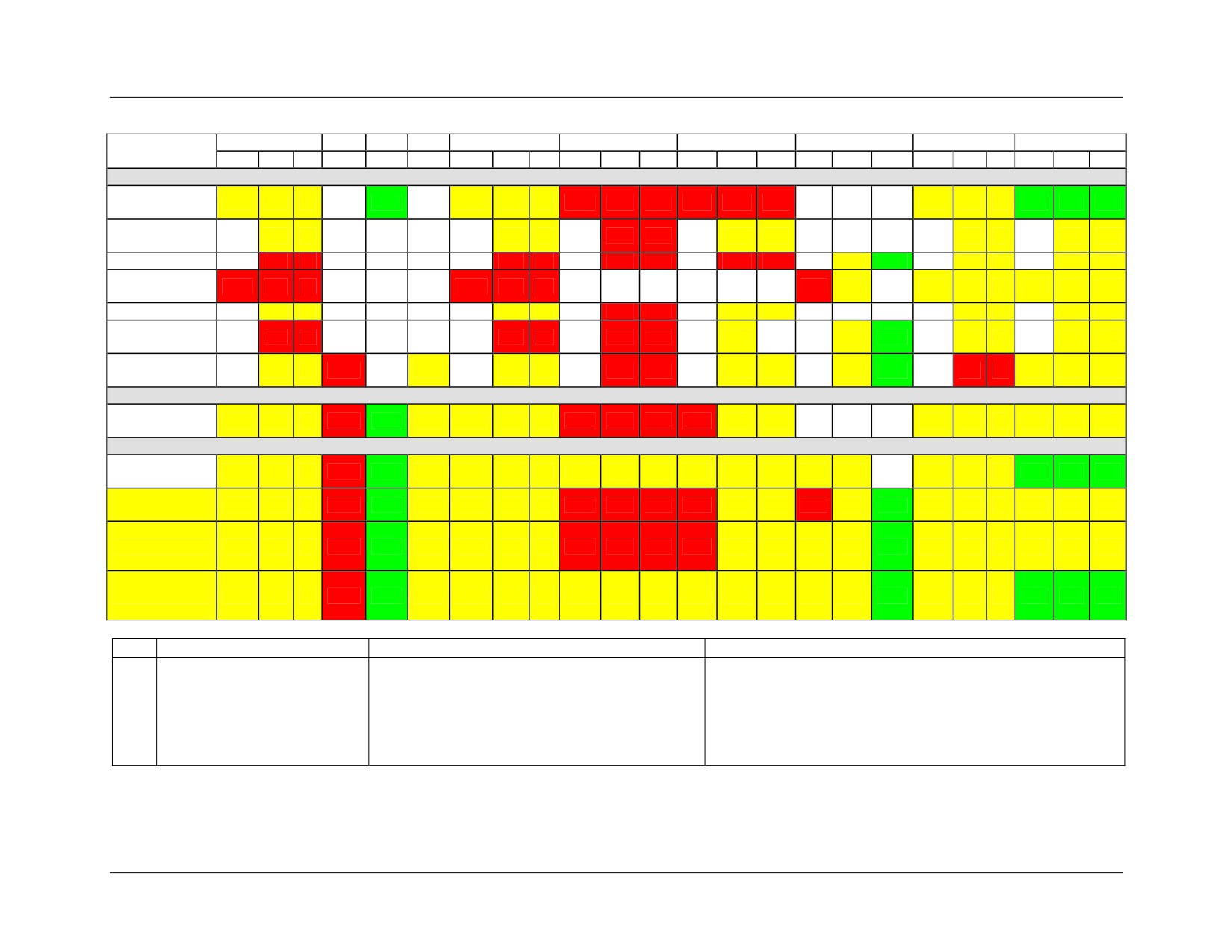
Table 17.1-1. TASUST 1: Capabilities and Deficiencies Assessment
M1
M2
M3
M4
M5
M6
M7
M8
M9
M10
Capabilities
I
O
T
T
I
O
I
O
T
I
O
T
I
O
T
I
O
T
I
O
T
I
O
T
Current
M291 and M295
71
7
7
N/A
82
N/A
73
7
7
34
3
3
15
1
1
N/A
N/A
N/A
76
7
7
107
10
10
Kits
HTH/Household
N/A
58
5
N/A
N/A
N/A
N/A
59
5
N/A
3
3
N/A
510
5
N/A
N/A
N/A
N/A
511
5
N/A
712
7
Bleach
Soap and Water
N/A
313
3
N/A
N/A
N/A
N/A
314
3
N/A
015
0
N/A
316
3
N/A
617
8
N/A
5
5
N/A
7
7
Removal/Brush
3
3
3
N/A
N/A
N/A
3
3
3
N/A
N/A
N/A
N/A
N/A
N/A
218
419
N/A
7
7
7
520
5
7
and/or Wipe
STB
N/A
5
5
N/A
N/A
N/A
N/A
5
5
N/A
3
3
N/A
5
5
N/A
N/A
N/A
N/A
5
5
N/A
7
7
Seawater/Hoses
N/A
3
3
N/A
N/A
N/A
N/A
3
3
N/A
0
0
N/A
5
N/A
N/A
6
8
N/A
5
5
N/A
7
7
and Nozzles
Decontamination
N/A
7
7
221
N/A
522
N/A
7
7
N/A
3
3
N/A
423
4
N/A
6
824
N/A
325
3
7
7
7
Station/Site
Near/Mid-Term
JSPDS
7
7
7
2
8
5
7
7
7
3
3
3
1
5
5
N/A
N/A
N/A
7
7
7
715
715
715
Increment I
Far-Term
JSPDS
7
7
7
2
8
5
7
7
7
5
526
5
5
5
5
4
4
N/A
7
7
7
106
106
106
Increment II
Current Overall
5
5
5
2
8
5
5
5
5
3
2
2
1
4
4
2
6
8
7
5
5
715
715
715
Capabilities
Near/Mid-Term
Overall
7
7
7
2
8
5
7
7
7
3
3
3
1
5
5
4
6
8
7
7
7
715
715
715
Capabilities
Far-Term
Overall
7
7
7
2
8
5
7
7
7
5
5
5
5
5
5
4
6
8
7
7
7
106
106
106
Capabilities
FAA Measure
Elaboration
Scale
M1
(Yes/No) Cross-contamination
Cross-contamination is controlled. Scale represents
10: Yes, Complete (100%)
is controlled?
range from no control to complete control of
7: Yes, Substantial (~75%)
contamination. Where cross-contamination is less
5: Yes, Partial (~50%)
than 100% controlled, measures must be in place to
3: Yes, Minimal (~25%)
prevent cross-contamination from becoming an
0: No, Cross-contamination cannot be controlled and presents an
unacceptable hazard.
unacceptable hazard.
20
For Official Use Only
For Official Use Only
CBRND Functional Needs Analysis/Functional Solution Analysis
Chapter 17. Tactical Sustain Tasks
M2
(Quantity) Personnel per hour
Sufficient number of personnel per hour can be
10: >150
to complete thorough
processed through a thorough decontamination
9: 125-150
decontamination process.
system or process to maximize restoration of full
8: 100-124
individual combat capabilities. Thorough
7: 80-99
decontamination of personnel includes the
6: 60-79
decontamination of individually carried equipment.
5: 50-59
4: 40-49
3: 30-39
2: 20-29
1: 10-19
0: <10
M3
(Time) To initiate immediate
Initiate and complete immediate decontamination
10: Immediately
decontamination procedures.
of the hands, face, and neck within a measured
9: <10 seconds
amount of time to prevent a casualty-producing
8: <30 seconds
exposure.
7: <45 seconds
6: <1 minute
5: <1 minute, 15 seconds
4: <1 minute, 30 seconds
3: <1 minute, 45 seconds
2: <2 minutes
1: <3 minutes
0: >3 minutes
M4
(Quantity) Personnel per hour
Sufficient number of personnel per hour can be
10: >300
to complete operational
processed through an operational decontamination
9: 250-300
decontamination process.
system or process (MOPP gear exchange or
8: 200-249
equivalent process). Operational decontamination
7: 160-199
of personnel includes the decontamination of
6: 120-159
individually carried equipment.
5: 100-119
4: 80-99
3: 60-79
2: 40-59
1: 20-39
0: <20
M5
(Yes/No) Contaminated by-
Contaminated by-products are controlled. Scale
10: Yes, Complete (100%)
products are controlled?
represents range of no control to complete control
7: Yes, Substantial (~75%)
of by-products. Where contaminated by-products
5: Yes, Limited (~50%)
are less than 100% controlled, measures must be in
3: Yes, Minimal (~25%)
place to prevent cross-contamination from
0: No, Contaminated by-products cannot be controlled and
becoming an unacceptable hazard.
present an unacceptable hazard.
21
For Official Use Only
For Official Use Only
CBRND Functional Needs Analysis/Functional Solution Analysis
Chapter 17. Tactical Sustain Tasks
M6
(Level) Of chemical
The level of chemical contamination is acceptable
10: Decontaminate all CWAs, NTAs, TIMs to general
contamination after
after decontamination procedures. Agents defined
population exposure limits; must also be FDA approved.
decontamination procedures.
as: current generation chemical warfare agents
7: Decontaminate all CWAs, all NTAs, some TIMs to a level
(CWAs), nontraditional agents (NTAs) and toxic
that will allow unprotected exposure; must also be FDA
industrial materials and chemicals (TIMs).
approved.
5: Decontaminate all CWAs, some NTAs to a level that will
allow unprotected exposure; must also be FDA approved.
3: Decontaminate most CWAs to a level that will allow
unprotected exposure.
0: No effective decontaminant or process.
M7
(Level) Of biological
The level of biological contamination is acceptable
10: 0 CFU/PFU/m2—total removal or neutralization of toxins
contamination after
after decontamination procedures. Vegetative and
against all 25 threat agents and also must be FDA approved.
decontamination procedures.
nonvegetative bacteria are measured in colony-
9: 0 CFU/PFU/m2—total removal or neutralization of toxins
forming units/square meter (CFU/m2), and viruses
against 20 or more key threat agents and also must be FDA
are measured in plaque-forming units/square meter
approved.
(PFU/m2).
8: 0 CFU/PFU/m2—total removal or neutralization of toxins
against 15 or more key threat agents and also must be FDA
approved.
7: 0 CFU/PFU/m2—total removal or neutralization of toxins
against 10 or more key threat agents and also must be FDA
approved.
6: 0 CFU/PFU/m2—total removal or neutralization of toxins
against eight or more key threat agents and also must be FDA
approved.
5: Less than infective dose levels/casualty-producing toxin
exposure levels against six or more key threat agents and also
must be FDA approved.
4: Less than infective dose levels/casualty-producing toxin
exposure levels against four key threat agents and also must be
FDA approved.
3: Less than infective dose levels/casualty-producing toxin
exposure levels against three key threat agents.
2: Less than infective dose levels/casualty-producing toxin
exposure levels against two or more key threat agents.
1: Less than infective dose levels/casualty-producing toxin
exposure levels against one key threat agent.
0: More than infective dose levels/casualty-producing toxin
exposure levels.
22
For Official Use Only
For Official Use Only
CBRND Functional Needs Analysis/Functional Solution Analysis
Chapter 17. Tactical Sustain Tasks
M8
(Level) Of radiological
The level of radiological contamination is
10: Total removal to natural backg1round level.
contamination after
acceptable after decontamination procedures. 0.33
8: ≤0.11 cGy/hour residual dose rate.
decontamination procedures.
centigray per hour (cGy/hour) equates to an
6: ≤0.22 cGy/hour residual dose rate.
exposure that can cause mild incapacitation in
4: <0.33 cGy/hour residual dose rate.
2.5% or less of unprotected, not previously
2: 0.33 cGy residual dose rate.
exposed personnel.
0: Removal capabilities limited or ineffective, allowing
excessive residual dose rates >0.33 cGy/hour.
M9
(Yes/No) Decontamination
Decontamination procedures must be logistically
10: No negative impacts on operations.
procedures are logistically
supportable.
7: Limited negative impact on operational capability.
supportable?
5: Moderate negative impact on operational capability
3: Major negative impact on operational capability
0: Not logistically supportable.
M10
There is effective DOTLPF in
Refers to non-materiel elements associated with the
10: DOTLPF is adequate for all tasks to be performed with this
place to conduct task?
execution of a task with the system.
system without limitations that cause significant impact upon
operations.
7: DOTLPF is adequate for most of the tasks to be performed
with this system without limitations that cause significant impact
upon operations.
5: Many critical aspects of DOTLPF for the task to be performed
with this system are addressed.
3: Some critical aspects of DOTLPF for the task to be performed
with this system are addressed.
0: DOTLPF is completely inadequate or does not exist for the
tasks to be performed with this system.
1 M1 - (Yes/No) Cross-contamination is controlled? 7: Yes, Substantial (~75%).
2 M2 - (Quantity) Personnel per hour to complete thorough decontamination process. 2: 20-29.
3 M5 - (Yes/No) Contaminated by-products are controlled? 7: Yes, Substantial (~75%).
4 M6 - (Level) Of chemical contamination after decontamination procedures. 3: Decontaminate most chemical warfare agents (CWAs) to a level that will allow unprotected
exposure.
5 M7 - (Level) Of biological contamination after decontamination procedures. 1: Less than infective dose levels/casualty-producing toxin-exposure levels against one key threat
agent.
6 M9 - (Yes/No) Decontamination procedures are logistically supportable? 7: Limited negative impact on operational capability.
7 M10 - There is effective DOTLPF in place to conduct task? 10: DOTLPF is adequate for all tasks to be performed with this system without limitations that cause significant
impact upon operations.
8 M1 - (Yes/No) Cross-contamination is controlled? 5: Yes, Partial (~50%).
9 M5 - (Yes/No) Contaminated by-products are controlled? 5: Yes, Limited (~50%).
10 M7 - (Level) Of biological contamination after decontamination procedures. 5: Less than infective dose levels/casualty-producing toxin-exposure levels against six or more key
threat agents and also must be FDA approved.
11 M9 - (Yes/No) Decontamination procedures are logistically supportable? 5: Moderate negative impact on operational capability.
23
For Official Use Only
For Official Use Only
CBRND Functional Needs Analysis/Functional Solution Analysis
Chapter 17. Tactical Sustain Tasks
12 M10 - There is effective DOTLPF in place to conduct task? 7: DOTLPF is adequate for most of the tasks to be performed with this system without limitations that cause
significant impact upon operations.
13 M1 - (Yes/No) Cross-contamination is controlled? 3: Yes, Minimal (~25%).
14 M5 - (Yes/No) Contaminated by-products are controlled? 3: Yes, Minimal (~25%).
15 M6 - (Level) Of chemical contamination after decontamination procedures. 0: No effective decontaminant or process.
16 M7 - (Level) Of biological contamination after decontamination procedures. 3: Less than infective dose levels/casualty-producing toxin-exposure levels against three key threat
agents.
17 M8 - (Level) Of radiological contamination after decontamination procedures. 6: ≤0.22 cGy/hour residual dose rate.
18 M8 - (Level) Of radiological contamination after decontamination procedures. 2: 0.33 cGy residual dose rate.
19 M8 - (Level) Of radiological contamination after decontamination procedures. 4: <0.33 cGy/hour residual dose rate.
20 M10 - There is effective DOTLPF in place to conduct task? 5: Many critical aspects of DOTLPF for the task to be performed with this system are addressed.
21 M2 - (Quantity) Personnel per hour to complete thorough decontamination process. 2: 20-29.
22 M4 - (Quantity) Personnel per hour to complete operational decontamination process. 5: 100-119.
23 M7 - (Level) Of biological contamination after decontamination procedures. 4: Less than infective dose levels/casualty-producing toxin-exposure levels against four key threat
agents and also must be FDA approved.
24 M8 - (Level) Of radiological contamination after decontamination procedures. 8: ≤0.11 cGy/hour residual dose rate.
25 M9 - (Yes/No) Decontamination procedures are logistically supportable? 3: Major negative impact on operational capability.
26 M6 - (Level) Of chemical contamination after decontamination procedures. 5: Decontaminate all CWA, some nontraditional agents (NTAs) to a level that will allow unprotected
exposure; must also be FDA approved.
24
For Official Use Only
For Official Use Only
CBRND Functional Needs Analysis/Functional Solution Analysis
Chapter 17. Tactical Sustain Tasks
17.1.2
Functional Solution Analysis
17.1.3.1
DOTLPF Assessment Summary
This section states the deficiencies and suggests potential non-materiel solutions. If there are no
solutions or there are only partial solutions for a particular deficiency, the deficiency is then
reassessed in the IMA section.
1.
Deficiency: Current array of decontaminants may not neutralize all chemical and biological
hazards.
Non-Materiel Solutions: None.
2.
Deficiency: High concentrations of HTH or STB are may be harmful to personnel.
Non-Materiel Solutions: Doctrine (partial): Expand presentation of basic decontamination
concepts using HTH and STB into other doctrinal products beyond only CBRND. Training
(partial): Enhance training on basic decontamination procedures using HTH and STB to
mitigate the personnel hazards these products can produce.
3.
Deficiency: Current procedures may not be feasible due to time and space requirements.
Non-Materiel Solutions: None.
4.
Deficiency: Lack of doctrine and training for aircrew radiological decontamination
procedures.
Non-Materiel Solutions: Doctrine: Incorporate aircrew decontamination procedures for
radiological environments into current doctrine.
5.
Deficiency: Operational and thorough procedures require large amounts of water.
Non-Materiel Solutions: Training (partial): Develop resource management training to
minimize water usage level to lowest possible level.
6.
Deficiency: Runoff may be contaminated.
Non-Materiel Solutions: Doctrine (partial): Modify doctrine to consider contaminated
runoff as an operational consideration. Doctrine should address how to dispose of or
neutralize runoff. Training (partial): Modify training to consider contaminated runoff as an
operational consideration. Training should address how to dispose of or neutralize runoff.
17.1.3.2
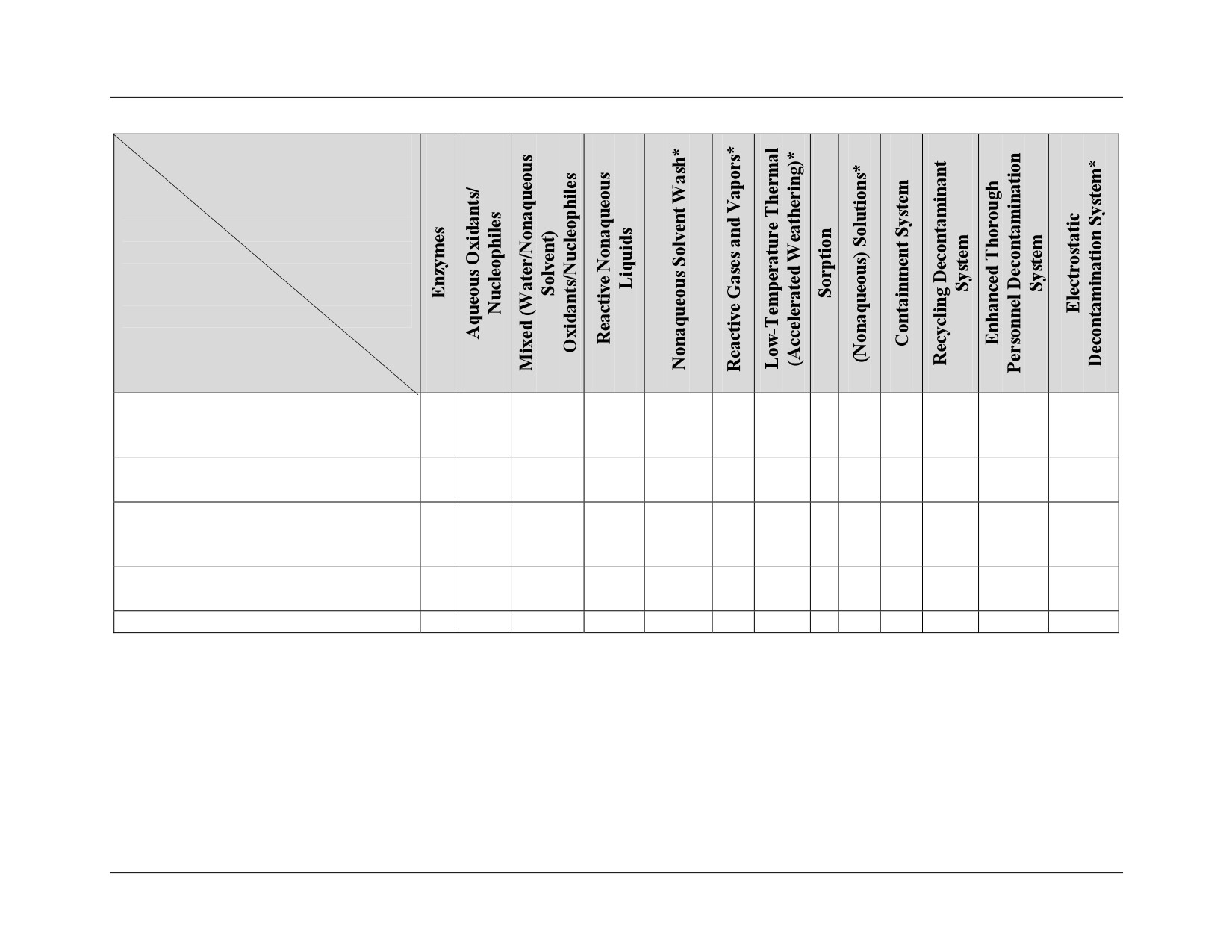
IMA Assessment Summary
Table 17.1-2 identifies which of the materiel approaches might address specific materiel gaps
identified in the DOTMLPF assessment.
25
For Official Use Only
For Official Use Only
CBRND Functional Needs Analysis/Functional Solution Analysis
Chapter 17. Tactical Sustain Tasks
Table 17.1-2. TASUST 1: IMA Assessment
Ideas for Materiel
Approaches
(IMA)
Identified Gaps
Current array of decontaminants may
not neutralize all chemical and
X
X
X
X
X
X
X
X
biological hazards.
High concentrations of HTH or STB
X
X
X
X
X
X
X
X
X
X
X
may be harmful to personnel.
Current procedures may not be
feasible due to time and space
X
X
X
X
X
X
requirements.
Operational and thorough procedures
X
X
X
X
X
X
X
X
X
X
X
require large amounts of water.
Runoff may be contaminated.
X
X
X
X
X
X
X
X
*Individual equipment and weapons only.
26
For Official Use Only
For Official Use Only
CBRND Functional Needs Analysis/Functional Solution Analysis
Chapter 17. Tactical Sustain Tasks
17.2
Task TASUST 2: Decontaminate casualties and potentially exposed personnel
17.2.1
Functional Area Analysis
17.2.1.1
Definition
To decontaminate all casualties and potentially exposed personnel, ambulatory and
nonambulatory, as well as MWAs, specifically MWDs that have been exposed to CBRN/TIM
hazards. Several animal species are used as MWAs; however, MWDs are the predominant
species and are most likely to be deployed with military personnel. Levels of decontamination
are immediate and thorough. There is no operational level of decontamination for casualties.
Objectives of each of these levels are identified as follows:
• Immediate: Immediate removal of gross contamination to minimize casualties, save lives,
and minimize spread of contamination.
• Operational: N/A
• Thorough: Reduce CBRN/TIM contamination to the lowest possible levels to permit partial
or total removal of IPE and maintain operations with minimum degradation.
17.2.1.2
Derivation
UJTL (TA 7, TA 7.1), Protection Joint Functional Concept.
17.2.1.2.1
Supported Tasks: OPSUST 8, OPSUST 11
17.2.1.2.2
Lateral Task: TASHA 24
17.2.1.2.3
Supporting Task: N/A
17.2.1.3
Condition
Perform this task under conditions of:
Physical
1. Extremely rough sea state. (C1.2.1.3)
2. Tropical, arctic, and arid climate. (C1.3.1)
3. All seasons. (C1.3.1.1)
4. Precipitating and stormy weather. (C1.3.1.3)
5. Hot and very cold air temperature. (C1.3.1.3.1)
6. Liquid, freezing, and frozen precipitation. (C1.3.1.3.6.1)
7. Negligible light. (C1.3.2.1)
8. Nuclear effects. (C1.3.3.1)
9. Chemical effects. (C1.3.3.2)
10. Biological effects. (C1.3.3.3)
27
For Official Use Only
For Official Use Only
CBRND Functional Needs Analysis/Functional Solution Analysis
Chapter 17. Tactical Sustain Tasks
Military
1. Stressful mission. (C2.1)
2. Location—ashore/afloat. (C2.1.4.1)
3. Minimal time available. (C2.1.5)
4. Marginal forces allocated. (C2.2.3)
5. Low personnel capability. (C2.2.4)
6. Negligible personnel experience (C2.2.4.5)
7. Severe personnel fatigue. (C2.2.4.6)
8. Some or no interoperability. (C2.2.6)
9. Limited, little, or no lift assets. (C2.5.2)
10. Limited or no host-nation support. (C2.8.5)
11. Ambiguous threat existence. (C2.9.3)
Civil
1. Limited or negative foreign government support. (C3.1.2.3)
2. Aggressively opposed foreign public opinion. (C3.1.2.4)
3. High mission priority. (C3.1.3.2)
4. Few or negligible translators. (C3.2.1.2)
5. Significant customs adjustment. (C3.2.2)
6. Significant refugee-care responsibility. (C3.3.2.3)
17.2.2
Functional Needs Analysis
17.2.2.1
Capabilities and Deficiencies Assessment Summary
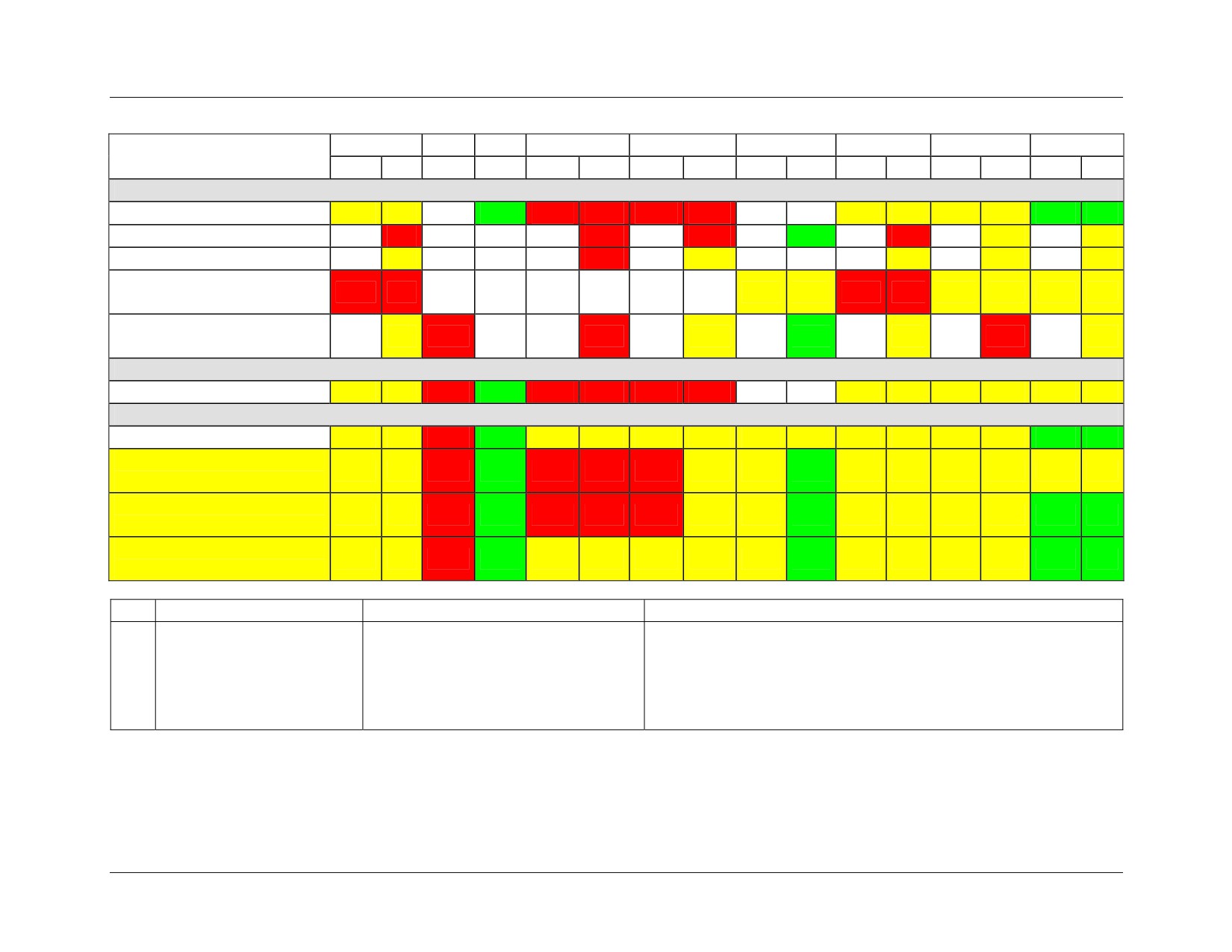
Table 17.2-1 presents individual and overall current capabilities to perform the task to the
designated standards. There are five current capabilities used to accomplish this task and two
projected capabilities to be added in the future (JSPDS Increment I in the near/mid term, JSPDS
Increment II in the far).
Current Capabilities and Deficiencies
Current capabilities to conduct casualty decontamination include the use of M291 kits, bleach
solutions, soap and water, brushes/removal and patient decontamination stations. The possibility
of cross-contamination and contaminated by-products during patient decontamination operations
will always be a challenge, especially if a mass casualty event occurs where a large number of
patients must be decontaminated. The decontamination procedures for animals use the same
tactics, techniques, and procedures as patient decontamination. Effectively decontaminating
MWDs is a challenge due to their hair coat. In addition, MWDs are naturally resistant to most
biological agents likely to be used as a WMD.
There are some deficiencies associated with casualty decontamination that exist at the immediate
and thorough levels. There is no single capability that can perform the task to all of the
designated standards. In general, thorough decontamination is a time and resource intensive
28
For Official Use Only
For Official Use Only
CBRND Functional Needs Analysis/Functional Solution Analysis
Chapter 17. Tactical Sustain Tasks
process, especially in a mass casualty environment, large amounts of water may be needed for
the prescribed capabilities, and run-off might be contaminated. An additional deficiency is that
the M291 kit cannot be used on wounds. Veterinary Services personnel and MWD handlers will
generally be responsible for conducting MWA decontamination. MWD handlers normally carry
one additional M291 kit for use on the dog.
Projected Near/Mid-Term Capabilities and Deficiencies
The projected near/mid-term capabilities and deficiencies evaluated were associated with JSPDS,
Increment I.
Projected Far-Term Capabilities and Deficiencies
The projected far-term capabilities and deficiencies evaluated were associated with JSPDS,
Increment II.
29
For Official Use Only
For Official Use Only
CBRND Functional Needs Analysis/Functional Solution Analysis
Chapter 17. Tactical Sustain Tasks
Table 17.2-1. TASUST 2: Capabilities and Deficiencies Assessment
M1
M2
M3
M4
M5
M6
M7
M8
M9
Capabilities
I
T
T
I
I
T
I
T
I
T
I
T
I
T
I
T
Current
M291 Kit
71
7
N/A
82
33
3
14
1
N/A
N/A
75
7
76
7
107
10
Soap and Water
N/A
38
N/A
N/A
N/A
09
N/A
310
N/A
811
N/A
312
N/A
513
N/A
714
HTH/Household Bleach
N/A
515
N/A
N/A
N/A
3
N/A
516
N/A
N/A
N/A
517
N/A
5
N/A
7
Removal/Brush and/or
3
3
N/A
N/A
N/A
N/A
N/A
N/A
418
4
3
3
7
7
7
7
Wipe
Patient Decontamination
N/A
7
119
N/A
N/A
3
N/A
5
N/A
8
N/A
7
N/A
320
N/A
7
Station
Near/Mid-Term
JSPDS Increment I
7
7
1
8
3
3
1
1
N/A
N/A
7
7
7
7
7
7
Far-Term
JSPDS Increment II
7
7
221
8
522
5
5
5
4
4
7
7
7
7
10
10
Current Overall
5
5
1
8
3
3
1
423
4
8
5
5
5
5
7
7
Capabilities
Near/Mid-Term Overall
7
7
1
8
3
3
1
4
4
8
7
7
7
7
10
10
Capabilities
Far-Term Overall
7
7
2
8
5
5
5
5
4
8
7
7
7
7
10
10
Capabilities
FAA Measure
Elaboration
Scale
M1
(Yes/No) Cross-
Cross-contamination is controlled. Where
10: Yes, Complete (100%)
contamination is controlled?
cross-contamination is less than 100%
7: Yes, Substantial (~75%)
controlled, measures must be in place to
5: Yes, Limited (~50%)
prevent cross-contamination from
3: Yes, Minimal (~25%)
becoming an unacceptable hazard.
0: No, cross-contamination cannot be controlled and presents an
unacceptable hazard
30
For Official Use Only
For Official Use Only
CBRND Functional Needs Analysis/Functional Solution Analysis
Chapter 17. Tactical Sustain Tasks
M2
(Quantity) Casualties/
An adequate number of casualties can be
10: >60
personnel per hour to
thoroughly decontaminated per hour to
9: 50-60
complete thorough
minimize delays before receiving full
8: 40-49
decontamination process.
medical treatment.
7: 35-39
6: 30-34
5: 25-29
4: 20-24
3: 15-19
2: 10-14
1: 5-9
0: <5
M3
(Time) To initiate immediate
Initiate and complete immediate
10: Immediately
decontamination procedures.
decontamination procedures within an
9: <10 seconds
adequate amount of time to preclude
8: <30 seconds
additional injury to casualties from
7: <45 seconds
chemical exposure. Time factors equate to
6: <1 minute
the time required to decontaminate
5: <1 minute, 15 seconds
1300 cm2 of skin surface area.
4: <1 minute, 30 seconds
3: <1 minute, 45 seconds
2: <2 minutes
1: <3 minutes
0: >3 minutes
M4
(Level) Of chemical
Chemical decontamination can be
10: Decontaminate all CWAs, NTAs, TIMs to general population
contamination after
performed to a level that no longer poses
exposure limits, must also be FDA approved.
decontamination procedures.
an imminent health threat to casualties or
7: Decontaminate all CWAs, all NTAs, some TIMs to a level that will
health care providers. The level of
allow unprotected exposure; must also be FDA approved.
chemical contamination is acceptable
5: Decontaminate all CWAs, some NTAs to a level that will allow
after decontamination procedures. Agents
unprotected exposure; must also be FDA approved.
defined as current-generation CWAs,
3: Decontaminate most CWAs to a level that will allow unprotected
NTAs, TIMs, and TICs.
exposure.
0: No effective decontaminant or process.
31
For Official Use Only
For Official Use Only
CBRND Functional Needs Analysis/Functional Solution Analysis
Chapter 17. Tactical Sustain Tasks
M5
(Level) Of biological
The level of biological contamination is
10: 0 CFU/PFU/m2—total removal or neutralization of toxins against all
contamination after
acceptable after decontamination
25 threat agents, and also must be FDA approved.
decontamination procedures.
procedures. Vegetative and nonvegetative
9: 0 CFU/PFU/m2—total removal or neutralization of toxins against 20
bacteria are measured in CFU/m2, and
or more key threat agents, and also must be FDA approved.
viruses are measured in PFU/m2.
8: 0 CFU/PFU/m2 - total removal or neutralization of toxins against 15
or more key threat agents, and also must be FDA approved.
7: 0 CFU/PFU/m2—total removal or neutralization of toxins against 10
or more key threat agents, and also must be FDA approved.
6: 0 CFU/PFU/m2—total removal or neutralization of toxins against six
or more key threat agents, and also must be FDA approved.
5: Less than infective dose levels/casualty-producing toxin exposure
levels against five or more key threat agents, and also must be FDA
approved.
4: Less than infective dose levels/casualty-producing toxin exposure
levels against four key threat agents, and also must be FDA approved.
3: Less than infective dose levels/casualty-producing toxin exposure
levels against three key threat agents.
2: Less than infective dose levels/casualty-producing toxin exposure
levels against two or more key threat agents.
1: Less than infective dose levels/casualty-producing toxin exposure
levels against one key threat agent.
0: More than infective dose levels/casualty-producing toxin exposure
levels.
M6
(Level) Of radiological
Radiological decontamination can be
10: Total removal to natural backg1round level.
contamination after
performed to a level that no longer poses
8: <0.11 cGy/hour residual dose rate.
decontamination procedures.
an imminent health threat to casualties or
6: <0.22 cGy/hour residual dose rate.
health care providers. 0.33 cGy/hour
4: <0.33 cGy/hour residual dose rate.
equates to an exposure that can cause
2: 0.33 cGy/hour residual dose rate.
mild incapacitation in 2.5% or less of
0: Removal capabilities limited or ineffective, allowing excessive residual
unprotected, not previously exposed
dose rates >0.33 cGy/hour.
personnel.
M7
(Yes/No) Contaminated by-
Contaminated by-products are controlled.
10: Yes, Complete (100%).
products are controlled?
Where contaminated by-products are less
7: Yes, Substantial (~75%).
than 100% controlled, measures must be
5: Yes, Partial (~50%).
in place to prevent cross-contamination
3: Yes, Minimal (~25%).
from becoming an unacceptable hazard.
0: No, Contaminated by-products cannot be controlled and present an
unacceptable hazard.
32
For Official Use Only
For Official Use Only
CBRND Functional Needs Analysis/Functional Solution Analysis
Chapter 17. Tactical Sustain Tasks
M8
(Yes/No) Decontamination
Decontamination procedures must be
10: No negative impacts on operations.
procedures are logistically
logistically supportable.
7: Limited negative impact on operational capability.
supportable?
5: Moderate negative impact on operational capability.
3: Major negative impact on operational capability.
0: Not logistically supportable.
M9
There is effective DOTLPF in
Refers to non-materiel elements
10: DOTLPF is adequate for all tasks to be performed with this system
place to conduct task?
associated with the execution of a task
without limitations that cause significant impact upon operations.
with the system.
7: DOTLPF is adequate for most of the tasks to be performed with this
system without limitations that cause significant impact upon operations.
5: Many critical aspects of DOTLPF for the task to be performed with
this system are addressed.
3: Some critical aspects of DOTLPF for the task to be performed with
this system are addressed.
0: DOTLPF is completely inadequate or does not exist for the tasks to be
performed with this system.
1 M1 - (Yes/No) Cross-contamination is controlled? 7: Yes, Substantial (~75%).
2 M3 - (Time) To initiate immediate decontamination procedures. 8: <30 Seconds.
3 M4 - (Level) Of chemical contamination after decontamination procedures. 3: Less than infective dose levels/casualty-producing toxin-exposure levels against three key threat
agents.
4 M5 - (Level) Of biological contamination after decontamination procedures. 1: Less than infective dose levels/casualty-producing toxin-exposure levels against one key threat
agent.
5 M7 - (Yes/No) Contaminated by-products are controlled? 7: Yes, Substantial (~75%).
6 M8 - (Yes/No) Decontamination procedures are logistically supportable? 7: Limited negative impact on operational capability.
7 M9 - There is effective DOTLPF in place to conduct task? 10: DOTLPF is adequate for all tasks to be performed with this system without limitations that cause significant
impact upon operations.
8 M1 - (Yes/No) Cross-contamination is controlled? 3: Yes, Minimal (~25%).
9 M4 - (Level) Of chemical contamination after decontamination procedures. 0: No effective decontaminant or process.
10 M5 - (Level) Of biological contamination after decontamination procedures. 3: Less than infective dose levels/casualty-producing toxin-exposure levels against three key threat
agents.
11 M6 - (Level) Of radiological contamination after decontamination procedures. 8: ≤0.11 cGy/hour residual dose rate.
12 M7 - (Yes/No) Contaminated by-products are controlled? 3: Yes, Minimal (~25%).
13 M8 - (Yes/No) Decontamination procedures are logistically supportable? 5: Moderate negative impact on operational capability.
14 M9 - There is effective DOTLPF in place to conduct task? 7: DOTLPF is adequate for most of the tasks to be performed with this system without limitations that cause
significant impact upon operations.
15 M1 - (Yes/No) Cross-contamination is controlled? 5: Yes, Limited (~50%).
16 M5 - (Level) Of biological contamination after decontamination procedures. 5: Less than infective dose levels/casualty-producing toxin-exposure levels against five or more key
threat agents, and also must be FDA approved.
17 M7 - (Yes/No) Contaminated by-products are controlled? 5: Yes, Partial (~50%).
18 M6 - (Level) Of radiological contamination after decontamination procedures. 4: <0.33 cGy/hour residual dose rate.
19 M2 - (Quantity) Casualties/personnel per hour to complete thorough decontamination process. 1: 5-9.
20 M8 - (Yes/No) Decontamination procedures are logistically supportable? 3: Major negative impact on operational capability
21 M2 - (Quantity) Casualties/personnel per hour to complete thorough decontamination process. 2: 10-14.
33
For Official Use Only
For Official Use Only
CBRND Functional Needs Analysis/Functional Solution Analysis
Chapter 17. Tactical Sustain Tasks
22 M4 - (Level) Of chemical contamination after decontamination procedures. 5: Decontaminate all CWAs, some NTAs to a level that will allow unprotected exposure; must also
be FDA approved.
23 M5 - (Level) Of biological contamination after decontamination procedures. 4: Less than infective dose levels/casualty-producing toxin-exposure levels against four key threat
agents, and also must be FDA approved.
34
For Official Use Only
For Official Use Only
CBRND Functional Needs Analysis/Functional Solution Analysis
Chapter 17. Tactical Sustain Tasks
17.2.3
Functional Solution Analysis
17.2.3.1
DOTLPF Assessment Summary
This section states the deficiencies and suggests potential non-materiel solutions. If there are no
solutions or there are only partial solutions for a particular deficiency, the deficiency is then
reassessed in the IMA section.
1.
Deficiency: Decontamination process causes delay in treatment.
Non-Materiel Solutions: Doctrine: Doctrine should clearly define those medical treatments
that should be performed in a contaminated environment and during the decontamination
process. Training: Prepare and practice decontamination procedures to gain proficiency and
to determine the approximate number of people that can be processed per hour for each
decontamination method.
2.
Deficiency: Current decontaminants may not neutralize all hazards.
Non-Materiel Solutions: None.
3.
Deficiency: Large amount of water may be needed.
Non-Materiel Solutions: None.
4.
Deficiency: Cross-contamination may be difficult to control due to insufficient or
uncontrolled drainage and water flow.
Non-Materiel Solutions: Training (partial): Cross-contamination can be minimized through
adequate training of personnel performing decontamination tasks.
5.
Deficiency: Time- and resource-intensive.
Non-Materiel Solutions: None.
6.
Deficiency: Runoff may be contaminated.
Non-Materiel Solutions: Doctrine (partial): Modify doctrine to consider contaminated
runoff as an operational consideration. Doctrine should address how to dispose of or
neutralize runoff. Training (partial): Modify training to consider contaminated runoff as an
operational consideration. Training should address how to dispose of or neutralize runoff.
Facilities (partial): Supporting infrastructure to neutralize or dispose of captured
contaminated runoff.
7.
Deficiency: M291 kit cannot be used on wounds.
Non-Materiel Solutions: None.
8.
Deficiency: Internal decontamination of inhaled biological organisms is not possible.
Non-Materiel Solutions: Since it is not possible to decontaminate internal biological
contamination, patients exposed to potential contamination must be referred for medical
treatment (prophylaxis and/or treatment). Doctrine: Doctrine can reinforce the importance of
early identification and referral. Training: Training can provide the skills necessary for early
identification and referral.
35
For Official Use Only
For Official Use Only
CBRND Functional Needs Analysis/Functional Solution Analysis
Chapter 17. Tactical Sustain Tasks
9. Deficiency: The dog handler carries only one additional skin decontaminating kit for the dog.
Non-Materiel Solutions: Doctrine: Modify doctrine to allow veterinary service personnel
and MWD handlers to carry more than one additional skin decontaminating kit.
10. Deficiency: Doctrine does not address decontamination procedures for individuals not in
MOPP gear.
Non-Materiel Solutions: Doctrine: Modify doctrine to include procedures for casualties not
in MOPP gear.
11. Deficiency: Doctrine does not address all methods of decontamination available for MWDs.
Non-Materiel Solutions: Doctrine: Modify doctrine to include all methods of
decontamination.
12. Deficiency: Some decontaminants produce contaminated by-products.
Non-Materiel Solutions: Doctrine (partial): Modify doctrine to address proper disposal of
contaminated by-products.
17.2.3.2
IMA Assessment Summary
Although early physical removal of any agent is the most important aspect of decontamination,
there are potential future technologies that may improve capabilities to conduct casualty
decontamination. Table 17.2-2 links materiel alternatives to the identified gaps. Rapid adaptation
of some materiel solutions to dogs is no doubt possible and desirable, while other solutions
deserve a directed research effort to determine their applicability for decontamination of working
dogs.
36
For Official Use Only
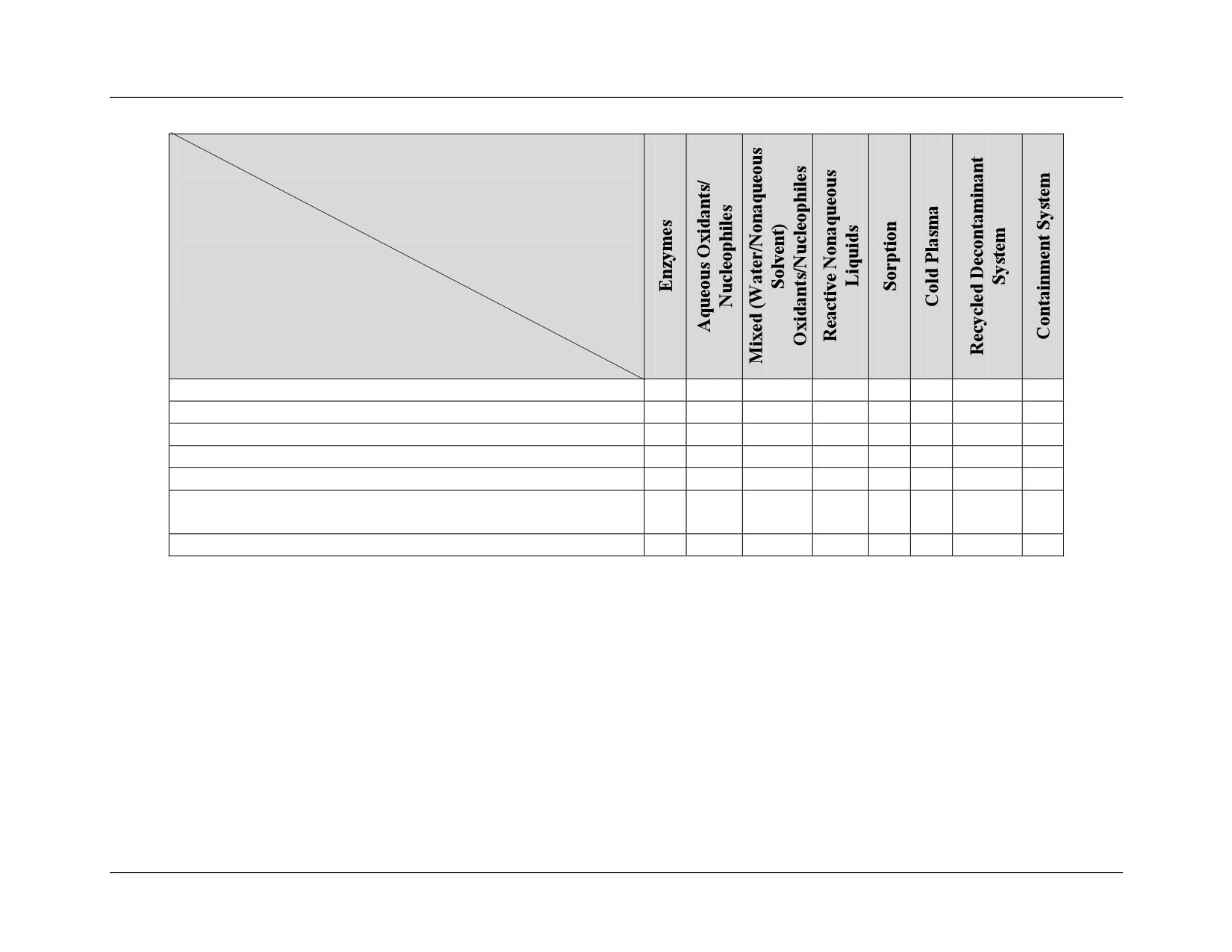
For Official Use Only
CBRND Functional Needs Analysis/Functional Solution Analysis
Chapter 17. Tactical Sustain Tasks
Table 17.2-2. TASUST 2: IMA Assessment
Ideas for Materiel
Approaches
(IMA)
Identified Gaps
Current decontaminants may not neutralize all hazards.
X
X
X
X
X
X
M291 kit cannot be used on wounds.
X
X
Time- and resource-intensive.
X
X
X
X
X
X
Large amounts of water may be needed.
X
X
X
X
X
X
Runoff may be contaminated.
X
X
X
X
X
X
X
X
Cross-contamination may be difficult to control due to
X
X
X
insufficient or uncontrolled drainage and water flow.
Some decontaminants produce contaminated by-products.
X
X
X
37
For Official Use Only
For Official Use Only
CBRND Functional Needs Analysis/Functional Solution Analysis
Chapter 17. Tactical Sustain Tasks
17.3
Task TASUST 3: Decontaminate wounds
17.3.1
Functional Area Analysis
17.3.1.1
Definition
To decontaminate external wounds. External wounds damage skin, penetrate skin, or open skin.
Internal wounds resulting from inhalation, ingestion, or absorption are not decontaminated but
rather medically treated and are discussed in another task. This task includes MWAs, specifically
MWDs that have been exposed to CBRN/TIM hazards. Several animal species are used as
MWAs; however, MWDs are the predominant species and are most likely to be deployed with
military personnel. Levels of decontamination include immediate, operational, and thorough.
There is no operational decontamination of wounds. Objectives of each of these levels are
identified as follows:
• Immediate: Immediate removal of gross contamination to minimize casualties, save lives,
and minimize spread of contamination.
• Operational: N/A
• Thorough: Reduce CBRN/TIM contamination to the lowest possible levels to permit partial
or total removal of IPE and maintain operations with minimum degradation.
17.3.1.2
Derivation
UJTL (TA 7, TA 7.1), Protection Joint Functional Concept.
17.3.1.2.1
Supported Tasks: OPSUST 8, OPSUST 11
17.3.1.2.2
Lateral Task: TASHA 24
17.3.1.2.3
Supporting Task: N/A
17.3.1.3
Condition
Perform this task under conditions of:
Physical
1. Negligible light. (C1.3.2.1)
2. Nuclear effects. (C1.3.3.1)
3. Chemical effects. (C1.3.3.2)
4. Biological effects. (C1.3.3.3)
Military
1. Stressful mission. (C2.1)
2. Location—ashore/afloat. (C2.1.4.1)
3. Minimal time available. (C2.1.5)
38
For Official Use Only
For Official Use Only
CBRND Functional Needs Analysis/Functional Solution Analysis
Chapter 17. Tactical Sustain Tasks
4. Marginal forces allocated. (C2.2.3)
5. Low personnel capability. (C2.2.4)
6. Negligible personnel experience. (C2.2.4.5)
7. Severe personnel fatigue. (C2.2.4.6)
8. Some or no interoperability. (C2.2.6)
Civil
1. High mission priority. (C3.1.3.2)
2. Few or negligible translators. (C3.2.1.2)
3. Significant customs adjustment. (C3.2.2)
4. Significant refugee-care responsibility. (C3.3.2.3)
17.3.2
Functional Needs Analysis
17.3.2.1
Capabilities and Deficiencies Assessment Summary
Table 17.3-1 presents individual and overall current capabilities to perform the task to the
designated standards. There are three current capabilities used to accomplish this task and one
projected capability to be added in the future, JSPDS Increment II in the far term).
Current/Near/Mid-Term Capabilities and Deficiencies
The current capabilities and deficiencies for wound decontamination procedures involve the use
of soap and water, diluted bleach, and surgical debridement. Although skin areas adjacent to
wounds can be decontaminated using current existing materiel and procedures, current
deficiencies include the difficulty in decontaminating hard-to-reach areas, contaminated by-
products, and the potential to retard natural healing of the wound or cause additional injury as a
result of the decontamination process or decontaminant exposure.
Projected Far-Term Capabilities and Deficiencies
The projected far-term capabilities and deficiencies evaluated were associated with JSPDS
Increment II. JSPDS Increment II will introduce radiological decontamination capabilities and
systematic capabilities to process casualties and human remains. It will also provide a capability
to decontaminate casualties with open wounds without making the wound worse or retard
healing.
39
For Official Use Only
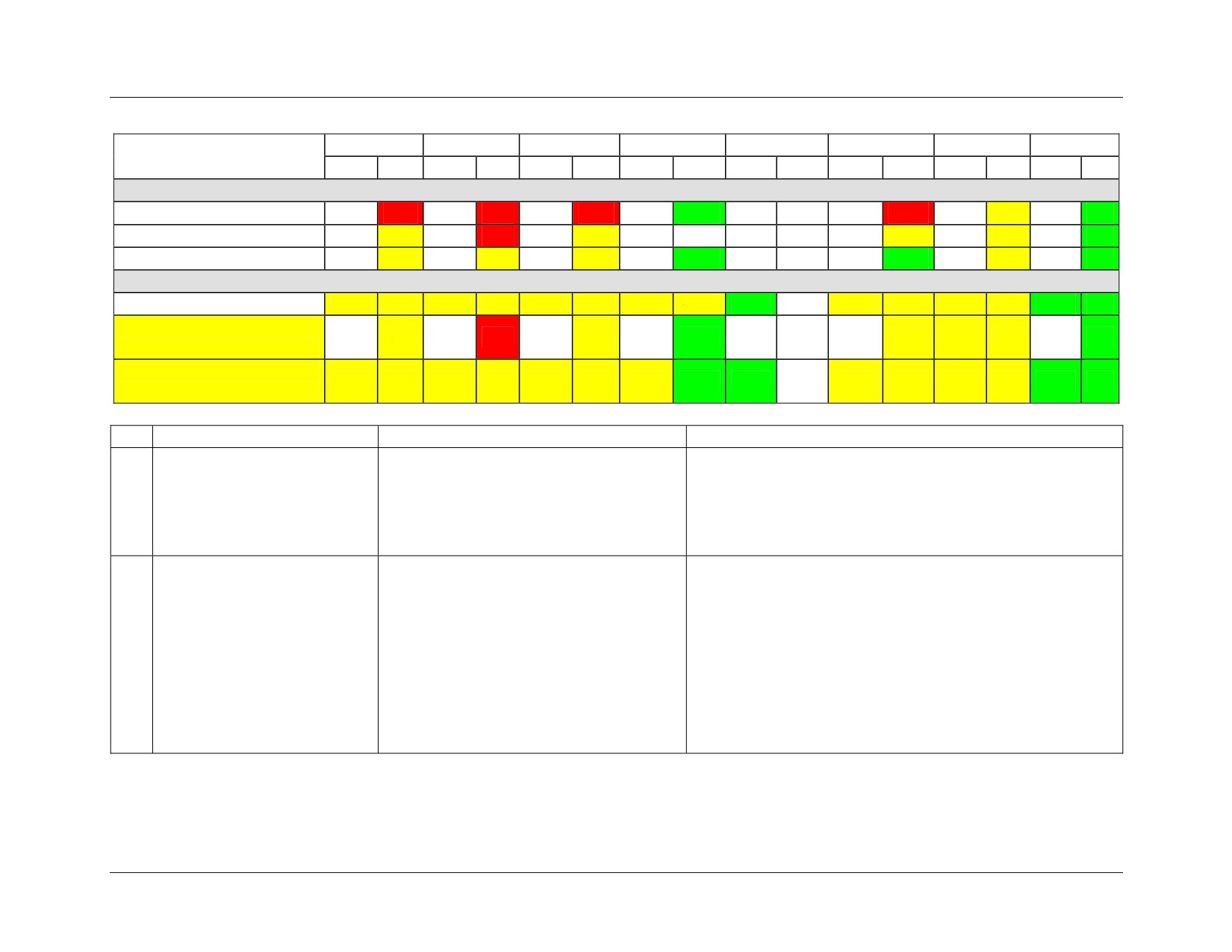
For Official Use Only
CBRND Functional Needs Analysis/Functional Solution Analysis
Chapter 17. Tactical Sustain Tasks
Table 17.3-1. TASUST 3: Capabilities and Deficiencies Assessment
M1
M2
M3
M4
M5
M6
M7
M8
Capabilities
I
T
I
T
I
T
I
T
I
T
I
T
I
T
I
T
Current/Near/Mid-Term
Soap and Water
N/A
31
N/A
02
N/A
33
N/A
84
N/A
N/A
N/A
35
N/A
56
N/A
107
HTH/Household Bleach
N/A
58
N/A
39
N/A
510
N/A
N/A
N/A
N/A
N/A
511
N/A
5
N/A
10
Debridement
N/A
712
N/A
513
N/A
514
N/A
8
N/A
N/A
N/A
1015
N/A
5
N/A
10
Far-Term
JSPDS Increment II
7
7
5
5
5
5
416
4
817
N/A
718
7
719
7
10
10
Current/Near/Mid-Term
N/A
5
N/A
3
N/A
5
N/A
8
N/A
N/A
N/A
5
5
5
N/A
10
Overall Capabilities
Far-Term Overall
7
7
5
5
5
5
4
8
8
N/A
7
7
7
7
10
10
Capabilities
FAA Measure
Elaboration
Scale
M1
(Yes/No) Cross-contamination is
Cross-contamination and contaminated by-
10: Yes, Complete (100%).
controlled?
products are controlled. Where cross-
7: Yes, Substantial (~75%).
contamination is less than 100% controlled,
5: Yes, Partial (~50%).
measures must be in place to prevent cross-
3: Yes, Minimal (~25%).
contamination from becoming an
0: No, cross-contamination cannot be controlled and presents an
unacceptable hazard.
unacceptable hazard.
M2
(Level) Of chemical
Chemical decontamination can be performed
10: Decontaminate all CWAs, NTAs, TIMs to general population
contamination after
on or around a wound to a level that no longer
exposure limits, must also be FDA approved.
decontamination procedures.
poses an imminent health threat to casualties
7: Decontaminate all CWAs, all NTAs, some TIMs to a level that
or health care providers. Compatibility with
will allow unprotected exposure; must also be FDA approved.
wounds assumes decontaminant will not
5: Decontaminate all CWAs, some NTAs to a level that will allow
otherwise hinder healing of a wound that it
unprotected exposure; must also be FDA approved.
comes in contact with. The level of chemical
3: Decontaminate most CWAs to a level that will allow
contamination is acceptable after
unprotected exposure.
decontamination procedures. Agents defined
0: No effective decontaminant or process.
as current-generation CWAs, NTAs, TIMs,
and TICs.
40
For Official Use Only
For Official Use Only
CBRND Functional Needs Analysis/Functional Solution Analysis
Chapter 17. Tactical Sustain Tasks
M3
(Level) Of biological
Biological decontamination (to include toxins)
10: 0 CFU/PFU/m2—total removal or neutralization of toxins
contamination after
can be performed on or around a wound to a
against all 25 threat agents, and also must be FDA approved.
decontamination procedures.
level that no longer poses an imminent health
9: 0 CFU/PFU/m2—total removal or neutralization of toxins
threat to casualties or health care providers.
against 20 or more key threat agents, and also must be FDA
Compatibility with wounds assumes
approved.
decontaminant will not otherwise hinder
8: 0 CFU/PFU/m2—total removal or neutralization of toxins
healing of a wound that it comes in contact
against 15 or more key threat agents, and also must be FDA
with. Vegetative and nonvegetative bacteria
approved.
are measured in CFU/m2, and viruses are
7: 0 CFU/PFU/m2—total removal or neutralization of toxins
measured in PFU/m2.
against 10 or more key threat agents, and also must be FDA
approved.
6: 0 CFU/PFU/m2—total removal or neutralization of toxins
against six or more key threat agents, and also must be FDA
approved.
5: Less than infective dose levels/casualty-producing toxin
exposure levels against five or more key threat agents, and also
must be FDA approved.
4: Less than infective dose levels/casualty-producing toxin
exposure levels against four key threat agents, and also must be
FDA approved.
3: Less than infective dose levels/casualty-producing toxin
exposure levels against three key threat agents, and also must be
FDA approved.
2: Less than infective dose levels/casualty-producing toxin
exposure levels against two or more key threat agents.
1: Less than infective dose levels/casualty-producing toxin
exposure levels against one key threat agent.
0: More than infective dose levels/casualty-producing toxin
exposure levels.
M4
(Level) Of radiological
Radiological decontamination can be
10: Total removal to natural backg1round level, will decontaminate
contamination after
performed on or around a wound to a level
wounds if required.
decontamination procedures.
that no longer poses an imminent health threat
8: ≤0.11 cGy/hour residual dose rate, will decontaminate wounds if
to casualties or health care providers.
required.
Compatibility with wounds assumes
6: ≤0.22 cGy/hour residual dose rate, compatible with wounds.
decontaminant will not otherwise hinder
4: <0.33 cGy/hour residual dose rate, compatible with wounds.
healing of a wound that it comes in contact
2: 0.33 cGy residual dose rate, wounds should not be exposed to
with. 0.33 cGy/hour equates to an exposure
decontaminant.
that can cause mild incapacitation in 2.5% or
0: Removal capabilities limited or ineffective, allowing excessive
less of unprotected, not previously exposed
residual dose rates.
personnel.
>0.33 cGy/hour, wounds should not be exposed to decontaminant.
41
For Official Use Only
For Official Use Only
CBRND Functional Needs Analysis/Functional Solution Analysis
Chapter 17. Tactical Sustain Tasks
M5
(Time) To initiate immediate
Initiate and complete immediate
10: Immediately
decontamination procedures.
decontamination procedures on or within (if
9: <10 seconds
compatible) or around a wound within an
8: <30 seconds
adequate amount of time to preclude
7: <45 seconds
additional injury to casualty from chemical
6: <1 minute
exposure. Time factors equate to the time
5: <1 minute, 15 seconds
required to decontaminate 1300 cm2 of skin
4: <1 minute, 30 seconds
surface area.
3: <1 minute, 45 seconds
2: <2 minutes
1: <3 minutes
0: >3 minutes
M6
(Yes/No) Contaminated by-
Contaminated by-products are controlled.
10: Yes, Complete (100%).
products are controlled?
Where contaminated by-products are less than
7: Yes, Substantial (~75%).
100% controlled, measures must be in place to
5: Yes, Partial (~50%).
prevent cross-contamination from becoming
3: Yes, Minimal (~25%).
an unacceptable hazard.
0: No, Contaminated by-products cannot be controlled and present
an unacceptable hazard.
M7
(Yes/No) Decontamination
Decontamination procedures must be
10: No negative impacts on operations.
procedures are logistically
logistically supportable.
7: Limited negative impact on operational capability.
supportable?
5: Moderate negative impact on operational capability.
3: Major negative impact on operational capability.
0: Not logistically supportable.
M8
There is effective DOTLPF in
Refers to non-materiel elements associated
10: DOTLPF is adequate for all tasks to be performed with this
place to conduct task?
with the execution of a task with the system.
system without limitations that cause significant impact upon
operations.
7: DOTLPF is adequate for most of the tasks to be performed with
this system without limitations that cause significant impact upon
operations.
5: Many critical aspects of DOTLPF for the task to be performed
with this system are addressed.
3: Some critical aspects of DOTLPF for the task to be performed
with this system are addressed.
0: DOTLPF is completely inadequate or does not exist for the
tasks to be performed with this system.
1 M1 - (Yes/No) Cross-contamination is controlled? 3: Yes, Minimal (~25%).
2 M2 - (Level) Of chemical contamination after decontamination procedures. 0: No effective decontaminant or process.
3 M3 - (Level) Of biological contamination after decontamination procedures. 3: Less than infective dose levels/casualty-producing toxin-exposure levels against three key threat
agents and also must be FDA approved.
4 M4 - (Level) Of radiological contamination after decontamination procedures. 8: ≤0.11 cGy/hour residual dose rate, will decontaminate wounds if required.
42
For Official Use Only
For Official Use Only
CBRND Functional Needs Analysis/Functional Solution Analysis
Chapter 17. Tactical Sustain Tasks
5 M6 - (Yes/No) Contaminated by-products are controlled? 3: Yes, Minimal (~25%).
6 M7 - (Yes/No) Decontamination procedures are logistically supportable? 5: Moderate negative impact on operational capability.
7 M8 - There is effective DOTLPF in place to conduct task? 10: DOTLPF is adequate for all tasks to be performed with this system without limitations that cause significant
impact upon operations.
8 M1 - (Yes/No) Cross-contamination is controlled? 5: Yes, Partial (~50%).
9 M2 - (Level) Of chemical contamination after decontamination procedures. 3: Decontaminate most CWAs to a level that will allow unprotected exposure.
10 M3 - (Level) Of biological contamination after decontamination procedures. 5: Less than infective dose levels/casualty-producing toxin-exposure levels against five or more key
threat agents, and also must be FDA approved.
11 M6 - (Yes/No) Contaminated by-products are controlled? 5: Yes, Partial (~50%).
12 M1 - (Yes/No) Cross-contamination is controlled? 7: Yes, Substantial (~75%).
13 M2 - (Level) Of chemical contamination after decontamination procedures. 5: Decontaminate all CWAs, some NTAs to a level that will allow unprotected exposure; must also
be FDA approved.
14 M3 - (Level) Of biological contamination after decontamination procedures. 5: Less than infective dose levels/casualty-producing toxin-exposure levels against five or more key
threat agents, and also must be FDA approved.
15 M6 - (Yes/No) Contaminated by-products are controlled? 10: Yes, Complete (100%).
16 M4 - (Level) Of radiological contamination after decontamination procedures. 4: <0.33 cGy/hour residual dose rate, compatible with wounds.
17 M5 - (Time) To initiate immediate decontamination procedures. 8: <30 Seconds.
18 M6 - (Yes/No) Contaminated by-products are controlled? 7: Yes, Substantial (~75%).
19 M7 - (Yes/No) Decontamination procedures are logistically supportable? 7: Limited negative impact on operational capability.
43
For Official Use Only
For Official Use Only
CBRND Functional Needs Analysis/Functional Solution Analysis
Chapter 17. Tactical Sustain Tasks
17.3.3
Functional Solution Analysis
17.3.3.1
DOTLPF Assessment Summary
This section states the deficiencies and suggests potential non-materiel solutions. If there are no
solutions or there are only partial solutions for a particular deficiency, the deficiency is then
reassessed in the IMA section.
1. Deficiency: Some capabilities produce contaminated by-products.
Non-Materiel Solutions: Doctrine (partial): Modify doctrine to ensure that proper
procedures are in place to handle and dispose of contaminated by-products.
2. Deficiency: Current decontaminants may not neutralize all agents.
Non-Materiel Solutions: None.
3. Deficiency: Wounds may be further damaged by decontaminants.
Non-Materiel Solutions: Doctrine (partial): Develop doctrine that clearly outlines how
wounds should be cleaned to minimize damage in an immediate situation. Training (partial):
At self/buddy-aid levels, train individuals to properly clean wounds in an effort to minimize
any wound damage.
4. Deficiency: May be difficult to decontaminate all wound surfaces or deep wounds.
Non-Materiel Solutions: None.
5. Deficiency: Process may be time- and resource-intensive.
Non-Materiel Solutions: None.
17.3.3.2
IMA Assessment Summary
There is a need to improve the wound decontamination process to make it more effective and
less resource-intensive. Table 17.3-2 links materiel alternatives to the identified gaps.
44
For Official Use Only
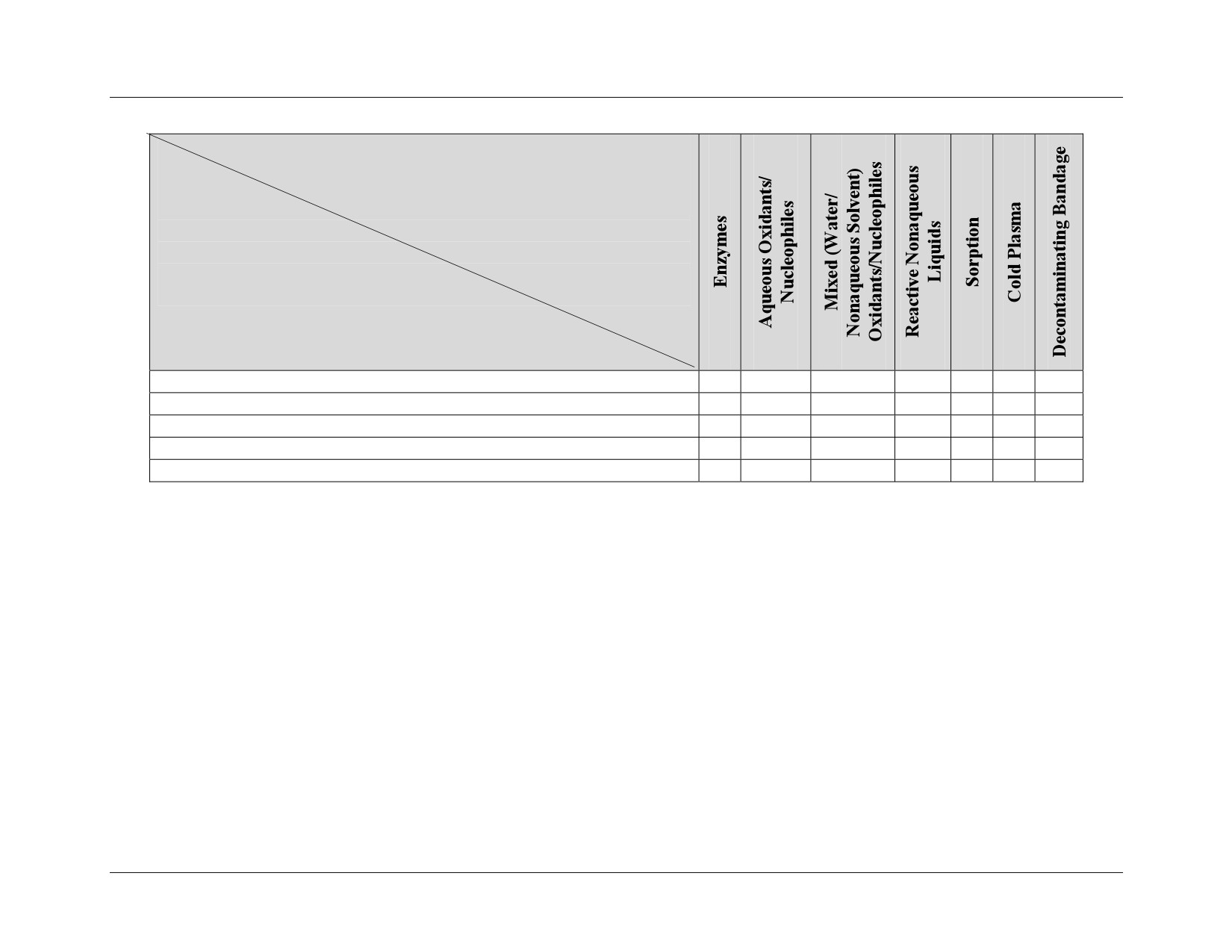
For Official Use Only
CBRND Functional Needs Analysis/Functional Solution Analysis
Chapter 17. Tactical Sustain Tasks
Table 17.3-2. TASUST 3: IMA Assessment
Ideas for Materiel
Approaches
(IMA)
Identified Gaps
Some capabilities produce contaminated by-products.
X
X
X
X
X
Current decontaminants may not neutralize all agents.
X
X
X
X
Wounds may be further damaged by decontaminants.
X
X
X
X
X
X
X
May be difficult to decontaminate all wound surfaces or deep wounds.
X
X
X
X
X
Process may be time- and resource-intensive.
X
X
X
X
X
X
45
For Official Use Only
For Official Use Only
CBRND Functional Needs Analysis/Functional Solution Analysis
Chapter 17. Tactical Sustain Tasks
17.4
Task TASUST 4: Decontaminate remains
17.4.1
Functional Area Analysis
17.4.1.1
Definition
To decontaminate human remains. Remains of MWAs will not normally be decontaminated.
Levels of decontamination include immediate, operational, and thorough. Objectives of each of
these levels are identified as follows:
• Immediate: N/A
• Operational: Reduce CBRN contamination to negligible risk until remains can be checked for
contamination and thoroughly decontaminated at the Mortuary Affairs Decontamination
Collection Point (MADCP).
• Thorough: Reduce CBRN contamination to negligible risk.
17.4.1.2
Derivation
UJTL (TA 7, TA 7.1), Protection Joint Functional Concept.
17.4.1.2.1
Supported Tasks: OPSUST 8, OPSUST 11, OPSUST 12
17.4.1.2.2
Lateral Task: TASHA 24
17.4.1.2.3
Supporting Task: N/A
17.4.1.3
Condition
Perform this task under conditions of:
Physical
1. Extremely rough sea state. (C1.2.1.3)
2. Tropical, arctic, and arid climate. (C1.3.1)
3. All seasons. (C1.3.1.1)
4. Precipitating and stormy weather. (C1.3.1.3)
5. Hot and very cold air temperature. (C1.3.1.3.1)
6. Liquid, freezing, and frozen precipitation. (C1.3.1.3.6.1)
7. Negligible light. (C1.3.2.1)
8. Nuclear effects. (C1.3.3.1)
9. Chemical effects. (C1.3.3.2)
10. Biological effects. (C1.3.3.3)
Military
1. Stressful mission. (C2.1)
2. Location—ashore/afloat. (C2.1.4.1)
46
For Official Use Only
For Official Use Only
CBRND Functional Needs Analysis/Functional Solution Analysis
Chapter 17. Tactical Sustain Tasks
3. Marginal forces allocated. (C2.2.3)
4. Low personnel capability. (C2.2.4)
5. Poor personnel morale. (C2.2.4.4)
6. Negligible personnel experience. (C2.2.4.5)
7. Severe personnel fatigue. (C2.2.4.6)
8. Limited, little, or no lift assets. (C2.5.2)
9. Limited or no host-nation support. (C2.8.5)
Civil
1. Adversarial media relations. (C3.1.1.5)
2. Limited or negative foreign government support. (C3.1.2.3)
3. Aggressively opposed foreign public opinion. (C3.1.2.4)
4. Low mission priority. (C3.1.3.2)
5. Few or negligible translators. (C3.2.1.2)
6. Significant customs adjustment. (C3.2.2)
17.4.2
Functional Needs Analysis
17.4.2.1
Capabilities and Deficiencies Assessment Summary
An analysis was conducted to determine the capabilities and deficiencies of DoD to
decontaminate CBRN contaminated remains and personal effects (PE). Tables 17.4-1 and 17.4-2
depict external and internal decontamination overall current and near/mid-term capabilities.
Currently, there are five capabilities that will decontaminate remains and PE to varying degrees,
depending on the threat and capability used. One additional known capability is projected to be
added in the future (JSPDS Increment I in the near/mid term, JSPDS Increment II in the far
term), and actions are in progress to add a second.
Current Capabilities and Deficiencies
Normally, decontamination of remains and PE is conducted at a MADCP established as close to
the incident site as safety permits. Depending on the situation, however, decontamination
operations or temporary interment of contaminated remains may have to be conducted by in-
theater forces prior to the arrival of MADCP personnel and equipment. And, depending on the
threat, MADCP personnel may use soap and water, diluted chlorine solutions, or DF 200 (Sandia
Foam), once approved, to decontaminate remains and PE. None of these capabilities have the
ability to neutralize bacterial and viral pathogens that may remain viable inside the body
following external remains decontamination. For this reason, in the event mass fatalities should
result from a biological incident in a theater of operations outside the continental United States
(OCONUS), in accordance with DoD policy, biologically contaminated remains will be
temporarily interred in theater until an effective decontamination method has been identified or
developed that is capable of neutralizing bacterial and viral pathogens that may remain viable
inside the body or until the remains have been thoroughly decontaminated by the environment
and can be safely disinterred and returned to CONUS for final processing. Should a biological
47
For Official Use Only
For Official Use Only
CBRND Functional Needs Analysis/Functional Solution Analysis
Chapter 17. Tactical Sustain Tasks
mass fatality incident occur in CONUS, biologically contaminated remains may also have to be
temporarily interred.
Handling biologically contaminated remains is further complicated by the fact that DoD does not
have a containment system to safely transport biologically contaminated remains and personal
effects from the incident site to the MADCP or decontamination facility. The inability to safely
transport and decontaminate biologically contaminated remains is a significant capability
deficiency that DoD must resolve to counter current and anticipated threats.
Projected Near/Mid-Term Capabilities and Deficiencies
Current, The Combined Arms Support Command (CASCOM) is working with JRO-CBRND to
determine the feasibility of fielding an Interim Mortuary Affairs Remains Decontamination
System based on the Small Shelter Decontamination System evaluated under the Contamination
Avoidance at Sea Ports of Debarkation Advanced Capability Technology Demonstration
conducted by the Defense Threat Reduction Agency (DTRA). Fielding a limited quantity of
these systems will provide DoD the capability to decontaminate the majority of remains and PE
resulting from a CBRN incident. Currently, DoD has limited Mortuary Affairs (MA) equipment
and force structure to support total force requirements, and MA personnel are only marginally
trained to accomplish this mission.
CASCOM is also working with DTRA to test military and commercial products to safely
transport contaminated remains from an incident site to a decontamination site. In conjunction
with Dugway Proving Ground, DTRA is planning to conduct a swatch test, using live agents, of
the military unique and commercial Human Remains Pouches (HRP) currently used by DoD
Pouches (CRP). Based on the swatch test results, the selected technologies will be tested as a unit
technologies configured as a unit pass the technical test, an operational demonstration will be
recommended to assess the technologies. Military Utility Testing is scheduled to be conducted in
September 2005.
Projected Far-Term Capabilities and Deficiencies
To identify far-term requirements and identify potential solutions, CASCOM is conducting a
JCIDS study to formally analyze the DoD MA program. Existing capabilities and capability
gaps, potential solutions, and recommended courses of action will be proposed to eliminate
identified capability deficiencies. One potential far-term solution may be realized through JSPDS
Increment II developmental efforts, which will provide the capability to neutralize all H-series,
V-series, and G-series chemical and biological warfare agents, as well as T-2 mycotoxins, TICs,
and TIMs.
Additional far-term solutions to identify and neutralize both known and unknown warfare agents
may be identified through the JCIDS process being conducted by CASCOM.
48
For Official Use Only
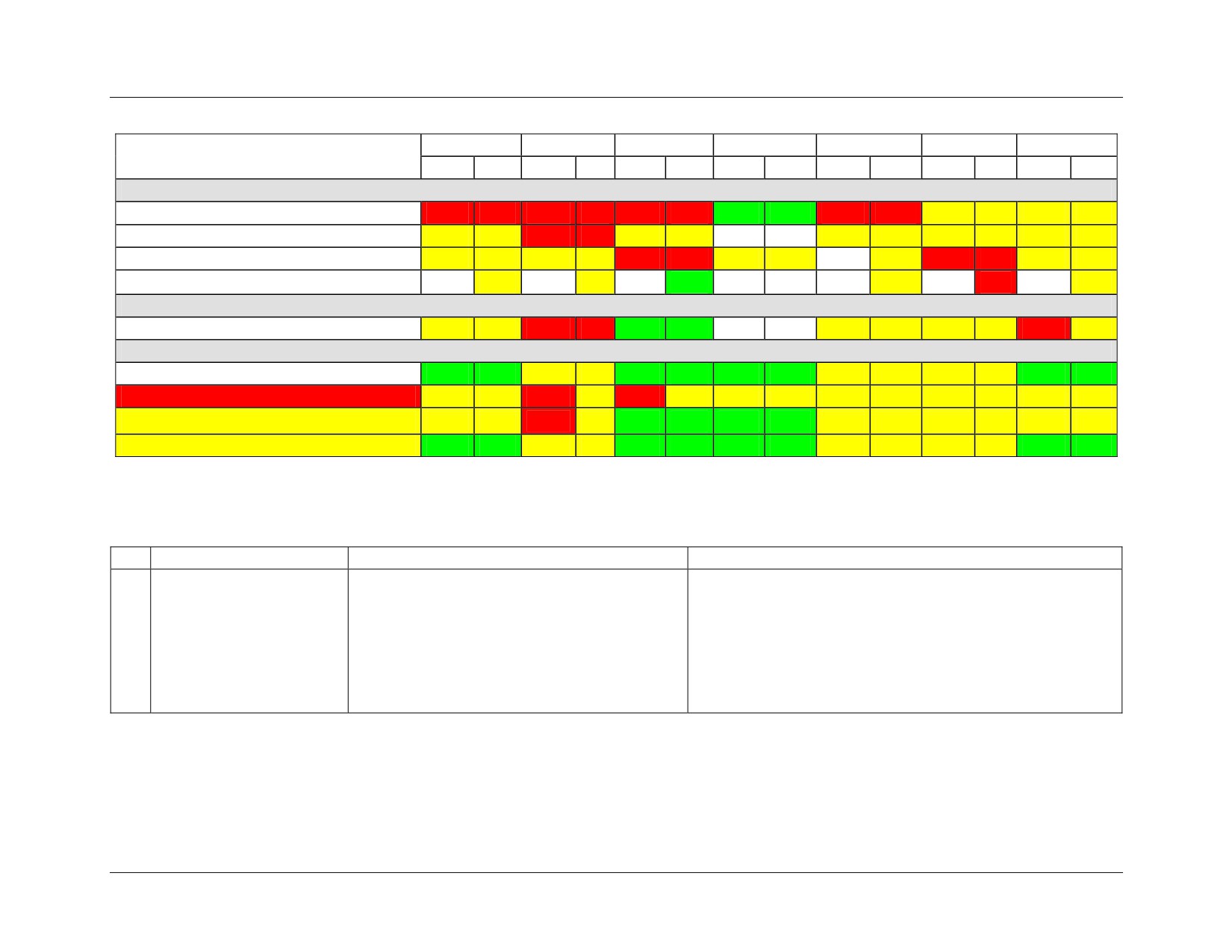
For Official Use Only
CBRND Functional Needs Analysis/Functional Solution Analysis
Chapter 17. Tactical Sustain Tasks
Table 17.4-1. TASUST 4: External Decontamination—Capabilities and Deficiencies Assessment
M1
M2
M3
M4
M5
M6
M7
Capabilities
O
T
O
T
O
T
O
T
O
T
O
T
O
T
Current
Soap and Water
31
3
02
0
43
4
84
8
35
3
56
5
57
78
Diluted HTH Household Bleach
59
5
310
3
611
6
N/A
N/A
512
5
5
5
5
7
Temporary Interment
713
7
714
7
015
0
416
4
N/A
717
318
3
7
7
Embalming
N/A
7
N/A
7
N/A
819
N/A
N/A
N/A
7
N/A
3
N/A
5
Near/Mid-Term
DF 200
7
7
3
3
8
8
N/A
N/A
7
7
5
5
020
7
Far-Term
JSPDS Increment II
1021
10
522
5
8
8
8
8
7
7
5
5
1023
10
Current Overall Capabilities*
5
6
3
5
3
6
6
6
5
7
5
5
5
7
Near/Mid-Term Overall Capabilities
7
7
3
5
8
8
8
8
7
7
5
5
5
7
Far-Term Overall Capabilities
10
10
5
5
8
8
8
8
7
7
5
5
10
10
*This table suggests that current overall capabilities should be labeled “yellow”; however, Mortuary Affairs units and personnel do not have a standard remains
decontamination system to utilize the capabilities currently available, which were evaluated in the table. This deficiency suggests the need to develop a
standardized remains decontamination system to effectively utilize existing and developmental capabilities. Development of an effective system for external
remains decontamination is not technology constrained.
FAA Measure
Elaboration
Scale
M1
(Yes/No) Contaminated by-
Contaminated by-products are controlled. Where
10: Complete (100%).
products are controlled?
contaminated by-products are controlled less than
7: Substantial (~75%).
100%, measures must be in place to prevent them
5: Partial (~50%).
from becoming an unacceptable hazard or safety
3: Minimal (~25%).
risk.
0: No, cross-contamination cannot be controlled and presents an
NOTE: The definition of “contaminated by-
unacceptable hazard.
products” is the residual waste created during the
decontamination process.
49
For Official Use Only
For Official Use Only
CBRND Functional Needs Analysis/Functional Solution Analysis
Chapter 17. Tactical Sustain Tasks
M2
(Level) Of chemical
Chemically contaminated remains can be
10: Decontaminate all CWAs, NTAs, and TIMs to general
contamination after
decontaminated to reduce the level of
population exposure limits.
decontamination procedures.
contamination to a low enough level that remains
7: Decontaminate all CWAs and NTAs and some TIMs to a level
no longer pose an imminent health threat to the
that will allow unprotected exposure.
living. Every effort is made to render remains safe
5: Decontaminate all CWAs, some NTAs to a level that will allow
for immediate return to families. “Agents” defined
unprotected exposure.
as current-generation CWAs, NTAs, TIMS, and
3: Decontaminate most CWAs to a level that will allow
TICs.
unprotected exposure.
0: No effective decontaminant or process.
M3
(Level) Of biological
Biologically contaminated (to include toxins)
10: 0 CFU/PFU/m2—total removal or neutralization of toxins
contamination after
remains can be decontaminated to reduce the level
without causing any visual effects to remains.
decontamination procedures.
of contamination low enough that remains no
8: Less than infective dose levels/casualty-producing toxin
longer pose an imminent health threat to the living.
exposure levels; no visual effects on remains.
Every effort is made to make remains safe for
6: Less than infective dose levels/casualty-producing toxin
immediate return to families. Vegetative and
exposure levels; minor visual effects on remains.
nonvegetative bacteria are measured in CFU/m2
4: Less than infective dose levels/casualty-producing toxin
and viruses are measured in PFU/m2.
exposure levels; significant visual effects on remains.
2: Less than infective dose levels/casualty-producing toxin
exposure levels; remains may not be viewable due to
disfigurement by decontamination process
0: More than infective dose levels/casualty-producing toxin
exposure levels, and remains cannot be immediately transported
and returned to families
M4
(Level) Of radiological
Radiologically contaminated remains can be
10: Total removal to natural backg1round level; no visual effects on
contamination after
decontaminated to reduce the level of
remains.
decontamination procedures.
contamination low enough that remains no longer
8: <0.4 Bq/cm2 beta/gamma activity and <0.04 Bq/cm2 alpha
pose an imminent health threat to the living. Every
activity; no visual effects on remains.
effort is made to make remains safe for immediate
6: <0.4 Bq/cm2 beta/gamma activity and <0.04 Bq/cm2 alpha
return to families.
activity; minor visual effects on remains.
4: <0.4 Bq/cm2 beta/gamma activity and <0.04 Bq/cm2 alpha
activity; significant visual effects on remains.
2: <0.4 Bq/cm2 beta/gamma a activity and <0.04 Bq/cm2 alpha
activity; remains may not be viewable due to disfigurement by
decontamination process.
0: Partial removal; remains cannot be immediately transported and
returned to families due to excessive residual dose rate.
50
For Official Use Only
For Official Use Only
CBRND Functional Needs Analysis/Functional Solution Analysis
Chapter 17. Tactical Sustain Tasks
M5
(Yes/No) Cross-
Cross-contamination is controlled. Where cross-
10: Complete (100%).
contamination is controlled?
contamination is less than 100% controlled,
7: Substantial (~75%).
measures must in place to prevent cross-
5: Partial (~50%).
contamination from becoming an unacceptable
3: Minimal (~25%).
hazard or safety risk.
0: No, Contaminated by-products cannot be controlled and present
an unacceptable hazard
M6
(Yes/No) Decontamination
Procedures required to implement the capabilities
10: No negative impacts on operations.
procedures are logistically
necessary to decontaminate remains against a given
7: Limited negative impact on operational capability.
supportable?
threat are logistically supportable.
5: Moderate negative impact on operational capability.
3: Major negative impact on operational capability.
0: Not logistically supportable.
M7
There is effective DOTLPF
The non-materiel elements associated with
10: DOTLPF is adequate for all tasks to be performed with this
in place to conduct task?
executing the tasks required to implement a given
system without limitations that cause significant impact upon
capability have been established and are available.
operations.
7: DOTLPF is adequate for most of the tasks to be performed with
this system without limitations that cause significant impact upon
operations.
5: Many critical aspects of DOTLPF for the task to be performed
with this system are addressed.
3: Some critical aspects of DOTLPF for the task to be performed
with this system are addressed.
0: DOTLPF is completely inadequate or does not exist for the
tasks to be performed with this system.
1 M1 - (Yes/No) Contaminated by-products are controlled? 3: Minimal (~25%).
2 M2 - (Level) Of chemical contamination after decontamination procedures. 0: No effective decontaminant or process.
3 M3 - (Level) Of biological contamination after decontamination procedures. 4: Less than infective dose levels/casualty-producing toxin-exposure levels, significant visual effects
on remains.
4 M4 - (Level) Of radiological contamination after decontamination procedures. 8: <0.4 bequerel/square centimeter (Bq/cm2) beta/gamma activity and <0.04 Bq/cm2 alpha activity;
no visual effects on remains.
5 M5 - (Yes/No) Cross-contamination is controlled? 3: Minimal (~25%).
6 M6 - (Yes/No) Decontamination procedures are logistically supportable? 5: Moderate negative impact on operational capability.
7 M7 - There is effective DOTLPF in place to conduct task? 5: Many critical aspects of DOTLPF for the task to be performed with this system are addressed.
8 M7 - There is effective DOTLPF in place to conduct task? 7: DOTLPF is adequate for most of the tasks to be performed with this system without limitations that cause
significant impact upon operations.
9 M1 - (Yes/No) Contaminated by-products are controlled? 5: Partial (~50%).
10M2 - (Level) Of chemical contamination after decontamination procedures. 3: Decontaminate most CWAs to a level that will allow unprotected exposure.
11 M3 - (Level) Of biological contamination after decontamination procedures. 6: Less than infective dose levels/casualty-producing toxin-exposure levels; minor visual effects on
remains.
12 M5 - (Yes/No) Cross-contamination is controlled? 5: Partial (~50%)
13 M1 - (Yes/No) Contaminated by-products are controlled? 7: Substantial (~75%).
51
For Official Use Only
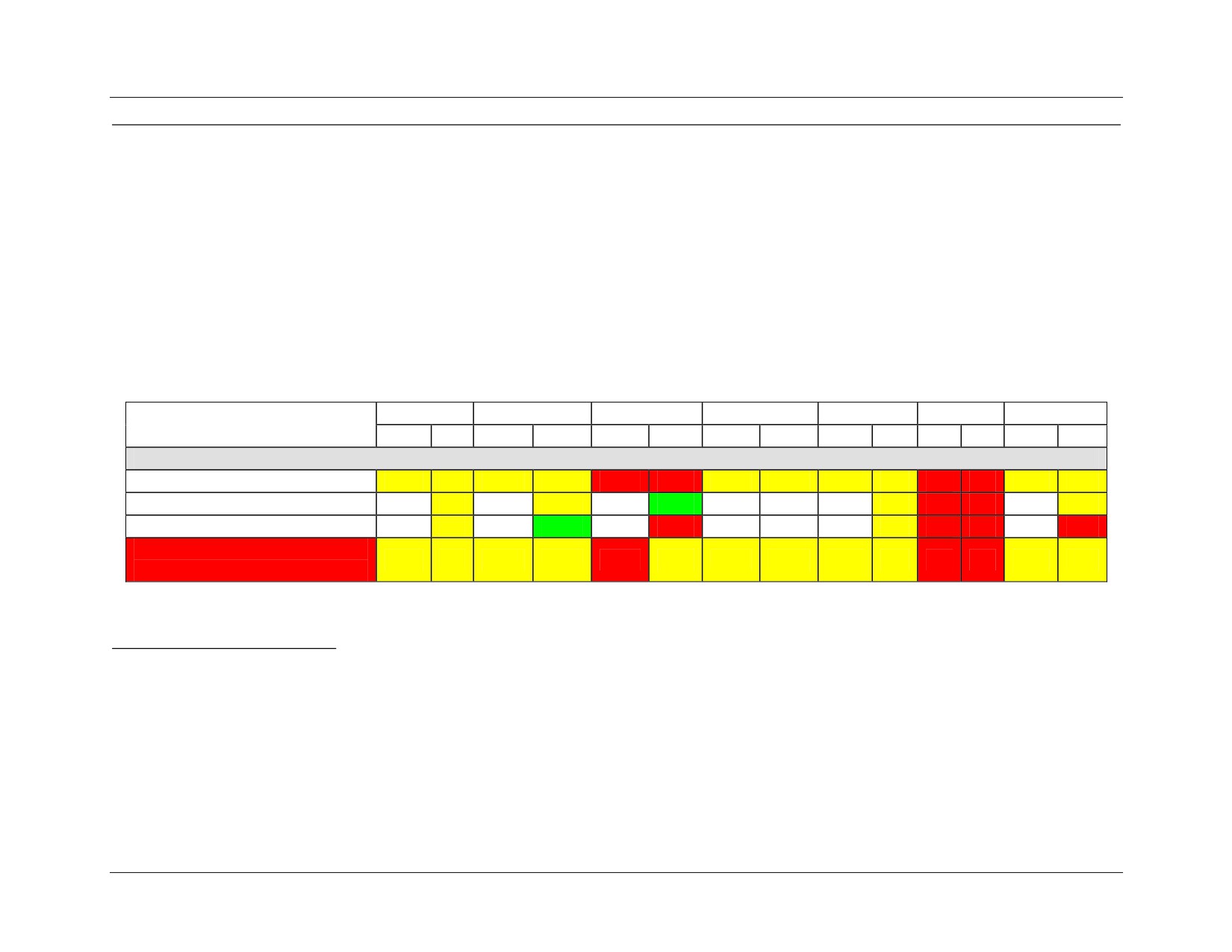
For Official Use Only
CBRND Functional Needs Analysis/Functional Solution Analysis
Chapter 17. Tactical Sustain Tasks
14 M2 - (Level) Of chemical contamination after decontamination procedures. 7: Decontaminate all CWAs, all NTAs, some TIMs to a level that will allow unprotected exposure.
15 M3 - (Level) Of biological contamination after decontamination procedures. 0: More than infective dose levels/casualty-producing toxin-exposure levels, and remains cannot be
immediately transported and returned to families.
16 M4 - (Level) Of radiological contamination after decontamination procedures. 4: <0.4 Bq/cm2 beta/gamma activity and <0.04 Bq/cm2 alpha activity; significant visual effects on
remains.
17 M5 - (Yes/No) Cross-contamination is controlled? 7: Substantial (~75%).
18 M6 - (Yes/No) Decontamination procedures are logistically supportable? 3: Major negative impact on operational capability.
19 M3 - (Level) Of biological contamination after decontamination procedures. 8: Less than infective dose levels/casualty-producing toxin-exposure levels; no visual effects on
remains.
20 M7 - There is effective DOTLPF in place to conduct task? 0: DOTLPF is completely inadequate or does not exist for the tasks to be performed with this system.
21 M1 - (Yes/No) Contaminated by-products are controlled? 10: Complete (100%).
22 M2 - (Level) Of chemical contamination after decontamination procedures. 5: Decontaminate all CWAs, some NTAs to a level that will allow unprotected exposure.
23 M7 - There is effective DOTLPF in place to conduct task? 10: DOTLPF is adequate for all tasks to be performed with this system without limitations that cause significant
impact upon operations.
Table 17.4-2. TASUST 4: Internal Decontamination—Capabilities and Deficiencies Assessment
M1
M2
M3
M4
M5
M6
M7
Capabilities
O
T
O
T
O
T
O
T
O
T
O
T
O
T
Current/Near/Mid/Far-Term
Temporary Interment*
71
7
72
7
03
0
44
4
7
75
36
3
77
7
Embalming*
N/A
7
N/A
7
N/A
88
N/A
N/A
N/A
7
3
3
N/A
59
Cremation
N/A
7
N/A
1010
N/A
211
N/A
N/A
N/A
7
012
0
N/A
013
Current/ Near/Mid/Far-
7
7
7
7
0
6
4
4
7
7
3
3
7
5
Term Overall Capabilities*
*Temporary interment, embalming, and cremation, while offering various capabilities, are either not allowed by current policies or are not desired solutions for
the expeditious return of previously contaminated remains to families. These are stop-gap and extreme measures utilized only in the case of lacking other
decontamination capabilities. There are no formal capability development programs currently under way to decontaminate remains with residual internal hazards.
1 M1 - (Yes/No) Contaminated by-products are controlled? 7: Substantial (~75%).
2 M2 - (Level) Of chemical contamination after decontamination procedures. 7: Decontaminate all CWAs, all NTAs, some TIMs to a level that will allow unprotected exposure.
3 M3 - (Level) Of biological contamination after decontamination procedures. 0: More than infective dose levels/casualty-producing toxin-exposure levels, and remains cannot be
immediately transported and returned to families.
4 M4 - (Level) Of radiological contamination after decontamination procedures. 4: <0.4 Bq/cm2 beta/gamma activity and <0.04 Bq/cm2 alpha activity; significant visual effects on
remains
5 M5 - (Yes/No) Cross-contamination is controlled? 7: Substantial (~75%).
6 M6 - (Yes/No) Decontamination procedures are logistically supportable? 3: Major negative impact on operational capability.
7 M7 - There is effective DOTLPF in place to conduct task? 7: DOTLPF is adequate for most of the tasks to be performed with this system without limitations that cause
significant impact upon operations.
52
For Official Use Only
For Official Use Only
CBRND Functional Needs Analysis/Functional Solution Analysis
Chapter 17. Tactical Sustain Tasks
8 M3 - (Level) Of biological contamination after decontamination procedures. 8: Less than infective dose levels/casualty-producing toxin-exposure levels; no visual effects on
remains.
9 M7 - There is effective DOTLPF in place to conduct task? 5: Many critical aspects of DOTLPF for the task to be performed with this system are addressed.
10 M2 - (Level) Of chemical contamination after decontamination procedures. 10: Decontaminate all CWAs, NTAs, and TIMs to general population exposure limits.
11 M3 - (Level) Of biological contamination after decontamination procedures. 2: Less than infective dose levels/casualty-producing toxin-exposure levels; remains may not be
viewable due to disfigurement by decontamination process.
12 M6 - (Yes/No) Decontamination procedures are logistically supportable? 0: Not logistically supportable.
13 M7 - There is effective DOTLPF in place to conduct task? 0: DOTLPF is completely inadequate or does not exist for the tasks to be performed with this system.
53
For Official Use Only
For Official Use Only
CBRND Functional Needs Analysis/Functional Solution Analysis
Chapter 17. Tactical Sustain Tasks
17.4.3
Functional Solution Analysis
17.4.3.1
DOTLPF Assessment Summary
This section states the deficiencies and suggests potential non-materiel solutions. If there are no
solutions or there are only partial solutions for a particular deficiency, the deficiency is then
reassessed in the IMA section.
1.
Deficiency: Inadequate expeditionary capabilities to perform remains decontamination.
Non-Materiel Solutions: Doctrine (partial): Doctrine establishes policy—i.e., what must be
done, not how to do it—and history has demonstrated repeatedly that doctrine cannot always
be implemented during combat as envisioned. This principle is especially true on the
ambiguous, nonlinear battlefield of today where personnel from all Services are evacuating
remains from the battlefield. Doctrine must be updated to take into account the force
structure changes taking place in all the Services to enhance their capability to rapidly deploy
and to efficiently and effectively fight in a joint, combined, and/or multinational
environment. Above all, however, it is essential that doctrine be updated to emphasize the
need for a capability to safely transport and decontaminate biologically contaminated
remains and PE.
2.
Deficiency: Inadequate force structure and equipment to perform expeditionary remains
decontamination.
Non-Materiel Solutions: Organizations (partial): CASCOM is currently drafting a Force
Design Update to restructure U.S. Army MA companies to enable them to better support the
full spectrum of MA operations. And other Service components are changing their force
structure as well to increase their organic MA operational capability. Changing the current
structure of military organizations or adding additional activities to the military force
structure may provide personnel assets to support transporting and decontaminating
biologically contaminated remains and PE, but without the right equipment to perform these
functions, these serious capability gaps will not be eliminated. To ensure U.S. Army MA
companies, as well as the other Service component organizations, are able to perform MA
decontamination functions as required, CASCOM is currently working with JRO-CBRND to
determine the feasibility of fielding an Interim Mortuary Affairs Remains Decontamination
System to provide DoD the capability to decontaminate the exterior of CBRN contaminated
remains and PE. If approved, this equipment will be added to the MA company tables of
organization and equipment (TOEs). Other Service components will also be able to add it to
their authorized equipment lists, as well. CASCOM is also working with DTRA to develop
and test a containment system to safely transport contaminated remains from an incident site
to a decontamination site. CASCOM anticipates this effort will be successful. If so,
depending on the solution identified and approved through the JCIDS process to
decontaminate biologically contaminated remains, the equipment may be added to the MA
Company TOEs, and other Service Component equipment lists. Personnel (partial): An
increase or decrease in personnel authorizations cannot resolve this urgent requirement, and
until specific materiel solutions are identified and approved to support these requirements,
the need for changes in personnel authorizations will not be known. Certain military
occupational specialties for existing military positions, and/or job descriptions for existing
54
For Official Use Only
For Official Use Only
CBRND Functional Needs Analysis/Functional Solution Analysis
Chapter 17. Tactical Sustain Tasks
DoD civilian personnel may very well need to be modified to incorporate operation of this
equipment as a primary duty.
3.
Deficiency: Training to perform remains decontamination is inadequate.
Non-Materiel Solutions: Training (partial): Changes to existing Service Component
professional development and training plans will not address this deficiency by themselves.
As previously mentioned, materiel solutions are required to provide DoD the capability to
safely transport and decontaminate biologically contaminated remains. The addition of new
equipment to support this requirement, will however, require the development of new
training plans on how to operate and maintain the equipment; as well as the procedures to be
followed to transport and decontaminate biologically contaminated remains and PE.
Leadership Development (partial): Like training, changes to existing leadership development
programs will not correct these capability gaps. The addition of new technology equipment to
the military inventory, and the subsequent processes developed for the implementation of this
technology may/ require the addition of, or changes to leadership development programs.
4.
Deficiency: A lack of fixed facilities with capabilities to support remains decontamination.
Non-Materiel Solutions: None. Existing facilities do not have the capability or can be
modified to provide this critical requirement, however, a materiel solution to decontaminate
biologically contaminated remains may require equipment to be installed and maintained in
fixed facilities. Until a specific solution is identified and approved, however, the answer to
this question will not be known. If fixed facilities are required, they may need to be
strategically located at multiple sites within CONUS to enable them to support both CONUS
and OCONUS requirements. Facilities may also need to be identified in overseas theaters of
operation that can be used to house the system in the event a bioterrorist attack is launched
against United States interests overseas.
17.4.3.2
IMA Assessment Summary
Table 17.4-3 identifies which of the materiel approaches might address specific materiel gaps
identified in the DOTMLPF assessment.
55
For Official Use Only
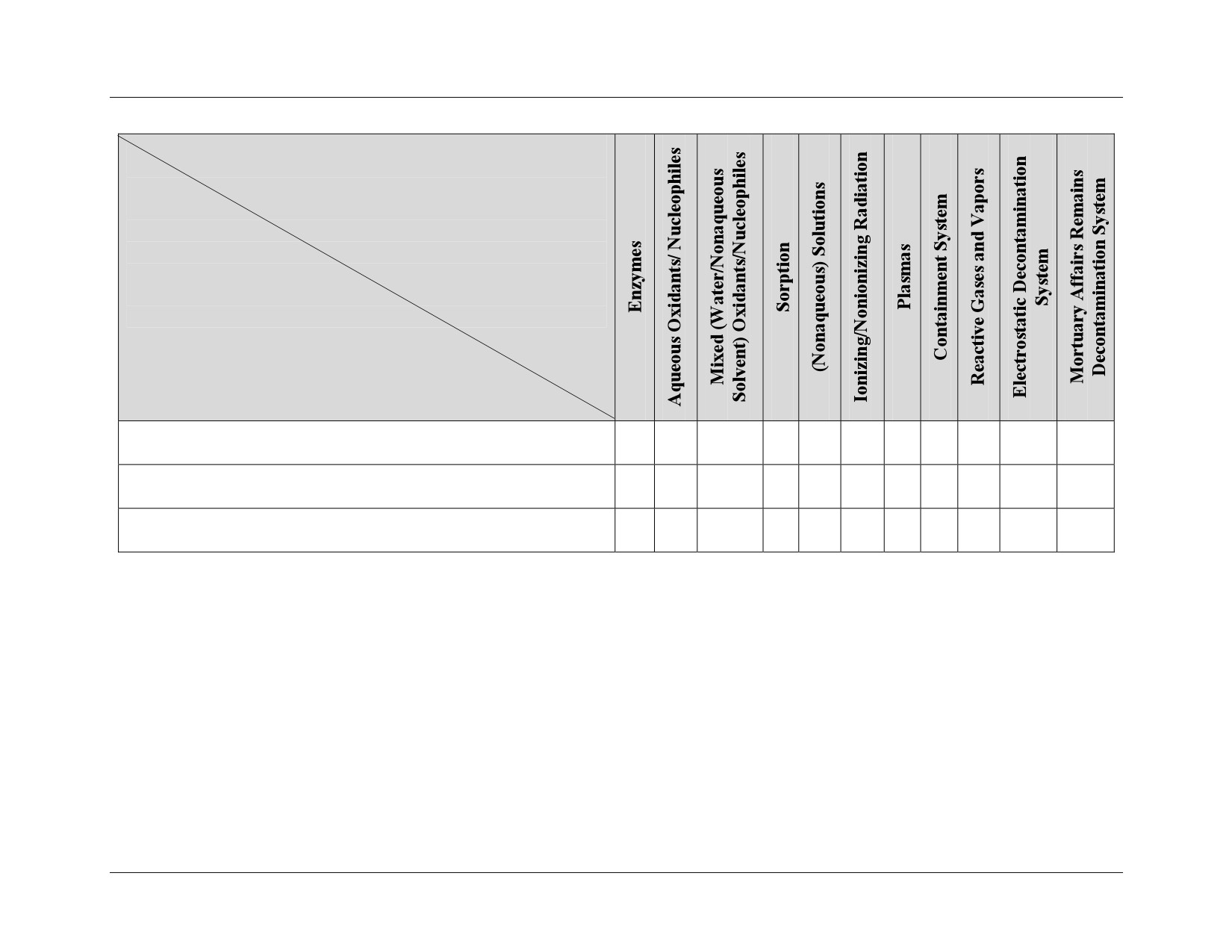
For Official Use Only
CBRND Functional Needs Analysis/Functional Solution Analysis
Chapter 17. Tactical Sustain Tasks
Table 17.4-3. TASUST 4: IMA Assessment
Ideas for Materiel
Approaches
(IMA)
Identified Gaps
Current array of decontaminants may not neutralize all
X
X
X
X
X
X
X
X
X
X
chemical and biological hazards.
Lack of capability decontaminate biologically and chemically
X
X
X
contaminated internal organs of contaminated human remains.
No containment system to safely transport internally
X
X
X
X
biologically contaminated human remains.
56
For Official Use Only
For Official Use Only
CBRND Functional Needs Analysis/Functional Solution Analysis
Chapter 17. Tactical Sustain Tasks
17.5
Task TASUST 5: Diagnose chemical effects on personnel and MWAs
17.5.1
Functional Area Analysis
17.5.1.1
Definition
To use medical diagnostic tools and procedures to identify and confirm chemical hazard
exposure in both personnel and MWAs, specifically MWDs. Also includes monitoring
presymptomatic levels of exposure. Several animal species are used as MWAs; however, MWDs
are the predominant species and are most likely to be deployed with military personnel.
17.5.1.2
Derivation
UJTL (TA 7, TA 7.1), Protection Joint Functional Concept.
17.5.1.2.1
Supported Tasks: OPSUST 8, OPSUST 11
17.5.1.2.2
Lateral Tasks: TASHA 12, TASHA 13
17.5.1.2.3
Supporting Task: N/A
17.5.1.3
Condition
Perform this task under conditions of:
Physical
1. Negligible light. (C1.3.2.1)
2. Chemical effects. (C1.3.3.2)
Military
1. Severe health status. (NEW)
2. Stressful mission. (C2.1)
3. Minimal or short time available. (C2.1.5)
4. Marginal forces allocated. (C2.2.3)
5. Low personnel capability. (C2.2.4)
6. Limited or negligible personnel experience. (C2.2.4.5)
7. Severe personnel fatigue. (C2.2.4.6)
8. Some or no interoperability. (C2.2.6)
9. Restricted information exchange. (C2.3.1.8)
Civil
1. High mission priority. (C3.1.3.2)
2. Few or negligible translators. (C3.2.1.2)
3. Significant customs adjustment. (C3.2.2)
57
For Official Use Only
For Official Use Only
CBRND Functional Needs Analysis/Functional Solution Analysis
Chapter 17. Tactical Sustain Tasks
4. Significant refugee-care responsibility. (C3.3.2.3)
17.5.2
Functional Needs Analysis
17.5.2.1
Capabilities and Deficiencies Assessment Summary
Table 17.5-1 presents individual and overall current, near-/mid-term, and far-term capabilities to
perform the task to the designated standards. There are eight current capabilities used to
accomplish this task. The individual capabilities include signs/symptomatology and clinical
diagnosis capabilities for nerve, blister, cyanide, and pulmonary agent exposure.
Current Capabilities and Deficiencies
The overall current capability is assessed as “yellow.” High-level chemical exposure typically
causes a rapid onset of recognizable signs and symptoms; however, signs and symptoms of
mustard and phosgene exposure as well as low-level exposure by all chemical agents may not be
immediately recognizable to medical and veterinary services personnel. Diagnostic tools are
available to presumptively identify and quantify chemical agent exposure by class (with the
exception of phosgene intoxication). However, there are no clinical laboratory tests that confirm
blister agent or phosgene exposure. Furthermore, laboratory diagnosis typically cannot be
completed in sufficient time frame to reduce morbidity and mortality.
Projected Near/Mid-Term Capabilities and Deficiencies
No changes in capability are projected in the near/mid term for this task, so the overall projected
near/mid-term capability will remain “yellow.”
Projected Far-Term Capabilities and Deficiencies
No changes in capability are projected in the far term for this task, so the overall projected far-
term capability will remain “yellow.”
58
For Official Use Only
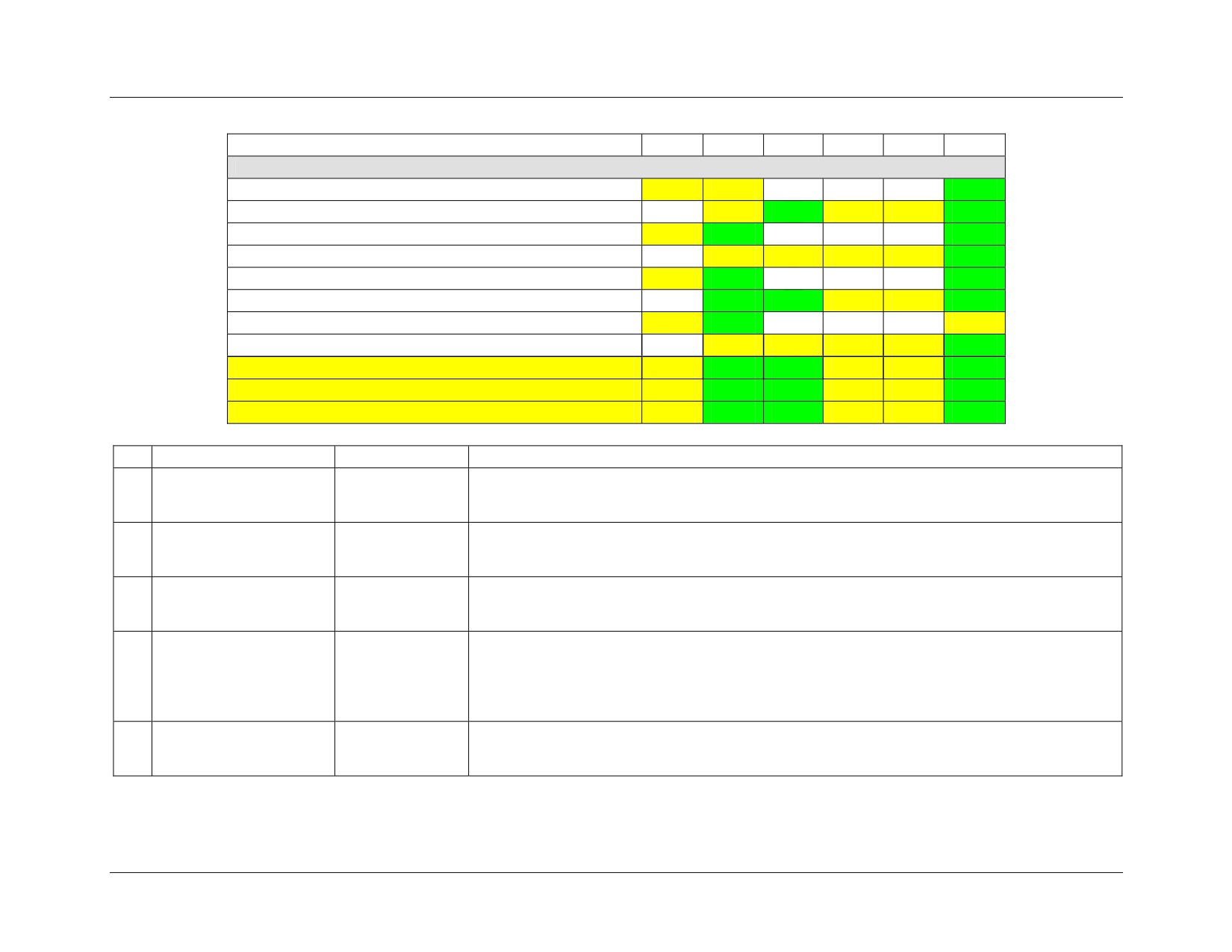
For Official Use Only
CBRND Functional Needs Analysis/Functional Solution Analysis
Chapter 17. Tactical Sustain Tasks
Table 17.5-1. TASUST 5: Capabilities and Deficiencies Assessment
System/Measure
M1
M2
M3
M4
M5
M6
Current
Signs and Symptomatology - Nerve Agents
5
5
N/A
N/A
N/A
10
Clinical Diagnosis - Nerve Agents
N/A
5
10
5
5
10
Signs and Symptomatology - Vesicant Agents
5
10
N/A
N/A
N/A
10
Clinical Diagnosis - Vesicant Agents
N/A
5
5
5
5
10
Signs and Symptomatology - Cyanides
5
10
N/A
N/A
N/A
10
Clinical Diagnosis - Cyanides
N/A
10
10
5
5
10
Signs and Symptomatology - Pulmonary Agents
5
10
N/A
N/A
N/A
5
Clinical Diagnosis - Pulmonary Agents
N/A
5
5
5
5
10
Current Overall Capabilities
5
8
8
5
5
9
Near/Mid-Term Overall Capabilities
5
8
8
5
5
9
Far-Term Overall Capabilities
5
8
8
5
5
9
FAA Measure
Elaboration
Scale
M1
Signs and symptoms of
Applies to sign and
10: Complete capability.
chemical exposure can be
symptomatology
5: Partial capability.
recognized?
capabilities only.
0: No capability.
M2
All chemical hazard effects
10: Complete capability (e.g., specific agent identified).
can be identified during
5: Partial capability (e.g., agent type identified).
diagnostic evaluation?
0: No capability.
M3
All chemical hazard effects
Applies to clinical
10: Complete capability.
can be quantified during
diagnosis
5: Partial capability.
diagnostic evaluation?
capabilities only.
0: No capability.
M4
Time to prepare sample?
Applies to clinical
10: Sample collection/preparation can be completed in sufficient time frame to reduce morbidity and
diagnosis
mortality.
capabilities only.
5: Sample collection/preparation cannot be completed in sufficient time frame to reduce morbidity and
mortality.
0: Samples cannot be collected and prepared for analysis.
M5
Time to confirm hazard
Applies to clinical
10: Sample analysis can be completed in sufficient time frame to reduce morbidity and mortality.
presence in sample?
diagnosis
5: Sample analysis cannot be completed in sufficient time frame to reduce morbidity and mortality.
capabilities only.
0: Sample analysis capability does not exist.
59
For Official Use Only
For Official Use Only
CBRND Functional Needs Analysis/Functional Solution Analysis
Chapter 17. Tactical Sustain Tasks
M6
Capability (DOTLPF)
10: DOTLPF exists and is adequate for this task. Task can be effectively performed with minor
exists to diagnose chemical
limitations with little or no direct impact upon operations.
exposure?
5: Most critical aspects of DOTLPF for this task are addressed.
0: DOTLPF is inadequate or does not exist for this task. Task cannot be effectively accomplished.
60
For Official Use Only
For Official Use Only
CBRND Functional Needs Analysis/Functional Solution Analysis
Chapter 17. Tactical Sustain Tasks
17.5.3
Functional Solution Analysis
17.5.3.1
DOTLPF Assessment Summary
This section states the deficiencies and suggests potential non-materiel solutions. If there are no
solutions or there are only partial solutions for a particular deficiency, that deficiency is then
reassessed in the IMA section.
1.
Deficiency: Inability to immediately recognize low-level exposure to chemical agents or
confusing it for other maladies.
Non-Materiel Solutions: Training: Increase Medical and Veterinary Services personnel
training on recognizing signs and symptom of chemical agent exposures in personnel and
MWAs.
2.
Deficiency: Lack of recognition of early signs and symptoms that indicate chemical exposure
in MWAs.
Non-Materiel Solutions: Training: Develop course for Veterinary Services personnel (based
on existing course for human chemical agent casualties) and provide initial and refresher
training on medical identification and management of chemical effects in MWAs.
3.
Deficiency: Inability to definitively identify mustard and phosgene casualties during early
post-exposure period.
Non-Materiel Solutions: None.
4.
Deficiency: General inability to identify, during diagnosis, actual agent that caused exposure.
Non-Materiel Solutions: None.
5.
Deficiency: Lack of clinical laboratory tests that confirm blister agent or phosgene exposure.
Non-Materiel Solutions: None.
6.
Deficiency: Inability to complete clinical diagnosis in sufficient time frame to reduce
morbidity and mortality.
Non-Materiel Solutions: None.
7.
Deficiency: Lack of resources to prevent mass casualty diagnostic requirements from
overwhelming the laboratory system.
Non-Materiel Solutions: Doctrine (partial): Incorporate guidelines for an MOU/A with
external laboratory resources. Revise doctrine to define those circumstances when assistance
from alternative laboratories would be needed, to identify which staff and what equipment
would be readily available to conduct diagnostics, to clarify DoD requirements for personnel
(i.e., clearance, experience, etc.), to identify what protocol for diagnosing/analyzing samples
are to be followed, and to ensure adequate training of personnel. Training (partial):
Coordinate training and certify personnel from alternative laboratories. Organization
(partial): Develop MOU/As with civilian and/or commercial laboratories to assist with
diagnostic requirements.
61
For Official Use Only
For Official Use Only
CBRND Functional Needs Analysis/Functional Solution Analysis
Chapter 17. Tactical Sustain Tasks
8. Deficiency: Inadequate chain-of-custody procedures and/or special packaging and handling.
Non-Materiel Solutions: Doctrine (partial): Clearly define chain-of-custody process,
handling, and packaging procedures. Training (partial): Train personnel on chain-of-custody,
handling, and packaging procedures.
17.5.3.2
IMA Assessment Summary
Table 17.5-2 identifies which of the materiel approaches might address specific materiel gaps
identified in the DOTMLPF assessment.
62
For Official Use Only
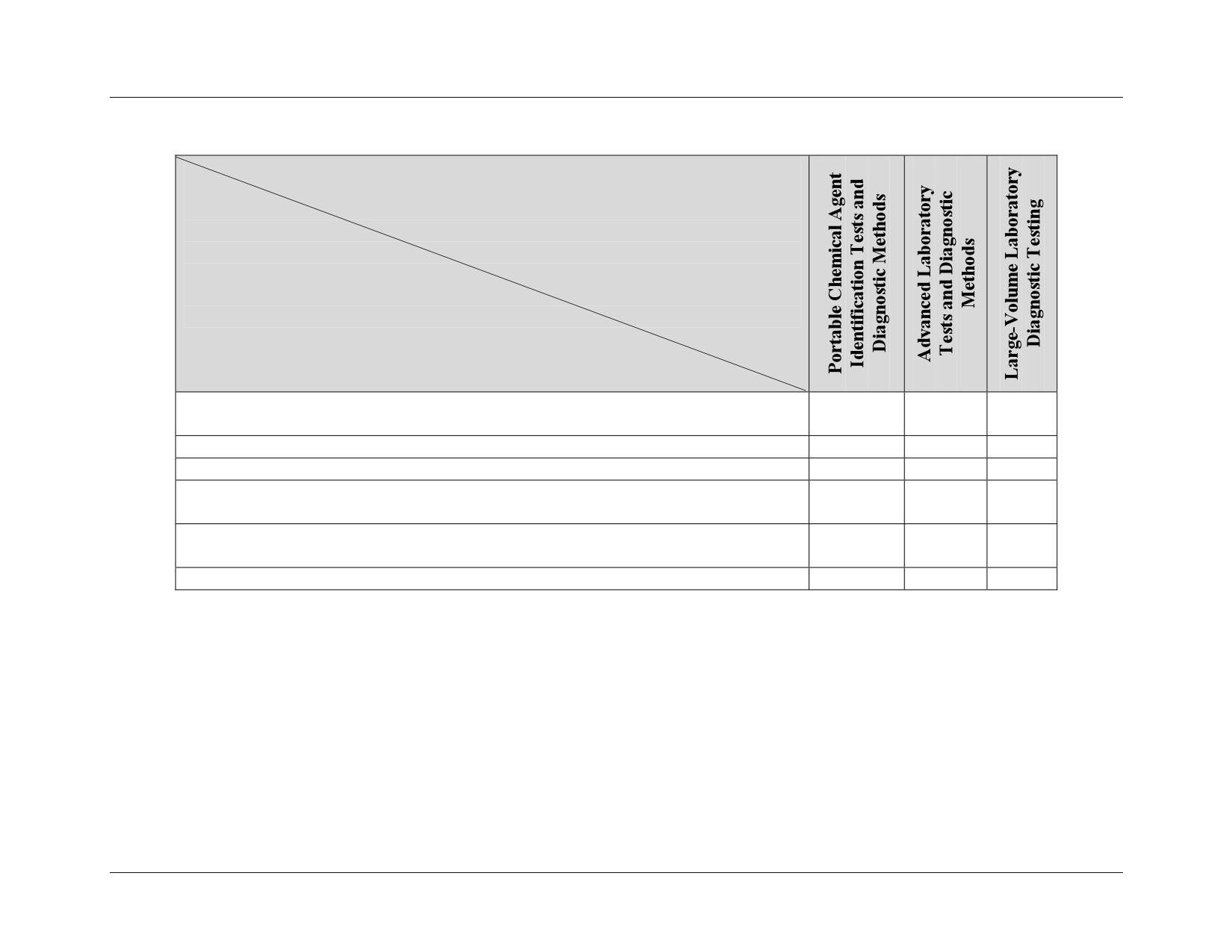
For Official Use Only
CBRND Functional Needs Analysis/Functional Solution Analysis
Chapter 17. Tactical Sustain Tasks
Table 17.5-2. TASUST 5: IMA Assessment
Idea for Materiel
Approach
(IMA)
Identified Gap
Inability to definitively identify mustard and phosgene casualties during early
X
X
X
post-exposure period.
General inability to identify, during diagnosis, actual agent that caused exposure.
X
X
X
Lack of clinical laboratory tests that confirm blister agent or phosgene exposure.
X
X
Inability to complete clinical diagnosis in sufficient time frame to reduce
X
X
X
morbidity and mortality.
Lack of resources to prevent mass casualty diagnostic requirements from
X
overwhelming the laboratory system.
Inadequate chain-of-custody procedures and/or special packaging and handling.
X
63
For Official Use Only
For Official Use Only
CBRND Functional Needs Analysis/Functional Solution Analysis
Chapter 17. Tactical Sustain Tasks
17.6
Task TASUST 6: Diagnose biological effects on personnel and MWAs
17.6.1
Functional Area Analysis
17.6.1.1
Definition
To use medical diagnostic tools and procedures to identify and confirm biological hazard
exposure in both personnel and MWAs, specifically MWDs. Also includes monitoring
presymptomatic levels of exposure. Several animal species are used as MWAs; however, MWDs
are the predominant species and are most likely to be deployed with military personnel.
17.6.1.2
Derivation
UJTL (TA 7, TA 7.1), Protection Joint Functional Concept.
17.6.1.2.1
Supported Tasks: OPSUST 8, OPSUST 11
17.6.1.2.2
Lateral Tasks: TASHA 12, TASHA 13
17.6.1.2.3
Supporting Task: N/A
17.6.1.3
Condition
Perform this task under conditions of:
Physical
1. Negligible light. (C1.3.2.1)
2. Biological effects. (C1.3.3.3)
Military
1. Severe health status. (NEW)
2. Stressful mission. (C2.1)
3. Minimal or short time available. (C2.1.5)
4. Marginal forces allocated. (C2.2.3)
5. Low personnel capability. (C2.2.4)
6. Limited or negligible personnel experience. (C2.2.4.5)
7. Severe personnel fatigue. (C2.2.4.6)
8. Some or no interoperability. (C2.2.6)
9. Restricted information exchange. (C2.3.1.8)
Civil
1. High mission priority. (C3.1.3.2)
2. Few or negligible translators. (C3.2.1.2)
3. Significant customs adjustment. (C3.2.2)
64
For Official Use Only
For Official Use Only
CBRND Functional Needs Analysis/Functional Solution Analysis
Chapter 17. Tactical Sustain Tasks
4. Moderate or high health risk. (C3.3.1.5)
5. Significant refugee-care responsibility. (C3.3.2.3)
17.6.2
Functional Needs Analysis
17.6.2.1
Capabilities and Deficiencies Assessment Summary
Table 17.6-1 presents individual and overall current, near-/mid-term, and far-term capabilities to
perform the task to the designated standards. There are six current capabilities and three
projected to be added in the future (actually two: Joint Biological Agent Identification and
Diagnostic System [JBAIDS] Block I and II in the near/mid term). The individual capabilities
include signs/symptomatology and clinical diagnosis capabilities for bacteria/rickettsia, viruses,
and toxins.
Current Capabilities and Deficiencies
The overall current capability is assessed as “yellow.” Signs and symptomatology, in addition to
currently available diagnostic tools, partially meet most standards for diagnosing biological
effects on personnel and MWAs1. They partially meet confirmatory standards since, with the
exception of toxins, cultivation and identification of pathogen is usually required and this process
can take days.
Projected Near/Mid-Term Capabilities and Deficiencies
The overall projected near/mid-term capability is assessed as “yellow.” Near-future capability
JBAIDS Block I will rapidly identify and quantify all bacterial/rickettsia agents of interest and
most viral agents of interest in clinical samples. JBAIDS Block II will also detect all toxins or
interest.
Projected Far-Term Capabilities and Deficiencies
No changes in capability are projected in the far term for this task, so the overall projected far-
term capability will remain “yellow.”
1 In general, diseases produced by the offensive use of biological warfare (BW) agents against U.S. forces could be lethal and/or
disabling. These BW agents could also infect the animal population within the contaminated area; however, most of the diseases
that are likely to be used in BW are unlikely to cause illness in MWDs, primarily due to varied species susceptibility between
dogs and humans for most BW agents. (For definitive information on BW agents, see FM 8-284). Of the diseases considered to
be likely BW agents, MWDs are likely to be susceptible to only plague (Yersinia pestis), tularemia, brucellosis, Q-fever, and
anthrax. In all of these diseases, the MWD is believed to be less susceptible than man.
65
For Official Use Only
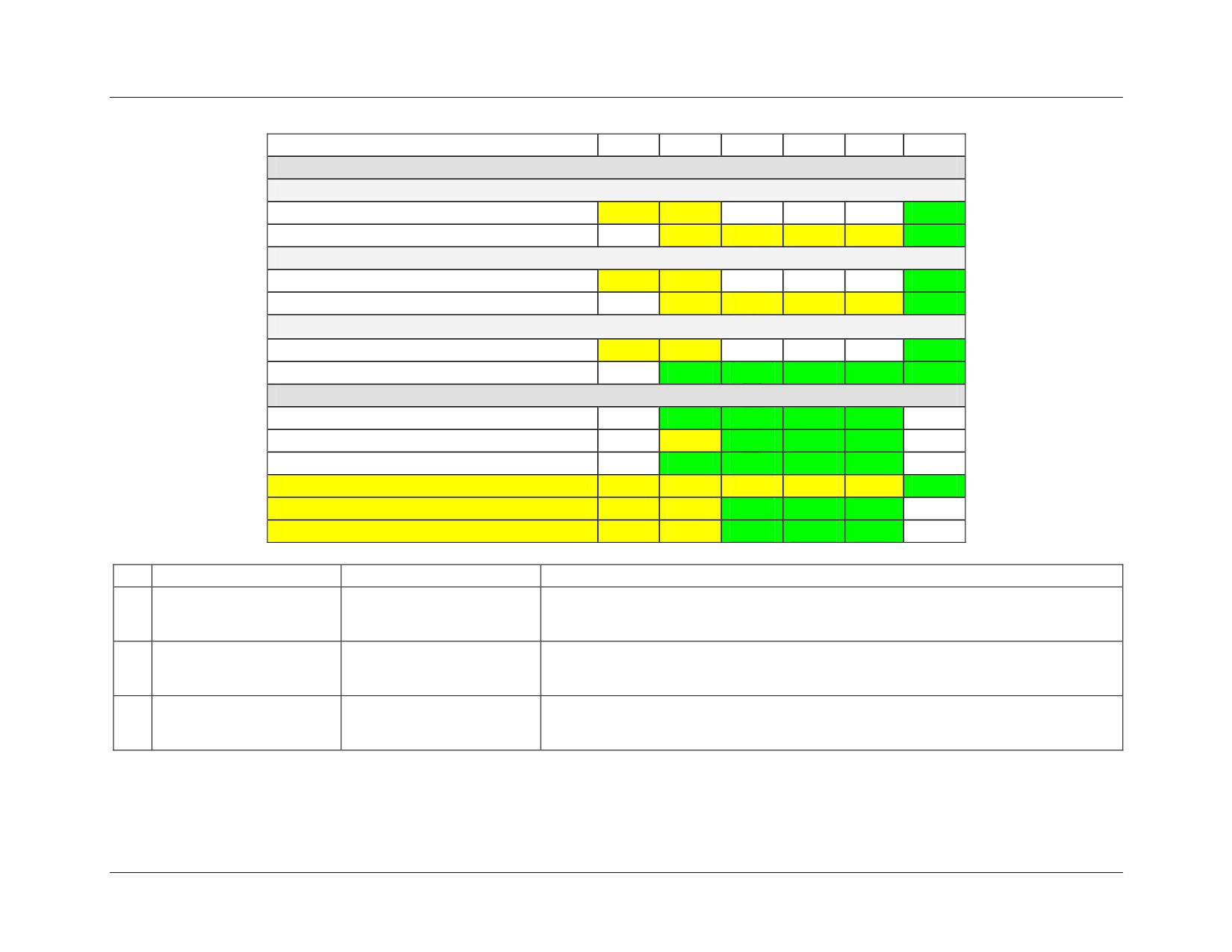
For Official Use Only
CBRND Functional Needs Analysis/Functional Solution Analysis
Chapter 17. Tactical Sustain Tasks
Table 17.6-1. TASUST 6: Capabilities and Deficiencies Assessment
System/Measure
M1
M2
M3
M4
M5
M6
Current
Bacteria/Rickettsia
Signs and Symptoms
5
5
N/A
N/A
N/A
10
Clinical Diagnosis
N/A
5
5
5
5
10
Viruses
Signs and Symptoms
5
5
N/A
N/A
N/A
10
Clinical Diagnosis
N/A
5
5
5
5
10
Toxins
Signs and Symptoms
5
5
N/A
N/A
N/A
10
Clinical Diagnosis
N/A
10
10
10
10
10
Near/Mid-Term
JBAIDS Block I/II - Bacteria/ Rickettsia
N/A
10
10
10
10
N/A
JBAIDS Block I/II - Viruses
N/A
5
10
10
10
N/A
JBAIDS Block II - Toxins
N/A
10
10
10
10
N/A
Current and Overall Capabilities
5
6
7
7
7
10
Near/Mid-Term Overall Capabilities
5
7
8
8
8
N/A
Far-Term Overall Capabilities
5
7
8
8
8
N/A
FAA Measure
Elaboration
Scale
M1
Signs and symptoms of
Applies to signs and
10: Complete capability.
biological exposure can be
symptomatology capabilities
5: Partial capability.
recognized?
only.
0: No capability.
M2
All biological hazard effects
10: Complete capability (e.g., specific agent identified).
can be identified during
5: Partial capability (e.g., agent type identified).
diagnostic evaluation?
0: No capability.
M3
All biological hazard effects
Applies to clinical diagnosis
10: Complete capability.
can be quantified during
capabilities only.
5: Partial capability.
diagnostic evaluation?
0: No capability.
66
For Official Use Only
For Official Use Only
CBRND Functional Needs Analysis/Functional Solution Analysis
Chapter 17. Tactical Sustain Tasks
M4
Time to prepare sample?
Applies to clinical diagnosis
10: Sample collection/preparation can be completed in sufficient time frame to reduce
capabilities only.
morbidity and mortality.
5: Sample collection/preparation cannot be completed in sufficient time frame to reduce
morbidity and mortality.
0: Samples cannot be collected and prepared for analysis.
M5
Time to confirm hazard
Applies to clinical diagnosis
10: Sample analysis can be completed in sufficient time frame to reduce morbidity and
presence in sample?
capabilities only.
mortality.
5: Sample analysis cannot be completed in sufficient time frame to reduce morbidity and
mortality.
0: Sample analysis capability does not exist.
M6
Capability (DOTLPF) exists
10: DOTLPF exists and is adequate for this task. Task can be effectively performed with
to diagnose biological
minor limitations with little or no direct impact upon operations.
exposure?
5: Most critical aspects of DOTLPF for this task are addressed.
0: DOTLPF is inadequate or does not exist for this task. Task cannot be effectively
accomplished.
67
For Official Use Only
For Official Use Only
CBRND Functional Needs Analysis/Functional Solution Analysis
Chapter 17. Tactical Sustain Tasks
17.6.3
Functional Solution Analysis
17.6.3.1
DOTLPF Assessment Summary
This section states the deficiencies and suggests potential non-materiel solutions. If there are no
solutions or there are only partial solutions for a particular deficiency, that deficiency is then
reassessed in the IMA section.
1.
Deficiency: Inability to perform presumptive identification during early stages of illness.
Non-Materiel Solutions: None.
2.
Deficiency: Unacceptable amount of time (i.e., order of days) required for confirmation of
bacterial and viral etiologic agents.
Non-Materiel Solutions: None.
3.
Deficiency: Limited capability for forward-deployed medical personnel to rapidly analyze
biological specimens.
Non-Materiel Solutions: None.
4.
Deficiency: Limited capability for forward-deployed medical personnel to collect and
prepare samples.
Non-Materiel Solutions: None.
5.
Deficiency: Lack of resources to prevent mass casualty diagnostic requirements from
overwhelming the laboratory system.
Non-Materiel Solutions: Doctrine (partial): Revise doctrine to define those circumstances
when assistance from alternative laboratories would be needed, to identify which staff and
what equipment would be readily available to conduct diagnostics, to clarify DoD
requirements for personnel (i.e., clearance, experience, etc.), to identify what protocol for
diagnosing/analyzing samples are to be followed, and to ensure adequate training of
personnel. Organization (partial): Develop MOU/As with civilian and/or commercial
laboratories to assist with diagnostic requirements. Training (partial): Coordinate training
and certify personnel from alternative laboratories.
6.
Deficiency: Inability to presumptively differentiate between bacterial diseases during early
illness through recognition of signs and symptoms.
Partial Non-Materiel Solutions: Training (Partial): Develop course for Veterinary Services
personnel (based on existing course for human biological agent casualties) and provide initial
and refresher training on medical identification and management of biological warfare agents
effects in MWAs.
7.
Deficiency: Unacceptable risk of infecting laboratory personnel during clinical specimen
analysis.
Non-Materiel Solutions: Training (partial): Train laboratory personnel on safe handling and
testing procedures and protocols.
68
For Official Use Only
For Official Use Only
CBRND Functional Needs Analysis/Functional Solution Analysis
Chapter 17. Tactical Sustain Tasks
8. Deficiency: Lack of specificity of most routine laboratory tests.
Non-Materiel Solutions: None.
9. Deficiency: Inadequate chain-of-custody procedures and/or special packaging and handling.
Non-Materiel Solutions: Doctrine (partial): Clearly define chain-of-custody process,
handling, and packaging procedures. Training (partial): Train personnel on chain-of-custody,
handling, and packaging procedures.
17.6.3.2
IMA Assessment Summary
Table 17.6-2 identifies which of the materiel approaches might address specific materiel gaps
identified in the DOTMLPF assessment.
69
For Official Use Only
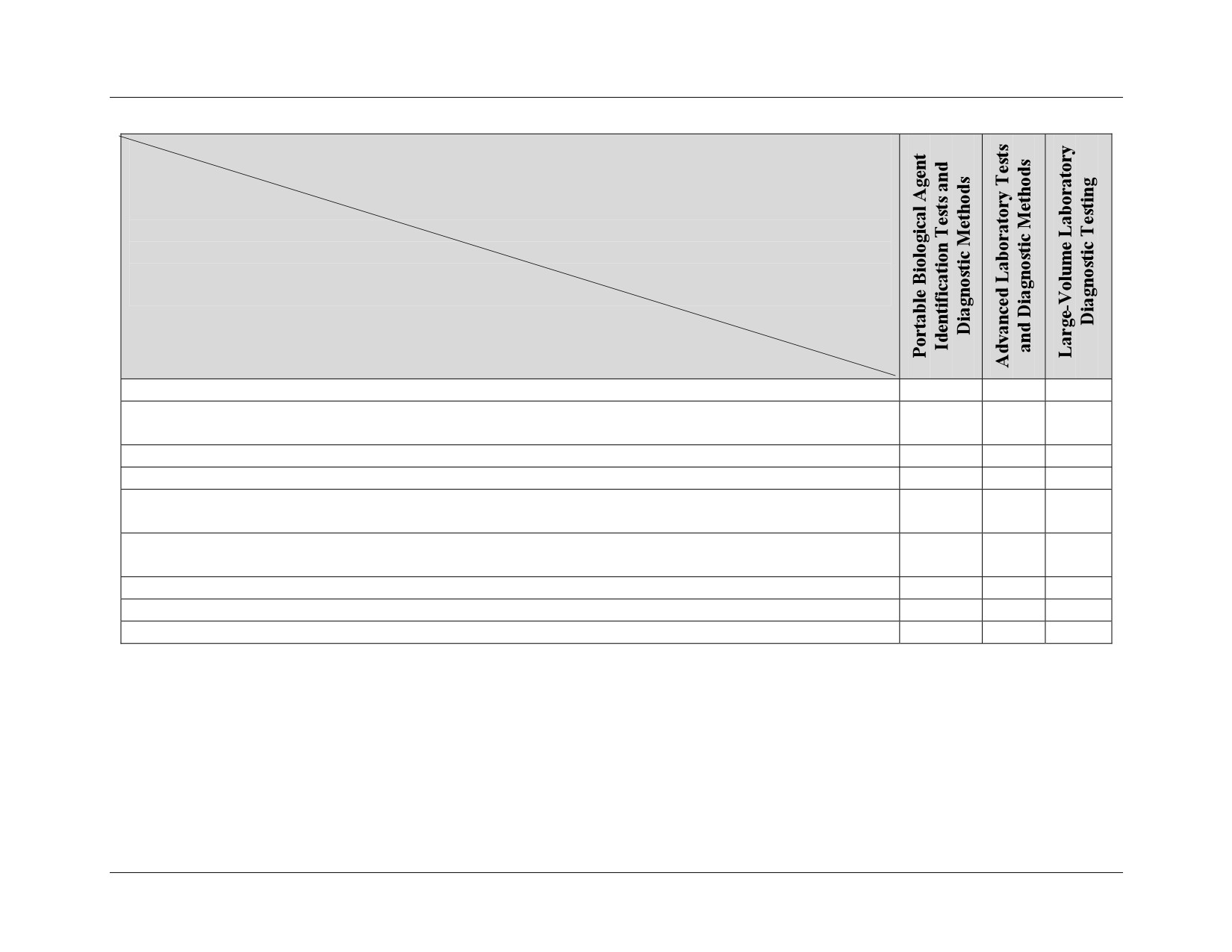
For Official Use Only
CBRND Functional Needs Analysis/Functional Solution Analysis
Chapter 17. Tactical Sustain Tasks
Table 17.6-2. TASUST 6: IMA Assessment
Idea for Materiel
Approach
(IMA)
Identified Gap
Inability to perform presumptive identification during early stages of illness.
X
X
Unacceptable amount of time (i.e., order of days) required for confirmation of bacterial and viral
X
X
etiologic agents.
Limited capability for forward-deployed medical personnel to rapidly analyze biological specimens.
X
Limited capability for forward-deployed medical personnel to collect and prepare samples.
X
Lack of resources to prevent mass casualty diagnostic requirements from overwhelming the
X
laboratory system.
Inability to presumptively differentiate between bacterial diseases during early illness through
X
X
X
recognition of signs and symptoms.
Unacceptable risk of infecting laboratory personnel during clinical specimen analysis.
X
Lack of specificity of most routine laboratory tests.
X
X
Inadequate chain-of-custody procedures and/or special packaging and handling.
X
70
For Official Use Only
For Official Use Only
CBRND Functional Needs Analysis/Functional Solution Analysis
Chapter 17. Tactical Sustain Tasks
17.7
Task TASUST 7: Diagnose radiological effects on personnel and MWAs
17.7.1
Functional Area Analysis
17.7.1.1
Definition
To use medical diagnostic tools and procedures to identify and confirm radiological hazard
exposure in both personnel and MWAs, specifically MWDs. Also includes monitoring
presymptomatic levels of exposure. Several animal species are used as MWAs; however, MWDs
are the predominant species and are most likely to be deployed with military personnel.
17.7.1.2
Derivation
UJTL (TA 7, TA 7.1), Protection Joint Functional Concept.
17.7.1.2.1
Supported Tasks: OPSUST 8, OPSUST 11
17.7.1.2.2
Lateral Tasks: TASHA 12, TASHA 13
17.7.1.2.3
Supporting Task: N/A
17.7.1.3
Condition
Perform this task under conditions of:
Physical
1. Negligible light. (C1.3.2.1)
2. Nuclear effects. (C1.3.3.1)
Military
1. Severe health status. (NEW)
2. Stressful mission. (C2.1)
3. Minimal or short time available. (C2.1.5)
4. Marginal forces allocated. (C2.2.3)
5. Low personnel capability. (C2.2.4)
6. Limited or negligible personnel experience. (C2.2.4.5)
7. Severe personnel fatigue. (C2.2.4.6)
8. Some or no interoperability. (C2.2.6)
9. Restricted information exchange. (C2.3.1.8)
Civil
1. High mission priority. (C3.1.3.2)
2. Few or negligible translators. (C3.2.1.2)
3. Significant customs adjustment. (C3.2.2)
71
For Official Use Only
For Official Use Only
CBRND Functional Needs Analysis/Functional Solution Analysis
Chapter 17. Tactical Sustain Tasks
4. Significant refugee-care responsibility. (C3.3.2.3)
17.7.2
Functional Needs Analysis
17.7.2.1
Capabilities and Deficiencies Assessment Summary
Table 17.7-1 presents individual and overall current, near-/mid-term, and far-term capabilities to
perform the task to the designated standards. There are two current capabilities used to
accomplish this task. The individual capabilities include signs/symptomatology and clinical
diagnosis capabilities for detecting, identifying, and quantifying radiation exposure.
Current Capabilities and Deficiencies
Since effects from radiation resemble other common illnesses, laboratory findings are essential.
Current deficiencies include limited capability for forward-deployed medical personnel to
rapidly identify radiological agents in clinical specimens, lack of diagnostic tools at all levels of
care to identify or quantify exposure in the absence of recognizable signs and symptoms.
Projected Near/Mid-Term Capabilities and Deficiencies
No changes in capability are projected in the near/mid term for this task, so the overall projected
near/mid-term capability will remain “yellow.”
Projected Far-Term Capabilities and Deficiencies
No changes in capability are projected in the far term for this task, so the overall projected far-
term capability will remain “yellow.”
72
For Official Use Only
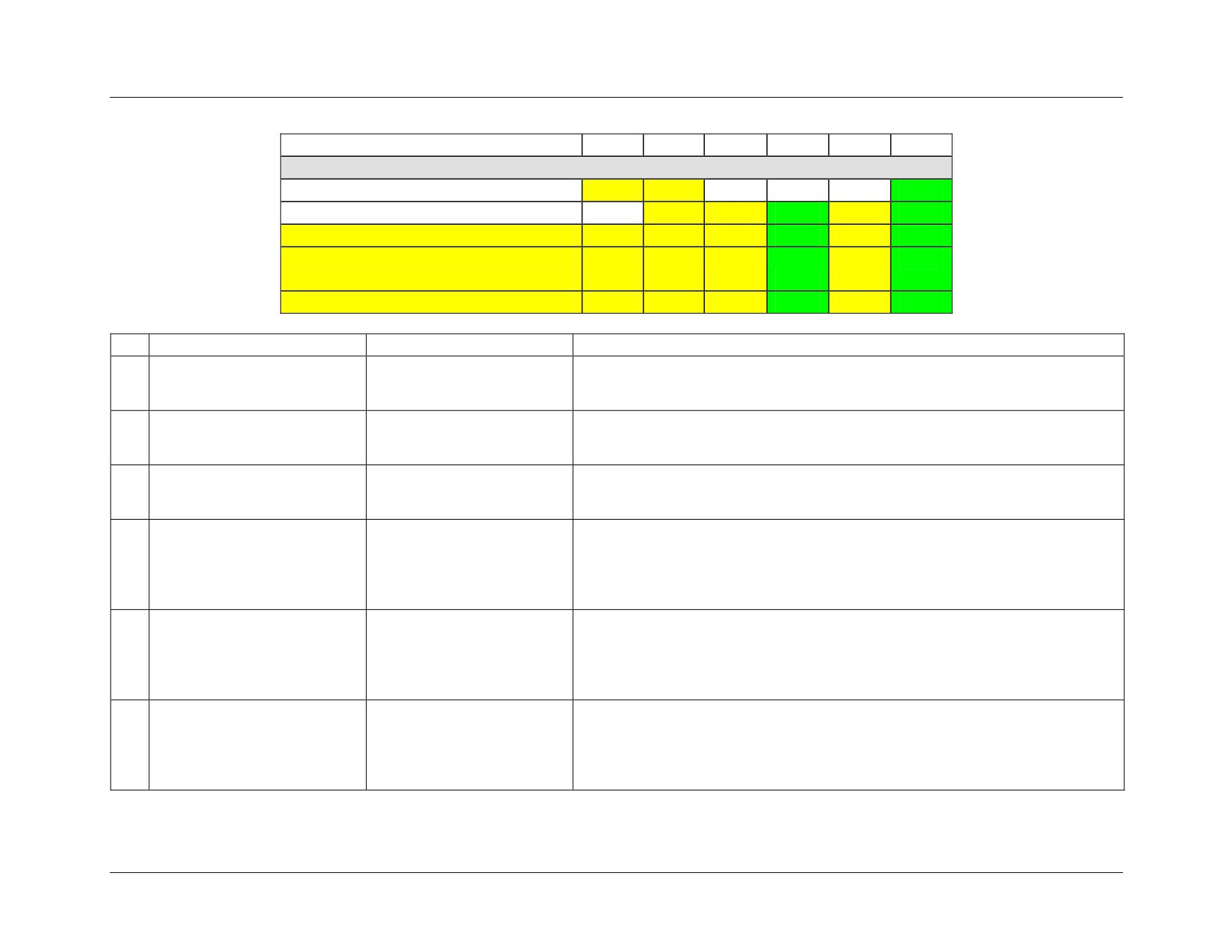
For Official Use Only
CBRND Functional Needs Analysis/Functional Solution Analysis
Chapter 17. Tactical Sustain Tasks
Table 17.5-1. TASUST 7: Capabilities and Deficiencies Assessment
System/Measure
M1
M2
M3
M4
M5
M6
Current
Signs and Symptoms
5
5
N/A
N/A
N/A
10
Clinical Diagnosis
N/A
5
5
10
5
10
Current and Overall Capabilities
5
5
5
10
5
10
Near/Mid-Term Overall
10
Capabilities
5
5
5
10
5
Far-Term Overall Capabilities
5
5
5
10
5
10
FAA Measure
Elaboration
Scale
M1
Signs and symptoms of
Applies to signs and
10: Complete capability.
radiological exposure can be
symptomatology capabilities
5: Partial capability.
recognized?
only.
0: No capability.
M2
All radiological hazard effects
10: Complete capability
can be identified during
5: Partial capability.
diagnostic evaluation?
0: No capability.
M3
All radiological hazard effects
Applies to clinical diagnosis
10: Complete capability.
can be quantified during
capabilities only.
5: Partial capability.
diagnostic evaluation?
0: No capability.
M4
Time to prepare sample?
Applies to clinical diagnosis
10: Sample collection/preparation can be completed in sufficient time frame to
capabilities only.
reduce morbidity and mortality.
5: Sample collection/preparation cannot be completed in sufficient time frame to
reduce morbidity and mortality.
0: Samples cannot be collected and prepared for analysis.
M5
Time to confirm hazard
Applies to clinical diagnosis
10: Sample analysis can be completed in sufficient time frame to reduce morbidity
presence in sample?
capabilities only.
and mortality.
5: Sample analysis cannot be completed in sufficient time frame to reduce morbidity
and mortality.
0: Sample analysis capability does not exist.
M6
Capability (DOTLPF) exists to
10: DOTLPF exists and is adequate for this task. Task can be effectively performed
diagnose radiological
with minor limitations with little or no direct impact upon operations.
exposure?
5: Most critical aspects of DOTLPF for this task are addressed.
0: DOTLPF is inadequate or does not exist for this task. Task cannot be effectively
accomplished.
73
For Official Use Only
For Official Use Only
CBRND Functional Needs Analysis/Functional Solution Analysis
Chapter 17. Tactical Sustain Tasks
17.7.3
Functional Solution Analysis
17.7.3.1
DOTLPF Assessment Summary
This section states the deficiencies and suggests potential non-materiel solutions. If there are no
solutions or there are only partial solutions for a particular deficiency, that deficiency is then
reassessed in the IMA section.
1.
Deficiency: Inability of physical dosimeter to differentiate between whole-body and partial-
body exposure.
Non-Materiel Solutions: None.
2.
Deficiency: Inability to determine dose rate of exposure from most physical dosimeters.
Non-Materiel Solutions: None.
3.
Deficiency: Lack of resources to prevent mass casualty diagnostic requirements from
overwhelming the laboratory system.
Non-Materiel Solutions: Doctrine: Revise doctrine to define those circumstances when
assistance from alternative laboratories would be needed, to identify which staff and what
equipment would be readily available to conduct diagnostics, to clarify DoD requirements
for personnel (i.e., clearance, experience, etc.), to identify what protocol for diagnosing/
analyzing samples are to be followed, and to ensure adequate training of personnel.
Organization: Develop MOU/As with civilian and/or commercial laboratories to assist with
diagnostic requirements. Training: Coordinate training and certify personnel from
alternative laboratories.
4.
Deficiency: Lack of recognition of early signs and symptoms that indicate radiation
exposure.
Non-Materiel Solutions: Training: Continue to provide initial and refresher training on
medical identification and management of radiation casualties. Adapt existing courses for
human casualties to MWAs for Veterinary Services personnel. Leadership: Leadership may
be required to divert nontraditional medical evacuation assets in order to evacuate casualties
to higher levels of care required for life saving diagnosis and treatment.
5.
Deficiency: Limited capability for forward-deployed medical personnel to rapidly identify
radiological agents in clinical specimens.
Non-Materiel Solutions: Doctrine (Partial): Clearly define under what conditions medical
prophylaxis and treatment should be initiated (prior to confirmatory testing). If decision is
made after results of confirmatory testing the morbidity and mortality rate significantly
increases.
6.
Deficiency: Inability to diagnose radiation effects in sufficient time frame to reduce
morbidity and mortality.
Non-Materiel Solutions: None.
7.
Deficiency: Inadequate chain-of-custody procedures and/or special packaging and handling.
74
For Official Use Only
For Official Use Only
CBRND Functional Needs Analysis/Functional Solution Analysis
Chapter 17. Tactical Sustain Tasks
Non-Materiel Solutions: Doctrine (partial): Clearly define chain-of-custody process,
handling, and packaging procedures. Training (partial): Train personnel on chain-of-custody,
handling, and packaging procedures.
17.7.3.2
IMA Assessment Summary
Table 17.7-2 identifies which of the materiel approaches might address specific materiel gaps
identified in the DOTMLPF assessment. Advances in individual dosimeters may be able to
address all identified deficiencies.
75
For Official Use Only