CHEMICAL, BIOLOGICAL, RADIOLOGICAL, AND NUCLEAR DEFENSE (CBRND) FUNCTIONAL NEEDS ANALYSIS. FINAL REPORT (2005) - page 28
For Official Use Only
CBRND Functional Needs Analysis/Functional Solution Analysis
Chapter 17. Tactical Sustain Tasks
Table 17.7-2. TASUST 7: IMA Assessment
Idea for Materiel
Approach
(IMA)
Identified Gaps
Inability of physical dosimeter cannot to differentiate between whole-body and
X
X
partial-body exposure.
Inability to determine dose rate of exposure from most physical dosimeters.
X
X
Limited capability for forward-deployed medical personnel to rapidly identify
X
X
X
X
radiological agents in clinical specimens.
Inability to diagnose radiation effects in sufficient time frame to reduce
X
X
X
X
morbidity and mortality.
Inadequate chain-of-custody procedures and/or special packaging and handling.
X
X
X
X
76
For Official Use Only
For Official Use Only
CBRND Functional Needs Analysis/Functional Solution Analysis
Chapter 17. Tactical Sustain Tasks
17.8
Task TASUST 8: Treat chemical effects on personnel and MWAs
17.8.1
Functional Area Analysis
17.8.1.1
Definition
To provide rapid treatment and mitigation of health effects of chemical agents, including TICs,
exposure to personnel and MWAs, specifically MWDs. Treatment includes the protocols and
procedures for the administration of the treatment regime as well as the logistical requirements
necessary to support surge operations required by the mass exposure of personnel.
17.8.1.2
Derivation
UJTL (TA 7, TA 7.1), Protection Joint Functional Concept.
17.8.1.2.1
Supported Tasks: OPSUST 8, OPSUST 11
17.8.1.2.2
Lateral Task: TASHA 24
17.8.1.2.3
Supporting Task: N/A
17.8.1.3
Condition
Perform this task under conditions of:
Physical
1. Negligible light. (C1.3.2.1)
2. Chemical effects. (C1.3.3.2)
Military
1. Severe health status. (NEW)
2. Stressful mission. (C2.1)
3. Minimal or short time available. (C2.1.5)
4. Marginal forces allocated. (C2.2.3)
5. Low personnel capability. (C2.2.4)
6. Limited or negligible personnel experience. (C2.2.4.5)
7. Severe personnel fatigue. (C2.2.4.6)
8. Some or no interoperability. (C2.2.6)
9. Restricted information exchange. (C2.3.1.8)
Civil
1. High mission priority. (C3.1.3.2)
2. Few or negligible translators. (C3.2.1.2)
3. Significant customs adjustment. (C3.2.2)
77
For Official Use Only
For Official Use Only
CBRND Functional Needs Analysis/Functional Solution Analysis
Chapter 17. Tactical Sustain Tasks
4. Significant refugee-care responsibility. (C3.3.2.3)
17.8.2
Functional Needs Analysis
17.8.2.1
Capabilities and Deficiencies Assessment Summary
Table 17.8-1 presents individual and overall current, near-/mid-term, and far-term capabilities to
perform the task to the designated standards. There are 13 current capabilities used to accomplish
this task and one projected capability to be added in the future (one in the near/mid term). The
capabilities include a range of MWD handler and Veterinary Services personnel-administered
post-exposure therapeutics with differing capabilities to meet the identified standards.
Current Capabilities and Deficiencies.
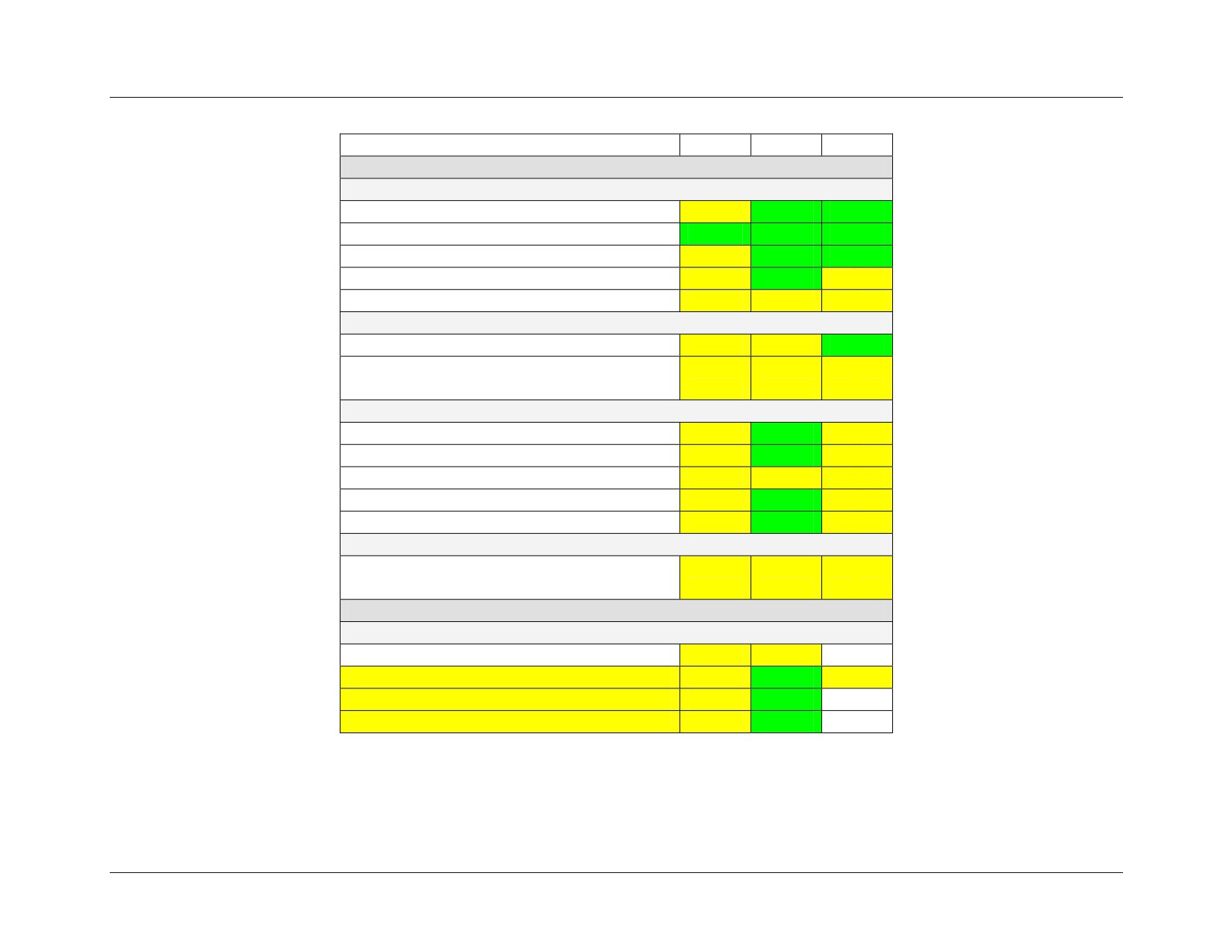
The overall current capability is assessed as “yellow.” Multiple nerve agent therapeutics exist for
personnel, and many of these can also be used “extra label” in MWAs. If administered
immediately after exposure, they are usually effective. Nevertheless, there are severe
contraindications associated with many of these therapeutics, and most of them are required to be
given under the supervision of medical or veterinary personnel.
There are no FDA-approved therapeutics for personnel or MWA exposure to blister agents with
the exception of symptomatic treatment and supportive care. Dimercaprol (a.k.a. British Anti-
Lewisite) is not FDA approved for either personnel or MWAs, though it can be used “extra
label” in MWAs.
Effective therapeutics for cyanide intoxication (both through respiration and ingestion) exist.
However, many are given intravenously, and most require medical or veterinary personnel for
administration. Though none of the cyanide therapeutics are FDA approved for MWAs, they can
be used “extra label” for MWAs.
Like blister agent therapeutics, pulmonary agent therapeutics are based on symptomatic
treatment and supportive care. Many of these therapeutics have major contraindications and are
not readily available for MWA care, and most, if not all, must be administered under the
supervision of medical or veterinary personnel.
Current deficiencies include the lack of vesicant and pulmonary agent antidotes and the lack of
effective nerve, vesicant, and pulmonary agent exposure therapeutics that do not have significant
adverse effects and that can be readily administered by MWD handlers.
Projected Near/Mid-Term Capabilities and Deficiencies
The overall projected near/mid-term capability is assessed as “yellow.” In the near/mid-term
future, the Advanced Anticonvulsant System (AAS) is expected to replace the convulsive
antidote for nerve agent. The protection against seizures caused by nontraditional chemical
agents provided by the midazolam-containing AAS will be superior to that provided by the
78
For Official Use Only
For Official Use Only
CBRND Functional Needs Analysis/Functional Solution Analysis
Chapter 17. Tactical Sustain Tasks
diazepam-containing convulsive antidote for nerve agent, since midazolam has a broader
window of time for effective administration than diazepam.
Projected Far-Term Capabilities and Deficiencies
No changes in capability are projected in the far term for this task, so the overall projected far-
term capability will remain “yellow.”
79
For Official Use Only
For Official Use Only
CBRND Functional Needs Analysis/Functional Solution Analysis
Chapter 17. Tactical Sustain Tasks
Table 17.8-1. TASUST 8: Capabilities and Deficiencies Assessment
System/Measure
M1
M2
M3
Current
Nerve Agents
ATNAA
5
10
10
Benzodiazepine Anticonvulsants
10
10
10
MANAA
5
10
10
Muscarinic Receptor Antagonists
5
10
5
Oximes
5
5
5
Blister Agents
Dimercaprol
5
5
10
Symptomatic Treatment and Supportive
Care
5
5
5
Cyanides
Cyanide-binding drugs
5
10
5
Pasadena Cyanide Antidote Kit
5
10
5
Sodium Bicarbonate
5
5
5
Sodium Thiosulfate
5
10
5
Superactivated Charcoal
5
10
5
Pulmonary Agents
Symptomatic Treatment and Supportive
Care
5
5
5
Near/Mid-Term
Nerve Agents
AAS
5
5
N/A
Current and Overall Capabilities
5
8
7
Near/Mid-Term Overall Capabilities
5
8
N/A
Far-Term Overall Capabilities
5
8
N/A
80
For Official Use Only
For Official Use Only
CBRND Functional Needs Analysis/Functional Solution Analysis
Chapter 17. Tactical Sustain Tasks
Measures
FAA Measure
Elaboration
Scale
M1
Therapeutics are FDA
10: FDA approved for use in both personnel and MWAs.
approved?
5: Not FDA approved in personnel and/or MWAs; can be used “extra label” for
personnel and/or MWAs.
0: Cannot be used in either personnel or MWAs.
M2
Therapeutics exist for
Effectiveness of a particular
10: Complete capability (effective for all chemical hazards of a certain type).
all chemical hazards?
therapeutic for chemical hazards of a
5: Partial capability (limited effectiveness for one or more chemical hazards of a
certain type (i.e., nerve agents, blister
certain type).
agents, cyanides, and pulmonary
0: No capability.
agents).
M3
Capability (DOTLPF)
10: DOTLPF exists and is adequate for this task. Task can be effectively performed
exists to treat chemical
with minor limitations with little or no direct impact upon operations.
exposure?
5: Most critical aspects of DOTLPF for this task are addressed.
0: DOTLPF is inadequate or does not exist for this task. Task cannot be effectively
accomplished.
81
For Official Use Only
For Official Use Only
CBRND Functional Needs Analysis/Functional Solution Analysis
Chapter 17. Tactical Sustain Tasks
17.8.3
Functional Solution Analysis
17.8.3.1
DOTLPF Assessment Summary
This section states the deficiencies and suggests potential non-materiel solutions. If there are no
solutions or there are only partial solutions for a particular deficiency, that deficiency is then
reassessed in the IMA section.
1.
Deficiency: Lack of animal testing to support efficacy and administration of many
therapeutics for nerve agent exposure.
Non-Materiel Solutions: Doctrine: Develop doctrine based on results of future tests on
animal models.
2.
Deficiency: Limited efficacy of oximes on quickly “aging” agents such as soman.
Non-Materiel Solutions: None.
3.
Deficiency: Significant adverse effects or contraindications for some nerve agent
therapeutics, including ATNAA and benzodiazepine receptor agonists.
Non-Materiel Solutions: None.
4.
Deficiency: Lack of therapeutics including MANAA, memantine, midazolam, and lorazepam
that are packaged for self- or buddy-administration or administration by a MWD handler
(These usually require administration by a physician or veterinarian).
Non-Materiel Solutions: Personnel (Partial): Increase number of physicians and
veterinarians that can administer and monitor treatment. Training (Partial): Train
nonmedical personnel and MWD handlers to administer therapeutics under limited
circumstances.
5.
Deficiency: Lack of resources to prevent mass casualty diagnostic requirements from
overwhelming the laboratory system.
Non-Materiel Solutions: Doctrine (Partial): Revise doctrine to define those circumstances
when assistance from alternative laboratories would be needed, to identify which staff and
what equipment would be readily available to conduct diagnostics, to clarify DoD
requirements for personnel (i.e., clearance, experience, etc.), to identify what protocol for
diagnosing/analyzing samples are to be followed, and to ensure adequate training of
personnel. Organization (Partial): Develop MOU/As with civilian and/or commercial
laboratories to assist with diagnostic requirements. Training (Partial): Coordinate training
and certify personnel from alternative laboratories.
6.
Deficiency: Lack of effective and rapidly acting therapeutics for high-level cyanide
exposure.
Non-Materiel Solutions: None.
7.
Deficiency: Significant adverse effects and contraindications of cyanide therapeutics such as
Pasadena Cyanide Antidote Kit and Sodium Thiosulfate.
Non-Materiel Solutions: None.
82
For Official Use Only
For Official Use Only
CBRND Functional Needs Analysis/Functional Solution Analysis
Chapter 17. Tactical Sustain Tasks
8. Deficiency: Required physician or veterinarian administration and monitoring of cyanide
therapeutics such as Pasadena Cyanide Antidote and Sodium Thiosulfate.
Non-Materiel Solutions: Personnel (Partial): Increase number of physicians and
veterinarians that can administer and monitor treatment.
9. Deficiency: Inability of MWD handlers to give current pulmonary agent therapeutics (must
be given at Level II, III or IV).
Non-Materiel Solutions: None.
10. Deficiency: Lack of pulmonary agent antidote.
Non-Materiel Solutions: None.
11. Deficiency: Significant adverse effects and contraindications of symptomatic treatment and
supportive care for pulmonary agent exposure.
Non-Materiel Solutions: None.
12. Deficiency: Required physician or veterinarian supervision and monitoring of intravenously
administered drugs such as corticosteriods and aminophylline.
Non-Materiel Solutions: Personnel (Partial): Increase number of physicians and
veterinarians that can administer and monitor treatment. Training (Partial): Train
nonmedical personnel and MWD handlers to administer therapeutics under limited
circumstances.
13. Deficiency: Lack of animal testing to support efficacy and administration of many
therapeutics for pulmonary agent exposure.
Non-Materiel Solutions: Doctrine (Partial): Develop doctrine based on results of future
tests on animal models.
14. Deficiency: Lack of vesicant agent antidote.
Non-Materiel Solutions: None.
15. Deficiency: Lack of animal testing to support efficacy and administration of many
therapeutics for vesicant agent exposure.
Non-Materiel Solutions: Doctrine: Develop doctrine based on results of tests on animal
models.
17.8.3.2
IMA Assessment Summary
Table 17.8-2 identifies which of the materiel approaches might address specific materiel gaps
identified in the DOTMLPF assessment.
83
For Official Use Only
For Official Use Only
CBRND Functional Needs Analysis/Functional Solution Analysis
Chapter 17. Tactical Sustain Tasks
Table 17.8-2. TASUST 8: IMA Assessment
Idea for Materiel
Approach
(IMA)
Identified Gap
Nerve Agents
Limited efficacy of oximes on quickly “aging” agents such soman.
X
Significant adverse effects or contraindications for some nerve agent
X
X
therapeutics including ATNAA and benzodiazepine receptor agonists.
Lack of therapeutics including MANAA, memantine, midazolam and
lorazepam that packaged for self- or buddy-administration or
administration by a MWD handler (these usually require
administration by a physician or veterinarian).
Cyanides
Lack of effective and rapidly acting therapeutics for high-level
X
cyanide exposure.
Significant adverse effects and contraindications of cyanide
therapeutics such as Pasadena Cyanide Antidote Kit and Sodium
X
Thiosulfate.
Required physician or veterinarian administration and monitoring of
X
Pasadena Cyanide Antidote and Sodium Thiosulfate.
Pulmonary Agents
Inability of MWD handlers to give current pulmonary agent
X
X
X
therapeutics (must be given at Level II, III or IV).
Lack of pulmonary agent antidote.
X
84
For Official Use Only
For Official Use Only
CBRND Functional Needs Analysis/Functional Solution Analysis
Chapter 17. Tactical Sustain Tasks
Significant adverse effects and contraindications of symptomatic
X
X
X
treatment and supportive care for pulmonary agent exposure.
Required physician or veterinarian supervision and monitoring of
intravenously administered drugs such as corticosteriods and
X
X
X
aminophylline.
Vesicants
Lack of vesicant agent antidote.
X
X
85
For Official Use Only
For Official Use Only
CBRND Functional Needs Analysis/Functional Solution Analysis
Chapter 17. Tactical Sustain Tasks
17.9
Task TASUST 9: Treat biological effects on personnel and MWAs
17.9.1
Functional Area Analysis
17.9.1.1
Definition
To provide rapid treatment and mitigation of health effects of biological agent exposure to
personnel and MWAs, specifically MWDs. Treatment includes the protocols and procedures for
the administration of the treatment regime as well as the logistical requirements necessary to
support surge operations required by the mass exposure of personnel.
17.9.1.2
Derivation
UJTL (TA 7, TA 7.1), Protection Joint Functional Concept.
17.9.1.2.1
Supported Tasks: OPSUST 8, OPSUST 11
17.9.1.2.2
Lateral Task: TASHA 24
17.9.1.2.3
Supporting Task: N/A
17.9.1.3
Condition
Perform this task under conditions of:
Physical
1. Negligible light. (C1.3.2.1)
2. Biological effects. (C1.3.3.3)
Military
1. Severe health status. (NEW)
2. Stressful mission. (C2.1)
3. Minimal or short time available. (C2.1.5)
4. Marginal forces allocated. (C2.2.3)
5. Low personnel capability. (C2.2.4)
6. Limited or negligible personnel experience. (C2.2.4.5)
7. Severe personnel fatigue. (C2.2.4.6)
8. Some or no interoperability. (C2.2.6)
9. Restricted information exchange. (C2.3.1.8)
Civil
1. High mission priority. (C3.1.3.2)
2. Few or negligible translators. (C3.2.1.2)
3. Significant customs adjustment. (C3.2.2)
86
For Official Use Only
For Official Use Only
CBRND Functional Needs Analysis/Functional Solution Analysis
Chapter 17. Tactical Sustain Tasks
4. Moderate or high health risk. (C3.3.1.5)
5. Significant refugee-care responsibility. (C3.3.2.3)
17.9.2
Functional Needs Analysis
17.9.2.1
Capabilities and Deficiencies Assessment Summary
Table 17.9-1 presents individual and overall current, near-/mid-term, and far-term capabilities to
perform the task to the designated standards. There are three current capabilities used to
accomplish this task and one projected capability to be added in the future (one in the near/mid
term). The capabilities include a range of physician-administered post-exposure therapeutics
with differing capabilities to meet the identified standards.
Current Capabilities and Deficiencies
The overall current capability is assessed as “yellow.” Many effective antibiotics exist to treat
personnel and MWAs1 infected with bacteria/rickettsia of interest. Many are FDA approved for
use in both personnel and MWAs2; those that are not can usually be used “extra label.”
There are very few effective antivirals for viruses of interest. Ribavirin is an investigational new
drug (IND) for Lassa fever. There are no effective antivirals for Ebola/Marburg, the equine
encephalitis viruses, or smallpox.
There are no antitoxins for most toxins of interest. While an FDA-approved trivalent antitoxin
exists for botulinum, there are no effective antitoxins (FDA-approved, IND, or otherwise) for
ricin, SEB, or T-2 mycotoxins.
Projected Near/Mid-Term Capabilities and Deficiencies
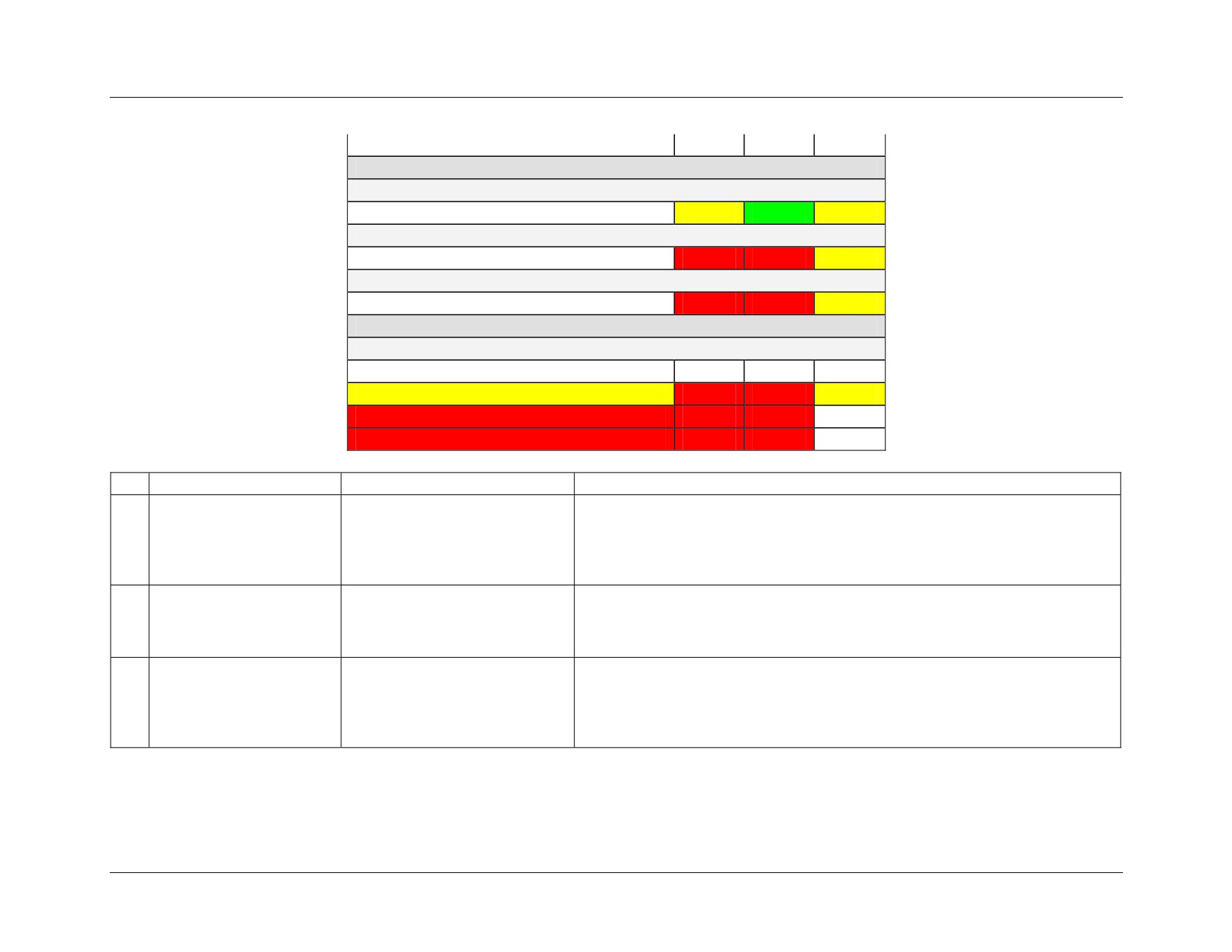
According to the analysis methodology, the overall projected near/mid-term capability is
assessed as “red.” The apparent decrement in capability from the current to near/mid-term future
is actually an artifact of the analysis. In all assessed tasks, DOTLPF is evaluated for the current
capability, but not for future capabilities. The projected near/mid-term capability will not likely
be inferior to the current capability. Near/mid-term future capability ABthraxTM is currently
under development in Phase I clinical trials.
Projected Far-Term Capabilities and Deficiencies
No changes in capability are projected in the far term for this task, so the overall projected far-
term capability will remain “red.” Once again, the apparent decrement in capability from the
1 Of the diseases considered to be likely BW agents, MWDs are likely to be susceptible to only plague (Yersinia pestis),
tularemia, brucellosis, Q-fever, and anthrax. In all of these diseases the MWD is believed to be less susceptible than man.
2 One of the key doctrinal elements is that the DoD MWD Veterinary Service currently recommends that all MWDs deployed to
areas with high risk of natural tick-borne rickettsial disease be placed on prophylactic doxycycline at 6 mg/kg/day. Doxycycline
is generally considered efficacious against each of the diseases of concern and this prophylactic dose may provide additional
protection for MWDs against BW agents. Doxycycline is not currently approved by the FDA for use in animals.
87
For Official Use Only
For Official Use Only
CBRND Functional Needs Analysis/Functional Solution Analysis
Chapter 17. Tactical Sustain Tasks
current to far-term future is an artifact of the analysis. The projected far-term capability will not
likely be inferior to the current capability.
88
For Official Use Only
For Official Use Only
CBRND Functional Needs Analysis/Functional Solution Analysis
Chapter 17. Tactical Sustain Tasks
Table 17.9-1. TASUST 9: Capabilities and Deficiencies Assessment
System/Measure
M1
M2
M3
Current
Bacteria/Rickettsia
Antibiotics
5
10
5
Viruses
Antivirals
0
0
5
Toxins
Antitoxins
0
0
5
Near/Mid-Term
Bacteria/Rickettsia
Antibiotics
Unk
Unk
N/A
Current and Overall Capabilities
2
3
5
Near/Mid-Term Overall Capabilities
2
3
N/A
Far-Term Overall Capabilities
2
3
N/A
FAA Measure
Elaboration
Scale
M1
Therapeutics are FDA
10: FDA approved for use in both personnel and MWAs.
approved?
5: Not FDA approved in personnel and/or MWAs; can be used “extra label” for
personnel and/or MWAs.
0: Not FDA approved in either personnel or MWAs; cannot be used “extra label” for
personnel and/or MWAs.
M2
Therapeutics exist for all
Effectiveness of a particular
10: Complete capability (effective for all biological hazards of a certain type).
biological hazards?
therapeutic for biological hazards
5: Partial capability (limited effectiveness for one or more biological hazards of a
of a certain type (i.e., bacteria/
certain type).
rickettsia, viruses, and toxins).
0: No capability.
M3
Capability (DOTLPF)
10: DOTLPF exists and is adequate for this task. Task can be effectively performed
exists to treat biological
with minor limitations with little or no direct impact upon operations.
exposure?
5: Most critical aspects of DOTLPF for this task are addressed.
0: DOTLPF is inadequate or does not exist for this task. Task cannot be effectively
accomplished.
89
For Official Use Only
For Official Use Only
CBRND Functional Needs Analysis/Functional Solution Analysis
Chapter 17. Tactical Sustain Tasks
17.9.3
Functional Solution Analysis
17.9.3.1
DOTLPF Assessment Summary
This section states the deficiencies and suggests potential non-materiel solutions. If there are no
solutions or there are only partial solutions for a particular deficiency, that deficiency is then
reassessed in the IMA section.
1.
Deficiency: Lack of FDA-approved therapeutic for Glanders/Meliodosis.
Non-Materiel Solutions: Leadership: Obtain FDA-approval for off-label antibiotics
effective for treating glanders/meliodosis.
2.
Deficiency: Doctrine does not reflect the most up-to-date treatment recommendations.
Non-Materiel Solutions: Doctrine: Update doctrine to reflect most up-to-date treatment
guidelines, or identify source of most up-to-date guidelines (Centers for Disease Control,
Military Surgeon General, etc).
3.
Deficiency: Training does not include the most up-to-date treatment recommendations.
Non-Materiel Solutions: Training: Update training to reflect most up-to-date treatment
guidelines.
4.
Deficiency: Lack of resources to prevent mass casualty diagnostic requirements from
overwhelming the laboratory system.
Non-Materiel Solutions: Doctrine (Partial): Revise doctrine to define those circumstances
when assistance from alternative laboratories would be needed, to identify which staff and
what equipment would be readily available to conduct diagnostics, to clarify DoD
requirements for personnel (i.e., clearance, experience, etc.), to identify what protocol for
diagnosing/analyzing samples are to be followed, and to ensure adequate training of
personnel. Organization (Partial): Develop MOU/As with civilian and/or commercial
laboratories to assist with diagnostic requirements. Training (Partial): Coordinate training
and certify personnel from alternative laboratories.
5.
Deficiency: Insufficient medical facilities, resources, and personnel to deal with casualties.
Non-Materiel Solutions: Doctrine (Partial): Revise doctrine to define those circumstances
when supplemental medical care would be needed; to identify which staff and what
equipment could be readily transported for situations where medical resources need to be
deployed (i.e., for cases when transporting large numbers of casualties to medical treatment
facilities is not an option). Organization (Partial): Establish MOU/As with neighboring
medical facilities (civilian hospitals, clinics, etc) to assist with surge capacity. Training:
Coordinate exercises and training with personnel from alternate medical resources.
Personnel: Obtain alternate sources of personnel or cross train individuals. Facilities: Obtain
surge capacity through use of nonmilitary assets or use other military facilities for medical
purposes (dual use).
6.
Deficiency: Lack of therapeutics for any of the toxins of interest, except for botulinum toxin.
Non-Materiel Solutions: None.
90
For Official Use Only
For Official Use Only
CBRND Functional Needs Analysis/Functional Solution Analysis
Chapter 17. Tactical Sustain Tasks
7. Deficiency: Lack of therapeutics for most viral infections of interest.
Non-Materiel Solutions: None.
8. Deficiency: Lack of FDA-approval for Ciprofloxacin in MWAs.
Non-Materiel Solutions: Leadership: Obtain FDA approval for ciprofloxacin use in MWAs.
9. Deficiency: Limited treatment window for effective administration of antibiotics.
Non-Materiel Solutions: Training (partial): Provide training to medical/veterinary
personnel and MWD handlers to recognize the early signs and symptoms of biological agent
exposure.
17.9.3.2
IMA Assessment Summary
Table 17.9-2 identifies which of the materiel approaches might address specific materiel gaps
identified in the DOTMLPF assessment.
91
For Official Use Only
For Official Use Only
CBRND Functional Needs Analysis/Functional Solution Analysis
Chapter 17. Tactical Sustain Tasks
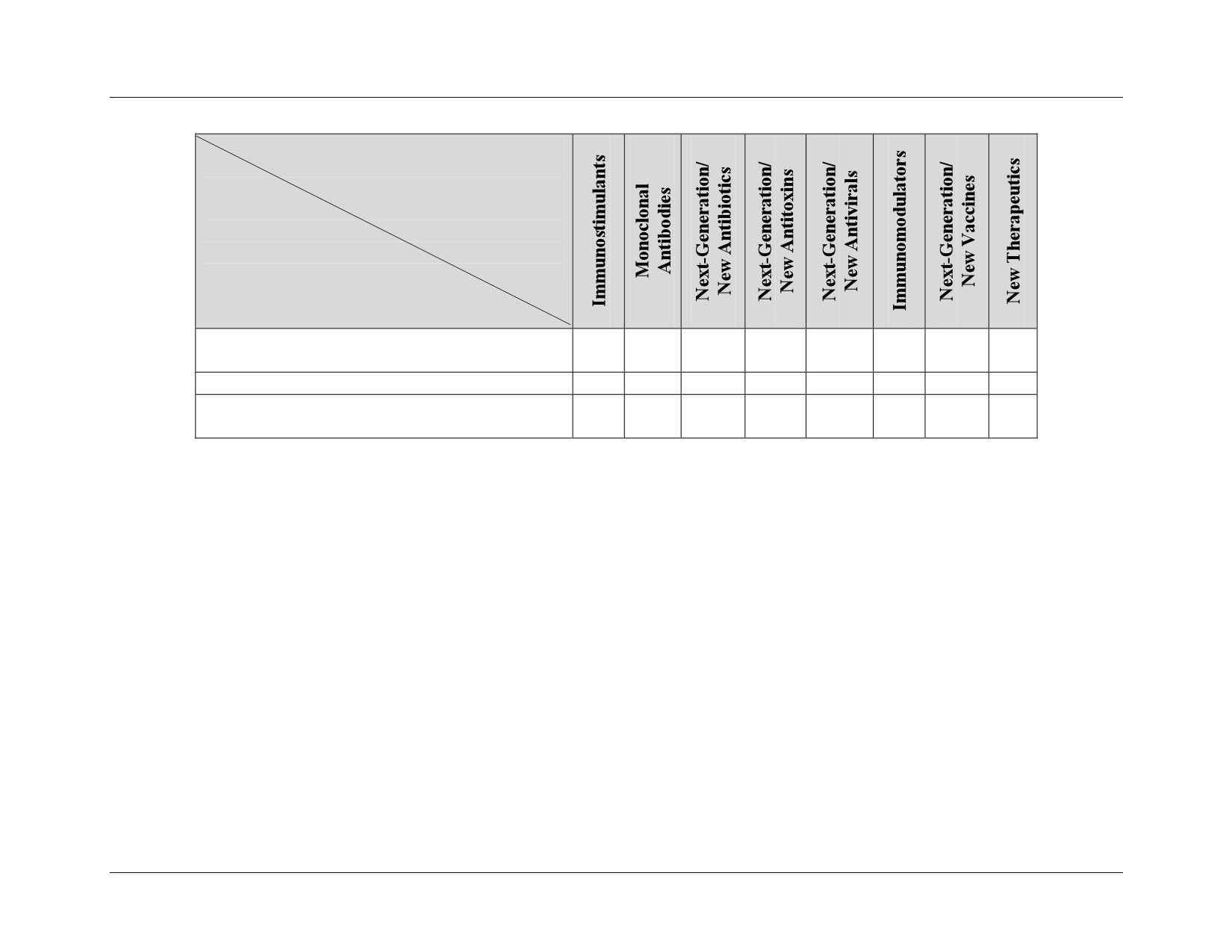
Table 17.9-2. TASUST 9: IMA Assessment
Idea for Materiel
Approach
(IMA)
Identified Gap
Lack of therapeutics for any of the toxins of
X
X
X
X
X
interest, except for botulinum toxin.
Lack of therapeutics for most viral infections.
X
X
X
X
X
X
Limited treatment window for effective
X
X
X
X
X
X
administration of antibiotics.
92
For Official Use Only
For Official Use Only
CBRND Functional Needs Analysis/Functional Solution Analysis
Chapter 17. Tactical Sustain Tasks
17.10 Task TASUST 10: Treat radiological effects on personnel and MWAs
17.10.1
Functional Area Analysis
17.10.1.1
Definition
To provide rapid treatment and mitigation of health effects of radiological agent exposure to
personnel and MWAs, specifically MWDs. Treatment includes the protocols and procedures for
the administration of the treatment regime as well as the logistical requirements necessary to
support surge operations required by the mass exposure of personnel.
17.10.1.2
Derivation
UJTL (TA 7, TA 7.1), Protection Joint Functional Concept.
17.10.1.2.1
Supported Tasks: OPSUST 8, OPSUST 11
17.10.1.2.2
Lateral Task: TASHA 24
17.10.1.2.3
Supporting Task: N/A
17.10.1.3
Condition
Perform this task under conditions of:
Physical
1. Negligible light. (C1.3.2.1)
2. Nuclear effects. (C1.3.3.1)
Military
1. Severe health status. (NEW)
2. Stressful mission. (C2.1)
3. Minimal or short time available. (C2.1.5)
4. Marginal forces allocated. (C2.2.3)
5. Low personnel capability. (C2.2.4)
6. Limited or negligible personnel experience. (C2.2.4.5)
7. Severe personnel fatigue. (C2.2.4.6)
8. Some or no interoperability. (C2.2.6)
9. Restricted information exchange. (C2.3.1.8)
Civil
1. Few or negligible translators. (C3.2.1.2)
2. Significant customs adjustment. (C3.2.2)
3. Significant refugee-care responsibility. (C3.3.2.3)
93
For Official Use Only
For Official Use Only
CBRND Functional Needs Analysis/Functional Solution Analysis
Chapter 17. Tactical Sustain Tasks
17.10.2
Functional Needs Analysis
17.10.2.1
Capabilities and Deficiencies Assessment Summary
Table 17.10-1 presents individual and overall current, near-/mid-term, and far-term capabilities
to perform the task to the designated standards. There is one family of current capabilities used
to accomplish this task. It includes a range of MWD handler-, Veterinary Services-, and medical
personnel-administered post-exposure therapeutics.
Current Capabilities and Deficiencies
The overall current capability is assessed as “yellow.” Therapeutics and symptomatic care are
available for all radiological agents, though they typically have short-lived activity and can have
toxic effects. Most therapeutics simply block absorption or expedite excretion of internalized
radiological materials. Symptomatic care can include treatment to bolster the immune system as
radiation exposure can cause immunosuppression. Current deficiencies include a need for FDA-
approved therapeutics and countermeasures to treat radiological effects.
Projected Near/Mid-Term Capabilities and Deficiencies
No changes in capability are projected in the near/mid term for this task, so the overall projected
near/mid-term capability will remain “yellow.”
Projected Far-Term Capabilities and Deficiencies
No changes in capability are projected in the far term for this task, so the overall projected far-
term capability will remain “yellow.”
94
For Official Use Only
For Official Use Only
CBRND Functional Needs Analysis/Functional Solution Analysis
Chapter 17. Tactical Sustain Tasks
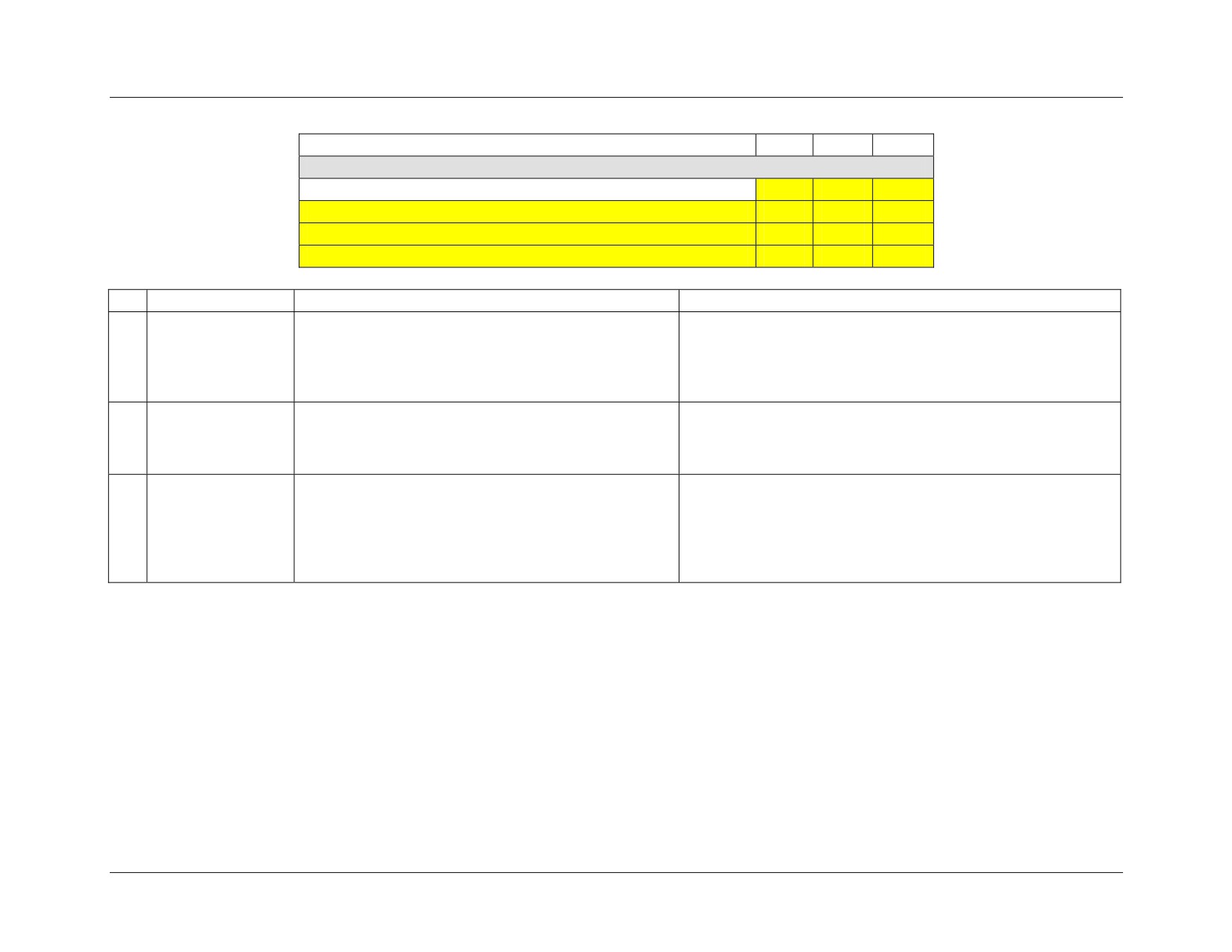
Table 17.10-1. TASUST 10: Capabilities and Deficiencies Assessment
System/Measure
M1
M2
M3
Current
Radiological Exposure Therapeutics and Supportive Care
5
5
5
Current and Overall Capabilities
5
5
5
Near/Mid-Term Overall Capabilities
5
5
5
Far-Term Overall Capabilities
5
5
5
FAA Measure
Elaboration
Scale
M1
Therapeutics are
10: FDA approved for use in both personnel and MWAs.
FDA approved?
5: Not FDA approved in personnel and/or MWAs; can be used
“extra label” for personnel and/or MWAs.
0: Not FDA approved in either personnel or MWAs; cannot be used
“extra label” for personnel and/or MWAs.
M2
Therapeutics exist
Effectiveness of a particular therapeutic for radiological
10: Complete capability (effective for all radiological hazards).
for all radiological
hazards of a certain type (i.e., alpha emitters, beta emitters,
5: Partial capability (limited effectiveness for one or more
hazards?
gamma emitters, neutron emitters; alpha radiation, beta
radioisotope internalizations or radiation type exposures).
radiation, gamma radiation, neutron radiation).
0: No capability.
M3
Capability
10: DOTLPF exists and is adequate for this task. Task can be
(DOTLPF) exists to
effectively performed with minor limitations with little or no direct
treat radiological
impact upon operations.
exposure?
5: Most critical aspects of DOTLPF for this task are addressed.
0: DOTLPF is inadequate or does not exist for this task. Task can
not be effectively accomplished.
95
For Official Use Only
For Official Use Only
CBRND Functional Needs Analysis/Functional Solution Analysis
Chapter 17. Tactical Sustain Tasks
17.10.3
Functional Solution Analysis
17.10.3.1
DOTLPF Assessment Summary
This section states the deficiencies and suggests potential non-materiel solutions. If there are no
solutions or there are only partial solutions for a particular deficiency, that deficiency is then
reassessed in the IMA section.
1.
Deficiency: Lack of FDA-approved therapeutics and alternative therapeutic delivery systems
that are quick-acting, long-lasting, and easy to carry and use on the battlefield.
Non-Materiel Solutions: Leadership (partial): Obtain FDA-approval for therapeutics and
alternative therapeutic delivery systems
2.
Deficiency: Lack of guidance of when INDs can be used to treat radiological effects.
Non-Materiel Solutions: Doctrine: Define those circumstances when use of INDs can be
considered to treat radiological effects.
3.
Deficiency: Significant toxic effects of therapeutics such as chelating agents.
Non-Materiel Solutions: None.
4.
Deficiency: Lack of ability to evacuate casualties in a timely manner to level of care that can
provide definitive care.
Non-Materiel Solutions: Doctrine: Define theater evacuation policy to maximize evacuation
of casualties within critical time frame that will ensure casualties receive definitive medical
care.
5.
Deficiency: Lack of animal model for current therapeutic initiatives.
Non-Materiel Solutions: Doctrine: Perform necessary animal model testing to create
doctrinal animal model for therapeutic initiatives.
6.
Deficiency: Lack of drugs to prevent onset of radiation-induced performance decrements.
Non-Materiel Solutions: None.
17.10.3.2
IMA Assessment Summary
Table 17.10-2 identifies which of the materiel approaches might address specific materiel gaps
identified in the DOTMLPF assessment.
96
For Official Use Only
For Official Use Only
CBRND Functional Needs Analysis/Functional Solution Analysis
Chapter 17. Tactical Sustain Tasks
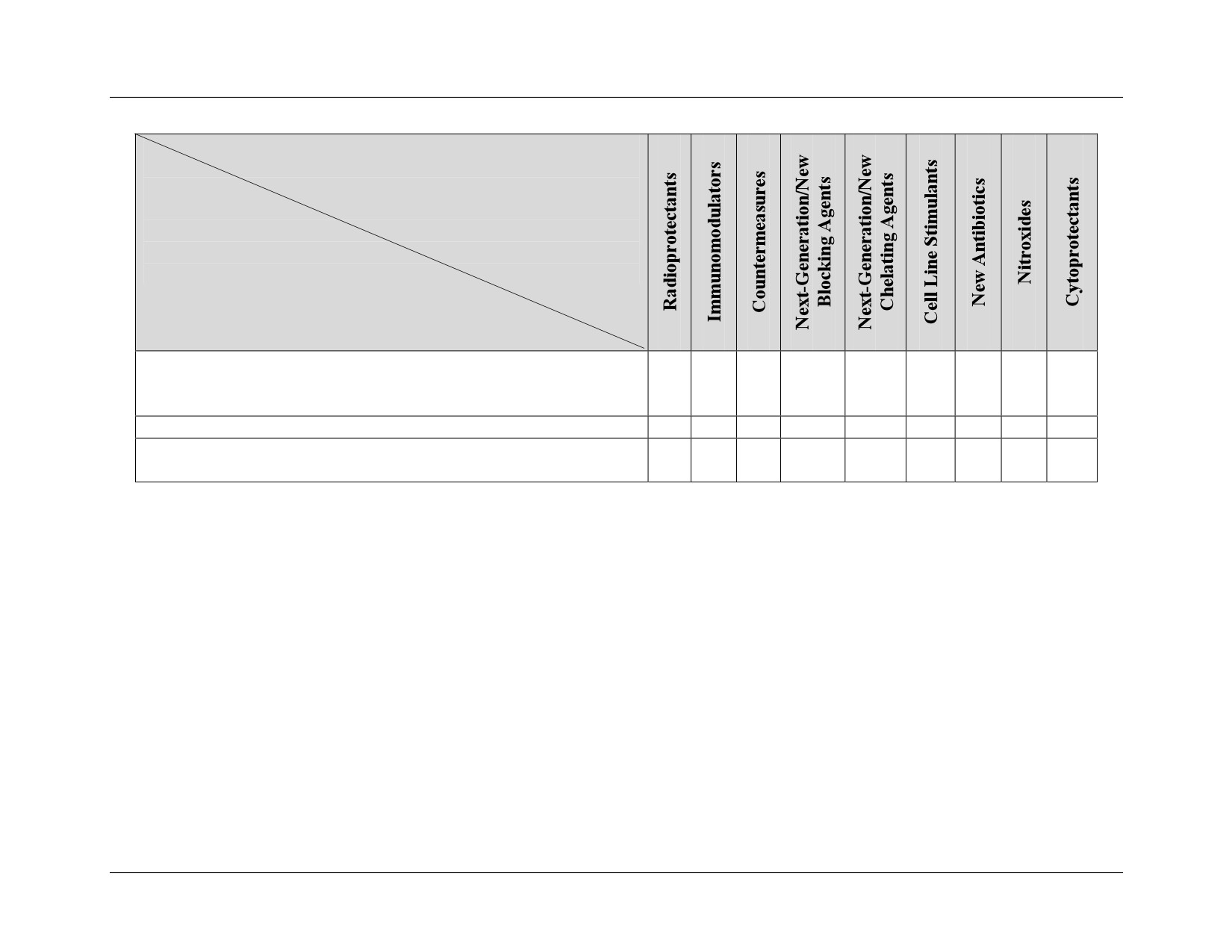
Table 17.10-2. TASUST 10: IMA Assessment
Idea for Materiel
Approaches
(IMA)
Identified Gap
Lack of FDA-approved therapeutics and alternative therapeutic
delivery systems that are quick-acting, long-lasting, and easy to
X
X
X
X
X
X
X
X
X
carry and use on the battlefield.
Significant toxic effects of therapeutics such as chelating agents.
X
Lack of drugs to prevent onset of radiation-induced performance
X
decrements.
97
For Official Use Only
For Official Use Only
CBRND Functional Needs Analysis/Functional Solution Analysis
Chapter 17. Tactical Sustain Tasks
17.11 Task TASUST 11: Decontaminate individual and crew-served weapons
17.11.1
Functional Area Analysis
17.11.1.1
Definition
To decontaminate individual and crew-served weapons such as the 9-mm hand gun; M-16 rifle;
M60 machine gun; M203 grenade launcher; tube-launched, optically tracked, wire-guided
(TOW) missile; 81-mm mortar; M198 howitzer; etc. Includes minimizing effects of
contaminants and decontaminants on operations. Levels of decontamination include immediate,
operational, and thorough. Objectives of each of these levels are identified as follows:
• Immediate: Reduce/limit the spread of CBRN contamination.
• Operational: Reduce CBRN contamination to regenerate combat effectiveness.
• Thorough: Reduce CBRN contamination to negligible risk.
17.11.1.2
Derivation
UJTL (TA 7, TA 7.1), Protection Joint Functional Concept.
17.11.1.2.1
Supported Tasks: OPSUST 8, OPSUST 11
17.11.1.2.2
Lateral Task: TASHA 24
17.11.1.2.3
Supporting Task: N/A
17.11.1.3
Condition
Perform this task under conditions of:
Physical
1. Extremely rough sea state. (C1.2.1.3)
2. Tropical, arctic, and arid climate. (C1.3.1)
3. All seasons. (C1.3.1.1)
4. Precipitating and stormy weather. (C1.3.1.3)
5. Hot and very cold air temperature. (C1.3.1.3.1)
6. Liquid, freezing, and frozen precipitation. (C1.3.1.3.6.1)
7. Negligible light. (C1.3.2.1)
8. Nuclear effects. (C1.3.3.1)
9. Chemical effects. (C1.3.3.2)
10. Biological effects. (C1.3.3.3)
Military
1. Stressful mission. (C2.1)
2. Location—ashore/afloat. (C2.1.4.1)
98
For Official Use Only
For Official Use Only
CBRND Functional Needs Analysis/Functional Solution Analysis
Chapter 17. Tactical Sustain Tasks
3. Minimal to short time available. (C2.1.5)
4. Marginal forces allocated. (C2.2.3)
5. Low personnel capability. (C2.2.4)
6. Negligible personnel experience. (C2.2.4.5)
7. Severe personnel fatigue. (C2.2.4.6)
8. Limited, little, or no lift assets. (C2.5.2)
9. Some or no interoperability. (C2.2.6)
10. Limited or no host-nation support. (C2.8.5)
11. Ambiguous threat existence. (C2.9.3)
Civil
1. Limited or negative foreign government support. (C3.1.2.3)
2. Aggressively opposed foreign public opinion. (C3.1.2.4)
17.11.2
Functional Needs Analysis
17.11.2.1
Capabilities and Deficiencies Assessment Summary
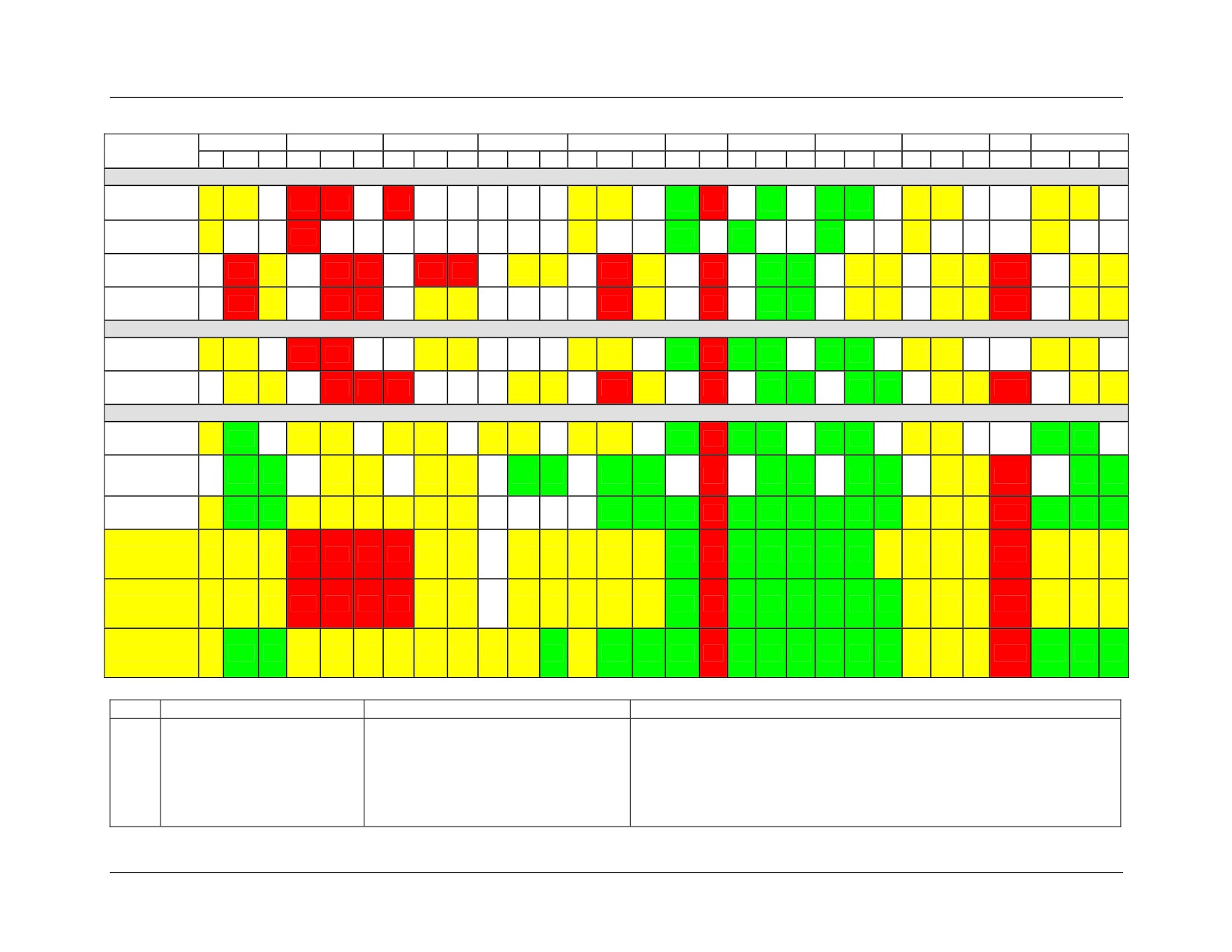
Table 17.11-1 presents individual and overall current, near-/mid-term, and far-term capabilities
to perform the task to the designated standard. There are a total of four current capabilities used
to accomplish this task and three projected capabilities to be added in the future. Capabilities
exist at the immediate, operational, and thorough levels of decontamination.
Current Capabilities and Deficiencies
Current capabilities to decontaminate individual and crew-served weapons require the use of
M291/M295 kits, M100 SDS, soap and water, solvents and STB/HTH bleach mixtures.
Capability gaps associated with individual and crew-served weapons decontamination include
the excessive amount of time it takes to manually process large quantities of weapons through
thorough decontamination processes. STB and HTH decontaminants can be toxic and corrosive
requiring large amounts of water for dilution. Runoff from decontamination sites may be
contaminated and current decontaminants are only effective against a limited range of chemical
and biological agents. In addition, current thorough decontamination processes may not be
feasible in many operational situations due to time and space requirements.
Projected Near/Mid-Term Capabilities and Deficiencies
The projected near/mid-term capabilities and deficiencies evaluated were associated with JSPDS
Increment I and JSTDS-SS Increment I.
Projected Far-Term Capabilities and Deficiencies
The projected far-term capabilities and deficiencies evaluated were associated with JSPDS
Increment II, JSTDS-SS Increment II and JPDS Increments I/II.
99
For Official Use Only
For Official Use Only
CBRND Functional Needs Analysis/Functional Solution Analysis
Chapter 17. Tactical Sustain Tasks
Table 17.11-1. TASUST 11: Capabilities and Deficiencies Assessment
M1
M2
M3
M4
M5
M6
M7
M8
M9
M10
M11
Capabilities
I
O
T
I
O
T
I
O
T
I
O
T
I
O
T
I
O
I
O
T
I
O
T
I
O
T
T
I
O
T
Current
M291/M295
N/
N/
N/
N/
N//
N/
N/
N/
N/
N/
N/
71
7
32
3
13
N/A
74
7
N/A
85
16
97
88
8
79
7
N/A
710
7
Kits/ Exterior
A
A
A
A
A
A
A
A
A
A
A
N/
N/
N/
N/
N/
N/
N/
N/
N/
N/
N/
N/
N/
N/
N/
N/
M100 SDS
7
N/A
3
N/A
N/A
7
N/A
N/A
8
9
8
7
N/A
7
A
A
A
A
A
A
A
A
A
A
A
A
A
A
A
A
Hot Soapy
N/
N/
N/
N/
N/
N/
N/
311
5
N/A
012
0
3
3
413
4
314
515
N/A
1
9
9
716
7
517
5
118
N/A
7
7
Water
A
A
A
A
A
A
A
N/
N/
N/
N/
N/
N/
N/
N/
N/
HTH/STB
3
5
N/A
3
3
519
5
3
5
N/A
1
9
9
7
7
5
5
1
N/A
7
7
A
A
A
A
A
A
A
A
A
Near/Mid-Term
JSPDS
N/
N/
N/
N/
N/
N/
N/
N/
N/
N/
N/
7
7
3
3
5
5
7
7
920
1
9
9
8
8
7
7
N/A
7
7
Increment I
A
A
A
A
A
A
A
A
A
A
A
JSTDS-SS
N/
N/
N/
N/
N/
N/
N/
7
7
N/A
3
3
1
N/A
4
4
3
5
N/A
1
9
9
8
8
5
5
221
N/A
7
7
Increment I
A
A
A
A
A
A
A
Far-Term
JSPDS
N/
N/
N/
N/
N/
N/
N/
N/
N/
7
10
522
5
5
5
4
4
7
7
9
1
9
9
8
8
7
7
N/A
1023
10
Increment II
A
A
A
A
A
A
A
A
A
JSTDS-SS
N/
N/
N/
N/
N/
N/
N/
1024
10
N/A
5
5
5
5
825
8
1026
10
N/A
1
9
9
8
8
5
5
2
N/A
10
10
Increment II
A
A
A
A
A
A
A
JPDS
N/
N/
N/
7
10
10
5
5
5
5
5
5
10
10
10
8
1
9
9
9
8
8
8
7
7
7
2
10
10
10
Increment I/II
A
A
A
Current
N/
Overall
7
527
5
3
3
3
1
428
4
4
4
7
5
5
8
1
9
9
9
8
8
7
7
5
5
1
7
7
7
A
Capabilities
Near/Mid-
N/
Term Overall
7
7
7
3
3
3
1
5
5
4
4
7
5
5
9
1
9
9
9
8
8
8
7
7
5
2
7
7
7
A
Capabilities
Far-Term
Overall
7
10
10
5
5
5
5
5
5
4
629
8
7
10
10
9
1
9
9
9
8
8
8
7
7
7
2
10
10
10
Capabilities
FAA Measure
Elaboration
Scale
M1
(Yes/No) Contaminated by-
The by-products from the
10: Yes, Complete (100%).
products are controlled?
decontamination process are controlled.
7: Yes, Substantial (~75%).
Where the control of by-products is less
5: Yes, Partial (~50%).
than 100%, measures must be in place
3: Yes, Minimal (~25%).
to prevent by-products from becoming
0: No, Contaminated by-products cannot be controlled and present an
an unacceptable hazard.
unacceptable hazard.
100
For Official Use Only
For Official Use Only
CBRND Functional Needs Analysis/Functional Solution Analysis
Chapter 17. Tactical Sustain Tasks
M2
(Level) Of chemical
The level of chemical contamination is
10: Decontaminate all CWAs, NTAs, TIMs to general population exposure
contamination after
acceptable after decontamination
limits.
decontamination procedures.
operations from a starting liquid
7: Decontaminate all CWAs, all NTAs, and some TIMs to a level that will
challenge of 10 g/m2. Agents defined
allow unprotected exposure.
as current-generation CWAs, NTAs,
5: Decontaminate all CWAs, some NTAs to a level that will allow
TIMs, and TICs.
unprotected exposure.
3: Decontaminate most CWAs to a level that will allow unprotected
exposure.
0: No effective decontaminant or process.
M3
(Level) Of biological
The level of biological contamination is
10: 0 CFU/PFU/m2—total removal or neutralization of toxins against all 25
contamination after
acceptable after decontamination
threat agents.
decontamination procedures.
procedures. Vegetative and
9: 0 CFU/PFU/m2—total removal or neutralization of toxins against 20 or
nonvegetative bacteria are measured in
more key threat agents.
CFU/m2, and viruses are measured in
8: 0 CFU/PFU/m2—total removal or neutralization of toxins against 15 or
PFU/m2.
more key threat agents.
7: 0 CFU/PFU/m2—total removal or neutralization of toxins against 10 or
more key threat agents.
6: 0 CFU/PFU/m2—total removal or neutralization of toxins against eight
or more key threat agents.
5: Less than infective dose levels/casualty-producing toxin exposure levels
against six or more key threat agents.
4: Less than infective dose levels/casualty-producing toxin exposure levels
against four key threat agents.
3: Less than infective dose levels/casualty-producing toxin exposure levels
against three key threat agents.
2: Less than infective dose levels/casualty-producing toxin exposure levels
against two or more key threat agents.
1: Less than infective dose levels/casualty-producing toxin levels against
one key threat agent.
0: More than infective dose levels/casualty-producing toxin exposure
levels.
101
For Official Use Only
For Official Use Only
CBRND Functional Needs Analysis/Functional Solution Analysis
Chapter 17. Tactical Sustain Tasks
M4
(Level) Of radiological
The level of radiological contamination
10: Total removal to natural backg1round level.
contamination after
is acceptable after decontamination
8: ≤0.11 cGy/hour residual dose rate.
decontamination procedures.
operations from a starting challenge of
6: ≤0.22 cGy/hour residual dose rate.
4 g/m2 of insoluble radioactive
4: <0.33 cGy/hour residual dose rate.
contaminants, 37-200 μm in size and
2: 0.33 cGy/hour residual dose rate 0.
185 GBq/m2 gamma activity.
0: Removal capabilities limited or ineffective, allowing excessive residual
0.33 cGy/hour equates to an exposure
dose rates >0.33 cGy/hour.
that can cause mild incapacitation in
2.5% or less of unprotected, not
previously exposed personnel.
M5
(Yes/No) Cross-
Cross-contamination is controlled.
10: Yes, Complete (100%).
contamination is controlled?
Where contaminated by-products are
7: Yes, Substantial (~75%).
less than 100% controlled, measures
5: Yes, Partial (~50%).
must be in place to prevent cross-
3: Yes, Minimal (~25%).
contamination from becoming an
0: No, cross-contamination cannot be controlled and present an
unacceptable hazard
unacceptable hazard.
M6
(Time) To initiate and
Initiate and complete immediate
Immediate
Operational
conduct immediate and
weapon decontamination procedures in
10: Immediately
10: >300
operational decontamination
minimal amount of time.
9: <1 minute
9: 250-300
procedures.
8: <2 minutes
8: 200-249
Number of weapons that can be
7: <3 minutes
7: 160-199
operationally decontaminated per hour.
6: <4 minutes
6: 120-159
5: <5 minutes
5: 100-119
4: <7 minutes
4: 80-99
3: <9 minutes
3: 60-79
2: <12 minutes
2: 40-59
1: <15 minutes
1: 20-39
0: >15 minutes
0: <20
M7
(Percent) Of systems
The quantity of systems that may be
10: 0%
unusable due to the effects
rendered unserviceable by
9: <1%
of decontamination.
decontamination process must be
8: <2%
minimized.
7: <3%
6: <4%
5: <5%
4: <6%
3: <7%
2: <8%
1: <9%
0: ≥10%
102
For Official Use Only
For Official Use Only
CBRND Functional Needs Analysis/Functional Solution Analysis
Chapter 17. Tactical Sustain Tasks
M8
(Percent) Of systems that
The quantity of repairs or parts
10: 0%
require repair or replacement
replacements required due to
9: <1%
due to the effects of
decontamination process must be
8: <2%
decontamination.
minimized.
7: <3%
6: <4%
5: <5%
4: <6%
3: <7%
2: <8%
1: <9%
0: ≥10%
M9
(Yes/No) Decontamination
Decontamination procedures must be
10: No negative impacts on operations.
procedures are logistically
logistically supportable.
7: Limited negative impact on operational capability.
supportable?
5: Moderate negative impact on operational capability.
3: Major negative impact on operational capability.
0: Not logistically supportable.
M10
(Time) To conduct thorough
Number of weapons that can be
10: >150
decontamination procedures.
thoroughly decontaminated per hour.
9: 125-150
8: 100-124
7: 80-99
6: 60-79
5: 50-59
4: 40-49
3: 30-39
2: 20-29
1: 10-19
0: <10
M11
There is effective DOTLPF
Refers to non-materiel elements
10: DOTLPF is adequate for all tasks to be performed with this system
in place to conduct task?
associated with the execution of a task
without limitations that cause significant impact upon operations.
with the system.
7: DOTLPF is adequate for most of the tasks to be performed with this
system without limitations that cause significant impact upon operations.
5: Many critical aspects of DOTLPF for the task to be performed with this
system are addressed.
3: Some critical aspects of DOTLPF for the task to be performed with this
system are addressed.
0: DOTLPF is completely inadequate or does not exist for the tasks to be
performed with this system.
1 M1 - (Yes/No) Contaminated by-products are controlled? 7: Yes, Substantial (~75%).
2 M2 - (Level) Of chemical contamination after decontamination procedures. 3: Decontaminate most CWAs to a level that will allow unprotected exposure.
103
For Official Use Only
For Official Use Only
CBRND Functional Needs Analysis/Functional Solution Analysis
Chapter 17. Tactical Sustain Tasks
3 M3 - (Level) Of biological contamination after decontamination procedures. 1: Less than infective dose levels/casualty-producing toxin levels against one key threat agent.
4 M5 - (Yes/No) Cross-contamination is controlled? 7: Yes, Substantial (~75%).
5 M6 - (Time) To initiate and conduct immediate decontamination procedures. 8: <2 minutes.
6 M6 - (Time) To initiate and conduct operational decontamination procedures. 1: 20-39 weapons can be operationally decontaminated per hour.
7 M7 - (Percent) Of systems unusable due to the effects of decontamination. 9: <1%.
8 M8 - (Percent) Of systems that require repair or replacement due to the effects of decontamination. 8: <2%.
9 M9 - (Yes/No) Decontamination procedures are logistically supportable? 7: Limited negative impact on operational capability.
10 M11 - There is effective DOTLPF in place to conduct task? 7: DOTLPF is adequate for most of the tasks to be performed with this system without limitations that cause
significant impact upon operations.
11 M1 - (Yes/No) Contaminated by-products are controlled? 3: Yes, Minimal (~25%).
12 M2 - (Level) Of chemical contamination after decontamination procedures. 0: No effective decontaminant or process.
13 M4 - (Level) Of radiological contamination after decontamination procedures. 4: <0.33 cGy/hour residual dose rate.
14 M5 - (Yes/No) Cross-contamination is controlled? 3: Yes, Minimal (~25%).
15 M5 - (Yes/No) Cross-contamination is controlled? 5: Yes, Partial (~50%).
16 M8 - (Percent) Of systems that require repair or replacement due to the effects of decontamination. 7: <3%.
17 M9 - (Yes/No) Decontamination procedures are logistically supportable? 5: Moderate negative impact on operational capability.
18 M10 - (Time) To conduct thorough decontamination procedures. 1: 10-19 weapons can be thoroughly decontaminated per hour.
19 M3 - (Level) Of biological contamination after decontamination procedures. 5: Less than infective dose levels/casualty-producing toxin-exposure levels against six or more key
threat agents.
20 M6 - (Time) To initiate and conduct immediate decontamination procedures. 9: <1 minute.
21 M10 - (Time) To conduct thorough decontamination procedures. 2: 20-29 weapons can be thoroughly decontaminated per hour.
22 M2 - (Level) Of chemical contamination after decontamination procedures. 5: Decontaminate all CWAs, some NTAs to a level that will allow unprotected exposure.
23 M11 - There is effective DOTLPF in place to conduct task? 10: DOTLPF is adequate for all tasks to be performed with this system without limitations that cause significant
impact upon operations.
24 M1 - (Yes/No) Contaminated by-products are controlled? 10: Yes, Complete (100%).
25 M4 - (Level) Of radiological contamination after decontamination procedures. 8: ≤0.11 cGy/hour residual dose rate.
26 M5 - (Yes/No) Cross-contamination is controlled? 10: Yes, Complete (100%).
27 M1 - (Yes/No) Contaminated by-products are controlled? 5: Yes, Partial (~50%).
28 M3 - (Level) Of biological contamination after decontamination procedures. 4: Less than infective dose levels/casualty-producing toxin-exposure levels against four key threat
agents.
29 M4 - (Level) Of radiological contamination after decontamination procedures. 6: <0.22 cGy/hour residual dose rate.
104
For Official Use Only
For Official Use Only
CBRND Functional Needs Analysis/Functional Solution Analysis
Chapter 17. Tactical Sustain Tasks
17.11.3 Functional Solution Analysis
17.11.3.1.
DOTLPF Assessment Summary
This section states the deficiencies and suggests potential non-materiel solutions. If there are no
solutions or there are only partial solutions for a particular deficiency, the deficiency is then
reassessed in the IMA section.
Current capabilities to decontaminate individual and crew-served weapons require using M291/
M295 kits, M100 SDS, soap and water, and STB/HTH bleach mixtures. Capability gaps associated
with individual and crew-served weapons decontamination include the excessive amount of time it
takes to manually process large quantities of weapons through thorough decontamination
processes, STB and HTH decontaminants can be toxic and corrosive requiring water for dilution,
runoff from decontamination sites may be contaminated, and runoff must be controlled.
1.
Deficiency: Current decontaminants are effective against only a limited range of chemical
and biological agents.
Non-Materiel Solutions: None.
2.
Deficiency: Risk of damage to sensitive parts.
Non-Materiel Solutions: Doctrine (partial): Modify doctrine to ensure applicable
decontaminants are used on sensitive equipment.
3.
Deficiency: Runoff may be contaminated.
Partial Non-Materiel Solutions: Doctrine (partial): Modify doctrine to consider
contaminated runoff as an operational consideration. Doctrine should address how to dispose
of or neutralize runoff. Training (partial): Modify training to consider contaminated runoff
as an operational consideration. Training should address how to dispose of or neutralize
runoff.
4.
Deficiency: The inability to decontaminate porous materiel.
Non-Materiel Solutions: None.
5.
Deficiency: Large amounts of water are required to support current decontamination processes.
Non-Materiel Solutions: None.
6.
Deficiency: Current thorough decontamination processes may not be feasible in many
operational situations due to time and space requirements.
Non-Materiel Solutions: None.
7.
Deficiency: Powder from sorbent-based (M291/M295/M100) decontamination kits can cause
weapons malfunctions.
Non-Materiel Solutions: Training: Proper training on weapons decontamination and
associated post-decontamination maintenance.
105
For Official Use Only
For Official Use Only
CBRND Functional Needs Analysis/Functional Solution Analysis
Chapter 17. Tactical Sustain Tasks
17.11.3.2
IMA Assessment Summary
Table 17.11-2 identifies which of the materiel approaches might address specific materiel gaps
identified in the DOTMLPF assessment.
106
For Official Use Only
For Official Use Only
CBRND Functional Needs Analysis/Functional Solution Analysis
Chapter 17. Tactical Sustain Tasks
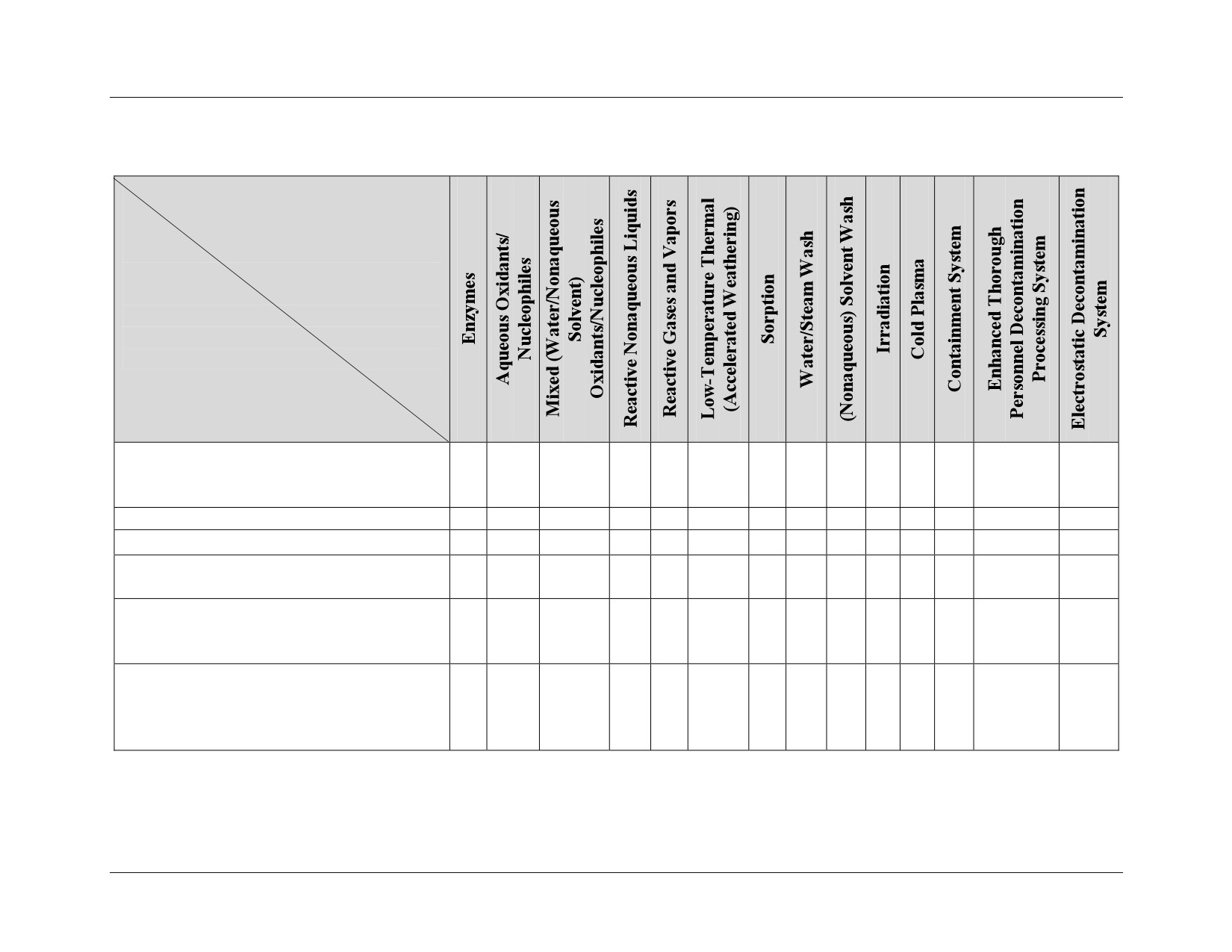
Table 17.11-18. TASUST 11: IMA Assessment
Ideas for Materiel
Approaches
(IMA)
Identified Gaps
Current decontaminants are effective
against only a limited range of chemical
X
X
X
X
X
X
X
X
X
X
X
and biological agents.
Risk of damage to sensitive weapon parts.
X
X
X
X
X
X
X
X
X
X
Runoff may be contaminated.
X
X
X
X
X
X
X
X
X
Inability to decontaminate porous
X
X
X
X
X
X
X
materiel.
Large amounts of water are required to
support current decontamination
X
X
X
X
X
X
X
X
X
X
processes
Current decontamination processes may
not be feasible in many operational
X
X
situations due to time and space
requirements.
107
For Official Use Only
For Official Use Only
CBRND Functional Needs Analysis/Functional Solution Analysis
Chapter 17. Tactical Sustain Tasks
17.12 Task TASUST 12: Decontaminate vehicles, weapons, and nonsensitive equipment
17.12.1
Functional Area Analysis
17.12.1.1
Definition
To decontaminate ground vehicles and hardened equipment, such as tanks, high-mobility
multipurpose wheeled vehicles, commercial utility cargo vehicles, 5-ton trucks, materiel-
handling equipment, ground support equipment, etc. Includes minimizing effects of
contaminants and decontaminants on operations. Levels of decontamination include immediate,
operational, and thorough. Objectives of each of these levels are identified as follows:
• Immediate: Limit spread of contamination.
• Operational: Gross removal of exterior contamination.
• Thorough: Reduce contamination to negligible levels.
17.12.1.2
Derivation
UJTL (TA 7, TA 7.1), Protection Joint Functional Concept.
17.12.1.2.1
Supported Tasks: OPSUST 8, OPSUST 11
17.12.1.2.2
Lateral Task: TASHA 24
17.12.1.2.3
Supporting Task: N/A
17.12.1.3
Condition
Perform this task under conditions of:
Physical
1. Extremely rough sea state. (C1.2.1.3)
2. Tropical, arctic, and arid climate. (C1.3.1)
3. All seasons. (C1.3.1.1)
4. Precipitating and stormy weather. (C1.3.1.3)
5. Hot and very cold air temperature. (C1.3.1.3.1)
6. Liquid, freezing, and frozen precipitation. (C1.3.1.3.6.1)
7. Negligible light. (C1.3.2.1)
8. Nuclear effects. (C1.3.3.1)
9. Chemical effects. (C1.3.3.2)
10. Biological effects. (C1.3.3.3)
Military
1. Stressful mission. (C2.1)
2. Location—ashore/afloat. (C2.1.4.1)
108
For Official Use Only
For Official Use Only
CBRND Functional Needs Analysis/Functional Solution Analysis
Chapter 17. Tactical Sustain Tasks
3. Minimal to short time available. (C2.1.5)
4. Marginal forces allocated. (C2.2.3)
5. Some or no interoperability. (C2.2.6)
6. Low personnel capability. (C2.2.4)
7. Negligible personnel experience. (C2.2.4.5)
8. Severe personnel fatigue. (C2.2.4.6)
9. Limited, little, or no lift assets. (C2.5.2)
10. Limited or no host-nation support. (C2.8.5)
11. Ambiguous threat existence. (C2.9.3)
Civil
1. Limited or negative foreign government support. (C3.1.2.3)
2. Aggressively opposed foreign public opinion. (C3.1.2.4)
3. High mission priority. (C3.1.3.2)
17.12.2
Functional Needs Analysis
17.12.2.1
Capabilities and Deficiencies Assessment Summary
Table 17.12-1 present individual and overall current, near-/mid-term, and far-term capabilities to
perform the task to the designated standard. There are a total of four current capabilities used to
accomplish this task and four projected capabilities to be added in the future. Capabilities exist at
the immediate, operational, and thorough levels of decontamination.
Current Capabilities and Deficiencies
The most current capabilities associated with vehicles, along with vehicle-mounted weapons and
nonsensitive equipment include a variety of decontaminants such as soap and water, STB, and
HTH, along with appropriate applicators. However, there are minimal capabilities to
decontaminate vehicle interiors, particularly if porous material is involved. Primary deficiencies
include the potential damage to vehicles, weapons, and nonsensitive equipment surfaces with the
use of corrosive decontaminants, as well as dangerous chemical reactions occurring with the
combination of certain decontaminants. Other deficiencies include the requirement for large
amounts of water, time, and personnel; controlling contaminated runoff; and the inability to
decontaminate porous materials.
Projected Near/Mid-Term Capabilities and Deficiencies
The projected near/mid-term capabilities and deficiencies evaluated were associated with JSPDS
Increment I, JSTDS-SS Increment I and JPID Increment I.
Projected Far-Term Capabilities and Deficiencies
The projected far-term capabilities and deficiencies evaluated were associated with JSTDS-SS
Increment II, JSTDS-LS Increments I and II, JPID Increment II, and JPDS Increments I and II.
109
For Official Use Only
For Official Use Only
CBRND Functional Needs Analysis/Functional Solution Analysis
Chapter 17. Tactical Sustain Tasks
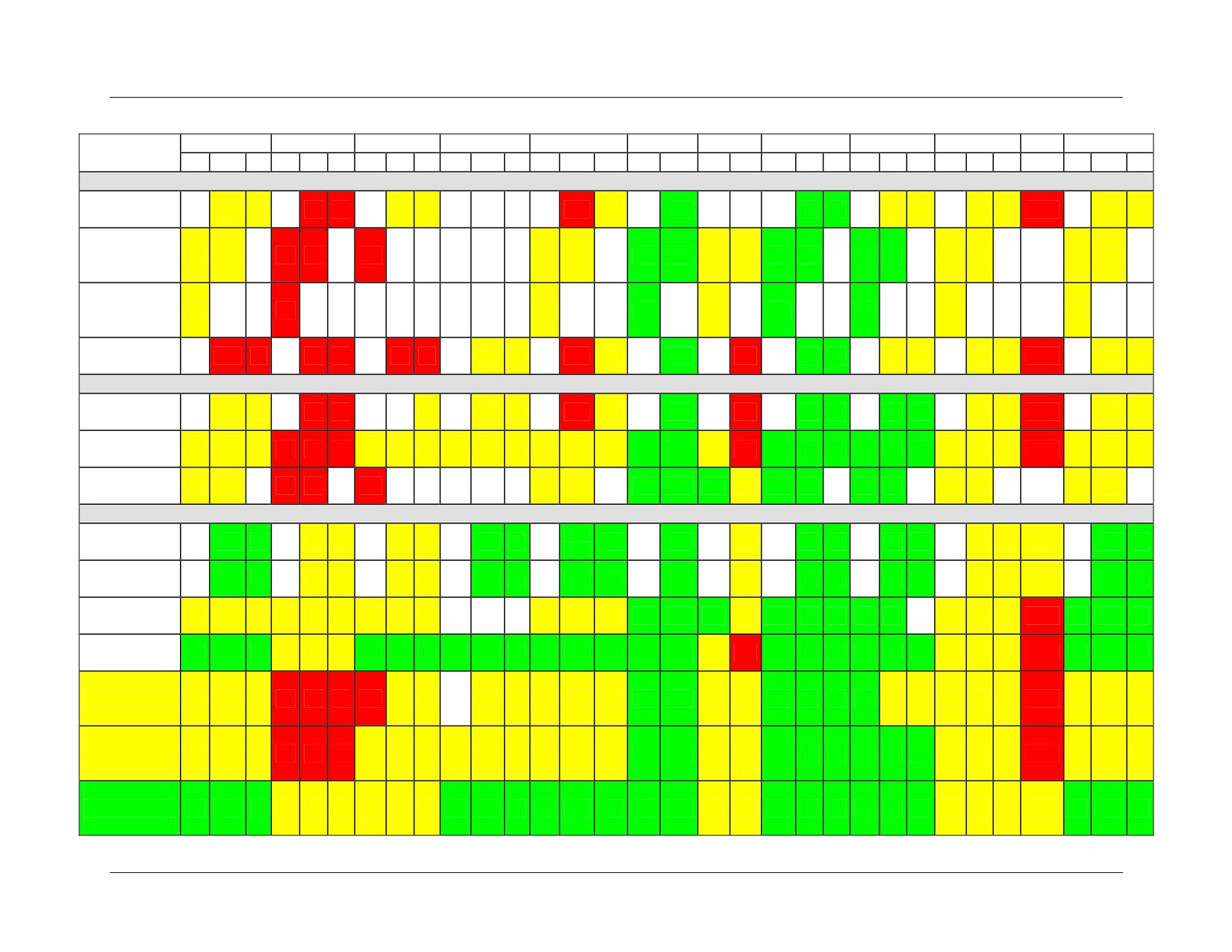
Table 17.12-1. TASUST 12: Capabilities and Deficiencies Assessment
M1
M2
M3
M4
M5
M6
M7
M8
M9
M10
M11
M12
Capabilities
I
O
T
I
O
T
I
O
T
I
O
T
I
O
T
I
O
I
O
I
O
T
I
O
T
I
O
T
T
I
O
T
Current
HTH/STB
N/
N/
N/
N/
N/
N/
N/
N/
N/
N/
N/
N/
N/
N/
51
5
32
3
53
5
34
55
86
97
9
78
7
59
5
010
711
7
A
A
A
A
A
A
A
A
A
A
A
A
A
A
M291/M295
N/
N/
N/
N/
N/
N/
N/
N/
N/
N/
N/
N/
Kits/Spot
712
7
3
3
113
714
7
815
916
717
7
9
9
818
8
719
7
N/A
7
7
A
A
A
A
A
A
A
A
A
A
A
A
Cleaning
M100
N/
N
N/
N/
N/
N/
N/
N/
N/
N/
N/
N/
N/
N/
N/
N/
N/
N/
N/
SDS/Spot
7
N/A
3
7
8
N/A
7
9
8
7
N/A
7
N/A
A
A
A
A
A
A
A
A
A
A
A
A
A
A
A
A
A
A
A
Cleaning
Hot Soapy
N/
N/
N/
N/
N/
N/
N/
N/
N
N/
N/
3
3
020
0
321
3
422
4
3
5
8
123
9
9
7
7
5
5
0
7
7
Water
A
A
A
A
A
A
A
A
A
A
A
Near/Mid-Term
JSTDS-SS
N/
N/
N/
N/
N/
N/
N/
N/
N/
N/
N/
7
7
3
3
5
4
4
3
5
9
1
9
9
N/
8
8
5
5
124
7
7
Increment I
A
A
A
A
A
A
A
A
A
A
A
JPID
7
7
7
3
3
3
725
7
7
4
4
4
7
7
726
927
9
528
029
9
9
9
8
8
8
7
5
5
0
7
7
7
Increment I
JSPDS
N/
N/
N/
N/
N/
N/
N/
N/
N/
N/
N/
N/
7
7
3
3
1
7
7
9
9
9
630
9
9
8
8
7
7
N/A
7
7
Increment I
A
A
A
A
A
A
A
A
A
A
A
A
Far-Term
JSTDS-SS
N/
N/
N/
N/
N/
10
N/
N/
N/
N/
N/
N/
1031
10
532
5
5
5
833
8
10
1035
436
9
9
8
8
5
5
637
1038
10
Increment II
A
A
A
A
A
34
A
A
A
A
A
A
JSTDS-LS
N/
N/
N/
N/
N/
N/
N/
N/
N/
N/
N/
10
10
5
5
5
5
8
8
10
10
9
4
9
9
8
8
5
5
6
10
10
Increment I/II
A
A
A
A
A
A
A
A
A
A
A
JPDS
N/
N/
N/
N/
7
7
7
5
5
5
5
5
5
7
7
7
9
9
9
6
9
9
9
8
8
7
7
7
1
10
10
10
Increment I/II
A
A
A
A
JPID
10
10
10
7
7
7
8
8
8
8
8
8
10
10
10
9
9
5
0
9
9
9
9
9
9
7
7
7
1
10
10
10
Increment II
Current
N/
Overall
7
5
5
3
2
2
1
4
4
4
4
7
5
5
8
8
7
4
9
9
9
8
7
7
7
5
5
0
7
7
7
A
Capabilities
Near/Mid-
Term Overall
7
7
7
3
3
3
4
7
6
4
4
4
7
7
7
9
9
7
4
9
9
9
8
8
8
7
5
5
1
7
7
7
Capabilities
Far-Term
Overall
10
10
10
5
5
5
7
6
6
8
8
8
10
10
10
9
9
7
4
9
9
9
9
8
8
7
5
5
4
10
10
10
Capabilities
110
For Official Use Only
For Official Use Only
CBRND Functional Needs Analysis/Functional Solution Analysis
Chapter 17. Tactical Sustain Tasks
FAA Measure
Elaboration
Scale
M1
(Yes/No) Contaminated by-products
Contaminated by-products are controlled.
10: Yes, Complete (100%).
are controlled?
Where by-products are less than 100%
7: Yes, Substantial (~75%).
controlled, measures must be in place to
5: Yes, Partial (~50%).
prevent cross-contamination from becoming
3: Yes, Minimal (~25%).
an unacceptable hazard.
0: No, Contaminated by-products cannot be controlled and
present an unacceptable hazard.
M2
(Level) Of chemical contamination
The level of chemical contamination is
10: Decontaminate all CWAs, NTAs, TIMs to general
after decontamination procedures.
acceptable after decontamination operations
population exposure limits.
from a starting liquid challenge of 10 g/m2.
7: Decontaminate all CWAs, all NTAs, and some TIMs to a
Agents defined as current-generation CWAs,
level that will allow unprotected exposure.
NTAs, TIMs, and TICs.
5: Decontaminate all CWAs, some NTAs to a level that will
allow unprotected exposure.
3: Decontaminate most CWAs to a level that will allow
unprotected exposure.
0: No effective decontaminant or process.
M3
(Level) Of biological contamination
The level of biological contamination is
10: 0 CFU/PFU/m2—total removal or neutralization of
after decontamination procedures.
acceptable after decontamination procedures.
toxins against all 25 threat agents.
Vegetative and nonvegetative bacteria are
9: 0 CFU/PFU/m2—total removal or neutralization of toxins
measured in CFU/m2 and viruses are
against 20 or more key threat agents.
measured in PFU/m2.
8: 0 CFU/PFU/m2—total removal or neutralization of toxins
against 15 or more key threat agents.
7: 0 CFU/PFU/m2—total removal or neutralization of toxins
against 10 or more key threat agents.
6: 0 CFU/PFU/m2—total removal or neutralization of toxins
against eight or more key threat agents.
5: Less than infective dose levels/casualty-producing toxin
exposure levels against six or more threat agents.
4: Less than infective dose levels/casualty-producing toxin
exposure levels against four key threat agents.
3: Less than infective dose levels/casualty-producing toxin
exposure levels against three key threat agents.
2: Less than infective dose levels/casualty-producing toxin
exposure levels against two or more key threat agents.
1: Less than infective dose levels/casualty-producing toxin
levels against one key threat agent.
0: More than infective dose levels/casualty-producing toxin
exposure levels.
111
For Official Use Only
For Official Use Only
CBRND Functional Needs Analysis/Functional Solution Analysis
Chapter 17. Tactical Sustain Tasks
M4
(Level) Of radiological
The level of radiological contamination is
10: Total removal to natural backg1round level.
contamination after decontamination
acceptable after decontamination operations
8: ≤0.11 cGy/hour residual dose rate.
procedures.
from a starting challenge of 4 g/m2 of
6: ≤0.22 cGy/hour residual dose rate.
insoluble radioactive contaminants, 37-200
4: <0.33 cGy/hour residual dose rate.
μm in size and 185 GBq/m2 gamma activity.
2: 0.33 cGy/hour residual dose rate.
0.33 cGy/hour equates to an exposure that can
0: Removal capabilities limited or ineffective, allowing
cause mild incapacitation in 2.5% or less of
excessive residual dose rates >0.33 cGy/hour.
unprotected, not previously exposed
personnel.
M5
(Yes/No) Cross-contamination is
Cross-contamination is controlled. Where
10: Complete (100%).
controlled?
cross-contamination is less than 100%
7: Substantial (~75%).
controlled, measures must be in place to
5: Partial (~50%).
prevent cross-contamination from becoming
3: Minimal (~25%).
an unacceptable hazard.
0: No, cross-contamination cannot be controlled and present
an unacceptable hazard.
M6
(Time) To initiate immediate and
Initiate immediate decontamination
Immediate
Operational
operational decontamination
procedures within a minimal amount of time.
10: Immediately
10: Immediately
procedures.
9: <10 seconds
9: <1 hour
Initiate operational decontamination
8: <30 seconds
8: <2 hours
procedures within a minimal amount of time.
7: <45 seconds
7: <3 hours
6: <1 minute
6: <4 hours
5: <1 minute, 15 seconds
5: <5 hours
4: <1 minute, 30 seconds
4: <6 hours
3: <1 minute, 45 seconds
3: <7 hours
2: <2 minutes
2: <8 hours
1: <3 minutes
1: <9 hours
0: >3 minutes
0: >9 hours
M7
(Time) To conduct immediate and
Complete immediate decontamination
Immediate
Operational
operational decontamination
procedures within a minimal amount of time.
10: Immediately
10: >100
procedures.
9: <1 minute
9: 90-100
Number of vehicles/other large equipment
8: <2 minutes
8: 80-89
items operationally decontaminated in one
7: <3 minutes
7: 70-79
hour.
6: <4 minutes
6: 60-69
5: <5 minutes
5: 50-59
4: <7 minutes
4: 40-49
3: <9 minutes
3: 30-39
2: <12 minutes
2: 20-29
1: <15 minutes
1: 10-19
0: >15 minutes
0: <10
112
For Official Use Only
For Official Use Only
CBRND Functional Needs Analysis/Functional Solution Analysis
Chapter 17. Tactical Sustain Tasks
M8
(Percent) Of systems unusable due to
The quantity of systems that may be rendered
10: 0%
the effects of decontamination.
unserviceable by decontamination process
9: <1%
must be minimized.
8: <2%
7: <3%
6: <4%
5: <5%
4: <6%
3: <7%
2: <8%
1: <9%
0: ≥10%
M9
(Percent) Of systems that require
The quantity of repairs or parts replacements
10: 0%
repair or replacement due to the
required due to decontamination process must
9: <1%
effects of decontamination.
be minimized.
8: <2%
7: <3%
6: <4%
5: <5%
4: <6%
3: <7%
2: <8%
1: <9%
0: ≥10%
M10
(Yes/No) Decontamination
Decontamination procedures must be
10: No negative impacts on operations.
procedures are logistically
logistically supportable.
7: Limited negative impact on operational capability.
supportable?
5: Moderate negative impact on operational capability.
3: Major negative impact on operational capability.
0: Not logistically supportable.
M11
(Quantity) Vehicles, weapons, and
Number of vehicles/other large equipment
10: >50
nonsensitive equipment
items thoroughly decontaminated in one hour
9: 45-49
decontaminated per hour.
8: 40-44
7: 35-39
6: 30-34
5: 25-29
4: 20-24
3: 15-19
2: 10-14
1: 5-9
0: <5
113
For Official Use Only
For Official Use Only
CBRND Functional Needs Analysis/Functional Solution Analysis
Chapter 17. Tactical Sustain Tasks
M12
There is effective DOTLPF in place
Refers to non-materiel elements associated
10: DOTLPF is adequate for all tasks to be performed with
to conduct task?
with the execution of a task with the system.
this system without limitations that cause significant impact
upon operations.
7: DOTLPF is adequate for most of the tasks to be performed
with this system without limitations that cause significant
impact upon operations.
5: Many critical aspects of DOTLPF for the task to be
performed with this system are addressed.
3: Some critical aspects of DOTLPF for the task to be
performed with this system are addressed.
0: DOTLPF is completely inadequate or does not exist for the
tasks to be performed with this system.
1 M1 - (Yes/No) Contaminated by-products are controlled? 5: Yes, Partial (~50%).
2 M2 - (Level) Of chemical contamination after decontamination procedures. 3: Decontaminate most CWAs to a level that will allow unprotected exposure.
3 M3 - (Level) Of biological contamination after decontamination procedures. 5: Less than infective dose levels/casualty-producing toxin-exposure levels against six or more
threat agents.
4 M5 - (Yes/No) Cross-contamination is controlled? 3: Minimal (~25%).
5 M5 - (Yes/No) Cross-contamination is controlled? 5: Partial (~50%).
6 M6 - (Time) To initiate operational decontamination procedures. 8: <2 hours.
7 M8 - (Percent) Of systems unusable due to the effects of decontamination. 9: <1%.
8 M9 - (Percent) Of systems that require repair or replacement due to the effects of decontamination. 7: <3%.
9 M10 - (Yes/No) Decontamination procedures are logistically supportable? 5: Moderate negative impact on operational capability.
10 M11 - (Quantity) Vehicles, weapons, and nonsensitive equipment decontaminated per hour. 0: <5.
11 M12 - There is effective DOTLPF in place to conduct task? 7: DOTLPF is adequate for most of the tasks to be performed with this system without limitations that cause
significant impact upon operations.
12 M1 - (Yes/No) Contaminated by-products are controlled? 7: Yes, Substantial (~75%).
13 M3 - (Level) Of biological contamination after decontamination procedures. 1: Less than infective dose levels/casualty-producing toxin levels against one key threat agent.
14 M5 - (Yes/No) Cross-contamination is controlled? 7: Substantial (~75%).
15 M6 - (Time) To initiate immediate decontamination procedures. 8: <30 seconds.
16 M6 - (Time) To initiate operational decontamination procedures. 9: <1 hour.
17 M7 - (Time) To conduct immediate decontamination procedures. 7: <3 minutes.
18 M9 - (Percent) Of systems that require repair or replacement due to the effects of decontamination. 8: <2%.
19 M10 - (Yes/No) Decontamination procedures are logistically supportable? 7: Limited negative impact on operational capability.
20 M2 - (Level) Of chemical contamination after decontamination procedures. 0: No effective decontaminant or process.
21 M3 - (Level) Of biological contamination after decontamination procedures. 3: Less than infective dose levels/casualty-producing toxin-exposure levels against three key threat
agents.
22 M4 - (Level) Of radiological contamination after decontamination procedures. 4: <0.33 cGy/hour residual dose rate.
23 M7 - (Time) To conduct operational decontamination procedures. 1: 10-19 vehicles/other large equipment items operationally decontaminated in one hour.
24 M11 - (Quantity) Vehicles, weapons, and nonsensitive equipment decontaminated per hour. 1: 5-9.
25 M3 - (Level) Of biological contamination after decontamination procedures. 7: 0 CFU/PFU/m2—total removal or neutralization of toxins against 10 or more key threat agents.
26 M5 - (Yes/No) Cross-contamination is controlled? 7: Substantial (~75%).
27 M6 - (Time) To initiate immediate decontamination procedures. 9: <10 seconds.
114
For Official Use Only
For Official Use Only
CBRND Functional Needs Analysis/Functional Solution Analysis
Chapter 17. Tactical Sustain Tasks
28 M7 - (Time) To conduct immediate decontamination procedures. 5: <5 minutes.
29 M7 - (Time) To conduct operational decontamination procedures. 0: <10 vehicles/other large equipment items operationally decontaminated in one hour.
30 M7 - (Time) To conduct operational decontamination procedures. 6: 60-69 vehicles/other large equipment items operationally decontaminated in one hour.
31 M1 - (Yes/No) Contaminated by-products are controlled? 10: Yes, Complete (100%).
32 M2 - (Level) Of chemical contamination after decontamination procedures. 5: Decontaminate all CWAs, some NTAs to a level that will allow unprotected exposure.
33 M4 - (Level) Of radiological contamination after decontamination procedures. 8: <0.11 cGy/hour residual dose rate.
34 M5 - (Yes/No) Cross-contamination is controlled? 10: Complete (100%)
35 M6 - (Time) To initiate operational decontamination procedures. 10: Immediately.
36 M7 - (Time) To conduct operational decontamination procedures. 4: 40-49 vehicles/other large equipment items operationally decontaminated in one hour.
37 M11 - (Quantity) Vehicles, weapons, and nonsensitive equipment thoroughly decontaminated per hour. 6: 30-34.
38 M12 - There is effective DOTLPF in place to conduct task? 10: DOTLPF is adequate for all tasks to be performed with this system without limitations that cause significant
impact upon operations.
115
For Official Use Only
For Official Use Only
CBRND Functional Needs Analysis/Functional Solution Analysis
Chapter 17. Tactical Sustain Tasks
17.12.3
Functional Solution Analysis
17.12.3.1
DOTLPF Assessment Summary
This section states the deficiencies and suggests potential non-materiel solutions. If there are no
solutions or there are only partial solutions for a particular deficiency, the deficiency is then
reassessed in the IMA section.
1.
Deficiency: Some decontaminants used in current procedures are corrosive, including STB,
and HTH.
Non-Materiel Solutions: Doctrine (partial): Modify doctrine, policy, procedures, and TTPs
to address noncorrosive decontamination and emphasize for selected systems and materials.
2.
Deficiency: Runoff may be contaminated.
Non-Materiel Solutions: Doctrine (partial): Modify doctrine to consider contaminated
runoff as an operational consideration. Doctrine should address how to dispose of or
neutralize runoff. Training (partial): Modify training to consider contaminated runoff as an
operational consideration. Training should address how to dispose of or neutralize runoff.
Facilities (partial): Supporting infrastructure to neutralize or dispose of captured
contaminated runoff.
3.
Deficiency: Current decontaminants may not neutralize all hazards.
Non-Materiel Solutions: None.
4.
Deficiency: Current operational and thorough procedures require large amounts of water.
Non-Materiel Solutions: Doctrine (partial): Modify existing doctrine, policy, and
procedures to address reduced water decontamination. Training (partial): Units should be
trained to recognize water requirements for decontamination operations, and plan
accordingly.
5.
Deficiency: Operational and thorough procedures are manpower and equipment intensive.
Non-Materiel Solutions: Doctrine (partial): Modify doctrine to include procedures for
removing or replacing porous materials from vehicles. Training (partial): Modify
institutional and unit-level training to include reduced manpower and equipment
requirements for decontamination.
6.
Deficiency: Inability to decontaminate porous materials.
Non-Materiel Solutions: Doctrine (partial): Modify doctrine to include procedures for
removing or replacing porous materials from vehicles.
7.
Deficiency: Inability to decontaminate hard-to-reach places using current applicators.
Non-Materiel Solutions: None.
116
For Official Use Only
For Official Use Only
CBRND Functional Needs Analysis/Functional Solution Analysis
Chapter 17. Tactical Sustain Tasks
17.12.3.2
IMA Assessment Summary
Table 17.12-2 identifies which of the materiel approaches might address specific materiel gaps
identified in the DOTMLPF assessment.
117
For Official Use Only
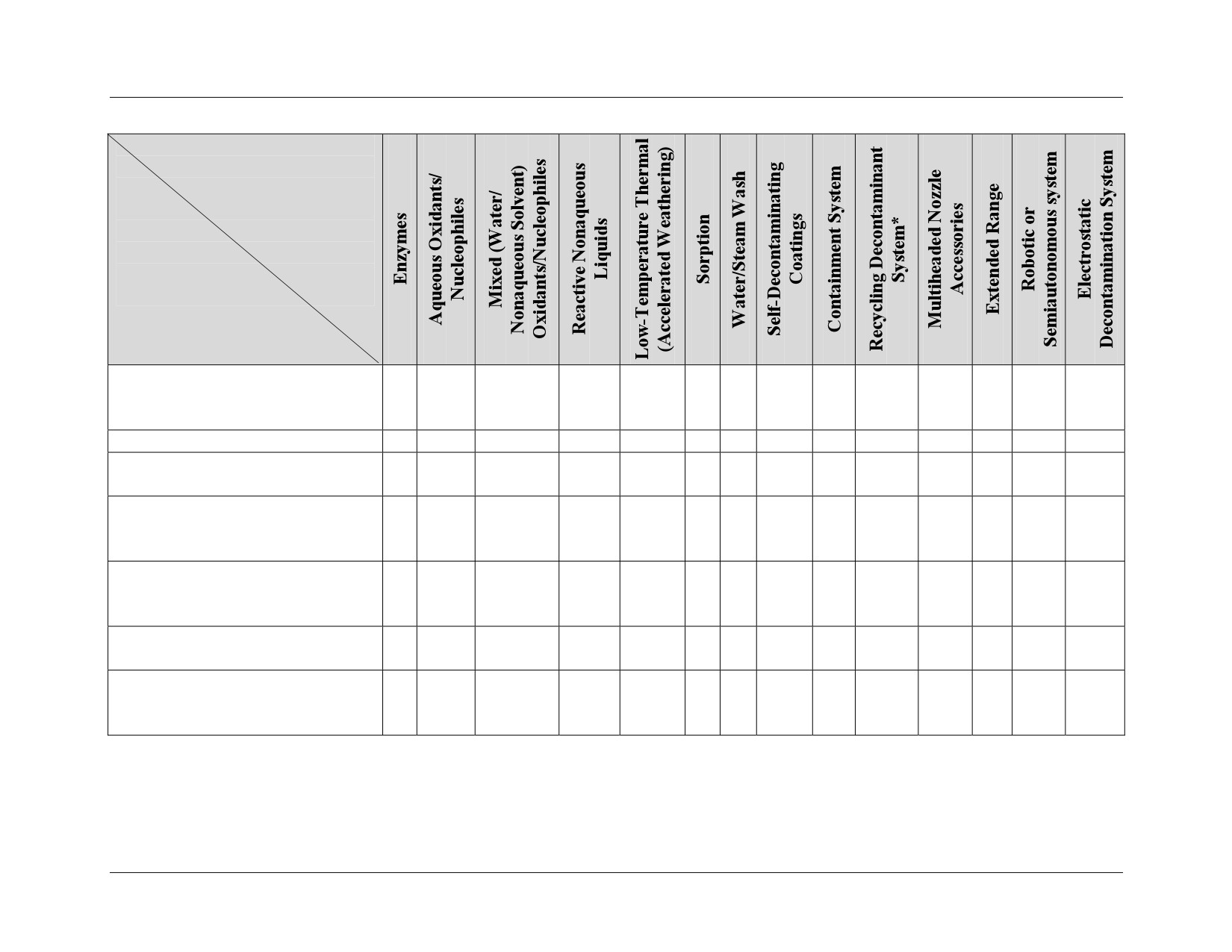
For Official Use Only
CBRND Functional Needs Analysis/Functional Solution Analysis
Chapter 17. Tactical Sustain Tasks
Table 17.12-2. TASUST 12: IMA Assessment
Ideas for Materiel
Approaches
(IMA)
Identified Gaps
Some decontaminants used in
current procedures are corrosive,
X
X
X
X
X
X
X
X
X
including STB and HTH.
Runoff may be contaminated.
X
X
X
X
X
X
Current decontaminants may not
X
X
X
X
X
X
X
X
neutralize all hazards.
Current operational and thorough
procedures require large amounts
X
X
X
X
X
X
of water.
Operational and thorough
procedures are manpower- and
X
X
X
X
X
X
X
equipment-intensive.
Inability to decontaminate porous
X
materials.
Inability to decontaminate hard-
to-reach places using current
X
X
X
X
X
X
X
applicators.
118
For Official Use Only
For Official Use Only
CBRND Functional Needs Analysis/Functional Solution Analysis
Chapter 17. Tactical Sustain Tasks
17.13 Task TASUST 13: Decontaminate sensitive equipment
17.13.1
Functional Area Analysis
17.13.1.1
Definition
To decontaminate equipment for command and control, communications and computers, along
with optic systems such as night vision goggles, infrared-imaging systems, laser spotting
devices, etc. Includes minimizing effects of contaminants and decontaminants on operations.
Sensitive equipment may be decontaminated individually or decontaminated as part of interior
decontamination if large and bulky or not readily removable from within a platform or facility.
Levels of decontamination include immediate, operational, and thorough. Objectives of each of
these levels are identified as follows:
• Immediate: Reduce contact hazard and limit spread of contamination.
• Operational: Gross removal of contamination.
• Thorough: Eliminate contamination prior to reissue or further use.
17.13.1.2
Derivation
UJTL (TA 7, TA 7.1), Protection Joint Functional Concept.
17.13.1.2.1
Supported Tasks: OPSUST 8, OPSUST 11
17.13.1.2.2
Lateral Task: TASHA 24
17.13.1.2.3
Supporting Task: N/A
17.13.1.3
Condition
Perform this task under conditions of:
Physical
1. Extremely rough sea state. (C1.2.1.3)
2. Tropical, arctic, and arid climate. (C1.3.1)
3. All seasons. (C1.3.1.1)
4. Precipitating and stormy weather. (C1.3.1.3)
5. Hot and very cold air temperature. (C1.3.1.3.1)
6. Liquid, freezing, and frozen precipitation. (C1.3.1.3.6.1)
7. Negligible light. (C1.3.2.1)
8. Nuclear effects. (C1.3.3.1)
9. Chemical effects. (C1.3.3.2)
10. Biological effects. (C1.3.3.3)
119
For Official Use Only
For Official Use Only
CBRND Functional Needs Analysis/Functional Solution Analysis
Chapter 17. Tactical Sustain Tasks
Military
1. Stressful mission. (C2.1)
2. Location—ashore/afloat/airborne. (C2.1.4.1)
3. Minimal to short time available. (C2.1.5)
4. Marginal forces allocated. (C2.2.3)
5. Low personnel capability. (C2.2.4)
6. Negligible personnel experience. (C2.2.4.5)
7. Limited, little, or no lift assets. (C2.5.2)
8. Some or no interoperability. (C2.2.6)
9. Limited or no host-nation support. (C2.8.5)
10. Ambiguous threat existence. (C2.9.3)
Civil
1. High mission priority. (C3.1.3.2)
17.13.2
Functional Needs Analysis
17.13.2.1
Capabilities and Deficiencies Assessment Summary
Table 17.13-1 presents individual and overall current, near-/mid-term, and far-term capabilities
to perform the task to the designated standard. There are a total of three current capabilities used
to accomplish this task and two projected capabilities to be added in the future. Capabilities exist
at the immediate, operational, and thorough levels of decontamination.
Current Capabilities and Deficiencies
There are limited capabilities to decontaminate electronics and optics using decontaminants such
as HTH, STB, soapy water, vacuums, pressurized air, and M291/M295 chemical
decontamination kits. Deficiencies include the potential damage to electronic and optical systems
with the use of corrosive decontaminants, as well as the inability to decontaminate circuit boards,
porous, and hard-to-reach surfaces. Also, in the case of biological hazards, some capabilities,
such as soap and water, may not remove all biological spores and may require a combination of
decontaminants and applied procedures.
Projected Near/Mid-Term Capabilities and Deficiencies
The projected near/mid-term capabilities and deficiencies evaluated were associated with JSSED
Increment I and JPID Increment I.
Projected Far-Term Capabilities and Deficiencies
The projected far-term capabilities and deficiencies evaluated were associated with JSSED
Increment II and JPID Increment II.
120
For Official Use Only
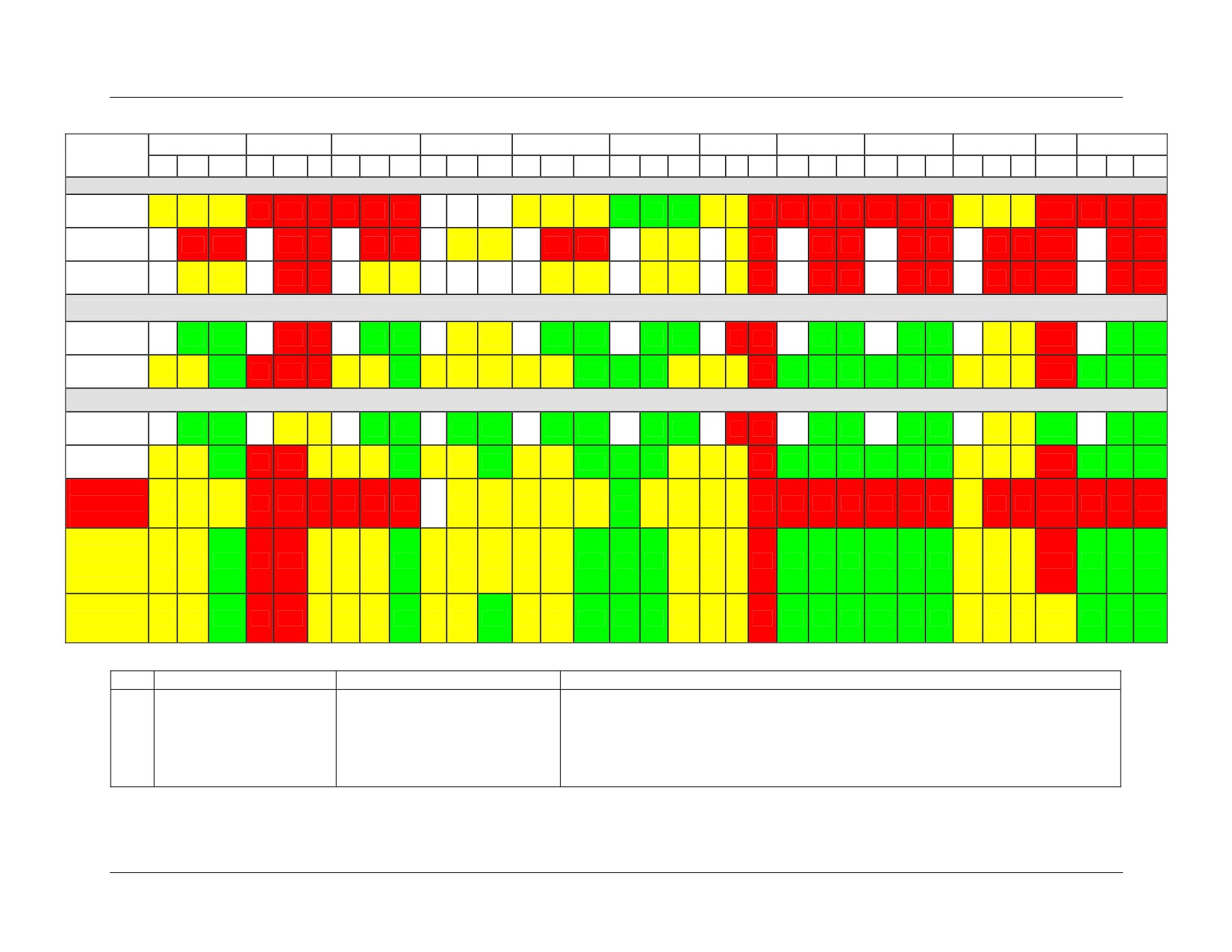
For Official Use Only
CBRND Functional Needs Analysis/Functional Solution Analysis
Chapter 17. Tactical Sustain Tasks
Table 17.13-1. TASUST 13: Capabilities and Deficiencies Assessment
M1
M2
M3
M4
M5
M6
M7
M8
M9
M10
M11
M12
Capabilities
I
O
T
I
O
T
I
O
T
I
O
T
I
O
T
I
O
T
I
O
T
I
O
T
I
O
T
I
O
T
T
I
O
T
Current
M291/M295
N/
N/
71
7
7
32
3
3
13
1
1
N/A
74
7
7
85
86
87
58
5
19
010
0
0
011
0
0
512
5
5
113
314
3
3
Kits
A
A
Hot Soapy
N/
N/
N/
N/
N/
N/
N/
N/
N/
N/
N/
315
3
016
0
317
3
418
4
319
3
620
721
5
1
0
0
0
0
322
3
1
3
3
Water
A
A
A
A
A
A
A
A
A
A
A
HTH/STB
N/
N/
N/
N/
N/
N/
N/
N/
N/
N/
N/
523
5
3
3
524
5
N/A
525
5
6
7
5
1
0
0
N/A
0
0
3
3
1
3
3
A
A
A
A
A
A
A
A
A
A
A
Near/Mid-Term
JSSED
N/
N/
N/
N/
N/
N/
N/
N/
N/
N/
10
1026
3
3
8
827
4
4
10
1028
8
8
3
329
9
930
N/A
9
931
5
5
232
10
1033
Increment I
A
A
A
A
A
A
A
A
A
A
JPID
7
7
10
3
3
3
5
5
8
4
4
4
7
7
10
8
8
6
5
5
1
9
9
9
9
9
9
734
5
5
1
10
10
10
Increment I
Far-Term
JSSED
N/
N/
N/
N/
N/
N/
N/
N/
N/
N/
10
10
5
5
9
935
10
1036
10
10
8
8
3
3
9
9
N/A
9
9
5
5
1037
10
10
Increment II
A
A
A
A
A
A
A
A
A
A
JPID
7
7
10
3
3
5
5
5
9
4
4
10
7
7
10
8
8
6
5
5
1
9
9
9
9
9
9
7
5
5
1
10
10
10
Increment II
Current
N/
Overall
5
5
5
3
338
2
1
3
3
4
4
7
5
5
8
7
7
5
5
1
0
0
0
0
0
0
5
3
3
1
3
3
3
A
Capabilities
Near/Mid-
Term
7
7
10
3
3
5
5
5
8
4
4
4
7
7
10
8
8
7
5
5
2
9
9
9
9
9
9
7
5
5
2
10
10
10
Overall
Capabilities
Far-Term
Overall
7
7
10
3
3
5
5
5
9
4
4
10
7
7
10
8
8
7
5
5
2
9
9
9
9
9
9
7
5
5
539
10
10
10
Capabilities
FAA Measure
Elaboration
Scale
M1
(Yes/No) Contaminated by-
Contaminated by-products are
10: Yes, Complete (100%).
products are controlled?
controlled. Where by-products are
7: Yes, Substantial (~75%).
less than 100% controlled, measures
5: Yes, Partial (~50%).
must be in place to prevent by-
3: Yes, Minimal (~25%).
products from becoming an
0: No, Contaminated by-products cannot be controlled and present an unacceptable hazard.
unacceptable hazard.
121
For Official Use Only
For Official Use Only
CBRND Functional Needs Analysis/Functional Solution Analysis
Chapter 17. Tactical Sustain Tasks
M2
(Level) Of chemical
The level of chemical contamination
10: Decontaminate all CWAs, NTAs, TIMs to general population exposure limits.
contamination after
is acceptable after decontamination
7: Decontaminate all CWAs, all NTAs, and some TIMs to a level that will allow unprotected
decontamination procedures.
operations from a starting liquid
exposure.
challenge of 1 g/m2. Agents defined
5: Decontaminate all CWAs and some NTAs to a level that will allow unprotected exposure.
as current-generation CWAs, NTAs,
3: Decontaminate most CWAs to a level that will allow unprotected exposure.
TIMs, and TICs.
0: No effective decontaminant or process.
M3
(Level) Of biological
The level of biological
10: 0 CFU/PFU/m2—total removal or neutralization of toxins against all 25 threat agents.
contamination after
contamination is acceptable after
9: 0 CFU/PFU/m2—total removal or neutralization of toxins against 20 or more key threat
decontamination procedures.
decontamination procedures.
agents.
Vegetative and nonvegetative
8: 0 CFU/PFU/m2—total removal or neutralization of toxins against 15 or more key threat
bacteria are measured in CFU/m2,
agents.
and viruses are measured in
7: 0 CFU/PFU/m2—total removal or neutralization of toxins against 10 or more key threat
PFU/m2.
agents.
6: 0 CFU/PFU/m2—total removal or neutralization of toxins against eight or more key threat
agents.
5: Less than infective dose levels/casualty-producing toxin exposure levels against six or more
key threat agents.
4: Less than infective dose levels/casualty-producing toxin exposure levels against four key
threat agents.
3: Less than infective dose levels/casualty-producing toxin exposure levels against three key
threat agents.
2: Less than infective dose levels/casualty-producing toxin exposure levels against two or more
key threat agents.
1: Less than infective dose levels/casualty-producing toxin levels against one key threat agent.
0: More than infective dose levels/casualty-producing toxin exposure levels.
M4
(Level) Of radiological
The level of radiological
10: Total removal to natural backg1round level.
contamination after
contamination is acceptable after
8: ≤0.11 cGy/hour residual dose rate.
decontamination procedures.
decontamination operations from a
6: ≤0.22 cGy/hour residual dose rate.
starting challenge of 0.4 g/m2 of
4: <0.33 cGy/hour residual dose rate.
insoluble radioactive contaminants,
2: 0.33 cGy/hour residual dose rate.
37200 μm in size and 185 GBq/m2
0: Removal capabilities limited or ineffective, allowing excessive residual dose rates
gamma activity. 0.33 cGy/hour
>0.33 cGy/hour.
equates to an exposure that can
cause mild incapacitation in 2.5% or
less of unprotected, not previously
exposed personnel.
M5
(Yes/No) Cross-
Cross-contamination is controlled.
10: Yes, Complete (100%).
contamination is controlled?
Where cross-contamination is less
7: Yes, Substantial (~75%).
than 100% controlled, measures
5: Yes, Partial (~50%).
must be in place to prevent cross-
3: Yes, Minimal (~25%).
contamination from becoming an
0: No, Cross-contamination cannot be controlled and presents an unacceptable hazard.
unacceptable hazard.
122
For Official Use Only
For Official Use Only
CBRND Functional Needs Analysis/Functional Solution Analysis
Chapter 17. Tactical Sustain Tasks
M6
(Time) To initiate
Initiate immediate decontamination
Immediate
Operational
Thorough
immediate, operational, and
procedures within adequate amount
10: Immediate
10: Immediate
10 :Immediate
thorough decontamination
of time.
9: <10 seconds
9: 15 minutes
9: 30 minutes
procedures.
8: <30 seconds
8: 30 minutes
8: 45 minutes
Initiate operational decontamination
7: <45 seconds
7: 45 minutes
7: 1 hour
procedures within adequate amount
6: <1 minute
6: <1 hour
6: <2 hours
of time.
5: <1 minute, 15 seconds
5: <2 hours
5: <3 hours
4: <1 minute, 30 seconds
4: <3 hours
4: <4 hours
Initiate thorough decontamination
3: <1 minute, 45 seconds
3: <4 hours
3: <5 hours
procedures within adequate amount
2: <2 minutes
2: <5 hours
2: <6 hours
of time.
1: <3 minutes
1: <6 hours
1: <8 hours
0: >3 minutes
0: >6 hours
0: >8 hours
M7
(Time) To conduct
Minimize time required to
10: Immediate
immediate, operational, and
decontaminate each sensitive
9: <1 minute
thorough decontamination
equipment item.
8: <2 minutes
procedures
7: <3 minutes
6: <4 minutes
5: <5 minutes
4: <6 minutes
3: <8 minutes
2: <10 minutes
1: <30 minutes
0: >30 minutes
M8
(Percent) Of systems
The quantity of systems that may be
10: 0%
unusable due to the effects of
rendered unserviceable by
9: <1%
decontamination.
decontamination process must be
8: <2%
minimized.
7: <3%
6: <4%
5: <5%
4: <6%
3: <7%
2: <8%
1: <9%
0: ≥10%
123
For Official Use Only
For Official Use Only
CBRND Functional Needs Analysis/Functional Solution Analysis
Chapter 17. Tactical Sustain Tasks
M9
(Percent) Of systems that
The quantity of repairs or parts
10: 0%
require repair or replacement
replacements required due to
9: <1%
due to the effects of
decontamination process must be
8: <2%
decontamination.
minimized.
7: <3%
6: <4%
5: <5%
4: <6%
3: <7%
2: <8%
1: <9%
0: ≥10%
M10
Yes/No) Decontamination
Decontamination procedures must
10: No negative impacts on operations.
procedures are logistically
be logistically supportable.
7: Limited negative impact on operational capability.
supportable?
5: Moderate negative impact on operational capability.
3: Major negative impact on operational capability.
0: Not logistically supportable.
M11
(Quantity) Sensitive
Number of sensitive equipment
10: >45
equipment decontaminated
items that can be thoroughly
9: 41-45
per hour.
decontaminated per hour.
8: 36-40
7: 31-35
6: 26-30
5: 21-25
4: 16-20
3: 1115
2: 6-10
1: 2-5
0: <2
M12
There is effective DOTLPF
Refers to non-materiel elements
10: DOTLPF is adequate for all tasks to be performed with this system without limitations that
in place to conduct task?
associated with the execution of a
cause significant impact upon operations.
task with the system.
7: DOTLPF is adequate for most of the tasks to be performed with this system without
limitations that cause significant impact upon operations.
5: Many critical aspects of DOTLPF for the task to be performed with this system are addressed.
3: Some critical aspects of DOTLPF for the task to be performed with this system are addressed.
0: DOTLPF is completely inadequate or does not exist for the tasks to be performed with this
system.
1 M1 - (Yes/No) Contaminated by-products are controlled? 7: Yes, Substantial (~75%).
2 M2 - (Level) Of chemical contamination after decontamination procedures. 3: Decontaminate most CWAs to a level that will allow unprotected exposure.
3 M3 - (Level) Of biological contamination after decontamination procedures. 1: Less than infective dose levels/casualty-producing toxin levels against one key threat agent.
4 M5 - (Yes/No) Cross-contamination is controlled? 7: Yes, Substantial (~75%).
5 M6 - (Time) To initiate immediate decontamination procedures. 8: <30 seconds.
6 M6 - (Time) To initiate operational decontamination procedures. 8: 30 minutes.
7 M6 - (Time) To initiate thorough decontamination procedures. 8: 45 minutes.
8 M7 - (Time) To conduct immediate, operational, and thorough decontamination procedures. 5: <5 minutes.
124
For Official Use Only
For Official Use Only
CBRND Functional Needs Analysis/Functional Solution Analysis
Chapter 17. Tactical Sustain Tasks
9 M7 - (Time) To conduct immediate, operational, and thorough decontamination procedures. 1: <30 minutes.
10 M8 - (Percent) Of systems unusable due to the effects of decontamination. 0: ≥10%.
11 M9 - (Percent) Of systems that require repair or replacement due to the effects of decontamination. 0: ≥10%.
12 M10 - Yes/No) Decontamination procedures are logistically supportable? 5: Moderate negative impact on operational capability.
13 M11 - (Quantity) Sensitive equipment decontaminated per hour. 1: 2-5.
14 M12 - There is effective DOTLPF in place to conduct task? 3: Some critical aspects of DOTLPF for the task to be performed with this system are addressed.
15 M1 - (Yes/No) Contaminated by-products are controlled? 3: Yes, Minimal (~25%).
16 M2 - (Level) Of chemical contamination after decontamination procedures. 0: No effective decontaminant or process.
17 M3 - (Level) Of biological contamination after decontamination procedures. 3: Less than infective dose levels/casualty-producing toxin-exposure levels against three key threat
agents.
18 M4 - (Level) Of radiological contamination after decontamination procedures. 4: <0.33 cGy/hour residual dose rate.
19 M5 - (Yes/No) Cross-contamination is controlled? 3: Yes, Minimal (~25%).
20 M6 - (Time) To initiate operational decontamination procedures. 6: <1 hour.
21 M6 - (Time) To initiate thorough decontamination procedures. 7: 45 minutes.
22 M10 - Yes/No) Decontamination procedures are logistically supportable? 3: Major negative impact on operational capability.
23 M1 - (Yes/No) Contaminated by-products are controlled? 5: Yes, Partial (~50%).
24 M3 - (Level) Of biological contamination after decontamination procedures. 5: Less than infective dose levels/casualty-producing toxin-exposure levels against six or more key
threat agents.
25 M5 - (Yes/No) Cross-contamination is controlled? 5: Yes, Partial (~50%).
26 M1 - (Yes/No) Contaminated by-products are controlled? 10: Yes, Complete (100%).
27 M3 - (Level) Of biological contamination after decontamination procedures. 8: 0 CFU/PFU/m2—total removal or neutralization of toxins against 15 or more key threat agents.
28 M5 - (Yes/No) Cross-contamination is controlled? 10: Yes, Complete (100%).
29 M7 - (Time) To conduct immediate, operational, and thorough decontamination procedures. 3: <8 minutes.
30 M8 - (Percent) Of systems unusable due to the effects of decontamination. 9: <1%.
31 M9 - (Percent) Of systems that require repair or replacement due to the effects of decontamination. 9: <1%.
32 M11 - (Quantity) Sensitive equipment decontaminated per hour. 2: 6-10.
33 M12 - There is effective DOTLPF in place to conduct task? 10: DOTLPF is adequate for all tasks to be performed with this system without limitations that cause significant
impact upon operations.
34 M10 - Yes/No) Decontamination procedures are logistically supportable? 7: Limited negative impact on operational capability.
35 M3 - (Level) Of biological contamination after decontamination procedures. 9: 0 CFU/PFU/m2—total removal or neutralization of toxins against 20 or more key threat agents.
36 M4 - (Level) Of radiological contamination after decontamination procedures. 10: Total removal to natural backg1round level.
37 M11 - (Quantity) Sensitive equipment decontaminated per hour. 10: >45.
38 M2 - (Level) Of chemical contamination after decontamination procedures. 3: Decontaminate most CWAs to a level that will allow unprotected exposure.
39 M11 - (Quantity) Sensitive equipment decontaminated per hour. 5: 21-25.
125
For Official Use Only
For Official Use Only
CBRND Functional Needs Analysis/Functional Solution Analysis
Chapter 17. Tactical Sustain Tasks
17.13.3
Functional Solution Analysis
17.13.3.1
DOTLPF Assessment Summary
This section states the deficiencies and suggests potential non-materiel solutions. If there are no
solutions or there are only partial solutions for a particular deficiency, the deficiency is then
reassessed in the IMA section.
1. Deficiency: Inadequate thorough decontamination processing rate.
Non-Materiel Solutions: None.
2. Deficiency: Decontaminants are corrosive and can damage electronics and optics.
Non-Materiel Solutions: None.
3. Deficiency: Procedural doctrine for immediate and operational decontamination is limited,
and there is no doctrine for thorough decontamination operations.
Non-Materiel Solutions: Doctrine: Revise current doctrine.
4. Deficiency: Soap and water may not remove some biological spores.
Non-Materiel Solutions: None.
5. Deficiency: Inability to decontaminate hazards on circuit boards and other porous materials.
Non-Materiel Solutions: None.
6. Deficiency: Inability to decontaminate hard-to-reach areas using current applicators.
Non-Materiel Solutions: None.
17.13.3.2
IMA Assessment Summary
Table 17.13-2 identifies which of the materiel approaches might address specific materiel gaps
identified in the DOTMLPF assessment.
126
For Official Use Only
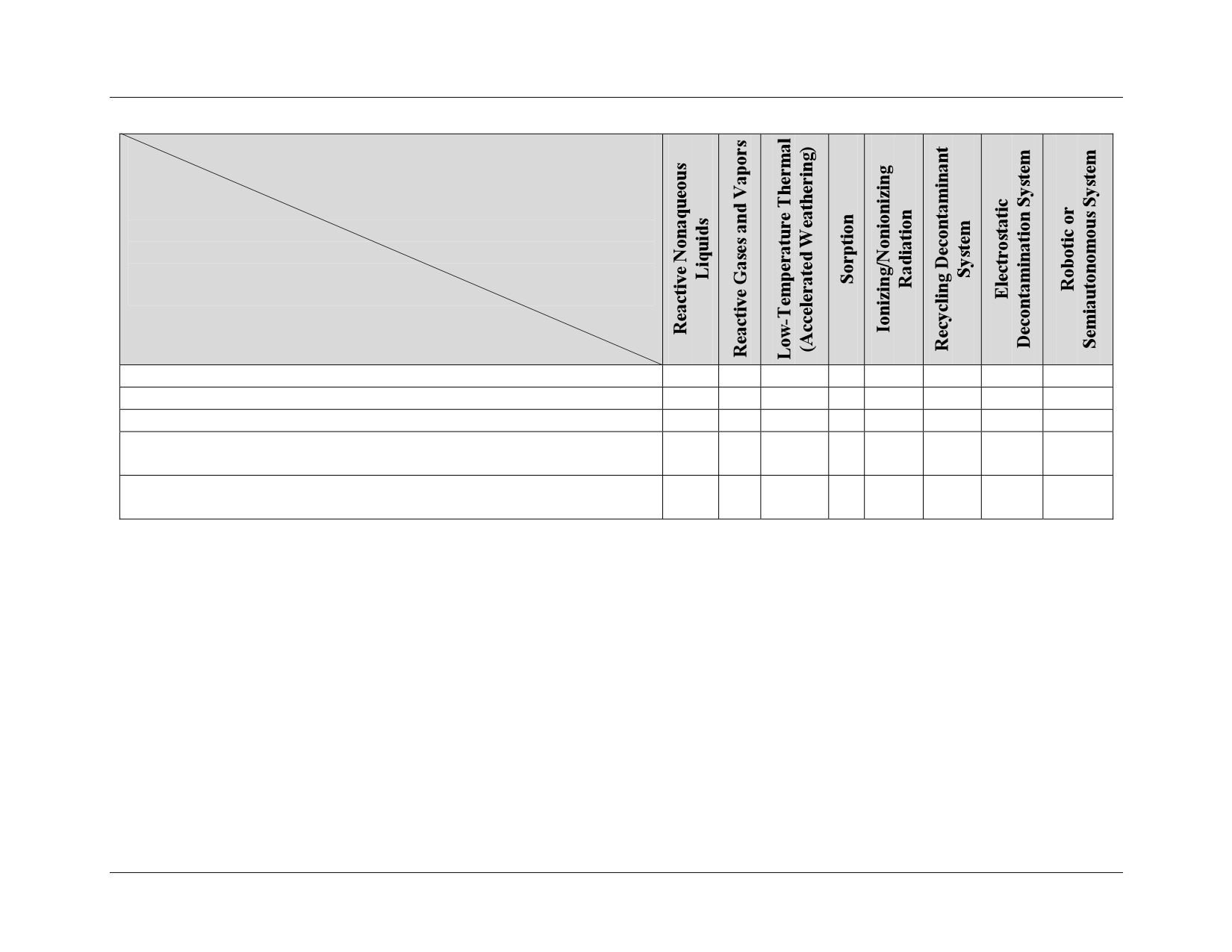
For Official Use Only
CBRND Functional Needs Analysis/Functional Solution Analysis
Chapter 17. Tactical Sustain Tasks
Table 17.13-2. TASUST 13: IMA Assessment
Ideas for Materiel
Approaches
(IMA)
Identified Gaps
Inadequate thorough decontamination processing rate.
X
X
X
X
X
X
X
Decontaminants are corrosive and can damage electronics and optics.
X
X
X
X
X
Soap and water may not remove some biological spores.
X
X
X
Inability to decontaminate hazards on circuit boards and other porous
X
X
X
X
materials.
Inability to decontaminate hard-to-access areas using current
X
X
X
X
applicators.
127
For Official Use Only
For Official Use Only
CBRND Functional Needs Analysis/Functional Solution Analysis
Chapter 17. Tactical Sustain Tasks
17.14 Task TASUST 14: Decontaminate ship exteriors
17.14.1
Functional Area Analysis
17.14.1.1
Definition
To decontaminate the exterior of floating assets such as Navy vessels and prepositioned ships.
Excludes decontamination of sensitive equipment such as radar domes, phalanx systems, and
communication antennas. Includes minimizing effects of contaminants and decontaminants on
operations. Levels of decontamination include immediate, operational, and thorough. Objectives
of each of these levels are identified as follows:
• Immediate: Minimize casualties, save lives, and minimize spread of contamination.
• Operational: Reduce level of contamination to regenerate combat power.
• Thorough: Reduce CBRN contamination to negligible risk. Can be performed and certified
only by shipyards and floating dry docks.
17.14.1.2
Derivation
UJTL (TA 7, TA 7.1), Protection Joint Functional Concept.
17.14.1.2.1
Supported Task: OPSUST 11
17.14.1.2.2
Lateral Task: TASHA 24
17.14.1.2.3
Supporting Task: N/A
17.14.1.3
Condition
Perform this task under conditions of:
Physical
1. Extremely rough sea state. (C1.2.1.3)
2. Tropical, arctic, and arid climate. (C1.3.1)
3. All seasons. (C1.3.1.1)
4. Precipitating and stormy weather. (C1.3.1.3)
5. Hot and very cold air temperature. (C1.3.1.3.1)
6. Liquid, freezing, and frozen precipitation. (C1.3.1.3.6.1)
7. Negligible light. (C1.3.2.1)
8. Nuclear effects. (C1.3.3.1)
9. Chemical effects. (C1.3.3.2)
10. Biological effects. (C1.3.3.3)
Military
1. Stressful mission. (C2.1)
128
For Official Use Only
For Official Use Only
CBRND Functional Needs Analysis/Functional Solution Analysis
Chapter 17. Tactical Sustain Tasks
2. Location-Afloat. (C2.1.4.1)
3. Minimal to short time available. (C2.1.5)
4. Marginal forces allocated. (C2.2.3)
5. Low personnel capability. (C2.2.4)
6. Negligible personnel experience. (C2.2.4.5)
7. Severe personnel fatigue. (C2.2.4.6)
8. Ambiguous threat existence. (C2.9.3)
Civil
1. Aggressively opposed foreign public opinion. (C3.1.2)
2. Limited or negative foreign government support. (C3.1.2.3)
3. High mission priority. (C3.1.3.2)
17.14.2
Functional Needs Analysis
17.14.2.1
Capabilities and Deficiencies Assessment Summary
Table 17.14-1 presents individual and overall current, near-/mid-term, and far-term capabilities
to perform the task to the designated standard. There are a total of five current capabilities used
to accomplish this task and two projected capabilities to be added in the future. Capabilities exist
at the immediate, operational, and thorough levels of decontamination.
Current Capabilities and Deficiencies
Capabilities exist at the immediate, operational, and thorough levels involving the use of
countermeasure washdown systems, HTH, water, general detergents, steam, and appropriate
applicators. There are some capabilities that work better than others, but effectiveness is always
increased when more than one capability is utilized. The best overall capability is the use of
HTH/STB for chemical and biological agents. For radiological agents, however, general
detergents mixed with water are recommended. The downside of HTH/STB is that they are
corrosive to surfaces and equipment and can be hazardous to personnel.
Projected Near/Mid-Term Capabilities and Deficiencies
The projected near/mid-term capabilities and deficiencies evaluated were associated with
JSTDS-SS Increment I.
Projected Far-Term Capabilities and Deficiencies
The projected far-term capabilities and deficiencies evaluated were associated with JSTDS-SS
Increment II and JPDS Increments I and II.
129
For Official Use Only
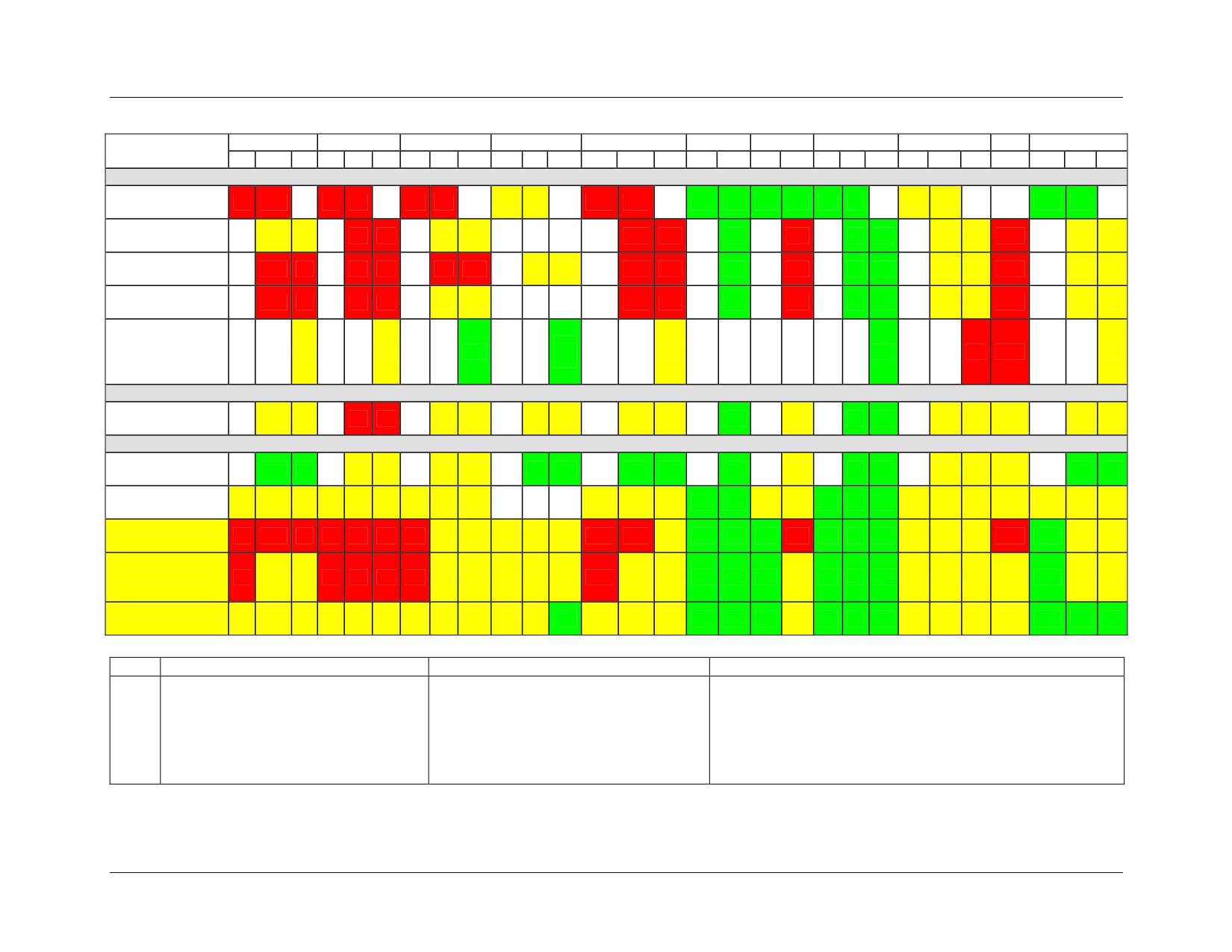
For Official Use Only
CBRND Functional Needs Analysis/Functional Solution Analysis
Chapter 17. Tactical Sustain Tasks
Table 17.14-1. TASUST 14: Capabilities and Deficiencies Assessment
M1
M2
M3
M4
M5
M6
M7
M8
M9
M10
M11
Capabilities
I
O
T
I
O
T
I
O
T
I
O
T
I
O
T
I
O
I
O
I
O
T
I
O
T
T
I
O
T
Current
Seawater/CMWD/
N/
N/
N/
N/
N/
N/
N/
31
3
32
3
33
3
N/A
44
4
35
3
96
97
88
8
99
9
710
7
N/A
1011
10
Firemain Systems
A
A
A
A
A
A
A
HTH
N/
N/
N/
N/
N/
N/
N/
N/
N/
N/
512
5
3
3
513
5
N/A
3
3
814
115
9
9
516
5
317
N/A
718
7
A
A
A
A
A
A
A
A
A
A
General Detergent
N/
N/
N/
N/
N/
N/
N/
N/
3
3
019
0
3
3
4
4
N/A
3
3
8
1
9
9
5
5
3
N/A
7
7
A
A
A
A
A
A
A
A
Steam
N/
N/
N/
N/
N/
N/
N/
N/
N/
N/
020
0
0
0
5
5
N/A
021
0
8
1
9
9
5
5
3
N/A
7
7
A
A
A
A
A
A
A
A
A
A
Gross Physical
Removal/Shipyard
N/
N/
N
N/
N/
N/
N/
10
N/
N/
N/
N/
N/
N/
N/
N/
N/
N/A
5
522
1023
N/A
N/A
525
9
326
027
N/A
528
and Floating
A
A
A
A
A
A
A
24
A
A
A
A
A
A
A
A
A
Drydock
Near/Mid-Term
JSTDS-SS
N/
N/
N/
N/
N/
N/
N/
N/
729
7
3
3
5
5
4
4
N/A
730
7
9
531
9
9
5
5
532
N/A
7
7
Increment I
A
A
A
A
A
A
A
A
Far-Term
JSTDS-SS
N/
N/
N/
N/
N/
N/
N/
N/
1033
10
5
5
5
5
10
10
N/A
1034
10
9
5
9
9
5
5
5
N/A
10
10
Increment II
A
A
A
A
A
A
A
A
JPDS Increment I/II
N/
N/
N/
7
7
7
5
5
5
5
5
5
7
7
7
9
9
535
5
9
9
9
7
5
5
5
7
7
7
A
A
A
Current Overall
37
3
3
3
3
3
3
3
436
5
4
4
6
3
3
4
9
8
8
338
9
9
9
7
5
5
239
10
7
7
Capabilities
Near/Mid-Term
Overall
3
7
7
3
3
3
3
5
5
4
4
7
3
7
7
9
9
8
5
9
9
9
7
5
5
5
10
7
7
Capabilities
Far-Term Overall
7
7
7
5
5
5
5
5
5
4
4
10
7
7
7
9
9
8
5
9
9
9
7
5
5
5
10
10
10
Capabilities
FAA Measure
Elaboration
Scale
M1
(Yes/No) Contaminated by-products are
Contaminated by-products are controlled.
10: Yes, Complete (100%).
controlled?
Where by-products are less than 100%
7: Yes, Substantial (~75%).
controlled, measures must be in place to
5: Yes, Partial (~50%).
prevent by-products from becoming an
3: Yes, Minimal (~25%).
unacceptable hazard.
0: No, Contaminated by-products cannot be controlled and
present an unacceptable hazard.
130
For Official Use Only
For Official Use Only
CBRND Functional Needs Analysis/Functional Solution Analysis
Chapter 17. Tactical Sustain Tasks
M2
(Level) Of chemical contamination
The level of chemical contamination is
10: Decontaminate all CWAs, NTAs, TIMs to general
after decontamination procedures.
acceptable after decontamination
population exposure limits.
operations from a starting liquid
7: Decontaminate all CWAs, all NTAs, and some TIMs to a
challenge of 10 g/m2. Agents defined as
level that will allow unprotected exposure.
current-generation CWAs, NTAs, TIMs,
5: Decontaminate all CWAs and some NTAs to a level that will
and TICs.
allow unprotected exposure.
3: Decontaminate most CWAs to a level that will allow
unprotected exposure.
0: No effective decontaminant or process.
M3
(Level) Of biological contamination
The level of biological contamination is
10: 0 CFU/PFU/m2—total removal or neutralization of toxins
after decontamination procedures.
acceptable after decontamination
against all 25 threat agents.
procedures. Vegetative and nonvegetative
9: 0 CFU/PFU/m2—total removal or neutralization of toxins
bacteria are measured in CFU/m2, and
against 20 or more key threat agents.
viruses are measured in PFU/m2.
8: 0 CFU/PFU/m2—total removal or neutralization of toxins
against 15 or more key threat agents.
7: 0 CFU/PFU/m2—total removal or neutralization of toxins
against 10 or more key threat agents.
6: 0 CFU/PFU/m2—total removal or neutralization of toxins
against eight or more key threat agents.
5: Less than infective dose levels/casualty-producing toxin
exposure levels against six or more key threat agents.
4: Less than infective dose levels/casualty-producing toxin
exposure levels against four key threat agents.
3: Less than infective dose levels/casualty-producing toxin
exposure levels against three key threat agents.
2: Less than infective dose levels/casualty-producing toxin
exposure levels against two or more key threat agents.
1: Less than infective dose levels/casualty-producing toxin
levels against one key threat agent.
0: More than infective dose levels/casualty-producing toxin
exposure levels.
131
For Official Use Only
For Official Use Only
CBRND Functional Needs Analysis/Functional Solution Analysis
Chapter 17. Tactical Sustain Tasks
M4
(Level) Of radiological contamination
The level of radiological contamination is
10: Total removal to natural backg1round level.
after decontamination procedures.
acceptable after decontamination
8: ≤0.11 cGy/hour residual dose rate.
operations from a starting challenge of
6: ≤0.22 cGy/hour residual dose rate.
4 g/m2 of insoluble radioactive
4: <0.33 cGy/hour residual dose rate.
contaminants, 37-200 μm in size and
2: 0.33 cGy/hour residual dose rate.
185 GBq/m2 gamma activity.
0: Removal capabilities limited or ineffective, allowing
0.33 cGy/hour equates to an exposure that
excessive residual dose rates >0.33 cGy/hour.
can cause mild incapacitation in 2.5% or
less of unprotected, not previously
exposed personnel.
M5
(Yes/No) Cross-contamination is
Cross-contamination is controlled. Where
10: Yes, Complete (100%).
controlled?
cross-contamination is less than 100%
7: Yes, Substantial (~75%).
controlled, measures must be in place to
5: Yes, Partial (~50%).
prevent cross-contamination from
3: Yes, Minimal (~25%).
becoming an unacceptable hazard.
0: No, Cross-contamination cannot be controlled and presents
an unacceptable hazard.
M6
(Time) To initiate immediate and
Initiate immediate decontamination
Immediate
Operational
operational decontamination
procedures within adequate amount of
10: Immediately
10: Immediately
procedures.
time.
9: <1 minute
9: 15 minutes
8: <2 minutes
8: 30 minutes
Initiate operational decontamination
7: <3 minutes
7: 45 minutes
procedures within adequate amount of
6: <4 minutes
6: <1 hour
time.
5: <5 minutes
5: <2 hours
4: <7 minutes
4: <3 hours
3: <9 minutes
3: <4 hours
2: <12 minutes
2: <5 hours
1: <15 minutes
1: <6 hours
0: >15 minutes
0: >6 hours
M7
(Time) To conduct immediate and
Time required for one warfighter to carry
10: Immediately
operational decontamination
out immediate or operational
9: <1 minute
procedures.
decontamination procedures on 300 m2 of
8: <2 minutes
surface area.
7: <3 minutes
6: <4 minutes
5: <5 minutes
4: <7 minutes
3: <9 minutes
2: <12 minutes
1: <15 minutes
0: >15 minutes
132
For Official Use Only
For Official Use Only
CBRND Functional Needs Analysis/Functional Solution Analysis
Chapter 17. Tactical Sustain Tasks
M8
(Percent) Of systems that require repair
The quantity of repairs or parts
10: 0%
or replacement due to the effects of
replacements required due to
9: <1%
decontamination.
decontamination process must be
8: <2%
minimized.
7: <3%
6: <4%
5: <5%
4: <6%
3: <7%
2: <8%
1: <9%
0: ≥10%
M9
(Yes/No) Decontamination procedures
Decontamination procedures must be
10: No negative impacts on operations.
are logistically supportable?
logistically supportable.
7: Limited negative impact on operational capability.
5: Moderate negative impact on operational capability.
3: Major negative impact on operational capability.
0: Not logistically supportable.
M10
(Time) To conduct thorough
Time required for one warfighter to carry
10: Immediately
decontamination.
out thorough decontamination procedures
9: <1 minute
on 300 m2 of surface area.
8: <2 minutes
7: <3 minutes
6: <4 minutes
5: <5 minutes
4: <10 minutes
3: <15 minutes
2: <20 minutes
1: <30 minutes
0: >30 minutes
M11
(Yes/No) There is effective DOTLPF in
Refers to non-materiel elements
10: DOTLPF is adequate for all tasks to be performed with this
place to conduct task?
associated with the execution of a task
system without limitations that cause significant impact upon
with the system.
operations.
7: DOTLPF is adequate for most of the tasks to be performed
with this system without limitations that cause significant
impact upon operations.
5: Many critical aspects of DOTLPF for the task to be
performed with this system are addressed.
3: Some critical aspects of DOTLPF for the task to be
performed with this system are addressed.
0: DOTLPF is completely inadequate or does not exist for the
tasks to be performed with this system.
133
For Official Use Only
For Official Use Only
CBRND Functional Needs Analysis/Functional Solution Analysis
Chapter 17. Tactical Sustain Tasks
1 M1 - (Yes/No) Contaminated by-products are controlled? 3: Yes, Minimal (~25%).
2 M2 - (Level) Of chemical contamination after decontamination procedures. 3: Decontaminate most CWAs to a level that will allow unprotected exposure.
3 M3 - (Level) Of biological contamination after decontamination procedures. 3: Less than infective dose levels/casualty-producing toxin-exposure levels against three key threat
agents.
4 M4 - (Level) Of radiological contamination after decontamination procedures. 4: <0.33 cGy/hour residual dose rate.
5 M5 - (Yes/No) Cross-contamination is controlled? 5: Yes, Partial (~50%).
6 M6 - (Time) To initiate immediate decontamination procedures. 9: <1 minute.
7 M6 - (Time) To initiate operational decontamination procedures. 9: 15 minutes.
8 M7 - (Time) To conduct immediate and operational decontamination procedures. 8: <2 minutes.
9 M8 - (Percent) Of systems that require repair or replacement due to the effects of decontamination. 9: <1%.
10 M9 - (Yes/No) Decontamination procedures are logistically supportable? 7: Limited negative impact on operational capability.
11 M11 - (Yes/No) There is effective DOTLPF in place to conduct task? 10: DOTLPF is adequate for all tasks to be performed with this system without limitations that cause
significant impact upon operations.
12 M1 - (Yes/No) Contaminated by-products are controlled? 5: Yes, Partial (~50%).
13 M3 - (Level) Of biological contamination after decontamination procedures. 5: Less than infective dose levels/casualty-producing toxin-exposure levels against six or more key
threat agents.
14 M6 - (Time) To initiate operational decontamination procedures. 8: 30 minutes.
15 M7 - (Time) To conduct immediate and operational decontamination procedures. 1: <15 minutes
16 M9 - (Yes/No) Decontamination procedures are logistically supportable? 5: Moderate negative impact on operational capability.
17 M10 - (Time) To conduct thorough decontamination. 3: <15minutes.
18 M11 - (Yes/No) There is effective DOTLPF in place to conduct task? 7: DOTLPF is adequate for most of the tasks to be performed with this system without limitations that
cause significant impact upon operations.
19 M2 - (Level) Of chemical contamination after decontamination procedures. 0: No effective decontaminant or process.
20 M1 - (Yes/No) Contaminated by-products are controlled? 0: No, Contaminated by-products cannot be controlled and present an unacceptable hazard.
21 M5 - (Yes/No) Cross-contamination is controlled? 0: No, cross-contamination cannot be controlled and presents an unacceptable hazard.
22 M2 - (Level) Of chemical contamination after decontamination procedures. 5: Decontaminate all CWAs, some NTAs to a level that will allow unprotected exposure.
23 M3 - (Level) Of biological contamination after decontamination procedures. 10: 0 CFU/PFU/m2—total removal or neutralization of toxins against all 25 threat agents.
24 M4 - (Level) Of radiological contamination after decontamination procedures. 10: Total removal to natural backg1round level.
25 M5 - (Yes/No) Cross-contamination is controlled? 5: Yes, Partial (~50%).
26 M9 - (Yes/No) Decontamination procedures are logistically supportable? 3: Major negative impact on operational capability.
27 M10 - (Time) To conduct thorough decontamination. 0: >30 minutes.
28 M11 - (Yes/No) There is effective DOTLPF in place to conduct task? 5: Many critical aspects of DOTLPF for the task to be performed with this system are addressed.
29 M1 - (Yes/No) Contaminated by-products are controlled? 7: Yes, Substantial (~75%).
30 M5 - (Yes/No) Cross-contamination is controlled? 7: Yes, Substantial (~75%).
31 M7 - (Time) To conduct immediate and operational decontamination procedures. 5: <5 minutes.
32 M10 - (Time) To conduct thorough decontamination. 5: <5 minutes.
33 M1 - (Yes/No) Contaminated by-products are controlled? 10: Yes, Complete (100%).
34 M5 - (Yes/No) Cross-contamination is controlled? 10: Yes, Complete (100%).
35 M7 - (Time) To conduct immediate and operational decontamination procedures. 5: <5 minutes.
36 M3 - (Level) Of biological contamination after decontamination procedures. 4: Less than infective dose levels/casualty-producing toxin-exposure levels against four key threat
agents.
37 M4 - (Level) Of radiological contamination after decontamination procedures. 6: ≤0.22 cGy/hour residual dose rate.
38 M7 - (Time) To conduct immediate and operational decontamination procedures. 3: <9 minutes.
134
For Official Use Only
For Official Use Only
CBRND Functional Needs Analysis/Functional Solution Analysis
Chapter 17. Tactical Sustain Tasks
39 M10 - (Time) To conduct thorough decontamination. 2: <20 minutes.
135
For Official Use Only
For Official Use Only
CBRND Functional Needs Analysis/Functional Solution Analysis
Chapter 17. Tactical Sustain Tasks
17.14.3
Functional Solution Analysis
17.14.3.1
DOTLPF Assessment Summary
This section states the deficiencies and suggests potential non-materiel solutions. If there are no
solutions or there are only partial solutions for a particular deficiency, the deficiency is then
reassessed in the IMA section.
1.
Deficiency: Washdown is corrosive.
Non-Materiel Solutions: Doctrine: Include freshwater rinse after the securing of the
CMWD. Include CMWD and chemical and biological (CB) detectors precautionary
measures in NWP 3-20.31.
2.
Deficiency: Countermeasure washdown does not neutralize CBRN contamination.
Non-Materiel Solutions: None.
3.
Deficiency: CMWD delivery system has insufficient nozzles to cover all surfaces.
Non-Materiel Solutions: Doctrine: Increase area coverage requirements. Conduct CMWD
area coverage analysis and initiate ship alteration or repair requirements as necessary.
4.
Deficiency: Not all deck drains discharge over the side of the ship.
Non-Materiel Solutions: Conduct ship exterior drainage analysis and initiate ship alteration
or repair requirements as necessary.
5.
Deficiency: Primary ship decontaminant (HTH) is hazardous and corrosive.
Non-Materiel Solutions: Doctrine (partial): Modify doctrine to include water rinse after
HTH application.
6.
Deficiency: Limited capability to decontaminate remote and hard-to-reach surfaces using
current applicators.
Non-Materiel Solutions: None.
7.
Deficiency: Inability to decontaminate ventilation system exterior inlets.
Non-Materiel Solutions: Doctrine (partial): Develop decontamination methodology for
ventilation interiors.
8.
Deficiency: Limited capability to decontaminate painted or porous surfaces.
Non-Materiel Solutions: None.
9.
Deficiency: No doctrine for physical removal of agent from painted or porous surfaces.
Non-Materiel Solutions: Doctrine: Need NSTM Chapter 470 Revision.
17.14.3.2
IMA Assessment Summary
Table 17.14-2 identifies which of the materiel approaches might address specific materiel gaps
identified in the DOTMLPF assessment.
136
For Official Use Only
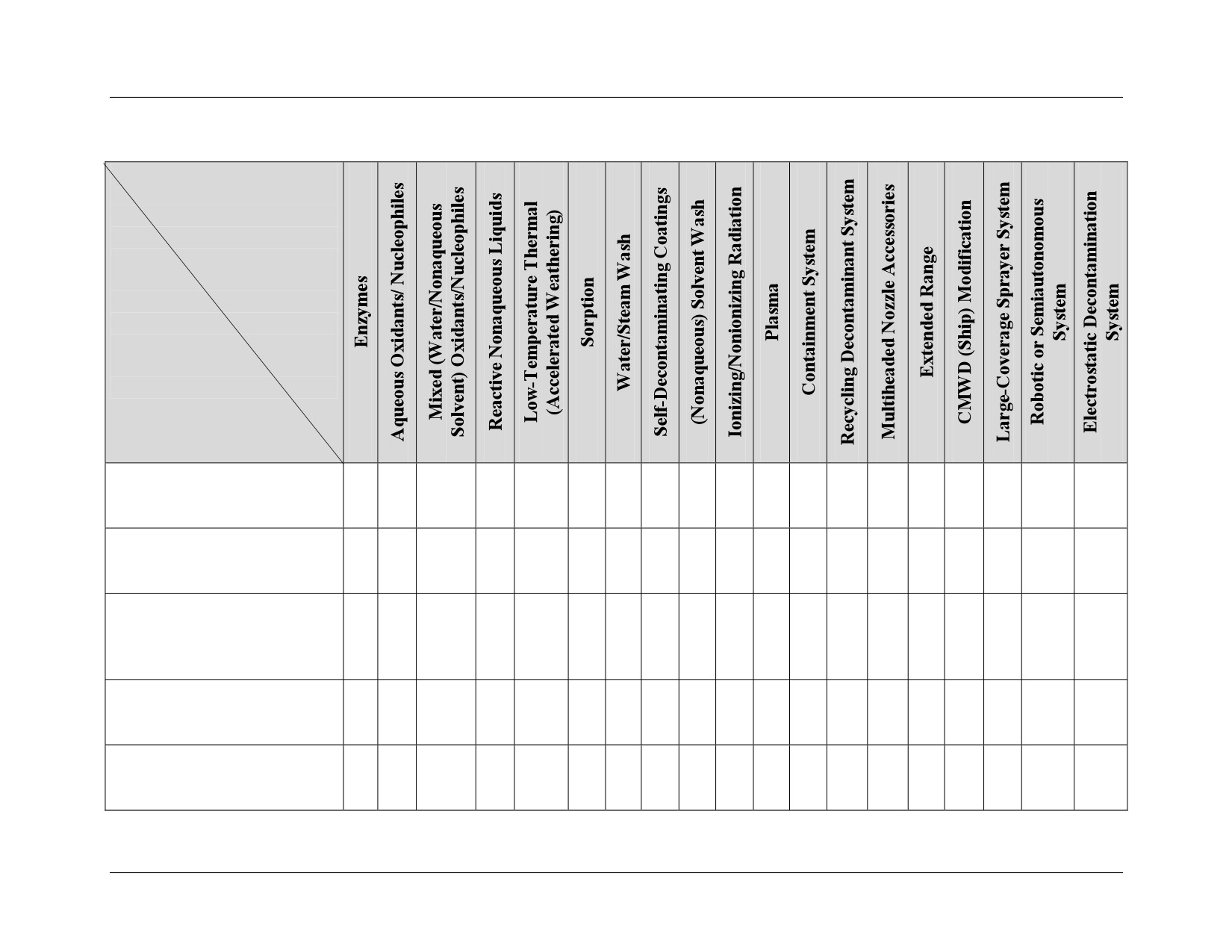
For Official Use Only
CBRND Functional Needs Analysis/Functional Solution Analysis
Chapter 17. Tactical Sustain Tasks
Table 17.14-19. TASUST 14: IMA Assessment
Ideas for Materiel
Approaches
(IMA)
Identified Gaps
Countermeasure washdown
does not neutralize CBRN
X
X
X
X
X
X
X
X
X
X
X
X
X
X
contamination.
Primary ship decontaminant
(HTH) is hazardous and
X
X
X
X
X
X
X
X
X
X
X
X
X
X
corrosive.
Limited ability to
decontaminate remote and
X
X
X
X
X
X
X
X
X
X
hard-to-reach surfaces using
current applicators.
Inability to decontaminate
ventilation system exterior
X
X
X
inlets.
Limited capability to
decontaminate painted or
X
X
X
porous surfaces.
137
For Official Use Only
For Official Use Only
CBRND Functional Needs Analysis/Functional Solution Analysis
Chapter 17. Tactical Sustain Tasks
17.15 Task TASUST 15: Decontaminate ship interiors
17.15.1
Functional Area Analysis
17.15.1.1
Definition
To decontaminate the interior of floating assets such as Navy vessels and prepositioned ships.
Includes minimizing effects of contaminants and decontaminants on operations. Levels of
decontamination include immediate, operational, and thorough. Objectives of each of these
levels are identified as follows:
• Immediate: Minimize casualties, save lives, and minimize spread of contamination.
• Operational: Reduce level of contamination to regenerate combat power.
• Thorough: Reduce CBRN contamination to negligible risk.
17.15.1.2
Derivation
UJTL (TA 7, TA 7.1), Protection Joint Functional Concept.
17.15.1.2.1
Supported Task: OPSUST 11
17.15.1.2.2
Lateral Task: TASHA 24
17.15.1.2.3
Supporting Task: N/A
17.15.1.3
Condition
Perform this task under conditions of:
Physical
1. Extremely rough sea state. (C1.2.1.3)
2. Hot and very cold air temperature. (C1.3.1.3.1)
3. Negligible light. (C1.3.2.1)
4. Nuclear effects. (C1.3.3.1)
5. Chemical effects. (C1.3.3.2)
6. Biological effects. (C1.3.3.3)
Military
1. Stressful mission. (C2.1)
2. Location—afloat. (C2.1.4.1)
3. Minimal to short time available. (C2.1.5)
4. Marginal forces allocated. (C2.2.3)
5. Low personnel capability. (C2.2.4)
6. Negligible personnel experience. (C2.2.4.5)
7. Severe personnel fatigue. (C2.2.4.6)
138
For Official Use Only
For Official Use Only
CBRND Functional Needs Analysis/Functional Solution Analysis
Chapter 17. Tactical Sustain Tasks
8. Ambiguous threat existence. (C2.9.3)
Civil
1. Limited or negative foreign government support. (C3.1.2.3)
2. Aggressively opposed foreign public opinion. (C3.1.2.4)
3. High mission priority. (C3.1.3.2)
17.15.2
Functional Needs Analysis
17.15.2.1
Capabilities and Deficiencies Assessment Summary
Table 17.15-1 presents individual and overall current, near-/mid-term, and far-term capabilities
to perform the task to the designated standard. There are a total of five current capabilities used
to accomplish this task and two projected capabilities to be added in the future. Capabilities exist
at the immediate, operational, and thorough levels of decontamination associated with the
decontamination of ship interiors.
Current Capabilities and Deficiencies
The current capabilities and deficiencies associated with the decontamination of ship interiors.
Capabilities for ship interiors encompass HTH, STB, and soap and water applied with scrub
brushes and mops. Deficiencies include the potential damage to systems with the use of
corrosive decontaminants, as well as the limited ability to decontaminate porous, painted, and
hard-to-reach surfaces. Other major deficiencies include the inability to decontaminate interior
ventilation systems. Also with current decontaminants there is a limited capability to remove
suspended agents from the atmosphere.
Projected Near/Mid-Term Capabilities and Deficiencies
The projected near/mid-term capabilities and deficiencies evaluated were associated with JPID
Increment I.
Projected Far-Term Capabilities and Deficiencies
The projected near/mid-term capabilities and deficiencies evaluated were associated with JPDS
Increments I and II and JPID Increment II.
139
For Official Use Only
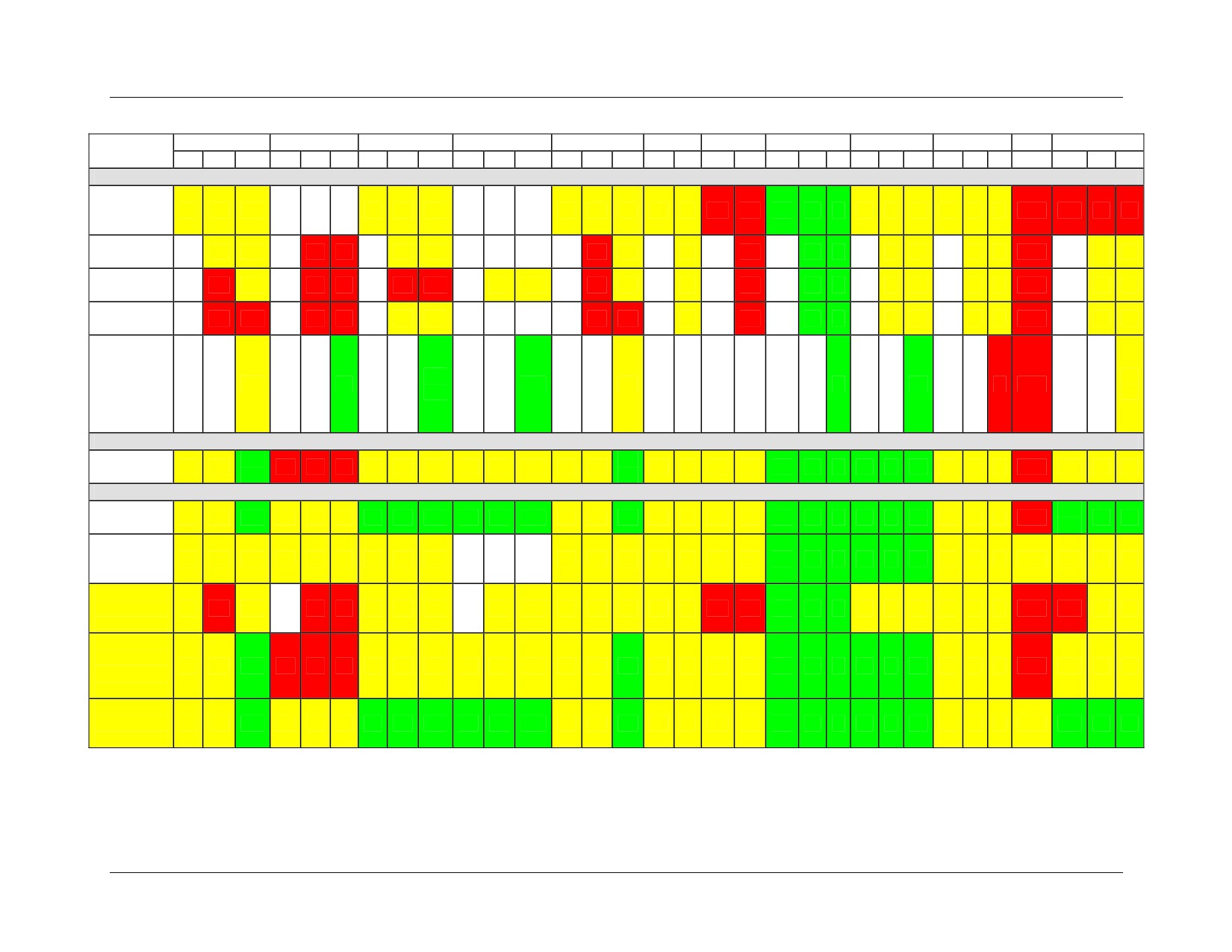
For Official Use Only
CBRND Functional Needs Analysis/Functional Solution Analysis
Chapter 17. Tactical Sustain Tasks
Table 17.15-1. TASUST 15: Capabilities and Deficiencies Assessment
M1
M2
M3
M4
M5
M6
M7
M8
M9
M10
M11
M12
Capabilities
I
O
T
I
O
T
I
O
T
I
O
T
I
O
T
I
O
I
O
I
O
T
I
O
T
I
O
T
T
I
O
T
Current
Topical
N/
N/
N/
N/
N/
Disinfectant
71
7
7
62
6
6
N/A
73
7
7
54
55
16
1
97
9
9
78
7
7
59
5
5
110
311
3
3
A
A
A
A
A
Solutions
HTH
N/
N/
N/
N/
N/
N/
N/
N/
N/
N/
N/
N/
7
512
5
313
3
514
5
N/A
315
516
5
1
9
9
7
7
5
5
1
7
A
A
A
A
A
A
A
A
A
A
A
A
17
General
N/
N/
N/
N/
N/
N/
N/
N/
N/
N/
N/
318
5
019
0
320
3
421
4
3
5
5
1
9
9
7
7
5
5
1
7
7
Detergent
A
A
A
A
A
A
A
A
A
A
A
Steam
N/
N/
N/
N/
N/
N/
N/
N/
N/
N/
N/
022
0
0
0
5
5
N/A
023
0
5
1
9
9
7
7
5
5
1
N/A
7
7
A
A
A
A
A
A
A
A
A
A
A
Gross
Physical
Removal/
N/
N/
N/
N/
N/
N/
10
N/
N/
N/
N/
N/
N/
N/
N/
N/
N/
N/
N/
N/
N/
N/
5
5
8
1025
5
9
826
3
027
N/A
Shipyard/
A
A
A
A
A
A
24
A
A
A
A
A
A
A
A
A
A
A
A
A
A
A
28
Floating
Drydock
Near/Mid-Term
JPID
10
10
7
7
3
3
3
730
7
7
4
4
4
7
7
5
5
532
5
9
9
9
8
8
8
733
5
5
1
7
7
7
Increment I
29
31
Far-Term
JPID
10
7
7
10
5
34
5
5
835
8
8
836
8
8
7
7
10
5
5
5
5
9
9
9
8
8
8
7
5
5
1
10
10
Increment II
37
JPDS
N/
N/
Increment
7
7
7
5
5
5
5
5
5
N/A
7
7
7
5
5
5
5
9
9
9
8
8
8
7
5
5
538
7
7
7
A
A
I/II
Current
N/
N/
Overall
7
3
5
339
3
6
440
5
4
4
7
5
5
5
5
1
1
9
9
9
7
7
7
5
5
5
1
3
7
7
A
A
Capabilities
Near/Mid-
Term
7
7
10
3
3
3
7
7
7
4
4
4
7
7
10
5
5
5
5
9
9
9
8
8
8
7
5
5
1
7
7
7
Overall
Capabilities
Far-Term
Overall
7
7
10
5
5
5
8
8
8
8
8
8
7
7
10
5
5
5
5
9
9
9
8
8
8
7
5
5
5
10
10
10
Capabilities
140
For Official Use Only
For Official Use Only
CBRND Functional Needs Analysis/Functional Solution Analysis
Chapter 17. Tactical Sustain Tasks
FAA Measure
Elaboration
Scale
M1
(Yes/No) Contaminated by-products
Contaminated by-products are
10: Yes, Complete (100%).
are controlled?
controlled. Where by-products are less
7: Yes, Substantial (~75%).
than 100% controlled, measures must
5: Yes, Partial (~50%).
be in place to prevent by-products from
3: Yes, Minimal (~25%).
becoming an unacceptable hazard.
0: No, Contaminated by-products cannot be controlled and present
an unacceptable hazard.
M2
(Level) Of chemical contamination
The level of chemical contamination is
10: Decontaminate all CWAs, NTAs, TIMs to general population
after decontamination procedures.
acceptable after decontamination
exposure limits.
operations from a starting liquid
7: Decontaminate all CWAs, all NTAs, and some TIMs to a level
challenge of 1 g/m2. Agents defined as
that will allow unprotected exposure.
current-generation CWAs, NTAs,
5: Decontaminate all CWAs and some NTAs to a level that will
TIMs, and TICs.
allow unprotected exposure.
3: Decontaminate most CWAs to a level that will allow
unprotected exposure.
0: No effective decontaminant or process.
M3
(Level) Of biological contamination
The level of biological contamination is
10: 0 CFU/PFU/m2—total removal or neutralization of toxins
after decontamination procedures.
acceptable after decontamination
against all 25 threat agents.
procedures. Vegetative and
9: 0 CFU/PFU/m2—total removal or neutralization of toxins
nonvegetative bacteria are measured in
against 20 or more key threat agents.
CFU/m2 and viruses are measured in
8: 0 CFU/PFU/m2—total removal or neutralization of toxins
PFU/m2.
against 15 or more key threat agents.
7: 0 CFU/PFU/m2—total removal or neutralization of toxins
against 10 or more key threat agents.
6: 0 CFU/PFU/m2—total removal or neutralization of toxins
against eight or more key threat agents.
5: Less than infective dose levels/casualty-producing toxin
exposure levels against six or more key threat agents.
4: Less than infective dose levels/casualty-producing toxin
exposure levels against four key threat agents.
3: Less than infective dose levels/casualty-producing toxin
exposure levels against three key threat agents.
2: Less than infective dose levels/casualty-producing toxin
exposure levels against two or more key threat agents.
1: Less than infective dose levels/casualty-producing toxin levels
against one key threat agent.
0: More than infective dose levels/casualty-producing toxin
exposure levels.
141
For Official Use Only
For Official Use Only
CBRND Functional Needs Analysis/Functional Solution Analysis
Chapter 17. Tactical Sustain Tasks
M4
(Level) Of radiological contamination
The level of radiological contamination
10: Total removal to natural backg1round level.
after decontamination procedures.
is acceptable after decontamination
8: ≤0.11 cGy/hour residual dose rate.
operations from a starting challenge of
6: ≤0.22 cGy/hour residual dose rate.
0.4 g/m2 of insoluble radioactive
4: <0.33 cGy/hour residual dose rate.
contaminants, 37-200 μm in size and
2: 0.33 cGy/hour residual dose rate.
185 GBq/m2 gamma activity.
0: Removal capabilities limited or ineffective, allowing excessive
0.33 cGy/hour equates to an exposure
residual dose rates >0.33 cGy/hour.
that can cause mild incapacitation in
2.5% or less of unprotected, not
previously exposed personnel.
M5
(Yes/No) Cross-contamination is
Cross-contamination is controlled.
10: Yes, Complete (100%).
controlled?
Where cross-contamination is less than
7: Yes, Substantial (~75%).
100% controlled, measures must be in
5: Yes, Partial (~50%).
place to prevent cross-contamination
3: Yes, Minimal (~25%).
from becoming an unacceptable hazard.
0: No, Cross-contamination cannot be controlled and presents an
unacceptable hazard.
M6
(Time) To initiate immediate and
Initiate immediate decontamination
Immediate
Operational
operational decontamination
procedures in time to meet mission
10: Immediately
10: Immediately
procedures.
requirements.
9: <1 minute
9: 15 minutes
8: <2 minutes
8: 30 minutes
Initiate operational decontamination
7: <3 minutes
7: 45 minutes
procedures in time to meet mission
6: <4 minutes
6: <1 hour
requirements.
5: <5 minutes
5: <2 hours
4: <7 minutes
4: <3 hours
3: <9 minutes
3: <4 hours
2: <12 minutes
2: <5 hours
1: <15 minutes
1: <6 hours
0: >15 minutes
0: >6 hours
M7
(Time) To conduct immediate and
Time required for one warfighter to
10: Immediately
operational decontamination
carry out immediate and operational
9: <1 minute
procedures.
decontamination procedures on 300 m2
8: <2 minutes
of surface area.
7: <3 minutes
6: <4 minutes
5: <5 minutes
4: <7 minutes
3: <9 minutes
2: <12 minutes
1: <15 minutes
0: >15 minutes
142
For Official Use Only
For Official Use Only
CBRND Functional Needs Analysis/Functional Solution Analysis
Chapter 17. Tactical Sustain Tasks
M8
(Percent) Of interior areas/systems
The quantity of systems that may be
10: 0%
unusable due to the effects of
rendered unserviceable by
9: <1%
decontamination.
decontamination process must be
8: <2%
minimized.
7: <3%
6: <4%
5: <5%
4: <6%
3: <7%
2: <8%
1: <9%
0: ≥10%
M9
(Percent) Of systems that require
The quantity of repairs or parts
10: 0%
repair or replacement due to the
replacements required due to
9: <1%
effects of decontamination.
decontamination process must be
8: <2%
minimized.
7: <3%
6: <4%
5: <5%
4: <6%
3: <7%
2: <8%
1: <9%
0: ≥10%
M10
(Yes/No) Decontamination
Decontamination procedures must be
10: No negative impacts on operations.
procedures are logistically
logistically supportable.
7: Limited negative impact on operational capability.
supportable?
5: Moderate negative impact on operational capability.
3: Major negative impact on operational capability.
0: Not logistically supportable.
M11
(Time) To conduct thorough
Time required for one warfighter to
10: Immediately
decontamination.
carry out thorough decontamination
9: <1 minute
procedures on 300 m2 of surface area.
8: <2 minutes
7: <3 minutes
6: <4 minutes
5: <5 minutes
4: <10 minutes
3: <15 minutes
2: <20 minutes
1: <30 minutes
0: >30 minutes
143
For Official Use Only
For Official Use Only
CBRND Functional Needs Analysis/Functional Solution Analysis
Chapter 17. Tactical Sustain Tasks
M12
(Yes/No) There is effective DOTLPF
Refers to non-materiel elements
10: DOTLPF is adequate for all tasks to be performed with this
in place to conduct task?
associated with the execution of a task
system without limitations that cause significant impact upon
with the system.
operations.
7: DOTLPF is adequate for most of the tasks to be performed with
this system without limitations that cause significant impact upon
operations.
5: Many critical aspects of DOTLPF for the task to be performed
with this system are addressed.
3: Some critical aspects of DOTLPF for the task to be performed
with this system are addressed.
0: DOTLPF is completely inadequate or does not exist for the
tasks to be performed with this system.
1 M1 - (Yes/No) Contaminated by-products are controlled? 7: Yes, Substantial (~75%).
2 M3 - (Level) Of biological contamination after decontamination procedures. 6: 0 CFU/PFU/m2—total removal or neutralization of toxins against eight or more key threat agents.
3 M5 - (Yes/No) Cross-contamination is controlled? 7: Yes, Substantial (~75%).
4 M6 - (Time) To initiate immediate decontamination procedures. 5: <5 minutes.
5 M6 - (Time) To initiate operational decontamination procedures. 5: <2 hours.
6 M7 - (Time) To conduct immediate and operational decontamination procedures. 1: <15 minutes.
7 M8 - (Percent) Of interior areas/systems unusable due to the effects of decontamination. 9: <1%.
8 M9 - (Percent) Of systems that require repair or replacement due to the effects of decontamination. 7: <3%.
9 M10 - (Yes/No) Decontamination procedures are logistically supportable? 5: Moderate negative impact on operational capability.
10 M11 - (Time) To conduct thorough decontamination. 1: <30 minutes.
11 M12 - (Yes/No) There is effective DOTLPF in place to conduct task? 3: Some critical aspects of DOTLPF for the task to be performed with this system are addressed.
12 M1 - (Yes/No) Contaminated by-products are controlled? 5: Yes, Partial (~50%).
13 M2 - (Level) Of chemical contamination after decontamination procedures. 3: Decontaminate most CWAs to a level that will allow unprotected exposure.
14 M3 - (Level) Of biological contamination after decontamination procedures. 5: Less than infective dose levels/casualty-producing toxin-exposure levels against six or more key
threat agents.
15 M5 - (Yes/No) Cross-contamination is controlled? 3: Yes, Minimal (~25%).
16 M5 - (Yes/No) Cross-contamination is controlled? 5: Yes, Partial (~50%).
17 M12 - (Yes/No) There is effective DOTLPF in place to conduct task? 7: DOTLPF is adequate for most of the tasks to be performed with this system without limitations that
cause significant impact upon operations.
18 M1 - (Yes/No) Contaminated by-products are controlled? 3: Yes, Minimal (~25%).
19 M2 - (Level) Of chemical contamination after decontamination procedures. 0: No effective decontaminant or process.
20 M3 - (Level) Of biological contamination after decontamination procedures. 3: Less than infective dose levels/casualty-producing toxin-exposure levels against three key threat
agents.
21 M4 - (Level) Of radiological contamination after decontamination procedures. 4: <0.33 cGy/hour residual dose rate.
22 M1 - (Yes/No) Contaminated by-products are controlled? 0: No, Contaminated by-products cannot be controlled and present an unacceptable hazard.
23 M5 - (Yes/No) Cross-contamination is controlled? 0: No, cross-contamination cannot be controlled and presents an unacceptable hazard.
24 M3 - (Level) Of biological contamination after decontamination procedures. 10: 0 CFU/PFU/m2—total removal or neutralization of toxins against all 25 threat agents.
25 M4 - (Level) Of radiological contamination after decontamination procedures. 10: Total removal to natural backg1round level.
26 M9 - (Percent) Of systems that require repair or replacement due to the effects of decontamination. 8: <2%.
27 M11 - (Time) To conduct thorough decontamination. 0: >30 minutes.
144
For Official Use Only
For Official Use Only
CBRND Functional Needs Analysis/Functional Solution Analysis
Chapter 17. Tactical Sustain Tasks
28 M12 - (Yes/No) There is effective DOTLPF in place to conduct task? 5: Many critical aspects of DOTLPF for the task to be performed with this system are addressed.
29 M1 - (Yes/No) Contaminated by-products are controlled? 10: Yes, Complete (100%).
30 M3 - (Level) Of biological contamination after decontamination procedures. 7: 0 CFU/PFU/m2—total removal or neutralization of toxins against 10 or more key threat agents.
31 M5 - (Yes/No) Cross-contamination is controlled? 10: Yes, Complete (100%).
32 M7 - (Time) To conduct immediate and operational decontamination procedures. 5: <5 minutes.
33 M10 - (Yes/No) Decontamination procedures are logistically supportable? 7: Limited negative impact on operational capability.
34 M2 - (Level) Of chemical contamination after decontamination procedures. 5: Decontaminate all CWAs, some NTAs to a level that will allow unprotected exposure.
35 M3 - (Level) Of biological contamination after decontamination procedures. 8: 0 CFU/PFU/m2—total removal or neutralization of toxins against 15 or more key threat agents.
36 M4 - (Level) Of radiological contamination after decontamination procedures. 8: ≤0.11 cGy/hour residual dose rate.
37 M12 - (Yes/No) There is effective DOTLPF in place to conduct task? 10: DOTLPF is adequate for all tasks to be performed with this system without limitations that cause
significant impact upon operations.
38 M11 - (Time) To conduct thorough decontamination. 5: <5 minutes.
39 M2 - (Level) Of chemical contamination after decontamination procedures. 3: Decontaminate most CWAs to a level that will allow unprotected exposure.
40 M3 - (Level) Of biological contamination after decontamination procedures. 4: Less than infective dose levels/casualty-producing toxin-exposure levels against four key threat
agents.
145
For Official Use Only