CHEMICAL, BIOLOGICAL, RADIOLOGICAL, AND NUCLEAR DEFENSE (CBRND) FUNCTIONAL NEEDS ANALYSIS. FINAL REPORT (2005) - page 23
For Official Use Only
CBRND Functional Needs Analysis/Functional Solution Analysis
Chapter 13 Tactical Shield Tasks
exposure prophylaxis consists of neutraceuticals, plant isoflavone genistein, and alpha tocopherol (Vitamin E) but are not approved by the FDA for prophylaxis against radiation.
FDA-approved preexposure medical countermeasures are available for anthrax, cholera, HFRS (Haantan), Rift Valley fever, yellow fever, HFRS (Haantan), and smallpox. IND
status vaccines are currently available for Q-fever, tularemia (although use has been placed on hold by the FDA), Botulinum, Junin hemorrhagic fever, and VEE/WEE/EEE.
Antiviral/bacterial medications may be administered and/or issued to provide a level of protection against biological agents. Medical prophylaxes are developed for the military
force. Prophylaxes for MWAs are virtually nonexistent. Prophylaxis for eligible civilians is not addressed. Availability of prophylaxis is questionable for issue and administration
to eligible civilians. The issue and administration of prophylaxis to eligible civilians requires review due to questions regarding applicability to the range of body types, ages, and
physical/medical factors inherent within a potential population, as well as long-term health issues and legal implications.
9 Medical screening and preparation of deploying personnel include the administration of immunizations addressing the anticipated threats. Military members tasked to participate
in operations with threat are briefed on the threat agents and associated CBRND measures, including medical prophylaxes. If pre- and/or post-exposure/presymptomatic
prophylaxes are issued, the force is trained on the use of the medication. However, CBRND prophylaxes for MWAs do not exist, and DOTLPF is inadequate for the training of
non-U.S. military personnel for prophylactic treatment of CBRN/TIM agent exposure.
10 CBRND medical countermeasures are issued/administered to address the threat. Military members tasked to participate in operations with threat are briefed on the threat agents
and associated CBRND measures, including medical prophylaxes. If pre- and/or post-exposure/presymptomatic prophylaxes are issued, the force is trained on the use of the
CBRND medical countermeasures. However, CBRND prophylaxes for MWAs do not exist, and DOTLPF is inadequate for the training of non-U.S. military personnel for
prophylactic treatment of CBRN/TIM agent exposure.
11 Plans for operations with threat incorporate MOPP levels and methodologies are adjustable to meet local operations and threat needs. MOPP levels and methodologies apply to
military personnel and are generally considered to apply to equipped nonmilitary personnel (although doctrine, policy, procedures, and TTPs do not address application to these
personnel). The MOPP methodologies in planning and operations include CBRND COLPRO to mitigate or prevent the effects of CBRN/TIM agents upon critical functions,
activities, and operations. However, preplanning for the conduct of large-scale medical operations within the AO for unanticipated threats/hazards is generally not performed.
Planning and operations addressing events of this nature occur upon determination of need.
12 Negative-pressure COLPRO with filtered expelled air does not exist within the inventory for the transport and housing of numbers of infectious/contaminated casualties.
Hospital ships are not equipped with COLPRO. All current COLPRO systems in land, air, and sea assets are not designed for the containment and transport of
infectious/contaminated casualties. Casualties must be decontaminated before entry into COLPRO. COLPRO, however, may be applied for the protection of noninfectious/
uncontaminated casualties against exposure/contamination to CBRN/TIM agents. Current mobile COLPRO systems are predominantly integrated into selected combat
vehicles/vessels and do not support transport of exposed/contaminated casualties. The only currently fielded land-based mobile COLPRO is CBPS. The CBPS system is available
on a mobile platform and can provide a limited number of people protection. The CBPS consists of a dedicated M1113 HMMWV with an LMS mounted on the back and provides
a highly mobile, contamination-free, environmentally controlled work area for forward deployed medical units. The CBPS has been fielded to treatment squads, forward surgical
teams, and medical companies. Four personnel are required to operate the CBPS. However, these systems are limited in supply and cannot provide COLPRO during movement.
Selected U.S. Naval combat vessels may be equipped with full COLPRO (CITADEL). However, these systems are generally restricted to critical operations areas of the ships. The
critical areas are contiguous in that they share common bulkheads and movement between areas is not prevented. The application of these COLPRO systems for the treatment and
isolation/quarantine of infectious/contaminated casualties is not operationally acceptable. Naval hospital ships, U.S. Naval auxiliaries, and USCG vessels are not equipped with
COLPRO. None of the identified COLPRO systems provide negative pressure environments with filtered exhausting air exchange.
13 Mobile casualty COLPRO does not exist for the transport of infectious/contaminated casualties precluding or mitigating the potential for secondary exposure/contamination of
handling and transport personnel and resources. Handling and transport personnel must wear IPE and the transporting resource is considered contaminated until decontaminated
and verified.
14 DOTLPF does not adequately address the application of negative-pressure COLPRO for the transport and mass sheltering of infectious/contaminated casualties.
15 The USMC MGPTS with CB Protective Liner System provides a positive-pressure, filtered-air, toxic-free shelter for protection against CBRN agents. However, there are
insufficient quantities to meet all operational requirements for protection from CBRN/TIM effects. The CP-DEPMEDS provides a clean, toxic-free, environmentally controlled,
patient treatment area and the components are designed to integrate as field hospitals. They are packaged as a set for deployment to threat areas for hospital operations. The entire
composite hospital consists of expandable tentage, passageways, environmental control units, and ISO shelters. The CP-DEPMEDS exist in very limited quantities. Although it
could be applied to provide COLPRO to the task identified groups, its designed and primary function is that of medical care. A similar COLPRO is the USAF’s CP-EMEDS,
which is an air-transportable medical facility deployable in various configurations from a single shelter to a 25-bed patient hospital. The CP-EMEDS is in a very limited number
and, like the CP-DEPMEDS, is designed for its primary function of the provision of medical care. The USAF CP-SSS is a small-scale CPS applied for the conduct of C2
For Official Use Only
227
For Official Use Only
CBRND Functional Needs Analysis/Functional Solution Analysis
Chapter 13 Tactical Shield Tasks
operations, maintenance of critical equipment, force beddown, and the provision of R2 for sortie generators and key leadership. This shelter is in limited supply and unlikely
sufficient quantities would be available to support a group of any size, especially during operations against an adversary. The M20/M20A1 SCPE is a lightweight, modular system
involving a liner designed for inflation within a room or building. The M20A1 serves to bridge the gap between the M20 SCPE and CBPS. These systems are designed for
standard room configurations and, like other COLPRO systems, are in limited number. Fixed-site COLPRO within the United States and its territories is predominantly designed
for nuclear fallout and does not address other CBRN/TIM hazards and threats arising after September 11, 2001. Selected critical key facilities are equipped with CBRN COLPRO,
but are not available to other than designated personnel and are not installed in medical treatment facilities. Fixed-site CBRN COLPRO is installed in facilities housing selected
activities and functions within HTAs. However, these facilities are dedicated to critical operational requirements and restricted to assigned and designated personnel and do not
generally include medical treatment facilities. However, the Guardian Program is reviewing FP protective measures at U.S. installations and facilities will be addressing these
issues. The projected mid-term fielding of JECP may alleviate COLPRO shortages but will likely be insufficient to satisfy all COLPRO requirements. Prior planning and
prioritization of COLPRO allocation is critical. However, none of these systems provide negative pressure environments with filtered exhausting air exchange.
16 Plans incorporate MOPP levels and methodologies are adjustable to meet local operations and threat needs. MOPP levels and methodologies apply to military personnel and are
generally considered to apply to equipped nonmilitary personnel (although doctrine, policy, procedures, and TTPs do not address application to these personnel). The MOPP
methodologies in planning and operations include CBRND actions, activities, and requirements to mitigate or prevent the effects of CBRN/TIM agents.
17 Plans incorporate MOPP levels and methodologies are adjustable to meet local operations and threat needs. MOPP levels and methodologies outlined in doctrine, policy,
procedures, and TTPs require levels of protection readiness based upon the threat and/or presence of contaminants. Full protection is required in the presence of CBRN/TIM
agents/contamination. This includes protective measures and the wear of protective equipment when the possibility exists for secondary exposure/contamination to personnel and
equipment, such as the movement of infectious/contaminated casualties. MOPP levels and methodologies are generally considered to apply to equipped nonmilitary personnel.
Plans within HTAs may incorporate this perception. However, doctrine, policy, procedures, and TTPs do not address their application to nonmilitary personnel. Protective
measures and application of medical protective resources are applied by medical practitioners and supporting staff during treatment and quarantine/isolation operations. These
measures and resources generally follow standard medical requirements and guidance for infectious disease control medical practices and are not applicable to MOPP and
CBRND. Standard warfighter individual protection may continue to be applied by medical unit personnel during treatment and management of isolated/quarantined personnel but
is the decision of the conducting medical services unit commander. Nonmedical personnel supporting these operations (e.g., security, transport, administration, etc.), are considered
subject to MOPP methodologies and level requirements. The distinction is not adequately addressed in existing DOTLPF between protection for medical care and supporting
activities.
18 Plans incorporate MOPP levels and methodologies and are adjustable to meet local operations and threat needs. MOPP levels and methodologies apply to military personnel and
are generally considered to apply to equipped nonmilitary personnel (although doctrine, policy, procedures, and TTPs do not address application to these personnel). The MOPP
methodologies in planning and operations include CBRND medical countermeasures, including vaccination/immunization to mitigate or prevent the effects of CBRN/TIM agents.
19 Plans incorporate MOPP levels and methodologies are adjustable to meet local operations and threat needs. MOPP levels and methodologies outlined in doctrine, policy,
procedures, and TTPs require levels of protection readiness based upon the threat and/or presence of contaminants. Full protection is required in the presence of CBRN/TIM
agents/contamination. This includes protective measures and the wear of protective equipment when the possibility exists for secondary exposure/contamination to personnel and
equipment, such as the movement of infectious/contaminated casualties. MOPP levels and methodologies are generally considered to apply to equipped nonmilitary personnel.
Plans within HTAs may incorporate this perception. However, doctrine, policy, procedures, and TTPs do not address their application to nonmilitary personnel.
20 DOTLPF is adequately addresses MOPP methodologies and levels for military force members. DOTLPF does not address the application of MOPP to eligible civilians. The
distinction between medical infectious disease control equipment and measures by medical care providers and MOPP application to supporting force members is not identified in
MOPP DOTLPF.
21 Command staff plans include predeployment medical screening and the stockpiling, allocation, and distribution of CBRND protective resources. Unit plans address medical
activities by referring to appropriate JTF and medical plans, policies, and procedures. Medical Service unit staff plan and develop associated plans and policies addressing medical
activities and procedures to support force operations within the AO. The invocation of quarantine and enforcement of medical isolation are within the purview of medical
authorities. The command staff provides support as defined in the coordinated and appropriate medical (AO and JOA) and JTF plans. DOTLPF is inadequate to address large-scale
medical CBRN/TIM operations, particularly sustained operations within a CBRN/TIM environment and/or command staff and Medical Services action associated with large-scale
medical operations involving non-U.S. personnel (e.g., indigenous civilians, third-party nations, etc.).
22 Existing medical facilities within an HTA exercise the reception and treatment of contaminated/infectious casualties. Voluntary institutional training for the treatment
contaminated/infectious casualties is available through AMEDD. Periodic exercises are performed with medical activities, but on a limited basis, to provide training opportunities
For Official Use Only
228
For Official Use Only
CBRND Functional Needs Analysis/Functional Solution Analysis
Chapter 13 Tactical Shield Tasks
and to assess capabilities. Treatment of casualties is currently performed following completion of casualty decontamination. AMEDD institutional training for the treatment of
contaminated/infectious casualties is not mandatory for medical practitioners identified for deployment or assignment where there exists a CBRN/TIM threat. The ability of the
command staff to ensure medical capabilities for CBRND is limited by routine medical operations and requirements prior to deployment. Generally, casualty care, until completion
of decontamination, is performed by medical corpsmen and not medical practitioners. Isolation of large-scale numbers of contaminated/infectious casualties is not adequately
addressed in DOTLPF and current medical operations are limited in their isolation abilities.
23 Force protection using medical prophylaxis is dependent upon identification of the threat, preplanning for the threat, positioning of stocks for issue and administration, timing of
notification to administer/issue prophylaxis, availability of medical personnel to perform administration (if required), ongoing operational requirements, and the available quantity
of sufficient medical prophylaxis to meet requirements. Vaccination to achieve acquired immunity by force personnel prior to entry into the theater or completion of an adequate
level of acquired immunity prior to adversary biological agent employment is a function of the preplanning and deployment operations. The command staff directs the
implementation of these measures when and as appropriate based upon established plans and JTF/Medical Services guidance. Medical prophylaxis does not exist for all threat
biological agents. Current prophylaxis and supporting doctrine, policy, and procedures do not address presymptomatic medical CBRND protective countermeasures by other than
U.S. forces, excluding MWAs and eligible civilians. Additionally, the efficacy of existing prophylaxis, particularly vaccines, widely varies. The application of medical prophylaxis
is not adequately addressed for eligible civilians and MWAs within the force.
24 JTF and unit plans include the medical review of personnel identified against deployment taskings. Screenings of deployable personnel are periodically performed for potential
limitations. Often, these are associated with annual medical physicals. The routine rotation and movement of personnel to and from units require the application of screenings to
ensure personnel are qualified for deployment. The unit and Medical Services staff plans attempt to provide for early (prior to deployment notice) and continued medical screening
of the force. Plans also include provisions for the conduct of predeployment screenings by medical personnel upon notification of deployment. Often, a record review is conducted
of the period following the physical for indications of issues precluding deployment. Predeployment medical screenings do not consider prior presymptomatic low-dose
CBRN/TIM exposures, associated potential cumulative long-term effects, and the potential threat. Timing of notice of deployment and the availability of medical personnel impact
the conduct of predeployment screenings. Short-notice operations and reallocated taskings may also impact the conduct of predeployment medical screenings. However, annual
physicals, when used to meet deployment screening requirements, may be conducted several months before a deployment.
25 Automated systems to track medical treatment and the movement of casualties exist at Echelon 3 and higher levels of care. Unit reporting includes CBRND readiness. Reliance
is placed upon the individual’s vaccination and health records (both manual records) to reflect the most recent status of the individual. Current medical systems are stovepiped and
require manual intervention to share information. Medical treatment recording below Echelon 3 is limited and not linked to higher-echelon systems. Outpatient care is not
generally recorded and aggregate information is reported. Unit reporting is not linked to medical information systems. Individual manual vaccination and health records are not
always available or complete.
26 Medical prophylaxis is issued/administered for identified CBRN/TIM threats to the military force. The administration and issuance of prophylaxis is addressed by the command
and Medical Services staffs during the planning and support for operations. Prophylaxis for MWAs is virtually nonexistent. Prophylaxis for eligible civilians is not adequately
addressed in current doctrine, policy, and procedures.
27 Existing standards and procedures provide adequate protection of handling and transporting personnel against secondary exposure/contamination and require the application of
protective equipment and measures if the potential exists for contamination/exposure. Casualties able to wear standard IPE are required to apply the equipment outside of CPSs.
Medical policy is the patient’s unit is responsible for providing the equipment to the medical unit for use by the patient. Unit-level training is limited to the movement of casualties
to the medical facility/station and is predominantly reliant upon tactical ground transport. Air transport (tactical rotary-wing) is a last resort due to concerns about asset
contamination. Tactical and strategic fixed-wing air transport is not considered an acceptable means of transport. Air and sea transport resources are inadequately equipped and
prepared to transport exposed and contaminated human and MWA casualties. Exposed and contaminated casualties (human and MWA) unable to wear IPE are not adequately
addressed in doctrine, policy, and standards. Protective equipment is not available for these casualties. However, medical units are not provided stocks of standard IPE for use by
patients. Operationally involved units may be delayed, at best, in providing the equipment. Large-scale medical activities and actions are not adequately addressed in DOTLPF,
especially those involving large numbers of non-U.S. personnel (e.g., indigenous civilians, third-party nationals, etc.).
28 Operational warfighter unit plans address medical activities by referring to appropriate medical plans, policies, and procedures. The staff of the Medical Services unit plans and
develops associated policies addressing medical activities and procedures to support force operations. The invocation of quarantine and enforcement of medical isolation are within
the purview of medical authorities. The operational warfighter unit provides support as defined in the coordinated and appropriate medical plans. The Medical Services unit staff
coordinates with the operational warfighter unit command and JTF staffs for Medical Services support requirements and associated tasking and their inclusion in force planning.
For Official Use Only
229
For Official Use Only
CBRND Functional Needs Analysis/Functional Solution Analysis
Chapter 13 Tactical Shield Tasks
DOTLPF is inadequate to address force actions associated with medical quarantine and/or enforcement of medical isolation involving large numbers of non-U.S. personnel (e.g.,
indigenous civilians, third-party nations, etc.
29 Operational warfighter unit plans address medical activities by referring to appropriate medical plans, policies, and procedures. The staff of the Medical Services unit plans and
develops associated policies addressing medical activities and procedures to support force operations. The implementation and operation of large-scale quarantine sheltering and
treatment operations are in the purview of medical authorities. The operational warfighter command staff provides support and resources as defined in the coordinated and
appropriate medical plans and as adjusted and requested by appropriate medical authorities, with JTF concurrence, to meet specific circumstances. Large-scale medical activities
and actions are not adequately addressed in DOTLPF, especially those involving large numbers of non-U.S. personnel (e.g., indigenous civilians, third-party nationals, etc.).
30 The unit staff, in coordination with the JTF and Medical Services staffs, conduct coordinated planning for operations for the potential threat. Equipping the force and Medical
Services elements are an integral part of planning preparation. The combination of established force and Medical Services element organic assets, material acquisitions,
prepositioned material, and movement of identified CBRND resources from unit designated stockpiles and reallocation activities are pursued by the command staff with the JTF
and Medical Services staff to prepare and support the force as outlined by the appropriate plan. Mass medical operations may not be possible until the theater matures or additional
resources are allocated to force. Additionally, deploying eligible civilians and MWAs (particularly MWDs) are not equipped and trained to survive a CBRN/TIM environment. The
force staff does not possess clear guidance for planning and providing CBRN/TIM protection training and CBRND protection resources to deploying eligible civilians and MWAs.
Current doctrine and policy does not adequately address sustained operations within a CBRN/TIM environment. Large-scale medical activities and actions are not adequately
addressed in DOTLPF, especially those involving large numbers of non-U.S. personnel (e.g., indigenous civilians, third-party nationals, etc.).
31 Legacy systems will remain in the inventory throughout the mid term. These systems will be gradually replaced by new joint systems of respiratory/ocular protection as they are
fielded. The JSAM replaces the Service-specific systems. When incorporated with anti-G protection of high-performance aircraft aviators, the JSAM will provide simultaneous
CBRN and anti-G protection. The JSAM is compatible with existing and programmed CBRN IPE, provides flame and thermal protection, and reduces the heat stress associated
with existing systems of ocular/respiratory protection. Further, the JSAM may be donned and doffed during flight. The JSGPM also replaces current Service-specific
ocular/respiratory protection. The system provides respiratory and ocular protection from CBRN agents and selected TIMs. The field-of-vision is improved and encumbrances
associated with legacy systems are reduced. The JSGPM incorporates state of the art technology and is designed to integrate with future warfighter CBRND IPE and function
equipment/assets. The JCESM is a COTS one-time use, one-size-fits-all, respiratory/ocular protective system affording 2 hours of protection and is lightweight and disposable. The
system is designed to provide low-level CBRN vapor, aerosol, and particulate protection to the wearer for egressing the contaminated environment. The JCESM is projected for
use when standard respiratory/ocular protection is not practical. The JCESM is not programmed for general dissemination. The Guardian Program is projected to review, assess,
and implement protection for critical members of the installation/facility populace during the mid term. This will predominantly be COTS-based assets for respiratory/ocular
protection. However, the Guardian Program is not expected to address eligible civilian protection within the AO for other than existing U.S. military installations and facilities.
MWA respiratory/ocular protection is not programmed or forecasted.
32 Legacy systems will remain in the inventory throughout the mid term. These systems will be gradually replaced by new joint systems of percutaneous protection as they are
fielded. The JSLIST NBC Protective Garment is a two-piece, risk-taking, overgarment with integrated hood affording protection against CBRN agents and selected TIMs. The
garment reduces the physiological and psychological encumbrances associated with legacy systems. The JSLIST is under evaluation by NIOSH for application to OSHA
protection requirements. The JPACE replaces the Service-specific systems. The JPACE provides aircrew members with equivalent protection to the JSLIST ensemble. The JPACE
is designed to not interfere with emergency ejection from a combat aircraft and continues to provide CBRN percutaneous protection following ejection and during escape and
evasion operations. The ensemble is both flame-retardant and self-extinguishing to permit emergency egress from a burning aircraft. Further, the ensemble provides CBRN
protection when subject to rotor, propeller, and jet wash. Joint Service glove upgrades are provided under the Joint Block 1 and 2 Glove Upgrade Program (JB1/2GU) in the near
and mid term. The JB1GU responds to an urgent need by designated elements of the force for increased tactility/durability supporting mission requirements. The JFIRE addresses
protection of military firefighters within a CBRN/TIM environment conducting firefighting operations involving structural and crash/firefighting/rescue. The JFIRE incorporates
the JSLIST into firefighter bunker gear. The JB1GU is expected to meet most of the requirements within the JSLIST ORD and is viewed as an evolutionary approach in the
development of the JB2GU. Versions under consideration include a protective inner glove worn under existing warfighter gloves, a replacement glove for existing hand wear, or a
combination of glove shell and liner affording CBRN protection of the legacy gloves they are projected to replace. The MULO is projected to replace legacy footwear covers. The
ability of the MULO to provide adequate antislip protection for USN personnel asea is under review. The Guardian Program is projected to review, assess, and implement
protection for critical members of the installation/facility populace during the mid term. This will predominantly be COTS-based assets for percutaneous protection. However, the
Guardian Program is not expected to address eligible civilian protection within the AO for other than existing U.S. military installations and facilities. MWA percutaneous
protection is not programmed or forecasted.
For Official Use Only
230
For Official Use Only
CBRND Functional Needs Analysis/Functional Solution Analysis
Chapter 13 Tactical Shield Tasks
33 Cell Culture Derived Vaccinia is projected for production during the near-term. Clostridium Botulinum Toxin Medical Defense System is projected for availability during the
mid term for Serotypes A, B, C, E, and F. The SERPACWA Active TSP is also projected for production during the late mid term.
34 Fielding of the P3I upgraded CBPS for heavy/airborne use is projected for the mid term.
35 The projected initial fielding of JECP within the mid term provides additional capabilities for the COLPRO protection of casualties within CBRN/TIM contaminated areas.
JECP includes COLPRO adaptive inserts for buildings/rooms and legacy tentage and stand-alone COLPRO sheltering for small units. The projected mid-term fielding of JECP
may alleviate COLPRO shortages but will likely be insufficient to satisfy all COLPRO requirements. Quantities to be fielded of these systems have not been determined. JTCOPS
Block I is projected for initial fielding during the mid term. Prior planning and prioritization of COLPRO allocation is critical.
36 The next-generation series of nonaviator respiratory/ocular protective assets is in R&D. The capabilities and fielding of these assets are not as yet determined.
37 The next-generation series of nonaviator percutaneous protective assets is in R&D. The capabilities and fielding of these assets are not as yet determined.
38 Active TSPs are projected for replacement of SERPACWA TSP and SERPACWA Active TSP in the far term. The Chemical Agent Prophylaxis and Cyanide Pretreatment are
also projected for the far term. The Multivalent VEE Vaccine is projected to begin production in FY2013. The Next-Generation Anthrax Vaccine, Tularemia Vaccine, and Plague
Vaccine are projected for production beginning in FY2010. Serotypes A and B are addressed in the Recombinant Bivalent Botulinum Vaccine projected for production in FY2012.
A number of R&D efforts are under way for the development of pre- and post-exposure prophylaxes. Potentially, these efforts may produce viable prophylaxes within the mid and
far term resulting in fielded material. However, possible resulting prophylaxes cannot be predicted at this time.
39 A decision on the inclusion of COLPRO in the LHA(R) is expected in the mid term.
40 JTCOPS Block II is projected for the far term. Continued fielding of JECP.
For Official Use Only
231
For Official Use Only
CBRND Functional Needs Analysis/Functional Solution Analysis
Chapter 13 Tactical Shield Tasks
13.12.3
Functional Solution Analysis
13.12.3.1
DOTLPF Assessment Summary
This section addresses the deficiencies and suggests potential non-materiel solutions. If there are
no non-materiel solutions, or they are only partial solutions, the remaining non-materiel need is
then stated. Materiel needs are assessed in the IMA section.
1.
Deficiency: DOTLPF for Protective Posture Protocols is inadequate or nonexistent
addressing CBRND of eligible civilians.
Non-Materiel Solutions: Doctrine: Promulgate doctrine, policy, and procedures addressing
eligible civilian personnel for CBRND. Organization: Identify organization services and
activities necessary to support survivability of eligible civilian personnel within a
CBRN/TIM environment. Training: Establish CBRND training, exercise, and evaluation
criteria and programs for eligible civilians; and conduct CBRND training, exercises, and
evaluations. Leadership: Implement and manage CBRND training, equipping, and protection
of eligible civilian personnel.
2.
Deficiency: DOTLPF for Protective Posture Protocols is inadequate or nonexistent
addressing CBRND of MWAs.
Non-Materiel Solutions: Doctrine: Promulgate doctrine, policy, and procedures addressing
MWAs, particularly MWDs, for CBRND. Organization: Identify organization services and
activities necessary to support survivability of MWDs within a CBRN/TIM environment.
Training: Establish CBRND training, exercise, and evaluation criteria and programs for
MWDs and conduct CBRND training, exercises, and evaluations. Leadership: Implement
and manage CBRND training, equipping, and protection of MWDs.
3.
Deficiency: Expelled air from an exposed/contaminated casualty equipped with standard
ocular/respiratory protection is not filtered and may present a potential secondary hazard or
contamination source or handling and transporting personnel and resources.
Partial Non-Materiel Solutions: Doctrine: Promulgate doctrine, policy, and procedures
addressing the safe management of potentially hazardous expelled air by exposed/
contaminated casualties wearing standard ocular/respiratory protection to preclude the
potential for secondary exposure/contamination of handling/transporting personnel and
resources. Training: Establish institutional, recurring, and unit training, exercise, and
evaluation criteria and programs addressing potentially hazardous expelled air by
exposed/contaminated casualties wearing standard ocular/respiratory protection.
4.
Deficiency: Existing DOTLPF is inadequate, or nonexistent, for eligible civilians.
Non-Materiel Solutions: Doctrine: Promulgate doctrine, policy, and procedures addressing
eligible civilian personnel for CBRND. Organization: Identify organization services and
activities necessary to support survivability of eligible civilian personnel within a
CBRN/TIM environment. Training: Establish CBRND training, exercise, and evaluation
criteria and programs for eligible civilians; and conduct CBRND training, exercises, and
evaluations. Leadership: Implement and manage CBRND training, equipping, and protection
of eligible civilian personnel.
For Official Use Only
232
For Official Use Only
CBRND Functional Needs Analysis/Functional Solution Analysis
Chapter 13 Tactical Shield Tasks
5.
Deficiency: Existing DOTLPF is inadequate, or nonexistent, for MWAs.
Non-Materiel Solutions: Doctrine: Promulgate doctrine, policy, and procedures addressing
MWAs, particularly MWDs, for CBRND. Organization: Identify organization services and
activities necessary to support survivability of MWAs within a CBRN/TIM environment.
Training: Establish CBRND training, exercise, and evaluation criteria and programs for
MWAs and conduct CBRND training, exercises, and evaluations. Leadership: Implement
and manage CBRND training, equipping, and protection of MWAs.
6.
Deficiency: Medical units are not equipped with additional protective material for existing
patients and replacement assets for casualties.
Non-Materiel Solutions: Doctrine: Adjust joint doctrine to require force planning of IPE
support and resupply of Medical Services for patients and casualties. Disconnect requirement
with operational unit. Organization: Develop organizational structures, resources, staffing,
and stock management capabilities to support IPE requirements for patients and casualties.
7.
Deficiency: Casualties unable to wear respiratory/ocular protection are not addressed.
Partial Non-Materiel Solutions: Doctrine: Establish alternative procedures and processes
within doctrine, policy, and procedures for casualties unable to wear respiratory/ocular
protection and who must be moved within or through a CBRN/TIM contaminated zone.
Organization: Develop organizational structures, resources, staffing, and stock management
capabilities to support casualties unable to wear respiratory/ocular protection. Training:
Implement institutional, recurring, and unit training on established procedures and processes
(see Doctrine) for the protection of casualties unable to wear respiratory/ocular protection.
8.
Deficiency: Distinction between MOPP and medical protection requirements not adequately
addressed in existing DOTLPF.
Non-Materiel Solution: Doctrine: Clarify in doctrine, policy, and procedures the distinction
between MOPP and medical protection requirements as relates to this task.
9.
Deficiency: CBRND protective equipment and measures do not protect against all
CBRN/TIM agents.
Partial Non-Materiel Solutions: Doctrine: Requirement for development of CBRND
protective equipment and measures to protect against all CBRN/TIM agents, particularly
high-risk/high-threat agents. Leadership: Enforce compliance with established standards (see
Doctrine) for prophylactic CBRND protection.
10. Deficiency: Medical prophylaxis does not exist for all threat CBRN/TIM and TIM agents.
Partial Non-Materiel Solutions: Doctrine: Establish in doctrine, policy, and procedures the
application of standards for prophylactic CBRND protection against all threat agents.
Training: Train, exercise, and evaluate personnel (military and eligible civilians) on the use
of prophylactic CBRND protection against threat agents. Leadership: Enforce compliance
with established standards (see Doctrine) for prophylactic CBRND protection. Implement
and ensure training is adequate and conduct exercises and evaluations to ensure readiness.
For Official Use Only
233
For Official Use Only
CBRND Functional Needs Analysis/Functional Solution Analysis
Chapter 13 Tactical Shield Tasks
11. Deficiency: Current doctrine, the UJTL, and operational planning do not adequately address
sustained operations within a CBRN/TIM environment.
Non-Materiel Solutions: Doctrine: Include in doctrine, policy, procedures, and UJTL
sustained operations within a CBRN/TIM environment. Training: Train, exercise, and
evaluate the force for sustained operations within a CBRN/TIM environment. Leadership:
Recognize criticality of readiness of the force for potential sustained operations within a
CBRN/TIM environment, training providing the skills to manage the force in these
circumstances, and willingness and ability to implement necessary changes and activities to
prepare and appropriately apply the force.
12. Deficiency: Prophylaxes against most high-threat TIMs are not currently available due to the
relatively recent consideration of these agents as a potential threat.
Partial Non-Materiel Solutions: Doctrine: Establish in doctrine, policy, and procedures the
application of metrics for standards and criteria for protection against all high-threat TIM
agents. Training: Train, exercise, and evaluate personnel (military and eligible civilians) on
the use of prophylactic CBRND protection against threat agents. Leadership: Enforce
compliance with established metrics for standards and criteria. Implement and ensure training
is adequate and conduct exercises and evaluations to ensure readiness.
13. Deficiency: Efficacy of existing prophylaxes varies widely.
Non-Materiel Solutions: Doctrine: Establish overarching single common standard for
prophylaxes efficacy.
14. Deficiency: Not all prophylaxes are FDA approved.
Non-Materiel Solutions: Doctrine: Require FDA approval of all prophylaxes, including
medications potentially applied as prophylaxes. The latter requires specific approval as
prophylactic treatment.
15. Deficiency: Prophylaxis for eligible civilians is not addressed.
Non-Materiel Solutions: Doctrine: Establish in doctrine, policy, and procedures
requirement to address the administration, provision, and application of medical CBRND
protective countermeasures by other than U.S. forces (e.g., civilians, non-U.S. forces, etc.).
Organization: Address organizational issues (e.g., who provides the equipment, support
forces to train and equip, etc.) related to the provision of CBRN/TIM protection to eligible
civilians and non-U.S. forces. Training: Include eligible civilians in CBRND training,
exercises, and evaluations. Identify training requirements and responsibilities for non-U.S.
forces. Leadership: Ensure leadership awareness of criticality of resources and increased
dependence of military operations upon civilians. Personnel: Require eligible civilians
supporting the mission to meet minimum standards for safe use of CBRND resources.
16. Deficiency: Prophylaxis for MWAs is not addressed.
Non-Materiel Solutions: Doctrine: Establish in doctrine, policy, and procedures
requirement to address the administration, provision, and application of medical CBRND
protective countermeasures for MWAs, particularly MWDs. Organization: Address
organizational issues (e.g., who provides the equipment, support forces to train and equip,
etc.) related to the provision of CBRN/TIM protection to MWAs. Training: Include MWA
For Official Use Only
234
For Official Use Only
CBRND Functional Needs Analysis/Functional Solution Analysis
Chapter 13 Tactical Shield Tasks
handlers in CBRND training, exercises, and evaluations. Leadership: Ensure leadership
awareness of criticality of MWA resources.
17. Deficiency: The issue and administration of prophylaxis to eligible civilians requires review
due to questions regarding applicability to the range of body types, ages, and physical/
medical factors inherent within a potential population, as well as possible long-term health
issues and legal implications.
Non-Materiel Solutions: Doctrine: Establish in doctrine, policy, and procedures the
application of standards and measures for protection of eligible civilians addressing the
variation within the potential protected population. Leadership: Establish CBRND training,
exercise, and evaluation criteria and programs for eligible civilians and conduct CBRN/TIM
training, exercises, and evaluations.
18. Deficiency: Prophylaxis for MWAs is virtually nonexistent.
Partial Non-Materiel Solutions: Doctrine: Establish doctrine, policy, and procedures
CBRND protection of MWAs, particularly MWDs, and training for CBRN/TIM environment
survival. Organization: Ensure organizational consideration for maintenance and support of
MWA CBRND protective equipment, measures, and activities. Training: Establish
institutional and unit training of handlers and MWAs for CBRND measures and activities.
Leadership: Ensure awareness and planning for CBRND measures and requirements for
MWA survivability. Facilities: Develop supporting infrastructure for MWA CBRND (e.g.,
logistics, veterinary surveillance, etc.).
19. Deficiency: Negative-pressure COLPRO with filtered expelled air does not exit within the
inventory for the transport and sheltering of numbers of exposed, infectious, and/or
contaminated casualties.
Partial Non-Materiel Solutions: Doctrine: Promulgate doctrine, policy, and procedures
addressing negative-pressure COLPRO and the safe management of potentially hazardous
exhausted air to preclude the potential for secondary exposure/contamination of
uncontaminated/unexposed personnel and resources. Training: Establish institutional,
recurring, and unit training, exercise, and evaluation criteria and programs addressing the
operation and application of negative-pressure COLPRO and management of potentially
hazardous exhaust air.
20. Deficiency: Mobile COLPRO that operates and provides protection while moving is not
available for the protection of casualties.
Partial Non-Materiel Solutions: Doctrine: Establish in doctrine methods and processes
enabling the transport of multiple casualties safely and without risk of secondary
exposure/contamination by transporting personnel and resources (if casualties are
contaminated) or exposure/contamination of casualties (if casualties are uncontaminated).
Training: Implement institutional, recurring, and unit training of the safe transport (see
Doctrine) of multiple casualties.
21. Deficiency: DOTLPF for Protective Posture Protocols is inadequate or nonexistent
addressing CBRND of eligible civilians.
For Official Use Only
235
For Official Use Only
CBRND Functional Needs Analysis/Functional Solution Analysis
Chapter 13 Tactical Shield Tasks
Non-Materiel Solutions: Doctrine: Promulgate doctrine, policy, and procedures addressing
eligible civilian personnel for CBRND. Organization: Identify organization services and
activities necessary to support survivability eligible civilian personnel within a CBRN/TIM
environment. Training: Establish CBRND training, exercise, and evaluation criteria and
programs for eligible civilians and conduct CBRND training, exercises, and evaluations.
Leadership: Implement and manage CBRND training, equipping, and protection of eligible
civilian personnel.
22. Deficiency: DOTLPF for Protective Posture Protocols is inadequate or nonexistent
addressing CBRND of MWAs.
Non-Materiel Solutions: Doctrine: Promulgate doctrine, policy, and procedures addressing
MWAs, particularly MWDs, for CBRND. Organization: Identify organization services and
activities necessary to support survivability of MWAs within a CBRN/TIM environment.
Training: Establish CBRND training, exercise, and evaluation criteria and programs for
MWAs and conduct CBRND training, exercises, and evaluations. Leadership: Implement
and manage CBRND training, equipping, and protection of MWAs.
23. Deficiency: DOTLPF is inadequate to address large-scale medical CBRN/TIM operations,
particularly sustained operations within a CBRN/TIM environment and/or command staff
and Medical Services action associated with large-scale medical operations involving non-
U.S. personnel (e.g., indigenous civilians, third-party nationals, etc.).
Non-Materiel Solutions: Doctrine: Include in doctrine, policy, procedures, and UJTL
sustained operations (medical and nonmedical) within a CBRN/TIM environment. Include
command and Medical Services activities associated with the planning, coordination,
implementation, operation, and termination of large-scale medical operations involving non-
U.S. personnel (e.g., indigenous civilians, third-party civilians, third-party nationals,
displaced persons, detained persons, etc.). Organization: Ensure resources, taskings, and staff
are in place or available to plan and perform sustained operations (medical and nonmedical)
within a CBRN/TIM environment and/or operations addressing command and Medical
Services actions associated with the planning, coordination, implementation, operation,
support, and termination of large-scale medical operations involving non-U.S. personnel
(e.g., indigenous civilians, third-party civilians, third-party nationals, displaced persons,
detained persons, etc.). Training: Train, exercise, and evaluate the force for sustained
operations (medical and nonmedical) within a CBRN/TIM environment and/or operations
addressing command and Medical Services actions associated with the planning,
coordination, implementation, operation, support, and termination of large-scale medical
operations involving non-U.S. personnel (e.g., indigenous civilians, third-party civilians,
third-party nationals, displaced persons, detained persons, etc.). Leadership: Recognize
criticality of readiness of the force for potential sustained operations (medical and
nonmedical) within a CBRN/TIM environment, training providing the skills to manage the
force in these circumstances, and willingness and ability to implement necessary changes and
activities to prepare the force and appropriately support large-scale medical operations
involving non-U.S. personnel (e.g., indigenous civilians, third-party civilians, third-party
nationals, displaced persons, detained persons, etc.). Personnel: Eligible civilian personnel
and operations supporting the mission/military operations (medical and nonmedical) are
qualified in CBRND and capable of performing their responsibilities in a CBRN/TIM
For Official Use Only
236
For Official Use Only
CBRND Functional Needs Analysis/Functional Solution Analysis
Chapter 13 Tactical Shield Tasks
environment. Facilities: Develop supporting infrastructure for sustained operations within a
CBRN/TIM environment and operations associated with large-scale medical operations
involving non-U.S. personnel (e.g., indigenous civilians, third-party civilians, third-party
nationals, displaced persons, detained persons, etc.).
24. Deficiency: Timing of notice of deployment and the availability of medical personnel impact
the conduct of predeployment screenings.
Non-Materiel Solutions: Doctrine: Establish in doctrine, policy, and procedures
requirements for ongoing automated and manual medical screenings to ensure baseline
standards are maintained in support of potential deployment taskings. Leadership: Enforce
compliance with established requirements for predeployment medical screenings.
25. Deficiency: Short-notice operations and reallocated taskings may also impact the conduct of
predeployment medical screenings.
Non-Materiel Solutions: Doctrine: Enforce doctrinal requirements for alternative planning
and unit readiness for potential deployment taskings. Leadership: Enforce compliance with
established requirements for planning for predeployment medical screenings.
26. Deficiency: Annual physicals, when used to meet deployment screening requirements, may
be conducted several months before a deployment.
Non-Materiel Solutions: Doctrine: Establish in doctrine, policy, and procedures
requirements for ongoing automated and manual medical screenings to ensure baseline
standards are maintained in support of potential deployment taskings. Leadership: Enforce
compliance with established requirements for predeployment medical screenings.
27. Deficiency: Current medical systems are stovepiped and require manual intervention to share
information.
Non-Materiel Solutions: Doctrine: Enforce doctrine, policy, and procedures for integrated
automated systems and application of data systems standards.
28. Deficiency: Medical treatment recording below Echelon 3 is limited and not linked to higher
echelon systems.
Non-Materiel Solutions: Doctrine: Enforce doctrine, policy, and procedures for integrated
automated systems and application of data systems standards.
29. Deficiency: Outpatient care is not generally recorded and aggregate information is reported.
Non-Materiel Solutions: Doctrine: Enforce doctrine, policy, and procedures for integrated
automated systems, application of data systems standards, and the timely and accurate
reporting of medical treatment information.
30. Deficiency: Unit reporting is not linked to medical information systems.
Non-Materiel Solutions: Doctrine: Enforce doctrine, policy, and procedures for integrated
automated systems and application of data systems standards.
31. Deficiency: Individual manual vaccination and health records are not always available or
complete.
For Official Use Only
237
For Official Use Only
CBRND Functional Needs Analysis/Functional Solution Analysis
Chapter 13 Tactical Shield Tasks
Non-Materiel Solutions: Doctrine: Enforce doctrine, policy, and procedures for integrated
automated systems, application of data systems standards, and the timely and accurate
reporting of medical treatment information.
32. Deficiency: The AMEDD training for the treatment of contaminated/exposed casualties is
not mandatory for medical practitioners identified for deployment or assignment where there
exists a CBRN/TIM threat.
Non-Materiel Solutions: Doctrine: Promulgate doctrine, policy, and procedures the
application of institutional and unit training standards for the handling of exposed and
contaminated casualties/MWAs. Training: Establish training, exercise, and evaluation
standards for the safe handling of exposed and contaminated casualties/MWAs. Leadership:
Implement and manage training and equipping of functions and activities handling exposed
and contaminated casualties/MWAs.
33. Deficiency: The ability of the command and Medical Services staff to ensure medical
capabilities for CBRND is limited by routine medical operations and requirements.
Non-Materiel Solutions: Doctrine: Incorporate the safe handling, transport, protective
measures, medical reception and triage, and treatment of contaminated casualties into
doctrine, policy and procedures and requires specific exercising and evaluation for these
operations and activities that includes all activities and functions conducting these functions
including nonmedical activities and functions. Organization: Ensure resources, taskings, and
trained personnel are in place or available to support the handling, transport, protective
measures, medical reception and triage, and treatment of contaminated casualties by all
activities and functions conducting these functions including nonmedical activities and
functions. Training: Train, exercise, and evaluate the handling, transport, protective
measures, medical reception and triage, and treatment of contaminated casualties by all
activities and functions conducting these functions including nonmedical activities and
functions, including the prevention of secondary exposure/contamination. Leadership:
Implement and manage training, equipping, protective measures, and exercising for the safe
handling, transport, medical reception and triage, and treatment of contaminated casualties by
all activities and functions conducting these functions including nonmedical activities and
functions.
34. Deficiency: Generally, casualty care, until completion of decontamination, is performed by
medical corpsmen, not medical practitioners.
Non-Materiel Solutions: Doctrine: Incorporate the safe handling, transport, protective
measures, medical reception and triage, and treatment of contaminated casualties into
doctrine, policy and procedures and requires specific exercising and evaluation for these
operations and activities that includes all activities and functions conducting these functions
including nonmedical activities and functions. Organization: Ensure resources, taskings, and
trained personnel are in place or available to support the handling, transport, protective
measures, medical reception and triage, and treatment of contaminated casualties by all
activities and functions conducting these functions including nonmedical activities and
functions. Training: Train, exercise, and evaluate the handling, transport, protective
measures, medical reception and triage, and treatment of contaminated casualties by all
activities and functions conducting these functions including nonmedical activities and
For Official Use Only
238
For Official Use Only
CBRND Functional Needs Analysis/Functional Solution Analysis
Chapter 13 Tactical Shield Tasks
functions, including the prevention of secondary exposure/contamination. Leadership:
Implement and manage training, equipping, protective measures, and exercising for the safe
handling, transport, medical reception and triage, and treatment of contaminated casualties by
all activities and functions conducting these functions including nonmedical activities and
functions.
35. Deficiency: Generally, MWA casualty care, until completion of decontamination, is
performed by medical corpsmen, not veterinary/medical practitioners.
Non-Materiel Solutions: Doctrine: Incorporate the safe handling, transport, protective
measures, medical reception and triage, and treatment of contaminated MWA casualties into
doctrine, policy and procedures and requires specific exercising and evaluation for these
operations and activities that includes all activities and functions conducting these functions
including nonmedical activities and functions. Organization: Ensure resources, taskings, and
trained personnel are in place or available to support the handling, transport, protective
measures, medical reception and triage, and treatment of contaminated MWA casualties by
all activities and functions conducting these functions including nonmedical activities and
functions. Training: Train, exercise, and evaluate the handling, transport, protective
measures, medical reception and triage, and treatment of contaminated MWA casualties by
all activities and functions conducting these functions including nonmedical activities and
functions, including the prevention of secondary exposure/contamination. Leadership:
Implement and manage training, equipping, protective measures, and exercising for the safe
handling, transport, medical reception and triage, and treatment of contaminated MWA
casualties by all activities and functions conducting these functions including nonmedical
activities and functions.
36. Deficiency: Medical Services doctrine, policy, and procedures are inadequate for the
provision of medical care by medical providers in a CBRN/TIM environment.
Non-Materiel Solutions: Doctrine: Promulgate doctrine, policy, and procedures addressing
the provision of medical care by medical providers within a CBRN/TIM environment (both
with and without CPSs). Organization: Identify organization services and activities
necessary to support the provision of medical care by medical providers within a CBRN/TIM
environment (both with and without CPSs). Training: Establish CBRND training, exercise,
and evaluation criteria and programs for medical care by medical providers within a
CBRN/TIM environment (both with and without CPSs) and conduct CBRND training,
exercises, and evaluations. Leadership: Implement and manage CBRND training, equipping,
and protection of medical providers and supporting medical staff. Personnel: Require eligible
civilians supporting the mission to meet minimum standards for safe use of CBRND
resources.
37. Deficiency: Isolation of large-scale numbers of contaminated/infectious casualties is not
adequately addressed in DOTMLPF and current medical operations are limited in their
isolation abilities.
Non-Materiel Solutions: Doctrine: Include in doctrine, policy, procedures, and UJTL
combatant command (COCOM) and Medical Services activities associated with the
planning, coordination, implementation, operation, and termination of large-scale medical
operations involving non-U.S. personnel (e.g., indigenous civilians, third-party civilians,
For Official Use Only
239
For Official Use Only
CBRND Functional Needs Analysis/Functional Solution Analysis
Chapter 13 Tactical Shield Tasks
third-party nationals, displaced persons, detained persons, etc.). Organization: Ensure
resources, taskings, and staff are in place or available for operations addressing COCOM and
Medical Services actions associated with the planning, coordination, implementation,
operation, support, and termination of large-scale medical operations involving non-U.S.
personnel (e.g., indigenous civilians, third-party civilians, third-party nationals, displaced
persons, detained persons, etc.). Training: Train, exercise, and evaluate the force for
COCOM and Medical Services actions associated with the planning, coordination,
implementation, operation, support, and termination of large-scale medical operations
involving non-U.S. personnel (e.g., indigenous civilians, third-party civilians, third-party
nationals, displaced persons, detained persons, etc.). Leadership: Recognize criticality of
readiness of the force for potential operations (medical and nonmedical) within a CBRN/TIM
environment, training providing the skills to manage the force in these circumstances, and
willingness and ability to implement necessary changes and activities to prepare the force
and appropriately support large-scale medical operations involving non-U.S. personnel (e.g.,
indigenous civilians, third-party civilians, third-party nationals, displaced persons, detained
persons, etc.). Personnel: Eligible civilian personnel and operations supporting the
mission/military operations (medical and nonmedical) are qualified in CBRND and capable
of performing their responsibilities in a CBRN/TIM environment. Facilities: Develop
supporting infrastructure for operations associated with large-scale medical operations
involving non-U.S. personnel (e.g., indigenous civilians, third-party civilians, third-party
nationals, displaced persons, detained persons, etc.).
38. Deficiency: Predeployment medical screenings do not consider prior presymptomatic low-
dose CBRN/TIM exposures, associated potential cumulative long-term effects, and the
potential threat.
Non-Materiel Solutions: Doctrine: Establish in doctrine, policy, and procedures the
application of low-dose exposure limits and cumulative long-term low-dose exposures in
predeployment medical screenings. Leadership: Enforce compliance with established
doctrine, policy, and procedures for slow-dose exposure limits and cumulative long-term
low-dose exposures in predeployment medical screenings.
39. Deficiency: Air transport (tactical rotary-wing) is a last resort due to concerns about asset
contamination. Tactical and strategic fixed-wing air transport is not considered an acceptable
means of transport. Air and sea transport resources are inadequately equipped and prepared
to transport exposed and contaminated casualties.
Partial Non-Materiel Solutions: Doctrine: Promulgate and implement doctrine, policy,
standards, and procedures for the safe transport by air and sea of exposed and contaminated
casualties, including the prevention of secondary exposure/contamination of the airframe and
aircrew. Establish in doctrine methods and processes enabling the transport of multiple
casualties safely and without risk of secondary exposure/contamination by transporting
personnel and resources. Organization: Organizational resources, taskings, and trained
personnel are in place or available to support the safe air and sea transport of exposed and
contaminated casualties, including the prevention of secondary exposure/contamination of
the airframe and aircrew. Training: Implement institutional, recurring, and unit training of
the safe transport (see Doctrine) of multiple contaminated casualties. Develop institutional
and unit-level training for application of standards for the safe transport by air and sea of
For Official Use Only
240
For Official Use Only
CBRND Functional Needs Analysis/Functional Solution Analysis
Chapter 13 Tactical Shield Tasks
exposed and contaminated casualties. Exercising and evaluations to assess capabilities and
prepare for the conduct of safe transport by air of exposed and contaminated casualties.
Training, exercising, and evaluation include measures to prevent secondary
exposure/contamination of the airframe and aircrew. Leadership: Recognize criticality for
the protection of air transport resources from secondary contamination/exposure to
CBRN/TIM agents while providing safe air/sea transport of exposed and contaminated
casualties. Facilities: Develop supporting infrastructure for the safe air transport of
contaminated casualties, including the prevention of secondary exposure/contamination to
airframe/vessel and crews.
40. Deficiency: Air transport (tactical rotary-wing) is a last resort due to concerns about asset
contamination. Tactical and strategic fixed-wing air transport is not considered an acceptable
means of transport. Air and sea transport resources are inadequately equipped and prepared
to transport exposed and contaminated MWA casualties.
Partial Non-Materiel Solutions: Doctrine: Promulgate and implement doctrine, policy,
standards, and procedures for the safe transport by air and sea of exposed and contaminated
MWA casualties, including the prevention of secondary exposure/contamination of the
airframe and aircrew. Establish in doctrine methods and processes enabling the transport of
multiple casualties safely and without risk of secondary exposure/contamination by
transporting personnel and resources. Organization: Organizational resources, taskings, and
trained personnel are in place or available to support the safe air and sea transport of exposed
and contaminated MWA casualties, including the prevention of secondary
exposure/contamination of the airframe and aircrew. Training: Implement institutional,
recurring, and unit training of the safe transport (see Doctrine) of multiple contaminated
casualties. Develop institutional and unit-level training for application of standards for the
safe transport by air and sea of exposed and contaminated MWA casualties. Exercising and
evaluations to assess capabilities and prepare for the conduct of safe transport by air of
exposed and contaminated MWA casualties. Training, exercising, and evaluation include
measures to prevent secondary exposure/contamination of the airframe and aircrew.
Leadership: Recognize criticality for the protection of air transport resources from secondary
contamination/exposure to CBRN/TIM agents while providing safe air/sea transport of
exposed and contaminated MWA casualties. Facilities: Develop supporting infrastructure for
the safe air transport of contaminated MWA casualties, including the prevention of
secondary exposure/contamination to airframe/vessel and crews.
41. Deficiency: Expeditionary operations are a particular concern. Mass medical operations may
not be possible until the theater matures or additional resources are allocated to the AOR.
Partial Non-Materiel Solutions: Doctrine: Complete the JCIDS process and central
correlation/comparison of operations plans to identify CBRND resources necessary and
available to support expeditionary medical operations during the first 30-90 days following
commencement of hostilities and with a reduced logistical footprint. Organization: Develop
organizational structures, resources, staffing, and capabilities to conduct expeditionary
medical operations while possessing reduced logistical footprint and during the first 30-90
days of operations following commencement of hostilities. Training: Train, exercise, and
evaluate expeditionary capabilities of the force in a CBRN/TIM threat with reduced logistical
footprint during the initial 30-90 days of operations using CBRND resources supporting
For Official Use Only
241
For Official Use Only
CBRND Functional Needs Analysis/Functional Solution Analysis
Chapter 13 Tactical Shield Tasks
expeditionary medical operations. Leadership: Recognize differences and challenges
associated with expeditionary medical operations during the first 30-90 days following
commencement of hostilities and with a reduced logistical footprint, training providing skills
and knowledge to manage operations in these circumstances, and ability and willingness to
implement necessary changes and activities to prepare for and conduct expeditionary medical
operations with a CBRN/TIM threat. Facilities: Develop supporting infrastructure for
expeditionary medical operations during the first 30-90 days following commencement of
hostilities and with a reduced logistical footprint.
42. Deficiency: The command staff does not possess clear guidance for planning and providing
CBRN/TIM protection training and CBRND protection resources to eligible civilians.
Non-Materiel Solutions: Doctrine: Promulgate doctrine, policy, and procedures addressing
civilian personnel and operations for CBRND. Organization: Identify organizational services
and activities supporting the mission performed by civilian personnel and operations.
Training: Establish CBRND training, exercise, and evaluation criteria and programs for
eligible civilians; and conduct CBRND training, exercises, and evaluations. Leadership:
Implement and manage CBRND training, equipping, and protection of eligible civilians.
Personnel: Ensure that eligible civilians supporting the mission/military operations are
qualified in CBRND and capable of performing their responsibilities in a CBRN/TIM
environment. Facilities: Develop supporting infrastructure for eligible civilian CBRND (e.g.,
logistics, medical, training, communications, etc.).
43. Deficiency: The command staff does not possess clear guidance for planning and providing
CBRN/TIM protection training and CBRND protection resources to MWA.
Non-Materiel Solutions: Doctrine: Promulgate doctrine, policy, and procedures addressing
MWAs, particularly MWDs, and operations for CBRND. Organization: Identify
organizational services and activities supporting MWA survivability and CBRN/TIM
environment operations. Training: Establish CBRND training, exercise, and evaluation
criteria and programs for MWAs and conduct CBRND training, exercises, and evaluations.
Leadership: Implement and manage CBRND training, equipping, and protection of MWAs.
Facilities: Develop supporting infrastructure for MWA CBRND (e.g., logistics, medical,
veterinary surveillance, training, communications, etc.).
13.12.3.2
IMA Assessment Summary
Table 13.12-2 is a list of ideas for material approaches and a corresponding description of each
idea. Approaches primarily focus on adapting currently fielded equipment/systems and
technology studies to determine specific requirements. Also identifies the need for Battle
Management systems to assist in tracking CBRN casualties. Table 13.12-3 identifies which of
the material approaches might address specific materiel deficiencies identified in the DOTMLPF
assessment.
For Official Use Only
242
For Official Use Only
CBRND Functional Needs Analysis/Functional Solution Analysis
Chapter 13 Tactical Shield Tasks
Table 13.12-2. TASHLD 12: Materiel Approaches
Idea for Materiel Approach
Description
Assess CBRND material
Test and assess all CBRND material for protective abilities against future threat agents,
including TIM.
Broad-application above-the-neck
Develop above-the-neck respiratory protection with broad application for the general
respiratory protection
population, including MWAs.
Casualty protective system with
Develop a new-generation PPWs with an integrated mask area that is contact-free of the face
integrated pseudomask
area and applies positive air flow.
Chemical air generation
Integrated compounds within warfighter’s IPE applying chemical reaction to generate oxygen
without reliance upon external sources.
Chemical treatment
Develop solution for treatment of existing MOPP suit and other warfighter clothing fabric that
neutralizes or block the effect of CBRN/TIM agents, including future agents.
Combinatorial prophylaxes
Develop prophylaxes affording protection or minimizing the impact from a broad range of
CBRN/TIM agents.
Contaminated casualty transport
Develop/adapt clear, head-to-toe view of casualty, medical systems supporting, airtight and
system
self-flushing system with positive/negative pressure capabilities and access ports for medical
treatment.
COTS sample containers and
Adapt/modify (as necessary) COTS sample containers and equipment for the containment of
equipment
CBRN/TIM samples and material for their safe handling, storage, and transport.
Current prophylaxes
There currently exists a variety of prophylaxes used for protection against CBRN. FDA
testing and necessary modifications of prophylactics must be made to obtain FDA approval.
Review available medical material and prophylaxes for application to high-risk TIMs.
Develop CBRN/TIM samples and
Investigate and develop CBRN/TIM containment packaging and systems for the safe
material containment packaging/
containment, handling, storage, and transport of CBRN/TIM samples and material.
systems
Develop COLPRO kits
Develop COLPRO kits containing all necessary supplies to construct field-expedient
COLPRO that is easily stored and maintained in ready condition, easily and safely erected,
operated, maintained, and striked within a CBRN/TIM environment by IPE-encumbered
personnel using minimal resources and supports COLPRO requirements.
Develop and establish generic unit
Develop, preposition, and maintain reserve stocks of generic CBRND kits for a standard unit.
CBRND kits
Components are adjusted as necessary for specific operations involving threat.
Develop/adapt MWA transport
Develop or adapt MWA transport systems to provide COLPRO protection from CBRN/TIM
system with pressure/filtration
agents.
For Official Use Only
243
For Official Use Only
CBRND Functional Needs Analysis/Functional Solution Analysis
Chapter 13 Tactical Shield Tasks
Disposable COLPRO
Develop one-time-use COLPRO that is rapidly erected with little instruction, training, and
effort and affords term protection for critical activities and functions, maintenance and repair
activities, prelocated consumables, as well as personnel associated with this task.
Disposable IPE
Develop low-cost disposable IPE providing protection for transport aircrew members and/or
determine available COTS protection to support air operations in a contaminated environment
or while carrying contaminated cargo.
Field-expedient COLPRO kits
Develop field-expedient COLPRO kits designed to adapt existing structures, tentage, etc., for
the expansion of COLPRO field capabilities and mission support and the provision of
collective protection to the force, critical functions and activities, maintenance and repair
activities and functions, resources, etc.
Field-expedient COLPRO materials
Identify commonly available materials (duct tape, plastic sheeting, wooden crate, plywood,
tarps, coverings, wraps, caulk, sealant gels/sprays, etc.) for application in the construction of
expedient COLPRO needed to construct field-expedient COLPRO when COLPRO
availability is limited or not advantageous.
Filtration system lowering
Improve current mask systems by reducing the inhalation effort required. Options may
inhalation pressure requirement
include air streaming into the mask from a contained system that either has a stored supply or
generates air flow.
Future prophylaxes
Some preexposure prophylaxes for biological agents require several administrations,
immunity attainment is time-consuming, or the period of coverage does not address the full
operational period. Future prophylaxes should provide immunity against all known threat
CBRN and high-risk TIM agents, as well as potential future threat agents, and be FDA
approved. CBRND medical countermeasures are needed providing a sustained level of
protection over an extended period of time (minimally the operational period), do not require
multiple administrations, are easily disseminated and administered, support a minimum level
of protection, protect against a broad range of agents, cover the range of preexposure to post-
exposure/presymptomatic application needs, and are applicable to the protected population
(including eligible civilians).
Improved IPE garments and
Develop new generation of IPE garments and accessories (e.g., boots/boot covers, gloves,
accessories
hoods, etc.) using modern materials permitting greater range of motion, longer wear without
performance degradation, increased durability, integrated into warfighter personal equipment,
and protects against all threat CBRN and high-risk TIM agents.
Integrate CBRN/TIM protective
Develop materials integrating CBRN/TIM protective capabilities and design standard
features into functional garments
functional garments using these materials for protection of the force.
For Official Use Only
244
For Official Use Only
CBRND Functional Needs Analysis/Functional Solution Analysis
Chapter 13 Tactical Shield Tasks
Topical
Develop topical barrier that is easily applied (i.e., spray), acts as a contact hazard barrier, and
affords protection from CBRN/TIM.
For Official Use Only
245
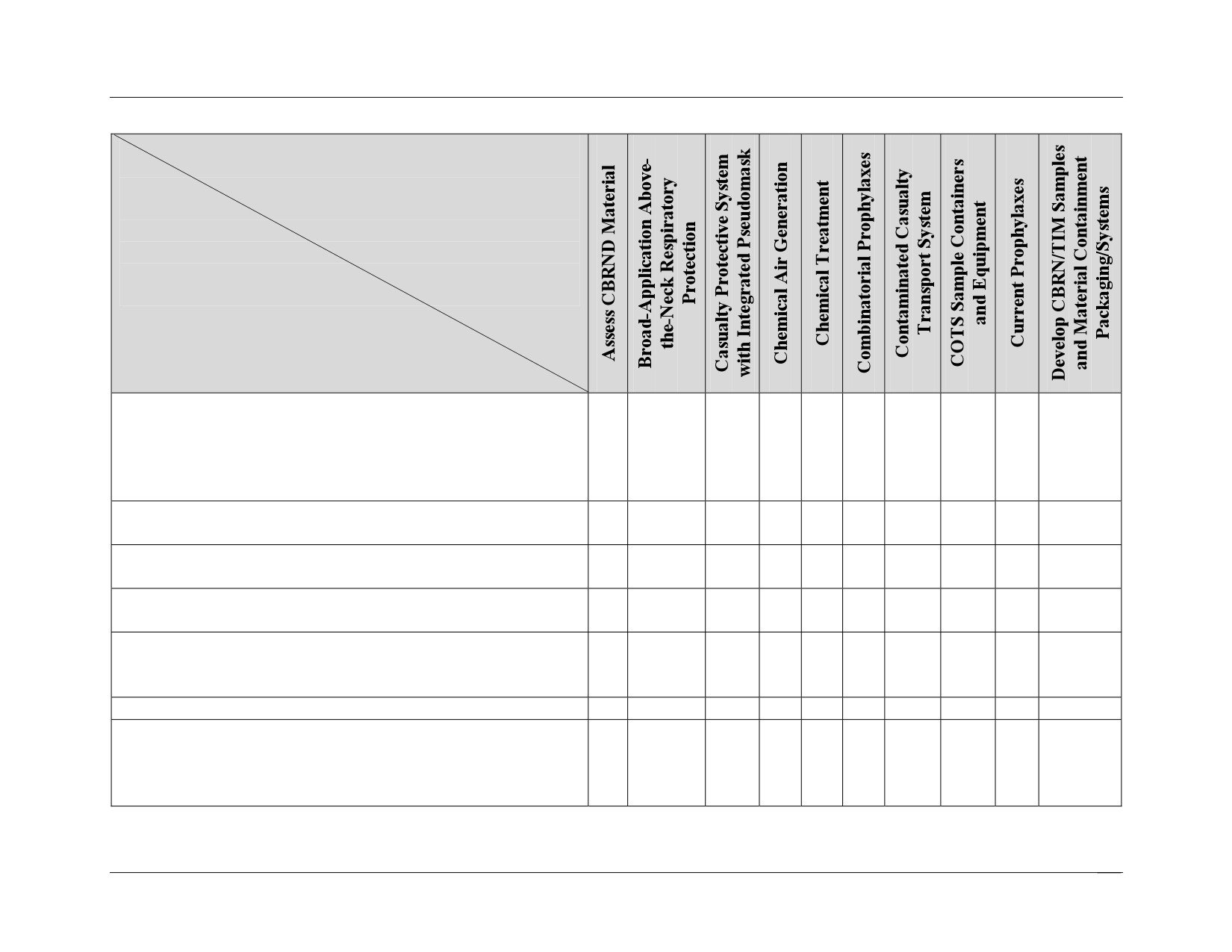
For Official Use Only
CBRND Functional Needs Analysis/Functional Solution Analysis
Chapter 13 Tactical Shield Tasks
Table 13.12-3. TASHLD 12: IMA Assessment
Ideas for Material
Approaches
(IMA)
Identified Gaps
Expelled air from an exposed/contaminated casualty
equipped with standard ocular/respiratory protection is not
filtered and may present a potential secondary hazard or
X
X
X
X
X
X
contamination source or handling and transporting personnel
and resources.
Casualties unable to wear respiratory/ocular protection are
X
X
X
X
X
X
not addressed.
CBRND protective equipment and measures do not protect
X
X
X
X
X
X
X
X
X
X
against all CBRN/TIM agents.
Medical prophylaxis does not exist for all threat CBRN/TIM
X
X
and TIM agents.
Prophylaxis against most high-threat TIMs are not currently
available due to the relatively recent consideration of these
X
X
agents as a potential threat.
Prophylaxis for MWAs is virtually nonexistent.
X
X
Negative-pressure COLPRO with filtered expelled air does
not exit within the inventory for the transport and sheltering
X
X
X
of numbers of exposed, infectious, and/or contaminated
casualties.
For Official Use Only
246
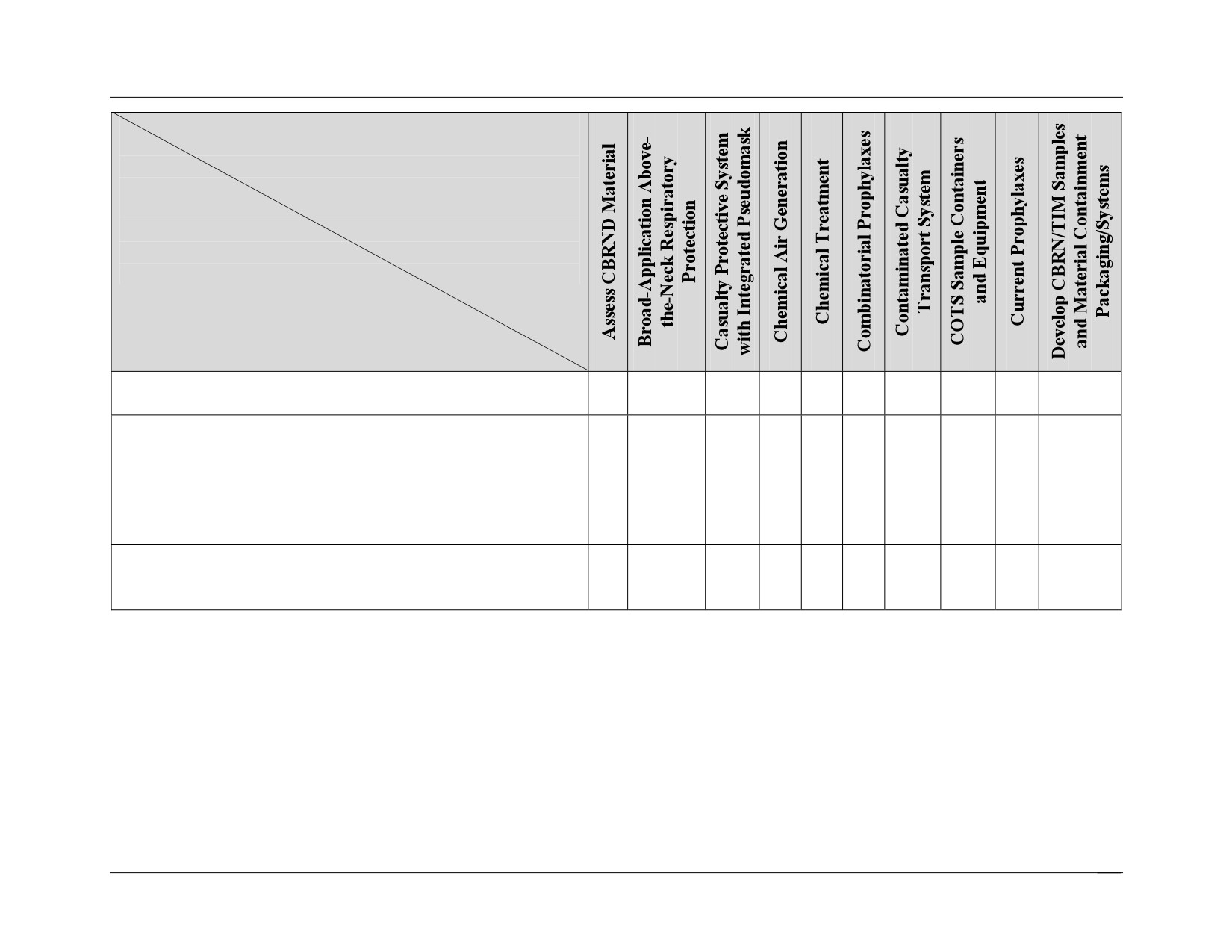
For Official Use Only
CBRND Functional Needs Analysis/Functional Solution Analysis
Chapter 13 Tactical Shield Tasks
Ideas for Material
Approaches
(IMA)
Identified Gaps
Mobile COLPRO that operates and provides protection while
X
moving is not available for the protection of casualties.
Air transport (tactical rotary-wing) is a last resort due to
concerns about asset contamination. Tactical and strategic
fixed-wing air transport is not considered an acceptable
X
X
X
X
means of transport. Air and sea transport resources are
inadequately equipped and prepared to transport exposed and
contaminated human and MWA casualties.
Expeditionary operations are a particular concern. Mass
medical operations may not be possible until the theater
X
X
X
matures or additional resources are allocated to the AOR.
For Official Use Only
247
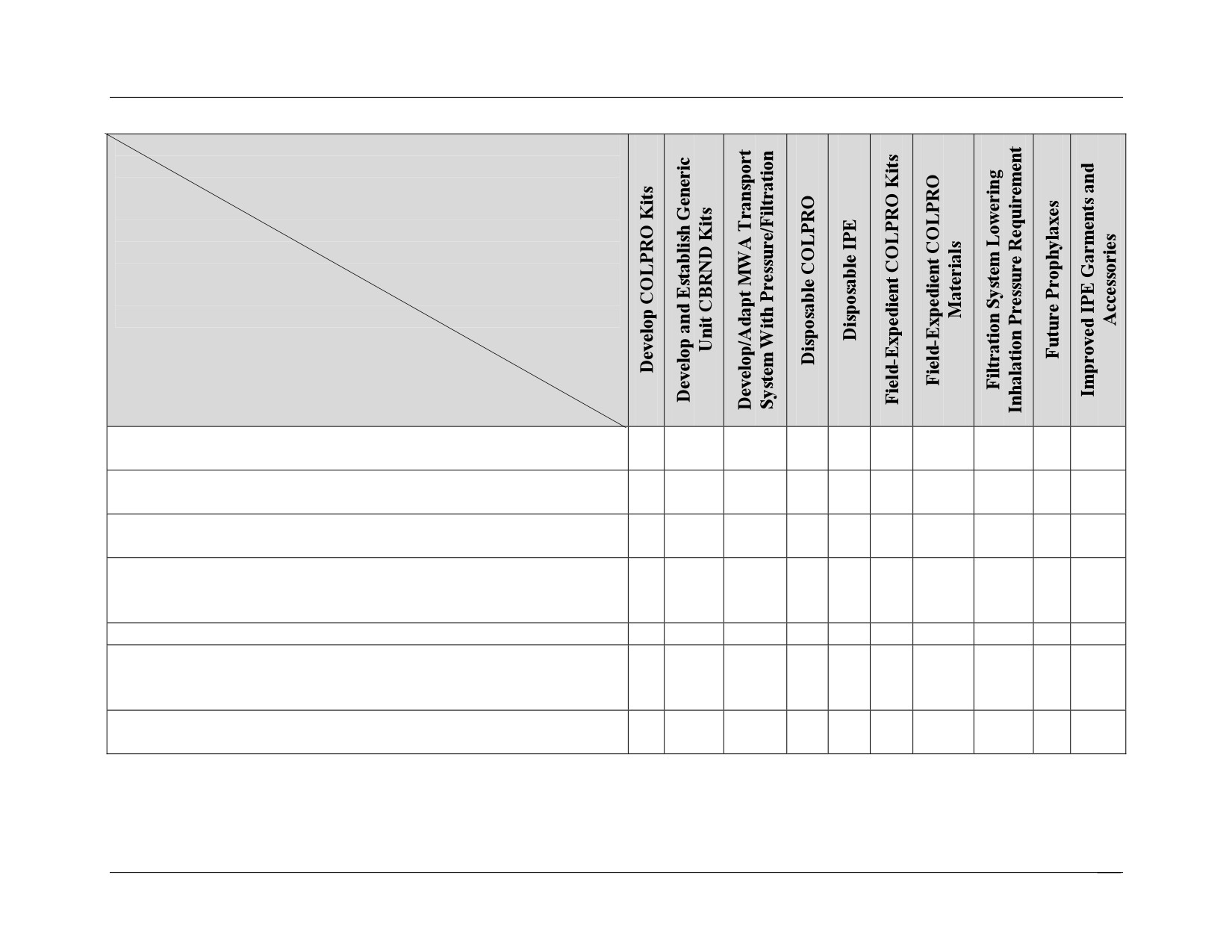
For Official Use Only
CBRND Functional Needs Analysis/Functional Solution Analysis
Chapter 13 Tactical Shield Tasks
Table 13.12-3. TASHLD 12: IMA Assessment (continued)
Ideas for Material
Approaches
(IMA)
Identified Gaps
Casualties unable to wear respiratory/ocular protection are not
X
X
X
X
X
X
X
X
X
addressed.
CBRND protective equipment and measures do not protect against
X
X
X
X
X
X
X
X
X
X
all CBRN/TIM agents.
Medical prophylaxis does not exist for all threat CBRN/TIM and
X
TIM agents.
Prophylaxis against most high-threat TIMs are not currently
available due to the relatively recent consideration of these agents
X
as a potential threat.
Prophylaxis for MWAs is virtually nonexistent.
X
Negative-pressure COLPRO with filtered expelled air does not exit
within the inventory for the transport and sheltering of numbers of
X
X
X
X
X
exposed, infectious, and/or contaminated casualties.
Mobile COLPRO that operates and provides protection while
X
X
X
X
X
moving is not available for the protection of casualties.
For Official Use Only
248
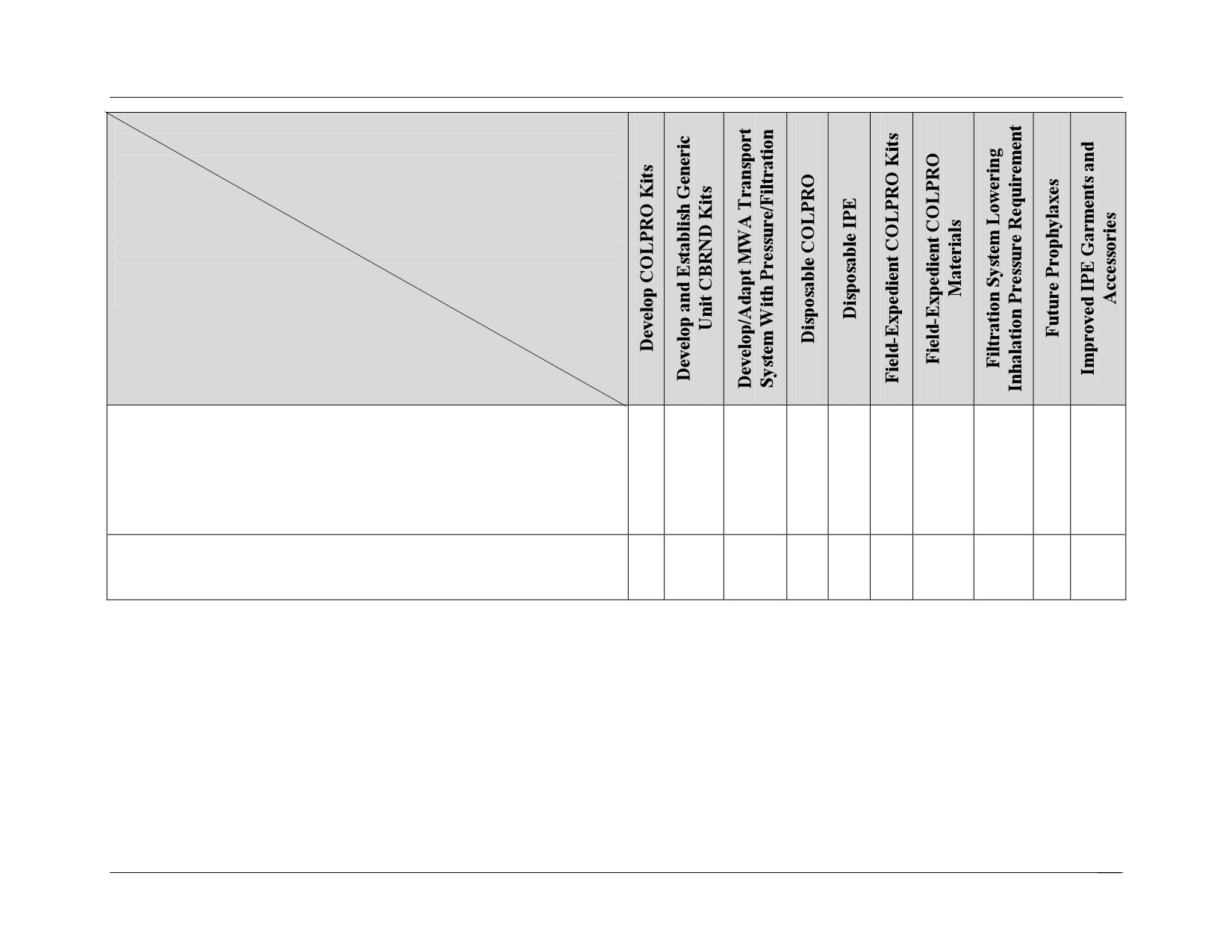
For Official Use Only
CBRND Functional Needs Analysis/Functional Solution Analysis
Chapter 13 Tactical Shield Tasks
Ideas for Material
Approaches
(IMA)
Identified Gaps
Air transport (tactical rotary-wing) is a last resort due to concerns
about asset contamination. Tactical and strategic fixed-wing air
transport is not considered an acceptable means of transport. Air
X
X
X
X
X
and sea transport resources are inadequately equipped and prepared
to transport exposed and contaminated human and MWA
casualties.
Expeditionary operations are a particular concern. Mass medical
operations may not be possible until the theater matures or
X
X
X
X
X
X
X
X
X
additional resources are allocated to the AOR.
For Official Use Only
249
For Official Use Only
CBRND Functional Needs Analysis/Functional Solution Analysis
Chapter 13 Tactical Shield Tasks
Table 13.12-3. TASHLD 12: IMA Assessment (continued)
Ideas for Material
Approaches
(IMA)
Identified Gaps
Casualties unable to wear respiratory/ocular protection are not addressed.
X
CBRND protective equipment and measures do not protect against all CBRN/TIM agents
X
X
Medical prophylaxis does not exist for all threat CBRN/TIM and TIM agents.
X
Prophylaxis against most high-threat TIMs are not currently available due to the relatively recent consideration of
X
these agents as a potential threat.
Prophylaxis for MWAs is virtually nonexistent.
X
Negative-pressure COLPRO with filtered expelled air does not exit within the inventory for the transport and
sheltering of numbers of exposed, infectious, and/or contaminated casualties.
Mobile COLPRO that operates and provides protection while moving is not available for the protection of
casualties.
Air transport (tactical rotary-wing) is a last resort due to concerns about asset contamination. Tactical and strategic
fixed-wing air transport is not considered an acceptable means of transport. Air and sea transport resources are
X
inadequately equipped and prepared to transport exposed and contaminated human and MWA casualties.
Expeditionary operations are a particular concern. Mass medical operations may not be possible until the theater
X
X
matures or additional resources are allocated to the AOR.
For Official Use Only
250
For Official Use Only
CBRND Functional Needs Analysis/Functional Solution Analysis
Chapter 13 Tactical Shield Tasks
13.13 Task TASHLD 13: Perform mortuary activities for CBRN/TIM contaminated
remains
13.13.1 Functional Area Analysis
13.13.1.1
Definition
Contaminated remains of personnel and animals may require storage and transport to another
location. The safe handling, storage, and movement of contaminated remains require they be
fully and completely sealed to minimize the potential for release of contaminants. Contaminated
remains IPE must be impermeable and not permit release of the contaminants. The design must
be functional and easy to transport, store, support, and dispose. Decontamination capability is
required at all points where contaminated remains may be located.
13.13.1.2
Derivation
Joint Enabling Concept for CBRN Operations, An Operational Concept for Biological Defense,
Protection Joint Functional Concept, UJTL (TA 7, TA 7.1).
13.13.1.2.1
Supported Task: OPSHLD 14
13.13.1.2.2
Lateral Task: TASHA 24
13.13.1.2.3
Supporting Task: N/A
13.13.1.3
Condition
Perform this task under conditions of:
Physical
1. Undeveloped to highly developed land. (C1.1.1)
2. Riverine to open sea. (C1.2)
3. Natural and induced air. (C1.3)
4. Immediate to delayed danger, and potential long-term health hazard of atmospheric
weapons effects. (C1.3.3)
Military
1. Partially completed mission preparation. (C2.1.3)
2. Marginal forces. (C2.2)
3. Marginal to adequate forces allocated. (C2.2.3)
4. Negligible personnel experience. (C2.2.4.5)
5. Limited staff expertise. (C2.3.1.3)
6. Limited deployed supplies. (C2.8.2)
7. No prepositioned materiel. (C2.8.4)
8. No host-nation support. (C2.8.5)
For Official Use Only
251
For Official Use Only
CBRND Functional Needs Analysis/Functional Solution Analysis
Chapter 13 Tactical Shield Tasks
9. Negligible to limited commercial procurement. (C2.8.6)
Civil. N/A
13.13.2 Functional needs Analysis
13.13.2.1
Capability and Deficiency Assessment Summary
Table 13.13-1 discusses current and projected capabilities to accomplish this task. The overall
capabilities for current, near/mid, and far term are rated “yellow.” Although improvements
between the periods occur for specific capabilities and are reflected in the associated identified
values, the improved capabilities are not sufficient to change the overall assessed color ratings
for this task.
Current Capability and Deficiency
This task encompasses the extent of operations involving remains from collection to final
internment and involves a range of force elements and resources. The primary actors are
Mortuary Affairs units/elements. These personnel are trained and equipped to decontaminate and
process human remains. Existing Service CBRND assets are worn to protect against secondary
exposure/contamination of personnel and resources. However, this task is not limited to
Mortuary Affairs. Personnel performing transport and handling of remains throughout the
process are considered in the task. Splash protection is afforded through the use of COTS
mortuary and CBRND assets designed for this purpose or the application of wet-weather gear
(including severe-weather gear). Splash protection is worn with respiratory/ocular and
percutaneous CBRND assets. The Services currently field a variety of CBRND assets providing
respiratory/ocular, percutaneous, and COLPRO protection. This diversity of assets complicates
the logistical support of operations with threat for joint operations. Existing Service-specific IPE
is limited in the period and scope of protection afforded the warfighter. Respiratory/ocular and
percutaneous CBRND assets protect against known chemical and biological warfare agents and
particulate radiologicals. Protection is afforded to a select number of TIMs. Physiological and
psychological encumbrances increase with prolonged wear. Regular exercising and wear to
acclimate and adjust the wearer to enable performance of assigned functions and activities is
necessary and performed to reduce the impact of encumbrances and subsequent degradation of
performance. Medical prophylaxes do exist for the protection of the warfighter against a limited
number of biological and chemical agents. However, few are FDA approved. A number possess
IND authorization for application. Medications are considered for their potential prophylactic
value, but are not always FDA approved for this purpose. Not all threat CBRN agents are
addressed by CBRND medical countermeasures. Efficacy, time to achieve a level of protection,
and the number of administrations vary between prophylaxes. COTS protective assets are
applied for selected eligible civilians such as hazardous materials, firefighters, EMS, etc.
However, eligible civilians are not adequately addressed by DOTLPF for CBRND. Clear
DOTLPF addressing the CBRND provisioning and training of eligible civilians is inadequate.
MOPP DOTLPF is adequate for military personnel and operations. The establishment of
adjustable MOPP levels, reflective of local operations and threat, are well defined, as are
continuing evaluation for change/adjustments. However, operations increasingly involve U.S.
For Official Use Only
252
For Official Use Only
CBRND Functional Needs Analysis/Functional Solution Analysis
Chapter 13 Tactical Shield Tasks
and non-U.S. civilians. MOPP DOTLPF does not adequately address their presence and
inclusion into MOPP methodologies and levels, particularly when these personnel may (or may
not) be equipped with nonstandard IPE. DOTLPF is adequate for the application of CBRND
respiratory/ocular and percutaneous personal protection by personnel transporting, handling,
decontaminating, or otherwise potentially at risk for secondary exposure/contamination from
infectious/contaminated remains. However, DOTLPF is inadequate to address the containment of
contaminated/infectious remains for transport out of the AOR for final internment. DOTLPF is
inadequate for the processing of non-U.S. personnel (e.g., indigenous civilians, third-party
nationals, etc.). Prior decontamination of exposed/contaminated remains is the only identified
means for protecting transportation assets against secondary contamination. The predominant
means is decontamination of the asset following secondary exposure/contamination. Tactical and
strategic fixed-wing air transport is not considered an acceptable means of transport.
Decontaminated and contained remains may not be considered a secondary risk by air asset
managers. However, containment systems providing adequate protection and safeguards against
secondary contamination/exposure of personnel and resources during storage, handling,
transport, and potentially through final internment do not exist.
Projected Near/Mid-Term Capability and Deficiency
Future configurations focus on reducing psychological and physiological stresses associated with
the wearing of IPE, as well as striving for commonality of form factor among all services to
reducing the logistics burden, development cost, and improved availability. The JPACE, JSLIST,
JSAM, and JSGPM are projected to be initially fielded during the mid term. The JSLIST is under
review for NIOSH certification for compliance with OSHA protective standards. The
certification will permit application of the garment for AT/FP installation activities within
CONUS and selected OCONUS. The possibility exists for potential application by requiring
eligible civilians. Legacy Service-specific IPE will remain in the inventory throughout the mid
term and into the far term during the transition to the joint IPE systems. Ongoing R&D into
medical prophylaxes will provide additional prophylactic measures but still fail to address all
threat CBRN agents and high-threat/high risk TIMs (particularly TICs). Otherwise, changes from
current capabilities and deficiencies are not projected.
Projected Far-Term Capability and Deficiency
Future configurations focus upon reducing psychological and physiological stresses associated
with the wearing of IPE, as well as striving for commonality of form factor among all Services.
The standardization of CBRND respiratory/ocular and percutaneous protection will reduce the
logistics burden and development cost and subsequently improve availability. Legacy Service-
specific IPE will continue to be replaced by the joint systems of CBRND protective equipment
until fielding is complete to all Service units, including Guard and Reserve, early in the far term.
Next-generation IPE assets are in R&D and are expected to be fielded sometime in the far term.
However, specifics of design, characteristics, and protective capabilities are not as yet
determined for these systems. Continued R&D into potential medical prophylaxes may result in
additional protective measures for the force. However, specifics are unknown at this time.
Additional changes in capabilities from the mid term are not projected.
For Official Use Only
253
For Official Use Only
CBRND Functional Needs Analysis/Functional Solution Analysis
Chapter 13 Tactical Shield Tasks
13.13.2.2
Resource Systems
Individual Protection
1.
Respiratory/Ocular Protection:
COTS: Commercially available systems of protection, manufactured and tested meeting
OSHA standards for the United States or equivalent organization in other nations.
M17 Series Masks w/M13 Series Filters: Obsolescent warfighter system of protection.
Retained in selected HTAs for NEO application. Designed for adults.
MBU-19/P Chemical-Biological Aircrew Eye/Respiratory Protection (AERP): USAF
combat aircrew protection. Includes protective hood, MBU-12/P mask, C-2 canister,
intercom for ground communications, and blower assembly.
A/P22P-14(V) Respirator Assembly: USN/USMC system for rotary-wing (Version 1 for
USN) and fixed-wing (Versions 2-4 for USN/USMC) aircrews. Includes CB filter, dual
air/oxygen supply, and crossover manifold for dual protective capabilities in air or on
ground. Version 1 is not compatible with aircraft oxygen supply systems; Version 2
applied to EA-6B and F18A airframes; Version 3 to AV-8B and F-18C/D aircraft; and
Version 4 is used for C-130 airframes.
M40/M42 CB Protective Mask: U.S. Army mask system designed for military standard
profile and uses standard C-2 canister. M42 integrates with combat vehicle clean air
supply system and has a connectable dynamic microphone for combat vehicle intercom
system.
M45 Aircrew Aviator Mask: Replaces M42 and M49 systems for U.S. Army. Available with
a canister-compatible hose assembly and a valve cassette that enables use of supplied air
(from aircraft, SCBA or PAPR). The M45 is used by military personnel who cannot fit
the M40A1, M42A2, or MCU-2/P masks.
M48 CB Apache Aviator Mask: Used by Apache aviator and flight support personnel.
Replaced M43 Type 1 mask system and uses blower assembly with C-2 filter canister.
MCU-2A/P: Mainstay USAF and USN system for nonaviator personnel and aircrew
personnel not performing flight operations, except for aircrew personnel not issued
aviator systems and noncombat platforms/airframes without clean air supply systems.
Applies C-2 filter for filter air.
Joint Service Aviator Mask (JSAM): Initial fielding projected in the mid term replacing
Service-specific aviator respiratory/ocular protective systems. Provides CBRN protection
under high-G conditions, compatible with existing and projected aviator CBRN IPE,
flame and thermal protective, reduces stress associated with existing aviator IPE, and
may be donned/doffed during flight.
Joint Service General Purpose Mask (JSGPM): Initial fielding projected in the mid term
replacing Service-specific standard respiratory/ocular protective systems. Provides
respiratory/ocular protection from CBRN agents and selected TIMs. Improves field-of-
vision and encumbrances associated with existing Service systems.
Joint Service Chemical Environment Survival Mask (JCESM): COTS one-time use, one-
size-fits-all, respiratory/ocular protective system affording two hours of protection in
low-level CBRN vapor, aerosol, and particulate environments. Selected force element
application only.
For Official Use Only
254
For Official Use Only
CBRND Functional Needs Analysis/Functional Solution Analysis
Chapter 13 Tactical Shield Tasks
2.
Percutaneous Protection:
COTS: Commercially available systems of protection, manufactured and tested meeting
OSHA standards for the United States or equivalent organization in other nations.
Battle Dress Overgarment (BDO): U.S. Army/USAF two-piece camouflage-patterned
garment (top and trousers) providing 24-hour protection against CBRN agents in vapor,
liquid, droplet, and particulate forms.
Saratoga: USMC two-piece camouflage-patterned garment (top and trousers) providing 24-
hour protection against CBRN agents in vapor, liquid, droplet, and particulate forms.
Launderable for hygiene.
CPOG: Legacy two-piece green garment currently in use with USN providing limited-term
protection against CBRN agents in vapor, liquid, droplet, and particulate forms.
Chemical Protective Undergarment (CPU): Worn under standard IPE as additional layer of
protection against contact with CBRN agents.
CWU-66/P: One-piece USAF green flightsuit providing 24-hour protection against CBRN
agents in vapor, liquid, droplet, and particulate forms. Available in tan as CWU-77/P
flightsuit.
Disposal Aircrew Protective Cape: Transparent disposable cape covering head and shoulders
of aviator during periods between aircraft mounting/dismounting and shelter.
BVO/GVO: Vinyl overboots (VO) worn over wearer’s standard footwear and protects
against contact with CBRN agents. Available in black (BVO) and green (GVO).
Chemical Protective Footwear Cover (CPFC): Legacy system of CBRN protective footwear
cover in use by USN. Requires wearer to pull protective sole tabs up and wrap/tie laces
around cover to secure over footwear.
Disposable Aircrew Footwear Cover: Transparent disposable footwear covers worn over
aviator footwear to protect aviator during periods between aircraft mounting/dismounting
and shelter.
Chemical Protective Glove (CPG): Standard CBRN protective glove. Available in 7-, 14-,
and 25-mil thicknesses addressing functional requirements for durability, dexterity, and
tactile sensitivity.
Disposable Aircrew Hand Protection: Transparent disposable hand coverings applied by
USAF, USN, and USMC over aviator gloves during periods between aircraft
mounting/dismounting and shelter. Also applied as between aviator inner and outer
gloves enabling essential functional requirements for dexterity and tactile sensitivity.
Chemical Protective Helmet System (CPHS): CBRN protective camouflage-patterned
helmet cover to protect helmet from contact with CBRN contaminants.
SCALP: Disposable, lightweight, impermeable overgarment designed for wear over IPE for
additional protection in grossly contaminated environments. Applied by personnel
required to leave protective sheltering in these environments to perform mission-critical
tasks. Also applied by decontamination units/teams and medical personnel performing
decontamination or potentially at risk for prolonged contact with liquids.
Wet-Weather Gear: Includes Severe-Weather Gear (USN): Provides barrier against contact
with liquids potentially damaging to protective abilities of IPE.
M-2 Apron: Butyl rubber-coated sleeved apron worn over IPE and applied by
decontamination units/teams and other designated personnel performing decontamination
For Official Use Only
255
For Official Use Only
CBRND Functional Needs Analysis/Functional Solution Analysis
Chapter 13 Tactical Shield Tasks
or potentially at risk for contact with liquids. Provides barrier against contact with liquids
potentially damaging to protective abilities of IPE. Decontaminable.
Patient Protective Wrap (PPW): Enclosed casualty bag made of CBRN protective materials.
Incorporates small flexible transparent window positioned over casualties face for
viewing by medical practitioners. Uses cardboard stays to maintain separation of bag
from casualty’s face. Does not permit head-to-toe viewing of casualty. Supports limited
medical assistance. Requires the wear of standard warfighter respiratory/ocular
protection. Two wraps currently in stock. Legacy system provides protection up to 3
hours and newer system up to 6 hours.
Joint Service Lightweight Integrated Suit Technology (JSLIST): Two-piece (jacket and
trousers) CBRN risk-taking protective garment with integrated hood. Affords protection
against selected TIM agents. Reduces physiological and psychological encumbrances
associated with existing Service-specific systems it replaces with initial fielding in the
mid term. Under review for NIOSH certification for OSHA protection standards.
Joint Protective Aircrew Ensemble (JPACE): CBRN protective aviator flightsuit projected
for initial fielding in the mid term and replacing Service-specific CBRN protective
flightsuits. Provides JSLIST equivalent protection and provides protection when subject
to rotor, propeller, and jetwash. Flame-retardant and self-extinguishing properties.
Supports escape and evasion requirements.
Joint Block I/II Glove Upgrade (JB1/2GU): Projected fielding in near mid term replacing
CPG for designated force elements requiring increased tactility/durability for mission
performance. Various configurations under consideration.
Joint Firefighter Integrated Response Ensemble (JFIRE): Incorporates JSLIST into
firefighter bunker gear, permitting firefighters to conduct firefighting operations within a
CBRN/TIM environment.
Multi-purpose Overboot (MULO): Projected initial fielding in mid term and replacing
legacy CBRN footwear covers.
3.
Medical Protection:
Vaccines: Immunizations providing a level of acquired immunity against the effects of
CBRN agents.
Topicals: Protective barrier products applied to the skin to enhance protection of wear
against contact with CBRN/TIM agents. Includes both inert and reactive materials.
Medications: Medical materials taken to mitigate or prevent the effects of exposure to
CBRN/TIM agents. Includes medications taken routinely or upon exposure (but prior to
symptom display) to build resistance/immunity or to mitigate/resolve medical impacts of
CBRN/TIM agent exposure/contamination.
MOPP Methodology: Stepped level of CBRND protective measures. Standardized levels permit
the rapid increase or decrease of unit MOPP level.
Unit Staff: The application of DOTLPF for all phases of operations with threat from preplanning
to post-force return to home stations. Includes all aspects of C2 and supporting staff activities/
functions (e.g., logistics, intelligence, etc.) enabling mission and task accomplishment.
For Official Use Only
256
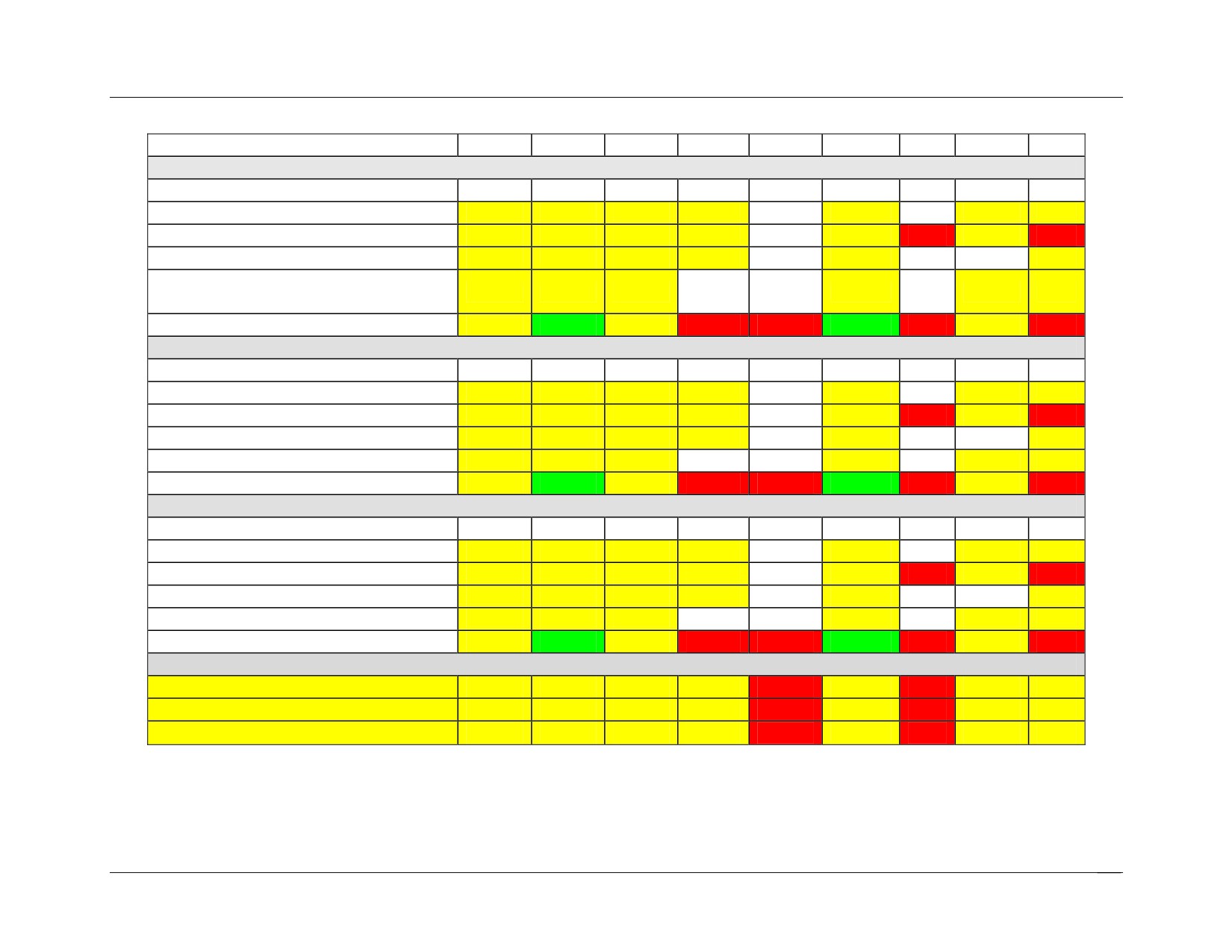
For Official Use Only
CBRND Functional Needs Analysis/Functional Solution Analysis
Chapter 13 Tactical Shield Tasks
Table 13.13-1. TASHLD 13: Capability and Deficiency Assessment
System/Measure
M1
M2
M3
M4
M5
M6
M7
M8
M9
Current
Individual Protection
4.7
4.7
4.7
4.7
N/A
5
0
5.5
4.7
Respiratory/Ocular Protection
51
51
51
52
N/A
51
N/A
51
63
Percutaneous Protection
54
54
54
55
N/A
64
06
64
37
Medical Protection
48
48
48
48
N/A
48
N/A
N/A
59
Mission-Oriented Protective Posture
510
610
610
N/A
N/A
610
N/A
610
611
(MOPP) Methodology
Unit Staff
612
813
714
315
016
817
018
714,17
319
Near/Mid
Individual Protection
5.3
5.3
5.3
5.3
N/A
5.3
0
6
4.7
Respiratory/Ocular Protection
61,20
61,20
61,20
62,21
N/A
61,20
N/A
61,20
66
Percutaneous Protection
64,22
64,22
64,22
65,23
N/A
64,22
06
64,22
37
Medical Protection
48,24
48,24
48,24
48,24
N/A
48,24
N/A
N/A
59
MOPP
510
610
610
N/A
N/A
610
N/A
610
611
Unit Staff
612
813
714
315
016
817
018
714,17
319
Far
Individual Protection
6
6
6
6
N/A
6
0
7
4.7
1,20,25
1,20,25
2,21,26
1,20,25
1,20,25
Respiratory/Ocular Protection
7
7
71,20,25
7
N/A
7
N/A
7
66
Percutaneous Protection
74,22,27
74,22,27
74,22,27
75,23,28
N/A
74,22,27
06
74,22,27
37
Medical Protection
48,24,29
48,24,29
48,24,29
48,24,29
N/A
48,24,29
N/A
N/A
59
MOPP
510
610
610
N/A
N/A
610
N/A
610
611
Unit Staff
612
813
714
315
016
817
018
714,17
319
Overall
Current Overall Capability
5
6
6
4
0
6
0
6
5
Near/Mid-Term Overall Capability
5
6
6
4
0
6
0
6
5
Far-Term Overall Capability
6
7
6
5
0
7
0
6
5
For Official Use Only
257
For Official Use Only
CBRND Functional Needs Analysis/Functional Solution Analysis
Chapter 13 Tactical Shield Tasks
FAA Measure
Scale
M1
Coordination is
8-10: Mortuary Affairs units/activities coordinate with the command and Medical Services staffs to facilitate the recovery,
performed with
handling, decontamination, and internment of human remains.
Mortuary Affairs for
4-7: Mortuary Affairs units/activities coordinate with the command with the command and Medical Services staffs to facilitate
handling,
the recovery, decontamination, and internment of human remains.
decontaminating, and
1-3: Mortuary Affairs units/activities coordinate with the command staff to facilitate the recovery and internment of human
transporting of
remains.
human and MWA
0: Mortuary Affairs units/activities do not coordinate with command and Medical Services staffs for the recovery and
remains.
internment of human remains.
M2
Mortuary Affairs is
8-10: Mortuary Affairs units/activities maintain readiness to implement operations involving CBRN/TIM
rapidly prepared
exposed/contaminated remains; possess in-place operational CBRN systems, components, and consumables; have detailed
upon notification to
doctrine, policies, procedures, and TTPs; and are trained (formal and recurring) to commence coordination and operations upon
handle contaminated
notification by command staff or receipt of CBRN event alerting/warning.
remains.
4-7: Mortuary Affairs units/activities possess access to CBRN systems, components, and consumables; have guiding doctrine,
policies, procedures, and TTPs; and are trained (formal and recurring) to establish and conduct operations involving
CBRN/TIM exposed/contaminated remains upon notification by command staff.
1-3: Mortuary Affairs units/activities possess access to CBRN systems, components, and consumables through the command
staff; possess limited doctrine, policy, and procedures; and are trained by their assigned units for the conduct of operations
involving CBRN/TIM exposed/contaminated remains.
0: Mortuary Affairs units/activities do not possess access to necessary CBRND resources, training, and do not possess adequate
doctrine, policy, and procedures to establish and conduct operations involving CBRN/TIM exposed/contaminated remains.
M3
Mortuary Affairs
8-10: Detailed doctrine, policy, procedures, processes, and training (formal and recurring) exist for the safe handling of
personnel are trained
CBRN/TIM exposed/contaminated remains by Mortuary Affairs personnel and activities.
in handling
4-7: General doctrine, policy, procedures, and training exist for the handling of CBRN/TIM exposed/contaminated remains by
contaminated
Mortuary Affairs personnel.
remains.
1-3: Limited doctrine, policy, and procedures exist for the handling of CBRN/TIM exposed/contaminated remains by Mortuary
Affairs personnel. Training is limited to unit-based training program.
0: Doctrine, policy, procedures, and training do not exist for the handling of CBRN/TIM exposed/contaminated remains.
M4
Contaminated/infecti
8-10: Doctrine, policy, procedures, TTPs, training, and plans address the application of protective assets and the safe handling
ons human and
and transport of exposed or contaminated human/MWA remains, and specify requirements and measures for the protection of
MWA remains are
personnel, activities, and resources performing the handling and transport.
safely processed,
4-7: Doctrine, policy, procedures, TTPs, training, and plans address the safe handling and transport of exposed or contaminated
transported, and
remains and identify general measures and resources for the protection of personnel, activities, and resources performing the
disposition
handling and transport.
completed.
1-3: Doctrine, policy, procedures, TTPs, training, and plans provide general instructions and guidance for the handling and
transport of exposed or contaminated remains and provides limited information on measures and resources to apply for the
protection of personnel, activities, and resources performing the handling and transport.
0: Doctrine, policy, procedures, TTPs, training, and plans do not address the handling and transport of exposed or contaminated
remains and the measures and resources necessary for the protection of personnel, activities, and resources performing the
handling and transport.
For Official Use Only
258
For Official Use Only
CBRND Functional Needs Analysis/Functional Solution Analysis
Chapter 13 Tactical Shield Tasks
M5
Mortuary Affairs
8-10: Mortuary Affairs units and activities are equipped and trained to operate CBRN/TIM detection devices and sensors for
units/activities are
application to remains.
trained and equipped
4-7: Mortuary Affairs units and activities are trained and equipped to apply radiation detection, identification, and computation
to operate CBRN/
and standard individual CBRN/TIM detection/monitoring devices for application to remains.
TIM detection and
1-3: Mortuary Affairs units and activities are trained and equipped to apply standard individual CBRN detection devices for
monitoring devices.
application to remains.
0: Training and equipping Mortuary Affairs units and activities to perform CBRN/TIM detection and monitoring of remains is
nonexistent.
M6
Mortuary Affairs
8-10: Mortuary Affairs personnel are equipped with adequate splash and CBRN/TIM IPE protection.
personnel possess
4-7: Mortuary Affairs personnel are equipped with CBRN/TIM IPE protection and limited splash protection.
IPE and splash
1-3: Mortuary personnel are equipped with CBRN/TIM IPE protection and selected members are equipped with splash
protective coverings.
protection.
0: Mortuary Affairs personnel are not equipped with CBRN/TIM IPE and splash protection.
M7
Mortuary Affairs
8-10: Adequate types and quantities of CBRN/TIM containment IPE, storage, and transport containers for contaminated
possess sufficient
remains are on hand and readily available for the sealed containment of CBRN/TIM exposed/contaminated remains.
containment IPE for
4-7: CBRN/TIM exposed/contaminated remains containment IPE, storage, and transport containers are available for the sealed
contaminated
containment of CBRN/TIM exposed/contaminated remains.
remains.
1-3: CBRN/TIM exposed/contaminated remains containment IPE, storage, and transport containers are available in limited
quantities for the sealed containment of CBRN/TIM exposed/contaminated remains.
0: CBRN/TIM exposed/contaminated remains containment IPE, storage, and transport containers are not available or are
nonexistent.
M8
Adequate
8-10: CBRND systems, resources, and consumables are available and in place in plan-identified quantities and types to conduct
decontamination
decontamination of CBRN/TIM exposed/contaminated remains.
supplies and
4-7: CBRND systems, components, and consumables are available and in place supporting operations but reflect adjusted plan
equipment are on
quantities and types for limitations and constraints in availability. Adjustments to operations are made without serious impact.
hand
1-3: Limitations and constrains upon available CBRND systems, components, and consumable quantities and types require
changes and delays in the conduct of decontamination of CBRN/TIM exposed/contaminated remains.
0: Systems, components, and consumables availability and allocation do not support remains decontamination activities.
M9
There is effective
8-10: DOTLPF exists and is adequate for this task. Task can be effectively performed with little or no direct impact upon
DOTMLPF in place
operations
to conduct task
4-7: Most critical aspects of DOTLPF for this task are addressed. Task can be performed with limitations requiring work-
arounds.
1-3: DOTLPF is inadequate for accomplishment of this task.
0: DOTLPF does not exist for this task.
1 Mortuary Affairs personnel designated to perform handling and decontamination of human remains activities are trained on the proper wear of protective respiratory/ocular
protection as outlined in doctrine, policy, procedures, and TTPs. Respiratory/ocular protection is diverse across the Services and performed functions. The M40/M42 CB Protective
Mask is in service with the U.S. Army. The mask uses the C-2 canister for filtration of CBRN contaminants. The M45 Aircrew Aviator Mask replaced the U.S. Army M43 Type II
and M49 Mask Systems. The system uses a low-profile canister compatible hose assembly for both hose and face-mounted configurations. The mask system incorporates
selectable filtration for support both during aircraft systems activation and using the connectable filter pack. The mask also is applied to personnel who cannot be fitted with the
For Official Use Only
259
For Official Use Only
CBRND Functional Needs Analysis/Functional Solution Analysis
Chapter 13 Tactical Shield Tasks
standard M40A1, M42A2, or MCU-2A/P masks. The MCU-2A/P is the mainstay USAF and USN mask employed by personnel not equipped with aircrew masks and by aircrew
when not performing flight operations. The MCU-2A/P is also used by aircrew during flight operations who are not equipped with aircrew masks. COTS equipment meeting
OSHA requirements (and NFPA for firefighters) is applied by selected civilian personnel performing specific functions such as firefighting, EMS, hazardous materials, etc.
Eligible civilians are inadequately addressed in DOTLPF.
2 CBRND IPE is currently Service-specific. Respiratory/ocular protection is diverse across the Services and performed functions. USAF combat aircrews conduction operations
within a CBRN environment are equipped with the MBU-19/P Chemical-Biological AERP that includes protective hood, MBU-12/P mask, C-2 filter canister, an intercom for
ground communications, and a blower assembly. The AERP provides protection whether or not supplemental oxygen is present. USN and USMC aviators use the A/P22P-14(V)
Respirator Assembly that is a self-contained protective system deployed for rotary-wing (Version 1 for USN) and fixed-wing (Versions 2-4 for USN and USMC) aircrews. The
system incorporates a CB filter, dual air/oxygen supply, and a crossover manifold with dual protective capabilities for flight and ground protection. The A/P 22P-14(V) 1 is not
compatible with aircraft with oxygen delivery systems and supports helicopter crew use. Version 2 is used for the EA-6B and F-18A, Version 3 for AV-8B and F-18C/D, and
Version 4 is applied for C-130 aircrews. The M17 series mask is obsolete and is relegated to NEO support in selected HTAs. The mask is designed for the military standard profile
(ground) and does not adequately protect all potential nonmilitary populace members, for which is retained. The M40/M42 CB Protective Mask is in service with the U.S. Army.
The mask uses the C-2 canister for filtration of CBRN contaminants. The M42 integrates with combat vehicle filtration protection system and has a dynamic microphone with
cable for connection to vehicle communications systems. The M43 CB Aircraft Mask is applied by U.S. Army aircrew members and applies a motor blower unit with C-2 canister
for filtration. The system is a stand-alone system that accompanies the user. The M45 Aircrew Aviator Mask replaced the U.S. Army M43 Type II and M49 Mask Systems. The
system uses a low-profile canister compatible hose assembly for both hose and face-mounted configurations. The mask system incorporates selectable filtration for support both
during aircraft systems activation and using the connectable filter pack. The mask also is applied to personnel who cannot be fitted with the standard M40A1, M42A2, or MCU-
2A/P masks. The M48 CB Apache Aviator Mask protects AH-64 Apache helicopter aviators and flight support personnel. The blower assembly uses the C-2 filter canister to
provide filtered, breathable air. The M-48 replaces the M43 Type 1 mask. The MCU-2A/P is the mainstay USAF and USN mask employed by personnel not equipped with aircrew
masks and by aircrew when not performing flight operations. The MCU-2A/P is also used by aircrew during flight operations who are not equipped with aircrew masks. COTS
equipment meeting OSHA requirements (and NFPA for firefighters) is applied by selected civilian personnel performing specific functions such as firefighting, EMS, hazardous
materials, etc. Limited quantities of COTS may be available within HTAs for known NEO requirements for the protection of populace members unable to wear the M17 series or
standard warfighter respiratory/ocular protective devices. MWAs are not afforded respiratory/ocular protection.
3 DOTLPF is adequate for the application of CBRND respiratory/ocular protection by personnel transporting, handling, decontaminating, or otherwise potentially at risk for
secondary exposure/contamination from infectious/contaminated remains.
4 Mortuary Affairs personnel designated to perform handling and decontamination of human remains activities are trained on the proper wear of percutaneous protective protection
as outlined in doctrine, policy, procedures, and TTPs. Military personnel performing decontamination operations are required to wear CBRND percutaneous protection against the
potential for secondary exposure/contamination. Doctrine, policy, procedures, and TTPs do not adequately address the protection of nonmilitary personnel performing
decontamination operations in the AO. However, OSHA and CDC requirements may apply and should be addressed as applicable. Non-U.S. personnel subject to these functions
are not addressed. Service-specific CBRND percutaneous protection is currently applied for the protection of the force. The BDO, used by the USAF and U.S. Army, is a two-
piece garment providing protection for a 24-hour period against chemical agent vapors, liquids, and droplets; biological agents and toxins and contact with radioactive particles.
The BDO’s protective abilities are lost if the suit is torn, ripped, splashed with POL, or is saturated with water and is designed for a one-time use and is worn by ground and most
flight personnel (non-high-performance aircraft). The USMC uses the Saratoga COLPRO suit similar in design to the BDO, but launderable for personnel hygiene. The CPOG is a
legacy two-piece garment for protection against CBRN agents. The CPOG is in use with the USN. The USAF CWU-66/P (and 77/P) is a one-piece flightsuit providing protection
for a 24-hour period against standard CBRN agents and is designed for compatibility with aircrew lift support equipment. The BVO/GVO overboots are applied over the wearer’s
standard footwear to protect against contact with CBRND. The USN uses the CPFC, commonly called the “fishtail” for its design, to protect the wearer’s footwear. The CPFC,
considered obsolete, does provide a measure of antislip protection shipboard. Decontamination units/teams apply the CB Protective Boot (similar to firefighter boots) for
decontamination operations. Hand protection is provided by the CPG in 7-, 14-, and 25-mil thicknesses to meet warfighter hand protection and dexterity needs. SCALP provides a
disposable, lightweight, impermeable layer of protection for personnel against gross liquid contamination and is worn over the warfighter’s protective ensemble. SCALP is applied
by units performing decontamination operations where personnel may become soaked by decontaminants and Medical Services personnel with potential for prolonged contact with
body fluids. Standard wet-weather gear (e.g., poncho, rain parka, rain suit, etc.) is also applied as a barrier against saturation of the warfighter’s protective ensemble by contact
with liquids such as rain, sea spray, etc. The M-2 apron is applied by personnel performing decontamination aprons and is worn over the ensemble. The apron is full length and
For Official Use Only
260
For Official Use Only
CBRND Functional Needs Analysis/Functional Solution Analysis
Chapter 13 Tactical Shield Tasks
sleeve to maximize coverage, although the back is open. COTS assets meeting OSHA requirements (and NFPA for firefighters) is applied by selected civilian personnel
performing specific functions such as firefighting, EMS, hazardous materials, etc.
5 Service-specific CBRND percutaneous protection is currently applied for the protection of the force. The BDO, used by the USAF and U.S. Army, is a two-piece garment
providing protection for a 24-hour period against chemical agent vapors, liquids, and droplets; biological agents and toxins and contact with radioactive particles. The BDO’s
protective abilities are lost if the suit is torn, ripped, splashed with POL, or is saturated with water and is designed for a one-time use and is worn by ground and most flight
personnel (non-high-performance aircraft). The USMC uses the Saratoga COLPRO suit similar in design to the BDO, but launderable for personnel hygiene. The CPOG is a
legacy two-piece garment for protection against CBRN agents. The CPOG is in use with the USN. The CPU is designed to provide an additional layer of protection for the
warfighter and is worn under standard IPE. The USAF CWU-66/P (and 77/P) is a one-piece flightsuit providing protection for a 24-hour period against standard CBRN agents and
is designed for compatibility with aircrew lift support equipment. The USN, USAF, and USMC use the disposable aircrew protective cape to protect aircrew between sheltering
and the combat aircraft. The cape drapes over the wearer and is removed during entry into the aircraft to prevent transfer of contamination into the aircraft interior. The BVO/GVO
overboots are applied over the wearer’s standard footwear to protect against contact with CBRND. The USN uses the CPFC, commonly called the “fishtail” for its design, to
protect the wearer’s footwear. The CPFC, considered obsolete, does provide a measure of antislip protection shipboard. The disposable aircrew boot cover is worn by USAF, USN,
and USMC aviators over aircrew footwear while en route and mounting combat aircraft. The covers are removed during aircraft entry and are designed to prevent contamination
transfer into the aircraft. Hand protection is provided by the CPG in 7-, 14-, and 25-mil thicknesses to meet warfighter hand protection and dexterity needs. Disposable aircrew
hand protection is applied by the USAF, USMC, and USN for aviators over their gloves (and may be worn between glove layers for additional protection) during movement
between shelter and aircraft. When used as an overglove, the gloves are removed during aircraft mounting during aircraft entry to preclude the potential for transfer of
contamination into the aircraft interior. Medical Services practitioners performing treatment The CPHS is designed to prevent contact of the warfighter’s helmet with liquid
contamination which may be absorbed, impact helmet integrity, and/or constitute a potential secondary hazard to the wearer. SCALP provides a disposable, lightweight,
impermeable layer of protection for personnel against gross liquid contamination and is worn over the warfighter’s protective ensemble. SCALP is commonly applied to protect
armor and EOD personnel who may be required to leave sheltering to perform duties and functions. SCALP is also applied by units performing decontamination operations where
personnel may become soaked by decontaminants and Medical Services personnel with potential for prolonged contact with body fluids. Standard wet-weather gear (e.g., poncho,
rain parka, rain suit, etc.) is also applied as a barrier against saturation of the warfighter’s protective ensemble by contact with liquids such as rain, sea spray, etc. The M-2 apron is
applied by personnel performing decontamination aprons and is worn over the ensemble. The apron is full length and sleeve to maximize coverage, although the back is open.
COTS assets meeting OSHA requirements (and NFPA for firefighters) is applied by selected civilian personnel performing specific functions such as firefighting, EMS, hazardous
materials, etc. Medical barrier impermeable barrier protective assets may also be applied by Medical Services practitioners potentially at risk for contact with fluids.
6 Containment CBRND individual protective systems do not currently exist for the storage and transport of contaminated/ infectious remains.
7 DOTLPF is adequate for the application of CBRND percutaneous personal protection by personnel transporting, handling, decontaminating, or otherwise potentially at risk for
secondary exposure/contamination from infectious/contaminated remains. However, DOTLPF is inadequate to address the containment of contaminated/infectious remains for
transport out of the AOR for final internment.
8 Forces are not protected against all identified threat CBRN/TIM capabilities. Medical prophylaxis does not exist for all threat CBRN/TIM agents. Current prophylaxis and
supporting doctrine, policy, and procedures do not address presymptomatic medical CBRND protective countermeasures by other than U.S. forces, excluding MWAs and eligible
civilians. Prophylaxis against most high-threat TIMs are not currently available due to the relatively recent consideration of these agents as a potential threat. Additionally, the
efficacy of existing prophylaxis, particularly vaccines, widely varies. Military personnel are administered and/or issued CBRND medical countermeasures for operations with
threat. Vaccines for selected biological agents, topicals, and preexposure and/or post-exposure/presymptomatic medications are applied to mitigate or preclude the effects of
specific CBRN/TIM agents. Currently, preexposure prophylaxis is available for nerve agents ( G and V series), and vesicants (H, HD, HN, L, CX), topical only. SERPACWA is
the preexposure countermeasure for vesicants and one nerve agent. TSP is approved by the FDA as a supplement for SERPACWA. Post-exposure prophylaxis is available for
pulmonary (CG) agent, but is not FDA approved. Radioprotective steroids and neutraceuticals may be effective as pre- and post-exposure prophylactics. 5-androstenediol is an
IND preexposure treatment for radiological exposure. Iodide/potassium iodide is FDA approved for application against Iodine 131, 132, 134, and 135. Post-exposure radiological
exposure prophylaxis consists of neutraceuticals, plant isoflavone genistein, and alpha tocopherol (Vitamin E) but are not approved by the FDA for prophylaxis against radiation.
FDA-approved preexposure medical countermeasures are available for anthrax, cholera, HFRS (Haantan), Rift Valley fever, yellow fever, HFRS (Haantan), and smallpox. IND
status vaccines are currently available for Q-fever, tularemia (although use has been placed on hold by the FDA), Botulinum, Junin hemorrhagic fever, and VEE/WEE/EEE.
Antiviral/bacterial medications may be administered and/or issued to provide a level of protection against biological agents. Medical prophylaxes are developed for the military
force. Prophylaxes for MWAs are virtually nonexistent. Prophylaxis for eligible civilians is not addressed. Availability of prophylaxis is questionable for issue and administration
For Official Use Only
261
For Official Use Only
CBRND Functional Needs Analysis/Functional Solution Analysis
Chapter 13 Tactical Shield Tasks
to eligible civilians. The issue and administration of prophylaxis to eligible civilians requires review due to questions regarding applicability to the range of body types, ages, and
physical/medical factors inherent within a potential population, as well as long-term health issues and legal implications.
9 DOTLPF is adequate for the application of CBRND medical countermeasures by personnel transporting, handling, decontaminating, or otherwise potentially at risk for secondary
exposure/contamination from infectious/contaminated remains.
10 Plans incorporate MOPP levels and methodologies are adjustable to meet local operations and threat needs. MOPP levels and methodologies outlined in doctrine, policy,
procedures, and TTPs require levels of protection readiness based upon the threat and/or presence of contaminants. Full protection is required in the presence of CBRN/TIM
agents/contamination. This includes protective measures and the wear of protective equipment when the possibility exists for secondary exposure/contamination to personnel and
equipment, such as the movement, handling, decontamination, and preparation of contaminated remains. MOPP levels and methodologies are generally considered to apply to
equipped nonmilitary personnel. Plans within HTAs may incorporate this perception. However, doctrine, policy, procedures, and TTPs do not address their application to
nonmilitary personnel.
11 DOTLPF is adequate for the protection of personnel handling, transporting, and decontaminating remains.
12 Mortuary Affairs units/activities coordinate with the JTF/JOA Medical Services and unit Command/AOR Medical Services staffs to facilitate the recovery, preparation, and final
internment of human remains. MWA remains are not processed by these units; rather, they are managed by the respective Services Veterinary support elements. However,
DOTLPF is inadequate for the processing of non-U.S. personnel (e.g., indigenous civilians, third-party nationals, etc.).
13 Mortuary Affairs units/elements establish readiness to conduct operations upon arrival within the AOR. Operations are established in field and site locations as necessary to
support operations. Unit planned, allocated, and positioned resources are placed into readiness for operations as outlined in established doctrine, policies, procedures, and TTPs.
Personnel are formally trained in the performance of their tasks and responsibilities and possess doctrinal materials for reference upon activation by command staff or receipt of
CBRN event alerting/warning.
14 Primary duty mortuary affairs personnel possess adequate doctrine, policy, procedures, and training to reduce the potential for secondary exposure/contamination. Existing
doctrine, policy, and procedures provide adequate protection of personnel against secondary exposure/contamination. Doctrine, policy, and procedures require the application of
protective equipment and measures if the potential exists for contamination/exposure.
15 Doctrine, policy, and procedures exist for Mortuary Affairs activities within the AOR. Prior decontamination of exposed/ contaminated remains is the only identified means for
protecting transportation assets against secondary contamination. The predominant means is decontamination of the asset following secondary exposure/contamination. Tactical
and strategic fixed-wing air transport is not considered an acceptable means of transport. Decontaminated and contained remains may not be considered a secondary risk by air
asset managers.
16 Mortuary Affairs units/activities are not equipped and trained to operate and apply CBRN/TIM detection and monitoring devices other than standard individual warfighter
detection devices (e.g., M9 paper, etc.).
17 Mortuary Affairs unit/element planning and preparations includes the provision of protection to personnel performing unit activities and operations. Existing protective
equipment provides adequate protection of personnel against secondary exposure/contamination. The application of protective equipment and measures if the potential exists for
contamination/exposure is a standard practice and incorporated into unit plans and procedures. Mortuary personnel performing decontamination and remains preparation require
splash protection against decontaminants and body fluids. Unit planning addresses splash protection for these personnel.
18 Mortuary Affairs doctrine, policies, TTPs, plans, and processes require the full decontamination of remains, cremation, or final internment within the AOR; each of which are no
longer considered acceptable by DoD. However, containment systems providing adequate protection and safeguards against secondary contamination/exposure of personnel and
resources during storage, handling, transport, and potentially through final internment do not exist.
19 Mortuary Affairs doctrine, policy, and TTPs are adequate for within AOR actions and activities for operations involving contaminated/infectious remains. However, DOTLPF is
inadequate for the containment of remains and for transport from the AOR to CONUS and internment within CONUS.
20 Legacy systems will remain in the inventory throughout the mid term. These systems will be gradually replaced by new joint systems of respiratory/ocular protection as they are
fielded. The JSGPM also replaces current Service-specific ocular/respiratory protection. The system provides respiratory and ocular protection from CBRN agents and selected
TIMs. The field-of-vision is improved and encumbrances associated with legacy systems are reduced. The JSGPM incorporates state of the art technology and is designed to
integrate with future warfighter CBRND IPE and function equipment/assets. The Guardian Program is projected to review, assess, and implement protection for critical members
of the installation/facility populace during the mid term. This will predominantly be COTS-based assets for respiratory/ocular protection. However, the Guardian Program is not
expected to address eligible civilian protection within the AO for other than existing U.S. military installations and facilities.
For Official Use Only
262
For Official Use Only
CBRND Functional Needs Analysis/Functional Solution Analysis
Chapter 13 Tactical Shield Tasks
21 Legacy systems will remain in the inventory throughout the mid term. These systems will be gradually replaced by new joint systems of respiratory/ocular protection as they are
fielded. The JSAM replaces the Service-specific systems. When incorporated with anti-G protection of high-performance aircraft aviators, the JSAM will provide simultaneous
CBRN and anti-G protection. The JSAM is compatible with existing and programmed CBRN IPE, provides flame and thermal protection, and reduces the heat stress associated
with existing systems of ocular/respiratory protection. Further, the JSAM may be donned and doffed during flight. The JSGPM also replaces current Service-specific
ocular/respiratory protection. The system provides respiratory and ocular protection from CBRN agents and selected TIMs. The field-of-vision is improved and encumbrances
associated with legacy systems are reduced. The JSGPM incorporates state of the art technology and is designed to integrate with future warfighter CBRND IPE and function
equipment/assets. The JCESM is a COTS one-time use, one-size-fits-all, respiratory/ocular protective system affording 2 hours of protection and is lightweight and disposable. The
system is designed to provide low-level CBRN vapor, aerosol, and particulate protection to the wearer for egressing the contaminated environment. The JCESM is projected for
use when standard respiratory/ocular protection is not practical. The JCESM is not programmed for general dissemination. The Guardian Program is projected to review, assess,
and implement protection for critical members of the installation/facility populace during the mid term. This will predominantly be COTS-based assets for respiratory/ocular
protection. However, the Guardian Program is not expected to address eligible civilian protection within the AO for other than existing U.S. military installations and facilities.
MWA respiratory/ocular protection is not programmed or forecasted.
22 Legacy systems will remain in the inventory throughout the mid term. These systems will be gradually replaced by new joint systems of percutaneous protection as they are
fielded. The JSLIST NBC Protective Garment is a two-piece, risk-taking, overgarment with integrated hood affording protection against CBRN agents and selected TIMs. The
garment reduces the physiological and psychological encumbrances associated with legacy systems. The JSLIST is under evaluation by NIOSH for application to OSHA
protection requirements. Joint Service glove upgrades are provided under the Joint Block 1 and 2 Glove Upgrade Program (JB1/2GU) in the near and mid term. The JB1GU
responds to an urgent need by designated elements of the force for increased tactility/durability supporting mission requirements. The JFIRE addresses protection of military
firefighters within a CBRN/TIM environment conducting firefighting operations involving structural and crash/firefighting/rescue. The JFIRE incorporates the JSLIST into
firefighter bunker gear. The JB1GU is expected to meet most of the requirements within the JSLIST ORD and is viewed as an evolutionary approach in the development of the
JB2GU. Versions under consideration include a protective inner glove worn under existing warfighter gloves, a replacement glove for existing hand wear, or a combination of
glove shell and liner affording CBRN protection of the legacy gloves they are projected to replace. The MULO is projected to replace legacy footwear covers. The ability of the
MULO to provide adequate antislip protection for USN personnel asea is under review. The Guardian Program is projected to review, assess, and implement protection for critical
members of the installation/facility populace during the mid term. This will predominantly be COTS-based assets for percutaneous protection. However, the Guardian Program is
not expected to address eligible civilian protection within the AO for other than existing U.S. military installations and facilities.
23 Legacy systems will remain in the inventory throughout the mid term. These systems will be gradually replaced by new joint systems of percutaneous protection as they are
fielded. The JSLIST NBC Protective Garment is a two-piece, risk-taking, overgarment with integrated hood affording protection against CBRN agents and selected TIMs. The
garment reduces the physiological and psychological encumbrances associated with legacy systems. The JSLIST is under evaluation by NIOSH for application to OSHA
protection requirements. The JPACE replaces the Service-specific systems. The JPACE provides aircrew members with equivalent protection to the JSLIST ensemble. The JPACE
is designed to not interfere with emergency ejection from a combat aircraft and continues to provide CBRN percutaneous protection following ejection and during escape and
evasion operations. The ensemble is both flame-retardant and self-extinguishing to permit emergency egress from a burning aircraft. Further, the ensemble provides CBRN
protection when subject to rotor, propeller, and jet wash. Joint Service glove upgrades are provided under the Joint Block 1 and 2 Glove Upgrade Program (JB1/2GU) in the near
and mid term. The JB1GU responds to an urgent need by designated elements of the force for increased tactility/durability supporting mission requirements. The JFIRE addresses
protection of military firefighters within a CBRN/TIM environment conducting firefighting operations involving structural and crash/firefighting/rescue. The JFIRE incorporates
the JSLIST into firefighter bunker gear. The JB1GU is expected to meet most of the requirements within the JSLIST ORD and is viewed as an evolutionary approach in the
development of the JB2GU. Versions under consideration include a protective inner glove worn under existing warfighter gloves, a replacement glove for existing hand wear, or a
combination of glove shell and liner affording CBRN protection of the legacy gloves they are projected to replace. The MULO is projected to replace legacy footwear covers. The
ability of the MULO to provide adequate antislip protection for USN personnel asea is under review. The Guardian Program is projected to review, assess, and implement
protection for critical members of the installation/facility populace during the mid term. This will predominantly be COTS-based assets for percutaneous protection. However, the
Guardian Program is not expected to address eligible civilian protection within the AO for other than existing U.S. military installations and facilities. MWA percutaneous
protection is not programmed or forecasted.
24 Cell Culture Derived Vaccinia is projected for production during the near-term. Clostridium Botulinum Toxin Medical Defense System is projected for availability during the
mid term for Serotypes A, B, C, E, and F. The SERPACWA Active TSP is also projected for production during the late mid term.
25 The next-generation series of nonaviator masks is in R&D. The capabilities and fielding of these masks are not as yet determined.
For Official Use Only
263
For Official Use Only
CBRND Functional Needs Analysis/Functional Solution Analysis
Chapter 13 Tactical Shield Tasks
26 The next-generation series of aviator and nonaviator masks is in R&D. The capabilities and fielding of these masks are not as yet determined.
27 The next-generation series of nonaviator percutaneous protective assets is in R&D. The capabilities and fielding of these assets are not as yet determined.
28 The next-generation series of aviator and nonaviator percutaneous protective assets is in R&D. The capabilities and fielding of these assets are not as yet determined.
29 Active TSPs are projected for replacement of SERPACWA TSP and SERPACWA Active TSP in the far term. The Chemical Agent Prophylaxis and Cyanide Pretreatment are
also projected for the far term. The Multivalent VEE Vaccine is projected to begin production in FY2013. The Next-Generation Anthrax Vaccine, Tularemia Vaccine, and Plague
Vaccine are projected for production beginning in FY2010. Serotypes A and B are addressed in the Recombinant Bivalent Botulinum Vaccine projected for production in FY2012.
A number of R&D efforts are under way for the development of pre- and post-exposure prophylaxes. Potentially, these efforts may produce viable prophylaxes within the mid and
far term resulting in fielded material. However, possible resulting prophylaxes cannot be predicted at this time.
For Official Use Only
264
For Official Use Only
CBRND Functional Needs Analysis/Functional Solution Analysis
Chapter 13 Tactical Shield Tasks
13.13.3
Functional Solution Analysis
13.13.3.1
DOTLPF Assessment Summary
This section addresses the deficiencies and suggests potential non-materiel solutions. If there are
no non-materiel solutions, or they are only partial solutions, the remaining non-materiel need is
then stated. Materiel needs are assessed in the IMA section.
1.
Deficiency: Existing DOTLPF is inadequate, or nonexistent, for eligible civilians.
Non-Materiel Solutions: Doctrine: Promulgate doctrine, policy, and procedures addressing
eligible civilian personnel for CBRND. Organization: Identify organization services and
activities necessary to support survivability of eligible civilian personnel within a
CBRN/TIM environment. Training: Establish CBRND training, exercise, and evaluation
criteria and programs for eligible civilians; and conduct CBRND training, exercises, and
evaluations. Leadership: Implement and manage CBRND training, equipping, and protection
of eligible civilian personnel.
2.
Deficiency: Existing DOTLPF is inadequate, or nonexistent, for MWAs.
Non-Materiel Solutions: Doctrine: Promulgate doctrine, policy, and procedures addressing
MWAs, particularly MWDs, for CBRND. Organization: Identify organization services and
activities necessary to support survivability of MWAs within a CBRN/TIM environment.
Training: Establish CBRND training, exercise, and evaluation criteria and programs for
MWAs and conduct CBRND training, exercises, and evaluations. Leadership: Implement
and manage CBRND training, equipping, and protection of MWAs.
3.
Deficiency: MWDs are not equipped, trained, and prepared to survive a CBRN/TIM
environment.
Partial Non-Materiel Solution: Doctrine: Establish doctrine, policy, and procedures for
CBRND protection of MWD and training enabling CBRN/TIM environment survival.
Organization: Ensure organizational consideration for maintenance and support of MWD
CBRND protective equipment, measures, and activities. Training: Establish institutional and
unit training of MWD handlers and MWDs for CBRND measures and activities. Integrate
into CBRND exercises and evaluations. Leadership: Ensure awareness and planning for
CBRND measures and requirements for MWD survivability. Facilities: Develop supporting
infrastructure for MWD CBRND (e.g., logistics, veterinary surveillance, communications,
training, etc.).
4.
Deficiency: CBRND protective equipment and measures do not protect against all
CBRN/TIM agents.
Partial Non-Materiel Solutions: Doctrine: Requirement for development of CBRND
protective equipment and measures to protect against all CBRN/TIM agents, particularly
high-risk/high-threat agents. Leadership: Enforce compliance with established standards (see
Doctrine) for prophylactic CBRND protection.
5.
Deficiency: Medical prophylaxis does not exist for all threat CBRN/TIM and TIM agents.
For Official Use Only
265
For Official Use Only
CBRND Functional Needs Analysis/Functional Solution Analysis
Chapter 13 Tactical Shield Tasks
Partial Non-Materiel Solutions: Doctrine: Establish in doctrine, policy, and procedures the
application of standards for prophylactic CBRND protection against all threat agents.
Training: Train, exercise, and evaluate personnel (military and eligible civilians) on the use
of prophylactic CBRND protection against threat agents. Leadership: Enforce compliance
with established standards (see Doctrine) for prophylactic CBRND protection. Implement
and ensure training is adequate and conduct exercises and evaluations to ensure readiness.
6.
Deficiency: Current prophylaxes and supporting DOTLPF do not address presymptomatic
medical CBRND protective countermeasures for eligible civilians and non-U.S. forces.
Non-Materiel Solutions: Doctrine: Establish in doctrine, policy, and TTPs guidance and
instructions for the application of presymptomatic medical CBRND protective
countermeasures for eligible civilians, non-U.S. forces. Organization: Ensure resources,
taskings, and staff are in place or available to plan, disseminate/administer, and monitor
presymptomatic medical CBRND protective countermeasures for eligible civilians, non-U.S.
forces. Training: Train, potential eligible civilians on presymptomatic medical CBRND
protective countermeasures. Leadership: Recognize criticality of protection of eligible
civilians within a CBRN/TIM environment, training providing the skills to manage the force
in these circumstances, and willingness and ability to implement necessary changes and
activities to prepare and appropriately apply force resources. Facilities: Develop supporting
infrastructure to support presymptomatic medical CBRND protective countermeasures of
eligible civilians.
7.
Deficiency: Current prophylaxes and supporting DOTLPF do not address presymptomatic
medical CBRND protective countermeasures for MWAs.
Non-Materiel Solutions: Doctrine: Establish in doctrine, policy, and TTPs guidance and
instructions for the application of presymptomatic medical CBRND protective
countermeasures for MWA, particularly MWD. Organization: Ensure resources, taskings,
and staff are in place or available to plan, disseminate/administer, and monitor
presymptomatic medical CBRND protective countermeasures for MWAs. Training: Train,
potential MWA handlers on presymptomatic medical CBRND protective countermeasures.
Leadership: Recognize criticality of protection of MWAs within a CBRN/TIM environment,
training providing the skills to manage the force in these circumstances, and willingness and
ability to implement necessary changes and activities to prepare and appropriately apply
force resources. Facilities: Develop supporting infrastructure to support presymptomatic
medical CBRND protective countermeasures of MWAs.
8.
Deficiency: Efficacy of existing prophylaxes varies widely.
Non-Materiel Solutions: Doctrine: Establish overarching single common standard for
prophylaxes efficacy.
9.
Deficiency: Prophylaxis against most high-threat TIMs are not currently available due to the
relatively recent consideration of these agents as a potential threat.
Partial Non-Materiel Solutions: Doctrine: Establish in doctrine, policy, and procedures the
application of metrics for standards and criteria for protection against all high-threat TIM
agents. Training: Train, exercise, and evaluate personnel (military and eligible civilians) on
the use of prophylactic CBRND protection against threat agents. Leadership: Enforce
For Official Use Only
266
For Official Use Only
CBRND Functional Needs Analysis/Functional Solution Analysis
Chapter 13 Tactical Shield Tasks
compliance with established metrics for standards and criteria. Implement and ensure training
is adequate and conduct exercises and evaluations to ensure readiness.
10. Deficiency: Not all prophylaxes are FDA approved.
Non-Materiel Solutions: Doctrine: Require FDA approval of all prophylaxes, including
medications potentially applied as prophylaxes. The latter requires specific approval as
prophylactic treatment.
11. Deficiency: The issue and administration of prophylaxis to eligible civilians requires review
due to questions regarding applicability to the range of body types, ages, and physical/
medical factors inherent within a potential population, as well as possible long-term health
issues and legal implications.
Non-Materiel Solutions: Doctrine: Establish in doctrine, policy, and procedures the
application of standards and measures for protection of eligible civilians addressing the
variation within the potential protected population. Leadership: Establish CBRND training,
exercise, and evaluation criteria and programs for eligible civilians and conduct CBRN/TIM
training, exercises, and evaluations.
12. Deficiency: Prophylaxis for MWAs is virtually nonexistent.
Partial Non-Materiel Solutions: Doctrine: Establish doctrine, policy, and procedures
CBRND protection of MWAs, particularly MWDs, and training for CBRN/TIM environment
survival. Organization: Ensure organizational consideration for maintenance and support of
MWA CBRND protective equipment, measures, and activities. Training: Establish
institutional and unit training of handlers and MWAs for CBRND measures and activities.
Leadership: Ensure awareness and planning for CBRND measures and requirements for
MWA survivability. Facilities: Develop supporting infrastructure for MWA CBRND (e.g.,
logistics, veterinary surveillance, etc.).
13. Deficiency: Prophylaxis for eligible civilians is not addressed.
Non-Materiel Solutions: Doctrine: Establish in doctrine, policy, and procedures
requirement to address the administration, provision, and application of medical CBRND
protective countermeasures by other than U.S. forces (e.g., civilians, non-U.S. forces, etc.).
Organization: Address organizational issues (e.g., who provides the equipment, support
forces to train and equip, etc.) related to the provision of CBRN/TIM protection to eligible
civilians and non-U.S. forces. Training: Include eligible civilians in CBRND training,
exercises, and evaluations. Identify training requirements and responsibilities for non-U.S.
forces. Leadership: Ensure leadership awareness of criticality of increased dependence of
military operations upon civilians. Personnel: Require eligible civilians supporting the
mission to meet minimum standards for safe use of CBRND resources.
14. Deficiency: Availability of prophylaxis is questionable for issue and administration to
eligible civilians.
Non-Materiel Solutions: Doctrine: Establish in doctrine, policy, and procedures the
application of CBRND standards and prophylaxis for protection of eligible civilians
addressing the variation within a potential protected population. Training: Establish CBRND
training, exercise, and evaluation criteria and programs for eligible civilians and conduct
For Official Use Only
267
For Official Use Only
CBRND Functional Needs Analysis/Functional Solution Analysis
Chapter 13 Tactical Shield Tasks
CBRN/TIM training, exercises, and evaluations, where appropriate. Leadership: Implement
and manage CBRND training, equipping, and protection of eligible civilians.
15. Deficiency: DOTLPF is inadequate for the processing of non-U.S. personnel (e.g.,
indigenous civilians, third-party nations, etc.).
Non-Materiel Solutions: Doctrine: Address in doctrine, policy, and procedures Mortuary
Affairs operations and activities involving CBRN/TIM contaminated or exposed remains of
non-U.S. personnel (e.g., indigenous civilians, third-party civilians, third-party nationals,
displaced persons, detained persons, etc.). Organization: Ensure resources, taskings, and staff
are in place or available for Mortuary Affairs operations and activities addressing
CBRN/TIM contaminated or exposed remains of non-U.S. personnel (e.g., indigenous
civilians, third-party civilians, third-party nationals, displaced persons, detained persons,
etc.). Training: Train, exercise, and evaluate Mortuary Affairs activities and supporting force
elements addressing CBRN/TIM contaminated or exposed remains of non-U.S. personnel
(e.g., indigenous civilians, third-party civilians, third-party nationals, displaced persons,
detained persons, etc.). Leadership: Ensure awareness of international and national
implications of transport of contaminated or exposed remains and the public desire for final
internment in homeland. Facilities: Develop supporting infrastructure for operations
associated with Mortuary Affairs involving CBRN/TIM contaminated or exposed remains of
non-U.S. personnel (e.g., indigenous civilians, third-party civilians, third-party nationals,
displaced persons, detained persons, etc.).
16. Deficiency: Prior decontamination of exposed/contaminated remains is the only identified
means for protecting transportation assets against secondary contamination.
Partial Non-Materiel Solutions: Doctrine: Include the application of CBRN/TIM
containment packaging/systems designed for exposed/contaminated remains (as well as other
alternative methods to preclude secondary exposure/contamination of resources) in doctrine,
policy, and procedures. Training: Train, exercise, and evaluate the application of CBRN/TIM
containment packaging/systems and other alternatives for exposed/contaminated remains.
Leadership: Implement and manage training, equipping, protective measures, and exercising
for the safe application of CBRN/TIM containment packaging/systems and other alternatives
for exposed/contaminated remains.
17. Deficiency: Air transport is limited to tactical rotary-wing as a last resort. Tactical and
strategic fixed-wing is generally not considered an acceptable means of transport. These are
due to concerns about asset contamination.
Partial Non-Materiel Solutions: Doctrine: Include the application of CBRN/TIM
containment packaging/systems designed for exposed/contaminated remains (as well as other
alternative methods to preclude secondary exposure/contamination of resources) in doctrine,
policy, and procedures. Training: Train, exercise, and evaluate the application of CBRN/TIM
containment packaging/systems and other alternatives for exposed/contaminated remains to
preclude secondary exposure/contamination of airframes and aircrew. Leadership:
Implement and manage training, equipping, protective measures, and exercising for the safe
application of CBRN/TIM containment packaging/systems and other alternatives for
exposed/contaminated remains to preclude secondary exposure/contamination of airframe
and aircrew.
For Official Use Only
268
For Official Use Only
CBRND Functional Needs Analysis/Functional Solution Analysis
Chapter 13 Tactical Shield Tasks
18. Deficiency: Mortuary Affairs units/activities are not equipped and trained to operate and
apply CBRN/TIM detection and monitoring devices other than standard individual warfighter
detection devices (e.g., M9 paper, etc.).
Non-Materiel Solutions: Doctrine: Promulgate doctrine, policy, and procedures addressing
CBRN/TIM detection and monitoring of human remains. Training: Establish CBRN/TIM
detection/monitoring training, exercise, and evaluation criteria and programs for Mortuary
Affairs and conduct training, exercises, and evaluations. Leadership: Implement and manage
CBRN/TIM detection/monitoring training, equipping, and protection of Mortuary Affairs
personnel.
19. Deficiency: Protective containment systems are inadequate or nonexistent.
Partial Non-Materiel Solutions: Doctrine: Include the application of CBRN/TIM
containment packaging/systems and other alternatives designed for exposed/contaminated
remains in doctrine, policy, and procedures. Training: Train, exercise, and evaluate the
application of CBRN/TIM containment packaging/systems and other alternatives for
exposed/contaminated remains. Leadership: Implement and manage training, equipping,
protective measures, and exercising for the safe application of CBRN/TIM containment
packaging/systems for exposed/contaminated remains.
20. Deficiency: DOTMLPF is inadequate for the containment and transport of contaminated
remains for final internment outside the AOR.
Non-Materiel Solutions: Doctrine: Promulgate doctrine, policy, and procedures addressing
the safe handling, preparation, transport, protective measures, mortuary activities, storage,
and final disposition of CBRN/TIM exposed/contaminated casualties. Organization:
Organization structures, resources, taskings, and trained staff availability to enable and
support the safe handling, preparation, transport, protective measures, mortuary activities,
storage, and final disposition of CBRN/TIM exposed/contaminated casualties. Training:
Develop institutional and unit-level training for the safe handling, preparation, transport,
protective measures, mortuary activities, storage, and final disposition of CBRN/TIM
exposed/contaminated casualties. Leadership: Recognize important of the safe handling,
preparation, transport, protective measures, mortuary activities, storage, and final disposition
of CBRN/TIM exposed/contaminated casualties and ensure personnel are properly equipped,
adequately trained, fully comply with requirements, and are prepared and ready to perform
the necessary tasks and activities. Facilities: Develop supporting infrastructure for the
handling, movement, storage, and final disposition of exposed/contaminated remains
resulting from a CBRN/TIM agent.
13.13.3.2
IMA Assessment Summary
Table 13.13-2 is a list of ideas for material approaches and a corresponding description of each
idea. Approaches primarily focus on adapting current detectors and developing new detectors
based on current and future threat agents. Table 13.13-3 identifies which of the material
approaches might address specific materiel deficiencies identified in the DOTMLPF assessment.
For Official Use Only
269

For Official Use Only
CBRND Functional Needs Analysis/Functional Solution Analysis
Chapter 13 Tactical Shield Tasks
Table 13.13-2. TASHLD 13: Materiel Approaches
Idea for Materiel Approach
Description
Assess CBRND material
Test and assess all CBRND material for protective abilities against future threat agents, including
TIM.
Broad-application above-the-
Develop above-the-neck respiratory protection with broad application for the general population,
neck respiratory protection
including MWAs.
Chemical air generation
Integrated compounds within warfighter’s IPE applying chemical reaction to generate oxygen
without reliance upon external sources.
Chemical treatment
Develop solution for treatment of existing MOPP suit and other warfighter clothing fabric that
neutralizes or block the effect of CBRN/TIM agents, including future agents.
Combinatorial prophylaxes
Develop prophylaxes affording protection or minimizing the impact from a broad range of
CBRN/TIM agents.
Contaminated material/
Investigate and develop CBRN/TIM protective packaging and containment systems for
equipment protective
contamination/exposed material and equipment which must be stored, handled, and/or transported
packaging and containment
in a contaminated/exposed state.
systems
Contaminated remains
Investigate and develop sealable containment system for CBRN/TIM remains permitting their safe
containment systems
handling, storage, transport, and internment by unprotected personnel and equipment.
COTS CBRND IPE materiel
Adapt COTS protective equipment, where necessary and desirable, for CBRND of MWDs.
for MWD protection
COTS sample containers and
Adapt/modify (as necessary) COTS sample containers and equipment for the containment of
equipment
CBRN/TIM samples and material for their safe handling, storage, and transport.
Current prophylaxes
There currently exists a variety of prophylaxes used for protection against CBRN. FDA testing and
necessary modifications of prophylactics must be made to obtain FDA approval. Review available
medical material and prophylaxes for application to high-risk TIMs.
Develop and establish generic
Develop, preposition, and maintain reserve stocks of generic CBRND kits for a standard unit.
unit CBRND kits
Components are adjusted as necessary for specific operations involving threat.
Develop CBRN/TIM samples
Investigate and develop CBRN/TIM containment packaging and systems for the safe containment,
and material containment
handling, storage, and transport of CBRN/TIM samples and material.
packaging/systems
Disposable COLPRO
Develop one-time-use COLPRO that is rapidly erected with little instruction, training, and effort
and affords term protection for critical activities and functions, maintenance and repair activities,
prelocated consumables, as well as personnel associated with this task.
For Official Use Only
270
For Official Use Only
CBRND Functional Needs Analysis/Functional Solution Analysis
Chapter 13 Tactical Shield Tasks
Disposable IPE
Develop low-cost disposable IPE providing protection for transport aircrew members and/or
determine available COTS protection to support air operations in a contaminated environment or
while carrying contaminated cargo.
Field-expedient COLPRO kits
Develop field-expedient COLPRO kits designed to adapt existing structures, tentage, etc., for the
expansion of COLPRO field capabilities and mission support and the provision of collective
protection to the force, critical functions and activities, maintenance and repair activities and
functions, resources, etc.
Field-expedient COLPRO
Identify commonly available materials (duct tape, plastic sheeting, wooden crate, plywood, tarps,
materials
coverings, wraps, caulk, sealant gels/sprays, etc.) for application in the construction of expedient
COLPRO needed to construct field-expedient COLPRO when COLPRO availability is limited or
not advantageous.
Filtration system lowering
Improve current mask systems by reducing the inhalation effort required. Options may include air
inhalation pressure
streaming into the mask from a contained system that either has a stored supply or generates air
requirement
flow.
Future prophylaxes
Some preexposure prophylaxes for biological agents require several administrations, immunity
attainment is time-consuming, or the period of coverage does not address the full operational
period. Future prophylaxes should provide immunity against all known threat CBRN and high-risk
TIM agents, as well as potential future threat agents, and be FDA approved. CBRND medical
countermeasures are needed providing a sustained level of protection over an extended period of
time (minimally the operational period), do not require multiple administrations, are easily
disseminated and administered, support a minimum level of protection, protect against a broad
range of agents, cover the range of pre- to post-exposure/presymptomatic application needs, and are
applicable to the protected population (including eligible civilians).
GOTS CBRND IPE materiel
Adapt existing GOTS CBRND materiel (e.g., PPW, etc.) for application to CBRND of MWDs.
for MWD protection
Improved IPE garments and
Develop new generation of IPE garments and accessories (e.g., boots/boot covers, gloves, hoods,
accessories
etc.) using modern materials permitting greater range of motion, longer wear without performance
degradation, increased durability, integrated into warfighter personal equipment, and protects
against all threat CBRN and high-risk TIM agents.
Integrate CBRN/TIM
Develop materials integrating CBRN/TIM protective capabilities and design standard functional
protective features into
garments using these materials for protection of the force.
functional garments
For Official Use Only
271
For Official Use Only
CBRND Functional Needs Analysis/Functional Solution Analysis
Chapter 13 Tactical Shield Tasks
Integrated mobile COLPRO
Develop warfighting platforms (air, land, and sea) with COLPRO that is an integral part of the
operational system and protects against current and future/advanced agents.
MWA prophylaxes
Develop or adapt CBRND medical countermeasures and Veterinary Medicine for preexposure and
post-exposure/presymptomatic protection of MWD from CBRN/TIM. Develop topical that is easy
to apply and provides shielding from CBRN/TIM, preventing agent absorption through hair or skin.
Prepositioned/reserve CBRN
Establish and maintain sufficient stocks of prepositioned and reserve CBRND medical resources
medical resources
identified in plans and required to support multiple operations with threat and ensure availability for
expeditious movement to the and within the AO in the event of a CBRN event.
Prophylactic administration to
Prophylaxes address dosage range for eligible civilians (e.g., children, elderly, overweight,
diverse groups
underweight subjects, etc.). Stabilize prophylactic effects over a wide range of dosages to address
diverse applications of targeted populations.
Rebreathing
Closed circuit mechanism to permit an individual’s exhaled air to be filtered, CO2 removed and
recirculated for breathing, allowing user to make use of all available oxygen in a closed
environment.
Regenerative filtration
CBRN regenerative filters able to flush retained agent, neutralize agent, or by other inherent means
affords extended period of protection.
Respiratory protection for
Modify existing technology for application by MWAs to provide some protection from
MWAs
CBRN/TIM. Specific masks would be desirable that are comparable to the human form factor.
Topical
Develop topical barrier that is easily applied (i.e., spray), acts as a contact hazard barrier, and
affords protection from CBRN/TIM.
For Official Use Only
272
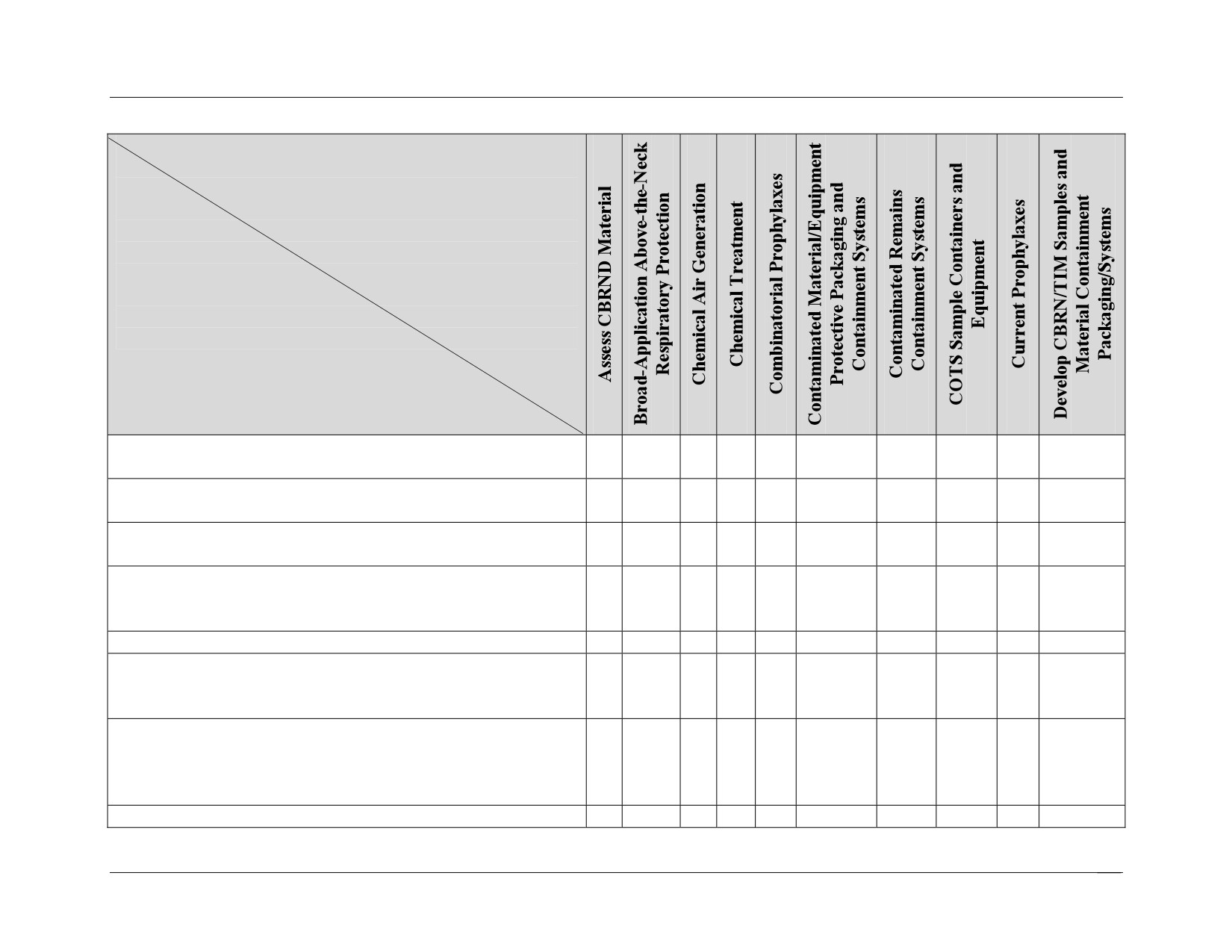
For Official Use Only
CBRND Functional Needs Analysis/Functional Solution Analysis
Chapter 13 Tactical Shield Tasks
Table 13.13-3. TASHLD 13: IMA Assessment
Ideas for Material
Approaches
(IMA)
Identified Gaps
MWDs are not equipped, trained, and prepared to survive a
X
X
X
X
X
X
CBRN/TIM environment.
CBRND protective equipment and measures do not protect
X
X
X
X
X
X
X
X
X
against all CBRN/TIM agents.
Medical prophylaxis does not exist for all threat CBRN/TIM
X
X
and TIM agents.
Prophylaxis against most high-threat TIMs are not currently
available due to the relatively recent consideration of these
X
X
agents as a potential threat.
Prophylaxis for MWA is virtually nonexistent.
X
X
Prior decontamination of exposed/contaminated remains is
the only identified means for protecting transportation assets
X
X
X
X
X
X
X
X
X
X
against secondary contamination.
Air transport is limited to tactical rotary-wing as a last resort.
Tactical and strategic fixed-wing is generally not considered
X
X
an acceptable means of transport. These are due to concerns
about asset contamination.
Protective containment systems are inadequate or nonexistent.
X
X
X
X
For Official Use Only
273
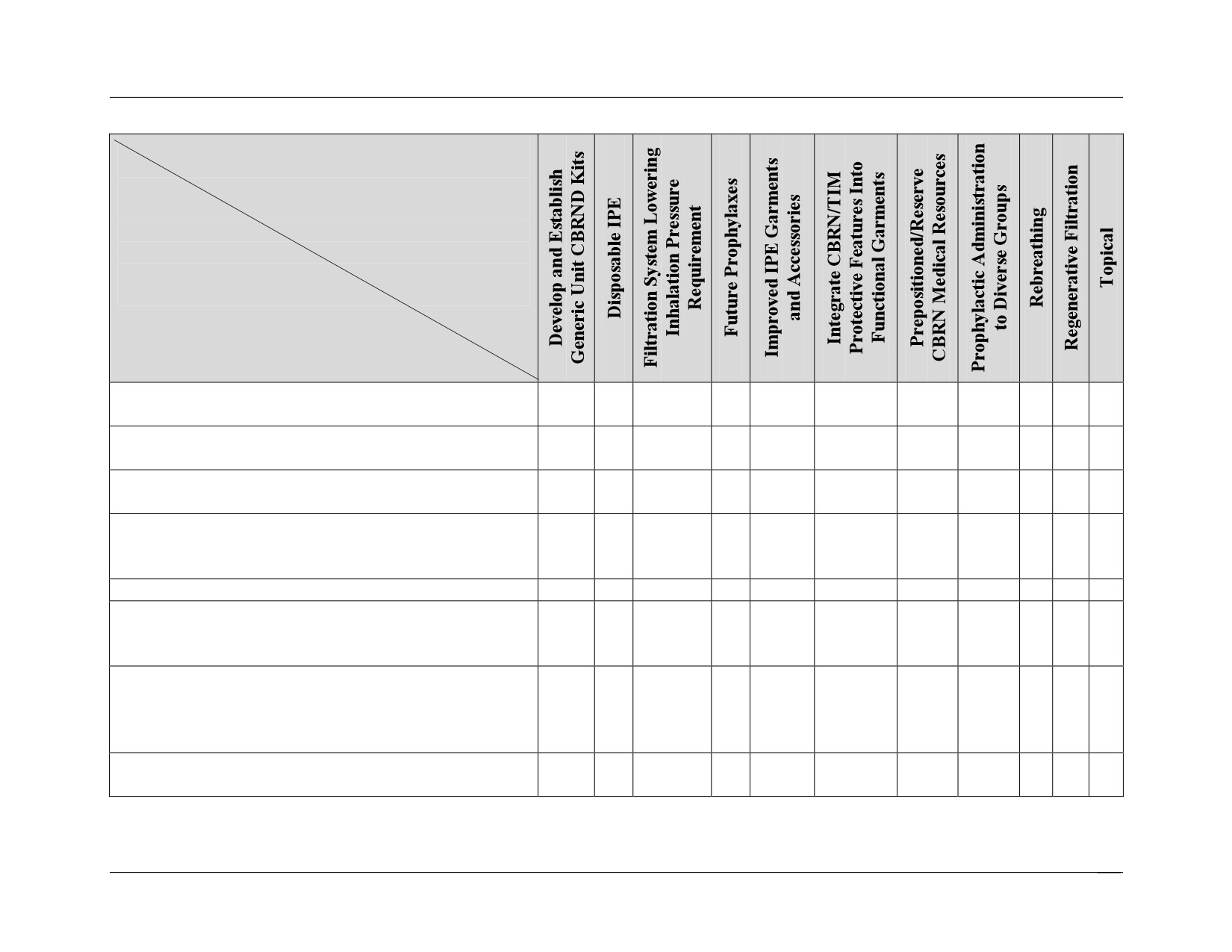
For Official Use Only
CBRND Functional Needs Analysis/Functional Solution Analysis
Chapter 13 Tactical Shield Tasks
Table 13.13-3. TASHLD 13: IMA Assessment (continued)
Ideas for Material
Approaches
(IMA)
Identified Gaps
MWDs are not equipped, trained, and prepared to
X
X
X
X
X
X
X
X
X
survive a CBRN/TIM environment
CBRND protective equipment and measures do not
X
X
X
X
X
X
X
X
X
X
X
protect against all CBRN/TIM agents
Medical prophylaxis does not exist for all threat
X
X
X
CBRN/TIM and TIM agents
Prophylaxis against most high-threat TIMs are not
currently available due to the relatively recent
X
X
X
consideration of these agents as a potential threat
Prophylaxis for MWA is virtually nonexistent
X
X
X
Prior decontamination of exposed/contaminated
remains is the only identified means for protecting
X
X
X
X
X
X
X
X
X
X
transportation assets against secondary contamination
Air transport is limited to tactical rotary-wing as a last
resort. Tactical and strategic fixed-wing is generally
X
X
X
not considered an acceptable means of transport.
These are due to concerns about asset contamination
Protective containment systems are inadequate or
X
X
X
nonexistent
For Official Use Only
274
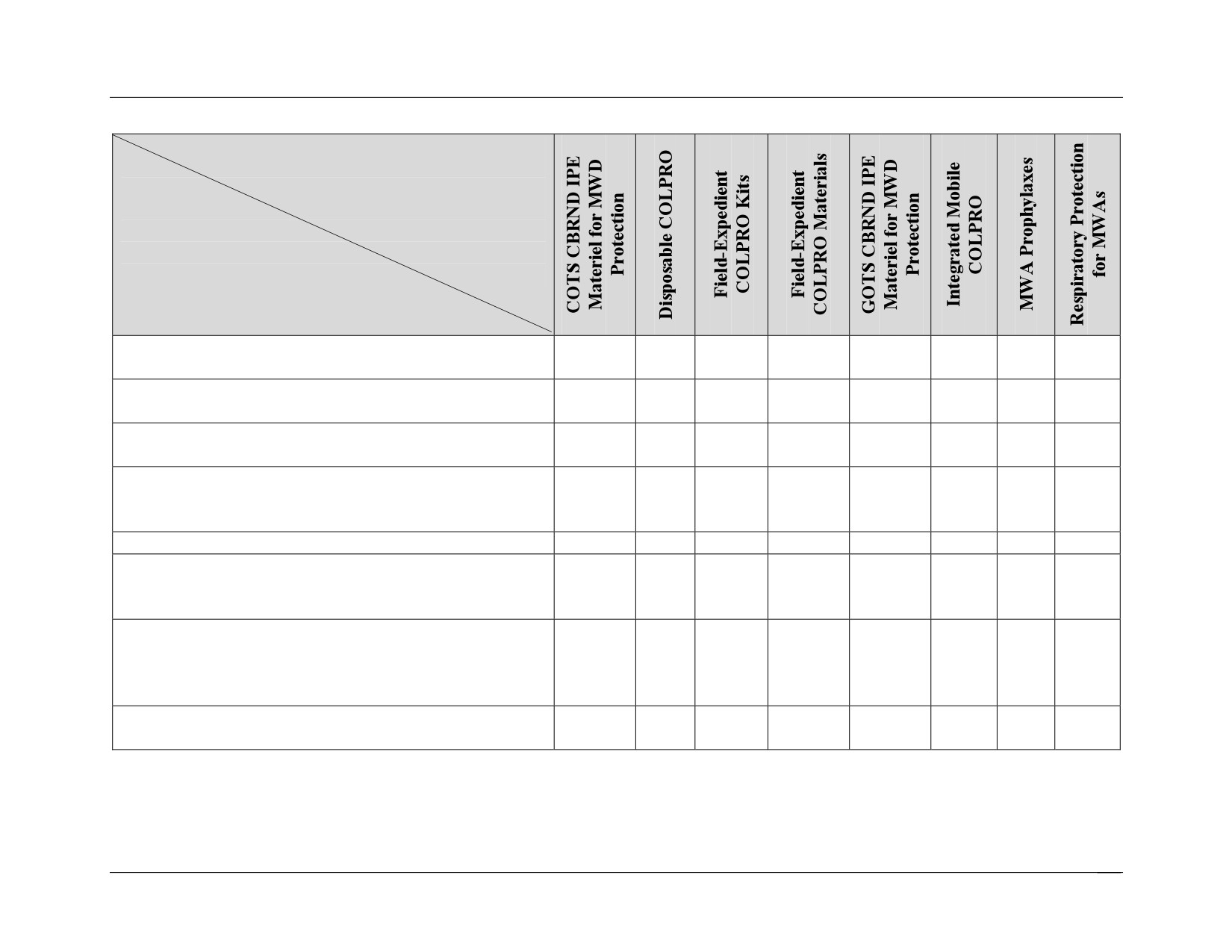
For Official Use Only
CBRND Functional Needs Analysis/Functional Solution Analysis
Chapter 13 Tactical Shield Tasks
Table 13.13-3. TASHLD 13: IMA Assessment (continued)
Ideas for Material
Approaches
(IMA)
Identified Gaps
MWDs are not equipped, trained, and prepared to
X
X
X
X
X
X
X
X
survive a CBRN/TIM environment.
CBRND protective equipment and measures do not
X
X
X
X
X
X
X
X
protect against all CBRN/TIM agents
Medical prophylaxis does not exist for all threat
X
CBRN/TIM and TIM agents.
Prophylaxis against most high-threat TIMs are not
currently available due to the relatively recent
X
consideration of these agents as a potential threat.
Prophylaxis for MWA is virtually nonexistent.
X
Prior decontamination of exposed/contaminated remains
is the only identified means for protecting transportation
X
X
X
X
assets against secondary contamination.
Air transport is limited to tactical rotary-wing as a last
resort. Tactical and strategic fixed-wing is generally not
X
X
X
X
considered an acceptable means of transport. These are
due to concerns about asset contamination.
Protective containment systems are inadequate or
X
X
nonexistent.
For Official Use Only
275
For Official Use Only
CBRND Functional Needs Analysis/Functional Solution Analysis
Chapter 13 Tactical Shield Tasks
13.14 Task TASHLD 14: Ensure containment of samples and residues to prevent spread
of contamination
13.14.1 Functional Area Analysis
13.14.1.1
Definition
Provides safe, efficient, and consistent collection and handling of all CBRN/TIM samples,
including those taken from personnel and MWAs following exposure. Samples and residues
must be identified, marked, segregated, transported, and handled to ensure no contamination is
inadvertently spread.
13.14.1.2
Derivation
Joint Enabling Concept for CBRN Operations, An Operational Concept for Biological Defense,
Protection Joint Functional Concept, UJTL (TA 7, TA 7.1).
13.14.1.2.1
Supported Task: N/A
13.14.1.2.2
Lateral Task: TASHA 24
13.14.1.2.3
Supporting Task: N/A
13.14.1.3
Condition
Perform this task under conditions of:
Physical
1. Undeveloped to highly developed land. (C1.1.1)
2. Riverine to open sea. (C1.2)
3. Natural and induced air. (C1.3)
4. Immediate to delayed danger, and potential long-term health hazard of atmospheric
weapons effects. (C1.3.3)
Military
1. Partially completed mission preparation. (C2.1.3)
2. Marginal forces. (C2.2)
3. Marginal to adequate forces allocated. (C2.2.3)
4. Negligible personnel experience. (C2.2.4.5)
5. Limited staff expertise. (C2.3.1.3)
6. Limited deployed supplies. (C2.8.2)
7. No prepositioned materiel. (C2.8.4)
For Official Use Only
276
For Official Use Only
CBRND Functional Needs Analysis/Functional Solution Analysis
Chapter 13 Tactical Shield Tasks
Civil. N/A
13.14.2 Functional Needs Analysis
13.14.2.1
Capability and Deficiency Assessment Summary
This task deals with ensuring the containment of samples and residues to prevent the spread of
contamination. It is concerned with the safe, efficient, and consistent collection and handling of
all CBRN/TIM samples. The overall capabilities for current, near/mid, and far term are rated
“yellow.” Although improvements between the periods occur for specific capabilities and are
reflected in the associated identified values, the improved capabilities are not sufficient to change
the overall assessed color ratings for this task.
Current Capability and Deficiency
Selected specialized functions and activities exist and are trained, equipped, and prepared to
perform these activities. They include field laboratory and medical services personnel, among
others. Specialized containment systems for the movement of hazardous samples and residues
for these functions and activities exist. However, these systems and materials are not available to
the force for application to reduce the potential for secondary exposure/contamination resulting
from retained contaminated assets or for the collection and transport of directed samples and
residues. This task covers the full spectrum of protective requirements of personnel and
resources involved in the collection, handling, storage, processing, and transport of potentially
contaminated/infectious samples and residues. Services currently field a variety of CBRND
assets providing respiratory/ocular and percutaneous protection. This diversity of assets
complicates the logistical support of operations with threat for joint operations. The assets
protect against known chemical and biological warfare agents and particulate radiologicals.
Protection is afforded to a select number of TIMs. Existing Service-specific IPE is limited on the
period and scope of protection afforded the warfighter. Physiological and psychological
encumbrances increase with prolonged wear. This tendency requires regular exercising and wear
to acclimate and adjust the wearer to enable performance of assigned functions and activities.
Medical barrier impermeable barrier protective assets may also be applied by Medical Services
practitioners potentially at-risk for contact with fluids. COTS assets may be applied meeting
requirements for the protection of personnel performing the handling and processing of high-risk
samples and materials. Medical prophylaxes do exist for the protection of the warfighter against
a limited number of biological and chemical agents. However, few are FDA approved. A number
possess IND authorization for application. Medications are considered for their potential
prophylactic value, but are not always approved for this purpose by the FDA. Not all threat
CBRN agents are addressed by CBRND medical countermeasures. Efficacy, time to achieve a
level of protection, and the number of administrations vary between prophylaxes. COTS
protective assets are applied for selected eligible civilians such as hazardous materials,
firefighters, EMS, etc. However, eligible civilians and MWAs are not adequately addressed by
DOTLPF for CBRND. Clear DOTLPF addressing the provisioning and training of eligible
civilians with CBRND is inadequate. MWAs are not afforded protection against the effects of
CBRN/TIM agents. MOPP DOTLPF is adequate for military personnel and operations. The
establishment of adjustable MOPP levels, reflective of local operations and threat, are well
For Official Use Only
277
For Official Use Only
CBRND Functional Needs Analysis/Functional Solution Analysis
Chapter 13 Tactical Shield Tasks
defined, as are continuing evaluation for change/adjustments. However, operations increasingly
involve U.S. and non-U.S. civilians. MOPP DOTLPF does not adequately address their presence
and inclusion into MOPP methodologies and levels, particularly when these personnel may (or
may not) be equipped with nonstandard IPE. DOTLPF does support the general movement and
transport of hazardous materials within the logistics system. DOTLPF incorporates requirements
detailed by the U.S. Department of Transportation (DOT), OSHA, and CDC regulations and
requirements. The correct packaging, containment, marking, and identification are dependent
upon notification and initial material/sample packaging/containment, marking, and identification
actions by the preparing activity. These personnel may, or may not, be trained in required
packaging, containment, handling, marking, and identification of collected material and samples.
DOTLPF incorporates requirements detailed by DOT, OSHA, and CDC regulations and
requirements. However, only primary duty personnel performing these functions are trained,
knowledgeable, and able to apply the standards. Primary duty personnel whose field does not
include these tasks in their specialty description may not be trained to perform these functions.
Training to recognize a potential hazard through identification of standard markings is not
provided to the general force. Training of augmentation and additional duty personnel to
accomplish these tasks is generally minimal and inadequate.
Projected Near/Mid-Term Capability and Deficiency
Future configurations focus on reducing psychological and physiological stresses associated with
the wearing of IPE, as well as striving for commonality of form factor among all services to
reducing the logistics burden, development cost, and improved availability. The JPACE, JSLIST,
JSAM, and JSGPM are projected to be initially fielded during the mid term. The JSLIST is under
review for NIOSH certification for compliance with OSHA protective standards. The
certification will permit application of the garment for AT/FP installation activities within
CONUS and selected OCONUS. The possibility exists for potential application by requiring
eligible civilians. Legacy Service-specific IPE will remain in the inventory throughout the mid
term and into the far term during the transition to the joint IPE systems. Ongoing R&D into
medical prophylaxes will provide additional prophylactic measures but still fail to address all
threat CBRN agents and high-threat/high risk TIMs (particularly TICs). Otherwise, changes from
current capabilities and deficiencies are not projected.
Projected Far-Term Capability and Deficiency
Future configurations focus upon reducing psychological and physiological stresses associated
with the wearing of IPE, as well as striving for commonality of form factor among all Services.
The standardization of CBRND respiratory/ocular and percutaneous protection which will reduce
the logistics burden and development cost and subsequently improve availability. Legacy
Service-specific IPE will continue to be replaced by the joint systems of CBRND protective
equipment until fielding is complete to all Service units, including Guard and Reserve, early in
the far term. Next-generation IPE assets are in R&D and are expected to be fielded sometime in
the far term. However, specifics of design, characteristics, and protective capabilities are not as
yet determined for these systems. Continued R&D into potential medical prophylaxes may result
in additional protective measures for the force. However, specifics are unknown at this time.
Additional changes in capabilities from the mid term are not projected.
For Official Use Only
278
For Official Use Only
CBRND Functional Needs Analysis/Functional Solution Analysis
Chapter 13 Tactical Shield Tasks
13.14.2.2
Resource Systems
Individual Protection
1.
Respiratory/Ocular Protection:
COTS: Commercially available systems of protection, manufactured and tested meeting
OSHA standards for the United States or equivalent organization in other nations.
M17 Series Masks w/M13 Series Filters: Obsolete warfighter system of protection. Retained
in selected HTAs for NEO application. Designed for adults.
MBU-19/P Chemical-Biological Aircrew Eye/Respiratory Protection (AERP): USAF
combat aircrew protection. Includes protective hood, MBU-12/P mask, C-2 canister,
intercom for ground communications, and blower assembly.
A/P22P-14(V) Respirator Assembly: USN/USMC system for rotary-wing (Version 1 for
USN) and fixed-wing (Versions 2-4 for USN/USMC) aircrews. Includes CB filter, dual
air/oxygen supply, and crossover manifold for dual protective capabilities in air or on
ground. Version 1 is not compatible with aircraft oxygen supply systems; Version 2
applied to EA-6B and F18A airframes; Version 3 to AV-8B and F-18C/D aircraft; and
Version 4 is used for C-130 airframes.
M40/M42 CB Protective Mask: U.S. Army mask system designed for military standard
profile and uses standard C-2 canister. M42 integrates with combat vehicle clean air
supply system and has a connectable dynamic microphone for combat vehicle intercom
system.
M43 CB Aircraft Mask: U.S. Army aircrew system, is a stand-alone portable system, and
uses motor blower unit with C-2 filter.
M45 Aircrew Aviator Mask: Replaces M42 and M49 systems for U.S. Army. Available with
a canister-compatible hose assembly and a valve cassette that enables use of supplied air
(from aircraft, SCBA or PAPR). The M45 is used by military personnel who cannot fit
the M40A1, M42A2, or MCU-2/P masks.
M48 CB Apache Aviator Mask: Used by Apache aviator and flight support personnel.
Replaces M43 Type 1 mask system and uses blower assembly with C-2 filter canister.
MCU-2A/P: Mainstay USAF and USN system for nonaviator personnel and aircrew
personnel not performing flight operations, except for aircrew personnel not issued
aviator systems and noncombat platforms/airframes without clean air supply systems.
Applies C-2 filter for filter air.
Joint Service Aviator Mask (JSAM): Initial fielding projected in the mid term replacing
Service-specific aviator respiratory/ocular protective systems. Provides CBRN protection
under high-G conditions, compatible with existing and projected aviator CBRN IPE,
flame and thermal protective, reduces stress associated with existing aviator IPE, and
may be donned/doffed during flight.
Joint Service General Purpose Mask (JSGPM): Initial fielding projected in the mid term
replacing Service-specific standard respiratory/ocular protective systems. Provides
respiratory/ocular protection from CBRN agents and selected TIMs. Improves field-of-
vision and encumbrances associated with existing Service systems.
For Official Use Only
279
For Official Use Only
CBRND Functional Needs Analysis/Functional Solution Analysis
Chapter 13 Tactical Shield Tasks
Joint Service Chemical Environment Survival Mask (JCESM): COTS one-time use, one-
size-fits-all, respiratory/ocular protective system affording two hours of protection in
low-level CBRN vapor, aerosol, and particulate environments. Selected force element
application only.
2.
Percutaneous Protection:
COTS: Commercially available systems of protection, manufactured and tested meeting
OSHA standards for the United States or equivalent organization in other nations.
Battle Dress Overgarment (BDO): U.S. Army/USAF two-piece camouflage-patterned
garment (top and trousers) providing 24-hour protection against CBRN agents in vapor,
liquid, droplet, and particulate forms.
Saratoga: USMC two-piece camouflage-patterned garment (top and trousers) providing 24-
hour protection against CBRN agents in vapor, liquid, droplet, and particulate forms.
Launderable for hygiene.
CPOG: Legacy two-piece green garment currently in use with USN providing limited-term
protection against CBRN agents in vapor, liquid, droplet, and particulate forms.
Chemical Protective Undergarment (CPU): Worn under standard IPE as additional layer of
protection against contact with CBRN agents.
CWU-66/P: One-piece USAF green flightsuit providing 24-hour protection against CBRN
agents in vapor, liquid, droplet, and particulate forms. Available in tan as CWU-77/P
flightsuit.
Disposal Aircrew Protective Cape: Transparent disposable cape covering head and shoulders
of aviator during periods between aircraft mounting/dismounting and shelter.
BVO/GVO: Vinyl overboots (VO) worn over wearer’s standard footwear and protects
against contact with CBRN agents. Available in black (BVO) and green (GVO).
Chemical Protective Footwear Cover (CPFC): Legacy system of CBRN protective footwear
cover in use by USN. Requires wearer to pull protective sole tabs up and wrap/tie laces
around cover to secure over footwear.
Disposable Aircrew Footwear Cover: Transparent disposable footwear covers worn over
aviator footwear to protect aviator during periods between aircraft mounting/dismounting
and shelter.
Chemical Protective Glove (CPG): Standard CBRN protective glove. Available in 7-, 14-,
and 25-mil thicknesses addressing functional requirements for durability, dexterity, and
tactile sensitivity.
Disposable Aircrew Hand Protection: Transparent disposable hand coverings applied by
USAF, USN, and USMC over aviator gloves during periods between aircraft
mounting/dismounting and shelter. Also applied as between aviator inner and outer
gloves enabling essential functional requirements for dexterity and tactile sensitivity.
Chemical Protective Helmet System (CPHS): CBRN protective camouflage-patterned
helmet cover to protect helmet from contact with CBRN contaminants.
SCALP: Disposable, lightweight, impermeable overgarment designed for wear over IPE for
additional protection in grossly contaminated environments. Applied by personnel
required to leave protective sheltering in these environments to perform mission-critical
tasks. Also applied by decontamination units/teams and medical personnel performing
decontamination or potentially at risk for prolonged contact with liquids.
For Official Use Only
280
For Official Use Only
CBRND Functional Needs Analysis/Functional Solution Analysis
Chapter 13 Tactical Shield Tasks
Wet-Weather Gear: Includes Severe-Weather Gear (USN). Provides barrier against contact
with liquids potentially damaging to protective abilities of IPE.
M-2 Apron: Butyl rubber-coated sleeved apron worn over IPE and applied by
decontamination units/teams and other designated personnel performing decontamination
or potentially at risk for contact with liquids. Provides barrier against contact with liquids
potentially damaging to protective abilities of IPE. Can be decontaminated.
Joint Service Lightweight Integrated Suit Technology (JSLIST): Two-piece (jacket and
trousers) CBRN risk-taking protective garment with integrated hood. Affords protection
against selected TIM agents. Reduces physiological and psychological encumbrances
associated with existing Service-specific systems it replaces with initial fielding in the
mid term. Under review for NIOSH certification for OSHA protection standards.
Joint Protective Aircrew Ensemble (JPACE): CBRN protective aviator flightsuit projected
for initial fielding in the mid term and replacing Service-specific CBRN protective
flightsuits. Provides JSLIST equivalent protection and provides protection when subject
to rotor, propeller, and jetwash. Flame-retardant and self-extinguishing properties.
Supports escape and evasion requirements.
Joint Block I/II Glove Upgrade (JB1/2GU): Projected fielding in near mid term replacing
CPG for designated force elements requiring increased tactility/durability for mission
performance. Various configurations under consideration.
Joint Firefighter Integrated Response Ensemble (JFIRE): Incorporates JSLIST into
firefighter bunker gear, permitting firefighters to conduct firefighting operations within a
CBRN/TIM environment.
Multi-purpose Overboot (MULO): Projected initial fielding in mid term and replacing
legacy CBRN footwear covers.
3.
Medical Protection:
Vaccines: Immunizations providing a level of acquired immunity against the effects of
CBRN agents.
Topicals: Protective barrier products applied to the skin to enhance protection of wear
against contact with CBRN/TIM agents. Includes both inert and reactive materials.
Medications: Medical materials taken to mitigate or prevent the effects of exposure to
CBRN/TIM agents. Includes medications taken routinely or upon exposure (but prior to
symptom display) to build resistance/immunity or to mitigate/resolve medical impacts of
CBRN/TIM agent exposure/contamination.
MOPP Methodology: Stepped level of CBRND protective measures. Standardized levels permit
the rapid increase or decrease of unit MOPP level.
Unit Staff: The application of DOTLPF for all phases of operations with threat from preplanning
to post-force return to home stations. Includes all aspects of C2 and supporting staff activities/
functions (e.g., logistics, intelligence, etc.) enabling mission and task accomplishment.
For Official Use Only
281
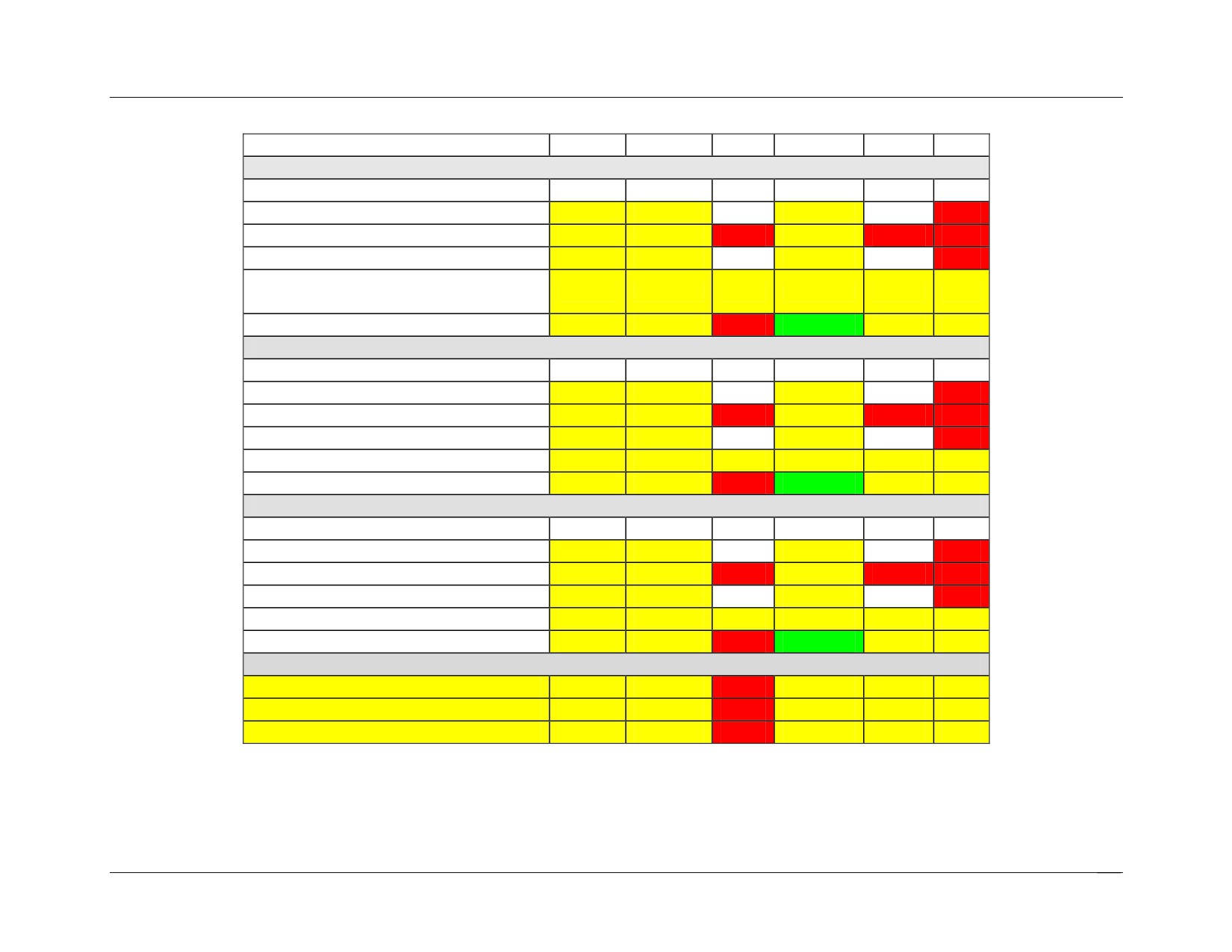
For Official Use Only
CBRND Functional Needs Analysis/Functional Solution Analysis
Chapter 13 Tactical Shield Tasks
Table 13.14-1. TASHLD 14: Capability and Deficiency Assessment
System/Measure
M1
M2
M3
M4
M5
M6
Current
Individual Protection
4.7
4.7
2
4.7
2
3
Respiratory/Ocular Protection
51
51,2
N/A
51,2
N/A
33
Percutaneous Protection
54
52,4
25
52,4
25
33
Medical Protection
46
46
N/A
46
N/A
33
Mission-Oriented Protective Posture
47
57
47
47
57
57
(MOPP) Methodology
Unit Staff
58
48
38
88
6 8
68
Near/Mid
Individual Protection
5.3
5.3
2
5.3
2
3
Respiratory/Ocular Protection
61,9
61,2,9
N/A
61,2,9
N/A
X3
Percutaneous Protection
64,10
62,4,10
25
62,4,10
25
X3
Medical Protection
46,11
46,11
N/A
46,11
N/A
X3
MOPP
47
57
47
47
57
57
Unit Staff
58
48
3 8
8 8
68
68
Far
Individual Protection
5.3
5.3
2
5.3
2
3
1, 9,12
1,2,9,12
Respiratory/Ocular Protection
6
61,2,9,12
N/A
6
N/A
X3
2,4,10,13
Percutaneous Protection
64,10,13
62,4,10,13
25
6
25
X3
Medical Protection
46,11,14
46,11,14
N/A
46,11,14
N/A
X3
MOPP
47
57
47
47
57
57
Unit Staff
5 8
4 8
3 8
8 8
68
68
Overall
Current Overall Capability
5
5
3
6
4
5
Near/Mid-Term Overall Capability
5
5
3
6
4
5
Far-Term Overall Capability
5
5
3
6
4
5
For Official Use Only
282
For Official Use Only
CBRND Functional Needs Analysis/Functional Solution Analysis
Chapter 13 Tactical Shield Tasks
FAA Measure
Scale
M1
Forces are trained on
8-10: Forces are trained on the application of protective barrier materials and assets, identification and marking,
hazards associated with
associated hazards, and the safe handling and transport of CBRN/TIM samples and material.
CBRN/TIM samples and
4-7: Personnel assigned specific functions are trained on the application of protective barrier materials and assets,
materials.
identification and marking, associated hazards, and the safe handling and transport of CBRN/TIM samples and material.
1-3: Primary duty personnel assigned specific functions are trained on the application of protective barrier materials and
assets, identification and marking, associated hazards, and the safe handling and transport of CBRN/TIM samples and
material.
0: Personnel are not trained on the application of protective barrier materials and assets, identification and marking,
associated hazards, and the safe handling and transport of CBRN/TIM samples and material.
M2
Specific designated
8-10: Force activities and functions with responsibilities to prepare, store, handle, transport, or in any manner may be in
personnel/teams are trained
proximity to or contact with CBRN/TIM samples and materials (contained and uncontained) maintain designated and
to handle samples.
fully trained, equipped, and prepared teams/personnel for the safe conduct of their responsibilities and duties.
4-7: Force activities and functions with responsibilities to prepare, store, handle, transport, or in any manner may be in
proximity to or contact with CBRN/TIM samples and materials (contained and uncontained) maintain designated, trained,
and equipped teams/personnel for the safe conduct of their responsibilities and duties
1-3: Force activities and functions with responsibilities to prepare, store, handle, transport, or in any manner may be in
proximity to or contact with CBRN/TIM samples and materials (contained and uncontained) maintain designated trained
individuals with augmenting unit personnel drawn upon need, and equipment for the accomplishment of essential related
activities.
0: Force activities and functions possessing the potential for contact with or proximity to CBRN/TIM samples and
materials (contained and uncontained) do not maintain trained designated personnel and equipment for the safe
accomplishment of their tasks.
M3
CBRN/TIM protective
8-10: Adequate types and quantities of effective CBRN/TIM material protective packaging and containment resources
packaging materials (e.g.,
are readily available to the force for the packaging and containment of CBRN/TIM samples and materials and to preclude
wraps, envelopes, bags, etc.)
the potential for secondary contamination/exposure of handling, storing, and transporting resources/activities.
are available to wrap or
4-7: CBRN/TIM material protective packaging and containment resources are readily available to selected force
otherwise contain
elements for the packaging and containment of CBRN/TIM samples and materials to prevent secondary contamination/
CBRN/TIM samples and
exposure of handling and transporting resources/activities.
materials to prevent
1-3: Selected force elements possess access to CBRN/TIM material protective packaging and containment resources for
secondary
CBRN/TIM samples and materials reducing the potential for secondary contamination/exposure of handling and
contamination/exposure.
transporting resources/activities.
0: CBRN/TIM material protective packaging and containment resources do not exist for the safe handling and transport
of CBRN/TIM samples and materials.
For Official Use Only
283
For Official Use Only
CBRND Functional Needs Analysis/Functional Solution Analysis
Chapter 13 Tactical Shield Tasks
M4
Procedures detail the
8-10: Doctrine, policy, procedures, TTPs, and processes provide detailed requirements and guidance for the
handling and processing of
identification, accounting, packaging, containment, monitoring, protective equipment, and associated actions for the safe
CBRN/TIM samples and
handling and processing of CBRN/TIM samples and materials.
materials.
4-7: Doctrine, policy, procedures, TTPs, and processes provide general requirements and guidance for the identification,
accounting, packaging, containment, monitoring, protective equipment, and associated actions for the safe handling and
processing of CBRN/TIM samples and materials.
1-3: Doctrine, policy, procedures, TTPs, and processes provide limited guidance for the identification, accounting,
packaging, containment, monitoring, protective equipment, and associated actions for the safe handling and processing of
CBRN/TIM samples and materials.
0: Doctrine, policy, procedures, TTPs, and processes do not address the identification, accounting, packaging,
containment, monitoring, protective equipment, and associated actions for the safe handling and processing of CBRN/
TIM samples and materials.
M5
CBRN/TIM protective
8-10: CBRN/TIM protective barrier movement and storage materials (e.g., packaging, containers, etc.) are readily
packages and containers are
available for the safe movement of hazardous or contaminated material and samples.
available to safely package
4-7: CBRN/TIM protective barrier movement and storage materials (e.g., packaging, containers, etc.) are available for
and contain CBRN/TIM
the movement of selected material and samples.
samples and materials for
1-3: Limited CBRN/TIM protective barrier and storage materials (e.g., packaging, containers, etc.) are available for the
safe handling and transport.
movement of specific material and samples.
0: CBRN/TIM protective barrier and storage materials (e.g., packaging, containers, etc.) are nonexistent.
M6
There is effective
8-10: DOTLPF exists and is adequate for this task. Task can be effectively performed with little or no direct impact upon
DOTMLPF in place to
operations
conduct task.
4-7: Most critical aspects of DOTLPF for this task are addressed. Task can be performed with limitations requiring work-
arounds.
1-3: DOTLPF is inadequate for accomplishment of this task.
0: DOTLPF does not exist for this task.
1 CBRND IPE is currently Service-specific. Respiratory/ocular protection is diverse across the Services and performed functions. USAF combat aircrews conduction operations
within a CBRN environment are equipped with the MBU-19/P Chemical-Biological AERP that includes protective hood, MBU-12/P mask, C-2 filter canister, an intercom for
ground communications, and a blower assembly. The AERP provides protection whether or not supplemental oxygen is present. USN and USMC aviators use the A/P22P-14(V)
Respirator Assembly that is a self-contained protective system deployed for rotary-wing (Version 1 for USN) and fixed-wing (Versions 2-4 for USN and USMC) aircrews. The
system incorporates a CB filter, dual air/oxygen supply, and a crossover manifold with dual protective capabilities for flight and ground protection. The A/P 22P-14(V) 1 is not
compatible with aircraft with oxygen delivery systems and supports helicopter crew use. Version 2 is used for the EA-6B and F-18A, Version 3 for AV-8B and F-18C/D, and
Version 4 is applied for C-130 aircrews. The M17 series mask is obsolete and is relegated to NEO support in selected HTAs. The mask is designed for the military standard profile
(ground) and does not adequately protect all potential nonmilitary populace members, for which is retained. The M40/M42 CB Protective Mask is in service with the U.S. Army.
The mask uses the C-2 canister for filtration of CBRN contaminants. The M42 integrates with combat vehicle filtration protection system and has a dynamic microphone with
cable for connection to vehicle communications systems. The M43 CB Aircraft Mask is applied by U.S. Army aircrew members and applies a motor blower unit with C-2 canister
for filtration. The system is a stand-alone system that accompanies the user. The M45 Aircrew Aviator Mask replaced the U.S. Army M43 Type II and M49 Mask Systems. The
system uses a low-profile canister compatible hose assembly for both hose and face-mounted configurations. The mask system incorporates selectable filtration for support both
during aircraft systems activation and using the connectable filter pack. The mask also is applied to personnel who cannot be fitted with the standard M40A1, M42A2, or MCU-
2A/P masks. The M48 CB Apache Aviator Mask protects AH-64 Apache helicopter aviators and flight support personnel. The blower assembly uses the C-2 filter canister to
provide filtered, breathable air. The M-48 replaces the M43 Type 1 mask. The MCU-2A/P is the mainstay USAF and USN mask employed by personnel not equipped with aircrew
For Official Use Only
284
For Official Use Only
CBRND Functional Needs Analysis/Functional Solution Analysis
Chapter 13 Tactical Shield Tasks
masks and by aircrew when not performing flight operations. The MCU-2A/P is also used by aircrew during flight operations who are not equipped with aircrew masks. COTS
equipment meeting OSHA requirements (and NFPA for firefighters) is applied by selected civilian personnel performing specific functions such as firefighting, EMS, hazardous
materials, etc. Limited quantities of COTS may be available within HTAs for known NEO requirements for the protection of populace members unable to wear the M17 series or
standard warfighter respiratory/ocular protective devices. MWAs are not afforded respiratory/ocular protection.
2 COTS assets may be applied meeting requirements for the protection of personnel performing the handling and processing of high-risk samples and materials.
3 DOTLPF does adequately address the requirement for individual protection (including application of CBRN medical prophylaxis when appropriate and available) whenever there
is a potential for secondary exposure or contamination. DOTLPF does address, for select specialized functions and activities, the application of specialized COTS individual
protection when handling and preparing certain high-risk category samples and materials. However, DOTLPF is inadequate for the protective packaging and containment systems
for enclosing and containing potential hazards associated with the contained samples and material throughout the line of communications process (includes handling, storing,
transporting, etc.).
4 Service-specific CBRND percutaneous protection is currently applied for the protection of the force. The BDO, used by the USAF and U.S. Army, is a two-piece garment
providing protection for a 24-hour period against chemical agent vapors, liquids, and droplets; biological agents and toxins and contact with radioactive particles. The BDO’s
protective abilities are lost if the suit is torn, ripped, splashed with POL, or is saturated with water and is designed for a one-time use and is worn by ground and most flight
personnel (non-high-performance aircraft). The USMC uses the Saratoga COLPRO suit similar in design to the BDO, but launderable for personnel hygiene. The CPOG is a
legacy two-piece garment for protection against CBRN agents. The CPOG is in use with the USN. The CPU is designed to provide an additional layer of protection for the
warfighter and is worn under standard IPE. The USAF CWU-66/P (and 77/P) is a one-piece flightsuit providing protection for a 24-hour period against standard CBRN agents and
is designed for compatibility with aircrew lift support equipment. The USN, USAF, and USMC use the disposable aircrew protective cape to protect aircrew between sheltering
and the combat aircraft. The cape drapes over the wearer and is removed during entry into the aircraft to prevent transfer of contamination into the aircraft interior. The BVO/GVO
overboots are applied over the wearer’s standard footwear to protect against contact with CBRND. The USN uses the CPFC, commonly called the “fishtail” for its design, to
protect the wearer’s footwear. The CPFC, considered obsolete, does provide a measure of antislip protection shipboard. The disposable aircrew boot cover is worn by USAF, USN,
and USMC aviators over aircrew footwear while en route and mounting combat aircraft. The covers are removed during aircraft entry and are designed to prevent contamination
transfer into the aircraft. Hand protection is provided by the CPG in 7-, 14-, and 25-mil thicknesses to meet warfighter hand protection and dexterity needs. Disposable aircrew
hand protection is applied by the USAF, USMC, and USN for aviators over their gloves (and may be worn between glove layers for additional protection) during movement
between shelter and aircraft. When used as an overglove, the gloves are removed during aircraft mounting during aircraft entry to preclude the potential for transfer of
contamination into the aircraft interior. Medical Services practitioners performing treatment The CPHS is designed to prevent contact of the warfighter’s helmet with liquid
contamination which may be absorbed, impact helmet integrity, and/or constitute a potential secondary hazard to the wearer. SCALP provides a disposable, lightweight,
impermeable layer of protection for personnel against gross liquid contamination and is worn over the warfighter’s protective ensemble. SCALP is commonly applied to protect
armor and EOD personnel who may be required to leave sheltering to perform duties and functions. SCALP is also applied by units performing decontamination operations where
personnel may become soaked by decontaminants and Medical Services personnel with potential for prolonged contact with body fluids. Standard wet-weather gear (e.g., poncho,
rain parka, rain suit, etc.) is also applied as a barrier against saturation of the warfighter’s protective ensemble by contact with liquids such as rain, sea spray, etc. The M-2 apron is
applied by personnel performing decontamination aprons and is worn over the ensemble. The apron is full length and sleeve to maximize coverage, although the back is open.
COTS assets meeting OSHA requirements (and NFPA for firefighters) is applied by selected civilian personnel performing specific functions such as firefighting, EMS, hazardous
materials, etc. Medical barrier impermeable barrier protective assets may also be applied by Medical Services practitioners potentially at risk for contact with fluids.
5 COTS assets may be applied for the containment of these samples for shipment. However, these are not identified for use by other than specialized functions and teams.
Otherwise, containment and packaging systems to preclude the potential for secondary exposure/contamination of resources are not addressed in DOTLPF and are not identified
and available for force use.
6 Forces are not protected against all identified threat CBRN/TIM capabilities. Medical prophylaxis does not exist for all threat CBRN/TIM agents. Current prophylaxis and
supporting doctrine, policy, and procedures do not address presymptomatic medical CBRND protective countermeasures by other than U.S. forces, excluding MWAs and eligible
civilians. Prophylaxis against most high-threat TIMs are not currently available due to the relatively recent consideration of these agents as a potential threat. Additionally, the
efficacy of existing prophylaxis, particularly vaccines, widely varies. Military personnel are administered and/or issued CBRND medical countermeasures for operations with
threat. Vaccines for selected biological agents, topicals, and preexposure and/or post-exposure/presymptomatic medications are applied to mitigate or preclude the effects of
specific CBRN/TIM agents. Currently, preexposure prophylaxis is available for nerve agents ( G and V series), and vesicants (H, HD, HN, L, CX), topical only. SERPACWA is
the preexposure countermeasure for vesicants and one nerve agent. TSP is approved by the FDA as a supplement for SERPACWA. Post-exposure prophylaxis is available for
For Official Use Only
285
For Official Use Only
CBRND Functional Needs Analysis/Functional Solution Analysis
Chapter 13 Tactical Shield Tasks
pulmonary (CG) agent, but is not FDA approved. Radioprotective steroids and neutraceuticals may be effective as pre- and post-exposure prophylactics. 5-androstenediol is an
IND preexposure treatment for radiological exposure. Iodide/potassium iodide is FDA approved for application against Iodine 131, 132, 134, and 135. Post-exposure radiological
exposure prophylaxis consists of neutraceuticals, plant isoflavone genistein, and alpha tocopherol (Vitamin E) but are not approved by the FDA for prophylaxis against radiation.
FDA-approved preexposure medical countermeasures are available for anthrax, cholera, HFRS (Haantan), Rift Valley fever, yellow fever, HFRS (Haantan), and smallpox. IND
status vaccines are currently available for Q-fever, tularemia (although use has been placed on hold by the FDA), Botulinum, Junin hemorrhagic fever, and VEE/WEE/EEE.
Antiviral/bacterial medications may be administered and/or issued to provide a level of protection against biological agents. Medical prophylaxes are developed for the military
force. Prophylaxes for MWAs are virtually nonexistent. Prophylaxis for eligible civilians is not addressed. Availability of prophylaxis is questionable for issue and administration
to eligible civilians. The issue and administration of prophylaxis to eligible civilians requires review due to questions regarding applicability to the range of body types, ages, and
physical/medical factors inherent within a potential population, as well as long-term health issues and legal implications.
7 DOTLPF incorporate MOPP levels, methodologies, and requirements and require levels of protection readiness based upon the potential for exposure/contamination (including
secondary). Full protection is required in the presence of contamination. This includes protective measures and the wear of protective equipment when the possibility exists for
secondary exposure/ contamination to personnel and equipment, such as the processing, handling, and movement of CBRN/TIM samples and materials. MOPP levels and
methodologies are generally considered to apply to equipped nonmilitary personnel. Nonmilitary personnel often perform tasks associated with these activities. DOTLPF does not
address the application of MOPP to nonmilitary personnel.
8 Specialized activities, including medical, are identified for the collection, handling, and processing of hazardous materials and samples. These include, but are not limited to,
activities such as laboratory, hazardous materials, forensics, evidentiary, Technical Escort Units (TEUs), selected R&D, and similar designated functions and activities. Units with
these responsibilities designate, train, and equip these functions and activities to perform their tasks. Planning, resource identification, preparations, and operations are performed
by the responsible unit command/Medical Services staff for taskings related to operations with threat. DOTLPF for these specialized functions and activities is adequate to support
their operations. Specific resources are applied and are often limited in availability and type. Medical Services DOTLPF provides specific instructions and detailed training for
most activities, predominantly those performed routinely. However, other functions and activities potentially performing sample and detection activities, particularly those related
to operations involving local events of a possible criminal nature or when directed by proper authorities, are often not prepared, trained, and equipped to perform these functions.
DOTLPF does support the general movement and transport of hazardous materials within the logistics system. Training standards exist for primary duty personnel performing
cargo movement activities. However, primary packaging and safe containment of hazardous material and samples is the responsibility of the initiating activity (e.g., TEUs,
Medical, CBRN/TIM survey and sampling, field laboratories, etc.). The correct packaging, containment, marking, and identification is dependent upon notification and initial
material/sample packaging/containment, marking, and identification actions by the preparing activity. These personnel may or may not be trained in required packaging,
containment, handling, marking, and identification of collected material and samples. DOTLPF incorporates requirements detailed by DOT, OSHA, and CDC regulations and
requirements. However, only primary duty personnel performing these functions are trained, knowledgeable, and able to apply the standards. Primary duty personnel whose field
does not include these tasks in their specialty description may not be trained to perform these functions. Specialized packaging and containment materials are generally available
for designated specialized functions and activities whose primary function includes the preparation of these materials for safe handling and transport. These assets are specialized,
limited in availability, and not generally available to other functions and activities with potential need. Training to recognize a potential hazard through identification of standard
markings is not provided to the general force. Training of augmentation and additional duty personnel to accomplish these tasks is generally minimal and inadequate.
9 Legacy systems will remain in the inventory throughout the mid term. These systems will be gradually replaced by new joint systems of respiratory/ocular protection as they are
fielded. The JSAM replaces the Service-specific systems. When incorporated with anti-G protection of high-performance aircraft aviators, the JSAM will provide simultaneous
CBRN and anti-G protection. The JSAM is compatible with existing and programmed CBRN IPE, provides flame and thermal protection, and reduces the heat stress associated
with existing systems of ocular/respiratory protection. Further, the JSAM may be donned and doffed during flight. The JSGPM also replaces current Service-specific
ocular/respiratory protection. The system provides respiratory and ocular protection from CBRN agents and selected TIMs. The field-of-vision is improved and encumbrances
associated with legacy systems are reduced. The JSGPM incorporates state of the art technology and is designed to integrate with future warfighter CBRND IPE and function
equipment/assets. The JCESM is a COTS one-time use, one-size-fits-all, respiratory/ocular protective system affording 2 hours of protection and is lightweight and disposable. The
system is designed to provide low-level CBRN vapor, aerosol, and particulate protection to the wearer for egressing the contaminated environment. The JCESM is projected for
use when standard respiratory/ocular protection is not practical. The JCESM is not programmed for general dissemination. The Guardian Program is projected to review, assess,
and implement protection for critical members of the installation/facility populace during the mid term. This will predominantly be COTS-based assets for respiratory/ocular
protection. However, the Guardian Program is not expected to address eligible civilian protection within the AO for other than existing U.S. military installations and facilities.
MWA respiratory/ocular protection is not programmed or forecasted.
For Official Use Only
286
For Official Use Only
CBRND Functional Needs Analysis/Functional Solution Analysis
Chapter 13 Tactical Shield Tasks
10 Legacy systems will remain in the inventory throughout the mid term. These systems will be gradually replaced by new joint systems of percutaneous protection as they are
fielded. The JSLIST NBC Protective Garment is a two-piece, risk-taking, overgarment with integrated hood affording protection against CBRN agents and selected TIMs. The
garment reduces the physiological and psychological encumbrances associated with legacy systems. The JSLIST is under evaluation by NIOSH for application to OSHA
protection requirements. The JPACE replaces the Service-specific systems. The JPACE provides aircrew members with equivalent protection to the JSLIST ensemble. The JPACE
is designed to not interfere with emergency ejection from a combat aircraft and continues to provide CBRN percutaneous protection following ejection and during escape and
evasion operations. The ensemble is both flame-retardant and self-extinguishing to permit emergency egress from a burning aircraft. Further, the ensemble provides CBRN
protection when subject to rotor, propeller, and jet wash. Joint Service glove upgrades are provided under the Joint Block 1 and 2 Glove Upgrade Program (JB1/2GU) in the near
and mid term. The JB1GU responds to an urgent need by designated elements of the force for increased tactility/durability supporting mission requirements. The JFIRE addresses
protection of military firefighters within a CBRN/TIM environment conducting firefighting operations involving structural and crash/firefighting/rescue. The JFIRE incorporates
the JSLIST into firefighter bunker gear. The JB1GU is expected to meet most of the requirements within the JSLIST ORD and is viewed as an evolutionary approach in the
development of the JB2GU. Versions under consideration include a protective inner glove worn under existing warfighter gloves, a replacement glove for existing hand wear, or a
combination of glove shell and liner affording CBRN protection of the legacy gloves they are projected to replace. The MULO is projected to replace legacy footwear covers. The
ability of the MULO to provide adequate antislip protection for USN personnel asea is under review. The Guardian Program is projected to review, assess, and implement
protection for critical members of the installation/facility populace during the mid term. This will predominantly be COTS-based assets for percutaneous protection. However, the
Guardian Program is not expected to address eligible civilian protection within the AO for other than existing U.S. military installations and facilities. MWA percutaneous
protection is not programmed or forecasted.
11 Cell Culture Derived Vaccinia is projected for production during the near-term. Clostridium Botulinum Toxin Medical Defense System is projected for availability during the
mid term for Serotypes A, B, C, E, and F. The SERPACWA Active TSP is also projected for production during the late mid term.
12 The next-generation series of aviator and nonaviator masks is in R&D. The capabilities and fielding of these masks are not as yet determined.
13 The next-generation series of aviator and nonaviator percutaneous protective assets are in R&D. The capabilities and fielding of these assets are not as yet determined.
14 Active TSPs are projected for replacement of SERPACWA TSP and SERPACWA Active TSP in the far term. The Chemical Agent Prophylaxis and Cyanide Pretreatment are
also projected for the far term. The Multivalent VEE Vaccine is projected to begin production in FY2013. The Next-Generation Anthrax Vaccine, Tularemia Vaccine, and Plague
Vaccine are projected for production beginning in FY2010. Serotypes A and B are addressed in the Recombinant Bivalent Botulinum Vaccine projected for production in FY2012.
A number of R&D efforts are under way for the development of preexposure and post-exposure prophylaxes. Potentially, these efforts may produce viable prophylaxes within the
mid and far term resulting in fielded material. However, possible resulting prophylaxes cannot be predicted at this time.
For Official Use Only
287
For Official Use Only
CBRND Functional Needs Analysis/Functional Solution Analysis
Chapter 13 Tactical Shield Tasks
13.14.3
Functional Solution Analysis
13.14.3.1
DOTLPF Assessment Summary
This section addresses the deficiencies and suggests potential non-materiel solutions. If there are
no non-materiel solutions, or they are only partial solutions, the remaining non-materiel need is
then stated. Materiel needs are assessed in the IMA section.
1.
Deficiency: CBRN/TIM protective packagings are limited or not identified for other than
specialized functions.
Partial Non-Materiel Solutions: Doctrine: Include the application of CBRN/TIM
containment packaging/systems designed to contain contamination and prevent secondary
exposure/contamination during handling, storage, and transport. Organization: Identify
organizational resources and support requirements for the application of CBRN/TIM
containment packaging/systems. Training: Train, exercise, and evaluate the application of
CBRN/TIM containment packaging/systems. Leadership: Implement and manage training,
equipping, protective measures, and exercising for the safe application of CBRN/TIM
containment packaging/systems.
2.
Deficiency: Movement of CBRN/TIM contaminated material is generally limited initially to
tactical ground transport. Air transport (tactical rotary-wing) is a last resort due to concerns
about asset contamination. Tactical and strategic fixed-wing air transport is not considered an
acceptable means of transport.
Partial Non-Materiel Solutions: Doctrine: Include the application of CBRN/TIM
containment packaging/systems and other alternative methods to preclude secondary
exposure/contamination in doctrine, policy, and procedures. Training: Train, exercise, and
evaluate the application of CBRN/TIM containment packaging/systems and other
alternatives precluding secondary exposure/contamination. Leadership: Implement and
manage training, equipping, protective measures, and exercising for the safe application of
CBRN/TIM containment packaging/systems and other alternatives to contain contamination
and preclude secondary exposure/contamination.
3.
Deficiency: CBRND protective equipment and measures do not protect against all CBRN/
TIM agents.
Partial Non-Materiel Solutions: Doctrine: Requirement for development of CBRND
protective equipment and measures to protect against all CBRN/TIM agents, particularly
high-risk/high-threat agents. Leadership: Enforce compliance with established standards (see
Doctrine) for prophylactic CBRND protection.
4.
Deficiency: Medical prophylaxis does not exist for all threat CBRN/TIM and TIM agents.
Partial Non-Materiel Solutions: Doctrine: Establish in doctrine, policy, and procedures the
application of standards for prophylactic CBRND protection against all threat agents.
Training: Train, exercise, and evaluate personnel (military and eligible civilians) on the use
of prophylactic CBRND protection against threat agents. Leadership: Enforce compliance
with established standards (see Doctrine) for prophylactic CBRND protection. Implement
and ensure training is adequate and conduct exercises and evaluations to ensure readiness.
For Official Use Only
288
For Official Use Only
CBRND Functional Needs Analysis/Functional Solution Analysis
Chapter 13 Tactical Shield Tasks
5.
Deficiency: Current prophylaxes and supporting DOTLPF do not address presymptomatic
medical CBRND protective countermeasures for eligible civilians and non-U.S. forces.
Non-Materiel Solutions: Doctrine: Establish in doctrine, policy, and TTPs guidance and
instructions for the application of presymptomatic medical CBRND protective
countermeasures for eligible civilians and non-U.S. forces. Organization: Ensure resources,
taskings, and staff are in place or available to plan, disseminate/administer, and monitor
presymptomatic medical CBRND protective countermeasures for eligible civilians and non-
U.S. forces. Training: Train, potential eligible civilians and non-U.S. forces on
presymptomatic medical CBRND protective countermeasures. Leadership: Recognize
criticality of protection of eligible civilians and non-U.S. forces within a CBRN/TIM
environment, training providing the skills to manage the force in these circumstances, and
willingness and ability to implement necessary changes and activities to prepare and
appropriately apply force resources. Facilities: Develop supporting infrastructure to support
presymptomatic medical CBRND protective countermeasures of eligible civilians and non-
U.S. forces.
6.
Deficiency: Current prophylaxes and supporting DOTLPF do not address presymptomatic
medical CBRND protective countermeasures for MWAs.
Non-Materiel Solutions: Doctrine: Establish in doctrine, policy, and TTPs guidance and
instructions for the application of presymptomatic medical CBRND protective
countermeasures for MWAs. Organization: Ensure resources, taskings, and staff are in place
or available to plan, disseminate/administer, and monitor presymptomatic medical CBRND
protective countermeasures for MWAs. Training: Train potential MWA handlers on
presymptomatic medical CBRND protective countermeasures. Leadership: Recognize
criticality of protection of MWAs within a CBRN/TIM environment, training providing the
skills to manage the force in these circumstances, and willingness and ability to implement
necessary changes and activities to prepare and appropriately apply force resources.
Facilities: Develop supporting infrastructure to support presymptomatic medical CBRND
protective countermeasures of MWAs.
7.
Deficiency: Efficacy of existing prophylaxes varies widely.
Non-Materiel Solutions: Doctrine: Establish overarching single common standard for
prophylaxes efficacy.
8.
Deficiency: Not all prophylaxes are FDA approved.
Non-Materiel Solutions: Doctrine: Require FDA approval of all prophylaxes, including
medications potentially applied as prophylaxes. The latter requires specific approval as
prophylactic treatment.
9.
Deficiency: Prophylaxis for MWA is virtually nonexistent.
Partial Non-Materiel Solutions: Doctrine: Establish doctrine, policy, and procedures
CBRND protection of MWAs, particularly MWDs, and training for CBRN/TIM environment
survival. Organization: Ensure organizational consideration for maintenance and support of
MWD CBRND protective equipment, measures, and activities. Training: Establish
institutional and unit training of handlers and MWAs for CBRND measures and activities.
For Official Use Only
289
For Official Use Only
CBRND Functional Needs Analysis/Functional Solution Analysis
Chapter 13 Tactical Shield Tasks
Leadership: Ensure awareness and planning for CBRND measures and requirements for
MWA survivability. Facilities: Develop supporting infrastructure for MWA CBRND (e.g.,
logistics, veterinary surveillance, etc.).
10. Deficiency: Prophylaxis for eligible civilians is not addressed.
Non-Materiel Solutions: Doctrine: Establish in doctrine, policy, and procedures
requirement to address the administration, provision, and application of medical CBRND
protective countermeasures by other than U.S. forces (e.g., civilians, non-U.S. forces, etc.).
Organization: Address organizational issues (e.g., who provides the equipment, support
forces to train and equip, etc.) related to the provision of CBRN/TIM protection to eligible
civilians and non-U.S. forces. Training: Include eligible civilians in CBRND training,
exercises, and evaluations. Identify training requirements and responsibilities for non-U.S.
forces. Leadership: Ensure leadership awareness of criticality of increased dependence of
military operations upon civilians. Personnel: Require eligible civilians supporting the
mission to meet minimum standards for safe use of CBRND resources.
11. Deficiency: The predominant means of protection of supporting assets is decontamination of
the asset following secondary exposure/contamination
Partial Non-Materiel Solutions: Doctrine: Include the application of CBRN/TIM
containment packaging/systems and other alternative methods to preclude secondary
exposure/contamination of resources in doctrine, policy, and procedures. Training: Train,
exercise, and evaluate the application of CBRN/TIM containment packaging/systems and
other alternatives precluding secondary exposure/contamination. Leadership: Implement and
manage training, equipping, protective measures, and exercising for the safe application of
CBRN/TIM containment packaging/systems and other alternatives to contain contamination
and preclude secondary exposure/contamination.
12. Deficiency: The issue and administration of prophylaxis to eligible civilians requires review
due to questions regarding applicability to the range of body types, ages, and physical/
medical factors inherent within a potential population, as well as possible long-term health
issues and legal implications.
Partial Non-Materiel Solutions: Doctrine: Establish in doctrine, policy, and procedures the
application of standards and measures for protection of eligible civilians addressing the
variation within the potential protected population. Leadership: Establish CBRND training,
exercise, and evaluation criteria and programs for eligible civilians and conduct CBRN/TIM
training, exercises, and evaluations.
13. Deficiency: DOTLPF for Protective Posture Protocols is inadequate or nonexistent
addressing CBRND of eligible civilians.
Non-Materiel Solutions: Doctrine: Promulgate doctrine, policy, and procedures addressing
eligible civilian personnel for CBRND. Organization: Identify organization services and
activities necessary to support survivability of eligible civilian personnel within a
CBRN/TIM environment. Training: Establish CBRND training, exercise, and evaluation
criteria and programs for eligible civilians; and conduct CBRND training, exercises, and
evaluations. Leadership: Implement and manage CBRND training, equipping, and protection
of eligible civilian personnel.
For Official Use Only
290
For Official Use Only
CBRND Functional Needs Analysis/Functional Solution Analysis
Chapter 13 Tactical Shield Tasks
14. Deficiency: DOTLPF for Protective Posture Protocols is inadequate or nonexistent
addressing CBRND of MWAs.
Non-Materiel Solutions: Doctrine: Promulgate doctrine, policy, and procedures addressing
MWA, particularly MWD. Organization: Identify organization services and activities
necessary to support survivability of MWAs within a CBRN/TIM environment. Training:
Establish CBRND training, exercise, and evaluation criteria and programs for MWAs and
conduct CBRND training, exercises, and evaluations. Leadership: Implement and manage
CBRND training, equipping, and protection of MWAs.
15. Deficiency: Non-primary-duty personnel may or may not be trained in required packaging,
containment, marking, and identification of collected material and samples.
Non-Materiel Solutions: Training: Personnel performing augmentation or direct support
functions (e.g., storing, moving, handling, transporting, etc.) of hazardous, contaminated, or
infectious material require training commensurate with their responsibilities. Leadership:
Ensure all personnel identified in “Training” are trained and knowledgeable.
16. Deficiency: Generally, only primary duty personnel performing packing, containerization,
storing, transporting, marking, and identification of hazardous or contaminated material and
samples functions are trained, knowledgeable, and able to apply the standards.
Non-Materiel Solutions: Training: Train, exercise, and evaluate all personnel and activities
performing tasks and functions, regardless of whether primary responsibility or support,
associated with the preparation, storage, movement, handling, transport, and other tasks
associated with hazardous, contaminated, or infectious material are trained to standards.
Leadership: Recognize criticality for the safe preparation (including marking and
identification), storage, movement, handling, transport, and other tasks associated with
hazardous, contaminated, or infectious material a and ensure personnel are trained and
comply with requirements.
17. Deficiency: Personnel in a field possessing a task to pack, containerize/package, handle, and
transport hazardous and contaminated material and samples in their specialty description may
not be trained and equipped to accomplish the task.
Non-Materiel Solutions: Training: Train, exercise, and evaluate all personnel and activities
performing tasks and functions, regardless of whether primary responsibility or support,
associated with the preparation, storage, movement, handling, transport, and other tasks
associated with hazardous, contaminated, or infectious material are trained to standards.
Leadership: Recognize criticality for the safe preparation (including marking and
identification), storage, movement, handling, transport, and other tasks associated with
hazardous, contaminated, or infectious material a and ensure personnel are trained and
comply with requirements.
18. Deficiency: General knowledge DOTMLPF for recognition of a potential hazard using
international markings is not provided to the general force.
Non-Materiel Solutions: Training: Recognition training of all force personnel of
international markings identifying hazardous, contaminated, or infectious material.
Leadership: Ensure all subordinate personnel are trained, knowledgeable, and are able to
For Official Use Only
291
For Official Use Only
CBRND Functional Needs Analysis/Functional Solution Analysis
Chapter 13 Tactical Shield Tasks
correctly interpret international markings identifying hazardous, contaminated, or infectious
material.
19. Deficiency: The correct marking and identification is dependent upon notification and initial
marking/identification actions by the preparing activity.
Non-Materiel Solutions: Doctrine: Enforce existing doctrine, policies, and procedures for
marking and identification actions by preparing activities. Training: Personnel performing
preparation, storage, movement, handling, transport, etc., of hazardous, contaminated, or
infectious material are fully trained and evaluated for correct marking and identification of
these materials. Leadership: Ensure compliance with standards, procedures, and
requirements for the preparation, storage, movement, handling, transport, and other
associated actions for hazardous, contaminated, or infectious material, including marking and
identification.
13.14.3.2
IMA Assessment Summary
Table 13.14-2 is a list of ideas for material approaches and a corresponding description of each
idea. Approaches vary from use of current kit, or those under current development, development
of new kits from those under commercial development. Table 13.14-3 identifies which of the
material approaches might address specific materiel deficiencies identified in the DOTMLPF
assessment.
For Official Use Only
292
For Official Use Only
CBRND Functional Needs Analysis/Functional Solution Analysis
Chapter 13 Tactical Shield Tasks
Table 13.14-2. TASHLD 14: Materiel Approaches
Idea for Materiel Approach
Description
Assess CBRND material
Test and assess all CBRND material for protective abilities against future threat agents, including
TIM.
Broad-application above-the-
Develop above-the-neck respiratory protection with broad application for the general population,
neck respiratory protection
including MWAs.
Chemical air generation
Integrated compounds within warfighter’s IPE applying chemical reaction to generate oxygen
without reliance upon external sources.
Chemical treatment
Develop solution for treatment of existing MOPP suit and other warfighter clothing fabric that
neutralizes or block the effect of CBRN/TIM agents, including future agents.
Combinatorial prophylaxes
Develop prophylaxes affording protection or minimizing the impact from a broad range of
CBRN/TIM agents.
Contaminated
Investigate and develop CBRN/TIM protective packaging and containment systems for
material/equipment protective
contamination/exposed material and equipment which must be stored, handled, and/or transported
packaging and containment
in a contaminated/exposed state.
systems
Contaminated remains
Investigate and develop sealable containment system for CBRN/TIM remains permitting their safe
containment systems
handling, storage, transport, and internment by unprotected personnel and equipment.
COTS sample containers and
Adapt/modify (as necessary) COTS sample containers and equipment for the containment of
equipment
CBRN/TIM samples and material for their safe handling, storage, and transport.
Current prophylaxes
There currently exists a variety of prophylaxes used for protection against CBRN. FDA testing
and necessary modifications of prophylactics must be made to obtain FDA approval. Review
available medical material and prophylaxes for application to high-risk TIMs.
Develop CBRN/TIM samples
Investigate and develop CBRN/TIM containment packaging and systems for the safe containment,
and material containment
handling, storage, and transport of CBRN/TIM samples and material.
packaging/systems
Develop COLPRO kits
Develop COLPRO kits containing all necessary supplies to construct field-expedient COLPRO
that is easily stored and maintained in ready condition, easily and safely erected, operated,
maintained, and striked within a CBRN/TIM environment by IPE-encumbered personnel using
minimal resources and supports COLPRO requirements.
Disposable COLPRO
Develop one-time-use COLPRO that is rapidly erected with little instruction, training, and effort
and affords term protection for critical activities and functions, maintenance and repair activities,
prelocated consumables, as well as personnel associated with this task.
For Official Use Only
293
For Official Use Only
CBRND Functional Needs Analysis/Functional Solution Analysis
Chapter 13 Tactical Shield Tasks
Disposable IPE
Develop low-cost disposable IPE providing protection for transport aircrew members and/or
determine available COTS protection to support air operations in a contaminated environment or
while carrying contaminated cargo.
Equipment and supplies
Investigate and develop standardized CBRN/TIM protective packaging and containment systems
protective packaging and
(includes sprays, boxes, envelopes, drapes, etc.) for the protection of equipment and supplies from
containment systems
contact with CBRN/TIM agents.
Field-expedient COLPRO kits
Develop field-expedient COLPRO kits designed to adapt existing structures, tentage, etc., for the
expansion of COLPRO field capabilities and mission support and the provision of collective
protection to the force, critical functions and activities, maintenance and repair activities and
functions, resources, etc.
Filtration system lowering
Improve current mask systems by reducing the inhalation effort required. Options may include air
inhalation pressure requirement
streaming into the mask from a contained system that either has a stored supply or generates air
flow.
Future prophylaxes
Some preexposure prophylaxes for biological agents require several administrations, immunity
attainment is time-consuming, or the period of coverage does not address the full operational
period. Future prophylaxes should provide immunity against all known threat CBRN and high-risk
TIM agents, as well as potential future threat agents, and be FDA approved. CBRND medical
countermeasures are needed providing a sustained level of protection over an extended period of
time (minimally the operational period), do not require multiple administrations, are easily
disseminated and administered, support a minimum level of protection, protect against a broad
range of agents, cover the range of preexposure to post-exposure/presymptomatic application
needs, and are applicable to the protected population (including eligible civilians).
Improved IPE garments and
Develop new generation of IPE garments and accessories (e.g., boots/boot covers, gloves, hoods,
accessories
etc.) using modern materials permitting greater range of motion, longer wear without performance
degradation, increased durability, integrated into warfighter personal equipment, and protects
against all threat CBRN and high-risk TIM agents.
Integrate CBRN/TIM
Develop materials integrating CBRN/TIM protective capabilities and design standard functional
protective features into
garments using these materials for protection of the force.
functional garments
Integrated mobile COLPRO
Develop warfighting platforms (air, land, and sea) with COLPRO that is an integral part of the
operational system and protects against current and future/advanced agents.
Procure additional COLPRO
Procure additional COLPRO of required types and in needed quantities to meet the increased
operational requirements.
For Official Use Only
294
For Official Use Only
CBRND Functional Needs Analysis/Functional Solution Analysis
Chapter 13 Tactical Shield Tasks
Prophylactic administration to
Prophylaxes address dosage range for eligible civilians (e.g., children, elderly, overweight,
diverse groups
underweight subjects, etc.). Stabilize prophylactic effects over a wide range of dosages to address
diverse applications of targeted populations.
Rebreathing
Closed circuit mechanism to permit an individual’s exhaled air to be filtered, CO2 removed and
recirculated for breathing, allowing user to make use of all available oxygen in a closed
environment.
Regenerative filtration
CBRN regenerative filters able to flush retained agent, neutralize agent, or by other inherent
means affords extended period of protection.
Topical
Develop topical barrier that is easily applied (i.e., spray), acts as a contact hazard barrier, and
affords protection from CBRN/TIM.
For Official Use Only
295
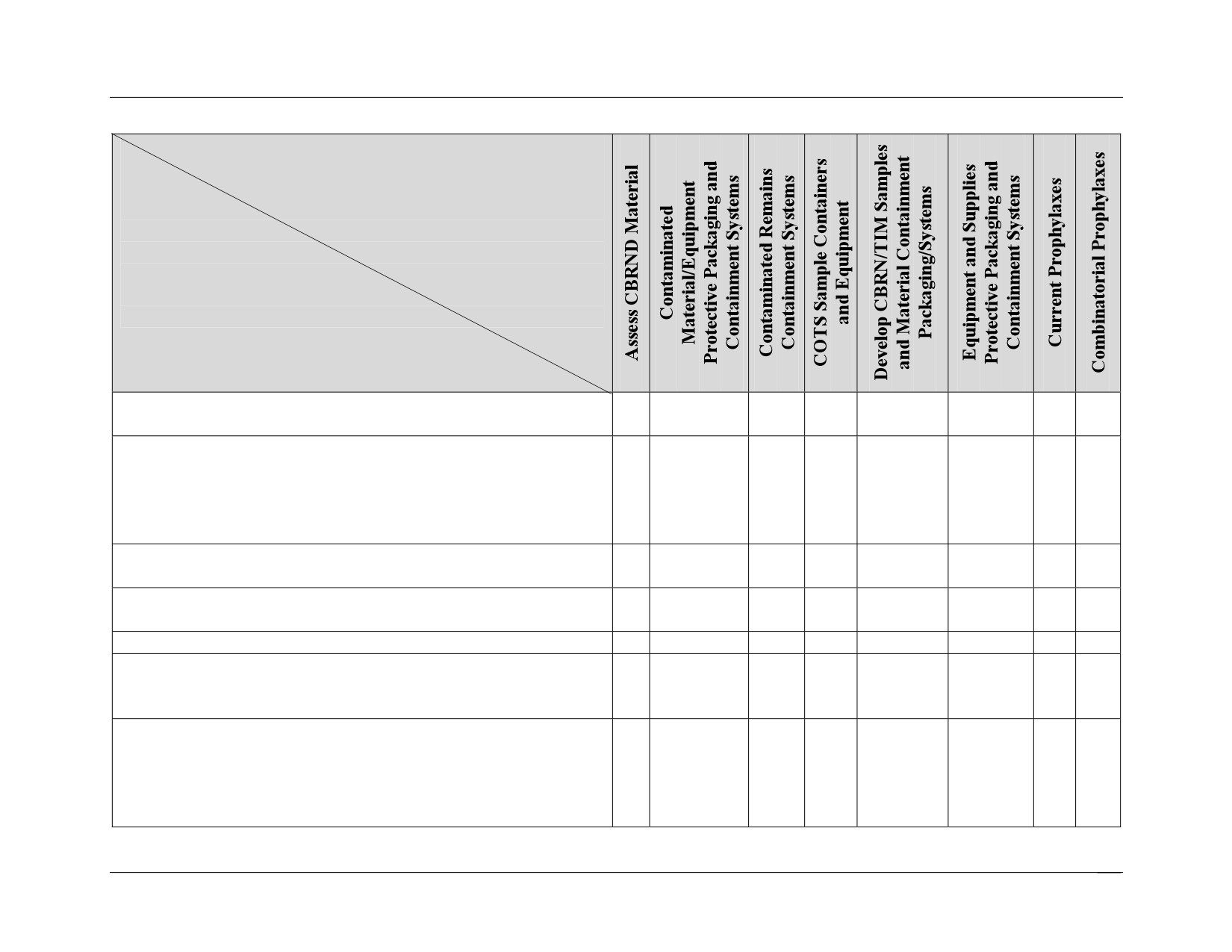
For Official Use Only
CBRND Functional Needs Analysis/Functional Solution Analysis
Chapter 13 Tactical Shield Tasks
Table 13.14-3. TASHLD 14: IMA Assessment
Ideas for Material
Approaches
(IMA)
Identified Gaps
CBRN/TIM protective packagings are limited or not identified
X
X
X
X
X
X
for other than specialized functions.
Movement of CBRN/TIM contaminated material is generally
limited initially to tactical ground transport. Air transport
(tactical rotary-wing) is a last resort due to concerns about asset
X
X
X
X
X
X
contamination. Tactical and strategic fixed-wing air transport is
not considered an acceptable means of transport.
CBRND protective equipment and measures do not protect
X
X
X
X
X
X
X
X
against all CBRN/TIM agents.
Medical prophylaxis does not exist for all threat CBRN/TIM
X
X
and TIM agents.
Prophylaxis for MWAs is virtually nonexistent.
X
X
The predominant means of protection of supporting assets is
decontamination of the asset following secondary
X
X
X
X
X
X
exposure/contamination.
The issue and administration of prophylaxis to eligible civilians
requires review due to questions regarding applicability to the
range of body types, ages, and physical/medical factors inherent
X
X
X
within a potential population, as well as possible long-term
health issues and legal implications.
For Official Use Only
296