CHEMICAL, BIOLOGICAL, RADIOLOGICAL, AND NUCLEAR DEFENSE (CBRND) FUNCTIONAL NEEDS ANALYSIS. FINAL REPORT (2005) - page 11
For Official Use Only
CBRND Functional Needs Analysis/Functional Solution Analysis
Chapter 9. Tactical Shape Tasks
9.11
Task TASHA 11: Correlate observations of the indigenous population for indicators
of CBRN/TIM attack or release
9.11.1
Functional Area Analysis
9.11.1.1
Definition
JTF elements can identify sick or diseased people in the conduct of their activities. As an
example, patrols, convoys, and security checkpoints can identify or observe ill health in the
indigenous population. The frequency and extent of ill health could be a radiological, toxic
chemical, or a biological agent indicator. Liaison and information are collected from indigenous
and NGO activities in the tactical operating area. Relatively rapid degradation in the indigenous
populace could indicate the presence of a CBRN agent and represent a threat to JTF elements,
potentially shifting the strategic and operational objectives of the JTF away from command or
national intentions. This task might also include observations regarding an increase of vector
populations. Daily situation reports might include these observations.
Reported observations are correlated in the operations center contributing to combat risk
assessments and the management of response and mitigation, including identification of
necessary medical countermeasures to protect the force. The information is included in medical
surveillance, and the results and response are included in the COP situational awareness. For
vector attacks and small covert attacks of communicable disease agents, the correlation and
inclusion of observations of the indigenous population within medical surveillance could be the
primary means of detecting an attack and implementing medical preventive countermeasures.
9.11.1.2
Derivation
UJTL (TA 5, TA 5.2.1, TA 7, TA 7.1), Military Transformation: A Strategic Approach,
Transformation Planning Guidance, Protection Joint Functional Concept.
9.11.1.2.1
Supported Task: OPSHA 8
9.11.1.2.2
Lateral Task: TASENS 10
9.11.1.2.3
Supporting Task: N/A
9.11.1.3
Condition
Perform this task under conditions of:
Physical. N/A
Military
1. Partial preexisting arrangements. (C2.1.1.2)
2. Partially completed mission preparation. (C2.1.3)
3. Marginal forces assigned. (C2.2.1)
80
For Official Use Only
For Official Use Only
CBRND Functional Needs Analysis/Functional Solution Analysis
Chapter 9. Tactical Shape Tasks
4. Fair personnel nutrition and health. (C2.2.4.1)
5. Limited personnel experience. (C2.2.4.5)
6. Limited staff expertise. (C2.3.1.3)
Civil
1. Correct interdepartmental/interagency relationships. (C3.1.1.3)
2. Negative foreign government support. (C3.1.2.3)
3. Moderately opposed foreign public opinion. (C 3.1.2.4)
4. Poor civil health. (C3.3.1.4)
5. High health risk. (C3.3.1.5)
6. Significant TIM present in the civilian sector. (C3.3.7.5)
9.11.2
Functional Needs Analysis
9.11.2.1
Capability and Deficiency Assessment Summary
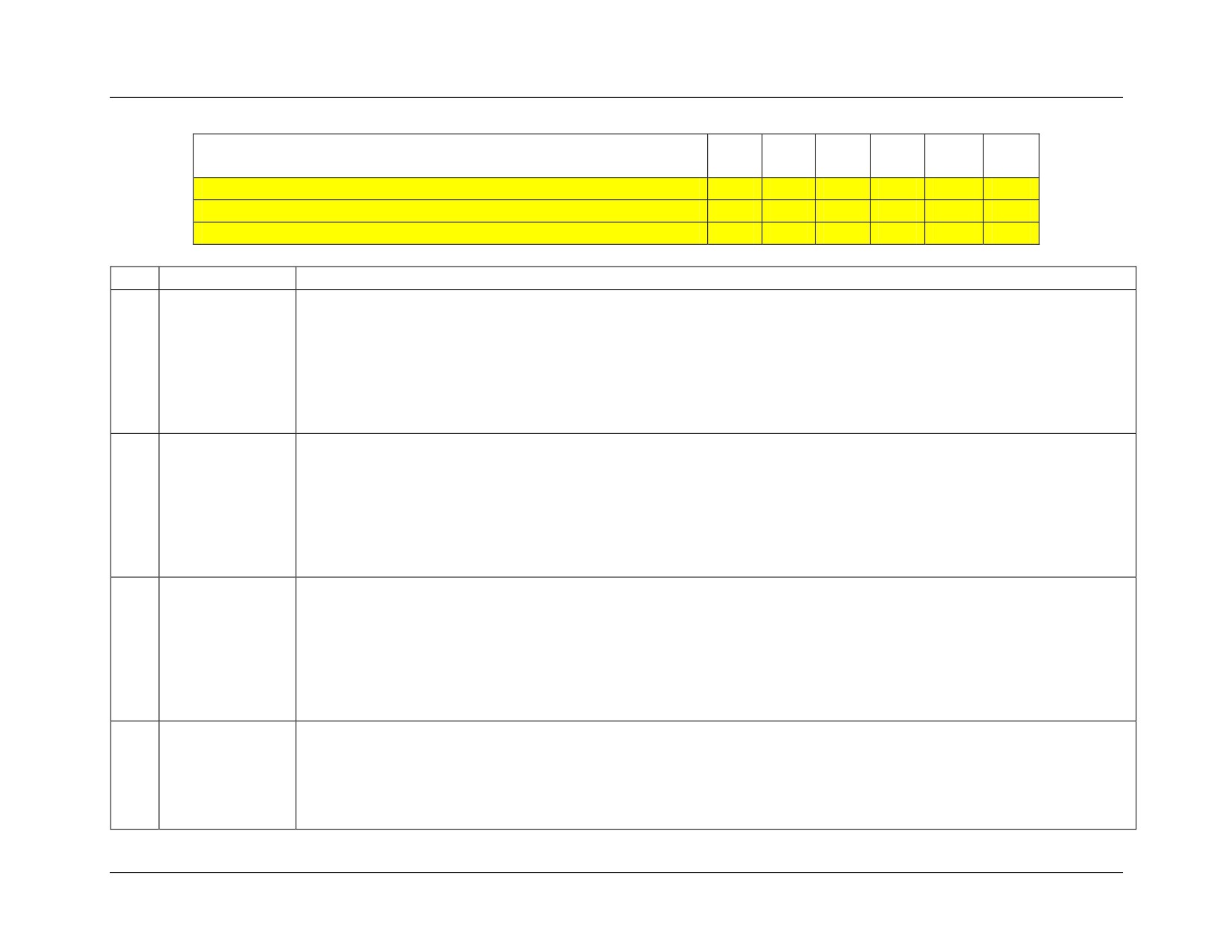
Table 9.11-1 discusses individual capabilities to perform this task to the designated standards.
The capabilities include some reports provided by non-JTF activities and limited ability to assess
outbreak indicators, make accurate hazard and surveillance reports, and obtain reports of CBRN
attack indicators. The overall capability for current, near/mid, and far term are rated “yellow.”
Although improvements between the periods occur for specific capabilities and are reflected in
the associated identified values, the improved capabilities are not sufficient to change the overall
assessed color ratings for this task.
Current Capability and Deficiency
Correlating observations of CBRN/TIM attacks require special liaison with NGOs, international
agencies, indigenous civil authorities, and aid organizations. Medical surveillance operates in
isolation from the routine activities of the operational staffs. The capability is improving as a
result of improvements resulting from current conflicts. Interoperabilty within and among
Services continues to improve. Deficiencies include insufficient liaison and collaboration with
non-JTF agencies and organizations in the operating area, inadequate training, insufficient
interaction and coordination between medical staffs and operational staffs, lack of interactive
link with COP; and insufficient communication resources.
Projected Near/Mid-Term Capability and Deficiency
No change is projected for this task.
Projected Far-Term Capability and Deficiency
No change is projected for this task.
81
For Official Use Only
For Official Use Only
CBRND Functional Needs Analysis/Functional Solution Analysis
Chapter 9. Tactical Shape Tasks
Table 9.11-1. TASHA 11: Capability and Deficiency Assessment
Capability: Correlate Observations of the Indigenous
M1
M2
M3
M4
M5
M6
Population for Indicators of CBRN/TIM Attack or Release
Current Overall Capability
41
52
53
54
55
66
Near/Mid-Term Overall Capability
4
5
5
5
5
6
Far-Term Overall Capability
4
5
5
5
5
6
FAA Measure
Scale
M1
Reports are
8-10: Secure, interoperable, and interactive processes with automated tools exist and are predominantly applied by all relevant
provided by non-
activities of the joint force, coalition partners, and other authorized entities. Inherent capabilities support connectivity to diverse
JTF activities.
systems operated and maintained by non-JTF activities.
4-7: Special liaisons are equipped and possess connectivity for interaction and reporting of information collected by non-JTF
activities and entities such as NGOs, international agencies, indigenous civil authorities, and aid organizations. In selected cases,
these agencies are provided equipment and procedures specifically for this purpose.
1-3: Information is collected from non-JTF activities and entities sporadically by JTF elements in the area of responsibility (AOR).
0: The capability to collect information from non-JTF activities and entities is nonexistent.
M2
Outbreak
8-10: Secure, interoperable, and interactive processes with automated tools exist and are predominantly applied by all echelons and
indicators are
elements of the joint force, coalition partners, and authorized entities. Information and data are collected, collated, confirmed, and
assessed and
processed using automated tools and processes on a continuous basis.
confirmed.
4-7: Procedures, policies, techniques, and processes exist to collect, confirm, process, and report information on outbreak indicators
and are assisted by automated systems requiring manual intervention and on a periodic basis or as determined necessary.
1-3: Procedures, policies, techniques, and processes provide limited guidance for the collection, confirmation, processing, and
reporting of information on outbreak indicators and are performed manually using raw information drawn from automated systems.
0: The collection, confirmation, and reporting of outbreak indicators are nonexistent.
M3
Reports on hazard
8-10: Hazard reporting accuracy and utility is high; based on standardized automated system processing, analysis, and evaluation
are accurate.
with trained staff review and involvement; and reliant on trained and experience observations and rapid and accurate reporting by
personnel in the field.
4-7: Hazard reporting accuracy and utility exists but widely varies between units and staffs and is dependent upon manual
processes reliant upon the experience, training, and availability of the performing staff/observing field personnel and the quality of
reports and selected assessed information.
1-3: Hazard reporting accuracy and utility are low.
0: Hazard reporting accuracy and utility are nonexistent.
M4
Health-related
8-10: Secure, interoperable, and interactive medical surveillance systems exist and continuously interrelate with other nonmedical
surveillance
systems and CBRND information systems within the net-centric environment to provide ongoing health status of forces.
reporting system is
4-7: Procedures, policies, techniques, and processes exist to perform medical surveillance of the force and are assisted by
in place.
automated systems requiring manual intervention and on a periodic basis or as determined necessary.
1-3: Medical surveillance is performed manually from raw information drawn from automated systems
0: Medical surveillance is nonexistent.
82
For Official Use Only
For Official Use Only
CBRND Functional Needs Analysis/Functional Solution Analysis
Chapter 9. Tactical Shape Tasks
M5
Reports of
8-10: Integrated, interoperable, and interactive automated systems substantially or fully detect, process, and report CBRN attack
observations of
indicators in near-real time. These systems also support the collection, processing, and reporting of manually collected information
CBRN attack
and data.
indicators are
4-7: Doctrine, policies, procedures, TTPs, and formats exist and are applied and are generally performed manually for the reporting
timely.
of CBRN attack indicators. Timeliness is contingent upon operational considerations and unit/personnel capabilities.
1-3: Doctrine, policies, procedures, TTPs, and formats exist and are applied and are generally performed manually for the reporting
of CBRN attack indicators. Time to perform is extended by available communications constraints and ongoing operational demands
0: The timeliness of reporting of CBRN attack indicator observations fails to support survival and operational needs.
M6
There is effective
8-10: DOTLPF exists and is adequate for this task. Task can be effectively performed with little or no direct impact upon
DOTLPF in place
operations
to conduct task.
4-7: Most critical aspects of DOTLPF for this task are addressed. Task can be performed with limitations requiring work-arounds.
1-3: DOTLPF is inadequate for accomplishment of this task.
0: DOTLPF does not exist for this task.
1 Special liaisons may be assigned to applicable NGOs, international agencies, indigenous civil authorities, and aid organizations for coordination and information exchange.
2 Procedures, policies, and processes are established for the largely manual collection, confirmation, processing, and reporting of outbreak indicators. Medical surveillance systems
exist and assist for joint force personnel but are largely stovepiped and require manual intervention for transmission and interpretation. Further, these systems are not developed
sufficiently to adequately incorporate information from non-JTF sources. Current systems and processes are dependent upon the experience, training, and cognizance of
responsible staff.
3 Accuracy and utility of hazard reporting is dependent upon the experience, training, and availability of the necessary staff, as well as the quality and accessibility of information.
Field reporting accuracy and utility varies widely dependent upon unit training, individual attentiveness, and in-place observation reporting mechanisms. Current capability is
achieved using doctrine and locally developed processes. Limited training is provided to staff and field personnel for the identification, reporting, and processing of hazards and
related information. Consistent standardized formal and refresher training on immediate or local battlefield hazard identification and reporting is not regularly and routinely
performed. Limited and often cursory training is provided and often is not until preparation or during the conduct of operations.
4 Medical surveillance systems are largely stovepiped and lack integration with operations and intelligence systems. Further, these systems are not developed sufficiently to
adequately incorporate information from non-JTF sources. Current systems and processes are dependent upon the experience, training, and cognizance of responsible staff.
5 CBRN attack indicator observations are largely reported using standardized ATP-45 formatted messages and are prepared manually for transmission using existing and available
communications systems. Timeliness is contingent upon the experience and knowledge of the reporting personnel, ongoing operational considerations, and available
communications capabilities. However, dissemination to other units in the potentially affected area, especially if they do not share communications systems and frequencies, is
usually delayed until retransmitted by higher authority. JWARN provides the automated capability to disseminate CBRN attack indicator information in the net-centric
environment. JOEF and JEM support the collection, interpretation, and visualization of the information. This suite of systems is projected to be fielded in the near-term. JOEF and
JEM are projected for initial fielding during the mid term with full fielding completed early in the far term. Concurrent with the mid-term release of JOEF and JEM will be
JWARN Block II which will be initially fielded to operational units.
6 Current DOTLPF include the ability to conduct this task using largely manual processes and available communications systems. However, processes and procedures for the
immediate dissemination of information to neighboring units is not adequate. The retransmission of the information by higher echelon to all units potentially at risk or affected by
a CBRN/TIM event is performed as a work-around and assurance of notification. CBRND training ranges from in-depth and substantial for selected functions and personnel to
inadequate and haphazard for others, largely field personnel. DOTLPF will need to evolve as systems, tactics, and situations change.
83
For Official Use Only
For Official Use Only
CBRND Functional Needs Analysis/Functional Solution Analysis
Chapter 9. Tactical Shape Tasks
9.11.3
Functional Solution Analysis
9.11.3.1
DOTLPF Assessment Summary
This section addresses the deficiencies and suggests potential non-materiel solutions. If there are
no non-materiel solutions or they are only partial solutions, the remaining non-materiel need is
then stated. Materiel needs are assessed in the IMA section.
1.
Deficiency: Insufficient liaison and collaboration with non-JTF agencies and organizations in
the operating area.
Partial Non-Material Solutions: Doctrine: Doctrine and TTPs requirements are needed for
liaison and collaboration with non-JTF agencies and organizations within the operating area
for the purposes of coordination and information exchange. Organization: Establish, man,
and equip specific standard units and primary-duty personnel for the conduct of liaison and
collaboration with other entities, including non-JTF agencies and organizations. Training:
Ensure ongoing training and development of experienced and qualified personnel for the
conduct of successful liaison and collaboration activities. Personnel: Ensure selection and
availability of primary-duty personnel in sufficient quantities to ensure fully mission capable
status of liaison units and elements supporting operations and mission requirements.
2.
Deficiency: Inadequate organization within the JTF to effectively assess and confirm
CBRN/TIM events and outbreaks.
Non-Material Solutions: Doctrine: Doctrine and TTPs are required for assessment and
confirmation of CBRN/TIM events and outbreaks. Organization: Staffing and organizational
resources supporting the identification, assessment, confirmation, and reporting of
CBRN/TIM events and outbreaks are required. Training: Ensure adequate formal and
recurring refresher training of staff and personnel on their areas of responsibility for the
identification, assessment, confirmation, and/or reporting of potential CBRN/TIM events and
outbreaks.
3.
Deficiency: Inadequate training.
Non-Material Solutions: Training: Ensure adequate formal and recurring refresher training
of staff and personnel on their areas of responsibility for the identification, assessment,
confirmation, and/or reporting of potential CBRN/TIM events and outbreaks.
4.
Deficiency: Insufficient interaction and coordination between medical, operational, and
intelligence staffs.
Non-Material Solutions: Doctrine: Refine doctrine, policies, procedures, processes, and
TTPs to support the interactive exchange of information between medical, operational, and
intelligence elements. Organization: Organizational resources and systems supporting the
interactive and collaborative exchange of information between staffs and elements are
required. Training: Ensure formal and recurring refresher training promoting information
interchange and collaborative relationships between medical, operational, and intelligence
staffs.
5.
Deficiency: Lack of interactive link with COP.
84
For Official Use Only
For Official Use Only
CBRND Functional Needs Analysis/Functional Solution Analysis
Chapter 9. Tactical Shape Tasks
Partial Non-Material Solutions: Doctrine: Develop doctrine, policies, procedures, and
TTPs establishing local linkage processes and means with the COP.
6. Deficiency: Insufficient communication resources.
Partial Non-Material Solutions: Organization: Develop tables of unit authorized
equipment need to ensure adequate communications resources are available to support
operational needs, including CBRND.
9.11.3.2
IMA Assessment Summary
Table 9.11-4 is a list of ideas for material approaches and a corresponding description of each
idea. Material approaches here focus on the lack of liaison and collaboration with outside
organizations and agencies, the need to provide accurate information to the development of the
COP, and the need for additional communications resources.
85
For Official Use Only
For Official Use Only
CBRND Functional Needs Analysis/Functional Solution Analysis
Chapter 9. Tactical Shape Tasks
Table 9.11-4. TASHA 11: Materiel Approaches
Idea for Materiel
Identified Deficiencies
Description
Approach
Insufficient liaison and
Medical
Develop automated modifications
collaboration with non-JTF
surveillance system
to existing and developing medical
agencies and organizations in the
enhancement for
surveillance systems for the
operating area.
indigenous
collection, correlation, processing,
Lack of interactive link with COP.
population
and reporting of CBRN event
surveillance
indicators within indigenous
Insufficient communication
populations.
resources.
86
For Official Use Only
For Official Use Only
CBRND Functional Needs Analysis/Functional Solution Analysis
Chapter 9. Tactical Shape Tasks
9.12
Task TASHA 12: Conduct medical surveillance based on syndromic information
and data across the battlespace
9.12.1
Functional Area Analysis
9.12.1.1
Definition
Using syndromic information and data, medical surveillance across the battlespace is conducted.
The results are collected and analyzed in the operations centers contributing to combat risk
assessments and the management of response and mitigation, including identification of
necessary medical countermeasures to protect the force. Medical surveillance results and
response are included in the COP situational awareness. Medical surveillance is a critical
capability to identify biological agents (vectored, communicable), nonimmediate casualty
chemical exposure, and emissive radiological exposures. For vector attacks and small covert
attacks of communicable disease agents, medical surveillance could be the primary means of
detecting the attack and its progression through JTF elements. Liaison and information are
collected from indigenous and NGO activities in the tactical operating area.
9.12.1.2
Derivation
UJTL (TA 5, TA 5.2.1, TA 7, TA 7.1), Protection Joint Functional Concept, Military
Transformation: A Strategic Approach.
9.12.1.2.1
Supported Task: OPSHA 7
9.12.1.2.2
Lateral Tasks: TASUST 5, TASUST 6, TASUST 7
9.12.1.2.3
Supporting Task: N/A
9.12.1.3
Condition
Perform this task under conditions of:
Physical. N/A
Military
1. Partial preexisting arrangements. (C2.1.1.2)
2. Partially completed mission preparation. (C2.1.3)
3. Poor personnel nutrition and health. (C2.2.4.1)
4. Limited personnel experience. (C2.2.4.5)
5. Moderate staff expertise. (C2.3.1.3)
Civil
1. Correct interdepartmental/interagency relationships. (C3.1.1.3)
87
For Official Use Only
For Official Use Only
CBRND Functional Needs Analysis/Functional Solution Analysis
Chapter 9. Tactical Shape Tasks
2. Limited international organization support. (C3.1.2.5)
3. Moderate health risk. (C3.3.1.5)
9.12.2
Functional Need Analysis
9.12.2.1
Capability and Deficiency Assessment Summary
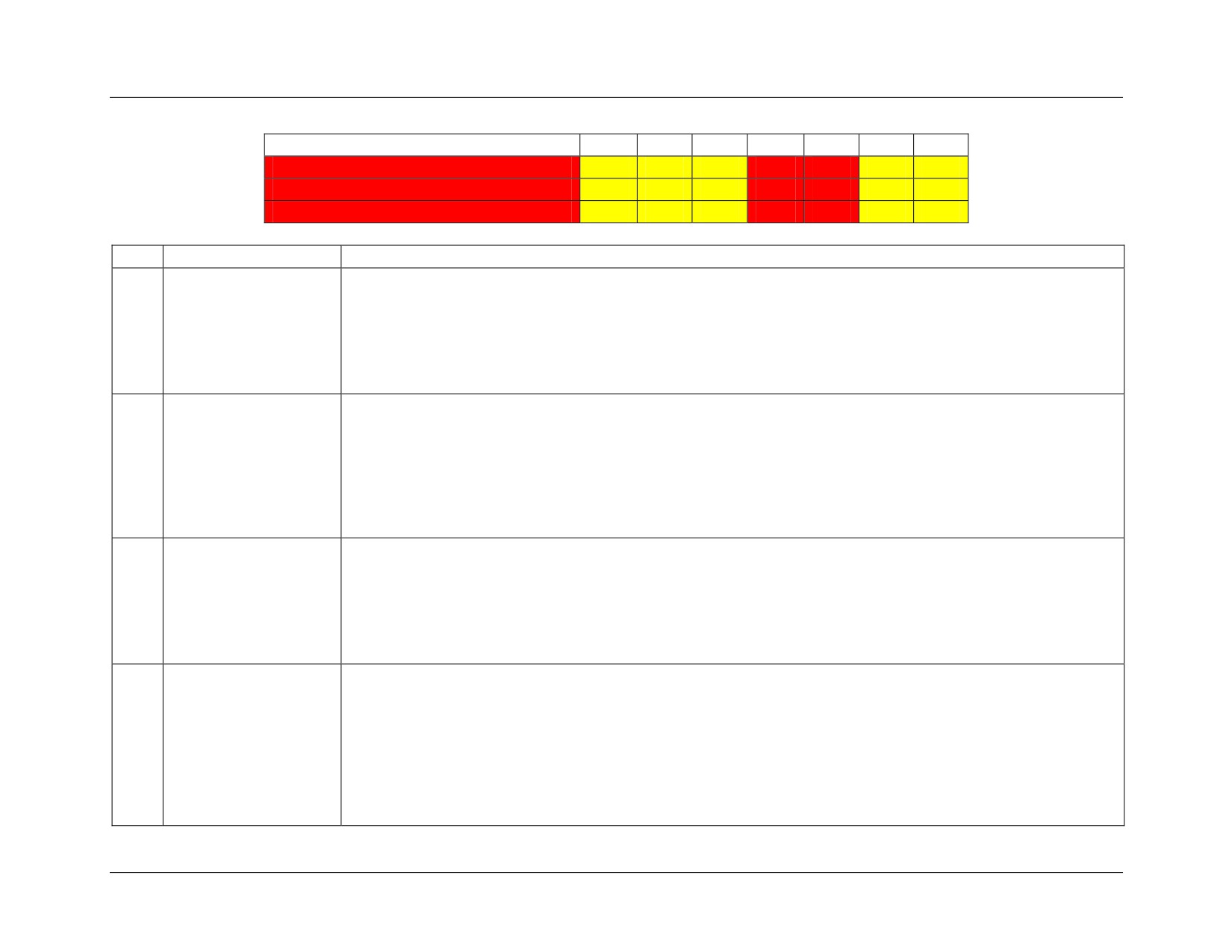
Table 9.12-1 discusses individual capabilities to perform this task to the designated standards.
Services have a largely manual overall capability to perform medical surveillance of the
battlespace. The overall capability for current, near/mid, and far term are rated “red.” Although
improvements between the periods occur for specific capabilities and are reflected in the
assessment of the measures, the improved capabilities are not sufficient to change the overall
assessed color ratings for the measures and this task.
Current Capability and Deficiency
The current capability to conduct medical surveillance across the battlespace consists of limited
automated assistive systems requiring substantial manual entry and manipulation such as
USTRANSCOM Regulating and Command and Control Evacuation System (TRCCES)/
Composite Health Care System II - Tactical (CHCS2T), Global Expeditionary Medical System
(GEMS), plus the Army Medical Surveillance Activity’s DMSS and Joint Medical Evacuation
Program (JTMEP). JTMEP does provide medical surveillance but only within the medical
community. Medical surveillance operates in isolation from the routine activities of the
operational staffs. Deficiencies include that there is no cohesive and integrated data interchange
of medical information related to CBRN via electronic means, CBRN casualty information will
require identification and supporting programming to address CBRN information issues, and
there is a considerable lag between the generation of CBRN medical information and its display
in the COP. Generally, non-U.S. personnel are not tracked in Service medical systems and
information collected from coalition partners, NGOs, and host-nation agencies must be
correlated manually by epidemiologists and command staff personnel.
Projected Near/Mid-Term Capability and Deficiency
The continuing development of medical systems and medical surveillance tools meeting
interoperability standards integrating the various aspects of medical care and treatment are
expected to expand the availability of surveillance information critical to effective CBRND.
Development of an integrated and interoperable medical surveillance system will provide the
command staff with information for correlation with other gathered information. Warning
information is subsequently disseminated through JWARN.
Projected Far-Term Capability and Deficiency
Continued improvement as standardized, interoperable, and integrated systems replace legacy
systems.
88
For Official Use Only
For Official Use Only
CBRND Functional Needs Analysis/Functional Solution Analysis
Chapter 9. Tactical Shape Tasks
Table 9.12-1. TASHA 12: Capability and Deficiency Assessment
Capability: Medical Surveillance
M1
M2
M3
M4
M5
M6
M7
Current Overall Capability
51
42
43
14
14
43
45
Near/Mid-Term Overall Capability
5
4
4
1
1
4
4
Far-Term Overall Capability
5
4
4
1
1
4
4
FAA Measure
Scale
M1
Disseminated
8-10: Medical surveillance information is correlated and processed with other source information and, as a composite, is
information is accurate.
disseminated in near-real time to requiring users. The disseminated data are accurate, current, and updated as new
information is received and processed.
4-7: Medical surveillance information is predominantly manually correlated and processed with other source information
and, as a composite, is disseminated to requiring users. The disseminated data are accurate as of the last update.
1-3: Medical surveillance is not integrated with other source data or contains substantial errors.
0: Medical surveillance is nonexistent.
M2
Specific CBRN/TIM
8-10: Automated systems accurately and rapidly correlate syndromic indications from medical treatment information and
agent and appropriate
other sources with CBRN/TIM agent symptomology, identify the appropriate causative agent, and specify the appropriate
medical countermeasures
medical countermeasures.
are identified.
4-7: Identification of the specific CBRN/TIM agent and appropriate medical countermeasures is predominantly performed
manually with the use of limited assistive automated tools and resources where available.
1-3: Medical surveillance is inadequate for the identification of CBRN/TIM agent exposure and determination of
appropriate medical countermeasures
0: Medical surveillance cannot identify and address CBRN/TIM agent exposure and appropriate medical countermeasures.
M3
Units affected by CBRN
8-10: Interoperable and integrated automated systems identify and track both potential and known exposed personnel and
agents are identified and
units. Medical systems track exposed personnel throughout their career and identify the exposure.
tracked.
4-7: Units and personnel potentially and known to be exposed to CBRN agents are identified and tracked once known
until exposure and contamination is confirmed and/or resolved.
1-3: Units and personnel potentially and known to be exposed to CBRN agents are inadequately identified and tracked
until exposure and contamination is confirmed and/or resolved
0: Tracking of units and personnel potentially and known to be exposed to CBRN agents is not performed.
M4
Outbreak indicators are
8-10: Automated systems accurately and rapidly correlate syndromic indications from medical treatment information and
assessed and confirmed.
other sources with CBRN/TIM agent symptomology, identify the appropriate causative agent/disease, and specify the
appropriate medical countermeasures and actions.
4-7: Identification of the specific CBRN/TIM agent or disease and appropriate medical countermeasures/activities are
predominantly performed manually with the use of limited assistive automated tools and resources where available.
1-3: Medical surveillance does not adequately identify CBRN/TIM agent exposure, disease outbreaks, and the appropriate
medical countermeasures.
0: Medical surveillance does not address CBRN/TIM agent exposure, disease outbreaks, and the appropriate medical
countermeasures.
89
For Official Use Only
For Official Use Only
CBRND Functional Needs Analysis/Functional Solution Analysis
Chapter 9. Tactical Shape Tasks
M5
Health-related
8-10: Interoperable and integrated automated systems continually draw current information from medical systems
surveillance, information
(including treatment, surveillance, and syndromic data). These systems correlate and process the information for the
epidemiology and
identification of issues and potential solutions and/or response actions.
symptomology
4-7: The collection and analysis of potential indicators are predominantly performed manually with the use of limited
information can be
assistive automated tools and resources where available.
collected and analyzed.
1-3: The collection and analysis of potential indicators is inadequate to prevent potential serious impact to operations
0: The collection and analysis of potential indicators is nonexistent.
M6
Battlespace health-related
8-10: Medical surveillance of the battlespace is in place and information is correlated and processed with other source
surveillance system is in
information and, as a composite, is disseminated in near-real time to requiring users. The disseminated data are accurate,
place.
current, and updated as new information is received and processed.
4-7: Medical surveillance is performed predominantly manually. Related information is generally manually correlated and
processed with other source information and, as a composite, is disseminated to requiring users. The disseminated data are
accurate as of the last update.
1-3: Medical surveillance is not integrated with other source data and/or contains substantial errors.
0: Medical surveillance is nonexistent.
M7
There is effective
8-10: DOTLPF exists and is adequate for this task. Task can be effectively performed with little or no direct impact upon
DOTLPF in place to
operations
conduct task.
4-7: Most critical aspects of DOTLPF for this task are addressed. Task can be performed with limitations requiring work-
arounds.
1-3: DOTLPF is inadequate for accomplishment of this task.
0: DOTLPF does not exist for this task.
1 Medical surveillance is predominantly manual in performance. Limited automated medical surveillance systems exist but are generally restricted to existing medical information
systems for tracking U.S. force personnel. Epidemiologists may or may not have access to information provided to command centers by field personnel, NGOs, host-nation agency
contacts, and other sources. The accuracy of the derived medical surveillance information is dependent upon the experience, knowledge, and skill of the performing individual and
access to relevant information. Correlation of this information with other data available to the command centers is also dependent upon the experience, knowledge, skill of the
operations, intelligence, and CBRN staff and the degree to which collaboration between the command staff elements exist.
2 Largely performed manually using limited assistive automated tools and resources, when available, to identify potential exposures to a CBRN/TIM agent and the affecting agent,
and to outline appropriate medical countermeasures. The accuracy of this information is dependent upon the experience, knowledge, and skill of the performing medical
practitioner and access to relevant information. Collaboration with CBRN and other staff members is often performed only after a definitive diagnosis is reached, increasing the
time before action and does not acknowledge existing assistive expertise.
3 Medical systems such as USTRANSCOM Regulating and Command and Control Evacuation System (TRCCES), Composite Health Care System II - Tactical (CHCS2T), Global
Expeditionary Medical System (GEMS), and DMSS are available. However, they are not interoperable. These systems must meet DISA standards when substantial upgrades are
performed or the systems are replaced. All systems must be interoperable in the far term. Information from these systems currently must be manually collected and tracked.
Although these systems must be interoperable in the far term, CBRN is not possess a specific identifier in these systems and requires knowledge and skill on the part of the
tracking medical and operations staff to identify and track affected personnel and units. Doctrine, policies, and procedures exist to assist the commander’s staff with the
identification and tracking of affected units.
4 Performed manually with some limited assistive automated tools. Currently requires indication of a problem before epidemiological inquiry and medical surveillance is
performed. Although limited medical surveillance tools do exist within selected stovepiped medical systems, the information must be manually interpreted and investigated
generally following a deliberate implementation of the appropriate medical surveillance tool. Interoperability between medical systems may serve to support medical surveillance
with preplanning for these activities and their information requirements. Epidemiologists may or may not have access to information provided to command centers by field
personnel, NGOs, host-nation agency contacts, and other sources.
90
For Official Use Only
For Official Use Only
CBRND Functional Needs Analysis/Functional Solution Analysis
Chapter 9. Tactical Shape Tasks
5 Current DOTLPF addresses most critical aspects for this task using largely manual processes and focuses upon medical services activities. However, data provided to command
centers by field personnel and non-force sources (e.g., NGOs, coalition partners, etc.) is not always provided to medical services for consideration and correlation. Often, when
performed at all, it is conducted by the command center staff and is dependent upon the experience and knowledge of performing personnel. Observations and information within
unit reports to the command center reflecting potential indicators may not be forwarded to appropriate action offices or acted upon until there a clear and present danger impresses
action. DOTLPF will need to evolve as systems, tactics, and situations change.
91
For Official Use Only
For Official Use Only
CBRND Functional Needs Analysis/Functional Solution Analysis
Chapter 9. Tactical Shape Tasks
9.12.3
Functional Solution Analysis
9.12.3.1
DOTLPF Assessment Summary
This section addresses the deficiencies and suggests potential non-materiel solutions. If there are
no non-materiel solutions or they are only partial solutions, the remaining non-materiel need is
then stated. Materiel needs are assessed in the IMA section.
1.
Deficiency: Lack of cohesive and integrated data interchange of medical information related
to CBRN via electronic means to the COP.
Partial Non-Material Solutions: Doctrine: Adjust doctrine to address processing of
information provided to the command center by field reports, coalition partners, host-nation
agencies, NGOs, and other sources. Organization: Ensure organizational structures are in
place for the assessment and integration of information from sources other than medical
services into medical surveillance. Training: Train staffs and medical services personnel on
CBRN and disease outbreak indicators. Include diverse source information in CBRN
exercises and evaluations for skill development and maintenance. Facilities: Establish
supporting infrastructure to enable data interchange and display on the COP.
2.
Deficiency: Inadequate or lack of CBRN related casualty information.
Partial Non-Material Solutions: Doctrine: Adjust medical information systems doctrinal
requirements to include CBRN identification and processing for medical surveillance and
subsequent reporting. Organization: Ensure organizational structures are in place for the
identification and collection of information from medical information systems for CBRN
medical surveillance. Training: Train appropriate medical services personnel to query
medical information systems and forward CBRN indicators and issues for medical
surveillance review. Facilities: Develop supporting infrastructure to enable data collection
and transfer.
3.
Deficiency: Inadequate timeliness between generation of CBRN medical information and its
display in the COP.
Partial Non-Material Solutions: Doctrine: Adjust doctrine to emphasize indicator
identification and continuing medical surveillance in coordination with command staffs.
Facilities: Establish supporting infrastructure to enable data collection and transfer.
9.12.3.2
IMA Assessment Summary
Table 9.12-4 is a list of ideas for material approaches and a corresponding description of each
idea. Approaches for this task cover the need to improve the information interchange with
medical information systems, including extracting casualty data for tactical planning and
improving the speed of medical input to the formation of the COP. Even though the medics are
gathering patient surveillance data, the analysis of these data needs to be provided to tactical
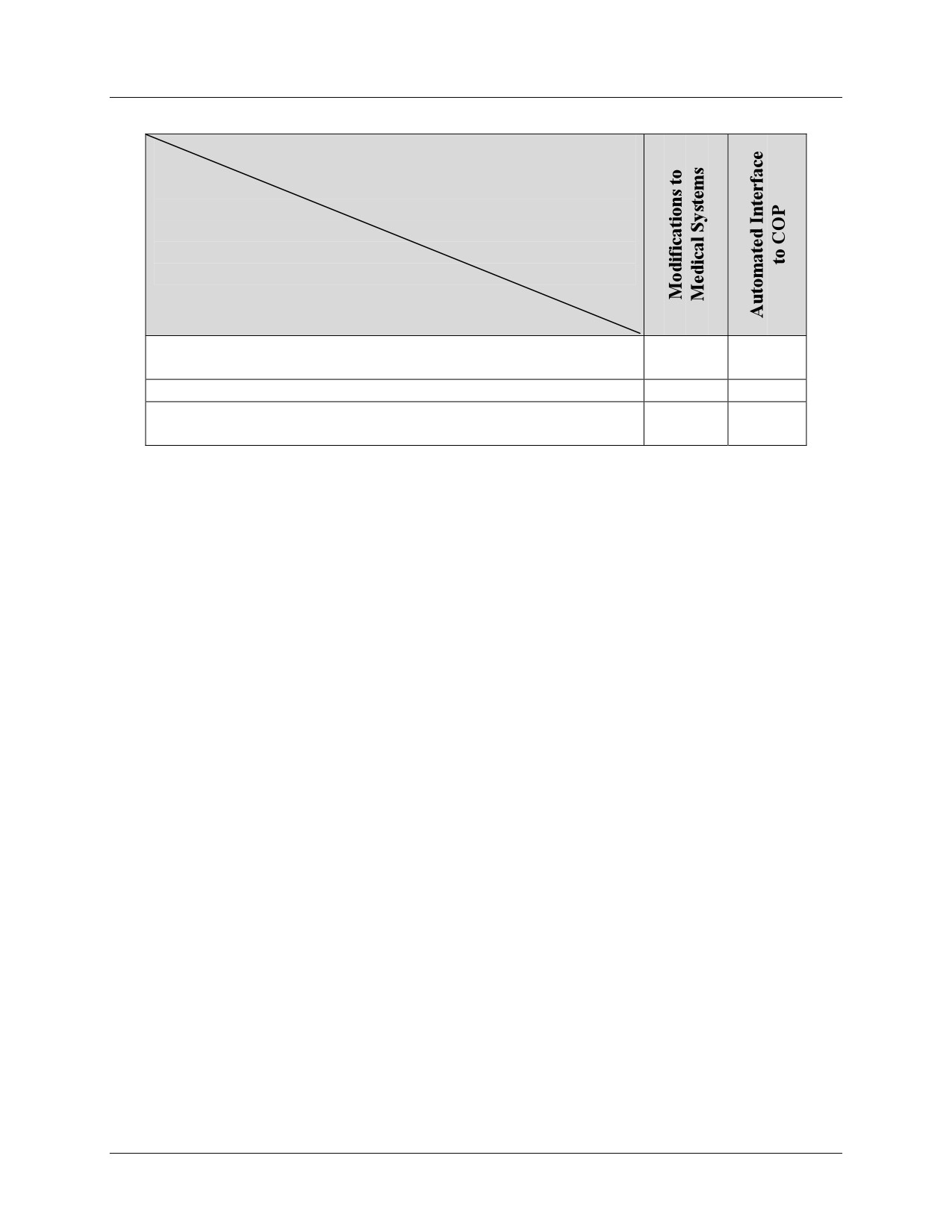
commanders to affect their decision process. Table 9.12-5 identifies which of the material
approaches might address specific materiel deficiencies identified in the DOTMLPF assessment.
92
For Official Use Only
For Official Use Only
CBRND Functional Needs Analysis/Functional Solution Analysis
Chapter 9. Tactical Shape Tasks
Table 9.12-4. TASHA 12: Materiel Approaches
Idea for Materiel Approach
Description
Modifications to medical
Develop automated modifications to existing and
information systems
developing medical patient tracking systems (e.g., DMSS,
MAT, TMIP, etc.) to specifically track the status and
treatment of CBRN/TIM casualties and link this
information to CBRND automated systems.
Automated interface to COP
Develop automated modifications to existing and
developing medical surveillance systems to specifically
identify indicators of CBRN/TIM exposures and link this
information to CBRND automated systems and the COP.
93
For Official Use Only
For Official Use Only
CBRND Functional Needs Analysis/Functional Solution Analysis
Chapter 9. Tactical Shape Tasks
Table 9.12-5. TASHA 12: IMA Assessment
Ideas for Material
Approaches
(IMA)
Identified Gaps
Lack of cohesive and integrated data interchange of medical
X
information related to CBRN via electronic means to the COP.
Inadequate or lack of CBRN-related casualty information.
X
X
Inadequate timeliness between generation of CBRN medical
X
X
information and its display in the COP.
94
For Official Use Only
For Official Use Only
CBRND Functional Needs Analysis/Functional Solution Analysis
Chapter 9. Tactical Shape Tasks
9.13
Task TASHA 13: Conduct veterinary surveillance of MWA and indigenous animal
population throughout the battlespace
9.13.1
Functional Area Analysis
9.13.1.1
Definition
This task deals with conducting veterinary surveillance of MWAs and indigenous animal
population throughout the battlespace. Animal surveillance is a key part of force health
protection efforts since illness or death in the animal populations may be an indication that a
CBRN event has occurred.
Based on the battlespace veterinary plan, MWAs are routinely checked for potential indications
of exposure to CBRN/TIM agents. Additionally, JTF elements in the area of operations can
identify sick or diseased animals and birds in the conduct of their activities. As an example,
patrols, convoys, and security checkpoints can identify or observe ill health in the indigenous
population. The frequency and extent of ill health might be an indicator of the presence of a
radiological, toxic chemical, or a biological agent. Liaison and information are collected from
indigenous and NGO activities in the tactical operating area. Relatively rapid degradation in the
indigenous animal and/or bird population might indicate the presence of a CBRN agent and a
potential threat to JTF elements. Additionally, this task might also include observations
regarding an increase of vector populations. Daily situation reports might include these
observations. Information from these activities are compiled and correlated by veterinary
surveillance. The results including appropriate veterinary countermeasures contribute to health
and risk assessments and assist in the management of response and mitigation. Veterinary
surveillance of MWA and indigenous animal and bird population is critical to the health of the
force.
9.13.1.2
Derivation
UJTL (TA 5, TA 5.2.1, TA 7, TA 7.1), Military Transformation: A Strategic Approach,
Transformation Planning Guidance, Protection Joint Functional Concept.
9.13.1.2.1
Supported Task: OPSHA 7
9.13.1.2.2
Lateral Tasks: TASENS 10, TASUST 5, TASUST 6, TASUST 7
9.13.1.2.3
Supporting Task: N/A
9.13.1.3
Condition
Perform this task under conditions of:
Physical. N/A
95
For Official Use Only
For Official Use Only
CBRND Functional Needs Analysis/Functional Solution Analysis
Chapter 9. Tactical Shape Tasks
Military
1. Partial preexisting arrangements. (C2.1.1.2)
2. Partially completed mission preparation. (C2.1.3)
3. Marginal forces assigned. (C2.2.1)
4. Poor personnel nutrition and health. (C2.2.4.1)
5. Limited personnel experience. (C2.2.4.5)
6. Limited staff expertise. (C2.3.1.3)
Civil
1. Correct interdepartmental/interagency relationships. (C3.1.1.3)
2. Limited foreign government support. (C3.1.2.3)
3. Moderately opposed foreign public opinion. (C 3.1.2.4)
4. Poor civil health. (C3.3.1.4)
5. High health risk. (C3.3.1.5)
6. Significant TIM present in the civilian sector. (C3.3.7.5)
9.13.2
Functional Needs Analysis
9.13.2.1
Capability and Deficiency Assessment Summary
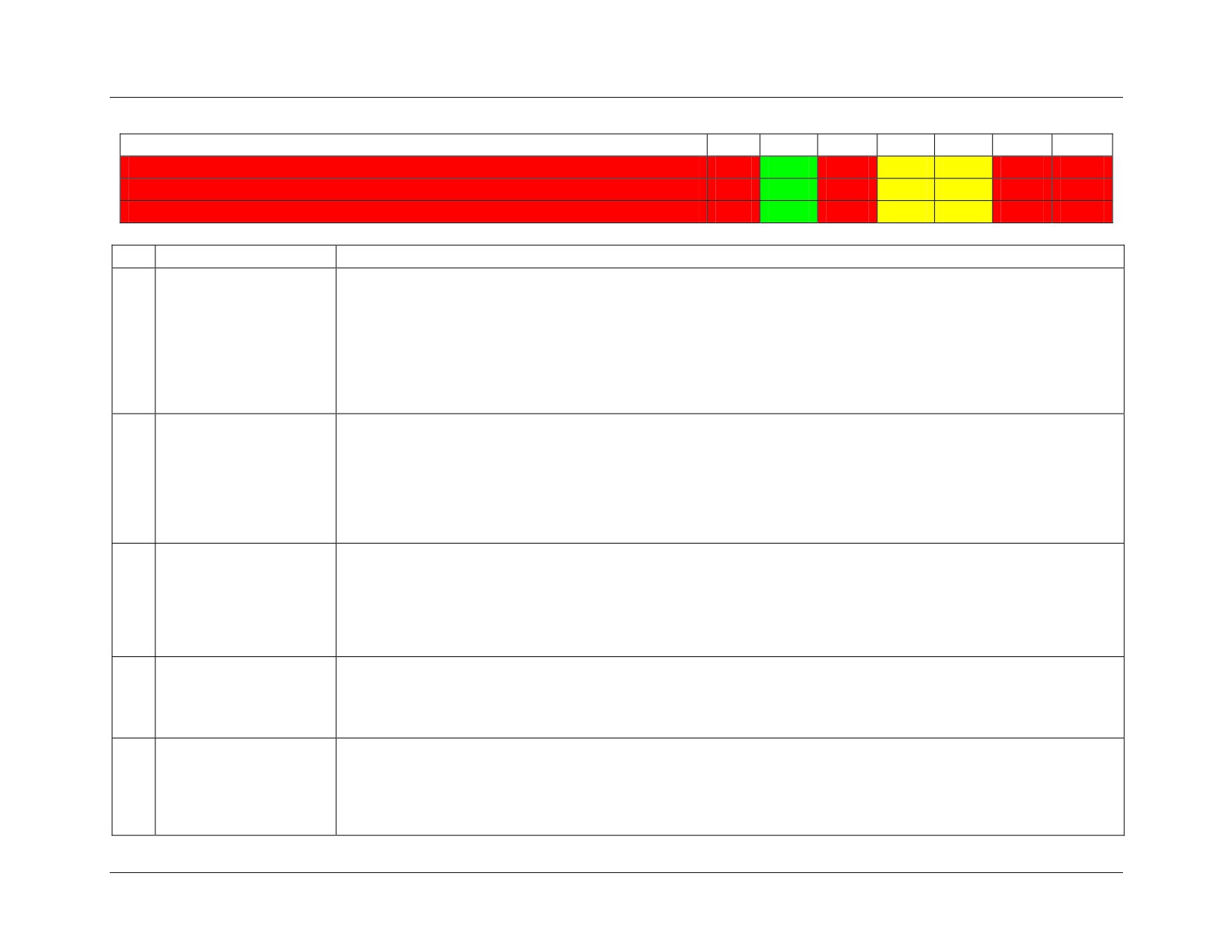
Table 9.13-1 shows the current capability to track MWAs is limited and manual in nature. There
is no capability to track indigenous animals. The overall capability for current, near/mid, and far
term are assessed “red.”
Current Capability and Deficiency
Indigenous animals are currently not included in any surveillance or reporting activities and
veterinary surveillance procedures must be updated to include the indigenous animal
populations. Non-JTF reporting and information is not addressed for establishment and
integration into veterinary surveillance activities. A need exists to develop an automated
surveillance and reporting system for MWAs and indigenous animals. Veterinary information is
currently processed and disseminated in text format using Lotus Notes. Information contained in
this system is not interoperable or transferable to other systems by other than manual extraction
and reinput.
Projected Near/Mid-Term Capability and Deficiency
No change is projected for this task.
Projected Far-Term Capability and Deficiency
No change is projected for this task.
96
For Official Use Only
For Official Use Only
CBRND Functional Needs Analysis/Functional Solution Analysis
Chapter 9. Tactical Shape Tasks
Table 9.13-1. TASHA 13: Capability and Deficiency Assessment
Capability: MWA/Indigenous Animal Veterinary Surveillance System
M1
M2
M3
M4
M5
M6
M7
Current Overall Capability
11
82
13
44
44
11
35
Near/Mid-Term Overall Capability
1
8
1
4
4
1
3
Far-Term Overall Capability
1
8
1
4
4
1
3
FAA Measure
Scale
M1
Reports are provided by
8-10: Interoperable and integrated automated systems accurately and rapidly collect, correlate, validate, and process veterinary
non-JTF activities.
surveillance information from JTF and non-JTF sources for CBRN/TIM indications and potential cross-species outbreaks. The
information is assessed and presented on the COP using automated tools and systems.
4-7: Veterinary surveillance information from JTF and non-JTF sources are accurately and rapidly collected, correlated, confirmed, and
processed manually for CBRN/TIM indications and potential cross-species outbreaks. The information is assessed and presented on the
COP.
1-3: Veterinary surveillance does not adequately collect, correlate, and process information from JTF and non-JTF sources for
CBRN/TIM indications and potential cross-species outbreaks.
0: Veterinary surveillance does not exist.
M2
MWA restricted by
8-10: MWAs are routinely reviewed by veterinary personnel for medical issues and concerns. MWAs are isolated/quarantined when
veterinary isolation/
determined necessary. Identification and tracking of these animals is accurately and adequately performed by supporting veterinary
quarantine are identified.
services both locally, by the owning Service, and the DoD Military Working Dog Veterinary Services Center.
4-7: MWAs are reviewed by veterinary personnel upon CBRN/TIM exposure or contamination or if sick. MWAs are
isolated/quarantined when determined necessary. Identification and tracking of these animals is performed manually and locally by
supporting veterinary services.
1-3: Identification and tracking of veterinary ordered MWA isolation/quarantine is inadequate.
0: Identification and tracking of veterinary ordered MWA isolation/quarantine nonexistent.
M3
Outbreak indicators are
8-10: Interoperable and integrated veterinary surveillance automated systems accurately and rapidly assess potential outbreak indicators
assessed and confirmed.
reported by from JTF and non-JTF sources. The information is validated and presented on the COP using automated tools and systems.
4-7: Veterinary surveillance accurately and rapidly assesses and confirms outbreak indicators reported by from JTF and non-JTF
sources. Veterinary surveillance is performed predominantly manually and the information is validated and presented on the COP.
1-3: Veterinary surveillance does not adequately assess and confirm outbreak indicators for CBRN/TIM indications and potential cross-
species outbreaks reported by from JTF and non-JTF sources.
0: Veterinary surveillance does not exist.
M4
Reports on hazard are
8-10: Veterinary hazard report utility is high and is posted directly to the COP.
accurate.
4-7: Veterinary hazard report utility exists and the information is posted on the COP after review and/or consolidation by nonveterinary
activity or authority.
1-3: Veterinary hazard report utility is low and unable to support operations.
0: Veterinary hazard report utility is nonexistent.
M5
Veterinary surveillance
8-10: Interoperable and integrated veterinary surveillance reporting system exists and is in place. Reports are presented on the COP and
reporting system is in place.
disseminated to appropriate activities within and outside the area of operations.
4-7: Veterinary surveillance reporting system exists and is in place. Reports are performed manually and disseminated using available
communications channels to selected activities within and outside the area of operations.
1-3: Veterinary surveillance reporting is inadequate to support operations.
0: Veterinary surveillance reporting does not exist.
97
For Official Use Only
For Official Use Only
CBRND Functional Needs Analysis/Functional Solution Analysis
Chapter 9. Tactical Shape Tasks
M6
Reports of observations of
8-10: Interoperable and integrated automated systems accurately and rapidly collect, correlate, validate, and process veterinary
CBRN attack indicators are
surveillance information from JTF and non-JTF sources for CBRN/TIM indications and potential cross-species outbreaks. The
timely.
information is assessed and presented on the COP using automated tools and systems.
4-7: Veterinary surveillance information from JTF and non-JTF sources are accurately and rapidly collected, correlated, confirmed, and
processed manually for CBRN/TIM indications and potential cross-species outbreaks. The information is assessed and presented on the
COP.
1-3: Veterinary surveillance does not adequately collect, correlate, and process information from JTF and non-JTF sources for
CBRN/TIM indications and potential cross-species outbreaks.
0: Veterinary surveillance does not exist.
M7
There is effective DOTLPF
8-10: DOTLPF exists and is adequate for this task. Task can be effectively performed with little or no direct impact upon operations
in place to conduct task.
4-7: Most critical aspects of DOTLPF for this task are addressed. Task can be performed with limitations requiring work-arounds.
1-3: DOTLPF is inadequate for accomplishment of this task.
0: DOTLPF does not exist for this task.
1 Veterinary surveillance is inadequate for the collection, correlation, and processing of information from JTF and non-JTF sources for CBRN/TIM indications and potential cross-
species outbreaks. Field observations of indigenous animals and wildlife are not generally performed or forwarded for veterinary surveillance activities. Veterinary surveillance
reports on MWAs are generally not provided by non-JTF activities and veterinary surveillance reports on indigenous animals and wildlife are not provided by non-JTF activities.
2 MWDs are routinely restricted or isolated to reduce exposure to indigenous animals. Veterinary isolation or quarantine is imposed when determined necessary by veterinary
personnel for the protection of the animal, personnel, and other MWDs. Identification and tracking is performed locally and reported to the owning Service’s veterinary service and
is viewed by the DoD MWD Veterinary Services Center. Reporting and identification is performed using veterinary services Lotus Notes-based system.
3 Veterinary surveillance does not adequately assess and confirm potential outbreak indicators among indigenous animals and wildlife. DOTLPF does exist for the conduct of
assessment and confirmation of outbreak indicators. However, field observations of indigenous animals and wildlife are not generally performed or forwarded for veterinary
surveillance activities. Veterinary surveillance reports on indigenous animals and wildlife are not generally provided by non-JTF activities.
4 Field veterinary services entities report on veterinary activities and identified hazards to medical services and the regional veterinary services center. The reports are generally not
directly posted to the COP, although utility of identified hazards is generally high. Veterinary services do not possess automated tools to conduct veterinary surveillance. Reporting
is generally performed using legacy Lotus Notes-based system or available communications systems.
5 DOTLPF is inadequate for the conduct of this task. Veterinary services DOTLPF does address most critical aspects of the conduct of veterinary surveillance within the JTF.
However, JTF functions and activities outside of the veterinary services do not possess adequate DOTLPF to support veterinary surveillance. Non-JTF sources of information are
not adequately addressed in veterinary surveillance activities and processes.
98
For Official Use Only
For Official Use Only
CBRND Functional Needs Analysis/Functional Solution Analysis
Chapter 9. Tactical Shape Tasks
9.13.3
Functional Solution Analysis
9.13.3.1
DOTLPF Assessment Summary
This section addresses the deficiencies and suggests potential non-materiel solutions. If there are
no non-materiel solutions or they are only partial solutions, the remaining non-materiel need is
then stated. Materiel needs are assessed in the IMA section.
1.
Deficiency: Lack of established reporting and integration into veterinary surveillance
activities of indigenous animal reports from non-JTF activities and routine MWA veterinary
activities.
Partial Non-Material Solutions: Doctrine: Develop doctrine to establish procedures and
guidance for MWA and indigenous animal reports from non-JTF entities. Training: Train
non-JTF personnel to properly collect MWA and indigenous animal surveillance information
and forward it to JTF activities. Leadership: Have leadership at non-JTF activities support
and enable the collection and reporting of MWA and indigenous animal surveillance
information to the JTF.
2.
Deficiency: Inability to directly place veterinary surveillance information into the COP.
Non-Material Solutions: Doctrine: Require the direct posting of veterinary surveillance
information in the COP.
3.
Deficiency: Lack of SOPs to assess or confirm outbreak indicators in MWAs and indigenous
animals.
Non-Material Solutions: Doctrine: Develop doctrine to require these types of SOPs.
4.
Deficiency: Inadequate routing of observations of indigenous animal/wildlife population
within daily SITREPs to the veterinary services.
Non-Material Solutions: Training: Train personnel to routinely disseminate information on
indigenous animals to veterinary services as it is placed in the situation report (SITREP).
Veterinary services personnel should review SITREP.
5.
Deficiency: Lack of inclusion of indigenous animals in hazard reporting.
Non-Material Solutions: Doctrine: Develop doctrine to include indigenous animals in
hazard reports.
9.13.3.2
IMA Assessment Summary
Table 9.13-4 is a list of ideas for material approaches and a corresponding description of each
idea. The recommended approach to ensure completion of this task is to improve the information
exchange process between the tactical and the veterinary units so the MWA treatment
information is included in the COP.
99
For Official Use Only
For Official Use Only
CBRND Functional Needs Analysis/Functional Solution Analysis
Chapter 9. Tactical Shape Tasks
Table 9.13-4. TASHA 13 Materiel Approaches
Idea for Materiel
Identified Deficiency
Description
Approach
Lack of established
Modifications to
Develop automated modifications to existing
reporting and integration
veterinary
and developing veterinary tracking systems to
into veterinary
information
collect and disseminate food and water testing
surveillance activities of
system
information, collect/collate and process
indigenous animal
veterinary CBRN information, track the status
reports from non-JTF
of MWA isolation and quarantine operations,
activities and routine
and link this information to interoperable
MWA veterinary
medical automated systems and the COP.
activities.
100
For Official Use Only
For Official Use Only
CBRND Functional Needs Analysis/Functional Solution Analysis
Chapter 9. Tactical Shape Tasks
9.14
Task TASHA 14: Conduct surveillance of food and water supplies throughout the
battlespace
9.14.1
Functional Area Analysis
9.14.1.1
Definition
Based on the battlespace preventive health plan, all food and water supplies are checked for
contamination upon entering the supply chain, at key points in the supply chain, and before being
prepared and consumed. This task is performed by veterinary, preventive medicine, engineer,
and food service personnel. Information from these activities are collected and analyzed by
preventive health surveillance. The results including appropriate preventive activities and
medical countermeasures contribute to health and risk assessments and assist in the management
of response and mitigation. Surveillance of food and water supplies is critical to the health of the
force.
9.14.1.2
Derivation
UJTL (TA 5, TA 5.2.1, TA 7, TA 7.1), Protection Joint Functional Concept, Military
Transformation: A Strategic Approach.
9.14.1.2.1
Supported Task: OPSHA 7
9.14.1.2.2
Lateral Tasks: TASENS 7, TASENS 8, TASENS 9
9.14.1.2.3
Supporting Task: N/A
9.14.1.3
Condition
Perform this task under conditions of:
Physical. N/A
Military
1. Partial preexisting arrangements. (C2.1.1.2)
2. Partially completed mission preparation. (C2.1.3)
3. Poor personnel nutrition and health. (C2.2.4.1)
4. Limited personnel experience. (C2.2.4.5)
5. Limited staff expertise. (C2.3.1.3)
Civil
1. Correct interdepartmental/interagency relationships. (C3.1.1.3)
2. Limited international organization support. (C3.1.2.5)
3. Moderate health risk. (C3.3.1.5)
101
For Official Use Only
For Official Use Only
CBRND Functional Needs Analysis/Functional Solution Analysis
Chapter 9. Tactical Shape Tasks
9.14.2
Functional Needs Analysis
9.14.2.1
Capability and Deficiency Assessment Summary
Table 9.14-1 discusses individual capabilities to perform this task to the designated standards.
Current capabilities are based on old, manual systems and surveillance data on food and water
and preventative health are not always integrated into the COP. The overall capability for
current, near/mid, and far term are assessed “yellow.”
Current Capability and Deficiency
Testing of food is performed when there is confirmed or suspected contamination. Water testing
is done by a number of groups (e.g., preventative medicine and veterinarians) based on location.
There is little capability to conduct routine surveillance of food and water supplies. Any
collected data are not always shared nor included in the COP. Current deficiencies include the
facts that reports may not be available, preventive medicine and veterinarians are not tied
together to share data, testing is performed only when there is confirmed or suspected
contamination, and the Veterinary Corps relies on e-mail to obtain and pass information.
Projected Near/Mid-Term Capability and Deficiency
No change is projected for this task.
Projected Far-Term Capability and Deficiency
No change is projected for this task.
102
For Official Use Only
For Official Use Only
CBRND Functional Needs Analysis/Functional Solution Analysis
Chapter 9. Tactical Shape Tasks
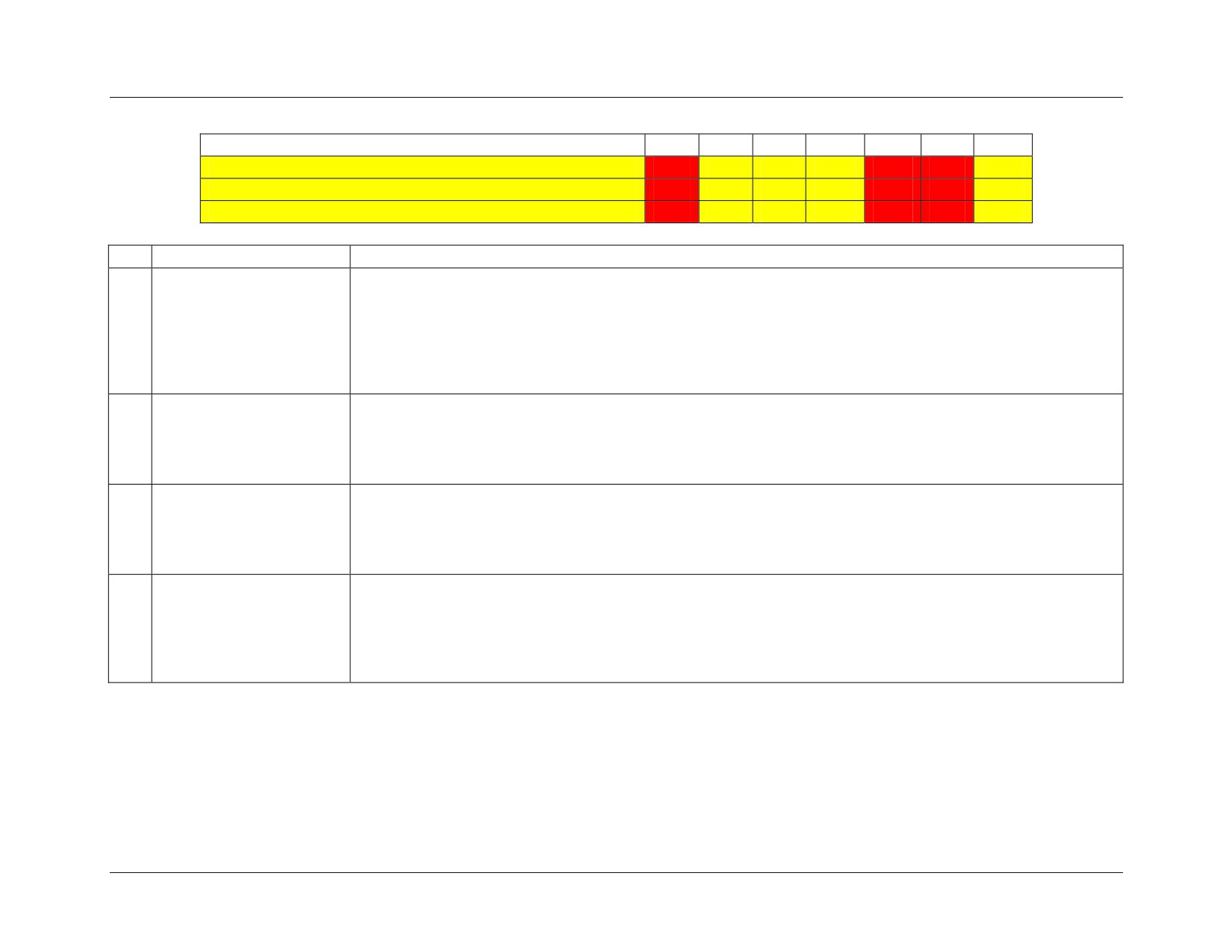
Table 9.14-1. TASHA 14: Capability and Deficiency Assessment
Capability: Veterinary Food and Water Surveillance
M1
M2
M3
M4
M5
M6
M7
Current Overall Capability
11
52
53
64
31
25
46
Near/Mid-Term Overall Capability
1
5
5
6
3
2
4
Far-Term Overall Capability
1
5
5
6
3
2
4
FAA Measure
Scale
M1
Food and water surveillance
8-10: Consumable food and water surveillance information utility is high and is accurately and rapidly presented on the
information in the COP is
COP using automated tools and systems.
accurate and useful.
4-7: Consumable food and water surveillance information utility exists; information is current and accurate and is
directly posted to the COP using manual means.
1-3: Consumable food and water surveillance information utility is low, delayed, inaccurate, or not generally posted
directly to the COP.
0: Consumable food and water surveillance information utility is nonexistent.
M2
Preventative health
8-10: Veterinary and preventative health surveillance automated systems are interoperable and integrated. Correlation of
surveillance information is
information is performed by the systems and is timely and accurate.
correlated.
4-7: Correlation of veterinary and preventative health surveillance information is predominantly performed manually.
1-3: Correlation of veterinary and preventative health surveillance information is inadequate for support of operations
0: Correlation of veterinary and preventative health surveillance information is nonexistent.
M3
Reports on hazard are
8-10: Consumable food and water surveillance hazard report utility is high and is posted directly to the COP.
accurate.
4-7: Consumable food and water surveillance hazard report utility exists and the information is posted on the COP after
review and/or consolidation by nonveterinary activity or authority.
1-3: Consumable food and water surveillance hazard report utility is low and does not support operations.
0: Consumable food and water surveillance hazard report utility is nonexistent.
M4
Food and water surveillance
8-10: Interoperable and integrated consumable food and water surveillance reporting system exists and is in place.
information reporting system
Reports are presented on the COP and disseminated to appropriate activities within and outside the area of operations.
is in place.
4-7: Consumable food and water surveillance reporting system exists and is in place. Reports are performed manually
and disseminated using available communications channels to selected activities within and outside area of operations.
1-3: Consumable food and water surveillance reporting is inadequate for support of operations.
0: Consumable food and water surveillance reporting does not exist.
103
For Official Use Only
For Official Use Only
CBRND Functional Needs Analysis/Functional Solution Analysis
Chapter 9. Tactical Shape Tasks
M5
Reports of contamination
8-10: Interoperable and integrated automated systems accurately and rapidly collect, correlate, and surveillance
indications of food and
information of food and water supplies. The information is assessed and presented directly on the COP by veterinary
water supplies are timely.
and/or preventative health services activities using automated tools and systems.
4-7: Surveillance information on food and water supplies is accurately and rapidly collected, correlated, and processed
manually. The information is assessed and directly presented on the COP by veterinary and/or preventative health
services activities.
1-3: Food and water surveillance inadequately collects, correlates, and processes information for presentation on the
COP by veterinary and/or preventative health services activities.
0: Food and water surveillance does not exist.
M6
Preventative activities and
8-10: Veterinary and/or preventative health surveillance automated systems are interoperable and integrated. Correlation of
medical countermeasures are
information is performed by the systems and identifies appropriate medical services COAs that are timely and accurate.
fully implemented.
Implementation of appropriate preventative activities and medical countermeasures adequately address situation.
4-7: Correlation of veterinary and/or preventative health surveillance information and identification of the appropriate
medical services COA is predominantly performed manually and is timely and accurate. Implementation and conduct of
the selected COA adequately addresses situation.
1-3: Correlation of veterinary/or and preventative health surveillance information, identification of appropriate medical
services COA, and/or implementation and conduct of the selected COA are inadequate for support of operations.
0: Correlation of veterinary and/or preventative health surveillance information, identification of appropriate medical
services COA, and/or implementation and conduct of the selected COA are nonexistent.
M7
There is effective DOTLPF
8-10: DOTLPF exists and is adequate for this task. Task can be effectively performed with little or no direct impact
in place to conduct task.
upon operations
4-7: Most critical aspects of DOTLPF for this task are addressed. Task can be performed with limitations requiring
work-arounds.
1-3: DOTLPF is inadequate for accomplishment of this task.
0: DOTLPF does not exist for this task.
1 Consumable surveillance information is generally not posted to the COP. Information collected by veterinary and/or preventative health services activities is generally posted,
when performed, to the COP by medical services authorities after review. Process is predominantly manual, time- and labor-intensive, and delays display of potentially critical
information on the COP with concurrent risk to health and well-being of the force.
2 Veterinary and/or preventative health surveillance information is correlated. However, the process is predominantly manual and time- and labor-intensive.
3 Consumable food and water surveillance hazard reporting on food and water supplies is posted on the COP by medical services authorities after review. Process is predominantly
manual and time- and labor-intensive. Reporting is performed only on supplies tested. Generally, testing of food and water supplies by veterinary and/or preventative health
surveillance are performed when indications exist of a potential safety issue.
4 Consumable food and water surveillance information reporting processes and procedures exist and is in place. Reporting is performed manually and disseminated using available
C4ISR systems.
5 Cooperative relationships between veterinary, preventative health, and medical services activities in the field are largely dependent upon establishment of personal interactions,
OPTEMPO, leadership interest, and the circumstances. Medical, preventative health, and veterinary services activities often operate and perform distinctly separate with generally
inadequate coordination and cooperation.
6 DOTLPF is provides for the performance of most critical aspects of this task. In-place barriers and work-arounds, however, impede accomplishment. DOTLPF must evolve as
systems, tactics, and situations change and to promote net-centric operations.
104
For Official Use Only
For Official Use Only
CBRND Functional Needs Analysis/Functional Solution Analysis
Chapter 9. Tactical Shape Tasks
9.14.3
Functional Solution Analysis
9.14.3.1
DOTLPF Assessment Summary
This section addresses the deficiencies and suggests potential non-materiel solutions. If there are
no non-materiel solutions or they are only partial solutions, the remaining non-materiel need is
then stated. Materiel needs are assessed in the IMA section.
1.
Deficiency: Lack of common sharing of automated data between preventive medicine and
veterinary services.
Partial Non-Material Solutions: Doctrine: Adjust doctrine to include address and remove
impediments to veterinary information processing and dissemination. Organization: Adjust
medical and veterinary organizations to foster sharing and exchange of data. Leadership:
Promote and maintain close cooperative and mutually participating relationships between
field medical and veterinary services activities. Training: Provide initial and recurrent
training to preventative medicine, veterinary services, and unit command staff of medical
services activities facilitating and emphasizing the appropriate sharing of information.
2.
Deficiency: Inadequate doctrine supporting veterinary performance of testing unless there is
confirmed or suspected contamination.
Partial Non-Material Solutions: Doctrine: Include threat-based guidance under which
veterinary services activities perform sampling tests on animals for presymptomatic
infections.
3.
Deficiency: Inadequate automated data collection and exchange for consumable food and
potable water surveillance.
Partial Non-Material Solutions: Doctrine: Adjust joint and Service doctrine to require
automated, interoperable data collection, analysis, and exchange systems for all units and
forces tasked with conducting consumable food and potable water surveillance.
4.
Deficiency: Inadequate veterinary capability for response unless there exists a known
problem or suspected situation.
Non-Material Solutions: Doctrine: Include threat-based guidance under which veterinary
services activities perform sampling tests on animals for presymptomatic infections.
Personnel: Adjust veterinary staffing for additional workload involved in testing.
9.14.3.2
IMA Assessment Summary
Table 9.14-4 is a list of ideas for material approaches and a corresponding description of each
idea. Approaches focus on the need for medical/veterinary data exchange process, connecting the
veterinarians to the tactical network, and providing the needed automated tools to improve the
speed and accuracy of veterinary testing and reporting to the COP. Table 9.14-5 identifies which
of the material approaches might address specific materiel deficiencies identified in the
DOTMLPF assessment.
105
For Official Use Only
For Official Use Only
CBRND Functional Needs Analysis/Functional Solution Analysis
Chapter 9. Tactical Shape Tasks
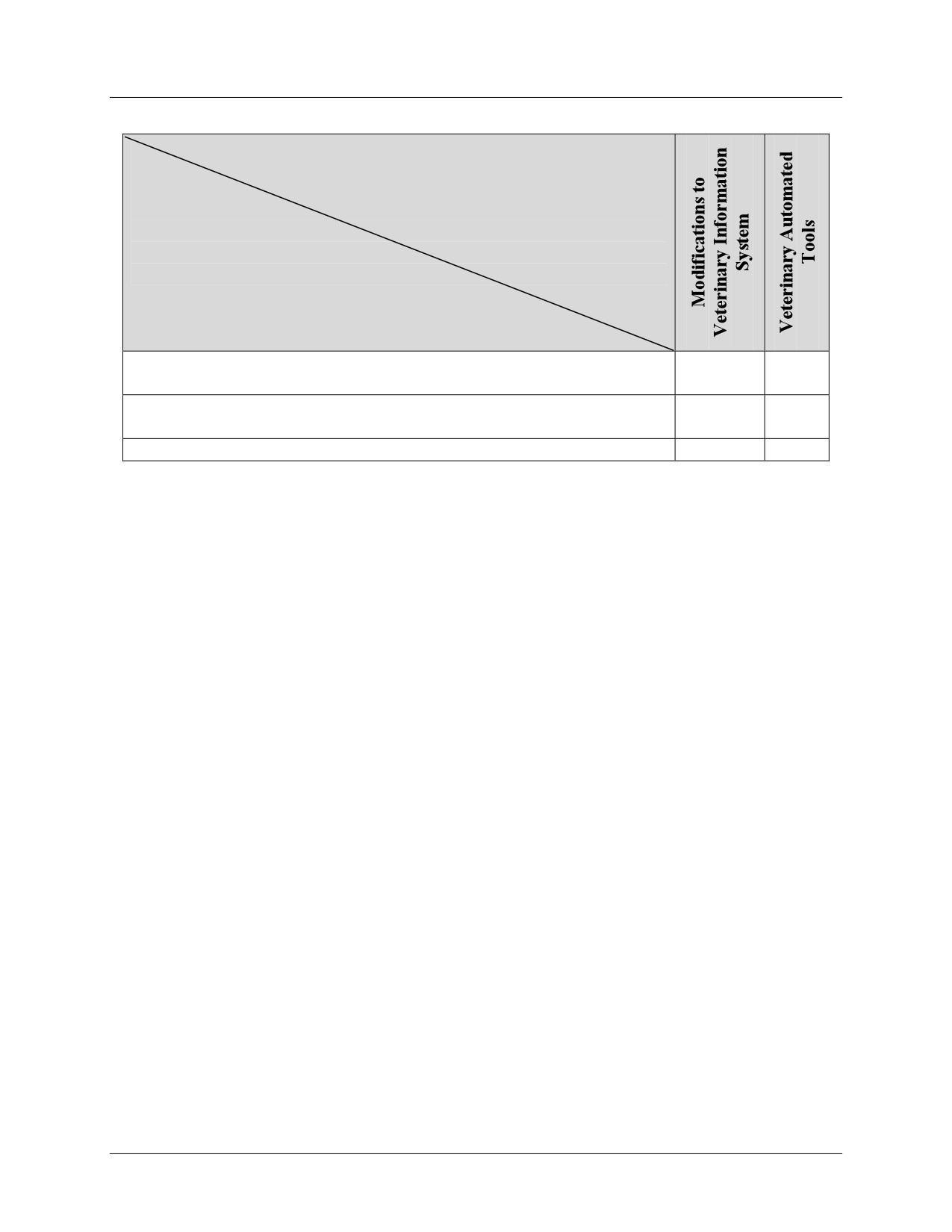
Table 9.14-4. TASHA 14: Materiel Approaches
Idea for Materiel Approach
Description
Modifications to veterinary
Develop automated modifications to existing and developing
information system
veterinary tracking systems to collect and disseminate food
and water testing information, collect/collate and process
veterinary CBRN information, track the status of MWA
isolation and quarantine operations, and link this information
to medical automated systems and the COP.
Veterinary automated tools
Develop automated tools that, on a systematic (routine)
basis, automatically trigger testing of food and water
supplies.
106
For Official Use Only
For Official Use Only
CBRND Functional Needs Analysis/Functional Solution Analysis
Chapter 9. Tactical Shape Tasks
Table 9.14-5. TASHA 14: IMA Assessment
Ideas for Material
Approaches
(IMA)
Identified Gaps
Lack of common sharing of automated data between preventive
X
medicine and veterinary services.
Inadequate doctrine supporting veterinary performance of testing
X
X
unless there is confirmed or suspected contamination.
Inadequate Veterinary Corps automated data collection and exchange.
X
X
107
For Official Use Only
For Official Use Only
CBRND Functional Needs Analysis/Functional Solution Analysis
Chapter 9. Tactical Shape Tasks
9.15
Task TASHA 15: Conduct CBRND preparations
9.15.1
Functional Area Analysis
9.15.1.1
Definition
Includes collaborative preparation for joint and coalition forces CBRND operations within the
local or immediate battlespace. Includes collecting and analyzing data from assessments within
CBRND functional areas (Shape, Sense, Shield, and Sustain) to support CBRND preparations
based on plans, commander’s intent, and operational context and situation. Includes preparatory
activities with affected forces, coalition partners, and appropriate NGO and indigenous agencies.
Also includes integration of CBRN resources provided by other nations and agencies. Includes
the tracking, status, and allocation of CBRND resources and activities to assure CBRND
readiness and preparedness for sustained effective performance of CBRND tasks within a
CBRN/TIM environment. Includes the development and dissemination of taskings to achieve
defined end states. Maintains visibility and awareness in the COP of CBRND preparatory
activities and resource status.
9.15.1.2
Derivation
UJTL (TA 5, TA 5.2.1, TA 7, TA 7.1), Military Transformation: A Strategic Approach,
Transformation Planning Guidance, Joint Enabling Concept for CBRN Operations, Protection
Joint Functional Concept.
9.15.1.2.1
Supported Task: OPSHA 6
9.15.1.2.2
Lateral Tasks: TASHLD 9, TASHLD 10, TASHLD 11, TASHLD 12
9.15.1.2.3
Supporting Task: N/A
9.15.1.3
Condition
Perform this task under conditions of:
Physical. N/A
Military
1. Partial preexisting arrangements. (C2.1.1.2)
2. Limited military commitments from other nations. (C2.1.1.7)
3. Marginal forces assigned. (C2.2.1)
4. Limited modern military systems. (C2.2.5)
5. Some interoperability. (C2.2.6)
6. Full joint staff integration. (C2.3.1.1)
7. Partial multinational integration. (C2.3.1.2)
108
For Official Use Only
For Official Use Only
CBRND Functional Needs Analysis/Functional Solution Analysis
Chapter 9. Tactical Shape Tasks
8. Moderate staff expertise. (C2.3.1.3)
9. Limited deployed supplies. (C2.8.2)
10. Limited prepositioned materiel. (C2.8.4)
11. No host-nation support. (C2.8.5)
Civil
1. Limited major power involvement. (C3.1.2.1)
2. Negative foreign government support. (C3.1.2.3)
3. Uncertain international organization support. (C3.1.2.5)
4. Restrictive National Command Authority decisions. (C3.1.3)
9.15.2
Functional Needs Analysis
9.15.2.1
Capability and Deficiency Assessment Summary
Table 9.15-1 discusses individual capabilities to plan and prepare for CBRND operations and
activities to the designated standards. Currently fielded capabilities are adequate, but need
automating, for most operational situations. Capability includes processes and methodologies to
plan, coordinate, and conduct preparations for CBRND operations and activities. The overall
capability for current, near/mid, and far term are rated “yellow.” Although improvements
between the periods occur for specific capabilities and are reflected in the associated identified
values, the improved capabilities are not sufficient to change the overall assessed color ratings
for this task.
Current Capability and Deficiency
Processes exist to coordinate allocation of CBRND units, personnel, systems, and equipment.
Plans have been prepared for operations in a CBRN/TIM environment. Training of U.S. forces
for operations involving a CBRN threat is generally performed in preparation of tasked forces to
conduct operations not of a sustained nature within a CBRN environment. U.S. forces are not
trained and equipped to perform sustained operations within a CBRN environment. Although
negotiations and discussions with coalition partners and other participants establish requirements
and activities for non-U.S. forces in preparation for CBRN operations, not all potential partner
nations possess CBRND capabilities. The participation of such nations in CBRN operations will
be dependent upon the ability and willingness of the United States and/or other allies to provide
the necessary training and materiel. Deficiencies include inadequate automated processing and
assessment tools; training of coalition forces; and inadequately trained CBRND personnel.
Projected Near/Mid-Term Capability and Deficiency
The initial fielding of programmed Joint CBRND systems (e.g., Joint Expeditionary Collective
Protection [JECP], Joint Service Lightweight Integrated Suit Technology[JSLIST], Joint Service
General Purpose Mask [JSGPM], etc.) provides additional capabilities for consideration and
application in operations planning. These systems will gradually replace Service-specific legacy
systems throughout the mid term and into the early far term. The CBRN staff cell must consider
109
For Official Use Only
For Official Use Only
CBRND Functional Needs Analysis/Functional Solution Analysis
Chapter 9. Tactical Shape Tasks
the diversity of CBRND assets and their associated capabilities when conducting CBRND
operations. The programmed initial fielding of JEM and JOEF will provide tools to assist the
CBRN staff cell in the performance of their tasks and responsibilities. However, the processes
applied by the cell personnel will largely remain unchanged.
Projected Far-Term Capability and Deficiency
Joint CBRND systems will fully replace legacy Service-specific systems within the early far
term. Additional protective systems will likely be fielded throughout the far term to address
emerging and new threats. JEM and JOEF will be fully fielded in the early far term.
110
For Official Use Only
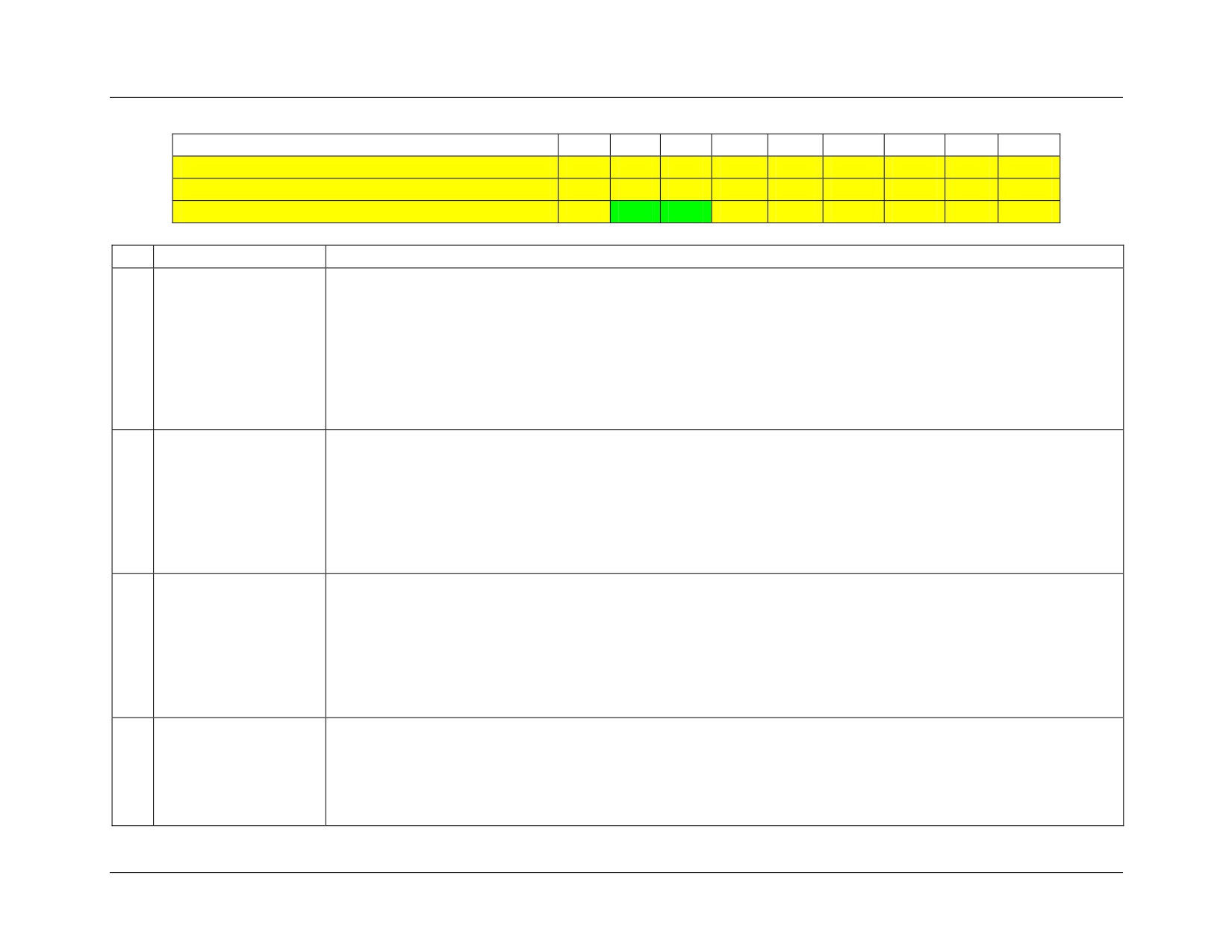
For Official Use Only
CBRND Functional Needs Analysis/Functional Solution Analysis
Chapter 9. Tactical Shape Tasks
Table 9.15-1. TASHA 15: Capability and Deficiency Assessment
Capability: Conduct CBRND Preparations
M1
M2
M3
M4
M5
M6
M7
M8
M9
Current Overall Capability
61
62
63
44
65
76
57
58
69
Near/Mid-Term Overall Capability
6
7
7
5
6
7
5
5
6
Far-Term Overall Capability
6
8
8
5
6
7
5
5
6
FAA Measure
Scale
M1
Process exists to
8-10: Automated tools, processes, and systems track and display on the COP the status of CBRND units and personnel.
coordinate the allocation
Includes unit equipment and supplies status, unit capabilities, and other relevant information for review. Assists with the
of CBRND units and
allocation of these units and personnel to meet identified needs and operational requirements.
personnel.
4-7: The identification, tracking, and allocation of CBRND units and personnel is performed by predominantly manual
means. Process effectiveness is dependent upon the training, knowledge, skill, and experience of performing personnel and
the currency and accuracy of applied information.
1-3: Processes for the identification, tracking, and/or allocation of CBRND units and personnel is inadequate for effective
support of operations
0: Processes for the identification, tracking, and/or allocation of CBRND units and personnel is nonexistent.
M2
Allocation of CBRND
8-10: Adequate quantities and types of CBRND equipment, systems, and material are available, allocated, ready, and match
systems and equipment.
JTF operations (e.g., Expeditionary, High Maneuver, etc.) and environments (e.g., jungle, extreme cold terrain, desert, etc.).
Includes support of sustained operations in a CBRN/TIM environment.
4-7: Sufficient quantities and types of CBRND equipment, systems, and material are allocated and ready for support of JTF
operations in a CBRN/TIM environment. Adjustments to planned quantities are performed when necessary for availability.
Alternatives are identified, supporting material availability determined, and appropriate allocation actions are taken.
1-3: CBRND systems and equipment allocation is inadequate to support operations.
0: CBRND systems and equipment allocation processes do not exist.
M3
Process exists to
8-10: Automated processes, templates, and collaborative spaces ensure all relevant issues and needs are addressed. Planners
coordinate the pertinent
and CBRN specialist are highly trained, knowledgeable, and possess access to needed reference material and impacting
Sense, Shape, Shield,
information.
and Sustain factors.
4-7: Manual processes are predominantly applied to address pertinent CBRND issues and are dependent upon the training,
skill, experience, and knowledge of planning participants.
1-3: Process are inadequate for the effective identification and planning of pertinent CBRND issues, and/or planning
participants do not possess adequate training, skill, experience, and knowledge to perform the task.
0: Processes and training do not exist for the identification and planning of pertinent CBRND issues.
M4
CBRND staff cell and
8-10: CBRN staff cell and units possess dedicated information technology resources and tools for the accomplishment and
units have access to
performance of their duties and responsibilities. These are used to support operational and training requirements.
dedicated information
4-7: CBRN staff cell and units are able to access shared information technology resources and tools for operational
technology resources to
requirements and training.
perform tasks and
1-3: CBRN staff cell and units possess limited access to shared information technology resources for operational
responsibilities.
requirements and training.
111
For Official Use Only
For Official Use Only
CBRND Functional Needs Analysis/Functional Solution Analysis
Chapter 9. Tactical Shape Tasks
0: CBRN staff cell and units do not possess access to information technology to support operations and training.
M5
Plans exist for
8-10: Operational plans for sustained operations within a CBRN/TIM environment are developed and disseminated to all
operations within a
tasked elements. Plans adequately address the four CBRND areas and enable maintenance of OPTEMPO and successful
CBRN/TIM
attainment of planned end states.
environment.
4-7: Operational plans for operations within a CBRN/TIM environment are developed and disseminated to all tasked
elements. Plans adequately address the four CBRND areas and enable resumption of OPTEMPO and successful attainment
of planned end states.
1-3: Plans are inadequate for support of operations within a CBRN/TIM environment.
0: Plans are nonexistent for operations within a CBRN/TIM environment.
M6
Non-DoD CBRND
8-10: Available CBRND resources of coalition partners and pertinent non-DoD entities are integrated into CBRND planning
resources integrated
and preparations. Secure, interoperable, and interactive processes between participants track identified CBRND resources
when available.
and display information that is current and accurate on the COP.
4-7: Available CBRND resources of coalition partners and pertinent non-DoD entities are integrated into CBRND planning
and preparations. Tracking and readiness information is performed by the owning nation/entity and status updates are
provided to the JTF staff. Tracking of CBRND resources supplied to the JTF for application is predominantly performed
manually and not integrated with existing JTF automated logistics and CBRND asset tracking systems.
1-3: Identification and tracking of available CBRND resources of coalition partners and non-DoD entities is inadequate to
support operations
0: Identification and tracking of available CBRND resources of coalition partners and non-DoD entities is nonexistent.
M7
Forces prepared to
8-10: Forces are equipped, trained, and ready to perform sustained operations within a CBRN/TIM environment.
operate in a CBRN/TIM
4-7: Forces are equipped, trained, and ready to perform operations within a CBRN/TIM environment.
environment.
1-3: Forces are inadequately equipped, trained, or ready to perform operations within a CBRN/TIM environment
0: Forces are not equipped, trained, or prepared for operations within a CBRN/TIM environment.
M8
CBRN staff cells have
8-10: All CBRN staff cell personnel are formally trained, receive recurring refresher training, and are experienced in the
the training an
determination of appropriate CBRND needs, planning, and the conduct of preparations.
experience to make
4-7: Limited training is provided, is inconsistent, and/or is administered as needed of CBRN staff cell personnel on the
effective preparations.
determination of appropriate CBRND needs, planning, and the conduct of preparations. Experience will vary between CBRN
staff cells among the performing units.
1-3: CBRN staff cell personnel training and experience is inadequate to support operations
0: CBRN staff cell personnel training and experience is nonexistent.
M9
There is effective
8-10: DOTLPF exists and is adequate for this task. Task can be effectively performed with little or no direct impact upon
DOTLPF in place to
operations
conduct task.
4-7: Most critical aspects of DOTLPF for this task are addressed. Task can be performed with limitations requiring work-
arounds.
1-3: DOTLPF is inadequate for accomplishment of this task.
0: DOTLPF does not exist for this task.
1 Allocation of CBRND units and personnel is performed using predominantly manual processes and means. Currency and accuracy of information applied in the process is
dependent upon routine reports and inquiries. Effective allocation is dependent upon the experience, skill, knowledge, and training of the staff and varies between staffs. The
112
For Official Use Only
For Official Use Only
CBRND Functional Needs Analysis/Functional Solution Analysis
Chapter 9. Tactical Shape Tasks
programmed fielding of JOEF and JEM in the mid term provides the staff with tools to identify and assess COAs supporting the effective allocation of CBRND units and
personnel. However, the process will remain largely unchanged.
2 CBRND equipment, systems, and types are available in sufficient quantities to support JTF operations in a CBRN environment, provided there does not exist conflicting demands
to support multiple concurrent operations with CBRN threat. Protection from high-risk TIMs is minimal in current CBRND equipment, systems, and material. Further, the majority
of the types of systems do not adequately support sustained operations and require infusion of increased CBRND resources to maintain OPTEMPO. Collective protection
(COLPRO) systems, for example, are generally large-scale systems and do not adequately support expeditionary and high-maneuver operations, particularly in austere
environments at the extremes of the lines of communication. JECP is programmed to field in the mid term and will provide COLPRO flexibility to support most operations and
situations. The JSLIST is programmed to field during the mid term and is undergoing certification to meet Occupational Safety and Health Administration (OSHA) Level “C”
requirements for TIMs. The JSGPM filtration system will provide a level of protection against selected TIMs and is programmed to field during the mid term. The programmed
initial fielding of JOEF and JEM in the mid term provides the staff with tools to identify and assess COAs supporting the effective allocation of CBRND resources. Full fielding of
JOEF and JEM will be completed in the early far term. However, the process will remain largely unchanged.
3 Processes to consider, coordinate, and plan for pertinent CBRND Sense, Shape, Shield, and Sustain factors, needs, and limitations are predominantly manually performed. The
effective application of these processes is dependent upon the experience, skill, knowledge, and training of the staff and varies between staffs. The programmed initial fielding of
JOEF and JEM in the mid term provides the staff with tools to identify and assess COAs supporting the planning of CBRND. JOEF and JEM will complete fielding in the early far
term.
4 CBRN staff cell personnel and unit personnel possess access to shared information technology resources and tools. CBRN personnel do not possess dedicated information
technology to perform training and operational requirements. Available resources are shared with other requiring activities and functions. The programmed fielding of JOEF and
JEM, although CBRND-supporting technologies, will likely reside upon resident C4ISR hardware and not dedicated CBRND hardware resources.
5 Operational plans do not generally address sustained operations within a CBRN/TIM environment. However, plans are developed addressing operations not of a sustained nature
within a CBRN environment. Operations within a TIM environment are generally not planned or considered. Resumption and/or maintenance of OPTEMPO is a primary
consideration of operational planning. Processes to consider coordinate, and plan for pertinent CBRND Sense, Shape, Shield, and Sustain factors, needs, and limitations are
performed for CBRN threat in the development of plans.
6 In coordination with coalition partner staff and pertinent non-DoD entities, the JTF staff develops a comprehensive operations plan for successful achievement of the desired end
states. Discussions and negotiations between partners determine the capabilities of each partner within the full spectrum of support. Specific tasks are assigned to elements of the
coalition force and non-DoD entities most capable of completing the task. Although the provision of CBRND equipment to national forces ultimately resides with their nations,
mutual logistics support among coalition partners is planned to complement partners’ capabilities and to minimize weaknesses. For example: U.S. Marine Corps forces were
equipped with lightweight CBRN/TIM individual protective equipment by the United Kingdom during Operation Desert Storm. The United States installed COLPRO capabilities
in Saudi critical command and control facilities for the same operation. CBRND resources availability and readiness is addressed throughout the process for CBRND. The
allocation, placement, and reallocation of protective assets is a function of the planning and operational control of the JTF, JTF staff, and combined staff. Acquisition cross-Service
agreements between coalition partners enable acquisition and cross-servicing support between the partners. The implementing arrangement, a more specific arrangement, provides
for a wide range of support exchange including consumables, sheltering, medical care, and other support activities. The allocation, operation, manning, management, and resupply
of non-U.S. force CBRND assets are generally the responsibility of the owning nation. The tracking of these assets are internal to those forces and nations. Integration of U.S. and
non-U.S. logistics systems is not currently required. Tracking of non-U.S. equipment supplied for U.S. force application is largely performed manually and not integrated with
existing component Service systems.
7 Planning and preparation of U.S. forces for operations involving a CBRN threat provide for the equipping, training, and preparation of tasked forces to conduct operations not of
a sustained nature within a CBRN environment. Negotiations and discussions with coalition partners and other participants establish similar requirements and activities for non-
U.S. forces. However, not all potential partner nations possess CBRND capabilities and would rely upon the United States and other allies for equipment and training.
8 Training in CBRN staff cell operations and processes is generally conducted by the unit. Standardized training is virtually nonexistent, although standard requirements for the
responsibilities and duties of the cell do exist. The effectiveness of the cell is dependent upon the experience, skill, knowledge, and training of the assigned staff personnel and
varies between staffs.
9 DOTLPF adequately addresses most of the critical aspects of this task. However, DOTLPF requires improvement to sufficiently address areas increasingly important for the
transformed force and the changing operational environment. DOTLPF will continue to need to evolve as systems, tactics, and situations change.
113
For Official Use Only
For Official Use Only
CBRND Functional Needs Analysis/Functional Solution Analysis
Chapter 9. Tactical Shape Tasks
9.15.3
Functional Solution Analysis
9.15.2.1
DOTLPF Assessment Summary
This section addresses the deficiencies and suggests potential non-materiel solutions. If there are
no non-materiel solutions or they are only partial solutions, the remaining non-materiel need is
then stated. Materiel needs are assessed in the IMA section.
1.
Deficiency: Inadequate automated processing and assessment tools for the NBC staff cells.
Partial Non-Material Solutions: Doctrine: Develop doctrine commensurate with advanced
information technology application.
2.
Deficiency: Insufficient access to automated processing tools.
Partial Non-Material Solutions: Doctrine: Ensure TTPs and local procedures ensure access
to automated processing tools.
3.
Deficiency: Inadequate integration and tracking of non-JTF resources applied by the JTF.
Partial Non-Material Solutions: Doctrine: Ensure TTPs and local procedures account for
the integration of local resources in preparations. Also include the potential impact of
chemical/biological contamination of airlift aircraft on the intertheater airlift flow and the
passive defense measures available to mitigate the threat. Organization: Ensure coordination
and collaboration with indigenous authorities. Facilities: Modification of supporting
logistical infrastructure to track “loaned” non-U.S. CBRND resources and report status.
4.
Deficiency: Inadequate recognition and support of non-NATO capable forces in coalitions
operating in a CBRN Threat environment.
Partial Non-Material Solutions: Organization: Ensure adequacy of coalitions to operate in
a CBRND environment. Training: Ensure training programs are available for coalition
partners who lack CBRND skills.
5.
Deficiency: Insufficient trained personnel for CBRN staff cells.
Partial Non-Material Solutions: Training: Ensure training programs maintained to provide
a continuous pool of capable CBRN staff cells. Personnel: Take steps to adequately provide
trained personnel to CBRN staff cells.
9.15.3.2
IMA Assessment Summary
Table 9.15-4 is a list of ideas for material approaches and a corresponding description of each
idea. The material approaches to help accomplish this task cover developing new, more accurate
models and simulations for CBRND planning, providing reach back capability to use
information from previous lessons learned, the need for linkages to other data systems and the
need for additional C4ISR assets. Table 9.15-5 identifies which of the material approaches might
address specific materiel deficiencies identified in the DOTMLPF assessment.
114
For Official Use Only
For Official Use Only
CBRND Functional Needs Analysis/Functional Solution Analysis
Chapter 9. Tactical Shape Tasks
Table 9.15-4. TASHA 15: Materiel Approaches
Idea for Materiel Approach
Description
Simulations and models
Develop a system enabling operational commanders to
efficiently execute “what if” scenarios and facilitate the
evaluation of plausible adversary and friendly COAs, CBRN
employment, and TIM ROTA.
Database
Develop a system for obtaining information, archiving data,
accessing databases, performing information/data queries, and
exchanging data files in support of CBRN functions and
activities.
Reachback capability
Develop a system providing the ability to rapidly and securely
reach back and contact CBRN experts and obtain CBRND
plans, procedures, information, and lessons learned.
Link to GIS
Develop a system resident in standard C4ISR systems with
interface to GIS to provide input to the COP.
Risk factor template
Develop a system merging CBRN, intelligence, and
operational data and plans into standardized automated
formats for application to effectively and rapidly accomplish
CBRN/TIM functions and activities.
115
For Official Use Only
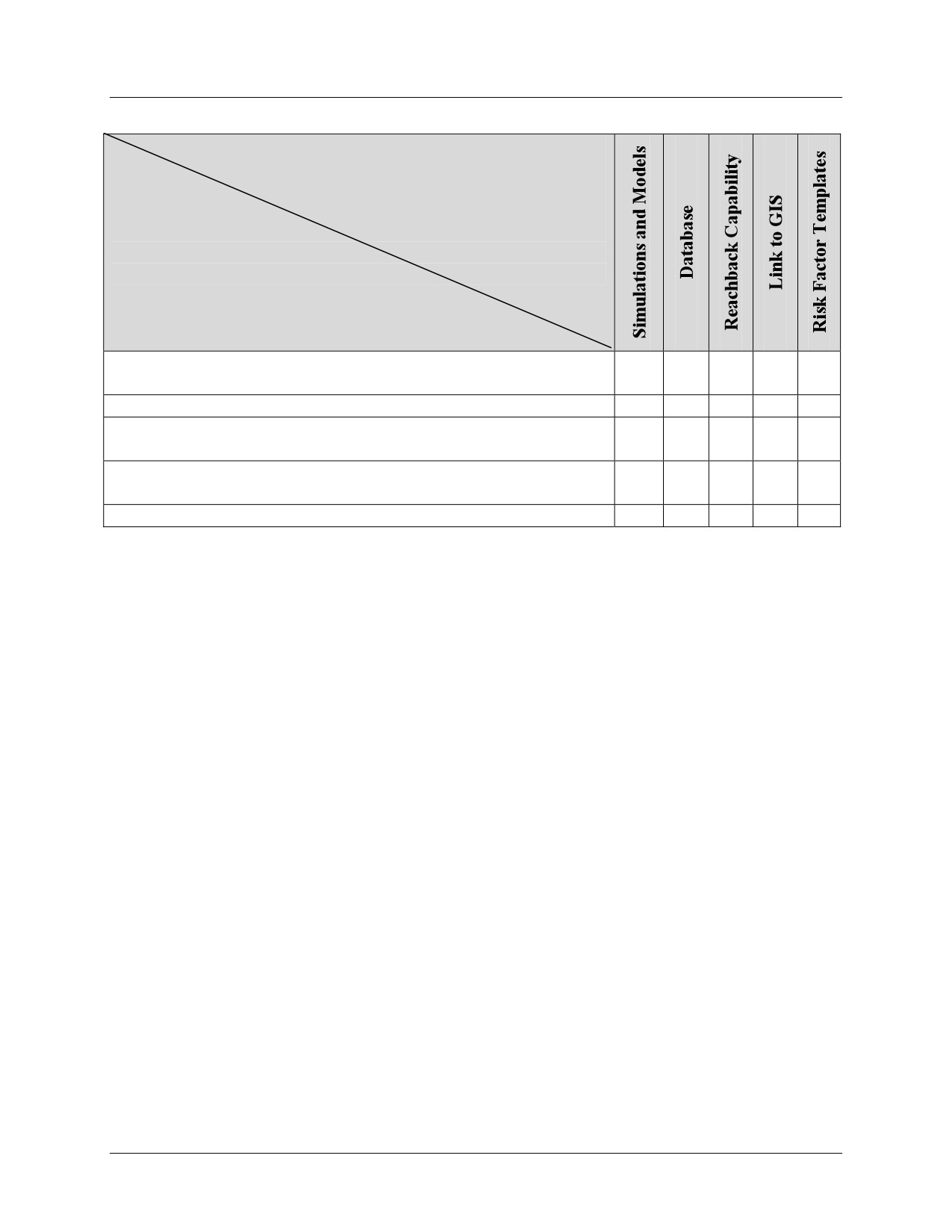
For Official Use Only
CBRND Functional Needs Analysis/Functional Solution Analysis
Chapter 9. Tactical Shape Tasks
Table 9.15-5. TASHA 15: IMA Assessment
Ideas for Material
Approaches
(IMA)
Identified Gaps
Inadequate automated processing and assessment tools for the
X
X
X
X
X
NBC staff cells.
Insufficient access to automated processing tools.
X
X
X
X
X
Inadequate integration and tracking of non-JTF resources applied
X
X
X
by the JTF.
Inadequate recognition and support of non-NATO capable forces
X
X
X
in coalitions operating in a CBRN Threat environment.
Insufficient trained personnel for CBRN staff cells.
X
X
X
116
For Official Use Only
For Official Use Only
CBRND Functional Needs Analysis/Functional Solution Analysis
Chapter 9. Tactical Shape Tasks
9.16
Task TASHA 16: Conduct CBRN hazard prediction and effects modeling
9.16.1
Functional Area Analysis
9.16.1.1
Definition
This task encompasses hazard prediction and effects modeling for situational awareness,
response management, preparation, and planning within the immediate battlespace. Agent fate
data aid in predicting persistency and impact over the length of the operation or campaign.
Effects modeling extend to casualty prediction, effects on unit and mission capability, and
expected degradation. All of these are required for COA (adversary and joint force) evaluations,
preparations, and management. As the contaminated area matures, hazard levels fluctuate over
time, based on the specific agent, winds, terrain, vegetation, waterways, etc. Terrain data, local
or micrometeorology, and surface texture are accounted for in atmospheric modeling. Detection
data and hazard characterization data are the input for the model-based predictions for
atmospheric-driven hazards. Observations and data from the IDN are used to update the hazard
prediction.
Biological agents, which are contagious, communicable, or propagated by vectors, are modeled
to assist in locating the source, extent of population exposure, persistency in human and animal
populations, and impact on military and indigenous populations.
Results are displayed to force commanders via the COP. Computations are performed in either
stand-alone or network mode.
9.16.1.2
Derivation
UJTL (TA 2.4, TA 7, TA 7.1), Joint Enabling Concept for CBRN Operations, Protection Joint
Functional Concept, An Operational Concept for Biological Defense, Military Transformation:
A Strategic Approach.
9.16.1.2.1
Supported Task: OPSHA 1
9.16.1.2.2
Lateral Tasks: TASENS 1, TASENS 2, TASENS 3
9.16.1.2.3
Supporting Task: N/A
9.16.1.3
Condition
Perform this task under conditions of:
Physical
1. Moderately developed land. (C1.1)
2. Temperate climate. (C1.3.1)
3. Moderate atmospheric effects. (C1.3.3)
117
For Official Use Only
For Official Use Only
CBRND Functional Needs Analysis/Functional Solution Analysis
Chapter 9. Tactical Shape Tasks
Military
1. Partial preexisting arrangements. (C2.1.1.2)
2. Low military systems reliability. (C2.2.5.3)
3. Some interoperability. (C2.2.6)
4. Partial joint staff integration. (C2.3.1.1)
5. Limited staff expertise. (C2.3.1.3)
6. High information volume. (C2.3.1.9)
Civil
1. Limited international organization support. (C3.1.2.5)
9.16.2
Functional Needs Analysis
9.16.2.1
Capability and Deficiency Assessment Summary
Table 9.16-1 discusses individual capabilities to perform this task to the designated standards.
Staffs and units have limited capability to perform CBRN hazard prediction and effects
modeling. ATP-45 provides broad-area assessments. Capability is manual and limited to the
mesolevel. Even future capabilities do not provide sufficient information technology resources to
CBRN staffs. The overall capability for current, near/mid, and far term are rated “yellow.”
Although improvements between the periods occur for specific capabilities and are reflected in
the associated identified values, the improved capabilities are not sufficient to change the overall
assessed color ratings for this task.
Current Capability and Deficiency
There is no existing DoD approved methodology to provide common representation of WMD or
TIM hazards. The current hazard prediction models have not been tested to DoD standards.
These models lack validation, verification, and accreditation. Staffs and units currently possess
limited capabilities to perform CBRN hazard prediction and effects modeling. ATP-45 provides
broad-area assessments. Current deficiencies include lack of ability to work with urban terrain at
the micro level, limited information provided by ATP-45 reports, absence of ability to accurately
and rapidly characterize the hazard, coordination collaboration procedures required for medical
and NBC staff cells, and no common joint hazard prediction capability. JEM will address some
of these shortfalls. However, limitations remain with respect to quality control of meteorological
and oceanographic inputs to JEM, as well as assessing the accuracy of JEM plume against
ground truth. The absence of this supporting data has a significant impact during Concept of
Operations (CONOPS) development process for high-resolution hazard prediction.
Projected Near/Mid-Term Capability and Deficiency
The programmed initial fielding of JWARN, JOEF, and JEM during the mid term is projected to
improve the ability to perform hazard prediction and effects modeling. Overall capabilities of the
JTF will gradually increase as operational units are equipped with the systems throughout the
118
For Official Use Only
For Official Use Only
CBRND Functional Needs Analysis/Functional Solution Analysis
Chapter 9. Tactical Shape Tasks
mid term and into the early far term. However, this enhanced capability retains many of the
current deficiencies. Micromodeling necessary for urban and complex terrain modeling is
inadequate, a common accurate and detailed common joint hazard prediction capability is not
determined, and future capabilities do not provide sufficient information technology resources to
CBRN staffs. Although the systems do provide a level of support for an aerosolized biological
release, they are inadequate for predicting communicable disease transmission, progression, and
persistency within populations. Capabilities to detect and identify agents, including standoff
detection, are fielded sporadically and as determined operationally ready. The fielding of JEM in
the near term will markedly improve high-resolution hazard prediction throughout the
battlespace. As JEM matures through the acquisition process, difficult challenges will be
undertaken, such as urban and water dispersion. One notable shortfall with JEM is the absence of
operating concepts that highlight the most effective employment of JEM across the Joint Service.
Projected Far-Term Capability and Deficiency
Interoperable medical surveillance prediction and modeling tools are reasonably expected to be
fielded in this period and should address communicable disease transmission, progression, and
persistency within populations. Agent detect and identify capabilities continue to improve as
sensor systems are determined operationally ready and fielded. Fielding of JWARN, JEM, and
JOEF is projected to be completed early in the far term.
119
For Official Use Only
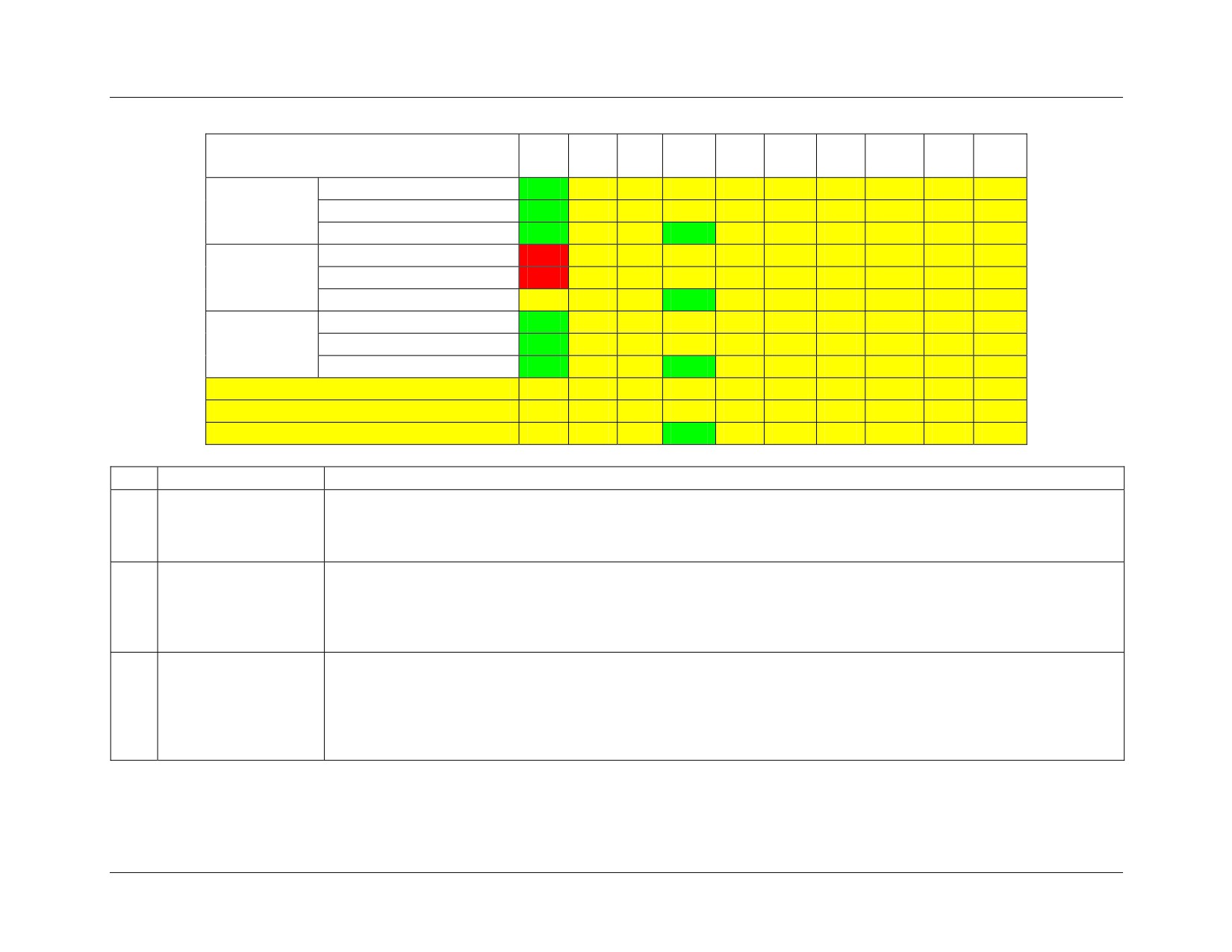
For Official Use Only
CBRND Functional Needs Analysis/Functional Solution Analysis
Chapter 9. Tactical Shape Tasks
Table 9.16-1. TASHA 16: Capability and Deficiency Assessment
Capability: Hazard Prediction and
M1
M2
M3
M4
M5
M6
M7
M8
M9
M10
Effects Modeling
Chemical
Current
81
42
43
44
45
56
56
56
47
48
Near/Mid Term
8
5
5
7
5
6
6
6
5
4
Far Term
8
6
6
8
5
7
7
7
7
5
Biological
Current
19
42
43
410
45
411
411
411
47
48
Near/Mid Term
1
5
5
5
5
5
5
5
5
4
Far Term
4
6
6
8
5
6
6
6
7
5
Radiological
Current
81
42
43
44
45
56
56
56
57
78
Near/Mid Term
8
5
5
5
5
6
6
6
5
7
Far Term
8
6
6
8
5
7
7
7
7
7
Current Overall Capability
5
4
4
4
4
5
5
5
4
5
Near/Mid Term Overall Capability
5
5
5
5
5
6
6
6
5
5
Far Term Overall Capability
7
6
6
8
5
7
7
7
7
6
FAA Measure
Scale
M1
There is sufficient
8-10: CBRN staff cell and unit personnel possess unrestricted access to common and standardized hazard prediction models.
access to the hazard
4-7: CBRN staff cell and unit personnel possess limited access to common hazard prediction models.
prediction models.
1-3: CBRN staff cell and unit personnel have difficulty accessing hazard prediction models.
0: CBRN staff cell and unit personnel do not have access to hazard prediction models.
M2
Terrain data input is
8-10: Microterrain data are available with required fidelity (e.g., accuracy, resolution, time latency, periodicity) and applied
adequate.
to microlevel hazard prediction.
4-7: Meso-/macroterrain data are available, accurate, and applied to meso-/macrolevel hazard prediction.
1-3: Meso-/macroterrain data are available and applied to meso-/macrolevel hazard prediction and may contain errors.
0: Terrain data are not available and/or applied to hazard prediction.
M3
Meteorological data are
8-10: Micrometeorological, as well as high-altitude-weather, data are available with required fidelity (e.g., accurate, timely,
adequate.
of the required resolution) and applied for microlevel hazard prediction.
4-7: Meso-/macrometeorological data are available, accurate, and applied to meso-/macrolevel hazard prediction.
1-3: Meso-/macrometeorological data are available and applied to meso-/macrolevel hazard prediction and may contain
errors.
0: Meteorological data are not available and/or applied to hazard prediction.
120
For Official Use Only
For Official Use Only
CBRND Functional Needs Analysis/Functional Solution Analysis
Chapter 9. Tactical Shape Tasks
M4
Agent detection and
8-10: Automated agent detection systems are integrated and interoperable with automated CBRND systems. Sensor systems
identification data are
include point, standoff, detect-to-alert, detect-and-identify, and identification sensors providing adequate detection capability
adequate.
and coverage of operations. Sensor data are correlated and processed to identify and characterize the hazard and the results
are posted on the COP in near-real time.
4-7: Agent detection systems vary between manual to automated detection systems and are predominantly point detection,
and the sensor data must be manually correlated and processed to characterize the hazard. Input to the COP is usually
performed manually.
1-3: Agent detection and identification systems and data are inadequate to support operations.
0: Agent detection and identification systems and data are nonexistent.
M5
CBRN staff cell and
8-10: CBRN staff cell and units possess dedicated information technology resources and tools for the accomplishment and
units have access to
performance of their duties and responsibilities. These are used to support operational and training requirements.
dedicated information
4-7: CBRN staff cell and units are able to access shared information technology resources and tools for operational
technology resources to
requirements and training.
perform tasks and
1-3: CBRN staff cell and units possess limited access to shared information technology resources for operational
responsibilities.
requirements and training.
0: CBRN staff cell and units do not possess access to information technology to support operations and training.
M6
Commanders and staffs
8-10: All commanders and staff personnel are formally trained and received recurring refresher training on the effective use
have the training to
of hazard prediction tools to include their application, interpretation, and weak and strong points.
effectively use hazard
4-7: Selected staff personnel are trained on the effective use of hazard prediction models and processes. Commanders are
prediction tools.
cognizant of the proper application of these tools.
1-3: Training on the effective use of hazard prediction tools and models is inadequate to effectively support operations
0: Training on the effective use of hazard prediction tools and models is nonexistent.
M7
CBRND specialists
8-10: CBRND specialist are formally trained and received recurring refresher training on the effective use of hazard
have the training to
prediction tools to include their application, interpretation, and weak and strong points. Exercises and evaluations include
effectively apply
requirements for hazard prediction modeling and interpretation to maintain competencies.
hazard prediction
4-7: CBRND specialists are formally trained to perform hazard prediction using prediction models. Exercises and
models.
evaluations periodically include requirements for hazard prediction modeling and interpretation to maintain basic
competencies.
1-3: Training of CBRND specialists on the effective use of hazard prediction tools and models is inadequate to effectively
support operations
0: Training of CBRND specialists on the effective use of hazard prediction tools and models is nonexistent.
M8
Hazard prediction
8-10: Hazard prediction utility is high for hazard assessment and decision-making. Prediction is based upon standardized
useful for assessment
automated microlevel hazard prediction tools continual drawing upon various applicable sources and updating predictions.
and decision making.
4-7: Hazard prediction utility exists for assessment and decision making. Prediction is based upon common hazard prediction
tools and is dependent upon manual processes, possibly with limited automated support, and is reliant upon the experience,
training and knowledge of performing staff and the scope and quality of influencing information.
1-3: Hazard prediction utility is low for assessment and decision making and is inadequate to effectively support operations.
0: Hazard prediction utility is nonexistent.
121
For Official Use Only
For Official Use Only
CBRND Functional Needs Analysis/Functional Solution Analysis
Chapter 9. Tactical Shape Tasks
M9
Hazards effects models
8-10: Hazard effects modeling utility is high for hazard assessment and decision making. Modeling is based upon
are useful for
standardized automated microlevel hazard effects modeling tools continual drawing upon various applicable sources and
assessment and
updating hazard effects presentations.
decision making.
4-7: Hazard effects modeling utility exists for assessment and decision making. Modeling is based upon predominantly
manual modeling tools and is dependent upon manual processes, possibly with limited automated support, and is reliant upon
the experience, training, and knowledge of performing staff and the scope and quality of influencing information.
1-3: Hazard effects modeling utility is low for assessment and decision making and is inadequate to effectively support
operations.
0: Hazard effects modeling utility is nonexistent.
M10
There is effective
8-10: DOTLPF exists and is adequate for this task. Task can be effectively performed with little or no direct impact upon
DOTLPF in place to
operations
conduct task.
4-7: Most critical aspects of DOTLPF for this task are addressed. Task can be performed with limitations requiring work-
arounds.
1-3: DOTLPF is inadequate for accomplishment of this task.
0: DOTLPF does not exist for this task.
1 CBRND staff cell personnel and unit personnel are trained in the application of and possess access to ATP-45 hazard prediction model, a NATO standard. This is a manual
process and is dependent upon the experience, skill, and knowledge of the performing individual(s). Although other prediction models, both GOTS and COTS, exist, these are not
standardized and common to the force. The mid-term programmed fielding of JEM will provide CBRN specialists with a standardized and common hazard prediction tool.
However, JEM will likely reside upon resident C4ISR systems and not dedicated CBRND hardware resources. CBRN specialists will possess shared access to these systems.
2 Current hazard prediction modeling is performed at the meso-/macrolevel. Microterrain data, when available, are at greater depth of detail than required by the model. Modeling
currently uses ATP-45, which provides broad-area assessments. ATP-45 was designed for application using standard maps. Digital Terrain Elevation Data (DTED) Level 1 terrain
data adequately supports current modeling processes. The advent of computerized modeling using ATP-45 provides visualization, but generally requires terrain data to be resident.
The mid-term and far-term fielding of JOEF and JEM will expand hazard modeling capabilities. Terrain data may be accessed as needed and retained from GIS, mapping, or other
applicable and approved sources. JEM will provide a standardized and common hazard prediction tool.
3 Current hazard prediction modeling is performed at the meso-/macrolevel. Micrometeorological data, when available, are at greater depth of detail than required by the model.
Modeling currently uses ATP-45 which provides broad-area assessments. ATP-45 was designed for application using standard maps. The mid-term and far-term fielding of JOEF
and JEM will expand hazard modeling capabilities. Meteorological data from applicable and approved sources is accessed on a continuing basis and applied to the model. JEM will
provide a standardized and common hazard prediction tool.
4 Agent detection and identification is currently performed using predominantly point detection systems and manual reporting. Characterization of the hazard is currently time-
consuming and labor-intensive. Current sensor capabilities are limited. However, ongoing efforts are proceeding for development of enhanced sensor capabilities, including stand-
off sensors. Fielding of these systems will occur throughout the mid- and far-term. The mid-term and far-term fielding of JWARN to operational units will provide the capability to
integrate sensor data for alerting and warning. Agent identification may be achieved by sensor detection parameters, emplaced identification sensors, and/or manual identification
processes. Characterization of the hazard can be performed rapidly and accurately through an adequate sensor mix tied to the automated system.
5 CBRN staff cell personnel and unit personnel possess access to shared information technology resources and tools. CBRN personnel do not possess dedicated information
technology to perform training and operational requirements. Available resources are shared with other requiring activities and functions. The programmed fielding of JOEF and
JEM, although CBRND supporting technologies, will likely reside upon resident C4ISR hardware and not dedicated CBRND hardware resources.
6 CBRN specialists received formal training on the use and application of the ATP-45 process. Commanders are cognizant of the implications of the results and factor the
information into their decisions. CBRN specialists in operational units are periodically exercised and evaluated on the conduct of hazard prediction. However, most local
evaluators are unable to adequately assess the performance of this task.
7 Current hazard prediction capability is based upon ATP-45, which provides broad-area assessments and is reliant upon the training, knowledge, and experience of the performing
individual(s). ATP-45 is not designed for predictions involving urban or complex terrain. Other prediction processes exist, both GOTS and COTS, but are not common and
standard to the force. The mid-term fielding of JOEF and JEM will expand hazard prediction capabilities and their utility to operations involving other than open terrain.
122
For Official Use Only
For Official Use Only
CBRND Functional Needs Analysis/Functional Solution Analysis
Chapter 9. Tactical Shape Tasks
8 Current DOTLPF address the performance of this task using predominantly manual processes and at a meso-/macrolevel. Operations, however, are not restricted to open terrain,
and the ATP-45 methodology is inadequate for these circumstances. DOTLPF must evolve and consider changes in technology, tactics, systems, and situations.
9 CBRND staff cell personnel and unit personnel are trained in the application of and possess access to ATP-45 hazard prediction model, a NATO standard. This is a manual
process and is dependent upon the experience, skill, and knowledge of the performing individual(s). Although other prediction models exist, both GOTS and COTS, exist, these are
not standardized and common to the force. However, although the ATP-45 and other prediction models do provide a level of support for an aerosolized biological release, they are
inadequate for predicting communicable disease transmission, progression, and persistency within populations. The mid-term and far-term programmed fielding of JEM will
provide CBRN specialists with a standardized and common hazard prediction tool. However, JEM will likely reside upon resident C4ISR systems and not dedicated CBRND
hardware resources. CBRN specialists will possess shared access to these systems. Further, JEM will not incorporate tools to predict disease transmission, progression, and
persistency. Future medical surveillance tool development is said to include these capabilities which will be interoperable.
10 Agent detection and identification is currently performed using predominantly point detection systems and manual reporting. Characterization of the hazard is currently time-
consuming and labor-intensive. Current sensor capabilities are limited. However, ongoing efforts are proceeding for development of enhanced sensor capabilities, including
standoff sensors. Fielding of these systems will occur throughout the mid and far term. The mid-term and far-term fielding of JWARN (Increment 1 - IOC) to operational units
will provide the capability to integrate sensor data for alerting and warning. Agent identification may be achieved by sensor detection parameters, emplaced identification sensors,
and/or manual identification processes. Characterization of the hazard can be performed rapidly and accurately through an adequate sensor mix tied to the automated system. JEM,
programmed to initially field in the mid term and complete fielding in the early far term, will not incorporate tools to predict disease transmission, progression, and persistency.
Future medical surveillance tool development is said to include these capabilities which will be interoperable.
11 CBRN specialists received formal training on the use and application of the ATP-45 process. Commanders are cognizant of the implications of the results and factor the
information into their decisions. CBRN specialists in operational units are periodically exercised and evaluated on the conduct of hazard prediction. However, most local
evaluators are unable to adequately assess the performance of this task. However, ATP-45 is not appropriate for a nonaerosolized release of a biological agent. Close coordination
and collaboration between medical services and CBRN staff cell personnel is essential for situations involving a communicable biological hazard.
123
For Official Use Only
For Official Use Only
CBRND Functional Needs Analysis/Functional Solution Analysis
Chapter 9. Tactical Shape Tasks
9.16.3
Functional Needs Analysis
9.16.3.1
DOTLPF Assessment Summary
This section addresses the deficiencies and suggests potential non-materiel solutions. If there are
no non-materiel solutions or they are only partial solutions, the remaining non-materiel need is
then stated. Materiel needs are assessed in the IMA section.
1.
Deficiency: Absence of ability to accurately and rapidly characterize the hazard.
Partial Non-Material Solutions: Doctrine: Improved TTPs required for hazard
characterization.
2.
Deficiency: Access is limited to information technology (IT) resources.
Partial Non-Material Solutions: Doctrine: Ensure TTPs and local procedures
access/availability to IT resources. Organization: Ensure adequate IT resources are available.
3.
Deficiency: Insufficient continuing training requirement to maintain proficiency.
Partial Non-Material Solutions: Training: Establish continued training requirements,
recurring refresher courses, and training tools.
4.
Deficiency: Inadequate ability for communicable disease transmission and persistency in
populations.
Partial Non-Material Solutions: Doctrine: Ensure doctrine addresses improved
communicable disease prediction of transmission and persistency.
5.
Deficiency: Inadequate coordination and collaboration procedures for medical and CBRN
staff cells.
Partial Non-Material Solutions: Doctrine: Establish doctrinal requirements for close
collaboration of medical and CBRN staffs. Training: Ensure joint training programs for
CBRN and medical staff cells.
6.
Deficiency: Inadequate communicable biological hazard prediction.
Partial Non-Material Solutions: Doctrine: Improve doctrine for communicable biological
hazard prediction. Training: Ensure training programs for communicable biological hazard
prediction.
9.16.3.2
IMA Assessment Summary
Table 9.16-4 is a list of ideas for material approaches and a corresponding description of each
idea. Approaches here again include the development of faster, more accurate CBRN models and
simulations; improved detection capabilities; and medical tools for predicting casualties and
collaborating with tactical units. Table 9.16-5 identifies which of the material approaches might
address specific materiel deficiencies identified in the DOTMLPF assessment.
124
For Official Use Only
For Official Use Only
CBRND Functional Needs Analysis/Functional Solution Analysis
Chapter 9. Tactical Shape Tasks
Table 9.16-4. TASHA 16: Materiel Approaches
Idea for Materiel Approach
Description
Simulations and models
Develop a system enabling operational commanders to
efficiently execute “what if” scenarios and facilitate the
evaluation of plausible adversary and friendly COAs, CBRN
employment, and TIM ROTA
Medical
Develop automated tools to model the spread and persistency
prediction/collaboration tools
of communicable diseases that interface with the COP to
provide collaboration and accurate information for decision
making.
CBRN staff collaboration tools
Develop automated system among and between CBRND
specialists and other functions (e.g., operations, logistics) to
allow collaboration between these functional areas and link
to the COP.
Hazard status templates
Develop a system that merges collected data and predictions
of agent travel to provide hazard status.
125
For Official Use Only
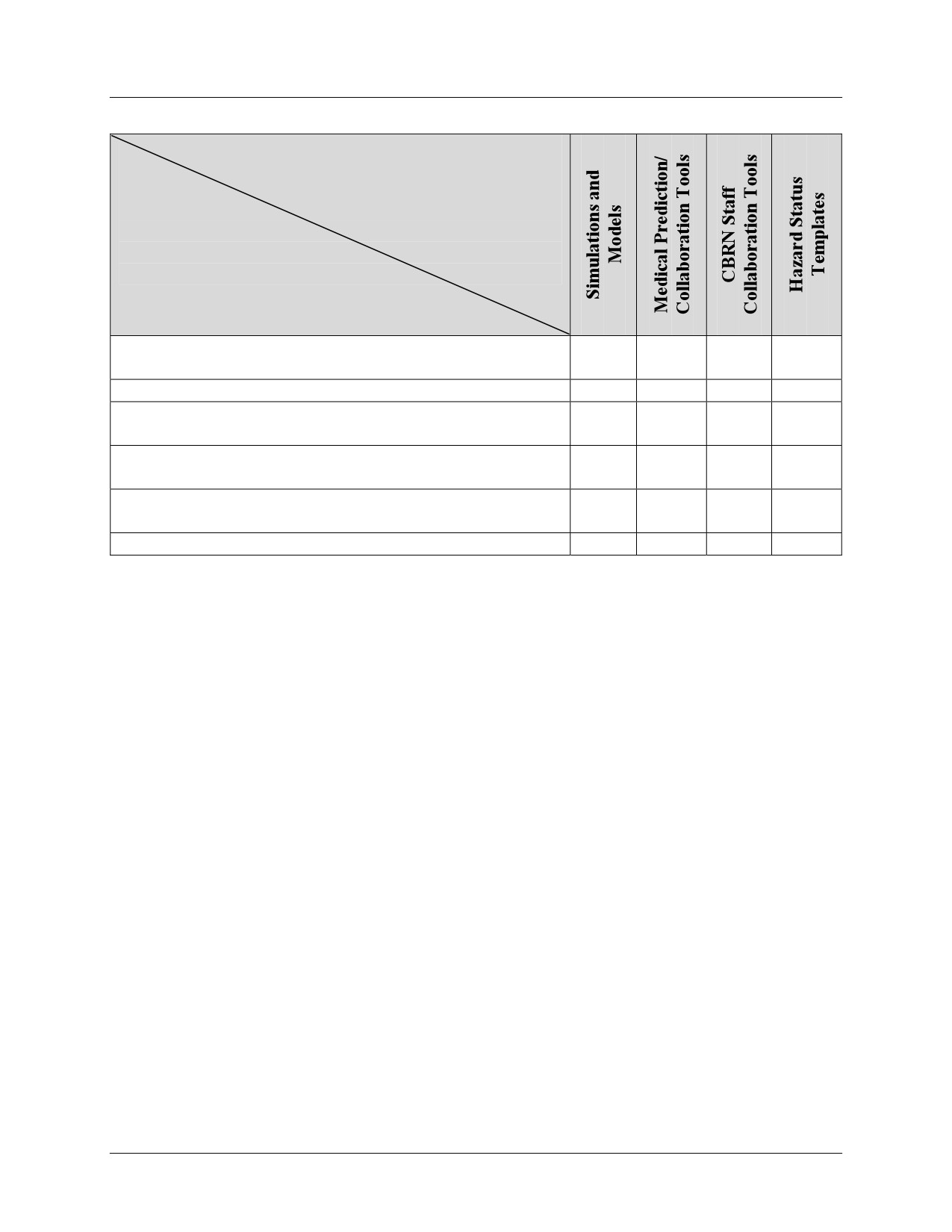
For Official Use Only
CBRND Functional Needs Analysis/Functional Solution Analysis
Chapter 9. Tactical Shape Tasks
Table 9.16-5. TASHA 16: IMA Assessment
Ideas for Material
Approaches
(IMA)
Identified Gaps
Absence of ability to accurately and rapidly characterize
X
X
X
X
the hazard.
Access is limited to IT resources.
X
X
X
Insufficient continuing training requirement to maintain
X
X
X
X
proficiency.
Inadequate ability for communicable transmission and
X
X
X
X
persistency in populations.
Coordination collaboration procedures required for
X
X
medical and CBRN staff cells.
Inadequate communicable biological prediction.
X
X
X
X
126
For Official Use Only
For Official Use Only
CBRND Functional Needs Analysis/Functional Solution Analysis
Chapter 9. Tactical Shape Tasks
9.17
Task TASHA 17: Operate an IDN to “detect to warn” and provide continuous
hazard status
9.17.1
Functional Area Analysis
9.17.1.1
Definition
This task encompasses deploying and establishing an IDN array of detectors and sensors to
provide synergy to the system and compensate for the technological weaknesses of any single
sensor. Includes the ability to continuously monitor the CBRN situation through the use of an
IDN. An IDN likely consists of smart standoff and point detectors as a means to “detect to warn”
and receive continuous updates. Compiled IDN data update hazard predictions and projected
impacts to achieve an understanding of the hazard. Survey and reconnaissance activities can be
directed based on the results of the IDN data. Additional IDN assets aid in monitoring persistent
CBRN hazards. Data from the IDN are displayed via the COP. Areas not covered by the IDN
need to be managed. Ideally, the IDN archives event histories. Additionally, the IDN links to the
JTF intelligence system, theater missile defense system, and other theater collection assets.
CBRN data are correlated with data from other assets at a processing node within the operations
center.
9.17.1.2
Derivation
UJTL (TA 2.4, TA 5, TA 5.2.1, TA 6.5, TA 7, TA 7.1), Joint Enabling Concept for CBRN
Operations, Protection Joint Functional Concept, Military Transformation: A Strategic
Approach.
9.17.1.2.1
Supported Task: OPSHA 5
9.17.1.2.2
Lateral Task: N/A
9.17.1.2.3
Supporting Task: N/A
9.17.1.3
Condition
Perform this task under conditions of:
Physical
1. Moderately developed land. (C1.1)
2. Temperate climate. (C1.3.1)
Military
1. Limited personnel experience. (C2.2.4.5)
2. Limited modern military systems. (C2.2.5)
3. Low military systems reliabilty. (C2.2.5.3)
4. Some interoperability. (C2.2.6)
127
For Official Use Only
For Official Use Only
CBRND Functional Needs Analysis/Functional Solution Analysis
Chapter 9. Tactical Shape Tasks
5. Limited staff expertise. (C2.3.1.3)
6. Intelligence dissemination and receipt fully exists. (C2.4.7)
Civil. N/A
9.17.2
Functional Needs Analysis
9.17.2.1
Capability and Deficiency Assessment Summary
Table 9.17-1 discusses individual capabilities to perform this task to the designated standards.
There is no current capability to operate an IDN to “detect to warn” and provide continuous
hazard status. JWARN, when fielded, will provide improvement in the ability to warn units. The
overall capability for current and near/mid term are “red.” Although improvements between the
periods occur for specific supporting capabilities and are reflected in the assessment, the
improved capabilities are not sufficient to change the overall assessed color ratings for the
assessed measures. Improvement in task capabilities achieve an assessed “yellow” rating for the
far term.
Current Capability and Deficiency
Joint forces have extremely limited capability to “detect to warn” and provide continuous status.
Deficiencies include lack of sensor capability, inadequate networking of sensors, immature
technology, and lack of ability to differentiate between multiple releases. Doctrine and training
must mature along with the evolving systems.
Projected Near/Mid-Term Capability and Deficiency
JWARN (Increment 1 - IOC), programmed for initial fielding during the mid term, will provide
a substantial improvement in the ability to notify and warn units of a hazard.
Projected Far-Term Capability and Deficiency
JWARN (Increment 1 - IOC) is projected to complete fielding in the early far term. Sensors and
IDN capabilities are in development with stated fielding sometime in the far term. This effort is
dependent upon the progression of sensor technologies necessary for an IDN.
128
For Official Use Only
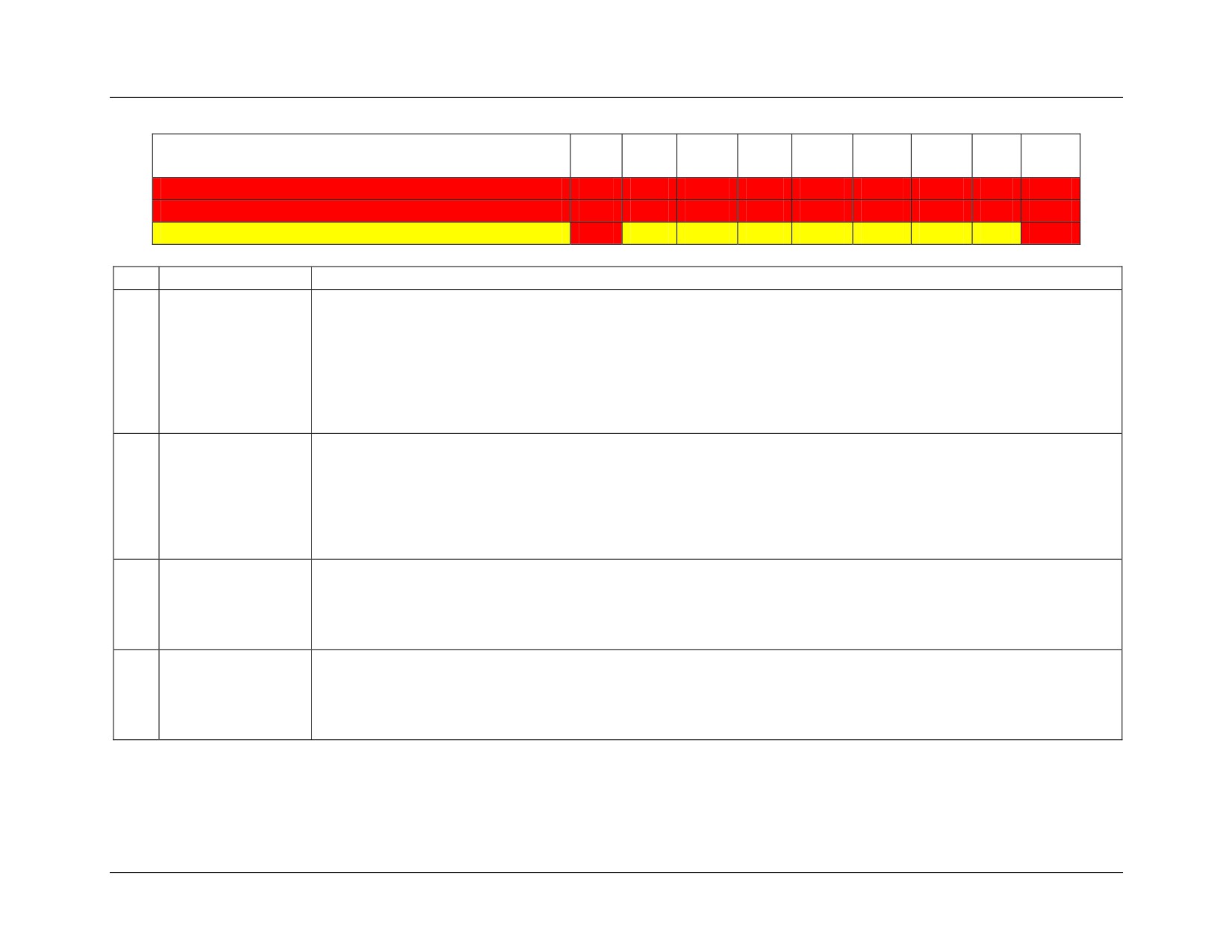
For Official Use Only
CBRND Functional Needs Analysis/Functional Solution Analysis
Chapter 9. Tactical Shape Tasks
Table 9.17-1. TASHA 17: Capability and Deficiency Assessment
Capability: Operate an IDN to “Detect to Warn”
M1
M2
M3
M4
M5
M6
M7
M8
M9
and Provide Continuous Hazard Status
Current Capability
01
02
03
04
05
06
07
08
09
Near/Mid-Term Capability
1
2
2
0
0
0
3
2
0
Far-Term Capability
3
4
4
6
4
4
4
7
3
FAA Measure
Scale
M1
Tactical area is
8-10: IDN systems exist and provide full coverage of the tactical area for all CBRN and high-threat TIMs. IDN data are
adequately covered
integrated and interoperable with CBRN and C4ISR systems. CBRN and C4ISR systems are continuously updated with IDN
by the IDN.
information.
4-7: IDN systems exist and provide coverage of critical areas of the area of operations for all CBRN and high-threat TIMs.
IDN data are integrated and interoperable with CBRN and C4ISR systems. CBRN and C4ISR systems are updated with IDN
information.
1-3: IDN systems provide inadequate coverage of operations for all CBRN and high-threat TIMs.
0: IDN systems are nonexistent.
M2
There is confidence
8-10: IDN detection and characterization data utility is high and supports decision making, operations, and the safety and well-
in the IDN ability to
being of the force.
detect and provide
4-7: IDN detection and characterization data utility exists for decision making, operations, and assists activities providing for
characterization data.
the safety and well-being of the force.
1-3: IDN detection and characterization data are low and unable to support decision making and operations positively
affecting the safety and well-being of the force.
0: IDN detection and characterization data are nonexistent.
M3
Sensors are managed
8-10: All echelons networked to the IDN are able to remotely manage sensors using automated tools and C4ISR connectivity.
at all echelons
4-7: Selected entities networked to the IDN are able to remotely manage sensors using automated tools and C4ISR
networked to the
connectivity.
IDN.
1-3: IDN sensors are remotely managed by a single control point.
0: IDN sensors cannot be managed remotely.
M4
There are sufficient
8-10: Doctrine and TTPs provide clear and concise guidance, requirements, and procedures for the effective operation of an
doctrine and TTPs
IDN.
for effective IDN
4-7: Doctrine and TTPs provide general guidance, requirements, and procedures for the operation of an IDN.
operation.
1-3: Doctrine and TTPs do not adequately address the operation of an IDN.
0: Doctrine and TTPs are nonexistent for the operation of an IDN.
129
For Official Use Only
For Official Use Only
CBRND Functional Needs Analysis/Functional Solution Analysis
Chapter 9. Tactical Shape Tasks
M5
Units are adequately
8-10: All personnel performing IDN operations tasks are fully trained and receive recurring refresher training on the conduct
trained to effectively
of their tasks. Exercises and evaluations are routinely conducted and fully challenge capabilities to maintain and refine skills,
operate the IDN.
knowledge, and capabilities. IDN operations competences and experience are high and enable the rapid, accurate, and
successful completion of tasks.
4-7: Core personnel performing IDN operations tasks are fully trained and receive recurring refresher training on the conduct
of their tasks. Exercises and evaluations do not generally fully challenge capabilities. Limited training is provided, is
inconsistent, and/or is administered in preparation for operations to noncore personnel for the performance of their assigned
tasks. IDN operations competencies and experience will vary, but sufficient capability exists to successfully perform tasks.
1-3: Training is inadequate for the successful performance of IDN operations.
0: Training is inadequate or nonexistent for the successful performance of IDN operations.
M6
CBRND specialists
8-10: All CBRND personnel are fully trained and receive recurring refresher training on the conduct of IDN operations.
have the training to
Exercises and evaluations are routinely conducted and fully challenge capabilities to maintain and refine skills, knowledge,
effectively operate
and capabilities. IDN operations competences and experience are high and enable the rapid, accurate, and successful
the IDN.
completion of tasks.
4-7: Core CBRND specialists performing IDN operations tasks are fully trained and receive recurring refresher training on the
conduct of their tasks. Exercises and evaluations do not generally fully challenge capabilities. Limited training is provided, is
inconsistent, and/or is administered in preparation for operations to noncore CBRND specialists for the performance of their
assigned tasks. IDN operations competencies and experience will vary, but sufficient capability exists to successfully perform
tasks.
1-3: Training is inadequate for the successful performance of IDN operations.
0: Training is nonexistent for the successful performance of IDN operations.
M7
All operation centers
8-10: All operations centers are networked to the IDN.
networked to IDN.
4-7: Selected operations centers are networked to the IDN.
1-3: Selected operations centers possess limited access to the IDN.
0: Operations centers are not networked to the IDN.
M8
IDN can successfully
8-10: The IDN maintains its ability to monitor the hazard, clear sensors between readings, and reset sensors throughout the full
track and monitor the
presence of the hazard without manual intervention.
hazard throughout its
4-7: The IDN requires manual intervention to maintain the ability to monitor the hazard, clear sensors between readings, and
persistency.
reset sensors through the hazard’s presence.
1-3: The IDN requires manual intervention and possesses limited capability to monitor the hazard, clear sensors between
readings, and resetting of sensors through the hazard’s presence.
0: The IDN is unable to monitor and track a hazard throughout its persistency.
M9
There is effective
8-10: DOTLPF exists and is adequate for this task. Task can be effectively performed with little or no direct impact upon
DOTLPF in place to
operations.
conduct task.
4-7: Most critical aspects of DOTLPF for this task are addressed. Task can be performed with limitations requiring work-
arounds.
1-3: DOTLPF is inadequate for accomplishment of this task.
0: DOTLPF does not exist for this task.
130
For Official Use Only
For Official Use Only
CBRND Functional Needs Analysis/Functional Solution Analysis
Chapter 9. Tactical Shape Tasks
1 Fielded IDN systems for CBRN/TIM do not currently exist. Systems are in development and fielding is expected in the far term but are contingent upon sensor technology
progression. JWARN, to be initially fielded to operational units in the mid term with fielding projected to be completed in the early far term, includes IDN data capabilities.
2 Confidence is low as IDN systems have yet to be fielded. Expectation is the systems will increase the accuracy of decision making, sustain OPTEMPO, and further promote the
safety and well-being of the force.
3 Current fielded detection systems are inadequately networked and many require manual reporting. Management of current systems is performed locally and adjustments are often
made individually. Systems are in development and fielding is expected in the far-term but are contingent upon sensor technology progression. Remote management capabilities is
an expectation for these future fielded systems.
4 Lack of IDN maturity prohibits doctrine and TTP development.
5 Units are currently trained in the operation of current non-IDN sensor systems. Training to support future fielded IDNs awaits development of associated DOTLPF and IDN
technology maturity.
6 CBRND specialists are currently trained in the operation of current non-IDN sensor systems. Training to support future fielded IDNs awaits development of associated DOTLPF
and IDN technology maturity.
7 IDN is not fielded; therefore, operations centers are not networked to the IDN. However, operations centers are increasingly evolving to handle network sensors for other
battlespace threats. Connectivity to future fielded IDNs awaits development of associated DOTLPF and IDN technology maturity.
8 IDN technology is currently too immature to perform this function
9 Lack of IDN maturity prohibits development of supporting and associated DOTLPF.
131
For Official Use Only
For Official Use Only
CBRND Functional Needs Analysis/Functional Solution Analysis
Chapter 9. Tactical Shape Tasks
9.17.3
Functional Solution Analysis
9.17.3.1
DOTLPF Assessment Summary
This section addresses the deficiencies and suggests potential non-materiel solutions. If there are
no non-materiel solutions or they are only partial solutions, the remaining non-materiel need is
then stated. Materiel needs are assessed in the IMA section.
1. Deficiency: Lack of sensor capability.
Partial Non-Material Solutions: Doctrine: Develop doctrine supporting IDN as sensor and
IDN capability matures.
2. Deficiency: Lack of mature IDN and evolving operation center technologies/systems.
Partial Non-Material Solutions: Doctrine: Doctrine needs to mature as IDN and sensor
capability matures. Training: Operations center training will have to adjust to maturing IDN
capability.
3. Deficiency: Lack of mature doctrine.
Non-Material Solutions: Doctrine: Develop doctrine supporting IDN as sensor and IDN
capability matures.
4. Deficiency: Absence of training standards.
Non-Material Solutions: Training: Develop training standards supporting IDN as sensor
and IDN capability matures.
9.17.3.2
IMA Assessment Summary
Table 9.17-4 is a list of ideas for material approaches and a corresponding description of each
idea. Approaches needed to accomplish this task include the development and fielding of IDN
interfaces for detectors, collecting and processing detector data, querying detectors for status and
associated data processing and modeling. Table 9.17-5 identifies which of the material
approaches might address specific materiel deficiencies identified in the DOTMLPF assessment.
132
For Official Use Only
For Official Use Only
CBRND Functional Needs Analysis/Functional Solution Analysis
Chapter 9. Tactical Shape Tasks
Table 9.17-4. TASHA 17: Materiel Approaches
Idea for Materiel Approach
Description
IDN interface for sensors
Ensure developmental CBRN sensors include ability to
interface with an IDN. Develop adaptors to interface
existing CBRN sensors to the IDN.
Collect, exchange, and
Develop a system that collects and analyzes CBRN
disseminate information
information and sensor input, generates, edits, and
disseminates NBC reports, including downwind-hazard
plots, and overlays and verify receipt of reports and plots.
Transmission of data uses existing communication nets.
Query sensor status
Develop a system capable of automatically requesting
sensor status (health) of networked sensors.
Simulation and models
Develop a system enabling operational commanders to
display current operational picture and to efficiently
execute “what if” scenarios and facilitate the evaluation of
plausible adversary and friendly COAs, CBRN
employment, and TIM ROTA.
Database
Develop a system for obtaining information, archiving
data, accessing databases, performing information/data
queries, and exchanging data files in support of CBRN
functions and activities.
Field CBRN information
Develop a field resource system that will provide and
resource
search archived information for CBRN/TIM agents,
effects, treatments, etc.
Reachback capability
Develop a system providing the ability to rapidly and
securely reach back and contact CBRN experts and obtain
CBRND plans, procedures, information, and lessons
learned.
133
For Official Use Only
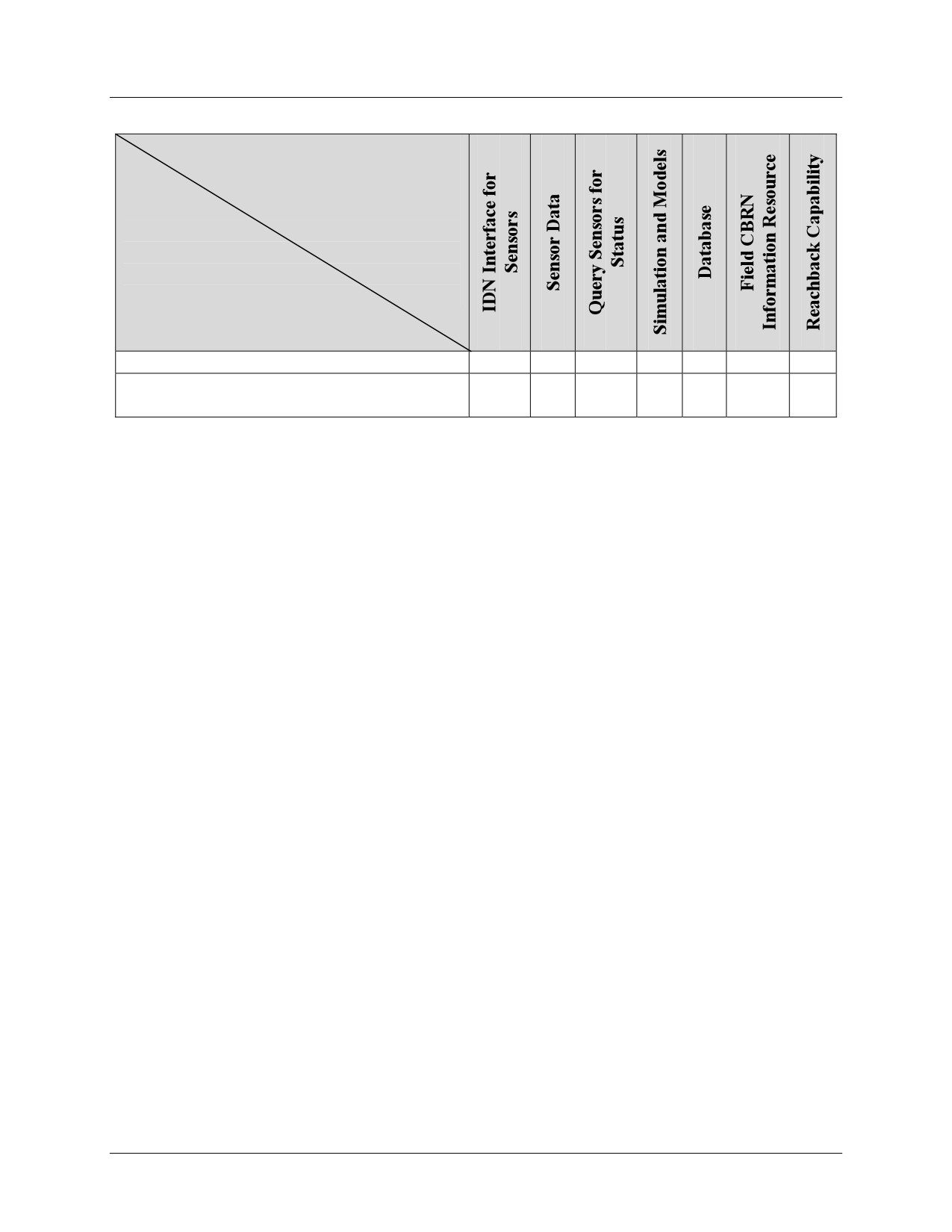
For Official Use Only
CBRND Functional Needs Analysis/Functional Solution Analysis
Chapter 9. Tactical Shape Tasks
Table 15.17-5. TASHA 17: IMA Assessment
Ideas for Material
Approaches
(IMA)
Identified Gaps
Lack of sensor capability.
X
X
X
Lack of mature IDN and evolving operation
X
X
X
X
X
center technologies/systems.
134
For Official Use Only
For Official Use Only
CBRND Functional Needs Analysis/Functional Solution Analysis
Chapter 9. Tactical Shape Tasks
9.18
Task TASHA 18: Provide CBRN tactical situational awareness throughout the
battlespace via the COP
9.18.1
Functional Area Analysis
9.18.1.1
Definition
Establishes tactical battlespace situational awareness, via the COP, to ensure units immediately
affected by the hazards are able to effectively respond, including warning units projected to be
affected by the hazard based on hazard prediction results as displayed in the COP. An NBC
Warning and Reporting System provides essential information for local staff action and
command decisions. Data from the local IDN accompanied by hazard characterizations are the
input for situational awareness. The overall operational objective is for situational awareness to
mature into shared awareness, and then shared understanding. Shared awareness and
understanding promotes synchronized response on the part of affected units.
9.18.1.2
Derivation
UJTL (TA 5, TA 5.2.1, TA 6.5, TA 7, TA 7.1), Protection Joint Functional Concept, Military
Transformation: A Strategic Approach.
9.18.1.2.1
Supported Task: OPSHA 8
9.18.1.2.2
Lateral Task: N/A
9.18.1.2.3
Supporting Task: N/A
9.18.1.3
Condition
Perform this task under conditions of:
Physical. N/A
Military
1. Few modern military systems. (C2.2.5)
2. Low military systems reliability. (C2.2.5.3)
3. Some interoperability. (C2.2.6)
4. Poor multinational integration. (C2.3.1.2)
5. Restricted information exchange. (C2.3.1.8)
6. High information volume. (C2.3.1.9)
7. Marginal intelligence database. (C2.4.2)
Civil. N/A
135
For Official Use Only
For Official Use Only
CBRND Functional Needs Analysis/Functional Solution Analysis
Chapter 9. Tactical Shape Tasks
9.18.2
Functional Needs Analysis
9.18.2.1
Capability and Deficiency Assessment Summary
Table 9.18-1 discusses individual capabilities to perform this task to the designated standards.
Current capability to provide CBRN tactical situational awareness is based on ATP-45
information. The mid- to far-term fielding of JWARN and JEM will provide the future
capability. The overall capability for current, near/mid, and far term are rated “yellow.”
Although improvements between the periods occur for specific capabilities and are reflected in
the associated identified values, the improved capabilities are not sufficient to change the overall
assessed color ratings for this task.
Current Capability and Deficiency
Joint forces currently have limited capability to provide CBRN tactical situational awareness via
the COP; basic ATP-45 information is currently available, and the assessment process remains
predominantly manual. Current deficiencies include the lack of visibility of CBRN information
in the COP, potential for errors and omissions related to predominant manual systems of
assessment, and inadequacy of ATP-45 information to provide detailed and specific information;
and the perishable nature of attained staff skills. Continuous training is required to update
perishable skills.
Projected Near/Mid-Term Capability and Deficiency
The projected initial fielding in the mid term of JWARN, JOEF, and JEM systems will enhance
the collection, processing, availability, timeliness, and accuracy of CBRN information for
display in the COP. Emerging C4ISR capabilities will enhance the CBRN threat intelligence
process. However, projected deficiencies include the impact of retained legacy systems upon the
ability to process and disseminate information; lack of operational assessment tools for CBRN
impact; and the inadequacy of ATP-45 information to provide detailed, accurate, and specific
information on the hazard. New DoD systems are expected to be in compliance with DISA
standards and net-centric capable, as appropriate during the current and near term for
interoperability and net-centric operations. Substantial upgrades to legacy systems are required to
include DISA standards and net-centric capabilities. Further, the mix of legacy and compliant
systems will continue to require the attentiveness and awareness of staffs to ensure effective
collection and integration of information until the legacy systems are either replaced or modified
for compliance. Doctrine must evolve to maximize the utility of the new systems for all phases
of operations from planning to post-operations.
Projected Far-Term Capability and Deficiency
The fielding of JWARN, JOEF, and JEM are projected to be completed during the early far term.
All legacy systems are projected to either be replaced by, or be in compliance with, DISA
standards and fully support net-centric operations in the far term.
136
For Official Use Only
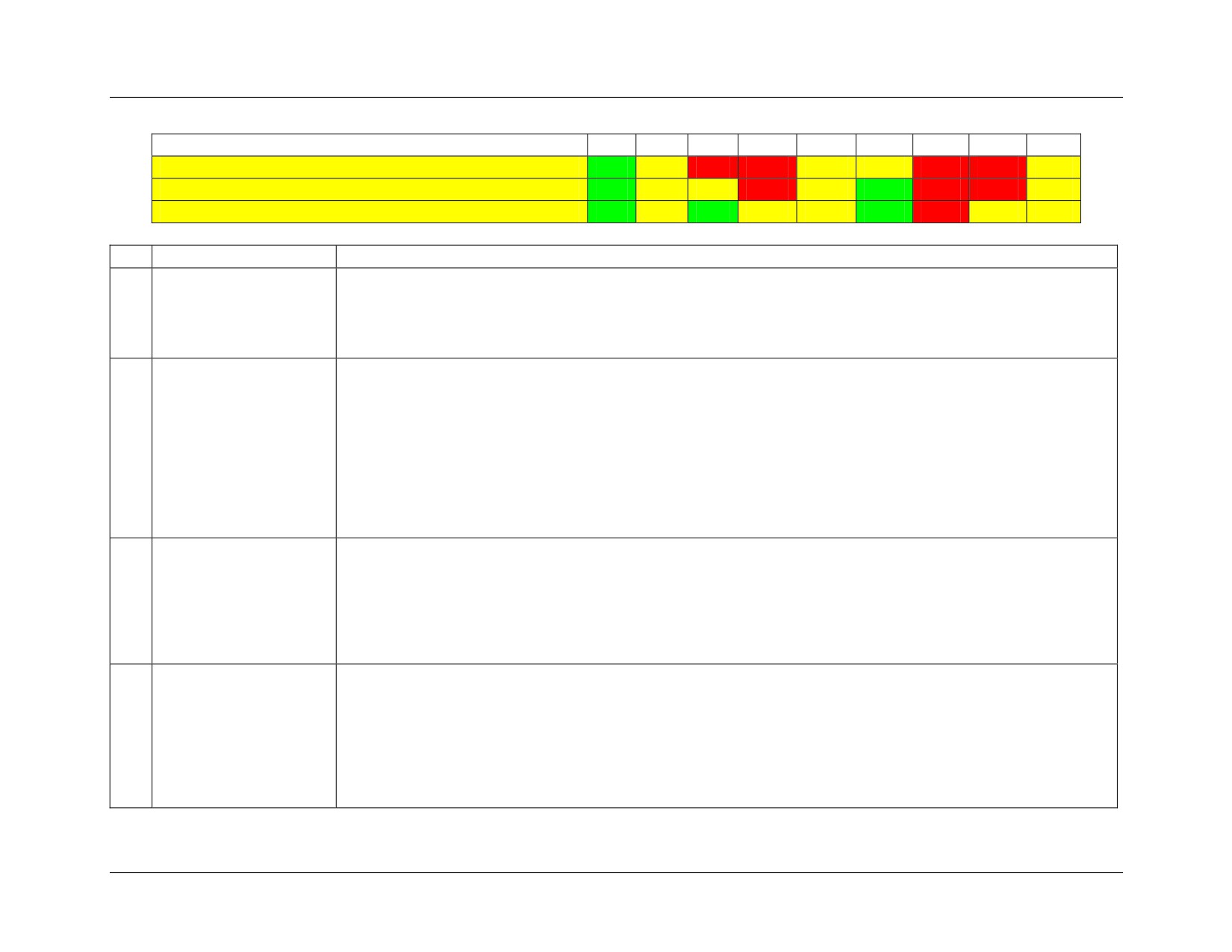
For Official Use Only
CBRND Functional Needs Analysis/Functional Solution Analysis
Chapter 9. Tactical Shape Tasks
Table 9.18-1. TASHA 18: Capability and Deficiency Assessment
Capability: CBRN Tactical Situational Awareness
M1
M2
M3
M4
M5
M6
M7
M8
M9
Current Overall Capability
81
52
32
13
44
75
26
12
47
Near/Mid-Term Overall Capability
8
6
4
2
4
8
2
3
4
Far-Term Overall Capability
9
7
8
5
5
9
3
7
5
FAA Measure
Scale
M1
Mechanism is in place to
8-10: Means exist and are employed to rapidly disseminate routine, essential, and critical CBRN/TIM threat intelligence
disseminate routine,
to all need-to-know centers.
essential, and critical
4-7: Limited means exist and are employed for dissemination of CBRN threat intelligence to most need-to-know centers.
CBRN/TIM threat
1-3: Means employment is inadequate for dissemination of CBRN threat intelligence to requiring need-to-know centers.
intelligence rapidly.
0: Means do not exist for the dissemination of CBRN threat intelligence to requiring need-to-know centers.
M2
Means exist to compile
8-10: Automated systems substantially or fully perform collection, compilation, and processing of CBRN/TIM events
and display information
occurring throughout the area of operations, incorporate display of the information, and provide the information to the
on CBRN/TIM events that
COP.
occurs throughout the
4-7: Collection, compilation, and processing of CBRN/TIM events occurring throughout the area of operations is
operating area.
performed predominantly using manual means, is limited to available trained resources, and the quality of the selected
assessed data.
1-3: Inadequate capability to collect, compile, and process information on CBRN/TIM events throughout the area of
operations.
0: Nonexistent capability to collect, compile, and process information on CBRN/TIM events throughout the area of
operations.
M3
Means exist to present
8-10: Automated systems substantially or fully present operational impact information and plausible COAs for
information on the
CBRN/TIM events occurring and provide visualization of the information.
operational impact of the
4-7: Determination of the operational impact of CBRN/TIM events is performed predominantly using manual means, is
CBRN/TIM event.
limited to available trained resources, and the quality of the selected assessed data. Visualization is minimal.
1-3: Inadequate capability to assess and present the operational impacts of CBRN/TIM events. Automated visualization is
absent.
0: Nonexistent capability to assess and visually present the operational impacts of CBRN/TIM events.
M4
There is confidence in the
8-10: Confidence in accuracy, timeliness, trustworthiness, and relevancy of CBRN information on the COP is high.
CBRN information
CBRN information is collected, correlated, and processed in high fidelity from multiple sources and source automated
available within the COP.
information systems are interoperable.
4-7: Limited confidence in accuracy, timeliness, trustworthiness, and relevancy of CBRN information on the COP.
Predominantly manual processes collect, correlated, and process CBRN information from sources and may be restricted in
the number of sources assessed.
1-3: Low confidence in accuracy, timeliness, trustworthiness, and relevancy of CBRN information on the COP.
0: No confidence in accuracy, timeliness, trustworthiness, and relevancy of CBRN information on the COP.
137
For Official Use Only
For Official Use Only
CBRND Functional Needs Analysis/Functional Solution Analysis
Chapter 9. Tactical Shape Tasks
M5
There are sufficient
8-10: Doctrine, policies, procedures, and TTPs are adequate for the establishment and maintenance of situation awareness
doctrine and TTPs to
and integrate CBRN information on the COP.
effectively acquire and
4-7: Doctrine, policies, procedures, and TTPs supporting the establishment and maintenance of situation awareness exist
maintain situation
and address CBRN.
awareness.
1-3: Doctrine, policies, procedures, and TTPs are inadequate for the establishment and maintenance of situation
awareness.
0: Doctrine, policies, procedures, and TTPs are nonexistent for the establishment and maintenance of situation awareness.
M6
Units are adequately
8-10: All unit commanders and staff are formally trained and receive recurring refresher training including the effective
trained to effectively
acquisition and maintenance of situation awareness and emphasize CBRN as a critical component.
acquire and maintain
4-7: Limited training is provided, is inconsistent, and/or is administered to staffs in preparation for operations with a
situational awareness.
CBRN threat for CBRN as an important factor when acquiring and maintaining situation awareness.
1-3: Training on the inclusion of CBRN in the acquisition and maintenance of situation awareness is inadequate for
support of operations.
0: Training on the inclusion of CBRN in the acquisition and maintenance of situation awareness is nonexistent.
M7
CBRND specialist units,
8-10: CBRN specialist units, teams, and cells possess dedicated information technology resources and tools with
teams, cells have access to
unrestricted (as applicable) access to the COP for the accomplishment and performance of their duties and responsibilities.
the COP.
These are used to support operational and training requirements.
4-7: CBRN specialist units, teams, and cells are able to access the COP using shared information technology resources
and tools for operational requirements and training.
1-3: CBRN specialist units, teams, and cells possess inadequate access to the COP to support operations and training
requirements.
0: CBRN specialist units, teams, and cells do not possess access to the COP to support operations and training
requirements.
M8
Potentially affected or
8-10: All CBRN potentially or indirectly affected units are identified and notified in a timely manner by automated
indirectly affected units
systems and across echelons of command on the COP. Timely, accurate, and relevant information is posted on the COP
are made aware by the
and readily accessible.
COP across echelons of
4-7: Limited means exist and are employed over the COP across echelons of command for the dissemination of CBRN
command.
hazard information to known potentially affected units.
1-3: Means are inadequate to notify potentially and indirectly affected units of CBRN hazard using the COP across
echelons of command.
0: Means are nonexistent to notify potentially and indirectly affected units of CBRN hazard using the COP across
echelons of command.
M9
There is effective
8-10: DOTLPF exists and is adequate for this task. Task can be effectively performed with little or no direct impact upon
DOTLPF in place to
operations.
conduct task.
4-7: Most critical aspects of DOTLPF for this task are addressed. Task can be performed with limitations requiring work-
arounds.
1-3: DOTLPF is inadequate for accomplishment of this task.
0: DOTLPF does not exist for this task.
138
For Official Use Only
For Official Use Only
CBRND Functional Needs Analysis/Functional Solution Analysis
Chapter 9. Tactical Shape Tasks
1 Existing DoD communication infrastructure systems and JWARN, where available, are used to disseminate CBRN intelligence and warnings. Manual ATP-45 format messages
are created when automated warning systems are unavailable. However, existing communications systems are not fully interoperable and are dependent upon systems available to
elements of the JTF. Attentiveness is required to ensure the effectiveness of the intelligence and operations centers in this mixed communications environment. Net-centric
operations and mandatory DISA standards address interoperability and the interchange of information among elements. All DoD systems are expected to be in compliance with
DISA standards and net-centric capable, as appropriate, during the mid term.
2 Current processes are predominantly manual with limited automation. Process is labor- and time-consuming and dependent upon the training, experience, and availability of
performing personnel as well as the quality of the collected information. The current capability is achieved using doctrine and locally devised checklists. The process is slow and
prone to human error and omissions. TIM processes are currently nonexistent for operational forces and data are limited to civilian HAZMAT and ITF-40 sources. Information
currently flows vertically through the command structure and not horizontally to adjacent and nearby forces. Although limited visualization tools are available for CBRN, these are
not generally in use by operating forces. JOEF and JEM are envisioned as providing forces with the tools to assess and display CBRN information and plausible COAs. JWARN
will provide the means for collection and dissemination of CBRN information both vertically and horizontally. JWARN, JOEF, and JEM are projected for initial fielding during
the mid term. The efficiency and utility of JWARN, JOEF, and JEM will be influenced by emerging C4ISR systems and processes residing on and using GIG Enterprise Services.
Legacy systems will continue to require significant manual extraction, review, and reinput of information for application by JWARN, JOEF, and JEM. The continuing requirement
for DoD systems to become and be in compliance with DISA standards will gradually provide interoperability of the systems with JOEF and JEM with projected full
interoperability of systems in the far term. JOEF and JEM are programmed to link with the COP via the GIG Enterprise Service. Access needed for automated systems to post all
relevant data to the COP, as well as access to needed information from the COP.
3 Specificity of current ATP-45 processes is inadequate. ATP-45-based data are broad-based and general without the degree of detail necessary for effective decisioning. ATP-45
information does not provide fidelity of data essential for operations in complex and urban terrain. JWARN uses ATP-45 format. JEM is currently projected as macrolevel capable.
JWARN, JOEF, and JEM are projected for initial fielding in the mid term with fielding completed in the early far term. Visualization and COA determinations are supported by
these systems.
4 Doctrine, policies, procedures, and TTPs supporting the establishment and maintenance of situation awareness exist and are sufficient for ATP-45-based processes. JWARN,
JOEF, and JEM are projected for initial fielding in the mid term with fielding completed in the early far term and have capabilities for connectivity with the COP. Doctrine,
policies, procedures, and TTP is not sufficient for providing CBRN information into the COP.
5 Limited training is provided to unit staffs on CBRN as an integral part of situational awareness. Consistent formal and refresher training including CBRN in situation awareness
attainment and maintenance is not regularly and routinely performed. Limited routine training is provided and often is not focused upon preparation for operations with a CBRN
threat. The fielding of JWARN, JEM, and JOEF provide the capability to refine staff skills as part of local training and exercising/evaluations. JWARN, JOEF, and JEM are
programmed for initial fielding during the mid term with fielding completed in the early far term. However, supporting and requiring DOTLPF is necessary to ensure attainment
and maintenance of the capability that includes CBRN.
6 CBRN specialist units, teams, and cells possess access to shared information technology resources and tools. CBRN personnel do not possess dedicated information technology
to perform training and operational requirements. Available resources are shared with other requiring activities and functions, which may conflict with CBRN entity connectivity
to the COP until a known threat is identified and command influence is exerted. JWARN, JOEF, and JEM are programmed for initial fielding during the mid term with fielding
completed in the early far term and possess capabilities to link with the COP via the GIG Enterprise Service.
7 Current DOTLFP adequately address tactical situation awareness. CBRN is discussed but is not considered critical without threat and does not currently possess a direct interface
to COP. DOTLPF will need to evolve as systems, tactics, and situations change.
139
For Official Use Only
For Official Use Only
CBRND Functional Needs Analysis/Functional Solution Analysis
Chapter 9. Tactical Shape Tasks
9.18.3
Functional Solution Analysis
9.18.3.1
DOTLPF Assessment Summary
This section addresses the deficiencies and suggests potential non-materiel solutions. If there are
no non-materiel solutions or they are only partial solutions, the remaining non-materiel need is
then stated. Materiel needs are assessed in the IMA section.
1.
Deficiency: Inadequate DOTLPF ensuring emergent JWARN, JOEF, and JEM capabilities
provide accurate and timely information into the COP.
Partial Non-Material Solutions: Doctrine: Develop doctrine and TTPs for JWARN, JOEF,
and JEM and account for COP integration. Organization: Develop organization structures
and processes for the accurate, timely, and effective application of JWARN, JOEF, and JEM
in operations. Training: Incorporate into initial and recurring training the effective and timely
operation and application of JWARN, JOEF, JEM and the dissemination of information on
the COP. Incorporate into exercise and evaluation criteria requirements challenging force
application and use of JWARN, JOEF, and JEM, including posted COP information.
Leadership: Ensure awareness of criticality to operations with threat of accurate and timely
CBRND information posted on the COP. Facilities: Establish supporting infrastructure
necessary for the effective, accurate, and timely application of JWARN, JOEF, and JEM as
well as the posting and availability of resulting information on the COP.
2.
Deficiency: Inadequate doctrine for predictions and status information being made available
by JEM, JOEF, and JWARN.
Non-Material Solutions: Doctrine: Develop doctrine for application of capabilities provided
by JEM, JOEF, and JWARN.
3.
Deficiency: Inadequate basic skill training and refresher training to ensure a cadre of trained
personnel.
Non-Material Solutions: Training: Ensure training programs for CBRN Information
Systems and COP.
4.
Deficiency: Inadequate access to IT resources and the COP.
Partial Non-Material Solutions: Training: Ensure access to IT systems for CBRN staff
cells and units.
9.18.3.2
IMA Assessment Summary
Table 9.18-4 is a list of ideas for material approaches and a corresponding description of each
idea. This task—key to the ability to shape the battlespace—will require extensive materiel
improvements. These improvements include improvements in transmitting accurate information,
using existing and forthcoming C4ISR assets to their full capabilities, and automated planning
and assessment tools. Table 9.18-5 identifies which of the material approaches might address
specific materiel deficiencies identified in the DOTMLPF assessment.
140
For Official Use Only
For Official Use Only
CBRND Functional Needs Analysis/Functional Solution Analysis
Chapter 9. Tactical Shape Tasks
Table 9.18-4. TASHA 18: Materiel Approaches
Idea for Materiel Approach
Description
Information assurance
Develop a CBRND system that processes and transmits
information in accordance with Information Assurance
Defense in Depth standards including certification and
accreditation in accordance with DoD and CJCS guidance.
Collect, exchange, and
Develop a system that collects and analyzes CBRN
disseminate information
information and sensor input, generates, edits, and
disseminates NBC reports, including downwind-hazard plots,
and overlays and verify receipt of reports and plots.
Transmission of data uses existing communication nets.
Link to GIS
Develop a system resident in standard C4ISR systems with
interface to GIS to provide input to the COP.
Simulations and models
Develop a system enabling operational commanders to
efficiently execute “what if” scenarios and facilitate the
evaluation of plausible adversary and friendly COAs, CBRN
employment, and TIM ROTA.
Database
Develop a system for obtaining information, archiving data,
accessing databases, performing information/data queries, and
exchanging data files in support of CBRN functions and
activities.
Reachback capability
Develop a system providing the ability to rapidly and securely
reach back and contact CBRN experts and obtain CBRND
plans, procedures, information, and lessons learned.
Risk factor template
Develop a system merging CBRN, intelligence, and
operational data and plans into standardized automated
formats for application to effectively and rapidly accomplish
CBRN/TIM functions and activities.
Hazard status template
Develop a system that merges collected data and predictions
of agent travel to provide hazard status.
Hazard prediction tool
Develop a DoD-approved model for CBRN and TIM hazard
prediction capabilities, incorporating physics-based
functionalities. The model acquires and integrates information
from appropriate databases (i.e., terrain, structures,
environmental, meteorological, intelligence, unit, population,
etc.) to accurately predict, map, and graphically portray the
hazard in near-real time.
Data fusion
Develop a capability to automatically perform data fusion.
“Data fusion” is combining automatically correlated
information with data that refines the information or presents
it in an intuitive format. Fused data in many cases will arrive
later than real- or near-real-time data.
141
For Official Use Only
For Official Use Only
CBRND Functional Needs Analysis/Functional Solution Analysis
Chapter 9. Tactical Shape Tasks
Table 9.18-5. TASHA 18: IMA Assessment
Ideas for Material
Approaches
(IMA)
Identified Gaps
Inadequate DOTMLPF
ensuring emergent
JWARN, JOEF, and JEM
X
X
X
X
X
X
X
X
X
X
capabilities provide
accurate and timely
information into the COP.
Inadequate access to IT
X
X
X
resources and the COP.
142
For Official Use Only
For Official Use Only
CBRND Functional Needs Analysis/Functional Solution Analysis
Chapter 9. Tactical Shape Tasks
9.19
Task TASHA 19: Provide CBRN warning, reporting, and alarming throughout the
local or immediate battlespace
9.19.1
Functional Area Analysis
9.19.1.1
Definition
Includes warning, reporting, and alarming to disseminate CBRN information across the tactical
area of operations. This task encompasses the warning, reporting and alarming of units and
personnel potentially affected by the hazard in time to assume protective posture. Within the
local or immediate battlespace, CBRN warning and reporting may occur multiple times, perhaps
concurrently. The various elements of command monitor the CBRN/TIM situation over their
respective areas of interest. For atmospheric and surface hazards, models portray the probable
downwind hazard and likely downwind contour pattern for each event. The fidelity of the
prediction or tracking of actual contamination depends on IDN performance. The ability to
actually detect and characterize the hazard is essential to effective warning, reporting, and
alarming. Interoperability of warning, reporting, and alarming systems is critical across Services
and between nations.
9.19.1.2
Derivation
UJTL (TA 2.4, TA 5, TA 5.2.1, TA 7, TA 7.1), Joint Enabling Concept for CBRN Operations,
Protection Joint Functional Concept, Military Transformation: A Strategic Approach.
9.19.1.2.1
Supported Task: OPSHA 8
9.19.1.2.2
Lateral Task: N/A
9.19.1.2.3
Supporting Task: N/A
9.19.1.3
Condition
Perform this task under conditions of:
Physical. N/A
Military
1. Limited modern military systems. (C2.2.5)
2. Low military systems reliability. (C2.2.5.3)
3. Some interoperability. (C2.2.6)
4. Partial joint staff integration. (C2.3.1.1)
5. Limited staff expertise. (C2.3.1.3)
6. Intelligence dissemination amd receipt partially exists. (C2.4.7)
Civil. N/A
143
For Official Use Only
For Official Use Only
CBRND Functional Needs Analysis/Functional Solution Analysis
Chapter 9. Tactical Shape Tasks
9.19.2
Functional Needs Analysis
9.19.2.1
Capability and Deficiency Assessment Summary
Table 9.19-1 discusses individual capabilities to perform this task to the designated standards.
The overall capability for current, near/mid, and far term are rated “yellow.” Although
improvements between the periods occur for specific capabilities and are reflected in the
associated identified values, the improved capabilities are not sufficient to change the overall
assessed color ratings for this task.
Current Capability and Deficiency
Most CBRN warning, reporting, and alarming are performed using manual processes; little
automation exists. Current deficiencies include lack of automated detection and warning,
insufficient information for risk assessment; and stand-alone CBRND systems not integrated
with C4ISR capabilities. The ATP-45 information and related processes fail to take full
advantage of automated systems and processes to increase rapidity and accuracy.
Projected Near/Mid-Term Capability and Deficiency
The projected initial fielding in the mid term of JWARN will provide substantial improvement in
this capability. Emerging C4ISR capabilities will enhance the dissemination of CBRN
information to requiring force elements, both vertically and horizontally. New DoD systems are
expected to be in compliance with DISA standards and net-centric capable, as appropriate during
the current and near term for interoperability and net-centric operations. Substantial upgrades to
legacy systems are required to include DISA standards and net-centric capabilities. Further, the
mix of legacy and compliant systems will continue to require the attentiveness and awareness of
staffs to ensure effective collection, integration, and dissemination of information until the
legacy systems are either replaced or modified for compliance. Doctrine and TTPs must be
revised to accommodate new C4ISR systems as well as JWARN.
Projected Far-Term Capability and Deficiency
The fielding of JWARN is projected to be completed early in the mid term. All legacy systems
are projected to either be replaced by, or be in compliance with, DISA standards and fully
support net-centric operations in the far term.
144
For Official Use Only
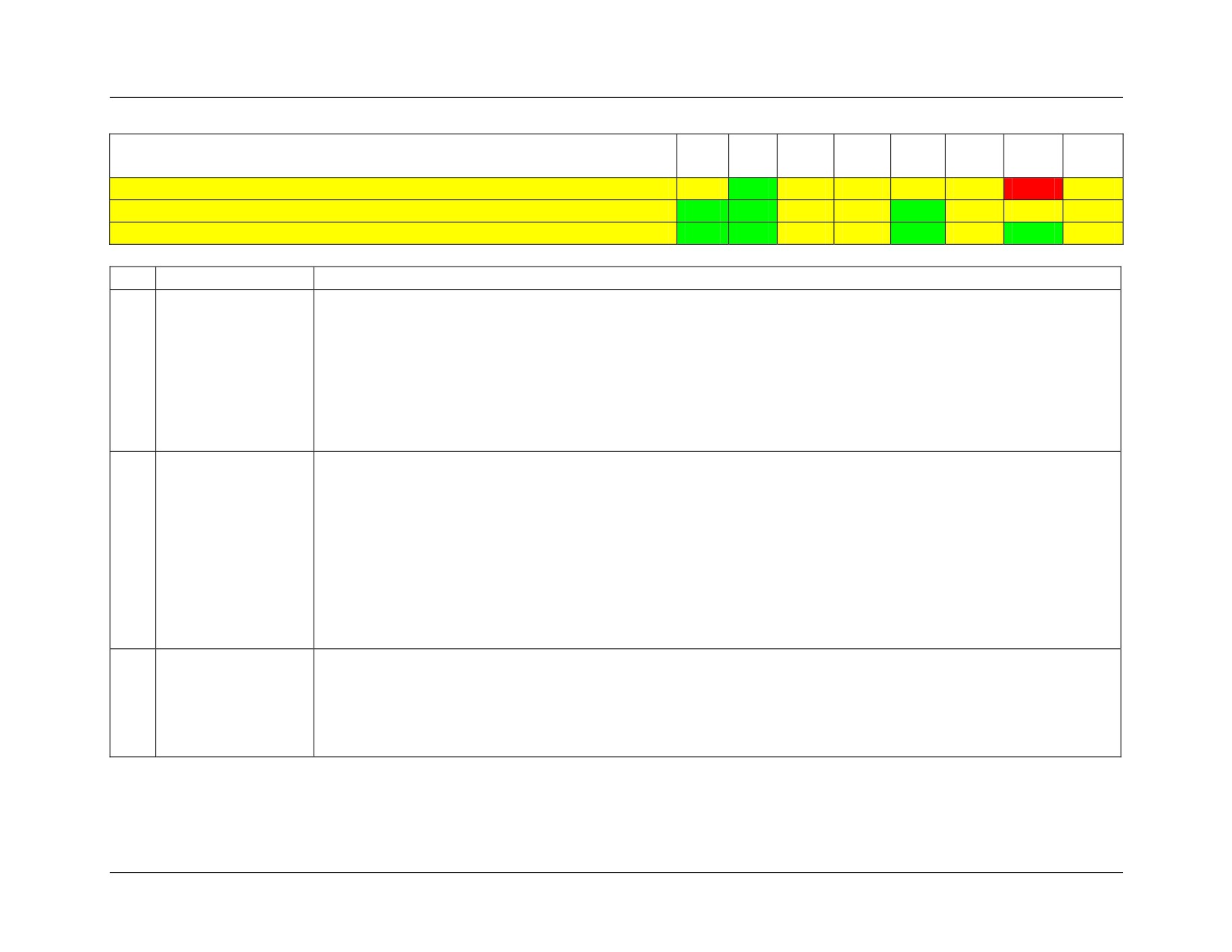
For Official Use Only
CBRND Functional Needs Analysis/Functional Solution Analysis
Chapter 9. Tactical Shape Tasks
Table 9.19-1. TASHA 19: Capability and Deficiency Assessment
Capability: Provide CBRN Tactical and CBRN Warning, Reporting,
M1
M2
M3
M4
M5
M6
M7
M8
and Alarming Throughout the Local or Immediate Battlespace
Current Overall Capability
51
82
62
62
73
54
25
56
Near/Mid-Term Overall Capability
8
9
7
6
8
5
5
5
Far-Term Overall Capability
9
9
7
7
9
5
8
5
FAA Measure
Scale
M1
Tactical area
8-10: Tactical area CBRN/TIM IDN systems substantially or fully perform automated warning and reporting of CBRN/TIM
CBRN/TIM IDN
to local JTF elements (including coalition partners and other authorized entities) and all appropriate organizations and
provides automated
echelons of command and control in sufficient detail to enable effective, adequate, and rapid response specific to the incident
warning and
and involved elements. CBRN information is immediately and prominently posted on the COP.
reporting.
4-7: Tactical area CBRN/TIM IDN systems are not integrated with automated warning and reporting systems and are
managed and controlled by local centers. The local unit centers perform the required warning and reporting of CBRN/TIM
hazards using existing and primarily manual means.
1-3: Inadequate tactical CBRN/TIM IDN and/or warning and reporting capability exists.
0: Tactical CBRN/TIM IDN and/or warning and reporting capability is nonexistent.
M2
CBRND specialists
8-10: All CBRND personnel are fully trained and receive recurring refresher training on CBRN warning and reporting.
have the training to
Exercises and evaluations are routinely conducted and fully challenge capabilities to conduct effective CBRN warning and
effectively warn and
reporting and to refine skills, knowledge, and competencies. CBRN warning and reporting competencies are high and enable
make reports.
the rapid, accurate, and successful notification of hazards.
4-7: Core CBRND specialists performing CBRN warning and reporting are fully trained and receive recurring refresher
training on the conduct of CBRN warning and reporting. Exercises and evaluations do not generally fully challenge
capabilities. Limited training is provided, is inconsistent, and/or is administered in preparation for operations to noncore
CBRND specialists for CBRN warning and reporting. CBRN warning and reporting competencies and experience will vary,
but sufficient capability exists to successfully perform tasks.
1-3: Training is inadequate for the successful performance of CBRN warning and reporting.
0: Training is nonexistent for the successful performance of CBRN warning and reporting.
M3
Commanders and
8-10: All commanders and staff personnel are formally trained and receive recurring refresher training on the effective use of
staffs have the
CBRN warnings and reports to include their application, interpretation, and weak and strong points.
training to effectively
4-7: Selected staff personnel are trained on the effective use of CBRN warnings and reports. Commanders are cognizant of
use warnings and
the proper application of CBRN warnings and reports.
reports.
1-3: Training on the effective use of CBRN warnings and reports is inadequate for support of operations.
0: Training on the effective use of CBRN warnings and reports is nonexistent.
145
For Official Use Only
For Official Use Only
CBRND Functional Needs Analysis/Functional Solution Analysis
Chapter 9. Tactical Shape Tasks
M4
Units are sufficiently
8-10: All personnel are formally trained and receive recurring refresher training on policies, procedures, and processes for
trained for
CBRN/TIM hazard alarm, warning, and reporting. Training is tailored to the functions, activities, and tasks of the individuals.
CBRN/TIM hazard
Exercises and evaluations are routinely conducted and fully challenge capabilities to conduct effective CBRN hazard alarm,
alarm, warning, and
warning, and reporting and to refine and maintain skills, knowledge, and competencies. CBRN hazard alerting, warning, and
reporting.
reporting competencies are high and enable the rapid, accurate, and successful dissemination of presence of hazards.
4-7: All unit personnel are fully trained on CBRN hazard alerting. Selected personnel are fully trained and receive recurring
refresher training on the conduct of CBRN warning and reporting. Exercises and evaluations do not generally fully challenge
unit capabilities. Limited training is provided, is inconsistent, and/or is administered in preparation for operations to other
personnel for CBRN warning and reporting. CBRN hazard alerting, warning, and reporting competencies and experience will
vary, but sufficient capability exists to successfully perform tasks.
1-3: Training is inadequate for the successful performance of CBRN hazard alerting, warning, and reporting.
0: Training is nonexistent for the successful performance of CBRN hazard alerting, warning, and reporting.
NOTE: Alerting, warning, and reporting do not strictly refer to formal ATP-45 and similar systems of information
dissemination. Immediate dissemination such as yelling, radio, etc. (e.g., “Gas! Gas! Gas!”, notifying company commander,
relaying to adjacent element by field phone, etc.) of an imminent hazard to local personnel is an essential element of alerting,
warning, and reporting.
M5
Units transmit and
8-10: All units are linked to the COP and possess interoperable and integrated automated systems and tools to rapidly and
receive CBRN/TIM
accurately formulate and transmit, and receive and integrate CBRN/TIM hazard alarm, warning, and report information.
hazard alarm,
Potentially or indirectly affected subordinate units are simultaneously identified and notified in a timely manner by automated
warning, and
systems and the COP. Related information is posted on the COP and readily accessible.
reporting effectively.
4-7: Limited means exist, are predominantly manual, and are employed to formulate and transmit, and receive and integrate
CBRN/TIM hazard alarm, warning, and report information. The parent unit disseminates the information to potentially or
indirectly affected subordinate units using existing communications means.
1-3: Means are inadequate enabling units to formulate and transmit, and receive and integrate CBRN/TIM hazard alarm,
warning, and report information; and/or disseminate the information to potentially or indirectly affected subordinate units.
0: Means are nonexistent enabling units to formulate and transmit, and receive and integrate CBRN/TIM hazard alarm,
warning, and report information; and/or disseminate the information to potentially or indirectly affected subordinate units.
M6
There are sufficient
8-10: Doctrine, policies, procedures, and TTPs are adequate for effective response to, and restoration of operations following,
doctrine and TTPs for
a CBRN event and integrate CBRN information on the COP.
effective response and
4-7: Doctrine, policies, procedures, and TTPs supporting response to, and restoration of operations following, an event exist
the restoration of
and address CBRN.
operations.
1-3: Doctrine, policies, procedures, and TTPs are inadequate for response to, and restoration of operations following, a CBRN
event.
0: Doctrine, policies, procedures, and TTPs are nonexistent for response to, and restoration of operations following, a CBRN
event.
146
For Official Use Only
For Official Use Only
CBRND Functional Needs Analysis/Functional Solution Analysis
Chapter 9. Tactical Shape Tasks
M7
Units warned to take
8-10: All CBRN potentially or indirectly affected units are identified and notified in a timely manner by automated systems
effective
and the COP. Related information is posted on the COP and readily accessible.
countermeasures.
4-7: Limited means exist and is employed over the COP for the dissemination of CBRN hazard and countermeasure
information to known potentially affected units.
1-3: Means are inadequate to notify potentially and indirectly affected units of CBRN hazard and required countermeasures
using the COP.
0: Means are nonexistent to notify potentially and indirectly affected units of CBRN hazard and required countermeasures
using the COP.
M8
There is effective
8-10: DOTLPF exists and is adequate for this task. Task can be effectively performed with little or no direct impact upon
DOTLPF in place to
operations
conduct task.
4-7: Most critical aspects of DOTLPF for this task are addressed. Task can be performed with limitations requiring work-
arounds.
1-3: DOTLPF is inadequate for accomplishment of this task.
0: DOTLPF does not exist for this task.
1 Current detection systems are primarily point detection systems and require manual oversight, control, signal interpretation, validation, and reporting. The initial fielding of
JWARN to operational units during the mid term provides the means to manage, integrate, and report IDN information. Fielding of JWARN is projected for completion during the
early far term. JWARN enables the dissemination of CBRN information on the COP to all units in an area (horizontal flow) as well as higher authority and subordinate units
(vertical flow , the current practice). However, full tactical IDN capabilities are dependent upon sensor technology progression and fielding.
2 All personnel are trained during military basic training and periodic CBRND training on alerting nearby personnel, warning those in their area, and reporting the event as outlined
in their unit procedures. This training is reinforced during deployment preparation for operations with a threat. CBRND specialists are fully trained and receive recurring training
on the conduct of performing CBRN warning and reporting. Units not possessing primary duty CBRND specialists do assign selected staff personnel with CBRN responsibilities
and provide access to the necessary training. CBRN warning and reporting competencies of these latter personnel will vary, but sufficient capability generally exists. Selected staff
personnel are also trained using these warnings and reports to assess and recommended COAs to the commander for maintenance of OPTEMPO while providing for the safety and
well-being of the force. Exercises and evaluations do not generally challenge all areas of unit capabilities for alerting, warning, and reporting. Adjacent units, particularly non-U.S.
and often other U.S. Service, may not receive alerts, warnings, and reports until after these have been processed up through channels and then disseminated back down channels.
This procedure creates unnecessary delays with potential serious ramifications for OPTEMPO and unit survivability. Fielding of JWARN is projected for completion during the
early far term. JWARN enables the dissemination of CBRN information on the COP to all units in an area (horizontal flow) as well as higher authority and subordinate units
(vertical flow, the current practice).
3 Currently, the transmission and reception of CBRN/TIM hazard alarm, warning, and report information is performed manually predominantly using ATP-45 formats and
processes by the CBRN staff cell. Each unit is responsible for ensuring potentially or indirectly affected subordinate units are notified of the hazard. This is generally performed
using nondedicated existing and available communications systems. The mid-term initial fielding of JWARN, and its continued deployment into the early far term, to operational
units will reduce the labor and manual steps required for effective alarming, warning, and reporting of CBRN hazards. Further, JWARN supports the horizontal and vertical
dissemination of information. JWARN applies ATP-45 formats and processes for reporting and warning.
4 Doctrine, policies, procedures, and TTPs outline requirements for the warning and reporting of CBRN hazards. The response to and subsequent restoration of operations
following an event are generally addressed in supporting DOTLPF.
5 CBRN information is not integral to the COP. DOTLPF and operational plans provide guidance and instructions for the conduct of CBRND to protect against the effects of
CBRN/TIM hazards. Units plan and prepare to perform CBRND measures during preparations to ensure required actions are performed rapidly and effectively when necessary and
required. MOPP 4 provides maximum protection and is implemented immediately upon notification of a hazard until the hazard is characterized and the risks are determined.
However, notification is not generally performed over the COP. ATP-45 format messages and other sources are usually the means of notification to take CBRND actions. Fielding
of JWARN is projected for completion during the early far term. JWARN enables the dissemination of CBRN information on the COP to all units in an area (horizontal flow) as
well as higher authority and subordinate units (vertical flow, the current practice).
147
For Official Use Only
For Official Use Only
CBRND Functional Needs Analysis/Functional Solution Analysis
Chapter 9. Tactical Shape Tasks
6 Current DOTLPF includes the ability to conduct this task using largely manual processes and available communications systems. However, processes and procedures for the
dissemination of information to neighboring units is not adequate. The retransmission of the information by higher echelon to all units potentially at risk or affected by a
CBRN/TIM event is performed as a work-around and assurance of notification. CBRND training ranges from indepth and substantial for selected functions and personnel to
inadequate. DOTLPF will need to evolve as systems, tactics, and situations change.
148
For Official Use Only
For Official Use Only
CBRND Functional Needs Analysis/Functional Solution Analysis
Chapter 9. Tactical Shape Tasks
9.19.3
Functional Solution Analysis
9.19.3.1
DOTLPF Assessment Summary
This section addresses the deficiencies and suggests potential non-materiel solutions. If there are
no non-materiel solutions or they are only partial solutions, the remaining non-materiel need is
then stated. Materiel needs are assessed in the IMA section.
1.
Deficiency: Absence of ability to automate detection and warning reports.
Partial Non-Material Solutions: Doctrine: Develop doctrine and adjust TTPs to address
emergent capabilities. Training: Adapt training to account for emergent IDN, JWARN, and
COP capabilities
2.
Deficiency: Inadequate integration of emerging capabilities.
Partial Non-Material Solutions: Doctrine: Develop doctrine and adjust TTPs to address
emergent capabilities.
3.
Deficiency: Inadequate training and maintenance of proficiency of commanders and staffs.
Non-Material Solutions: Training: Advanced training capabilities are required.
4.
Deficiency: Insufficient training and refresher training of units and personnel assigned to
units.
Non-Material Solutions: Training: Advanced training capabilities are required.
5.
Deficiency: Inadequate integration of emergent C4ISR capabilities.
Partial Non-Material Solutions: Doctrine: Develop doctrine and adjust TTPs to address
emergent capabilities. Training: Advanced training capabilities required.
6.
Deficiency: Doctrine and TTPs are inadequate to fully implement JWARN and COP
capabilities.
Non-Material Solutions: Doctrine: Ensure doctrine and TTPs keep pace with emergent
capabilities.
7.
Deficiency: Inadequate process of continuing adjustment for emergent C4ISR, IDN, and
organizational changes.
8.
Non-Material Solutions: Doctrine: Ensure doctrine and TTPs keep pace with emergent
capabilities. Organization: Ensure organizational structures and operations adapt to emergent
capabilities and maximize operational capabilities.
9.19.3.2
IMA Assessment Summary
Table 9.19-4 is a list of ideas for material approaches and a corresponding description of each
idea. Material approaches here focus on focus on the dissemination of the warning and reporting
information using better automated tools and reach back to historical databases. Table 9.19-5
identifies which of the material approaches might address specific materiel deficiencies
identified in the DOTMLPF assessment.
149
For Official Use Only