CHEMICAL, BIOLOGICAL, RADIOLOGICAL, AND NUCLEAR DEFENSE (CBRND) FUNCTIONAL NEEDS ANALYSIS. FINAL REPORT (2005) - page 5
For Official Use Only
CBRN Functional Needs Analysis/Functional Solution Analysis
Chapter 5. Tactical Sense Tasks
52 Vapor samples can be taken and saved for future analysis.
53 Sample integrity is maintained.
54 Detects only GA, GB, GD (90 mg/m2), HD (4500 mg/m2), and L (500 mg/m2). According to FM 3-11.9, incapacitating doses are 300 (GA for resting person), 75 (GB for resting
person), 75-300 (GD), 50 (VX), 150 (inhaled HD), and <300 (L for eye) mg-min/m3. Degraded performance: (P 8, 9) Can be obstructed by snow and rain; (M3) Must be stationary
during operation. Does not detect concentrations which can cause low-level (e.g., ocular) effects, detects vapors only; and is susceptible to chemical interference (false positives
and negatives)
55 Detects within 1 minute. Degraded performance: (P5,8,9,10,11) Under precipitation, fog, extreme turbulence, high humidity, and small temperature differentials at dusk, dawn,
and periods with lots of cloud cover; (M3) Minimum time available (15 min. setup time)
56 5 km range. Degraded performance: (P5,8,9,10,11) Under precipitation, fog, extreme turbulence, high humidity, and small temperature differentials at dusk, dawn, and periods
with lots of cloud cover; (M3) Minimum time available (15 min. setup time)
57 Limited—Detects only GA, GB, GD, GF (0.1 mg/m3 - IDLH level for GA/GB, 2X IDLH for GD/GF within 30 sec.); VX (0.04 mg/m3 - 4X IDLH level within 90 sec.); HD,
and L (10 mg/m3 - 5X IDLH level for HD, unknown L). According to FM 3-11.9, incapacitating doses are 300 (GA for resting person), 75 (GB for resting person), 75-300 (GD),
50 (VX), 150 (inhaled HD), and <300 (L for eye) mg-min/m3. Does not detect concentrations which can cause low-level (e.g., ocular) effects; detects vapors only; and is
susceptible to chemical interference (false positives and negatives).
58 Classifies detected G and V agents as nerve agents; identifies detected H and L agents.
59 Relative hazard level provided through three different sensitivity levels.
60 Provides some detect-to-warn capability since it detects hazards within 2 minutes and its M42 alarm unit can be placed up to 400 m from the M88 detector unit.
61 Classifies or identifies agents within 30 seconds.
62 Detects GA, GB, GD, GF (0.005 mg/m3 - 1/20 IDLH for GA/GB, 1/10 IDLH for GD/GF), VX (0.02 mg/m3 - 2X IDLH level), HD (2mg/m3 - IDLH level), HN, L (9 mg/m3 ),
CX (3 mg/m3), AC (9 mg/m3 - below IDLH), CK (8 mg/m3), and CX (3 mg/m3) in vapor form and is susceptible to chemical interference. According to FM 3-11.9, incapacitating
doses are 300 (GA for resting person), 75 (GB for resting person), 75-300 (GD), 50 (VX), 150 (inhaled HD), <300 (L for eye), 7,000 (CK), and 1,6000 (CG) mg-min/m3.
63 Classifies G and V agents as nerve agents; identifies blood and blister agents.
64 Detects TICs AC and CK.
65 Detects within 15 minutes.
66 Hazards are identified in time to treat when M8 paper is used for liquid detection. Hazards are not identified in time to treat when ampoules are used for vapor detection (delayed
response; 15-20 minutes).
67 Detects only GA, GB, GD (0.1-0.2 mg/m3: 1 - 4X IDLH level), and VX (0.4 mg/m3 - 40X IDLH level). According to FM 3-11.9, incapacitating doses are 300 (GA for resting
person), 75 (GB for resting person), 75-300 (GD), and 50 (VX) mg-min/m3.Detects vapors and inhalable aerosols; does not detect concentrations which can cause low-level (e.g.,
ocular) effects, and is susceptible to chemical interference (false positives and negatives).
68 Provides some detect-to-warn capability since it detects hazards within 2 minutes and its M42 alarm unit can be placed up to 400 m from the M43A1 detector unit.
69 Detects GA, GB, GD, and VX (claims 0.02 mg/m3 - 1/5 IDLH level for GA/GB, 2/5 IDLH level for GD, 2X IDLH level for VX; test data 0.01 mg/m3 for GA and GB); HD
(claims 0.05 mg/m3; test data 0.033 mg/m3), L (0.05 mg/m3); and AC (1.0 mg/m3 - 1/60 IDLH level) . (GF, H, HN, CX, CG, and CK can be programmed into the detector).
According to FM 3-11.9, incapacitating doses are 300 (GA for resting person), 75 (GB for resting person), 75-300 (GD), 50 (VX), 150 (inhaled HD), <300 (L for eye), 7,000
(CK), and 1,6000 (CG) mg-min/m3. Does not detect concentrations which can cause low-level (e.g., ocular) effects; detects vapors only; and is susceptible to chemical interference
(false positives and negatives).
70 Classifies agents as nerve, blister, blood and choking agents.
71 Indicates low, medium, and high concentrations.
72 Detects AC only (Cl, CG, and CK can be programmed into the detector).
73 Classifies hazards within 2 minutes.
74 Detects 20-30 CWAs, precursors, and degradation products (including all 12 CWAs) in vapor (62 mg/m3 for GB - 620X IDLH; 46 mg/m3 for CK; 115 mg/m3 for CG) and
liquid form, and is susceptible to chemical interference (false positives and negatives). According to FM 3-11.9, incapacitating doses are 300 (GA for resting person), 75 (GB for
resting person), 75-300 (GD), 50 (VX), 150 (inhaled HD), <300 (L for eye), 7,000 (CK), and 1,6000 (CG) mg-min/m3.
75 Provides relative intensities (concentrations) of detected agents and TICs.
76 Detects phosgene, hydrogen cyanide, cyanogen chloride, phosphorus trichloride, and phosphorus oxychloride.
31
For Official Use Only
For Official Use Only
CBRN Functional Needs Analysis/Functional Solution Analysis
Chapter 5. Tactical Sense Tasks
77 Detects within 45 seconds.
78 Detects within 45 seconds and thus provides some detect-to-warn capability.
79 Identifies hazards within 45 seconds.
80 Liquid and vapor samples can be taken.
81 Presumably only CG detected (though can add AC detection capability); detects vapors only.
82 Presumably CG and 59 other toxic chemicals are classified as VOCs; if AC detection capability is included, then AC is identified.
83 Presumably the total concentration in ppm of CG + 59 other toxic chemicals given; however, if AC detection capability is included, AC concentration is quantified.
84 Presumably detects acrolein, acrylnitrile, allyl alcohol, ammonia, arsine, carbon monoxide, chlorine, dimethylamine, ethylene oxide, formaldehyde, methylamine, phosgene,
propylene oxide, sulfur dioxide, sulfur trioxide + 2 more of following as modular detection/identification/quantification capabilities: carbon monoxide, hydrogen sulfide, sulfur
dioxide, chlorine, ammonia, nitric oxide, nitrogen dioxide, hydrogen chloride, and phosphine.
85 Classifies some TICs within the VOC category; the two modular slots allows for identification of two of the following: carbon monoxide, hydrogen sulfide, sulfur dioxide,
chlorine, ammonia, nitric oxide, nitrogen dioxide, hydrogen chloride, and phosphine.
86 Presumably the total concentration in ppm of 15 TICs plus individual concentrations for of two of the following: carbon monoxide, hydrogen sulfide, sulfur dioxide, chlorine,
ammonia, nitric oxide, nitrogen dioxide, hydrogen chloride, and phosphine.
87 Classifies agents and TICs within 1 minute.
88 Cumulative dose can be determined and presented since the monitor collects and records up to 20,000 data points with time and date.
89 Presumably detects all 12 agents of interest; detects all states (claims 5 ppb detection limit for air preconcentrator = 0.05 mg/m3 for VX - 5X IDLH level, 0.030-0.035 mg/m3 for
G-agents: 1/3-2/3 IDLH levels, 0.035 mg/m3 for HD - 1/57 IDLH level). According to FM 3-11.9, incapacitating doses are 300 (GA for resting person), 75 (GB for resting
person), 75-300 (GD), 50 (VX), 150 (inhaled HD), <300 (L for eye), 7,000 (CK), and 1,6000 (CG) mg-min/m3. Degraded performance: (P5, 9, 10) Not waterproof when
operating; (M5) Negligible personnel experience.
90 Identifies sampled agents and TICs (through mass spectrometry).
91 Presumably detects all TICs in ITF-40; detects all states.
92 Since system has continuous sampling capability, cumulative dose can likely be calculated.
93 Presumably will detect all CWAs (0.4 mg/m2 surface for nerve, blister, blood, and choking agents).
94 All detected CWAs will be identified.
95 Will detect and identify within 15 seconds.
96 Will be point detector, so no standoff distance.
97 Will detect within 15 seconds and thus provide some detect-to-warn capability.
98 Will identify within 15 seconds, which provides complete capability.
99 Liquid and vapor samples will be able to be taken.
100 Sample integrity will be maintained.
101 Future system(s). Thus, DOTLPF is also future and cannot be evaluated.
102 Will detect only GA, GB, GD, GF, and VX (0.1 mg/m3 - IDLH level for GA/GB, 2X IDLH level for GD/GF, 10X IDLH for VX, within 30 sec.); HD, HN3, and L (2.0 mg/m3 -
IDLH level - within 120 sec.), AC (22 mg/m3 - below IDLH level, within 60 sec.), CK (20 mg/m3 within 60 sec.), and CG vapors only, and will not detect concentrations which
can cause low-level (e.g., ocular) effects. According to FM 3-11.9, incapacitating doses are 300 (GA for resting person), 75 (GB for resting person), 75-300 (GD), 50 (VX), 150
(inhaled HD), <300 (L for eye), 7,000 (CK), and 1,6000 (CG) mg-min/m3.
103 Will classify agents as nerve, blister, blood, and choking agents.
104 Will provide absolute quantification capability for all detected agents and TICs.
105 Will detect Cl, HBr, HCl, AC, HF, HS, and CG as an objective.
106 Will detect hazards within 1 minute.
107 Will detect within 1 minute and thus will provide some detect-to-warn capability.
108 Will classify hazards within 1 minute.
109 Will monitor exposure and automatically calculate cumulative dose.
32
For Official Use Only
For Official Use Only
CBRN Functional Needs Analysis/Functional Solution Analysis
Chapter 5. Tactical Sense Tasks
110 Will detect GA, GB, GD, GF (135 mg/m2; 114 mg/m2 as an objective); VX (135 mg/m2; 2.88 mg/m2 as an objective); HD, HN3, L (3,300 mg/m2; 1,170 mg/m2 as an objective);
AC (6,600 mg/m2), and CK (6,000 mg/m2). According to FM 3-11.9, incapacitating doses are 300 (GA for resting person), 75 (GB for resting person), 75-300 (GD), 50 (VX), 150
(inhaled HD), <300 (L for eye), 7,000 (CK), and 1,6000 (CG) mg-min/m3. Will not detect concentrations which can cause low-level (e.g., ocular) effects and will detect vapors
only.
111 Will classify detected agents and TICs as a threshold requirement; will identify detected agents and TICs as an objective requirement.
112 Will provide absolute quantification capability for all detected agents and TICs as an objective.
113 Yes, all 98 TICs listed in Table 3: Hazard Ranking Index in ERDEC-SP-061: ITF-40 (objective).
114 Will detect hazards within 90 seconds.
115 Will have 5 km range as threshold requirement, 40 km range as objective requirement.
116 Yes, as a future standoff detector, assumed that its range and response time will be sufficient to detect-to-warn forces.
117 Will classify or identify hazards within 90 seconds.
118 The cumulative dose may be estimable since the technology/equipment will provide agent concentration. Unknown if it will have monitoring capability.
119 Will detect all 12 CWAs of interest in vapor and aerosol forms. Will not detect concentrations which can cause low-level (e.g., ocular) effects.
120 Will detect hazards within 2 minutes.
121 Will have 20 km range for CWAs. Unknown for TICs.
122 This technology/equipment will not have sampling collection for future analysis capability.
123 Will detect only GA, GB, GD, GF (0.1 mg/m3 - IDLH level for GA/GB, 2X IDLH level for GD/GF within 30 sec.); VX (0.04 mg/m3 - 4X IDLH level within 90 sec.); HD,
HN3, L (2.0 mg/m3 - IDLH level within 120 sec.); AC (22 mg/m3 - below IDLH level within 60 sec.); CK (20 mg/m3 within 60 sec.); and CG in vapor and aerosol forms, and will
not detect concentrations which can cause low-level (e.g., ocular) effects. According to FM 3-11.9, incapacitating doses are 300 (GA for resting person), 75 (GB for resting
person), 75-300 (GD), 50 (VX), 150 (inhaled HD), <300 (L for eye), 7,000 (CK), and 1,6000 (CG) mg-min/m3.
124 Will detect ammonia, arsine, chlorine, diborane, fluorine, hydrogen bromide, hydrogen cyanide, hydrogen fluoride, nitric acid, phosgene, phosphorus trichloride, sulphur
dioxide, and sulphuric acid.
125 Will identify all detected TICs as an objective.
126 Will detect within 2 minutes and thus will provide some detect-to-warn capability.
127 Will classify or identify CWAs and TICs within 2 minutes.
33
For Official Use Only
For Official Use Only
CBRN Functional Needs Analysis/Functional Solution Analysis
Chapter 5. Tactical Sense Tasks
5.1.3
Functional Solution Analysis
5.1.3.1
DOTLPF Assessment Summary
This section states the deficiencies and suggests potential non-materiel solutions. If there are no
solutions or there are only partial solutions for a particular deficiency, that deficiency is then
reassessed in the IMAs section.
1.
Deficiency: Lack of real-time or near real-time TIC detection and identification capabilities.
Non-Materiel Solutions: Training (partial): Increase training of personnel on indicators of
TIC releases.
2.
Deficiency: General inability to detect (liquid, solid, or dusty) aerosols.
Non-Materiel Solutions: None
3.
Deficiency: General inability to detect nerve agents (i.e., VX and, to a lesser extent, GD and
GF) at or below IDLH levels.
Non-Materiel Solutions: Training (partial): Increase training of personnel on portable mass
spectrometers (e.g., Viking SpectraTrak and HAPSITE).
4.
Deficiency: Susceptibility to chemical interference.
Non-Materiel Solutions: Training (partial): Increase training of personnel on portable mass
spectrometers (e.g., Viking SpectraTrak and HAPSITE).
5.
Deficiency: Lack of real-time or near-real-time CWA identification capabilities.
Non-Materiel Solutions: None
6.
Deficiency: Lack of agent quantification capabilities.
Non-Materiel Solutions: Training (partial): Increase training of personnel on portable mass
spectrometers (e.g., Viking SpectraTrak and HAPSITE).
7.
Deficiency: Lack of reliable standoff (or remote) detection capability for CWAs and TICs.
Non-Materiel Solutions: None
8.
Deficiency: Lack of detectors that also take and maintain physical samples for future
analysis capability.
Non-Materiel Solutions: None
5.1.3.2
IMA Assessment Summary
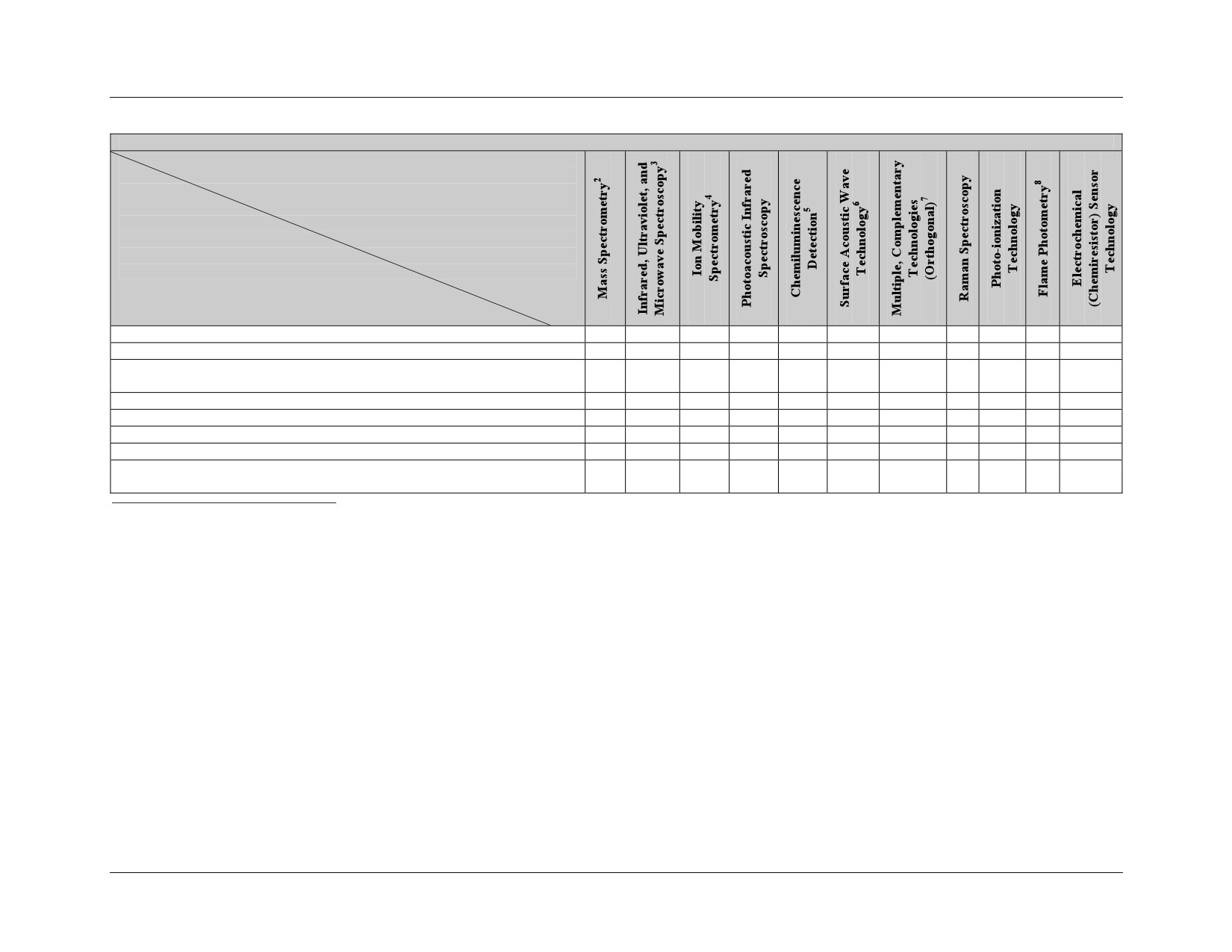
Table 5.1-2 identifies 11 ideas for materiel approaches that, if developed, may reduce or
eliminate the deficiencies associated with detecting chemical hazards in the atmosphere.
Advances in orthogonal technologies may be able to address all identified deficiencies.
34
For Official Use Only
For Official Use Only
CBRN Functional Needs Analysis/Functional Solution Analysis
Chapter 5. Tactical Sense Tasks
Table 5.1-2. TASENS 1: IMA Assessment
TASENS 1: Sense the atmosphere for chemical hazards1
Idea for Materiel
Approach
IMA)
Identified Gap
Lack of real-time or near real-time TIC detection and identification capabilities.9
X
X
X10
X
X
X
General inability to detect (liquid, solid, or dusty) aerosols.11
X12
X
X
X13
X
X
X
General inability to detect nerve agents (i.e., VX and, to a lesser extent, GD and
X14
X
X
X
X
GF) at or below IDLH levels.
Susceptibility to chemical interference.
X
X
X
X
Lack of real-time or near-real-time CWA identification capabilities.
X
X
X
X
X
X
Lack of agent quantification capabilities.15
X16
X
X
X
X
Lack of reliable standoff (or remote) detection capability for CWAs and TICs.17
X
X
X
X
X
X
X
X
X
X
X
Lack of detectors that also take and maintain samples for future analysis
X
X
X
X
X
X
X
X
X
X
X
capability.18
1 McKone, Thomas E., Beverly M. Huey, et al. (eds.) Strategies to Protect the Heath of Deployed U.S. Forces: Detecting, Characterizing and Documenting Exposures. National
Academy Press. 2000. http://books.nap.edu/books/0309068754/html/; Kosal, Margaret E. “The Basics of Chemical and Biological Detectors.” 24 November 2003.
http://cns.miis.edu/pubs/week/031124.htm;http://books.nap.edu/html/terrorism/ch4.html; Conventional analytical methods for
chemical warfare agents, http://www.iupac.org/publications/pac/2002/pdf/7412x2281.pdf; National Institute of Justice. Guide for the Selection of Chemical Agent and Toxic
Industrial Material Detection Equipment for Emergency First Responders. 2000, http://www.ojp.usdoj.gov/nij/pubs-sum/184449.htm; Loerop, William. Chemical Biological
Defense Science and Technology Chemical Standoff Briefing. Edgewood Chemical Biological Center. http://proceedings.ndia.org/dod_cb/Tuesday_PM/Zarzycki.pdf
2 Includes GC/MS, liquid chromatograph/mass spec (LC/MS), matrix-assisted laser desorption ionization with time-of-flight mass spectrometry.
3 Examples include CO2 long-wave infrared (LWIR), Differential Scattering/Differential Absorption of Light (DISC)/Differential Absorption LIDAR (DIAL), CO2 conv Mid-
Wave Infrared (MWIR) DISC/DIAL, solid-state (SS) conv MWIR DISC/DIAL, FTIR, Hyperspectral LWIR, Passive MWIR, SS conv LWIR DISC/DIAL, SS conv Short-Wave
Infrared (SWIR) - LWIR, SS conv UV-LW IR, Active LWIR Polarization, Active MWIR Polarization, Passive LWIR Polarization, Filtered Forward-Looking Infrared (FLIR),
UV LIF/FTIR, and Microwave (GHz and THz) Spectroscopy.
4 May be coupled with GC; External Second Gate, Fourier Transform Ion Mobility Spectrometry approach can improve sensitivity and selectivity.
5 For example, Phosphorus Chemiluminescence Detection (PCD)
6 May be coupled with GC.
7 Examples include SAW/IMS, IMC/SAW/Electrochemical/SCCell (S-CAD), GC/IMS.
8 May be coupled with GC or reversed-phase liquid chromatography (RPLC).
9 Increasing the number of TICs identified by JCAD and/or JMCBDS is a potential solution.
10 Classifies, but generally does not identify, agents
11 Distributing more Viking SpectraTraks is a potential solution.
12 Aerosol Mass Spectrometry (e.g., aerosol time-of-flight spectrometry (ATOFMS))
35
For Official Use Only
For Official Use Only
CBRN Functional Needs Analysis/Functional Solution Analysis
Chapter 5. Tactical Sense Tasks
13 MS and IMS.
14 Distributing more Viking SpectraTraks and HAPSITEs is a potential solution.
15 JCAD and/or JMCBDS are expected to eliminate deficiency.
16 Distributing more Viking SpectraTraks and HAPSITEs is a potential solution.
17 In conjunction with robotics for MS, IMS, PIRS, chemiluminesence detection, SAW Technology, photoionization technology, flame photometry, and electrochemical sensor
technology IMAs.
18 All IMAs could be designed to eliminate this capability gap. Part of the sample would be diverted for storage.
36
For Official Use Only
For Official Use Only
CBRN Functional Needs Analysis/Functional Solution Analysis
Chapter 5. Tactical Sense Tasks
5.2
Task TASENS 2: Sense the atmosphere for biological hazards
5.2.1
Functional Area Analysis
5.2.1.1
Definition
To sense the atmosphere for the presence or absence of biological hazards (encompasses
biological warfare agents and TIB material) using sensors. Includes the functions of detection,
identification, and quantification of the hazard. Also includes collection of samples for further
analysis, along with early-warning surveillance of unforeseen agent releases and monitoring of
known hazard locations. Encompasses both “detect to warn” and “detect to treat” situations to
enable appropriate protective measures. The evaluation encompasses all biological warfare
hazards of military and medical importance.
5.2.1.2
Derivation
UJTL TA 7, UJTL TA 7.1, Protection Joint Functional Concept.
5.2.1.2.1
Supported Tasks: OPSENS 1, OPSENS 4, OPSENS 7
5.2.1.2.2
Lateral Task: TASHA 16
5.2.1.2.3
Supporting Task: N/A
5.2.1.3
Condition
Perform this task under conditions of:
Physical
1. Mountainous, desert, jungle, and arctic terrain. (C1.1.1)
2. Significant urbanization. (C1.1.3.1)
3. Tropical, arctic, and arid climates. (C1.3.1)
4. Summer, winter seasons. (C1.3.1.1)
5. Stormy weather. (C1.3.1.3)
6. Hot, very cold air temperature. (C1.3.1.3.1)
7. High surface-wind velocity. (C1.3.1.3.3)
8. High relative humidity. (C1.3.1.3.5)
9. Liquid, freezing, and frozen precipitation. (C1.3.1.3.6.1)
10. Heavy precipitation intensity. (C1.3.1.3.6.2)
11. Extreme turbulence and wind shear. (C1.3.1.3.8)
12. Negligible light. (C1.3.2.1)
13. Biological effects. (C1.3.3.3)
Military
1. Stressful mission (C2.1)
37
For Official Use Only
For Official Use Only
CBRN Functional Needs Analysis/Functional Solution Analysis
Chapter 5. Tactical Sense Tasks
2. Location—ashore, afloat, airborne (C2.1.4.1)
3. Minimal time available. (C2.1.5)
4. Low personnel capability. (C2.2.4)
5. Negligible personnel experience. (C2.2.4.5)
6. Ambiguous threat existence. (C2.9.3)
Civil
1. Limited or negative foreign government support. (C3.1.2.3)
2. Aggressively opposed foreign public opinion. (C3.1.2.4)
3. High mission priority. (C3.1.3.2)
4. High health risk. (C3.3.1.5)
5. Significant refugee care responsibility. (C3.3.2.3)
6. Toxic industrial biological material present in the civilian sector. (C3.3.7.5)
5.2.2
Functional Needs Analysis
5.2.2.1
Capability and Deficiency Assessment Summary
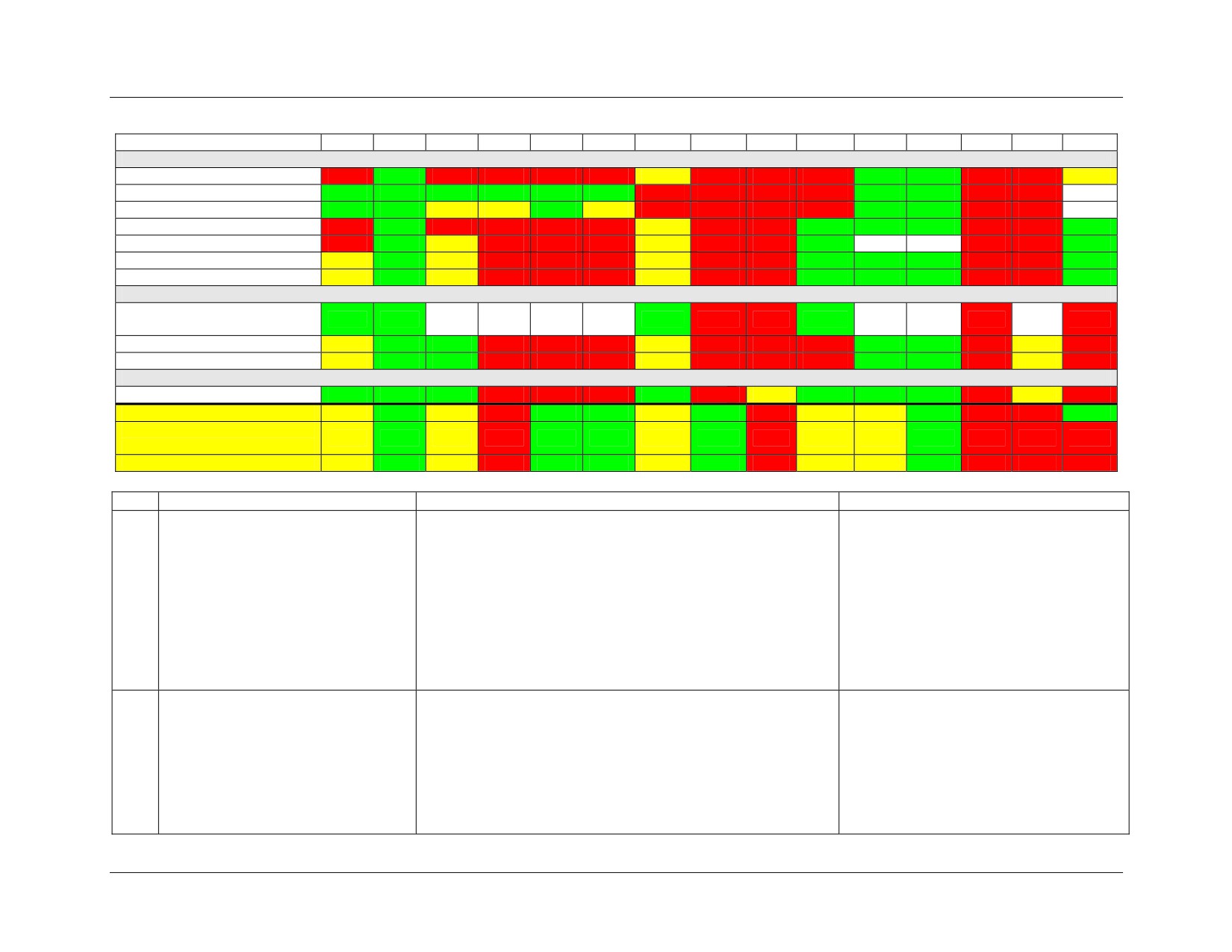
Table 5.2-1 presents individual and overall current, near/mid-term, and far-term capabilities to
perform the task to the designated standards. There are seven current capabilities used to
accomplish this task and four projected capabilities to be added in the future (three in the
near/mid-term and one in the far-term). The individual capabilities include a range of point and
standoff detectors with differing capabilities to meet the identified standards.
Current Capabilities and Deficiencies
The overall current capability is assessed as “yellow.” Many, if not most, BWAs can be
presumptively detected and identified by collecting and concentrating aerosols through the use of
a dry filter unit, followed by manual sample preparation and the following laboratory and field-
deployable analytical techniques: immunochromatographic HHAs, which are part of the BSK;
ELISA; and RT-PCR, as used by RAPID. Of the 25 BWAs described in the Medical
Management of Biological Casualties, a complete set of HHAs can detect and identify all agents
with the possible exception of the viral hemorrhagic fever agents; however, the BSK contains
eight different HHAs and thus detects only eight BWAs per kit. The eight agents in the kit may
be assembled to reflect the threat.1 A comprehensive set of ELISAs, which are laboratory-based,
can ostensibly detect and identify all 25 BWAs (as well as any TIB), assuming that an antigen or
antibody has been isolated for each agent. RAPID, like all PCR-based technologies, can, with the
appropriate reagents, detect and identify all BWA and TIB pathogens, but none of the toxins
(since the toxins, unless contaminated with the source organisms, do not provide any genetic
material). HHAs and RAPID can generically quantify detected agents (HHAs only through the
aide of a reader), whereas some varieties of ELISAs provide absolute quantification capabilities.
The automated systems M31 BIDS, IBADS, JBPDS, and Portal Shield use
immunochromatographic assays for detection and thus have capabilities similar to those of the
HHAs. They detect and identify between four and ten BWAs, depending on the system, typically
38
For Official Use Only
For Official Use Only
CBRN Functional Needs Analysis/Functional Solution Analysis
Chapter 5. Tactical Sense Tasks
within 15 minutes. Like HHAs, ELISAs, and the RAPID, they can identify-to-treat, but cannot
provide a response quickly enough for detect-to-warn. Three systems—the M31E1 BIDS,
JBPDS, and Portal Shield—take and maintain physical samples for further analysis (These
samples must currently be taken to off-site laboratories to validate the detection analysis).
There is no single, automated, current capability to detect all BWAs. Furthermore, all current
automated detectors do quantify agents, and thus, cumulative dose estimates cannot be
determined. In addition, they do not detect any TIBs.
Overall current task deficiencies include the lack of real-time BWA detection and identification
capabilities, agent quantification capabilities, and field analysis verification capabilities, as well
as the lack of TIB detection capabilities and standoff detection capabilities for biological
aerosols.
Projected Near/Mid-Term Capabilities and Deficiencies
The overall projected near/mid-term capability is assessed as “yellow.” Near/mid-term capability
CBMS II integrated into the NBCRS Stryker and JNBCRS will be required to detect all BWAs
in BIDS P3I list at 15 agent-containing particles per liter of air (ACPLA) within 3 minutes
(Block I) and all BWAs in the ITF6A list (1990) at 25 ACPLA within 4 minutes. JBAIDS Block
I will detect 11 BWA pathogens (as a threshold requirement), whereas Block II will detect the
same 11 BWA pathogens plus the four toxins of interest (as a threshold requirement). Unlike
current capabilities, JBAIDS will also quantify agent concentrations in the analyzed sample,
which may allow for crude estimates of cumulative doses. Analysis output following sample
preparation requires 25-40 minutes. The JBSDS will provide a standoff detection capability for
potentially hazardous biological aerosols. It will not identify agents, nor will it absolutely or
relatively quantify concentrations.
Of the overall current task deficiencies, the lack of field analysis verification capabilities, TIB
detection capabilities and discriminatory standoff detection capabilities for biological agents are
likely to remain deficiencies in the near/mid term.
Projected Far-Term Capabilities and Deficiencies
The overall projected far-term capability is assessed as “yellow.” The JMCBDS will detect all
BWA in the JCS list, but no TIBs. It will identify and quantify all detected agents as an
objective. Though it will be a point detector, its quick (<1-minute) response time may enable it to
provide some detect-to-warn capability. Like JBAIDS, the JMCBDS will enable crude
estimations of cumulative doses if it quantifies detected agents.
Of the overall current task deficiencies, the lack of field analysis verification capabilities, TIB
detection capabilities and discriminatory standoff detection capabilities for biological agents are
likely to remain deficiencies in the far term.
1 The collection of surface samples to use in HHA results in a sample for further analysis.
Coolers/temperature-controlled equipment to hold and maintain the sample needs to be available
if the sample is not immediately evacuated.
39
For Official Use Only
For Official Use Only
CBRN Functional Needs Analysis/Functional Solution Analysis
Chapter 5. Tactical Sense Tasks
Table 5.2-1. TASENS 2: Capability and Deficiency Assessment
System/Measure
M1
M2
M3
M4
M5
M6
M7
M8
M9
M10
M11
M12
M13
M14
M15
Current - Near/Mid - Far
DFU/BSK
3 1
102
03
04
N/A4
N/A4
65
N/A6
05
17
108
109
010
011
512
DFU/ ELISA
10 13
102
1014
1015
1016
10 14
117
N/A6
0 17
118
108
109
010
011
Unk
DFU/RAPID
8 19
102
520
521
1022
520
123
N/A6
023
123
108
109
010
011
Unk
M31 BIDS
1/3 24
102
025
04
N/A4
N/A4
626
N/A6
026
1026
1027
1027
010
011
1028
IBADS
1 29
102
530
04
N/A4
N/A4
626
N/A6
026
1026
Unk
Unk
010
011
1013
JBPDS
4 31
102
530
04
N/A4
N/A4
626
N/A6
026
1026
1032
109
010
011
1013
Portal Shield
3/4 33
102
530
04
N/A4
N/A4
534
N/A35
034
1034
108
109
010
011
1013
Near/Mid - Far
CBMS II integrated into NBCRV
1036
1037
Unk
Unk
Unk
Unk
938
N/A39
040
1038
Unk
Unk
041
Unk
N/A42
Stryker or JNBCRS
DFU/JBAIDS Blocks I/II
4/643
1044
1045
046
N/A46
N/A46
4/547
N/A39
047
118
1048
1049
041
550
N/A101
JBSDS
N/A51
N/A52
N/A53
N/A51
N/A52
N/A53
N/A54
3/1051
1055
N/A52
056
N/A56
041
053
N/A101
Far
JMCBDS
1057
1058
1059
060
N/A60
N/A60
1061
N/A39
562
1061
1048
1049
041
763
N/A101
Current Overall Capability
5
10
4
2
10
8
5
10
2
6
4
10
0
0
9
Near/Mid-Term Overall
5
10
5
2
10
8
5
10
1
6
5
10
0
1
N/A101
Capability
Far-Term Overall Capability
5
10
6
2
10
8
6
8
3
6
6
10
0
1
N/A101
FAA Measure
Elaboration
Scale
M1
All of a potential adversary’s
Number of the 25 biological agents described in the Medical
10: All 25 BWAs detected
weaponized BWAs can be detected
Management of Biological Casualties that are detected. Fourteen
8: 20 BWAs detected
using fielded technologies/equipment,
of the 25 agents are as follow: Anthrax (Bacillus anthracis);
6: 15 BWAs detected
regardless of agent physical
Brucellosis (Brucellae); Glanders (Burkholderia mallei);
4: 10 BWAs detected
properties, states, and concentrations?
Meliodosis (Burkholderia pseudomallei); Q Fever (Coxiella
2: 5 BWAs detected
burnetii); Plague (Yersinia pestis); Tularemia (Francisella
1: 1 BWA detected
tularensis); Botulinum toxin; Ricin; SEB; T-2 Mycotoxins;
0: No BWAs detected
Smallpox (variola major and minor); Viral Equine Encephalitis
(e.g., VEE, WEE, and EEE); and Ebola and Marburg
hemorrhagic fever viruses. Linear 2-10
M2
All of a potential adversary’s
Ability to identify or classify (e.g., as bacteria, toxin, or virus)
10: Identify detected BWAs
weaponized BWAs can be identified
detected BWAs.
7: Identify some detected BWAs; classify
using fielded technologies/equipment?
others
5: Classify detected BWAs
3: Some detected BWAs are classified or
identified
0: Neither identify nor classify detected
BWAs
40
For Official Use Only
For Official Use Only
CBRN Functional Needs Analysis/Functional Solution Analysis
Chapter 5. Tactical Sense Tasks
FAA Measure
Elaboration
Scale
M3
All of a potential adversary’s
Ability to provide snapshot concentration of detected BWAs.
10: Absolute quantification
weaponized BWAs can be quantified
5: Generic quantification
using fielded technologies/equipment?
0: No quantification capability
M4
All TIB material can be detected
Toxic industrial biological material includes medical waste, raw
10: All pathogens and toxins within TIB
using fielded technologies/equipment?
sewage, and vaccine-related biologics. Pathogens and toxins
material, including medical waste, raw
within TIB material are what are generally detected.
sewage, and vaccine-related biologics can
be detected
5: All TIB pathogens or toxins within one
or more categories (i.e., medical waste, raw
sewage and vaccine-related biologics) can
be detected
3: Some TIB pathogens and toxins within
one category (i.e., medical waste, raw
sewage and vaccine-related biologics) can
be detected
0: No TIB pathogens and toxins can be
detected
M5
All TIB material can be identified
Ability to identify or classify (e.g., as bacteria, toxin, or virus)
10: All pathogens and toxins within TIB
using fielded technologies/equipment?
detected TIB material.
material can be identified
7: Identify some TIB pathogens and toxins;
classify others
5: Classify detected TIB pathogens and
toxins
3: Some detected TIB pathogens and toxins
are classified or identified
0: Neither classify nor identify detected
TICs
M6
All TIB material can be quantified
Ability to provide snapshot concentration of detected TIBs.
10: Absolute quantification
using fielded technologies/equipment?
5: Generic quantification
0: No quantification capability
M7
Time to detect biological hazards?
Time period from BWA/TIB sampling to analysis output (after
10: 1 minute
sample preparation, and if attack time is known). Linear scale 2-
9: 4 minutes
9. Applies to point detectors only.
8: 7 minutes
7: 10 minutes
4: 40 minutes
2: 60 minutes
1: >60 minutes
41
For Official Use Only
For Official Use Only
CBRN Functional Needs Analysis/Functional Solution Analysis
Chapter 5. Tactical Sense Tasks
FAA Measure
Elaboration
Scale
M8
Distance between biological hazard
Linear scale 1-9. Applies to standoff detection only.
10: 9 km
and detector for accurate detection?
9: 9 km
5: 5 km
2: 2 km
1: 1 km
M9
Biological hazards are detected in
Dependent upon time to detect biological hazards (M7), distance
10: Complete capability
time to warn forces and take
between biological hazard and detector for accurate detection
5: Partial capability
appropriate protective measures?
(M8), as well as rate-of-action of those hazards.
0: No capability
M10
Biological hazards are identified in
Based on capability and time required to identify or classify
10: Complete capability (<1 hour)
time to treat forces?
hazards, as well as rate-of-action of those hazards. Of all
5: Partial capability
considered BWAs, ricin may require the most rapid response.
0: No capability
Immunoglobulin therapy must be administered within 1 hour of
ricin exposure to be effective.
M11
Sampling collection procedures
Refers to physical sampling for future analysis.
10: Complete capability
available for all of a potential
5: Partial capability
adversary’s weaponized BWAs and
0: No capability
for all TIB material using fielded
technologies/equipment?
M12
Procedures maintain integrity of
Refers to a physical sample for future analysis.
10: Complete capability
sample?
5: Partial capability
0: No capability
M13
Time to validate the presence of
Refers to confirmatory identification.
10: Rapidly—validation performed
biological hazards in the atmosphere?
expeditiously by particular
technology/equipment.
5: Moderately delayed—mobile analysis
tools can validate onsite. 0: Delayed—
offsite laboratory analysis required for
validation.
M14
Cumulative dose can be determined
If an absolute quantification capability is provided, then it is
10: Complete capability
and presented using data from
possible that the cumulative dose can be estimated (thus a
7: Moderate capability
currently fielded sensors/equipment?
minimal capability). If a monitoring capability is provided, then
5: Minimal capability
a more accurate cumulative dose can be calculated (moderate
0: Cumulative dose cannot be determined
capability). If the cumulative dose is automatically calculated,
then a complete capability is provided.
42
For Official Use Only
For Official Use Only
CBRN Functional Needs Analysis/Functional Solution Analysis
Chapter 5. Tactical Sense Tasks
FAA Measure
Elaboration
Scale
M15
There is effective DOTLPF in place to
Refers to non-materiel elements associated with the execution of
10: DOTLPF exists and is adequate for the
conduct task?
the task with the system.
task to be performed with this system
without limitations that cause significant
impact upon operations
5: Most critical aspects of DOTLPF for the
task to be performed with this system are
addressed
0: DOTLPF is inadequate or does not exist
for the task to be performed with this
system
1 Current and near-future HHAs detect all BWAs with the possible exception of the viral hemorrhagic fevers; however, the BSK contains eight different HHAs and thus detects
eight BWAs. The HHA sensitivity is 105-106 CFU/mL (B. anthracis) and 50-1200 ng/mL (Botulinum toxin A and Botulinum toxin F, respectively). Degraded performance: (C6)
Toxic Industrial Biological Material present in civilian sector. Susceptible to interference (false positives and negatives due to matrix effects, among others); (M3) Minimal time
available. Requires sample preparation prior to applying sample to assay.
2 All detected BWAs are identified. In light of how biological detection works, detected BWAs are also identified.
3 Does not absolutely quantify agent. However, may provide relative indication of quantity, but only through the use of a reader. Soldiers will not likely have the reader.
4 According to specifications, does not detect any TIBs.
5 Detects and identifies within 15 minutes following sample preparation.
6 Point detector.
7 Since concept of operations involves testing once every 1-8 hours (mission dependent), there is only a minimal capability to identify-to-treat exposed personnel.
8 Collects physical sample for future analysis.
9 Maintains physical sample integrity.
10 Requires samples to be confirmed off site in laboratory.
11 Does not provide absolute quantification capability, so cumulative dose cannot be determined.
12 There is effective DOTLPF in place to conduct task, at least for bacillus bacteria (specifically anthrax). Procedures for other agents are probably similar.
13 Ostensibly all BWAs can be detected by ELISA. ELISA’s sensitivity is 105-106 CFU/mL (B. anthracis); 10-100 PFU/mL of Venezuelan Equine Encephalitis virus; and
625 pg/mL of Staphyloccoccal Enterotoxin B (aerosol) and greater than 5 ng/mL of ricin.
14 Some varieties of ELISA can absolutely quantify the antigen or antibody concentration.
15 Theoretically, any agent (i.e., antigen or antibody) for which an ELISA has been designed can be detected through this method; however, only one particular pathogen or toxin
antigen or antibody can be tested per ELISA model.
16 A particular TIB pathogen or toxin is identified if it is detected, since ELISA is highly specific and detects a particular agent.
17 Typically requires 1-2 hours (following sample collection and preparation) for detection, identification, and if applicable, quantification, primarily because of incubation time.
18 Since concepts of operations involves collecting the filter for testing once every 1-8 hours (mission dependent), identify-to-treat capability is minimal.
19 RAPID may be able to detect all pathogens; PCR does not detect toxins, though the toxic material may be contaminated with source genetic material. (In this assessment, it is
assumed that this is not the case). Standard PCR has a sensitivity of 10-100 CFU/mL bacteria (B. anthracis); and 15 fg-1 pg or 100-1 million copies of the complementary DNA
for viruses.
20 RAPID, through RT-PCR, may provide generic quantification.
21 Theoretically, any TIB pathogen can be detected with appropriate reagents; toxins cannot be detected unless contaminated with source genetic material.
22 All detected TIBs are identified.
23 Detects and identifies within 30 minutes following sample preparation, but sample preparation requires several hours.
24 Detects four to eight agents detected (including anthrax, plague, botox, and SEB). The required sensitivity of the BIDS is 25 ACPLA (NDI model) and 15 ACPLA (P3I model).
43
For Official Use Only
For Official Use Only
CBRN Functional Needs Analysis/Functional Solution Analysis
Chapter 5. Tactical Sense Tasks
25 Does not provide absolute or generic (snapshot) quantification capability.
26 Detects and identifies within 15 minutes.
27 Refers to M13E1 BIDS model only.
28 There is effective DOTLPF in place to conduct task with this system.
29 Detects four agents.
30 Provides generic quantification capability with the use of a reader.
31 Detects 10 agents including: anthrax, smallpox, plague, tularemia, botox, SEB, and viral hemorrhagic fevers Ebola/Marburg. The required sensitivity of the JBPDS is 1 ACPLA,
though this capability has not likely been achieved.
32 Collects 4-5 mL sample for future analysis.
33 Detects 8-10 agents.
34 Detects within 25 minutes.
35 Networked point detectors.
36 Block I will detect all BW agents in BIDS P3I list at 15 ACPLA in 3 minutes. Block II will identify BW agents in ITF6A list (1990) at 25 ACPLA in 4 minutes.
37 At the very least, Block II will identify detected BWAs.
38 Will detect within 3-4 minutes.
39 Will be a point detector.
40 May detect within 3 minutes, but this is the threshold for detect-to-warn capability according to James Harper presentation of Rapid Identification of Biological Pathogens with
the CANARY System. It is concluded that it will not have any detect-to-warn capability.
41 Will require samples to be confirmed off site in laboratory
42 Future system(s). Thus, DOTLPF is also future and cannot be evaluated.
43 Block I will detect Anthrax; Brucella; Ebola VHF virus; Marburg VHF virus; Viral Encephalitis viruses (VEE/WWW/EEE); Glanders; Meliodosis; Plague; Q Fever; Smallpox;
and Tularemia (and Typhus) as a threshold requirement; and Crimean-Congo hemorrhagic virus; Dengue fever; Hantaviruses; and Rift Valley fever virus (and Cholera,
Cryptosporidium; E. col; Influenza; Salmonella; and Shigella) as an objective; Block II will add toxins Botulinum, microcystins, ricin, SEB, and T-2 Mycotoxins.
44 Will identify all detected agents.
45 Will quantify the concentration in the sample.
46 Will not detect any TIBs.
47 Will detect and identify within 40 minutes (25-minute objective) for Blocks I and II following sample preparation.
48 Will provide physical sample collection capability for future analysis.
49 Will maintain integrity of physical sample.
50 Cumulative dose will be able to be estimated from data (minimal capability).
51 Will detect aerosol clouds consistent with a BW release above naturally occurring backgrounds at ranges up to 5 km (15 km [O]) of at least 10,000 ACPLA (5,000 [O]) with a
detection probability of 90% (95%[O]) in near-real time during normal night conditions and sufficient line of sight. [T].
52 Will detect aerosol clouds and discriminate clouds with particles of biological origin from clouds with particles of nonbiological origin at average cloud concentrations of 3,000
(1,000 [O]) ACPLA up to 1 km (3 km [O]) with a probability of 90% (95% [O]) in near-real time during normal night conditions and sufficient line of sight [T].
53 Will not provide generic (snapshot) quantification capability.
54 Will provide real-time detection of aerosol clouds consistent with a BW release and real-time discrimination of clouds with particles of biological origin from clouds with
particles of nonbiological origin.
55 Will be a standoff detector with considerable range and real-time detection capability.
56 Will not collect physical sample.
57 Will detect all agents in JCS threat list. Will detect 1 ACPLA or as low as reasonably achievable (ALARA).
58 Will identify all detected agents as an objective.
59 Will provide absolute quantification capability as an objective.
60 Will not detect any TIBs.
61 Will detect within 1 minute.
44
For Official Use Only
For Official Use Only
CBRN Functional Needs Analysis/Functional Solution Analysis
Chapter 5. Tactical Sense Tasks
62 Though a point detector may provide partial detect-to-warn capability since detection time is 1 minute, which is less than 3-minute threshold for detect-to-warn capability
according to James Harper presentation of Rapid Identification of Biological Pathogens with the CANARY System.
63 Since it will have absolute quantification and monitoring capability, JMCBDS will provide moderate cumulative dose determination capability.
45
For Official Use Only
For Official Use Only
CBRN Functional Needs Analysis/Functional Solution Analysis
Chapter 5. Tactical Sense Tasks
5.2.3 Functional Solution Analysis
5.2.3.1
DOTLPF Assessment Summary
This section states the deficiencies and suggests potential non-materiel solutions. If there are no
solutions or there are only partial solutions for a particular deficiency, that deficiency is then
reassessed in the IMAs section.
1. Deficiency: Lack of real-time or near-real-time BWA detection and identification
capabilities.
Non-Materiel Solutions: None
2. Deficiency: Lack of standoff detection/identification (not just bio/nonbio discrimination)
capability for biological agents.
Non-Materiel Solutions: None
3. Deficiency: Validation of findings requires laboratory testing.
Non-Materiel Solutions: Doctrine: Modify doctrine to permit validation by a reliable on-
site detection/identification capability (e.g., portable PCR), if appropriate, as confirmatory
detection/identification is ultimately dependent upon doctrine, not materiel capabilities.
4. Deficiency: Lack of TIB detection capability.
Non-Materiel Solutions: None
5. Deficiency: Lack of agent quantification capabilities.
Non-Materiel Solutions: None
6. Deficiency: Lack of physical sampling capability for future analysis.
Non-Materiel Solutions: None
5.2.3.2
IMA Assessment Summary
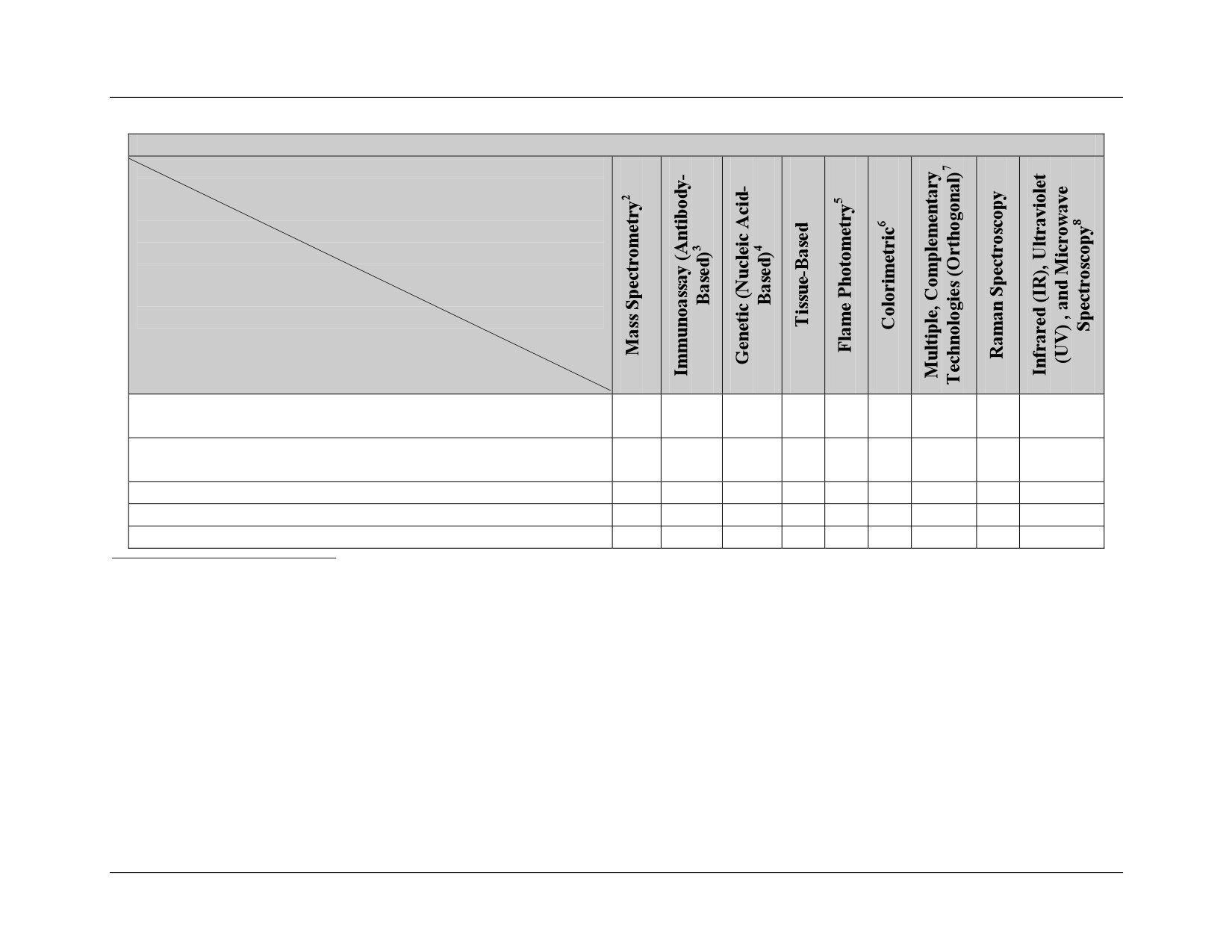
Table 5.2-2 identifies nine ideas for materiel approaches that, if developed, may reduce or
eliminate the deficiencies associated with detecting biological hazards in the atmosphere.
Advances in mass spectrometry, immunoassays, tissue-based detection, or orthogonal
technologies may be able to address all identified deficiencies.
46
For Official Use Only
For Official Use Only
CBRN Functional Needs Analysis/Functional Solution Analysis
Chapter 5. Tactical Sense Tasks
Table 5.2-2. TASENS 2: IMA Assessment
TASENS 2: Sense the atmosphere for biological hazards1
Idea for Materiel
Approach
(IMA)
Identified Gap
Lack of real-time or near real-time BWA detection and
X10
X
X
X
X
X
X
identification capabilities.9
Lack of standoff (or remote) detection/identification (not just
X
X
X
X
X
X
X
X
bio/nonbio discrimination) capability for biological agents.11
Lack of TIB-detection capability.
X
X
X
X
X
X
X
X
X
Lack of agent-quantification capabilities.12
X
X
X
X
X
X
X
Lack of physical-sampling capability for future analysis.13
X
X
X
X
X
X
X
X
X
1 McKone, Thomas E., Beverly M. Huey, et al. (eds.) Strategies to Protect the Heath of Deployed U.S. Forces: Detecting, Characterizing and Documenting Exposures. National
Academy Press. 2000. http://books.nap.edu/books/0309068754/html/; Kosal, Margaret E. “The Basics of Chemical and Biological Detectors.” 24 November 2003.
http://cns.miis.edu/pubs/week/031124.htm; Detection and Measurement of Biological Agents, http://books.nap.edu/html/terrorism/ch6.html; National Institute of Justice. An
Introduction to Biological Agent Detection Equipment for Emergency First Responders. 2001. http://www.ojp.usdoj.gov/nij/pubs-sum/190747.htm; Edgewood Chemical
Biological Center, Market Survey: Biological Detectors Guide for Selection of Detection Devices and Systems. April 2003.
2 Includes GC/MS, LC/MS, Gas Chromatography-Ion Trap Tandem Mass Spec (GC-MS-MS), Matrix-assisted laser desorption ionization (MALDI) Mass Spec.
3 Includes SAW technology.
4 Includes PCR amplification and RT-PCR amplification, DNA microchip technology, SAW technology, DNA-recognition enzymes.
5 Philippe, Adam, Damien Descroix. and Jean-Pierre Chiaroni. “Flame Photometry for Biological Detection.” Proceedings from the 6th CBW Protection Symposium. 1998.
6 ChemSensing Colorimetric Sensor.
7 Includes nucleic acid/immunoassay technologies (e.g., PCR and immunological techniques), electrochemiluminescence/equilibrium immunoassay, Fluorescence correlation
spectroscopy/PCR.
8 CO2 long-wave IR (LWIR) Differential Scattering/Differential Absorption of Light (DISC)/Differential Absorption LIDAR (DIAL), CO2 conv mid-wave IR (MWIR)
DISC/DIAL, solid-state (SS) conv MWIR DISC/DIAL, FTIR, Hyperspectral LWIR, Passive MWIR, SS conv LWIR DISC/DIAL, SS conv short-wave IR (SWIR) - LWIR, SS
conv UV-LW IR, Active LWIR Polarization, Active MWIR Polarization, Passive LWIR Polarization, Filtered Forward-Looking Infrared (FLIR), UV LIF/FTIR.
9 JMCBDS is expected to provide rapid BWA detection capability (i.e., within 1 minute)
47
For Official Use Only
For Official Use Only
CBRN Functional Needs Analysis/Functional Solution Analysis
Chapter 5. Tactical Sense Tasks
10 A time-of-flight mass spectrometer being developed by Johns Hopkins’ Applied Physics Laboratory can, within minutes, identify biological agent aerosols, though in less detail
than slower mass spectrometry-based detectors. Brown, Kathryn. “Up in the Air.” Science. 305: 27. August 2004. pp. 1228-29.
11 In conjunction with UAV for MS, Immunoassay, Genetic, Tissue-Based, and Flame Photometry IMAs.
12 JBAIDS and JMCBDS are expected to quantify agent and thus eliminate capability gap.
13 All IMAs could be designed to eliminate this capability gap. The collection equipment would be better maintained as an independent capability. The solution could involve a
module connected to the detector that notifies the operator to take samples or triggers an automated process to begin sampling.
48
For Official Use Only
For Official Use Only
CBRN Functional Needs Analysis/Functional Solution Analysis
Chapter 5. Tactical Sense Tasks
5.3
Task TASENS 3: Sense the atmosphere for radiological hazards
5.3.1
Functional Area Analysis
5.3.1.1
Definition
To sense the atmosphere for the presence or absence of radiation hazards and toxic industrial
radiological (TIR) material using sensors. Includes the functions of detection, identification, and
quantification of the hazard. Also includes collection of samples for further analysis, along with
early-warning surveillance of unforeseen hazard releases and monitoring of known hazard
locations. Encompasses both “detect to warn” and “detect to treat” situations to enable
appropriate protective measures.
5.3.1.2
Derivation
UJTL TA 7, UJTL TA 7.1, Protection Joint Functional Concept.
5.3.1.2.1
Supported Tasks: OPSENS 1, OPSENS 4, OPSENS 7
5.3.1.2.2
Lateral Task: TASHA 16
5.3.1.2.3
Supporting Task: N/A
5.3.1.3
Condition
Perform this task under conditions of:
Physical
1. Mountainous, desert, jungle, and arctic terrain. (C1.1.1)
2. Significant urbanization. (C1.1.3.1)
3. Tropical, arctic, and arid climates. (C1.3.1)
4. Summer, winter seasons. (C1.3.1.1)
5. Stormy weather. (C1.3.1.3)
6. Hot, very cold air temperature. (C1.3.1.3.1)
7. High surface-wind velocity. (C1.3.1.3.3)
8. High relative humidity. (C1.3.1.3.5)
9. Liquid, freezing, and frozen precipitation. (C1.3.1.3.6.1)
10. Heavy precipitation intensity. (C1.3.1.3.6.2)
11. Extreme turbulence and wind shear. (C1.3.1.3.8)
12. Negligible light. (C1.3.2.1)
13. Strong nuclear atmosphere weapons effects. (C1.3.3)
14. Moderate nuclear radiation effects. (C1.3.3.1.2)
Military
1. Stressful mission. (C2.1)
49
For Official Use Only
For Official Use Only
CBRN Functional Needs Analysis/Functional Solution Analysis
Chapter 5. Tactical Sense Tasks
2. Location—ashore, afloat, airborne. (C2.1.4.1)
3. Minimal time available. (C2.1.5)
4. Low personnel capability. (C2.2.4)
5. Negligible personnel experience. (C2.2.4.5)
6. Ambiguous threat existence. (C2.9.3)
Civil
1. Limited or negative foreign government support. (C3.1.2.3)
2. Aggressively opposed foreign public opinion. (C3.1.2.4)
3. High mission priority. (C3.1.3.2)
4. TIMs present in the civilian sector. (C3.3.7.5)
5.3.2
Functional Needs Analysis
5.3.2.1
Capability and Deficiency Assessment Summary
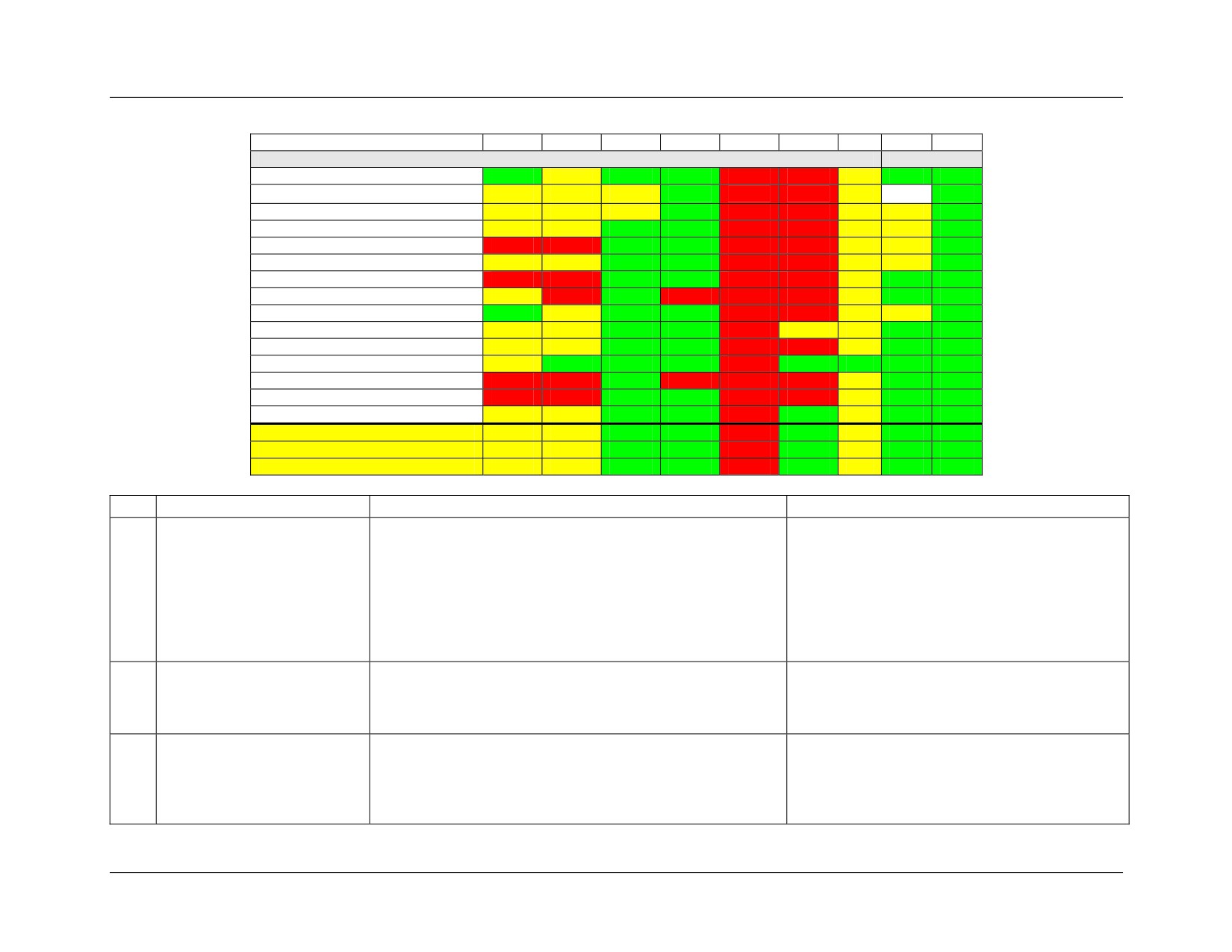
Table 5.3-1 presents individual and overall current, near/mid-term, and far-term capabilities to
perform the task to the designated standards. There are 15 current capabilities used to accomplish
this task. The capabilities include a range of portable RADIAC devices and dosimeters.
Current Capabilities and Deficiencies
The overall current capability is assessed as “yellow.” Most current RADIACs detect and
identify beta radiation and detect, identify, and quantify gamma radiation. All RADIACs
perform their functions in real time (though the level of confidence increases with increased
sampling time) and thus provide a complete detect-to-warn capability. Many also automatically
calculate the cumulative dose. Dosimeters generally measure the total dose from gamma
radiation exposure. Most are not self-indicating and need to be placed within a reader to retrieve
the dose information. Many currently fielded dosimeters were designed for fallout operations and
are incapable of supporting operations in lower-level radiation environments.
There is no single capability that can perform the task to all of the designated standards. ADM-
300 detects most forms of radiation (alpha, beta, gamma, and x-ray), but it, like all RADIACs,
detects, identifies, and quantifies only the radiation, not the radioisotope. Furthermore, the
ADM-300, like all RADIACs and dosimeters, must be exposed to radiation to detect it. Overall
task deficiencies include the lack of radioisotope identification capabilities, reliable alpha
detection capabilities, monitors that can detect all types of radiation, and detectors that take
sample for future analysis and the complete lack of true standoff detection capabilities.
Projected Near/Mid-Term Capabilities and Deficiencies
No changes in capability are projected in the near/mid term for this task, so the overall projected
near/mid-term capability will remain “yellow.”
50
For Official Use Only
For Official Use Only
CBRN Functional Needs Analysis/Functional Solution Analysis
Chapter 5. Tactical Sense Tasks
Projected Far-Term Capabilities and Deficiencies
No changes in capability are projected in the far-term for this task, so the overall projected far-
term capability will remain “yellow.”
51
For Official Use Only
For Official Use Only
CBRN Functional Needs Analysis/Functional Solution Analysis
Chapter 5. Tactical Sense Tasks
Table 5.3-1. TASENS 3: Capability and Deficiency Assessment
System/Measure
M1
M2
M3
M4
M5
M6
M7
M8
M9
Current - Near/Mid - Far
ADM-300
81
52
103
104
05
06
57
108
109
AN/PDQ-1 MFR10
411
52
512
104
05
06
57
Unk
1013
AN/PDR-27
411
52
512
104
05
06
57
713
1013
AN/PDR-43
411
52
103
104
05
06
57
713
1013
AN/PDR-56
214
N/A15
103
104
05
06
57
713
1013
AN/PDR-63
411
52
103
104
05
06
57
713
1013
AN/PDR-65
216
N/A15
103
104
05
06
57
1017
1013
AN/PDR-75
418
019
1020
021
022
323
524
1025
1013
AN/PDR-77
826
52
103
104
05
06
57
713
1013
AN/UDR-13
427
52
103
104
05
528
57
1017
1013
AN/VDR-2
411
52
103
104
05
06
57
1017
1013
Berkeley SAM 935
429
1030
103
104
05
1031
1032
1017
1013
CP-95/DT-60
233
N/A15
1034
021
022
323
535
1036
1013
IM-143/ IM-93
233
N/A15
1034
1037
022
323
535
1036
1013
Siemens EPD MK2
411
52
103
104
05
1031
57
1017
1013
Current Overall Capability
4
4
9
8
0
9
5
9
10
Near/Mid-Term Overall Capability
4
4
9
8
0
9
5
9
10
Far-Term Overall Capability
4
4
9
8
0
9
5
9
10
FAA Measure
Elaboration
Scale
M1
All radiological hazards
Number of radiation types (i.e., alpha, beta, gamma, neutron,
10: All five types
(including TIR material) can
and x-ray) detected. Note: Fielded technologies/equipment
8: Four types
be detected using fielded
detect radiological hazards by detecting the radiation emitted
6: Three type
technologies/equipment?
from these hazards.
4: Two types
2: Single type
TIR material includes depleted uranium (DU), a common
0: No radiological hazards detected
battlefield hazard resulting from certain types of ammunition
and damaged armor.
M2
All radiological hazards
Ability to identify type of radiation detected or the radioisotope
10: Identifies radioisotope emitting radiation
(including TIR material) can
emitting the radiation. Note: Fielded technologies/equipment
5: Identifies type of radiation detected
be identified using fielded
that identify radioisotope also identify the type(s) of radiation
0: No identification capability
technologies/ equipment?
detected.
M3
All radiological hazards
Ability to quantify activity of radiological material (i.e., Cu or
10: Absolute quantification
(including TIR material) can
Bq), or the exposure (i.e., Roentgen or Coulomb/kg) or dose
5: Generic quantification (or absolute quantification
be quantified using fielded
rate (rad, rem, Gy, or Sv) from emitted radiation.
of one radiation type and no quantification of
technologies/ equipment?
another type)
0: No quantification capability
52
For Official Use Only
For Official Use Only
CBRN Functional Needs Analysis/Functional Solution Analysis
Chapter 5. Tactical Sense Tasks
FAA Measure
Elaboration
Scale
M4
Time to detect radiological
Time period from exposure to radiation to analysis output.
10: Near real time
hazard?
0: Not near real time
M5
Distance between radiological
Since fielded technologies/equipment detect the radiation
10: Exposure to emitted radiation not required to
hazard and detector for
emitted from radiological hazards, the distance depends on
detect hazard
accurate detection?
range of emitted radiation. All field technologies/equipment
0: Exposure to emitted radiation required to detect
must be exposed to emitted radiation to detect the radiological
hazard
hazard. If a radiological detector did not need to be exposed to
radiation emitted from a radiological hazard to detect that
hazard, then it would exhibit true standoff capability.
M6
Radiological hazards are
Dosimetry is a key protection measure used to ensure personnel
10: Complete capability (alarming personal
detected in time to warn forces
do not exceed the command dose level. Complete capability
dosimeter with digital readout, dose rate alarm, and
and take appropriate protective
requires automated dosimeters capable of alarming when dose
total dose alarm suitable for both occupational
measures?
rates and total doses are reached that are well below traditional
exposure use [meets OSHA requirements for
nuclear warfare levels.
tracking low-level exposures] and nuclear warfare
operations [fully EMP hardened])
5: Partial capability (Personal dosimeter with ability
for wearer to read in the field, suitable for nuclear
warfare operations and with range of 0.1-1000 cGy
and display scales ranging cGys to 100s of cGy)
0: No capability
M7
Radiological hazards are
A complete capability requires both near real-time
10: Complete capability (near real-time
identified in time to treat
identification of the emitted radiation type(s) and radioisotope.
identification of radioisotope and emitted radiation
forces?
Identification of the emitted radiation type(s) enables
type[s])
appropriate medical response to radiation exposure and
5: Partial capability (Delayed identification of
identification of the radioisotope determines to appropriate
emitted radiation type[s])
medical course of action to radiological material internalization.
0: No capability (no identification capability)
M8
Cumulative dose can be
If an absolute quantification capability is provided, then it is
10: Complete capability
determined and presented
possible that the cumulative dose can be estimated (thus a
7: Moderate capability
using data from currently
minimal capability). If a monitoring capability is provided, then
5: Minimal capability
fielded sensors/equipment?
a more accurate cumulative dose can be calculated (moderate
0: Cumulative dose cannot be determined.
capability). If the cumulative dose is automatically calculated,
then a complete capability is provided.
M9
There is effective DOTLPF in
Refers to non-materiel elements associated with the execution
10: DOTLPF exists and is adequate for the task to
place to conduct task?
of a task with the system.
be performed with this system without limitations
that cause significant impact upon operations
5: Most critical aspects of DOTLPF for the task to
be performed with this system are addressed
0: DOTLPF is inadequate or does not exist for the
task to be performed with this system
53
For Official Use Only
For Official Use Only
CBRN Functional Needs Analysis/Functional Solution Analysis
Chapter 5. Tactical Sense Tasks
1 Detects most radiation types (alpha, beta, gamma, and x-ray) emitted from radiological materials.
2 Identifies type of radiation, but not radioisotope.
3 Absolutely quantifies radiation level.
4 Real-time detection. Level of confidence increases with increased sampling time and radiation levels.
5 Requires exposure to emitted radiation to detect hazard.
6 Not a dosimeter.
7 Provides partial identify-to-treat capability since immediately identifies detected radiation type, but not the radioisotope.
8 Automatically calculates cumulative dose since system capable of dose and dose rate alarms across entire measurement range; also predictive algorithm provides estimate of time
in field before alarm; unknown whether cumulative dose is directly output.
9 There is effective DOTLPF in place to conduct task with this system.
10 In combination with OA-9449/PDQ probe. The MFR alone detects gamma radiation; with the probe, it measures gamma radiation and detects beta radiation.
11 Detects beta/gamma radiation emitted from radiological materials.
12 Absolutely quantifies gamma radiation level; detects, but does not quantify, beta radiation.
13 Absolutely quantifies radiation level and provides monitoring capability and thus provides moderate capability to determine cumulative dose.
14 Detects alpha radiation emitted from radiological materials (particularly plutonium).
15 Detects only one type of radiation, so identification capability is not applicable.
16 Detects gamma radiation emitted from radiological materials (particularly plutonium).
17 System automatically calculates cumulative dose.
18 The DT-236 dosimeter records the total dose to gamma and neutron radiation. The CP-696 reader is required to retrieve the dose information.
19 Does not differentiate between dose received from gamma radiation and dose received from neutron radiation.
20 Absolutely quantifies total gamma and neutron dose absorbed by dosimeter.
21 Dose can be viewed only when dosimeter is placed within reader; therefore, radiation exposure cannot be detected in near real time.
22 Dosimeter must be exposed to radiation to warn of radiation hazard.
23 Dosimeter, but can’t be read by wearer in the field.
24 Through reader, displays total dose to penetrating (i.e., gamma and neutron) radiation, which allows for partial identify-to-treat capability.
25 Dosimeter records total cumulative dose to gamma and neutron radiation.
26 Detects alpha, beta, gamma, and x-radiation emitted from radiological materials.
27 Detects gamma/neutron radiation emitted from radiological materials.
28 Partial capability. Dosimeter measures the gamma/neutron dose rate from 0.1-999 cGy/hour and the total dose from 0.1-999 cGy.
29 Detects gamma radiation and with optional neutron detector, neutron radiation as well.
30 Identifies the radioisotope.
31 Complete capability.
32 Provides complete identify-to-treat capability since immediately identifies radioisotope.
33 Dosimeter indicates total dose to gamma radiation only.
34 Absolutely quantifies total gamma radiation dose absorbed by dosimeter.
35 Provides partial identify-to-treat capability. As dosimeter detects only gamma radiation, an indication of a significant dose could suggest and help treat acute radiation syndrome,
e.g.
36 Dosimeter records cumulative dose to gamma radiation.
37 As a self-indicating pocket dosimeter, possibly allows for near-real-time detection of gamma radiation; however, dose rate must be high for increase in dose to be noticeable
during a short period.
54
For Official Use Only
For Official Use Only
CBRN Functional Needs Analysis/Functional Solution Analysis
Chapter 5. Tactical Sense Tasks
5.3.3
Functional Solution Analysis
5.3.3.1
DOTLPF Assessment Summary
This section states the deficiencies and suggests potential non-materiel solutions. If there are no
solutions or there are only partial solutions for a particular deficiency, that deficiency is then
reassessed in the IMAs section.
1. Deficiency: Lack of reliable alpha-detection capabilities.
Non-Materiel Solutions: Training (partial): Increase training of personnel on ADM-300,
AN/PDR-56 and AN/PDR-77.
2. Deficiency: Lack of monitors that can detect most or all types of radiation.
Non-Materiel Solutions: Training (partial): Increase training of personnel on ADM-300.
3. Deficiency: Lack of true standoff detection capability.1
Non-Materiel Solutions: None
4. Deficiency: Lack of radioisotope-identification capabilities.
Non-Materiel Solutions: None
5. Deficiency: Lack of self-indicating, alarming person dosimeters with low-to-high level
detection capability.
Non-Materiel Solutions: None
5.3.3.2
IMA Assessment Summary
Table 5.3-2 identifies four ideas for materiel approaches that, if developed, may reduce or
eliminate the deficiencies associated with detecting radiological hazards in the atmosphere.
Advances in scintillation or semiconductor radiation detection technologies may be able to
address all identified deficiencies.
1 Current detectors must be exposed to radiation to detect the presence of a radiological source. This fact means that the users of
handheld radiation detectors may also be exposed to radiation. CRTI is currently developing a standoff radiological detection
55
For Official Use Only
For Official Use Only
CBRN Functional Needs Analysis/Functional Solution Analysis
Chapter 5. Tactical Sense Tasks
Table 5.3-2. TASENS 3: IMA Assessment
TASENS 3: Sense the atmosphere for radiological hazards1
Ideas for Material
Approaches
(IMA)
Identified Gaps
Lack of reliable alpha detection capabilities.5
X
X
X
Lack of monitors that can detect all types of radiation.6
X
X
X
Lack of true standoff (or remote) detection capability.7
X
X
X
X8
Lack of radioisotope identification capabilities.9
X
X
Lack of self-indicating, alarming person dosimeters with low-
X
X
to-high level detection capability.
2 Includes Geiger-Mueller detectors, proportional gas detectors, and ionization chambers
3 Includes ZnS(Ag), anthracene, trans-stilbene, para-terphenyl, phenyl oxazole, NaI(Tl), CsI(Tl), bismuth germinate (Bi4Ge3O12), barium fluoride (BaF2)-based detectors
4 Includes germanium, silicon, cadmium telluride (CdTe), and mercuric iodide (HgI2)-based detectors
5 Distributing more ADM-300 and AN/PDR-77 is a potential solution.
6 Distributing more ADM-300 is a potential solution.
7 In conjunction with robotics or UAVs for gas-filled detector, scintillation detector, and semiconductor detector IMAs.
8 CRTI is developing a standoff radiation detector that may be technically based on electromagnetic spectroscopy of surrounding air molecules being ionized by the radiation.
9 Distributing gamma and/or alpha scintillation detectors with radioisotope identification capabilities is a potential solution.
56
For Official Use Only
For Official Use Only
CBRN Functional Needs Analysis/Functional Solution Analysis
Chapter 5. Tactical Sense Tasks
5.4
Task TASENS 4: Sense surfaces for chemical hazards
5.4.1
Functional Area Analysis
5.4.1.1
Definition
To sense the presence or absence of chemical hazards (encompasses chemical warfare agents and
TICs) on surfaces. Includes the functions of detection, identification, and quantification of the
hazard. Also includes the requirement to determine the extent and physical properties of
contamination, monitoring of known hazard locations, and collection of samples for further
analysis. Encompasses both “detect to warn” and “detect to treat” situations to enable appropriate
protective measures.
5.4.1.2
Derivation
UJTL TA 7, UJTL TA 7.1, Protection Joint Functional Concept.
5.4.1.2.1
Supported Tasks: OPSENS 1, OPSENS 4, OPSENS 7
5.4.1.2.2
Lateral Task: N/A
5.4.1.2.3
Supporting Task: N/A
5.4.1.3
Condition
Perform this task under conditions of:
Physical
1. Mountainous, desert, jungle, and arctic terrain. (C1.1.1)
2. Significant urbanization. (C1.1.3.1)
3. High sea state. (C1.2.1.3)
4. Tropical, arctic, and arid climates. (C1.3.1)
5. Summer, winter seasons. (C1.3.1.1)
6. Stormy weather. (C1.3.1.3)
7. Hot, very cold air temperature. (C1.3.1.3.1)
8. High surface-wind velocity. (C1.3.1.3.3)
9. High relative humidity. (C1.3.1.3.5)
10. Liquid, freezing, and frozen precipitation. (C1.3.1.3.6.1)
11. Heavy precipitation intensity. (C1.3.1.3.6.2)
12. Extreme turbulence and wind shear. (C1.3.1.3.8)
13. Negligible light. (C1.3.2.1)
14. Chemical effects. (C1.3.3.2)
Military
1. Stressful mission. (C2.1)
57
For Official Use Only
For Official Use Only
CBRN Functional Needs Analysis/Functional Solution Analysis
Chapter 5. Tactical Sense Tasks
2. Location—ashore, afloat, airborne. (C2.1.4.1)
3. Minimal time available. (C2.1.5)
4. Low personnel capability. (C2.2.4)
5. Negligible personnel experience. (C2.2.4.5)
6. Ambiguous threat existence. (C2.9.3)
Civil
1. Limited or negative foreign government support. (C3.1.2.3)
2. Aggressively opposed foreign public opinion. (C3.1.2.4)
3. Low mission priority. (C3.1.3.2)
4. TICs present in the civilian sector. (C3.3.7.5)
5.4.2
Functional Needs Analysis
5.4.2.1
Capability and Deficiency Assessment Summary
Table 5.4-1 presents individual and overall current, near/mid-term, and far-term capabilities to
perform the task to the designated standards. There are 10 current capabilities used to accomplish
this task and four projected capabilities to be added in the future (three in the near/mid-term and
one in the far-term). The individual capabilities include a range of point detectors and a future
standoff detector with differing capabilities to meet the identified standards (Note: The ratings
may be based on vendor-provided claims).
Current Capabilities and Deficiencies
The overall current capability is assessed as “yellow.” Most current detectors do not directly
detect chemical agents on surfaces but rather detect vapors off-gassing from the deposited agent.
The APD2000, CAM/ICAM, HAPSITE with the headspace sampling system, and M22 ACADA
with XM279 probe all work through this method. Consequently, these detectors’ capabilities for
sensing chemical agents on surfaces are generally equivalent to their capabilities for sensing
chemical agents in the atmosphere, assuming that the agent is sufficiently volatile for a
detectable amount of chemical vapor to accumulate above the contaminated surface.
M8 and M9 papers are the primary current capabilities for directly detecting liquid chemical
warfare agents (i.e., nerve and blister agents) deposited on surfaces. M8 paper indicates exposure
to liquid agent by changing its color from tan to yellow, red, and green for G-agents, H-agents
and Lewisite, and V-agents, respectively. M9 paper does not classify or identify detected agents,
but turns pink, red, reddish-brown, or red-purple when exposed to liquid G-agents, H-agents, V-
agents, and Lewisite. The HazMatID is another capability that can identify sampled CWA (and
TIC) liquids (and solids, powders, and pastes) on surfaces. Though the system can identify
samples within 20 seconds, the samples must be manually fed into the device.
There is no single detection device/instrument that is capable of performing all TASENS 4 tasks.
Mass spectrometers Viking SpectraTrak and HAPSITE are sophisticated capabilities, but they do
not detect or identify in near-real time; consequently, they do not detect to warn and may be
58
For Official Use Only
For Official Use Only
CBRN Functional Needs Analysis/Functional Solution Analysis
Chapter 5. Tactical Sense Tasks
unable to identify to treat high concentrations of fast-acting lethal agents. Current overall task
deficiencies include the general inability to detect deposited low-volatility agents, dusty agents,
and off-gassing nerve agents (i.e., VX and, to a lesser extent, GD and GF) at or below IDLH
levels; lack of real-time CWA identification and TIC detection/identification capabilities; lack of
agent quantification capabilities; lack of a detector that also takes samples for future analysis;
lack of standoff (or remote) detection capability for CWAs and TICs on surfaces; inability to
detect adsorbed and absorbed chemical agents; and detector susceptibility to chemical
interference.1
Projected Near/Mid-Term Capabilities and Deficiencies
The overall projected near/mid-term capability is assessed as “yellow.” In the near/mid-term
future, more detectors will quantify and classify, if not identify, agents. Nevertheless, MS units
and the JCSD will likely be the only detectors able to detect all CWAs. MS units Viking
Spectratrak and HAPSITE will remain the main capabilities to detect TICs. They will detect
many or all high-priority TICs.
The general inability to detect deposited low-volatility agents, dusty agents, and off-gassing
nerve agents (i.e., VX and, to a lesser extent, GD and GF) at or below IDLH levels; lack of real-
time CWA identification and TIC detection/identification capabilities; lack of agent
quantification capabilities; lack of a detector that also takes samples for future analysis; inability
to detect adsorbed and absorbed chemical agents; lack of standoff (or remote) detection
capability for CWAs and TICs on surfaces; and detector susceptibility to chemical interference
are likely to remain deficiencies in the near-future.
Projected Far-Term Capabilities and Deficiencies
The overall projected far-term capability is assessed as “yellow.” In the far-term future, most
fielded detectors will detect most, if not, all CWAs and some TICs. Most detectors will quantify
and classify, if not identify, agents. MS units will likely remain the main capabilities to detect
TICs. Many detectors will still not detect deposited low-volatility agents, dusty agents, and off-
gassing nerve agents at or below IDLH levels. Furthermore, there will still be a lack of a detector
that also takes samples for future analysis, a lack of standoff (or remote) detection capability for
CWAs and TICs on surfaces, and an inability to detect adsorbed and absorbed chemical agents.
Chemical interference will remain an issue.
1 Refer to the JRO Operational Impact Assessment of Non-Traditional Agents report, July 2003
(S/NF) for information on nontraditional agent detection.
59
For Official Use Only
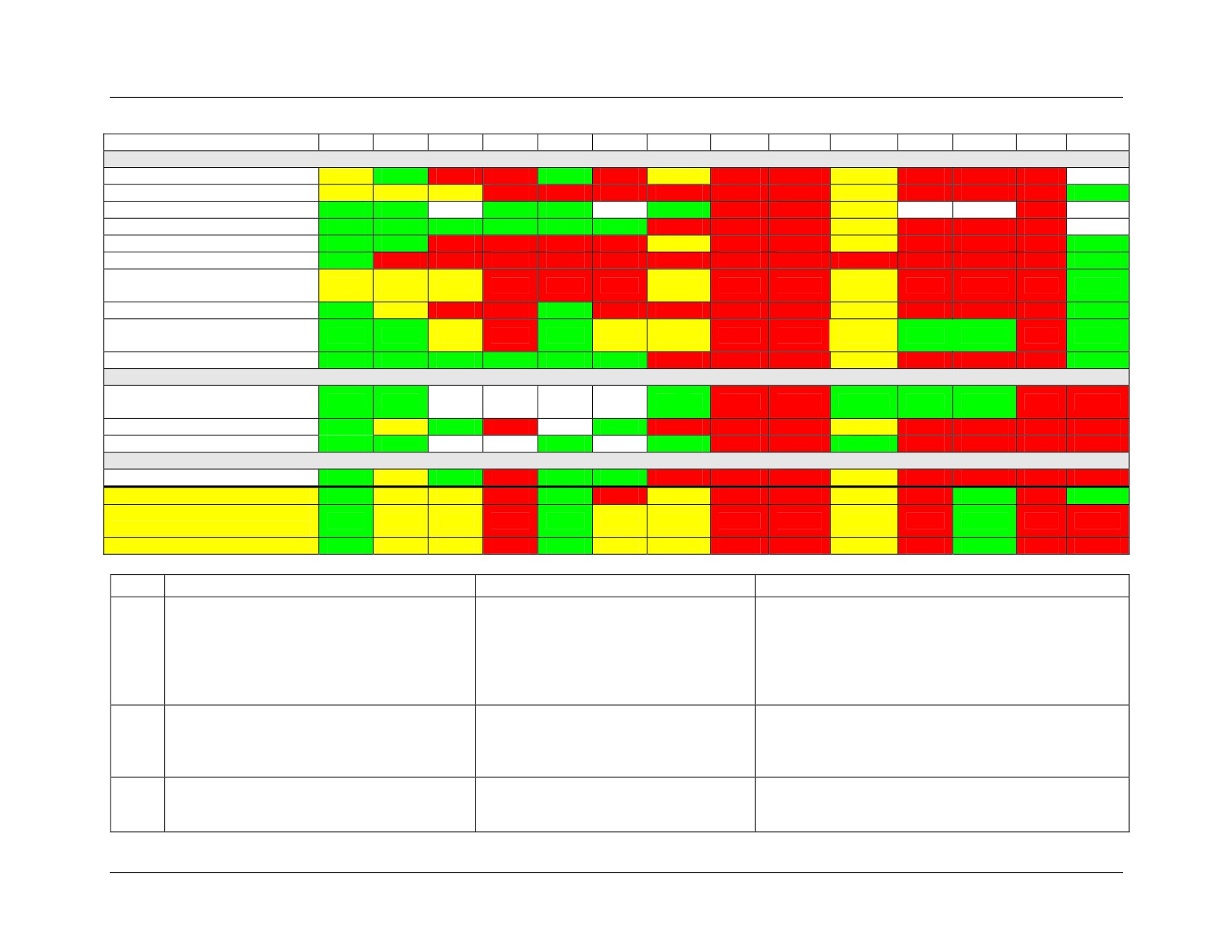
For Official Use Only
CBRN Functional Needs Analysis/Functional Solution Analysis
Chapter 5. Tactical Sense Tasks
Table 5.4-1. TASENS 4: Capability and Deficiency Assessment
System/Measure
M1
M2
M3
M4
M5
M6
M7
M8
M9
M10
M11
M12
M13
M14
Current - Near/Mid - Far
APD2000
5 1
10 2
0 3
0 4
10 2
N/A 5
7 6
N/A 7
N/A8
5 9
0 10
N/A 10
N/A8
Unk11
CAM/ICAM
6 12
5 13
5 14
0 15
N/A 16
N/A 5
2 17
N/A 7
N/A8
5 18
0 10
N/A 10
N/A8
1019
HAZMATID
10 20
10 21
Unk
9 22
10 21
Unk
8 23
N/A 7
N/A8
5 24
Unk
Unk
N/A8
Unk11
HAPSITE (GC/MS) with HSS25
10 26
10 27
10 28
9 29
10 27
10 28
1 30
N/A 7
N/A8
5 31
0 10
N/A 10
N/A8
Unk11
M8 Paper
7 32
5 33
0 3
0 15
N/A 16
N/A 5
7 17
N/A 7
N/A8
5 34
0 10
N/A 10
N/A8
1019
M9 Paper
7 35
0 36
0 3
0 15
N/A 16
N/A 5
8 37
N/A 7
N/A8
N/A 38
0 10
N/A 10
N/A8
1019
M22 ACADA with XM279
6 40
7 41
5 42
0 15
N/A 16
N/A 5
7 17
N/A 7
N/A8
5 43
0 10
N/A 10
N/A8
1019
probe39
M256A1 Kit44
9 45
7 46
0 3
1 47
10 48
N/A 5
1 49
N/A 7
N/A8
5 50
0 10
N/A 10
N/A8
1019
MM-1 (GC/MS) integrated into
10 51
10 15
5 52
1 53
10 15
5 75
4 54
N/A 7
N/A8
5 55
10 56
10 57
N/A8
1019
M93A1 Fox
Viking SpectraTrak (GC/MS)
10 58
10 59
10 40
10 60
10 90
10 40
1 42
N/A 7
N/A8
5 44
0 10
N/A 10
N/A8
1019
Near/Mid - Far
CBMS II integrated into NBCRV
10 61
1062
Unk
Unk
Unk
Unk
9 63
N/A 64
N/A8
1065
10 66
10 67
N/A8
N/A68
Stryker or JNBCRS
JCAD with XM279 probe39
9 69
5 70
10 71
2 72
Unk
10 104
2 73
N/A 74
N/A8
5 75
0 76
N/A 76
N/A8
N/A77
JCSD
10 78
10 79
Unk
Unk 80
10 79
Unk
10 81
N/A 82
N/A8
10 83
0 84
N/A 76
N/A8
N/A101
Far
JMCBDS
9 85
5 103
10 104
4 86
10 87
10 104
1 88
N/A 74
N/A8
5 89
0 76
N/A 76
N/A8
N/A101
Current Overall Capability
8
7
4
2
10
3
4
N/A
N/A
5
1
10
N/A
10
Near/Mid-Term Overall
8
7
5
2
10
4
5
N/A
N/A
5
2
10
N/A
N/A101
Capability
Far-Term Overall Capability
8
7
5
2
10
4
5
N/A
N/A
5
2
10
N/A
N/A101
FAA Measure
Elaboration
Scale
M1
All of a potential adversary’s weaponized
Percentage of following 12 agents as
Percentages standardized to 0-10 scale
CWAs can be detected using fielded
described in FM 3-9 that are detected:
technologies/ equipment, regardless of agent
nerve agents (GA; GB; GD; GF; VX),
physical properties, states, and concentrations?
vesicants (H/HD; HN-1,2,3; L; CX),
cyanides (AC; CK), pulmonary agent
(CG)
M2
All CWAs can be identified?
Ability to classify or identify detected
10: Identify detected CWAs
CWAs.
7: Identify some detected CWAs; classify others
5: Classify detected CWAs
0: Neither identify nor classify detected CWAs
M3
All of a potential adversary’s weaponized
Ability to provide snapshot concentration
10: Absolute quantification
CWAs can be quantified using fielded
of detected CWAs.
5: Generic quantification
technologies/equipment?
0: No quantification capability
60
For Official Use Only

For Official Use Only
CBRN Functional Needs Analysis/Functional Solution Analysis
Chapter 5. Tactical Sense Tasks
FAA Measure
Elaboration
Scale
M4
All TICs can be detected using fielded
Percentage of the 33 high-priority critical
10: 100%
technologies/equipment?
acutely toxic airborne TICs listed in
9: 90%
USACHPPM Report 47-EM-6154-03:
8: 80%
ITF-40. (FOUO) that are detected.
2: 20%
1: 1%-20%
0: 0%
M5
All TICs can be identified using fielded
Ability to classify or identify detected
10: Identify all detected TICs
technologies/equipment?
TICs.
7: Identify some detected TICs; classify others
5: Classify detected TICs
0: Neither classify nor identify detected TICs
M6
All TICs can be quantified using fielded
Ability to provide snapshot concentration
10: Absolute quantification
technologies/equipment?
of detected TICs.
5: Generic quantification
0: No quantification capability
M7
Time to detect chemical hazards?
Time period from CWA/TIC sampling to
10: 12 sec
analysis output. Linear scale 1-10.
7: 30 sec
2: 60 sec
1: > 60 sec
M8
Distance between chemical hazard and
Linear scale 1-9. Applies to standoff
10: 9 km
detector for accurate detection?
detection only.
9: 9 km
5: 5 km
2: 2 km
1: 1 km
M9
Chemical hazards are detected in time to warn
This measure is not relevant to this task.
N/A
forces and take appropriate protective
measures?
M10
Chemical hazards are identified in time to treat
Based on capability and time required to
10: Complete capability
forces?
identify or classify hazards, as well as
5: Partial capability
rate-of-action of those hazards.
0: No capability
M11
Sampling collection procedures available for
Refers to physical sampling for future
10: Complete capability
all of a potential adversary’s weaponized
analysis.
5: Partial capability
CWAs and for all TICs using fielded
0: No capability
technologies/ equipment?
M12
Procedures maintain integrity of sample?
Refers to a physical sample for future
10: Complete capability
analysis.
5: Partial capability
0: No capability
M13
Cumulative dose can be determined and
This measure is not relevant to this task.
N/A
presented using data from currently fielded
sensors/equipment?
61
For Official Use Only
For Official Use Only
CBRN Functional Needs Analysis/Functional Solution Analysis
Chapter 5. Tactical Sense Tasks
FAA Measure
Elaboration
Scale
M14
There is effective DOTLPF in place to conduct
Refers to non-materiel elements
10: DOTLPF exists and is adequate for the task to be
task?
associated with the execution of a task
performed with this system without limitations that
with the system.
cause significant impact upon operations
5: Most critical aspects of DOTLPF for the task to be
performed with this system are addressed
0: DOTLPF is inadequate or does not exist for the task to
be performed with this system
1 Limited—Detects only GA, GB, GD (0.1 mg/m3 - IDLH level for GA/GB, 2X IDLH level for GD within 30 sec.); VX (0.04 mg/m3 - 4X IDLH level within 30 sec.); HD
(2 mg/m3 - IDLH level within 15 sec.), and L (0.38 mg/m3 within 15 sec.). According to FM 3-11.9, incapacitating doses are 300 (GA for resting person), 75 (GB for resting
person), 75-300 (GD), 50 (VX), 150 (inhaled HD), and <300 (L for eye) mg-min/m3. Does not detect concentrations which can cause low-level (e.g., ocular) effects; detects
vapors only; and is susceptible to chemical interference (false positives and negatives).
2 Identifies detected agents and TICs.
3 Does not quantify amount of detected agents or TICs.
4 Detects pepper spray and mace (but these are not included in the ITF-40 33 high-priority critical acutely toxic airborne TICs.)
5 Does not quantify TIC concentrations because it does not detect any TICs.
6 Detects in less than 30 seconds.
7 Point detector, so no standoff distance.
8 Not relevant to this task (N/A).
9 Identifies hazards within 30 seconds.
10 Sampling collection for future analysis capability does not exist with this technology/equipment.
11 COTS detector. Unknown if sufficient DOTLPF in place.
12 Limited—Detects only GA, GB, GD, GF, VX, HD, and L (0.1 mg/m3 - IDLH level for GA/GB, 2X IDLH for GD/GF; 10X IDLH for VX; 1/20 IDLH for HD). According to
FM 3-11.9, incapacitating doses are 300 (GA for resting person), 75 (GB for resting person), 75-300 (GD), 50 (VX), 150 (inhaled HD), and <300 (L for eye) mg-min/m3. Does not
detect concentrations which can cause low-level (e.g., ocular) effects; detects vapors only; and is susceptible to chemical interference (false positives and negatives).
13 Classifies agents as being nerve or blister agents.
14 Provides relative hazard indication (relative quantification).
15 No TICs detected.
16 Does not identify or classify any TICs because it does not detect any TICs.
17 Detects hazards in less than 1 minute. Note: Requires up to 8 hours to warm up after 30 days storage.
18 Classifies agents within 1 minute.
19 There is effective DOTLPF in place to conduct task with this system.
20 Presumably detects all 12 CWAs of interest considering that it claims that it can detect nerve and blister agents; plus 25,000 unique ATR chemical spectra are available to be
programmed into the system. Detects solids, powders, pastes, and liquids only.
21 Identifies detected agents and TICs (through IR spectrometry).
22 Presumably detects most TICs in ITF-40. Detects solids, powders, pastes, and liquids only.
23 Detects and identifies within 20 seconds of sample submission.
24 Detects and identifies within 20 seconds of sample submission, but samples must be manually fed into system.
25 Headspace sampling system.
26 Presumably detects all 12 CWAs of interest (claims low ppb to ppt detection limits; 1 ppb = 0.01 mg/m3 for VX - IDLH level; 0.006-0.007 mg/m3 for G-agents - ~1/10 IDLH
levels; 0.007 mg/m3 for HD - 1/285 IDLH level). According to FM 3-11.9, incapacitating doses are 300 (GA for resting person), 75 (GB for resting person), 75-300 (GD), 50
(VX), 150 (inhaled HD), <300 (L for eye), 7,000 (CK), and 1,6000 (CG) mg-min/m3. Detects vapors only.
62
For Official Use Only
For Official Use Only
CBRN Functional Needs Analysis/Functional Solution Analysis
Chapter 5. Tactical Sense Tasks
27 Identifies detected agents and TICs (through MS).
28 Provides absolute quantification capability for all detected agents and TICs (specifically provides composition intensities, e.g., ppm).
29 Presumably detects most TICs in ITF-40. Detects vapors only.
30 Detects within 10 minutes.
31 Hazards are not identified in time to treat, especially if lethal fast-acting agents at high concentrations are involved.
32 Detects GA, GB, GD, GF, VX, HD, HN and L liquid (>0.02 mL) droplets.
33 Classifies as G-, H- (and L), and V-agents.
34 Classifies agents within 30 seconds.
35 Detects GA, GB, GD, GF, VX, HD, HN and L liquid (>100 ȝL) droplets.
36 Does not identify or classify detected agents or TICs.
37 Detects within 20 seconds.
38 Does not identify or classify agents or TICs.
39 Assuming probe does not affect system performance.
40 Limited—Detects only GA, GB, GD, GF (0.1 mg/m3 - IDLH level for GA/GB, 2X IDLH for GD/GF within 30 sec.); VX (0.04 mg/m3 - 4X IDLH level within 90 sec.); HD,
and L (10 mg/m3 - 5X IDLH level for HD, unknown L). According to FM 3-11.9, incapacitating doses are 300 (GA for resting person), 75 (GB for resting person), 75-300 (GD),
50 (VX), 150 (inhaled HD), and <300 (L for eye) mg-min/m3. Does not detect concentrations which can cause low-level (e.g., ocular) effects; detects vapors only; and is
susceptible to chemical interference (false positives and negatives).
41 Classifies detected G and V agents as nerve agents; identifies detected H and L agents.
42 Relative hazard level provided through three different sensitivity levels.
43 Classifies or identifies agents within 30 seconds.
44 M8 paper is also included in the kit.
45 Detects GA, GB, GD, GF (0.005 mg/m3 - 1/20 IDLH for GA/GB, 1/10 IDLH for GD/GF), VX (0.02 mg/m3 - 2X IDLH level), HD (2mg/m3 - IDLH level), HN, L (9 mg/m3),
CX (3 mg/m3), AC (9 mg/m3 - below IDLH), CK (8 mg/m3), and CX (3 mg/m3) in vapor form and is susceptible to chemical interference. According to FM 3-11.9, incapacitating
doses are 300 (GA for resting person), 75 (GB for resting person), 75-300 (GD), 50 (VX), 150 (inhaled HD), <300 (L for eye), and 7,000 (CK) mg-min/m3.
46 Classifies G and V agents as nerve agents; identifies blood and blister agents.
47 Detects TICs AC and CK.
48 Identifies detected TICs.
49 Detects within 15 minutes.
50 Hazards are identified in time to treat when M8 paper is used for liquid detection. Hazards are not identified in time to treat when ampoules are used for vapor detection (delayed
response; 15-20 minutes).
51 Detects 20-30 CWAs, precursors, and degradation products (including all 12 CWAs) in vapor (62 mg/m3 for GB - 620X IDLH; 46 mg/m3 for CK; 115 mg/m3 for CG) and
liquid form, and is susceptible to chemical interference (false positives and negatives). According to FM 3-11.9, incapacitating doses are 300 (GA for resting person), 75 (GB for
resting person), 75-300 (GD), 50 (VX), 150 (inhaled HD), <300 (L for eye), 7,000 (CK), and 1,6000 (CG) mg-min/m3.
52 Provides relative intensities (concentrations) of detected agents and TICs.
53 Detects phosgene, hydrogen cyanide, cyanogen chloride, phosphorus trichloride, and phosphorus oxychloride.
54 Detects within 45 seconds.
55 Identifies hazards within 45 seconds.
56 A physical sample can be taken, but not through the MM-1. The M93A1 Fox has a protective glove attached to the body by which an occupant can safely collect physical
samples.
57 Sample integrity is maintained.
58 Presumably detects all 12 agents of interest; detects all states (claims 5 ppb detection limit for air preconcentrator = 0.05 mg/m3 for VX - 5X IDLH level, 0.030-0.035 mg/m3 for
G-agents: 1/3-2/3 IDLH levels, 0.035 mg/m3 for HD - 1/57 IDLH level). According to FM 3-11.9, incapacitating doses are 300 (GA for resting person), 75 (GB for resting
person), 75-300 (GD), 50 (VX), 150 (inhaled HD), <300 (L for eye), 7,000 (CK), and 1,6000 (CG) mg-min/m3. Degraded performance: (P5, 9, 10) Not waterproof when
operating; (M5) Negligible personnel experience.
63
For Official Use Only
For Official Use Only
CBRN Functional Needs Analysis/Functional Solution Analysis
Chapter 5. Tactical Sense Tasks
59 Identifies sampled agents and TICs (through MS).
60 Presumably detects all TICs in ITF-40; detects all states.
61 Presumably will detect all CWAs (0.4 mg/m2 surface for nerve, blister, blood, and choking agents).
62 All detected CWAs will be identified.
63 Will detect and identify within 15 seconds.
64 Will be point detector, so no standoff distance.
65 Will identify within 15 seconds, which provides complete capability.
66 Liquid and vapor samples will be able to be taken.
67 Sample integrity will be maintained.
68 Future system(s). Thus, DOTLPF is also future and cannot be evaluated.
69 Will detect only GA, GB, GD, GF, and VX (0.1 mg/m3 - IDLH level for GA/GB, 2X IDLH level for GD/GF, 10X IDLH for VX, within 30 sec.); HD, HN3, and L (2.0 mg/m3 -
IDLH level, within 120 sec.), AC (22 mg/m3 - below IDLH level, within 60 sec.), CK (20 mg/m3 within 60 sec.), and CG vapors only, and will not detect concentrations which can
cause low-level (e.g., ocular) effects. According to FM 3-11.9, incapacitating doses are 300 (GA for resting person), 75 (GB for resting person), 75-300 (GD), 50 (VX), 150
(inhaled HD), <300 (L for eye), and 7,000 (CK) mg-min/m3.
70 Will classify agents as nerve, blister, blood, and choking agents.
71 Will provide absolute quantification capability for all detected agents and TICs.
72 Will detect Cl, HBr, HCl, AC, HF, HS, and CG as an objective.
73 Will detect hazards within 1 minute.
74 Will be point detector, so no standoff distance.
75 Will classify hazards within 1 minute.
76 This technology/equipment will not have sampling collection for future analysis capability.
77 Future system(s). Thus, DOTLPF is also future and cannot be evaluated.
78 Will detect all 12 CWAs: GA, GB, GD, GF, VX, H/HD, HN-1,2,3, L, CX, AC, CK, and CG.
79 All detected agents will be identified.
80 Unknown—to detect TIMs, which include TICs.
81 Will detect chemical hazards in real time.
82 Though technically a standoff detector, the standoff distance will be minimal.
83 Will identify chemical hazards in real time; therefore adequate for identify-to-treat.
84 This technology/equipment will not have sampling collection for future analysis capability.
85 Will detect only GA, GB, GD, GF (0.1 mg/m3 - IDLH level for GA/GB, 2X IDLH level for GD/GF within 30 sec.); VX (0.04 mg/m3 - 4X IDLH level within 90 sec.); HD,
HN3, L (2.0 mg/m3 - IDLH level within 120 sec.); AC (22 mg/m3 - below IDLH level within 60 sec.); CK (20 mg/m3 within 60 sec.); and CG in vapor and aerosol forms, and will
not detect concentrations which can cause low-level (e.g., ocular) effects. According to FM 3-11.9, incapacitating doses are 300 (GA for resting person), 75 (GB for resting
person), 75-300 (GD), 50 (VX), 150 (inhaled HD), <300 (L for eye), 7,000 (CK), and 1,6000 (CG) mg-min/m3.
86 Will detect ammonia, arsine, chlorine, diborane, fluorine, hydrogen bromide, hydrogen cyanide, hydrogen fluoride, nitric acid, phosgene, phosphorus trichloride, sulphur
dioxide, and sulphuric acid.
87 Will identify all detected TICs as an objective.
88 Will detect hazards within 2 minutes.
89 Will classify or identify CWAs and TICs within 2 minutes.
64
For Official Use Only
For Official Use Only
CBRN Functional Needs Analysis/Functional Solution Analysis
Chapter 5. Tactical Sense Tasks
5.4.3
Functional Solution Analysis
5.4.3.1
DOTLPF Assessment Summary
This section states the deficiencies and suggests potential non-materiel solutions. If there are no
solutions or there are only partial solutions for a particular deficiency, that deficiency is then
reassessed in the IMAs section.
1.
Deficiency: Lack of real-time or near-real-time TIC detection and identification capabilities.
Non-Materiel Solutions: Training (partial): Increase training of personnel on TIC
recognizable effects on surfaces.
2.
Deficiency: General inability to detect deposited low-volatility agents and dusty agents.
Non-Materiel Solutions: None
3.
Deficiency: General inability to detect off-gassing nerve agents (i.e., VX and, to a lesser
extent, GD and GF) at or below IDLH levels.
Non-Materiel Solutions: Training (partial): Increase training of personnel on portable mass
spectrometers (e.g., Viking SpectraTrak and HAPSITE).
4.
Deficiency: Susceptibility to chemical interference.
Non-Materiel Solutions: Training (partial): Increase training of personnel on portable mass
spectrometers (e.g., Viking SpectraTrak and HAPSITE).
5.
Deficiency: Lack of real-time or near-real-time CWA identification capabilities.
Non-Materiel Solutions: None
6.
Deficiency: Lack of agent quantification capabilities.
Non-Materiel Solutions: Training (partial): Increase training of personnel on portable mass
spectrometers (e.g., Viking SpectraTrak and HAPSITE).
7.
Deficiency: Lack of standoff (or remote) detection capability for CWAs and TICs on
surfaces.
Non-Materiel Solutions: None
8.
Deficiency: Inability to detect absorbed and adsorbed chemical agents.
Non-Materiel Solutions: None
9.
Deficiency: Lack of detector that also takes physical samples for future analysis capability.
Non-Materiel Solutions: None
5.4.3.2
IMA Assessment Summary
Table 5.4-2 identifies 12 ideas for materiel approaches that, if developed, may reduce or
eliminate the deficiencies associated with detecting chemical hazards in the atmosphere.
Advances in orthogonal technologies may be able to address all identified deficiencies.
65
For Official Use Only
For Official Use Only
CBRN Functional Needs Analysis/Functional Solution Analysis
Chapter 5. Tactical Sense Tasks
Table 5.4-2: TASENS 4. IMA Assessment
TASENS 4: Sense surfaces for chemical hazards1
Ideas for Material
Approaches
(IMA)
Identified Gaps
Lack of real-time TIC detection and identification
X
X
X10
X
X
X
X
capabilities.9
General inability to detect deposited low-volatility
X
X
X
X
X
X
X
X
agents and dusty agents.
General inability to detect nerve agents (i.e., VX
and, to a lesser extent, GD and GF) at or below
X
X
X
X
X12
X
X
IDLH levels.11
Susceptibility to chemical interference.
X
X
Lack of agent quantification capabilities.13
X
X
X
X
X
X
14
Lack of real-time CWA identification capabilities.
X
X
X
X
X
Lack of standoff (or remote) detection capability
X
X
X
X
X
X
X
X
X
X
X
for CWAs and TICs on surfaces.15
Inability to detect absorbed and adsorbed chemical
agents.
Lack of detector that also takes samples for future
X
X
X
X
X
X
X
X
X
X
X
X
66
For Official Use Only
For Official Use Only
CBRN Functional Needs Analysis/Functional Solution Analysis
Chapter 5. Tactical Sense Tasks
analysis capability.16
1 Loerop, William. Chemical Biological Defense Science and Technology Chemical Standoff briefing. Edgewood Chemical Biological Center.
2 GC/MS, LC/MS.
3 Examples include Thermal Infrared Spectroscopy, FTIR, long-wave IR (LWIR) Differential Scattering/Differential Absorption of Light (DISC)/Differential Absorption LIDAR
(DIAL), LWIR Polarization, mid-wave IR (MWIR) DISC/DIAL, MWIR Polarization, Near-IR Scattering, NIR Laser-Induced Breakdown Spectroscopy (LIBS) UV Fluorescence,
Multiband Brillouin Scattering, LWIR FTIR, LWIR Filtered Forward-Looking Infrared (FLIR), and Microwave (GHz and THz) spectroscopy.
4 May be coupled with GC; External Second Gate, Fourier Transform Ion Mobility Spectrometry approach can improve sensitivity and selectivity.
5 For example, PCD.
6 May be coupled with GC.
7 Examples include SAW/IMS.
8 NIR Raman, Visible Light (VIS) Surface-Enhanced Raman, VIS Raman, UV Raman, Multiband Resonance-Enhanced Raman, Multiband Surface-Enhanced Raman.
9 Increasing the number of TICs identified by JCAD and/or JMCBDS is a potential solution.
10 Classifies, but generally does not identify, agents
11 Distributing more HAPSITEs and Viking Spectratraks is a potential solution.
12 MS and IMS.
13 JCAD and JMCBDS are expected to quantify agent and thus eliminate capability gap.
14 Distributing more HAPSITEs and Viking Spectratraks is a potential solution.
15 In conjunction with robotics for MS, IMS, PIRS, Chemiluminesence Detection, SAW Technology, photoionization technology, Flame Photometry, and Electrochemical Sensor
Technology IMAs. JCSD is expected to provide standoff detection capability for CWAs on the ground.
16 All IMAs could be designed to eliminate this capability gap. The collection equipment would be better maintained as an independent capability. The solution could involve a
module connected to the detector that notifies the operator to take samples or triggers an automated process to begin sampling.
67
For Official Use Only
For Official Use Only
CBRN Functional Needs Analysis/Functional Solution Analysis
Chapter 5. Tactical Sense Tasks
5.5
Task TASENS 5: Sense surfaces for biological hazards
5.5.1
Functional Area Analysis
5.5.1.1
Definition
To sense the presence or absence of biological hazards (encompasses biological warfare agents
and TIB material) on surfaces. Includes the functions of detection, identification, and
quantification of the hazard. Also includes the requirement to determine the extent and physical
properties of contamination, monitoring of known hazard locations, and collection of samples for
further analysis. Encompasses both “detect to warn” and “detect to treat” situations to enable
appropriate protective measures.
5.5.1.2
Derivation
UJTL TA 7, UJTL TA 7.1, Protection Joint Functional Concept.
5.5.1.2.1
Supported Tasks: OPSENS 1, OPSENS 4, OPSENS 7
5.5.1.2.2
Lateral Task: N/A
5.5.1.2.3
Supporting Task: N/A
5.5.1.3
Condition
Perform this task under conditions of:
Physical
1. Mountainous, desert, jungle, and arctic terrain. (C1.1.1)
2. Significant urbanization. (C1.1.3.1)
3. High sea state. (C1.2.1.3)
4. Tropical, arctic, and arid climates. (C1.3.1)
5. Summer, winter seasons. (C1.3.1.1)
6. Stormy weather. (C1.3.1.3)
7. Hot, very cold air temperature. (C1.3.1.3.1)
8. High surface-wind velocity. (C1.3.1.3.3)
9. High relative humidity. (C1.3.1.3.5)
10. Liquid, freezing, and frozen precipitation. (C1.3.1.3.6.1)
11. Heavy precipitation intensity. (C1.3.1.3.6.2)
12. Extreme turbulence and wind shear. (C1.3.1.3.8)
13. Negligible light. (C1.3.2.1)
14. Biological effects. (C1.3.3.3)
Military
1. Stressful mission. (C2.1)
68
For Official Use Only
For Official Use Only
CBRN Functional Needs Analysis/Functional Solution Analysis
Chapter 5. Tactical Sense Tasks
2. Location—ashore, afloat, airborne. (C2.1.4.1)
3. Minimal time available. (C2.1.5)
4. Low personnel capability. (C2.2.4)
5. Negligible personnel experience. (C2.2.4.5)
6. Ambiguous threat existence. (C2.9.3)
Civil
1. Limited or negative foreign government support. (C3.1.2.3)
2. Aggressively opposed foreign public opinion. (C3.1.2.4)
3. High mission priority. (C3.1.3.2)
4. High health risk. (C3.3.1.5)
5. Significant refugee care responsibility. (C3.3.2.3)
6. Toxic Industrial Biological Material present in the civilian sector. (C3.3.7.5)
5.5.2
Functional Needs Analysis
5.5.2.1
Capability and Deficiency Assessment Summary
Table 5.5-1 presents individual and overall current, near/mid-term, and far-term capabilities to
perform the task to the designated standards. There are three current capabilities used to
accomplish this task and one projected capability to be added in the future (JBAIDS in the
near/mid term). The individual capabilities differ in their abilities to meet the identified
standards.
Overall Capability and Deficiency Summary
The overall current capability is assessed as “yellow.” Many, if not most, BWAs can be
presumptively detected and identified by collecting surface samples through physical sampling,
followed by manual sample preparation and the following laboratory and field-deployable
analytical techniques: immunochromatographic HHAs, which are part of the BSK; ELISA; and
RT-PCR, as used by the RAPID. Of the 25 BWAs described in the Medical Management of
Biological Casualties, a complete set of HHAs can detect and identify all agents with the
possible exception of the viral hemorrhagic fever agents; however, the BSK contains eight
different HHAs and thus detects only eight BWAs per kit. The eight agents in the kit may be
assembled to reflect the threat.1 A comprehensive set of ELISAs, which are laboratory-based,
can ostensibly detect and identify all 25 BWAs (as well as any TIB), assuming that an antigen or
antibody has been isolated for each agent. RAPID, like all PCR-based technologies, can, with the
appropriate reagents, detect and identify all BWA and TIB pathogens, but none of the toxins
(since the toxins, unless contaminated with the source organisms, do not provide any genetic
material). HHAs and RAPID can generically quantify detected agents (HHAs only through the
aide of a reader), whereas some varieties of ELISAs provide absolute quantification capabilities.
Overall current task deficiencies include the lack of integrated sample collection, detection,
identification, and quantification capability for BWAs on surfaces; real-time or near-real-time
detection, identification, and quantification capability for sampled BWAs; standoff detection
69
For Official Use Only
For Official Use Only
CBRN Functional Needs Analysis/Functional Solution Analysis
Chapter 5. Tactical Sense Tasks
capability for BWAs on surfaces; field analysis verification capabilities; and TIB detection
capabilities.
Projected Near/Mid-Term Capabilities and Deficiencies
The overall projected near/mid-term capability is assessed as “yellow.” Near/Mid-term capability
JBAIDS Block I will detect 11 BWA pathogens (as a threshold requirement), whereas Block II
will detect the same 11 BWA pathogens plus the four toxins of interest (as a threshold
requirement). JBAIDS will also quantify agent concentrations in the analyzed sample. It will
require 25-40 minutes for analysis output following sample preparation and will thus provide a
complete identify-to-treat capability. All of the overall current task deficiencies are likely to
remain deficiencies in the near/mid term.
Projected Far-Term Capabilities and Deficiencies
No changes in capability are projected in the far term for this task, so the overall projected far-
term capability will remain “yellow.”
1 The collection of surface samples to use in HHA results in a sample for further analysis.
Coolers/temperature-controlled equipment to hold and maintain the sample needs to be available
if the sample is not immediately evacuated.
70
For Official Use Only
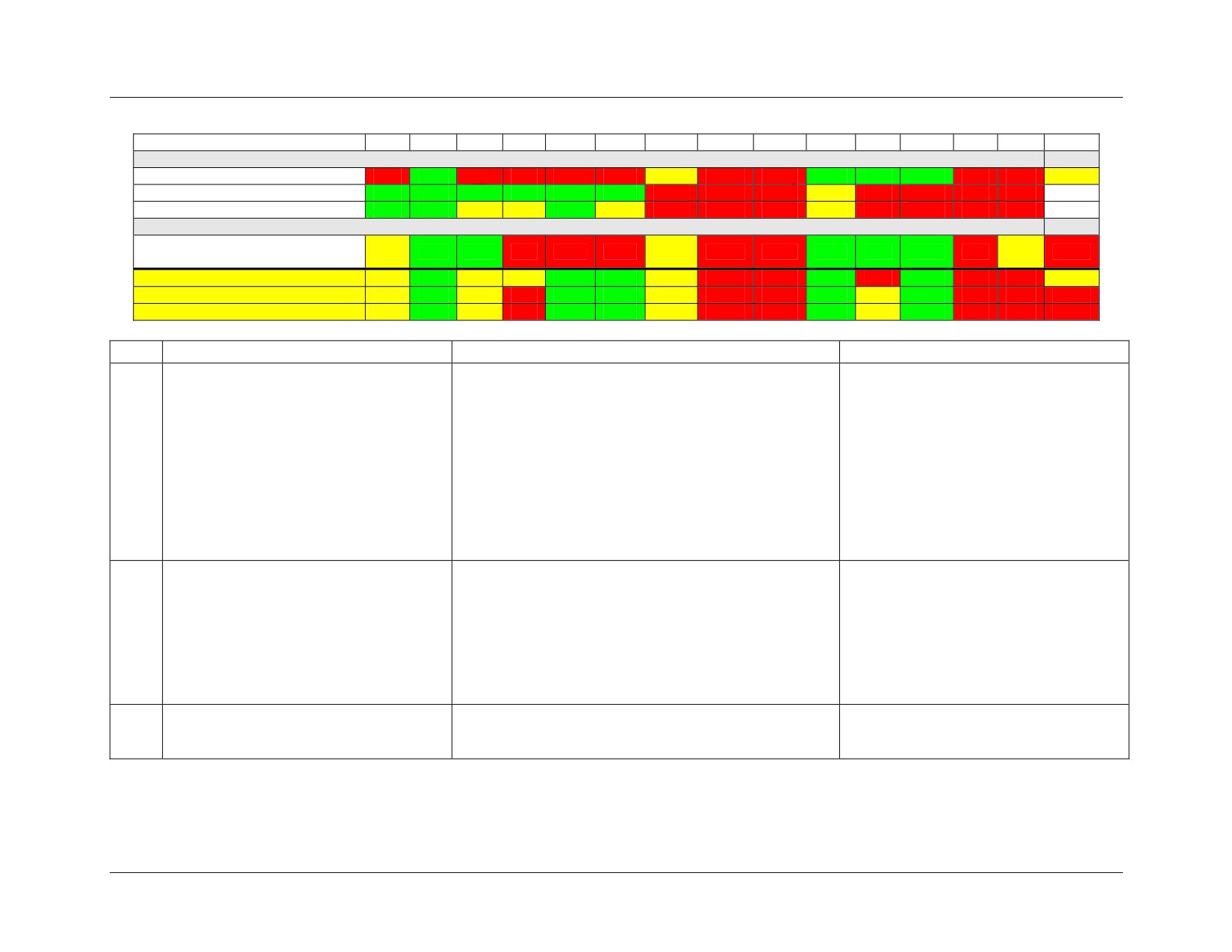
For Official Use Only
CBRN Functional Needs Analysis/Functional Solution Analysis
Chapter 5. Tactical Sense Tasks
Table 5.5-1. TASENS 5: Capability and Deficiency Assessment
System/Measure
M1
M2
M3
M4
M5
M6
M7
M8
M9
M10
M11
M12
M13
M14
M15
Current - Near/Mid - Far
Physical Sampling/BSK
31
102
03
04
N/A4
N/A4
65
N/A6
N/A7
108
109
1010
011
012
513
Physical Sampling/ELISA
10 14
102
1015
1016
1017
1015
118
N/A6
N/A7
518
019
N/A19
011
011
Unk
Physical Sampling/RAPID
8 20
102
521
522
1023
521
124
N/A6
N/A7
524
019
N/A19
010
011
Unk
Near/Mid - Far
Physical Sampling/JBAIDS Blocks
4/625
1026
1027
028
N/A28
N/A28
4/529
N/A30
N/A7
1031
1032
1033
034
535
N/A36
I/II
Current Overall Capability
6
10
5
4
10
8
5
N/A
N/A
10
3
10
0
0
5
Near/Mid-Term Overall Capability
6
10
6
3
10
8
5
N/A
N/A
10
5
10
0
3
N/A101
Far-Term Overall Capability
6
10
6
3
10
8
5
N/A
N/A
10
5
10
0
3
N/A101
FAA Measure
Elaboration
Scale
M1
All of a potential adversary’s weaponized
Number of the 25 biological agents described in the
10: All 25 BWAs detected
BWAs can be detected using fielded
Medical Management of Biological Casualties that are
8: 20 BWAs detected
technologies/equipment, regardless of
detected. Fourteen of the twenty-five agents are as follows:
6: 15 BWAs detected
agent physical properties, states, and
Anthrax (Bacillus Anthracis); Brucellosis (Brucellae);
4: 10 BWAs detected
concentrations?
Glanders (Burkholderia mallei); Meliodosis (Burkholderia
2: 5 BWAs detected
pseudomallei); Q Fever (Coxiella burnetii); Plague
1: 1 BWA detected
(Yersinia pestis); Tularemia (Francisella tularensis);
0: No BWAs detected
Botulinum toxin; Ricin; SEB; T-2 Mycotoxins; Smallpox
(variola major and minor); Viral Equine Encephalities
(e.g., VEE, WEE, and EEE); and Ebola and Marburg
hemorrhagic fever viruses. Linear 2-10.
M2
All of a potential adversary’s weaponized
Ability to identify or classify (e.g., as bacteria, toxin, or
10: Identify detected BWAs
BWAs can be identified using fielded
virus) detected BWAs.
7: Identify some detected BWAs; classify
technologies/equipment?
others
5: Classify detected BWAs
3: Some detected BWAs are classified or
identified
0: Neither identify nor classify detected
BWAs
M3
All of a potential adversary’s weaponized
Ability to provide snapshot concentration of detected
10: Absolute quantification
BWAs can be quantified using fielded
BWAs.
5: Generic quantification
technologies/equipment?
0: No quantification capability
71
For Official Use Only
For Official Use Only
CBRN Functional Needs Analysis/Functional Solution Analysis
Chapter 5. Tactical Sense Tasks
FAA Measure
Elaboration
Scale
M4
All TIB material can be detected using
TIB material includes medical waste, raw sewage, and
10: All pathogens and toxins within TIB
fielded technologies/equipment?
vaccine-related biologics. Pathogens and toxins within TIB
material, including medical waste, raw
material are what are generally detected.
sewage, and vaccine-related biologics can
be detected
5: All TIB pathogens or toxins within one
or more categories (i.e., medical waste, raw
sewage and vaccine-related biologics) can
be detected
3: Some TIB pathogens and toxins within
one category (i.e., medical waste, raw
sewage and vaccine-related biologics) can
be detected
0: No TIB pathogens and toxins can be
detected
M5
All TIB material can be identified using
Ability to identify or classify (e.g., as bacteria, toxin, or
10: All pathogens and toxins within TIB
fielded technologies/equipment?
virus) detected TIB material.
material can be identified
7: Identify some TIB pathogens and toxins;
classify others
5: Classify detected TIB pathogens and
toxins
3: Some detected TIB pathogens and toxins
can be classified or identified
0: Neither classify nor identify detected
TIBs
M6
All TIB material can be quantified using
Ability to provide snapshot concentration of detected TIBs.
10: Absolute quantification
fielded technologies/equipment?
5: Generic quantification
0: No quantification capability
M7
Time to detect biological hazards?
Time period from BWA/TIB sampling to analysis output.
10: 1 minute
Linear scale 2-7. Applies to point detectors only.
9: 4 minutes
8: 7 minutes
7: 10 minutes
4: 40 minutes
2: 60 minutes
1: >60 minutes
M8
Distance between biological hazard and
Linear scale 1-9. Applies to standoff detection only.
10: 9 km
detector for accurate detection?
9: 9 km
5: 5 km
2: 2 km
1: 1 km
72
For Official Use Only
For Official Use Only
CBRN Functional Needs Analysis/Functional Solution Analysis
Chapter 5. Tactical Sense Tasks
FAA Measure
Elaboration
Scale
M9
Biological hazards are detected in time to
This measure is not relevant to this task.
N/A
warn forces and take appropriate protective
measures?
M10
Biological hazards are identified in time to
Based on capability and time required to identify or
10: Complete capability (<1 hour)
treat forces?
classify hazards, as well as rate-of-action of those hazards.
5: Partial capability
Of all considered BWAs, ricin may require the most rapid
0: No capability
response. Immunoglobulin therapy must be administered
within 1 hour of ricin exposure to be effective.
M11
Sampling collection procedures available
Refers to physical sampling for future analysis.
10: Complete capability
for all of a potential adversary’s
5: Partial capability
weaponized BWAs and for all TIB material
0: No capability
using fielded technologies/equipment?
M12
Procedures maintain integrity of sample?
Refers to a physical sample for future analysis.
10: Complete capability
5: Partial capability
0: No capability
M13
Time to validate the presence of biological
Refers to confirmatory identification.
10: Rapidly—validation performed
hazards in the atmosphere?
expeditiously by particular
technology/equipment
5: Moderately delayed—mobile analysis
tools can validate on site
0: Delayed—off-site laboratory analysis
required for validation
M14
Cumulative dose can be determined and
This measure is not relevant to this task.
N/A
presented using data from currently fielded
sensors/equipment?
M15
There is effective DOTLPF in place to
Refers to non-materiel elements associated with the
10: DOTLPF exists and is adequate for the
conduct task?
execution of the task with the system.
task to be performed with this system
without limitations that cause significant
impact upon operations
5: Most critical aspects of DOTLPF for the
task to be performed with this system are
addressed.
0: DOTLPF is inadequate or does not exist
for the task to be performed with this
system.
1 Current and near-future HHAs detect all BWAs with the possible exception of the viral hemorrhagic fevers; however, the BSK contains eight different HHAs and thus detects
eight BWAs. The HHA sensitivity is 105-106 CFU/mL (B. anthracis) and 50-1200 ng/mL (Botulinum toxin A and Botulinum toxin F, respectively). Degraded performance: (C6)
73
For Official Use Only
For Official Use Only
CBRN Functional Needs Analysis/Functional Solution Analysis
Chapter 5. Tactical Sense Tasks
TIB Material present in civilian sector. Susceptible to interference (false positives and negatives due to matrix effects, among others); (M3) Minimal time available. Requires
sample preparation prior to applying sample to assay.
2 All detected BWAs are identified.
3 Does not absolutely quantify agent. May provide relative indication of quantity, but only through the use of a reader. Soldiers will not likely have the reader.
4 According to specifications, does not detect any TIBs.
5 Detects within 15 minutes.
6 Point detector.
7 Not relevant to this task (N/A).
8 Immediately identifies all detected hazards (detection requires up to 15 minutes) and thus provides complete identify-to-treat capability.
9 Provides physical sample collection capability for future analysis.
10 Maintains integrity of sample.
11 Requires samples to be confirmed off site in laboratory.
12 Does not provide absolute quantification capability, so cumulative dose cannot be determined.
13 There is effective DOTLPF in place to conduct task, at least for bacillus bacteria (specifically anthrax). Procedures for other agents are probably similar.
14 Ostensibly all BWAs can be detected by ELISA. ELISA’s sensitivity is 105-106 CFU/mL (B. anthracis); 10-100 PFU/mL of Venezuelan Equine Encephalitis virus; and
625 pg/mL of Staphyloccoccal Enterotoxin B (aerosol) and greater than 5 ng/mL of ricin.
15 Some varieties of ELISA can absolutely quantify the antigen or antibody concentration.
16 Theoretically, any agent (i.e., antigen or antibody) for which an ELISA has been designed can be detected through this method; however, only one particular pathogen or toxin
antigen or antibody can be tested per ELISA model.
17 A particular TIB pathogen or toxin is identified if it is detected, since ELISA is highly specific and detects a particular agent.
18 Typically requires 1-2 hours (following sample collection and preparation) for detection, identification, and if applicable, quantification, primarily because of incubation time.
19 Not designed for sample collection for future analysis.
20 RAPID may be able to detect all pathogens; PCR does not detect toxins, though the toxic material may be contaminated with source genetic material (In this assessment, it is
assumed that this is not the case). Standard PCR has a sensitivity of 10-100 CFU/mL bacteria (B. anthracis); and 15 fg-1 pg or 100-1 million copies of the complementary DNA
for viruses.
21 RAPID, through RT-PCR, may provide generic quantification.
22 Theoretically, any TIB pathogen can be detected with appropriate reagents; toxins cannot be detected unless contaminated with source genetic material.
23 All detected TIBs are identified.
24 Detects and identifies within 30 minutes following sample preparation, but sample preparation requires several hours.
25 Block I will detect Anthrax; Brucella; Ebola VHF virus; Marburg VHF virus; Viral Encephalitis viruses (VEE/WWW/EEE); Glanders; Meliodosis; Plague; Q Fever; Smallpox;
and Tularemia [and Typhus] as a threshold requirement; and Crimean-Congo hemorrhagic virus; Dengue fever; Hantaviruses; and Rift Valley Fever Virus [and Cholera,
Cryptosporidium; E. col; Influenza; Salmonella; and Shigella] as an objective; Block II will add toxins Botulinum, microcystins, ricin, SEB, and T-2 Mycotoxins.
26 Will identify all detected agents.
27 Will quantify the concentration in the sample.
28 Will not detect any TIBs.
29 Will detect and identify within 40 minutes (25-minute objective) for Blocks I and II following sample preparation.
30 Will be a point detector.
31 Will immediately identify all detected hazards (detection will require 25-40 minutes) and thus will provide complete identify-to-treat capability.
32 Will provide physical sample collection capability for future analysis.
33 Will maintain integrity of physical sample.
34 Will require samples to be confirmed off site at laboratory.
35 Cumulative dose will be able to be estimated from data (minimal capability).
36 Future system(s). Thus, DOTLPF is also future and cannot be evaluated.
74
For Official Use Only
For Official Use Only
CBRN Functional Needs Analysis/Functional Solution Analysis
Chapter 5. Tactical Sense Tasks
5.5.3
Functional Solution Analysis
5.5.3.1
DOTLPF Assessment Summary
This section states the deficiencies and suggests potential non-materiel solutions. If there are no
solutions or there are only partial solutions for a particular deficiency, that deficiency is then
reassessed in the IMAs section.
1. Deficiency: Lack of integrated sample collection, detection, identification, and quantification
capability for BWAs on surfaces.
Non-Materiel Solutions: None
2. Deficiency: Lack of real-time or near-real-time detection, identification, and quantification
capability for sampled BWAs.
Non-Materiel Solutions: None
3. Deficiency: Lack of standoff detection capability for BWAs on surfaces.
Non-Materiel Solutions: None
4. Deficiency: Lack of unit/team-level field validation/confirmation of positive identifications
as laboratory confirmation is required.
Non-Materiel Solutions: Doctrine: Modify doctrine to permit validation by a reliable on-
site detection/identification capability (e.g., portable PCR) as confirmatory detection/
identification is ultimately dependent upon doctrine, not materiel capabilities.
5 Deficiency: Lack of TIB detection capability.
Non-Materiel Solutions: None
6. Deficiency: Lack of detector that also takes samples for future analysis capability.
Non-Materiel Solutions: None
5.5.3.2
IMA Assessment Summary
Table 5.5-2 identifies nine ideas for materiel approaches that, if developed, may reduce or
eliminate the deficiencies associated with detecting biological hazards on surfaces. Advances in
MS, immunoassays; flame photometry; tissue-based detection; Raman, IR, UV, or microwave
spectroscopy; or orthogonal technologies may be able to address all identified deficiencies.
75
For Official Use Only
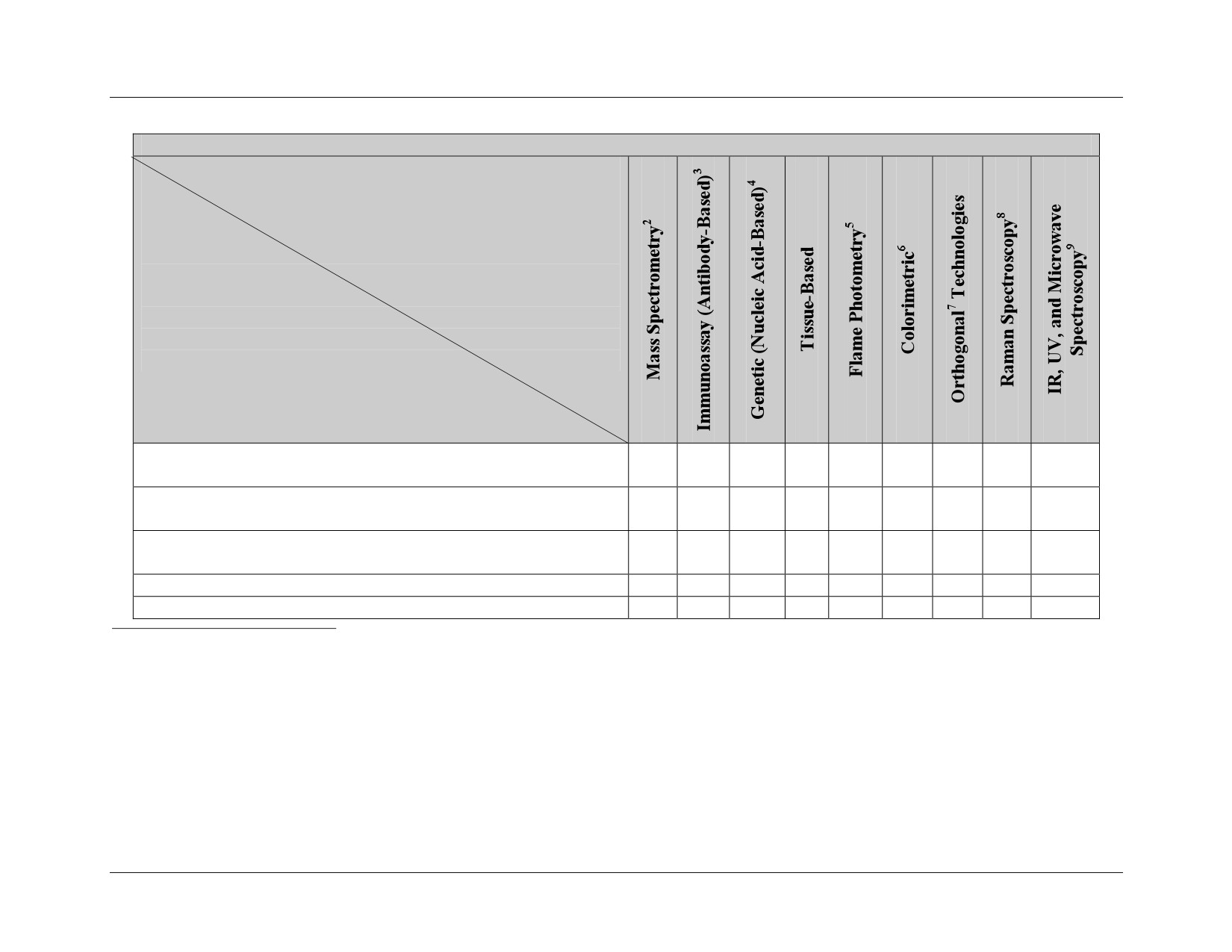
For Official Use Only
CBRN Functional Needs Analysis/Functional Solution Analysis
Chapter 5. Tactical Sense Tasks
Table 5.5-2. TASENS 5: DOTMLPF Assessment
TASENS 5: Sense surfaces for biological hazards1
Ideas for Material
Approaches
(IMA)
Identified Gaps
Lack of integrated sample collection, detection, identification,
X
X
X
X
X
X
X
X
X
and quantification capability for BWAs on surfaces.10
Lack of real-time or near-real time detection, identification, and
X
X
X
X
X
X
X
X
quantification capability for sampled BWAs.11
Lack of standoff (or remote) detection/identification capability
X
X
X
X
X
X
X
X
for BWAs on surfaces.12
Lack of TIB detection capability.
X
X
X
X
X
X
X
X
X
Lack of detector that also takes samples for future analysis.13
X
X
X
X
X
X
X
X
X
1 McKone, Thomas E., Beverly M. Huey, et al. (eds.) Strategies to Protect the Heath of Deployed U.S. Forces: Detecting, Characterizing and Documenting Exposures. National
Academy Press. 2000. http://books.nap.edu/books/0309068754/html/; Kosal, Margaret E. “The Basics of Chemical and Biological Detectors.” 24 November 2003.
http://cns.miis.edu/pubs/week/031124.htm;http://books.nap.edu/html/terrorism/ch6.html; National Institute of Justice. An
Introduction to Biological Agent Detection Equipment for Emergency First Responders. 2001. http://www.ojp.usdoj.gov/nij/pubs-sum/190747.htm
2 Includes GC/MS, LC/MS, GC-Ion Trap Tandem Mass Spec (GC-MS-MS), matrix-assisted laser desorption ionization (MALDI) MS.
3 Includes SAW technology.
4 Includes PCR and RT-PCR) amplification, DNA microchip technology, SAW technology.
5 Philippe, Adam, Damien Descroix, and Jean-Pierre Chiaroni. « Flame Photometry for Biological Detection.” Proceedings from the 6th CBW Protection Symposium. 1998.
6 ChemSensing Colorimetric Sensor
7 Includes nucleic acid/immunoassay technologies (e.g., PCR and immunological techniques), electrochemiluminescence/equilibrium immunoassay, Fluorescence correlation
spectroscopy/PCR
8 NIR Raman, Visible Light (VIS) Surface-Enhanced Raman, VIS Raman, UV Raman, Multiband Resonance-Enhanced Raman, Multiband Surface-Enhanced Raman.
76
For Official Use Only
For Official Use Only
CBRN Functional Needs Analysis/Functional Solution Analysis
Chapter 5. Tactical Sense Tasks
9 Thermoluminescence/FTIR, long-wave IR (LWIR) Differential Scattering/Differential Absorption of Light (DISC)/Differential Absorption LIDAR (DIAL), LWIR Polarization,
mid-wave IR (MWIR) DISC/DIAL, MWIR Polarization, Near-Infrared (NIR) Laser-Induced Breakdown Spectroscopy (LIBS) UV Fluorescence, Multiband Brillouin Scattering.
10 Sample collection, independent of the detector, is one of the main, if not the main, problem. Quantification cannot be achieved without efficient, standardized sample collection
and preparation (if needed). JBAIDS is expected to detect, identify, and quantify all BWAs on surfaces, and thus eliminate capability gap.
11 Reducing the sample preparation and response times for JBAIDS is a potential solution.
12 In conjunction with robotics for Mass Spectrometry, Immunoassay, Genetic, Tissue-Based, and Flame Photometry IMAs.
13 All IMAs could be designed to eliminate this capability gap. The collection equipment would be better maintained as an independent capability. The solution could involve a
module connected to the detector that notifies the operator to take samples or triggers an automated process to begin sampling.
77
For Official Use Only
For Official Use Only
CBRN Functional Needs Analysis/Functional Solution Analysis
Chapter 5. Tactical Sense Tasks
5.6
Task TASENS 6: Sense surfaces for radiological hazards
5.6.1
Functional Area Analysis
5.6.1.1
Definition
To sense the presence or absence of radiation hazards on surfaces. Includes the functions of
detection, identification, and quantification of the radiological hazard. Also includes the
requirement to determine the extent and physical properties of contamination, monitoring of
known agent locations, and collection of samples for further analysis. Encompasses both “detect
to warn” and “detect to treat” situations to enable appropriate protective measures.
5.6.1.2
Derivation
UJTL TA 7, UJTL TA 7.1, Protection Joint Functional Concept.
5.6.1.2.1
Supported Tasks: OPSENS 1, OPSENS 4, OPSENS 7
5.6.1.2.2
Lateral Task: N/A
5.6.1.2.3
Supporting Task: N/A
5.6.1.3
Condition
Perform this task under conditions of:
Physical
1. Mountainous, desert, jungle, and arctic terrain. (C1.1.1)
2. Significant urbanization. (C1.1.3.1)
3. High sea state. (C1.2.1.3)
4. Tropical, arctic, and arid climates. (C1.3.1)
5. Summer, winter seasons. (C1.3.1.1)
6. Stormy weather. (C1.3.1.3)
7. Hot, very cold air temperature. (C1.3.1.3.1)
8. High surface-wind velocity. (C1.3.1.3.3)
9. High relative humidity. (C1.3.1.3.5)
10. Liquid, freezing, and frozen precipitation. (C1.3.1.3.6.1)
11. Heavy precipitation intensity. (C1.3.1.3.6.2)
12. Extreme turbulence and wind shear. (C1.3.1.3.8)
13. Negligible light. (C1.3.2.1)
14. Strong nuclear atmosphere weapons effects. (C1.3.3)
15. Moderate nuclear radiation effects. (C1.3.3.1.2)
Military
1. Stressful mission. (C2.1)
78
For Official Use Only
For Official Use Only
CBRN Functional Needs Analysis/Functional Solution Analysis
Chapter 5. Tactical Sense Tasks
2. Location—ashore, afloat, airborne. (C2.1.4.1)
3. Minimal time available. (C2.1.5)
4. Low personnel capability. (C2.2.4)
5. Negligible personnel experience. (C2.2.4.5)
6. Ambiguous threat existence. (C2.9.3)
Civil
1. Limited or negative foreign government support. (C3.1.2.3)
2. Aggressively opposed foreign public opinion. (C3.1.2.4)
3. High mission priority. (C3.1.3.2)
4. Toxic industrial radiological materials present in the civilian sector. (C3.3.7.5)
5.6.2
Functional Needs Analysis
5.6.2.1
Capability and Deficiency Assessment Summary
Table 5.6-1 presents individual and overall current, near/mid-term, and far-term capabilities to
perform the task to the designated standards. There are 11 current capabilities used to accomplish
this task. The capabilities include a range of portable RADIAC devices.
Current Capabilities and Deficiencies
The overall current capability is assessed as “yellow.” Most current RADIACS detect and
identify beta radiation and detect, identify, and quantify gamma radiation. All RADIACs
perform their functions in real time (though the level of confidence increases with increased
sampling time) and thus provide a complete detect-to-warn capability. Many also automatically
calculate the cumulative dose.
There is no single capability that can perform the task to all of the designated standards.
ADM-300 detects most forms of radiation (alpha, beta, gamma and x-ray), but like all
RADIACs, it detects, identifies, and quantifies only the radiation, not the radioisotope.
Furthermore, like all RADIACs, the ADM-300 must be exposed to radiation to detect it. Current
overall task deficiencies include the lack of radioisotope identification capabilities, reliable alpha
detection capabilities, monitors that can detect all radiation types, detectors that take samples for
future analysis1, and the complete lack of true standoff detection capabilities.
Projected Near/Mid-Term Capabilities and Deficiencies
No changes in capability are projected in the near/mid term for this task, so the overall projected
near/mid-term capability will remain “yellow.”
1 Only the M34A1 sampling kit, which is not a detector, is capable of collecting and maintaining a radiological sample.
79
For Official Use Only
For Official Use Only
CBRN Functional Needs Analysis/Functional Solution Analysis
Chapter 5. Tactical Sense Tasks
Projected Far-Term Capabilities and Deficiencies
No changes in capability are projected in the far term for this task, so the overall projected far-
term capability will remain “yellow.”
80
For Official Use Only
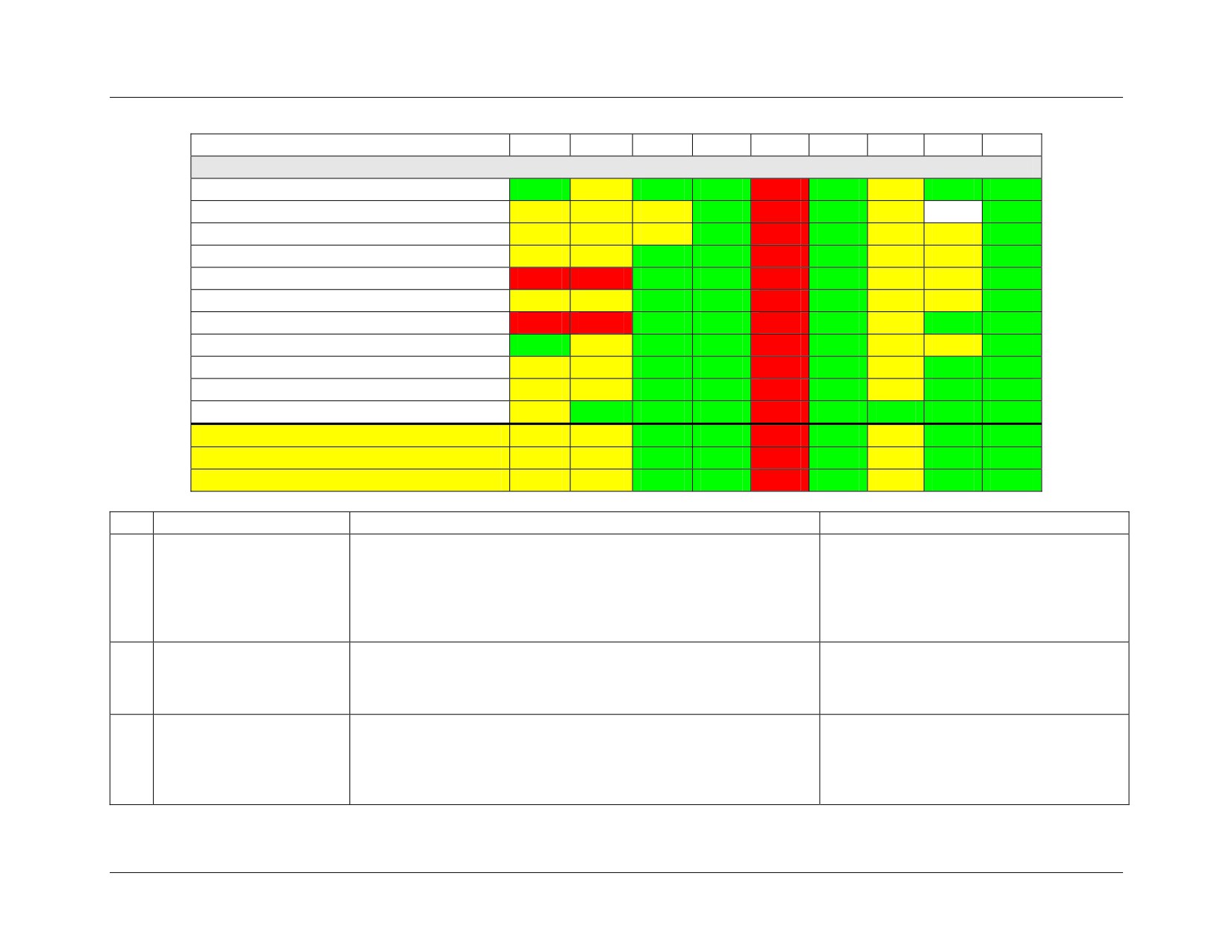
For Official Use Only
CBRN Functional Needs Analysis/Functional Solution Analysis
Chapter 5. Tactical Sense Tasks
Table 5.6-1. TASENS 6: Capability and Deficiency Assessment
System/Measure
M1
M2
M3
M4
M5
M6
M7
M8
M9
Current-Near/Mid-Far
ADM-300
81
52
103
104
05
106
57
108
109
AN/PDQ-1 MFR10
411
52
512
104
05
106
57
Unk
109
AN/PDR-27
411
52
512
104
05
106
57
713
109
AN/PDR-43
411
52
103
104
05
106
57
713
109
AN/PDR-56
214
N/A15
103
104
05
1016
57
713
109
AN/PDR-63
411
52
103
104
05
106
57
713
109
AN/PDR-65
217
N/A15
103
104
05
1016
57
1018
109
AN/PDR-77
819
52
103
104
05
106
57
713
109
AN/UDR-13
420
52
103
104
05
106
57
1018
109
AN/VDR-2
411
52
103
104
05
106
57
1018
109
Berkeley SAM 935
421
1022
103
104
05
106
1023
1018
109
Current Overall Capability
5
5
9
10
0
10
5
8
10
Near/Mid-Term Overall Capability
5
5
9
10
0
10
5
8
10
Far-Term Overall Capability
5
5
9
10
0
10
5
8
10
FAA Measure
Elaboration
Scale
M1
All radiological hazards
Number of radiation types (i.e., alpha, beta, gamma, neutron, and x-ray)
10: All five types
(including TIR material) can
detected. Note: Fielded technologies/equipment detect radiological
8: Four types
be detected using fielded
hazards by detecting the radiation emitted from these hazards.
6: Three types
technologies/equipment?
4: Two types
TIR material includes DU, a common battlefield hazard resulting from
2: Single type
certain types of ammunition and damaged armor.
0: No radiological hazards detected
M2
All radiological hazards
Ability to identify type of radiation detected or the radioisotope emitting
10: Identifies radioisotope emitting radiation
(including TIR material) can
the radiation. Note: Fielded technologies/equipment that identify
5: Identifies type of radiation detected
be identified using fielded
radioisotope also identify the type(s) of radiation detected.
0: No identification capability
technologies/equipment?
M3
All radiological hazards
Ability to quantify activity of radiological material (i.e., Cu or Bq), or
10: Absolute quantification
(including TIR material) can
the exposure (i.e., Roentgen or Coulomb/kg) or dose rate (rad, rem, Gy,
5: Generic quantification (or absolute
be quantified using fielded
or Sv) from emitted radiation.
quantification of one radiation type and no
technologies/equipment?
quantification of another type)
0: No quantification capability
81
For Official Use Only
For Official Use Only
CBRN Functional Needs Analysis/Functional Solution Analysis
Chapter 5. Tactical Sense Tasks
FAA Measure
Elaboration
Scale
M4
Time to detect radiological
Time period from exposure to radiation to analysis output.
10: Near real time
hazard?
0: Not near real time
M5
Distance between
Since fielded technologies/equipment detect the radiation emitted from
10: Exposure to emitted radiation not required
radiological hazard and
radiological hazards, the distance depends on range of emitted radiation.
to detect hazard.
detector for accurate
All field technologies/equipment must be exposed to emitted radiation
0: Exposure to emitted radiation required to
detection?
to detect the radiological hazard. If a radiological detector did not need
detect hazard.
to be exposed to radiation emitted from a radiological hazard to detect
that hazard, then it would exhibit true standoff capability.
M6
Radiological hazards are
Since appropriate protective measures depend on the radiation type(s)
10: Complete capability (real-time or near-
detected in time to warn
being emitted, complete capability requires real-time or near-real-time
real-time detection and identification of
forces and take appropriate
detection of emitted radiation and identification of that radiation by
radiation type[s])
protective measures?
type.
5: Partial capability (delayed detection of the
radiation without identification capability)
0: No capability
M7
Radiological hazards are
A complete capability requires both near real-time identification of the
10: Complete capability (near-real-time
identified in time to treat
emitted radiation type(s) and radioisotope. Identification of the emitted
identification of radioisotope and emitted
forces?
radiation type(s) enables appropriate medical response to radiation
radiation type[s])
exposure and identification of the radioisotope determines to appropriate
5: Partial capability (Delayed identification of
medical course of action to radiological material internalization.
emitted radiation type[s])
0: No capability (no identification capability)
M8
Cumulative dose can be
If an absolute quantification capability is provided, then it is possible
10: Complete capability
determined and presented
that the cumulative dose can be estimated (thus a minimal capability). If
7: Moderate capability
using data from currently
a monitoring capability is provided, then a more accurate cumulative
5: Minimal capability
fielded sensors/equipment?
dose can be calculated (moderate capability). If the cumulative dose is
0: Cumulative dose cannot be determined
automatically calculated, then a complete capability is provided.
M9
There is effective DOTLPF
Refers to non-materiel elements associated with the execution of a task
10: DOTLPF exists and is adequate for the
in place to conduct task?
with the system.
task to be performed with this system without
limitations that cause significant impact upon
operations
5: Most critical aspects of DOTLPF for the
task to be performed with this system are
addressed
0: DOTLPF is inadequate or does not exist for
the task to be performed with this system
1 Detects most radiation types (alpha, beta, gamma, and x-ray) emitted from radiological materials.
2 Identifies type of radiation, but not radioisotope.
3 Absolutely quantifies radiation level.
4 Real-time detection. Level of confidence increases with increased sampling time and radiation levels.
82
For Official Use Only
For Official Use Only
CBRN Functional Needs Analysis/Functional Solution Analysis
Chapter 5. Tactical Sense Tasks
5 Requires exposure to emitted radiation to detect hazard.
6 Provides complete detect-to-warn capability since detects and identifies radiation in real time.
7 Provides partial identify-to-treat capability since immediately identifies detected radiation type, but not the radioisotope.
8 Automatically calculate cumulative dose since system capable of dose and dose rate alarms across entire measurement range; also predictive algorithm provides estimate of time
in field before alarm; unknown whether cumulative dose is directly output.
9 There is effective DOTLPF in place to conduct task with this system.
10 In combination with OA-9449/PDQ probe. The MFR alone detects gamma radiation; with the probe, it measures gamma radiation and detects beta radiation.
11 Detects beta/gamma radiation emitted from radiological materials.
12 Absolutely quantifies gamma radiation level; detects, but does not quantify, beta radiation.
13 Absolutely quantifies radiation level and provides monitoring capability, thus provides moderate capability to determine cumulative dose.
14 Detects alpha radiation emitted from radiological materials (particularly plutonium).
15 Detects only one type of radiation, so identification capability is not applicable.
16 Provides complete detect-to-warn capability since detects one radiation type in real time.
17 Detects gamma radiation emitted from radiological materials (particularly plutonium).
18 System automatically calculates cumulative dose.
19 Detects alpha, beta, gamma, and x-radiation emitted from radiological materials.
20 Detects gamma/neutron radiation emitted from radiological materials.
21 Detects gamma radiation and with optional neutron detector, neutron radiation as well.
22 Identifies the radioisotope.
23 Provides complete identify-to-treat capability since immediately identifies radioisotope.
83
For Official Use Only
For Official Use Only
CBRN Functional Needs Analysis/Functional Solution Analysis
Chapter 5. Tactical Sense Tasks
5.6.3
Functional Solution Analysis
5.6.3.1
DOTLPF Assessment Summary
This section states the deficiencies and suggests potential non-materiel solutions. If there are no
solutions or there are only partial solutions for a particular deficiency, that deficiency is then
reassessed in the IMAs section.
1. Deficiency: Lack of reliable alpha detection capabilities.
Non-Materiel Solutions: Training (partial): Increase training of personnel on ADM-300,
AN/PDR-56, and AN/PDR-77.
2. Deficiency: Lack of monitors that can detect all types of radiation.
Non-Materiel Solutions: Training (partial): Increase training of personnel on ADM-300.
3. Deficiency: Lack of true standoff detection capability.1
Non-Materiel Solutions: None
4. Deficiency: Lack of radioisotope identification capabilities.
Non-Materiel Solutions: None
5. Deficiency: Lack of detector that can also take samples for future analysis capability.2
Non-Materiel Solutions: None
5.6.3.2
IMA Assessment Summary
Table 5.6-2 identifies four ideas for materiel approaches that, if developed, may reduce or
eliminate the deficiencies associated with detecting radiological hazards in the atmosphere.
Advances in scintillation or semiconductor radiation detection technologies may be able to
address all identified deficiencies.
1 Current detectors must be exposed to radiation to detect the presence of a radiological source, so users of handheld radiation
detectors may also be exposed to radiation. CRTI is currently developing a standoff radiological detection capability.
2 Only the M34A1 sampling kit, which is not a detector, is capable of collecting and maintaining a radiological sample.
84
For Official Use Only
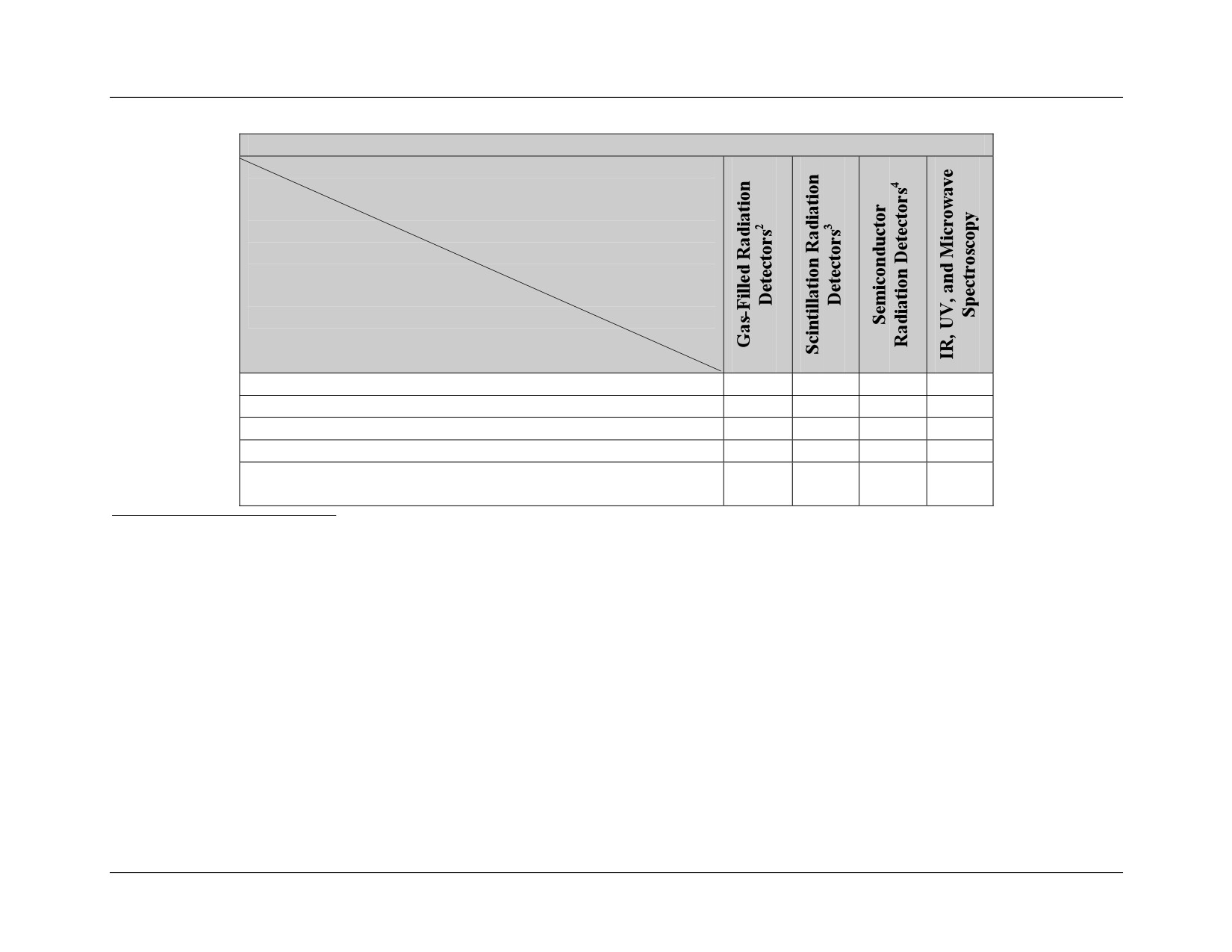
For Official Use Only
CBRN Functional Needs Analysis/Functional Solution Analysis
Chapter 5. Tactical Sense Tasks
Table 5.6-2. TASENS 6: IMA Assessment
TASENS 6: Sense surfaces for radiological hazards1
Ideas for Material
Approaches
(IMA)
Identified Gaps
Lack of reliable alpha detection capabilities.5
X
X
X
Lack of monitors that can detect all types of radiation.6
X
X
X
Lack of true standoff (or remote) detection capability.7
X
X
X
X8
Lack of radioisotope identification capabilities.9
X
X
Lack of detector that collects contamination for low-level
X
X
X
detection and future analysis.10
2 Includes Geiger-Mueller detectors, proportional gas detectors, and ionization chambers.
3 Includes ZnS(Ag), anthracene, trans-stilbene, para-terphenyl, phenyl oxazole, NaI(Tl), CsI(Tl), bismuth germinate (Bi4Ge3O12), barium fluoride (BaF2)-based detectors
4 Includes germanium, silicon, cadmium telluride (CdTe), and mercuric iodide (HgI2)-based detectors.
5 Distributing more ADM-300 and AN/PDR-77 is a potential solution.
6 Distributing more ADM-300 is a potential solution.
7 In conjunction with robotics for gas-filled detector, scintillation detector, and semiconductor detector IMAs.
8 CRTI is developing a standoff radiation detector that may be technically based on electromagnetic spectroscopy of surrounding air molecules being ionized by the radiation.
9 Distributing gamma and/or alpha scintillation detectors with radioisotope identification capabilities is a potential solution.
10 All point detection IMAs could be designed to eliminate this capability gap. The collection equipment would be better maintained as an independent capability. The solution
could involve a module connected to the detector that notifies the operator to take samples or triggers an automated process to begin sampling.
85
For Official Use Only
For Official Use Only
CBRN Functional Needs Analysis/Functional Solution Analysis
Chapter 5. Tactical Sense Tasks
5.7
Task TASENS 7: Sense water for chemical hazards
5.7.1
Functional Area Analysis
5.7.1.1
Definition
To sense the presence or absence of chemical hazards (encompasses CWAs and TICs) in water
(potable and nonpotable). Includes the functions of detection, identification, and quantification of
the hazard. Also includes collection of samples for further analysis, along with early-warning
surveillance of unforeseen agent releases and monitoring of known hazard locations, as well as
the requirement to determine the extent and physical properties of contamination. Encompasses
both “detect to warn” and “detect to treat” situations to enable appropriate protective measures.
The evaluation encompasses all chemical hazards of military and medical importance. Must
occur in situ to assist with raw water site selection and identification of soldier contact hazards,
in-line post reverse osmosis water purification unit (ROWPU) and permanent water distribution
systems, and on-demand to spot-check potable water distribution sites and shower points.
5.7.1.2
Derivation
UJTL TA 7, UJTL TA 7.1, Protection Joint Functional Concept.
5.7.1.2.1
Supported Tasks: OPSENS 1, OPSENS 4, OPSENS 7
5.7.1.2.2
Lateral Task: TASHA 14
5.7.1.2.3
Supporting Task: N/A
5.7.1.3
Condition
Perform this task under conditions of:
Physical
1. Inaccessible subsurface water. (C1.1.2.3)
2. High sea state. (C1.2.1.3)
3. High shipping presence. (C1.2.6)
4. Summer, winter seasons. (C1.3.1.1)
5. Stormy weather. (C1.3.1.3)
6. Hot, very cold air temperature. (C1.3.1.3.1)
7. Liquid, freezing, and frozen precipitation. (C1.3.1.3.6.1)
8. Heavy precipitation intensity. (C1.3.1.3.6.2)
9. Negligible light. (C1.3.2.1)
10. Chemical effects. (C1.3.3.2)
Military
1. Stressful mission. (C2.1)
86
For Official Use Only
For Official Use Only
CBRN Functional Needs Analysis/Functional Solution Analysis
Chapter 5. Tactical Sense Tasks
2. Location—ashore, afloat, airborne. (C2.1.4.1)
3. Minimal time available. (C2.1.5)
4. Low personnel capability. (C2.2.4),
5. Negligible personnel experience. (C2.2.4.5)
6. Ambiguous threat existence. (C2.9.3)
Civil
1. Limited or negative foreign government support. (C3.1.2.3)
2. Aggressively opposed foreign public opinion. (C3.1.2.4)
3. High mission priority. (C3.1.3.2)
4. Toxic Industrial Chemicals present in the civilian sector. (C3.3.7.5).
5.7.2
Functional Needs Analysis
5.7.2.1
Capability and Deficiency Assessment Summary
Table 5.7-1 presents individual and overall current, near/mid-term, and far-term capabilities to
perform the task to the designated standards. There are four current capabilities used to
accomplish this task and two projected capabilities to be added in the future (one each in the
near/mid term and the far term). The capabilities include colorimetric kits and mass
spectrometers with differing capabilities to meet the identified standards.
Current Capabilities and Deficiencies
The overall current capability is assessed as “yellow.” The M272 Kit, the primary current
capability for detecting chemical hazards in water, detects the G-agents, VX, HD, Lewisite, and
hydrogen cyanide (AC) and classifies/identifies a detected agent as a nerve agent, HD, Lewisite,
or AC. The more sophisticated capabilities are MS-based and include the HAPSITE with
headspace sampling system, MM-1 integrated into the M93A1 Fox, and Viking Spectratrak. The
MSs detect all CWAs, identify detected agents, and typically quantify agent concentrations as
composition intensities. The HAPSITE and Viking Spectratrak also detect, identify, and quantify
most, if not all, TICs of interest.1
There is no single capability that can perform the task to all of the designated standards. MS
Viking SpectraTrak is a sophisticated current capability, but it does not detect or identify in near-
real time; consequently, it may be unable to identify-to-treat fast-acting lethal agents in potable
water that has since been ingested. Current overall task deficiencies include the general inability
to detect down to hazard levels which meet tri-service drinking standards; general lack of
detection, identification, and quantification capabilities for TICs in water; and complete lack of
real-time detection, identification, and quantification capabilities for CWAs and TICs in water.
1 Refer to the JRO Operational Impact Assessment of Non-Traditional Agents report, July 2003 (S/NF) for
information on nontraditional agent detection.
87
For Official Use Only
For Official Use Only
CBRN Functional Needs Analysis/Functional Solution Analysis
Chapter 5. Tactical Sense Tasks
Furthermore, there is no current detector that also takes a chemical sample from water for future
analysis.2
Projected Near/Mid-Term Capabilities and Deficiencies
The overall projected near/mid-term capability is assessed as “yellow.” In the near/mid-term
future, the CBMS II will be deployed on the NBCRV Stryker and/or JNBCRS. It will detect,
identify, and quantify chemical hazards in sampled water three times faster than the MM-1 on
the M93A1 Fox. Nevertheless, the NBCRV Stryker and JNBCRS, like the M93A1 Fox, will be
reconnaissance vehicles, and therefore, though they will be able to test potable water for
chemical hazards, they will not likely be regularly employed for this purpose.
All current deficiencies will likely remain in the near/mid-term future. The NBCRV Stryker
and/or JNBCRS (regardless of the inclusion of the CBMS II) are expected to be capable of
taking and maintaining a physical sample for future analysis; however, there will still be no
modular detection system that is capable of performing this task.
Projected Far-Term Capabilities and Deficiencies
The overall projected far-term capability is assessed as “green.” In the far-term future, the
JCBAWM is expected to be fielded. It will be a significant improvement over the M292 Kit.
Presumably it will detect, identify, and measure the concentration of all CWAs and TICs of
interest (specifically, all agents listed in Defense Intelligence Agency [DIA] document “Threat
Environment Projection: Chemical and Biological Warfare 2000-2025” as an objective). Unlike
the M292 Kit, it will meet the tri-service long-term consumption standards (and as an objective,
detect concentrations 20% lower than those established in the standards). However, its analysis
time of 10 minutes will be similar to those of MS units and may be insufficient for identifying-
to-treat agents that were present in recently ingested water. It is unknown whether the JCBAWM
will be able to take and maintain a physical sample for future analysis.
In the far-term future, there will remain a complete lack of real-time detection, identification, and
quantification capabilities for CWAs and TICs in water. Depending on the JCBAWM
capabilities, the lack of a detector that can also take and maintain a physical sample for future
analysis may remain a deficiency.
2 The M34A1 sampling kit, which is not a detector, and the M93A1 Fox, regardless of the inclusion of the MM-1,
are capable of collecting and maintaining a chemical sample.
88
For Official Use Only
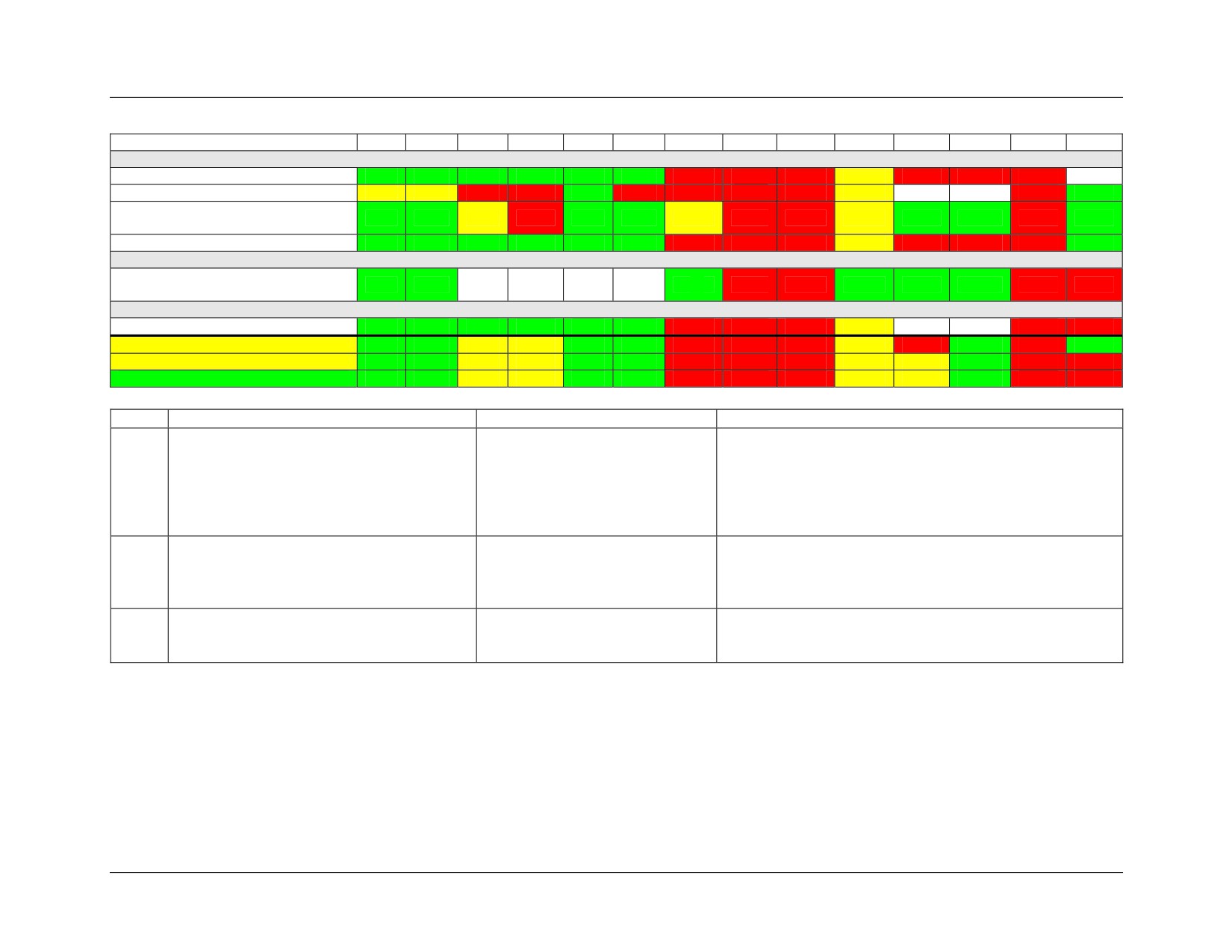
For Official Use Only
CBRN Functional Needs Analysis/Functional Solution Analysis
Chapter 5. Tactical Sense Tasks
Table 5.7-1. TASENS 7: Capability and Deficiency Assessment
System/Measure
M1
M2
M3
M4
M5
M6
M7
M8
M9
M10
M11
M12
M13
M14
Current - Near/Mid - Far
HAPSITE (GC/MS) with HSS1
10 2
10 3
10 4
9 5
10 39
10 40
1 6
N/A 7
N/A 7
5 8
0 9
N/A 11
N/A 7
Unk10
M272 Kit
7 11
7 12
0 13
1 14
10 14
0 3
1 15
N/A 7
N/A 7
5 44
Unk
Unk
N/A 7
10 16
MM-1 (GC/MS) integrated into M93A1
10 17
10 39
5 18
1 19
10 39
10 75
4 20
N/A 7
N/A 7
5 21
10 22
10 23
N/A 7
10 16
Fox
Viking SpectraTrak (GC/MS)
10 24
10 25
10 40
10 26
10 90
10 40
1 42
N/A 7
N/A 7
5 44
0 11
N/A 11
N/A 7
10 16
Near/Mid - Far
CBMS II integrated into NBCRV
10 27
1028
Unk
Unk
Unk
Unk
9 29
N/A 7
N/A 7
1030
10 31
10 32
N/A 7
N/A33
Stryker or JNBCRS
Far
JCBAWM
10 34
10 35
10 36
10 37
10 35
10 36
1 38
N/A 7
N/A 7
5 39
Unk
Unk
N/A 7
N/A33
Current Overall Capability
9
9
6
5
10
8
2
N/A 7
N/A 7
5
3
10
N/A 7
10
Near/Mid-Term Overall Capability
10
10
6
5
10
8
3
N/A 7
N/A 7
6
5
10
N/A 7
N/A33
Far-Term Overall Capability
10
10
7
6
10
8
3
N/A 7
N/A 7
6
5
10
N/A 7
N/A33
FAA Measure
Elaboration
Scale
M1
All of a potential adversary’s weaponized
Percentage of following 12 agents
Percentages standardized to 0-10 scale
CWAs can be detected using fielded
as described in FM 3-9 that are
technologies/equipment, regardless of agent
detected: nerve agents (GA; GB;
physical properties, states, and
GD; GF; VX), vesicants (H/HD;
concentrations?
HN-1,2,3; L; CX), cyanides (AC;
CK), pulmonary agent (CG)
M2
All CWAs can be identified?
Ability to classify or identify
10: Identify detected CWAs
detected CWAs.
7: Identify some detected CWAs; classify others
5: Classify detected CWAs
0: Neither identify nor classify detected CWAs
M3
All of a potential adversary’s weaponized
Ability to provide snapshot
10: Absolute quantification
CWAs can be quantified using fielded
concentration of detected CWAs.
5: Generic quantification
technologies/equipment?
0: No quantification capability
89
For Official Use Only
For Official Use Only
CBRN Functional Needs Analysis/Functional Solution Analysis
Chapter 5. Tactical Sense Tasks
FAA Measure
Elaboration
Scale
M4
All TICs can be detected using fielded
Considering only TICs listed in
10: All TICs listed in ITF-40
technologies/equipment?
USACHPPM Report 47-EM-6154-
9: 90% of 33 high-priority critical acutely toxic airborne
03: ITF-40. (FOUO)
TICs according to ITF-40
8: 80% of 33 high-priority critical acutely toxic airborne
TICs according to ITF-40
2: 20% of 33 high-priority critical acutely toxic airborne
TICs according to ITF-40
1: 1%-20% of 33 high-priority critical acutely toxic airborne
TICs according to ITF-40
0: none of 33 high-priority critical acutely toxic airborne TICs
according to ITF-40
M5
All TICs can be identified using fielded
Ability to classify or identify
10: Identify all detected TICs
technologies/equipment?
detected TICs.
7: Identify some detected TICs; classify others
5: Classify detected TICs
0: Neither classify nor identify detected TICs
M6
All TICs can be quantified using fielded
Ability to provide snapshot
10: Absolute quantification
technologies/equipment?
concentration of detected TICs.
5: Generic quantification
0: No quantification capability
M7
Time to detect chemical hazards?
Time period from CWA/TIC
10: 12 sec
sampling to analysis output. Linear
7: 30 sec
scale 1-10.
2: 60 sec
1: > 60 sec
M8
Distance between chemical hazard and
This measure is not relevant to this
N/A
detector for accurate detection?
task.
M9
Chemical hazards are detected in time to warn
This measure is not relevant to this
N/A
forces and take appropriate protective
task.
measures?
M10
Chemical hazards are identified in time to
Based on capability and time
10: Complete capability
treat forces?
required to identify or classify
5: Partial capability
hazards, as well as rate-of-action of
0: No capability
those hazards.
M11
Sampling collection procedures available for
Refers to physical sampling for
10: Complete capability
all of a potential adversary’s weaponized
future analysis.
5: Partial capability
CWAs and for all TICs using fielded
0: No capability
technologies/equipment?
M12
Procedures maintain integrity of sample?
Refers to a physical sample for
10: Complete capability
future analysis.
5: Partial capability
0: No capability
90
For Official Use Only
For Official Use Only
CBRN Functional Needs Analysis/Functional Solution Analysis
Chapter 5. Tactical Sense Tasks
FAA Measure
Elaboration
Scale
M13
Cumulative dose can be determined and
This measure is not relevant to this
N/A
presented using data from currently fielded
task.
sensors/equipment?
M14
There is effective DOTLPF in place to
Refers to non-materiel elements
10: DOTLPF exists and is adequate for the task to be
conduct task?
associated with the execution of a
performed with this system without limitations that cause
task with the system.
significant impact upon operations
5: Most critical aspects of DOTLPF for the task to be
performed with this system are addressed
0: DOTLPF is inadequate or does not exist for the task to be
performed with this system
1 Headspace sampling system
2 Presumably detects all 12 CWA of interest by detecting vapors off-gassing from water (average detection limit: ~5 ȝg/L).
3 Identifies detected agents and TICs (through MS).
4 Provides absolute quantification capability for all detected agents and TICs (specifically provides composition intensities, e.g., ppm).
5 Presumably detects most TICs in ITF-40. Detects vapors off-gassing from water.
6 Detects within 10 minutes.
7 Not relevant to this task (N/A).
8 Hazards are not identified in time to treat, especially if lethal fast-acting agents at high concentrations are involved.
9 Sampling collection for future analysis capability does not exist with this technology/equipment.
10 COTS detector. Unknown if sufficient DOTLPF in place.
11 Detects GA, GB, GD, GF and VX (0.02 mg/L ORD requirement); HD and L (2.0 mg/L ORD requirement); and AC (20.0 mg/L ORD requirement). Does not meet tri-service
field drinking water consumption standards, which are the aforementioned detection limit requirements.
12 Identifies/classifies as nerve agent, AC, HD, or Lewisite.
13 Does not quantify amount of detected agents or TICs.
14 Detects and identifies HCN (AC) only.
15 Each agent class test (blister, blood, and nerve) takes about 6-7 minutes. All tests can be completed in 20 minutes.
16 There is effective DOTLPF in place to conduct task with this system.
17 Detects 20-30 CWAs, precursors, and degradation products (including all 12 CWAs) in liquid form through use of 120oC probe that vaporizes liquid. Vapor detection limits: 62
mg/m3 for GB - 620X IDLH; 46 mg/m3 for CK; 115 mg/m3 for CG. According to FM 3-11.9, incapacitating doses are 300 (GA for resting person), 75 (GB for resting person), 75-
300 (GD), 50 (VX), 150 (inhaled HD), <300 (L for eye), 7,000 (CK), and 1,6000 (CG) mg-min/m3. It is susceptible to chemical interference (false positives and negatives).
18 Provides relative intensities (concentrations) of detected agents and TICs.
19 Detects phosgene, hydrogen cyanide, cyanogen chloride, phosphorus trichloride, and phosphorus oxychloride.
20 Detects within 45 seconds.
21 Identifies hazards within 45 seconds.
22 A physical sample can be taken, but not through the MM-1. The M93A1 Fox has a protective glove attached to the body by which an occupant can safely collect physical
samples.
23 Sample integrity is maintained.
24 Presumably detects all 12 agents of interest (5 ȝg/L detection limit); detects all states. Degraded performance: (P5, 9, 10) Not waterproof when operating; (M5) Negligible
personnel experience.
25 Identifies sampled agents and TICs (through mass spectrometry).
26 Presumably detects all TICs in ITF-40; detects all states.
91
For Official Use Only
For Official Use Only
CBRN Functional Needs Analysis/Functional Solution Analysis
Chapter 5. Tactical Sense Tasks
27 Presumably will detect all CWAs.
28 All detected CWAs will be identified.
29 Will detect and identify within 15 seconds.
30 Will identify within 15 seconds, which provides complete capability.
31 Liquid and vapor samples will be able to be taken.
32 Sample integrity will be maintained.
33 Future system(s). Thus, DOTLPF is also future and cannot be evaluated.
34 Will detect all agents listed in DIA document “Threat Environment Projection: Chemical and Biological Warfare 2000-2025” (objective). Will meet tri-service long-term
consumption standards (objective is to detect 20% lower than tri-service consumption standards).
35 Will identify detected CWAs and TICs.
36 Will absolutely quantify hazard (concentration).
37 Will detect all TICs of interest as an objective.
38 Will detect within 10 minutes.
39 Hazards will not be identified in time to treat, especially if lethal fast-acting agents at high concentrations are involved.
92
For Official Use Only
For Official Use Only
CBRN Functional Needs Analysis/Functional Solution Analysis
Chapter 5. Tactical Sense Tasks
5.7.3
Functional Solution Analysis
5.7.3.1
DOTLPF Assessment Summary
This section states the deficiencies and suggests potential non-materiel solutions. If there are no
solutions or there are only partial solutions for a particular deficiency, that deficiency is then
reassessed in the IMAs section.
1. Deficiency: Lack of detection, identification, and quantification capability for TICs in water.
Non-Materiel Solutions: Training (partial): Increase training of personnel on Viking
SpectraTraks and HAPSITEs with Headspace Sampling System.
2. Deficiency: Lack of detectors that meet tri-service drinking standards.
Non-Materiel Solutions: Training (partial): Increase training of personnel on Viking
SpectraTraks and HAPSITEs with Headspace Sampling System.
3. Deficiency: Lack of real-time or near-real time detection, identification, and quantification
capability for CWAs and TICs in water.
Non-Materiel Solutions: None
4. Deficiency: Lack of detector that can also take samples for future analysis capability.
Non-Materiel Solutions: None
5.7.3.2
IMA Assessment Summary
Table 5.7-2 identifies eight ideas for materiel approaches that, if developed, may reduce or
eliminate the deficiencies associated with detecting chemical hazards in water. Advances in MS,
electromagnetic spectroscopy, Raman spectroscopy, PIRS, or orthogonal technologies may be
able to address all identified deficiencies.
93
For Official Use Only
For Official Use Only
CBRN Functional Needs Analysis/Functional Solution Analysis
Chapter 5. Tactical Sense Tasks
Table 5.7-2. TASENS 7: IMA Assessment
TASENS 7: Sense water for chemical hazards
Ideas for Materiel
Approaches
(IMA)
Identified Gaps
General lack of detection, identification, and quantification capability for
X
X
X
X
X
X
X
X
TICs in water.6
General lack of detectors that meet tri-service drinking standards.7
X
X
X
X
X
X
X
Lack of real-time or near-real-time detection, identification, and
X
X
X
X9
X
quantification capability for CWAs and TICs in water.8
Lack of detector that also takes samples for future analysis capability.10
X
X
X
X
X
X
X
X
1 Includes GC/MS, LC/MS.
2 Examples include CO2 long-wave IR (LWIR) Differential Scattering/Differential Absorption of Light (DISC)/Differential Absorption LIDAR (DIAL), CO2 conv mid-wave IR
(MWIR) DISC/DIAL, solid-state (SS) conv MWIR DISC/DIAL, FTIR, Hyperspectral LWIR, Passive MWIR, SS conv LWIR DISC/DIAL, SS conv short-wave IR (SWIR) -
LWIR, SS conv UV-LW IR, Active LWIR Polarization, Active MWIR Polarization, Passive LWIR Polarization, Filtered Forward-Looking IR (FLIR), UV Laser-Induced
Fluorescence (LIF)/FTIR, and Microwave (GHz and THz) Spectroscopy.
3 Can take place in either solution or vapor phase and thus can be used for detecting chemicals in water.
4 Examples include SAW/IMS.
5 Chemical agent detection by surface-enhanced Raman spectroscopy. http://bookstore.spie.org/index.cfm?fuseaction=DetailPaper&ProductId=511940&coden
6 Distributing more Viking SpectraTraks and HAPSITEs with Headspace Sampling System is a potential solution. JCBAWM is expected to eliminate capability gap.
7 Distributing more Viking SpectraTraks is a potential solution. JCBAWM is expected to eliminate capability gap.
8 Reducing the response time of JCBAWM, Viking SpectraTrak, and/or HAPSITE with Headspace Sampling System is a potential solution.
9 Photoionization/QitTof MS; “Automated, Real-Time Screening of CWs in Water by Photoionization/QitTof MS.” Jack Syage, Syagen Technology, Inc
10 All IMAs could be designed to eliminate this capability gap. The collection equipment would be better maintained as an independent capability. The solution could involve a
module connected to the detector that notifies the operator to take samples or triggers an automated process to begin sampling.
94
For Official Use Only
For Official Use Only
CBRN Functional Needs Analysis/Functional Solution Analysis
Chapter 5. Tactical Sense Tasks
5.8
Task TASENS 8: Sense water for biological hazards
5.8.1
Functional Area Analysis
5.8.1.1
Definition
To sense the presence or absence of biological hazards (includes BWAs and TIB material) in
water (potable and nonpotable). Includes the functions of detection, identification, and
quantification of the hazard. Also includes collection of samples for further analysis, along with
early-warning surveillance of unforeseen hazard releases and monitoring of known hazard
locations, as well as the requirement to determine the extent and physical properties of
contamination. Encompasses both “detect to warn” and “detect to treat” situations to enable
appropriate protective measures. Must occur in situ to assist with raw water site selection and
identification of soldier contact hazards, in-line post ROWPU and permanent water distribution
systems, and on-demand to spot-check potable water distribution sites and shower points.
5.8.1.2
Derivation
UJTL TA 7, UJTL TA 7.1, Protection Joint Functional Concept.
5.8.1.2.1
Supported Tasks: OPSENS 1, OPSENS 4, OPSENS 7
5.8.1.2.2
Lateral Task: TASHA 14
5.8.1.2.3
Supporting Task: N/A
5.8.1.3
Conditions
Perform this task under conditions of:
Physical
1. Inaccessible subsurface water. (C1.1.2.3)
2. High sea state. (C1.2.1.3)
3. High shipping presence. (C1.2.6)
4. Summer, winter seasons. (C1.3.1.1)
5. Stormy weather. (C1.3.1.3)
6. Hot, very cold air temperature. (C1.3.1.3.1)
7. Liquid, freezing, and frozen precipitation. (C1.3.1.3.6.1)
8. Heavy precipitation intensity. (C1.3.1.3.6.2)
9. Negligible light. (C1.3.2.1)
10. Biological effects. (C1.3.3.3)
Military
1. Stressful mission. (C2.1)
2. Location—ashore, afloat, airborne. (C2.1.4.1)
95
For Official Use Only
For Official Use Only
CBRN Functional Needs Analysis/Functional Solution Analysis
Chapter 5. Tactical Sense Tasks
3. Minimal time available. (C2.1.5)
4. Low personnel capability. (C2.2.4),
5. Negligible personnel experience. (C2.2.4.5)
6. Deployment movement and maneuver—includes logistical requirements such as lift,
supply, and transportation. (C2.5)
7. Ambiguous threat existence. (C2.9.3)
Civil
1. Limited or negative foreign government support. (C3.1.2.3)
2. Aggressively opposed foreign public opinion. (C3.1.2.4)
3. High mission priority. (C3.1.3.2)
4. High health risk. (C3.3.1.5)
5. Significant refugee care responsibility. (C3.3.2.3)
6. TIB material present in the civilian sector. (C3.3.7.5)
5.8.2
Functional Needs Analysis
5.8.2.1
Capability and Deficiency Assessment Summary
Table 5.8-1 presents individual and overall current, near/mid-term, and far-term capabilities to
perform the task to the designated standards. There are three current capabilities used to
accomplish this task and two projected capabilities to be added in the future (JBAIDS in the
near/mid term and JCBAWM in the far term). The individual capabilities differ in their abilities
to meet the identified standards.
Overall Capability and Deficiency Summary
The overall current capability is assessed as “yellow.” Many, if not most, BWAs can be
presumptively detected and identified by collecting water samples through physical sampling,
followed by manual sample preparation and the following laboratory and field-deployable
analytical techniques: immunochromatographic HHAs, which are part of the BSK; ELISA; and
RT-PCR, as used by the RAPID. Of the 25 BWAs described in the Medical Management of
Biological Casualties, a complete set of HHAs can detect and identify all agents with the
possible exception of the viral hemorrhagic fever agents; however, the BSK contains eight
different HHAs and thus detects only eight BWAs per kit. The eight agents in the kit may be
assembled to reflect the threat.1 A comprehensive set of ELISAs, which are laboratory-based,
can ostensibly detect and identify all 25 BWAs (as well as any TIB), assuming that an antigen or
antibody has been isolated for each agent. Like all PCR-based technologies, RAPID can, with
the appropriate reagents, detect and identify all BWA and TIB pathogens but none of the toxins
(since the toxins, unless contaminated with the source organisms, do not provide any genetic
material). HHAs and RAPID can generically quantify detected agents (HHAs only through the
aide of a reader), whereas some varieties of ELISAs provide absolute quantification capabilities.
Overall current task deficiencies include the lack of integrated sample collection, detection,
identification, and quantification capability for BWAs in water; real-time or near-real-time
96
For Official Use Only
For Official Use Only
CBRN Functional Needs Analysis/Functional Solution Analysis
Chapter 5. Tactical Sense Tasks
detection, identification, and quantification capability for sampled BWAs; field analysis
verification capabilities; a detector that also takes samples for future analysis2; and TIB detection
capabilities.
Projected Near/Mid-Term Capabilities and Deficiencies
The overall projected near/mid-term capability is assessed as “yellow.” Near/mid-term capability
JBAIDS Block I will detect 11 BWA pathogens (as a threshold requirement), whereas Block II
will detect the same 11 BWA pathogens plus the four toxins of interest (as a threshold
requirement). JBAIDS will also quantify agent concentrations in the analyzed sample. It will
require 25-40 minutes for analysis output following sample preparation, and will thus provide a
complete identify-to-treat capability.
All of the overall current task deficiencies are likely to remain deficiencies in the near/mid term.
Projected Far-Term Capabilities and Deficiencies
The overall projected far-term capability is assessed as “yellow.” As an objective, far-term
capability JCBAWM will detect, identify, and absolutely quantify all BWAs of interest
(presumably, since requirement is all agents listed in DIA document “Threat Environment
Projection: Chemical and Biological Warfare 2000-2025”) as well as TIBs of interest within 10
minutes. It will thus provide a complete identify-to-treat capability.
The lack of real-time or near-real-time detection, identification, and quantification capability for
sampled BWAs; field analysis verification capabilities; and a detector that also takes samples for
future analysis are likely to remain deficiencies in the far term.
1 The collection of surface samples to use in HHA results in a sample for further analysis.
Coolers/temperature-controlled equipment to hold and maintain the sample needs to be available
if the sample is not immediately evacuated.
2 The M34A1 sampling kit, which is not a detector, is capable of collecting and maintaining a
biological sample.
97
For Official Use Only
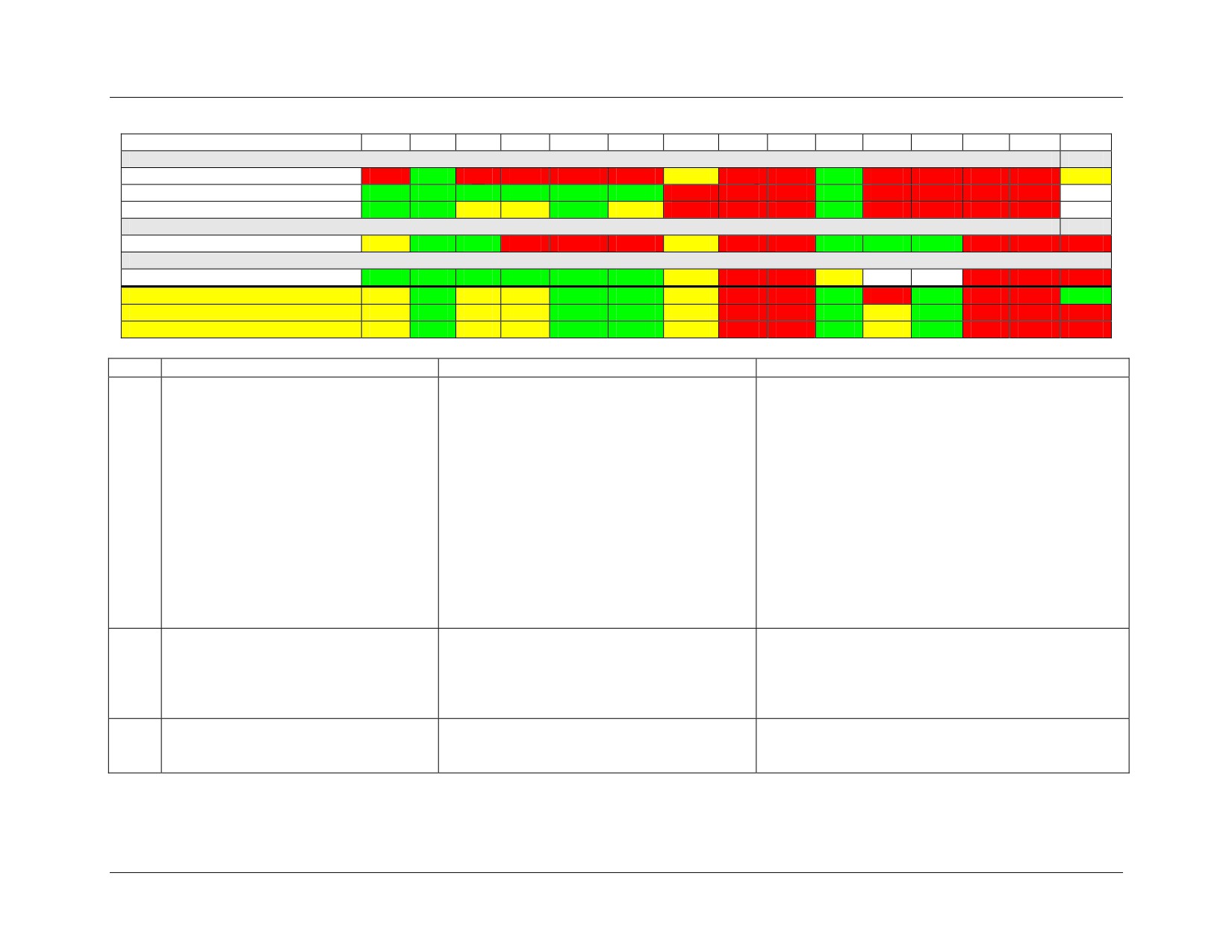
For Official Use Only
CBRN Functional Needs Analysis/Functional Solution Analysis
Chapter 5. Tactical Sense Tasks
Table 5.8-1. TASENS 8: Capability and Deficiency Assessment
System/Measure
M1
M2
M3
M4
M5
M6
M7
M8
M9
M10
M11
M12
M13
M14
M15
Current - Near/Mid - Far
Physical Sampling/BSK
31
102
03
04
N/A 4
N/A 4
65
N/A6
N/A7
107
08
N/A8
09
N/A7
510
Physical Sampling/ELISA
10 11
102
1012
1013
1014
10 14
115
N/A7
N/A7
1017
016
N/A19
011
N/A7
Unk
Physical Sampling/RAPID
8 17
102
518
519
1020
520
1 21
N/A7
N/A7
1023
019
N/A19
010
N/A7
Unk
Near/Mid - Far
Physical Sampling/JBAIDS Blocks I/II
4/622
1023
1024
025
N/A 25
N/A 25
4/526
N/A7
N/A7
1027
1028
1029
030
N/A7
N/A31
Far
JCBAWM
10 32
10 33
10 34
10 35
10 33
10 34
7 36
N/A7
N/A7
5 37
Unk
Unk
0 30
N/A7
N/A31
Current Overall Capability
6
10
5
4
10
8
5
N/A7
N/A7
10
3
10
0
N/A7
8
Near/Mid-Term Overall Capability
6
10
6
4
10
8
5
N/A7
N/A7
10
4
10
0
N/A7
N/A31
Far-Term Overall Capability
6
10
7
4
10
8
5
N/A7
N/A7
9
4
10
0
N/A7
N/A31
FAA Measure
Elaboration
Scale
M1
All of a potential adversary’s weaponized
Number of the 25 biological agents described in
10: All 25 BWAs detected
BWAs can be detected using fielded
the Medical Management of Biological
8: 20 BWAs detected
technologies/equipment, regardless of
Casualties that are detected. Fourteen of the 25
6: 15 BWAs detected
agent physical properties, states, and
agents are as follows: Anthrax (Bacillus
4: 10 BWAs detected
concentrations?
Anthracis); Brucellosis (Brucellae); Glanders
2: 5 BWAs detected
(Burkholderia mallei); Meliodosis
1: 1 BWA detected
(Burkholderia pseudomallei); Q Fever (Coxiella
0: No BWAs detected
burnetii); Plague (Yersinia pestis); Tularemia
(Francisella tularensis); Botulinum toxin;
Ricin; SEB; T-2 Mycotoxins; Smallpox (variola
major and minor); Viral Equine Encephalities
(e.g., VEE, WEE, and EEE); and Ebola and
Marburg hemorrhagic fever viruses. Linear 2-
10.
M2
All of a potential adversary’s weaponized
Ability to identify or classify (e.g., as bacteria,
10: Identify detected BWAs
BWAs can be identified using fielded
toxin, or virus) detected BWAs.
7: Identify some detected BWAs; classify others
technologies/equipment?
5: Classify detected BWAs
3: Some detected BWAs are classified or identified
0: Neither identify nor classify detected BWAs
M3
All of a potential adversary’s weaponized
Ability to provide snapshot concentration of
10: Absolute quantification
BWAs can be quantified using fielded
detected BWAs.
5: Generic quantification
technologies/equipment?
0: No quantification capability
98
For Official Use Only
For Official Use Only
CBRN Functional Needs Analysis/Functional Solution Analysis
Chapter 5. Tactical Sense Tasks
FAA Measure
Elaboration
Scale
M4
All TIB material can be detected using
TIB material includes medical waste, raw
10: All pathogens and toxins within TIB material,
fielded technologies/equipment?
sewage, and vaccine-related biologics.
including medical waste, raw sewage, and vaccine-
Pathogens and toxins within TIB material are
related biologics can be detected
what are generally detected.
5: All TIB pathogens or toxins within one or more
categories (i.e., medical waste, raw sewage and vaccine-
related biologics) can be detected
3: Some TIB pathogens and toxins within one category
(i.e., medical waste, raw sewage and vaccine-related
biologics) can be detected
0: No TIB pathogens and toxins can be detected
M5
All TIB material can be identified using
Ability to identify or classify (e.g., as bacteria,
10: All pathogens and toxins within TIB material can be
fielded technologies/equipment?
toxin, or virus) detected TIB material.
identified
7: Identify some TIB pathogens and toxins; classify
others
5: Classify detected TIB pathogens and toxins
3: Some detected TIB pathogens and toxins can be
classified or identified
0: Neither classify nor identify detected TICs
M6
All TIB material can be quantified using
Ability to provide snapshot concentration of
10: Absolute quantification
fielded technologies/equipment?
detected TIBs.
5: Generic quantification
0: No quantification capability
M7
Time to detect biological hazards?
Time period from BWA/TIB sampling to
10: 1 minute
analysis output. Linear scale 2-7. Applies to
9: 4 minutes
point detectors only.
8: 7 minutes
7: 10 minutes
4: 40 minutes
2: 60 minutes
1: >60 minutes
M8
Distance between biological hazard and
This measure is not relevant to this task.
N/A
detector for accurate detection?
M9
Biological hazards are detected in time to
This measure is not relevant to this task.
N/A
warn forces and take appropriate
protective measures?
99
For Official Use Only
For Official Use Only
CBRN Functional Needs Analysis/Functional Solution Analysis
Chapter 5. Tactical Sense Tasks
FAA Measure
Elaboration
Scale
M10
Biological hazards are identified in time
Based on capability and time required to
10: Complete capability (<1 hour)
to treat forces?
identify or classify hazards, as well as rate-of-
5: Partial capability
action of those hazards. Of all considered
0: No capability
BWAs, ricin may require the most rapid
response. Immunoglobulin therapy must be
administered within 1 hour of ricin exposure to
be effective.
M11
Sampling collection procedures available
Refers to physical sampling for future analysis.
10: Complete capability
for all of a potential adversary’s
5: Partial capability
weaponized biological warfare agents
0: No capability
and for all TIB material using fielded
technologies/equipment?
M12
Procedures maintain integrity of sample?
Refers to a physical sample for future analysis.
10: Complete capability
5: Partial capability
0: No capability
M13
Time to validate the presence of
Refers to confirmatory identification.
10: Rapidly—validation performed expeditiously by
biological hazards in sample?
particular technology/equipment
5: Moderately delayed—mobile analysis tools can
validate on site
0: Delayed—off-site laboratory analysis required for
validation
M14
Cumulative dose can be determined and
This measure is not relevant to this task.
N/A
presented using data from currently
fielded sensors/equipment?
M15
There is effective DOTLPF in place to
Refers to non-materiel elements associated with
10: DOTLPF exists and is adequate for the task to be
conduct task?
the execution of the task with the system.
performed with this system without limitations that
cause significant impact upon operations
5: Most critical aspects of DOTLPF for the task to be
performed with this system are addressed
0: DOTLPF is inadequate or does not exist for the task
to be performed with this system
1 Current and near-future HHAs detect all BWAs with the possible exception of the viral hemorrhagic fevers; however, the BSK contains eight different HHAs and thus detects
eight BWAs. The HHA sensitivity is 105-106 CFU/mL (B. anthracis) and 50-1200 ng/mL (Botulinum toxin A and Botulinum toxin F, respectively). Degraded performance: (C6)
TIB material present in civilian sector. Susceptible to interference (false positives and negatives due to matrix effects, among others); (M3) Minimal time available. Requires
sample preparation prior to applying sample to assay.
2 All detected BWAs are identified.
3 Does not absolutely quantify agent. However, may provide relative indication of quantity, but only through the use of a reader. Soldiers will not likely have the reader.
4 According to specifications, does not detect any TIBs.
5 Detects within 15 minutes.
100
For Official Use Only