FM 3-20.98 Reconnaissance and Scout Platoon (AUGUST 2009) - page 3
Security Operations
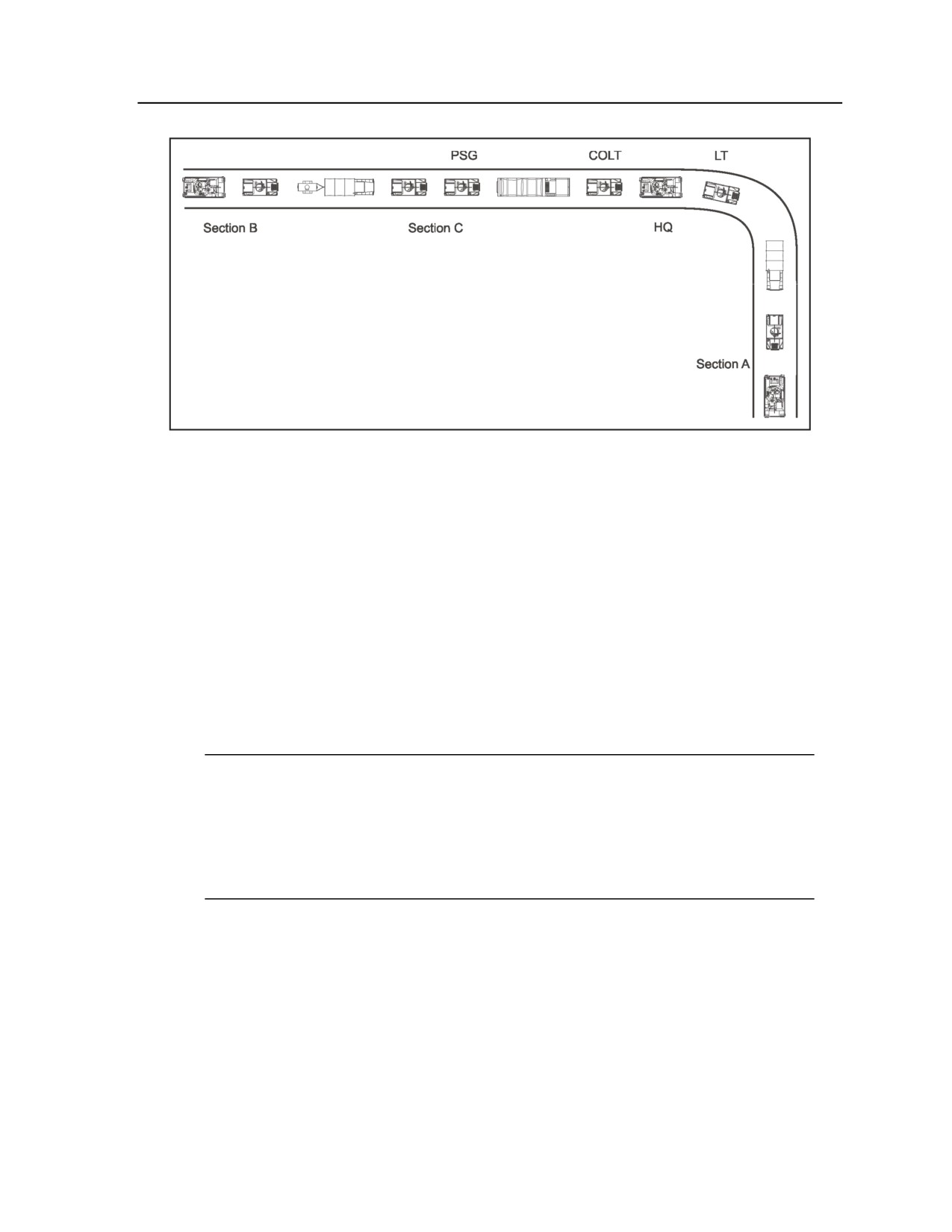
Figure 4-27. HBCT or CAB reconnaissance platoon escorts a convoy
Actions at an Ambush
4-111. Ambush is one of the most effective ways to interdict a convoy. This makes it a priority to conduct
ambush reaction training to increase chances of getting the convoy through an ambush with Soldiers and
equipment intact. Reaction to an ambush must be quick, overwhelming, and decisive. It must be executed
as a drill by all escort and convoy elements, with care taken to avoid fratricide. The following actions
should be included in the convoy escort drill:
z
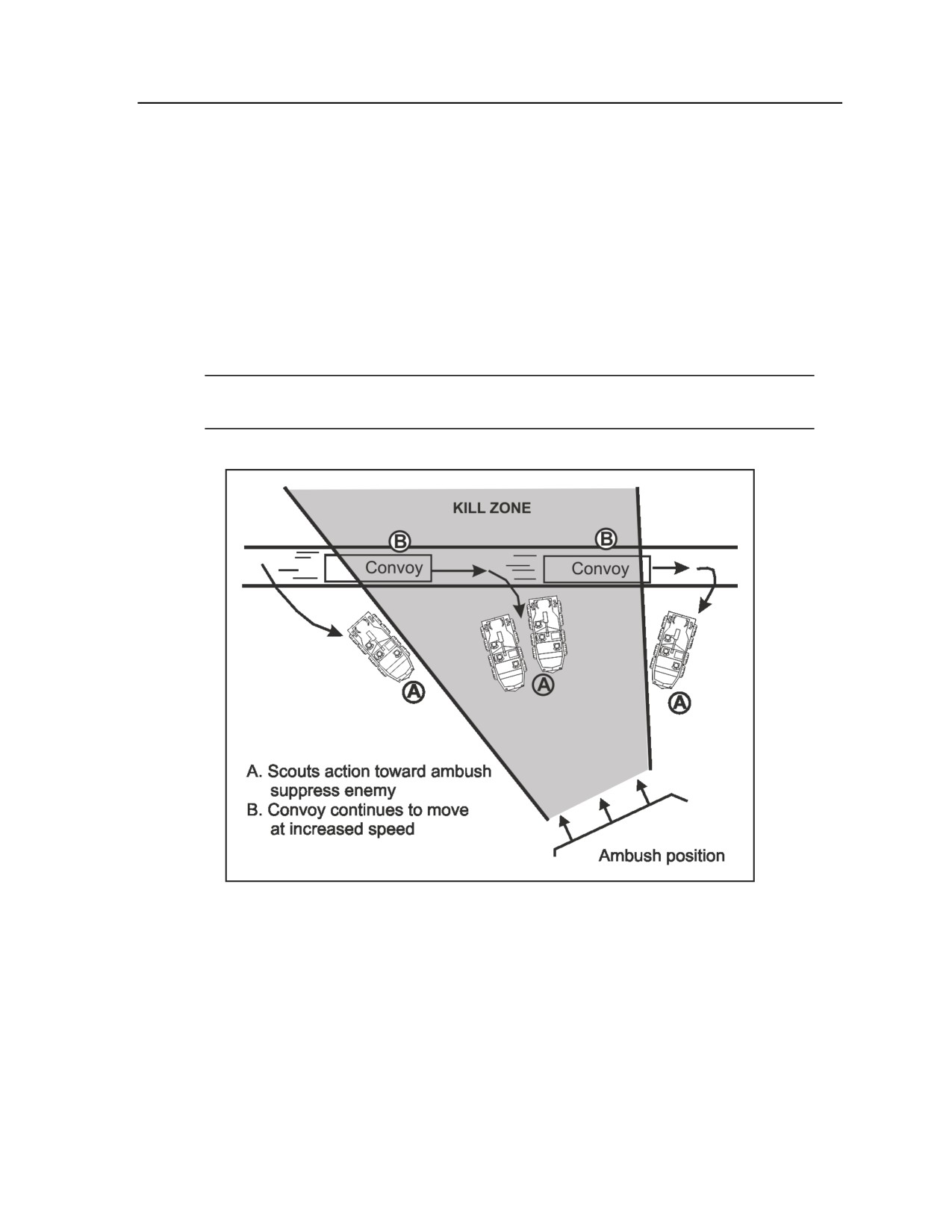
Upon detection of an enemy force, escort vehicles seek covered positions between the convoy and
the enemy and suppress the enemy with the highest possible volume of fire. They send appropriate
contact reports to higher headquarters (as shown in Figure 4-28).
z
Engagement techniques must be standardized in the platoon to ensure complete coverage. As
an example, flank vehicles would engage outside targets to inside targets, vehicles in the center
of sectors would engage center to outside targets; front and rear sections would engage far to
near targets; and center section vehicles would engage near to far threats.
Note. In some situations, elements of the escort force will be required to remain with the
convoy main body. This is especially true when the convoy comprises mainly nonmilitary
elements, such as NGOs or local civilian agencies. In addition to being unarmed in most cases,
these elements will usually lack communications capabilities, making it difficult for escort
elements to link back up with the main body. The convoy commander retains control of the
convoy vehicles and maintains radio contact with the security force while moving the convoy on
the route at the highest possible speed.
4-112. Platoon leaders must ensure that the following actions occur during an ambush:
z
Convoy vehicles will not return fire when the escort has moved between the convoy and the
enemy.
z
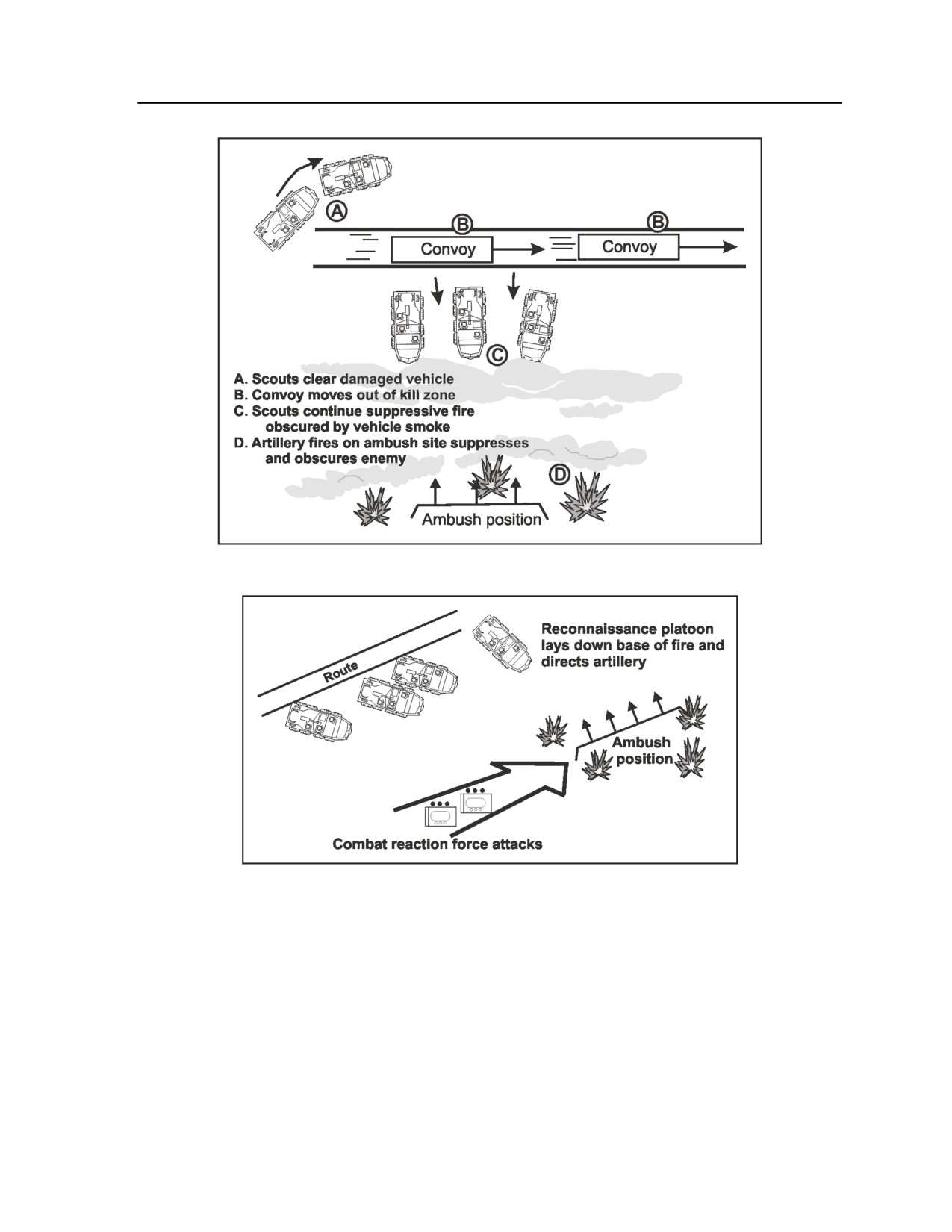
Elements of the convoy or convoy security, based on the factors of METT-TC, may halt to
recover or destroy damaged or disabled vehicles (see Figure 4-29).
z
The escort leader (reconnaissance or scout platoon leader) submits SPOTREPs, requests
MEDEVAC, requests the reaction force, and calls for and directs indirect fires and CAS if
available.
3 August 2009
FM 3-20.98
4-41
Chapter 4
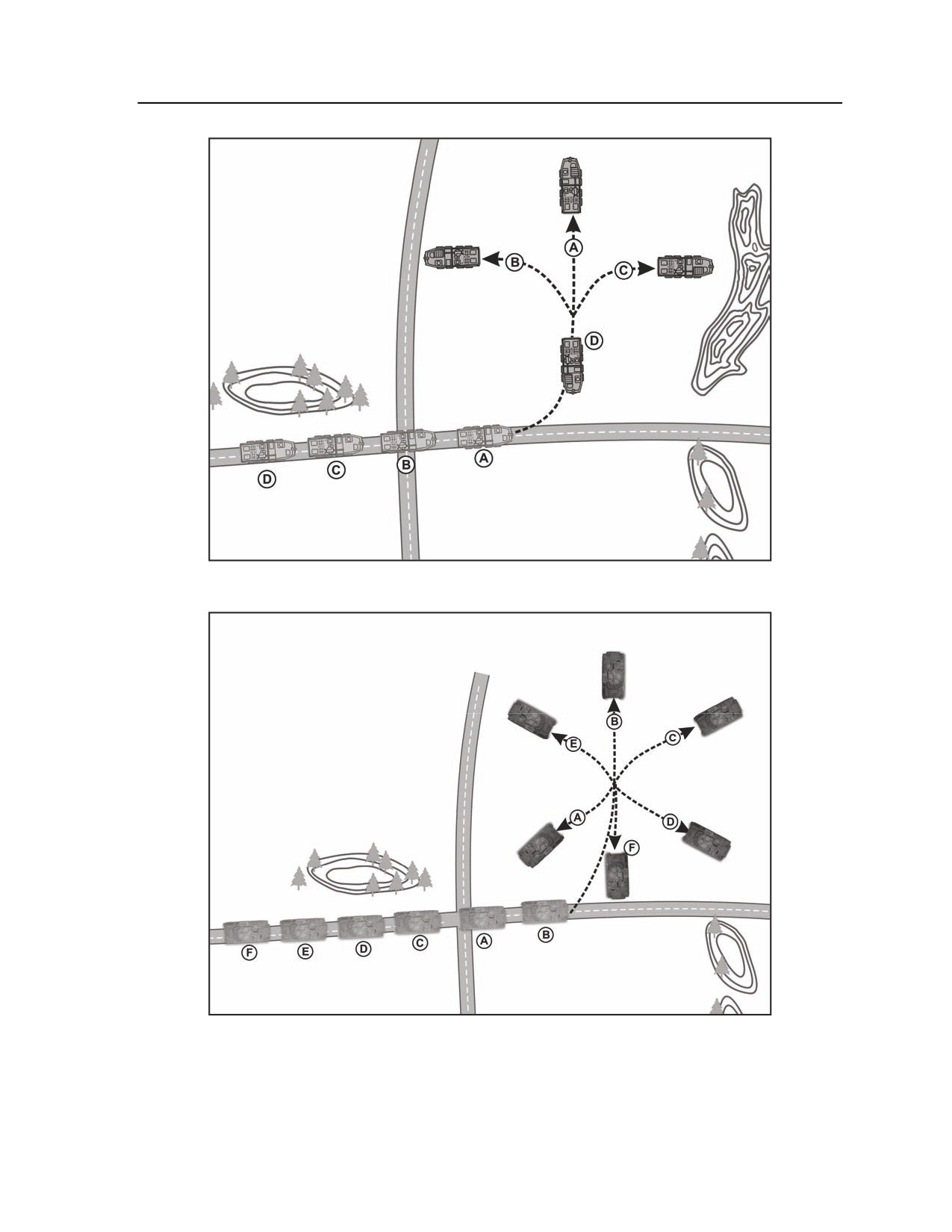
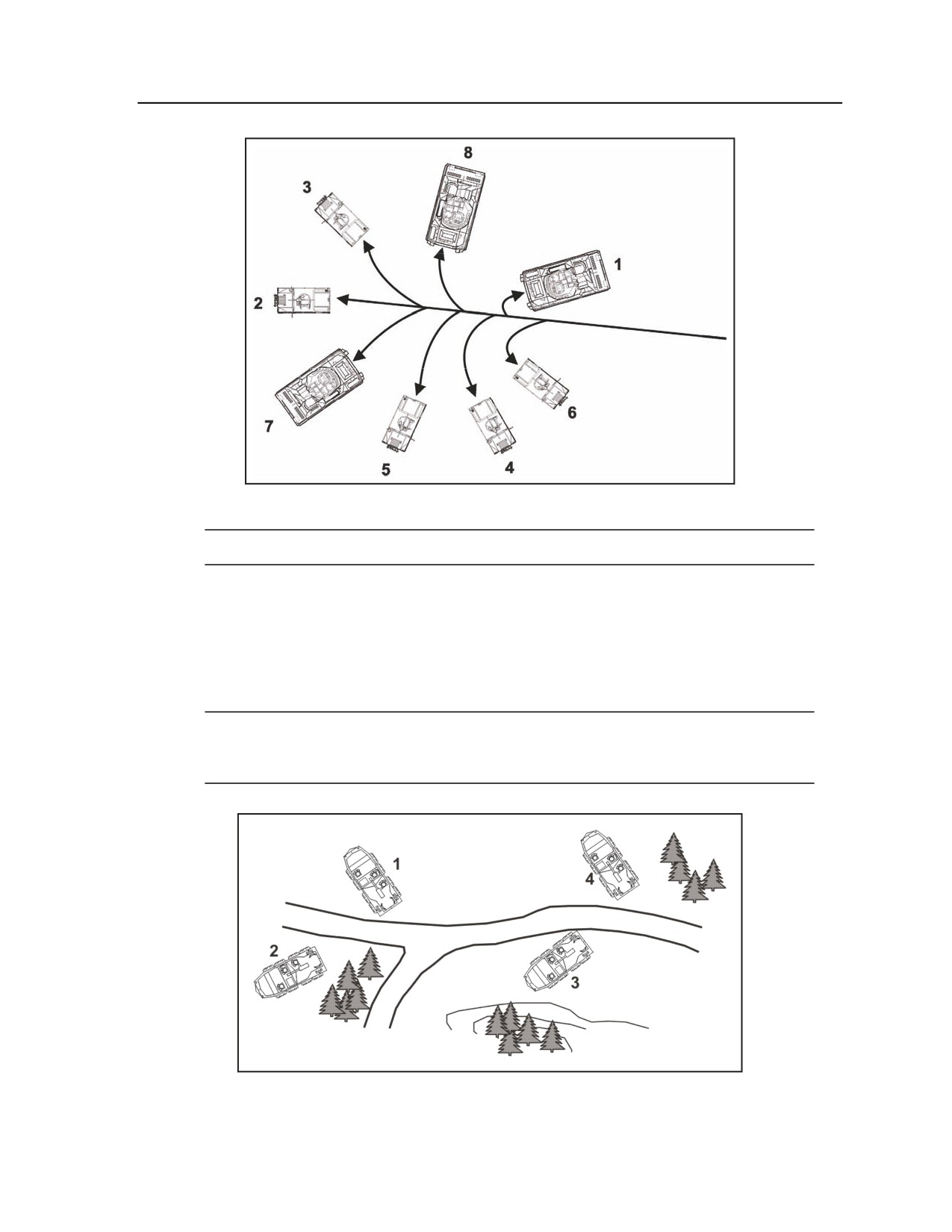
4-113. Once the convoy is clear of the kill zone, the escort leader chooses one of the following COAs
based on the composition of the escort and the strength of the enemy force:
z
Continue to suppress the enemy force with direct fire while fire support is requested.
z
Guide reaction forces into the enemy force if available, and shift fires to interdict the enemy
egress route (see Figure 4-30).
z
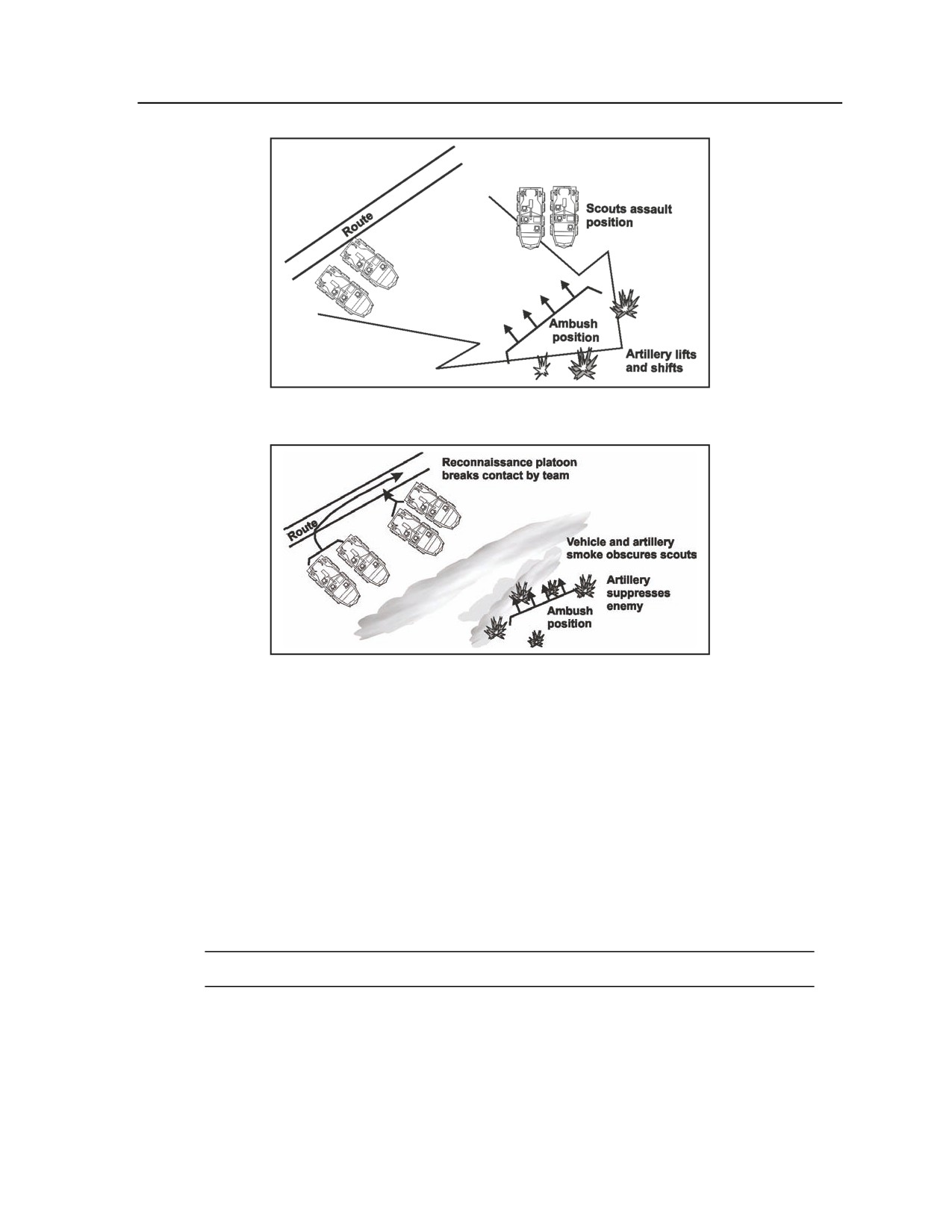
Assault the enemy when a reaction force is not practical (near ambush). See Figure 4-31.
z
Break contact and move out of the kill zone (as illustrated in Figure 4-32).
z
Update FBCB2 and the COP with enemy locations throughout the operation.
4-114. Generally, CFV-equipped platoons will continue to suppress the enemy or execute an assault
because of their vehicles’ capabilities. HMMWV and Stryker platoons may move out of the kill zone as
soon as the convoy is clear. Contact should be broken only with the approval of the platoon’s higher
commander.
Note. If physical contact is broken, platoons may regain visual contact by employing UASs to
maintain SA.
Figure 4-28. Convoy escort takes action toward ambush
4-42
FM 3-20.98
3 August 2009
Security Operations
Figure 4-29. Convoy continues to move out of kill zone
Figure 4-30. Convoy escort suppresses ambush for reaction force
3 August 2009
FM 3-20.98
4-43
Chapter 4
Figure 4-31. Convoy escort vehicles assault ambush position without reaction force
Figure 4-32. Escort vehicles break contact without reaction force
Actions at a Short Halt
4-115. The convoy may be required to make a short halt for a number of reasons. During the short halt,
the escorting unit is at REDCON-1 regardless of what actions convoy vehicles are taking. If the halt is for
any reason other than an obstacle, these actions should be taken (assuming the reconnaissance or scout
platoon is the escorting element):
z
The convoy commander signals the short halt and transmits the order via tactical radio.
z
The convoy assumes a herringbone formation.
z
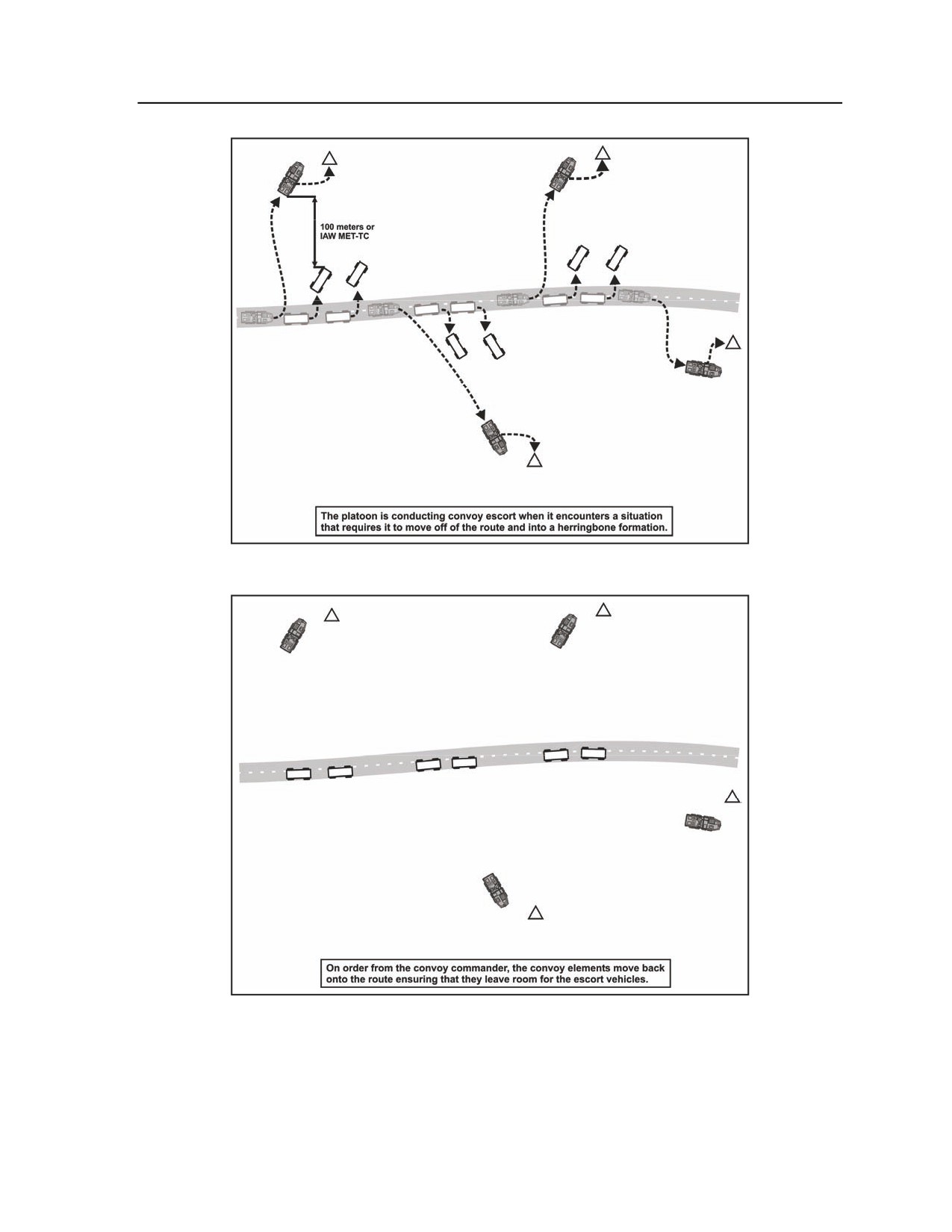
Escort vehicles move to protective positions forward, to the rear, and to the flanks (up to 100
meters beyond the convoy vehicles, as applicable) and orient their weapon systems outward.
They remain at REDCON-1, although they establish dismounted local security (as illustrated
in Figure 4-33). The vehicles being escorted pull into the protected area in the center of the
herringbone, between the escort vehicles.
Note. Escort vehicles should not leave the roadway if there is a possibility of enemy mines.
z
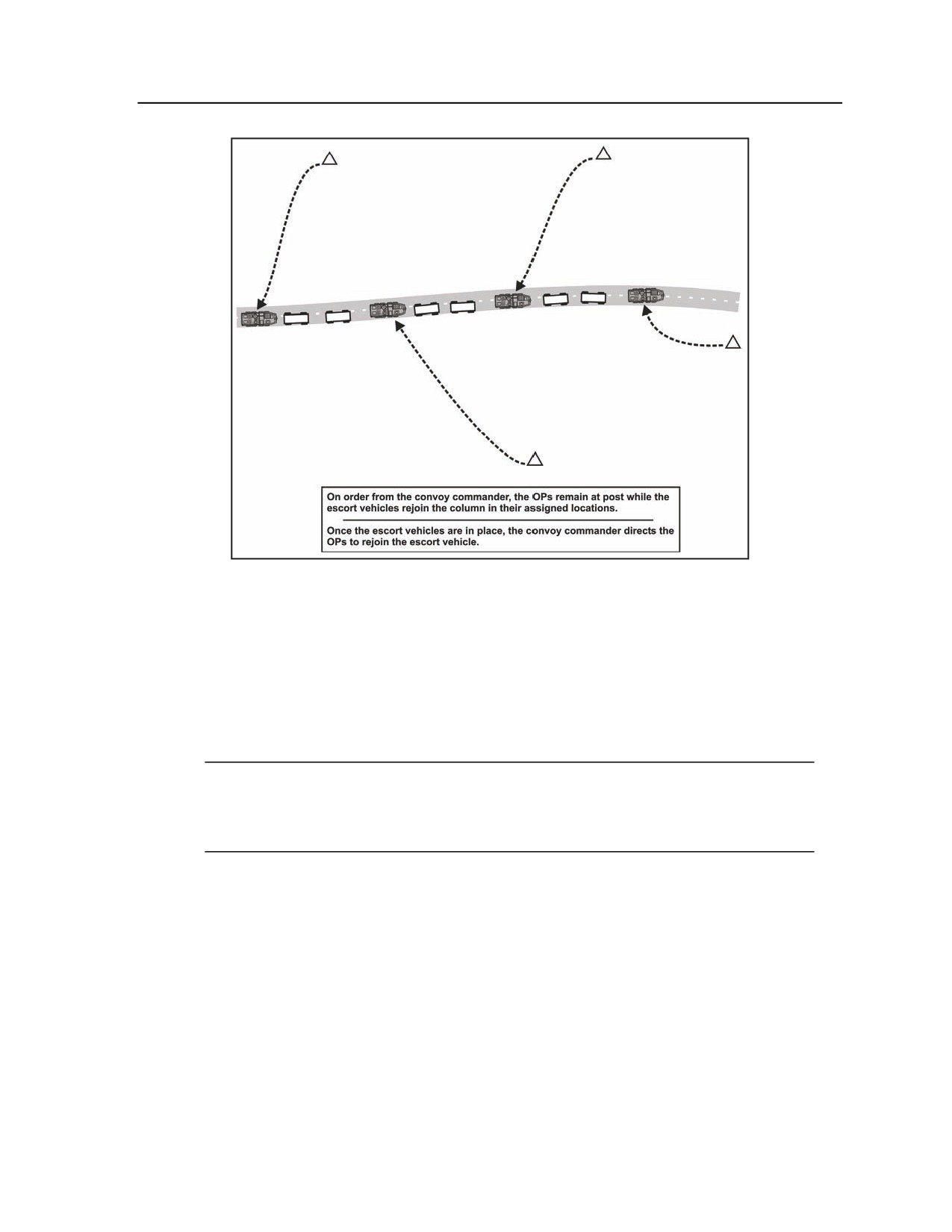
When the order is given to move out, convoy vehicles first reestablish the column formation,
leaving space for the escort vehicles (see Figure 4-34). Once the convoy is in column, the
escort vehicles join the column, leaving local security dismounted (shown in Figure 4-35).
z
Once all elements are in column, local security personnel mount, and the convoy continues to
move.
4-44
FM 3-20.98
3 August 2009
Security Operations
Figure 4-33. Convoy moves to herringbone formation
Figure 4-34. Convoy moves back into column formation
3 August 2009
FM 3-20.98
4-45
Chapter 4
Figure 4-35. Escort vehicles rejoin column
Actions at an Obstacle
4-116. Obstacles are a major threat to convoys. They can be erected in a matter of minutes and used to
delay or stop the convoy. In addition, an obstacle or series of obstacles can be used to canalize or fix the
convoy within an enemy ambush (this can include well-hidden IEDs in debris). Platoons must treat every
obstacle as though the enemy is overwatching it with direct and/or indirect fires. As obstacles or other
threats are encountered, the platoon leader or PSG must update the FBCB2 so all units in the AO have
knowledge of the threats.
Note. In the current OE, enemy elements employing obstacles use overwatching units to
observe the obstacle encounter and then employ direct or indirect fires and command-detonated
surface and subsurface munitions. This could position the entire convoy in contact with multiple
danger areas simultaneously.
4-117. The purpose of the route reconnaissance ahead of the convoy is to identify obstacles and breach
them or find bypasses. In some cases, it is not possible to conduct a route reconnaissance ahead of the
convoy; in other cases, the reconnaissance element may fail to detect the enemy or its obstacles. In either
situation, the convoy must take actions to reduce or bypass the obstacle.
4-118. When a convoy is dealing with an obstacle, it faces a two-sided problem: it is more vulnerable
because it is stopped, and its escort force is occupied with tasks required to overcome or bypass the
obstacle. For these reasons, security becomes critical, and actions at the obstacle must be accomplished
quickly. Reconnaissance and scout platoons in the role of a convoy escort will take the following actions
upon contact with a point-type obstacle:
z
When the lead security element identifies the obstacle, the convoy commander directs a short
halt. He establishes dismounted local security and overwatch of the obstacle. Convoy vehicles
remain on the road, with the escort elements moving to the flanks to provide security.
4-46
FM 3-20.98
3 August 2009
Security Operations
Note. All convoy vehicles must be aware that the enemy may have buried mines, IEDs, or
explosively formed penetrators (EFP) in the area, especially on the side of the road.
z
The convoy commander relays a SPOTREP from the reconnaissance or scout platoon to higher
headquarters and requests support from combat reaction forces, engineer assets (if they are not
already part of the convoy), and aerial reconnaissance elements. In addition, he alerts artillery
units to be prepared to provide fire support. Employment of these assets is designed to reduce
the time the convoy is halted and thus to reduce its vulnerability. The convoy commander must
always assume the obstacle is overwatched by the enemy.
z
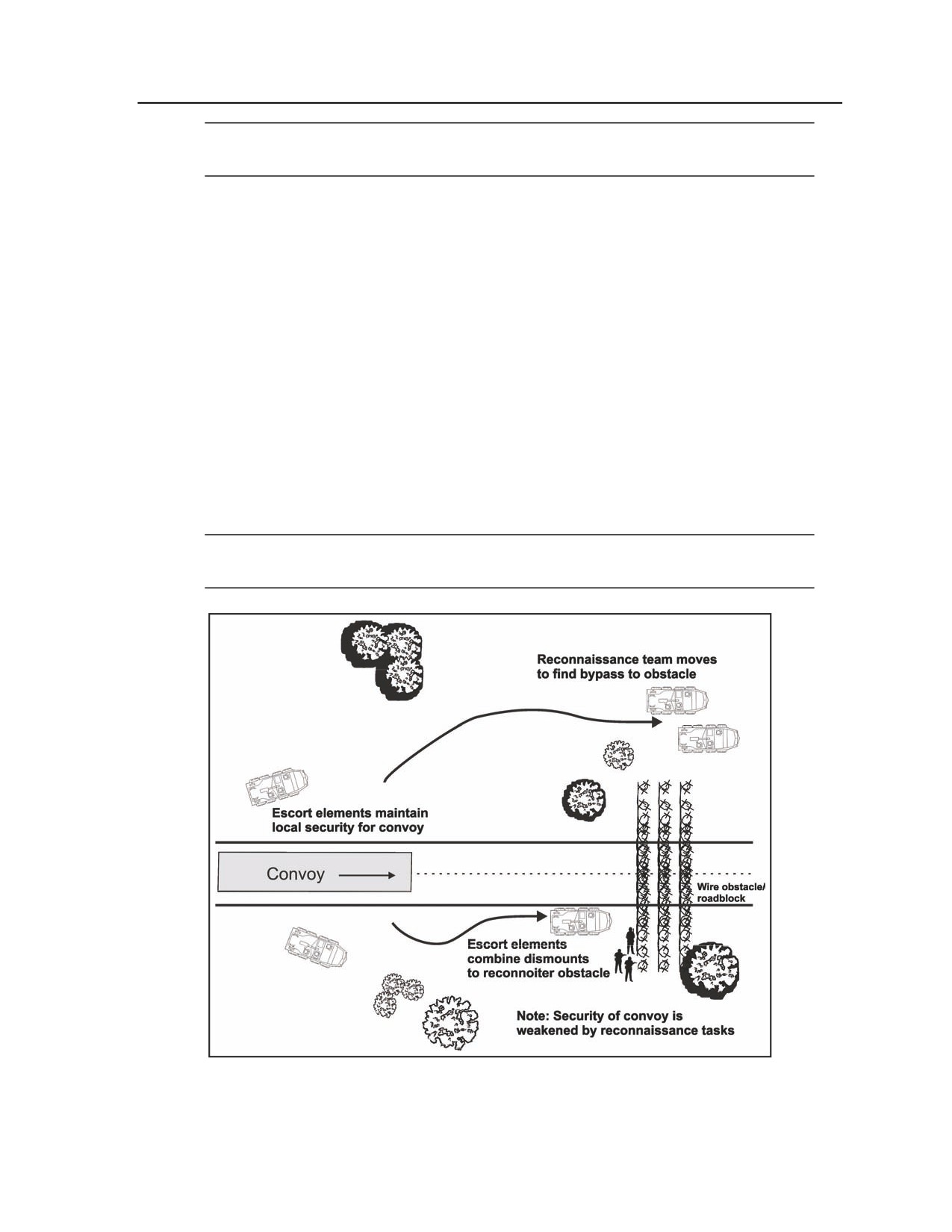
The platoon leader tasks scouts to begin reconnaissance for a bypass while maintaining 360-
degree security of the convoy (see Figure 4-36).
z
Simultaneously, an additional reconnaissance team made up of escort elements and/or
engineers moves forward to conduct an obstacle reconnaissance. Far side security will always
be established unless time and physical constraints prevent it (see Figure 4-36).
z
Once all reconnaissance is completed and reported, the convoy commander determines which
of the following COAs he will take:
Bypass the obstacle.
Breach the obstacle with the assets on hand.
Breach the obstacle with reinforcing assets.
z
The convoy commander executes the best COA and continues the operation.
Note. Direct fire assets can use high explosive
(HE), multipurpose antitank, or canister
munitions to reduce many obstacles when engineer vehicles are at risk approaching the obstacle.
Figure 4-36 Escort teams conduct obstacle reconnaissance
and reconnoiter for a bypass
3 August 2009
FM 3-20.98
4-47
Chapter 4
SECTION V - DIRECT FIRE PLANNING
4-119. Reconnaissance and scout platoon leaders plan direct fires in conjunction with development of the
estimate of the situation, completion of the plan, and during actions on contact. Determining where and
how the platoon can and will mass fires is also an essential step as the platoon leader develops his concept
of the operation.
4-120. After identifying probable enemy locations, the platoon leader determines points or areas where he
will focus combat power. His visualization of where and how the enemy will attack or defend will assist
him in determining the volume of fires he must focus at particular points to have a decisive effect. In
addition, if he intends to mass the fires of more than one subordinate element, he must establish the means
for distributing fires effectively.
4-121. Additionally, the platoon leader must evaluate the risk of fratricide and establish controls to
prevent it; these measures include designation of recognition markings, weapons control status, and
weapons safety posture.
4-122. After determining where and how he will mass and distribute fires, the platoon leader then orients
elements so they can rapidly and accurately acquire the enemy. During preparation, the platoon leader
plans and conducts rehearsals of direct fires (and of the fire control process) based on his estimate of the
situation.
4-123. The platoon leader must continue to apply planning procedures and considerations throughout
execution. He must be able to adjust direct fires based on a continuously updated estimate of the situation,
combining SA with the latest available intelligence. When necessary, he must also apply effective direct
fire SOPs, which are covered in the following discussion.
DIRECT FIRE STANDING OPERATING PROCEDURE
4-124. A well-rehearsed direct fire SOP ensures quick, predictable actions by all members of the platoon.
The various elements of the SOP are based on the capabilities of the platoon and the anticipated conditions
and situations. SOP elements should include means for focusing fires, distributing their effects, orienting
forces, and preventing fratricide. The SOP should be adjusted whenever changes to anticipated and actual
METT-TC factors become apparent.
4-125. If the engagement was not initiated by higher headquarters, the platoon begins the engagement
using this SOP. The platoon leader can subsequently use a fire command to refocus or redistribute fires.
4-126. The following paragraphs discuss specific SOP provisions for focusing fires, distributing fires,
orienting forces, and preventing fratricide.
FOCUSING FIRES
4-127. TRPs are a common means of focusing fires. One technique is to establish TRPs in relation to
friendly elements and then to consistently number the TRPs, such as from left to right. This allows leaders
to quickly determine and communicate the location of the TRPs.
DISTRIBUTING FIRES
4-128. Two useful means of distributing the platoon’s fires are engagement priority and target array. One
technique is to assign an engagement priority, by type of enemy vehicle or weapon, for each type of
friendly weapon system. The target array technique can assist in distribution by assigning specific friendly
elements to engage enemy elements of approximately similar capabilities.
ORIENTING FORCES
4-129. A standard means of orienting friendly forces is to assign a primary direction of fire, using a TRP,
to orient each element on a probable enemy position or likely avenue of approach. To provide all-around
4-48
FM 3-20.98
3 August 2009
Security Operations
security, the SOP can supplement the primary direction of fire with sectors using a friendly-based
quadrant. The following example SOP elements illustrate the use of these techniques:
z
The center (front) element’s primary direction of fire is TRP 2 (center) until otherwise
specified; the element is responsible for the front two quadrants.
z
The left flank element’s primary direction of fire is TRP 1 (left) until otherwise specified; the
element is responsible for the left two friendly quadrants
(overlapping with the center
element).
z
The right flank element’s primary direction of fire is TRP 3 (right) until otherwise specified;
the element is responsible for the right two friendly quadrants (overlapping with the center
element).
AVOIDING FRATRICIDE
4-130. A primary means of minimizing fratricide risk is to establish a standing weapons control status of
WEAPONS TIGHT, which requires positive enemy identification prior to engagement. The SOP must also
cover means for identifying friendly elements; techniques include using arm bands, medical heat pads, or
an infrared light source or detonating obscurant munitions of a designated color at the appropriate time. A
good time for minimizing the risk of fratricide in the platoon is through FBCB2 (if equipped); however,
this does not supplant the platoon leader’s responsibility to plan for fratricide avoidance.
4-131. The SOP must address the most critical requirement of fratricide prevention—maintaining SU. It
must direct subordinate leaders to inform the commander, adjacent elements, and subordinates whenever a
friendly force is moving or preparing to move.
ENGAGEMENT AREA DEVELOPMENT
4-132. The engagement area is where the platoon leader intends to destroy an enemy force using the
massed fires of all available weapons. The success of any engagement depends on how effectively the
platoon leader can integrate the obstacle plan, indirect fire plan, direct fire plan, and the terrain within the
engagement area to achieve his tactical purpose. Beginning with evaluation of METT-TC factors, the
development process covers these steps:
z
Identify all likely enemy avenues of approach.
z
Determine likely enemy schemes of maneuver.
z
Determine where to kill the enemy.
z
Emplace weapon systems.
z
Plan and integrate obstacles.
z
Plan and integrate indirect fires.
z
Rehearse the execution of operations in the engagement area.
IDENTIFY LIKELY ENEMY AVENUES OF APPROACH
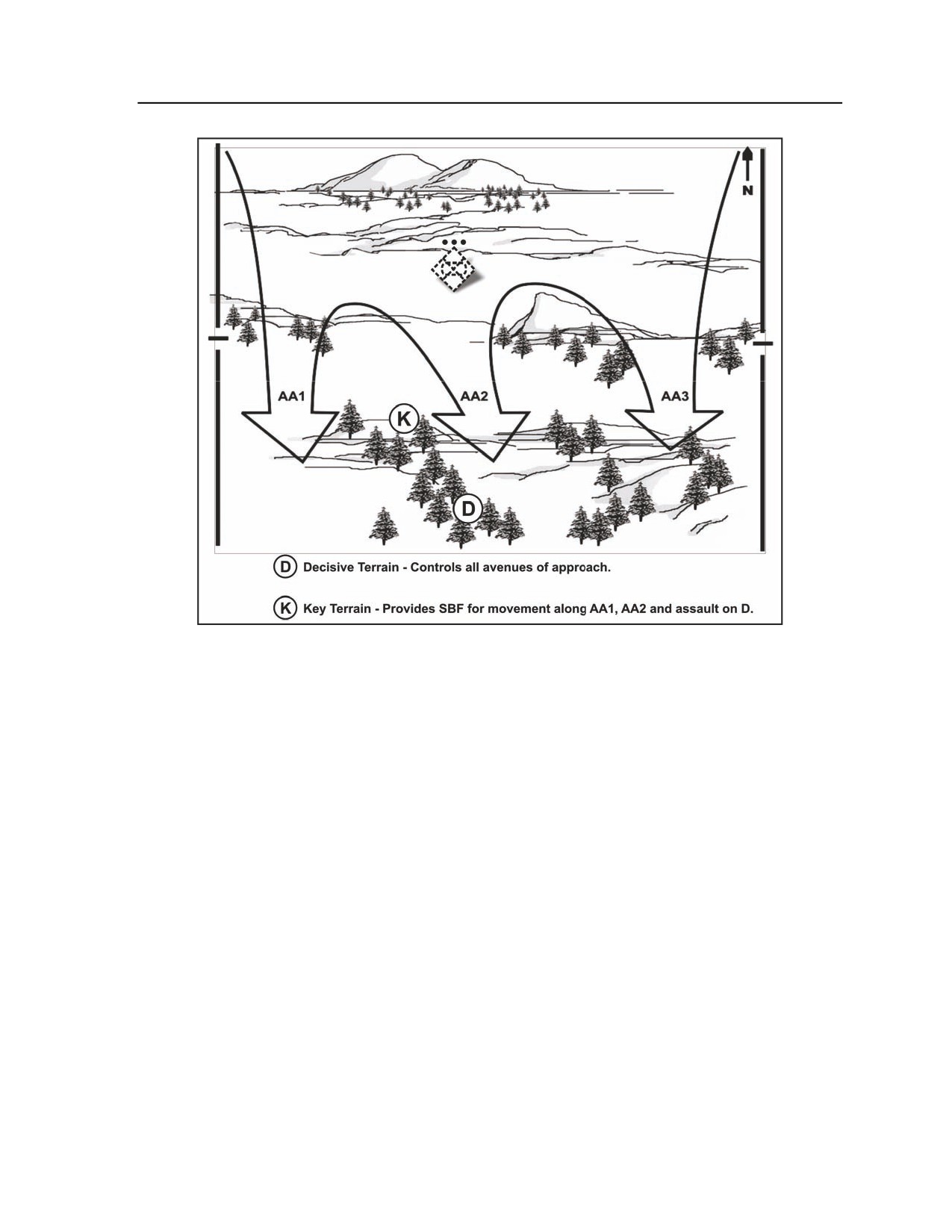
4-133. The following procedures and considerations
(see Figure
4-37) apply when identifying the
enemy’s likely avenues of approach:
z
Conduct initial reconnaissance. If possible, do this from the enemy’s perspective along each
avenue of approach into the sector or engagement area.
z
Identify key and decisive terrain. This includes locations that afford positions of advantage
over the enemy as well as natural obstacles and choke points that restrict forward movement.
z
Determine which avenues will provide cover and concealment for the enemy while allowing
him to maintain his tempo. Determine what terrain the enemy is likely to use to support each
avenue.
z
Evaluate lateral routes adjoining each avenue of approach.
3 August 2009
FM 3-20.98
4-49
Chapter 4
Figure 4-37. Likely enemy avenues of approach
DETERMINE ENEMY SCHEME OF MANEUVER
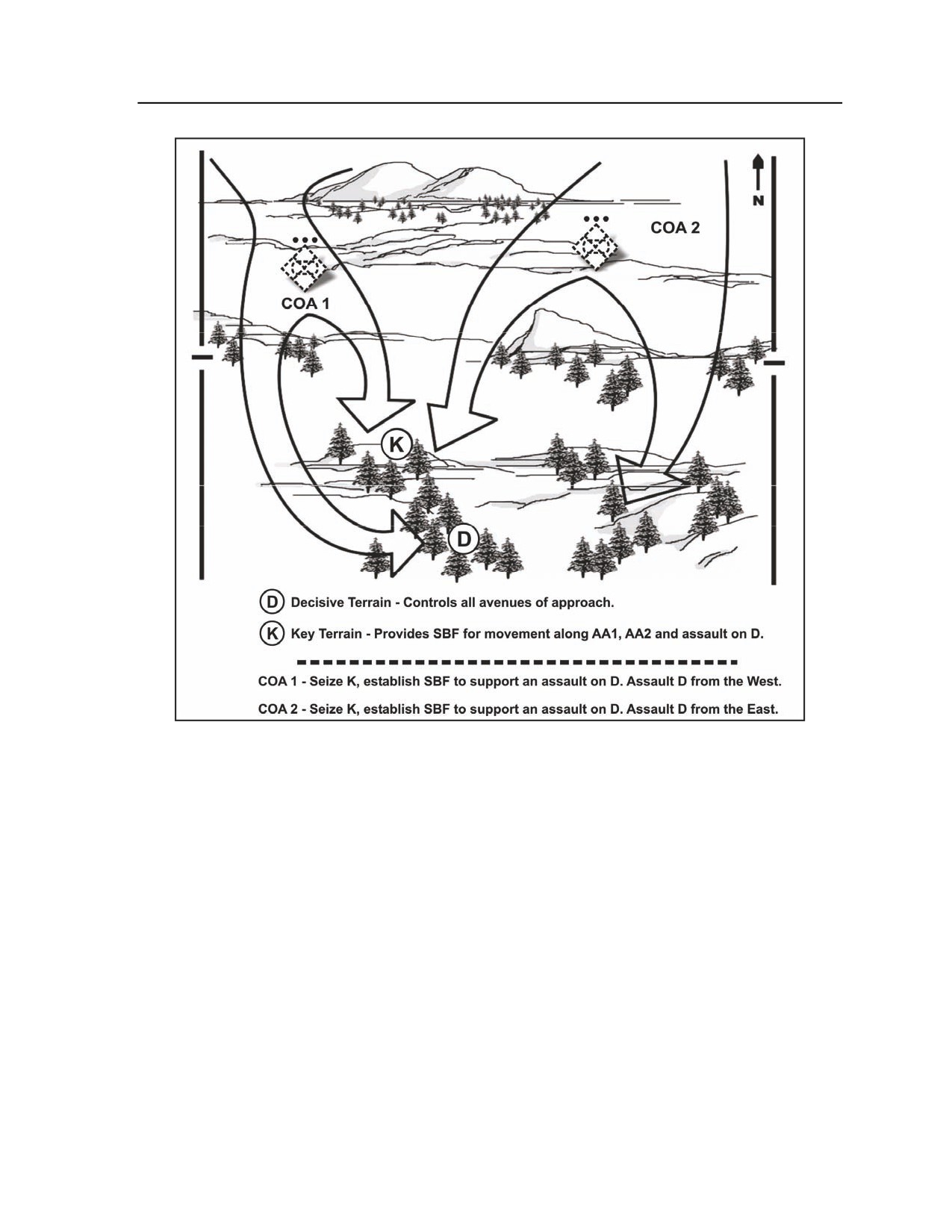
4-134. The platoon leader can use the following procedures and considerations (Figure 4-38) to determine
the enemy’s scheme of maneuver:
z
Determine how the enemy will structure the attack. In what formation will he attack? How will
he sequence his forces?
z
Determine how the enemy will use his reconnaissance assets. Will he try to infiltrate friendly
positions?
z
Determine where and when the enemy will change formations and establish support-by-fire
positions.
z
Determine where, when, and how the enemy will conduct his assault and breaching operations.
Determine likely OPs and what terrain the enemy is likely to employ for supporting fires.
z
Determine where and when he will commit follow-on forces.
z
Determine the enemy’s expected rates of movement.
z
Assess the effects of his combat multipliers.
z
Determine what reactions the enemy is likely to have in response to projected friendly actions.
4-50
FM 3-20.98
3 August 2009
Security Operations
Figure 4-38. Example enemy scheme of maneuver
DETERMINE WHERE TO KILL ENEMY
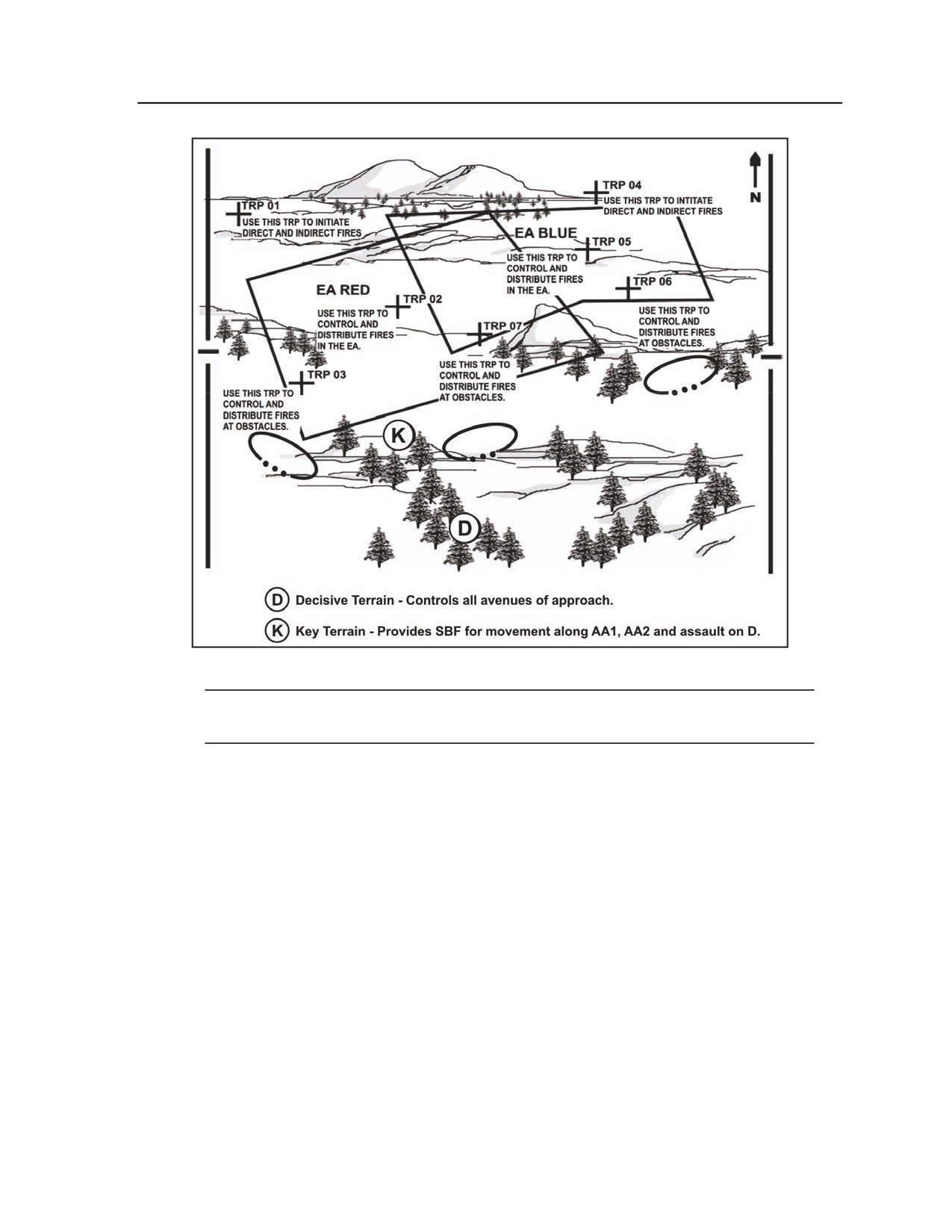
4-135. Use the following steps to identify and mark where the company and platoon will engage the
enemy (see Figure 4-39):
z
Identify TRPs that match the enemy’s scheme of maneuver, allowing the platoon to identify
where it will engage enemy forces through the depth of the sector.
z
Identify and record the exact location of each TRP.
z
Determine how many weapon systems must focus fires on each TRP to achieve the desired
effects.
z
Determine which elements will mass fires on each TRP.
z
Establish engagement areas around TRPs.
z
Develop the direct fire planning measures necessary to focus fires at each TRP.
3 August 2009
FM 3-20.98
4-51
Chapter 4
Figure 4-39. Locations to kill the enemy
Note. In marking TRPs, use thermal sights to ensure visibility at the appropriate range under varying
conditions, including daylight and limited visibility (darkness, smoke, dust, or other obscurants).
EMPLACE WEAPON SYSTEM
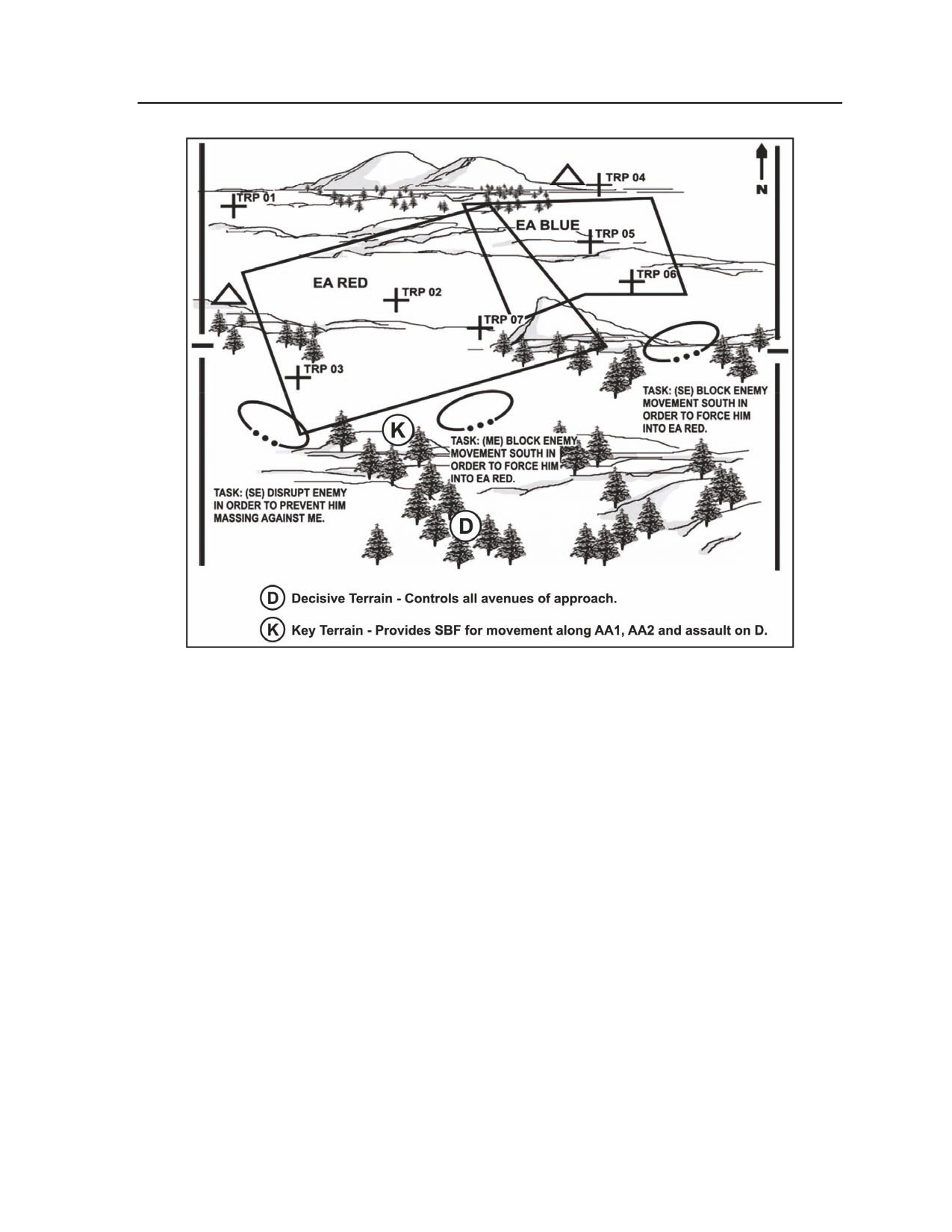
4-136. The following steps apply in selecting and improving BPs and emplacing crew-served weapon
systems and vehicle positions (see Figure 4-40 for more information):
z
Select tentative platoon BPs. (When possible, select these while moving in the engagement
area. Using the enemy’s perspective enables the platoon leader to assess the survivability of
the positions.)
z
Conduct a leader’s reconnaissance of the tentative BPs.
z
Traverse the engagement area to confirm that selected positions are tactically advantageous.
z
Confirm and mark the selected BPs.
z
Ensure that BPs do not conflict with those of adjacent units and that they are effectively tied in
with adjacent positions.
z
Select primary, alternate, supplementary, and subsequent fighting positions to achieve the
desired effect for each TRP.
z
Ensure that platoon leaders, PSGs, and squad leaders position weapon systems so that the
required number of weapons and platoons effectively covers each TRP.
4-52
FM 3-20.98
3 August 2009
Security Operations
Figure 4-40. Emplacement of weapon systems
PLAN AND INTEGRATE OBSTACLES
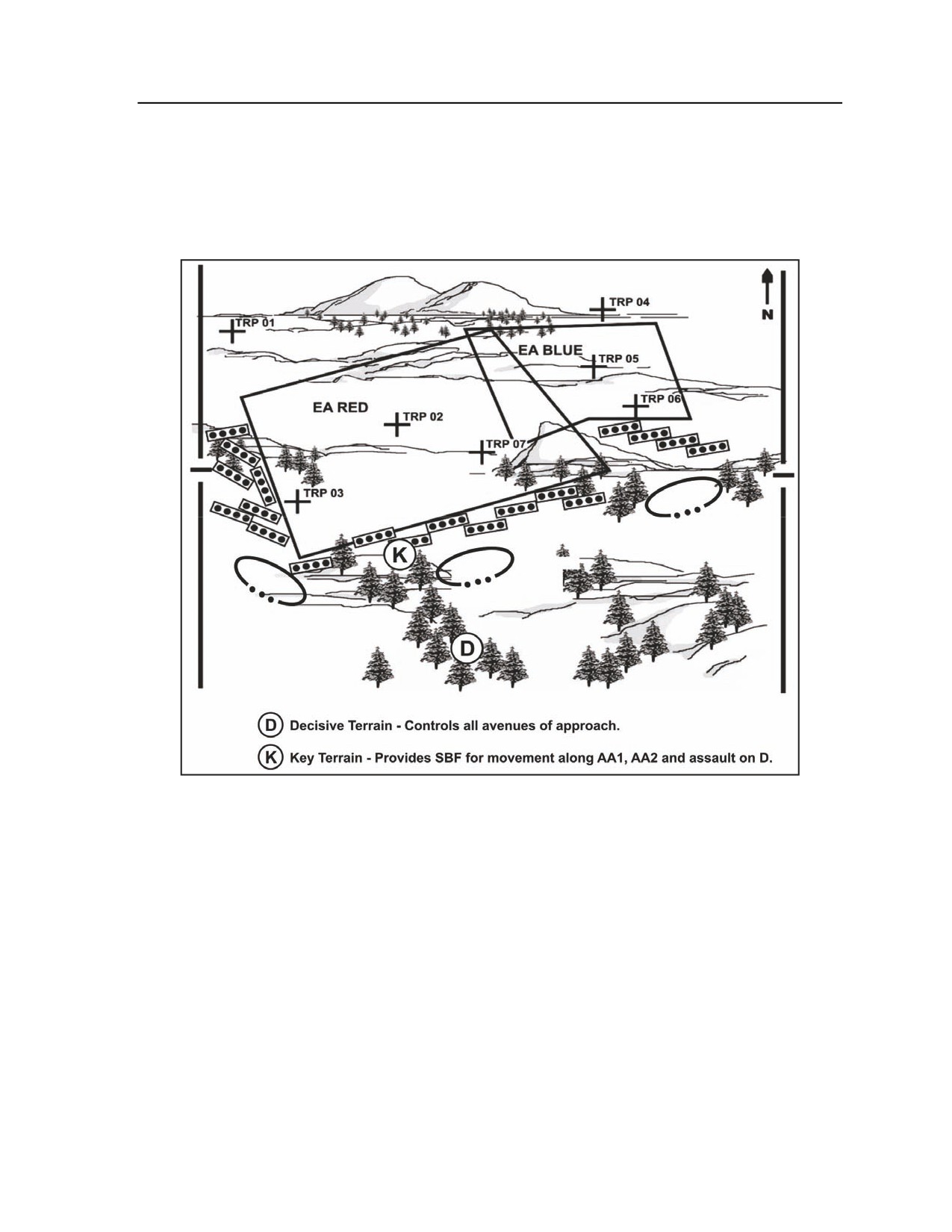
4-137. The goal of obstacle planning is to support the higher commander’s intent through optimum
obstacle emplacement and integration with fires. Obstacles must allow the enemy into the engagement area
and then fix him there. The focus at the squadron/CAB level and below is the actual integration of fires and
obstacles. At the squadron/CAB level, obstacle planning is very directive and detailed and centers on
obstacle groups. At the platoon level, obstacle planning deals with the actual sighting and emplacement of
individual obstacles within the obstacle groups. The following steps apply in planning and integrating
obstacles in the platoon defense (see Figure 4-41 for more information):
z
Understand obstacle group intent.
z
Coordinate with the engineers.
z
Site and mark individual obstacle locations.
z
Employ combat elements to provide security for the engineers as they emplace obstacles.
z
The overwatching element team marks fire control measures such as TRPs and artillery targets
in the engagement area.
z
Engineers enter the engagement area and move to the far side of the proposed trace of the
obstacle group.
z
The engineer squad/platoon leader and reconnaissance platoon leader collocate in the
defensive positions covering the obstacle.
z
Elements from the engineers move along the proposed trace of the obstacle group.
z
From the defensive position, the leaders follow the movement of the engineers, ensuring that
all points of the obstacle trace can be covered with fires.
3 August 2009
FM 3-20.98
4-53
Chapter 4
z
They maintain communications with the engineers via radio or FBCB2.
z
The platoon leader and engineer squad leader refine the obstacle plan, adjusting the position of
individual obstacles as necessary.
z
Refine direct and indirect fire control measures.
z
Identify lanes and gaps.
z
Report obstacle locations and gaps to higher headquarters.
Figure 4-41. Integration of obstacles
PLAN AND INTEGRATE INDIRECT FIRES
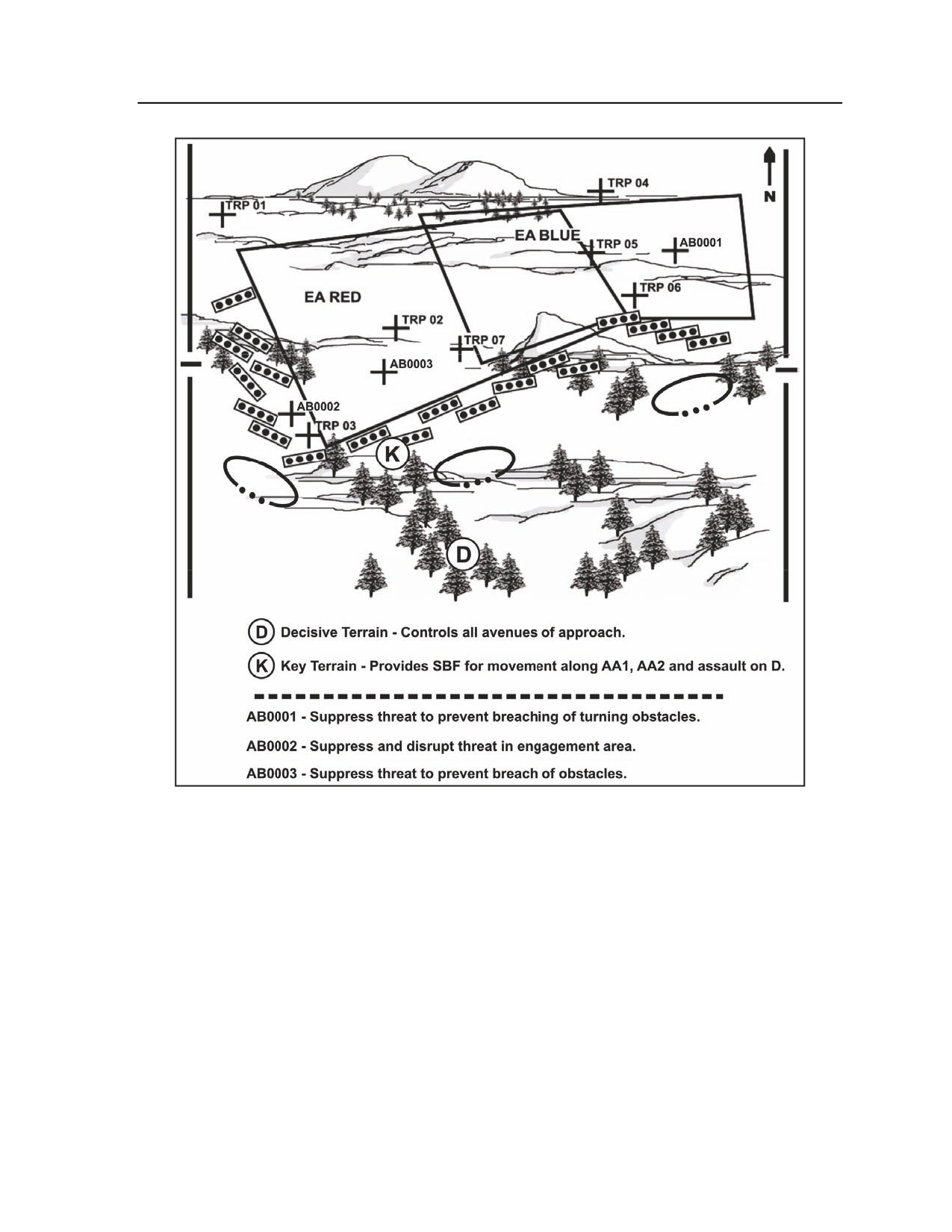
4-138. The following steps apply in planning and integrating indirect fires (see Figure 4-42):
z
Determine the purpose of fires and the essential fire support task that supports it.
z
Determine where the purpose can best be achieved.
z
Establish the observation plan, with redundancy for each target. Observers include the FIST, as
well as members of maneuver elements with fire support responsibilities such as PSGs.
z
Establish triggers.
z
Obtain accurate target locations.
z
Refine target locations to ensure coverage of obstacles.
z
Adjust artillery and mortar targets.
z
Plan FPF.
z
Request CFZs for protection of maneuver elements and NFAs for protection of OPs and
forward positions.
4-54
FM 3-20.98
3 August 2009
Security Operations
Figure 4-42. Integration of direct and indirect fires
CONDUCT AN ENGAGEMENT AREA REHEARSAL
4-139. The purpose of this rehearsal is to ensure every leader and Soldier understands the plan and all
elements are prepared to cover their assigned areas with direct and indirect fires. Although the platoon
leader has several options, the most common and most effective type of rehearsal is to replicate the enemy.
One technique for the rehearsal in the defense is to have the PSG move through the engagement area
portraying the enemy while the platoon leader and section leaders rehearse the engagement from the
platoon BP. The rehearsal should cover these actions:
z
Rearward passage of security forces (as required).
z
Closure of lanes (as required).
z
Movement from the hide position to the BP.
z
Use of fire commands, triggers, and maximum engagement lines to initiate direct and indirect
fires.
z
Shifting of fires to refocus and redistribute fire effects.
3 August 2009
FM 3-20.98
4-55
Chapter 4
z
Emplacement of scatterable mine systems.
z
Preparation and transmission of critical reports.
z
Assessment of the effects of enemy weapon systems.
z
Displacement to alternate, supplementary, or subsequent BPs.
z
Cross-leveling or resupply of Class V.
z
Evacuation of casualties (CASEVAC/MEDEVAC).
Note. The platoon leader should coordinate the rehearsal with the higher headquarters to ensure
other units’ rehearsals are not planned for the same time or location. Coordination leads to more
efficient use of planning and preparation time for all units. It also eliminates the danger of
misidentification of friendly forces in the rehearsal area, which could result in fratricide.
4-56
FM 3-20.98
3 August 2009
Chapter 5
Other Tactical Operations
In support of reconnaissance and security operations, reconnaissance and scout
platoons conduct a variety of other tactical operations such as movement, assembly
areas, linkup, relief in place, passage of lines, cordon and search, and employment of
OPs, patrols, patrol bases, and combat outposts. These operations may occur across
full spectrum operations in all conditions. They are usually conducted as part of a
tactical transition into or out of peacekeeping, peace enforcement, and full combat
operations. They are platoon-centered and establish conditions that lead to successful
accomplishment of critical tasks associated with reconnaissance and security
missions.
Contents
Section I - Platoon Tactical Movement ... 5-2
Section VII - Observation Posts
5-60
Planning and Operational
Critical Tasks
5-61
Considerations
5-2
Types of Observation Posts
5-62
Fundamentals of Movement
5-3
Positioning the OP
5-62
Danger Areas
5-7
Selecting an OP Site
5-64
Platoon Formations
5-10
Occupying the OP
5-64
Movement Techniques
5-18
Manning the OP
5-65
Actions on Contact
5-23
Improving the Position
5-66
Section II - Assembly Areas
5-42
OP Communications
5-67
Characteristics
5-43
OP Security
5-68
Quartering Party Responsibilities
5-43
Extended OP Operations
5-68
Occupation
5-44
Remote Electronic/Mechanical
Actions in the Assembly Area
5-44
Surveillance
5-78
Departing the Assembly Area
5-45
Section VIII - Dismounted Patrols
5-79
Section III - Linkup Operations
5-45
Operational Considerations
5-80
Forms of Linkup
5-45
Planning and Preparation in
Dismounted/Patrol Operations
5-80
Planning Considerations
5-46
Preparation
5-46
Movement
5-90
Execution
5-47
Actions at Danger Areas
5-96
Section IV - Relief in Place
5-47
Objective Rally Points
5-100
Reentry to Friendly Lines
5-102
Section V - Passage of Lines During
Battle Handover
5-49
Debriefing
5-103
Critical Tasks
5-49
Section IX - Patrol Bases and Combat
Preparation
5-52
Outposts
5-103
Patrol Bases
5-103
Conduct of the Passage
5-54
Combat Outposts
5-106
Section VI - Cordon and Search
5-55
Task Organization
5-55
Conduct of the Operation
5-56
3 August 2009
FM 3-20.98
5-1
Chapter 5
SECTION I - PLATOON TACTICAL MOVEMENT
5-1. To be successful, the reconnaissance or scout platoon must be able to conduct effective tactical
movement. The platoon’s ability to conduct stealthy movement, undetected by the enemy, is critical to
mission accomplishment.
PLANNING AND OPERATIONAL CONSIDERATIONS
5-2.
This section focuses on several critical aspects of tactical movement, including the following:
z
Movement fundamentals and formations. Reconnaissance and scout platoons need a thorough
understanding of the fundamentals of movement and proper employment of movement
formations. Use of formations must take into account such factors as METT-TC, applicable
troop-leading procedures, and additional assets that influence the platoon’s movement (such as
FBCB2, ground sensors, UASs, and ground surveillance systems). Reconnaissance and scout
platoons in heavy units cannot concentrate only on their own tactical movement. ACR and
HBCT platoons will operate with adjacent platoons that follow no more than one terrain feature
behind or one-half the effective range of their primary weapon systems.
Note. When the platoon rehearses movement on a sand table, supporting platoons and other
assets must be present to choreograph how the platoons and sections will operate.
z
Movement techniques. The platoon must be proficient at using the appropriate movement
technique for the specific situation. Effectively employed, movement techniques (traveling,
traveling overwatch, and bounding overwatch) allow the platoon to conduct reconnaissance
without becoming compromised. They also assist the platoon leader in achieving a number of
tactical purposes:
Minimize the platoon’s exposure to enemy observation and/or fire.
Help the platoon maintain freedom of movement by positioning the platoon to make
contact with the smallest element possible.
Maximize the number of tactical options available to the platoon.
z
Mission considerations. The platoon applies movement fundamentals, formations, and
techniques in support of its primary missions, such as reconnaissance and surveillance. It can
use an array of digital tools in the planning, preparation, and execution of these operations. Such
resources as UASs, ground surveillance system, LRAS3, and FBCB2 assist the platoon in
conducting stealthy movement and in gaining visual contact with enemy forces before they can
see the scouts. Section leaders must maintain SA specifically knowing the location of reaction
forces, what areas they can observe, what they can engage with their weapon systems, and how
they can move to support those in contact?
Note. The advantage of the LRAS3 observation range is limited to stationary observation in
open terrain.
z
Chance contact. The reconnaissance or scout platoon must take steps to minimize chance
contact with enemy forces.
Note. The use of detailed IPB (MCOO), proper movement techniques (traveling or bounding
overwatch), visual clearing of IV lines and templated danger areas, coupled with higher echelon
intelligence sources such as UASs and ground sensors, reduce the possibility of chance contact.
z
Timelines. The platoon conducts and completes tactical movement in accordance with the
timelines and operational phases directed by the higher commander.
5-2
FM 3-20.98
3 August 2009
Other Tactical Operations
FUNDAMENTALS OF MOVEMENT
5-3. Sound tactical movement is the essence of all reconnaissance and scout platoon operations.
Effectively employed, the guidelines in this section can help scouts to see the enemy first and observe it
undetected. The scouts are then able to achieve a number of tactical goals, including retaining the initiative,
confirming or denying the CCIR, and retaining freedom of movement to gain information.
USE TERRAIN FOR COVER AND CONCEALMENT
5-4. Terrain offers concealment from enemy observation and cover from enemy fires. Scouts must make
maximum use of this natural protection to survive and accomplish their mission thereby avoiding enemy
detection. Cover should be used whenever possible. When no cover is available, however, scouts should
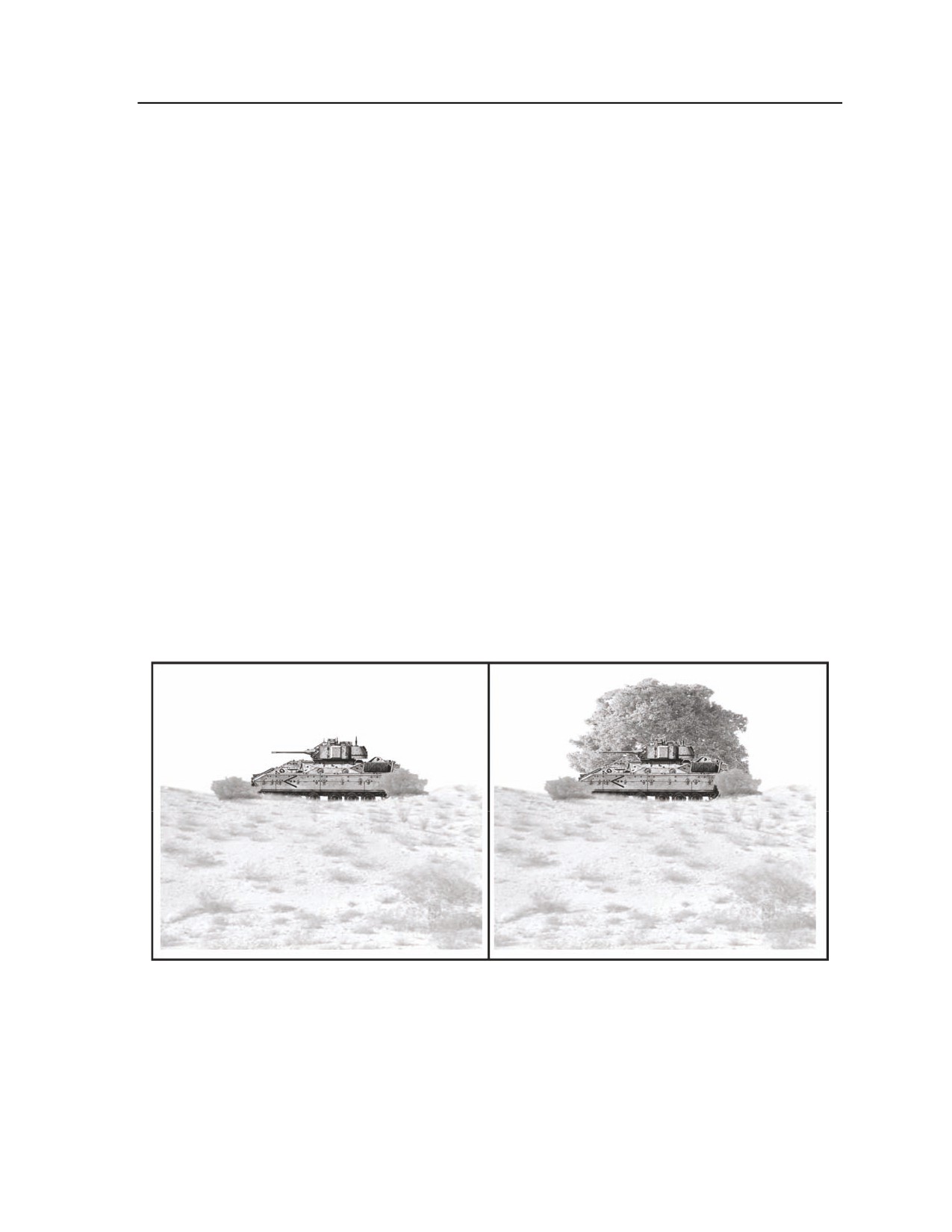
use the concealment offered by trees, shadows, brush, and man-made structures (see Figure 5-1). The crest
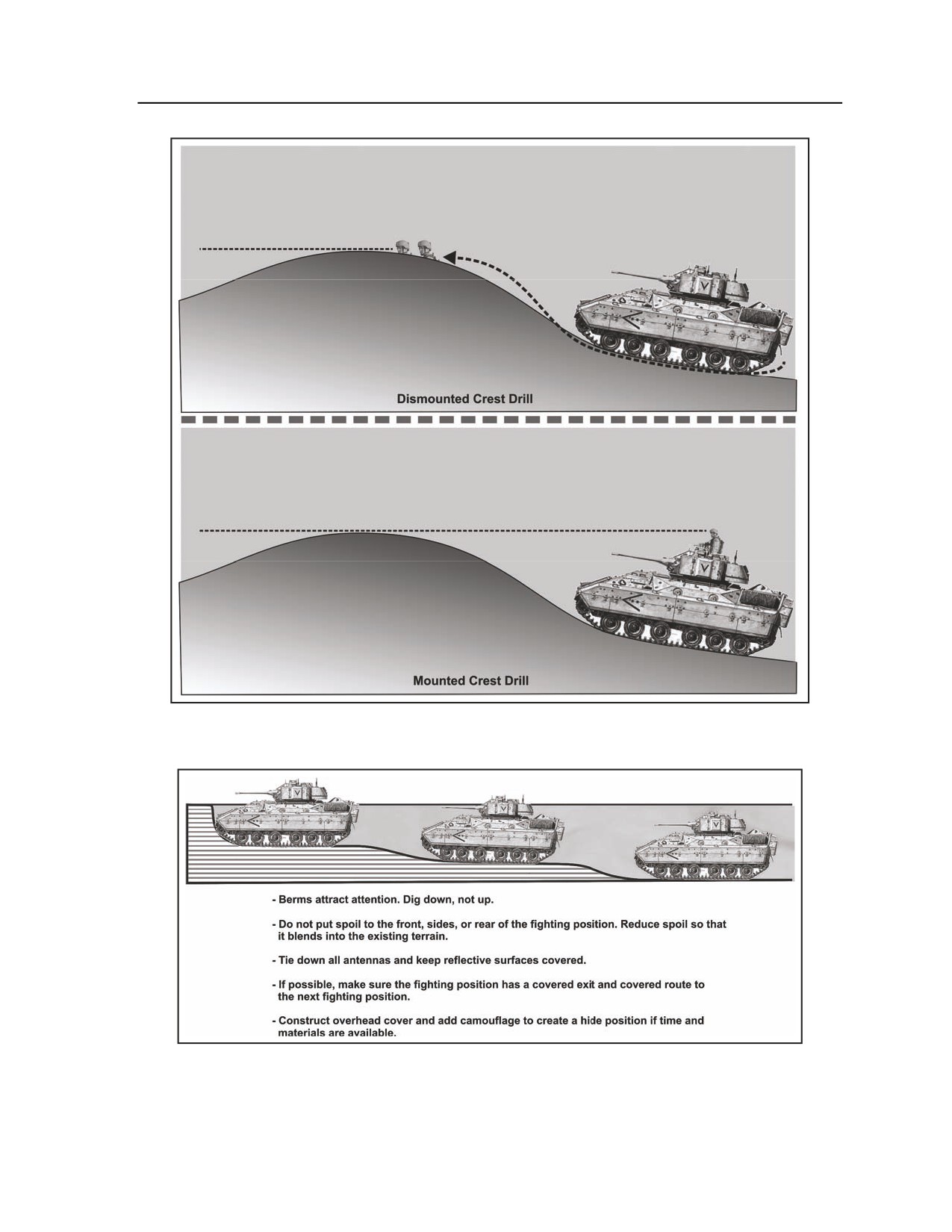
and berm drills illustrated in Figures 5-2 and 5-3 are examples of using the terrain to protect the vehicle
from enemy observation during movement.
5-5. During mounted or dismounted movement, individual vehicles and personnel should avoid becoming
silhouetted against a skyline. In addition, they should never move directly forward from a defilade position.
Direct forward movement may enable the enemy to pinpoint the vehicle and engage it as it moves. Instead,
vehicles should back up and move left or right around the previous position to get to the next position.
5-6. Despite its obvious advantage, movement along covered and concealed routes can present
disadvantages that should be considered. Movement is often slower, and leaders face more problems with
control of the moving vehicles. The traveling distance may be increased, resulting in the platoon taking
longer to get through an area as vehicles move slower and have farther to go. The possibility of being
ambushed by enemy forces increases. However, such a possibility can be mitigated through proper
movement techniques and increased security measures, if time permits (METT-TC). In most situations,
such limitations must be accepted because the accuracy and lethality of long-range weapons make
unconcealed movement too dangerous. The vehicle commander or dismounted leader must be careful to
balance the need for security with his ability to conduct required observation and reconnaissance.
Figure 5-1. Use of natural terrain for concealment
3 August 2009
FM 3-20.98
5-3
Chapter 5
Figure 5-2. Crest drills
Figure 5-3. Berm drill
5-4
FM 3-20.98
3 August 2009
Other Tactical Operations
USE CAUTION AT DANGER AREAS
5-7. Scouts must be prepared to take necessary precautions when they encounter danger areas. Based on
terrain analysis and IPB, the reconnaissance or scout platoon leader considers where enemy reconnaissance
assets will be focused and determines their fields of observation. The platoon can then avoid movement
through these areas. In addition, scouts should combine proper terrain driving techniques with carefully
selected routes to maximize security and reduce the signature of the vehicle.
5-8. The platoon should stop short of danger areas and use dismounted scouts away from the vehicles to
reconnoiter ahead of them. For example, when it encounters an open area, the platoon should send
dismounts to a concealed position where they can observe the area. From that position, scouts should
carefully check the other side of the open area for enemy positions. Vehicles provide overwatch for the
dismounts while using combat identification (CID) techniques to mitigate the risk of fratricide. The platoon
must then cross the open area quickly.
Note. Refer to the discussion of danger areas later in this chapter.
DISMOUNT VEHICLES
5-9. As a general rule, the platoon sends out dismounts in elements no smaller than two scouts. This
enhances mission accomplishment and survivability. Vehicles can be easily identified by their visual,
sound, and exhaust signatures; vehicles that can be seen, heard, or otherwise detected can be engaged and
destroyed by the enemy. Conversely, dismounted patrols and OPs are very difficult to detect. Scouts should
dismount their vehicles and use optical devices to gain information on objectives or areas of interest.
5-10. As an example, during reconnaissance operations, the scouts should dismount beyond the direct fire
range of suspected enemy positions and weapon systems. Dismounted scouts can then move in front of
their vehicles using the cover and concealment of a dismounted avenue adjacent to the mounted route.
Additionally, dismounts can occupy OPs while leaving the vehicles in hide or overwatch positions. These
basic actions enable the dismounted scouts to provide critical information while enhancing the unit’s
survivability and its ability to perform later missions.
Note. Refer to the discussion of dismounted operations later in this chapter.
REDUCE VEHICLE-RELATED SIGNATURES
5-11. The reconnaissance platform’s major signatures (audible, thermal, visual) can be reduced by shutting
off the vehicle and related systems, such as heaters or older thermal sights, whenever the vehicle is not
moving or the system is not needed. Scouts can further reduce visual and thermal signatures using these
steps:
z
Erect camouflage nets. This will help hide a stationary vehicle both visually and thermally; nets
tied to the vehicle can reduce dust and exhaust signatures, as well as reduce the thermal
signature while moving.
z
Employ camouflage material appropriately on vehicles during movement to break up the color
and silhouette.
z
Keep hatches closed and locked with safety pins to reduce noise and light signatures. Mask
internal lights from outside observation.
z
Prevent white light displays at night.
z
Leaders conduct external PCIs of vehicles using NODs to spot-check friendly light signatures.
z
Reduce vehicle glass reflection from periscopes and windows by removing, covering, or
camouflaging them (placing a net over the windshield, for example).
Note. To prevent fratricide situations, ensure combat identification markers are not degraded.
3 August 2009
FM 3-20.98
5-5
Chapter 5
DANGER AREAS
5-12. During the execution of reconnaissance and security missions, scouts will encounter danger areas,
which are specific types of terrain features or areas that expose them to enemy fire. These danger areas are
likely points of enemy contact due to the reconnaissance platoon’s inherent vulnerabilities and enemy
cover, concealment, and observation. Danger areas should be identified and highlighted when the platoon
leader performs his map reconnaissance and IPB during troop-leading procedures. Once these areas are
identified, the platoon leader can plan for specific reconnaissance methods and movement techniques to
move through these areas quickly with maximum security. Danger areas should be included in all phases of
the maneuver rehearsal by the squads, sections, and the platoon as a whole.
OPEN AREAS
5-13. Open areas frequently allow the reconnaissance or scout platoon to observe the enemy or objectives
from long range. Conversely, these areas often expose the platoon to possible enemy observation and fire
for long periods of movement. The platoon, therefore, must make maximum use of the terrain and employ
its powerful optics and effective observation techniques to avoid exposing itself.
5-14. Before moving across a large open area, the platoon must make a thorough visual scan of the area.
This should be done both dismounted and mounted. The platoon leader must use all available optics and
other assets, including UASs, LRAS3, and ground surveillance systems to reconnoiter the open area and
find a bypass. If a bypass cannot be found, he focuses not only on finding potential enemy positions, but
also on locating covered and concealed routes to facilitate movement. If time and terrain permit,
dismounted scouts may be used to move to the far side of the open area and secure it. In very large open
areas, use of dismounts may not be feasible because of the distances between covered and concealed
positions; UASs can perform observation tasks for the dismounts. Many platforms employ integrated sight
units that can assist the platoon in scanning for threats at extended ranges and provide accurate fires to
protect scouts as they advance.
5-15. Once the area has been reconnoitered using visual, digital, and sensor enablers, the scouts move
across it using bounding overwatch because of the possibility of enemy contact. If the open area is very
large, the overwatch element should only remain stationary until the bounding element has moved a
distance equal to half the effective range of the overwatching element’s weapon system. When that point is
reached, the overwatch element must move out, even if the bounding element has not yet reached a
position of cover and concealment.
5-16. When the platoon must move across large open areas with limited cover and concealment, indirect
fire can provide concealment with obscurant munitions. Concealment with obscurants is limited when the
enemy is equipped with thermal sights. Reconnaissance by fire is an acceptable method of mitigating risk
when crossing the danger area. However, leaders must adhere to the ROE and weapons control status when
using this method.
WOODED AREAS
5-17. Wooded areas present security challenges for armored vehicles, creating opportunities for enemy forces
on the ground to attack, disable, and even destroy a vehicle from a blind spot. These areas provide a high
degree of concealment to forces that occupy them, particularly dismounts. They must be approached and
moved through with extreme caution. Visibility within wooded areas is very limited; therefore,
reconnaissance is confined primarily to trafficable routes and trails through the forest. In densely wooded
areas, mounted scouts are extremely vulnerable to dismounted enemy forces that can close on them
undetected.
5-18. Platoon leaders must plan for the increased need for security when operating in the restricted
environment of a wooded area. Scouts should use available terrain to scan the wooded area before entering.
They should search for movement, reflections, smoke, and any irregular shapes or colors indicating
camouflage. Scouts scan the ground to detect signs or patterns indicating enemy movement or activity to
prevent chance encounters with obstacles, antitank ambushes, and IEDs. Whenever possible, scouts
5-6
FM 3-20.98
3 August 2009
Other Tactical Operations
reconnoiter the entire wood line with dismounts prior to mounted movement to the wooded area. Foliage in
wooded areas can conceal the enemy from UASs.
5-19. The scouts should move mounted to the wooded area using bounding overwatch. Once the vehicles
are positioned inside the wood line (approximately 100 to 200 meters), the scouts shut off the engines,
establish dismounted security, and conduct a listening/security halt. Crewmen wearing combat vehicle
crewman helmets remove them. Radio speakers are turned off. The halt should last approximately one to
two minutes, with 360-degree security maintained throughout. Similar halts must be conducted at regular
intervals during movement through the wooded area (approximately every kilometer). At the same time,
because reconnaissance vehicles are most vulnerable in wooded areas when stopped, halts should be kept
to a minimum.
5-20. During movement through a wooded area, scouts should move using traveling overwatch. This
technique is appropriate because of the extremely short fields of view and the danger of dismounted ambush.
Exposed scouts should maintain a minimum silhouette in their vehicles because of the danger from snipers and
ambush. Adjacent elements overwatching the platoon as it moves will be affected by the shorter engagement
distances as well.
5-21. Scouts may encounter small clearings, buildings, or hills while moving through a wooded area. Each
must be treated as a separate danger area. Small clearings may require crossing in the same manner as a
large open area. Isolated buildings must be secured by dismounted scouts; these areas offer invaluable
movement lanes for the enemy to move into cleared areas behind scouts and attack without warning. Hills
and curves must be approached cautiously; dismounted scouts must clear any dead space.
5-22. Before leaving a wooded area, scouts must clear the open area to the front. They stop inside the
wood line (ensuring they are still within the shadow line of the woods). Engines are turned off, and
dismounted scouts move to the edge of the wooded area to observe. If the area is determined to be clear,
vehicles move forward to establish OPs. As the dismounts remount, the crews use their vehicle optics to
visually clear the open area. Once completed, the scouts resume movement using the appropriate
movement technique.
URBAN AREAS
5-23. Detailed reconnaissance of urban areas during MCO is extremely difficult for reconnaissance and
scout platoons. Urban areas, including towns and villages, pose numerous dangers, especially if the enemy
is occupying the urban area in strength. Troops can be garrisoned in villages, snipers can dominate
approaches, and buildings and roads can be mined with anti-handling devices. Debris can conceal IEDs
against buildings and in the street, creating threats and obstacles to mounted and dismounted movement.
Cover and concealment are abundant for both friendly forces and the enemy, creating situations where the
enemy remains undetected until scouts close to a very close range. Urban areas are ideal for effective
ambush by small numbers of dismounts. Scouts must take steps to counter these dangers and ensure local
security.
5-24. Whenever possible, scouts should initially observe urban areas from a distance and from multiple
vantage points. The use of UASs in areas forward of the platoon allows observation beyond the platoon’s
line of sight (LOS).
5-25. The scouts should collect tactical information and HUMINT before they enter the urban area. They
look for movement and evidence of enemy occupation, including track marks on pavement; lack of civilian
activity; and sandbags, stakes, timber, intentional building damage, or any other sign of prepared fighting
positions and obstacles. In some cases, HUMINT, CA and/or MI teams can gather enemy information from
the local population before the platoon moves in.
5-26. Scouts move through the area using either traveling or bounding overwatch (based on METT-TC
factors), ensuring that vehicles remain in mutual support and maintain 360-degree security. Once in the
town, all scouts must be alert to additional signs of enemy activity. Tactical evidence can include—
z
Tactical markings or signaling devices.
z
Antennas.
3 August 2009
FM 3-20.98
5-7
Chapter 5
z
Spent shell casings.
z
Pyrotechnics.
z
Damage to buildings and streets.
5-27. Nontactical evidence may include—
z
Medical supplies.
z
Civilian communications equipment such as—
Cell phone boxes.
Additional batteries.
Computers connected to the internet.
5-28. Dismounts can reconnoiter major intersections ahead of vehicles and provide security during halts,
such as conducting overwatch from building rooftops or windows. Normally, scouts do not have the
manpower or time to clear buildings. They can, however, be employed dismounted for limited search and
secure tasks as needed to support the movement of the mounted element or a particular reconnaissance
mission. Mounted vehicle crews must reduce their silhouette to a minimum when moving through a town.
5-29. As the platoon approaches the far side of the urban area, scouts are employed to reconnoiter the area
for enemy movement. The platoon should stop short and move dismounts to the edge of town. The
dismounts with overwatch responsibilities secure the local area and observe the open area beyond the
town; the platoon should also use such assets as UASs to observe this area. When this reconnaissance has
been completed, the vehicles move forward and continue to observe from covered and concealed positions
while the dismounted elements remount. The platoon is then prepared to continue its mission.
LATERAL OR BOUNDARY ROUTES
5-30. As the platoon executes reconnaissance and security missions, it will encounter routes or mobility
corridors that provide access into the terrain between the platoon and friendly elements to its flanks and
rear. These lateral mobility corridors pose a security threat to both the platoon and the other friendly
elements. These corridors allow the enemy and scouts to move into the terrain around the platoon flanks
unobserved. Leaders coordinate operations with adjacent units to prevent confusion, fratricide, or possible
enemy exploitation. Scouts should not reconnoiter lateral routes beyond one half the distance of the
maximum effective range of overwatching weapon systems.
5-31. It is critical that the scouts maintain continuous surveillance of these mobility corridors to protect
against infiltrating enemy forces. If necessary, the platoon can use a series of contact points and/or
coordination points to enhance security during movement through the area. UASs can monitor areas
already cleared by scouts and assist in mitigating enemy infiltration between adjacent elements.
5-32. To maintain surveillance of areas along known or suspected paths of enemy travel, the platoon can
establish outposts to maximize the reconnaissance effort forward. This security technique uses short-
duration OPs consisting of two Soldiers with equipment. A section or squad should deploy an outpost
when it is at risk of losing observation on a possible enemy approach route that no other element can
observe. Once deployed, the outpost maintains surveillance of the avenue of approach until the rest of the
reconnaissance or scout element returns. In doing so, the outpost can provide security through early
warning of enemy activity that the mounted element would not have detected.
PLATOON FORMATIONS
5-33. During either mounted or dismounted movement, the reconnaissance or scout platoon employs
combat formations when the terrain and enemy situation supports their use or when the mission or
reconnaissance objective is precisely focused, such as in a route reconnaissance.
5-34. The seven mounted reconnaissance platoon formations—line, vee, column, staggered column, coil,
herringbone, and wedge—are intended to be flexible. They can be modified to fit the situation, terrain, and
5-8
FM 3-20.98
3 August 2009
Other Tactical Operations
combat losses; however, they do not have exact geometric dimensions and design. Transition into and out
of the various formations must be second nature to each squad.
Note. The following formation examples are based on the Stryker reconnaissance platoon. Six-
vehicle platoons are shown when the additional vehicles create significant differences. Platoons
must include their attachments during rehearsals so these elements understand how they are
expected to move during transition between formations.
LINE FORMATION
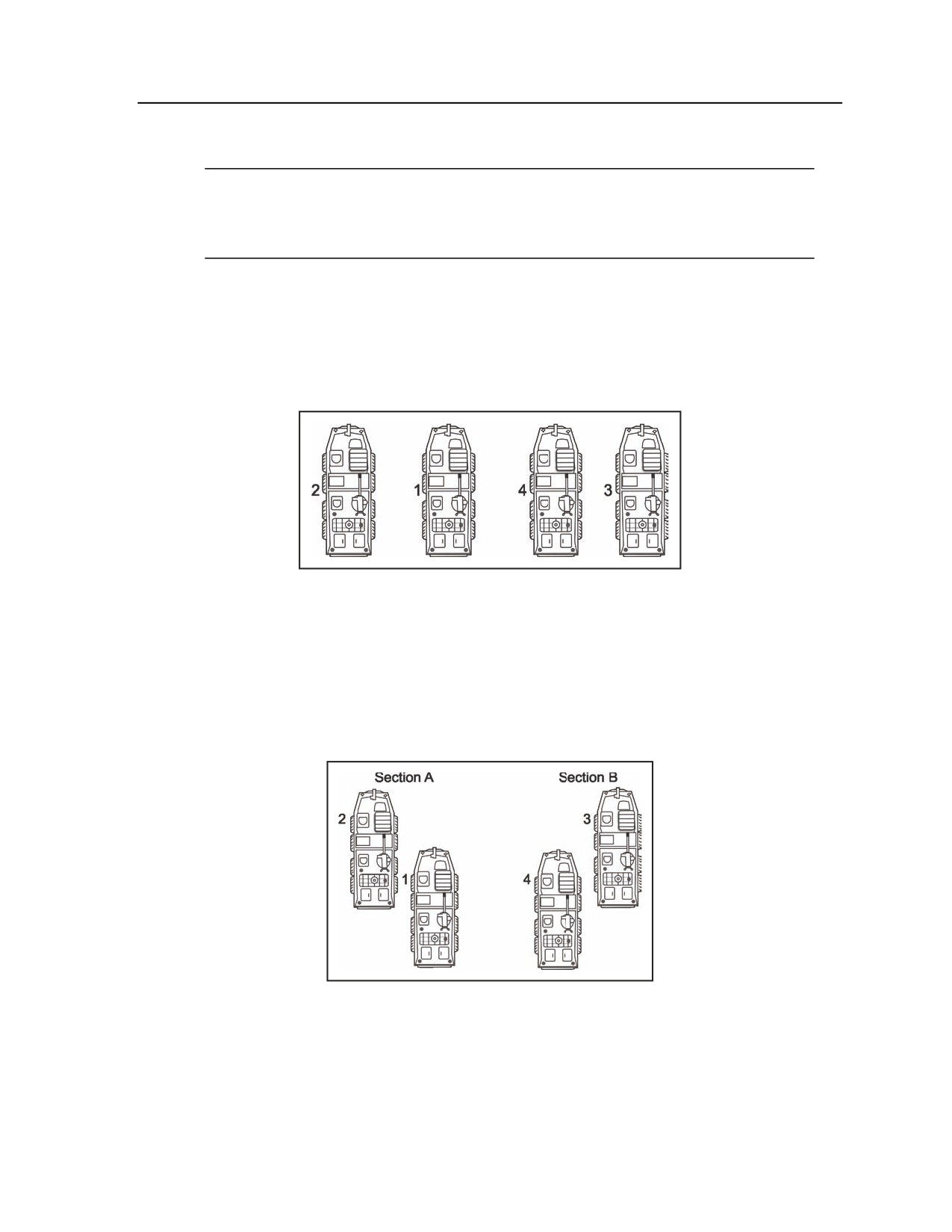
5-35. This formation (see Figure 5-4) can be used regardless of the platoon organization and is applicable
to most reconnaissance or scout platoon missions. It allows maximum reconnaissance forward and covers a
wider AO. It also requires the platoon to have some form of overwatch because vehicles can only provide
local security.
Figure 5-4. Line formation (SBCT reconnaissance platoon)
VEE FORMATION
5-36. The vee formation, illustrated in Figures 5-5 through 5-7, uses the two-section organization. The
platoon maintains relative positioning based on terrain and combat losses. The vee lends itself to immediate
mutual support and provides depth; it is very flexible. Using any of the techniques of movement, the two
forward vehicles perform most of the information gathering and reporting. The rear vehicles provide
overwatch and C2 (the reverse applies when scouts conduct route reconnaissance).
Figure 5-5. Vee formation (SBCT reconnaissance platoon)
3 August 2009
FM 3-20.98
5-9
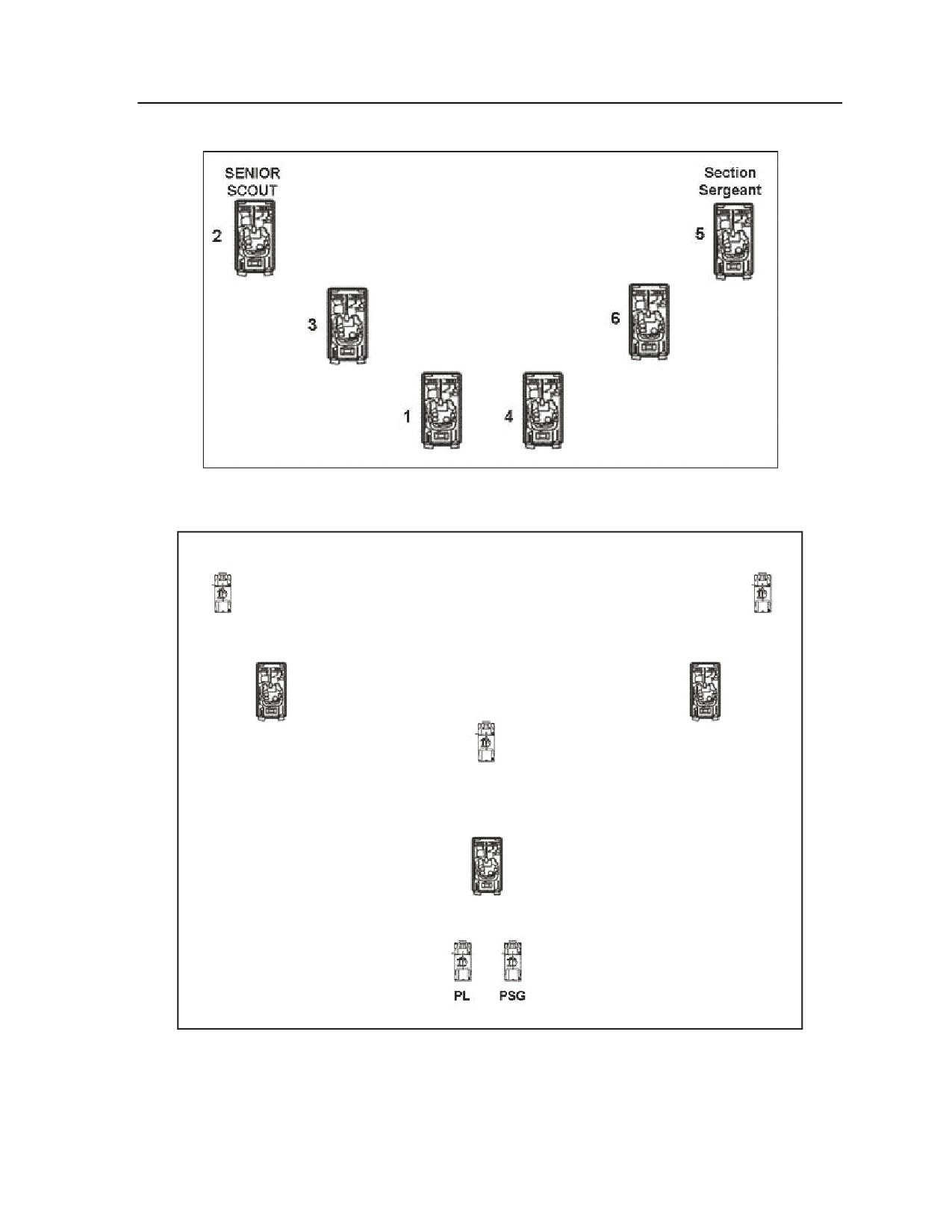
Chapter 5
Figure 5-6. Vee formation (ACR scout platoon)
Figure 5-7. Vee formation (HBCT reconnaissance platoon)
5-10
FM 3-20.98
3 August 2009
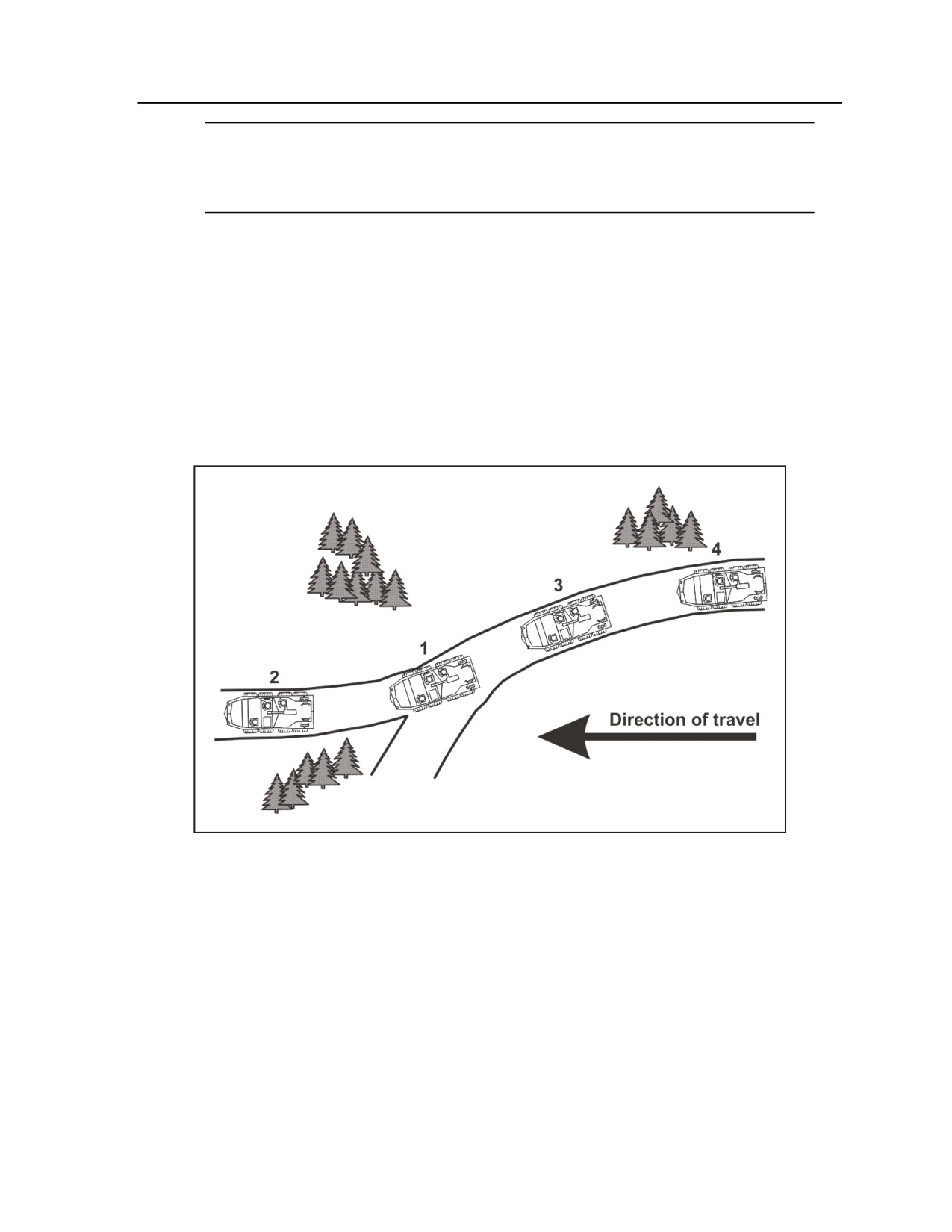
Other Tactical Operations
Note. In situations where enemy contact is likely with a heavily equipped enemy, the CFVs
may be the lead element, followed by the wheeled elements. This alignment provides added
security to the wheeled elements and enables them to displace rapidly. It also allows the wheeled
elements to provide early warning and to ascertain enemy composition/disposition.
COLUMN FORMATION AND STAGGERED COLUMN FORMATION
5-37. The platoon uses the column formation when speed is essential as it moves on a designated route
(see Figures 5-8 through 5-10). The column offers good fields of fire to the flanks, but little to the front and
rear. Normally, the platoon leader briefs the section leaders on the route and speed and then allows the lead
section to control the column movement. This enables the platoon leader to concentrate on the subsequent
mission, enhancing C2. However, the platoon leader still has the responsibility of tracking the movement
of the platoon.
5-38. The order of march in the column may depend on which organization the platoon will use at the end
of the movement; in addition, the lead section may vary based on METT-TC considerations. When
conducting movement in a secure area, it is appropriate to specify the order of march by SOP.
Figure 5-8. Column formation (SBCT reconnaissance platoon)
3 August 2009
FM 3-20.98
5-11
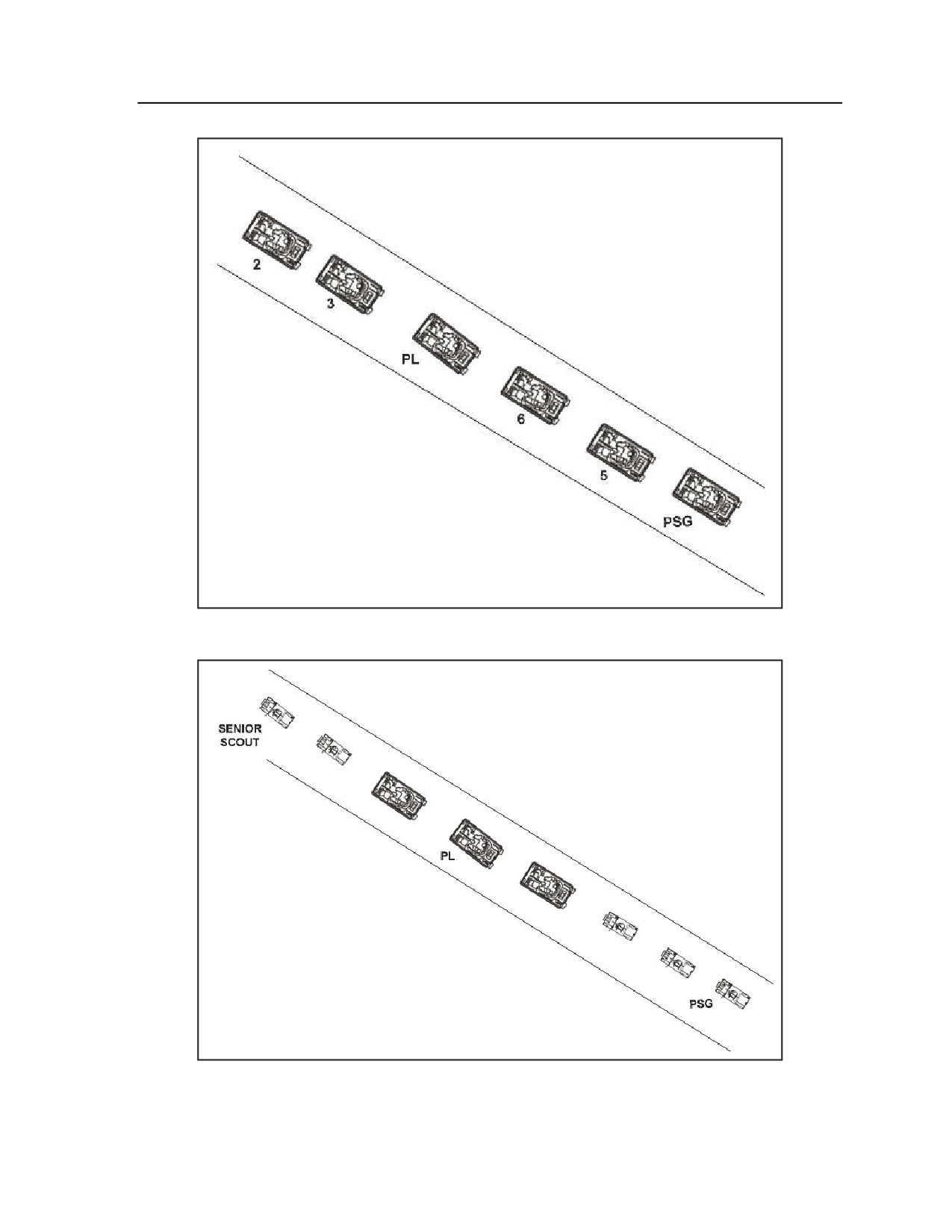
Chapter 5
Figure 5-9. Column formation (ACR scout platoon)
Figure 5-10. Column formation (HBCT reconnaissance platoon)
5-12
FM 3-20.98
3 August 2009
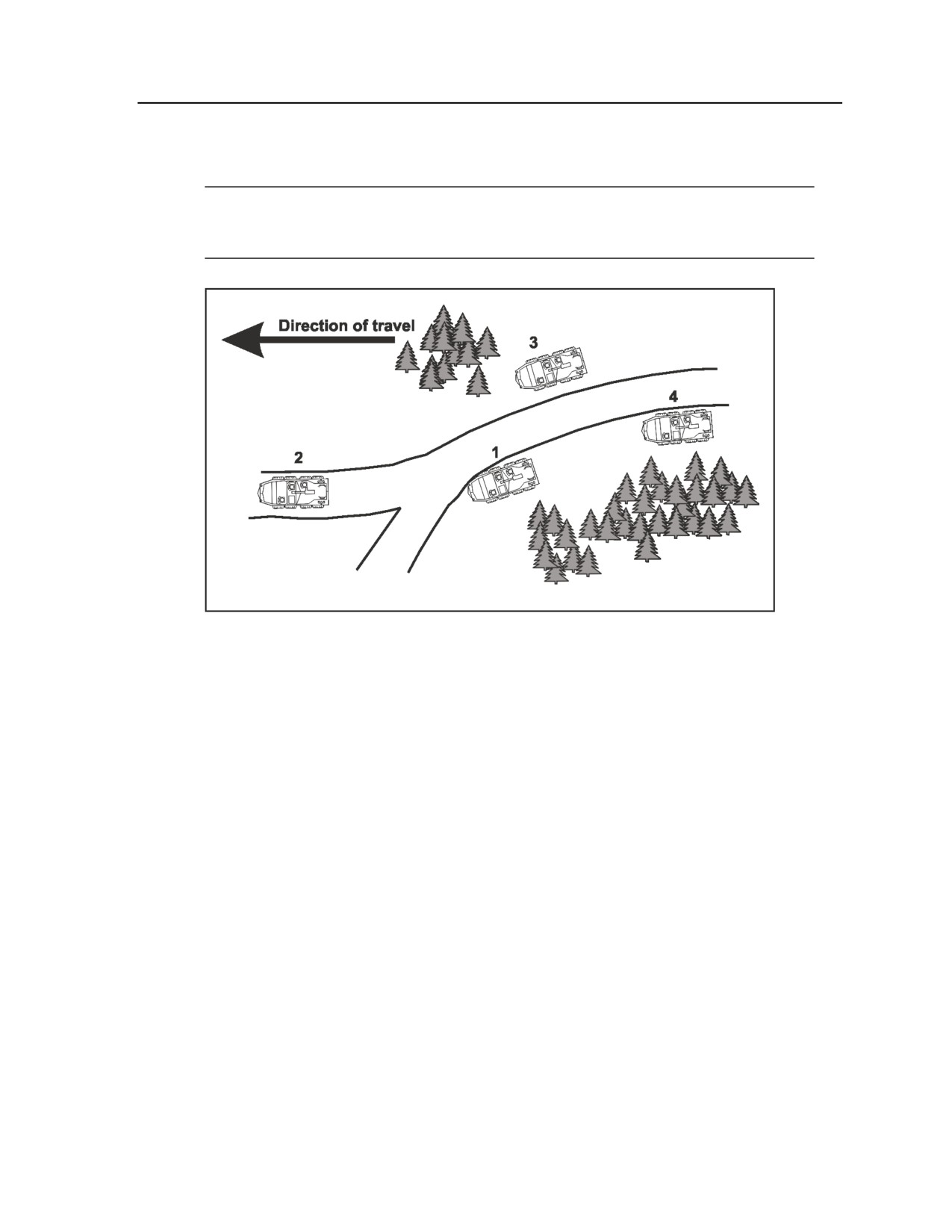
Other Tactical Operations
5-39. The staggered column is used for rapid movement across less restrictive terrain. It affords all-around
observation and fields of fire. Figure 5-11 shows the platoon in the staggered column in a two-section
organization with Section Alpha leading.
Note. In the current OE, explosive devices and mines are often positioned just off the roadway.
Platoons must exercise caution when they use the staggered column to avoid driving on or just
beyond the road shoulder.
Figure 5-11. Staggered column formation (SBCT reconnaissance platoon)
COIL FORMATION
5-40. The platoon coil is used to provide all-around security during halts. Each vehicle has a particular
position to occupy in the coil. The platoon leader designates the orientation of the coil using a cardinal
direction; in the absence of orders, the direction of travel becomes 12 o’clock. The platoon must develop a
coil SOP based on its mission essential task list, war plans, and most frequently used organizations. It
should rehearse the SOP as a drill so that correct execution of the coil becomes automatic.
5-41. The coil is usually executed from the column or staggered column, with the lead vehicle occupying the
12 o’clock position. The other vehicles occupy the clock positions in accordance with the order of march.
Vehicles are positioned 100 to 150 meters apart. Examples are illustrated in Figures 5-12 through 5-14.
3 August 2009
FM 3-20.98
5-13
Chapter 5
Figure 5-12. Coil formation (SBCT reconnaissance platoon)
Figure 5-13. Coil formation (ACR scout platoon)
5-14
FM 3-20.98
3 August 2009
Other Tactical Operations
Figure 5-14. Coil formation (HBCT reconnaissance platoon)
Note. Vehicle numbers may vary from unit to unit.
HERRINGBONE FORMATION
5-42. The herringbone is used to provide 360-degree security during a temporary halt from a march
column (see Figure 5-15). Scouts should dismount to provide greater security. The formation may be
widened to permit passage of vehicles down the center of the column. All vehicles should move completely
off the road if terrain allows.
Note. As with the staggered column formation, platoons must exercise caution when they use
the herringbone to avoid explosive devices and mines that may be emplaced just off the
roadway.
Figure 5-15. Herringbone formation (SBCT reconnaissance platoon)
3 August 2009
FM 3-20.98
5-15
Chapter 5
WEDGE FORMATION
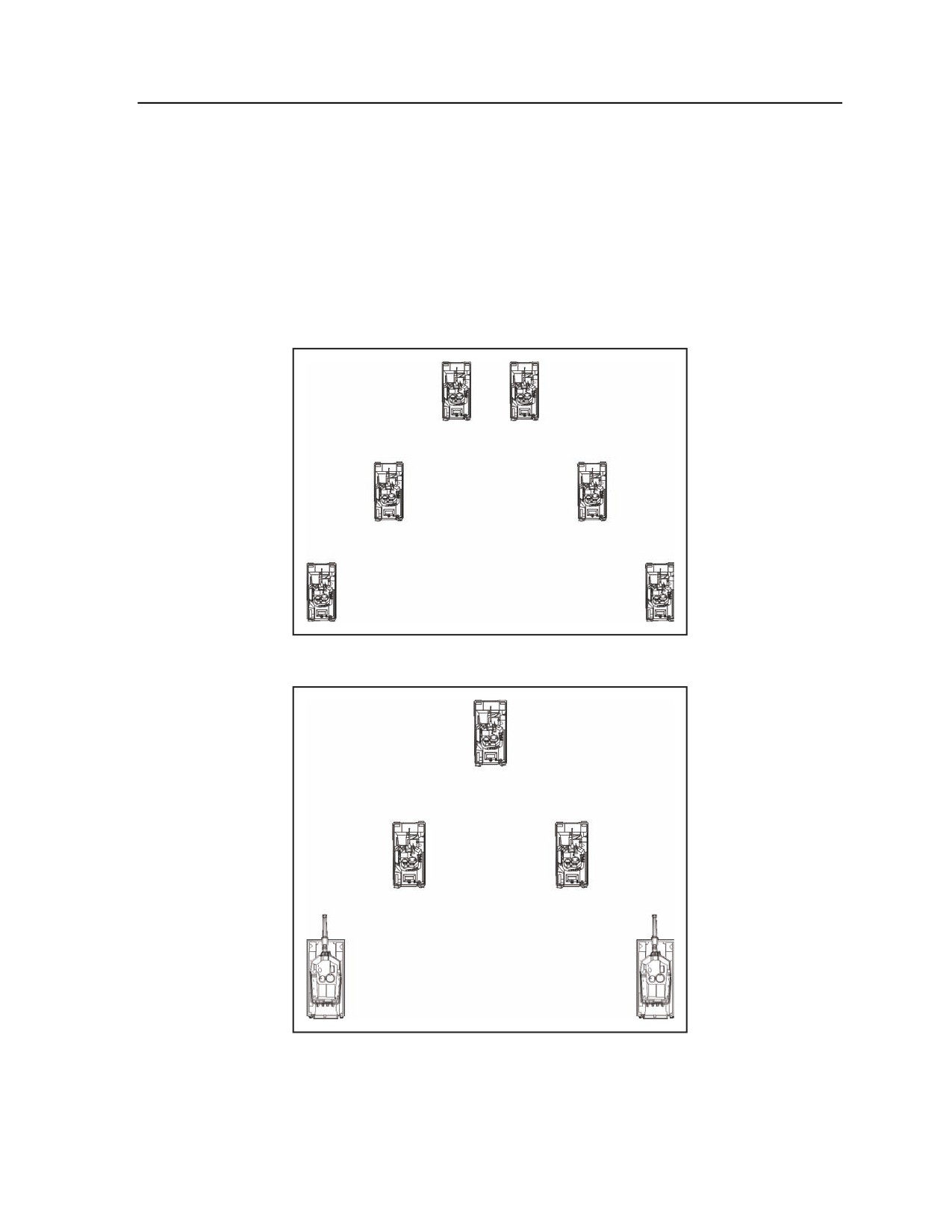
5-43. The wedge formation is primarily used by ACR scout platoons. Though not ordinarily a typical
reconnaissance formation, it may be used when enemy contact is likely and the platoon must fight for
information. The wedge can be formed with six-, three-, or two-vehicle organizations. This formation
allows for firepower to be focused forward or shifted to either flank. In the event the platoon makes enemy
contact while moving, the wedge formation permits the platoon to gain contact with the smallest possible
maneuver element—the section. The wedge formation also greatly improves the CFV platoon’s ability to
fight when the platoon is augmented with tanks as hunter-killer teams. Hunter-killer teams are generally
organized with a three-CFV vehicle section accompanied by a two-tank section. The enemy situation will
dictate whether the CFV or tank section leads the formation. Examples are shown in Figures 5-16 and 5-
17.
Figure 5-16. Wedge formation (ACR scout platoon)
Figure 5-17. Wedge formation (CFVs and tanks
task organized in an ACR troop/platoon)
5-16
FM 3-20.98
3 August 2009
Other Tactical Operations
MOVEMENT TECHNIQUES
5-44. As noted earlier in this section, the reconnaissance or scout platoon employs movement techniques
for a number of reasons (to minimize exposure, maintain freedom of movement, maximize available
tactical options, and react effectively to contact). Effectively employed, movement techniques allow the
platoon to find and observe threats without being compromised.
TACTICAL CONSIDERATIONS
5-45. In conducting either mounted or dismounted movement in the AO, the reconnaissance or scout
platoon uses three movement techniques: traveling, traveling overwatch, and bounding overwatch. These
techniques provide a standard method of movement, but the platoon leader must use common sense in
employing them as he performs his missions and encounters different situations. The decision of which
technique to use is based in large part on the likelihood of enemy contact; in general, this can be
summarized as whether contact is not likely (traveling), possible (traveling overwatch), or expected
(bounding overwatch). Terrain considerations may also affect the choice of movement technique.
5-46. In most tactical missions, the platoon will move as separate sections or squads under the C2 of the
platoon leader. Leaders, particularly at the section level, should employ a degree of overwatch when enemy
contact is possible. Regardless of which technique is used, the section leader gives the section an order
explaining what each squad will do. This becomes more critical as the likelihood of enemy contact
increases. If possible, the section leader should provide his squads with the following information:
z
The enemy situation as he knows or suspects it to be.
z
The next overwatch position (the objective for the bounding element).
z
The route of the bounding element to that position.
z
What he wants the section to do after the bounding element moves to the next position.
Note. It is important that the squad leaders backbrief the section leader during rehearsals to
explain what will occur during movement.
EXECUTION OF MOVEMENT TECHNIQUES
Traveling
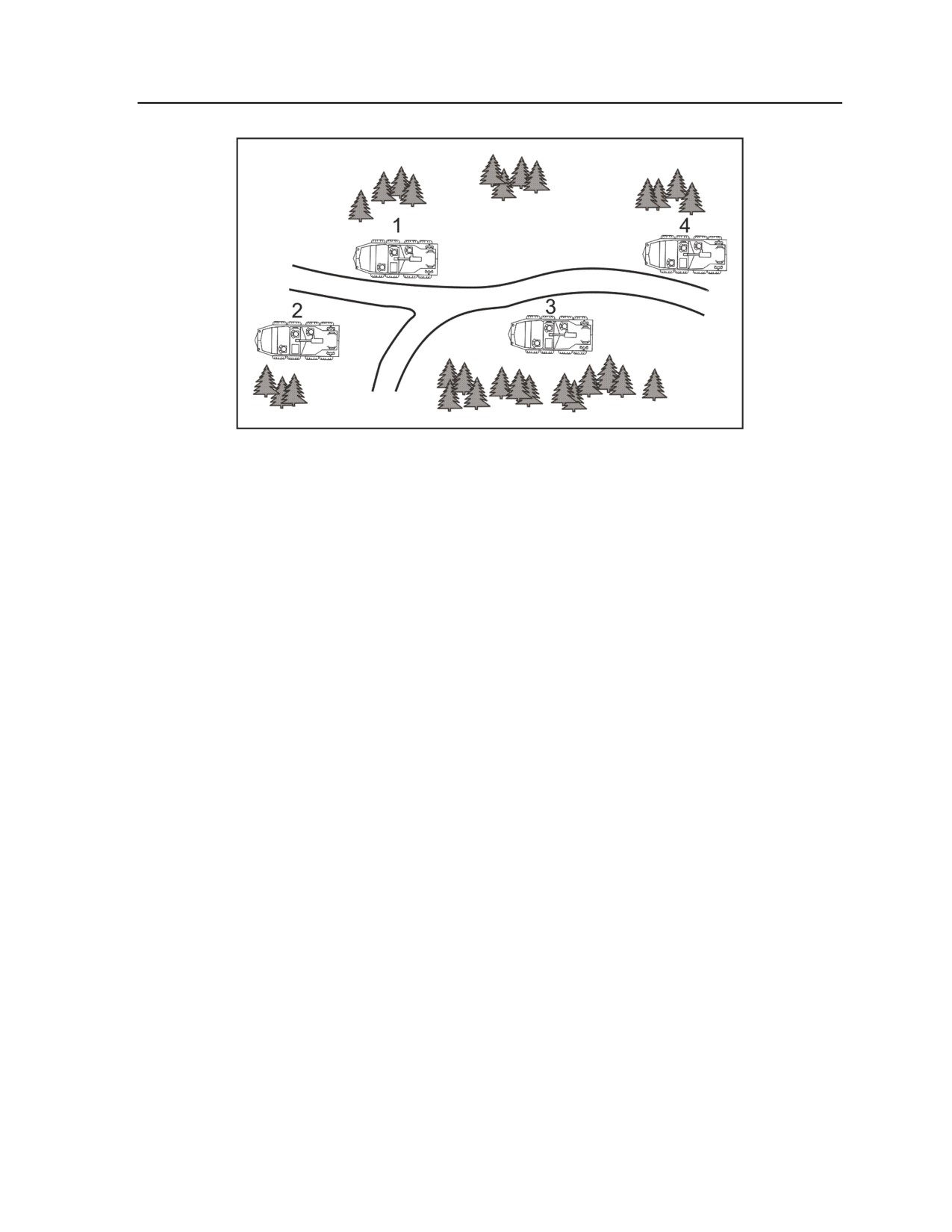
5-47. Traveling is usually employed in secured areas and when speed is important and enemy contact is
not likely. It is the fastest but least secure movement technique. In this technique, the lead and trail
elements move together as a unit. Movement is continuous, and interval and dispersion are maintained
between squads as terrain and weather permit. The platoon does not intend to engage in combat, but it is
dispersed to prevent destruction in case of unexpected air or ground attack. When using this technique, the
platoon could be in a column formation or dispersed in its other formations (see Figure 5-18).
3 August 2009
FM 3-20.98
5-17
Chapter 5
Figure 5-18. Traveling movement technique (SBCT reconnaissance platoon)
Traveling Overwatch
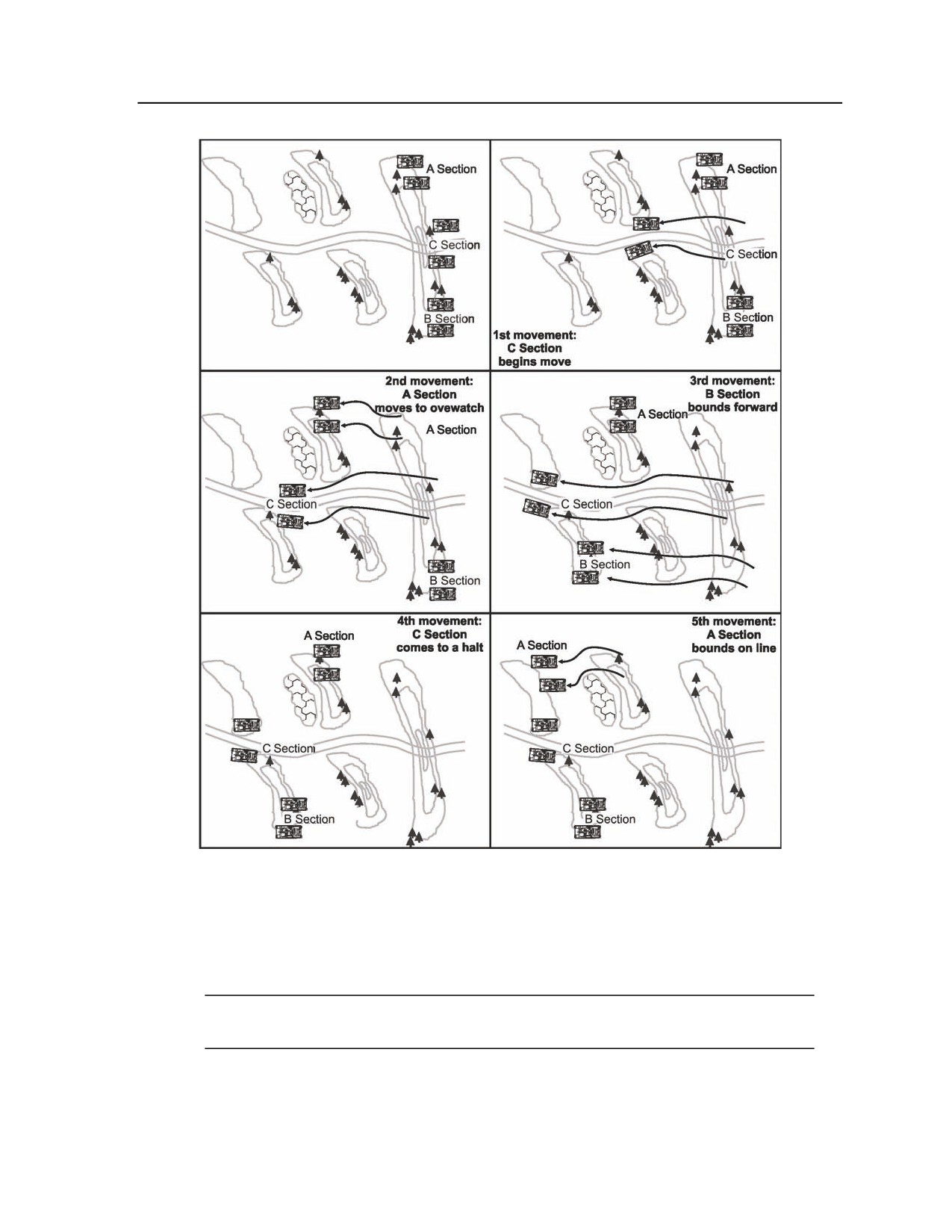
5-48. Traveling overwatch is used when contact is possible but speed is desirable (see Figures 5-19). The
lead element moves continuously along covered and concealed routes that afford the best available
protection from possible enemy observation and direct fire. The trail element moves at variable speeds,
providing continuous overwatch. It normally maintains visual contact with the lead element and may stop
periodically for better observation. The trail element remains close enough to provide immediate
suppressive fire and to maneuver for support. It must, however, be far enough behind the forward element
so as not to be decisively engaged by enemy forces.
5-18
FM 3-20.98
3 August 2009
Other Tactical Operations
Figure 5-19. Traveling overwatch
Bounding Overwatch
5-49. Employed when enemy contact is expected, bounding overwatch is the most deliberate and secure
movement technique. It provides for immediate direct fire suppression on an enemy force that engages the
bounding element with direct fire.
Note. A type of overwatch (either traveling or bounding) should always be used when sufficient
time is available.
5-50. In bounding overwatch, one element is always stationary to provide overwatch. The trail element
first occupies a covered and concealed position from which it can overwatch the lead element. Upon
3 August 2009
FM 3-20.98
5-19
Chapter 5
completing its movement
(bound), the lead element then occupies a similar position and provides
overwatch as the trail element bounds forward to its next overwatch position. Bounding overwatch can be
executed using one of the following bounding methods:
z
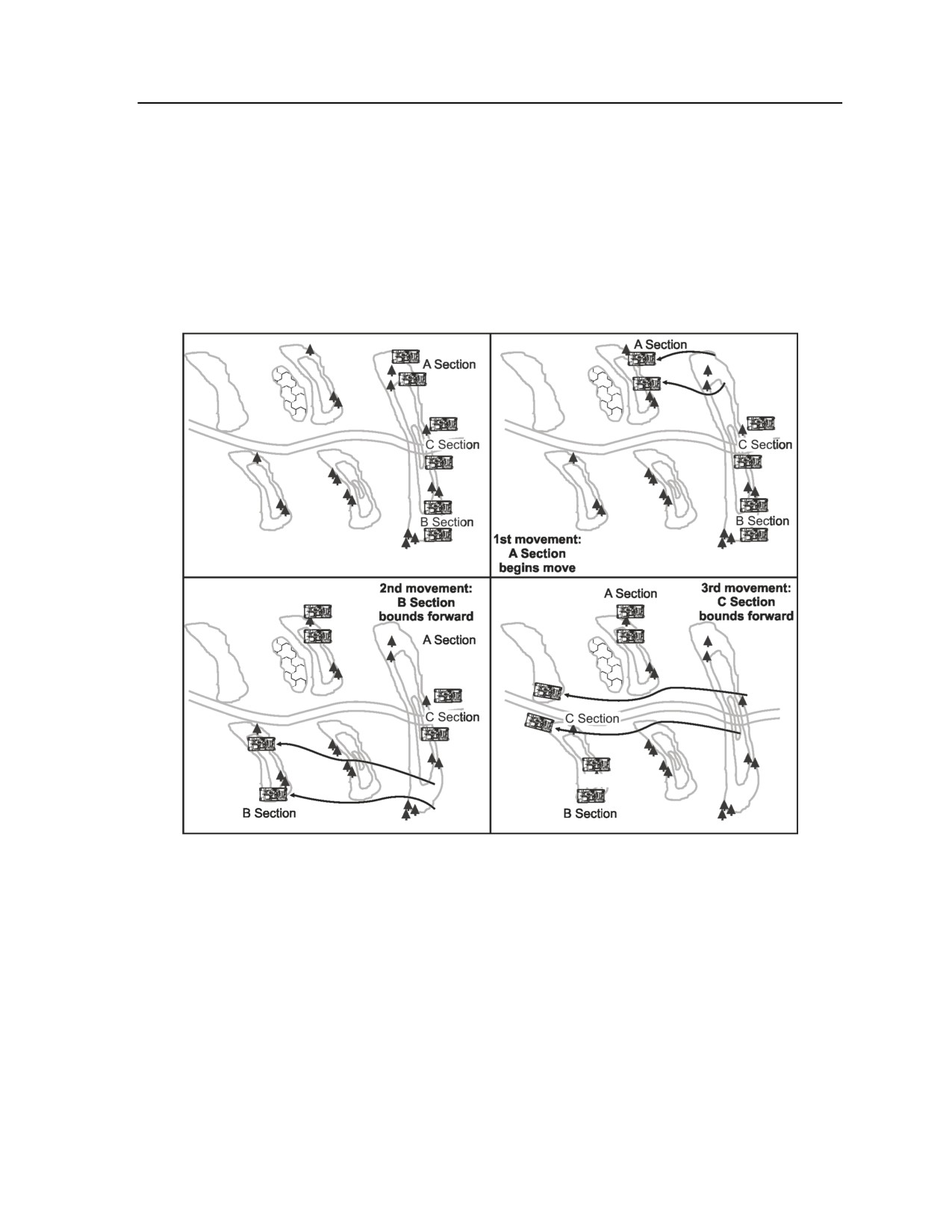
Alternate bounds. In this method, the trail element advances past the lead element to the next
overwatch position. This is usually more rapid than successive bounds and creates a more stable
fire platform and better position for the overwatching vehicle. Figure 5-20 shows a six-vehicle
platoon conducting alternate bounds by section.
z
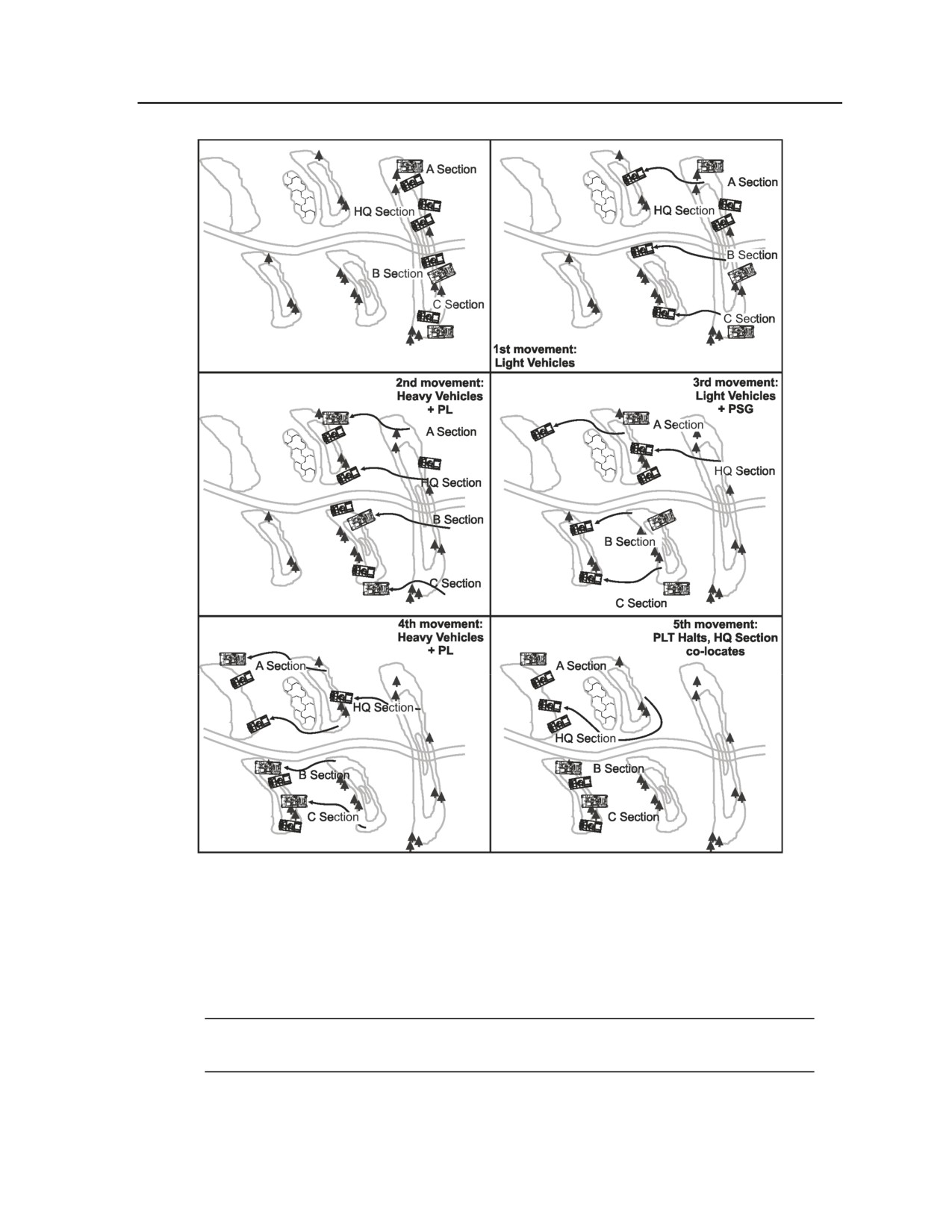
Successive bounds. In successive bounding, the trail element moves to an overwatch position
that is approximately abreast of the lead element. This method is easier to control and more
secure than alternate bounding, but it is slower.
Figure 5-20. Alternate bounds
(scout platoon moves by section)
5-51. The HBCT/CAB reconnaissance platoon will be required to execute bounding overwatch in some
missions. METT-TC will determine if the platoon uses alternate or successive bounding techniques. CFVs
should lead when enemy contact is likely because their increased lethality and survivability enable them to
survive chance contact. LRAS3-equipped HMMWVs can enhance security and provide early warning to
the CFVs. In situations where enemy contact is unlikely, the HMMWVs may lead the bounding, taking
advantage of their stealth, LRAS3, and dismounts to locate the enemy first and direct the CFVs where it is
best to engage the enemy.
5-52. As in other platoons, the section completing its movement takes up an overwatch position and
reports “SET.” The other sections move from their overwatch positions and alert the other elements that
they are moving (see Figure 5-21).
5-20
FM 3-20.98
3 August 2009
Other Tactical Operations
Figure 5-21. Successive bounds (HBCT reconnaissance platoon)
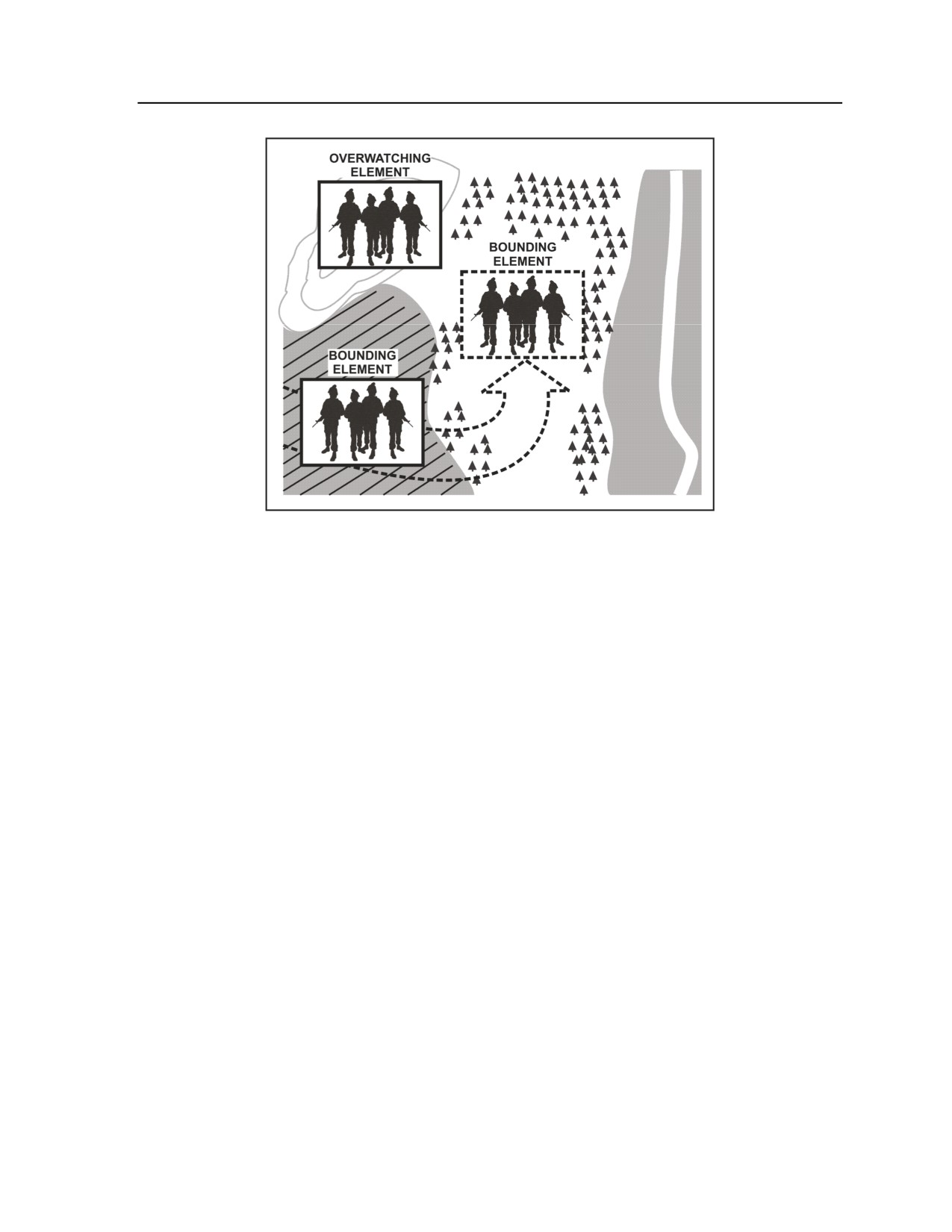
5-53. Reconnaissance patrols can apply the bounding technique by team when enemy contact is likely.
Scout sections, if required to move dismounted, may bound by squad. Dismounted scouts should use cover
and concealment to remain undetected by enemy elements. If the scouts are bypassed, they can report the
contact to the platoon or the overwatching elements. If scouts must engage the enemy while dismounted,
they must break direct fire contact quickly. Dismounts must ensure positive target identification to prevent
fratricide because close-quarter engagements often occur at a fast pace (see Figure 5-22).
Note. Dismounted reconnaissance patrols are not equipped for decisive engagements; once a
weapon is fired, the scout’s presence is known and the element of surprise is lost.
3 August 2009
FM 3-20.98
5-21
Chapter 5
Figure 5-22. Dismounted elements bounding by squad
5-54. “Move-set” is a C2 procedure to control elements when moving using bounding overwatch. “Set”
means that the element has arrived at its destination and has occupied a position from which it can observe
to its front, which triggers the overwatch element to move. This procedure allows for the use of hand-and-
arm signals, verbal or via radio. The move-set procedure can be used at all echelons for successive and
alternating bounds.
ACTIONS ON CONTACT
5-55. Prior to any mission, the leadership of the reconnaissance or scout platoon must conduct a detailed
IPB (covered in Chapter 1 of this manual) of the AO as part of analyzing the mission during troop-leading
procedures. Leaders must determine the probability of contact and identify locations where contact is most
likely to occur. To do this, they use information from all available assets, including UASs, ground
surveillance system reports on FBCB2, information collected by dismounted patrols, and intelligence from
the S-2. The leaders are then able to plan for contact and determine how to employ movement techniques,
battle drills, and TTP to avoid chance contact.
CONTACT CONSIDERATIONS
5-56. The platoon leader will direct the platoon’s actions based on the commander’s intent and guidance
he receives from the OPORD/FRAGO. These specific instructions must include focus of the
reconnaissance, tempo of the operation, engagement criteria, and the desired COA based on the size and
activity of the enemy force encountered. By knowing these details ahead of time, the platoon leader can
develop the situation more rapidly and arrive at and execute the desired COA. He strives to make contact
with combat multipliers (such as ground surveillance systems assets or UASs) or with the platoon’s
smallest possible internal element: the dismounted scout. The goal is digital or visual contact in which the
enemy is observed but the platoon remains undetected. The ideal way for the platoon to make contact is by
means of reports from other ISR assets (such as UASs or ground surveillance systems). This gives the
platoon the greatest possible flexibility to maneuver and develop the situation.
5-57. When the platoon deploys and reports, it employs the fundamental techniques of tactical movement
(dismounted/mounted) and action drills, using the terrain to ensure effective cover and concealment. As
information becomes available, the element in contact sends a contact report, followed by a SPOTREP
5-22
FM 3-20.98
3 August 2009
Other Tactical Operations
(digital/analog). The platoon executes fire and maneuver only in accordance with engagement criteria and
the ROE.
5-58. FBCB2 will allow immediate dissemination of this information. The platoon leader can then evaluate
and develop the situation out of direct fire contact. Based on this evaluation and further guidance from
higher, he can maneuver the platoon out of direct fire contact and refine sensory contact either on his own
terms or as directed by the commander.
Note. Making sensory contact prior to direct fire contact is ideal. However, elements at all
echelons must be well rehearsed on the execution of actions on direct fire contact.
THE EIGHT FORMS OF CONTACT
5-59. No matter how thoroughly the platoon leader prepares for an operation, direct contact with the
enemy is still a possibility, usually as a result of chance contact. In all types of operations, contact occurs
when an individual Soldier, squad, or section of the platoon encounters any situation that requires an active
or passive response to the enemy. These situations may entail one or more of the following forms of
contact:
z
Visual contact (friendly elements may or may not be observed by the enemy).
z
Physical contact (direct fire) with an enemy force.
z
Indirect fire contact.
z
Contact with obstacles of enemy or unknown origin.
z
Contact with enemy or unknown aircraft.
z
Situations involving CBRN conditions.
z
Situations involving EW tactics.
z
Situations involving nonhostile elements, such as civilians.
Note. An emerging type of visual contact is sensor contact. For example, contact may be
detected by UASs or remote equipment covering a dead space or movement route, alerting
scouts of a possible enemy in the area.
INITIAL CONTACT AND REACTION
5-60. The platoon must be prepared to execute actions on contact under any of the following conditions:
z
Visual contact (the platoon is undetected by the enemy force).
z
Direct or indirect fire contact with an unknown or superior force.
z
Direct or indirect fire contact with an inferior force.
5-61. Whether the platoon remains undetected or is identified by enemy forces, it must first take actions to
protect itself, find out what it is up against, and decide on a COA. To properly execute actions on contact,
the platoon must take action consistent with the fundamentals of reconnaissance (refer to Chapter 3 of this
manual for a detailed discussion):
z
Develop the situation rapidly.
z
Report quickly and accurately.
z
Maintain contact with the enemy in accordance with the mission.
z
Retain the freedom to maneuver.
z
Remain focused on the reconnaissance objective.
3 August 2009
FM 3-20.98
5-23
Chapter 5
THE FIVE STEPS OF ACTIONS ON CONTACT
5-62. When contact is made, the reconnaissance or scout platoon executes battle drills, designated by SOP,
to maintain freedom of maneuver and avoid becoming decisively engaged. It uses the five steps of actions
on contact (covered in detail later in this section) as the foundation for these drills:
z
Deploy and report.
z
Evaluate and develop the situation.
z
Choose a COA.
z
Execute the selected COA.
z
Recommend a COA to the higher commander
5-63. The steps that make up actions on contact must be thoroughly trained and rehearsed so that the
platoon can react instinctively as a team whenever it encounters enemy forces.
Step 1 - Deploy and Report
5-64. When a scout makes contact with the enemy, he reacts according to the circumstances of the contact.
The section or squad that makes initial visual contact with the enemy deploys to covered terrain that
affords good observation and fields of fire. If the scouts receive fire from the enemy, they return fire, but
only with the intent of breaking direct fire contact.
Note. Refer to the eight general categories of contact discussed earlier in this section.
5-65. The scout or element in contact sends a contact report to the platoon leader and follows as soon as
possible with a SPOTREP using the SALUTE format (size, activity, location, unit, time, and equipment). If
the scout or element in contact is unable to report or cannot report quickly, another squad in the section
must report.
5-66. Scouts that are not in contact temporarily halt in covered terrain, monitor the incoming reports, and
plot the situation on their maps. Once they determine that they cannot be influenced by the enemy or are
not needed to support the element in contact, they continue their mission with the platoon leader’s
approval. The platoon leader or PSG relays the contact report to the commander, followed as soon as
possible by a SPOTREP and updates.
Step 2 - Evaluate and Develop the Situation
5-67. The scouts next concentrate on defining what they are up against. If they have not sent a SPOTREP
to this point, they initially focus on getting enough information to send one. If they have not been detected
by the enemy and time is available, the scouts reconnoiter the enemy position, emphasizing stealth,
dismounted reconnaissance, and use of such assets as ground surveillance systems and UASs.
5-68. If the enemy is aware of their presence, the scouts use a combination of mounted and dismounted
reconnaissance. They conduct dismounted reconnaissance to get detailed information on enemy
dispositions. Mounted reconnaissance will be used to move additional assets into the area to support the
element in contact.
5-69. When direct fire contact occurs, the reconnaissance or scout platoon employs indirect and direct fires
to suppress and/or fix the enemy while maneuvering to get information. The scouts attempt to confirm or
determine in detail enemy size, composition, activity, orientation, and weapon system locations. They
search for AT ditches, minefields, wire, or other obstacles that could force friendly elements into an enemy
engagement area. The scouts find the flanks of the enemy position and look for other enemy elements that
could provide mutual support to the position. Once the scouts determine what they are up against, the
platoon leader updates the SPOTREP.
5-24
FM 3-20.98
3 August 2009
Other Tactical Operations
Step 3 - Choose a COA
5-70. Developing the situation is a critical step in choosing the correct COA and providing an accurate,
timely report to the commander. Once the platoon leader has enough information to make a decision, he
selects a COA that is within the capabilities of the platoon, that allows the platoon to continue the
reconnaissance as quickly as possible, and that supports the commander’s concept of the operation. He
considers various possible COAs, based on well-developed TTP and battle drills, to react appropriately to
the types of contact the platoon may encounter. At a minimum, the platoon must rehearse and be ready to
execute these potential COAs:
z
Disengage from enemy contact.
z
Break contact and bypass.
z
Maintain contact and bypass.
z
Maintain contact to support an attack on an inferior force.
z
Conduct an attack against an inferior force.
z
Conduct a hasty defense.
z
Conduct RHO.
z
Conduct BHO, if applicable.
5-71. Once the element in contact has developed the situation and the platoon leader has enough
information to make a decision, he selects a COA. He ensures that the COA is within the capabilities of the
platoon, that it allows the scouts to continue the reconnaissance as quickly as possible, and that it supports
the commander’s concept of the operation and intent. The platoon leader should consider all available
COAs, including those outlined in the following discussion.
Disengage from Enemy Direct or Indirect Fire Contact
5-72. The reconnaissance or scout platoon cannot conduct its mission if it becomes decisively engaged. If
it is engaged, the platoon must have a plan to break direct or indirect fire contact with the enemy. As a
general rule, the platoon, section, or squad should disengage from the enemy as soon as direct or indirect
fire contact occurs. This will allow for continuation of the mission and reduce the chance of any loss of
combat power.
5-73. At platoon level, OPs or patrols gain contact with the enemy, then report and prepare to displace to
successive positions. These platoon members should report the enemy contact to the overwatching vehicles
and to the platoon leader.
5-74. When the enemy force triggers the OPs’ displacement criteria (the point at which the OPs must
displace or risk detection and/or engagement by the enemy), the OPs pass off responsibility for tracking the
enemy to other OPs in depth. The platoon then displaces its OPs to successive positions in depth while
maintaining contact with the enemy. Patrols request permission to return to the platoon vehicles. When
permission has been granted, they use covered and concealed routes back to the vehicle positions and
remount the vehicles.
5-75. Once the initial contact has been reported to higher headquarters and the order to break contact has
been given, disengagement should be executed with one section or squad acting as overwatch for the
displacing section/squad as it moves. The section or squad that moves first will keep its weapon systems
oriented on the enemy as it uses covered and concealed routes to move to a designated rally point that
precludes enemy observation and provides cover and concealment. This element may also use on-board
smoke generators or obscurant munitions (such as grenades) to cover its movement. The overwatching
section/squad provides suppressive fires, both indirect and direct (if necessary), to cover the movement of
the displacing section/squad. Mortars can also provide effective and responsive support when elements
must break contact. The overwatching section must also employ its dismounts with the Javelin missile
system.
5-76. Once the displacing section/squad has arrived at the rally point, it takes up defensive positions and
reports its arrival to the overwatch section/squad. The overwatching element then calls for protective fires
3 August 2009
FM 3-20.98
5-25
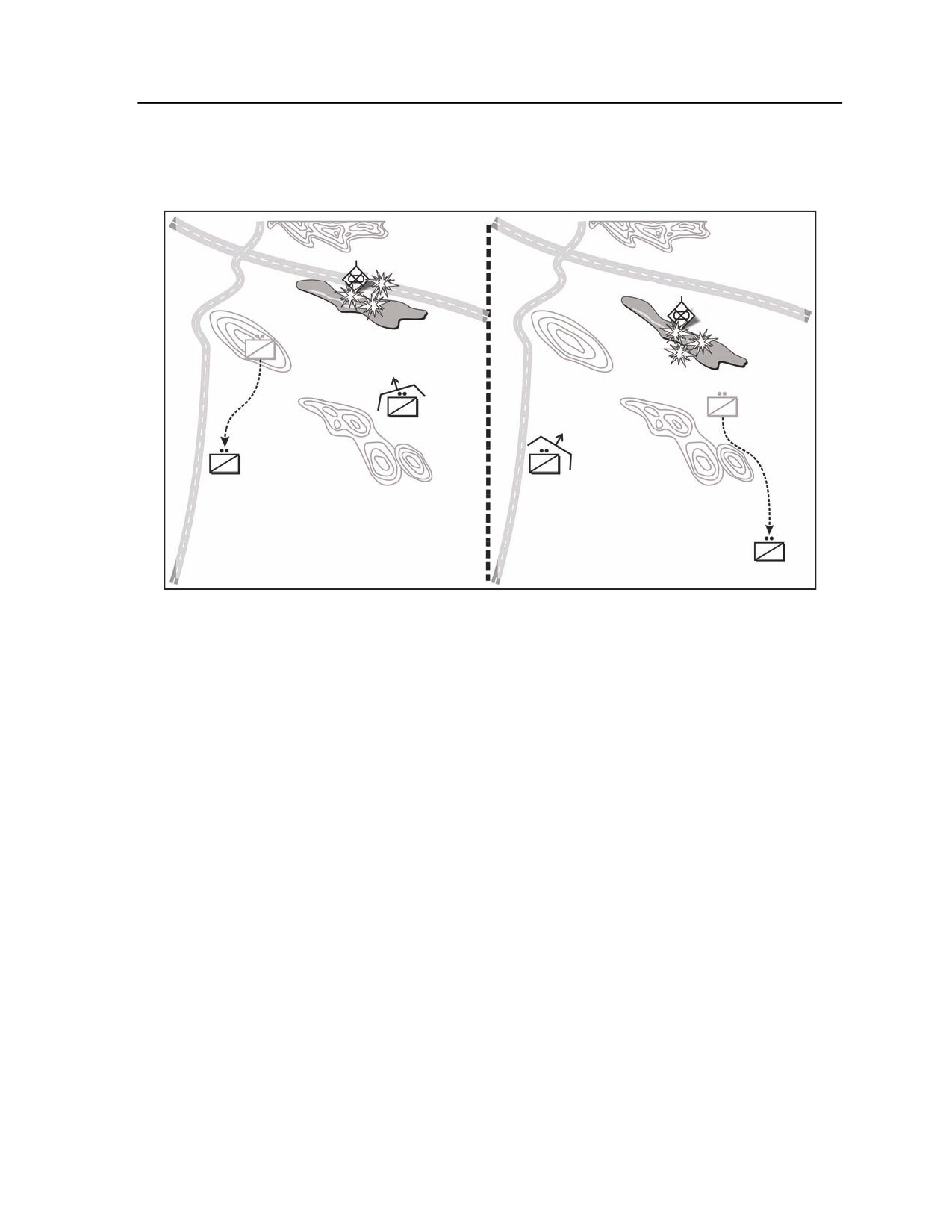
Chapter 5
and uses an alternate covered and concealed route to move to the rally point. When the entire platoon or
section has moved back to the rally point, it consolidates and reorganizes, reports its status to the higher
headquarters, and continues the mission. Figure 5-23 illustrates a situation in which a reconnaissance or
scout platoon breaks contact by sections.
Figure 5-23. HBCT reconnaissance platoon disengages from contact
Break Contact and Bypass
5-77. This COA may be selected when the platoon does not have the resources to leave an element in
contact and still continue to accomplish its priority reconnaissance tasks. It may also be selected when the
platoon has made contact with an enemy force that cannot adversely affect the mission of the platoon’s
higher headquarters. Because breaking contact is a violation of reconnaissance fundamentals, the platoon
leader must be sure that his higher headquarters is informed of and approves this COA (refer to Figure 5-
24 and Figure 5-25).
5-26
FM 3-20.98
3 August 2009
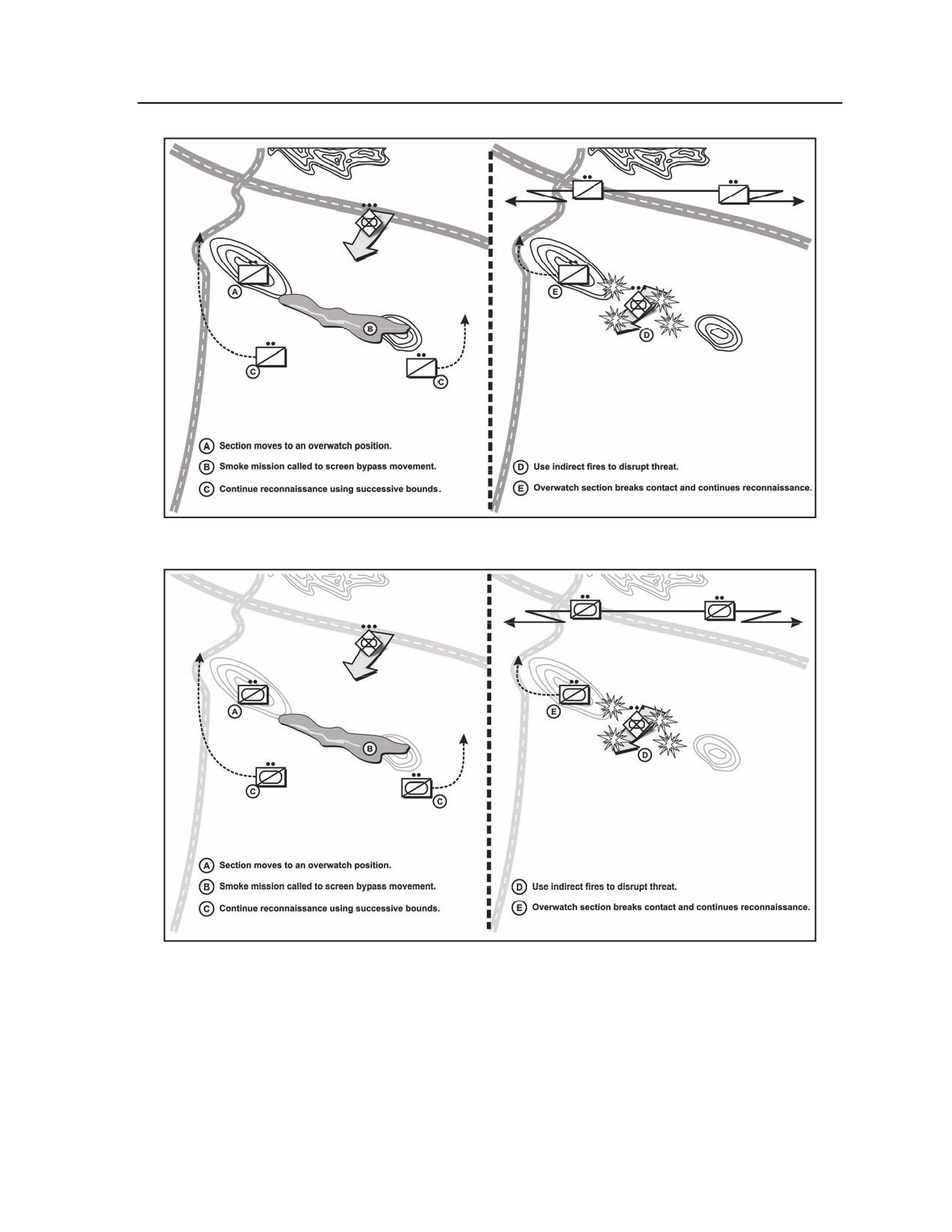
Other Tactical Operations
Figure 5-24. HBCT reconnaissance platoon breaks contact and conducts bypass
Figure 5-25. ACR scout platoon breaks contact and conducts bypass
Maintain Contact and Bypass
5-78. This COA is appropriate when an enemy force, based on its current disposition, is not in a position
to influence the platoon’s higher commander. An element (normally a section or squad) will be left to
maintain contact while the rest of the platoon continues the reconnaissance mission. The element that
remains in contact will maintain visual contact with the enemy and report if the enemy situation changes.
The platoon must keep scouts in contact with the enemy unless specifically authorized to do otherwise.
3 August 2009
FM 3-20.98
5-27
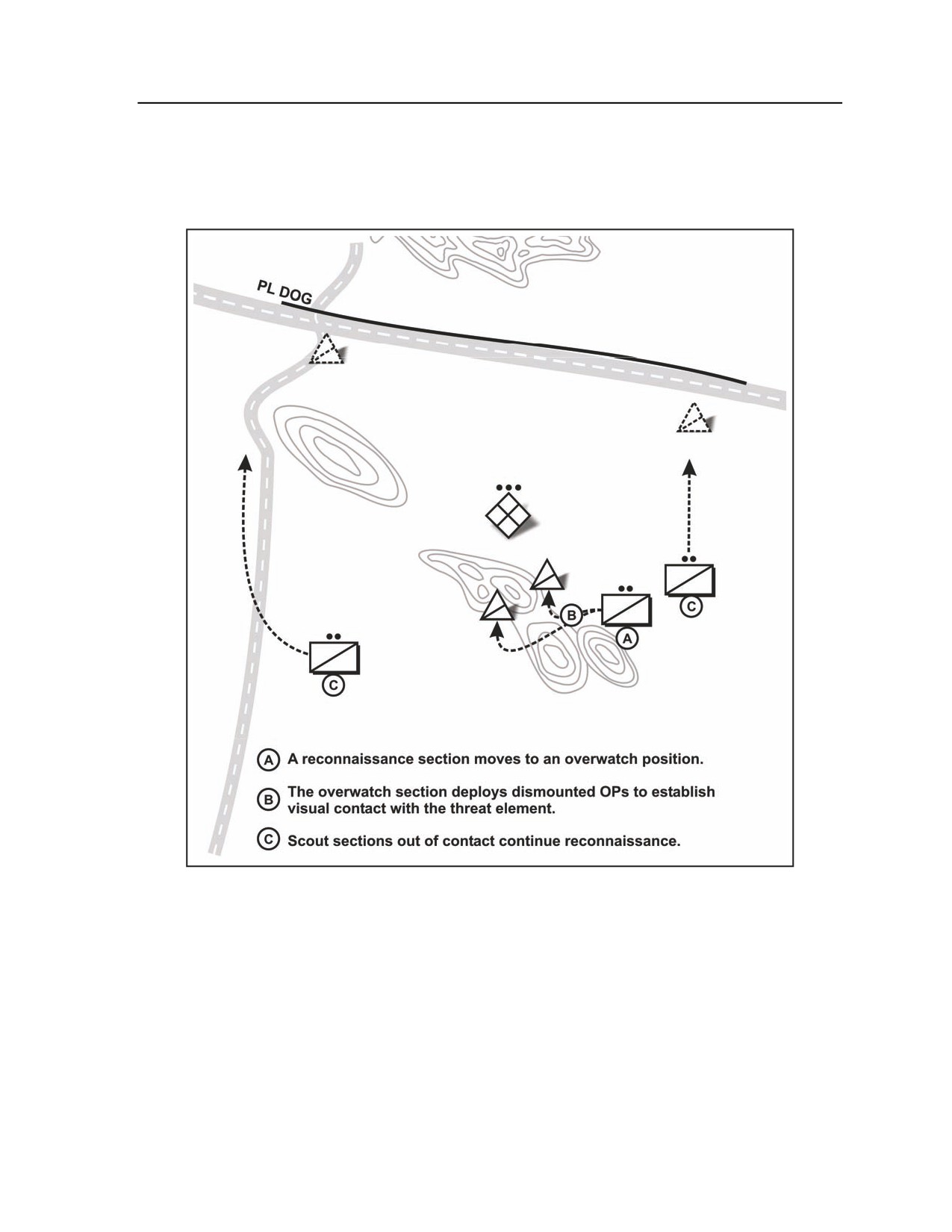
Chapter 5
Depending on the applicable task organization, the platoon leader must carefully assess METT-TC before
selecting this COA. Mission constraints may force the platoon leader to leave one vehicle in contact. If this
is the case, he must ensure that the vehicle is AT-heavy (Javelin/TOW). To regain the use of all his assets,
the platoon leader continues coordination to execute reconnaissance or to conduct BHO of the contact with
a follow-on element (refer to Figures 5-26 through 5-28).
Figure 5-26. HBCT reconnaissance platoon maintains contact
and conducts bypass (phase one)
5-28
FM 3-20.98
3 August 2009
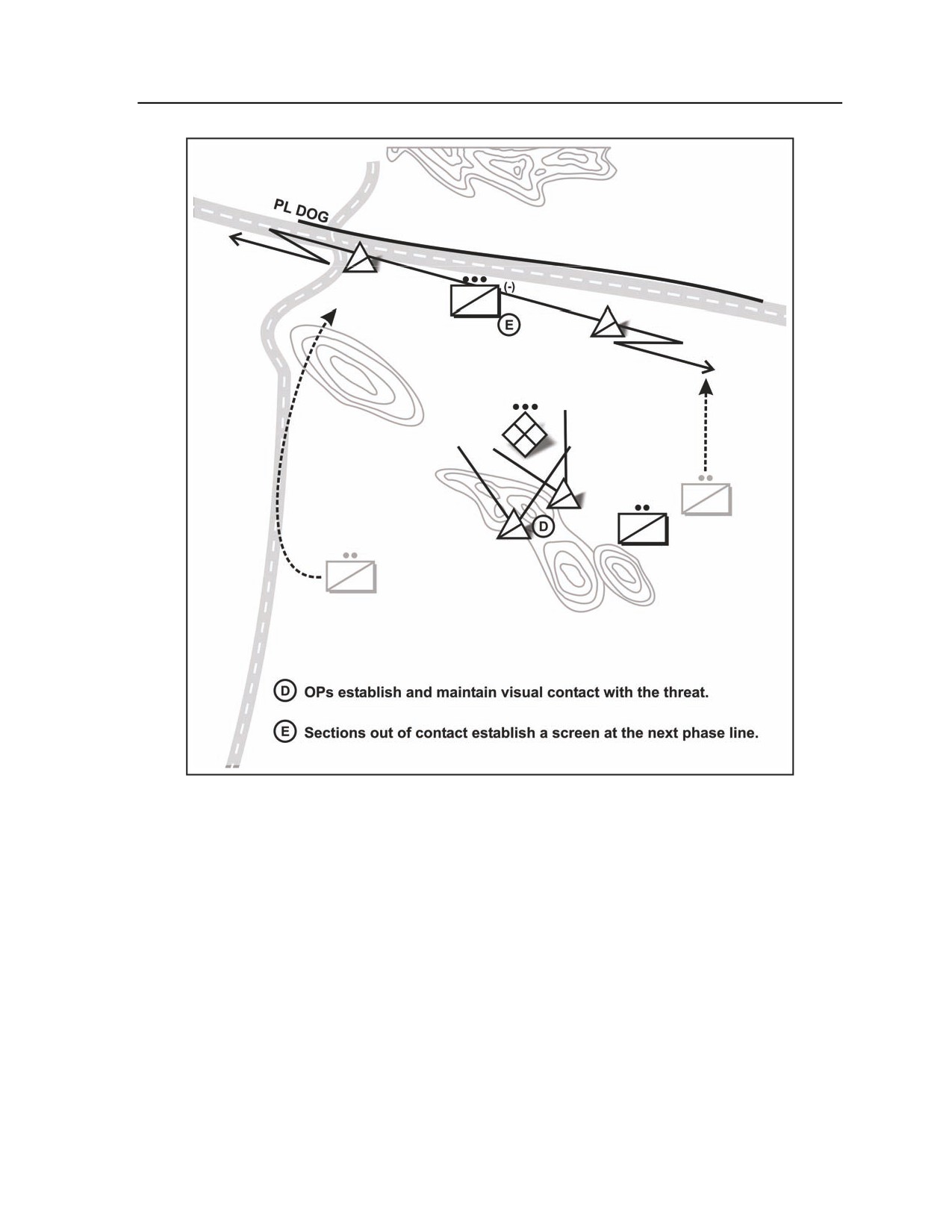
Other Tactical Operations
Figure 5-27. HBCT reconnaissance platoon maintains contact
and conducts bypass (phase two)
3 August 2009
FM 3-20.98
5-29
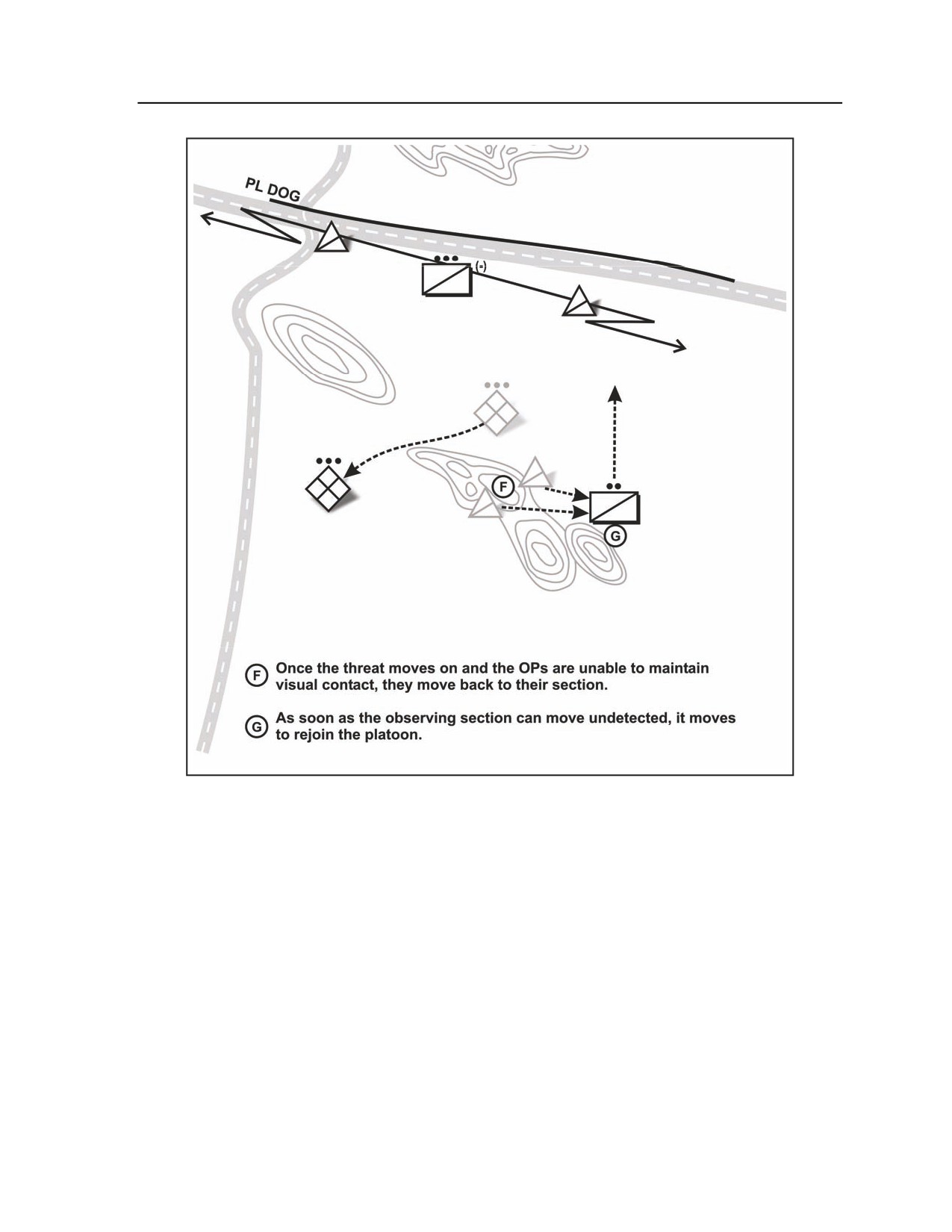
Chapter 5
Figure 5-28. HBCT reconnaissance platoon maintains contact
and conducts bypass (phase three)
Maintain Contact to Support a Hasty Attack
5-79. This COA is appropriate when the platoon discovers enemy elements the higher commander wants
to destroy, but which the scouts cannot destroy, either because they lack sufficient combat power or
because they have other tasks to perform. In this situation, the platoon maintains contact by leaving a
section or squad in contact. The rest of the platoon continues on to establish far-side security, monitor any
changes in the enemy situation, and support the hasty attack by a friendly unit.
5-80. The platoon focuses on requirements for supporting a successful friendly attack, including the
following:
z
Locating covered and concealed movement routes for friendly attacking units.
z
Locating attack positions.
z
Locating enemy positions (within capability).
z
Locating enemy weak points.
z
Locating enemy LOCs. Many times this will be the enemy egress route from friendly forces.
5-30
FM 3-20.98
3 August 2009
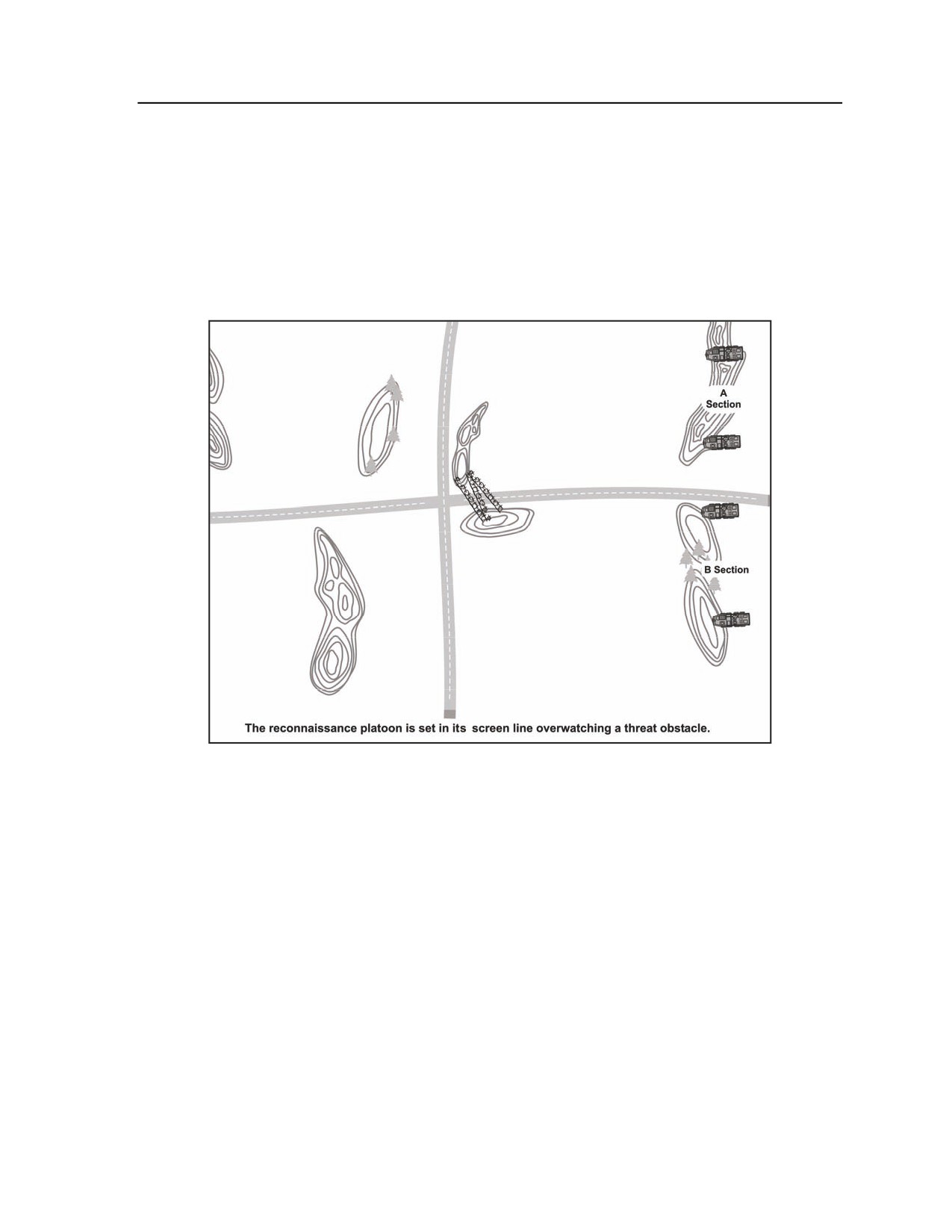
Other Tactical Operations
z
Establishing a contact point to link up with, brief, and guide the friendly unit as necessary.
z
Designating a phase line to use as a handover line for the attacking unit.
z
Preparing and coordinating fire support for the friendly attack.
z
Locating and preparing to occupy base of fire positions, if required.
5-81. It is essential that the section or squad left in contact understand what needs to be accomplished, who
will be executing the attack, and when the unit responsible for the attack anticipates being in position to
receive handover of the enemy. As the unit moves into position, the scouts in contact may rejoin the
platoon or be placed OPCON to the attacking unit to ease command, control, and coordination (see
Figures 5-29 through 5-34).
Figure 5-29. Platoon maintains contact to support a hasty attack (phase one)
3 August 2009
FM 3-20.98
5-31
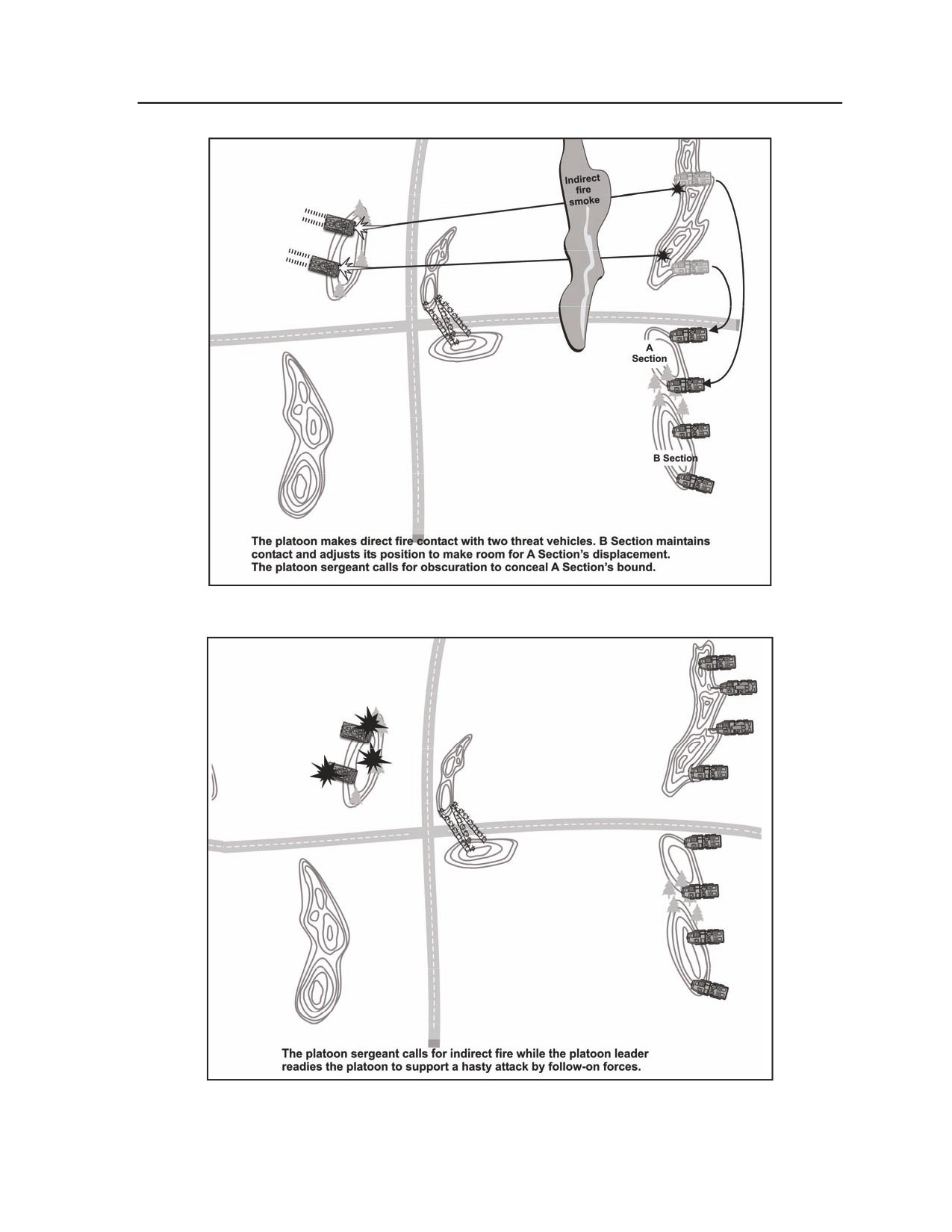
Chapter 5
Figure 5-30. Platoon maintains contact to support a hasty attack (phase two)
Figure 5-31. Platoon maintains contact to support a hasty attack (phase three)
5-32
FM 3-20.98
3 August 2009
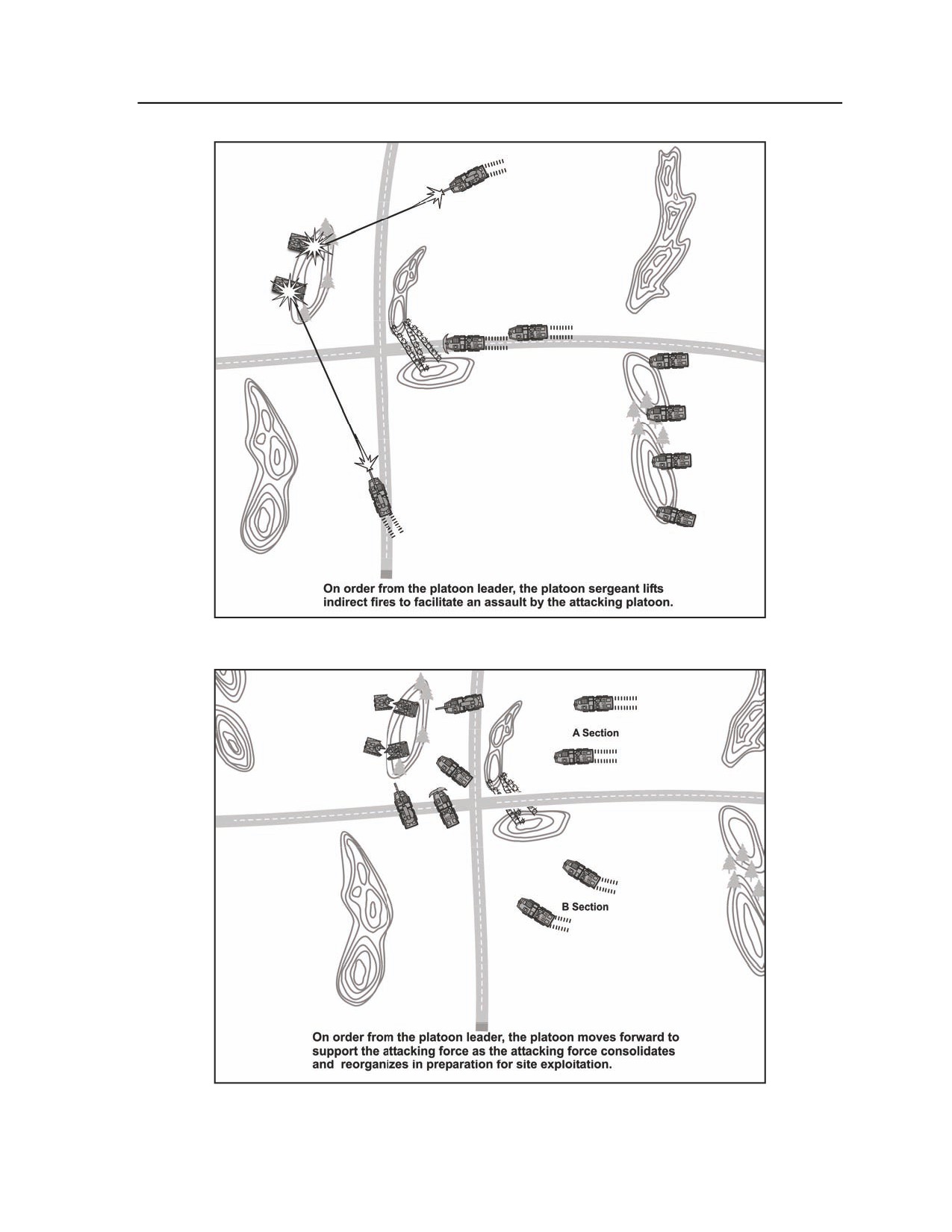
Other Tactical Operations
Figure 5-32. Platoon maintains contact to support a hasty attack (phase four)
Figure 5-33. Platoon maintains contact to support a hasty attack (phase five)
3 August 2009
FM 3-20.98
5-33
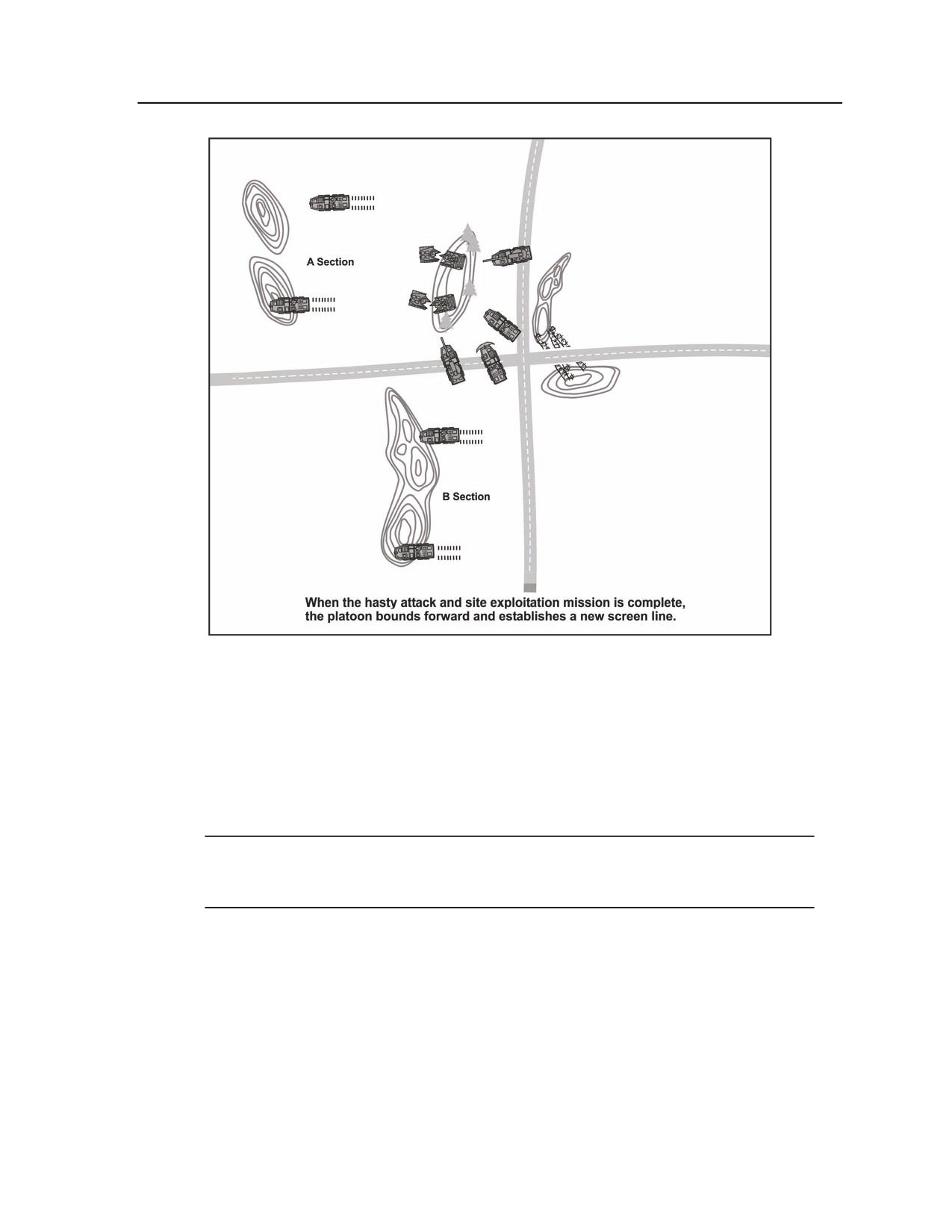
Chapter 5
Figure 5-34. Platoon maintains contact to support a hasty attack (phase six)
Attack an Inferior Force
5-82. In most cases, the reconnaissance platoon cannot, or should not, mass its combat power to defeat an
enemy force. If the scouts mass, they risk losing the capability to complete their mission as well as
jeopardizing their ability to conduct subsequent missions. If the scouts are permitted to engage the enemy,
they should only attack lightly armored or unarmored reconnaissance vehicles, such as motorcycles or
Soviet-style BRDMs and BTRs. They should not engage more heavily armored vehicles except in self-
defense (see Figures 5-35 through 5-38).
Note. Maneuver of elements used to isolate the enemy should always be coordinated through
the use of detailed fire control measures, which are in turn rehearsed by all maneuver elements
(radio rehearsal/backbrief at a minimum).
5-34
FM 3-20.98
3 August 2009
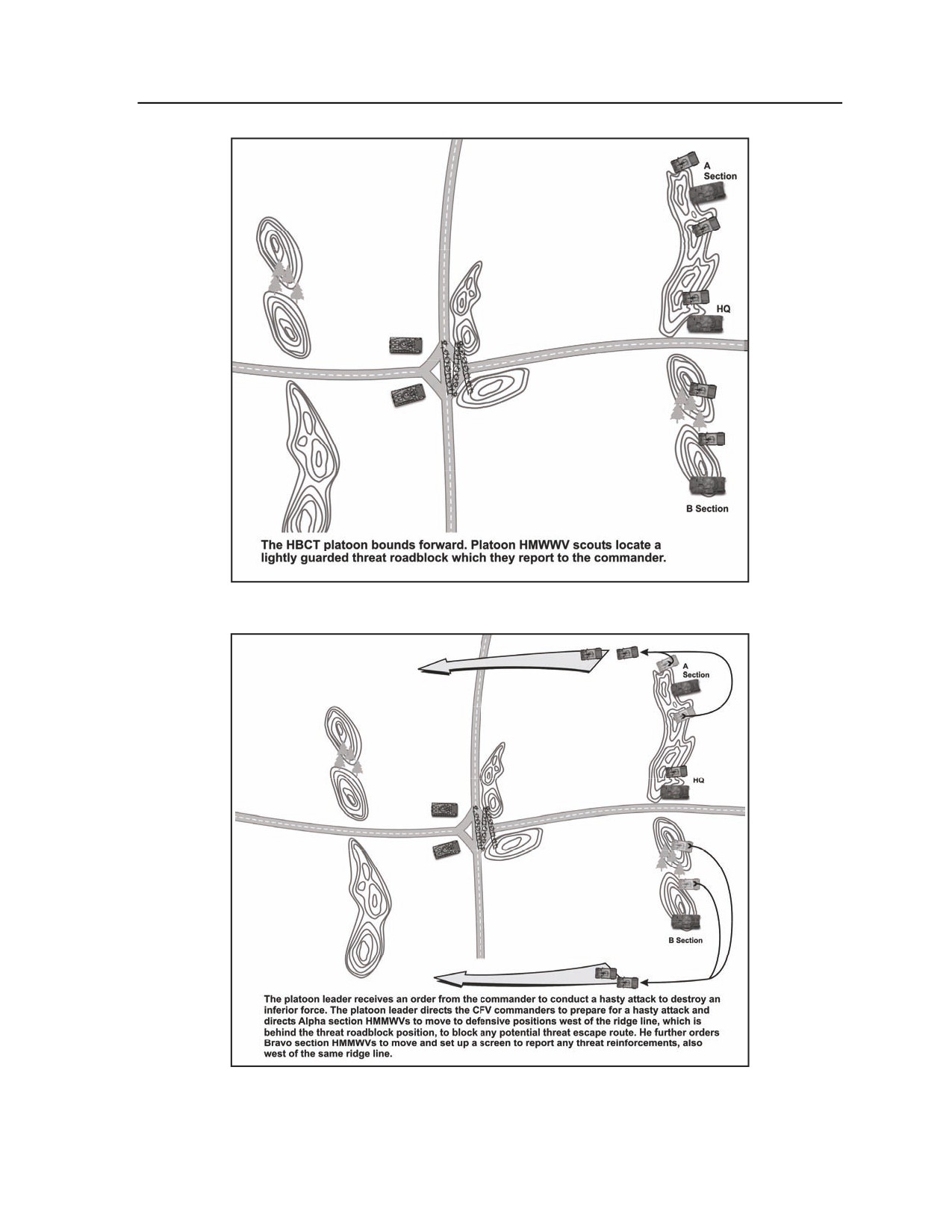
Other Tactical Operations
Figure 5-35. Platoon attacks an inferior force (phase one)
Figure 5-36. Platoon attacks an inferior force (phase two)
3 August 2009
FM 3-20.98
5-35
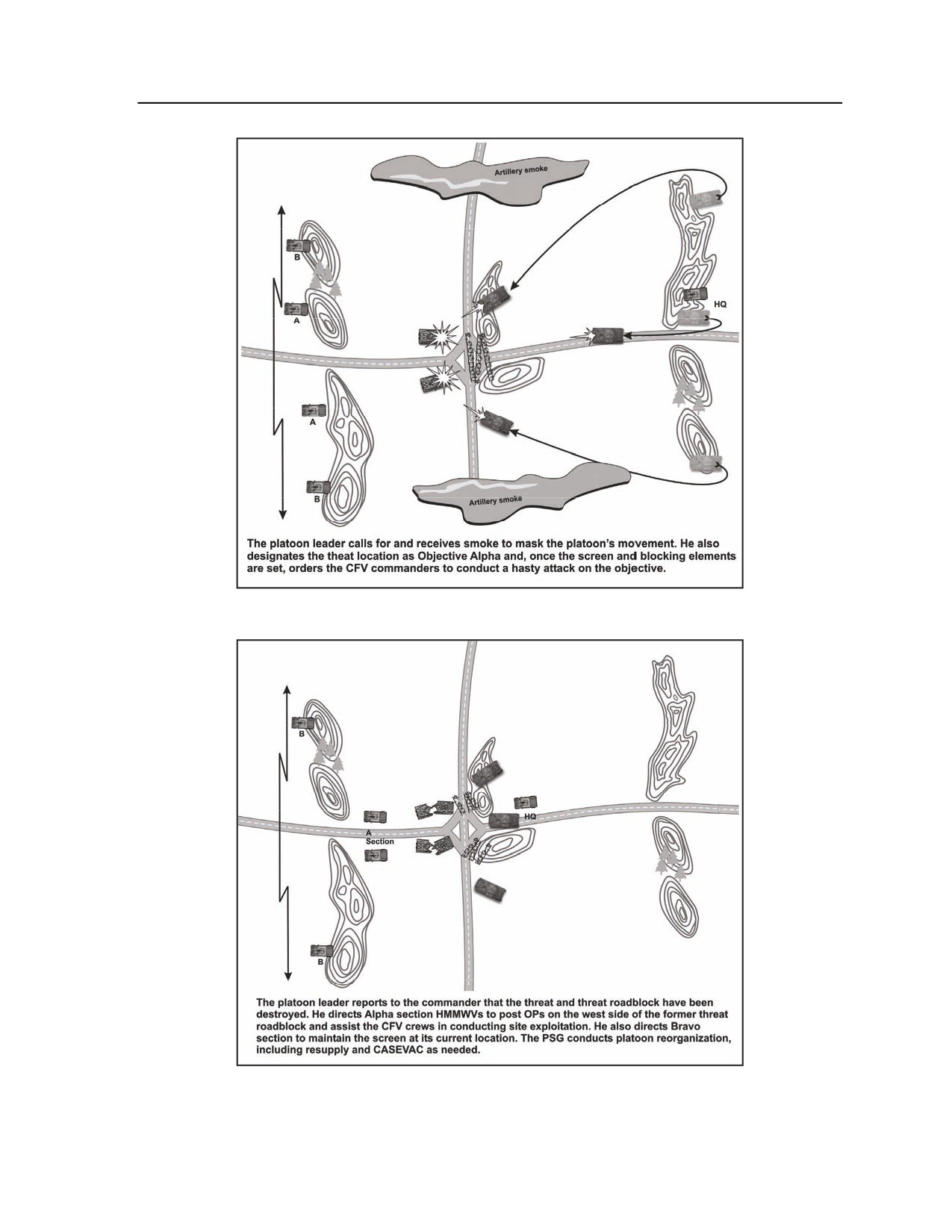
Chapter 5
Figure 5-37. Platoon attacks an inferior force (phase three)
Figure 5-38. Platoon attacks an inferior force (phase four)
5-36
FM 3-20.98
3 August 2009
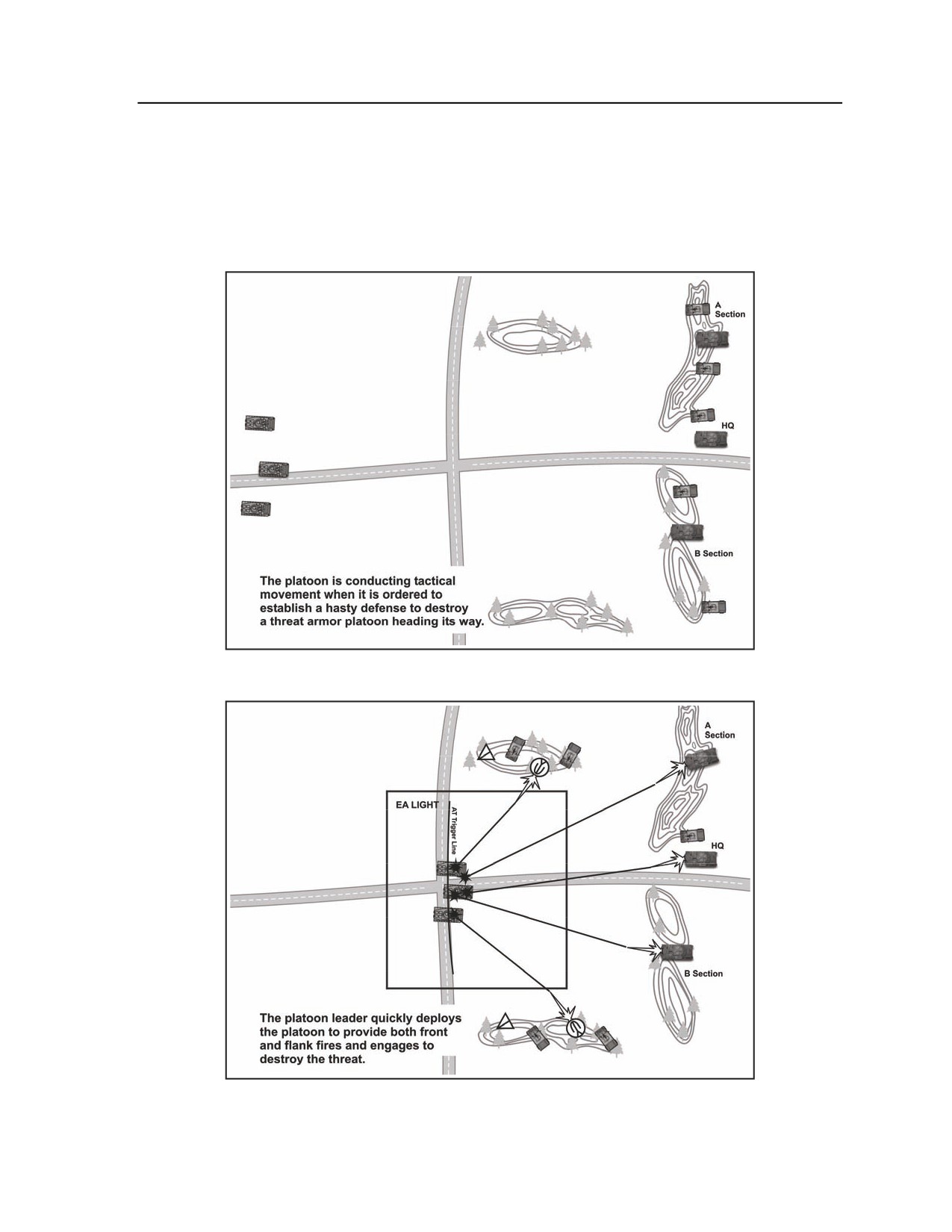
Other Tactical Operations
Establish a Hasty Defense
5-83. The platoon will establish a hasty defense if it cannot bypass the enemy, all the sections and/or
squads are fixed or suppressed, and the platoon no longer has the ability to move forward. A hasty defense
will also be used when the enemy executes a hasty attack. The platoon maintains contact or fixes the
enemy in place until additional combat power arrives or the platoon is ordered to move (see Figures 5-39
through 5-41). If the platoon is required to conduct a hasty defense, the commander then becomes
responsible for continuing to develop the situation.
Figure 5-39. Platoon establishes a hasty defense (phase one)
Figure 5-40. Platoon establishes a hasty defense (phase two)
3 August 2009
FM 3-20.98
5-37
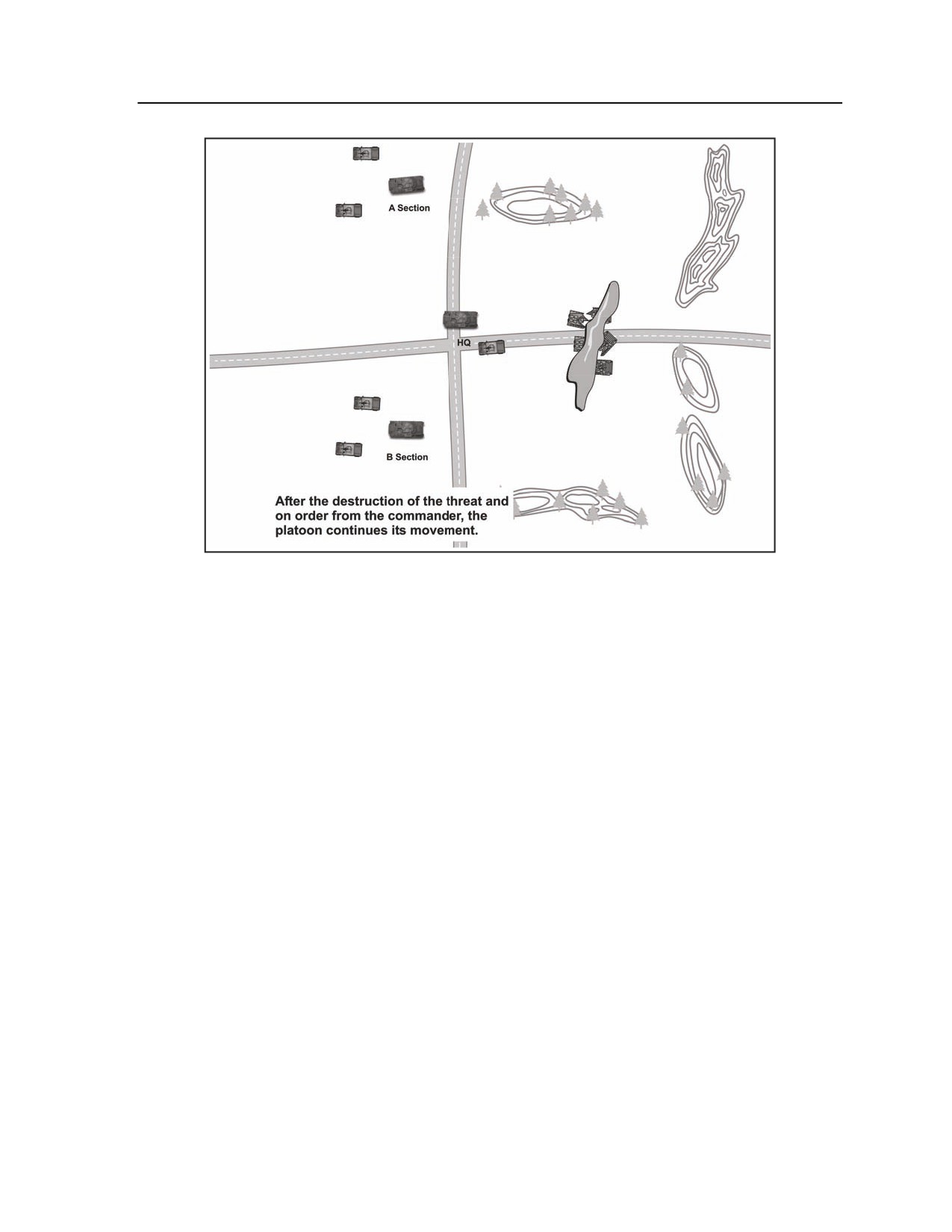
Chapter 5
Figure 5-41. Platoon establishes a hasty defense (phase three)
Conduct Reconnaissance Handover
5-84. The platoon leader will attempt to conduct RHO. He does this for several tactical reasons: to
continue operations as directed, to regain use of all his elements, or to pass reconnaissance responsibility
for the enemy element to another friendly element. An example of this is a BCT platoon handing over an
enemy element to a task force reconnaissance platoon to maintain contact. Refer to the discussion of RHO
in Chapter 3 of this manual.
Conduct Battle Handover
5-85. This COA is applicable for reasons similar to those for RHO: to continue operations, to regain use of
all elements, or to hand over contact to an element that usually will then engage and destroy the enemy
force. An example of BHO is a task force reconnaissance platoon handing over an enemy element to a tank
company team for destruction.
Step 4 - Execute the Selected COA
5-86. The platoon leader updates his SPOTREP to the commander with any new information and then
recommends a COA to the commander. The commander approves or disapproves the recommended COA
based on how it will affect the parent unit’s mission.
5-87. If the commander and the S-2 have anticipated the enemy situation the platoon is reporting, they will
already have addressed the contingency in the OPORD and given guidance to their subordinates on what
COA the platoon should execute. In such a case, the platoon leader can evaluate the situation, choose a
COA consistent with his higher commander’s intent or concept, and execute it without further guidance.
He keeps the commander informed of what he is doing as he executes the COA.
5-38
FM 3-20.98
3 August 2009
Other Tactical Operations
Step 5 - Recommend a COA to the Higher Commander
5-88. The platoon leader develops a COA to recommend to the higher commander in accordance with that
commander’s intent and the enemy situation. The recommended COA will be relayed to the commander as
quickly as possible, followed by a confirmation brief to ensure mutual understanding of the concept of the
COA.
EXAMPLES OF ACTIONS ON CONTACT
5-89. The following examples illustrate actions on contact in a variety of tactical situations. They are
organized using the five-step process.
Visual Contact (Undetected by the Enemy)
Deploy and Report
5-90. A reconnaissance section or squad makes contact when its dismounted element identifies an enemy
force. It immediately sends a contact report informing the platoon leader that it has made visual contact
with the enemy but is not being engaged. This report is quickly followed by an initial SPOTREP.
Evaluate and Develop the Situation
5-91. Based on the initial SPOTREP of the section or squad in contact, the platoon leader determines that
he has located his primary reconnaissance objective; he orders additional sections or squads to maneuver
into the area. These reconnaissance elements move to dismount points, set their vehicles in hide positions,
and send dismounted patrols from different directions into the area of contact.
5-92. The patrols move to multiple vantage points using dismounted reconnaissance techniques, with the
emphasis on avoiding detection. As they develop new information, they send SPOTREPs to the platoon
leader. The platoon leader moves his element to a covered and concealed hide position where he can
maintain effective communications with both subordinate elements and higher headquarters. From this
position, he establishes local security (a hasty OP) and monitors and controls the efforts of his sections or
squads.
Choose a COA
5-93. When the platoon leader receives sufficient reports to have a clear picture of the situation, he
chooses to prepare to support a hasty attack. This choice is made because the platoon leader determines
that the force he has located is the objective of his commander; therefore, this COA is in accordance with
his commander’s intent. After determining that the commander’s intent has not changed, the platoon leader
recommends the COA to the commander and requests that the platoon execute it. He ensures that he
receives clear guidance from the commander before moving on to the execution step.
Execute the Selected COA
5-94. The platoon leader issues a FRAGO directing his subordinates to prepare to support the hasty attack.
He continues to inform his commander of the enemy situation and the platoon’s actions.
Recommend a COA to the Higher Commander
5-95. The platoon leader develops and recommends a COA to the higher commander based on an
opportunity he identifies during the developing actions on contact. The opportunity—and resulting COA—
is based on the platoon leader’s understanding of the commander’s intent. Once he identifies the
opportunity, the platoon leader relays the recommended COA to the commander as quickly as possible.
The platoon leader uses a confirmation brief to ensure mutual understanding of the concept of the COA
(opportunity).
3 August 2009
FM 3-20.98
5-39
Chapter 5
Contact with an Unknown or Superior Force
Deploy and Report
5-96. The scouts make direct fire contact as the lead platoon vehicle is engaged. The lead scout and the
overwatch see the signature of the enemy weapon system; since they do not have a clear idea of the size of
the enemy, they react as if it were a superior force. Simultaneously, the lead element returns fire, sends a
contact report, employs obscurant munitions, and moves to the nearest hide position. The overwatch
vehicle engages the source of enemy fire by calling for mortar support and monitors to ensure the contact
report is sent. As soon as the lead vehicle is in a covered and concealed position, the overwatch vehicle
moves to an alternate firing position and occupies a hide position while trying to maintain visual contact
with the smallest element, if possible.
5-97. The section or squad leader follows up on the contact report with an initial SPOTREP. This initial
report may not be very detailed, but it includes a description of what happened and the enemy’s
approximate location.
Evaluate and Develop the Situation
5-98. Once the section or squad is set in cover and concealment and has submitted its initial reports, it
must develop the situation. The objective is to determine exactly what the enemy situation is by
dismounted reconnaissance or use of ground surveillance systems /UASs. This can best be done by moving
to the enemy’s flank or rear. The section/squad leader organizes a hasty reconnaissance patrol that will
attempt to move to the flank or rear of the enemy and observe the enemy position. Simultaneously, the
section or squad maintains at least one hasty OP in visual contact with the enemy. As the dismounted
element maneuvers, it is supported by direct fire from the vehicles, by indirect fire called for by the OP, or
by both. These fires serve to suppress the enemy, reducing its ability to observe the scouts; they also fix the
enemy’s attention on the last known location of the mounted element.
Note. Leaders must coordinate strict fire control measures to reduce the risk of fratricide
whenever friendly elements maneuver to the flank or rear of an enemy force. Leaders must
ensure that the intent of the fire control measures is understood using confirmation briefs
(verbal, radio, or digital) by subordinates prior to movement. All leaders who leave potential
support by fire
(SBF) positions or OPs must ensure clear understanding of a five-point
contingency plan.
5-99. In the course of attempting to develop the situation, the section or squad may determine that it is
unable to determine the exact enemy situation for a number of possible reasons: suppressive fires by the
enemy; obstacles; combat losses; or the size and extent of the enemy position. This information is sent to
the platoon leader as soon as possible in the form of updates to the original SPOTREP.
5-100. If this occurs, the platoon leader must decide whether to commit additional platoon assets to the
enemy contact to develop it further or whether to seize the initiative and implement a COA based on the
information available within the guidelines of the commander’s intent. If the platoon leader determines he
needs more information, he may commit additional assets to develop the situation further. He must also use
available combat multipliers such as ground surveillance systems or UASs. The platoon leader makes this
decision as soon as possible after contact; however, he must not commit unneeded resources to an action
that will detract from other reconnaissance tasks.
5-101. If he decides additional assets are required, the platoon leader then orders other sections or squads
not in contact to move to specific locations and assist in developing the situation. As more than one section
or squad becomes involved in the situation, the platoon leader or PSG (whoever is in the best location to do
so) takes control of coordinating their efforts. The elements conduct mounted movement to designated
dismount points, where they organize dismounted patrols to develop the situation from a new direction. As
these patrols discover the enemy and add additional information to the platoon leader’s picture, the platoon
leader may determine he has sufficient information to choose and execute a COA based on the
commander’s engagement criteria or to recommend a COA to the commander.
5-40
FM 3-20.98
3 August 2009
Other Tactical Operations
Choose a COA
5-102. Based on the available information and his commander’s intent and guidance, the platoon leader
decides to leave one section in contact to support a hasty attack by a supporting element. His other sections
continue their reconnaissance mission.
Execute the Selected COA
5-103. In this example, the commander had specifically addressed the contingency the platoon has
developed, so the platoon leader neither makes a recommendation to his commander nor asks his
permission to execute the COA. Instead, the platoon leader immediately issues orders to his sections and
contacts the supporting element’s leader to initiate coordination for handover of the enemy and support of
the element’s hasty attack. He keeps the commander informed of his actions.
Contact with an Inferior Force
Deploy and Report
5-104. A UAS supporting the lead element (section or squad) identifies an enemy element, which consists
of one reconnaissance vehicle. In the commander’s order, the engagement criteria tasked the section or
squad to engage when the enemy force consists of one wheeled vehicle or less (dismounted troops), giving
the section/squad the initiative to execute immediate actions on contact. The section/squad leader sends a
contact report and quickly engages and destroys the enemy vehicle. After the engagement is complete, he
sends an initial SPOTREP.
Evaluate and Develop the Situation
5-105. The lead vehicle and the overwatch element occupy positions that allow them to observe the
destroyed vehicle while the UAS provides area security overhead. They look for any other signs of enemy
activity or any enemy response to the destruction of the vehicle. The lead vehicle then bounds past the
destroyed vehicle and establishes far-side security. Once far-side security is established, a dismounted
element moves to the destroyed vehicle and conducts a thorough search for prisoners, items of intelligence
value, and any other information that can be gained from a close examination of the enemy. When this
reconnaissance is complete, the section or squad sends an updated report to higher headquarters.
Choose a COA
5-106. When engagement is complete and the enemy is destroyed, the COA is obvious: the section or
squad will continue its mission.
Execute the Selected COA
5-107. Since the destruction of the enemy is in accordance with the commander’s order, the section/squad
leader simply informs higher headquarters that he is continuing the mission.
SECTION II - ASSEMBLY AREAS
5-108. An assembly area is a site where a parent unit regroups into a complete unit or prepares for future
operations. Normally, a reconnaissance or scout platoon occupies a location within an assembly area as
part of its parent unit; however, it may occupy its own assembly area independently. Once in the assembly
area, the platoon prepares and issues orders, conducts resupply operations, repairs and maintains vehicles
and equipment, and feeds and rests its Soldiers. A platoon deployed in training or in an OE may refer to
that area as a tactical assembly area. See FM 3-20.96 and FM 3-20.971 for additional information.
3 August 2009
FM 3-20.98
5-41
Chapter 5
CHARACTERISTICS
5-109. The platoon or a part of it operating within a quartering party is often directed to find, secure, and
occupy an assembly area. There are certain characteristics the scouts must look for when selecting the
assembly area:
z
Concealment from observation.
z
Cover from direct fire.
z
Good drainage and a ground surface that will support the platoon’s and/or the parent unit’s
vehicles.
z
Adequate entrances, exits, and internal roads.
z
Enough space for adequate dispersion of vehicles, personnel, and equipment.
z
Adequate defensibility and fields of fire.
QUARTERING PARTY RESPONSIBILITIES
5-110. Whether the platoon is operating as a part of its parent unit or on its own, scouts may have to assume
quartering party duties. Understanding these duties makes occupying the assembly area much easier. The
quartering party’s mission is to reconnoiter the area for enemy presence and booby traps, designate vehicle
locations, prepare the area for occupation, and assist incoming units during the occupation. Site selection must
take into account activities that will occur in the assembly area, including allowing a smaller unit or
detachment such as CA or MI or civilians evacuated by the unit to move out of the assembly area on short
notice.
5-111. The entire platoon may also serve as the troop quartering party; however, it is better to draw on
elements from each platoon so they are able to lead their own unit into designated vehicle positions. The
quartering party for a CAB may require the entire reconnaissance or scout platoon and include some
attachments. If the platoon is part of a troop, the quartering party moves to the new assembly area under the
control of the troop XO or troop 1SG. The following discussion outlines the primary responsibilities of the
quartering party.
RECONNOITER THE AREA
5-112. The first task of the quartering party is to conduct an area reconnaissance of the assembly area to
find enemy forces, obstacles, and CBRN contamination. This is a time-consuming process that must be
planned for by the parent unit. Once enemy forces are eliminated, the area must be secured to prevent
enemy infiltration. To do this, the quartering party establishes OPs and/or conducts security patrols. UASs
may be employed for covering dead space and avenues of approach beyond line of sight that afford access
to the assembly area for the enemy.
DETERMINE ASSEMBLY AREA SUITABILITY
5-113. Once the area is secure, the OIC or noncommissioned officer in charge (NCOIC) must conduct a
reconnaissance to verify the area’s suitability and to position guides and markings. This task can be
conducted in conjunction with the initial area reconnaissance. When checking the position for suitability,
the quartering party analyzes cover and concealment, drainage, routes into and out of the area, internal
routes, defensibility, and fields of fire. It designates positions on the ground for the various elements within
the assembly area. If the area is unsatisfactory, the scouts should immediately begin looking for an
alternate site to recommend to the commander.
MARK OR REMOVE OBSTACLES AND MINES
5-114. If there is a possibility of mines or CBUs in the assembly area, additional scouts or combat
engineers with mine-detection equipment should be requested before the quartering party departs. Obstacle
and mine clearance requires prior planning for the proper equipment, including pioneer tools, demolitions,
or engineer vehicles. The use of demolitions to neutralize or reduce obstacles or mines must be avoided
5-42
FM 3-20.98
3 August 2009
Other Tactical Operations
since they will alert enemy sensors that there is activity in your area. Sufficient time must also be allocated
to allow the quartering party to accomplish this mission before the main body arrives.
ORGANIZE THE AREA
5-115. Once the organization of the assembly area is complete, the quartering party marks the positions. It
also reconnoiters and marks routes from the RP to the assembly area. The actual entrance and exit for the
assembly area must be well marked to facilitate easy movement. The quartering party designates and marks
internal routes to prevent excessive movement with materials such as infrared chem lights, engineer tape,
unit tactical signs, flashlights, VS-17 panels, and thermal tape.
PERFORM GUIDE DUTIES
5-116. The quartering party prepares the assembly area to make the occupation of the new positions swift
and efficient. Because the quartering party is familiar with the area and the vehicle positions, the vehicle
commanders rely, at least initially, on the guides to reach their designated positions; therefore, guides must be
thoroughly briefed so they know the proper route from the RP to the new positions. Guides must avoid the
unnecessary movement of vehicles while moving them into position to reduce their sound signature, which is
most notable at dusk and dawn.
5-117. The guides are positioned between the RP and the assembly area entrance so that each guide can
meet his unit as it crosses the RP. The guides quickly move their units through the RP and into the
assembly area. Once in the new area, the guides direct the vehicles to their tentative positions. Once
present, all personnel account for their sensitive items and report through the platoon leader and PSG.
Immediately afterward, the platoon leader briefs the vehicle commanders on refining vehicle positions,
sectors of fire, location of the CP, adjacent units, alternate assembly area, and any other essential
information.
ACCOMPLISH ADDITIONAL ASSIGNED TASKS
5-118. The platoon leader must designate a priority of tasks that allows for the most important to be
accomplished first. These tasks may include providing security for the command group, test-firing
weapons, and assisting in traffic control.
OCCUPATION
5-119. When a unit arrives at an assembly area, all elements move off the route of march without slowing
or halting. The platoon leader should keep this in mind as he posts guides, selects routes, and allocates
space in the assembly area. After a march serial has cleared the route, it can adjust vehicle positions
without holding up traffic.
ACTIONS IN THE ASSEMBLY AREA
5-120. As soon as the platoon occupies its area, it must automatically execute its priority of tasks. Initial
tasks include the following:
z
Position vehicles.
z
Establish local security.
z
Establish contact with adjacent elements.
z
Develop range cards or sector sketches and submit them to the platoon leader for inclusion in
the platoon fire plan. Scouts may have to adjust their positions accordingly.
z
Camouflage positions.
z
Perform PMCS.
z
Initiate and maintain OPSEC.
5-121. Security is a constant concern in assembly areas. Noise and light discipline are especially
important, as is limiting the number of vehicles that enter and exit the assembly area. The local security
3 August 2009
FM 3-20.98
5-43
Chapter 5
that is initially established will be replaced by OPs once the platoon is established in position; these OPs
are deployed in accordance with procedures outlined later in this chapter. The platoon leader or higher
commander may also require patrols along the perimeter and within the assembly area, especially during
periods of limited visibility. Wire and messengers are the primary means of communications. Radio is used
only in emergencies when no other means of communications is available. The platoon conducts sensitive
item checks prior to departure and requests permission to depart or reenter the assembly area.
DEPARTING THE ASSEMBLY AREA
5-122. Departing an assembly area is a critical and often overlooked task. A well-organized departure sets
up the platoon for its next mission. A poorly organized departure can cause delays and other problems that
may adversely affect the platoon’s mission before it begins. Thorough planning and preparation ensure
evidence of the unit’s occupation is removed to deny the enemy any equipment, supplies, or other items
(including trash) of tactical or intelligence value.
SECTION III - LINKUP OPERATIONS
5-123. A linkup is a meeting of friendly ground forces. A reconnaissance or scout platoon may conduct
linkup in the following situations:
z
The platoon conducts linkup to conduct RHO or BHO.
z
The platoon reaches an objective that has been previously seized.
z
An encircled element breaks out to rejoin friendly forces.
z
Converging forces meet.
5-124. Linkup can be as simple as a section leader meeting another section leader from a unit on the other
side of a lateral boundary or as complex as a platoon leading a company or CAB to the rear of a unit that
requires support and supplies (See FM 3-20.96 and FM 3-20.971 for additional information.)
FORMS OF LINKUP
5-125. There are two forms of linkup operations—a linkup of moving and stationary forces or a linkup of
two moving forces.
LINKUP OF A MOVING FORCE WITH A STATIONARY FORCE
5-126. To ensure forces achieve linkup without committing fratricide, linkup points are selected at locations
where the advance of the moving force intersects elements of the stationary force. These points will be
recognizable to both forces and depend on the terrain and number of routes used by the moving force.
Personnel in moving and stationary forces will be familiar with near/far recognition signals, SOPs, and CID
procedures. Both units will have a linkup point and other requirements stated in their OPORD and annotated
on their graphics. This information can also be posted in the FBCB2 system. The stationary force supports the
linkup by breaching or removing selected obstacles, furnishing guides, and designating assembly areas.
LINKUP OF TWO MOVING UNITS
5-127. Linkup between two moving units is conducted to complete the encirclement of an enemy force.
Primary and alternate linkup points for two moving forces are established on boundaries where the two
forces are expected to converge. Both units will have the linkup point and other requirements stated in their
OPORD and annotated on their graphics. This information can also be posted in the FBCB2 system. As
linkup units move closer, they must use fire control measures to prevent fratricide and interdict the enemy
to prevent his escape.
5-44
FM 3-20.98
3 August 2009
Other Tactical Operations
PLANNING CONSIDERATIONS
5-128. The headquarters directing the linkup establishes the command relationship between the platoon
and the other force, specifies responsibilities of each force, and directs the linkup. If this headquarters
cannot adequately control the operation, responsibility is delegated to one of the forces involved. Often the
moving force is placed under control of the stationary force, or the force out of contact is placed under
OPCON of the force in contact.
5-129. If the enemy is between the forces conducting a linkup, coordination is then accomplished by
radio or through digital systems. During the operation, the two forces attempt to maintain continuous radio
contact with each other. Before initiating a linkup operation, the headquarters elements of the stationary
force and the linkup force must share SA data, including the following:
z
Digital graphic overlays with linkup graphic control measures, obstacles, and fire support
coordination measures (FSCM).
z
Manual/digital identification procedures.
z
Manual/digital recognition signals.
z
Enemy and friendly situation.
z
Communications.
z
Contingency plans.
5-130. The communications plan includes radio frequencies, digital communications, SOI, and COMSEC
variables for communication between the two forces. The plan must establish recognition signals (day,
night, limited visibility) to prevent fratricide.
5-131. Linkup operations may require the platoon to resupply the other unit. If sustainment requirements
exceed the haul capability of the platoon, the platoon leader may have to request additional vehicles or
resupply by air. It is typically the PSG’s responsibility to coordinate and manage these assets.
5-132. Evacuation of equipment and EPWs or detainees can create problems for reconnaissance and scout
platoons. Typically, the 1SG will move forward to a CCP to take on wounded and EPWs, recover
inoperable vehicles or equipment, and transfer supplies. When ground routes are not secure, helicopters
may be used for evacuation of the wounded, while damaged equipment may be moved forward with the
linkup forces until a suitable opportunity for evacuation is available.
5-133. Additional planning considerations for linkup operations include—
z
Distance to the linkup.
z
Time the objective area is to be held.
z
Planned operations or movement out of the objective area.
z
Resupply of the linkup force.
z
Movement of fire support and sustainment assets involved in the linkup.
z
Whether follow-on forces will secure LOCs.
PREPARATION
5-134. Due to the time-sensitive nature of the operation, the platoon leader, at a minimum, issues his
order and attempts to rehearse the critical events of the operation with his subordinate leaders. He conducts
a rehearsal with vehicle commanders present. Areas of particular emphasis include movement along the
route, reaction to contact, protection of escorted vehicles, contingency planning up to the linkup point, and
actions to ensure that linkup coordination is executed without confusion.
5-135. The platoon leader ensures linkup units (moving and/or stationary) have the higher unit’s fire support
plan, current enemy situation, and FBCB2 updates. If any control measures are changed during the operation,
he announces updates to both elements.
5-136. Sustainment elements moving with the platoon organize and stay close to combat forces for
security. Due to their location, CAB scouts may receive resupply from a company within the CAB when
HHC is not able to move forward to support their sections.
3 August 2009
FM 3-20.98
5-45
Chapter 5
EXECUTION
5-137. The initial conduct of the linkup is similar to a zone reconnaissance, depending on the enemy
situation. Through the use of FBCB2, reports of enemy forces can be monitored throughout the mission to
allow the platoon leader to react to the changes in the enemy situation. As the platoon begins its maneuver,
it attempts to establish and maintain contact with the other friendly force.
5-138. For example, a reconnaissance platoon from an IBCT is tasked to lead and escort resupply to an
SBCT infantry company in heavy contact and isolated in an urban area. The platoon leader issues the
FRAGO to his platoon, plans his rehearsal, and requests additional resources—such as cargo and fuel
trucks from the support platoon and a field ambulance—to complete the mission. At the rehearsal, vehicle
commanders will rehearse actions at the linkup point. Each element is made aware of the restrictive fire
line (RFL) and the NFA. Fire control measures are coordinated and rehearsed to prevent fratricide between
the converging forces, and the mission graphics are posted in FBCB2.
5-139. At the SP, the platoon leader establishes long-range communications, stating that movement has
started, and then establishes short-range communications prior to the near recognition point. As the two
forces draw closer, the tempo of the operation slows to help prevent fratricide. The tradeoff may be that
some enemy forces escape between the two converging forces. Each force uses coordinated signals to
identify itself as it approaches the linkup point. The forces should be able to monitor each other’s location
via digital systems (FBCB2 and radio) and take the appropriate actions to control the physical linkup.
FSCMs are changed based on the progress of the forces and the enemy situation. The linkup point can be
moved in accordance with the stated timeline, if necessary.
5-140. Once the scouts have moved into the urban area undetected, the gaining unit will guide the
vehicles into a secure position to unload the supplies and to begin loading wounded, EPWs, and items
gathered during SE. Once all requirements for the linkup have been met, the scouts will act as a security
escort for the returning vehicles. They establish long-range communications with the TOC and report when
the SP has been crossed. FSCMs can also be moved as necessary.
SECTION IV - RELIEF IN PLACE
5-141. Relief in place is an operation in which one unit replaces another unit in full spectrum operations.
Its primary purpose is to sustain the combat effectiveness of committed units. A relief may also be
conducted to allow a relieved unit to rest, reconstitute, or decontaminate or to change missions. For the
reconnaissance or scout platoon, the relief operation may entail such tasks as serving as road guides for the
supported unit, performing liaison with the relieved unit, or participating in the relief with its parent unit.
(See FM 3-20.96 and FM 3-20.971 for additional information.)
5-142. Relief in place is difficult to plan and conduct because of the nature of the operation and the C2,
communications, and coordination required. It is important that the operation not be disclosed to the
enemy; security, secrecy, and speed are critical. Though the platoon cannot always wait for optimum
conditions, relief in place is best conducted during periods of limited visibility and during lulls in the
operation. Limited visibility may be achieved by using obscurant munitions in key locations to obscure the
enemy’s vision. Using obscuration over a large area can confuse the enemy as to the platoon’s actual
location.
5-143. The relief must be conducted as quickly and as secretly as possible. Relieving scouts must avoid
sustaining casualties, hampering the operation of the scouts being relieved, or allowing the enemy to detect
the operation. To reduce confusion and maintain security, the incoming platoon leader must attempt to
obtain the following information:
z
The time that responsibility for the sector or zone is to pass.
z
OPSEC considerations.
z
Deception plans.
z
The time, method, and sequence of relief.
z
Routes and critical control measures.
5-46
FM 3-20.98
3 August 2009
Other Tactical Operations
z
Graphics for alternate and successive fighting positions.
z
Contingency plans for changes of mission.
z
Actions on enemy contact, if required before completion of the relief.
z
Handover procedures for artillery and AMD.
z
Obstacle locations and procedures covering the transfer of responsibility.
z
Procedures for transfer of ammunition; wire lines; petroleum, oils, and lubricants (POL); and
other items between outgoing and incoming units, if necessary.
5-144. Radio traffic must be kept to a minimum; light and noise discipline must be strictly enforced. If
possible, the relieving platoon leader conducts a reconnaissance of the new positions. This is usually
accomplished with the relieved platoon leader.
5-145. Once the reconnaissance is complete and orders are finalized, the platoon executes the relief using
one of the following methods:
z
Sequential. Vehicles move into position one at a time. This is the slowest, but most secure,
method.
z
Simultaneously. All of the relieved unit’s vehicles pull out, and then the gaining unit’s vehicles
move at once. This is the quickest, but least secure, method as it creates a large noise signature.
z
Staggered. Platoons occupy adjacent or in-depth positions that cover the same area of
responsibility with the relieving platoon away from the relieved platoon. Sections are relieved
one at a time.
z
Exchange of vehicles and equipment. This is typically used when secrecy is the overriding
factor and the unit does not wish to be seen moving around. The relieving platoon moves to the
relieved platoon’s positions, and assumes responsibility of the relieved platoon’s vehicles and
equipment, which remains in place. This is the most time-consuming method.
Note. The exchange method is also frequently used when units are in fixed surveillance sites or
are taking part in peacekeeping missions where units rotate on a regular basis.
5-146. The actual relief in place can be conducted from a hide position with individual relieving vehicles
moving forward to the relieved element’s positions. The relieving platoon can also occupy alternate
positions within the relieved element’s sector or zone. The relieving element must ensure that it covers the
same sectors of fire as the relieved element. In some cases, the platoon may move into the primary
positions as soon as the relieved vehicles back out. The relieved element may provide guides to ensure that
relieving vehicles can locate those they are replacing.
5-147. Four important transmissions must be made by the platoon leader, section leader, and squad
leaders during the relief process to prevent fratricide:
z
As the relieving platoon approaches from behind, it contacts the relieved platoon.
z
When the relieving platoon’s section sergeants are in their new positions, they contact the
platoon leader or PSG with an established update. This is forwarded to the higher command.
z
When the relieving element’s priorities of work and coordinating instructions are met, it will
report again and announce that it is set (including the time).
z
The platoon leader or PSG contacts the commander when the incoming platoon is in position
and is prepared to conduct its next operation.
SECTION V - PASSAGE OF LINES DURING BATTLE HANDOVER
5-148. A passage of lines is the controlled movement of one unit through the positions of a stationary
unit, conducted so that neither unit interferes with the other’s scheme of maneuver. A passage of lines
often becomes necessary because the combat situation does not permit one unit to bypass another unit’s
position (See FM 3-20.96 and FM 3-20.971 for additional information).
3 August 2009
FM 3-20.98
5-47
Chapter 5
5-149. A unit may conduct either a rearward or forward passage of lines. When a unit moves toward the
enemy through a stationary unit, it is considered a forward passage. In a rearward passage, the unit moves
away from the enemy through friendly units.
5-150. A passage of lines may be conducted for the following purposes:
z
Continue an attack or counterattack.
z
Envelop an enemy force.
z
Pursue a fleeing enemy.
z
Withdraw reconnaissance, security, or maneuver forces.
z
Facilitate route, zone, or area reconnaissance.
z
Execute a defense or a delay.
z
Execute a screen or guard operation.
5-151. The reconnaissance or scout platoon may perform some of these operations independently (screen
and reconnaissance); otherwise, it usually will take part in a passage of lines as part of a BHO.
Note. BHO is an operation generally associated with a passage of lines in which a stationary
unit and a passing unit transfer responsibility for fighting an enemy force from one unit to
another. Its purpose is to sustain continuity of the combined arms fight and to prevent the enemy
from moving unopposed in the AO as one force picks up the fight from another. It also
preserves the fighting capabilities of both friendly units.
CRITICAL TASKS
5-152. There are three key elements in passage of lines: the stationary unit, the passing unit, and the
common commander.
5-153. The reconnaissance or scout platoon, acting independently or as part of a larger element, may be
either the stationary or the passing unit. The platoon will normally assist in some portion of the passage of
lines and may be required to coordinate the passage. In many cases, the platoon will be required to conduct
a passage separate from its higher headquarters.
5-154. The commander exercising command authority over both the stationary unit and the passing unit
must designate the battle handover line (BHL); this is a phase line forward of the stationary unit that is
recognizable on the ground. He normally does this in coordination with the stationary unit commander,
who will recommend the position of the BHL. The line is drawn where elements of the passing unit can be
effectively protected by direct fires of the forward combat elements of the stationary unit until the passage
of lines is complete. The area between the BHL and the stationary force is the responsibility of the
stationary unit commander. The common commander will provide graphic control measures to the platoon,
depicting the BHL and contact points, on an overlay issued to subordinate units with the OPORD or
FRAGO (see Figure 5-42).
5-155. BHO begins on order of the common commander. Defensive handover is complete when the
passing unit is clear and the stationary unit is ready to engage the enemy. Offensive handover is complete
when the passing unit has deployed and crossed the BHL. The common commander prescribes the specific
criteria that mark completion of handover; he ensures that both subordinate commanders understand these
criteria.
Note. Refer to FM 3-20.971 for a discussion of applicable graphic control measures during the
passage.
5-48
FM 3-20.98
3 August 2009
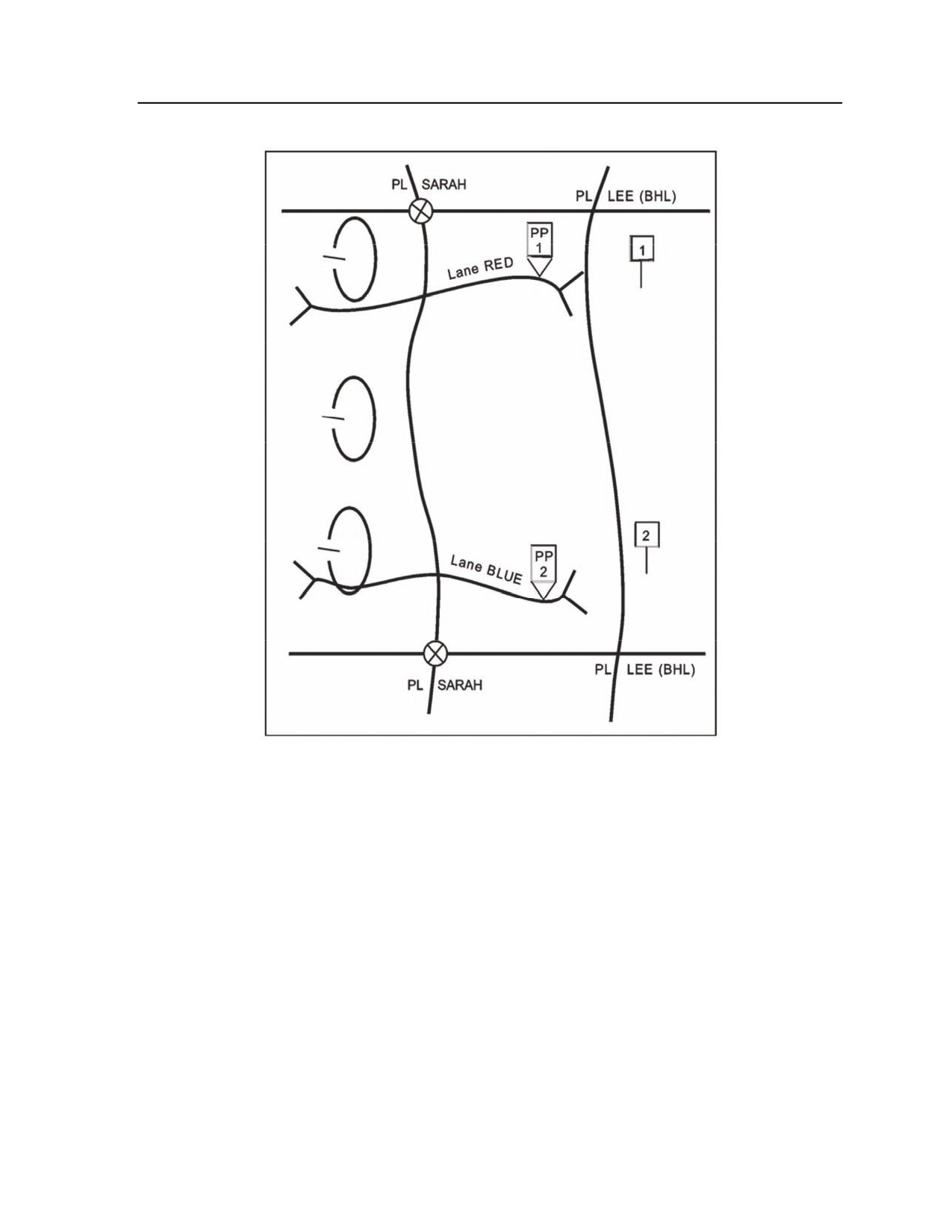
Other Tactical Operations
Figure 5-42. Battle handover and passage of lines graphic control measures
PASSING UNIT CRITICAL TASKS
5-156. The passing unit must accomplish several critical tasks during passage of lines in BHO, including
the following:
z
Immediately establish communications by entering the command, intelligence, and fire support
nets of the stationary unit.
z
Collocate a section or vehicle (usually the platoon leader’s, PSG’s, or section leader’s vehicle)
with the tactical command post (TAC CP) or main CP of the stationary unit as soon as possible
to enhance communications and unity of effort.
z
In a rearward passage, continuously report to the stationary unit the location, size, and
composition of all enemy forces, as well as the enemy’s current activity. If the enemy is
attacking, the passing unit reports the direction of movement, movement formation, and
estimated rate of advance of enemy elements. If the enemy is defending, passing unit reports
include enemy locations, orientation, composition, engagement areas, reserves
(if known),
obstacle systems, and flanks.
z
Continuously report to the stationary unit the location, size, and activity of all parent unit
elements, including enablers, sustainment, and C2 assets.
3 August 2009
FM 3-20.98
5-49
Chapter 5
z
Based on the current dispositions of the parent unit and elements of the platoon, coordinate with
the stationary unit to determine contact points at which subordinate elements
(such as
reconnaissance sections) will meet to coordinate handover and passage of lines with
representatives of the stationary unit. Once contact points are determined, the passing unit leader
sends a FRAGO to all elements specifying where they will coordinate the passage with the
stationary unit. In addition, the passing unit confirms recognition signals used during passage.
z
Ensure that each subordinate element acknowledges where it must coordinate the passage and
that it dispatches representatives to the assigned contact points to coordinate passage for the
element. At the contact points, the representatives confirm recognition signals and exchange
required information with their counterparts from the stationary unit.
z
In a rearward passage, maintain visual contact with all enemy units and conduct movement back
to the BHL, avoiding decisive engagement.
z
During the passage, display correct recognition signals and use correct challenge and password
as specified in the SOI.
z
Maintain proper weapons orientation.
STATIONARY UNIT CRITICAL TASKS
5-157. The stationary unit must accomplish a variety of critical tasks when ordered to conduct passage of
lines during BHO. These tasks include the following:
z
Establish communications with the passing unit, coordinate necessary contact points, and direct
the passing unit to the contact points based on current dispositions of the designated units.
z
Ensure that contact points are manned and secured and that passing elements have established
personal communications with their representatives.
z
Ensure that representatives at the contact points assign each passing element a passage point into
the AO and a route that extends from the passage points to the rear boundary or assembly area
(in a rearward passage) or to the attack position (in a forward passage).
z
Ensure that representatives at the contact points exchange required information, including
FBCB2, with the passing unit as outlined in their unit SOP.
z
Position elements along the BHL where they have the best possible observation of enemy
avenues of approach, adjusting as necessary during limited visibility.
z
If obstacles are emplaced between the FEBA and the BHL, ensure that routes through the
obstacle system are clearly marked and physically controlled by guides or that escorts are
provided to the passing unit.
z
Ensure that all routes of withdrawal obligated to the passing unit are unobstructed and facilitate
rapid movement to the RP (rearward passage).
z
Ensure that obligated routes of advance, attack positions, and routes to the BHL are clear and
facilitate rapid movement (forward passage).
PREPARATION
5-158. Units are particularly vulnerable during a passage of lines. Effective preparation is critical because
subordinate elements may be concentrated, stationary unit fires may be masked temporarily, and the
passing unit may not be disposed properly to react to enemy action. The commander may task the
reconnaissance or scout platoon with a number of missions, including detailed reconnaissance and
coordination, to assist him in preparing for the passage.
COORDINATION
5-159. Coordination occurs at a preplanned contact point where critical information is exchanged and
coordinated. Coordination for BHO normally flows from the commander out of contact to the commander
in contact. Coordination for the passage of lines and the handover should be conducted simultaneously.
5-50
FM 3-20.98
3 August 2009
Other Tactical Operations
5-160. The reconnaissance or scout platoon leader plays a major role in coordination for passage of lines
and handover. He is responsible for conducting reconnaissance to obtain information for use by both the
platoon and its parent unit.
5-161. During his reconnaissance, the platoon leader must confirm the following factors and information
related to the AO:
z
The disposition of the stationary force through which the platoon and/or its parent unit must
pass.
z
The location of contact points where both units are required to make physical contact at a
predetermined time.
z
The location of passage lanes that provide a clear route through the stationary unit’s position to
facilitate a smooth and continuous passage. The areas selected for the passage should be
unoccupied or on the flanks of units in position. If possible, the platoon leader should
reconnoiter multiple routes that can reduce vulnerability during the operation.
z
The rear boundary or assembly area (in a rearward passage) or the attack position (in a forward
passage). This position should provide cover and concealment and be located where the passing
unit will not interfere with the stationary unit.
z
The initial locations for enablers and sustainment elements of the platoon’s parent unit.
5-162. Based on his reconnaissance, the platoon leader coordinates the following information:
z
Contact points (primary and alternate).
z
Applicable passage points.
z
Passage lanes, including the SP, RP, and critical points.
z
The LD.
z
Location and number of guides and guide vehicles.
z
Routes through obstacles.
z
Alternate routes.
z
Sustainment plans, including resupply (Classes III and V), maintenance, MEDEVAC and/or
CASEVAC, and disposition of EPWs.
z
Traffic control factors, such as number of vehicles by type.
z
Time of the passage.
z
Rally points, the rear boundary or assembly area (rearward passage), and/or the attack position
(forward passage).
z
Actions on contact if required during the passage.
z
Times for transfer of responsibility for control of the sector and for handover of the enemy and
BHL.
z
Exchange of enemy and friendly information.
z
Direct and indirect fire plans and obstacle plans.
Note. The parent unit commander may provide some of this information in his order to the
platoon.
ASSISTANCE TO THE COMMANDER
5-163. Commanders may require the platoon to assist other units in the passage of lines. Primarily, the
platoon enhances the C2 function for the commander. The platoon may be required to conduct one or more
of the critical tasks of a stationary or passing unit or may assist its parent unit in the following ways:
z
Elements of the platoon may assist in securing contact and passage points where units will meet
and pass.
z
The platoon may reconnoiter possible passage lanes (primary and alternate), clearing them of
obstacles (within capability) and marking their locations.
3 August 2009
FM 3-20.98
5-51
Chapter 5
z
The platoon may guide units from contact points to or through passage lanes. The platoon may
also control traffic at the passage point and in the lane.
z
The platoon may conduct area reconnaissance of attack positions
(forward passage) and
assembly area locations (rearward passage). This may include a requirement to check for CBRN
contamination.
z
Platoon elements may be positioned in the passage area to act as a communications link in case
units involved in the passage have trouble communicating with each other.
z
The platoon may assist the commander by occupying OPs or conducting patrols to provide a
continuous flow of information about the enemy situation.
CONDUCT OF THE PASSAGE
5-164. In a forward passage of lines, the platoon leader or unit commander normally performs the
coordination. For a rearward passage of lines, the PSG or the commander’s liaison officer normally
performs the coordination. The stationary unit is responsible for designating passage points and passage
lanes and for providing guides. If contact points have not been designated by higher headquarters, the
stationary unit should coordinate their locations with the passing unit. For ease of control, the passing
unit’s command group (TAC CP or main CP) temporarily collocates with the stationary unit’s command
group (TAC CP or main CP).
5-165. After coordination is made and the passage begins, guides meet the passing unit at the contact
point or passage point. Guides exchange recognition signals with the passing unit and move it along the
route(s) without pausing, with the stationary unit overwatching the movement. Guides leave the passing
unit either at the RP or after it has passed the last stationary unit position.
5-166. Their parent unit typically recovers disabled vehicles. The stationary unit provides the required
medical assistance, maintenance, and POL as far forward as possible. As a minimum, the stationary unit
should provide emergency medical support.
CBRN CONSIDERATIONS
5-167. Because of potential congestion of units at passage points and along routes, stationary and passing
units must take protective measures against CBRN attack. Techniques to reduce vulnerability include the
following:
z
To minimize exposure time, passing units move as rapidly as possible through passage points
and along passage routes to their RPs.
z
Passing and stationary units conduct radiological and chemical monitoring.
z
Stationary units disperse by posting one or two vehicles in primary firing positions, with other
vehicles in hide positions. Elements in hide positions prepare for CBRN attack.
z
Passing and stationary units put on chemical-protective clothing as prescribed by the
commander.
z
If required, the stationary unit requests assistance through channels for decontamination of the
passing unit. Units normally conduct operational decontamination and then move to a rear
assembly area for thorough decontamination. A reconnaissance or scout platoon does not have
the internal assets for thorough decontamination of personnel or equipment; it requires
assistance from a chemical company.
FRATRICIDE AVOIDANCE
5-168. Since passage of lines during BHO is usually conducted in contact with the enemy, extreme care
must be taken to avoid fratricide. All units involved must know the correct recognition signals as well as
the exact number of vehicles and time of passage. There will be times when some elements fail to receive
necessary information or when stragglers are unaware of the current operation. Planning and coordination
must cover the following considerations:
z
Fratricide assessment.
z
Vehicle marking systems.
5-52
FM 3-20.98
3 August 2009
Other Tactical Operations
z
Navigational aids such as GPS.
z
Enemy situation and composition.
z
Obscuration (limited visibility).
z
IFF techniques for ground forces.
z
Effective SOPs.
z
Direct fire plans for both units.
z
Indirect fire considerations, including specific procedures for requesting and clearing indirect
fires.
z
Communications procedures and potential problems.
5-169. For more detailed information concerning fratricide and risk reduction measures, refer to
Appendix D (covering combat identification and fratricide prevention) and Appendix E (covering CRM
and environment protection).
SECTION VI - CORDON AND SEARCH
5-170. Cordon and search operations involve isolating the target area, searching the area, and capturing or
destroying possible insurgents and/or contraband. A cordon and search may be a task during a movement
to contact, raid, deliberate attack, or area reconnaissance. See FM 3-20.96 and FM 3-20.971 for additional
information.
5-171. Once intelligence gathering elements identify and locate important enemy elements or enemy
information, a cordon and search operation may be conducted to collect more detailed information or to
neutralize the enemy. Platoon leaders and commanders must develop knowledge of enemy organizations.
The continuous and effective employment of these intelligence gathering assets before and during the
cordon and search may provide updates to the enemy situation that may cause changes to the mission and
increase the probability of mission success. This discussion covers procedures for the reconnaissance or
scout platoon in support of the company/troop or battalion/squadron conducting cordon and search
operations.
5-172. In some situations, the targeted individuals may escape, leaving behind caches of weapons,
equipment, or other materials. Accurate documentation and cataloging of information and material of
intelligence value at the cordon and search site is vital. Once evidence has been moved it becomes more
difficult to connect it to the suspect house, incident, or individual. Therefore, leaders must accurately
account for all identified materials gained during SE.
Note. Leaders should assess the evidence they discover and then coordinate resources needed to
handle these materials. Examples may include such situations as transporting and safeguarding a
radio or a map, confiscation of wooden boxes containing a transitional cache for IEDs, or
discovery of a hidden tunnel storing a long-term cache for an insurgent offensive.
TASK ORGANIZATION
5-173. Commanders task organize the reconnaissance and scout platoon as a security force (inner or outer
cordon), search force, or reserve force during a cordon and search. The reconnaissance or scout platoon
will typically operate as part of the security force or the reserve force. If required, however, it can operate
either by itself as the search force or as part of a larger search force. HUMINT resources may expedite
identification of threats, reduce the chances for exposure to IEDs, and assist in the return of the platoon to
its base. Platoon leaders may need to plan for augmentation to include—
z
Infantry or tank sections from a maneuver battalion or squadron.
z
ISR assets such as UAS support.
z
Mine detection and/or demolition support from engineer units.
z
Interrogation, translator, and/or HUMINT support from the MICO.
z
PSYOP teams.
3 August 2009
FM 3-20.98
5-53
Chapter 5
z
EW support (such as radio intercept) from the MICO.
z
LNOs to assist with HN interaction.
Note. The PSG must be prepared to coordinate resupply and support of these attachments
operating with the platoon if their parent unit is unable to support them while they augment the
platoon.
CONDUCT OF THE OPERATION
5-174. Search zones are designated and a search party is assigned to each zone. Each search party has its
own search force, security force, and reserve force. Misuse of search authority can adversely affect the
outcome of the platoon’s mission. Conduct of all personnel must be within the bounds of the unit’s
standing ROI. Proper use of authority during searches gains the respect and support of the local residents.
Under normal search conditions, minimum essential force is used to eliminate any active resistance
encountered. The use of force is justified when a hostile act occurs or when an enemy element
demonstrates the intent to commit a hostile act. Use of force in self-defense may continue if the enemy
element continues to commit hostile acts or exhibits hostile intent. The use of force must be proportional,
and reasonable in intensity, duration, and magnitude, based on the perceived enemy.
5-175. The security element is responsible for isolating the objective and specific target areas within an
objective. This element is normally divided into two separate groups: the outer cordon and the inner
cordon. The outer cordon element prevents possible outside influence affecting the mission of the
search/assault force by blocking access to the target and interdicting elements trying to reinforce the
isolated enemy. An inner cordon is established to isolate the specific area in which the target of the
operation is located. An inner cordon prevents enemy movement within the specific area preventing enemy
entry or escape from the target area. Tasks that scouts may typically perform in the course of the operation
are fix, isolate, block, interdict, and neutralize. Checkpoints may be used in monitoring the population and
blocking access to the inner cordon.
5-176. An effective cordon is critical to the success of the search effort. Deployment to the search area is
rapid and is synchronized so it does not provide early warning to the local population. First, the security
force surrounds the area as an inner or outer cordon; the search force then moves into the area (see Figure
5-43). If the platoon’s surprise action is successful and the target individuals are taken into custody, the
detainees must be moved immediately to the CAB or squadron S-2 to ensure the unit has sufficient time to
process and conduct TQ of detainees.
5-177. Checkpoints and roadblocks are established along roads entering and exiting the area. OPs are
established, and security patrols are executed in the surrounding area. The security force orients mainly on
people or vehicles attempting to escape or evade the search in the populated area; however, the security
force can also cut off elements or individuals trying to reinforce enemy forces in the search area. Platoon
leaders may plan the use of sniper teams or UASs for additional security and overwatch while scouts
conduct checkpoints or roadblocks. Snipers may detect and engage IED emplacement, enemy sniper teams,
or other ambush preparations targeting the cordon and search force as it departs the area (see Figure 5-44).
5-178. A mobile reserve force is located near the search zone. Its specific mission is to reinforce OPs,
patrols, or the search force and to assist the other elements, as required by the mission. Figure 5-45 shows
the reconnaissance platoon operating as the reserve.
CAUTION
It is critical that scouts use EOF procedures and kits effectively and
consistently at the section and squad level to protect friendly forces while
adhering to the ROE. To ensure effectiveness in EOF situations, leaders
must institute regular training plans and constantly update the unit’s EOF
SOPs and kits.
5-54
FM 3-20.98
3 August 2009
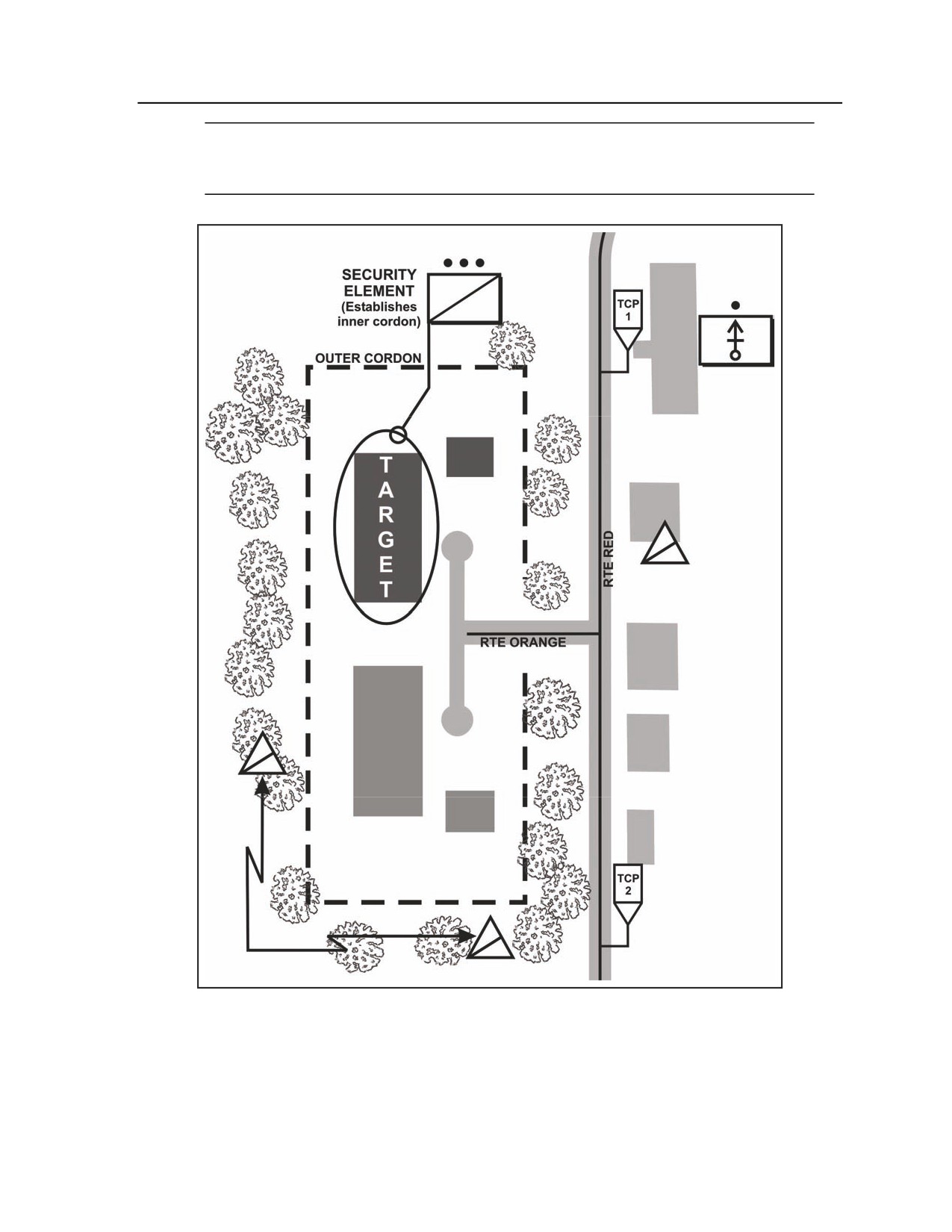
Other Tactical Operations
Note. For additional information on cordon and search procedures—including controlling the
populace, searching a house, conducting roadblock/checkpoint operations, and employing ROE
(including EOF)—refer to FM 3-20.971.
Figure 5-43. Security force establishes cordon
3 August 2009
FM 3-20.98
5-55
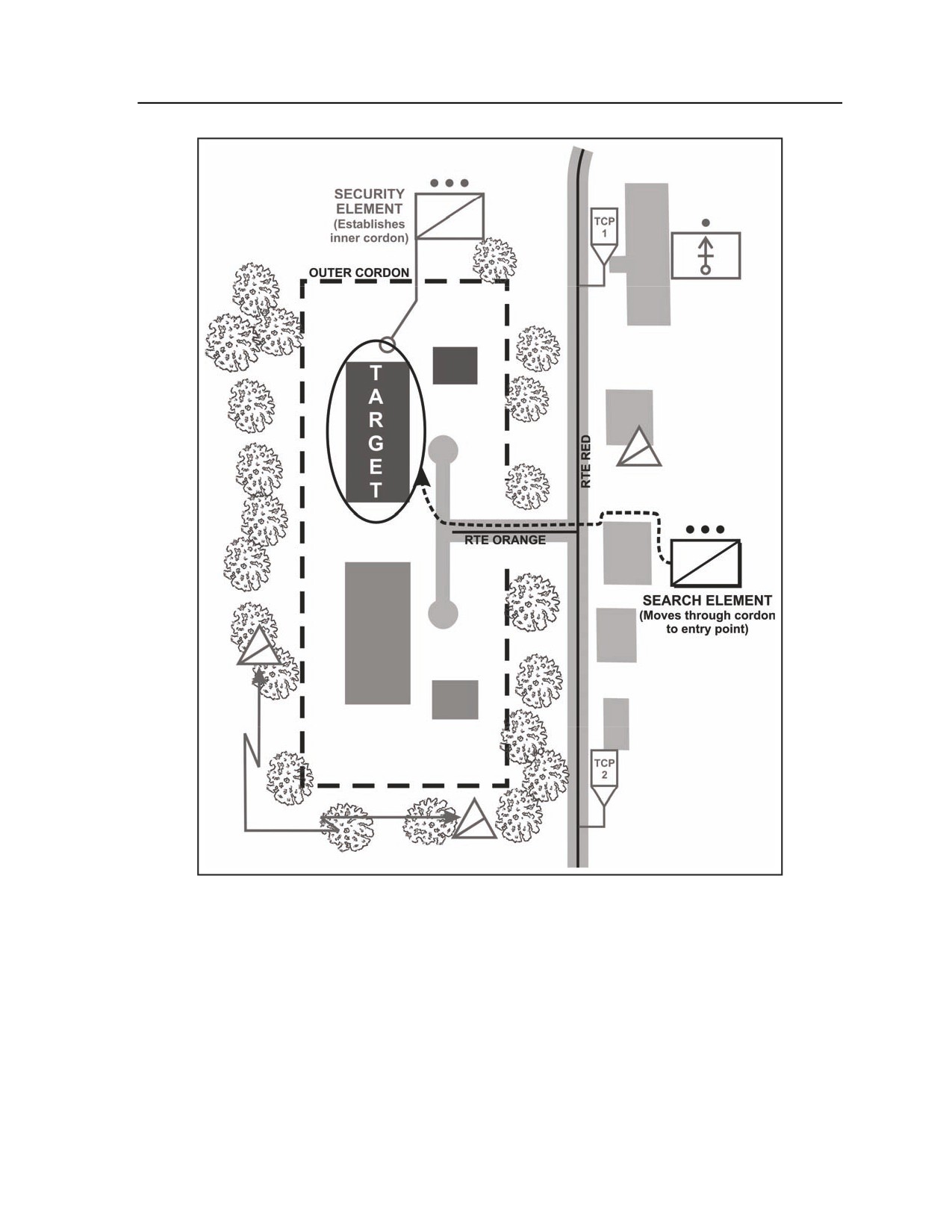
Chapter 5
Figure 5-44. Security measures during cordon and search
5-56
FM 3-20.98
3 August 2009
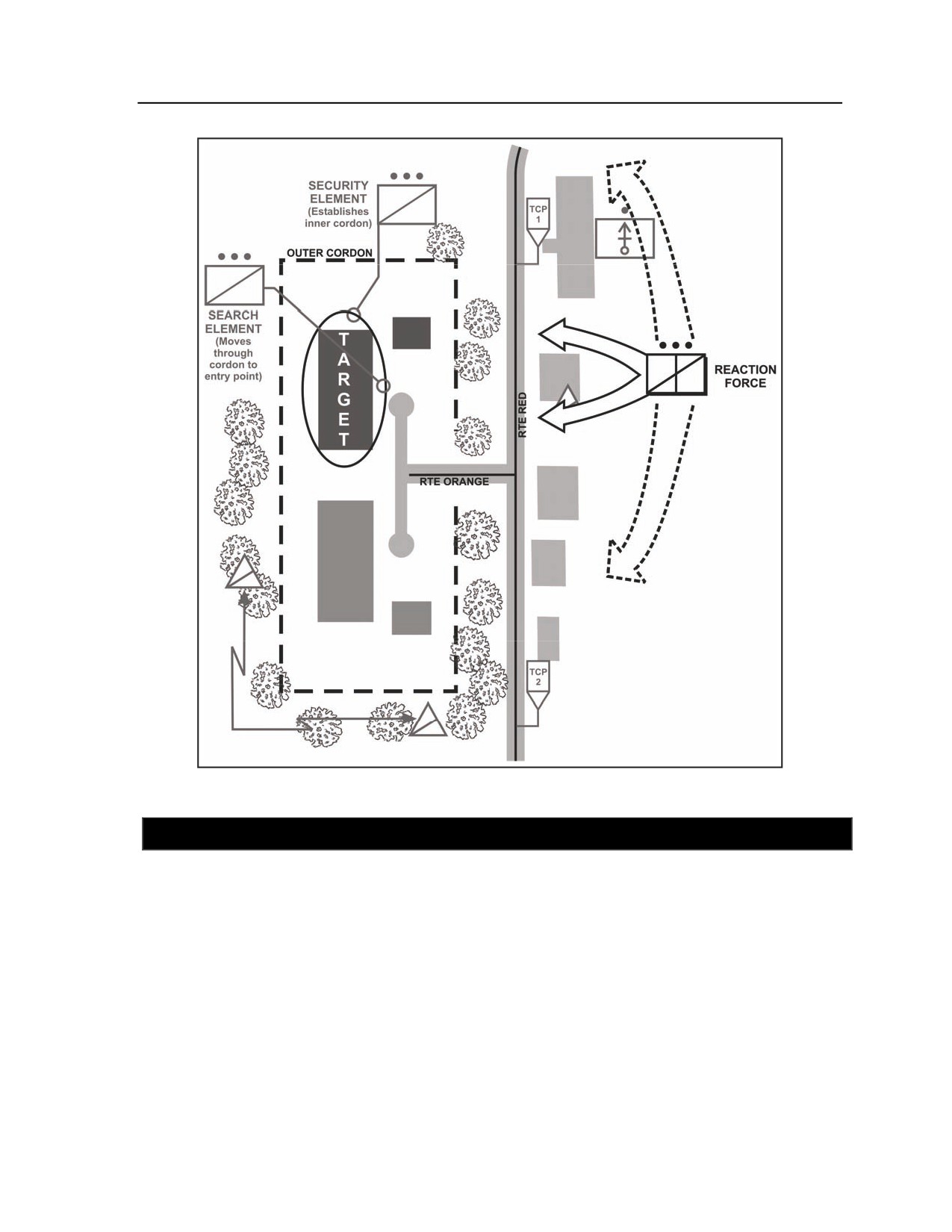
Other Tactical Operations
Figure 5-45. Platoon serves as reaction force
SECTION VII - OBSERVATION POSTS
5-179. Surveillance is the systematic observation of a specific area. Scouts may watch, listen, and smell,
as well as employ electronic sensors to observe assigned sectors. The OP is the preferred means of
maintaining surveillance of an avenue of approach or NAI. From OPs, scouts observe enemy movement
and direct killer teams and/or adjust indirect fires against the enemy. From the OP, the scouts send
SALUTE reports to their commander to provide early warning of enemy activity. (See FM 3-20.971, FM
3-20.96, and FM 3-21.8 for additional information.)
5-180. The reconnaissance and scout platoon can occupy multiple OPs based on the mission’s time
requirement (less than or greater than 12 hours), availability of vehicles, and squad strength. Additional
taskings may further reduce the platoon’s ability to operate OPs as shown in Table 5-1.
3 August 2009
FM 3-20.98
5-57
Chapter 5
Table 5-1. Scout OP organization and manning capabilities
Organization
Number of Sections
Scouts per
Possible
Possible
Possible
Section
Platoon OPs
Platoon OPs
OPs (with
(up to 12 hours)
(12+ hours)
patrols)
IBCT/BFSB
2 maneuver + HQ
6
3
2
2
SBCT
2 maneuver
10
4
2
2
HBCT
3 maneuver + HQ
8
4
4
3
ACR
2 maneuver + HQ
10
6
3
3
Note. This table includes platoon OPs that do not rotate security patrols through dead space.
5-181. The platoon can array OPs either in linear positions or in depth. Depth is preferred for maintaining
contact with a moving enemy. OPs in depth can be configured as all vehicle-mounted; dismounted scouts
forward of vehicle; or a combination of dismounted scouts and wheeled and tracked vehicles. Linear
placement is effective when the enemy is not moving; it provides optimum observation of the enemy.
CRITICAL TASKS
5-182. Critical tasks for the platoon in employing OPs include the following:
z
Determine the type of OP (mounted, dismounted, or a combination), depending on requirements
for either maximum stealth or rapid movement.
z
Position the OPs either in linear positions or in depth to allow for observation of the assigned
sector. The following factors will affect proper positioning of the OP:
The need for observation from several OPs to reduce the chance of the enemy entering the
sector undetected.
A requirement for the platoon to observe the entire sector by placing OPs along the
enemy’s most likely avenues of approach.
z
Select a position for each OP that affords the best possible force protection. Selection criteria
include the following:
Covered and concealed routes to and from the OP.
Unobstructed observation of the assigned area.
Effective cover and concealment.
Sites that avoid natural lines of drift, that do not call attention to themselves, and that do
not skyline observers.
z
Occupy the OP. The platoon should employ the most secure method of moving into position;
dismounted occupation is the preferred method. Occupation steps include the following:
Establish overwatch.
Reconnoiter the position.
Establish security.
Clear the site and ensure sector visibility.
Establish vehicle hide positions.
Develop sector sketches.
z
Man the OP. The platoon leader must ensure that each OP has the necessary personnel and
equipment to perform the following tasks:
Observe the assigned area.
Provide local security (including planning and preparation for contact and actions on
contact).
Report information.
Call for and adjust fires.
5-58
FM 3-20.98
3 August 2009
Other Tactical Operations
z
Conduct local reconnaissance patrols when necessary to cover dead space, provide local
security, and observe avenues of approach and/or NAIs from different vantage points.
z
Employ active and passive protective measures. Scouts are extremely vulnerable in the OP.
Their best self-defense is not to be seen, heard, or otherwise detected by the enemy.
z
Improve the position. The platoon can enhance OP protection using the following steps:
Dig in the OP position.
Camouflage the position.
Install communications equipment.
Emplace hasty obstacles.
TYPES OF OBSERVATION POSTS
5-183. OPs can be executed dismounted or mounted, or as a combination of these two types, as outlined
in the following discussion.
DISMOUNTED OPS
5-184. The dismounted OP provides maximum stealth and thus has the greatest likelihood of remaining
undetected by the enemy. The disadvantages of the dismounted OP are the time it takes to remount and
move, and the potential lack of ground-mounted thermal devices or other all-weather optics. If rapid
movement or displacement is anticipated, the OP should mount or remain mounted.
MOUNTED OPS
5-185. These offer the advantages of rapid movement, vehicle optics, and protection. Because the enemy
can more easily detect them, however, they are potentially much less effective than dismounted OPs.
COMBINATION OPS
5-186. The platoon can employ an OP that combines the advantages of both the dismounted and mounted
types. For example, the vehicle could be used to monitor a particular NAI while other crewmen dismount
to observe an enemy dismounted avenue of approach. The combination OP can offset the advantages of the
other types as well as some of their weaknesses, including lack of mobility and ease of enemy detection.
Note. The use of UASs to cover dead space and avenues of approach beyond line-of-sight
enables the platoon to extend its areas of observation and to report contact in sector much sooner
to the commander, providing additional time for fires and maneuver against the enemy. It is
important to remember some sensor contacts may require confirmation with more detailed
reconnaissance.
POSITIONING THE OP
5-187. As noted, OPs may be positioned in the AO either in a linear configuration or in depth. Linear
placement (illustrated in Figure 5-46) allows the platoon to observe the assigned sector from several OP
sites, reducing the chance of the enemy entering the sector without being observed. This method works
well when the platoon has been assigned a large sector with few avenues of approach or is in open terrain.
In-depth OP placement (refer to Figure 5-47) allows the platoon to observe the entire sector by placing OP
sites where the platoon can observe the most likely avenues of approach in the sector as well as along the
sector flanks. This method works well when the platoon is assigned a sector with several avenues of
approach or is in heavily vegetated terrain. In-depth placement allows for redundancy in observation and
better interlocking coverage of the sector. The HBCT reconnaissance platoon may place CFVs forward
when heavy contact is likely or HMMWVs forward when stealth is required.
3 August 2009
FM 3-20.98
5-59
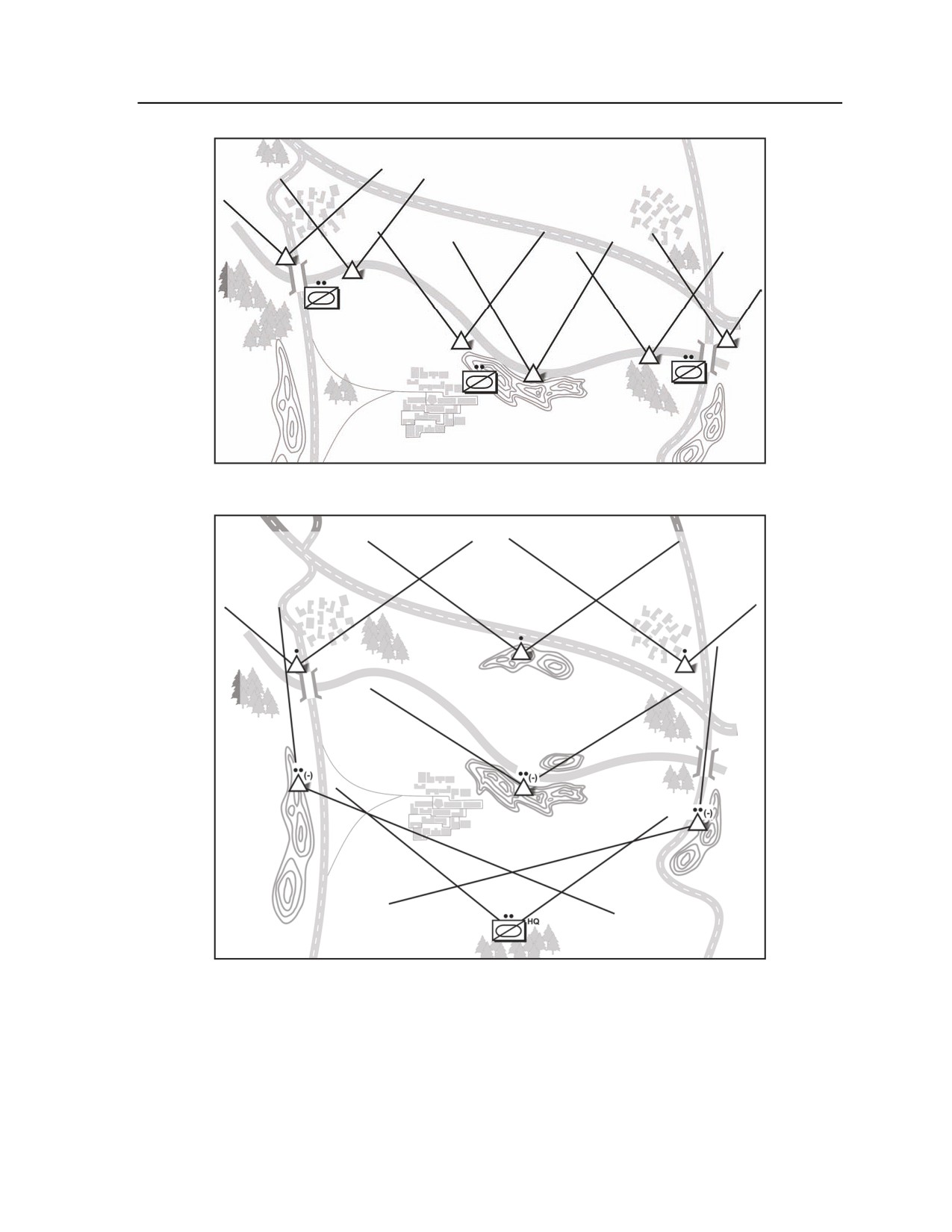
Chapter 5
Figure 5-46. Linear positioning of OPs
Figure 5-47. In-depth positioning of OPs
SELECTING AN OP SITE
5-188. Based on the commander’s guidance, the platoon leader selects the general location for the
platoon’s OPs after analyzing METT-TC factors. From his analysis, he determines how many OPs he must
establish; he also decides where they must be positioned to allow long-range observation along the avenues
of approach and provide depth through the sector. Digital terrain products may assist commanders and
5-60
FM 3-20.98
3 August 2009
Other Tactical Operations
platoon leaders in making the site selection with the line of sight tool in these programs. Section and squad
leaders then select the exact position for each OP once they are at the planned location. OPs should have
the following characteristics:
z
Covered and concealed routes to and from the OP. Scouts must be able to enter and leave the
OP without being seen by the enemy.
z
Unobstructed observation of the assigned area or sector. Ideally, the fields of observation of
adjacent OPs overlap to ensure full coverage of the sector.
z
Effective cover and concealment. Scouts should select positions with cover and concealment to
reduce their vulnerability. They may need to pass up a position with favorable observation
capability but with no cover and concealment in favor of a position that affords better survivability.
z
A location that will not attract attention. OPs should not be established in such locations as a
water tower, an isolated grove of trees, or a lone building or tree; these positions draw enemy
attention and may be used as enemy artillery target reference points (TRP). The OPs should also be
located away from natural lines of drift along which a moving enemy force can be expected to
travel. These locations might include a route on the floor of a valley or a site near a major highway.
z
A location that does not skyline the observers. Avoid hilltops. Position OPs farther down the
slope of the hill or on the side, provided there are covered and concealed routes into and out of
the position.
Note. Scouts may operate from highly visible and permanent OP structures when deployed on
peacekeeping missions. While this does not appear tactically sound, it still supports the purpose
of that mission.
OCCUPYING THE OP
5-189. The reconnaissance or scout platoon leader selects a technique to move to the screen line based on
his analysis of METT-TC. Unless the area has already been cleared, the platoon should conduct a zone
reconnaissance to the screen line. This is the most secure method of moving to the screen line, but also the
most time-consuming. The following steps provide an example of how a section might occupy an OP:
z
The section stops short of its OP site. The section leader directs the drivers into positions to
overwatch the general OP site and any terrain the enemy could use to interfere with movement
into or out of the position. (See Figure 5-48.)
z
The section leader dismounts with scouts from each vehicle and moves forward to reconnoiter
the OP (using the OP site selection characteristics). Drivers and gunners remain on their vehicles
to overwatch the dismounted personnel.
z
The section leader moves the dismounted scouts to the OP site, establishes security
overwatching the far side of the site, and checks the site for mines, booby traps, and enemy
personnel. He verifies that he can observe his sector or area of responsibility from this site and
determines which position is best for the OP. The section leader issues a five-point contingency
plan and displacement criteria to the OPs before returning to the vehicles.
z
The section leader selects hide positions and fighting positions for his vehicles.
z
The driver and a dismounted scout from each vehicle mark their vehicle position with a ground
stake. The stake, which enables a vehicle to reoccupy the fighting position at a later time, is
centered on the driver’s station. It must be tall enough for the driver to see as he drives into
position. The driver uses engineer tape or luminous tape on the stake so he can see it during
limited visibility operations. Once the area around the OP is cleared and secure, the section
leader signals the vehicles forward to move into their fighting positions.
z
The gunner and vehicle commander for each vehicle complete and check their sector sketch.
Each vehicle then moves back out of its fighting position into a hide position. The section leader
checks the sketches to ensure they provide complete coverage of the sector. Sector sketches or
range cards are a valuable reference if the vehicle is ordered to fight.
3 August 2009
FM 3-20.98
5-61
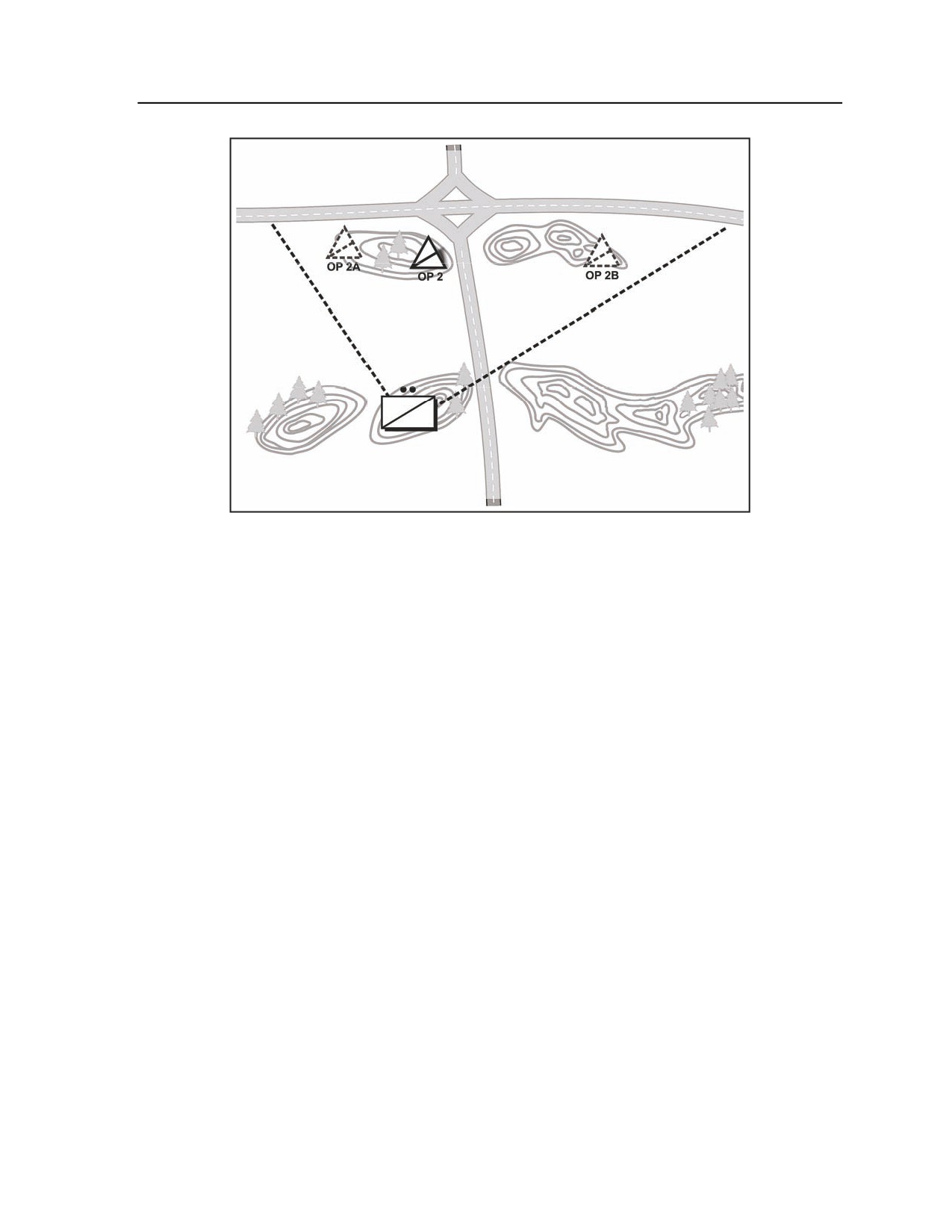
Chapter 5
Figure 5-48. Vehicles overwatching a potential OP site
MANNING THE OP
5-190. A minimum of two scouts man each OP. They must be equipped to observe the area, report
information, protect themselves, and call for and adjust fire. One scout observes the area while the other
provides local security, records information, and sends reports to the section/squad leader or platoon
leader. The two scouts should switch jobs every 20 to 30 minutes because the observer’s effectiveness
decreases quickly after that time. Essential equipment for the OP includes the following:
z
Map of the area with graphics.
z
Compass.
z
Communications equipment (wire and/or radio).
z
Observation devices (binoculars, observation telescope, and/or NODs).
z
SOI extract.
z
Report formats.
z
Weapons, such as personal and crew-served. This includes AT-4s and appropriate mines.
z
CBRN equipment and individual protective equipment to achieve MOPP 4.
IMPROVING THE POSITION
5-191. Once the section leader has established the OP and assigned the scouts their sectors of observation,
the section improves the position. The section leader prepares a sector sketch, an example of which is
illustrated in Figure 5-49. This sketch is similar to a fighting position sketch but with some important
differences. At a minimum, the sketch will include the following:
z
A sketch of key and significant terrain, including NAIs and avenues of approach.
z
Location of the OP.
z
Location of the hide position.
z
Locations of vehicle fighting and observation positions.
z
Alternate positions (hide, fighting, and observation).
z
Routes to and from the OP and fighting positions.
5-62
FM 3-20.98
3 August 2009
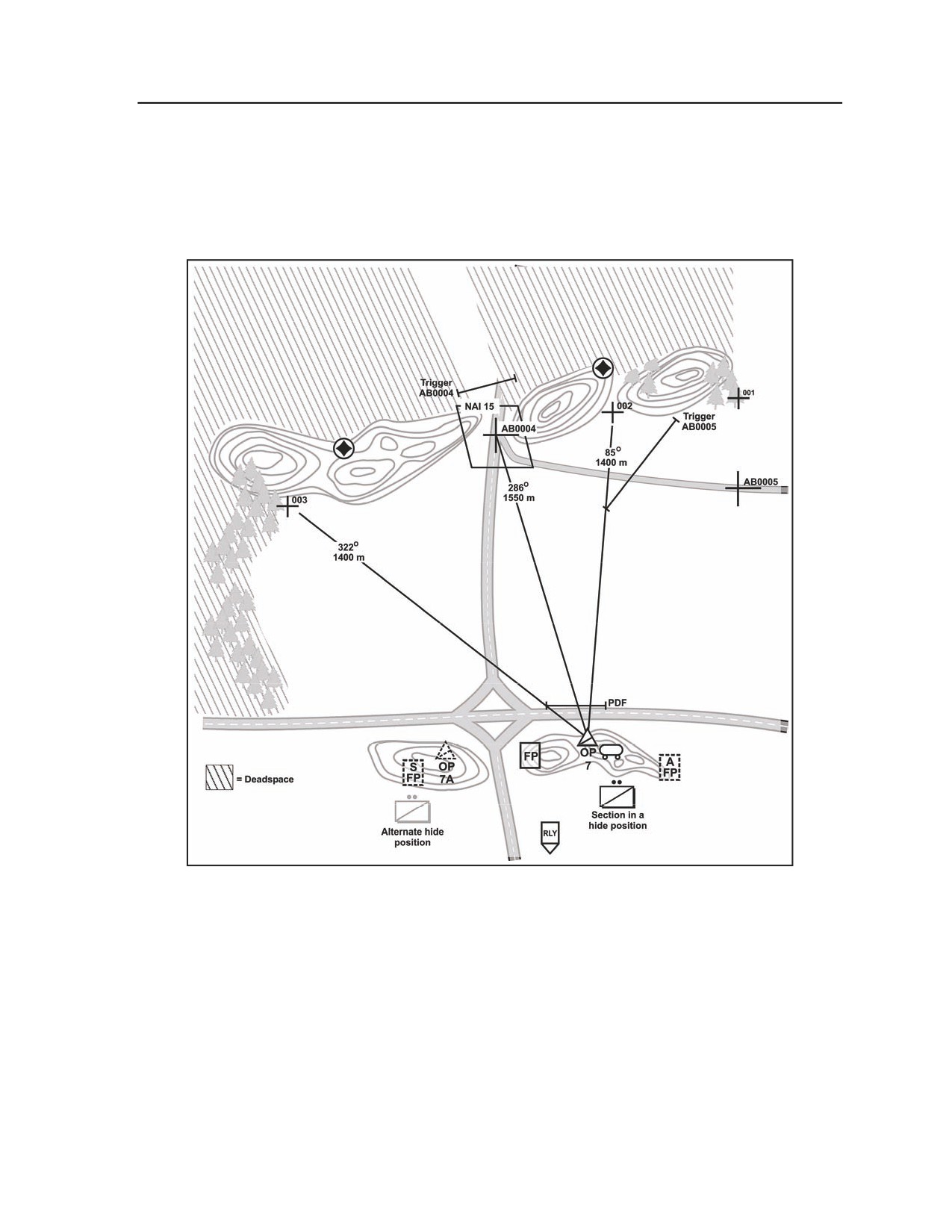
Other Tactical Operations
z
Sectors of observation, with dead space identified.
z
Preplanned artillery targets.
z
TRPs for direct fire.
z
Prepared SPOTREPs and calls for fire, based on trigger lines and projected locations where the
enemy will first be seen.
z
Locations of protective obstacles, such as claymore mines and trip flares.
Figure 5-49. Section leader’s OP sketch
5-192. Personnel manning the OP site begin digging in to provide protection from indirect and direct
fires. They also camouflage the position, install wire communications equipment and directional antennas,
and emplace hasty obstacles for local protection. As the OP is improved, soil and other materials that have
been moved are not disposed of to the front of the OP site. This can give away the scouts’ presence when
observed from the front. Vehicle commanders (or gunners) and drivers reconnoiter the routes to their
fighting/observation positions and alternate positions, perform maintenance, and camouflage vehicles and
positions. The section leader’s OP sketch must be accurate; what he can see and obtain an azimuth to in the
hide or turret-down position must be the same when the vehicle is in the hull-down position. The same
principle applies for dismounted OPs; when the scouts are behind cover, they must have the same fields of
fire for their crew-served weapon as when they expose themselves to engage the enemy.
3 August 2009
FM 3-20.98
5-63
Chapter 5
OP COMMUNICATIONS
5-193. The scouts occupying the OP use wire, radio, or both as their primary means of communications.
Wire is preferred because it is concealable, secure, and is not vulnerable to enemy direction-finding
equipment or jamming. If possible, the scouts in the OP use wire to communicate with their section/squad
leader or his representative, who is located with his vehicle in the hide position behind the OP. As a last
resort, messengers may be used to report information if the radio is being jammed or the wire is severed.
Scouts moving to and from the OP as messengers must ensure their movement is undetected by the enemy.
Note. If found, wire can lead the enemy to the vehicle, the OP, or both.
5-194. The scout in the vehicle relays reports or information to the platoon leader by FBCB2 or wire. The
scouts in the OP should carry a radio as a backup means of communications; they can use it to send reports
or to talk directly to their FIST or mortar section for indirect fire support.
OP SECURITY
5-195. As noted, scouts are extremely vulnerable in an OP; their best self-defense is not being seen,
heard, or otherwise located by the enemy. They employ active and passive measures to protect themselves
from enemy detection and direct and indirect fires.
5-196. The first step is to locate the OP in a covered and concealed position to reduce the chance of being
seen by the enemy. The scouts add camouflage to the position to enhance natural concealment. Material
from around the location itself is recommended as long as it is gathered in a manner that does not indicate
the scouts’ presence. If they have enough time, the scouts dig in the position and add overhead cover to
increase survivability against enemy fires. They enforce strict light and noise discipline and restrict activity
in and around the OP to essential movement only. All vehicles remain hidden because the enemy can easily
identify their large signatures. Scouts in the OP also must maintain secure communications; refer to the
discussion earlier in this section.
5-197. To provide early warning of enemy movement around a screen line or OP position, scouts emplace
UGVs in areas that cannot be directly observed or in the dead spaces around or between OPs. Trip flares
and claymore mines provide additional early warning and protection from enemy personnel; however, once
they are triggered, the enemy will have an indication that there is an overwatching element for that device.
5-198. Active patrolling around and between OPs also enhances security. Patrols give the platoon the
ability to observe areas that cannot be observed from the OPs and to clear the area around the OP of enemy
elements. A patrol can be executed by a minimum of two dismounted crewmen from the vehicles in the
hide position. The platoon executes security patrols as soon as possible after occupation of the position to
discover enemy elements that might have observed the occupation. The patrol reconnoiters favorable
observation positions that might be occupied by the enemy. Route selection is critical when organizing
patrols because scouts must assume that the OP position is under observation.
5-199. OPs cannot always avoid being seen by the enemy, so they must take actions to limit their
vulnerability. Covered positions provide protection from enemy fires; vehicle dispersion further reduces
the effects of these fires. The vehicles in the fighting positions are used to extract the scouts from the OP
when the position has been identified and attacked by the enemy.
EXTENDED OP OPERATIONS
5-200. Extended OPs are fixed surveillance positions that require the scouts to remain at the site for up to
72 hours without relief or rotation of scout teams or support from the element’s vehicle. Extended OPs
minimize the chance of enemy detection. Infiltration and exfiltration, using aerial or dismounted
movement, will be the primary method of occupying and departing the OP. Once the OP is occupied,
movement around the OP ceases until mission is complete, evacuation is required, and/or exfiltration
begins.
5-64
FM 3-20.98
3 August 2009
Other Tactical Operations
5-201. This discussion addresses the process of selection, construction, and occupation of extended OPs.
During this process, the scouts should apply the principles summarized by the acronym BLUES:
z
B - Blend in with the surrounding area. Does the site look natural? Does it attract unwanted
attention?
z
L - Low-to-the-ground construction techniques must be used. Does the site provide protection
against small arms and direct weapons fire?
z
U - Unexpected sites should be used. Will the enemy forces expect you to look out the window
or the small hole in the wall?
z
E - Evacuation routes must be planned during site selection. Where will you go to link up with
friendly forces?
z
S - Avoid silhouetting of the site by using the sides of hills, not the crests. Can the sniper see
you silhouetted against the skyline, wall, or other object?
SITE SELECTION
5-202. In choosing where to position extended OPs, the reconnaissance or scout platoon must ensure that
the sites meet the following requirements:
z
Afford adequate visual and electronic line-of-sight target observation and security for the
observers.
z
Have as wide a field of view and as little dead space as possible.
z
Are not near natural lines of drift or in terrain that would naturally draw the attention of enemy
forces, such as atop a flat rock face on a hill.
z
Have covered and concealed exit and entry points.
z
Are far enough downwind from the target and inhabited areas to minimize the detection of the
odors by dogs or people. Remember that wind direction often changes at various times of day.
z
Are positioned at a distance from the target in accordance with METT-TC.
z
Afford effective overhead and side cover and concealment.
z
Are capable of supporting execution of battle drills if the observers must break enemy contact.
z
Support reliable communications between the observers and their main body, security element,
and/or communications element.
z
Are in a location that is not obvious to enemy forces.
5-203. If no single position affords all these features
(for example, daytime versus nighttime
requirements), it may become necessary to select separate positions suited to the type of surveillance
performed. Multiple positions must be mutually supporting so that if one position is compromised,
observers in the other position are able to continue the surveillance mission and/or warn the rest of the
platoon. Further, if positions are not used during the day, they should be kept under observation. If the
positions cannot be secured by observation, they should not be reused the following night. This practice
prevents the scouts from walking into an ambush while trying to reoccupy the position. Another
consideration in the use of separate positions is that observers must avoid establishing patterns and trails
while moving to and from the different positions.
CONSTRUCTION TECHNIQUES
5-204. Several construction techniques are common to all observation positions. These techniques are
included in SOPs and practiced during normal training.
Dirt Removal
5-205. The primary problem in constructing any position is the removal of excess dirt. Excavated soil
expands in volume. In dry climates, the subsurface soil contains the most water. This water content causes
the soil to be a different color, meaning this soil must be camouflaged. Under these conditions, construct
underground positions before the early morning dew develops. Discarding excess soil before the dew sets
in aids in the camouflage process. Consider the effect of the sun drying out the excess soil. This dried soil
3 August 2009
FM 3-20.98
5-65
Chapter 5
may need to be camouflaged. The main technique for camouflaging soil, using plastic sheeting or a
poncho, entails the following steps:
z
Lay out the sheeting alongside the position.
z
Place the topsoil to one side of the sheeting. Remember that the topsoil only extends a few
centimeters below the surface. Save as much of the vegetation as possible.
z
Dig out the remaining soil. Do not mix the topsoil with subsoil from the hole.
z
Fill sandbags with loose soil dug from the hole; use them to reinforce the sides of the position.
z
Fill surrounding depressions, ruts, or ditches with the remaining excess soil. If this procedure is
not possible, spread the soil lightly on the surface in an area away from the position. Avoid
putting the excess soil in creeks or streams that may wash the dirt down the waterway and attract
unwanted attention.
z
After overhead cover is constructed and waterproofed, replace the topsoil. Place vegetation,
leaves, deadfall, or other local materials around the area to finish camouflaging the position.
z
The final step in the process is to recover the sheeting used to contain the soil. Check the
vegetation under the sheeting to ensure that it was not matted down under the weight of the soil.
If matting has occurred, take the time to brush it with a branch to return it to its natural state.
z
As time passes, continually check the vegetation and soil around the position to ensure that they
appear natural. Loose soil often falls through small holes and results in a strange looking,
funnel-shaped hole. Check vegetation to ensure that it blends in with the surrounding area.
Remove or replace dead vegetation.
Vegetation
5-206. When applying the “B” in the BLUES acronym, remember that vegetation is critical to blending
the OP with surrounding terrain. Replanting and watering vegetation during initial position construction
can eliminate the need to continually replace wilted plants. The drawback to this is the digging activities
may be observed or heard by the enemy.
Grasses
5-207. When removing topsoil, save the grass. Remove the grass in clumps, using an entrenching tool or
shovel to cut circle about 5 to 15 centimeters around the section to be saved. Pry the roots and soil up from
the bottom. When replacing the grass around the position, pattern the placement after the natural design.
Shake the grass slightly to loosen the roots, then replace it at ground level. If water is available, a small
amount placed on the grass will lessen the shock of replanting and extend the life of the camouflage. Grass
sod may be cut and peeled back to create a subsurface cache for OP personnel, equipment, and supplies.
Plants and Bushes
5-208. Medium-sized plants or bushes will aid the security of the position. Not only will the plants add to
the camouflage of the position, they will also discourage vehicle and foot movement over the top of the
position. The main disadvantage in using plants on top of the position is that the plants may die or fall over
due to the shallow depth of the overhead cover.
Deadfall
5-209. Deadfall can restrict movement in much the same way as the plants and bushes discussed earlier.
At the same time, the use of deadfall as part of the overall camouflage effort presents several
disadvantages:
z
In most regions of the world, deadfall is used for home heating, cooking, and construction. If the
position has this fuel near it, the risk of discovery increases. The only options available to OP
personnel if a nonhostile civilian discovers them are emergency exfiltration and activation of the
escape and evasion plan. Either COA will result in the mission being terminated.
z
Deadfall provides very limited cover against small arms fire. Most trees decompose quickly on
the ground. Modern small arms fire will easily pass through these rotten trees. If deadfall must
be used, it is reinforced with dirt.
5-66
FM 3-20.98
3 August 2009
Other Tactical Operations
Sidewall Support
5-210. Depending on the soil condition in the AO, the sidewall of the position may require some type of
shoring or support to prevent cave-ins. A variety of material for support of the walls is available, such as
local timber, branches, deadfall, plastic sheeting, and ponchos. The primary means for supporting sidewalls
is sandbags. These lightweight bags have a variety of uses and conform to almost any shape required. The
exact number of bags required depends on the size and overall design of the position. When cross-bracing
sandbagged walls, use freshly cut green timber or a prefabricated support such as PVC pipe, conduit, or
similar items. Examples of cross-bracing and revetments can be found in FM 5-34.
OP Kits
5-211. Whenever possible, the unit should assemble kits to aid in the construction of the required
positions. Items in these kits include the following:
z
PVC pipe (elbows, straight connectors, and three- and four-way connectors) and PVC cement.
This strong, lightweight material can be formed into a multitude of shapes and designs. It can be
used to build a frame for the overhead cover or to form cross-bracing.
z
Parachute suspension line. This has many uses, such as being interwoven to produce a frame for
overhead cover.
z
Sandbags.
z
Assorted tapes, cords, and ropes.
z
Plastic bags with press-together or slide-lock “zippers” for closing. These items can be used for
general storage.
z
Half-meter-square pieces of 1-centimeter plywood. This lightweight material is excellent for
constructing overhead cover, platforms for use in trees, and insulation when operating on ice
and snow. The squares can be painted to match the terrain in which they are used.
z
Plastic sheeting. Heavy-gauge plastic sheeting fills many roles. If plastic sheeting is not
available, the heavy-duty plastic bags used to cover pallets work well.
z
Hand tools, such as D-handle shovels, hack saws, hammers, and small bow saws.
z
Plastic or aluminum tent stakes. These items save time during construction of the position.
z
Canvas and camouflage netting.
z
Mirrors or periscopes.
EXTENDED OP EMPLOYMENT
Urban Environment
5-212. An urban or built-up area forms the economic and cultural focus for the surrounding area. It is
characterized by a concentration of people and man-made structures and facilities. Because of the generally
limited fields of vision, urban operations normally require more positions than rural operations. Refer to
FM 3-06 and to the discussion of urban operations in Appendix C of this manual. In the urban
environment, elements manning OPs have the advantage of concealing movement to and from the OP by
moving under, through, or over buildings and other structures.
Position Selection
5-213. As with other observation and surveillance positions, METT-TC factors dictate the selection of
urban OPs. Scouts can construct fixed urban positions in occupied and abandoned buildings, on water
tanks, behind shrubbery, on factory chimneys, or in the attics of multistory buildings or other tall
structures. If the position is to be set up in an undamaged part of the urban area, the scouts should select
buildings of solid construction, with serviceable stairs and basements that can be equipped for the rest and
shelter of personnel.
5-214. Scouts should avoid wooden buildings and buildings in a significantly deteriorated condition
because of the risk of injury from fire and/or structural failure. Fixed positions should not be located in
3 August 2009
FM 3-20.98
5-67
Chapter 5
buildings that will attract the enemy’s attention; instead, they should be placed in rubble, yards, and
gardens.
5-215. When occupying the position, scouts must look for booby traps and mines. If they detect such
devices, they must be prepared to take proper precautions, including the following:
z
Disable the devices, if possible.
z
Mark the area if the devices cannot be disabled.
z
Choose another position if the quantity of booby traps or mines prevents safe operation within
the position.
Construction
5-216. Position construction may consist simply of being able to look out of a suitable viewing port, or it
can be much more elaborate. Considerations and actions should include the following:
z
Construction of the position must be done with particular emphasis on OPSEC.
z
Fill windows, doors, and other openings (such as bullet holes not used for observation) with
bricks, fragments of building materials, or sand bags if available.
z
Remove flammable objects. These may be used for early warning or defensive devices.
z
Establish interbuilding communications by hard wire. Fiber optic cables
(telephones), if
available, offer even better security and support some surveillance devices.
z
Identify and construct rapid departure routes.
Avoiding Detection
5-217. Because of the high concentration of people, enemy security elements, lighting sources, and
movement, scouts in urban areas must take additional precautions to avoid detection during surveillance
activities. Considerations for detection avoidance include the following:
z
A minimum of two scouts are required in occupying the OP.
z
If operating from an occupied dwelling, do not consume more electric power, water, and heat
than the normal occupants.
z
Employ OPSEC to negate or evade enemy electronic countermeasures. For example,
technological advances make it possible for mobile units operating from the street to
electronically survey a building and detect and identify very small sources of energy. Such
capabilities are increasingly widespread and are often found in built-up areas of even marginally
developed countries.
Mountainous Environment
5-218. Rugged, poorly trafficable terrain, steep slopes, and elevations that allow observation of
surrounding terrain characterize mountainous areas. This terrain may require more observers and positions
than flat areas because of the relatively limited fields of view. On the other hand, in areas above the tree
line or where lower elevations lack vegetation, the number of observers may be decreased. OPs can be
detected at any angle by threats above or below them. A careful study of the target area will give a good
indication of these requirements. For a general discussion of operations in mountainous areas, see FM 3-
97.6. Platoons may employ UASs to cover dead space or extend range; however, windy conditions typical
of mountainous areas may hamper deployment or recovery of the UASs.
Position Selection
5-219. Mountain terrain provides many places for cover and concealment. Position selection is not guided
by the height of a given mountain but by factors that include the following:
z
Irregular fields of observation.
z
Dead space.
z
Cover and concealment.
z
The limits of the observation equipment used by the scouts.
5-68
FM 3-20.98
3 August 2009
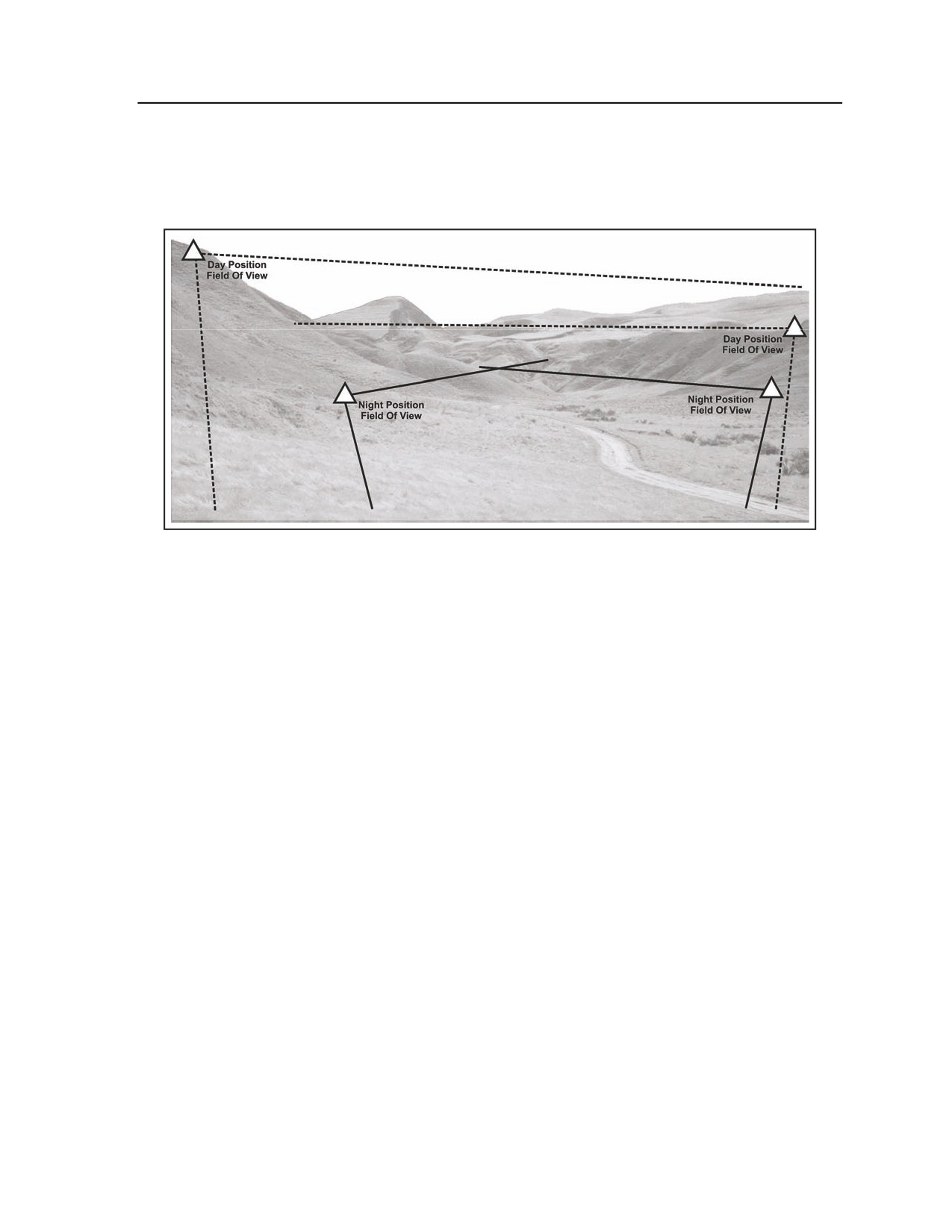
Other Tactical Operations
5-220. Scouts may employ a circular, multi-tiered system of observers. To increase daytime viewing
capability, positions are placed not only laterally but also with vertical dispersion. This layering of
positions also reduces the need for movement when changing from daytime to nighttime operations. Since
movement is the main cause of compromise, layering positions also adds to the security of the deployed
scouts (see Figure 5-50).
Figure 5-50. Overlapping mountain observation
Construction
5-221. Irregular terrain in mountains often affords natural hiding places for observers. In most
mountainous areas, the rocky nature of the ground makes it difficult and often impossible to dig
belowground positions. In those cases, boulders and loose rocks can be used in aboveground construction
of low-walled positions called “scrapes.” The position must blend in with its surroundings and not be
detectable from any angle. Fields of view can often be enhanced if the lower branches on the undergrowth
are trimmed back with a wire saw, shears, or knife.
Night Observation
5-222. At night, sending out additional observers into valleys enhances observation. Observation from
below, facing upward against the background of the sky, often gives better results. In addition, the scouts
should supplement night observation by monitoring. Monitoring is more effective in mountainous areas
than on flat terrain because sounds are often funneled to the head of a valley and are perceptible at great
distances. Sounds in the mountains can be deceptive, however. Various obstructions can reduce their
volume and change their direction.
Snow
5-223. In mountainous areas, scouts can use certain tactics to reduce the problems associated with
operations where snow is expected or known to be on the ground. Some of these tactics are discussed in
the following paragraphs.
5-224. Melting Conditions. Observers should choose positions that are in shaded areas, on slopes facing
away from the equator (north in the Northern Hemisphere, south in the Southern Hemisphere). In moderate
temperatures, the heat generated by the observers’ bodies melts the snow on the cover of the position. The
result is an unexplainable muddy area in the snow. Such melting is, however, common around trees. The
melting snow during the heat of the day often falls to the ground and, in turn, melts the snow on the
ground. The shadows found around rock outcropping and trees also aid in hiding the foot trails leading to
the work area and position.
3 August 2009
FM 3-20.98
5-69
Chapter 5
5-225. Taking advantage of shade also helps to assure even melting, which can prevent compromise of
the position. Walking compresses snow under each footprint. The compressed snow melts at a slower rate
than the surrounding snow. This effect is like comparing the difference between crushed ice and cubed ice
in a drink. The loose, crushed ice melts faster than the dense cubes. In areas where the snow melts fast,
such as the sunny side of a hill, the compressed snow will leave footprints or trails leading to the position.
5-226. Avalanche Danger. The constant daytime melting and nighttime refreezing of snow on slopes can
contribute to increased avalanche danger. Scouts should use shadowed areas and slopes to reduce the risk
of starting or being caught in an avalanche. Most danger areas with heightened avalanche risk are well
known; these are often plotted on military and civilian maps and must be considered when selecting an OP
site.
TYPES OF EXTENDED OPS
Aboveground Positions
5-227. These are the most common type of fixed observation and surveillance positions. The advantages
of selecting an aboveground position are the ease, speed with which the position can be selected and
occupied, and the simplicity of construction. The primary disadvantages in these positions are easy
detection and little protection from small arms fire compared to belowground positions. The following
discussion focuses on the use of trees as OP positions.
Operational Considerations
5-228. Special skills and equipment are required for operations in trees. Equipment requirements and
planning considerations, which are different from those of ground positions, are as follows:
z
Choose trees that are situated well within the forest.
z
They should never stand out in height, shape, or color.
z
Observers should be well camouflaged in the crown of a tree.
z
Further, the observer in the tree must be covered by fire that permits him to exit his location if
detected or engaged by hostile forces.
z
Observers must acquire the materials needed to improve the position (such as flat wood pieces
on which to stand or sit).
Advantages
5-229. Advantages inherent in positioning extended OPs in trees include the following:
z
These positions afford a long-range view in open areas. In heavy-growth areas, however, the
view may be nothing more than the tops of trees.
z
Most people do not look more than 2 to 3 feet above their heads when walking. When a person
is carrying a load on his back, he often bends forward at the waist. As a result, he can do little
more than look at the ground at his feet to maintain his footing.
z
Trees provide good concealment for the observer even if the enemy is trying to look in the trees
for him. The key exception is when the observer is moving about in the position.
Disadvantages
5-230. Disadvantages of using trees for extended OPs include the following:
z
Observers face potential problems in getting into and out of the position.
z
These positions often lack adequate cover.
z
Slight movement in trees can be seen and heard at great distances.
z
Indirect fires can cause trees to fall on top of the OP, injuring personnel and damaging
equipment.
5-70
FM 3-20.98
3 August 2009
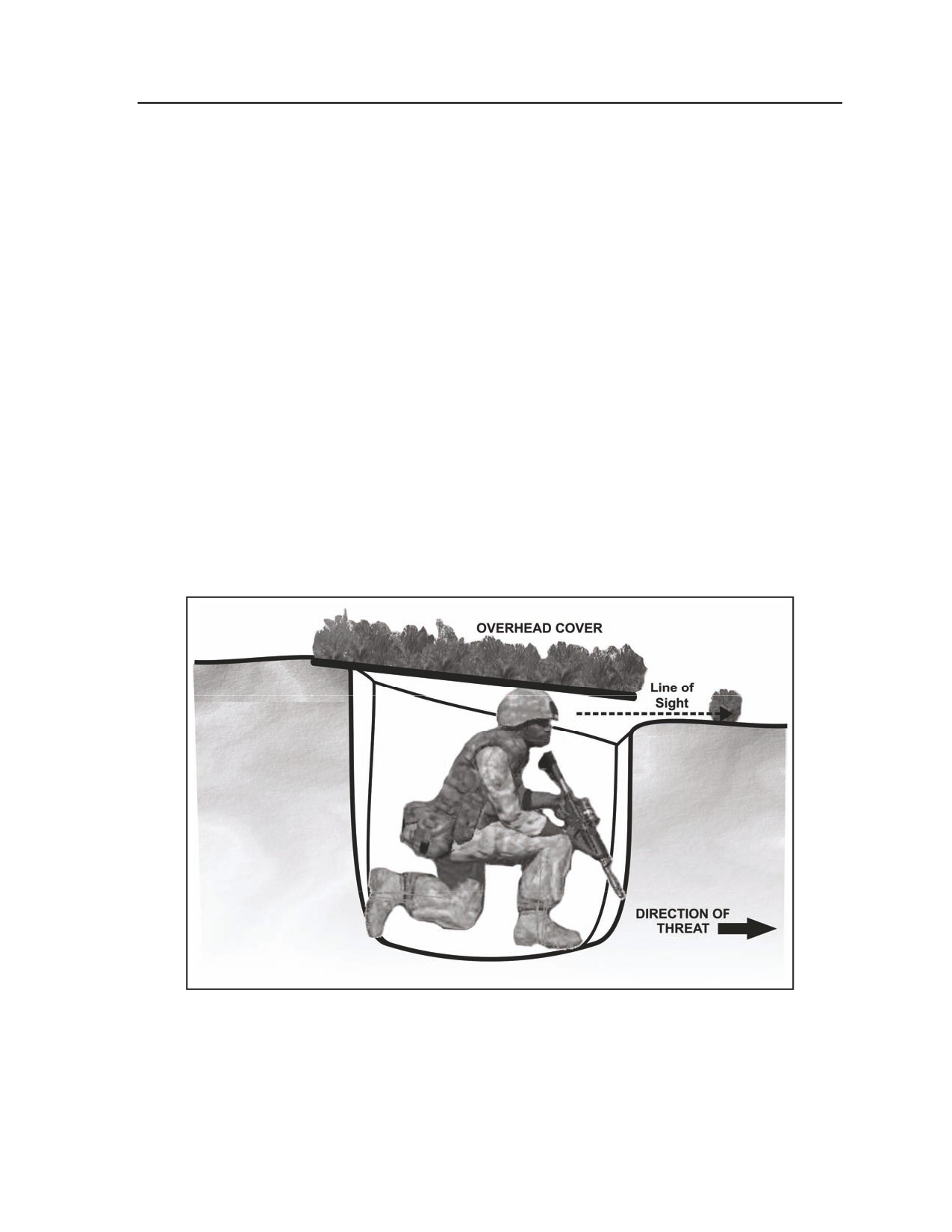
Other Tactical Operations
Monitoring the Target Area
5-231. Monitoring of the target area is critical to accomplishing the mission and providing scouts with
OPSEC. Observers positioned in a tree OP can monitor the target in several ways, including the following:
z
Observers can sit quietly and listen to sounds with their eyes closed. This works best using two
scouts; one watches while the other listens.
z
Observers record the sounds of the area on a recorder and play the sounds back at a louder
volume into headphones.
z
Remote sensors often play a key role in monitoring the target.
Ground Positions
5-232. OPs on the ground are camouflaged to resemble such features as stumps, fallen trees, and bushes.
For enhanced surveillance, the scouts locate the position to overwatch the intersection of fire lanes, roads,
and footpaths on the edge of sparsely wooded areas and natural clearings. When available, obstacles such
as creeks, ditches, or steep slopes should be located between the position and the probable route of enemy
security forces. At night, even a small creek will cause the enemy to make noise; it will also disrupt his
formations and generally slow his progress.
Spider Hole
5-233. This type of position is similar to a fighting position with overhead cover. The dimensions are
normally about 0.75 meters wide by 1.2 meters long by 1 to 1.5 meters deep. The observer can adjust the
dimensions to meet his needs. These one-man positions are normally established on a line or ring to
provide support and enhance security. If the platoon uses this type of OP, a minimum of two mutually
supporting holes must be used (see Figure 5-51).
Figure 5-51. Spider hole OP
Scrape
5-234. A scrape is the enlargement of a depression in the ground to allow one man to occupy a position.
Scrapes are hasty in nature and require little preparation. Often used during darkness, scrapes provide the
3 August 2009
FM 3-20.98
5-71
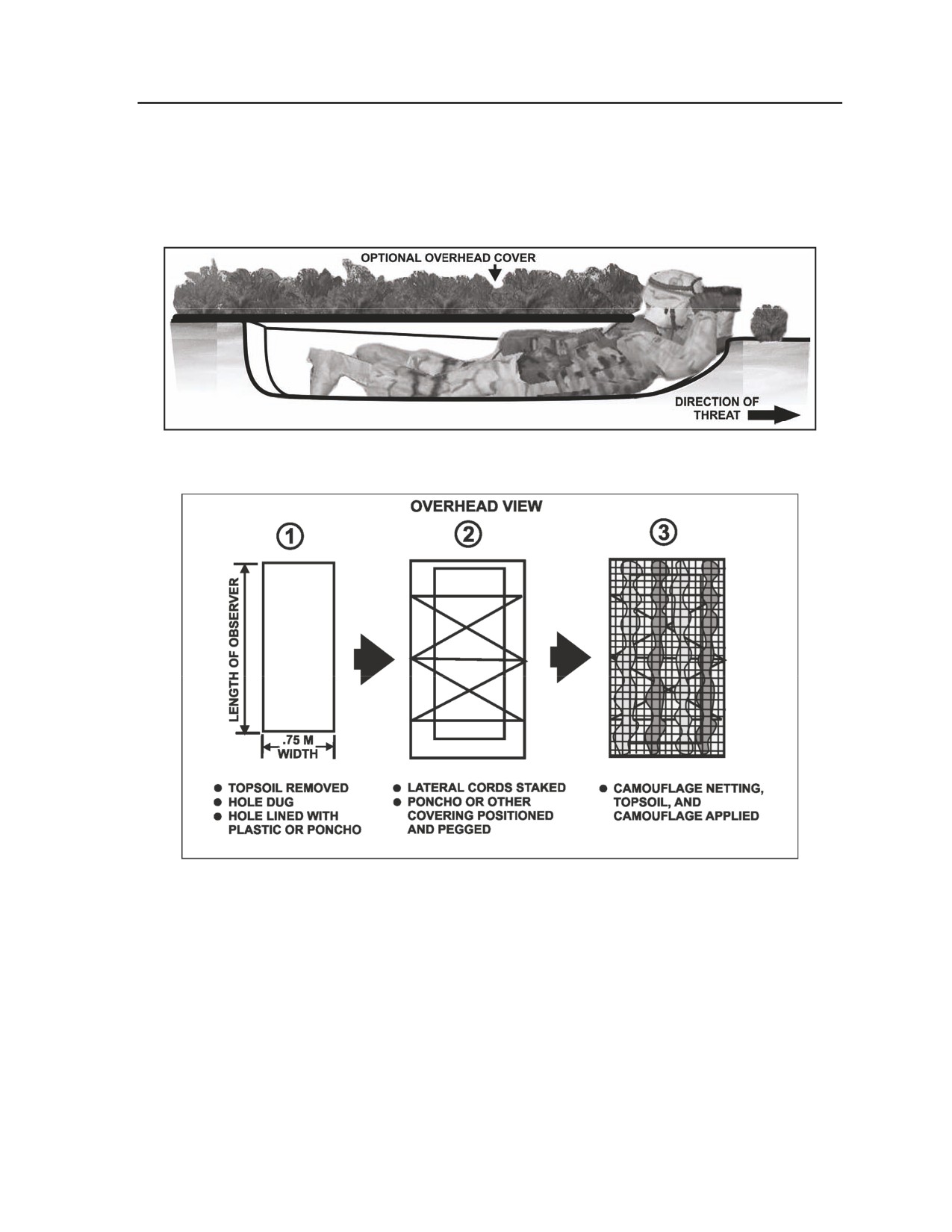
Chapter 5
observer with a position from which he can more effectively use his optical devices. The observer removes
as much evidence of occupation as possible when he leaves. He obscures the area by brushing matted
grasses, displaced dirt, and footprints. Overhead cover such as a poncho provides limited protection from
the elements. If the platoon uses this type of OP, a minimum of two mutually supporting scrapes must be
used to provide some security for each other; a single scrape must be covered by an overwatching element.
(See Figures 5-52 and 5-53.)
Figure 5-52. Scrape OP
Figure 5-53. Example scrape plan
Tent-Type Position
5-235. Larger than a spider hole, this position is constructed for more than one observer. Supports for the
overhead cover are made from a variety of material. Branches, aluminum conduit, parachute suspension
line, or fiberglass rods all work well as a frame for the cover. A slight arch in the cover multiplies available
space inside the position. The observer avoids grossly breaking the ground plane with the apex of the
position. (See Figure 5-54.)
5-72
FM 3-20.98
3 August 2009
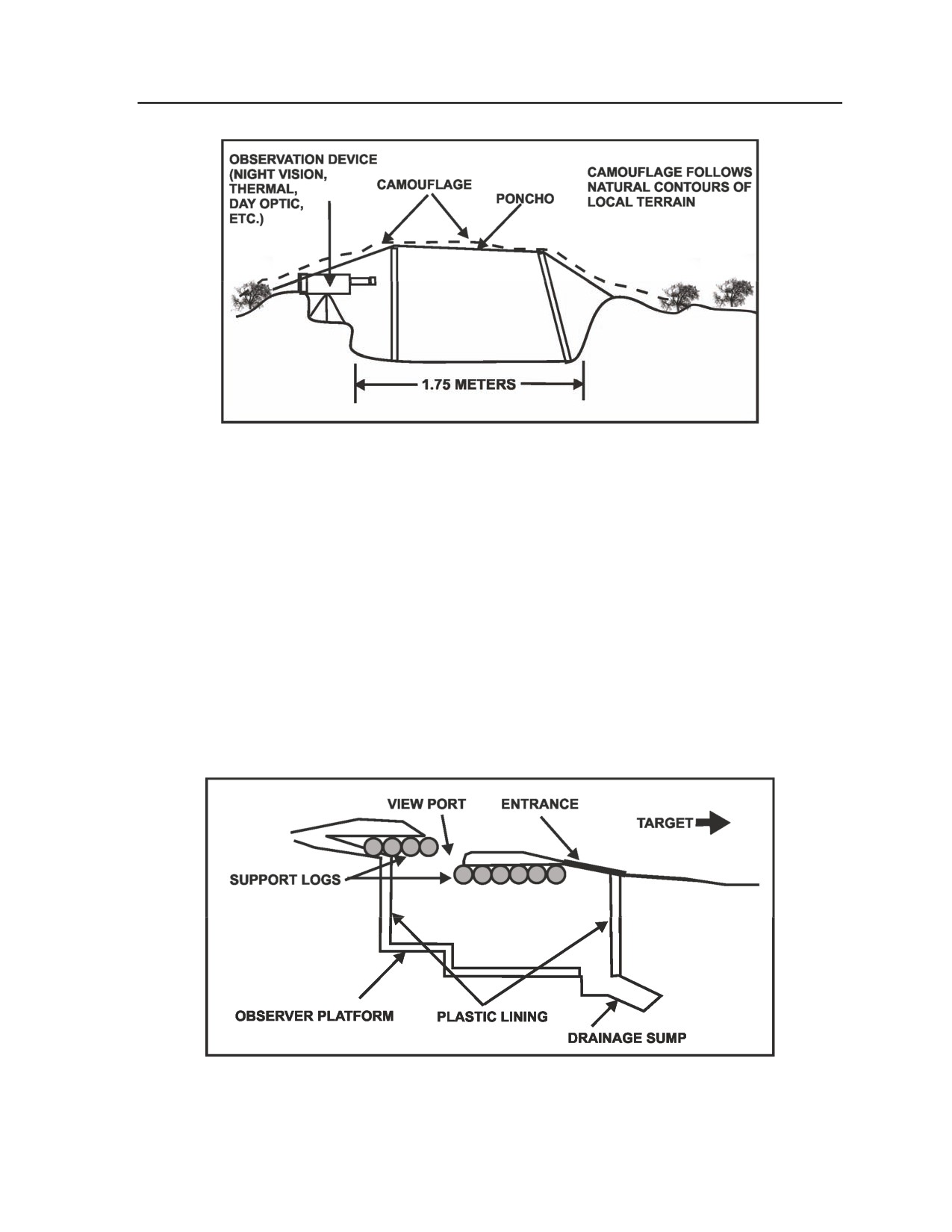
Other Tactical Operations
Figure 5-54. Tent-type OP
Underground Positions
5-236. The safest type of OP for the scout is the underground position. The complexity of design and the
effort required to construct the position are its primary disadvantages. When the scouts plan to use
underground positions, soil type is a critical planning consideration that must not be overlooked during
mission preparation. For example, when only light equipment (such as shovels and entrenching tools) is
available, underground positions can only be constructed in loose soils.
Bunker-Type Position
5-237. This position requires extensive construction time and material to complete. The observer can
construct the underground bunker-type position using a prefabricated kit. That includes the tools needed to
excavate and cut local materials such as trees and logs. The kit also contains plastic sheeting for
waterproofing the roof, walls, and floor. The sheeting can also be used to reinforce loose soil in the
position. Depending on the soil in the area, however, sandbags are often required to shore up the sides of
the position; sandbags also lessen the accumulation of condensation produced when plastic sheeting is
used. (See Figure 5-55.)
Figure 5-55. Bunker-type underground OP
3 August 2009
FM 3-20.98
5-73
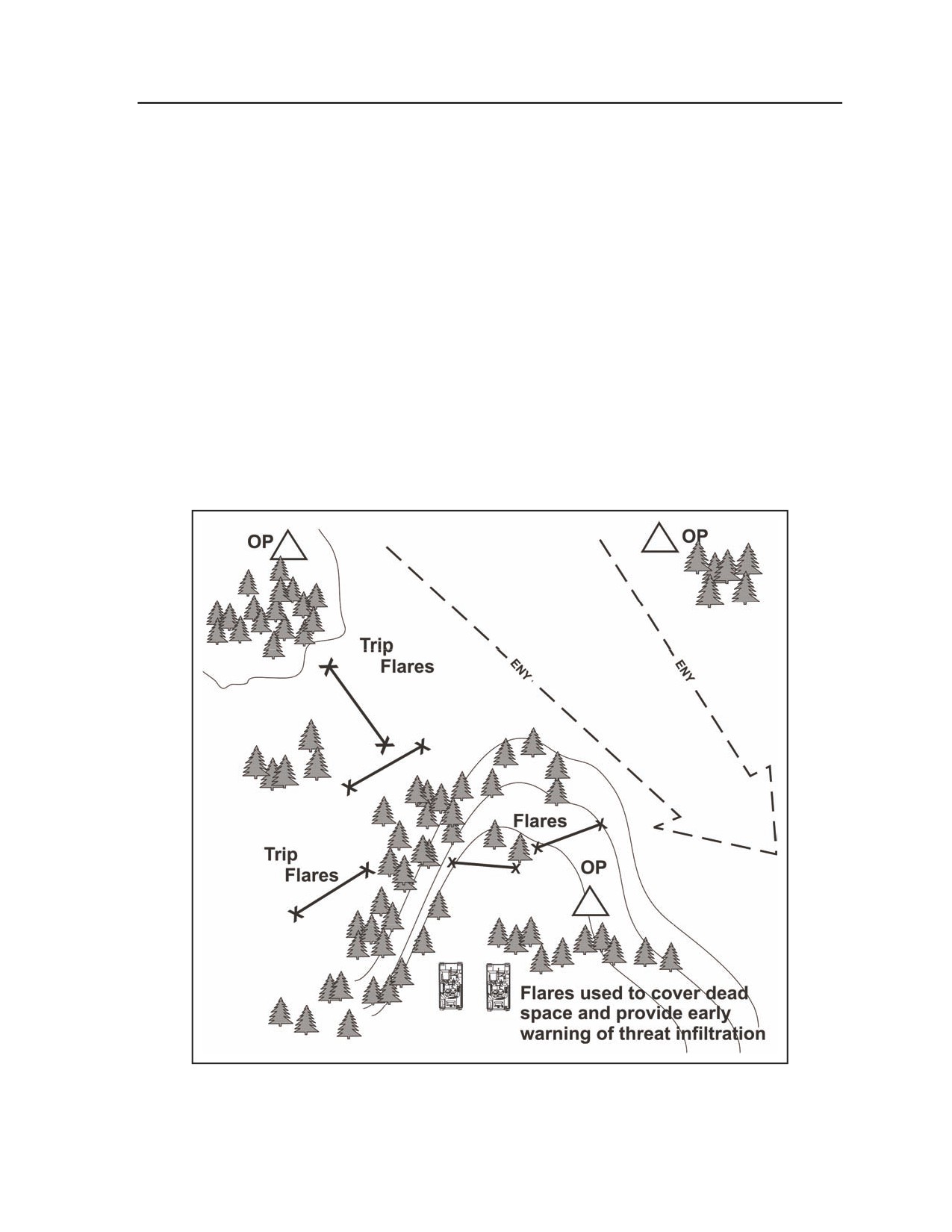
Chapter 5
Caves
5-238. Caves can provide the observer with a ready-made observation position. They present special
problems, however, and should be avoided if possible. First, caves attract attention; using them for tactical
purposes may increase the chance of discovery. Caves are often shown on maps. They are usually known
to local residents who often use caves for shelter and storage. They may have equipped caves with early
warning devices that could attract the attention of enemy forces. In addition, caves also attract animals.
Bats, birds, snakes, and larger animals use caves for shelter, posing potential dangers and health threats.
REMOTE ELECTRONIC/MECHANICAL SURVEILLANCE
5-239. In some cases, the reconnaissance or scout platoon will not have the resources to observe a
particular area that is either tasked to the platoon or important to its internal security. Other times, the
terrain will not permit such observation. In these situations, the platoon can use mechanical warning
devices such as trip flares or electronic devices to monitor the area.
5-240. As a general consideration, remote surveillance devices allow the platoon to put maximum effort
into the commander’s or platoon leader’s area of interest while still maintaining surveillance on secondary
reconnaissance objectives. The platoon will back up these devices with patrols to investigate any alarms.
An example of the use of mechanical devices is the use of trip flares in dead space along the avenue of
approach. When activated, the trip flare gives early warning of enemy infiltration. A patrol will then be
dispatched to verify the warning. (See Figure 5-56.)
Figure 5-56. Integration of remote devices into a screen
5-74
FM 3-20.98
3 August 2009
Other Tactical Operations
SECTION VIII - DISMOUNTED PATROLS
5-241. Dismounted operations, in some form, are a critical element in virtually every reconnaissance or
scout platoon mission. The best scouting is done dismounted. It is critical that all reconnaissance leaders
understand how and when to employ dismounted scouts to enhance the platoon’s effectiveness in
reconnaissance and security tasks.
5-242. Patrols are missions to gather information or to conduct combat operations. The platoon must be
proficient at conducting the five types of patrols: reconnaissance, security, combat, presence, and tracking.
A mission to conduct a patrol may be given to a team, section, squad, or in some situations, the entire
platoon.
OPERATIONAL CONSIDERATIONS
5-243. The following considerations are basic to the platoon’s understanding, planning, and execution for
every patrol mission:
z
The platoon must plan and conduct the reconnaissance patrol in accordance with the
fundamentals of reconnaissance outlined in Chapter 3 of this manual.
z
Based on the higher commander’s guidance and intent, the platoon leader must specify the
following aspects of the patrol:
The focus of the patrol. In most cases, this is the reconnaissance objective.
The tempo. This includes the level of planning and preparation (deliberate or hasty).
Engagement criteria, including applicable ROE and ROI.
z
The platoon must execute the patrol using the correct movement technique to prevent
compromise of any patrol element. It must always maintain local security by using separate
reconnaissance and security elements.
z
The platoon must take advantage of available resources (including IPB products, UASs, ground
surveillance systems, FBCB2, and other enablers) to develop the situation prior to enemy
contact.
z
Enemy contact is avoided unless specifically directed by the platoon leader. In such a situation,
the platoon gains contact with its smallest element. Unexpected contact by reconnaissance
elements is absolutely minimized.
z
Based on the higher commander’s intent and the platoon order, the platoon reports all IR,
including CCIR, rapidly and accurately (by radio and/or FBCB2, as applicable).
z
The platoon can execute reconnaissance patrols to ensure the security of OPs and integrity of the
platoon AO. For example, a section can send out a reconnaissance patrol after establishing an
OP to check all locations from which the enemy can observe the OP; this will ensure the OP
position was not detected as it was occupied. When executed as part of a screen or other security
mission, this type of patrol is referred to as a security patrol.
Note. Platoon leaders must consider the use of dismounted patrols to physically clear high
ground or complex terrain that could conceal enemy forces due to the limitations of UASs,
LRAS3, or thermal observation. Such terrain is identified through the IPB process.
z
The platoon accomplishes the assigned patrol mission within the timeline specified by the higher
commander.
PLANNING AND PREPARATION IN DISMOUNTED/PATROL
OPERATIONS
5-244. When ordered to lead a patrol, the patrol leader follows the troop-leading procedures discussed in
Chapter 2 of this manual. The following discussion focuses on how he can plan and prepare for patrol
3 August 2009
FM 3-20.98
5-75
Chapter 5
operations; in turn, this process helps him to make and carry out tactical decisions quickly and effectively
during the patrol. For further discussion of troop-leading procedures, see FM 5-0.
RECEIVE AND ANALYZE THE MISSION
5-245. Once the order is received, the first thing the patrol leader must do is clearly understand what is
required to accomplish the mission. First, he looks at the order and writes down the tasks the commander
told him to perform, such as conduct reconnaissance of a bridge; these are called specified tasks. Next, he
identifies the tasks that must be done even though the commander did not tell him to do them, such as cross
a stream and an open area en route to the patrol objective; these are called implied tasks.
5-246. The patrol leader does not list tasks that are part of the SOP. He takes a hard look at the list of
specified and implied tasks and puts a check mark by those tasks that must be done for the unit to
accomplish its mission. These are called essential tasks. To identify these tasks accurately, the patrol leader
must thoroughly understand the commander’s intent. He then restates the patrol mission in terms of WHO,
WHAT, WHERE, WHEN, and WHY.
ISSUE A WARNING ORDER
5-247. The patrol leader issues the WARNO to all patrol members whenever possible or, at a minimum,
to key members of the patrol. It should include the following:
z
Elements/personnel to whom the WARNO is issued. This identifies the Soldiers involved in the
patrol and allows them to prepare for the operation.
z
The time and nature of the operation. This is a brief and clear statement of' what the patrol must
accomplish. It may summarize the who, what, when, where, and why of the patrol mission.
z
The earliest time of movement. This helps the patrol members prepare, inspect, and organize for
movement by a specified time.
z
The time and place the OPORD will be issued.
5-248. The patrol leader also gives instructions to special purpose teams and key personnel so they can
get ready for the patrol by taking such actions as preparing explosives, checking radios, and making a map
study (point and compass men).
MAKE A TENTATIVE PLAN
5-249. Once the warning order is issued, the patrol leader analyzes METT-TC factors and selects a COA
that will accomplish the assigned mission(s). The plan should take into account how each aspect of METT-
TC will influence the others regarding mission accomplishment. The patrol leader should give special
consideration to the terrain the patrol must traverse, the enemy forces it will pass near or through en route
to its objective, the effects of extensive dismounted work on the scouts, and the amount of time available to
conduct the mission.
Patrol Time Schedule
5-250. The method the patrol leader uses to organize his time is reverse or backward planning from
mission completion to the present time. This aids in mission planning and provides a schedule of events for
all patrol members. An example of backward planning a time schedule is illustrated in Table 5-2.
5-76
FM 3-20.98
3 August 2009
Other Tactical Operations
Table 5-2. Example patrol time schedule (backward planning)
PATROL TIME SCHEDULE
0200
Return Friendly Area
2330 - 0200
Movement En Route
2300 - 2330
Accomplish Mission, Reorganize
2230 - 2300
Reconnaissance of Objective Area
2000 - 2230
Movement En Route
2000
Depart Friendly Area
1945 - 2000
Movement to Departure Area
1930 - 1945
Final Inspection
1845 - 1930
Night Rehearsals
1800 - 1845
Day Rehearsals
1745 - 1800
Inspection
1700 - 1745
Supper Meal
1515 - 1700
Subunit Planning and Preparation
1445 - 1515
Issue Operation Order
1400 - 1445
Complete Detailed Plans
1315 - 1400
Conduct Reconnaissance
1300 - 1315
Issue Warning Order
Coordination
5-251. Patrols may act independently, move beyond the direct fire support of the parent unit, and/or
operate forward of friendly units. As a consequence, their coordination effort must be thorough, detailed,
and continuous throughout the planning and preparation phases. The patrol leader may perform
coordination personally, or his superior may do it for him. Because the entire platoon may be tasked to
patrol, the necessary coordination may be extensive. A checklist is a common tool used to ensure that all
items of vital importance are covered. Rehearsals from the team level through the platoon level are the best
method for mission understanding and success.
Times of Departure and Return
5-252. Times of departure and return are based on the amount of time needed to accomplish the
following:
z
Reach the objective. This is determined by considering the distance, terrain, anticipated speed of
movement, friendly and enemy situation, and (if applicable) the time at or by which the mission
must be accomplished.
z
Accomplish essential tasks in the objective area. This includes the leader’s reconnaissance and
movement of elements and teams into position, as well as the accomplishment of the patrol’s
mission.
z
Return to a friendly area. This may be difficult to determine because casualties, EPWs, or
captured equipment may slow the patrol.
Note. Whenever possible, patrols/operations should be executed and synchronized based on
triggers (events), such as confirmation of PIR or an element reaching a specific terrain feature.
This method provides more tactical flexibility than the use of a rigid preplanned timeline.
3 August 2009
FM 3-20.98
5-77
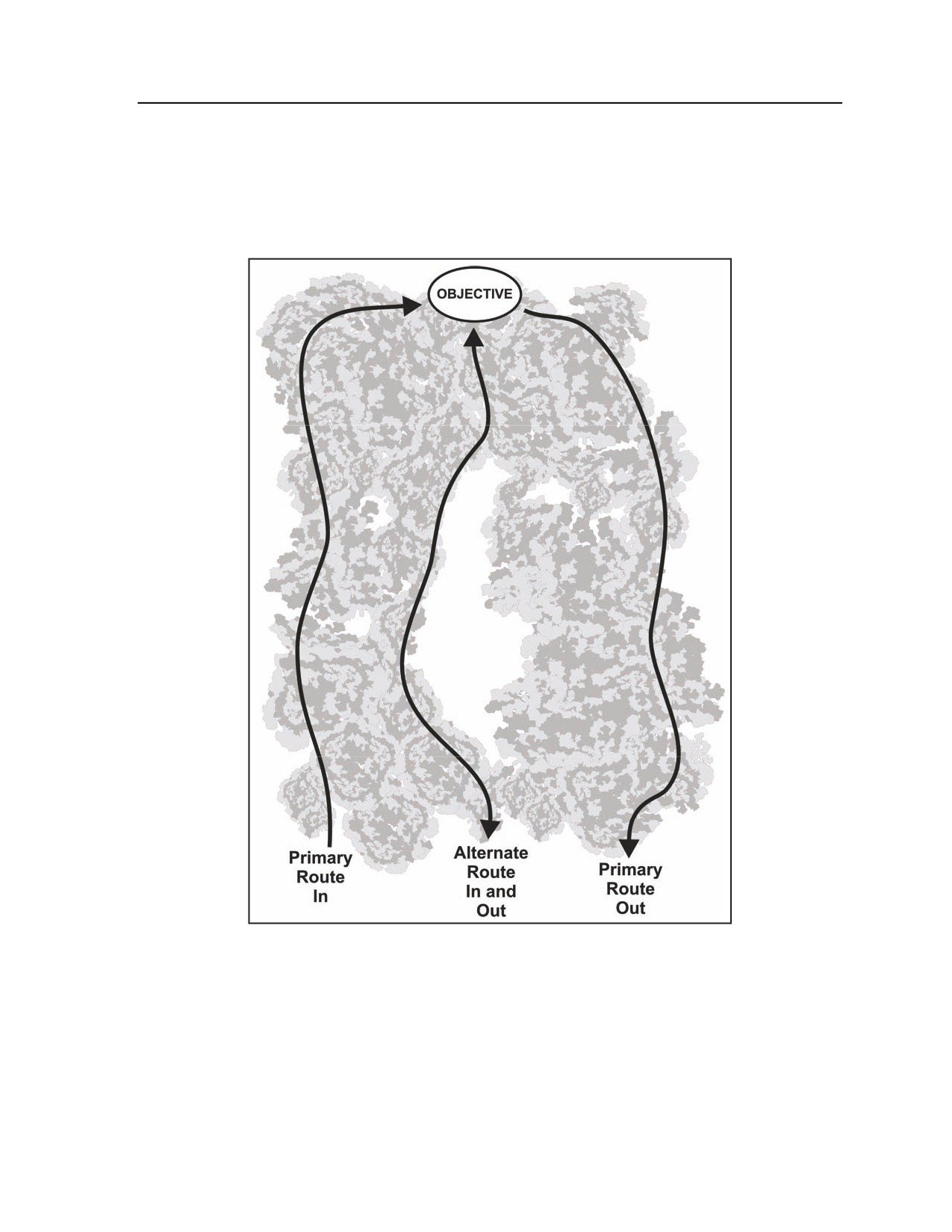
Chapter 5
Primary and Alternate Routes
5-253. The patrol leader selects a primary route to and from the objective. The return route should be
different from the route to the objective. The patrol leader also selects an alternate route that may be used
either to or from the objective. The alternate route is used if the patrol makes contact with the enemy on the
primary route. It may also be used when the patrol leader knows or suspects that the patrol has been
detected (see Figure 5-57).
Figure 5-57. Primary and alternate routes
Routes Divided into Legs
5-254. Routes are divided into legs with each leg starting, if possible, at a point that can be recognized on
the ground (see Figure 5-58). When it is not possible to start and stop legs at recognizable points, a
continuous pace count and azimuth may be used to stay oriented on the route. If the patrol leader has
requested the use of a sniper for overwatch on the legs, careful planning of the sniper coverage in relation
to the patrol route will improve opportunities for clear engagements. Overflights of the legs by UASs can
5-78
FM 3-20.98
3 August 2009
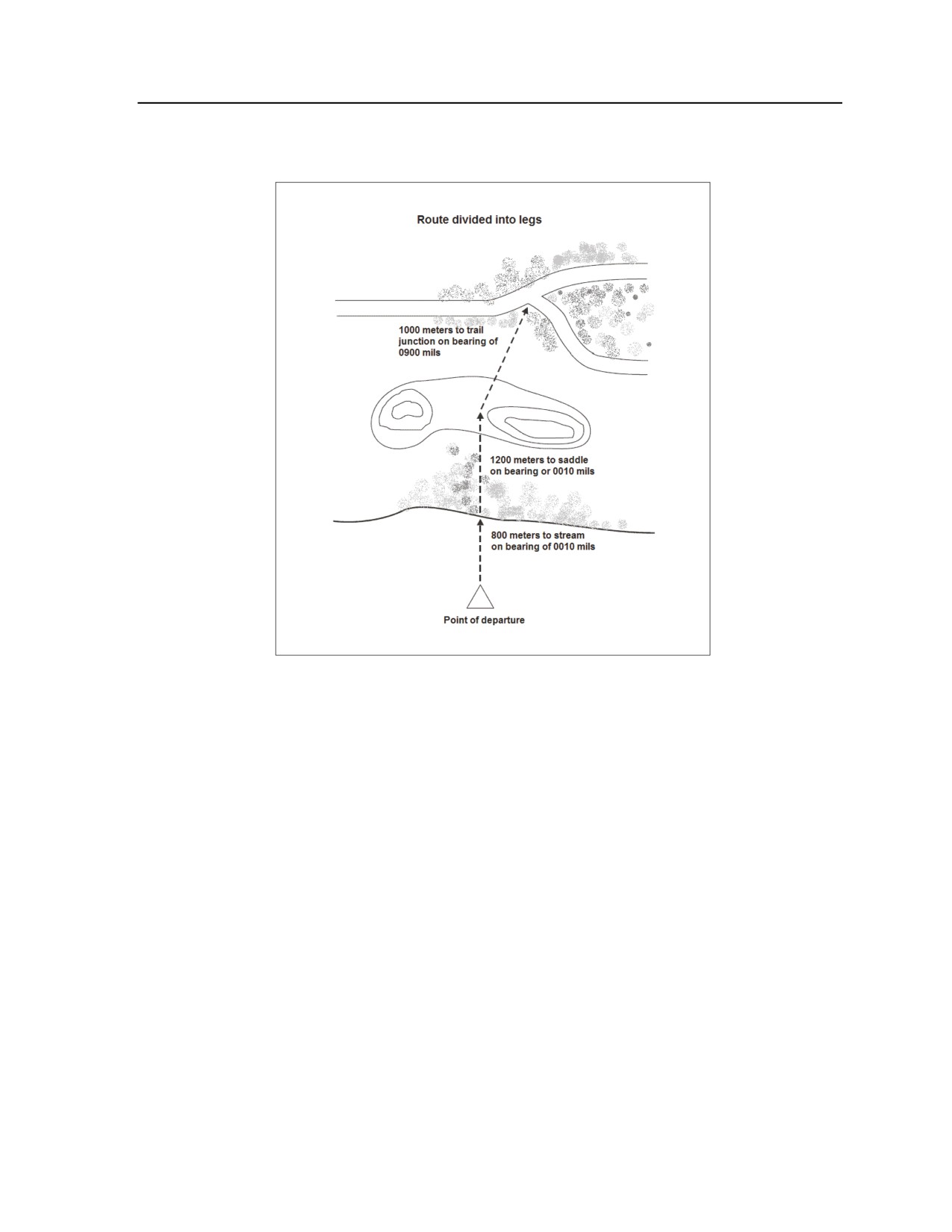
Other Tactical Operations
provide current information about the terrain and enemy presence before the patrol moves through it.
Alternate routes require the same consideration as the primary ones.
Figure 5-58. Route divided into legs
Rally Points
5-255. A rally point is a place where a patrol can conduct these actions:
z
Temporarily halt to prepare to depart from friendly lines.
z
Reassemble and reorganize if dispersed during movement.
z
Temporarily halt to reorganize and prepare for actions at an objective.
z
Temporarily halt to prepare to reenter friendly lines.
Types of Rally Points
5-256. The most common types are initial, en route, objective, reentry, and near side and far side rally
points. Soldiers must know the rally point to which they are moving at each phase of the patrol mission.
They should know what actions are required there and how long they are to wait at each rally point before
moving to another. Rally point considerations include the following:
z
Initial rally point. An initial rally point is where a patrol may assemble and reorganize if it is
dispersed or makes enemy contact before departing friendly lines or before reaching the first en
route rally point. Located within friendly lines, the initial rally point is normally selected by the
commander of the friendly unit.
z
En route rally point. An en route rally point is where a patrol rallies if dispersed en route to or
from its objective. There may be several en route rally points along the patrol’s route between
friendly lines and the objective. They are either planned or designated by the patrol leader en route
every 100 to 400 meters (based on the terrain, vegetation, and visibility). When the leader
3 August 2009
FM 3-20.98
5-79
Chapter 5
designates a new en route rally point, the previously designated rally point goes into effect. This
precludes uncertainty over which one Soldiers should move to if contact is made immediately after
the leader designates a new rally point. There are three ways to designate an en route rally point:
Physically occupy the rally point for a short period. This is the preferred method.
Pass by the rally point at a distance and designate it using hand-and-arm signals.
Walk through the rally point and designate it using hand-and-arm signals.
z
Objective rally point. An ORP is where the patrol halts to prepare for actions on its objective. The
ORP must be located near the objective. At the same time, it must be out of sight and sound range
of the objective area so that the patrol’s activities at the ORP will not be detected by the enemy
(normally at least one terrain feature from the objective). It must also be out of small arms range of
enemy forces and far enough from the objective that it will not be overrun if the patrol is forced off
the objective. The ORP is tentative until the objective is pinpointed. The patrol uses the ORP as a
base for conducting the following actions:
A base from which to reconnoiter the objective.
Issue a FRAGO.
Disseminate information from reconnaissance if contact was not made.
Make final preparations before continuing operations. These may include applying or
replenishing camouflage; preparing demolitions; caching rucksacks for quick recovery;
preparing EPW bindings, first aid kits, and litters; and inspecting weapons.
Account for Soldiers and equipment after actions on the objective are complete.
Reestablish the chain of command after actions on the objective are complete.
z
Reentry rally point. A reentry rally point is where a patrol halts to prepare to reenter friendly
lines. It is located just short of friendly lines and out of sight, sound, and small arms range of
friendly OPs. This also means that the reentry rally point should be outside the limit of FPF of the
friendly unit. The patrol occupies the rally point as a security perimeter while it awaits reentry.
z
Near side and far side rally points. These rally points are established on the near and far side
of danger areas. If the patrol makes contact while crossing the danger area and control is lost,
Soldiers on either side move to the rally point nearest them. They establish security, reestablish
the chain of command, and determine their personnel and equipment status. They can then
continue the patrol mission, link up at the ORP, or complete their last instructions.
Rally Point Selection
5-257. The patrol leader should pick rally points either during the patrol or by a map study before the
patrol. Those selected before the patrol begins are tentative and will remain so until confirmed on the
ground. In selecting rally points, the patrol leader should look for locations with the following
characteristics:
z
Large enough for the patrol to assemble.
z
Easily recognizable.
z
Affording adequate cover and concealment.
z
Defensible for a short time.
z
Away from normal routes of troop movement and natural lines of drift (streams, ridges).
INITIATE MOVEMENT
5-258. The patrol leader directs the patrol to move once he issues his warning order and makes his plan.
This movement may involve securing a passage point or moving to the SP.
CONDUCT RECONNAISSANCE
5-259. The patrol leader must make a map, ground, or aerial reconnaissance before completing his plan.
This allows him to proof his tentative plan and get an idea of the ground he will initially traverse. He must
keep an open mind during the reconnaissance; not everything he sees will match his tentative plan.
5-80
FM 3-20.98
3 August 2009
Other Tactical Operations
COMPLETE THE PLAN
5-260. After the warning order has been issued, reconnaissance has been made, and patrol members are
preparing themselves and their equipment, the patrol leader completes his plan. He first assigns essential
tasks to be performed in the objective area. After this, he plans and assigns tasks that will help the patrol
reach the objective and return, such as navigation, security during movement and halts, actions at danger
areas, actions on enemy contact, and stream crossings. The following discussion focuses on additional
planning considerations.
Weapons and Ammunition
5-261. This consideration applies if the patrol needs to bring additional Class V in addition to its basic
load, such as significant amounts of demolitions or squad weapons requiring additional ammunition to be
carried by the patrol.
Signals
5-262. The signals to be used on the patrol must be planned and rehearsed. Signals may be needed to lift
or shift supporting fires, to order withdrawal from the objective, to signal “ALL CLEAR,” to stop and start
movement of the patrol, and to direct linkup of elements. Visual and audible signals may be used, such as
hand-and-arm signals, flares, radio voice, whistles, radios, and infrared equipment. All patrol members
must know the signals.
Communications with Higher Headquarters
5-263. The plan must include retrans sites, the correct FBCB2 programming, radio call signs, primary and
alternate frequencies, times to report, and codes.
Challenge and Password
5-264. The challenge and password from the SOI should not be used by a patrol beyond the FEBA. The
patrol leader may devise his own challenge and password system. The platoon can use the odd-number
system. For example, if the patrol leader specifies 11 as the odd number, the challenge could be any
number between 1 and 10. The password would be the number which, when added to the challenge, equals
11 (such as challenge 8, password 3).
5-265. The platoon leader can also designate a running password. This code alerts a unit that friendly
Soldiers are approaching in a hasty manner and may be under enemy pressure. This technique may be used
to get Soldiers quickly through a compromised passage of lines. The running password is followed by the
number of Soldiers approaching (Dogwood, 6); this prevents enemy soldiers from joining the group in an
attempt to penetrate friendly lines.
Location of Leaders
5-266. The locations of the patrol leader and assistant patrol leader are planned for all phases of the patrol
during movement, at danger areas, and at the objective. The following considerations apply:
z
The patrol leader plans to be present at the pre-designated decisive point for each phase of the
operation.
z
The assistant patrol leader may have a specific job for each phase of the patrol. He may help the
patrol leader control the patrol by being where he can best take charge, if required.
z
Everyone on the patrol must understand where he fits into the patrol or his element of the patrol.
z
Duties and responsibilities for the assistant patrol leader during actions on the objective area
include these:
Area reconnaissance in the ORP.
Zone reconnaissance with a reconnaissance element that has been directed to move to and
establish the point at which all elements are to link up after completing the operation.
Combat patrol (raid or ambush). The assistant patrol leader normally controls the support
element.
3 August 2009
FM 3-20.98
5-81
Chapter 5
Patrol Organization
5-267. To accomplish the patrolling mission, a platoon or squad must perform specific tasks. Examples
include providing security for itself or at danger area crossings or rally points; reconnoitering the patrol
objective; and conducting breach, support, or assault operations. As with other missions, the leader tasks
elements of his platoon in accordance with his estimate of the situation. He identifies those tasks the
platoon must perform and decides which elements will perform them. If possible, the patrol leader should
maintain squad and fire team integrity in assigning tasks.
5-268. The basic patrol configuration includes a reconnaissance element and a security element. In turn,
these elements are made of individual Soldiers with specific roles, as well as subordinate and supporting
groups known by the terms “element” and “team.” These refer to the squads, fire teams, or buddy teams
that perform the common and specific tasks for each type of patrol. Some squads and fire teams may
perform more than one task in an assigned sequence. The leader must plan carefully to ensure that he has
identified and assigned all required tasks in the most efficient way. The following elements are common to
all patrols:
z
Headquarters element. The headquarters consists of the patrol leader, assistant patrol leader,
and radio-telephone operator (RTO). It may consist of any attachments that the patrol leader
decides that he or the assistant patrol leader must control directly, such as an FO.
z
Aid and litter team. Aid and litter teams treat and evacuate casualties.
z
EPW team. EPW teams are responsible for controlling prisoners in accordance with the “five-
S” principles and the leader’s guidance. This team may also be the search team. If contact results
in wounded and/or killed enemy soldiers, this team searches those individuals for information
and material they may have been carrying while the rest of the patrol provides security.
z
Surveillance team. The surveillance team keeps watch on the objective from the time the
leader’s reconnaissance ends until the unit deploys for actions on the objective. The members of
the team then join their elements.
z
Point man. He provides security to the front of the patrol. In addition, he is guided by the
compass man or patrol leader.
z
En route recorder. The recorder writes down/collects all information gathered by the patrol.
z
Compass man. The compass man assists in navigation by ensuring that the point man remains
on course at all times. Instructions to the compass man must include an initial azimuth, with
subsequent azimuths provided as necessary. The compass man should preset his compass on the
initial azimuth before moving out, especially if the move will be during limited visibility
conditions. The patrol leader should also designate an alternate compass man.
z
Pace man. The pace man maintains an accurate pace at all times. The patrol leader should
designate how often the pace man is to report the pace to him. The pace man should also report
the pace at the end of each leg. The leader should designate an alternate pace man.
ISSUE THE ORDER
5-269. The order is issued in standard five-paragraph OPORD format. Terrain models or sketches are
used to illustrate the plan. Sketches to show planned actions can be drawn in the sand, dirt, or snow. The
patrol leader considers specific details in planning the patrol using the OPORD format.
Task Organization
5-270. Explain how the patrol is organized for the operation and confirm the composition of each
element. Identify time(s) of attachment and detachment. If there is no change to the previous task
organization, the patrol leader indicates that there is no change.
Situation
5-271. Considerations include—
z
Weather and light data for illumination effecting concealment.
z
Terrain. OAKOC and how it will affect the patrol and enemy forces.
5-82
FM 3-20.98
3 August 2009
Other Tactical Operations
z
Enemy situation, including the following:
Composition.
Disposition.
Capabilities when dismounted.
Recent activities such as security patrols.
Last known location for planning movement.
Their avenues of approach.
z
Friendly situation, including the following:
Mission, location, and routes of adjacent units.
Where friendly units can see the patrol.
z
Civilian population, including factional allegiances which may be friendly and restrictions and
curfews that may affect movement.
Mission
5-272. Mission considerations are the who, what, when, where, and why (task and purpose) of the
mission.
Execution
5-273. Considerations include—
z
Concept of the operation.
z
Tasks to maneuver units, including-
How the patrol will accomplish the mission with the number of dismounts available.
Duration of the patrol and what equipment will be required.
Assign tasks to teams and key personnel.
z
Coordinate the use of fires, including-
Selection of targets for protection.
Obscurants.
CCA/CAS.
z
Coordinating instructions include—
Movement techniques.
Actions at the objective.
Routes.
Departure from and reentry to friendly lines.
Linkup time and location.
Departure point.
Reentry point.
Dismounted actions on contact, danger areas, and halts.
ROE and weapons control status.
Sustainment (Service Support)
5-274. Considerations include—
z
Issue and distribution of Classes I, III, and V.
z
Transportation needs for insertion or extraction.
z
MEDEVAC/CASEVAC.
z
Pre-positioning of supplies.
3 August 2009
FM 3-20.98
5-83
Chapter 5
Command and Signal
5-275. Considerations include—
z
Chain of command.
z
Key hand-and-arm signals.
z
MEDEVAC frequencies.
z
Code words and reports.
z
Challenge and password.
z
Times when radio listening silence is in effect.
z
Visual and pyrotechnic signals while dismounted.
Annexes
5-276. Annexes used to plan patrols at all levels include—
z
Air movement.
z
Aerial resupply.
z
Patrol base (teams, occupation plan, operations plan, and priorities of work).
z
Small boat operations.
z
Stream crossing.
z
Vehicle movement.
z
Evasion and escape.
z
Linkup and passage of lines.
z
Surveillance/OP site.
z
Cache site.
SUPERVISE AND REFINE
5-277. Rehearsals and inspections are vital to proper preparation. They must be well planned and
conducted at all times. Coordination is made with the commander or S-3 for use of a rehearsal area
resembling the objective area. Inspections before rehearsals ensure uniforms and equipment are complete
and correct. Each Soldier is questioned to ensure that he knows the following:
z
The plan (concept and intent).
z
What he is to do and when he is to do it (task and purpose).
z
What others are to do (adjacent elements).
z
Challenges and passwords, signals, codes, radio call signs, frequencies, and reporting times.
5-278. Rehearsals help to ensure the proficiency of the patrol. They let the patrol leader check plans,
make any needed changes, and verify the suitability of equipment. It is through well-directed rehearsals
that Soldiers become familiar with their actions and responsibilities during the patrol.
5-279. If the patrol is to be at night, it is advisable to have both day and night rehearsals. Terrain similar
to that over which the patrol will operate should be used. All actions are rehearsed when time permits.
When time is short, only the most critical actions are rehearsed. Actions on the objective and actions on
contact are the most critical and should always be rehearsed.
5-280. A good way to rehearse is to have the patrol leader walk and talk the whole patrol through each
action. He describes the actions of elements, teams, and individuals and has them perform these actions. In
this “dry run,” patrol members take their positions in formations at reduced distances. This can all be done
with little or no distance separation so the Soldiers get the “feel” of the patrol. When the different actions
are clear to the patrol members, a complete rehearsal, at full speed, is conducted with the whole patrol.
This is a “wet run.” As many “dry runs” and “wet runs” are conducted as are necessary to ensure mission
proficiency. Element and team leaders rehearse battle drills, actions on contact, and actions at danger areas
during troop-leading procedures prior to the final rehearsal. Supervision is continuous by all leaders.
5-84
FM 3-20.98
3 August 2009
Other Tactical Operations
5-281. An inspection (PCI) after the final rehearsal and just before departure ensures that all equipment is
still working, that nothing is left behind, and that each member of the patrol is ready.
MOVEMENT
5-282. The selection of a movement technique is based on METT-TC. Factors to consider for each
technique are control, dispersion, speed, and security. Movement techniques are not fixed formations. They
refer to the distances between Soldiers, teams, and squads that vary based on mission, enemy, terrain,
visibility, and any other factor that affects control. Soldiers must be able to see their patrol leaders, and the
patrol leader should be able to see his leaders. Leaders should control movement with hand-and-arm
signals, using radios only when needed. For more information on discounted movement fundamentals and
procedures, refer to FM 3-21.8.
FACTORS IN DISMOUNTED MOVEMENT
Ensure that Patrol Members Can Navigate
5-283. Preparations are worthless if the patrol cannot find the objective in time or if the patrol is
compromised by enemy contact during movement. Always plan to use a compass and pace man on a
patrol.
Note. The element point man must not be tasked to perform compass or pace duties. The point
man’s sole responsibility is forward security for the element.
Avoid Detection
5-284. Patrols must use stealth and the cover and concealment of the terrain to its maximum advantage.
Whenever possible—
z
Move during limited visibility.
z
Use concealment of foliage and IV lines.
z
Exploit the enemy’s weaknesses.
z
Synchronize movements through the use of triggers to coincide with other operations.
Maintain Constant Security
5-285. Always maintain 360-degree security. The patrol must constantly use both active and passive
security measures—
z
En route.
z
At danger areas.
z
At patrol bases.
z
In the objective area.
Plan for Use of Support Fires
5-286. Patrol leaders must plan for fire support:
z
TRPs and pre-planned targets. FSCM must be coordinated with the FO and the TOC prior to
movement.
z
Artillery.
z
Mortars.
z
CCA/CAS.
z
Naval gunfire (NGF).
z
NFAs.
3 August 2009
FM 3-20.98
5-85
Chapter 5
Use Appropriate Movement Techniques
5-287. The enemy situation determines which of the three movement techniques will be used: traveling
(when contact is not likely), traveling overwatch (when contact is possible), or bounding overwatch (when
contact is expected). Using overwatch is preferred, METT-TC dependent. Vary movement techniques to
meet changing situations.
Maintain Dispersion in Open Terrain
5-288. When enemy contact is possible and manpower permits, have one team well forward and
overwatch it with a security team. Assign duties for the patrol’s movement. Security teams maintain visual
contact, but the distance between them should be such that the entire patrol does not become engaged if
contact is made. Patrols should distribute their formations as necessary to gain better observation to the
flanks. Although widely spaced, Soldiers must retain their positions relative to one another when in a
wedge formation. Only in extreme situations should the file formation be used in the open.
Assign Responsibilities and Positions
5-289. The lead elements must secure the front along with assuming responsibility for navigation. For a
long movement, the patrol leader may rotate the responsibilities of the lead elements. The elements in the
rear conduct rear security. Leaders should move inside the formation where they can best maintain control
of the patrol.
Use Control Measures
5-290. During movement, leaders use control measures (such as head counts, rally points, or phase lines)
to maintain the patrol’s effectiveness and security. The platoon’s SOP for actions on contact with inferior
and superior forces should be practiced so that the patrol’s reaction to contact is a reflex action.
Plan for Contact
5-291. Leaders maneuver the patrol to ensure that enemy contact is made with the smallest element
possible.
MOVEMENT FORMATIONS
5-292. Figures 5-59 through 5-62 illustrate patrol movement formations.
5-86
FM 3-20.98
3 August 2009
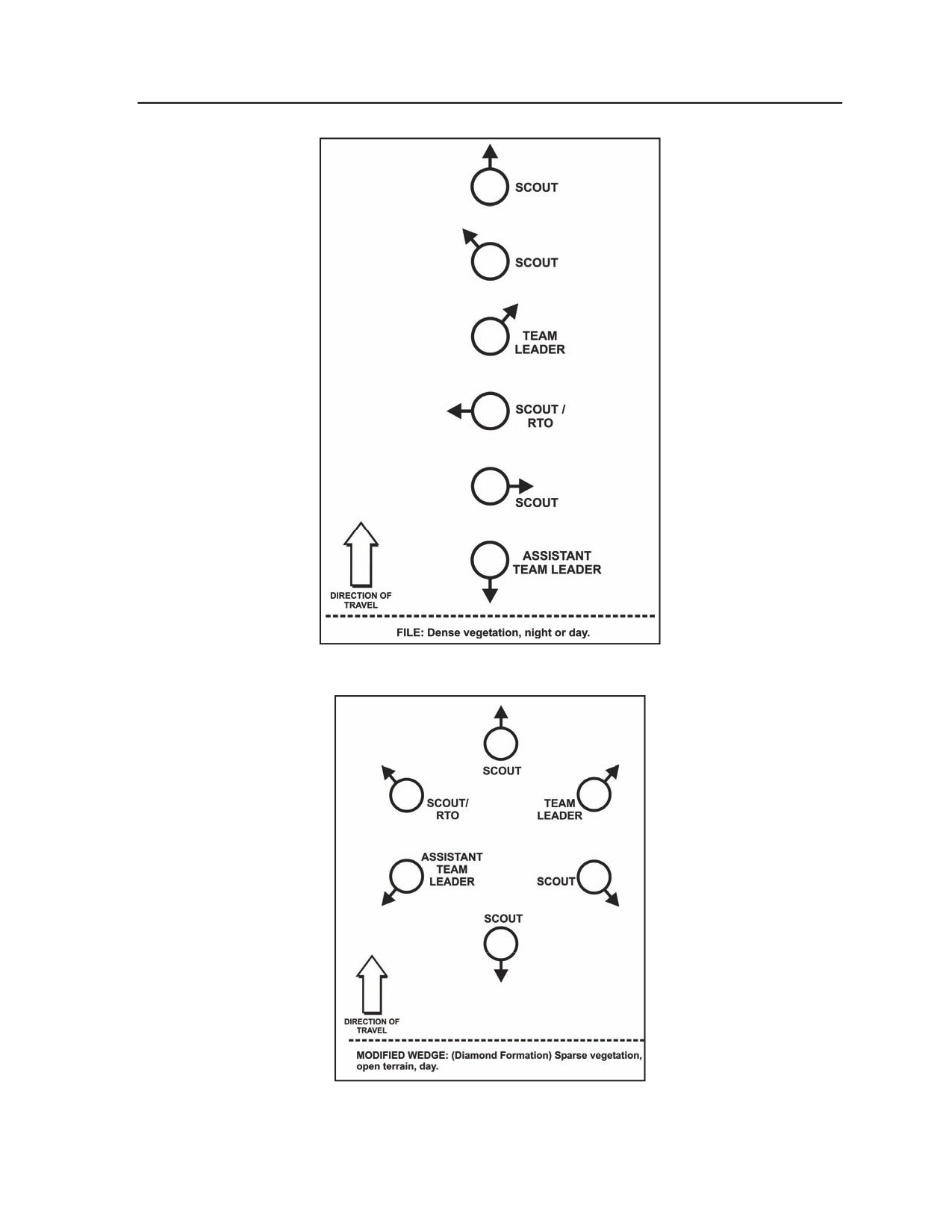
Other Tactical Operations
Figure 5-59. File formation
Figure 5-60. Diamond formation
3 August 2009
FM 3-20.98
5-87