FM 3-20.98 Reconnaissance and Scout Platoon (AUGUST 2009) - page 2
Chapter 3
AERIAL RECONNAISSANCE
3-68. The ground scout must understand the capabilities and limitations of available aviation and UASs
during reconnaissance. Once operating together, aerial and ground reconnaissance assets can compensate
for each other’s limitations and significantly increase the effectiveness of their combined reconnaissance
effort. When available, aerial reconnaissance can be employed to complement ground reconnaissance.
Aerial assets are an integral part of reconnaissance operations. Reconnaissance and scout platoon leaders
must understand aviation and UAS performance capabilities in all weather conditions. Platoon leaders
should plan for UAS use when available to reach beyond their organic capabilities.
3-69. The platoon will have access to the Raven UAS. This company/troop level asset can be transported
easily in scout vehicles or by rucksack for dismounted movement. The Raven’s optics, which include
infrared, allow the system to detect larger enemy forces at a considerable distance providing real-time, up-
to-date, over-the-horizon view. This increases reaction time to a specific threat, which maintains the
platoon’s advantage. The Raven can fly automatically, navigating with GPS technology on programmable
routes, to target areas.
Aerial Employment Considerations
3-70. Aerial employment considerations include—
z
Weather conditions.
z
Whether the platoon can observe the target area from the flight pattern selected.
z
Deconflicting flight paths and areas of interest covered by UAS to maximize terrain coverage.
z
Positioning operator on terrain that supports control of the UAS.
z
Flight time from launch to loiter position and back for recovery.
z
Coordinating air-ground systems through higher headquarters S-3.
z
Posturing the platoon for recovery of the UAS.
z
Ground communication with aircraft operating in the platoon sector.
Advantages
3-71. Aerial reconnaissance advantages include—
z
Aerial reconnaissance is the fastest form of reconnaissance.
z
UASs are unaffected by terrain.
z
UASs can reconnoiter difficult or impossible terrain.
z
UASs can detect enemy in dead space.
z
Scouts can synchronize reconnaissance efforts with aircraft and UAS assets in the same AO.
z
UASs are available when satellites often are not.
z
UASs can be launched when needed to optimize loitering time.
z
Helicopters can be refueled forward reducing turnaround time to return to station.
Disadvantages
3-72. Conversely, aerial reconnaissance is limited by—
z
Weather conditions that degrade the night-vision capability of the aircraft’s sensors.
z
Fuel requirements that limit time in sector.
z
Air and missile defense (AMD) threats.
z
The detail with which terrain can be observed.
z
The inability to identify stationary enemy elements smaller than platoon size or moving
elements of squad size or smaller.
z
The requirement of ground crews to recover the UAS.
3-16
FM 3-20.98
3 August 2009
Reconnaissance Operations
MOUNTED RECONNAISSANCE
3-73. Mounted operations give reconnaissance platoons the ability to conduct reconnaissance while
maintaining the speed and momentum required for the operation. Mounted reconnaissance also allows the
scouts to take advantage of the firepower, optics, and protection afforded by their vehicles. Scouts will
often have to dismount to provide local security, clear dangers areas, or clear dead space within their AO.
Employment Considerations
3-74. Mounted reconnaissance is normally used under these conditions:
z
Time is limited.
z
Detailed reconnaissance is not required.
z
IPB provides accurate information on the enemy.
z
The UAS is performing coordinated reconnaissance tasks in support of ground forces.
z
Ground sensors are conducting reconnaissance activities in support of ground forces.
z
Terrain is open.
Advantages
3-75. Speed and momentum are rarely necessary in a reconnaissance operation, but they are often critical
to the successful execution of offensive operations that the reconnaissance mission may support. In
addition to speed, mounted reconnaissance offers scouts the advantages of their reconnaissance vehicle.
These advantages depend on the specific vehicle employed, but they can include firepower, armor
protection, enhanced navigation and communications capability, and thermal optics.
Disadvantages
3-76. The disadvantages of mounted reconnaissance include the loss of stealth due to the visual, noise, and
thermal signatures of the vehicles (the CFV is noisier than the HMMWV) and the loss of some detail
because of restricted vision and impairment of the senses of smell and hearing. These disadvantages
increase the scouts’ vulnerability to enemy fires as they conduct reconnaissance.
DISMOUNTED RECONNAISSANCE
3-77. The primary purpose of dismounted reconnaissance is to obtain detailed information about terrain
features, obstacles, or enemy forces. In addition, scouts dismount and reconnoiter forward of their vehicle
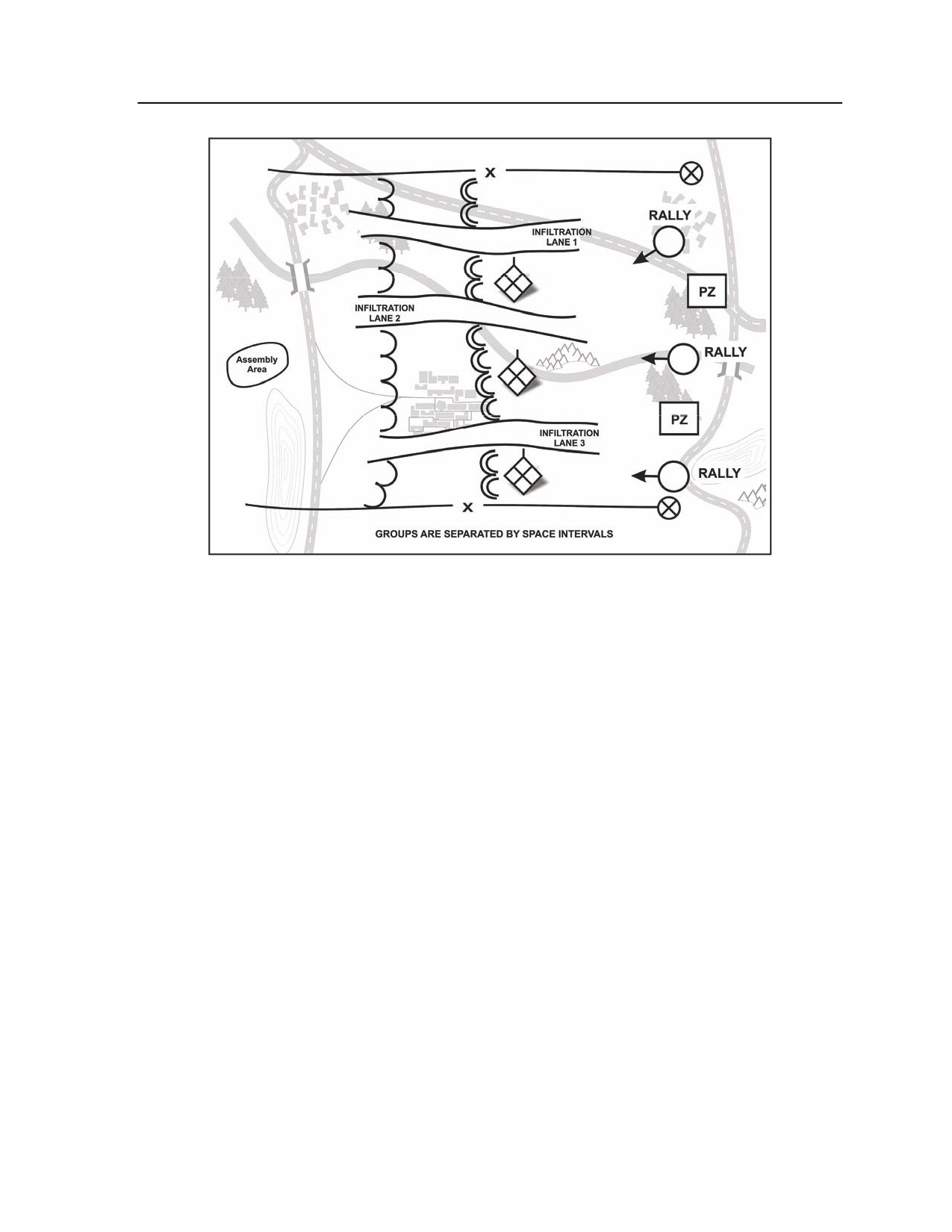
to provide security for the vehicle before moving through danger areas such as open spaces, hilltops,
curves, or other blind spots in the AO. They also dismount to set up short-duration or long-duration OPs.
Dismounted reconnaissance is inherently stealthier and presents a less aggressive appearance in populated
areas. The objective of a dismounted reconnaissance is not limited to reconnaissance or clearing an urban
area. The objective could also be to seek out the civil aspect of an urban area such as the political, tribal, or
religious leaders prior to movement into an area.
Employment Considerations
3-78. In general, scouts conduct dismounted reconnaissance when the following conditions apply:
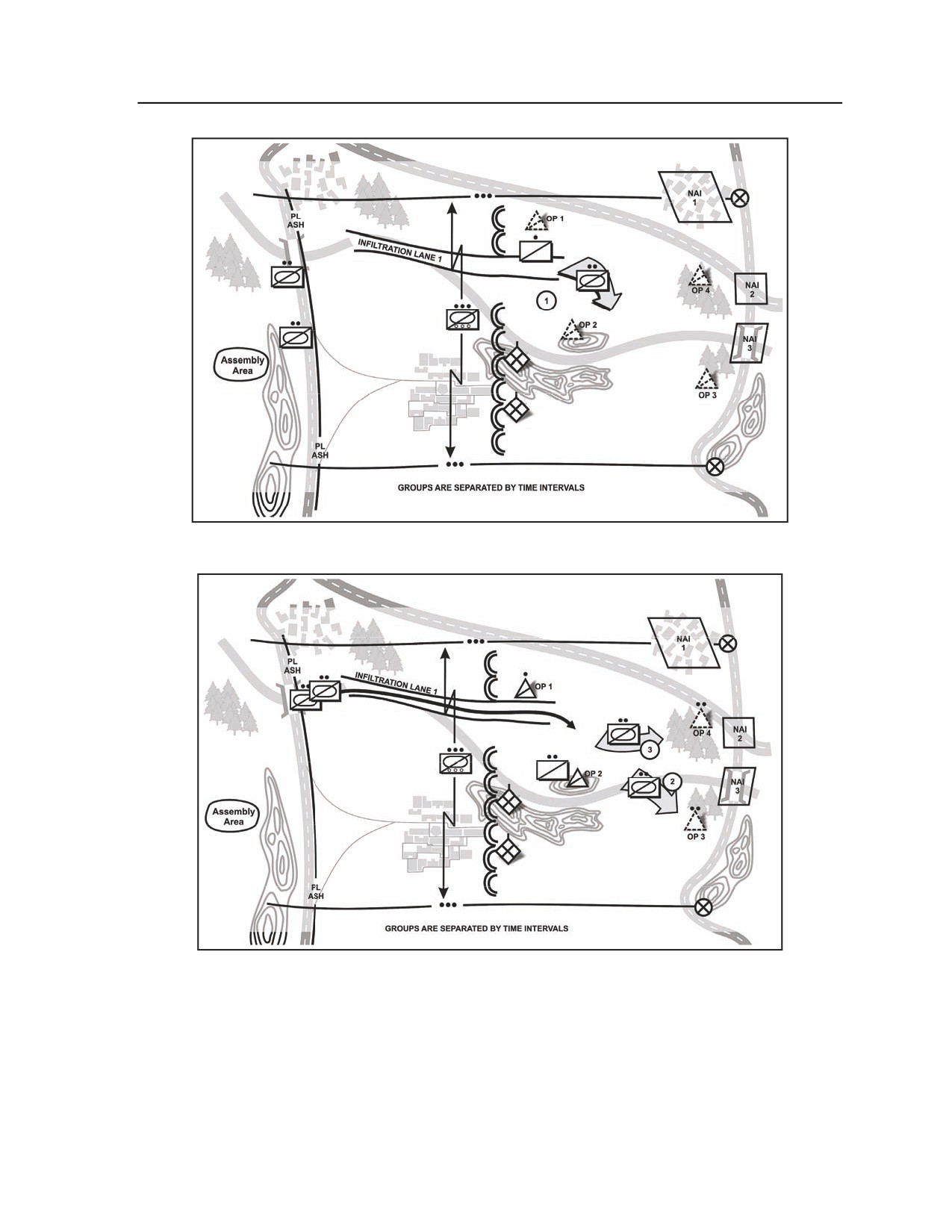
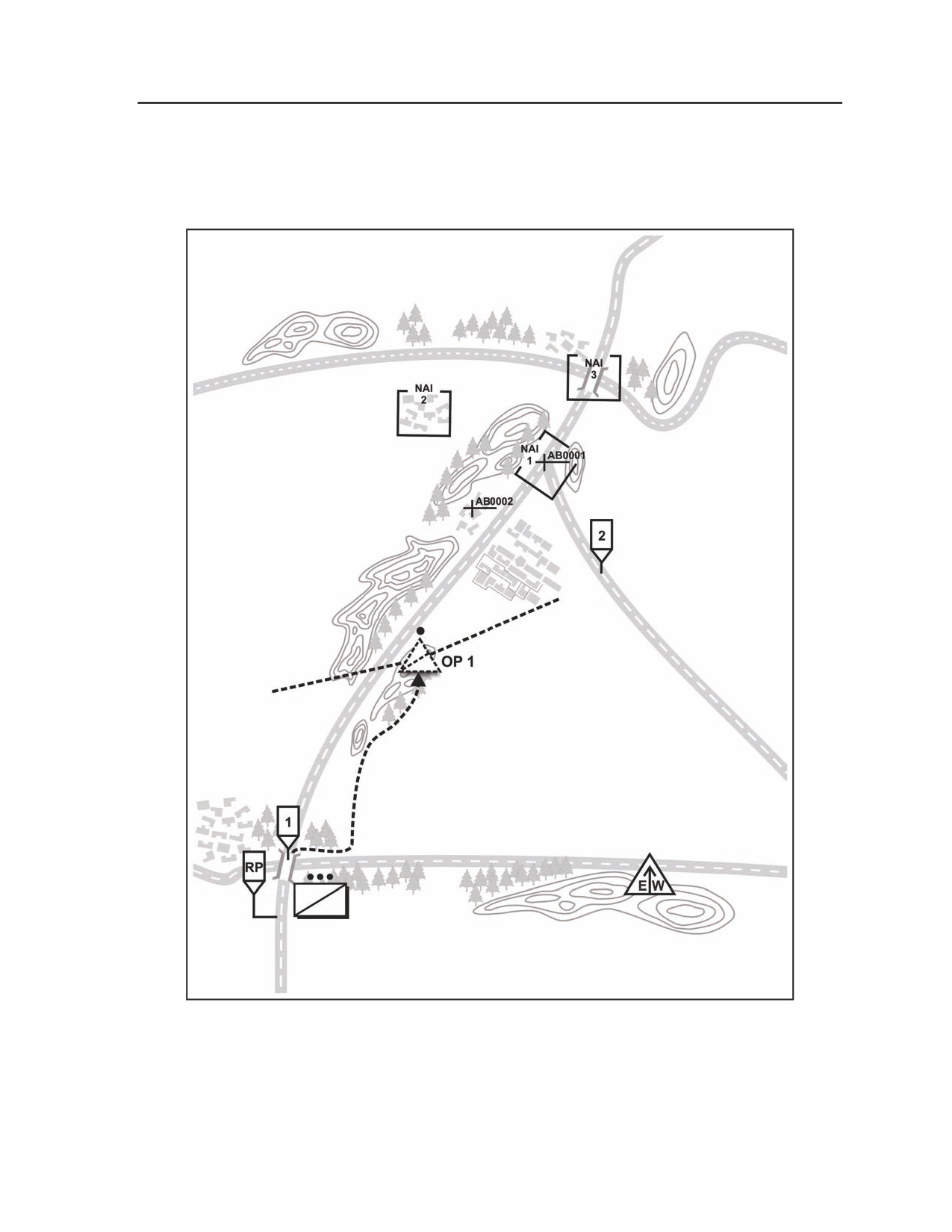
z
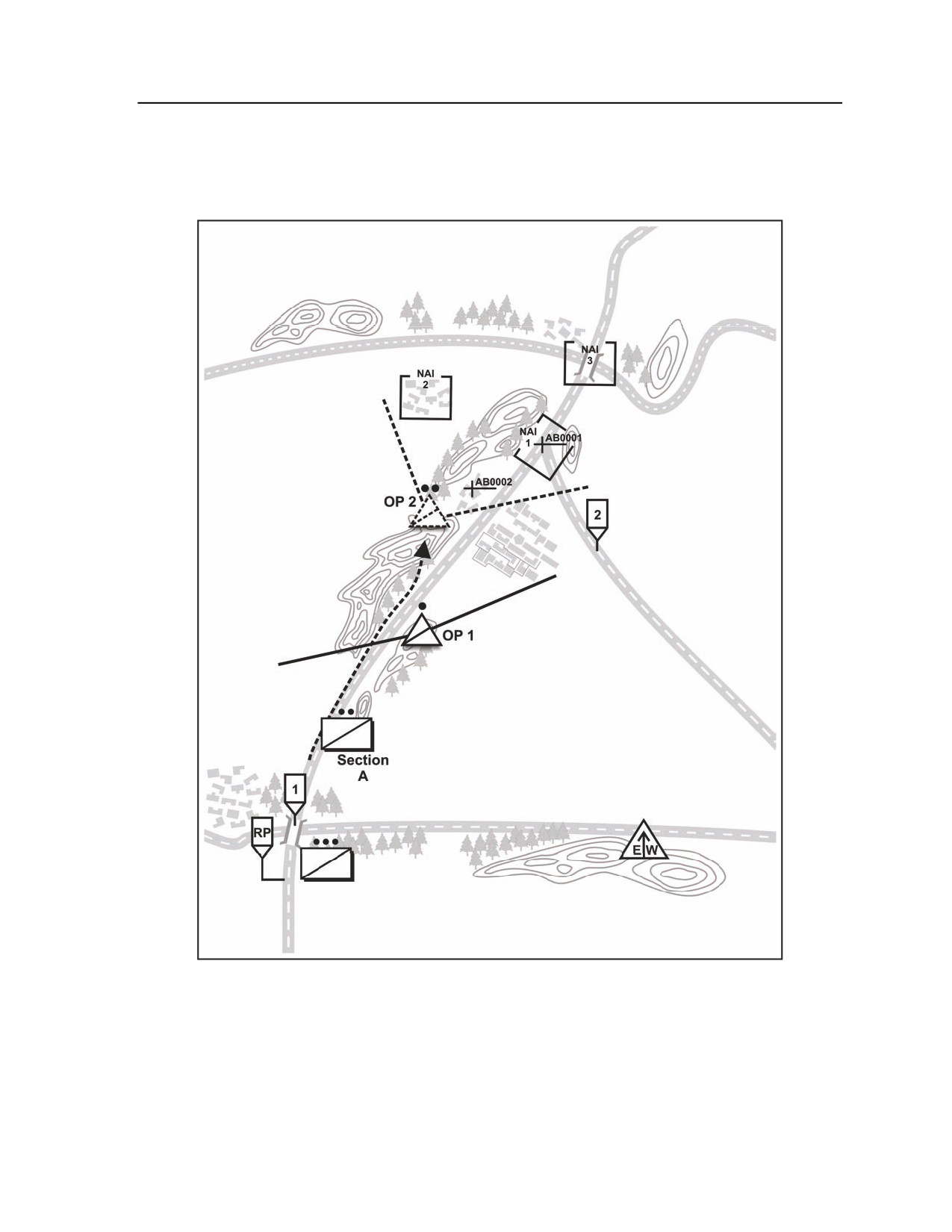
Detailed reconnaissance is required.
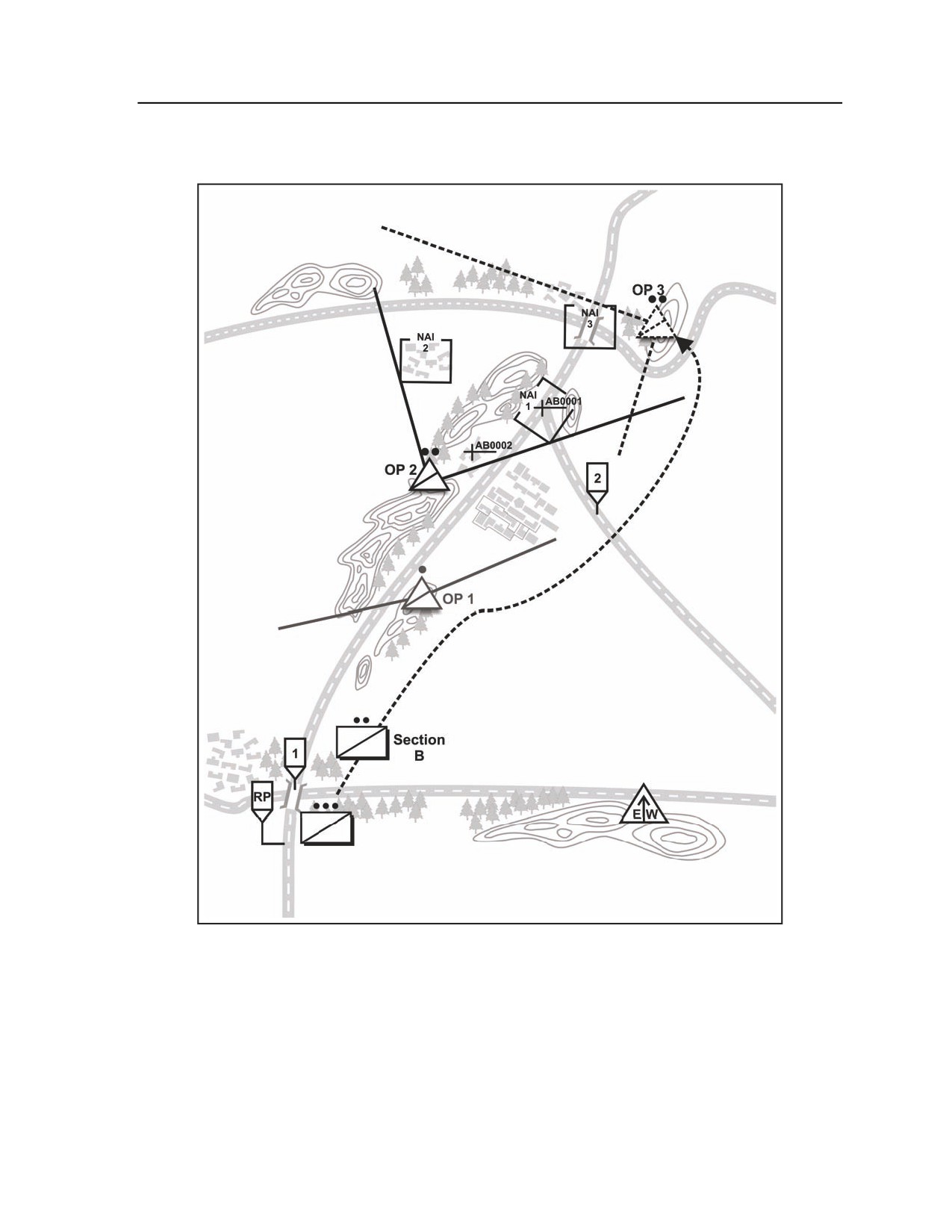
z
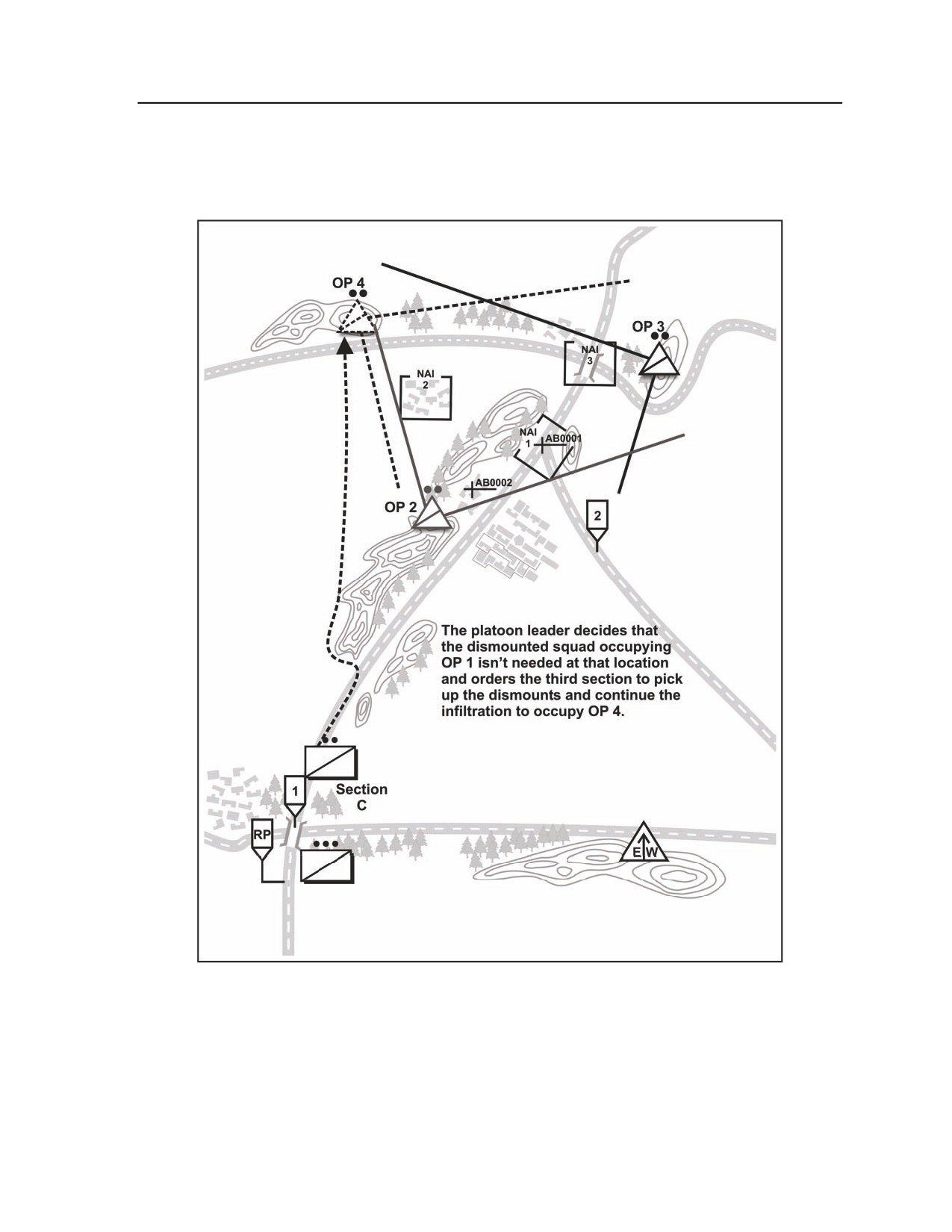
Stealth is required.
z
Threat contact is expected or visual contact has been achieved.
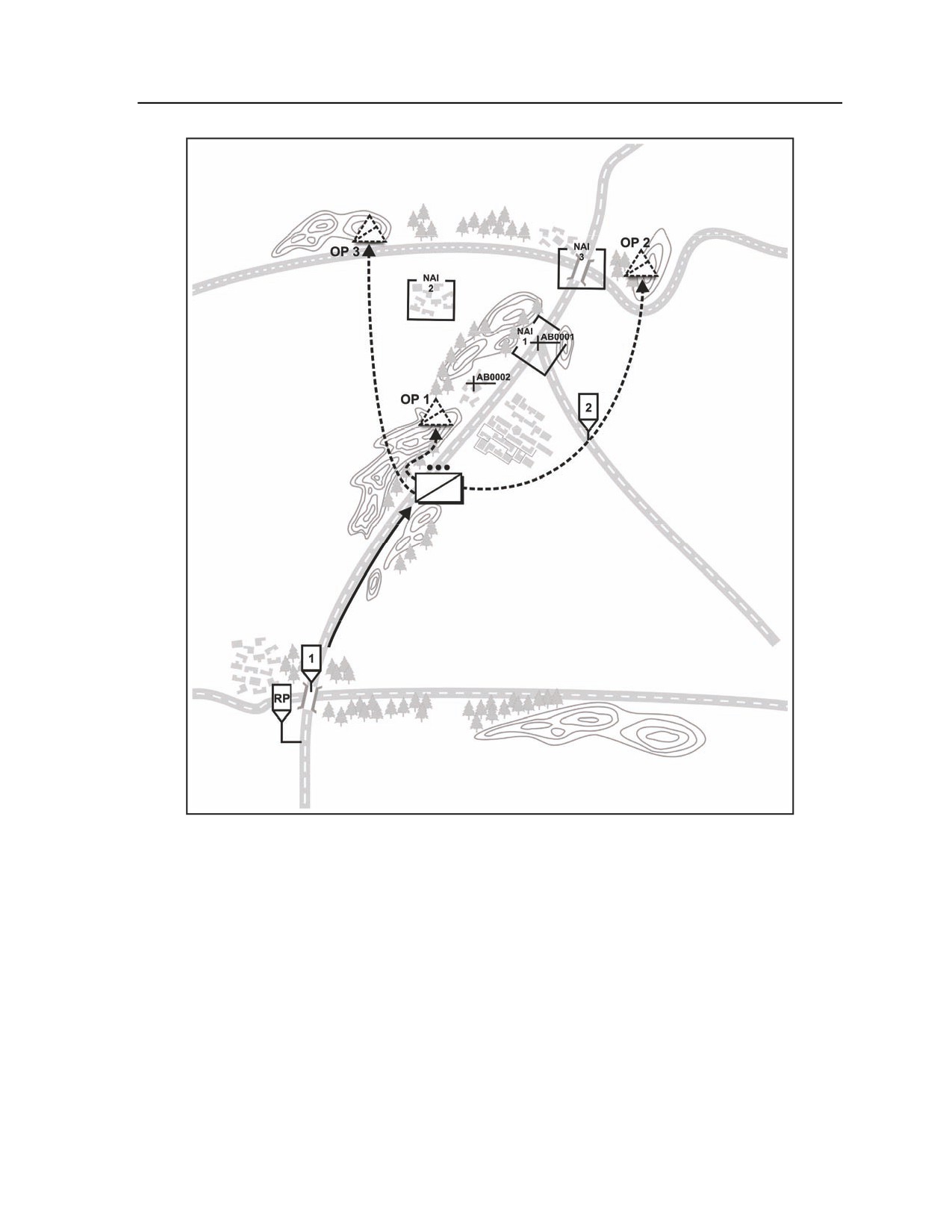
z
Restricted terrain is encountered.
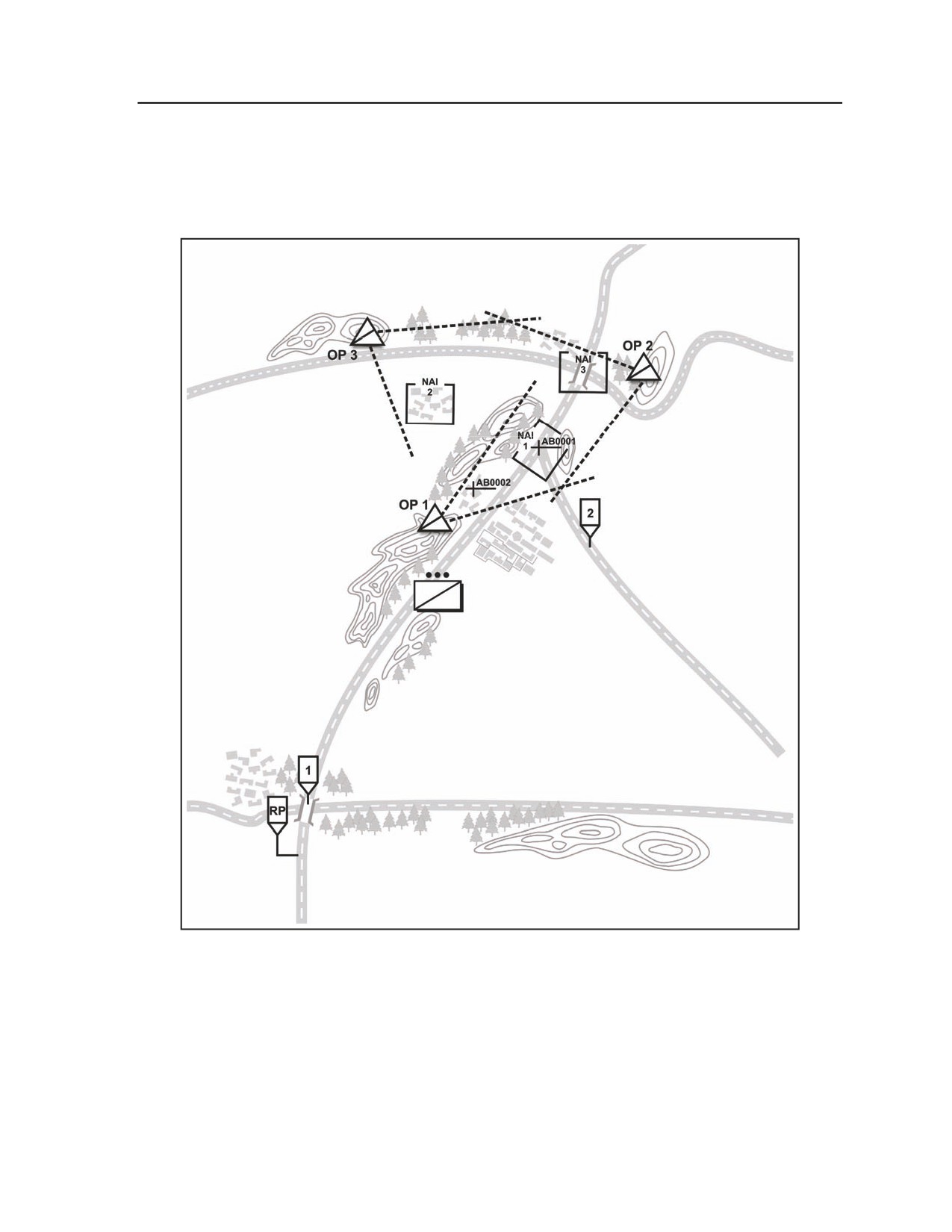
z
Time is available.
z
Danger areas are encountered.
z
Security is the primary concern.
z
IPB indicates close proximity to enemy positions.
3 August 2009
FM 3-20.98
3-17
Chapter 3
3-79. Dismounted scouts provide security for each other as they move. Ideally, at least two scouts work
together when operating dismounted. When only a single scout dismounts, he should never move out of
immediate supporting distance of the vehicle.
Advantages
3-80. Dismounted reconnaissance is the preferred method when stealthy movement is desired. Scouts on
foot benefit from the concealment offered by folds in the terrain; in addition, they do not emit a significant
visual or audio signature. Dismounted reconnaissance techniques allow the reconnaissance or scout platoon
to observe enemy vehicles and Soldiers at close range without being detected. Scouts conducting
dismounted reconnaissance can also quickly transition to a stationary OP for a short period of time without
suffering any loss of effectiveness. Overt dismounted patrols can search areas for an enemy presence with
finer detail than mounted missions and have the option to leave a covert small unit killer team for sniper or
IED team interdiction.
Disadvantages
3-81. Disadvantages of dismounted reconnaissance include a relatively slow rate of movement for
personnel on foot, extensive requirements for detailed preliminary planning and coordination, and
considerable risk to scouts who are conducting dismounted operations. Unless they establish a radio relay,
scouts cannot conduct dismounted reconnaissance in depth because of the relatively short range of man-
portable FM communications systems. When dismounted reconnaissance takes place during hours of
darkness, target acquisition depends largely on hand-held NODs, whose capabilities can be degraded. If a
dismounted patrol gains physical contact and is in danger of becoming decisively engaged, the reaction
force may be required to extract the patrol before becoming combat ineffective.
Tools for Dismounted Reconnaissance
3-82. Dismounted scouts employ a variety of equipment and other tactical tools to enhance their capability
to report information accurately and to call for and adjust indirect fires. At a minimum, they carry the
following items:
z
SOPs.
z
Personal weapons.
z
Squad automatic weapon (M249 or M240B).
z
Communications equipment (SBCT platoons are standardized with FBCB2).
z
Maps.
z
GPS system.
z
A compass.
z
Binoculars (and NODs, if necessary).
z
NODs and thermal devices.
Note. Dismounted scouts may carry additional equipment as dictated by unit SOP or specific
mission requirements.
TACTICAL EMPLOYMENT
RECONNAISSANCE BY FIRE
3-83. In reconnaissance by fire, direct and indirect fire is used on positions where there is a reasonable
suspicion of enemy occupation; the goal is to cause the enemy to disclose his presence by moving or by
returning fire. In rare circumstances, the reconnaissance or scout platoon or section may use this
reconnaissance method when enemy contact is expected and time is limited or when the platoon cannot
3-18
FM 3-20.98
3 August 2009
Reconnaissance Operations
maneuver to develop the situation. In such a situation, it is critical for the platoon leader to conduct
thorough war-gaming and rehearsals to prepare for the probable enemy reaction. UASs or unmanned
ground vehicles (UGV) may be used in this role to gain contact by fire without placing scouts in the line of
fire.
Employment Considerations
3-84. Examples of enemy locations and/or contact situations in which reconnaissance by fire may be
employed include the following:
z
Contact with a natural or man-made obstacle.
z
Detection of an obvious kill zone.
z
Evidence of a suspected enemy position that fits the SITEMP.
z
Signs of recent activity (such as track marks or trash).
z
Bunker complexes that may or may not be occupied.
z
Information gained through use of a reliable HUMINT source.
3-85. Reconnaissance by fire eliminates any element of surprise the scouts may have had, and it is likely to
give the enemy detailed knowledge of their location. It may, however, reduce the chance of scouts being
ambushed within established kill zones. Even if scouts employ UASs/UGVs and do not expose themselves,
the enemy will assume that there is a presence in the area, send an alert, and begin searching.
3-86. Reconnaissance by fire does not work in all cases. For example, disciplined troops in prepared
positions will not react to the scouts’ fires. As a result, reconnaissance by fire must not entail the
indiscriminate use of direct and indirect fires at all wood lines and hilltops in the hopes of causing the
enemy to react. The enemy will recognize this for what it is; it will not react to it. This also wastes valuable
ammunition.
Use of Indirect Fire
3-87. Scouts can conduct reconnaissance by fire by calling for and adjusting indirect fire. Reconnaissance
by indirect fire provides security for the scouts because it does not disclose their exact position; in addition,
all scouts are available to observe the effects of the fire. Scouts must be aware of the fact that accurate or
adjusting artillery fire indicates there is an observation team in the vicinity making adjustments. This will
draw patrols in search of the scouts.
3-88. Reconnaissance by indirect fire has disadvantages as well. Indirect fire requires more coordination
and communication than direct fire; it is also less responsive and may be less accurate. Indirect fire can be
subject to factors beyond the control of the platoon, such as the supporting unit’s Class V supply status,
counterbattery threats, and command approval. Additionally, the effects of indirect fire may obscure the
scouts’ vision.
FIGHTING FOR INFORMATION
3-89. As discussed earlier in this manual, reconnaissance organizations such as BCT reconnaissance troops
and ACRs cavalry squadrons not only use common techniques and assets (HUMINT, passive surveillance,
and technical means) to conduct reconnaissance operations, but also are capable of employing combat
power to fight for information. Because these units are usually the forward-most elements in MCO
environments, they must have the capability to survive meeting engagements and to destroy or impede
enemy forces as necessary to sustain operations in high-threat areas. Reconnaissance platoons must
maintain contact once they have established it. If a section leader has established a sensor contact with the
enemy, the platoon must pursue the contact until it has finally identified and reported the enemy force. In
general, platoons are capable of fighting through enemy reconnaissance (destroying the enemy’s “eyes and
ears”) to gain combat information needed by higher unit commanders. In shaping operations, the ability to
fight for information is important when determining the intent of an enemy (for example, whether the
enemy is willing to defend, withdraw, fight when confronted, or wait for a specific target such as C2 or
resupply elements) without committing main body infantry or armor units.
3 August 2009
FM 3-20.98
3-19
Chapter 3
3-90. The ability to fight for information is linked directly to the unit’s engagement criteria and
capabilities; therefore, the ability to fight for information is not limited only to ACR. All reconnaissance
and scout platoons must be prepared to fight for information and report it. When an organization faces an
inferior force that is within its engagement criteria, it may have to fight for information even if it is not
traditionally equipped to fulfill this role. The inferior enemy or insurgent will attempt to make contact with
reconnaissance elements at the lowest level, creating a situation that removes the Army’s technological
advantage. Because the ability to fight for information is enemy-based, a clear understanding of the enemy
and its capabilities is required for units not normally conducting aggressive reconnaissance. As the OE
changes, it is critical for platoon, section, and squad leaders to maintain awareness to prevent being drawn
in and cut off while fighting for information.
(These considerations are especially critical for the BFSB
reconnaissance platoon because of its limitations in fighting for information; refer to the discussion of the
BFSB reconnaissance platoon in Chapter 1.)
Note. The following discussion covers infiltration and exfiltration as part of reconnaissance
operations. Many reconnaissance missions can be executed in the following sequence to ensure
survivability for scouts: insertion; infiltration
(mounted or dismounted); execution of the
mission; exfiltration (mounted or dismounted); extraction. Refer to FM 3-20.971 for additional
discussion.
INFILTRATION
3-91. Infiltration is a form of maneuver that the reconnaissance or scout platoon can use to move through
the enemy security zone or main battle area to accomplish its mission. Entailing the use of stealthy forms of
movement, infiltration is primarily conducted by, but not limited to reconnaissance and HMMWV mounted
platoons due to their increased vulnerability to enemy direct and indirect fires. Aerial and waterborne
platforms may also employ tactics based on infiltration techniques to gain information on the enemy. UAS
assets may be employed using infiltration to gain information if this is within system capabilities. Platoons
planning this type of infiltration must acknowledge the risk of the UAS being engaged and becoming
unrecoverable.
3-92. The primary focus of infiltration is to move to a designated point without being detected or engaged
by the enemy. During infiltration, the platoon’s elements use pre-designated lanes to reach their objective.
The infiltrating elements employ cover, concealment, and stealth to move through identified or templated
gaps in the enemy.
3-93. The platoon can infiltrate by dismounted teams; mounted by vehicles, by sections, or as a complete
platoon; or using a combination of mounted and dismounted teams. It can infiltrate as an entire element at
one time or move into sector by echelon, at different times. Two examples of infiltration operations follow
the discussion of operational considerations.
Purpose of Infiltration
3-94. Purposes of infiltration include the following:
z
Reconnoiter a specified area and establish OPs.
z
Emplace remote sensors.
z
Establish communications relay capability for a specific period in support of other
reconnaissance operations.
z
Determine enemy strengths and weaknesses.
z
Locate unobserved routes through enemy positions.
z
Determine the location of high-payoff enemy assets.
z
Emplace small unit kill teams for interdiction missions.
z
Recover UASs to protect technologies from the enemy.
z
Provide surveillance for follow-on echelons moving into sector.
3-20
FM 3-20.98
3 August 2009
Reconnaissance Operations
Planning and Coordination
3-95. Infiltration imposes a number of distinct, and often difficult, operational considerations on the
reconnaissance or scout platoon which include methods of infiltration, extended operations time, reaction
force requirements, CASEVAC resources, and escorted or covert exfiltration methods.
3-96. The amount of intelligence information available to the reconnaissance or scout platoon leader
during the planning process will determine the risk involved in conducting the infiltration. Platoon leaders
must conduct a thorough mission analysis, focusing on enemy activities in the areas of movement,
historical locations of attacks, and likely areas of future ones to prevent accidental contact. As he plans the
operation, the platoon leader must conduct IPB to include selecting appropriate routes and movement
techniques based on the mission, the terrain and weather, the likelihood of enemy contact, the expected
and/or necessary speed of movement, and the depth to which the platoon’s elements must penetrate. Once
these factors have been considered, the platoon leader must make the decision to infiltrate either mounted
or dismounted or a combination of both. Even if he decides the platoon can conduct a mounted infiltration,
his plan must take into account that the situation may require scouts to dismount and reconnoiter an area
before the vehicles move forward. The platoon leader’s infiltration plan must provide platoon elements
with enough time for preparation and initial movement. The initial plan should also cover CASEVAC,
evasion, extraction, and reinforcement, as well as any special equipment requirements.
3-97. The platoon leader must conduct detailed coordination with any friendly elements through which the
platoon will pass when executing infiltration tactics; this includes integration of communications, fires, and
sustainment activities. In addition, the platoon’s higher headquarters must coordinate the activities of
adjacent friendly units to ensure that they do not compromise the platoon and its elements as they conduct
the infiltration. Coordination should include UAS support, aerial or satellite imagery, and HUMINT
briefings when possible. Coordination for mounted and dismounted passage may require different locations
through which the platoon is to move. If the patrol drops off the covert small unit kill team somewhere
along the patrol’s route, coordination should reflect the change in personnel numbers returning through the
checkpoint. Patrol leader’s must call in no fire areas (NFA) once beyond friendly units, and lift them once
their patrol begins moving again. Prior coordination may be required for swift movement to support patrols
depending on the location of the reaction force.
Infiltrating Elements
3-98. The size of the infiltrating elements depends on several factors:
z
The mission.
z
Time available.
z
Cover and concealment.
z
The target acquisition capabilities of both friendly and enemy forces.
z
Available communications assets.
z
Navigation capabilities and limitations.
3-99. If the platoon is tasked to gather information over a wide area, it may employ several small teams to
cover the complete sector. In most situations, smaller elements are more suitable to take advantage of
available cover and concealment. Another consideration is that some elements of the platoon may not use
infiltration. If the platoon is moving into sector in echelon, the initial echelons may infiltrate to a specific
location and provide surveillance for follow-on echelons that are moving into sector using a more
conventional movement technique. A reconnaissance patrol is typically four scouts. It becomes more
difficult for patrols to hide as the size of the patrol increases. A small unit kill team should be larger than a
typical reconnaissance patrol with up to six scouts. This allows the team to divide into two elements, which
enables the hunter-killer elements to support each other when moving in contact.
Infiltration Lanes or Routes
3-100. The platoon’s higher headquarters will assign the platoon an infiltration lane or zone, requiring the
platoon leader to gather the necessary information and intelligence to prepare for the mission. The platoon
3 August 2009
FM 3-20.98
3-21
Chapter 3
leader must decide whether to move the entire platoon along a single lane or assign separate lanes for each
section or vehicle.
3-101. Each alternative presents distinct advantages and disadvantages. Moving the entire platoon on a
single lane makes navigation and movement easier to control, but it can increase the chance of the platoon
being detected by enemy forces. Moving on multiple lanes may require development of additional control
measures, make C2 more difficult, and can create navigation problems. On the other hand, it can reduce the
chances of detection by the enemy.
3-102. In choosing infiltration lanes, the platoon leader must ensure that lanes afford sufficient width to
allow each element to change its planned route to avoid enemy contact. He must also consider civilian
activity along each lane and within the infiltration zone as a whole. The infiltration route should avoid
obstacles, populated areas, and areas occupied or covered by enemy elements. The route should provide
cover and concealment by placing ridgelines, rivers, and other restricted terrain between the platoon and
enemy forces. The plan should also make use of limited visibility and adverse weather.
3-103. As noted, the focus for the platoon during infiltration is to remain undetected and avoid contact
with any enemy elements. In conjunction with intervisibility (IV) lines, IPB (MCOO), and the Terrabase
program can be used on templated enemy positions and dominant terrain to help refine route selection.
Using Terrabase at various points of the infiltration route, the platoon leader can determine where the route
can be observed by the enemy and identify potential danger areas prior to moving into the AO. If time
permits and assets are available, UASs or dismounted patrols/observation may be used to proof the route
and to survey danger areas and influencing terrain. The use of UASs, however, must be weighed carefully
against the potential for compromising the infiltration route. If the enemy detects the UASs, it may be able
to focus on suspected infiltration routes. On the other hand, information from the UASs can prevent a
section moving into a manned outpost or dead space covered by sensors.
3-104. The multiple lane infiltration is the preferred method of infiltration for mounted and dismounted
infiltration. The platoon infiltrates through the enemy by sections when multiple lanes have been identified
(see Figure 3-6). This method typically has one section moving at any time. Planning and coordination for
the multiple lane infiltration is virtually the same as by echelon. The main differences are that increased
coordination is required, the platoon execution is decentralized, and the platoon does not move all the
sections through the same lane.
3-105. Each section sergeant should conduct his own linkup(s) and plan for specific targets along their
route of movement. Platoon leaders plan supporting fires for each infiltration lane in case one or all the
sections are detected and engaged. The PSG plans for CASEVAC and possible extractions on more than
one lane to include moving with armor escort. In some instances, the platoon leader can plan to execute a
patrol’s extraction before it is clear of the infiltration lane. Platoons must be careful not to overuse UASs
since excessive activity may give the enemy a hint of possible activity and compromise one or all the
sections.
3-22
FM 3-20.98
3 August 2009
Reconnaissance Operations
Figure 3-6. Platoon conducts infiltration by echelon, multiple lanes
Communications
3-106. In general, infiltrating elements should maintain radio listening silence except to send critical
information that the commander has directed to be reported immediately or to report contact with enemy
forces. When operating out of range of normal radio communications, an infiltrating element that must
transmit required information should move to high ground or set up a long-range expedient antenna.
Platoons may utilize TACSAT for communications during long-range operations, if equipped.
Fire Support
3-107. Infiltration plans should always include employment of indirect fires, although these are used only
in limited circumstances. The most common use is when the infiltrating unit makes enemy contact. The
commander or platoon leader may employ indirect fires in another sector to divert attention away from the
infiltration lanes. Patrol leaders have the ability to request more targets based on their route through the
lanes. Indirect fires can also be useful in degrading the enemy’s acquisition and observation capabilities by
forcing him to seek cover. The use of obscurant munitions (such as smoke) can have positive and negative
effects. Scouts can employ smoke to screen their movements through terrain; however, this draws the
attention of observers. Obscuration may also be used to break contact when in contact during infiltration.
In some cases, the smoke screen may hinder the patrol’s ability to see enemy forces as it moves.
Actions on Contact
3-108. Each infiltrating element must develop and rehearse a plan that clearly defines its actions when
faced with one or more of the eight forms of contact discussed in Chapter 5 of this manual. If detected, an
infiltrating element will return fire, break contact, and report; these actions are also discussed in Chapter 5.
Fighting through the enemy force, however, is the least preferred COA. Direct fire engagements are
normally limited to whatever actions are required to break contact. To prevent compromise of their
established locations and to retain the ability to report information, elements already established in sector
may choose not to provide direct fire support for follow-on echelons in contact.
3 August 2009
FM 3-20.98
3-23
Chapter 3
3-109. During infiltration using multiple lanes, the detection of one platoon’s elements may alert the
enemy and compromise other units in the infiltration zone. The OPORD must clearly state the criteria
under which elements will either continue the mission or return to friendly lines if they are detected by the
enemy. If an element makes visual contact but is not detected, it should continue the mission once it is sure
they have not been observed.
Examples of Infiltration Operations
3-110. The following examples focus on the reconnaissance or scout platoon as it conducts infiltration
either as a unit or by echelon.
A Platoon Infiltrating by Echelon Using a Single Lane
3-111. This example never has more than one section moving at any time. Planning and coordination for
the infiltration is virtually the same as for the first example; the main difference is that the platoon does not
move as a whole. Ground surveillance systems, radio intercept, and UASs may be used throughout the
infiltration process, but caution must be taken not to compromise the infiltration route by frequent UAS
flyovers.
3-112. At 1730 hours, a dismounted squad conducts a passage of lines and moves along an infiltration
route to establish OP 1 (see Figure 3-7). Once established, this OP conducts surveillance along the
mounted infiltration route and reports its observations to assist the platoon leader in refining the mounted
infiltration plan. Elements of the platoon may act as the reaction force for this dismounted team.
3-113. At 2017, the first mounted section begins its infiltration along the designated route, moving to OP
2 (see Figure 3-7, movement #1) with the dismounts at OP 1 providing surveillance. OP 1 is also prepared
to support the first mounted section’s actions on contact with preplotted indirect fires if needed. Once the
first mounted section is established at OP 2, OP 1 may also handle communications retrans duty as
required.
3-114. The second mounted section begins infiltration at 0115 along the previously employed route. OP 1
and OP 2 provide surveillance for its movement to OP 3 (see Figure 3-8, movement #2).
3-115. At 0325, the third section infiltrates along the same route with OP 1, OP 2, and OP 3 providing
surveillance. If OP 1 is not needed to conduct retrans, the third section picks the dismounted team up and
proceeds to OP 4 (see Figure 3-8, movement #3). Establishment of all OPs is completed no later than 0500
with redundant observation on NAIs 1, 2, and 3.
3-24
FM 3-20.98
3 August 2009
Reconnaissance Operations
Figure 3-7. Platoon conducts infiltration by echelon, single lane
Figure 3-8. Platoon conducts infiltration by echelon, single lane (continued)
Mounted Infiltration of a Platoon Moving as a Unit
3-116. This example has a wheeled reconnaissance platoon moving as a whole along a predesignated
infiltration route. Maximizing IV lines and using masking terrain are key considerations in selecting
infiltration routes. Units must maximize all available tools and assets that support thorough IPB, with
emphasis placed on OAKOC. A digital terrain program is a tremendous tool that can assist leaders in
3 August 2009
FM 3-20.98
3-25
Chapter 3
terrain analysis. For example, digital terrain programs can aid in analysis of potential OP locations. In
addition, it can be used on a potential infiltration route to determine positions from which the route can be
observed; this will help identify danger areas and help focus the platoon’s maneuver, observation,
contingency planning, identification of hasty fighting positions, and indirect fire plans.
Note. Refer to the discussions of IPB and OAKOC factors in Chapter 2 of this manual.
3-117. Prior to the infiltration, UASs may be employed to check danger areas and reconnoiter the
infiltration route and influencing terrain. This assists in refinement of the route. Coordination is made to
receive either video or photos from the UAS reconnaissance flights. Ground surveillance systems and
Prophet are deployed prior to infiltration to provide early detection and location of possible enemy forces
operating in the area. The platoon also requests intelligence updates through the S2 prior to infiltration.
The intelligence may come from numerous ISR assets that have previously worked in the area, including
HUMINT operations that may have collected intelligence from the local inhabitants. Checkpoints or the
terrain index reference system (TIRS)/grid index reference system (GIRS) may be used to control and
report movement along the route. An initial rally point may be designated beyond the passage lane; this
point may also act as a casualty or maintenance collection point. SOPs may dictate the use of checkpoints
as rally points as well. The platoon leader briefs the reaction force and provides them a copy of the
infiltration overlay.
3-118. When the infiltration begins, the platoon, moving as a whole, conducts a passage of lines and
continues along the infiltration route (see Figure 3-9). Temporary halts are conducted throughout the
movement to allow dismounts to move forward of the vehicles to reconnoiter danger areas. These danger
areas may have been identified during the planning phase through the use of IPB to include a map
reconnaissance, MCOO, digital terrain programs, and UASs. Each section maneuvers to its proposed OP
location and establishes the OP to observe its designated NAIs. Refer to Chapter 5 of this manual for
details on occupying an OP.
3-119. As the initial section establishes its OP, it also provides surveillance for those sections continuing
on the infiltration route. The other sections follow the same procedures as the first section until all sections
have established their OPs. In the event COLTs or other targeting assets are moving into sector to observe
TAIs may use the same infiltration route and follow the same procedures as the scout sections in
establishing their positions.
3-26
FM 3-20.98
3 August 2009
Reconnaissance Operations
Figure 3-9. Platoon moving on an infiltration route
3 August 2009
FM 3-20.98
3-27
Chapter 3
3-120. Once established, OP 1 observes NAI 1, OP 2 observes NAIs 3 and 1, and OP 3 observes NAIs 2
and 3 (see Figure 3-10). This observation plan allows observation redundancy of the NAIs and enhances
the platoon’s ability to conduct handover of contact from one OP to another. OP 1 must also be prepared to
conduct handover of contact with the elements to its rear. These potential actions are coordinated prior to
execution of the infiltration.
Figure 3-10. NAI observation plan with built-in redundancy
Platoon Infiltration by Echelon
3-121. This example never has more than one section moving at any time. Planning and coordination for
the infiltration is virtually the same as for the first example; the main difference is that the platoon does not
move as a whole. Ground surveillance systems, Prophet, and UASs may be used throughout the infiltration
process, but caution must be taken not to compromise the infiltration route by frequent UAS flyovers.
3-28
FM 3-20.98
3 August 2009
Reconnaissance Operations
3-122. Figure 3-11 depicts a dismounted squad conducting a passage of lines and moving along an
infiltration route to establish OP
1 prior to mounted movement. Once established, this OP conducts
surveillance along the mounted infiltration route and reports its observations to assist the platoon leader in
refining the mounted infiltration plan. Elements of the platoon may act as the quick reaction force (QRF)
for this dismounted team.
Figure 3-11. Initial infiltration of dismounted team
3 August 2009
FM 3-20.98
3-29
Chapter 3
3-123. The first mounted section begins its infiltration along the designated route, moving to OP 2 (see
Figure 3-12) with the dismounts at OP 1 providing surveillance. OP 1 is also prepared to support the first
mounted section’s actions on contact with preplotted indirect fires if needed. Once the first mounted
section is established at OP 2, OP 1 may handle communications retrans duty as required.
Figure 3-12. Infiltration of mounted section (A)
3-30
FM 3-20.98
3 August 2009
Reconnaissance Operations
3-124. The second mounted section then begins infiltration along the previously employed axis. OP 1 and
OP 2 provide surveillance for its movement to OP 3 (see Figure 3-13).
Figure 3-13. Infiltration of second mounted section (B)
3 August 2009
FM 3-20.98
3-31
Chapter 3
3-125. The third section subsequently infiltrates along the same successful axis, with OP 1, OP 2, and OP
3 providing surveillance. If OP
1 is not needed to conduct retrans, the third section picks up the
dismounted team and proceeds to OP 4 (see Figure 3-14). Establishment of all OPs is completed with
redundant observation on NAIs 1, 2, and 3 (see Figure 3-15).
Figure 3-14. Infiltration of third mounted section (C)
3-32
FM 3-20.98
3 August 2009
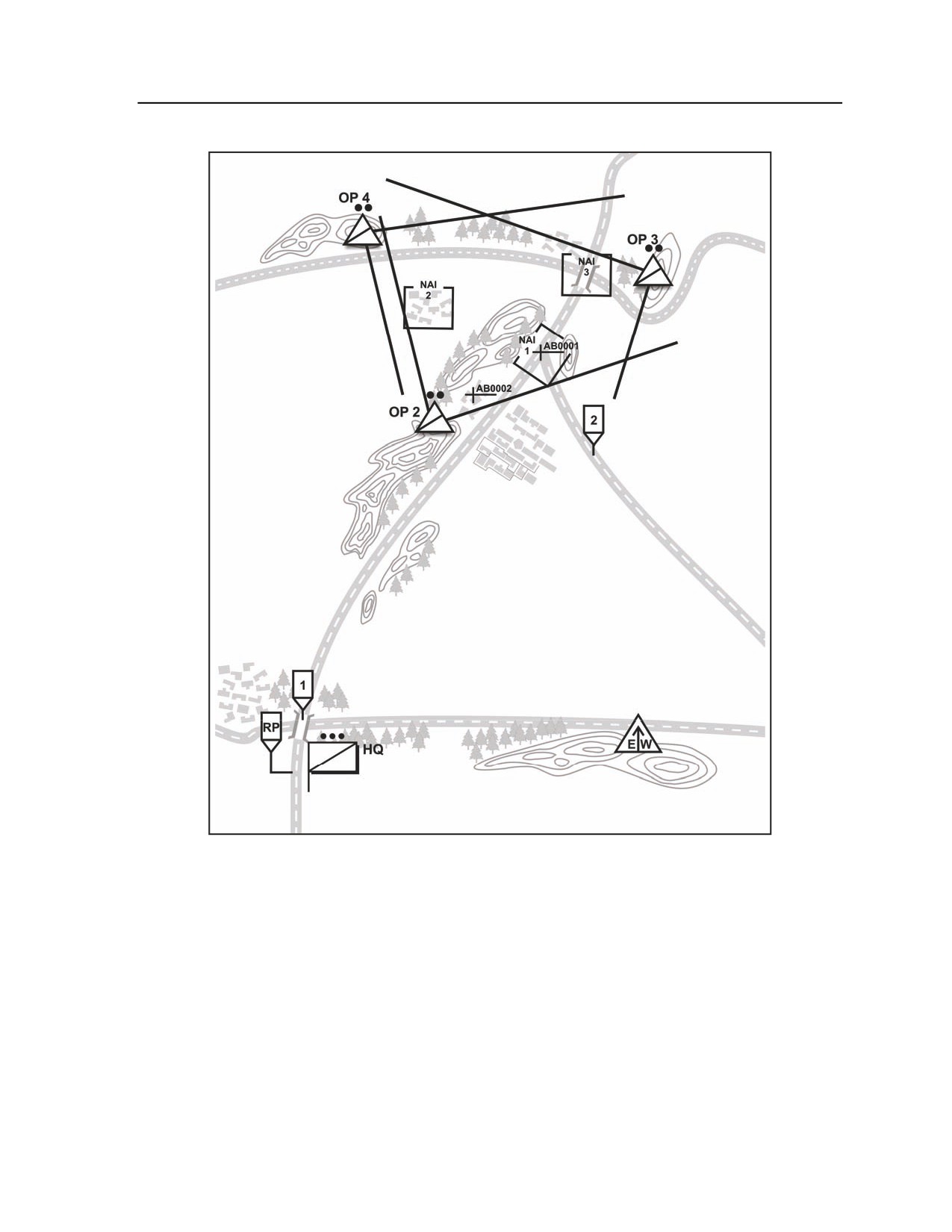
Reconnaissance Operations
Figure 3-15. Infiltration complete with redundant observation of NAIs
Dismounted Infiltration of a Section Moving as a Unit
3-126. The following scenario describes the dismounted infiltration of a section moving as a unit.
3 August 2009
FM 3-20.98
3-33
Chapter 3
Dismounted Infiltration Scenario
A HUMINT team learns of suspected insurgents surveying an area for possible
attacks against coalition forces and marks two locations of frequent enemy activity.
Intelligence reports that enemy elements are marking engagement areas. The CAB
reconnaissance platoon receives a WARNO that the platoon will infiltrate a small unit
kill team into the hostile area for interdiction. The platoon leader conducts a mission
analysis and map reconnaissance plotting known enemy activities and times in the
area. The platoon leader and S2 project future attacks and windows of opportunity. A
UAS confirms a hide location and exfiltration routes that offer cover and
concealment; these were located during map reconnaissance and digital terrain
program review. The reconnaissance platoon coordinates with a convoy to facilitate
infiltration. The reconnaissance platoon will send vehicles with the convoy which will
insert scouts as close to the mission objective along the convoy’s route. The OPORD
and backward planning schedule is briefed, and the platoon PCC/PCIs begin for the
section. The platoon conducts rehearsal with the command, insertion team,
infiltration section, reaction force, ALO, S3, S2, convoy commander, and the
exfiltration team. At 1900 hrs, the scout section inserts off a convoy truck conducting
a temporary halt at a rest stop. The section mingles with drivers and discreetly
moves into a wadi behind the parking area, and remains until dark. At 2300 hrs, the
section begins moving north, in low ground to a GPS location identified by a
SHADOW UAS. The scout section moves into a patrol base without making contact
and locates the hide position at 0345 hrs. The section reports “set” at the hide site at
approximately 0500 hrs and requests an NFA. The scout section reports suspected
insurgents marking locations with sand bags along a road at 1700 hrs. The scout
section uses MELIOS and coordinates a TRP on the sand bag’s location. The
reconnaissance platoon leader coordinates a scout sniper team to overwatch the
extraction point. A CFV and M1 reaction force is positioned for the PSG to use for
CASEVAC and extraction during contact. The S3-Air places two Apache helicopters
on stand-by as the scouts make visual contact. Scouts report insurgent elements
using the low ground, below the road, to reach the prepositioned sand bags. The
enemy begins to emplace IEDs along the shoulder of the road at 2300 hrs. The BCT
launches SHADOW to provide early warning of enemy movement outside the small
unit kill team’s visual range. The CAB commander launches Raven UASs to monitor
the terrain around the scout section’s escape route confirming negative contact.
Scouts report munitions being delivered to the IED site at 0015 hrs. The scouts then
engage the dismounts and wheeled vehicles with M240B, M249 SAW, and JAVELIN,
thereby triggering the IED charge. Rifle shots are fired from a building across the
road in all directions. A section leader fires M203 smoke rounds in the vicinity of the
IED site to obscure the scout’s exfiltration. Scouts send a SITREP and announce
they are moving along exfiltration route. The platoon leader confirms the route and
terrain is cleared ahead of exfiltrating scouts using Ravens. A SHADOW reports
possible insurgents gathering at the IED location to the rear of the scouts. The
reaction force is alerted for possible extraction support, under contact. APACHES lift
off to interdict insurgent tracking party. The scout section reports arrival at the
extraction point triggering the dispatch of the PSG and reaction force. APACHES
receive target handover from the SHADOW and neutralize the tracking party one
kilometer from the extraction point at 0315. The PSG links up with the scout section
and extraction begins at 0325 hrs.
EXFILTRATION
3-127. The reconnaissance platoon and its elements may have to conduct exfiltration in several types of
tactical situations. For example, reconnaissance forces that infiltrate an AO must exfiltrate once they gather
3-34
FM 3-20.98
3 August 2009
Reconnaissance Operations
the required information. In another instance, the platoon may conduct a screen in support of a displacing
unit during defensive operations, thereby requiring the scouts to use exfiltration to return to friendly lines.
Planning Considerations
3-128. In all situations, exfiltration must be planned as carefully as infiltration. Planning includes identifying
casualty collection points and emergency resupply points along exfiltration routes, to provide supporting
elements with a more secure, stealthy route into the sector to conduct these support operations. An effective
exfiltration plan is essential in terms of mission accomplishment and morale. In most cases, planning for an
exfiltration operation begins at the same time as planning for the infiltration (or other tactical operation) that
precedes it. For example, the platoon leader must anticipate contingency measures that may be required if his
elements must conduct an unplanned exfiltration during a reconnaissance operation. His exfiltration plan
should factor in additional time that the platoon may need to react to unforeseen circumstances, such as
inadvertent contact with enemy forces or unexpected restricted terrain. Platoon leaders must plan to integrate
both indirect and direct fire support for protection during the exfiltration. UAS assets can assist by locating
overwatch positions from which fire support assets can provide fires. Whether the platoon plans to exfiltrate
on foot or by another transport method (ground vehicles, aircraft, or watercraft), detailed planning is required
to establish criteria for a passage of lines to minimize the chances of fratricide. The exfiltrating force must also
be prepared to plan for contingencies once the operation is under way, particularly if enemy contact occurs.
3-129. The exfiltration plan should also cover other types of contingencies that will not require the
platoon to exfiltrate. For example, when a section or squad repeatedly misses mandatory radio contact, it
must be assumed that the element has a communications problem, is in trouble, or both. The exfiltration
plan might address this situation by calling for a resupply cache drop of new batteries and other means of
communication at a predetermined location. The plan would mandate that the resupply location be
specially marked to ensure that the equipment does not fall into enemy hands. Getting these supplies in
place may require following infiltration methods already used by the platoon.
Movement Considerations
3-130. Urban areas create unique exfiltration challenges for the reconnaissance and scout platoon.
Mounted elements negotiating the route to the exfiltration point will encounter buildings, narrow streets,
scattered rubble and debris, which will hinder and delay vehicle movement. The principles of route
selection, movement formations, movement techniques (overwatch preferred), and movement security are
critical to the success of the exfiltration operation. Plans for extraction by applicable means (ground, air, or
water) must be developed before the operation, covering procedural contingencies such as the loss of
vehicles, evacuation of sick and wounded personnel, and disruption of communications. These plans
should address various contingencies for movement such as evasion. Hazards in the area of movement
must be avoided to improve scouts chances of escape. Displaced refugees and noncombatants slow
movement on narrow roads creating situations where the exfiltration is compromised.
3-131. Elements may use successful infiltration routes as their exfiltration routes as well. However,
repeated movement in one area increases the likelihood of being detected and ambushed. The more
vehicles involved in the extraction, the greater the noise signature.
Routes and Extraction Points
3-132. The methods that the platoon uses for exfiltration route selection are the same as those discussed
for infiltration earlier in this section. The platoon leader ensures that primary and alternate linkup points are
not on a single azimuth leading away from the OP or exfiltration route.
3-133. Extraction points for dismounted personnel should be far enough away from the OP to ensure that
the enemy does not hear vehicle or helicopter noises. The exfiltrating force should use mountains, dense
foliage, and other terrain features to screen these noises. Under normal conditions in flat, open terrain on a
clear night, rotary-wing aircraft lose most of their audio signature at a distance of approximately five
kilometers. Rolling terrain can assist in hiding vehicle sounds as long as they maintain low engine RPM. In
mountainous terrain, aircraft conducting the extraction can be seen or detected much easier when enemy
3 August 2009
FM 3-20.98
3-35
Chapter 3
observers are in place on the hilltops that offer superior observation. Mounted infiltration faces challenges
based on the vehicles used. The larger tracked vehicles used for mounted exfiltration or extraction (CFVs,
Abrams tanks), encounter more mobility restrictions due to their size, and require dismounts for security at
the halt. In the urban areas, exfiltration routes may be down narrow roads and alleys to mask movement.
Extraction points may be easily hidden among the materials and debris found in the urban area. While the
actual point may be in buildings or in open areas such as an intersection, a patrol may use surface or below
surface hide locations to avoid detection. This may include inside and outside of buildings. Scouts must
avoid detection since they are not prepared to fight decisive engagements. Exfiltration in the urban
environment requires movement in and around multistory buildings that can both conceal movement, and
provide advantageous enemy locations with superior fields of view for engaging scouts.
Methods of Extraction
3-134. Extraction can be conducted by air, water, or land. Each alternative presents the platoon with
specific operational considerations as well as tactical advantages and disadvantages. The exfiltration plan
and the OPORD must address these factors as well as operational contingencies such as actions the
reconnaissance unit will take if an unplanned extraction becomes necessary.
3-135. Extraction by air or water means is favored when the resources are available and their use will not
compromise the mission. These methods are used when long distances must be covered, when time of
return is essential, when the extraction zone lacks adequate cover and concealment, when the enemy does
not have air or naval superiority, or when complex terrain or heavily populated hostile areas obstruct
ground extraction.
3-136. Reconnaissance forces normally conduct extraction via land routes when friendly lines are close or
no other extraction method is feasible. Ground extraction is preferred when areas along the route are
largely uninhabited, when enemy forces are widely dispersed, or under such pressure that they cannot
conduct counterreconnaissance and security operations. In addition, ground extraction is preferred when
terrain is sufficiently restricted to degrade enemy efforts to use mobile forces against the
exfiltrating/extracting reconnaissance unit.
Emergency Exfiltration
3-137. The platoon may have to conduct emergency exfiltration if it is detected or engaged by an enemy
force. This type of operation requires activation of an escape and evasion plan or deployment of a reaction
or support force to assist with the extraction of friendly elements. Employment of the reaction force and
supporting fires must be carefully coordinated and rehearsed before the insertion and infiltration (or other
tactical mission, if applicable) is initiated. In all situations, the heavier the armor support, the louder the
sound signature will become. PSGs must be involved in the coordination and rehearsal with these assets
since they will be most likely assist in the exfiltration and extraction of their scouts.
SECTION III - MULTIDIMENSIONAL ASPECTS OF RECONNAISSANCE AND
SURVEILLANCE
3-138. The multidimensional aspect of operations is part of all reconnaissance or scout platoon missions.
The term “multidimensional” refers to the directed effort to obtain detailed information covering all types
of threat forces
(military, paramilitary, criminal, and other), civilian demographics
(social/human),
infrastructure (including utilities, transportation, and the political, economic, and agricultural situation),
routes, obstacles, and terrain. Planning and execution of any reconnaissance or surveillance mission must
always take into account the multidimensional aspect of the operation, especially in site exploitation (SE).
In turn, the multidimensional aspect must include the effective integration and employment of the full
range of ISR assets, including UASs and other sensors.
3-139. All reconnaissance and scout platoons must understand the multidimensional aspect of
reconnaissance operations. The SBCT reconnaissance platoon is ideally suited to focus on the
multidimensional aspect of reconnaissance and surveillance operations with organic HUMINT collectors.
These platoons can enhance SU by working closely with their HUMINT Soldiers to collect and assess
3-36
FM 3-20.98
3 August 2009
Reconnaissance Operations
information through contact with community leaders and the local populace. It is extremely important that
scouts fully understand the commander’s focus for the reconnaissance and the operational considerations
of civil-military operations (CMO).
OPERATIONAL CONSIDERATIONS
3-140. The multidimensional aspect of reconnaissance requires leaders, specifically the HUMINT
collectors, to develop relationships with local military/civilian leaders to gain information that may be
pertinent to troop, squadron, and brigade operations. In these areas, Soldier-based, human-intensive
intelligence compensates for the limitations of equipment-based sensors, which are better suited for
providing SA in open and rolling terrain for conventional force-on-force operations. Effective use of the
unit’s HUMINT collectors is the key to gaining information from the populace, especially when the enemy
may be hiding within the population.
3-141. The threat level will greatly influence the level of interaction between reconnaissance elements
and the populace of the area. Understanding this human aspect of the OE (political, religious, ethnic, and
criminal) will be a key factor in the analysis of threat centers of gravity and the execution of decisive
operations. The ability to conduct the multidimensional aspect of reconnaissance can assist the commander
in defeating or countering unconventional threats. In addition, the multidimensional aspect of any
reconnaissance or surveillance mission can greatly enhance SA at all levels by providing operational
information from previously untapped sources.
INTELLIGENCE COLLECTION
INTELLIGENCE ACTIVITIES
3-142. HUMINT and counterintelligence (CI) operations should be done by certified personnel outside of
the platoon to prevent incidents that may be in violation of the Law of Land Warfare (see FM 2-0 and FM
27-10 for additional information). Reconnaissance and scout platoons may perform tasks that support these
certified personnel in their activities. This may entail but is not limited to—
z
Interrogation and debriefing. These activities involve the systematic questioning of
individuals to obtain information related to specific collection requirements. Sources who are in
the custody of U.S. forces, such as EPWs and detainees, are interrogated. All other sources are
debriefed; these include friendly forces, civilian refugees, and local inhabitants.
z
Source operations. These are collection operations using recruited and registered HUMINT
sources. The registration of sources is a legal requirement in any sustained use of a specific
individual as a source.
3-143. Reconnaissance and scout platoons operating in full spectrum operations will encounter threats
that vary greatly in their nature and composition. Effective intelligence gathering may require the use of
trained personnel to conduct or lead specific tasks, such as—
z
TQ. This is an abbreviated form of interrogation or debriefing used to collect PIR-related
information from human sources.
z
SE. This is the action taken by a unit to ensure that documents, materials, equipment, and
personnel are identified, collected, safeguarded, secured for analysis, and evaluated to facilitate
the actions needed to plan and execute follow-on missions. Reconnaissance and scout platoons
would have direct mission involvement in the “find, fix, finish, and exploit” steps of the SE
targeting cycle. Refer to Appendix B for more information on SE.
INTELLIGENCE COLLECTION PERSONNEL
3-144. The IBCT reconnaissance platoon’s organic HUMINT collectors, who are specifically trained in
military intelligence (MI) operations, maximize the platoon’s effectiveness in multidimensional aspects of
reconnaissance missions. It is critical to understand and properly use these personnel. While the platoon
leader is not likely to have the time to be an expert on every aspect of MI operations, he must be proficient
3 August 2009
FM 3-20.98
3-37
Chapter 3
in HUMINT and CI training, operations, and implementation. Enemy counterintelligence personnel will
target the unit’s MI and HUMINT collectors in an attempt to deny U.S. forces useful information. Platoon
leaders must take preventive steps to protect their HUMINT assets from falling prey to enemy CI agents.
When possible, scouts act as a security detail as the HUMINT interacts with locals.
Human Collection Team (HCT) Personnel and Missions
3-145. The HCT provides GS to the squadron; the squadron in turn determines the HCT’s priorities and
generates taskings through the S-2. The collectors, either through training or by occupying specific
positions such as an S-2, are tasked with collecting information for intelligence use from people or related
documents.
Note. A HUMINT source is anyone who can provide information to answer collection
requirements.
3-146. The HCT collectors in the SBCT reconnaissance platoon are ideally six-Soldier teams that
provide the squadron with an organic, trained HUMINT/CI collection capability. The intelligence
collectors will—
z
Normally be distributed as one collector per squad and task organized based on METT-TC.
z
Advise the platoon leader on intelligence collection operations.
z
Provide initial assessment and quality control of HUMINT/CI collection and source
identification.
z
Act as the platoon HUMINT/CI trainer.
Note. Threat elements will target platoon resources (interpreters and civilian contractors) in
order to prevent detection and analysis of their operations.
3-147. The HCT’s mission within the platoon includes the following general tasks:
z
Collect information of immediate tactical value from EPWs, detainees, refugees, and civilians in
the AO.
z
Collect data allowing predictive analysis of events in the platoon’s AO.
z
Collect information of immediate tactical value from foreign documents.
z
Assist in the debriefing of friendly forces, such as patrols.
z
Identify individuals for potential detailed exploitation by the CI teams in the brigade’s military
intelligence company (MICO).
3-148. Specific missions for HCT collectors in a MICO include, but are not limited to, the following:
z
Conduct TQ.
z
Conduct interrogation of EPWs and detainees.
z
Debrief or interview civilians in the AO.
z
Debrief friendly forces.
z
Conduct HUMINT analysis.
z
Conduct document and media exploitation (DOMEX).
z
Support planning for intelligence gained from interviews and evidence.
3-149. HCTs are not organized and equipped at any level to perform tasks normally conducted by—
z
Military police (MP), including riot and crowd control.
z
Rapid reaction force.
z
CA.
z
PSYOP.
3-38
FM 3-20.98
3 August 2009
Reconnaissance Operations
3-150. The reconnaissance and scout platoons are not trained HCT personnel and only assist augmenting
HUMINT data collection. SBCT reconnaissance platoons will have organic HCTs and may establish
habitual duties within the platoon to assist the HCT leader. Reconnaissance and scout platoons must plan to
prevent the loss of HCT teams and their sources by providing security during movement and interaction
with local population. When attached to the reconnaissance or scout platoon, the HCT operates under the
control of the platoon leader and is supported directly by the platoon (including security) unless mission
requirements create a need outside the platoon’s augmentation. The PSG is responsible for the CASEVAC
and reporting of all attached HCT personnel.
CI Personnel and Missions
3-151. As noted, CI collectors/agents are organic to the SBCT’s MICO. Specific missions for CI teams in
the MICO include, but are not limited to, the following:
z
Identify and recommend countermeasures to threat intelligence collection and threat CI efforts.
z
Conduct CI investigations.
z
Conduct CI analysis.
z
Provide CI support to threat and vulnerability analysis.
Note. See FM 34-60 for details of CI activities and employment.
HUMINT OPERATIONAL CONSIDERATIONS
3-152. HUMINT is a category of intelligence derived from information collected and provided by human
sources. It uses human sources as a tool and a variety of collection methods, both passive and active, to
gather information to satisfy the commander’s intelligence requirements and cue other intelligence
disciplines. HUMINT tasks include, but are not limited to, the following:
z
Source operations using tactical and other developed sources.
z
Liaison with HN officials and allied counterparts.
z
Elicitation of information from the civilian populace, including transients.
z
Identification of individuals as potential force protection sources.
z
Debriefing of U.S. and allied forces and civilian personnel.
z
Interrogation of EPWs and detainees.
z
Information operations.
z
Translation and exploitation of threat documents, media, and other materials.
3-153. All reconnaissance and scout platoon leaders can expect to conduct some form of HCT collection
activities to gather the information needed to make decisions in support of the overall mission. HUMINT
activities help the platoon leader shape the AO by providing information that enables him to respond to
previously unforeseen threats. He focuses the HUMINT effort by carefully assigning missions and clearly
defining the desired results. In orienting the unit’s HUMINT efforts and capabilities, the platoon leader
must decide who or what will be advantageous targets for collection activities. As noted, only the SBCT
reconnaissance platoon has organic HUMINT personnel.
Role of HUMINT Collectors
3-154. The SBCT platoon’s HUMINT Soldiers, who can be augmented by interrogators (from the MICO)
when available, conduct collection operations in support of the overall mission. These operations rely on
the use of both casual and recruited sources of information. The collection effort includes liaison activities;
the debriefing of refugees, detainees, and EPWs; review of open source literature; and DOMEX. HUMINT
collectors directly support SE and subsequent intelligence gathering operations against the enemy. These
operations use the techniques identified in FM 34-5 and FM 2-22.3. Other resources include AR 381-172,
which covers policy concerning counterintelligence force protection source operations
(CFSO), and
3 August 2009
FM 3-20.98
3-39
Chapter 3
AR 381-10, which outlines policies and procedures governing the conduct of intelligence activities by the
Army.
3-155. In addition, during the planning process, the platoon leader must be aware of the combat multiplier
capability that his HUMINT assets provide. In this role, the platoon’s HUMINT personnel conduct the
following tasks:
z
Support to combating terrorism.
z
Support to CMO (discussed later in this section).
z
Support to OPSEC.
z
Support to IO.
z
Support to domestic civil disturbances.
z
Liaison.
z
Local operational data collection.
z
Debriefing and interrogation.
z
Threat assessment.
z
Assessment of the HUMINT threat in the AO.
HUMINT Sources
3-156. Platoon leaders should be familiar with the types of sources HUMINT personnel will use to satisfy
command PIR:
z
Casual source. A casual source is one who, by social or professional position, has access to
information of CI interest, usually on a continuing basis. Casual sources usually can be relied on
to provide information that is routinely available to them. Casual sources include private
citizens, such as retired officials or other prominent residents of an area.
z
Official sources. These are liaison contacts. CI personnel conduct liaison with foreign and
domestic CI, intelligence, security, and law enforcement agencies to exchange information and
obtain assistance. CI personnel focus on investigative, operational, and threat information.
z
Recruited sources. These include sources who support CFSO, as identified in FM 34-5. By
design, CFSOs entail the use of human source networks, dispersed throughout the area that can
provide timely and pertinent force protection information.
z
Refugees, detainees, and EPWs. Interrogators normally conduct collection operations with
these sources, often with technical assistance from a CI agent.
z
Open source publications. These printed materials, as well as radio and television broadcasts,
are valuable sources of information of CI interest and operational information. Depending on the
resources, this support can be provided by interrogation personnel, allied personnel, indigenous
employees, or reserve component translators.
z
Documents not openly available. Such sources as adversary plans and reports are exploited in
much the same way as open source publications.
Reconnaissance Support Activities
3-157. In military urban operations, people
(EPWs and civilians) are the preeminent source of
information. HUMINT collection provides information otherwise not available through SIGINT and image
intelligence (IMINT). As an example, when a lodgment is made in a building, the HUMINT collectors:
z
Move in and interrogate EPWs.
z
Persuade holdouts to surrender.
z
Help with the questioning and evacuation of noncombatants.
z
Collect information on floor plans and defensive plans.
z
Determine locations of combatants and noncombatants in the area.
3-40
FM 3-20.98
3 August 2009
Reconnaissance Operations
3-158. Another focus of HUMINT teams is intelligence support to force protection. The teams establish a
network of force protection sources, debrief casual sources, and interview/debrief local national
employees. Scouts may provide security in the course of this support.
HUMINT Assessment Forms
3-159. Higher headquarters may provide assessment forms to further focus HUMINT collection efforts.
These products help the platoon to gather information on all the OE variables in an urban environment and
identify the basic human needs of the society (such as food, water, and shelter). For additional information,
refer to FM 2-0 and FM 2-22.3.
CIVIL-MILITARY OPERATIONS
OPERATIONAL CONSIDERATIONS
3-160. Reconnaisance and scout platoons will encounter a number of factors during CMO that they
seldom face in any other type of operations. This discussion covers some of these crucial, but often subtle,
considerations.
Local Cultural Factors
3-161. One problem encountered by the reconnaissance or scout platoon in CMO is adapting to the local
culture. Each culture has its own peculiar customs and courtesies. While they may seem insignificant to
U.S. personnel, these customs and courtesies are very important to local nationals. Understanding a
country’s culture and adhering to its etiquette are very important. What is socially acceptable behavior in
the United States could very well be offensive in other cultures. In many cultures, embarrassing a guest
causes “loss of face.” This inevitably undermines rapport and may cause irreparable harm to the liaison
effort. Information continuity from a departing unit can be of great assistance to units because it supplies a
history of events from which incoming units can learn.
3-162. The platoon may have to adapt to unfamiliar food, drink, etiquette, social customs, and protocol.
While some societies make adjustments for an “ignorant foreigner,” many expect an official visitor to be
aware of local customs. Platoon personnel must make an effort to avoid cultural shock when confronted by
situations completely alien to their background. They also must be able to adjust to a wide variety of
personalities.
Local Agencies, Organizations, and Individuals
3-163. Members of the platoon also must understand the capabilities of outside agencies involved in
CMO. Knowledge of the liaison source’s capabilities in terms of mission, human resources, equipment,
and training is essential in the process of requesting information or services.
3-164. The platoon may also have to deal with individuals who have had no previous contact with U.S.
agencies and who are unsure of how to deal with U.S. Soldiers. Platoon leaders should request early in
their planning process the services of an interpreter who is from, or experienced in, the AO the platoon will
be assigned. The same should apply for HUMINT personnel if they are not organic to the unit. This
provides a source of information of social interaction and attitudes along with customs. In their work with
liaison sources, the platoon’s Soldiers must remember that they represent the people, culture, and
government of the entire nation.
3-165. The platoon leader and his HUMINT Soldiers must be aware of any known or hidden agendas of
the individuals or organizations with which they conduct liaison. Furthermore, competition between
agencies is often a problem. Platoon personnel must never play favorites and never play one agency against
another. Ultimately, such actions could create rifts in security and cohesiveness and provide an advantage
for threat forces.
3 August 2009
FM 3-20.98
3-41
Chapter 3
Corruption, Bribery, and Gifts
3-166. Corruption is the impairment of integrity, virtue, or moral principles or the inducement to do
wrong by bribery or other unlawful or improper means. In some countries, government corruption is a way
of life. The reconnaissance or scout platoon must be familiar with these characteristics if indications of
bribery, extortion, petty theft of government goods and funds, or similar incidents are discovered in the
course of liaison. These characteristics violate the Army’s values of duty, honor, and integrity. When
corruption is discovered, the platoon leader must request command guidance before continuing liaison with
the individual or organization in question.
3-167. Occasionally, because of the close professional relationships developed during CMO, a source
may wish to present a personal gift. If possible, platoon personnel should diplomatically refuse the gift. If
that is not possible, such as when rapport might be compromised, the Soldier can accept the gift. Any gifts
received must be reported in accordance with AR 1-100 and can be kept only if higher authorities approve
a request to do so.
Records and Reporting
3-168. The platoon leader should maintain complete and accurate records and reports that are essential in
maintaining the continuity of CMO, including intelligence collection and liaison. All records must contain
information on agencies contacted. It is preferable to have a file on each organization or individual
contacted to provide a quick reference concerning location, organization, mission, and similar intelligence-
related information. Limit information to name, position, organization, and contact procedures when the
liaison is a U.S. representative. For contacts with foreign sources, use the formal administrative,
operational, and information reporting procedures outlined in FM 34-5.
LIAISON OPERATIONS
3-169. An effective liaison directly contributes to the success of CMO, including the multidimensional
effort. In many cases, full-time liaison officers (LNO) or sections are necessary to maintain regular contact
with appropriate organizations and individuals. In most operations, without the support of the local
government, agencies, and authorities, attempts to win the cooperation of the populace are almost certainly
doomed to failure. Liaison responsibilities may fall on the platoon leader and PSG while section leaders
maintain control of their sections and provide communications and security within that area. Platoon
leaders must plan for contingencies that may occur during liaison meetings. To prevent mission failure, the
PSG must ensure the section leaders rehearse the plan to include the variations of the contingency plan.
Platoon leaders will be required to conduct liaison with entities in their AO such as—
z
U.S. military forces.
z
Multinational coalition forces.
z
HN authorities.
z
Other government agencies.
z
Relief activities such as the Red Cross.
3-170. A basic tenet of liaison is the quid pro quo (meaning “something for something”) exchange. While
the LNO sometimes encounters individuals who cooperate out of a sense of duty or for unknown reasons
of their own, an exchange of information, services, material, or other assistance normally is part of the
interaction. In under-developed and unstable locations around the world, scouts will find the base
motivation for cooperation from the local population is survival.
Critical Tasks
3-171. The reconnaissance or scout platoon and its HUMINT assets, if applicable, may be tasked to
conduct liaison activities, either for the platoon’s own operations or in support of higher missions. The IR
and PIR must be identified and defined by the platoon leader. Critical tasks in liaison operations include
the following:
z
Identify key authority figures. Purpose: To assist in developing a list of priority contacts
within the AO to facilitate mission success.
3-42
FM 3-20.98
3 August 2009
Reconnaissance Operations
z
Match liaison personnel with each contact. Purpose: To facilitate communication between
local factions and the U.S. forces operating in the AO.
z
Evaluate contacts. Purpose: To determine the capabilities of each contact within the AO and to
ascertain the influence the contact has within the community.
z
Establish each liaison/contact agenda. Purpose: To determine the endstate for each contact.
Once this is established, the liaison officer knows how to conduct himself at meetings.
z
Identify IR. Purpose: To assist in defining the scope of liaison activities. These can be
developed through liaison with the civilian/military agency based on guidance from the higher
and platoon OPORDs.
z
Use available HUMINT collection assets. Purpose: To assist with liaison, develop IR, or
debrief reconnaissance patrols.
Role of the SBCT Reconnaissance Platoon and its Intelligence Assets
3-172. The SBCT reconnaissance platoon’s HUMINT Soldiers conduct liaison to obtain information,
gain assistance, coordinate or procure material, and exchange views necessary to understand the liaison
counterparts with whom friendly forces must work. All of these activities are essential for successful
reconnaissance missions. Operational benefits derived from using the platoon’s HUMINT assets in liaison
activities include the following:
z
Establishing working relationships with various commands, agencies, or governments.
z
Exchanging operational information and intelligence within policy guidelines.
z
Facilitating access to records and personnel of other agencies not otherwise available. Access
includes gaining information via other agencies when cultural or ethnic constraints preclude
effective use of U.S. personnel.
z
Acquiring information to satisfy troop and squadron intelligence collection requirements.
3-173. SBCT reconnaissance platoon leaders who task HUMINT assets with liaison should provide the
following guidance:
z
Liaison objectives. Liaison objectives are the types of information to be collected, the methods
of operations unique to the area, and the command objectives to be accomplished.
z
Limitations on liaison activities. These limitations include the following:
Prohibitions. These include prohibitions against collection of specific types of information
or against contacting certain types of individuals or organizations.
Delineation of areas of responsibility of other elements.
z
Authority. The platoon leader must define the authority under which the specific liaison
program is conducted as well as guidelines for joint and combined operations.
z
Applicable ROE/ROI.
z
Additional factors. The platoon leader should outline SOPs for related aspects, such as
intelligence information reporting procedures and areas of responsibility and jurisdiction.
3-174. During transition from increased tension to open hostilities, the liaison emphasis shifts to support
the platoon leader. Platoon leaders should ensure HUMINT Soldiers establish liaison with appropriate
agencies before the outbreak of hostilities. Information and cooperation gained during this period can have
a major impact on the effectiveness of both intelligence and combat operations. A LNO or intelligence
collector that can speak directly to the foreign agencies and sources in the combat zone rather than rely on
an interpreter improves platoon capabilities.
Example Liaison Techniques and Procedures
3-175. The following steps illustrate the techniques involved in liaison operations. It is meant to be a
guide and should be modified to fit METT-TC. The majority of the steps are geared toward stability
operations because, under these conditions, there are more things to consider. These steps, however, can
3 August 2009
FM 3-20.98
3-43
Chapter 3
and should be modified to meet the operational requirements of the specific tactical situation. Steps in the
liaison operation may include the following:
z
Receive liaison requirements from higher headquarters and refine them
(platoon leader,
HUMINT NCO, PSG).
z
Identify military forces, civil authorities, religious leaders, ethnic groups, local factions, and
non-governmental organizations (NGO) operating in the AO.
z
Develop liaison requirements and contact frequency for elements in the AO.
z
Establish times and locations for initial liaison contacts with elements.
z
Conduct liaison activities, taking the following actions:
Maintain a positive, cooperative image of the unit and other friendly forces with the
populace in the AO.
Ensure uniforms and personal appearance is professionally maintained.
Provide communication and transportation for liaison elements.
Ensure LNOs and all Soldiers know the current political and military situation.
Enforce ROI, ROE, terms of reference (TOR), and status of forces agreements (SOFA) in
all dealings with liaison counterparts.
Note. The following step may not be possible in SSC or similar tactical environments.
z
Comply with requests for liaison assistance from the civil populace if consistent with unit
constraints, taking the following actions:
Establish an on-call liaison to respond to crises that develop in the unit AO.
Update the platoon/troop situation map for current locations of liaison contacts.
Ensure that LNOs do not deploy beyond range of the platoon/troop QRF response.
Ensure that LNOs are prepared to cope with hijacking or kidnapping.
z
Coordinate with observer teams operating in the unit AO as required, taking the following
actions:
Identify United Nations (UN) military observer teams operating in the unit AO.
Establish contact with UN military observers at checkpoints or as specified in the regional
force SOP.
Exchange information on military, paramilitary, and mass civilian movements; minefields
and obstacles; intentions and missions of belligerents; and locations of key faction force
leaders.
Stabilize areas identified as having escalating tensions.
Identify potential “hot spots” of increased tensions.
Determine which factions may be involved and the regions affected.
Designate forces to stabilize the area, within capability, or request additional support.
Coordinate with belligerents to resolve real or perceived problems.
Report developments of any destabilizing situation to higher headquarters, as required.
Contact forces or civilians involved.
Establish an upgraded alert status and security awareness of units in the affected area and in
adjacent areas, as needed.
Dispatch LNOs to all elements involved.
z
Employ LNOs to initiate coordination for negotiations or dispute resolution using neutral
facilities, taking the following actions:
Identify all units, agencies, and individuals within the sector with whom liaison or
coordination must be conducted.
Specify linkup times and locations.
Develop an agenda for liaison meetings.
3-44
FM 3-20.98
3 August 2009
Reconnaissance Operations
Comply with local protocols and established limits of support in accordance with TORs,
SOFAs, or other directives.
Maintain continuous contact until disputes are resolved and/or tensions are reduced.
z
Coordinate a meeting with local officials, taking the following actions:
Direct that only major problems are brought to the attention of LNOs and local liaison
counterparts and then only after subordinates have been unable to resolve the issues.
Demonstrate resolve, confidence, commitment, and concern for local customs and people
living in the AO by attending major local events.
Implement immediate response to any serious deception or breach of trust, or confidence
that has occurred.
SECTION IV - ROUTE RECONNAISSANCE
3-176. Reconnaissance and scout platoons conduct route reconnaissance to gain detailed information
about a specific route or axis; this includes the terrain on both sides of the route that the enemy could use to
influence movement on the route. The platoon is usually tasked with this form of reconnaissance when the
commander wants to use a certain route, but first wants to make sure that the route is free of obstacles and
enemy forces and that it will support the movement of his vehicles. Because of the large number of critical
tasks associated with route reconnaissance, the platoon normally can conduct detailed reconnaissance of
only one route. Table 3-1 summarizes the effects of movement on the route reconnaissance mission.
Table 3-1. Effect of movement on route reconnaissance
When the platoon
Stealthily
Forcefully
Deliberately
Rapidly
The mission
has to move →
becomes ↓
Time-consuming
X
X
Expedited
X
X
3-177. The HBCT and ACR platoons are better suited to fight for route information when contact is made
with a heavier or armored enemy. This is typical of standing military organizations. For the IBCT
reconnaissance troop, anything above individual enemy troops and light wheeled vehicles will require
augmentation such as MGS or ATGM vehicles, CFVs, and tanks. Engineer attachments are desirable
during a detailed route reconnaissance when information about the routes, roads, and bridges must include
exact weight classifications or structural information. Engineer attachments can also increase the flexibility
of the platoon by allowing more than one route to be covered. When augmentation is not available, the
IBCT platoon may still conduct a route classification in which it continues to clear lateral routes with
limitations based on protective fire capabilities.
CRITICAL TASKS
3-178. During a route reconnaissance, the reconnaissance or scout platoon must be prepared to
accomplish a wide range of tasks. Based on the time available and the commander’s intent, however, the
platoon may be directed to conduct the reconnaissance to acquire specific information only. To be ready
for either type of situation, the platoon leader must clearly understand the following critical tasks that may
have to be accomplished in a route reconnaissance:
z
Determine the trafficability of the route.
z
Find and report all enemy forces that can influence movement along the route, as well as terrain
the enemy can use to dominate movement.
z
Reconnoiter all built-up areas along the route.
z
Reconnoiter, to the limit of direct fire range, all lateral routes.
z
Inspect and classify all bridges on the route.
3 August 2009
FM 3-20.98
3-45
Chapter 3
z
Locate fords or crossing sites near all bridges on the route.
z
Inspect and classify all overpasses, underpasses, and culverts.
z
Reconnoiter all defiles along the route.
z
Locate minefields and other obstacles along the route.
z
Locate a bypass around built-up areas, obstacles, restrictions, and contaminated areas.
z
Determine the type and volume of traffic on the route.
z
Report route information.
TECHNIQUES
3-179. Because of the number of critical tasks that must be accomplished, the augmented reconnaissance
and scout platoons (addition of engineers or infantry), can usually conduct a detailed reconnaissance of
only one route. The following discussion outlines techniques of getting all the tasks accomplished as
rapidly and securely as possible.
3-180. The order the platoon leader receives specifies the route the platoon must reconnoiter and defines
the start time and the route from the SP to the release point (RP). These control measures specify how
much terrain on both sides of the route the platoon must reconnoiter and where the operation must begin
and end. Additionally, the order may specify:
z
Platoon boundaries.
z
Phase lines.
z
Contact points.
z
Limit of advance (LOA).
z
Reconnaissance objective.
3-181. The boundaries are drawn on both sides and include the terrain that dominates the route. They
usually extend out to include terrain from which an enemy force may influence movement among the
route, ensuring that the scouts reconnoiter all key terrain. The LD is drawn from one boundary to the other
behind the SP. This allows the platoon to cross the LD and be fully deployed before reaching the route.
The LOA or objective is placed beyond the RP on the last terrain feature that dominates the route or at a
location out to about 3 kilometers.
3-182. The platoon leader may add additional phase lines, contact points, and checkpoints to the graphics
he receives from his commander. Phase lines are used to help control the maneuver of the platoon. The
contact points ensure that the sections or squads maintain contact at particular critical points. Checkpoints
are used along the route or on specific terrain to control movement or to designate areas that must be
reconnoitered. Leaders should limit control measures to the minimum number required to accomplish the
mission while allowing subordinates maximum freedom to maneuver.
3-183. In coordination with the FSO, the platoon leader plans artillery targets on known or suspected
enemy positions and on dominant terrain throughout the AO. The platoon leader evaluates the factors of
METT-TC to select a platoon organization. He must ensure that at least one section has responsibility for
reconnoitering the route.
3-184. A three-section organization is usually the type best suited for reconnaissance of one route. One
section reconnoiters the terrain on the left side of the route, another covers the terrain on the right side, and
the third section reconnoiters the route and controls the movement of the other two. In this organization,
the platoon leader’s section has specific responsibility to reconnoiter the route. If contact is likely, the
platoon leader should not organize the PSG into a maneuvering section since this could interfere with
CASEVAC missions.
3-46
FM 3-20.98
3 August 2009
Reconnaissance Operations
Note. The first example of route reconnaissance in the following discussion is for an SBCT
reconnaissance platoon in a low-threat environment. As noted, without augmentation, a
reconnaissance platoon cannot reconnoiter a route by itself in a high-threat environment; it takes
part in a route reconnaissance as part of a larger force, such as a reconnaissance troop. The
second example is for an HBCT reconnaissance platoon in a higher threat environment. In all
platoon configurations, graphic overlays are posted in the FBCB2 system, depicting the required
platoon configuration. To prevent becoming fixed if contact occurs and CASEVAC is
necessary, it is important for the platoon maintain momentum and freedom to maneuver.
EXAMPLE OF AN SBCT RECONNAISSANCE PLATOON ROUTE
RECONNAISSANCE
3-185. The platoon leader is responsible for the platoon’s movement through the sector. He uses
checkpoints to control and report the platoon’s movement and to focus on key terrain or features that may
influence movement along the route. When platoon leaders have UASs available, they should take
advantage of the system’s ability to observe the following:
z
Dead space around dominant terrain features to warn of possible enemy attacks.
z
Avenues of approach beyond terrain features to prevent undetected enemy approach.
z
Area around the route ahead of the platoon to gain advance knowledge of obstacles.
3-186. In this low-threat scenario, an SBCT reconnaissance platoon has been ordered to conduct
reconnaissance of a route in the troop sector. Enemy contact is not likely and the troop’s AO is considered
friendly. The troop has one platoon conducting checkpoint operations and one acting as squadron QRF,
leaving the platoon conducting the route reconnaissance to operate independently. The troop commander
has provided the tempo and engagement criteria and has focused the platoon leader on confirming
trafficability of the route for vehicles within the SBCT, identifying key terrain along the route, and
surveying the citizens of communities along the route to determine their feelings concerning upcoming
elections. The troop commander is clear in his guidance that the platoon leader is to stay on hard surface
roads.
3-187. The platoon leader organizes the platoon into two sections, which move using the traveling
overwatch technique. Bravo section, consisting of the PSG and his wingman, take the lead while Alpha
section, consisting of the platoon leader and his wingman, provide overwatch. The platoon leader reports
when the platoon arrives at and crosses the SP. (See Figure 3-16.)
3 August 2009
FM 3-20.98
3-47
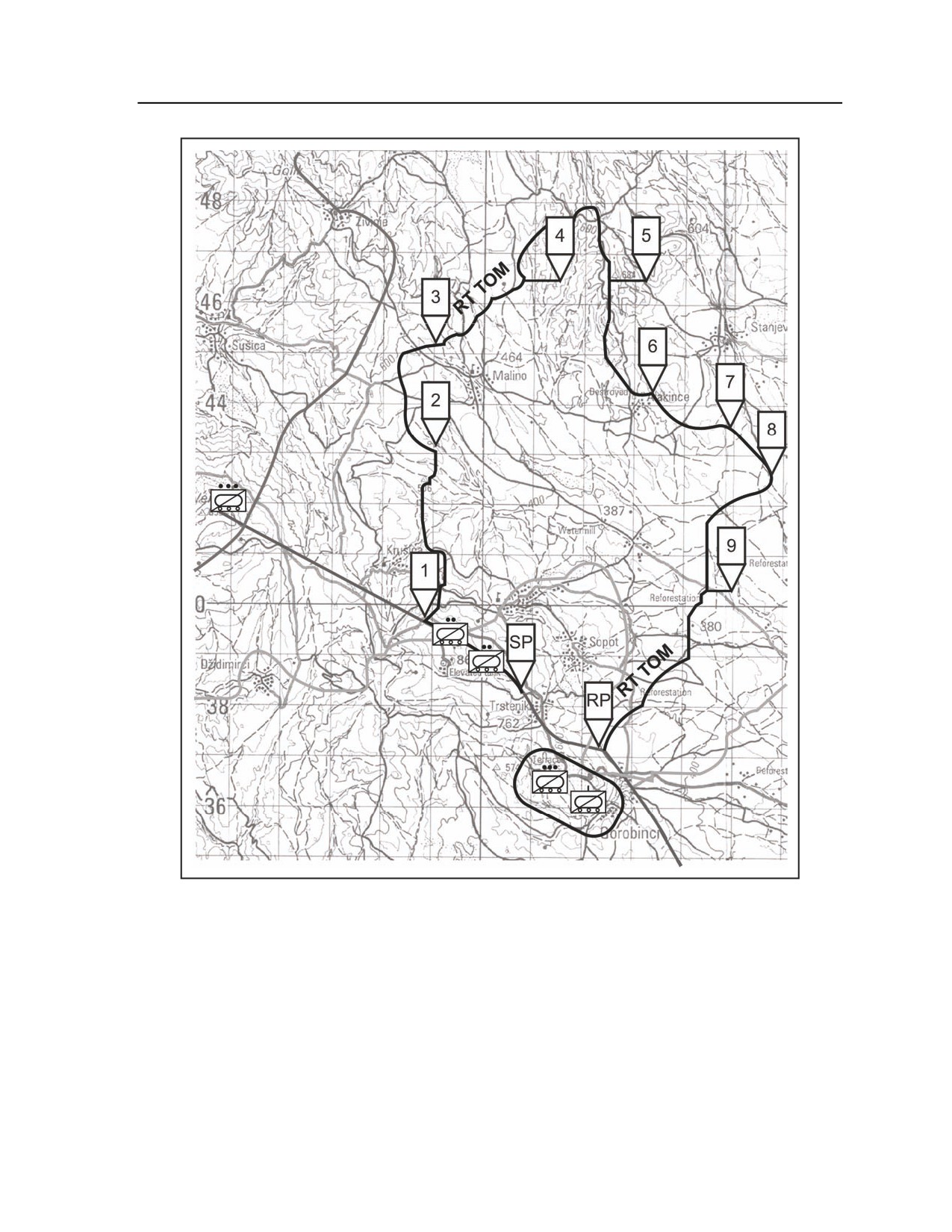
Chapter 3
Figure 3-16. SBCT reconnaissance platoon route reconnaissance (part one)
3-188. Bravo section moves along the route at a speed dictated by the platoon leader in his OPORD. The
platoon makes steady progress until checkpoint 3, which is near a small village. There the platoon halts,
consolidates, and conducts HUMINT operations. The platoon leader, two scouts from his vehicle, his
HUMINT collector, and his interpreter walk to the police chief’s office to let him know their intentions and
to find out if he knows of any obstructions along the route. (See Figure 3-17.)
3-48
FM 3-20.98
3 August 2009
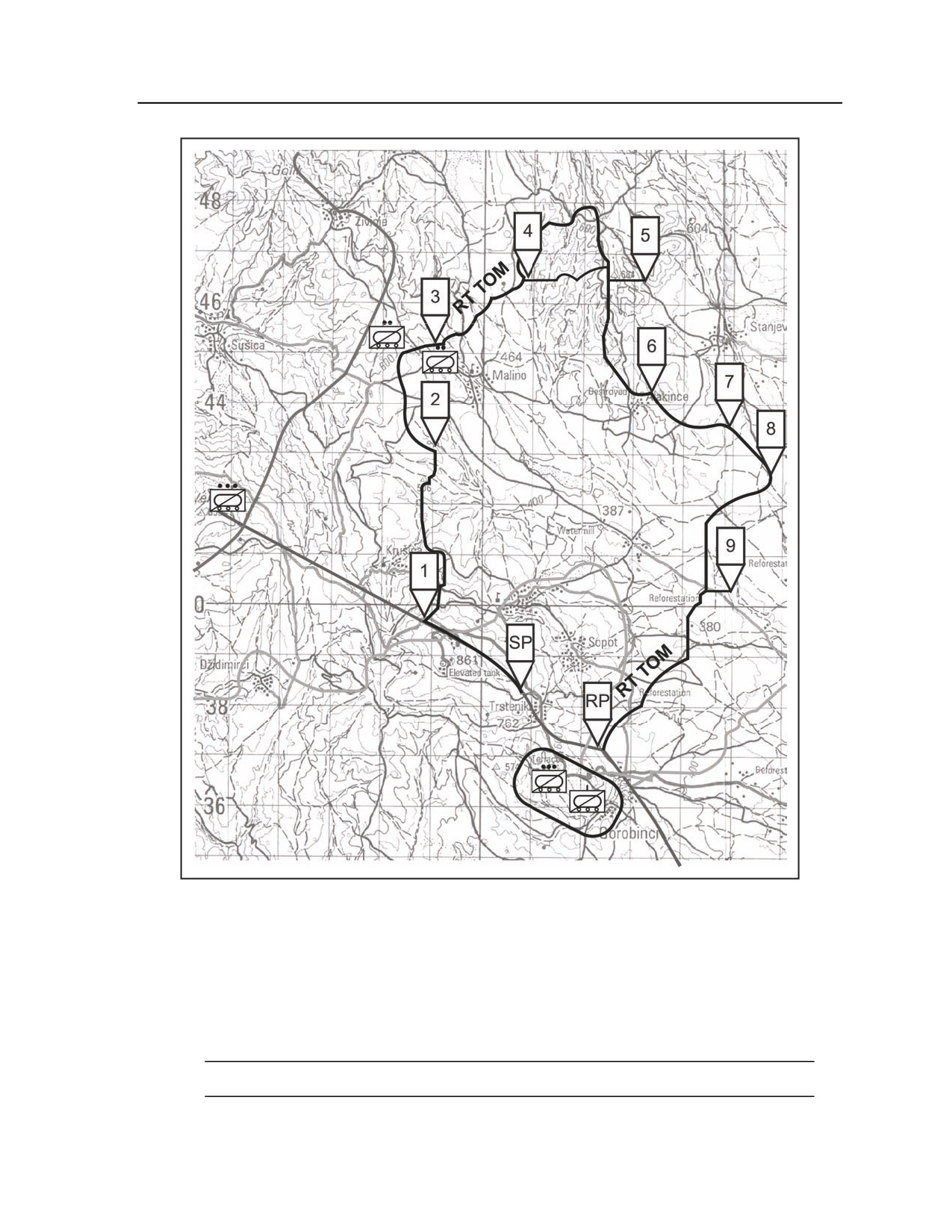
Reconnaissance Operations
Figure 3-17. SBCT reconnaissance platoon route reconnaissance (part two)
3-189. The police chief identifies an obstacle north of checkpoint 4 and shows the platoon leader the
route the locals use to bypass the obstacle. Additionally, two dismounted patrols move through opposite
sides of the village conducting HUMINT operations and area assessment. One squad is left to provide
vehicle security and maintain communications with the troop CP. The platoon leader contacts the troop
commander and relays the information he learned from the police chief. The troop commander tells him to
verify the obstacle and continue his mission on the new route. The patrols return, FBCB2 data is updated,
and the platoon continues its mission.
Note. Refer to the discussion of urban operations in Appendix C of this manual.
3 August 2009
FM 3-20.98
3-49
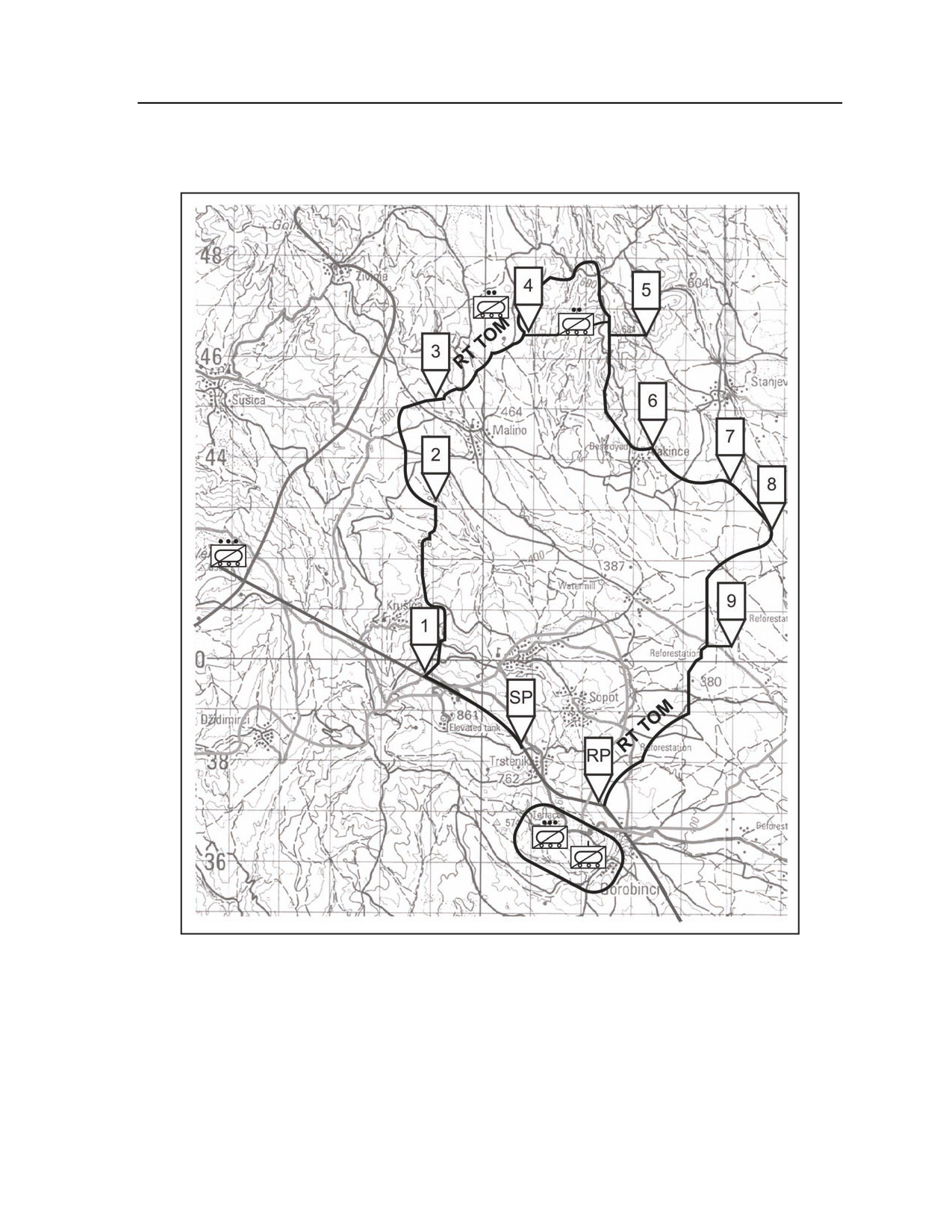
Chapter 3
3-190. North of checkpoint 4, the platoon identifies the complex natural obstacle and verifies that enemy
elements are not overwatching the obstacle. The platoon sketches the obstacle from the road, but based on
the troop commander’s guidance, it does not search for an immediate bypass. (See Figure 3-18.)
Figure 3-18. SBCT reconnaissance platoon route reconnaissance (part three)
3-191. When the sketch is complete, the platoon moves back along the route to the bypass indicated by
the police chief. The platoon continues its mission, stopping one more time to conduct HUMINT
operations at the village west of checkpoint 6 before returning to the base camp. Once the platoon has
closed on the base camp, the platoon leader submits a reconnaissance overlay and reports to the troop CP
to be debriefed by the troop HUMINT NCO.
3-50
FM 3-20.98
3 August 2009
Reconnaissance Operations
EXAMPLE OF AN ACR SCOUT PLATOON ROUTE
RECONNAISSANCE
3-192. The following example of route reconnaissance is for an ACR scout platoon. Refer to Figures 3-16
and 3-17 for an illustration of this situation.
3-193. The platoon conducts a route reconnaissance and deploys in a vee formation to provide security
and maximum reconnaissance forward. Section Alpha is positioned to the left of the route, Section Bravo
to the right, and Section Charlie (the platoon leader and PSG) in the center of the zone along ROUTE
SABER. The platoon moves into formation before reaching the LD (PL PATTON). The platoon leader
reports crossing the LD when the first element crosses it (see Figure 3-19, part A). The platoon leader
establishes checkpoints to control the movement and to focus on key terrain or features that may influence
movement along the route. The platoon leader updates the FBCB2 data as often as possible to ensure
maintaining the unit’s SA. The PSG compiles and reports information obtained along the route to the troop
while being prepared to conduct CASEVAC and vehicle recovery.
3-194. Section Charlie positions along the route to observe the route, while one element of the section
physically drives the entire route. The platoon moves as individual sections and prepares to adjust
movement techniques based on METT-TC. As the sections move to the checkpoints, they reconnoiter the
entire sector and accomplish all critical tasks of the route reconnaissance. The lead sections on the flanks
observe the route and report any restrictions or obstacles that may restrict movement of the unit along the
route. Sections Alpha and Bravo visually clear the route to provide increased security, therefore allowing
Section Charlie to concentrate on critical reconnaissance tasks. As the lead sections maneuver toward the
checkpoints, they maintain visual contact with the route (see Figure 3-19, part B). Simultaneously, UASs
conduct observation one terrain feature forward, providing additional information to the platoon regarding
the following:
z
Dead space around dominant terrain features to warn of possible enemy attacks.
z
Avenues of approach beyond terrain features to prevent unannounced enemy approach.
z
Area around the route to gain knowledge of obstacles in advance of the platoon.
3-195. After both lead sections report “SET” and are in overwatch positions, Section Charlie begins the
route reconnaissance (see Figure 3-19, part C). As Section Charlie’s wingman moves along Route SABER,
the section leader maneuvers to provide overwatch. During the reconnaissance, the platoon leader/PSG
sends a classification of the trafficability of the route at intervals designated by the commander.
Note. The unit conducting the route reconnaissance ensures that the route is timed from the SP
to the RP.
3-196. As Section Charlie reconnoiters the route, the other sections move ahead, reconnoitering critical
and dominant terrain. The platoon leader controls and coordinates the movement of all three sections. He
ensures that the flank sections remain far enough forward of Section Charlie to provide security. The flank
sections clear the lateral routes while maintaining overwatch of Section Charlie. Section Alpha clears a
lateral route and uses contact point Bravo to tie in with Section Charlie on Route SABER (see Figure 3-19,
part D).
3 August 2009
FM 3-20.98
3-51
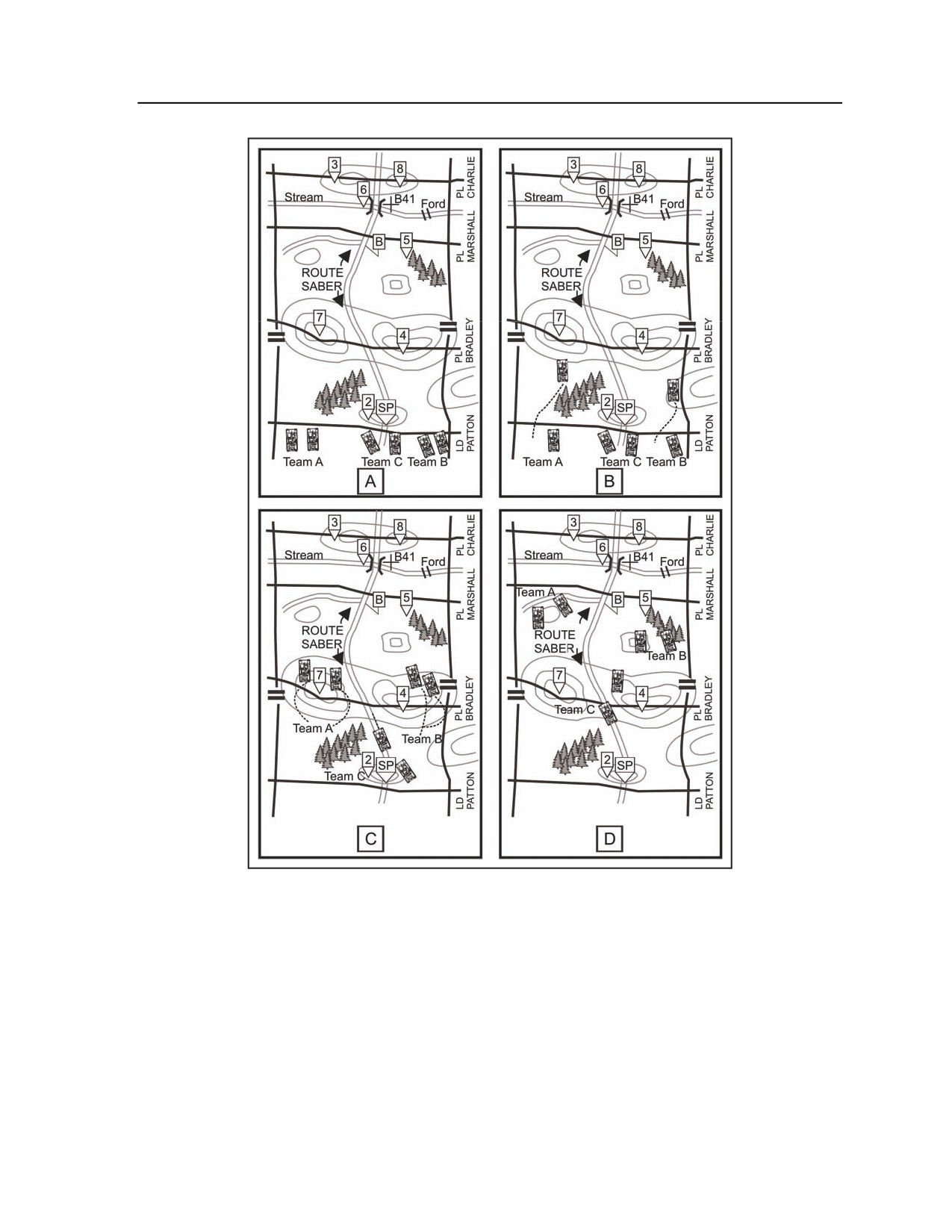
Chapter 3
Figure 3-19. ACR scout platoon route reconnaissance (parts A through D)
3-197. Based upon the platoon order, the two flank sections locate bypasses in the form of fords or
unmapped bridges across the river. Section Bravo is successful in locating a ford; Section Alpha is not.
Section Bravo conducts a ford reconnaissance (following the steps used for obstacle and restriction
reconnaissance). It crosses the stream at the ford, sends obstacle and bypass reports forward, and then
continues its mission on the far side of the stream (see Figure 3-20, part E).
3-198. Section Charlie continues its route reconnaissance along the route until it approaches the bridge
site. It then conducts a bridge reconnaissance to establish trafficability of the bridge. Section Alpha
occupies an overwatch position while Section Charlie reconnoiters the bridge. Section Bravo continues its
reconnaissance one terrain feature beyond the stream and then occupies a short-duration OP (as shown in
Figure 3-20, part F).
3-52
FM 3-20.98
3 August 2009
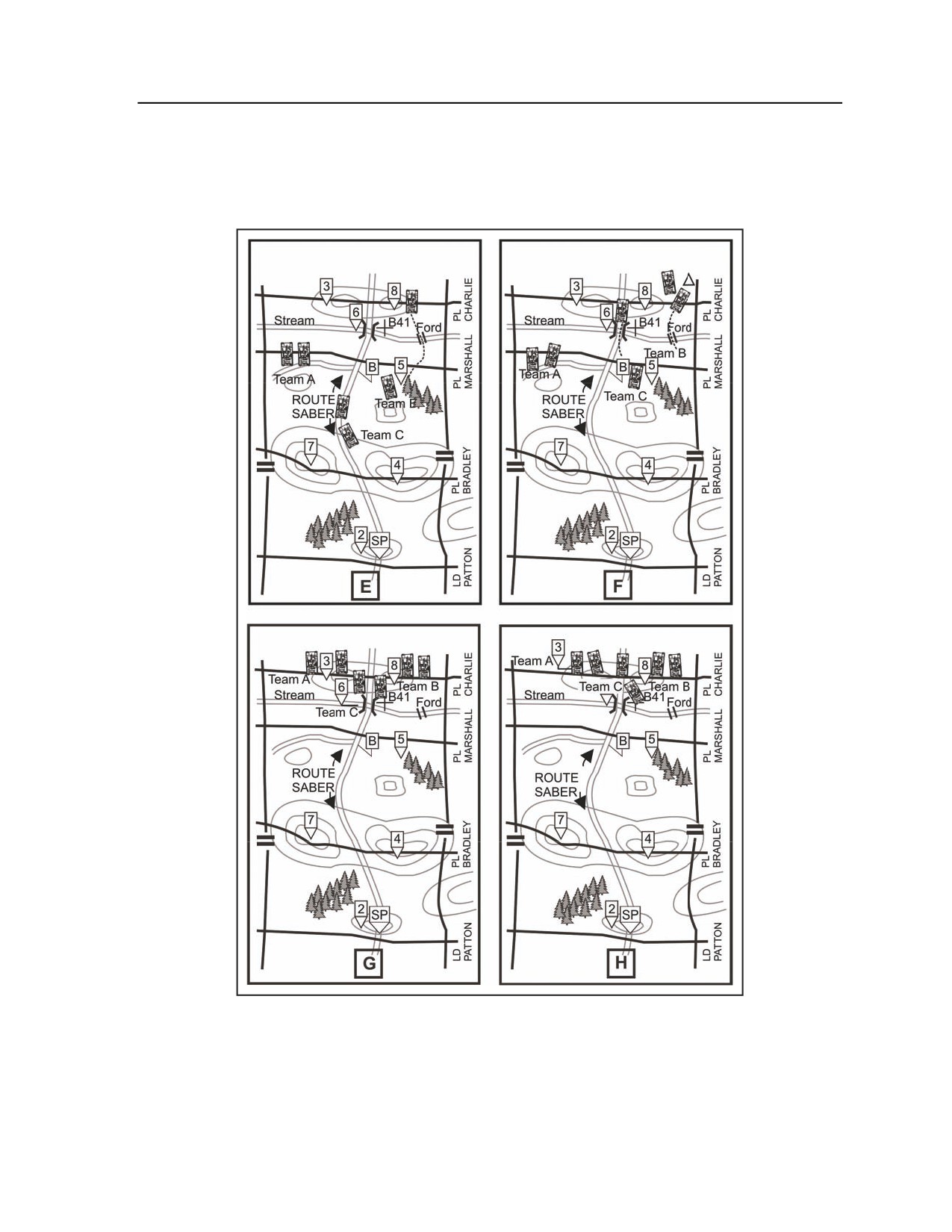
Reconnaissance Operations
3-199. Section Charlie completes its bridge reconnaissance and establishes local security on the far side
of the bridge. Once this is complete, Section Alpha passes across the bridge and through Section Charlie,
continuing its reconnaissance of the dominant terrain on the left flank of the route (see Figure 3-20, part
G). Once Section Alpha is set in overwatch, the platoon resumes its route reconnaissance to the LOA (see
Figure 3-20, part H).
Figure 3-20. ACR scout platoon route reconnaissance (parts E through H)
3-200. Certain conditions may lead a scout platoon to modify the technique in which it conducts a route
reconnaissance. Factors such as a narrow sector of operation, likelihood of heavy enemy contact, and the
CCIR demanding detailed route information may require a change from a three-team formation to a two-
team platoon formation, in depth. The HBCT reconnaissance platoon may also adopt this technique. As
3 August 2009
FM 3-20.98
3-53
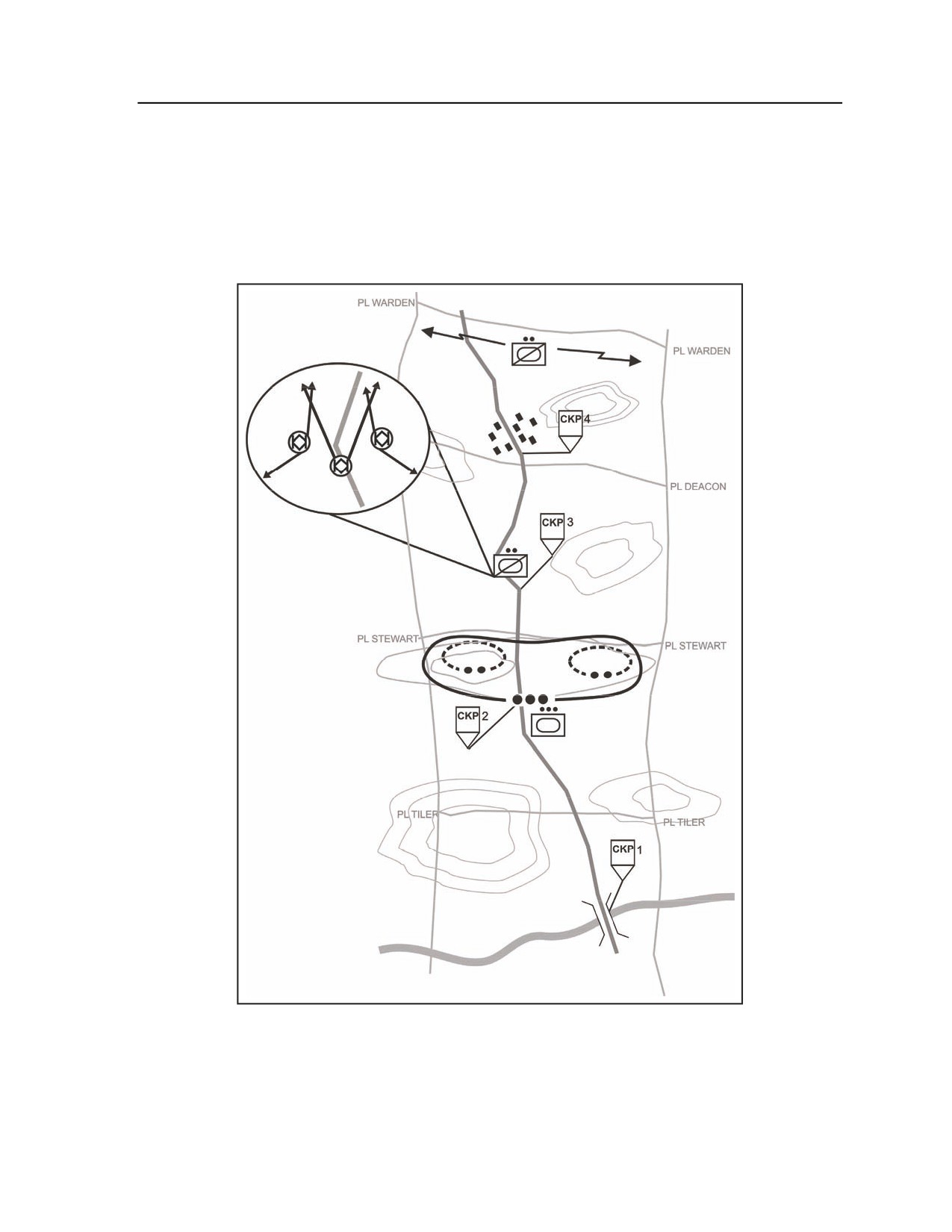
Chapter 3
depicted in Figure 3-21, Section Alpha screens forward of Section Bravo while it classifies the route.
Section Alpha bounds by phase line and halts forming a screen. Section Bravo moves along the route to
gather relevant information for the route classification. Section Alpha bounds forward only after Section
Bravo has called “set”. As the scout platoon moves forward, the overwatching tank platoon bounds and
assumes hasty battle positions to the rear of the scouts (preferably on dominant terrain) no more than half
the maximum effective range of their main weapon systems. Tank movement should occur when both
scout sections are stationary. The tank section may move as individual sections on the platoon’s flanks if
the terrain permits.
Figure 3-21. Alternate ACR scout platoon route reconnaissance
3-54
FM 3-20.98
3 August 2009
Reconnaissance Operations
SECTION V - AREA RECONNAISSANCE
3-201. Before moving forces into or near a specified area, the commander may call on the reconnaissance
or scout platoon to conduct an area reconnaissance to avoid being surprised by unsuitable terrain
conditions or unexpected enemy forces. The area could be a town, ridgeline, woods, IV line/dead space, or
another feature that friendly forces intend to occupy, pass through, or avoid.
3-202. Area reconnaissance is frequently employed to gain information on specified areas, objectives, or
danger areas (to confirm IPB templates), as well as to provide detailed information regarding enemy
dispositions. Within a zone of operations, area reconnaissance can be used to focus the platoon on a
specific area that is critical to the commander. Some examples of area reconnaissance include the
following:
z
Dismounted reconnaissance patrols move forward of their forward edge of the battle area
(FEBA) to locate enemy obstacles that influence the BCT’s axis of attack, fighting positions on
dominant terrain, and reserve forces hidden prior to a deliberate attack.
z
CAB reconnaissance platoons are able to focus on dominant terrain locations that influence the
CAB movement after brigade reconnaissance has cleared the area of potential enemy forces.
3-203. Area reconnaissance can be a stand-alone mission or a task to a section or platoon within a zone
reconnaissance mission. The employment of UASs can reduce the amount of time ground scouts need to
move through the area by confirming or denying PIR or clearing danger area/dead space templated during
the IPB process. Area reconnaissance can be terrain-oriented, force-oriented
(threat/enemy), society-
oriented, infrastructure-oriented, or a combination of any of these factors. The commander analyzes the
mission using METT-TC factors to determine whether to conduct one of these factors of reconnaissance
separately or to conduct them in conjunction with each other.
3-204. A reconnaissance platoon augmented with the appropriate assets can conduct the multidimensional
aspect of area reconnaissance, if directed, to gain detailed information about the civilian populace and
infrastructure in a particular area.
CRITICAL TASKS
3-205. The reconnaissance platoon must accomplish numerous critical tasks during the area
reconnaissance. The platoon’s primary critical tasks include the following (unless the commander directs
otherwise):
z
Find and report all enemy forces within the area.
z
Reconnoiter and determine trafficability of all terrain within the area.
z
Inspect and classify all bridges within the area.
z
Locate fords or crossing sites near all bridges in the area.
z
Inspect and classify all overpasses, underpasses, and culverts in the area.
z
Within capability, locate all minefields and other obstacles in the area, reduce or breach them,
and clear and mark lanes.
z
Locate and identify bypasses around built-up areas, obstacles, and contaminated areas.
z
Report information.
3-206. In addition to these tasks, the platoon must be prepared to conduct other tasks deemed critical by
the higher commander. Additional tasks for the area reconnaissance may include the following:
z
Identify threat activities (which include insurgent and opposition leaders), countermeasures, and
probable COAs.
z
Determine the size, location, and composition of society/human demographics. Examples
include race, sex, age, religion, language, tribe, clan, class, education, history, government,
and/or factions.
z
Establish and maintain contact with local civilian and military leadership.
3 August 2009
FM 3-20.98
3-55
Chapter 3
z
Conduct reconnaissance of the society with HUMINT teams to determine needs of the society;
the regional, local, and neighborhood situations; organizations and methods of operation for
terrorists, transnational groups, and ethnic centers of gravity; financial and economic systems;
and media activities (local, U.S., international).
z
Identify key municipal infrastructure that can affect military operations, including sewage,
water, electricity, academics, trash, medical, safety, and other considerations (these constitute
the memory aid/acronym of SWEAT-MSO).
z
Identify the allegiances of the local populace to factions, religious groups, or other
organizations.
TECHNIQUES
3-207. To conduct an area reconnaissance mission, the reconnaissance or scout platoon leader first
identifies the area to be reconnoitered within a continuous boundary, such as a reconnaissance objective or
an NAI. The platoon leader analyzes the mission, threat/enemy, and terrain and completes his troop-leading
procedures. He also plans movement to and, if necessary, from the area, following the basic rule of using
different routes to and from the area. The routes may be specified for the platoon in the troop
WARNO/OPORD/FRAGO. In addition, the platoon leader plans for conducting C2 during the execution
phase of the area reconnaissance. Platoon leadership can conduct C2 in one of two ways:
z
Accompany the section leaders forward in their assigned sectors with a skeleton crew protecting
the vehicles in hide sites. This requires support from the higher command.
z
Situate themselves with the vehicles in hide sites where they will receive and forward reports,
update the situational picture, and conduct CASEVAC and other support missions for the
sections as required. This allows an additional smaller patrol to be deployed if the enemy
situation worsens.
3-208. The platoon’s primary concern during movement to the proposed area is security rather than
reconnaissance. If the platoon leader feels there may be enemy forces along the route to the area, the
platoon should employ the principles of tactical movement based on METT-TC factors. The platoon leader
must also incorporate information from UAS and ground sensor assets into the operation. During
movement to the area, it may be appropriate (depending on the commander’s intent) for the platoon to
avoid contact. The platoon leader may also choose to orient and focus sections or squads on checkpoints as
the platoon moves to the area.
3-209. The platoon leader encloses the given area within a platoon zone if the area size allows; he uses
boundaries, an LD, and an LOA. He can divide the area into section zones by placing boundaries on
identifiable terrain; this ensures that each section has responsibility for specific pieces of terrain. The
platoon leader must ensure cross-talk among the sections to improve SA and target identification. He must
carefully control section movement to reduce the risk of fratricide.
3-210. The platoon leader places contact points at the intersections of phase lines and boundaries and at
any other location for physical contact and coordination between his sections. He uses GIRS/TIRS as
necessary for directions. The platoon leader works with the FSO to plan indirect fires to support the
platoon’s scheme of maneuver. In addition, section leaders have the ability to request targets in their
assigned zone.
3-211. The platoon can conduct area reconnaissance using any of the platoon’s section formations.
Platoon leaders must consider the location of the PSG during possible contact. The platoon leader
organizes the platoon in accordance with METT-TC, while allowing the PSG the flexibility to conduct
CASEVAC, resupply, and vehicle recovery during extended operations. The platoon leader deploys his
sections across the LD to best accomplish the platoon’s reconnaissance tasks. Leaders adjust formations in
accordance with the factors of METT-TC and the OE.
3-56
FM 3-20.98
3 August 2009
Reconnaissance Operations
EXAMPLE OF AN AREA RECONNAISSANCE
3-212. The following example illustrates area reconnaissance by a CAB reconnaissance platoon;
however, the mission may be conducted in similar fashion by any type of reconnaissance or scout platoon.
3-213. The platoon is operating as part of a troop conducting an area reconnaissance in an SSC scenario.
Each of the troop’s platoons has a different reconnaissance objective. The focus and tempo of the operation
allow the troop to move to a dismount point close to its reconnaissance objective. The engagement criteria
allow the platoon to use indirect fire on enemy dismounts and vehicles only to break direct fire contact.
3-214. In this example, the platoon has been given the mission of performing an area reconnaissance of
OBJ IRON. A UAS overflew the area several hours ago and confirmed the presence of enemy soldiers in
OBJ IRON; however, it could not remain on station to determine the direction in which enemy vehicles
were moving. The platoon conducts stealthy reconnaissance establishing its OPs. The platoon leader has
requested HUMINT resources for potential SE after enemy forces are eliminated.
3-215. The platoon has been assigned a specific infiltration route. It is believed that the enemy has
established a traffic control point in the vicinity of checkpoint 13, in OBJ IRON. From this intersection, the
enemy is deploying forces east to west into BPs. The platoon leader decides, after analyzing METT-TC
factors, to deploy his platoon to maximize security. Based on his analysis of the terrain and his mission
requirements, he decides to use the two-section organization. He decides to move with Section Alpha on
LANE SABER and assigns Section Bravo, with the PSG, to LANE SPUR. Dismounts rehearse dismounted
actions on contact and prepare rucksacks and OP sustainment equipment. The platoon leader will leave
vehicle crews with the platoon’s vehicles. The crews rehearse actions on contact in the hide site to ensure
the vehicles are not compromised. The platoon leader decides to move the platoon using phase lines (rather
than checkpoints), allowing the sections more latitude in choosing covered and concealed terrain. CAB
UAS assets begin scanning the flanks of the enemy position to confirm or deny hasty obstacle
emplacement.
3-216. Using the two-section organization, the platoon crosses PL RAY at the specified time with each
section using bounding overwatch (see Figure 3-22).
3 August 2009
FM 3-20.98
3-57
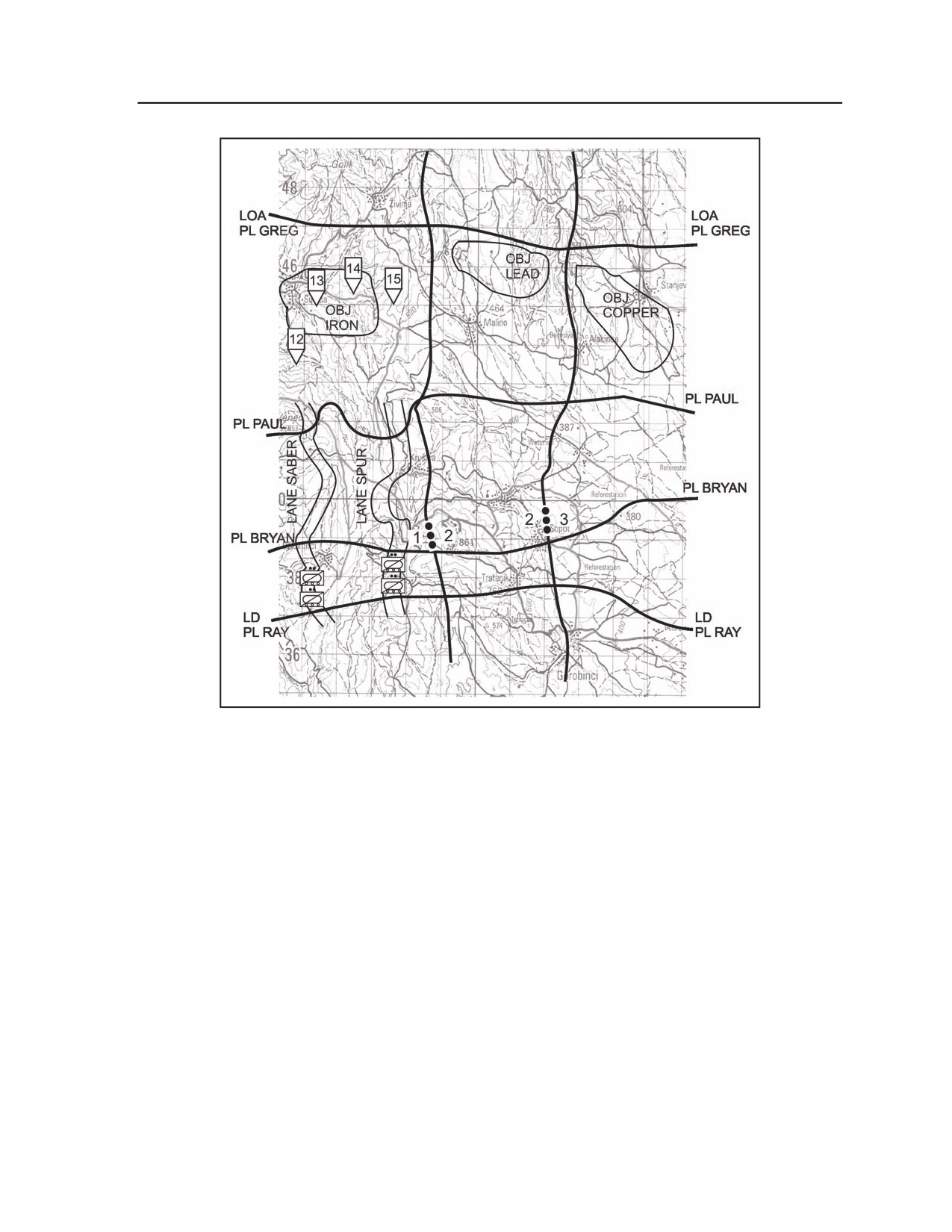
Chapter 3
Figure 3-22. Area reconnaissance (part one)
3-217. The platoon’s sections continue their move to the designated dismount points. Section Alpha
occupies its dismount point, checkpoint 12. Section Bravo occupies its dismount point, checkpoint 15.
Each section moves its vehicles into hide positions, readies patrols, and deploys local security. NFAs are
coordinated with the company FIST, and any additional supporting fires are planned based on what is
observed on the ground.
3-218. The platoon leader notifies the UAS element assigned to his AO that his elements are set in their
dismount points. Based on prior coordination, the UAS section sends a UAS to reconnoiter OBJ IRON
before the reconnaissance platoon continues its move to establish its OPs. The UAS section leader reports
to the reconnaissance platoon leader that his aircraft confirmed Soldiers at the intersection, but detected no
vehicle activity or obstacles.
3-219. After evaluating the UAS update, each patrol moves on covered and concealed dismounted routes
to OBJ IRON, conducting dismounted reconnaissance. Based on the commander’s guidance, each patrol
carries equipment to establish a 48-hour OP. Each four-man team conducts stealthy movement, using
traveling overwatch. Two of the men focus on moving forward, conducting reconnaissance; the other two
provide security (see Figure 3-23).
3-58
FM 3-20.98
3 August 2009
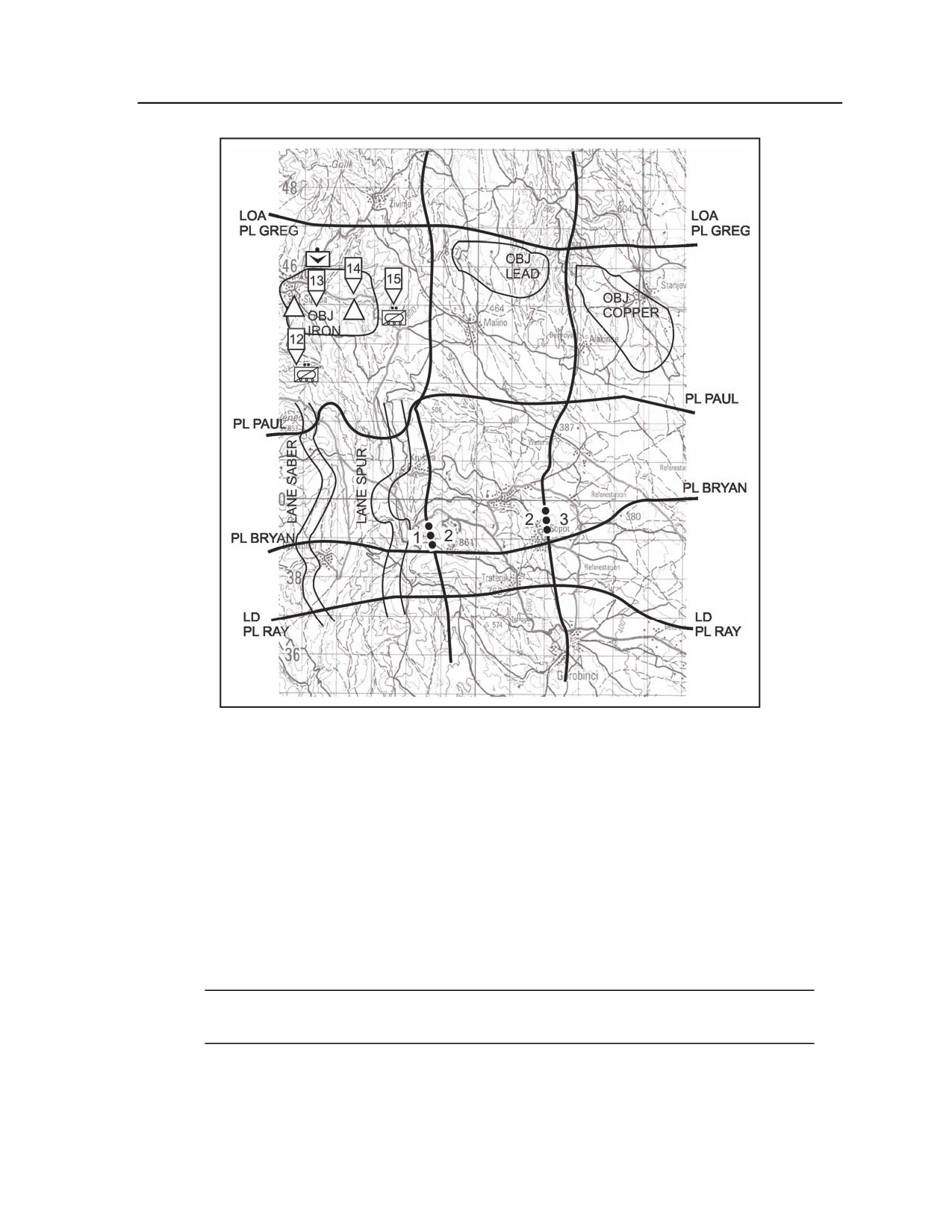
Reconnaissance Operations
Figure 3-23. Area reconnaissance (part two)
3-220. Each section places its OP where it can best observe the objective area. Section Alpha establishes
its OP at checkpoint
13; Section Bravo establishes its OP at checkpoint
14. Each OP establishes
communications back to its vehicles in the hide position. Information gathered from the indigenous people
indicates the enemy elements have relocated north and may return. The platoon leader sends a SITREP to
the commander and confirms there is negative contact at that time.
3-221. The OPs send reports, in terms of content and frequency, as outlined by the troop commander or
unit SOP. The Soldiers in the hide position maintain communications with the troop CP and are prepared to
act as a QRF for the dismounted OPs. The platoon continues to observe the objective until it is relieved,
assigned subsequent tasks, or until the parent unit conducts an attack through the area. In the event of an
attack conducted by higher echelon, the platoon leader takes appropriate actions to stay out of the way, to
provide support by calling for indirect fires, and to clearly identify the platoon position to friendly elements
approaching to the rear.
Note. For a detailed discussion of area reconnaissance in an urban environment, refer to
Appendix C of this manual.
3 August 2009
FM 3-20.98
3-59
Chapter 3
RECONNAISSANCE OF OBSTACLES AND RESTRICTIONS
3-222. One of the common tasks associated with reconnaissance missions is the location and
reconnaissance of obstacles and restrictions that may affect the trafficability of a particular route or axis.
The reconnaissance or scout platoon may perform reconnaissance of an obstacle or restriction as a stand-
alone task or as part of a route, zone, or area reconnaissance mission. For more information, refer to FM 3-
20.971.
3-223. Obstacles and restrictions can be either natural or man-made. Threat/enemy doctrine emphasizes
the use of man-made obstacles to reinforce natural obstacles and of restrictions to slow, impede, and
canalize friendly forces. In the current OE, the threat exploits the canalizing nature of the urban
environment to employ IEDs and vehicle-borne IEDs (VBIED). Other typical obstacles and restrictions
include the following:
z
Minefields.
z
Bridges.
z
Log obstacles such as abatises, log cribs, stumps, and posts.
z
AT ditches.
z
Wire entanglements.
z
Defiles.
z
Persistent agent contamination.
z
Fills, such as a raised railroad track or canal embankments.
3-224. The reconnaissance or scout platoon’s ability to deal with an obstacle or restriction is extensive in
certain areas and limited in others. An important platoon task is reconnaissance of deliberate obstacles,
including supporting enemy positions and possible breach sites. Another important platoon reconnaissance
task is to locate bypasses around obstacles and restrictions.
3-225. The platoon has the capability to reduce or breach small obstacles; however, this is generally
limited to point obstacles that are not integrated into the enemy defense and are not covered by enemy fire
and observation. When scouts encounter obstacles that support an enemy defense, they have the capability
to assist in breaching. Platoon leaders must request and plan for engineer support when they encounter
these obstacles. Removal and detonation of IED/VBIEDs require explosive ordinance disposal (EOD)
assets with UGVs such as the remote ordnance neutralization system to remove or detonate devices.
Note. An engineer reconnaissance team or squad may be task organized and attached to the
platoon to assist in reconnaissance of obstacles/restrictions. The engineer element provides
expertise in collecting pertinent obstacle intelligence
(OBSTINTEL) about the
obstacle/restriction. This small engineer element provides extremely limited breaching
capability. Larger engineer organizations are equipped for breaching using explosive charges,
plows or blades to reduce or breach an obstacle and rollers to finish clearing and proofing the
lane.
STEPS OF RECONNAISSANCE OF OBSTACLES/RESTRICTIONS
3-226. How the platoon approaches reconnaissance of an obstacle or restriction is dependent on METT-
TC. The process of conducting this type of reconnaissance can be covered in five steps within the
considerations of METT-TC:
z
Detection.
z
Area security and reconnaissance.
z
Reconnaissance of obstacles and restrictions.
z
Selection of a COA.
z
Recommendation/execution of a COA including bypass.
3-60
FM 3-20.98
3 August 2009
Reconnaissance Operations
Detection
3-227. During reconnaissance operations, detection of obstacles and restrictions begins in the planning
phase of an operation when the S-2 conducts IPB (the IPB process should be conducted by leaders at all
echelons). The platoon combines the IPB with the reconnaissance conducted during the troop-leading
process (normally at least map reconnaissance) to identify all possible obstacles and restrictions within the
AO. The platoon leader then plans the reconnaissance of the obstacles/restrictions based upon orders, IPB,
and map reconnaissance.
3-228. Scouts use visual and physical means to detect mines and obstacles while conducting their
mission. They visually inspect terrain for signs of mine emplacement and other reinforcing obstacles.
Scouts must be wary of IED/VBIEDs that are easily hidden under debris or as parts of objects that do not
look out of place. Scouts must also observe for unexploded ordnance such as bomblets from cluster bomb
units (CBU) or dual-purpose improved conventional munitions (DPICM).
3-229. Mines and other types of obstacles can be difficult for moving mounted elements to detect;
therefore, scouts must conduct obstacle detection dismounted if possible. They may need to dismount their
vehicles several hundred meters short of a suspected obstacle and approach the obstacle on foot to conduct
reconnaissance. They look for disturbed earth, unusual or out-of-place features, surface-laid mines, tilt
rods, and tripwires. They can incorporate vehicle-mounted thermal sights into the search to help detect
surface-laid mines, looking for temperature differences in the soil or wires. Passive NODs can pick up
some lasers used by the enemy to designate targets or trigger munitions.
3-230. Physical detection methods include detonating, probing, and using a mine detector. Detection
occurs when a vehicle, Soldier, or countermine system physically encounters a mine. This method does not
indicate the boundaries of the obstacle. The scouts must probe or conduct additional visual inspection to
define the extent of the minefield and report the obstacle.
Security and Initial Reconnaissance
3-231. Enemy forces often cover their obstacles with observation and fire. Whenever scouts encounter an
obstacle, they must proceed with their reconnaissance assuming the enemy can observe and engage them.
The element that detects the obstacle establishes overwatch before it proceeds with the reconnaissance. The
scouts in overwatch look for signs of enemy forces in and around the obstacle or in positions that allow
observation of the obstacle. They visually search the dominant terrain on the far side of the obstacle for
evidence of enemy positions or ambushes. UASs may be employed to locate the enemy overwatch;
however, scouts must not rely on the surveillance systems to develop the situation. They must dismount to
accomplish this.
3-232. Once they confirm the enemy situation from the near side, the scouts not in overwatch move
mounted and/or dismounted to find bypasses around the obstacle. If they find a bypass, they move around
the obstacle and establish OPs on the far side to provide 360-degree security of the obstacle. If the scouts
are unable to find a bypass, they must conduct their reconnaissance from the near side under the security of
the overwatch elements.
Detailed Reconnaissance
3-233. Once security is established, scouts then move dismounted to the obstacle. They must be cautious
when reconnoitering the obstacle. Tripwires or other indicators may indicate the enemy is using booby
traps or command-detonated mines to prevent friendly forces from determining and collecting
OBSTINTEL. The reconnaissance or scout platoon must collect all information that may be critical to the
commander in such functions as planning a breach and verifying the enemy template. Examples of
OBSTINTEL include the following:
z
Obstacle location.
z
Obstacle orientation.
z
Soil conditions.
z
Presence of wire, gaps, and bypasses.
3 August 2009
FM 3-20.98
3-61
Chapter 3
z
Composition of complex obstacles.
z
Minefield composition, including types of mines.
z
Breaching requirements.
z
Gaps between successive obstacle belts.
z
Location of enemy direct fire weapons.
Note. Optical devices can be used to detect booby traps. Infrared illuminators and designators
can create reflections off trip wires that are visible to NODs or even laser designators. Crew and
individual weapon forward looking infrared (FLIR) sights can detect the difference between trip
wire temperature and that of the surrounding air.
3-234. The element reconnoitering the obstacle prepares an obstacle report (Blue 9) with this information
and forwards the report through the platoon leader or PSG to the commander. Once the information is sent,
the platoon leader must ensure the situational picture is updated through FBCB2 to prevent follow-on units
from blindly encountering the obstacle.
Note. For information on obstacle report formats, refer to Appendix A of this manual.
Selection of a COA
3-235. The platoon leader analyzes the situation and METT-TC factors to determine which COA to
select. He has a choice of four COAs:
z
Bypass the obstacle/restriction.
z
Conduct obstacle breaching (with or without engineer assets).
z
Support a breaching operation.
z
Continue the mission.
Bypass
3-236. A bypass is the preferred COA when it offers a quick, easy, and tactically sound means of
avoiding the obstacle. To be effective, a bypass must allow the entire force to avoid the primary obstacle
without risking further exposure to enemy ambush and without diverting the force from its objective.
Bypassing conserves reduction assets and maintains the momentum of the moving unit. If the platoon
leader decides to bypass and his commander approves, scouts must mark the bypass and report it to the
commander. They may be required to provide guides for the main body if the bypass is difficult to locate or
visibility conditions are poor. Notifying the commander of this COA alerts follow-on units to the
composition/disposition of the obstacle.
Conduct Obstacle Breaching Operations
3-237. In some cases, bypassing an obstacle may not be feasible. In these cases breaching may be the best
COA. Such situations may include the following:
z
The obstacle is integrated into a prepared defensive position and the only available bypass
canalizes friendly forces into an enemy engagement area or ambush.
z
The platoon’s mission specifically tasks it to reconnoiter and breach any obstacle or to eliminate any
enemy forces located on the original route, allowing follow-on forces to maintain freedom of
movement.
z
The best available bypass route will not allow follow-on forces to maintain their desired rate of
movement.
z
Improving the bypass may require more time and assets than breaching the primary obstacle(s).
3-62
FM 3-20.98
3 August 2009
Reconnaissance Operations
3-238. Obstacle breaching significantly degrades the platoon’s ability to maintain momentum, either for
its own reconnaissance effort or for follow-on forces. Obstacles within the platoon’s breaching capability
include small minefields, simple wire obstacles, small roadblocks, craters, and similar point-type obstacles.
Support a Breaching Operation
3-239. When the platoon locates a large obstacle that cannot be easily bypassed, its primary option is to
support a breaching operation. The scouts perform additional reconnaissance and security tasks as
necessary; these may include determining the amount of time and resources required to reduce the obstacle
and locating the best available reduction site. UAS and HUMINT resources can be employed to gather
additional information of enemy activities while engineers move forward. This may lead to further
encounters with obstacles. The platoon’s reconnaissance effort focuses on the following features:
z
Fighting positions for support force weapons on the near side of the obstacle.
z
Trafficable routes to the breach site and routes from the far side leading to the objective.
z
Dispersed covered and concealed areas near the breach site.
z
Work areas on the near side for reduction assets of the breach force.
z
Fighting positions on the far side once a passage lane is established.
z
Positions on both sides of the obstacle that could facilitate enemy observation of the breach site.
z
Trafficability and soil conditions near the breach site. This is especially important for minefield
reduction because mine-clearing blades will not work properly in all soil conditions.
z
Soil stability of wet and dry gaps.
z
Width, depth, and bottom condition of wet and dry gaps.
z
Bank height and slope.
z
Water velocity of wet gaps.
z
Wind direction for obscuration of the obstacle.
Note. If he expects to encounter large obstacles during an operation, the commander may direct
engineer reconnaissance teams to move with the scouts to determine much of this information.
3-240. Engineer assistance can make the process of gathering the OBSTINTEL necessary for a breaching
operation much easier and more effective for the reconnaissance or scout platoon. If he expects to
encounter large obstacles during a mission, the platoon leader should request an attached engineer
reconnaissance team or, as a minimum, an engineer NCO to serve as a technical advisor. Scouts who have
received sapper training may also enhance the platoon’s capabilities. Security for the engineer
reconnaissance team must be a priority because they present a valuable target to enemy snipers intent on
preventing a breach.
Note. Intelligence confirming a bridge location in a noncombat area and without apparent
damage may not justify the tasking or attachment of an engineer squad/section. Scouts or a
sapper from the engineer unit can inspect the bridge for tampering or booby traps effectively. If
information indicates the bridge has damage, a close inspection is warranted. Scouts can confirm
or deny degrees of damage on a structure; however engineer support must be coordinated to
accurately determine structural damage and the initial estimate for repairs so the bridge can be
restored for use by military units and the local populace. This action supports Army relations
with the local populace.
3-241. After the platoon reports the necessary information to the commander, the scouts maintain security
of the obstacle and serve as guides, if necessary, for the breach force. The information they provide is used
by the commander and his engineers to prepare the suppression, obscuration, security, reduction, and
assault (SOSRA) plans for the breach. The platoon maintains security during the breaching operation and
3 August 2009
FM 3-20.98
3-63
Chapter 3
calls for and adjusts fires, as necessary, in support of the breach. The platoon must be in position to move
rapidly through the obstacle once a lane is created so it can continue its mission.
Continue the Mission
3-242. When the platoon encounters a restriction, such as a bridge or defile, it may find that the
restriction does not impede movement and is not covered by enemy fire or observation. Scouts may also
discover dummy minefields or obstacles that are incomplete and easily passed through. Under these
conditions, the platoon’s COA may be to report the deception, then continue the reconnaissance mission.
Note. Apparent deception minefields or restrictions could be overwatched by enemy personnel
with command-detonated devices waiting for specific targets. Vehicle commanders and
dismounted patrol leaders must scan for and locate individuals covertly observing the restriction.
Dismounts may also locate hasty positions prepared for later occupation by elements that will
command-detonate munitions against follow-on forces.
Recommendation/Execution of a COA
3-243. Once the platoon leader has determined the COA best suited to the situation, he either executes it
or recommends it to his higher headquarters for approval. Generally, the platoon will execute a particular
COA without specific approval if it is within the commander’s intent or is covered in the unit SOP. In such
a case, the platoon leader will execute the COA and then inform the commander of his actions. If the
situation the platoon has discovered is not covered by previous guidance, the platoon leader determines the
best COA and recommends it to his commander. He then executes the COA specified by the commander.
EXAMPLES OF RECONNAISSANCE OF OBSTACLES AND RESTRICTIONS
3-244. These examples illustrate reconnaissance of obstacles and restrictions in two tactical situations.
They are organized using the five-step process. For additional information, refer to FM 3-20.971.
Reconnaissance of a Restriction (Not Covered by Fire or Observation)
3-245. Figure 3-24 (parts A through D) illustrates this situation.
Detection
3-246. A scout platoon from an ACR cavalry troop detects a bridge, either while on the move or from an
overwatch position (see Figure 3-24, part A). The bridge was expected because it was also identified
during the scouts’ IPB and map reconnaissance. A UAS flight confirms the bridge’s location and reports
that despite battle damage in the area, the bridge appears to be intact.
Security and Reconnaissance
3-247. Dismounted scouts bring the platoon’s vehicles into covered and concealed overwatch positions;
the platoon establishes near side security of the bridge. A dismounted patrol is organized to conduct
reconnaissance up to the bridge while overwatched by the vehicles. A UAS tasked to the platoon will
support in a security and reconnaissance role by scanning and searching the surrounding area for enemy
elements (see Figure 3-24, part B). The dismounted element starts its reconnaissance for both mounted and
dismounted bypasses. The dismounts must determine quickly if it is possible for the unit’s heaviest
vehicles to use the bridge or bypass the bridge using a ford in the local area. They must locate a bridging
point on the banks where armored vehicle launched bridge (AVLB) assets may emplace a bridge for the
vehicles (both wheeled and tracked) that may follow them. The platoon leader monitors the situation and, if
necessary, may direct other sections to assume the mission of locating other bridges or fords to serve as
bypasses. The patrol leader reports the bridge condition and other bridge information, including load
classification for the platoon’s reconnaissance report, to the platoon leader.
3-64
FM 3-20.98
3 August 2009
Reconnaissance Operations
3-248. If the water obstacle can be forded, the dismounts use the ford to move to the far side. This must
be coordinated with the platoon since this is an exposed movement for the dismounts and an opportune
moment for the enemy to engage them. Once on the far side, scouts establish far side security and
reconnoiter the terrain that dominates the bridge to observe enemy approach routes to the bridge. Once the
far side is secure, the platoon is ready to classify the bridge. If engineer support is present, scouts maintain
security while the engineer element conducts the inspection of the bridge.
3-249. If the water obstacle cannot be easily forded in the local area, the scouts may have to cross on the
bridge itself. Before attempting to cross, the dismounted scouts visually examine the bridge for structural
damage and rigged explosives. If the bridge appears intact, the dismounted element then crosses the bridge
one scout at a time. This must be coordinated with the platoon leader so all assets can scan for enemy
activity in the area. The scouts move quickly to the far side and take up covered and concealed positions
where possible to provide local far side security on the bridge. Once the entire dismounted element is
secure on the opposite side, it continues beyond the immediate bank area to secure the far side.
Reconnaissance of an Obstacle
3-250. Once the area has been reconnoitered and secured, a dismounted element (which may include
engineer personnel) moves to the bridge under the supervision of the senior scout and conducts a detailed
examination of the bridge (see Figure 3-24, part C). The dismounted element examines the bridge for the
following purposes:
z
Ensure that the bridge is free of demolitions. This requires examination of underwater pilings
and the underside of the bridge for hidden explosives. In addition, the scouts should take a
detailed look at the far side to find any electrical cables or wires connecting the bridge to the
shore.
z
Find any structural damage. Scouts look for obvious signs of enemy destruction efforts and
for less obvious signs of structural damage, including cracks or fractures in stringers or supports
and twisted or untrue alignment of stringers or supports.
z
Conduct a hasty classification of the bridge. The scouts determine if it will support the largest
vehicle in the unit. For additional information on bridge classification, refer to Appendix G of
this manual and to FM 3-34.343.
Selection of a COA
3-251. Based on results of the bridge reconnaissance, the section leader determines the degree of
restriction the bridge creates. His assessment is that the bridge is secure, that he can safely move the section
across it, and that he can continue his mission.
Recommendation/Execution of a COA
3-252. In accordance with platoon SOP, the platoon leader now moves the rest of his element across the
bridge. The lead reconnaissance vehicle moves across the bridge, overwatched by the other vehicles (refer
to Figure 3-24, part D). The vehicle should only cross after a complete inspection has determined it to be
acceptable. As he observes the crossing, the section leader watches for any signs of damage or stress on the
bridge.
3-253. Once the lead vehicle is across, it moves to link up with the dismounted element and assists in
providing far side security. At this point, the overwatch vehicles can cross the bridge, and the section can
continue its mission. The platoon leader also advises his commander that he is continuing his mission.
3 August 2009
FM 3-20.98
3-65
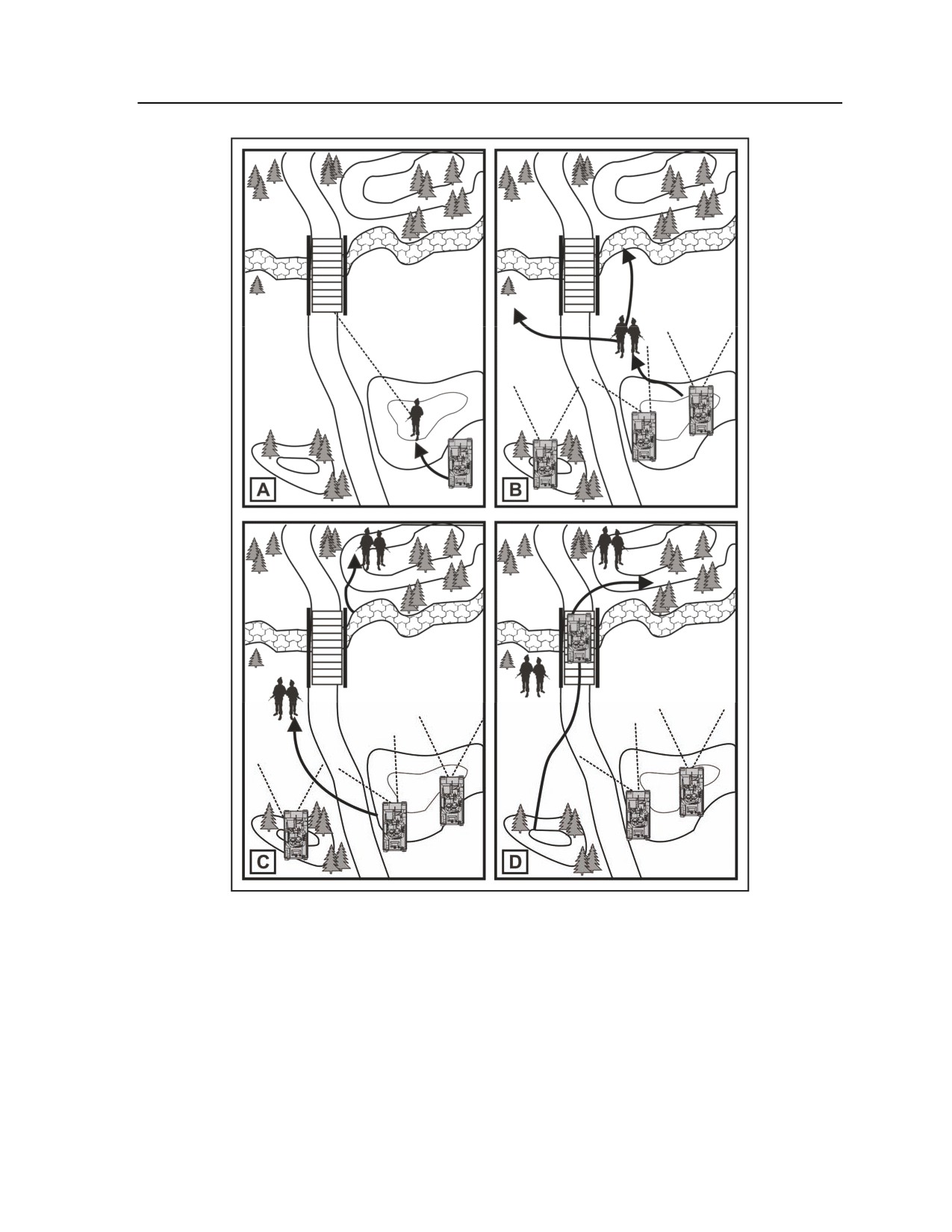
Chapter 3
Figure 3-24. Reconnaissance of a restriction (parts A through D)
Reconnaissance of a Deliberate Obstacle (Covered by Fire)
3-254. Figure 3-25 (parts A through D) and Figure 3-26 (parts E and F) illustrate this situation.
Detection
3-255. A UAS detects a possible obstacle deep in the platoon’s zone. A mounted reconnaissance element
maneuvers into a position that allows observation of the area. Scouts using LRAS3 systems confirm there
is an extensive obstacle and report the visible left and right limits. The platoon leader reports confirmation
of the obstacle and positions the platoon so dismounted scouts can detect the exact obstacle dimensions
3-66
FM 3-20.98
3 August 2009
Reconnaissance Operations
from a covered and concealed position. UAS support is shifted beyond the obstacle to provide warning of
an enemy approach. From its vantage point, the reconnaissance element observes and reports obstacle
construction (rows of wire, visible types of mines, signs, markers, trip wires, tilt rods, and sensors);
however, it will not move closer for further investigation or details. The platoon leader can position a
sniper team, if available, to provide overwatch and neutralize any threats, including snipers and surface
munitions, with precision fires.
Security and Reconnaissance
3-256. If safe to do so, the section moves its vehicles up to covered and concealed positions to overwatch
the obstacle. It organizes a dismounted element to attempt to locate a bypass and secure the far side. If the
platoon is augmented with engineer support, the engineers must move with the dismounted element to the
obstacle. The platoon leader organizes the platoon to reconnoiter the obstacle from both sides at once,
allowing information to be gathered and reported faster. If available, an infantry rifle squad may support
the reconnaissance, conducting near and far side security as the reconnaissance develops. In the process of
executing the patrol, the section discovers that the left flank of the obstacle is tied in with an impassable
swamp obstacle (refer to Figure 3-25, part A).
3-257. The patrol is engaged by enemy machine guns. The overwatch vehicles suppress the machine guns
and then are engaged by enemy vehicles in defensive positions. The section reports that it can maintain
contact with the enemy but can no longer maneuver (see Figure 3-25, part B). It can also observe the
enemy from the rear and reports a company-size element in defensive positions overwatching the obstacle.
It also reports that there are no trafficable routes around the enemy’s right flank (see Figure 3-25, part C).
3-258. At this point, the platoon leader determines that he does not have the combat power to secure the
far side of the objective. He also determines that the only trafficable bypass is covered by enemy direct
fires. He must now conduct a detailed reconnaissance of the obstacle before he can recommend a COA to
his commander. To continue this reconnaissance, the platoon leader has the option to employ mortars and
request armor to move forward for direct fire support.
Reconnaissance of the Obstacle
3-259. The reconnaissance section that originally detected the obstacle is in the best position to
reconnoiter it. It organizes a dismounted element to move to the obstacle. Because there is enough light for
the enemy to visually cover the obstacle, the platoon leader coordinates indirect fire to support the patrol.
As the patrol moves out, artillery lays suppressive fires on the known enemy positions, and mortars fire
obscurant munitions into the area between the enemy positions and the obstacle (see Figure 3-25, part D).
3-260. The scouts move by covered and concealed dismounted routes to the obstacle. Through probing
and visual observation, they determine that the wire obstacle is reinforced with buried mines. They are able
to determine that there is a mix of antitank (AT) and antipersonnel (AP) mines with antihandling devices,
emplaced in 30-meter belts on both the near side and the far side of the wire. Once they acquire this
information, the scouts move laterally along the obstacle to determine its length and to find out if its
composition is uniform. They look for the most favorable breaching location (see Figure 3-26, part E).
Selection of a COA
3-261. The platoon leader evaluates the situation and determines that he cannot bypass the obstacle and
does not have the capability to breach it. He decides to recommend that the platoon support a breach by
another element.
Recommendation/Execution of a COA
3-262. The platoon leader recommends to his commander that the platoon prepare to support a breach.
With higher approval, he orders the platoon to continue the reconnaissance and security tasks necessary to
support a breach operation. He also begins coordinating with and passing information to the element to his
rear responsible for conducting the breach (see Figure 3-26, part F).
3 August 2009
FM 3-20.98
3-67
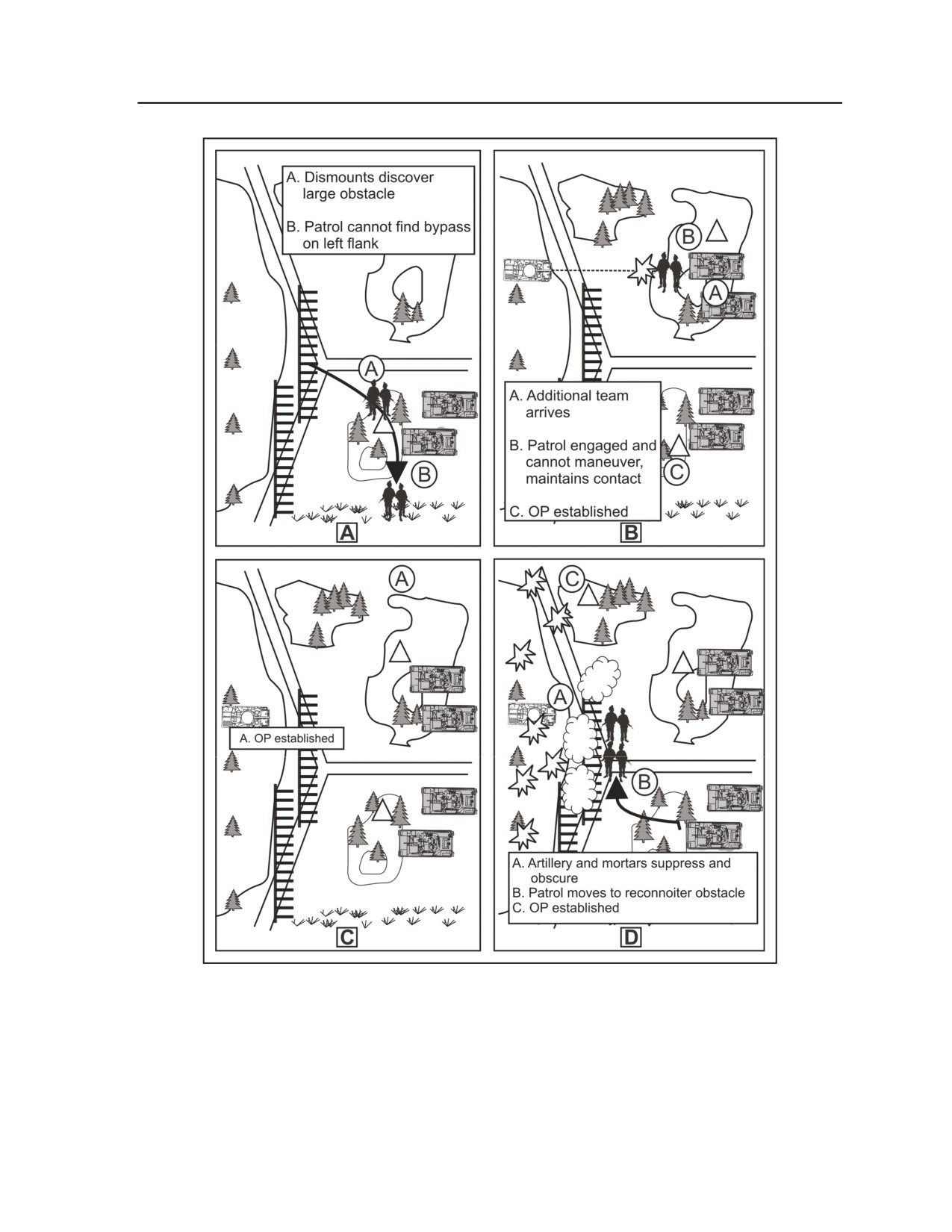
Chapter 3
Figure 3-25. Reconnaissance of an obstacle (parts A through D)
3-68
FM 3-20.98
3 August 2009
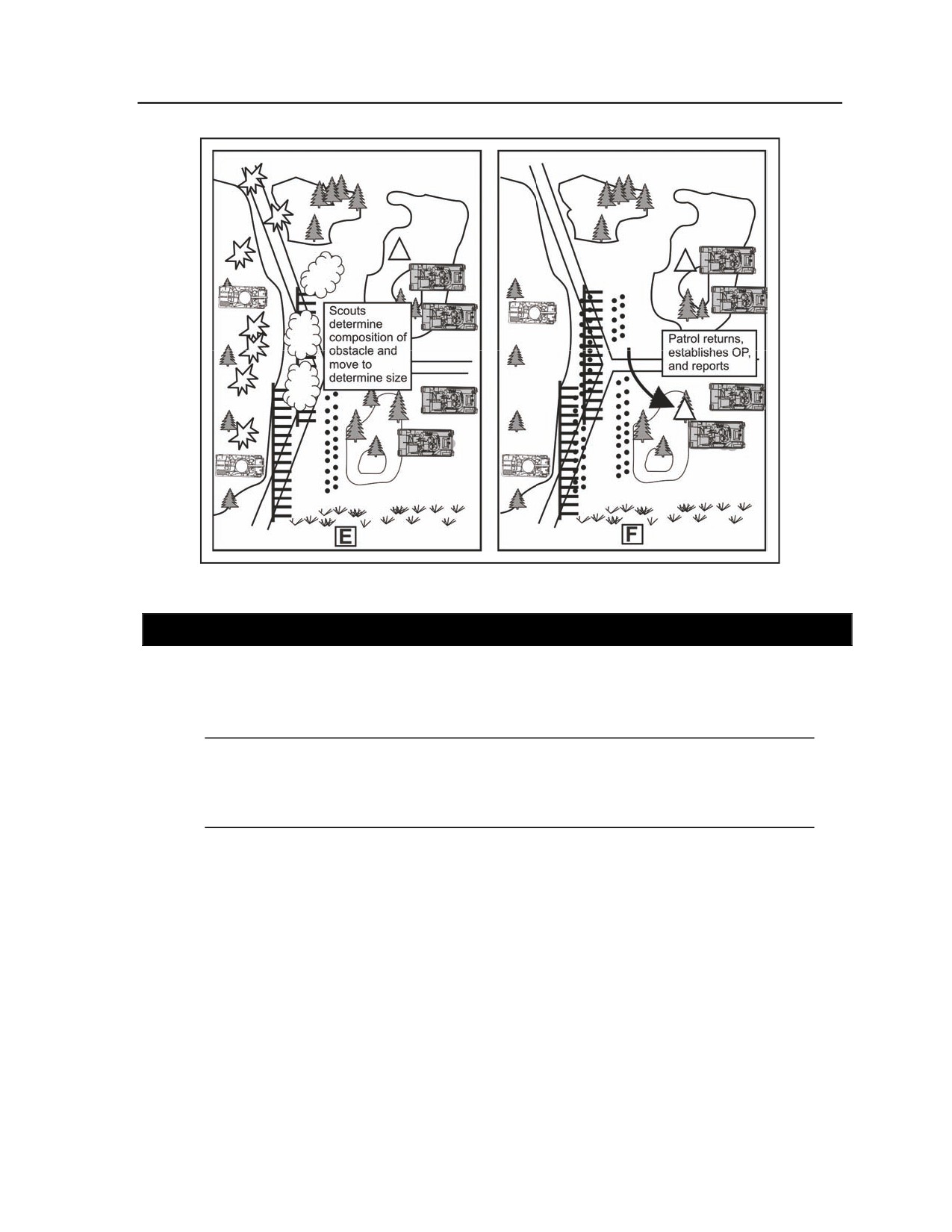
Reconnaissance Operations
Figure 3-26. Reconnaissance of an obstacle (parts E and F)
SECTION VI - ZONE RECONNAISSANCE
3-263. The commander normally assigns a zone reconnaissance to the reconnaissance or scout platoon
when he needs detailed information before maneuvering his forces through the zone. This reconnaissance
provides the commander with a detailed picture of how the enemy plans to defend the zone, enabling him
to choose the appropriate COA.
Note. The reconnaissance or scout platoon will normally conduct zone reconnaissance as part of
a larger force; it will conduct the mission on its own only with sufficient augmentation. Zone
reconnaissance is a primary mission of ACR scout and HBCT reconnaissance elements. The
scope of a zone reconnaissance may include the execution of route and area tasks.
3-264. As in area reconnaissance, the main types of zone reconnaissance are terrain-oriented, force-
oriented (threat/enemy), society-oriented, and infrastructure-oriented. The specific zone reconnaissance
mission may be focused on one of these types, or any combination. The techniques and objectives of
terrain-oriented and force-oriented zone reconnaissance missions are not mutually exclusive. The
commander’s intent, his guidance on the focus of the reconnaissance, and METT-TC factors will dictate
the priorities and critical tasks for the mission.
3-265. The platoon conducts terrain-oriented zone reconnaissance to gain detailed information about
routes, terrain, and resources within the assigned zone. This is the most thorough and complete
reconnaissance mission and therefore is very time-consuming. It is common for scouts executing a zone
reconnaissance in highly restrictive terrain to advance at only about 1 kilometer per hour; conversely,
reconnaissance in open and rolling terrain can cover upwards of 40 kilometers per hour.
3-266. The platoon conducts force-oriented zone reconnaissance to gain detailed information about
enemy forces within the zone. HBCT and ACR reconnaissance platoons are more suited to missions
3 August 2009
FM 3-20.98
3-69
Chapter 3
against heavily equipped enemies. As the platoon conducts this type of zone reconnaissance, its emphasis
is on determining the enemy’s locations, strengths, and weaknesses.
3-267. When augmented with the appropriate assets, a reconnaissance or scout platoon can conduct the
multidimensional aspect of zone reconnaissance to gain detailed information about the civilian populace
and infrastructure in a particular zone.
CRITICAL TASKS
3-268. The tasks accomplished by the reconnaissance or scout platoon as part of a zone reconnaissance
are generally the same as those for an area reconnaissance. The zone reconnaissance is usually conducted
over a larger physical space and may also include a route reconnaissance (with the associated critical
tasks).
TECHNIQUES
3-269. Zone reconnaissance is very time-consuming. Unless the orders specify which tasks to omit, all
critical tasks listed in the previous discussion are implied in the zone reconnaissance mission statement.
When speed is the primary concern, commanders must modify the focus, tempo, and engagement criteria to
prioritize the critical tasks for the platoon leader. The width of the zone is determined by unit organization
and the road network, terrain features, anticipated enemy activity, and time available to accomplish the
mission. UAS assets can be used in an economy of force role to observe areas beyond the operational reach
of ground reconnaissance elements.
3-270. The parent unit’s order will include phase lines and other graphic control measures within the zone
to control the maneuver of the units during the zone reconnaissance mission. The platoon leader will add
additional control measures to aid in the control of the sections, including the following:
z
Platoon boundaries.
z
Phase lines.
z
SP.
z
Contact points.
z
LD.
z
RP.
z
NAIs.
z
LOA.
z
Reconnaissance objective.
3-271. After issuing a WARNO for the mission, the platoon leader analyzes the mission to determine
what must be accomplished. He analyzes the following:
z
Commander’s guidance on focus
(the reconnaissance objective: threat/enemy, terrain,
social/human demographics, infrastructure, or a combination).
z
Tempo (time allowed for mission accomplishment).
z
Engagement criteria. (What situations constitute a platoon fight? In what situation will the
platoon defer the fight to a higher element?)
z
Information he has received about the threat in the IPB to determine what enemy activity he
should expect to encounter.
z
Terrain. (He can conduct a map reconnaissance and examine any IMINT, SIGINT, HUMINT, or
information from other units to determine what types of terrain the platoon must operate over.)
z
Need for requesting and integrating outside assets such as HUMINT, CI, CA, and MPs.
3-272. This analysis is important in identifying areas the enemy could occupy based on observation
capability, fields of fire, and natural obstacles. From these factors, the platoon leader determines the
manner in which the platoon will accomplish the mission.
3-70
FM 3-20.98
3 August 2009
Reconnaissance Operations
3-273. The platoon leader completes troop-leading procedures and develops a COA and contingencies to
accomplish his assigned mission. He may add phase lines on easily identifiable terrain through the zone to
help control movement. He places checkpoints in specific areas that must be reconnoitered or where they
will aid in controlling the operation. If the terrain is mixed, with both extensive dead space and easily
identifiable features, he may use boundaries to designate areas of responsibility for each section. The
platoon leader will place contact points at critical areas to ensure his sections maintain contact. The platoon
leader determines when conditions support the employment of UASs ahead or on the flanks of the platoon
to provide early warning or as an additional set of eyes behind the platoon. If UASs are used, he must
coordinate air space usage to prevent coverage redundancy or collision with other aircraft.
3-274. The platoon leader works with the FSO to plan and refine indirect fire targets to support the
platoon’s scheme of maneuver. As a minimum, they should plan targets on known or suspected enemy
positions to increase the responsiveness of indirect fires. Enemy detection by UAS that results in the
employment of indirect fires may require the UAS to be moved out of the area. Considerations are similar
for helicopters when indirect fires are inbound.
3-275. Depending on applicable METT-TC considerations, the platoon can conduct the zone
reconnaissance using a two-section, three-section, or single-vehicle organization. It must deploy to cover
the entire zone. It usually operates in a zone it knows very little about, so the COA must allow for
flexibility, responsiveness, and security as it moves. If attachments are present, planning their location and
enforcing formation discipline in the scheme of maneuver are critical factors in preventing navigational
errors; searching for lost vehicles or Soldiers; reducing fratricide risk; and preventing elements from
bunching up and affecting platoon rate of movement.
3-276. The platoon leader deploys his sections before reaching the LD to maximize reconnaissance assets
and to be prepared for chance contact. He requests situational updates from the commander or S-2 to obtain
the latest information on enemy activity prior to moving across the LD. He then moves the sections across
the LD into section AOs within the zone for which the platoon is responsible. He uses phase lines,
checkpoints, contact points, or GIRS/TIRS to direct movement so the platoon can reconnoiter the entire
zone. He ensures the sections remain generally on line while maintaining adequate security through
overwatch; this prevents development of significant gaps that a moving enemy could exploit. Scouts
dismount to gather detailed information, reconnoiter danger areas, or move through areas that are not
accessible to the vehicles. The platoon continues to reconnoiter the zone until it reaches the LOA or the
final reconnaissance objective. After completing actions on the objective, the platoon will transition to a
follow-on mission, which may include moving into a screen mission. This allows the platoon to provide
early warning of enemy activities; send Class I, III, and V reports; and conduct consolidation and
reorganization while friendly elements move into a defense behind the platoon.
EXAMPLE OF A ZONE RECONNAISSANCE
3-277. The following example illustrates zone reconnaissance by an SBCT reconnaissance platoon. It is
conducting a zone reconnaissance until the mission transitions into a screening mission phase. The SBCT
will screen until an HBCT has departed the forward operating base (FOB) and moves forward to conduct
RHO with the SBCT. Although illustrated here with an SBCT reconnaissance platoon, this mission may be
conducted in a similar manner by any type of reconnaissance platoons. See Figures 3-27 through 3-29.
3-278. The SBCT reconnaissance platoon (3rd platoon in this example) is augmented with engineer and
infantry vehicles to conduct a zone reconnaissance in an SSC scenario. The focus and tempo of the
operation require the platoon to operate mounted, dismounting only to clear danger areas and intervisibility
lines. A reconnaissance section from a BFSB reconnaissance troop has already moved through the zone 12
hours earlier and reported a booby-trapped obstacle limiting civilian movement in the zone, but no
significant enemy presence. The engagement criteria allow the platoon to use indirect fire on enemy
dismounts and vehicles. The troop commander will move an MGS platoon forward to destroy enemy
positions or bunkers and use TOWs and Javelins to destroy individual vehicles. A UAS flew over CP 22 an
hour ago with negative contact.
3 August 2009
FM 3-20.98
3-71
Chapter 3
3-279. Although the reconnaissance platoon does not use strict formations when maneuvering, the
platoon leader must keep sections from getting ahead of each other. This is not easy since the platoon must
maneuver using the terrain for protection against direct fire. In this example, the platoon leader starts out
with his platoon in concealment and overwatching the phase line. The platoon deploys into formation prior
to crossing the LD. It will operate in a two-team concept, with A Section consisting of the platoon leader,
his wingman, and the engineer vehicle. B Section will consist of the PSG, his wingman, and the infantry
vehicle. In this mission, the platoon leader has chosen to position his section (Alpha) in the left portion of
the zone because of the importance of confirming the location of a bridge in that area. He will attempt to
maneuver the platoon on line, taking into account that using the terrain for protection where at times the
sections will not be mutually supporting.
3-280. The platoon crosses the LD at the time prescribed in the commander’s OPORD, using the
bounding overwatch technique of movement by sections. The sections maneuver through the zone in a
zigzag pattern to ensure that the zone is properly reconnoitered and to accomplish all critical tasks of a
zone reconnaissance. Security is maintained within sections because the width and terrain of the zone
prevent the sections from providing continuous mutual support.
3-281. Based on the factors of METT-TC, including the enemy situation, the platoon leader chooses the
movement technique best suited for C2. He may choose to have the sections secure the area and set at all
checkpoints. As an alternative, he may have the sections bound through the checkpoints, report when they
have been secured, and then set at the next phase line. If the platoon leader has not assigned sections a
particular checkpoint on which to orient, the section leaders must plan their own graphic control measures
to control the movement. The sections make contact at contact points to ensure that they meet up with a
designated unit to exchange information and receive updates on the current situation in the AO.
3-282. The platoon continues reconnaissance up to the river (PL OHIO). As the platoon approaches the
river, scouts move into covered and concealed positions providing overwatch and visually search the
dominant terrain on the north side of the river.
3-283. Alpha section identifies the remains of the bridge in its zone. Engineers dismount and set up local
security. They determine that the bridge remains are not booby-trapped and that bridging assets can be set
up to span this location to the far bank. Bravo section identifies a fording site with a rock bottom just east
of the blown bridge at checkpoint 32; the ford will initially support heavy armored traffic (see Figure 3-
27). The platoon leader does not allow any element to cross PL OHIO without permission from the troop
commander.
3-284. When the troop is set on PL OHIO, the platoon remounts. It is given permission to execute OHIO
and move to PL BAMA. The sections immediately begin reconnaissance of natural and man-made
obstacles, including the stream to their front. As the platoon continues reconnaissance toward PL BAMA,
sensor contact is made with an unknown force. When scouts move to confirm the contact, they discover
enemy elements; the platoon reports the contact to the troop, including a FBCB2 update. The platoon
leader informs his platoon that they are entering the enemy security zone. B Section uses the rifle squad to
determine if the dominant terrain near checkpoint 33 is clear of enemy forces. With negative contact, the
platoon continues its reconnaissance and sets at PL BAMA.
3-285. When the troop is set on PL BAMA, the platoon is given permission to execute BAMA and move
to PL IDAHO. As the platoon crosses the ridge at PL BAMA, Alpha section receives sporadic machine
gun fire from concealed positions south of checkpoint 34. The platoon immediately deploys, reports the
contact to the troop commander, and calls for indirect fire to suppress the enemy and enable the platoon to
break direct fire contact.
3-72
FM 3-20.98
3 August 2009
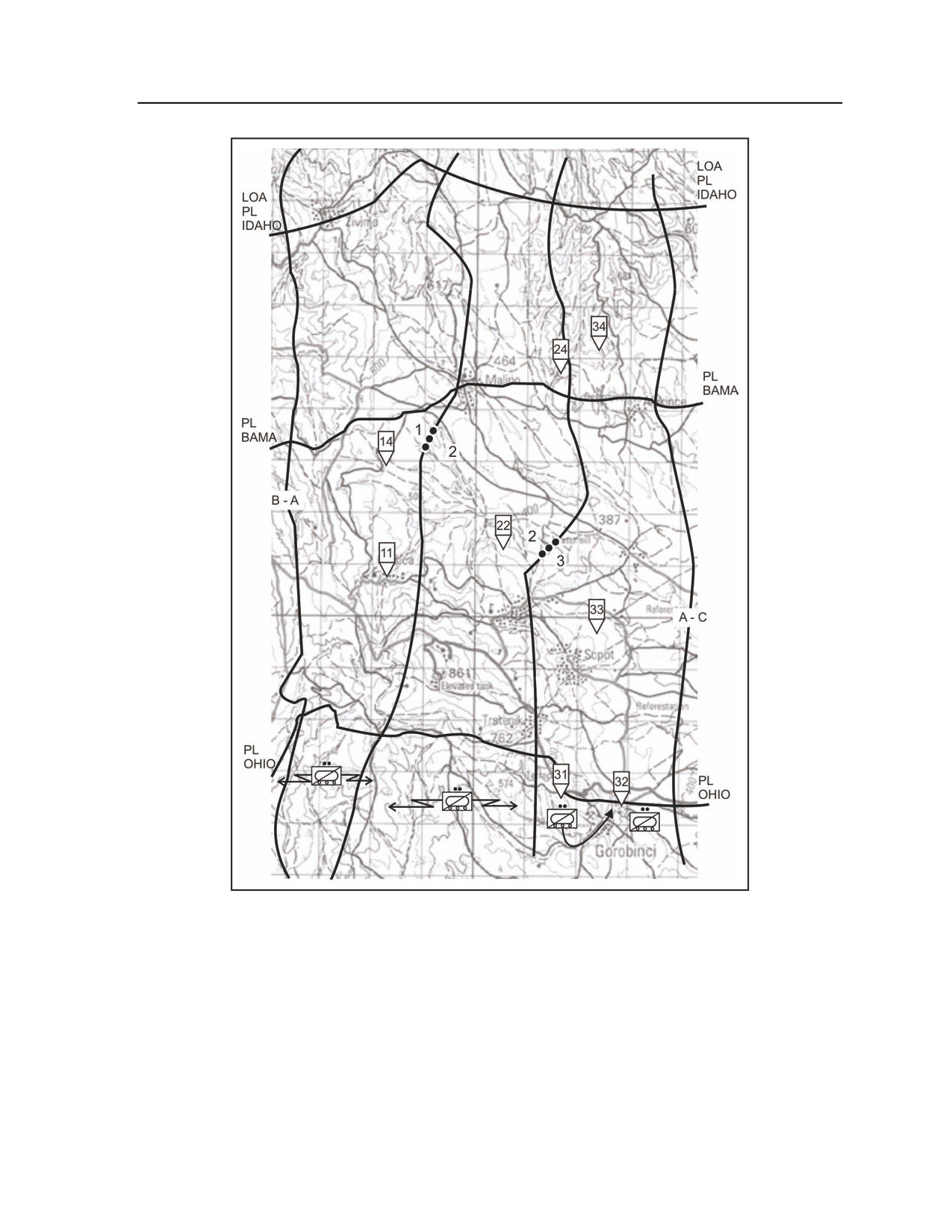
Reconnaissance Operations
Figure 3-27. Zone reconnaissance (part one)
3 August 2009
FM 3-20.98
3-73
Chapter 3
3-286. Under this protection, the platoon, primarily dismounted, reconnoiters to the flanks and rear to
develop the situation. The troop commander acknowledges the contact report and moves immediately to
link up with the platoon leader. The troop commander orders the platoon to continue its reconnaissance to
locate the enemy’s flank. The platoon leader sends Bravo section forward on the enemy’s left and his
Alpha section on the right flank to determine if the enemy is mutually supported by other forces from the
flanks or rear. A four-man dismount team, including the Bravo Section leader, moves in closer (two scouts
as a security element and two for reconnaissance). They determine the enemy consists of two BRDM-2
vehicles and six dismounted Soldiers in a wooded area. The scouts from the adjacent 2d Platoon identify
the right flank of the enemy and discover the flank is unprotected by obstacles and exposed to direct fires.
3-287. The troop commander directs 2d Platoon to move to a designated position to cut off the enemy
element’s chance to escape. He then orders an MGS platoon forward and tasks one section to destroy the
enemy OP. The infantry augmenting the platoon moves through the position as the scouts move forward
and provide early warning of any counterattack. The MGS platoon moves to checkpoint 24 for linkup with
the 3d Platoon scouts, who guide them into position to attack the enemy OP. (Refer to Figure 3-28.)
3-74
FM 3-20.98
3 August 2009
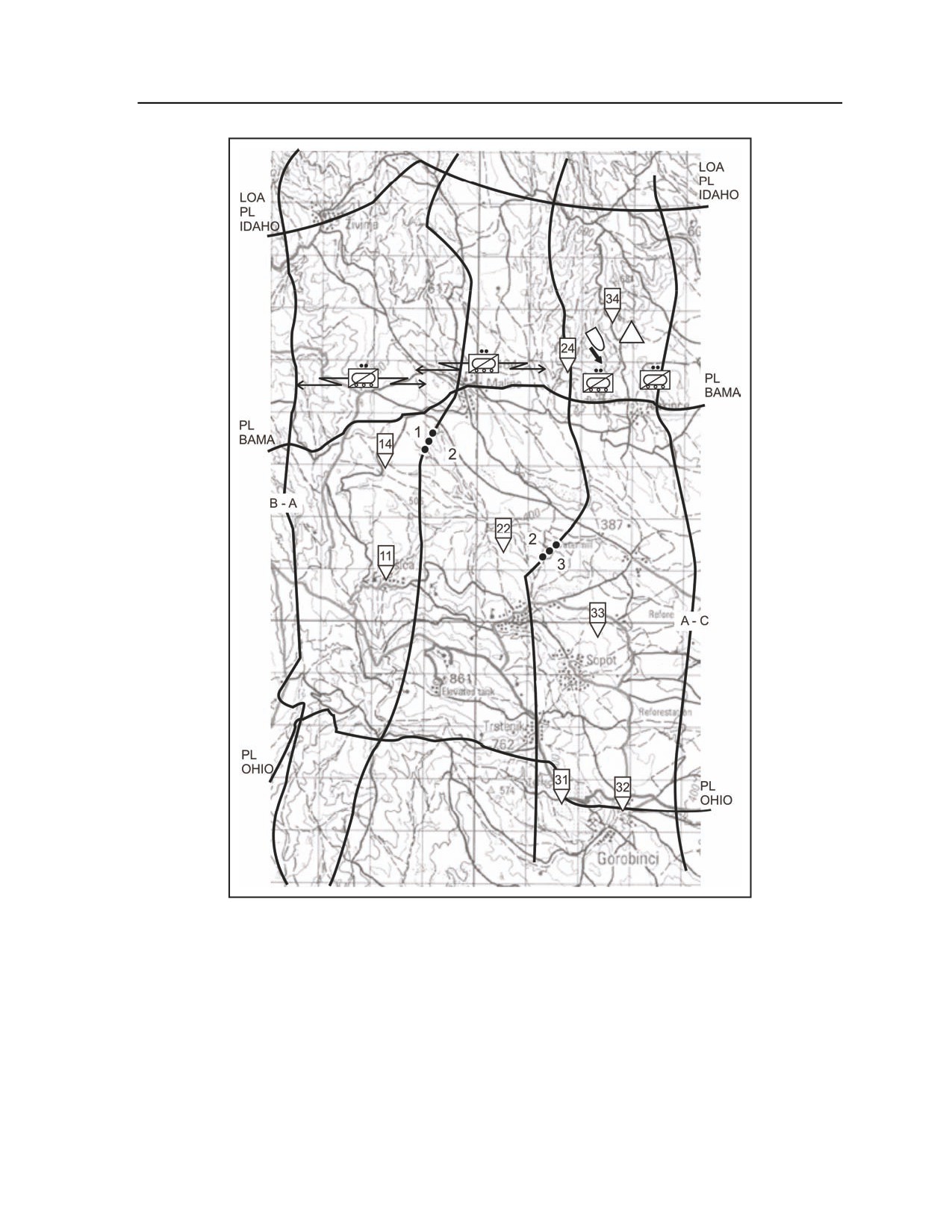
Reconnaissance Operations
Figure 3-28. Zone reconnaissance (part two)
3-288. The 3d Platoon reports the MGS platoon is set in the attack position. The 2d Platoon dismounts are
in position to halt any enemy escape. The platoon leader of 3d Platoon confirms that his dismount teams
are out of the target area and set, his Bravo section is providing overwatch and the infantry are ready to
sweep through the position, and the MGS section is in position. The platoon leader shifts mortar fires off
the enemy and back to the rear of the OP position. The MGS section engages the enemy from the flank to
destroy the vehicles. The mortar fire is stopped to allow the infantry rifle squad to move through the
position and finish the fight, capturing two wounded prisoners. The MGS section moves north between the
scout vehicles on the flanks and establishes a hasty screen. A UAS is launched to gain observation beyond
3 August 2009
FM 3-20.98
3-75
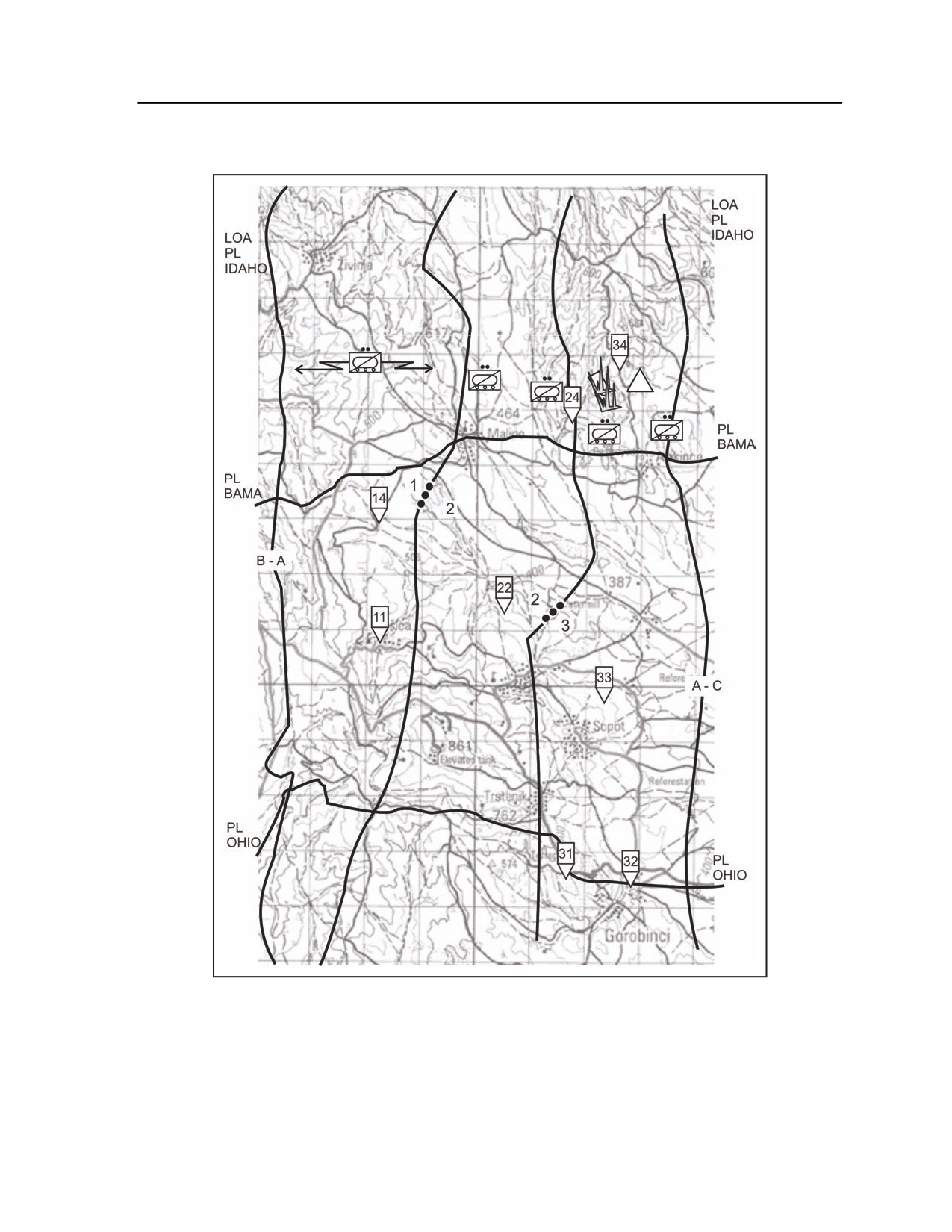
Chapter 3
the next terrain feature for early warning. The rifle squad searches the vehicles and dead personnel to
complete destruction of the OP. (See Figure 3-29.)
Figure 3-29. Zone reconnaissance (part three)
3-289. A scout team from 3d Platoon moves in quickly with HUMINT collectors, who conduct TQ and
SE to determine the proximity and mission of other enemy forces’ zones. The 3d Platoon leader orders a
fire team to stay and secure the prisoners. The PSG relays his resupply and personnel reports and
coordinates evacuation of wounded and prisoners to the predetermined casualty collection point (CCP)
with the troop first sergeant. To maintain momentum, the platoon leader quickly reassembles the platoon
3-76
FM 3-20.98
3 August 2009
Reconnaissance Operations
on the hasty screen line and returns the MGS section back to the troop commander. The platoon leader
requests to continue the zone reconnaissance, and on order, move through the zone and conduct
reconnaissance up to the LOA. Upon completion of the zone reconnaissance, the platoon leader collects
reports, forwards his reconnaissance report to the troop CP, and updates the FBCB2. The platoon then
transitions into a screen and the RHO.
3 August 2009
FM 3-20.98
3-77
This page intentionally left blank.
Chapter 4
Security Operations
In security operations, reconnaissance and scout platoons provide early and accurate
warning of enemy operations. Reconnaissance and scout platoons provide the main
body with time and maneuver space to react to the enemy and to develop the
situation; this in turn allows the commander to deploy his forces effectively to the
needed location at the correct time to protect his force. Reconnaissance and scout
platoons conduct security operations in conjunction with R&S missions. Security
operations are critical to the unit’s ability to gather intelligence and maintain freedom
of maneuver and operations.
Contents
Section I - Introduction
4-1
Section IV - Area Security
4-32
Purpose
4-1
Supporting Tasks for Area Security .. 4-32
Forms of Security
4-2
Operational Considerations
4-33
Fundamentals of Security
4-3
Platoon Considerations
4-34
Planning Guidance
4-4
Route Security
4-35
Section II - Screen
4-5
Convoy Security
4-37
Critical Tasks
4-5
Section V - Direct Fire Planning
4-48
Counterreconnaissance Techniques 4-19
Direct Fire Standing Operating
Example of a Screen Operation
4-24
Procedure
4-49
Section III - Local Security
4-32
Engagement Area Development
4-50
SECTION I - INTRODUCTION
PURPOSE
4-1. All reconnaissance and scout platoon security operations serve the same general purposes: to protect
a specified force from being surprised by the enemy and to reduce unknown factors in the AO. They
prevent or hinder the enemy from accomplishing its mission. To accomplish this, the platoon provides
early warning to friendly forces within a given area. The reconnaissance or scout platoon may operate at
considerable distances from the friendly elements it is screening or protecting, limited only by
communications capabilities and the range of direct fire, close air support (CAS), close combat attack
(CCA), and indirect fire support. This provides the friendly forces with the time and space to react and to
position elements to defeat the enemy.
4-2. The reconnaissance or scout platoon can conduct screening and area security operations
independently or as part of a larger force such as a reconnaissance troop or company team. In conducting
guard operations, the platoon works as part of a larger unit such as a CAB or squadron. In addition, the
platoon may be tasked to conduct screening or reconnaissance operations in support of the larger unit’s
guard or cover mission.
3 August 2009
FM 3-20.98
4-1
Chapter 4
Note. Mounted infantry platoons can provide security on friendly element’s flanks in situations
where reconnaissance elements are not available. Leaders can use UGVs as an early warning
element in terrain with minimal maneuvering difficulty and maintain position for extended
periods.
FORMS OF SECURITY
4-3. Reconnaissance and scout platoons perform or participate in five forms of security operations:
z
Screen.
z
Guard.
z
Cover.
z
Local security.
z
Area security.
Route security.
Convoy security.
SCREEN
4-4. A screening force provides early warning to the protected force. Within its capabilities and based on
the higher commander’s guidance, it may impede and harass the enemy with direct and indirect fires and/or
destroy or repel enemy reconnaissance units in coordination with other combat elements.
4-5. Screening operations, which are defensive in nature, provide the protected force with the lowest
level of protection of any security operation. Platoons conduct screens to the front, flanks, and rear of a
stationary force and to the flanks and rear of a moving force. The reconnaissance or scout platoon
generally accomplishes a screening operation by establishing a series of OPs and conducting patrols to
ensure adequate reconnaissance and surveillance of the assigned sector. Leaders may integrate direct fire
assets
(MGS, ATGMs, M1A2s) with the scouts in the screen line to prevent enemy reconnaissance
elements from penetrating the screen.
4-6. Situations may require the commander to displace the screening elements to subsequent positions,
possibly along a pre-established phase line. This allows the commander to move elements, maintain enemy
contact, and prevent penetration of the screen line by the enemy during retrograde movement.
GUARD
4-7. Commanders deploy a guard force to prevent enemy ground observation of and direct fire against the
protected element. Units do not execute guard missions below the reconnaissance squadron
(with
augmentation), armored cavalry squadron, or CAB level. A reconnaissance or scout platoon participating
as part of a guard force reconnoiters, screens, attacks, defends, and delays as necessary until the squadron
or battalion has accomplished its mission. The reconnaissance platoon operates within the range of direct
fire support (MGS, ATGM, and M1A2s) and supporting artillery.
COVER
4-8. A covering force accomplishes all the tasks of screening and guard forces to deceive, disrupt, and
destroy enemy forces. The key distinction of the cover operation is that the force operates apart from the
main body to allow early development of the situation. Unlike screening or guard forces, a covering force
is tactically self-contained; it is normally a reinforced BCT (the CAB is not equipped to conduct a cover on
its own) or a cavalry regiment. Leaders organize a covering force with sufficient enabling and sustainment
assets to operate independent of the protected force. Because an enemy force can decisively engage the
covering force (or a portion of it), it must have sufficient combat power to effectively engage the enemy. A
reconnaissance or scout platoon participating as part of a covering force reconnoiters, screens, attacks,
defends, and delays as necessary until the BCT or regiment has accomplished its mission.
4-2
FM 3-20.98
3 August 2009
Security Operations
LOCAL SECURITY
4-9. Local security includes any measure taken by the platoon against possible enemy actions. The
requirement for maintaining local security is inherent in all operations. It includes observing for and
detecting any enemy forces in the immediate vicinity and knowing as much as possible about enemy
intentions. Local security prevents surprise and is important to maintaining the initiative.
AREA SECURITY
4-10. Area security is a security operation conducted to secure a specific area to protect friendly forces,
installations, routes and actions within the specified area. Platoons conduct area security to deny the enemy
the ability to influence friendly actions in a specific area or to deny that enemy the use of an area for its
own purposes such as combat operations, insurgent infiltration, or IO against friendly forces. Area security
actions could include area reconnaissance; transitioning to security of designated personnel, equipment,
facilities (including point of entry airfields and seaports); and point security for events and locations, such
as a platoon meeting with a tribal or government leader, main supply routes
(MSR), lines of
communications, and critical infrastructure. Route and convoy security fall under area security as
additional tasks.
Route Security
4-11. The platoon conducts route security to prevent an enemy from attacking, destroying, seizing,
containing, impeding, or harassing traffic along the route. Route security also prevents the enemy from
interdicting traffic by emplacing obstacles on or destroying portions of the route. Route security operations
are defensive in nature and, unlike screen operations, are terrain-oriented. Route security is best suited for
company/troop-size elements, which can task organize platoons to fill various defensive roles. Enemy
forces will attempt to interdict supply routes and LOCs by various methods. Lengthy routes may become
extremely difficult for a reconnaissance platoon to secure requiring the platoon leader to request additional
resources.
Convoy Security
4-12. Reconnaissance and scout platoons conduct convoy security operations when insufficient friendly
forces are available to secure LOCs and supplies continuously in an AO. Platoons can conduct convoy
security in conjunction with route security operations. A convoy security force operates to the front, flanks,
and rear of a convoy element moving along a designated route. The platoon continues to provide security
even when the convoy halts for breaks and maintenance.
FUNDAMENTALS OF SECURITY
4-13. The platoon follows five fundamentals, described in the following paragraphs, that are common to
all security operations. The platoon leader’s plans adhere to these fundamentals as the platoon executes its
operation. Leaders ensure their maneuver and actions support the fundamentals to assist the unit in
maintaining the initiative and win the fight.
Note. For more information on the fundamentals of security operations, refer to FM 3-20.96
and FM 3-20.971.
4-14. The five fundamentals of security are—
z
Provide early and accurate warning. Early and accurate warning of enemy approach is
essential to successful operations. The main body commander needs this information to shift and
concentrate his forces to meet and defeat the enemy. Scouts occupy OPs and use combat patrols
and sensors to provide long-range observation, observe enemy movement, and report the enemy’s
size, location, and activity to the commander. Scouts do not “determine” what they see. Rather,
they report the who, what (to include vehicles and equipment), when, where (to include first seen,
direction of movement, and last seen), of the enemy as well as any uncertain data.
3 August 2009
FM 3-20.98
4-3
Chapter 4
z
Provide reaction time and maneuver space. The reconnaissance or scout platoon works at a
distance from the protected force that is sufficient to allow the review of rapidly reported
information by the commander. This timely review gives the commander reaction time to order
indirect fire to slow the enemy’s rate of advance and maneuver direct fire elements into place
to engage, exploit, and defeat the enemy, thus halting a penetration and preventing observation
of the protected force. Typically scouts will operate between the protected element and known
or suspected enemy elements.
z
Orient on the force, area, or facility to be protected. If the protected force moves, scouts
must be aware of its movement and must reposition their elements accordingly to maintain
their relative position. They must understand the protected force commander’s scheme of
maneuver, including where he wants his security force in relation to his movement.
z
Perform continuous reconnaissance. The reconnaissance and scout platoon conducts
continuous reconnaissance during security operations to gain as much information as possible
about the AO and the enemy. This can begin mounted and transition into dismounted OPs,
mounted and dismounted patrols, and UASs deployed to observe dead space.
z
Maintain threat contact. Scouts gain and maintain contact with the enemy undetected to
provide the commander with continuous information. If they lose contact, scouts adjust their
sector of observation or reposition under concealment and take steps to regain it. Maintaining
contact is critical during counterreconnaissance operations to isolate and destroy the enemy
reconnaissance elements. Scouts maintain contact until they are ordered to do otherwise or
until they conduct handover of the contact to another unit moving into the area.
PLANNING GUIDANCE
4-15. Critical to the platoon leader’s ability to execute his operation is a clear understanding of the focus,
tempo, and engagement/displacement criteria of the security operation. Refer to FM 3-20.971.
4-16. Considerations for the planning guidance in security operations include the following:
z
Focus. The focus of the security operation allows the commander to determine which critical
tasks he wants the platoons to accomplish. NAIs provide the platoon leader with a method of
focusing the platoon’s effort. NAIs link most likely enemy activities to terrain where those
activities may occur, such as locations frequented by insurgents. The platoon focus might be
oriented on the threat/enemy, terrain, social/human demographics, or infrastructure or on a
combination of these factors. For example, in stability operations, the platoon may focus on—
Determining local populace sentiment.
Identifying local paramilitary leaders.
Conducting checkpoint operations to determine the direction of movement of displaced
civilians in the AO.
z
Tempo. The tempo of the security operation allows the troop commander to establish
associated time requirements that drive the platoon tasks including dismounted or mounted
OPs and patrols, UAS rotation, and enablers necessary to execute the operation. An
operation’s tempo can relate to depth, especially in screening operations where time is needed
to properly deploy assets into position to achieve the required depth. Tempo also dictates
whether units use mounted or dismounted OPs or a combination of both. Tempo can equate to
the duration of the operation, which affects whether short-, long-, or extended-duration OPs
are used based on the following criteria:
Short-duration OPs. The platoon establishes a screen quickly and maintains these OPs for
less than
12 hours. The platoon maximizes the number of observers and ground and
airborne systems during that short period.
Long-duration OPs. The platoon maintains these OPs for more than 12 hours but less than
24 hours. The number of OPs decreases because platoons must manage a deliberate
rotation schedule. The number of remote systems used may offset the reduced number of
ground scouts employed.
4-4
FM 3-20.98
3 August 2009
Security Operations
Extended-duration OPs. The platoon maintains these OPs for longer than 24 hours. The
platoon must coordinate for improvement of dismounted OPs. The platoon leader must plan
for and coordinate operations with a dedicated reaction force from a higher unit, as well as
wire communications, engineer support and other resources that allow the OPs to operate
for an indefinite period. This type of OP requires the PSG to increase coordination of
resources including Class IV materials, engineer support, and obstacles.
Note. Whenever they employ OPs, scouts must be prepared to transition to extended-duration
OPs to meet unforeseen events or to maintain contact with an enemy or unknown target.
z
Engagement and displacement criteria. The engagement and displacement criteria establish
what the next higher unit is expected to destroy and when it is expected to hand over an AO.
They guide the planning of how to occupy the area and determine when the platoon will
execute displacement security drills. The platoon leader uses engagement criteria to develop
his direct fire plan. Displacement criteria specify those events that trigger the collapse of the
screen.
SECTION II - SCREEN
4-17. The reconnaissance or scout platoon conducts screen operations for its parent unit or other friendly
forces to provide early warning of enemy approach and to provide real-time information, reaction time, and
maneuver space for the protected force. The commander calls on the platoon to screen for him when he
needs advance warning of when and where the enemy is attacking. Operating over an extended area, the
platoon fights only in self-defense or to prevent enemy observation of the protected force.
CRITICAL TASKS
4-18. During a screening operation, the platoon must accomplish the following critical tasks:
z
Maintain continuous surveillance of the AO, including assigned NAIs and avenues of
approach that affect the protected force’s mission.
z
Provide early warning of enemy approach, including locating and identifying lead elements
that indicate the main attack and direction of movement.
z
Conduct counterreconnaissance to identify enemy elements and to disrupt, defeat, or destroy
them in accordance with the prescribed engagement criteria.
z
Maintain enemy contact, report enemy activity, and conduct proper handover as required.
z
Disrupt and delay the enemy while displacing to provide the protected force commander with
additional time and maneuver space.
4-19. The platoon maintains surveillance from a series of OPs. The platoon leader positions OPs where
they can best observe designated NAIs and/or avenues of approach. The screen, normally identified by a
phase line on a map, designates the most forward location of the OPs. Commanders must carefully weigh
time and distance factors in relation to the supported unit when choosing where to place this line. The
platoon observes the space between the screen line and the supported/subsequent unit by establishing
positions in depth. The screen line also supports RHO, both within the platoon and with the
supported/subsequent unit, by providing knowledge of the area to the gaining unit as it moves forward
through the scouts.
4-20. In executing a screen operation, scouts conduct combat patrols to extend their observation range
and/or to observe dead space and the area between OPs. While sensors increase the observation range of
the platoon’s screen and decrease reaction time for detecting and reporting threats in the area, scouts must
plan to move to and gain visual contact to confirm what their sensors have detected. The platoon leader can
request to place OPs forward of the LOA if they can more effectively observe the NAI/avenue of approach.
Unless required, the scouts do not fight with their direct fire weapons. Indirect fire is their primary means
3 August 2009
FM 3-20.98
4-5
Chapter 4
of engaging the enemy. Direct fire is generally limited to preventing observation of friendly elements or
penetration of the screen line or to self-defense.
4-21. When planning a screen operation, the platoon leader must address the critical task requirements
covered in the following discussion as a guide to prioritizing and sequencing the operation.
CONDUCT SURVEILLANCE OF ASSIGNED AREAS
4-22. The first task for the reconnaissance or scout platoon in the screening operation is to provide
surveillance of the assigned AO.
Surveillance Requirements
4-23. Generally, scouts screen along a lateral line (the screen line). This can be misleading, however. The
screen is actually set to observe specific avenues of approach or, more specifically, NAIs. The screen line
merely indicates the limit of the forward positioning of the scouts. Along with the screen line graphic, the
platoon leader must have an event template/matrix; he may also have a decision support template.
4-24. The commander tasks the platoon to observe areas and identifies them either in the reconnaissance
and security plan or in the OPORD from higher headquarters. If the platoon does not receive an IPB
product, the higher OPORD must specifically state where it must focus the screening operation. If the
platoon is assigned multiple requirements, the higher headquarters must prioritize them.
4-25. The scout’s understanding of his commander’s intent and guidance is the most critical aspect of
planning the screen operation. More important than the specifics of where to orient is the focus on what to
look for. There are three choices for this focus: the enemy main body, the enemy reconnaissance effort, or
both. The intent should specify on which of these alternatives the platoon will focus or, if both are required
(as is often the case), which has priority.
4-26. This guidance then determines where the platoon will orient and how it will allocate resources. If the
commander’s priority is locating the main body, the platoon leader will focus most of his assets on the
main avenues of approach and accept risk on the reconnaissance avenues of approach. If the commander’s
priority is on counterreconnaissance, the platoon leader will put priority on the reconnaissance avenues of
approach and accept some risk on the main avenue. If the commander wants both choices, with equal
priority, the platoon leader must plan to transition the platoon from the reconnaissance avenues of approach
to the main avenue at a designated point in the operation. The commander usually orders this transition
based on the enemy situation (which may be pinpointed by confirmation of a specified percentage of
CCIR).
Note. Enemy reconnaissance avenues of approaches may mirror or parallel the intended route
of an enemy maneuver force. Conversely, the enemy reconnaissance avenues of approach may
follow a route that facilitates observation and reporting of key terrain or friendly forces but is
unrelated to the enemy scheme of maneuver.
Surveillance Assets
4-27. Once the platoon leader has a thorough understanding of what his surveillance requirements are, he
must next determine what assets he has available to execute these requirements. Availability of assets is
dependent on how long the screen must remain in place and how the platoon is task organized. Among the
assets that can enhance the platoon’s surveillance capability are ground surveillance systems, infantry
squads, engineer assets, artillery forward observers (FO), and tactical UAS assets. If the screen will be of
short duration (less than 12 hours), individual squads can emplace and man separate OPs. If the duration of
the screen is unknown or longer than 12 hours, the platoon leader must assign a two-vehicle section
(CFV/RV platoons) or three-vehicle section (HMMWV platoons) for each OP to facilitate continuous
operations.
4-6
FM 3-20.98
3 August 2009
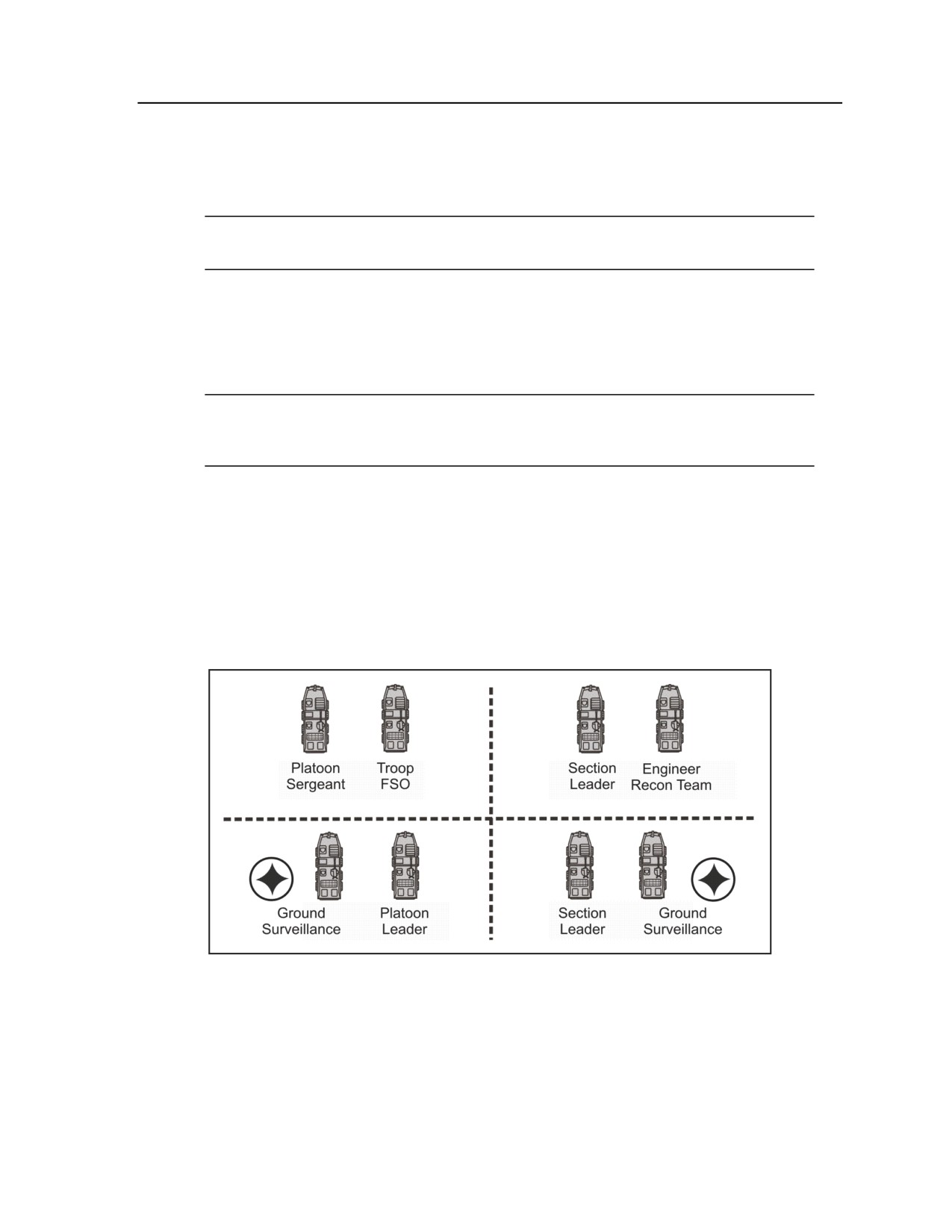
Security Operations
Surveillance Techniques
4-28. To ensure that the critical task of surveillance on assigned reconnaissance objectives is
accomplished, the platoon leader and his higher headquarters apply a combination of techniques to make
the most efficient use of their assets.
Note. Refer to Chapter 5 of this manual for a discussion of surveillance methods, OPs, patrols,
and use of electronic and mechanical assets.
Task Organization
4-29. The platoon leader will task organize the platoon and any other assigned assets to achieve the most
effective surveillance of an NAI or avenue of approach. His planning may include assets such as engineer
or infantry squads, ground surveillance systems, artillery observers, air defense elements, and UAS assets.
Note. The platoon leader ensures that these assets complement—and do not duplicate—other
forces in the screen. In addition, he must ensure that all scouts understand where these assets are
and what role they are playing.
4-30. The platoon leader may use these surveillance assets in a number of ways. This may include
adjusting the number of sections or squads in a particular surveillance team; mixing scouts and other assets
such as engineers, artillery, ground surveillance systems, or infantry into the same team; or maintaining
elements in pure teams under the platoon leader’s control. The platoon leader must consider the
characteristics of the NAI or avenue of approach when task organizing for surveillance. These
considerations will determine whether the platoon will need to call for fire or conduct dismounted patrols;
they will also affect the field of view and applicability of ground surveillance systems and tactical UASs.
Figures 4-1 and 4-2 illustrate how the SBCT and IBCT reconnaissance platoons might be task organized
for surveillance operations.
Figure 4-1. Sample SBCT reconnaissance platoon task organization
(with FSO, engineer, and ground surveillance assets)
3 August 2009
FM 3-20.98
4-7
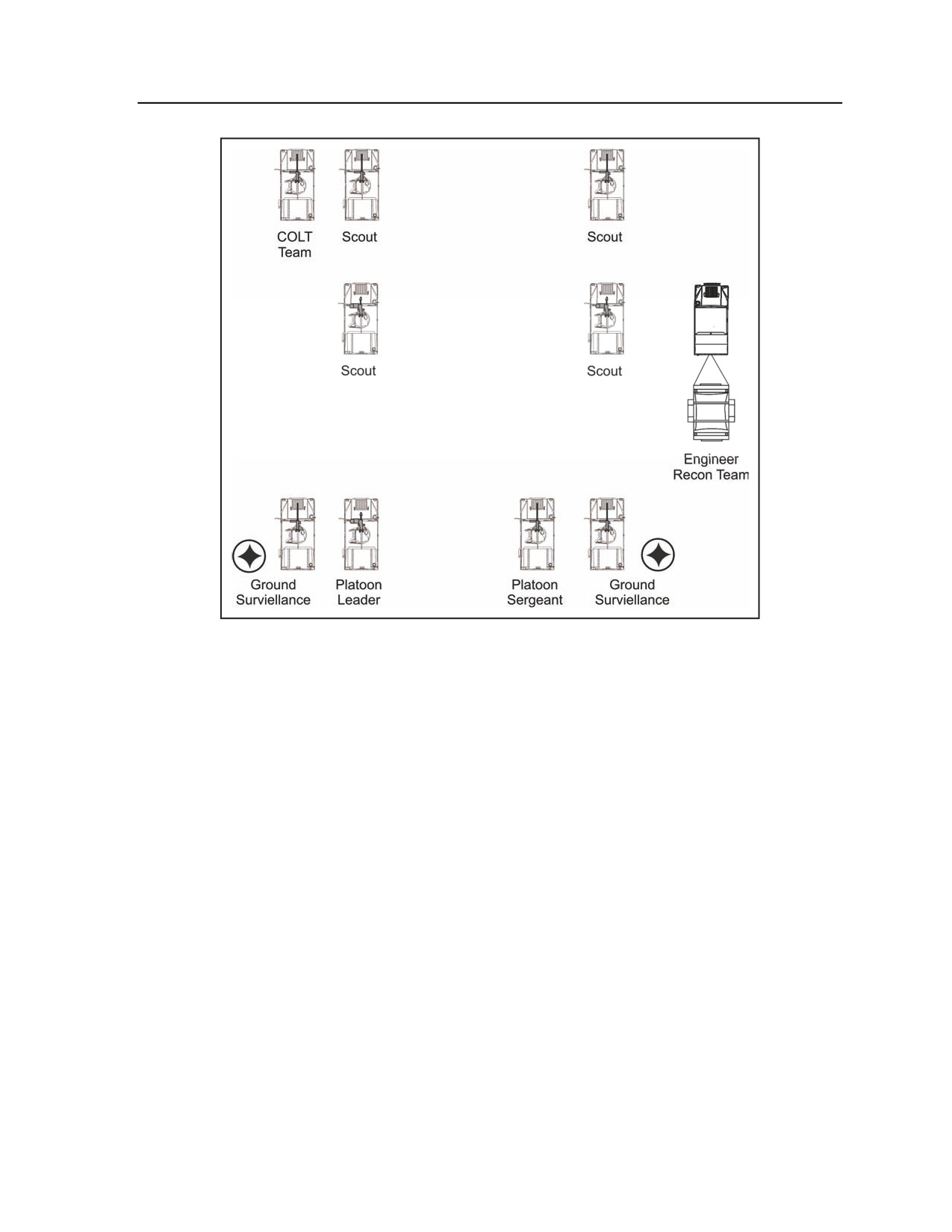
Chapter 4
Figure 4-2. Sample IBCT reconnaissance platoon task organization
(with COLT, engineer, and ground surveillance assets)
Redundancy
4-31. The platoon leader may task more than one element to observe a particular assigned NAI or avenue
of approach. He does this based on the nature of the NAI or avenue in terms of size, terrain, or importance.
For example, a very large avenue may require multiple observation assets to ensure all aspects of the
avenue are covered. Terrain that is very broken or mixed with areas of thick vegetation may require more
than one asset to ensure adequate continuous coverage. Finally, if the commander assigns a particular NAI
significant priority, the platoon leader may assign multiple elements to cover it. Redundancy not only
ensures adequate observation of an NAI or avenue of approach, but also enables the unit to accomplish the
operation even if enemy forces compromise some assets. Figure 4-3 illustrates redundancy of observation
assets.
4-8
FM 3-20.98
3 August 2009
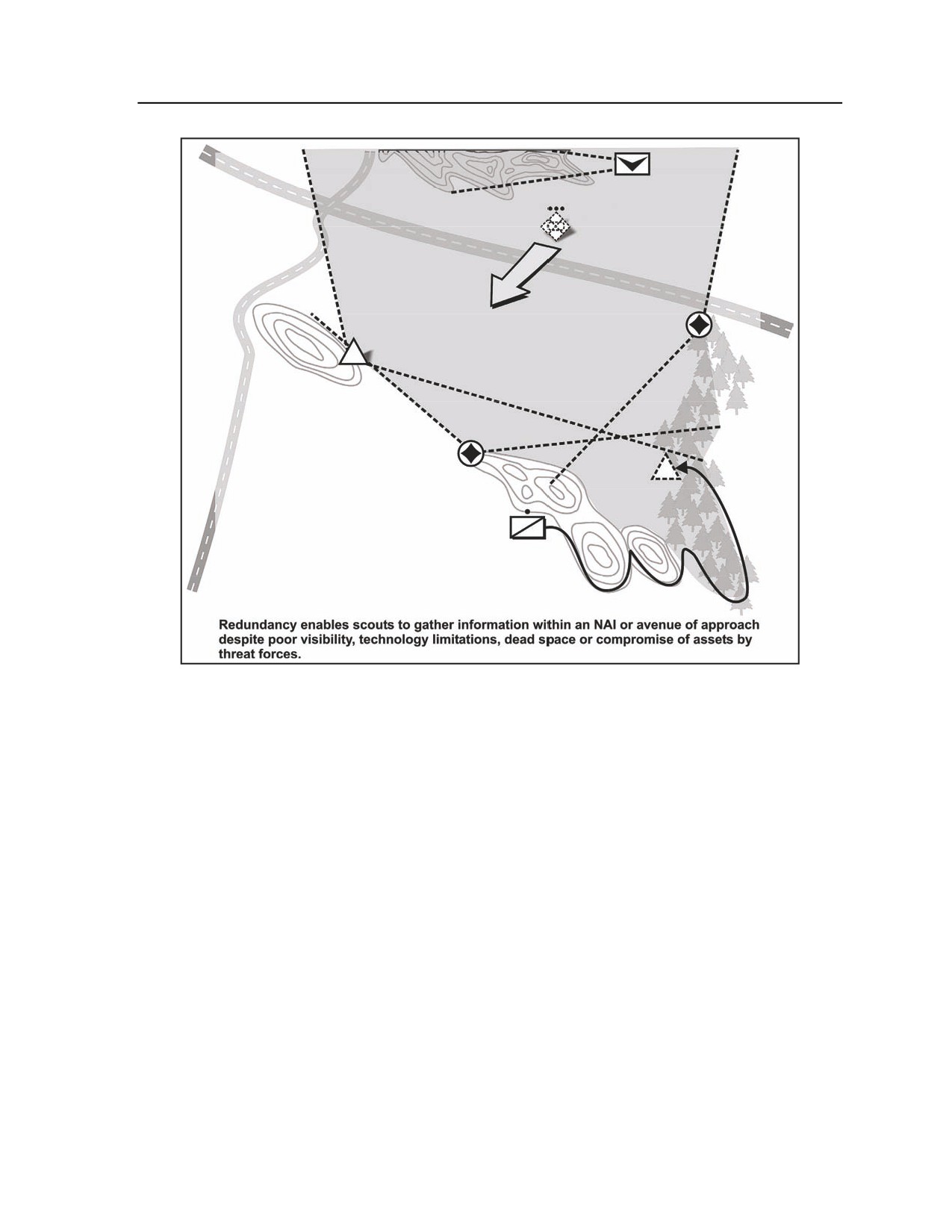
Security Operations
Figure 4-3. Use of redundancy in surveillance operations
Cueing
4-32. Cueing is a technique the platoon leader can use to cover an NAI or avenue of approach when assets
are limited and he lacks the capability for redundancy. He plans contingency tasks that will increase
surveillance on a particular NAI; his surveillance teams execute the tasks when “cued” by activity at that
NAI.
4-33. The reconnaissance or scout platoon initially covers the NAI or avenue of approach either with a
single surveillance team or with a remote electronic signaling device such as ground surveillance systems,
trip flares, or early warning systems. When scouts detect activity, other teams move into preselected
positions to add their capabilities to the surveillance of the NAI or avenue. (Refer to Figure 4-4.)
3 August 2009
FM 3-20.98
4-9
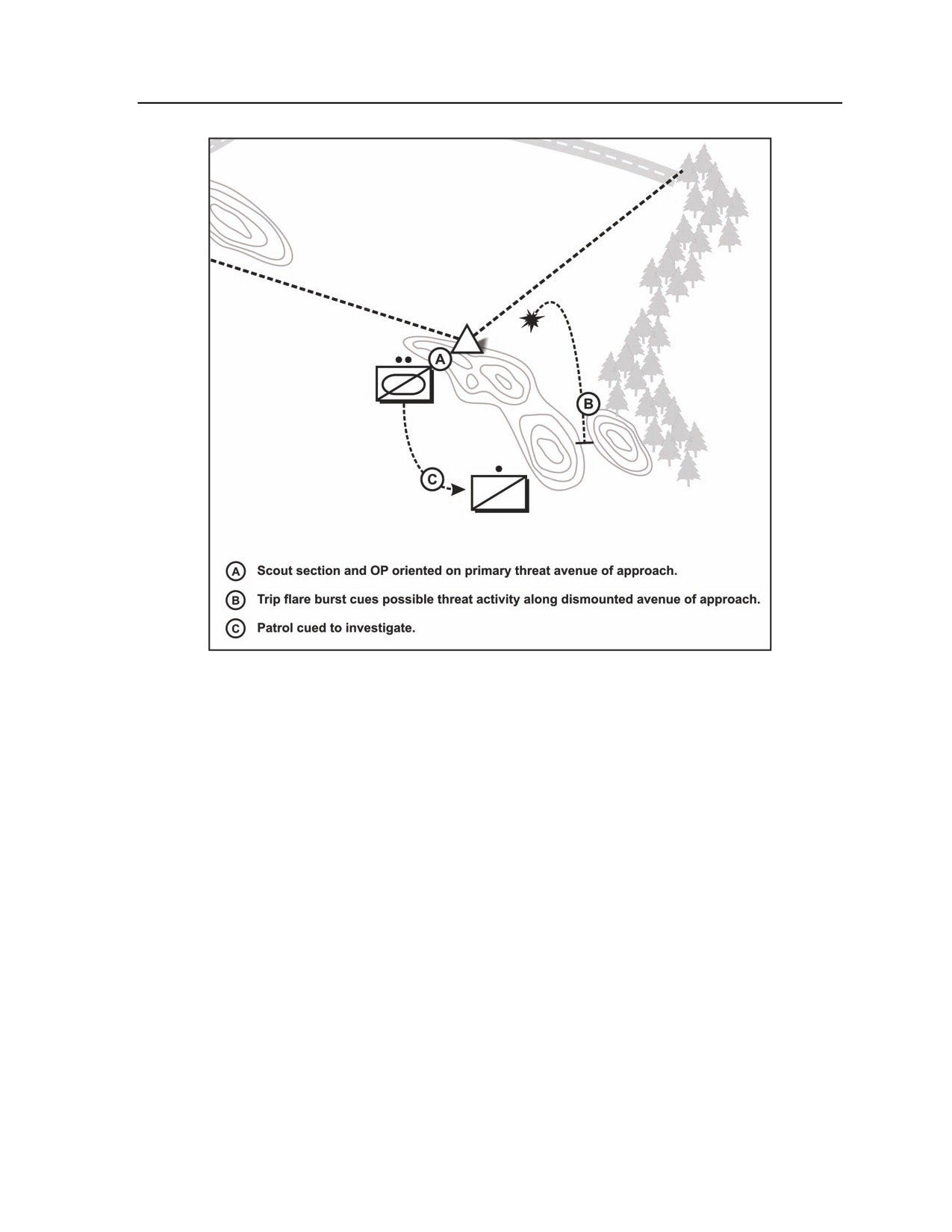
Chapter 4
Figure 4-4. Use of cueing in surveillance operations
PROVIDE EARLY WARNING
4-34. The platoon’s second critical task is to provide early warning of an enemy approach. Effective early
warning requires detailed planning for communications. The platoon leader looks at communications
distances and significant terrain features to identify potential communications problems. If he anticipates
problems, he can address them by requesting support from higher (in the form of CAB or squadron retrans)
or by planning for radio relays and directional antennas. (See Figure 4-5.)
4-10
FM 3-20.98
3 August 2009
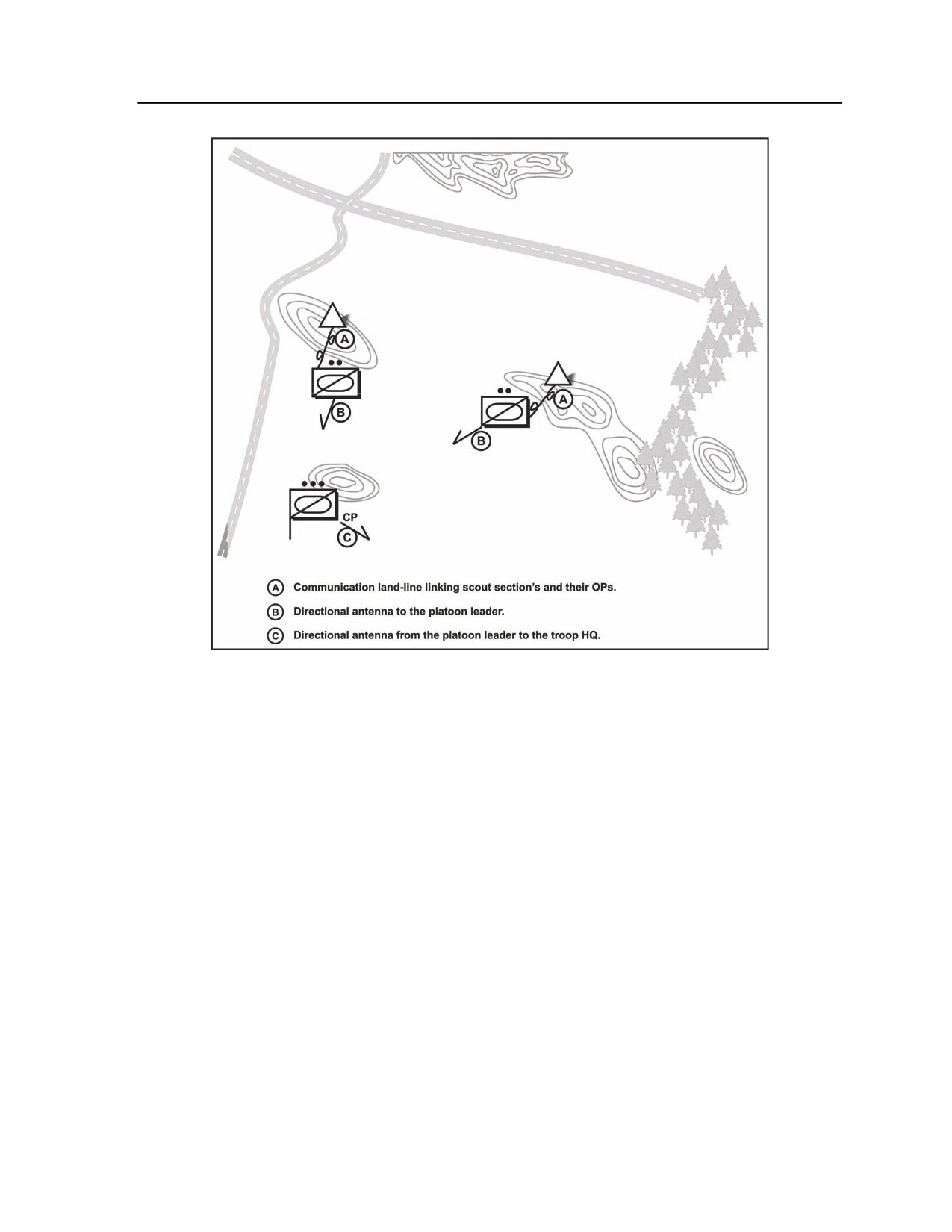
Security Operations
Figure 4-5. Communications scheme to ensure early warning
PERFORM COUNTERRECONNAISSANCE
4-35. Once the platoon leader has planned surveillance of assigned reconnaissance objectives and has
ensured that he can provide early warning, he must next evaluate the enemy’s reconnaissance effort and the
platoon’s assigned role in the conduct of counterreconnaissance. These operations consist of two elements:
the hunter (who acquires the enemy) and the killer (who engages the enemy). The most appropriate role for
the platoon in the counterreconnaissance operation is acquiring enemy reconnaissance assets rather than
killing them, although it does have limited killing capability.
4-36. The commander’s guidance must specifically define the role of the scouts in counterreconnaissance
operations. Once he has a thorough understanding of his commander’s intent, the platoon leader must
consider four factors when planning to acquire enemy reconnaissance elements:
z
Enemy reconnaissance avenues of approach (both mounted and dismounted).
z
When and under what conditions the platoon is likely to encounter enemy reconnaissance
forces.
z
Likely composition of enemy reconnaissance forces in terms of size, organization, and
equipment.
z
Identity and location of friendly reconnaissance-killing forces.
4-37. Enemy reconnaissance forces are not likely to use primary avenues of approach to execute their
operation. To acquire their assigned reconnaissance objectives, the scouts must be oriented on
reconnaissance avenues of approach which may include trails, rough terrain, and dead space that allows
mounted movement, but only for small teams of vehicles. They must also realize that enemy
3 August 2009
FM 3-20.98
4-11
Chapter 4
reconnaissance is most likely to move during periods of limited visibility. A thorough understanding of the
composition of enemy reconnaissance elements allows the scouts to more accurately determine the
enemy’s likely reconnaissance avenues of approach and how best to acquire them. In other words, scouts
war-game how they would move through the area if they were the enemy, and then determine where to find
the enemy element.
4-38. Scouts must consider the OE, including the enemy; their knowledge of the terrain (including the
enemy’s view of the terrain); and available systems’ capabilities to quickly destroy the enemy. Once initial
acquisition of the enemy occurs (by the hunter element), other assets in the CAB, squadron or, even the
brigade are given the specific mission of killing the enemy reconnaissance (the killer element) in or behind
the screen line. These assets should have direct communications with the hunter elements and the platoon
leader. Rehearsals are critical to making this operation successful. The platoon must rehearse all phases of
the operation with the augmenting elements to ensure a single mistake does not allow the enemy to
infiltrate the protected force.
4-39. To make the hunter-killer team proficient, all elements need to be present to rehearse the following
factors in destroying an enemy reconnaissance element:
z
Undetected movement into screen positions.
z
NFAs requested through higher headquarters.
z
Hunter acquisition and reporting of the enemy.
z
Hunter tracking and reporting.
z
Killing element movement into engagement position.
z
Handover to killer element for engagement.
z
Exploitation of destroyed enemy element for intelligence, if possible.
z
Repositioning of hunter-killer team for acquisition of follow-on threats.
4-40. The counterreconnaissance task is extremely resource-intensive. It is generally most effective when
conducted by an element larger than a single reconnaissance or scout platoon. The platoon by itself does
not have sufficient assets to both acquire and kill an enemy. In addition, it may not be able to observe all
reconnaissance avenues of approach and still maintain surveillance on the enemy’s main avenues of
approach. The commander’s intent is critical to resolving this dilemma.
Note. The use of phased operations with distinct triggers to denote the beginning and end of
each phase greatly enhances the platoon leader’s ability to conduct counterreconnaissance and
shift forces to answer the commander’s CCIR.
4-41. When the platoon must acquire both enemy reconnaissance elements and the main body, the priority
in the early stages of the operation will be on the reconnaissance forces, focusing on the reconnaissance
avenues of approach. The platoon will then track the echeloned arrival of enemy elements in the AO and
shift priority to the main avenues of approach. This technique permits the platoon leader to time-phase
priorities based on conditions in the AO. The platoon leader, however, must recognize (often by satisfying
the CCIR) when to change priority to the main avenue of approach. (See Figures 4-6 and 4-7.)
4-12
FM 3-20.98
3 August 2009
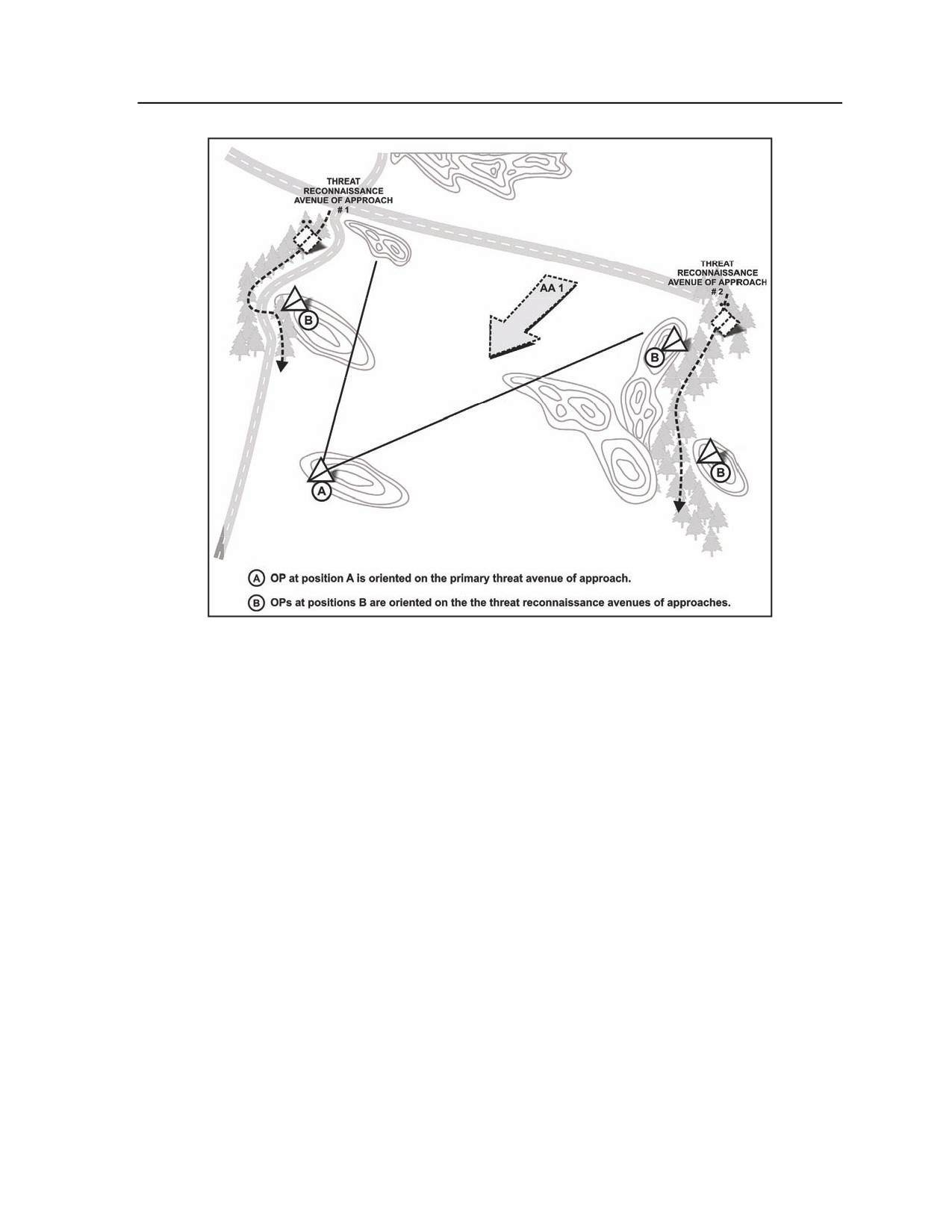
Security Operations
Figure 4-6. Counterreconnaissance operation (part one)
3 August 2009
FM 3-20.98
4-13
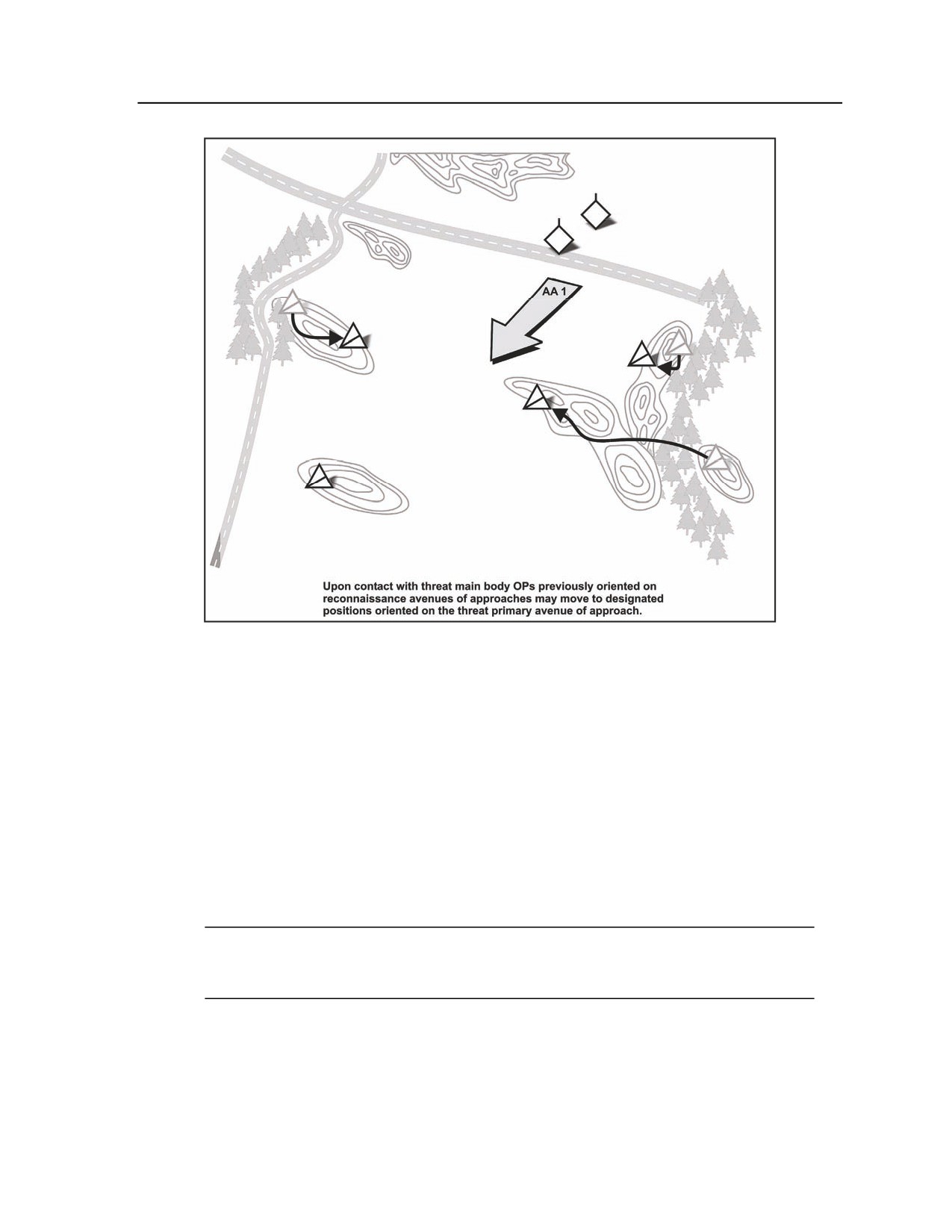
Chapter 4
Figure 4-7. Counterreconnaissance operation (part two)
MAINTAIN CONTACT
4-42. After reporting information on enemy reconnaissance elements and locating the enemy main body,
the platoon must maintain contact until authorized to hand over contact to another friendly element. This is
one of the most difficult tasks for the individual section or squad to accomplish because of the size of the
AO and the distance the element can move prior to enemy detection. Therefore, maintaining contact is best
accomplished through a platoon effort creating interlocking fields of observation.
4-43. The preferred method of maintaining contact with a moving enemy is to position echeloned OPs in
depth along the avenue of approach. This allows one OP to hand over contact to another OP. As the enemy
force reaches the edge of their sector, the OP conducts a handover to another OP without the requirement
for the OPs to physically displace. This technique requires the platoon to have interlocking visibility and to
pre-position OPs in depth. (See Figure 4-8.) OPs must rehearse passing contact of the enemy to another
element so that if contact is lost, OPs can take action to regain contact.
Note. OPs must be prepared to execute RHO with adjacent units outside of the platoon
organization. This is best done by having a POC from each templated OP present at the
combined arms rehearsal and ensuring that the OPs have access to the latest SOI.
4-14
FM 3-20.98
3 August 2009
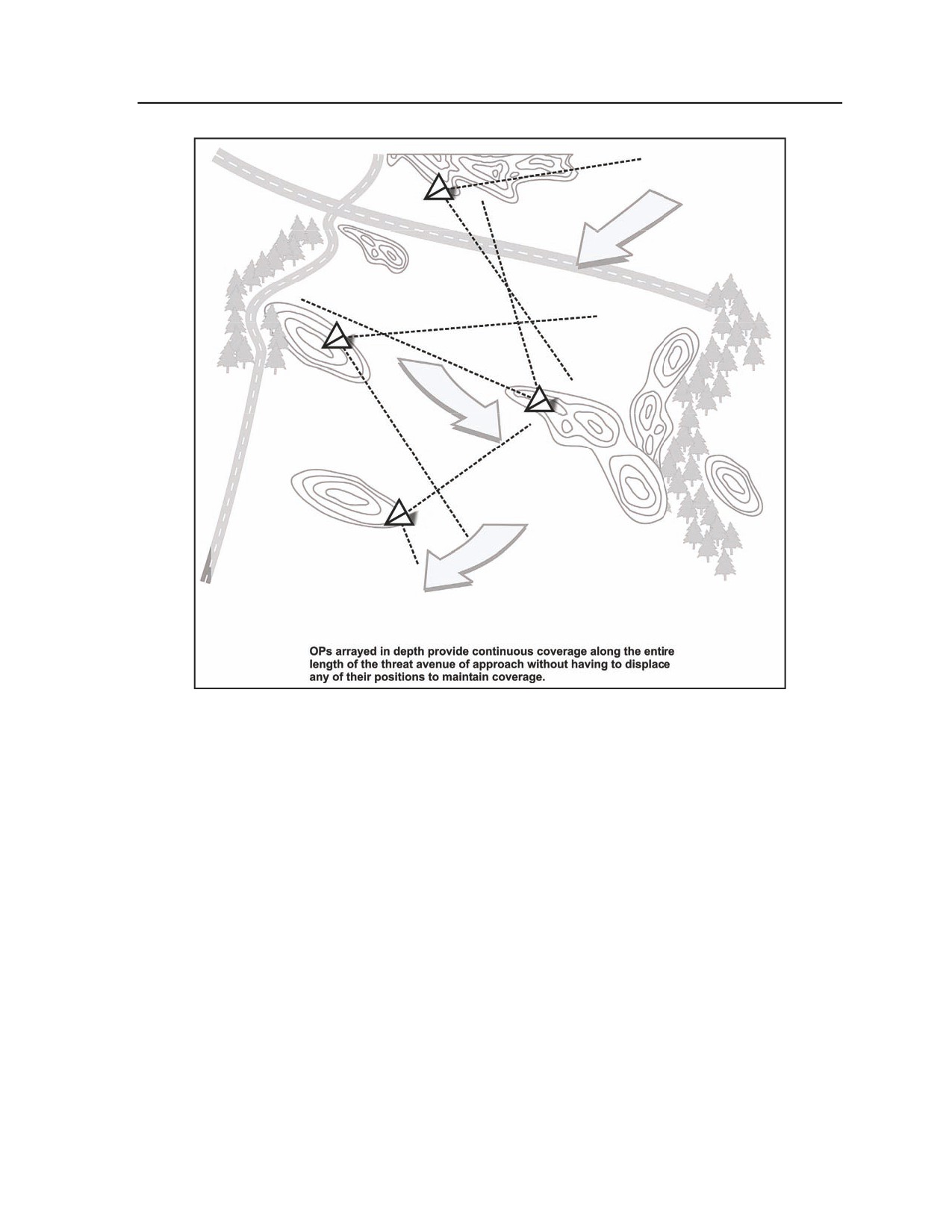
Security Operations
Figure 4-8. OPs maintain contact in depth
4-44. Another technique used to maintain contact is to displace in front of a moving enemy. This technique
is very difficult because the scouts must move to the rear faster than the enemy is moving forward. This
often exposes the scouts to enemy fire. Additionally, if they attempt to use covered and concealed routes
only, they risk moving too slowly, having the enemy bypass them, and losing contact. Figures 4-9 and 4-10
illustrate how scouts can conduct displacement while maintaining contact. To counter potential problems,
scouts conduct detailed map reconnaissance and thorough rehearsals to learn the terrain as they reconnoiter
their movement to and around the OP locations.
3 August 2009
FM 3-20.98
4-15
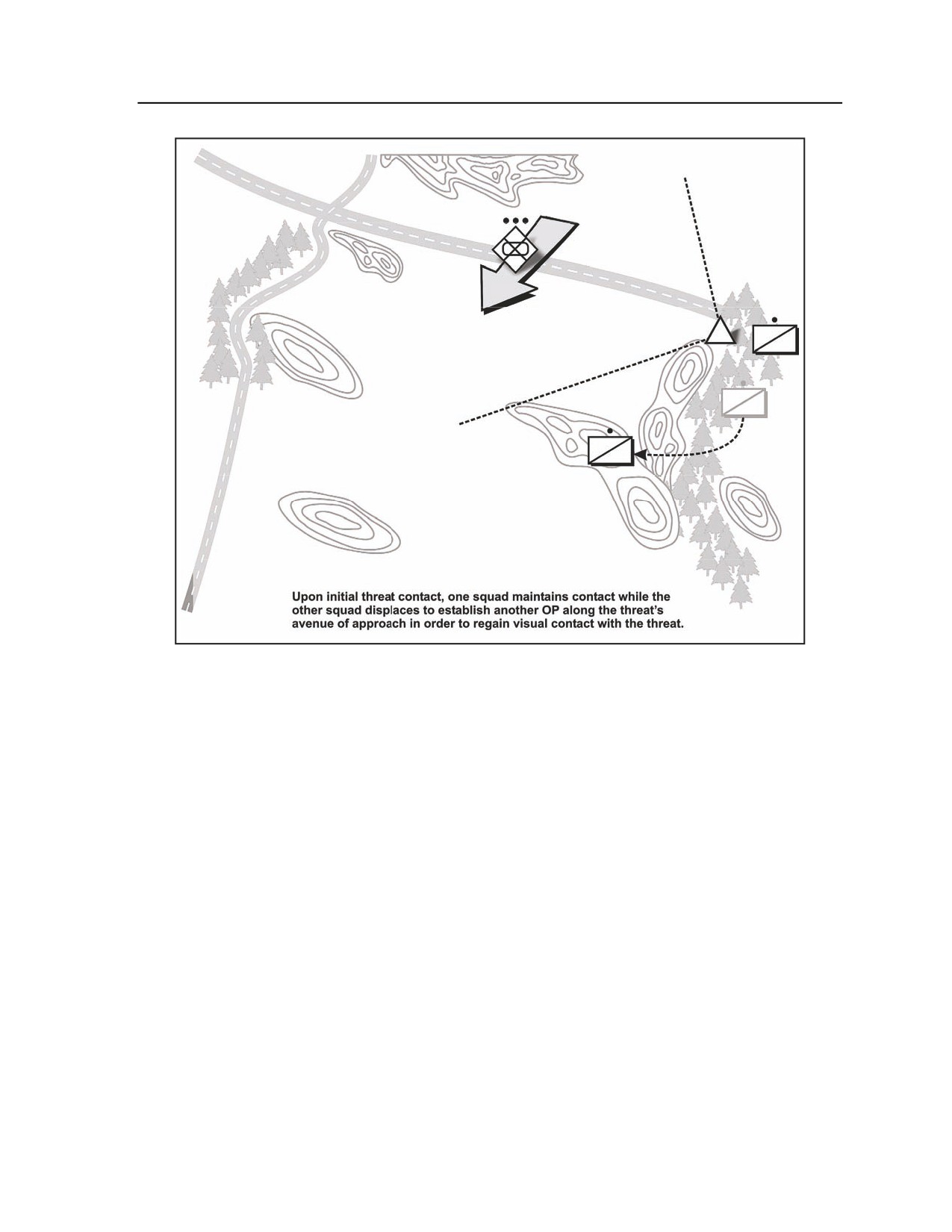
Chapter 4
Figure 4-9. OPs displace to maintain contact (part one)
4-16
FM 3-20.98
3 August 2009
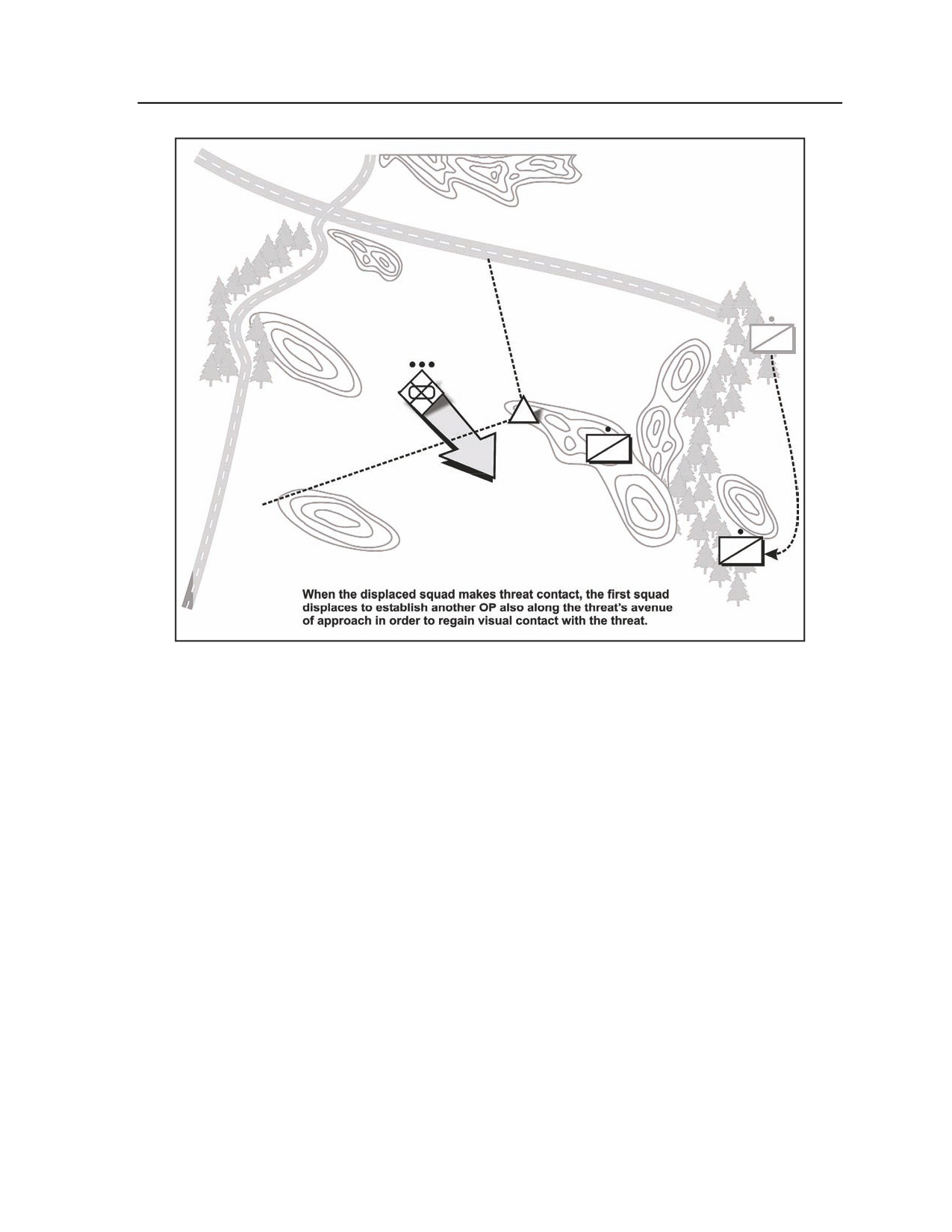
Security Operations
Figurer 4-10. OPs displace to maintain contact (part two)
4-45. A third technique of maintaining contact is a combination of the two discussed earlier. Leaving the
original dismounted OP in position (with a vehicle in support, if possible), the platoon leader repositions
the remainder of the section in depth as either a mounted or dismounted OP. This OP can be established or
reoriented to maintain contact until the element in contact hands over the enemy to a killing element or a
maneuver element positioned behind the screen. The platoon must maintain observation of assigned
NAIs/avenues of approach. Situations may occur in which the scouts request that other assets maintain the
screen while they meet a surveillance coverage requirement such as moving forward for deeper
observation. The platoon leader can also request or coordinate handover to maintain the screen. This
technique reduces both the time associated with moving OPs and the likelihood of compromising the
platoon’s reconnaissance elements (see Figures 4-11 and 4-12).
4-46. No matter how the platoon plans to maintain contact, the platoon leader should attempt to rehearse
the method, especially if it requires reconnaissance elements to displace or move to alternate positions.
This will help the commander and platoon leader to validate the method they have chosen or to choose
another one if it becomes necessary.
3 August 2009
FM 3-20.98
4-17
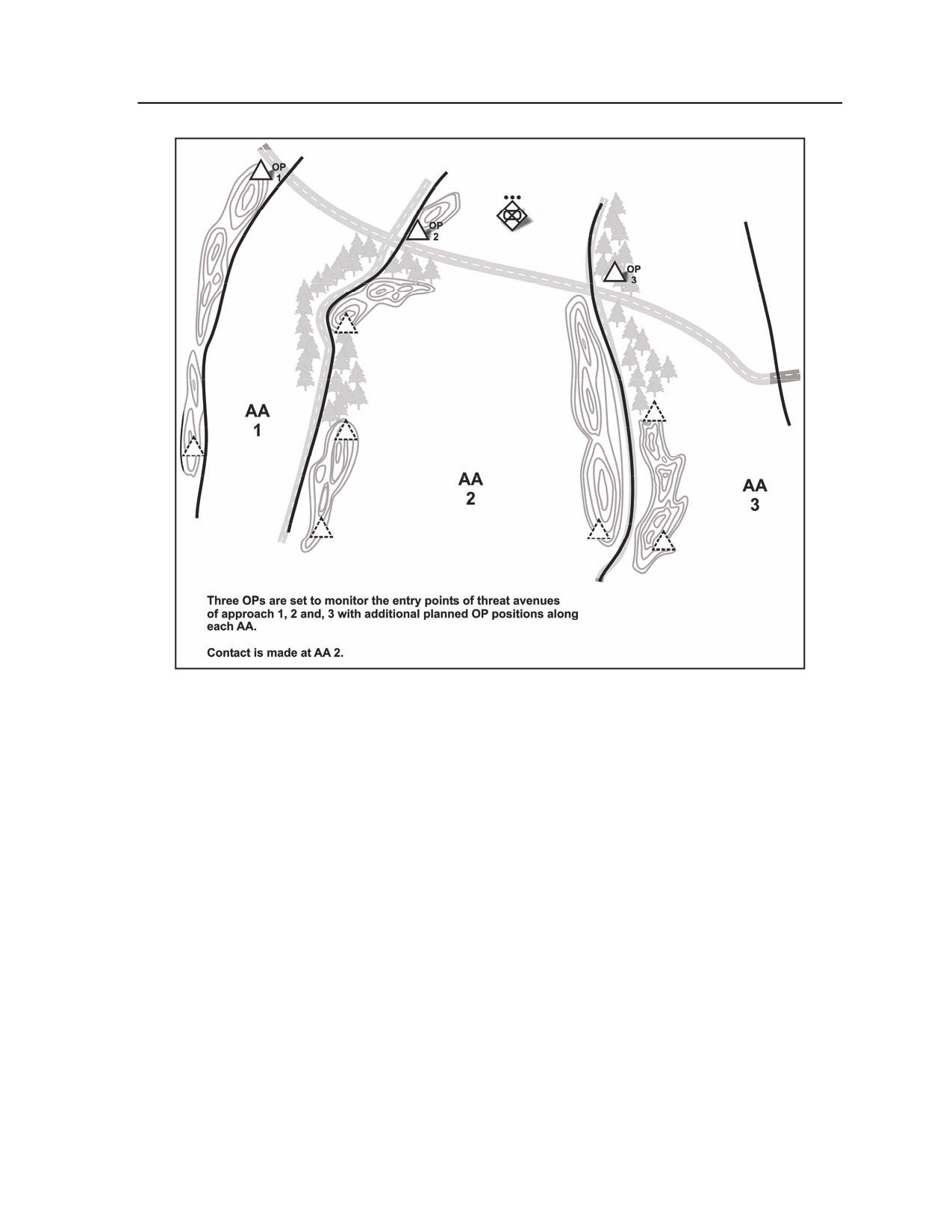
Chapter 4
Figure 4-11. OPs maintain contact with combination
of depth and displacement (part one)
4-18
FM 3-20.98
3 August 2009
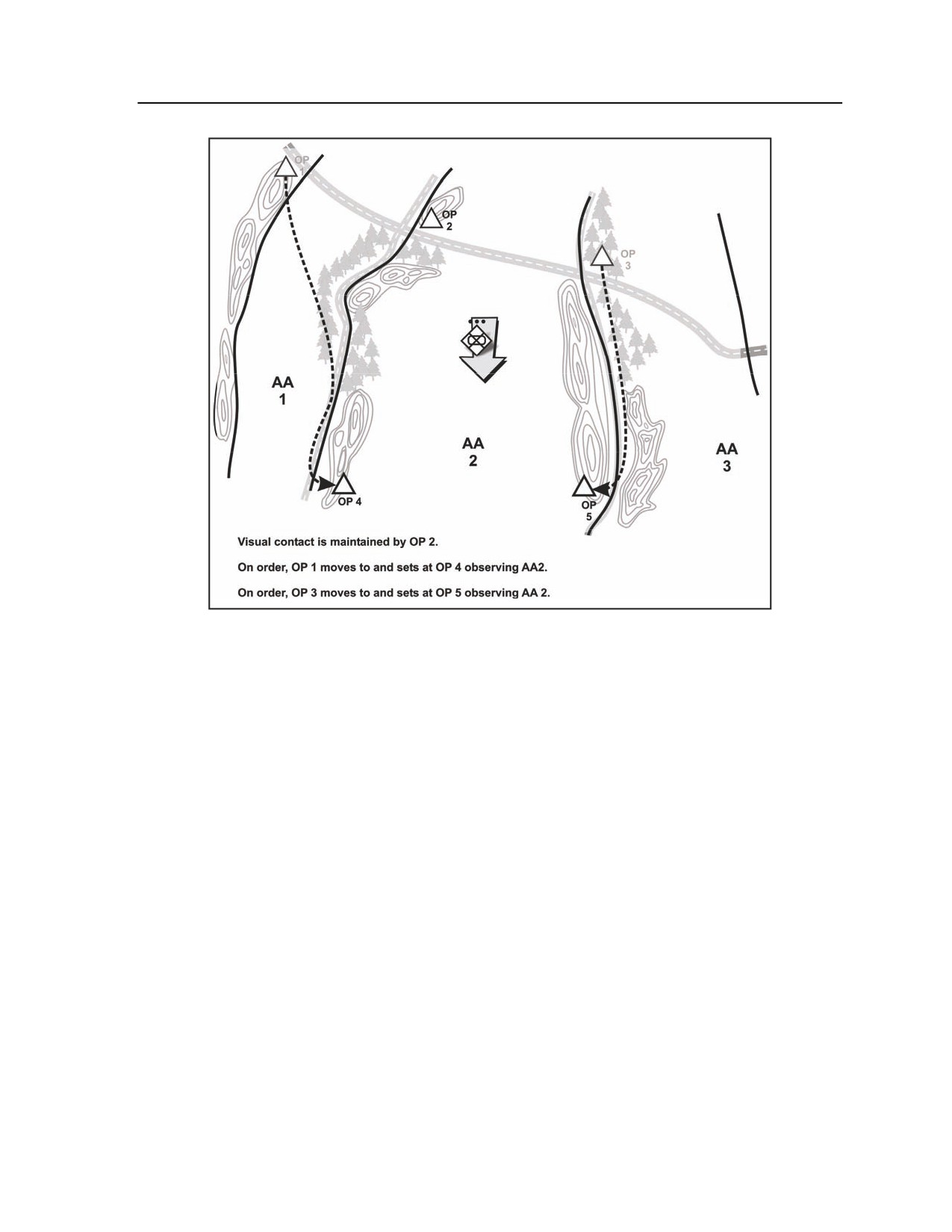
Security Operations
Figure 4-12. OPs maintain contact with combination
of depth and displacement (part two)
DISRUPT AND DELAY
4-47. Reconnaissance and scout platoons should attempt to harass and impede the enemy using indirect
fire. They should focus on expected avenues of approach, choke points, the enemy rate of march, and
artillery time of flight to determine trigger lines (or points) that allow accurate engagement of the enemy
(time of flight information from available weapon systems should be made available to scouts and
rehearsed). A technique for planning the use of triggers is to have a dismounted OP, sited forward of its
supporting vehicle, observe the triggers and initiate fires, with the vehicle OP observing the impact zone
and adjusting the fires (on terrain that offers slower movement, the forward OP may be able to observe the
impacts). Leaders may also request available CAS assets and CCA aircraft for interdicting fires. Every
scout in the reconnaissance platoon must be proficient in planning, coordinating, and calling for indirect
fires, such as linear sheaths on main avenues of approach.
4-48. Accurate artillery fire will have an immediate effect on the enemy force. Accurate fires disrupt
formations as individual vehicles change speed, button up, or are destroyed or disabled. C2 deteriorates as
vision is restricted and antennas are lost. This loss of vision and C2 restricts the enemy’s ability to spot
displacing friendly forces. The enemy may also compromise his own momentum and combat power if he
attempts to locate the element directing the fire. Scouts directing fires from dominant terrain should remain
aware that the enemy will target such terrain.
COUNTERRECONNAISSANCE TECHNIQUES
4-49. Counterreconnaissance is a directed effort to prevent friendly forces from observation or infiltration
by enemy reconnaissance elements. Countering the enemy’s mounted and dismounted reconnaissance
elements is the first and possibly most important step in ensuring the protected element can successfully
3 August 2009
FM 3-20.98
4-19
Chapter 4
accomplish its mission. It can be extremely difficult to identify enemy reconnaissance forces, especially
dismounted forces. The platoon may lack the resources to deploy effectively and detect infiltration. As a
result, scouts execute counterreconnaissance most successfully as part of a combined arms effort at troop,
squadron, and CAB levels.
PLANNING CONSIDERATIONS
4-50. The concept of executing counterreconnaissance must address how the unit will accomplish the two
aspects of counterreconnaissance: acquiring the enemy and then destroying it. At CAB/squadron level, the
S-2 provides key input in this determination. The S-2 identifies—
z
Reconnaissance avenues of approach in the unit sector.
z
Types of reconnaissance elements the enemy might use in the sector.
z
Enemy elements that are most likely to move into the sector.
4-51. It is especially important for the S-2 to note the locations and activities of dismounted enemy
elements, which present the greatest danger to the platoon and the supported unit. Information from the S-2
is integrated into the OPORD and is part of the unit’s IPB.
4-52. The commander should discuss conduct of counterreconnaissance in the OPORD or FRAGO,
indicating how elements will organize and conduct the operation throughout the depth of the AO. This
information should include planning considerations for the operation, including the following:
z
Direct fire planning and coordination.
z
Observation planning and coordination.
z
C2.
z
Employment of augmenting elements.
z
RHO.
4-53. In all counterreconnaissance operations, the goal is to destroy the enemy reconnaissance forces. The
reconnaissance or scout platoon’s role in these operations will usually be to conduct a screen operation to
acquire and identify enemy reconnaissance forces. This requires that the scouts acquiring the target stay
well hidden to prevent the enemy from detecting the location and orientation of the screen line. In most
cases, the platoon does not have the capability to acquire, identify, and defeat the enemy reconnaissance by
itself. Commanders task other combat elements to fight and destroy the enemy reconnaissance elements
while the scouts observe for follow-on elements or prepare to have elements track the escaping enemy.
ORGANIZATION
4-54. Organizational options available to the commander to counter the enemy reconnaissance effort
include—
z
Reconnaissance or scout platoon operating alone.
z
Reconnaissance or scout platoon with attached killing force.
z
Reconnaissance or scout platoon and company team.
Reconnaissance or Scout Platoon (Operating Alone)
4-55. This technique places the responsibility for counterreconnaissance on the reconnaissance or scout
platoon. It requires maximum use of any attached enabling assets to acquire the enemy, freeing the scouts
to perform the killing function of counterreconnaissance. CFV-equipped platoons are best able to perform
this task. The platoon leader places acquiring assets along the screen line, which should include the use of
dismounts forward of the vehicles. Next, the platoon leader positions his designated killing teams in depth.
The killing assets of the platoon occupy positions on likely enemy reconnaissance routes. Where engineer
support is available, killing vehicles should be in hull or turret down positions to prevent observation as the
enemy moves into their vicinity. Positioning of vehicles must be flexible enough to respond to additional
enemy elements moving on other routes.
4-20
FM 3-20.98
3 August 2009
Security Operations
Note. When the platoon operates with units that commonly have strikers or COLTs attached,
such as those of the IBCT and BFSB, the platoon leader may have to integrate NAIs to support
the TAIs positioned in depth. This will place the scouts in the role of acquiring the enemy, with
the strikers/COLTs as the killers in depth employing artillery or CAS.
4-56. This technique requires the platoon’s sections or squads to reconnoiter alternate positions and routes
that permit quick repositioning once the acquiring elements make contact and to maintain contact under
favorable conditions. When it is used, leaders prioritize counterreconnaissance tasks in the early stages of
the screen operation.
Reconnaissance or Scout Platoon with Attached Killer Element
4-57. This team technique requires the close integration of a reconnaissance or scout platoon and an
element capable of defeating the known level of threat. Platoon leaders must plan for the employment of a
MGS or tank platoon to execute counterreconnaissance tasks. Platoon leaders consider using a Bradley
section and its associated infantry squads, especially for a dismounted enemy. The reconnaissance platoon
acts as the acquiring element, and the attached MGS, tank, or Bradley sections act as the killing element.
The reconnaissance platoon leader, whose element makes first contact, commands the
counterreconnaissance effort. The platoon leader pairs the killing force with a reconnaissance platoon’s
section (one scout section supported by a killing element at a minimum). During this operation, the PSG
positions himself to conduct CASEVAC operations, resupply operations, and if necessary, guide additional
killing elements forward to support the operation.
Note. In a cavalry or reconnaissance troop, the troop commander may control and coordinate
the effort. In a CAB, the platoon leader may control and coordinate the effort with guidance
from the S-2 because timing is critical as the enemy attempts to move through the screen
undetected.
4-58. The scouts may acquire the enemy with surveillance techniques and/or sensors. The killing force
should occupy a battle position (BP) overlooking likely reconnaissance avenues and wait for orders to
occupy their firing positions. They are prepared to move to previously reconnoitered alternate positions
based on reports coming from the scouts. This organization will be most effective when the two platoons
establish a habitual relationship. Refer to Figure 4-13 for an illustration of this technique using an SBCT
counterreconnaissance team made up of a reconnaissance element (reconnaissance platoon) and a killer
element (MGS platoon). The scouts have marked avenues of approach, routes, and lanes to direct the
killing force in engaging the enemy.
3 August 2009
FM 3-20.98
4-21
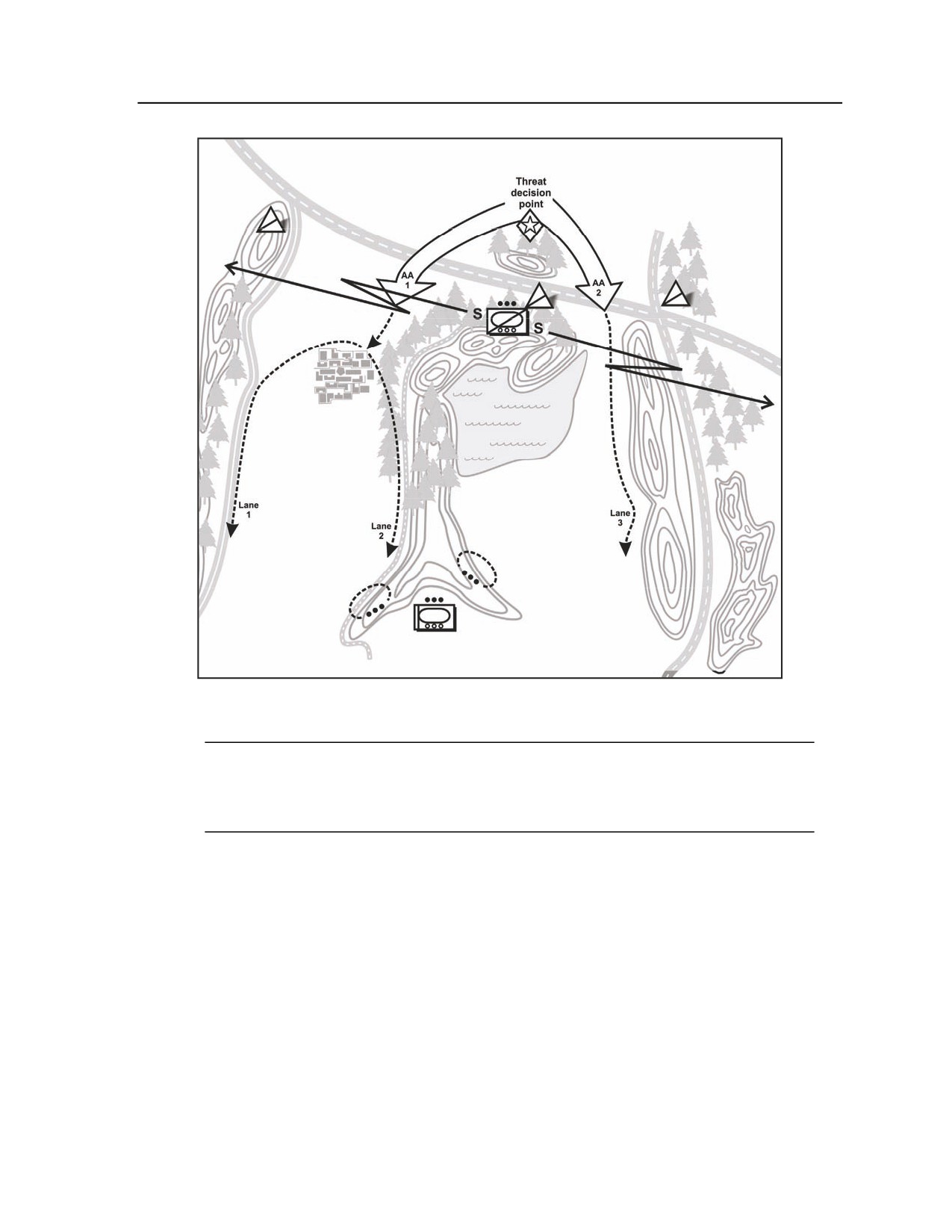
Chapter 4
Figure 4-13. Counterreconnaissance team
(reconnaissance and MGS platoons)
Note. As reconnaissance or scout platoons move forward into the screening area, they must not
leave evidence of their presence while locating the routes and lanes the enemy may use. If the
platoon is detected, the enemy reconnaissance elements may withdraw and direct larger units
into the screening area for a decisive engagement.
Reconnaissance or Scout Platoon and Company Team
4-59. This technique uses a reconnaissance or scout platoon—either attached or under operational control
(OPCON)—and a company team to execute counterreconnaissance and security operations. CAB
reconnaissance platoons primarily execute this technique. The company team commander controls the
security effort. The reconnaissance or scout platoon is the primary acquiring element, but it can be
supplemented with infantry assets from the company team and enabling assets from the battalion. The
commander uses all other assets as the killing element.
4-60. This is the most lethal counterreconnaissance technique and has the combat power to be very
effective. It also has organic sustainment assets for quicker and more responsive support. Major
disadvantages of this technique are the combat power it diverts from the main effort and the execution
problems that may result if the scouts and the killing elements have not trained together. See Figure 4-14.
4-22
FM 3-20.98
3 August 2009
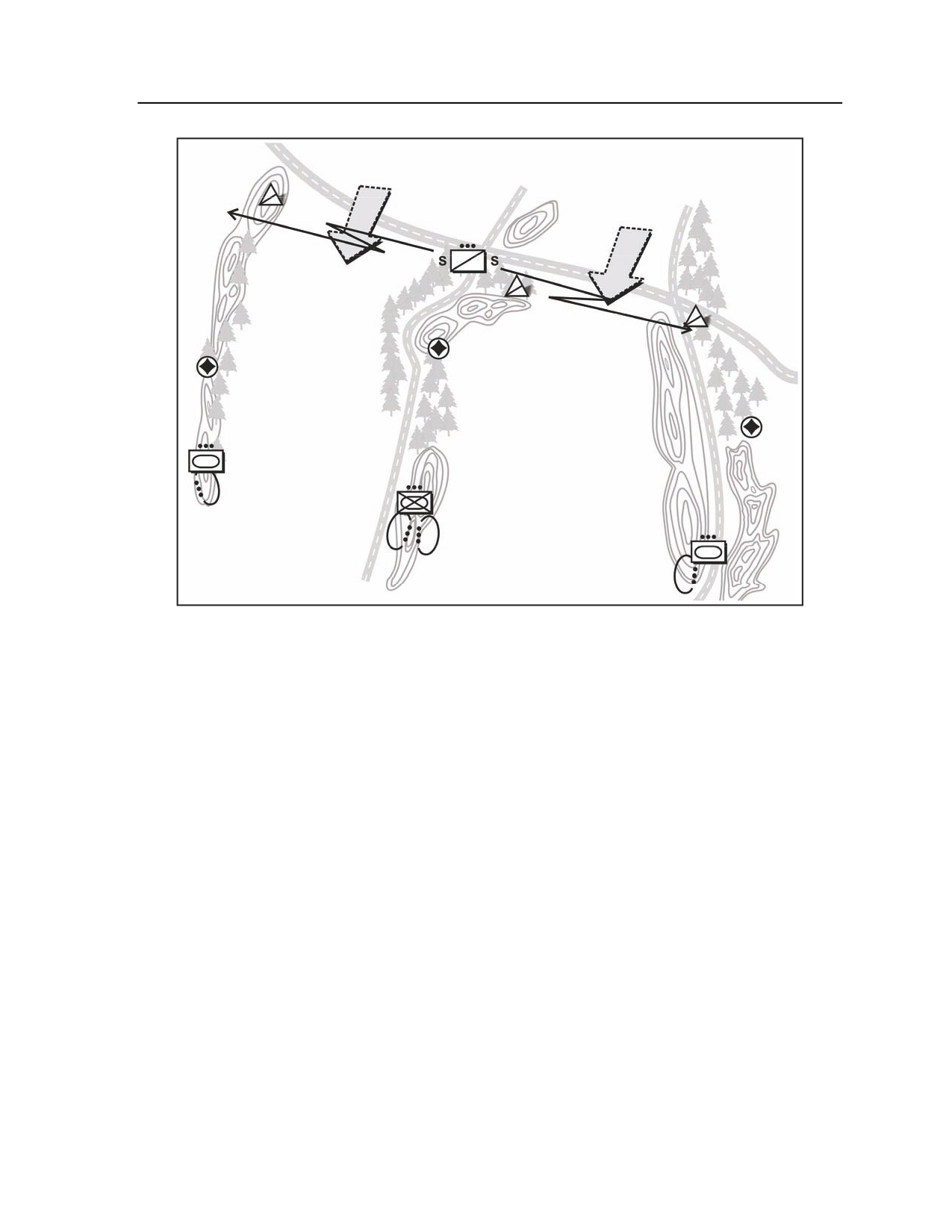
Security Operations
Figure 4-14. Counterreconnaissance team
(reconnaissance platoon and company team)
3 August 2009
FM 3-20.98
4-23
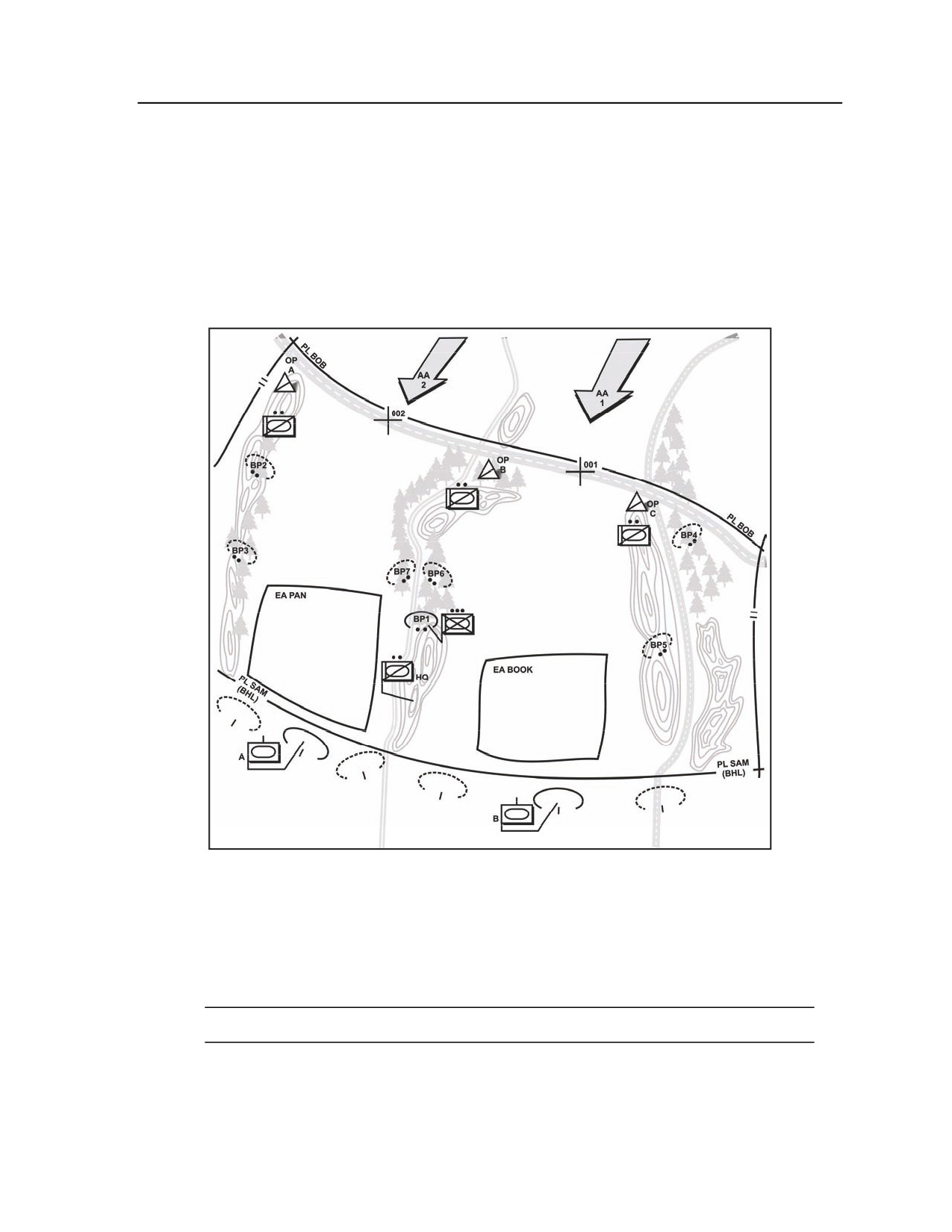
Chapter 4
EXAMPLE OF A SCREEN OPERATION
4-61. The following example illustrates a screen operation by an HBCT CAB reconnaissance platoon,
conducted in conjunction with a deliberate defense. The screen operation can be conducted in similar
fashion by all types of reconnaissance and scout platoons.
4-62. The CAB reconnaissance platoon is operating ahead of the battalion (see Figure 4-15). The CAB has
transitioned from a movement to contact to a screen for
24 hours to regain the initiative. The
reconnaissance platoon has been assigned the operation to screen in sector between PL BOB and PL SAM.
The troop will hand over enemy contact as the enemy crosses PL SAM. The platoon leader decides to
screen with three sections on line, with subsequent positions to the rear.
Figure 4-15. Example screening operation (part one)
4-63. The primary focus of the CAB reconnaissance platoon is acquiring all enemy elements moving along
avenues of approach 1 (AA1) and 2 (AA2). Because of the width of the sector, the reconnaissance platoon
has permission to engage enemy reconnaissance patrols smaller than section size, but only under favorable
conditions (under 500 meters and without warning). In this situation, the platoon is supported by a hunter-
killer team consisting of two M1A2s and two M2A3s. (Hunter-killer teams are common within the ACR
organization; however, they can also be constituted within a CAB in the HBCT.)
Note. CFV-equipped scouts may be tasked to engage enemy elements up to platoon size.
4-64. The hunter-killer team’s task is to destroy enemy reconnaissance elements in the screen up to platoon
size. The hunter-killer team will start the operation in BP1 and is prepared to move to and occupy
additional BPs on order. A UAS section will support the operation from the rear of PL SAM.
4-24
FM 3-20.98
3 August 2009
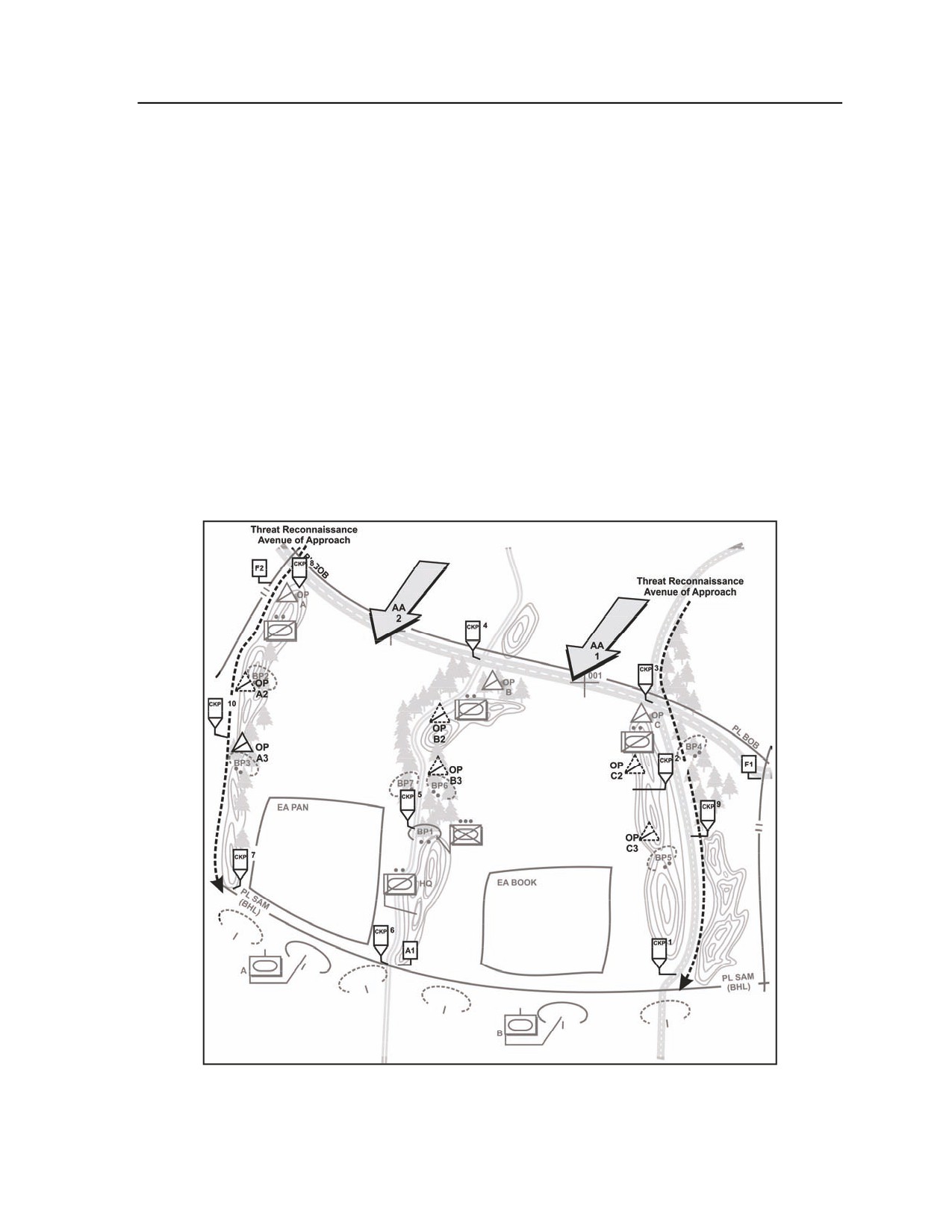
Security Operations
4-65. With guidance from his S2, the reconnaissance platoon leader evaluates the resources available to
accomplish his tasks. Because the mission length is estimated at 24 hours and includes patrols, he plans for
three long-duration OPs. The placement of three OPs prevents infiltration with interlocking observation
across the entire sector to include the platoon flanks. He places Section Alpha to observe AA2 from OP A,
Section Bravo to observe center sector from OP B, and Section Charlie to observe AA1 from OP C.
Positioning of these OPs is critical, especially during inclement weather and degraded conditions. A map
reconnaissance indicates that reconnaissance avenues of approach are probably located along the platoon’s
boundaries (vicinity of checkpoints 3, 9, 1, 8, 10, and 7), as illustrated in Figure 4-16.
4-66. The platoon leader plans to conduct dismounted patrols in the dead space and along reconnaissance
avenues of approach. To aid in this, he will emplace sensors for monitoring. In addition to his primary
positions, the platoon leader plans alternate and subsequent OPs throughout the depth of his sector. He
selects these positions based on his requirements to reposition if an OP is compromised and to maintain
contact with the enemy main body throughout the depth of the sector (see Figure 4-16). The platoon leader
uses feedback from the OPs to identify actual dead space for the UAS to monitor on the flanks of the
sector.
4-67. The platoon leader briefs his plan to the S2 and the CAB commander at the TOC as the platoon
conducts PCCs. He plots the tentative OP locations, checkpoints, contact points, and potential hasty
obstacles or minefields. He reports these locations to the commander, TOC, and FIST and updates the
situational picture in FBCB2. To reduce fratricide risk, the platoon leader coordinates with the hunter-killer
team leader and PSG so target handover on the screen can be completed quickly and effectively.
Figure 4-16. Example screening operation (part two)
3 August 2009
FM 3-20.98
4-25
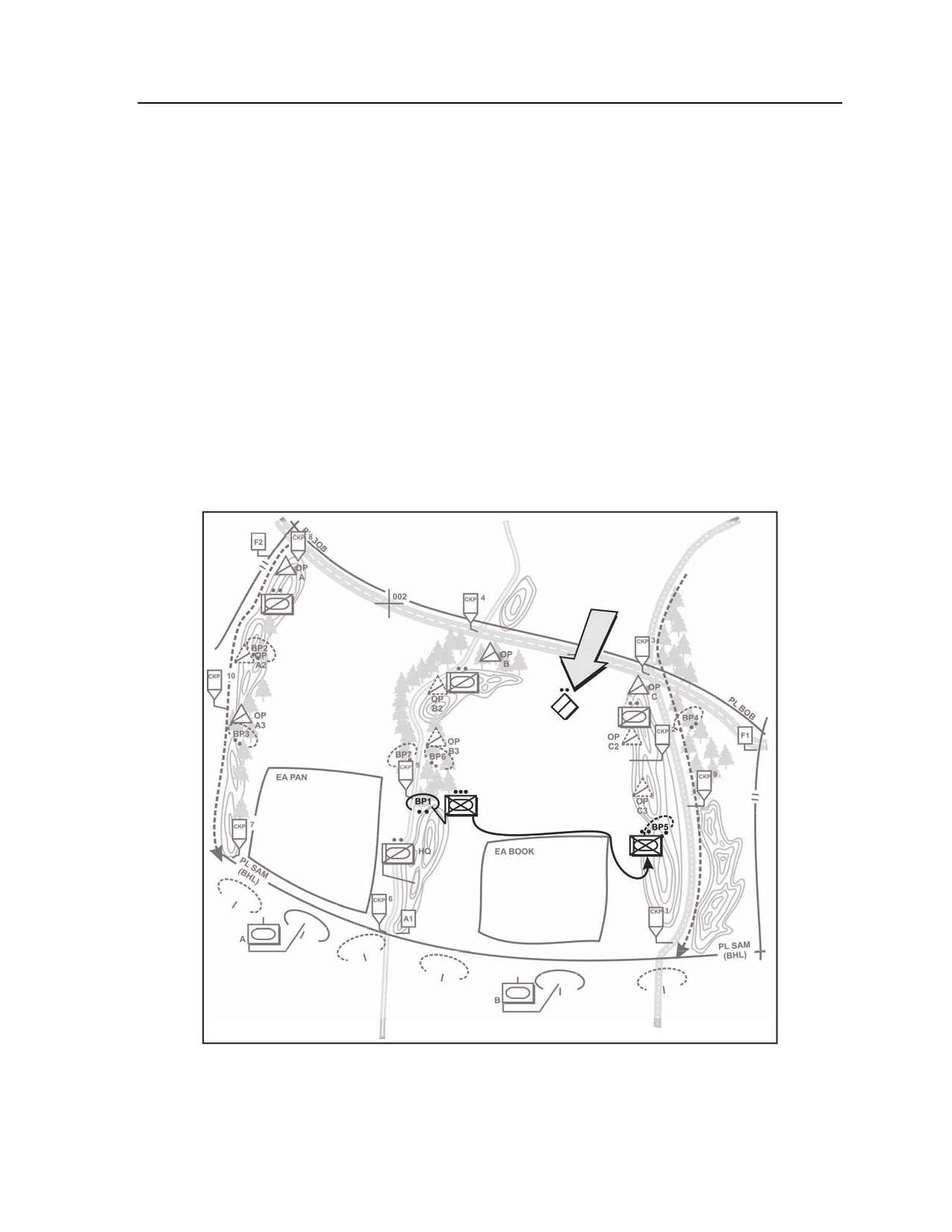
Chapter 4
4-68. As the reconnaissance sections arrive at their assigned positions (OPs A, B, and C), they adjust the
OPs to best meet the intent of the platoon leader and report “SET.” Radio checks and LOS confirmation
with the hunter-killer team ensure that the scouts’ locations are confirmed and that possible enemy
infiltration routes are identified. After each OP reports
“ESTABLISHED” to the platoon leader, the
reconnaissance sections execute security patrols in dead space, emplace sensors, and report information in
accordance with the platoon’s screen plan. Patrols look for signs of recent activity on the ground so they
can detect recently used infiltration routes. Hasty obstacles such as modular pack mine systems (MOPMS)
may be emplaced at this time, but only after permission is confirmed through the command and
disseminated to units in the area. Careful consideration is given to determine if the situation allows for
recovery of the MOPMS if the OPs must fall back to subsequent positions.
4-69. After a period of time, the UAS team leader reports heat signatures in a wooded area north of the
screen. HMMWVs with LRAS3 soon confirm the enemy presence. About 20 minutes after the contact is
reported and the SA updated, OP C reports contact with an enemy reconnaissance patrol consisting of two
BRDMs (see Figure 4-17). The reconnaissance patrol exits the reconnaissance avenue of approach and
follows AA1. Based on the platoon leader’s guidance, the section takes no action, remains hidden, and
continues to report details of the enemy presence. The platoon leader forwards the report to the S2, updates
the FBCB2, and receives instructions to conduct target handover with the hunter-killer team in BP1. The
hunter-killer team is tracking the reports by monitoring radio traffic. Based on his commander’s guidance,
the reconnaissance platoon leader moves two infantry fighting vehicles (IFV) to BP5 to engage and destroy
the enemy. The IFVs return to BP1 once the engagement is finished.
Figure 4-17. Example screening operation (part three)
4-26
FM 3-20.98
3 August 2009
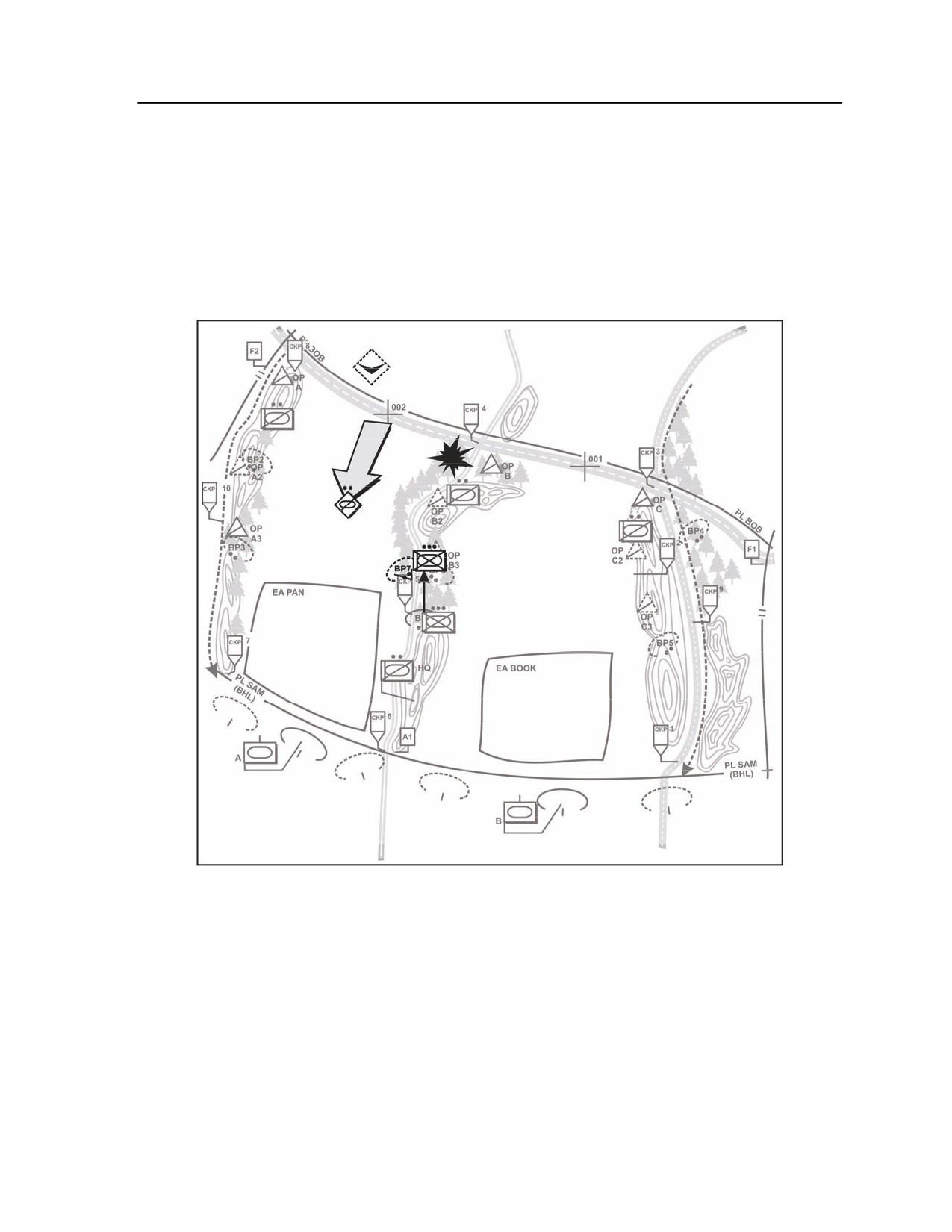
Security Operations
4-70. A short time later, the scouts in OP A report a mortar strike in the vicinity of OP B and a possible
enemy UAS in the air. This is followed by contact with a heavier enemy combat reconnaissance patrol
(three BMPs), moving south along AA2. Having monitored the developing enemy situation, the S2 and
CAB commander order the hunter-killer team to occupy BP7 and engage the enemy. The hunter-killer team
coordinates target handover with the reconnaissance platoon leader, then engages and destroys the enemy
element. Since the engagement occurred within 500 meters, the reconnaissance PSG, accompanied by an
infantry squad from the hunter-killer team, moves up to the destroyed vehicles and conducts SE to gain any
possible information about the enemy. The documents, radios, and other materials are cataloged and
rapidly handed off to the HHC first sergeant (1SG) in the vicinity of contact point A1 at PL SAM. Once
the handover is complete, all elements return to their locations (see Figure 4-18).
Figure 4-18. Example screening operation (part four)
3 August 2009
FM 3-20.98
4-27
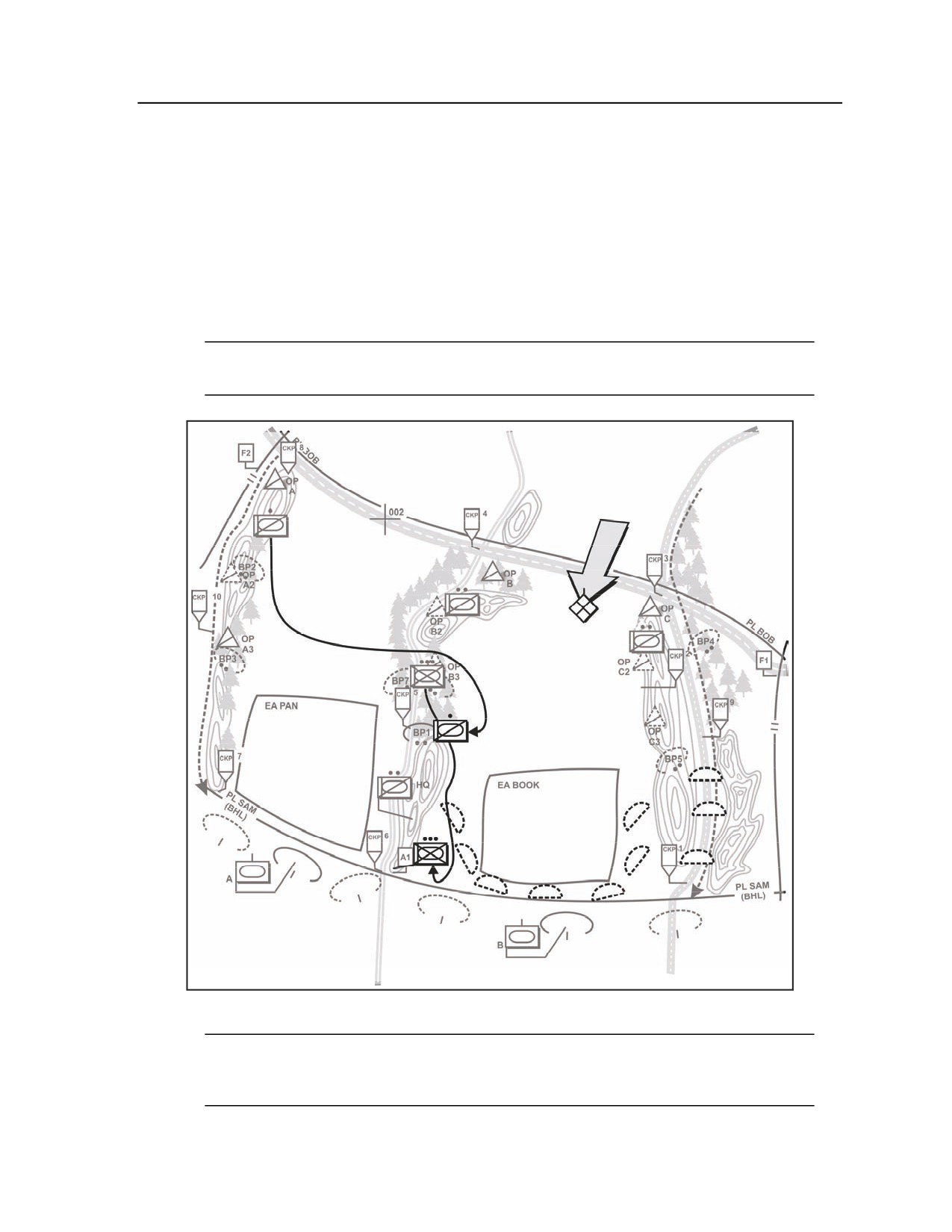
Chapter 4
4-71. Having destroyed enemy elements from BP5 and BP7, the CAB commander orders the hunter-killer
team to reposition to contact point A1 to reduce the chance of detection and to support the reconnaissance
platoon’s movement to PL SAM if necessary. UASs are recovered prior to contact with the enemy main
body to prevent their loss to enemy air defense artillery (ADA) systems. As the hunter-killer team reports
set, OP B identifies the first element of a company-size enemy moving along AA1. The CAB commander
orders MOPMS activated along the reconnaissance avenue of approach for AA1 to prevent the enemy from
bypassing EA BOOK. The platoon leader decides to assume risk and maintain contact with the enemy
along AA1. He requests to displace the HMMWV from OP A to BP1 to observe and adjust fires for the
battalion. This gives him additional depth along AA1 and makes it easier for the platoon to maintain visual
contact with the enemy (see Figure 4-19). The platoon leader reports the displacement and updates the
situational picture for the battalion to prevent fratricide while elements are moving.
Note. Another method of increasing screen depth is to leave a dismounted OP dug in and
concealed so that it can report information.
Figure 4-19. Example screening operation (part five)
Note. Unless otherwise indicated, the depictions of MOPMS emplacements in Figures 4-19
through 4-22 are templated locations only. Use of these symbols does not mean that MOPMS
will be used in all locations simultaneously.
4-28
FM 3-20.98
3 August 2009
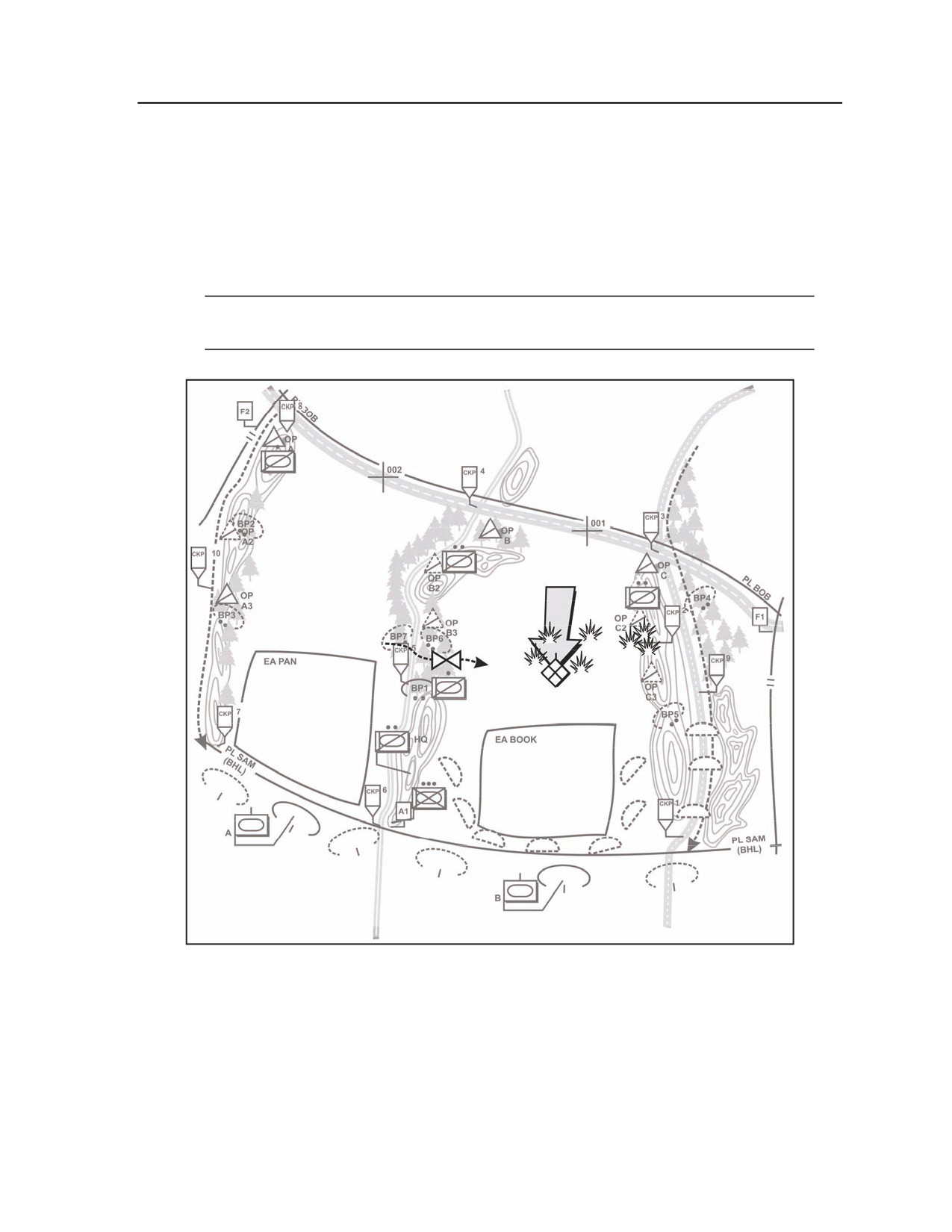
Security Operations
4-72. The HMMWV scout squad from OP A reports set at BP1. The section at OP C maintains contact
with the enemy main body until it can be observed by the section at BP1 (as shown in Figure 4-20). Once
that occurs, the OPs confirm target handover. The platoon leader orders the HMMWV scout squad at OP C
to displace to OP C3, reestablish visual contact, and continue reporting. Scouts confirm the absence of
ADA systems. BP1 begins attrition of the enemy by joint fires. These fires not only disrupt the momentum
of the enemy main body, but also help cover the HMMWV displacement from OP C. OP C3 reports
observing enemy artillery impact south of OP C, vicinity checkpoint 2. Monitoring the O/I net, the
reconnaissance platoon learns that the hunter-killer team is set at contact point A1 and has coordinated
movement with the company to the team’s rear.
Note. Even though fires are being delivered to disrupt the enemy, scouts must displace without
being detected and must minimize their silhouette during movement.
Figure 4-20. Example screening operation (part six)
3 August 2009
FM 3-20.98
4-29
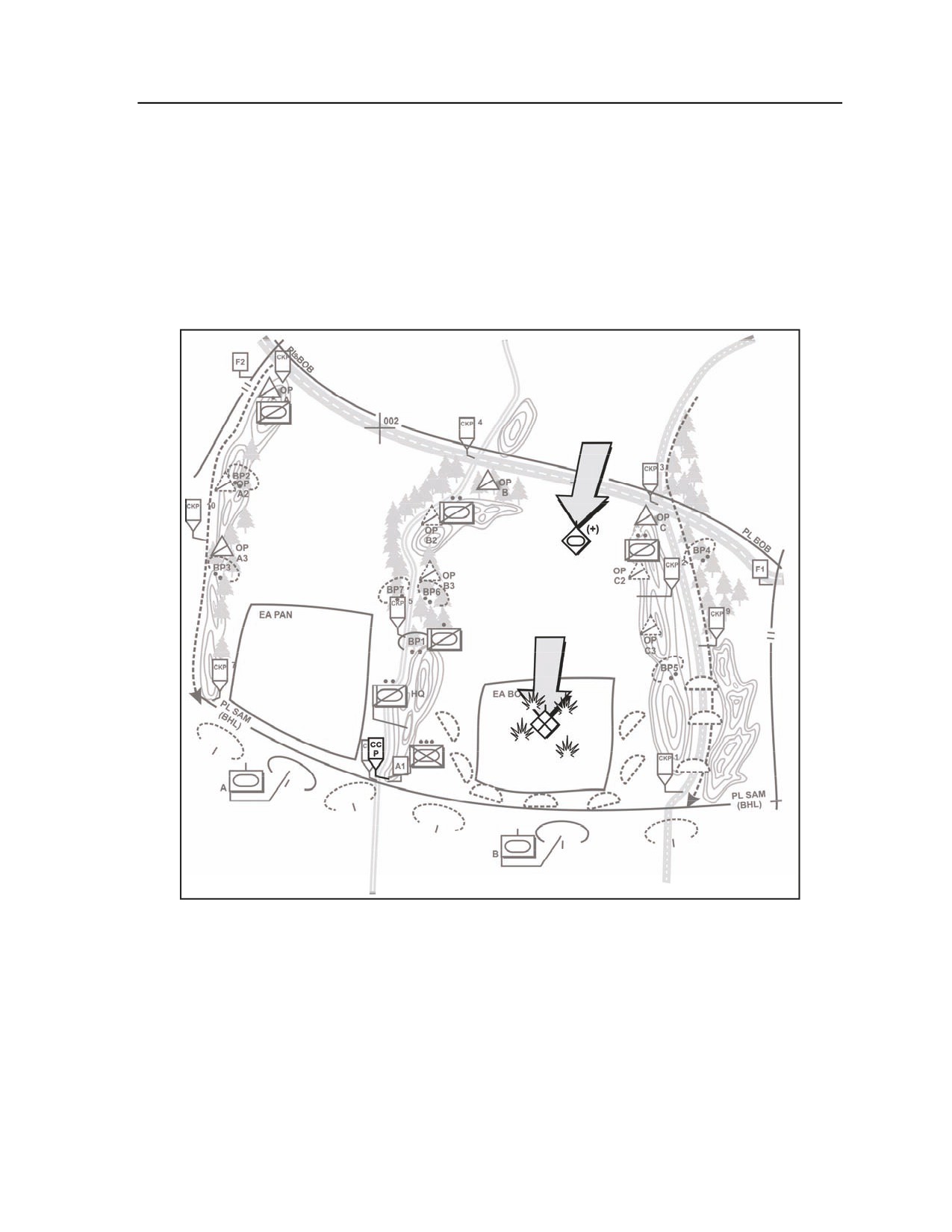
Chapter 4
4-73. BP1 maintains contact with the enemy and continues indirect fire (as illustrated in Figure 4-20). OP
B reports a company(+) of armor moving south vicinity TRP 001. As the enemy main body continues to
move, scouts report the enemy’s entry into EA BOOK (see Figure 4-21). The enemy encounters hasty
obstacles and mines in front of the BPs; these cause the enemy vehicles to stop or turn, making lethal flank
shots possible. B Company engages the enemy main body with direct fire and destroys it. The
reconnaissance squad at BP1 requests CASEVAC, and the PSG moves under hunter-killer team escort on
the west side of the ridge line up to BP1. Once his vehicle is loaded, the PSG quickly moves the casualty
back to contact point A1 and links up with the A Company 1SG and medics at the CCP. The platoon leader
begins coordination of BHO of the enemy force to A Company and B Company in their BPs south of PL
SAM.
Figure 4-21. Example screening operation (part seven)
4-30
FM 3-20.98
3 August 2009
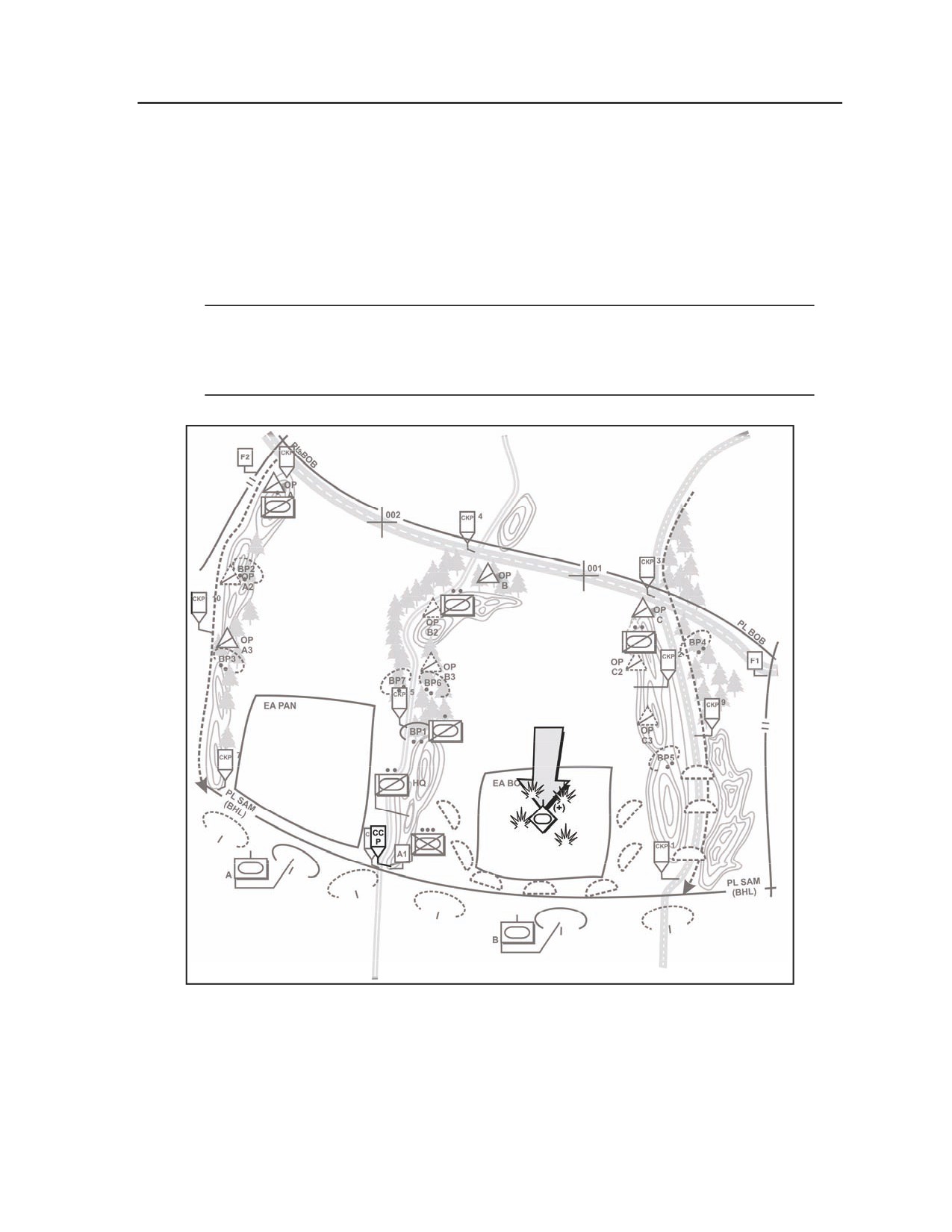
Security Operations
4-74. After the initial engagement of the enemy main body, the situational picture is updated. OPs B2 and
C3 confirm a follow-on enemy force moving into EA BOOK (see Figure 4-22). BP1 and OP C3 confirm
the enemy’s front-line trace. The platoon leader requests SITREPs from vehicle commanders and orders
the platoon to stay hidden and observe for additional follow-on threats. BP1 directs joint fires against the
rear vehicles of the enemy formation. B Company quickly destroys the enemy within the engagement area
and returns to turret-down positions. The reconnaissance platoon is ordered to prepare for a relief in place
and for a zone reconnaissance north to reestablish visual contact with a possible enemy force. B
Company(+) will follow to the rear of the platoon. The platoon leader instructs the hunter-killer team to
follow no more than 700 meters or one terrain feature behind B Company.
Note. Hasty obstacles and minefields must be reported to gaining units and annotated in the
operational picture so friendly units do not run into them. Handover of devices such as MOPMS
must be conducted face to face; otherwise, recovery or confirmation of destruction of the
devices is required.
Figure 4-22. Example screening operation (part eight)
4-75. The reconnaissance elements return to the forward OPs, where they consolidate Class I, III, and V
supplies and submit resupply requests. With this quickly done, a REDCON-1 status report is sent to the
platoon leader. All MOPMS are ordered to be recovered and reported.
3 August 2009
FM 3-20.98
4-31
Chapter 4
SECTION III - LOCAL SECURITY
4-76. Local security is an important part of maintaining the initiative. The requirement for maintaining
local security is inherent in all operations. The reconnaissance or scout platoon may support local security
as part of a larger unit such as a cavalry troop or maintain local security independently away from friendly
elements. In some cases as when the platoon is part of a CAB or BCT, it will maintain its own assembly
area and local security within the larger unit’s footprint. Local security includes all measures taken to
prevent surprise by the enemy, including operations against the platoon’s location. It involves avoiding
detection by the enemy or deceiving the enemy about friendly positions and intentions.
4-77. Units that come to a halt during operations must dismount to provide local security around their
vehicles to prevent surprise and the loss of Soldiers and equipment to dismounted enemy elements. While
dismounted, scouts must present as small a target as possible while still observing the area and approaches
around their location. They must be ready to engage the enemy under favorable conditions. Units use both
active and passive measures to provide local security as shown in the Table 4-1.
Table 4-1. Summary of local security measures
Employ platoon OPs.
Employ patrols to cover perimeter and dead space.
Active
Establish threat levels and procedures.
Local Security
Enforce stand-to.
Measures
Enforce proper communications procedures.
Employ camouflage.
Passive
Enforce noise and light discipline.
Employ sensors for surveillance of area around the unit.
SECTION IV - AREA SECURITY
4-78. Units conduct area security operations in MCO and limited intervention to deny the enemy the
ability to influence friendly actions in a specific area or to deny the enemy use of an area for its own
purposes. This may entail occupying and securing an area without the presence of the enemy or taking
actions to destroy enemy forces already present in the area. The area security operation may provide
protection of designated personnel, airfields, unit convoys, facilities, MSRs, LOCs, equipment, and critical
points.
SUPPORTING TASKS FOR AREA SECURITY
4-79. Area security involves a variety of techniques and may include tasks related to reconnaissance,
security, defense, offense, stability, and civil support operations. Reconnaissance and scout organizations,
including the platoon, may conduct the following in support of area security:
z
Zone, area, and route reconnaissance.
z
Screen.
z
Offensive and defensive tasks (within capabilities).
z
Convoy security.
z
Route security.
z
High-value asset security.
z
Fixed site security.
z
Checkpoint security.
4-32
FM 3-20.98
3 August 2009
Security Operations
z
Downed aircraft recovery team security.
4-80. Other platoon missions or tasks in support of troop area security may include the following:
z
Screens along zones of separation or other designated areas.
z
Route and/or convoy security of critical LOCs.
z
Checkpoint operations to monitor or control movement.
z
Patrolling between secured perimeters.
z
Demonstrations to maintain an observable presence.
4-81. The platoon may conduct or support the following additional tasks in stability operations and civil
support operations:
z
Liaison.
z
Leader engagement.
z
Compliance inspections.
z
Traffic control points.
z
Fixed site security.
z
Cordon and search.
OPERATIONAL CONSIDERATIONS
4-82. An area security force neutralizes or defeats enemy operations in a specified area. It operates in an
area delineated by the headquarters assigning the area security operation. It screens, reconnoiters, attacks,
defends, and delays (within capability) as necessary to accomplish its mission. Area security operations
may be offensive or defensive in nature and focus on the threat/enemy, on the force/element being
protected, or on a combination of the two. Commanders will balance the level of security measures taken
with the type and level of threat posed in the specific area to avoid overtasking resources; however, all-
around security is an essential consideration at all times.
4-83. As noted, area security operations are conducted to deny the threat/enemy the ability to influence
friendly actions in a specific area or to deny the enemy use of an area for its own purposes. This may entail
occupying and establishing a 360-degree perimeter around the area being secured or taking actions to
destroy or neutralize enemy forces already present. The area to be secured may include specific points
(bridges, defiles), defined areas (terrain features such as ridgelines or hills), or large population centers and
adjacent areas.
4-84. Proper IPB is vital in providing adequate security for the assigned area. Along with unit capability
and the factors of METT-TC, the following considerations, which are determined during the IPB, will
determine specific unit operations during area security operations:
z
The natural defensive characteristics of the terrain.
z
Existing roads and waterways for military LOCs and civilian commerce.
z
Control of land and water areas and avenues of approach surrounding the area to be secured
extending to a range beyond that of enemy artillery, rockets, and mortars.
z
Control of airspace.
z
Proximity to critical sites such as airfields, power generation plants, and civic buildings.
4-85. Because of the possibility of commanders fixing their forces to fixed installations or sites, area
security operations may become defensive in nature. This must be carefully balanced with the need for
offensive action. Early warning of enemy activity to provide the commander with time to react to any
potential threat is a paramount consideration in effective area security operations. It requires thorough
reconnaissance and surveillance planning, coupled with employment of dismounted and mounted patrols,
aerial reconnaissance, and sensors.
4-86. A perimeter is established when a unit must secure an area where the defense is not tied into an
adjacent unit. Perimeters vary in shape depending on METT-TC. If the commander determines the most
probable direction of enemy attack, he may perform economy of force to mass combat power along the part
3 August 2009
FM 3-20.98
4-33
Chapter 4
of the perimeter to cover the approach of enemy forces. The perimeter shape conforms to the terrain
features that afford the most effective observation and fields of fire.
4-87. Perimeters are divided into troop/platoon sectors with boundaries and contact points. Mutual support
and coordination between defensive elements (usually combat elements within the brigade) require careful
planning, positioning, and coordination. A screen line is established, integrating OPs, ground sensors, and
patrols. Tanks, MGSs, and/or antiarmor weapon systems are placed on high-speed avenues of approach.
Likely threat/enemy drop zones
(DZ), landing zones
(LZ), or bases are identified and kept under
observation. Air assets, if available, are integrated into the R&S plan through the commander.
Note. Refer to FM 3-20.971 for further discussion on area security at the troop level.
PLATOON CONSIDERATIONS
4-88. The reconnaissance or scout platoon may deploy to conduct area security operations on its own or as
part of a larger force. When the platoon conducts area security on its own, it generally moves into a coil
formation around the point, area, or asset to be secured. Vehicle positions are adjusted to orient on likely
enemy avenues of approach. If engineer support is available, the vehicle positions are dug in; if not,
vehicles occupy hasty fighting positions. Perimeters are established where the platoon cannot tie into the
defense of an adjacent unit. Varying terrain conditions affect the vehicle locations:
z
Desert terrain, such as that in the Middle East, requires vehicles to spread out more because of
large amounts of open space.
z
Mountainous terrain offers more IV lines and foliage to hide under but reduced maneuvering
room.
z
Urban areas often preclude uniform perimeters because of the possibility of infiltration through
building windows and rubble.
4-89. To further improve the position, the platoon employs hasty protective minefields, wire, and other
obstacles as appropriate and available. Wire obstacles should be emplaced outside grenade range of
friendly positions. Once vehicle positions and obstacles are established, the platoon develops a fire plan,
including integrated indirect fires, and submits it to higher headquarters.
4-90. In addition to setting up its position around the asset to be secured, the platoon also employs patrols
and OPs to enhance security (see Figure 4-23). The platoon leader may plan for outside resources that can
assist his operation. Examples include the use of CA personnel to improve relations with the local
populace, UAS support to scan the surrounding area, and engineer teams to assist in repairing local
infrastructure such as water mains or power lines. This type of positive interaction with locals may create
favorable conditions for HUMINT assets to gather information. The reconnaissance or scout platoons
employ reconnaissance patrols, presence patrols (as a section), and combat patrols (as a platoon) as needed
to become familiar with the AO, to gain information on enemy forces, and to destroy small enemy
dismounted reconnaissance elements. OPs and support by fire positions are deployed to observe likely
avenues of approach, to provide early warning of enemy activity, to provide direct fire on an enemy so the
platoon can displace, and to assist in controlling indirect fires.
4-34
FM 3-20.98
3 August 2009
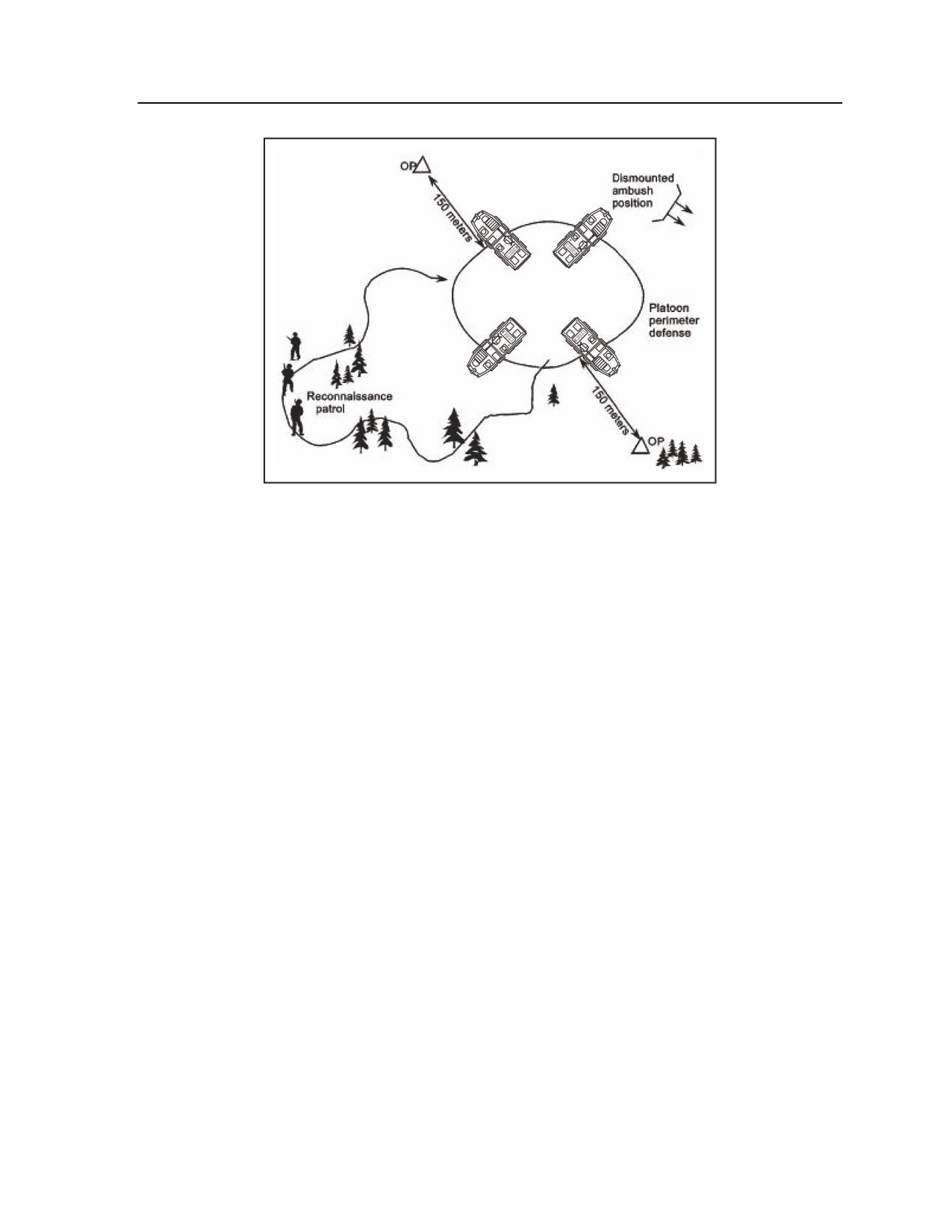
Security Operations
Figure 4-23. Use of patrol, OP, and ambush site
to enhance area security
ROUTE SECURITY
4-91. Route security is a modified area security operation whose purpose is to prevent an enemy from
attacking, destroying, seizing, containing, impeding, or harassing traffic along a specific route. It also
prevents the enemy from emplacing obstacles on or destroying portions of the route. Route security
operations are defensive in nature and, unlike screen operations, are terrain-oriented.
4-92. Enemy forces will try to interdict supply routes and LOCs by various methods. Roads, waterways,
and railways may be mined or have IEDs emplaced along them. Ambush sites can be located adjacent to
the route being secured. Bridges and tunnels can be destroyed by demolitions. Because of the nature of this
operation, very long routes may be extremely difficult to secure. Long routes may also have a number of
controlling authorities responsible for operations along distinct portions of the route.
SECURITY FORCE TASKS
4-93. Route security forces operate on and to the flanks of a designated route. A reconnaissance or scout
platoon may be tasked to fulfill numerous roles to support route security operations, which vary widely in
scale. To accomplish the route security operation, the platoon performs some or all of the following functions:
z
Conduct mounted and dismounted reconnaissance of the route and key locations along it to
ensure the route is trafficable.
z
Conduct route clearance (with attached engineers as the main effort) at irregular intervals to
prevent emplacement of enemy mines and explosive devices along the route.
z
Identify sections of the route to search for suspected enemy locations.
z
Establish MEDEVAC LZ locations along the route for air evacuation of wounded.
z
Establish roadblocks/checkpoints along the route and on lateral routes. The purpose is to stop
and search vehicles and persons on the route and those entering the route. The platoon may
require augmentation from other units such as an infantry platoon, engineers, interpreters, and
or MP elements.
z
Occupy key locations and terrain along or near the route.
z
Aggressively conduct ground and aerial reconnaissance/surveillance to maintain route security.
z
Establish OPs, ambush sites, and reaction force teams to watch for and handle enemy activity.
3 August 2009
FM 3-20.98
4-35
Chapter 4
ROUTE SECURITY TECHNIQUES
4-94. The following discussion highlights two techniques that the reconnaissance or scout platoon can
execute during route security depending on the nature of the enemy, purpose of the security operation, and
characteristics of the route.
4-95. In the first technique, the troop is tasked to conduct route security operations with the platoon
conducting a route reconnaissance as a part of the operation. The platoon reconnoiters the route at irregular
intervals to avoid developing a pattern that the enemy may exploit. This may include conducting
reconnaissance to either flank resembling a zone reconnaissance. Organic or attached UAS or supporting
aviation assets can reconnoiter in advance of ground troops or assist in screening the flanks. In addition to
reconnaissance, sections or squads may—
z
Escort engineers conducting route clearance, improvement, or maintenance to clear terrain at
potential ambush sites.
z
Repair damage caused by enemy actions.
z
Deploy and support HUMINT assets along the route.
z
Support the FIST by requesting and registering targets along the route.
z
Provide recovery and security for UAS surveillance missions along the route.
4-96. The second technique entails using economy of force to protect only critical lengths or locations along
the route. The squadron or troop tasks platoons to establish mutually supporting platoon combat outposts. The
combat outposts are established at critical choke points to prevent sabotage and to defend against or respond to
attacks to interdict the route between outposts. Based on METT-TC, a platoon can establish one combat
outpost; depending on the enemy situation, this may require augmentation. The route outside the reach of the
combat outposts is not normally secured or patrolled. Patrols are conducted at irregular intervals between the
outposts based on enemy trends and recent activities. UAS support may be used to augment the patrols and
detect activity along the route. Patrols are organized with sufficient combat power to disrupt or destroy near
ambushes and to survive initial enemy contact from far ambushes. Each combat outpost maintains a reaction
force to respond to enemy activity or reinforce patrols that come under contact.
ROUTE SECURITY PROCEDURES
4-97. Artillery or mortars may be deployed into firing positions (including collocating with combat
outposts) for route security. Indirect fire units and fire support personnel must be tasked to support
reconnaissance elements operating along the route. Platoon leaders must coordinate massing of fires at
critical positions or into areas of most frequent enemy activity to disrupt the enemy. Platoon and section
leaders must ensure that their fire plans include priority targets supporting convoy or patrol movements,
checkpoints, or combat outposts and that they register targets.
Note. Augmentation with a FIST allows the platoon to employ supporting indirect fires and
CAS sorties.
4-98. Air, mounted, and dismounted patrols are employed to disrupt enemy forces attempting to emplace
IEDs, mines, and demolitions; create craters or abatises; or establish ambushes or roadblocks to interdict or
destroy traffic. Sniper teams can be valuable in support of patrols because of their ability to observe enemy
activities while remaining undetected and to report activities. Patrols are organized with sufficient forces to
reconnoiter off-route ambush sites and with enough combat power to survive initial enemy contact. Based
on enemy capabilities, reconnaissance patrols should be augmented with engineers, infantry, MP, and other
assets to increase the platoon’s combat capability.
4-99. Other techniques to defeat enemy attempts to interdict the route or ambush convoys include—
z
Deploy deceptive “mock” convoys under escort to determine enemy reactions.
z
Conduct ambushes along known or suspected dismounted approaches to the route.
4-36
FM 3-20.98
3 August 2009
Security Operations
z
Follow registered indirect fires triggered by sensor cues—such as ground surveillance
systems—with patrols that can perform SE on successful fire missions.
z
Conduct reconnaissance by fire at irregular intervals during limited visibility, prior to sunrise,
or before critical convoys to detect and destroy ambushes (ROE dependent).
4-100. Ground sensors can be used in an economy of force role to survey key avenues of approach or areas
that require continuous surveillance by scouts such as dead space and areas not considered primary enemy
avenues. This reduces the manpower and logistical demands on the higher unit’s resources during the operation.
CONVOY SECURITY
4-101. Reconnaissance troops, company teams, armored cavalry troops, and larger organizations perform
convoy security operations to provide protection for a specific convoy. These operations include numerous
tasks for reconnaissance and scout platoons serving as reconnaissance, escort, screen, and reaction forces.
While each platoon organization is capable of performing convoy escort missions, certain organizations are
particularly well suited for certain roles. HMMWV platoons can use speed and optics to screen flanks and
perform route reconnaissance ahead of the convoy. Stryker platoons are well suited for escorting the
convoy at highway speeds or performing the role of reaction force within the convoy. CFV platoons may
conduct convoy escort; however, they are better suited to be a reaction force positioned in outposts where
they will react to enemy actions with overwhelming firepower.
4-102. Depending on the situation, ACR scout platoons may be reconfigured with tanks becoming a
hunter-killer team that is used as a reaction force operating from a combat outpost. This greatly increases
the firepower of the reaction force. The size of the unit performing the convoy security operation is
dependent on a number of factors, including the size of the convoy, the terrain, and the length of the route.
4-103. Refer to Figures 4-24 and 4-25 for illustrations of reconnaissance troop and armored cavalry troop
platoons in convoy security operations.
Note. The enemy situation may require the heavier HBCT reconnaissance platoon to conduct
convoy security in place of an IBCT reconnaissance platoon. This may require upgrading the
reaction forces to MGS or tank platoons for increased firepower.
3 August 2009
FM 3-20.98
4-37
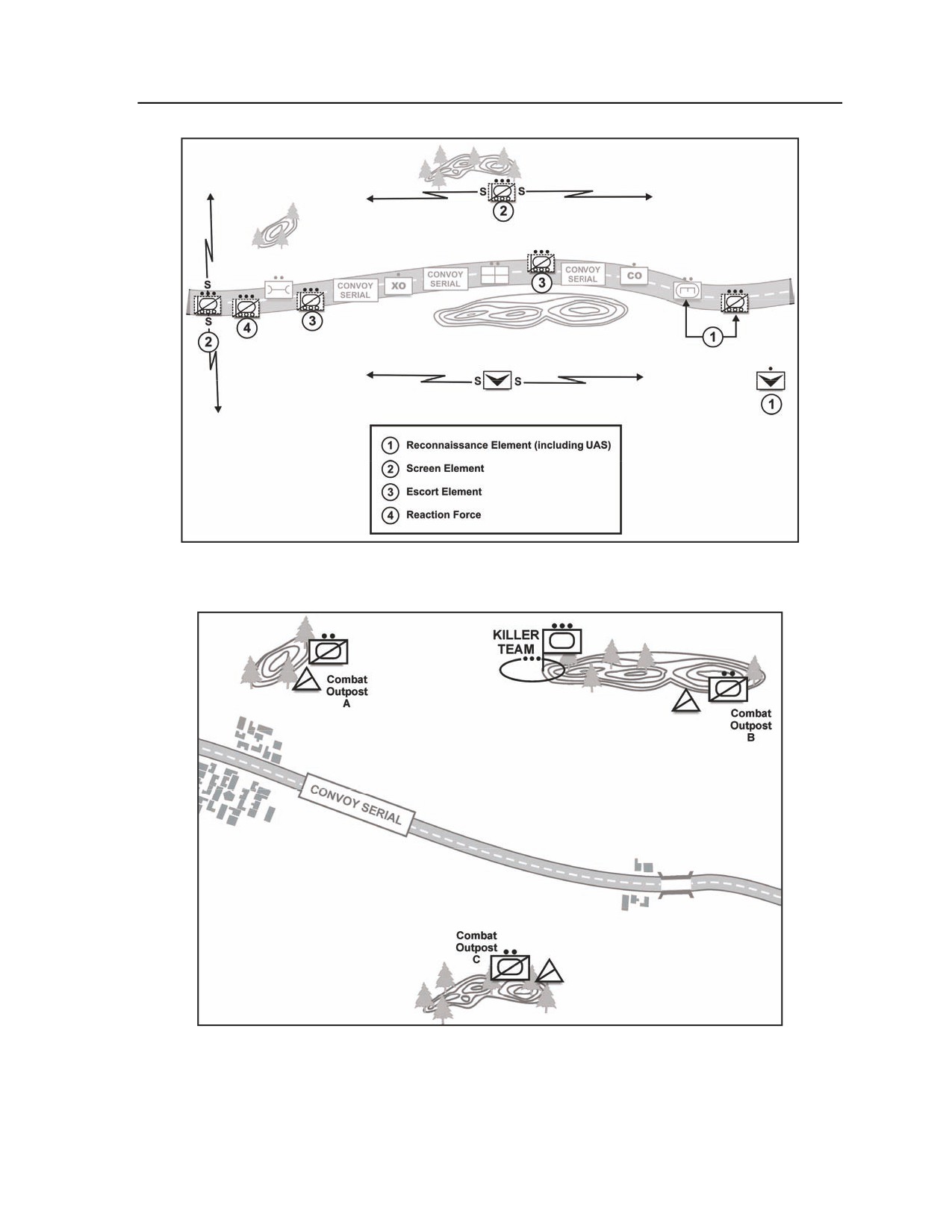
Chapter 4
Figure 4-24. Convoy security (possible locations/tasks that can be executed by a
reconnaissance platoon within the overall convoy security mission)
Figure 4-25. Convoy security with combat outposts (armored cavalry troop)
4-38
FM 3-20.98
3 August 2009
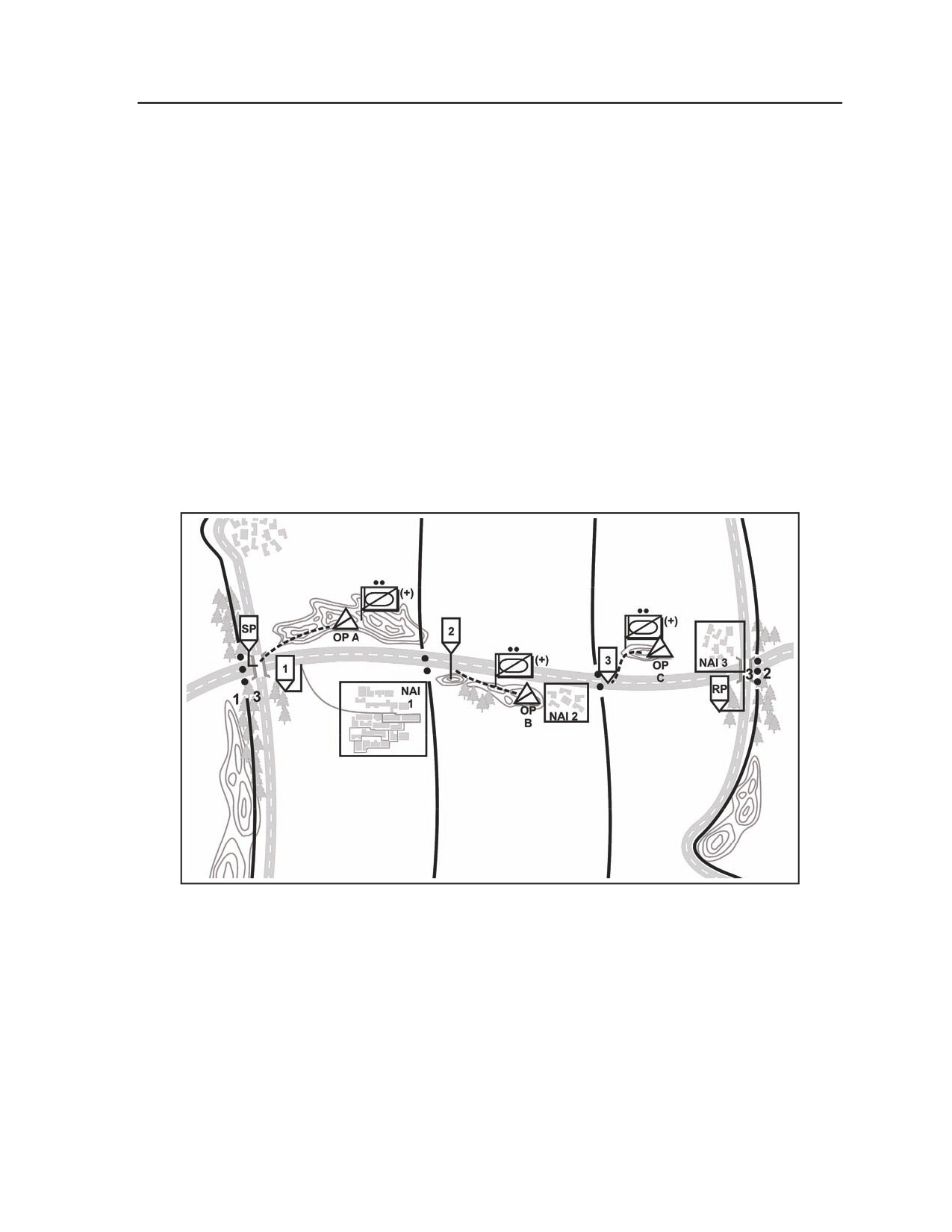
Security Operations
COMBAT OUTPOSTS
4-104. Employment of combat outposts is a technique used during convoy security to screen dangerous
areas of the route after it has been reconnoitered. The combat outpost as part of convoy security is
generally performed by the entire platoon in static locations on critical parts of the route or key avenues of
approach to the route. Outposts provide early warning of enemy elements attempting to interdict convoy
movement. The outpost may be manned by a section, platoon, or a platoon with augmentation. The enemy
situation and the area to be covered will dictate the size and composition of the combat outpost’s force.
4-105. Combat outposts differ from a conventional screen in that they are oriented on the route,
specifically NAIs, rather than on the friendly main body. These NAIs may be found in a designated sector
for which the outpost element may be responsible. Combat outposts can be established in the following
ways (see Figure 4-26):
z
The outpost element follows the route reconnaissance element and establishes the combat
outpost confirmed to be cleared by the route reconnaissance.
z
Move under limited visibility to occupy the outpost unannounced prior to movement on the
route.
4-106. Combat outposts have the limited ability to destroy small enemy forces attempting to influence the
route. Their primary purpose is to acquire enemy elements and then to direct the employment of reaction
forces or indirect fire to destroy the enemy. The use of HUMINT teams within the sector may gain
information on enemy activities and prevent attacks on convoys.
Figure 4-26. Establishing outposts
CONVOY ESCORT
4-107. The platoon may perform a convoy escort operation, either independently or as part of a larger
unit’s convoy security operation, to provide a convoy with close-in protection from direct fire. Normally a
troop would conduct a convoy escort mission for a convoy serial. Escorted vehicles can include military
vehicles (sustainment, C2), civilian trucks, or buses. Among reconnaissance and scout platoons, those
equipped with CFVs are best suited for this operation because of their vehicles’ firepower and the armor
protection they provide against direct fires, indirect fires, and IEDs. Leaders must carefully evaluate the
enemy before assigning a convoy escort operation to HMMWV or Stryker platoons. The following
considerations apply during convoy escort operations.
3 August 2009
FM 3-20.98
4-39
Chapter 4
Command and Control
4-108. C2 is especially critical during convoy escort because of the task organization inherent to the
operation. When the reconnaissance or scout platoon is executing the escort operation, it operates under the
control of the convoy commander, regardless of the role.
Note. The convoy commander must understand the employment of combat assets while in
contact. Convoys can move through several different commanders’ jurisdictions, and the convoy
commander must be familiar with the weapon systems available in these areas. Platoon leaders
must have this same knowledge.
4-109. The platoon leader must ensure that a complete OPORD is issued to all vehicle commanders in the
convoy prior to execution of the mission. This is vital because the convoy may be task organized from a
variety of units and because many of the vehicles may not have tactical radios. The order should follow the
standard five-paragraph OPORD format, with special emphasis on the following subjects:
z
Order of march.
z
Actions on contact.
z
Chain of command.
z
Communications and signals.
z
Actions on vehicle breakdown.
z
Actions at a halt.
z
Route of march (this should include a sketch for each vehicle commander).
z
CASEVAC.
Tactical Disposition
4-110. Security during convoy escort operations must be in all directions and throughout the length of the
convoy. This requires that the elements of the platoon and any maneuver or enabling attachments be
dispersed throughout the convoy formation. Engineer assets should be located toward the front to respond
to obstacles; the FIST or COLT should be located near the platoon leader. The platoon will normally use
the column formation because of its inherent speed and ease of C2. If a HMMWV unit is used as the
escort, a tracked, armored engineer vehicle should be attached to the lead elements of the convoy whenever
possible because of its superior protection against mines. When engineers are not available, the convoy
commander may be able to coordinate use of tanks, Strykers, or armored personnel carriers (APC) with
rollers and plows. Figures 4-27 illustrates an example of a convoy escort operation.
Note. Platoon and section rehearsals must be conducted to ensure that all elements are
proficient in their role and that subordinate leaders are able to move up one position if
necessary. PCCs and PCIs are critical to success. Platoon members must be properly equipped,
knowledgeable on their equipment and mission, and able to demonstrate their tasks to the
platoon leadership.
4-40
FM 3-20.98
3 August 2009