FM 3-20.98 Reconnaissance and Scout Platoon (AUGUST 2009) - page 1
FM 3-20.98
AUGUST 2009
Reconnaissance and Scout Platoon
DISTRIBUTION RESTRICTION. Distribution authorized to U.S. Government agencies and their
contractors only to protect technical or operational information that is for official government use.
This determination was made on 4 February 2008. Other requests for this document will be
referred to Commander, U.S. Army Armor Center, ATTN: ATZK-TDD-C, Building 1002, 204 1st
Cavalry Regiment Road, Fort Knox, Kentucky 40121-5123.
DESTRUCTION NOTICE. Destroy by any method that will prevent disclosure of contents or
reconstruction of the document.
Headquarters, Department of the Army
*FM 3-20.98
Field Manual
Headquarters
Department of the Army
No. 3-20.98
Washington DC, 3 August 2009
Reconnaissance and Scout Platoon
Contents
Page
PREFACE
xviii
INTRODUCTION
xx
Chapter 1
OVERVIEW
1-1
Section I - The Operational Environment
1-2
Variables of the OE
1-2
Cultural Awareness
1-2
Full Spectrum Operations
1-3
Area of Operations
1-4
Threat Tactics, Techniques, and Procedures (TTP)
1-5
Section II - Reconnaissance and Scout Platoon Organizations
1-6
Platoon Missions
1-6
General Capabilities and Limitations
1-7
Organizations
1-8
Section III - Integration of Sensors
1-25
Reconnaissance Management
1-26
Organic Sensors
1-26
Chapter 2
COMMAND AND CONTROL
2-1
Section I - Troop-Leading Procedures
2-1
Operational Considerations
2-1
Military Decision-making Process
2-2
Conduct of Troop-Leading Procedures
2-3
DISTRIBUTION RESTRICTION: Distribution authorized to U.S. Government agencies and their contractors only
to protect technical or operational information that is for official government use. This determination was made on
4 February 2008. Other requests for this document will be referred to Commander, US Army Armor Center,
ATTN: ATZK-TDD-C, Building 1002, 204 1st Cavalry Regiment Road, Fort Knox, Kentucky 40121-5123.
DESTRUCTION NOTICE: Destroy by any method that will prevent disclosure of contents or reconstruction of
the document.
* This publication supersedes FM 3-20.98, 2 December 2002.
3 August 2009
FM 3-20.98
i
Contents
Section II - Battle Command
2-17
Command and Control in the Platoon
2-18
Command Relationships
2-18
FBCB2 in the Battle Command Structure
2-19
Situational Awareness
2-22
Areas of Influence
2-23
Fratricide
2-27
Section III - Intelligence Preparation of the Battlefield
2-28
Basics of IPB
2-28
IPB Steps
2-28
Section IV - Communications
2-29
Means of Tactical Communications
2-29
Reconnaissance and Scout Platoon Radio Nets and Responsibilities
2-31
Techniques of Effective Communications
2-33
Section V - Reporting
2-34
Operational Considerations
2-35
Report Guidelines
2-35
Digital Reporting and C2 Messages
2-35
Chapter 3
RECONNAISSANCE OPERATIONS
3-1
Section I - Introduction
3-1
Purpose
3-2
Fundamentals of Reconnaissance
3-2
Section II - Reconnaissance Planning
3-4
Operational Considerations
3-4
Reconnaissance Techniques
3-5
Planning Considerations
3-6
The OE in Reconnaissance Operations
3-9
Reconnaissance Handover
3-11
Reconnaissance Methods
3-16
Tactical Employment
3-20
Section III - Multidimensional Aspects of Reconnaissance and
Surveillance
3-37
Operational Considerations
3-38
Intelligence Collection
3-38
Civil-Military Operations
3-42
Section IV - Route Reconnaissance
3-46
Critical Tasks
3-47
Techniques
3-47
Example of an SBCT Reconnaissance Platoon Route Reconnaissance
3-48
Example of an ACR Scout Platoon Route Reconnaissance
3-52
Section V - Area Reconnaissance
3-56
Critical Tasks
3-56
Techniques
3-57
Example of an Area Reconnaissance
3-58
Reconnaissance of Obstacles And Restrictions
3-61
ii
FM 3-20.98
3 August 2009
Contents
Section VI - Zone Reconnaissance
3-70
Critical Tasks
3-71
Techniques
3-71
Example of a Zone Reconnaissance
3-72
Chapter 4
SECURITY OPERATIONS
4-1
Section I - Introduction
4-1
Purpose
4-1
Forms of Security
4-2
Fundamentals of Security
4-3
Planning Guidance
4-4
Section II - Screen
4-5
Critical Tasks
4-5
Counterreconnaissance Techniques
4-19
Example of a Screen Operation
4-24
Section III - Local Security
4-32
Section IV - Area Security
4-32
Supporting Tasks for Area Security
4-32
Operational Considerations
4-33
Platoon Considerations
4-34
Route Security
4-35
Convoy Security
4-37
Section V - Direct Fire Planning
4-48
Direct Fire Standing Operating Procedure
4-49
Engagement Area Development
4-50
Chapter 5
OTHER TACTICAL OPERATIONS
5-1
Section I - Platoon Tactical Movement
5-2
Planning and Operational Considerations
5-2
Fundamentals of Movement
5-3
Danger Areas
5-7
Platoon Formations
5-10
Movement Techniques
5-18
Actions on Contact
5-23
Section II - Assembly Areas
5-42
Characteristics
5-43
Quartering Party Responsibilities
5-43
Occupation
5-44
Actions in the Assembly Area
5-44
Departing the Assembly Area
5-45
Section III - Linkup Operations
5-45
Forms of Linkup
5-45
Planning Considerations
5-46
Preparation
5-47
Execution
5-47
Section IV - Relief in Place
5-47
3 August 2009
FM 3-20.98
iii
Contents
Section V - Passage of Lines During Battle Handover
5-49
Critical Tasks
5-49
Preparation
5-52
Conduct of the Passage
5-54
Section VI - Cordon and Search
5-55
Task Organization
5-56
Conduct of the Operation
5-56
Section VII - Observation Posts
5-60
Critical Tasks
5-61
Types of Observation Posts
5-62
Positioning the OP
5-62
Selecting an OP Site
5-63
Occupying the OP
5-64
Manning the OP
5-65
Improving the Position
5-65
OP Communications
5-67
OP Security
5-67
Extended OP Operations
5-68
Remote Electronic/Mechanical Surveillance
5-77
Section VIII - Dismounted Patrols
5-78
Operational Considerations
5-79
Planning and Preparation in Dismounted/Patrol Operations
5-79
Movement
5-89
Actions at Danger Areas
5-95
Objective Rally Points
5-99
Reentry to Friendly Lines
5-101
Debriefing
5-102
Section IX - Patrol Bases and Combat Outposts
5-102
Patrol Bases
5-102
Combat Outposts
5-105
Chapter 6
ENABLERS
6-1
Section I - Employ Indirect Fires
6-2
Mortar Support
6-2
Field Artillery Support
6-4
Naval Fire Support
6-6
Fire Support Personnel
6-6
Fire Request Channels
6-7
Fire Planning in Support of Reconnaissance Missions
6-10
Call for Fire
6-11
Adjusting Indirect Fire
6-14
Refinement and Surveillance
6-19
Fire Support Coordination Measures
6-19
Close Air Support Operations
6-23
Other Types of Air Support
6-28
iv
FM 3-20.98
3 August 2009
Contents
Section II - Army Aviation Support
6-28
Organization
6-28
Assault (Utility) and Cargo (Lift) Helicopter Support
6-28
Section III - Combat Engineer Support
6-40
Engineer Support in Reconnaissance Operations
6-40
Engineer Support in Security Operations
6-40
Engineer Support in Stability Operations
6-41
Section IV - Intelligence
6-42
Sensor Teams
6-42
Unmanned Aircraft Systems Operations
6-43
Section V - Civil Affairs
6-52
Section VI - Tactical Psychological Operations Support
6-53
Section VII - Air and Missile Defense (AMD) Support
6-53
Passive Air Defense
6-53
Active Air Defense
6-54
Short-Range Air Defense Systems
6-55
Air Defense Command and Control
6-56
Section VIII - Sustainment Operations
6-56
Supply Operations
6-56
Maintenance Operations
6-62
Personnel Services Support
6-65
Human Resources Support
6-65
Army Health System Support
6-65
Prisoners and Captured Material
6-69
Appendix A
ORDERS AND REPORTS
A-1
Section I - Orders
A-1
Section II - Reports
A-11
Appendix B
SITE EXPLOITATION
B-1
Section I - Purpose of Site Exploitation
B-1
Section II - Site Exploitation Planning and Organization
B-3
Section III - Site Exploitation Execution
B-8
Section IV - Tactical Questioning
B-10
Appendix C
URBAN OPERATIONS
C-1
Section I - Introduction
C-1
Section II - Planning for Reconnaissance in Urban Environments
C-4
Section III - Execution of Urban Operations
C-6
Appendix D
FRATRICIDE PREVENTION AND COMBAT IDENTIFICATION
D-1
Section I - Definitions
D-1
Section II - The Role of Training
D-2
Section III - Effects of Fratricide
D-2
Section IV - Causes of Fratricide
D-2
Section V - Fratricide Prevention Principles and Procedures
D-4
3 August 2009
FM 3-20.98
v
Contents
Section VI - Stopping a Friendly Fire Incident
D-12
Section VII - Combat Identification (CID)
D-13
Appendix E
COMPOSITE RISK MANAGEMENT AND ENVIRONMENTAL
PROTECTION
E-1
Section I - Composite Risk Management Procedures
E-1
Section II - Implementation Responsibilities
E-6
Section III - Environmental Risk Management Process
E-7
Appendix F
CHEMICAL, BIOLOGICAL, RADIOLOGICAL, AND NUCLEAR (CBRN)
OPERATIONS
F-1
Section I - Contamination Avoidance
F-1
Section II - Movement in a CBRN Environment
F-4
Appendix G
ESSENTIAL FIELD DATA
G-1
Section I - Route Reconnaissance Symbols
G-1
Section II - Route Classification
G-7
Section III - Curve Calculations
G-12
Section IV - Slope Estimation
G-15
Section V - Constrictions
G-19
Section VI - Stream Classification
G-23
Section VII - Ford Classification
G-26
Section VIII - Ferry Classification
G-28
Section IX - Bridge Classification
G-30
Section X - Bypasses
G-54
Section XI - Measurement Conversions
G-55
Appendix H
DEMOLITIONS AND OBSTACLES
H-1
Section I - Demolitions
H-1
Section II - Mines
H-30
Section III - Obstacle Characteristics and Report Formats
H-40
Section IV - Obstacle/Minefield Turnover
H-42
Section V - Obstacle Breaching Capabilities
H-43
Section VI - Field-Expedient Mines and Demolitions
H-48
GLOSSARY
Glossary-1
REFERENCES
References-1
INDEX
Index-1
Figures
Figure 1-1. Contiguous and noncontiguous areas of operations
1-4
Figure 1-2. Dismounted two-man recon organization
1-9
Figure 1-3. Dismounted three-man team
1-9
Figure 1-4. Dismounted four-man reconnaissance organization
1-10
vi
FM 3-20.98
3 August 2009
Contents
Figure 1-5. HBCT and CAB reconnaissance platoon
1-11
Figure 1-6. Four-section (two-vehicle) organization
1-12
Figure 1-7. Three-section organization
1-13
Figure 1-8. IBCT motorized reconnaissance platoon
1-14
Figure 1-9. IBCT reconnaissance platoon two-section organization
1-15
Figure 1-10, IBCT reconnaissance platoon three-section organization
1-16
Figure 1-11. IBCT reconnaissance platoon six-vehicle organization
1-16
Figure 1-12. SBCT reconnaissance platoon
1-17
Figure 1-13. SBCT reconnaissance platoon two-section vehicle organization
1-18
Figure 1-14. SBCT reconnaissance platoon four-vehicle organization
1-18
Figure 1-15. BFSB reconnaissance platoon
1-19
Figure 1-16. BFSB reconnaissance platoon two-section organization
1-21
Figure 1-17. BFSB reconnaissance platoon three-section organization
1-21
Figure 1-18. BFSB reconnaissance platoon six-vehicle organization
1-22
Figure 1-19. ACR scout platoon
1-23
Figure 1-20. ACR scout platoon three-section organization
1-24
Figure 1-21. ACR scout platoon two-section organization
1-25
Figure 1-22. ACR scout platoon six-vehicle organization
1-25
Figure 1-23. RQ-11 Raven UAS
1-29
Figure 1-24. Soldier launching a Raven UAS
1-30
Figure 1-25. Raven UAS remote video terminal (RVT)
1-31
Figure 1-26. Soldiers employing the Raven remote video terminal (RVT)
1-31
Figure 1-27. Images from actual Raven UAS video feed
1-33
Figure 2-1. Relationship of troop-leading procedures and military decision-making
process
2-4
Figure 2-2. Example reverse planning timeline
2-11
Figure 2-3. Interaction of FBCB2 components for a reconnaissance or scout platoon
2-20
Figure 2-4. FBCB2 display for standardized reports
2-22
Figure 2-5. Scout platoon’s AO and area of influence
2-24
Figure 2-6. Effects of movement on the area of influence (part one)
2-24
Figure 2-7. Effects of movement on the area of influence (part two)
2-25
Figure 2-8. Optimizing the area of influence (part one)
2-26
Figure 2-9. Optimizing the area of influence (part two)
2-27
Figure 2-10. Reconnaissance and scout platoon nets
2-32
Figure 3-1. Characteristics of tempo in reconnaissance
3-5
Figure 3-2. Development of guidance for reconnaissance operations
3-7
Figure 3-3. Example of reconnaissance handover (phase one)
3-14
Figure 3-4. Example of reconnaissance handover (phase two)
3-15
Figure 3-5. Example of reconnaissance handover (phase three)
3-15
Figure 3-6. Platoon conducts infiltration by echelon, multiple lanes
3-24
Figure 3-7. Platoon conducts infiltration by echelon, single lane
3-26
3 August 2009
FM 3-20.98
vii
Contents
Figure 3-8. Platoon conducts infiltration by echelon, single lane (continued)
3-26
Figure 3-9. Platoon moving on an infiltration route
3-28
Figure 3-10. NAI observation plan with built-in redundancy
3-29
Figure 3-11. Initial infiltration of dismounted team
3-30
Figure 3-12. Infiltration of mounted section (A)
3-31
Figure 3-13. Infiltration of second mounted section (B)
3-32
Figure 3-14. Infiltration of third mounted section (C)
3-33
Figure 3-15. Infiltration complete with redundant observation of NAIs
3-34
Figure 3-16. SBCT reconnaissance platoon route reconnaissance (part one)
3-49
Figure 3-17. SBCT reconnaissance platoon route reconnaissance (part two)
3-50
Figure 3-18. SBCT reconnaissance platoon route reconnaissance (part three)
3-51
Figure 3-19. ACR scout platoon route reconnaissance (parts A through D)
3-53
Figure 3-20. ACR scout platoon route reconnaissance (parts E through H)
3-54
Figure 3-21. Alternate ACR scout platoon route reconnaissance
3-55
Figure 3-22. Area reconnaissance (part one)
3-59
Figure 3-23. Area reconnaissance (part two)
3-60
Figure 3-24. Reconnaissance of a restriction (parts A through D)
3-67
Figure 3-25. Reconnaissance of an obstacle (parts A through D)
3-69
Figure 3-26. Reconnaissance of an obstacle (parts E and F)
3-70
Figure 3-27. Zone reconnaissance (part one)
3-74
Figure 3-28. Zone reconnaissance (part two)
3-76
Figure 3-29. Zone reconnaissance (part three)
3-77
Figure 4-1. Sample SBCT reconnaissance platoon task organization (with FSO,
engineer, and ground surveillance assets)
4-8
Figure 4-2. Sample IBCT reconnaissance platoon task organization (with COLT,
engineer, and ground surveillance assets)
4-8
Figure 4-3. Use of redundancy in surveillance operations
4-9
Figure 4-4. Use of cueing in surveillance operations
4-10
Figure 4-5. Communications scheme to ensure early warning
4-11
Figure 4-6. Counterreconnaissance operation (part one)
4-13
Figure 4-7. Counterreconnaissance operation (part two)
4-14
Figure 4-8. OPs maintain contact in depth
4-15
Figure 4-9. OPs displace to maintain contact (part one)
4-16
Figurer 4-10. OPs displace to maintain contact (part two)
4-17
Figure 4-11. OPs maintain contact with combination of depth and displacement (part
one)
4-18
Figure 4-12. OPs maintain contact with combination of depth and displacement (part
two)
4-19
Figure 4-13. Counterreconnaissance team (reconnaissance and MGS platoons)
4-22
Figure 4-14. Counterreconnaissance team (reconnaissance platoon and company
team)
4-23
Figure 4-15. Example screening operation (part one)
4-24
viii
FM 3-20.98
3 August 2009
Contents
Figure 4-16. Example screening operation (part two)
4-25
Figure 4-17. Example screening operation (part three)
4-26
Figure 4-18. Example screening operation (part four)
4-27
Figure 4-19. Example screening operation (part five)
4-28
Figure 4-20. Example screening operation (part six)
4-29
Figure 4-21. Example screening operation (part seven)
4-30
Figure 4-22. Example screening operation (part eight)
4-31
Figure 4-23. Use of patrol, OP, and ambush site to enhance area security
4-35
Figure 4-24. Convoy security (possible locations/tasks that can be executed by a
reconnaissance platoon within the overall convoy security mission)
4-38
Figure 4-25. Convoy security with combat outposts (armored cavalry troop)
4-38
Figure 4-26. Establishing outposts
4-39
Figure 4-27. HBCT or CAB reconnaissance platoon escorts a convoy
4-41
Figure 4-28. Convoy escort takes action toward ambush
4-42
Figure 4-29. Convoy continues to move out of kill zone
4-43
Figure 4-30. Convoy escort suppresses ambush for reaction force
4-43
Figure 4-31. Convoy escort vehicles assault ambush position without reaction force
4-44
Figure 4-32. Escort vehicles break contact without reaction force
4-44
Figure 4-33. Convoy moves to herringbone formation
4-45
Figure 4-34. Convoy moves back into column formation
4-45
Figure 4-35. Escort vehicles rejoin column
4-46
Figure 4-36 Escort teams conduct obstacle reconnaissance and reconnoiter for a
bypass
4-48
Figure 4-37. Likely enemy avenues of approach
4-51
Figure 4-38. Example enemy scheme of maneuver
4-52
Figure 4-39. Locations to kill the enemy
4-53
Figure 4-40. Emplacement of weapon systems
4-54
Figure 4-41. Integration of obstacles
4-55
Figure 4-42. Integration of direct and indirect fires
4-56
Figure 5-1. Use of natural terrain for concealment
5-4
Figure 5-2. Crest drills
5-5
Figure 5-3. Berm drill
5-5
Figure 5-4. Line formation (SBCT reconnaissance platoon)
5-10
Figure 5-5. Vee formation (SBCT reconnaissance platoon)
5-11
Figure 5-6. Vee formation (ACR scout platoon)
5-11
Figure 5-7. Vee formation (HBCT reconnaissance platoon)
5-12
Figure 5-8. Column formation (SBCT reconnaissance platoon)
5-13
Figure 5-9. Column formation (ACR scout platoon)
5-13
Figure 5-10. Column formation (HBCT reconnaissance platoon)
5-14
Figure 5-11. Staggered column formation (SBCT reconnaissance platoon)
5-14
Figure 5-12. Coil formation (SBCT reconnaissance platoon)
5-15
Figure 5-13. Coil formation (ACR scout platoon)
5-16
3 August 2009
FM 3-20.98
ix
Contents
Figure 5-14. Coil formation (HBCT reconnaissance platoon)
5-16
Figure 5-15. Herringbone formation (SBCT reconnaissance platoon)
5-17
Figure 5-16. Wedge formation (ACR scout platoon)
5-18
Figure 5-17. Wedge formation (CFVs and tanks task organized in an ACR
troop/platoon)
5-18
Figure 5-18. Traveling movement technique (SBCT reconnaissance platoon)
5-19
Figure 5-19. Traveling overwatch
5-20
Figure 5-20. Alternate bounds (scout platoon moves by section)
5-21
Figure 5-21. Successive bounds (HBCT reconnaissance platoon)
5-22
Figure 5-22. Dismounted elements bounding by squad
5-23
Figure 5-23. HBCT reconnaissance platoon disengages from contact
5-27
Figure 5-24. HBCT reconnaissance platoon breaks contact and conducts bypass
5-28
Figure 5-25. ACR scout platoon breaks contact and conducts bypass
5-28
Figure 5-26. HBCT reconnaissance platoon maintains contact and conducts bypass
(phase one)
5-29
Figure 5-27. HBCT reconnaissance platoon maintains contact and conducts bypass
(phase two)
5-30
Figure 5-28. HBCT reconnaissance platoon maintains contact and conducts bypass
(phase three)
5-31
Figure 5-29. Platoon maintains contact to support a hasty attack (phase one)
5-32
Figure 5-30. Platoon maintains contact to support a hasty attack (phase two)
5-33
Figure 5-31. Platoon maintains contact to support a hasty attack (phase three)
5-33
Figure 5-32. Platoon maintains contact to support a hasty attack (phase four)
5-34
Figure 5-33. Platoon maintains contact to support a hasty attack (phase five)
5-34
Figure 5-34. Platoon maintains contact to support a hasty attack (phase six)
5-35
Figure 5-35. Platoon attacks an inferior force (phase one)
5-36
Figure 5-36. Platoon attacks an inferior force (phase two)
5-36
Figure 5-37. Platoon attacks an inferior force (phase three)
5-37
Figure 5-38. Platoon attacks an inferior force (phase four)
5-37
Figure 5-39. Platoon establishes a hasty defense (phase one)
5-38
Figure 5-40. Platoon establishes a hasty defense (phase two)
5-38
Figure 5-41. Platoon establishes a hasty defense (phase three)
5-39
Figure 5-42. Battle handover and passage of lines graphic control measures
5-51
Figure 5-43. Security force establishes cordon
5-58
Figure 5-44. Security measures during cordon and search
5-59
Figure 5-45. Platoon serves as reaction force
5-60
Figure 5-46. Linear positioning of OPs
5-63
Figure 5-47. In-depth positioning of OPs
5-63
Figure 5-48. Vehicles overwatching a potential OP site
5-65
Figure 5-49. Section leader’s OP sketch
5-66
Figure 5-50. Overlapping mountain observation
5-72
Figure 5-51. Spider hole OP
5-75
x
FM 3-20.98
3 August 2009
Contents
Figure 5-52. Scrape OP
5-75
Figure 5-53. Example scrape plan
5-76
Figure 5-54. Tent-type OP
5-76
Figure 5-55. Bunker-type underground OP
5-77
Figure 5-56. Integration of remote devices into a screen
5-78
Figure 5-57. Primary and alternate routes
5-82
Figure 5-58. Route divided into legs
5-83
Figure 5-59. File formation
5-91
Figure 5-60. Diamond formation
5-92
Figure 5-61. Alternate diamond formation
5-92
Figure 5-62. Four-scout diamond formation
5-93
Figure 5-63. Security/short halt
5-94
Figure 5-64. Security/extended halt (four-man)
5-94
Figure 5-65. Securing the near side of a danger area
5-96
Figure 5-66. Securing the far side of a danger area
5-97
Figure 5-67. Crossing the danger area
5-98
Figure 5-68. Scroll to the road technique
5-98
Figure 5-69. Crossing a small open area
5-99
Figure 5-70. Occupation of an objective rally point
5-100
Figure 5-71. Occupation of the patrol base
5-103
Figure 6-1. Reconnaissance or armored cavalry scouts requesting fire from mortars
6-7
Figure 6-2. Reconnaissance or armored cavalry scouts requesting fire from field
artillery
6-8
Figure 6-3. Battalion scouts requesting fire from task force mortars
6-9
Figure 6-4. Battalion scouts requesting fire from the FA battalion
6-10
Figure 6-5. Polar plot method of target location
6-12
Figure 6-6. Shift from a known point method using direction (in mils)
6-13
Figure 6-7. Lateral and range shifts from a known point
6-13
Figure 6-8. Mil scale in binocular reticle
6-14
Figure 6-9. Use of hand and fingers method to determine deviation
6-15
Figure 6-10. Deviation spotting
6-15
Figure 6-11. Deviation spotting with binoculars
6-15
Figure 6-12. Determining the OT factor
6-16
Figure 6-13. Converting mil deviation to deviation correction
6-16
Figure 6-14. Bracketing
6-18
Figure 6-15. Observer’s actions after fire for effect
6-19
Figure 6-16. Coordinated fire line
6-20
Figure 6-17. Fire support coordination line
6-20
Figure 6-18. Free fire area
6-21
Figure 6-19. No-fire area
6-22
Figure 6-20. Restrictive fire area
6-22
3 August 2009
FM 3-20.98
xi
Contents
Figure
6-21. Restrictive fire line
6-23
Figure
6-22. Airspace coordination area
6-23
Figure
6-23. CAS briefing format
6-27
Figure
6-24. Inverted Y marking signal for PZ/LZ
6-33
Figure
6-25. One-sided PZ
6-34
Figure
6-26. Two-sided PZ
6-34
Figure
6-27. UH-60 loading diagram (split chalk)
6-36
Figure
6-28. UH-60 loading diagram (whole chalk)
6-36
Figure
6-29. UH-60 two-sided offload
6-37
Figure
6-30. Format for air evacuation requests
6-39
Figure
6-31. UAS operating forward of a reconnaissance platoon
6-45
Figure
6-32. UAS operating on the flank of a reconnaissance platoon
6-46
Figure
6-33. UASs complementing a ground screen
6-48
Figure
6-34. UASs screening for a reconnaissance platoon
6-49
Figure
6-35. UAS reconnoitering for a bypass
6-49
Figure
6-36. UAS-ground reconnaissance handover (part one)
6-50
Figure
6-37. UAS-ground reconnaissance handover (part two)
6-51
Figure
6-38. Shadow UAS
6-52
Figure
6-39. Shadow RQ-7B UAS
6-52
Figure
6-40. Aim points
6-55
Figure
6-41. Tailgate resupply method
6-59
Figure
6-42. Service station resupply method
6-60
Figure
6-43. Combination of resupply methods
6-61
Figure A-1. WARNO format
A-4
Figure A-2. OPORD format
A-9
Figure A-3. FRAGO format
A-10
Figure A-4. Analog reports
A-14
Figure A-5. Sample contact report
A-15
Figure A-6. Sample SPOTREP/SALUTE reports
A-16
Figure A-7. Digital Blue 1 report (SPOTREP)
A-16
Figure A-8. Sample SITREP
A-18
Figure A-9. Digital Blue 2 report (SITREP)
A-18
Figure A-10. Digital obstacle report
A-20
Figure A-11. Sample STANREP
A-21
Figure A-12. Sample SENSEREP
A-21
Figure A-13. Sample ESTAT
A-24
Figure A-14. Digital Yellow report (logistics report)
A-24
Figure A-15. Sample battle loss spot report
A-25
Figure A-16. Sample ammunition request
A-26
Figure A-17. Sample POL status report
A-27
Figure A-18. Sample POL request
A-28
xii
FM 3-20.98
3 August 2009
Contents
Figure A-19. Digital Red 3 report
A-29
Figure A-20. Air MEDEVAC request format
A-30
Figure A-21. Sample NBC-1 reports for nuclear and chemical incidents
A-32
Figure A-22. Digital NBC-1 report (observer’s initial report)
A-32
Figure A-23. Sample NBC-4 radiation dose-rate measurement reports
A-33
Figure B-1. SE supplies and equipment
B-4
Figure B-2. Typical biometrics automated toolset
B-5
Figure B-3. Typical HIIDE displays
B-5
Figure B-4. Summary of duties and responsibilities for SE personnel
B-7
Figure C-1. Planning checklist for reconnaissance in urban environments
C-4
Figure C-2. Recommended sequence of urban operations execution
C-6
Figure D-1. Formula for fratricide prevention
D-4
Figure D-2. Example fratricide risk guidelines
D-7
Figure D-3. Scanning techniques (part one)
D-10
Figure D-4. Scanning techniques (part two)
D-10
Figure D-5. Scanning techniques (part three)
D-10
Figure D-6. Scanning techniques (part four)
D-11
Figure E-1. Sources of risk in tactical operations
E-3
Figure E-2. Risk levels and impact on mission execution
E-4
Figure E-3. Example procedures for identifying environmental risks
E-8
Figure F-1. Locating contaminants ahead of movement
F-2
Figure G-1. Reconnaissance overlay symbols
G-2
Figure G-1. Reconnaissance overlay symbols (continued)
G-3
Figure G-1. Reconnaissance overlay symbols (continued)
G-4
Figure G-1. Reconnaissance overlay symbols (continued)
G-5
Figure G-1. Reconnaissance overlay symbols (continued)
G-6
Figure G-2. Material, facility, equipment, and service symbols
G-7
Figure G-3. Route classification overlay
G-8
Figure G-4. Route width
G-9
Figure G-5. Tape measure method
G-12
Figure G-6. Triangulation method
G-13
Figure G-7. Formula method
G-14
Figure G-8. Curve symbols
G-14
Figure G-9. Formula for slope percentage
G-15
Figure G-10. Pace method for percent of slope
G-16
Figure G-11. Map method for percent of slope
G-17
Figure G-12. Angle of slope method for percent of slope
G-18
Figure G-13. Percent-of-slope symbols
G-19
Figure G-14. Route constriction symbol
G-20
Figure G-15. Underpass symbols
G-20
Figure G-16. Types of tunnel bores
G-21
3 August 2009
FM 3-20.98
xiii
Contents
Figure G-17. Tunnel symbols
G-22
Figure G-18. Overhead clearance measurements
G-23
Figure G-19. Overhead clearance in tunnels
G-23
Figure G-20. Dimensions required for streams
G-24
Figure G-21. Measuring stream width with a compass
G-25
Figure G-22. Measuring stream width with a surveying instrument
G-25
Figure G-23. Measuring stream velocity
G-26
Figure G-24. Ford symbols
G-28
Figure G-25. Basic ferry symbol
G-29
Figure G-26. Sample ferry symbols
G-30
Figure G-27. Typical bridges (by type of span)
G-32
Figure G-28. Bridge components
G-33
Figure G-29. BFV crossing a bridge with two supports under it
G-34
Figure G-30. Concrete slab MLC 30 bridge
G-35
Figure G-31. Concrete T-beam MLC 30 bridge
G-36
Figure G-32. Masonry arch MLC 30 bridge
G-37
Figure G-33. Steel stringer MLC 30 bridge with concrete deck
G-38
Figure G-34. Timber/steel trestle MLC 30 bridge
G-40
Figure G-35. Composite steel-concrete stringer MLC 30 bridge
G-40
Figure G-36. Concrete slab MLC 70 bridge
G-43
Figure G-37. Concrete T-beam MLC 70 bridge
G-44
Figure G-38. Masonry arch MLC 70 bridge
G-45
Figure G-39. Steel stringer MLC 70 bridge with concrete deck
G-46
Figure G-40. Timber/steel trestle MLC 70 bridge
G-48
Figure G-41. Composite steel-concrete stringer MLC 70 bridge
G-50
Figure G-42. Width and height signs
G-52
Figure G-43. Full NATO bridge symbol
G-53
Figure G-44. Use of telltale for bridge restrictions
G-54
Figure H-1. Detonating cord priming
H-3
Figure H-2. Combination dual-firing system
H-3
Figure H-3. Premature detonation by induced current
H-6
Figure H-4. MDI single-firing system (single-primed)
H-9
Figure H-5. MDI dual-firing system (dual-primed)
H-10
Figure H-6. Branch-line array (M11s or M16s)
H-10
Figure H-7. Combination firing system (MDI and detonating cord; dual-primed)
H-12
Figure H-8. Methods of placement for explosive charges
H-20
Figure H-9. Thickness of breaching charge
H-21
Figure H-10. Formulas for use of TNT in steel-cutting charges
H-21
Figure H-11. Placement of charges on steel members
H-23
Figure H-12. Charge placement for bridge abutment destruction
H-24
Figure H-13. Timber-cutting formulas and charge placement
H-25
xiv
FM 3-20.98
3 August 2009
Contents
Figure H-14. Internal timber-cutting charges
H-26
Figure H-15. Breaching of a backfilled log wall
H-26
Figure H-16. Breaching of a log crib
H-27
Figure H-17. Placement of charges for breaching of walls
H-27
Figure H-18. Explosive packs required to destroy typical small concrete obstacles
H-28
Figure H-19. Placement of charges for destruction of steel and log obstacles
H-29
Figure H-20. Road cratering charges
H-30
Figure H-21. U.S. mines
H-31
Figure H-21. U.S. mines (continued)
H-32
Figure H-21. U.S. mines (continued)
H-33
Figure H-21. U.S. mines (continued)
H-34
Figure H-21. U.S. mines (continued)
H-35
Figure H-21. U.S. mines (continued)
H-36
Figure H-22. Hasty protective row minefield record
H-38
Figure H-23. Standard pattern minefield (fenced, marked, and referenced)
H-39
Figure H-24. Standard rear area lane marking procedures
H-39
Figure H-25. Common obstacle types
H-40
Figure H-26. AN/PSS-12 metallic mine detector
H-44
Figure H-27. X-Pattern sweeping movement
H-45
Figure H-28. Antitank mine using high-explosive artillery shell (with three different
firing systems)
H-49
Figure H-29. Grapeshot antipersonnel mine
H-49
Figure H-30. Plate charge expedient mine
H-50
Figure H-31. Improvised claymore mine
H-50
Figure H-32. Fragmentation grenade mine (with 5-second delay)
H-51
Figure H-33. Barbed wire expedient mine
H-51
Figure H-34. Improvised flame mines
H-52
Figure H-35. Expedient firing devices
H-53
Figure H-36. Improvised shaped charge
H-54
Figure H-37. Thermite demolition
H-55
Figure H-38. Molotov cocktail
H-55
Figure H-39. Types of delay mechanisms
H-57
Figure H-40. Flame illuminator
H-57
Figure H-41. Cutting and drilling metal plate
H-59
Figure H-42. Inserting bolts, seeds, and metal disc; completed timer with water
added and wires connected
H-59
Figure H-43. Explosive device with dried seed timer attached
H-60
Figure H-44. Tin can grenade
H-60
3 August 2009
FM 3-20.98
xv
Contents
Tables
Table 3-1. Effect of movement on route reconnaissance
3-46
Table 4-1. Summary of local security measures
4-32
Table 5-1. Scout OP organization and manning capabilities
5-61
Table 5-2. Example patrol time schedule (backward planning)
5-81
Table 6-1. Fire support capabilities—mortars
6-3
Table 6-2. Field artillery cannon capabilities
6-4
Table 6-3. Illumination factors
6-5
Table 6-4. Characteristics and capabilities of fixed-wing aircraft
6-24
Table 6-5. Minimum distances between helicopter landing points
6-32
Table 6-6. Example radio transmissions for terminal guidance to landing site
6-32
Table 6-7. Example radio transmissions for terminal guidance to an air evacuation
site
6-39
Table 6-8. UAS sensor characteristics
6-44
Table 6-9. Classes of supply
6-57
Table D-1. Target and friendly position marking methods
D-18
Table E-1. Risk assessment matrix
E-4
Table G-1. Traffic-flow capability based on route width
G-11
Table G-2. Conversion of degrees and mils to percent of slope
G-18
Table G-3. Measurement correlations for a concrete slab MLC 30 bridge
G-34
Table G-4. Measurement correlations for a concrete T-beam MLC 30 bridge
G-35
Table G-5. Measurement correlations for a masonry arch MLC 30 bridge
G-36
Table G-6. Special conditions for minimum fill on a masonry arch MLC 30 bridge
G-37
Table G-7. Measurement correlations for a steel stringer MLC 30 bridge with
concrete deck
G-38
Table G-8. Measurement correlations for a timber trestle MLC 30 bridge
G-39
Table G-9. Measurement correlations for a steel trestle MLC 30 bridge
G-39
Table G-10. Measurement correlations for a composite steel-concrete stringer MLC
30 bridge (with no plate)
G-41
Table G-11. Measurement correlations for a composite steel-concrete stringer MLC
30 bridge (with a plate one-half or less the thickness of the flange)
G-41
Table G-12. Measurement correlations for a composite steel-concrete stringer MLC
30 bridge (with a plate more than one-half the thickness of the flange)
G-42
Table G-13. Measurement correlations for a concrete slab MLC 70 bridge
G-42
Table G-14. Measurement correlations for a concrete T-beam MLC 70 bridge
G-43
Table G-15. Measurement correlations for a masonry arch MLC 70 bridge
G-44
Table G-16. Special conditions for minimum fill on a masonry arch MLC 70 bridge
G-45
Table G-17. Measurement correlations for a steel stringer MLC 70 bridge with
concrete deck
G-46
Table G-18. Measurement correlations for a timber trestle MLC 70 bridge
G-47
Table G-19. Measurement correlations for a steel trestle MLC 70 bridge
G-47
xvi
FM 3-20.98
3 August 2009
Contents
Table G-20. Measurement correlations for a composite steel-concrete stringer MLC
70 bridge (with no plate)
G-49
Table G-21. Measurement correlations for a composite steel-concrete stringer MLC
70 bridge (with a plate one-half or less the thickness of the flange)
G-49
Table G-22. Measurement correlations for a composite steel-concrete stringer MLC
70 bridge (with a plate more than one-half the thickness of the flange)
G-50
Table G-23. AVLB characteristics
G-51
Table G-24. Minimum roadway widths
G-52
Table G-25. Minimum overhead clearances
G-54
Table G-26. Bypass symbols
G-55
Table G-27. English to metric distance measurement conversions
G-56
Table G-28. Miles per hour to kilometers per hour (kmph) conversions
G-57
Table H-1. Characteristics of military explosives
H-2
Table H-2. Minimum safe distances for explosives
H-5
Table H-3. MDI components
H-8
Table H-4. Breaching charges for reinforced concrete
H-17
Table H-5. Breaching charges for dense concrete or first-class masonry
H-18
Table H-6. Breaching charges for ordinary masonry, hardpan, shale, rock, good
timber, ordinary concrete, or earth construction
H-18
Table H-7. Breaching charges for earth structures
H-19
Table H-8. Amount of C4 (M112) required to cut steel sections
H-22
Table H-9. Amount of C4 (M112) required for timber-cutting charges
H-25
Table H-10. Minefield types and characteristics
H-37
Table H-11. Obstacle report format
H-41
Table H-12. Breaching assets and methods
H-46
Table H-13. Nonexplosive obstacle breaching equipment
H-46
Table H-14. Vehicle/equipment obstacle-crossing capabilities
H-47
Table H-15. Materials in black powder demolitions
H-56
Table H-16. Common chemicals in expedient demolitions
H-61
3 August 2009
FM 3-20.98
xvii
Preface
FM 3-20.98 provides basic tactics, techniques, and procedures (TTP) for the tactical employment of the
reconnaissance and scout platoons of the reconnaissance squadrons in the heavy, infantry, and Stryker brigade
combat teams
(HBCT, IBCT, and SBCT) as well as the battlefield surveillance brigade’s
(BFSB)
reconnaissance and surveillance squadron and the cavalry squadron of the armored cavalry regiment (ACR).
This publication—
• Provides doctrinal guidance for commanders and leaders of the currently transitioning
organizations who are responsible for planning, preparing, executing, and assessing operations
in the reconnaissance and scout platoons.
• Serves as an authoritative reference for personnel developing doctrine (fundamental principles
and TTP), materiel and force structure, institutional and unit training, and standing operating
procedures (SOP) for reconnaissance and scout platoon operations. It does not, however, cover
deployment; reception, staging, onward movement, and integration; or redeployment operations.
• Describes doctrine that is based on suggestions, insights, and observations from previously
developed doctrine and from units and leaders taking part both in operational situations, such as
Operation Iraqi Freedom (OIF) and Operation Enduring Freedom (OEF), and in training at the
Army’s combat training centers. These doctrinal principles and procedures are intended to be
used as a guide and are not to be considered inflexible. Each situation in combat must be
resolved by an intelligent interpretation and application of the doctrine outlined in this manual.
• Is directed toward the reconnaissance and scout platoon leader and platoon sergeant (PSG). The
manual reflects and supports Army operations doctrine as covered in FM 3-0, Operations; FM
3-90, Tactics; FM
3-90.6, The Brigade Combat Team; and FM 3-20.96, Reconnaissance
Squadron. It is not a stand-alone reference for reconnaissance and scout platoon operations;
rather, it is intended to be used in conjunction with those and other existing doctrinal resources.
• Outlines the framework in which the five types of reconnaissance and scout platoons (HBCT,
IBCT, SBCT, BFSB, and ACR) will operate, either by themselves or together as part of the
troop or larger organization. The manual also includes discussions of doctrine that is applicable
to each specific type of platoon.
The proponent for this publication is the U.S. Army Training and Doctrine Command (TRADOC). This
publication applies to the Active Army, the Army National Guard (ARNG)/Army National Guard of the United
States (ARNGUS), and the United States Army Reserve (USAR) unless otherwise stated. The preparing agency
is the U.S. Army Armor Center. Submit comments and recommended changes and the rationale for those
changes on DA Form 2028 (Recommended Changes to Publications and Blank Forms) to the following
address:
Commander
U.S. Army Armor Center
ATTN: ATZK-TDD-C
Building 1002, 204 1st Cavalry Regiment Road, Suite 207
Fort Knox, KY 40121-5123
For information on how to submit comments via e-mail, contact the Reconnaissance and Cavalry Branch,
Directorate of Training, Doctrine, Combat Development, and Experimentation at (502) 624-1188 (DSN 464-
1188).
E-mail messages should be addressed to the Reconnaissance and Cavalry Branch at the following address:
TDCD.DoctrineBranch@conus.army.mil
Unless otherwise stated in this publication, masculine nouns and pronouns do not refer exclusively to men.
xviii
FM 3-20.98
3 August 2009
Introduction
PURPOSE
FM 3-20.98 provides the leaders of the reconnaissance and scout platoons with doctrine relevant to current
and future operations. Doctrine described in this manual is applicable across the full spectrum of military
operations—offense, defense, stability, and civil support.
THE RECONNAISSANCE SQUADRON AND THE RECONNAISSANCE
AND SURVEILLANCE SQUADRON
There are five types of reconnaissance squadrons:
• HBCT reconnaissance squadron. The HBCT reconnaissance squadron employs both
mechanized and motorized reconnaissance platforms in the reconnaissance troops.
• IBCT reconnaissance squadron. The IBCT reconnaissance squadron employs one dismounted
and two motorized reconnaissance troops.
• SBCT reconnaissance squadron. The SBCT reconnaissance squadron employs motorized
reconnaissance platforms in the reconnaissance troops.
• BFSB reconnaissance and surveillance squadron. The BFSB reconnaissance and surveillance
squadron employs two motorized reconnaissance troops and a long-range surveillance company.
• ACR cavalry squadron. The ACR cavalry squadron employs three cavalry troops and an armor
company.
The previous edition of FM 3-20.98, Reconnaissance Platoon, published in October 2002, was limited to
doctrinal and operational considerations for the reconnaissance platoons of Divisional and ACR cavalry
squadrons, the SBCT, and the now-defunct brigade reconnaissance troop. This edition expands the
discussion of doctrine, organization, and operations to include the reconnaissance and scout platoons of the
HBCT, IBCT, SBCT, BFSB, and ACR.
Recent history and the Army’s experience of the past decade confirm the advantages of being well
informed in a conflict with an adaptive and determined enemy. The more the platoon and troop know about
the enemy, the more likely they can make critical decisions that will help them to achieve decisive results.
For instance, if the BCT commander knows enemy dispositions in detail, he can be more effective in
assigning areas of operation (AO), isolating portions of the enemy, and allocating his maneuver battalions
against targets. In turn, these actions will help the BCT gain tactical surprise in a manner suited to the
successful outcome of the operation.
The comprehensive squadron reconnaissance effort is integrated within a joint multiechelon reconnaissance
network in which higher cues lower, lower feeds back to higher, and adjacent units share information. The
squadron integrates reconnaissance and surveillance assets such as—
• Scouts.
• Radars.
• Electronic, electro-optical, and infrared devices.
• Chemical, biological, radiological, and nuclear (CBRN) systems.
• Unmanned aircraft systems (UAS).
• Human intelligence (HUMINT) assets.
3 August 2009
FM 3-20.98
xix
Introduction
RECONNAISSANCE AND SCOUT PLATOONS
The reconnaissance and scout platoon’s multifaceted role is dedicated to supporting the reconnaissance
squadron and troop in the development of situational awareness (SA) and situational understanding (SU)
and in tracking the enemy throughout the AO. With his understanding of the squadron and troop
commander’s concept and intent, the platoon leader is aware of the major decisions the squadron
commander must make and the elements of the enemy’s defense (or offense) that are most significant to the
squadron’s course of action (COA).
The operational environment (OE) requires reconnaissance and scout platoons to be responsive, flexible,
and multidisciplined organizations to meet the needs of the squadron commander. To facilitate the troop
commander’s decision-making process, the platoon is equipped and organized to satisfy squadron
information requirements and specifically to answer the commander’s critical information requirements
(CCIR). In the AO, the platoon conducts reconnaissance and security operations, collecting information
that enables the BCT commander to focus combat power and effects with precision to support current and
future operations throughout the AO.
The reconnaissance and scout platoons may conduct screen and other security operations, but it is designed
to be most effective when employed in reconnaissance roles. To avoid giving away their position, scouts
will rarely engage the enemy with direct fire on their own initiative. Rather, they are armed with direct fire
weapons only for protection. Mortars are provided to reconnaissance troops (except in the BFSB) for
immediate suppression and disengaging fires. Without revealing their locations, all scouts can engage
targets through the fires network with a variety of indirect means, depending on the requirement.
THE CHANGING OPERATIONAL ENVIRONMENT
The dynamics of warfare in open and mixed terrain tactical environments have changed. OEF, OIF, and a
variety of war games demonstrate the value of integrated joint operations in the OE, with powerful, mobile
ground forces working closely with air and naval elements. These joint capabilities, affording air
superiority and naval supremacy, will allow our forces, including the reconnaissance troop, to deploy and
maneuver freely.
The U.S. Army’s operational concept in this environment will feature close cooperation between highly
mobile forces on the ground and Army aviation and air component elements. The emphasis will be on
mobile, protected firepower, balanced with mechanized and motorized infantry.
In the future, enemies may possess sufficient combat power to overwhelm a reconnaissance squadron. The
enemy commander, however, will be unable to mass his combat power because his need to maneuver will
expose his forces to concentrated firepower delivered by Army and joint fires. To avoid exposure, the
enemy commander must move his mounted forces with far greater care. When operating without air
superiority, they will be restricted to dispersed, positional operations and to limited local counterattacks
along covered and concealed routes. They will operate in mixed terrain, seeking cover and concealment in
towns, villages, and broken ground to avoid exposure to air attack and to overmatching long-range fires.
U.S. forces also face the challenge of fighting in urban areas. This is partly because adversaries will seek
asymmetrical advantages and partly because rapid urbanization worldwide will make urban conflict
difficult to avoid. In addition, urban centers are of ever-increasing strategic and operational value. Cities
are vital national resources and their prompt liberation or seizure can become a political imperative.
Moreover, they may provide protection for vital war-fighting systems, such as long-range missiles and
command and control (C2) nodes. Clearing them may become a necessity, with both military and political
implications. Finally, adversary or failed states may not choose to, or may be unable to, oppose U.S.
intervention with conventional forces and capabilities. Instead, they may pursue strategic aims
unconventionally in the challenging terrain of major urban centers, employing unconventional military,
paramilitary, irregular, or terrorist elements. Thus, although the conventional wisdom from an operational
standpoint may still be to defer clearing large urban complexes as long as safely possible, strategic
necessity will often require land combat forces to enter and control cities.
xx
FM 3-20.98
3 August 2009
Chapter 1
Overview
In the simplest terms, reconnaissance and scout platoons serve as the commander’s
eyes and ears in the area of operations (AO). This field manual focuses on the basic
principles of reconnaissance and scout platoon operations in full spectrum operations.
Reconnaissance and scout platoons are fundamental components of the
reconnaissance squadrons in the three types of brigade combat teams (BCT)—the
heavy brigade combat team (HBCT) , infantry brigade combat team (IBCT) , and
Stryker brigade combat team
(SBCT) —as well as in the reconnaissance and
surveillance squadron of the battlefield surveillance brigade (BFSB) . In addition,
scout platoons are the cornerstone elements of the armored cavalry regiment (ACR).
A reconnaissance platoon identical to the HBCT reconnaissance squadron platoon is
also available to the commander of the HBCT combined arms battalion (CAB). All of
these platoons are organized, manned, and equipped to provide accurate, timely, and
relevant combat information over a complex operational environment
(OE)
associated with a large AO. This information, in turn, enables the unit commander to
make rapid, well-informed tactical decisions. Within the highly variable
environments and threat profiles of future AOs, the reconnaissance and scout
platoons are essential to successful intelligence, surveillance, and reconnaissance
(ISR) operations in several ways:
• They provide a significant dismounted, mounted, and aerial reconnaissance
capability.
• They enable the higher headquarters to decisively employ its combat power.
• They maximize security by providing timely, accurate, and relevant combat
information.
Contents
Section I - The Operational
Section II - Reconnaissance and Scout
Environment
1-2
Platoon Organizations
1-6
Variables of the OE
1-2
Platoon Missions
1-6
Cultural Awareness
1-2
General Capabilities and Limitations ... 1-7
Full Spectrum Operations
1-3
Organizations
1-8
Area of Operations
1-4
Section III - Integration of Sensors
1-25
Threat Tactics, Techniques, and
Reconnaissance Management
1-26
Procedures (TTP)
1-5
Organic Sensors
1-26
SECTION I - THE OPERATIONAL ENVIRONMENT
1-1. An OE is defined in JP 1-02, Department of Defense Dictionary of Military and Associated Terms,
as “a composite of the conditions, circumstances, and influences that affect the employment of capabilities
and bear on the decisions of the commander.” The range of potential and likely OEs encountered by U.S.
3 August 2009
FM 3-20.98
1-1
Chapter 1
forces in the future is extensive and increasingly diverse. It is nearly impossible to anticipate which of the
many possible OEs the platoon may confront. Reconnaissance and scout platoons must be trained,
adaptable, and ready to operate effectively on short notice. They must possess a wide range of skills,
proficiencies, and capabilities to function effectively in any OE (see FM 3-0 for additional information).
VARIABLES OF THE OE
1-2. The OE is dynamic and multidimensional; it is a collection of complex and interrelated variables.
The Army has developed a set of variables, known by the mnemonic abbreviation PMESII-PT, that
military planners can use to describe any particular OE in which conflicts or other U.S. military activities
occur:
z
Political.
z
Military.
z
Economic.
z
Social.
z
Information.
z
Infrastructure.
z
Physical environment.
z
Time.
Note. The operational variables of PMESII-PT may be useful to the platoon leader and his
section leaders. Refer to FM 3-0 for more information on PMESII-PT variables. In most
situations involving planning and mission analysis at the platoon level, leaders will focus on the
mission variables known as the factors of METT-TC: mission, enemy, terrain and weather,
troops and support available, time available, and civil considerations. In addition, analysis of
civil considerations is further organized using the categories represented in the memory aid
ASCOPE: areas, structures, capabilities, organizations, people, and events. A detailed discussion
of METT-TC and ASCOPE is in Chapter 2.
CULTURAL AWARENESS
1-3. Cultural awareness has become an increasingly important competency for small-unit leaders. Like all
other competencies, it requires self-awareness, self-directed learning, and adaptability. Perceptive junior
leaders learn how cultures affect military operations. They study major world cultures and put a priority on
learning the details of the new OE when they are deployed. Effective small-unit leaders adapt to new
situations, realizing that each cultural context requires unique solutions. They learn that their words and
actions may be interpreted differently in different cultures.
1-4. Successful accomplishment of military missions requires Soldiers and leaders to develop an
awareness of the cultures with which they interact. To apply this cultural awareness, they must first
understand the key elements—including beliefs, values, behaviors, and norms—that compose (or are
important to) any culture, whether friendly or enemy, local or foreign. Soldiers and leaders must then take
into account these cultural considerations:
z
U.S. culture. They must understand the key elements of U.S. culture and how these elements
influence their own perceptions of other cultures. In addition, they must recognize the impact of
American culture, including how people of other nations and cultures perceive the United States
and its people.
z
Cultures in the OE. Soldiers and leaders must understand the key elements of specific cultures
within the OE with which they expect to interact during operations. This includes indigenous
populations as well as coalition partners.
1-2
FM 3-20.98
3 August 2009
Overview
z
Impact of culture on military operations. Military personnel must not only know what
cultural awareness is, but must also factor specific cultural information into the decisions and
actions they take to accomplish their missions. Information that may have a direct impact on
military operations includes—
The influence of religion(s) on how a population behaves.
The impact of geography on a population.
Actions or speech that may insult or offend the members of certain cultures.
The dangers of stereotyping and other biases.
Differences in what indigenous populations and coalition partners value.
The influence of social structure and relationships.
Historical events and how they affect behaviors, beliefs, and relationships.
How to communicate effectively with coalition partners and indigenous persons.
The impact of cultural awareness on command and control (C2).
FULL SPECTRUM OPERATIONS
1-5. Full spectrum operations require simultaneous combinations of four elements—offense, defense, and
stability or civil support. These operations, described in detail in FM 3-0 and refined further in FM 1-0, are
the following:
z
Offensive operations. These operations are combat operations conducted to defeat and destroy
enemy forces and seize terrain, resources, and population centers.
z
Defensive operations. These are combat operations conducted to defeat an enemy attack, gain
time, economize forces, and develop conditions favorable for offensive or stability operations.
z
Stability operations. Stability operations maintain or reestablish a safe and secure environment,
provide essential governmental services, emergency infrastructure reconstruction, and
humanitarian relief.
z
Civil support operations. These operations address the consequences of man-made or natural
accidents and incidents beyond the capabilities of civilian authorities within the United States
and its territories.
Note. Army forces conduct civil support operations as part of homeland security. Homeland
security provides the Nation with strategic flexibility by protecting its citizens, critical assets,
and infrastructure from conventional and unconventional threats.
1-6. Army forces conduct full spectrum operations abroad by executing offensive, defensive, and stability
operations as part of integrated joint, interagency, and multinational teams. Army forces within the United
States and its territories conduct full spectrum operations by combining civil support, offensive, and
defensive operations to support homeland security. For additional information, see FM 3-0.
AREA OF OPERATIONS
1-7. While retaining the ability to conduct operations in contiguous AOs, the reconnaissance and scout
platoons must be prepared to operate routinely in an OE with noncontiguous AOs. This will be applicable
whether the platoon is conducting operations in the context of major combat operations (MCO), limited
interventions, or stability operations. Depending on the nature and evolution of the operation, conditions
may require the platoon to operate in a contiguous AO. Conversely, it may have to conduct operations in
noncontiguous AOs, with tactical actions that are separated spatially but are focused with respect to timing
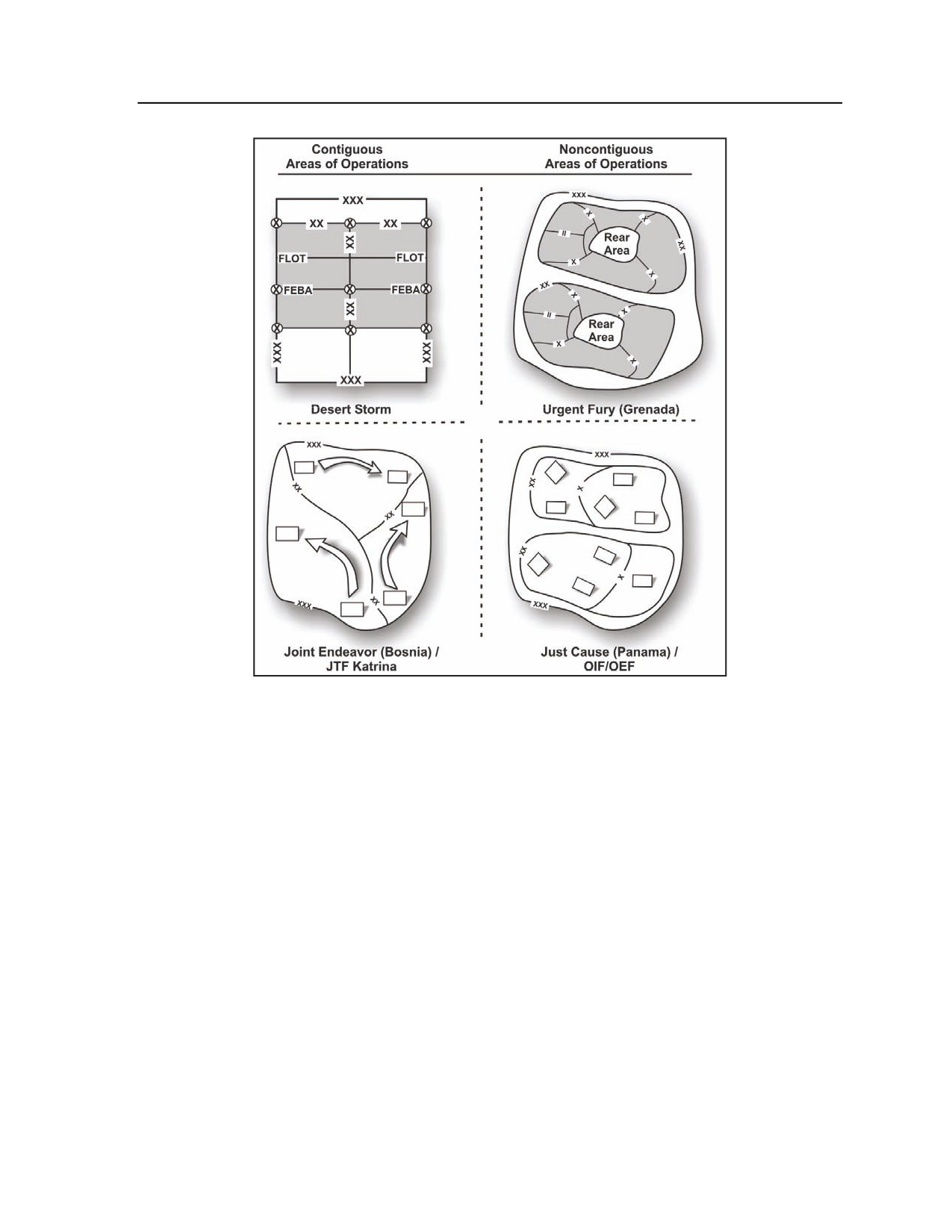
and purpose against key enemy capabilities and assets. Figure 1-1 depicts examples of contiguous and
noncontiguous AOs. See Chapter 2 this manual and FM 3-20.971 for additional information.
3 August 2009
FM 3-20.98
1-3
Chapter 1
Figure 1-1. Contiguous and noncontiguous areas of operations
1-8. If the troop is covering dispersed areas, reconnaissance and scout platoons may operate out of their
own assembly areas in their specified AOs. In an OE with noncontiguous AOs, the platoon may collocate
its assembly areas with another unit and conduct separate operations in the other unit’s AO. When the
platoon or its elements are assigned missions that overlap a maneuver unit’s AO, it is imperative that the
reconnaissance leader integrate and synchronize his unit’s operations with those of the maneuver unit.
When platoons are operating independently, the troop still exercises C2 and provides sustainment to the
platoons. In stability operations, the reconnaissance objective (focus) is often the population itself rather
than the terrain within the AO. The platoon can best reconnoiter this objective with human intelligence
(HUMINT) assets.
THREAT TACTICS, TECHNIQUES, AND PROCEDURES (TTP)
1-9. Current and future threats, empowered by global weapons proliferation and an increasingly
networked world, will emerge from failed, failing, and unstable states. These threats will include regional
or state-centered despots, transnational criminal organizations, drug cartels, terrorist groups, and/or
potential major military competitors. For additional information on enemy TTP, see FM 3-0 and FM 3-
20.96.
1-10. The threat’s goal is to defeat the reconnaissance platoon by confounding its ability to achieve and
maintain superior situational awareness (SA) and situational understanding (SU). Current and future OEs
place junior leaders in complex situations where their tactical actions may have international,
informational, and political implications as well as operational and strategic impact.
1-4
FM 3-20.98
3 August 2009
Overview
1-11. The unparalleled visibility and reach of both sensors and shooters mean that units must be able to
provide overwatch in mutual support of moving formations and to perform immediate action at ranges
beyond line of sight. The unit also must be prepared to fight opponents who are similarly equipped and
trained and who are operating on their own ground. Adaptive adversaries will modify their operations to
reduce their signatures to frustrate intelligence preparation of the battlefield (IPB) efforts and to deceive
the unit by showing it what it expects to see.
1-12. Threat elements will complicate targeting by closing distances to neutralize fires or by shielding
forces in cities and mixing among civilian populations. The threat will further complicate the unit’s
targeting efforts by using niche high-technology systems, making it more difficult to discern signatures of
high-payoff systems.
THE THREAT IN MAJOR COMBAT OPERATIONS
1-13. Threat forces in MCO oppose U.S. forces with a variety of high-technology systems built into
mechanized, motorized, and light infantry forces. These forces may be equipped with newer generation
tanks and infantry fighting vehicles and have significant numbers of antitank guided missile (ATGM)
systems, man-portable air defense systems, advanced fixed- and/or rotary-wing aviation assets, missiles,
rockets, artillery, mortars, and mines. In addition, they may possess weapons of mass destruction (WMD).
Enemy forces in MCO may be capable of long-term resistance using conventional formations such as
divisions and corps, but they may also conduct sustained unconventional operations and protracted
warfare.
Israeli Forces in Lebanon
In August 2006 Israeli Defense Forces conducted operations into southern Lebanon
in order to recover two Soldiers that had been kidnapped during a planned ambush.
Once in Lebanon the Israelis discovered that the Hezbollah had spent the last few
years preparing the AO. Several towns had been linked together into a complex web
of defensive positions that included reinforced bunkers, communications tunnels, and
prepared demolitions, minefields, and IEDs along all major avenues of approach. All
of the prepared positions were overwatched by sophisticated antitank weapon
ambushes using well-rehearsed engagement techniques. These defenses were
commanded and controlled using the existing telephone, radio, and television
infrastructures and were manned by personnel that were fully trained, prepared and
rehearsed.
THE THREAT IN SMALL SCALE CONTINGENCIES
1-14. In SSC environments, the threat employs forces characterized by limited armor. Some are equipped
with small numbers of early generation tanks or have mechanized forces. Most, however, consist
predominantly of infantry elements. Insurgents, terrorists, paramilitary units, special purpose forces,
special police, and local militias are present in the environment. They are expected to have robust
communications using conventional military devices augmented by commercial equipment such as cell
phones. They may not be capable of long-term, sustained, high-tempo combat operations, but they
generally are capable of conducting long-term, unconventional terrorist and insurgent operations.
THE THREAT IN STABILITY OPERATIONS
1-15. In stability operations, the threat is likely to be insurgents or terrorists who are highly motivated. These
forces may employ advanced communications, some precision weapons (such as guided mortar rounds), and
some ground-based sensors in varying combinations with conventional weapons, mines, and improvised
explosive devices (IED). The threat usually conducts psychological and information warfare against the host
nation (HN) government and population, and it may use terrorist techniques such as assassinations or
kidnappings. Task organization with civil affairs (CA), psychological operations (PSYOP), and other special
operations forces (SOF) may be necessary to communicate with the population and restore law and order.
3 August 2009
FM 3-20.98
1-5
Chapter 1
THE THREAT IN COUNTERINSURGENCY OPERATIONS
1-16. Threat elements pose a unique challenge for commanders in counterinsurgency (COIN) operations.
Insurgent organizational structures are functionally based and continually adaptive.
Insurgent
organizations can be rooted in ethnic or tribal groups. They also often take part in criminal activities or link
themselves to political parties, charities, or religious organizations. These conditions and practices make it
difficult to determine what and who constitutes the threat. The insurgency’s long-term effectiveness is
determined by its ability to generate and sustain popular support—or at least acquiescence and tolerance.
This ability is usually the insurgency’s center of gravity.
SECTION II - RECONNAISSANCE AND SCOUT PLATOON ORGANIZATIONS
1-17. Reconnaissance and scout platoons are organized to conduct reconnaissance and security operations
throughout the troop and squadron AO. Using information technology and air/ground reconnaissance
capabilities in complex terrain, the platoons can develop the situation by focusing on multidimensional and
asymmetrical threats in a designated AO. This allows the higher echelon commander to maintain SA and
develop SU. This discussion focuses on the five organizational variations of the platoons:
z
The reconnaissance platoon of the HBCT reconnaissance squadron and of the combined arms
battalion (CAB).
z
The motorized reconnaissance platoon of the IBCT reconnaissance squadron.
z
The reconnaissance platoon of the SBCT reconnaissance squadron.
z
The motorized reconnaissance platoon of the BFSB reconnaissance and surveillance squadron.
z
The scout platoon of the ACR cavalry squadron.
PLATOON MISSIONS
1-18. Regardless of organization, the reconnaissance or scout platoon’s primary missions in support of ISR
operations are—
z
Reconnaissance (see Chapter 3):
Zone reconnaissance.
Area reconnaissance.
Route reconnaissance.
Obstacle/restriction reconnaissance.
z
Security (see Chapter 4):
Screen.
Area security (which includes route security and convoy security).
Local security.
GENERAL CAPABILITIES AND LIMITATIONS
1-19. The following general capabilities and limitations apply to all reconnaissance and scout platoons.
CAPABILITIES
1-20. The platoons have the following capabilities:
z
They provide all-weather, continuous, accurate, and timely information through the combined
use of long-range advanced scout surveillance systems (LRAS3), unmanned aircraft systems
(UAS) provided by company or troop, and mounted and dismounted scouts.
z
They can gather information about multiple threats within their AO.
z
Leadership can rapidly assess situations and direct combat power and reconnaissance and
surveillance capabilities to meet priority intelligence requirements (PIR).
1-6
FM 3-20.98
3 August 2009
Overview
z
They can detect threat deception, decoys, and cover and concealment that otherwise would not
be detected by single-capability surveillance means by employing integrated and synchronized
reconnaissance and surveillance systems.
z
They support targeting and target acquisition with available ground and aerial assets, including
the fire support team’s (FIST) fire support surveillance system and UASs.
z
They can rapidly develop the situation.
z
They can conduct stealthy reconnaissance and security operations.
z
They reduce risk and enhance survivability by providing information that allows its parent
elements to avoid contact or to achieve situational dominance if contact is necessary.
z
They assist in shaping the OE by providing information or directing fires to disrupt the enemy.
z
They can fight for information against light/motorized forces.
Note. The reconaissance platoon in the BFSB is extremely limited in its ability to fight for
information because of the lack of organic mortars; armored fighting vehicles such as the
cavalry fighting vehicle (CFV) or Stryker; and tube-launched, optically tracked, wire-guided
(TOW) missile systems. It should fight for information only within the guidelines of the
commander’s engagement criteria or in self-defense.
LIMITATIONS
1-21. Reconnaissance and scout platoons have the following limitations, which can be mitigated with
careful employment and/or augmentation:
z
They have limited dismounted capability, requiring platoons to assume section missions to
generate the required dismounts.
z
They have limited direct fire standoff, lethality, and survivability in full spectrum operations.
z
They may require augmentation in full spectrum operations.
z
They require augmentation to perform economy of force operations.
z
They have limited sustainment assets that must frequently operate over extended distances.
Note. Some of these limitations are mitigated in the ACR scout platoon, whose organization
provides more tactical vehicles, firepower, sensors, and other operational assets than its
counterparts in the HBCT, IBCT, SBCT, and BFSB.
ORGANIZATIONS
1-22. When conducting mounted operations, reconnaissance and scout platoons are organized according to
the factors of METT-TC into an appropriate tactical organization consisting of a variable number of scout
sections or squads. Each of the different types of reconnaissance platoon organizations has inherent
capabilities and limitations depending on their tactical organization.
DISMOUNTED ORGANIZATION
1-23. As with mounted platoon organizations, each dismounted organization has its own set of capabilities
and limitations. Every dismounted organization, as a minimum, consists of a reconnaissance element and
a security element. The purpose of the reconnaissance element is to obtain data on information
requirements (IR). The security element’s primary responsibility is to protect the reconnaissance element.
The security element may also serve as a reconnaissance element or have alternate responsibilities.
Whichever role the security element plays, its primary objective is protecting the dismounted element.
3 August 2009
FM 3-20.98
1-7
Chapter 1
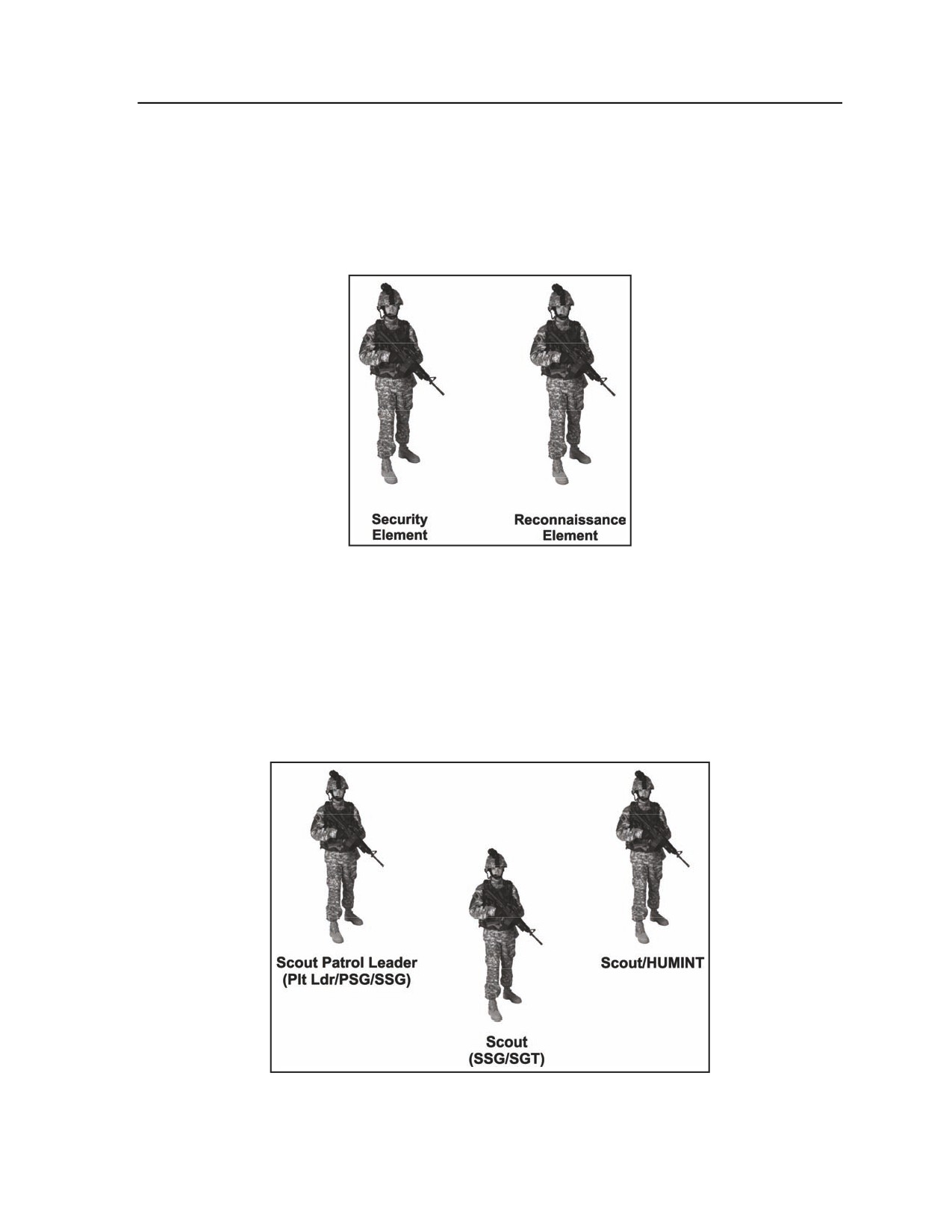
1-24. A two-man team is the smallest dismounted element within a reconnaissance and scout platoon (see
Figure 1-2) and may be formed from—
z
An M3 cavalry fighting vehicle (CFV) reconnaissance squad (single vehicle) in the HBCT
reconnaissance and ACR scout platoons.
z
A Stryker reconnaissance vehicle (RV) reconnaissance squad from an SBCT reconnaissance
platoon.
z
A two-vehicle reconnaissance section within the IBCT or BFSB reconnaissance platoon.
Figure 1-2. Dismounted two-man recon organization
1-25. The three-man dismounted team can perform reconnaissance and security tasks, man observation
posts (OP), conduct surveillance tasks, conduct liaison with other units, or perform a combination of these
tasks (see Figure 1-3). It is usually led by a scout sergeant or higher. In reconnaissance organizations (as
well as the other dismounted organizations), the vehicle(s) may provide security for the entire element. The
three-man team is the basic dismounted element in the following:
z
An SBCT recon squad (single RV).
z
An M3 CFV recon squad (single vehicle) in the ACR scout platoon.
z
A three-vehicle IBCT or BFSB recon section.
Figure 1-3. Dismounted three-man team
1-8
FM 3-20.98
3 August 2009
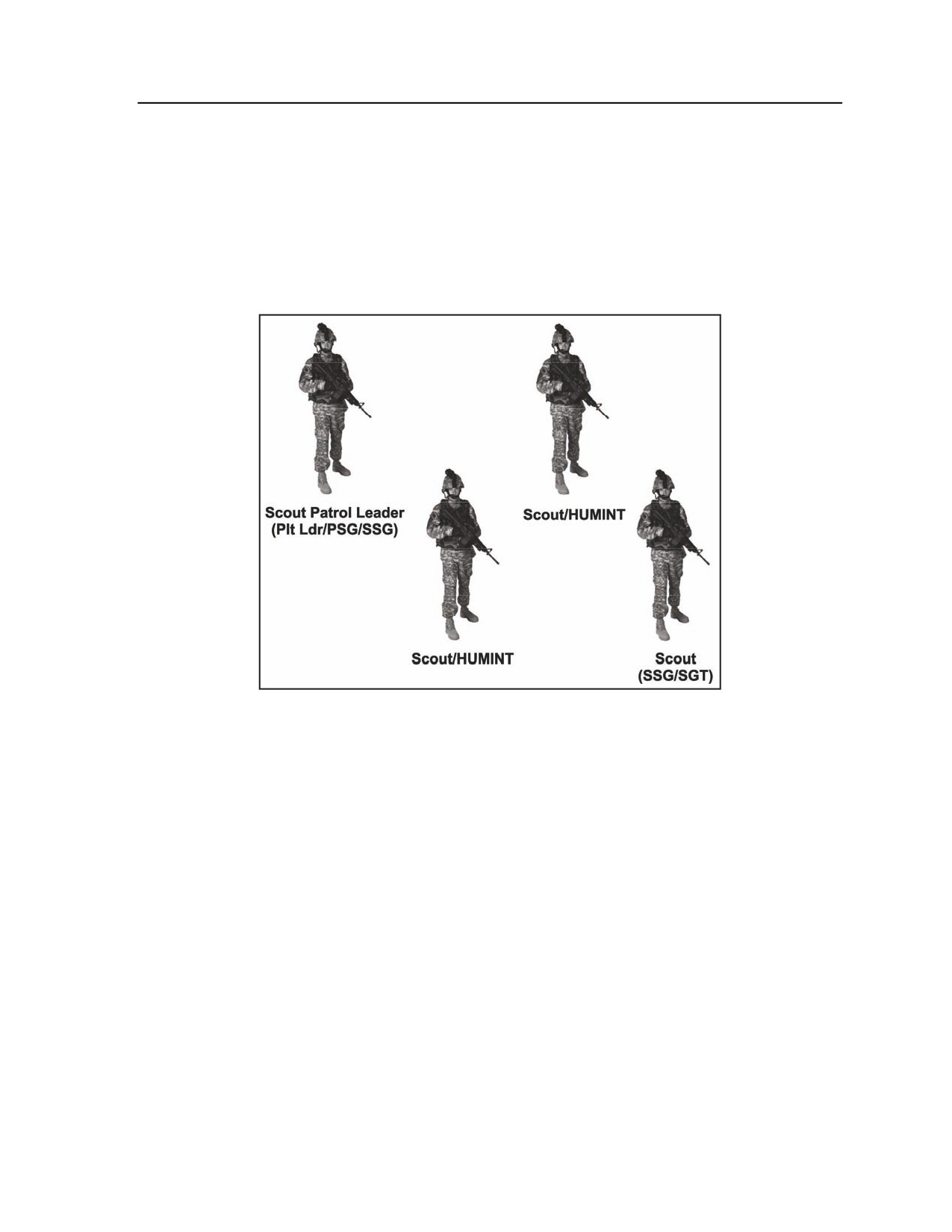
Overview
1-26. A four-man organization can perform reconnaissance tasks, security tasks, OP/surveillance tasks,
liaison, or a combination of these tasks. It is normally led by a scout (staff sergeant or higher). Refer to
Figure 1-4. This configuration may be formed from the following:
z
The SBCT reconnaissance platoon leader’s Stryker RV.
z
A two-vehicle reconnaissance section in an SBCT reconnaissance platoon.
z
A two-vehicle CFV section within an ACR scout platoon.
z
A two-vehicle high-mobility multipurpose wheeled vehicle (HMMWV) and CFV section in an
HBCT or CAB reconnaissance platoon.
Figure 1-4. Dismounted four-man reconnaissance organization
1-27. When required by METT-TC, an entire section may dismount. It can perform reconnaissance tasks,
security tasks, OP/surveillance tasks, liaison, or a combination of these tasks. The platoon leader, platoon
sergeant (PSG), or senior staff sergeant leads this element.
1-28. A dismounted platoon can perform reconnaissance tasks, security tasks, OP/surveillance tasks,
liaison, or a combination of these tasks. The platoon leader/PSG leads the dismounted platoon element,
which always includes an element designated for security (reaction force) and control. The dismounted
platoon organization may be used if the threat is high (security of the element requires mutual support) or
vehicular movement is impossible. Infiltration, for example, may require the platoon to conduct
dismounted tactical movement. The platoon’s vehicles may provide security for the entire element; this
organization normally leaves two personnel (driver and gunner) mounted on each vehicle.
HBCT AND CAB RECONNAISSANCE PLATOON
1-29. This platoon is equipped with three CFVs and five armored HMMWVs equipped with LRAS3 (See
Figure 1-5).
3 August 2009
FM 3-20.98
1-9
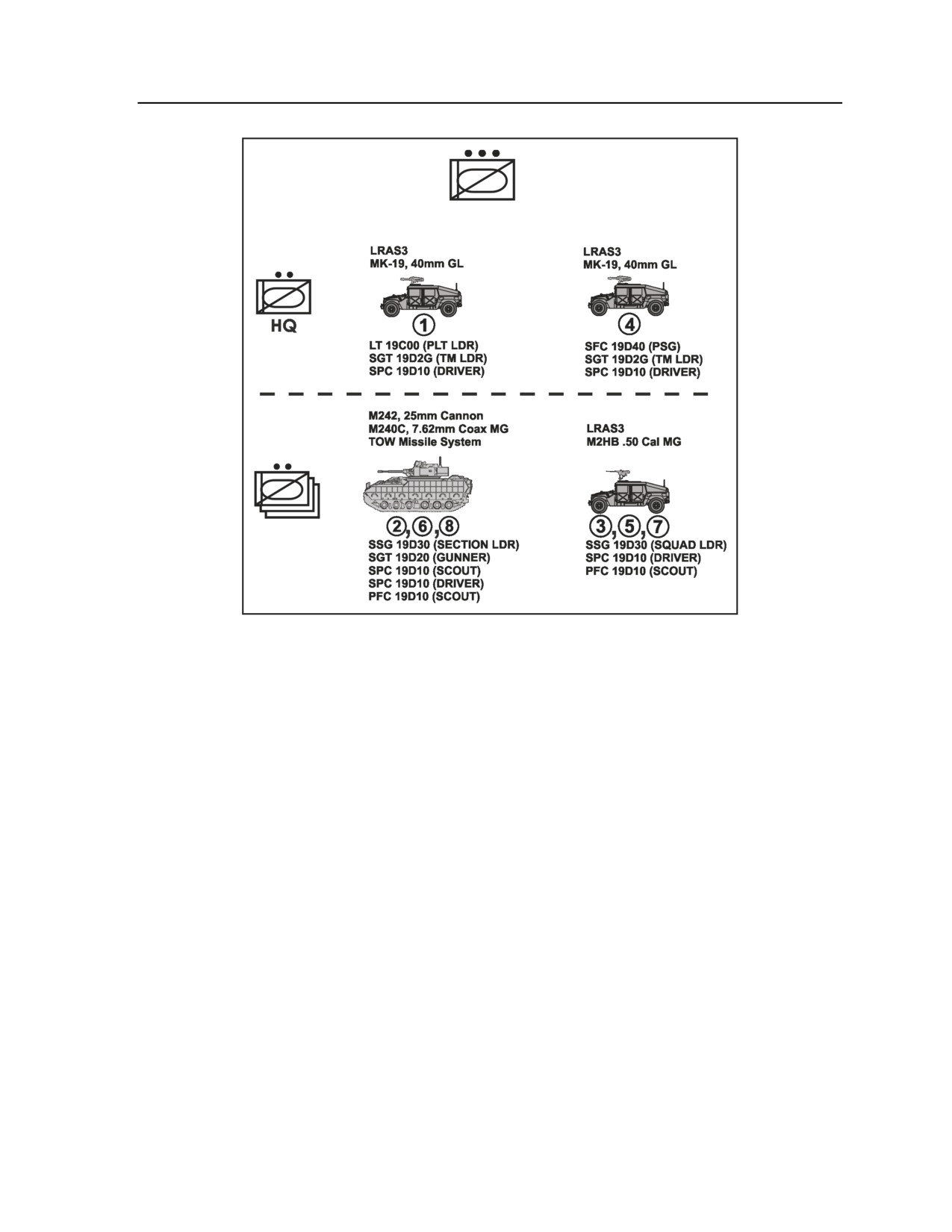
Chapter 1
Figure 1-5. HBCT and CAB reconnaissance platoon
Capabilities
1-30. The HBCT and CAB reconnaissance platoon has the following capabilities:
z
The M3A3 CFV provides firepower and survivability in full spectrum operations.
z
The CFV has a 25-mm cannon, 7.62-mm coaxial machine gun, and tube-launched, optically
tracked, wire-guided (TOW) missile system.
z
Each CFV carries three dismounted scouts to execute dismounted tasks.
z
The LRAS3 provides real-time ability to detect, recognize, identify, and geo-locate distant
targets, while transmitting information directly to digital information systems such as Force XXI
battle command—brigade and below (FBCB2).
Limitations
1-31. The HBCT and CAB reconnaissance platoon has the following limitations:
z
It is vulnerable to enemy counterreconnaissance and security measures; fighting for information
in full spectrum operations is limited.
z
The M1114/M1152 HMMWV provides inadequate survivability against direct and indirect fires
in operations teamed with the more survivable M3A3.
z
With only two platoons per troop, the size of the AO and scope of traditional reconnaissance
and security missions is limited.
z
Limited dismounts reduce the capabilities of the platoon to conduct long-term OPs, continuous
screening ability, or to conduct dismounted tasks associated with route, zone, and/or area
reconnaissance.
1-10
FM 3-20.98
3 August 2009
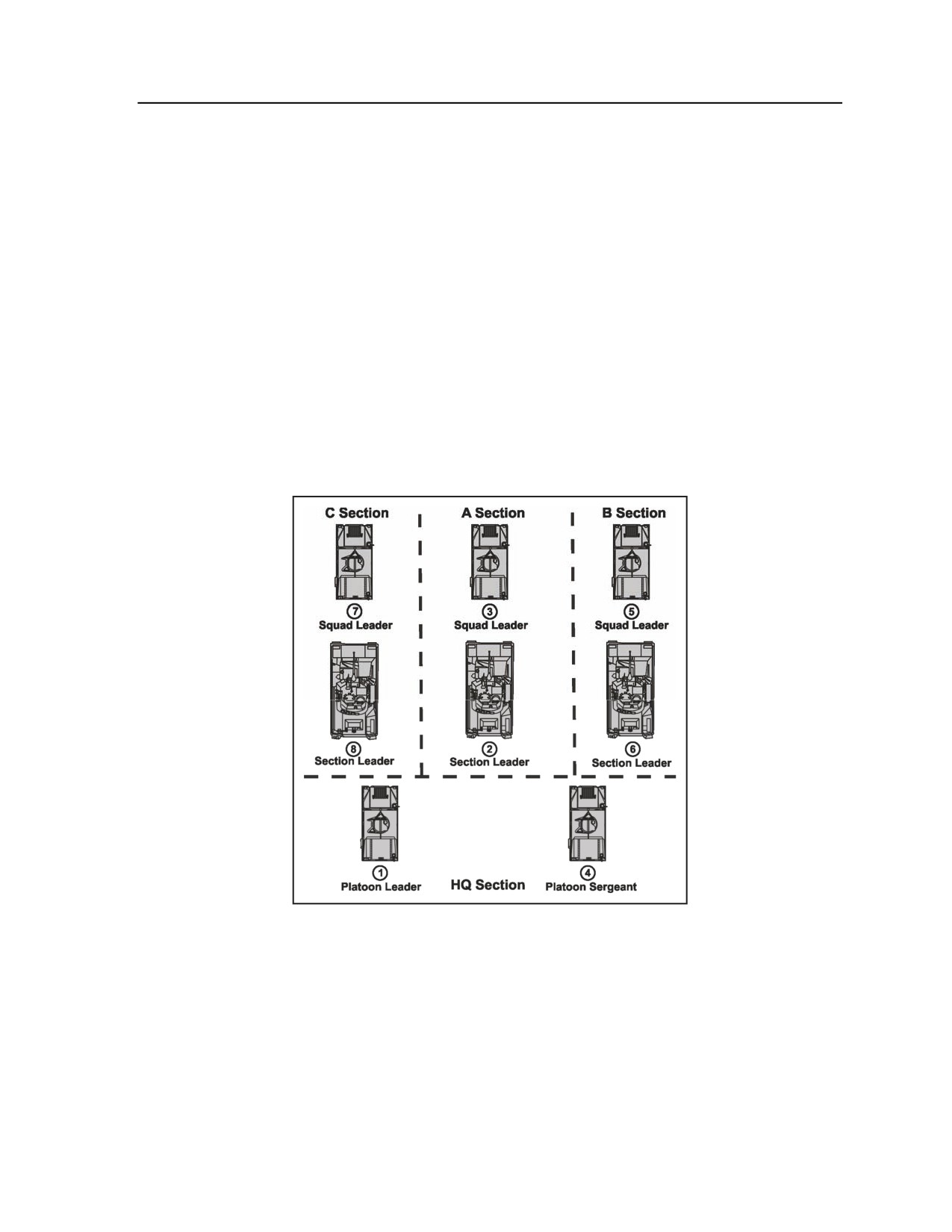
Overview
Organization
1-32. The HBCT and CAB reconnaissance platoon has several organizational options, including the basic
options covered in this discussion. The troop commander and/or platoon leader may develop other
combinations to meet unique METT-TC requirements and to accommodate attachments.
Sections
1-33. The HBCT and CAB reconnaissance platoon, in most operations, is employed by reconnaissance
sections. Each section is made up of a section leader, squad leaders, and their vehicle crews (or teams).
These elements may be further organized into designated dismounted teams and squads as outlined in
previous paragraphs.
1-34. Four-section (two-vehicle) organization. This is an effective organization when observing multiple
avenues of approach or when multiple reconnaissance missions are required (refer to Figure 1-6). This
organization provides security at the section level and gives the sections sufficient maneuver and C2
capability to conduct limited separate missions. These organizational considerations apply:
z
The headquarters section consists of the platoon leader’s and PSG’s HMMWVs.
z
Three reconnaissance sections (A, B, and C) that consist of one section leader’s CFV and one
squad leader’s HMMWV.
z
This configuration provides four personnel per reconnaissance section for dismounted operations.
Figure 1-6. Four-section (two-vehicle) organization
1-35. Three-section organization. This organization is ideal for reconnaissance along a single route (refer
to Figure 1-7). It allows employment of two short-duration OPs. The ability to concurrently conduct
dismounted patrols is very limited. These organizational considerations apply:
z
The headquarters section includes the platoon leader, mounted in a CFV, and the PSG, mounted
in a HMMWV.
z
Two reconnaissance sections (A and B) consist of one section leader’s CFV, and two squad
leader’s HMMWVs.
3 August 2009
FM 3-20.98
1-11
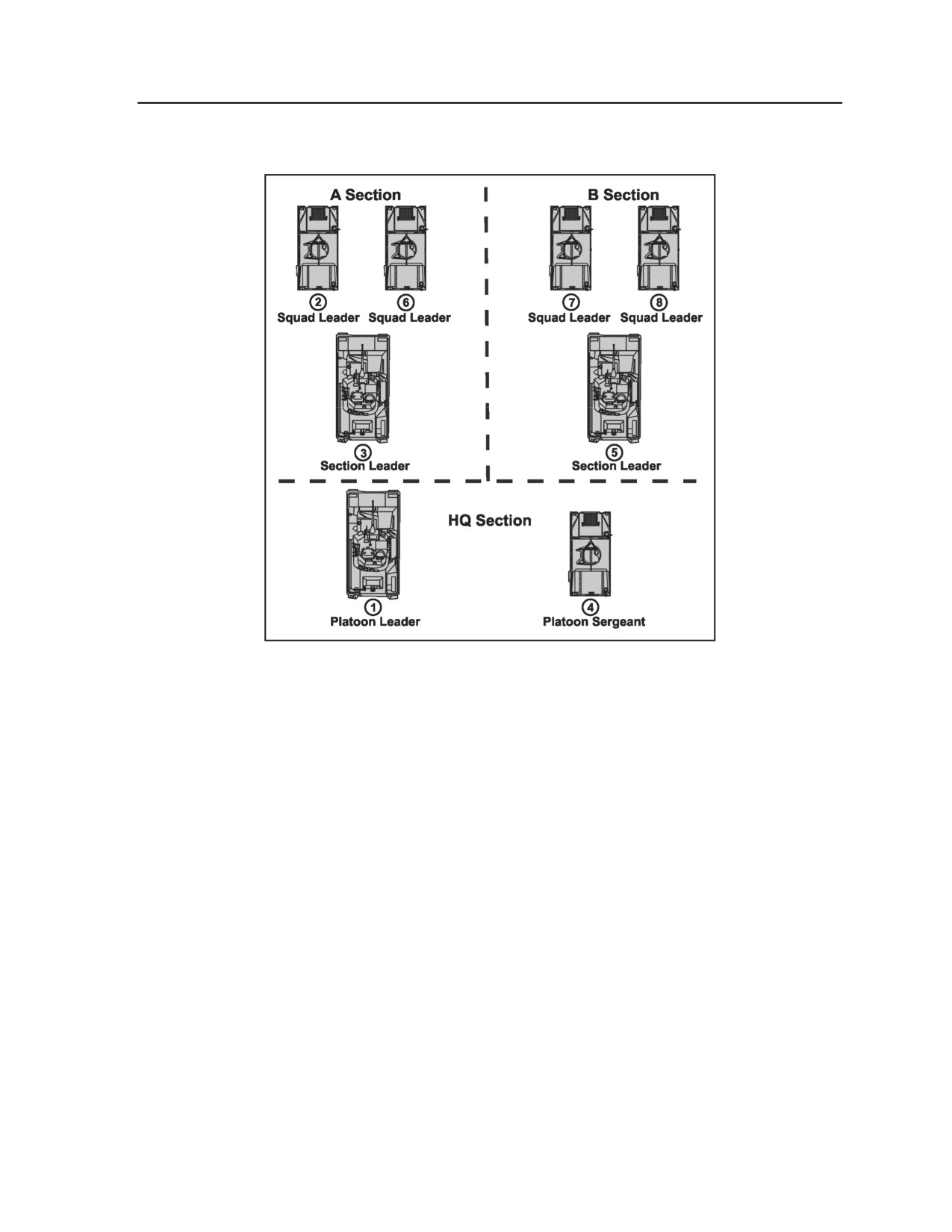
Chapter 1
z
This configuration provides five personnel per reconnaissance section for dismounted
operations.
Figure 1-7. Three-section organization
Squads
1-36. The platoon may also be task organized for maneuver purposes into smaller reconnaissance squads.
These normally consist of a single vehicle and its crew, but may require combining personnel from
multiple vehicles/crews in accordance with METT-TC requirements.
IBCT MOTORIZED RECONNAISSANCE PLATOON
1-37. The three reconnaissance platoons are each organized with six armored scout HMMWVs (see Figure
1-8).
1-12
FM 3-20.98
3 August 2009
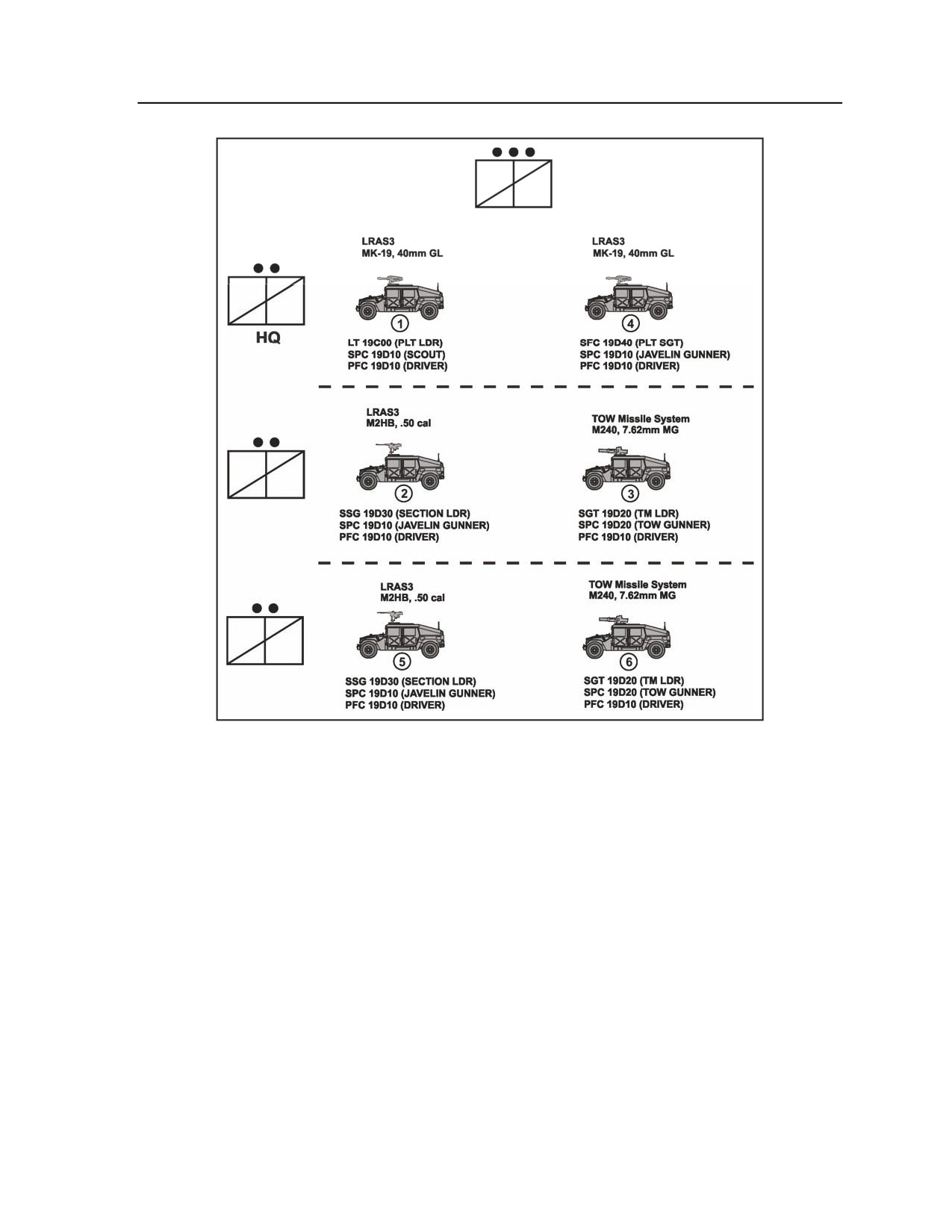
Overview
Figure 1-8. IBCT motorized reconnaissance platoon
Capabilities
1-38. The IBCT motorized reconnaissance platoon has the following capabilities:
z
It possesses two mounted TOW systems.
z
It is highly mobile and responsive.
Limitations
1-39. The IBCT motorized reconnaissance platoon has the following limitations:
z
Because the platoon is vulnerable to enemy counterreconnaissance and security measures,
fighting for information in full spectrum operations is very limited.
z
The M1114/M1152 HMMWV provides inadequate survivability and mobility.
z
The platoon possesses limited dismounted capability; each HMMWV carries a crew of three,
one of whom is tasked to perform dismounted reconnaissance tasks.
z
Limited dismounts reduce the capabilities of the platoon to conduct long-term OPs, continuous
screening, or to conduct the dismounted tasks associated with route, zone, and/or area
reconnaissance.
3 August 2009
FM 3-20.98
1-13
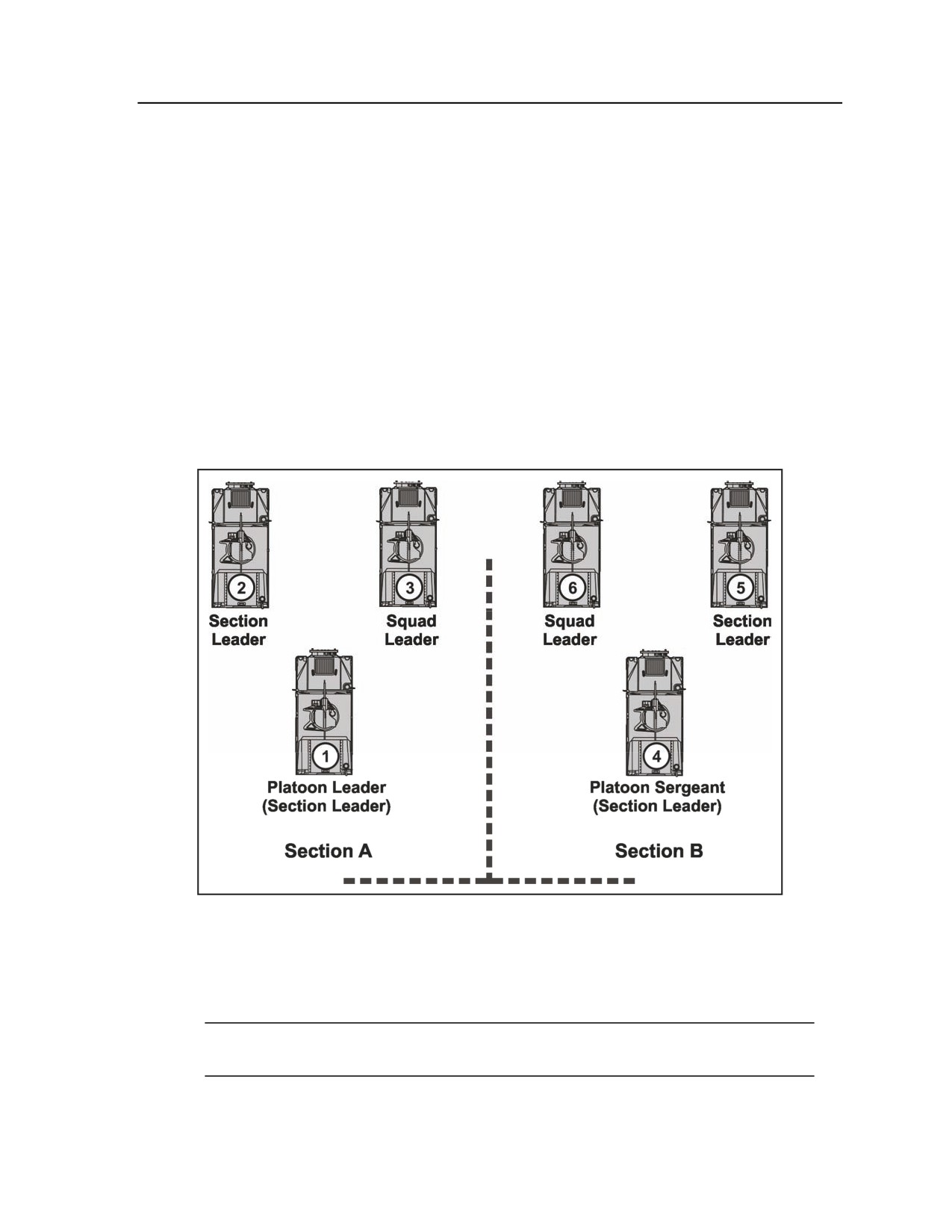
Chapter 1
Organization
1-40. The IBCT reconnaissance platoon has a wide variety of organizational options, including the basic
options covered in the following discussion. The troop commander and/or platoon leader may develop
other combinations to meet unique METT-TC requirements and to accommodate attachments.
Sections
1-41. The IBCT reconnaissance platoon, in most operations, is employed by reconnaissance sections. Each
section is made up of a section leader, squad leaders, and their vehicle crews.
1-42. Two-section organization. This is an effective organization when only two maneuver corridors
have to be observed or when two distinct reconnaissance missions are required (refer to Figure 1-9). This
organization maximizes security at the section level, gives the sections sufficient maneuver and C2
capability to conduct limited separate missions, and allows these dismounted capabilities:
z
Nine personnel for purely dismounted operations such as a reconnaissance patrol.
z
Three personnel
(one per vehicle) for performing reconnaissance tasks while conducting
mounted operations.
z
Five personnel to man OPs or conduct patrols.
Figure 1-9. IBCT reconnaissance platoon
two-section organization
1-43. Three-section organization. This organization is ideal for reconnaissance along a single route
(refer to Figure
1-10). It allows employment of three short-duration OPs; however, the ability to
concurrently conduct dismounted patrols is very limited.
Note. A consolidated headquarters section, with the platoon leader and PSG (see Figure 1-10),
increases C2 capability and is an optional configuration.
1-14
FM 3-20.98
3 August 2009
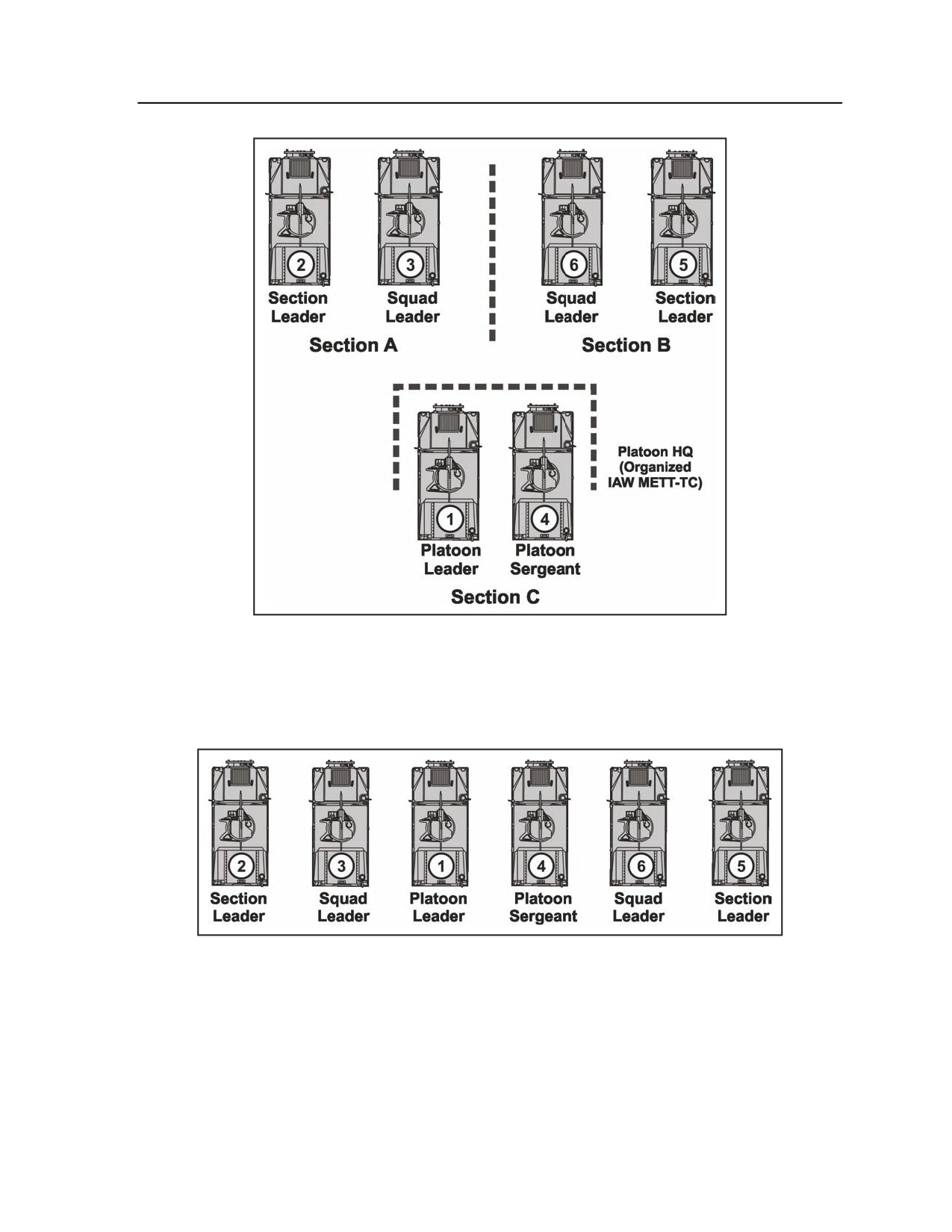
Overview
Figure 1-10, IBCT reconnaissance platoon
three-section organization
1-44. Six-vehicle organization. The six-vehicle organization is the most difficult to control (refer to
Figure 1-11). The platoon leader employs this organization when he must have six separate information
sources at the same time. This organization only allows one dismount to provide local security.
Figure 1-11. IBCT reconnaissance platoon
six-vehicle organization
Squads
1-45. The platoon may also be task organized for maneuver purposes into smaller reconnaissance squads,
each normally consisting of a single vehicle and its crew.
3 August 2009
FM 3-20.98
1-15
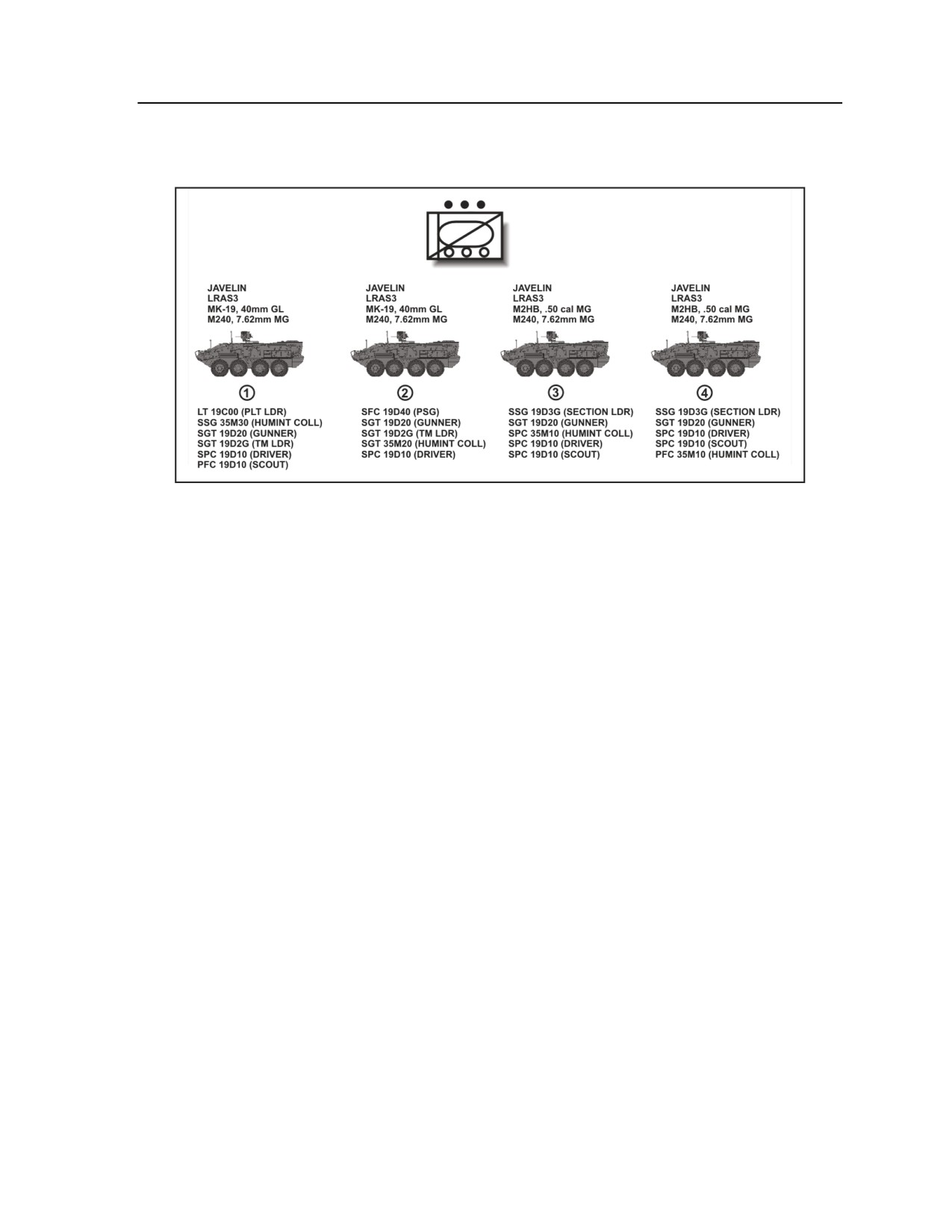
Chapter 1
SBCT RECONNAISSANCE PLATOON
1-46. This platoon is organized with four Stryker RVs (see Figure 1-12).
Figure 1-12. SBCT reconnaissance platoon
Capabilities
1-47. The SBCT reconnaissance platoon has the following capabilities:
z
It possesses four Javelin systems.
z
It possesses organic HUMINT personnel for employment at platoon levels.
z
It has access to information and intelligence provided by assets in the squadron surveillance
troop, such as the Shadow UAS, Prophet, Trojan Spirit, and chemical, biological, radiological,
and nuclear (CBRN) reconnaissance platoon.
Limitations
1-48. The SBCT reconnaissance platoon has the following limitations:
z
Because the platoon is vulnerable to enemy counterreconnaissance and security measures,
fighting for information is limited.
z
In performing route reconnaissance, four-vehicle/two-section platoons accept risk when
individual Strykers reconnoiter lateral routes and terrain adjacent to the route.
z
With limited dismounts within scout sections, the two scout sections must be combined to
generate the required dismounts to execute a long-term OP, continuous screening, or to conduct
the dismounted tasks associated with route, zone, and/or area reconnaissance.
Mounted Organization
1-49. The SBCT reconnaissance platoon is limited in organizational configurations because it has only
four organic vehicles. Regardless of the mission it is executing or the formation or movement technique it
is using, the SBCT reconnaissance platoon normally operates in one of three organizations during mounted
operations: as three sections with one vehicle in each section and the platoon leader’s vehicle providing
C2, as two sections with two vehicles in each section, or as a four-vehicle platoon.
Two-Section Organization
1-50. The two-section organization is used when increased security is required, when the AO can be
covered efficiently with only two elements, or when the threat situation is unknown. This type of
organization limits the amount of terrain the platoon can cover and decreases the speed with which the
platoon can perform its tasks. On the other hand, it increases internal section security by providing
1-16
FM 3-20.98
3 August 2009
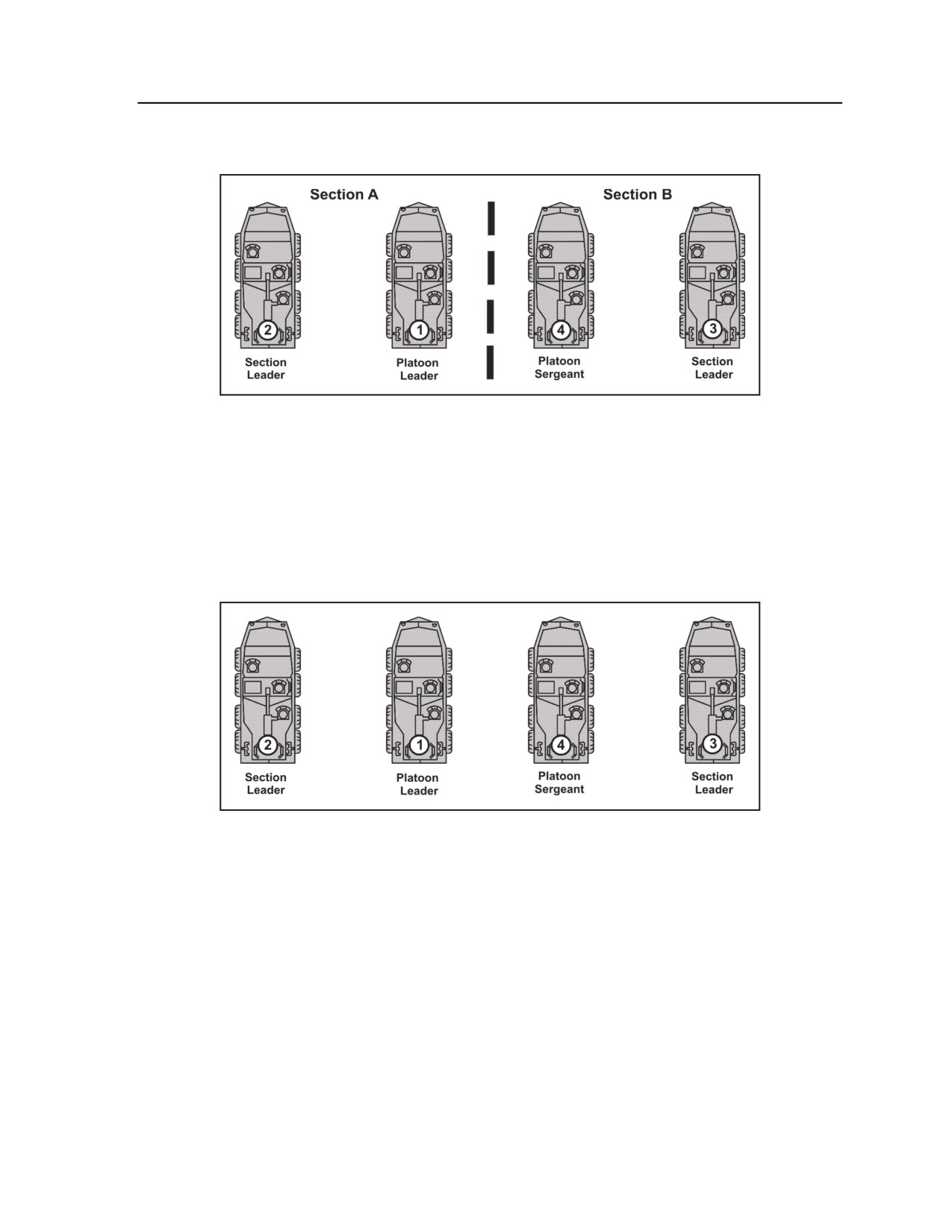
Overview
mutually supporting fires. It also gives the platoon leader and PSG greater flexibility in performing C2 and
sustainment requirements (see Figure 1-13).
Figure 1-13. SBCT reconnaissance platoon two-section
vehicle organization
Four-Vehicle Organization
1-51. The four-vehicle organization is the most difficult to control (refer to Figure 1-14). The platoon
leader employs this organization when he must have four separate information sources at the same time or
when the platoon is executing certain surveillance missions. This organization should be used when the
threat is low or nonexistent. This formation may also be implemented during short-duration security
missions, allowing for depth in the platoon’s sector.
Figure 1-14. SBCT reconnaissance platoon four-vehicle organization
Dismounted Organization
1-52. Dismounted operations are the SBCT reconnaissance platoon’s primary means for gathering
information. The basic dismounted elements within the SBCT reconnaissance platoon are the team, squad,
section, and platoon. Each vehicle has a designated dismounted team.
BATTLEFIELD SURVEILLANCE BRIGADE RECONNAISSANCE PLATOON
1-53. The BFSB reconnaissance platoon is a lightly armed organization and therefore does not usually
fight for information unless it is significantly augmented. It relies on stealth to conduct reconnaissance and
surveillance and to avoid combat. If an asset is compromised, it must either withdraw or exfiltrate to
preserve its capability to collect information. If an asset becomes decisively engaged, it relies on its limited
firepower and Army and joint fires for protection and to break contact. This platoon is organized with six
armored HMMWVs (see Figure 1-15).
3 August 2009
FM 3-20.98
1-17
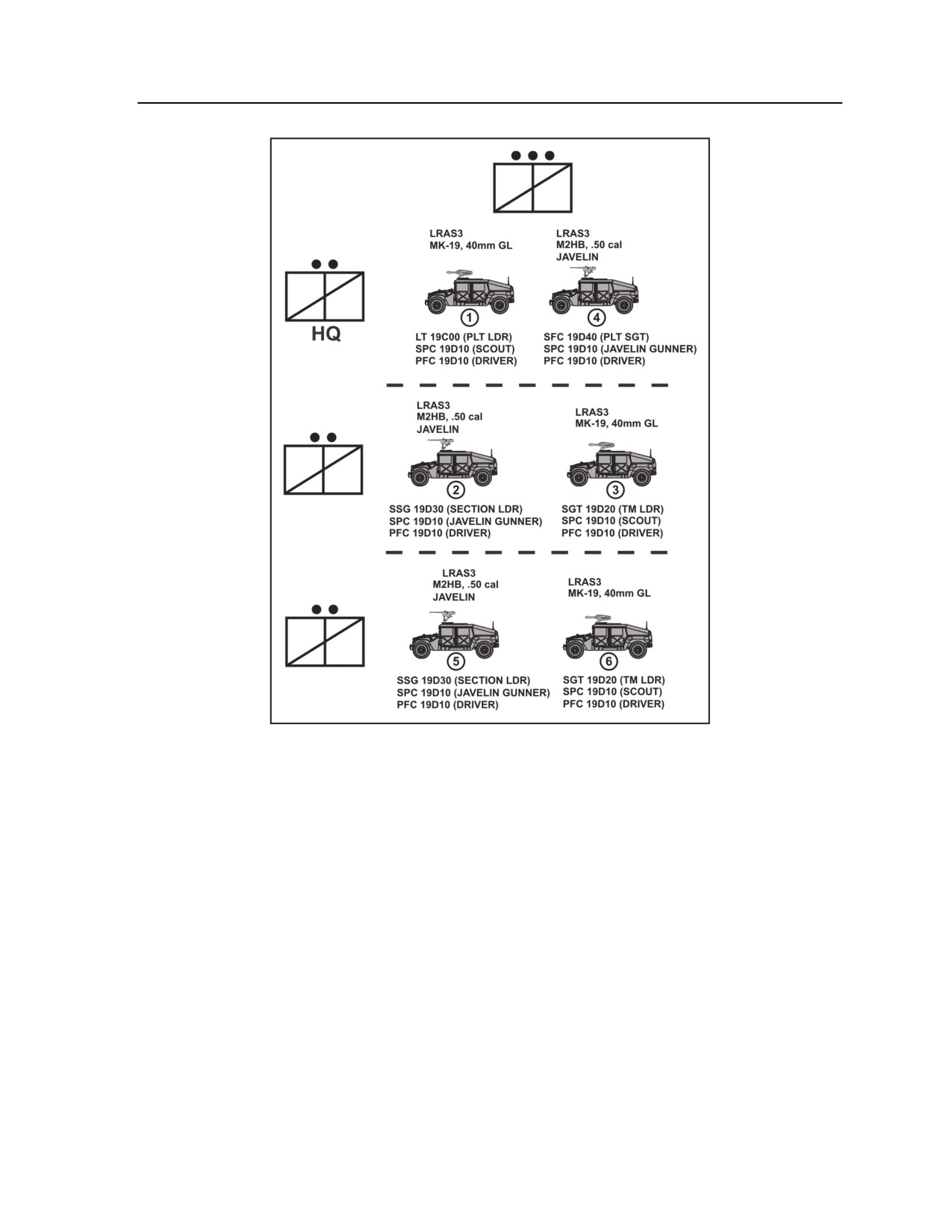
Chapter 1
Figure 1-15. BFSB reconnaissance platoon
Capabilities
1-54. The BFSB reconnaissance platoon has the following capabilities:
z
It is integrated into the BFSB ISR architecture and has access to information and intelligence
collected by brigade assets.
z
It possesses multiple Javelin missile systems.
z
It has long-range communications capability beyond line of sight
(LOS). Employed in
conjunction with the troop FIST, this facilitates long-range target acquisition and interdiction.
Limitations
1-55. The BFSB reconnaissance platoon has the following limitations:
z
Its ability to fight for information in full spectrum operations is very limited.
z
It can conduct limited security missions in full spectrum operations.
z
Its M1114/M1152 HMMWVs provide inadequate survivability and mobility.
z
It does not have access to mortar support.
z
Despite the advantages of its long-range communications systems, the platoon must accept risk
when it operates outside the protective range of indirect fire support assets. This risk is further
compounded by the platoon’s lack of mortar support.
1-18
FM 3-20.98
3 August 2009
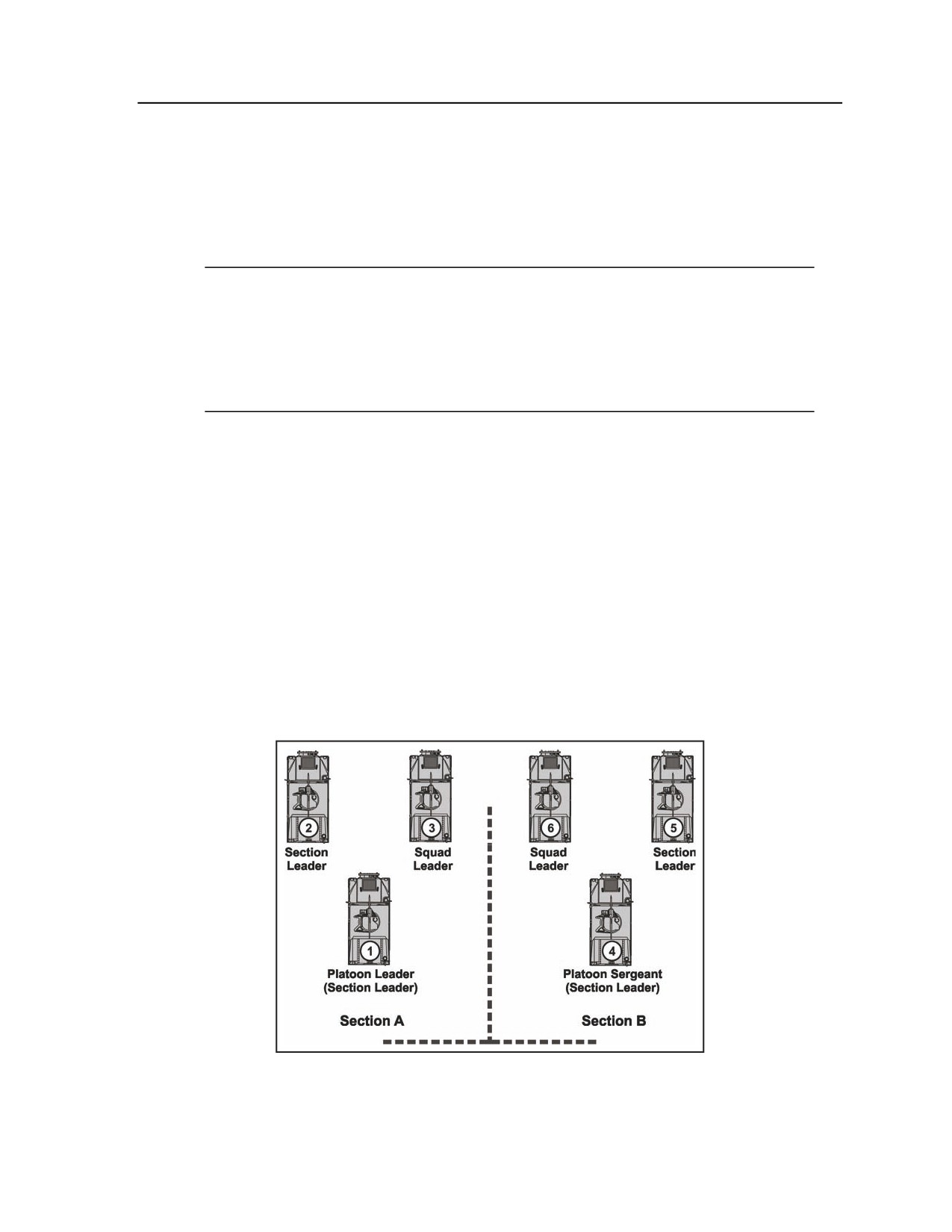
Overview
z
Joint fires can support the platoon only under favorable METT-TC conditions, including weather.
z
Joint fires support is further limited by organic laser designation capability.
z
The platoon possesses limited dismounted capability; each HMMWV carries a crew of three,
one of whom is tasked to perform dismounted reconnaissance tasks.
z
With limited dismounts within scout sections, the two scout sections must be combined to
generate the required dismounts to execute a long-term OP or continuous screening or to
conduct the dismounted tasks associated with route, zone, and/or area reconnaissance.
Note. The BFSB reconnaissance platoon’s unique combination of capabilities and limitations
poses distinct doctrinal and operational challenges for the troop commander and platoon leader.
On one hand, the platoon will often operate over extended distances because of its advanced
technical capabilities, including long-range communications equipment. On the other, leaders at
all levels must plan and conduct operations taking into account the platoon’s limitations, such as
firepower and protection considerations
(lack of mortars and armored fighting vehicles;
limitations in laser target acquisition/designation; reliance on indirect fires and/or joint fires).
Organization
1-56. Much like the IBCT reconnaissance platoon, the BFSB reconnaissance platoon has a wide variety of
organizational options, including the basic options covered in the following discussion. The troop
commander and/or platoon leader may develop other combinations to meet unique METT-TC requirements
and to accommodate attachments.
Sections
1-57. Two-section organization. This is an effective organization when only two maneuver corridors
have to be observed or when two distinct reconnaissance or surveillance missions are required (see Figure
1-16). This organization maximizes security at the section level and gives the sections sufficient maneuver
and C2 capability to conduct limited separate missions. This organization allows the following dismount
capabilities:
z
Three personnel
(one per vehicle) for performing reconnaissance tasks while conducting
mounted operations.
z
Five personnel to man OPs or conduct patrols.
Figure 1-16. BFSB reconnaissance platoon two-section organization
3 August 2009
FM 3-20.98
1-19
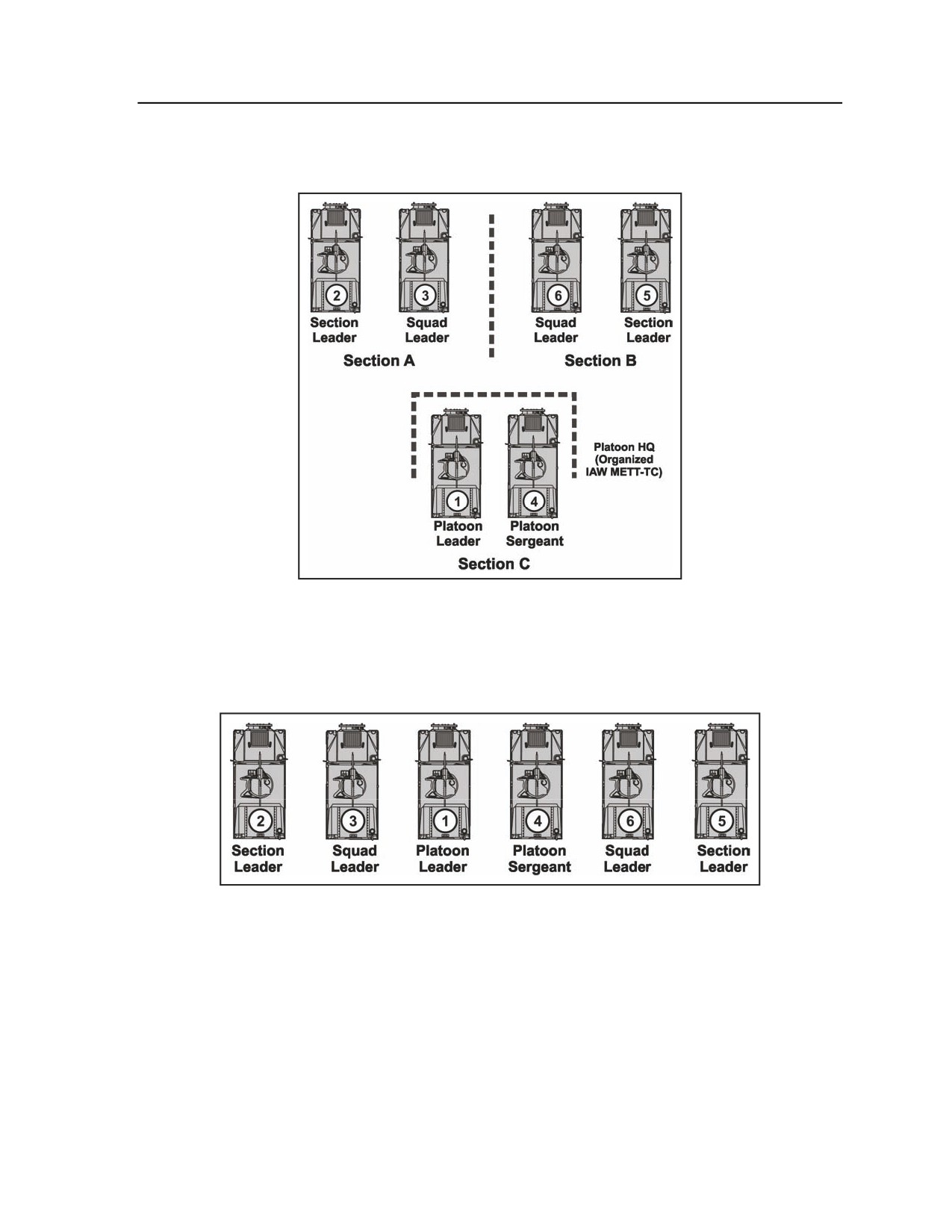
Chapter 1
1-58. Three-section organization. This organization is ideal for reconnaissance along a single route
(refer to Figure 1-17). It allows employment of three short-duration OPs. The ability to concurrently
conduct dismounted patrols is very limited.
Figure 1-17. BFSB reconnaissance platoon
three-section organization
1-59. Six-vehicle organization. The six-vehicle organization is the least secure and most difficult to
control (refer to Figure 1-18). It should be used only when there are simultaneous multiple surveillance
requirements. This organization allows for only one dismount to provide local security.
Figure 1-18. BFSB reconnaissance platoon
six-vehicle organization
Squads
1-60. The platoon may also be task organized for maneuver purposes into smaller reconnaissance squads;
these are normally a single vehicle and its crew.
ARMORED CAVALRY REGIMENT SCOUT PLATOON
1-61. This platoon is equipped with six CFVs and is found in the ACR (see Figure 1-19.)
1-20
FM 3-20.98
3 August 2009
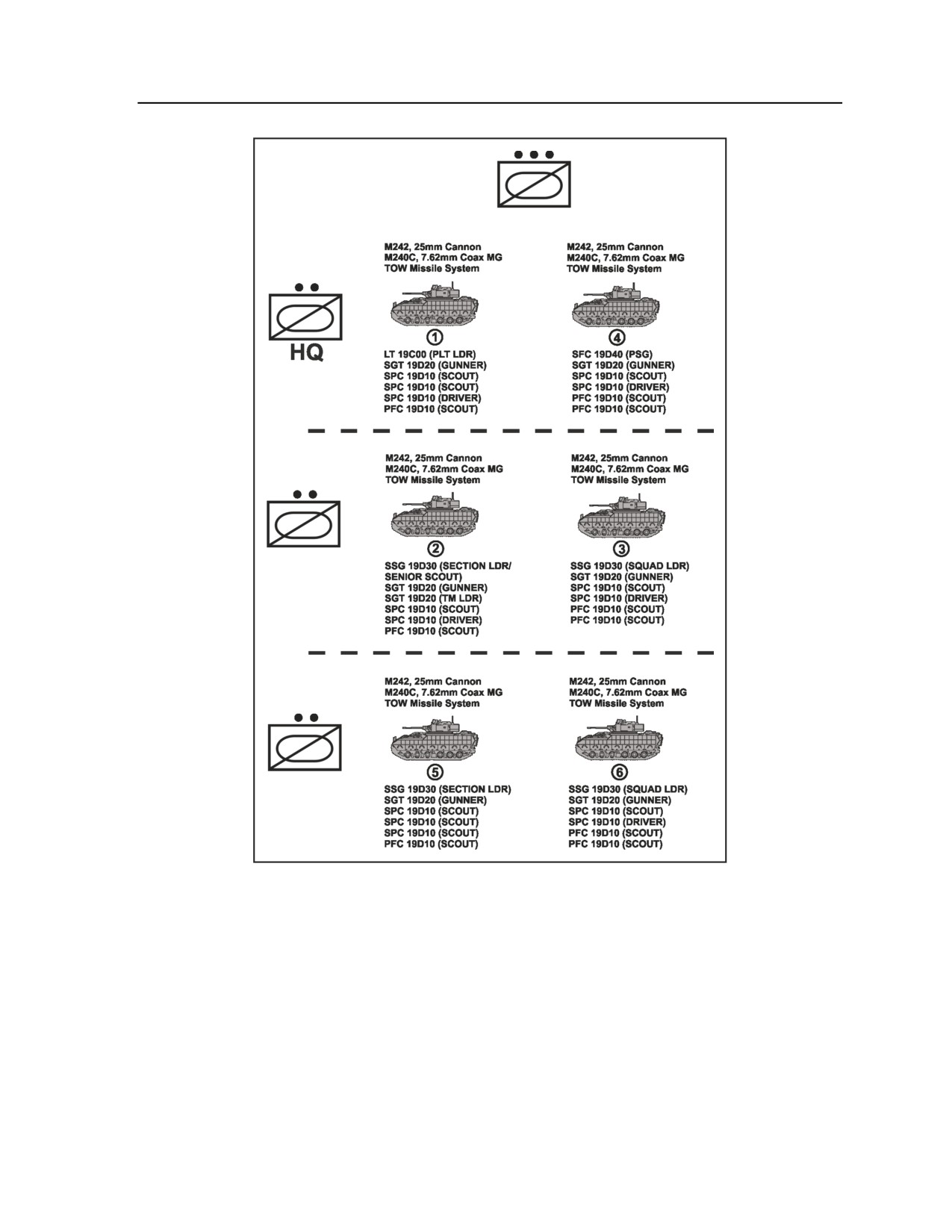
Overview
Figure 1-19. ACR scout platoon
Capabilities
1-62. The ACR scout platoon has the following capabilities:
z
The CFV provides firepower and survivability in full spectrum operations.
z
The CFV is armed with a 25-mm cannon, 7.62-mm coaxial machine gun, and TOW missile
system, all tied into a thermal imaging system.
z
Each CFV carries three dismounted scouts to execute dismounted tasks.
z
Combined with the ACR cavalry troop’s organic tank platoons, the scout platoon is more
capable of fighting for information and executing security operations than any other
reconnaissance platoon.
3 August 2009
FM 3-20.98
1-21
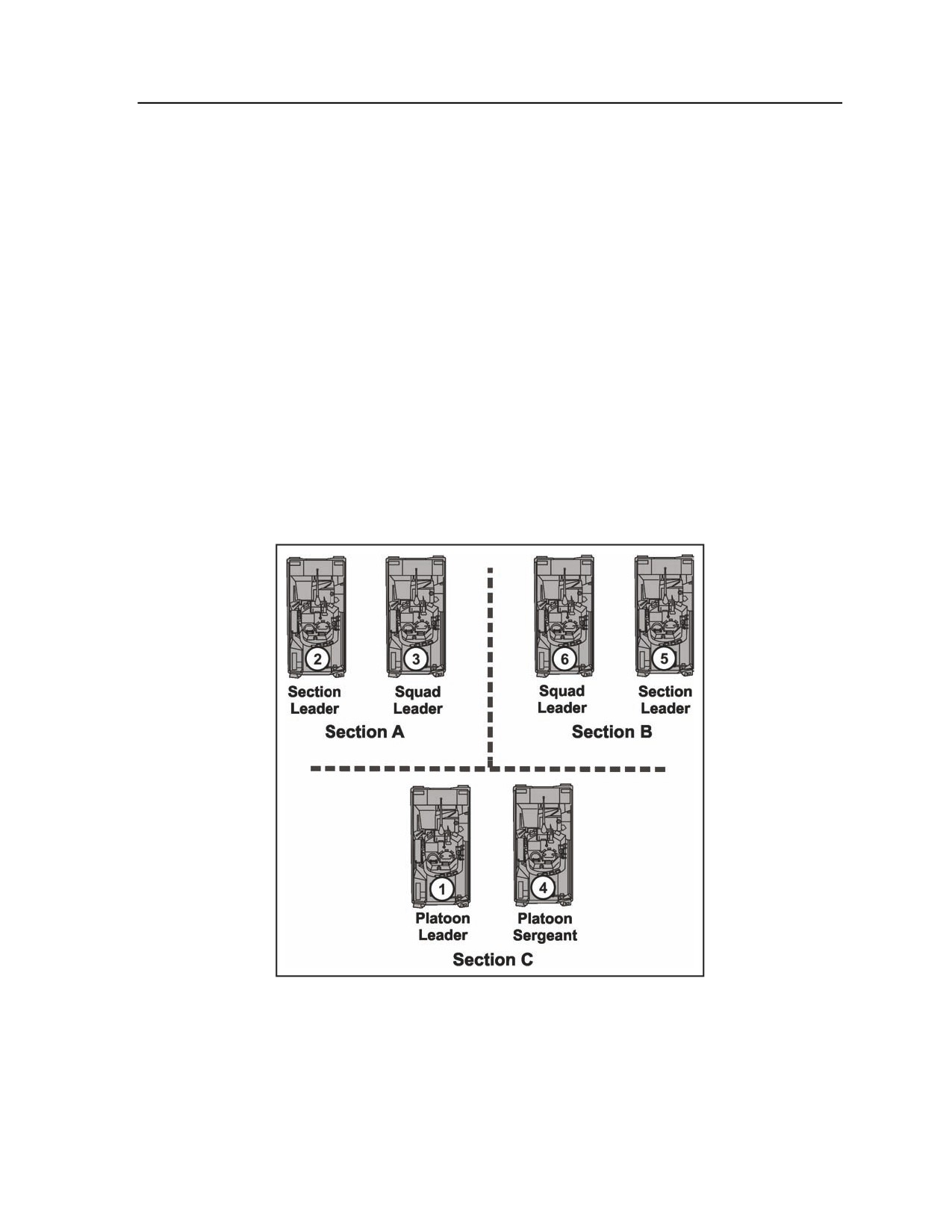
Chapter 1
Limitations
1-63. The ACR scout platoon has the following limitations:
z
It is less stealthy.
z
It possesses limited dismounted capability; and must combine sections to generate the required
dismounts to execute a long-term OP or continuous screening or to conduct the dismounted
tasks associated with route, zone, and/or area reconnaissance.
Organization
1-64. Regardless of the mission it is executing or the formation or movement technique it is using, the
ACR scout platoon normally operates in one of the following organizations.
Sections
1-65. Three-section organization. This is the basic organization for the ACR scout platoon
(see
Figure 1-20). This organization allows the platoon to achieve a compromise between the requirement of
employing a maximum number of elements during the reconnaissance or security mission and the need for
security. Other attributes of this organization include the following:
z
It is the ideal organization for the conduct of a route reconnaissance mission.
z
In a screen mission, this organization allows employment of three long-duration OPs, which are
occupied for 12 or more hours.
z
It also facilitates the simultaneous conduct of dismounted patrols.
Figure 1-20. ACR scout platoon
three-section organization
1-66. Two-section organization. The two-section organization is used when increased security is
required, when the AO can be covered efficiently with only two elements, or when operational strength
(less than six vehicles operational) makes the three-section organization impossible. See Figure 1-21.
1-22
FM 3-20.98
3 August 2009
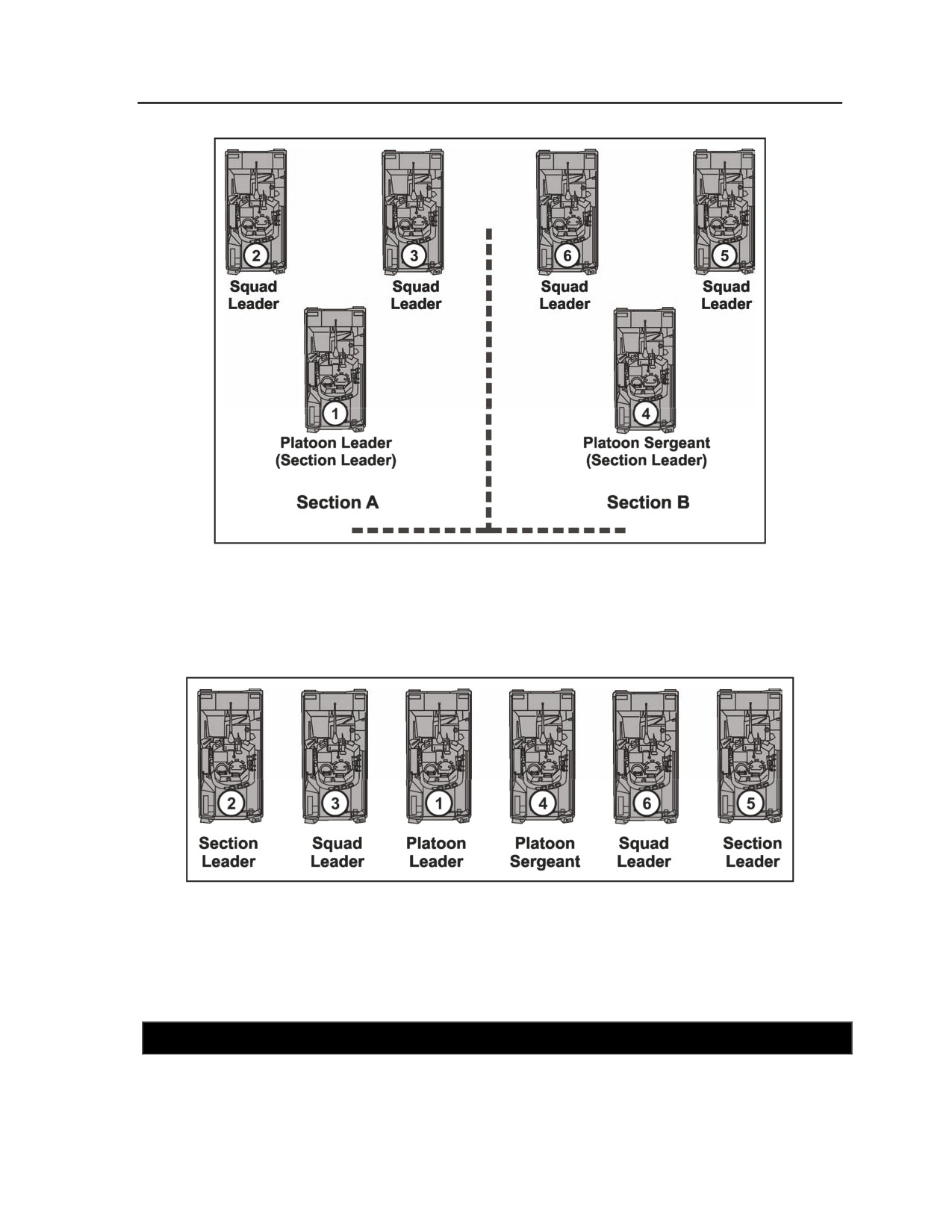
Overview
Figure 1-21. ACR scout platoon
two-section organization
1-67. Six-vehicle organization. The six-vehicle organization is the most difficult to control
(see
Figure 1-22). The platoon leader employs this organization when he must have six separate information
sources at the same time.
Figure 1-22. ACR scout platoon six-vehicle organization
Squads
1-68. The platoon may also be task organized for maneuver purposes into smaller reconnaissance squads;
this is normally a single vehicle and its crew.
SECTION III - INTEGRATION OF SENSORS
1-69. Current and emerging sensor technology enables reconnaissance units to detect and identify targets
at increased distances. Ground sensors and UAS sensors provide the platoon with early warning and help
3 August 2009
FM 3-20.98
1-23
Chapter 1
limit exposure to enemy reconnaissance and acquisition systems. In turn, this capability affords the platoon
maximum standoff range and allows the commander to make timely decisions.
1-70. These sensors, working in conjunction with scouts, increase the platoon’s SA during periods of
limited visibility, in dead space, and especially in the ever changing and complex AO. For additional
information, refer to FM 2-0.
RECONNAISSANCE MANAGEMENT
1-71. No single reconnaissance asset can answer every intelligence requirement, and there are rarely
enough reconnaissance assets to cover every requirement. The squadron staff and the troop commander
employ a mix of reconnaissance management methods; such as cueing, mixing, redundancy, and task
organizing; in an attempt to use limited assets most effectively and collect the most critical information
with the fewest assets as quickly as possible.
CUEING
1-72. Cueing is the integration of one or more types of reconnaissance or surveillance systems to provide
information that directs follow-on collection of more detailed information by another system. For example,
aircraft equipped with the joint surveillance target attack radar system (JSTARS) and Guardrail can cover
large areas and cue follow-on ground reconnaissance or UAS surveillance once an enemy force is
identified. The commander can dispatch ground reconnaissance or UASs to verify the information and
track the enemy for targeting purposes. Similarly, a reconnaissance platoon could cue troop surveillance
assets such as UASs.
MIXING
1-73. Mixing entails using two or more different assets to collect information regarding the same
intelligence requirement. For example, a BCT UAS may detect and locate a moving enemy tactical force,
while MI uses organic and supporting assets to determine its identity, organizational structure, and
indications of future plans.
REDUNDANCY
1-74. Redundancy is using two or more like assets to collect information regarding the same intelligence
requirement. An example of redundancy at the platoon level is employing a ground OP and remote sensors
that cover the same named area of interest (NAI).
TASK ORGANIZATION
1-75. To increase the effectiveness and survivability of reconnaissance and scout platoons, troop
commanders may task organize sensor assets by placing them under the control of a platoon. For example,
to conduct reconnaissance of possible river crossing sites at extended distances from the squadron’s
location, the platoon could be task organized with a combat observation lasing team (COLT), a signal
retransmission (retrans) element, an engineer element, and a mechanized infantry squad.
ORGANIC SENSORS
1-76. The two primary sensor systems organic to the reconnaissance organizations are the LRAS3 and the
RQ-11 Raven UAS. In addition to these two systems, the platoon can receive additional support from
squadron and higher echelon assets. For additional information on organic sensors, refer to FM 3-20.971.
LONG-RANGE ADVANCED SCOUT SURVEILLANCE SYSTEMS
1-77. The LRAS3 is the premier ground reconnaissance and surveillance system for the Army’s
reconnaissance units. The LRAS3 is a long-range, multisensor system that provides real-time ability to
1-24
FM 3-20.98
3 August 2009
Overview
detect, recognize, identify, and geo-locate distant targets, while transmitting information directly to digital
information systems such as FBCB2.
1-78. The LRAS3 is employed by all types of reconnaissance platoons. It can be mounted on HMMWVs
and Strykers or employed on a tripod for dismounted operations.
1-79. The LRAS3 enables the platoon to conduct 24-hour reconnaissance and surveillance missions while
remaining beyond enemy acquisition and engagement ranges. It provides precise far-target location by
incorporating an advanced forward-looking infrared (FLIR) sensor, a global positioning system (GPS), and
a day television camera.
Capabilities
1-80. The LRAS3 has the following capabilities:
z
The system affords 24-hour reconnaissance and surveillance.
z
It affords long-range detection and acquisition of potential targets out of direct fire contact.
z
It can be configured for mounted and dismounted operations.
z
It has GPS/digital interface.
Limitations
1-81. The LRAS3 has the following limitations:
z
The system has no laser designation capability.
z
Extreme weight limits mobility during dismounted operations.
z
Because the system is not tied in with vehicle weapon systems, positioning on the Stryker RV
and HMMWV challenges the gunner when transitioning from the LRAS3 to the primary
weapon system and creates a blind spot.
z
LRAS3’s capability to see at extended ranges may sometimes create a blind spot around the
vehicle. LRAS3-equipped vehicle crews must be vigilant in providing local security.
UNMANNED AIRCRAFT SYSTEMS
1-82. UAS operations support the commander as he plans, coordinates, and executes operations, providing
ISR capabilities to enhance his SA. Army UASs can also perform acquisition, detection, designation, and
battle damage assessment (BDA) to improve targeting. The platoon may employ UASs from the troop such
as the RQ-11 Raven, but can also have direct access to real time or near-real time feeds from additional
UAS support provided by the squadron, BCT, or higher headquarters (see Chapter 6 for additional
information on UAS enabling operations and the RQ -7 Shadow).
Missions
1-83. UASs are capable of locating and recognizing enemy forces, moving vehicles, weapon systems, and
other targets that contrast with their surroundings. In addition, UASs are capable of locating and
confirming the position of friendly forces and the presence of noncombatant civilians. UASs can support
ground units in the following missions:
z
Reconnaissance.
z
Surveillance.
z
Security.
z
Attack.
z
Defense.
Capabilities
1-84. UASs bring numerous capabilities to Army units, providing near real time reconnaissance,
surveillance, and target acquisition. They can be employed throughout the AO. Employed as a team, UASs
3 August 2009
FM 3-20.98
1-25
Chapter 1
and manned systems provide excellent reconnaissance and security capabilities. UASs provide the
following additional capabilities:
z
Support target acquisition of enemy forces.
z
Assist in route, area, and zone reconnaissance.
z
Locate enemy elements and help determine their composition, disposition, and activity.
z
Maintain contact with enemy forces from initial contact through BDA.
z
Provide target coordinates with enough accuracy to enable immediate target handover, as well as
first-round fire-for-effect engagements.
z
Provide or enhance multispectrum sensor coverage of the AO.
z
Provide information to manned systems, thus increasing survivability.
z
Reduce or eliminate exposure time of manned systems in high-risk environments.
z
Provide an extended three-dimensional vantage, both in distance and time, at critical decision
points (DP) in difficult terrain.
z
Perform decoy, demonstration, feint, and deception operations.
z
Support mission duration beyond the capability of manned systems.
z
Provide digital connectivity, allowing for rapid dissemination of information.
Limitations
1-85. UASs are excellent enablers, especially employed as part of an overall collection plan that takes
advantage of their capabilities. At the same time, they have limited effectiveness in locating enemy forces
that are well covered or concealed. Tactical UASs, such as Shadow and Raven, are not well suited for
wide-area searches. Other limitations include the following:
z
Vulnerability to enemy fire.
z
Significant audio signature.
z
Weather restrictions (such as wind, cloud cover, and turbulence).
z
Requirement to maintain line of sight (LOS) to ground control stations.
z
Limited frequencies for UAS control.
z
Airspace command and control issues.
z
Limited sensor field of view.
z
Limited detection capability in areas of heavy vegetation.
z
Assembly area survivability.
UAS Planning Considerations
1-86. Planning for UAS operations should include the following:
z
Unit AO.
z
Mission statement.
z
Weather conditions.
z
Time window for the UAS mission.
z
Reconnaissance objective.
z
PIR and IR.
z
Line of departure (LD) or line of contact (LC).
z
Initial NAIs.
z
Routes to the AO.
z
Restricted operations area for both UASs and rotary wing aircraft.
z
Altitudes.
z
Ingress route (azimuth, distance, time).
z
Egress route (azimuth, distance, time).
1-26
FM 3-20.98
3 August 2009
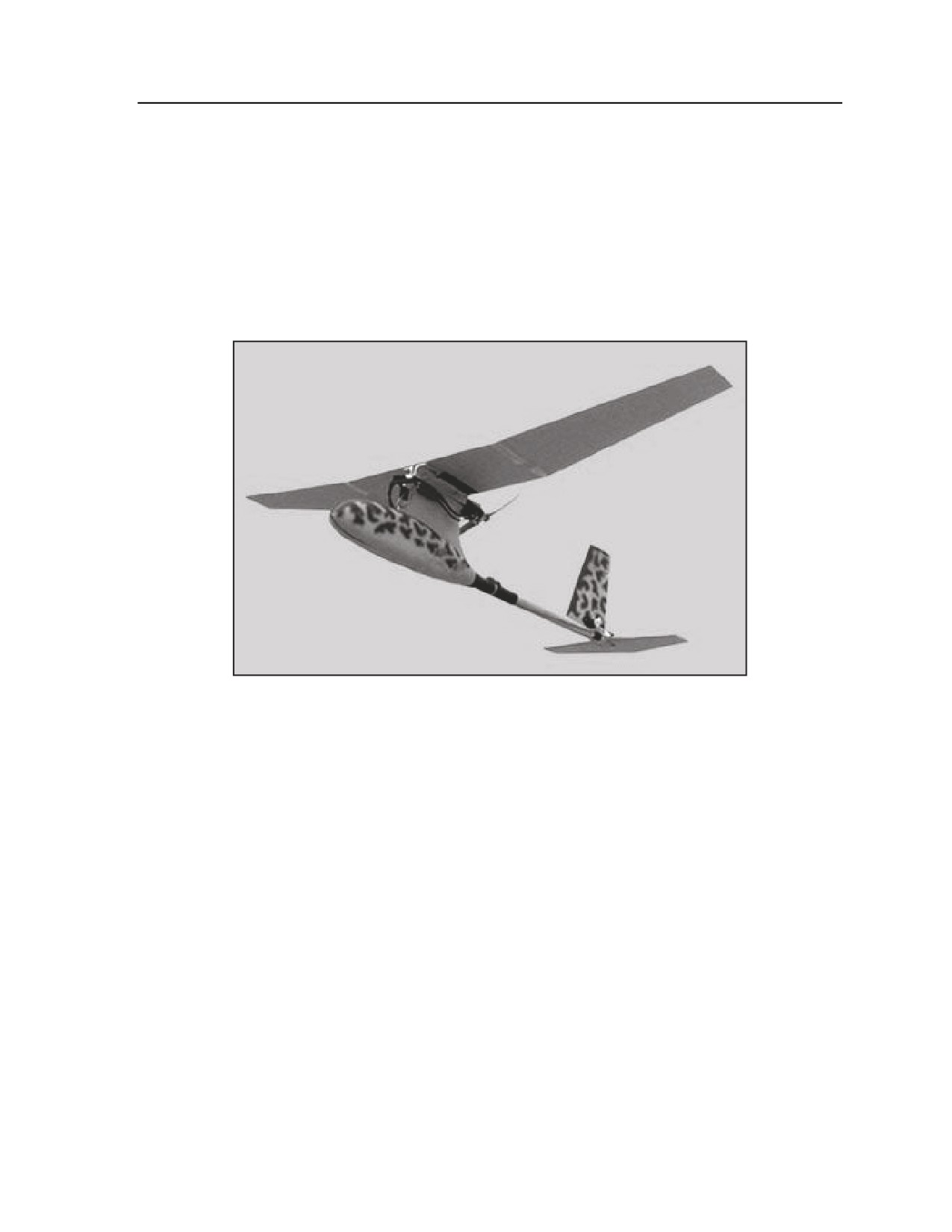
Overview
z
Entry control points.
z
Holding points.
z
Emergency recovery point (including route).
z
Control point location.
RQ-11 Raven
1-87. The Raven is a man-portable, hand-launched small UAS designed for reconnaissance, surveillance,
and remote monitoring. It is organic to the troop and is a critical addition to the troop’s ability to conduct
reconnaissance and security missions in full spectrum operations. See Figure 1-23 for an example of the
Raven.
Figure 1-23. RQ-11 Raven UAS
Employment
1-88. The operator can launch and recover a Raven in minutes from unprepared terrain without special
equipment. The craft can either fly under active remote control from the ground control station (GCS) or
fly completely autonomous missions using GPS waypoint navigation. Most Raven missions occur at
altitudes of 100 to 300 feet (30.5 to 91.4 meters). Mission time can range from 60 to 90 minutes. The
Raven will immediately return to its launch point when the “home” command is selected. Figure 1-24
shows a Soldier launching a Raven.
3 August 2009
FM 3-20.98
1-27
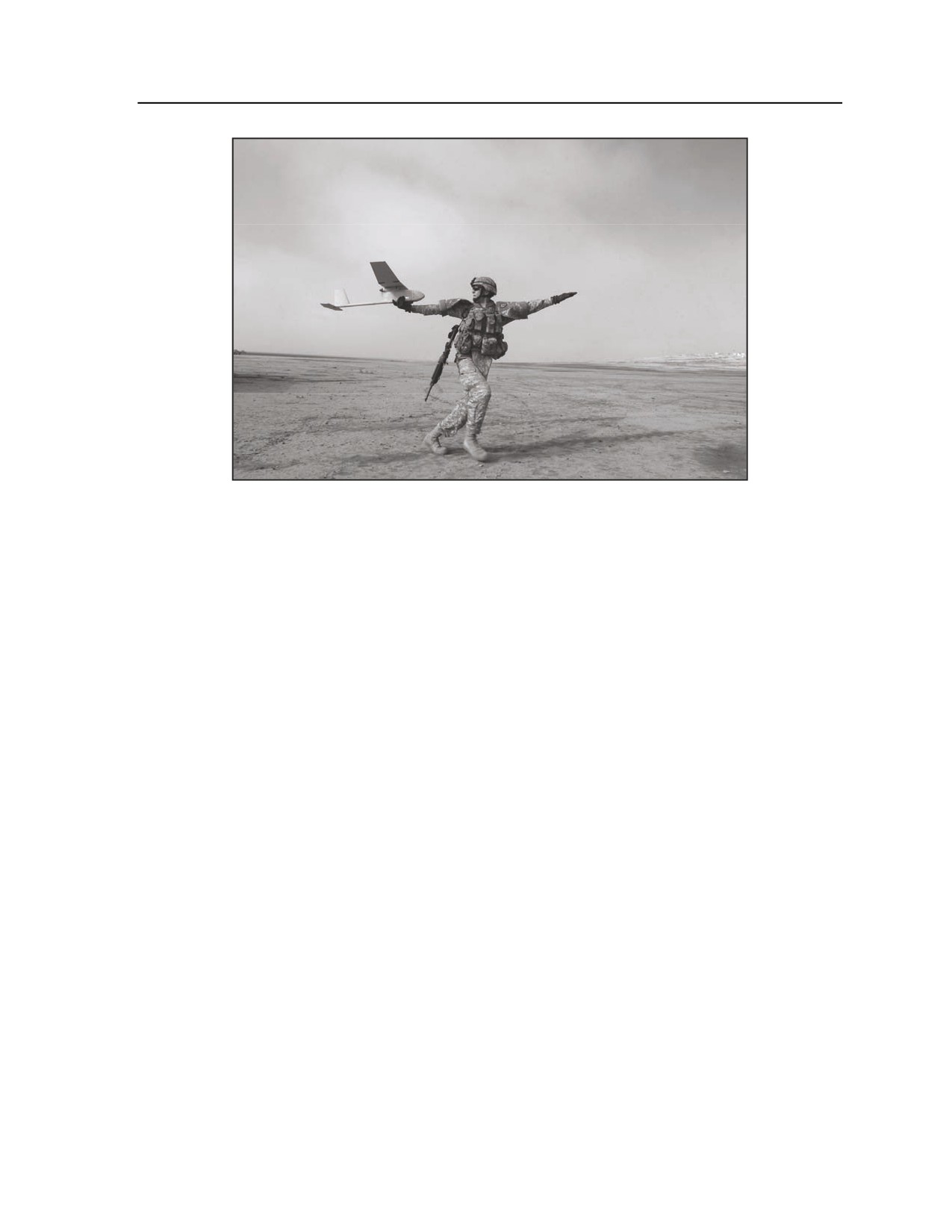
Chapter 1
Figure 1-24. Soldier launching a Raven UAS
1-89. Design features on the Raven include the use of the military standard GPS and a rechargeable battery
option. The majority of missions use a lithium-ion battery pack rechargeable through a variety of sources,
including the 28-volt direct current outlet on a HMMWV. The Raven system also includes a Panasonic
Toughbook computer used in conjunction with the GCS, as well as a Sony Handycam video camera. The
computer uses FalconView joint mapping software to provide the overlay of the video image on top of a
five-color map display. The video camera allows the recording of Raven imagery for additional analysis or
exploitation.
Components
1-90. The Raven transmits live airborne video images and compass headings (location information) to the
GCS and remote video terminal (RVT), enabling operators to navigate, search for targets, recognize
terrain, and record all information for later analysis.
1-91. Because of the 10-kilometer LOS range of the RVT and GCS, the commander plans for and trains
Raven operators on handover operations between the two components. Commanders and leaders ensure
that subordinates are familiar with the handover procedure to know how best to prepare for handover and
how to determine the most opportune time and place to perform the procedure.
1-92. To obtain the clearest LOS for conducting operations, the Raven GCS is typically located at the
highest available elevated position away from the command post (CP). The Raven RVT is generally
located in the CP.
1-93. Operation of the GCS usually occurs at a fixed site, allowing for an unobstructed LOS. The GCS,
however, can continue to operate the Raven while inside a moving vehicle. The primary concern when
operating from a moving vehicle is selecting a route that provides a continuous LOS with the Raven.
1-94. The RVT display is a receive-only monitor with no aircraft control functions. It is used to view real-
time video from any LOS location within 5 to 10 kilometers of the aircraft. See Figures 1-25 and 1-26 for
photos of an RVT and its employment.
1-28
FM 3-20.98
3 August 2009
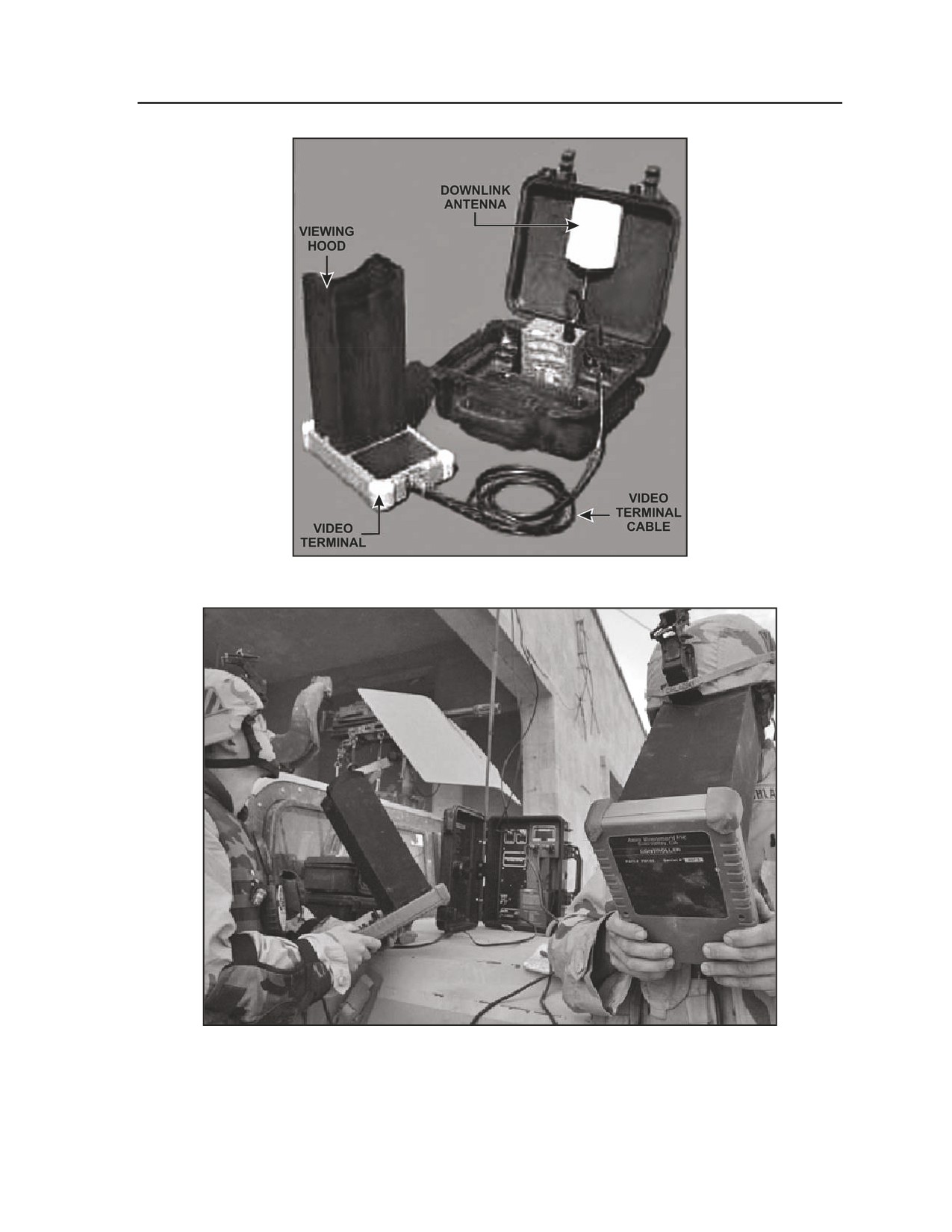
Overview
Figure 1-25. Raven UAS remote video terminal (RVT)
Figure 1-26. Soldiers employing the Raven remote video terminal (RVT)
3 August 2009
FM 3-20.98
1-29
Chapter 1
Raven Technical Specifications, Capabilities, and Limitations
1-95. Specifications for the Raven are the following:
z
Power: Lithium-ion (Li-Ion) rechargeable battery.
z
Wingspan: 4.5 ft (1.37 m).
z
Weight: Aircraft - 4 lb (1.81 kg) (12 lb [5.44 kg] with carrying case); GCS - 17 lb (7.71 kg).
z
Range: 8 to 12 km.
z
Airspeed: 23 knots loiter, 34 knots cruise, 60 knots dash.
z
Altitude: 150 to 1,000 ft (45.72 to 304.8 m) above ground level.
z
Endurance: 60 to 90 minutes (Li-Ion - rechargeable).
z
Payload(s): Electro-optical/infrared sensors.
z
Launch/recovery: Hand-launched; auto land or manual recovery on soft, unimproved surface.
z
Crew: Two MOS-nonspecific Soldiers.
1-96. The RQ-11 Raven has the following unique capabilities:
z
Hand-launched; auto land or manual recovery.
z
Auto navigation using military GPS.
z
Manual navigation and flight modes.
z
Quick assembly (less than three minutes).
z
Man/backpack portable.
z
Reusable (100+ flights).
z
Climb to operational altitude in one to two minutes.
1-97. The RQ-11 Raven has the following unique limitations:
z
Zero wind (calm) conditions increase difficulty of launch. Consider using mounted launch or
launch from atop building or elevated terrain.
z
Winds in excess of 20 knots decrease system endurance because of increased battery use and
can cause uncommanded altitude deviations. High winds prevent Raven employment.
z
Extreme heat and cold reduce endurance
(battery life) and degrade system performance.
Overheating can cause GCS failure.
z
Only front- or side-look camera operation is possible at night.
z
Fragile components limit Raven capabilities.
Reconnaissance Operations
1-98. When UASs complement the troop and platoon during reconnaissance operations, they normally
operate 1 to 10 kilometers forward of the troop or platoon, dependent on the factors of METT-TC. The
UASs can conduct detailed reconnaissance of areas that are particularly dangerous to ground
reconnaissance elements, such as open areas and defiles. They can also be effectively employed in support
of operations in urban terrain. UASs can conduct route reconnaissance forward of the platoon or be
employed in conjunction with the platoon when it is necessary to reconnoiter multiple routes
simultaneously. The platoon leader can employ the UASs to conduct screening in support of the troop
during area or zone reconnaissance missions. Upon contact, the UASs provide early warning for the
platoon and then maintain contact until the platoon conducts reconnaissance handover (RHO) from the
UASs to a ground element.
Security Operations
1-99. In security operations, UASs complement the platoon by assisting in identification of enemy
reconnaissance and main body elements and by providing early warning forward of the platoon. In addition
to acquiring enemy elements, UASs can play a critical role in providing security through the depth of the
screen by observing dead space between ground OPs. UASs can support the platoon during area security
missions by screening or conducting reconnaissance. UASs can provide early warning when the platoon is
1-30
FM 3-20.98
3 August 2009
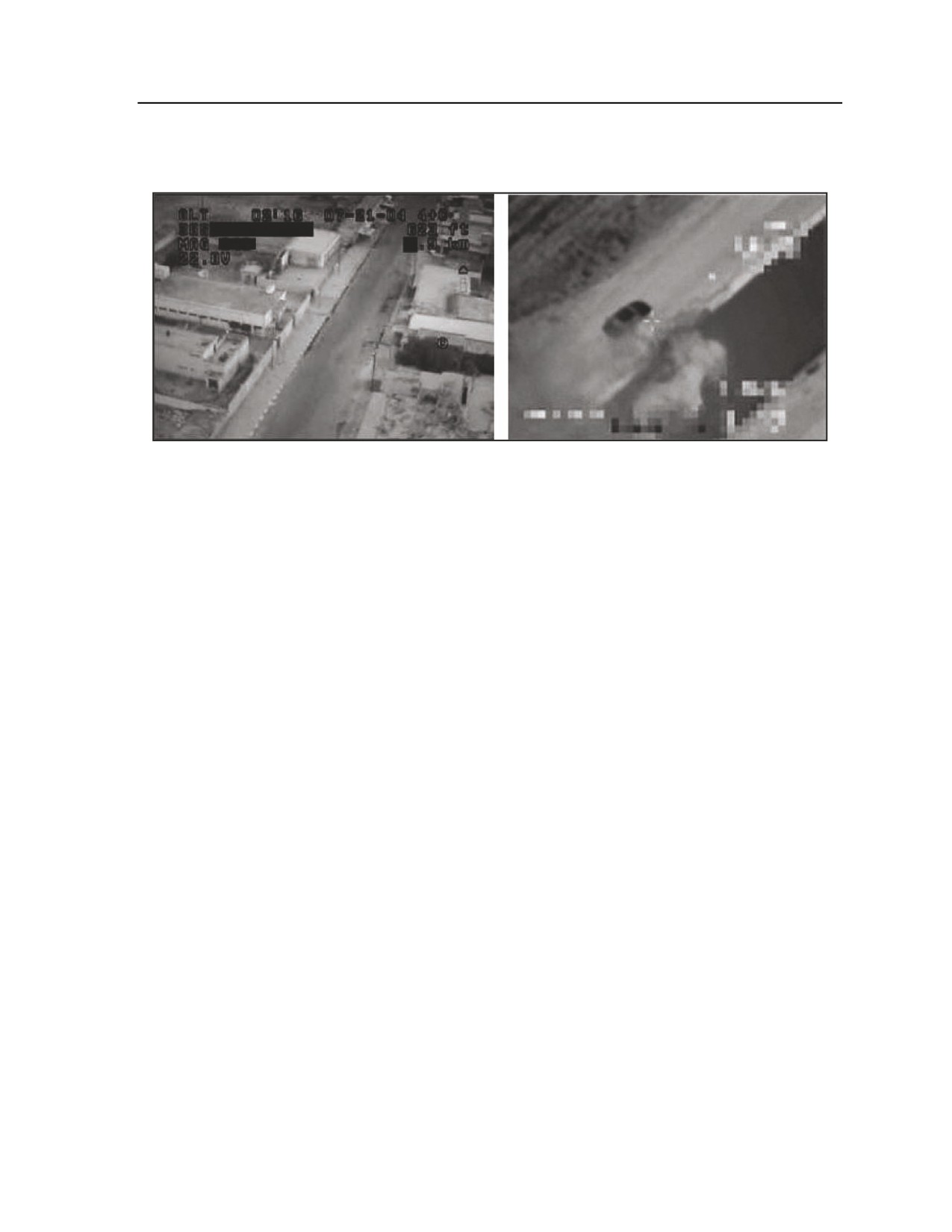
Overview
conducting convoy security missions or securing a critical point. They can identify enemy ambush
positions forward of the convoy or can locate a bypass to allow the convoy to move around an obstacle.
See Figure 1-27 for examples of Raven UAS images.
Figure 1-27. Images from actual Raven UAS video feed
UAS-Ground Reconnaissance Handover
1-100. When the UAS makes contact, particularly during reconnaissance operations, the operator will
update FBCB2 and hand over the contact to ground scouts via FM radio as quickly as possible. Rapid RHO
allows the UAS to avoid enemy air defense weapons and also helps to maintain the tempo of the operation.
1-101. During the handover, the UAS assists in providing direction to the ground element charged with
establishing contact with the enemy. They maintain contact with the enemy until ground units are in
position and have also established sensor or visual contact.
1-102. The first actions in the RHO process are a spot report (SPOTREP) and a situation report (SITREP)
from the UAS operator to the ground element. These reports are sent by radio voice, followed by FBCB2.
Next, the UAS reconnoiters the area for secure positions for the ground element, identifying tentative hide,
overwatch, and OP positions and likely mounted and dismounted routes into the area.
1-103. The ground element moves to initial hide positions along the route selected by the commander
based on UAS-collected information. The ground element then moves to establish sensor or visual contact
with the enemy. Once this contact is established, the ground element sends a SPOTREP to the UAS
operator via FM, followed by FBCB2. When the UAS operator confirms that the ground element can
observe enemy elements and has a clear picture of the situation, handover is complete. The UAS can be
committed to a follow-on mission in support of the platoon.
3 August 2009
FM 3-20.98
1-31
This page intentionally left blank.
Chapter 2
Command and Control
The essential task of all leaders, including those in the reconnaissance or scout
platoon, is applying the art and science of war to the C2 of forces. Through C2, the
platoon leader, PSG, and other leaders initiate the actions of their units. They
influence and synchronize the elements of combat power to impose the will of the
commander on the situation and defeat the enemy. Leaders exercise C2 in a dynamic
OE where unexpected opportunities and enemies rapidly present themselves.
Contents
Section I - Troop-Leading Procedures
2-1
Section III - Intelligence Preparation of
Operational Considerations
2-1
the Battlefield
2-28
Military Decision-making Process
2-2
Basics of IPB
2-28
Conduct of Troop-Leading
IPB Steps
2-28
Procedures
2-3
Section IV - Communications
2-29
Section II - Battle Command
2-17
Means of Tactical Communications .. 2-29
Command and Control in the
Reconnaissance and Scout Platoon
Platoon
2-18
Radio Nets and Responsibilities
2-31
Command Relationships
2-18
Techniques of Effective
FBCB2 in the Battle Command
Communications
2-33
Structure
2-19
Section V - Reporting
2-34
Situational Awareness
2-22
Operational Considerations
2-35
Areas of Influence
2-23
Report Guidelines
2-35
Fratricide
2-27
Digital Reporting and C2 Messages .. 2-35
SECTION I - TROOP-LEADING PROCEDURES
2-1. Inadequate planning will invariably lead to poor mission performance. To prevent this from
happening, the reconnaissance platoon must be proficient in troop-leading procedures. These procedures
are the basis of the dynamic process by which units develop plans and orders at every level of leadership.
The troop-leading process consists of eight steps discussed in this chapter in the traditional order. The
process, however, is not rigid, and the steps are not necessarily sequential. The tasks involved in some
steps—such as initiate movement, issue the warning order (WARNO), and conduct reconnaissance—may
recur several times during the process. Although listed as the last step, activities associated with
supervising and refining the plan and other preparations occur throughout the troop-leading process.
OPERATIONAL CONSIDERATIONS
2-2. The following points summarize important factors involved in troop-leading procedures:
z
Understanding the mission. The platoon leader must understand his mission; he develops this
knowledge by conducting an effective mission analysis to identify all specified and implied tasks.
At a minimum, he understands the focus of the reconnaissance (terrain-, enemy-, or civilian-
oriented, or a combination), the tempo of the operation, and his engagement criteria. He also
develops the facts and assumptions related to his mission with regard to the factors of METT-TC.
3 August 2009
FM 3-20.98
2-1
Chapter 2
z
IPB. The platoon leader must understand the IPB process. He develops knowledge of how his
platoon’s actions feed the IPB for higher command elements. Likewise, it is critical for the
platoon leader to understand that IPB in not just a process performed during the planning phase;
rather, he is prepared to continually update his IPB throughout the mission.
z
Time management. The platoon leader makes the most efficient use of the time available for
planning, preparation, and issuing the order. He ensures that his subordinate leaders then have
sufficient time to conduct their own troop-leading procedures. Refer to the discussion of reverse
planning and timeline development later in this chapter.
z
Effective orders. The platoon leader must be able to issue an operation order (OPORD) or
fragmentary orders
(FRAGO) to convey the nature of the mission so his subordinates
understand the operations they will be conducting. He can issue these orders orally, digitally, or
using a combination of the means.
z
Rehearsals. The platoon leader must be proficient in conducting rehearsals. At a minimum, he
conducts rehearsals of major events in his mission (actions on expected contact and actions on the
objective), actions on contact/battle drills (if different), and casualty evacuation (CASEVAC).
z
Precombat checks and inspections. Before execution, Soldiers must be prepared for their mission
and have confidence in their equipment. To accomplish this, the platoon conducts, at a minimum,
precombat checks (PCC) and, if feasible, precombat inspections (PCI) before the mission begins.
Note. For additional information on crew orders, rehearsals, PCCs, and PCIs, refer to the
discussion of the “supervise and refine” step of troop-leading procedures later in this chapter.
2-3. The key to success is ensuring that the platoon is prepared to move by the time specified in the order
with operational weapons and equipment and the basic load of supplies as specified by the order and/or the
platoon leader. All personnel must be able to explain the higher unit’s mission, the higher commander’s
intent, the platoon mission, and their specified tasks and duties to support the mission. The platoon must
receive, brief, and inspect all attachments. It should also consider and address the elements of SERE
(survival, escape, resistance, evasion).
MILITARY DECISION-MAKING PROCESS
2-4. Decisions are the means by which a commander or leader translates the information available to him
and his vision of the desired endstate of an operation into the actions necessary to achieve that endstate.
Decision-making is a conscious process for selecting a COA from two or more alternatives. As outlined in
FM 5-0, it is a learned skill that entails knowing if to decide, then when to decide, and finally what to
decide. The process includes an understanding of the consequences of each decision.
2-5. The military decision-making process (MDMP) is the Army’s adaptation of this analytical approach
to decision-making and problem solving. It provides the commander or leader with a valuable tool in
developing his estimate of the situation and his plan. Although the process begins with the receipt of the
mission, the analytical aspects of the MDMP continue at all levels throughout the operation. FM 5-0
provides a detailed examination of the MDMP.
2-6. At platoon level, many actions associated with the MDMP are based on standing operating procedures
(SOP) and standard unit drills; these include evacuation of wounded Soldiers, rearming and resupply
procedures, and individual crew responsibilities. This allows the platoon to operate quickly and efficiently
without constant guidance from the platoon leader. SOPs are especially critical in helping to maintain combat
preparedness when leaders are tired as a result of the stress of continuous operations. Because SOPs are so
critical, it is necessary that everyone in the platoon know and understand them.
CONDUCT OF TROOP-LEADING PROCEDURES
2-7. Regardless of the time available, leaders must always remember this principle: “see the terrain, see the
enemy, see yourself.” Only after they view and evaluate the terrain and the enemy can they determine what
2-2
FM 3-20.98
3 August 2009
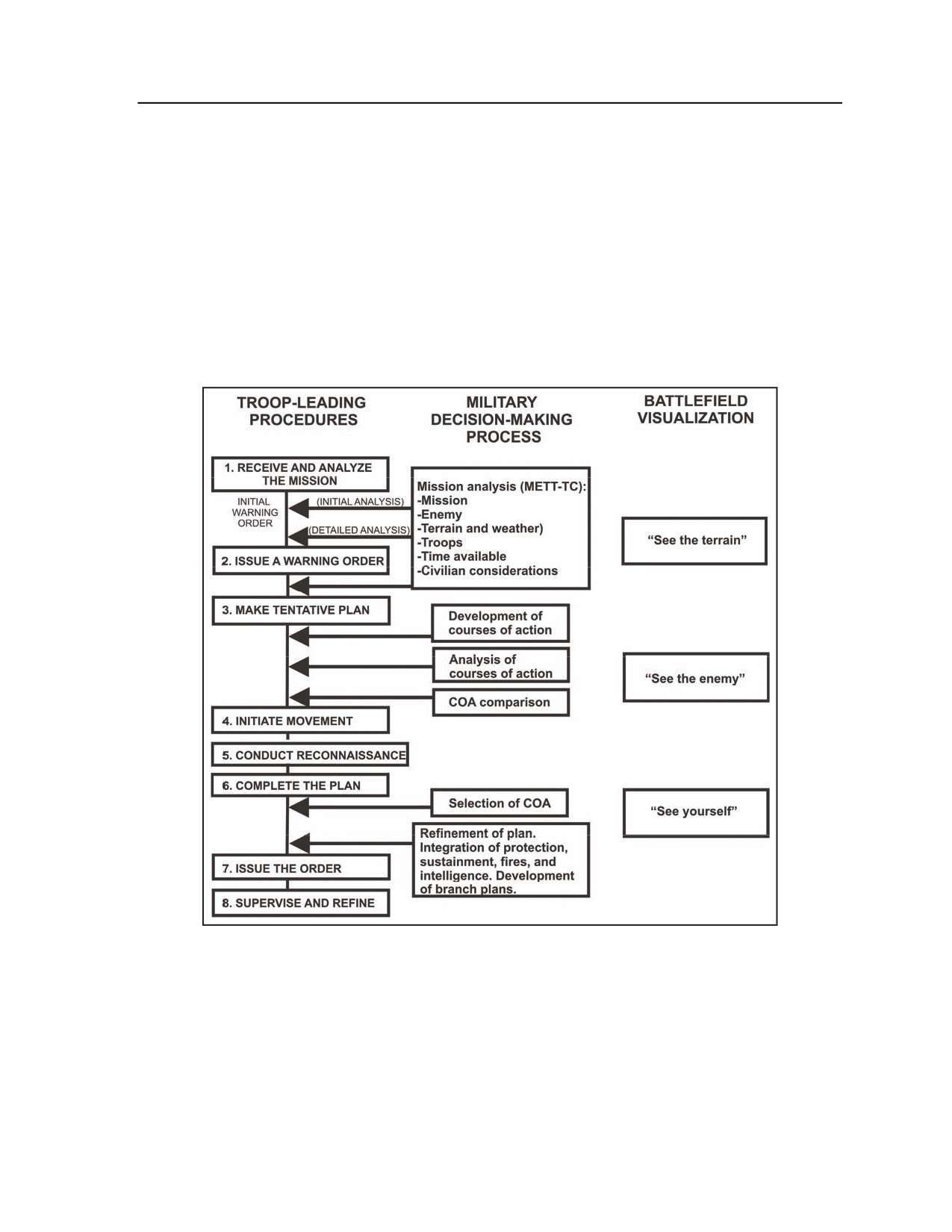
Command and Control
their own actions should be in that given situation. They update this visualization continuously throughout the
troop-leading process, basing this new “picture” of the AO on their own refinements to the plan, additional
information from various sources, and/or developments in the reconnaissance or security operation.
2-8. Troop-leading procedures begin when the platoon leader receives the first indication of an upcoming
operation
(often by WARNO from higher) and continue throughout the planning, preparation, and
execution phases of the mission. The platoon leader maximizes the available planning time by starting as
soon as the first bit of information becomes available. He normally uses one-third of the available time to
plan, prepare, and issue the order; his vehicle commanders then have the remaining two-thirds of the time
available to conduct their own troop-leading procedures. This system of time allocation is known as the
“one-third/two-thirds” rule of planning and preparation.
2-9. Figure 2-1 lists the eight troop-leading steps and illustrates their role in relation to the MDMP, which
plays an important role in the troop-leading process. The following discussion provides a step-by-step
overview of troop-leading procedures. Refer to FM 5-0 for further discussion of troop-leading procedures.
Figure 2-1. Relationship of troop-leading procedures
and military decision-making process
RECEIVE AND ANALYZE THE MISSION
2-10. The platoon leader normally receives his orders as an oral, written, and/or digital OPORD, as a
FRAGO, or as a WARNO. Upon receipt of the order, he begins analyzing the mission using the factors of
METT-TC: mission, enemy, terrain and weather, troops and support available, time available, and civil
considerations. Mission analysis is a continuous process. The platoon leader constantly receives
3 August 2009
FM 3-20.98
2-3
Chapter 2
information during the planning phase and must decide if it affects his mission. If it does, he then decides
how to adjust his plan to meet this new situation.
Initial Actions
2-11. Although mission analysis is continuously refined throughout the troop-leading process, the platoon
leader’s initial actions are normally based only on the initial WARNO from higher. These include an initial
METT-TC analysis covering the terrain and the enemy and friendly situations.
2-12. The platoon leader may also conduct his initial time analysis, develop an initial security plan, begin
parallel and collaborative planning, and issue his own initial WARNO to provide guidance and planning
focus for his subordinates. Parallel planning is when two or more echelons plan for an operation nearly
simultaneously. Collaborative planning is where two or more echelons interact to develop plans for an
operation. At a minimum, the initial platoon WARNO should cover the enemy and friendly situations,
movement instructions, and coordinating instructions such as an initial timeline and security plan.
Note. The initial analysis is normally conducted as quickly as possible to allow the platoon
leader to issue the initial WARNO in a timely manner. He conducts a more detailed METT-TC
analysis after issuing the initial WARNO.
Note. The technique of using multiple WARNOs is a valuable tool for the platoon leader during
the troop-leading process. He can issue WARNOs for several purposes: to alert subordinates of the
upcoming mission, to initiate the parallel planning process, and to put out tactical information
incrementally as it is received (ultimately reducing the length of the OPORD). Refer to FM 5-0 for
a discussion of how multiple WARNOs are employed at various stages of the troop-leading
process.
METT-TC Analysis
2-13. The following discussion provides detailed information on the six METT-TC factors.
Note. The platoon leader does not necessarily analyze METT-TC sequentially. How and when the
platoon leader analyzes each factor depends on when the information is made available to him.
Mission
2-14. After receiving an essential task and purpose, either in a WARNO or in the OPORD, the platoon
leader can then begin the analysis of his own mission. He may use a refined product to better visualize the
interrelationships of the terrain, the enemy, and friendly forces. These may include a modified combined
obstacle overlay (MCOO) and/or the situational template (SITTEMP), if available. The platoon leader’s
goal in this analysis is to clarify what the platoon is to accomplish and why the platoon must accomplish it.
Key considerations in the analysis include the following:
z
What is my task and purpose for this operation?
z
What is the commander’s intent?
z
What are the specified tasks for the operation (those the commander stated must be accomplished)?
Note. In the OPORD, these tasks are outlined in paragraph
3, which comprises the
commander’s intent, concept of the operation, tasks to subordinate units, and coordinating
instructions.
z
What are the implied tasks for the operation? These are other tasks, not specifically noted by the
commander, that must be accomplished to achieve the purpose or specified tasks.
z
What are the essential tasks for the operation? These are all tasks, both specified and implied,
that are absolutely required to ensure mission success.
2-4
FM 3-20.98
3 August 2009
Command and Control
z
What is the focus of the operation?
z
What is the tempo of the operation?
z
What are the engagement criteria for the platoon? For the troop? For the squadron/battalion?
Enemy (Threat Forces)
2-15. The platoon leader’s analysis of the enemy situation should focus on the areas outlined in FM 3-
90—including doctrinal analysis and objectives, composition and disposition, capabilities, weaknesses,
anticipated COAs, and factors that can influence these COAs—as well as those in FM 34-130, which
covers IPB. The analysis can focus on the following considerations:
z
What types of enemy units is the platoon up against?
z
Where are these units?
Note. If possible, these locations should be templated to vehicle level.
z
What are the enemy units doing?
z
How strong are they?
z
What kind of equipment do they have? What are their weapon types and effective ranges?
z
What are their capabilities and weaknesses?
z
Where are they vulnerable?
z
Where are their engagement areas?
z
What are the enemy’s intentions, doctrinal objectives, and most probable COA(s)?
z
How will enemy elements react to the eight forms of contact? These are the following:
Visual contact.
Physical contact (direct fire).
Indirect fire contact.
Contact with obstacles of enemy or unknown origin.
Contact with enemy or unknown aircraft.
Contact involving CBRN conditions.
Situations involving electronic warfare (EW) tactics (such as jamming, interference, and
imitative deception).
Situations involving nonhostile elements (such as civilians).
z
What can the enemy do in response to friendly actions?
Terrain (and Weather)
2-16. The platoon leader analyzes the terrain using the factors of OAKOC: observation and fields of fire;
avenues of approach; key terrain; obstacles; and cover and concealment. The following discussion of
OAKOC focuses on questions the platoon leader can use in his analysis.
2-17. Observation and fields of fire. The platoon leader’s analysis should cover these considerations:
z
Where can the enemy observe and engage my platoon, and how do I counter this capability?
z
Where can I establish OPs to maximize my ability to see the AO?
2-18. Avenues of approach. These are areas through which a unit can maneuver. The definition of an
avenue of approach is an area that provides sufficient ease of movement and enough width to allow
passage of a force large enough to significantly affect the outcome of the operation. The platoon leader’s
analysis should include these considerations:
z
Where are the most favorable mounted and dismounted avenues of approach for enemy and
friendly forces?
z
Where are the best air avenues of approach for enemy forces?
3 August 2009
FM 3-20.98
2-5
Chapter 2
2-19. Key and decisive terrain. Key terrain is any location or area whose seizure, retention, or control
affords a marked advantage either to friendly forces or to the enemy. Decisive terrain is key terrain whose
seizure and retention is mandatory for mission accomplishment. The platoon leader’s analysis should cover
these factors:
z
Where is the decisive terrain?
z
Where and what is the key terrain?
z
How can the platoon use key terrain to support the mission?
z
How will enemy units use key terrain to support their mission?
2-20. Obstacles. In terrain analysis, the platoon leader first identifies existing and reinforcing obstacles
that may limit mobility (affecting such features as objectives, avenues of approach, and mobility corridors).
2-21. Existing obstacles include, but are not limited to, the following:
z
Gullies, ravines, gaps, and ditches more than three meters wide.
z
Streams, rivers, and canals more than one meter deep.
z
Mountains or hills with a slope in excess of 60 percent.
z
Lakes, swamps, and marshes more than one meter deep.
z
Tree stumps and large rocks more than 18 inches high.
z
Forest or jungles with trees 8 inches or more in diameter and with less than 4 meters of space
between trees.
z
Man-made existing obstacles, including built-up areas such as towns, cities, or railroad
embankments.
2-22. Reinforcing obstacles include, but are not limited to, the following:
z
Minefields.
z
Antitank ditches.
z
Road craters.
z
Abatises.
z
Wire obstacles.
2-23. Based on the degree of obstruction posed by obstacles, terrain is further classified in one of the
following categories:
z
Unrestricted. This is terrain that is free of any restriction to movement; no actions are required
to enhance mobility. For wheeled vehicles, this terrain is typically flat or moderately sloped,
with scattered or widely spaced obstacles such as trees or rocks. This type of terrain generally
allows wide maneuver and offers unlimited travel over well-developed road networks.
z
Restricted. Restricted terrain hinders movement to some degree. Little effort is needed to
enhance mobility, but units may have to zigzag or make frequent detours. They may have
difficulty maintaining optimum speed, moving in some types of combat formations, or
transitioning from one formation to another. For wheeled vehicles, restricted terrain typically
encompasses moderate to steep slopes and/or moderate to dense spacing of obstacles such as
trees, rocks, or buildings. Swamps and rugged ground are examples of restricted terrain for
dismounted infantry forces. Logistical or rear area movement in this type of terrain may be
hampered by poorly developed road systems.
z
Severely restricted. This terrain severely hinders or slows movement in combat formation
unless some effort is made to enhance mobility. This could require commitment of engineer
forces to improve mobility or deviation from doctrinal tactics, such as using a column rather
than a line formation or moving at speeds much lower than otherwise preferred. Severely
restricted terrain for wheeled vehicles is typically characterized by steep slopes, densely spaced
obstacles, and/or the virtual absence of a developed road system.
2-6
FM 3-20.98
3 August 2009
Command and Control
2-24. Cover and concealment. The platoon leader should include the following considerations in his
analysis of cover and concealment:
z
What routes within the AO offer cover and concealment for my platoon or for enemy elements?
z
What dismounted and/or mounted routes offer my platoon the best available cover and
concealment?
2-25. Weather. The platoon leader analyzes weather conditions as part of his evaluation of the terrain. The
following considerations should be included in this evaluation:
z
What are the light conditions (including percentage of night illumination) and visibility?
z
How has recent weather affected the AO?
z
What are the times for beginning of morning nautical twilight (BMNT), sunrise, sunset, end of
evening nautical twilight (EENT), moonrise, and moonset?
z
Will weather become better or worse during the mission?
z
How will fog, rain, dust, heat, snow, wind, or blowing sand affect the troops and equipment of
both friendly and enemy forces during the mission?
z
How will weather conditions affect the employment of chemical weapons and/or obscurants?
Troops and Support Available
2-26. The platoon leader’s analysis of troops and support available for an operation includes an assessment
of the platoon’s vehicles and equipment. His analysis should include the following considerations:
z
What is the present condition of the platoon’s Soldiers, vehicles, and equipment?
z
What is the supply status of ammunition, fuel, and other necessary items?
z
What is the turnaround time for resupply operations (time between transmission of the request
and delivery of supplies)?
z
What is the state of training of the platoon?
z
What is the state of morale?
z
How much sleep have the Soldiers had?
z
How much sleep can they get before and during the operation?
z
Does the platoon need any additional equipment to support or accomplish its mission?
z
What attachments does the platoon have (or require) to accomplish its mission?
z
What direct support (DS) and general support (GS) is available to support the platoon’s
mission?
z
How many OPs (mounted/dismounted and long-/short-duration) can be manned with the
available assets?
z
How big a frontage can be covered with the available assets?
Time Available
2-27. The platoon leader’s analysis of the time available for an operation begins with the “one-third/two-
thirds” rule of planning and preparation discussed earlier in this section. This principle allows the platoon
leader to use one-third of planning and preparation time himself, then to allocate at least the remaining
two-thirds to subordinates. Additional considerations in the analysis should include the following:
z
How much time is available to plan and conduct reconnaissance?
z
How much time is available for rearming, refueling, and resupply?
z
How long will it take the platoon to move to planned OPs, to the line of departure (LD), and/or
to the objective?
z
Is there enough time for rehearsals?
z
How much time is available to the enemy for the activities listed in the previous items?
z
How does the potential enemy timeline for planning and preparation compare with that
developed for friendly forces?
3 August 2009
FM 3-20.98
2-7
Chapter 2
Civil Considerations
2-28. Civil considerations are how the man-made infrastructure, civilian institutions, and attitudes and
activities of the civilian leaders, populations, and organizations within an AO influence the conduct of military
operations. Rarely are military operations conducted in uninhabited areas. Most of the time, units are
surrounded by noncombatants. These noncombatants include residents of the AO, local officials, and
governmental and nongovernmental organizations (NGO). Based on information from higher headquarters
and their own knowledge and judgment, Army leaders identify civil considerations that affect their mission.
Civil considerations are analyzed in terms of six factors, known by the memory aid ASCOPE (see FM 6-0):
z
Areas. These are key civilian localities or aspects of the terrain within an AO that are not
normally militarily significant. This characteristic approaches terrain analysis (OAKOC) from a
civilian perspective. Commanders analyze key civilian areas in terms of how they affect the
missions of their individual forces as well as how military operations affect these areas.
z
Structures. These include structures that play significant roles and are traditional high-payoff
targets such as bridges, communications towers, power plants, and dams. Other structures such
as churches, mosques, national libraries, and hospitals are cultural sites that international law or
other agreements generally protect. Still others are facilities with practical applications such as
jails, warehouses, television and radio stations, and print plants.
z
Capabilities. Capabilities refer to the ability of local authorities—those of the HN, aggressor
nation, or some other body—to provide a populace with key functions or services such as public
administration, public safety, emergency services, and food. Include are those areas in which the
populace may need help after combat operations, such as public works and utilities, public
health, economics, and commerce. Also included are those resources and services that can be
contracted to support the military mission, such as interpreters, laundry services, construction
materials, and equipment.
z
Organizations. Organizations are nonmilitary groups or institutions in the AO. They influence
and interact with the populace, the force, and each other. They generally have a hierarchical
structure, defined goals, established operations, fixed facilities or meeting places, and a means
of financial or logistic support.
z
People. People is a general term used to describe nonmilitary personnel encountered by military
forces. The term includes all civilians within an AO as well as those outside the AO whose
actions, opinions, or political influence can affect the mission.
z
Events. Events are routine, cyclical, planned, or spontaneous activities that significantly affect
organizations, people, and military operations. Examples include national and religious holidays,
agricultural crop/livestock and market cycles, elections, civil disturbances, and celebrations.
Other events are disasters from natural, man-made, or technological sources.
2-29. In his analysis of how the platoon will handle situations involving civilians and other aspects of the
civil environment (including stability operations and civil support operations), the platoon leader should
assess the following considerations:
z
How will existing civil considerations affect the mission? What are the potential negative effects
of civilian contact?
z
What are the applicable rules of engagement (ROE) and/or rules of interaction (ROI)?
z
What procedures and guidelines will the platoon use in dealing with refugees, prisoners, and
other civilians?
z
Will the platoon be working with civilian organizations, such as governmental agencies, private
groups, or the media?
z
Will the platoon conduct stability operations (such as civil security or civil control) or civil
support operations (such as response to disaster or terrorist attack)?
Information Sources
2-30. In planning and preparing for the mission, the platoon leader may find that he requires additional
sources of information to help answer some of the questions raised in the analysis of METT-TC. The
2-8
FM 3-20.98
3 August 2009
Command and Control
platoon can receive and/or request information from a variety of sources to assist in planning and
understanding the OE, including the following:
z
Paragraph 1 of the OPORD (especially those portions covering the enemy and the applicable
terrain and weather).
z
UAS imagery and video (such as photos/video of a route or danger area to assist with the
METT-TC assessment).
z
Satellite imagery (for example, showing locations of increased military traffic).
z
Engineer database information on terrain, such as from the Terrabase program.
z
HUMINT reports from brigade and higher, such as a human density overlay.
z
Relevant information from ongoing assessment of the OE using the political, military, economic,
social, information, and infrastructure-physical environment and time (PMESII-PT) framework.
z
Signal intelligence (SIGINT) and measurement and signal intelligence (MASINT) reports from
the surveillance troop.
Composite Risk Management
2-31. Leaders must make a thorough risk assessment, identifying and evaluating hazards the platoon will
face during the operation. They then develop composite risk management (CRM) controls and ensure that
all subordinate leaders and individual scouts implement them to eliminate or reduce the risks. Refer to
Appendix E of this manual for a detailed discussion of the CRM process. For additional information on
CRM, refer to FM 5-19.
Reverse Planning and Timeline Development
2-32. After completing his METT-TC analysis, the platoon leader conducts reverse planning to ensure that
all specified, implied, and essential tasks can be accomplished in the time available. He develops a reverse
planning schedule (timeline), as illustrated in Figure 2-2. Beginning with actions on the objective, he works
backward through each step of the operation and then through preparation and planning activities to the
present time. This process also helps the platoon in making efficient use of planning and preparation time.
Note. Simultaneous planning and preparation are key factors in effective time management
during the troop-leading process. The next five steps (issue the WARNO; make a tentative plan;
initiate movement; conduct reconnaissance; complete the plan) may occur simultaneously and/or
in a different order. As noted, the final troop-leading step, supervise and refine, is on-going
throughout the process.
3 August 2009
FM 3-20.98
2-9
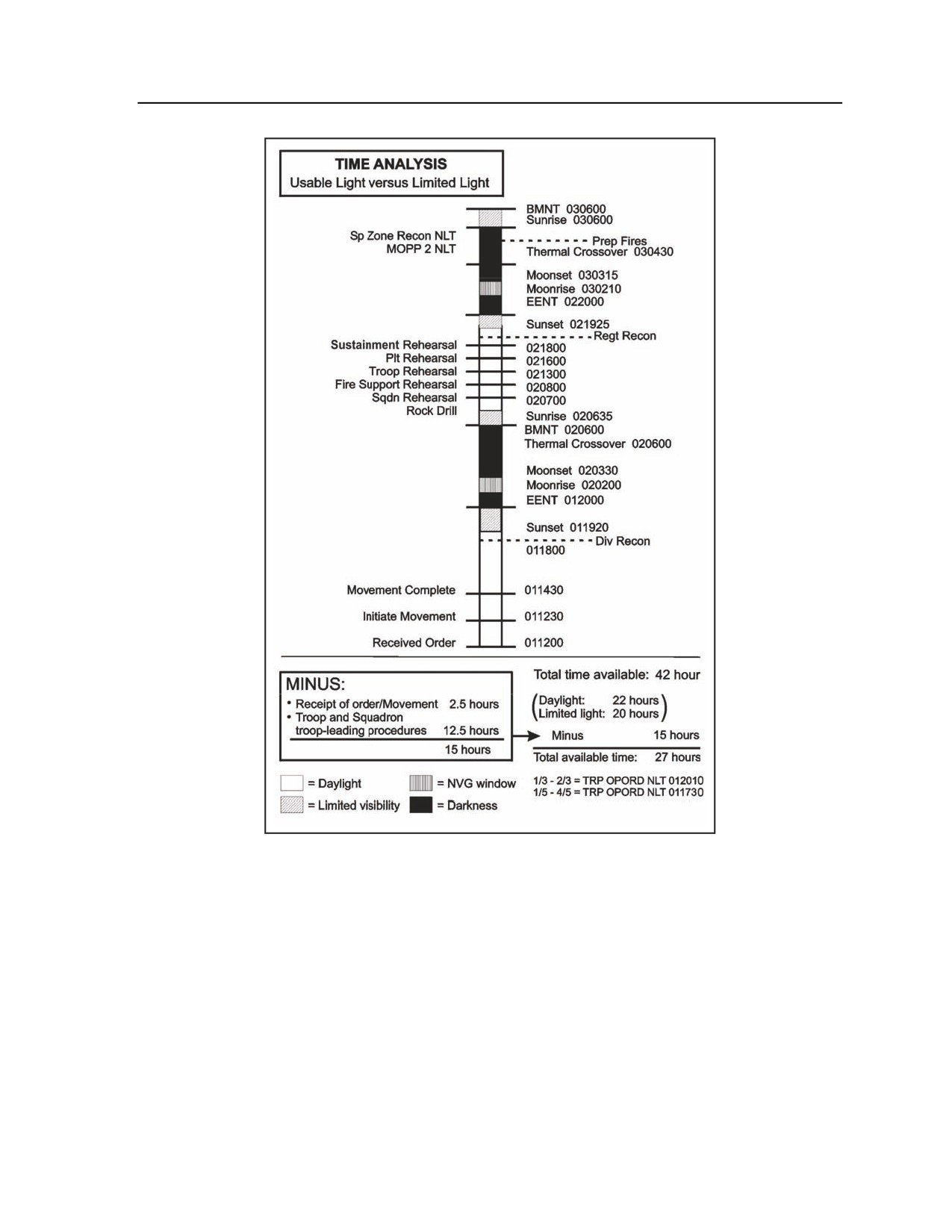
Chapter 2
Figure 2-2. Example reverse planning timeline
ISSUE THE WARNO
2-33. After the platoon leader has analyzed his orders and worked out his mission and related tasks, he
must quickly pass this information to his subordinate leaders. This is accomplished through the WARNO.
As a minimum, the following information must be included:
z
Elements and individuals to whom the WARNO applies.
z
Enemy situation as stated in the higher unit’s order.
z
The time and nature of the operation.
z
The earliest time of movement.
z
Coordinating instructions, including an initial timeline.
z
The time and place the OPORD will be issued.
2-10
FM 3-20.98
3 August 2009
Command and Control
2-34. If possible, the platoon leader should issue a conventional (analog) and/or digital overlay of the AO.
In the absence of further orders, this gives the platoon an idea of the scope of the operation. Also, the
platoon leader should inform his subordinates of the results of his reverse planning process and delegate
appropriate preparation tasks to the PSG and to the section and squad leaders. If possible, the platoon
leader should also include the task organization of the platoon. In addition to accounting for all required
preparatory tasks, the reverse planning schedule should include a sleep plan. All elements should
acknowledge receipt of the WARNO.
Note. The sleep plan should be a 24-hour plan with the goal of maximizing available sleep time
in the planning, preparation, and execution phases of the operation. It covers all platoon
members.
MAKE A TENTATIVE PLAN
2-35. Based on results of his mission analysis, the platoon leader develops a tentative plan that addresses
all specified, implied, and essential tasks using the OPORD format (see Appendix A of this manual).
INITIATE MOVEMENT
2-36. After issuing a WARNO and making a tentative plan, the platoon leader may choose to initiate
movement. The platoon leader should at least be able to determine when the platoon will move. He
announces this in terms of a readiness condition (REDCON) level. Each REDCON level indicates critical
tasks and time available to prepare for future operations. The following considerations apply:
z
REDCON-1 (be prepared to move immediately). These conditions are in effect:
All personnel alert and ready for action.
Vehicles loaded and secured, weapons manned, with engines running.
OPs not manned.
Note. A variant of REDCON-1 is REDCON-1(-); the same conditions apply except that the
vehicles are not started in REDCON-1(-).
z
REDCON-2 (be prepared to move in 15 minutes). These conditions are in effect:
All personnel alert.
OPs and wire pulled in.
z
REDCON-3 (be prepared to move in half an hour). These conditions are in effect:
Fifty percent of each crew/squad stand down for rest, feeding, and maintenance.
Remaining 50 percent man vehicles, OPs, and weapons and monitor radios/phones.
z
REDCON-4 (be prepared to move in one hour). These conditions are in effect:
Two men per platoon make dismounted checks of platoon area.
One man per vehicle monitors radios/phones and mans turret weapon.
2-37. All personnel remain at 100 percent alert until prioritized mission preparations are complete. The
platoon leader initiates the appropriate REDCON when the work is finished. As the time for mission
execution nears, he increases the REDCON in accordance with guidance from higher, achieving
REDCON-1 before the platoon must move.
CONDUCT RECONNAISSANCE
2-38. This step of the troop-leading procedures allows the platoon leader to confirm the validity of his
tentative plan and to refine the plan. The platoon leader should conduct the reconnaissance with his
subordinate leaders. This will allow them to see the terrain and develop a better visualization of the
projected plan. At a minimum, the platoon leader conducts this step as a detailed map reconnaissance. He
should at least confirm his initial march route to the LD or start point (SP) and check initial positions. If
3 August 2009
FM 3-20.98
2-11
Chapter 2
possible, he should also check some of the area beyond the LD; this may require permission from the
commander. Additional information to augment either a physical or map reconnaissance would include the
MCOO and still or video photographs from UASs.
2-39. If the platoon leader cannot personally conduct on-site reconnaissance, he should make the most
efficient use of available time by tasking his subordinates to accomplish specific reconnaissance
requirements. An example of this is tasking a squad leader to reconnoiter and time routes to the SP. The
platoon leader must conduct the reconnaissance with an open mind; not everything he sees will match his
tentative plan. He must be flexible enough to make changes as necessary and competent enough to work
out new plans rapidly.
Note. For detailed discussions of reconnaissance procedures, refer to Chapter 3 of this manual.
COMPLETE THE PLAN
2-40. The platoon leader refines his plan based on the results of the reconnaissance. He then completes the
plan using these results and any new information from his commander and members of his platoon. He
should keep the plan as simple as possible, at the same time ensuring that it effectively supports the
commander’s intent.
2-41. As he completes and refines his plan, the platoon leader should consider delegating planning
responsibilities to other members of the platoon. He can then use the information developed by these
Soldiers in developing his order and in establishing an effective platoon SOP. Examples of delegated
planning responsibilities include the following:
z
A section sergeant researches and briefs terrain and weather.
z
A noncommissioned officer (NCO) sets up rehearsals.
z
The PSG researches, plans, and briefs sustainment considerations (such as CASEVAC and
vehicle recovery operations).
z
An NCO translates graphics to FBCB2 and overlays.
z
Section sergeants plan specific reconnaissance patrols in support of the overall mission.
z
An NCO plans and briefs occupation procedures for such areas as objective rally points (ORP),
OPs, and surveillance sites.
z
An NCO plans and briefs specific communications issues (paragraph 5 of the OPORD).
z
An NCO plans and briefs specific coordinating instructions, such as the collection plan, actions
on contact, special equipment, linkup tasks, and methods of handling enemy prisoners of war
(EPW).
z
A leader finalizes the CRM process, as outlined in Appendix E of this manual.
2-42. Using this type of planning delegation will help the platoon leader ensure that his subordinate leaders
are in synchronization with the plan. It also facilitates a more rapid planning process. The platoon leader
must remain fully aware of all facets of the plan and of the activities of his subordinates. He must also give
clear guidance for this technique to be successful.
ISSUE THE ORDER
2-43. The platoon leader issues his finalized order in the five-paragraph OPORD format, as discussed in
Appendix A of this manual. He refers to notes to make sure he does not forget anything. He ensures that all
subordinate leaders understand the entire plan as well as their particular portion of it. To ensure complete
understanding of the operation, the platoon leader should end the order with a confirmation brief of key
points by his leaders.
2-44. Whenever possible, the platoon leader should issue his order to the entire platoon. At a minimum, he
should issue the order to his subordinate leaders and vehicle commanders. Once everyone has arrived at the
place and time specified in the WARNO, the platoon leader or PSG should ensure that everyone has
2-12
FM 3-20.98
3 August 2009
Command and Control
recorded the applicable graphic control measures. The platoon leader should issue the revised operations
overlay before he starts; he should have a copy of the graphics for each of his leaders. The PSG ensures
that each subordinate leader’s overlay matches the platoon leader’s overlay. To use his time most
efficiently, the platoon leader should use a walk-through rehearsal as part of his briefing of paragraph 3 of
the order.
2-45. If he can issue the order from a favorable vantage point, the platoon leader can physically indicate
the ground over which his scouts will maneuver. If a vantage point is not available, he can use a terrain
cloth, sand table, or map as a reference. He should have a briefing kit available to build a model of the AO;
items in the kit might include the following:
z
Nylon rope and nails or spikes.
z
“Micro” armor vehicles or other models.
z
Preconstructed Plexiglas squares for units and equipment (blue for friendly elements, red for
enemy forces).
z
Pens and markers.
z
Stakes.
z
Engineer tape.
z
Operational symbol cutouts.
z
Dry erase board.
2-46. In extreme situations, FBCB2 allows the platoon leader to issue the OPORD to his sections or
squads when they are widely dispersed and cannot gather at a central point. The platoon leader must alert
his elements (via radio voice) that a new order is available on the FBCB2 and direct each element to
acknowledge receipt of the order.
SUPERVISE AND REFINE
2-47. Flexibility is the key to effective operations. The reconnaissance platoon leader must be able to
refine his plan whenever new information becomes available. If he adjusts the plan, he must inform the
platoon and supervise implementation of the changes. Once the operation has begun, the platoon leader
must be able to direct his platoon in response to new information and new situations.
2-48. Crew orders, rehearsals, and inspections are essential elements of the supervision process as the
platoon prepares for the mission. The following discussion covers these procedures in detail.
Crew Orders
2-49. The platoon leader and PSG make sure all crewmembers have been briefed by their leaders or
vehicle commanders and understand the platoon mission and concept of the operation. Combat orders are
the means by which the platoon leader receives and transmits information, from the earliest notification
that an operation will occur through the final phases of execution. They are absolutely critical to mission
success. All members of the platoon must be familiar with the formats of WARNOs, OPORDs, and
FRAGOs. For a detailed discussion of combat orders, refer to Appendix A of this manual.
Rehearsals
2-50. The platoon leader should never underestimate the value of rehearsals. They are his most valuable
tools in preparing the platoon for the upcoming operation. Refer to FM 5-0 for a detailed discussion of
rehearsal types, techniques, and procedures. The platoon leader uses well-planned, efficiently run
rehearsals to accomplish the following purposes:
z
Reinforce training and increase proficiency in critical tasks.
z
Reveal weaknesses or problems in the plan.
z
Synchronize the actions of subordinate elements.
z
Improve each Soldier’s understanding of the concept of the operation.
3 August 2009
FM 3-20.98
2-13
Chapter 2
Rehearsal Types
2-51. The platoon leader can choose among several types of rehearsals, each designed to achieve a specific
result and with a specific role in the planning and preparation timeline. The following discussion focuses
on the four rehearsal types.
2-52. Confirmation brief. The confirmation brief is, in effect, a reverse briefing process routinely
performed by subordinate leaders immediately after receiving any instructions, such as an OPORD or
FRAGO. They confirm their understanding by repeating and explaining details of the operation for their
leader. The platoon leader should conduct confirmation briefs after his subordinate leaders have received
the OPORD, but before other phases of the platoon rehearsal begin.
2-53. Backbrief. Leaders perform this type of rehearsal throughout the planning and preparation timeline
to help clarify their intent for their subordinates. The backbrief allows the platoon leader to identify
problems in his own concept of the operation and his subordinates’ understanding of the concept; he also
uses the backbrief to learn how subordinates intend to accomplish their missions.
2-54. Support rehearsal. Support rehearsals are normally conducted within the framework of a single
warfighting function, such as fires or sustainment, or a limited number of warfighting functions. The goals
are to ensure that support elements can achieve their missions within the higher commander’s plan and that
their support plans are synchronized with the overall maneuver plan. The rehearsals are conducted
throughout the planning and preparation timeline.
2-55. Battle drill or SOP rehearsal. This type of rehearsal is used to ensure that all participants
understand a technique or a specific set of procedures. The platoon leader initiates battle drill and/or SOP
rehearsals as soon as possible after receipt of the mission; he then can continue to conduct them as needed
throughout the planning and preparation timeline. This rehearsal does not necessarily cover a published
drill or SOP, giving the leader flexibility in designing the rehearsal. For example, the platoon leader could
rehearse procedures for marking obstacle lanes or establishing local security.
Note. It is recommended that actions on contact drills be rehearsed frequently during planning
and preparation.
Rehearsal Techniques
2-56. The platoon leader can choose among several techniques in conducting rehearsals, which should
follow the crawl-walk-run training methodology to prepare the platoon for increasingly difficult
conditions. Techniques for conducting rehearsals are limited only by the resourcefulness of the commander
or leader; FM 5-0 outlines six basic techniques (full dress, reduced force, terrain model, sketch map, map,
and radio). The following discussion covers these techniques, which are listed in descending order in terms
of the preparation time and resources required to conduct them. Considerations in selecting a rehearsal
technique include the following:
z
Time. How much time will be needed for planning, preparation, and execution?
z
Terrain. What are the applicable terrain considerations?
z
Multiechelon employment. How many echelons are involved?
z
Operations security (OPSEC). Will the rehearsal allow the enemy to gain intelligence about
upcoming operations?
2-57. Full force rehearsal. This rehearsal produces the most detailed understanding of the mission, but is
the most difficult to conduct in terms of preparation and resources. It involves every Soldier and system
participating in the operation. If possible, units should conduct the full force rehearsal under the same
conditions (such as weather, time of day, terrain, and use of live ammunition) that they will encounter
during the actual operation.
2-58. Reduced force rehearsal. This rehearsal normally involves only key leaders of the unit and is thus
less extensive than the full dress rehearsal in terms of preparation time and resources. The commander
2-14
FM 3-20.98
3 August 2009
Command and Control
decides the level of leader involvement. The selected leaders then rehearse the plan, if possible on the
terrain to be used for the actual operation. The reduced force rehearsal is often conducted to prepare
leaders for the full dress rehearsal.
2-59. Terrain model rehearsal. This is the most commonly used rehearsal technique, employing an
accurately constructed model to help subordinates visualize the operation in accordance with the
commander’s or leader’s intent. When possible, the platoon leader places the terrain model where it
overlooks the actual terrain of the AO or is within walking distance of such a vantage point. Size of the
model can vary, but it should be large enough to depict graphic control measures and important terrain
features for reference and orientation. Participants walk or move “micro” armor around the table or model
to practice the actions of their own vehicles in relation to other members of the platoon.
2-60. Sketch map rehearsal. Units can use the sketch map technique almost anywhere, day or night.
Procedures are similar to those for the terrain model rehearsal. The sketch must be large enough to allow
all participants to see as each subordinate “walks” through an interactive oral presentation of his actions.
Platoon elements can use symbols or “micro” armor to represent their locations and maneuver on the
sketch.
2-61. Map rehearsal. Procedures are similar to those for the sketch map rehearsal except that the
commander or leader uses a map and operation overlay of the same scale as he used to plan and control the
operation. This technique is useful in conjunction with a confirmation brief or backbrief involving
subordinate leaders and vehicle commanders. The platoon leader uses the map and overlay to guide
participants as they brief their role in the operation.
2-62. Radio rehearsal. The commander or leader conducts this rehearsal by having his unit simulate
critical portions of the operation orally and interactively over established communications networks. The
radio rehearsal may be especially useful when the situation does not allow the platoon to gather at one
location. To be effective, the radio rehearsal requires all participants to have working communications
equipment and a copy of the OPORD and applicable overlays. Subordinate elements check their
communications systems and rehearse events that are critical to the platoon plan.
Checks and Inspections
2-63. PCCs and PCIs allow leaders to check the platoon’s operational readiness. The key goal is to ensure
that Soldiers and vehicles are fully prepared to execute the upcoming mission. The platoon leader makes
sure the entire chain of command conducts PCCs and PCIs.
Precombat Checks
2-64. Equipment operators, vehicle crewmen, and individual Soldiers conduct PCCs before executing
operations. These checks are designed to ensure that equipment is in working order, required supplies are
on hand, and Soldiers are ready to execute the mission. PCCs are conducted in accordance with appropriate
technical manuals, supply catalogs, and unit SOPs. Areas covered by PCCs include the following:
z
Preventive maintenance checks and services (PMCS) of essential equipment.
z
Vehicle load plans.
z
Inspections of TA-50 equipment.
z
CBRN protective equipment and combat lifesaver bag inventories.
z
Resupply of rations, water, fuel, oil, all weapons, ammunition, pyrotechnics, first-aid kits, and
equipment batteries for such items as flashlights, night observation devices
(NOD), mine
detectors, and automatic chemical agent detector alarms.
z
Individual readiness. This includes ensuring that crewmembers understand the mission and
tactical situation and are in the correct uniform and mission-oriented protective posture (MOPP)
level.
z
Vehicle readiness, including camouflage and light leaks.
3 August 2009
FM 3-20.98
2-15
Chapter 2
z
Prepare-to-fire checks for all weapons. This includes reporting or repairing deficiencies and
making sure that weapons are boresighted and all sights are referred. Machine guns should be
test-fired, if possible.
z
Communications checks, including radio, FBCB2, and tactical satellite (TACSAT) systems.
This includes verifying proper uploading of data for digital equipment, proper filter settings, and
integration of attached assets in digital systems.
Precombat Inspections
2-65. Leaders in reconnaissance and scout platoons conduct PCIs to ensure that subordinate leaders and
Soldiers have executed the necessary PCCs. Obviously, leaders cannot possibly check everything. They should
focus on key pieces of equipment and details of the plan that are critical to mission accomplishment. The
platoon leader and PSG should coordinate their inspections to make optimum use of available time and to avoid
redundant inspections. PCIs must be completed in time to fix deficiencies before mission execution begins.
SECTION II - BATTLE COMMAND
2-66. Battle command is the art and science of understanding, visualizing, describing, directing, leading,
and assessing forces to impose the commander’s will on a hostile, thinking, and adaptive enemy. Battle
command applies leadership to translate decisions into actions—by synchronizing forces and warfighting
functions in time, space, and purpose—to accomplish missions (FM 3-0).
2-67. Battle command is the process that leaders use to assimilate information from many sources, to
visualize the OE and assess the situation, and then to direct military action as required to achieve victory.
Thinking and acting are simultaneous activities for leaders as they conduct battle command.
2-68. C2 of elements in full spectrum operations is the biggest challenge faced by combat leaders.
Command involves directing elements; control entails the steps taken to ensure that the directions are
carried out. The greatest tactician in the world would be ineffective if he did not properly use the methods
available to direct and control his elements. C2 must be kept extremely simple to be effective.
2-69. Battle command is an important consideration for all types of reconnaissance and scout platoons in
providing their higher commands with critical information. The accuracy and timeliness of this information
will often have a direct impact on the success or failure of the troop, squadron/battalion, and higher
commands.
COMMAND AND CONTROL IN THE PLATOON
2-70. The platoon leader leads his platoon and is assisted by the PSG. He uses a variety of techniques to
plan operations, issue orders, employ the platoon, and communicate. At platoon level, effective use of C2
is a function of several critical factors:
z
The commander’s intent.
z
Leadership.
z
Training.
z
Sound and thoroughly understood SOP.
z
The tactically sound employment of graphic control measures and communications equipment
and techniques.
2-71. As noted, the reconnaissance or scout platoon’s primary functions are to gather information
(reconnaissance), conduct surveillance, and perform limited security missions. Except when they are
operating as a part of a larger force, the reconnaissance and scout platoons are not organized and equipped
to undertake operations that entail a significant offensive component, such as counterreconnaissance,
armed reconnaissance, reconnaissance by fire, or reconnaissance in force. The unique information-
gathering capabilities of these platoons should be preserved by limiting direct contact with the enemy force
to that necessary for self-defense.
2-16
FM 3-20.98
3 August 2009
Command and Control
COMMAND RELATIONSHIPS
2-72. As part of a reconnaissance or cavalry troop, the reconnaissance or scout platoon is subject to
command relationships similar to those of other platoons in a company-size organization. In an armor or
infantry battalion, the reconnaissance platoon performs several critical tasks in support of the battalion
commander’s concept of the operation. The platoon responds to its platoon leader, who receives guidance
from the troop or battalion commander, depending on their command relationship.
2-73. As the commander’s eyes and ears, the platoon leader must stay in contact with either the
troop/battalion commander or the troop command post (CP) or battalion tactical operations center (TOC).
This is necessary if the platoon leader is to keep the platoon informed of the next higher commander’s
current situation as well as the current enemy situation. He must also ensure that information developed by
the platoon is transmitted higher.
2-74. The commander must ensure that his initial OPORD and any following FRAGOs focus the platoon
on its mission by telling the platoon leader what is expected of the reconnaissance or security effort in each
phase of the operation. The intent includes the commander’s criteria for displacement of the reconnaissance
or scout platoon as tactical operations progress. He must make it clear whether he intends for the platoon to
conduct stay-behind operations if the enemy main body has passed its locations or to pass through friendly
lines before the arrival of the enemy main body.
2-75. The commander also specifies PIR for which the platoon is responsible. PIR cover the information
for which the commander has an anticipated and stated priority in his planning and decision-making. Often
stated in question form, these tactical and operational considerations are the foundation for development of
reconnaissance and surveillance (R&S) plans and for execution of operations involved in the overall ISR
effort.
2-76. In reconnaissance or cavalry troop operations, the troop executive officer (XO) generally acts as the
officer in charge (OIC) of the troop TOC. He operates from a vehicle CP; this vehicle gives him the
communications capability and facilities to receive, collate, and pass to higher headquarters the routine
reconnaissance information processed by the troop’s reconnaissance or scout platoons. In this system, the
platoon sends routine reports to the troop XO rather than to the troop commander. The troop commander
monitors routine actions, receives high-priority information to transmit on command nets, and controls the
troop once contact is made. In a CAB, reconnaissance platoons generally report to their TOCs, although
they may report high-priority information directly to the battalion commander or S3.
FBCB2 IN THE BATTLE COMMAND STRUCTURE
2-77. Employment of the FBCB2 system significantly enhances the reconnaissance and scout platoon’s
battle command capability. FBCB2 is a network of computers, GPS equipment, and communication
systems that work together to provide combat leaders with real-time information of unprecedented quantity
and quality. FBCB2 affords the platoon with a variety of capabilities, including the following:
z
Maintain friendly SA.
z
Track actual and templated positions and obstacles to maintain enemy SA.
z
Submit preformatted standardized reports. These include SALUTE (size, activity, location, unit,
time, and equipment, applicable to enemy forces) reports; situation reports (SITREP); medical
evacuation (MEDEVAC) reports/requests; NBC (CBRN) reports, and call for fire (CFF) reports.
z
Rapidly disseminate graphic overlays and written FRAGOs.
FBCB2 COMPONENTS
2-78. Each of the vehicles in the reconnaissance or scout platoon is equipped with the three basic
components of the FBCB2 system. First, the GPS provides precise location and date/time information that
is the basis for reporting real-time friendly locations and for generating laser-designated map spots for
reporting purposes. Second, the single channel ground/airborne radio system (SINCGARS) provides a
secure means of transmitting both radio voice and digital traffic between vehicles in the platoon. In
3 August 2009
FM 3-20.98
2-17
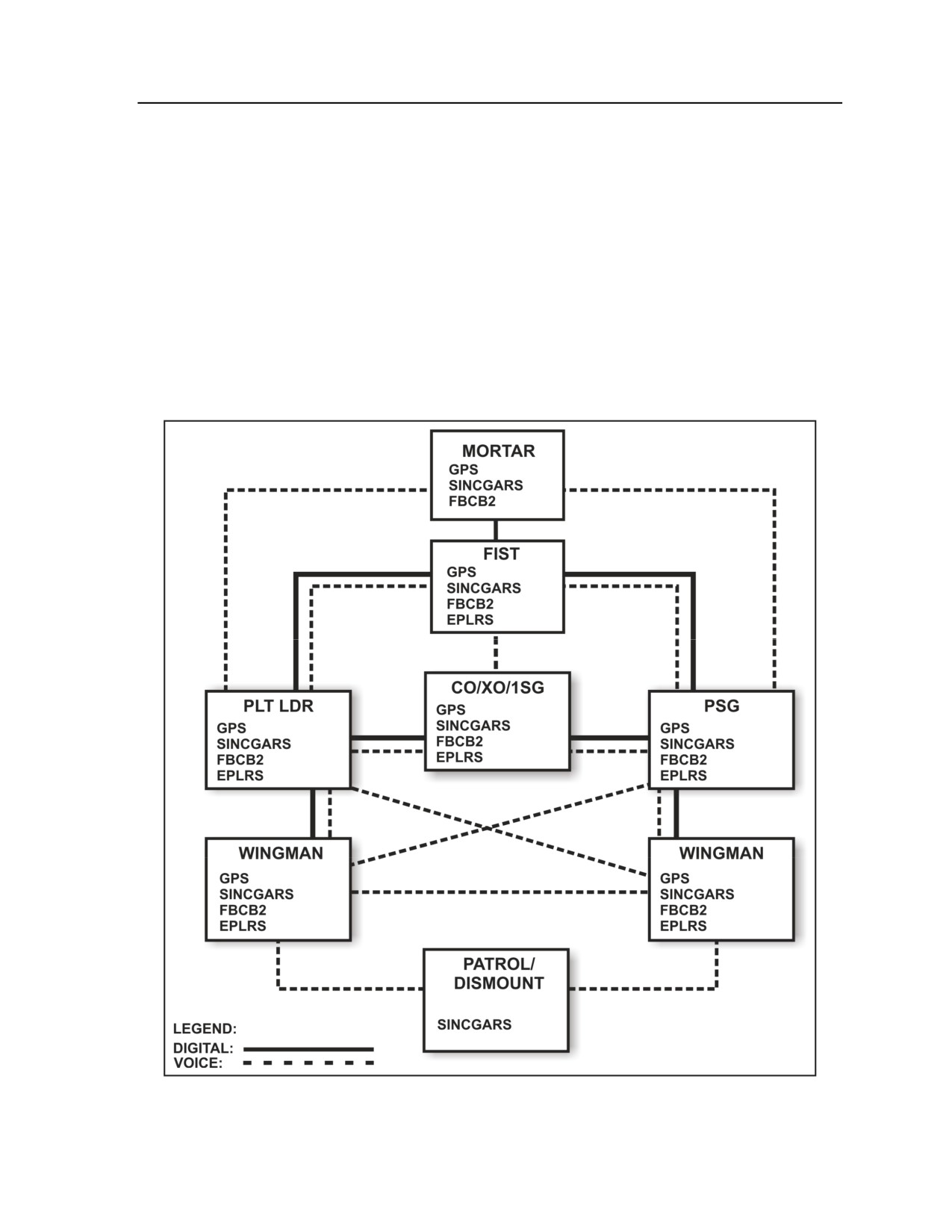
Chapter 2
addition to the SINCGARS, platoon vehicles are equipped with the enhanced position location and
reporting system (EPLRS). The EPLRS provides a secure digital connection and serves as a router,
efficiently sending message traffic internally within the platoon and also out to the higher command and
fire support nets. This routing capability ensures that information is passed even if the chain of command is
disrupted by physical separation, casualties, or mechanical failures. Finally, the FBCB2 terminal includes a
monitor, keyboard, mouse, and a variety of computing functions; these features provide the crew with
direct access to the system. Together, these FBCB2 components form the lower tactical internet. Figure 2-3
illustrates components of FBCB2 in a reconnaissance or scout platoon.
2-79. The upper tactical internet consists of a variety of tactical computer systems and communications
equipment located primarily at the squadron/battalion level and higher. The most important of these are the
maneuver control system, the all source analysis system (ASAS), the advanced field artillery tactical data
system (AFATDS), and the battle command sustainment and support system (BCS3). These systems draw
upon the reports and positional data passed on the lower tactical internet to provide SA at higher command
levels. In turn, these systems can push information such as location of adjacent units, known and templated
enemy positions, graphics, and OPORDs down to FBCB2 users.
Figure 2-3. Interaction of FBCB2 components for a reconnaissance or scout platoon
2-18
FM 3-20.98
3 August 2009
Command and Control
FBCB2 CAPABILITIES
2-80. This discussion focuses on several areas in which FBCB2 enhances the platoon’s battle command
capabilities.
Friendly Situational Awareness
2-81. To enhance friendly SA, the FBCB2 screen displays an icon for each individual vehicle in the
platoon. This provides the vehicle commander with a clear picture of where he is located in relation to the
platoon and the platoon leader; with a picture of where he is operating in relation to the rest of the higher
unit. While the system functions automatically for vehicles equipped to operate on the tactical internet, it
does not provide locations for every friendly element in the area of influence. For example, the system does
not automatically track dismounted scout teams operating at extended distances from their vehicles. In
addition, it does not cover infantry squads from the brigade, nondigitally equipped units, or allied troops
that may be operating in or adjacent to the platoon’s AO. Icons representing these elements may be
imported into FBCB2 based on radio reports, but these are not updated in real time. As a result, FBCB2
cannot be the sole instrument used for clearing fires; it does not substitute for the leader’s or commander’s
judgment in preventing fratricide.
Enemy Situational Awareness
2-82. FBCB2 creates enemy SA from both top-down and bottom-up feeds. The higher unit S2 inputs
enemy icons into the system based on spot reports (SPOTREP) generated by assets outside the unit; these
include the JSTARS and sensor assets organic to surveillance troops, such as tactical UAS flights, radio
intercepts, and ground sensors. Based on his IPB, the S2 augments these actual locations with templated
positions in the form of a SITTEMP.
2-83. As the reconnaissance or scout platoon conducts operations, it adds to the enemy SA by sending
SPOTREPs of enemy activity and obstacles via the FBCB2. When a vehicle commander sends a
SPOTREP, he automatically creates an icon representing the enemy on FBCB2 systems in his platoon. The
platoon leader or PSG evaluates the validity of the report and forwards it to the TOC. At the troop level,
the report is evaluated to ensure it is accurate and is subsequently forwarded to the other platoons in the
troop and higher to the squadron. This process is the same for the reconnaissance platoon in a battalion.
2-84. To keep the enemy SA current, units must update SPOTREPs concerning enemy locations that are
represented by icons on the FBCB2. Updates must be sent whenever the enemy situation changes, such as
when an enemy element moves or is destroyed. Icons will “fade” and eventually disappear from the
FBCB2 screen as their information ages. The unit SOP governs the rate at which icons fade.
2-85. Members of the reconnaissance platoon must remember that the enemy SA provided by FBCB2 is
only as good as the reports that the system receives. It will never give a 100-percent complete or accurate
enemy picture. The platoon leader and his vehicle commanders must ensure that vehicle scanning plans
and the platoon R&S plan are adequate to detect enemy forces not yet reported by digital means.
Standardized Reporting
2-86. FBCB2 streamlines the reporting process by providing the reconnaissance platoon with the
capability to send and receive standardized reports (see Figure 2-4). FBCB2 can process SALUTE reports
(listed on the FBCB2 screen as SALT reports), MEDEVAC requests, NBC-1 reports, calls for fire, check
fire reports, and SITREPs. Additional FBCB2 capabilities include the following:
z
It helps to ensure that all required information is included in a particular report or request.
z
It reduces the chance of errors in transmission.
z
It allows for the storage of messages for retrieval and reference.
3 August 2009
FM 3-20.98
2-19
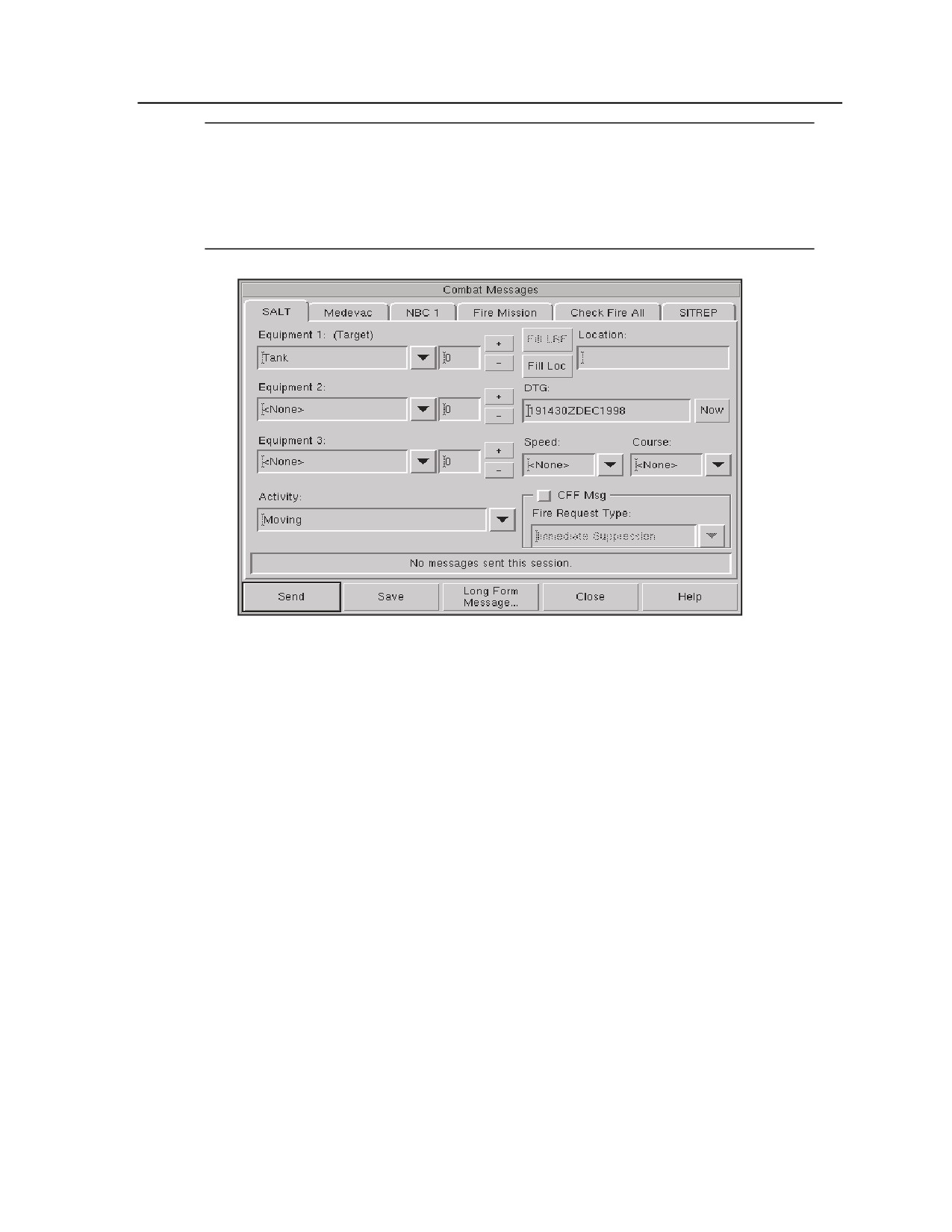
Chapter 2
Note. There is still a requirement for radio voice message traffic. For example, leaders must still
transmit contact reports to initiate battle drills and cue leaders to check their FBCB2 screens for
updated information. Additionally, vehicle commanders may need to send oral descriptions of
enemy locations, routes, or obstacles to help clarify the situation. This is especially true in close
or urban terrain where the FBCB2 cannot display the terrain in sufficient detail to assist leaders
in making effective decisions.
Figure 2-4. FBCB2 display for standardized reports
Combat Orders and Graphics
2-87. FBCB2 greatly enhances the speed and precision of the orders process. The system allows leaders to
add or modify operational graphics during the planning process or execution. This ensures that every
element has the most current information to control movement and fires. In addition, commanders can use
free text messages to transmit OPORDs, FRAGOs, and operational update briefings over extended
distances without the loss of time and information inherent in radio voice communications. Like
standardized reports, graphics and orders can be sent, received, and stored for retrieval and reference.
SITUATIONAL AWARENESS
2-88. SA is the immediate knowledge of the conditions of the operation, constrained geographically and in
time (refer to FM 3-0). This knowledge includes awareness of both the friendly and enemy situations and
of relevant terrain. The goal is for leaders to attain SU. SU is the product of applying analysis and
judgment to relevant information to determine the relationships among the mission variables to facilitate
decision-making. It entails the ability to relate information and events through space and time to form
logical conclusions and make decisions that anticipate events. Since the platoon normally operates
dispersed as individual sections or squads, it is essential that all reconnaissance leaders maintain SA so
they can make sound, quick tactical decisions (SU).
2-89. The commander uses the memory aid of METT-TC to identify mission variables in the AO. The
reconnaissance or scout platoon leader in turn uses METT-TC and his commander’s intent in mission
planning and SA sustainment. To have a clear picture of the AO, the platoon leader must have virtually
perfect knowledge of the friendly situation one level higher. He must have a relatively complete knowledge
of the terrain, and he must know as much as possible about the enemy. It is important that the platoon
2-20
FM 3-20.98
3 August 2009
Command and Control
leader use this knowledge to update his section and squad leaders periodically regarding the higher
situation.
2-90. The framework of the AO can vary from a linear area with obvious front and rear boundaries and
closely tied adjacent units to a dispersed and decentralized structure with few secure areas and unit
boundaries and no definable front or rear. Between these extremes are an unlimited number of possible
variations. Maintaining SA becomes more difficult as the AO becomes less structured. Modern, highly
mobile operations with small forces lend themselves to a less rigid framework that challenges the scout’s
ability to maintain an accurate picture of the AO.
Note. The requirement to maintain a real-time picture of the area of influence one level higher
does not relieve the scout of the requirement to understand the situation and commander’s intent
two levels higher. The difference is that his understanding of the situation two levels higher does
not have to be as specific. FBCB2 will assist all scouts in the platoon in maintaining real-time
SA.
2-91. Almost all of the information the platoon leader needs comes in the form of reports over his FM
communications system or FBCB2. He receives many reports based on his platoon’s understanding of
shared, common graphics. Effective graphics require that the subordinate elements report periodically as
they accomplish requirements. The platoon leader must be aware of when his scouts report so he can
maintain a current visualization of the situation. If an element does not report in a timely manner, the
platoon leader must quickly determine the situation of the overdue element.
2-92. The platoon leader must learn how to relate the information he is receiving to his common
operational picture (COP), which is perhaps the most important skill in maintaining SA. He should plot all
friendly position reports up to one level higher than his own. The leader also plots SPOTREPs.
AREAS OF INFLUENCE
2-93. An area of influence is a geographical area wherein a commander is directly capable of influencing
operations by maneuver and fire support systems normally under the commander’s command or control
(see JP 1-02). Areas of influence normally surround and include the AO. AOs are geographical areas,
including airspace, usually defined by lateral, forward, and rear boundaries assigned to a commander or
leader, in which that commander or leader has responsibility and the authority to conduct operations. Each
section or squad has its own AO; the platoon AO is the sum of individual section/squad AOs.
2-94. Numerous factors define the area of influence such as the locations of friendly forces, including the
platoon’s individual sections, squads, OPs, and patrols; the effects of terrain, weather, and movement; and
the ranges of all available platoon weapons and sensing systems, including supporting fires (see Figure 2-
5).
2-95. The platoon leader assesses the OE in all phases of mission planning and execution. During the
planning process, the assessment is a critical factor in selection of routes and tentative positions. Once
mission execution begins, the platoon leader’s knowledge of his AO and area of influence within the OE is
critical when he must issue timely and effective orders as the situation changes.
3 August 2009
FM 3-20.98
2-21
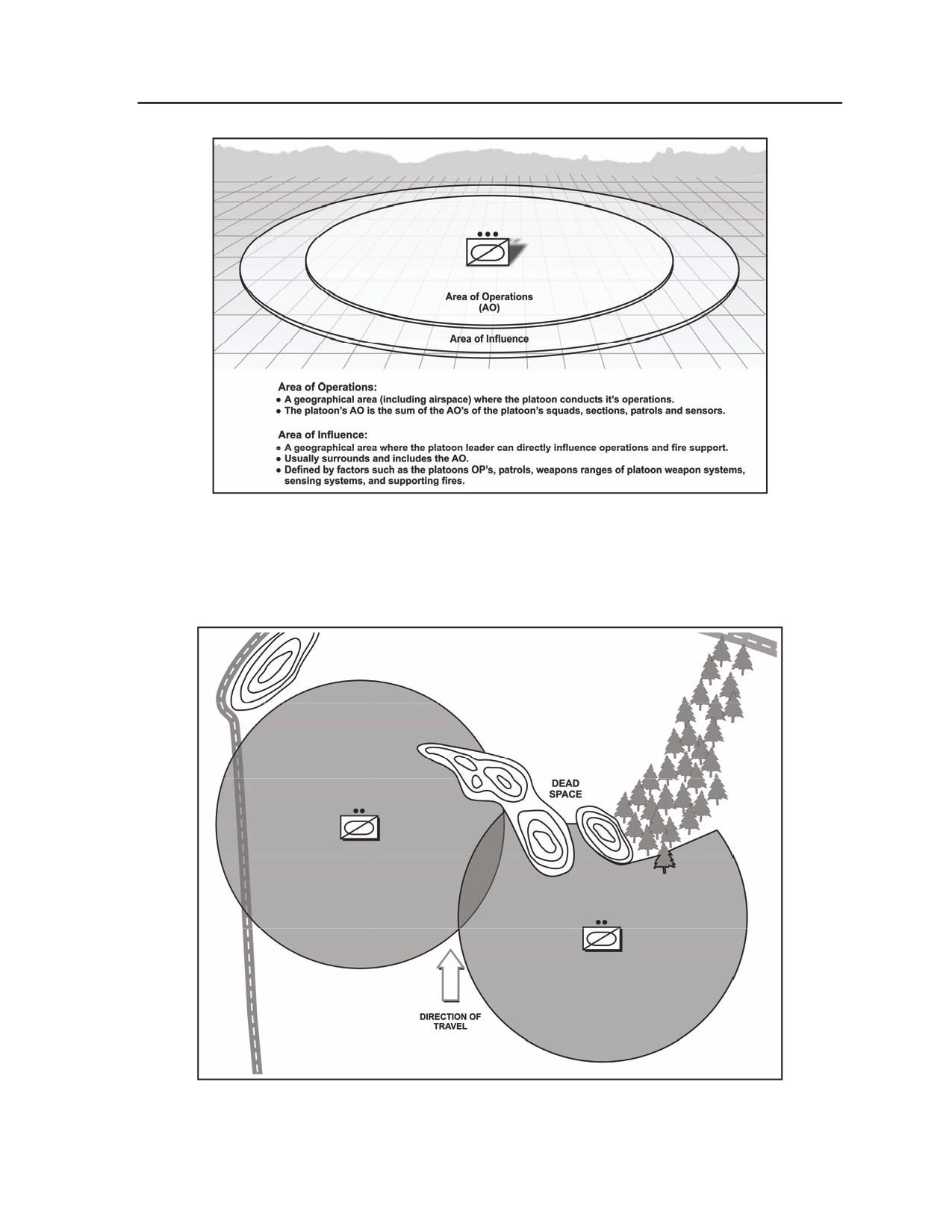
Chapter 2
Figure 2-5. Scout platoon’s AO and area of influence
2-96. The platoon leader must be aware at every moment how the OE changes as friendly and enemy
forces move and as terrain and visibility conditions change (as shown in Figures 2-6 and 2-7). He must
evaluate how these changes affect his AO and area of influence. He must consider other METT-TC
variables as well.
Figure 2-6. Effects of movement on the area of influence (part one)
2-22
FM 3-20.98
3 August 2009
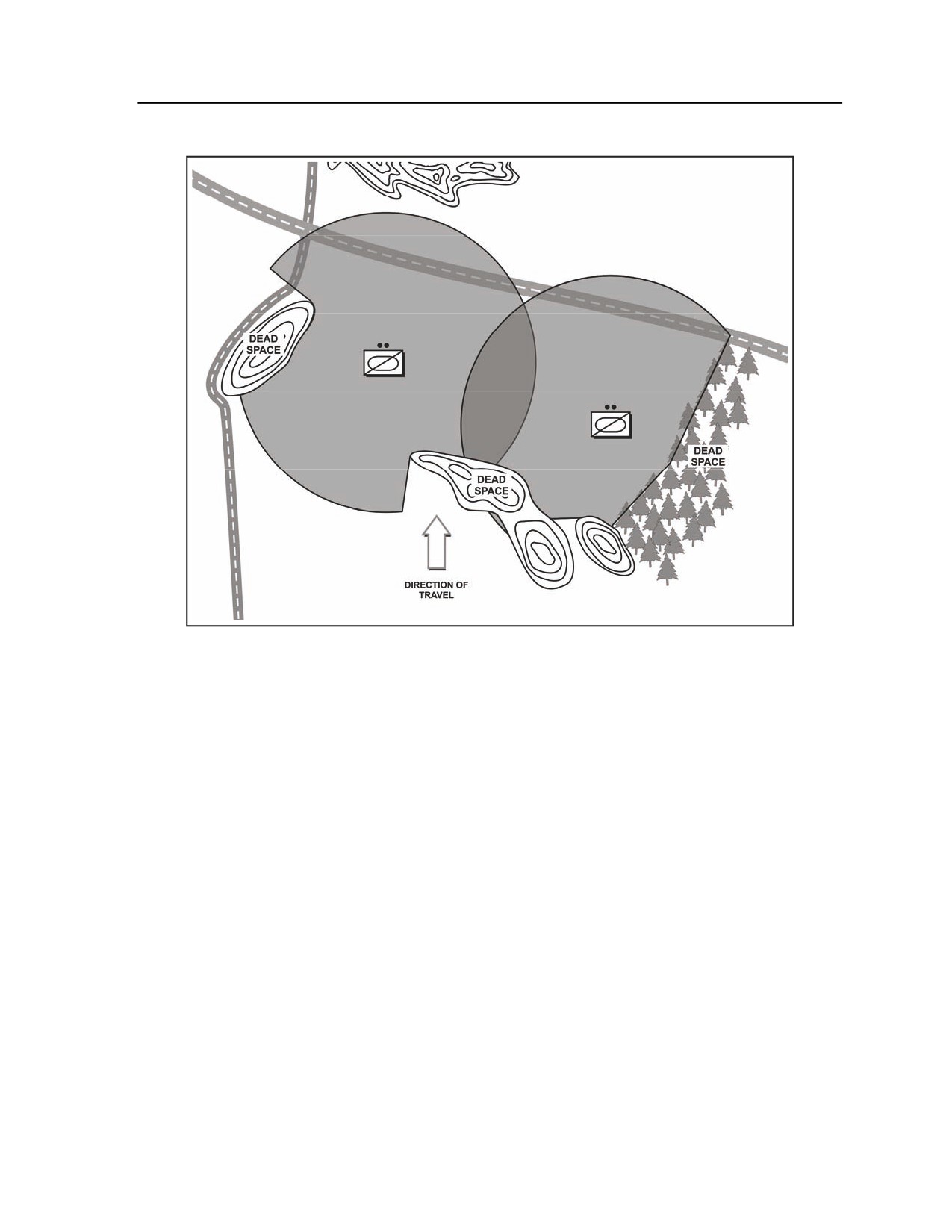
Command and Control
Figure 2-7. Effects of movement on the area of influence (part two)
2-97. As the operation progresses, the platoon leader must take active measures to shape the platoon’s area
of influence to his best advantage. In many situations, he should attempt to eliminate any gaps and other
dead space that exist within the area of influence. The platoon leader can accomplish this by maneuvering
sections or squads, repositioning OPs, and deploying patrols or remote sensors. He must also ensure that
organic and attached assets are positioned to achieve overlapping coverage of critical points within the
platoon’s area of influence.
2-98. The purpose of overlapping coverage is to prevent the enemy from overcoming the friendly
reconnaissance effort by degrading or destroying a single platform or sensor. It also prevents the enemy
from gaining an advantage during periods when environmental or weather conditions, including limited
visibility, degrade the platoon’s observation capability or sensor performance. Refer to Figures 2-8 and 2-9
for an illustration of how the platoon leader can optimize his area of influence.
3 August 2009
FM 3-20.98
2-23
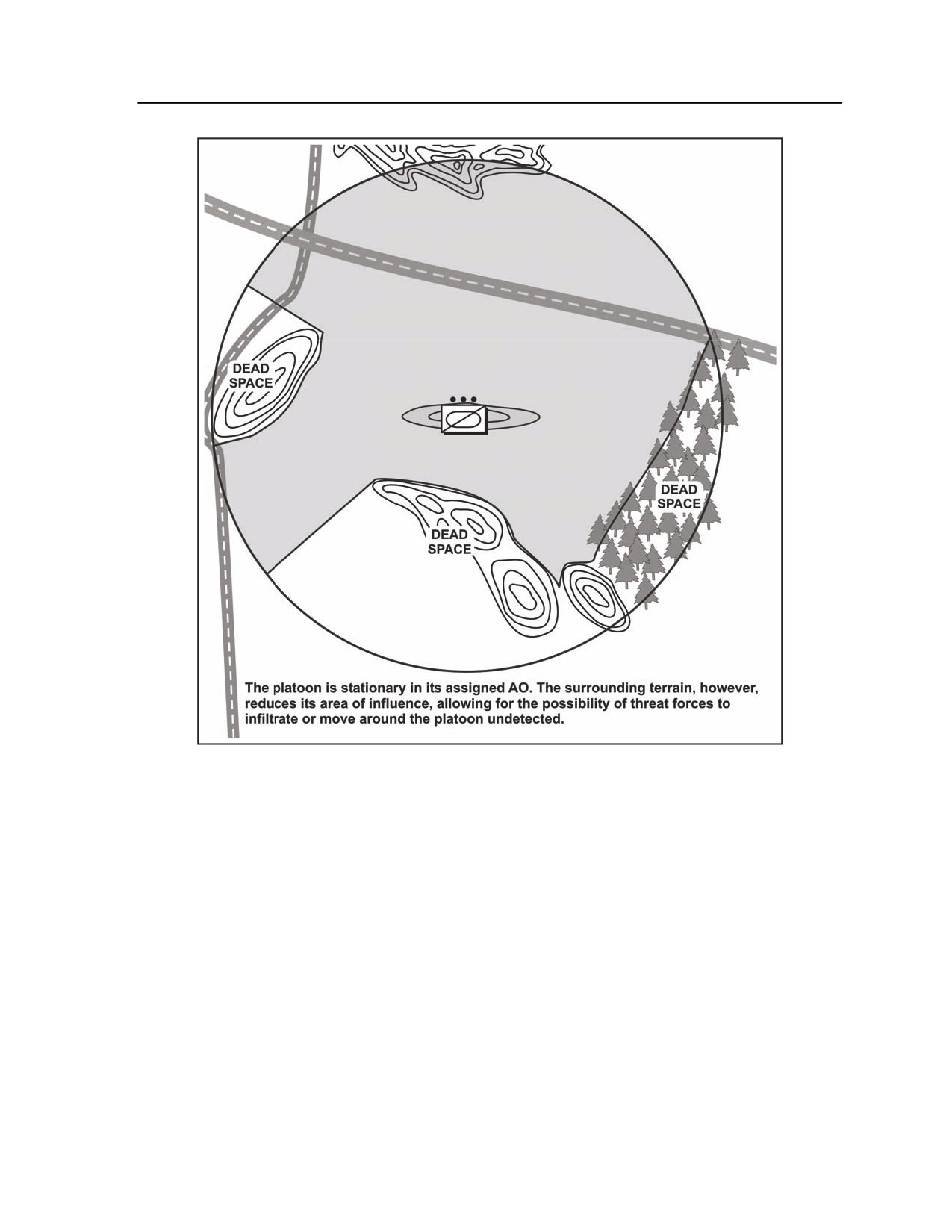
Chapter 2
Figure 2-8. Optimizing the area of influence (part one)
2-24
FM 3-20.98
3 August 2009
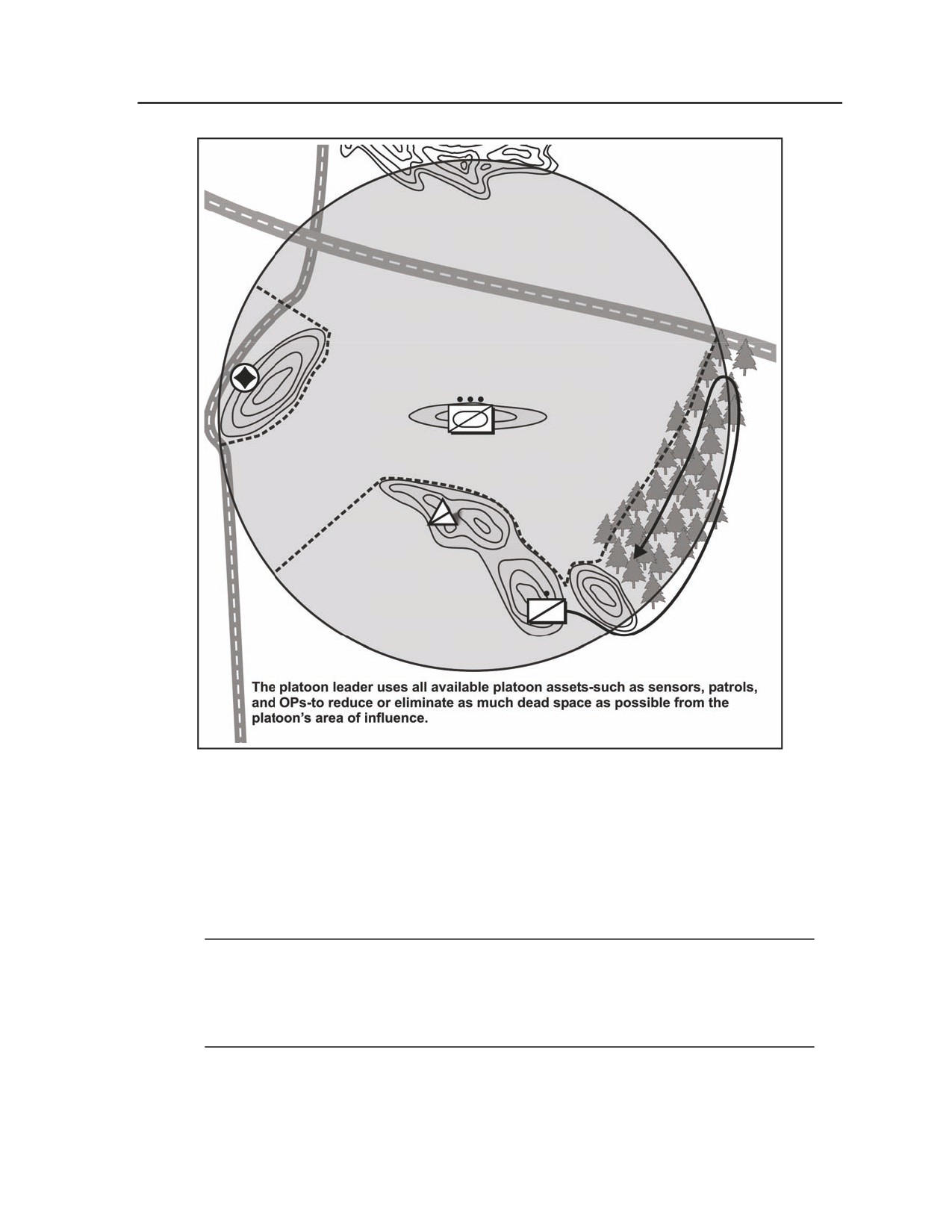
Command and Control
Figure 2-9. Optimizing the area of influence (part two)
FRATRICIDE
2-99. Recent experience has shown that fratricide is a significant danger to all mobile forces where
weapon system lethality is significantly greater than identification friend or foe (IFF) capability. Fratricide
is the result of many factors, including inadequate direct fire control plans, navigation errors, combat
identification failures, and incorrect or inadequate operational graphics. For an in-depth discussion of
fratricide and its prevention, refer to Appendix D of this manual.
Note. In many situations, the primary cause of fratricide is the lack of positive target
identification. To prevent fratricide incidents, commanders and leaders at all levels must ensure
positive target identification before they issue commands to fire. In addition, all units must
accurately report their locations during combat operations, and TOCs and CPs must carefully
track the locations of all subordinate elements in relation to those of all friendly forces.
3 August 2009
FM 3-20.98
2-25
Chapter 2
SECTION III - INTELLIGENCE PREPARATION OF THE BATTLEFIELD
2-100. IPB is a systematic, continuous process of analyzing and visualizing the OE in a specific
geographic area for a specific mission or in anticipation of a specific mission (see FM 34-130 for
additional information). It is designed to support staff estimates and military decision-making. Applying
the IPB process at the squadron and troop level helps the commander to selectively apply and maximize his
combat power at critical points in time and space in the AO by—
z
Describing the OE in which the unit is operating and the effects of the OE on the unit.
z
Determining likely enemy COAs.
BASICS OF IPB
2-101. The IPB process is conducted continuously prior to and during the initial planning for an operation
and during the conduct of the operation. As described in the following discussion, each of the four steps of
the IPB process consists of several principal judgment decisions and evaluations that together form the
basic “how to” of IPB.
2-102. The steps and principles of the IPB process remain constant regardless of the type of mission, unit,
staff section, or echelon conducting IPB. The application of the principles, however, varies with each
specific situation. Similarly, a given unit or staff section does not always prepare all IPB products in every
situation. Determining which products to prepare and identifying their relative priority depends on the
factors of METT-TC and command guidance.
IPB STEPS
2-103. IPB consists of four steps:
z
Define the OE.
z
Describe the environmental effects on operations.
z
Evaluate the enemy.
z
Determine enemy COAs.
DEFINE THE OE
2-104. This step covers the following:
z
Identify significant characteristics of the OE.
z
Identify the limits of the command’s AO.
z
Establish the limits of the area of influence and the area of interest.
z
Identify the amount of detail required and feasible within the time available for IPB.
z
Evaluate existing databases and identify intelligence gaps.
z
Collect the material and intelligence required to conduct the remainder of IPB.
DESCRIBE THE ENVIRONMENTAL EFFECTS ON OPERATIONS
2-105. This step covers the following:
z
Analyze the AO, focusing on these considerations:
Terrain analysis using the factors of OAKOC.
Weather analysis, including wind speed and direction, visibility, temperature and humidity,
cloud cover, and precipitation.
Analysis of other characteristics of the AO.
z
Analyze all other relevant aspects of the OE (METT-TC).
z
Describe the effects of all relevant OE variables on enemy and friendly capabilities and broad
COAs. The byproduct of this step is a MCOO that visually depicts all challenges and restrictions
that will affect movement and maneuver.
2-26
FM 3-20.98
3 August 2009
Command and Control
EVALUATE THE ENEMY
2-106. This step covers the following:
z
Update or create enemy models, focusing on the following considerations:
Convert enemy doctrine or patterns of operation to graphics.
Describe in words the enemy’s tactics and options.
Identify high-value targets (HVT) and high-payoff targets (HPT).
z
Identify enemy capabilities.
DETERMINE ENEMY COAS
2-107. This step covers the following:
z
Identify the enemy’s likely objectives and desired endstate.
z
Identify the full set of COAs available to the enemy.
z
Evaluate and prioritize each COA.
z
Develop each COA.
z
Identify initial ISR requirements.
Note. The byproducts of this final step are SITTEMPs that visually depict the enemy’s most
likely course of action and most dangerous course of action.
SECTION IV - COMMUNICATIONS
2-108. The primary mission of reconnaissance and scout platoons is to provide information to the
commander about the enemy and other conditions of the OE. Because of the extended frontages and
distances over which the platoon operates, it must rely heavily on effective communications techniques.
These techniques include not only the means of communications (such as wire, visual signals, or radio and
digital systems) and the proper way of using them, but also the effective application of operational terms,
radiotelephone procedures (RTP), and digital TTP.
2-109. The platoon leader must ensure that all of his Soldiers understand communications procedures. For
radio systems, including TACSAT, this includes the different nets on which the platoon operates, as well
as positioning considerations, field-expedient communications techniques, and visual signals. In employing
the platoon’s digital systems, including FBCB2, the platoon’s scouts must understand how to prepare and
send reports, orders, and overlays and how to use hot keys.
MEANS OF TACTICAL COMMUNICATIONS
2-110. The reconnaissance and scout platoon always has several available means of communications.
Whether it is using messenger, wire, visual, sound, radio signals, or digital systems, the platoon must
remain flexible enough to react quickly to new situations. Use of each of these means of communications
must be carefully planned to avoid dependence on a single method.
3 August 2009
FM 3-20.98
2-27
Chapter 2
2-111. SOPs can give the platoon a tremendous advantage in mission accomplishment. Hand-and-
arm/flag signals aid in controlling platoon movement. Clear and concise radio transmissions can reduce
transmission times.
MESSENGER
2-112. This is the most secure means of communications available to the platoon. Messenger service is
generally very flexible and reliable. In an assembly area, it is the preferred means. On an infrequent basis,
members of the platoon may be called on to act as messengers to the parent unit’s higher headquarters.
WIRE
2-113. This method of communications is especially effective in static positions or during the conduct of
a screening mission. It is very versatile and can be used in many different situations. Using one of the many
wire devices available, the platoon establishes hot loops to communicate within the platoon, with OPs, and
with the parent unit CP in assembly areas.
VISUAL
2-114. Visual communications are used to transmit prearranged messages quickly over short distances.
Sections or squads within the platoon may rely heavily on this type of communications. Since the platoon
rarely operates as a unit over short distances, however, visual signals are seldom used at the platoon level.
In those cases when the entire platoon is together, such as in a coil, in an assembly area, or on a road
march, all vehicle commanders must stay alert so they can receive visual signals from the platoon leader
and pass them on to other vehicle commanders in the platoon.
2-115. Whenever visual signals are used, they must be clear enough to be understood by vehicle
commanders as they operate in tactical situations. Standard hand-and-arm or flag signals work well during
periods of good visibility. Flashlights, chemical lights, or other types of lights are required during limited
visibility. The platoon must exercise extreme care when using lights to avoid alerting the enemy to friendly
intentions.
2-116. Pyrotechnic ammunition can also be used for visual signaling. The meanings of these signals are
identified in paragraph 5 of the OPORD and in the unit signal operating instructions (SOI). The main
advantage of pyrotechnics is the speed with which signals can be transmitted. Key disadvantages are the
enemy’s ability to see them and, potentially, to imitate them.
SOUND
2-117. This form of communications is used mainly to attract attention, transmit prearranged messages,
and spread alarms. Sound signals carry only short distances; in addition, range and clarity are greatly
reduced by noise from combat operations. Since they are open to enemy interception, use of sound signals
may be restricted for security reasons. Prearranged meanings for sound signals are outlined in the unit SOP
and SOI; they must be kept simple to prevent misunderstandings.
RADIO
2-118. The radio is the platoon’s most flexible and most frequently used form of communications. Types
of radio communications include electromagnetic transmissions over FM, AM, UHF, and VHF spectrums
and use of TACSAT systems.
2-119. The most effective way to use the radio is to follow standard guidelines for effective RTP; these
include brevity, proper use of authentication tables, and the use of approved operational terms. Enemy
direction-finding units can trace radio signals. Once found, the transmitter can easily be destroyed. For this
reason, the platoon leader and PSG must strictly enforce radio discipline regardless of encryption devices;
survival of the platoon depends on good radio habits.
2-28
FM 3-20.98
3 August 2009
Command and Control
Radio Voice Communications
2-120. Operations normally depend on radio as the primary means of communications for both voice and
digital traffic. Net discipline and SOP minimize needless traffic. To avoid detection by enemy direction-
finding equipment, the platoon uses other means of communications whenever possible to supplement the
radio and minimize emissions. Once in contact, the primary means of communications will be radio voice.
TACSAT Communications
2-121. Because the platoon often conducts reconnaissance operations over great distances, the unlimited
range of TACSAT radios can prove extremely valuable.
DIGITAL
2-122. FBCB2 is the digital system that enhances the battle command capability by linking the platoon
internally and to its higher headquarters. As noted in the discussion in Chapter 1 of this manual, FBCB2 is
part of the Army Battle Command System (ABCS), a network of computers, GPS equipment, and
communications systems that work together to provide combat leaders with real-time information of
unprecedented quantity and quality. FBCB2 and the ABCS allow for advanced reporting, orders and
graphics sharing, and database management.
COMMERCIAL LINES
2-123. The platoon may communicate via commercial lines when approved by higher headquarters.
Careful consideration must be given to securing commercial lines and limiting the amount and type of
classified material sent over nonsecure lines. If the platoon is forced to withdraw, existing wire lines,
including commercial lines, are cut and sections removed so the enemy cannot use them.
RECONNAISSANCE AND SCOUT PLATOON RADIO NETS AND
RESPONSIBILITIES
NET ORGANIZATION
2-124. The following radio nets are employed and/or monitored by leaders in reconnaissance and scout
platoons. (See Figure 2-10.)
Note. The platoon leader may assign section or squad leaders to monitor the nets of units operating
to the front and/or rear of the platoon. These units’ nets would become the alternate nets monitored
by the leaders. This technique supports SA and facilitates RHO or battle handover (BHO).
3 August 2009
FM 3-20.98
2-29
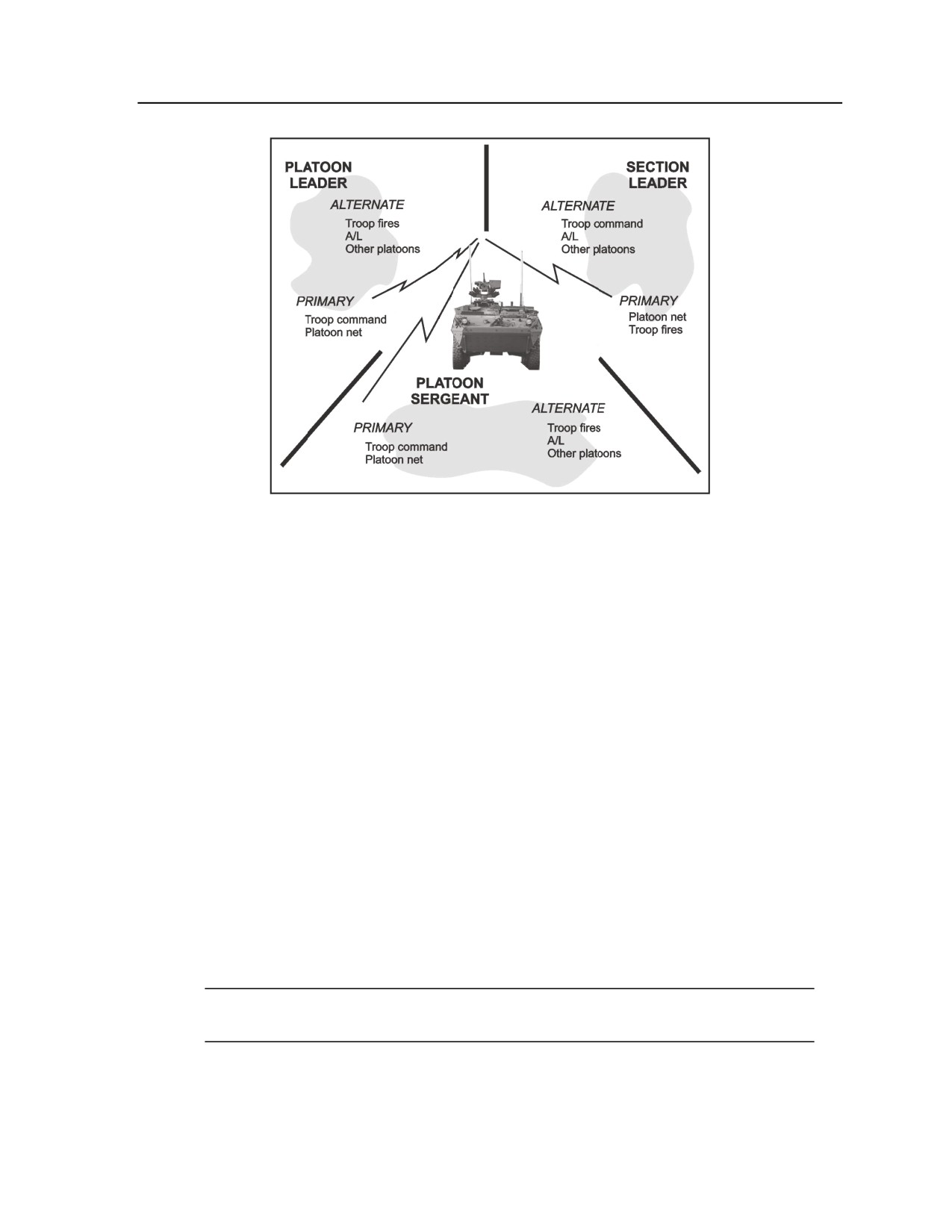
Chapter 2
Figure 2-10. Reconnaissance and scout platoon nets
Platoon Net
2-125. This net is used to conduct all platoon operations. All elements within the reconnaissance and
scout platoon must have the ability to monitor and transmit on this net at all times. Making sure this
happens is one of the keys to effective C2 during the conduct of tactical operations. All scouts must also
have the ability to rapidly change to any other platoon net as required to coordinate contact points or
handover of enemy targets.
Troop Command Net
2-126. This net is used to maneuver the reconnaissance troop as well as to process most routine reports
not sent on FBCB2. The troop TOC is the net control station, and the platoon leader or PSG sends routine
reports to the troop XO. This net can be used by platoon leaders to talk to each other and coordinate key
tactical actions of their platoons; however, platoon leaders will use each other’s platoon nets to pass routine
messages not of interest to the commander.
2-127. Both the platoon leader and PSG must always have the ability to monitor and transmit on this net.
All scouts must be able to move to this net to send reports and receive guidance if they are unable to
contact their platoon leader or PSG.
Troop Fires Net
2-128. Many troops operate a troop fires net to send calls for fire to the troop fire support officer (FSO)
or directly to the troop mortars. Reconnaissance and scout platoon leaders should direct all radios not
actively operating on another net to enter this net. All scouts must have the ability to change to this net and
coordinate indirect fire.
Note. Scouts must also be prepared to change to the nets of supporting elements such as tank
and mobile gun systems (MGS) to coordinate supporting fires.
2-30
FM 3-20.98
3 August 2009
Command and Control
Administrative and Logistics Net
2-129. The PSG will usually monitor the administrative and logistics (A/L) net for the platoon, but the
platoon leader must be familiar with it as well. The PSG uses it as required to send routine A/L reports.
This net is also used to coordinate resupply operations and evacuation of casualties.
Retransmission
2-130. When the platoon operates at extended distances from the CP or TOC, it may use the
retransmission (retrans) net to facilitate effective communications between the platoon leader and the
higher unit. The platoon leader should request use of the retrans net during all missions requiring FM
communications at extended ranges.
PLATOON RESPONSIBILITIES
Net Control
2-131. The platoon net is the key to C2 of the reconnaissance or scout platoon. The smooth functioning of
this net allows accurate information to be passed quickly both to and from the platoon leader. This
information flow is critical in maintaining the platoon leader’s SA and in enhancing C2. When contact is
made, the volume of traffic on the platoon net will increase drastically. The platoon must be organized to
control, understand, and process this vast amount of information while engaging the enemy and possibly
being engaged in turn. The following guidelines will help to ensure that the information flowing over the
net is organized and controlled in a way that permits the platoon leader to both understand it and issue
orders in response to it.
Net Discipline
2-132. The PSG is responsible for net discipline. In this capacity, he will challenge any violation of
procedure as it occurs. Improper or inefficient radio procedures, even in routine administrative reports,
inhibit effective C2. Proper RTP are the cornerstone of effective C2 in the platoon. All scouts must be
experts in communications procedures. This not only ensures efficient communications within the platoon,
but also allows all members of the platoon to communicate effectively with outside elements such as the
squadron, battalion, or troop CPs and TOCs, other platoons, and subordinate and/or supporting elements.
TECHNIQUES OF EFFECTIVE COMMUNICATIONS
2-133. The platoon leader and PSG are responsible for ensuring that their scouts understand and adhere to
the following guidelines, which can contribute to more effective, more secure tactical communications.
KNOW THE SYSTEM
2-134. Each scout must be an expert at using and maintaining his communications system. In particular,
he must understand its capabilities and limitations. He must also understand how to maintain the system
and how to troubleshoot it whenever he suspects it is not functioning properly. This is particularly
important for scouts in the BFSB because of the reconnaissance platoon’s specialized long-range
communications equipment.
MINIMIZE DURATION
2-135. All messages sent within or from the platoon must be short and informative. The longer the
message, the greater the opportunity for enemy elements to use electronic means to determine the platoon’s
location. Message length can be controlled in several ways:
z
Write the message down and then eliminate all unnecessary words from the written message
before sending it.
z
Read the message as written when sending it.
z
Use a brevity code that reduces the need to explain the tactical picture in detail.
z
Break long messages into several parts and send each separately.
3 August 2009
FM 3-20.98
2-31
Chapter 2
MINIMIZE SIGNATURE
2-136. When sending a message, every scout must be conscious of the size and nature of the electronic
signature that he is emitting. He must consider the following methods for reducing the size of the signature:
z
Use terrain to mask the signature from the direction of the enemy.
z
Set the transmitter power to low if that setting will provide sufficient range (as it often does
within the platoon, section, or squad).
z
Whenever possible (particularly in stationary operations), use an expedient directional antenna
to restrict the enemy’s ability to monitor the signal.
USE AN EFFECTIVE FORMAT
2-137. A thorough knowledge of report formats is critical in ensuring timely reporting of enemy
information, especially in fast-moving tactical situations. Every scout should be familiar with the report
formats that are outlined later in this chapter and know how to use them effectively. At the same time,
however, scouts must never delay reports only to assure the correct format; ALWAYS REPORT
ACCURATE INFORMATION AS QUICKLY AS POSSIBLE!
2-138. As a basic guideline, reports of enemy activity follow the SALUTE format, covering these factors:
z
Size. This includes the number of sighted personnel, vehicles, or other equipment.
z
Activity. This covers what the enemy is doing.
z
Location. This is usually reported as the grid coordinates of enemy elements.
z
Unit. This covers any indications useful in unit identification, such as patches, signs, and
vehicle markings.
z
Time. This item details when enemy activity was observed.
z
Equipment. This includes description or identification of all equipment associated with the
enemy activity.
SECTION V - REPORTING
2-139. As noted, the primary function of the reconnaissance or scout platoon is to gather and report
information (reconnaissance). The platoon reports information, using either analog equipment or digital
means (FBCB2), in a timely and accurate manner that enhances the decision-making process of its higher
headquarters and/or that enables the higher headquarters to employ effective fires to defeat the enemy. The
use of FBCB2 enhances the scouts’ capability to send timely and detailed reports to all elements of the
combined arms force. Initial contact reports should still be analog, providing immediate notification to all,
yet allowing the element in contact to focus on the required actions in contact procedures. Once
disengaged, or where there is no further enemy to the element, the element leader can follow up the initial
contact report with a detailed, digital report. Refer to Appendix A for detailed information on reports.
2-140. The platoon’s unique information-gathering capabilities provide the commander with information
that has tactical value concerning the enemy, terrain, and effects of weather within an AO. Scouts
reconnoiter terrain to determine movement and maneuver conditions. When they find the enemy, they
determine its disposition, strengths, and weaknesses in detail. The platoon provides the information
necessary to allow combined arms forces to maneuver against the enemy, strike where the enemy is most
vulnerable, and apply overwhelming effects to defeat it. The platoon’s accurate and timely reporting of
enemy locations and strength can make the difference between victory and defeat.
OPERATIONAL CONSIDERATIONS
2-141. Important considerations and guidelines for reconnaissance and scout platoons in the reporting of
tactical information include the following:
z
Conduct effective communications. This entails understanding the means of tactical
communications (such as wire, visual signals, analog radio, or digital communications), the
2-32
FM 3-20.98
3 August 2009
Command and Control
correct application of operational terms, and the use of effective RTP. Refer to the discussion of
communications earlier in this chapter.
z
Verify all information before reporting it higher.
z
Report the following types of information as quickly as possible:
Information of potential intelligence value.
Enemy information.
Requests for medical assistance and evacuation.
z
As needed, use report formats and procedures to supplement and enhance combat orders,
including WARNOs, OPORDs, and FRAGOs.
REPORT GUIDELINES
2-142. The platoon should follow these guidelines in reporting tactical information:
z
Do not overload radio nets by repeating information.
z
Use local time zones for all reports unless otherwise specified.
z
Send only the parts or lines of a report that contain new information or changes.
z
Though each report has a prescribed format to ensure the completeness of the information
reported, users must remember that timely reporting, especially of enemy activity, is critical in
fast-moving tactical situations.
z
Do not delay reports only to assure correct format.
DIGITAL REPORTING AND C2 MESSAGES
2-143. In addition to its capabilities related to providing SA data, FBCB2 offers a variety of functions
that can enhance C2 in the platoon. The system has four categories of C2 messages:
z
Alerts and warnings (examples include NBC reports and warnings of danger zones such as
CBRN contaminated areas, obstacles, or enemy locations).
z
Joint support information (interfaces with other branches of service).
z
Combat reporting (such as the commander’s SITREP).
z
Mission planning information (including OPORDs and FRAGOs).
Note. This discussion includes an explanation of geo-referenced messages, which create icons
linked to a location on the FBCB2 map. These messages can be used in each of the C2 categories.
ALERTS AND WARNINGS
2-144. Alerts and warnings are sent via reports, free text messages, or geo-referenced messages. They are
posted on the flash immediate priority routine (FIPR) message queue and are displayed on the function bar
of the main FBCB2 screen and as a symbol on the map screen.
2-145. When the platform penetrates the safety radius of a danger zone, the FBCB2 alarm is triggered, an
alert message is displayed on the warnings/alerts marquee, and an entry is made in the warnings tab group.
The danger zone tab group will display the type, distance, direction, location, and originator of all danger
zone information received. Danger zone information is transmitted in specific joint variable message
format (JVMF) messages as SA data. FBCB2 receives the message and displays the SA/danger zone
information in the danger zone tab group.
COMBAT REPORTING MESSAGES
2-146. These JVMF messages have been modified and grouped together to provide single-button access to
the message template, requiring fewer keystrokes to complete and send the message. Combat messages are—
z
SALUTE.
z
MEDEVAC.
z
Fire mission (call for fire).
3 August 2009
FM 3-20.98
2-33
Chapter 2
z
Check fire.
z
SITREP.
MISSION PLANNING INFORMATION
2-147. Mission planning information includes orders and request-type messages that contain JVMF
message templates. They include the following:
z
WARNOs.
z
Operational plans (OPLAN) and OPORDs.
z
FRAGOs.
z
Logistics orders and requests.
z
Free text messages.
GEO-REFERENCED MESSAGES
2-148. These messages, which can be used in the C2 categories discussed earlier, create icons linked to a
location on the FBCB2 map. They are also disseminated across the tactical internet as SA data. Geo-
referenced messages can be used for the following:
z
Obstacle reports.
z
NBC-1 reports.
z
Bridge reports.
z
Supply point status reports.
z
Contact reports.
z
Engagement reports.
2-149. FBCB2 users can choose to hide or display all geo-referenced data from the filter dialog box. Geo-
referenced messages contain “hook” information—detailed information on the status of any icon. To
access “hook” information on a geo-referenced icon, however, the user must have been a recipient of the
message.
2-34
FM 3-20.98
3 August 2009
Chapter 3
Reconnaissance Operations
Reconnaissance and scout platoons will conduct reconnaissance to provide their
commander with information that has tactical value concerning the enemy, terrain,
weather, and civil considerations within an AO. Scouts reconnoiter terrain to
determine current and future movement and maneuver conditions. Once contact with
the enemy is made, they determine the enemy’s disposition, strengths, and
weaknesses in detail. The platoon provides the information necessary to allow
combined arms forces to maneuver against the enemy, strike where the enemy is most
vulnerable, and apply overwhelming power to defeat it. In addition, scouts must be
able to perform the multidimensional aspect of reconnaissance to gather the
information needed for execution of stability operations and civil support operations.
Contents
Section I - Introduction
3-1
Section IV - Route Reconnaissance
3-46
Purpose
3-2
Critical Tasks
3-47
Fundamentals of Reconnaissance
3-2
Techniques
3-47
Section II - Reconnaissance Planning
3-4
Example of an SBCT
Operational Considerations
3-4
Reconnaissance Platoon Route
Reconnaissance
3-48
Reconnaissance Techniques
3-5
Example of an ACR Scout Platoon
Planning Considerations
3-6
Route Reconnaissance
3-52
The OE in Reconnaissance
Section V - Area Reconnaissance
3-56
Operations
3-9
Critical Tasks
3-56
Reconnaissance Handover
3-11
Techniques
3-57
Reconnaissance Methods
3-16
Example of an Area
Tactical Employment
3-20
Reconnaissance
3-58
Section III - Multidimensional Aspects
Reconnaissance of Obstacles And
of Reconnaissance and Surveillance
3-37
Restrictions
3-61
Operational Considerations
3-38
Section VI - Zone Reconnaissance
3-70
Intelligence Collection
3-38
Critical Tasks
3-71
Civil-Military Operations
3-42
Techniques
3-71
Example of a Zone Reconnaissance 3-72
SECTION I - INTRODUCTION
3-1. Reconnaissance is conducted as part of all scout missions, both mounted and dismounted, and
always maximizes all available assets. Scouts conduct dismounted reconnaissance to gather detailed
information, to enhance security, and to move with stealth or in rugged terrain. They conduct mounted
reconnaissance when time is critical and they need to cover a large area quickly. Mounted reconnaissance
allows scouts to maintain a fast tempo in combat operations and to make maximum use of optics,
firepower, communications, and protection provided by scout vehicles.
3 August 2009
FM 3-20.98
3-1
Chapter 3
3-2. Scouts reconnoiter terrain to determine movement and maneuver conditions relevant to both friendly
and enemy forces. Scouts must thoroughly understand how the enemy deploys its reconnaissance and
security forces, as well as the sequence and timing of their entry into the AO. When they find the enemy,
scouts determine its disposition, strengths, and weaknesses in detail. The scouts’ accurate and timely
reporting of enemy locations and strength can make the difference between success and failure of the
operation. At the same time, it is critical that scouts never lose sight of their reconnaissance objectives or
become committed in engagements that invariably attrit reconnaissance forces and eliminate their freedom
to maneuver.
PURPOSE
3-3. Based on their commander’s intent and guidance, scouts conduct reconnaissance forward of friendly
forces to provide current, accurate information about the enemy, terrain, weather, and civil considerations
such as culture, infrastructure, and physical resources within a specified AO. In simplest terms, the
reconnaissance and scout platoon and its higher headquarters take steps to link the purpose of the
reconnaissance to one or more of the following requirements:
z
Obtain information to answer the commander’s critical information requirements (CCIR).
z
Obtain information to fill voids in the unit IPB by answering IR and specific information
requirements (SIR).
z
Support targeting requirements by conducting target acquisition and surveillance.
3-4. These actions provide follow-on forces with an opportunity for freedom of maneuver and rapid
closure to their objective. Scouts use the fundamentals of reconnaissance to prevent maneuver elements
from being surprised or interrupted, and in doing so they protect these forces from losing men and
equipment along the way to the objective. Reconnaissance and scout platoons perform three types of
reconnaissance: route, zone, and area.
FUNDAMENTALS OF RECONNAISSANCE
3-5. The seven fundamentals are common to all successful reconnaissance operations. Scout leaders must
ensure that their planning, preparation, and execution of reconnaissance missions adhere to these
fundamentals. These fundamentals are covered in the following discussion during the execution of
reconnaissance missions. For additional information, refer to FM 3-20.96 and FM 3-90:
z
Ensure continuous reconnaissance.
z
Do not keep reconnaissance assets in reserve.
z
Orient on the reconnaissance objective.
z
Report all information rapidly and accurately.
z
Retain freedom of maneuver.
z
Gain and maintain threat contact.
z
Develop the situation rapidly.
ENSURE CONTINUOUS RECONNAISSANCE
3-6. The current OE requires maximizing the use of reconnaissance assets for continuous reconnaissance
which updates the unit’s SA. Reconnaissance and scout platoons are integral to this ISR effort; however, it
is limited in its ability to conduct and sustain continuous reconnaissance. The platoon conducts continuous
reconnaissance in the following situations:
z
Before movement to confirm planning, and ensure freedom of movement up to the LD.
z
During operations, in depth, by integrating a wide range of sensors, including tactical UAS and
ground sensors ahead of scouts to ensure maximum effectiveness and survivability. SBCT
reconnaissance platoons may include tactical HUMINT collection teams
(HCT) gaining
information from the population.
z
After operations when the platoon maintains contact while screening or through combat patrols
(including HCTs).
3-2
FM 3-20.98
3 August 2009
Reconnaissance Operations
DO NOT KEEP RECONNAISSANCE IN RESERVE
3-7. Reconnaissance assets, like artillery assets, are never kept in reserve. When committed,
reconnaissance and scout platoons use all of their resources to accomplish the mission. This does not mean
that all assets are necessarily committed at the same time. At times, the platoon leader must be prepared to
withhold or position his assets to ensure they are available at critical times and places. All reconnaissance
assets should be treated as committed assets, with specific missions assigned at all times. Do not place
Soldiers in reserve to obtain the rest and recovery required to sustain the reconnaissance effort. Rather, the
commander must develop a rest plan that allows his assets to sleep, eat, and recover as time and conditions
allow, such as during planning periods or operational lulls.
ORIENT ON THE RECONNAISSANCE OBJECTIVE
3-8. The reconnaissance platoon’s scheme of maneuver is focused on a reconnaissance objective or set of
objectives despite contact. The objective may be a terrain feature, a specific area, an enemy formation, or
other type of threat force (such as a paramilitary element). It may be designated by an NAI, target area of
interest (TAI), checkpoint, or objective symbol. A multidimensional reconnaissance objective, especially in
stability operations or civil support operations, may include locating weapons smuggling activities and
caches, pinpointing facilities for constructing IEDs, and locating war criminals for apprehension. While
sensors can assist, it requires the scout on the ground developing and refining the information to perform
reconnaissance. It is critical that the reconnaissance and scout platoon leadership completely understand
the mission focus before they begin the planning process.
REPORT ALL INFORMATION RAPIDLY AND ACCURATELY
3-9. Information loses value over time. Scouts must report all information exactly as they see it and as
fast as possible. Scouts must never assume, distort, or exaggerate what they observe. Inaccurate
information is dangerous. Information detailing the absence of a threat in the OE is just as vital as where
the threat is observed. Scouts posting information within the FBCB2 infrastructure can report and share
information on the OE faster than using radio voice traffic alone.
RETAIN FREEDOM TO MANEUVER
3-10. Scouts must be free to maneuver in the AO. If the enemy fixes them, the scouts must fight to free
themselves to accomplish their mission. Scouts must continually maintain SA of the OE as it develops.
They must employ IPB, tactical movement, and battle drills to plan for and/or react to unexpected
situations. Contact should be made by the smallest element possible, usually the squad or crew. When
contact is made, the platoon leader must continue to develop the situation. This allows the platoon leader to
retain the initiative and continue the mission.
GAIN AND MAINTAIN THREAT CONTACT
3-11. Scouts seek visual contact with the threat first and foremost. This can be done through ISR products
from UASs and other sensors. It is critical the platoon leader make contact under favorable terms or as
directed by the commander. During operations, once the scouts gain contact with the threat, they maintain
contact using all available means (sensors, radar, sound, and visual). They maintain contact until a change
of mission is specified by their coordinating instructions or engagement criteria require handoff to an
element designated to maintain contact.
DEVELOP THE SITUATION RAPIDLY
3-12. Scouts must quickly determine the size, composition, and activity of a threat. They must be prepared
to fight for the information and develop the situation to gain that information. Scouts do not classify what
they see; this is determined by their commander or unit’s staff. Once scouts find the flanks of the threat
force, they may dismount to gain information, without being detected on any barriers or obstacles
surrounding the threat position. These actions must be done quickly, with minimum guidance.
3 August 2009
FM 3-20.98
3-3
Chapter 3
SECTION II - RECONNAISSANCE PLANNING
3-13. The purpose of this section is to outline the planning, techniques, methods, and tactical employment
involved in executing reconnaissance missions. To reduce vulnerability in the AO, scouts conduct
reconnaissance to achieve a balance between an acceptable level of risk and the security necessary to
ensure mission accomplishment. Often this is expressed as a tradeoff between speed and security. The
faster the reconnaissance is conducted, the higher the likelihood that the scout’s risk will increase, that the
quality of the reconnaissance will be degraded, and that enemy forces in the AO will be missed.
3-14. While conducting their missions, scouts must use all the reconnaissance skills that they have trained
and rehearsed. They must take every opportunity to hone these skills. By the nature of their missions,
scouts can never achieve perfect security; however, thorough knowledge of the various reconnaissance
methods and their employment, combined with an understanding of a mission’s particular METT-TC
requirements, allows the scout leader to choose, and mix, reconnaissance methods that both maximize
security and ensure mission accomplishment.
OPERATIONAL CONSIDERATIONS
3-15. This discussion focuses on several areas of reconnaissance TTP (including techniques, planning
guidance, methods, and tactical employment skills) that scouts can employ. These have proven effective in
a variety of situations and form a foundation for how to conduct reconnaissance. Scouts must use their
experience, professional judgment, and common sense to analyze a given situation and employ the
appropriate TTP. There are times when the scout must think like the enemy to understand how to find him.
Usually, successful execution will require platoon leaders to use a variety of TTP (often in combinations
and/or variations) that reflect METT-TC considerations and that are focused on the particular task or the
platoon’s unique capabilities.
3-16. To help the platoon leader determine the appropriate reconnaissance TTP, the commander should
provide him with information and guidance on the reconnaissance focus, tempo, and engagement criteria.
These factors, known as the commander’s reconnaissance planning guidance, are commonly characterized
using such terms as stealthy, forceful, deliberate, and/or rapid. The commander must carefully describe
how he uses these terms in his planning guidance. Figure 3-1 illustrates an example of the factors that
influence the tempo of reconnaissance, in this case stealthy to forceful.
Note. Reconnaissance focus, tempo, and engagement criteria are covered in the discussion of
planning considerations later in this chapter and in FM 3-20.96.
3-17. Reconnaissance that uses a stealthy approach is time-consuming and emphasizes avoiding detection
by the enemy. To be effective, it must rely on dismounted reconnaissance assets and maximum use of
covered and concealed terrain. This reconnaissance can be directly supported by the use of UASs with the
unit or by planned UAS missions conducted by higher command. HUMINT resources may provide
information that allows scouts to avoid chance meeting engagements and to create situations in which they
gain visual contact and avoid detection. A forceful approach, conducted without regard for whether the
reconnaissance force will be detected, often involves mounted elements, including combat units that do not
ordinarily take part in reconnaissance. For example, the HBCT reconnaissance platoon and the ACR scout
platoon are more suited to be forceful because they have increased armor protection; dismounted scouts in
an IBCT reconnaissance platoon and mounted elements in the BFSB reconnaissance platoon are better
suited in using infiltration. See Figure 3-1.
3-4
FM 3-20.98
3 August 2009
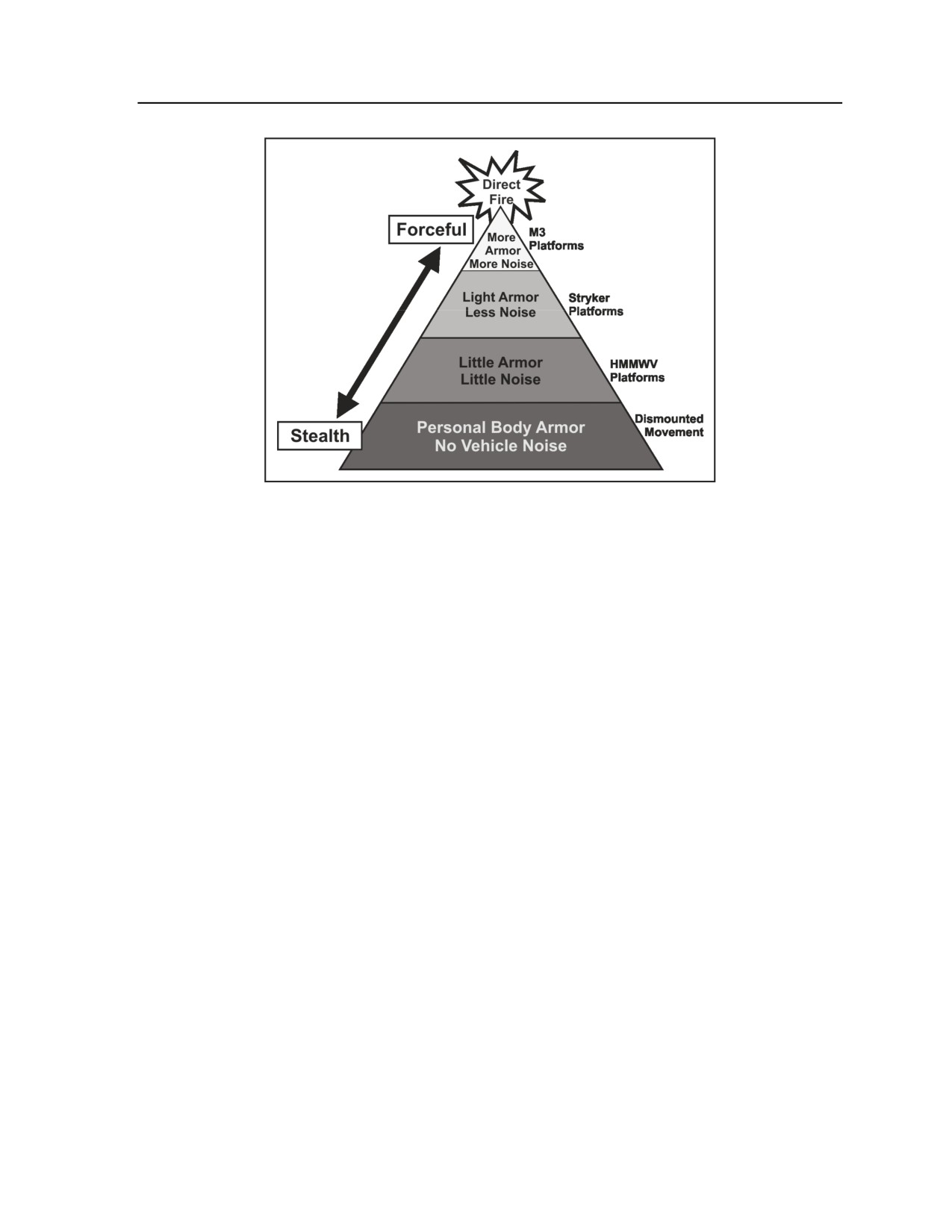
Reconnaissance Operations
Figure 3-1. Characteristics of tempo in reconnaissance
3-18. The terms deliberate and rapid relate directly to the tempo of reconnaissance and to the degree of
completeness required by the commander. A deliberate operation yields a thorough, detailed
reconnaissance of a particular area or zone. This is completed by scouts on the ground-measuring curves,
employing HUMINT assets to talk to the local population, clearing lateral routes, and completing the
platoon’s implied tasks. In absence of the HUMINT assets, the platoon leader and PSG must interact with
the coalition and even civilian population in order to accomplish the mission. A detailed reconnaissance
overlay may be required for the commander. A rapid approach to reconnaissance is focused on a few key
tasks. This causes the platoon to have a minimum amount of time necessary to cover a particular area or
zone. Often scouts will only confirm or deny the presence of the enemy and trafficability of the unit’s
march route.
3-19. Discreet and aggressive are considerations in developing the engagement criteria. A discreet
approach to reconnaissance is conducted under restrictive engagement criteria; it limits the ability of the
reconnaissance force to fight for information. Aggressive reconnaissance emphasizes identification of the
enemy’s combat power by techniques that may include fighting for information. It may entail the
employment of armored vehicles and/or the use of heavy weapons. The platoon leader must always remain
aware that aggressive information gathering can provide the enemy with an indication of friendly
capabilities and future intentions.
RECONNAISSANCE TECHNIQUES
3-20. There are two general techniques of reconnaissance: push and pull.
RECONNAISSANCE PUSH
3-21. This technique is used once the commander is committed to a COA or maneuver option. The
commander pushes his R&S assets forward as necessary to gain greater visibility on specific NAIs and to
gain information on which the COA is based. The commander’s detailed plan will often encompass several
possible COAs triggered by decision points (DP) that occur during operations. As the unit deploys, the
reconnaissance effort shifts to accomplish the following:
z
Provide DP trigger criteria information to facilitate the commander’s decisions to adopt
particular COA.
3 August 2009
FM 3-20.98
3-5
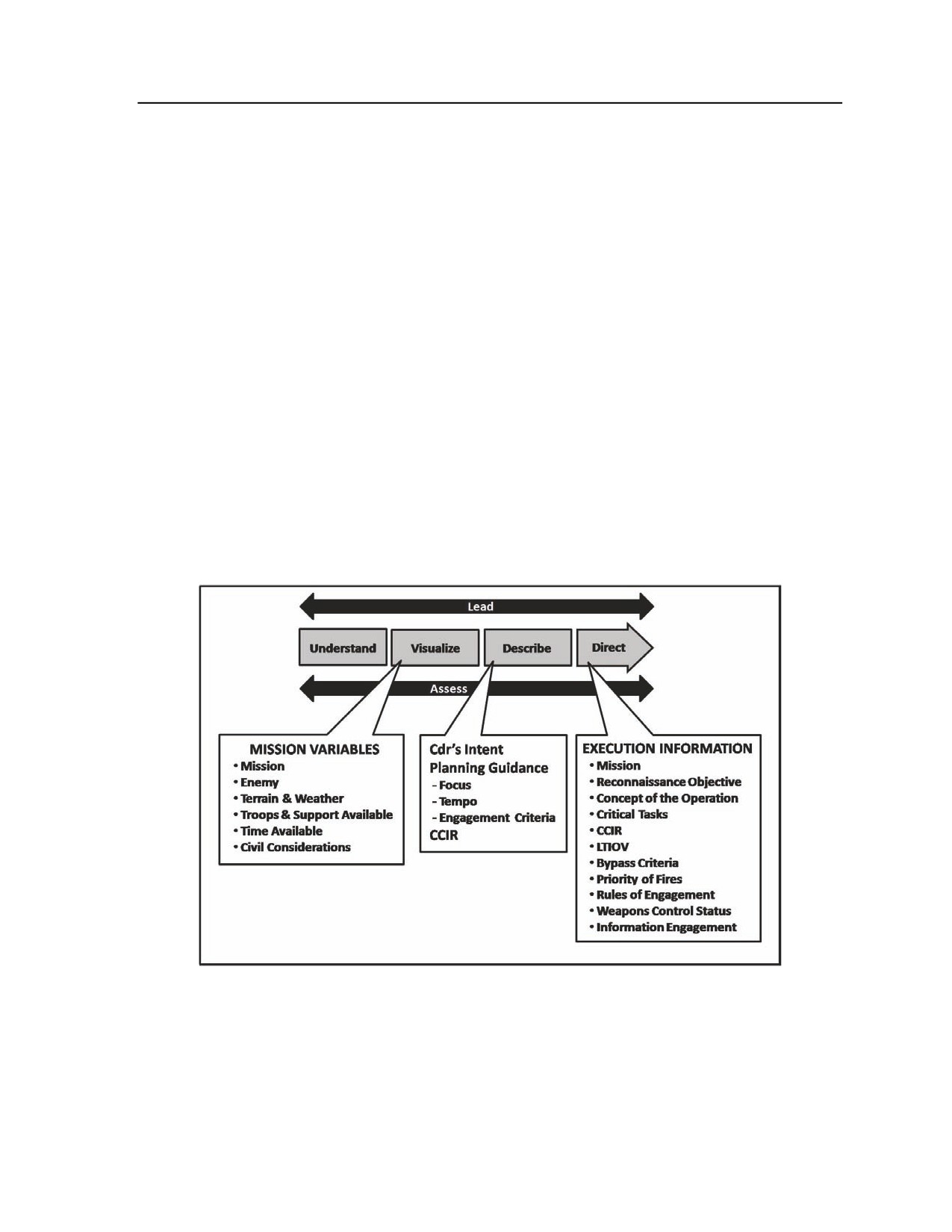
Chapter 3
z
Locate undiscovered enemy strengths and weaknesses on which the commander can capitalize
(rather than executing previously planned COAs).
RECONNAISSANCE PULL
3-22. The commander uses R&S assets to confirm or deny initial CCIR prior to the decision on a COA or
maneuver option, thus pulling the supported unit
(battalion or brigade) to a point offering tactical
advantage and creating a decisive move. Success of the reconnaissance pull requires an integrated
reconnaissance plan that can be executed prior to the commander having to make a COA decision. It is
used when the enemy situation is not well known and/or the situation is rapidly changing. It also requires a
detailed reconnaissance plan and decision-making processes. The reconnaissance pull will focus on
changing assumptions into confirmed information through accurate reporting. Initial assumptions and PIR
are used to deploy reconnaissance assets early to collect information for use in the development of COAs.
PLANNING CONSIDERATIONS
3-23. Critical to the platoon leader’s ability to execute his mission is a clear understanding of the focus,
tempo, and engagement criteria of the reconnaissance mission. This information can be labeled as
commander’s reconnaissance planning guidance. It is an extension of the commander’s intent and is meant
to fully clarify the intent for the reconnaissance effort. It should be received from higher as well as issued
to subordinates. The commander’s reconnaissance planning guidance provides specific information the
platoon leader needs to know to plan his mission. Figure 3-2 shows the role of the elements of battle
command—understand, visualize, describe, and direct—in the development of the commander’s planning
guidance for reconnaissance. For additional information on planning considerations and guidance, refer to
FM 3-20.96.
Figure 3-2. Development of guidance for reconnaissance operations
FOCUS
3-24. The focus of the reconnaissance allows the platoon leader to determine which critical tasks he wants
the platoon to accomplish first. It helps him narrow the platoon’s scope of operations to get the information
that is most important to squadron and brigade operations. In small-scale contingency (SSC) operations,
3-6
FM 3-20.98
3 August 2009
Reconnaissance Operations
the platoon focus might be terrain-oriented or enemy security force-oriented. In an environment involving
stability operations, the platoon might be focused on determining local populace sentiment or on
identifying local paramilitary leaders. While all critical tasks have some degree of applicability in any
given operation, certain ones are more important for specific missions and must be clearly articulated at
each level.
3-25. Considerations related to the focus include the following (the first three items are the mission
variables of METT-TC that are most closely related to focus in the reconnaissance OE):
z
Enemy/threat (conventional and/or nonconventional forces, terrorist organizations, and criminal
elements).
z
Terrain (bridges, routes, and defensible terrain) and weather.
z
Civilian considerations (including society/human demographics, infrastructure, and HUMINT).
z
Any other aspects of METT-TC that are directly relevant to the mission.
z
Reconnaissance critical tasks to be conducted or deleted.
Note. As noted throughout this chapter, the focus should be linked to the purpose of the
reconnaissance operation to accomplish any or all of the following tasks: answer the CCIR, fill
voids in the unit IPB (as related to the IR SIR), and/or support targeting operations through
target acquisition.
TEMPO
3-26. The tempo of the reconnaissance allows the platoon leader to establish associated time requirements
and correlate them with planning time, movement formations, engagement criteria, and methods, such as
dismounted or mounted reconnaissance. The platoon leader establishes the tempo using the troop
commander’s planning guidance and analysis of the applicable mission variables of METT-TC:
z
Mission.
z
Enemy.
z
Time available.
3-27. The tempo for reconnaissance may be described using terms such as
“stealthy,”
“forceful,”
“deliberate,” or “rapid.” However, the platoon leader—again using the reconnaissance guidance from the
troop commander—must ensure that he clearly defines for his subordinates how he interprets these terms.
ENGAGEMENT CRITERIA
3-28. The engagement criteria establish which targets—and under what circumstances—the platoon is
expected to destroy and which ones it is expected to hand off to higher elements. Conversely, by coupling
his understanding of what the commander wants the platoon to destroy with his understanding of the
enemy’s most likely COA, the platoon leader will break down what the sections will destroy. This enables
the platoon leader to—
z
Conduct the platoon’s direct firing planning.
z
Develop engagement areas.
z
Plan for the destruction of specified enemy vehicles.
3-29. Considerations related to the engagement criteria include the following:
z
What are the applicable ROE?
z
What situations will lead to a fight for the supported unit?
z
What situations will lead to a reconnaissance platoon fight?
z
What weapon systems will be used to engage what types of targets?
z
What are the tactical situations that effect escalation of force (EOF) employment?
z
Does the higher order or guidance include specific engagement criteria?
3 August 2009
FM 3-20.98
3-7
Chapter 3
3-30. In reconnaissance that employs discreet/restrictive engagement criteria, reconnaissance forces are
restrained from initiating combat to gain information. Reconnaissance that is fast-paced—with
aggressive/permissive engagement criteria—allows the reconnaissance force to fight for information. As
with other broad descriptions used in the reconnaissance guidance, the platoon leader must specifically
explain for his subordinates what is meant by these terms. For more a detailed discussion of engagement
criteria, refer to FM 3-20.96.
3-31. The platoon leaders must plan for and rehearse EOF procedures for operations within the OE. EOF is
a tool for scouts to determine whether a person is demonstrating hostile intent. Scouts may consider a wide
range of steps before using lethal force which results in weapons discharge or results in damage to
individuals or property. Reconnaissance and scout platoons following EOF procedures enable their scouts
to make quick reasonable decisions to protect themselves while preventing unnecessary deaths and
collateral damage during the application of force without limiting the scout’s ability to protect themselves.
3-32. Leaders must plan to use the correct equipment and current intelligence information, to reduce
unnecessary use of lethal force and promote a positive image of the Army. Rehearsal during troop-leading
procedures ensures leaders and scouts understand how EOF supports ROE, as well as the difference
between the two, to include the impact of EOF incidents on local nationals and the negative perceptions
which may complicate the OE.
THE OE IN RECONNAISSANCE OPERATIONS
3-33. Reconnaissance and scout platoons must be prepared to operate beyond the traditional roles of
reconnaissance, surveillance, and target acquisition of enemy forces. Today, scouts must adjust their
traditional roles to fulfill the broader mission of providing SU in its fullest sense. This involves an
understanding of the OE in all its aspects, covering political, economic, social, information, infrastructure,
physical environment, and time variables in addition to the military aspects of the OE. This
multidimensional requirement means that the platoon must develop an understanding of what is happening
and why. In the asymmetric environment, identifying enemy centers of gravity, decisive points, and the
means to influence the enemy’s will and behavior—while observing proper ROE—is one of the most
important contributions that the platoon can make to ensure successful mission accomplishment. For more
information on the OE, refer to FM 3-0.
NONTRADITIONAL ASPECTS OF THE OE
3-34. The Army has traditionally focused its efforts on traditional combat operations, based on open
terrain, force-on-force battles, and symmetrical enemy formations, focusing on gaining information on the
enemy and terrain. Platoon planning, however, must expand to include nontraditional aspects of OE
variables that could influence its operations.
Asymmetric Warfare
3-35. Conditions in the new millennium, coupled with the technological developments of the information
age, raise the specter of asymmetric warfare, a concept in which a weak opponent successfully engages a
stronger opponent using a variety of non-conventional TTPs. The goal is to gain an advantage in hopes of
achieving the weaker force’s objectives and goals. Asymmetric threats include—
z
Regional military forces.
z
Paramilitary forces.
z
Guerrillas and insurgents.
z
Terrorists.
z
Criminal groups.
z
Certain civilian groups and individuals.
z
Political parties.
z
Religious groups.
3-8
FM 3-20.98
3 August 2009
Reconnaissance Operations
3-36. Threat elements will use a number of nontraditional approaches in conducting asymmetric warfare,
including the following:
z
Information operations (IO).
z
Weapons of mass destruction (WMD).
z
Operations in complex terrain.
z
Civilian involvement (include hiding within the population and staging evasive attacks).
Urban Considerations
3-37. The urban environment confronts commanders with a combination of difficulties rarely found in
other settings in which the Army conducts operations. The distinct characteristics of the urban environment
are primarily a function of the following factors:
z
The increasing size and global prevalence of urban areas.
z
The combinations of man-made features and supporting infrastructure superimposed on the
existing natural terrain.
z
The density of civilians in close proximity to combat forces.
3-38. The human dimension represents potentially the most important and the most perplexing factor for
commanders to understand and evaluate. Although urban terrain is complex, understanding it is a relatively
straightforward process in comparison to comprehending the multifaceted nature of urban society. The
urban environment is, first, a human environment. That makes it different from all other types. An urban
environment is not solely defined by its structures or systems but by the people who compose it. It reacts
and interacts with an army in ways that no natural environment can.
3-39. Military operations often require Army forces to operate in close proximity to a high density of
civilians, whose presence, attitudes, actions, and needs in turn affect the conduct of operations. Civilian
populations continually influence, to varying degrees, military operations within an AO. As urban areas
increase in size, they become less and less homogenous; therefore, commanders must understand and
account for the characteristics of a diverse population whose beliefs and actions may vary based on many
factors. Improving communications with the local population (especially using interpreters) can improve
intelligence gathering and win acceptance of the platoon within that AO. Security requirements might
change when these personnel are on vehicles and around digital communication systems.
3-40. The decisive terrain during a military operation, particularly in stability operations, may be the
civilian inhabitants themselves. To gain and/or retain the support of the civilian population, commanders
must first understand (through reconnaissance) the complex nature and character of the urban society and
its infrastructure. Scouts must then understand and accept that every military action (or inaction) may
influence, positively or negatively, the relationship between the urban population and Army forces and, by
extension, have a significant impact on mission success. With this awareness, commanders visualize
decisions they must make, plan operations, and implement programs. They can take immediate action to
maintain support of a friendly populace, gain the support of neutral factions, or neutralize hostile elements.
Unit continuity books maintaining feedback on past operations within the area will provide insight on past
successful and unsuccessful missions and their results.
3-41. Understanding how operations affect the urban society (and vice versa) normally begins with
reconnaissance of the society and its infrastructure. As noted, these two characteristics of the
reconnaissance OE allow the commander to determine the locations and numbers of civilians as well as the
infrastructure in relation to decisive points within the AO. The commander can then decide whether
civilian presence and/or density represent a significant risk to the accomplishment of the mission.
3-42. In the broader mission of providing information for SU in terms of understanding the OE, the
platoon must direct its reconnaissance based on the PMESII-PT operational variables and METT-TC. This
multidimensional reconnaissance is not a mission; rather, it expands on the traditional focus of
reconnaissance by concentrating on additional unconventional threats, urban factors (such as society and
infrastructure), and other considerations that can influence military operations. For the platoon to make an
3 August 2009
FM 3-20.98
3-9
Chapter 3
effective contribution to the multidimensional reconnaissance effort, leaders must clearly understand this
expanded focus for reconnaissance in the OE. For more information on urban operations, see FM 3-06.11.
CHARACTERISTICS OF THE OE
3-43. To successfully accomplish the reconnaissance mission, the platoon leadership must clearly
understand the characteristics of their OE. The OE is described by the eight PMESII-PT operational
variables (see Chapter 1). Considering these variables will enhance the platoon’s ability to fully understand
its environment and conduct detailed, comprehensive reconnaissance and surveillance operations.
3-44. The reconnaissance platoon’s OE includes physical areas—the air, land, maritime, and space
environments. This includes the information that shapes the OE as well as enemy, threat, friendly, and
neutral elements that have an impact on operations. The OE is different every time a unit is deployed and
evolves as each operation progresses. Army forces use established operational variables to understand and
analyze the OE where they are conducting operations. During mission analysis, they use mission variables
(METT-TC) to focus analysis on specific elements of the environment that apply to their mission.
However, they can draw relevant information from an ongoing analysis of the operational variables. See
FM 3-0 for a detailed discussion of the operational variables. See the discussion of the factors of METT-
TC—including the analysis of terrain using OAKOC and of civil considerations using ASCOPE—in
Chapter 2.
RECONNAISSANCE HANDOVER
3-45. Reconnaissance handover (RHO) is the action that occurs between two elements to coordinate the
transfer of information and/or responsibility for observation
(reconnaissance and/or surveillance) of
potential enemy contact or to coordinate transfer of an assigned area from one element to another. The term
“element” refers to all echelons involved in the RHO from OPs to squadron-sized elements to include
assets such as ground sensors and UASs.
3-46. RHO shares many critical tasks with BHO: relief in place, linkup, and passage of lines. Unlike BHO,
however, it does not imply the assumption of a fight or being within enemy direct fire range. Instead,
scouts focus on planning, preparing, and executing the passing of information of enemy contact or an
assigned area (and the related responsibility for it) from one element to another.
3-47. This task provides the continuous surveillance, FBCB2 connectivity, overlapping communications,
and commander’s focus (which may differ for each echelon) required when planning and executing layered
reconnaissance and surveillance with multiple assets. RHO is normally associated with a designated
coordination point (RHOCP) or reconnaissance handover line (RHOL), which is in effect a phase line. It
may entail handover of a sector/zone, NAI, TAI, and/or enemy contact. Scouts may exchange visual,
electronic, digital, or analog information sources or any combination of these during the RHO. For
additional discussion of RHO, refer to FM 3-20.971.
OPERATIONAL CONSIDERATIONS FOR RECONNAISSANCE HANDOVER
3-48. Reconnaissance and surveillance operations require the platoon conducting the handover to
effectively coordinate with higher, lower, and adjacent units. Planning for these operations requires the
RHO coordination to start at the higher echelons and executed at the lowest element.
Planning
3-49. Planning for RHO may take place before an operation or may be conducted during operations as part
of a change of mission. When planning is conducted before an operation, the completed plan is reviewed,
ensuring layered, redundant reconnaissance and surveillance using all available ISR assets. Once this is
determined, the locations and/or criteria for RHO are coordinated with higher headquarters as applicable.
Pertinent control measures related to RHO, such as the RHOL (phase line) between units or the potential
RHOCP to facilitate ground linkup, are then added with other graphic control measures to aid in C2.
3-10
FM 3-20.98
3 August 2009
Reconnaissance Operations
3-50. Platoons follow the control measures and criteria specified by higher headquarters. The platoon
leader accepts responsibility for the handover from an external element. The unit commander will direct
how handover will be transferred to other elements. While the commander dictates pertinent control
measures, the platoon leader may recommend additional measures to support C2. The platoon leadership
must plan to coordinate and execute RHO tasks.
Preparation
3-51. Coordination begins as RHO requirements between units are identified. Scouts may perform the
following actions:
z
Identify the communications plan between the units which includes radio frequencies, net IDs,
and EPLRS needlines.
z
Conduct linkup to exchange host files if units are from different maneuver control systems.
z
Exchange COMSEC variables for communications and establish the tactical internet between
the two forces.
z
Implement recognition signals to prevent friendly troops from exchanging fires. These signals
may be pyrotechnics, armbands, vehicle markings, panels, colored obscurant munitions such as
smoke grenades, distinctive light patterns, and passwords.
Note. The SA provided by FBCB2 can significantly enhance friendly recognition.
Note. Initial coordination with aviation assets may begin with digital communications. When
possible, reconnaissance and scout platoon leaders need to incorporate air-ground integration.
3-52. Indirect fires are coordinated, and fire support information is exchanged between units, including:
z
Assets available, fire control measures, critical friendly zones (CFZ), preplanned targets, final
protective fires (FPF), and smoke missions.
z
Information that will be displayed on the FBCB2 and map graphics overlay.
z
Section leaders requesting targets deemed necessary for protection during RHO.
3-53. Scouts exchange ISR (R&S) plans to provide an understanding of how higher IR may fulfill the
lower unit’s or passing unit’s IR needs. This will allow troop or battalion reconnaissance assets to
understand follow-on unit IR needs while remaining focused on troop/battalion requirements. The remarks
block of the ISR (R&S) matrix may also be used to identify established RHO coordination.
3-54. The criteria for target handover (engagement criteria) are identified and coordinated, including who
will interdict the target if it exceeds the unit’s engagement criteria. The platoon leader must plan to include
the following:
z
Designation of follow-on forces to destroy targets exceeding the platoon’s engagement criteria.
z
Coordination of forward passage of lines to support that unit’s attack.
z
Decision that the reports of enemy forces exceeding the engagement criteria of the element/unit
in contact may act as a trigger for follow-on forces to initiate movement up to the forward
passage of lines.
z
Planning and practice of passage of lines for handover to an attacking force. This is critical to
facilitating rapid combat identification and engagements which reduce risk of fratricide.
Note. Army aviation assets may screen far forward of the RHO providing information and early
warning of enemy actions. This can reduce the required time needed to complete the RHO. See
Chapter 6 for further information on air-ground integration.
3-55. Coordination is conducted to identify the transfer and/or acceptance of C2 of elements in positions
between passing and relieved units. On-order missions may be identified for elements/units to support
3 August 2009
FM 3-20.98
3-11
Chapter 3
RHO. An example of this would be a CAB reconnaissance platoon establishing and maintaining contact
with a moving contact by a UAS while RHO of the contact is being conducted with an approaching CAB.
The initial contact report may act as a trigger for UAS launch, allowing the supporting UAS crew time to
prepare. As RHO begins, the UAS is launched to support the handover. This level of coordination will
allow the UAS maximum time on station, ensuring redundant observation of a threat. During handover, the
gaining stationary unit engages the enemy while the previous unit moves out of the area.
3-56. During rehearsals, RHO coordination is confirmed and practiced to ensure clarity and understanding.
Leaders must plan for and rehearse contingencies so all elements are able to take action and maintain
initiative.
Note. Throughout RHO planning and preparation, all elements/units must be prepared to
transition to BHO in the event they are engaged by enemy forces.
Execution
3-57. Elements/units may conduct RHO with follow-on or security (stationary) forces, accept RHO from a
forward force, or provide C2 for the handover.
3-58. During execution of RHO, liaison with a unit may consist of collocating both units’ C2 nodes as well
as attaching scouts to the forward maneuver units to facilitate movement of elements into positions and
control of ISR elements. Leaders should execute the following actions:
z
Use reliable digital and/or radio voice linkup to exchange critical information.
z
Use recognition signals as the distance closes between the forces to prevent fratricide.
z
Exchange information and positions in a face-to-face link up.
3-59. Leaders complete final coordination and exchange relevant information. Leaders should maintain a
continuity book of ISR information. During RHO, this information is exchanged with the gaining unit to
ensure continuous operations and SA.
3-60. When handing over targets to the gaining unit, the platoon and squad leaders—
z
Use a laser, if available, to designate targets and cue observers to aid target acquisition and
identification for the RHO gaining unit. Target handover is not complete until the accepting unit
can acquire the targets.
z
Receive FBCB2 updates and properly account for vehicles and crews to prevent being confused
with enemy elements.
z
Facilitate the follow-on force’s attack by conducting reconnaissance pull and executing
targeting, including previously coordinated indirect fires, for the passing unit.
Note. The unit conducting RHO may be required to support the unit accepting the handover by
executing the responsibilities of the stationary unit while conducting a forward passage of lines
or relief in place.
EXAMPLES OF RECONNAISSANCE HANDOVER
Handover Between Troop and Reconnaissance Platoon
3-61. Figures 3-3, 3-4, and 3-5 depict an example RHO from an HBCT reconnaissance troop to a CAB
scout platoon during a zone reconnaissance.
3-12
FM 3-20.98
3 August 2009
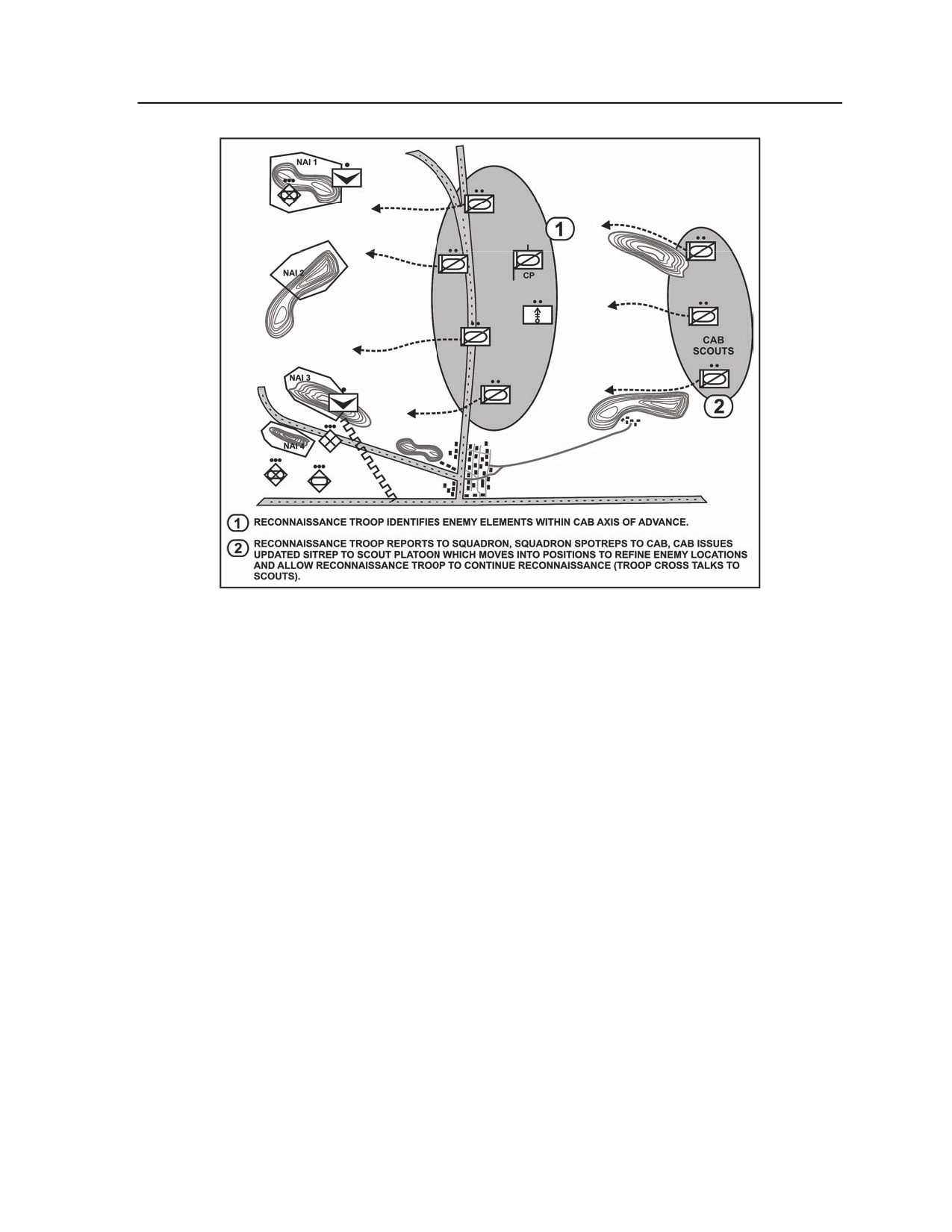
Reconnaissance Operations
Figure 3-3. Example of reconnaissance handover (phase one)
3 August 2009
FM 3-20.98
3-13
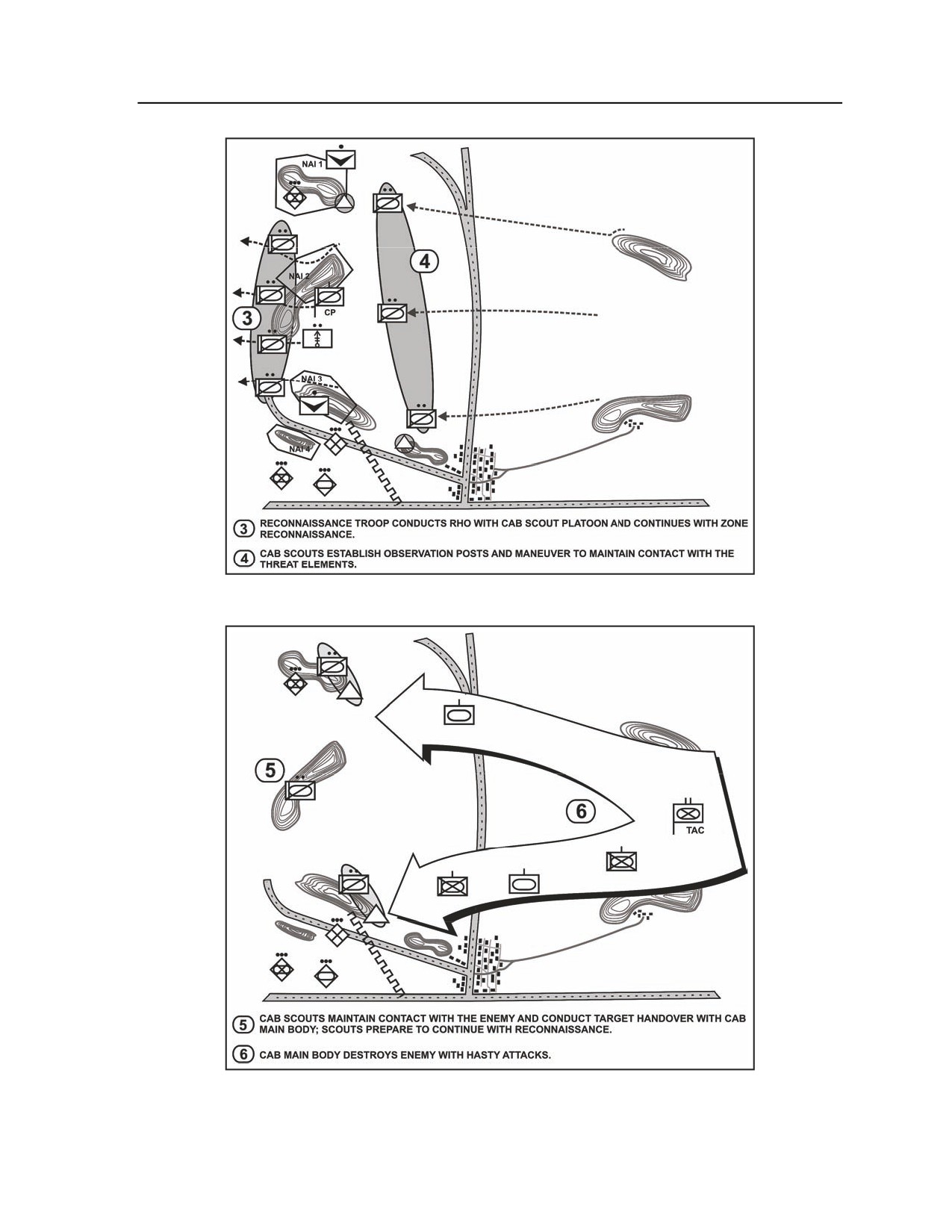
Chapter 3
Figure 3-4. Example of reconnaissance handover (phase two)
Figure 3-5. Example of reconnaissance handover (phase three)
3-14
FM 3-20.98
3 August 2009
Reconnaissance Operations
Handover in Urban Terrain
3-62. The platoon may conduct RHO during an area reconnaissance mission in urban terrain. When one of
the platoon’s squads moves through an area and makes contact with a potential source that may be able to
provide information relevant to the brigade, the squad reports this contact and begins to exploit the source
through tactical questioning (TQ). The platoon leader forwards the reports higher and the BCT tasks a
supporting HUMINT asset to develop the contact further. The squad then conducts RHO, passing
responsibility for the source and all information collected to that point to the follow-on HUMINT asset.
Higher-Level Handover
3-63. Coordination of RHO between higher-level units is initiated and planned at brigade level and above,
but it is executed at the lower level. After coordinating instructions for the RHO (who, what, when, where,
why, and how) are determined, the commander/XO and platoon leader will begin coordination (radio voice
or digital) for the RHO.
3-64. The commander/XO integrates directed handover into the scheme of maneuver. Using the control
measures and criteria specified by the commander, the platoon leader designates which section will
accompany him to conduct the RHO. Multiple RHOCPs may be arranged for use in contingencies or to
reduce the time of movement for the passing elements by using multiple points for movement. In this case,
section leaders and squad leaders are positioned to conduct the additional RHOCPs. Quality control of
graphic overlays depicting RHOCPs is critical.
RECONNAISSANCE METHODS
3-65. Scouts will use four basic reconnaissance methods: sensor, aerial, mounted, and dismounted. In the
course of a mission, the platoons will employ a combination of all methods to achieve the commander’s
objective. Using two or more methods simultaneously will provide depth and redundancy throughout the
AO while accomplishing the reconnaissance mission based on the factors of METT-TC, reconnaissance
guidance (focus, tempo, engagement criteria), and the commander’s intent. Mounted and dismounted
surveillance is employed simultaneously, providing flexibility and capitalizing on the strengths of both
methods. Though maneuver during a reconnaissance operation may be rapid and primarily mounted,
dismounted activities are more deliberate and require stealth and security; stealth is paramount in most
reconnaissance operations in order for scouts to survive.
SENSOR RECONNAISSANCE
3-66. Reconnaissance by sensor allows flexibility while available reconnaissance assets are tied up.
Sensors provide redundancy and cover areas where contact is possible and cannot be directly observed or
for surveillance of areas that must be covered over extended periods. Sensors may be used to “cue” aerial,
dismounted, and/or mounted reconnaissance to move into the area and confirm or deny a contact. Sensors
can also extend surveillance distance between ground reconnaissance and the enemy, increasing maneuver
distance and warning time for the parent unit. Considerations for sensor employment include the following:
z
Prophet may operate under higher headquarters control within the troop’s AO; however, it can
provide radio voice reports of enemy units operating near supported platoons.
z
Ground surveillance systems may support the platoon with information and warnings while
operating within the platoon AO.
z
Hornets emplaced in dead space may warn elements conducting reconnaissance of an
approaching enemy from unlikely directions updating the platoon’s SA through FBCB2.
3-67. The higher headquarters may direct sensor reconnaissance to—
z
Expand the scope of missions in a larger AO.
z
Conduct missions of an extended duration.
z
Conduct CBRN reconnaissance for WMD or contaminated areas.
z
Trigger (cue) a more thorough ground or aerial reconnaissance of a given area.
z
Trigger reach back (for example, Prophet triggers the troop to gain more information from
Guardrail).
3 August 2009
FM 3-20.98
3-15
//////////////////////////////////////////