FM 3-20.98 Reconnaissance and Scout Platoon (AUGUST 2009) - page 4
Chapter 5
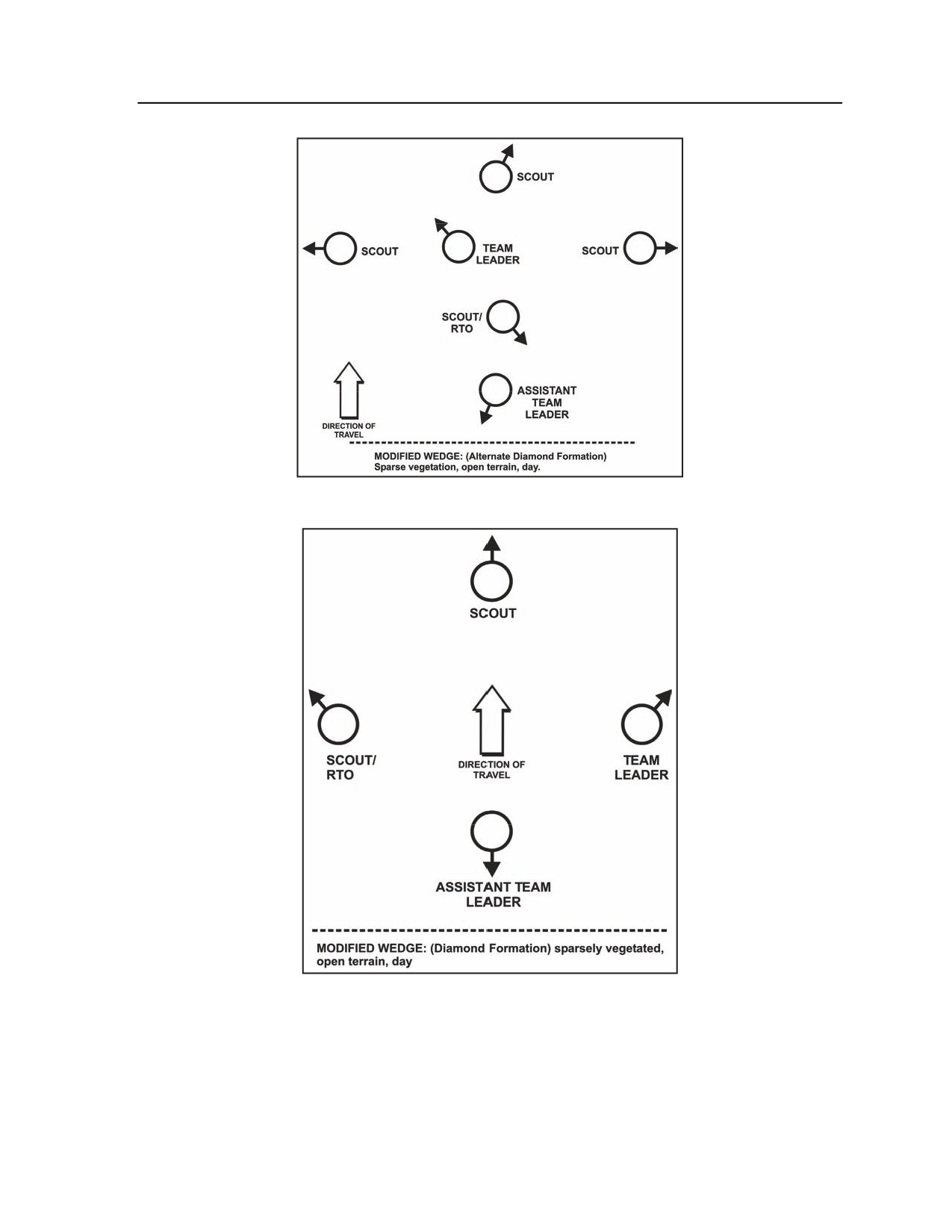
Figure 5-61. Alternate diamond formation
Figure 5-62. Four-scout diamond formation
SECURITY HALTS
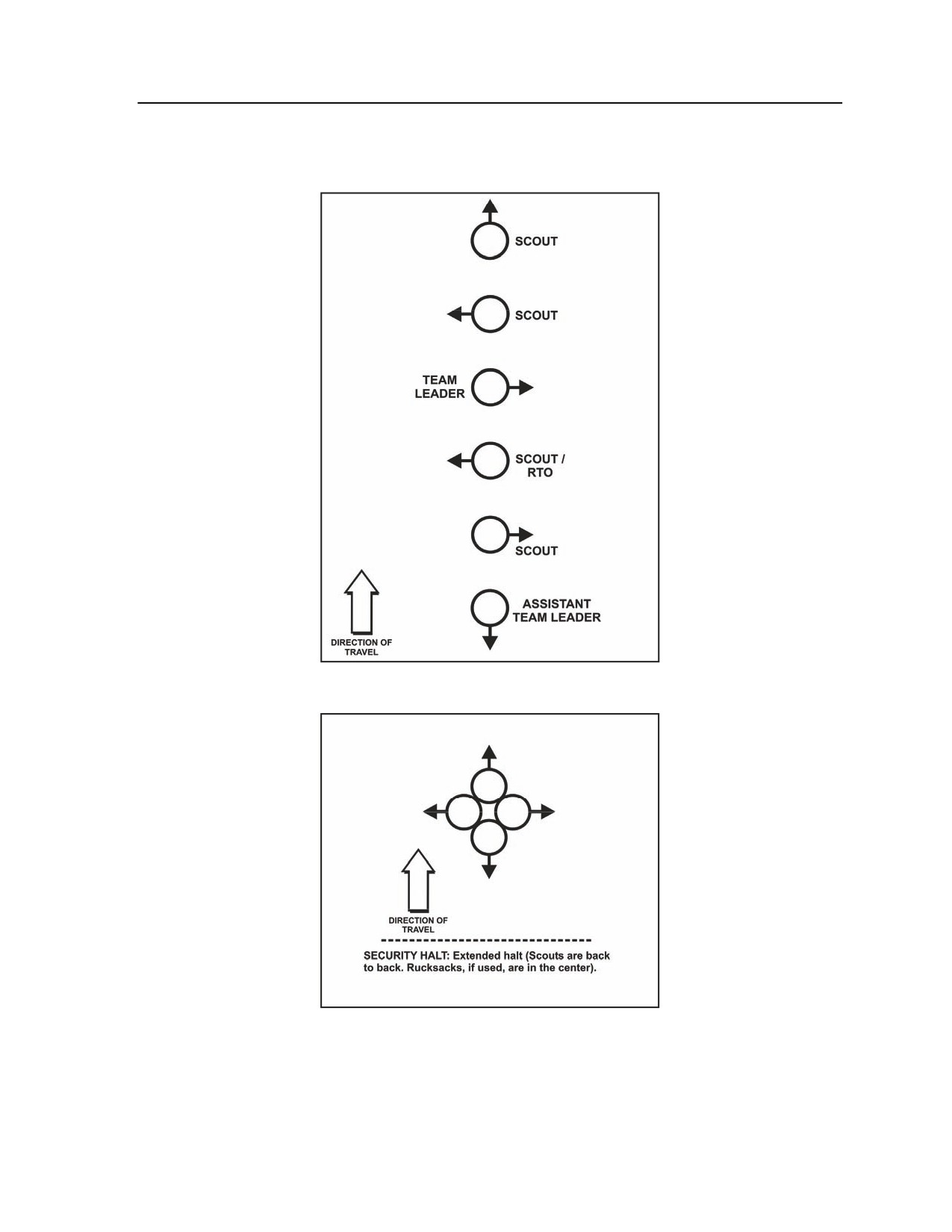
5-293. During short halts, team members drop to one knee and face out (see Figure 5-63). The security
halt should not exceed five minutes. If the halt exceeds several minutes, the team should move to the prone
position, using low points in the ground near them if possible. For extended halts, team members may sit
5-88
FM 3-20.98
3 August 2009
Other Tactical Operations
with their feet facing outward and shoulders touching in a low point offering concealment (see Figure 5-
64). This aids quick and quiet communication and guarantees all-around security at all times. This
technique offers the smallest signature and is the most difficult to detect. It is best used in dense vegetation.
Figure 5-63. Security/short halt
Figure 5-64. Security/extended halt (four-man)
3 August 2009
FM 3-20.98
5-89
Chapter 5
DEPARTURE FROM FRIENDLY LINES
5-294. The departure from friendly lines must be thoroughly planned and coordinated using
considerations outlined in the following discussion.
Planning
5-295. In his plan for departure from friendly lines, the leader should consider this sequence of actions:
z
Make contact with friendly guides at the contact point.
z
Move to the coordinated initial rally point.
z
Complete final coordination.
z
Move to and through the passage point.
z
Establish a location for a security-listening halt beyond the friendly unit’s limit of FPF.
Coordination
5-296. The patrol leader must coordinate with the commander of the forward unit and the leaders of other
units that will be patrolling in the same or adjacent areas. The coordination includes SOI information,
signal plan, fire plan, running password, procedures for departure from and reentry to friendly lines,
departure and reentry points, dismount points, initial rally points, and information about the enemy. The
following actions take place:
z
The patrol leader provides the forward unit leader with unit identification, size of the patrol,
departure and return times, and information on the AO.
z
The forward unit leader provides the patrol leader with the following:
Additional information on terrain.
Known or suspected enemy positions.
Likely enemy ambush sites.
Latest enemy activity.
Detailed information on friendly positions and obstacles, including the locations of OPs.
Friendly unit fire plan.
Support that the unit can provide, such as fire support, litter teams, guides,
communications, and reaction force.
Execution
5-297. The patrol should remain in single file. The assistant patrol leader follows directly behind the
guide so he can count each Soldier who passes through the passage point. He gives the count to the guide,
tells him how long to wait at the passage point (or when to return), and confirms the running password.
Note. If the patrol makes contact after it is past the departure point, it fights through. Soldiers
return to the departure point only if they become disorganized. They then reoccupy the initial
rally point, and the leader reports to higher headquarters.
ACTIONS AT DANGER AREAS
5-298. A danger area is one that increases the chance of detection or a direct fire engagement. When
moving, the patrol tries to avoid danger areas if possible. In many situations, however, the patrol must
cross danger areas to continue the mission. Typical danger areas are the following:
z
Known enemy positions.
z
Roads and trails.
z
Streams.
z
Open areas.
z
Urban environments.
5-90
FM 3-20.98
3 August 2009
Other Tactical Operations
OPERATIONAL CONSIDERATIONS
5-299. Specific plans are made before crossing danger areas. These plans are very similar to actions
during mounted operations; however, they require more practice and rehearsal because a dismounted patrol
does not have the same mobility, protection, and firepower to extract itself should it encounter a threat. In
addition, plans are made for crossing unexpected danger areas; these can be modified quickly to fit the
situation.
5-300. The patrol uses bounding overwatch or variations of it to cross a danger area. The leader
designates procedures the patrol will use based on the time available, the size of the patrol, the size of the
danger area, the fields of fire into the area, and the amount of security he can provide. A small patrol may
cross all at once, in pairs, or one man at a time. A large patrol normally crosses its subordinate elements
one at a time. As each element crosses, it moves to an overwatch position or to the far side rally point until
told to continue movement.
5-301. To cross a danger area, a patrol must take these actions:
z
Designate near side and far side rally points.
z
Secure the near side.
z
Secure the far side.
z
Cross the danger area.
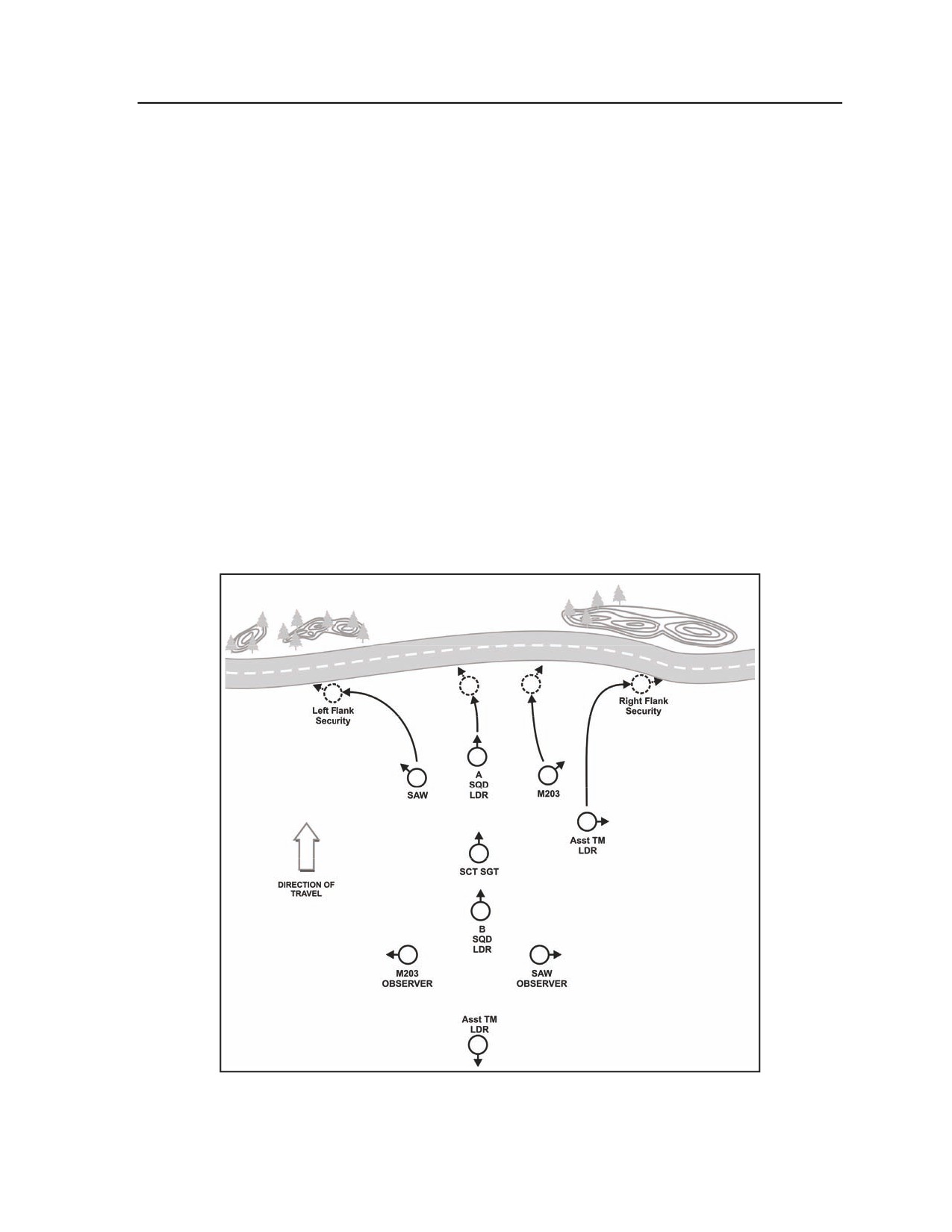
5-302. Securing the near side may involve nothing more than observing it. In some places, however, it may
involve posting security teams far enough out on both flanks and to the rear of the crossing point to give
warning of an approaching enemy element and to overwatch the crossing of the rest of the patrol (as shown in
Figure 5-65).
Figure 5-65. Securing the near side of a danger area
3 August 2009
FM 3-20.98
5-91
Chapter 5
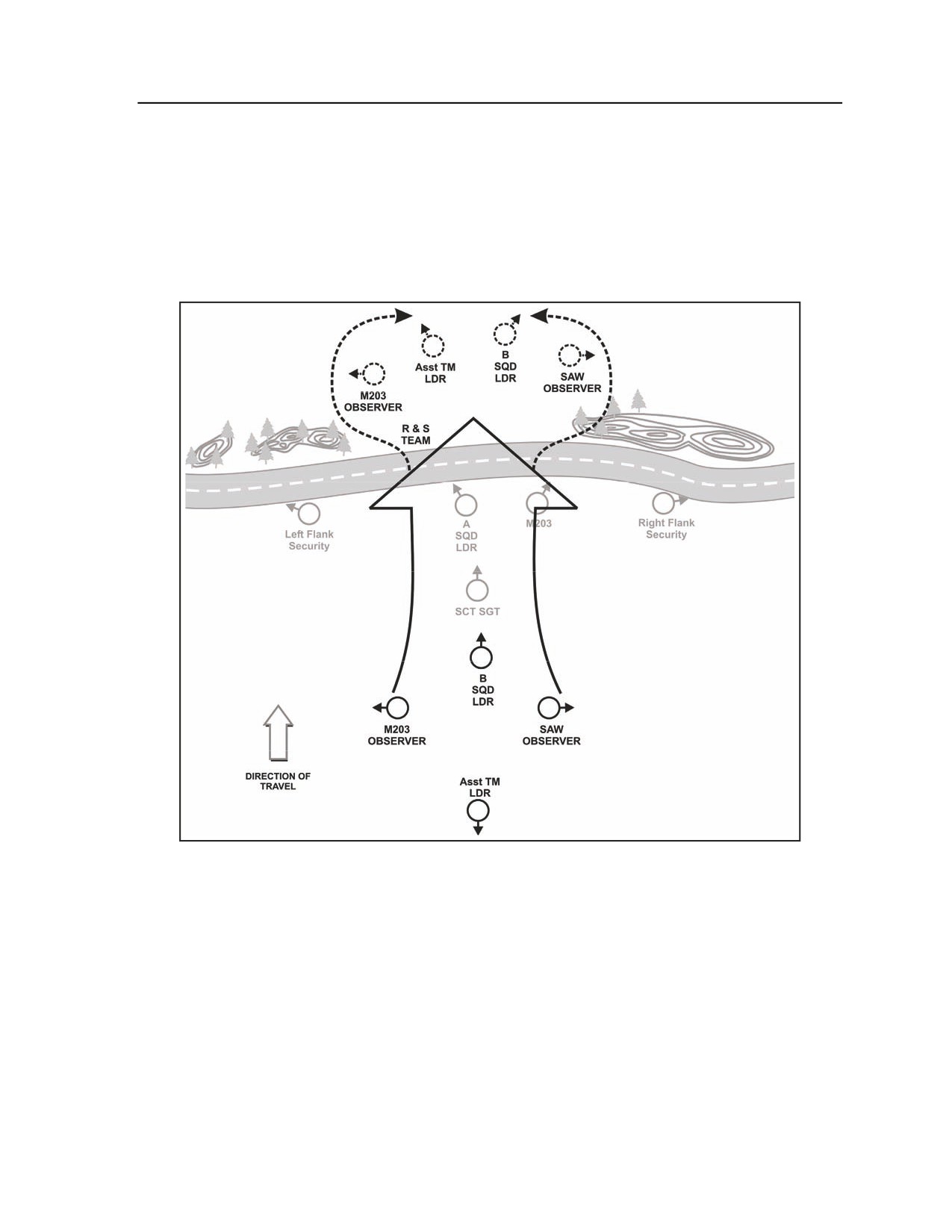
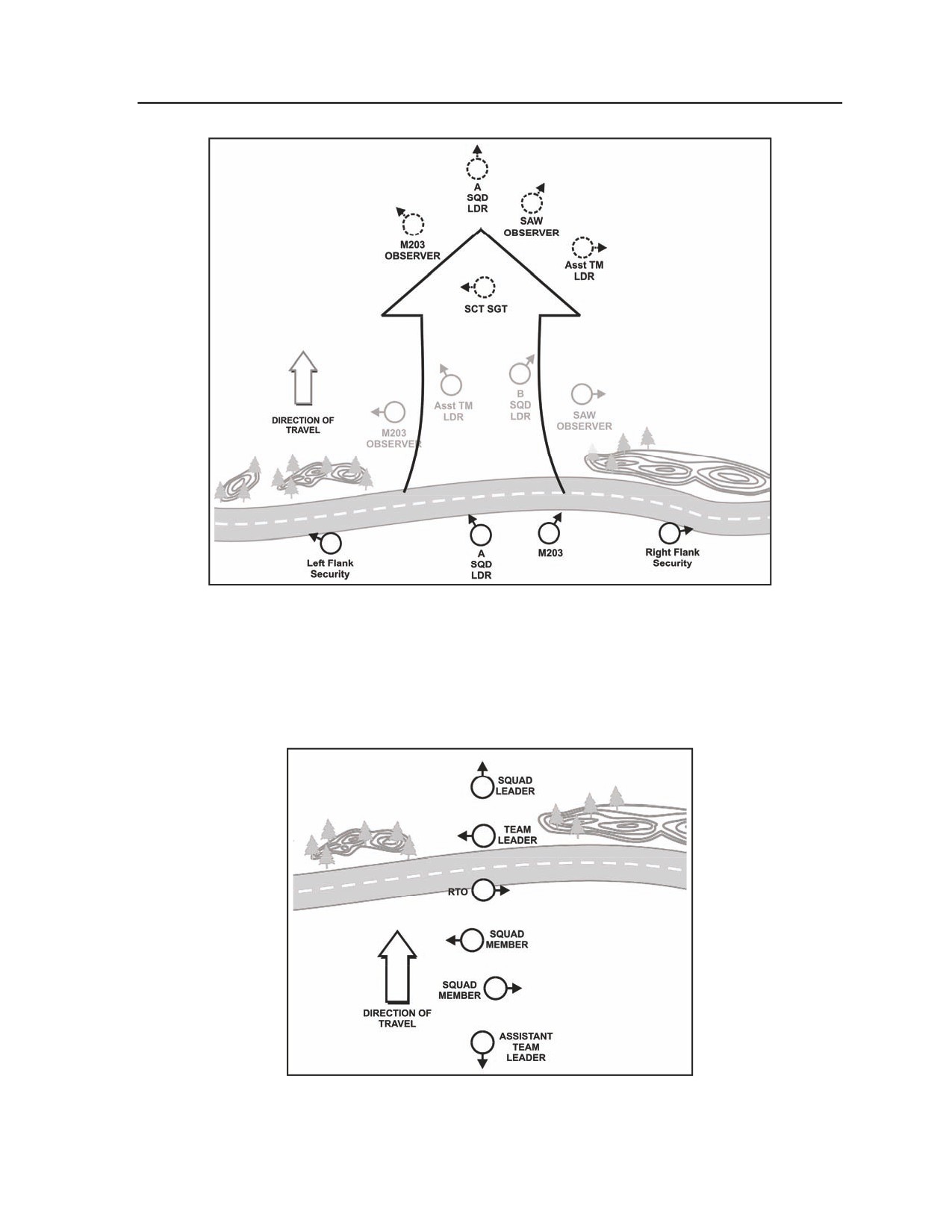
5-303. Once flank and rear security elements are positioned, the danger area is quickly crossed by a team
that then reconnoiters and secures the far side (see Figure 5-66). Thermal sights, if available, are able to
scan and detect threats under moderate concealment due to their heat signatures. The area secured on the
far side must be large enough for the entire patrol to occupy. Prior to crossing, the patrol leader will issue a
five point contingency plan with detailed engagement criteria to the patrol. When the team leader is sure
the far side is secure, he sends two men back to signal the rest of the patrol to cross. As the near side
elements begin to cross the danger area, the rest of the patrol is scanning with weapons and ready for
possible enemy fire. When the patrol has crossed the danger area, the security teams cross and rejoin the
patrol (as shown in Figure 5-67).
Figure 5-66. Securing the far side of a danger area
5-92
FM 3-20.98
3 August 2009
Other Tactical Operations
Figure 5-67. Crossing the danger area
SCROLL TO THE ROAD TECHNIQUE
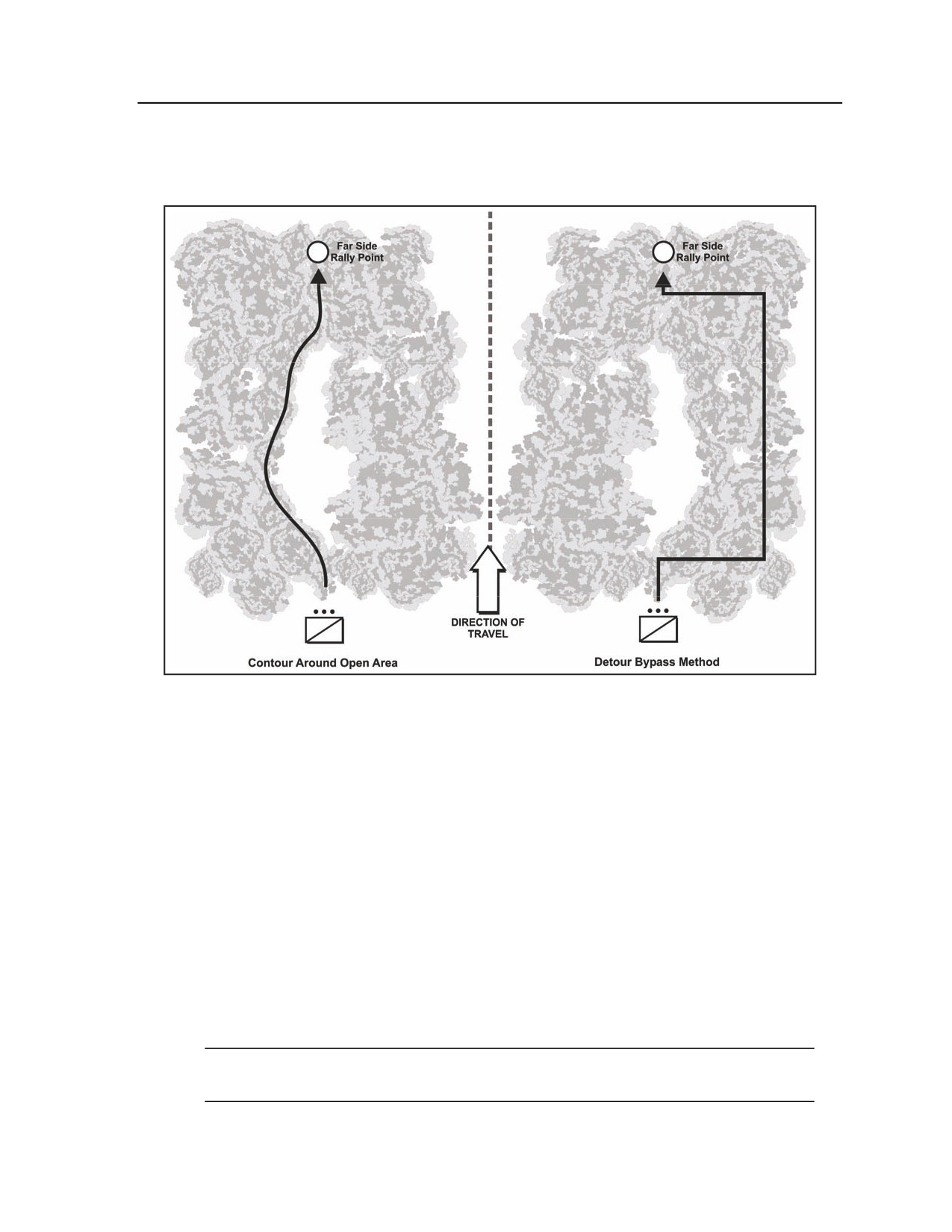
5-304. In this technique, the lead team member identifies the danger area and moves across, placing his
left or right shoulder toward the danger area (see Figure 5-68). The second team member faces in the
opposite direction from the lead team member. This gives security in both directions. Each member crosses
in the same manner.
Figure 5-68. Scroll to the road technique
3 August 2009
FM 3-20.98
5-93
Chapter 5
SMALL OPEN AREA TECHNIQUE
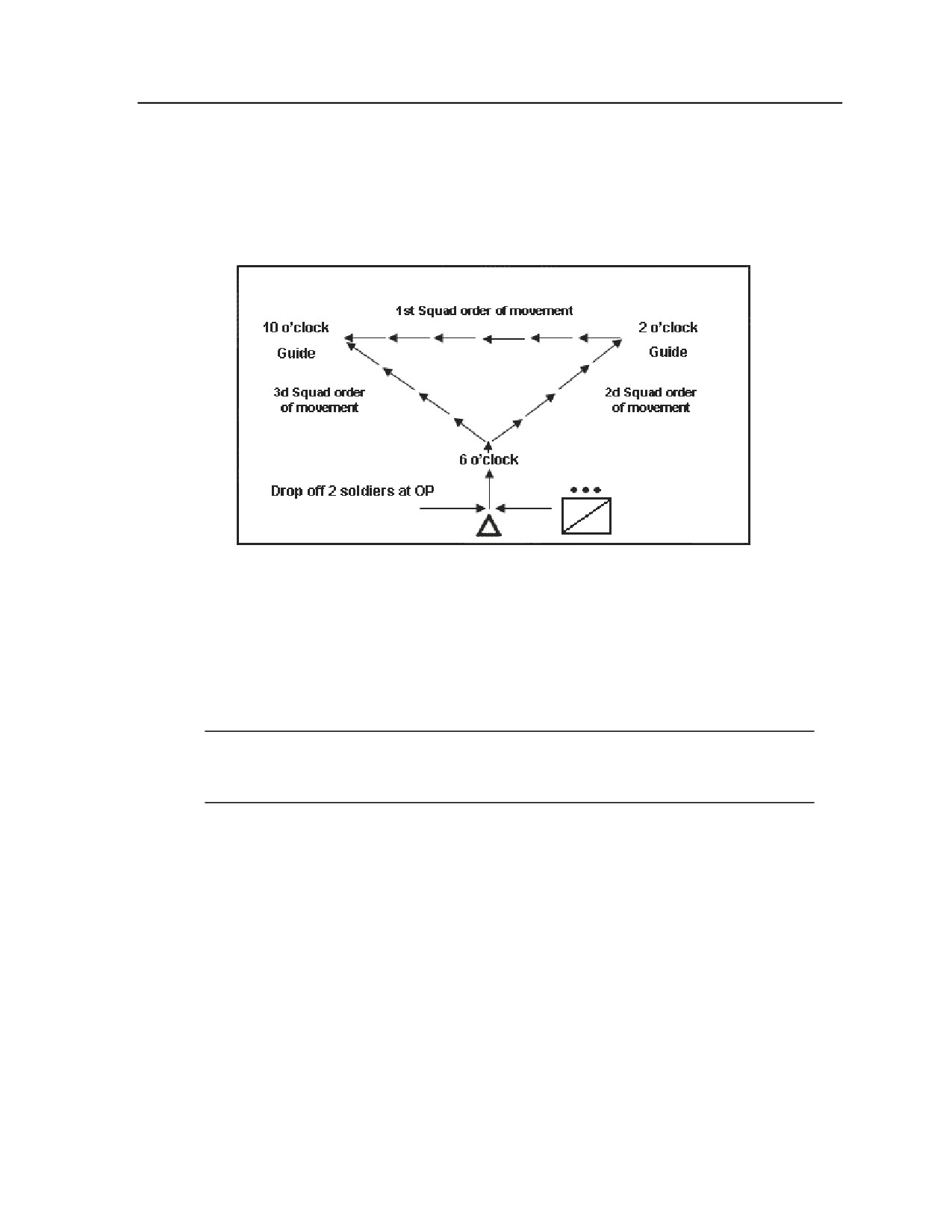
5-305. When crossing a small open area, the team uses the contour or detour bypass method (as shown in
Figure 5-69). They avoid crossing directly through the open area, if possible.
Figure 5-69. Crossing a small open area
OBJECTIVE RALLY POINTS
OCCUPATION OF AN ORP BY A SQUAD
5-306. In planning the occupation of an ORP (see Figure 5-70), the squad leader considers the following
sequence:
z
Halt beyond sight, sound, and small-arms weapons range of the tentative ORP
(200 to
400 meters in good visibility; 100 to 200 meters in limited visibility).
z
Position security elements.
z
Move forward with a compass man and one member of each fire team to confirm the location of
the ORP and determine its suitability. Issue a five-point contingency plan before departure as
outlined later in this discussion.
z
Position the Team A Soldier at 12 o’clock and the Team B Soldier at 6 o’clock in the ORP.
Issue them a contingency plan and return with the compass man.
z
Lead the squad into the ORP. Position Team A from 9 to 3 o’clock and Team B from 3 to
9 o’clock.
Note. The squad may also occupy the ORP by force. This requires more precise navigation, but
eliminates separating the squad.
5-94
FM 3-20.98
3 August 2009
Other Tactical Operations
OCCUPATION OF AN ORP BY A PLATOON
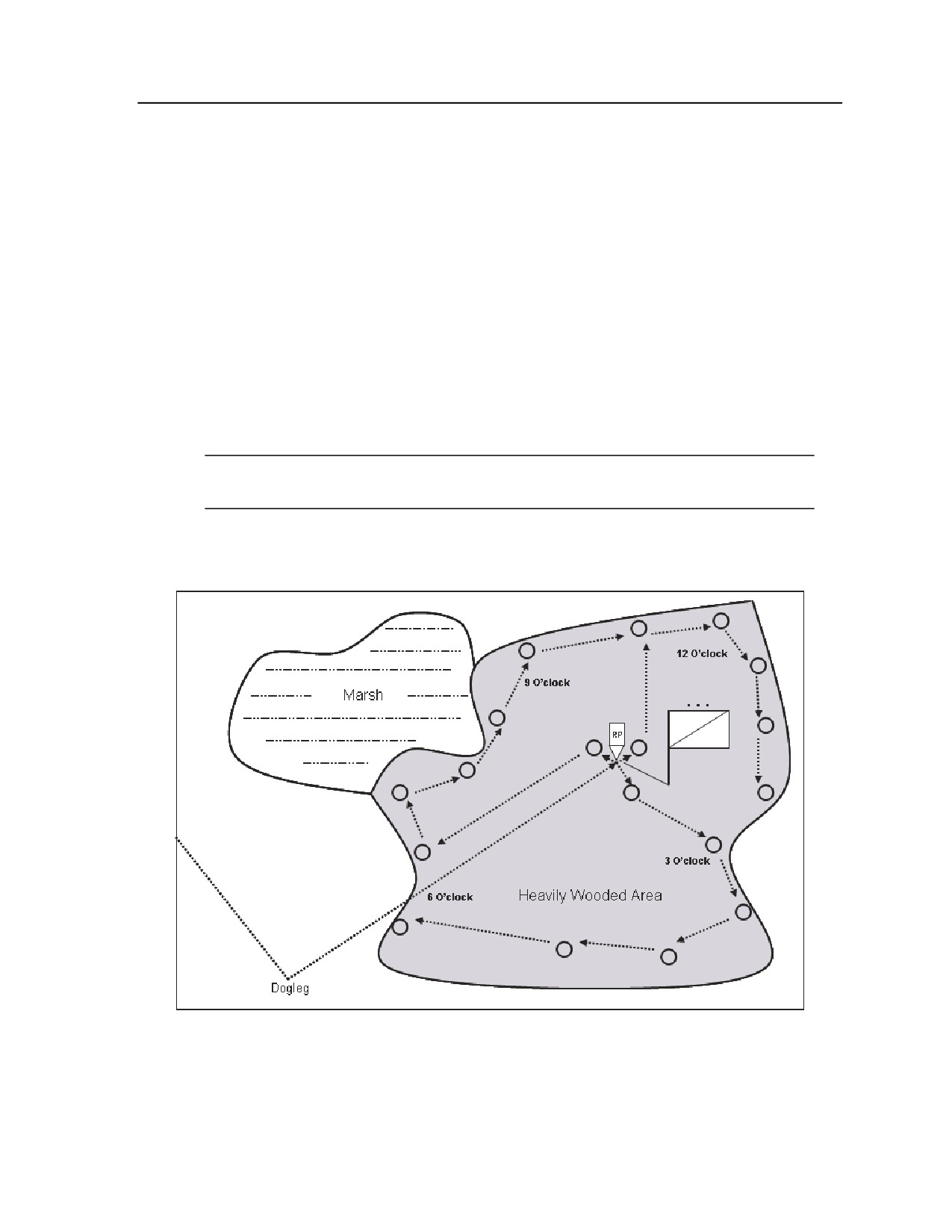
5-307. In planning the occupation of an ORP, the platoon leader should consider a sequence similar to
that outlined for a squad (see Figure 5-73). He brings a Soldier from each squad on his reconnaissance of
the ORP and positions them at the 10, 2, and 6 o’clock positions. The first squad in the order of march
establishes the base leg (10 to 2 o’clock). The trailing squads occupy from 2 to 6 o’clock and 6 to
10 o’clock.
Figure 5-70. Occupation of an objective rally point
CONTINGENCY PLANS
5-308. The patrol leader leaves the main patrol body for many reasons throughout the planning,
preparation, and execution of the mission. One of these departures, conducted after the ORP is occupied
and secure, is the leader’s reconnaissance by the patrol leader, compass man, and element leaders. The
assistant patrol leader remains in the ORP. Before the patrol leader departs, he issues a five-point
contingency plan.
Note. A leader issues a five-point contingency plan anytime he leaves the element in a non-
secured area. Consideration must always be given to the possibility of an element becoming
separated from the rest of the patrol.
5-309. The contingency plan covers the WHO, WHAT, WHEN, WHERE, and WHY by detailing the
following points:
z
Who the leader will be taking with him.
z
What actions are taken if the leader fails to return, as well as the actions of the unit and the
leader on chance contact while the leader is gone.
z
When the leader is leaving and how long he will be gone.
z
Where the leader is going (including routes there and back).
z
Why the leader is leaving (his mission).
LEADER’S RECONNAISSANCE
5-310. Patrol leaders should conduct a leader’s reconnaissance when time or the situation allows. The
plan must include a leader’s reconnaissance of the objective once the platoon or squad establishes the ORP.
During his reconnaissance, the leader pinpoints the objective, selects positions for his squads and teams,
and adjusts his plan based on his observation of the objective. Each type of patrol requires different tasks
3 August 2009
FM 3-20.98
5-95
Chapter 5
during the leader’s reconnaissance, and the leader will take different elements with him depending on the
patrol’s mission. The leader must ensure that the objective remains under continuous observation once he
decides to return to the ORP. The leader designates an RP and plans for adequate time to return to the
ORP, complete his plan, disseminate information, issue orders and instructions, and allow his squads to
make any additional preparations.
Note. A leader’s reconnaissance may alert the enemy that a patrol is in the area by evidence of
movement or noise, even before the patrol begins its mission.
REENTRY TO FRIENDLY LINES
5-311. The patrol leader’s initial planning and coordination must include the reentry to friendly lines. He
should consider a sequence for this process similar to the one covered in the following discussion. This
process must be rehearsed along with other tasks during unit rehearsals.
Note. Reentry to friendly lines at night is dangerous and should be mitigated through detailed
planning and rehearsal.
5-312. The patrol halts in the reentry rally point and establishes security. The patrol leader communicates
the code word advising the friendly unit of the patrol’s location and its readiness to return. The friendly
unit must acknowledge the message and confirm that guides are waiting before the platoon moves from the
reentry rally point.
5-313. If digital/radio communications are not possible, the patrol leader, RTO, and a two-man security
element (buddy team) move forward and attempt to contact an OP using the challenge and password. The
OP notifies the friendly unit that the patrol is ready to return and requests a guide.
5-314. If the patrol leader cannot find an OP, he moves with the RTO and security element to locate the
coordinated reentry point. He must move straight toward (and away from) friendly lines, never parallel to
them. All lateral movement should be outside small-arms weapons range.
Note. The patrol leader should only attempt this procedure during daylight. At night he should
use other backup signals to make contact with friendly units. The preferred method is to wait
until daylight if contact with the friendly unit cannot be made as planned.
5-315. Once the friendly unit acknowledges the return of the patrol, the patrol leader issues a five-point
contingency plan and moves with his RTO and security element on a determined azimuth and pace to the
reentry point. The patrol leader uses far and near recognition signals to establish contact with the guide.
5-316. The patrol leader signals the platoon forward (radio) or returns and leads it to the reentry point. He
may post the security element with the guide at the enemy side of the reentry point. The assistant patrol
leader counts and identifies each Soldier passing through the reentry point. The guide leads the patrol to
the assembly area.
5-317. The patrol leader reports to the CP of the friendly unit. He tells the commander everything of
tactical value concerning the friendly unit’s area of responsibility. The patrol leader rejoins the patrol in the
assembly area and leads it to a secure area for debriefing.
5-96
FM 3-20.98
3 August 2009
Other Tactical Operations
DEBRIEFING
5-318. Immediately after the patrol element
(platoon or squad) returns, personnel from higher
headquarters conduct a thorough debriefing. This may include all members of the patrol or the leaders,
RTOs, and any attached personnel. The debriefing is typically conducted orally, although sometimes a
written report is required.
SECTION IX - PATROL BASES AND COMBAT OUTPOSTS
5-319. A patrol base is a position with a security perimeter that is set up when a dismounted team
conducting a patrol halts for an extended period. Except in an emergency, patrol bases should be occupied
no longer than 24 hours. The platoon or squad never uses the same patrol base twice. Platoons and squads
use patrol bases to accomplish the following tasks:
z
Stop all movement to avoid detection.
z
Hide during a long, detailed reconnaissance of an objective area.
z
Clean weapons and equipment, perform personal hygiene, eat, and rest.
z
Plan and issue orders.
z
Reorganize after infiltrating an enemy area.
z
Establish a base from which to conduct several consecutive or concurrent operations, such as
ambush, raid, reconnaissance, or security.
Note. The longer a patrol spends in an enemy area, the higher the risk of being discovered by
the enemy.
PATROL BASES
SITE SELECTION
5-320. The leader selects the tentative site from a map or by aerial reconnaissance. The site’s suitability
must be confirmed, and the site must be secured before occupation. Plans to establish a patrol base must
include selecting an alternate patrol base site. The alternate site is used if the first site is unsuitable or if the
patrol must unexpectedly evacuate the first patrol base.
PLANNING CONSIDERATIONS
5-321. Leaders planning for a patrol base must consider the mission and passive and active security
measures.
5-322. Security measures involve the following:
z
The leader attempts to locate the patrol base on terrain that will enhance its security. Whenever
possible, the terrain should meet the following criteria:
Terrain that the enemy would probably consider of little tactical value.
Terrain that is off main lines of drift and that affords adequate drainage.
Difficult terrain that would impede foot movement. An example would be an area of dense
vegetation, preferably with bushes and trees that spread close to the ground.
Terrain near a source of water.
Terrain that can be defended for a short period and that offers good cover and concealment.
z
The leader avoids the following locations:
Known or suspected enemy positions.
Built-up areas.
Ridges and hilltops, except as needed for maintaining communications.
3 August 2009
FM 3-20.98
5-97
Chapter 5
Roads and trails.
Small valleys.
z
The leader plans for the following security considerations:
OPs.
Communications with OPs.
Defense of the patrol base.
Withdrawal from the patrol base, including withdrawal routes and a rally point, a
rendezvous point, or an alternate patrol base.
A security system to ensure that specific Soldiers are awake at all times.
Enforcement of camouflage, noise, and light discipline.
The conduct of required activities with minimum movement and noise.
PATROL BASE OCCUPATION
5-323. A patrol base is established using the steps covered in the following discussion. The patrol base is
reconnoitered and established using the same procedures and considerations as an ORP or reentry rally
point. The exception is that the platoon will, when necessary, enter the patrol base at a 90-degree turn.
Note. This 90-degree turn is METT-TC dependent; if there is nothing to be gained by doing this
step, then the unit does not do it (for example, in flat desert terrain).
5-324. The patrol leader leaves a two-man OP at the turn. The assistant patrol leader and the last patrol
element will obliterate any tracks from the turn into the patrol base. The patrol moves into the patrol base
(see Figure 5-71). The patrol leader immediately disseminates the location of the alternate patrol base.
Figure 5-71. Occupation of the patrol base
5-325. The patrol leader and support element start at 6 o’clock and move clockwise to adjust the
perimeter (meeting each element leader at his element’s left flank). If the patrol leader and support element
leader find a better location for one of the machine guns, they reposition it.
5-98
FM 3-20.98
3 August 2009
Other Tactical Operations
5-326. After the patrol leader has checked each element’s sector, the element leader and another patrol
member report to the CP as an R&S team. The patrol leader issues a five-point contingency plan to the
three R&S teams and reminds them that they are looking for the enemy, water, built-up areas or human
habitat, roads and trails, and any possible rally points.
5-327. The R&S team departs from the left flank of its element’s sector and moves out a given distance,
as stated by the patrol leader in his instructions. The team moves in a clockwise direction and reenters the
patrol base at the right flank of the element’s sector. Whenever possible, the R&S team should prepare a
sketch of the squad’s front and report to the CP.
Note. If the patrol leader feels the patrol may have been tracked, he may elect to maintain 100
percent security and wait for a time in total silence before sending out the R&S teams. The
distance the R&S team moves away from the element’s sector will vary depending on the terrain
and vegetation (anywhere from 200 to 400 meters). All members of the patrol are on 100
percent alert during this time.
5-328. Once all element leaders (through their R&S teams) have completed their reconnaissance, they
report back to the patrol leader at the CP. The patrol leader gathers the information from his three R&S
teams and determines if the patrol will be able to use the location as a patrol base.
PATROL BASE ACTIVITIES
5-329. If the patrol leader determines that he will be able to use the location as a patrol base, he informs
the assistant patrol leader and squad/section leaders. The patrol leader also disseminates other information
such as daily challenge and password, frequencies, and call signs. Leaders return to their elements, give out
the information, and begin the priorities of work as stated by the patrol leader. The patrol base must be
sterilized upon departure.
Security
5-330. Only one point of entry and exit is used. Noise and light discipline are maintained at all times.
Everyone not positively identified as a patrol member is challenged. Leaders supervise the placement of
aiming stakes and ensure claymore mines are emplaced. Each element establishes an OP and may quietly
dig hasty fighting positions. Element leaders prepare and turn in sector sketches, including range cards and
fire plans. A larger patrol may employ UGVs for additional security in dead space to detect a quick
approach by enemy elements to the patrol bases perimeter.
Alert Plan
5-331. The patrol leader states the alert posture (for example, 50 percent or 33 percent) and the stand-to
time for day and night. He sets up the plan to meet the following conditions:
z
Positions are checked periodically.
z
OPs are relieved periodically.
z
At least one leader is awake at all times.
Withdrawal Plan
5-332. The patrol leader specifies the following information:
z
Which signal to use if contact is made (for example, colored star cluster).
z
The order of withdrawal if the unit is forced out of the patrol base (for example, elements,
squads/sections not in contact will move first).
z
The distance and direction of the patrol rendezvous point (if the patrol will not link up at an
alternate patrol base).
3 August 2009
FM 3-20.98
5-99
Chapter 5
Maintenance Plan
5-333. The patrol leader must plan to conduct maintenance on weapon systems, communications
equipment, vehicles, and other mission essential equipment. He may also plan to redistribute ammunition
as necessary.
Sanitation and Personal Hygiene Plan
5-334. The assistant patrol leader ensures that the patrol slit trench is dug and marked at night with a
chemical light inside the trench. Leaders designate areas for use as urinals and ensure that scouts
accomplish the following activities daily:
z
Shave and brush teeth.
z
Wash face, hands, armpits, groin, and feet.
z
Change out socks and dry out or change boots.
z
Pick up trash and other evidence of the patrol’s presence.
Mess Plan
5-335. Leaders monitor mess activities to ensure not more than half the patrol eats at one time.
Water Resupply
5-336. The patrol leader organizes a watering party if the patrol must forage for water. They carry
canteens in an empty rucksack.
PASSIVE (CLANDESTINE) PATROL BASE
5-337. The purpose of a passive patrol base is to give a smaller-size element time to rest. A claymore
mine is emplaced on the route entering the patrol base. Teams sit back-to-back facing outward, ensuring
that at least one individual per team is alert and providing security.
COMBAT OUTPOSTS
5-338. A reconnaissance or scout platoon may conduct operations from a combat outpost equipped with
automatic and crew-served weapons, communications equipment, and sensors supported by indirect fires.
Platoons assigned to combat outposts may be augmented with additional combat elements such as UAS
teams, infantry, armor, and engineers to provide assistance in reconnaissance and offensive actions to
counter enemy activities. This is a very labor-intensive mission and is used only in response to clearly
defined squadron/battalion requirements.
5-339. Combat outposts are also used to protect critical lengths or locations along the route. Due to the
length of some convoy routes, a squadron or troop will establish mutually supporting platoon-size combat
outposts and provide security between them. Combat outposts are established at critical choke points to
prevent sabotage and to defend against or respond to attacks to interdict the route between outposts.
Reconnaissance or scout platoons may be augmented to supply reaction forces, engineer route clearance
assets, and insurgent intervention elements as well as continuous surveillance along key points of the route.
Patrols are organized with sufficient combat power to destroy near ambushes and to survive initial enemy
contact from far ambushes. Platoons conduct patrols at irregular intervals between the outposts based on
enemy trends and recent activities.
5-340. Each combat outpost maintains a reaction force to respond to enemy activity or reinforce patrols.
Based on METT-TC, a troop can establish one or two platoon combat outposts, and a squadron can
typically establish up to six platoon-size combat outposts.
5-100
FM 3-20.98
3 August 2009
Chapter 6
Enablers
Platoon enablers are critical combat capabilities provided by the platoon’s higher
headquarters or other units in support of the platoon. The commander employs
enablers to enhance the effectiveness of his operations. The platoon leader and his
subordinate leaders must understand the capabilities and limitations of enablers to
ensure that each enabler is assigned a clear task and purpose to support the platoon’s
mission. The integration of enablers provides the platoon leader with the right assets
to accomplish the mission while achieving the higher commander’s intent. Enablers
should complement, not detract from, the platoon mission. The platoon’s integration
of these assets begins during troop planning and continues through platoon rehearsals
and execution.
Contents
Section I - Employ Indirect Fires
6-2
Section IV - Intelligence
6-42
Mortar Support
6-2
Sensor Teams
6-42
Field Artillery Support
6-4
Unmanned Aircraft Systems
Naval Fire Support
6-6
Operations
6-43
Fire Support Personnel
6-6
Section V - Civil Affairs
6-52
Fire Request Channels
6-7
Section VI - Tactical Psychological
Operations Support
6-53
Fire Planning in Support of
Reconnaissance Missions
6-10
Section VII - Air and Missile Defense
(AMD) Support
6-53
Call for Fire
6-11
Adjusting Indirect Fire
6-14
Passive Air Defense
6-53
Active Air Defense
6-54
Refinement and Surveillance
6-19
Fire Support Coordination Measures 6-19
Short-Range Air Defense Systems ... 6-55
Close Air Support Operations
6-23
Air Defense Command and Control .. 6-56
Other Types of Air Support
6-28
Section VIII - Sustainment Operations .. 6-56
Section II - Army Aviation Support
6-28
Supply Operations
6-56
Maintenance Operations
6-62
Organization
6-28
Assault (Utility) and Cargo (Lift)
Personnel Services Support
6-65
Helicopter Support
6-28
Human Resources Support
6-65
Section III - Combat Engineer Support . 6-40
Army Health System Support
6-65
Engineer Support in
Prisoners and Captured Material
6-69
Reconnaissance Operations
6-40
Engineer Support in Security
Operations
6-40
Engineer Support in Stability
Operations
6-41
3 August 2009
FM 3-20.98
6-1
Chapter 6
SECTION I - EMPLOY INDIRECT FIRES
6-1. Scouts may receive indirect fire support from mortars, field artillery (FA), and CAS assets. Most of
these assets are not organic to the platoon, but they will be available through the platoon’s parent unit. To
make effective use of them, scouts must understand the capabilities, limitations, and employment of fires
assets. For additional discussion of fire support, see FM 3-20.96 and FM 3-20.971, as well as FM 3-09.31,
FM 3-22.90, and FM 6-20-40.
6-2. Mortars and FA assets are the primary indirect fire support means available to the reconnaissance or
scout platoon, although the platoon may receive fire support from other assets as well, including aircraft
and ships. In addition to understanding the capabilities and limitations of these assets, scouts must know
what fire request channels to use to request fires. The platoon leader must be prepared to work with both
the troop and/or squadron/battalion FSOs to plan and coordinate fire support (see FM 3-09.32).
MORTAR SUPPORT
6-3. Mortars provide indirect fire support that is extremely responsive to the scouts’ needs. They can
provide a heavy volume of fires and are ideal for attacking targets on reverse slopes, in narrow ravines or
trenches, and in forests, towns, and other areas that are difficult to strike with low-angle fires. Each
reconnaissance/cavalry troop or supported battalion (except the BFSB reconnaissance troop, which has no
organic mortars) has an organic 120-mm mortar section dedicated to providing the responsive fires that the
platoon needs. The 120-mm mortar has a maximum range of 7,200 meters and shoots a variety of
munitions. Table 6-1 lists capabilities of the various mortar systems and munitions.
TYPES OF MORTAR SUPPORT
Suppression
6-4. Without a direct hit, HE rounds generally will not destroy main battle tanks. Indirect hits with HE,
however, can destroy or disable more lightly armored vehicles (APCs, armored fighting vehicles, etc.) or
incapacitate the crew. In addition, suppressive fires can greatly disrupt enemy movement. HE rounds can
force mounted enemy units to button up or move to less advantageous positions. HE is also very effective
against dismounted threats and in urban environments.
Obscuration
6-5. White phosphorus
(WP) rounds are used for obscuration and screening. The platoon places
obscurants on or just in front of enemy positions to obscure their vision. Leaders employ obscurants to
support infiltration and exfiltration. The platoon achieves a smoke screen by placing obscurants between
the enemy and the platoon’s positions to conceal movement. Leaders use mortar-delivered obscurants to
mark enemy positions, which can help to enhance friendly maneuver and orient direct fires or CAS. The
platoon employs obscuration effectively in urban environments where structures minimize the impact of
winds that normally disperse the obscurant’s effects. In any situation, however, scouts must be careful not
to allow friendly obscuration to work against them by marking their own positions.
Illumination
6-6. Scouts use illumination rounds to light an area or enemy position during periods of limited visibility.
This can increase the effectiveness of image intensification devices and sensors. It also assists the troop in
gathering information, adjusting mortars or artillery, or engaging enemy targets with direct fire. Scouts use
ground-burst illumination to mark enemy positions and to provide a thermal target reference point (TRP)
for control of direct and indirect fires. As with obscurants, however, leaders must take care not to
illuminate friendly positions. In addition, because of the effectiveness of U.S. NODs, illumination can be
unnecessary or even counterproductive. Whenever they employ illumination, scouts must pay close
attention to wind direction and speed to ensure proper deployment of the rounds.
6-2
FM 3-20.98
3 August 2009
Enablers
CAPABILITIES AND LIMITATIONS
6-7. Reconnaissance and cavalry troop mortar capabilities include—
z
Use in urban areas or mountain terrain.
z
Fast response time.
z
Effectiveness against low-density targets.
6-8. Reconnaissance and cavalry troop mortar limitations include—
z
Short-range capability.
z
Limited munitions selection.
z
Vulnerability to enemy counterfire radars because of the high angle of fire.
z
Limited basic loads of ammunition.
Table 6-1. Fire support capabilities—mortars
Danger
Ammunition
Ammunition
Minimum
Maximum
Weapon
Close
Rates of Fire
Model
Type
Range (m)
Range (m)
(m)
60-mm
M720
HE
70
3,4891
30 rnds/min for
4 min2, then 20
M224
M888
HE
70
3,489
rnds/min
M722
WP
70
3,489
sustained.
M721
ILLUM
600
200
3,489
Diameter of
M302A1
WP
35
1,830
illumination:
M83A3
ILLUM
725
950
M721-500m,
M83A3-300m
M49A4
HE
45
1,830
81-mm
M374A2
HE
70
4,600
25 rnds/min for 2
min, then 8 rnds/
M29A1
M374A3
HE
73
4,800
min sustained.
M375A2
WP
600
70
4,595
Diameter of
M301A3
ILLUM
100
3,150
illumination:
360m
81-mm
M821
HE
80
5,800
18 rnds/min for
2 min, then 8
M252
M899
HE
83
5,800
rnds/min
M374A3
HE
73
4,800
sustained.
M819
RP
600
300
4,875
Diameter of
M375A2
WP
73
4,595
illumination:
M853A1
ILLUM
300
5,060
650m
M301A3
ILLUM
100
3,950
120-mm
M57
HE
200
7200
16 rnds/min for
1 min, then 4
M120
M68
WP
200
7200
rnds/min
M91
ILLUM
200
7100
sustained.
M933
HE/PD
600
200
7200
Diameter of
M934
HE/MOF
170
7200
illumination:
M929
WP
170
7200
1,500m
M930
ILLUM
170
7200
HE—high explosive
PD—point detonating
ILLUM—illumination
RP—red phosphorus
MOF—multi-option fuze
WP—white phosphorus
wpn—weapon
1 Bipod-mounted, charge 4 (maximum handheld is 1,300 meters).
2 Charge 2 and over. A sustained rate 30 rounds per minute is possible with charge 0 or 1.
3 August 2009
FM 3-20.98
6-3

Chapter 6
FIELD ARTILLERY SUPPORT
6-9. The BCT’s organic fires battalion can potentially support the reconnaissance platoon. (The BFSB
does not have an organic FA element, although its reconnaissance platoons generally have access to
indirect fire support.) The fires battalion has several different munitions available to support the platoon.
The scout platoon receives fire support from the cavalry squadron’s fires battery. These munitions include
HE, dual purpose improved conventional munitions (DPICM), Copperhead, WP, scatterable mines, HE
rocket-assisted projectiles (RAPS), Excalibur guide projectiles, obscuration, and illumination. Tables 6-2
and 6-3 lists capabilities of the various cannon FA systems and munitions.
Table 6-2. Field artillery cannon capabilities
Range (Meters)
Danger
Weapon
Projectile
Rates of Fire / Notes
Close
MAX
DPICM
RAP
105 mm
HE, WP1, HC2,
600 m
11,500
14,100
19,500
Sustained rate of fire:
Howitzer,
ILLUM, APICM,
3 rnds/min.
M119-
DPICM
Max rate of fire:
series
10 rnds/min
155 mm
HE, WP1, HC2,
600 m
18,300 or
18,000 or
30,100
Sustained rate of fire:
M198
ILLUM, CPHD,
22,000 with
28,200
2 rnds/min.
APICM,
M795 HE,
with
Max rate of fire:
DPICM, M825
M825
M864
4 rnds/min
Obscurant,
Obscurant
SCAT-MINE
155 mm
HE, WP1, HC2,
600 m
18,200 to
17,900 or
30,000
Sustained rate of fire:
M109A5/A
ILLUM, CPHD,
24,500,
28,100
1 rnds/min.
170 m
6
APICM,
depending
with
w/
Max rate of fire: 4
DPICM, M825
on ammo
M864
XM982
rnds/min
Obscurant,
SCAT-MINE
155 mm
HE, WP1, HC2,
600 m
22,200 to
N/A
30,000
Sustained rate of fire:
M777-
ILLUM, CPHD,
24,500,
2 rnds/min IAW thermal
170 m
series
APICM,
depending
warning device.
w/
DPICM, M825
on ammo
XM982
Max rate of fire:
Obscurant,
4 rnds/2mins
SCAT-MINE
1 Time to build effective obscuration—30 seconds.
2 Time to build effective obscuration—60 to 90 seconds.
APICM—antipersonnel improved conventional munition, CPHD—Copperhead, DPICM—dual purpose
improved conventional munitions, HC—hexachlorethane, HE—high explosive, ILLUM—illumination, RAP—
rocket assisted projectile, SCAT-MINE—scatterable mine, WP—white phosphorous.
6-4
FM 3-20.98
3 August 2009
Enablers
Table 6-3. Illumination factors
Height
Burn
Rate of
Weapon
Type
of Burst
Time
Fall
(meters)
(seconds)
(m/sec)
M83A1
25
60 mm
160
6
M83A2/3
32
70 mm
M-257 (Overt)
550
120
4.5
(2.75”)
70 mm
M-278
800
180
4.5
(2.75”)
(Covert)
81 mm
M301A3
600
60
6
M314A2;
105 mm
750
60-65
12
M314A3
120 mm
M930
500
50
5
M118
750
60
10
155 mm
M485-series
600
120
5
ARTILLERY CAPABILITIES
6-10. Artillery elements support the reconnaissance or scout platoon with the following capabilities—
z
Provide continuous all-weather and all-terrain fire support.
z
Rapidly shift and mass fires.
z
Support in depth with long-range fires.
z
Employ a variety of conventional shell and fuse combinations.
z
Can accurately engage stationary point targets with 155-mm Excalibur guided munitions or
guided multiple launch rocket system (GMLRS) munitions
z
Can accurately engage moving or stationary laser-designated targets with 155-mm Copperhead
rounds.
ARTILLERY LIMITATIONS
6-11. Artillery elements supporting the platoon have the following limitations—
z
Limited effectiveness on moving targets.
z
Limited ability to destroy point targets without considerable ammunition expenditure if guided
projectile are unavailable.
z
Firing signature increases vulnerability to enemy counterfire.
COMMON USES OF AVAILABLE MUNITIONS
6-12. FA employs a wide variety of munitions that can be tailored for the engagement of different types of
targets. These ammunition types include the following:
z
HE, for use against personnel, field fortifications, and vehicles.
z
Obscurants, for obscuration and screening.
z
Illumination.
z
WP, for obscuration, marking, screening, and incendiary effects against materiel targets e.g.,
WP airburst over an easily recognizable feature to assist disoriented personnel.
z
GMLRS rockets and 155 mm Excalibur rounds for use against point targets.
z
Copperhead 155 mm projectiles against stationary or moving point targets.
3 August 2009
FM 3-20.98
6-5
Chapter 6
z
DPICM, for use against personnel and light armored vehicles in the open.
z
Scatterable mines.
6-13. Scatterable mines include area denial munitions for use against personnel and remote antiarmor mine
systems for use against armored vehicles. When a FA battery is firing a scatterable mines mission, it is not
available for other fire missions. Scatterable mines require slightly more lead time than do other FA-
delivered munitions.
6-14. In addition to the supporting cannon units, multiple launch rocket system (MLRS)/high mobility
artillery rocket system (HIMARS) elements may also provide fires. Unlike cannon artillery, MLRS units
fire rocket and missile munitions delivering only HE, DPICM, or anti-personnel and anti-materiel
warheads. They provide either rocket or missile fires, but do not offer special munitions, such as
obscuration, illumination, or WP. The maximum range of MLRS rockets is 32,000 to 45,000 meters,
depending upon the type of munition. The planning range for MLRS missiles in the Army tactical missile
system is 100,000 to 300,000 meters, depending upon the type of munition.
NAVAL FIRE SUPPORT
6-15. Destroyers and cruisers are the predominant ships used in NGF roles. Both types of vessels employ
5-inch guns to provide fires. Reconnaissance units will sometimes receive augmentation from the Marines
for NGF missions (see FM 3-09.32 for additional information).
FIRE SUPPORT PERSONNEL
6-16. Fire support personnel may accompany or assist Scouts during the course of their mission. These
elements include—
z
FIST.
z
COLT.
FIRE SUPPORT TEAM
6-17. Each troop has an organic FIST specifically designed to assist in the planning, coordination, and
integration of fire support during operations. FIST elements may assist the reconnaissance or scout platoon
in support of security operations when target designation is required for special munitions engagements.
COMBAT OBSERVATION AND LASING TEAM
6-18. A COLT is a fire support team controlled at the brigade level that is capable of target acquisition
under reduced visibility conditions and has both laser rangefinding and laser designating capabilities.
6-19. Scouts may request indirect fire through the COLT, which has a secondary mission of processing
these requests for the scouts. The COLT may monitor the reconnaissance or scout platoon net and handle
the fire request and subsequent adjustments in the same manner as a normal FIST. It can enter the
information gained through its primary mission, lasing targets for precision munitions and CAS, directly
into the Advanced Field Artillery Data System (AFATDS).
6-20. When pushed forward with the scouts, the COLT may collocate with one of the platoon OPs for
local security and protection. Leaders often link a COLT’s observation of a TAI with a scout team’s
coverage of an NAI. This technique allows the scout team to act as a trigger, with the COLT executing and
adjusting fires.
FIRE REQUEST CHANNELS
6-21. Scouts use different channels when requesting fire support depending on the type of unit
(reconnaissance/scout platoon or battalion reconnaissance platoon).
6-6
FM 3-20.98
3 August 2009
Enablers
RECONNAISSANCE/SCOUT PLATOONS
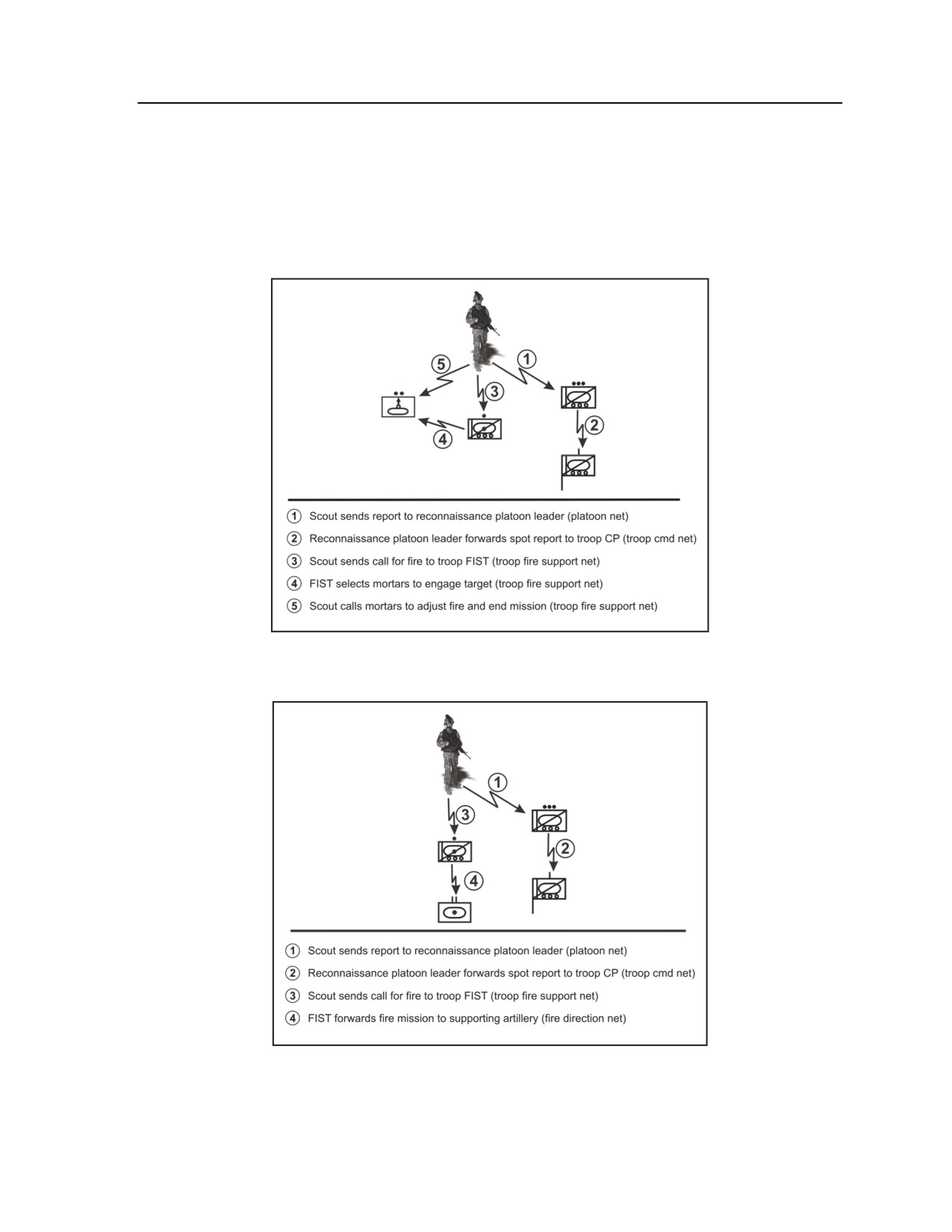
6-22. The scouts in a reconnaissance or armored cavalry troop normally request all indirect fire support
through their troop FIST on the troop fire support net. The FIST selects the best available fire support to
engage the target. If the FIST passes the fire mission to the troop mortars, the scouts send all adjustments
of the fire mission directly to the mortars (see Figure 6-1). If the FIST passes the fire mission to a
supporting artillery unit, the scouts send all adjustments of the fire mission to the FIST, which relays the
message to the artillery unit on a digital fire direction net (as shown in Figure 6-2).
Figure 6-1. Reconnaissance or armored cavalry scouts
requesting fire from mortars
Figure 6-2. Reconnaissance or armored cavalry scouts
requesting fire from field artillery
3 August 2009
FM 3-20.98
6-7
Chapter 6
COMBINED ARMS BATTALION (CAB) RECONNAISSANCE PLATOON
6-23. There are several ways the CAB scouts request indirect fire. The CAB SOP specifies which method
to use. The scouts employ the various methods described in the following paragraphs, based upon the
platoon leader’s coordination with the CAB FSO and/or fires cell (FC).
Mortar Requests
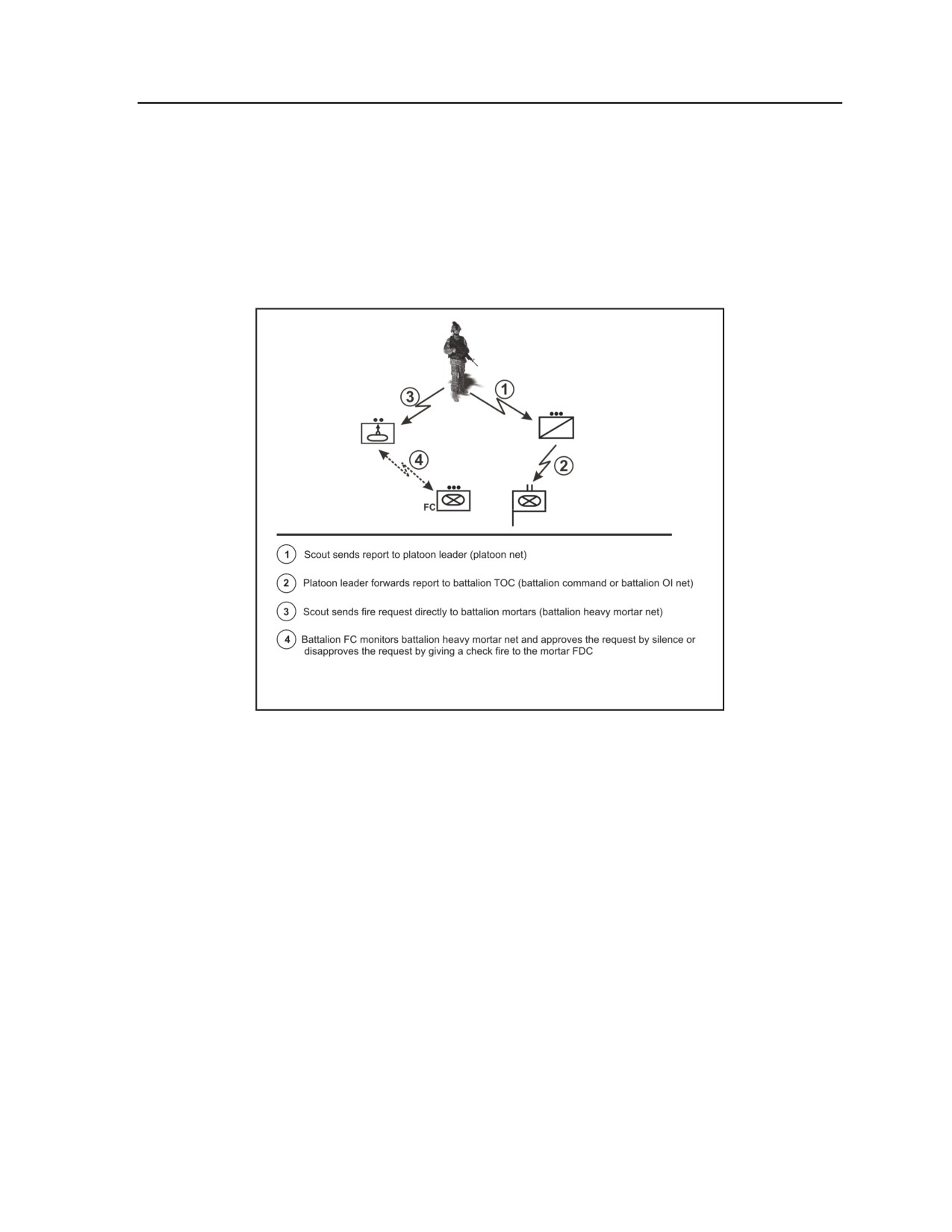
6-24. The platoon can send requests for mortar fire directly to the mortars on the battalion mortar net; the
FC monitors these requests (see Figure 6-3).
Figure 6-3. Battalion scouts requesting fire from task force mortars
Artillery Requests
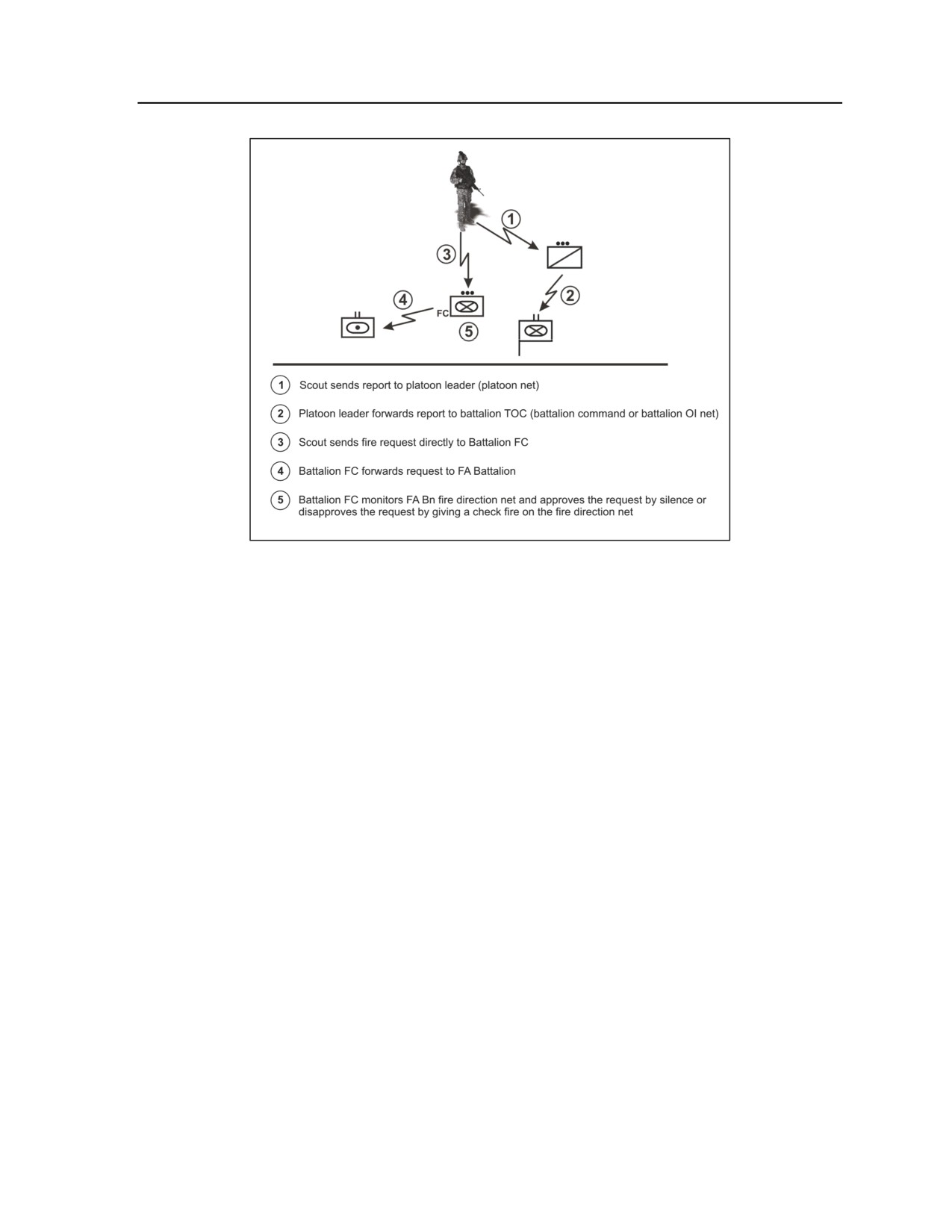
6-25. Normally the reconnaissance platoon sends requests for artillery fire to the FC through the squadron
or battalion TOC (see Figure 6-4).
6-8
FM 3-20.98
3 August 2009
Enablers
Figure 6-4. Battalion scouts requesting fire from the FA battalion
FIRE PLANNING IN SUPPORT OF RECONNAISSANCE MISSIONS
6-26. The reconnaissance or scout platoon leader must be prepared to use both hasty fire planning and
deliberate fire planning in support of the platoon’s missions. He should pay particular attention to the
identification of priority targets and to the procedures used to shift priority targets whenever necessary. If
the section sergeant or squad leader determines there is a need for additional targets in the course of his
mission, it is his responsibility to request them through the platoon leader or PSG.
PRIORITY OF FIRES
6-27. Priority of fires is the organization and employment of fire support assets according to the
importance of the supported unit’s mission. The unit commander or leader determines their priority of fires.
6-28. The platoon leader coordinates priority of fires through normal fire support channels. He should
concentrate on placing effective fires in several key locations:
z
Short of the line of departure is the line of contact (LD/LC).
z
From the LD/LC to the objective.
z
On the objective.
z
Beyond the objective (in case of enemy counterattack).
6-29. During reconnaissance, the platoon leader uses these doctrinal targeting tasks when the platoon has
target responsibilities. The two key areas of concern for the platoon will be short of the LD/LC and from
the LD/LC to the objective. The fire support plan must also support the platoon during movement along
assigned routes and while it is occupying OPs, employing fires against enemy reconnaissance elements or
forward security elements. The platoon leader also coordinates adjacent unit’s fires prior to execution of
operations. In the defense, the platoon leader must coordinate with the higher commander for planned
targets.
6-30. During security operations, it is particularly important for the platoon leader to plan fires in support
of point obstacles. The locations of obstacles should be refined and passed to the troop FIST or the
3 August 2009
FM 3-20.98
6-9
Chapter 6
battalion and/or brigade fire support coordinator at the earliest possible time. As much as possible, the
platoon leader ensures that the platoon has mortar priority of fires (except in the BFSB).
RADAR ZONES
6-31. In addition to fires planning, the platoon leader must be aware of and consider recommending the
use of radar zones. Radar zones are a means of prioritizing radar sectors of search. A zone is a geometric
figure placed around an area that prioritizes importance.
6-32. Of the four types of radar zones, the platoon leader concerns himself with only one type, the CFZ.
This is an area, usually in the vicinity of a friendly unit, or location that is critical. CFZs protect an asset
whose loss would seriously jeopardize the mission. Friendly units fire upon any enemy weapon firing into
a CFZ. The radar computer generates an immediate call for fire to a friendly firing unit.
CALL FOR FIRE
6-33. The standard call for fire for artillery and mortars consists of three basic transmissions, consisting of
six elements.
z
Observer identification and warning order (first transmission).
z
Target location (second transmission).
z
Target description, method of engagement, and method of fire and control (third transmission).
6-34. The exceptions to using the full call for fire, with all three transmissions, are requests calling for
“suppression” or “immediate suppression” missions.
OBSERVER IDENTIFICATION AND WARNING ORDER
6-35. The observer identification tells the fire direction center (FDC) who is calling. It also clears the net
for the rest of the call. The warning order tells the FDC the type of fire support mission and the method of
locating the target. The types of missions are adjust fire, fire for effect, suppression, and immediate
suppression.
Adjust fire
6-36. Observer uses adjust fire when he is uncertain of the exact target location. Example: “G24 - THIS IS
G59 - ADJUST FIRE - OVER.”
Fire for Effect
6-37. The observer strives for first-round fire for effect if he is sure that his target location is correct. He
should also be sure that the rounds of the first volley would have the desired effect on the target so that
little or no adjustment will be required. Example: “G24 - THIS IS G59 - FIRE FOR EFFECT - OVER.”
Suppression
6-38. The observer uses suppression to bring fire quickly on a preplanned target only. This is a simplified
call for fire and sent in one transmission. Example: “G24 - THIS IS G59 - SUPPRESS AF2401 - OVER.”
Immediate Suppression
6-39. An observer requests immediate suppression to bring fire quickly on a planned target or a target of
opportunity that is firing at a friendly unit or aircraft. As with suppression, this mission uses a simplified
call for fire that is sent in one transmission. Examples:
z
Preplanned target example:
“G24 - THIS IS G59 - SUPPRESS AF2401 - OVER.” Observer
does not announce the target.
z
Target of opportunity example:
“G24 - THIS IS G59 - IMMEDIATE SUPPRESSION GRID
123456 - OVER.”
6-10
FM 3-20.98
3 August 2009
Enablers
TARGET LOCATION
6-40. Following the type of mission, the observer announces the target location. This prepares the FDC to
receive the data sent by the observer and apply it to locate the target. The three methods for locating targets
are—
z
Grid.
z
Polar plot.
z
Shift from a known point.
6-41. The observer only announces the polar plot and shift methods to the FDC. If the observer does not
specify either polar or shift, the FDC knows the grid method is being used. Do not use the word “grid” in
the initial transmission. Example: “H24 - THIS IS H67 - FIRE FOR EFFECT POLAR - OVER.”
(NOTE: The observer announces the word “grid” at the beginning of a subsequent transmission calling for
an adjustment of fires. Example: “H24 THIS IS H67 - ADJUST FIRE OVER. H24 THIS IS H67 - GRID
PA123456 - OVER.”)
Grid Method
6-42. At a minimum, when using the grid method, the observer normally sends the target location in six
digits
(example: “PA180739”). The observer must give the direction (in mils, if possible) from the
observer to the target to the FDC—after the call for fire, but before the first adjusting rounds are shot.
Polar Plot Method
6-43. This method requires that the observer and the FDC know the observer’s exact location. The
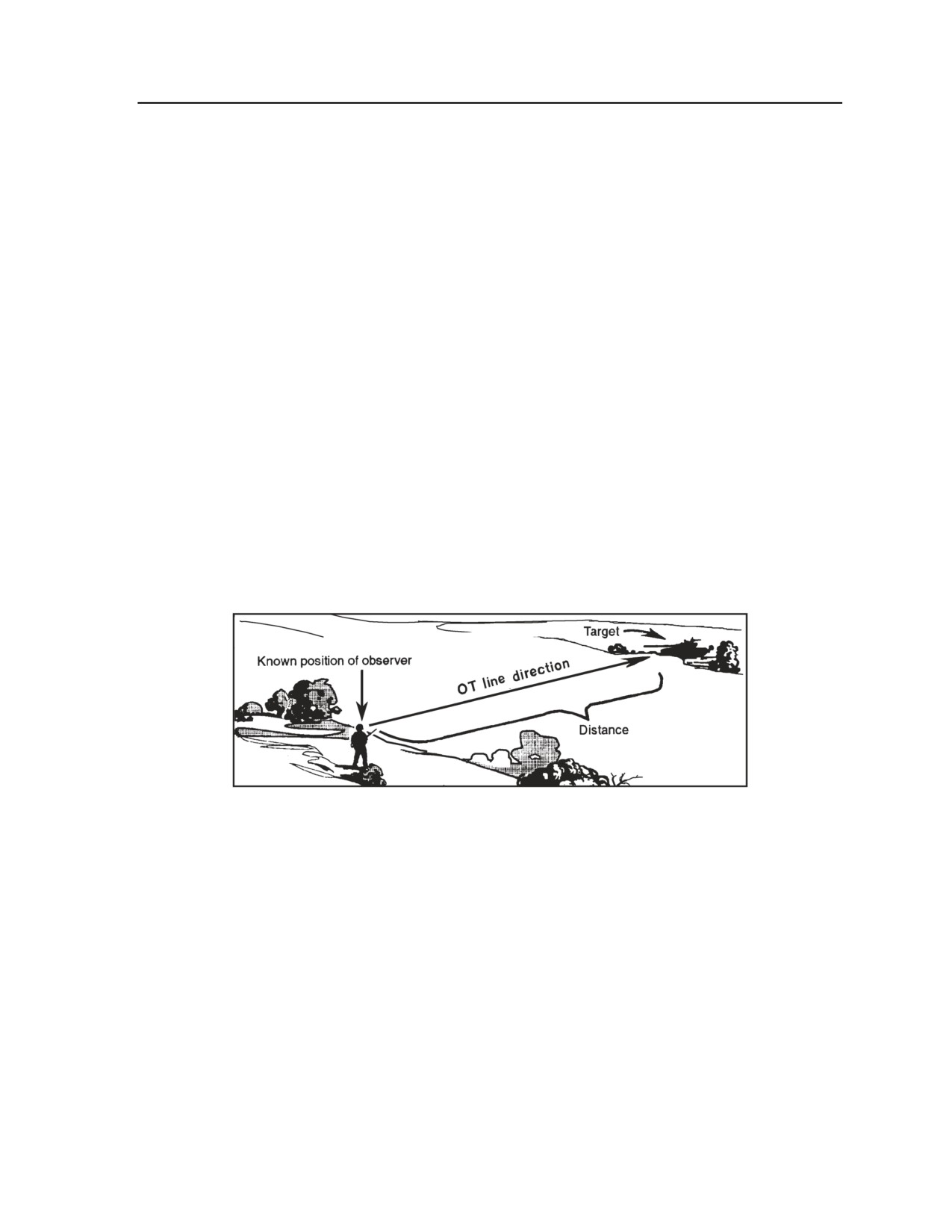
observer determines the direction (to the nearest 10 mils) of the observer-target (OT) line and the distance
(to the nearest 100 meters) from his position to the target (see Figure 6-5).
Figure 6-5. Polar plot method of target location
Shift from a Known Point Method
6-44. The observer can use this method if the observer and the FDC have a common known point. To
locate the target, the observer must first determine the direction to the nearest 10 mils. If the observer has
no compass, he can determine the direction by using a map and protractor or by using his binocular reticle
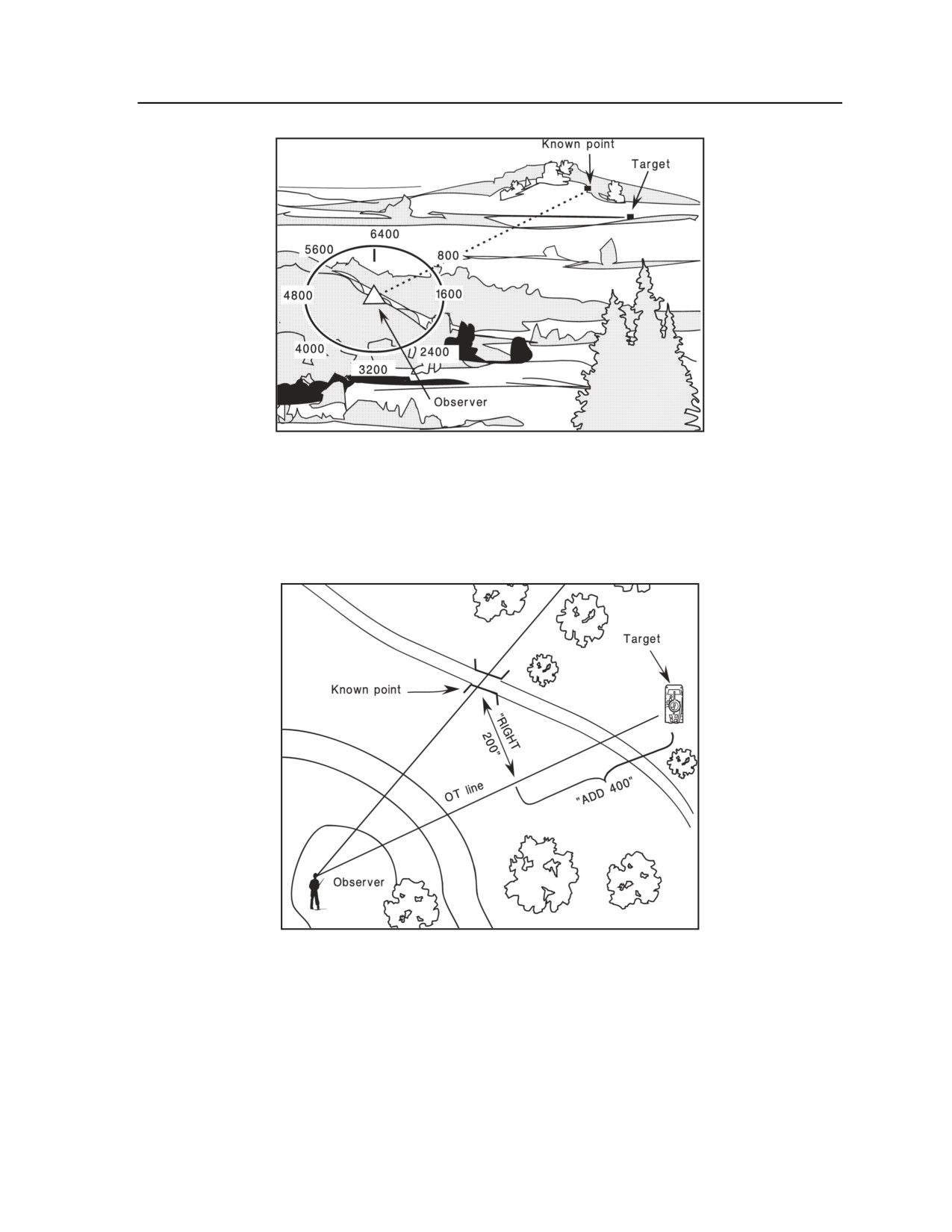
pattern and a known direction to the known point. He should remember to apply the RALS rule (right add,
left subtract) in determining direction to the target (see Figure 6-6).
3 August 2009
FM 3-20.98
6-11
Chapter 6
Figure 6-6. Shift from a known point method
using direction (in mils)
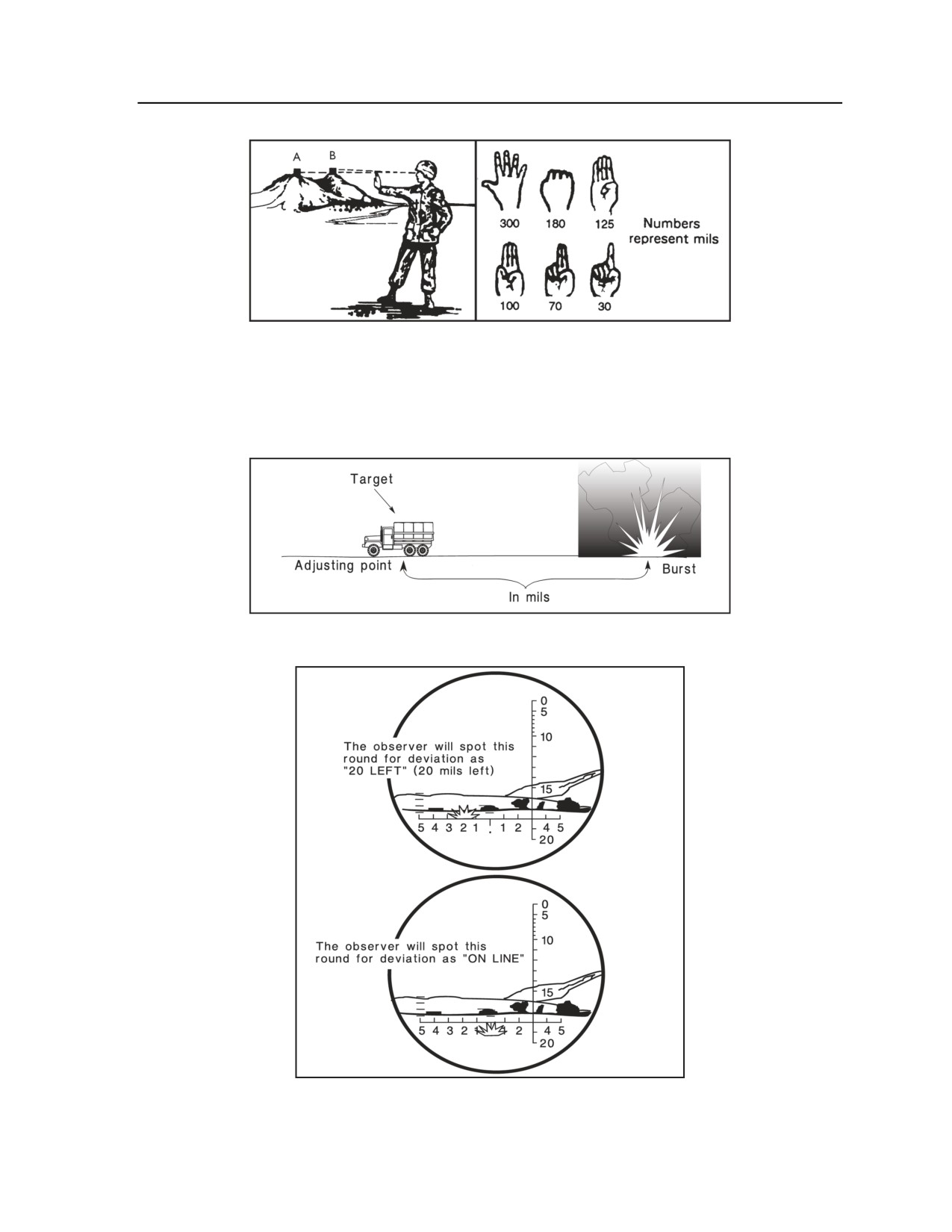
6-45. The observer determines the lateral and range shifts (see Figure 6-7). The observer then gives lateral
shifts left or right from the known point to the OT line to the nearest 10 meters. Observers give range shifts
as “ADD” (when the target is beyond the known point) or “DROP” (when the target is closer than the
known point). Range shifts are to the nearest 100 meters.
Figure 6-7. Lateral and range shifts from a known point
TARGET DESCRIPTION, METHOD OF ENGAGEMENT, AND METHOD OF FIRE AND CONTROL
6-46. The observer includes these elements in his call for fire using the following guidelines:
z
Description of target. The observer describes the target to the FDC. The FDC then determines
the type and amount of ammunition needed. The target description should be brief yet accurate.
This is the last required element in the call for fire.
6-12
FM 3-20.98
3 August 2009

Enablers
z
Method of engagement. The observer specifies how he wants to attack the target (type of
ammunition, fuze, and distance from friendly troops). The FDC may change the ammunition
type and/or fuze based on ammunition constraints. If the target is within 600 meters of friendly
troops, the observer announces “DANGER CLOSE” to supporting mortars and artillery. When
the observer calls “DANGER CLOSE,” the initial rounds in adjustment should use a delay fuse.
z
Method of fire and control. The observer determines who gives the command for fire to
begin. If the observer wants to control the time of firing, he will say, “AT MY COMMAND.”
The FDC will tell the observer when the unit is ready to fire. At the proper time, the observer
will say, “FIRE.” If the observer does not say, “AT MY COMMAND,” the FDC will fire as
soon as the platoon/battery is ready.
ADJUSTING INDIRECT FIRE
6-47. The goal of every observer is to put rounds on target as quickly as possible. If the observer meets the
five requirements for accurate predicted fire, this task is relatively easy. Consequently, the observer
requests ‘fire for effect” in his initial call for fire. With so many variables affecting the accurate delivery of
initial rounds, however, observers must be prepared to adjust subsequent rounds onto the target as quickly
as possible.
6-48. The observer must first pick an adjusting point. For a destruction mission (precision fire), the target
is the adjusting point. For an area target (area fire), the observer must pick a well-defined adjusting point at
the center of the area or close to it. The observer must spot the first adjusting round and each successive
round and send range and deviation corrections, as required, back to the FDC until fire hits the target. The
observer spots by relating the burst or group of bursts to the adjusting point.
DEVIATION SPOTTING
6-49. As applied to deviation (left or right), spotting involves measuring the horizontal angle (in mils)
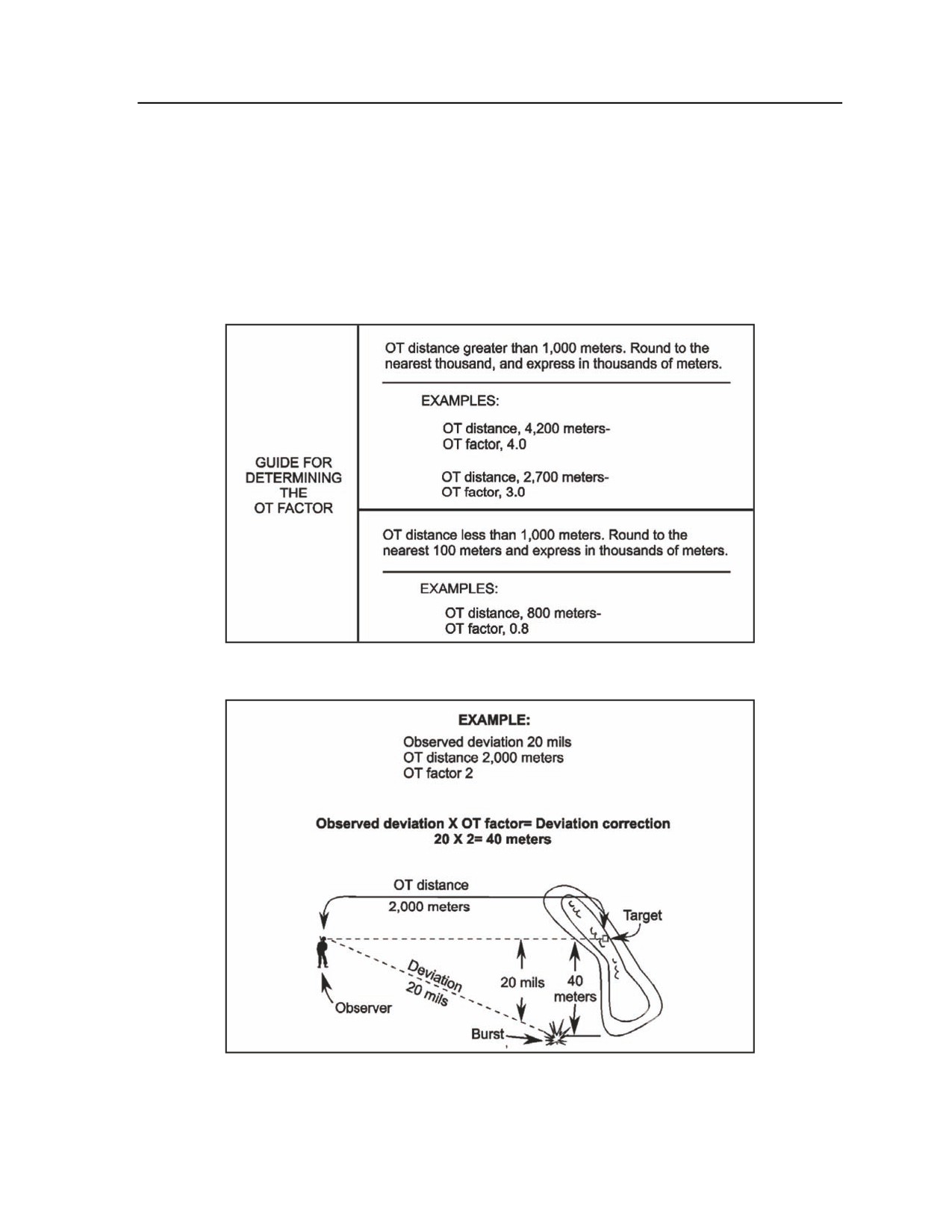
between the burst and the adjusting point. An angle-measuring device or technique, such as the mil scale
on military binoculars (refer to Figure 6-8) or the hand-and-fingers method (see Figure 6-9), is required to
determine deviation. The horizontal scale in the binoculars’ reticle, divided into
10-mil increments,
measures horizontal angles. The vertical scales, in 5-mil increments in the center and on the left side of the
reticle, measure vertical angles. The scale on the right, if present, is no longer used.
Figure 6-8. Mil scale in binocular reticle
3 August 2009
FM 3-20.98
6-13
Chapter 6
Figure 6-9. Use of hand and fingers method to determine deviation
6-50. The observer spots a burst to the right (or left) of the target as “(number) MILS RIGHT (LEFT)” (as
shown in Figures 6-10 and 6-11). He spots a burst on the OT line as “LINE.” Observers measure deviation
to the left or right of the center of the burst, using the nearest five mils for area targets. The observer
estimates deviation for a destruction mission (precision fire) to the nearest mil.
Figure 6-10. Deviation spotting
Figure 6-11. Deviation spotting with binoculars
6-14
FM 3-20.98
3 August 2009
Enablers
DEVIATION CORRECTION
6-51. Once the mil deviation has been determined, the observer converts it into a deviation correction (in
meters). Deviation correction is the distance in meters the burst must move to be on line between observer
and target. It is sent, with the range correction, to the FDC for the next adjusting round or when calling for
fire for effect.
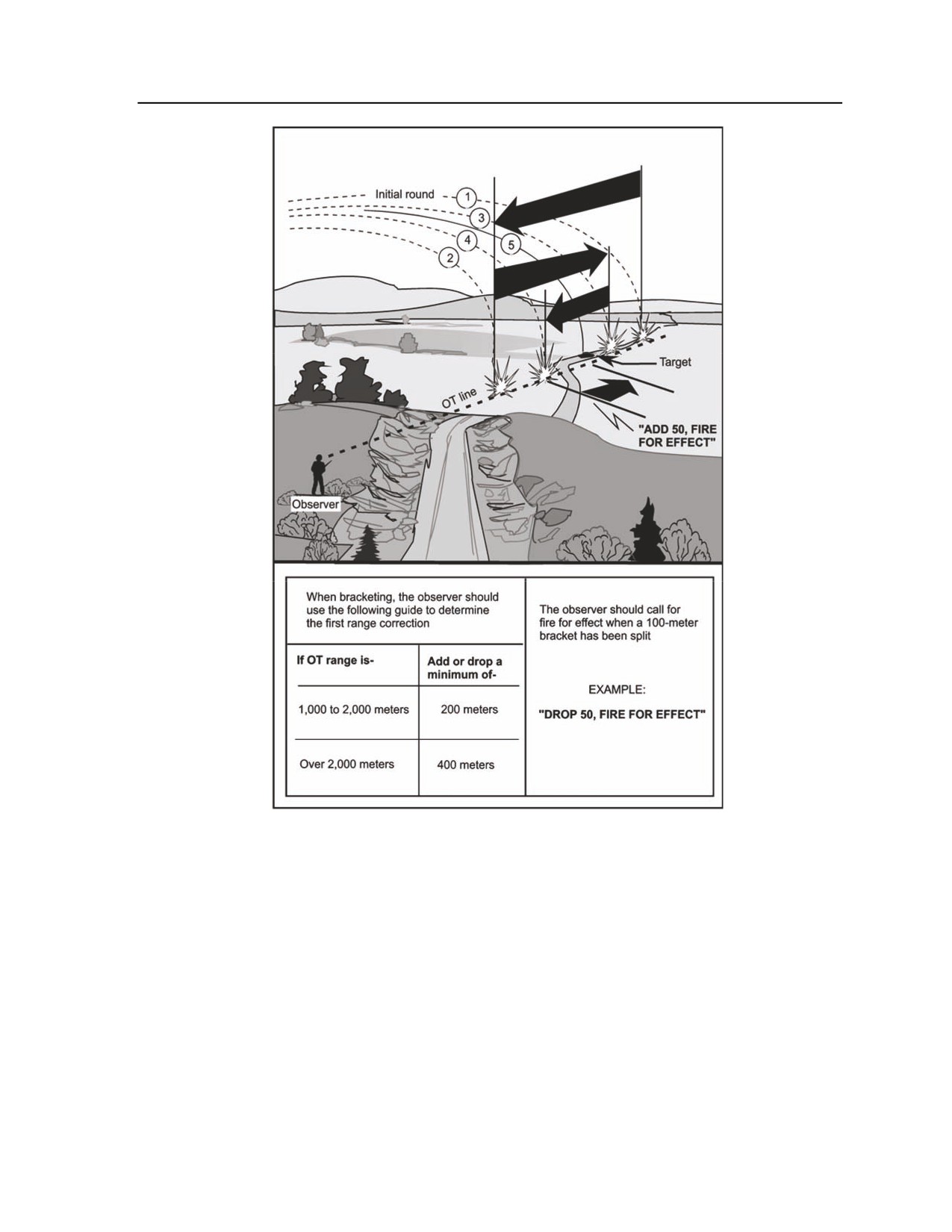
6-52. The observer determines deviation correction by multiplying the observed deviation, in mils, by the
distance from the observer to the target in thousands of meters. The observer expresses this distance as the
OT factor (illustrated in Figure 6-12) and uses the result to calculate deviation correction to the nearest 10
meters (see Figure 6-13).
Figure 6-12. Determining the OT factor
Figure 6-13. Converting mil deviation
to deviation correction
3 August 2009
FM 3-20.98
6-15
Chapter 6
6-53. Minor deviation corrections (10 to 20 meters) are necessary to adjust precision fire. In adjustment of
area fire, however, observers should ignore deviation corrections of 20 meters or less except when such a
small change is necessary to determine a definite range spotting. Throughout the adjustment, the observer
should move the adjusting rounds close enough to the OT line to ensure accurate range spotting.
RANGE SPOTTING
6-54. As applied to range (short or over), spotting is required to make adjustments to place fire on the
target. Observers use the following terminology in this process:
z
OVER. This term describes a round that appears to impact beyond the adjusting point.
z
SHORT. This term describes a round that appears to strike between the observer and the
adjusting point.
z
TARGET. This spotting term describes a round that hits the target. It is used only in precision
fire (destruction missions).
z
RANGE CORRECT. This term describes a round that appears to be at the correct range.
z
DOUBTFUL. This term describes a round that can be observed but cannot be spotted in one of
the previous categories (over, short, target, or range correct).
z
LOST. This describes a round whose location cannot be determined.
z
LOST OVER or LOST SHORT. These are terms for a round that is not observed but that is
definitely known to be beyond or short of the adjusting point.
6-55. Any range spotting other than “DOUBTFUL” or “LOST” is definite. Usually, an adjusting round’s
burst that is on or near the OT line will give a definite range spotting. The observer can make a definite
range spotting even when the burst is not on or near the OT line. He uses his knowledge of the terrain or
wind and observes debris scattered by the impact; however, if the observer is not sure (“DOUBTFUL”),
the correction he sends to the FDC should be for deviation (“LEFT” or “RIGHT”) only. This is done to
bring the burst on line to get a definite range spotting (“OVER”, “SHORT”, or “TARGET”).
RANGE CORRECTION
6-56. Observers use three methods of adjusting fire on to a target. These include bracketing, hasty
bracketing, and creeping.
Bracketing
6-57. In this technique, the observer gives range corrections so that, with each successive correction, the
adjusting round intentionally lands over or short of the adjusting point, closing on the target. The observer
calls “FIRE FOR EFFECT” when a range correction would bring the next round within 50 meters of the
adjusting point (See Figure 6-14).
6-58. Successive bracketing is a safe technique that ensures fire on the target. Time is important, especially
when targets are moving or may move to seek cover when they find fire coming their way. Accurate initial
location information speeds adjustment and makes the requested fire more effective. To shorten adjustment
time, the observer should try to bracket the target quickly (in the first two or three adjusting rounds), then
try to adjust on the target with as few subsequent rounds as possible.
6-16
FM 3-20.98
3 August 2009
Enablers
Figure 6-14. Bracketing
Hasty Bracketing
6-59. Experience has shown that effectiveness on the target decreases as the number of rounds used in
adjustment increases. An alternative to successive bracketing is hasty bracketing. While successive
bracketing mathematically ensures that the fire-for-effect rounds will strike within
50 meters of the
adjusting point, it is a slow and unresponsive technique. Therefore, observers use hasty bracketing if the
nature of the target requires faster effective fires than successive bracketing allows. The success of hasty
bracketing depends on a thorough terrain analysis that gives the observer an accurate initial target location.
The observer obtains a bracket on his first correction in a manner similar to that used for successive
bracketing. Once the observer has this initial bracket, he uses it as a yardstick to determine his subsequent
correction. He then sends the FDC the correction to move the rounds to the target and fire for effect.
3 August 2009
FM 3-20.98
6-17
Chapter 6
Creeping
6-60. Observers use the creeping method of adjustment in “DANGER CLOSE” situations. Here, the
observer directs the initial round beyond the target. He then brings adjusting rounds in 100 meters or less
until he engages the target. This method is slow and tends to use more ammunition than other adjustments;
therefore, observers should use creeping only when Soldier safety is a major concern.
REFINEMENT AND SURVEILLANCE
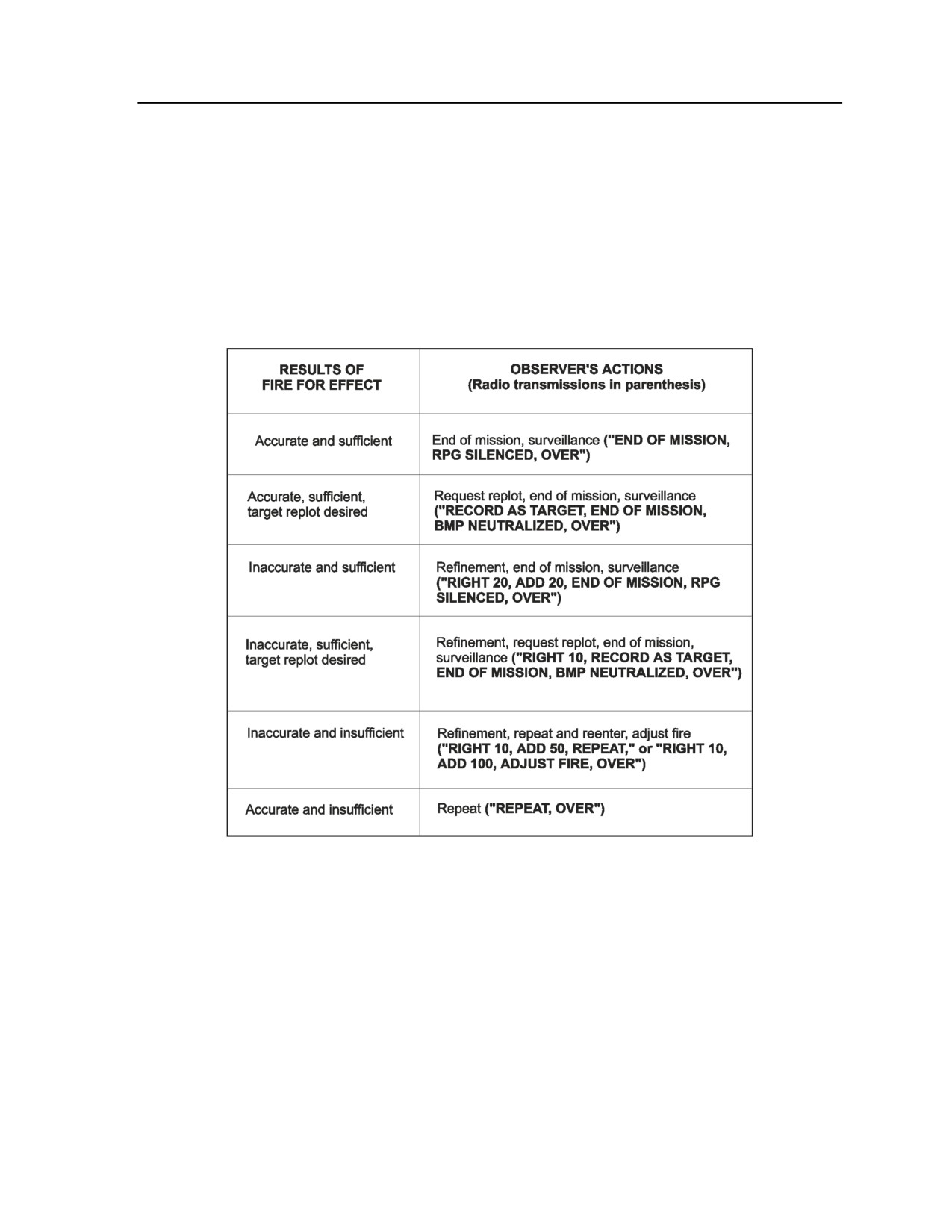
6-61. The observer should note the results of the fire for effect and then take whatever action is necessary
to complete the mission. It is critical that the observer formally ends the fire mission and gives assessment.
Figure 6-15 shows the observer’s actions after the fire for effect.
Figure 6-15. Observer’s actions after fire for effect
FIRE SUPPORT COORDINATION MEASURES
6-62. Once established, units display FSCMs on maps, firing charts, and overlays. Graphic portrayal
includes, as a minimum, the visual code, the abbreviation for the measure, the establishing headquarters,
and the effective date-time group (DTG).
6-63. With the exception of boundaries, FSCMs are either permissive or restrictive. In essence, the
primary purpose of a permissive measure is to facilitate the attack of targets. The establishment of a
restrictive measure imposes certain requirements for specific coordination before the engagement of those
targets affected by the measure; therefore, the primary purpose of a restrictive measure is to safeguard
friendly forces. For additional discussion of fire support and the FSCMs covered in this discussion, see
FM 3-20.96 and FM 3-20.971, as well as FM 3-09.31, FM 3-22.90, and FM 6-20-40.
6-18
FM 3-20.98
3 August 2009
Enablers
PERMISSIVE MEASURES
6-64. Permissive FSCMs include—
z
Coordinated fire line (CFL).
z
Fire support coordination line (FSCL).
z
Free fire area (FFA).
6-65. For additional details on how to depict these measures, refer to FM 1-02.
Coordinated Fire Line
6-66. The CFL is a line beyond which conventional or improved conventional indirect fire means (mortars,
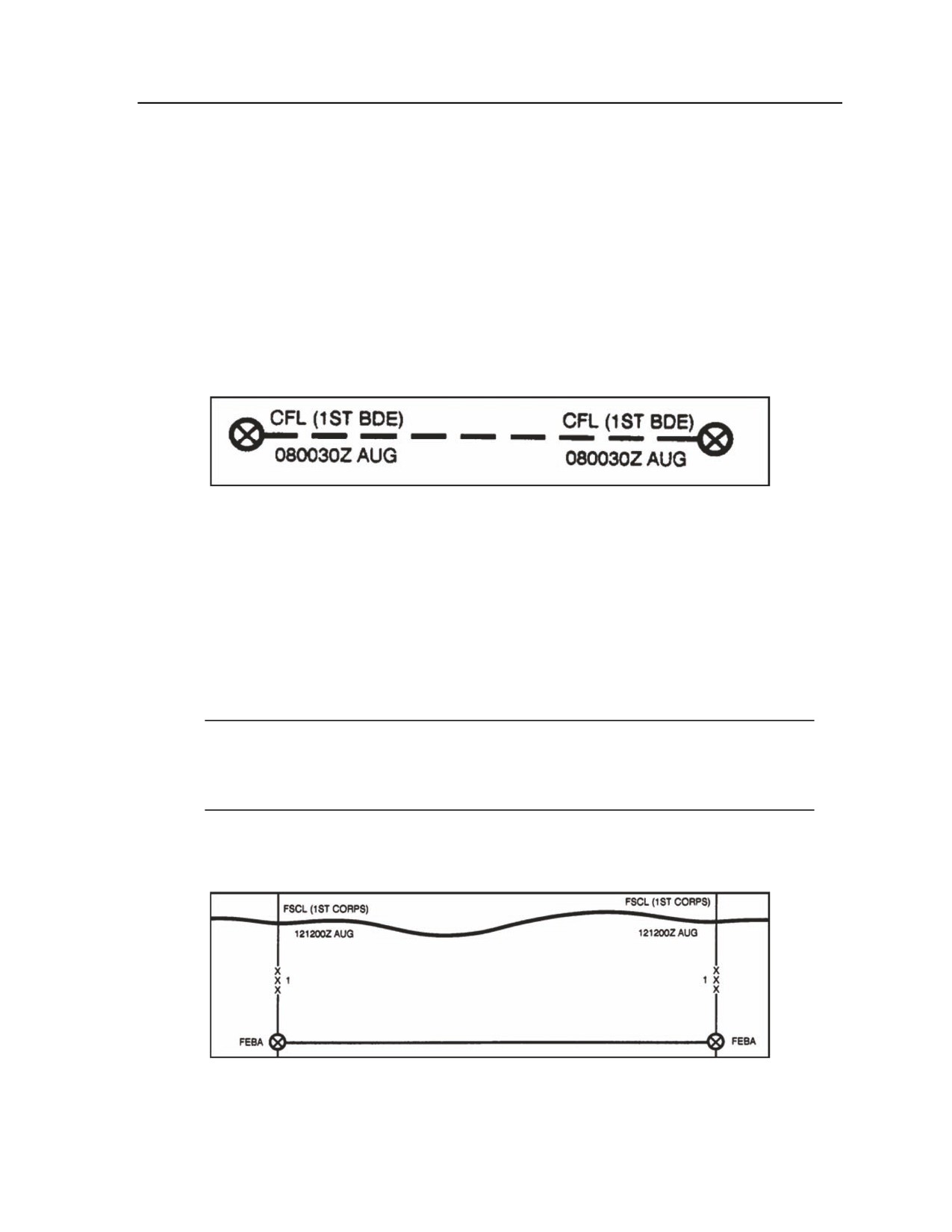
FA, and NGF) may fire at any time within the zone of the establishing headquarters without additional
coordination. It covers surface-to-surface fires only. The purpose of the CFL is to expedite the attack of
targets beyond it (see Figure 6-16).
Figure 6-16. Coordinated fire line
Fire Support Coordination Line
6-67. The FSCL facilitates the rapid attack of targets of opportunity beyond the coordination measure. It is
a line established and adjusted by the appropriate land or amphibious force commander within his
boundaries in consultation with superior, subordinate, supporting, and affected commanders. Forces
attacking targets beyond an FSCL must inform all affected commanders in sufficient time to allow
necessary reaction to avoid fratricide, both in the air and on the ground. Supporting elements may attack
targets beyond the FSCL, provided the attack will not produce adverse effects on, or to the rear of, the line
that may affect current tactical operations. Leaders use FSCLs to coordinate all fires of air, ground, or sea
weapon systems using any type of ammunition against surface targets (see Figure 6-17).
Note. The FSCL is not a boundary. The synchronization of operations on either side of the
FSCL is the responsibility of the establishing commander out to the limits of the land or
amphibious force boundary. The FSCL is a term oriented to air-land operations; there is no
similar term used at sea.
6-68. An associated benefit of employing an FSCL is the reduction in potential for fratricide. Short of an
FSCL, the appropriate land or amphibious force commander controls all air-to-ground and surface-to-
surface attack operations.
Figure 6-17. Fire support coordination line
3 August 2009
FM 3-20.98
6-19
Chapter 6
Free Fire Area
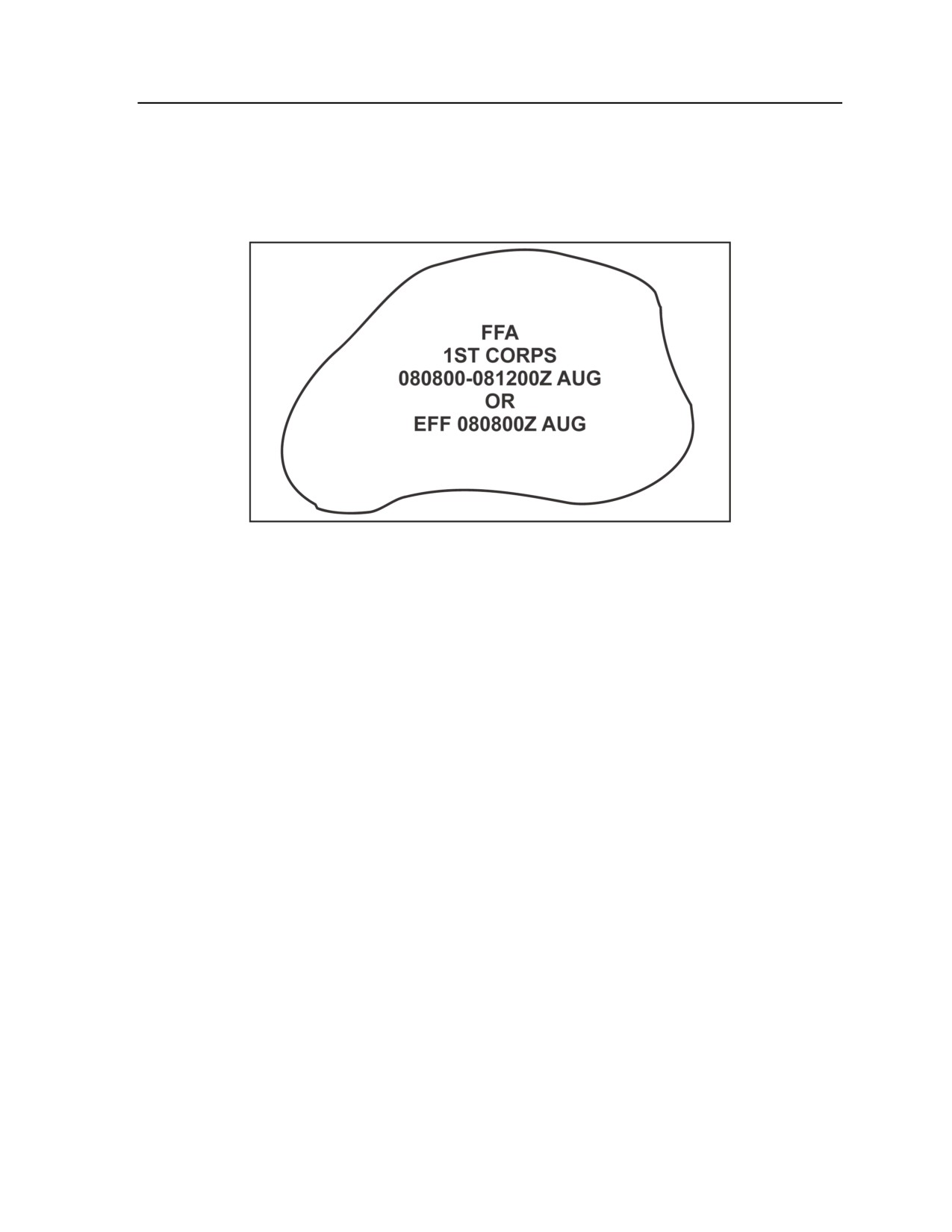
6-69. The FFA is a specific area into which any weapon system may fire without additional coordination
with the establishing headquarters. The FFA expedites fires and facilitates the jettison of munitions when
aircraft are unable to drop them on a target area (see Figure 6-18).
Figure 6-18. Free fire area
RESTRICTIVE MEASURES
6-70. Restrictive fire support coordination measures include—
z
NFA.
z
Restrictive fire area (RFA).
z
RFL.
6-71. For additional details on how to depict these measures, refer to FM 1-02.
No-Fire Area
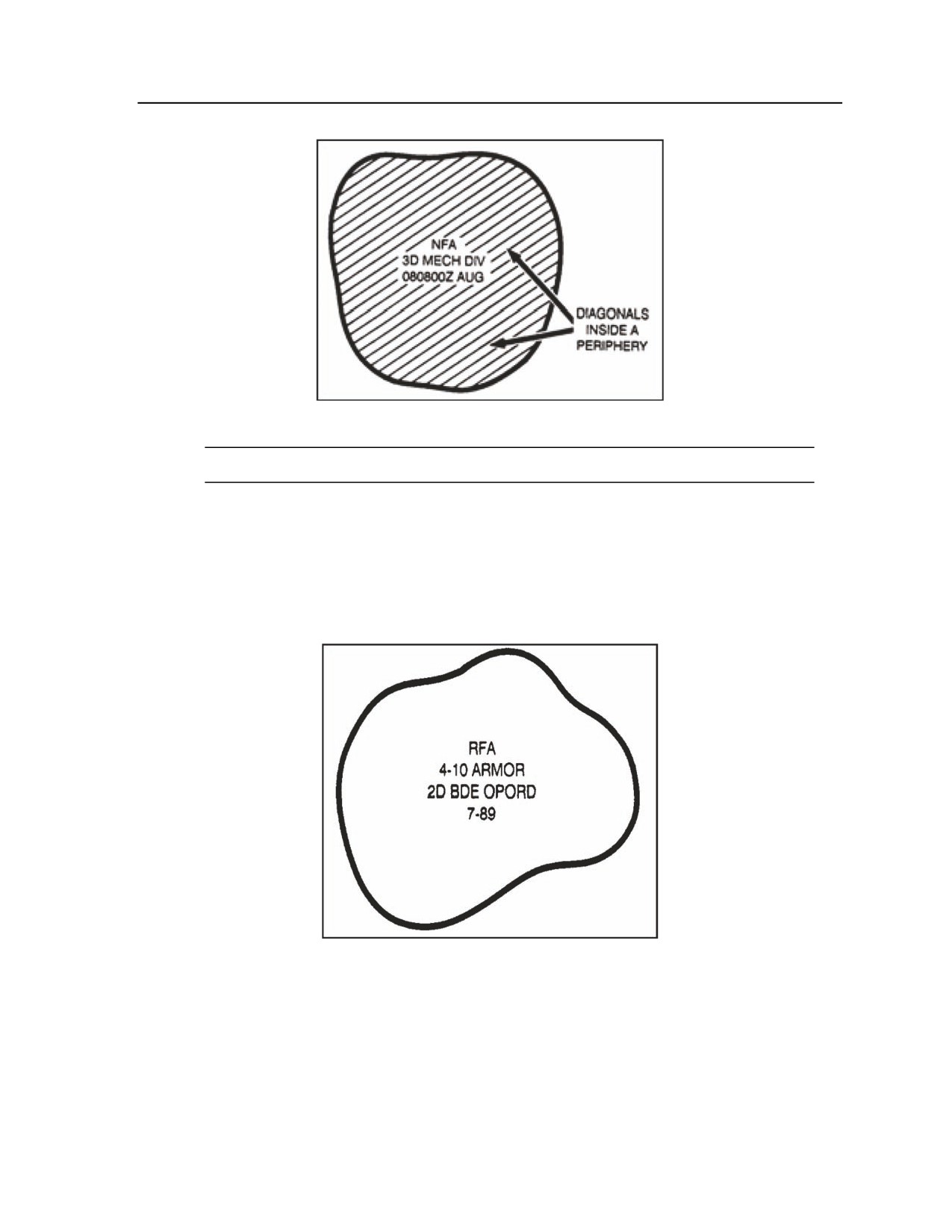
6-72. The NFA is an area that disallows all fires and effects. There are two exceptions:
z
When the establishing headquarters approves fires temporarily within the NFA on a mission-by-
mission basis.
z
When an enemy force within the NFA engages a friendly force. In this situation, the commander
may engage the enemy to defend his force.
6-73. The purpose of the NFA is to prohibit fires or their effects in the area. Usually a division or corps
establishes NFAs. NFAs are normally on easily identifiable terrain; however, they may be located by grid
or by a radius (in meters) from a center point. Like other FSCMs, units disseminate the location of an NFA
through both maneuver and fire support channels to concerned levels (see Figure 6-19).
6-20
FM 3-20.98
3 August 2009
Enablers
Figure 6-19. No-fire area
Note. The platoon leader should request an NFA over all scout positions at all times
Restrictive Fire Area
6-74. The RFA is an area imposing specific restrictions to deny delivery of fires that exceed those
restrictions without coordination with the establishing headquarters. The purpose of the RFA is to regulate
fires into an area according to the stated restrictions. Maneuver battalions or higher echelons of command
establish the RFA, although on occasion, a company or troop operating independently may establish one
(see Figure 6-20).
Figure 6-20. Restrictive fire area
Restrictive Fire Line
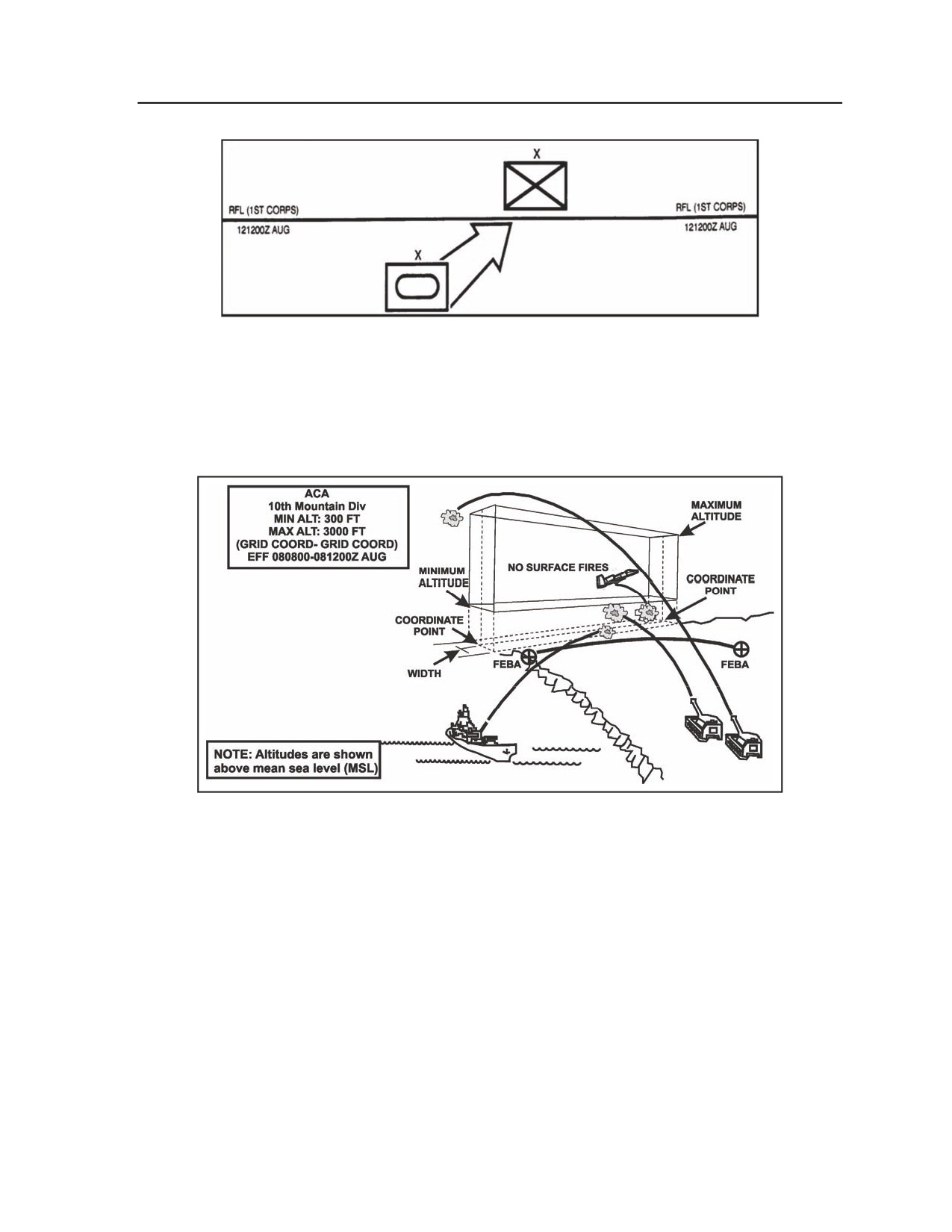
6-75. The RFL is a line established between converging friendly forces (one or both may be moving) that
prohibit fires or the effects of fires across the line without coordination with the affected force. The
purpose of the line is to prevent interference between the converging friendly forces. The common
commander of the converging forces establishes it. Units disseminate its location in the same manner as
that of a CFL (see Figure 6-21).
3 August 2009
FM 3-20.98
6-21
Chapter 6
Figure 6-21. Restrictive fire line
Airspace Coordination Area
6-76. The ACA is a block of airspace in the target area in which friendly aircraft are reasonably safe from
surface fires. Occasionally, it may be a formal measure (a three-dimensional box in the sky); more commonly,
it is an informal space. The purpose of the ACA is to allow the simultaneous attack of targets near each other
by multiple fire support means, one of which normally is an airborne asset (see Figure 6-22).
Figure 6-22. Airspace coordination area
CLOSE AIR SUPPORT OPERATIONS
6-77. The reconnaissance or scout platoon primarily needs to understand the terminology and concepts for
CAS, which entails air attacks on hostile ground forces that are in close proximity of friendly troops.
Scouts employ CAS to blunt an enemy attack, support the momentum of the ground attack, or provide
cover for friendly movements. Nomination of CAS targets is the responsibility of the commander, air
liaison officer, and S-3 at each level; however, the input received from the platoon leader is very valuable.
The platoon may receive CAS from Air Force, Navy, Marine Corps, or multinational assets. Because of its
specialized operational considerations, the BFSB platoon often must plan for and request CAS support.
CAS CAPABILITIES AND EMPLOYMENT
6-78. To make a valued recommendation to the commander regarding the use of CAS aircraft, the platoon
leader must know the characteristics of the aircraft predominantly used in the CAS role. Table 6-4 outlines
characteristics and capabilities of fixed-wing aircraft available for CAS.
6-22
FM 3-20.98
3 August 2009
Enablers
Table 6-4. Characteristics and capabilities of fixed-wing aircraft
Marking
Other
Frequency
Frequency
Secure
Aircraft
Ordnance
Beacon
Capability
Systems
Band
Hopping
Capable
LGB,
AGM-65E,
CCD TV,
GP bombs,
Rockets,
NVG, GPS,
AV-8B
CBU,
25mm, LTM,
UHF VHF-
HQ II
None
FLIR,
KY-58
Harrier II
JDAM,
LUU-2/19
AM/FM
SINCGARS
Lightning
2.75”
flares
Pod, SAR1
rockets, 5”
Zuni
LGB,
AGM-65,
Illum / WP
GPbombs,
Rockets,
CBU,
NVG, GPS,
LTD, LTM ,
UHF VHF-
A-10 A/C
JDAM2 ,
None
Lightning
HQ II
KY-58
30mm, LUU
AM/FM
2.75”
Pod
½/5/6/19
rockets,
flares
30mm
cannon
105mm
FLIR, GPS,
PPN-19
howitzer
PLS,
UHFx2
105mm,
SST-181
KY-58/100
(136 rds),
LLLTV,
SATCOM HF
HQ II NoNo
AC-130H
40mm,
SMP-
KYV-5
40mm
Beacon
VHF-
SINCGARS
IZLID, ATI
1000/
KY-58
cannon
tracking
AM/FMx3
2000
(512 rds)
radar
105mm
howitzer
(100 rds),
either
PPN-19
UHFx2
2x30mm
105mm,
SST-181
FLIR, GPS,
KY-58/100
SATCOM HF
HQ II NoNo
AC-130U
(1004 rds)
40mm,
SMP-
ALLTV,
KYV-5
VHF-
SINCGARS
or 1x40mm
25mm, LIA
1000/
SAR1
KY-58
AM/FMx3
(256 rds),
2000
1x25mm
cannon
(3000 rds)
JDAM, GP
PPN-19
UHF or
bombs,
SAR1 ,
HQ II
KY-58
B-1B
None
SMP-
SATCOM
CBU/WCM
GPS, NVG
SINCGARS
KY-100
1000
VHF/UHF HF
D
JDAM,
JSOW, GP
X Band
VHF/UHF HF
KY-58
B-2
None
SAR1 , GPS
HQ II No
bombs,
KU Band
SATCOM
KY-100
CBU
JDAM, GP
PPN-19,
FLIR,
bombs,
PPN-20,
LLLTV,
VHF/UHF HF
KY-58/100
B-52
None
HQ II
CBU/WCM
SMP-
Radar,
SATCOM
KYV-5
D, LGB
1000
NVG,GPS
JDAM,
LGB, CBU/
WCMD,
NVG, FLIR,
EGBU-28,
GPS, SAR1,
GP bombs,
UHF
Link-16,
HQ II HQ
F-15E
AGM
LTD, LTM
None
UHF/VHF/
KY-58
Sniper,
II
130/65,
FM
Lightning,
GBU-
Lantern
15/24,
JSOW,
20mm
F-16
JDAM,
LTM,LTD,
None
GPS,
UHF VHF-
HQ II No
KY-58
3 August 2009
FM 3-20.98
6-23
Chapter 6
Table 6-4. Characteristics and capabilities of fixed-wing aircraft
Marking
Other
Frequency
Frequency
Secure
Aircraft
Ordnance
Beacon
Capability
Systems
Band
Hopping
Capable
LGB,
Rockets
AM/FM
SADL3
GPbombs,
IDM/IDT4,5 ,
CBU/
NVG, Link-
WCMD,
165,6,
HARM5
Sniper/Liteni
,AGM-65,
JASSM,
ng, HTS5 ,
2.75”
HMCS5,6
rockets,
20mm
cannon
JDAM,
JSOW,
HARM,
AGM-
GPS, SAR1
65E/F,
Link-16,
CBU, GP
LTM, LTD,
NVG,
F-18
bombs,
Rockets,
Lightning
UHF VHF-
HQ II
A/C/D/E/
None
KY-58
SLAM
LUU-2/19
AT,
AM/FM
SINCGARS
F
(+ER),
flares
ATFLIR,
LGB, 2.75”
NIGHT-
rockets, 5 “
HAWK
Zuni,
20mm
cannon
GPS, NVG,
UHF VHF-
F-22A
JDAM
None
None
HQ II
KY-58
Link-16
AM
VHF/UHF,
SLAM-ER,
P-3
None
None
SAR1
HF,
HQ II
KY-58 Link 11
Various
SATCOM
UHF VHF-
AGM-1147
MQ-1B
FLIR, GPS,
AM/FM
(K, M, N,
LTD, LTM
None
No
KY-100
Predator
EO
SATCOM
P)
ROVER
AGM-1147
UHF VHF-
MQ-9
(K, M, N,
FLIR, GPS,
AM/FM
LTD, LTM
None
No
KY-100
Reaper
P), GBU-
EO
SATCOM
12
ROVER
Pioneer
None
None
FLIR, EO
RQ-7
LTD
FLIR, EO
Shadow
RQ-11
LTM8
FLIR, EO
Raven
EPW (II &
III), PW II
& III, PW
IV (IOC
FLIR, LST,
2009), Mk-
NVG, Gnd
Tornado
83, CBU,
UHF VHF-
LTD, LTM
None
mapping
HQ (I&II)
Yes
GR 4(UK)
ALARM,
AM
radar with
Stormshad
TFR
ow,
Brimstone,
27 mm
cannon
Harrier
EPW II,
FLIR, LST,
UHF VHF-
LTD, LTM
None
HQ (I&II)
Yes
GR
PW II/III/IV,
NVG, Gyro
AM
6-24
FM 3-20.98
3 August 2009

Enablers
Table 6-4. Characteristics and capabilities of fixed-wing aircraft
Marking
Other
Frequency
Frequency
Secure
Aircraft
Ordnance
Beacon
Capability
Systems
Band
Hopping
Capable
7/9(UK)
GP 1000-
Binoculars,
Tac VHF
lb and 540-
TIALD,
lb, CBU,
Sniper
Brimstone
(IOC
2008),
CRV7,
AGM-65
Notes:
1 - Synthetic aperture radar with ground mapping modes.
2 - A-10C only.
3 - Block-25/30/32.
4 - Block 40/42.
5 - Block 50/52.
6 - Some Block 40/42.
7 - Predator equipped with Hellfire has no SAR capability.
8 - Raven B only.
ALLTV - all light level television
LTD - laser target designator;
1.06 micron PRF [pulse
ATFLIR - advanced targeting FLIR
repetition frequency] coded for weapons guidance
CCD - charge-coupled device
LTM - laser target marker; 530nm “green beam” or 860nm
EO - electrooptical
for visual or NVG and targeting pods (commonly referred to
FLIR - forward-looking infrared
as an infrared pointer or infrared marker)
GPS - global positioning system
NVG - night vision goggles
HMCS - helmet mounted cueing system
PLS - personal locator system
HTS - HARM targeting system
SADL - situational awareness data link
IDM - improved data modem
SAR - synthetic aperture radar
IDT - interflight data transfer (also known as
TFR - terrain following radar
interflight datalink)
TIALD - thermal imaging airborne laser designator
IZLID
- infrared zoom laser illuminator
TV - television
designator
WP - white phosphorous
LIA - laser illuminator assembly
LLLTV - low-light level television
LST - laser spot tracker
CAS BRIEFING FORMAT
6-79. Joint terminal attack controller
(JTAC) personnel are the primary means for requesting and
controlling CAS. Leaders employ joint fires observers (JFO) if no JTAC support is available. However,
reconnaissance platoons working forward and independent of the troop must conduct emergency control of
CAS missions in the absence of JTAC or JFO personnel. Referred to as, “CAS by a non-qualified
controller”, non-JTAC controllers must clearly state to attacking aircraft that they are
“non-JTAC
qualified” during aircraft check-in (Figure 6-23).
6-80. The JTAC is a qualified (certified) service or coalition member who, from a forward position, directs
the action of combat aircraft engaged in CAS and other offensive air operations.
6-81. The JFO is a certified and qualified service member who can request, adjust, and control surface-to-
surface fires, provide targeting information in support of Type 2 and 3 CAS terminal attack controls and
perform terminal guidance operations. See FM 3-09.32 for additional information on the role of JTAC
personnel and JFOs.
3 August 2009
FM 3-20.98
6-25
Chapter 6
CAS Briefing Format
Do not transmit line numbers. Units of measure are standard unless
briefed. Lines 4, 6, and restrictions are mandatory read-back (*).
Controller may request additional read-back.
Controller: “_______________________, this is ____________________________”
(Aircraft Call Sign)
(Controller Call Sign)
“Type____________________ (1, 2, or 3) Control”
1. IP/BP: “___________________________________________________________”
2. Heading: “_________________________________________________________”
(Degrees magnetic from IP/BP-to-target)
Offset: “___________________________________________________________”
(Left/Right, when required)
3. Distance: “_________________________________________________________”
(IP-to-target in nautical miles, BP-to-target in meters)
4*. Target Elevation: “__________________________________________________”
(In feet MSL)
5. Target Description: “_________________________________________________”
6*. Target Location: “__________________________________________________”
(Lat/Long or grid to include map datum or offsets or visual)
7. Type Mark: “__________________________” Code: “______________________”
(WP, Laser, IR, Beacon, etc.)
(Actual Laser Code)
8. Location of Friendly Forces: “__________________________________________”
(From target, cardinal direction and distance in meters)
Position marked by: “_________________________________________________”
9 Egress: “___________________________________________________________”
REMARKS (as appropriate): “____________________________________________”
(Restrictions*, ordnance delivery, threats, final attack heading, hazards, weather,
target information, SEAD, danger close, etc.)
Time on Target: “___________________________________” or
Time to Target: “____________________________________”
“Standby ___________ plus ___________, ready, ready, HACK”
(minutes)
(seconds)
IP—initial point. A well-defined point, easily distinguishable visually and/or electronically, used as
a starting point for the bomb run to the target.
BP—battle position. An airspace coordination area containing firing points for attack helicopters
(Marine Corps).
MSL—mean sea level. The altitude above the average height of the sea.
Note. When identifying position coordinates for joint operations, include map data. Grid
coordinates must include the 100,000-meter grid identification.
Figure 6-23. CAS briefing format
6-26
FM 3-20.98
3 August 2009
Enablers
OTHER TYPES OF AIR SUPPORT
6-82. In addition to CAS, the Air Force, Navy, and Marine Corps provide the Army with other types of
fixed-wing air support:
z
Combat air reconnaissance.
z
Tactical airlift.
z
Electronic warfare.
z
Air interdiction.
SECTION II - ARMY AVIATION SUPPORT
6-83. Army aviation uses maneuver to find, fix, and destroy enemy forces by concentrating and sustaining
combat power at critical times and places. Army aviation provides attack reconnaissance support,
interdiction attack, and CCA support. It also conducts air infiltration, air movement, and sustainment
operations throughout the platoon’s AO. Additional information on Army aviation support is available in
FM 3-20.96 and FM 3-04.126.
ORGANIZATION
6-84. The aviation organization that the reconnaissance and scout platoon encounters most frequently is
the scout weapons team (SWT). The SWTs are normally comprised of two aircraft (lead and wingman) of
either OH-58Ds or AH-64s, or a mix of both. Refer to FM 3-20.971 for a detailed discussion of the
following areas of Army aviation support:
z
Principles of aviation employment.
z
Planning considerations.
z
Aviation missions.
z
Aviation capabilities and limitations.
z
Attack reconnaissance support.
z
Attack support.
ASSAULT (UTILITY) AND CARGO (LIFT) HELICOPTER SUPPORT
6-85. Army aviation assault and cargo assets provide the reconnaissance or scout platoon with limited
aerial resupply, transport for infiltration and air movement operations, MEDEVAC and CASEVAC. See
FM 3-04.111 and FM 3-04.113 for additional information.
RESUPPLY OPERATIONS
6-86. Helicopter and fixed wing resupply assets available to the platoon are limited. Scouts, however, may
operate in forward locations and even distant hide positions requiring helicopter aerial or airdrop resupply
involving various aspects of aerial resupply and sling load operations. Refer to FM 4-20.197 and FM 3-
21.38 for discussions of various aspects of aerial resupply, slingload operations, and airdrop resupply.
Planning
6-87. Planning for aerial or airdrop resupply requires close coordination, with elements reviewing the
entire mission and resolving all limitations and problem areas. If a resupply item poses a problem that
cannot be resolved, leaders should consider another mode of transport. Planning factors include the
following:
z
Priorities of cargo/unit resupply.
z
Integration of the resupply operation into the tactical plan.
z
Selection, identification, and marking of the pickup zone (PZ)/LZ/drop zone (DZ).
z
Type/amount of cargo.
z
Helicopter or fixed wing assets available.
3 August 2009
FM 3-20.98
6-27
Chapter 6
z
Requirements for slings, cargo nets, and/or cargo containers.
z
Ground crew training requirements, such as those for ground guides, hookup personnel, and DZ
personnel.
z
PZ/LZ/DZ security.
z
Flight routes.
6-88. The selection of a usable PZ/LZ or DZ is extremely important. The platoon analyzes logistical and
tactical considerations taking into account that PZ/LZ/DZ positioning is at the right place to support the
ground unit. The area must also be accessible to the aircraft or airdrop involved in the resupply operation.
The air mission commander (AMC), the pilot in command, aviation LNO, or a Pathfinder-qualified officer
or NCO, will make the final decision on PZ/LZ/DZ selection and acceptance.
Platoon Responsibilities
6-89. Organic Army aviation brigade assets at division, corps, and theater, including joint and
multinational assets can provide utility/cargo support to reconnaissance and cavalry units. Platoon requests
travel through the commander at troop level and through squadron operations.
6-90. The reconnaissance or scout platoon receiving the supplies is responsible for preparing the
PZ/LZ/DZ. In addition the platoon performs the following specific tasks for aerial resupply:
z
Recover and assemble equipment and supplies.
z
Train available ground crews in guiding the aircraft during approach, landing,
unloading/loading, departure, and de-rigging the load.
z
Train hookup personnel.
z
Coordinate with the sending unit for the control and return of that unit’s transport equipment,
such as slings and A-22 bags.
z
Prepare, coordinate, and inspect backloads (such as slings and A-22 bags) and have them ready
for hookup or loading when the aircraft arrives.
AIR INFILTRATION AND EXFILTRATION
6-91. Infiltration and exfiltration are forms of maneuver that the scout/reconnaissance platoon uses
throughout the OE to accomplish a specific task. Ground reconnaissance assets use helicopter assets to
conduct air infiltration or exfiltration. The reconnaissance or scout platoon can infiltrate by squads, by
sections, or as a complete platoon. Purposes of infiltration include the following:
z
Reconnoiter a specified area and establish OPs.
z
Emplace remote sensors.
z
Establish communications relay capability for a specific period in support of other operations.
z
Determine enemy strengths and weaknesses.
z
Locate unobserved routes through enemy positions.
z
Determine the location of high-payoff enemy assets.
6-92. The reconnaissance or scout platoon conducts infiltration at any time during full spectrum
operations. These operations often occur prior to offensive operations such as air assaults or movements to
contact. During stability operations, the platoon may infiltrate to establish OPs that survey suspected
insurgency activities.
6-93. Assault and GS helicopter units support the platoon by inserting the reconnaissance element via fast-
rope, single-point, or landing in an LZ. These missions may require special mission infiltration/exfiltration
system (SPIES) or fast rope insertion/extraction system (FRIES) equipment, rappelling ropes, hoists,
auxiliary fuel tanks, and additional training or rehearsals.
6-94. The inserting or extracting aviation element during an infiltration operation commonly consists of
UH-60s and AH-64s (or other armed escort). In accordance with unit SOP, UH-60s conduct multiple false
6-28
FM 3-20.98
3 August 2009
Enablers
insertions before and after actual insertion. AH-64s, providing security, may conduct feints or
demonstrations to help cover the operation.
Planning Considerations
6-95. The reconnaissance/scout platoon plans for an air infiltration or exfiltration as for any other mission.
Unit SOPs should outline an abbreviated planning process for these missions. In addition to the normal
planning process, specific planning requirements exist for the air infiltration and include—
z
Coordinating with the supporting aviation unit(s) of the task force.
z
Planning and rehearsing with the supporting aviation unit prior to the mission if possible. If
armed escort accompanies the operation, the platoon leader as well as the assault or GS aviation
unit should ensure the attack reconnaissance aircrews are included in the planning and rehearsal.
z
Gathering as much information as possible, such as enemy situation, in preparation for the
mission.
z
Ensuring joint suppression of enemy air defense coordination as appropriate.
6-96. The platoon should also plan different ingress/egress routes to include—
z
Planned extraction points.
z
Emergency extraction rally points.
z
Lost communications extraction points.
6-97. Planned extraction points and emergency extraction rally points require communications to verify
the preplanned pickup time or coordinate an emergency pickup time window. The lost communications
extraction point involves infiltration teams moving to the emergency extraction point after two consecutive
missed communication windows and waiting up to 24 hours for pickup (as per unit SOP).
Special Patrol Infiltration/Exfiltration System Operations
6-98. Units use SPIES for use in inserting and extracting reconnaissance personnel where a helicopter
landing is impractical. The system provides a means of exfiltrating up to 14 Soldiers over short distances.
Since SPIES exposes team members the entire time, the use of SPIES for infiltration carries increased risk.
Due to the nature of SPIES operations, a thorough briefing is required for all participants before the
operation. Careful coordination is crucial when additional assets (attack reconnaissance helicopters, aerial
observers, or artillery support) participate with the extraction helicopter.
6-99. Scouts must have SPIES harnesses as part of their individual equipment. The platoon leader ensures
scouts are trained and complete rehearsals prior to conducting SPIES. For detailed information on SPIES,
refer to FM 3-05.210 and FM 7-93.
Fast Rope Insertion/Extraction System Operations
6-100. FRIES provides the capability to insert troops and equipment into areas not suitable for helicopter
landing. FRIES is also the fastest method of deploying troops from a helicopter unable to land. The UH-60
has provisions for two fast ropes, one on either side of the cargo door area. The CH-47 has provisions for
up to three fast ropes, one out the forward right door and two out the ramp.
6-101. Fast rope serves to insert scouts without the aircraft contacting the ground or an obstacle. FRIES is
used for scout insertion or extraction in various settings:
z
During downed aircraft recovery operations in mountainous terrain.
z
Urban settings with no room to land, such as narrow streets.
z
Pinnacles and ridgelines.
z
Decks of ships.
6-102. The platoon leader ensures scouts are trained, thoroughly briefed, and complete rehearsals prior to
conducting FRIES. For detailed information on FRIES, refer to FM 3-05.210 and FM 7-93.
3 August 2009
FM 3-20.98
6-29
Chapter 6
Helicopter Cast And Recovery Operations
6-103. A helicopter cast and recovery (HELOCAST) operation involves inserting/extracting scouts and/or
equipment from a helicopter over water. HELOCAST is a very effective means of inserting and/or
extracting reconnaissance elements. Units plan and conduct a HELOCAST operation much the same as an
air movement operation, except the LZ is in the water. Refer to FM 7-93 for detailed information on
HELOCAST operations.
PICKUP ZONE/LANDING ZONE OPERATIONS
6-104. The reconnaissance or scout platoon may be required to establish a PZ or LZ for resupply or for
MEDEVAC or CASEVAC operations. In addition, higher headquarters may task the platoon to establish
its own PZ to conduct insertion of scouts.
Platoon Responsibilities in the PZ/LZ
6-105. As the receiving unit in aerial resupply or another utility/cargo helicopter operation, the platoon
will have the following responsibilities at the PZ/LZ:
z
Select and control the PZ/LZ.
z
Secure the PZ/LZ.
z
Provide limited weather observations, such as wind velocity and direction, cloud cover,
visibility, and approximate ceiling.
z
Provide terminal guidance with appropriate advisories. This information covers such areas as
obstacles, wire hazards, and the enemy situation, including AMD threats.
Conditions in the PZ/LZ
6-106. The following considerations apply in selection and operation of the PZ/LZ:
z
Size of the PZ/LZ. As a general rule, the PZ/LZ must provide for adequate space to allow
aircraft separation, load/passenger avoidance, and obstacle avoidance (refer to the following
discussion of helicopter landing sites). Night operations normally require a larger area.
z
Helicopter landing site requirements. A key consideration in PZ/LZ selection is the number
and type of aircraft that will be using the site at one time. Table 6-5 lists recommended
minimum distances between landing points within a PZ/LZ. Distances are from center of load to
center of load.
Note. The minimum planning distances in Table 6-5 include the distances required between
loads during external load
(sling load) operations. Refer to FM
3-04.113 for additional
information.
Table 6-5. Minimum distances between helicopter landing points
AIRCRAFT/OPERATION TYPE
MINIMUM LANDING DISTANCE
DAYTIME OPERATIONS
UH-60 and like aircraft
50 meters
CH-47 and like (or unknown) aircraft
100 meters
NIGHT OPERATIONS
UH-60 and like aircraft
75 meters
CH-47 and like (or unknown) aircraft
150 meters
Note. Height of ground/rooftop obstructions must not exceed 18 inches.
6-30
FM 3-20.98
3 August 2009
Enablers
z
Surface conditions. The surface within the PZ/LZ should be solid enough to prevent the
helicopter, its load, and/or vehicles that are picking up the load from sinking into the ground.
Selection of the site must also take into account the strong winds produced by the helicopter
wash; these can stir up blowing dust, sand, snow, gravel, or loose debris that may injure
personnel and cause damage to equipment and/or aircraft. In addition, these conditions can
cause “brownout” or “whiteout” conditions that can temporarily blind aircrews and ground
support personnel. Helicopters cannot land if the site has a slope of 15 degrees or more. The
PZ/LZ must have no obstacles or obstructions (such as trees, stumps, bushes, or man-made
objects) that could cause damage to the helicopter rotor systems or the load itself. A general
guideline is that ground or rooftop obstructions can be no more than 18 inches tall. Immovable
objects must be clearly marked with a secured VS-17 panel, red chem light, or other marking
materials.
z
Approach/departure direction. When carrying external loads, aircrews prefer to use gradual
approach and departure angles (not a vertical ascent or descent). The avenues of approach and
departure for the PZ/LZ should be over the lowest obstacle in the direction of the prevailing
winds. Arrival and departure obstacle clearance and wind direction are especially important
during reduced visibility. Table 6-6 depicts a sample radio transmission for terminal guidance as
a helicopter approaches the PZ/LZ.
Table 6-6. Example radio transmissions for terminal guidance to landing site
AIRCRAFT
RECONNAISSANCE PLATOON
“Hardrock 16, Comanchero 26 is 30 seconds
inbound to your location. Request terminal
guidance, over.”
“Comanchero 26, this is Hardrock 16. Signal is
displayed, over.”
(NOTE: Use a prearranged
signaling method if possible.)
“Roger, Hardrock. Comanchero has green smoke,
over.”
“Comanchero 26, roger green smoke. Be advised
there is a large boulder at the far end of the LZ and
a suspected ZSU 23-4 located 5 kilometers to the
east, over.”
Marking of the PZ/LZ
6-107. Considerations for marking the PZ/LZ include the following:
z
Daylight operations. A ground guide will mark the PZ or LZ for the lead aircraft by holding an
M16/M4 rifle over his head, by displaying a folded VS-17 panel chest high, or by other
identifiable means.
z
Night operations. The code letter Y (actually, an inverted Y) is used to mark the landing point
of the lead aircraft at night (see Figure 6-24). Scouts use chem lights or “beanbag” lights to
maintain light discipline.
Note. Avoid using green or blue chemical lights. They are difficult to see under NVGs.
6-108. When more than one aircraft will be landing in the same PZ or LZ, there will be at least one
additional light for each aircraft. For observation, utility, and attack aircraft, each additional aircraft
landing point will be marked with a single light, emplaced at the exact point that each aircraft is to land.
For cargo aircraft (such as the CH-47, CH-53, or CH-54), each additional landing point will be marked
with two lights. The PZ party places two lights 10 meters apart and aligned in the aircraft direction of
flight.
3 August 2009
FM 3-20.98
6-31
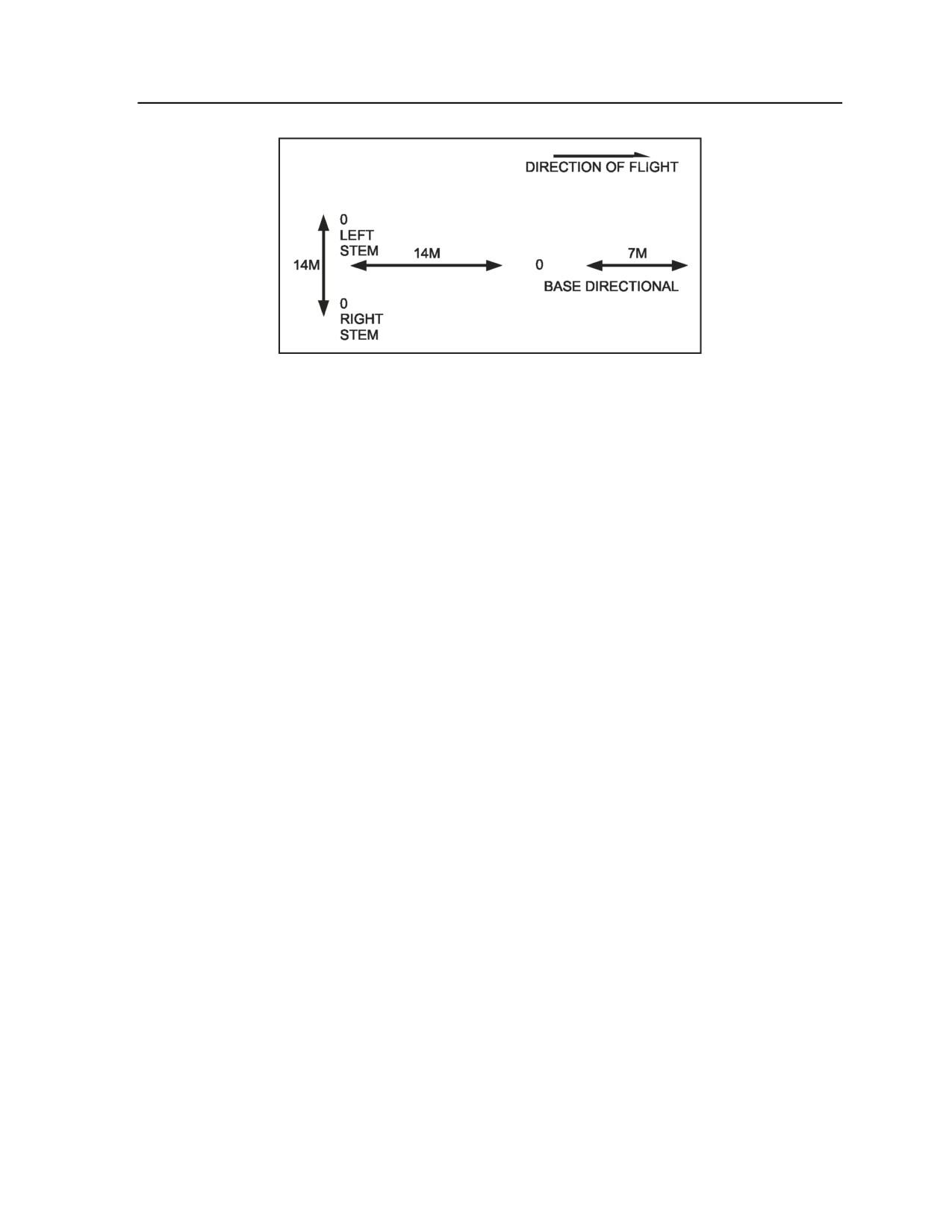
Chapter 6
Figure 6-24. Inverted Y marking signal for PZ/LZ
Actions at the PZ
6-109. Prior to arrival of the aircraft involved in an air assault operation, the platoon must secure the PZ,
position the PZ control party, and position the troops and equipment in a unit assembly area. Air assault
elements then move to and occupy the chalk assembly area, where they load the aircraft for departure to the
LZ. The final step in this phase is closure of the PZ.
PZ Organization
6-110. The PZ for the air assault operation may be either one-sided or two-sided. A one-sided PZ has all
unit assembly areas and chalk assembly areas on one side of the zone, with security teams usually located
on the opposite side beyond where the aircraft will land (see Figure 6-25). In a two-side PZ, unit assembly
areas and chalk assembly areas are located on both sides of the aircraft landing site, with security elements
interspersed around the site as necessary. Figure 6-26 illustrates a two-sided PZ.
Occupation of the Unit Assembly Area
6-111. Once the unit secures the PZ, the next step in the execution of the air assault is occupation of the
unit assembly area. Unit leaders should accomplish the following:
z
Maintain all-round security of the assembly area.
z
Maintain communications.
z
Organize Soldiers and equipment into chalks and loads in accordance with the unit air
movement plan.
z
Conduct safety briefings and equipment checks for Soldiers.
z
Establish priority of loading for each Soldier and identify bump personnel.
z
Brief the location of the straggler control points as necessary.
6-32
FM 3-20.98
3 August 2009
Enablers
Figure 6-25. One-sided PZ
Figure 6-26. Two-sided PZ
3 August 2009
FM 3-20.98
6-33
Chapter 6
Movement to and Occupation of the Chalk Assembly Area
6-112. Linkup guides from the PZ control party will meet with designated units in the unit assembly area
and coordinate movement of chalks to an RP. As chalks arrive at the RP, chalk guides will move each
chalk to its assigned chalk assembly area. To reduce the number of personnel required, leaders designate
the same guide to move the unit from the unit assembly area to the chalk assembly area. If the unit is part
of a larger air assault, no more than three chalks should be located in the chalk assembly area at one time.
Scouts maintain noise and light discipline throughout movement to maintain the security of the PZ.
Additionally, leaders restrict personnel on the PZ unless they are loading the aircraft, rigging vehicles for a
slingload, or acting as directed by PZ control. While remaining in chalk order, each Soldier is assigned a
security (firing) position by the chalk leader; he assumes a prone position, with weapon at the ready and
facing out (away from the PZ) to provide immediate close-in security.
Loading of the Aircraft
6-113. After reaching their chalk assembly areas, units should adhere to the following principles for
loading the aircraft:
z
Maintain tactical integrity by keeping fire teams and squads intact.
z
Maintain self-sufficiency by loading a weapon system and its ammunition on the same aircraft
(for example, the Javelin and its individual missiles).
z
Ensure that key personnel, weapons, and equipment are cross-loaded among aircraft to prevent
the loss of control or loss of all of a particular asset, if an aircraft is lost.
z
Prior to loading, ensure scouts tie down and check all troop gear; place short antennas in radios,
fold down, and secure.
z
Direct squad and team leaders to check their Soldiers’ equipment to ensure it is complete and
operational.
z
Turn radios on and perform communications checks (unless directed otherwise).
z
Assign specific aircraft seats to all personnel.
6-114. UH-60 loading sequence (split chalk). These considerations and procedures apply (refer to the
loading diagram illustrated in Figure 6-27):
z
The chalk leader (squad leader) initiates movement once the aircraft has landed.
z
The far side and nearside groups move to the aircraft in file, with the chalk leader always
leading the near side group.
z
The chalk leader should take the following actions:
Ensure that all personnel know which aircraft and which position to load.
Ensure that all personnel wear or carry rucksacks on the aircraft.
Notify the crew chief when all chalk members are on board and are ready for liftoff.
z
All personnel buckle up as soon as possible in their assigned seats. The chalk leader always sits
in the left front seat unless a platoon leader or company commander is on the same aircraft.
z
The chalk leader hands the chalk card to the pilot and answers any questions the pilot has, using
the aircraft intercommunications (troop commander’s) handset.
6-34
FM 3-20.98
3 August 2009
Enablers
Figure 6-27. UH-60 loading diagram (split chalk)
6-115. UH-60 loading sequence (whole chalk). These considerations and procedures apply (refer to the
loading diagram illustrated in Figure 6-28):
z
The chalk leader (squad leader) initiates movement once the aircraft has landed.
z
The far side and nearside groups move to the aircraft in file, with the number 1 man leading the
load to the appropriate side.
Note. The far side group will always move around to the front of the aircraft.
z
The chalk leader stops at the near side of the aircraft to ensure that the near side group loads
properly; then he moves around the front of the aircraft to the far side and checks the other half
of the chalk.
z
All personnel buckle up as soon as possible in the correct seats.
z
The chalk leader hands the chalk card to the pilot and answers any questions the pilot may have,
using the aircraft intercommunications (troop commander’s) handset.
Figure 6-28. UH-60 loading diagram (whole chalk)
3 August 2009
FM 3-20.98
6-35
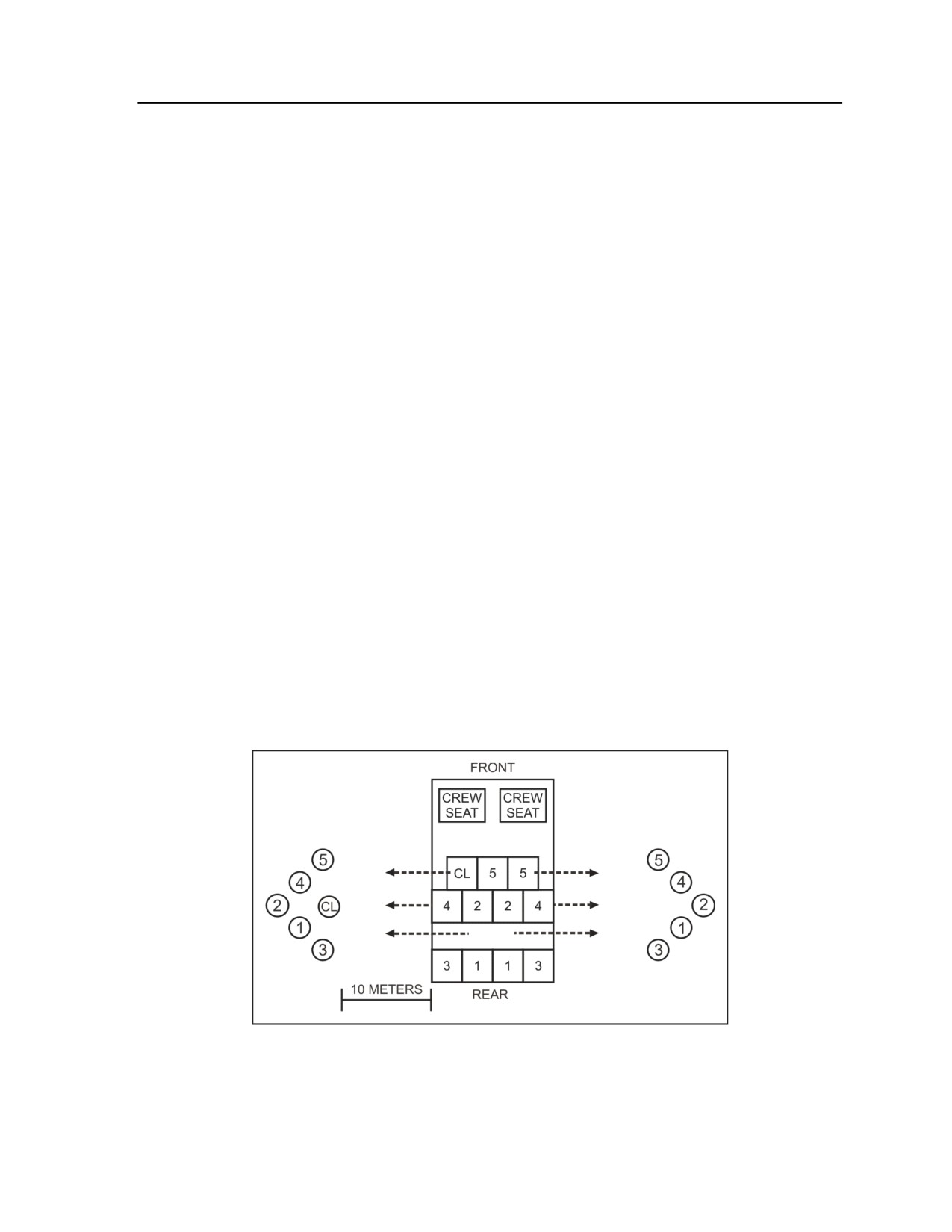
Chapter 6
PZ Closure
6-116. During air infiltration operations, the PSG is responsible for maintaining security and ensuring that
all personnel and equipment are loaded (clearing the PZ). The PSG can use either the single lift or multiple
lift technique in completing the closure.
6-117. Single lift. The PSG positions himself at the last aircraft and collects “bumped” personnel, if
required. He will be the last man to load on the aircraft. Once on the aircraft, the PSG will notify the crew
chief and/or AMC that all personnel and equipment are loaded, using the troop commander’s radio
handset. The aircraft door gunners will provide close-in security.
6-118. Multiple lift. The duties of the PSG are the same as for a single lift. In a multiple lift, the security
teams will maintain security of the PZ and be the last element to depart with the PSG. Depending on their
initial locations, the security teams may have to reposition closer to the PZ. Whenever possible, the aircraft
will land as close to the security team positions as possible to enhance security and minimize the movement
required by the teams.
Actions at the LZ
6-119. All elements and personnel involved in the air assault operation must strictly adhere to the priority
of actions upon landing at the LZ.
Unloading
6-120. Unloading of the aircraft does not begin until directed by the crew chief or pilot. The following
actions occur (see Figure 6-29):
z
Once an aircraft lands, personnel unbuckle their seatbelts and exit as quickly as possible with all
equipment.
z
Prior to leaving the aircraft, the chalk leader obtains the landing direction from the pilot (if it
was not determined during the approach into the LZ). This will aid in orientation to the LZ,
particularly at night.
z
Individuals move 10 to 15 meters out from the side of the aircraft and assume the prone
position, facing away from the aircraft with weapons at the ready, until the aircraft has departed
the LZ.
Figure 6-29. UH-60 two-sided offload
6-36
FM 3-20.98
3 August 2009
Enablers
Immediate Actions on a Hot LZ
6-121. When leaders decide to use a hot LZ or if the chalk receives contact upon landing, troops quickly
dismount and move 15 to 20 meters away from the aircraft. The troops immediately return enemy fire to
allow the aircraft to depart. The following actions occur:
z
If the contact is similar to a far ambush, troops fire and maneuver off the LZ to the closest
location offering cover and concealment.
z
If troops receive contact from nearby enemy positions, they treat it as a near ambush by
immediately returning fire. Soldiers who consider themselves in the kill zone may assault the
enemy positions or attempt to get out of the kill zone based on unit SOP. Soldiers not in the kill
zone provide supporting fire to facilitate movement of troops in the kill zone.
z
The squad or platoon leader calls for fire support, if available.
z
Once friendly elements disengage from the enemy force, the squad or platoon leader moves the
unit to a covered and concealed position, accounts for personnel and equipment, and assesses
the situation as to whether or not the unit can continue the mission.
Chalk Assembly on a Cold LZ
6-122. After the aircraft is unloaded, the chalk leader (squad leader) moves the chalk to its predetermined
locations using the traveling overwatch movement technique. All Soldiers and/or elements move at a fast
pace to the nearest concealed position. Once at the concealed assembly point, the chalk leader makes a
quick count of personnel and equipment and then proceeds with the mission.
MEDICAL EVACUATION
6-123. The reconnaissance or scout platoon contacts the medical company on the medical company
command frequency for all ambulance requests. If the platoon is unable to contact the medical company on
that frequency, the platoon should attempt to relay the request on the next higher command frequency. The
platoon uses the standard nine-line air evacuation request format (see Figure 6-30). Refer to Table 6-7 for
an example of the radio transmission for terminal guidance during evacuation operations.
6-124. The medical company prioritizes the request with others it receives to determine if air evacuation
is possible. In conducting the evacuation operation, the reconnaissance platoon must accomplish the
following tasks:
z
Prepare and secure a suitable PZ/LZ for the aircraft.
z
Provide terminal guidance during the aircraft’s approach to the PZ/LZ.
3 August 2009
FM 3-20.98
6-37
Chapter 6
NINE-LINE AIR EVACUATION REQUEST FORMAT
Units must use the following nine-line format to provide the necessary information when
requesting air evacuation (either MEDEVAC or CASEVAC) for casualties.
LINE 1 - LOCATION.
_______________________________________________________
Specify the grid coordinates for the six-digit grid location, preceded by the 100,000-meter
grid identification.
LINE 2 - RADIO FREQUENCY/CALL SIGN.
_____________________________________
The frequency and call sign should be that of the radio at the site of the unit requesting
evacuation.
LINE 3 - PATIENT CATEGORY OF PRECEDENCE.
______________________________
Classify the casualties’ priority for evacuation using the following terms:
• Urgent. Evacuation required within 2 hours to save life or limb.
• Priority. Patient’s medical condition will deteriorate, becoming urgent within 4
hours.
• Routine. Evacuation required, but patient’s condition is not expected to deteriorate
for several hours.
• Tactical immediate. Evacuation required so casualties do not endanger the
tactical mission.
LINE 4 - SPECIAL EQUIPMENT/EMERGENCY MEDICAL SUPPLIES.
_______________
List all requirements.
LINE 5 - NUMBER AND TYPE OF CASUALTIES.
________________________________
Provide a complete, accurate list.
LINE 6 - SECURITY OF PICKUP SITE. _________________________________________
Describe conditions for security at the LZ/PZ.
LINE 7 - SIGNALING AND SITE MARKING. _____________________________________
Specify the signaling and marking methods.
LINE 8 - PATIENT NATIONALITY AND STATUS.
________________________________
Provide a complete, accurate list.
LINE 9 - CBRN CONTAMINATION AREA.
______________________________________
Specify locations of any contaminated areas affecting the evacuation operation.
Figure 6-30. Format for air evacuation requests
Table 6-7. Example radio transmissions for terminal guidance to an air evacuation site
EVACUATION AIRCRAFT
PLATOON
“Hardrock 16, Dustoff 26 is 30 seconds inbound to
your location. Request terminal guidance, over.”
“Dustoff 26, this is Hardrock 16. Signal is displayed,
over.”
(NOTE: Use the signaling method specified
in the nine-line evacuation request.)
“Roger, Hardrock. Dustoff has red smoke, over.”
“Dustoff 26, roger red smoke, over.”
6-38
FM 3-20.98
3 August 2009
Enablers
SECTION III - COMBAT ENGINEER SUPPORT
6-125. The basic engineer unit with which the reconnaissance or scout platoon is likely to operate is a
sapper squad from a combat engineer platoon. A parallel consideration is that sapper-qualified scouts
enhance reconnaissance platoon capabilities and can provide support to attached engineer assets (see FM 3-
34.170 for additional information).
ENGINEER SUPPORT IN RECONNAISSANCE OPERATIONS
6-126. In reconnaissance operations, an engineer reconnaissance team usually functions in DS to a
reconnaissance or scout platoon. The engineers remain attached to the platoon for the duration of the
reconnaissance. The engineer team’s primary objective is to collect obstacle intelligence (OBSTINTEL)
and report the information back to the BCT/ACR engineer to facilitate breach planning and preparation.
The engineer team may perform the following functions:
z
Conduct limited reduction of obstacles, such as log cribs, abatis, and minefields. Reduction
capabilities of the engineer reconnaissance team are limited to manual and explosive methods.
z
Conduct tactical or technical reconnaissance.
z
Conduct route and bridge classification.
z
Assist in locating and marking bypasses around obstacles.
z
Identify the exact composition and dimensions of an obstacle.
z
Identify breach points and points of penetration.
6-127. Engineers conduct reconnaissance support in the offense as part of the combined arms team
reconnaissance effort. Normally, they support reconnaissance elements to facilitate C2 and logistical
support in an attached status.
6-128. Engineers conduct technical reconnaissance to collect specialized information about a designated
target, area, or route. Engineers conduct this mission under low-level threat conditions in areas physically
controlled by friendly forces. The technical reconnaissance mission is normally a specified task from
higher headquarters or derived from mission analysis.
6-129. Whenever possible, the attached engineer elements should have a habitual relationship with the
scouts. They should be task organized with the reconnaissance or scout platoon as early as possible in an
operation and integrated into the platoon leader’s troop-leading procedures, rehearsals, OPORD, and
movement plans.
ENGINEER SUPPORT IN SECURITY OPERATIONS
6-130. In security operations, the reconnaissance or scout platoon does not usually have any engineer
assets operating under its control. Engineer assets normally work under squadron/battalion or troop control.
The platoon leader must have access to the squadron/battalion or troop obstacle plan, including the
locations of lanes and gaps.
6-131. The platoon may interact with the engineers in several roles during security operations. The
commander may direct the platoon to observe NAIs to trigger scatterable mine missions if required,
overwatch obstacles, and call for indirect fires. The platoon may also guard, execute, and overwatch
reserve demolition targets that engineers have prepared.
TARGET HANDOVER
6-132. The platoon assumes responsibility for targets and obstacles using the following procedures and
considerations:
z
Prior face-to-face coordination between the senior member of the emplacing unit (normally an
engineer squad leader) and the demolition guard force commander (normally a reconnaissance
squad leader) speeds the turnover process. Leaders conduct prior coordination if the tactical
situation permits.
z
The senior member of the emplacing unit must require positive identification from the demolition
guard commander. This may be by means of sign/countersign procedures or by personal recognition.
3 August 2009
FM 3-20.98
6-39
Chapter 6
z
Once identification is established, the emplacing unit gives the demolition guard commander a
completed target folder for the turned-over target. The folder contains orders to the demolition guard
commander and, if separately designated, to the firing party commander. The demolition guard
commander reviews the orders to ensure he thoroughly understands them and then signs the orders.
z
The senior member of the emplacing unit then describes the obstacle in detail to the demolition
guard commander.
z
Once the demolition guard commander fully understands his responsibilities and he (or the
firing party commander, if applicable) is capable of executing the target, the emplacing unit may
depart to conduct further operations.
PRIORITY OF EFFORT IN RECONNAISSANCE AND OFFENSIVE SECURITY OPERATIONS
6-133. During reconnaissance operations, priority of effort is normally mobility, countermobility, and
survivability. Priority of mobility effort is the designated route the platoon travels. Considerations for the
employment of engineers in support of reconnaissance or offensive security missions include the
following:
z
Normally move well forward, either with or immediately behind the platoon.
z
Supplement route reconnaissance by assessing specific roadway features that are damaged or
require more technical engineer analysis.
z
Create bypasses around obstacles.
z
Reduce obstacles beyond platoon capability that significantly affect the mission.
z
Emplace tactical bridging.
z
Improve ford sites.
z
Improve embankments at vehicle swim sites.
z
Emplace protective minefields on exposed flanks.
z
Construct combat trails.
PRIORITY OF EFFORT IN DEFENSIVE SECURITY OPERATIONS
6-134. During defensive security operations, priority of effort is normally countermobility, survivability, and
mobility. Considerations for employment of engineers in support of defensive security missions include—
z
Beginning work as early as possible and operating continuously throughout the mission within
tighter constraints imposed by crew rest and equipment maintenance.
z
Task specific pieces of engineer equipment to construct survivability positions concurrently with
obstacle emplacement.
z
Prioritize countermobility effort to specific portions of the obstacle plan.
z
Ensure engineers construct improved fighting positions and vehicles are emplaced as time and
situation permit.
z
Emplace tactical bridging to improve mobility of platoon assets.
z
Build combat trails to support the execution of reserve contingencies and platoon displacement.
z
Emplace hasty obstacles during the mission to support platoon FRAGOs.
z
Create bypasses around obstacles created by battle damage during the mission.
ENGINEER SUPPORT IN STABILITY OPERATIONS
6-135. The reconnaissance platoon uses engineer support during stability and counterinsurgency
operations to—
z
Construct fighting positions.
z
Construct combat outposts.
z
Provide barrier material for checkpoints, combat outposts, etc.
6-40
FM 3-20.98
3 August 2009
Enablers
SECTION IV - INTELLIGENCE
6-136. Sensor teams may augment reconnaissance platoons to enhance their surveillance capability. The
teams detect targets and provide accurate range and azimuth readings to enemy locations during limited
visibility conditions. In addition, integration of tactical UASs by the reconnaissance platoon is critical for
maximum effectiveness and survivability of dismounted scouts. See FM 3-20.971, FM 3-20.96, FM 2-22.3,
and FM 3-04.15 for additional information.
SENSOR TEAMS
6-137. Sensor teams employing ground surveillance systems can enhance the surveillance capability of
the reconnaissance platoon. The teams can detect targets and provide accurate range and azimuth readings
to enemy locations during limited visibility conditions.
6-138. The teams may be attached or OPCON to troops or platoons for specific missions. The platoon
leader plans the employment of a sensor team when attached or OPCON. He should work with the
commander to position the sensor assets in conjunction with reconnaissance OPs to provide local security
and protection.
CAPABILITIES AND LIMITATIONS
6-139. Sensor teams provide mobile, all-weather surveillance. When employed, they can provide
observation from a given vantage point 24 hours a day. Some systems can detect targets through light
camouflage, smoke, haze, light snow and rain, and darkness. However, foliage, heavy rain, and snow
seriously reduce its capability.
6-140. Other systems do not require a background to detect moving targets while most are generally
ineffective against an air target unless the aircraft is flying close to the ground. Sensor systems are
vulnerable to enemy direction-finding and jamming equipment. The sensor team is sometimes equipped
with a single radio. If employed forward with the scouts, the team usually sends all reports to the platoon
leader for passage to higher.
EMPLOYMENT
6-141. The platoon leader assigns the sensor team a specific sector of surveillance and frequency of
coverage. Surveillance tasks assigned to sensor teams include these:
z
Monitor avenues of approach or possible enemy positions on a scheduled or random basis to
determine location, size, and composition of enemy forces and the nature of their activity.
z
Monitor point targets such as bridges, defiles, or road junctions, and report quantity, type, and
direction of enemy vehicles and personnel moving through the target area.
z
Extend the observation capabilities of the scouts by enabling them to survey distant points and
areas of special interest.
z
Vector patrols to keep them oriented during limited visibility.
GROUND SURVEILLANCE SYSTEMS
6-142. Leaders position surveillance systems in an area that is generally free of ground clutter such as
trees, thick vegetation, and buildings and that affords long-range observation and a wide field of view.
Normally, the platoon leader assigns the team a general area, and the surveillance team leader selects the
specific position. To avoid enemy suppressive fires, the team should be prepared for rapid displacement
and have several alternate positions selected and reconnoitered.
6-143. During reconnaissance operations, leaders employ the surveillance equipment to the flanks of the
reconnaissance or scout platoon or orient it on potential enemy locations. Since reconnaissance is a moving
operation, the surveillance teams will have to move as necessary to support the scouts.
3 August 2009
FM 3-20.98
6-41
Chapter 6
6-144. In security operations, the platoon leader uses surveillance teams to provide redundancy in
surveillance of NAIs and to add depth to the screen line by supplementing OPs.
HUMAN INTELLIGENCE (HUMINT) COLLECTION TEAM
6-145. HUMINT collection teams (HCT) are the elements that collect information from human sources.
HUMINT collectors deploy in teams of approximately four personnel.
6-146. The HUMINT collector’s role is gathering foreign information from people and multiple media
sources to identify adversary elements, intentions, composition, strength, dispositions, tactics, equipment,
personnel, and capabilities. They use human sources and a variety of collection methods to gather
information to satisfy the commander’s information requirements and to cross-cue other intelligence
disciplines.
6-147. HCTs conduct operations throughout the platoon’s AO. They play a crucial role in supporting
tactical forces by conducting debriefings, screenings, military source operations, liaison, interrogations,
and support to DOMEX. HUMINT activities focus on the threat and assist the platoon leader and troop
commander in understanding the threat's decision-making process.
6-148. The HCT maintains constant contact with all reconnaissance units and other assets (scouts,
PSYOP, CA, and MPs) to coordinate and deconflict operations and to cross-check collected information.
UNMANNED AIRCRAFT SYSTEMS OPERATIONS
6-149. UAS elements support reconnaissance missions by obtaining information about activities and
resources of an enemy or potential enemy, or securing data concerning meteorological, hydrographic, or
geographic characteristics of a particular area. A nonlinear, expanded AO will routinely create gaps
between friendly units. Reconnaissance of these gaps is an excellent mission for the UAS. UAS units
perform reconnaissance before, during, and after combat operations and provide the combat information to
applicable tactical leaders and users, who in turn pass it along as SA for higher and adjacent echelons and
combatants. UAS-supported reconnaissance missions can provide information on the enemy or
reconnaissance target using the SALUTE report categories:
z
Size.
z
Activity.
z
Location.
z
Unit.
z
Time.
z
Equipment.
6-150. Information derived from UAS assets facilitates reconnaissance and surveillance. UASs provide
additional information needed by the platoon leader to determine which routes and cross-country terrain
best accommodate reconnaissance operations. In addition, the platoon takes information generated by UAS
units and immediately sends spot reports to organizations that need combat information. UASs augment
ground reconnaissance efforts from as close as seeing over the next hill or around the next block to as far
as hundreds of kilometers away, corresponding with the platoon’s AO
(see FM 3-04.15 for more
information).
6-151. The platoon employs UASs organic to the reconnaissance troop, the man-portable RQ-11 Raven,
but can also have direct access to real time or near-real time feeds from additional UAS support provided
by the squadron, BCT, or higher headquarters such as the RQ-7 Shadow UAS—a BCT asset. Whereas the
platoon operates the RQ-11 Raven, the platoon only receives support from higher UAS assets. See Chapter
1 for information on the RQ-11 Raven.
6-42
FM 3-20.98
3 August 2009
Enablers
UAS SENSOR CHARACTERISTICS
6-152. Currently two types of imagery sensors are available for use on man-portable and tactical UASs—
electro-optical
(EO) and IR. Each sensor has unique capabilities, with distinct advantages and
disadvantages. Table 6-8 is a matrix of characteristics for the EO and IR sensors currently available.
Note. Additional types of sensors and other tactical UAS payloads are currently under
development and may be fielded as their respective technologies mature.
Table 6-8. UAS sensor characteristics
SENSOR TYPE
ADVANTAGES
DISADVANTAGES
Electro-optical
Best tool for detailed analysis during
Can be deceived by employment of
(visible light)
daytime and clear weather.
camouflage and concealment
techniques.
Affords a familiar view of a scene.
Restricted by weather conditions;
Offers system resolution that cannot be
visible light cannot penetrate clouds or
achieved with other optical systems,
fog.
thermal images, or radar.
Restricted by terrain and vegetation.
Preferred for detailed analysis and
mensuration.
Limited to daytime use only.
Offers stereoscopic viewing.
Infrared
Best tool for detailed analysis in
Not effective during thermal crossover
darkness with clear weather.
(1 to 1.5 hours after sunrise or sunset).
Passive sensor that is impossible to
Tactical UASs can be threatened by
jam.
enemy air defenses.
Offers camouflage penetration.
Bad weather degrades quality of
sensor images.
Provides good resolution.
Offers nighttime imaging capability.
RELATIONSHIP OF THE UAS ELEMENT AND THE RECONNAISSANCE/SCOUT PLATOON
6-153. Tactical UASs are a significant asset in support of the ground commander’s requirements for his
scouts. When operating with ground scouts, the UAS element is normally OPCON to the squadron or
battalion. To be successful, however, the element must communicate and coordinate directly with the most
forward ground scouts.
6-154. Complementing ground scouts with the UAS element maximizes the capabilities of both units
while minimizing their limitations. When it works with the reconnaissance or scout platoon, the UAS
element normally operates the UASs forward of the ground elements (see Figure 6-31). The exact distances
are determined through a thorough METT-TC analysis.
6-155. In a complementary relationship, the commander assigns the UASs and reconnaissance/scout
platoons different objectives or tasks; they work independently as required to support their common
commander. This permits the accomplishment of more tasks or separate missions simultaneously. Often,
the UAS element complements ground scouts by performing missions to the flank of or adjacent to the
reconnaissance or scout platoon (as illustrated in Figure 6-32). In addition, the UAS element may provide
the scouts with valuable reconnaissance information acquired during flights to and from its objective.
3 August 2009
FM 3-20.98
6-43
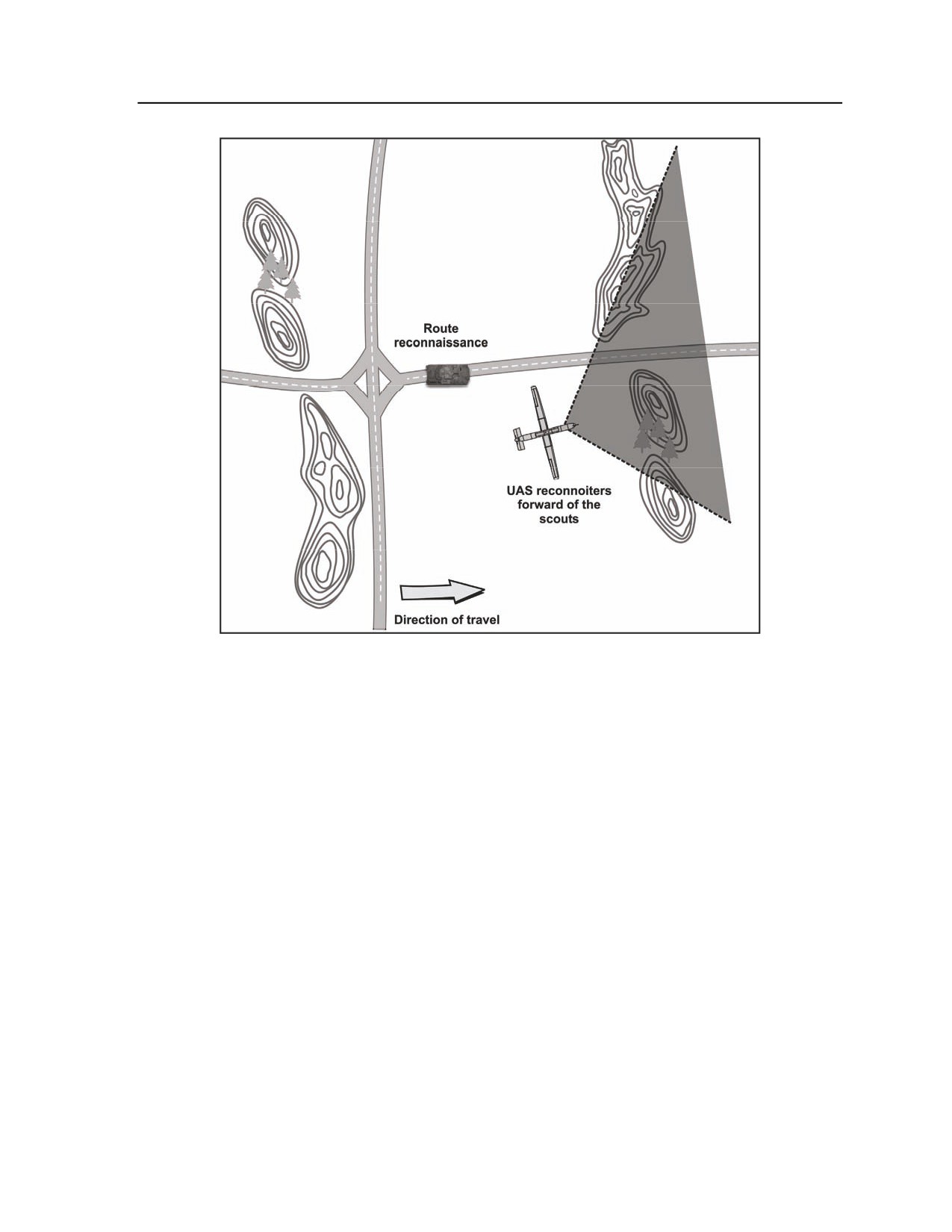
Chapter 6
Figure 6-31. UAS operating forward of a reconnaissance platoon
6-44
FM 3-20.98
3 August 2009
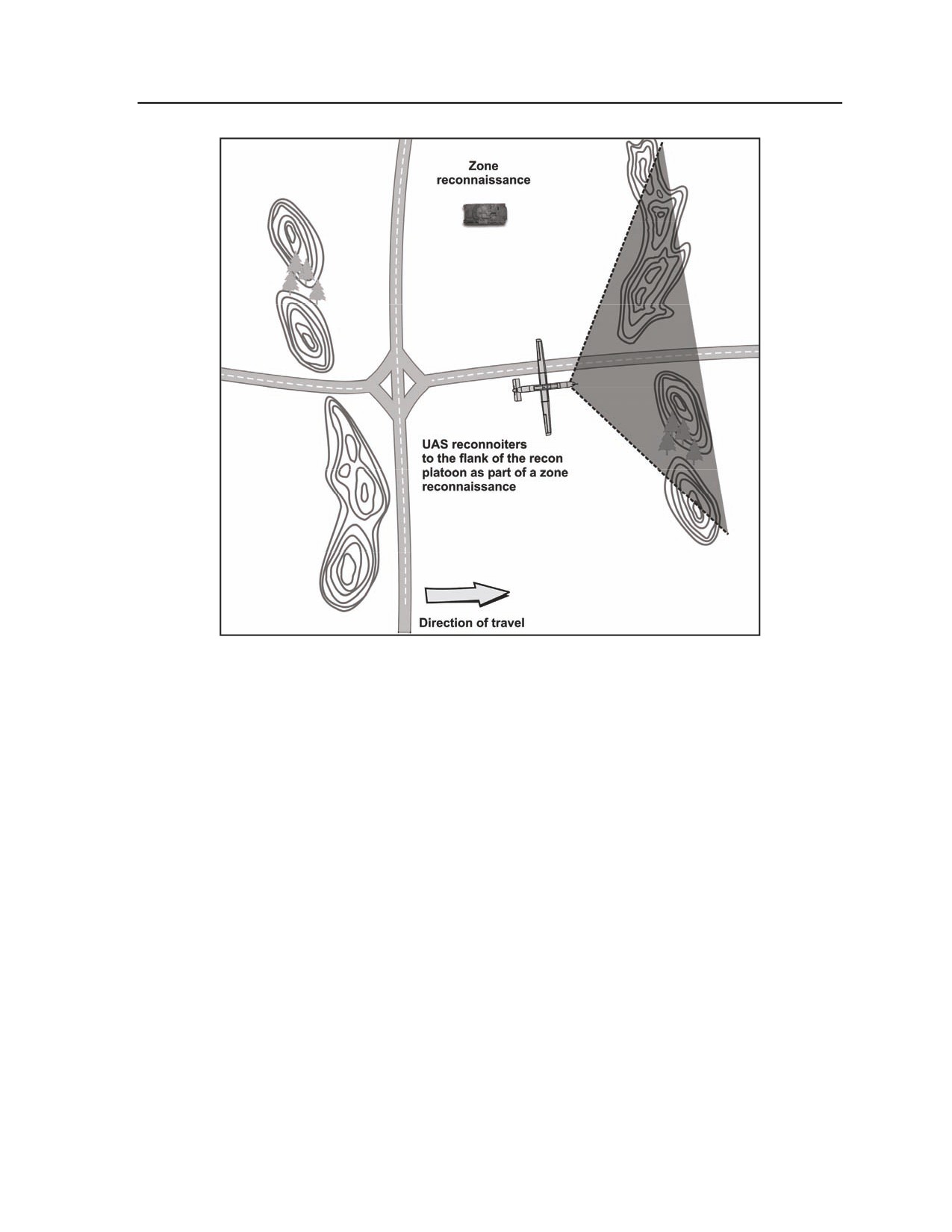
Enablers
Figure 6-32. UAS operating on the flank of a reconnaissance platoon
Command and Control
6-156. C2 is essential to effective air-ground coordination. The command relationship is particularly
critical when air and ground elements are complementing each other’s operations. Three different
command relationships can be used to coordinate the efforts of the UAS element and the reconnaissance
platoon:
z
The reconnaissance/scout platoon can be OPCON to the surveillance troop commander (this
primarily applies to the SBCT reconnaissance platoon)
z
The reconnaissance/scout platoon and the UAS element can work independently for a common
higher commander.
z
The UAS element is OPCON to the reconnaissance/scout platoon.
6-157. The ground scouts and the UAS element must closely coordinate their actions even when air
elements are not OPCON to the reconnaissance or scout platoon. The situation will determine whether the
UAS element leader or the surveillance troop commander in the SBCT reconnaissance is the air mission
commander (AMC).
Reconnaissance/Scout Platoon OPCON to the Surveillance Troop Commander
6-158. Leaders use the OPCON relationship when the reconnaissance or scout platoon is operating
separately from its parent unit with the surveillance troop commander. The platoon has the preponderance
of combat power, leadership, and C2 resources in the AO.
3 August 2009
FM 3-20.98
6-45
Chapter 6
Reconnaissance/Scout Platoon and UAS Element Under Control of a Common Commander
6-159. This relationship is the most common and is usually the most effective. The reconnaissance or
scout platoon and UAS element operate independently, allowing each to employ its elements freely and
quickly to take maximum advantage of their unique capabilities. Further, the next higher common
commander ensures that the efforts of both the UAS element and scouts’ are coordinated. In this
relationship, informal coordination occurs directly between the two platoons over the reconnaissance or
scout platoon network.
UAS Element OPCON to the Reconnaissance/Scout Platoon
6-160. This relationship allows the platoon the most flexibility. The platoon leader can integrate the
capabilities of the UASs into the reconnaissance plan in a seamless manner. He can then respond quickly to
mission/target changes.
Reconnaissance Operations
6-161. When the UAS element complements the reconnaissance or scout platoon during reconnaissance
operations, the UAS normally operates 1 to 10 kilometers forward of the scouts (METT-TC dependent).
The UAS element can conduct detailed reconnaissance of areas that are particularly dangerous to ground
reconnaissance elements, such as open areas and defiles. Upon contact, the UAS provides early warning
for the reconnaissance or scout platoon and then maintains contact until the ground platoon moves up for
handover.
Security Operations
6-162. The UAS element can complement the reconnaissance or scout platoon during security operations
by assisting in identifying enemy reconnaissance and main body elements and providing early warning
forward of the scouts. In addition to acquiring enemy elements, the UAS can play a critical role in
providing security through the depth of the screen by observing dead space between OPs.
6-163. Because of the range of its sensors, the UAS does not require positions forward of the
reconnaissance or scout platoon to acquire enemy elements. The preferred practice, however, is still to
position the aerial OPs forward of the ground OPs to provide added depth to the screen, especially during
daylight operations. Ultimately, positioning of the UAS will always depend on the specific METT-TC
situation (see Figure 6-33).
6-46
FM 3-20.98
3 August 2009
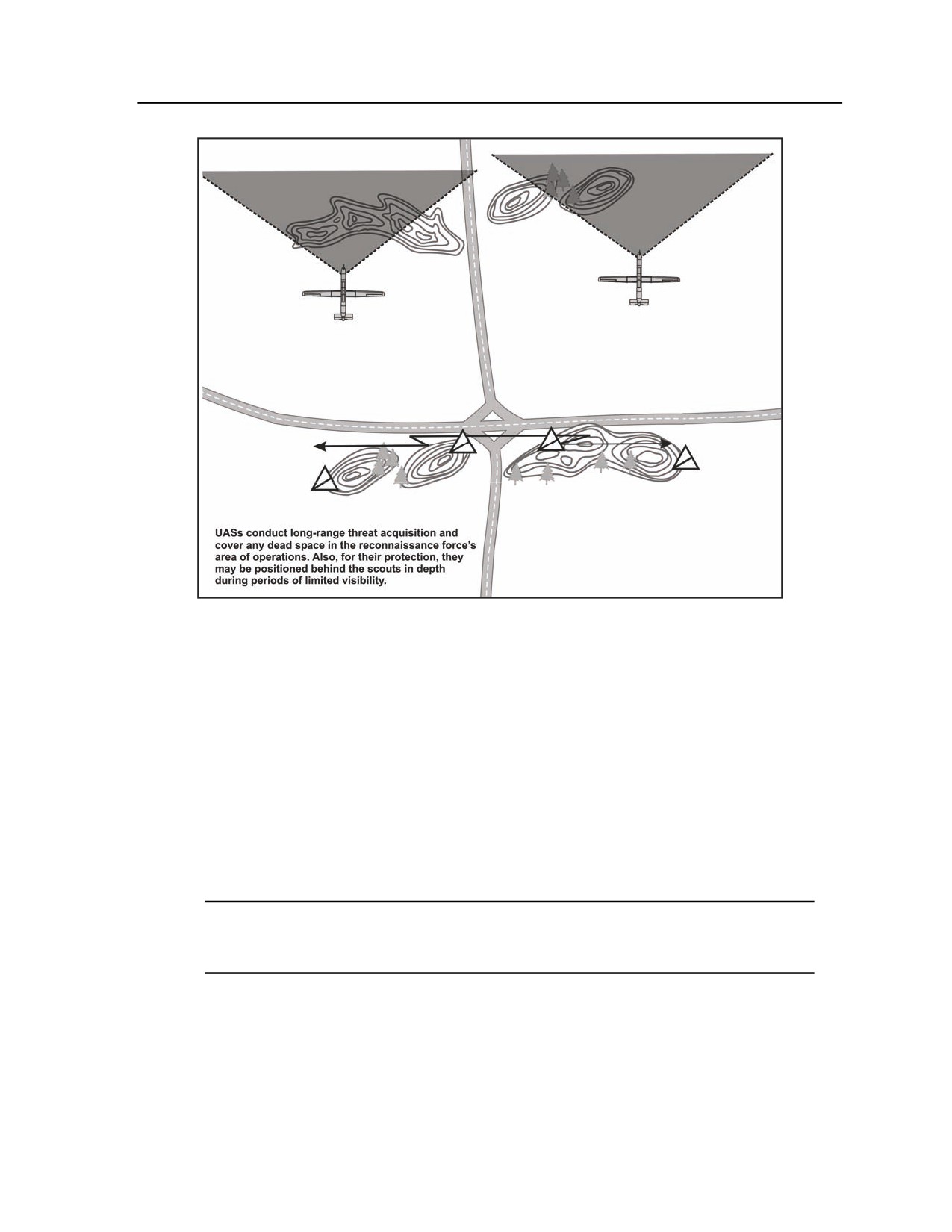
Enablers
Figure 6-33. UASs complementing a ground screen
Area Security
6-164. The UAS element can complement the reconnaissance or scout platoon during area security
missions by screening or conducting reconnaissance. An air screen can provide early warning for a
reconnaissance or scout platoon executing a convoy escort mission or securing a critical point (see Figure
6-34). UASs can identify enemy ambush positions forward of the convoy or find bypasses the convoy can
use to move around an obstacle (as illustrated in Figure 6-35).
6-165. The UAS supporting the lead reconnaissance elements (section or squad) of the platoon can
identify an enemy element before visual or physical contact with the scout. This prevents unwanted
detection and direct fires. The lead vehicle and the overwatch element occupy positions that allow them to
observe the enemy and, if necessary, destroy the enemy while the UAS provides the platoon with area
security overhead. The UAS may also establish and maintain contact with a moving contact while units
conduct a handover during a screening mission.
Note. UASs do not conduct tactical tasks such as a screen or route reconnaissance. The unit
executing such tasks, such as the platoon or troop, employs the aircraft in support of the mission
and in most cases controls the GCS of the UAS element.
3 August 2009
FM 3-20.98
6-47
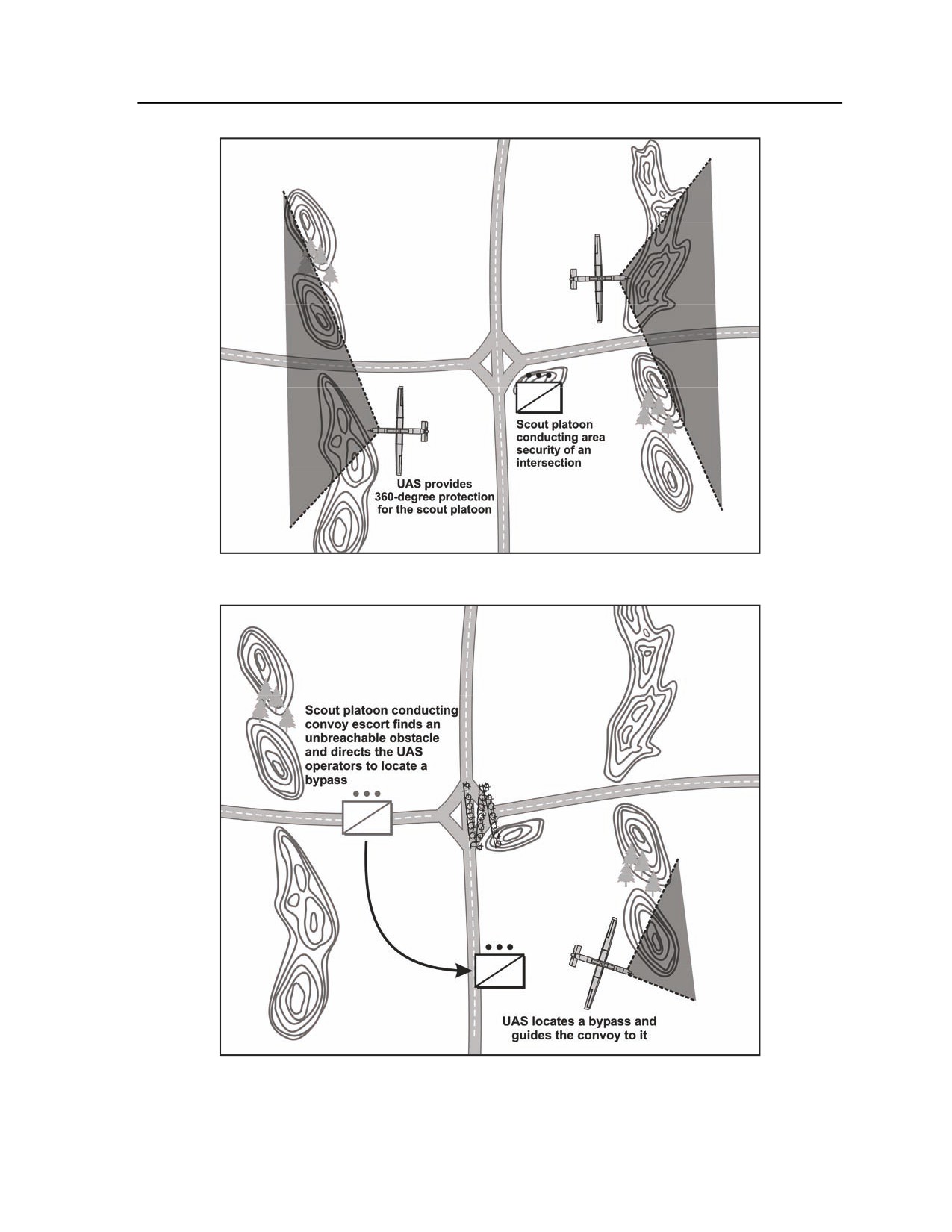
Chapter 6
Figure 6-34. UASs screening for a reconnaissance platoon
Figure 6-35. UAS reconnoitering for a bypass
6-48
FM 3-20.98
3 August 2009
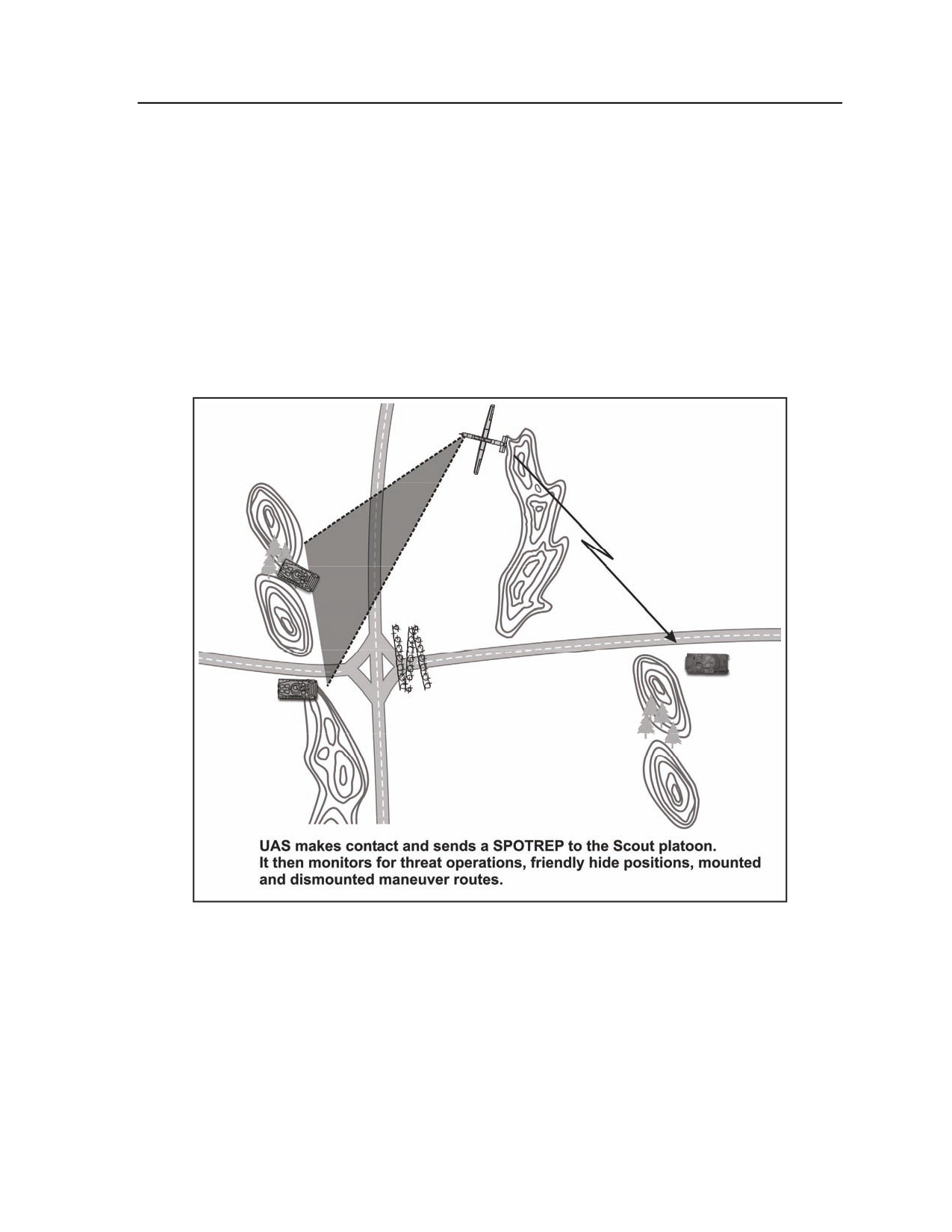
Enablers
UAS-GROUND RECONNAISSANCE HANDOVER
6-166. When the UAS element makes contact, particularly during reconnaissance operations, it will
update its FBCB2 and will hand over the contact to the ground scouts as quickly as possible. A speedy
handover allows the UASs to avoid enemy air defense weapons and helps to maintain the tempo of the
operation.
6-167. During the RHO, the UAS element leader provides recommendations to the platoon leader who
will then direct sections/squads to establish contact. The UAS element is responsible for maintaining
surveillance of the enemy until the ground unit is in position and has established contact.
6-168. The first action in the handover process is a SPOTREP and a SITREP from the UAS element
leader to the reconnaissance platoon leader. Next, the UAS reconnoiters the area for secure positions for
the ground scouts. If possible, the UAS identifies hide positions, overwatch positions, OP positions, and
mounted and dismounted routes into the area (see Figure 6-36).
Figure 6-36. UAS-ground reconnaissance handover (part one)
6-169. The ground section or squad moves to its initial hide positions along the route selected by the
UAS element. Scouts then move dismounted to make contact with the enemy. Once contact is established,
the ground leader sends a SPOTREP to the AMC. When the UAS element leader confirms that the ground
scouts can observe all enemy elements and have a clear picture of the situation, he announces that
handover is complete; the ground section or squad leader acknowledges the transmission.
6-170. After handover is completed, the UAS element may, if directed, break contact and continue its
follow-on missions. As noted previously, leaders may execute the RHO sequence on the reconnaissance or
scout platoon’s internal frequency (see Figure 6-37).
3 August 2009
FM 3-20.98
6-49
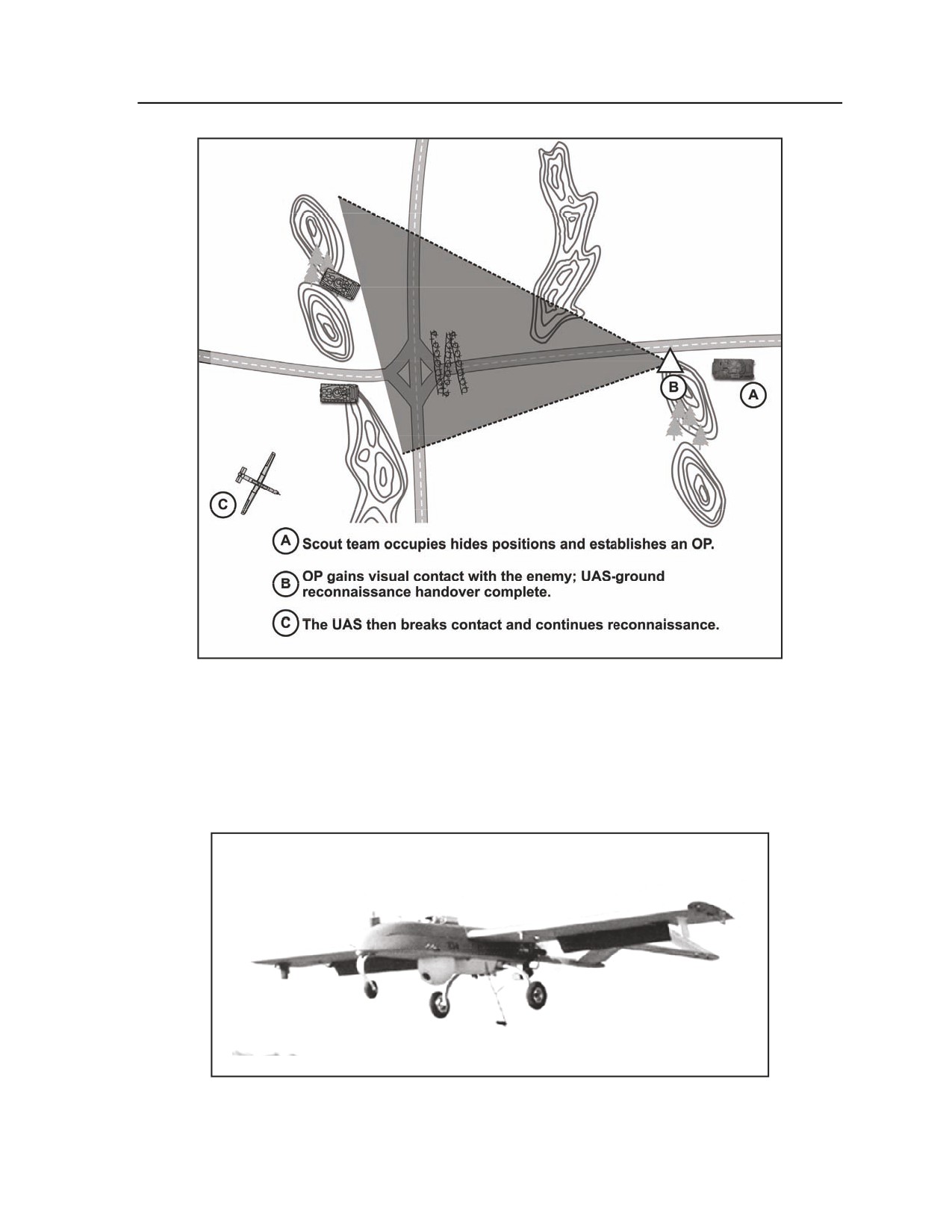
Chapter 6
Figure 6-37. UAS-ground reconnaissance handover (part two)
RQ-7 SHADOW
6-171. The Shadow tactical UAS is powered by a single rotary engine and has a nonretractable tricycle
landing gear for conventional wheeled takeoff and landing. The UAS operator also can launch it from a
catapult; and the Shadow has a tail hook to catch arresting cables for a shorter landing run. An operator
launches and recovers the Shadow using a remote control terminal. (See Figure 6-38.)
Figure 6-38. Shadow UAS
6-50
FM 3-20.98
3 August 2009
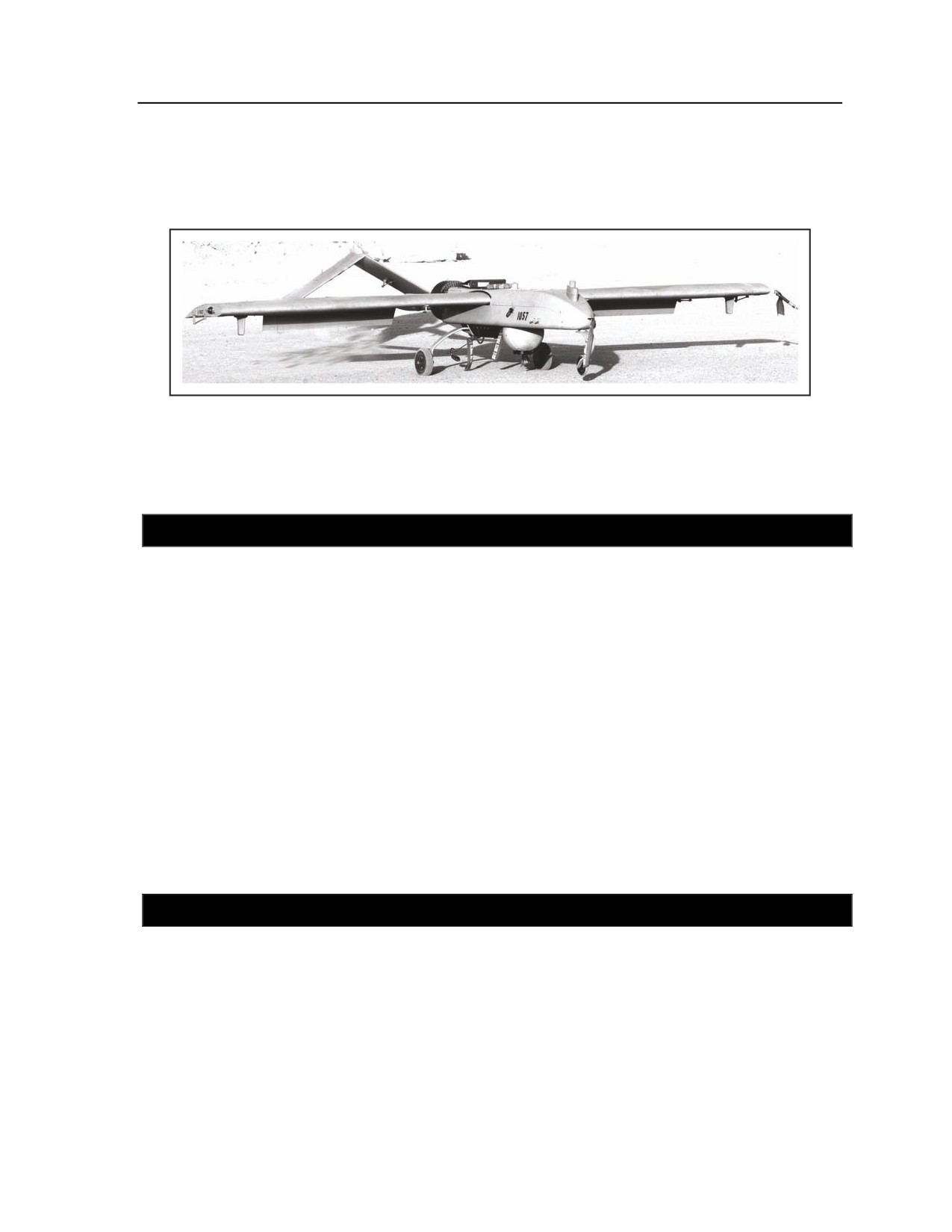
Enablers
6-172. The RQ-7B (see Figure 6-39) has larger wings with a more efficient airfoil and increased fuel
capacity, allowing an endurance of 5 hours. Additionally, the vehicle has an enlarged tail, upgraded
avionics
(including an improved flight controller with an inertial measurement unit and increased
computing power), and new payload options. The RQ-7B is also fitted with the Army's tactical common
data link.
Figure 6-39. Shadow RQ-7B UAS
6-173. Under normal conditions, the UAS aerial reconnaissance platoon (RQ-7 Shadow) can provide a
routine
12 hours on station at a range of
50 kilometers. Under surge operations, the UAS aerial
reconnaissance platoon can provide 18 hours for a 72-hour period.
SECTION V - CIVIL AFFAIRS
6-174. The mission of CA forces is to engage and influence the civil populace by planning, executing,
and transitioning civil affairs operations (CAO) to support the commander in engaging the civil component
of the troop’s AO. In turn, effective CAO can enhance the conduct of CMO, which involve the interaction
of military forces with the civilian populace to facilitate military operations. A supportive civilian
population can provide resources and information that facilitate friendly operations. It can also provide a
positive climate for the military. A hostile civilian population threatens the immediate operations of
deployed forces and can often undermine public support at home for the policy objectives of the United
States and its allies. When executed properly, CMO can reduce friction between the civilian population and
the military force.
6-175. The reconnaissance or scout platoon can expect interaction with CA teams during CMO conducted
as part of full spectrum operations. The platoon identifies a potential target or issue and forwards up the
chain of command. A CA team then evaluates the target or issue. The platoon assists the CA team by
providing security. For example, a squad of the reconnaissance platoon makes contact with a potential
source that may be able to provide information relevant to the BCT as it moves through the area. The squad
reports this contact to the platoon leader, who forwards the reports higher. The commander then tasks a CA
team to evaluate and exploit the source if appropriate. The squad provides security for the CA team. See
FM 3-20.971, FM 3-20.96, and FM 3-05.40 for additional information.
SECTION VI - TACTICAL PSYCHOLOGICAL OPERATIONS SUPPORT
6-176. U.S. forces conduct PSYOP as an integral part of multinational, joint, and single-Service
operations. Army SOF assets conduct the overwhelming majority of tactical PSYOP. PSYOP at the tactical
level support the troop commander’s ability to shape his OE and set the conditions necessary for success.
6-177. The smallest organizational PSYOP element is the tactical PSYOP team (TPT). A TPT generally
consists of a team chief (SSG or SGT), an assistant team chief (SGT or SPC), and an additional Soldier
(SPC) who serves as a gunner and operates the speaker system. A TPT is equipped with a vehicle fitted
with a loudspeaker and often works with a local translator indigenous to the host or occupied country.
6-178. During stability operations and COIN, the commander can attach TPTs to reconnaissance or scout
platoons that make initial contact with the civilian populace. Operating in the platoon AO allows TPTs to
3 August 2009
FM 3-20.98
6-51
Chapter 6
develop rapport with the target audience. This rapport is critical to the accomplishment of the missions of
the platoon, the troop, and the TPT. These teams establish communications, discourage interference with
coalition operations, and induce cooperation from the local populace. They help units to reduce collateral
damage while moving through or into the AO by giving instructions to noncombatants. See FM 3-20.971,
FM 3-20.96, FM 3-05.301, and FM 3-05.302 for additional information.
SECTION VII - AIR AND MISSILE DEFENSE (AMD) SUPPORT
6-179. There are no AMD assets organic to squadrons or battalions. Consequently, the reconnaissance or
scout platoon must be able to protect itself from enemy air attacks during all combat operations. Passive air
defense measures employed by the platoon include actions to avoid detection and air attack and actions to
limit the damage if attacked. If necessary, the platoon takes active air defense measures to fight back
against the enemy aircraft.
6-180. Armed utility and attack helicopters are the enemy’s principal CAS weapon systems. They pose a
major threat to the platoon and other friendly forces. The enemy may also employ UASs to accomplish
ISR, attack, and deception missions. The UASs’ small size and radar cross section and their ability to fly
low and slow make them very difficult to detect, track and engage.
PASSIVE AIR DEFENSE
6-181. Passive air defense is the reconnaissance or scout platoon’s first line of defense against enemy air
attack and UASs. It includes all measures, other than active defense, taken to minimize the effects of
hostile air action and prevent observation by enemy UASs. All elements are responsible for these
measures, which are continuous in nature. There are two types of passive air defense:
z
Attack avoidance.
z
Damage-limiting measures.
ATTACK AVOIDANCE
6-182. Scouts use concealment, camouflage, deception, and any other necessary action to prevent the
enemy from seeing them. When they are moving, they must also make effective use of air guards to
provide early warning of enemy aircraft to allow the platoon to avoid detection.
6-183. Reconnaissance positions must provide effective concealment. One technique is to position
vehicles inside wood lines and erase vehicle track marks leading to the woods. When concealment is not
available, however, Soldiers camouflage vehicles to blend into the natural surroundings. Scouts cover all
shiny objects that could reflect light and attract attention.
DAMAGE-LIMITING MEASURES
6-184. Dispersion is one of the most effective ways to reduce the effects of enemy air attack. It is
essential when a unit is occupying static positions, as in an assembly area, or is preparing to cross a water
obstacle or a breached obstacle. When the platoon is on the move and air guards identify an enemy air
attack, vehicles disperse quickly, move to concealed positions if possible, and stop.
6-185. Another measure is the use of natural or man made cover to reduce the effects of enemy
munitions. Folds in the earth, depressions, buildings, and sandbagged positions can provide this protection.
ACTIVE AIR DEFENSE
6-186. Although passive measures are the first line of defense against air attack, the platoon must be
prepared to engage enemy aircraft. All platoon members must understand that they can defend against a
direct attack but cannot engage aircraft that are not attacking them unless the applicable weapons control
status allows it.
6-52
FM 3-20.98
3 August 2009
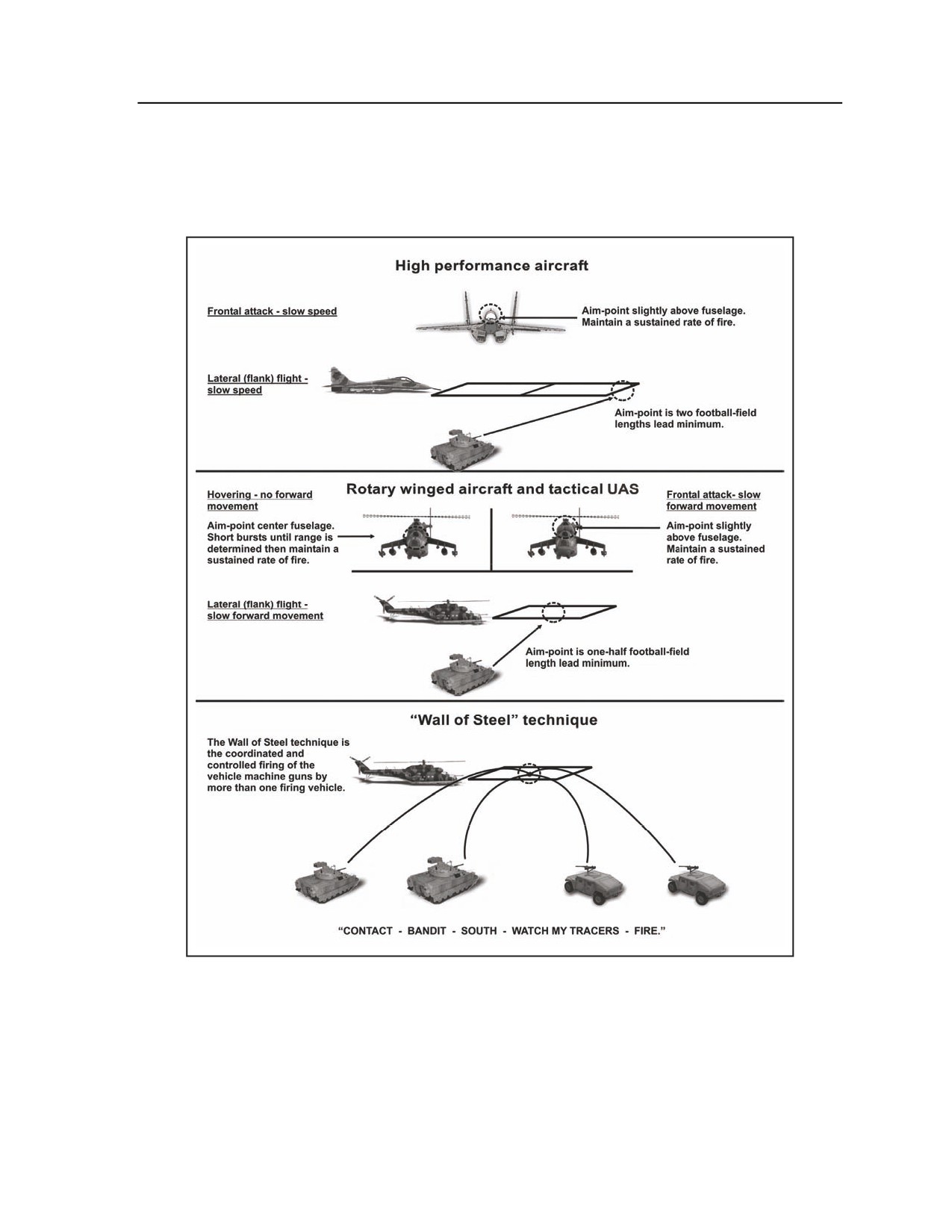
Enablers
6-187. Engaging aircraft with volume fire is the key to effective use of small arms and machine gun fires
against an air attack. These fires must be coordinated to be effective. On the platoon leader’s command,
leaders direct an aim point in front of the target (see Figure 6-40).
6-188. Vehicle commanders should instruct their gunners to fire 20- to 25-round bursts at a high rate to
sustain the proper volume of fire when engaging aerial platforms.
Figure 6-40. Aim points
SHORT-RANGE AIR DEFENSE SYSTEMS
6-189. Reconnaissance or scout platoons may receive support with Stingers or Avengers that counter
high-performance, low-level, ground attack aircraft; helicopters; and observation and transport aircraft,
including UASs.
3 August 2009
FM 3-20.98
6-53
Chapter 6
6-190. At different times, reconnaissance or scout platoons receive Stinger attachments for protection
against airborne threats. In today’s OE, these same Stingers become an HVT for insurgents not to destroy,
but to acquire. Without modification, the enemy can use these against civilian or coalition aircraft.
AIR DEFENSE COMMAND AND CONTROL
6-191. Air defense warning procedures provide measures to alert or prepare the unit for air attack or to
increase unit readiness for an attack. They specify a degree of air attack probability describing the
commander’s evaluation of the general state of the air threat. Any commander can issue a higher level of
warning, but not a lower warning. Actual observation of the enemy or intelligence of enemy activity raises
the level of air defense warning. Refer to FM 3-20.971 for details on command and control, including air
defense warnings.
SECTION VIII - SUSTAINMENT OPERATIONS
6-192. Sustainment elements arm, fuel, fix, feed, and provide transportation and personnel for the
reconnaissance or scout platoon, which has no organic sustainment assets. This creates unique planning
and operational challenges, with most of the responsibility falling to the PSG.
6-193. The PSG is the sustainment coordinator for the platoon; in supervising sustainment within the
platoon, his role is similar to that of the 1SG in the company and troop. He is responsible for advising the
platoon leader of the platoon’s logistical requirements during preparation for combat operations as well as
its current logistical status once operations are under way. The platoon’s NCOs assist the PSG in executing
resupply operations and in determining the platoon’s logistical needs. In combat operations, the PSG
coordinates directly with the 1SG, informing him of requirements and problems. Platoons coordinate for
sustainment using this procedure. With prior coordination, elements such as the task force reconnaissance
platoon can coordinate support with the 1SG of the troop that is nearest them (see FM 3-20.971 for
additional information).
SUPPLY OPERATIONS
6-194. Reconnaissance or scout platoons have a large amount of equipment and require frequent resupply
to accomplish their mission. Leaders make required periodic checks to ensure accountability and usability
of the platoon’s equipment, especially high-use items. Leaders must anticipate expenditures and request
supplies before an operation begins.
CLASSES OF SUPPLY
6-195. There are 10 categories—or classes—of supply. Table 6-9 lists the classes, what each class covers,
and some of the considerations for the platoon.
6-54
FM 3-20.98
3 August 2009
Enablers
Table 6-9. Classes of supply
CLASS
CONSISTS OF:
CONSIDERATIONS
I
Subsistence such as food and water
Vehicles carry as much water as is practical
Health, morale, and welfare items
Adjust water and rations for temperature,
climate, MOPP, etc
II
Organizational clothing and individual
The troop brings the sanitation, cleaning, and
equipment (OCIE), field sanitation items,
administrative supplies with the LOGPAC
administrative, housekeeping supplies and
Scouts receive replacement OCIE items on an
equipment, tool sets, and tentage, etc
individual, as-needed basis
III
Petroleum, oils, and lubricants (POL):
Refueling should occur in limited visibility
• Fuel
Refueling occurs daily, at the conclusion of major
operations, or METT-TC dependent
• Oil and grease
• Hydraulic fluid
Replenish POL products at each refueling
IV
Construction and barrier materials such as
Used to construct OPs and obstacles and to
lumber, sandbags, concertina, and pickets
improve fighting positions
V
All types of ammunition including small arms,
Rearming should occur in limited visibility and
artillery and tank rounds, mines, demolitions and
frequency is METT-TC dependent
fuses, missiles, and bombs
Distribute ammunition (cross leveling) throughout
the platoon—METT-TC dependent
VI
Personal demand items such as tobacco
Normally sold in the exchange (when available)
products, confections, and toiletry articles
or with Class I as sundry packets
VII
Major end items such as tanks, helicopters, and
Report the destruction of major end items
radios, and major weapon systems
immediately by means of logistical reports
This equipment is assembled and ready for use,
Parent unit replaces these items when losses are
include combat vehicles, missile launchers
reported
VIII
Medical supplies such as refills for first-aid kits,
Provided through the squadron/battalion medical
water purification, and individual medical supplies
platoon
IX
Repair parts and components for equipment
Request through the higher unit maintenance
maintenance
Scouts may carry common items to sustain
operations and minimize maintenance support
X
Material to support nonmilitary programs such as
Requests are based on requirements from civil-
agriculture and economic development not
military and/or operations channels at troop level
covered in other supply classes.
and higher
TROOP AND SQUADRON SUPPORT
6-196. The reconnaissance or scout platoon in a reconnaissance or cavalry squadron receives all of its
sustainment through its parent troop. The PSG coordinates with his 1SG for everything the platoon
requires. The 1SG is thus the key operator in the sustainment chain. He does most of the coordination with
the squadron combat trains command post and controls the logistics package (LOGPAC) and its operation.
Based on the tactical situation, the 1SG will also choose the techniques of resupply.
BASIC AND COMBAT LOADS
6-197. Two sets of guidelines, for the basic load and the combat load, prescribe the quantities of supplies
required by the reconnaissance or scout platoon during tactical operations. A summary of the techniques of
resupply follows this discussion.
3 August 2009
FM 3-20.98
6-55
Chapter 6
Basic Load
6-198. The basic load is the quantity of supplies in Classes I, II, III, IV, V, and VIII that the platoon is
required to have on hand to initiate combat operations. The platoon’s higher headquarters designates the
basic load based on analysis of the platoon’s mission and the anticipated threat.
Combat Load
6-199. The combat load is the quantity of supplies, in all classes, that the platoon must have on hand to
sustain operations in combat for a prescribed number of days. Like the basic load, higher headquarters
designates the platoon’s combat load. The platoon’s parent unit must be capable of moving the combat load
using organic transportation assets, into combat in a single delivery.
METHODS OF RESUPPLY
6-200. The tactical situation is the major factor dictating which method of resupply the reconnaissance or
scout platoon will use. The most common methods are those involved in routine resupply using a
LOGPAC: tailgate resupply, service station resupply, a variation of one type, or a combination of both
types. The platoon may also receive supplies by other methods, such as pre-positioning or aerial resupply.
6-201. The situation will also dictate when resupply takes place. Generally, scouts attempt to avoid
resupply during reconnaissance operations; rather, they should conduct resupply during mission transition.
Resupply is unavoidable during security missions of long duration. The LOGPAC may include medical
support as needed.
Routine Resupply Methods
6-202. In the tailgate method, the PSG, or another responsible individual who is assisting him, brings
forward fuel and ammunition to the reconnaissance sections or squads (see Figure 6-41). The platoon uses
this method when routes leading to vehicle positions are available (including successful infiltration routes)
and the unit is not under direct enemy observation and fire. Tailgate resupply is time-consuming but
stealthier in security missions when the scouts are not moving. The platoon further minimizes signatures by
hand-carrying supplies to vehicle positions, if necessary.
6-203. In the service station method, vehicles move to a centrally located rearm and refuel point, either by
squad or section or as an entire platoon (refer to Figure 6-42). Service station resupply is inherently faster
than the tailgate method. Because vehicles must move and concentrate, however, it can create security
problems. During screening missions, the platoon must be careful not to compromise the location of OPs.
Units commonly use this method during mission transition.
6-204. The platoon leader can vary the specifics of the two basic methods, or he can use them in
combination. During a screening mission, for example, he may use the tailgate method for his most
forward OPs and the service station method for his OPs in depth (see Figure 6-43).
6-56
FM 3-20.98
3 August 2009
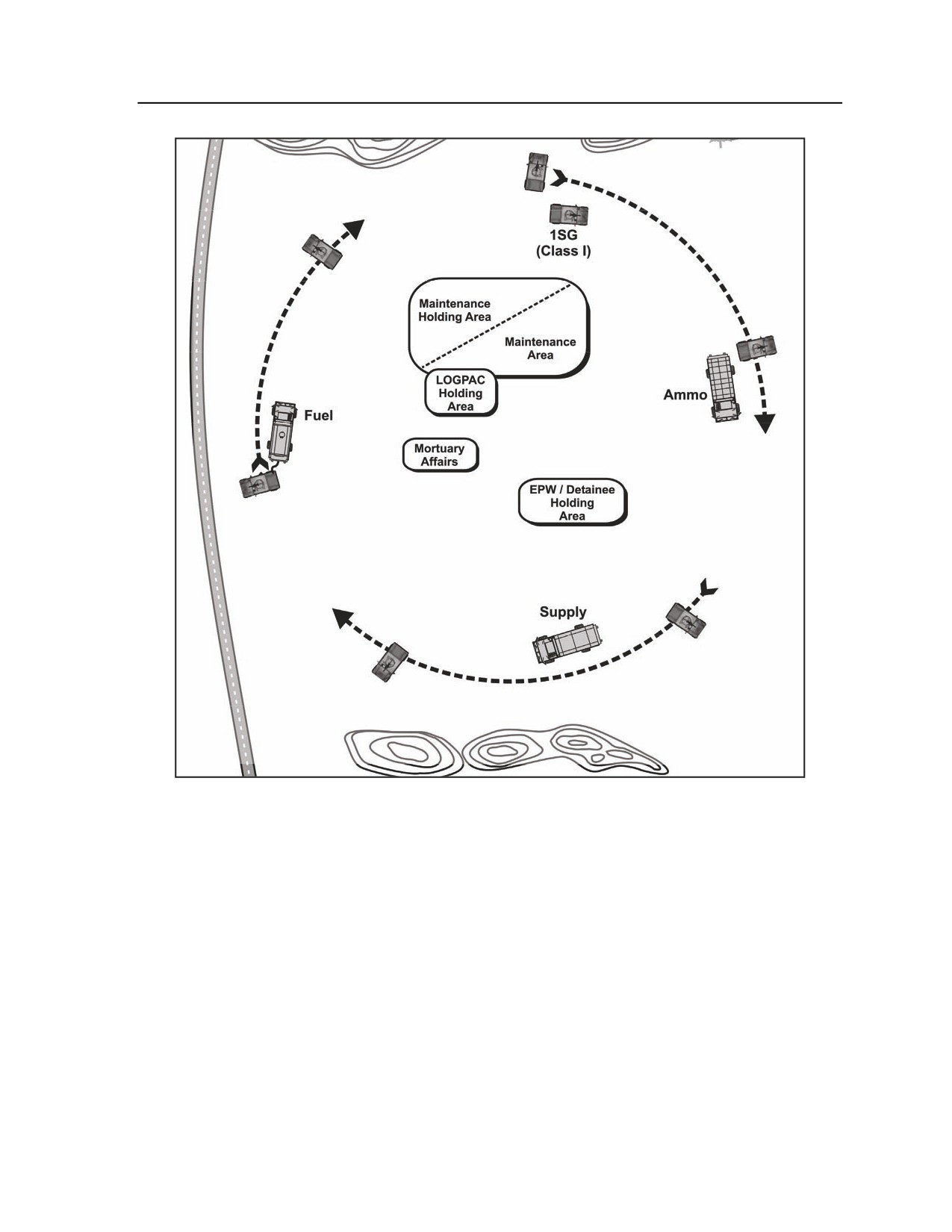
Enablers
Figure 6-41. Tailgate resupply method
3 August 2009
FM 3-20.98
6-57
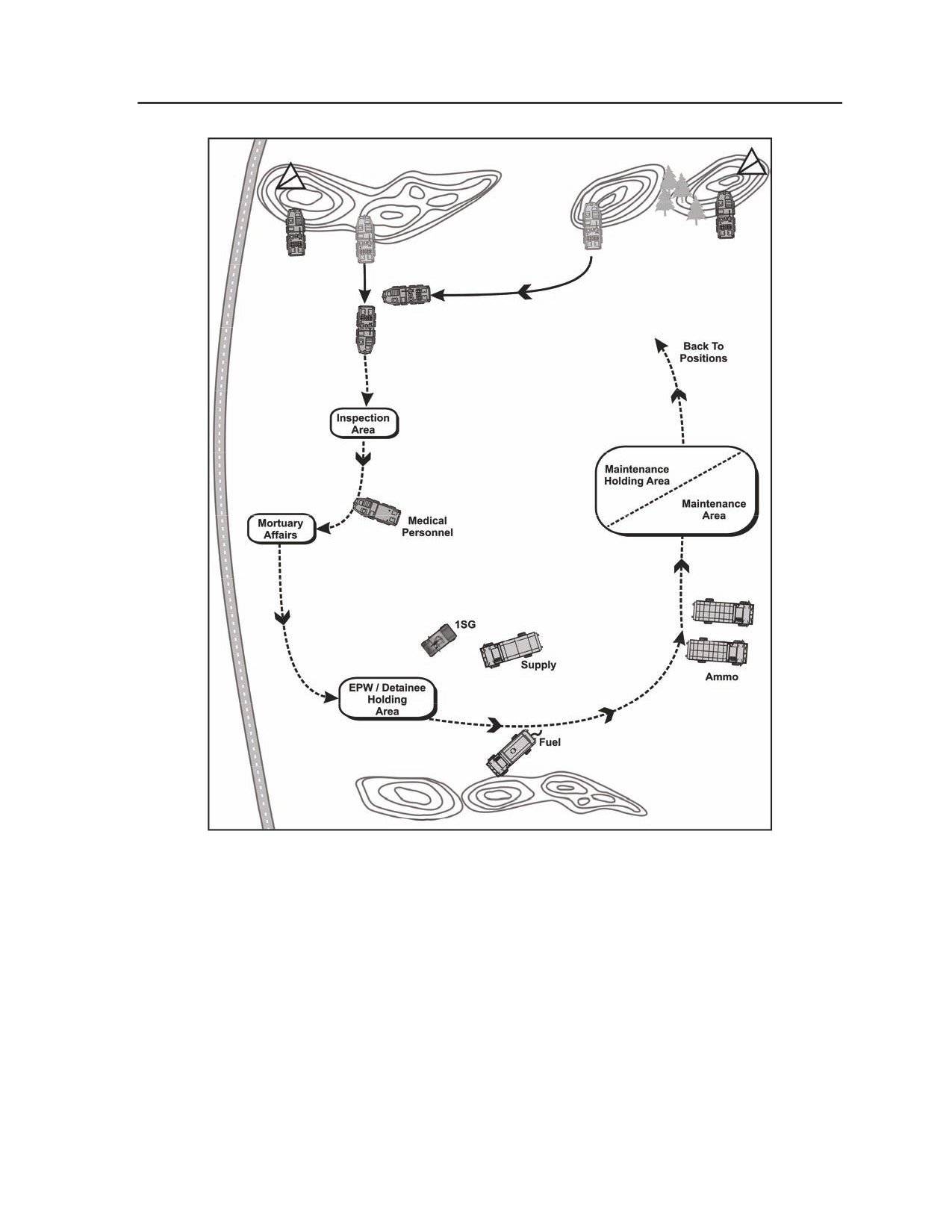
Chapter 6
Figure 6-42. Service station resupply method
6-58
FM 3-20.98
3 August 2009
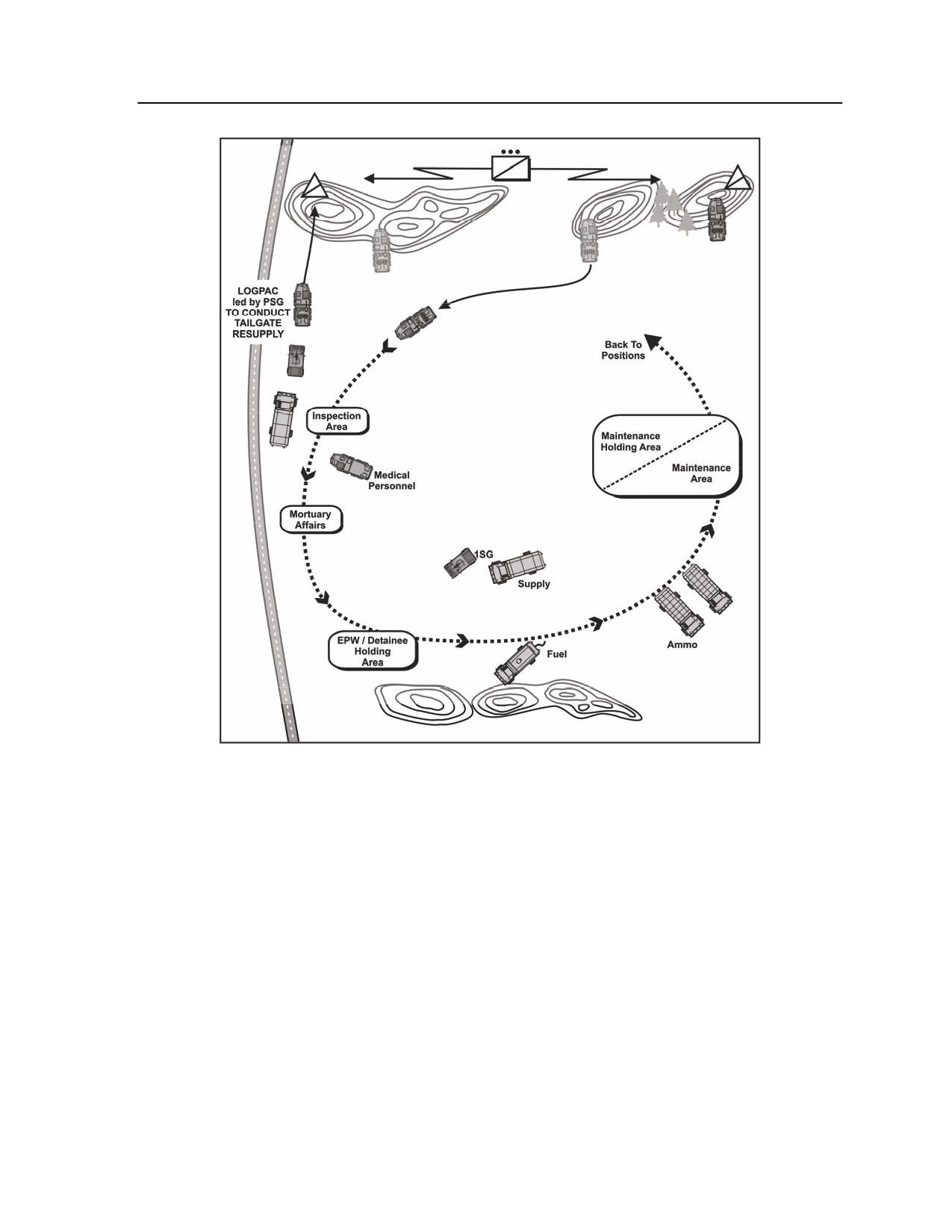
Enablers
Figure 6-43. Combination of resupply methods
Other Resupply Methods
6-205. In addition to the methods of routine resupply, the reconnaissance or scout platoon can use several
other methods of obtaining needed materials.
Aerial and Airdrop Resupply
6-206. Helicopters and fixed wing assets can be a vital lifeline when scouts are forced to operate forward
of friendly lines for extended periods; they reduce the risks associated with conducting ground resupply
operations under such conditions. Aerial assets are also useful in resupplying dismounted scouts in OPs in
restricted terrain. On the other hand, aerial resupply sometimes is not available due to lack of aircraft or
degraded weather conditions. In addition, the signature of resupply aircraft can compromise scout
positions. Careful choice of resupply routes, LZs, and DZs help to minimize this risk.
Pre-positioning and Cache
6-207. These resupply methods, also called prestock resupply, differ in the level of security provided for
the supplies. In pre-positioning, units may leave supplies unattended or provide security as dictated by
METT-TC. However, when it resupplies by cache, the platoon should take steps to prevent detection of the
location by enemy elements.
3 August 2009
FM 3-20.98
6-59
Chapter 6
6-208. The reconnaissance or scout platoon uses both pre-positioning and cache methods in a variety of
operations. During reconnaissance, it uses advance elements to establish prestock positions along the
intended route of advance or near the objective. In security operations, the platoon can set up prestock
points throughout the AO. These points should be in each alternate or supplementary OP, in addition to
other locations throughout the depth of the sector. Scouts can also use prestock to provide resupply for
patrols.
6-209. The platoon must carefully plan and execute cache operations at every level. The platoon places
cache points where, with simple instructions, someone who has never visited the site can find the point. All
leaders, down to squad leader and vehicle commander, must know the exact locations of cache sites. The
platoon leader must take steps to ensure security and survivability of the supplies by digging in cache
positions, selecting covered and concealed positions, and considering the effects of weather and terrain. He
must also have a plan to remove or destroy cache supplies to prevent the enemy from capturing them.
Medical Resupply
6-210. The reconnaissance or scout platoon combat medic is an important conduit for medical resupply.
The combat medic works closely with the PSG in ensuring sustainment of Army Health System support.
The PSG is responsible for monitoring the platoon’s medical supply status (Class VIII) and for ensuring
resupply of the combat lifesavers through the LOGPAC.
MAINTENANCE OPERATIONS
6-211. The Army has transitioned to two levels of maintenance: field and sustainment. Field maintenance
consists primarily of replacing parts on the user’s system. Field maintenance is the product of merging the
previous organizational and DS levels of maintenance. Sustainment maintenance consists of repairing
components off the user’s platform, which then goes back into the supply system. Sustainment
maintenance is the product of merging the previous GS and depot levels of maintenance together.
FIELD MAINTENANCE
6-212. Field maintenance is on-system maintenance, and mainly involves preventive maintenance and
replacement of defective parts. The goal of field maintenance is to repair and return equipment to the
Soldier. It covers tasks previously assigned to operator/crew, organization/unit, and DS maintenance levels.
It includes some off-system maintenance critical to mission readiness.
6-213. The reconnaissance or scout platoon leader is concerned primarily with field maintenance. Platoon
leaders ensure that vehicle crews and equipment operators perform PMCS. Proper field maintenance keeps
equipment and materiel in serviceable condition. It includes PMCS, as well as the functions of inspecting,
testing, servicing, repairing, requisitioning, recovering, and evacuating equipment and materiel whenever
necessary.
Platoon Leader Responsibilities
6-214. The platoon leader has ultimate responsibility for the condition and performance of the platoon’s
equipment and materiel. In that role, his duties include the following:
z
Coordinate with the XO in planning, directing, and supervising unit maintenance for the
platoon.
z
Develop and supervise an ongoing maintenance training program.
z
Ensure that all platoon vehicles, weapon systems, and equipment such as NODs, mine detectors,
CBRN equipment, and communications equipment are combat-ready at all times within the
platoon’s maintenance capabilities. The platoon leader also ensures reporting of equipment that
is not repairable at platoon level to the commander as soon as possible.
z
Know the status of equipment, including document numbers, job order numbers, and the stage
of maintenance of his vehicles. The platoon leader keeps the parent unit XO informed of the
current maintenance status.
6-60
FM 3-20.98
3 August 2009
Enablers
z
Ensure that crews have the appropriate technical manuals and are trained and supervised to
complete the required level of maintenance properly.
z
Ensure that operators perform unit-level PMCS on all assigned equipment in accordance with
the appropriate operator manuals.
z
Ensure the training and licensing of drivers and assistant drivers to operate platoon vehicles and
equipment.
z
Plan and rehearse a maintenance evacuation plan for every mission.
Platoon Sergeant Responsibilities
6-215. The PSG has primary responsibility for most of the platoon’s maintenance activities. His duties
include the following:
z
Ensure that operators fill out and update DA Forms 5988-E and 2408-18 in accordance with DA
Pam 738-750.
z
Direct and supervise unit maintenance of platoon equipment, vehicles, and weapon systems.
z
Assist the platoon leader in complying with his responsibilities; assume those responsibilities in
his absence.
z
Coordinate with the maintenance representative to arrange unit repairs or to request intermediate
(DS) maintenance.
z
Supervise and account for platoon personnel during maintenance periods.
z
Ensure the timely use or storage of repair parts.
z
Collect and consolidate reports of the platoon’s maintenance status in the field and send the
appropriate reports to higher maintenance personnel.
z
Ensure that operators top off their vehicles with fuel in garrison and that they receive fuel in the
field.
z
Keep the platoon leader informed of the platoon’s maintenance and logistics status.
Vehicle Commander Responsibilities
6-216. Vehicle commanders are the platoon’s first-line maintenance supervisors. In large part, the
platoon’s maintenance status, and thus its combat readiness, depends on their commitment to proper
maintenance procedures. The vehicle commander’s duties in this area include the following:
z
Ensure that operators fill out and update DA Forms 5988-E and 2408-18 in accordance with DA
Pam 750-8.
z
Train the crew in proper PMCS procedures.
z
Ensure the training and licensing of all crewmembers as drivers in preparing for continuous
operations. At a minimum, ensure the assigned vehicle driver or equipment operator is licensed.
z
Ensure that repair parts are installed upon receipt or are stored in authorized locations.
z
Ensure that all tools and basic issue items are properly marked, stored, maintained, and
accounted for.
z
Ensure that the operator always tops off the vehicle in garrison and that the vehicle receives as
much fuel as possible at every opportunity in the field.
z
Constantly update the PSG on the maintenance and logistics status of the vehicle.
Operator Responsibilities
6-217. Operator maintenance includes proper care, use, and maintenance of assigned vehicles and crew
equipment such as weapons, CBRN equipment, and NODs. The driver and other crewmembers perform
daily services on the vehicle and equipment, including inspecting, servicing, tightening, performing minor
lubrication, cleaning, preserving, and adjusting. The driver and gunner are required to use DA Form 5988-
E to record these checks and services, as well as all equipment faults that they cannot immediately correct.
The driver’s and gunner’s reports are the primary means of reporting equipment faults through the vehicle
commander to the PSG, platoon leader, and ultimately to organizational maintenance personnel.
3 August 2009
FM 3-20.98
6-61
Chapter 6
6-218. Checks and services prescribed for the automotive system, weapon systems, and turret are divided
into three groups:
z
Before-operation checks and services.
z
During-operation checks and services.
z
After-operation checks and services.
6-219. The operator’s manual explains these services. All operators must conduct these services as stated
in the manual. Although operators must learn to operate equipment without referring to the manual, they
must always perform the maintenance in accordance with the appropriate technical manual.
EVACUATION
6-220. Evacuation is necessary when maintenance crews cannot repair a damaged vehicle on site within
several hours or when it is the only means available to prevent capture or destruction by the enemy. Repair
times are dependent on METT-TC factors. The two-hour limit is only a guideline for planning purposes
and unit SOP determines the actual time. With the exception of an entire vehicle, the platoon can transport
most damaged equipment until the troop or squadron/battalion support elements pick it up. The troop or
squadron/battalion maintenance personnel or the DS maintenance unit evacuates the equipment.
6-221. When a vehicle requires evacuation, the platoon leader or PSG reports the exact location, vehicle
type, and extent of damage, if known, on the proper net to personnel designated in the unit SOP. Two
Soldiers should remain with the vehicle to assist in evacuation and repair, provide security, and deliver the
repaired vehicle back to the platoon as soon as possible. A recovery vehicle from the higher-level
maintenance team evacuates the damaged vehicle. It is vital that crews place the damaged vehicle in a
covered position that allows the recovery vehicle to reach it without exposing the recovery crew to enemy
fire.
6-222. If a recovery vehicle is not available or if time is critical, self-recovery will be the platoon’s
primary method of vehicle evacuation. Other platoon vehicles can evacuate the damaged vehicle for short
distances. Leaders consider self-evacuation as a last resort only to avoid losing the damaged vehicle to the
enemy. The decision to do this rests with the platoon leader. The operator’s manual covers procedures for
towing. If the damaged vehicle will be lost for an extended period, the platoon can replace other vehicles’
damaged equipment (such as weapons and radios) with properly functioning items from the damaged
vehicle.
6-223. A wheeled vehicle mechanic can be attached to the PSG’s vehicle or support truck with the
purpose of handling maintenance issues at the platoon level.
6-224. A sound guideline for reconnaissance and scout platoons is to conduct repairs as far forward as
possible. This reduces down time and allows crews to maintain their operational rhythm and return to
operations. Leaders preposition habitual replacement parts such as fan belts and tires at a secured
maintenance collection point for maintenance support. All vehicle crews must know this location.
DESTRUCTION
6-225. When evacuation of damaged or inoperable equipment is impossible, destruction becomes
necessary to prevent it from falling into the enemy’s hands. The platoon leader must obtain the
commander’s permission before destroying any equipment. The platoon must make every reasonable effort
to evacuate or secure equipment, classified materials, and all weapons.
SUSTAINMENT MAINTENANCE
6-226. Reconnaissance platoons do not conduct sustainment maintenance. The component repair
company of a sustainment brigade usually conducts sustainment-level maintenance.
6-62
FM 3-20.98
3 August 2009
Enablers
PERSONNEL SERVICES SUPPORT
6-227. Personnel services are those sustainment functions related to Soldier’s welfare, readiness, and
quality of life. It includes human resource functions, religious services, financial management, legal
assistance, and band support. Higher-level support elements provide many of these services automatically.
Nevertheless, the platoon leader is ultimately responsible for coordinating and providing them to the
platoon.
HUMAN RESOURCES SUPPORT
6-228. Human resources support functions include personnel readiness, awards and decorations, leaves
and passes, command information, mail, morale, welfare and recreation, military pay, and rest and
relaxation, among others. Personnel readiness management is a critical function that continuously analyzes
the operational preparedness of the platoon. It includes classification, assignment, promotions,
reenlistment, and other human resource functions. The platoon leader requests these actions through the
troop/company or squadron/battalion staff that normally processes these actions. The platoon leader must
submit accurate strength reports to ensure qualified personnel fill critical personnel shortages, such as
vehicle commanders and gunners.
ARMY HEALTH SYSTEM SUPPORT
6-229. The Army health system (AHS) is a component of the military health system that is responsible for
operational management of the Army’s health service support and force health protection missions,
including training and predeployment, deployment, and postdeployment operations. It is responsible for all
mission support services performed, provided, or arranged by the Army Medical Department for the Army
and, as directed, for joint, intergovernmental, coalition, and multinational forces and agencies. Refer to
FM 3-20.971 for a detailed discussion of AHS support.
MEDICAL SUPPORT
6-230. The first medical care a Soldier receives is provided at Role 1 (also referred to as unit-level
medical care). This role of care includes the following:
z
Immediate lifesaving measures.
z
Disease and nonoperational injury prevention.
z
Combat and operational stress preventive measures.
z
Patient location and acquisition (collection).
z
MEDEVAC from supported units or locations—including point of injury or wounding, combat
outpost, troop aid posts, or CCPs—to supporting medical treatment facilities (MTF).
z
Treatment provided by platoon combat medics. Major emphasis is placed on those measures
necessary for the patient to return to duty or to stabilize the patient and allow for evacuation to
the next role of care. These measures include maintaining the airway, stopping bleeding,
preventing shock, protecting wounds, immobilizing fractures, and other emergency measures as
indicated.
TREATMENT BY NONMEDICAL PERSONNEL
Self-Aid and Buddy Aid
6-231. Each individual Soldier is trained to be proficient in a variety of specific first-aid procedures.
These procedures include aid for chemical casualties with particular emphasis on lifesaving tasks. This
training enables the Soldier or a buddy to apply first aid to alleviate a life-threatening situation.
3 August 2009
FM 3-20.98
6-63
Chapter 6
Combat Lifesaver
6-232. The combat lifesaver is a nonmedical Soldier selected by his troop commander for additional
training beyond basic first-aid procedures. A minimum of one individual per squad, crew, team, or
equivalent-size unit should be trained. The primary duty of this individual does not change. The additional
duty of the combat lifesaver is to provide enhanced first aid for injuries before the combat medic arrives.
Combat lifesaver training is normally provided by medical personnel assigned, attached, or in sustainment
units. The senior medical person designated by the commander manages the training program.
6-233. The combat lifesaver is almost always the first person on the scene to begin the process of
providing enhanced first aid to wounded and injured personnel. The combat lifesaver is not intended to
take the place of medical personnel, but to slow deterioration of a wounded/injured Soldier’s condition
until medical personnel arrive. Troops will have at least one Soldier qualified as a combat lifesaver with
every vehicle or squad.
TREATMENT BY MEDICAL PERSONNEL
6-234. Following initial first aid and treatment, Role 1 medical treatment is provided by the combat medic
or by the physician, the physician assistant, or the health care specialist in the squadron/battalion aid
station.
6-235. Emergency medical treatment, known as immediate far forward care, consists of those lifesaving
steps that do not require the knowledge and skills of a physician. The combat medic is the first individual
in the medical chain that makes decisions based on medical military occupational specialty-specific
training.
6-236. Combat medics are allocated on the basis of one combat medic per each platoon in the troop. The
platoon combat medic normally locates with, or near, the platoon leader or PSG.
EVACUATION
6-237. Evacuation of injured Soldiers is categorized into two types:
z
MEDEVAC. This is the use of ground or air ambulances to evacuate from the point of injury to
a supporting MTF or from one MTF to another while providing en route care.
z
CASEVAC. This is the use of nonmedical vehicles or other means for patient transport without
the provision for en route care.
6-238. The preferred method of MEDEVAC is by air ambulance, but this is METT-TC dependent. The
aviation brigade’s general aviation support battalion may position a forward support MEDEVAC team
with three UH-60 Blackhawk aircraft in support of a BCT/BFSB/ACR. These aircraft do not provide DS,
but provide area support to all units in the AO.
WOUNDED SOLDIERS
6-239. Positioning and dispersion in the AO make treatment and evacuation of wounded personnel two of
the most difficult tasks the reconnaissance or scout platoon must execute. Operational planning or SOPs
must cover evacuation procedures in detail.
6-240. In the platoon, the combat lifesaver and/or the vehicle commander are usually the first ones on the
scene to begin the process of providing first aid for personnel who are wounded in action (WIA). With the
help of the vehicle commander, the combat lifesaver provides initial first aid to wounded or injured
Soldiers. He prepares them for medical evacuation or returns them to duty status after rendering first aid.
There should be at least one combat lifesaver on each platoon vehicle at all times.
6-241. Vehicle commanders and their crews must be prepared to give immediate first aid as necessary
and to continue the mission, without stopping, with a limited crew. The vehicle commander informs the
PSG of casualties. He coordinates with the PSG for ground or aerial evacuation.
6-242. Evacuation procedures must be part of the platoon plan and rehearsed as part of mission
preparation. Regardless of the method of evacuation, all reconnaissance leaders must have the necessary
6-64
FM 3-20.98
3 August 2009
Enablers
sustainment graphics available, including the locations of higher headquarters’ casualty collection points.
When wounded crewmen require evacuation, the platoon leader or PSG can take one of the following
steps:
z
Coordinate for aerial evacuation through the troop or battalion.
z
Conduct self-evacuation with organic platoon assets.
z
Request the higher commander to task organize a dedicated ambulance to the platoon for
operations forward of the larger element.
z
Coordinate with the closest troop/company team for ground evacuation.
6-243. Aerial evacuation, if it is available, is preferred because of its speed. The scouts coordinate with
their higher command and then switch to the designated frequency to coordinate directly with the
MEDEVAC or CASEVAC aircraft. The platoon provides local security of the LZ until the evacuation is
complete (refer to the discussion of PZ/LZ procedures earlier in this chapter).
6-244. A wounded crewman’s individual weapon becomes the responsibility of the vehicle commander.
The platoon turns in the personal effects, weapons, and equipment of the wounded crewman to the
company or troop supply sergeant at the earliest opportunity. The crewman’s protective mask stays with
him at all times. All sensitive items such as maps, overlays, and SOPs should remain with the vehicle.
6-245. The vehicle commander ensures that both the casualty feeder and witness statement forms are
completed and given to the PSG who then turns them over to the 1SG.
6-246. One method used to improve Soldier survivability after injury is the attachment of a combat medic
to the platoon. The combat medic is assigned to the PSG’s vehicle, which conducts casualty evacuation.
This reduces the time needed for triage and initial treatment and improves the chances for Soldiers return to
duty.
SOLDIERS KILLED IN ACTION
6-247. The squadron/battalion S-4 designates the location of the collection point for Soldiers who are
killed in action (KIA). The reconnaissance or scout platoon leader selects the location of a platoon KIA
collection point and reports its eight-digit grid to higher headquarters. The platoon uses this collection
point only as a last resort when transport of the KIA Soldiers is impractical. The name of each dead
Soldier, the exact location of the body, and the circumstances are reported higher as soon as possible
within the limits of the mission.
6-248. The platoon leader designates a primary and alternate vehicle to extract KIAs from the AO to the
next scheduled LOGPAC location. Scouts place the remains of these Soldiers in a body bag, sleeping bag,
or poncho for evacuation. They remove the lower dog tag for turn-in to the PSG. The PSG then forwards
the dog tag to the 1SG during the next resupply operation along with statements from those who witnessed
the action. The personal effects of the KIA Soldier remain with the body. The Soldier’s weapon,
equipment, and issue items become the responsibility of the vehicle commander until he can turn the items
over to the supply sergeant or 1SG through the PSG.
6-249. As a rule, leaders make every effort not to place the bodies of KIA Soldiers on the same vehicle as
wounded Soldiers. If the platoon leader or 1SG cannot expedite evacuation, transportation of KIAs and
WIAs together on a vehicle may be necessary until it reaches its next stop. In the offense, this destination
may be the objective. In the defense, it may be the next BP.
FORCE HEALTH PROTECTION
6-250. Maintaining the health and fighting fitness of Soldiers is the responsibility of all leaders. The best
way to do this is for the commander to emphasize preventive measures. All leaders will be active
participants in the areas of hygiene, sanitation, safety, sleep deprivation, physical fitness, counseling, and
the treatment of combat stress and fatigue.
3 August 2009
FM 3-20.98
6-65
Chapter 6
Health and Hygiene
6-251. The platoon leader and PSG must emphasize and enforce high standards of health and hygiene at
all times. This “preventive maintenance” approach should cover all aspects of the Soldier’s health and
well-being, including the following:
z
Daily shaving to ensure proper fit of the protective mask.
z
Regular bathing and changing of clothes.
z
Prevention of weather-related problems. These include cold-weather injuries like frostbite,
trench foot, and immersion foot and heat-related injuries such as heat exhaustion and heat
stroke. Soldiers must understand the effects of such conditions as sunburn and windchill.
z
Combat and operational stress prevention, including strict implementation of the unit sleep plan.
6-252. Combat and operational stress is another medical aspect with which the platoon must cope. The
nature of reconnaissance missions subjects Soldier to stress in many ways. These factors include the
following:
z
Limited visibility.
z
Disrupted sleep cycles.
z
Mental fatigue.
z
Physical fatigue.
6-253. Combat and operational stress control, however, is not solely a medical problem. It is also a
command problem in terms of reduced performance and personnel lost from duty.
Combat and Operational Stress Control (COSC)
6-254. COSC focuses on protecting the force through treatment and prevention of combat and operational
stress. The brigade support battalion has a COSC team consisting of a behavioral science officer and a
mental health specialist. Chaplains can assist with combat stress control by identifying Soldiers who are
under extreme stress. Refer to FM 4-02.51, FM 6-22.5, and FM 22-51 for information on COSC.
Preventive Medicine
6-255. Preventive medicine (PVNTMED) encompasses the rules of hygiene and field sanitation that are
developed and implemented to prevent the spread of debilitating diseases. These rules must be established
in the troop /company SOP and observed and enforced daily.
6-256. Safety is another continuous requirement of PVNTMED. To prevent accidents that could injure
Soldiers, leaders continuously enforce proper equipment operating procedures and general safety.
6-257. PVNTMED operational support is provided by PVNTMED personnel who are organic to the BCT
brigade support medical company. The BCT PVNTMED section is equipped to conduct PVNTMED
surveillance and control. See FM 4-02.17 for definitive information on PVNTMED measures.
Note. The platoon should develop its unit sleep plans based on the following current guidance
on sleep—and the effects of sleep deprivation—provided by the Walter Reed Army Institute of
Research. Based on extensive research, the information applies to all levels of military
operations, including both training and tactical environments.
Sleep Deprivation
6-258. Sleep is a biological need, critical for sustaining the mental abilities needed for success in the AO.
Soldiers require 7 to 8 hours of good-quality sleep every 24-hour period to sustain operational readiness.
Soldiers who lose sleep will accumulate a sleep debt over time that will seriously impair their performance.
The only way to pay off this debt is by obtaining the needed sleep. For additional information pertaining to
sleep deprivation, see FM 3-20.971.
6-66
FM 3-20.98
3 August 2009
Enablers
PRISONERS AND CAPTURED MATERIAL
6-259. EPWs, detainees, and captured enemy equipment, materiel, and documents are excellent sources
of combat intelligence; they must be processed and evacuated to the rear quickly. If enemy soldiers want to
surrender, it is the responsibility of the reconnaissance or scout platoon or the individual vehicle crew to
take them into custody and control them until evacuation. The platoon leader will employ a HUMINT
Soldier, if available, to perform an initial assessment and screening of all EPWs and captured materials to
aid in processing and information gathering.
6-260. The platoon leader designates a primary and alternate vehicle responsible for handling EPWs and
detainees as well as for transporting them to the collection point designated in paragraph
4 of the
troop/battalion OPORD.
HANDLING PRISONERS OF WAR
Note. In most situations, the following information and procedures apply to the handling of
detainees as well as to EPWs.
6-261. The “five-S” principles and tagging serve as the basic principles for handling EPWs: search,
segregate, silence, speed, and safeguard. In addition to these steps, the reconnaissance or scout platoon
leader must ensure that Soldiers tag prisoners with all necessary information before transportation to the
rear. The “five-S” procedures are as follows:
z
Search. Remove and tag all weapons and documents. Return to the EPW those personal items
of no military value. The EPW keeps his helmet, protective mask, and any gear that protects him
from immediate dangers.
z
Segregate. Break the chain of command; separate EPWs by rank, sex, and other appropriate
criteria. Keep the staunch fighters away from those who willingly surrender.
z
Silence. Prevent EPWs from issuing orders, planning escapes, or developing false “cover
stories”.
z
Speed. Expedite movement of EPWs to the appropriate element to obtain and use their
information.
z
Safeguard. Prevent EPWs from escaping. Protect all EPWs from violence, insults, curiosity,
and reprisals of any kind.
6-262. The senior officer or NCO on the scene is legally responsible for the care of EPWs. If the unit
cannot evacuate a prisoner within a reasonable time, it must provide him with food, water, and medical
treatment.
6-263. International law has established the rights of EPWs, and the United States has agreed to obey
these laws. Once enemy personnel show they want to surrender, Soldiers must treat them humanely. It is a
court-martial offense to physically or mentally harm or mistreat an EPW or needlessly expose him to fire.
In addition, mistreated EPWs or those who receive special favors are not good interrogation subjects.
6-264. Scouts should never make the initial approach to an enemy soldier. He may have a weapon hidden
nearby, or he may be booby-trapped. To be safe, the scouts should gesture for him to come forward until it
is clear that he is honestly surrendering and not trying to lure friendly troops into an ambush. They can use
a thermal sight to locate possible ambushes.
6-265. The scout who searches the prisoner should always have another Soldier cover him with a
weapon. The searcher must not get between the prisoner and the Soldier covering him. Whenever possible,
the platoon uses female Soldiers to search females keeping in mind local practices and courtesies.
6-266. A combat lifesaver will treat and attempt to stabilize wounded EPWs not evacuated through
medical channels. Leaders notify the supporting troop/company XO or 1SG of each wounded prisoner’s
status, and evacuation will be coordinated using other means.
3 August 2009
FM 3-20.98
6-67
Chapter 6
6-267. Before evacuating the EPW, the platoon leader must ensure that a platoon Soldier attaches a tag to
the prisoner listing all pertinent information and procedures. The platoon leader forwards a copy of this tag
to higher headquarters. The platoon obtains tags through supply channels; it can make tags from materials
available if necessary. The tag should contain the following information:
z
Date of capture.
z
Name of prisoner.
z
Prisoner’s rank.
z
Prisoner’s serial number.
z
Prisoner’s date of birth.
z
Prisoner’s unit.
z
Location of capture.
z
Capturing unit.
z
Special circumstances of capture.
z
List of weapons or documents in the prisoner’s possession at the time of capture.
CAPTURED THREAT DOCUMENTS AND EQUIPMENT
6-268. Captured threat documents such as maps, orders, records, photographs, terrain models, and
equipment are excellent sources of intelligence. If handled improperly, the information in the captured
items may be lost or delayed until it is useless.
6-269. The platoon should tag each captured item. If the item is in an EPW’s possession, include the
prisoner’s name on the tag and give the item to the guard. The guard delivers the item with the EPW to the
next higher headquarters. The captured items should be tagged with the following information:
z
Type of item (such as document or piece of equipment).
z
Date and time of capture.
z
Location of capture.
z
Capturing unit.
z
Special circumstances of capture, including the names of EPWs in possession of the captured
items.
CIVILIANS
6-270. Civilians captured as the result of curfew violations, criminal activities, or suspicious actions are
treated the same as EPWs. The platoon evacuates them quickly to higher headquarters using the “five-Ss.”
6-68
FM 3-20.98
3 August 2009
Appendix A
Orders and Reports
Orders and reports are the means by which the platoon receives and transmits
information, from the earliest warning order notification that an operation will occur
through the final phases of execution and change of mission. They are critical to
mission success because they communicate the descriptions, directions, and
visualizations. In a tactical situation, the platoon leader and PSG lead the platoon and
the operation with these tools on a daily basis. Time and experience should hone
leaders’ knowledge of orders formats enabling them to accurately complete their
responsibilities while ensuring that every member of the platoon understands how to
receive and respond to orders issued via analog and digital systems.
SECTION I - ORDERS
A-1. The platoon leader must be familiar with the formats of warning orders (WARNO), operations
orders (OPORD), and fragmentary orders (FRAGO). He must be able to convert these into concise, yet
thorough, orders for the platoon.
OPERATIONAL CONSIDERATIONS
A-2. Before the commander issues the OPORD, the platoon leader may receive one or more WARNOs. He
analyzes all information in these orders and transmits important details to the platoon as soon as possible.
A-3. When higher headquarters issues a complete five-paragraph OPORD, analysis of the order is a simple,
straightforward process for the platoon leader, who then issues an OPORD to the platoon in OPORD format. He
derives much of the content from the higher order he received during execution of troop-leading procedures.
A-4. Once an operation begins, FRAGOs become the normal method of issuing orders. Digital systems
allow commanders and leaders to supplement oral orders with overlays and a limited text capability; these
items can enhance their subordinates’ understanding of the FRAGOs.
A-5. Units may find themselves conducting the same type of operations on a repeat basis, such as route
clearance. There may be a tendency for leaders and units in such cases to abandon the combat orders
process in favor of expediency. Leaders must not permit this to happen. The combat orders process forces
leaders to analyze appropriately all aspects of an operation regardless of how routine it may appear.
WARNING ORDERS
A-6. During the planning phase of an operation, commanders and leaders use WARNOs as a method of
alerting their units and individual Soldiers. The troop commander usually sends a series of WARNOs to his
platoon leaders. These orders help subordinates to prepare for new missions by providing directions and
guidelines for platoon-level planning and preparation. Each platoon leader immediately analyzes the
information, and then issues a WARNO of his own to alert the platoon to the upcoming operation. This
allows the platoons to conduct parallel planning and preparations. After the WARNO has been issued, the
PSG begins his planning for paragraph 4 (service and support), section sergeants begin planning movement
routes and conducting PCCs, while the platoon leader completes his operations order. For more
information on parallel planning, see FM 3-0 and FM 5-0.
3 August 2009
FM 3-20.98
A-1
Appendix A
A-7. WARNOs generally follow the five-paragraph OPORD format
(see Figure A-1). The key
consideration is that they should be as brief as possible while giving units and Soldiers the information
they need to begin preparing for the operation. A platoon-level WARNO normally includes these elements:
z
Enemy situation.
z
Troop mission.
z
Commander’s intent (if available).
z
Earliest time of movement.
z
Specific instructions for preliminary actions
(including security, reconnaissance, rehearsals,
training, maintenance, resupply, rest, movement, and coordination requirements).
z
Time and place at which the troop OPORD will be issued.
A-8. Ideally, the platoon leader issues two to three WARNOs to subordinates during troop-leading
procedures. WARNOs are issued upon receipt of mission, completion of mission analysis, and when the
commander chooses a COA. However, the number of WARNOs is not fixed. WARNOs serve a function in
planning similar to that of FRAGOs during execution. Commanders issue a WARNO whenever they need
to disseminate additional planning information or initiate necessary preparatory action, such as movement
or reconnaissance.
A-9. The first WARNO normally contains minimal information. It alerts subordinates that a new mission
is pending. This WARNO normally contains the following information:
z
Enemy situation.
z
The type of operation.
z
The general location of the operation.
z
The initial operational time line.
z
Initial ISR tasks.
z
Any movements to initiate.
z
Any collaborative planning sessions directed by the commander.
z
Initial IR or CCIR.
A-10. The WARNO issued at the end of mission analysis contains essential information for planning,
and directives to initiate movements and reconnaissance. Typically it includes—
z
Updated enemy situation.
z
The approved unit mission statement.
z
The commander’s intent.
z
Task organization changes.
z
Attachments/detachments.
z
The unit AO (sketch, overlay, or some other description).
z
The CCIR and essential elements of friendly information (EEFI).
z
Risk guidance.
z
Surveillance and reconnaissance instructions.
z
Initial movement instructions.
z
Security operations.
z
Military deception guidance.
z
Mobility, countermobility, and survivability guidance.
z
Specific priorities.
z
The updated operational time line.
z
Guidance on collaborative events and rehearsals.
A-11. The WARNO issued after COA development normally contains—
z
Updated enemy situation.
z
Mission.
A-2
FM 3-20.98
3 August 2009
Orders and Reports
z
Commander’s intent.
z
Updated CCIR and EEFI.
z
Concept of operations.
z
Principal tasks assigned to subordinate units.
z
Preparation and rehearsal instructions not included in standing operating procedures (SOP).
z
Final time line for the operations.
A-12. Parallel planning hinges on distributing information as it is received or developed. Subordinates
cannot complete their plans until they receive their unit mission. If each successive WARNO contains
enough information, the troop and platoon final order will confirm what subordinate leaders have already
analyzed and put into their tentative plan.
Figure A-1. WARNO format
3 August 2009
FM 3-20.98
A-3
Appendix A
OPERATION ORDERS
A-13. As part of troop leading procedures, the platoon issues an OPORD as part of his troop-leading
procedures. The OPORD provides section/squad leaders with the essential information required to conduct
the operation and to carry out the commander’s intent. The platoon leaders should distribute graphics
(traditional and digital) before issuing the OPORD.
FIVE-PARAGRAPH OPORD FORMAT
A-14. Leaders issue the OPORD orally and in writing in the five-paragraph format (see example below).
This helps to ensure that required information is presented in a predictable and logical manner. Although
the five-paragraph format is straightforward, every commander and leader will develop techniques that
allow him to make a clearer, concise, yet complete OPORD presentation. The platoon leader should
request a copy of his commander’s OPORD format to facilitate note taking. See FM 3-20.971 and FM 5-0
for more information concerning platoon OPORDs.
ISSUING THE PLATOON OPORD
A-15. Issuing the OPORD is, in effect, a type of drill, with contents and delivery procedures covered by
SOPs and other guidelines. The platoon leader must understand, however, that simply reading off the five
paragraphs word for word is usually ineffective. His foremost consideration is effective communication.
He must fully understand all aspects of the operation and know how to describe and discuss them. He must
integrate the friendly and enemy situations and the effects of terrain and weather into the platoon maneuver
plan.
A-16. To make the order even more understandable, the platoon leader should use visual aids to illustrate
key points. He can take advantage of a number of pre-made and field-expedient materials, including the
following:
z
The operation map and accompanying overlays.
z
Terrain models.
z
Sketches on dry-erase boards; meals, ready to eat (MRE) boxes; butcher paper; or the back of a
map.
A-17. As far as possible, the platoon leader must establish optimum physical conditions that will allow
effective presentation of the OPORD. For example, the site at which the platoon order will be issued
should afford adequate security and minimum distractions. The platoon leader must ensure that the vehicle
commanders and dismounted patrol leaders post accurate graphics on their overlays and/or digital displays.
Scouts should arrive at the OPORD site early to study maps and post graphics. Units with digital capability
should post the graphics on their vehicle displays before the platoon leader issues the order. Figure A-2
provides a sample of the OPORD, organized in the five-paragraph format.
A-4
FM 3-20.98
3 August 2009
Orders and Reports
SAMPLE PLATOON OPORD FORMAT
TASK ORGANIZATION (platoon and allocation of forces to support the concept of
operations).
1. SITUATION.
a. Enemy forces.
(1) Use SALUTE (size, activity, location, unit, time, and equipment) report
format for reporting likely and known location of enemy forces and their composition.
(2) Other enemy information critical to the upcoming operation, including—:
(a) Chemical and nuclear capabilities.
(b) ADA.
(c) Aviation, including helicopters.
(d) Electronic warfare.
(e) Type and condition of enemy vehicles.
(f) Most probable enemy COA.
(g) Most dangerous enemy COA.
b. Friendly forces (include the following items as applicable).
(1) Mission and intent of higher headquarters two levels above), including
concept of the operation.
(2) Identification (ID)/mission of adjacent units (left, right, front, rear).
(3) ID/mission of reserves in higher headquarters.
(4) ID/mission of supporting units with a direct support/reinforcing (DS/R) role
to higher headquarters (field artillery, engineer, ADA).
(5) Which higher headquarters element has priority of fires.
(6)
Close air support
(CAS) allocated to higher headquarters, including
number of sorties available.
c. Terrain.
(1)
Obstacles, hills, valleys, road types and conditions, streams, rivers,
bridges, and built-up area.
(2) Avenues of approach.
(a) Size unit that can be supported.
(b) Start and end point.
(c) Objective.
(3) Key terrain (discuss how friendly and/or enemy forces may attempt to use
it to their advantage).
(4) Observation and fields of fire.
(5) Cover and concealment.
(6) Engagement areas.
(7) Overall effect of terrain on the operation.
d. Weather and light data.
(1) Light conditions: (for all the days of the operation).
BMNT: _____;
Sunrise: _____;
Sunset: _____;
EENT: _____;
Moonrise: _____;
Moonset: _____;
Percent Illumination: _____.
(2) Weather forecast for the operation.
(3) Effects of weather and light conditions on the operation.
(a) Trafficability.
(b) Visibility.
(c) Effect on lasers/thermals.
(d) Effects on air operations.
e. Attachments and detachments to the platoon and higher.
3 August 2009
FM 3-20.98
A-5
Appendix A
2. MISSION. This is the WHO, WHAT, WHEN, WHERE, and WHY. State the
essential task(s) to be accomplished by the entire unit, to include on-order missions.
Clearly define the troop’s objective, task and purpose.
3. EXECUTION.
a. Commander’s intent. Using the troop commander’s intent as a guideline, the
platoon leader issues the purpose, key tasks, and end state of the operation. The
purpose is the WHY of the operation. Key tasks or a description of the most important
tasks, in relation to one another, to achieve the end state pulls the mission into perspective,
and the end state specifies final disposition of forces and explains how the end state
will facilitate future operations.
b. Concept of the operation. This paragraph further explains and expands on
the troop commander’s intent, particularly his vision of HOW he will conduct the
operation and WHO he will assign to execute it. The platoon leader uses a concept
statement when he feels more detail is necessary to ensure subordinates will take
the appropriate actions in the absence of additional communications or further
orders. The sequence of subparagraphs is as follows:
(1)
Scheme of maneuver. This is how the platoon will maneuver to
accomplish its mission. It conforms to the commander’s intent. In offensive
operations, it specifies the troop’s formations, movement techniques, routes or
avenues of advance, and plans for direct fire and overwatch. In defensive operations,
it specifies the troop engagement plan, platoon positions, orientation of weapons,
and the plan for movement to supplementary or successive positions.
(2) Fires.
(a) Purpose for FA and mortar fires (how fires will be used to support the
maneuver).
(b) Priority of fires within the platoon and company/troop.
(c) Allocation of final protective fires (FPF).
(d) Preparation starting time and duration of fires.
(e) Triggers (trigger line/point or event).
(f) Description of enemy fires in the area of operations.
(g) Special fire allocation/use (obscuration, illumination, CAS).
(h) Restrictions.
(i) Target overlay annex.
(3) Engineer support (obstacles, mines, and fortifications).
(a) Priority of engineer effort (mobility, countermobility, survivability).
(b) Priority of engineer support.
(c) Obstacle overlay.
(d) Obstacle list.
(e) Logistical constraints.
(f) On-order missions.
c. Specific instructions. List the specific missions, in sequence, for each
section, including the attached elements. Include movement techniques, flank
coordination requirements, other details, and be-prepared missions. Dismount team,
detainee team, CBRN team, and obstacle team.
d. Coordinating instructions.
(1) Time schedule for critical events.
(a) Rehearsals.
(b) Confirmation briefs and backbriefs.
(c) Precombat checks (PCC) and precombat inspections (PCI).
(d) First movement.
(e) Arrival of any attachments/detachments.
(f) Boresighting.
A-6
FM 3-20.98
3 August 2009
Orders and Reports
(2) Movement instructions.
(a) SP/RP times.
(b) Formation and movement technique.
(c) Order of march.
(d) Route of march.
(3) Passage of lines.
(a) Contact points.
(b) Passage points.
(c) Lanes (to include identification/markings).
(4) Actions at danger areas.
(5) Actions on expected contact.
(6) Rally points.
(7) Rules of engagement (ROE)/Rules of interaction (ROI).
(8) Information requirements (IR), including priority intelligence requirements
(PIR).
(9) Air defense warning and weapons control status.
(10)
Mission-oriented protective posture
(MOPP) level and operational
exposure guidance (OEG).
(11) Any changes regarding battlesight and battlecarry ranges.
(12) Be-prepared tasks or other general information not provided in concept of
the operation or specific instructions.
(13) Actions on the objective.
4. SUSTAINMENT OPERATIONS.
a. Trains. Location and movement plan of the troop trains
(initial
and
subsequent grids).
b. Material and services.
(1) Supply.
(a) Priorities of supply.
(b) Resupply points and prestock sites.
(c) Ration cycle.
(d) Location of squadron trains.
(e) Logistics package (LOGPAC) instructions.
(2) Transportation.
(a) Supply routes.
(b) Logistics release point (LRP).
(c) Priorities established on main supply routes (MSR).
(3) Services.
(a) Location of water points.
(b) Location of deliberate decontamination sites.
(c) Handling of killed in action (KIA) personnel.
(4) Maintenance.
(a) Maintenance procedures.
(b) Vehicle evacuation.
(c) Task force unit maintenance collection point (UMCP) location.
c. Medical evacuation and treatment.
(1) Location of troop medics.
(2) Location of squadron aid station.
(3) Procedures for treatment/evacuation of wounded in action (WIA) personnel.
(4) Aero-medical evacuation information.
(5) Location of ambulance exchange points (AXP).
(6) Handling of contaminated WIA personnel.
3 August 2009
FM 3-20.98
A-7
Appendix A
(7) Location of unit casualty collection points (CCPs).
d. Personnel.
(1) Handling and disposition instructions for detainees.
(2) Detainee guard instructions.
(3) Location of detainee collection point.
(4) Instructions for interaction with local civil populace (ROI).
(5) Number of expected replacements.
(6) Cross-leveling procedures.
e. Miscellaneous.
5. COMMAND AND SIGNAL.
a. Command.
(1) Location of platoon leader, PSG and section sergeants.
(2) Succession of command.
b. Signal.
(1) Signal operating instructions (SOI)/ANCD index and edition in effect.
(a) Key frequencies.
(b) Key call signs.
(c) Current item number identifier.
(2) KY-57/ANCD fill and changeover data.
(3) Listening silence instructions.
(4) Challenge and password.
(5) Special signals, to include use of pyrotechnics.
(6) Code words.
(7) Digital traffic instructions (digital systems only).
(8) Actions to counteract jamming or “hot mike” situations.
6. TIME CHECK (for synchronization).
Figure A-2. OPORD format
FRAGMENTARY ORDERS
A-18. A fragmentary order is an abbreviated form of an operation order (verbal, written, or digital) usually
issued on a day-to-day basis that eliminates the need for restating information contained in a basic
operation order. Commanders and leaders issue a FRAGO after an operation order to change or modify
that order or to execute a branch or sequel to that order.
A-19. FRAGOs differ from OPORDs only in the degree of detail provided. They address only those parts
of the original OPORD that have changed. FRAGOs refer to previous orders and provide brief and specific
instructions. The higher headquarters issues a new OPORD when there is a complete change of the tactical
situation or when many changes make the current order ineffective.
A-20. FRAGOs include all five OPORD paragraph headings (see Figure A-3). After each heading, state the
new information or annotate “no change.” This ensures that recipients know they have received the entire
FRAGO.
A-8
FM 3-20.98
3 August 2009
Orders and Reports
Figure A-3. FRAGO format
3 August 2009
FM 3-20.98
A-9
Appendix A
SECTION II - REPORTS
A-21. Sending accurate and timely information in complete reports is the scout’s primary means of
providing information critical to the commander for effective plans and decisions. Procedures for
preparing, transmitting, and safeguarding reports will vary from Squadron/CAB due to reporting
preferences and requirements of the chain of command, the tactical environment in which the platoon is
operating, available equipment, terrain, and the electronic warfare situation. Modernized units have the
advantage of the digital FBCB2 which enables the platoon to transmit accurate preformatted reports over
L-Band satellite or in frequency hopping bursts over EPLRS. This improves clarity of information and
reduces the chance of location and jamming.
Note. The following color report formats such as BLUE reports for intelligence, or yellow
reports for logistics are used for examples and may not be the same as those used in your unit.
Use the formats directed by unit SOP.
A-22. For leaders at all levels, two guidelines remain constant throughout the reporting process: the
importance of compiling timely, accurate information and the need to relay that information by the clearest,
quickest, and most secure method possible. The reconnaissance platoon leader, along with the PSG, section
and squad leaders, can save valuable time by ensuring the completeness of the reports and reducing
confusion by using thorough SOPs covering report procedures. These formats should be derived from the
squadron/CAB formats to ensure compatibility.
A-23. There are numerous reports that may vary from unit to unit based on mission and the modified table
of organization and equipment (MTOE) of the platoons. There are several reports scouts will send in all
operations, which do not vary in format regardless of radio voice or digital format. They are:
z
Contact report
z
Spot report
z
Situation report
z
Sensitive item report
z
Medical evacuation
Note. While radio voice and digital formats change from unit to unit, the information is
essentially the same for these basic reports. Scouts may send free text messages when
convenient, however these text messages will not be formatted.
RADIO VOICE TRANSMISSIONS
A-24. FM radio remains the primary means of communication after crossing the LD because it is more
responsive. Multiple stations can monitor the net, and parties can convey emotion during the
transmission—a critical tool in assessing and understanding the situation. Light discipline in night
operations may dictate the use of communications; for example, a reconnaissance platoon in a SBCT may
go to blackout light operations and send SPOTREPs via FM to a vehicle which is stationary and postured
to use the FBCB2 display while maintaining light discipline. The CP can generate and manage FBCB2
SPOTREPs based on FM SPOTREPs and updates.
A-25. Radio voice transmission is recommended as the primary means of communication for—
z
Making initial contact report.
z
Coordinating operations when in contact or moving.
z
Calling for fire on targets of opportunity.
z
Making subsequent adjustment of fires on planned and unplanned targets.
z
Requesting urgent MEDEVAC support.
z
Transmitting enemy air reports.
A-10
FM 3-20.98
3 August 2009
Orders and Reports
DIGITAL CAPABILITIES (C2 AND REPORTS)
A-26. Reconnaissance platoons should not rely on digital communications alone. Presently, FBCB2 allows
for tracking operations digitally on a screen; however, it does not eliminate the requirement for scouts to
use maps and FM communications. The decision of when to use FBCB2 or radio voice depends on the
situation, unit SOP, and level of unit training. Typical reports a reconnaissance platoon will process are
combat reporting and geo-referenced messages, which translate into graphics updates, directly support
tactical operations. Some message traffic should be sent digitally, and then followed by radio voice
transmissions directing recipients to check their message queues.
USES OF DIGITAL COMMUNICATIONS
A-27. Digital messaging at the individual, platoon, and company level is recommended as the primary
means of communication for the following purposes:
z
Transmitting graphics and orders, when the situation allows.
z
Sending routine reports, such as personnel and enabler status or requests.
z
Sending contact reports (vehicles not in contact).
z
Requesting MEDEVAC support.
z
Sending enemy SALUTE reports when not in contact (FBCB2 creates an enemy icon).
z
Transmitting planned call-for-fire missions which may be done from the SALUTE report.
z
Sending digital NBC-1 reports. (This creates a contaminated area icon across the network.
Follow up with a report on the company team or battalion task force command net.)
A-28. Some other types of orders and reports that can be sent via FBCB2 include the following:
z
Fragmentary orders. A digital FRAGO can be used to provide changes to existing OPORDs. It
should include all five paragraphs of the OPORD. Each paragraph should state either “no change”
or give the new information to ensure that recipients know they have received the entire FRAGO.
z
Free-text messages. A free-text message can be used to send an unstructured digital message to
other FBCB2 or Army battle command systems (ABCS) (like an e-mail message).
C2 MESSAGES
A-29. In addition to its capabilities related to providing situational awareness data, FBCB2 offers a variety
of functions that can enhance C2 in the reconnaissance platoon. The system has four categories of C2
messages:
Alerts and Warnings
A-30. Alerts and warnings are sent via reports, free text messages, or geo-referenced messages. They are
posted on the flash immediate priority routine (FIPR) message queue and are displayed on the function bar
of the main FBCB2 screen and as a symbol on the map screen.
A-31. When the platform penetrates the safety radius of a danger zone, the FBCB2 alarm is triggered, an
alert message is displayed on the warnings/alerts marquee, and an entry is made in the warnings tab group.
The danger zone tab group will display the type, distance, direction, location and originator of all danger
zone information received. Danger zone information is transmitted in specific joint variable message
format (JVMF) messages as situational awareness data. FBCB2 receives the message and displays the
situational awareness/danger zone information in the danger zone tab group.
Combat Reporting Messages
A-32. These JVMF messages have been modified and grouped together to provide single-button access to
the message template, requiring fewer keystrokes to complete and send the message. Combat messages are
the following:
z
SALUTE (size, activity, location, unit, time, and equipment). This report is listed as SALT on
the FBCB2 screen.
z
MEDEVAC.
z
Fire mission (call for fire).
3 August 2009
FM 3-20.98
A-11
Appendix A
z
Check fire.
z
SITREP.
Mission Planning Information
A-33. Mission planning information includes orders and request-type messages that contain JVMF message
templates. They include the following:
z
WARNOs.
z
OPORDs.
z
FRAGOs.
z
Sustainment orders and requests.
z
Free text massages.
Geo-referenced Messages
A-34. These messages, which can be used in the C2 categories discussed earlier, create icons linked to a
location on the FBCB2 map. They are also disseminated across the tactical internet as SA data. Geo-
referenced messages can be used for the following:
z
Obstacle reports.
z
NBC-1 reports.
z
Bridge reports.
z
Supply point status reports.
z
Contact reports.
z
Engagement reports.
THREADED MESSAGES
A-35. Certain messages require specific routing for them to be effective. These are called “threaded
messages.” The exception to this is the personnel status report and the task management message. The
routing for these is SOP-driven.
Note. Users may add to the threaded message addressee list but should not delete from it. These
defaults are dictated by Army doctrine and communication architecture; for example, the size,
activity, location, unit, time, and equipment (SALUTE) report feeds into the all-source analysis
system (ASAS) intelligence database for correlation into the joint common database for higher
situational understanding and analysis.
A-36. Most threaded messages must follow specific paths for information to reach intended personnel or
communication systems or to feed into the correct databases. For example, the call-for-fire (CFF) message
must be threaded properly to interface with the advanced field artillery tactical data system (AFATDS).
The CFF message originator may add as many recipients as desired to the addressee list; however, if he
alters any of the default recipients, the message may not reach AFATDS, and the fire mission will not be
processed. If all addressees are not kept on the thread, “orphan” fire missions will occur. An orphan
mission is where a mission task order and target number was not received from AFATDS.
A-37. The following are threaded messages:
z
SALUTE reports.
z
NBC-1 reports.
z
Obstacle reports.
z
Fire support messages.
ANALOG AND DIGITAL REPORTS
A-38. Figure A-4 lists the specific analog reports and their formats that can be used by the troop.
A-12
FM 3-20.98
3 August 2009
Orders and Reports
Contact and Blue Reports (operations)
Contact report.
Blue 1 - Spot report (SPOTREP)/SALUTE report.
Blue 2 - Situation report (SITREP).
Blue 4 - Report for bridge, overpass, culvert, underpass, or tunnel
(BRIDGEREP).
Blue 5 - Report for ford, ferry, or other crossing site
(CROSSREP).
Blue 7 - Route reconnaissance report (ROUTEREP).
Blue 9 - Obstacle report.
Blue 10 - Bypass report.
Blue 11 - Stand-to report (STANREP).
Green Reports (intelligence)
Green 2 - Sensitive items report (SENSEREP).
Green 4 - Patrol report.
Green 6 - EPW/captured material report.
Yellow Reports (logistics)
Yellow 1 - Equipment status report (ESTAT).
Yellow 1A - Battle loss spot report.
Yellow 2 - Ammunition status report.
Yellow 2A - Ammunition request.
Yellow 3 - POL status report.
Yellow 3A - POL request.
Red Reports (personnel)
Red 2 - Personnel battle loss report.
Red 3 - Medical evacuation request.
NBC Reports
NBC-1 - Observer’s initial report.
NBC-3 - Immediate warning of expected contamination.
NBC-4 - Report of radiation dose-rate measurement.
NBC-5 - Report of areas of contamination.
Figure A-4. Analog reports
CONTACT AND BLUE REPORTS (OPERATIONS)
Contact Report
When Used
A-39. A contact report is issued immediately upon contact with an enemy or unknown force in the area of
operations. If this enemy is detected by sensors or UAS, it will require the scouts monitoring these systems
to announce contact and will require eyes on the enemy and include a follow up SPOTREP (see Figure A-
5). The contact report is a brief alert and takes priority over all other communications traffic.
Format
A-40. State “CONTACT,” followed by “WHAT” and “DIRECTION” from the sender. See Figure A-4 for
an example of a transmitted contact report.
3 August 2009
FM 3-20.98
A-13
Appendix A
“BLACK SIX; THIS IS BLUE ONE—CONTACT—TROOPS, EAST—OUT.”
Figure A-5. Sample contact report
Blue 1 - Spot Report (SPOTREP)/SALUTE Report
When Used
A-41. The SPOTREP, widely known as a SALUTE report, is used when scouts observe any known or
suspected enemy activity, when they observe any characteristic of the AO likely to affect accomplishment
of the mission, or when required by the OPORD. A SPOTREP/SALUTE report takes priority over all other
routine radio traffic. The initial SPOTREP/SALUTE report should follow as soon as possible after the
contact report based on METT-TC. Updates to a SPOTREP/SALUTE report should refer back to the time
of a previous report to distinguish which report is being updated. See Figure A-6 for an example of
SPOTREP/SALUTE reports.
Note. The digital Blue 1 report (Figure A-7) is sent to the entire troop when contact occurs. The
best way to send this report is by using the far target locator. In addition, if approved by the
troop commander, a call for fire can be requested simultaneously with the Blue 1. Although the
report is listed using the term SALT on the FBCB2 screen (as shown in Figure A-7), it should
follow the SALUTE format as closely as possible.
Format
A-42. State “SALUTE REPORT” or “UPDATED SALUTE REPORT (with time of original report),”
followed by pertinent information on these lines:
z
Line ALPHA: Observer or source (omit if it is the calling station; use call signs or description
otherwise).
z
Line BRAVO: SALUTE format:
Size: The number of sighted personnel, vehicles, or other equipment.
Activity: What the enemy is doing.
Location: Grid coordinates.
Unit: Markings, uniforms, and other indicators of what enemy force has been encountered.
Time: Time the activity was observed.
Equipment: Description of vehicles, weapons, and other equipment in the enemy element.
z
Line CHARLIE: Actions you have taken and your recommendations. Actions usually involve
conducting additional reconnaissance, continuing to observe, or recommending and executing a
specific course of action.
A-14
FM 3-20.98
3 August 2009
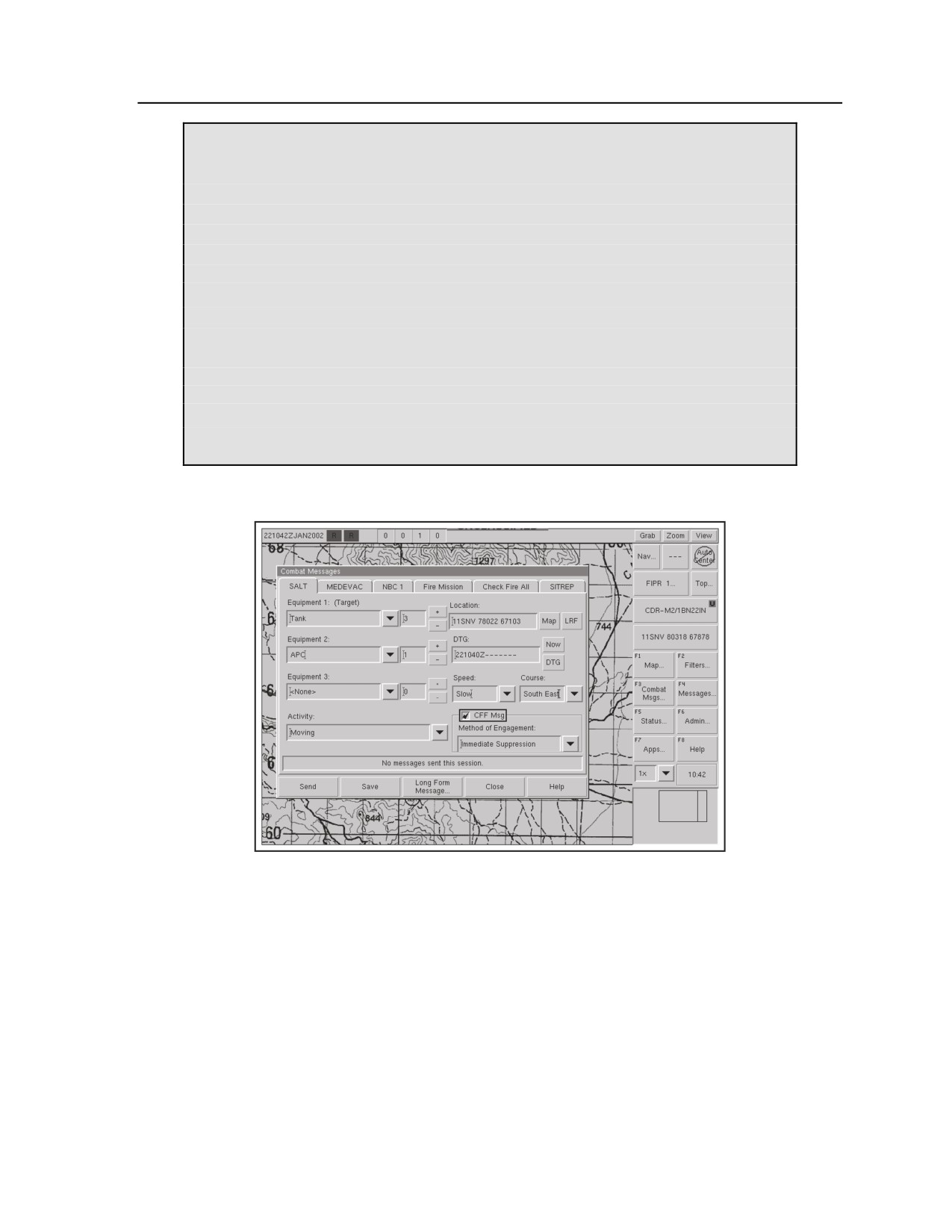
Orders and Reports
“BLUE 1, THIS IS BLUE 5. SALUTE REPORT, OVER.
SIZE: ONE BRDM WITH THREE DISMOUNTED TROOPS.
ACTIVITY: STATIONARY, ORIENTED SOUTH.
LOCATION: GRID MS289546.
UNIT: UNABLE TO DETERMINE UNIT.
TIME: 1725 HOURS.
EQUIPMENT: POSSIBLE UNMANNED AIRCRAFT, CONTINUING TO
OBSERVE, OVER.”
“BLUE 5; THIS IS BLUE 1—ROGER—CONTINUE OBSERVATION—OUT.”
Example Update to a SALUTE Report:
“BLUE 1, THIS IS BLUE 5. SALUTE REPORT UPDATE TO REPORT OF 1725
HOUR. THREE DISMOUNTED TROOPS RECOVERED THE UAS AND
REMOUNTED IT AND CONTINUE TO SIT STATIONARY, OVER.”
“BLUE 5; THIS IS BLUE 1 —ROGER—CONTINUE OBSERVATION—OUT.”
Figure A-6. Sample SPOTREP/SALUTE reports
Figure A-7. Digital Blue 1 report (SPOTREP)
Blue 2 - Situation Report (SITREP)
When Used
A-43. The SITREP is submitted by subordinate units to their higher headquarters to report their tactical
situation and status. It is submitted daily at times designated in the unit SOP, after significant events, or as
otherwise directed by the commander.
3 August 2009
FM 3-20.98
A-15
Appendix A
Note. The digital SITREP
(Figure A-9) is sent twice daily to the squadron or higher
headquarters at times designated in the unit SOP or as necessary during operations. The criteria
for each category (GREEN, AMBER, RED, and BLACK) are the same as in analog SITREPs.
Each vehicle sends the Blue 2 to the platoon leader and PSG for consolidation. The PSG then
forwards the consolidated report to the troop commander, XO, and 1SG.
Format (Troop-Level Example)
A-44. State "SITREP," followed by pertinent information on these lines:
z
Line 1: The as-of date-time group (DTG).
z
Line 2: Brief summary of enemy activity, casualties inflicted, and prisoners captured, or
personnel detained.
z
Line 3: Friendly locations (encoded using control measures or TIRS points). The following can
be listed:
CP location.
Center mass grids of all elements/assets.
Any additional elements as necessary.
Major changes in the concept of operations or scheme of maneuver.
z
Line 4: Combat vehicles operational. The following types of vehicles can be listed:
HMMWVs.
CFVs.
Strykers.
Mortars.
C2 assets.
Attached vehicles.
z
Line 5: Defensive obstacles (encoded using codes, control measures, or TIRS points). The
following can be listed:
Type and location of obstacles. Abbreviations can include MF (minefield), TD (tank
ditch), AB (abatis), RC (road crater), and CW (concertina wire).
Type and location of executed demolition targets.
Type and location of reserved demolition targets.
z
Line 6: Personnel strength, classified using the following status levels:
GREEN: full strength; 90% or more fit for duty.
AMBER: reduced strength; 80 to 89% fit for duty.
RED: reduced strength; 60 to 79% fit for duty; the unit is mission-capable.
BLACK: reduced strength; 59% or less fit for duty.
z
Line 7: Classes III and V supplies available for combat vehicles. Status levels for ammunition
and fuel are the same (GREEN, AMBER, RED, or BLACK) as for personnel strength, with
percentages referring to the amount of basic load level available. Refer to Line 6 of this report.
Note. If an item is reported as status level BLACK on lines 6 or 7, the appropriate yellow report
(logistics) must follow.
z
Line 8: Summary of tactical intentions.
A-45. Figure A-8 shows an example of a transmitted SITREP and Figure A-9 shows an example of a
digital transmission.
A-16
FM 3-20.98
3 August 2009
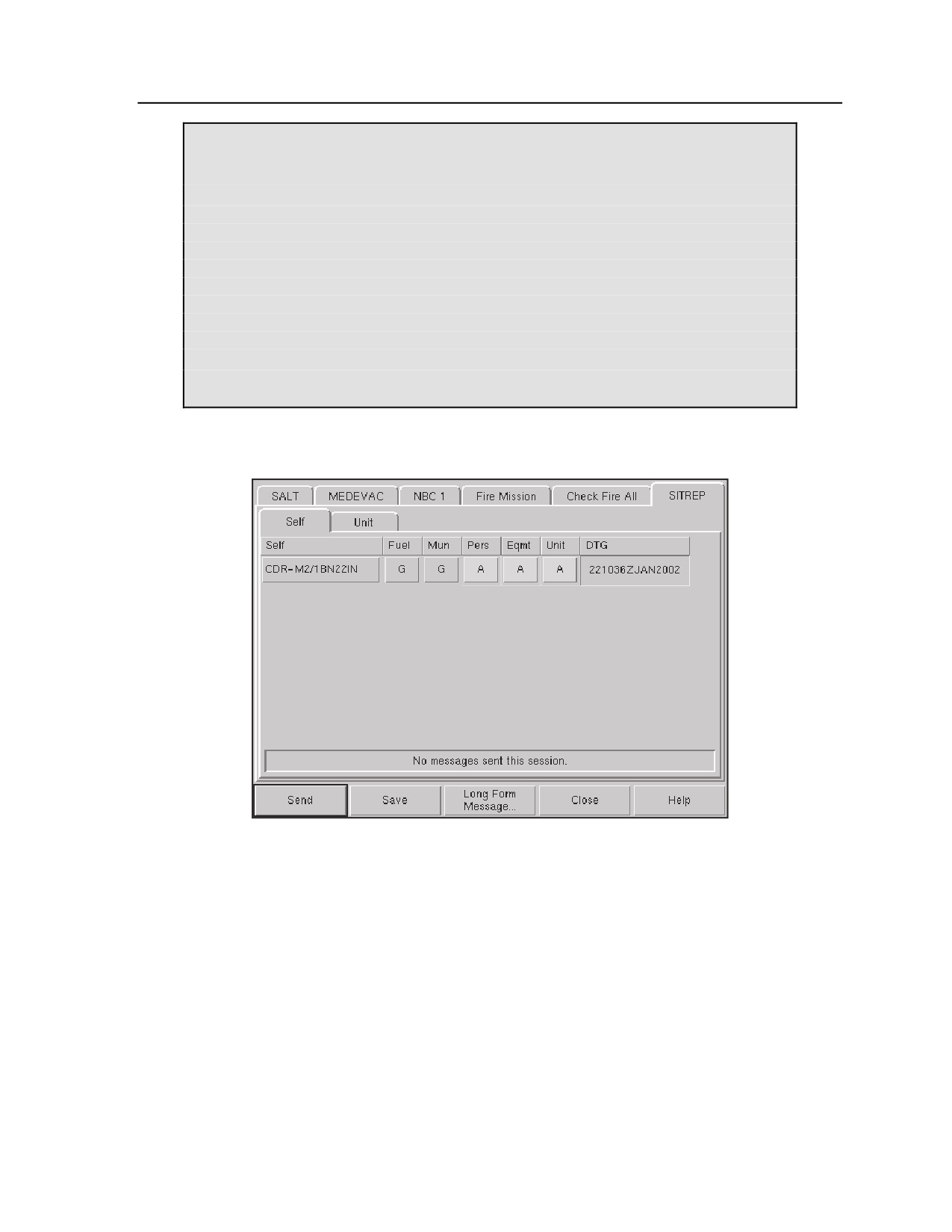
Orders and Reports
“BLACK SIX; THIS IS BLUE ONE—SITREP—OVER.”
“BLUE ONE; THIS IS BLACK SIX—SEND IT—OVER.”
“BLACK SIX, THIS IS BLUE ONE—REPORT FOLLOWS:
LINE 1 (As of DTG): 181217MAY99 ZULU.
LINE 2 (Enemy Activity in Brief): OBSERVING FOUR ENEMY SOLDIERS.
LINE 3 (Friendly Locations): CP 28.
LINE 4 (FMC Vehicles): FOUR.
LINE 5 (Defense Obstacles): NONE.
LINE 6 (Personnel Status): GREEN.
LINE 7: CLASS THREE AMBER—CLASS FIVE GREEN.
LINE 8: CONTINUING MISSION.
OVER.”
“BLUE ONE; THIS IS BLACK SIX—ROGER—OUT.”
Figure A-8. Sample SITREP
Figure A-9. Digital Blue 2 report (SITREP)
Blue 4 - Report for Bridge, Overpass, Culvert, Underpass, or Tunnel (BRIDGEREP)
A-46. To send this report, state “BRIDGEREP,” followed by pertinent information on these lines:
z
Line ALPHA: Type and location (for a long tunnel, include both entrance and exit locations).
Use either a TIRS point or grid coordinates.
z
Line BRAVO: Overall length.
z
Line CHARLIE: Width of roadway.
z
Line DELTA: Height restrictions.
z
Line ECHO: Length and number of spans.
z
Line FOXTROT: Computed classification.
z
Line GOLF: Bypass locations and conditions. Use a Blue 5 report if necessary.
3 August 2009
FM 3-20.98
A-17
Appendix A
Blue 5 - Report for Ford, Ferry, or Other Crossing Site (CROSSREP)
A-47. To send this report, state “CROSSREP,” followed by pertinent information on these lines:
z
Line ALPHA: Type and location, using either a TIRS point or grid coordinates.
z
Line BRAVO: Length of crossing in meters.
z
Line CHARLIE: Usable width.
z
Line DELTA: Current speed in meters per second.
z
Line ECHO: Maximum depth in meters.
z
Line FOXTROT: Bottom material and condition.
z
Line GOLF: Capacity classification of any existing ferry equipment.
z
Line HOTEL: Slope of entry bank.
z
Line INDIA: Slope of exit bank.
z
Line KILO: Other comments as necessary.
Blue 7 - Route Reconnaissance Report (ROUTEREP)
When Used
A-48. To report the results of a route reconnaissance, scouts send an initial report at the start point (SP). At
a minimum, the initial report is followed by updates at any obstructions, at each phase line, and whenever a
route change becomes necessary. These update reports should include only the line(s) that have changed
from the initial ROUTEREP.
Format
A-49. To send this report, state “ROUTEREP,” followed by pertinent information on these lines:
z
Line ALPHA: “From” location, reported using a control measure or TIRS point.
z
Line BRAVO: “To” location, reported using a control measure or TIRS point.
z
Line CHARLIE: Type of route, reported using the following designations:
Highway, reported using the number “1.”
Road, number “2.”
Trail, number “3.”
Cross-country, number “4.”
z
Line DELTA: Classification of route. Check for height, width, and weight restrictions to
determine the appropriate class, and report what vehicles the route is capable of handling using
the following designations:
z
Line ECHO: Seasonal limitations of route based on weather-support capability, reported as
follows:
All-weather (usable year-round), reported using the letter “X.”
Limited all-weather (use limited during bad weather), letter “Y.”
Fair weather (may be impassable during bad weather), letter “Z.”
z
Line FOXTROT: Rate of movement the route will support, reported as follows:
Fast, reported using the number “1.”
Slow, number “2.”
z
Line GOLF: Location and type of any critical points (send the applicable report). Report the
following obstructions in all cases: curves with a radius of 45 meters or less; uphill slopes with
grades of 5 percent or greater; width restrictions of 6 meters or less for one-way traffic, 10
meters or less for two-way traffic; and overhead clearance of 4.3 meters or less.
A-18
FM 3-20.98
3 August 2009
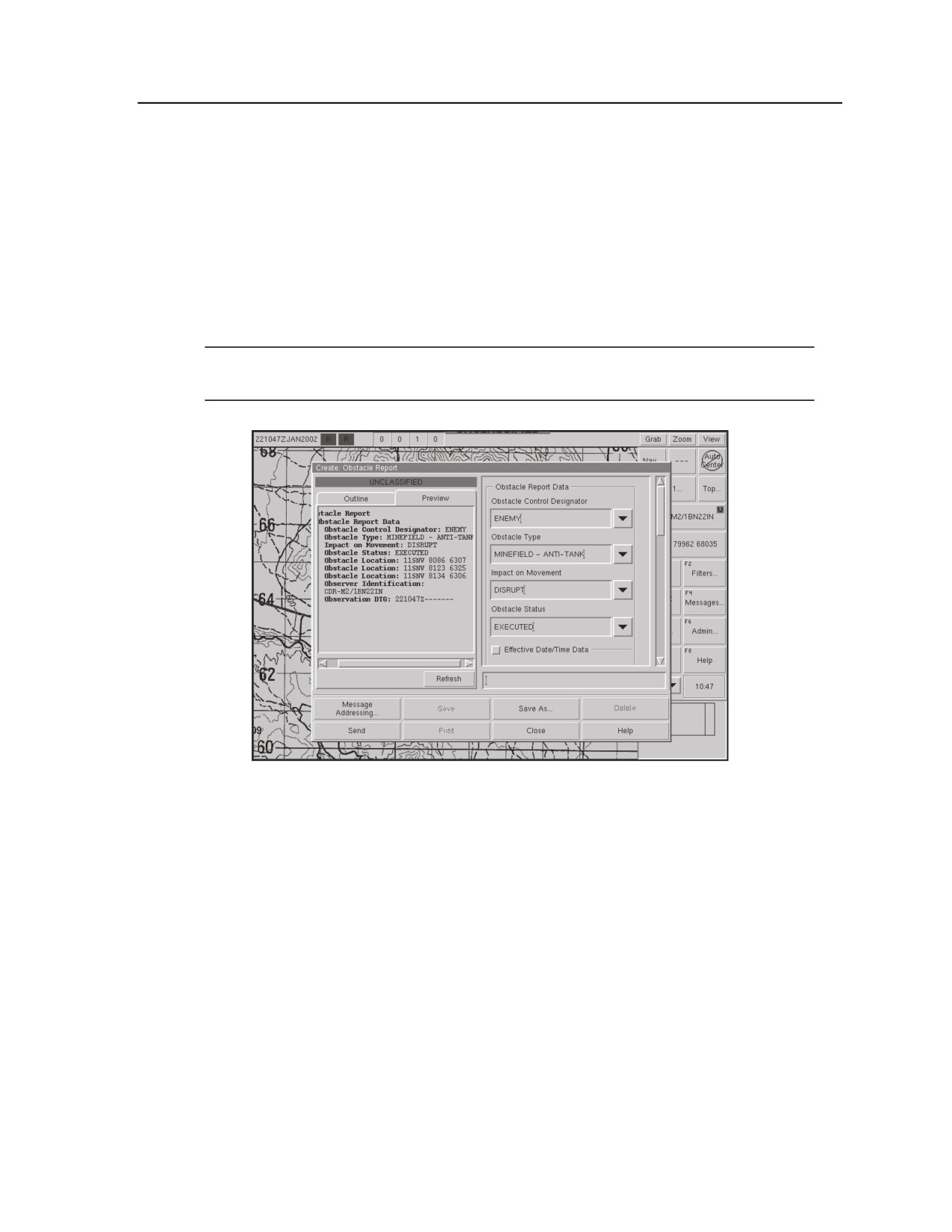
Orders and Reports
Blue 9 - Obstacle Report
A-50. Report all pertinent information using the following format:
z
Line ALPHA: Type of obstacle or obstruction.
z
Line BRAVO: Location, using grid coordinates. For large, complex obstacles, send the
coordinates of the ends and of all turn points.
z
Line CHARLIE: Dimensions and orientation.
z
Line DELTA: Composition.
z
Line ECHO: Enemy weapons influencing obstacle.
z
Line FOXTROT: Observer’s actions.
Note. The digital obstacle report (Figure A-10) is sent by the vehicle that can best identify the
dimensions and type of the obstacle. The report is sent to the entire troop.
Figure A-10. Digital obstacle report
Blue 10 - Bypass Report
A-51. Report all pertinent information using the following format:
z
Line ALPHA: Observer or source.
z
Line BRAVO: Length; width; surface type; grade.
z
Line CHARLIE: Coordinates of “from” and “to” locations.
z
Line DELTA: Seasonal/weather limitations. Use letter designation (X, Y, or Z) as described
for the Blue 7 report (ROUTEREP).
z
Line ECHO: Bypass markings.
z
Line FOXTROT: Observer’s actions.
Blue 11 - Stand-To Report (STANREP)
When Used
A-52. The STANREP is sent by the PSG to the troop CP, as applicable, when stand-to is completed.
3 August 2009
FM 3-20.98
A-19
Appendix A
Format
A-53. To send this report, state “STANREP,” followed by pertinent information on these lines:
z
Line ALPHA: Time stand-to was completed.
z
Line BRAVO: Weapons on hand and functional. Use the term “UP” for functional weapons on
hand. Use "EXCEPTION" for weapons either not on hand or not functional.
z
Line CHARLIE: Sensitive and accountable items on hand. Use “UP” or “EXCEPTION” as
applicable.
z
Line DELTA: Vehicles and radios on hand and functional. Use “UP” or “EXCEPTION” as
applicable.
z
Line ECHO: Report the on-hand/functional status of any other equipment using “UP” or
“EXCEPTION.”
Note. For lines B, C, D, and E, refer to the Yellow 1 report (ESTAT) for equipment line numbers.
A-54. Figure A-11 shows an example of a STANREP.
“BLACK 6, THIS IS RED 4; BLUE 11. LINE ALPHA: COMPLETE TIME 0600. LINE
BRAVO: UP. LINE CHARLIE: ITEM 38, MISSING 1 EACH. LINE DELTA: RED 3
WILL NOT START.”
Figure A-11. Sample STANREP
GREEN REPORTS (INTELLIGENCE)
Green 2 - Sensitive Items Report (SENSEREP)
When Used
A-55. This report is sent daily at various times, in accordance with the unit SOP, or at other prescribed
times (before and after significant movement, after significant events, and after any consolidation or
reorganization). Items covered include crew-served weapons, personal weapons, night vision devices,
binoculars, CBRN equipment, COMSEC materials, maps/graphics, and special equipment assigned to
platoons for particular operations.
Format
A-56. To send this report, state “SENSEREP,” followed by pertinent information on these lines:
z
Line ALPHA: Reporting unit (use call sign).
z
Line CHARLIE: Results of sensitive items check. Use the term "UP" for on-hand/functional
items. For missing items, report the line description and serial number and provide an
explanation. Use additional lines from the Yellow 1 report.
z
Line ECHO: Initials of person sending report.
A-57. Figure A-12 shows an example of a SENSEREP.
“THIS IS RED 4. SENSEREP. LINE ALPHA: RED. LINE CHARLIE: ALL 'UP.'
LINE ECHO: RWS.”
Figure A-12. Sample SENSEREP
A-20
FM 3-20.98
3 August 2009
Orders and Reports
YELLOW REPORTS (SUSTAINMENT)
Yellow 1 - Equipment Status Report (ESTAT)
When Used
A-58. Each PSG sends this report by courier or radio voice transmission to the troop CP at times
designated in the unit SOP.
Note. The digital Yellow report (see Figure A-14) is a combination of the analog Yellow 1, 2,
and 3 reports. When sending this report, all classes of supply are reported. Each vehicle sends
this report to the platoon leader and PSG. The PSG consolidates this information and forwards a
platoon rollup to the XO, 1SG, maintenance team chief, and medics. At a minimum, this report
is sent once daily in accordance with the unit SOP.
Format
A-59. Equipment status is recorded using one of these terms: operational, inoperative, or combat loss.
Provide all pertinent information using the following categories and lines:
z
Weapons.
Line 1: Bayonet knife, with scabbard, for M16A2.
Line 2: Pistol, 9-mm, automatic, M9.
Line 3: Rifle, 5.56-mm, with equipment.
Line 4: Launcher, grenade, 40-mm, single shot, rifle mounted, detachable, with equipment.
Line 5: Machine gun, M2, caliber .50, heavy barrel (HB).
Line 6: Machine gun, 7.62-mm, light flexible.
Line 7: Squad automatic weapon, M249.
Line 8: Grenade launcher, 40-mm, MK19.
Line 9: Machine gun, 7.62-mm, fixed M24OC RH feed F/FVS.
Line 10: Launcher, grenade, obscurant munitions, screening, RP M250.
Line 11: Mortar, 120-mm, on mount.
Line 12: Command launch unit, AAWS-M.
Note. Lines 13, 14, 15, and 16 are used as needed for additional weapons assigned to the platoon.
z
Vehicles and vehicle equipment.
Line 17: CFV, M3.
Line 18: Carrier, 120-mm mortar, self-propelled (less mortar).
Line 19: Carrier, personnel, full-tracked, armored, M113.
Line 20: HMMWV, M1114.
Line 21: Tank, M1/M1A1/M1A2/MGS.
Note. Lines 22, 23, and 24 are used as needed for additional vehicles and/or vehicle equipment
assigned to the platoon.
z
CBRN equipment.
Line 25: Alarm, chemical agent, automatic, portable, for full-tracked APC and armored
recovery vehicle.
Line 26: Alarm, chemical agent, automatic, portable, with power supply, for track, utility,
1/4-ton.
3 August 2009
FM 3-20.98
A-21
Appendix A
Line 27: Charger, radiac detector, PP-1570/PD.
Line 28: Mask, chemical-biological, multipurpose.
Line 29: Radiacmeter, IM-185/UD.
Line 30: Alarm, chemical agent, automatic, portable, manpack.
Line 31: Radiacmeter, IM-93/UD.
Line 32: Radiacmeter, IM-174/PD.
Line 33: Radiacmeter, AN/VDR-2.
Note. Lines 34, 35, and 36 are used as needed for additional CBRN equipment assigned to the
platoon.
z
Radios.
Line 37: Radio set, AN/GRC-160.
Line 38: Radio set, AN/VRC-46.
Line 39: Radio set, AN/VRC-47.
Line 40: Radio set, AN/VRC-64.
Line 41: Radio set, AN/PRC-77.
Line 42: Radio set, AN/VRC-12.
Line 43: Secure set, AN/PRC-91.
Line 44: Secure set, AN/PRC-126.
Line 45: Secure set, KY-57.
Note. Lines 46, 47, and 48 are used as needed for additional radios assigned to the platoon.
z
Miscellaneous equipment.
Line 49: Demolition set, explosive, initiating, non-electric.
Line 50: Detecting set, mine, portable, metallic and non-metallic.
Line 51: Detecting set, mine, portable, metallic, AN/PSS-14.
Line 52: Night vision goggles, AN/PVS-7B.
Line 53: Night vision sight, crew-served weapon, AN/TVS-5.
Line 54: Night vision sight, individual-served weapon, AN/PVS-4.
Line 55: Platoon early warning system, AN/TRS-2(V).
Line
56: Binoculars, modular construction, military scale reticle,
7x50-mm,
with
equipment.
Line 57: Telescope, straight, military.
Line 58: Detector, radar signal, AN/PSS-10.
Line 59: Position locating reporting system, basic user unit.
Line 60: Position locating reporting system, surface vehicle installation kit.
Note. Lines 61, 62, and 63 are used as needed for any other equipment assigned to the platoon.
Example
A-60. Figure A-13 shows an example of an ESTAT. Figure A-14 illustrates the FBCB2 screen showing the
digital version of the report; as noted, the digital report also includes aspects of the analog Yellow 2 and
Yellow 3 reports.
A-22
FM 3-20.98
3 August 2009