FM 3-39.40 INTERNMENT AND RESETTLEMENT OPERATIONS (February 2010) - page 3

Parole, Transfer, or Release of U.S. Military Prisoners and Detainees
Balance
Risks
Benefits
Local leaders not in favor of detainee release
Local leaders engaged to accept detainees
program.
as source of reformed citizens.
Former detainee population relatively high in
Aggressive IO and reintegration programs
an area, giving rise to potential organization
with strict enforcement to reduce recapture
as insurgents, extremists, or criminals.
and ensure minimal detainee migration.
Successful extremist recruiting operations
Jobs and job training programs increased
(assume they target detainees).
skills and abilities.
Lack of jobs, especially in view of returning
HN provides additional funding for creating
refugees also looking for work.
adequate numbers of meaningful jobs
(economic stimulation).
Insufficient law enforcement presence; lack of
HN provides additional funding for increased
adequate security.
(adequate) security forces.
Incidents of sectarian violence attributed to
Detainee alignment with (and oversight by)
detainees
(need detainee origin, tribal and
reintegration facilitators, informant reward
religious affiliation, release point, and last
programs and tip hotlines, and maximum
known location).
local control.
Legend:
HN
host nation
IO
information operations
Figure 9-1. Detainee reintegration considerations
TRANSITION OF DETAINEE OPERATIONS TO CIVIL AUTHORITY
PENAL SYSTEMS
9-45. Strategic-level priorities and conditions within the OE will dictate the long-term direction of theater
level detainee operations. At some point, when combat actions have subsided and some predetermined
level of stability is achieved, most detainees will be released, transferred, or repatriated. Detainees are
traditionally released or repatriated. Various categories of interned civilians may be released once the
strategic conditions which led to their internment have changed. Members of armed groups may be
transferred to external facilities for strategic intelligence screening or for long-term internment. However,
detainees who are suspected or convicted of committing crimes that initially resulted in their internment, or
who committed serious crimes while interned, will not be released in the same manner. They may, instead,
be tried as criminals in duly established military proceedings or turned over to indigenous civil courts for
prosecution and adjudication. It is critical that military police plan for and position detainees for eventual
release or transfer to emerging civil authority penal systems.
9-46. The permanent transfer of detainees from the custody of U.S. armed forces to HN or other
multinational forces requires the approval of the Secretary of Defense or his designee. The permanent
transfer of detainees to foreign national control will be governed by bilateral national agreements. Before
transfer, the appropriate U.S. government representative will ensure that the receiving government is
willing and able to apply the Geneva Conventions to transferred detainees and will gain assurances of
humane treatment for persons convicted or pending trial for criminal activity. At the conclusion of military
or stability operations, a key element that must be considered is the transfer of detainees from U.S. and/or
multinational control to HN control. A myriad of factors (law enforcement, military, or judicial assets)
12 February 2010
FM 3-39.40
9-9

Chapter 9
affect when transitions can occur with limited disruption to current operations of the U.S. and the receiving
government. The following factors must be considered before releasing detainees back to the HN:
z
Publish the release order and inform the detainees so that can notify their next of kin of their new
location, when required by applicable Geneva Conventions.
z
Verify the accuracy of the detainee’s personnel and medical records and provide copies (in a
sealed envelope) to the transporting unit.
z
Account for and prepare impounded personal property for shipment with the escorting unit.
z
Ensure that logistic resources (food and water) are adequate.
z
Ensure that detainees are documented on a list by name, rank, and/or status; ISN; power served;
nationality; and physical condition. Attach the list to the DD Form 2745 and provide a copy to
the NDRC. (See table 4-1, page 4-6.)
z
Prepare paperwork in English and other applicable languages before releasing detainees.
z
Verify collected biometric data.
z
Coordinate with legal, police, and penal administrative officials of the HN for the transfer of
detainees.
z
Coordinate with the media for press coverage of the transfer.
9-47. When I/R operations are conducted in an environment in which a state has failed or will continue to
be occupied, leaders consider the following when releasing detainees back into the community:
z
Assist in the establishment of internment facilities for the eventual transition of detainees to the
HN penal operation.
z
Assist with training HN and/or new government personnel in penal and/or detention operations.
z
Coordinate with judicial and administrative personnel for the transfer of evidentiary documents
and/or materials.
z
Establish clear and agreed-upon standards for the release and/or transfer of detainees back to the
HN and/or new government.
9-48. Planning considerations for transitioning detainee operations to a HN penal system may include:
z
Penal system template. Strategic planners and leaders determine the current state of the
developing indigenous penal system and the necessary additions or adjustments to be made to
achieve a functioning system. A regional penal system template is developed for planners to use
to determine the amount of penal system infrastructure and associated resources needed based on
the population and regional characteristics of a given area. Planning considerations for regional
penal systems range from comparative analysis of existing structures to historical examples used
for development purposes and may include the following:
Compare the populations of similar regions to the number of persons detained to obtain a
holistic analysis which will determine large-scale indigenous penal system requirements.
Use lessons learned in historic detainee levels to form detainee-to-population ratios as a
functional starting basis for further refinement. A sample template might be a regional
facility with 5,000 bed spaces for every 1 million inhabitants. Additionally, the same 1
million inhabitants planning number may lead to a requirement for 200 of the 5,000 bed
spaces to be designated for female detainees.
Develop templates to capture layered or “bottom up” requirements. For every three 400-bed
space, local facilities require one regional level facility in support. The template should also
be scalable and account for the various levels of confinement facilities needed within a
functional span of control.
Adjust templates based on the unique characteristics of the operating environment.
z
Academy organizational structure design template. Significant preplanning is required to
efficiently establish the educational institutions required to train indigenous personnel in penal
operations. Planners develop templates early to capture the requirements for standing up training
academies that can properly train large numbers of people for sustained periods of time. Military
advanced individual training institutions should be modified, as needed, and used as a model for
creating academy templates.
9-10
FM 3-39.40
12 February 2010

Parole, Transfer, or Release of U.S. Military Prisoners and Detainees
z
Juvenile justice/penal program. Most developed nations recognize the need to handle and treat
juvenile offenders differently from other criminals. U.S. policy requires that juvenile detainees
be segregated from adult detainees and protected based on their minor status. Early planning
must incorporate the requirements to resource, establish, and transition civil juvenile justice and
correctional systems according to generally accepted international standards.
z
Assistance and liaison teams. Once civil authority begins to take shape, the I/R-focused
military police should plan to ease out of the “doing” role and into a “teaching, coaching, and
mentoring” role. The assistance teams that work with emerging civil authorities require
considerable planning and resourcing efforts. Additionally, planners anticipate increased
requirements for effective liaison activities at every level of emerging civil penal systems and
infrastructure.
z
Indigenous penal system resource planning estimates. Resource requirements must be
developed early regarding the necessary systems, equipment, and infrastructure needed to
establish and operate regional penal systems. Military police with I/R expertise provide planners
and resource directors with accurate planning estimates for the establishment and day-to-day
sustainment of all aspects of penal system administration and operation.
z
Detainee information management system. Preserving critical information on detainees and,
ultimately, transferring that information to civil authorities requires robust detainee management
data systems. Criminal information systems capable of tracking corrections based on inmate
management information in penal environment applications are critical. Capabilities provided by
such systems must meet military police and HUMINT collection requirements (including
biometrics) and must be scalable from the local to national level. The system must be
unclassified and transferable to civil authorities for criminal and penal applications.
9-49. The key objectives of the transition of detainee operations are numerous and complex. Key players
within this transition plan include—
z
Department of the State officials, to include public diplomacy personnel.
z
Department of Justice.
z
DOD.
z
U.S. Agency for International Development.
z
Foreign governments.
z
NGOs and international organizations.
z
Private contractors.
z
Ministry of interior and local justice and police personnel.
9-50. Key U.S. military considerations include—
z
Constructing facilities to ensure that they meet humane treatment standards.
z
Estimating fund for infrastructure construction or upgrade.
z
Identifying equipment issues for the gaining facility.
z
Identifying a transition team to provide oversight.
z
Developing a public affairs plan.
9-51. Transition criteria must also be established to determine at what point detainees should be handed
over to the HN or a fledgling government. From a penal standpoint, the criteria includes—
z
Number and quality of corrections officers trained.
z
Number and quality of penal facilities built or refurbished.
z
Institutional development.
z
Crime rates, especially violent crimes.
z
Other crime indicators, such as illegal drug trade.
z
Public perception of security and performance of corrections officers.
9-52. From the standpoint of the military and similar organizations, the transition criteria may include—
z
Number and quality of personnel trained and institutional facilities built or refurbished.
z
Development of reliable local intelligence.
12 February 2010
FM 3-39.40
9-11

Chapter 9
z
Number of former combatants who have completed disarmament, demobilization, and
reintegration.
z
Number and quality of intelligence officials trained, facilities built, and institutions developed.
z
The level of political violence and insurgency.
z
Public perception of security.
z
International military casualties.
9-53. The justice system within the government is another critical component when developing a transition
plan. A set of criteria as to when to conduct transition operations may depend on the following standards:
z
Number and quality of judges, prosecutors, and trained corrections officers.
z
Number and quality of judicial facilities built or refurbished.
z
Institutional development of justice bodies, such as a ministry of justice and local and national
courts.
z
Public perception of justice system effectiveness.
z
Public perception of corruption in the justice system.
z
Duration of pretrial detention.
z
Duration of case movement through the court system.
z
Established right to legal advice and due process.
9-54. A detailed plan is critical for ensuring the long-term success of transition operations.
9-12
FM 3-39.40
12 February 2010

Chapter 10
Resettlement Operations
Resettlement operations occur across the spectrum of military operations. Such
operations include civil support operations and foreign humanitarian assistance
operations. Events under the category of resettlement operations include relief,
CBRNE, civil laws, and community assistance operations. Military police provide
support to resettlement operations, which include establishing and operating facilities
and supporting CA efforts to ensure that supply routes remain open (mainly linked to
the maneuver and mobility support function) and clear to the maneuver commander.
Additional tasks that support resettlement operations (conducted within the law and
order function) include curfew enforcement, movement restrictions, the use of travel
permits and registration cards, proper checkpoint operations, amnesty programs, and
inspections. The level of control is typically drastically different from that of most
interned persons during detainee operations. During detainee operations, the level of
control and supervision is high, based on the significant and evident security risks.
During resettlement operations, DCs are allowed freedom of movement as long as
such movement does not impede operations. Security risks will always be present,
but they should be reduced in most resettlement operations. Counterinsurgency
operations may affect, or be affected by, resettlement operations; and ongoing
insurgency operations will tend to blur the lines between internment operations and
resettlement operations.
INTRODUCTION
10-1. Resettlement operations are conducted to provide security and support for DCs, in conjunction with
CA/civil-military operations and HN, NGO, and other military specialties. CA personnel typically lead the
initial analysis and assessment, coordination, and liaison with the HN and NGOs regarding resettlement
operations. In some instances, conducting resettlement operations minimizes civilian interference with
military operations and protects civilians from combat operations. In other instances, resettlement
operations may be the main effort, such as during humanitarian relief missions. Resettlement operations are
ideally performed with minimal military resources. Nonmilitary international aid organizations, NGOs, and
international humanitarian organizations are the preferred resources used to assist CA forces. However, CA
forces typically depend on other military units, such as military police, to assist with controlling and
securing DCs.
OBJECTIVES AND CONSIDERATIONS
10-2. Often, the primary objective of resettlement operations is to minimize civilian interference with
military operations, and this is typically linked to the maneuver and mobility support function. However,
the primary or supporting objectives of resettlement operations may also be to—
z
Protect DCs from combat operations.
z
Prevent and control the outbreak of disease.
z
Relieve human suffering.
z
Centralize masses of DCs.
10-3. The specific planning focus of resettlement operations may differ at each level of command and will
vary depending on the type and nature of detainee operation being performed and other relevant aspects of
12 February 2010
FM 3-39.40
10-1

Chapter 10
the OE. All commands and national and international agencies involved must have clearly defined
responsibilities. When planning and executing resettlement operations, consider the following actions:
z
Coordinate with the Department of State, the UN Office for the Coordination of Humanitarian
Affairs, and HN civil and military authorities to determine the appropriate levels and types of aid
required and available.
z
Minimize outside contributions (issue basic needs items only) until DCs become self-sufficient,
and encourage DCs to become as independent as possible.
z
Review the effectiveness of humanitarian responses, and adjust relief activities as necessary.
z
Coordinate with CA units to ensure the use of U.S., HN, international, and other organizations
(UN Children’s Fund, Cooperative for Assistance and Relief Everywhere). Receiving assistance
from these organizations capitalizes on their experience and reduces the requirements placed on
U.S. armed forces.
z
Apply security restrictions, as required, for DCs. Under international laws, DCs have the right to
freedom of movement; but in the event of a mass influx of DCs, security considerations may
require restrictions.
CIVIL-MILITARY AND RESETTLEMENT OPERATIONS
10-4. Resettlement operations typically require integrated and synchronized civil-military operations. The
situation will determine if civil-military operations are supporting resettlement or if resettlement is
supporting civil-military operations. CA forces are specially organized, trained, equipped, and suited to
perform civil-military operations liaison, to include providing support to resettlement operations, with the
varied civil agencies and multinational partners in an operational area. CA forces bridge the gap between
U.S. armed forces and HN military and civilian authorities in support of military objectives. They can also
provide support to non-U.S. units in multinational operations. (CA participation in detainee operations
within the United States may have limitations, and the roles they perform in non-U.S. territories will
typically be performed by other U.S. governmental agencies in U.S. territories.)
10-5. Civil-military operations are the activities of a commander that establish, maintain, influence, or
exploit relations between U.S. armed forces, governmental and nongovernmental civilian organizations and
authorities, and the civilian population in a friendly, neutral, or hostile operational area to facilitate military
operations and consolidate and achieve U.S. objectives. Activities conducted by CA personnel enhance the
relationship between U.S. armed forces and civil authorities in areas where U.S. armed forces are present.
Support by CA personnel also involves the application of their functional specialty skills that are normally
the responsibility of the civil government to enhance the conduct of civil-military operations. The
contribution of CA forces to an operation centers on their ability to rapidly analyze key civil aspects of the
operational area, develop an implementing concept, and assess its impact throughout the operation. (See
FM 3-05.40 for more information about CA.)
RESPONSIBILITIES FOR CIVIL AFFAIRS ACTIVITIES
10-6. The President and the Secretary of Defense develop and promulgate the policy that governs CA
activities that U.S. commanders perform (in joint and multinational contexts) due to the politico-military
nature and sensitivity of these activities.
10-7. CA planning is based on national military strategy and is consistent with a variety of legal
obligations, such as those provided for in the U.S. Constitution, statutory laws, judicial decisions,
Presidential directives, departmental regulations, and the rules and principles of international laws
(especially those incorporated in treaties and agreements applicable to areas where U.S. armed forces are
employed).
10-8. CA forces are made available to commanders to maintain proper, prudent, and lawful relations with
the civilian population and government indigenous in the operational area. When commanders’ operations
affect, or are affected by, the indigenous civilian population, resources, government, or other civil
institutions or organizations in the operational area, CA forces will be assigned to assist in civil-military
operations. (See DODD 2000.13.)
10-2
FM 3-39.40
12 February 2010

Resettlement Operations
10-9. U.S. Army CA forces are designated as special operations forces.
(See Title
10, USC.) All
CONUS-based special operations forces are assigned to the U.S. Special Operations Command. CA units
are under the combatant command of U.S. Special Operations Command until operational control is given
to one of the geographic combatant commanders. U.S. Special Operations Command is the combatant
command for special operations forces.
CIVIL AFFAIRS SUPPORT
10-10. The U.S. Special Operations Command coordinates with geographic combatant commanders to
validate all requests for CA units and individuals during peace and war. The U.S. Special Operations
Command coordinates with each of the Services and then provides CA forces that are organized, trained,
and equipped to plan and conduct CA activities in support of a geographic combatant commander’s
mission. The U.S. Special Operations Command commander has the capability of providing one
airborne-qualified CA battalion that—
z
Is an Active Army unit that consists of regionally oriented companies.
z
Is structured to deploy rapidly.
z
Provides initial CA support to military operations.
z
Is primarily used to provide rapid, short-duration CA generalist support for nonmobilization
contingency operations worldwide.
z
Is not designed or resourced to provide the full range of CA functional specialty skills.
10-11. The U.S. Army Special Operations Command is the Army component of the U.S. Special
Operations Command. Its mission is to command and support and ensure combat readiness of assigned and
attached Army Special Operations Forces. The U.S. Army Special Operations Command has the
responsibility, in conjunction with U.S. Special Operations Command, to recruit, organize, train, equip,
mobilize, and sustain the Regular Army’s only CA brigade. As an Army Service component command, the
U.S. Army Special Operations Command’s primary missions are—
z
Policy development.
z
Long-range planning.
z
Programming and budgeting.
z
Management and distribution of resources.
z
Program performance review and evaluation.
10-12. The U.S. Army Civil Affairs and Psychological Operations Command headquarters is a
nondeploying, direct-reporting unit to the U.S. Army Reserve Command with the mission to organize,
train, equip, monitor the readiness of, validate, and prepare assigned Active Army and U.S. Army Reserve
CA forces for deployment. These forces conduct worldwide CA operations in support of civil-military
operations, across the spectrum of operations, and in support of the geographic combatant commanders,
U.S. Ambassadors, and other agencies as directed by the U.S. Army Special Operations Command.
10-13. The geographic combatant commander organizes the staff to orchestrate joint operations with
multinational and interagency activities. Geographic combatant commanders plan, support, and conduct
CA activities. They designate a staff element within the headquarters that has the responsibility for
coordinating CA activities; combatant commanders receive CA support from the Commander U.S. Special
Operations Command. The civil-military operations staff element on the theater echelon staff plays an
integral part in this organization. The civil-military operations staff cell of the Theater Special Operations
Command provides deliberate and contingency planning, maintenance of existing plans, assessments, and
support to the geographic combatant commander. The CA commander supporting each geographic
combatant commander serves as the geographic combatant commander’s senior CA advisor and as the
focal point for civil-military operations, coordination, collaboration, and consensus.
10-14. Normally, C2 of special operations forces is executed within the special operations forces chain of
command. The identification of a C2 organizational structure for special operations forces depends on
specific objectives, security requirements, and the OE. The Theater Special Operations Command is the
joint special operations command through which the geographic combatant commander normally exercises
operational control of special operations forces within the area of responsibility (the exceptions are the U.S.
12 February 2010
FM 3-39.40
10-3

Chapter 10
Central Command and U.S. European Command areas of responsibility where the Theater Special
Operations Command exercises operational control of CA forces).
10-15. Civil-military operations (assistant chief of staff, civil affairs operations [G-9]/civil affairs staff
officer [S-9]) staff elements are typically embedded within the echelon staffs requiring CA support. These
staff elements will normally be provided to brigade level, based on specific mission variables and
requirements. The civil-military operations staff officer/planner (G-9/S-9) is the principal staff officer for
all civil-military operations matters and conducts the initial assessment that determines CA force
augmentation. The relationship between the G-9/S-9 primary staff officer to the supporting CA unit is the
same relationship as the G-2 to a supporting MI unit. The G-9/S-9 enhances the relationship between
military forces and civilian authorities and personnel in the AO to ensure mission success. Responsibilities
and functions of the G-9 and S-9 differ due to the operational echelon. The G-9 has staff planning and
oversight to—
z
Manage assigned and attached CA forces.
z
Coordinate all aspects of the relationship between the military force and the civil component in
the environment of the supported commander.
z
Advise the commander on the effect of military operations on the civilian populations.
z
Minimize civilian interference with operations. This includes monitoring resettlement operation
curfew, and movement restrictions or deconflicting civilian and military activities with due
regard for the safety and rights of refugees and internally displaced persons.
z
Advise the commander on legal and moral obligations incurred from the long- and short-term
effects (economic, environmental, health) of military operations on civilian populations.
z
Coordinate, synchronizing, and integrating civil-military plans, programs, and policies with
national and combatant command strategic objectives.
z
Advise on the prioritizing and monitoring expenditures of allocated overseas humanitarian
disaster and civic aid, commanders emergency response plan, payroll, and other funds dedicated
to civil-military operations. The G-9 ensures that subordinate units understand the movement,
security, and control of funds. The G-9 coordinates with the funds controlling authority/financial
manager to meet the commander’s objectives.
z
Coordinate and integrating deliberate planning for civil-military operations-related products.
z
Augmenting civil-military operations staff.
z
Coordinate and integrating area assessments and area studies in support of civil-military
operations.
z
Support emergency defense and civic-action projects.
z
Support the protection of culturally significant sites.
z
Support foreign humanitarian assistance and disaster relief.
z
Support emergency food, shelter, clothing, and fuel for local civilians.
z
Support public order and safety applicable to military operations.
10-16. The functions of the brigade S-9 are to—
z
Serve as the staff proponent for the organization, use, and integration of attached CA forces.
z
Develop plans, policies, and programs to further the relationship between the brigade and the
civil component in the brigade AO.
z
Serve as the primary advisor to the brigade commander on the effect of brigade populations on
brigade operations.
z
Assist in the development of plans, policies, and programs to deconflict civilian activities with
military operations within the brigade area of responsibility. This includes resettlement
operations, curfews, and movement restrictions.
z
Advise the brigade commander on legal and moral obligations incurred from the long- and
short-term effects
(economic, environmental, health) of brigade operations on civilian
populations.
z
Coordinate, synchronize, and integrate civil-military plans, programs, and policies with
operational objectives.
10-4
FM 3-39.40
12 February 2010

Resettlement Operations
z
Advise on the prioritizing and monitoring of expenditures of allocated funds that are dedicated to
civil-military operations and facilitates movement, security, and control of funds to subordinate
units. The S-9 coordinates with the funds controlling authority/financial manager to meet the
commander’s objectives.
z
Conduct, coordinate, and integrate deliberate planning for civil-military operations in support of
brigade operations.
z
Coordinate and integrate area assessments and area studies in support of civil-military
operations.
z
Advise the brigade commander and staff on the protection of culturally significant sites.
z
Facilitate the integration of civil inputs to the brigade common operational picture.
z
Advise the brigade commander on the use of military units and assets that can perform
civil-military operation missions.
CIVIL AFFAIRS ACTIVITIES
10-17. Under the umbrella of civil-military operations, CA forces perform the following activities:
z
Foreign nation support.
z
Civil-military actions.
z
Support to civil administrations.
z
Population and resource control.
z
Humanitarian assistance.
z
Emergency services.
10-18. Military police units may be deployed and employed in support of civil-military operations
anywhere in the world. Military police who are supporting civil-military operations must be briefed and
understand the intent of these operations. Police intelligence operations are significant enablers during
civil-military operations as is the proper treatment of all categories of detainees and DCs. Having a proper
mind set and good situational awareness is critical. U.S. armed forces may be called upon to relieve human
suffering (such as that encountered after a natural disaster), and appropriate discipline measures and
controls are enacted to meet each situation.
10-19. MI units obtain CA-relevant information gathered in interrogations, and they provide information
of intelligence value that is gained from passive collection by CA personnel. Police information and
intelligence are also integrated.
10-20. The expertise of CA forces in working crisis situations
(conduct of assessments, transition
planning, and skills in functions that are normally civil in nature) and their ability to operate with civilian
organizations may make them ideal for civil support operations. CA forces should never be considered as a
substitute for other U.S. armed forces.
10-21. The information that friendly, adversary, and neutral parties provide has a significant effect on the
ability of civil-military operations planners’ ability to establish and maintain relations between joint forces;
civil authorities; and the general population, resources, and institutions in friendly, neutral, or hostile areas.
10-22. CA forces have the inherent responsibility of population and resource control due to the impact on
the civilian population and movement of HN assets and personnel. Population and resource control is
conducted through the coordination and synchronization of the activities of multiple civilian agencies and
military organizations, to include extensive military police operations. Successfully coordinated and
executed population and resource control operations—
z
Provide security for the population.
z
Deny personnel and material to the enemy.
z
Mobilize population and material resources.
z
Detect and reduce the effectiveness of enemy agents.
10-23. Population control measures include curfews, movement restrictions, travel permits, registration
cards, and resettlement operations. Resource control measures include licensing, regulations or guidelines,
12 February 2010
FM 3-39.40
10-5

Chapter 10
checkpoints, ration controls, amnesty programs, and facility inspections. Most military operations employ
some type of population and resource control measures. Resettlement operations are often conducted under
the auspices of population and resource control.
SUPPORTING ORGANIZATIONS
10-24. Organizations supporting resettlement operations include numerous participants
(military and
nonmilitary) with divergent missions. Agencies involved in resettlement operations typically come from the
joint community, interagency organizations, NGOs, international organizations, and HN/multinational
organizations. The environment exists for potential duplication of effort. Achieving a unified effort requires
close coordination, liaison, and common purpose for mission success.
(See appendix E for more
information.)
PLANNING CONSIDERATIONS
10-25. The planning scope for resettlement operations and the actual task implementation typically differ
depending on the command level, and vary depend on the type and nature of detainee operation being
performed and other relevant aspects of the OE. Military police must have a basic understanding of the
planning CA units conduct for resettlement operations. Except as specifically noted, planning
considerations discussed are applicable to all tactical scenarios.
10-26. Based on national policy directives and other political efforts, the theater commander provides
directives on the care, control, and disposition of DCs. The resettlement operation plan—
z
Includes migration and evacuation procedures.
z
Establishes minimum standards of care.
z
Defines the status and disposition of DCs.
z
Designates routes and movement control measures.
z
Identifies cultural and dietary considerations.
z
Includes information on DC plans, routes, and areas of concentration.
z
Provides measures to relieve suffering.
z
Establishes proper order and discipline measures within the facility for the security and safety of
DCs and Soldiers.
z
Provides an aggressive information program by using support agencies and DC leadership.
INFRASTRUCTURE
10-27. Resettlement operations may require large groups of civilians to be quartered temporarily (less
than 6 months) or semipermanently (more than 6 months). Military police may be tasked to set up,
administer, and operate facilities in close coordination with CA forces, HN or U.S. governmental agencies,
PSYOP units, NGOs, international humanitarian organizations, international organizations, and other
interested organizations. A military police unit commander typically becomes the facility commander
(although there may be exceptions to this in the case of resettlement operations conducted as part of civil
support).
10-28. When possible, facilities are modified or constructed using local agencies, local or supporting
governmental employees, and selected DCs as appropriate. The supporting command’s logistic and
transportation assets acquire and transport materials to build or modify existing facilities, and local sources
may provide materials within legal limitations. The supporting command also furnishes medical,
subsistence, and other supporting assets to establish resettlement facilities. Engineer support and military
construction materials will be necessary in situations where new facilities are established and may be
necessary when resettlement facilities are set up in areas where local facilities are unavailable; for example,
hotels, schools, halls, theaters, vacant warehouses, and factories identified for use as holding sites for DCs.
(See chapter 6 and appendix J.)
10-6
FM 3-39.40
12 February 2010

Resettlement Operations
10-29. If necessary, military police units set up the facility using acquisitioned tentage and other
materials. The facility commander considers the type of construction necessary to satisfy the needs of the
resettlement operation. Considerations may include the—
z
Local climate.
z
Anticipated permanency of the facility.
z
Number of facilities to be constructed.
z
Availability of local materials.
z
Extent of available military resources and assistance.
SECURITY
10-30. The resettlement facility commander is responsible for safety and security. In any size facility, the
commander addresses crimes against persons and property, ensures that security patrols are conducted, and
conducts necessary quick-reaction force operations. If the commander has a law and order asset
task-organized, it typically performs necessary security-related functions. If not, other task-organized assets
(a guard company) typically provide the means to conduct necessary security-related tasks.
MEDICAL CARE AND SANITATION FACILITIES
10-31. Due to the temporary nature of a resettlement facility, the need for medical care and sanitation
facilities increases. If possible, locate a sick call tent adjacent to each major compound inside the facility to
ensure prompt medical screening and treatment. Enforcement and education measures ensure that the
facility population complies with basic sanitation measures. Provide medical care via organic I/R medical
personnel, or coordinate with the appropriate HN medical authorities. To prevent communicable diseases,
follow the guidance in FM 21-10 and other applicable publications. Coordinate with preventive medicine
specialists to conduct routine, preplanned health, comfort, and welfare inspections. Inspections are
performed to ensure that the facility is safe, sanitary, and hazard-free. (See appendix I.) When conducting
inspections—
z
Ensure that the purpose of the inspection is conveyed and emphasized to DC leaders.
z
Respect cultural beliefs, such as religious tenets and shrines. ICE, international support groups,
community leaders, CA forces, and DC leaders are good sources for information regarding
cultural sensitivities.
z
Treat DCs and their possessions respectfully.
SCREENING
10-32. Screening prevents infiltration by insurgents, enemy agents, or escaped members of hostile armed
forces. Although intelligence and other units may screen DCs, friendly and reliable local civilians can
perform this function under the supervision of military police and CA forces. Screeners carefully apply
administrative controls to prevent infiltration and preclude the alienation of people who are sympathetic to
U.S. objectives. The screening process also identifies technicians and professionals to help administer the
facility; for example, policemen, teachers, doctors, dentists, nurses, lawyers, mechanics, carpenters, and
cooks.
STRATEGIC REPORTING
10-33. Military police will typically be required to account for DCs and report to higher headquarters.
This may require the issuance of ISNs or control numbers that are specific to DCs. Commanders
conducting resettlement operations ensure a proper understanding of the ISN issuance policy before
assigning an ISN to a DC. Even in civil support operations where social security numbers may be used, a
supporting system will be required for those without social security numbers.
12 February 2010
FM 3-39.40
10-7

Chapter 10
LEGAL OBLIGATIONS
10-34. All commanders are under the legal obligation imposed by international laws, including the
Geneva Conventions and other applicable international humanitarian laws. In particular, commanders must
comply with the law of land warfare during all armed conflicts; however, such conflicts are characterized,
and during all other military operations. (See FM 27-10.) Within U.S. territories, there are specific legal
restrictions governing the use of U.S. military forces. (See JP 3-28.)
LIAISON
10-35. Military police plan liaison with multiple organizations and agencies. Liaison established with all
participating agencies (international organizations, NGOs, HN organizations, CA organizations) ensures a
unified effort. Liaison elements must be properly trained and equipped to accomplish these necessary tasks.
TRANSPORTATION
10-36. The efficient administration of a resettlement facility requires adequate transportation assets. Since
military police units have limited organic transportation assets, the I/R unit movement officer and
intergovernmental transportation specialist must coordinate with the HN, NGOs, international humanitarian
organizations, or appropriate U.S. governmental agency to determine the types and numbers of vehicles
required/available and make provisions to have them on hand and properly supported.
10-37. Directing and controlling movement is vital when handling masses of DCs. CA and HN or U.S.
government authorities are responsible for mass resettlement operations, and the military police may help
direct DCs to alternate routes. If possible, incorporate HN assets in planning and implementing. This will
also be a requirement in civil support operations. Consider the following:
z
Route selection. When selecting routes for civilian movement, CA personnel consider the types
of transportation common to the area. They coordinate the proposed traffic circulation plan with
the transportation officer and the PM. All DC movements take place on designated civilian
evacuation routes.
z
Route identification. After designating movement routes, CA personnel ensure that they are
marked in languages and symbols that civilians, U.S. armed forces, and multinational forces
understand. PSYOP units, military police units, HN military forces, and other multinational
military units can help mark routes using agreed upon standards.
z
Control and assembly points. After selecting and marking movement routes, CA and HN
authorities establish control and assembly points at selected key intersections. CA personnel
coordinate locations with the PM, the movement control center, and S-4/assistant chief of staff,
sustainment (G-4) to include control and assembly points in the traffic circulation plan.
z
Emergency rest areas. CA personnel set up emergency rest areas at congested points to provide
immediate needs (water, food, fuel, maintenance, and medical services). Notify the PM to ensure
that these areas are included in military police area security operations.
z
Local and national agencies. Using local and national agencies conserves military resources
and reduces the need for interpreters and translators. Civilian authorities normally have legal
status and are best-equipped to handle their own people.
RELOCATION OF POPULATION
10-38. The final step in resettlement operations is the disposition of DCs. Allowing DCs to return to their
homes as quickly as tactical (or other situational) considerations permit lessens the burden on military and
civilian economies. It also reduces the danger of diseases that are common among people in confined areas.
When DCs return home, they can help restore their towns and can better contribute to their own support. If
DCs cannot return home, they may resettle elsewhere in their country or in a country that accepts them.
Guidance on the disposition of DCs comes from higher authority upon coordination with U.S. armed
forces, national authorities, and international agencies.
10-8
FM 3-39.40
12 February 2010

Resettlement Operations
10-39. The most important step in the disposition of DCs is the final handling of personnel and property.
Before the DC operation is terminated, the resettlement facility commander consults with higher
headquarters, the SJA, and other pertinent agencies to determine the proper disposition of records.
MILITARY POLICE SUPPORT TO RESETTLEMENT OPERATIONS
10-40. Resettlement operations typically include controlling civilian movement and providing relief to
human suffering. These operations may be performed as domestic civil support operations (due to natural
or man-made disasters), stability operations (due to noncombatant evacuation operations, humanitarian-
assistance operations), or DC operations (due to combat operations). The authority to approve resettlement
such operations within U.S. territories is at the Secretary of Defense level and may require a special
exception to Title 18, USC (Posse Comitatus Act). The Posse Comitatus Act prohibits the U.S. military
from enforcing civilian laws within the United States or its territories without specific authorization. The
U.S. Constitution and other federal, state, and local laws may directly and significantly affect operations in
the U.S. and its territories if the enforcement of civilian laws are required according to Title 10, USC. U.S.
military forces conducting law enforcement functions in such cases require an authorization through a
congressional act (for example, Title 10 USC, Sections 331 through 334 [Insurrection Statues]) or a
constitutional authorization (for example the President invoking his executive authority under Article 2 of
the Constitution). U.S. Army National Guard Soldiers operating in a nonfederal status are not restricted by
the Posse Comitatus Act. (See Title 32, USC, and JP 3-28.)
10-41. Military police support these operations predominately by decreasing civilian interference with
military operations, by protecting civilians from combat operations or other threats (including natural and
man-made disasters), and by establishing resettlement facilities in support of CA operations. When the joint
force commander determines that there is a need, a variety of military police units may be deployed to
assist in accomplishing the resettlement mission.
10-42. Once the decision is made to employ a military police unit to support resettlement operations, the
military police commander becomes the resettlement facility commander. The resettlement facility
commander and staff must have a thorough understanding of the legal considerations, the joint force
commander’s concept of operations, and how each applies to the military police mission. If time permits,
the resettlement facility commander makes contact with the joint force commander plans officer, civil
affairs staff officer, SJA, and other organizations that may have a role in the operation. Intergovernmental
agencies can provide resettlement facility personnel with expertise on factors that directly affect the
operation.
10-43. A properly configured modular I/R battalion can support, safeguard, account for, and guard 8,000
DCs while ensuring that they are treated humanely. The support of resettlement operations begins before a
military police unit arrives in the theater or is tasked with the mission. CA forces provide military police
leaders and Soldiers with expertise on factors that directly affect resettlement operations. These factors
include, but are not limited to—
z
HN agencies.
z
Status of infrastructure that will hold DCs.
z
Ethnic differences and resentments.
z
Social structures (family and regional).
z
Religious and cultural systems (beliefs and behaviors).
z
Political systems (distribution of power).
z
Economic systems (sources and distribution of wealth).
z
Links between social, religious, political, and economic systems.
z
Cultural history of the area.
z
Attitudes toward U.S. armed forces.
z
Sustainment requirements.
10-44. Military police leaders remain in close coordination and continuous liaison with the agencies
involved in operating the resettlement facility. Responsibilities may include—
z
Selecting the facility location, constructing it, and setting it up.
z
Determining processing, screening, classification, and identification requirements.
12 February 2010
FM 3-39.40
10-9

Chapter 10
z
Providing clothing, equipment, and subsistence.
z
Providing medical care, veterinary support, and sanitation facilities.
z
Maintaining discipline, control, administration, and law and order.
z
Determining ROI and ROE.
z
Determining transportation requirements.
10-45. Major sections of a resettlement facility normally include a headquarters facility, clinic, dining
facility, personal hygiene facilities, sleeping areas, and animal compounds. Sleeping areas must be
segregated for families, unaccompanied children, unattached females, and unattached males. Cultural and
religious practices may be important considerations. Efforts are made to keep families together when
assigning billets. Appendix J shows a sample DC resettlement facility. Additional facilities, fencing, and
other requirements are based on the—
z
Number of civilians housed.
z
Diversity of the population housed.
z
Resources available.
z
Need for a reactionary force.
z
Need for an animal compound.
z
Facility duration.
PROCESSING
10-46. The initial processing begins with the transport of civilians to the resettlement facility. The HN (in
coordination with NGOs, international organizations, and/or international humanitarian organizations)
normally assists in arranging transportation for DCs. The processing is done in a positive manner because
these civilians may be fearful and in a state of shock. Civilians should understand why they are being
processed and know what to expect at each station. This is accomplished by the facility commander
ensuring that all DCs, HN representatives, other officials receive an entrance briefing upon their arrival.
The briefing is provided in the native language of the DCs. If there is more than one language represented,
the briefing is provided in multiple languages to meet all language requirements.
10-47. While the processing procedures discussed in chapters 4 and 5 provide a foundation, I/R personnel
must be aware of unique aspects to consider when processing DCs. Military personnel provide training and
support, while NGOs, international humanitarian organizations, international organizations, or other U.S.
agencies typically process DCs. In the absence of NGOs, international humanitarian organizations,
international organizations, or other appropriate U.S. agencies, military personnel may perform the
functions in table 10-1. The number and type of processing stations vary from operation to operation.
Table 10-1 shows stations that are typically required during resettlement operations.
Table 10-1. Actions during inprocessing
Station
Purpose
Responsible Individuals*
Actions
Conduct a pat-down search to ensure that weapons
Search and
I/R staff, MI personnel,
1
are not brought into the facility and that the facility is
screen
NGOs, IHOs, and IOs
not infiltrated by insurgents.
Prepare forms and records to maintain the
accountability of DCs. Use forms and records provided
2
Accountability
I/R staff
by the HN or CA personnel or forms and records used
for detainee operations that may apply to DCs.
Identification
Issue an identification card or band to each DC, if
3
I/R staff
card or band
required, to ease facility administration and control.
Medical
Evaluate DCs for signs of illness or injury, and treat
4
Medical personnel
evaluation
them as necessary.
10-10
FM 3-39.40
12 February 2010

Resettlement Operations
Table 10-1. Actions during inprocessing (continued)
Station
Purpose
Responsible Individuals*
Actions
5
Assignment
I/R staff
Assign a sleeping area to each DC.
6
Personal items
I/R staff
Issue personal-comfort items and clothing if available.
* The number of people performing these tasks depends on the number of DCs and the time available. Allow HN
authorities to conduct most of the processing when possible.
Legend:
CA
civil affairs
DC
dislocated civilian
HN
host nation
IHO
international humanitarian organization
IO
international organization
I/R
internment and resettlement
MI
military intelligence
NGO
nongovernmental organization
10-48. The resettlement facility commander determines the accountability procedures and requirements
necessary for resettlement operations. Translators are present throughout processing. A senior member of
the facility staff greets new arrivals and makes them feel welcome. DCs are briefed on resettlement facility
policies and procedures and screened to identify security and medical concerns. They are offered the use of
personal hygiene facilities. Family integrity is always maintained if possible.
10-49. Searches are conducted of arriving DCs to ensure that weapons are not brought into the
resettlement facility. Same-gender searches are conducted when possible, and strip searches are never
conducted without special authority and only in unique situations. Speed and security considerations may
require mixed-gender searches. If so, perform them in a respectful manner, using all possible measures to
prevent any action that could be interpreted as sexual molestation or assault. The onsite supervisor carefully
controls Soldiers doing mixed-gender searches to prevent allegations of sexual misconduct. Using HN,
NGO, or international humanitarian organization personnel to conduct searches may prevent negative
situations from developing.
DISLOCATED CIVILIAN OPERATIONS
10-50. Resettlement operations are performed across the spectrum of operations, especially in stability
and civil support operations. Planning and conducting resettlement operations is the most basic collective
task performed by CA forces. Additional agencies (such as nonmilitary international aid organizations,
NGOs, and international humanitarian organizations) are the primary resources that CA forces use.
However, when needed, CA forces may depend on other military units (military police assets) to assist with
a particular category of civilians during resettlement operations.
10-51. Controlling DCs is essential during military operations because uncontrolled masses of people can
seriously impair the military mission. Commanders plan measures to protect DCs in the operational area or
AO to prevent their interference with the mission. Major natural and man-made disasters, large numbers of
refugees or migrants crossing international borders, and other situations resulting in significant personnel
displacement may quickly overwhelm local logistics capabilities, requiring a significant military response
to prevent human suffering. The military police commander and staff must have a clear understanding of
the OE, ROE, and legal considerations before establishing a resettlement facility in support of resettlement
operations.
10-52. During military operations, U.S. armed forces must consider two distinct categories of civilians—
z
Those who remain in place. This category includes individuals who are indigenous to the area
and the local population, including individuals from other countries. These persons may or may
not require assistance. If no assistance is required and the safety of the civilians is not an issue,
they should remain in place.
12 February 2010
FM 3-39.40
10-11

Chapter 10
z
Those who are dislocated. This category includes individuals who have left their homes for
various reasons. They are categorized as DCs, and their movement and physical presence can
hinder military operations. They probably require some degree of aid (medicine, food, clothing,
water, shelter) and may not be native to the area or the country.
Note. Categories of DCs are discussed in depth in chapter 1.
PLANNING RESETTLEMENT OPERATIONS
10-53. The planning scope for resettlement operations and the actual task implementation differ,
depending on the command level and the theater of operations. Before conducting resettlement operations,
military police leaders must have a basic understanding of how CA forces plan resettlement operations.
Except as specifically noted, planning considerations discussed in this manual are also applicable to tactical
scenarios.
10-54. Military police classify DCs during processing. They coordinate with CA personnel, NGOs,
international humanitarian organizations, and international organizations to determine proper
classifications. I/R personnel can expect a continuing need for reclassification and reassignment of DCs.
Statements made by DCs and the information on their identification papers determine their initial
classifications. Agitators, enemy plants, and individuals who may be classified as detainees are identified
by their activities. DCs may be reclassified according to their proper identity and/or ideology through a CI
review tribunal. If a DC is reclassified as a detainee, he or she will be transferred to a TIF or SIF.
10-55. Active police intelligence operations conducted within and around the resettlement facility are
critical to maintaining order and security. Through active and passive collection activities, criminals,
agitators, enemy plants, and other disruptive elements can be identified early and measures taken to
mitigate (or remove) these elements and their activities prior to significant negative impacts on the facility
and the personnel living and operating within the facility.
10-56. Identifying DCs may or may not be necessary; it depends on guidance from higher headquarters,
CA units, the HN, and other agencies. The need to identify DCs varies from operation to operation. DC
identification may be necessary for the following reasons:
z
To verify rosters against the actual population.
z
To provide timely reunification of family members.
z
To match DCs with their medical records in case of a medical emergency or evacuation.
z
To check the identities of DCs against the transfer roster.
z
To identify personnel being sought by HN, multinational, or U.S. forces.
10-57. The NDRC has the ability to assist commanders in establishing an automated Detainee Reporting
System to process DCs. (See chapter 1.) This portable Detainee Reporting System (jump kits) will assist in
processing identification cards, ISNs, and demographic information. An identification card is used to
facilitate the identification of a DC. It contains the DC’s name, photograph, and control number. The
control number may be an ISN or a sequenced control number specific to the DC. Identification cards or
bands permit identification by categories. (See chapter 1.) An identification band permits rapid, reliable
identification of an individual and may also be used in resettlement operations. While DCs cannot be
prevented from removing or destroying identification bands, most will accept their use for identification
purposes. When identification bands or cards deteriorate, replace them immediately.
CLOTHING AND EQUIPMENT
10-58. DCs should be supplied with adequate, suitable clothing and sleeping equipment if they do not
have supplies with them. Requisition clothing and equipment through NGOs, international humanitarian
organizations, international organizations, and HN sources when possible. In a combat environment, use
available captured clothing and equipment. Ensure that DCs wear clothing until it is unserviceable, and
replace it as necessary.
10-12
FM 3-39.40
12 February 2010

Resettlement Operations
SUBSISTENCE
10-59. Ensure that food rations are sufficient in quantity, quality, and variety to maintain health and
prevent weight loss and nutritional deficiencies. Consider the habitual diet of the DC population, and be
aware that DCs may bring their own rations and cooking utensils. Allow DCs to prepare their own meals
after coordination with CA personnel, the HN, NGOs, international humanitarian organizations, and
international organizations.
10-60. Ensure that expectant and nursing mothers and children under the age of 15 receive additional food
in proportion to their needs. Increase the rations of workers based on the type of labor they are performing.
Provide plenty of fresh water.
10-61. Make minimal menu and feeding schedule changes to prevent unrest among the DC population.
Inform the DC leadership when changes must be made.
DINING FACILITIES
10-62. Dining facility requirements vary depending on the number of DCs and the availability of
equipment. If deemed necessary, the resettlement facility commander can authorize the local procurement
of cooking equipment. Consult with the SJA to determine the purchasing mechanism and the legality of
items being purchased. Coordinate with NGOs, international humanitarian organizations, and international
organizations for food service support. Train selected DCs to perform food service operations, and ensure
that they are constantly supervised by U.S. food service personnel.
SELF-GOVERNMENT
10-63. The resettlement facility commander must determine whether the establishment of
self-government is required and appropriate. If responding to a natural disaster, such as an earthquake, the
civilian government may not be affected and the resettlement facility may be solely used as shelter.
However, if the civilian government cannot be established or is nonoperational, the resettlement facility
commander must determine if the implementation of self-government is appropriate.
10-64. If needed, self-government leaders can greatly assist in solving problems before they become
major events. An infrastructure of self-government also helps promote a stable environment where rapport
can be built between the facility commander, the civilian leadership, and the general civilian population.
This, in turn, will provide an effective means of communicating reliable information to the resettlement
facility population, thus reducing tension.
10-65. DCs may make complaints and requests to the resettlement facility commander, who will try to
resolve the issue. These complaints may be voiced by—
z
Elected civilian representatives.
z
A written complaint addressed to the resettlement facility commander.
z
A visiting representative of the UN High Commissioner for Refugees or other agencies.
CONTROL AND DISCIPLINE
10-66. Controlling of the population is key to successful facility operations. Civilians housed in
resettlement facilities during resettlement operations are not prisoners, and this affects the rules and
guidelines drafted to support these operations. Measures needed to maintain discipline and security are
established and rigidly enforced in each resettlement facility to ensure good order and discipline and
minimize the possibility of unstable conditions that would negatively affect efforts to assist the DCs. The
resettlement facility commander establishes rules that can be easily followed by everyone in the facility and
ensures that they are understood. The resettlement facility commander coordinates with the SJA and HN or
U.S. government authorities to determine how to enforce the rules and how to deal with DCs that violate
facility rules.
10-67. The resettlement facility commander publishes, enforces, and updates the rules of conduct as
necessary. The commander serves as the single point of contact, coordinating all matters within the
12 February 2010
FM 3-39.40
10-13

Chapter 10
resettlement facility and with outside organizations or agencies. Facility rules are brief, but clear, and kept
to a minimum. The rules in figure 10-1 are similar to those used in support of Operation New Arrivals in
August 1975 at Indiantown Gap, Pennsylvania. They also parallel the rules posted in support of Panama’s
Operations Just Cause and Promote Liberty and Hurricane Katrina relief operations in New Orleans.
1.
Do not move from assigned barracks without permission.
Note. Military police in an I/R facility assign individuals to designated barracks. Only the administrative
staff can change barracks assignments. Occupants desiring to change barracks must request permission
from the area office.
2.
Maintain the sanitary and physical condition of the barracks.
Note. Barracks chiefs organize occupants to perform these tasks.
3.
Empty and wash trash cans daily, and put the trash into the trash dumpsters in the barracks area.
4.
Do not bring food or cooking utensils into the barracks. Do not take food from the dining area
(other than baby food and fruit).
5.
Do not have weapons of any kind in the barracks and in the surrounding facility.
6.
Do not have pets in the barracks. Pets are contained in the animal compound.
7.
Observe the barracks lights-out time of 2300. Barracks indoor lights are turned out at 2300 each
night. Do not play radios or compact disc players after 2300.
8.
Do not allow children to play on the fire escape because it is very dangerous.
9.
Watch children carefully, and do not allow them to wander out of the residence areas.
10.
Do not throw diapers or sanitary napkins in toilets. Place these items in trash cans.
11.
Do not allow children to chase or play with wild animals. These animals may bite and carry
diseases.
12.
Obtain necessary barracks supplies from the barracks chief.
13.
Do not smoke, use electrical appliances for heating or cooking, or have open fires in the barracks.
Military police should designate a location for cooking and/or heating food.
Figure 10-1. Sample facility rules
10-68. Control and discipline also apply to resettlement facility personnel. They must quickly and fairly
establish and maintain rigorous self-discipline when operating in resettlement facilities. Resettlement
facility personnel—
z
Maintain a professional, but impartial, attitude.
z
Follow the guidelines established in the ROI and/or ROE.
z
Cope calmly with hostile or unruly behavior or incidents.
z
Take fair, yet immediate, decisive action.
10-69. The resettlement facility commander takes positive action to establish daily or periodic routines
and responses that are conducive to good discipline and control. Resettlement facility personnel—
z
Enforce policies and procedures that provide the control of facility residents.
z
Give reasonable, decisive orders to DCs in a language they understand.
z
Post facility rules, regulations, instructions, notices, orders, and announcements that facility
residents are expected to obey in an easily accessible area. This information is printed in a
language understood by the DCs. Those individuals who do not have access to the posted copies
will be given a copy.
z
Ensure that DCs obey orders, rules, and directives.
z
Report DCs who refuse or fail to obey an order or regulation.
z
Not fraternize with DCs.
z
Not donate gifts or receive gifts from or engage in any commercial activity with DCs.
10-14
FM 3-39.40
12 February 2010

Resettlement Operations
ADMINISTRATION
10-70. DCs should become involved in facility administration. With the large numbers of civilians
requiring control and care, it is preferred that they assist as cadre for facility administration. Civilian
personnel performing cadre functions are trained and organized by resettlement facility personnel.
Problems might arise as a result of the state of mind of the civilians. The difficulties they have experienced
may affect their acceptance of authority. The facility commander can minimize difficulties by—
z
Maintaining different national and cultural groups in separate facilities or sections of the facility.
z
Keeping families together, while separating unaccompanied adult males, adult females, and
children under the age of 18
(or abiding by the laws of the HN as to when a child becomes an
adult).
z
Allowing DCs to speak freely to facility officials.
z
Involving the DCs in facility administration, work, and recreation.
z
Quickly establishing contact with agencies for aid and family reunification.
10-71. Additionally, the facility commander must ensure that all DCs are treated according to the
minimum basic human standards by—
z
Not restricting their movement, other than those that are necessary in the interests of public
health and order.
z
Allowing them to enjoy the fundamental rights internationally recognized, particularly those set
out in the Universal Declaration of Human Rights.
z
Treating them as persons whose plight requires special understanding and sympathy. They
should receive necessary assistance and should not be subjected to cruel, inhumane, or degrading
treatment.
z
Not discriminating against them on the grounds of race, religion, political opinion, nationality, or
country of origin.
z
Remembering that they are persons before the law, enjoying free access to the courts of law and
other competent administrative authorities.
z
Providing them with the necessities of life (food, shelter, basic sanitary and health facilities).
z
Maintaining them in family units when possible.
z
Providing them with all possible assistance for tracing lost relatives.
z
Establishing adequate provisions for the protection of minors and unaccompanied children.
z
Allowing them to send and receive mail.
z
Permitting friends and relatives to provide material assistance to them.
z
Making appropriate arrangements, where possible, for the registration of births, deaths, and
marriages.
z
Granting the necessary means that enable them to obtain a satisfactory, durable solution.
z
Permitting them to transfer assets that they brought into the territory to the country where the
durable solution is obtained.
z
Taking steps to facilitate voluntary repatriation.
z
Affording them humane treatment and protecting them against acts of violence, intimidation,
insults, and public curiosity.
10-72. In the administration of any of resettlement facility, the dissemination of instructions and
information to the facility population is vital. Communication may be in the form of notices on bulletin
boards, posters, public address systems, loudspeakers, facility meetings assemblies, or a facility radio
station. CA and PSYOP units may be able to help with the information dissemination effort.
10-73. Another tool in the effective administration of a resettlement facility is the use of liaison personnel.
Liaison involves coordination with all interested agencies. U.S. government and military authorities,
multinational liaison officers, representatives of local governments, and international agencies help in relief
and assistance operations.
12 February 2010
FM 3-39.40
10-15

Chapter 10
SECURITY CONSIDERATIONS
10-74. The exact location of the military police station depends on the facility layout and needs of the
commander. Internal and external patrols are necessary; however, security for a resettlement facility should
not give the impression that the facility is a prison. Military police patrol areas and the distribution plan are
based on the size of the facility and the number of civilians housed inside each subdivision. FM 19-10 and
FM 3-19.13 provide basic guidelines for law and order operations and investigations.
10-75. Additional sources for security officers may include HN police, security forces, or other military
forces. Another potential source of security may come from the facility population itself. Police personnel
within the population might supplement security teams or constitute a special facility police force if
appropriate. When supporting civil support operations, civilian police will normally be used to conduct law
enforcement functions within a facility. National Guard Soldiers operating under Title 32, USC, may also
be used by their respective state governors to perform law enforcement functions.
10-76. Before a civilian is apprehended, the resettlement facility commander must coordinate with SJA
and HN authorities to determine the following:
z
Jurisdiction over the population.
z
Authority to detain.
z
Disposition and status of DCs.
z
Disposition of case paperwork.
z
Disposition of evidence, to include crime laboratory analysis results.
z
Disposition of recovered property.
z
Procedures and agreements unique to the supported HN.
10-77. The facility commander is prepared to perform operations to restore law and order by identifying a
reaction force that can be immediately deployed and employed inside the facility to bring disturbances
under control. The size of the reaction force depends on the size of the population and the available military
forces. The reaction force is well trained, organized, and knowledgeable of applicable ROE, the use of
force policy, and the use of NLWs and civil disturbance measures. (See appendix H for more information
on the use of force, NLWs, and additional civil disturbance measures; and FM 3-19.15 for more
information on civil disturbance operations.)
RULES OF INTERACTION
10-78. ROI provide Soldiers with a guide for interacting with the civilian population. ROIs include—
z
Treating all DCs humanely and with respect.
z
Avoiding discussions of politics and policies with DCs.
z
Avoiding promises. If cornered, reply with “I will see what I can do.”
z
Refraining from making obscene gestures. DCs may understand the meaning.
z
Avoiding derogatory remarks. DCs may understand English and the local linguists surely do.
z
Treating all DCs equally. DCs may become offended if they do not receive the same treatment
or resources that other DCs receive.
z
Respecting religious articles and materials.
z
Treating medical problems seriously.
z
Greeting DCs in their native language.
z
Ensuring that any phrase taught by a DC to a Soldier is cleared through a linguist to ensure that
it does not contain any obscenities.
RULES FOR THE USE OF FORCE
10-79. RUF used in resettlement operations vary from operation to operation. The combatant commander
establishes RUF, in conjunction with the SJA and upon joint staff approval, and approves special RUF
developed for use in resettlement facilities. The RUF evolve to fit the changing environment, ensuring
continued protection and safety for the DC population and U.S. military personnel. Ensure that RUF remain
10-16
FM 3-39.40
12 February 2010

Resettlement Operations
simple and understandable so that Soldiers are not confused and do not have to memorize extensive
checklists. Standing RUF apply to Title 10 military police conducting operations in the United States and
its territories, absent any explicit additional guidance from Secretary of Defense, Commanders may also
submit supplemental RUF requests for the Secretary of Defenses approval.
10-80. Nonlethal measures can and may be authorized by the RUF during an operation to protect Soldiers
and DCs from injury. NLWs may include riot batons, pepper spray, stun guns, and shotguns loaded with
nonlethal munitions. The RUF may include less-than-lethal force to protect mission-essential equipment
from damage or destruction. Mission-essential equipment includes tactical and nontactical vehicles,
communications equipment, weapons, computers, and office and personal equipment.
12 February 2010
FM 3-39.40
10-17

This page intentionally left blank.

Appendix A
Metric Conversion Chart
This appendix complies with AR 25-30 which states that weights, distances, quantities, and measures
contained in Army publications will be expressed in both U.S. standard and metric units. Table A-1 is
a metric conversion chart.
Table A-1. Metric conversion chart
U.S. Units
Multiplied By
Equals Metric Units
Feet
00.30480
Meters
Inches
02.54000
Centimeters
Inches
00.02540
Meters
Inches
25.40010
Millimeters
Pounds
00.45359
Kilograms
Yards
00.91440
Meters
Metric Units
Multiplied By
Equals U.S. Units
Centimeters
00.39370
Inches
Meters
03.28080
Feet
Meters
39.37000
Inches
Meters
01.09361
Yards
Millimeters
00.03937
Inches
Kilograms
02.20460
Pounds
12 February 2010
FM 3-39.40
A-1

This page intentionally left blank.

Appendix B
Primary Military Police Units Involved With Internment and
Resettlement
This appendix provides a synopsis of various units from the Military Police Corps
that typically support I/R operations within a theater of operations. It also lists their
primary capabilities and roles relating to the support of I/R operations.
(See FM 3-39.)
MILITARY POLICE COMMAND
B-1. The MPC is typically assigned to an Army Service component command, and its commander usually
serves as the theater CDO. This unit provides the following capabilities to the supported commander:
z
C2, staff planning, and supervision for all military police functions (including I/R operations)
performed by assigned or attached military police organizations at the theater level.
z
C2 for nonmilitary police organizations operating in support of military police functions at the
theater level.
z
Implementation of theater-wide standards and compliance with established DOD and DA
detainee policies.
z
Tactical/operational control with augmentation of a tactical combat force, conducting theater
level response force operations as required.
MILITARY POLICE BRIGADE
B-2. The military police brigade is typically assigned to an MPC, Army Service component command, or
corps. In special situations, it may be assigned to a division. Its commander usually serves as the CDO in
the absence of an MPC, but the brigade may require augmentation from an MPC. This unit provides the
following capabilities to the supported commander:
z
C2, staff planning, and supervision for all military police functions (including I/R operations)
performed by assigned/attached military police organizations at the theater, corps, or division
level.
z
C2 for up to five military police battalions.
z
C2 for nonmilitary police organizations operating in support of military police functions at the
theater, corps, or division level.
z
C2 for the TDRC when the MPC is not required in the theater of operations.
INTERNMENT AND RESETTLEMENT BATTALION
B-3. The I/R battalion is typically assigned to a military police brigade or an MEB, and its commander
may serve as the facility commander for a TIF. In small-scale contingency operations, it is possible that the
battalion commander may also serve as the CDO. This unit provides the following capabilities to the
supported commander:
z
C2, staff planning, and supervision for long-term I/R operations.
z
C2 for I/R, military police, and guard companies when these units are performing I/R operations.
A battalion normally includes a headquarters and headquarters company,
3 organic I/R
detachments (consisting of 24 Soldiers each), and a combination of 2 to 5 I/R and guard
companies. When task-organized as described above, the I/R battalion can typically provide
operational control for a TIF, interning up to 4,000 compliant detainees, 300 noncompliant
detainees, or 8,000 DCs.
12 February 2010
FM 3-39.40
B-1

Appendix B
MILITARY POLICE BATTALION
B-4. The military police battalion is typically assigned to a military police brigade or an MEB. This unit
provides the following capabilities to the supported commander:
z
C2 for short-term I/R operations at the brigade, division, or corps level.
z
The same capabilities as an I/R battalion for long-term I/R operations when properly augmented,
equipped, and task-organized.
z
C2 to one or more DHAs and/or DCPs.
INTERNMENT AND RESETTLEMENT COMPANY
B-5. The I/R company is typically assigned to an I/R battalion, but may be assigned to a military police
battalion or brigade. This unit provides the following capabilities to the supported commander:
z
A capability for stand-alone, long-term I/R operations.
z
Staff augmentation to a battalion in support of prisoner administration and sustainment functions
within an I/R facility.
z
Custody and control in stand-alone operations for up to 100 high-risk detainees or 300 U.S.
military prisoners.
z
Missions as part of a battalion level operation. An I/R company provides C2 to support the
operation of one enclosure inside a TIF for up to 1,000 detainees or 2,000 DCs. It normally has
operational control of an I/R detachment assigned to the battalion and is responsible for the
accountability of detainees/DCs and the operation of compounds within their enclosure.
GUARD COMPANY
B-6. The guard company is assigned to an I/R or military police battalion. This unit provides the
following capabilities to the supported commander:
z
Security for the confinement of up to 900 U.S. military prisoners.
z
Security of up to 4,000 compliant detainees, 600 high-risk detainees, or 300 noncompliant
detainees when task-organized under an I/R battalion.
z
Individual detainee escort.
z
Guards for detainees at medical facilities that are separate from I/R facilities.
z
Security and law enforcement for up to 8,000 DCs.
MILITARY POLICE COMPANY
B-7. The military police company is typically assigned to a military police or I/R battalion. It may also be
assigned to a BCT or an ACR as a C2 element for more than one military police platoon. This unit provides
the following capabilities to the supported commander:
z
Functionality as a guard company.
z
Detainee escort guards and security during the transfer of detainees.
z
Facilitation of DC movement.
z
Selected detainee transport security, protection, and security patrols for TIFs.
z
Operation and execution of detainee operations at a DHA or one or more DCPs.
INTERNMENT AND RESETTLEMENT DETACHMENT
B-8. The I/R detachment is typically assigned to an I/R battalion. This unit provides the following
capabilities to the supported commander:
z
A capability for long-term I/R facility operations as part of a battalion level operation.
z
C2 of one enclosure of housing up to 1,000 detainees or 2,000 DCs.
z
Staff augmentation to a battalion headquarters for administration and sustainment functions at
the facility.
B-2
FM 3-39.40
12 February 2010

Primary Military Police Units Involved With Internment and Resettlement
THEATER DETAINEE REPORTING CENTER
B-9. The TDRC is a modular organization that is capable of breaking down into four, nine-person teams
that are deployable in support of smaller contingency operations at the team level. It is typically assigned to
the MPC, but may be assigned to the military police brigade. This capability is required when there is more
than one detention facility reporting information to the NDRC at Headquarters, DA. This unit provides the
following capabilities to the supported commander:
z
A centralized theater agency for the receipt, processing, maintenance, dissemination, and
transmittal of data and the status of property pertaining to I/R operations within a theater of
operations.
z
Operation at the theater level, but can be directly linked to a TIF.
INTERNMENT AND RESETTLEMENT CAMP LIAISON DETACHMENT
B-10. The I/R camp liaison detachment is typically assigned to a military police brigade. This unit provides
the following capabilities to the supported commander:
z
Continuous accountability of detainees who have been captured by U.S. armed forces and
transferred to the control of HN or multinational forces.
z
Custody and care monitoring of U.S. captured detainees being interned by HN or multinational
forces according to the Geneva Conventions.
z
Receipt and certification of multinational and HN requests for reimbursement of expenses
associated with interning detainees captured by U.S. forces.
INTERNMENT AND RESETTLEMENT BRIGADE LIAISON DETACHMENT
B-11. The I/R brigade liaison detachment is typically assigned to a military police brigade (in a ratio of one
detachment per three I/R battalions). This detachment provides the following capabilities to the supported
commander:
z
Staff augmentation to expand military police brigade planning, coordination, and C2 for detainee
operations.
z
I/R staff augmentation and a liaison link to the HN or multinational forces to ensure that the care
and handling of detainees captured by U.S. armed forces is in compliance with international
treaties.
INTERNMENT AND RESETTLEMENT INFORMATION CENTER
B-12. The I/R information center is typically assigned to a military police brigade. This unit provides the
following capabilities to the supported commander:
z
A central agency in the theater for the receipt, processing, maintenance, and dissemination (to
authorized agencies) of required detainee and DC information.
z
A central locator system for detainee personnel and detainees transferred to multinational or HN
authorities.
MILITARY WORKING DOGS
B-13. MWDs are typically assigned to an MPC or a military police brigade. There are three types of
military police MWD elements capable of supporting I/R operations: kennel master, explosives/patrol
team, and narcotics/patrol team. Collectively, they provide the following capabilities to the supported
commander:
z
Reinforcement of security measures against penetration and attack by small enemy forces.
z
Detection of narcotics or explosives.
z
A deterrence to escape attempts during external work details.
z
External facility security patrols as a deterrence to escape attempts.
12 February 2010
FM 3-39.40
B-3

This page intentionally left blank.

Appendix C
Contractor Support
Government contractors may be used to provide support to U.S. armed forces.
Commanders must fully understand their role in planning for and managing
contractors on the battlefield and ensure that their staffs are trained to plan for and
manage contractor support. This appendix provides basic information on contractor
support considerations and highlights some of the most likely contractors to support
I/R operations. (See FM 3-100.21 and FM 100-10-2.) Military units receive guidance
and instructions to conduct an operation from published plans and orders, usually
operation plans and orders. These plans and orders describe the mission and the
manner in which an operation will be accomplished. Contractors receive similar
guidance via their contracts. A contract is a legally enforceable agreement between
two or more parties for the exchange of products and/or services. It is the vehicle
through which the military details the tasks that it wants a contractor to accomplish. It
also specifies the monetary amount that the contractor will receive in return for the
products and services rendered. There are many different entities represented in a
contract. The following paragraphs identify those entities and their responsibilities.
CONTRACTORS
C-1. Contractors are persons or businesses, including authorized subcontractors, that provide products or
services for monetary compensation. A contractor furnishes supplies or services or performs work at a
stated price or rate based on the terms of a contract. (See AR 715-9 and FM 3-100.21.)
C-2. In military operations, a contractor may provide life support, construction and/or engineering
support, weapon systems support, and/or other technical services. The contractor may be required to
provide one or multiple types of support.
REQUIRING UNIT
C-3. All requiring units are responsible for providing contracting and contractor oversight in the
operational area or the respective AO through appointed contracting officer representatives, to include
submitting contractor accountability and visibility reports as required.
C-4. A contracting officer is the official with the legal authority to enter into, administer, and/or terminate
contracts. Within the Army, a contracting officer is appointed in writing using SF 1402 (Certificate of
Appointment). Only contracting officers who are duly appointed in writing are authorized to obligate funds
of the U.S. government. Regular Army and reserve component military personnel and DOD civilian
personnel may serve as contracting officers supporting deployed forces. The three types of contracting
officers are—
z
Procuring contracting officer.
z
Administrative contracting officer.
z
Terminating contracting officer.
C-5. Commanders will primarily work with procuring contracting officers and administrative contracting
officers. (See FM 100-10-2.)
12 February 2010
FM 3-39.40
C-1

Appendix C
CONTRACTING OFFICER REPRESENTATIVE
C-6. The contracting officer representative is an individual appointed in writing by a contracting officer to
act as the eyes and ears of the contracting officer. This individual is not normally a member of the Army’s
contracting organizations, such as the Army Service component command office, but most often comes
from the requiring unit.
C-7. In all cases, the contracting officer assigns the contracting officer representative responsibilities (in
writing) and authority limitations. The contracting officer representative represents the contracting officer
only to the extent delegated in the written appointment. The contracting officer representative does not
have the authority to change the terms and conditions of a contract. When the MPC, military police
brigade, or military police or I/R battalion is the requiring unit, it must have trained contracting officer
representatives to coordinate and accomplish this mission.
STATEMENT OF WORK
C-8. A statement of work defines the government’s requirements in a clear, concise language that
identifies the specific work to be accomplished. It is incorporated into the contract and is the contractor’s
mission statement.
C-9. Statements of work are prepared by the requiring unit and must be individually tailored to consider
the time period of performance, deliverable items (if any), and desired degree of performance. The work to
be performed is described in terms of identifying the government’s required products. Any requirements
beyond the statement of work may expose the government to claims and increased costs.
CONTRACTOR MANAGEMENT
C-10. Contractor management is accomplished through a responsible contracting organization, not the
chain of command. Command authority over contractors in support of military operations is somewhat
limited when compared to the authority over military personnel and DA civilians. Contractor personnel are
managed according to their performance work statements, which should clearly state that contractor
personnel must follow the local protection and safety directives and policies. Commanders must manage
contractors through the contracting officer or assistant contracting officer. Contracting officer
representatives are appointed by contracting officers in coordination with the requiring unit to ensure that a
contractor performs the work required according to the terms and conditions of the contract and federal
acquisition regulations. The contracting officer representative serves as a form of liaison between the
contractor, supported unit, and contracting officer.
C-11. The management and control of contractors are significantly different from the C2 of Soldiers and
DA civilians. During detainee operations, Soldiers and DA civilians are under the C2 of the military chain
of command. In an area of responsibility, the geographic combatant commander is responsible for
accomplishing the mission and ensuring the safety of all U.S. armed forces, DA civilians, and contract
employees in support of U.S. military operations. The supported combatant commander, through the Army
Service component command, exercises C2 over Soldiers and DA civilians, including special recognitions
and/or disciplinary actions. Military commanders do not, however, have the same authority over
contractors and their employees. Military commanders have only management authority over contractors
according to defense acquisition rules and regulations. The proper military oversight of contractors is
imperative to fully integrate contractor support into the theater operational support structure.
C-12. It is important to understand that the terms and conditions of the contract establish the relationship
between the military and the contractor. This relationship does not extend through the contract supervisor
to the employees. Only the contractor can directly supervise the employees. The military chain of command
exercises management control through the contract for the products and/or services provided. Contract
employees will not to be placed in a supervisory capacity over military or DA civilian personnel.
C-13. The military link to the contractor, through the terms and conditions of the contract, is the contracting
officer or duly appointed contracting officer representative, who communicates specific needs to the
contractor. The contracting officer, not the contracting officer representative, is the only government
C-2
FM 3-39.40
12 February 2010

Contractor Support
official with the authority to direct the contractor or modify the contract. As indicated earlier, the
contracting officer representative has daily contact with the contractor, is responsible for rigorous oversight
and monitoring of contractor performance, and is key to contractor management and control. The
contracting officer representative should be trained according to contracting regulations and policies and
direction from the contracting officer. When possible, the contracting officer representative should be
on-site where the contract is being performed.
INTERNATIONAL AGREEMENTS
C-14. International agreements and HN laws that apply to the operational area directly affect the use of
contractors. They may establish legal obligations independent of contract provisions and may limit the full
use of contractor support. Typically, these agreements and laws affect contractor support by—
z
Directing the use of HN resources before contracting with external commercial firms.
z
Placing restrictions on commercial firms to be contracted.
z
Placing restrictions on the types of services to be contracted.
z
Establishing legal obligations to the HN.
z
Prohibiting contractor use altogether.
C-15. These agreements must be considered when preparing operation plans, operation orders, and
contracts. The SJA within a commander’s operational area can provide guidance on legal obligations.
POLICY
C-16. In the event of emergency or contingency operations, contractors are often required to perform
services in the operational area. With the increased criticality of contractor support, especially when
conducting I/R operations, the Army (AR 715-9) and DOD policies (DODI 3020.41) are that—
z
Civilian contractors may be employed to support Army operations and/or weapon systems
domestically or overseas. They will generally be assigned duties at echelons above division.
However, they may be temporarily assigned or deployed anywhere, as needed and consistent
with the terms of the contract and the tactical situation.
z
The management and control of contractors depends on the terms and conditions of the contract.
z
Contract employees are required to perform tasks identified within the statement of work and
provisions defined in the contract. They will comply with applicable U.S. and international laws
when contracted to perform detainee operations.
z
Contract employees are subject to court-martial jurisdiction only in times of officially declared
war or contingency operations. Non-HN contract employees supporting U.S. military forces may
be prosecuted for serious criminal offenses under the Military Extraterritorial Jurisdiction Act. In
all cases involving suspected contractor misconduct, commanders should immediately consult
their SJA for specific legal advice.
z
Contract employees deployed in support of I/R operations are provided with security and support
services commensurate with those provided to DA civilians.
z
Contract employees accompanying U.S. armed forces may be subject to hostile actions. If
captured, a contract employee’s status will depend on the type of conflict, applicability of
relevant international agreements, and nature of the hostile force.
TRAINING CONSIDERATIONS FOR CONTRACTORS
C-17. Operations Iraqi Freedom and Enduring Freedom demonstrated that civilian contractors play a large
role in sustainment and other operations in support of the maneuver commander. Contract interrogators are
often used in detainee operations. A contract interrogator is a contractor who is specifically trained and
DOD-certified according to DODD 3115.09 to collect information from HUMINT sources for the purpose
of answering specific information requirements. Their operations must be conducted according to
applicable U.S. laws, Geneva Conventions, and U.S. Army policies and regulations. Contract interrogators
operate only in fixed facilities, not in tactical operations. (See DODD 3115.09 and DODI 3020.41.)
12 February 2010
FM 3-39.40
C-3

Appendix C
STATUS OF CONTRACT EMPLOYEES
C-18. According to Hague Convention, Article 13, “individuals who follow an army without directly
belonging to it, such as newspaper correspondents and reporters, sutlers, and contractors, who fall into the
enemy’s hands and whom the latter thinks expedient to detain, are entitled to be treated as prisoners of war,
provided they are in possession of a certificate from the military authorities of the army which they were
accompanying.”
C-19. Contract employees are not combatants or noncombatants. They are not subject to attack unless, and
for such time as, they take a direct part in hostilities, which is prohibited by DOD policies. Contractors
should, therefore, not be consciously placed in a position where they might be perceived as directly taking
part in hostilities and, thereby, become subject to intentional attack. Commanders may unintentionally
compromise the status of contractors by subjecting them to the following conditions:
z
Being commanded or controlled by a published chain of command.
z
Wearing a distinctive insignia or uniform.
z
Carrying arms openly.
C-20. The employment and use of contractors must be carefully assessed by the commander to ensure that
contract personnel are not placed in high-risk locations unnecessarily. Therefore, commanders must
carefully consider decisions regarding the use or location of contract employees in the theater of operations.
In some cases, a source of support other than contractors may be more appropriate. While some support
functions (interrogators, interpreters, supplies and services) may be appropriately contracted, the direction
and control of detention facilities for detainees in the operational area or a specific AO are inherently
governmental and must be performed by military personnel. (See DODI 1100.22.)
CONTRACTOR SUPPORT FOR DETAINEE OPERATIONS
C-21. Contract employees have been used as HUMINT collectors in a variety of locations. Generally, these
contract employees are former military HUMINT collectors (often former warrant officers or senior NCOs)
with many years of experience. Occasionally, persons with other interrogation experience (law enforcement
personnel) have been used. In many instances, contract employees deploy to assignments for a longer
period of time than their military counterparts and offer a degree of continuity to the operation due to their
longer service. Such use of contract employees in the detainee arena has proven to be highly successful.
The key to this success lies in a clear understanding of the contract employee’s role within the supported
unit’s overall mission and in understanding the contract employee’s responsibilities and limitations. (See
FM 2-22.3 for more information on contracting HUMINT collectors.)
C-22. The statement of work outlines expectations of contract employees in terms of what the required
output is, rather than how the work is accomplished. Generally, contract employees will follow local SOPs
and policies that describe how military counterparts accomplish their day-to-day missions, though such
SOPs and policies may make special provisions or exceptions for contract employees. Military
commanders, officers in charges, NCOs in charge, and others who come in contact with contract employees
in the course of their duties should familiarize themselves with the statement of work and applicable local
policies and procedures so that they will be fully aware of the capabilities and limitations of contract
employees.
C-23. Additionally, military personnel who interact with contract employees must be aware that only
contractors manage, supervise, and give directions to their employees. Any questions or concerns as to a
contract employee’s performance or conduct should be addressed to the appropriate contracting officer
representative, who should then address such concerns to the contractor. SOPs and other local policies
should clearly identify guidelines and procedures for addressing questions about contract employee
performance and conduct.
C-24. The terms and conditions of any contract must include provisions that require contract employees to
abide by guidance and obey instructions and general orders
(including those issued by the theater
commander) applicable to the U.S. armed forces and civilians. Operational support contracts must include
requirements for the contractor to—
C-4
FM 3-39.40
12 February 2010

Contractor Support
z
Ensure that contract employees comply with the preceding guidance and demonstrate good
conduct.
z
Promptly resolve, to the satisfaction of the contracting officer representative, contract employee
performance and conduct problems identified by the contracting officer representative.
z
Remove and replace (at the contractor’s expense) contract employees who fail to comply with
the preceding guidance when directed by the contracting officer representative. This provides a
significant tool to aid in achieving good order and discipline within the operational area or a
specific AO.
JURISDICTION OVER CONTRACTORS
C-25. There are several ways that jurisdiction may be exercised over civilians and contractors. Determining
whether criminal jurisdiction exists over contractors may depend on the type of contractor involved in
misconduct and the applicable written provisions within the contract itself. Furthermore, civilians may be
subject to the Military Extraterritorial Jurisdiction Act, which establishes federal jurisdiction over offenses
committed OCONUS by persons employed by or accompanying the Armed Forces, or by members of the
Armed Forces who are released or separated from active duty prior to being identified and prosecuted for
committing such offenses, and for other purposes.
C-26. The commander has the authority to initiate proceedings that could lead to charges under UCMJ,
possible HN jurisdiction under a Status of Forces Agreement, or violations of the Military Extraterritorial
Jurisdiction Act (Public Law 106-523). Administrative discipline for civilians can include a reduction in
grade, suspension from duty without pay, or removal from office. Military personnel may be subject to
appropriate administrative discipline or to action under the UCMJ, which may include punishment under
Article 15 or trial by court-martial. Government contractors may be held liable for their employee’s
misconduct. Contractor employees may also be held personally liable. In all cases involving suspected
contractor misconduct, commanders should immediately consult their SJA for specific legal advice.
12 February 2010
FM 3-39.40
C-5

This page intentionally left blank.

Appendix D
Application of the Geneva Conventions to Internment and
Resettlement Operations
The purpose of the law of war is to diminish the evils of war by regulating the
conduct of hostilities. Various international agreements have been designed and
adopted for the protection of individuals who are out of combat (hors de combat),
including detainees and DCs interned and resettled in times of conflict. The Geneva
Conventions are the primary sources of legal guidance for the care and treatment of
these individuals. This appendix summarizes various provisions of the Geneva
Conventions that are applied to I/R operations. The principal conventions are the
GPW and GC. The Geneva Conventions speak in terms of POWs and detained
civilians. When this appendix addresses the term detainee, it refers to all categories
of detainees unless otherwise specified. The terminology of the Geneva Conventions
is specific to prisoners of war without distinction to EPWs. The United States uses
the term EPW to identify hostile forces taken captive and reserves the term POW to
identify its own or multinational armed forces who have been taken captive. In this
appendix, the term POW is used in the general sense of the Geneva Conventions.
Note. Soldiers conducting I/R operations should include a complete copy of the Geneva
Conventions in their resource materials to use as a primary reference.
INTENT OF PROTECTION
D-1. DOD policy is to apply the Geneva Conventions in all military operations unless directed otherwise
by competent authority, usually at the theater level or above (the same level of authority that designates
hostile forces).
D-2. The GPW will be applied, presumptively, for persons who are detained because of their hostile acts,
from the POC to a detention facility, until directed otherwise by competent authority (including the
determination of status by an Article 5 tribunal). EPWs will be treated according to the GPW at times. The
GC will be applied, presumptively, to other detainees (including those who are determined not to be EPWs)
and DCs unless directed otherwise by competent authority. Current DOD policy requires that all detainees
be afforded the protections outlined in Common Article 3 to the Geneva Conventions (see figure D-1, page
D-2).
D-3. Although the protocols have not been ratified by the United States, many of their provisions are
binding on the United States as customary international laws. Moreover, many U.S. allies are under a legal
obligation (as parties to both protocols) to comply with these treaties. In addition to the conventions and
protocols, AR 190-8 and DODD 2310.01E provide detailed guidance for the implementation of
international agreements.
HUMANE TREATMENT
D-4. The minimum standard of treatment, dictated by DOD policy, is outlined in Common Article 3 to the
Geneva Conventions.
12 February 2010
FM 3-39.40
D-1

Appendix D
Common Article 3 to the Geneva Conventions, 1949
In the case of armed conflict not of an international character occurring in the territory
of one of the High Contracting Parties, each Party to the conflict shall be bound to
apply, as a minimum, the following provisions:
(1) Persons taking no active part in hostilities, including members of armed
forces who have laid down their arms and those placed hors de combat by sickness,
wounds, detention, or any other cause, shall in all circumstances be treated
humanely, without any adverse distinction founded on race, color, religion or faith,
sex, birth or wealth, or any other similar criteria.
To this end, the following acts are and shall remain prohibited at any time and in any
place whatsoever with respect to the above-mentioned persons:
a. Violence to life and person, in particular murder of all kinds, mutilation,
cruel treatment and torture;
b. Taking of hostages;
c. Outrages upon personal dignity, in particular humiliating and degrading
treatment;
d. The passing of sentences and the carrying out of executions without
previous judgment pronounced by a regularly constituted court, affording all
the judicial guarantees which are recognized as indispensable by civilized
peoples.
(2) The wounded and sick shall be collected and cared for.
An impartial humanitarian body, such as the International Committee of the Red
Cross, may offer its services to the Parties to the conflict.
The Parties to the conflict should further endeavor to bring into force, by means of
special agreements, all or part of the other provisions of the present Convention.
The application of the preceding provisions shall not affect the legal status of the
Parties to the conflict.
Figure D-1. Common Article 3 to the Geneva Conventions
Basic Standard of Care
D-5. The basic standard of care for all detainees is outlined in DODD 2310.01E. Detainees, regardless of
their status or the circumstances of their capture, receive the basic standard of care from the POC until the
end of their detention. This basic standard of care is summarized as follows:
z
Protect detainees (Articles 3 and 27, GC; Articles 3 and 13, GPW). Detainees must be
protected against violence and harm from external sources and sources within the detention
facility.
z
Treat detainees humanely (Articles 3 and 27, GC; Articles 3 and 13, GPW) and show
respect for their person (Articles 3 and 27, GC; Articles 3 and 14, GPW). These two
provisions are tied together and include respect for the detainee’s religion, culture, family, sex,
and race, among others.
z
Provide adequate food (Article 89, GC; Article 26, GPW). Ensure that detainees are provided
a nutritious diet that is sufficient in quality, quantity, and variety to keep them healthy. This diet
should be consistent with local cultural diet if possible (for example, do not feed pork to
Muslims). This does not include things like cookies, candy, and sweets; these items are luxuries
D-2
FM 3-39.40
12 February 2010

Application of the Geneva Conventions to Internment and Resettlement Operations
and may be provided as incentives. The common diet of detainees during the beginning of major
combat operations can be stripped-down meals, ready-to-eat (the main meal and side dishes), but
no sweets. Ensure that detainee rations are consistent with Soldier meals. For example, as a
theater matures, conditions improve, and Soldiers and personnel operating the facility are
provided three hot meals per day, then detainees should also be provided (three hot meals if
possible) at least two hot meals and one cold meal per day.
z
Provide adequate water (Article 89, GC; Article 26, GPW). Ensure that detainees have
enough water to drink, wash with and, in some cases, do laundry. This does not include coffee,
tea, or juice. Potable water should be at room temperature potable.
z
Provide adequate shelter (Article 85, GC; Article 25, GPW). Ensure that detainees have
shelter from the elements that is consistent with the level of shelter provided for Soldiers and
personnel operating the facility. A hard-site shelter is not required, but protection from threats
(mortars, rockets, improvised explosive devices) must be provided to protect detainees.
z
Provide adequate medical care (Article 91, GC; Article 30, GPW). Ensure that detainees
receive adequate medical and dental care that is consistent with the level of care provided for
Soldiers and personnel operating the facility. Treatment can include mental health care,
particularly with respect to suicidal detainees. Modern conflicts (focused on stability operations)
do not result in the previously typical population of EPWs. Modern conflict result in detainees of
all ages, both male and female. Special attention is required to address geriatric conditions,
diabetes, self-inflicted injuries, and other unusual health conditions.
z
Provide sufficient clothing for the climate (Article 90, GC; Article 27, GPW). EPWs who
are captured while wearing military uniforms will be provided adequate clothing to replace their
uniforms. Any person detained in civilian clothing must be provided clothing only if their
clothing is inadequate or if the facility commander directs that jumpsuits or other uniforms be
worn.
z
Provide adequate hygiene facilities (Article 85, GC; Article 29, GPW). Detainees must be
allowed to wash, shower, and brush their teeth regularly. They should be allowed to wash their
clothes or be provided with clean clothes on a regular basis. To prevent health risks within the
detention facility, ensure that detainees stay clean, using force if necessary.
z
Protect detainee property (Article 97, GC; Article 18, GPW). If detainee property is taken
(retained), it must be annotated on DA Form 4137 and a copy of the form given to the detainee
as a receipt. When the detainee is released, he or she will be allowed to file a claim for anything
that is missing. Evidence chain of custody is important, especially if the individual is to be
prosecuted by U.S. or HN officials. Detainees are sometimes allowed to keep family pictures
and are usually allowed to keep religious literature and paraphernalia. Refer to the local SOP for
guidance.
z
Protect detainees from public curiosity (Article 27, GC; Article 13, GPW). Tours of the
facility will be allowed for official purposes only, and consistent with DOD policy. Photographs
will be taken for official purposes only.
z
Allow detainees the freedom to exercise religion (Article 93, GC; Article 34, GPW). At a
basic level, detainees are allowed to practice religion, but are not necessarily facilitated in that
practice. The practice of religion may be limited by the capturing unit based on security and
operational considerations. For example, the exercise of religion might be curtailed when a call
to prayer occurs shortly after a detainee is captured and is physically restrained. At that point, the
detainee would not be allowed the freedom to exercise his religion.
Detainee Care at a Detention Facility
D-6. When detainees move back to a fixed facility, their treatment may change slightly based on their
status and the rules in the facility. The following rights are not the only ones that detainees may be given at
a fixed facility, nor will detainees necessarily be given all of these. The detention facility commander may
determine that some limitations on these rights or benefits are justified for imperative reasons of security.
However, as the theater matures, detention facilities improve, and more resources become available, all
rights and benefits discussed below will be provided to detainees and DCs. They will—
12 February 2010
FM 3-39.40
D-3

Appendix D
z
Be allowed the freedom to exercise religion (Article 93, GC; Article 34, GPW). Detainee
freedom to exercise religion is broadened at this level and in fact, will not be restricted without a
significant reason (such as a lockdown at the detention facility after a riot). At this level, the
facility will typically facilitate the practice of religion by providing religious personnel to assist
detainees or DCs or by providing necessary items (such as copies of the Qur’an, Bible, or other
religious materials).
z
Be allowed to exercise (Article 9, GC; Article 38, GPW). Detainees and DCs must be
provided opportunities for physical exercise (to include sports and games) and outdoor time.
Sufficient open spaces will be provided for these purposes in all facilities if available.
z
Be allowed to send and receive mail (Article 107, GC; Article 71, GPW). Detainees must be
allowed to send and receive mail unless the commander (usually the commanding general, three-
or four-star in this context) determines that military necessity prevents it; and if so, it should be
for a short period of time only. Detainees are allowed to send two letters and four postcards per
month.
z
Be allowed representation (Article 102, GC; Article 79, GPW). Detainees may elect a
committee to represent them from within the facility. For EPWs, the representative will be the
ranking EPW. EPW representatives are one method for detainees to advise the facility
commander of complaints regarding detention conditions. In Muslim countries, when Imams and
Sheiks are picked up and detained, they often fill the representative role simply because they are
already leaders within the community. The same could be true for other religious leaders in other
countries.
z
Not be photographed or videotaped for unofficial purposes (AR 190-8; Article 27, GC;
Article 13, GPW). Detainees may be photographed or videotaped for official purposes only.
The restriction on unofficial photographs and videotapes also applies to detention facility
personnel—photographs of the detention facility are not souvenirs. Videotape surveillance of the
facility for security purposes is fine; however, the videotaping of interrogations is authorized on
a case-by-case basis and according to DODD 3115.09. The key factor is that all photographs and
videotapes must be for administrative, security, or intelligence/counterintelligence purposes.
z
Have access to the Geneva Conventions (in their own language) (Article 99, GC; Article 41,
GPW). Detainees have a right to a personal copy of the Geneva Conventions. The Geneva
Conventions must also be posted in the facility in English and the detainee language. Copies will
be supplied, upon request, to detainees who do not have access to posted copies.
z
Be allowed to complete documentation to notify their family of their location and that they
are alive and in U.S. custody (Article 106, GC; Article 70, GPW). DA Form 2665-R will be
completed for EPWs; DA Form 2678-R (Civilian Internee NATL-Internment Card) will be used
for CIs. Detainees must be allowed to complete these forms, which will be forwarded to their
families.
z
Be issued an identification card (Article 97, GC; Articles 17 and 18, GPW). EPWs will be
issued a DA Form 2662-R; CIs will be issued a DA Form 2667-R (Prisoner of War Mail
[Letter]). Detainees have the right to have an identification document. If they are military and
the enemy military has an identification card system (similar to what the U.S. forces use), then
they maintain their military identification card. If they are civilian and there is a civilian
identification card (as there is in many countries), they will keep the civilian identification card.
If they do not have an identification card, facility administration personnel must provide them
with one.
z
Be allowed visits by the ICRC (Article 143, GC; Article 126, GPW). Detainees have the right
to visits by the ICRC. They also have the right to talk to the ICRC and voice their complaints.
D-7.
The GPW and GC provide detailed guidance on procedures for the care of detainees and the use and
maintenance of facilities. Some examples include procedures for the receipt of relief packages and money;
treatment of personal property; provisions for EPWs, RP, and CIs to work; care of CI families; evacuation
or transfer of detainees; and provisions of canteen facilities. These provisions of the Geneva Conventions
are required to be implemented as soon as practicable after a detention facility is established. The detention
facility commander may, if required by imperative military necessity, suspend all or part of the rights,
D-4
FM 3-39.40
12 February 2010

Application of the Geneva Conventions to Internment and Resettlement Operations
benefits, and provisions annotated in this section; the humane treatment standards can never be abridged.
The specific provisions of the Geneva Conventions and the SJA should be consulted to aid in developing
detailed SOPs and the specific suspension of these provisions.
INTERROGATION
D-8. A detaining power may interrogate EPWs. EPWs, however, are only required to provide their name,
grade, birth date, and serial number. EPWs cannot be punished if they refuse to give additional information.
Article 17 of the GPW states, “No physical or mental torture, nor any other form of coercion, may be
inflicted on prisoners of war to secure from them information of any kind whatever. Prisoners of war who
refuse to answer may not be threatened, insulted, or exposed to any unpleasant or disadvantageous
treatment of any kind.” Similarly, Article 32 of the GC states, “No physical or moral coercion shall be
exercised against protected persons, in particular to obtain information from them or from third parties.”
All interrogation procedures in FM 2-22.3 are consistent with Common Article
3 to the Geneva
Conventions, the Detainee Treatment Act of 2005, and U.S. domestic laws.
PROSECUTION
D-9. EPWs have “combatant immunity;” they cannot be tried or punished for their participation in an
armed conflict. They may be prosecuted for committing war crimes, crimes against humanity, and common
crimes under the laws of the detaining power or international laws. EPWs are entitled to be tried before the
same courts and face the same procedures that detaining power military personnel would face (that is, the
respective UCMJ for EPWs captured and held by U.S. forces). EPWs are entitled to representation by
competent counsel during the trial and must be advised of the charges against them; they also have a right
to appeal their conviction and sentence.
D-10. If, at the end of a conflict, an EPW has done nothing more than take up arms against opposing forces,
the detaining power is required to repatriate the EPW. An EPW detained in connection with a criminal
prosecution may also be repatriated if the detaining power consents.
D-11. Other detainees are not afforded the same extensive rights of trial as an EPW. These individuals may
be tried by HN courts, international tribunals, or tribunals established by the detaining power. The trial
rights they are afforded must, however, meet the minimum standards of Common Article 3 to the Geneva
Conventions, which gives them judicial guarantees that are recognized as indispensable by civilized
peoples. They—
z
Must be informed of the charges against them.
z
Are presumed innocent.
z
Are allowed to—
Present their defense and call witnesses.
Be assisted by a qualified counsel of their choice.
Have an interpreter.
Be allowed to appeal the conviction and sentence.
TRIBUNALS
D-12. A tribunal is an administrative hearing, that is controlled by a board of officers. Article 5 tribunals
determine the actual status of a detainee (CI, RP, or enemy combatant). A CI review tribunal determines
the lawfulness of the internment of civilians who may be detained for security reasons. (See AR 190-8 for
Article 5 tribunal procedures.)
ARTICLE 5 TRIBUNAL PROCEDURES
D-13. The following procedures are the minimum required for an Article 5 tribunal. Detainees whose status
is to be determined—
z
Will receive notice (in a language they understand) of the intent to hold a hearing.
12 February 2010
FM 3-39.40
D-5

Appendix D
z
Will receive a fair opportunity to present evidence to the tribunal.
z
Will be advised of their rights at the beginning of their hearings.
z
Will receive a copy of the status determination and a notice (in a language they understand) of
appeal rights.
D-14. After hearing testimony (if applicable) and reviewing documents and other evidence, the tribunal will
determine the status of the detainee by majority vote in a closed session. The preponderance of evidence
will be the standard used in reaching this determination. Hearsay evidence offered by the detainee or DOD
may be accepted by the tribunal. There will be a rebuttable presumption in favor of creditable DOD
evidence, with the burden shifting to the detainee to rebut that evidence with more persuasive evidence. A
written report of the tribunal decision will be completed in each case. Possible board determinations are as
follows:
z
EPW (lawful enemy combatant).
z
Recommended RP. This is individual is entitled to EPW protection and may be considered for
certification as a medical or religious RP.
z
Civilian.
Civilian accompanying the force, given EPW status.
Innocent civilian who should be immediately returned to his home or released.
CIs, who for reasons of operations security, should be detained or transferred to local law
enforcement authorities as appropriate.
Members of armed groups.
D-15. The following procedures may be added to the tribunal as time, resources, and circumstances permit:
z
Oath. Members of the tribunal and the recorder may be sworn in. The recorder should be sworn
in first by the tribunal president. The recorder may then administer the oath to all voting
members of the tribunal, including the tribunal president.
z
Records. A complete summarized record may be made of the proceedings. The recorder may
prepare a record of the tribunal following the announcement of the tribunal decision. The record
will then be forwarded to the first SJA in the internment facility chain of command.
z
Proceedings. Open proceedings may be conducted, with the exception of deliberation, voting by
the members, and testimony or other matters that might compromise security if held in the open.
z
Notification of classification. Detainees may receive further notice of the factual basis for their
classification.
z
Rebuttal. Detainees may also receive a fair opportunity to rebut DOD factual assertions.
z
Attendance. Detainees may be allowed to attend all open sessions and, if necessary, be provided
an interpreter. Detainees may be excluded from sessions on the basis of national security.
z
Witnesses. Detainees may be allowed to call witnesses, if reasonably available, and to question
those witnesses called by the tribunal. Witnesses will not be considered reasonably available if,
as determined by their commanders, their presence at a hearing would affect military operations.
In these cases, written statements, preferably sworn, may be submitted and considered as
evidence. All admissible evidence and statements may be excluded, as required, for national
security. The recorder may also require additional witnesses when a doctor, chaplain, or other
expert witness is required to determine RP status.
z
Right to testify. Detainees may be given the right to testify or otherwise address the tribunal;
they may not be compelled to testify before the tribunal.
D-16. The record of every tribunal proceeding that results in a determination denying EPW status will be
reviewed for legal sufficiency when the record is received at the office of the SJA.
D-17. If a detainee requests an appeal, the decision of the board, any evidence admitted before the tribunal,
and any additional information provided by the detainee will be presented to the convening authority within
a reasonable time after the proceedings have concluded.
D-6
FM 3-39.40
12 February 2010

Application of the Geneva Conventions to Internment and Resettlement Operations
CIVILIAN INTERNEE REVIEW TRIBUNAL PROCEDURES
D-18. The following procedures are the minimum required for a CI review tribunal. This tribunal may be
conducted as a result of an appeal to the initial order of internment or as part of the 6-month review
required by the Geneva Convention Relative to the Protection of Civilian Persons (a review tribunal is
mandatory for the six-month review). Detainees whose status is to be determined—
z
Receive notice (in a language they understand) of the intent to hold a hearing.
z
Receive a fair opportunity to present evidence to the tribunal.
z
Are advised of their rights, if present, at the beginning of their hearings.
z
Receive a copy of the status determination, along with a notice of further review rights, before
final action by the convening authority.
D-19. Following the hearing of testimony (if applicable) and the review of documents and other evidence,
the tribunal will determine the status of the detainee, in closed session, by majority vote. The
preponderance of evidence will be the standard used in reaching this determination. Hearsay evidence
offered by the detainee or DOD may be accepted by the tribunal. If the tribunal finds that there is an
insufficient basis to deprive the CI of liberty or if the valid basis which necessitated internment no longer
exists, the tribunal will recommend that the convening authority order the detainee’s release from
internment or placement. A written report of the tribunal’s decision is completed in each case. Possible
board determinations are as follows:
z
Innocent civilian who should be immediately returned to his home or released.
z
CI who for reasons of operational security should be detained or transferred to local law
enforcement authorities as appropriate.
D-20. The internment of civilians is a significant deprivation of liberty that may solely be justified for
imperative reasons of security. Accordingly, additional procedures may be appropriate, especially for
periodic review proceedings. The following procedures may be added to the tribunal as time, resources, and
circumstances permit:
z
Oath. Members of the tribunal and the recorder may be sworn in. The recorder should be sworn
in first by the president of the tribunal. The recorder may then administer the oath to all voting
members of the tribunal, to include the president.
z
Records. A complete summarized record may be made of the proceedings. The recorder may
prepare a summarized record of the tribunal following the announcement of the tribunal’s
decision. The record will then be forwarded to the first SJA in the internment facility’s chain of
command.
z
Proceedings. Open proceedings may be conducted, with the exception of deliberation, voting by
the members, and testimony or other matters that might compromise security if held in the open.
z
Notice of classification. Detainees may receive further notice of the factual basis for their
classification.
z
Rebuttal. Detainees may also receive a fair opportunity to rebut the DOD factual assertions.
z
Attendance. Detainees may be allowed to attend all open sessions and be provided with an
interpreter if necessary. Detainees may be excluded from sessions on the basis of national
security.
z
Witnesses. Detainees may be allowed to call witnesses, if reasonably available, and to question
those witnesses called by the tribunal. Witnesses will not be considered reasonably available if,
as determined by their commanders, their presence at a hearing would affect military operations.
In these cases, written statements, preferably sworn, may be submitted and considered as
evidence. All admissible evidence and statements may be excluded, as required, for national
security. The recorder may also require additional witnesses.
z
Right to testify. Detainees may be given a right to testify or otherwise address the tribunal; they
may not be compelled to testify before the tribunal.
12 February 2010
FM 3-39.40
D-7

Appendix D
z
Representation. CIs may also request a personal representative, or local civilian counsel. Such
counsel will be at the expense of the detainee. No unreasonable delay in the proceeding will be
permitted to obtain funding or otherwise engage the services of local counsel.
D-21. The record of every tribunal proceeding that results in a determination denying CIs liberty will be
reviewed for legal sufficiency when the record is received at the office of the SJA.
D-22. A copy of the tribunal decision will be provided to the CI, along with a statement of further review
rights (including the right to present a written response to the convening authority before his final decision).
D-23. The decision of the tribunal, evidence admitted before the tribunal, and any additional information
provided by the detainee will be presented to the convening authority after the proceedings have concluded
in order for the convening authority to make a final decision as to the status of the detainee.
D-8
FM 3-39.40
12 February 2010

Appendix E
Agencies Concerned With Internment and Resettlement
Operations
This appendix provides background information about the various types of
government and nongovernment agencies interested in I/R operations. The interests
and support activities of these agencies include ensuring that proper and humane
treatment is given to individuals, that the rights of others are protected, and that
provisions for subsistence are present for individuals.
U.S. FEDERAL AGENCIES
E-1. The DOD, Department of Homeland Security, Federal Emergency Management Agency, and other
federal agencies provide support for I/R operations. Often, there is more than one federal agency providing
support for I/R operations. These federal agencies may support nongovernment agencies and/or private
organizations in their I/R support roles.
DEPARTMENT OF DEFENSE
E-2. Under the provisions of the Geneva Conventions, the capturing power is responsible for the proper
and humane treatment of I/R populations from the moment of capture. The OPMG is the primary
headquarters for and the DA executive agency with responsibilities for detainee programs. In this role, it is
responsible for developing policy and guidelines for sustainment support (including transportation and
general engineering), subsistence, personnel, organizational forces, protective equipment and items
consistent with the threat environment, mail collection and distribution, laundry facilities, and detainee
wash facilities. The OPMG is also responsible for developing DA policies; collecting, accounting for, and
disposing of captured enemy supplies and equipment through theater logistics and explosive ordnance
disposal channels; and coordinating for personnel under U.S. control. U.S. Navy, Marine, and Air Force
units that have detainees will turn them over to the U.S. Army at designated receiving points after initial
classification and administrative processing. According to DODD 3025.1, the Secretary of the Army is the
executive agent that tasks DOD components to plan for and commit DOD resources in response to civil
authority requests from civil authorities for military support.
E-3. Examples of DOD decisionmakers for foreign I/R operations are the Under Secretary of Defense and
the Deputy Assistant Secretary of the Army for Humanitarian and Refugee Affairs.
z
Under Secretary of Defense who develops military policy for foreign humanitarian assistance,
foreign relief operations, policy administration, and existing statutory programs.
z
Deputy Assistant Secretary of the Army for Humanitarian and Refugee Affairs who executes
DOD policy and tasks services accordingly.
DEPARTMENT OF HOMELAND SECURITY
E-4. In the event of a terrorist attack, natural disaster, or other large-scale emergency, the Department of
Homeland Security is responsible for ensuring that emergency response professionals are prepared. This
includes providing a coordinated, comprehensive federal response to any large-scale crisis and mounting a
swift and effective recovery effort.
FEDERAL EMERGENCY MANAGEMENT AGENCY
E-5. The Federal Emergency Management Agency is responsible for leading the nation’s emergency
management system. Local and state programs are the heart of the nation’s emergency management
12 February 2010
FM 3-39.40
E-1

Appendix E
system, with most disasters being handled by local and state governments. When devastation is serious and
exceeds the capability and resources of local and state governments, states turn to the federal government
for help. Once the President has declared a national disaster, Federal Emergency Management Agency
coordinates with its own response activities and 28 other federal agencies that may provide assistance.
Federal agencies help states and localities recover from disasters by providing services, resources, and
personnel to perform necessary functions, such as transporting food and potable water to the affected area,
assisting with medical aid and temporary housing for those whose homes are uninhabitable, and providing
generators for electric power to keep hospitals and other essential facilities in operation. Federal
Emergency Management Agency also works with states and territories during nondisaster periods to help
plan for disasters, develop mitigation programs, and anticipate what will be needed when national disasters
occur. The Federal Response Plan provides the foundation on which the Federal Emergency Management
Agency executes its responsibilities.
E-6. Title 42, USC, Chapter 68, (Robert T. Stafford Relief and Emergency Assistance Act), authorizes the
federal government to respond to disasters and emergencies to provide assistance; save lives; and protect
public health, safety, and property.
E-7. Federal responses to natural disasters
(earthquakes, hurricanes, typhoons, tornadoes, volcanic
activity); man-made disasters
(radiological, hazmat releases); and other incidents requiring federal
assistance are also addressed in Title 42, USC.
E-8. The National Response Plan describes the basic mechanisms and structures by which the federal
government mobilizes resources and conducts activities to augment state and local response efforts. To
facilitate the provisions of federal assistance, the National Response Plan uses a functional approach to
group the types of federal assistance that a state is most likely to need. Normally, a state needs no more
than 12 emergency support functions. Each emergency support function is headed by a primary agency that
has been selected based on its authorities, resources, and capabilities in the particular functional area. The
12 emergency support functions serve as the primary mechanism through which federal response assistance
is provided to assist the state in meeting response requirements in an affected area. Federal assistance is
provided to the affected state by coordinating with the Federal Coordinating Officer, who is appointed by
the director of the Federal Emergency Management Agency on the President’s behalf.
OTHER FEDERAL AGENCIES
E-9. Other federal agencies can provide advice and assistance in performing I/R operations. For example,
the Department of Transportation has technical capabilities and expertise in public transportation and the
Department of Agriculture has projects and activities ongoing in foreign countries and can provide
technical assistance and expertise upon request. Other federal agencies that can be resourceful in planning
and implementing I/R operations are the U.S. Agency for International Development, Office of Foreign
Disaster Assistance, U.S. Information Agency, Department of Justice, Public Health Service, and ICE.
U.S. Agency for International Development
E-10. The U.S. Agency for International Development is not under direct control of the Department of
State. However, it coordinates activities at the department and country level within the federal government.
Office of Foreign Disaster Assistance
E-11. The Office of Foreign Disaster Assistance is responsible for providing prompt nonmilitary assistance
to alleviate the loss of life and suffering for foreign disaster victims. The Office of Foreign Disaster
Assistance may request DOD assistance for I/R operations. Coordination and determination of forces
required are normally accomplished through the DOD and joint task force.
U.S. Information Agency
E-12. U.S. Information Agency helps achieve U.S. objectives by influencing public attitudes overseas. The
agency advises the U.S. government on the possible impact of policies, programs, and official statements
E-2
FM 3-39.40
12 February 2010

Agencies Concerned With Internment and Resettlement Operations
on foreign opinions. The U.S. Information Agency aids humanitarian assistance forces in gaining popular
support and countering attempts to distort and frustrate U.S. or joint task force objectives.
Department of Justice
E-13. The Department of Justice agency that the U.S. armed forces may contact for assistance in domestic
humanitarian assistance operations is the Community Relations Service. Under the authority and direction
of the attorney general, the Community Relations Service provides on-site resolution assistance through a
field staff of mediators and negotiators.
Public Health Service
E-14. The Public Health Service promotes the protection and advancement of the nation’s physical and
mental health. U.S. armed forces work with the Public Health Service during refugee operations in or near
the United States and its territories.
U.S. Immigration and Customs Enforcement
E-15. The ICE provides information and service to the public while enforcing immigration control. The
ICE is essential in the processing and eventual disposition of migrants and refugees in the United States and
its territories.
UNITED NATIONS AGENCIES
E-16. The UN is involved in the entire spectrum of humanitarian assistance operations, from prevention to
relief, ensuring that the rights and privileges of persons affected by I/R operations are observed.
UNITED NATIONS HIGH COMMISSIONER FOR REFUGEES
E-17. The UN High Commissioner for Refugees was established in 1951 as a subsidiary of the UN General
Assembly; it has field offices in ninety countries. The UN High Commissioner for Refugees Handbook for
Emergencies and other publications provide excellent guides for conducting refugee operations. The two
main functions of the UN High Commissioner for Refugees are—
z
Providing refugees with international protection that promotes the adoption of international
standards for the treatment of refugees and supervises their implementation.
z
Seeking permanent solutions for the refugee problem that facilitates the voluntary repatriation
and reintegration of refugees into their country of origin or facilitates integration into a country
of asylum or a third country.
E-18. Other activities of the UN High Commissioner for Refugees include emergency relief counseling,
education, and legal assistance. In practice, these activities entail a very active role in human rights
monitoring. In any case, the UN High Commissioner for Refugees role is to help governments meet the
obligations that they have under various international statutes concerning refugees. (See chapter 1 for more
information on the Convention Relating to the Status of Refugees and the Geneva Protocol Relating to the
Status of Refugees, in which subscribing nations undertook to cooperate with and facilitate UN High
Commissioner for Refugees tasks to provide international assistance and protection for refugees.)
UNITED NATIONS DISASTER RELIEF COORDINATOR
E-19. The UN disaster relief coordinator coordinates assistance for persons compelled to leave their homes
because of disasters, natural or otherwise. Assistance includes items such as temporary housing and
provisions for daily living subsistence.
RED CROSS AND RED CRESCENT MOVEMENT
E-20. Three main organizations compose the Red Cross and Red Crescent Societies. These organizations
include the IFRC, the ICRC, and the International Federation of Red Crescent Societies.
12 February 2010
FM 3-39.40
E-3

Appendix E
INTERNATIONAL FEDERATION OF RED CROSS AND RED CRESCENT SOCIETIES
E-21. The IFRC and the International Federation of Red Crescent Societies carry out relief operations to
assist victims of natural and manmade disasters. The IFRC and the International Federation of Red
Crescent Societies have a unique network of national societies throughout the world that gives them their
principal strengths. The IFRC is the umbrella organization for the ICRC and its network of national
societies.
INTERNATIONAL COMMITTEE OF THE RED CROSS
E-22. The ICRC received its mandate to act as a monitoring agent for the proper treatment of detainees
from the Geneva Conventions. The ICRC also coordinates international relief operations for victims of
conflict, reports human rights violations, and promotes awareness of human rights and further development
among nations of the National Red Cross and Red Crescent Societies.
E-23. Generally, a neutral state or an international humanitarian organization
(such as the ICRC) is
designated by the U.S. government as a protecting power to monitor whether detainees are receiving
humane treatment as required by U.S. policy and international laws, including the Geneva Conventions.
Duly accredited representatives of the protecting power, the ICRC, and others visit and inspect internment
facilities and other places of internment in the discharge of their official duties. If the visit or assistance is
within the limits of military and security considerations, the commander grants these organizations the
necessary access to detainees and internment facilities. At times, the inspections will be previously
authorized by the theater commander. Such visits will not be prohibited, nor will their duration or
frequency be restricted, except for reasons of imperative military necessity and then only as a temporary
measure. The detention facility commander, in consultation with the legal advisor, decides if this measure
is required and immediately notifies higher headquarters and the ICRC/protecting power. Detention facility
commanders, in consultation with the legal advisor, develop and foster relationships with ICRC personnel
to address and resolve detainee issues, requests, or complaints.
E-24. If requested, these representatives may interview detainees without witnesses. Visiting
representatives may not accept letters, paperwork, documents, or other articles for delivery from the
detainee.
E-25. Detainees may make complaints or requests to the ICRC/protecting power regarding the conditions
of their internment. Detainees may not be punished for making complaints, even if those complaints prove
to be unfounded. Complaints will be received in confidence because they might endanger the safety of
other detainees. Appropriate action, including segregation, will be taken to protect detainees when
necessary.
E-26. Detainees exercising the right to complain to the detention facility commander or the
ICRC/protecting power (according to AR 190-8) may do so—
z
By mail.
z
In person to the visiting representative of the ICRC/protecting power.
z
Through an existing, officially constituted detainee committee or representative.
E-27. Internment facility commanders will attempt to resolve complaints and address requests. If a detainee
is not satisfied with the way a commander handles a complaint or request, he or she may submit it in
writing through the necessary channels to Headquarters, DA, OPMG, Attention: NDRC.
E-28. Written complaints to the ICRC/protecting power will be promptly forwarded to Headquarters, DA,
OPMG, Attention: NDRC. A separate letter with detention facility commander comments will be included
with the detainee complaint. Military endorsements will not be placed on detainee communication. Written
communication from the ICRC/protecting power to a detention facility commander regarding a detainee
complaint or request will be reported to Headquarters, Department of the Army, OPMG, Attention: NDRC,
for inclusion in the detainee’s personnel file.
E-29. ICRC inspectors make oral or written reports of their inspection findings or concerns at any
command level. These reports are critically important to the chain of command and senior DOD leaders
E-4
FM 3-39.40
12 February 2010

Agencies Concerned With Internment and Resettlement Operations
and are immediately transmitted through command channels to the combatant commander. Oral reports are
summarized in writing. The following must be included in the reports:
z
A description of the ICRC visit or meeting, including the location, time, and date.
z
A clear, concise summary of the reported observations.
z
Corrective action initiated, if warranted.
z
Identification of specific detainees, if applicable.
z
Name of the ICRC representative.
z
Name of the U.S. official who received the report.
z
Name of the U.S. official who submitted the report.
E-30. All ICRC communications, including summarized reports, will be marked with the following
statement: ICRC communications are provided to DOD as confidential, restricted-use documents. As such,
these documents will be safeguarded the same as classified documents. The dissemination of ICRC
communications outside DOD is not authorized without approval of the Secretary of Defense or Deputy
Secretary of Defense.” While the ICRC has no enforcing authority and its reports are confidential, any
public revelation regarding the standards of detainee treatment can have a substantial effect on international
opinion.
12 February 2010
FM 3-39.40
E-5

This page intentionally left blank.

Appendix F
Sample Facility Inspection Checklist
While U.S. and international laws are important at all I/R levels, there is an
increasing standard of requirements at internment facilities located at theater and
strategic levels. Using a facility inspection checklist helps ensure that U.S. armed
forces within and around the internment facility are operating according to
established policy and U.S. and international laws. Figure F-1 is a sample facility
inspection checklist that can be used to help develop an actual checklist for theater
and strategic facilities. This sample checklist should be expanded to include more
necessary details and tailored to meet the specific OE impacting the given internment
site.
HOLDING FACILITY:
DATE OF INSPECTION:
FACILITY OIC:
PERSONNEL PRESENT AT THE INSPECTION: _____________________________________________
FACILITY MANAGEMENT
Facility SOP
Yes
No
Does a facility SOP exist?
Is the facility SOP centrally located so that everyone can refer to it if necessary?
Is the facility SOP current (for example, does it incorporate relevant FRAGOs as they are
published)?
Does the facility SOP fully implement requirements from the applicable DOD policies and
include, as a minimum--
• All physical security policies?
• Guard and medic measures and/or procedures?
• RUF?
• In-processing procedures?
• Accountability and detainee-tracking procedures?
• Policies for processing DD Forms 2745?
• Procedures for documenting, safeguarding, and returning detainee property
according to the Geneva Conventions?
• Procedures for accommodating NGOs and other similar organizations, such as the
ICRC?
• Procedures for reporting allegations of potential criminal acts or violations of the
law of war?
• Procedures for investigating and documenting detainee injuries or accidents?
• Policies and warnings against exposing detainees to public curiosity or releasing
photographs without legal review?
• Procedures regarding the release or transfer of detainees?
Has every facility employee read the SOP?
Figure F-1. Sample internment facility inspection checklist
12 February 2010
FM 3-39.40
F-1

Appendix F
Inprocessing
Yes
No
Is there an interpreter on-site or on-call for in-processing?
Are the legal status and rights of detainees written in their native languages and displayed in
plain sight for them as they in-process?
Is there an initial medical screening performed by a medic or doctor?
Are photos taken to document any injuries?
Are grievance procedures for detainees written in their native languages and displayed in plain
sight?
Outprocessing
Is there an interpreter on-site or on-call for out-processing?
Has the detainee participated in segregation and an out-briefing?
Is there a medical screening performed by a medic or doctor?
Is there a conditional release statement (for detainees being released)?
Has the releasing unit prepared, maintained, and reported the chain of custody and
transfer/release documentation according to current transfer and release procedures?
HUMANE TREATMENT OF DETAINEES
Hygiene
Yes
No
Do detainees have adequate washing facilities to keep them free from disease?
Do detainees have blankets?
Do detainees have mattresses or cots if available?
Is the number of toilets equivalent to 1 for every 15 detainees?
Do detainees have adequate and frequent access to toilets?
Are adequate showers available in facilities that hold detainees more than 72 hours?
Protection Measures (Indirect-/Direct-Fire Weapons)
Yes
No
Do detainees have heating, air-conditioning, ventilation, shade, and/or overhead cover?
Are detainees sufficiently protected from the harm of current operations?
Are detainees sufficiently protected from each other?
Are women and juveniles segregated from the general detainee population if possible?
Are armed guards of sufficient force to control access points and protect detainees from each
other?
Are procedures in place to protect detainees from the public, the press, and nonmilitary entities?
Food
Yes
No
Are detainee diets adequate to keep them in good health?
Are detainee diets culturally and religiously appropriate?
Do detainees have access to potable water?
Medical Support
Yes
No
Is daily sick call available?
Are accommodations made for special needs; for example, sight-impaired or contagious
detainees?
Morale
Yes
No
Are detainees in long-term facilities permitted to correspond with family via the ICRC?
Are detainees granted access to religious articles and permitted to pray?
Are detainees in long-term facilities permitted exercise and/or recreation?
Figure F-1. Sample internment facility inspection checklist (continued)
F-2
FM 3-39.40
12 February 2010

Sample Facility Inspection Checklist
Discipline
Yes
No
Are detainees provided copies of the Geneva Conventions in their native languages?
Are facility rules and the disciplinary process written in detainee native languages and displayed
in plain sight?
Are employment and compensation procedures in place in long-term facilities as provided by
relevant international laws and service policy?
Are labor and/or finance records maintained if applicable?
INTERROGATION/INTELLIGENCE COLLECTION
Yes
No
Do facility personnel ensure that capturing units completed DD Forms 2745 or their equivalent
correctly when in-processing detainees?
Do facility personnel seize, catalog, and safeguard the evidence, documenting from whom they
took the property?
Do facility personnel photograph evidence not suitable for storage or check to see if the
capturing unit did?
Is a military police guard designated to be responsible for detainee location during
interrogations, particularly if the interrogations involve unconventional DOD forces or non-DOD
agencies?
Does a military police guard visually inspect the detainee after such interrogations, noting any
bruises, cuts, or marks?
Is a list of personnel qualified to interrogate detainees posted at the facility?
Are interrogators qualified according to applicable MI and DOD regulations?
Are there separate interrogation areas at the facility?
Are interrogation areas sufficiently noncoercive; for example, are they well ventilated and well
lit?
Are interrogators using equipment or props during interrogations?
Has the unit SJA reviewed and approved equipment used during interrogations?
Is there a separate SOP for interrogators?
Has the unit SJA reviewed and approved the interrogation SOP if it exists?
Legend:
DD
Department of Defense
DOD
Department of Defense
ICRC
International Committee of the Red Cross
MI
military intelligence
NGO
nongovernmental organization
OIC
officer in charge
RUF
rules for the use of force
SJA
staff judge advocate
SOP
standing operating procedure
Figure F-1. Sample internment facility inspection checklist (continued)
12 February 2010
FM 3-39.40
F-3

This page intentionally left blank.

Appendix G
Internment and Resettlement Forms
This appendix contains a table that identifies most of the forms used during detainee
operations. The forms in table G-1 are required for I/R operations.
Table G-1. I/R forms
Number
Title
Use
Individual Receipt Voucher Personal
Used as a receipt for a U.S. military prisoner’s
DA Form 1124
Deposit Fund
personal funds. (See DODI 7000.14-R.)
Summary Receipt and Disbursement
Used as a summary receipt of funds and checks
DA Form 1125-R
Voucher Personal Fund
issued. (See DODI 7000.14-R.)
Used as a record of petty cash funds to be charged
Petty Cash Voucher-Personal Deposit
DA Form 1128
against a U.S. military prisoner’s personal funds
Fund
account. (See DODI 7000.14-R.)
Record of Prisoners’ Personal Deposit
Used to record the balance of a prisoner’s personal
DA Form 1129-R
Fund
deposit fund.
Request for Withdrawal of Personal
DA Form 1134-R
Used to request the withdrawal of personal property.
Property
Used to show that prisoners are authorized to have
DA Form 1135-R
Personal Property Permit
the documented personal property in their cells.
Issued to each detainee and carried at all times by
DA Form 2662-R
U.S. Army EPW Identity Card
that detainee.
DA Form 2663-R
Fingerprint Card
Used to collect fingerprints.
DA Form 2664-R
Weight Register (Prisoner of War)
Used to monitor the weight of each detainee.
Completed by each detainee upon capture and each
DA Form 2665-R
Capture Card for Prisoner of War
time a detainee’s address changes, such as when a
detainee is moved to the hospital.
Used by detainees to notify their families of their
DA Form 2666-R
Prisoner of War Notification of Address
present address. (See AR 190-8.)
DA Form 2667-R
Prisoner of War Mail (Letter)
Used by detainees to send letters to their families.
DA Form 2668
Prisoner of War Mail (Post Card)
Used by detainees to send post cards to their families.
Used to verify a detainee’s death details surrounding
the death to include the person caring for the
DA Form 2669
Certificate of Death
detainee at the time of death and the status of the
detainee’s personal effects.
Used by the Mixed Medical Commission to determine
Mixed Medical Commission Certificate
whether a detainee is eligible or ineligible for
DA Form 2670-R
for EPW
repatriation or hospitalization and to note the location
of the examination who made the diagnosis.
Certificate for Direct Repatriation for
Used to authorize direct repatriation and to note who
DA Form 2671-R
EPW
authorized the action.
Used to document personal and/or professional
Classification Questionnaire for Officer
DA Form 2672-R
information on officer detainees for classification
Retained Personnel
purposes.
12 February 2010
FM 3-39.40
G-1

Appendix G
Table G-1. I/R forms (continued)
Number
Title
Use
Used to document personal and/or professional
Classification Questionnaire for
DA Form 2673-R
information on enlisted detainees for classification
Enlisted Retained Personnel
purposes.
Enemy Prisoner of War/Civilian
Used to identify the number of detainees (by specified
DA Form 2674-R
Internee Strength Report
categories) at a facility during a 24-hour period.
Certification of Work Incurred Injury
Used to substantiate an injury or disability that a
DA Form 2675-R
or Disability
detainee incurred through work details.
U.S. Army Civilian Internee Identity
DA Form 2677-R
Issued to each CI and carried at all times by that CI.
Card
Used by CIs to notify their families of their present
DA Form 2678-R
Civilian Internee Natl-Internment Card
address. (See AR 190-8.)
DA Form 2679-R
Civilian Internee Letter
Used by CIs to send letters to their families.
DA Form 2680-R
Civilian Internee Natl-Post Card
Used by CIs to send post cards to their families.
DA Form 2823
Sworn Statement
Used to record capture information.
Used to request the issue of personal clothing. (See
DA Form 3078
Personal Clothing Request
AR 700-84.)
Change of Address and Directory
Used to notify relatives of a change in the address of
DA Form 3955
Card
a U.S. military prisoner.
Used to account for activities within the confinement
DA Form 3997
Military Police Desk Blotter
facility for a 24-hour period.
Used in an I/R facility to retain, account for, and track
Evidence/Property Custody
DA Form 4137
the custody of the personal property of I/R
Document
populations. (See AR 190-45 and AR 195-5.)
Used to record personal information pertaining to a
DA Form 4237-R
Detainee Personnel Record
detainee and maintained by the unit that has custody
of the detainee.
Routine Food Establishment
Used to rate and record the results of routine
DA Form 5162-R
Inspection Report
inspections on food service establishments.
Used to record the results of inspections on water
DA Form 5456
Water Point Inspection
points and related equipment.
Used to record the results of inspections on water
DA Form 5457
Potable Water Container Inspection
trailers and water tank trucks.
Used to record the results of inspections on
Shower/Decontamination Point
DA Form 5458
shower/decontamination points, including water and
Inspection
associated equipment conditions.
DA Form 5513
Key Control Register and Inventory
Used to record the accountability of key control.
Armed Forces of the U.S. Geneva
DD Form 2
Convention Identification Card
Used to identify individual U.S. military prisoners.
(Active)
Prisoner’s Mail and Correspondence
DD Form 499
Used to record all incoming and outgoing mail activity.
Record
Used by a medical examiner to show the mental and
DD Form 503
Medical Examiner’s Report
physical status of U.S. military prisoners and their
communicable disease status.
Request and Receipt for Health and
Used by a prisoner to request health and comfort
DD Form 504
Comfort Supplies
supplies.
G-2
FM 3-39.40
12 February 2010

Internment and Resettlement Forms
Table G-1. I/R forms (continued)
Number
Title
Use
Used to record the number of prisoners at a facility
DD Form 506
Daily Strength Record of Prisoners
during a 24-hour period.
Used to record inspections (conducted every 15 to 30
Inspection Record of Prisoner in
DD Form 509
minutes) on prisoners in segregation and to document
Segregation
the condition of the prisoner.
DD Form 515
Roster of Prisoners
Used to record the prisoners who are in custody.
Used to impound U.S. currency and collect it; also
DD Form 1131
Cash Collection Voucher
used to exchange foreign currency to U.S. currency.
Used to order the confinement of a U.S. military
DD Form 2707
Confinement Order
prisoner.
Receipt for Inmate or Detained
Used as a receipt for a detainee by a given individual
DD Form 2708
Person
and/or organization, such as the SJA.
Used to record the personal history of a U.S. military
DD Form 2710
Inmate Background Summary
prisoner.
DD Form 2713
Inmate Observation Report
Used to report an observation of a prisoner.
Used to report an incident and the discipline that
DD Form 2714
Inmate Disciplinary Report
followed it.
DD Form 2718
Inmate’s Release Order
Used to order the release of a U.S. military prisoner.
Used to record information on captured detainees,
including the date and time of capture, name (if
Enemy Prisoner of War (EPW)
known), location of capture (grid coordinates),
DD Form 2745
Capture Tag
capturing unit, and circumstances of capture. It is a
perforated, three-part form that has individual serial
numbers.
Legend:
AR
Army regulation
CI
civilian internee
DA
Department of the Army
DD
Department of Defense
DODI
Department of Defense instruction
EPW
enemy prisoner of war
I/R
internment and resettlement
SJA
staff judge advocate
12 February 2010
FM 3-39.40
G-3

This page intentionally left blank.

Appendix H
Use of Force and Riot Control Measures
The I/R facility commander provides guidance to the military police guard force on
the appropriate use of force for protecting detainees, U.S. military prisoners, and
DCs. This includes establishing uniform procedures that govern the use of force,
weapons (lethal and nonlethal), and restraining devices. The I/R facility commander
ensures that the quick-reaction force is organized and trained to respond to
disturbances inside and outside the facility, whether it be from detainees, U.S.
military prisoners, or DCs. Supporting military police units will train, at a minimum,
squad- to platoon-size quick-reaction forces and squad-size elements for extraction
and apprehension teams.
DEFINITIONS
H-1. The terms use of force, serious bodily harm, and deadly force have significant differences in their
meanings. They are defined and/or described in the following paragraphs.
RULES FOR THE USE OF FORCE
H-2. Planning and preparing for the use of force is a necessary element in maintaining order. Commanders
ensure that detainee facility security personnel are prepared for the effective use of force when necessary to
protect themselves, other members of the force, or detainees. Commanders also ensure that the RUF
continuum is applied when force is required to control detainees. Personnel assigned the mission of
controlling detainees and providing security of the detention facility are issued and trained on the RUF
specific to that mission. Theater ROE remain in effect for defending the detention facility from external
threat. The RUF continuum is used in determining the appropriate amount of force needed to compel
compliance. (See figure H-1, page H-2.) The use of deadly force against detainees is always considered a
measure of last resort. Its use is authorized when no other means of suppressing the dangerous activity
(attack, escape) is feasible. Furthermore, the use of deadly force is preceded by warnings appropriate to the
circumstances. The continuum recognizes five basic categories:
z
Lethal. Attempts to kill or inflict serious injury (using knives, clubs, objects, firearms).
z
Assaultive. Attempts to attack or inflict injury (striking with hands or feet, biting).
z
Actively resistant. Does not follow orders and offers physical resistance, but does not attempt to
inflict harm (bracing or pulling away, attempting to flee).
z
Passively resistant. Does not follow orders, but offers no physical resistance to attempts to gain
control (going limp).
z
Compliant. Offers no resistance to instruction and complies with directions.
H-3. The continuum also incorporates five levels of force. (See figure H-1) Ideally, the service member
starts at Level 1 and progressively moves up the continuum until the detainee complies. However, the use
of force is dictated by the actions of the subject during the encounter. Subject actions may escalate or
deescalate rapidly, possibly skipping one or more levels. There is no requirement for the following levels of
force to be applied in order:
z
Level 1: Cooperative controls. Used to direct a compliant person (verbal direction, hand
gestures).
z
Level 2: Soft controls. Used when cooperative control fails and the level of force required
escalates. They are designed with a low probability of causing injury
(compliant or
noncompliant escort positions, use of hand and/or leg restraints).
12 February 2010
FM 3-39.40
H-1
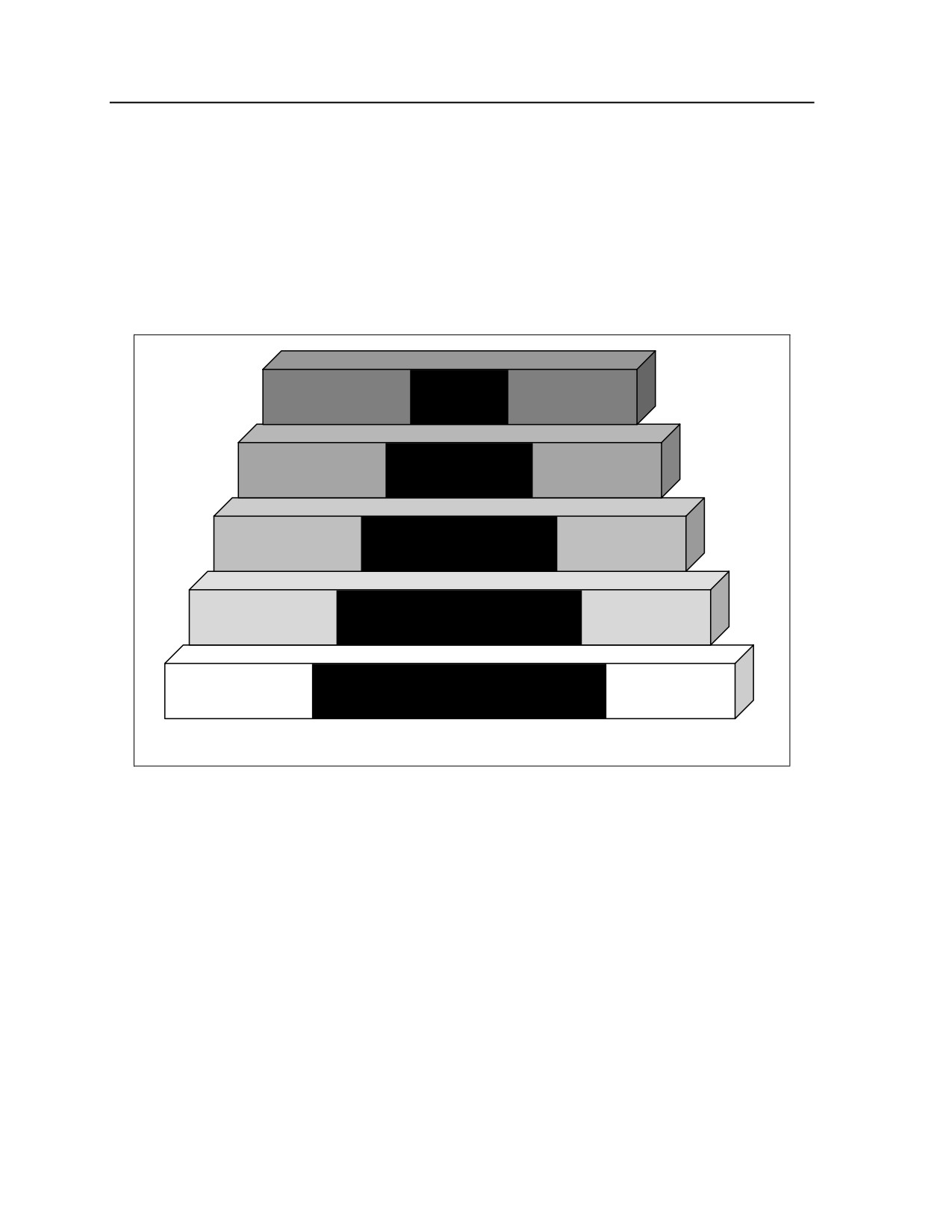
Appendix H
z
Level 3: Hard controls. Used when escort positions fail and the level of force required
escalates. They have a slightly greater possibility of causing injury (pressure points, joint locks,
oleoresin capsicum spray [such as pepper spray], electronic stun devices).
z
Level 4: Defensive techniques. Used when hard controls fail and the level of force required
escalates. They also have a higher probability of causing injuries. (empty-hand strikes and
blocks, baton strikes and blocks, NLWs, and MWDs).
z
Level 5: Deadly force. Used as a last resort when all lesser means have failed or would be
impractical. Used to prevent death or serious injury to self or others; to prevent the theft, damage
or destruction of resources vital to national security or dangerous to others; or to terminate an
active escape attempt (firearms and strikes with nonlethal weapons should be directed at vital
points of the body).
Deadly
Lethal
force
Defensive
Assaultive
technique
Actively
Hard
resistant
control
Passively
Soft
resistant
control
Cooperative
Compliant
controls
Levels of Force
Types of Subjects
Figure H-1. Use-of-force continuum
H-4. When the use of force is necessary, it is exercised according to the priorities of force and limited to
the minimum degree necessary. The use of deadly force is prescribed in AR 190-14. The combatant
commander will establish the RUF with input from senior military police and SJA officers. The RUF
predominantly apply inside a location where detainees are held. The ROE generally apply to combat
operations
(areas outside a facility). The application of any or all of the RUF listed below, or the
application of a higher-numbered priority without first employing a lower numbered one depends on, and is
consistent with, the situation encountered during any particular disorder.
H-5. The facility commander, in coordination with the higher echelon commander and the SJA, will
designate representatives who are authorized the direct use of firearms and riot control agents in the event
of a riot or other disturbance. The facility commander also sets forth guidelines for using these means in
appropriate plans, orders, SOPs, and instructions. These guidelines specify the types of weapons to be used.
The weapons do not have to be limited to the shotguns and pistols used for guarding prisoners.
H-6. Guard personnel will use the minimum amount of force necessary to reach their objective and carry
out their duties according to the published criteria for the use of force. (See AR 190-14.)
H-2
FM 3-39.40
12 February 2010

Use of Force and Riot Control Measures
SERIOUS BODILY HARM
H-7. Serious bodily harm is the amount of harm that causes serious injury to the body without causing
death. It does not include minor injuries, such as a black eye or bloody nose, but does include fractured or
dislocated bones, deep cuts, torn members of the body, serious damage to internal organs, and other life-
threatening injuries.
DEADLY FORCE
H-8. Deadly force is a force that a person knows, or should know, would create a substantial risk of
causing death or serious bodily harm. Deadly force is a destructive physical force directed against a person
or persons by guards using a weapon or equipment which, when properly employed in its intended
application, would inflict death or serious bodily harm. It is used only in extreme need and when all lesser
means have failed or cannot reasonably be used. Deadly force, as described in AR 190-14, will only be
used for—
z
Self-defense and the defense of others. To protect military police Soldiers, other guards, or any
other persons who reasonably believe themselves or others to be in imminent danger of death or
serious bodily harm.
z
Incidents involving national security. To prevent the actual theft or sabotage of assets vital to
national security.
z
Incidents not involving national security, but inherently dangerous to others. To prevent the
actual theft or sabotage of resources, such as weapons or ammunition that are inherently
dangerous to others.
z
Arrests or apprehensions. To arrest, apprehend, or prevent the escape of a person when there is
probable cause to believe that person has committed an offense of the nature specified in the
preceding three bullets.
z
Serious offenses against persons. To prevent the commission of a serious offense that involves
violence and could cause death or serious bodily harm.
z
Escapes. When deadly force has been specifically authorized by the head of a DOD components
and reasonably appears necessary to prevent escape.
H-9. The facility commander is responsible for ensuring that all Soldiers understand the RUF (including
the use of the command “Halt”); the use of deadly force; and the ban on the use of deadlines. According to
AR 190-8, the facility commander must ensure that each detainee understands the meaning of the U.S.
command “Halt.” When feasible, the use of deadly force should be preceded by warnings appropriate to the
circumstances. Additionally, Article 42, GPW, requires warnings appropriate to the circumstances before
the use of deadly force. When an individual attempts to escape, the guard will shout “Halt” three times.
Thereafter, the guard will use the least amount of force necessary to halt the individual. If there is no other
effective means of preventing escape, deadly force may be used.
H-10. In an attempted escape from a fenced enclosure, individuals will not be fired on unless they have
cleared the outside fence or barrier (razor, concertina wire) and is making further efforts to escape.
H-11. Individuals attempting to escape outside a fenced enclosure will be fired on if they do not halt after
the third command. An escape is considered successful if individuals—
z
Reach the lines of the forces of which they are members or the allies of those powers.
z
Leave the territory controlled by the United States or its allies.
RULES FOR THE USE OF FORCE
H-12. Facility commanders must balance the physical security of forces with mission accomplishment and
the RUF issued for the I/R mission. Commanders and their staff, in concert with the SJA, develop the RUF.
These rules are based on guidance from the President and/or Secretary of Defense; operational, political,
diplomatic, and legal considerations; mission requirements; threat assessments; the law of war; and HN or
third-country constraints on deployed forces. Commanders must clearly state their objectives with defined
12 February 2010
FM 3-39.40
H-3

Appendix H
operational limits. These limits must allow for mission accomplishment and the protection of deployed
forces.
H-13. Restrictions on combat operations and the use of force must be clearly explained in the RUF and
understood and obeyed at all levels. Soldiers must study and train in the RUF and discuss them for their
mission. If Soldiers do not understand the RUF, their actions (no matter how minor) may have far-reaching
repercussions, because friendly and enemy media can rapidly exploit any incident.
H-14. The RUF must address the specific distinctions between the various categories of I/R populations and
the instruments of control available for each. The following issues should be used in developing these
guidelines:
z
Under what conditions will—
Deadly force be used?
Nonlethal technology be employed?
Note. The employment of NLWs must be clearly stated in the ROE.
z
What will be the required warnings, if any, before nonlethal or lethal force is employed? (See
AR 190-8 and AR 190-14.)
NONLETHAL WEAPONS
H-15. When drafting the RUF, it must be clearly articulated and understood that NLWs are an additional
means of employing force for the particular purpose of limiting the probability of death or serious injury to
noncombatants or belligerents. However, the use of deadly force must always remain an inherent right of
individuals in instances when they, their fellow Soldiers, or personnel in their charge are threatened with
death or serious bodily harm. NLWs add flexibility to the control of disturbances within the facility by
providing an environment where guard forces can permissively engage threatening targets with limited risk
of noncombatant casualties and collateral damage. (See FM 3-22.40.)
H-16. DOD defines NLWs as weapons that are explicitly designed and primarily employed to incapacitate
personnel or material while minimizing fatalities, permanent injury to personnel, and damage to property
and the environment. Unlike conventional weapons that destroy targets principally through blast,
penetration, and fragmentation, NLWs employ means other than gross physical destruction to prevent the
target from functioning.
H-17. The use of lethal force in self-defense or the defense of others, employed under the standing RUF,
will never be denied. At no time will forces be deployed without the ability to defend themselves against a
lethal threat nor will they forgo normal training, arming, and equipping for combat. Nonlethal options are a
complement to, not a replacement for, lethal force. NLWs offer a way to expand the range of graduated
responses across a variety of military operations. (See FM 3-22.40.)
H-18. The decision to use NLWs against individuals during a confrontation should be delegated to the
lowest possible level, preferably to the platoon or squad. However, this requires that all personnel, not just
leaders, have a clear understanding of the RUF and the commander’s intent.
H-19. Commanders and public affairs officers must be prepared to address media questions and concerns
regarding the use and role of NLWs. They must make it clear that the presence of NLWs in no way
indicates abandoning the option to employ deadly force in appropriate circumstances.
ADVANTAGES OF EMPLOYING NONLETHAL WEAPONS
H-20. The employment of NLWs provides a commander with alternatives to resolve a situation. They—
z
Provide the commander with the flexibility to influence the situation favorably with a reduced
risk of noncombatant fatalities and collateral damage.
z
Can be more humane and consistent with the political and social implications of humanitarian
and peacekeeping missions.
H-4
FM 3-39.40
12 February 2010

Use of Force and Riot Control Measures
z
Allow the force that properly employs nonlethal options to gain advantages over those who rely
on lethal options alone because the degree of provocation required to employ these options is
substantially less. This advantage provides a more proactive posture, a quicker response, and a
diminished likelihood of having a situation escalate to a point where deadly force is required to
resolve a conflict within an I/R facility.
z
Are less likely to provoke others (however, they may provoke a negative response).
z
Diminish feelings of anger and remorse when deadly force is required after nonlethal options
fail.
z
Can facilitate postincident stabilization by reducing detainee alienation and collateral damage.
z
Can reduce the possibility of injury to friendly forces when compared to forces without NLWs
capabilities.
H-21. The NLW doctrine is designed to reinforce deterrence and expand the range of options available to
facility commanders. They enhance the capability of U.S. armed forces to accomplish the following
objectives:
z
Discourage, delay, or prevent hostile actions.
z
Limit escalation.
z
Take military action in situations where the use of lethal force is not the preferred option.
z
Better protect the U.S. armed forces.
z
Temporarily disable equipment, facilities, and personnel.
H-22. Preventing fatalities or permanent injuries is not a requirement of NLWs. While complete avoidance
of these effects is not guaranteed or expected, properly employed NLWs should significantly reduce them
as compared with physically destroying the same target.
MILITARY POLICE NONLETHAL WEAPONS
H-23. Facility commanders should consider the use of force options discussed in this appendix and in
AR 190-14 when handling disruptions within the facility. They are also encouraged by AR 190-14 to
substitute nonlethal devices for firearms when they are considered adequate for military police to perform
their duties safely. Military police currently have nonlethal options such as riot control agents (tear gas,
pepper spray) and the military police club and riot baton for crowd control. There are other nonlethal
devices being tested and fielded, and they should be available to I/R commanders.
H-24. If the United States is engaged in war, Executive Order 11850 governs the use of riot control agents.
Presidential approval is required before riot control agents can be used, and they can only be used in
defensive modes (riot control). If the United States is not engaged in war, the use of riot control agents is
governed by CJCSI 3110.07A and approval authority may be lower than the President. If the use of riot
control agents is desirable, leaders at any level must coordinate with the approving authority to ensure that
their use is approved.
NONLETHAL WEAPONS TRAINING
H-25. Soldiers and their leaders must be trained in the correct employment of NLWs that are available to
them. They must understand the limited use of these weapons in environments with restrictive RUF. Their
training must be continuous at all levels to ensure that NLWs are properly employed and that leaders and
Soldiers understand when and how to employ them effectively. Additionally, leaders and Soldiers must
understand that the incorrect application of an NLW can have significant operational and political
ramifications. Well-trained military police leaders who provide timely, clear guidance to military police
Soldiers using NLWs will ensure mission accomplishment.
H-26. Many NLWs have maximum effectiveness and minimum safety ranges. Individuals who are struck
short of the minimum safety range often suffer severe injuries or death, while the effects of most NLWs are
greatly mitigated at longer ranges. To be effective, the threat must be engaged within the “effective” zone
(beyond the minimum safety range and short of the maximum effective range).
12 February 2010
FM 3-39.40
H-5

Appendix H
H-27. When training with, and planning for, the use of NLWs—
z
Never apply an NLW in a situation where deadly force is appropriate.
z
Use only NLWs approved for use indoor use when indoors.
z
Never apply an NLW in a situation where it will place troops in undue danger.
z
Always cover an NLW with deadly force.
H-28. NLWs should be employed by Soldiers who are trained by Interservice Nonlethal Individual
Weapons Instructor Course graduates. Units are not authorized to use a nonlethal capabilities set unless a
course graduate is assigned/attached to the organization. Organizations that may be involved in future I/R
operations should consider having their Soldiers trained at the course, which is taught at the U.S. Army
Military Police School.
NONLETHAL WEAPONS TACTICS
H-29. DODD 3000.3 provides policy on the employment of NLWs. FM 3-22.40 provides an in-depth
discussion on the tactics associated with NLWs employment.
RIOT CONTROL MEASURES
H-30. Some of the preliminaries involved when considering riot control measures are provided in the
following paragraphs. Riot control agents, formations, and movements are covered extensively in
FM 3-19.15.
H-31. All displays of conflict must be brought under control quickly. To maintain control, the facility
commander must have a well-developed, well-rehearsed plan for defusing tense situations, handling unruly
captives, and quelling riots. Only by quickly restoring order can the commander exercise effective control
of the detainees. Due to the physical differences of I/R facilities, consider the following:
z
Terrain features where the facility is located.
z
Type of structures within the compound.
z
Number of detainees within the compound.
z
Size of the available control force.
H-32. Order must be restored using the least amount of force possible. Often, PSYOP resources can play an
effective role in restoring order to the compound. If necessary, riot control agents and NLWs are authorized
to incapacitate rioters.
PREPLANNING
H-33. Preplanning is the preparation conducted before a crisis occurs to improve reactions contain and
neutralize the crisis successfully. The preplanning process includes training, developing plans, and
gathering information and intelligence. At a minimum—
z
Maintain updated drawings of the I/R compound.
z
Identify potential threats from within the detainee population.
TRAINING
H-34. The quick-reaction force and associated teams must train on a regular basis in the five basic riot
control formations. There also must be a continuous training program established to include, at a minimum,
the following subjects:
z
Principles of FM 27-10, specifically the provisions of the Geneva Conventions.
z
Supervisory and human relations techniques.
z
Methods of self-defense.
z
Use of force.
z
Riot baton use.
z
M16 and M4 use with and without a bayonet.
H-6
FM 3-39.40
12 February 2010

Use of Force and Riot Control Measures
z
Areas of the body to avoid when using the riot baton, M16, or M4.
z
Weapons familiarization and qualification.
z
Public relations.
z
First aid.
z
Emergency plans.
z
Compound regulations.
z
Intelligence and counterintelligence techniques.
z
Cultural customs, habits, and religious practices.
z
Basic language of the detainees.
z
Riot control agents employment and the various methods of dispersing them.
z
NLWs employment.
z
Bullhorn use.
z
Restraint use.
z
On-site medical support.
H-35. It is critical that personnel assigned or attached to internment facilities are oriented and specially
trained in the custody and control of individuals. Each individual working within the compound must be
fully cognizant of the provisions of the Geneva Conventions as they apply to the treatment of detainees and
the Soldiers guarding the detainees.
PLANNING PROCESS
H-36. The planning process begins during preplanning. Once the quick-reaction force has been alerted of a
riot situation, the leaders and quick-reaction force members further develop the preplans to fit the situation.
(See FM 5-0.)
H-37. This part of the planning process is essential for the successful containment and neutralization of a
riot. When using riot control agents, plans must be flexible enough to accommodate changes in the
situation and weather. These plans must also consider the strict accountability and control of the
employment of riot control agents. Riot control agents are employed only when the commander specifically
authorizes their use and their use must be reported.
H-38. Other planning factors to consider are the cause, nature, and extent of the disturbance. Based on an
analysis of these factors, the commander estimates the situation. The estimate must be as thorough as time
permits. Using the estimate, the commander considers courses of action, selects riot control agents, and
determines munitions needs. The main factors in choosing a course of action are—
z
Desired effects.
z
Demeanor and intent of the gathered detainees.
z
Weather.
z
Types of munitions available.
H-39. Plans must also address the security of riot control agents during storage, transportation, and
employment. Wind direction, the size of the area, and the proximity of civilian communities may preclude
the use of large quantities of riot control agents. In such cases, it may be necessary to use low
concentrations to break a crowd into smaller groups.
H-40. When dealing with large riots, plans should indicate how the control force should channel and
control individual movements in a specific direction, usually to an area where another force is waiting to
receive, hold, and search them. Plans must contain information on how the riot control agents are employed
to cover the target area with a cloud of sufficient strength to produce decisive results. Once the proper
concentration is reached, the control force must maintain that concentration until the rioters are channeled
into the predetermined area. When dispersers are used, the dispersal team maintains the concentration by
moving the disperser along the release line at an even rate. They maintain the concentration by repeating
the application as necessary.
12 February 2010
FM 3-39.40
H-7

Appendix H
H-41. Plans should also include serious incident reporting procedures. The record of events should be
initiated to provide a basis for the preparation and submission of a formal serious incident report to higher
headquarters. At a minimum, the following should be included:
z
Time the incident was reported and by whom.
z
Time the incident was reported to the commander.
z
Time the quick-reaction force was alerted.
z
Time the quick-reaction force commander reported to the affected compound.
z
Time the quick-reaction force entered the compound.
z
Weather conditions as they relate to the use of riot control agents.
z
Number of U.S. armed forces injured or killed, including how they were injured or killed, and
the medical attention given to them.
z
Number of detainees injured or killed, including how they were injured or killed, and the
medical attention given to them.
z
Time the operation was completed and when the riot control force cleared the compound.
RIOT FORMATIONS
H-42. Quick-reaction force teams should be established with a minimum response time. Because of the
physical nature of riot control, individuals in riot control formations should not carry rifles. Nonlethal
attachments should follow closely behind the riot control formation. Lethal coverage must be provided for
this entire formation. (See FM 3-22.40.)
DESIGNATED MARKSMEN
H-43. During a nonlethal engagement, the use of designated marksmen provides confidence and safety to
those facing a riot. If a lethal threat is presented, the designated marksmen in overwatch positions (armed
with appropriate sniper weapons mounted with high-powered scopes) can scan a crowd and identify
agitators and riot leaders for apprehension and fire lethal rounds if warranted. Additionally, they are ideally
suited for flank security and countersniper operations. (See FM 3-22.40.)
CROWD DYNAMICS
H-44. Commanders must be concerned with crowd control and the dynamics caused by disaffected people
living in close quarters. Generally, the commander needs to be concerned about two types of disturbances:
riots and disorders. I/R populations may organize disturbances of either type within the facility to wear
down the guard force. (See FM 3-19.15.)
H-45. Simply being part of a crowd affects a person. To some extent, persons in a crowd are susceptible to
actions different from their usual behavior. For example, crowds provide a sense of anonymity because
they are large and often temporary congregations. Crowd members often feel that their moral responsibility
has shifted from themselves to the crowd as a whole. Large numbers of people discourage individual
behavior since the urge to imitate is strong in humans. People look to others for cues and disregard their
own background and training. Only well-disciplined persons or persons with strong convictions can resist
conforming to a crowd’s behavior. Crowd behavior influences the actions of the disorderly participants and
the authorities tasked to control them. Under normal circumstances, a crowd is orderly and does not present
a problem to authorities. However, when crowd behavior violates laws or threatens life or property, a
disturbance ensues.
CROWD BEHAVIOR
H-46. Social factors (leadership, moral attitudes, uniformity) may influence crowd behavior. Leadership
has a profound effect on the intensity and direction of crowd behavior. When blocked from expressing its
emotions in one direction, a crowd’s frustration and hostility may be redirected elsewhere. The first person
to give clear orders in an authoritative manner may become the leader. Agitators can exploit a crowd’s
mood and convert a group of frustrated, resentful people into a vengeful mob. Skillful agitators using
H-8
FM 3-39.40
12 February 2010

Use of Force and Riot Control Measures
clandestine communications within the facility can reach large portions of the population and incite them to
unlawful acts without having direct personal contact. In an I/R environment, any crowd can be a threat to
law and order because it is open to manipulation.
H-47. Crowd behavior may be affected by emotional contagion or panic. Emotional contagion provides the
crowd with psychological “unity.” The unity is usually temporary, but it may last long enough to push a
crowd to mob action. When emotional contagion prevails, normal law and authority are suppressed,
increasing the potential for violence.
H-48. Panic can occur during a disturbance when—
z
Crowd members perceive their safety is at risk and attempt to flee the area.
z
Crowd members cannot disperse quickly after exposure to riot control agents.
z
Escape routes are limited, blocked, and/or congested.
H-49. Control force members are also susceptible to crowd behavior. They may become emotionally
stimulated during a tense confrontation, and facility commanders must counteract this. The control force
members must exercise restraint individually and collectively. Rigorous training, firm and effective
leadership, and complete awareness and understanding of the RUF and ROI are necessary to offset the
effect of crowd contagion upon the control force.
CROWD TACTICS
H-50. In disturbances, crowds employ any number of tactics to resist control or achieve their goals. Tactics
may be unplanned or planned and nonviolent or violent. The more purposeful the disturbance, the more
likely is the possibility of well-planned tactics.
Nonviolent Tactics (Disorders)
H-51. Nonviolent tactics may include name-calling, demonstrations, the refusal to work or eat, work
slowdown, damage to or destruction of property, or barricade construction. Demonstrators may converse
with control force members to distract them or to gain their sympathy. They may use verbal abuse such as
obscene remarks, taunts, ridicules, and jeers. Crowd members want to anger and demoralize the opposition.
They want authorities to take actions that later may be exploited as acts of brutality.
H-52. In compounds where women, children, and the elderly are interned, they may be placed in the front
ranks of the demonstration to try to discourage countermeasures by the control force. When
countermeasures are taken, agitators may try to stir public displeasure and embarrass the control force
through the media. Individuals may form human blockades to impede movement by sitting down in the
footpaths or entrances to buildings within the compound. This may disrupt normal activity, forcing control
personnel to remove demonstrators physically. Individuals may lock arms, making it hard for the control
force to separate and remove them, which makes the control force seem to be using excessive force.
H-53. Some nonviolent tactics are further described as follows:
z
Demonstrations. Demonstrations are the actions of groups of people whose behavior, while not
violent, conflicts with those in authority. They are characterized by unruliness and vocal
expressiveness without violence. Demonstrations may be organized in celebration of national
holidays; as protests against food, clothing, living conditions, or treatment; or for other similar
factors.
z
Refusal to work or eat. Individuals may refuse to work or eat (collectively or individually) as a
means of harassing the detaining power or in an attempt to gain concessions from the detaining
power. Prompt isolation and segregation of such offenders and their ringleaders normally control
this type of disorder.
z
Work slowdown. Individuals may initiate a deliberate work slowdown to delay the completion
of work projects, thereby harassing the detaining power. Disorders of this nature can be
controlled in the same manner as the refusal to work or eat.
12 February 2010
FM 3-39.40
H-9

Appendix H
z
Damage or destruction of property. Individuals often damage or destroy property to harass the
detaining power or to impede or prevent normal operations of the facility. This type of disorder
can be controlled by identifying, isolating, and segregating individuals involved.
H-54. Unorganized disorders are characterized as being spontaneous in nature. They begin because of the
actions of a single individual. Like all disturbances, their prompt control is essential.
Violent Tactics
H-55. Violent crowd tactics may be extremely destructive. They may include physical attacks on fellow
detainees, guards, or government property; fires; or bombings for the purpose of an escape, a grievance
protest, or tactical or political advantages. Only the attitudes and ingenuity of crowd members, the training
of their leaders, and the materials available to them limit their use of violent tactics. Rioters may commit
violence with crude, homemade weapons or whatever items are at hand (rocks, bricks, bottles). If violence
is planned, rioters may easily conceal makeshift weapons or tools for vandalism.
H-56. Rioters may erect barricades to impede movement or to prevent a control force from entering certain
areas or buildings. They may use vehicles, trees, furniture, fences, or other handy materials to erect
barricades. In an effort to breach barriers, rioters may throw grapples into wire barricades and drag them
down. They may use grapples, chains, wire, or rope to pull down gates or fences to affect a mass escape.
They may use long poles or homemade spears (tent poles) to keep control forces back while they remove
barricades or to prevent control forces from using bayonets.
H-57. Rioters can be expected to vent their emotions on individuals, troop formations, and control force
equipment. They may throw rotten fruits or vegetables, rocks, bricks, bottles, improvised bombs, or any
other objects at hand.
H-58. Rioters may direct dangerous objects like vehicles, carts, barrels, or liquids (such as boiling water,
oil, or urine) at troops located on or at the bottom of a slope. On level ground, they may drive
commandeered vehicles at the troops, jumping out before the vehicles reach the target to breach roadblocks
and barricades, and scatter the control force formation.
H-59. Rioters may set fire to buildings or vehicles to block the advance of the control force formation. Fires
may also be set to create confusion or diversion, destroy property, or to mask escapes.
H-60. Riots are organized or unorganized. In organized riots, leaders of detainees may reorganize the
detainee population into quasimilitary groups. These groups are capable of developing plans and tactics for
riots and disorders. Riots could be instigated for—
z
An escape. Detainee leaders organize a riot as a diversion for an escape attempt. The attempt
may be for selected individuals, small groups, or a large mass of individuals.
z
A grievance protest. Grievance protests could be organized as a riot. Under normal
circumstances, a riot of this type will not be of an extremely violent nature. It may turn violent
when the leaders attempt to exploit any successes of the riot or weaknesses of the detaining
powers.
z
Tactical purposes. Riots are often organized for the sole purpose of causing the detaining power
to divert troops. This tactical move limits the detaining power’s ability to perform its mission.
z
Political purposes. Riots are often organized as a means of embarrassing the detaining powers
in their relations with the protecting powers and other nations or for use as propaganda by the
nations whose nationals are involved in the riot. They may also be organized as a means of
intimidating individuals or groups that may have been cooperative with the detaining power.
H-61. Unorganized riots are characterized at their inception as being spontaneous in nature, although they
could be exploited and diverted by leaders at any subsequent stage of the riot into a different type. Crowds
may start as a holiday celebration, a group singing, a religious gathering, an arson event, or any other type
of gathering that might lead to group hysteria. Under determined leadership, the pattern of these gatherings
could change to that of an organized riot.
H-10
FM 3-39.40
12 February 2010

Appendix I
Medical Support to Detainee Operations
As participants in the Geneva Conventions, detainees in U.S. custody receive medical
care consistent with the standard of medical care that applies to U.S. armed forces in
the same area. (See AR 40-400, AR 190-8, DODD 2310.01E, DODD 2311.01E, the
FM 4-02 series, FM 8-10-6, and FM 27-10.)
MEDICAL AND ETHICAL CONSIDERATIONS OF THE
TREATMENT OF DETAINEES
I-1. Medical personnel are well trained in, and guided by, the ethics of their professional calling. These
training and ethical principles, coupled with the requirements of international laws as they pertain to the
treatment of detainees during a conflict, ensure the ethical treatment of all sick and wounded personnel.
Note. See Military Medical Ethics Volume I and Volume II for more medical information. These
manuals are available electronically at <http://www.bordeninstitute.army.mil>.
PROHIBITED ACTS
I-2. The Geneva Conventions specifically prohibit certain acts and specify that all detainees will receive
humane treatment. Prohibited acts include murder, torture, medical and scientific experimentation, physical
mutilation, and the removal of tissues and organs for transplantation. Additionally, causing serious injury,
pain, or suffering is prohibited.
I-3. Torture can take many guises in wartime situations. Historically, it has been used to extract tactical
information from an uncooperative detainee. However, it has also been applied to punish and/or inflict pain
and suffering. Regardless of the rationale, the torture of detainees is prohibited. Medical personnel do not
participate in the torture of detainees, to include—
z
Administering drugs to facilitate interrogation.
z
Designing psychological strategies for interrogators.
z
Advising interrogators on the ability of a detainee to withstand torture.
I-4. The detaining power is prohibited from conducting medical and scientific experimentation on
detainees. This prohibition arose from experiences in World War II. Since the prisoner is in the custody of
the detaining power, any consent to the experiment is suspect as the prisoner may feel coerced to provide
consent. This prohibition does not extend to the introduction of new treatment regimens and/or
pharmaceuticals when there is a substantiated medical necessity and withholding the treatment would be
detrimental to the health of the detainee.
I-5. Due to the nature of warfare, numerous combatants and/or noncombatants may sustain injuries that
require the amputation of an unsalvageable limb to save their life. Amputation that is based on a medical
necessity and conforms to existing standards of medical care is not considered physical mutilation and,
therefore, is permitted.
I-6. With advances in medical science, transplanting organs in peacetime has become an accepted method
of treatment for certain conditions. However, during wartime, with the exception of blood and skin grafts,
organ transplants are prohibited. Although the recipient’s health status benefits from the transplant, the
donor’s health status does not. As with the discussion of consent for medical experimentation, the consent
of donors in the custody of the detaining power is suspect as donors may feel coerced by their status into
providing consent. Transplanting organs and/or tissue from cadavers is also prohibited as the practice could
12 February 2010
FM 3-39.40
I-1

Appendix I
lead to allegations that donors were permitted to die to harvest their organs. Geneva Protocol I does permit
the exception of blood and skin grafts but provides stringent controls. Tissues obtained must be used for
medical purposes, not research or experimentation. The tissue donor must voluntarily consent to the
procedure, and records must be maintained.
I-7. Geneva Protocol I reiterates the right of an individual to refuse a surgical procedure, even if that
procedure would be lifesaving and falls within existing medical standards. A surgeon may not feel ethically
bound by a refusal in the case of a minor or an individual whose judgment is impaired by injury or illness.
Documenting the issue, whether it is the patient’s refusal (in writing, if possible) or the surgeon’s decision
is an essential step in ensuring that allegations of abuse are not forthcoming.
SUSPECTED OR ALLEGED ABUSE, TORTURE, OR SEXUAL
ASSAULT
I-8. Medical personnel are obligated to report any suspected and/or alleged abuse, torture, or sexual
assault through the chain of command and to the U.S. Army Criminal Investigation Command. Medical
personnel report any suspected abuse and/or torture through technical channels to the detainee operations
medical director. Medical personnel are also required to document actual, alleged, or suspected abuse in the
detainee’s medical record.
I-9. Medical personnel have contact with detainees in a variety of settings. Medical personnel must
document any suspicious medical occurrences during—
z
Initial detainee screening. Preexisting medical conditions, wounds, fractures, and bruises
should be noted. The documentation of these injuries and conditions provides a baseline for each
detainee and facilitates the identification of injuries that may have occurred in the internment
facility.
z
Routine detainee sick calls. Detainees should be visually examined to determine if unusual or
suspicious injuries are apparent. If any are present, the health care provider must attempt to
determine from the detainee how the injuries occurred. Any injuries that cannot be explained, or
for which the detainee is providing evasive responses, are noted in the medical record and
reported to the chain of command and functional medical channels.
z
Facility visits. The reasons for entering the detention facility may include conducting sanitary
inspections, providing emergency medical care, and dispensing medications. When in the
facility, medical personnel must be observant. They must immediately report to the chain of
command anything which might indicate that detainees are being mistreated. If they observe a
detainee being mistreated, they must take immediate action to stop the abuse and then report the
incident.
I-10. If a detainee alleges that abuse, torture, or sexual assault has occurred, the health care provider must
report the allegations to the facility commander, CID, and detainee operations medical director. Medical
personnel are not required to investigate the allegation beyond what is required to render appropriate
medical treatment, except in the cases of alleged rape and/or sexual assault. Cases of alleged rape and/or
sexual assault require that medical personnel comply with the standard procedures for the collection,
preservation, and processing of rape kit evidence. Detainees alleging sexual assault or rape will be tested
for sexually transmitted diseases, and female detainees will be given a pregnancy test as specified in the
theater policy.
MEDICAL SUPPORT PROVIDED TO INTERROGATION TEAMS
I-11. Under the provisions of the Geneva Conventions, medical personnel are prohibited from engaging in
acts that are considered harmful to detainees. Medical personnel providing direct patient care for detainees
will not participate in, or provide medical information to, interrogators. Medical personnel are—
I-2
FM 3-39.40
12 February 2010

Medical Support to Detainee Operations
z
Authorized to halt any interrogation or interrogation technique if the detainee’s health or welfare
is endangered.
z
Authorized to stop an interrogation immediately if a detainee requires any medical treatment
during the interrogation.
z
Authorized to perform preinterrogation and/or postinterrogation medical evaluations at their
discretion.
z
Required to perform preinterrogation and/or postinterrogation medical evaluations on the request
of an interrogator.
z
Required to document preinterrogation, during interrogation, and postinterrogation medical care
in detainees’ medical records.
z
Required to develop procedures for documenting medical care delivered during or due to an
interrogation.
I-12. Behavioral science consultation team members are authorized to make psychological assessments of
the character, personality, social interactions, and other behavioral characteristics of interrogation subjects
and to advise authorized personnel performing lawful interrogations. Those who provide such advice may
not provide medical care for detainees, except in emergencies.
I-13. Medical personnel must consider the welfare of their patients. If a detainee has a medical condition
that could deteriorate during interrogation and result in a health crisis for the detainee, the health care
provider should inform the interrogation team of the existing medical limitations. For example, a detainee
who is diabetic may have dietary restrictions and requirements and a need to take medications on a
scheduled basis.
MEDICAL PERSONNEL
I-14. The roles and responsibilities of medical personnel associated with detainees vary. The following
paragraphs describe those personnel and their activities.
DETAINEE OPERATIONS MEDICAL DIRECTOR
I-15. The theater Army Surgeon for the Army Service component command appoints a detainee operations
medical director to oversee and guide all elements of health care delivery to detainees within the theater.
This ensures a comprehensive, continuous assessment of critical mission tasks; facilitates the rapid
identification of deficiencies; and enhances the timely resolution of health care delivery issues.
I-16. The detainee operations medical director is responsible for—
z
Advising the theater commander on the health of detainees.
z
Providing guidance, in conjunction with the command SJA, on the ethical and legal aspects of
providing medical care to detainees.
z
Recommending the task organization of medical resources to satisfy mission requirements.
z
Recommending policies concerning medical support to detainee operations.
z
Developing, coordinating, and synchronizing health consultation services for detainees.
z
Evaluating and interpreting medical statistical data.
z
Recommending policies and determining requirements and priorities for medical logistics
operations in support of detainee health care. This includes blood and blood products, medical
supply and resupply, formulary development, medical equipment, medical equipment
maintenance and repair services, optometric support, fabrication of single-vision and multivision
optical lenses, and spectacle fabrication and repair.
z
Recommending medical evacuation policies and procedures and monitoring medical evacuation
support to detainees.
z
Recommending policies, protocols, and procedures pertaining to the medical and dental
treatment of detainees. These policies, protocols, and procedures provide the same standard of
care provided to U.S. armed forces in the same area.
12 February 2010
FM 3-39.40
I-3

Appendix I
z
Ensuring that medical records are maintained on each detainee according to AR 40-66 and
AR 40-400.
z
Ensuring that monthly weigh-ins are conducted and reported as required by regulation and
international laws.
z
Planning for and implementing preventive medicine operations and facilitating health risk
communications (to include preventive medicine programs to counter the medical threat).
MEDICAL PERSONNEL ORGANIC TO MILITARY POLICE UNITS
I-17. The military police battalion has organic medical personnel to provide limited Level I medical care
capability and preventive medicine services within the internment facility. When a detainee operations
medical director has been designated within the joint operations area, these medical personnel are under the
technical guidance of the detainee operations medical director.
I-18. These medical personnel assist with in-processing detainees by providing the initial medical
examination. They provide routine sick call services and emergency medical treatment and coordinate with
the supporting medical units for Level II and above care. They maintain medical records, to include
DA Form 2664-R. When the supporting medical unit is colocated with the internment facility, the unit
scope of practice, schedule, and duty assignments are coordinated through the supporting medical unit.
MEDICAL PERSONNEL ORGANIC TO MANEUVER UNITS
I-19. Medical personnel organic to maneuver units may be required to provide emergency medical
treatment, area medical support, and medical evacuation at the POC and to temporary concentrations of
detainees at DCPs and DHAs. In early-entry operations, the senior medical officer (brigade surgeon) serves
as the detainee operations medical director until follow-on forces are deployed and a detainee operations
medical director is designated for the joint operations area.
MEDICAL PERSONNEL ORGANIC TO SUPPORTING MEDICAL UNITS
I-20. The medical resources required to support detainee operations are task-organized based on the
mission variables. The detainee operations medical director determines the medical support requirements
and develops and provides technical guidance for all medical resources engaged in detainee medical
operations. This guidance is directed to appropriate medical personnel through their technical channels.
I-21. The detainee operations medical director is designated by the medical deployment support command
commander to develop and provide technical guidance or the medical aspects of detainee operations
conducted throughout the joint operations area. Technical guidance is exercised throughout all echelons of
medical channels and affects all medical personnel and units delivering health care to detainees. Technical
guidance encompasses—
z
Medical services provided at DCPs and DHAs, to include limited medical screening, emergency
medical treatment, preventive medicine measures (hygiene and sanitation), and the medical
evacuation of seriously injured or ill detainees through medical channels. The echelon
commander must provide guards and/or escorts when detainees are evacuated through medical
channels; medical personnel cannot perform guard functions.
z
Medical services provided in the internment facility, to include—
Initial medical examinations.
Medical treatment (routine care, sick call, emergency services, hospitalization, medical
consultation, and specialty care requirements).
Medical evacuation.
Preventive medicine
(medical surveillance, occupational and environmental health
surveillance, hygiene and sanitation standards and practices, pest management activities,
water potability, dining facility and services hygiene, food preparation practices).
Dental services.
I-4
FM 3-39.40
12 February 2010

Medical Support to Detainee Operations
Veterinary support (food inspection and quality assurance, veterinary preventive medicine,
animal medical care).
Mental health care.
Neuropsychiatric treatment and stress prevention as required.
Medical logistics
(medical supplies, pharmaceuticals, medical equipment and medical
equipment maintenance and repair, blood management, optical lens fabrication).
Medical laboratory support.
z
Medical services provided in U.S. military medical treatment facilities that are not part of
established internment facilities. This can include emergency medical treatment provided at
battalion aid stations and Level II medical treatment facilities (medical companies) and forward
resuscitative surgery provided by forward surgical teams to stabilize the patient for further
evacuation and hospitalization.
z
Medical administrative matters such as the establishment and maintenance of medical records,
documentation of preexisting injuries (to include medical photography if deemed appropriate),
restrictions on activities based on medical conditions
(similar to medical profiles), and
documentation required for legal purposes (monthly height and weight records).
z
Procedural guides and SOPs that are developed and disseminated for reporting suspected
detainee abuse. Medical personnel are trained on procedures and ethical considerations.
z
Procedural guides and SOPs that are developed to standardize the credentialing of health care
providers, to define the scope of practice of medical personnel, and to establish the scope of
practice for retained medical personnel.
z
Standards of medical care throughout internment facilities within the joint operations area that
are established, inspected, and enforced (the standards used are the same as those for U.S. armed
forces).
z
Procedures that are established and disseminated for identifying, reporting, and resolving
medical ethics and other legal issues.
z
Procedures that are established for ensuring medical proficiencies and competencies, identifying
deficiencies, and providing required training to resolve deficiencies.
z
Programs of instruction that are developed to ensure that all medical personnel engaged in
detainee health care have appropriate orientation and training in the detainee’s culture, language
(and/or linguist support), social order, and religion.
CULTURAL CONSIDERATIONS
I-22. As part of their predeployment activities, personnel participating in multinational operations
normally receive an orientation in the culture, languages, and religious beliefs prevalent in the operational
area. Medical personnel must ensure that they understand the medical considerations presented by these
customs and beliefs. Cultural or religious norms may affect a patient’s compliance with a prescribed
medical regimen, may prohibit the use of blood and blood products, or may restrict the use of certain food
products, thereby affecting the patient’s nutritional status.
I-23. U.S. armed forces involved in multinational operations will normally require interpreter support.
This is of particular importance for medical personnel as they interact with multinational forces and treat
detainees. Medical personnel must be able to discuss a patient’s medical history and to understand the signs
and symptoms being described. Medical personnel may consider using—
z
Flash cards. During recent operations, some medical units devised flash cards which pictorially
depicted a variety of medical complaints. Units developing this type of communications tool
must be cautious and ensure that the images used do not offend the cultural or religious beliefs
of the individual. Commercial products may also be available.
z
Retained medical personnel. The number of individuals capable of fulfilling interpreter
requirements may be limited. In detainee operations, retained medical personnel may be able to
assist in relating the patient’s medical condition to the health care provider.
12 February 2010
FM 3-39.40
I-5

Appendix I
z
Advanced technology. Health care providers may be able to leverage advances in
communications technology that can provide an automated interpreter service through a
handheld device.
SECURITY CONSIDERATIONS FOR MEDICAL PERSONNEL,
MEDICAL EQUIPMENT, AND SUPPLY ITEMS
I-24. Level II medical treatment facilities provide support on an area basis. DCPs and DHAs may have to
coordinate emergency medical care from Level II medical facilities for temporary concentrations of
detainees being held. If this is necessary, consider the following:
z
Security measures instituted at these points are dictated by the unit that established the DCP.
Medical personnel should not enter the DHA until necessary security precautions have been
taken.
z
Medical personnel should inventory medical supplies (especially sharps items, such as needles)
and equipment that they are taking into the enclosure. While in the enclosure, medical personnel
must be alert and prepared to defend themselves if the need arises. Before medical personnel
leave the enclosure, they must account for and remove all medical supplies, equipment, and
medical waste.
I-25. At internment facilities, medical personnel should observe the same precautions as they would at a
DCP or a DHA. The military police unit that establishes the facility dictates what security procedures will
be observed when treating detainees at the facility. Medical personnel should never enter the general
population area by themselves. When possible, have the detainees taken to the established medical
treatment area rather than have medical personnel enter confinement areas. The medical treatment area
should have all medical supplies (especially sharp items), medical equipment, and pharmaceuticals secured
before permitting the detainees to enter. Medical personnel must remain alert continuously while in the
presence of detainees. Although medical personnel may treat the same detainee for a recurring or chronic
condition and feel as though they have gotten to know the detainee, medical personnel should remain
vigilant and be prepared to react if threatened.
I-26. At Level III hospitals, detainee patients should be segregated from U.S. and multinational patients.
Detainee patients are guarded by nonmedical personnel designated by the echelon commander while they
are patients in the facility. All medical equipment, supplies, and pharmaceuticals should be stored and
secured in a room outside the ward. When possible, patients are treated in a room outside the ward. When
patients are required to leave the ward, they should be escorted under guard to ensure that they do not
attempt to escape, injure hospital personnel or other patients, or damage and/or destroy hospital property.
MEDICAL SUPPORT BEFORE TRANSFER TO AN INTERNMENT
FACILITY
I-27. Only limited medical screening can be accomplished at DCPs and DHAs. Medical personnel
assigned to the military police unit normally treat detainees at DCPs. If these personnel are not available,
the Level II medical treatment facility providing area support may be required to perform a hasty
assessment of the detainees at the request of the detaining unit. These support requirements should be
included in the operation order when possible. The purpose of this medical screening is to ensure that
detainees do not have significant wounds, injuries, or other medical conditions (such as severe dehydration)
that would require immediate medical attention or medical evacuation. Medical personnel are screening for
conditions that could deteriorate before a detainee is transferred to an internment facility. This screening
does not include the use of diagnostic equipment such as X-rays or laboratory tests, as these resources are
not available at a DCP or DHA. Any medical treatment provided during screening is entered on DD Form
1380. The detainee’s DD Form 2745 number is used as the identification number on the DD Form 1380. If
the detainee is not to be evacuated through medical channels, one copy of DD Form 1380 is provided to the
detaining unit for inclusion in the detainee’s medical record that is initiated and maintained at the
internment facility. Medical personnel do not provide security for detainees.
I-6
FM 3-39.40
12 February 2010

Medical Support to Detainee Operations
I-28. If medical personnel are not available, emergency medical treatment is provided by the Level II
medical treatment facility providing area medical support. Detainees whose medical conditions require
hospitalization are treated, stabilized, and evacuated to a supporting medical treatment facility. All medical
treatment provided to detainees is annotated on DD Form 1380, and the form accompanies the detainees for
inclusion in their medical records at the Level III hospital.
I-29. Injured and ill detainees requiring hospitalization are evacuated through medical channels before
being entered into the Detainee Reporting System. Medical personnel do not search, interrogate, or guard
detainees being evacuated through medical channels. The echelon commander is responsible for providing
this support. Once detainee patients reach the Level III hospital, they are reported in the Detainee Reporting
System. When possible, detainees should be segregated from U.S. and multinational forces during
evacuation.
I-30. At DCPs and DHAs, field-expedient measures may be required to sustain field sanitation. If
sanitation facilities are not feasible, detainees should be given individual waste collection bags and hand-
washing stations should be established throughout the DHA. If medical personnel are requested to provide
emergency medical treatment at DCPs and DHAs, they should review how field sanitation measures are
being implemented. Any deficiencies noted should be corrected on the spot and reported to the chain of
command and through medical channels.
MEDICAL SUPPORT AT THE INTERNMENT FACILITY
I-31. Medical support at the facility involves multiple actions, including the responsibility of keeping the
facility commander apprised of detainee medical conditions. These actions are discussed in the following
paragraphs.
INITIAL MEDICAL SCREENING AND STANDARDIZED PHYSICAL EXAMINATION
I-32. Detainees are screened by medical personnel within 24 hours of their arrival at the internment
facility. They are screened for general health and nutritional status, the presence of communicable diseases,
preexisting chronic medical conditions, medication history (including current medications), immunization
status, weight, and existing wounds or injuries. If detainees have medications on them at the time of
internment, the medicine should be bagged, identified, transported by military police personnel, and
provided to medical personnel at the internment facility.
I-33. A medical record is initiated for detainee who does not already have one. If the detainee received
medical treatment while at the DCP and/or DHA, the copy of DD Form 1380 provided to internment
personnel is included in the detainee’s medical record. The detainee’s weight is recorded on
DA Form 2664-R and is updated monthly. (See chapter 5.)
I-34. If a detainee requires immunizations, they are given at this time as specified by the theater detainee
health care policy. Additionally, each detainee is given a tuberculin skin test as specified by the theater
detainee health care policy. When it is determined that a detainee requires medication on a continuing
basis, a dosing schedule is designed.
I-35. Upon completion of the screening and physical examination, DD Form 503 is completed. One copy
is maintained in the detainee’s medical record, and another copy is provided to internment personnel. This
report specifies whether the detainee is mentally and physically qualified to perform hard labor and whether
the detainee is free from communicable diseases. This report also has a remarks block to provide additional
information if appropriate and required.
DOCUMENTATION OF EXISTING INJURIES OR MEDICAL CONDITIONS
I-36. During the initial screening, medical personnel must ensure that they document all existing injuries
and medical conditions. When appropriate, photographs documenting the wounds and injuries should be
taken.
12 February 2010
FM 3-39.40
I-7

Appendix I
I-37. AR 190-8 prohibits the photographing, filming, or videotaping of detainees except for camp
administration and intelligence and/or counterintelligence purposes. However, medical personnel are
permitted to photograph a detainee to document preexisting conditions, injuries, and wounds. The
detainee’s identity should be clearly visible. These photographs are invaluable if a claim of unnecessary
surgery or amputation is made. Any detainee who requires amputation or major debridement of tissue
should be photographed. Once taken, these photographs are maintained as part of the detainee’s medical
record.
MEDICAL SURVEILLANCE ACTIVITIES
I-38. Medical surveillance is the ongoing, systematic collection of medical data that is essential to the
evaluation, planning, and implementation of public health and prevention practices. In particular, it
includes medical data related to individual patient encounters; this data is used for calculating disease and
nonbattle injury rates in a defined population for the primary purpose of preventing and controlling health
and safety hazards. Medical surveillance identifies the population at risk, identifies potential and actual
exposures, determines protective measures, and assesses a detainee’s health. Medical surveillance is not
intelligence gathering.
I-39. The data collected from this assessment forms the health status of detainees. It identifies the endemic
and epidemic diseases present in the detainee population, provides the facility commander with pertinent
information with which to monitor changes in the detainee health status, and provides the basis to perform
health interventions as necessary. Medical surveillance data is used to monitor the implementation and
effectiveness of preventive medicine measures and field sanitation and hygiene practices. For example, an
increase of acute diarrheal disease within a subpopulation of the detainees may necessitate an
epidemiological investigation to determine the cause of the outbreak and to ensure that the spread of the
disease is contained. Once the source of the disease outbreak is determined, preventive measures can be
devised and implemented to ensure that there is not a recurrence.
I-40. Health risk communications and instructions can be developed and disseminated to detainees to
promote an understanding of the medical threat faced by the facility. Dissemination can also enhance
compliance with required PVTMED measures, field sanitation requirements, and personal hygiene
standards to counter the threat.
MONTHLY MONITORING REQUIREMENT
I-41. To ensure the continued health of detainees, international laws require that each detainee be screened
monthly by medical personnel. During this screening, the detainee’s weight is recorded on
DA Form 2664-R, which provides a concise, chronological weight history of the detainee. Significant
fluctuations in weight can signal an underlying medical condition or can indicate that the detainee’s diet is
not meeting nutritional requirements. Any significant fluctuations must be investigated by medical
personnel. Detainees with significant weight fluctuations are given a more thorough physical to determine
if an underlying medical condition exists or if a disease is present. If the physical examination does not
identify the underlying cause, a thorough evaluation of the detainee’s diet and work schedule is undertaken.
Findings and recommendations for diet adjustment are made to the facility commander. Cumulative data on
weight fluctuations is included in the medical surveillance activities conducted at the facility to ensure that
trends are identified as rapidly as possible and that corrective measures are implemented.
I-42. Detainees are also screened regularly for the presence of communicable diseases. Other screenings
include louse infestations, hydration, and other indicators of health status.
I-43. If a detainee has any signs of unexplained physical injuries (such as burns, fractures, severe sprains,
or bruises), medical personnel should ask the detainee about the cause of the injury. However, medical
personnel do not investigate allegations or suspected incidents of abuse. Any cases of suspected abuse,
whether by internment facility personnel or other detainees, is documented and immediately reported to the
facility commander, the supporting U.S. Army Criminal Investigation Command unit, and the detainee
operations medical director.
I-8
FM 3-39.40
12 February 2010

Medical Support to Detainee Operations
ROUTINE MEDICAL CARE
I-44. Detainees may receive medical care and schedule a sick call at internment facilities. The medical
section of the I/R battalion provides Level I medical care within the facility. The medical personnel
assigned to this section are supported through technical guidance provided by higher headquarters.
ADMINISTRATION OF MEDICATIONS
I-45. All medications to be administered to detainees must be dispensed in unit doses by medical
personnel. Depending on the detainee’s medical condition, health care providers should prescribe
medications that can be dispensed on a once- or twice-a-day basis when possible. When dispensing oral
medications, medical personnel will verify the identity of the detainee, check the detainee’s hands and
mouth to ensure the detainee swallowed the medication and is not attempting to horde the medications for
later use. The medication issue registry is primarily used to track the medications that each detainee takes
and to prevent medication duplications and potentially dangerous interactions. A local form can be
developed to document the dosing schedule and the receipt and administration of the medication to the
detainee. At a minimum the form should reflect—
• Date.
• Name of prisoner.
• Medication issued (name and quantity).
• Time and frequency of issue.
• Printed name and signature of person issuing medication.
• Prisoner’s acknowledgment for receipt of medication.
I-46. Medical personnel are required to administer medications to detainees, prepare and maintain accurate
records, and ensure that all medications are taken as prescribed. If a detainee refuses to take prescribed
medications or fails to appear for the administration of medication more than three times, the supervising
NCO is notified. If the attending medical personnel believe that the refusal to take medication or that
missed medication will seriously affect the health of a detainee, the attending physician is notified.
EMERGENCY MEDICAL CARE
I-47. Emergency medical treatment may be required at any time and any location within the facility.
On-site medical personnel should have a standardized emergency medical treatment set that can be
accessed rapidly and transported to the incident site. The standardized set facilitates accounting for all
medical supplies and equipment that are taken into the detainee enclosure. When possible, the detainee
should be removed from the detainee enclosure and transported to the facility’s medical treatment area. A
guard accompanies the detainee throughout the evaluation. On-site medical personnel treat the detainee
and, if appropriate, release the detainee back into the detainee population. If the detainee’s medical
condition requires treatment beyond the capabilities of the on-site medical team, the detainee is evacuated
to a higher level of care.
EVACUATION TO A LEVEL 3 MEDICAL TREATMENT FACILITY
I-48. When a detainee requires evacuation to a higher level of care, interpreter support is required to
facilitate medical personnel performing emergency medical treatment en route to the Level 3 medical
treatment facility. Interpreter support may be provided by radio transmission, or an interpreter may be
onboard the ambulance. Medical personnel onboard the ambulance remain in radio contact with the health
care provider at the Level 3 medical treatment facility throughout the evacuation. A guard accompanies the
detainee throughout the evacuation. After treatment, the detainee is returned to the TIF by ambulance if
appropriate. If the detainee is to be admitted to the Level 3 medical treatment facility, the ambulance crew
returns the TIF guard to the duty station. Military police sign the detainee over to the appropriate
authorities at the medical facility before departure. Medical personnel not responsible for the security of
detainees within a facility. In addition, transportation arrangements should be coordinated to return the
12 February 2010
FM 3-39.40
I-9

Appendix I
detainee upon restoration of health. The evacuation and medical treatment received are documented in the
detainee’s health record and on the ambulance run sheet.
I-49. When detainees return to the TIF from the hospital, they are examined by the TIF physician. The
hospital provides clear and concise instructions for follow-on care to be given at the TIF. Medical
equipment and supplies that are not normally available at the TIF, but required for the continued care of the
detainees, are provided by the hospital. The TIF physician coordinates with the hospital for any
appointments required for continued care.
MEDICAL LOGISTICS REQUIREMENTS
I-50. A formulary must be established for all medical treatment facilities that provide detainee health
support that is specifically tailored to the detainee health care mission. The Defense Medical
Standardization Board is a joint DOD activity that provides policy and standardization guidance relative to
the development of deployable medical systems and medical material used for the delivery of health care in
the military health system. In executing this mission, the Defense Medical Standardization Board
establishes and maintains information, to include national stock numbers, on all medications available
within the military health system. This listing is available at the Defense Medical Standardization Board
Web site <http://www.jrcab.army.mil>. The mailing address is Director, Defense Medical Standardization
Board, 1423 Sultan Drive, Fort Detrick, Maryland 21702-5013. The detainee operations medical director
must ensure that pharmaceutical requirements are identified and that a formulary is developed as early as
possible in the mission planning process. Special plans are devised for the following:
z
Endemic and epidemic diseases in the operational area and specific AO.
z
Chronic health problems within the operational area and specific AO, to include nutritional
deficiencies.
z
Dosing requirements of various medications (such as requiring administration twice a day versus
four times a day).
z
Detainee demographics (age, gender).
z
Medications currently available within the operational area and specific AO for civilian health
care.
z
Requirements for obstetric and/or gynecological, pediatric, and/or geriatric health care).
z
Requirements for chemoprophylaxis.
z
Sufficient stock of medications to combat disease outbreaks within the detainee population
(meningitis, tuberculosis, influenza).
I-51. In addition to medical supplies, the supporting medical logistics unit provides medical equipment
maintenance and repair and optical fabrication and repair services, as required. Coordination for this
support is through the detainee operations medical director.
DENTAL SERVICE SUPPORT
I-52. The scope of dental services available to detainees is determined by the detainee operations medical
director according to established theater policy. Operational dental support (emergency and essential) is
normally available within a joint operations area. Comprehensive dental care is normally provided in a
support base and not in a deployed setting. Internment facilities do not have organic dental personnel or
equipment. Depending on the anticipated dental workload, dental assets may be colocated with the
internment facility. If dental assets are not colocated with the internment facility, coordination with the
supporting dental facility is required. The internment facility must provide the required guard support for
detainees being transported to the supporting dental facility.
VETERINARY SERVICE SUPPORT
I-53. Veterinary support for detainees is normally required to ensure food hygiene and safety support for
meals. Food must be from approved sources. Veterinary personnel must approve food that is locally
procured from the HN. The use of local food is recommended to ensure that the dietary needs of detainees
I-10
FM 3-39.40
12 February 2010

Medical Support to Detainee Operations
are met. If the use of meals, ready-to-eat, is required due to mission variables, cultural and religious dietary
restrictions must be considered, as meals, ready-to-eat, contain food items that may be prohibited.
Humanitarian rations are preferred to meals, ready-to-eat. If meals, ready-to-eat, must be used temporarily,
the same standards used for U.S. armed forces must be applied to the duration of use.
I-54. Veterinary support may also be required for MWDs at internment facilities. The support may be
required to maintain good health or to treat sick or injured MWDs.
PREVENTIVE MEDICINE SUPPORT
I-55. Preventive medicine personnel, whether assigned to a military police unit or a supporting medical
unit, may be required to assist in establishing and/or inspecting a facility. Preventive medicine personnel
will also provide detailed guidance to the commander on occupational and environmental health standards,
field sanitation and personal hygiene standards, and base camp assessments and inspections.
I-56. Additional information on establishing field sanitation devices (latrines and hand-washing stations) is
contained in FM 4-25.12 and FM 21-10. Occupational and environmental health surveillance is required
within the facility and when detainees are engaged in work at off-site locations. According to AR 40-5 and
FM 4-25.12, unit field sanitation teams are the first line of defense for ensuring that these standards are
properly maintained. Preventive medicine personnel will provide direct oversight and support to these
teams as necessary.
PEST MANAGEMENT ACTIVITIES
I-57. Pest management activities are conducted within the internment facility to reduce the incidence of
disease within the detainee population. Such activities require that—
z
Food preparation areas are screened to exclude flies from exposed food. Food service support to
internment facilities must meet the requirements in Technical Bulletin, Medical (TB MED) 530.
If food is prepared in the camp and detainees work in food preparation, they must receive basic
food safety training. Retained medical personnel may assist in training.
z
Adequate collection and disposal of refuse are maintained to provide sufficient sanitation within
the facility. If the detainees are preparing their own meals, one 32-gallon container is required
per 17 detainees. Detainees will have more trash to discard because of food packaging and
uneaten and/or spoiled food. If detainees are eating in a centralized dining facility, one 32-gallon
container per
25 detainees is required since more trash would be generated in the food
preparation area and centrally disposed of there rather than being disposed of in the detainee
living area. Preventive medicine personnel are required to ensure that containers are covered to
minimize attracting insects and rodents. These containers must be emptied and cleaned daily.
z
Latrines and hand-washing devices are established and are maintained daily. The types and
number of latrines established are determined by the number of detainees and the length of time
that they will be held at a location. Field-expedient measures (individual waste collection bags)
may be required at temporary locations, such as the DCP. Facilities must be properly maintained
to control fly populations.
I-58. Preventive medicine personnel inspect water supplies to ensure potability. If detainees are preparing
their own food, additional quantities of water are required.
FOOD SANITATION AND PREPARATION REQUIREMENTS
I-59. Due to differing national standards and practices for food sanitation and preparation, food service
personnel must be instructed on food sanitation and preparation standards to ensure that they know the
standards which will be enforced. Preventive medicine support is required to ensure that food preparation
and dining facility sanitation are maintained to standard. The food sanitation standards contained in TB
MED 530 apply.
I-60. When food is prepared at a central dining facility and brought to the camp in insulated food
containers, particular attention must be afforded to holding temperatures. Additionally, the maximum
12 February 2010
FM 3-39.40
I-11

Appendix I
amount of time that can pass between removing food from the container and serving it must be known and
closely monitored.
I-61. Detainees may have personal food items within their designated living space. These items should be
inspected to ensure that detainees adhere to food hygiene and safety requirements. Containers used to store
these items must protect them from potential contamination such as insects and dirt. Additionally, if the
food item is sensitive to heat and/or cold, it must be maintained in a manner that will protect it from
spoilage.
I-62. It is possible that a detainee may bring a domesticated animal into the camp and may then request
permission to slaughter the animal. Coordination for veterinary support should be addressed to the
supporting medical C2 unit.
PERSONAL HYGIENE AND FIELD SANITATION
I-63. Preventive medicine personnel also provide training in personal hygiene practices, field hygiene, and
sanitation to detainees. Standards for personal hygiene and sanitation practices should be posted in detainee
areas in a language that they understand.
I-12
FM 3-39.40
12 February 2010

Appendix J
Facility Designs and Sustainment Considerations
Although non-I/R-specific military police units initially handle I/R populations,
modular military I/R battalions with task-organized guard companies, MWD teams,
and other necessary support are equipped and trained to handle detainee operations
for the long term. The I/R battalion headquarters is specifically designed to C2 the
support, safeguarding, and accounting of compliant detainees, noncompliant
detainees, DCs, or U.S. military prisoners. The higher headquarters for an I/R
battalion is typically military police brigade, but may also be an MEB.
DESIGNS
J-1. As the DOD executive agent, the OPMG has responsibility for detainees. This responsibility is then
delegated to the combatant commander of the affected area. The combatant commander responsible for I/R
operations provides engineer and logistical support for the facility commander to establish and maintain
detainee internment facilities. Planning, coordinating, and establishing I/R facilities must begin during the
build-up phase of an operation. This will ensure that the facility is ready to receive I/R populations at the
start of the operation. I/R facility construction must be included in the planning phase of the operation.
Whether the I/R facility is built by engineers or contractors, military police leaders and their staffs must be
part of the planning process. There are three different facility designs. Each facility must enable the
appropriate segregation, accountability, security, and support of its respective I/R populations. An I/R
facility normally consists of 1 to 8 compounds capable of interning 500 people each and is generally of a
semipermanent nature. Examples below depict the minimum-security requirements. An excellent document
that addresses the planning considerations for all base camp developments, to include I/R facilities, is EP
1105-3-1, produced by the U.S. Army Corps of Engineers.
FACILITIES
J-2. There are three basic focused types of I/R facilities: detainee internment, DC resettlement, and U.S.
military prisoner internment. Each facility starts with a modified version (an administrative area and one
compound) that has a limited, 25 percent capability for start-up operations and is then typically expanded in
increments of 25 percent until it reaches the full facility design with maximum capacity. I/R facilities have
a maximum-security area with individual cells to provide individual detention. Based on the situation, some
internment facilities will have individual detention cells only.
J-3. Maximum-security cell blocks consist of portable cells that are stored on pallets and come ready to
assemble. Maximum-security cells can be assembled as stand-alone cells or hooked together to form a cell
block. They can be assembled in a tent or hard structure. Military police can assemble the cell blocks with
minimal engineer support to run the plumbing and electrical systems.
J-4. Lessons learned have resulted in design modifications to the internment facility. (See figure J-1,
page J-2.) The facility is designed to be expandable in 1,000-person increments. The initial facility is
constructed with the administrative area and one 1,000-person enclosure and then expanded by adding (a
maximum of 3) additional 1,000-person enclosures. Each 1,000-person enclosure must be self-contained,
with electric and water capabilities, and available for occupation immediately upon completion.
DETAINEE INTERNMENT FACILITY
J-5. Figure J-1 shows a TIF comprised of four 1,000-person enclosures, each with two 500-person
compounds. Each
500-person compound is further divided into four
125-person compounds. This
configuration allows each compound to be isolated and approached from all sides. Compounds are
12 February 2010
FM 3-39.40
J-1
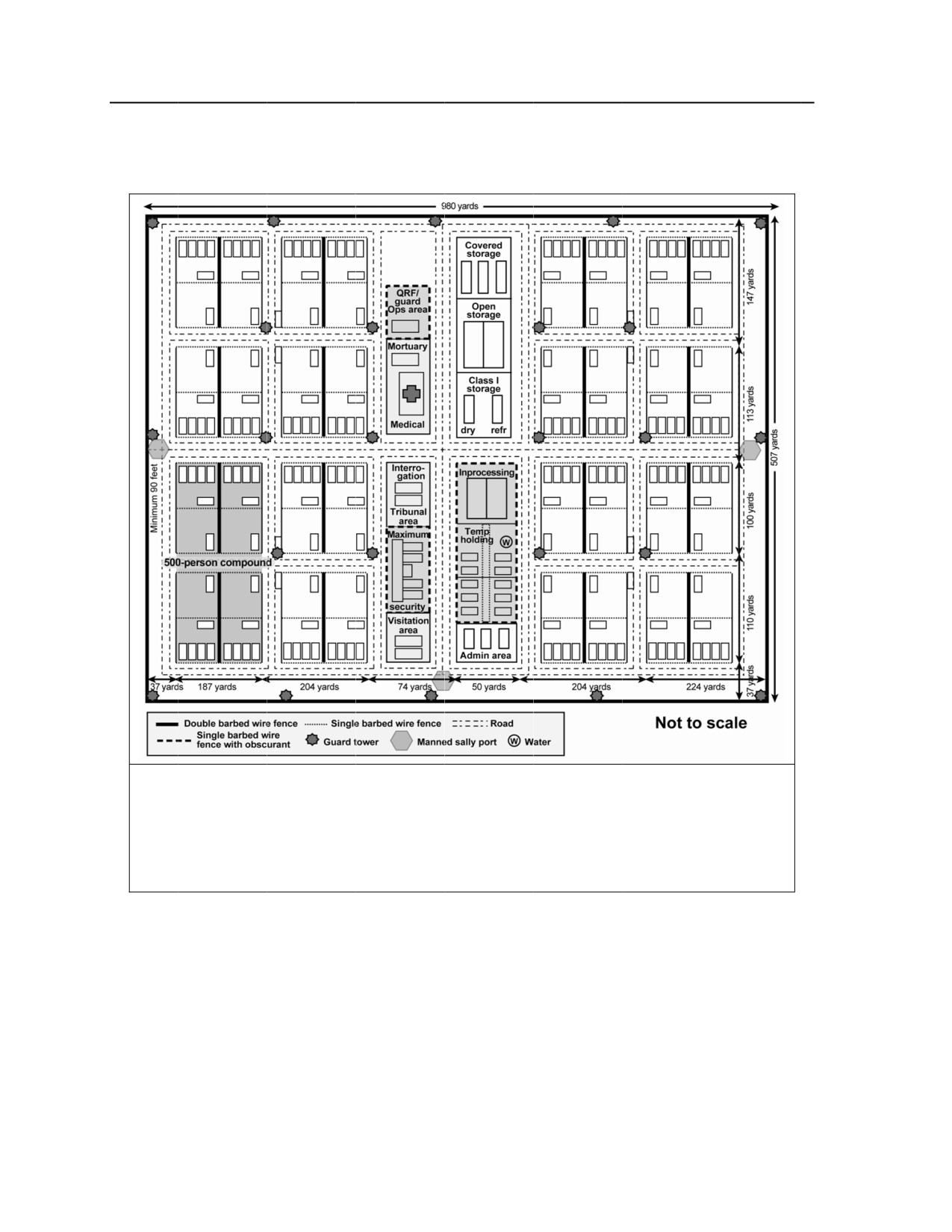
Appendix J
separated by an appropriate distance to provide
an avenue of approach to
each, while providing a safe
standoff distance from other compounds. The distance allows
enough space
for security to
patrol between
compounds and for reaction forces to employ riot control formations
and NLWs
in response to
disturbances.
Legend:
admin
administration
ops
operations
QRF
quick-reaction force
refr
refrigeration
temp
temporary
Figure J-1. 4,000-capacity I/R
facility for
compliant detainees
DISLOCATED-CIVILIAN RESETTLEMENT FACILITY
J-6.
The resettlement facility for DCs is designed with
an administrative area and up to eight
1,000-person enclosures. The facility is designed to be expandable in capacity increments of 1,000. The
initial
facility is constructed with the administrative area
and one 1,000-person enclosure and then
expanded, as needed, by adding
additional 1,000-person enclosures until
the maximum
8,000 person
capacity is reached.
Figure J-2 depicts a resettlement facility
with eight 1,000-person enclosures divided
into two 500-person
compounds.
The compound is further divided into two 250-person
subcompounds.
Each
1,000-person
enclosure must be self-contained, with electric and water capabilities, and must be
available for occupation immediately upon completion.
J-2
FM 3-39.40
12 February 2010
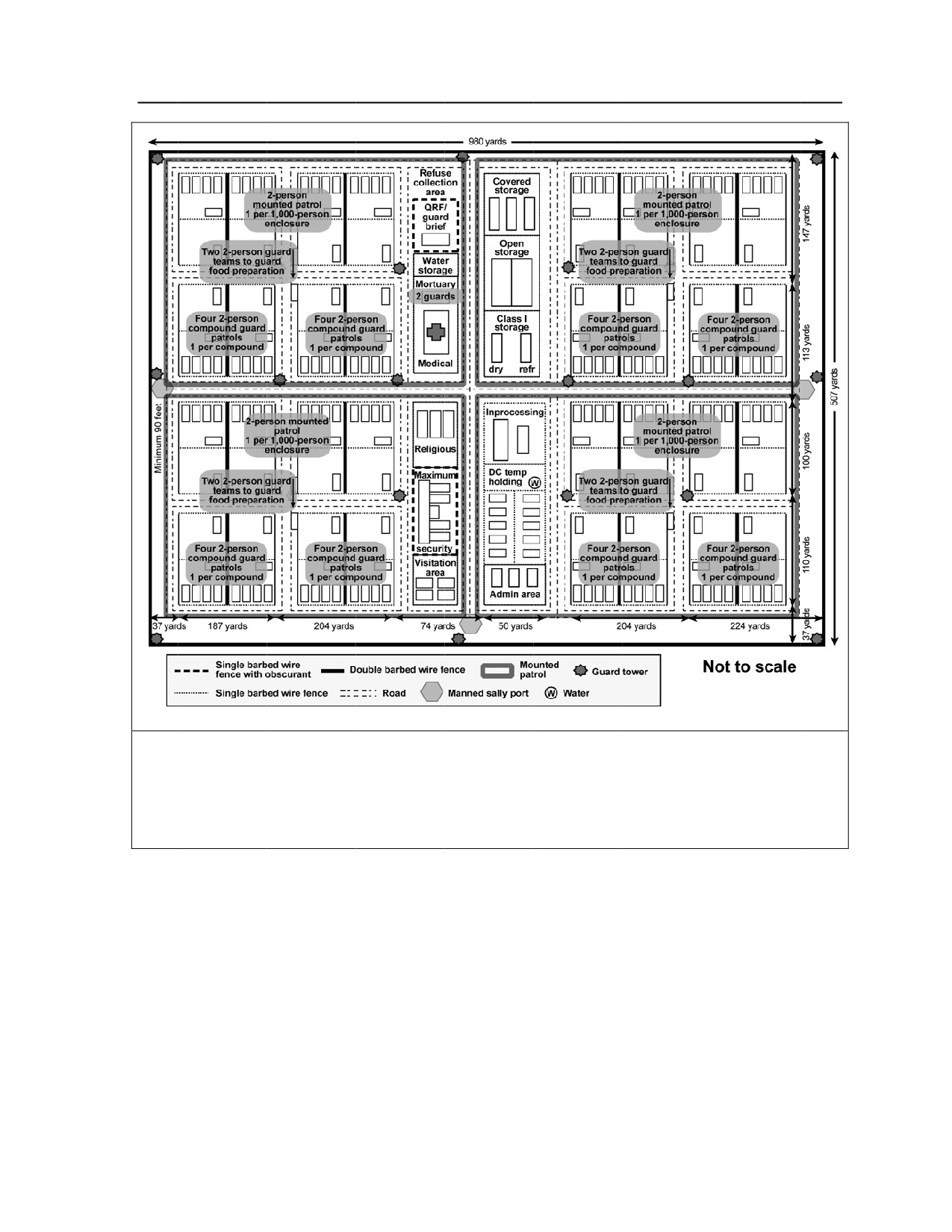
Facility Designs and Sustainment Considerations
Legend:
admin
administration
DC
dislocated civilian
QRF
quick-reaction force
refr
refrigeration
temp
temperature
Figure J-2. 8,000-capacity I/R
facility for
DCs
U.S. M
ILITARY PRISONER INTERNMENT
FACILITY
J-7. The facility for U.S. military prisoners (or noncompliant detainees) contains up
to three 100-person
enclosures, each
with an administrative area.
(See figure J-3, page J-4.) The enclosures will be
of a
semipermanent
construction. All three enclosures may be
constructed with individual
cells, depending on
the aggressiveness of the prisoner population. The decision on the type
of enclosure required is driven by
mission variables and is the
responsibility
of the facility commander. The facility
is designed
to be
expandable in 100-person increments. The initial facility is
constructed with an administrative area and one
100-person enclosure. The facility can then be expanded by adding (a maximum of 2) additional
100-person enclosures. Each
100-person
enclosure must be self-contained, with
electric and
water
capabilities, and must be available for occupancy immediately upon completion.
12 February 2010
FM 3-39.40
J-3
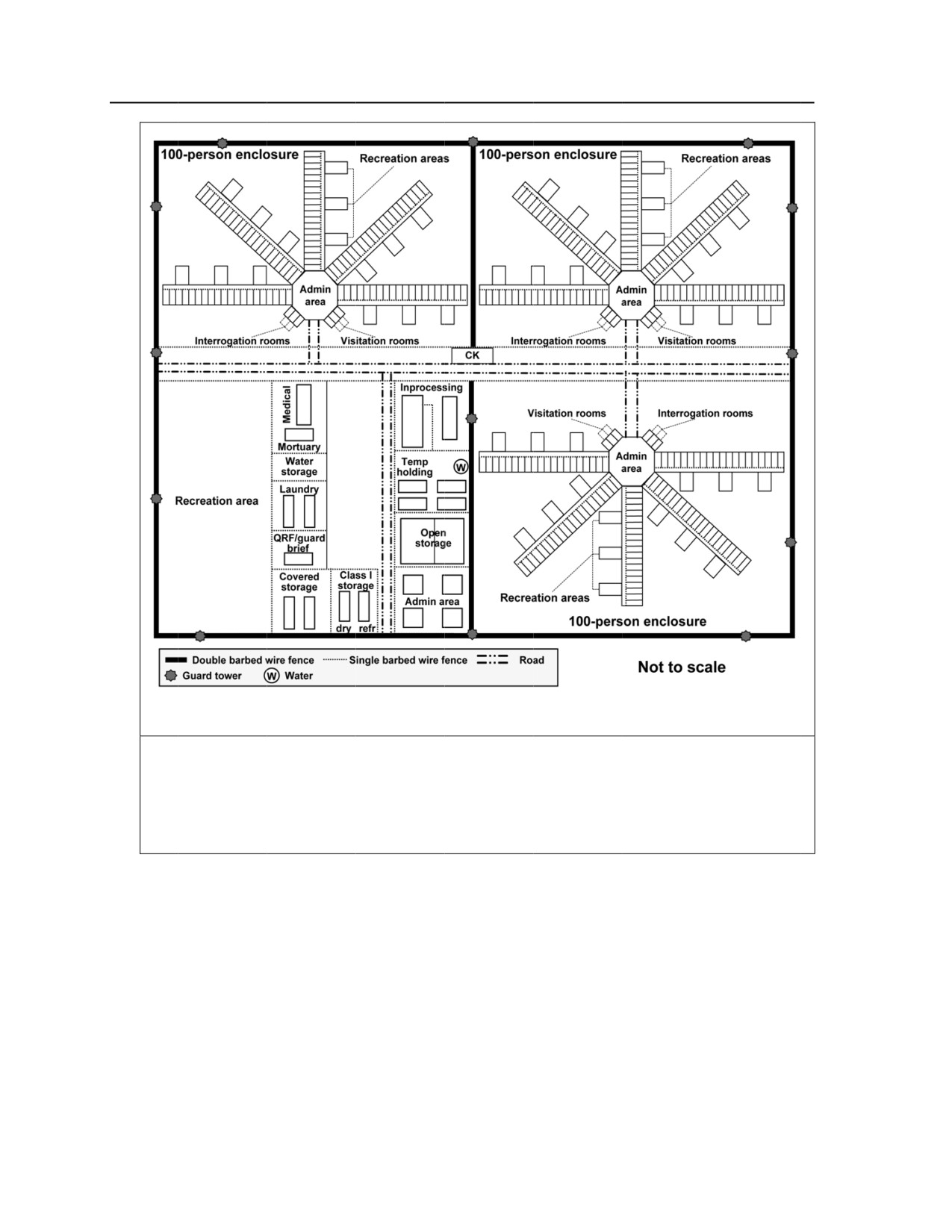
Appendix J
Legend:
admin
administration
CK
consolidated kitchen
QRF
quick-reaction force
refr
refrigeration
temp
temporary
Figure J-3. 300-capacity I/R
facility for U.S. military prisoners or
noncompliant detainees
J-8. Additional construction requirements for this facility include the following:
z
Each cell
must have a latrine, sink, and
bunk that are
attached to the wall.
z
Each cell
must have steel or concrete walls, a floor, and a ceiling.
z
Each cell
door must be
steel mesh or bars, have a middle and bottom pass-through, and have all
hinges and bolts on the outside of the cell.
z
No plumbing or electrical wiring in cells can be exposed.
z
All cell lights must be shielded.
z
All cells must have shutoffs for electric and water.
z
Each facility must have
a fire suppression system.
J-4
FM 3-39.40
12 February 2010

Facility Designs and Sustainment Considerations
z
Each facility must have a minimum of one cell that is stripped and padded for an emotionally
disturbed detainee. This cell must have a one-way observation window on the administrative
area side of the cell.
z
All doors of the facility should be installed with manual gang locks, when possible.
z
Each interrogation cell must be double-walled and insulated to minimize sound transfer and
eavesdropping.
z
Each recreation area must have a shower with an observation window; inside plumbing or
electrical wiring cannot be exposed. Water shutoffs must be accessible from the catwalk.
z
Each recreation area must have steel mesh walls and ceiling, a concrete floor, and shaded areas.
CONSTRUCTION
J-9. Planning for I/R facility construction must be projected well before the start of hostilities to provide
for the timely notification of engineers, the selection and development of specific facility sites, the
procurement of construction materials, and the actual construction. The Class IV, engineer, and military
police requirements must be programmed into the time-phased force deployment data for them to arrive in
the theater in time for construction.
SITE SELECTION
J-10. Military police must coordinate the location of each I/R facility with engineers, G-4/S-4 section,
sustainment units, higher headquarters, and the HN. Failure to properly consider and correctly evaluate all
location factors may increase the sustainment efforts required to support I/R operations. The poor selection
of an I/R facility location could require moving the entire I/R population if the surrounding situation
worsens.
J-11. When charged with selecting a site for an I/R facility, consider the following questions:
z
Will I/R populations pose a potentially serious threat to logistical operations if the tactical
situation becomes critical?
z
Is there a threat of actual or potential guerrilla activity in the area?
z
What is the attitude of the local population?
z
What classifications of I/R populations will be housed at the site?
z
What type of terrain surrounds the site?
z
Will the terrain around the site help or hinder escapes?
z
What is the distance from the mandatory supervised release location and the source of
sustainment support?
z
What methods of transportation are required to move detainees, supplies, and equipment?
z
What methods of transportation are available?
J-12. In addition to the questions above, it is also critical to consider the following when selecting a
specific site for an I/R facility:
z
Mission variables.
z
Need to avoid immediate proximity to probable target areas.
z
Availability of suitable existing facilities (to avoid unnecessary construction).
z
Presence of swamps, mosquitoes, and malarial conditions or other factors, including water
drainage that would affect human health.
z
Existence of an adequate source of potable water. The water source should be big enough to
meet the demands for drinking water and food sanitation. Water for personal hygiene and
sewage disposal may come from a nonpotable source.
z
Availability of local electrical power. Portable generators are preferred as a standby or
emergency source of electricity.
z
Employment of detainees on work details outside the facility.
z
Availability of local construction material.
z
Possibility of soil drainage.
12 February 2010
FM 3-39.40
J-5

Appendix J
CONSIDERATIONS
J-13. The specific type of construction necessary to satisfy minimum requirements varies according to
the—
z
Climate.
z
Anticipated permanency of the facility.
z
Number of facilities to be established.
z
Labor and materials available.
z
Local construction material available.
Note. It is essential that the G-4 coordinate with military police and engineers to ensure that
substitute items are acceptable. For instance, if the requirement is for 100-foot light poles to
illuminate the facility, substituting five 20-foot poles per one 100-foot pole will not suffice. The
capabilities of the 20-foot poles are diminished in that the height of the pole is a major factor in
determining the illuminated area.
z
Conditions under which the detaining power billets its forces in the same area.
J-14. Local vacant buildings may be used if practical. This reduces the requirements for engineer
construction materials and personnel. I/R populations and local sources of materials are used to the
maximum extent possible to accomplish necessary modifications or construction. Tents are the most
practical means for housing I/R populations if existing facilities are not available.
J-15. The U.S. Army Corps of Engineers has developed the military police proponent-approved I/R facility
designs in the Theater Construction Management System, which contains basic plans with specifications
and material requirements for building I/R facilities based on the anticipated I/R population. These plans
are easily modified for temperate, frigid, tropic, and desert climates. The Theater Construction
Management System can also provide specifications and material requirements for other I/R facilities when
dimensions and/or population input is supplied.
J-16. Construct the facility, when feasible, in a manner so that the compounds and subcompounds within
the facility are sufficiently separated from each other to preclude communication between detainees. Take
full advantage of existing irregular terrain features as obstacles to such communication. Commanders must
not extend the distance between compounds within the facility to a point that security and efficient
operation of the facility is jeopardized.
J-17. Commanders should realize that modifications to design specifications may occur based on mission
variables. For example, when a compliant population is forecasted for internment, design specifications
may provide for merged compounds to allow for larger capacity. Conversely, modifications to further
divide the facility compounds might be required if detainees are violent or noncompliant. Additional
modification considerations may include the—
z
Geographic location.
z
Number of guard force personnel available.
z
Availability of logistical support
(for example, lighting and infrastructure design).
FACILITY DESIGN MODIFICATIONS
J-18. Military police planners, and ideally the commander of the unit responsible for occupying the I/R
facility, advise and assist with I/R facility design by providing input during the facility design and
construction process. Facility designs are assessed and modified based on mission variable considerations.
The diversity of I/R populations and their respective security requirements may require the modification of
existing structures to provide appropriate custody and control. Additionally, facility designs may require
modification to accommodate long-term strategic objectives. For example, the transition of noncompliant
detainees to the control of civil penal authorities may require facility modifications to more closely
conform to minimum penal structural standards.
J-6
FM 3-39.40
12 February 2010
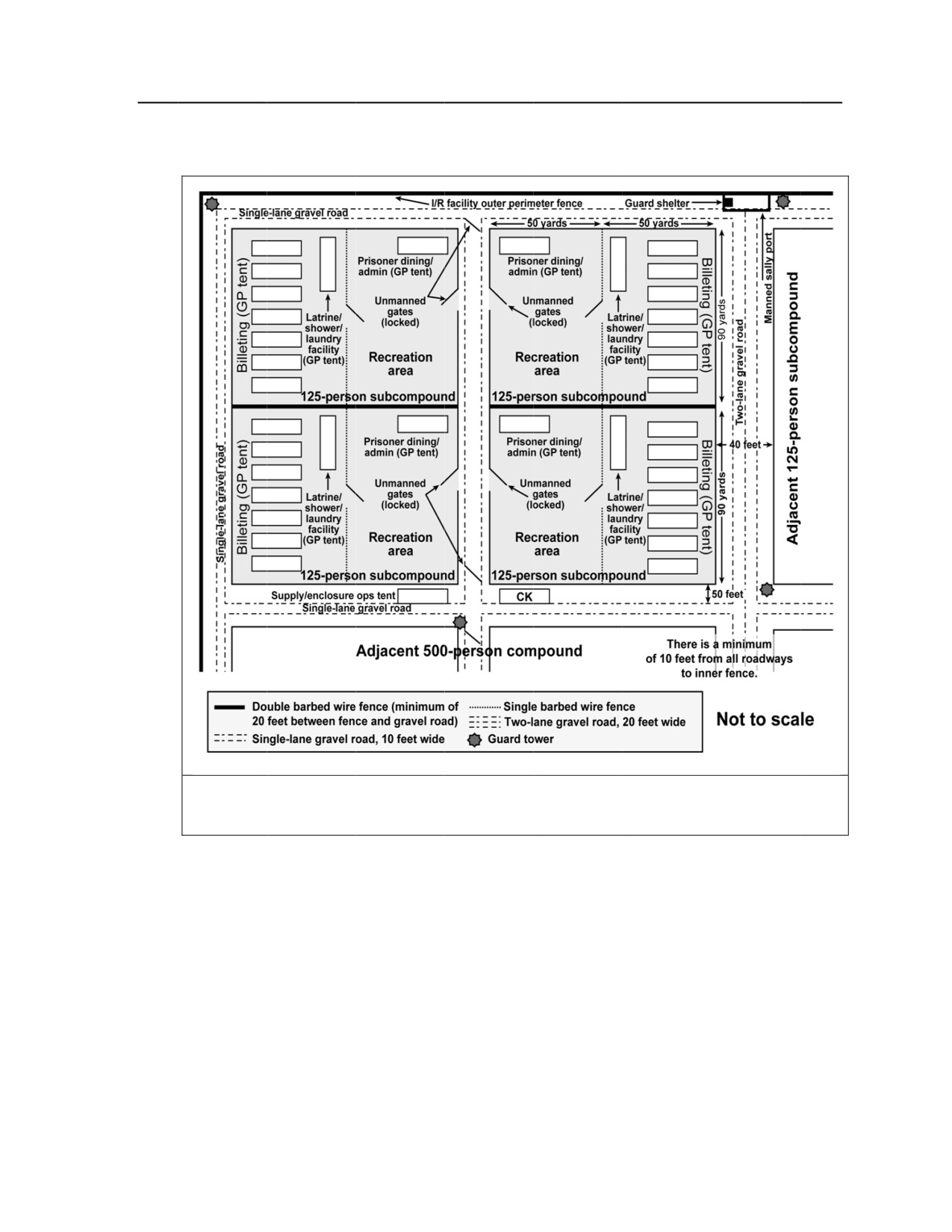
Facility Designs and Sustainment Considerations
J-19. Figure J-4
is an excerpt
from the 4,000-person facility in figure J-1, page J-2. The figure reflects an
enhanced diagram of a 500-person compound and shows the actual number of general-purpose, large
tents
18
feet by 52 feet required to house 125 detainees.
Legend:
GP
general purpose
CK
consolidated kitchen
Figure
J-4. 500-person compound
J-20. As illustrated in figure J-1, page J-2, the TIF is comprised of eight
500-person compounds, and
each
is
divided into
four 125-person compounds. This configuration allows compounds
to be isolated and
approached from
all sides. Compounds are
separated by
an appropriate
distance to provide an avenue of
approach to each compound, while providing a safe standoff distance from other compounds. The distance
allows enough space for security elements to
patrol between compounds
and for reaction forces to employ
riot control formations and NLWs in response to disturbances.
MINIMUM REQUIREMENTS
J-21. I/R facilities must meet
minimum security requirements. To satisfy
the minimum requirements, each
I/R
facility requires the items discussed in the following paragraphs.
12 February 2010
FM 3-39.40
J-7

Appendix J
Note. The military police proponent-approved facility designs are in the U.S. Army Corps of
Engineers Theater Construction Management System database and should be used when
planning facility construction. While mission variables may cause changes to these designs,
remember that the capabilities listed in Section I of the I/R tables of organization and equipment
are based on these designs, and any deviations from the approved designs may reduce the stated
capabilities of I/R units performing the internment mission if appropriate; corresponding
task-organization changes are not affected.
CLEAR ZONE
J-22. The 12-foot clear zone must be free of vegetation and shrubbery. The clear zone is constructed
around the circumference of the facility, between the inside and outside perimeter fences. A minimum
20-foot clear zone will be maintained on the exterior of the outermost perimeter fence. The use of
concertina or razor wire as additional barrier protection at the top and bottom of perimeter fencing is
authorized.
FENCING
J-23. Double exterior fencing will be installed around facility recreation, exercise, and work yard areas.
Fencing will be constructed of a type indicated in FM 5-34. It will be at least 12 feet tall with an 18- to 24-
inch top guard (preferably spring-type) constructed on all vertical perimeter fences and on interior fences
when added security is desirable. Based on local determination, some fencing may require the installation
of a double overhang (overhang fencing outward and inward). Razor or concertina wire may be substituted
for overhangs when determined appropriate by the facility commander.
ENTRANCES
J-24. All entrances passing through a double fence must have a sally port that will accommodate a 40-foot
commercial truck with trailer. Personnel at sally ports are required to search vehicles and personnel
entering or leaving the main facility. Consider having a back entrance when a sally port is present.
J-25. Gates requiring 24-hour manning must have a sentry box and/or shelter adjacent to the gate. The
main entrance must have a separate pedestrian entrance (sally port) adjacent to the vehicular entrance. This
entrance must be a building and/or tent that is large enough for a badge issue point, weapons racks, and
shelving to accommodate personal items being held for visitors entering the facility.
GUARD TOWERS
J-26. Guard towers must be located on the perimeter of each facility and compound (optional for DC
facilities). Guard towers must be—
z
Built so that they are portable and require minimal effort to move.
z
Built with a roof.
z
Built high enough (20 feet from the ground to the floor of the tower) from the ground to permit
an unobstructed view of the compound, but low enough to permit an adequate field of fire.
z
Placed immediately outside the wall or, in case of double fencing, placed in such a manner as to
permit an unobstructed view of the distance between the fences.
z
Spaced to allow for overlapping observation and fields of fire. During adverse weather, it may
be necessary to augment security by placing fixed guard posts between towers on the outside of
the fence.
z
Equipped with platforms sufficiently wide enough to mount crew-served weapons.
z
Equipped with retractable ladders.
z
Spaced so that guards have an uninterrupted view of 200 yards in any direction along the
perimeter fence.
J-8
FM 3-39.40
12 February 2010

Facility Designs and Sustainment Considerations
z
Located so that the entire perimeter and all parts of the billeting and recreation areas can be
observed.
LIGHTING REQUIREMENTS
J-27. The following lighting requirements must be met:
z
Lighting must illuminate the entire facility at night to assist in the accountability and control of
the I/R population, prevent escapes, and provide safety to the I/R population and the protecting
and/or guarding forces.
z
Lighting must sufficiently illuminate inner strategic points to expedite the handling of sudden
problems caused by I/R populations.
z
Emergency lighting provisions must be provided.
z
Lights must be protected by unbreakable glass shields or wire mesh screens.
z
Lighting placement on walls and fences must not interfere with tower guards’ field of vision.
PATROL ROADS
J-28. Construct patrol roads for vehicle or foot patrols adjacent to the outside perimeter fence or walls.
Security forces conduct patrols on patrol roads, while maintaining communications with the force at all
times.
COMMUNICATION
J-29. Communication between the towers and operation headquarters must be reliable. Telephones are the
preferred method. Alternate forms of communication (radio, visual, or audio signals) should be in place as
a backup in case of operational interruptions.
POWER
J-30. The facilities must be divided into four grids for prime power support to minimize the negative
effects of power loss and escape attempts. This requires at least four 28-kilowatt generators to support the
facility. The generators are placed outside the I/R facility perimeter fence in a bermed area to minimize
noise pollution.
RECREATION AREA
J-31. In each enclosure, a recreation area is provided for detainees to use on a scheduled basis. Recreation
provides a necessary outlet for the I/R populations’ energies and offers a break in the daily routine of
extended internment. Sports and activities involving physical activity promote the general health and
well-being of the I/R populations. These activities are conducted on a daily basis in the recreation area.
LAYOUT AND INTERNAL STRUCTURES
J-32. The facility layout depends on the nature of the operation, available terrain, building materials, and
HN support. These variables provide the basic foundation from which the facility commander can add or
delete additional design considerations or engineer enhancements based on specific theater requirements.
The standard 4,000-person I/R facility consists of thirty-two 125-person subcompounds. (See figure J-1,
page J-2.)
INTERNAL STRUCTURES
J-33. Each compound in the I/R facility generally has the following structures:
z
Administrative buildings.
z
Barracks (which in the early stages of the operation may be tents).
z
Dining facilities.
12 February 2010
FM 3-39.40
J-9
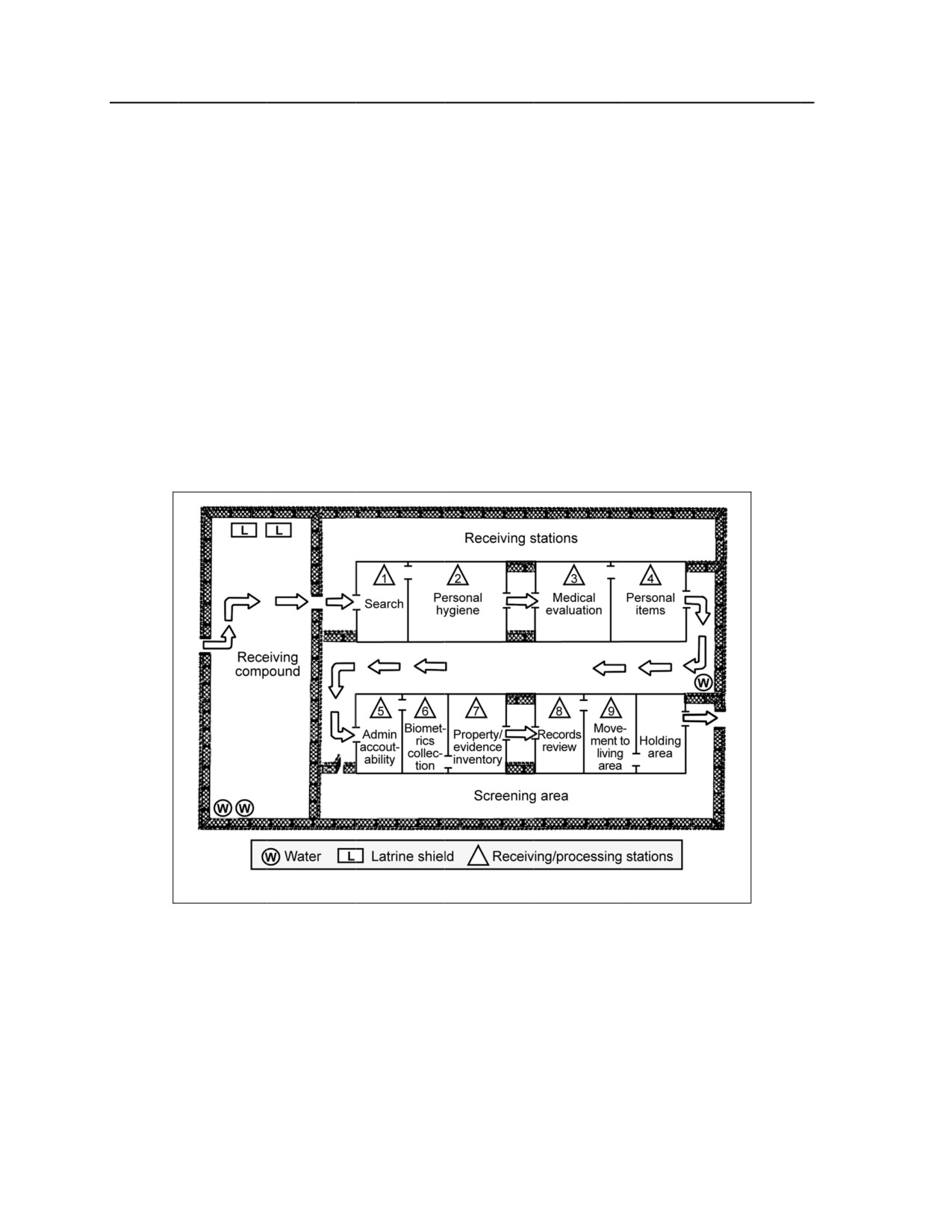
Appendix J
z
Bathhouses.
z
Latrines.
J-34.
The administrative area of the I/R facility consists of the—
z
Command
post and administrative building.
z
Receiving
and processing center. (See
figure J-5.)
z
Religious
and educational buildings.
z
Interrogation facility.
z
Dispensary and infirmary for the treatment of minor
illnesses and injuries.
z
Temporary mortuary facility.
z
Supply building for limited storage and issue of selected expendable supplies.
z
Class I storage (dry and
refrigeration)
and dining facilities.
z
Latrines.
z
Parking areas.
z
Trash collection points.
z
Potable water points.
z
Open and
covered storage areas.
z
Generator
and fuel areas
Figure J-5. Detainee receiving and processing operation
SERVICE
REQUIREMENTS
J-35.
An I/R facility
must have certain services
and equipment available to
ensure fluid
operations. The
following paragraphs describe many of these requirements. Most are required at all times, but some are
based
on theater requirements.
J-36.
The prescribed standards of treatment and care discussed earlier place a high
demand on the
sustainment system.
To the greatest extent possible, the commander should
direct that detainees wear the
clothing they were wearing when
they were captured or when they arrived
at the facility. Supplies and
J-10
FM 3-39.40
12 February 2010

Facility Designs and Sustainment Considerations
equipment that were taken with the detainees are also used to the fullest extent possible in maintaining
detainees. To avoid the exploitation of supplies and equipment by detainees, properly secure and account
for all supply items.
Detainee Receiving and Processing Centers
J-37. Detainees must be fully processed before being interned, evacuated out of theater, or repatriated.
Separate processing centers may be established near transfer points to accomplish this. The size of the
processing center depends on the anticipated capture rate. When establishing a receiving and processing
center—
z
Contact engineers to arrange for construction.
z
Provide shelter, water, and latrines.
z
Use existing structures, if available, and use tents if existing structures do not exist.
z
Arrange each processing station to prevent the detainees from knowing what is taking place in
the next station.
Subsistence
J-38. The basic daily food rations must be sufficient in quantity, quality, and variety to keep detainees in
good health and to prevent weight loss or nutritional deficiencies. Commanders must consult with
physicians and dieticians regarding the caloric intake for the I/R population. Iron is needed to prevent
anemia. Iodine needs can be met by preparing foods with iodized salt. (See the Food and Nutrition Board,
National Institute of Medicine Web site at
recommended nutrient minimums based on the dietary reference intakes.) Medical personnel are to keep
the commander and detainee operations medical director apprised of any situational needs and the
nutritional health of the general I/R population. When possible, culturally sensitive foods may be served.
Working detainees may be given additional rations when required. It is the commander’s responsibility to
sustain the health of the detainees at a level that is equal to that of the U.S. armed forces guarding them.
J-39. When dining facilities are not available, feed detainees field rations (U.S. or captured). These rations
(for example, meals, ready-to-eat) are easily stored and require no additional dietary supplements.
However, when perishable food supplies (such as fresh vegetables or fruits) are available, they should be
substituted for nonperishable items. This prevents the detainees from stockpiling rations for escapes. The
I/R units that operate these facilities are designed to have detainees prepare their own meals under the
supervision of U.S. armed forces. (See AR 190-8.) Sufficient drinking water (this means no less than what
U.S. armed forces receive) and latrine facilities are provided for the detainees.
Note. If detainees are given meals, ready to eat any hardware within the meals should be taken
out and accounted for before giving the meals to them. Planners and facility operators should
always consider the security of the guard force when determining what and how to feed
detainees.
J-40. The I/R battalion provides food service support for up to 4,000 detainees and the 450 or more U.S.
armed forces personnel who are required to support the I/R facility. A fully operational I/R facility will
have 4 dining facilities (one per 1,000-person enclosure) for the detainees and 1 or 2 dining facilities for the
U.S. armed forces. Rations cannot be stored in the compounds and must be issued before the preparation of
each meal. The I/R battalion requires enough dry- and cold-storage areas to operate a consolidated ration
point and the appropriate MOS 92A personnel to operate the ration breakdown and/or distribute rations to
the compound.
J-41. Article
26, GPW, requires the facility commander to consider the habitual diets of detainees.
According to Article 26, GPW, detainees will prepare their own meals under the supervision of U.S. food
service personnel. The I/R battalion requires enough 92G personnel to train detainees on the operation of
food service equipment, oversee and supervise meal preparation, and account for rations. When detainee
food preparation is deemed inappropriate by commanders, they may authorize the contracting of food
12 February 2010
FM 3-39.40
J-11

Appendix J
services to an outside source or coordinate with U.S. food service units providing area support for food
service support.
J-42. During the early stages of internment, detainees should be allowed to retain their own rations.
However, arrangements for the collective feeding of detainees according to the terms of the Geneva
Conventions should be made at the earliest opportunity.
Food Service Equipment
J-43. Requirements for I/R facility food service equipment vary depending on the habitual diets and
customs of the detainees. When the commanders deem that it is appropriate, they may authorize the local
procurement of cooking equipment for the detainees to use instead of standard-issue equipment.
Food Service Personnel
J-44. Qualified food service personnel are authorized in each I/R company and detachment. They provide
food service support for each compound. While selected detainees are trained to perform food service
support for each compound, they must be trained by and under the constant supervision of U.S. food
service personnel.
Chapel Facilities
J-45. Facility commanders will establish policies, procedures, and religious support for detainees to have
the opportunity to practice their faith. Practices of religious faith must not cause disruption to the order and
discipline within the facility and/or pose a threat to the safety of persons involved.
Recreational Equipment
J-46. Recreational equipment can be obtained through supply channels. If it is not available through supply
channels, the equipment may be secured through local purchase.
Cleaning Supplies
J-47. Each I/R facility has requirements for housekeeping supplies, which vary considerably in the types
and quantities needed. The requirements are based on the environment, the type of housing, and the food
service facilities available. CTA 50-970 contains an extensive listing of such supplies. Use CTA 50-970 as
a guide for developing individual facility allowances for janitorial and cleaning supplies. Always ensure
that there is plenty of potable water storage available in each of the compounds. All cleaning supplies are
considered as controlled items.
Medical and Sanitation Operations
J-48. Every I/R facility has an infirmary where I/R populations with contagious diseases, mental
conditions, or other illnesses (as determined by the medical officer) are isolated from other patients.
Medical treatment is available for all detainees onsite or via supporting medical facilities. All dental and
optometry support will be provided by supporting medical units, and detainees with illnesses that require
surgery or long-term hospitalization will be taken to the supporting medical facility.
J-49. The U.S. takes all necessary sanitary measures to ensure a clean and healthy facility to prevent
epidemics. Detainees have access, day and night, to latrines that conform to the rules of hygiene and are
maintained in a constant state of cleanliness. Separate latrines are provided for female detainees. Sufficient
water and soap are provided for detainees’ personal needs and laundry. The time and facilities necessary for
those purposes are made available. (See appendix I for more information on medical and sanitation
considerations.)
J-12
FM 3-39.40
12 February 2010