FM 3-39.40 INTERNMENT AND RESETTLEMENT OPERATIONS (February 2010) - page 4

Facility Designs and Sustainment Considerations
J-50. Consider the following sanitation standards to help prevent disease and to ensure the cleanliness of
the facility:
z
Provide adequate space within housing units to prevent overcrowding.
z
Provide sufficient showers, latrines, and materials for personnel hygiene for detainees, and
ensure that showers and latrines are cleaned and sanitized daily.
z
Teach individuals working in the dining facility the rules of good food sanitation, and ensure that
the rules are observed and practiced.
z
Properly dispose of human waste to protect the health of all individuals associated with the
facility according to the guidelines established by preventive medicine.
z
Provide sufficient potable water for drinking and food service purposes and sufficient water for
bathing and laundry purposes.
z
Provide information to detainees concerning proper hygiene, sanitation, and food sanitation in a
language that they understand.
SUSTAINMENT REQUIREMENTS
J-51. Planners maintain situational understanding of the needs within the facility through all classes of
supply. In addition, they must forecast 24 to 72 hours ahead to ensure that the facility is properly
maintained. Commanders and planners need to be deeply involved in the sustainment aspects of detention
operations, starting from the initial POC to the DHA and, subsequently, to the TIF or SIF. Failure to
maintain the logistical standards impacts operations and may bring unwelcome attention from the news
media and the ICRC. The following are some of the factors to consider when planning and developing
sustainment standards for an internment facility:
z
Acquisition law and/or procedures for detainee supply requirements. Planners need detailed
information on how to acquire and maintain supplies to meet the needs of the facility.
z
Airport and/or seaport throughput capacity (current and projected). Planners need to
determine if there is a standard flow of aircraft and/or ships in a given location and how they can
access those resources to ensure that the internment facility is properly supplied and maintained.
z
Airfields in the operational area. Planners need the locations of airfields when determining a
suitable location for a facility.
z
Aircraft line of communications requirements and status. Planners and operators at the
internment facility must ensure that they have visibility of aircraft arriving with detainees.
z
Multinational support. Planners need to consider what resources multinational support
elements will bring to internment operations.
z
Area damage control and firefighting resources. Planners must develop an SOP that
addresses the required response of forces in the event of a fire in the detention facility.
z
Chemical alarms. Planners must develop an SOP that addresses the required response of the
guard force in the event of a chemical attack on the facility or the compound on which the
facility is located.
z
Clothing for detainees. Planners need to consider how clothing items will be purchased,
supplied, accounted for, and maintained in the facility.
z
Health, veterinary, and preventive medicine service support. Planners must identify the
status of current medical, optometric, and dental personnel who support the internment facility
and its projected needs.
z
Medical logistics. Planners need to consider the requirements for Class VIII supplies, medical
equipment, medical equipment maintenance and repair support, dental support, optometric
support, single- and multivision optical lenses fabrication, and spectacle fabrication and repair to
support the I/R population.
z
Commander’s supply priorities. Planners need to consider internment facility requirements
when recommending supply priorities to the commander.
12 February 2010
FM 3-39.40
J-13

Appendix J
z
Support coordination. Planners need to consider the type of day-to-day support (engineer,
medical, dental, religious) needed to run and maintain the facility. Sending those requirements to
higher headquarters ensures that assets will be available.
z
Food and water consumption factors. Planners must conduct a detailed analysis of the
consumption rates and the projected consumption rates to assist in ordering and maintaining
food and water supplies for detainees. In addition, they must identify food and water
requirements for the guard force and personnel supporting the facility.
z
Contractor support. Planners must determine what the screening and/or vetting process will be
for allowing contractors with local indigenous personnel in or near the facility. In addition, they
must identify where contractors may be best used.
z
Echelons-above-corps sustainment unit adequacy. Planners must determine what the
logistical transportation distances are for providing support to internment facility supply
operations.
z
Emergency resupply plans. Planners need contingency plans for implementation if logistical
needs are not being met within the facility (for example, if Class I supplies do not arrive). They
should anticipate contracting out with local and/or HN personnel for these necessities. They
should identify where these supplies are located and how they can be accessed for use in the
facility.
z
Engineering and construction standards and/or policies. Planners need the structural
requirements for building and maintaining the facility. Such structures include guard towers,
fencing and/or barriers, isolation facilities, latrine and/or shower facilities, perimeter security
requirements, and construction standards. This information is available in the Theater
Construction Management System database.
z
Disposable restraint availability. Planners must ensure that disposable restraints are available.
z
Food service support. Planners need to determine if there are any special religious and/or
cultural requirements for detainees.
z
Time-phased force deployment data considerations. Planners must identify the force and
Class IV materials necessary to conduct the mission. They must also identify what external
assets are required to run and maintain the facility. Medical and dental personnel, SJA, chaplain
support, and engineer support should be specifically considered. Military police planners,
engineer units, and construction materials must be scheduled on the time-phased force
deployment list early enough during the build up to ensure that facilities are built and operational
before the start of hostilities.
z
Generator availability. Planners must determine the lighting
(internal and external) and
generator requirements necessary to maintain security within the facility. In addition, they must
determine the number of mechanics needed to maintain the generators. They should walk the
ground in and around the holding area and the corridors along the perimeter to ensure that all
dead space and dark spots are covered with light and covered by guard towers.
z
Heavy equipment needs. Planners must consider any special equipment requirements necessary
to maintain and sustain the facility. For example, they must determine if trenches are required
for bunkers to mitigate indirect fire and if a latrine trench is needed for detainees.
z
HN support arrangements. Planners should consider what HN assets are available to support
the facility in terms of food and clothing. This is especially important when meeting religious or
cultural needs.
z
Key control SOP. Planners need to ensure that key control and accountability are in the SOP
and are properly supervised and checked leadership.
z
Labor and funding sources. Planners must consider where and how funding is obtained.
z
Interpreters and translators. Planners must consider the proper number of interpreters and
translators based on the number of detainees within the facility.
z
Litters. Planners must ensure that SOPs and guard orders identify the locations of litters and
other medical resources in the event of a medical emergency.
z
Local purchase procedures and theater policy. Planners must identify the requirements for
purchasing food, clothing, and water locally.
J-14
FM 3-39.40
12 February 2010

Facility Designs and Sustainment Considerations
z
Sustainment situational understanding at all levels. Planners must maintain situational
understanding of the needs within the facility through all classes of supply. In addition, they
must forecast 24 to 72 hours ahead to ensure that the facility is properly maintained.
z
Sustainment capabilities. Planners must identify current and projected requirements for the
facility and the means to meet those requirements.
z
Sustainment shortfalls and/or challenges. The detention facility commander should meet
weekly with all personnel involved in facility operations to identify sustainment shortfalls.
z
Sustainment infrastructure maturation. Planners must attempt to improve the conditions for
detainees, the guard force, and MI personnel.
z
Sustainment lessons learned. Planners should consider previous lessons learned when
developing plans and contingencies for detention operations.
z
Long-lead procurement items. Planners should identify any requirements that may take an
extended period of time to arrive at the facility and identify measures to mitigate risk in the
interim.
z
Media coverage. Planners should develop a media plan and provide guidance on media
operations to all personnel involved in detention operations. All media plans must be approved
by the Office of the Secretary of Defense.
z
Mortuary affairs. Planners should provide the guidance for related to detainee deaths while in
custody at an internment facility, the notification process, and the media guidance.
z
Public address system. Planners should consider how to deliver information that needs to be
addressed to all the detainees. They should identify systems available for audio pickup.
z
Ration cycle for detainees. Planners must ensure that ration cycles for detainees are consistent
with the ration cycle for U.S. or multinational forces, taking cultural and religious requirements
into account.
z
Initial POC considerations. Planners must determine what additional requirements are needed
at the initial POC, such as—
Sealable bags and/or trash bags.
Disposable restraints.
Type III nylon cord (parachute line).
Duct tape.
DD Forms 2745.
z
Riot control considerations and equipment. Planners must identify what riot-related
requirements are needed at initial and long-term detention facilities, such as—
NLWs.
Release authority determination.
Shinguards.
Helmet and/or face shields.
Batons.
Body shields.
Groin protectors.
CBRN masks.
Gloves.
CLOTHING
J-52. When dealing specifically with enemy combatants, clothing, underwear, and footwear should be
supplied to them in sufficient quantities. Allowances will be made for the climate where they are housed.
Captured uniforms of enemy armed forces will, if suitable for the climate, be made available to clothe
them. The detention facility commander ensures the regular replacement and repair of detainee clothing.
Detainees who work will receive clothing appropriate to the nature or location of the work demands.
12 February 2010
FM 3-39.40
J-15
Appendix J
Clothing worn by detainees at the
time of capture may be worn
until it is no
longer serviceable, and then
it
is exchanged for replacement clothing.
J-53.
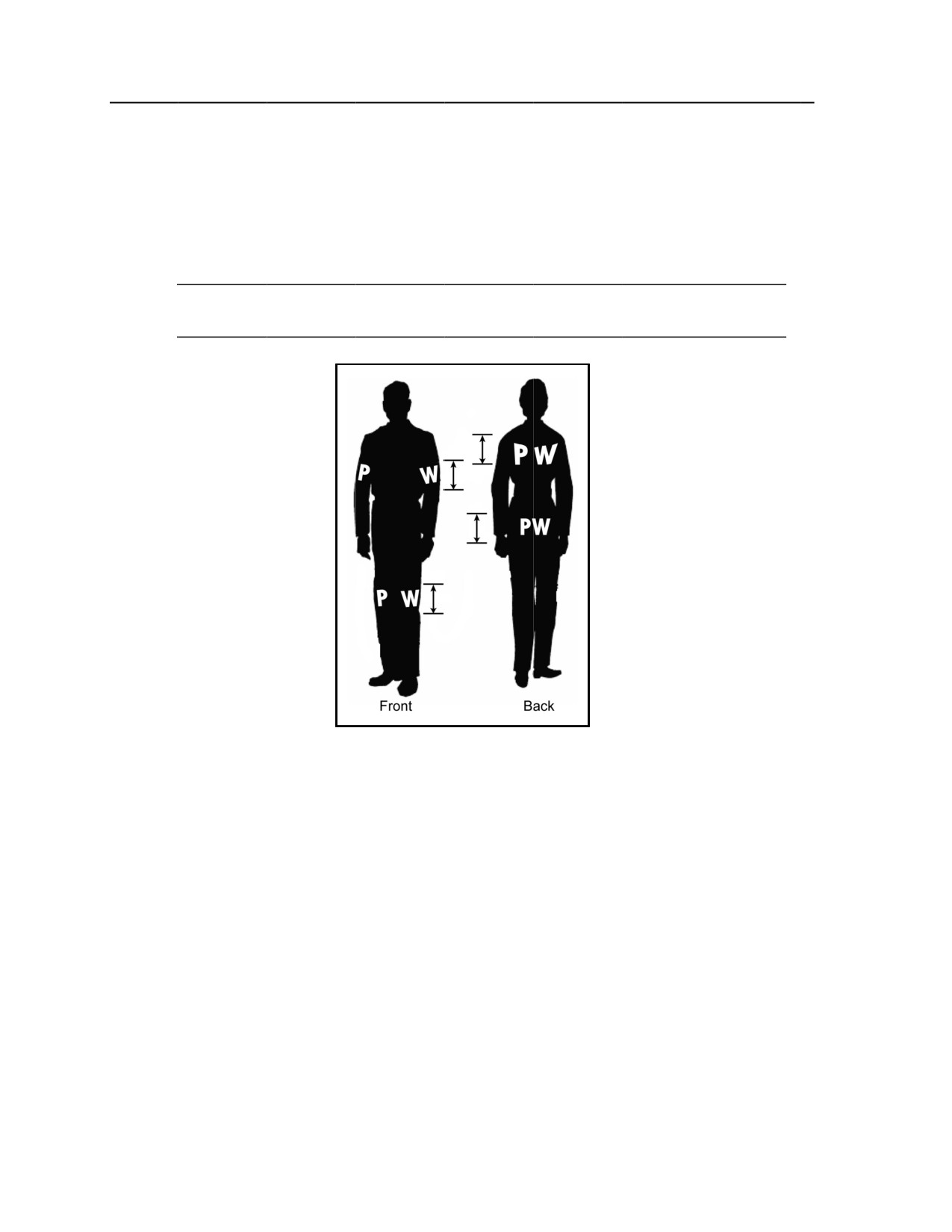
Except for hats and other accessories, all outer garments
worn by detainees will be marked with the
letters
“PW” across
the back and on the front of each sleeve, between
the elbow and the shoulder.
(See figure J-6). The
letters will be black in color and 4 inches in height. If the clothing
is a dark color,
white
lettering is used. Trousers, walking shorts,
and like items
will be similarly marked just below the belt
on the
back and front of both legs just above the
knees. RP and
CIs may be issued clothing that is similar to
the items worn by enemy combatants and it will be marked the
same as show
in figure J-6.
Note. Detainees being categorized as enemy combatants, RP, and CIs
are clothed according to
AR 190-8.
Figure J-6. Clothing markings
INDIVIDUAL EQUIPMENT
J-54.
Table J-1 is an
example of individual equipment that may be issued to
detainees when their clothing
becomes unserviceable. Commanders may refer
to CTA 50-900 when determining what clothing to issue.
Sundry
packs and recreational equipment will also be needed,
and the military police facility commander
may arrange for these items through unit supply
or a local purchase. In addition to unit supply operations
personnel, the I/R battalion requires sufficient unit supply support to operate
a separate supply facility for
each 1,000-person enclosure and sufficient staff to oversee this complex supply operation.
J-16
FM 3-39.40
12 February 2010

Facility Designs and Sustainment Considerations
Table J-1. Sample individual equipment
Allowances
Line
Item
Item, Basis of Issue, and Remarks
Unit
Zone
Zone
Zone
Zone
Zone
Zone
Zone
No.
I
II
III
IV
V
VI
VII
Belt, trousers, cotton webbing, 11/4 inch, per
B60252
Each
1
1
1
1
1
1
1
detainee.
Boot, combat, men’s, leather, black, 81/2 inch high,
C06886
Pair
1
1
1
1
1
1
1
per detainee.
Buckle, belt, trousers, brass, lacquered finish, per
C32182
Each
1
1
1
1
1
1
1
detainee.
Cap, hot weather, polyester and rayon, olive green
C03750
Each
1
1
1
1
1
1
1
shade 106, per detainee.
C04000
Cap, wool, knit, per detainee.
Each
--
--
1
1
1
1
1
Drawers, men’s, cotton, thigh length, white, with
G48939
Pair
2
2
2
2
2
2
2
elastic waistband, per detainee.
Drawers, men’s, wool, knit, ankle length, silver
G49213
Pair
--
--
2
2
2
2
2
gray, per detainee.
Glove inserts, wool and nylon, knit, olive green
J62858
Pair
--
--
1
1
1
1
1
shade 108, per detainee.
J63269
Glove shells, leather, black, per detainee.
Pair
--
--
1
1
1
1
1
Helmet, sun, adjustable chin strap, adjustable
K35007
Each
1
1
1
--
--
--
--
head size, per detainee.
Liner, wet weather, poncho, camouflage color, per
L70789
Each
--
1
--
--
--
--
--
detainee.
Poncho, coated, nylon, olive green shade 207, per
P17415
Each
1
1
1
1
1
1
1
detainee.
Shirt, men’s, cotton or sateen, olive green shade
T03520
Each
--
--
2
2
2
2
2
107, per detainee.
Shirt, men’s; wool, nylon, flannel, olive green
T04205
Each
--
--
2
2
2
2
2
shade 108, per detainee.
Socks, men’s, wool, cushion sole, olive green
T93335
Pair
4
4
4
4
4
4
4
shade 408, stretch type, per detainee.
Trousers, men’s, cotton or sateen, olive green
X36358
Pair
2
2
2
2
2
2
2
shade 107, per detainee.
Trousers, men’s, wool serge, olive green shade
X37180
Pair
--
--
2
2
2
2
2
108, per detainee.
B72225
Blanket, bed, wool, olive green, per detainee.
Each
1
1
2
2
3
3
3
–
Brassard, red cross, per RP
Each
2
2
2
2
2
2
2
F54817
Cup, water, canteen, steel, per detainee and RP.
Each
1
1
1
1
1
1
1
N53095
Pan, mess kit, per detainee.
Each
1
1
1
1
1
1
1
Zone I - Warm or hot all year.
Zone V - Warm or hot summers, cold or very cold winters.
Zone II - Warm or hot summers, mild winters.
Zone VI - Mild summers, cold winters.
Zone III - Warm or hot summers, cold winters.
Zone VII - Mild summers, very cold winters.
Zone IV - Mild summers, cool winters.
12 February 2010
FM 3-39.40
J-17

Appendix J
ELECTRONIC SEARCHING DEVICES
J-55. Nonintrusive devices can be used to conduct a body search of detainees to identify weapons or other
objects used as weapons. These devices may be used to screen personnel during combat and noncombat
operations, apprehensions, field interviews, detainee operations, and CI operations and at access control
points.
PRISONER TRANSPORT PROTECTIVE SYSTEM
J-56. The Prisoner Transport Protective System is designed to incorporate existing leg irons and full-body
restraint systems. This system includes—
z
Improved handcuffs.
z
Temporary cinch strap.
z
Disposable wrist restraints.
J-57.
Additional equipment may include—
z
Batons and holders.
Patrol baton (9999-01-499-9918).
Patrol baton holder (9999-01-499-9923).
Riot control baton (9999-01-499-9924).
Riot control baton holder (9999-01-499-9927).
z
Handcuffs and restraints.
Handcuff (8465-01-515-3151).
Cinch strap (8465-01-515-3155).
Full-body restraint (8465-01-514-8739).
Trifold disposable restraint (8465-01-514-8590).
Double-cuff disposable restraint
(white
[8465-01-515-1158]
and
black
[8465-01-515-
1156]).
z
Metal detectors.
Super Scanner ™ 0ELZ7 1165180 (6350-01-520-5942).
Metal detector (compact) 0ELZ7 1165900 (6350-01-520-5825).
z
Law enforcement frisk/search gloves.
Size 7 (8415-01-505-2346).
Size 8 (8415-01-505-2347).
Size 9 (8415-01-505-2348).
Size 10 (8415-01-505-2350).
Size 11 (8415-01-505-2351).
Size 12 (8415-01-505-2352).
Size 13 (8415-01-505-2354).
CANTEENS
J-58. When directed by the CDO or a senior military police officer in the internment facility chain of
command, canteens will be installed in the facility so that detainees can procure foodstuffs, soap, tobacco,
and ordinary articles that are used daily. When authorized, canteens will be operated according to the GPW.
Canteens will be installed in long-term internment facilities that normally intern docile detainees who not
pose a significant security risk to themselves, other inmates, or the military police security force.
J-59. The tariff on items available to detainees will never exceed local market price. Procedures regarding
detainee payment for canteen purchases are contained in DFAS-IN 37-1. Detainee representatives may
make suggestions regarding the management of the canteen and the special fund.
J-18
FM 3-39.40
12 February 2010

Facility Designs and Sustainment Considerations
J-60. Profits made by the facility canteen will be used for the benefit of detainees; a special fund will be
created for this purpose. The special fund will benefit detainees of the same nationalities as those who
contribute to it. When an internment facility is closed, the credit balance of the special fund will be turned
over to another U.S. internment facility operating in the theater. When all canteen facilities close,
commanders should consult the SJA regarding the remaining funds.
SPECIAL PROGRAMS
J-61. As a general policy, active education, visitation, employment, and agricultural programs for
detainees are encouraged and supported. Adequate facilities, instructional material, and agricultural
equipment will be provided for such activities as soon as practical.
EDUCATION PROGRAM
J-62. Education programs are developed according to DA policy guidance. Within the framework of this
guidance and implementing directives issued by other responsible headquarters, a separate education
program is developed for each internment facility. Each program must be developed to reflect the
individual attitudes and political orientations of those interned in that facility. Factors and considerations
that may influence education programs are—
z
Various education levels throughout the detainee population.
z
Detainee attitudes toward education and the education program.
z
Requirements for essential and necessary detainee work details.
z
Availability of qualified instructors, which may include—
Detainees.
Indigenous personnel.
U.S. armed forces and/or civilian personnel.
z
Security considerations, which may restrict or prohibit the use of detainees or indigenous
personnel.
J-63. In addition to an academic program, vocational training should be an integral part of the education
program. The immediate objective of vocational training is to develop skills within the population that are
immediately useful for full employment of detainees during internment. The long-range goal is to allow
detainees to learn a trade that is transferable to civilian life.
VISITATION PROGRAM
J-64. Detention facility commanders should consider a visitation program for detainees. A visitation
program can help maintain general detainee discipline. When planning a detainee visitation program, I/R
commanders and staffs should establish procedures and policies to preclude the interaction of detainee
visitors and U.S. or multinational personnel who conduct missions in the I/R facility.
EMPLOYMENT PROGRAM
J-65. Detainees constitute a significant labor force of skilled and unskilled individuals. These individuals
should be employed to the fullest extent possible in work that is needed to construct, manage, perform
administrative functions for, and maintain the internment facility. Per AR 190-8, detainees may be
employed in other essential work only when other qualified civilian labor is not available. Detainee labor,
external to the DOD, is regulated through contracts. For a complete discussion on employment and
compensation for detainees, see AR 190-8.
J-66. The I/R battalion requires enough military police personnel to plan and supervise work details and to
provide adequate guards to supervise detainees during work performance. Additionally, the I/R battalion
requires adequate personnel to assist in the planning and coordination of facility maintenance requirements
and to train and supervise detainees performing facility maintenance. This requirement includes the
operation of engineer equipment, light road maintenance vehicles, and equipment to maintain the road
network, fencing, and gray water management.
12 February 2010
FM 3-39.40
J-19

Appendix J
J-67. Commanders must organize and manage detainees in such a manner as to permit the proper and
ready employment of each detainee. Consider—
z
Establishing and maintaining a current occupational skill record for each detainee. Include new
skills as they are acquired.
z
Assigning individual detainees to a work detail or job on a regular or permanent basis.
z
Establishing vocational training projects and encouraging detainees to study and develop needed
skills to the maximum extent possible.
LABOR CONSIDERATIONS
J-68. Detainee labor may be used to perform the following:
z
Camp administration and installation maintenance.
z
Agricultural work.
z
Public works, public utilities, and building operations that have no military character or purpose.
z
Transportation and handling of stores that are not military in nature or purpose.
z
Domestic services.
J-69. Certain labor restrictions apply when using detainee labor. These restrictions are as follows:
z
An officer EPW may not be compelled to work.
z
An NCO EPW can only be required to supervise the work of enlisted personnel.
z
Detainees may not be compelled to engage in work that is purely military in nature and purpose.
z
Detainees may not be employed on a labor detail that is unhealthy or dangerous because of the
inherent nature of the work or the individual’s lack of physical fitness or technical skill. GPW
and AR 190-8 provide guidance on this type of employment.
z
Detainees may not be assigned to labor that would be looked upon as humiliating or degrading
for members of the U.S. armed forces. This prohibition has no effect on the performance of
unpleasant, but necessary, tasks connected with the administration and maintenance of the
internment facility.
z
Detainees may not be employed or retained in an area where they may be exposed to the dangers
of the POC.
J-70. In case of doubt as to whether certain work is authorized, the next higher headquarters SJA will
review the proposed tasks to ensure that they are consistent with AR 190-8 and the law of war.
Restrictions
J-71. Detainees will not be employed in positions that require or permit—
z
Access to classified defense information or records of other personnel.
z
Access to telephones or other communication systems.
z
Authority to command or instruct U.S. military personnel.
Paid Work
J-72. Detainees will be compensated for performing work for which pay is authorized. The rate of pay will
not be less than that prescribed in the GPW. Compensation for all such work will be made as authorized
from U.S. Army appropriated funds, canteen funds, or internment facility detainee funds. Only detainees
with EPW, RP, or CI status are eligible for compensation (members of armed groups are not authorized
compensation within the provisions of AR 190-8). Detainees are paid for various types of authorized work
such as—
z
Labor performed for a contract employer or federal agency.
z
Services as orderlies and cooks for officer enemy combatants.
z
Services to construct, administer, manage, and maintain internment facilities, branch facilities,
and hospitals when such services are performed by enemy combatants permanently assigned to
certain duties or occupations.
J-20
FM 3-39.40
12 February 2010

Facility Designs and Sustainment Considerations
z
Spiritual or medical duties required to be performed by RP for fellow detainees.
z
Service as a prisoner representative or assistant.
z
Work as detail leaders or interpreters.
Note. For a complete discussion on compensation for work by detainees see AR 190-8.
ADVANCE PAY
J-73. The GPW states that the detaining power will grant all prisoners of war a monthly pay advance, the
amount of which will be fixed by conversion into the currency of the said power, in the following amounts:
z
Category I. Detainees ranking below sergeant: 8 Swiss francs.
z
Category II. Sergeants and other NCOs or detainees of equivalent grade: 12 Swiss francs.
z
Category III. Warrant officers and commissioned officers below the grade of major or detainees
of equivalent grade: 50 Swiss francs.
z
Category IV. Majors, lieutenant colonels, colonels, or detainees of equivalent rank: 60 Swiss
francs.
z
Category V. General officers or detainees of equivalent grade: 75 Swiss francs.
J-74. The facility commander should consult with the SJA and financial management officer when setting
up EPW advance pay accounts. The I/R battalion requires enough MOS 44C personnel to coordinate these
activities with the supporting financial management unit.
AGRICULTURAL PROGRAM
J-75. Where practical, detainees will be required to raise vegetables for their use. This work is classified as
paid work. Agricultural and gardening projects are particularly desirable because they provide gainful
employment for large numbers of individuals. The food produced by the gardening projects provides a
valuable supplement to detainee diets at a minimal expense. The produce from gardens is U.S. property. It
will be used for the benefit of detainees and U.S. armed forces and will not be sold or traded in civilian
markets.
J-76. The agricultural supplies required (seeds, fertilizers, implements) will be procured through local
purchase or Army supply channels. The importance of developing an active agricultural program should
not be overlooked, and care should be taken to order the necessary supplies in a timely manner.
12 February 2010
FM 3-39.40
J-21

This page intentionally left blank.

Appendix K
Psychological Operations Support to Internment and
Resettlement Operations
Tactical PSYOP forces are capable of supporting all I/R operations, except the
handling of U.S. military prisoners. The tactical PSYOP unit assigned to support an
I/R operation will plan and conduct PSYOP in support of Army or joint task force
operations in any mission environment across the spectrum of conflict. PSYOP
personnel support units assigned to the I/R mission. The mission of the supporting
PSYOP unit is twofold—to help maintain order within the facility and to provide the
PSYOP task force or PSYOP support element with information relevant to the
ongoing PSYOP programs.
OPERATIONAL PROCEDURES
K-1. Tactical PSYOP units provide the PSYOP task force and/or support element with a unique and useful
capability by collecting timely PSYOP-relevant information from representatives of actual target audiences
within an I/R facility. In addition, tactical PSYOP units provide the geographic combatant commander or
joint task force commander with a valuable asset by executing PSYOP programs that pacify I/R facility
populations. These programs assist the I/R facility guard force with control of the facility population during
emergencies and intertheater transfers.
K-2.
To effectively support I/R operations, tactical PSYOP units perform essential tasks that include—
z
Developing a PSYOP program and conducting PSYOP to pacify, obtain cooperation from, and
condition the I/R facility population to accept U.S. authority.
z
Assisting the guard force control of I/R populations during emergencies and intercompound
transfers.
z
Collecting, analyzing, and reporting PSYOP-relevant intelligence. Examples of PSYOP-relevant
intelligence includes, but are not limited to—
Identification of PSYOP vulnerabilities.
Indications of the effectiveness of themes, symbols, products, and current and previous
PSYOP operations.
Verification of PSYOP targeting effectiveness
(determine if PSYOP is reaching the
intended target audience and if PSYOP operations are having collateral effects on intended
or unintended target audiences).
z
Testing PSYOP products as directed by the PSYOP task force or PSYOP support element.
z
Developing and providing PSYOP products in support of PSYOP task force operations, such as
recorded detainee surrender appeals.
z
Collecting and confirming or denying demographic information about PSYOP target audiences.
z
Ascertaining targets and objectives of propaganda.
z
Determining the effectiveness of enemy internal propaganda, such as propaganda directed at
opposing forces.
z
Planning and conducting PSYOP to achieve other multinational and/or joint PSYOP task force
or PSYOP support element objectives, such as reorienting or reeducating the I/R facility
population or setting the stage for acceptance of future operations.
z
Assisting in improving relations with the local population (in the vicinity of the I/R facility) to
prevent or minimize interference with I/R facility operations.
z
Conducting tactical PSYOP missions as directed by the PSYOP task force or support element, or
the supported commander.
12 February 2010
FM 3-39.40
K-1

Appendix K
MISSION PLANNING
K-3. Since I/R operations vary greatly (including PSYOP support requirements), each mission must be
planned and supporting units task-organized to meet the unique mission requirements. The basis for
planning support to I/R operations is the tactical PSYOP detachment. One tactical PSYOP detachment of
16 personnel is capable of supporting an I/R facility operated by an I/R battalion with a maximum facility
capacity of 4,000 compliant detainees or 8,000 DCs. The tactical PSYOP detachment assigned to support
an I/R mission will task-organize internally to meet mission requirements. Normally, the tactical PYSOP
detachment consists of tactical PSYOP teams that include—
z
Interview team.
z
Enclosure team.
z
Quick-reaction force support team.
z
Audiovisual team.
COORDINATION AND LINKUP
K-4. If possible, the tactical PSYOP detachment should deploy to the supported I/R facility during the
construction phase. Arrival at the I/R facility during the construction phase ensures adequate time for the
tactical PSYOP detachment to coordinate operating procedures, communications, and necessary
sustainment support with the supported battalion and ensures that PSYOP considerations are included in
I/R facility construction decisions. Early arrival also allows time to develop and produce the products
necessary to support I/R facility operations, such as printed and recorded I/R facility rules in the
language(s) of the facility population before the facility population arrives.
K-5. The tactical PSYOP detachment commander serves as the PSYOP staff officer for the I/R facility
commander. The tactical PSYOP detachment commander is responsible for advising the I/R commander on
the psychological impact of all actions inside and outside the I/R facility that may affect the facility
population. This support is critical to prevent misunderstandings that may lead to disturbances by the
facility population. Differences in culture, customs, language(s), religious practices, and dietary habits can
be of such a magnitude that misunderstandings are not always completely avoidable. However, if I/R
facility personnel follow the advice of the PSYOP officer, these situations may be minimized.
K-6. Upon arrival at the I/R facility, the tactical PSYOP detachment commander briefs the I/R battalion
commander and subordinate enclosure commanders on the tactical PSYOP detachment mission and
capabilities. The tactical PSYOP detachment commander or a designated representative attends all facility
command and staff meetings. These meetings provide the most effective means to communicate on a daily
basis with the facility commanders, their staffs, and other supporting units.
MISSION-SPECIFIC TRAINING
K-7. All PSYOP personnel must be familiar with the laws, regulations, and current policies governing the
treatment of detainees and current doctrinal publications on detainee operations. Among these are—
z
Law of war.
z
Code of conduct.
z
Geneva Conventions.
z
AR 190-8.
z
DODD 2310.01E.
z
DODD 2311.01E.
z
FM 27-10.
z
FM 3-05.30.
K-8. All PSYOP personnel observe rules to validate the tactical PSYOP detachment’s credibility with the
I/R facility population and with I/R facility guards. Following these rules prevents embarrassing incidents
that can be exploited by the enemy or bring discredit on the United States. These rules apply (and may be
more important) when hostilities are not declared. Special rules apply for handling civilians during stability
operations and civil support operations. PSYOP personnel should coordinate procedures for treating CIs
and DCs with the facility commander and the SJA.
K-2
FM 3-39.40
12 February 2010

Psychological Operations Support to Internment and Resettlement Operations
COMMAND INFORMATION AND PSYCHOLOGICAL OPERATIONS PRODUCT DISSEMINATION
K-9. The tactical PSYOP detachment conducts operations based on command information and PSYOP
pacification programs using a variety of media. Music and news (from approved sources), I/R facility rules,
and in-processing instructions are broadcast using facility loudspeaker systems augmented by loudspeaker
systems organic to the tactical PSYOP detachment. If available, supporting audiovisual teams produce and
disseminate audio and/or video products. Printed products will be produced by attached print teams or
contracted print support, or through reachback capabilities. Products not directly related to I/R facility
command information are subject to the PSYOP task force established approval process.
K-10. The Geneva Conventions and ARs require that all information presented to an I/R facility population
be in the language of the facility’s population. To facilitate this requirement, translators must be integrated
into PSYOP (down to the team level). Translators must be able to address the I/R population in their native
language and to screen products for language accuracy and content. U.S. or multinational forces, contracted
civilians, or cooperative detainees may provide translator support. Tactical PSYOP detachment members
must exercise caution to safeguard classified material and sensitive PSYOP task force operations at all
times, especially in the presence of translators. Ideally, translators should be permanently attached to
PSYOP teams so that they can be closely supervised and learn to function effectively within the PSYOP
structure.
LOUDSPEAKER SUPPORT CONSIDERATIONS
K-11. The tactical PSYOP detachment commander should ensure that enclosure commanders include
PSYOP loudspeaker support in activities involving mass transfers between facilities and other activities
(health and welfare inspections) or in circumstances where a facility has the potential of becoming
overcrowded. Limitations on resources available for I/R facility construction, combined with large surges
of detainees arriving at the I/R facility, may result in temporary overcrowding. The potential for
disturbances increases dramatically when I/R facilities are overcrowded.
TASK-ORGANIZED TEAM ROLES AND FUNCTIONS
K-12. The task organization of PSYOP teams is described in paragraph K-3. The roles and functions of
these teams are further described below.
INTERVIEW TEAM
K-13. The interview team is comprised of tactical PSYOP detachment personnel who are trained to conduct
interviews. If available, interview teams should be augmented with qualified MOS 97E interrogators to
increase team effectiveness. The interview team normally operates in the I/R facility processing area,
screening all or a representative sample of incoming detainees and DCs. Although MI units will likely be
present in the facility, it is important for the interview team to maintain a separate operation. Nevertheless,
the team must coordinate closely with MI personnel and other assets to obtain any PSYOP-relevant
information gathered in interrogations and must provide information of intelligence value gained from
passive collection by PSYOP personnel.
K-14. The team uses interview notes and database software to collect information about each detainee and
DC. The data is compiled and forwarded to the tactical PSYOP detachment or support element or directly
to the PSYOP task force for TA analysis. Information gained in PSYOP product pretests may be reported
directly to the CONUS-based product development company to accelerate the product development and
approval process. Information collected in PSYOP interviews should include the following information
about detainees and DCs:
z
Race or ethnicity.
z
Sex.
z
Age.
z
Political affiliation.
z
Religious affiliation.
z
Geographic origin.
12 February 2010
FM 3-39.40
K-3

Appendix K
z
Education level.
z
Length, depth, and type of involvement during the conflict.
z
Previous or current occupation.
z
Standard of living and financial state.
z
Previous military training.
z
Political and military indoctrination.
z
PSYOP vulnerability and susceptibility.
K-15. The initial interview, conducted on arrival at the I/R facility, should include a numerical score or
code that indicates the desirability to conduct a follow-up interview as time and the situation permit.
Detainees and DCs who are cooperative or possess information, skills, or characteristics of interest to the
tactical PSYOP detachment should be interviewed in depth. The interview team specifically looks for—
z
Malcontents, rabble-rousers, trained agitators, and political officers who may attempt to organize
resistance or create disturbances within the I/R facility. Once these individuals are identified,
guards will normally confine them in isolated enclosures to deny them access to the general
population.
z
Detainees and DCs willing to cooperate in setting up informant networks. These detainees and
DCs should be referred to MI counterintelligence personnel, since as it is their responsibility to
run informant networks within the I/R facility.
z
Detainees and DCs with special skills who can assist with I/R facility operations. Such skills
include language; construction; engineering; and training in medicine, education, and
entertainment. Other skills may be useful based on the facility location and conditions.
z
Detainees and DCs willing to assist with product development, such as taping audio surrender
appeals.
z
Detainees and DCs willing to participate in PSYOP product testing.
K-16. Access to members and former members of the designated PSYOP target audiences allows the
interview team to conduct product testing that provides accurate, meaningful feedback to the PSYOP task
force and product development company. Data collected during the surveys is passed to the PSYOP task
force through the tactical PSYOP detachment and the PSYOP support element. The interview team must
maintain secure, reliable communications with higher headquarters and ensure the timely, secure transport
of product prototypes and testing results.
K-17. The interview team, along with other facility personnel, must take precautions to safeguard the
identities of cooperative detainees and DCs to protect them from reprisals. PSYOP personnel must always
exercise discretion when dealing with cooperative detainees and DCs. Guards must be thoroughly briefed
on proper handling procedures.
K-18. Discovering detainees and DCs with false identities is an important security measure that can reduce
potential problems and ensure smooth I/R facility operations. The interview team can discover false
identities during initial processing or subsequent interviews. The team should look for—
z
Documents that do not match.
z
Interview responses that do not match those given during an earlier interview.
z
Identification cards or tags that contradict other documents or information.
z
Slow verbal responses to simple questions, such as a date of birth. The detainee or DC may be
making up responses or trying to remember false information.
z
Detainees and DCs without documentation. This situation requires careful investigation. For
example, the detainee or DC may have thrown away their identification to avoid discovery.
K-4
FM 3-39.40
12 February 2010

Psychological Operations Support to Internment and Resettlement Operations
z
Detainees and DCs who suddenly refuse to cooperate at any point during processing.
z
Names that appear in the list of sought after persons (sometimes called the “black list”).
ENCLOSURE TEAM
K-19. The tactical PSYOP detachment assigned as an enclosure team conducts face-to-face PSYOP and
collects vital information within the I/R facility. To perform its mission, members of the enclosure team
must have unrestricted access to the I/R population. The enclosure team conducts close coordination with
the guard force commander to ensure that its activities do not jeopardize the safe operation of the I/R
facility and to ensure that they are safe.
K-20. The enclosure team builds a rapport with detainees and DCs by distributing recreational equipment,
conducting morale support activities, and performing other actions designed to gain the trust of detainees or
DCs. Although it is important for the enclosure team to maintain close communication with other PSYOP
team elements, such communication should be discreet and conducted away from the view of the I/R
population. The enclosure team will usually enjoy a greater rapport with the I/R population if it is not
identified with the authoritarian elements of the facility administration.
K-21. The enclosure team capitalizes on its access to the I/R population to collect information about
individuals and to watch for potential problems. The enclosure team should look for—
z
Formal and informal leaders.
z
Individuals who are the center of attention in a group.
z
Loners.
z
Unusual groups.
z
Items passed from one person to another.
z
Contrasting soil in the compound.
z
Lookouts.
z
Signals and codes.
z
Individuals who move from one group, to another and whose presence forces the topic of
conversation to change.
z
Individuals who speak for a group but maintain eye contact with another person in that group.
z
Individuals who immediately make friends with military police guards.
z
Detainees and DCs who express interest in I/R facility construction or materials and equipment
used in facility construction.
QUICK-RESPONSE FORCE SUPPORT TEAM
K-22. In addition to providing loudspeaker support inside the facility, the tactical PSYOP detachment
commander and quick-reaction force support team coordinate with enclosure commanders to include
loudspeaker support to PSYOP as part of the I/R facility response capability. The quick-reaction force
support team is a predesignated element that serves as an emergency tactical response force for the
compounds or other locations determined by the facility commander.
K-23. The tactical PSYOP detachment commander maintains contact with the quick-reaction support force
team through the supported unit’s communications network or by other means. The team designated to
support the quick-reaction support force team must be prepared to support the quick-reaction force mission
and should remain physically located with the quick-reaction support force team to facilitate a rapid
response. The tactical PSYOP detachment commander or quick-reaction force support team leader must
accomplish the following premission tasks:
z
Brief the quick-reaction force commander on PSYOP capabilities and employment.
z
Coordinate a reaction plan and preplanned routes with the quick-reaction force team.
z
Rehearse operational procedures with each new quick-reaction force team.
z
Rehearse likely emergency scenarios and perform reconnaissance of the sites.
12 February 2010
FM 3-39.40
K-5

Appendix K
z
Prepare audio products and scripts to be used during likely scenarios.
z
Ensure that translators are briefed and available if a translator is not attached to the quick-
reaction force team.
AUDIOVISUAL TEAM
K-24. The audiovisual team can support three or more tactical PSYOP detachments when supporting I/R
operations. The audiovisual team uses organic equipment to produce and disseminate products to the I/R
facility population. The team supports the facility PSYOP program by disseminating entertainment
products, such as videos and music. This team gives the tactical PSYOP detachment the ability to influence
detainee and DC behavior by providing or withholding something of value to the population. When
directed, the team disseminates products that support other PSYOP task force programs (reeducation,
reorientation, posthostility themes).
K-25. At a minimum, the audiovisual team should have the capability to edit audio and video products in
digital formats, provide edited audio products in compact disc and minidisc formats, disseminate video
products in video home system and digital video disc formats, project video with sound to large audiences
within the facility, record and edit digital still photographs, and print limited numbers of PSYOP products
in various sizes for use within the internment facility.
K-6
FM 3-39.40
12 February 2010

Appendix L
Guidelines for Handling Evidence
This appendix provides general guidelines for handling captured materiel and
documents that could be used as evidence in legal proceedings against captured
persons suspected of crimes against humanity, terrorism, war crimes, and/or other
crimes. Detailed procedures for identifying, handling, storing, transferring, releasing,
and disposing of captured materiel and documents should follow accepted legal
standards and should be documented in local regulations or SOPs.
EVIDENCE CUSTODY
L-1. Capturing units should report captured material and documents constituting evidence as soon as
possible to military police or other personnel specially trained and authorized to handle evidence to ensure
proper handling.
L-2. It is the responsibility of all military police Soldiers or other law enforcement personnel to take every
precaution to preserve the integrity of evidence in its original condition. Evidence must be entered into the
custodial system as soon as possible after its collection, seizure, or surrender.
L-3. The PM should establish and operate an evidence custodial system consisting of—
z
Primary and alternate evidence custodian (designated, in writing by the PM).
z
Evidence storage facilities.
z
Evidence log.
z
Active evidence custody record or file.
z
Final evidence disposition record or file.
EVIDENCE RESPONSIBILITIES
L-4. Evidence custodian responsibilities cannot be further delegated. The evidence custodians should—
z
Ensure that evidence is properly inventoried, tagged, packaged, and marked before acceptance
for storage. DA Form 4137 should include the associated detainee’s name, date of birth, rank
and service number (if applicable), and an identifying number that connects the evidence to the
detainee.
z
Ensure that military police personnel who deliver the evidence for safekeeping properly
complete DA Form 4137 before acceptance for storage.
z
Properly safeguard evidence.
z
Properly maintain the evidence log, active evidence custody record, and final evidence
disposition files.
z
Conduct inventories of evidence holdings regularly.
z
Properly dispose of evidence.
SUBMISSION
L-5. The capturing unit completes DA Form 4137 and attaches it to captured materiel and documents.
Required information provided on that form includes—
z
National identifying letters of the capturing unit.
z
Designation of the capturing unit, to include the branch of Service.
z
Date-time group of capture.
12 February 2010
FM 3-39.40
L-1

Appendix L
z
Location of capture, to include the eight-digit grid coordinates.
z
Unit captured from (enemy or warring faction), to include national identifying letters as
appropriate.
z
Summary of capture circumstances.
z
Associated captured person, if any.
L-6. The law enforcement person first assuming custody of evidence will subsequently mark it for future
identification as evidence. If it is not possible to mark the evidence, it is put in a container that can be
marked. The evidence is marked with the date-time group of acquisition and the rank and name of the
person who assumed custody of it. When any person submits evidence to the evidence custodian, it will be
properly tagged and placed in appropriate containers as necessary.
L-7. The evidence custodian will carefully examine, count, and weigh (as appropriate) all evidence being
submitted. The submitting person must ensure that items being retained have some evidentiary value. The
submitting person will promptly return or dispose of any items that do not have evidentiary value, according
to authorized procedures.
L-8. The evidence custodian should not accept items that are not evidence nor accept evidence that is not
properly tagged and accompanied by the stipulated documentation, such as DA Form 4137. Each item of
evidence should have a case control number or an equivalent designator identifying the police report that
pertains to the seized evidence.
STORAGE
L-9. Physically safeguard and store all evidence received in a separate, and distinct evidence room. The
evidence room should be large enough for handling, storing, and processing volumes of evidence, consistent
with the size of the law enforcement operation. It must also provide for the secure storage of evidence.
When a room has been designated as an evidence room, other equipment and property (personal or official)
will not be stored in it under any circumstances.
INVENTORY
L-10. When evidence is first received into custody by law enforcement personnel, whether confiscated
during an investigation or received from a unit or command representative, the evidence custodian must
personally inventory the evidence. Subsequently, when evidence is transferred between custodians for any
reason, the evidence custodians must verify the inventory unless it has been placed in a sealed container by
law enforcement personnel. Verify money and controlled substances even if they are in a sealed container.
The evidence custodian and a disinterested officer (outside the PM office) will conduct the inventory. An
entry is made in the evidence log reflecting the inventory and participating personnel.
TRANSFER AND SHIPMENT
L-11. When physical evidence in the possession of military law enforcement personnel is transferred or
shipped to another agency, the chain of custody must be maintained. Ship by reliable and secure means, and
maintain documentation to prove an unbroken chain of custody.
DISPOSAL
L-12. The evidence custodian will obtain approval for the final disposal of evidence from the proper
authority and enter it on DA Form 4137.
L-13. Any evidence used in any court action will be retained until the initial trial and subsequent appeals are
complete. Obtain authorization for disposal from the commander, appropriate legal officer, or a
representative of either. Any evidence entered into the evidence custodial system that is not used in a
judicial or administrative action may be disposed of upon authorization from the PM or a designated
representative.
L-2
FM 3-39.40
12 February 2010

Guidelines for Handling Evidence
L-14. Evidence obtained during the course of an investigation that is the personal property of an individual
will, when possible, be returned to that individual, with the exception of unlawful items. Examples of
unlawful items include narcotics, unlawfully obtained drugs, illegal firearms, explosives, counterfeit
currency, or counterfeit identification papers cards. When personal property is returned to the owner or an
authorized representative, the individual receiving the property will be required to sign for it on DA Form
4137.
L-15. Evidence which, by its nature, cannot be returned to the owner or entered into a national supply
system for disposal (narcotics, illegal firearms, other contraband) will be destroyed. This evidence will be
destroyed by, or in the presence of, the evidence custodian and a staff NCO or commissioned officer
assigned to the PM office. Destruction will be of a nature so as to make the evidence unusable for any
lawful or unlawful purpose other than residual scrap.
12 February 2010
FM 3-39.40
L-3

This page intentionally left blank.

Appendix M
Biometrics
Biometrics are measurable physical and behavioral characteristics that enable the
establishment and verification of an individual’s identity. The term biometrics
includes, but is not limited to, finger, face, hand, eye, voice, and DNA characteristics.
Biometrics are integrated to achieve the management, protection, and control of
identity information for friendly, neutral or unknown, and adversary personnel. This
appendix provides an overview for the employment of biometrics and highlights
them as key enablers in support of I/R operations.
OPERATIONS
M-1. A biometric is a measurable physical characteristic or personal behavioral trait used to recognize the
identity or verify the claimed identity of an individual. Biometrics is the process of recognizing an individual
based on measurable anatomical, physiological, and behavioral characteristics. (JP 2-0.)
M-2. Biometric terms (recognition, verification, and identification) are sometimes used interchangeably.
This usage is not only confusing, but incorrect. Each term has a different, unambiguous meaning. The
meaning of specific, biometric-related terms includes:
z
Recognition. Recognition is a characteristic relating to the fundamental functions of
identification or verification. Recognition is a generic term in the description of a specific
biometric application (for example, facial or iris recognition). Recognition does not equate to
verification.
z
Verification. Verification is a task in which a biometric application confirms a subject’s
biometric sample by matching it against his stored biometric file. This is also known as
authentication.
z
Identification. Identification is a task in which a biometric application compares a submitted
biometric sample against all of the biometric samples on file to determine whether it matches
any of the samples within the database and, if so, provides the known identity of the biometric
subject whose sample was matched. Identification is “closed set” if the person is known to exist
in the database; it is an “open set” if the person is not known to exist in the database.
M-3. Biometric-enabled intelligence operations enhance military capabilities to dominate, protect, and
manage individual identities. Current and emerging technologies continue to provide increased biometric
capability for military police and military forces. Biometric technology can be leveraged to collect and
maintain evidence for criminal investigation and subsequent prosecution. It can also be used to for identify
personnel for vetting, access, or other security or accountability requirements. This technology is also
leveraged by HUMINT personnel within the MI community. There are two major types of biometric data
that are especially useful to military police and HUMINT collectors. These are personal identification data
(fingerprint, palm print) and other biological information (voiceprint, facial scan, retinal scan). This data is
documented in databases that can be compared to identify the individual upon collection of biological
data/evidence at a later date. Another type is biometric data that indicates source truthfulness (polygraph
data). Polygraph evidence requires certified polygraph operators to administer and interpret the data.
M-4. Biometric-enabled intelligence operations integrate biometrics applications with operational and
tactical missions to fulfill identified protection requirements. Several key activities are conducted when
applying biometric technology. These activities are typically conducted independently of one another;
however, they are all interconnected and interdependent. For example, an analyst at the strategic level may
conduct analysis by querying databases and establishing linkages and patterns while at the tactical level, a
12 February 2010
FM 3-39.40
M-1

Appendix M
Soldier on a patrol may be collecting biometric data on individuals subsequent to a raid or criminal
apprehension. All activities depend on each other for success. The activities include—
z
Collect. Capture biometric and related contextual data from an individual, with or without his or
her knowledge. Create and transmit a standardized, high-quality biometric file consisting of a
biometric sample and contextual data, to a database for recording or matching.
z
Match. Accurately identify or verify the identity of an individual by comparing a standardized
biometric file to an existing source of standardized biometrics data and scoring the level of
confidence of the match.
z
Store. Enroll/input, update, and maintain biometric files to provide standardized, current
biometric information of individuals when and where required. Biometrics files are enrolled or
updated before they are stored.
z
Share. Exchange standardized biometric files and match results among DOD, interagency, and
multinational partners according to applicable laws and policies.
z
Analyze. The analyze activity provides the answer to the “so what” question of all other
activities. Link an individual’s biometric file with available associated information in an effort to
identify patterns and linkages, clarify status, and better inform the decisionmaking process.
z
Reference. Access databases of information on individuals for the purposes of analysis.
z
Decide/act. Decide/act is the response by the operations owner (automated or human-in-the-
loop) to the results of the analysis of biometrics and referenced associated information described
in the DOD biometric process. Personnel reaching a conclusion and take action based on the
analysis results of biometric data, combined with corroborating analysis or nonbiometric
information on individuals.
ANALYSIS
M-5. Analysis is paramount biometrics-enabled operations. The analysis of biometric data fuses
information obtained from biometric applications and information obtained from operational sources. It
leverages both sources of information to increase situational understanding, create a holistic common
operational picture, and better support the decisionmaking process. Analysis links individual biometric files
(biometric samples and contextual data) to associated information to reveal patterns and clarify status.
COLLECTION
M-6. Collection begins with the user requirement to capture a biometric sample (finger, face, hand, eye,
voice, or DNA prints) and related contextual data from an individual (with or without the individual’s
knowledge) with a biometric collection system. A biometric collection system may be a manual or
automated tool for measuring and evaluating a biometric for the purpose of human recognition. Contextual
data are elements of biographical and situational information (who, what, when, where, how, why) that are
associated with a collection event and permanently recorded as an integral component of the biometric file.
Collection can occur at the point of contact with a target individual or as the result of biometric partners
sharing biometric samples. The individual data sets that result from a collection action (biometric sample
and contextual data) are referred to as a biometric file and are structured according to appropriate standards.
The objective is to collect standardized, high-quality biometric files.
M-7. The execution of a collection action must be simple enough that any Service member, DOD civilian,
or contractor can complete it with minimal training and equipment. Once a biometric sample and its
contextual information are collected, thereby creating a standardized biometric file, the file is transmitted to
the appropriate database for matching. The biometric source that receives the biometric file will
acknowledge receipt of the transmitted biometric information.
DECISION
M-8. Decision is a fundamental component of successful biometric-enabled operations. A decision to act is
the response by an analyst when the results of biometric analysis establish connections or linkages that
support information requirements and decision points. The objective is to use biometrics to enable more
M-2
FM 3-39.40
12 February 2010

Biometrics
accurate decisionmaking when it is combined with other sources of information. Biometric data should be
fused with nonbiometric data to ensure that a full picture and situational understanding is achieved.
MATCHING
M-9. Matching begins with the receipt of a collected, standardized biometric file. Matching is the process
of accurately identifying or verifying the identity of an individual by comparing one or more standardized
biometric files to existing biometric databases and scoring the level of confidence of the match by
establishing multiple positive points of comparison. In some automated biometric applications, a user may
be notified of a prompt, which refers to additional information available in databases of nonbiometric
information on individuals. This notification can provide information or links to information that assist
decisionmaking.
M-10. Matching consists of a one-to-one (verification) or one-to-many (identification) search. Verification
and identification are described below:
z
Verification. In the case of a closed set (one-to-one) match to verify an individual’s claimed
identity, the subject’s biometric data is compared to known biometric data within the database. If
the two samples/files match, the verification is confirmed. If the subject’s biometric data is
compared to known biometric data within the database and the samples do not match,
verification cannot be confirmed. Typically, a verification decision is rendered by the computer.
The result will be in the form of a “yes” or “no” decision associated with a specified level of
confidence. A failure to verify means that the collected sample cannot be matched to any of the
stored biometric samples within the biometric files. A verification means that the sample
matches one or more stored biometric samples on a given individual.
z
Identification. In the case of an open set (one-to-many) identification match, the computer may
determine that there is no match, one match, or multiple match candidates. In some cases, the
final decision may be rendered by a computer; in other cases, the final decision may be verified
by a human expert. When multiple candidates are indicated by the computer, a human expert
will typically be called upon to determine if there are zero, one, or multiple true matches. The
result of the completed matching process is conveyed back to the search originator.
M-11. Once matching is complete, the collected biometric sample and contextual data are recorded into a
database as a new biometric file or to update an existing biometric file. The database is updated with a new
file every time a one-to-many match result is negative, except where restricted by laws or policies. An
existing biometric file is updated every time an identification or verification match result is positive, except
where limited by laws and policies.
REFERENCING
M-12. Referencing is integral to the successful analysis of biometrics data. It is the process of querying
various databases of collected, associated information on individuals
(intelligence, medical, human
resources, financial, security, education, law enforcement) for the purpose of analysis. As described in
paragraph L-5, associated information can, where applicable, be linked to a biometric file. This linkage can
be placed within the biometric file in the form of a prompt and can occur outside of a collection event.
SHARING
M-13. Sharing is the exchange of biometric files (biometric samples, contextual data) or match results with
other organizations. For the purpose of this manual, authorized sharing of biometric files among entities is
applied as follows:
z
Among DOD-approved sources to ensure consistency across the enterprise.
z
Among DOD, interagency, and multinational partners, as appropriate.
STORING
M-14. Storing describes actions to enroll, maintain, and update biometric files within designated databases
to support desired capabilities. The purpose is to provide standardized, comprehensive, and current
biometric information on individuals where and when required.
12 February 2010
FM 3-39.40
M-3

Appendix M
M-15. Storage requirements can be as complex as a data megacenter or as simple as a laptop computer,
depending on operational requirements and available technology. This appendix, therefore, accommodates
three levels of biometric storage:
z
An authoritative source is the primary database of biometric information on a person. The DOD
may designate more than one authoritative source, consistent with applicable laws, policies, and
directives. The authoritative source provides a strategic capability for accessing to standardized,
comprehensive, and current biometric files within DOD and sharing of biometric files with joint,
interagency, and designated multinational partners. Requisite connectivity is needed. All
biometric files will be input into the appropriate authoritative source database at the earliest
possible opportunity, except where limited by laws, policies, or directives. If there is no match,
the biometric file is entered as a new enrollment within the database. If there is a match, the new
information updates a current enrollment.
z
A local trusted source is a subset of the authoritative source and is established to accomplish a
specific requirement in support of a specific operational mission. The reasons for establishing a
local trusted source might include insufficient network connectivity to provide immediate access
to the authoritative source database or an operational need for closed-loop access. If a match is
not made against a local trusted source database, then the file should be queried against the
authoritative source database for a match.
z
A local untrusted source is a local database of biometric files that has not been connected with
an authoritative or local trusted source database. In many cases, local untrusted sources are
established for short-duration missions or to satisfy political, policy, or legal restrictions related
to the sharing of biometric information.
M-16. The authoritative databases and procedures for handling information on friendly forces are very
different from the ways in which data on our adversaries are handled. By laws, regulations, and policies,
DOD must manage these populations separately. The context and application of these authoritative sources
and constraints on the use of data from these databases are distinct.
BIOMETRICS AUTOMATED TOOLSET
M-17. The Biometrics Automated Toolset is a suite of peer-to-peer enterprise network applications which
consolidates an evolving set of biometric software and hardware that is capable of capturing, storing, and
disseminating information and biometric data on threat personnel for the CI, HUMINT, military police, and
MI communities.
M-18. The Biometrics Automated Toolset is designed with a peer-to-peer architecture that is networked over
secure TCP/IP for maximum flexibility. The Biometrics Automated Toolset client and server can be
installed on a single machine for a stand-alone configuration, or on separate machines that allow biometrics
data to be collected in several field workstations and stored at a central server. The architecture also allows
for Biometrics Automated Toolset data to be shared with integrated services, such as the Discovery and
Synchronization Service which propagates new and updated records throughout a network of Biometrics
Automated Toolset servers, Detainee Management System, and the Biometrics Registration Center that
allows the remote tracking and setting of registrations and other Biometrics Automated Toolset settings in
Biometrics Automated Toolset client machines. Biometrics Automated Toolset 4.0 also features data
compatibility with the Detainee Reporting System, Handheld Interagency Identity Detection Equipment,
Biometric Identification System for Access, and the human domain.
DETAINEE OPERATIONS
M-19. Detainees within a detention facility are a lucrative source of information. Detention facilities use the
Biometrics Automated Toolset as the primary biometric collection and storage device. Biometrics data that
is captured during collection can be rapidly searched and is continually accessible through an automated
comparison process for new subject data files and access control. The recent employment of Biometrics
Automated Toolset has generated a significant number of reports from information provided by the
detainees within detention facilities, much of it corroborated by other intelligence reporting. This
unprecedented body of information has expanded our understanding of terrorist organizations and continues
M-4
FM 3-39.40
12 February 2010

Biometrics
to prove invaluable. It has provided insights into their leadership structures, recruiting practices, funding
mechanisms, and relationships; and the cooperation between terrorist groups and training programs; and
plans for attacking the U.S. and other countries. Military police forces must leverage existing biometrics
technologies to support the overall mission through enhanced situational understanding and support to the
commander’s decision cycle.
ENROLLMENT INTO THE DETAINEE REPORTING SYSTEM AND BIOMETRICS AUTOMATED
TOOLSET
M-20. The in-processing into an internment facility is a two-part process. It involves enrollment into the
Detainee Reporting System and Biometrics Automated Toolset Systems. Elements of detainee in-processing
operations include the following—
z
The process begins in a Secure Internet Protocol Router Biometrics Automated Toolset System
to conduct an identity check. Based on the results of the identity check, a decision has to be
made.
z
The detainee may have been enrolled at a lower echelon prior to being transported to the next
level internment facility, or he or she may have been previously enrolled into the biometric
database.
DETAINEE REPORTING SYSTEM
M-21. The first task is to enroll the detainee into the Detainee Reporting System. The Detainee Reporting
System will create an ISN that needs to be exported to the unclassified Biometrics Automated Toolset
System where it will be imported as a text file into the enrollment wizard. As detainees are collected and
processed, international laws require that such information be forwarded to the appropriate authorities. The
NDRC is the executive agent designated by the OPMG as the recipient and archive for all detainee
information.
M-22. The NDRC’s principal responsibility is to the ensure collection, storage, and appropriate
dissemination of detainee information as required by AR 190-8 and DODD 2310.10E. The NDRC provides
detainee information to the ICRC to fulfill U.S. obligations under the Geneva Conventions of 1956. The
NDRC directs the development of the Detainee Reporting System. It issues blocks of ISNs to the TDRC.
DETAINEE TRACKING
M-23. Detainee tracking is a continual process, from capture to incarceration. The detainee tracking program
is a web application that allows for the tracking of new detainees from the very first day of capture. This
initiative was started by Marine Corps elements in Iraq. A web-based application that ties into the
Biometrics Automated Toolset database allows the processing of individuals to determine their detention
necessity. The detainee tracker was developed to address the specific needs of managing a transient
population of temporarily detained individuals in short-term facilities (those where detainees are generally
held for up to 14 days). It complements the Detainee Management System, which was developed to manage
larger, long-term internment populations.
M-24. It is necessary to collect as much information as possible to determine whether detainee is to be
released, detained locally for intelligence exploitation, or transferred to a facility for internment. This
provides a basis and foundation of documentation that will follow the detainee from initial capture to final
internment in a facility.
12 February 2010
FM 3-39.40
M-5

This page intentionally left blank.

Appendix N
Foreign Confinement Officer Training Program
This appendix addresses aspects of developing confinement officers in other
countries. For the purposes of this appendix, the terms foreign and HN confinement
officers are synonymous. Development of a training program begins with a
discussion of the challenges involved and the resources required. This appendix
provides a framework for organizing the development effort. Foreign confinement
officer training is not always
(or only) conducted in nations with ongoing
insurgencies, but this appendix will focus on that scenario because it will be more
challenging than providing support to HNs without ongoing or impending
insurgencies.
CHALLENGES, RESOURCES, AND END STATE
N-1. Each instance of developing confinement officers will be as unique as the detention facility they will
operate. Many factors influence the amount and type of aid required. These factors include—
z
Capabilities of the current HN confinement officer force.
z
Terrain.
z
Level of commitment and sovereignty of the HN.
z
Level of commitment from the United States and other nations.
N-2. While U.S. and multinational forces may be required to assist the HN in improving detainee operations,
an insurgency will typically use the presence of foreign forces as another reason to question the legitimacy of
the HN government. A government reliant on foreign forces for detainee operations runs the risk of not being
recognized as legitimate. While combat operations with significant U.S./multinational participation may be
necessary, U.S. combat operations are secondary to enabling HN ability to provide for its own competent and
effective confinement officers.
CHALLENGES
N-3. There have been a number of common problems and issues in training missions undertaken by U.S.
forces since the end of World War II. These problems generally fall under differing national perspectives in one
of four broad categories:
z
Resources.
z
Leadership.
z
Exercising power.
z
Organizational structures.
Resources
N-4. Governments must properly balance national resources to meet the expectations of the people. Funding
for services, education, and health care can limit the resources available for confinement officers and facilities.
Undeveloped countries generally lack the resources to maintain sustainment units, resulting in chronic
sustainment problems. Conducting effective I/R operations requires an allocation of resources that ensures the
integration of efforts to develop all aspects of detainee operations. Recognizing the interrelationship of security
and governance, the central HN government must also ensure that adequate resources are devoted to meeting
such basic needs as health care, clean water, and electricity.
12 February 2010
FM 3-39.40
N-1

Appendix N
Leadership
N-5. The existing HN approach to leadership may need to be adjusted. HN leaders may be appointed and
promoted on the basis of family ties or on the basis of membership in a party or faction, rather than on
demonstrated competence or performance. Leaders may not seek to develop subordinates. The need to ensure
the welfare of subordinates may not be a commonly shared trait. In some cases, leaders enforce the obedience of
their subordinates by pure fear and use their position to exploit them. Positions of power can also lead to
corruption, which may also be affected by local culture. The ultimate goal is to develop leaders at all levels who
possess sound professional standards and appropriate military values, and are selected and promoted on the
basis of competence and merit.
Exercising Power
N-6. The behavior of HN confinement personnel is often a primary cause of public dissatisfaction. The
corrupting influences of power must be prevented. Cultural and ethnic differences within a population may lead
to significant discrimination in the selection of confinement officers, which further contributes to discrimination
against minority groups within the overall body of detainees. In more ideological struggles, the prejudicial
treatment may be manifested against personnel of other political parties, whether in a minority cultural group or
not. Confinement officers who abuse detainees do not win the trust and confidence of the population. A
program of comprehensive confinement officer development requires identifying and addressing biases along
with improper or corrupt practices.
Organizational Structures
N-7. Perhaps the biggest hurdle for U.S. forces to overcome is accepting that the HN may be able to ensure
security using practices that work, but are different from established U.S. practices. The typical American bias
of the “American way is best” must be recognized as unhelpful and continuously addressed. Training teams
must be flexible in their approach and demonstrate the ability to incorporate successful local practices into the
training. While the American relationship between police, customs, and the military works for the United
States, it usually does not work for other nations that have developed differently. Variations in legal systems
must be understood and applied for the training to be useful in each given situation.
RESOURCES
N-8. For the U.S. military, the mission of developing HN personnel, (in this case confinement officers), has
grown to be more than just a task assigned to a few specialists. Training foreign forces is now a core
competency of regular and reserve units of all Services. Multinational partners are often willing to help a nation
fight insurgency by assisting with training HN forces even if they are reluctant to support other needs. Partner
nations may develop joint training teams or assign teams to a specific element of the security force or a
particular specialty. Training resources may be received from a number of organizations and programs, some of
which are highlighted below.
Joint Forces
N-9. Although other Services normally play smaller roles than the Army, they can still make significant
contributions because of their considerable experience in training their counterparts. The Navy, Air Force, and
Marine Corps should be used, when possible, for training their HN counterparts. Standard joint practices should
ensure that the training conducted by all Services is in concert with one another. In the case of confinement
officer training, training teams may consist of trainers from more than one Service.
Interagency/Intergovernmental Resources
N-10. There are many legal restrictions about training nonmilitary forces, and the Department of State normally
has the lead in such efforts. However, there have been occasions when military forces were assigned that
mission by the President. U.S. military forces must be prepared to conduct HN training when required.
Interagency resources can be applied in numerous ways to support the training of HN confinement officers. The
Department of Justice also has the capability of sending corrections specialists overseas to train and advise HN
N-2
FM 3-39.40
12 February 2010

Foreign Confinement Officer Training Program
confinement officers, who are best trained by other police rather than military trainers. The quick-reaction
capability of this agency is limited, although they can typically attain the necessary level of trainers when
provided adequate time to do so. Select Department of Justice corrections specialists trainers to accomplish the
mission is typically more expensive than the use of military trainers. During intensive counterinsurgencies, the
effectiveness of civilian corrections advisers and trainers may be limited by the high-threat nature of the
environment. These forces are most effective when operating in a benign environment or when separate security
is provided for these trainers.
Multinational Resources
N-11. Although their support frequently plays a legitimizing role for U.S. efforts, multinational partners may
also be willing to materially assist in training HN confinement officers. Some nations may be more willing to
train HN forces than to provide troops for combat operations. Some multinational forces come with significant
employment restrictions. Each international contribution is assessed on its own merits, but decisions to decline
such assistance are rarely made. Good faith efforts to integrate multinational partners and achieve optimum
effectiveness are required.
International Military Education and Training Program
N-12. For more than 50 years, the U.S. military has operated the International Military Education and Training
program to provide opportunities for foreign personnel to attend U.S. military schools and courses. Most of
these commissioned officers and NCOs are provided English language training before attending the U.S.
courses. The United States does instruct courses in Spanish to support the training of Latin American (and other
Spanishspeaking) armed forces. Competency in the language of the HN is critical for optimal training. While it
is ideal for the actual trainer to possess the necessary language skills, this will often not be the case; and
translator support is typically required.
Contract Support
N-13. In some cases, additional training support is contracted to enable uniformed forces to be more efficiently
utilized. Contractor support can be used to provide HN training and education to include—
z
Training personnel at the institutional level.
z
Developing corrections systems.
z
Establishing administrative and logistic systems.
z
Providing translators.
U.S. Forces Organization
N-14. Developing HN confinement officers is a complex and challenging mission. The U.S. and multinational
partners can only succeed if the mission is approached with the same deliberate planning and preparation,
energetic execution, and appropriate resourcing as are combat aspects of the I/R operation. Accordingly, the
joint force commander and staff consider potential requirements for developing HN confinement officers as part
of their initial mission analysis. If required, this task becomes an integral part of all assessments, planning,
coordination, and preparation.
N-15. As planning unfolds, mission requirements drive the initial organization for the unit charged with
developing HN confinement officers. To achieve the unity of effort, a single military police headquarters should
be given the overall responsibility for mission.
N-16. For large, multi-Service, long-duration missions, a separate organization which has the sole responsibility
of developing confinement officers and that is subordinate to the joint force commander may be required. Such
an organization may be multi-Service, multinational, and interagency.
N-17. The military police headquarters who is responsible for these programs requires adequate staffing to C2
of the functions required to support the development of HN confinement officers. In addition to traditional
military police unit organic staff functions and capabilities, some or all of the following may be required
augmentation:
12 February 2010
FM 3-39.40
N-3

Appendix N
z
Comptroller. The comptroller, manages the significant monetary resources required for
training, equipping, and building HN confinement officer forces. A separate internal auditor may
be required check to ensure that HN resources are safeguarded and effectively managed.
z
SJA. The SJA, with specific specialties and a robust capability for contract laws, military justice,
and law of land warfare.
z
Construction engineer management. Construction engineer management to oversee and
manage the construction of necessary infrastructure, such as bases, ranges, and training areas,
depots, and logistics facilities, and detainee facilities.
z
Political-military advisors. Political-military advisers to ensure the integration of the
development of confinement officers with the development of civilian ministries and
capabilities.
z
Public affairs. Public affairs, with a focused capability to build confidence of the population in
their confinement officers and to develop the public affairs capabilities of the HN forces.
z
Antiterrorism and intelligence staff. Antiterrorism and focused intelligence staff to address the
challenge of and threats to the relatively small teams that may be embedded with HN detention
facilities and not colocated with robust U.S. or partner forces or bases.
z
Materiel management. Materiel management, until such a capability is developed in the HN
forces. The equipping and sustaining of HN confinement officers and their equipment and
facilities is critical to their development and employment. The HN may not be able to wait until
their capability for materiel management is developed.
z
Health affairs. Health affairs, since most developing countries have poor health care systems.
HN personnel will be more likely to stay in new detention facilities if they are confident that
they will receive proper medical treatment. Additionally, disease is a significant threat that must
be addressed with preventive medicine and robust care.
N-18. An effective confinement officer training program is flexible and adaptive. The requirements for
developing the type, character, composition, and quantity of HN confinement officers will be affected by the
change and potential growth of HN detention facilities.
END STATE
N-19. To ensure long-term success, the end state of foreign confinement officer training programs must be
clearly stated and understood at the beginning of the process. Necessary changes that occur during the process
must be analyzed against the desired end state. A well-trained HN confinement officer force should—
z
Be able to provide reasonable levels of internal security without infringing on citizen civil
liberties or providing “fuel” that support insurgent rhetoric.
z
Be founded upon the rule of law.
z
Be sustainable by the HN after U.S. and multinational forces depart.
N-20. To achieve the end state and intermediate objectives, the HN should develop a plan with multinational
assistance, when necessary, that holistically addresses all aspects of confinement officer development. U.S.
doctrine divides force development into the domains of DOTMLPF. Doctrine is listed first, but these elements
are tightly linked, simultaneously pursued, and difficult to prioritize. The commander who is responsible for the
overall training monitors progress in all domains. There is always a temptation for Soldiers, Marines, and
Airmen involved in such programs to impose their own doctrine and judgment on the HN. HN I/R doctrine, like
the remaining DOTMLPF domains discussed throughout this appendix, must be appropriate to HN capabilities
and requirements.
N-21. The objective of development programs is to create HN confinement officers with the following
characteristics:
z
Flexibility.
z
Proficiency.
z
Professionalism.
z
Capability of working effectively in close coordination with other confinement officers.
N-4
FM 3-39.40
12 February 2010

Foreign Confinement Officer Training Program
z
Competency in maintaining civil order, enforcing laws, and detaining criminal suspects.
z
Modern police ethos training and procedures, to include a demonstrated understanding of the
basics of investigation, evidence collection, and proper court and legal procedures.
z
Capability of operating and maintaining necessary equipment.
z
Honesty, impartiality, and commitment to protecting and serving the entire population, operating
under the rule of law, and respecting human rights.
z
Loyalty to the central government and serve national interests, recognizing their role as servants
of the people and not their masters.
FRAMEWORK FOR DEVELOPMENT
N-22. A framework for the development of HN confinement officers training programs is essential and can
generally be organized around these processes:
z
Assess.
z
Organize.
z
Build.
z
Train.
z
Equip.
z
Advise.
N-23. Each of these processes considers and incorporates all relevant DOTMLPF functions. Although
described sequentially, some of these processes will actually be conducted concurrently. For example, training
and equipping operations must be integrated, and as the operation progresses, assessments will lead to changes.
A training program may also need to include a transition period during which major I/R operations are handed
over to HN security forces if U.S. forces were required to establish a confinement system for the HN due to the
collapse of governmental functions or if no viable system existed when U.S. trainers became involved.
ASSESS
N-24. As with every major military operation, the first step is to assess the situation. The assessment should be
one part of the comprehensive program of analyzing the current situation, and it normally includes a social and
economic analysis. From the assessment, planners develop short-, mid-, and long-range goals and programs.
Those goals and programs must remain flexible enough to be responsive to changing circumstances. Some
existing confinement officers might be discovered to be so dysfunctional or corrupt that they have to be
removed rather than rehabilitated. In some cases, leaders may need to be replaced for successful training to
occur.
N-25. The following indicators are continuously updated and assessed throughout the planning, preparation,
and execution of the training mission:
z
Structure of social values, organization, demographics, interrelationships, and education level of
the confinement officer force.
z
Methods, successes, and failures of HN I/R efforts.
z
State of training at all levels and the specialties and education of leaders.
z
Equipment status and the priority placed on maintenance.
z
Sustainment and support structure and its ability to meet the requirements of the force.
z
Level of sovereignty of the HN government.
z
Extent of acceptance of ethnic and religious minorities and the role and treatment of women
within the society.
z
Laws and regulations governing the security forces and their relationship to national leaders.
N-26. The mission analysis should provide a basis for determining the scope of effort required for mission
accomplishment. HN confinement officer programs may require complete reestablishment, or they may only
require assistance to increase quality and/or capacity. They may be completely devoid of a capability, or they
may only require temporary reinforcement. As with other military operations, efforts to assist confinement
12 February 2010
FM 3-39.40
N-5

Appendix N
officers should reinforce success. For example, instead of building new detention facilities in every town,
improve the good facilities and use them as a model for weaker organizations.
ORGANIZE
N-27. The best organization for HN forces depends on the social and economic conditions of the country, and
the cultural and historical factors and the security threat that the nation faces. The aim is to develop an effective
and efficient organization with a C2, intelligence, logistic, and operational structure that makes sense for the
HN. The organization must facilitate the collection, processing, and dissemination of intelligence across and
throughout all detainee operations.
General Organizational Considerations
N-28. To the maximum extent possible, decisions on the structure of a confinement officer force organization
should be made by the HN. The HN may be amenable to proposals from U.S. or multinational forces, but
should at least approve all organizational designs. As the HN government gets stronger, U.S. leaders and
trainers should expect increasingly independent organizational decisions. These may include changing the
number of forces, types of units, and internal organizational designs. Culture and other shaping conditions may
result in confinement officers performing what U.S. citizens might consider to be nontraditional roles and
missions.
N-29. A thorough review of available HN military and police doctrine is a necessary first step in setting up a
training program. Advisers should review corrections regulations to ensure that they provide clear and complete
instructions for discipline, acquisitions, and support activities. Doctrine (including tactics, techniques, and
procedures) should be reviewed and refined to address I/R operations. Regulations should be appropriate for the
level of education and sophistication of confinement officer personnel. The treatment of DCs, detainees, and
suspected persons should be spelled out clearly and be consistent with the norms of international and military
laws.
Human Resources Issues
N-30. Organizing a confinement officer training program requires resolving human resources issues related to
the areas of—
z
Recruitment.
z
Promotion screening/selection.
z
Pay and benefits.
z
Leader recruitment and selection.
z
Personnel accountability.
Recruitment
N-31. Recruitment is critical to the establishment of a confinement officer training program. The recruitment
program should be crafted by the HN and take local culture into account, using themes that resonate with the
local population. It should ensure that all major demographic groups are properly represented in the
confinement officers. U.S. and multinational partners should encourage and support HN efforts to recruit from
among the minority populations. A mobile recruiting capability should be established to target specific areas,
ethnic groups, or tribes to ensure demographic distribution within the body of confinement officers. Moderate
groups and factions within hostile or potentially hostile ethnic groups should be contacted, and members of
minority factions should be encouraged to support recruitment of their group members into the confinement
officer training program. Recruitment of disaffected ethnic groups into the confinement officer training program
will likely become a major issue of contention and be resisted by most HN governments. However, even
moderate success in recruiting from disaffected ethnic groups provides an enormous payoff in terms of building
the legitimacy of the confinement officers and in quieting the often legitimate fears of such ethnic groups
regarding their relationship with the government. Cultural sensitivities toward the incorporation of women must
be observed, but efforts should also be made to include women as correction officers.
N-6
FM 3-39.40
12 February 2010

Foreign Confinement Officer Training Program
N-32. A clear set of appropriate mental, physical, and moral standards needs to be established and enforced.
Ideally, recruits are centrally screened and inducted. Recruitment centers need to be in areas that are safe and
secure from insurgent attacks, as these centers are attractive targets for insurgents. All recruits undergo a basic
security check and be vetted against lists of suspected insurgents. As much as possible, this process should be
conducted by HN agencies and personnel. Membership in illegal organizations is carefully monitored. Past
membership need not preclude joining the confinement officers, but any ongoing relationship of a recruit with
an illegal organization needs constant monitoring. Ensure that no single group of confinement officers or a
facility contains many prior members of an illegal unit, tribal militia, or other militant faction.
Promotion Screening/Selection
N-33. The selection for promotion based on proven performance and aptitude for increased responsibility is
essential. Objective evaluations ensure that promotion is by merit, not through influence or family ties. Two
methods may be worth considering for selecting leaders. One is to identify the most competent performers, train
them, and recommend them for promotion. The second is to identify those with social or professional status
within the training group, train them, and recommend them for promotion. The first method may lead to more
competent leaders, but could be resisted for cultural reasons. The second method ensures that the new leader
will be accepted culturally, but may sacrifice competence. The most effective solution is often a combination of
the two methods.
Pay and Benefits
N-34. Appropriate compensation levels help prevent a culture of corruption in confinement officer forces. It is
cheaper to spend money for adequate wages and produce effective confinement officers than it is to pay less and
end up with corrupt and abusive forces that alienate the population. This is especially important for the police,
who have the greatest opportunity for corruption in the nature of their duties and contact with the civilian
community. Some important considerations concerning pay include the following:
z
Pay for commissioned officers, NCOs, and technical specialists should be competitive with other
professions in the HN. Confinement officers need to be paid a sufficient wage so that they are
not required to supplement their income with part-time jobs or to resort to illegal methods to
otherwise supplement their salary.
z
Pay should be disbursed through HN government channels, not U.S. channels.
z
Cultural norms should be addressed to ensure that any questionable practices, such as the
“taxing” of subordinates, are minimized if not eliminated.
z
Good pay and attractive benefits must be combined with a strict code of conduct that allows the
immediate dismissal of corrupt confinement officers.
z
Pensions should be available to compensate the families of confinement officers in the event of a
service-related death.
N-35. Effective confinement officers can help improve the social and economic development of the nation
through the benefits that each member receives. Every recruit should be provided a basic level of literacy, job
training, and morals/values training.
Leader Recruitment and Selection
N-36. Leadership standards should be high. Candidates should be in good health and pass an academic test that
is set to a higher standard than those for enlisted recruits. Officer candidates should be carefully vetted to ensure
that they do not have close ties to any radical or insurgent organization. Those selected for leadership roles
should already have demonstrated leadership potential.
Personnel Accountability
N-37. The accountability of confinement officer personnel must be carefully tracked. Proper personnel
accountability reduces corruption, particularly in manual banking systems where pay is provided in cash. In
addition, the number of personnel failing to report for duty can be an indicator of possible attacks, unit morale,
or insurgent and militia influences upon the confinement officer forces.
12 February 2010
FM 3-39.40
N-7

Appendix N
Demobilization of Security Force Personnel
N-38. Programs should be developed to prevent the formation of a class of impoverished, disgruntled former
confinement officers who have lost their livelihood. It may be necessary to remove officers from the detention
facility for poor performance or for failure to meet the new, higher standards of the force. Some form of
government-provided education grants or low-interest business loans will enable them to earn a living outside
the military. Confinement officers who have served for several years and are then removed should be given a
lump sum payment or a small pension to ease their transition to civilian life. These programs should not apply
to those who are guilty of human rights abuses or major corruption.
BUILD
N-39. This process may be build and/or rebuild. Requirements include the infrastructure necessary to support
the force: barracks, ranges, motor pools, and other military facilities. Because of the long lead times required for
construction, early investment in such facilities is essential if they are to be available when needed. Any
infrastructure design (including headquarters facilities) may attractive targets for insurgents, and protection
considerations will be of critical importance. (See chapter 6 and appendix I for more information on facility
design and sustainment considerations.)
N-40. During an insurgency, the HN confinement officers and police forces are likely to be operating from
local bases. A long-term, force-basing plan needs to be established for building training centers and unit
garrisons. If possible, garrisons should include government-provided medical care; housing for the
commissioned officers, NCOs, enlisted, and families; and other amenities that make national service attractive.
N-41. The extensive investment of time and resources may be required to restore or create the infrastructure
necessary to effectively train and use HN confinement officers. In addition to building I/R facilities and police
stations, the HN will need functional regional and national headquarters and ministries.
TRAIN
N-42. U.S. and multinational training assistance should address shortfalls at every level with the purpose of
establishing training systems that are self-sustaining. The ultimate goal is to replace U.S. or multinational
trainers with HN trainers.
Training U.S. Trainers
N-43. Soldiers and Marines who are assigned training missions receive a course of preparation to deal with the
specific requirements of developing the target HN confinement officers. The course should emphasize the
cultural background of the HN, introduce its language (to include specific confinement-related terms and
phrases) and provide insights into cultural tips for developing a good rapport with HN personnel. The course
should also include protection training for those U.S. trainers focused on the specifics of working with the HN
forces. U.S. trainees must become familiar with the HN organization and equipment, especially weapons not
found in the U.S. inventory. Key points to be emphasized to U.S. trainers who support their training mission
include, but are not limited to, the following:
z
Ensure that training is sustained and includes reinforcement of individual and team skills.
z
Use the smallest possible student-to-instructor ratio.
z
Develop HN trainers who meet the specific requirements for the focused HN mission.
z
Train so that standards—not time—are the driving factor.
z
Provide immediate feedback; use after-action reviews.
z
Respect HN culture, but be able to tell the difference between cultural practices and excuses.
N-44. U.S. personnel should show respect for local religions and traditions and willingly accept many aspects
of the local/national culture, including the local food (if sanitation standards permit). U.S. personnel need to
make it clear that they are not in the HN to undermine or change the local religion or traditions. On the other
hand, U.S. personnel have a mission to reduce the effects of dysfunctional social practices that affect the ability
to conduct effective I/R operations. U.S. trainers and advisers must have enough awareness to identify
N-8
FM 3-39.40
12 February 2010

Foreign Confinement Officer Training Program
inappropriate behavior and see that it is stopped or, at the very least, reported to the multinational and HN
chains of command.
Establishing Training Standards
N-45. Effective training programs require the establishment of clear and detailed individual, leader, and unit
performance standards, taking into account cultural factors that directly affect the ability of the individual or
unit to operate. For example, training a group of confinement officers to conduct effective operations requires
more time in a country where the average confinement officer is illiterate. Similarly, staff training is more
difficult in a country with a low educational level. Building a force of confinement officers from scratch
typically takes far more time than when there is a cadre of HN personnel already available. With this in mind, it
is usually valuable to take advantage of existing military personnel with a basic understanding of discipline and
organizational structure to form units and cadres for units, rather than starting from the beginning with raw
recruits. As previously mentioned, a vetting process may be required, but this is still usually better than the
alternative.
N-46. Poorly trained leaders and units are far more prone to human rights violations than well-trained, well-led
units. Leaders and units unprepared for the pressure of active operations tend to employ indiscriminate force,
target civilians, and abuse prisoners—all actions that can threaten the popular support and government
legitimacy. Badly disciplined and poorly led confinement officers have served very effectively as recruiters and
propagandists for the insurgents, rather than shining examples for the legitimate government.
N-47. The confinement officer training program must take into account the culture, resources, and short-term
security needs of the HN. No firm rules exist on how long particular training programs should take, but previous
or existing U.S. or multinational training programs can be considered as starting points for planning. To a
certain extent, the insurgent threat may dictate how long training can take. As security improves, training
programs can be expanded to facilitate longer-term end state goals.
Training Methods
N-48. Training programs are designed to prepare HN personnel to eventually train themselves. Indigenous
trainers are the best trainers and should be used to the maximum extent possible. There are a number of possible
training methods that have proven successful, many of which also enhance the development of HN training
capability. These include—
z
Formal schools operated by U.S. forces, with graduates selected to return as instructors. This
includes entry-level individual training.
z
Mobile training teams to reinforce individual or collective training on an as-needed basis.
z
Partnership training, with U.S. combat units tasked to train and advise HN units with whom they
are partnered. An military police unit provides support to the HN unit. As training progresses,
HN squads, platoons, and companies may work with their U.S. military police partners in I/R
operations. In this manner, the whole U.S. unit mentors their partners. Habitual training
relationships should be maintained between partners until HN units meet established standards
for full capability.
z
Advanced partnership training with U.S. or international civilian policing and correctional
organizations.
z
Advisor teams detailed to assist HN units with minimal segregation between U.S. and HN
personnel.
z
Embedding U.S. personnel (initially) in key billets in HN detention facilities. This may be
required where HN confinement officers are needed, but leader training is still in its early stages.
This approach has the disadvantage of increasing dependency on U.S. forces and should only be
used in extreme circumstances. As HN capabilities improve, their personnel should be moved
back into those key positions.
z
Selected use of contractors may also be used to assist with training, though care must be taken to
ensure that the training is closely supervised and meets standards.
12 February 2010
FM 3-39.40
N-9

Appendix N
Soldier Training
N-49. Foreign confinement officers must be developed through a systematic training program that first builds
their basic skills, then teaches them to work together as a team, and finally allows them to function as a unit.
Confinement officers should train to standard for conducting the major missions that they will likely face.
Requirements include, but are not limited to, the following:
z
Managing their own security.
z
Handling weapons.
z
Employing special weapons.
z
Providing escort/guard duties.
z
Controlling riots.
z
Providing effective personnel management.
z
Conducting logistic (planning, maintenance, and movement) operations.
z
Conducting police intelligence operations tasks.
z
Handling and processing prisoners/detainees.
z
Providing effective medical support.
N-50. Confinement officers should be trained to handle and interrogate detainees and prisoners according to
internationally recognized human rights norms. Prisoner and detainee management procedures should provide
for the security and fair and efficient processing of detainees.
N-51. I/R operations need effective support personnel to be effective. This requires training teams to ensure that
training in support functions is established. Specially trained personnel required by confinement officers include
the following:
z
Armorers.
z
Supply specialists.
z
Communications specialists.
z
Administrative specialists.
z
Vehicle mechanics and other equipment and facility maintenance personnel.
N-52. Effective confinement operations are also linked to an effective justice system with trained judges,
prosecutors, defense counsel, prison officials, and court personnel who can process arrests, detentions, warrants,
and other judicial records. These elements are important components for establishing the rule of law.
N-53. Advisers should assist the HN in establishing and enforcing the roles and authority of the police. The
authority to detain and interrogate, the procedures for detention facilities, and human rights standards are
important items for instruction during this process.
Leader Training
N-54. The effectiveness of the confinement officer training program is directly related to the quality of their
leadership. Building an effective leadership cadre requires a comprehensive program of officer, staff, and
specialized training. The ultimate success of any U.S. involvement depends on the ability to create viable HN
leadership that is capable of carrying on the mission at all levels and participating in the building of their nation
without continued U.S. presence.
Operational Employment of Newly Trained Forces
N-55. Building the morale and confidence of confinement officers should be a primary strategic objective.
Operational performance of inexperienced organizations should be carefully monitored and assessed so that
weaknesses can be quickly corrected. The employment plan for HN confinement officers should allow
considerable time for additional training. By gradually introducing units into I/R operations, poor leaders can be
weeded out, while the most competent leaders are identified and given greater authority and responsibility.
N-10
FM 3-39.40
12 February 2010

Foreign Confinement Officer Training Program
EQUIP
N-56. The strategic plan for confinement officer development should outline requirements for appropriate HN
equipment for the. Equipment should meet the specific needs and requirements of the HN. Equipment meets the
standard when it is affordable and suitable against the given requirements and threats. The HN must also be able
to train on the equipment. Interoperability may be a desired goal in some cases. A central consideration for
equipment provided must be the HN’s long-term ability to support and maintain the equipment.
N-57. The requirement to provide equipment may be as simple as assisting with existing equipment
maintenance or as extensive as providing everything from shoes and clothing to vehicles, communications, and
investigation kits.
N-58. Maintainability, ease of operation, and long-term sustainment costs should be primary considerations
because few developing nations have the capability to support highly complex equipment. In I/R operations, it
may be better to have a large number of versatile vehicles that are easy to maintain and operate than a few
highly capable vehicles or systems that require extensive maintenance to keep operational. Developing an
effective maintenance system for the HN may include a major maintenance program conducted by contracted
firms to bring equipment up to functional standards. The program would then progress to partnership
arrangements with U.S. forces as HN personnel are trained to carry out the support mission.
N-59. Sources for HN materiel include U.S. foreign military sales, multinational or third-nation resale of
property, HN contracts with internal suppliers, or HN purchases on the international market. The HN should
have the flexibility necessary to obtain equipment that meets the indigenous force needs for quality, timeliness,
and cost.
ADVISE
N-60. Military police advisers that serve within HN detention facilities are a very prominent group. Advisers
need to live, work and fight with their HN confinement officers, and keep segregation to an absolute minimum.
The relationship developed between advisers and HN confinement officers is critical to success. U.S. leadership
must be aware that these advisers are not just liaison officers, nor do they command HN units.
N-61. Effective advisers are an enormous force enhancer. The importance of the job means that the most
capable individuals should be picked to fill these positions. Advisers should be Soldiers known to take the
initiative and who set the standards for others. (See FM 3-05.202.)
N-62. More than anything else, professional knowledge and competence win the respect of HN confinement
officers. Effective advisers develop a healthy rapport with HN personnel but avoid the temptation to adopt HN
positions contrary to U.S. or multinational values or policy.
N-63. Advisers who understand the HN culture understand that local politics have national effects. It is
important to recognize and employ the cultural factors that support HN commitment and teamwork. Part of the
art of the good advisor is to employ the positive aspects of the local culture to get the best performance out of
each confinement officer and leader.
N-64. Important guidelines for advisers are as follows:
z
Learn enough of the language used by the HN to allow, at the very least, simple conversation.
z
Be patient, adaptable, and subtle. In guiding counterparts, explain the benefits of an action and
convince them to accept the idea as their own. Respect the rank and position of counterparts.
z
Be diplomatic in correcting HN confinement officers. Praise each success, and work to instill
pride in the unit.
z
Understand that the U.S. advisory team is not the unit command team, but enablers. The HN
commander must make decisions and command the unit, and military police are there to help
with this task.
z
Keep all counterparts informed, trying not to hide any agendas.
z
Be prepared to act as a liaison to multinational assets, especially in the areas of maintenance and
logistics.
z
Maintain liaison with CA and humanitarian teams in the operational area and specific AOs.
12 February 2010
FM 3-39.40
N-11

Appendix N
z
Stay integrated with the unit. Do not isolate yourself from them.
z
Be aware of other operations so that fratricide is prevented.
z
Insist on HN adherence to the recognized human rights standards concerning the treatment of
DCs and detainees. Violations that are observed must be reported to the chain of command.
N-12
FM 3-39.40
12 February 2010

Glossary
The glossary lists acronyms/abbreviations and terms with Army or joint definitions,
and other selected terms. Where Army and joint definitions are different, (Army)
follows the term. Terms or acronyms for which FM 3-39.40 is the proponent manual
(the authority) are marked with an asterisk (*).
SECTION I - ACRONYMS AND ABBREVIATIONS
5 S and T
search, silence, segregate, speed, safeguard, and tag
AFI
Air Force instruction
AJP
Allied joint publication (NATO)
AO
area of operations
AR
Army regulation
BCT
brigade combat team
C2
command and control
C-2X
coalition force human intelligence and counterintelligence staff
element
CA
civil affairs
CBRN
chemical, biological, radiological, and nuclear
CBRNE
chemical, biological, radiological, nuclear, and high-yield
explosives
CDO
commander, detainee operations
CI
civilian internee
CID
criminal investigation division
CJCS
Chairman of the Joint Chiefs of Staff
CJCSI
Chairman of the Joint Chiefs of Staff instruction
CONUS
continental United States
CTA
common table of allowances
DC
dislocated civilian
DA
Department of the Army
DCP
detainee collection point
DD
Department of Defense
DFAS-IN
Department of Finance and Accounting Service-Indiana
DHA
detainee holding area
DIAM
Defense Intelligence Agency manual
DNA
deoxyribonucleic acid
DOD
Department of Defense
DODD
Department of Defense directive
DODI
Department of Defense instruction
DOTMLPF
doctrine, organization, training, materiel, leadership and education,
personnel, and facilities
12 February 2010
FM 3-39.40
Glossary-1

Glossary
EP
engineer publication
EPW
enemy prisoner of war
FBI
Federal Bureau of Investigation
FCF
field confinement facility
FDF
field detention facility
FM
field manual
FRAGO
fragmentary order
G-1
assistant chief of staff, personnel
G-2
assistant chief of staff, intelligence
G-2X
assistant chief of staff, human intelligence and counterintelligence
G-4
assistant chief of staff, logistics
G-9
assistant chief of staff, civil affairs operations
GC
Geneva Convention IV Relative to the Protection of Civilian
Persons in Time of War
GPW
Geneva Convention III Relative to the Treatment of Prisoners of
War
GWS
Geneva Convention I for the Amelioration of the
Condition of the Wounded and Sick in Armed Forces in the Field
GS
general schedule
GWS SEA
Geneva Convention II for the Amelioration of the Condition of
Wounded, Sick and Shipwrecked Members of Armed Forces at Sea
HIV
human immunodeficiency virus
HN
host nation
HUMINT
human intelligence
ICE
Immigration and Customs Enforcement
ICRC
International Committee of the Red Cross
IFRC
International Federation of the Red Cross
IO
international organization
I/R
internment and resettlement
ISN
internment serial number
J-2X
joint force human intelligence and counterintelligence staff element
JFTR
joint federal travel regulations
JIDC
joint interrogation and debriefing center
JP
joint publication
MCM
Manual for Courts-Martial
MEB
maneuver enhancement brigade
MI
military intelligence
MOS
military occupational specialty
MPC
military police command
MWD
military working dog
MTTP
multi-Service tactics, techniques, and procedures
NATO
North Atlantic Treaty Organization
Glossary-2
FM 3-39.40
12 February 2010

Glossary
NCO
noncommissioned officer
NDRC
National Detainee Reporting Center
NGO
nongovernmental organization
NLW
nonlethal weapon
OA
operation area
OCONUS
outside the continental United States
OE
operational environment
OPMG
Office of the Provost Marshal General
PM
provost marshal
PMG
Provost Marshal General
POC
point of capture
POW
prisoner of war
PSYOP
psychological operations
ROE
rules of engagement
ROI
rules of interaction
RP
retained personnel
RUF
rules for use of force
S-2X
human intelligence and counterintelligence staff officer
S-4
logistics staff officer
S-9
civil affairs staff officer
SF
standard form
SIF
strategic internment facility
SJA
staff judge advocate
SOP
standing operating procedure
STP
Soldier training publication
TB MED
technical bulletin, medical
TDRC
theater detainee reporting center
TIF
theater internment facility
UCMJ
Uniform Code of Military Justice
UN
United Nations
UNHCR
United Nations High Commissioner for Refugees
USC
U.S. Code
12 February 2010
FM 3-39.40
Glossary-3

Glossary
SECTION II - TERMS AND DEFINITIONS
*enemy prisoner of war
A detained person who, while engaged in combat under orders of his or her government, was captured
by the armed forces of the enemy.
*internment and resettlement operations
Conducted by military police to shelter, sustain, guard, protect, and account for populations (detainees
or dislocated civilians) as a result of military or civil conflict, natural or man-made disaster, or to
facilitate criminal prosecution. Internment involves the detainment of a population or group that pose
some level of threat to military operations. Resettlement involves the quartering of a population or
group for their protection. These operations inherently control the movement and activities of their
specific population for imperative reasons of security, safety, or intelligence gathering.
*[members of] armed groups
Persons who engage in or support acts against the United States or its coalition partners in violation of
the laws and customs of war during an armed conflict that do not meet the criteria of prisoners of war
as defined within the Geneva Convention Relative to the Treatment of Prisoners of War.
*lawful enemy combatant
A person entitled to protection under the Geneva Conventions, combatant immunity, and immunity
from prosecution for lawful acts as a belligerent.
*U.S. military prisoner
A person sentenced to confinement or death during a court-martial and ordered into confinement by a
competent authority, whether or not the convening authority has approved the sentence.
Glossary-4
FM 3-39.40
12 February 2010

References
SOURCES USED
These are the sources quoted or paraphrased in this publication.
ARMY PUBLICATIONS
AR 15-6. Procedures for Investigating Officers and Boards of Officers. 2 October 2006.
AR 20-1. Inspector General Activities and Procedures. 1 February 2007.
AR 25-30. The Army Publishing Program. 27 March 2006.
AR 40-5. Preventive Medicine. 25 May 2007.
AR 40-66. Medical Record Administration and Health Care Documentation. 17 June 2008.
AR 40-400. Patient Administration. 27 January 2010.
AR 40-501. Standards of Medical Fitness. 14 December 2007.
AR 190-8. Enemy Prisoners of War, Retained Personnel, Civilian Internees and Other Detainees.
1 October 1997.
AR 190-14. Carrying of Firearms and Use of Force for Law Enforcement and Security Duties.
12 March 1993.
AR 190-45. Law Enforcement Reporting. 30 March 2007.
AR 190-47. The Army Corrections System. 15 June 2006.
AR 195-2. Criminal Investigation Activities. 15 May 2009.
AR 195-5. Evidence Procedures. 25 June 2007.
AR 210-130. Laundry and Dry Cleaning Operations. 22 February 2005.
AR 215-1. Military Morale, Welfare, and Recreation Programs and Nonappropriated Funds
Instrumentalities. 31 July 2007.
AR 600-20. Army Command Policy. 18 April 2008.
AR 633-30. Military Sentences to Confinement. 28 February 1989.
AR 700-84. Issue and Sale of Personal Clothing. 18 November 2004.
AR 710-2. Supply Policy Below the National Level. 28 March 2008.
AR 715-9. Contractors Accompanying the Force. 29 October 1999.
DA Pamphlet 350-38. Standards in Training Commission. 13 May 2009.
FM 1. The Army. 14 June 2005.
FM 1-02, Operational Terms and Graphics, 21 September 2004.
FM 1-06. Financial Management Operations. 21 September 2006.
FM 2-22.3. Human Intelligence Collector Operations. 6 September 2006.
FM 3-0. Operations. 27 February 2008.
FM 3-05.202. Special Forces Foreign Internal Defense Operations. 2 February 2007.
FM 3-05.30. Psychological Operations. 15 April 2005.
FM 3-05.40. Civil Affairs Operations. 29 September 2006.
FM 3-07. Stability Operations. 6 October 2008.
FM 3-19.13. Law Enforcement Investigations. 10 January 2005.
FM 3-19.15. Civil Disturbance Operations. 18 April 2005.
FM 3-19.17. Military Working Dogs. 6 July 2005.
12 February 2010
FM 3-39.40
References-1

References
FM 3-22.40. Multiservice Tactics, Techniques, and Procedures (MTTP) for Tactical Employment of
Nonlethal Weapons (NLW). 24 October 2007.
FM 3-24. Counterinsurgency. 15 December 2006.
FM 3-34.400. General Engineering. 9 December 2008.
FM 3-39. Military Police Operations. 16 February 2010.
FM 3-100.21. Contractors on the Battlefield. 3 January 2003.
FM 4-02. Force Health Protection in a Global Environment. 13 February 2003.
FM 4-02.1. Combat Health Logistics. 28 September 2001.
FM 4-02.10. Theater Hospitalization. 3 January 2005.
FM 4-02.12. Health Service Support in Corps and Echelons Above Corps. 2 February 2004.
FM 4-02.17. Preventive Medicine Services. 28 August 2000.
FM 4-02.18. Veterinary Services Tactics, Techniques, and Procedures. 30 December 2004.
FM 4-02.19. Dental Service Support Operations. 21 July 2009.
FM 4-02.2. Medical Evacuation. 8 May 2007.
FM 4-02.21. Division and Brigade Surgeons’ Handbook (Digitized) Tactics, Techniques, and
Procedures. 15 November 2000.
FM 4-02.25. Employment Forward Surgical Teams Tactics, Techniques, and Procedures. 28 March
2003.
FM 4-02.283. Treatment of Nuclear and Radiological Casualties. 20 December 2001.
FM 4-02.285. Multiservice Tactics, Techniques, and Procedures for Treatment of Chemical Agent
Casualties and Conventional Military Chemical Injuries. 18 September 2007.
FM 4-02.4. Medical Platoon Leaders’ Handbook Tactics, Techniques, and Procedures. 24 August
2001.
FM 4-02.43. Force Health Protection Support for Army Special Operations Forces. 27 November
2006.
FM 4-02.51. Combat and Operational Stress Control. 6 July 2006.
FM 4-02.56. Army Medical Field Feeding Operations. 29 April 2003.
FM 4-02.6. The Medical Company, Tactics, Techniques, and Procedures. 1 August 2002.
FM 4-02.7. Multiservice Tactics, Techniques, and Procedures for Health Service Support in a Nuclear,
Biological, and Chemical Environment. 15 July 2009.
FM 4-25.12. Unit Field Sanitation Team. 25 January 2002.
FM 5-0. Army Planning and Orders Production. 20 January 2005.
FM 5-34. Engineer Field Data. 19 July 2005.
FM 5-415. Fire-Fighting Operations. 9 February 1999.
FM 6-0. Mission Command: Command and Control of Army Forces. 11 August 2003.
FM 7-15. The Army Universal Task List. 27 February 2009.
FM 8-10-6. Medical Evacuation in a Theater of Operations Tactics, Techniques, and Procedures.
14 April 2000.
FM 19-10. The Military Police Law and Order Operations. 30 September 1987.
FM 21-10. Field Hygiene and Sanitation. 21 June 2000.
FM 22-6. Guard Duty. 17 September 1971.
FM 27-10. The Law of Land Warfare. 18 July 1956.
FM 100-10-2. Contracting Support on the Battlefield. 4 August 1999.
STP 19-31E1-SM. Soldier’s Manual, MOS 31E, Internment/Resettlement Specialist, Skill Level 1,
Soldier’s Manual. 23 October 2007.
References-2
FM 3-39.40
12 February 2010

References
STP 19-31E24-SM-TG. Soldier’s Manual and Trainer’s Guide, MOS 31E, Internment/Resettlement
Specialist, Skill Levels 2/3/4. 5 March 2009.
JOINT AND DEPARTMENT OF DEFENSE PUBLICATIONS
AJP-2.5. Captured Persons, Materiel and Documents. August 2007.
CJCSI 5810.01C. Implementation of the DOD Law of War Program. 31 January 2007.
DIAM 58-12. (S//NF) DOD HUMINT Management System (U). 30 June 1997.
DODD 1325.04. Confinement of Military Prisoners and Administration of Military Correctional
Programs and Facilities. 17 August 2001.
DODD 2000.13. Civil Affairs. 27 June 1994.
DODD 2310.01E. The Department of Defense Detainee Program. 5 September 2006.
DODD 2311.01E. DOD Law of War Program. 9 May 2006.
DODD 3000.3. Policy for Non-Lethal Weapons. 9 July 1996.
DODD 3025.1. Military Support to Civil Authorities (MSCA). 15 January 1993.
DODD 3115.09. DOD Intelligence Interrogations, Detainee Debriefings, and Tactical Questioning.
9 October 2008.
DODI 1100.22. Guidance for Determining Workforce Mix. 7 September 2006.
DODI 1325.7. Administration of Military Correctional Facilities and Clemency and Parole Authority.
17 July 2001.
DODI 3020.41. Contractor Personnel Authorized to Accompany the U.S. Armed Forces. 3 October 2005.
DODI 6055.6. DOD Fire and Emergency Services (F&ES) Program. 21 December 2006.
DODI 7000.14. Department of Defense Financial Management Policy and Procedures. 23 June 2006.
JFTR Volume 1. Uniformed Service Members,.Volume 1 of Joint Federal Travel Regulations.
1 September 2009. Available online at
JFTR Volume 2. Department of Defense Civilian Personnel, Volume 1 of Joint Federal Travel
Regulations. 1 September 2009. Available online at
JP 1-02. Department of Defense Dictionary of Military and Associated Terms. 12 April 2001.
JP 3-28. Civil Support. 14 September 2007.
JP 3-34. Joint Engineer Operations. 12 February 2007.
JP 3-57. Civil-Military Operations. 8 July 2008.
JP 3-63. Detainee Operations. 30 May 2008.
OTHER PUBLICATIONS
AFI 31-304. Enemy Prisoners of War, Retained Personnel, Civilian Internees and Other Detainees.
1 October 1997.
Convention Against Torture and Other Cruel, Inhuman or Degrading Treatment or Punishment,
Article 2. 10 December 1984. Available online at
Convention Relating to the Status of Refugees. 28 July 1951. Available online at
CTA 50-900. Clothing and Individual Equipment. 20 November 2008.
CTA 50-970. Expendable/Durable Items (Except Medical, Class V, Repair Parts, and Heraldic Items).
28 January 2005.
Detainee Treatment Act of 2005. 30 December 2005.
12 February 2010
FM 3-39.40
References-3

References
Executive Order 11850. Renunciation of Certain Uses in War of Chemical Herbicides and Riot
Control Agents. 8 April 1975.
Food and Nutrition Board, National Institute of Medicine Web site.
Geneva Conventions, Convention I, Common Article 3. 12 August 1949. Available online at <
Geneva Conventions, Convention I (GWS). For the Amelioration of the Condition of Wounded, Sick
and Shipwrecked Members of Armed Forces in the Field, Geneva, 12 August 1949. Available
Genova Convention Convention II (GWS SEA). For the Amelioration of the Condition of Wounded,
Sick and Shipwrecked Members of Armed Forces at Sea, Geneva, 12 August 1949. Available
Geneva Conventions, Convention III (GPW). Relative to the Treatment of Prisoners of War, Geneva,
Geneva Conventions, Convention IV (GCP). Relative to the Protection of Civilian Persons, 12 August
vision.nl/index_en.php?act=conventions.listing>.
MCM. Manual for Courts-Martial United States. 2008. Available online at
<http://www.au.af.mil/au/awc/awcgate/law/mcm.pdf>.
Military Medical Ethics Volume I and Volume II. Available online at
Geneva Conventions, Protocol I. Additional to the Geneva Convention of 12 August 1949, and
Relating to the Protection of Victims of International Armed Conflict, 8 June 1977. Available
online at http://www.genevaconventions.org/.
Geneva Conventions, Protocol II. Additional to the Geneva Convention of 12 August 1949, and
Relating to the Protection of Victims of Non-International Armed Conflicts, 8 June 1977.
Available online at http://www.genevaconventions.org/.
Protocol Relating to the Status of Refugees. 4 October 1967.
Public Law 106-523. Military Extraterritorial Jurisdiction Act of 2000. 22 November 2000. Available
online at <http://frwebgate.access.gpo.gov/cgi-
bin/getdoc.cgi?dbname=106_cong_public_laws&docid=f:publ523.106.pdf>.
TB MED 530. Occupational and Environmental Health Food Sanitation. 30 October 2002.
UCMJ. Uniform Code of Military Justice. Available on;line at
DFAS-IN 37-1. Finance and Accounting Policy Implementation. Available online at
EP 1105-3-1. Base Camp Development in the Theater of Operations. 19 January 2009. Available
10 USC. Armed Forces.
18 USC, Sec 1385. Use of Army and Air Force as Posse Comitatus.
22 USC, Sec 2151. Congressional findings and declaration of policy (Foreign Assistance Act).
32 USC. National Guard.
42 USC Chap 68. Disaster Relief (Robert T. Stafford Relief and Emergency Act).
UNHCR Handbook for Emergencies. Third Edition, February 2007. Available online at
References-4
FM 3-39.40
12 February 2010

References
UNHCR Handbook for the Military on Humanitarian Operations, First Edition. 1 January 1995.
Universal Declaration of Human Rights. 10 December 1948. Available online at
Universal%20Declaration%20of%20Human%20Rights.pdf>.
DOCUMENTS NEEDED
These documents must be available to the intended users of this publication. DA forms are available on the
Army Publishing Directorate Web site <www.apd.army.mil>.
DA Form
31. Request and Authority for Leave (EGA).
DA Form
1124. Individual Receipt Voucher Personal Deposit Fund.
DA Form
1125-R. Summary Receipt and Disbursement Voucher Personal Fund (LRA).
DA Form
1128. Petty Cash Voucher-Personal Deposit Fund.
DA Form
1129-R. Record of Prisoners’ Personal Deposit Fund (LRA).
DA Form
1134-R. Request for Withdrawal of Personal Property (LRA).
DA Form
1135-R. Personal Property Permit (LRA).
DA Form
1594. Daily Staff Journal or Duty Officer’s Log.
DA Form
2028. Recommended Changes to Publications and Blank Forms.
DA Form
2662-R. United States Army EPW Identity Card (LRA).
DA Form
2663-R. Fingerprint Card (LRA).
DA Form
2664-R. Weight Register (Prisoner of War) (LRA).
DA Form
2665-R. Capture Card for Prisoner of War (LRA).
DA Form
2666-R. Prisoner of War Notification of Address (LRA).
DA Form
2667-R. Prisoner of War Mail (Letter) (LRA).
DA Form
2668. Prisoner of War Mail (Post Card).
DA Form
2669. Certificate of Death.
DA Form
2670-R. Mixed Medical Commission Certificate for EPW (LRA).
DA Form
2671-R. Certificate of Direct Repatriation for EPW (LRA).
DA Form
2672-R. Classification Questionnaire for Officer Retained Personnel (LRA).
DA Form
2673-R. Classification Questionnaire for Enlisted Retained Personnel (LRA).
DA Form
2674-R. Enemy Prisoner of War/Civilian Internee Strength Report (LRA).
DA Form
2675-R. Certification of Work Incurred Injury or Disability (LRA).
DA Form
2677-R. United States Army Civilian Internee Identity Card (LRA).
DA Form
2678-R. Civilian Internee Natl-Internment Card (LRA).
DA Form
2679-R. Civilian Internee Letter (LRA).
DA Form
2680-R. Civilian Internee Natl-Post Card (LRA).
DA Form
2823. Sworn Statement.
DA Form
3078. Personal Clothing Request.
DA Form
3955. Change of Address and Directory Card.
DA Form
3997. Military Police Desk Blotter.
DA Form
4137. Evidence/Property Custody Document.
DA Form
4237-R. Detainee Personnel Record (LRA).
DA Form
4459. Parole Action Record.
DA Form
5162-R. Routine Food Establishment Inspection Report (LRA).
DA Form
5456. Water Point Inspection.
12 February 2010
FM 3-39.40
References-5

References
DA Form
5457. Potable Water Container Inspection.
DA Form
5458. Shower/Decontamination Point Inspection.
DA Form
5513. Key Control Register and Inventory.
DD Form
2. Armed Forces of the United States Geneva Convention Identification Card.
DD Form
214. Certificate of Release or Discharge from Active Duty.
DD Form
499. Prisoner’s Mail and Correspondence Record.
DD Form
503. Medical Examiner’s Report.
DD Form
504. Request and Receipt for Health and Comfort Supplies.
DD Form
506. Daily Strength Record of Prisoners.
DD Form
509. Inspection Record of Prisoner in Segregation.
DD Form
510. Request for Interview.
DD Form
515. Roster of Prisoners.
DD Form
1131. Cash Collection Voucher.
DD Form
1380. U.S. Field Medical Card.
DD Form
2064. Certificate of Death Overseas.
DD Form
2707. Confinement Order.
DD Form
2708. Receipt for Inmate or Detained Person.
DD Form
2710. Inmate Background Summary.
DD Form
2711-1. Custody Reclassification.
DD Form
2712. Inmate Work and Training Evaluation.
DD Form
2713. Inmate Observation Report.
DD Form
2714. Inmate Disciplinary Report.
DD Form
2715-3. Inmate Restoration/Return to Duty, Clemency and Parole Statement.
DD Form
2716. Parole Acknowledgement Letter.
DD Form
2716-1. Department of Defense Certificate of Parole.
DD Form
2718. Inmate’s Release Order.
DD Form
2745. Enemy Prisoner of War (EPW) Capture Tag.
DD Form
2A. Active Duty Military Identification Card.
SF 558. Medical Record-Emergency Care and Treatment.
SF 600. Medical Record-Chronological Record of Medical Care.
SF 1402. Certificate of Appointment.
READINGS RECOMMENDED
These sources contain relevant supplemental information.
ARMY PUBLICATIONS
AR 15-130. Army Clemency and Parole Board. 23 October 1998.
AR 25-400-2. The Army Records Information Management System (ARIMS). 2 October 2007.
AR 40-3. Medical, Dental, and Veterinary Care. 22 February 2008.
AR 190-12. Military Working Dog Program. 4 June 2007.
AR 385-10. The Army Safety Program. 23 August 2007.
JOINT AND DEPARTMENT OF DEFENSE PUBLICATIONS
DODD 5100.46. Foreign Disaster Relief. 4 December 1975.
DODI 2310.08E. Medical Program Support for Detainee Operations. 6 June 2006.
References-6
FM 3-39.40
12 February 2010

References
OTHER PUBLICATIONS
Congressional Research Service Report for Congress. Treatment of “Battlefield Detainees” in the War
on Terrorism, Congressional Research Service, the Library of Congress. 11 April 2002.
Executive Order 12148. Federal Emergency Management. 20 July 1979.
National Response Framework. 22 March 2008. Available online at
12 February 2010
FM 3-39.40
References-7

This page intentionally left blank.

Index
releases, 1-16, 4-19, 5-15,
A
D
6-38
Army Corrections System, 9-1
DC
religion, D-3, D-4
definition.
representation, 5-10, D-4
B
retained items, 4-13
DCPs, 6-4
battlefield facilities, 7-2
screening, I-7
location, 6-6
FCFs, 7-3
shelter, D-3
medical support, 6-9
FDFs, 7-2
special programs, 5-22, J-
planning, 6-6
biometric-enabled intelligence,
security, 6-9
19
M-1
status determination, 1-8
DCs
transfers, 1-16, 5-15, 6-38
boards, 9-8
exercise, D-4
treatment, I-2
refugees, 1-11
C
treatment policy, 1-10
subcategories, 1-7
water, D-3
CA
treatment policy, 1-11
activities, 10-5
detention facility commander,
detainee
personnel, 3-16, 10-1
9-5, 9-6, 9-8
clothing, J-16
support, 10-2
DHA, 6-10
definition, 1-5
transportation of DCs, 10-8
location, 6-11
detainee operations, 4-1
CDO
medical support, 6-14
planning considerations, 5-2
responsibilities, 3-4
operating units, 6-10
Detainee Reporting System, 6-
planning considerations, 6-
chaplains, 1-6, 3-14, 5-11, 6-
15,
12
37, 7-6
detainees, 1-5
security, 6-14
children
abuse, I-2
displaced person definition, 1-7
detainee processing, 4-12
activities, 8-1
processing, 1-11
disposition boards, 8-2
basic standard of care, D-2
unaccompanied, 10-10, 10-
categories, 1-5
E
15
clothing, D-3
under the age of 15, 10-13
emergency medical treatment,
correspondence, 8-1
under the age of 18, 10-15
I-5, I-7, I-9
deaths, 5-13
CI
EMT.
evacuation, 6-7
clothing, J-16
exercise, D-4
enemy combatant
definition, 1-5
false identities, K-4
definition, 1-6
civil support
food rations, D-2, J-11
engineer support, 10-6, J-1
definition, 2-8
full processing, 6-24
EPW
general protection and care,
civilian organizations, 1-12
clothing, J-16
1-10
types, 1-13
health, J-11
EPWs
confinement
humane treatment, D-2
determination of status, 1-7
definition, 1-2
hygiene facilities, D-3
escapes, 3-17, 5-16, 6-14, 6-
contractors, C-1
immunizations, I-7
33, H-3
expectations of, C-4
impounded items, 4-14
evacuee definition, 1-7
international agreements,
internment, 6-14
C-3
interrogations, 5-3
evidence custodial system, L-1
management, C-2
mail, D-4
evidence custodian, L-1, L-2
policy, C-3
medical and dental care, D-
expellee
training considerations, C-3
3
definition, 1-7
counterinsurgency
medical monitoring, I-8
external agency involvement,
definition, 2-4
medical support, 5-6
1-12
medications, I-9
counterintelligence, 3-16
movement, 4-15
F
crowd, H-9
personnel file, 5-14
dynamics, H-8
facility commanders, 8-7
photographing, I-8
crowd tactics
processing, 4-5
FCF, 7-3
control measures, H-6
property, 4-12, D-3
alarms, 7-12
commander, 7-7
crowds, H-9
12 February 2010
FM 3-39.40
Index-1

Index
construction, 7-3
minimum force, 1-4
MPC, 2-8, 3-10
emergency plans, 7-11
nongovernmental agencies,
MWDs, 5-3, 5-5, 6-9, 6-33, I-11
facility guards, 7-8
E-1
location, 7-3
planning, 1-14
N
reaction force, 7-11
reporting agencies, 3-1
NDRC, 1-12, 3-1, 5-14, 5-15,
shift supervisor, 7-8
segregation, 1-4
6-15, 6-24
use of force, 7-12
U.S. military prisoner
NGOs, 1-13
operations, 7-1
FDF, 7-2
I/R populations, 1-5
O
FDFs, 7-2
IG, 3-15
operational environment, 1-1
Federal Emergency
hostile, 2-7
Management Agency, E-1
indigenous penal system, 9-11
operations officer, 3-12, 6-17,
field hygiene, I-12
inmate classification, 8-2
6-37
food service personnel, 10-13,
intelligence, 3-12
I-11, J-11, J-12
P
internally displaced person
definition, 1-7
PAO, 1-16, 3-15
G
internment facilities, H-7
parole board, 9-1, 9-3, 9-4
Geneva Conventions, 9-8
construction phase, K-2
penal program, 9-11
guard, 3-6
construction requirements,
force, 3-18
penal system template, 9-10
J-4
towers, J-8
disciplinary punishment, 6-
personal hygiene, I-12
30
pest management, I-11
H
internment facility, 5-10
humane treatment, 1-3, 1-10,
PM, 3-12
1-11, 5-16, 6-3, D-1, I-1
interpreter, 3-7, 4-11, 4-15, 6-
POC, 2-9
20, I-5, J-14
humanitarian assistance
protected person
domestic, E-3
ISN, 1-15, 4-12, 5-14, 5-15, 6-
definition, 1-5
foreign, E-1
7, 6-15
PSYOP, 3-16, K-1
UN, E-3
J
access to, K-4
humanitarian-assistance, 10-9
enclosure team, K-5
juvenile, 9-11
forces, E-3
interview team, K-3
HUMINT, 1-15
L
loudspeaker support, K-3
collectors, 3-6, 3-7, 3-8, 5-3,
quick-reaction force support
labor, I-7, J-19
5-5, 6-8, 6-13, C-4
team, K-5
availability, 6-3
considerations, J-20
public affairs officer, 9-5
I
pay, 3-14
I/R facilities, J-5
Q
policy, 3-13
generators, J-9
quick-reaction force teams, H-
requirements, 3-14
infirmary, J-12
restrictions, J-20
6, H-7, H-8, K-5
sanitation, J-13
linguists, 6-26
R
site selection, J-5
logistical support, 5-2, 7-2, J-1,
reaction force, 7-11
I/R facility construction
J-5, J-6
minimum requirements, J-6
refugee
pedestrian entrance (sally
definition, 1-7
M
port), J-8
medical officer, 9-5
refugees, E-3
site selection, J-5
rights, 1-11
towers, J-8
medical support, 5-6, 5-20, 6-3,
6-35, I-1, I-2, I-7
rehabilitation program, 8-9
I/R facility service
DCPs, I-6
resettlement facilities
requirements, J-10
restrictions, I-2
civilian involvement, 10-15
I/R operations, 1-1
medical surveillance, I-8
ROI, 10-16
accountability, 1-4
RUF, 10-16
care, custody, and control,
medical treatment facilities, I-6
1-4
Level II, I-6
resettlement operations, 10-1,
close contact, 1-4
Level III, I-6
10-2, 10-8, 10-10
DCs, 10-11
commanders responsibility,
migrant
planning, 10-6, 10-12
3-3
definition, 1-7
support, 10-9
evacuation, 1-14
military decisionmaking
humane treatment, 1-3
restraints
process.
military police support
use of, 5-18
organizations, 3-10
military police companies, 3-11
Index-2
FM 3-39.40
12 February 2010

Index
review boards, 8-2
stateless person
handcuffs, J-18
definition, 1-7
metal detectors, J-18
riots, H-6
supply, 7-11
ROI, 5-19, 6-28
U
accountability, 7-11
RP, 1-5
U.S. Army Corrections
physical inventories, 7-11
clothing, J-16
Command
support
definition, 1-5
mission, 3-3
personnel, 7-10
privileges, 1-6
U.S. military prisoners, 1-7, 7-3
support units
RUF, 1-14, 7-3, H-3
classification, 7-4
MPC, 2-8
resettlement, 10-16
clothing, 7-5
sustainment support, K-2
correspondence, 7-10
S
custody guidelines, 7-7
T
searching devices, J-18
facilities, 7-1
tactical psychological
food, 7-5
security forces, 5-17, 6-17, 10-
16, J-9
operations detachment.
identification, 7-4
TDRC, 1-12
operation planning process,
security measures, 3-11, 3-18,
7-1
6-9, 6-31, 6-32, 6-38, 7-7, 7-
technical channels
operation principles, 7-1
8, 7-11, B-3, I-6
definition, 2-8
operations, 7-1
SIF, 6-37
TIF, 6-17
personal property, 7-10
HUMINT support, 6-38
emergency action plans, 6-
processing, 7-3
location, 6-37
28
treatment policy, 1-11
medical operations, 6-38
location, 6-19
UN, 1-12, 1-13
planning considerations, 6-
operations, 6-26
37
planning considerations, 6-
use of force, H-2
records and reports, 6-38
19
NLWs, H-4
security considerations, 6-
records and reports, 6-26
W
38
transport protective system, J-
transfers or releases, 6-38
work details, 6-33
18
SJA, 3-13, 9-5
batons, J-18
frisk/search gloves, J-18
socialization, 8-12
12 February 2010
FM 3-39.40
Index-3

This page intentionally left blank.

FM 3-39.40
12 February 2010
By order of the Secretary of the Army:
GEORGE W. CASEY, JR.
General, United States Army
Chief of Staff
Official:
JOYCE E. MORROW
Administrative Assistant to the
Secretary of the Army
1002201
DISTRIBUTION:
Active Army, Army National Guard, and United States Army Reserve: To be distributed in accordance
with the initial distribution number (IDN) 115851, requirements for FM 3-39.40.

PIN: 086111-000