FM 3-39.40 INTERNMENT AND RESETTLEMENT OPERATIONS (February 2010) - page 2

Detainee Operations
compound. Throughout the entire visitation process, detainees and visitors must be treated with precise
respect and courtesy. Local customs are upheld as much as possible, unless they become an issue with
security requirements set forth by the detainee visitation policy.
DETAINEE DEATHS
5-66. In the event of a detainee’s death, the commander of the internment facility or hospital (if the death
did not occur in a facility, the commander of the unit that exercised custody over the detainee) will
immediately report the death to the U.S. Army Criminal Investigation Command or another appropriate
military criminal investigative organization. Upon the initial determination of death, the location will be
protected as a crime scene until released by the U.S. Army Criminal Investigation Command. If the U.S.
Army Criminal Investigation Command cannot immediately respond to the location of the death,
photographs will be taken of the body and the scene before moving and/or transporting the body. These
photographs will be provided to the U.S. Army Criminal Investigation Command or another appropriate
military criminal investigative organization. The remains will be secured and unaltered pending instructions
from the U.S. Army Criminal Investigation Command or another appropriate military criminal
investigative organization. The remains will not be washed, and all items on or in the body will be left
undisturbed, except for weapons, ammunition, and other items that pose an imminent threat to the living.
These items will be secured, if necessary, for personal safety reasons by an appropriate authority and
preserved for assessment by the U.S. Army Criminal Investigation Command or another appropriate
military criminal investigative organization. The body will not be released from U.S. custody without
written authorization from the U.S. Army Criminal Investigation Command or another appropriate military
criminal investigative organization. The investigating military criminal investigative organization will
contact the Office of the Armed Forces Medical Examiner, which will determine whether an autopsy will
be performed. In the case of detainee’s death, it is presumed that an autopsy will be performed, unless an
alternative determination is made by the Office of the Armed Forces Medical Examiner. Medical
determination of the cause and manner of a detainee’s death is the sole responsibility of the Office of the
Armed Forces Medical Examiner or another physician designated by the Office of the Armed Forces
Medical Examiner.
5-67. If a detainee dies at the POC, U.S. armed forces are still obligated to process the detainee through
medical channels and processes. This obligation is based on the detainee actually being in the custody of
U.S. armed forces. Detainees who die before processing into a TIF will not be assigned an ISN.
5-68. In the event of a detainee’s death, obtain a DD Form 2064 (Certificate of Death [Overseas]) or an
authenticated roster of the dead and the exact location (grid coordinates) of the grave. Commanders and
Soldiers must take into account the local customs regarding death and burial. In some cases, a detainee who
dies while in U.S. custody must be buried within a specific timeline according to the customs of that
detainee. Failure to take this into account may disrupt any positive relations established by U.S. armed
forces and the local population. Such an accounting does not supersede the commander’s responsibility to
ensure that the remains are available for the required autopsy and death investigation.
5-69. When a detainee in U.S. custody dies, the attending medical officer will immediately furnish the
detention facility commander or hospital commander (or the commander of the unit that exercised custody
over the detainee if the death did not occur in a facility) with the—
z
Detainee’s full name.
z
Detainee’s ISN/capture tag (mandatory).
z
Date, place, and circumstances of the detainee’s death.
z
Initial assessment as to whether the detainee’s death was, or was not, the result of the deceased’s
own misconduct.
z
The initial assessment as to the cause of death.
5-70. Notifications of all detainee deaths will immediately be reported from the detention facility
commander to the CDO. The CDO will notify the regional combatant commander, who will notify the
Secretary of Defense through the CJCS. Parallel notification through normal chains of command and
technical channels will also be performed. The TDRC will be notified and will report the death to
12 February 2010
FM 3-39.40
5-13

Chapter 5
Headquarters, DA, as a serious incident report per AR 190-45. The data listed in paragraph 5-47 will be
included in the serious incident report. All supplemental reports will clearly reference the original message
with the original date-time group.
5-71. The attending medical officer, together with the appropriate detention facility commander or hospital
commander, will complete DD Form 2064 (Certificate of Death Overseas) and SF 600. These forms are
used for all detainees who die while in U.S. custody or control and are the only authorized forms. The
deceased’s full 13-digit ISN will be included in the block labeled “Name of Deceased.” All relevant
information known at the time will be included on the DD Form 2064. The medical officer and the
commander will sign the completed DD Form 2064 and SF 600. The DD Form 2064 and SF 600 will be
annotated to reflect that the final medical determination of the cause and manner of death is solely the
responsibility of the Office of the Armed Forces Medical Examiner, except in circumstances when an
autopsy is not conducted (that is, a request is made for no autopsy by family members), and that when the
Office of the Armed Forces Medical Examiner determines the cause of death, a supplemental report will be
made as soon as possible. The required distribution of a completed SF 600 is as follows:
z
Give the original to the NDRC within 72 hours of signature.
z
Give one copy to the surgeon general within 72 hours of signature.
z
Give one copy to the TDRC within 48 hours of signature.
z
Place one copy in the detainee’s personnel file.
z
Give one copy to the civil authorities responsible for recording deaths in that particular state
within 72 hours of signature if a detainee dies in the United States.
5-72. The U.S. Army Criminal Investigation Command or another appropriate military criminal
investigative organization is solely responsible for investigating all cases of death or serious injury caused
or suspected to have been caused by guards, sentries, other detainees, or any other person. Once the U.S.
Army Criminal Investigation Command or another appropriate military criminal investigative organization
has completed the official investigation, the Office of the Armed Forces Medical Examiner is responsible
for completing a final DD Form 2064 that will include a statement that “death was (or was not) the result of
the deceased’s own misconduct” in the block labeled “Circumstances Surrounding Death Due to External
Causes.”
5-73. The NDRC will notify the ICRC of all detainee deaths. The NDRC will maintain detainee
DD Forms 2064 for the period of hostilities or occupation, for the duration of any other military operation,
or as otherwise directed. When authorized, the NDRC will archive detainee DD Forms 2064.
LEGAL CONSIDERATIONS
5-74. During the conduct of hostilities, the U.S. and its citizens (to include U.S. armed forces) operating in
support of those operations are bound by the law of war, which encompasses all international laws and
applicable customary international laws and treaties and international agreements to which the U.S. is a
party. (See DODD 2311.01E and Chairman of the Joint Chiefs of Staff Instruction [CJCSI] 5810.01C.)
5-75. Multiservice directives such as AR 190-8, Chief of Naval Operations Instruction 3461.6, Air Force
Instruction (AFI) 31-304, and Marine Corps Order 3461.1 address legal considerations when conducting
detainee operations. In addition, DODD 2310.01E outlines legal issues regarding the reception, treatment,
processing, and release of detainees. The Geneva Conventions are the primary references for conducting
detainee operations.
PUBLIC AFFAIRS
5-76. Public affairs planning requires an understanding of the information needs of Soldiers, the Army
community, and the public in matters related to detainees and the facility. The public affairs officer also
facilitates media efforts to cover operations by expediting the flow of complete, accurate, and timely
information. In the interest of national security and the protection of detainees from public curiosity,
detainees will not be photographed or interviewed by the news media.
5-14
FM 3-39.40
12 February 2010

Detainee Operations
5-77. When conducting civil-military operations, U.S. armed forces must—
z
Provide technical advice and assistance in the areas of continuous community relations and
information strategies.
z
Plan positive and continuous community relations programs to gain and maintain public
understanding, goodwill, and support for military operations.
z
Provide liaison and coordinate with other U.S. government agencies; HN civil and military
authorities concerned with I/R operations; and NGOs, IOs, and international humanitarian
organizations in the operational area.
z
Coordinate with the SJA concerning advice given to commanders about ROE for dealing with
detainees.
z
Providing technical advice and assistance in the reorientation of detainees.
5-78. The following general principles are applicable to the administration of internment facilities and may
be applicable to all types of detainees:
z
Use detainees for the internal maintenance and operation of the internment facility as much as
possible.
z
Use properly captured or seized (pursuant to the law of war) enemy supplies and equipment
(excluding weapons and ammunition) to the maximum extent possible. Additional items may
include computers, cell phones, personal digital assistants, and pagers. Supplies and equipment
have changed from a strictly military nature to include the type of items normally found at a
civilian market. Consultation with the DOD Office of the General Counsel is recommended for
further clarification.
STRATEGIC REPORTING
5-79. Commanders must be aware of detainee reporting requirements and must plan accordingly. The
timely and accurate reporting of data through the Detainee Reporting System is critical to ensuring detainee
accountability and compliance with U.S. and international laws. The NDRC is the executive agent and
archive for all detainee information, while the TDRC functions as the field operations agency and data
collection point for the NDRC. The TDRC reports all detainee data directly to the NDRC. Internment
facility commanders are responsible for the initial entry and maintenance of detainee personnel records in
the Detainee Reporting System.
5-80. Once an ISN is assigned, further documentation and reporting will use only the ISN number (no
other numbering system will be used). Before issuing an ISN, only the DD Form 2745 number will be used
to identify the detainee. Blocks of ISNs are issued to the TDRC. ISNs are used to link detainees with
biometric data (for example, DNA data, personal property, medical information, and issued equipment).
5-81. Planning consideration must also be given to detainee identification bands. These color-coded bands,
issued to each detainee based on grade or detainee status, permit the rapid and reliable identification of
each detainee.
5-82. Expect detainees to exchange or tamper with the bands to confuse accountability efforts. Periodic
routine inspections of randomly selected identification bands should take place in the mess line, during
compound inspections, or at any other opportune time. A 100 percent check of identification bands during
daily head counts will aid in finding identification band discrepancies and correcting potential
accountability problems early.
TRANSFER AND TRANSITION
5-83. The detention facility commander, according to applicable procedures, will oversee the transfer or
release of a detainee from a DCP or a DHA. All proposed transfers or releases are reviewed by the legal
advisor to ensure compliance with applicable laws and policies and are approved by the appropriate
authority. Unless prohibited by command policies, immediate release of detainees may be made at the POC
based on the decision of the appropriate authority on the ground. The decision is based on criteria
established by higher headquarters.
12 February 2010
FM 3-39.40
5-15

Chapter 5
5-84. The permanent transfer or release of detainees from the custody of U.S. armed forces to the HN,
other multinational forces, or any non-DOD U.S. government entity requires the approval of the Secretary
of Defense or a designee. The permanent transfer of a detainee to a foreign nation may be governed by
bilateral agreements or may be based on ad hoc arrangements. Detainees may only be transferred according
to the requirements of applicable international laws and policies.
5-85. U.S. armed forces must be trained and logistically supported to conduct transfer and release
operations. The joint force commander—
z
Ensure that all transfer and/or release operations are conducted according to applicable laws and
policies.
z
Determines air, land, or sea transportation requirements for transfer and release operations from
the POC through the unit responsible for that joint operations area.
z
Establishes the C2 relationship between all elements involved in transfers and/or release
operations.
z
Ensures that notification is made of the transfer and release of a detainee to the NDRC.
z
Develops detainee policies regarding transfer and release operations according to applicable
laws and policies.
z
Coordinates with appropriate commanders and staffs to ensure that transfer and release
operations are disseminated throughout the joint operations area.
5-86. Senior military police leaders must plan detainee operations and continually ensure that are
conducted in a manner which enables the conditions for the later transition of detainees to indigenous
justice and penal systems. As the transition from combat to stability operations occurs, military police I/R
personnel will most likely shift their focus to more complex/unique I/R skills that are required to support
strategic penal system development. I/R trained Soldiers must anticipate conducting operations and training
with indigenous forces to increase their capability and to achieve long-term strategic objectives.
Commanders plan for the movement of detainees and their property throughout the operational area and
maintain strict accountability of both throughout all movements.
LIAISON WITH EXTERNAL AGENCIES
5-87. These interests and support activities of these agencies include ensuring that proper and humane
treatment is given, protecting the rights of others, and ensuring that provisions for subsistence are present
for persons affected by I/R operations.
5-88. During the course of detention operations, U.S. commanders will encounter representatives from
these agencies attempting to assert a role in protecting the interests of detainees. Upon initiation of
detention operations, commanders must anticipate that these organizations will request access to and/or
information about detainees and will continue to do so throughout the operation. Commanders should seek
guidance through operational command channels before responding to such requests, before initiating
detention operations, or as soon thereafter as possible. In the absence of mission-specific guidance, all such
requests for access or information should flow via the established chain of command to the Office of the
Secretary of Defense. Commanders must also be cognizant of the special status of the ICRC and facilitate
ICRC access to detainees for interviews, assistance, and reporting.
Note. Appendix D addresses background information about various types of government
agencies, IOs, NGOs, and international humanitarian organizations who have an interest in I/R
operations.
SECURITY REQUIREMENTS
5-89. Security planning must be continuous and complete to reflect current intelligence relating to the
nature and characteristics of the individuals under custody and control. Specific planning must be
completed to ensure that capabilities are available to prevent and thwart group disobedience, uprisings,
outbreaks, and escapes. Planners must provide for an immediate response that is capable of meeting any
5-16
FM 3-39.40
12 February 2010

Detainee Operations
internal or external threat to the security of the specific facility. Military police should never forfeit their
ability to maintain positive control.
5-90. The physical construction of the DCP, DHA, or TIF and the presence of guard personnel create the
most obvious means of providing security, internally and externally. The use of existing structures is ideal
for conducting detainee operations. The facility commander plans for and executes effective perimeter
security operations for the internment facility. Planners should enforce a double-barrier system along
external perimeters (sally ports, access control points). At a sally port, where there are two means of entry,
both entry points should never be open at the same time. Security forces should implement random security
and search measures inside cells and in other areas where detainees congregate. Military police should
strictly enforce weapons discipline by adhering to weapons clearing and turn-in procedures.
5-91. Military police leaders will regularly rehearse contingency response plans and appropriate ROE and
RUF. Military police will always maintain positive control of the detainee during internal escorts. During
minor medical situations, guards will not normally transfer positive control of the detainee over to medical
personnel. Detainees will remain restrained, as appropriate, during medical evaluations.
5-92. To the maximum extent possible, places of detention will be protected from the hazards of the
battlefield. To protect detainees, commanders must manage the control of captured protective equipment
that could be used to meet detainees requirements. The commander also ensures that detainees derive the
same benefit from protection measures as do members of the detaining force when planning protection
measures.
5-93. The adherence to the RUF is a necessary element in maintaining order. Personnel assigned the
mission of providing control of detainees and security of the internment facility should be issued and
trained on the RUF specific to that mission. Theater ROE will remain in effect for defending the internment
facility from an external threat.
Note. Personnel will not carry weapons inside designated areas such as compounds, confined
spaces, or cells. At the commander’s direction, NLWs may be carried within compounds.
5-94. A weighted effort must be considered when computing the guard-to-detainee ratio and leader
requirements. Most escape attempts, discipline problems, and similar issues occur at night, or during the
hours or darkness. Senior NCOs and officers will maintain a noticeable and continuous presence during
night operations. The computation for guard-to-detainee ratio is not a fully defined or established number.
There are many indicators or factors that must be applied when determining such a ratio at any echelon
where detainee operations may occur. These factors include, but are not limited to—
z
The operational variables.
z
The number of detainees at the location.
z
The type of detainees at the location (violent, compliant).
z
The number of trained guard force personnel.
z
Additional competing mission priorities.
z
The number of supporting personnel required to maintain and sustain the level of security
needed, including reaction force personnel, basic subsistence personnel (food and supply), and
other augmentation as needed.
z
Infrastructure configurations that may lead to adding or deleting guard personnel, may include
the type and amount of lighting available, the type of cells or compounds, the physical security
aspects of the facility (concertina wire, razor wire), and the C2 structures.
z
Any intrusion type technologies, adopted and implemented, that may lead to adding or deleting
guard personnel.
z
Supporting materials (loud speakers, radios) that would assist in maintaining security at a
location.
12 February 2010
FM 3-39.40
5-17

Chapter 5
NOTICE OF PROTECTION
5-95. A copy of a notice of protection in the detainees’ language is posted in every compound to protect
persons from acts of violence, bodily injury, and threats of reprisals at the hands of fellow detainees. The
notice will read as follows: “Detainees who fear that their lives are in danger or that they will suffer
physical injury at the hands of other detainees will immediately report the fact personally to any U.S.
military personnel of this internment facility without consulting the detainee representative.” From that
time on, the facility commander ensures adequate protection by segregation, transfer, or other means. The
notice will also state the following: “Detainees who mistreat fellow detainees will be punished,” (this is
signed by the commanding officer). If some detainees are unable to read, this notice should be read to them
to ensure that they understand their protective rights.
USE OF RESTRAINTS
5-96. Restraints include a broad spectrum of approved devices that are used to control, secure, restrict, or
immobilize a detainee’s movement. Always apply the minimum level of restraint necessary to control the
detainee. Restraints will only be applied to mitigate the risks associated with controlling the detainee while
processing, escorting, or transporting or to prevent the detainee from self-harm.
5-97. Restraint measures will only be used to control a detainee’s movement or to prevent self-destructive
or threatening behavior. When necessary, restraints are used on detainees for medical or psychiatric
purposes.
5-98. The special restraint (for example, restraint chairs)of detainees requires the TIF commander’s prior
approval under nonemergency situations. For emergency situations, the guard commander or sergeant of
the guard has the authority to authorize the use of restraint chairs; however, the facility commander must be
notified immediately. A maximum of 2 hours in a restraint chair may be authorized by the sergeant of the
guard or guard commander. The facility commander can authorize an additional hour for a total of 3 hours
prior to returning the detainee to his cell. Apply the following guidelines when using restraints:
z
Use restraints at all times when in contact with or when handling, escorting, or transporting
detainees.
z
Inspect restraints on a routine basis to ensure that they are secure without restricting circulation.
z
Remove restraints when detainees are placed in a detention cell or another adequate space.
z
Use restraints within a detention cell only at the direction of the commander to protect detainees
from self-harm. If restrained in a cell, detainees must—
Be constantly monitored to mitigate a potential risk self-harm.
Be segregated in an appropriate environment.
z
Do not routinely restrain detainees to fixed structures or fixed objects.
Note. Securing leg irons to the floor to limit movement during interviews/interrogations may be
authorized by the first general or flag officer in the chain of command. When transporting, an
approved vehicle safety device is the only authorized method to secure the detainee to the
vehicle.
z
Ensure that detainees are secured with seat belts on aircraft or restrained according to
instructions from the flight commander.
z
Do not daisy-chain (chaining two or more detainees together in a serial configuration)detainees.
z
Do not use the following to control detainees:
Leashes.
Hoods.
Note. Blindfolds should be limited to situations requiring operations security. Blindfolds may
include goggles; sleep masks; or a soft, clean cloth fastened around the head.
5-18
FM 3-39.40
12 February 2010

Detainee Operations
Chains to chain a detainee against the floor, wall, or other structure.
Stress positions
(to restrain a person in a purposefully uncomfortable, awkward, or
unnatural position).
Restraints as a form of punishment or retribution.
5-99. Commanders at all echelons should establish requirements to document the circumstances that
required restraints, the type of restraints used, and the length of time the restraints were used during the use
of force. This information should be kept in the detainee’s disciplinary record. Medical personnel are
required to monitor the frequency and consequences when restraints are applied to detainees during the use
of force (for example, during forced cell extraction or while using a restraint chair).
RULES FOR THE USE OF FORCE AND RULES OF ENGAGEMENT
5-100. Military police commanders ensure that Soldiers understand the RUF and ROE established by
higher headquarters for their particular mission. Because the RUF and ROE vary depending on the types of
detainees and the specific OE, the military police commander develops or adjusts existing SOPs to follow
the guidance that has been provided. The military police commander must balance the physical security of
the facility with mission accomplishment and the protection of deployed U.S. armed forces. (See appendix
G.)
5-101. Restrictions on combat operations and the use of force must be clearly explained in the RUF and
understood and obeyed at all levels. Soldiers study the RUF, are trained in the use of force, and are checked
by their leaders to ensure that they understand the guidance for the use of force for their mission.
TRAINING
5-102. Individual and collective training are the key ingredients that build and sustain Soldier confidence
and unit cohesion. As much as practicable, rigorous MI and military police collective training is conducted
to replicate the detainee operations environment. Training for receiving and processing detainees should
include, but is not limited to—
z
Humane treatment of detainees according to the Geneva Conventions, the law of war, and U.S.
policies.
z
The “5 Ss and T” technique of processing.
z
Procedures for securing all documents, maps, overlays, unusual equipment, or other items of
potential intelligence value and accounting for them on the detainee’s DD Form 2745.
z
Procedures for conducting a search of the detainee before and after every movement from one
location to another.
z
Procedures for reporting suspicious and/or unusual behavior or activities by an individual or
groups of individuals (such as passive resistance and/or not getting frustrated or angry) through
the chain of command.
z
Procedures for identifying English-speaking detainees and reporting them to MI personnel when
in a non-English-speaking country.
z
Principles of the law of war, FM 27-10, the Geneva Conventions, UN conventions, and foreign
national laws and customs.
z
Supervisory and human relations techniques.
z
Methods of self-defense.
z
RUF, ROE, and rules of interaction (ROI).
z
Firearms qualification and familiarization.
z
Public relations.
z
First aid.
z
Stress management techniques.
z
Facility regulations and SOPs.
z
Intelligence and counterintelligence techniques.
12 February 2010
FM 3-39.40
5-19

Chapter 5
z
Cultural customs and habits of detainees.
z
Simple training in the language of detainees.
z
Training in NLWs.
z
Training focused on the specific application of counterinsurgency operations, to include—
Counterinsurgency fundamentals.
Counterinsurgency as it affects detention operations.
Intelligence preparation of the battlefield and the linkage of police intelligence operations to
that process.
STANDING OPERATING PROCEDURES
5-103. Detainee operations require comprehensive SOPs that address specific requirements from the POC
to the TIF. SOPs should include, but are not limited to—
z
Establishment of a DCP, DHA, or TIF.
z
“5 Ss and T” technique of processing.
z
Detainee security escort procedures.
z
ROE and/or RUF.
z
Detainee policies.
z
Quick-reference cards.
z
Application and use of miscellaneous rules and forms. (See appendix G.)
z
Roles and responsibilities for support functions, to include:
Custodial care.
Interrogation.
Medical.
Legal.
Interpreter.
Contractor.
CA.
PSYOP.
Emergency services.
Mail and postal.
z
Detainee files documentation and access (such as personnel, intelligence, investigative, and
medical files).
z
Detainee Reporting System database maintenance and biometrics use.
z
Property and evidence custody and accountability.
z
Establishment of multifunctional boards with representation from military police, MI, SJA,
medical personnel, NGOs, and/or the HN as appropriate. The multifunctional board SOP should
contain procedures for adjudicating relevant detainee matters that include, but are not limited to,
procedures for—
Transfer of custody.
Release or detain decisions.
Tribunals.
Judicial proceedings.
Adjudication for violations occurring within the facility.
Changes in ROE.
Repatriation.
z
Changes in detainee management (compliance measures such as behavioral modification,
disciplinary actions, segregation, restraints, and rewards programs).
5-20
FM 3-39.40
12 February 2010

Detainee Operations
z
Integration of new technologies (new restraints, behavioral control techniques, search tools, and
equipment training).
z
Community relations.
z
Media considerations.
z
ICRC and NGO communications.
z
Lock and key control.
z
Badge access.
z
Work orders.
z
TIF control center operations.
z
Intelligence collection plan.
z
Entry control.
z
Guard force procedures, to include—
Guard force rotation.
Cell extractions and/or sorting procedures.
Inter-facility and intrafacility escorts.
Alarm responses.
Roving guards.
z
Compound control teams.
z
MWDs.
z
Detainee movement, such as—
Detainee sick call and/or medical care.
Interrogation.
z
Appropriate use of segregation, restraints, blindfolds, and muffles.
z
Methods of communicating Geneva Convention protections and detainee rules.
z
Detainee feeding and hydration (caloric intake, culturally sensitive foods).
z
Detainee head count and ISN verification.
z
Facility and/or cell shakedowns (to search for weapons or contraband).
z
Detainee death and burial procedures.
z
Inspection of materials entering and exiting the DCP, DHA, compounds, and cells.
z
Destruction procedures for confiscated items and weapons that pose a risk.
z
Recurring inspections and/or inventories (recurring procedures for document disposition, alarm
checks, property accountability, safety).
z
Special housing units for disciplinary actions, protective custody, or special needs.
z
Suicide risks.
z
NLWs use.
z
Quick-reaction forces and/or backup forces.
z
Contingency response procedures for—
Escape attempts.
Detainee disturbances and/or riots.
Detainee-on-detainee violence or attempted suicide.
Uncooperative detainees.
Medical emergencies.
Hunger strikes.
Area and/or facility fires and evacuation.
Weather and/or limited-visibility conditions (dust storms, fog, hurricanes).
External attacks or other threats.
12 February 2010
FM 3-39.40
5-21

Chapter 5
Crime scenes (murders, suicides, undetermined deaths).
Allegations or suspicions of detainee abuse.
z
Serious incident reporting.
z
Detainee social, intellectual, and religious activities as deemed appropriate by the commander.
z
Detainee visitation program.
z
Detainee correspondence program.
z
Detainee special programs
(educational, religious, recreational, safety, agricultural,
employment).
z
Detainee work programs, including—
Employment restrictions.
Disability compensation.
Rules and procedures for contract employment.
Employment and compensation of EPWs.
z
Canteen operations.
z
TIF operations training, including—
An introduction to detainee operations.
Communication with detainees (cultural awareness).
An introduction to the Geneva Conventions and U.S. policies on the humane treatment of
detainees.
Familiarization with stress management procedures.
An introduction to HIV and universal precautions to take with HIV-positive detainees.
Advanced use-of-force criteria for I/R and interrogation operations.
An introduction to frisk, cell, and area search procedures.
Restraint application.
Personal safety awareness.
Defensive tactics.
Forced cell move procedures.
Response procedures for bombs and/or bomb threats.
Emergency procedures for fires, escapes, and disorders.
Cell block operations.
An introduction to accountability procedures.
Security and control activities.
Familiarization with special compound operations.
An introduction to main gate operations.
Visitation operations.
5-22
FM 3-39.40
12 February 2010

Chapter 6
Detainee Facilities
Detainee facilities, an important planning consideration, are treated in the same basic
fashion as any base camps. The same basic planning considerations are taken into
account. Some detainee facilities will be subordinate to a larger base camp but they
may also be at a separate location. While the basic planning criterion for all base
camps are valid for detainee facilities, there are specialized considerations that must
be added to those baseline criterion. This chapter highlights some of the critical
considerations for planning, constructing, and operating detainee facilities. (For more
on the construction of detainee facilities, see Engineer Publication [EP] 1105-3.1,
FM 3-34.400, and JP 3-34.)
GENERAL CONSIDERATIONS
6-1. The military police staff should plan the expeditious construction of facility requirements that are
considered shortfalls, such as those facilities that cannot be resourced from existing assets. In these
circumstances, the appropriate service, HN, alliance, or coalition should perform construction during
peacetime to the extent possible. Contracting support should be used to augment military capabilities. If
time constraints prevent new construction from being finished in time to meet mission requirements, the
PM (in conjunction with the engineer coordinator) should seek alternative solutions. Expedient construction
(rapid construction techniques such as prefabricated buildings or clamshell structures) should also be
considered since these methods can be selectively employed with minimum time, cost, and risk.
6-2. The combatant commander specifies the construction standards for facilities in the theater to
optimize the effort expended on any given facility, while ensuring that the facilities are adequate for health,
safety, and mission accomplishment. Figure 6-1, page 6-2, shows the bed-down and basing continuum that
is used to describe the standard of facilities that will be constructed to support operational needs, and it
highlights the requirement for early master planning efforts to facilitate transition to more permanent
facilities as an operation develops.
6-3. The combatant commander determines what facilities are needed to satisfy operational requirements.
Facilities are grouped into six broad categories that emphasize the use of existing assets over new
construction. To the maximum extent possible, facilities or real estate requirements should be met from
these categories in the following order of priority:
z
U.S.-owned, -occupied or -leased facilities (including captured facilities).
z
U.S.-owned facility substitutes, pre-positioned in the theater.
z
HN, multinational support where an agreement exists for the HN, multinational nations to
provide specific types and quantities of facilities at specified times, in designated locations.
z
Facilities available from commercial sources.
z
U.S.-owned facility substitutes stored in the United States.
z
Construction of facilities that are considered shortfall after an assessment of the availability of
existing assets.
6-4. Figure 6-1 highlights the basic continuum that is used to determine the standard of facility that will
be constructed to support operational needs. The actual determination will be made by the combatant
commander who is responsible for the operational area where the construction will occur.
12 February 2010
FM 3-39.40
6-1

Chapter 6
Maximized Use of Existing Facilities
Contingency
Enduring
Initial
Semipermanent
Organic
Temporary
Permanent
Initial
90 days
6 months
2 years
5 years
10 years
Transition
• Camps mature out of contingency
to enduring standards.
• May occur anywhere in the 6-
month to 5-year planning period.
• Demands early master planning.
• Planning for potential enduring bases and conditions for
Master
transition to be addressed in the OPLAN.
planning
• Planning for enduring bases to begin NLT 90 days into the
operation.
• Planning may be performed reachback or in a collaborative
Legend:
NLT
no later than
OPLAN
operation plan
Figure 6-1. Bed-down and basing continuum
SITE PLANNING AND SELECTION
6-5. The combatant commander must consider a plan for detainee operations and the construction of
facilities early in the operational plan. This provides the timely notification of engineers, selection and
development of facility sites, and procurement of construction materials. Military police coordinate the
location with engineers, sustainment units, higher headquarters, and the HN. The command should analyze
the wide array of logistical and operational requirements that will be necessary to conduct detainee
operations. The first requirement is to ensure that the correct number and type of personnel and
construction material are on the ground, well in advance of the start of hostilities, to conduct the operation.
The second requirement is to identify, collect, and execute a logistics plan that will support detainee
operations throughout the joint operations area. The failure to properly consider and correctly evaluate all
factors may increase the logistics and personnel efforts required. If an I/R facility is improperly located, the
entire internee population may require relocation when resources are scarce. When selecting a site for a
facility, considerations include—
z
Locations where detainee labor can most effectively be used.
z
Distance from other elements from which additional external security could be drawn upon if
required.
z
Potential threats from the internee population to logistics operations in the proposed location.
z
Threat and boldness of guerrilla activity in the area.
z
Attitude of the local civilian population.
6-2
FM 3-39.40
12 February 2010

Detainee Facilities
z
Accessibility to support forces and transportation to the site for support elements.
z
Proximity to probable target areas (airfields, ammunition storage).
z
Classification of internees to be housed at the site.
z
Type of terrain surrounding the site and its conduciveness to escape.
z
Distance from the main supply route to the source of sustainment support.
z
Mission variables.
z
Availability of suitable existing facilities (to avoid unnecessary construction).
z
Presence of swamps, vectors, and other factors (water drainage) that affect human health.
z
Existence of an adequate, satisfactory source of potable water. (The supply should meet the
demands for consumption, food sanitation, and personal hygiene.)
z
Availability of electricity (portable generators can be used as standby and emergency sources of
electricity).
z
Distance to work if internees are employed outside the facility.
z
Availability of construction material.
z
Soil drainage.
z
Health protection for detainees and forces manning the site.
z
Other environmental considerations as appropriate.
6-6. Detainee facilities must also include structural features conducive to humane treatment. Features may
include—
z
Adequate room to lie down and stand up without touching the walls.
z
Ceiling.
z
Proper ventilation.
z
Sufficient lighting.
z
Protection from the elements.
z
Proper cover in case of a direct or indirect attack.
z
Security structure capabilities.
z
Medical support capabilities, to include a special management unit/area (see appendix I).
z
Food and potable water availability.
z
Field sanitation (latrine) facilities.
z
Locations to process detainees.
z
Tactical questioning or interrogation locations.
z
Custodial care (feeding, hydration) locations and capabilities.
z
Class I storage (dry and refrigeration).
z
Tribunal tent/building.
z
Visitation area.
z
Guard operations area.
6-7. The type of construction necessary depends on the climate, anticipated permanency of the facility,
number of facilities to be established, availability of labor and materials, and conditions under which the
detaining power billets its forces in the area. Use local, vacant buildings if this is viable to reduce the
requirements for engineer construction materials and personnel. Use detainees and local sources of
materials to modify and construct structures as appropriate. In the absence of existing structures, tents are
the most practical means for housing detainees. The U.S. Army Corps of Engineers Theater Construction
Management System contains basic plans, specifications, and material requirements for detainee facilities
based on the anticipated detainee population. The plans can easily be modified for temperate, frigid, tropic,
and desert climates. The Theater Construction Management System also provides specifications and
material requirements for the facilities when the dimensions and/or population requirements are supplied.
The standard for facilities is to provide quarters as favorable as those provided for U.S. forces, making
allowances for the habits and customs of the detainees. At no time should the facilities prejudice the health
or safety of detainees.
12 February 2010
FM 3-39.40
6-3

Chapter 6
6-8.
When constructing a facility, planning considerations may include, but are not limited to—
z
Clear zones. As appropriate, mission variables determine the clear zone surrounding each
facility that houses detainees. Construct at least two fences (interior and exterior) around the
detainee facility and ensure that the clear zone between the interior and exterior fences is free of
vegetation and shrubbery.
z
Guard towers. Locate guard towers on the perimeter of each facility. Place them immediately
outside the wall or, in case of double fencing, where they permit an unobstructed view of the
lane between the fences. The space between towers must allow overlapping observation and
fields of fire. During adverse weather, it may be necessary to augment security by placing fixed
guard posts between towers on the outside of the fence. Towers must be high enough to allow an
unobstructed view of the compound and low enough to permit an adequate field of fire. The
tower platform should have retractable ladders and should be wide enough to mount crew-served
weapons. Another consideration involves using nonlethal capabilities from guard towers.
z
Lights. Provide adequate lighting, especially around compound perimeters. Illuminating walls
and fences discourages escapes, and illuminating inner strategic points expedites the handling of
problems caused by detainees. Lights should be protected from breakage with an unbreakable
glass shield or a wire mesh screen. Ensure that lights on the walls and fences do not interfere
with the guards’ vision. Provide secondary emergency lighting.
z
Patrol roads. Construct patrol roads for vehicle and foot patrols. They should be adjacent to
outside perimeter fences or walls.
z
Sally ports. A sally port is required to search vehicles and personnel entering and leaving the
main compound. It is recommended that a sally port be placed at the back entrance to the
facility.
z
Communications. Ensure that communication between the towers and the operation
headquarters is reliable. Telephones are the preferred method; however, ensure that alternate
forms of communication (radio and visual or sound signals) are available if telephones are
inoperable.
6-9.
The facility layout depends on the nature of the operation, terrain, building materials, and HN
support. Each facility should contain—
z
Barracks (may be general-purpose medium tents in the early stages of an operation).
z
Kitchen and dining facilities.
z
Bath houses.
z
Latrines.
z
Recreation areas.
z
Chapel facilities.
z
Administrative areas with a command post, an administrative building, an interrogation facility,
a dispensary, an infirmary, a mortuary, and a supply building.
z
Receiving and processing centers.
z
Maximum security areas with individual cells.
z
Parking areas.
z
Trash collection points.
z
Potable water points.
z
Storage areas.
z
Hazardous materials storage areas.
z
Generator and fuel areas.
DETAINEE COLLECTION POINT
6-10. DCPs are generally nothing more than a guarded, roped-off (with razor or concertina wire) area or a
secured building (see figure 6-2). The capture rate and the number of detainees determine the size of the
DCP. The use of existing structures (vacant schools, apartments, warehouses) is encouraged to conserve
6-4
FM 3-39.40
12 February 2010
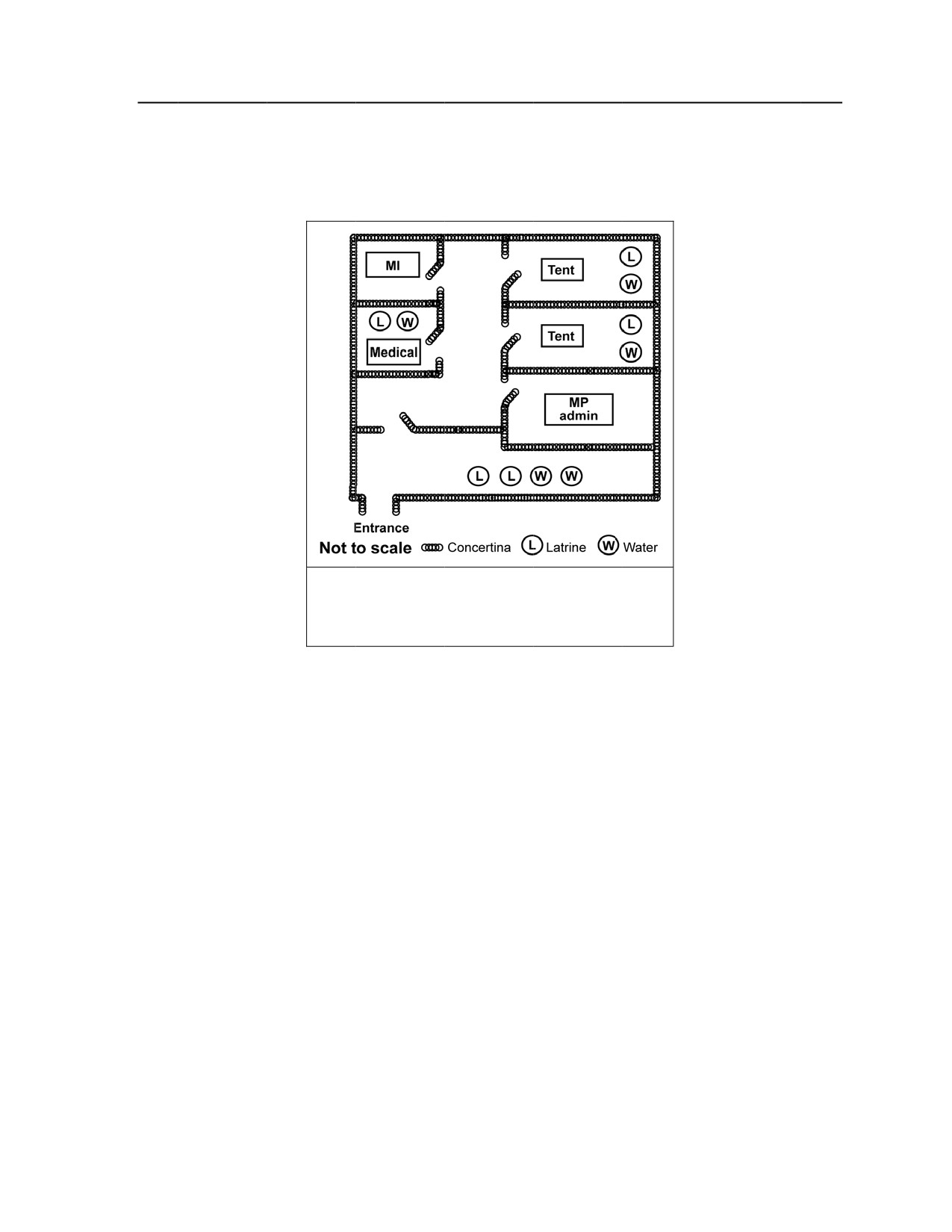
Detainee Facilities
resources and provide protection for detainees. Detainees
are treated humanely and
as EPWs until their
status is determined according
to DOD policy. Detainees are held at the
DCP until transportation becomes
available to take
them to a safer area (a DHA
or TIF). MI
exploitation may begin at the DCP and continue
at
the DHA and TIF until the detainee is
released or the intelligence value of the
detainee has
been
exhausted.
Legend:
admin
administration
MI
military intelligence
MP
military police
Figure 6-2. Example of a
DCP layout
6-11. Organic or task-organized military police platoons or companies within the BCT
may be directed to
set up and operate a DCP. DCPs are needed when the
BCT is likely
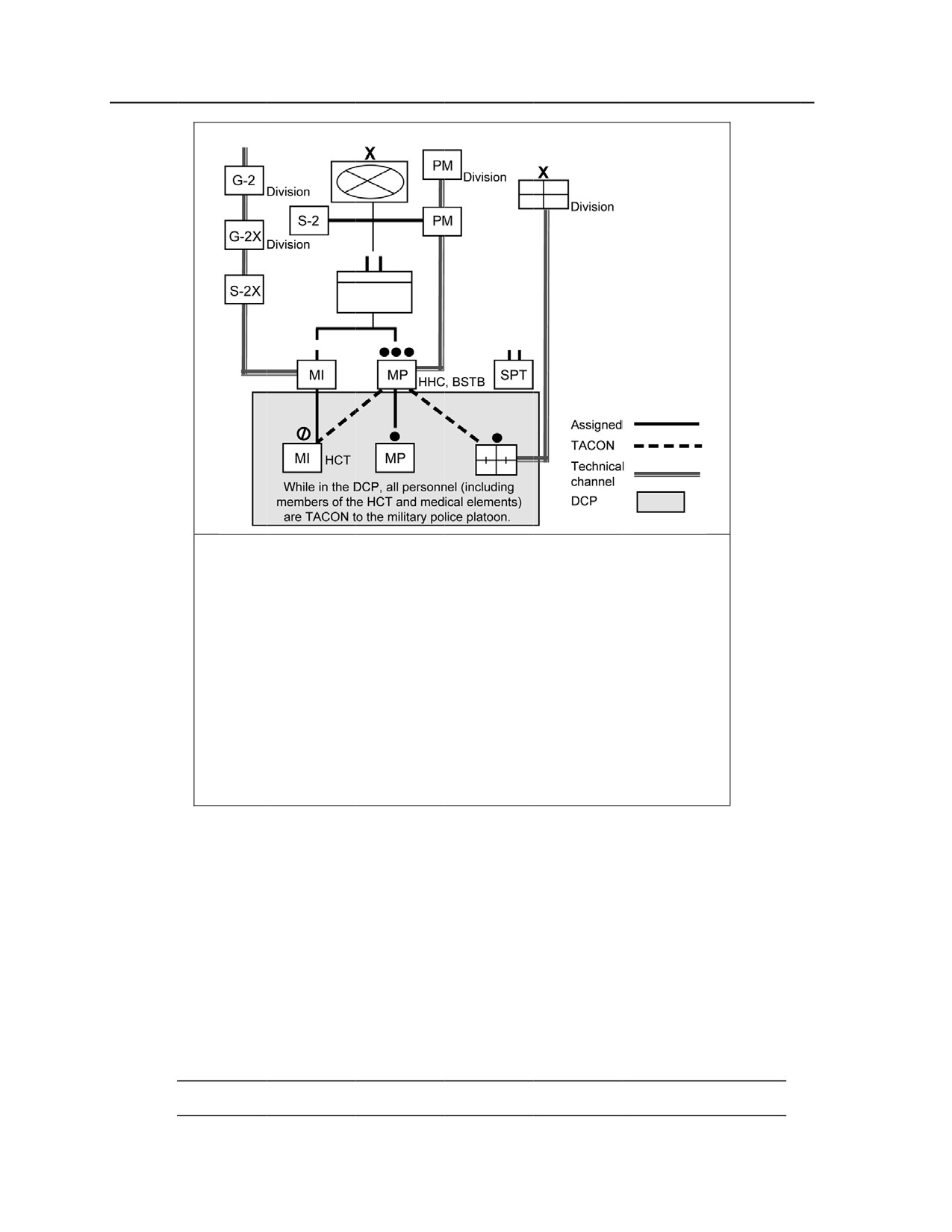
to take detainees. The BCT PM
develops and provides technical guidance over the military
police platoon or company
operating the
DCP.
(See figure 6-3,
page 6-6.) Medical, HUMINT, and counterintelligence assets operating
within the DCP are
typically under the tactical control of the military police platoon or company operating the DCP.
6-12. The number of military
police teams
or units needed to operate
a DCP is based on the number of
detainees expected and other
mission variables. The projected number
of detainees
is based on mission
analysis and intelligence estimates. DCPs are mobile and can be set up quickly, expanded, and relocated as
the tactical situation dictates.
Detainees will
be held at the
DCP until MI exploitation
has been exhausted
and transportation becomes available for the
release or transfer to the DHA or, in some cases, directly to
the TIF. The DCP is the second point at which a decision is made to retain or release a detainee.
12 February 2010
FM 3-39.40
6-5
Chapter 6
Legend:
BSTB
brigade
special troops
battalion
DCP
detainee collection point
G-2
intelligence officer or
section
G-2X
assistant chief of staff, HUMINT and
counterintelligence
HCT
HUMINT collection team
HHC
headquarters and headquarters company
MI
military
intelligence
MP
military
police
PM
provost marshal
S-2
intelligence officer or
section
S-2X
HUMINT and counterintelligence staff officer
SPT
support
TACON
tactical
control
Figure
6-3. C2 within the BCT and the DCP
LOCATION
6-13.
The general location of a DCP is normally
identified in the operation plan or order. The DCP should
typically be located
near or in the BCT support area. It is
normally located in an area that prevents
detainees from observing activities
within the BCT support area. A DCP located close to the main supply
route makes detainee
delivery and
evacuation easier. A DCP may also be established where actual combat
operations are occurring. For example, during a
cordon-and-search operation, the military
police platoon
may establish a DCP near the
cordon area.
During long-term stability
operations
(especially those
conducted in a counterinsurgency environment),
multiple DCPs may need to
be placed across the BCT AO
(to include within subordinate battalion AOs). A
DCP is seldom set up near
the indigenous population to
prevent problems caused by the presence of detainees in the area. When selecting a DCP,
consider shelter
availability and cover capabilities.
Note. Detainees can dig or build cover to protect themselves from direct and indirect fire.
6-6
FM 3-39.40
12 February 2010

Detainee Facilities
DETAINEE PROCESSING
6-14. When detainees arrive at the DCP, military police use the following procedures to process them and
their possessions:
z
Search. Searching includes those actions taken to neutralize a detainee and confiscate weapons,
personal items, and items of potential intelligence and/or evidentiary value.
Note. Conduct same-gender searches when possible. If mixed-gender searches are necessary for
speed and security, conduct them in a respectful manner and in the presence of an additional
witness to address claims of misconduct.
z
Tag. Tagging ensures that each detainee is properly accounted for using a DD Form 2745. If the
detainees were not tagged at the POC, tag each detainee using a DD Form 2745. Each
DD Form 2745 has a unique number. The DD Form 2745 number is the official detainee
tracking number before detainees receive an ISN. The DA Form 4137, used to document
confiscated items, will be linked to the detainee by annotating the DD Form 2745 number on the
form.
z
Report. Reporting the number of detainees helps to accurately determine transportation and
security requirements. Report the number of detainees to the local military police support assets
by their DD Form 2745 numbers. These support assets will assist with planning transportation,
escort security, and resource requirements. Also, report all allegations of mistreatment or
detainee abuse.
z
Evacuate. Evacuating detainees moves them from the continuing risks associated with other
combatants or sympathizers who may still be in the area of capture. If there are too many
detainees to control, call for additional support, search them, and hold them in place until
reinforcements arrive. Expedite the evacuation of detainees from the DCP to the DHA or from
the DHA to the TIF according to military policy. A convoy escort will be planned based on a
risk assessment of each detainee’s status, security, and resource requirements. Ensure that
detainees are accounted for by comparing their DD Form 2745 number against the manifest
before and after each convoy operation. Evacuate detainees and confiscated items together.
z
Segregate. Segregating detainees should be done according to policy and SOPs. Segregation
requirements differ from operation to operation. The ability to segregate detainees may be
limited by the availability of manpower and resources. MI personnel and military police can
provide additional guidance and support in determining appropriate segregation criteria.
Establish and maintain segregation based on mission variables. Within the DCP, detainees are
further segregated into the following categories:
Leaders (perceived status and positions of authority).
Hostile elements (hostile religious, political, ethnic groups).
Security risks (agitators, radicals, uncooperative detainees).
Civilian.
Military.
Military by grade (officers, NCOs, enlisted).
Deserters. Those who surrendered from those who resisted capture.
Minors.
Females (if possible, keep small children with their mothers).
Males.
Groups of CIs, RP, and enemy combatants if known.
Nationality.
Suspected criminals.
Other persons (those not in one of the above categories).
z
Safeguard. Safeguarding is the obligation to protect detainee safety and ensure the custody and
integrity of confiscated items. Soldiers must safeguard detainees from combat risk, harm caused
12 February 2010
FM 3-39.40
6-7

Chapter 6
by other detainees, and improper treatment or care. All detainees are presumed to be EPWs at
this stage after capture. The GPW requires that EPWs and other detainees be respected and
protected from harm. Report all injuries. Correct and report violations of U.S. military policy
that occur while safeguarding detainees. Acts and/or omissions that constitute inhumane
treatment are violations of the law of war and, as such, must be corrected immediately. Simply
reporting violations is insufficient. If a violation is ongoing, a Soldier has an obligation to stop
the violation and report it.
6-15. Military police at a DCP ensure that a DD Form 2745 is attached to detainees arriving without them.
Capturing units may need to be directed to complete DD Forms 2745 before detainees are accepted into the
DCP. Military police must ensure that each DD Form 2745 is complete and attached to the correct detainee.
Criminal prosecution of a detainee depends on collected evidence and statements. Military police must—
z
Complete DD Form 2745 with at least the minimum information listed (also listed on the back
of Part C of the form).
z
Make a statement on DA Form 2823 if the detainee arrived without an attached DD Form 2745.
z
Instruct the detainee not to remove or alter the attached DD Form 2745.
z
Annotate the DD Form 2745 number and the detainee’s name on a manifest.
z
Identify and ensure that supplemental forms are processed with DD Form 2745.
6-16. Military police must not speak to detainees except to give orders or directions. Do not let detainees
talk to or signal each other during the processing phase at any echelon. This prevents them from plotting
ways to counter security, planning escapes, or orchestrating other undesirable activities. Detainees who
refuse to be silent may require a muffle (an item used to prevent speech or outcry without causing injury to
the detainee, such as cloth) in certain tactical situations.
DANGER
Use a muffle only as long as needed, and ensure that the muffle
does not harm the individual.
6-17. Safeguard detainees from obvious targets such as ammunition sites, fuel facilities, or
communications equipment. To safeguard detainees according to the GWS, GPW, GC, and U.S. policies,
Soldiers must—
z
Provide first aid and medical treatment for wounded or sick detainees. Wounded and sick
detainees are evacuated separately through medical channels using the same assets as those used
to medically evacuate U.S. and multinational forces.
z
Provide detainees with food and water. These supplies must be equal to those given to U.S.
armed forces and multinational forces. (See FM 27-10.)
z
Ensure that firm, humane treatment is given.
z
Allow detainees to use their protective equipment in case of hostile fire or a CBRN threat.
z
Protect detainees from abuse by anyone, including other detainees and local civilians.
z
Report all acts or allegations of inhumane treatment through military police channels and
immediately stop or prevent them. (See AR 190-45.)
HUMAN INTELLIGENCE SUPPORT
6-18. At DCPs, HUMINT collectors should debrief military police who are in regular contact with
detainees. HUMINT collectors should coordinate this debriefing through the military police chain of
command. Information collected in this manner may provide valuable insight that can aid the collector in
formulating approach strategies. Military police should be debriefed in such a way that it does not interfere
with their mission; this debriefing does not constitute a tasking. In the absence of HUMINT or
counterintelligence assets, the intelligence staff officer, S-2/G-2, should perform this function. HUMINT
liaison with the military police chain of command is vital to gain its support and ensure that HUMINT
6-8
FM 3-39.40
12 February 2010

Detainee Facilities
collection will not interfere with military police operations. Joint patrols containing military police and
HUMINT collectors can also be mutually beneficial in many situations.
6-19. HUMINT collectors use the biometrics automated toolset to collect biometric data for intelligence
purposes during screening operations at all echelons when available. While the biometrics automated
toolset is not a Detainee Reporting System accountability tool, it is used to collect much of the same data as
the Detainee Reporting System.
6-20. While in the DCP, MI units are under tactical control of the military police platoon leader (or
company commander). The platoon leader is the officer in charge for detainee operations and is responsible
for the humane treatment, evacuation, and custody and control (reception, processing, administration,
internment, and safety) of detainees; security; and the operation of the internment facility. The MI unit
commander is responsible for conducting interrogation operations (including prioritizing the effort) and
controlling the technical aspects of interrogation and other intelligence operations. The intelligence staff
maintains control over interrogation operations through technical channels to ensure adherence to
applicable laws and policies, ensure the proper use of doctrinal approaches and techniques, and provide
technical guidance for interrogation activities. They receive technical guidance and priorities from the
operational management team or G-2X. The military police platoon leader will not establish intelligence
priorities for HUMINT or counterintelligence personnel. HUMINT and counterintelligence personnel
should only remain involved with activities that concern intelligence gathering, unless their involvement is
necessary to ensure the humane treatment or security of detainees.
MEDICAL SUPPORT
6-21. Medical care at the DCP is provided according to necessity and limited to emergency medical care
only. Medical personnel assigned to the military police unit normally treat detainees at the DCP. Detainees
requiring more than first aid, combat lifesaver, or Level I medical care are transported to a location where
they can receive the appropriate level of care. The BCT PM and/or military police platoon leader must
coordinate with medical personnel within the BCT to ensure that proper and timely medical care for
detainees is available. Moreover, military police exercise tactical control of medical personnel while
operating within the DCP. (See appendix I.)
6-22. Medical personnel will promptly report suspected detainee abuse to the proper authorities as outlined
in the medical policies developed for detainee operations. Generally, information pertaining to medical
conditions and the care provided to patients, including medical care for detainees, is handled with respect to
patient privacy. Under U.S. and international laws, there is no absolute confidentiality of medical
information for any person, including detainees.
SECURITY CONSIDERATIONS
6-23. The DCP is normally located within the brigade footprint. Therefore, military police should
thoroughly brief the units in the brigade on the location of the DCP and recommended actions to take in the
event of a detainee escape. Additional security measures to implement at the DCP include—
z
The presence of an enhanced guard force when detainees are inprocessed, outprocessed,
medically examined, and in the custody of HUMINT collectors.
z
The use of MWDs as a show of force and to deter escape attempts.
WARNING
MWDs will not be used to intimidate detainees or take part in
interrogation operations.
12 February 2010
FM 3-39.40
6-9
Chapter 6
DETAINEE HOLDING AREA
6-24.
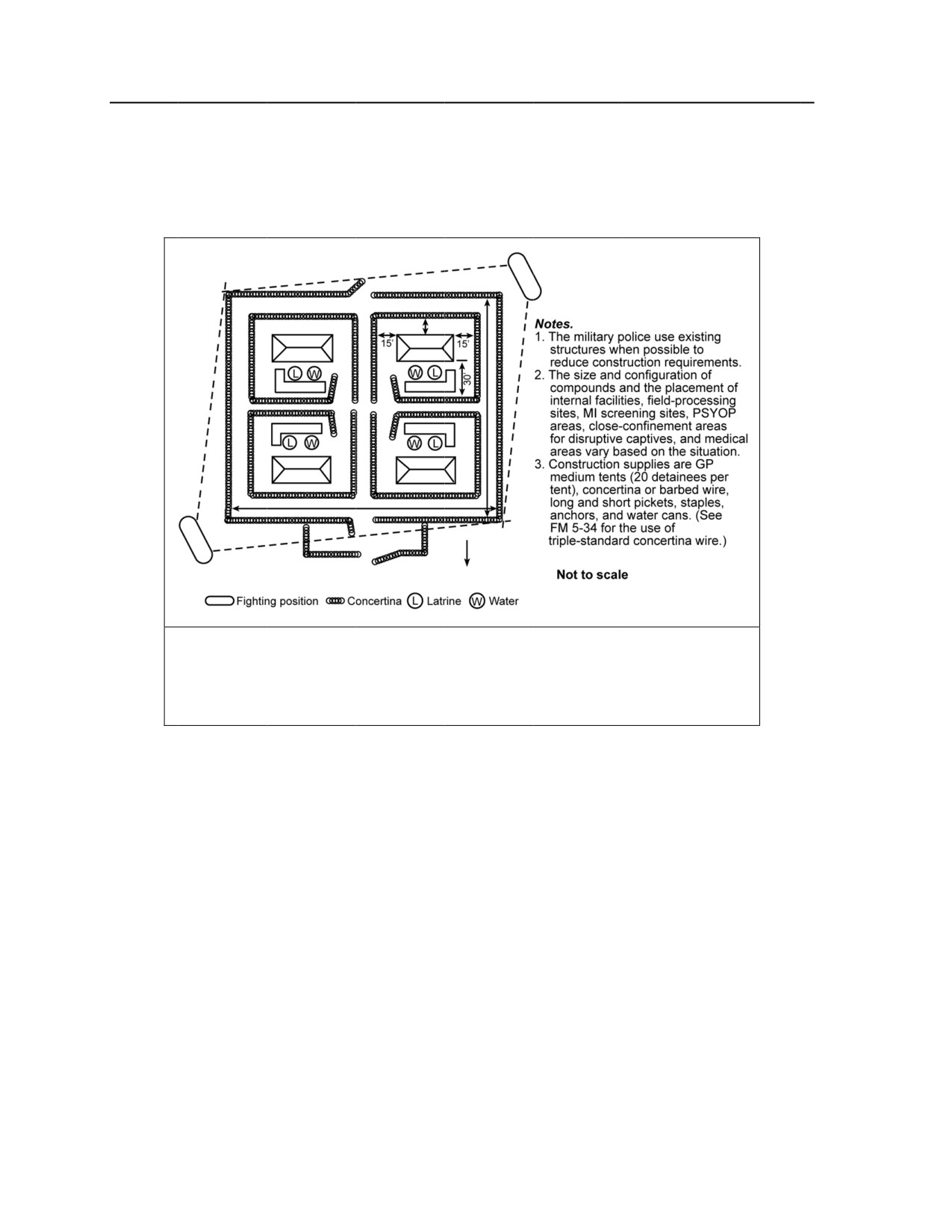
A DHA is a temporary location used to field-process and house detainees and provide resources for
intelligence exploitation. It generally consists of
a semipermanent structure that is designed and resourced
to house detainees.
(See figure 6-4.) Basic infrastructure elements include
shelter and/or
cover, latrines,
basic hygiene facilities, and medical care.
Legend:
FM
field manual
GP
general purpose
MI
military intelligence
PSYOP
pyschological
operations
Figure 6-4. Example of a
DHA
6-25.
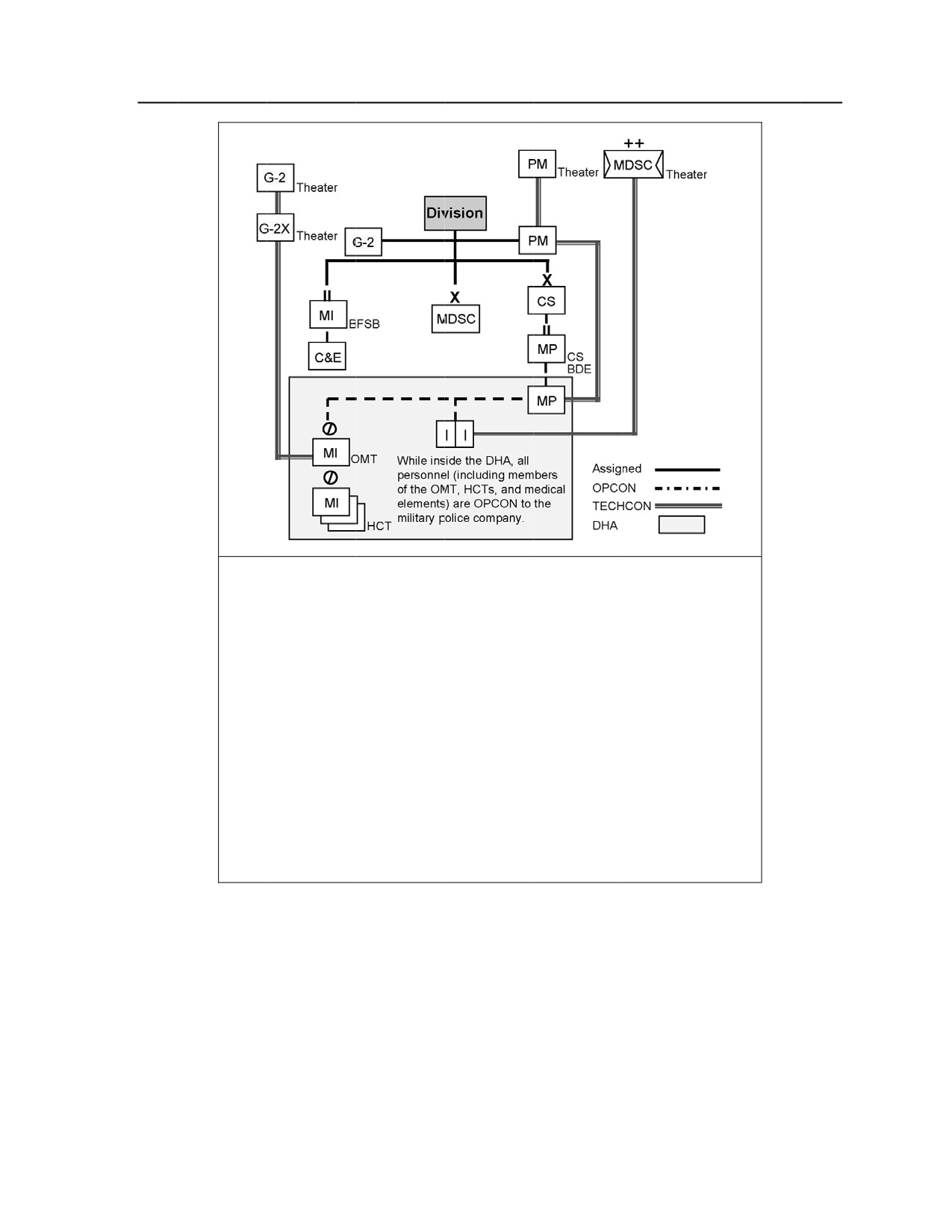
Military police
assigned to the military police brigade, or possibly the
MEB, operate
the DHA. (See
figure
6-5.) The primary units operating a DHA may include a
variety of military police units under the C2
of an I/R or military
police battalion. (See appendix B.)
6-26.
Military police, MI, medical, and legal
assets (typically colocated)
at the DHA
should provide
tactical interrogation
and HUMINT/counterintelligence screening.
6-27.
Detainees are
treated as EPWs until their
status is determined according to DOD policy. HUMINT
collectors are normally available at the DHA to
support this determination.
Detainees will be held at the
DHA
until transportation becomes available to
take them to
a safer area
(another DHA or TIF). MI
exploitation may begin at the DCP. MI exploitation continues
at the DHA
until the detainee is released,
moved
to a TIF, or
is no longer of intelligence value. The DHA is the third
point within the hierarchy of
sites at which a decision is made to
detain or release a detainee.
6-10
FM 3-39.40
12 February 2010
Detainee Facilities
Legend:
BDE
brigade
BFSB
battlefield surveillance brigade
C&E
collection and exploitation
CS
civil support
DHA
detainee housing area
G-2
intelligence officer or section
G-2X
assistant chief of staff, HUMINT and
counterintelligence
HCT
HUMINT collection
team
MI
military intelligence
MDSC
medical deployment support command
MP
military police
OMT
operational management team
OPCON
operational control
PM
provost marshal
TECHCON
technical control
Figure 6-5. C2 within the division and DHA
LOCATION
6-28. The DHA
is established
with the division’s AO. The
best location
may be within
the MEB AO
if one
is
present in the
division AO.
The DHA is normally located in a safe, and secure area
that is accessible for
the receipt, care, and evacuation of detainees. During
long-term stability operations, especially
those
conducted in a counterinsurgency environment, multiple DHAs placed across the division AO (to include
within subordinate BCT AOs) may be
required. DHAs should be established
adjacent to
main
transportation arteries that expedite further movement of personnel and sustainment requirements.
12 February 2010
FM 3-39.40
6-11

Chapter 6
ADDITIONAL PLANNING CONSIDERATIONS
6-29. When establishing a DHA or expanding a DCP to provide extended detainee processing and
housing, commanders must consider design options, including—
z
Building an outer perimeter using an earthen berm, fence, or rolled concertina or razor wire to
contain the operation.
z
Providing the following secure areas:
An entry point (with double barriers) into the DCP and/or DHA.
A reception area for custody transfer operations.
An administrative area.
A medical support area.
An interrogation area and/or facility.
A centralized property room (for evidence, found property, and confiscated property).
Open compounds for housing multiple detainees by segregation designation.
Single-cell units for disciplinary segregation.
z
Establishing small compounds for segregation. The compound design should include the
following, depending on the availability of resources:
Towers or other fixed locations that provide for mutual support.
Shelters within each compound if detainees are being housed there. (Hard facilities are
preferred, but tents are the minimum requirement.)
Communications between towers and adjacent compounds.
Lights that are capable of illuminating and flooding compounds.
Compounds that are free of rocks and other debris.
Latrines and personal hygiene points that are separate from detainee living areas, but with
easy access from the compounds.
z
Developing individual cells or confinement spaces to provide additional segregation for violent
or uncooperative detainees, high-value detainees, or detainees who are vulnerable to harm by
other detainees as the situation allows.
6-30. The commander must—
z
Stock appropriate cleaning supplies to sanitize areas and/or facilities.
z
Provide adequate clothing and footwear.
z
Provide three adequate meals and sufficient hydration daily to maintain good health.
z
Provide appropriate medical care and preventive medicine as available.
z
Post information on the applicable protections afforded under the Geneva Conventions and
detainee rules in the local language. (This information should be posted in a conspicuous
location.)
6-31. A sufficient guard force should be established based on the location and facility structural design,
number of detainees, segregation requirements, and detainee threat and risk levels. Accordingly, a guard
force should consist of, at a minimum, a sergeant of the guard, tower and static guards, roving guards,
escort guards, and a reaction force.
6-32. When conducting HUMINT collection in the DHA, military police should—
z
Locate the site where screeners can observe detainees as they are segregated and processed. It
should be shielded from the direct view of the detainee population and far enough away so that
detainees cannot overhear screeners’ conversations.
z
Select a site that will accommodate operation, administrative, and interrogation areas. Lights
should be made available for night operations.
z
Ensure that guards are available and that procedures for escorting and securing detainees during
the interrogation process are outlined in the SOP.
6-12
FM 3-39.40
12 February 2010

Detainee Facilities
z
Notify screeners about any detainees that will be moved and when they will be moved.
z
Ensure that accountability procedures are implemented and that the required forms are available.
6-33. Military police operating the DHA have tactical control over HUMINT collectors, medical
personnel, and other personnel who operate inside the DHA and are responsible for the humane treatment,
evacuation, custody, and control
(reception, processing, administration, internment, and safety) of
detainees; security; and the operation of the internment facility. For HUMINT support at the DHA, the MI
unit commander is responsible for conducting interrogation operations (including prioritizing the effort)
and controlling the technical aspects of interrogation and other intelligence operations. The intelligence
staff maintains control through technical channels over interrogation operations to ensure adherence to
applicable laws and policies, ensure the proper use of doctrinal approaches and techniques, and provide
technical guidance for interrogation activities. Applicable laws and policies include U.S. laws, the law of
war, relevant international laws, relevant directives (including DODD 2310.01E and DODD 3115.09),
DODIs, execution orders, and FRAGOs. The military police company or battalion commander will not
establish intelligence priorities for HUMINT and/or counterintelligence personnel, nor should the military
police commander compel HUMINT and/or counterintelligence personnel to involve themselves in
nonintelligence activities. The detainee operations medical director is designated by the medical
deployment support command commander to provide technical guidance for the medical aspects of
detainee operations conducted throughout the joint operations area.
HUMAN INTELLIGENCE SUPPORT
6-34. To facilitate collecting enemy tactical information, MI personnel may colocate HUMINT and
counterintelligence teams at the DHA to screen arriving detainees and determine which of them are of
immediate tactical intelligence value to the maneuver commander. This provides MI personnel with direct
access to detainees and their equipment and documents. Military police and MI personnel coordinate to
establish operating procedures that include the accountability of detainees. An interrogation area is
established away from the receiving and processing line so that MI personnel can interrogate detainees and
examine their equipment and documents. If a detainee or the detainee’s equipment and/or documents are
removed from the receiving and processing line, they are accounted for on DA Form 4137 and DD Form
2708.
6-35. HUMINT collectors screen detainees at the DHA by observing them from an area close to the
dismount point or processing area, looking for anyone who is a potential source of tactical and operational
information. As each detainee passes, MI personnel examine the DD Form 2745 and look for branch
insignias or other clues which indicate that a detainee has information to support command priority
intelligence and information requirements. They also look for detainees who are willing or attempting to
talk to guards; intentionally joining the wrong group; or displaying signs of nervousness, anxiety, or fear.
6-36. Military police assist the HUMINT collectors by identifying detainees who may have answers that
support priority intelligence and information requirements. Because military police are in constant contact
with detainees, they see how certain detainees respond to orders and see the types of requests that are made.
The military police ensure that searches requested by MI personnel are conducted out of the sight of other
detainees and that guards conduct same-gender searches when possible.
6-37. MI screeners examine captured documents, equipment, and, in some cases, personal papers (journals,
diaries, letters). They look for information that identifies a detainee and the detainee’s organization,
mission, and personal background
(family, knowledge, experience). The knowledge of a detainee’s
physical and emotional status or other information helps screeners determine the detainee’s willingness to
cooperate.
6-38. HUMINT collectors at the DHA provide input to assist in the decision to release or detain an
individual. If the decision is made to detain the individual, arrangements are then made to transport the
detainee to a TIF for formal processing into the Detainee Reporting System, including the issuance of an
ISN.
12 February 2010
FM 3-39.40
6-13

Chapter 6
MEDICAL SUPPORT
6-39. Medical personnel organic to maneuver units or the brigade support medical company may be
required to provide emergency medical treatment or evacuation on an area support basis at a DHA. (See
appendix I.)
6-40. The medical screening that can be accomplished at a DHA is limited. The purpose of this medical
screening is to ensure that the detainees do not have significant wounds, injuries, or other medical
conditions
(such as severe dehydration) that require immediate medical attention and/or evacuation.
Medical personnel screen for conditions that could deteriorate before transfer to a TIF. This screening does
not include the use of diagnostic equipment, such as X rays or laboratory tests, because these resources are
not available at a DCP or DHA. Any injuries or medical treatment provided during screening is entered on
the DD Form 1380. The detainee’s DD Form 2745 number is used as the identification number on the
DD Form 1380. If the detainee is not to be evacuated through medical channels, provide one copy of the
DD Form 1380 to the detaining unit for inclusion in the detainee’s medical record, which will be initiated
and maintained at the TIF. When an ISN is assigned at the TIF, it will be used for detainee identification in
the detainee’s medical records folder.
6-41. Detainees whose medical conditions require hospitalization are treated, stabilized, and evacuated to a
supporting medical treatment facility. The DD Form 1380 is sent with detainees for inclusion in their
medical records, which are established at the Level III hospital.
6-42. The initial care provided to detainees at Levels I and II will be documented on DD Form 1380. Once
detainees are evacuated to a higher level of care, the appropriate medical record folder containing the
required demographic information will be initiated. All medical documentation and medications from
screening examinations or treatment at prior locations, such as the DCP, should be available for review and
inclusion in the medical record.
6-43. The DHA is a temporary holding area; however, temporary can be a relative term. If the DHA
remains in the same location for an extended period, improvement to the field sanitation areas (such as
latrines and showers) should be undertaken, rather than relying solely on field-expedient facilities as done
at the DCP. Medical personnel and/or units could also be attached to provide an expanded sick call
capability.
6-44. Inprocessing medical screenings are only conducted at the TIF. However, DHA medical personnel
can document preexisting injuries with medical photography, if appropriate, and forward this
documentation with the detainees for later inclusion in their medical records initiated at the TIF. At the
DHA, medical encounters may be documented on SF 600. If used, forward it with detainees upon transfer
to the TIF for inclusion in their medical records.
SECURITY CONSIDERATIONS
6-45. The DHA, like the DCP, is a temporary holding area for detainees. Nevertheless, the security
considerations remain the same at any echelon where detainees are held. The temporary nature of the DHA
does not negate the responsibility of military police and other forces to plan for and establish security.
Attempted escapes and proper protective measures for the forces and detainees inside the DHA must
always be prime planning considerations.
FIXED DETAINEE INTERNMENT FACILITIES
6-46. Fixed detainee internment facilities include TIF and SIF facilities, each of which encompass many
regulatory and doctrinal solutions. Detainees are selectively assigned to appropriate advanced internment
facilities that best meet the needs of the detaining power and the detainee. Detainees (such as enemy
combatants) that hold violent opposing ideologies are interned in separate facilities in an effort to isolate
them from the general population and preempt any unforeseen problems. Once they have been assigned to a
facility, they may be further segregated because of nationality, language, or other reasons.
6-14
FM 3-39.40
12 February 2010

Detainee Facilities
DETAINEE REPORTING SYSTEM
6-47. The Detainee Reporting System is the mandated detainee accountability database for all DOD
agencies. Key functions of the Detainee Reporting System at the TIF/SIF include—
z
Assigning ISNs.
z
Documenting detainee transfers, releases, and repatriations.
z
Recording detainee deaths.
z
Recording detainee escapes.
6-48. The timely and accurate reporting of data through the Detainee Reporting System is critical to
ensuring detainee accountability. As detainees are collected and processed, the Geneva Conventions require
that such information be forwarded to the appropriate authorities. Failure to do so may bring unwanted
scrutiny on the U.S. government for neglecting its duties under international laws.
6-49. The NDRC is designated by the OPMG to receive and archive all detainee information. The NDRC
provides detainee information to the protecting power or ICRC (to fulfill U.S. obligations under the Geneva
Conventions); various agencies in the DA, DOD, and Federal Bureau of Investigation (FBI); and the U.S.
Congress. The NDRC’s principal responsibility is to ensure the collection, storage, and appropriate
dissemination of detainee information as required by AR 190-8 and DODD 2310.01E. The NDRC directs
the development of a Detainee Reporting System and issues blocks of ISNs to the TDRC.
6-50. The TDRC functions as the field operations agency for the NDRC, and it reports all detainee data
directly to the NDRC. The TDRC is responsible for maintaining information on all detainees and their
personal property within an assigned theater of operations. It obtains and stores information concerning all
detainees in the custody of U.S. armed forces (including those captured by U.S. armed forces and
transferred to other powers for internment or those received from other powers for internment [temporarily
or permanently]). The TDRC serves as the theater repository for information pertaining to detainee
accountability and ensures the implementation of DOD policy. It provides initial blocks of ISNs and
replenishes blocks of ISNs (as needed) to units performing detainee operations in the theater. The TDRC
requests additional blocks of ISNs from the NDRC. The TIF requests ISNs from the TDRC and forwards
all information concerning the detainees to the TDRC.
6-51. All locations to which the TDRC issues ISNs should send information concerning the detainee back
to the TDRC. A detainee’s ISN is used detainee’s internment as the primary means of identification. It is
used to link the detainee with biometric data (such as fingerprints, iris image, and DNA), personal property,
medical information, and issued equipment.
INTERNMENT SERIAL NUMBERS
6-52. The ISN is the DOD-mandated identification number used to account for and/or track detainees. (See
figure 6-6, page 6-16.) Once an ISN is assigned, it is used on all documentation, including medical records.
The ISN is generated by the Detainee Reporting System. The Detainee Reporting System is the only
approved system for maintaining detainee accountability. It is the central data point system used for
reporting to the national level and sharing detainee information with other authorized agencies. ISNs are
normally issued within 14 days of capture, regardless of where detainees are held, or according to
applicable policy. The ISN is comprised of the—
z
Capturing power (a two-digit alpha character code representing the capturing power). Only
country codes found in the Defense Intelligence Agency manual (DIAM) 58-12 are used.
z
Theater code (a one-digit number representing the command/theater under which the detainee
came into U.S. custody).
z
Power served (a two-digit alpha character code representing the detainee’s power served [the
country the detainee is fighting for]). Only country codes found DIAM 58-12 are used.
z
Sequence number (a unique six-digit number assigned exclusively to an individual detainee).
The Detainee Reporting System assigns these numbers sequentially. If a detainee dies, is
released, is repatriated, is transferred, or escapes, the detainee’s number is not reissued during
the same conflict.
12 February 2010
FM 3-39.40
6-15
Chapter 6
z
Detainee classification (a two- or three-digit alpha character code representing the detainee’s
classification). Current classifications are CI, RP, and enemy combatants. Enemy combatants are
further divided into EPWs and members of armed groups.
Sequence number
Capturing power
US9AF-000234RP
Detainee
Theater code
Power served
classification
Figure 6-6. ISN
6-53. The detainee information is reported through the TDRC to the NDRC. The TDRC is normally
colocated with the CDO. Once the Detainee Reporting System creates an ISN, no component may be
changed or corrected at the theater level without approval from the NDRC. All changes to ISNs must be
requested in writing and approved by the NDRC. U.S. armed forces must accurately account for detainees
and issue ISNs when required.
6-54. When required by laws and/or policies, the NDRC provides detainee information (POC, country of
origin, injury status, internment status) to the ICRC to satisfy the obligations of the Geneva Conventions.
The ICRC uses this detainee information to give the detainee’s status to the detainee’s government.
Commanders should try to standardize the tracking of detainees from the POC through the issuance of an
ISN. The number found on DD Form 2745 is the only authorized tracking number that may be used before
the assignment of an ISN. After an ISN is assigned, previously completed documents should be annotated
with the assigned ISN. For example, medical channels should use the DD Form 2745 number at first and
then use the ISN once an ISN is issued to the detainee. The Detainee Reporting System cross-references the
ISN and the DD Form 2745 number for administrative purposes.
6-55. If a detainee is inadvertently issued a second ISN ( clerical error, recapture) the processing personnel
will contact the NDRC, which will correct the sequence. No gaps are permitted in the official records and
numbering of detainees.
DETAINEE IDENTIFICATION BAND
6-56. The requirements for identifying a detainee by name and ISN are many and varied. Among the more
common reasons are—
z
Periodically verifying detainee rosters against the actual compound population.
z
Identifying compound work details.
z
Matching detainees with their individual medical records.
z
Checking the identities of detainees to be transferred or released against actual transfer rosters.
z
Tracking detainees through medical channels.
6-16
FM 3-39.40
12 February 2010

Detainee Facilities
6-57. The detainee identification band permits the rapid and reliable identification of each detainee.
Identification bands enhance facility administration and operation. The Detainee Reporting System can
create identification bands that show the ISN number, name, and photo of the detainee. If the Detainee
Reporting System is not available, record the detainee’s ISN and last name on the identification band and
secure it to the detainee’s left wrist. If appropriate bands are not available, use a medical wristband or
something similar.
6-58. When the identification band has serious deterioration or the ISN and name are obscured, replace it
with a new one. Periodic random checks of detainee identification bands will detect fair wear and tear and
any efforts to destroy the bands. When inspecting for fair wear and tear, also look for any evidence of
detainees exchanging bands. Such exchanges are entirely possible and should be expected; however, the
removal of an identification band by the original wearer will result in damage which is easily detected.
When positive identification is essential, such as for transfer or hospitalization, examine the identification
band carefully for the evidence of removal from another detainee. Additionally, conduct periodic routine
inspections of randomly selected identification bands in the mess line, during compound inspections, or at
other opportune times to help detect any attempt to tamper with or exchange an identification band.
THEATER INTERNMENT FACILITY
6-59. The TIF is a permanent or semipermanent facility (normally located at the theater level) that is
capable of holding detainees for extended periods of time. A TIF is a long-term internment facility that is
operated according to all applicable laws and policies. The JIDC is normally within the TIF. It is possible
that detainees and/or enemy combatants may bypass a DCP or DHA and be transferred directly to the TIF.
In such cases, all processing that would have taken place earlier must be accomplished immediately on
arrival at the TIF. Military police units task organized to the I/R battalion will be based on the specific
requirements of the TIF. (See appendix B.)
6-60. The TIF is the first location where detainees may be held for extended periods of time. The
infrastructure and design standards associated with the TIF reflect long-term detention and facilitate and
ensure humane treatment throughout a detainee’s stay in the facility. (See appendix J for more information
on internment facility design.)
6-61. Key organization elements in the TIF may include a joint security group, JIDC, detainee hospital,
joint logistics group, joint internment operations group, CA unit, and psychological unit. Special staff
considerations may include a joint visitor’s bureau, chaplain, inspector general, SJA, public affairs,
surgeon, forensic psychologist, forensic psychiatrist, medical plans and operations officer, environmental
health officer, and PM and/or security forces.
6-62. Dedicated teams may be organized and employed to identify and mitigate threats within the facility.
These teams, configured with specific capabilities based on requirements determined from current mission
variables, will likely include bilingual bicultural advisors, intelligence officers, counterintelligence agents,
and others as needed. The teams may be required for each major compound within the TIF or SIF.
6-63. The military police operating the TIF have tactical control over HUMINT collectors, medical
personnel, and other personnel who conduct operations at the TIF for the humane treatment, evacuation,
custody, and control (reception, processing, administration, internment, and safety) of detainees; security;
and the operation of the internment facility. For HUMINT support at the TIF, the JIDC commander is
responsible for conducting interrogation operations (including prioritization of effort) and controlling the
technical aspects of interrogation or other intelligence operations. The intelligence staff maintains control
over interrogation operations through technical channels to ensure adherence to applicable laws and policy,
ensure the proper use of doctrinal approaches and techniques, and provide technical guidance for
interrogation activities. Applicable laws and policies include U.S. laws, the law of war, relevant
international laws, relevant directives (including DODD 3115.09 and DODD 2310.01E), DODIs, execution
orders, and FRAGOs. The military police commander will not establish intelligence priorities for the
HUMINT and/or counterintelligence personnel. HUMINT and/or counterintelligence personnel should only
remain involved with activities that concern intelligence gathering. The detainee operations medical
director is designated by the medical deployment support command commander to provide technical
12 February 2010
FM 3-39.40
6-17
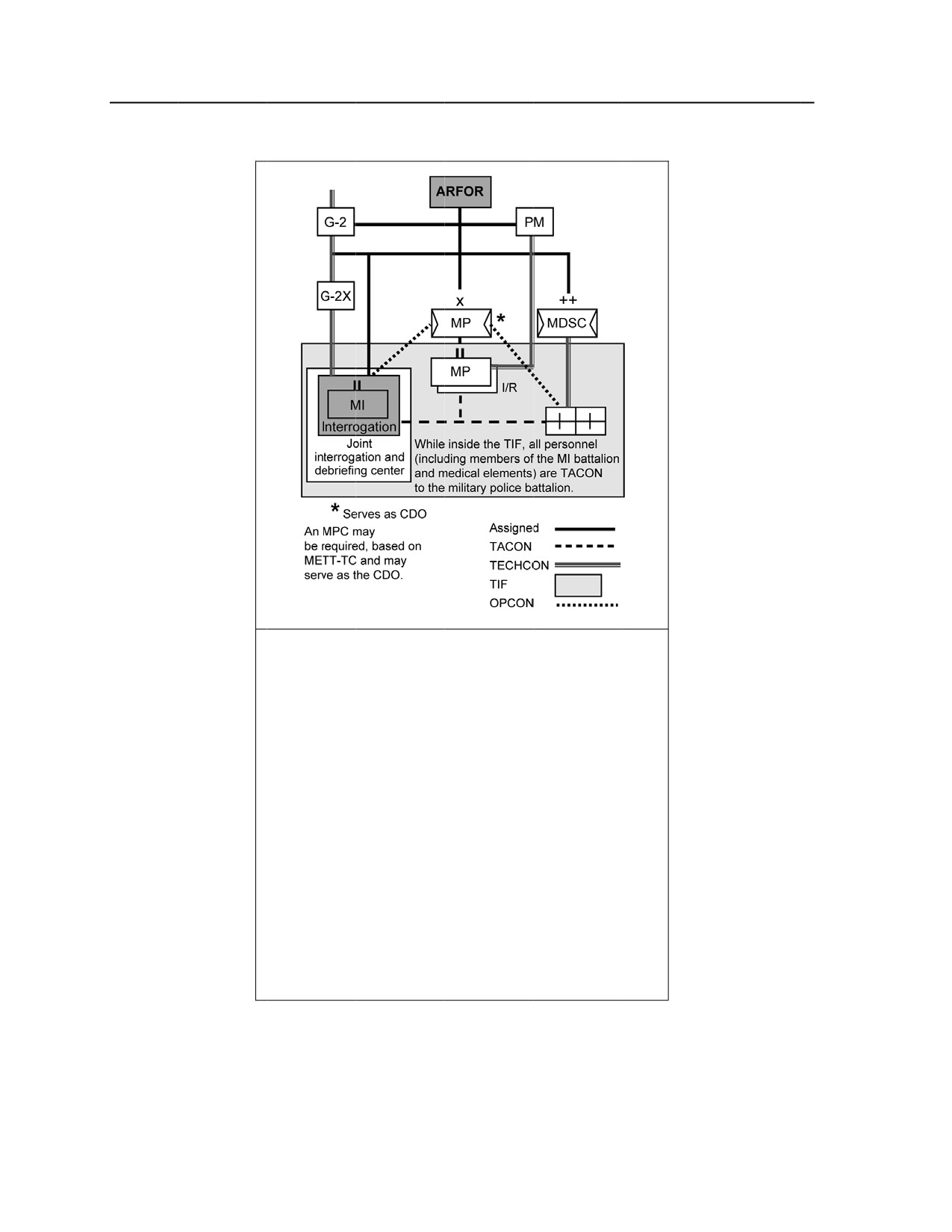
Chapter 6
guidance for the medical aspects
of detainee operations conducted throughout the joint
operations area.
(See figures 6-7 and 6-8.)
Legend:
ARFOR
Army forces
CDO
commander,
detainee operations
CSG-2
intelligence officer or section
G-2X
assistant chief of staff, HUMINT
and counterintelligence
I/R
internment and resettlement
MDSC
medical deployment support
command
METT-TC
mission, enemy, terrain and
weather, troops and support
available, time available, and
civil considerations
MI
military intelligence
MP
military police
OPCON
operational control
PM
provost marshal
TACON
tactical control
TECHCON
technical control
TIF
theater internment facility
Figure 6-7.
Sample TIF C2 in the theater with single
or multiple small TIFs
6-18
FM 3-39.40
12 February 2010
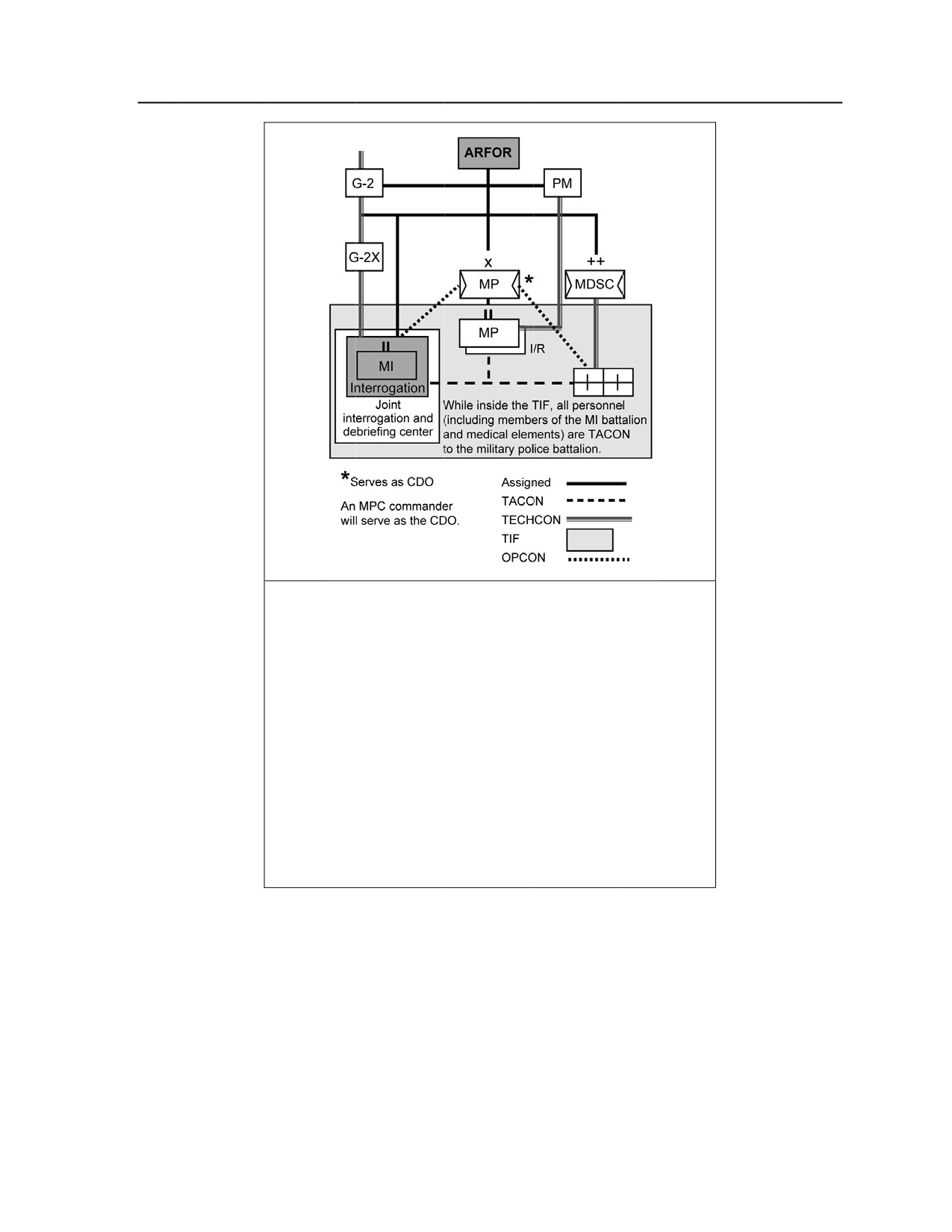
Detainee Facilities
Legend:
ARFOR
Army forces
CDO
commander, detainee operations
G-2
intelligence
officer or section
G-2X
assistant chief of staff, HUMINT and
counterintelligence
I/R
internment and resettlement
MDSC
medical deployment support command
MI
military intelligence
MP
military police
MPC
military police command
OPCON
operational
control
PM
provost marshal
TACON
tactical control
TECHCON
technical control
TIF
theater internment facility
Figure 6-8.
. Sample TIF
C2 in the theater with an
MPC and
multiple TIF
6-64. Choosing
locations for
TIFs is critical during the planning phase.
. The location
of each facility will
affect its ability
to receive supplies. Receiving supplies
through all supply classes
is a top command
priority. Failure
to consider
resupply procedures could
result in an extended period of time in
which
detainees are without the rights and privileges required under U.S. policies and international laws.
PLANNING CONSIDERATIONS
6-65. Planning
for operations
at the TIF is
a much greater challenge than at lower echelons. Planning the
amount of support, ranging from medical to
engineer, is time-consuming
and critical to
ensuring successful
detainee operations. Proper planning before operations commence is vital. The planning should
focus
12 February 2010
FM 3-39.40
6-19

Chapter 6
across the DOTMLPF domain to ensure that all requirements are met. Synchronization with adjacent staff
elements and commands is another important element.
6-66. At a minimum, training for operations at a TIF should include the following:
z
Introduction to detainee operations.
z
Detainee Reporting System training.
z
Communications with detainees (cultural awareness).
z
Introduction to the Geneva Conventions and U.S. policies on the humane treatment of detainees
and DCs.
z
Familiarization with stress management procedures.
z
Introduction to HIV and universal precautions to take with HIV positive detainees.
z
Advanced use-of-force criteria for I/R and interrogation operations.
z
Introduction to frisk, cell, and area search procedures.
z
Application of restraints.
z
Personal safety awareness.
z
Defensive tactics (unarmed self-defense).
z
NLWs.
z
Forced cell move procedures.
z
Response procedures for a bomb and/or bomb threat.
z
Current training support packages.
z
Emergency response to fires, escapes, and disorders.
z
Cell block operations.
z
Meal procedures.
z
Introduction to accountability procedures.
z
Security and control activities.
z
Familiarization with the special compound operations.
z
Introduction to main gate/sally port operations.
z
Written reports required to operate a TIF.
z
Visitation operations.
RECEIVING AND PROCESSING DETAINEES
6-67. Interpreters may be requested from MI personnel, PSYOP personnel, multinational forces, or local
authorities. This may also require identifying and clearing trusted detainees or local nationals to act as
interpreters. Interpreters are absolutely necessary when entering required data into the Detainee Reporting
System.
Receiving Detainees
6-68. When detainees are delivered to the TIF, they are segregated from those who arrived earlier and
those who are partially processed. Military police ensure that—
z
Detainees are counted and matched against the manifest. Military police must also ensure that
they have documentation for the detainees, their personal property, and anything of evidentiary
value.
z
Detainees are field-processed if the capturing unit or the DCP did not previously process them.
Military police should not release the escorting unit until proper documentation is completed.
z
Detainees have a completed DD Form 2745 when they arrive, which will be used at the
internment facility until they are issued ISNs.
z
ISNs and the last names of the detainees are recorded on identification bands created by the
Detainee Reporting System.
6-20
FM 3-39.40
12 February 2010

Detainee Facilities
z
Identification bands are attached to the left wrist of each detainee using the personnel
identification banding kit (National Stock Number 8465-01-015-3245).
z
Detainees’ personal property and items of evidentiary value are stored in a temporary storage
area until they are fully processed.
z
Detainees are given DA Forms 4137 for any property temporarily or permanently stored in the
internment facility storage area.
z
Access to the temporary storage area is controlled.
z
Detainees are provided food and water.
z
Detainees are provided access to sanitation facilities.
z
Detainees are provided first aid or medical treatment as required.
z
Detainees are held in the receiving area until they can be processed.
6-69. Body cavity searches may be conducted for valid medical reasons or when there is reasonable belief
that a security risk is present. Body cavity searches are not to be routine, are only conducted by authorized
persons (trained medical personnel) according to DOD policy, and are subject to the following conditions:
z
Performance of routine detainee body cavity exams or searches is strictly prohibited except
for—
Valid medical reasons with the verbal consent of the individual.
When there is a reasonable belief that the detainee is concealing an item that presents a
security risk.
z
Examinations or searches are conducted by personnel of the same gender as the detainee if
possible.
z
Examinations and searches will be conducted in a manner that respects the individual.
Note. Body cavity searches other than those performed for valid medical reasons require the
approval of the first general/flag officer in the chain of command.
6-70. Table 6-1, page 6-22, shows the nine stations that each detainee must go through to complete the
processing, the responsible individuals at each station, and actions that must be accomplished. Based on
mission variables and the commander’s decision, the stations may need to be tailored to meet the situation.
The procedures for receiving detainees are performed at stations 1 through 4, and the procedures for
processing detainees are performed at stations 5 through 9.
6-71. When detainees arrive at the TIF, they will go through an initial screening within the sally port or
holding area before a more comprehensive screening by MI personnel. This process provides HUMINT
collectors with detainee information to be used when conducting interrogation operations. Subsequently,
the detainees proceed through a templated processing and screening area that includes areas found in table
6-1, page 6-22.
12 February 2010
FM 3-39.40
6-21

Chapter 6
Table 6-1. Nine-station internment process
Responsible
Station
Purpose
Actions
Individual(s)1
•
Assign each detainee an ISN to replace the DD Form 2745 number.
•
Ensure that accountability procedures are followed.
•
Sign DD Form 2708, and take custody of detainees (may use a manifest
for this), their records, and their impounded property/evidence.
•
Receive impounded property separately according to the Joint Travel
Regulations and Joint Federal Travel Regulations.
•
Conduct joint inventory with the transporting unit.
Military
•
Escort detainees, their property, and accompanying evidence.
1
Search
police
•
Strip-search detainees (use military police of the same gender) before
entering the processing area unless conditions prohibit it.
•
Remove and examine property/evidence, place it in a container or tray,
mark it with the detainee’s ISN, and take it to the temporary property
storage area (where it is held until the detainee is processed).
•
Prepare a receipt for the detainee’s retained property/evidence using DA
Form 4137 or field-expedient materials.
•
Supervise detainee movement to the next station.
Military
•
Allow detainees to shower, shave, and get haircuts.
police and
•
Disinfect detainees, using the guidelines established by the PVNTMED
Personal
processed
2
officer.
hygiene
detainees
•
Allow detainees access to sanitation facilities.
(when
•
Supervise detainee movement to the next station.
possible)
•
Inspect detainees for signs of illness or injury to discover health
problems or communicable diseases that may require medical
evacuation.
•
Provide medical and dental care according to AR 190-8.
•
Decide which detainees need to be medically evacuated for treatment
and to what facility.
•
Evaluate detainees as prescribed by theater policy.
•
Immunize or reimmunize detainees as prescribed by theater policy.
Medical
•
Initiate treatment and immunization records.
Medical
personnel
•
Place detainees’ ISNs on their medical records to reduce the need for
3
evaluation
and military
linguist support. Ensure that detainees’ names, service numbers (if
police
applicable), and ISNs were entered at Station 1 with the aid of an
interpreter.
•
Annotate in the detainee’s medical records the date and place that the
detainee was inspected, immunized, and disinfected.
•
Document preexisting conditions and wounds in the detainees’ medical
records. Use photographs if appropriate.
•
Obtain height and weight of detainees and annotate them in the DRS
and on DA Forms 2664-R.
•
Supervise detainee movement to the next station.
•
Issue personal comfort items (toilet paper, soap, toothbrush, and
toothpaste).
•
Issue clothing from one of the following sources:
Personal
Military
4
•
The detainee’s original clothing.
items2
police
•
Captured enemy supplies.
•
Normal supply channels.
•
Supervise detainee movement to the next station.
6-22
FM 3-39.40
12 February 2010

Detainee Facilities
Table 6-1. Nine-station internment process (continued)
Responsible
Station
Purpose
Actions
Individual(s)1
•
Ensure that an ISN was assigned to each detainee using the DRS at
Processing
Station 1. Annotate the ISN on DD Form 2745 so that late-arriving
clerk
property can be matched to its owner.
(assisted by
•
Initiate personnel records, identification documents, DA Form 4137, and
Adminis-
an
DA Form 4237-R.
trative
interpreter,
5
•
Use the DRS and/or digital equipment to generate forms and records.
account-
MI
•
Prepare forms and records to maintain accountability of detainees and
ability
personnel,
their property. (See AJP-2.5.)
or others)
•
Prepare forms for the repatriation or international transfer of detainees as
and military
specified in local regulations or SOPs.
police
•
Supervise detainee movement to the next station.
•
Fingerprint detainees using a DOD electronic biometric collection set by
recording the information required.
Biometrics
•
Prepare five-aspect photographs of each detainee using a digital camera.
collection
(photo-
•
Take photographs of the head, with the detainee looking forward, 45
graphs,
Military
degrees to the left and right and 90 degrees to the left and right.
6
DNA data,
police
•
Digitally upload photographs into the DRS.
finger-
•
Collect a DNA sample from each detainee using buccal (inside the cheek)
prints, and
swabs.
iris scans)
•
Create an identification band using the DRS.
•
Supervise detainee movement to the next station.
•
Inventory and record, in the presence of the detainee, property brought
from the temporary property storage area.
•
Complete a separate DA Form 4137 for returned, stored, impounded, and
confiscated property.
•
List the property to be returned to the detainee or stored during internment
Property/
on DA Form 4137.
Military
7
evidence
•
Give the detainee a completed copy of DA Form 4137 for property placed
police
inventory3
in temporary storage.
•
Give the detainee a completed copy of DA Form 4137 as a receipt for
money placed in the detainee’s account. (See AR 190-8 and DFAS-IN
37-1.)
•
Return retained property that was taken from the detainee at Station 1.
•
Supervise detainee movement to the next station.
•
Review the processed records for completeness and accuracy.
•
Escort detainees back to the appropriate stations to correct errors if
necessary.
•
Allow detainees to prepare DA Form 2665-R (Capture Card for Prisoner of
War). If they are being interned at the same place where they were
processed, allow them to prepare DA Form 2666-R (Prisoner of War
Records
Military
Notification of Address/Prisoner of War Mail).
8
review
police
•
Have another individual (someone that is authorized by the commander)
complete DA Form 2665-R and/or DA Form 2666-R for detainees who are
unable to write.
•
Supervise detainee movement to the next station.
•
Ensure that CIs have an order of internment, with a record of any appeal
requested. Prepare an order of internment according to AR 190-8 if one
has not been completed, including appeal rights.
Movement
•
Brief detainees on internment facility rules and regulations.
Military
9
to living
•
Escort detainees to their new living areas.
police
area
12 February 2010
FM 3-39.40
6-23

Chapter 6
Table 6-1. Nine-station internment process (continued)
Notes.
1The number of people who perform tasks depends on the number of detainees and the time available.
2Detainees being categorized as CIs, RP, and enemy combatants are clothed according to AR 190-8.
3Property records must be maintained electronically using the DRS and on the original hard copy of DA Form 4137.
Legend:
AJP
allied joint publication
AR
Army regulation
CI
civilian internee
DA
Department of the Army
DD
Department of Defense
DFAS-IN
Defense Finance and Accounting Service-Indiana
DNA
deoxyribonucleic acid
DOD
Department of Defense
DRS
Detainee Reporting System
ISN
internment serial number
PVNTMED
preventive medicine
RP
retained personnel
SOP
standing operating procedure
Initial Processing
6-72. Initial processing is the gathering of critical information from detainees. The minimum information
needed in the initial processing is—
z
Complete name (first and last).
z
Service number (only if classified as an EPW).
z
DD Form 2745 number.
z
Grade (only if classified as an EPW).
z
Theater of capture.
z
Power served.
z
Detainee category.
z
Capturing unit.
z
Date of capture.
z
POC (grid coordinates).
z
Circumstances of capture.
6-73. The information collected during the initial inprocessing is entered into the Detainee Reporting
System. Subsequently; an ISN is then issued to the detainee.
6-74. This information, along with the information needed to assign an ISN (capturing power, theater code,
power served, sequence number, and detainee classification), is enough to move the detainee into the
internment facility where additional data can be gathered as time permits. Much of the information comes
directly from the DD Form 2745. The TDRC provides blocks of ISNs to make initial processing quick and
effective.
Full Processing
6-75. Detainees are considered fully processed when all fields in the Detainee Reporting System are
completed (this also includes fields from initial processing). Remember that detainees are only required to
give their name, grade, and service number. Items such as the city of birth and next of kin are to be
collected when possible; however, detainees are not required to provide this information.
6-76. AR 190-8 states that the NDRC is responsible for maintaining the following information and items
on detainees:
z
Date of birth.
z
City of birth.
6-24
FM 3-39.40
12 February 2010

Detainee Facilities
z
Country of birth.
z
Nationality.
z
General statement of health.
z
Power served.
z
Name and address of a person to be notified of the detainee’s capture.
z
Address to which correspondence may be sent.
z
Notification of capture and the date sent.
INTERNMENT FACILITY ASSIGNMENT
6-77. The initial classification of a detainee is accomplished during processing and is based on the
statements or identity papers that the detainee provides. Assignment to a specific compound within the
internment facility is further based on the assumption that the identity the detainee provided was correct.
This provides the basis for assignment to various compounds and the establishment of individual detainee
personnel files.
CLASSIFICATION AND REASSIGNMENT
6-78. Once the detainee is assigned to a facility, expect a continuing need for further reclassification and
reassignment. It may become necessary to reclassify the detainee a second time as the detainee’s identity
becomes apparent. Agitators, other detainees, or detainee leaders will eventually be uncovered by their
activities. They may then be reclassified according to their new identity or ideology and reassigned to a
more appropriate facility. Commanders at detention/internment facilities must conduct Article 5 or civilian
internee review tribunals according to the procedures in appendix D.
Note. Article 5 tribunals are conducted if there is a doubt as to EPW status or upon the
detainee’s request. CIs (including suspected members of armed groups) should receive an order
of internment, along with rights of appeal to a review board, within
72 hours of
capture/internment if possible.
6-79. The reclassification and reassignment of detainees within a facility should be anticipated. The initial
classification may be challenged by the detainees, MI personnel, or military police assets. For example, a
detainee may come forward with statements or documentation that indicates that he or she should be
reclassified, or military police and/or MI personnel may determine after observation that a detainee was
incorrectly classified.
ADMINISTRATIVE PROCESSING AND RECORDS MANAGEMENT
6-80. From the POC until a detainee arrives at a TIF, the proper accountability, processing, and
management of the detainee’s record is crucial. Failure to do so indicates a breakdown in the chain of
custody of a detainee. Moreover, it provides a perception to the media and others interested in detainee
operations
(for example, the protecting power) that care, concern, and overall detainee safety and
well-being are not a prime concern to the guard force or elements conducting detainee operations. The
overall protection of the guard force, commanders, MI personnel, and medical personnel (all of whom
operate inside a TIF) is increased when the proper administrative recordkeeping is strictly enforced at the
facility.
Records Management
6-81. All documentation related to the detainee’s capture and any documents generated from the POC until
the detainee is released will be maintained in the detainee’s personnel file. If a detainee is transferred, the
original file (containing medical, disciplinary, and administrative actions) will be provided to the receiving
authority. If a detainee is released from DOD control, the original record will be sent to the TDRC.
6-82. Legal files generated for the purpose of HN prosecution will be maintained by the assigned/attached
TIF SJA. Records management regarding future prosecution will include property captured at the POC
12 February 2010
FM 3-39.40
6-25

Chapter 6
(annotated on DA Form 4137), written statements placing detainees at the scene where an offense/crime
was committed (DA Form 2823), and any disciplinary statements obtained on those particular detainees
throughout their detention.
Initiating Detainee Personnel Files
6-83. The I/R battalion must develop and maintain hard copies of personnel files on each detainee within
the detainee facility. At a minimum, initiate detainee personnel files with the following forms:
z
DA Form 2662-R (EPW Identity Card). Completed if detainees do not hold an identification
card from their country.
z
DA Form 2663-R (Fingerprint Card). Completed for detainees upon inprocessing into the
facility.
z
DA Form 2664-R. Initiated upon inprocessing detainees and updated monthly.
z
DA Form 4137. Used to record currency and property confiscated from detainees.
z
DA Form 4237-R. Completed on detainees upon inprocessing into the facility.
z
DD Form 2708. Used to account for evacuated detainees, regardless of the evacuation channel.
z
DD Form 2745. Used to tag detainees who are captured. (Detainees should arrive at the site with
this form attached.)
z
DA Form 2823. Used to record capture information.
Records and Reports
6-84. The commander may establish local records and reports that are necessary for the effective operation
of the facility. These reports provide the commander with information concerning the control, supervision,
and disposition of personnel housed in the facility. The commander determines the type of reports
(administrative, operational, sustainment, and intelligence) and the frequency (routine or as required).
Normal command and staff records and reports (such as DA Form 1594), worksheets, and situation maps
are also required. (See appendix G.)
6-85. Additional records and reports that are generated at the TIF may include—
z
DA Form 2674-R.
z
DA Form 2823.
z
DD Form 2064.
z
DD Form 2713 (Inmate Observation Report) (available on the Detainee Reporting System).
z
DD Form 2714 (Inmate Disciplinary Report).
z
DD Form 503 (Medical Examiner’s Report).
z
DD Form 509 (Inspection Record of Prisoner in Segregation).
z
DD Form 510 (Request for Interview).
z
Memorandums for record (include incentives, incidents, or other situations not covered by other
reports or records).
z
Release or transfer orders available in the Detainee Reporting System.
Disciplinary Record
6-86. Each commander is required to maintain a record of disciplinary punishment administered to
detainees. The use of DA Form 3997 (Military Police Desk Blotter) is suggested. Maintain this form at the
facility at all times, even when detainees are transferred or released.
OPERATIONS
6-87. There are many varied components of TIF operations. These may range from identifying the proper
linguists for employment to managing general security concerns within the facility. The paragraphs below
are not all-encompassing, but merely provide considerations commanders must make when developing and
implementing operations at the TIF level. Commanders must keep in mind that the primary focus of
6-26
FM 3-39.40
12 February 2010

Detainee Facilities
internment facilities is detainees. Detainees should be respected and protected according to the Geneva
Conventions.
Assigned Personnel
6-88. Personnel assigned or attached to the facilities should be specially trained in the care and control of
housed personnel. Each individual should be fully cognizant of the provisions of the Geneva Conventions
and the applicable regulations as they apply to the treatment of detainees. A training program does not
occur once a deployment occurs. A proper training program begins during the mission-essential task list
development and with early training and frequent reinforcement of collective and individual tasks that
support the mission-essential task list tasks.
6-89. The necessary care and control of detainees is best achieved with carefully selected and trained
personnel. The specialized nature of duty at the different facilities requires personnel who can be depended
on to cope successfully with behavior or incidents that call for calm, fair, and immediate decisive action.
These personnel must possess the highest qualities of leadership and judgment. They are required to
observe rigid self-discipline and maintain a professional attitude at all times.
Multifunctional Boards
6-90. Establish multifunctional boards (according to AR 190-8) to assist the detention facility commander
in the decisionmaking process. The detention facility commander, in coordination with the MI commander,
will normally chair boards. Multifunctional boards provide full staff and stakeholder representation to
ensure a comprehensive review, analysis, and assessment of current functions. Boards will normally consist
of representatives from all interested stakeholders but, at a minimum, should include military police, MI,
legal, and medical representatives. Representatives may also include HN civil authorities, other government
agencies, military criminal investigative organizations, and contractors as appropriate. Boards should
incorporate a formal process based on published protocols, to include publishing minutes, reporting
findings, making recommendations to higher headquarters, adjusting current action plans, and scheduling
follow-up meetings as necessary. Multifunctional boards should convene to address a variety of
detainee-related functions, to include the following:
z
Changes in a detainee’s status (by Article 5 and CI review tribunals).
z
Changes in detainee policy and detainee interrogation policy.
z
Changes in release, transfer of custody, and repatriation procedures.
z
Receipt of detainee complaints, allegations of abuse, and investigations.
z
Corrective actions based on facility and operational assessments and inspections.
z
Risk assessment, mitigation, and safety programs/plans.
z
Review of detainee disciplinary policies and adjudication processes.
z
Changes in detainee management/environment
(compliance measures, integration of new
facilities).
z
Changes in ROE/RUF.
z
Integration of approved new technologies and NLWs. (When dealing with detainees, the
detention facility commander should thoroughly review appropriate use, assess risks, and
provide new equipment training.)
z
Establishment of ICRC or protecting power communications (does not preclude mandatory
ICRC reporting according to DOD policy).
z
Monitoring and implementing of detainee facility transition plans.
Standing Orders
6-91. Standing orders at a facility are used to provide uniform and orderly administration of the facility.
Procedures, rules, and instructions to be obeyed by detainees must be published (in their language), posted
where detainees can read and refer to them, and made available to those without access to posted copies.
Detention facility commanders should ensure that standing orders are read to illiterate detainees in their
12 February 2010
FM 3-39.40
6-27

Chapter 6
native language. These orders should generally include rules and procedures governing the following
activities and other matters as appropriate:
z
Schedule of calls. It may include, but is not limited to—
Reveille.
Morning roll call.
Readiness of quarters for inspection.
Sick call.
Mess call.
Evening roll call.
Lights out.
z
Announcements of hours for religious services, recreational activities, and other activities.
z
Emergency sick call procedures.
z
Inspection procedures.
z
Field sanitation and personal hygiene standards and procedures.
z
Designated smoking areas.
z
Laundry procedures and operations.
z
Food service and maintenance operations and procedures.
6-92. Examples of standing orders for detainees may include the following:
z
Comply with rules, regulations, and orders. They are necessary for safety, good order, and
discipline.
z
Immediately obey all orders from U.S. military personnel. Deliberate disobedience, resistance,
or conduct of a mutinous or riotous nature will be dealt with by force.
z
Noncompliance or any act of disorder or neglect that is prejudicial to good order or discipline
will result in disciplinary or judicial punishment.
z
Do not establish courts or administer punishment over other detainees.
z
Do not possess knives, sticks, pieces of metal, or other articles that can be used as a weapon.
z
Do not drill or march in military formation for any purpose except as authorized and directed by
the detention facility commander.
EMERGENCY ACTION PLANS
6-93. TIF personnel will establish emergency action plans to assist in operating the facility. These plans
may consist of—
z
Fire drills.
z
Air raid and indirect-fire drills.
z
Disturbances (major/minor), including hostage situations.
z
Emergency evacuations.
z
Natural disaster drills, including severe weather.
z
Blackouts.
z
Escapes.
z
Mass casualty situations.
z
Defense against ground assault and response to a perimeter attack.
RULES OF INTERACTION
6-94. The ROI provide Soldiers with a guide for interacting with detainees. The following and other
directives may be included in the ROI:
z
Speak to detainees only when giving orders or in the line of duty.
z
Treat all detainees equally and with respect as human beings.
z
Respect religious articles and/or materials.
6-28
FM 3-39.40
12 February 2010

Detainee Facilities
z
Treat all medical problems seriously.
z
Do not discuss politics or the conflict with detainees.
z
Do not make promises.
z
Do not make obscene gestures.
z
Do not make derogatory remarks or political comments about detainees and their causes.
z
Do not engage in commerce with detainees.
z
Do not give gifts to detainees or accept gifts from them.
CONTROL AND DISCIPLINE
6-95. Military police maintain positive control of detainees under their care. The clear and consistent
standards of behavior identified by the guard force will assist in maintaining discipline within the detainee
population. Embedded within those standards is the inherent right to self-defense if a situation should arise.
Through fair and humane treatment, military police can ensure that compliant detainee conditions are
established.
6-96. Maintain humane but firm control by—
z
Observing rigorous self-discipline.
z
Maintaining a professional but impersonal attitude.
z
Coping calmly with hostile or unruly behavior or incidents.
z
Taking judicious, immediate, decisive action.
6-97. Military police take positive action to establish daily or periodic routines and responses that are
conducive to good order, discipline, and control. They—
z
Require compliance with policies and procedures that provide firm control of detainees.
z
Use techniques that provide firm control of detainees.
z
Give reasonable orders in a commanding voice, and strive to learn basic commands in the
detainees’ language to help them comply with facility standards and rules.
z
Post copies of the Geneva Conventions (printed in the detainees’ language) in the compound
where detainees can read them.
z
Post rules, regulations, instructions, notices, orders, and other announcements that detainees are
expected to obey in areas where they can read them. Posted information must be printed in a
language that they understand, and copies must be provided to detainees who do not have access
to posted copies.
z
Ensure that detainees obey rules, orders, and directives.
z
Report a detainee’s refusal or failure to obey an order or regulation.
6-98. The detention facility commander establishes the rules needed to maintain discipline and security in
each facility. They are rigidly enforced. The following are never permitted:
z
Fraternizing among detainees and U.S. armed forces or civilian personnel.
z
Establishing relationships between detainees and U.S. armed forces or civilian personnel.
z
Photographing or videotaping detainees for other than official reasons.
z
Allowing detainees to establish their own court system.
z
Donating or receiving gifts or any commercial activity between persons in U.S. custody and the
U.S. armed forces.
6-99. If necessary, the military police commander or appointed officer can initiate general court-martial
proceedings against detainees using the MCM; UCMJ; and U.S. laws, regulations, and orders in force
during the time of their internment. The I/R battalion requires adequate MOS 27D personnel to accomplish
this mission. Do not deliver detainees to civil authorities for an offense unless a member of the U.S. armed
forces would be delivered for committing a similar offense. (See AR 190-8 for a complete discussion on
detainee judicial proceedings.)
12 February 2010
FM 3-39.40
6-29

Chapter 6
6-100. Only the internment facility commander or an appointed designee(s) may order disciplinary
punishment without prejudice to the competence of the courts or higher authority. Detainees are not
disciplined until they are given precise information regarding the offense(s) that they are accused of
committing. The accused must be given a chance to explain their conduct and to defend themselves. The
accused is permitted to call witnesses and use an interpreter if necessary. Disciplinary measures, the
duration of which will not exceed 30 days, include—
z
The discontinuation of privileges that are granted over and above those provided for by the
Geneva Conventions.
z
Segregation.
z
A fine, not to exceed one-half of the advance pay and working pay that the detainee would
otherwise receive during a period of not more than 30 days.
z
Fatigue duties (extra duty), not to exceed 2 hours per day. This duty will not be applied to
officers. NCOs can only be required to do supervisory work.
INFORMATION COLLECTION
6-101. Information collection methods relative to detainee activities may include—
z
Conducting periodic and unannounced compound searches and patrols.
z
Searching individual detainees on departure from and return to the internment facility.
z
Training all personnel in the techniques of observing, recognizing, and reporting information
that may be of intelligence value, such as—
Unusual activities, especially before holidays or celebrations.
Messages being passed between groups of detainees and CIs on labor details.
Messages being passed to or from local civilians while detainees are on labor details.
Messages being signaled from one compound to another.
Detainees volunteering information of potential intelligence value.
z
Ensuring that actions are taken to protect detainees from reprisal by removing or transferring
them to safe facilities once they provide information.
COMPOUND OPERATIONS
6-102. For efficient compound operations, implement the following:
z
Accountability procedures. These procedures are used to track the location and population of
detainees. Such measures may include scheduled and random head counts.
z
Observation and disciplinary reports. These reports are used to document infractions of
facility rules.
z
Juvenile segregation rules. These rules are used to protect juveniles from the adult population.
z
Special housing unit/segregation procedures. These procedures are used for the detainee’s
protection and for disciplinary, medical, or administrative reasons.
z
Personal property procedures. These procedures are used to ensure that detainees properly
account for and store personal property.
HEALTH AND COMFORT ITEMS
6-103. Meeting the subsistence needs of detainees is one of many measures implemented to ensure that
humane treatment is provided to them. Subsistence needs may include—
z
Clothing. Proper clothing should be issued to detainees to protect them from the elements. The
use of personal clothing is encouraged when standard facility issue is not available.
z
Bedding. Bedding should be provided to detainees according to AR 190-8 and established
SOPs.
6-30
FM 3-39.40
12 February 2010

Detainee Facilities
z
Personal-hygiene items. Personal hygiene items and activities should be provided to detainees
on a daily basis as available. Such provisions ensure a healthy environment for facility
personnel, including the security force.
z
Food. The daily individual food ration for detainees will be sufficient in quantity, quality, and
variety to keep them in good health and prevent nutritional deficiency. The TIF command may
require a dietician to properly determine caloric intake for detainees.
EMERGENCY PROCEDURES
6-104. The implementation of emergency procedures is important to ensure the safety and security of TIF
personnel and detainees. These procedures, developed and implemented by the TIF command, may
include—
z
Risk assessments and risk mitigation measures.
z
Training and certification.
z
Rehearsals and adjustments to SOPs based on lessons learned and observations of effective
practices.
z
After-action reviews.
z
Training of newly arrived personnel on emergency procedures.
INTEGRATION OF EMERGING TECHNOLOGY
6-105. Commanders and staff may be prone to take off-the-shelf technology and incorporate it into TIF
operations. However, subsequent to higher headquarters approval, proper planning, risk
assessments/mitigation, training, certification, and indoctrination must be considered before implementing
such technologies into day-to-day operations at the TIF.
INCIDENT REPORTING
6-106. All reportable incidents—any suspected or alleged violation of DOD policy, procedures, or
applicable laws for which there is credible information—that DOD personnel or contractors allegedly
commit will be—
z
Promptly reported and investigated by proper authorities.
z
Remedied by disciplinary or administrative action when appropriate. On-scene commanders and
supervisors ensure that measures are taken to preserve evidence pertaining to any reportable
incident.
SECURITY CONSIDERATIONS
6-107. The military police commander should use security measures that effectively control detainees
with the minimum use of force. The same use of force that is employed for one category of detainees may
not be applicable to another. Security measures must protect housed personnel from threats outside the
facility. Maintaining a high state of discipline, a system of routines, and required standards of behavior are
all measures that enhance effective internal security and control. Security and control activities at a TIF
include—
z
Accountability procedures.
z
Guard force duties.
z
Main gate/sally port procedures.
z
Tower guard duties.
z
Perimeter (mobile/foot) security.
z
Reaction-force duties.
z
Close-contact guard duties.
z
Key control.
z
Contraband control.
12 February 2010
FM 3-39.40
6-31

Chapter 6
z
Detainee correspondence control.
z
Escort procedures.
z
Restraint procedures.
z
Segregation.
z
Forced cell move procedures.
6-108. Control and accountability of detainees must be maintained at all times. Policies, tactics,
techniques, and procedures must be adapted to achieve this end state.
6-109. Expect some detainees to actively cooperate with U.S. armed forces authority or assume a passive
and compliant role. Cooperative or compliant personnel may be composed, in part, of individuals with
ideologies favorable to the United States. Others, through resignation or apathy, will simply adapt to the
conditions of their internment.
6-110. Some detainees will engage in activities to embarrass and harass U.S. armed forces at every
opportunity. In the case of enemy combatants, this is to force the facility to use the maximum number of
troops to keep them away from combat missions. In addition, these activities, regardless of the type of
detainees participating, will create valuable propaganda for their cause. The leaders of this uncooperative
faction may attempt to ensure a united effort and blind obedience by all members. They will not be content
with merely planning and attempting to escape or using normal harassment tactics. The leaders will assign
duties and missions to individuals so that resistance will not stop while they are interned. Detainees will
immediately detect and fully exploit any relaxation of security.
6-111. The commander should use security measures that effectively control detainees with a minimum
use of force. Adverse actions by detainees will vary from acts of harassment to acts of violence. Detainees
may—
z
Refuse to eat.
z
Refuse to attend formations, refuse to work, or work in an unsatisfactory manner.
z
Malinger.
z
Sabotage equipment and facilities.
z
Assault other detainees or guard personnel.
z
Take hostages to secure concessions.
z
Attempt individual escapes or mass breakouts.
z
Intimidate other detainees.
z
Fabricate weapons or other illegal items.
z
Print and circulate propaganda material.
z
Create embarrassing situations or make false accusations to influence international inspection
teams or members of the protecting powers and the ICRC.
z
Instigate disturbances or riots to place the detention facility commander and staff in an
unfavorable position to gain concessions and influence custodial policies.
Intrusion Detection System
6-112. The detention facility commander should consider the use of intrusion detection systems (motion
and detection sensors) for the early detection of detainees attempting to escape from the facility. Such
systems may also be applied to external threats along the perimeter security of the facility. Additionally,
ground-penetrating radar should be considered for the detection of underground tunnels as part of a
material solution within a facility.
Security Precautions
6-113. The following are common places where detainees from different compounds and internment
facilities may use to communicate with each other:
6-32
FM 3-39.40
12 February 2010

Detainee Facilities
z
Internment facility dispensary and food distribution points. Messages may be hidden where
other detainees from neighboring compounds can find them. Alert observations and periodic
searches will minimize the value of these areas.
z
Infirmary facility. If a detainee is sick or injured, a careful examination should be done to
ensure that hospitalization is required. Patients should not be informed of their discharge until
the last possible moment. A complete search of detainees and their personal effects is completed
upon admission and discharge from the hospital.
z
Work details. Guards should maintain an adequate distance between details to preclude the
exchange of information between detainees.
Work Detail Security Requirements
6-114. Work details must have sufficient guards to ensure security and prevent escape. Guards must keep
a reasonable distance from the work detail and properly position themselves to provide the best observation
of the area and work detail. Authorized rest breaks by the guards should be taken separately and while
detainees are working.
Military Working Dogs
6-115. MWDs are trained for scouting, patrolling, and performing building and area searches. Properly
trained MWDs can prevent a detainee from escaping. Some MWDs have also been trained to track,
although this is not a required skill for all MWDs. The local MWD kennel master will know which dogs
have been trained to track.
WARNING
MWDs will not be used during any interrogation process.
Escape Prevention and Early Detection
6-116. Detainee escapes can be kept to a minimum through proper security precautions. These
precautions include—
z
Conducting periodic, unannounced, and systematic searches of internment facility areas to detect
evidence of tunneling and to discover caches of food, clothing, weapons, maps, money, or other
valuables.
z
Maintaining strict accountability for tools and equipment used by or accessible to detainees.
z
Inspecting perimeter fencing daily to detect cut wire evidence or other weaknesses in the fence.
z
Assessing lighting systems during hours of darkness to detect poorly lit areas along the
perimeter. Immediately replace any burned out or broken light bulbs.
z
Conducting training, to include refresher training, to ensure that guard and security personnel are
thoroughly familiar with security precautions, techniques, and procedures.
z
Searching vehicles and containers taken into or out of the internment facility.
z
Closely supervising the disposition of unconsumed rations in the internment facility and on work
details to prevent the caching of food supplies.
6-117. The following measures will assist in the early detection of escape attempts:
z
Conduct ISN counts and head counts on a regular and an unannounced basis.
z
Conduct roll calls at least twice daily, preferably early in the morning and again before “lights
out.”
z
Conduct other head counts independent of roll calls. Appropriate times for additional detainee
head counts might be immediately following a mass disturbance, the discovery of an open
tunnel, or the detection of a hole or break in the fence.
12 February 2010
FM 3-39.40
6-33

Chapter 6
z
Conduct head counts at frequent intervals while on work details and en route to another
internment facility.
SUICIDE RISK
6-118. Military police may initially determine that certain detainees need to be placed on suicide watch
even before a behavioral assessment has been done.
6-119. If a TIF staff member determines that a detainee should be carefully observed to ensure his or her
safety, the staff member places the detainee in an observation cell adjacent to the control point if available.
Military police should search the detainee and remove all items that could be used in a suicide attempt (for
example, bed sheets). If the detainee makes suicidal gestures with articles of clothing, remove everything
from the cell except the detainee’s underwear. Ensure that the detainee is continuously monitored while in
the observation cell. Have a mental health team member evaluate the detainee before returning him/her to
the general population. TIF security personnel will log each time a mental health team member evaluates a
suicidal detainee.
6-120. If a TIF staff member has problems, concerns, or disagreements about suggestions for care of a
detainee made by a mental health team member, the staff member will contact the TIF commander to
discuss the matter. However, the military police will not simply disregard the recommendation of the
mental health team member.
6-121. If a TIF staff member feels that a detainee can be safely removed from a suicide watch status, the
staff member may make this recommendation to a supervisor. The supervisor will assess the
recommendation and situation and, if deemed appropriate, may recommend to the mental health team
member that the detainee be removed from suicide watch status. The mental health team member provides
the recommendation to the psychiatrist or psychologist for resolution. Under no circumstances will TIF
security personnel or other staff members remove a detainee from a suicide watch status without the
permission of a psychiatrist or psychologist. No other mental health team member has the authority to
remove a detainee from a suicide watch status. The psychiatrist or psychologist may interview the patient
personally or discontinue the watch based on the recommendation of a mental health team member.
SUICIDE RESPONSE
6-122. If a detainee seems to be undergoing a severe emotional crisis and a suicide attempt seems
imminent, notify a mental health team member. If a detainee appears suicidal and professional help has not
arrived, personnel should—
z
Call for backup.
z
Approach the detainee calmly and with concern. Do not panic.
z
Ask how they can help.
z
Listen carefully without challenging. Avoid arguing with the detainee.
z
Physically prevent the detainee from self-harm if necessary.
6-123. If military police or other TIF staff members come upon a detainee who has hung himself or
herself—
z
Immediately lift the detainee to relieve pressure on his or her neck, and support his or her head
when doing so.
z
Immediately call for backup and notify emergency medical treatment personnel and mental
health team members.
z
Cut the item by which the detainee is hanging. Cut it above or below the knot if possible, so that
the knot can be preserved as evidence.
z
Provide first aid as necessary.
6-34
FM 3-39.40
12 February 2010

Detainee Facilities
6-124. If a detainee has made a suicide attempt by another method, procedures will depend on the specific
suicide attempt. If the detainee—
z
Has made a cutting attempt, try to control bleeding with direct pressure first. Call emergency
medical treatment personnel to further evaluate the detainee and determine if evacuation to a
medical treatment facility is required for treatment. After medical treatment has been rendered,
observe the detainee in the observation cell until a mental health evaluation can be
accomplished.
z
Took an overdose of medication, immediately call emergency medical treatment personnel so
that proper care can be rendered once the security force has been notified. Notify the mental
health team that medical clearance has been granted.
Note. Immediately notify the mental health team regardless of the time of day, following any
suicide attempt by a detainee.
HUMAN INTELLIGENCE SUPPORT
6-125. At the TIF, HUMINT collectors conduct interrogation operations from within the interrogation
area. The JIDC or MI battalion is normally found within the boundaries of the TIF. When operating within
the TIF, HUMINT collectors are tactical control to the I/R battalion commander for the humane treatment,
evacuation, custody, and control
(reception, processing, administration, internment, and safety) of
detainees; protection measures; and the operation of the internment facility. For HUMINT support at the
TIF, the JIDC commander is responsible for conducting interrogation operations
(including the
prioritization of effort), and controlling the technical aspects of interrogation and other intelligence
operations. The intelligence staff maintains control over interrogation operations through technical
channels to ensure adherence to applicable laws and policies, ensure the proper use of doctrinal approaches
and techniques, and provide technical guidance for interrogation activities. Applicable laws and policies
include U.S. laws, the law of war, relevant international laws, relevant directives (including DODD
3115.09 and DODD 2310.01E), DODIs, execution orders, and FRAGOs. The C-2X and/or J-2X provide
technical direction and control to the JIDC. (See FM 2-22.3 for additional details on HUMINT operations
in conjunction with detainee operations.)
6-126. The tactical control relationship is geared primarily toward ensuring proper protection and base
defense and that the JIDC commander is responsible for conducting interrogation operations (including
prioritization of effort) and controlling interrogation and other intelligence operations through technical
channels.
Note. Under no circumstances will military police set the conditions for detainee interrogations.
Military police only provide information based on passive observation of detainees. Passive
information collection may include observing
(during transport to a medical tent, during
recreation time) detainees.
MEDICAL OPERATIONS
6-127. Medical support at a TIF address medical care and sanitation requirements. Medical care may
include medical evaluations, routine treatment, detainee sick call, hunger strikes, preventive medicine,
inspections, and associated medical documentation. Sanitation requirements include disease prevention and
facility cleanliness, among others. (See appendix I.)
Medical and Dental Care
6-128. Commanders must consider the following when establishing medical care for the TIF (see
AR 190-8):
z
Examinations must be provided for detainees from a credentialed health care provider each
month. The examiner records detainee weight on DA Form 2664-R. The Detainee Reporting
System also requires weight data from the medical community.
12 February 2010
FM 3-39.40
6-35

Chapter 6
z
The general health of detainees, their nutrition, and their cleanliness are monitored during
inspections.
z
Detainees are examined for contagious diseases, especially tuberculosis, lice, louse-borne
diseases, sexually transmitted diseases, and HIV.
z
Medical treatment facilities must provide for immunization the isolation of detainees with
communicable diseases.
z
Retained medical personnel and detainees with medical training are used to the fullest extent
possible when caring for sick and wounded detainees.
z
Detainees requiring a higher level of care are transferred to military or civilian medical
installations where the required treatment is available. The United States will not evacuate
detainees out of country/theater for care that is not available in the theater.
z
Military police escort detainees to medical facilities and remain with the until medical
examinations are complete.
6-129. Patient services for detainees at a TIF should include the following, as a minimum:
z
Daily sick call.
z
Biweekly diabetic clinic.
z
A dental clinic.
z
Medication.
z
Wound care.
z
Physical therapy.
z
24-hour emergency room.
z
Optometric services.
z
Orthopedic services.
z
Surgical facilities.
z
Prosthesis clinic.
z
Mental health clinic.
z
Laboratory services.
Sanitation/Preventive Medicine
6-130. Detention facilities may serve as a breeding ground for pests and diseases. Sanitation standards
must be met to prevent these conditions and ensure the cleanliness of the facility. Unit field sanitation
teams, according to AR 40-5 and FM 4-25.12, are the first line of defense for ensuring that these standards
are properly maintained. The standards are as follows:
z
Provide adequate space within housing units to prevent overcrowding.
z
Provide sufficient showers and latrines for detainees, and ensure that showers and latrines are
cleaned and sanitized daily.
z
Teach detainees working in the dining facility the rules of proper food sanitation, and ensure that
they are observed and practiced.
z
Properly dispose of human waste to protect the health of detainees and U.S. armed forces
associated with the facility according to the guidelines established by preventive medicine.
z
Provide sufficient potable water for drinking and food service purposes. At a minimum,
detainees should receive the same amount of water that is afforded U.S. military personnel.
z
Provide sufficient water for bathing and laundry.
z
Provide necessary materials for detainee personal hygiene.
z
Train U.S. military personnel on the proper disposition of dining facility and personally
generated garbage so as not to breed insects and rodents that can contribute to health hazards.
z
Institute measures against standing water within the facility.
z
Conduct pest control activities as required.
z
Conduct medical-, occupational-, and environmental-health surveillance.
6-36
FM 3-39.40
12 February 2010

Detainee Facilities
STRATEGIC INTERNMENT FACILITY
6-131. A SIF is a facility, designated by the Secretary of Defense or a designee, with the capability to
further detain and/or exploit detainees who hold strategic intelligence or who pose a continuing threat to the
U.S. or U.S. interests. Detainees are normally noncompliant and may pose a high security risk to the United
States. A SIF will usually resemble a TIF with respect to the operating procedures implemented and stated
in the section above, but it is task-organized for a specific detainees.
LOCATION
6-132. The SIF is a long-term or semipermanent facility with the capability of holding detainees for an
extended period of time. The location of SIF will be depends on the orders and directives published from
the highest levels of the national government. A SIF is normally located outside a joint operations area
where combat and/or stability operations are ongoing. SIFs fall under the C2 of combatant commanders.
ADDITIONAL PLANNING CONSIDERATIONS
6-133. A SIF will normally have a higher mix of forces involved as compared to operations at a TIF. For
example, the Navy may completely run the hospital operations. Key organizational elements within a SIF
may include—
z
Joint security group.
z
Joint interrogation group.
z
Detainee hospital.
z
Joint logistics group.
z
Joint interrogation operations group.
6-134. Special staff considerations may include—
z
Joint visitor’s bureau.
z
Chaplain.
z
Inspector general.
z
SJA.
z
Public affairs support.
z
Surgeon.
z
Forensic psychologist.
z
Forensic psychiatrist.
z
Medical plans and operations officer.
z
Environmental health officer.
6-135. Additional considerations at the SIF may also include—
z
Religion. Detainees are allowed the freedom of worship, including attendance at services of
their respective faith held within the internment facility. Detainees are not entitled to privileged
communication with U.S. chaplains. However, commanders who do not wish to broach that
privileged communications status should not place U.S. chaplains in situations where that
privilege may be questioned. Retained chaplains and clergymen are permitted to devote their full
time to ministering members of their faith within the internment facility. The military police
commander may permit other ordained clergymen, theological students, or chaplains to conduct
services within the compound. U.S. military personnel (such as guards and staff) will not attend
services with detainees. However, guards should be present to ensure security and maintain
custody and control of detainees.
z
Recreation. For detainees, their active participation in recreational activities will, in addition to
promoting general health and welfare, serve to alleviate the tensions and boredom of extended
detention. In addition to athletic contests, group entertainment may be provided in the forms of
concerts, plays, recorded music, and selected motion pictures.
12 February 2010
FM 3-39.40
6-37

Chapter 6
z
Safety. A safety program for detainees is set up and administered in each internment facility.
ARs, circulars, and DA pamphlets are used as guides for establishing the safety program.
Records and reports used to support the detainee safety program are maintained separately from
those that support the Army Safety Program.
z
Agriculture. Some detainees, depending on their category, may be allowed to raise vegetables
for their own use. Subsequently, commanders must be aware of resources, procedures, and HN
guidelines applicable to this program.
6-136. Article 5 tribunals and enemy combatant review boards are normally conducted at the SIF. These
formal processes assist commanders and personnel in DOD with determining whether to release or detain a
detainee.
HUMAN INTELLIGENCE SUPPORT
6-137. A joint interrogation group which may include uniformed DOD personnel and other government
agencies that may be involved in the collection of intelligence, will normally be located at the SIF, The
intelligence efforts at the SIF focus primarily on intelligence at the highest national security levels.
MEDICAL OPERATIONS
6-138. A detainee hospital with the capability to perform all levels of medical care is normally found at a
SIF. The detainee hospital may also include personnel who can provide basic medical care to psychological
and psychiatric experts.
SECURITY CONSIDERATIONS
6-139. Security measures will closely resemble those at a TIF, but may vary in certain aspects. These
differences include—
z
Higher security level.
z
Enhanced access/entry control.
z
Higher risk level.
z
Geographic location.
z
Inter-theater transportation considerations.
z
Increased media attention.
z
Interagency and international visitation policies.
z
Strategic level of interrogations.
6-140. Due to operation security concerns, only make public notification of a release or transfer in
consultation and coordination with the Office of the Secretary of Defense.
TRANSFERS OR RELEASES
6-141. Transfers or releases may be a result of reclassification or other situations requiring the movement
of detainees. The transfer of detainees from one facility to another is conducted under conditions
comparable to those for members of the U.S. armed forces when possible. Moreover, detainee release
procedures are similar to transfer procedures from one facility to another. The only difference is
coordination between HN assets and/or the protecting power (release to the ICRC). Security measures are
determined by the military police and can be influenced by the type of detainee being transferred or
released, the mode of transportation used, and other pertinent conditions. AR 190-8 prescribes the
procedures governing detainee transfers and releases. All proposed transfers and releases should be
reviewed by the legal advisor (at the Office of the Secretary of Defense level for SIF-related actions) to
ensure compliance with applicable laws and policies. A detainee may not be released to a nation or force if
it is known that the detainee will be subject to death, torture, or inhumane treatment based on the
individual’s detention by U.S. or multinational authorities. Due to operation security concerns, only make
public notification of a release and/or transfer in consultation and coordination with the Office of the
Secretary of Defense.
6-38
FM 3-39.40
12 February 2010

Detainee Facilities
6-142. The facility commander who is transferring or releasing a detainee (see table 6-2) is responsible
for—
z
Publishing a transfer or release order using the Detainee Reporting System, informing detainees
of their new postal addresses in time for them to notify their next of kin, and informing the
TDRC or NDRC of the transfer.
z
Notifying the gaining facility or HN of impending detainee transfers or releases.
z
Verifying the accuracy and completeness of the personnel records of each detainee and
providing the record, in a sealed envelope, to the military police accompanying the movement.
The TIF commander must ensure that a copy of detainee medical and personnel records is
maintained at the TIF when a transfer or release occurs.
z
Verifying that detainees have authorized clothing and equipment in their possession.
z
Segregating, out-briefing, performing a medical screening on, and administering conditional
release statements for detainees being released.
z
Preparing the detainee’s impounded personal property for shipment or return as appropriate.
z
Briefing the escort military police Soldiers concerning their duties and responsibilities, to
include procedures to be followed in case of an escape, death, or another emergency.
z
Providing or arranging for rations, transportation, and transmission of appropriate notifications
according to prescribed procedures.
z
Preparing paperwork in English and the HN language (if required) before transferring or
releasing detainees.
Table 6-2. Detainee transfer or release process from a TIF/SIF
Procedure
Action
• Maintain control and accountability of detainees until transferred to a
gaining facility or released to the designated protecting power.
• Conduct a medical exam of detainees within 24 hours of their transfer or
release.
• Provide detainees with enough personal medication to last throughout the
transfer or release.
• Use a transfer or release order to maintain accountability. It must contain,
Control and
at a minimum, the following for each detainee:
accountability
Name.
procedures
Grade and/or status.
ISN.
Power served or nationality.
Physical condition.
• Use a transfer or release order as an official receipt of transfer or release.
It will become a permanent record to ensure that each detainee is
accounted for until final transfer or release.
• Transfer copies of the detainee personnel, financial, and medical records.
• Transfer records to the custody of the designated official receiving the
Detainee record
detainee.
procedures
• Transmit digital copies, if available, of the detainee’s record to the gaining
location or HN/protecting power.
• Keep copies of all records.
•
Transfer confiscated personal property that can be released to the gaining
facility, gaining HN, or protecting power.
Detainee personal
property procedures
•
Conduct an inventory and identify discrepancies.
•
Have detainees sign DA Form 4137 for their personal items.
12 February 2010
FM 3-39.40
6-39

Chapter 6
Table 6-2. Detainee transfer or release process from a TIF/SIF (continued)
Procedure
Action
Completion of
• Forward the manifest to the TDRC.
transfer procedures
• Ensure that the transferring TIF forwards official records and confiscated
Transfer procedures
property (which cannot be released) to the TDRC for final disposition once
the TDRC notifies them that the transfer or release is complete.
Legend:
DA
Department of the Army
HN
host nation
ISN
internment serial number
TIF
theater internment facility
TDRC
theater detainee reporting center
Note. Each detainee can ship personal property that does not exceed 55 pounds. Chaplains or
detainees who have been serving as clergymen are permitted to transfer (at government expense)
an additional 110 pounds to cover communion sets, theological books, and other religious
material. If the detainee possesses personal property in excess of 55 pounds, have the detainee
select which personal items are going to be transferred. (See AR 190-8.)
6-143. The temporary transfer of detainees is authorized when the detainee population is beyond the
immediate capability of U.S. armed forces to manage. The CDO will develop measures to ensure that
transferred detainees are accounted for and treated humanely. Detainees captured or detained by other
branches of Service are turned over to the U.S. Army at receiving points designated by the joint force
commander. All inter-Service transfers should be affected as soon as possible after initial classification and
administrative processing have been accomplished.
6-144. Other informational requirements to consider when transferring or releasing detainees may
include—
z
The capability of the police and prison organizations to properly maintain structurally sound
facilities and ensure the humane treatment of detainees.
z
The status of organized crime within the area that may influence when and how detainees are
released (for detainee and escorting unit safety).
z
The status of the national legal systems and their ability to properly receive detainee paperwork
and material properly.
CONSTRUCTION/MODERNIZATION OF PENAL FACILITIES
6-145. It is entirely possible over the course of operations for DHAs to evolve into long-term internment
facilities and, ultimately, transform into civil authority penal institutions. Great care should be taken during
planning stages to ensure that new construction is designed and built in such a way that internment facilities
can be converted into acceptable penal institutions. Military police with I/R expertise assist planners with
design requirements for long-term construction projects to ensure international acceptability and effective
and efficient security designs. (See appendix J.)
TRAINING REQUIREMENTS, TRAINING STANDARDS, AND PROFESSIONAL DEVELOPMENT OF
CIVIL AUTHORITIES
6-146. Military police with I/R expertise are an integral part of the assessment and subsequent
development of training requirements necessary for preparing local nationals to perform civil penal system
functions. Training support packages and programs of instruction used to train I/R units and in-lieu-of units
6-40
FM 3-39.40
12 February 2010

Detainee Facilities
should be properly modified and refined to enable the trainers to conduct high-quality, standardized
training for the conduct of penal operations.
12 February 2010
FM 3-39.40
6-41

This page intentionally left blank.

Chapter 7
Confinement of U.S. Military Prisoners
Aside from the normal and continuing mission for confinement of U.S. military
prisoners at Fort Leavenworth and other permanent locations, there is a requirement
to be prepared for confinement outside established facilities. In a mature theater,
military police may be required to operate a field detention facility (FDF) and/or a
field confinement facility (FCF) to hold or confine U.S. military prisoners for short
terms. This short term may be as part of pretrial or posttrial confinement. Posttrial
confinement may include temporary custody until the prisoner is evacuated from the
theater to a permanent confinement facility or short-term sentences as determined by
the combatant commander. Military police leaders tasked with conducting U.S.
military prisoner operations must be familiar with the doctrine described in this
chapter, the policies outlined in AR
190-47, and the tasks described in Soldier
Training Publication
(STP) 19-31E1-SM and STP 19-31E24-SM-TG. The U.S.
Army Corrections Command, a field-operating agency of the PMG, is responsible for
confinement/corrections policy development and operational implementation.
Additional questions about confinement of U.S. military prisoners should be
addressed to the U.S. Army Corrections Command. U.S. military prisoner operations
are a subelement of I/R operations and may need to be performed across the spectrum
of operations. Senior military police commanders are informed and prepared to
provide retention and subsequent battlefield confinement of U.S. military prisoners.
PMs at all echelons must be prepared to provide staff expertise to their respective
commanders to ensure adequate and proper confinement of U.S. military prisoners.
The same standards of humane treatment apply in this environment as in other areas
of I/R operations.
Note. The rights of U.S. military prisoners are outlined in AR 190-47 and DODD 1325.4.
U.S. BATTLEFIELD CONFINEMENT OPERATIONS PRINCIPLES
7-1. The FCF/FDF is an integral part of the U.S. military justice system that commanders use to help
maintain disciple, law, and order. The FCF/FDF provides a uniform system for incarcerating and providing
correctional services for those who have failed to adhere to legally established rules of discipline. When
conducting confinement operations for U.S. military prisoners, units—
z
Foster a safe and secure environment while maintaining custody and control.
z
Prepare prisoners for release, whether returning to duty or to a civilian status.
z
Provide administrative services and limited counseling support.
z
Ensure that prisoners are provided adequate access to the courts.
z
Transfer U.S. military prisoners to Army Corrections System facilities as required.
PLANNING PROCESS FOR U.S. MILITARY PRISONERS
7-2. Military police plan U.S. military prisoner operations to meet the needs of the combatant
commander. The commander may decide to establish U.S. military prisoner facilities within the theater if
the—
z
Projected or actual number of U.S. military prisoners exceeds the unit handling capability and
has the potential of interfering with the pace of military operations.
12 February 2010
FM 3-39.40
7-1

Chapter 7
z
Distance from the theater to confinement facilities outside the continental United States
(OCONUS)/CONUS is too great, making the evacuation of prisoners impractical.
z
Necessary transportation assets are not available to evacuate U.S. military prisoners quickly to
other confinement facilities.
z
Length of military operations and the maturity of the theater enable the establishment of
confinement facilities within the theater.
z
Establishment of a confinement facility does not interfere with the commander’s ability to meet
other operational needs.
7-3. The PM assumes an important role in keeping the combatant commander informed throughout the
planning of U.S. military prisoner operations. The PM coordinates closely with SJA, CA, HN authorities,
appropriate echelon coordinating staff (such as the assistant chief of staff, personnel [G-1] and G-2), and
major subordinate commands before recommending the establishment of U.S. military prisoner
confinement facilities within the theater of operations. During the planning process, the PM determines—
z
Availability of confinement facilities.
z
Location of an FCF in the theater.
z
Availability of resources and sustainment support needed to construct and operate the
confinement facility.
z
Availability of adequate and technically appropriate military police forces (I/R augmentation or
selective task organization may be required).
z
Classification and type of prisoner to be interned (pretrial, posttrial, and/or inter-Service).
z
Requirements for prisoner evacuation.
z
Requirements of supported forces.
z
Requirements that may impact the overall U.S. military prisoner operation.
BATTLEFIELD FACILITIES
7-4. There are two types of battlefield facilities—FDF and FCF. When the combatant commander makes
the decision to retain U.S. military prisoners in the theater, FDFs are possible as low as the BCT level,
while an FCF is typically established at theater level and is responsible for longer-term confinement before
the evacuation of U.S. military prisoner from theater. The evacuation of U.S. military prisoners from an
FDF to an FCF, or from an FCF to a permanent facility, is completed according to established guidelines
and available facilities.
FIELD DETENTION FACILITY
7-5. Military police use FDFs to detain prisoners placed in custody for a short term. FDFs are used to
hold prisoners in custody only until they can be tried and sentenced to confinement and evacuated from the
immediate area. When possible, prisoners awaiting trial remain in their units and not at an FDF. Only when
the legal requirements of Rules for Court-Martial 305k. Prisoners will be placed in pretrial confinement and
retained by military police. Rules for Court-Martial 305k requires probable cause belief that a court-martial
offense has been committed, that the prisoner committed it, and that a more severe form of restraint is
necessary to ensure that the prisoner will appear at pretrial proceedings or the trial or to prevent serious
criminal misconduct. PMs are responsible for the location, setup, and operation of FDFs.
7-6. When operating an FDF, military police sign for each prisoner using DD Form 2707 (Confinement
Order) and sign for each prisoner’s property using DA Form 4137. Policies and procedures on the care and
treatment of prisoners and the safeguarding of a prisoners’ personal effects apply to FDFs and FCFs. If
preexisting structures are available, use them as FDFs. If tents are used, they should not be smaller than the
general purpose, medium tent. Probable equipment and supplies required for the establishment of an FDF
include, but are not limited to—
z
Barbed wire (roll and concertina).
z
Fence posts.
z
Gates and doors.
7-2
FM 3-39.40
12 February 2010

Confinement of U.S. Military Prisoners
z
Floodlights and spotlights.
z
Generator(s).
z
Food service and cleaning equipment.
z
Water cans and/or lister bags.
z
First aid equipment and supplies.
z
Clothing and bedding.
FIELD CONFINEMENT FACILITY
7-7. Military police may be required to establish an FCF in the theater to detain prisoners placed in
custody for a short term (pretrial, posttrial, or until transferred to another facility outside the theater). The
prisoner is transferred from an FDF to the FCF using DD Form 2708. DD Form 2707 (on which the
prisoner was signed for) and DA Form 4137 (on which the prisoner’s property was signed for) also
accompany the prisoner. The FCF may be a semipermanent or permanent facility that is better equipped
and resourced than an FDF. The respective unit commander and staff use the military decisionmaking
process to determine the specific tasks that must be performed to accomplish the mission. Some of these
tasks include—
z
Selecting a facility location and constructing the facility.
z
Determining processing, classification, and identification requirements.
z
Providing clothing and meals.
z
Providing medical care and sanitation facilities.
z
Exercising discipline, control, and administration.
z
Conducting emergency planning and investigations.
z
Enforcing ROI and RUF.
z
Providing transportation.
z
Overseeing the transfer and disposition of U.S. military prisoners.
7-8. The location of the FCF depends on several factors⎯sustainment assets
(availability of
transportation, medical facilities), terrain and preexisting structures, enemy situation, existing LOCs,
battlefield layout, and mission variables. The PM must coordinate with engineers, SJA, HN authorities, and
coordinating staff before a site is selected. The FCF should be located away from perimeter fences, public
thoroughfares, gates, headquarters, troop areas, dense cover, and wooded areas.
7-9. The construction of the FCF depends on the availability of existing structures, work force, and
material. Preexisting facilities are used to the maximum extent possible. If preexisting facilities are not
available, the PM will coordinate with the engineer coordinator for the construction of a facility based on
existing designs in the Theater Construction Management System database. (See appendix J.)
PROCESSING, CLASSIFICATION, AND IDENTIFICATION
REQUIREMENTS
7-10. Processing, classification, and identification requirements for U.S. military prisoners are critical
when operating a confinement facility. Accurate documentation allows the classification and identification
process to run smoothly.
PROCESSING
7-11. . Each time the control of a U.S. military prisoner is transferred, the receiving organization
acknowledges receipt of the prisoner and his property using DD Form 2708 and DA Form 4137.
7-12. Prisoners begin their confinement by in-processing into the FCF. In-processing is typically
conducted by an I/R company prisoner operations section. Part of the in-processing procedure is to assist
the prisoners’ integration into the confinement environment. Newly confined prisoners are processed
according to guidelines to ensure that—
12 February 2010
FM 3-39.40
7-3

Chapter 7
z
DD Form 2707 is accurate.
z
Property is searched and segregated (authorized and unauthorized).
z
Prisoners are strip-searched.
z
Prisoners are issued the appropriate health and comfort supplies and complete a DD Form 504
(Request and Receipt for Health and Comfort Supplies).
z
Prisoners are photographed and fingerprinted.
z
All documentation is complete. If available, use the Army Corrections Information System
Centralized Operations Police Suite. (See AR 190-47.)
z
Prisoners are informed of mail and visitation rights.
7-13. A medical officer examines each prisoner within
24 hours of confinement and completes
DD Form 503. Newly confined prisoners are segregated from other prisoners while they undergo initial
processing. Tattoos, scars, and identifying marks are noted on DD Form 2710
(Inmate Background
Summary). The prisoner’s personal property (such as clothing, money, official papers, and documents) is
examined.
7-14. Newly confined prisoners complete training that is designed to explain facility rules and regulations,
counseling procedures, UCMJ disciplinary authority and procedures, and work assignment procedures as
soon as possible. The rights of prisoners and the procedures governing the presentation of complaints and
grievances according to AR 20-1 are fully and clearly explained. Pretrial prisoners are carefully instructed
as to their status, rights, and privileges. They participate in the correctional orientation or treatment
program phases that are determined necessary by the facility commander to ensure custody and control,
employment, training, health, and welfare. Confined officers and NCOs do not exercise command or
supervisory authority over other individuals while confined, and they comply with the same facility rules
and regulations as other prisoners. They are not permitted special privileges that are normally associated
with their former rank.
CLASSIFICATION
7-15. U.S. military prisoners in an FCF are classified into two categories⎯pretrial and posttrial:
z
Pretrial prisoners must be segregated from posttrial prisoners. Pretrial prisoners must be further
segregated, by gender, into the following categories: officers, NCOs, and enlisted. Pretrial
prisoners are individuals who are subject to trial by court-martial and have been ordered by
competent authority into pretrial confinement pending disposition of charges.
z
Posttrial prisoners are individuals who are found guilty and sentenced to confinement. Posttrial
prisoners include in-transit prisoners who are evacuated to another facility and prisoners retained
at the FCF during short-term sentences.
IDENTIFICATION
7-16. Individual identification photographs are taken of all prisoners. The prisoner’s last name, first name,
and middle initial are placed on the first line of a name board, and the prisoner’s social security number is
placed on the second line. A prisoner registration number may be added on the third line. Two front and
two profile pictures are taken of the prisoner. Fingerprints are obtained according to AR 190-47.
CLOTHING, MEALS, AND DINING FACILITIES
7-17. One of the many challenges that military police commanders and leaders face when operating a
facility is ensuring that the basic treatment standards for U.S. military prisoners are met and sustained to
include, but not limited to—
z
Proper clothing for all seasons and types of weather.
z
Meals that are properly rationed and distributed.
7-18. Special security concerns are a factor for dining facilities. Military police who are guarding U.S.
military prisoners must always be vigilant in areas where prisoners congregate, such as a dining facility.
7-4
FM 3-39.40
12 February 2010

Confinement of U.S. Military Prisoners
7-19. Prior planning is critical to establishing a good system of supply needs and demands to ensure that
those requirements are fulfilled.
CLOTHING
7-20. Prisoners confined in an FCF wear the uniform of their respective military service. Certain items of
clothing (as prescribed in AR 700-84) and other articles (as determined by the facility commander) are
returned to the prisoner. Rank insignia is not worn at the place of confinement. The issue and expense of
clothing supplied to prisoners, except officers, is according to AR 700-84 and Common Table of
Allowance (CTA) 50-900. DA Form 3078 (Personal Clothing Request) is maintained for personnel with
less than 6 months of active duty service and personnel receiving clothing on an issue-in-kind basis.
Organizational clothing, within the allowances prescribed in CTA 50-900, may be provided to prisoners
according to AR 710-2. Prisoner clothing, except for officers on pay status, is laundered or dry cleaned
without charge.
(See AR 210-130.)
(Clothing and personal property is dispositioned according to
AR 190-47.)
MEALS
7-21. Prisoners are provided with wholesome and sufficient food prepared from the Army Master Menu.
They are normally supplied with the full complement of eating utensils. (The FCF commander must
approve the nonissue of eating utensils for security or other reasons. Prisoners in close confinement and
those with loss of privileges associated who have approved disciplinary action may be denied supplemental
rations described on the Army Master Menu.) Alternate meal control procedures may be authorized by the
FCF commander or a designated representative as a means to prevent staff and prisoner injury when a
prisoner may have tampered with food. These procedures require documentation on DA Form 3997 and the
concurrence of a medical officer. Meal control procedures will not exceed 7 days.
DINING FACILITIES
7-22. Dining facilities may be organic to the unit operating the FCF or set up through appropriate
contracting procedures. The FCF commander decides the best method for feeding the prisoners based on
the available dining facilities and logistical and HN support.
MEDICAL CARE AND SANITATION
7-23. Medical personnel supporting an FCF assist in providing medical and mental health care, referrals,
limited counseling, and social services. Medical officers, clinician nurses, or physician’s assistants perform
medical examinations to determine the fitness of newly confined prisoners and prisoners who have been
outside military control for more than 24 hours. These examinations are completed within 24 hours of a
prisoner’s initial arrival or return to confinement. Examinations normally take place at the FCF. Dental
services are provided, as required, for all prisoners. A medical officer, clinician nurse, or physician’s
assistant examines each prisoner in close confinement daily. Except in matters requiring the protection of
medical information, the facility commander is provided with medical observations and recommendations
concerning individual prisoner’s correctional treatment requirements.
7-24. Prisoners are tested for HIV and screened for tuberculosis within 3 duty days of their initial
confinement. The results of the HIV test and the tuberculosis screening are recorded on DD Form 503.
7-25. The medical commander or a designated representative (typically, a preventive medicine personal)
performs a monthly inspection of the FCF. This inspection ensures that the operation of the FCF is
consistent with accepted preventive medicine standards. The FCF commander is provided with a copy of
the inspection results at the time of the inspection.
(Additional medical guidance is provided in
AR 190-47.)
7-26. The FCF commander must enforce high sanitation standards within the facility. Preventive medicine
personnel will provide direct oversight and support to field sanitation teams as necessary.
12 February 2010
FM 3-39.40
7-5

Chapter 7
7-27. All prisoners are required to bathe and follow basic personal hygiene practices while in custody to
prevent communicable diseases. The FCF commander must enforce high sanitation standards in FCFs
where prisoners are required to share common latrines and showers.
DISCIPLINE, CONTROL, AND ADMINISTRATION
7-28. Developing discipline, control, and administrative procedures for military police operating
confinement facilities is crucial to the success of U.S. military prisoner operations. Military police leaders
ensure that appropriate procedures, consistent with U.S. laws and policies, are in place to guide and direct
personnel operating those facilities. Such procedures ensure that prisoners are allowed the full range of
privileges afforded to persons with their status when the consistent application of facility standards is
applied.
DISCIPLINE
7-29. FCF commanders are authorized by public law and AR 190-47 to restrict the movement and actions
of prisoners, take other actions required to maintain control, protect the safety and welfare of prisoners and
other personnel, and ensure orderly FCF operation and administration.
Note. A prisoner is considered to be in an on-duty status except for periods of mandatory sleep
and meals and during reasonable periods of voluntary religious observation as determined by the
facility commander and in coordination with the facility chaplain. Therefore, a prisoner who, as
part of an administrative disciplinary action, has been determined undeserving of recreation time
privileges may be required to perform other duties during such time. Such performance of duties
is not considered a performance of extra duty. Privileges will be withheld from prisoners on an
individual basis, without regard to custody requirements or grade and only as an administrative
disciplinary measure authorized by AR 190-47. The attractiveness of living quarters and the type
or amount of material items that may be possessed by prisoners may differ by custody grade to
provide incentives for custody elevation. Prisoners are denied the privilege of rendering the
military salute. Pretrial prisoners salute when they are in an appropriate Service uniform.
7-30. The only authorized forms of administrative disciplinary action and punishment administered to
military prisoners are described in AR 190-47 and the UCMJ. Procedures, rules, regulations, living
conditions, and similar factors affecting discipline are constantly reviewed to determine disciplinary action.
Physical or mental punishments are strictly prohibited. Authorized administrative disciplinary actions
include—
z
Written or oral reprimand or warning.
z
Deprivation of one or more privileges. Visits may be denied or restricted as a disciplinary action
only when the offense involves violations of visitation privileges. Restrictions on mail will not
be imposed as a disciplinary measure.
z
Extra duty on work projects that may not exceed 2 hours per day for 14 consecutive days. Extra
duty will not conflict with regular meals, sleeping hours, or attendance at regularly scheduled
religious services.
z
Reduction of custody grade.
z
Disciplinary segregation that does not exceed 60 consecutive days. Prisoners are told why they
are being placed in segregation and that they will be released when the segregation has served its
intended purpose. Segregated prisoners receive the same diet as prisoners who are not
segregated. Nonessential items, such as soft drinks and candy, in addition to the diet stipulated
by the Army Master Menu are not provided.
z
Forfeiture of all or part of earned military good conduct time or extra good conduct time
according to AR 633-30 and DOD 1325.7. A forfeiture of good conduct time need not be
specified as to whether it is from good conduct time or extra good conduct time.
7-31. The FCF commander is authorized to administer punishment, he or she may delegate this authority to
a subordinate officer (captain or above) for minor punishments. The first field-grade commander in the
7-6
FM 3-39.40
12 February 2010

Confinement of U.S. Military Prisoners
chain of command imposes major punishment when delegated authority by the first general officer in the
chain of command. Prohibited punitive measures include, but are not limited to—
z
Clipping a prisoner’s hair excessively close.
z
Instituting the lockstep.
z
Requiring silence at meals.
z
Having prisoners break rocks.
z
Using restraining straps and jackets, shackles, or hand or leg irons as punishment.
z
Removing a prisoner’s underclothing or clothing and instituting other debasing practices.
z
Flogging, branding, tattooing, or any other cruel or unusual punishment.
z
Requiring strenuous physical activity or requiring a prisoner to hold a body position designed to
place undue stress on the body.
z
Using hand or leg irons, belly chains, or similar means to create or give the appearance of a
chain gang.
WARNING
Prisoners will not be fastened to a fixed or stationary object
7-32. Prohibited security measures include, but are not limited to—
z
Employing chemicals (except riot control agents).
z
Employing machine guns, rifles, or automatic weapons at guard towers, except as a means to
protect the FCF from enemy or hostile fire. Selected marksmen, equipped with rifles, may be
used as part of a disorder plan when specifically authorized by the higher echelon commander
(other than the FCF commander).
z
Using electrically charged fencing.
z
Securing a prisoner to a fixed object. This is prohibited except in emergencies or when
specifically approved by the facility commander to prevent potential danger to FCF staff and/or
the outside community. Medical authorities should be consulted to assess the health risk to
prisoners.
z
Using MWDs to guard prisoners.
Note. The FCF commander must follow additional guidance and procedures for disciplinary
measures as outlined in AR 190-47.
CONTROL
7-33. The FCF commander follows the custody and control guidelines outlined in AR 190-47. The facility
commander or a designated representative conducts physical counts of prisoners each day. The report
rendered by the inspecting officer includes verification of DD Form 506
(Daily Strength Record of
Prisoners). Physical counts will at a minimum include—
z
Roll call or a similarly accurate accounting method at morning, noon, and evening formations.
z
Head count immediately on the return of prisoners from work details.
z
Bed checks between 2300 and 2400 and between 2400 and 0600.
7-34. The appropriate degree of custodial supervision for individual prisoners is based on a review of all
available records pertaining to the prisoner, including DD Form 2713, DD Form 2714, DODI 1325.7, and
the recommendations of correctional supervisors and professional services support personnel. Prisoners are
not assigned to a permanent custody grade based solely on the offenses for which they were confined.
Classification is to the minimum custody grade necessary and is consistent with sound security
requirements and DODI 1325.7. Custody grades include trustee and minimum, medium, and maximum
security. FCF commanders may subdivide these custody grades to facilitate additional security controls.
12 February 2010
FM 3-39.40
7-7

Chapter 7
ADMINISTRATION
7-35. The commander and staff of an I/R company or battalion will typically operate an FCF. The
following duties are performed in addition to the personnel and services requirements during processing:
z
Shift supervisor. The shift supervisor keeps the FCF commander informed on matters that
affect the custody, control, and security of the FCF. The FCF commander must select a shift
supervisor who has direct supervision over correctional and custodial personnel within the FCF.
Shift supervisors ensure that rules, regulations, and SOPs are followed and enforced. They
directly supervise facility guards and are responsible for prisoner activities. They monitor
custody and control and security measures, ensure compliance with the scheduled calls, initiate
emergency control measures, and are responsible for the FCF DA Form 3997. Supervisory
personnel assigned to the FCF may also perform these duties.
z
Facility guards. Facility guards work for the shift supervisor and are responsible for the
custody, control, and discipline of prisoners under their supervision. They supervise activities
according to the schedule of calls and supervise the execution of emergency action plans. They
conduct periodic inspections, searches, head counts, roll calls, and bed checks. Table 7-1 depicts
the duties that facility guards must perform.
7-36. The FCF commander ensures that a complete and current set of regulations governing corrections
and confinement facilities is available. These regulations include, but are not limited to—
z
AR 15-130.
z
AR 190-14.
z
AR 190-47.
z
AR 633-30.
z
DODI 1325.7-M.
z
DODI 7000.14-R.
z
MCM.
z
UCMJ.
7-8
FM 3-39.40
12 February 2010

Confinement of U.S. Military Prisoners
Table 7-1. Facility guards’ duties and actions
Duties
Actions
Close-confinement Soldiers maintain custody and control of prisoners who are segregated from
the general population due to inprocessing, administrative reasons, or disciplinary reasons. They
ensure that activities are accomplished within the schedule of calls applicable to the
Close-
close-confinement area. When DD Form 509 is required, close-confinement Soldiers are
confinement
responsible for ensuring that 30-minute checks are conducted. Special-status prisoners are
checked every 15 minutes. Prisoners considered suicide risks are observed continuously.
Guards ensure that all required signatures for DD Form 509 are obtained on a daily basis.
Dining facility Soldiers are responsible for the custody and control of prisoners during mealtimes.
They ensure that the dining facility traffic plan is followed to prevent prisoner congestion at
Dining facility
high-traffic areas. Silverware is counted before and after the meal. Prisoners are searched before
leaving the dining facility.
Detail supervisors maintain custody, control, and supervision of prisoners while on assigned
details. They ensure that work is completed and that safety precautions are observed. They
Detail
maintain strict accountability of equipment and tools. Detail supervisors assist with frisking and/or
supervisors
strip-searching prisoners who are returning from details. They account for prisoners on details
according to the schedule of calls. They track the prisoners’ locations at all times while they are
on a detail.
Prisoner escorts provide custody and control while moving prisoners to and from designated
places. If required and authorized by the facility commander, each may be armed with a pistol. If
Prisoner
available, a guard company may perform these duties. If armed, escorts will be qualified with a
escorts
pistol and trained in the UOF; ROE; and firearms safety procedures for transporting prisoners by
land, air, and sea.
Soldiers assigned to the main gate and/or sally port ensure that only authorized persons enter
Main gate
the FCF, provide custody and control of prisoners, and inspect vehicles entering and leaving the
and/or sally
FCF. They provide security by inspecting packages, conducting inventories of items entering and
port
exiting the facility, and requiring noncustodial personnel to register on sign-in logs. A guard
company may perform these duties if available
Visitor room Soldiers are responsible for the custody and control of prisoners during visits
authorized by the FCF commander. They are to detect violations of rules and regulations,
Visitor room
improper behavior, and contraband delivery. They position themselves in an inconspicuous place
and observe the conversations rather than listen to them. Any identified infractions are reported
to the shift supervisor and may be grounds for termination of the visit.
Hospital Soldiers provide custody and control while escorting prisoners to and from medical
appointments and during specified hospitalization. They ensure that rooms are clear of
Hospital
contraband and prevent unauthorized communications with other individuals. A guard company
may perform these duties if available.
Soldiers assigned to duty in towers provide custody and control by observing specific sectors of
the perimeter. They Soldiers are briefed on the UOF and are qualified with the 12-gauge shotgun
Tower watch
and/or their assigned weapon. They ensure that contraband is not passed through the fence and
provide protection for Soldiers in the compound/enclosure.
Note. The facility commander may adjust the number and types of guards based on available personnel.
Legend:
DD
Department of Defense
FCF
field confinement facility
ROE
rules of engagement
UOF
use of force
7-37. The FCF commander must maintain a number of records and reports to facilitate administrative
operations. (See appendix G for a complete list of records and reports.)
7-38. A correctional treatment file is established within the first 72 hours of initial confinement and
maintained throughout a prisoner’s confinement period. If a prisoner is transferred, this file accompanies
12 February 2010
FM 3-39.40
7-9

Chapter 7
him or her to the next facility. AR 190-47 establishes the minimal requirements for the correctional
treatment file.
7-39. The FCF commander may have to consider sentence computations if the theater commander
determines that certain sentences will be served within the theater. This decision is based on the type of
operation and its projected duration. Sentence computation is conducted according to AR 633-30 and
DOD 1325.7-M. The FCF commander ensures that the personnel services NCO working in the personnel
staff officer is properly trained to do sentence computations. Incorrect computations will result in incorrect
release dates and can violate a prisoner’s legal rights. The rate of earnings for good conduct time is
calculated based on the prisoner’s length of confinement, to include any pretrial time. (See Table 7-2 for
information on good conduct time for prisoners who have been found guilty of an offense that occurred on
or after 1 October 2004.)
Table 7-2. Good conduct time
Sentence
Good Conduct Time
<1 year
5 days for each month
>1 year to <3 years
6 days for each month
>3 years to <5 years
7 days for each month
>5 years to <10 years
8 days for each month
>10 years (excluding life)
10 days for each month
Note. If the term of confinement is reduced or increased,
time for good conduct is recomputed at the rate appropriate
to the new term of confinement.
Mail and Correspondence
7-40. The FCF staff records the inspection of each prisoner’s mail, correspondence, and authorized
correspondents on DD Form
499
(Prisoner’s Mail and Correspondence Record) . The mail and
correspondence guidance outlined in AR 190-47 applies to the battlefield confinement of U.S. military
prisoners.
Prisoner Personal Property and Funds
7-41. Prisoners in the FCF are allowed to place personal property that the FCF commander has not
authorized for personal retention in safekeeping. Prisoner personal property and funds guidance outlined in
AR 190-47 applies to the battlefield confinement of U.S. military prisoners.
Support Personnel
7-42. Support personnel organic to the unit operating the FCF are tasked with providing support to the
FCF. Special personnel (medical officer, chaplain, social service worker), may also be available to assist
with the administration of the facility. Support personnel assigned to an FCF are oriented and trained in the
procedures of custody and control. A formal training program is established that may include, but is not
limited to—
z
Supervisory and interpersonal communication skills.
z
Self-defense techniques.
z
Use of force.
z
Weapons qualifications. (See DA Pamphlet 350-38.)
z
First aid.
z
Emergency plans.
z
FCF regulations.
z
Riot control techniques.
7-10
FM 3-39.40
12 February 2010

Confinement of U.S. Military Prisoners
Supply Services
7-43. Supply functions for units operating the FCF are the same as in other military operations. However,
more emphasis is placed on security measures and accountability procedures that are necessary to prevent
certain supplies and equipment from falling into the hands of prisoners.
7-44. Weapons, ammunition, and emergency equipment (such as hand and leg irons) must be stored in
maximum-security, locked racks and cabinets. These racks and cabinets are then placed in a room that is
located away from prisoner areas.
7-45. The unit logistics officer ensures that a sufficient amount of general use and janitorial items are
available to keep the FCF sanitary and free of potential diseases. General-use items include mops, buckets,
brooms, toiletries, and office supplies. These items are issued under strict control procedures and on an
as-needed basis to prisoners and staff. Health and comfort items are issued to new prisoners during the
initial processing and regularly thereafter. Prisoners request additional supplies using DD Form 504.
Prisoners in a nonpay status receive these items free of charge. Basic health and comfort supplies include,
but are not limited to, safety razor, bath soap, toothbrush, toothpaste, and shoe polish.
7-46. Physical inventories are conducted at least monthly to reconcile and balance the records of the
previous inventory, supplies received, and supplies issued to prisoners. The FCF commander or a
designated representative verifies the inventory in writing.
EMERGENCY PLANNING AND INVESTIGATIONS
7-47. The FCF commander publishes formal plans for apprehending escaped prisoners, protecting and
preventing fires, evacuating the FCF (in CBRNE and regular scenarios), quelling prisoner riots and
disorders, evacuating mass casualties, quarantining U.S. military prisoners, and conducting special
confinement and U.S. military prisoner processing operations. These plans must form part of the unit SOP
and be tailored to the physical environment where the FCF is located. Emergency action plans are tested at
least every 6 months. Evacuation drills (such as fire drills) are conducted monthly. All tests of the
emergency action plans in the FCF are recorded on DA Form 3997. (See DODI 6055.6 and FM 5-415.) The
essential elements of these plans include—
z
Providing notification by alarm and confirming the nature of the situation.
z
Providing procedures for manning critical locations on the exterior of the FCF (control points,
escape routes, observation points, defensive positions).
z
Providing procedures to secure the prisoner population during the execution of emergency action
plans.
z
Instituting prisoner and cadre recall procedures and developing a means of organizing forces (for
example, search parties and riot control teams).
z
Implementing procedures to terminate the emergency action plan and conducting follow-up
actions (submitting reports, conducting an investigation).
z
Providing procedures for evacuating mass casualties and securing prisoners.
7-48. The FCF commander is responsible for organizing a reaction force that is trained in the use of force,
riot control formations, and other emergency actions. The size of the reaction force depends on available
personnel assets and the nature of the emergency.
7-49. Where appropriate or legally required, incidents of misconduct, breaches of discipline, or violations
of the UCMJ are investigated using the procedures established in AR 15-6. Before prisoners suspected or
accused of violations are interviewed, advised of their rights against self-incrimination under Article 31,
UCMJ, and told that any statement they make may be used as evidence against them in a criminal trial or in
a disciplinary and adjustment board proceeding. They are told that they have the right to counsel and to
have counsel present during questioning. Requests to consult with counsel will not automatically result in
the case being referred to a three-member board. If requested, arrangements are made for the prisoner to
meet with an attorney as soon as practical. Relevant witnesses, including those identified by U.S. military
prisoners, are interviewed as deemed appropriate by the investigator. Written, sworn statements are
12 February 2010
FM 3-39.40
7-11

Chapter 7
obtained when possible. The investigation is completed expeditiously, and a disciplinary report is submitted
to the FCF commander or a designated representative.
7-50. Upon receipt of the disciplinary and adjustment board report, the senior board member takes action
to reduce the report to a memorandum for record, refers the case for counseling and/or reprimand, or takes
other appropriate action. (Refer to AR 190-47 for further guidance on a disciplinary and adjustment board.)
RULES OF INTERACTION
7-51. The FCF commander must establish and enforce the ROI that allow for the humane treatment and
care of prisoners, regardless of the reason they are confined ROI include, but are not limited to—
z
Being professional and serving as positive role models for prisoners.
z
Being firm, fair, and decisive.
z
Refraining from being too familiar or too belligerent with prisoners.
z
Avoiding becoming emotionally or personally involved with prisoners.
z
Not gambling, fraternizing, or engaging in any commercial activities with prisoners.
z
Not playing favorites with any prisoners.
z
Not giving gifts to prisoners or accepting gifts from them.
USE OF FORCE
7-52. Guidelines on the use of force are incorporated into orders, plans, SOPs, and instructions at FDFs
and FCFs. In all circumstances, employ only the minimum amount of force necessary. The use of firearms
or other means of deadly force is justified only under conditions of extreme necessity and as a last resort.
No person will use physical force against a prisoner except as necessary to defend themselves, prevent an
escape, prevent injury to persons or damage to property, quell a disturbance, move an unruly prisoner, or as
otherwise authorized in AR 190-47.
7-53. In the event of an imminent group or mass breakout from the FCF or another general disorder, it
should be made clear to prisoners that order will be restored, by force if necessary. If the situation permits,
a qualified senior NCO or the facility commander will attempt to reason with prisoners engaged in the
disorder before the application of force. If reasoning fails or if the existing situation does not permit
reasoning, a direct order will be given to prisoners to terminate the disorder. Before escalating beyond a
show of force, prisoners not involved in the disturbance may be given an opportunity to voluntarily
assemble in a controlled area away from the disturbance. (See appendix H.)
ESCAPE
7-54. Each guard is provided with a whistle or another suitable means of audible alarm. Using firearms to
prevent an escape is justified only when there is no other reasonable means to prevent escape. (See
AR 190-14.) In the event that a prisoner attempts to escape from the confines of the FCF, the guard takes
action according to the following priorities:
z
Alerts other guard personnel of the attempted escape by blowing three short blasts on a whistle
or by sounding another suitable alarm signal.
z
Orders the prisoner to halt three times in a loud voice.
z
Fires only when the prisoner has passed all barriers of the FCF and is continuing the attempt to
escape.
7-55. The location of barriers is determined by the physical arrangement of the FCF. Normally, barriers
include fences or walls enclosing athletic, drill, recreational, and prisoner housing areas and administrative
buildings.
7-56. A guard does not fire on an escapee if the action of firing will endanger the lives of other persons.
When firing is necessary, the guard directs shots at the prisoner with the intent to disable rather than to kill.
Guidelines for the use of firearms by guards escorting prisoners outside the FCF are generally the same as
those for the use of firearms at the FCF. (See AR 190-47.)
7-12
FM 3-39.40
12 February 2010

Confinement of U.S. Military Prisoners
7-57. The FCF commander ensures that guards are trained to use the weapons with which they are armed.
All personnel are thoroughly trained on policies regarding the use of force and the provisions of AR 190-
14. Only 12-gauge shotguns with cylinder (unchoked) barrels are issued for use by FCF guards, and barrels
will not exceed 20 inches in length. Authorized ammunition for armed guards (perimeter and escort guards)
is Number 9 shot in trap loads of 2¾ drams equivalent of power and 1⅛ ounces of shot. Tower guards may
use 00 buckshot ammunition.
7-58. Tower guards and escort guards are instructed that the shotgun will not be fired at a range of less
than 20 meters to prevent prisoner escapes. Such instructions will appear in prisoner guard training
programs and in special instructions prepared for guard personnel.
7-59. The M9 pistol and M16 and/or M4 rifles are used when prisoners are under escort. Machine guns and
submachine guns are not to guard U.S. military prisoners. Weapons are not taken inside controlled areas of
the FCF, except at the expressed direction of the FCF commander.
TRANSPORTATION
7-60. The FCF commander is responsible for prisoner transportation requirements, to include safety and
security once a prisoner is under the FCF commander’s direct custody. (See chapter 4 for more information
on transportation considerations.) The FCF commander must ensure that the guard and escort force is
thoroughly familiar with the RUF and the movement tasks outlined in STP 19-31E1-SM. The FCF
commander ensures that escort guards—
z
Know the type of vehicle being used, departure time, number of prisoners and their status, the
number of assigned escorts, the type of weapons they are armed with, type of restraints used (if
applicable), and transfer procedures at the final destination.
z
Know the actions to take in the event of a disorder or an escape attempt.
z
Conduct a thorough vehicle search and ensure that items which could be used as weapons are
removed or secured.
z
Do not handcuff two prisoners together if they are both at risk for escape.
z
Do not handcuff prisoners to any part of a vehicle.
z
Sign a DD Form 2708 for each prisoner escorted out of the FCF and frisk the prisoners before
loading them into the vehicle.
z
Follow loading procedures based on the type of transport available.
z
Know emergency, loading, unloading, latrine, and meal procedures.
TRANSFER AND DISPOSITION OF U.S. MILITARY PRISONERS
7-61. The FCF commander must be prepared to transfer U.S. military prisoners from their facilities to
other confinement facilities outside the theater or back to their units. Receiving units are responsible for the
movement of prisoners. Prisoners are only released from confinement with proper authorization. The FCF
commander coordinates with SJA and the next higher commander to determine release authority and
authenticate DD Form 2718 (Inmate’s Release Order). (Detailed guidance on the administrative and
operational processing required for prisoner transfer is outlined in AR 190-47.)
12 February 2010
FM 3-39.40
7-13

This page intentionally left blank.

Chapter 8
Rehabilitation of U.S. Military Prisoners and Detainees
The rehabilitation of U.S. military prisoners has long been practiced, but it has only
recently become a focus for detainees. Lessons learned have highlighted this critical
requirement, and military police have been actively involved in a complete
reengineering of apprehension, detention, and release procedures for detainees as a
result. These new detention procedures are based on rehabilitation and reeducation
programs for Islamic extremists developed in Singapore and Saudi Arabia and
incorporate lessons learned from Abu Ghraib and other recent and historical U.S.
involvement with detainee operations. The rehabilitation procedures also draw from
established policies and procedures for rehabilitation that are already effectively
employed for U.S. military prisoners. The rehabilitation of detainees plays a critical
role in counterinsurgency operations and benefits the overall counterinsurgency
strategy.
REHABILITATION
8-1. Issues of apprehension, incarceration, recidivism, and programs to curb violent behavior in released
persons is a long-studied subject by generations of scholars. Entire organizations are built around these
issues and take years of in-depth analysis to reach conclusions for policy application. This is further
complicated by the conditions in a combat zone.
8-2. Detention provides military police with an opportunity for interaction and positive influence on U.S.
military prisoners and detainees. Military police provide humane and even-handed treatment to prisoners
and detainees in their care. These persons are within the control of military police under circumstances that,
unchecked, could cause military police to regard them great animosity. It is the professionalism and
discipline of military police that facilitates impartial conduct toward prisoners and detainees and prevent
animosity from manifesting itself. This, in turn, sends a clear message of fairness and impartiality toward
the indigenous people. Military police internment operations in support of long-term stability operations,
particularly within the context of counterinsurgency, must be deliberately and professionally conducted
with an understanding of the impact of perception and subsequent negative information operations used by
the threat to discredit the U.S. military.
8-3. Detention or imprisonment can be a period of transitory idleness where the U.S. military prisoner or
detainee simply endures the period of his internment and contemplates the humiliation or perceived
injustice of his condition. Conversely, it can be one of the most productive and auspicious rehabilitative
measures that society can provide the individual and his respective society. Rehabilitative measures have
resulted in decreased recidivism and should begin the moment the individual is apprehended or captured
and fully implemented upon transfer to a fixed facility.
8-4. U.S. military prisoners and detainees are afforded selected privileges, such as sending and receiving
correspondence or employment opportunities for compensation. The presumption is that U.S. military
prisoners and detainees receive these benefits unless the commander determines that a modification of the
privileges is required by a violation of camp discipline or (in the case of CIs, unlawful enemy combatants
or U.S. military prisoners) for imperative reasons of security. Commanders and operation officers consult
with the local servicing SJA or legal advisor when determining whether to withhold the above stated
activities from any U.S. military prisoner or detainee.
12 February 2010
FM 3-39.40
8-1

Chapter 8
SECTION I - U.S. MILITARY PRISONERS
PROGRAMS
8-5. All prisoners
(unless precluded because of disciplinary, medical, or other reasons determined
appropriate by the facility commander) engage in useful employment that is supplemented by appropriate
supervision, mental health programs, professional evaluation, education, training, and welfare activities.
Activities established and resources allocated to meet these requirements are not to be less arduous or more
generous than for military personnel who are not incarcerated.
CLASSIFICATION
8-6. Correctional evaluation and classification are based (at a minimum) on an individual prisoner’s
offense, attitude, aptitude, intelligence, personality, adaptation to incarceration, record of performance
before incarceration, and potential for further military service. (See DODI 1325.7.)
PLANS, POLICIES, AND PROCEDURES
8-7. The facility commander establishes an inmate classification plan that covers policies and procedures
for inmate classification. The plan specifies objectives and methods for achieving goals, to include
monitoring and evaluating the classification process. The plan is reviewed and updated annually. The
classification plan, at a minimum, contains and/or implements the following:
z
Assessment of a prisoner’s adjustment to and progress of confinement.
z
Assignment to a staff member/team to ensure supervision and personal contact.
z
Review of prisoner’s classification at least annually.
z
Criteria and procedures for determining and changing an inmate’s classification status, to
include at least one level of appeal.
z
Notice to all prisoners 48 hours in advance to appear at their classification hearing and are given
notice before the hearing, unless the potential security of the facility or others is at serious risk.
z
Opportunity for prisoners to request and receive authorization from the facility commander or
his designated representative to review the progress and classification status as noted on the DD
Form 2712 (Inmate Work and Training Evaluation).
z
Risk assessment of the inmate.
Review Board
8-8. The facility commander establishes classification review boards that—
z
Consider and make recommendations to the facility commander or a designated representative
regarding each prisoner’s correctional treatment program, including custody grade, quarters,
training, work, planned disposition, and special treatment.
z
Review background information and consider cases of prisoners to determine their individual
correctional treatment program and initial assignment.
z
Conduct special reviews when directed by the facility commander.
z
Report findings, recommendations, and actions taken by the facility commander or a designee by
using the prisoner classification review and DD Form 2711-1 (Custody Reclassification).
z
Divulge recommendations only to persons with a need to know.
8-9. Classification review boards consist of an E-8/general schedule (GS)-12 or above with two enlisted
members (E-6 or above). A GS-7 may be substituted for one of the NCO members. (See AR 190-47.)
DISPOSITION BOARDS
8-10. The facility commander establishes disposition boards to perform functions that include—
z
Considering and making recommendations to the facility commander regarding clemency
actions and requests for parole.
z
Conducting work per policies established in AR 190-47.
8-2
FM 3-10.40
12 February 2010

Rehabilitation of U.S. Military Prisoners and Detainees
z
Following procedures established by the facility commander.
z
Preparing a mental health report (documented by mental health personnel) for each prisoner
appearing before the board who is confined for murder, rape, aggravated assault, aggravated
arson, sexual offenses, child abuse, or an attempt to commit any of these offenses.
z
Ensuring receipt of current recommendations by the disposition board and the facility
commander not earlier than 30 days in advance a prisoner’s maximum eligibility date for
consideration by the secretary of the Service concerned. Disposition evaluations and
recommendations being submitted for annual consideration will be forwarded
30 days in
advance of annual consideration dates. Minimum eligibility dates for consideration will be
determined per references cited in DODI 1325.7. The disposition board will consider prisoners
for restoration or reenlistment, clemency, and parole. The board will make a recommendation
regarding restoration or reenlistment only if the prisoner has applied for restoration or
reenlistment.
z
Making recommendations regarding clemency for each prisoner requesting consideration.
Consideration for parole will be per AR 15-130 and chapter 8 of AR 190-47. Annual clemency
and parole review dates will occur per AR 15-130, except when an interim consideration for
parole or clemency is directed. When interim consideration occurs, a new annual review date
will be established as of the date of the interim consideration. When action on
restoration/reenlistment, clemency, or parole has been taken, the prisoner will be promptly
informed of the decision.
8-11. Disposition boards consist of an E-8/GS-10 or above with two enlisted members (E-6 or above). A
GS-7 may be substituted for one of the NCO members. When requested by the respective Service, a
member of the prisoner’s Service will be a board member. If a member of the Navy or Coast Guard is not
available, a Marine will usually sit as a board member.
(See AR 190-47 for more information on
disposition boards.)
COUNSELING
8-12. Counseling is a continuous process, that often involves every member of the staff and cadre. While
various counseling programs may be available, no prisoner is guaranteed participation in any specific
counseling or treatment program.
8-13. Army Corrections System facilities establish prisoner counseling programs that are commensurate
with staffing levels and the policies set forth in AR 190-47. Counseling is available in all facilities for
immediate problem solving and crisis intervention. Army Corrections System regional facilities and the
U.S. disciplinary barracks provide the following counseling/treatment programs:
z
Chemical abuse counseling.
z
Anger management counseling.
z
Stress management training.
z
Adjunct therapy programs such as Alcoholics Anonymous and Narcotics Anonymous.
z
Impact of crimes on victims training.
z
Other programs consistent with staffing, professional support, and prisoner needs.
8-14. Regional corrections facilities will rely primarily on those counseling/treatment programs available
to all Soldiers. Installations unable to provide basic regional counseling services will request a waiver from
the OPMG.
EMPLOYMENT
8-15. Another element of the correctional program involves employing U.S. military prisoners. (See
AR 190-47 for more information on U.S. military prisoner employment.) Several considerations involved
with employment include—
z
Nature of work. Prisoners are employed in maintenance and support activities that provide
work of a useful, constructive nature that is consistent with their custody grade, physical and
12 February 2010
FM 3-39.40
8-3

Chapter 8
mental condition, behavior, confining offense, sentence status, previous training, individual
correctional requirements, and installation or facility needs.
z
Coordination of work projects. Close coordination between the facility commander and the
garrison commander or equivalent is maintained to establish worthwhile work projects for the
employment of prisoners. Approval for, and assignment of, prisoners to work on projects are the
responsibilities of the facility commander.
z
Employment activities. Prisoners may be employed in the manufacturing and processing of
equipment, clothing, and other useful products and supplies for DOD activities or other federal
agencies; in agricultural programs; manufacturing; or the preparation of items to meet
institutional or installation needs.
z
Vicinity of work. Prisoners cannot work away from the installation or subinstallation on which
the facility is located, except as part of an approved work release program, or upon the facility
commander’s approval.
z
Length of workday. When not engaged in prescribed training or counseling, prisoners are
required to perform a full day of useful, constructive work. In general, prisoners are employed
through a standard 40-hour workweek. Supervisors may determine that failure to complete 40
hours was due to factors outside the control of the prisoner, such as weather, sickness, and so on.
This restriction is not intended to limit the authority of commanders to direct extra work during
emergencies, to prevent the assignment of prisoners to details that normally encompass
weekends, or to prevent prisoners from volunteering for extra work.
Work Restrictions
8-16. Commanders are aware of the following restrictions while employing military prisoners:
z
A pretrial prisoner will not be assigned work details with posttrial prisoners.
z
Prisoners will not perform the following work detail:
Attend children.
Exercise dogs (except as part of authorized duties on properly established and recognized
work details).
Clean and polish others’ shoes (except in shoe repair and shoe shine projects operated by an
Army Corrections System facility).
Perform laundry work (except in the installation or Army Corrections System facility
laundry).
Act as cooks or serve meals in individual quarters.
Cultivate or maintain private lawns or gardens.
Make beds or perform orderly or housekeeping duties in government or privately owned
quarters.
z
Prisoners will not perform labor that results in financial gain to prisoners or other individuals,
except as specifically authorized by the garrison or Army Corrections System facility
commander.
z
Prisoners will not be given work assignments that require the handling of, or access to, personnel
records, classified information, drugs, narcotics, intoxicants, arms, ammunition, explosives,
money, or institutional keys.
z
Prisoners will not have access to automation equipment unless approved by the Army
Corrections System facility commander and properly supervised.
z
Prisoners are required to perform useful work to the same extent as Soldiers who are available
for general troop duty. However, they will not be used on work such as police details, area
maintenance, janitorial duties, or kitchen police within unit areas. Such work projects may be
performed in direct support of the Army Corrections System facility and other installation
functions when approved by the garrison commander or equivalent.
z
Prisoners will not be placed in any position where the discharge of duties may reasonably be
expected to involve the exercise of authority over other prisoners. However, skilled prisoners
8-4
FM 3-10.40
12 February 2010

Rehabilitation of U.S. Military Prisoners and Detainees
may be used as assistant instructors to help other prisoners with academic work and vocational
education or training.
Note. Prisoners may work in exchanges, clubs, or other service-regulated activities on a military
installation, provided such employment does not violate the prohibited practices listed above.
Compensation
8-17. Prisoners in a nonpay may be compensated for demonstrating excellence in work, as follows:
z
Appropriated funds. When authorized by public law or an AR, appropriated funds available to
the Army Corrections System facility may be used to pay prisoners for work performed. When
pay is authorized, the Deputy of the Army PM will issue a specific pay-for-work policy.
z
Good conduct time. Good conduct time is accorded each prisoner serving a sentence(s)
imposed by a court-martial or other military tribunal for a definite terms of confinement.
Prisoners who are serving a life sentence will not receive good conduct time. Good conduct time
is credited monthly with a deduction from the term of sentence(s) beginning with the day that the
sentence begins. Military services may elect to calculate an anticipated release date at the
beginning of a prisoner’s sentence to confinement based on the regular good conduct time that
could be earned for the entire period of the sentence A parole/mandatory supervised release
violator who is returned to confinement earns good conduct time at the rate applicable to the
sentence in effect at the time of violation of parole/mandatory supervised release. Good conduct
time will be credited according to AR 633-30 and at the rates described below:
Five days for each month of the sentence if the sentence is less than 1 year.
Six days for each month of the sentence if the sentence is at least 1 year but less than 3
years.
Seven days for each month of the sentence if the sentence is at least 3 years, but less than 5
years.
Eight days for each month of the sentence if the sentence is at least 5 years but less than 10
years.
Ten days for each month of the sentence, if the sentence is 10 years or more. All sentence
computations will follow DODI 1325.7M except for inmates adjudged before 1 January
2005. Sentences are computed by according to AR 633-30 and DOD 1325.7M.
z
Earned-time abatement. Facility commanders can grant earned time as an additional incentive
to prisoners who demonstrate excellence in work, educational, and or vocational training
pursuits. The facility commander designates jobs in writing for which earned time is granted.
Facility commanders require work supervisors to report the prisoner’s conduct and work
performance at least quarterly, and these work evaluations are used to award earned time.
Prisoners enrolled in the earned-time program who receive poor evaluations or disciplinary
measures that prohibit them from working are not awarded earned time. (See AR 190-47 for
earned-time computation.)
VOCATIONAL TRAINING AND EDUCATION
8-18. Organized vocational training and academic classes will be conducted at Army Corrections System
facilities when resources are available. Facility commanders should ensure that vocational training
programs are integrated with academic programs and are relevant to the vocational needs of prisoners and
to employment opportunities in the community, such as—
z
Vocational training. Vocational training includes the training in trades, industry, business, and
other vocations designed to assist prisoners in pursuing employment in private industry upon
release. Vocational training and supporting academic instruction may include—
Practical work or vocational training projects under the supervision of a trained instructor or
a skilled employee of the DOD. The work/training is organized and operated per applicable
educational, military, or industrial standards and should be designed as self-sustaining.
Such programs may provide for practical and classroom instruction.
12 February 2010
FM 3-39.40
8-5

Chapter 8
Maintenance details using skilled supervision and modern equipment available on the
installation. Detailed training objectives are developed when a maintenance detail is as
designated as a vocational training position. Related military or civilian correspondence
course participation to supplement the work experience will be permitted.
Individual vocational/academic counseling closely correlated with work placement
opportunities upon the prisoner’s release.
z
Academic vocational programs. Prisoners may be permitted to pursue other nonmilitary
correspondence courses at no expense to the Army. They may also be required to participate in
formal, vocational training classes and correspondence courses at Army expense.
z
Apprenticeship Training Program. The Apprenticeship Training Program (in coordination
with the Department of Labor, Bureau of Apprenticeship and Training, and craft labor unions)
may be established at Army Corrections System facilities.
z
Textbook and teaching aids. When applicable, Army publications may be used. When
appropriate and available, textbooks, job instruction sheets, industry standard textbooks, and
teaching aids/devices may be furnished by the Army Corrections System facility.
z
Vocational training funds. Appropriated funds may be used to pay for vocational training
programs per AR 190-47 and may be supplemented with the use of nonappropriated funds per
suitable nonappropriated fund regulations.
ACADEMIC INSTRUCTION
8-19. Another element of the correctional program involves providing instruction to U.S. military
prisoners. Considerations involved with instruction include—
z
Program establishment. Facility commanders establish academic programs which ensure that
eligible prisoners are afforded the opportunity to participate. Upon availability of resources,
community facilities, and local businesses, the program may contain the following:
Educational philosophy and goals.
Communication skills.
General education.
Basic academic skills.
General education diploma preparation.
Special education.
Vocational education.
Postsecondary education.
Other educational programs as dictated by the needs of the prison population.
z
Educational counseling. As an integral part of the initial assignment procedure, each prisoner is
counseled with respect to educational opportunities/needs. A definitive education and career plan
to meet personal needs is established, and every practicable opportunity to complete it is
provided.
z
Prisoner instructors. The facility commander may approve the use of qualified prisoner
instructors when qualified military or civilian personnel are not available. In addition to full-time
personnel, part-time services of qualified instructors recruited from the surrounding community,
such as high school teachers and college professors, are used when possible.
z
Testing. Educational testing, diagnosis, and appraisal of factual information concerning the
prisoners’ academic and vocational education is conducted as an essential part of planning
academic and vocational training programs during in-processing, including the following:
Prisoners are given educational achievement tests and tests to determine their educational
level and mechanical aptitudes. In addition, a brief presentation of educational and
vocational opportunities is given to each new prisoner. On the basis of resources available, a
training program that is suited for each particular prisoner is recommended.
8-6
FM 3-10.40
12 February 2010

Rehabilitation of U.S. Military Prisoners and Detainees
Physical handicaps discovered as a result of medical examinations and their bearing on
training are considered in formulating a prisoner’s academic training program.
The proposed training recommendations are included in the prisoner’s admission summary
and brief statements on testing and interviewing results.
z
Academic files. The facility maintains an academic file on each prisoner, to include
achievement test results, interview sheets, and school records.
WELFARE ACTIVITIES
8-20. Commanders establish welfare activities as part of confinement this as follows:
z
Facility commanders establish policies and procedures and implement a comprehensive
recreational program that includes leisure activities and outdoor exercise. The program will
describe policies and procedures for the selection, training, and use of inmates as recreation
program assistants.
z
Welfare activities include provisions for reading material and physical recreation facilities.
Prisoners are authorized to retain the following welfare items in their possession, with
reasonable restrictions as to quantities and sizes as directed by the facility commander:
Bibles, prayer books, and religious pamphlets and scriptures appropriate to the prisoner’s
faith as recognized by the Office of the Chief of Chaplains.
Textbooks and appropriate military and vocational training manuals.
Books and magazines approved by the facility commander or a designee.
Personal letters and photographs.
Official and personal documents.
Writing materials. Facility commanders may, for good cause, designate the type of writing
instrument, such as a ballpoint pen or pencil.
Library services, to include a reference section, MCM, and other legal resources.
Prisoner recreation programs may include sporting events, hobby shops, radio, television,
indoor games, motion pictures, videocassettes, creative writing, painting, and other
appropriate activities. (See AR 215-1.)
z
Free admission motion picture or videocassette service may be provided to Army confinement
and correctional facilities.
z
American Red Cross assistance is requested from the American Red Cross representative serving
the host installation.
z
Religious services are provided to prisoners. Prisoners are allowed to worship according to their
faith, subject to the security and safety of their confinement as highlighted in AR 190-47 and
AR 600-20.
SECTION II - DETAINEES
PROGRAMS
8-21. The strategic importance of operations in fixed I/R facilities should not be underestimated.
Information operations, continued support of multinational allies, U.S. popular opinion, and international
scrutiny are influenced by events and processes or procedures that occur within fixed I/R facilities. The
nature of field detention generally means that actual rehabilitation programs will not be conducted at levels
below the TIF. Rehabilitation programs within fixed facilities and the associated internment process have
strategic and international importance with long-term effects that influence policy and procedural decisions.
8-22. The complexity of TIF operations associated with long-term rehabilitation begins with the
identification and assessment of who is being detained within the fixed I/R facilities. This assessment starts
at the POC by conventional and special operations forces and continues throughout the internment of those
detained, up to and through the reconciliation process. The former doctrinal segregation of officers,
enlisted, civilians, and females now extends to ethnic groups, tribes, behaviors, religious sects, juveniles,
12 February 2010
FM 3-39.40
8-7

Chapter 8
and other categories. An inaccurate assessment can have immediate and significant effects that could result
in injury or death to detainees, contribute to insurgency ideals, and cause major custody and control
problems within the fixed I/R facilities.
8-23. The numbers and categories of detainees have increased the complexity of operations in fixed I/R
facilities and the design of and required services to support and sustain the facilities. Fixed I/R facility
complexity mirrors major civilian prison operations and must be resourced and treated as such to address
many of the custody, control, and sustainment challenges associated with operating fixed I/R facilities.
8-24. Throughout the custody process, the methods used to identify and segregate insurgents and those
susceptible to their recruiting efforts are important. Interrogators and investigators should realize the
operational advantages that can be gained through reengaging detainees and continuously assessing the
information available within the fixed I/R facility. The development of enduring processes that exploit
information gleaned from the population inside the facility is critical to the safety and security of the
facility cadre and detainees, and can provide information actionable intelligence to support ongoing
operations outside the facility. This source of intelligence can be especially relevant in support of a
counterinsurgency effort.
8-25. U.S. forces conducting detention operations must balance several requirements for fair and humane
treatment with security and protection efforts within the facility. Cultural considerations may further
complicate the conduct of operations and how personnel interact with detainees. The following factors are
considered when implementing detention policy:
z
Consistency. Punishments and rewards should be meted out equitably. If a detainee receives a
punishment for a certain offense, every similar offender should receive the same punishment.
z
Discipline. Strict discipline is required of detainees and detention personnel. Detainees will
exploit contradictions, discrepancies, and double standards if they believe that detention
personnel are not held to the standards established for them.
z
Respect and dignity. Soldiers and guards should ensure that every aspect of their job is done
with the preservation of dignity in mind.
Autonomy. Decisions that do not have to be made by detention staff should be delegated to
a detainee. These situations will be severely limited in a detention setting. However, when a
detainee is anticipating the loss of all freedoms, token or fabricated opportunities for
empowerment will go a long way in maintaining a level of dignity and self worth that is
critical to maintaining order and, ultimately, rehabilitating detainees.
Religious tolerance. Religious services are provided to detainees. They are allowed to
worship according to their faith, subject to the security and safety of their confinement.
z
Transparency.
Manage expectations. Detainees should know exactly what is expected of them at all times,
and know what is expected of the detention personnel.
Formal charges. It is imperative that apprehended detainees are provided a degree of
transparency regarding the purpose for their apprehension.
Promises. Do not make promises that cannot be kept. Do not break promises that have been
made. Negotiate alternate courses if the position requires a modification to a previous
commitment.
z
Visitation. Detainee visitation provides an excellent opportunity to propagate a favorable
message about U.S. and multinational forces. These measures mitigate the anxiety surrounding a
detainee’s detention, and their vast social networks will hear of the care afforded to them.
8-26. Beyond these general guidelines, a number of specific policies or approaches to the detention process
will increase opportunities to exploit relevant cultural factors. The detention facilities should take
advantage of the fact that they have a population of mostly military-aged men in a controlled environment.
This is an excellent opportunity to address and reverse some of the factors that contribute to criminal
behavior, antisocial activity, or support to indigenous insurgency efforts within or outside the facility.
8-27. Detention facility commanders and detention cadre should ensure that detainee schedules are rigid,
predictable, and filled with educational, life skills, and vocational instruction. Account for time for
8-8
FM 3-10.40
12 February 2010

Rehabilitation of U.S. Military Prisoners and Detainees
interrogations (when required), counseling, and recreation. Typically, schedules should not allow for naps
or extended periods of idleness. Individuals thrive on having a purpose, status, mission, relevance, dignity,
importance, and honor and on being honored. It is imperative that the source of the fulfillment of those
needs transition, at least in part, to education and occupation. There are several areas to consider in
executing a holistic rehabilitation program, to include—
z
Education, training, and self-development.
Evaluation and assessment. Factors such as detainee literacy, education, geographical
origin, vocational skills, professional skills, military experience, construction skills, and
management experience should be considered.
Academic education. After separating detainees by literacy, detainees can receive
instruction on a broad range of subjects, with a curriculum coordinated with the HN.
Beyond basic education for the younger or poorly educated detainees, the curriculum may
also include HN politics, HN constitution, and the structure of the HN government. Other
worthwhile periods of instruction may include money management, job applications, basic
computer skills, basic communication skills, hygiene, first aid, reporting crimes and
suspicious activity reporting, and community familiarization and awareness.
Vocational, occupational, and professional training. As a result of the initial assessment
and evaluation, the detainee may be enrolled in a vocational track. The track should mirror
the local industry to ensure that skills developed in detention are relevant upon detainee
release. The detention facility commander may approve the use of local community or
skilled detainees to teach these skills.
Religious discussion. Religious discussion programs may be made available upon approval
of the detention facility commander.
z
Teaming. Detainees may break up into small groups or teams. This will allow detainees the
opportunity for social development, integration, and exposure to the perspectives of others.
These teams should be a cross-sectarian mix; represent the spectrum of ages, experience, and
education; and be balanced to meet the needs of the detention system and contribute to order and
civility. The team will be the detention facility’s unit and do everything together. The team
leader may serve as the liaison with detention staff and convey fellow detainees’ sentiments.
z
Recreation. Detention facility commanders establish policies and procedures and implement a
comprehensive recreational program that includes leisure activities and outdoor exercise. One
example of this may be organized soccer matches to allow physical activity and team building
for detainees.
z
Leadership visibility. Senior leader should make frequent appearances. The display of concern
for order and control will resonate among the facility because detainees will know that order is
being maintained at the highest levels and that the guards are being supervised appropriately.
z
Detention support personnel. Aside from traditional functions that need to be performed in a
detention setting, several support functions should be considered to facilitate the successful
functioning of the system and to drastically improve the detention system’s image and ability to
gather useful information. These additional support positions (to include counselors, detainee
advocates/liaisons, and reintegration facilitators) may be provided by HN personnel.
z
Information operations. Robust information operations, to include police engagement
strategies, may be implemented within, and associated with, the detention system. These
operations should target the detainees, detention staff, local community, and society at large.
z
Sponsorship program. The system of vouching for others’ credibility and character is a
long-established system in most societies. These unofficial contracts may not be legally binding,
but they do have some significance to the parties. Sponsors may be one of the justice system’s
proxy parole officers, monitoring the released detainee and ensuring that he or she is honoring
the terms of release.
z
Community centers. If programs similar to those outlined above are implemented in the HN
penal system, it may be necessary to establish community centers that offer the same services.
These centers will provide the released detainee a venue where he or she can continue the
education and training he or she was receiving. Community centers will also allow services
12 February 2010
FM 3-39.40
8-9

Chapter 8
(such as literacy, adult education, life skills, vocational skills, and computer skills) to everyone
in the community, rather than being limited to just to those who were incarcerated.
z
Separation of detention from imprisonment. The ultimate objective of stability operations is
the transition of operations to HN control under the rule of law. As this transition matures, the
population within detention facilities will change from detainees who are held as combatants,
CIs, or RP to facilities that hold those who are truly criminals. Every effort must be made to
maintain the physical separation of detainees (which may be detained for other than criminal
activity), accused criminals who have not been tried and convicted in the courts, and criminals
who have been sentenced subsequent to court proceedings within the government legal system.
8-28. Circumstances may warrant the preclusion or compromise of some of the above considerations;
however, the above guidelines will facilitate positive perceptions, cooperation, and assistance.
REHABILITATION PROGRAMS
8-29. Rehabilitation programs are not mandatory, but they should be encouraged for detainees who are
assessed to be appropriate candidates for rehabilitation. Rehabilitation programs should be constructed
based on the specific needs of detainees and the environment into which they will be released. In some OEs
the detainees may be almost totally illiterate, requiring extensive baseline academic training to increase
literacy. Other populations may be very literate, but live within environments that are economically
challenged, requiring vocational training or education to develop skills that can result in economic
prosperity for individuals and the HN. There are any number of environmental considerations and
combinations of factors that must be weighed when developing a relevant rehabilitation program.
EVALUATION AND ASSESSMENT
8-30. Throughout capture, processing, and orientation to the detention system, each detainee should be
carefully evaluated. This evaluation is used to place the detainee appropriately within specific rehabilitation
programs. Factors such as literacy, education, geographical origin, vocational skills, professional skills,
military experience, construction skills, and management experience are considered. Religious affiliation
should only be used in the context of appropriate placement. Detention and prison environments may serve
as optimal arenas to remove sectarian biases and the pervasive sense of sect-based quotas. The assessment
of detainees’ backgrounds allows the detention staff to use resources properly, mitigating the burden on the
detention staff and state.
8-31. Some detained personnel, specifically during stability operations, may be detained for criminal
activity that is deemed a threat to U.S. assets or to HN or multinational partners. Though the crimes they
are alleged to have committed should not be a consideration in their treatment, the assessment of these
factors may help to strategize the appropriate placement of detainees. A detainee may be a combatant who
meets all criteria under the Geneva Conventions as an EPW and may benefit from some level of job
training that is consistent with rehabilitation programs. While EPWs may not require rehabilitation in the
strictest sense, training them with a skill that they can apply upon release may provide them with
nonmilitary-related opportunities that can contribute to their economies and support their families upon
release. Further, these programs keep them actively engaged in a constructive activity making them less
likely to cause disruptions within the facility. All of these things must be considered when evaluating and
assessing requirements.
VOCATIONAL TRAINING AND EDUCATION
8-32. While a strong liberal arts education may be considered the foundation of a rehabilitation process, a
vocational education is generally the core of a successful rehabilitation process. Vocational training
potentially provides the skills for immediate employment and economic viability for a detainee upon
reintegration into the population. After initial assessment and evaluation, detainees may be enrolled in a
vocational track. These tracks should mirror the local industry so that the skills developed in detention are
relevant upon release. The initial evaluation and assessment considers the detainee’s prior work history,
occupational interests, occupational aptitudes, and employment opportunities offered in his or her
community. It also provides for occupations that are personally meaningful to the detainee, while
8-10
FM 3-10.40
12 February 2010

Rehabilitation of U.S. Military Prisoners and Detainees
supporting the detainee’s academic and resocialization needs. Following the initial evaluation and
assessment, the detention staff compiles a list of tracks that are consistent with the detainee’s abilities and
interests. The detainee is given the opportunity to choose his/her preference from that list. This process is
important to the overall rehabilitation strategy because the opportunity to make choices provides an
opportunity for detainees to exercise a level of autonomy. Introducing the ability to make choices regarding
their future allows for the preservation of dignity and control in a relatively powerless environment.
8-33. Local businesses are typically consulted to determine what skills are in demand, and vetted members
of the local community may be used to teach these skills at the detention facility. This allows the detainees
to learn a skill as it is practiced in the community and also establishes points of contact within the industry.
The proactive enlistment of community involvement is very beneficial to the detainee’s reintegration,
allowing acceptance and reintegration to begin before the detainee is released. Strong community
involvement and support also provides potential employers with a pool of skilled laborers in which they
have established a relationship. Detainees may possess skills of their own that can be exploited to instruct
other detainees. With the wise use of resources and the incorporation of vocational training in the
rehabilitation system, detainees can become some of the most useful and potentially productive members of
society. Vocational and professional training may be made available for—
z
Management.
z
Fireman.
z
Entrepreneurship.
z
Medical specialties.
z
Construction specialties.
8-34. Coordination with the local HN business community can provide opportunities for work programs in
which the detainees can gain hands-on experience in their chosen vocation. These opportunities depend on
the local economic environment and the economy’s ability to absorb the workforce. These work programs
must be carefully controlled, and participants (detainee and sponsoring business) must be evaluated for
security risks.
8-35. Transition programs may be integrated for detainees who have received release documentation and
are awaiting reintegration by the appropriate HN authority. This provides for the continuing education of
the detainee to reinforce structure and self-improvement, increasing the probability for success when they
are integrated back into society.
ACADEMIC INSTRUCTION
8-36. A facility may require the implementation of educational programs that are geared to benefit
detainees—coupled with other rehabilitation efforts outlined in the following paragraphs. The detention
facility is not only dedicated to sustaining good order and discipline, but also attempts to better individual
detainees in preparing for future reintegration into society.
8-37. The TIF reconciliation center is responsible for ensuring that each program of instruction has the
potential to provide a substantial impact on detainees participating in the programs. Rehabilitation
programs are self-improvement programs where each willing detainee has the opportunity to better himself
or herself and achieve program outcomes. These programs are critical for reintegration into the population.
Self-improvement programs (literacy, life skills) offered by the TIF reconciliation center and coupled with
additional programs (vocational, information operations, economic programs) that support the civilian
population and economy can achieve a substantial level of success.
8-38. Educational programs developed and offered by the TIF reconciliation center should be based on the
literacy rate of detainees within the facility. Illiterate detainees are separated from those who are literate,
and the curriculum is devised accordingly. The educational programs supporting higher learning skills
should be approved by the HN and monitored for proper curriculum development that is consistent with, at
a minimum, HN educational standards. These services may need to be designed to teach a person who had
little or no educational background before internment.
8-39. The lack of basic reading, writing, and math skills may be a major contributing factor to why a high
number of illiterate males participate in combatant or illegal activities. The diminished opportunity to
12 February 2010
FM 3-39.40
8-11

Chapter 8
obtain profitable employment needed to support families may cause some to support criminal or insurgent
elements for employment. The lack of education can be a major contributor, causing moderate males to
turn to combatant, criminal, or insurgent activities for monetary reasons, even though they do not believe in
or personally support the activities or cause. Moderate detainees who participated in combatant, criminal,
or insurgent acts because of little or no opportunity to provide for their families, may be discouraged from
rejoining combat, criminal, or insurgent organizations through education programs and the subsequent
opportunities that education provides.
8-40. The TIF reconciliation center may focus on elementary education if detainees possess only
rudimentary education skills. Detainees attending these classes may have no formal education experiences
and may be illiterate. Illiteracy can lead to desperation that fuels adverse motivations in otherwise moderate
detainees. Detainees participating in rehabilitation programs may be scheduled to attend school for a
predetermined period and be tested at the end of the period to measure their comprehension. If a detainee
meets program standards, that individual receives credit for the program; if the detainee does not pass
program standards (as set by the TIF reconciliation center and HN), the individual does not receive credit.
The educational programs may be taught by HN teachers who are employed by the TIF reconciliation
center services. Some program teachers may be detainees or RP with specific skills. Teachers develop
educational programs based on detainee constraints, time available, and security requirements.
8-41. Religious discussion groups may also be offered to detainees as a program to educate them on
specific aspects of their religion. The program should be taught by vetted religious leaders of the same
religious affiliation as the detainees. The program educates detainees on the nationally accepted teachings
of their religion as viewed by the HN society. During the program, detainees are brought together with
religious leaders and scholars to focus on major teaching points of dogma. The program may be valuable in
curbing extreme fanaticism that may be a catalyst for violence within the detainees’ world view.
8-42. A liberal arts education has been described as “the foundation of the rehabilitation process.” A
curriculum such as politics, HN constitution, and the structure of the HN government provides more
fluency in discussing these topics, and detainees will better appreciate their situation and how they can
peacefully contribute to its success. Other worthwhile periods of instruction may include managing money,
job applications, basic computer skills, basic communication skills, hygiene, first aid, crime and suspicious
activity reporting, and community familiarization and awareness.
RELIGIOUS DISCUSSION GROUPS
8-43. The detention facility commander may approve religious discussion groups within the facility. The
goal for religious groups is to provide religious support to detainees and moderate extremists within the
facility. This is above and beyond the standard clerical support that is required and provided in the course
of normal detention operations. Clerical leaders who are chosen to participate must be carefully vetted and
are typically selected from moderate elements of their respective religions. Religious discussion is never
forced on a detainee; participation in this program is voluntary.
8-44. Extremists participating in religious discussion groups may be tempered by the more moderate
philosophy and reinforced by socialization with other more moderate detainees. It is also possible that
religious extremists may reject a moderate interpretation of their religion and detract from efforts to present
a moderate approach. Many extremists may not participate, fearing that the facility-sanctioned advocate is a
cooperative spiritual leader. Detention facility commanders must allow autonomy, within established
security requirements, for religious leaders and instructors. The only way that moderate leaders retain
credibility is by operating on their own—forced sessions of “religious reeducation” only discredit a
religious leader to those who are receptive and have little impact on those who are inherently beyond
reconciliation. Detainees may also use personal time to engage in worship or religious study on their own.
The detention system may wish to implement instruction in “social intervention” based on HN principles,
rather than straight doctrinal dogma.
TEAMING
8-45. Socialization is an important component of prison populations. The detention system is composed of
teams to mitigate the potential for socialization and indoctrination that is counter to U.S. and HN interests
8-12
FM 3-10.40
12 February 2010

Rehabilitation of U.S. Military Prisoners and Detainees
and to shape positive socialization and influence. This allows detainee opportunities for social
development, integration, and exposure to the perspectives of others within a group that is populated in a
manner which reduces the likelihood of disruptive, criminal, or antisocial behavior. Following initial
evaluation and assessment, detainees are placed on an existing team. Just as individuals are segregated
upon apprehension for security and information-gathering purposes, the detention population is similarly
segregated and recombined in elements that facilitate security and information gathering and shaping of the
detainee social network.
8-46. A team established within the detention facility conducts all activities as a group. The team leader
serves as the liaison with detention staff and conveys fellow detainees’ sentiments. Teams aid in converting
detention into a rehabilitative environment, rather than one that is punitive or idle. Teams do not eliminate
extremism or recidivism, nor do they create jobs. However, they may diminish the prevalence or need to
engage in profitable criminal behavior because released detainees are better equipped to function
appropriately in society.
RECREATION
8-47. Many military police express support for physically exhausting activity in detention as a positive
outlet for energy that may otherwise be used for counterproductive purposes. Sports clubs may be
organized within the facility for this purpose. Time and space are set aside to accommodate detainees’
physical exercise. This also contributes to the socialization of the detention population. Teams are
cross-sectarian, and military police foster the right messages within this context.
LEADERSHIP VISIBILITY
8-48. Detainees may have a heightened respect for high-ranking officials. Order within a facility is likely
to increase with increased leadership visibility. Therefore, senior leadership should make frequent
appearances throughout the facility. This display of concern for order and control resonates among the
facility as the detainees know that order is being maintained at the highest level and that guards are being
supervised appropriately. However, leaders should ensure that guard force duties and responsibilities are
not undermined. Leadership needs no specific reason to make rounds and conduct random inspections.
Detainees typically feel secure from abuse (from guards and other detainees) and may be discouraged from
inciting unrest. When senior leadership enforces even the most trivial infraction among the detention staff,
it sends a clear message to the detention population that order is to be maintained in the facility.
DETENTION SUPPORT PERSONNEL
8-49. Several support functions should be considered to facilitate the ability to gather useful information to
further the rehabilitation process, and identify rehabilitation failures or setbacks. This support may include
behavioral health personnel, detainee advocates/liaisons, and reintegration facilitators.
Behavorial Health Personnel
8-50. Behavioral health services will be provided to detainees, based on the availability of medical
resources and patient workload. Resources to provide this care may be task-organized and may include
inpatient and outpatient care. Health care personnel providing behavioral health services to detainees may
include a psychiatrist, psychologist, social worker, behavioral health nurse, occupational therapist, and
behavioral health specialist.
8-51. All detainees will receive a behavioral health screen when in-processing and before distribution into
the general population. A translator will be used to translate between the screener and the detainee. The
behavioral health screen will be conducted by a behavioral health team member. Each detainee will be
screened individually to maximize privacy. The behavioral health screen will include whether the detainee
has a present suicide ideation, the history of suicidal behavior, the history of (or current) psychotropic
medication use, current behavioral health complaints, the history of behavioral health treatment, and/or the
history of treatment for substance abuse. During the behavioral health screen, each detainee will be
observed for general appearance and behavior; evidence of abuse and/or trauma; and current symptoms of
12 February 2010
FM 3-39.40
8-13

Chapter 8
psychosis, depression, anxiety, and/or aggression. After screening, each detainee will be recommended for
placement into the general population, placement into the general population with appropriate referral to
behavioral health, or referral to behavioral health for an emergency assessment prior to placement into the
general population. The screening will begin with an introduction and explanation of the nature and
purpose of the screen. Each question will be asked by the screener and translated by the translator. Under
no circumstance will a translator conduct the screen. Behavioral health screening forms will not be
presigned, and detainees will not be screened in groups. The original completed screen will be placed in the
detainee’s individual medical record.
Detainee Advocates/Liaisons
8-52. Detainee advocates may be used by detention facility commanders to serve as liaisons between
detainees and facility leaders. The detainee advocates serve as sympathizers and mediators in a facility.
Many of these positions may be filled by vetted HN personnel. The difference in rehabilitative effect by
having an indigenous person perform this function, rather than even the most concerned U.S. leader, can be
profound. Their primary responsibility is addressing detainees’ concerns and finding resolutions that are
mutually acceptable to detainees and facility leadership. Advocates address all detainee concerns,
regardless of how unfounded, baseless, or improbable the allegation. The advocates liaise with team leaders
and are responsible for investigating claims and discussing reasonable solutions with facility leadership.
This advocate-team leader channel should be strictly followed. Having concerns and complaints addressed
also gives the detainees another degree of autonomy. Advocates have no decisionmaking authority, only
the capacity to pass on decisions that have been made by facility leaders. Detainees may view sympathetic
decisionmakers as targets of pressure and manipulation. The role of an advocate provides a buffer for that
very reason. Detainees are made aware of the decisionmaking limitations of the advocates to limit the
extent to which they are manipulated.
8-53. Advocates are also responsible for facilitating individual religious worship (such as providing prayer
rugs, Qur’ans, Bibles, or other religious literature and accoutrements). Another function of the advocates
includes liaising with detainee families to ensure that they have the most accurate and current information
regarding their loved one. They are also involved in scheduling and managing visitation. Recently released
or soon-to-be released detainees are prime candidates for this intermediary role.
Reintegration Facilitators
8-54. Not all detainees commit crimes for motives relating to economic or social desperation; however,
these may be important underlying motivations for a significant number of them. For these detainees, no
amount of exposure to military police, broadening of perspective, or increased understanding is going to
address the fundamental need that was the impetus for the crime. The detention system must reach beyond
the detention facility as halfway houses, convict-to-work programs, and parole officers do in the American
justice system. Much like a U.S. parole officer, a reintegration facilitator coordinates release and
reintegration functions for detainees. These facilitators are typically vetted HN personnel who are
employed to act in this capacity.
8-55. Reintegration facilitators establish a relationship with the detainee as release approaches. They
review the detainee’s file and make appropriate recommendations, referrals, and placements within the
community that take advantage of education and skills acquired in detention. Reintegration facilitators are
responsible for networking with organizations and persons, to include—
z
Local business.
z
Vocational schools.
z
Colleges.
z
Law enforcement offices.
z
Prison and detention facilities (for released detainees who could fill detainee support positions
within detention/prison facilities).
z
Medical community.
z
Local contractors.
8-14
FM 3-10.40
12 February 2010

Rehabilitation of U.S. Military Prisoners and Detainees
8-56. Facilitators work with the preceding organizations and persons to make the most appropriate
placement. They should make periodic contact with released detainees to track progress, keep them on the
radar, and offer further assistance. They may also be responsible for meeting with detainee families before
release to advise them on how best to assist with reintegration and what, if anything, is expected of released
detainee from a legal and moral standpoint.
INFORMATION OPERATIONS
8-57. Robust information operations, to include military police engagement strategies, are implemented
within, and associated with, rehabilitation efforts and detention operations in general. Information
operations within a facility may be conducted to stress that the detainee’s society is suffering while its
youth, talent, and experience have chosen incarceration over rebuilding the HN civilization. Counselors are
effective conduits for this kind of information within the facility. All detention cadre should be used to
gather information for effective information operations within the facility. Information operations outside
the facility can be conducted to publicize successes and benefits of specific programs. These engagement
strategies target detainees, the detention staff, the local community, and society at large. This can be
accomplished through personal interaction between detention facility leadership and local representative
and leadership, articles in local newspapers, and broadcasts via radio or television. Examples of
engagement topics include—
z
Success stories from effective community involvement.
z
Detainee completion of instruction programs and vocational training, to include formal
completion or graduation ceremonies.
z
Holiday releases of detainees.
SPONSORSHIP PROGRAM
8-58. Sponsorship programs can be framed in such a way as to hold sponsors accountable at some level.
Reasonable consequences may be attached to the violation of sponsorship terms by the sponsor (loss of
government contracts or public association with the offender). Sponsors can be used as one of the justice
system’s proxy parole officers, monitoring a released detainee and ensuring that he or she is honoring the
terms of release. A recognized sponsorship arrangement can hold all involved accountable and give the
justice system added justification for actions it takes against the detainee in case of recidivist conduct.
COMMUNITY CENTERS
8-59. Community centers can play a major part in community development and democracy as seen through
individuals organizing themselves into neighborhood groups and attending to people’s needs, desires, and
aspirations. Community centers are an educational, social, and recreational community resource. There
may also be community centers that serve a specific purpose for the whole community, such as an arts
center.
8-60. Community centers may be squatted, or rented buildings, that have been made into organized centers
for community activities; support networks; institutional initiatives free kitchens,
(free shops, public
computer labs, graffiti murals); free housing for activists and travelers; recreation; public meeting rooms;
legal collectives; or spaces for dances, performances, and art exhibitions. Centers in a more established
setting may be directly connected with a library, swimming pool, gymnasium, or other public facility.
8-61. Community centers have various relationships with the state and governmental institutions. Within
the history of a given institution, they may move from a quasilegal or illegal existence to a more
regularized situation.
8-62. The detention system provides an ideal venue for rehabilitative measures. A converted audience,
assimilated into a structured regimen allows society an otherwise elusive opportunity to infuse employable
skills and education into a subset of the population that has a great need for attention and validation.
Regardless of guilt or innocence, conviction or release, detainees come away from detention or
imprisonment better able to contribute positively to their community. American perception is positively
altered, and the desire to attack multinational forces is diminished. Detainees gain valuable knowledge and
12 February 2010
FM 3-39.40
8-15

Chapter 8
skills that motivate them to assist military forces once released. Their understanding and appreciation of the
current situation is improved, and they are, therefore, better able to secure their neighborhoods and
communities.
8-16
FM 3-10.40
12 February 2010

Chapter 9
Parole, Transfer, or Release of U.S. Military Prisoners and
Detainees
DOD policy requires that I/R programs be operated by the military in a manner that
strives to achieve uniformity, effectiveness, and efficiency in the administration of
I/R functions. The release of U.S. military prisoners is conducted to foster the safe
and appropriate release of military offenders under such terms and conditions that are
consistent with the needs of society, the rights of victims, and the rehabilitation of the
prisoner. Detainee release is the process of returning a detainee to his country of birth
or citizenship or to the POC. A detainee who is not sick and wounded is released at
the end of hostilities or when as directed by the Office of the Secretary of Defense.
Sick and wounded detainees will not be released against their will during hostilities.
The release process is critical to ensuring a successful transition into society.
RELEASE OF U.S. MILITARY PRISONERS
9-1. The release of U.S. military prisoners typically involves the completion of a sentence as a result of
clemency, parole, or mandatory supervised release. This chapter focuses on release as a function of a parole
or mandatory supervised release.
POLICIES AND PROCEDURES
9-2. The objective of the Army Corrections System is to prepare military prisoners for release, whether
they return to duty or civilian status, with the prospect of becoming productive Soldiers/citizens by
conforming to military or civilian environments. (See AR 190-47.) The Army Corrections System provides
the environment, opportunities, and assistance to enhance living skills among posttrial prisoners in
preparation for their release from confinement. Military prisoners will be released from confinement under
the conditions most likely to ensure that their earliest assumption of responsibilities as productive
law-abiding citizens. In rare cases, selected Army prisoners may return to duty.
9-3. Policy and procedural guidance for parole and the mandatory supervised release of U.S. Army
prisoners is contained in AR 15-130. Army Corrections System commanders will convene disposition
boards to evaluate and make recommendations regarding prisoners confined in Army facilities, per criteria
established by the Army Clemency and Parole Board. Disposition boards will refer to the considerations in
AR 15-130 when evaluating Army Corrections System prisoners for parole consideration.
JURISDICTION
9-4. A prisoner on parole or mandatory supervised release will remain under the legal supervision and
control of the releasing facility and a local U.S. probation officer assigned by the Probation Division of the
U.S. Courts, until the expiration of the full term or aggregate terms of the sentence, without credit for
abatement. The U.S. Parole Commission, Department of Justice, has jurisdiction over Army prisoners
confined in federal penal and correctional institutions in matters concerning parole and mandatory
supervised release.
9-5. Prisoners from an Army Corrections System facility who have parole or mandatory supervised
release approved will remain under the releasing facility’s control at the time of release on parole or
mandatory supervised release unless otherwise directed. The facility commander or designee will
electronically notify the Army Clemency and Parole Board in advance, but no later than the day before the
date of release on parole or mandatory supervised release. (See AR 15-130.)
12 February 2010
FM 3-39.40
9-1

Chapter 9
PRELIMINARY PAROLE/MANDATORY SUPERVISED RELEASE CONSIDERATIONS
9-6. Each eligible prisoner will execute a DD Form
2715-3
(Inmate Restoration/Return to Duty,
Clemency, and Parole Statement) or equivalent automated form in duplicate, indicating whether parole is
desired. The original form will be forwarded to the Army Clemency and Parole Board, and a duplicate copy
retained in the prisoner’s correctional treatment file. If a prisoner is unable or refuses to sign the parole
statement, it will be forwarded with an appropriate explanation.
9-7. The only prisoners eligible for mandatory supervised release are those with an approved finding of
guilt for an offense that occurred on or after 16 August 2001, who are eligible for parole, but are not
paroled. A prisoner’s willful failure to prepare an acceptable mandatory supervised release plan may result
in a Discipline and Adjustment Board for the loss of good conduct time and earned time. The departure of
the prisoner from the correctional facility constitutes acceptance of the terms and conditions of mandatory
supervised release. If the prisoner refuses to depart the correctional facility, the prisoner may be charged
with failure to follow an order or dereliction of duty. (See AR 15-130.)
9-8. For prisoners who have an approved finding of guilt for an offense that occurred on or after
17 October 2004, the award of good conduct time and earned time is a condition of the prisoner submitting
an acceptable release plan and fully cooperating in all other respects with mandatory supervised release.
9-9. Each prisoner desiring parole will complete all sections of DD Form 2715-3 and submit it to the
commander or designated representative before local parole consideration and in accordance with local
SOPs. The prisoner will be provided necessary assistance in developing a satisfactory, tentative parole plan
and will be encouraged to take the initiative in developing a parole plan. The prisoner will agree, in writing,
to abide by that plan. The U.S. probation officer will not be requested to establish or verify any element of
the prisoner’s tentative parole plan before parole approval by the Army Clemency and Parole Board.
9-10. Prisoners who do not desire parole when eligible or prisoners whose previous requests for parole
were disapproved by the Army Clemency and Parole Board may request consideration before their next
annual eligibility date if sufficient justification exists for an interim consideration of their cases as
determined by the Army Corrections System facility commander.
DISPOSITION BOARD ACTION
9-11. Normally, requests for parole will be considered by the disposition board and forwarded to the Army
Clemency and Parole Board to arrive no later than 30 days before the prisoner’s parole eligibility date.
Requests may be considered up to 120 days in advance of the eligibility date when such action permits
concurrent consideration of sentence remission or restoration to duty. Requests for parole will be
accompanied by documentation described in AR
15-130, to include a victim impact statement if
appropriate.
9-12. The disposition board will consider each parole applicant on an individual basis in consonance with
the policies and objectives of parole as specified in AR 15-130. The board’s recommendations for or
against parole will include reasons for their recommendation.
9-13. Before convening the disposition board, the facility commander or designated representative advises
appropriate victims and witnesses of the parole consideration and informs the victims/witnesses of the
address to which impact statements may be forwarded. If required, prisoners acknowledge in writing that
they will comply with state violent or sexual offender reporting and registration requirements. Similarly,
candidates for parole should demonstrate compliance with court-ordered dependent support or restitution to
victims who have made arrangements to the courts’ satisfaction.
9-14. The Army Corrections System facility commander or a designee will review the disposition board’s
recommendation to ensure that the policies and objectives of parole have been considered in the evaluation
and recommendation. When the Army Corrections System facility commander’s parole recommendation
differs from that of the Disposition Board, the reasons will be stated.
9-2
FM 3-39.40
12 February 2010

Parole, Transfer, or Release of U.S. Military Prisoners and Detainees
DEPARTMENTAL ACTIONS
9-15. The Army Clemency and Parole Board approves or disapproves Army parole applications submitted
to that board, on a DA Form 4459 (Parole Action Record) or equivalent automated form/letter to record its
determinations. Departmental actions also include—
z
Announcing parole, which includes providing authenticated copies of a DD Form 2716-1
(Department of Defense Certificate of Parole).
z
Providing prisoners who are denied parole with written notification of the reasons that their
request was denied.
z
Providing DD Form 2716 (Parole Acknowledgement Letter) or equivalent automated form/letter
to inform prisoners of their parole denial and giving them the opportunity to appeal the decision.
9-16. Release on parole is conditioned upon parole approval and the completion of a parole plan
considered to be satisfactory to the U.S. probation officer. Misconduct subsequent to parole approval may
delay or preclude eligibility for parole. The Army Clemency and Parole Board or the Deputy Assistant
Secretary of the Army (Review Boards) may delay the scheduled parole release date or rescind parole
approval in the event of a major violation of institutional rules.
APPEAL OF PAROLE DISAPPROVAL
9-17. A prisoner whose application for parole has been denied may submit an appeal through the Army
Corrections System facility commander within 60 calendar days of receiving written notification of the
denial. New or additional, material information that was not previously considered should be included in
the appeal. The Deputy Assistant Secretary of the Army (Review Boards) or a designee will inform the
prisoner of the action on the appeal. Decisions of the Deputy Assistant Secretary of the Army (Review
Boards) are final.
PAROLE PLAN COMPLETION
9-18. Upon receipt of notification that parole/mandatory supervised release has been approved and before
the prisoner is released, the U.S. probation officer will be requested to establish the validity of residence
arrangement, employment, and other elements of the tentative parole plan. The probation officer will be
promptly furnished complete information concerning the proposed parole plan, including proposed
residence and employment, names and addresses of close relatives, and admission and progress summaries.
EMPLOYMENT REQUIREMENTS
9-19. Unless a waiver is granted for convincing reasons, no prisoner will be released on parole until
satisfactory evidence has been furnished that the prisoner will be engaged in a reputable business or
occupation or a valid educational or vocational program. Employment requirements for release on parole
will be deemed to have been met when one of the following applies:
z
A prospective employer has executed a letter offering employment.
z
A recognized trade union or similar organization has provided documentation that, subsequent to
release on parole, the prisoner will be considered a member of the organization in good standing
and that, through the normal functions of the organization, the prisoner will be afforded
employment rights and assistance equal to that furnished other members in good standing.
z
A U.S. probation officer has validated that a job has been secured for the prisoner.
z
Acceptance in a valid educational or vocational program.
9-20. In limited cases, a waiver of employment may be obtained. Every effort must be made to obtain
employment before a request for waiver will be considered—to include obtaining the support of
employment agencies within the area the prisoner desires to reside during parole. Before furnishing
employment agencies with information from a prisoner’s record, the written authorization of the prisoner
will be obtained. If, after parole approval, every effort to obtain employment has been made without
success, the Army Clemency and Parole Board, in coordination with the U.S. probation officer, may grant a
waiver of employment. (See AR 15-130 for more information on waivers.)
12 February 2010
FM 3-39.40
9-3

Chapter 9
CERTIFICATE OF PAROLE
9-21. On a date approved by the Army Clemency and Parole Board and specified on DD Form 2716-1, or
as soon thereafter as an acceptable plan is completed, the prisoner will be released.
9-22. Prisoners are required to execute a written agreement of the specific conditions of parole. All copies
of this agreement will be signed by the prisoner and witnessed by the Army Corrections System facility
commander or an authorized representative. The prisoner will agree, in writing, to abide by the parole plan.
9-23. Upon approval of parole/mandatory supervised release and prior to release, the following actions will
occur—
z
Medical examination. Prisoners being released on parole will be given a medical examination
per AR 40-501.
z
Identification card. If release is implemented before the completion of appellate review, the
prisoner is furnished DD Form 2A (Active Duty Military Identification Card), completed to
show rank and an expiration date that does not exceed 1 year from issue. Family member
identification cards will bear the same expiration date as that of the prisoner. The Army
Corrections System facility commander will instruct the prisoner to return all identification cards
through the U.S. probation officer on completion of appellate review.
z
FBI Form I-12. The Army Corrections System commander ensures that flash notices are
prepared for each prisoner released on parole and that indication is made on the form that the
appropriate Army Corrections System facility is to be notified of any arrests reported to the FBI.
The FBI Form I-12 (Flash-Cancellation Notice) provides a uniform means of filing requests
with the FBI to ensure that the Army Corrections System facility commander is notified of the
arrest of an individual on parole. Box 2 of the form is checked and all available information
requested on the form for filing flash notices is provided. The form is forwarded directly to the
U.S. Department of Justice, FBI, ATTN: Identification Division, Washington, D.C. 20537.
z
Parole limits. The U.S. probation officer will prescribe the limits of movement based on where
the prisoner resides, unless otherwise directed by the Army Clemency and Parole Board.
Individuals released on parole are under the direct supervision of U.S. probation officers.
z
Gratuities. Prisoners are furnished the following gratuities upon release on parole:
Prisoners in a nonpaid status are provided one pair of civilian pants, one civilian shirt, and
one civilian coat (if required).
Transportation is provided to the parole destination per the Joint Federal Travel Regulations
(JFTR) Volume 1 and 2.
A cash discharge gratuity is provided per DOD 7000.14-R.
CLEMENCY CONSIDERATIONS
9-24. Those under supervision (parole/mandatory supervised release) are eligible for and continue to
receive clemency consideration on the established annual review date. The Army Clemency and Parole
Board annually will notify the respective Army Corrections System facility and U.S. probation officer the
parolee has an upcoming hearing. The U.S. probation officer sends a report of a parolee’s adjustment
directly to the Army Clemency and Parole Board. The Army Corrections System facility will send an
electronic parole file with victim/witness information as required. (See AR 15-130.) The U.S. probation
officer will furnish recommendations relative to the restoration to duty if the parolee personally submits an
application for a restoration to duty.
STATUS CHANGE
9-25. If the sentence to confinement of a parolee expires before completion of appellate review, the
commander will transfer the prisoner to an leave-without-pay-status. A DA Form 31 (Request and
Authority for Leave) is required to grant excess leave.
9-4
FM 3-39.40
12 February 2010

Parole, Transfer, or Release of U.S. Military Prisoners and Detainees
9-26. If the parolee’s sentence is ordered executed, on completion of the appellate review the commander
will—
z
Process separation document (DD Form 214 [Certificate of Release or Discharge from Active
Duty]).
z
Furnish the individual with instructions regarding the appellate action and request the return of
identification cards that were furnished for use pending completion of the case review.
RELEASE OR TRANSFER OF DETAINEES
9-27. The transfer and release of detainees is not new to doctrine, but lessons learned have highlighted the
need to focus on more than just the simple release of detainees. The term release has been expanded to
include the preparation of detainees for reintegration in a fashion similar to that done for U.S. military
prisoners and, to varying degrees of success, in our federal, state, and local prisoners in the United States.
(See chapter 8 for more information on detainee rehabilitation.) The material below generally applies to
transfers and all general types of release for all categories of detainees.
9-28. The detention facility commander ensures that personnel who are conducting detainee operations are
trained and logistically supported to conduct transfer or release operations according to applicable laws and
policies. The detention facility commander also determines air, land, and sea transportation requirements
for transfer and/or release operations to the POC through the unit responsible for that operational area or
AO. In addition, the detention facility commander establishes the C2 relationship between all elements
involved in transfer or release (reintegration) operations. The detention facility commander ensures that
notification is made of the transfer or releases of a detainee to the NDRC. Other roles and responsibilities
regarding the transfer/release of detainees are as follows:
z
Detention facility commander.
Develops detainee policies regarding transfer or release operations according to applicable
laws and policies.
Coordinates with appropriate staff elements to conduct transfer and release operations.
Coordinates with appropriate commanders and staffs to ensure that transfer or release
operations directives are disseminated throughout the joint operations area.
z
Medical officer.
Ensures that policies established regarding medical requirements for the transfer and release
of detainees are according to applicable laws and policies.
Ensures coordination of subordinate medical elements to support transfer and release
operations.
z
SJA.
Provides the detention facility commander with legal guidance regarding applicable laws
and regulations.
Serves as the command liaison to the ICRC and determines authorized ICRC activities
related to the transfer/release of detainees.
Provides technical expertise in support of required instruction and training related to the law
of war.
z
Public affairs officer.
Develops media policies regarding detainee operations for the detention facility commander
according to applicable laws and policies.
Coordinates media coverage regarding detainee transfer and release operations through the
chain of command.
LEGAL CONSIDERATIONS
9-29. During the conduct of hostilities, the United States and its citizens (to include U.S. armed forces)
operating in support of those operations are bound by the law of war, which encompasses all international
laws and applicable customary international laws and treaties and international agreements to which the
United States is a party. (See DODD 2311.01E and CJCSI 5810.01B.)
12 February 2010
FM 3-39.40
9-5

Chapter 9
9-30. Multi-Service directives such as AR
190-8, Chief of Naval Operations Instruction
3461.6,
AFI 31-304, and Marine Corps Order 3461.1 address legal considerations when conducting detainee
operations. In addition, DODD
2310.01E outlines legal issues regarding the reception, treatment,
processing, and release of detainees. The Geneva Conventions are the primary references for conducting
detainee operations.
DETAINEE CLASSIFICATION
9-31. The initial classification of a detainee may be based on unsupported statements or documentation
accompanying the detainee. After a detainee is assigned to a facility, there is a continuing need for further
classification. If the detainee’s classification remains in doubt, a tribunal may be convened to determine the
detainee’s status. Reclassification may result in the release or reassignment of detainees within the facility
or to other facilities.
REVIEW AND APPROVAL PROCESS
9-32. For transfer or release authority of U.S.-captured detainees, the Secretary of Defense, or his or her
designee will establish criteria for the transfer or release of detainees and communicate those criteria to all
commanders operating within the theater.
9-33. The designated combatant commanders will periodically assess detainees for release or transfer per
applicable regulations. The JIDC commander, with the advice of the assigned interrogators, should provide
recommendations to the detention facility commander for release or transfer of detainees to ensure that
detainees, for whom there remains a valid basis for detention, are not released while still being exploited
for HUMINT. Recommendations for transfer or release will be coordinated with other U.S. government
agencies, as appropriate, and forwarded to the Secretary of Defense or his designee, for decision.
DETAINEE RELEASE OR TRANSFER TO ESTABLISHED, RECOGNIZED NATIONAL
AUTHORITY, MULTINATIONAL FACILITIES, OR INTER-SERVICE AGENCIES
9-34. The permanent or temporary transfer or release of detainees from the custody of U.S. forces to the
HN, other multinational forces, or any non-DOD U.S. Government entity requires the approval of the
Secretary of Defense or his designee. The permanent or temporary transfer of a detainee to a foreign nation
may be governed by bilateral agreements or may be based on ad hoc arrangements. However, detainees
who qualify (as a matter of law) as EPWs, RP, CIs, or members of armed groups may only be transferred
according to the requirements of applicable U.S. laws and policies and the law of war.
9-35. The detention facility commander, according to applicable procedures, will make the transfer or
release of a detainee from a collection point or a detention facility. All proposed transfers/releases should
be reviewed by the legal adviser to ensure compliance with applicable laws and policies. Unless prohibited
by command policies, the immediate release of detainees may be made at the POC based on the decision of
the most senior official on the ground. The decision should be based on criteria established by higher
headquarters.
9-36. The temporary transfer of detainees from one facility to another is authorized to accommodate surges
in the detainee population beyond capacity. Transfers will also occur to ensure that detainee treatment and
conditions are adhering to applicable laws and policies. As a general rule, detainees should not be
transferred closer to the harmful effects of military operations.
9-37. A detainee who is captured or detained by the U.S. military or other agencies will be turned over to
the U.S. detention facility at the earliest opportunity. Inter-Service or intratheater transfers will be executed
following initial classification and administrative processing.
TRANSFER BETWEEN DEPARTMENT OF DEFENSE FACILITIES
9-38. Reclassification or other situations may result in a detainee’s transfer. The transferring unit will
determine appropriate security measures based on the type of detainee being transferred, the mode of
transportation used, and other relevant conditions.
9-6
FM 3-39.40
12 February 2010

Parole, Transfer, or Release of U.S. Military Prisoners and Detainees
9-39. The detention facility commander will—
z
Publish a transfer order and inform the TDRC/NDRC of the movement.
z
Verify the accuracy and completeness of the detainee’s personnel records and provide copies of
the records (in a sealed envelope) to the guards accompanying the movement.
z
Verify that detainees possess their authorized clothing and equipment.
z
Account for and prepare impounded personal property for shipment with the escorting unit or by
separate shipment as appropriate.
z
Brief escort personnel on their duties and responsibilities (procedures for reacting to an escape, a
death, other emergencies).
z
Provide rations and basic needs to detainees during the movement.
z
Ensure that detainees are listed by name, ISN, nationality, and physical condition (including a
statement of communicable diseases if applicable).
z
Prepare paperwork in English and other languages (if required) before transferring detainees.
z
Ensure that detainees are given a full physical, instructions for medication, and a supply of
medications.
z
Ensure that appropriate health and disciplinary records accompany detainees.
z
Coordinate with joint force commander’s subordinate commanders before transferring detainees.
TRANSFER OR RELEASE MISSION
9-40. For the transfer or release of detainees from within the OA to other detention facilities or for direct
release of detainee into the community, the following additional requirements should be met:
z
Inform detainees of their impending transfer or release so that they can notify their next of kin of
their new location (when required by applicable Geneva Conventions).
z
Ensure that sustainment resources are adequate (food, water).
z
Ensure that detainees are listed by name, rank/status, ISN, power served, nationality, and
physical condition. Attach the list to the original receipt and provide a copy to the NDRC.
z
Verify collected biometric data.
9-41. For release from a long-term detention facility, the Secretary of Defense, or his or her designee will
send official notification of the transfer or release. Applicable execution orders approved by the appropriate
authority will delineate the responsibilities and procedures to undertake. Table 9-1 outlines the detainee
release process from long-term detention.
Table 9-1. The detainee release process from long-term detention
Procedures
Actions
Control and
Maintain control and accountability of the detainee until he or she is transferred to the
accountability
designated protecting power.
procedures
Use a list to maintain accountability, and ensure that it contains (at a minimum) the
following for each detainee:
• Name.
• Rank or status.
• ISN.
• Power served or nationality.
• Physical condition.
Use a list as an official receipt of transfer. It will become a permanent record to ensure the
accountability of each detainee until final release.
Detainee
Transfer copies of the detainee’s personnel, financial, and medical records to the custody
records
of the designated official who is receiving the detainee.
Keep copies of all records.
12 February 2010
FM 3-39.40
9-7

Chapter 9
Table 9-1. The detainee release process for long-term detention (continued)
Procedures
Actions
Detainee
Transfer releasable confiscated personal property to the released or repatriated detainee.
personal
Conduct an inventory and identify discrepancies.
property
Have the detainee sign DA Form 4137 for his or her personal items.
Completion
Forward the official receipt of transfer to the TDRC.
of transfer
Transfer
Ensure that the transferring TIF forwards official records and confiscated property (that
procedures
cannot be released) to the TDRC for final disposition once the TDRC notifies them that the
detainee transfer is complete.
Legend:
DA
Department of the Army
TDRC
theater detainee reporting center
TIF
theater internment facility
9-42. The detention facility commander may tailor stations to meet the current situation and conditions.
Some steps taken to execute the order include—
z
Preparing, maintaining, and reporting the chain of custody and completion of transfer or release
documentation according to current transfer or release procedures as directed by Secretary of
Defense or his designee.
z
Preparing individual detainees (including, at a minimum, segregating, out-briefing, medical
screening, and executing conditional release statements for those detainees being released).
z
Determining receipt or transfer location.
z
Creating movement routes
(coordinate all routes through the appropriate combatant
commanders).
z
Making public notification of a release and/or transfer in consultation and coordination with
Office of the Secretary of Defense (due to operations security concerns).
9-43. Boards may be established to determine detainee disposition.
DIRECT RELEASE
9-44. For the direct release of a detainee back into the community, the following requirements should be
met (see figure 9-1 for reintegration considerations):
z
When required by applicable Geneva Conventions, the detainee is advised, in writing, of the
release to enable him or her to notify his or her next of kin.
z
For release from a TIF, the following requirements must be met:
The Secretary of Defense or his designee sends an official notification of transfer or release
from the TIF, and the applicable staff agencies execute orders that will delineate the
responsibilities and procedures to undertake.
The releasing unit prepares, maintains, and reports the chain of custody and transfer/release
documentation according to current transfer and release procedures as directed.
The preparations for individual detainees include, at a minimum, segregation, out-briefing,
medical screening, and execution of conditional release statements for those detainees being
released.
Movement routes to the transfer location are confirmed. Coordinate all routes through the
appropriate combatant commanders.
Public notifications of a release or transfer are made only in consultation and coordination
with the Office of the Secretary of Defense due to operations security concerns.
9-8
FM 3-39.40
12 February 2010