FM 3-39.40 INTERNMENT AND RESETTLEMENT OPERATIONS (February 2010) - page 1

FM 3-39.40
INTERNMENT AND RESETTLEMENT OPERATIONS
February 2010
DISTRIBUTION RESTRICTION: Distribution authorized to the DOD and DOD
contractors only to protect technical or operational information from automatic
dissemination under the International Exchange Program or by other means. This
determination was made on 8 December 2008. Other requests for this document
must be referred to the Commandant, U.S. Army Military Police School, ATTN:
ATZT-TDD-M, 320 MANSCEN Loop, Suite 270, Fort Leonard Wood, Missouri 65473-
8929.
DESTRUCTION NOTICE: Destroy by any method that will prevent disclosure of
contents or reconstruction of the document.
HEADQUARTERS, DEPARTMENT OF THE ARMY

FM 3-39.40
Field Manual
Headquarters
Department of the Army
No. 3-39.40
Washington, D.C., 12 February 2010
Internment and Resettlement Operations
Contents
Page
PREFACE
viii
INTRODUCTION
xi
Chapter 1
INTERNMENT AND RESETTLEMENT AND THE OPERATIONAL
ENVIRONMENT
1-1
Conduct
1-1
Principles
1-3
Personnel Categories
1-5
Status Determination
1-7
Article 5 Tribunals
1-8
Appeals and Periodic Reviews of Civilian Internees
1-9
General Protection and Care of Detainees, U.S. Military Prisoners, and
Dislocated Civilians
1-10
Agencies Concerned With Internment and Resettlement
1-12
Protecting Power
1-13
Planning Considerations for Internment and Resettlement Operations
1-14
Military Police Capabilities
1-16
Chapter 2
INTERNMENT AND RESETTLEMENT IN SUPPORT OF THE SPECTRUM OF
OPERATIONS
2-1
Support to Combat Operations
2-1
Support to Stability Operations
2-3
Support to Civil Support Operations
2-8
Army Command and Support Relationships
2-8
Considerations Within the Operational Area and the Area of Operations
2-9
Chapter 3
COMMAND AND STAFF ROLES AND RESPONSIBILITIES
3-1
National and Theater Reporting Agencies
3-1
Roles and Responsibilities
3-2
DISTRIBUTION RESTRICTION: Distribution authorized to the DOD and DOD contractors only to protect technical
or operational information from automatic dissemination under the International Exchange Program or by other
means. This determination was made on 8 December 2008. Other requests for this document must be referred to
the Commandant, U.S. Army Military Police School, ATTN: ATZT-TDD-M, 320 MANSCEN Loop, Suite 270, Fort
Leonard Wood, Missouri 65473-8929.
*This publication supersedes FM 3-19.40, 4 September 2007.
i

Contents
Joint Interrogation and Debriefing Center Commander/Military Intelligence
Battalion
3-7
Intelligence Analysts
3-8
Human Intelligence Collectors
3-8
Interpreters and Translators
3-9
Military Police Organizations in Support of Internment and Resettlement
Operations
3-10
Staff Duties and Responsibilities in Support of Internment and Resettlement . 3-12
Guard Force
3-18
Chapter 4
CAPTURE, INITIAL DETENTION, AND SCREENING
4-1
Detainee Flow
4-1
Detainee Processing
4-5
Custody and Accountability of Property, Evidence, and Intelligence
Information
4-12
Detainee Movement
4-15
Methods of Transportation
4-16
Detainee Release
4-19
Chapter 5
DETAINEE OPERATIONS
5-1
Command and Control
5-1
Planning Considerations
5-2
Intelligence and Interrogation
5-3
Medical Support
5-6
Dental Support
5-8
Specific Detainee Support Requirements
5-9
Detainee Deaths
5-13
Legal Considerations
5-14
Chapter 6
DETAINEE FACILITIES
6-1
General Considerations
6-1
Detainee Collection Point
6-4
Detainee Holding Area
6-10
Fixed Detainee Internment Facilities
6-14
Theater Internment Facility
6-17
Strategic Internment Facility
6-37
Transfers or Releases
6-38
Chapter 7
CONFINEMENT OF U.S. MILITARY PRISONERS
7-1
U.S. Battlefield Confinement Operations Principles
7-1
Planning Process for U.S. Military Prisoners
7-1
Battlefield Facilities
7-2
Processing, Classification, and Identification Requirements
7-3
Clothing, Meals, and Dining Facilities
7-4
Medical Care and Sanitation
7-5
Discipline, Control, and Administration
7-6
Emergency Planning and Investigations
7-11
Rules of Interaction
7-12
Use of Force
7-12
Escape
7-12
ii
FM 3-39.40
12 February 2010

Contents
Transportation
7-13
Transfer and Disposition of U.S. Military Prisoners
7-13
Chapter 8
REHABILITATION OF U.S. MILITARY PRISONERS AND DETAINEES
8-1
Rehabilitation
8-1
Section I - U.S. Military Prisoners
8-2
Programs
8-2
Disposition Boards
8-2
Section II - Detainees
8-7
Programs
8-7
Rehabilitation Programs
8-10
Chapter 9
PAROLE, TRANSFER, OR RELEASE OF U.S. MILITARY PRISONERS
AND DETAINEES
9-1
Release of U.S. Military Prisoners
9-1
Release or Transfer of Detainees
9-5
Transition of Detainee Operations to Civil Authority Penal Systems
9-9
Chapter 10
RESETTLEMENT OPERATIONS
10-1
Introduction
10-1
Objectives and Considerations
10-1
Civil-Military and Resettlement Operations
10-2
Responsibilities for Civil Affairs Activities
10-2
Supporting Organizations
10-6
Planning Considerations
10-6
Military Police Support to Resettlement Operations
10-9
Dislocated Civilian Operations
10-11
Appendix A
METRIC CONVERSION CHART
A-1
Appendix B
PRIMARY MILITARY POLICE UNITS INVOLVED WITH INTERNMENT AND
RESETTLEMENT
B-1
Appendix C
CONTRACTOR SUPPORT
C-1
Appendix D
THE APPLICATION OF THE GENEVA CONVENTIONS TO INTERNMENT
AND RESETTLEMENT OPERATIONS
D-1
Appendix E
AGENCIES CONCERNED WITH INTERNMENT AND RESETTLEMENT
OPERATIONS
E-1
Appendix F
SAMPLE FACILITY INSPECTION CHECKLIST
F-1
Appendix G
INTERNMENT AND RESETTLEMENT FORMS
G-1
Appendix H
USE OF FORCE AND RIOT CONTROL MEASURES
H-1
Appendix I
MEDICAL SUPPORT TO DETAINEE OPERATIONS
I-1
Appendix J
FACILITY DESIGNS AND SUSTAINMENT CONSIDERATIONS
J-1
Appendix K
PSYCHOLOGICAL OPERATIONS SUPPORT TO INTERNMENT AND
RESETTLEMENT OPERATIONS
K-1
Appendix L
GUIDELINES FOR HANDLING EVIDENCE
L-1
Appendix M
BIOMETRICS
M-1
Appendix N
FOREIGN CONFINEMENT OFFICER TRAINING PROGRAM
N-1
12 February 2010
FM 3-39.40
iii

Contents
GLOSSARY
Glossary-1
REFERENCES
References-1
INDEX
Index-1
Figures
Figure 1-1. I/R populations
1-2
Figure 4-1. Detainee flow
4-2
Figure 4-2. POC to TIF detainee flow
4-3
Figure 4-4. Movement by bus
4-16
Figure 4-5. Movement by cargo truck
4-16
Figure 4-6. Movement by rail
4-17
Figure 4-7. Movement by CH-47 and UH-60
4-17
Figure 4-8. Movement by C-130 aircraft
4-18
Figure 6-1. Bed-down and basing continuum
6-2
Figure 6-2. Example of a DCP layout
6-5
Figure 6-3. C2 within the BCT and the DCP
6-6
Figure 6-4. Example of a DHA
6-10
Figure 6-5. C2 within the division and DHA
6-11
Figure 6-6. ISN
6-16
Figure 6-7. Sample TIF C2 in the theater with single or multiple small TIFs
6-18
Figure 6-8. Sample TIF C2 in the theater with an MPC and multiple TIF
6-19
Figure 9-1. Detainee reintegration considerations
9-9
Figure 10-1. Sample facility rules
10-14
Figure D-1. Common Article 3 to the Geneva Conventions
D-2
Figure F-1. Sample internment facility inspection checklist
F-1
Figure F-1. Sample internment facility inspection checklist (continued)
F-3
Figure H-1. Use-of-force continuum
H-2
Figure J-1. 4,000-capacity I/R facility for compliant detainees
J-2
Figure J-2. 8,000-capacity I/R facility for DCs
J-3
Figure J-3. 300-capacity I/R facility for U.S. military prisoners or noncompliant
detainees
J-4
Figure J-4. 500-person compound
J-7
Figure J-5. Detainee receiving and processing operation
J-10
Figure J-6. Clothing markings
J-16
iv
FM 3-39.40
12 February 2010

Contents
Tables
Table 4-1. Detainee operations functional overview
4-6
Table 4-2. POC processing standards
4-9
Table 5-1. Military police versus HUMINT responsibilities
5-4
Table 6-1. Nine-station internment process
6-22
Table 6-2. Detainee transfer or release process from a TIF/SIF
6-39
Table 6-2. Detainee transfer or release process from a TIF/SIF (continued)
6-40
Table 7-1. Facility guards’ duties and actions
7-9
Table 7-2. Good conduct time
7-10
Table 9-1. The detainee release process from long-term detention
9-7
Table 10-1. Actions during inprocessing
10-10
Table A-1. Metric conversion chart
A-1
Table G-1. I/R forms
G-1
Table J-1. Sample individual equipment
J-17
12 February 2010
FM 3-39.40
v

Preface
Field manual (FM) 3-39.40 is aligned with FM 3-39, the military police keystone FM. FM 3-39.40 provides
guidance for commanders and staffs on internment and resettlement (I/R) operations. This manual addresses I/R
operations across the spectrum of conflict, specifically the doctrinal paradigm shift from traditional enemy
prisoner of war (EPW) operations to the broader and more inclusive requirements of detainee operations.
Additionally, FM 3-39.40 discusses the critical issue of detainee rehabilitation. It describes the doctrinal
foundation, principles, and processes that military police and other elements will employ when dealing with I/R
populations. As part of internment, these populations include U.S. military prisoners, and multiple categories of
detainees
(civilian internees
[CIs], retained personnel
[RP], and enemy combatants), while resettlement
operations are focused on multiple categories of dislocated civilians (DCs).
Military police conduct I/R operations during offensive, defensive, stability, or civil support operations. I/R
operations include military police support to U.S. military prisoner and detainee operations within operational
environments (OEs), ranging from major combat operations to humanitarian-assistance missions in support of a
host nation
(HN) or civil agency. I/R operations are a major subordinate Army tactical task under the
sustainment warfighting function. (See FM 7-15.) Placement under the sustainment warfighting function does
not mean that I/R operations do not have relevance in the other warfighting functions. While I/R is listed under
the sustainment warfighting function, it should be noted this is not a specified or implied mission of all
sustainment units or commands. Most sustainment units provide logistics, personnel services, and health service
support to I/R operations.
Military police are uniquely qualified to perform the full range of I/R operations. They have the requisite skill
sets provided through specific training and operational experience. The skills necessary for performing
confinement operations for U.S. military prisoners in permanent facilities are directly transferable and adaptable
for tactical confinement of U.S. military prisoners and detention of detainees. All military police units are
specifically manned, equipped, and trained to perform I/R operations across the spectrum and those identified as
I/R units are the specialists within the Army for this role.
FM 3-39.40 depicts the changes in terminology from the focus on the contiguous battlefield to reflect the types
of operations being conducted in today’s OEs. These changes address the modifications made to previous EPW
processing operations. The terms division forward, central collection point, and corps holding area no longer
apply. They have been replaced with the terms detainee collection point (DCP) (brigade level), detainee
holding area
(DHA) (division level), theater internment facility
(TIF), and strategic internment facility
(SIF).This manual recognizes the role of police intelligence operations in I/R operations and enhances the
critical importance of military police and military intelligence interaction at all echelons. It further highlights
the long-standing requirement to treat all individuals humanely according to applicable U.S. laws and
regulations, international laws, execution orders, fragmentary orders
(FRAGOs), and other operationally
specific guidelines such as Department of Defense (DOD) policies. Moreover, it stipulates that ill treatment of
U.S. military prisoners, detainees (EPWs, CIs, and RP), and DCs is strictly prohibited, regardless of any
circumstances or the chaos of major operations.
FM 3-39.40 aligns with FM 3-0, FM 3-39, FM 7-15, and other Army and joint doctrine, to include Joint
Publication (JP) 3-63. This manual is organized into 10 chapters with 14 appendixes to provide additional
details on I/R topics. Chapters 1 through 3 follow the flow of FM 3-39, and describe the military police function
of I/R operations. Chapters 4 through 6 focus primarily on detainee operations, to include planning, preparing,
executing, and sustaining all I/R operations. Chapters 7 through 10 focus on the confinement of U.S. military
prisoners, rehabilitative programs for U.S. military prisoners and detainees, parole and release or transfer
programs, and resettlement operations for DCs. A brief description of each chapter and appendix follows:
• Chapter 1 defines the objectives and principles of I/R operations and describes U.S. policies on the
protection and care of all detainees, U.S. military prisoners, and DCs. It also emphasizes the
fundamental requirement for the humane treatment of all persons captured, held, assisted, or otherwise
under the control of DOD personnel, regardless of their individual status.
viii
FM 3-39.40
12 February 2010

Preface
•
Chapter 2 provides a description of I/R in support of operations across the spectrum of conflict. It
examines the OE and the significant importance of I/R to tactical, operational, and strategic operations.
Additionally, it discusses the importance of integrating detainee operations within the overarching
efforts in major engagements.
•
Chapter 3 discusses command and staff roles and their respective responsibilities in resourcing and
synchronizing the efforts of multidisciplined functions and personnel. Clear command and control (C2)
is essential for seamless operations to ensure that the principles of I/R operations are realized.
•
Chapter 4 focuses on detainee operations planning and considerations. It includes a discussion on
integrating intelligence and interrogation operations. Emphasis is placed on the treatment and
protection of detainees, use of force, and training for detainee operations.
•
Chapter 5 provides information on the capture and initial detention and screening of detainees.
•
Chapter 6 discusses facility infrastructure considerations at all levels. Successful operations include the
effective incorporation of sustainment support. This chapter describes the integrated sustainment effort
required to support I/R operations.
•
Chapter 7 discusses the confinement of U.S. military prisoners, to include battlefield and nonbattlefield
confinement.
•
Chapter 8 provides a discussion of the rehabilitative processes for confined U.S. military prisoners and
detainees, to include effective measures that ensure a successful return to society.
•
Chapter 9 addresses the processes of paroling, transferring, or releasing U.S. military prisoners and
detainees.
•
Chapter 10 provides an overview of resettlement operations for DCs. It describes the objectives and
principles, supporting organizations, and military police support of resettlement operations.
•
Appendix A is a metric conversion chart that is included according to Army Regulation (AR) 25-30.
•
Appendix B identifies military police units with I/R capabilities that may be assigned to the theater of
operations.
•
Appendix C describes requirements and activities associated with the employment of contractors
during support to detainee operations.
•
Appendix D describes the intent of the protections given by each of the four Geneva Conventions, the
different categories of individuals under these treaties as required by international humanitarian law,
and the requirement to establish a tribunal to determine the status of an individual in question.
•
Appendix E provides background information and considerations for operating with the various
agencies typically concerned with I/R operations.
•
Appendix F provides a sample facility checklist for planning considerations when conducting detainee
operations at the TIF or SIF.
•
Appendix G consists of forms used when processing and maintaining I/R populations.
•
Appendix H provides guidance for applying the rules for use of force (RUF) and implementing
nonlethal weapons (NLWs) and riot control measures.
•
Appendix I outlines health support to be provided during I/R operations.
•
Appendix J provides guidance for the design and construction of I/R facilities and the associated
sustainment requirements for establishing I/R facilities.
•
Appendix K describes the psychological operations (PSYOP), practices, and procedures to support I/R
operations.
•
Appendix L provides general guidelines for the handling of captured material and documents that
could be used as evidence in legal proceedings against captured persons suspected of crimes against
humanity, terrorism, war crimes, and other crimes.
•
Appendix M addresses biometrics and military police considerations for their use in I/R operations and
facility management.
12 February 2010
FM 3-39.40
vii

Preface
• Appendix N provides tactics, techniques, and procedures for establishing and maintaining a foreign
confinement officer training program.
Definitions for which FM 3-39.40 is the proponent publication (the authority) are in boldfaced text and have an
asterisk in the glossary. These terms and their definitions will be incorporated into the next revision of FM 1-02.
For other definitions in the text, the term is italicized and the number of the proponent publication follows the
definition.
This publication applies to the Active Army, the Army National Guard/the Army National Guard of the United
States, and the U.S. Army Reserve unless otherwise stated.
The proponent for this publication is the U.S. Army Training and Doctrine Command. Send comments and
recommendations on Department of the Army (DA) Form 2028 (Recommended Changes to Publications and
Blank Forms) directly to Commandant, U.S. Army Military Police School, ATTN: ATZT-TDD-M, 320
MANSCEN Loop, Suite 270, Fort Leonard Wood, Missouri 65473-8929. Submit an electronic DA Form 2028
or comments and recommendations in the DA Form 2028 format by e-mail to <leon.mdottddmpdoc@
conus.army.mil>.
viii
FM 3-39.40
12 February 2010

Introduction
I/R operations facilitate the ability to conduct rapid and decisive combat operations; deter, mitigate, and defeat
threats to populations that may result in conflict; reverse conditions of human suffering; and build the capacity
of a foreign government to effectively care for and govern its population. This includes capabilities to conduct
shaping operations across the spectrum of military operations to mitigate and defeat the underlying conditions
for conflict and counter the core motivations that result in support to criminal, terrorist, insurgent, and other
destabilizing groups. I/R operations also include the daily incarceration of U.S. military prisoners at facilities
throughout the world.
This manual continues the evolution of the I/R function to support the changing nature of OEs. In light of
persistent armed conflict and social turmoil throughout the world, the effects on populations remain a
compelling issue. The world population will increase from 6 billion to 9 billion in the next two decades, with
95 percent of the growth occurring in the developing world. By 2030, 60 percent of the world’s population will
live in urban areas. Coexisting demographically and ethnically, diverse societies will aggressively compete for
limited resources.
Typically, overpopulated third world societies suffer from a lack of legitimate and effective enforcement
mechanisms, which is generally accepted as one of the cornerstones of a stable society. Stability within a
population may eliminate the need for direct military intervention. The goal of military police conducting
detainee operations is to provide stability within the population, its institutions, and its infrastructure. In this
rapidly changing and dynamic strategic environment, U.S. forces will compete with local populations for the
same space, routes, and resources. The modular force’s ability to positively influence and shape the opinions,
attitudes, and behaviors of select populations is critical to tactical, operational, and strategic success.
An adaptive enemy will manipulate populations that are hostile to U.S. intent by instigating mass civil
disobedience, directing criminal activity, masking their operations in urban and other complex terrain,
maintaining an indistinguishable presence through cultural anonymity, and actively seeking the traditional
sanctuary of protected areas as defined by the rules of land warfare. Such actions will facilitate the dispersal of
threat forces, negate technological overmatches, and degrade targeting opportunities. Commanders will use
technology and conduct police intelligence operations to influence and control populations, evacuate detainees
and, conclusively, transition rehabilitative and reconciliation operations to other functional agencies. The
combat identification of friend, foe, or neutral is used to differentiate combatants from noncombatants and
friendly forces from threat forces.
FM 3-39.40 is written with the acknowledgement that today’s OEs are much more variable than the
environments addressed in previous doctrine. Military police must be prepared to deploy into any OE and
conduct I/R operations in support of the commander while dealing with a wide range of threats and other
influences. This manual builds on the collective knowledge and wisdom gained through recent operations,
numerous lessons learned, doctrine revisions, and the deliberate process of informed reasoning throughout the
Army. It is rooted in time-tested principles and fundamentals, while accommodating new technologies and
organizational changes.
This iteration of FM 3-39.40 has been driven by a lack of existing doctrine for the rehabilitation and
reconciliation of detainees and changes in OEs, the Army structure, and Army and joint doctrine. Changes not
already mentioned above that have directly affected this manual include the—
• Integration of I/R operations within the overarching counterinsurgency or irregular warfare efforts of
current operations.
• Development of terms of reference for detainee typology and standardization of procedures for
detainee assessment.
Note. Recent decisions by the Executive Branch have adjusted the typology in JP 3-63.
12 February 2010
FM 3-39.40
ix

Introduction
• Implementation of standardized programs and methods for rehabilitation, reconciliation, and
repatriation of detainees.
• Planning, employment, and sustainment of military police capabilities in support of all echelons while
conducting I/R operations.
• Alignment of I/R operations with the sustainment warfighting function.
• Technological and doctrinal updates to material in other publications.
The foundations of military police operations provided in this manual, together with related military police
doctrine, will support the actions and decisions of commanders at all levels. Like FM 3-39, this manual is not
meant to be a substitute for thought and initiative among military police leaders and Soldiers. No matter how
robust the doctrine or advanced the military police capabilities and systems, it is the military police Soldier who
must understand the OE, recognize shortfalls, and adapt to the situation on the ground. It is the adaptable and
professional military police Soldiers of the Military Police Corps Regiment who are most important to the
future and must successfully perform their basic skills to accomplish the mission, with or without technology
assistance.
x
FM 3-39.40
12 February 2010

Chapter 1
Internment and Resettlement Operations and the
Operational Environment
I/R operations include a complex set of activities with diverse requirements that
require clear and concise guidelines, policies, and procedures to ensure success. They
are present to one degree or another in every OE. (For a greater understanding of the
OE, its variables, and the effect of I/R operations on the OE see FM 3-0 and
FM 3-39.) Military police leaders and Soldiers conducting I/R operations must
maintain task proficiency for every category of detainee, U.S. military prisoner, and
DC to ensure adherence to relevant standards for each. The expanding complexity
and challenging nature of I/R operations must be appreciated and understood. This
chapter defines the objectives and principles of I/R operations and describes U.S.
policies on the protection and care of all detainees, U.S. military prisoners, and DCs.
It emphasizes the fundamental requirement for the humane treatment of all persons
captured, held, assisted, or otherwise under the control of DOD personnel (military,
civilian, or contractor), regardless of their individual status. This chapter provides key
definitions set forth by Geneva Convention I for the Amelioration of the Condition of
the Wounded and Sick in Armed Forces in the Field (GWS), Geneva Convention II
for the Amelioration of the Condition of Wounded, Sick and Shipwrecked Members
of Armed Forces at Sea (GWS SEA), Geneva Convention III Relative to the
Treatment of Prisoners of War (GPW), and Geneva Convention IV Relative to the
Protection of Civilian Persons in Time of War
(GC); the Hague Conventions;
Department of Defense directives (DODDs), Department of Defense instructions
(DODI), and policies; Army regulations (ARs); and the Uniform Code of Military
Justice (UCMJ). It also explains the diverse nature of I/R populations that military
police will encounter and specific requirements for various I/R operations.
AR 190-47 stipulates that U.S. military prisoners have additional standards of care
given their specific rights as U.S. citizens and will be confined separately from
detainees. Specific detainee classifications do not preclude protections granted
according to AR 190-8, DODD 2310.01E, DODD 2311.01E, DODD 3115.09, and
the Geneva Conventions. (See JP 3-63 for more information on detainee operations.)
CONDUCT
1-1. I/R operations include the two major categories of internment operations and resettlement operations.
They are further refined to focus on specific types of detainees and U.S. military prisoners while
discriminating between CIs included as part of internment operations and those DCs that may be retained
as part of resettlement operations. (See chapter 10.) Figure 1-1, page 1-2, highlights the different categories
of I/R populations.
12 February 2010
FM 3-39.40
1-1
Chapter 1
I/R Operations
Internment
Resettlement
Operations
Operations
U.S. military
Detainees
DCs
prisoners
Enemy
CIs
RP
Refugees
combatants
EPWs
Migrants
Armed groups
Expellees
Internally
displaced
persons
Evacuees
Stateless
persons
Legend:
CI
civilian internee
DC
dislocated civilian
EPW
enemy prisoner of war
I/R
internment/resettlement
RP
retained personnel
Figure 1-1. I/R populations
1-2.
Internment operations focus
on all types of detainees and
U.S. military
prisoners. Although a part of
internment operations, we use the
term confinement rather than
internment when referring
to U.S. military
prisoners. Resettlement operations
are focused on
DCs (those civilians that are not part of the population of
detainees).
1-3.
Internment and resettlement operations
are conducted by military police to shelter, sustain,
guard, protect, and account for populations
(detainees,
U.S. military prisoners,
or dislocated
civilians) as a result of military or civil conflict, natural or man-made disaster,
or to facilitate
criminal prosecution. Internment involves the
detainment
of a population or group that pose some
level of threat to military operations. Resettlement involves
the quartering of a population or group
for their protection. These operations inherently control the
movement and activities of their specific
population for imperative reasons of security,
safety, or intelligence gathering. I/R operations require
detailed advanced planning to provide a safe
and secure environment. U.S. policies mandate that in
addition to U.S. military prisoners, all individuals captured, interned, evacuated, or held
by U.S. armed
1-2
FM 3-39.40
12 February 2010

Internment and Resettlement Operations and the Operational Environment
policy applies from the moment they are under the control of U.S. armed forces until they are released,
repatriated, or resettled. U.S. military prisoners will be released via one of following three methods:
z
Prisoners without discharges will be returned to their units for duty or administrative discharge
proceedings after they have completed their sentence to confinement.
z
Prisoner may be paroled (early release with conditions).
z
Prisoners may be under mandatory, supervised release (release at the end of confinement, but
with conditions tantamount to parole).
1-4. AR 190-8 and DODD 2310.01E articulate policy for I/R operations. AR 190-8 embodies U.S.
military obligations drawn from, in part, the Geneva Conventions, Hague Conventions, Convention
Relating to the Status of Refugees, Geneva Protocol I Relating to the Protection of Victims of International
Armed Conflicts, and current North Atlantic Treaty Organization (NATO) standardization agreements.
Guidance for U.S. military prisoners is presented in AR 190-47 and DODD 1325.04.
Note. The United States has signed, but not ratified, Geneva Protocol I and Protocol II relating to
the Protection of Victims of Non-International Armed Conflicts to the Geneva Conventions and,
therefore, is not explicitly bound by their terms. U.S. laws and policies will apply while the U.S.
continues to meet the obligations and intent of the Geneva Conventions.
1-5. Allied joint publication
(AJP)-2.5 prescribes concepts and procedures for the control and
administration of I/R populations by U.S. armed forces operating in Europe under NATO guidelines and
outside the European theater in coordination with one or more of the NATO allies. The information in
FM 3-39.40 supports AJP-2.5. AJP-2.5 provides—
z
Standardized terms and definitions relating to I/R populations.
z
Procedures for using DA Form 4237-R (Detainee Personnel Record).
z
Procedures for handling I/R populations, their personal property, and their money.
1-6. The following objectives of I/R operations pertain to I/R populations:
z
Providing humane treatment.
z
Evacuating promptly to a safe area.
z
Providing opportunities for intelligence exploitation.
z
Integrating evacuation, control, and administration procedures.
z
Improving subsequent intelligence, evidentiary, and judicial processes.
z
Providing critical information to determine each individual’s status.
z
Increasing accuracy in property accountability to reduce claims against the United States.
z
Facilitating final disposition.
z
Providing secure detention and efficient care.
PRINCIPLES
1-7. Military police units are specifically organized and trained to perform a variety of missions across
the range of I/R operations. While all military police units have an ability to perform I/R operations, those
identified as I/R organizations are specifically focused and trained to perform all missions associated with
this military police function. Military police are uniquely suited to perform I/R operations because of skills
developed via their specific technical training and experience gained through the execution of day-to-day
law enforcement missions and the execution of confinement duties at U.S. military corrections facilities.
The fundamental principles of these military police missions are directly applicable to the I/R mission.
These principles include the following:
z
Humane treatment. Military police are well trained in the law of land warfare, applicable U.S.
laws and regulations, and DOD/Army policies. All detainees (to include U.S. military prisoners)
must be protected from unlawful acts of violence and deprivation of basic human necessities
must be detained in a safe and secure environment. Humane treatment is consistent with Army
and Soldier values and ensures an operational climate that is conducive to population control.
12 February 2010
FM 3-39.40
1-3

Chapter 1
While military police must be fair and firm, humane treatment is essential to establish goodwill
among I/R populations and to prevent adversarial relationships between guard forces and I/R
populations. (See paragraph 1-29 and appendix D more complete definition of standards for
humane treatment.) Standards for humane treatment in this FM are derived from the substantive
provisions of the Geneva Conventions that provide for the protection of noncombatants, who
deserve to be respected, and deserve to be protected at all times.
z
Close contact.. The very nature of I/R operations places Soldiers in close contact with I/R
populations. In one scenario, Soldiers may be in continuous contact or near large displaced
populations that contain persons who are tired and hungry, may have lost their families or
possessions, and/or are facing an uncertain future. In another scenario, I/R operations may place
Soldiers in continuous contact with or near insurgents, terrorists, or criminals who will exploit
every opportunity to escape and kill or injure U.S. personnel or multinational partners.
z
Care, custody, and control. I/R operations require detailed, advanced planning and execution to
provide responsive and thorough care, custody, and control of large I/R populations. Military
police and other U.S. armed forces must plan, procure, and provide the necessary resources to
care for I/R populations, to include subsistence, clothing, hygiene, shelter, and transport to
appropriate locations. Military police provide direct supervision and/or control of assisted,
detained, or interned persons to ensure their control, health, welfare, and safety. They use their
experience and exercise appropriate authority and measured force
(using necessary lawful
restrictive measures) to mitigate unlawful or inappropriate actions of others, prevent self-harm,
and protect persons under their control.
z
Accountability. U.S. armed forces are accountable for I/R populations, property, evidence, and
related documents from the moment of capture until they are released, resettled, repatriated, or
transferred to another authority. During I/R operations, Department of Defense (DD) Form 2745
(Enemy Prisoner of War Capture Tag) or the subsequent issuance of an internment serial
number (ISN) provides the only authorized serial number to be used to track detainees and their
property, evidence, and related documents. Accountability must be maintained throughout all
activities required for custody; property and evidence control; records management; database
management; investigations through legal disposition; and reporting to theater, national, and
international organizations
(IOs) according to international and U.S. laws, regulations, and
policies.
z
Segregation. I/R populations include numerous types or groups of individuals that must be
segregated for a variety of reasons. I/R populations are segregated based on their legal status
(according to DOD and Army policies) and their gender. Juveniles within the I/R population are
typically segregated from the general population. Detainees may also be segregated by ethnic
and family groups and further segregated to protect vulnerable individuals. Additionally,
detainees may be categorized by behavior (cooperative, neutral, or combative) to accurately
resource guards and facilities. Individuals within the I/R population may also be segregated to
prevent self-harm. Although segregation may not be requested or conducted for the purpose of
facilitating interrogation, interrogators may interrogate detainees who have been properly
segregated. (See DODD 3115.09.)
z
Minimum force. Military police, guards, and security personnel must use the minimum level of
force necessary to protect themselves and others, prevent escapes, or prevent persons from
self-harm. I/R facility commanders carefully balance using applied force when an unlawful
activity or civil disturbance occurs, violence escalates, or an escape attempt occurs. Military
police, guards, and security personnel must apply a measured response when confronting violent
and/or noncompliant I/R populations. Minimum force also applies when using restraints.
Individuals who pose an imminent escape risk or are identified as a potential threat to
themselves or others may need to be restrained to prevent them from escaping or committing
acts of violence. The level of restraint required varies with each situation. In the most severe
circumstances, restraining individuals may involve applying restraints to fully immobilize them.
In less severe circumstances, restraining an individual may involve using verbal commands, such
as “Halt.” Restraints should only be applied to mitigate actual risks. Restraining for any other
1-4
FM 3-39.40
12 February 2010

Internment and Resettlement Operations and the Operational Environment
purpose may be counterproductive to effective I/R operations and may not be in compliance with
international laws.
WARNING
At no time should restraints be used as punishment.
PERSONNEL CATEGORIES
1-8. Key personnel category terms are defined in the following paragraphs. These terms include detainees
and their subcategories, U.S. military prisoners, and DCs and their subcategories. For the purposes of this
manual, I/R populations refer to detainees, U.S. military prisoners, and DCs.
DETAINEES
1-9. Detainee is a term used to refer to any person captured or otherwise detained by an armed force.
(JP 3-63) Detainees may also include enemy combatants (EPWs and members of armed groups), RP, and
CIs. (See DODD 2310.01E.) Detainees do not include personnel being held for law enforcement purposes,
except where the U.S. is the occupying power.
Civilian Internees
1-10. A CI is a civilian who is interned during armed conflict, occupation, or other military operation for
security reasons, for protection, or because he or she committed an offense against the detaining power. (JP
3-63) CIs, unless they have committed acts for which they are considered unlawful combatants, generally
qualify for protected status according to the GC, which also establishes procedures that must be observed
when depriving such civilians of their liberty. CIs are to be accommodated separately from EPWs and
persons deprived of liberty for any other reason.
1-11. Protected persons are persons protected by the Geneva Convention who find themselves, in case of a
conflict or occupation, in the hands of a party to the conflict or occupying power of which they are not
nationals. (AR 190-8). Protected persons who are interned for imperative reasons of security are also
known as CIs. Protected persons under the Geneva Conventions include—
z
Hors de combat (refers to the prohibition of attacking enemy personnel who are “out of
combat”).
z
Detainees (combatants and CIs).
z
Wounded and sick in the field and at sea.
z
Civilians.
Note. If protected persons are detained as spies or saboteurs or are suspected of or engaged in
activities hostile to the security of the state or occupying power, they may be interned or
imprisoned. In such cases, they retain their status as a protected person and are granted the full
rights and privileges of protected persons.
Retained Personnel
1-12. RP are enemy medical personnel and medical staff administrators who are engaged in the search for,
collection, transport, or treatment of the wounded or sick, or the prevention of disease; chaplains attached
to enemy armed forces; and staff of National Red Cross Societies and that of other volunteer aid societies,
duly recognized and authorized by their governments to assist medical service personnel of their own
armed forces, provided they are exclusively engaged in the search for, or the collection, transport or
treatment of wounded or sick, or in the prevention of disease, and provided that the staff of such societies
are subject to military laws and regulations. (JP 3-63)
12 February 2010
FM 3-39.40
1-5

Chapter 1
1-13. RP is a special category for medical personnel and chaplains because of their special skills and
training. These individuals may be retained by the detaining power to aid other detainees, preferably those
of the armed forces to which they belong. (See FM 27-10.) The Geneva Conventions require that RP
receive, at a minimum, the benefits and protection given to those with EPW status. The Geneva
Conventions require that they be granted the facilities necessary to provide medical care and religious
ministry services to the I/R population. (For a complete discussion on RP, see AR 190-8.)
1-14. Privileges and considerations extended to RP because of their profession include—
z
Additional correspondence privileges for chaplains and senior retained medical personnel.
z
All facilities necessary to provide detainees with medical care, spiritual assistance, and welfare
services.
z
Authority and means of transportation for periodic visits to other I/R facilities and to hospitals
outside the RP I/R facility to carry out their medical, spiritual, or welfare duties.
z
Restriction of work assignments to only those medical or religious duties that they are qualified
to perform.
z
Assignment to quarters separate from those of other detainees when possible.
Enemy Combatants
1-15. An enemy combatant is, in general, a person engaged in hostilities against the United States or its
coalition partners during an armed conflict. (JP 3-63) Enemy combatant includes EPWs and members of
armed groups.
1-16. Enemy combatants are divided as follows:
z
An enemy prisoner of war is a detained person who, while engaged in combat under orders
of his or her government, was captured by the armed forces of the enemy.
z
Member of an armed group is a person who engages in or supports acts against the United
States or its multinational partners in violation of the laws and customs of war during an
armed conflict that do not meet the criteria of a prisoner of war as defined within the
Geneva Convention Relative to the Treatment of Prisoners of War. Members of armed
groups are not entitled to combatant immunity and will be treated as CIs until, or unless,
otherwise directed by competent authorities.
1-17. EPWs are persons defined in the GPW as—
z
Members of the armed forces of a party to the conflict and members of militias or volunteer
corps forming part of such armed forces.
z
Members of other militias and members of other volunteer corps, including those of organized
resistance movements, belonging to a party to the conflict and operating in or outside their own
territory, even if this territory is occupied, provided that such militias or volunteer corps,
including such organized resistance movements, fulfill the following conditions:
That of being commanded by a person responsible for his or her subordinates.
That of having a fixed distinctive sign recognizable at a distance.
That of carrying arms openly.
That of conducting their operations according to the laws and customs of war.
z
Members of regular armed forces who profess allegiance to a government or an authority not
recognized by the detaining power.
z
Persons who accompany the armed forces without actually being members thereof, such as
civilian members of military aircraft crews, war correspondents, supply contractors, members of
labor units or of services responsible for the welfare of the armed forces, provided that they have
received authorization from the armed forces which they accompany, who will provide them for
that purpose with an identity card similar to the annexed model.
z
Members of crews, including masters, pilots and apprentices, of the merchant marine and the
crews of civil aircraft of the parties to the conflict, who do not benefit by more favorable
treatment under any other provisions of international laws.
1-6
FM 3-39.40
12 February 2010

Internment and Resettlement Operations and the Operational Environment
z
Inhabitants of a unoccupied territory, who on the approach of the enemy spontaneously take up
arms to resist the invading forces, without having had time to form themselves into regular
armed units, provided they carry arms openly and respect the laws and customs of war.
Note. EPW status is the default status for detainees. All detainees will be treated according to the
GPW until their status is determined by a military tribunal or other competent authority. The
United States uses the term EPW to identify an individual under the custody and/or control or the
DOD according to Articles 4 and 5 of the GPW. (See JP 3-63.) The United States reserves the
GPW term prisoner of war to identify its own or multinational armed forces that have been
taken captive.
U.S. MILITARY PRISONERS
1-18. A U.S. military prisoner is a person sentenced to confinement or death during a court-martial
and ordered into confinement by a competent authority, whether or not the convening authority has
approved the sentence. A U.S. military prisoner who is pending trial by court-martial and is placed into
confinement by a competent authority is a pretrial prisoner. (See chapter 7.)
DISLOCATED CIVILIANS
1-19. The term dislocated civilian is a broad term that includes a displaced person, an evacuee, an expellee,
an internally displaced person, a migrant, a refugee, or a stateless person. (JP 3-57) DCs are individuals
who leave their homes for various reasons, such as an armed conflict or a natural disaster, and whose
movement and physical presence can hinder military operations. They most likely require some degree of
aid, such as medicine, food, shelter, or clothing. DCs may not be native to the area or to the country in
which they reside. (See chapter 10.) The following DC subcategories are also defined in JP 3-57:
z
Displaced person. A displaced person is a civilian who is involuntarily outside the national
boundaries of his or her country. (JP 1-02) Displaced persons may have been dislocated because
of a political, geographical, environmental, or threat situation.
z
Evacuee. An evacuee is a civilian removed from a place of residence by military direction for
reasons of personal security or the requirements of the military situation. (JP 3-57)
z
Expellee. An expellee is a civilian outside the boundaries of the country of his or her nationality
or ethnic origin who is being forcibly repatriated to that country or to a third country for political
or other purposes. (JP 3-57)
z
Internally displaced person. An internally displaced person is any person who has left their
residence by reason of real or imagined danger but has not left the territory of their own country.
Internally displaced persons may have been forced to flee their homes for the same reasons as
refugees, but have not crossed an internationally recognized border.
z
Migrant. A migrant is a person who (1) belongs to a normally migratory culture who may cross
national boundaries, or (2) has fled his or her native country for economic reasons rather than
fear of political or ethnic persecution. (JP 3-57)
z
Refugee. A refugee is a person, who by reason of real or imagined danger, has left their home
country or country of their nationality and is unwilling or unable to return.
z
Stateless person. A stateless person is a civilian who has been denationalized or whose country
of origin cannot be determined or who cannot establish a right to the nationality claimed.
STATUS DETERMINATION
1-20. If there is any doubt whether personnel captured or detained by the U.S. armed forces belong to any
of the detainee categories previously described in paragraph 1-17, and Article 4, GPW, such personnel
receive the same treatment to which EPWs are entitled until their status has been determined by a
competent military tribunal or some other competent authority. (See AR 190-8.) Captured or detained
personnel are presumed to be EPWs immediately upon capture if their status is unmistakable (such as an
12 February 2010
FM 3-39.40
1-7

Chapter 1
armed, uniformed enemy). The final status of a CI may not be determined until they arrive at a TIF. Until
such time, treat all CIs as EPWs.
Note. It is essential to understand the distinction between the terms treatment and status. To treat
a detainee as an EPW does not mean that the detainee has the actual status of an EPW as set
forth in the Geneva Conventions.
ARTICLE 5 TRIBUNALS
1-21. Article
5 tribunals are conducted according to Article
5, GPW. An Article 5 tribunal is an
administrative hearing that is controlled by a board of officers and determines the actual status of a
detainee. This tribunal can take place anywhere, but it most commonly takes place echelons above the
brigade combat team (BCT), most generally at the TIF or SIF. The tribunal determines the status of
individuals who do not appear to be entitled to prisoner of war status, but have committed a belligerent act
or have engaged in hostile activity to aid enemy forces and/or assert that they are entitled to treatment as an
EPW.
Note. Sample procedures with additional (optional) procedures for conducting an Article 5
tribunal are included in appendix D. Optional procedures are intended to add appropriate due
process measures that are not required by laws or regulations, but improve the transparency and
overall fairness of the tribunal as time and additional resources are available to the convening
authority. The tribunal is an administrative board process and is not intended to become an
adversarial process.
1-22. EPWs have GPW protections from the time they are under the control of U.S. armed forces until
their release or repatriation. Any detainee subject to an Article 5 tribunal will be provided and entitled to
a—
z
Notice of the tribunal (in a language he or she understands).
z
Opportunity to present evidence at the tribunal.
z
Three-person administrative tribunal.
z
Preponderance of the evidence standard.
z
Written appeal to the convening authority upon request.
1-23. The convening authority of the Article
5 tribunal will be a commander exercising general
court-martial convening authority, unless such authority has been properly delegated. According to
AR 190-8 and DOD policies, a competent tribunal will—
z
Convene within a reasonable time after doubt arises regarding EPW status, normally within 15
days. Processing time for the tribunal procedures should not normally exceed 30 days. Shorter
processing times are encouraged, particularly when there is a potential for a status change from
EPW to CI or a members of an armed group.
z
Determine the status of any individual who does not appear to be entitled to EPW status, but has
committed a belligerent act or has engaged in hostile activities to aid enemy armed forces and
asserts that he or she is entitled to treatment as an EPW.
z
Be composed of three commissioned officers (one a field grade). The senior officer will serve as
president of the tribunal and another nonvoting officer (preferably a judge advocate) will serve
as the recorder.
1-8
FM 3-39.40
12 February 2010

Internment and Resettlement Operations and the Operational Environment
Note. A separate system of combatant status review boards have been adopted by laws and
regulations to review the status of members of armed groups designated under approved DOD
procedures. Recent executive decisions may provide further directives regarding the processing
and disposition of this category of personnel. Detainees who have been determined by a
competent tribunal not to be entitled to EPW status will not be executed, imprisoned, or
otherwise penalized without further proceedings to determine what acts they have committed
and what penalty should be imposed. Commanders should notify the combatant command if a
U.S. citizen or resident alien has been captured or has requested a tribunal.
APPEALS AND PERIODIC REVIEWS OF CIVILIAN INTERNEES
1-24. CIs may be interned or placed in assigned residences only when the security of the detaining power
makes it absolutely necessary or there are imperative reasons of security of the occupying power. (See GC,
Articles 27, 42, and 78.) The internment of civilians is a serious deprivation of liberty for the civilian
population. Accordingly, each CI—
z
Is released by the detaining power as soon as the reasons which necessitated his internment no
longer exist (Article 132, GC).
z
Receives an order of internment (in a language the CI understands) as directed in AR 190-8.
This order must be provided without delay, usually within 72 hours of capture/internment.
z
Receives notice (in a language the CI understands) of the right to appeal the internment or
placement in an assigned residence.
z
Has the right to appeal the internment or placement in an assigned residence. This appeal should
receive proper consideration and a decision should be rendered as soon as possible by an
appropriate administrative tribunal.
1-25. The convening authority of the administrative tribunal will be a commander exercising general
court-martial convening authority, unless such authority has been properly delegated. A competent CI
review tribunal will—
z
Convene within a reasonable time after the appeal is requested (normally within 72 hours).
Processing time for the tribunal procedures will not normally exceed 14 days. Shorter processing
times are encouraged, particularly when there is a potential for a status change from CI to
member of an armed group or common criminal.
z
Is composed of three commissioned officers (a field grade). The senior officer will serve as
president of the tribunal. Another nonvoting officer (preferably a judge advocate) will serve as
the recorder.
1-26. Any detainee being subject to a CI review tribunal will be provided and entitled to a—
z
Notice of the tribunal (in a language he or she understands).
z
Opportunity to present evidence at the tribunal.
z
Three-person administrative tribunal.
z
Preponderance of the evidence standard.
z
Written appeal to the convening authority upon request.
1-27. In the event that the decision of internment or placement is upheld, the tribunal has an affirmative
duty (at least every 6 months) to periodically review the lawfulness of the internment or placement.
Recognizing the gravity of continued internment as a deprivation of liberty of the civilian population,
convening authorities are encouraged to incorporate more due process into the procedures for all periodic
review proceedings. Detainees who have been determined by a CI review tribunal not to be entitled to
release from internment or placement in an assigned residence will not be executed, imprisoned, or
otherwise penalized without further judicial proceedings to determine what acts they have committed and
what penalty should be imposed.
12 February 2010
FM 3-39.40
1-9

Chapter 1
Note. The preceding procedures are the minimum standards for conducting a CI review tribunal
as resources and time permit. For subsequent reviews, the convening authority may adopt
additional procedures for these tribunals.
GENERAL PROTECTION AND CARE OF DETAINEES, U.S.
MILITARY PRISONERS, AND DISLOCATED CIVILIANS
1-28. DOD personnel conducting I/R operations will always treat detainees, U.S. military prisoners, and
DCs under their custody or care humanely, no matter what their individual status is under U.S. or
international laws and no matter how the conflict or crisis is characterized. The Geneva Conventions
provide internationally recognized humanitarian standards for the treatment of detainees. (See appendix D.)
U.S. military prisoners confined in a battlefield environment are also entitled to the constitutional
protections afforded to every citizen of the United States. Some DCs may be refugees covered by the
Convention Relating to the Status of Refugees, which establishes minimum standards for the treatment of
refugees and specifies the obligations of the HN and the refugees.
HUMANE TREATMENT POLICIES
1-29. DODD 2310.01E establishes overarching DOD detainee policies, including detainee treatment
policies. DODD 2310.01E applies to all detainee operations conducted during armed conflicts, however
such conflicts are characterized in all other military operations. The policies are applicable to—
z
DOD personnel (civilian and military).
z
DOD contractors assigned to or supporting the DOD components engaging in, conducting,
participating in, or supporting detainee operations.
z
Non-DOD personnel as a condition of permitting access to internment facilities or to detainees
under DOD control.
1-30. The humane treatment of detainees by U.S. personnel is paramount to successful operations and an
absolute moral and legal requirement. All DOD personnel will comply with the law of war at all times.
Personnel conducting detainee operations will apply at a minimum and without regard to a detainee’s legal
status, the standards articulated in Common Article 3 to the Geneva Conventions. Any persons detained
will be afforded the protections of Common Article 3 to the Geneva Conventions from the moment they are
under the control of DOD personnel until their release, transfer, or repatriation.
Note. Certain categories of detainees, such as EPWs, enjoy protections under the law of war in
addition to the minimum standards prescribed in Common Article 3 to the Geneva Conventions.
DETAINEE TREATMENT POLICIES
1-31. In addition to the standards required under the Geneva Conventions and the law of war, the following
minimum standards for detainee treatment are required by DODD 2310.01E:
z
Detainees will be provided adequate food, drinking water, shelter, clothing, and medical
treatment. Detainees will be provided the same standard of health care as U.S. forces in the
geographical area.
z
Detainees will be granted free exercise of religion that is consistent with the requirements of
detention.
z
Detainees will be respected as human beings. They will be protected against threats or acts of
violence, including rape, forced prostitution, assault, theft, public curiosity, bodily injury, and
reprisals. They will not be subjected to medical or scientific experiments. Detainees will not be
subjected to sensory deprivation. This list is not all-inclusive.
1-10
FM 3-39.40
12 February 2010

Internment and Resettlement Operations and the Operational Environment
z
The punishment of detainees known to have, or suspected of having, committed serious offenses
will be administered according to due process of law and under legally constituted authority.
z
The inhumane treatment of detainees is prohibited and is not justified by the stress of combat or
deep provocation.
U.S. MILITARY PRISONER POLICIES
1-32. The same standards of humane treatment apply to the battlefield confinement of U.S. military
prisoners as apply to other I/R operations. In addition, U.S. military prisoners have specific constitutional
rights and protections afforded by their status as U.S. persons. As Soldiers, they enjoy rights and
protections under the UCMJ and the Manual for Courts-Martial (MCM). U.S. military prisoners will not be
interned with detainees or DCs. (See chapter 7 and AR 190-47.)
DISLOCATED CIVILIAN POLICIES
1-33. DCs who have moved in response to a natural or man-made disaster have the following in common:
z
They are unable or unwilling to stay in their homes.
z
Their physical presence can affect military operations.
z
They require some degree of aid, to include many of the basic human necessities.
1-34. DCs are to be provided humane care and treatment consistent with the Geneva Conventions and
international laws, regardless of the categorization given to them by higher authority.
1-35. Some DCs may be refugees covered by the Convention Relating to the Status of Refugees and
Article 73, Geneva Protocol I (wherein stateless persons or refugees are protected persons within the
meaning of Part I and Part III, GC). The Convention Relating to the Status of Refugees provides a general
and universally applicable definition of the term refugee and establishes minimum standards for the
treatment and protection of refugees, specifying the obligations of the HN and the refugees to one another.
Among the important provisions of this convention is the principle of nonrefoulement (Article 33), which
prohibits the return or expulsion of a refugee to the territory of a state where his life, freedom, or personal
security would be in jeopardy. I/R personnel conducting DC operations that involve refugees will not
repatriate refugees until directed by applicable governmental organizations through the chain of command.
1-36. Refugees have the right to safe asylum and basic civil, economic, and social rights. For example,
adult refugees should have the right to work and refugee children should be able to attend school. In certain
circumstances (such as large-scale inflows of refugees), asylum states may feel obliged to restrict certain
rights. The UN High Commissioner for Refugees assists to fill gaps when no resources are available from
the government of the country of asylum or other agencies. (See the UN High Commissioner for Refugees
Handbook for the Military on Humanitarian Operations.) When possible, units conducting I/R operations
involving refugees should establish provisions for the protection of these rights that are consistent with
military necessity and available resources.
ABUSE OR MISTREATMENT
1-37. All DOD personnel (military, civilian, and contractor) must correct, report, and document any
incident or situation that might constitute the mistreatment or abuse of detainees, U.S. military prisoners, or
DCs. Acts and omissions that constitute inhumane treatment may be violations of U.S. laws, U.S. policies,
and the law of war. These violations require immediate action to correct. If a violation is ongoing, Soldiers
have an obligation to take action to stop the violation and report it to their chain of command.
1-38. All personnel who observe or have knowledge of possible abuse or mistreatment will immediately
report the incident through their chain of command or supervision. Reports may also be submitted to the
military police, a judge advocate, a chaplain, or an inspector general, who will then forward the report
through the recipient’s chain of command or supervision. Reports made to other officials will be accepted
and immediately forwarded through the recipient’s chain of command or supervision, and an information
copy will be provided to the appropriate combatant commander.
12 February 2010
FM 3-39.40
1-11

Chapter 1
1-39. Any commander or supervisor who obtains credible information about actual or possible abuse or
mistreatment involving personnel who are not assigned to a combatant commander will immediately report
the incident through command or supervisory channels to the responsible combatant commander or to
another appropriate authority (criminal investigation division [CID], inspector general) for allegations. In
the latter instance, an information report is sent to the combatant commander with responsibility for the
geographic area where the alleged incident occurred.
AGENCIES CONCERNED WITH INTERNMENT AND
RESETTLEMENT
1-40. External involvement in I/R missions is a fact of life for military police organizations. Some
government and government-sponsored entities that may be involved in I/R missions include—
z
International agencies.
UN.
International Committee of the Red Cross (ICRC).
International Organization of Migration.
z
U.S. agencies.
Local U.S. embassy.
Department of Homeland Security.
U.S. Immigration and Customs Enforcement (ICE).
Federal Emergency Management Agency.
1-41. The U.S. Army National Detainee Reporting Center
(NDRC), supported by theater detainee
reporting centers
(TDRCs), detainee accountability, including reporting to the ICRC central tracing
agency.
1-42. There are also numerous private relief organizations, foreign and domestic, that will likely be
involved in the humanitarian aspects of I/R operations. Likewise, the news media normally provides
extensive coverage of I/R operations. Adding to the complexity of these operations is the fact that DOD is
often not the lead agency. For instance, the DOD could be tasked in a supporting role, with the Department
of State or some other agency in the lead. (See appendix E.)
CIVILIAN ORGANIZATIONS
1-43. The most effective way for U.S. armed forces to understand the skills, knowledge, and capabilities of
nonmilitary organizations is through the Military Education System and through the establishment and/or
maintenance of a liaison once deployed to the operational area. In addition, having those organizations
provide briefings on their capabilities and limitations to each other and to the military is an effective
method to gain understanding on both sides to support the mission.
1-44. Civilian organizations are responsible for a wide range of activities encompassing humanitarian aid;
human rights; the protection of minorities, refugees, and displaced persons; legal assistance; medical care;
reconstruction of the local infrastructure; agriculture; education; and general project funding. It is critical
importance that commanders and their staffs understand the mandate, role, structure, method, and
principles of these organizations. It is impossible to establish an effective relationship with them without
this understanding.
1-45. Civilian organizations may already be providing humanitarian-assistance or some type of relief in the
operational area when I/R operations are planned and implemented. (See appendix E.) The principal
coordinating federal agency is the U.S. Agency for International Development. Civilian organizations are
required to register with the U.S. Agency for International Development to operate under the auspices of
the United States.
1-46. A detailed description of nonmilitary U.S. government agencies typically involved in I/R operations
is contained in appendix E. The non-U.S. government organizations most likely to be encountered during
I/R operations are international humanitarian organizations. These are impartial, neutral, and independent
1-12
FM 3-39.40
12 February 2010

Internment and Resettlement Operations and the Operational Environment
organizations whose mission is to assist and protect victims of conflict. This group includes organizations
such as the ICRC, the International Federation of the Red Cross (IFRC), and the Red Crescent Societies.
They carefully guard their neutrality and do not desire to be associated with or dependent on the military
for fear of losing their special status in the international community that allows them to fulfill their mission.
The two principal types of non-U.S. government civilian organizations are—
z
IOs. IOs are established by international agreements and operate at the nation-to-nation level.
IOs include the UN, the UN Development Program, the UN Office for the Coordination of
Humanitarian Affairs, the UN World Food Program, and the International Medical Corps. The
UN High Commissioner for Refugees is a key player in international detainee operations.
z
Nongovernmental organizations (NGOs). NGOs are voluntary organizations that are not
normally funded by governments. They are primarily nonprofit organizations that self-define
their missions and philosophies. This independence from political interests is the key attribute of
NGOs and can be a great benefit in rebuilding relations when political dialog has failed or is not
practicable. They are often highly professional in their field, extremely well motivated, and
prepared to take physical risks in appalling conditions. Examples of NGOs include Save the
Children, Medecins Sans Frontières (Doctors without Borders), Catholic Relief Services, and
Catholic Bishops Council. NGOs are classified as mandated or nonmandated as described
below:
A mandated NGO has been officially recognized by the lead IO in a crisis and is authorized
to work in the affected area. The ICRC is an example of a mandated NGO.
A nonmandated NGO has no official recognition or authorization and, therefore, works as a
private concern. These organizations may be subcontracted by an IO or mandated NGO. In
other cases, they obtain funds from private enterprises and donors. Catholic Relief Services
is an example of a nonmandated NGO.
UNITED NATIONS
1-47. The UN is involved in the entire spectrum of humanitarian-assistance operations, from suffering
prevention to relief operations. Typically, UN relief agencies establish independent networks to execute
their humanitarian-relief operations. The UN system delegates as much as possible to the agency’s
elements located in the field; supervisory and support networks are traced from those field officers back to
UN headquarters. Military planners must familiarize themselves with UN objectives so that these
objectives are considered in planning and executing military operations. (See appendix E.)
PROTECTING POWER
1-48. The primary power duty of the protecting power is to monitor whether detainees are receiving
humane treatment as required by international laws. A neutral state or a humanitarian organization, such as
the ICRC, is usually designated as a protecting power. Representatives or delegates of a protecting power
are authorized to visit detainees and interview them regarding the conditions of their detention, their
welfare, and their rights. Depending on the circumstances, they may conduct interviews without witnesses.
Such visits may not be prohibited except for reasons of imperative military necessity.
INTERNATIONAL RED CROSS AND RED CRESCENT MOVEMENT
1-49. The ICRC, IFRC, and individual national Red Cross and Red Crescent organizations make up the
International Red Cross and Red Crescent Movement. These groups are distinctly different and have
separate mandates and staff organizations. They should not be considered to be one organization. Although
the ICRC was founded in Switzerland, it has a long and distinguished history of worldwide operation as a
neutral intermediary in armed conflicts. The mission of the ICRC is to ensure that victims of conflict
receive appropriate protection and assistance within the scope of the Geneva Conventions and Geneva
Protocol II.
Note. The Red Crescent Movement is found in predominately Muslim countries and has the
same goals and mission as the Red Cross Movement.
12 February 2010
FM 3-39.40
1-13

Chapter 1
CIVILIAN LEAD AGENCIES
1-50. A civilian lead agency is an agency that has been designated by the appropriate IO to coordinate the
activities of the civilian organizations that participate in an operation. It is normally a major UN agency
such as the UN Office for the Coordination of Humanitarian Affairs. Specific responsibilities of the lead
agency include acting as a point of contact for other agencies and coordinating field activities to avoid
duplication of effort.
PLANNING CONSIDERATIONS FOR INTERNMENT AND
RESETTLEMENT OPERATIONS
1-51. Proper planning before operations commence is vital. It is also essential that commanders recognize
that conditions for the proper conduct of I/R operations are historically set in the planning phase of
operations. Commanders should establish planning mechanisms that ensure effective consideration of
potential detainee, U.S. military prisoner, or DC issues and the development of plans and procedures to
respond to these issues as early in the planning process as feasible. Commanders should, address at a
minimum—
z
Infrastructure requirements. The commander should analyze the wide array of sustainment
and operational requirements to conduct I/R operations. These requirements begin with the
correct number and type of personnel on the ground to conduct the operation and the
identification, collection, and the management of a sustainment plan to support I/R operations
throughout the joint operations area.
z
Security requirements. To the maximum extent possible, I/R facilities will be protected from
the hazards of the battlefield. To protect the I/R population, commanders—
Manage the control of captured protective equipment that could be used to meet
requirements.
Ensure that when planning for individual protective measures and facility protection, the
potential presence of detainees is considered. As a general rule, detainees should derive the
same benefit from protection measures as do members of the detaining force.
z
Use-of-force training. Planning and preparing for the use of force is a necessary element in
maintaining order. Personnel assigned the mission of providing for the control of detainees, U.S.
military prisoners, and DCs and the security of I/R facilities should be issued and trained on
RUF that are specific to that mission. Theater rules of engagement (ROE) remain in effect for
defending an I/R facility from an external threat.
z
Safety and evacuation plans. When controlling large I/R populations, commanders must
develop thorough safety and evacuation plans to evacuate, shelter, protect, and guard
(as
appropriate) U.S. armed forces personnel and I/R populations from fire, combat hazards, natural
elements, and nonbattle injuries. Safety plans must be incorporated into I/R facility standing
operating procedures (SOPs) and refined through continuous risk assessments and mitigation.
Commanders must ensure that safety and evacuation plans are routinely trained and rehearsed.
z
Medical and dental care. I/R facility commanders must consider a wide range of topics when
planning for medical support, to include a credentialed health care provider to monitor the
general health, nutrition, and cleanliness of detainees, U.S. military prisoners, and DCs
(appendix I). The medical facility must provide isolation wards for persons with communicable
diseases and for immunizations. Special consideration may be necessary for behavioral and
dental health support. The Geneva Conventions provide extensive guidance on medical and
dental standards of care for wounded and sick EPWs and CIs.
z
Sanitation requirements. Certain sanitation standards must be met to protect the health of all
detainees, U.S. military prisoners, DCs, and U.S. armed forces associated with the facility (such
as disease prevention and facility cleanliness).
(See appendix J.) These standards include
providing adequate space within housing units to prevent overcrowding, enforcing food
sanitation procedures, properly disposing of human waste, and conducting pest control activities
as required. The Geneva Conventions provide extensive guidance on sanitation requirements for
EPWs and CIs.
1-14
FM 3-39.40
12 February 2010

Internment and Resettlement Operations and the Operational Environment
z
Intelligence and interrogation operations. The U.S. armed forces operating the I/R facility
need to plan for human intelligence (HUMINT) collection operations, which require close
cooperation with HUMINT collectors and counterintelligence agents. Further consideration must
be given to ensure that interrogation operations in the facility are conducted according to
applicable U.S. laws and regulations, international laws, operation orders, FRAGOs, and other
operationally specific guidelines
(DOD policies). The internment facility commander is
responsible for ensuring proper care and treatment for detainees. (For a detailed discussion of
responsibilities and support relationships dictated by DOD policies and for more information on
HUMINT operations see FM 2-22.3.)
z
Strategic reporting. Strategic reporting of detainees and DCs requires adherence to the
Detainee Reporting System (formerly known as the Branch Prisoner of War Information
System) procedures. The timely and accurate reporting of data is critical to ensuring detainee
and DC accountability and compliance with U.S. and international laws. I/R operations are
monitored at the strategic level. Overwatch and strategic accountability of detainees and DCs are
exercised by the Office of the Provost Marshal General (OPMG), NDRC Branch. The basic
element of detainee and DC accountability is the ISN, which is used as the primary means of
identification. ISNs are issued at the TIF. They are also used to link detainees and DCs to
biometric data, deoxyribonucleic acid (DNA) data, personal property, medical information, and
issued equipment. Military police commanders conducting detainee operations must plan for the
acquisition and issuance of ISNs and maintenance of the Detainee Reporting System, to include
training military police personnel.
z
Legal support. I/R operations must comply with the law of war during armed conflicts. Proper
legal support must be considered to ensure that U.S. policies, U.S. laws, and international laws
are observed. Actively involving judge advocate general personnel and expertise at all stages and
in all types of I/R operations is essential. All personnel, regardless of military occupational
specialty (MOS) or branch specialty, must receive I/R training and instruction, relevant to their
role in advance of participating in or supporting detainee operations; I/R-specific training should
be conducted annually thereafter. Training requirements and completion is documented
according to applicable laws and policies. Personnel must receive instruction and complete
training commensurate with their duties, regarding the—
Geneva Conventions and laws, regulations, policies, and other issuances applicable to
detainee operations.
Identification and prevention of violations of the Geneva Conventions.
Requirement to report alleged or suspected violations that arise in the course of detainee
operations.
z
Liaison with external agencies. During the course of I/R operations, it is likely that U.S.
commanders will encounter representatives of various government agencies, IOs, NGOs, and
international humanitarian organizations attempting to assert a role in protecting the interests of
detainees, U.S. military prisoners, or DCs. Commanders must anticipate that these organizations
will request access to I/R populations and will continue to do so throughout the operation. The
ICRC will be given the opportunity to provide its services to detainees (to include detainees at
TIFs). The servicing staff judge advocate is generally the designated command liaison to the
ICRC. (See FM 27-10.) ICRC reports provided to U.S. commanders will be forwarded through
combatant commander channels.
z
Transportation requirements. The modes of transportation for movement of detainees, U.S.
military prisoners, and DCs are by foot, wheeled vehicle (preferably bus or truck), rail, air,
inland waterways and sea. Each operation requires unique security and accountability planning
which must closely adhered to and carefully planned. The flow of personnel must be coordinated
with movement control personnel as appropriate. (The movement of detainees is discussed in
chapter 4.)
z
Public affairs. Public affairs planning requires an understanding of the information needs of
Soldiers, the Army community, and the public in matters relating to I/R operations. In the
interest of national security and the protection of I/R populations from public curiosity, I/R
populations will not be photographed or interviewed by the news media. The public affairs
12 February 2010
FM 3-39.40
1-15

Chapter 1
officer also facilitates media efforts to cover operations by expediting the flow of complete,
accurate, and timely information.
z
Transfers and transitions. The successful end state of I/R operations is the final disposition of
detainees, U.S. military prisoners, and DCs. This may include their transfer, release,
resettlement, or continued detention. The permanent transfer or release of detainees from the
custody of U.S. armed forces to the HN, other multinational forces, or any non-DOD U.S.
government entity requires the approval of the Secretary of Defense or a specified designee. The
permanent transfer of a detainee or DC to a foreign nation may be governed by bilateral
agreements or based on ad hoc arrangements. Any transfer to the HN or a foreign nation will
include assurances that the receiving nation is willing and able to provide adequate care and
treatment that is required by the Geneva Conventions.
1-52. The preceding planning considerations are not all-inclusive. Thorough mission analysis is critical to
determine requirements and establish adequate training plans to ensure success. I/R planning factors are
covered in depth in chapter 5.
MILITARY POLICE CAPABILITIES
1-53. Military police personnel (MOSs 31B and 31E) provide indispensable capabilities required for
conducting of I/R operations. Military police Soldiers hone their skills through I/R-specific training and
complementary training and experience gained in performance of the other four military police functions.
Of the four remaining military police functions, police intelligence operations and law and order operations
provide the greatest complementary technical and tactical capabilities to enhance I/R operations. All
military police personnel receive I/R-specific training and instruction in advance of participating in or
supporting detainee operations and received annually thereafter. Training requirements and completion are
documented according to applicable laws and policies. All military police personnel receive instruction and
complete training equal to their duties regarding the—
z
Geneva Conventions and all laws, regulations, policies, and other issuances applicable to
detainee operations.
z
Identification and prevention of violations of the Geneva Conventions.
z
Requirement to report alleged or suspected violations that arise in the course of detainee
operations.
1-54. When performing I/R operations, 31B personnel bring a variety of skill sets, inculcated through their
training. These skills include—
z
Interpersonal communications.
z
Use-of-force guidelines and standards.
z
Civil disturbance operations.
z
Use of NLWs in any environment.
z
Custody, control, and audit maintenance requirements for I/R operations.
z
Police investigations.
z
Cultural awareness.
1-55. Military police personnel within the 31E MOS are specifically trained to conduct I/R operations
across the full range of potential environments. They provide technical capabilities specific to I/R, making
them the subject matter experts in full-scale I/R operations. These skills include—
z
Interaction and use of U.S., third world country, and local national interpreters during I/R
operations.
z
I/R facility operations (cell blocks, recreation areas, shower areas, latrines, mess areas).
z
Safe and proper take-down techniques to ensure the well-being of all personnel involved.
z
Proper and effective movement techniques when moving an individual from one location to
another.
z
Use of NLWs in any environment.
z
Cultural awareness.
1-16
FM 3-39.40
12 February 2010

Internment and Resettlement Operations and the Operational Environment
z
Riot control measures, to include the use of riot control agents and dispersers.
z
Quick-reaction force actions inside and outside the facility.
z
Search techniques, to include the use of electronic detection devices.
z
Detainee treatment standards and applicable provisions of the law of war.
z
Current, approved interrogation techniques.
12 February 2010
FM 3-39.40
1-17

This page intentionally left blank.

Chapter 2
Internment and Resettlement in Support of the Spectrum
of Operations
I/R operations are of significant importance at all levels of war and across the
spectrum of conflict. They are typically tactical operations that may have strategic
impact. Soldiers conducting I/R operations must be professional and compassionate.
The failure to maintain professional and humane behavior will have far-reaching
impacts. Although military police units (to include military police platoons within a
BCT) are typically the first military police elements performing I/R operations,
modular I/R battalions with assigned I/R detachments, I/R companies, guard
companies, and supporting military working dog (MWD) teams are equipped and
trained to handle long-term I/R operations.
Note. While many Soldiers come in contact with detainees, only those trained and
certified to handle detainees
(according to Army policies) should be placed in
positions where detainees are in their custodial care.
2-1. The I/R function includes missions involving the movement and protection of DCs and operations to
secure and protect detainees from the POC through the TIF or SIF. These operations may be within a
contiguous or noncontiguous AO. In either framework, military police take control of detainees, typically at
the DCP and expedite movement from the POC through the DHA to the TIF or SIF to ensure the freedom
of maneuver for maneuver units and the safe and humane treatment of detainees under U.S. control. During
combat operations involving DCs, military police control movement to avoid the disruption of combat
forces and to protect DCs from avoidable hazards. In all environments involving DCs, military police may
be required to support the movement of personnel and temporary resettlement facilities to ensure the safety
and security of persons displaced due to natural or man-made disasters or conditions. Additionally, I/R
units may be conducting day-to-day custody and control operations simultaneously for the confinement of
U.S. military prisoners at permanent sites around the world and tactical I/R operations in support of a DHA,
TIF, or SIF.
SUPPORT TO COMBAT OPERATIONS
2-2. The Army is the DOD executive agent for detainee operations. Additionally, the Army is the DOD
executive agent for the long-term confinement of U.S. military prisoners. Within the Army and through the
geographic combatant commander, military police units are tasked with coordinating shelter, protection,
accountability, and sustainment for detainees; that role is primarily being performed by I/R units, but is
supported by other military police units as necessary.
2-3. The I/R function serves a significant humane and tactical importance. In any conflict involving U.S.
forces, the safe and humane treatment of detainees is required by international laws. Military actions across
the spectrum of operations will likely result in detainees. In major combat operations, entire units of enemy
forces, separated and disorganized by the shock of intensive combat, may be captured. The magnitude of
such numbers places a tremendous burden on operational forces as they divert tactical units to handle these
detainees. Similarly, large numbers of CIs may also be interned during long-term stability operations, and
DCs may place an additional load on the operational commander. Military police units performing the I/R
function can preserve the capturing combat effectiveness of the unit by removing these detainees or DCs as
rapidly and safely as possible in conjunction with initial interrogation requirements and other operational
considerations. Military police units support the force by relieving tactical commanders of the requirement
12 February 2010
FM 3-39.40
2-1

Chapter 2
to divert large numbers of combat forces to handle detainees and removing DCs from routes and locations
that would have an adverse effect on operations. Military police units perform the I/R functions of
collecting, evacuating, and securing detainees and DCs throughout the AO. In this process, military police
and military intelligence (MI) units coordinate closely. It is essential that military police and MI Soldiers
have a high level of situational awareness and share information with each other.
2-4. The organic military police platoon in the BCT is ideally positioned to take control of detainees from
the combat force in the BCT AO. Although the BCT military police platoon initially handles detainees,
modular I/R battalions with assigned guard companies and supporting MWD teams are equipped and
trained to handle this mission for the long term. An I/R battalion is typically organized to support,
safeguard, account for, guard, and provide humane treatment for up to 4,000 EPWs/CIs, 8,000 DCs, or
1,500 U.S. military prisoners; however, certain missions may require additional resources and manning (for
example, long-term counterinsurgency internment).
2-5. The commander, detainee operations (CDO), is typically responsible for detention facility and
interrogation operations in the joint operations area. The CDO should have detainee operations experience
and will normally be the senior military police commander. If the size and scope of the detainee operation
warrants, the joint force commander may consider designating a general or flag officer as the CDO. (See
JP 3-63.) In major combat operations, during deployment a military police commander may serve as the
CDO for a theater operation.
2-6. When a corps or division serves as the higher headquarters without an AO, a military police
command may not be required. When this occurs, a military police brigade may be deployed to provide C2
for detainee operations and its commander designated as the CDO.
2-7. I/R operations require robust and focused sustainment support. The presence of hundreds or
thousands of detainees or refugees may challenge sustainment operations to meet the requirements to
house, feed, clothe, and protect those individuals. While the sustainment of refugee populations is primarily
a HN responsibility, U.S. forces must plan for, and be prepared to conduct the long-term sustainment of
refugee populations, especially if the security environment is unstable, until these responsibilities can be
transferred to HN organizations or the UN with support from nongovernmental organizations such as the
Red Cross. (A broader discussion of I/R sustainment requirements and considerations is included in
appendix J.)
DETAINEE HANDLING
2-8. Military police units are typically tasked with collecting detainees from combat units at DCPs
positioned as far forward as possible. The BCT military police platoon or military police units assigned to a
BCT typically operate collection points or holding areas to temporarily secure detainees until they can be
evacuated to the next higher echelon’s holding area. This is most critical during major combat operations,
when combat units can be seriously degraded by the buildup of large numbers of detainees in the forward
combat areas. During stability operations, military police unit missions may be prioritized such that the
capability of limited military police assets to take control of detainees at detainee collection points limited.
In these cases, non-military police units may operate collection points under the supervision of the echelon
provost marshal (PM). Guard companies assigned to the military police brigade or the I/R battalion
evacuate detainees from division or corps DHAs to theater internment facilities. Some detainees will be
evacuated from the theater to Army level internment facilities. Military police units conducting I/R
operations safeguard and maintain accountability and protect and provide humane treatment for all
personnel under their care.
2-9. In a mature theater, I/R units provide C2 administration and logistical services for assigned personnel
and prisoner population, or provide custody and control for the operation of a U.S. military prisoner
confinement facility or a high-risk detainee internment facility. Guard companies provide guards for
detainees or U.S. military prisoners, installations, and facilities.
2-2
FM 3-39.40
12 February 2010

Internment and Resettlement In Support of the Spectrum of Operations
DISPLACED CIVILIAN HANDLING
2-10. Military police units may be required to support the collection and control of DCs. In offensive,
defensive, and stability operations many of the fundamentals are similar to that of handling detainees, but
the focus is typically different. The handling of DCs is also a mission that may be performed in support of
disaster relief or other emergencies within the United States or U.S. territories during civil support
operations. As such, local, state and federal agencies are primarily responsible for handling DCs with the
U.S. military in a support role. When a state of emergency is declared, the state’s national guard may be
called to assist with DCs under the control of the state governor or they may be federalized and conduct
operations as federal U.S. military forces. (See Titles 10 and 32, U.S. Code [USC].)
2-11. Military police units performing this mission will likely have a smaller percentage of I/R units, but
the expertise of I/R trained personnel will still be critical to mission success. Meeting the personal needs of
DCs will typically require extensive sustainment support. The basic sustainment requirements, unique
needs of DCs impacted by mission variables, and the sheer numbers of DCs may initially overwhelm relief
units and organizations. Military police forces may be critical enablers in providing essential services until
the HN government or other agencies can do so. The effort is typically conducted in conjunction with
civilian agencies and in addition to other military police support to U.S. forces. (See chapter 10 for more
information on handling DCs.)
SUPPORT TO STABILITY OPERATIONS
2-12. Stability operations are designed to establish a safe and secure environment and to facilitate
reconciliation among local or regional adversaries. Stability operations can also establish political, legal,
social, and economic institutions and support the transition to legitimate local government. It is essential
that stability operations maintain the initiative by pursuing objectives that resolve the causes of instability.
The combination of tasks conducted during stability operations depends on the situation. Stability
operations consist of five primary tasks—
z
Maintain civil security.
z
Maintain civil control.
z
Restore essential services.
z
Provide support to governance.
z
Provide support to economic and infrastructure development.
2-13. The primary tasks are discussed in detail in FM 3-07. Various stability operations may require
focused internment operations, resettlement operations, or both; but one or the other will typically be
predominant.
2-14. I/R operations in support of stability operations may become enduring and assume many of the
characteristics of large-scale, maximum security prison operations that are typically found in the
international civilian sector. Long-term custody and control requirements are often augmented with
structured rehabilitative and reconciliation programs, increased access to medical treatment, and visitation
opportunities concluding with some form of guarantor or sponsor-based release or supervised system.
These operations are resource-intensive and should receive a priority commensurate with their strategic
significance.
2-15. I/R operations, especially within the context of long-term stability operations, require a robust and
focused sustainment effort to provide security and order while meeting basic health and sanitary needs. Too
often, the scope of the detention or resettlement facility sustainment effort is not realized until health or
security requirements overwhelm the logistical system. The maintenance and development of large-scale
facilities is a continuous sustainment effort and often involves contractors, HN personnel, or third country
nationals. The synchronization of sustainment, security, and operational requirements and efforts necessary
to operate a detention or resettlement facility are complex tasks that require sufficient authority to achieve
the unity of effort and security.
2-16. The military police I/R support to stability operations is central to transitioning the strategic risk of
interning large numbers of combatants and civilian detainees to a strategic advantage gained from the
12 February 2010
FM 3-39.40
2-3

Chapter 2
reintegration of informed and productive citizens at peace with their community and government. Military
police may be tasked with detaining, interning, and confining enemy combatants, members of the armed
forces, or civilians anywhere along the spectrum of conflict. Although military police formations have been
typically organized and staffed for conducting detainee operations in high-intensity conflict, the reality is
that military operations at the general war end of the spectrum of conflict are commonly of short duration
compared to operations conducted at levels of violence less than general war, such as insurgency or
unstable peace.
2-17. An increase in the frequency of stability operations requires more complex and sustainable systems,
solutions, and facilities in support of I/R operations. Even during major combat operations, enemy forces
often blend into the civilian population and criminals frequently escape or are released from jails and
prisons, while government records are removed or destroyed. Criminal, terrorist, and other opportunists
cross poorly secured borders and take personal or political advantage of the initial chaos that typically
accompanies general warfare. Major belligerents may or may not join these or other elements (tribes,
third-country nationals, or factions) to conduct insurgent activities.
2-18. During stability, the nature of the threat can often inhibit the ability of friendly forces to differentiate
between a hostile act and hostile intent or between insurgents and innocents within the civilian community.
For this reason, military commanders and forces must have the authority to detain civilians and an
acceptable framework to confine, intern, and eventually release them back into the OE. This authority has
the most legitimacy when sanctioned by international mandate or when it is bestowed or conveyed from the
local or regional governmental power. The initial or baseline authority granted to military forces to use
force and detain civilians will ultimately determine the status of the persons they detain. The status of
detainees will further determine the manner in which they are processed, the degree of due process they are
afforded, and whether their offense is military or criminal in nature. Detainee status and identification will
also help develop and determine eventual rehabilitative, reconciliatory, and release strategies.
2-19. During conflict with a conventional force, the segregation of officers, enlisted personnel, civilians,
and females is required when conducting internment operations and is relatively clear in its application. In
contrast, due to the unconventional nature of the enemy, stability operations may be more likely to require
segregation
(or typology) by ethnic, tribal, or religious affiliation; human behaviors, traits, and
characteristics; age groups; and other categories, to include those typically applied in combat operations.
The facts and circumstances resulting in an apprehension may also determine detainee custody and control
status. The goal is to isolate insurgents, criminals, and extremists from moderate and circumstantial
detainees. Inaccurate assessments can have immediate and significant effects within the TIF that can result
in injury or death to detainees; contribute to insurgent recruitment; or cause custody and control problems
for the guard force. (See FM 3-07 and FM 3-24 for more information on stability and counterinsurgency
operations.)
2-20. The theater of operations must have an effective framework to detain, assess, reconcile, transition,
and eventually release detainees in a manner that is integrated with, and responsive to, the overall
counterinsurgency effort. TIF commanders often support larger coordinated approaches to deliberately
shape the information environment and reconciliatory efforts involving detainees. This includes various
rehabilitation programs that support the overall reconciliatory efforts. The capture, detention,
rehabilitation/reconciliation, and repatriation of detainees must be conducted in a manner that is consistent
with the strategic end state, operational goals, and tactical realities, and also fully in compliant with the rule
of law to ensure legitimacy with the population. Nowhere is this more evident than in the
counterinsurgency fight.
2-21. Counterinsurgency is those military, paramilitary, political, economic, psychological, and civic
actions taken by a government to defeat insurgency. (JP 1-02) In counterinsurgency, HN forces and their
partners operate to defeat armed resistance, reduce passive opposition, and establish or reestablish the HN
government’s legitimacy. Military police units and Soldiers play a key role in counterinsurgency through
I/R operations. (See FM 3-24.)
2-4
FM 3-39.40
12 February 2010

Internment and Resettlement In Support of the Spectrum of Operations
COUNTERINSURGENCY EFFECTS ON INTERNMENT OPERATIONS
2-22. Demanding and complex, counterinsurgency draws heavily on a broad range of capabilities and
requires a different mix of offensive, defensive, and stability operations from that typically expected in
major combat operations. The balance between them depends on the local situation. A successful
counterinsurgency effort establishes HN institutions that can sustain government legitimacy.
2-23. The need for information is so crucial in counterinsurgency operations that it typically leads to an
increased number of detainees. The time-sensitive nature of information and intelligence in
counterinsurgency often leads to detentions based on incomplete or inaccurate information that makes
determining detainee status and identification difficult and complex. The process of detainee identification
and assessment is continuous and begins at the POC; is actively monitored during the period of detainee
internment; and significantly impacts custody, control, and release decisions and strategies.
2-24. Detainee operations play a significant role in counterinsurgency efforts because large detainee
populations can become fertile ground for insurgent, extremist, and criminal recruitment, development, and
growth if they are not processed quickly and effectively. The development and growth of insurgent and/or
criminal networks, if not identified and mitigated, can pose significant threats to I/R cadre and the
detainee/DC population.
2-25. Detainee populations grow incrementally as counterinsurgency operations endure, or they can
increase very rapidly during surge operations, reflecting the episodic nature of counterinsurgency. Captured
insurgents display a propensity to continue recruitment, assassination, and intimidation inside TIFs, making
it incumbent upon forces supporting detainee operations to focus their efforts on countering that portion of
the insurgency within the facility, while synchronizing their efforts with military operations outside the
detention facility.
COUNTERING THREATS WITHIN THE FACILITY
2-26. Prisons can provide insurgents with a large pool of discontented persons that may facilitate
recruitment efforts by insurgent, criminal, or other irregular actors. These threats are not confined to
internment operations; they are just as likely to propagate within resettlement or conventional prison
operations. These irregular threat actors may also attempt to infiltrate detention or resettlement facilities to
intimidate or assassinate political opponents or their supporters. The facility commander develops
procedures designed to identify and defeat insurgent efforts to organize escape, harm the guard force and
other detainees, or degrade the effectiveness of the facility threat operation in general. These efforts may be
linked to an overarching counterinsurgency effort in the theater or may be locally initiated efforts to gain
control within the facility population. The identification of a linkage to an external effort may be
accomplished through and coordinating and sharing police information with an external multifunctional
headquarters such as the military police command or a joint detainee task force. The military police
command or joint detainee task force coordinates and synchronizes support with MI, civil affairs (CA),
PSYOP and linguists; medical, legal, HN, and interagency personnel; and local leaders in an effort to defeat
insurgency within the facility. Procedures or tactics, techniques, and procedures to defeat the internal threat
networks and efforts within the facility may include—
z
Developing deliberate procedures for detainee identification, categorization, and continual
assessment.
z
Using multifunctional boards to assess detainees and develop reconciliation plans.
z
Identifying and designating dedicated teams with specific skill sets through mission analysis for
each major compound. (The teams are organized to identify and mitigate threats within the
facility and will likely include bilingual bicultural advisors; intelligence officers;
counterintelligence agents; and others as required.)
z
Allowing detainee participation in their own adjudication and rehabilitation destiny.
z
Empowering detainee leaders to leverage their support through incentives.
z
Ensuring that the informational needs of detainees are met and that rules and/or disciplinary
actions are understood.
12 February 2010
FM 3-39.40
2-5

Chapter 2
Note. Many of the techniques for identifying, segregating, and controlling personnel during
resettlement operations can be similarly applied, although the level of overall control is
significantly less than in an internment operation.
RELEASE OR TRANSITION
2-27. Generally, the military does not lead the planning and execution of detainee release type programs,
but may establish and operate TIF reconciliation centers to ensure the continuity of detainee programs
established in detention centers and reintegration efforts that conclude at the points of release back into
society. The individual or large-scale release or reintegration of detainees back into the civilian community
is a significant event that occurs during stability operations and can have a powerful effect in reducing the
issues that created the counterinsurgency conditions. Reintegration efforts must be widely understood and
visible. This is generally achieved by a deliberate information and public affairs effort. Former combatants
may participate in the process when offered some level of due process involvement linked to corrective
behavior modification. Commanders must seek legal assistance as they balance regulatory operations
security and detainee privacy entitlements with the transparency necessary for supporting democratic
institutions and national values. Military police may provide the security, custody, and control of detainees
at TIF reconciliation centers and may actively conduct rehabilitative and reconciliatory programs in a
command or support relationship with the headquarters responsible for an AO containing a TIF
reconciliation center. (See chapter 9 for more information on detainee release or transition.)
HOST NATION TRAINING
2-28. Military police or corrections personnel may be required to provide training and advice to HN
personnel for HN detention and corrections operations. Likewise, MI personnel may be required to provide
training and advice to HN personnel for proper interrogation procedures. HN personnel should be trained
on corrections skill level tasks to handle detainees according to internationally recognized standards for the
care and treatment of prisoners or other detainees. Management procedures should provide for the security
and fair and efficient processing of those detained. Effective HN internment operations that replace the
need for U.S. facilities is a necessary goal of HN training.
RESETTLEMENT OPERATIONS
2-29. Resettlement operations may occur across the spectrum of operations. (See chapter 10.) Events under
the category of resettlement operations include relief; chemical, biological, radiological, nuclear, and
high-yield explosives (CBRNE); civil laws; and community assistance operations. Military police provide
support to resettlement operations, which includes establishing and operating facilities and supporting CA
efforts to ensure that supply routes remain open and clear to the maneuver commander. Additional tasks
include enforcing curfews, restricting movement, checking travel permits and registration cards, operating
checkpoints, instituting amnesty programs, and conducting inspections. The level of control is drastically
different from that used during detainee operations. During resettlement operations, DCs are allowed the
freedom of movement as long as such movement does not impede operations.
2-30. DC is a special category associated with resettlement operations. CA personnel perform the basic
collective tasks during DC operations. DC operations minimize civilian interference with military
operations, protect civilians from combat operations, and are normally performed with minimal military
resources. Nonmilitary international aid organizations, and other NGOs are the primary resources used to
assist CA forces. However, CA forces may depend on other military units, such as military police I/R units,
to assist with a particular category of DCs.
2-31. Controlling DCs is essential during military operations because uncontrolled masses of people can
seriously impair the military mission. Commanders plan measures to protect DCs in the AO and to prevent
their interference with the mission. Military police commanders and staffs must have a clear understanding
of the OE, ROE, and legal considerations before setting up a resettlement facility.
2-6
FM 3-39.40
12 February 2010

Internment and Resettlement In Support of the Spectrum of Operations
2-32. DCs are provided aid, shelter, and protection. The emphasis is on protecting them from hazardous
environments or hostile actions. A special category of personnel arises when I/R operations require the
housing of DCs that are detained against their will. Such is the case of mass migrants who flee their
countries and find themselves under U.S. custody while policies for formal proceedings are being
developed. In the case of mass migrants, I/R operations must be sensitive to the situation and attempt to
strike a balance between security, shelter, protection, and detention procedures.
2-33. In an OE where hostile groups are engaged against one another, a TIF or SIF may be set up to protect
one group from another. In this case, the purpose of the TIF or SIF is to shelter, sustain, account for, and
protect DCs from violence. Designated units concentrate on providing area security to protect the I/R
facility from direct fire. Other military police or combat forces provide protection beyond the direct-fire
zone. The accountability for DCs is coordinated with the SJA and CA. Military police focus on maintaining
a record of the people in the I/R facility and their physical conditions. In a semi-permissive environment,
the UN mandate or ROE may include the authority to detain civilians that are a threat to a secure and stable
environment. Military police units may be required to establish CI detention facilities for this purpose. In
operations where no hostile groups are engaged (such as natural disasters), the I/R facility may be set up to
provide shelter, food, and water and to account for personnel. There may not be a need for external security
personnel.
2-34. The C2 structure of I/R and other military police units for stability or civil support operations is
based on the mission variables. The nature and complexity of the mission, number and type of detainees
and/or DCs, and operational duration should be considered. For example, smaller operations may require a
single I/R battalion while larger operations may require I/R battalions within a military police brigade to
meet operational requirements.
Note. Resettlement conducted as a part of civil support operations will always be conducted in
support of another lead agency
(Federal Emergency Management Agency, Department of
Homeland Security).
U.S. MILITARY PRISONERS
2-35. Military police units detain, sustain, protect, and evacuate U.S. military prisoners. When possible,
Soldiers awaiting trial remain in their units. Commanders may request a judge to impose pretrial
confinement when reasonable grounds exist to believe that the Soldier will not appear at the trial, the
pretrial hearing, or the investigation or that they will engage in serious criminal misconduct. Under these
pretrial confinement instances, the commander must also reasonably believe that a less severe form of
restraint (such as conditions of liberty, restriction in lieu of apprehension, or apprehension) is inadequate.
When these circumstances exist and other legal requirements are met, U.S. military personnel may be
placed in pretrial confinement under the direct control of military police. Convicted military prisoners are
moved as soon as possible to confinement facilities outside the operational area.
2-36. U.S. military prisoner confinement operations parallel, but are separate from, the other types of I/R
operations. No member of the U.S. armed forces may be placed in confinement in immediate association
with a detainee who is not a member of the U.S. armed forces. A temporary confinement facility for U.S.
military prisoners may be maintained in an operational area only if distance or the lack of transportation to
a higher facility requires this. When U.S. military prisoners are retained in the theater, temporary field
detention facilities may be established. (See AR 190-47.)
RESETTLEMENT OPERATIONS RESULTING FROM POPULATION AND RESOURCE CONTROL
2-37. Population and resource control denies adversaries or insurgents access to the general population and
resources and prevents incidental civilian activity from interfering with military operations. Military police
units support local commanders and often assist CA personnel in planning and conducting population and
resource control programs employed during all military operations. This assistance may consist of training
HN police and penal agencies and staffs, conducting law and order operations, enforcing curfews and
movement restrictions, resettling DCs, conducting licensing operations, controlling rations, enforcing
12 February 2010
FM 3-39.40
2-7

Chapter 2
regulations, implementing amnesty programs, inspecting facilities, and guarding humanitarian-assistance
distributions.
2-38. Military police units also assist, direct, or deny DCs the use of main supply routes as they move to
resettlement camps where they are cared for and while NGOs often work to coordinate their relocation.
Military police I/R units are specifically trained to provide care and shelter for DCs.
SUPPORT TO CIVIL SUPPORT OPERATIONS
2-39. Civil support is the DOD support to U.S. civil authorities for domestic emergencies, and for
designated law enforcement and other activities. (JP 3-28) Civil support includes operations that address
the consequences of natural or man-made disasters, accidents, terrorist attacks and incidents in the U.S. and
its territories.
2-40. The I/R tasks performed in support of civil support operations are similar to those during combat
operations, but the techniques and procedures are modified based on the special OE associated with
operating within U.S. territory and according to the categories of individuals (primarily DCs) to be housed
in I/R facilities. During long-term I/R operations, state and federal agencies will operate within and around
I/R facilities within the scope of their capabilities and identified role. Military police commanders must
closely coordinate and synchronize their efforts with them especially in cases where civil authority and
capabilities have broken down or been destroyed.
ARMY COMMAND AND SUPPORT RELATIONSHIPS
2-41. Most military police units are typically assigned, attached, or placed under the operational control of
military police brigades or military police commands when one or more is committed to an operation. The
senior military police commander will normally be designated as the CDO for all detainee operations in the
AO. This includes organizing and employing commands and units, assigning tasks, designing objectives,
and giving directions to accomplish the mission. Military police C2 relationships may be changed briefly to
provide better support for a specific operation or to meet the needs of the supported commander. Support
relationships define the purpose, scope, and effect desired when one capability supports another. (See FM
3-0 for more information on command and support relationships.)
2-42. Within the military police structure, attached units that participate in I/R operations are under the
command of the senior military police officer present at each echelon. Units and personnel (such as
HUMINT, counterintelligence, medical, and SJA) that support or are associated with I/R operations are
normally placed in a tactical control relationship to the military police commander or the platoon leader at
the BCT level when they are operating inside the DCP, DHA, or fixed I/R facility. MI and medical
units/personnel continue to operate within the guidance and direction of their technical channels to ensure
that the technical aspects of their activities are not impeded.
2-43. Technical channels are the transmission paths between two technically similar units or offices within
a command that perform a technical function require used to control performance of technical functions.
They are not used for conducting operations or supporting another unit mission. (FM 6-0) It is critical to the
overall success of operations that elements have unfettered access to their parent organizations or technical
staff channels. Technical channels apply exclusively to certain specialized functions as follows:
z
MI personnel will remain under the direction of their MI technical channels for interrogation
activities and intelligence reporting. These channels remain intact as a procedural control
measure for interrogation operations to provide technical guidance, allow proper technical
management, ensure adherence to applicable laws and policies, and guide the proper use of
doctrinal approaches and techniques during the conduct of interrogation operations.
z
Medical personnel operate within similar technical channels. These technical channels should
never be circumvented or disrupted by personnel outside the medical chain. All medical
personnel and assets are under the technical supervision of the detainee operations medical
director.
z
All HUMINT units are under the direction of the facility commander for the humane treatment,
evacuation, and custody and control (reception, processing, administration, internment, and
2-8
FM 3-39.40
12 February 2010

Internment and Resettlement In Support of the Spectrum of Operations
safety) of detainees; protection measures; and internment facility operation. The MI unit
commander is responsible for the conduct of interrogation operations, to include prioritizing
effort and controlling the technical aspects of interrogation or other intelligence operations. The
intelligence staff maintains control over interrogation operations through technical channels
according to the commander’s intent and plans, orders, and established unit SOPs to ensure
adherence to applicable laws and policies. Applicable laws and policies include U.S. laws, the
law of war, relevant international laws, relevant directives
(including DODD 3115.09 and
DODD 2310.01E), DODIs, execution orders, and FRAGOs. The assistant chief of staff,
HUMINT and counterintelligence (G-2X) or joint force HUMINT and counterintelligence staff
element
(J-2X) controls all HUMINT and/or counterintelligence units through technical
channels.
z
The joint interrogation and debriefing center (JIDC) or MI battalion must receive intelligence
collection priorities from the G-2X or J-2X elements and have some degree of autonomy to
complete its vital intelligence mission for the commander. Military police should not establish
intelligence priorities for the JIDC.
z
Military police use technical channels to ensure that I/R and law and order functions are
conducted according to applicable regulations and U.S. and international laws. Within I/R
operations, technical channels are especially critical at DCPs and DHAs where military police
conducting operations may require advice and guidance from senior military police staff.
Technical staff assistance may also flow through the BCT PM to advise BCT commanders and
staffs regarding DCP operations when military police are not available to take control of
detainees.
CONSIDERATIONS WITHIN THE OPERATIONAL AREA AND THE
AREA OF OPERATIONS
2-44. Each combatant commander is assigned a geographic area of responsibility. Within the area of
responsibility, the combatant commander has the authority to plan and conduct operations. Joint force
commanders at all levels may establish subordinate operational areas within the area of responsibility, such
as AOs, joint operations areas, joint special operations areas, and joint security areas. The joint security
areas facilitate the protection and operation of bases, installations, and the U.S. armed forces that support
combat operations.
2-45. During major combat operations, the POC for most detainees will typically be in a BCT AO. A DCP
will normally be located within the brigade area. The military police platoon organic or assigned to the
BCT typically establishes the DCP as close to the POC as possible, many times within a battalion AO, to
temporarily secure detainees until they can be moved to the next higher echelons DHA. The DCP is an
austere site established as a temporary holding area within the BCT AO to provide security and ensure the
humane treatment of detainees pending movement to a DHA or TIF. The DHA and TIF are typically
outside a BCT AO. (See paragraph 6-13.) The DHA is a temporary holding area normally established
within the division area (typically outside the maneuver BCTs AO, but potentially in the AO of a maneuver
enhancement brigade [MEB]) to receive detainees from the DCPs, provide security, and ensure humane
treatment of detainees pending movement to a facility outside the division area. (See paragraph 6-25.)
Detainees are held at the DCP or DHA until transportation is available and time-sensitive exploitation by
MI personnel has been completed.
2-46. During stability operations, many more DCPs and DHAs may be required, based on mission
variables and detainee flow. In these instances, locations for DCPs and DHAs typically may be established
at an echelon lower than in major combat operations. For example, DCPs may be established within
battalion AOs and DHAs established within BCT AOs. Additionally, the high demand for military police
technical capabilities within TIF and in support of HN policing operations may create a shortage of military
police available to support the BCT, establishing a requirement for BCTs to operate DCPs and DHAs with
nonmilitary police personnel. In these instances, it is critical that the echelon PMs are heavily involved to
ensure that detainees are cared for and processed according to ARs and U.S. and international laws. The
military police technical channels are available to the echelon PM and BCT commanders to provide
technical advice and guidance regarding detainee operations.
12 February 2010
FM 3-39.40
2-9

Chapter 2
2-47. Typically, a TIF or SIF is established at the theater level. (See paragraph 6-59.) A TIF or SIF is a
permanent or semipermanent facility that is normally within the regional area of combat operations and
designed to hold large numbers of detainees for extended time periods. All TIFs and SIFs are operated
under military police C2, with augmentation and support of many of the military disciplines. The decision
may be made to establish a TIF or SIF outside the theater of operations that is not under the authority of a
theater commander.
2-10
FM 3-39.40
12 February 2010

Chapter 3
Command and Staff Roles and Responsibilities
I/R operations consist of complex measures that are necessary to guard, protect,
assist, and account for individuals who are captured, detained, confined, or evacuated
from their homes. C2 of I/R operations involves the resources and synchronized
efforts of multidisciplined functions and personnel. Clear C2 is essential for seamless
operations to ensure that the principles of I/R operations are obtained. These
operations must not distract from simultaneous military operations, which are
essential to mission success. Each distinct I/R operation—whether focused on
detainee operations, DC operations, or battlefield confinement of U.S. military
prisoners—requires a somewhat different C2 structure to handle the diverse
categories of individuals under U.S. protection and control. Within the Army and
through the combatant commander, military police are tasked with coordinating for
shelter, protection, and sustainment, while ensuring accountability procedures for
detainees and U.S. military prisoners. They will also perform some or all of these
when dealing with DCs, depending on the specific nature of the situation (to include
whether they are U.S. citizens).
NATIONAL AND THEATER REPORTING AGENCIES
3-1. The NDRC (a Headquarters, DA organization assigned to the OPMG) is responsible for—
z
Assigning and forwarding blocks of ISNs to the designated theater and the continental United
States (CONUS) as required.
z
Obtaining and storing information concerning detainees and their confiscated personal property.
z
Preparing reports for the protecting power.
z
Providing accountability information to the ICRC central tracing agency.
z
Acting as the proponent office for the Detainee Reporting System and detainee management
software.
3-2. The TDRC is a modular organization that is comprised of 32 personnel who are capable of deploying
as a full organization in major combat operations as a team or a combination of up to 4 teams to support
small-scale operations. It functions as the field operations agency for the CONUS-based NDRC. It is the
central agency responsible for maintaining information on detainees and their personal property within an
assigned theater of operations or in CONUS. The TDRC is a theater asset that provides detainee data
management. The TDRC normally colocates with the CDO staff, but may be located at the TIF in small-
scale operations.
3-3. The TDRC serves as the theater or area of responsibility repository for information pertaining to
detainees. The TDRC is responsible for—
z
Accounting for I/R populations and ensuring the implementation of DOD policies.
z
Providing initial blocks of ISNs to the area processing organization and requesting ISNs from
the NDRC as required.
z
Obtaining and storing accountability information concerning I/R populations originating within
the theater or area of responsibility.
z
Establishing and enforcing the accountability information requirements that the U.S. armed
forces collect. (The TDRC receives these requirements from the NDRC.)
z
Ensuring detainee property accountability within detention facilities.
12 February 2010
FM 3-39.40
3-1

Chapter 3
3-4. The CDO is responsible for ensuring that information regarding I/R populations is transmitted to the
NDRC and/or civilian organizations. In the absence of a TDRC, the CDO must coordinate through the
NDRC to ensure that reporting requirements are met.
ROLES AND RESPONSIBILITIES
3-5. A clear understanding of the roles and responsibilities of each organization, agency, and
corresponding primary positions of responsibility is essential to effective mission execution. The following
are categories of I/R populations and the various commanders and staffs or multifunctional agencies that
are involved in the support of I/R operations:
z
Detainees. The Army is the DOD executive agent for detainee operations. The Secretary of
Defense, Provost Marshal General (PMG), combatant commander, joint task force commander,
theater PM, and ICRC, along with their respective support staffs, are involved in internment
operations involving detainees.
(Detailed guidance for detainee operations that incorporate
lessons learned from recent operations in the war on terrorism are presented in chapter 5).
z
U.S. military prisoners. The Army is the DOD executive agent for long-term confinement of
U.S. military prisoners. U.S. military prisoners must be guarded to prevent escape and cannot be
confined in immediate association with detainees, DCs, or other foreign nationals who are not
members of the U.S. armed forces. The PMG; commander, U.S. Army Corrections Command;
theater PM and the chain of command, along with their respective support staffs, are all involved
in the confinement process for U.S. military prisoners.
(Detailed guidance for battlefield
confinement of U.S. military prisoners is presented in chapter 7.)
z
DCs. DCs are kept separate from detainees and U.S. military prisoners. DCs are controlled to
prevent interference with military operations and to protect them from combat. DCs may also
require assistance during natural or man-made disasters and subsequent humanitarian-assistance
missions. The Department of Homeland Security, Secretary of Defense, Secretary of the Army,
and UN High Commissioner for Refugees, along with their respective support staffs, are
involved in resettlement operations to support and protect DCs. (Detailed guidance for military
police support to humanitarian-assistance operations and emergency services is presented in
chapter 10.)
SECRETARY OF DEFENSE
3-6. The Secretary of Defense has overall responsibility for matters relating to detainees or DCs. Within
the DOD, the Under Secretary of Defense for Policy provides for the overall development, coordination,
approval, and implementation of major DOD policies and plans relating to I/R operations, including the
final coordination of proposed plans, policies, and new courses of action with DOD components and other
federal departments and agencies as necessary. The specific division responsible for I/R policy issues
within the office of the Under Secretary of Defense for Policy is the Deputy Assistant Secretary of Defense
for Detainee Affairs. The DOD general counsel provides legal advice to the Secretary of Defense and DOD
on detainee matters.
SECRETARY OF THE ARMY
3-7. The Secretary of the Army is designated as the DOD executive agent for the DOD detainee program
(DODD 2310.01E) and in that role—
z
Ensures that responsibilities and functions of the DOD detainee program according to
DODD 2310.01E are assigned and executed.
z
Develops and promulgates program guidance, regulations, and instructions necessary for the
DOD-wide implementation of DODD 2310.01E.
z
Communicates directly with the heads of DOD components, as necessary, to carry out assigned
functions.
z
Designates a single point of contact (within the DA) who will also provide advice and assistance
to the Office of the Deputy Secretary of Defense for Detainee Affairs and the Undersecretary of
Defense for Policy for detainee operations.
3-2
FM 3-39.40
12 February 2010

Command and Staff Roles and Responsibilities
z
Plans for and operates the NDRC and its elements to account for detainees. The Secretary of the
Army coordinates with the Undersecretary of Defense for Policy to provide reports on detainee
operations to the Secretary of Defense and others as appropriate.
z
Recommends DOD-wide detainee affairs related planning and programming guidance to the—
Undersecretary of Defense for Policy.
Under Secretary of Defense for Acquisition, Technology, and Logistics; Intelligence;
Personnel and Readiness; and Comptroller.
Assistant Secretary of Defense for Networks and Information Integration.
Director of Program Analysis & Evaluation.
Chairman of the Joint Chiefs of Staff (CJCS).
Note. Provide copies of such guidance to the secretaries of military departments.
z
Establishes detainee operations training and certification standards in coordination with the
secretaries of the military departments and the joint staff.
z
Develops programs to ensure that all DOD detainee operations policies; doctrine; tactics,
techniques, and procedures; and regulations or other issuances are periodically reviewed and
evaluated for effectiveness and compliance with DOD policies.
PROVOST MARSHAL GENERAL
3-8. The Secretary of the Army further designates the PMG as the Secretary of the Army action agent to
exercise the executive agent role for detainee operations and long-term confinement of U.S. military
prisoners. The PMG develops and disseminates policy guidance for the treatment, care, accountability,
legal status, and processing of detainees. The PMG provides Headquarters, DA, staff supervision for the
DOD and ensures that plans are developed for providing ISNs to the TDRC and replenishing ISNs.
3-9. The PMG provides staff assistance and technical advice to various agencies, including—
z
Office of the Secretary of Defense.
z
Joint Chiefs of Staff.
z
Military departments.
z
Combatant commands.
z
Department of State and other federal agencies.
z
NGOs.
COMMANDER, U.S. ARMY CORRECTIONS COMMAND
3-10. The U.S. Army Corrections Command mission is to exercise C2 and operational oversight for policy,
programming, resourcing, and support of Army Corrections System facilities and table of distribution and
allowances elements worldwide. On order, the U.S. Army Corrections Command coordinates the execution
of condemned military prisoners. Strategic objectives include—
z
Providing a safe environment for the retributive incarceration of prisoners.
z
Protecting communities by incarcerating prisoners.
z
Deterring those who might fail to adhere to discipline laws and rules.
z
Providing rehabilitation services to prepare prisoners for release as civilians or for return to duty
with the prospect of being productive Soldiers/citizens.
z
Supporting commanders worldwide by developing detainee experts through experiential learning
in a prison environment.
COMBATANT, TASK FORCE, AND JOINT TASK FORCE COMMANDERS
3-11. Combatant, task force, and joint task force commanders have the overall responsibility for I/R
operations and contingency plans in their area of responsibility. They ensure compliance with the law of
12 February 2010
FM 3-39.40
3-3

Chapter 3
war and applicable U.S. policies and directives and receive guidance from the Secretary of Defense.
They—
z
Issue and review appropriate plans, policies, and directives as necessary.
z
Plan, execute, and oversee detainee operations according to DODD 2310.01E.
z
Ensure that all members of DOD components, contract employees, and others assigned to or
accompanying DOD components are properly trained and certified and are maintaining records
of training and certification.
z
Provide for the proper treatment, classification, administrative processing, and custody of those
persons captured or detained by military services under their C2.
z
Ensure that detainee and DC accountability is maintained using the Detainee Reporting System
(the official NDRC Data Collection System for processing detainees and issuing ISNs).
z
Ensure that suspected or alleged violations of the law of war are promptly reported to the
appropriate authorities and investigated.
z
Ensure that personnel deployed in operations across the spectrum of conflict are cognizant of
their obligations under the law of war.
z
Designate a CDO. (The CDO is responsible for all detainee operations and has command over
all detention and interrogation facilities within an AO. The CDO will typically be the senior
military police commander in a theater.)
z
Are responsible for all facets of the operation of internment facilities (theater and strategic) and
all facility-related administrative matters.
z
Ensure that detention operations comply with the principles of the Geneva Conventions and the
intent of the commander in chief.
z
Support and improve the intelligence-gathering process with everyone who has contact with
detainees.
COMMANDER, DETAINEE OPERATIONS
3-12. The CDO is typically responsible for all detention facility and interrogation operations in the joint
operations area. The CDO should have detainee operations experience and will normally be the senior
military police commander. If the size and scope of the detainee operation warrants, the joint force
commander may consider designating a general or flag officer as the CDO. (See JP 3-63.) The CDO does
not normally perform duties as the operating commander of an I/R facility. MI and medical units or
personnel will retain control of their respective activities through technical channels. For example, the
CDO—
z
Reports directly to higher headquarters on detainee matters.
z
Establishes a technical chain of command with medical and MI assets operating within the
facility.
z
Exercises control over assets performing detainee interrogation operations at the theater level;
however, the JIDC retains technical authority for interrogation functions and intelligence
reporting.
z
Ensures effective communication between JIDC personnel and detention facility commanders.
z
Reviews interrogation plans. (The CDO does not establish interrogation priorities, but will work
with the detainee operations staff and higher headquarters to resolve any issues with
implementing the interrogation plan according to the approved Army forces standards for
interrogations. The CDO does not approve or disapprove interrogation plans.)
z
Provides policies and operational oversight, to include developing and disseminating detainee
policies, directives, and operation orders.
z
Ensures that U.S. armed forces who are conducting detainee operations comply with the law of
war and U.S. laws, regulations, and policies.
z
Ensures that other government agencies adhere to DOD policies and procedures while
performing detainee interrogation operations at DOD facilities.
3-4
FM 3-39.40
12 February 2010

Command and Staff Roles and Responsibilities
Note. The CDO and his/her designated representatives will have unfettered access to all areas
and operations.
z
Ensures that allegations of mistreatment are immediately reported through the chain of command
and investigated by the Military Criminal Investigation Organization according to U.S. policies.
z
Ensures that ISNs are issued according to current policies and procedures (normally conducted
at the TIF level).
z
Ensures that detainee accountability and reporting are done properly through the TDRC to the
NDRC.
z
Ensures that detainee board processes are supervised.
z
Coordinates visits from representatives of the ICRC and/or protecting powers.
z
Coordinates external visits to detainees.
z
Coordinates sustainment requirements across the spectrum of detainee operations.
Note. Sustainment requirements normally range from the establishment of internment facilities
through sustained operations to the final transition and disposition of internment facilities and
detainees.
z
Plans the transition of detainee operations from U.S. armed forces to the HN, to include—
Planning and building long-term internment facilities for transitioning detainees to HN
prisons.
Coordinating with the appropriate DOD authorities, HN government authorities, HN penal
authorities, and protecting powers for planning and implementing the transition and transfer
of internment facilities and detainees.
Coordinating with other government agencies to support HN corrections and guard force
training programs.
Coordinating with the HN judicial system for disposition the of criminal cases.
Coordinating with HN authorities for the release or repatriation of detainees.
Accounting for and transferring detainee records
(including photographs), personal
property, and evidence to the HN penal/judicial authorities.
DETENTION FACILITY COMMANDER
3-13. The detention facility commander is the commander for an individual detention facility. The
detention facility commander normally does not serve as a CDO when also functioning as a TIF
commander. In internment facilities, the detention facility commander ensures, at a minimum, that—
z
Internment operations are conducted according to applicable laws and policies.
z
Members of the staff and command are thoroughly familiar with applicable ARs, SOPs,
directives, international laws, and administrative procedures.
z
Facility personnel are trained on facility SOPs, applicable ARs, directives, international laws,
and administrative procedures.
z
The safety and well-being of all personnel operating and housed within the internment facility
are maintained.
z
All personnel are properly trained on the RUF and are familiar with the law of land warfare and
other applicable laws and policies.
z
Standards, policies, and SOPs (for detainee operations) are developed and implemented to
ensure compliance with AR 190-8 and that all personnel have an effective knowledge of the
internment facility SOP.
z
Suitable interrogation space and resources, to include provisions for live monitoring, are
provided within the internment facility to facilitate the intelligence collection mission.
Provisions may also include medical, security, and administrative support.
12 February 2010
FM 3-39.40
3-5

Chapter 3
z
Coordination is made with the base commander, JIDC commander, and medical and other assets
regarding facility protection.
3-14. When operating in detention facilities, HUMINT collectors and medical personnel are under the
direction of the detention facility commander for actions involving the humane treatment, custody, and
evacuation of detainees and for facility protection. Tactical control does not include the prioritization of
interrogations by HUMINT personnel or intelligence and medical operations within the facility. MI and
medical units or personnel will retain technical authority for their activities from the MI and medical higher
headquarters, respectively. For instance, MI personnel will receive operational guidance through the MI
technical chain of command for interrogation activities and intelligence reporting. Guidance obtained
through technical channels for intelligence and medical personnel may include—
z
Ensuring that applicable U.S. laws and regulations, international laws, execution orders,
FRAGOs, and other operationally specific guidelines (for example, DOD policies) are followed.
z
Ensuring that approved doctrinal approaches and techniques are used properly.
z
Providing technical guidance for interrogation activities.
3-15. The detention facility commander coordinates closely with MI personnel to permit the effective
accomplishment of military police and MI missions at the facility by—
z
Conducting regular coordination meetings with the interrogation element.
z
Developing an SOP (in conjunction with the JIDC commander and/or senior interrogator) to
deconflict the internment and interrogation missions. Considerations include—
The need for military police and MI personnel to use incentives for different purposes and at
different times. The proper coordination between military police and MI personnel is
necessary so that, when interrogators promise an approved incentive to a detainee, the
military police ensure that the detainee receives the incentive and is allowed to retain it. The
use of incentives must be coordinated with, and approved by, the detention facility
commander. The provision and withdrawal of incentives may not affect the baseline
standards of humane treatment. For example, military police may provide incentives such
as special food items. When those incentives are withdrawn, however, military police must
still provide the normal rations. Failure to cooperate in an intelligence interrogation cannot
result in disadvantageous treatment. The withdrawal of incentives provided to similarly
situated detainees must be based on disciplinary reasons or reasons of security, not failure
to cooperate with HUMINT interrogations.
A system of information exchange between the military police and interrogators about the
actions and behaviors of detainees and other significant events associated with detainees.
The interrogation chain of command’s coordination on the interrogation plan with the CDO.
The CDO (in conjunction with the MI commander) may convene a multidiscipline custody
and control oversight team including, but not limited to, military police personnel, MI
personnel, a behavioral science consultant (if available), and legal representatives. The team
can advise and provide measures to ensure that effective custody and control is used and
compliant with the requirements of applicable U.S. laws and regulations, international laws,
execution orders, FRAGOs, and other operationally specific guidelines. Guards do not
conduct intelligence interrogations and will not set the conditions for interrogations. Guards
may support interrogators as additional security (for example, for combative detainees)
according to JP 3-63, FM 2-22.3, and the approved interrogation plan.
The maintenance of an effective, two-way communications system between military police
and MI elements.
z
Training personnel at the internment facility for the mutual understanding of military police and
MI missions. Interrogation operations familiarization training for military police.
z
Providing suitable interrogation space and resources within the internment facility to facilitate
the intelligence collection mission.
z
Authorizing outside access to MI-held detainees only when coordinated with the interrogation
element and G-2X and/or J-2X.
3-6
FM 3-39.40
12 February 2010

Command and Staff Roles and Responsibilities
3-16. With specific regard to detainees, the detention facility commander—
z
Is responsible for the administrative processing of each detainee. (When processing is complete,
DA Form 2674-R [Enemy Prisoner of War/Civilian Internee Strength Report] is transmitted to
the TDRC.)
z
Ensures that detainees are treated humanely. (The detention facility commander will have
unfettered access to all areas and operations.)
z
Immediately reports allegations of detainee mistreatment immediately through the appropriate
chain of command.
z
Ensures that cadre and support personnel understand the different rules and procedures
applicable to each category of detainee. (Military police leaders and Soldiers must be constantly
aware of the category of personnel they are handling and enforce the applicable rules and
regulations.)
z
Ensures that the following items are posted in each facility in English and the language of the
detainees housed there, and makes them available to those without access to the posted copies:
Geneva Conventions.
Facility regulations, orders, and notices
(printed in the languages of detainees and/or
depicted in such a manner as to ensure understanding by all detainees in the facility)
relating to the conduct and activities of detainees.
3-17. The detention facility commander maintains a copy of, and strictly accounts for, all documents
(including photographs) on file as designated by the SOP or by command policies. Commanders provide
copies to all DOD and Army assessment or investigative authorities as requested, ensure safe and proper
storage, and account for records in archives.
3-18. Regulations and other guidance relative to the administration, employment, and compensation of
detainees are prescribed in detail in AR
190-8, Department of Finance and Accounting Service-
Indianapolis (DFAS-IN) 37-1, FM 1-06, FM 4-02, and FM 27-10.
JOINT INTERROGATION AND DEBRIEFING CENTER
COMMANDER/MILITARY INTELLIGENCE BATTALION
3-19. The JIDC commander is responsible for matters relating to interrogations, intelligence collection and
reporting, and interaction with other agencies involved in the intelligence and/or evidence-gathering
process. The JIDC is normally commanded by an MI officer, who is operational control to the CDO and
tactical control to the TIF commander for humane treatment, evacuation, and custody and control
(reception, processing, administration, internment, and safety) of detainees; protection measures; and
operation of the internment facility. The JIDC commander is responsible for the conduct of interrogation
operations, to include the prioritization of effort and control of interrogation or other intelligence
operations. The JIDC maintains a technical direction relationship through MI channels for interrogation
functions and intelligence reporting. Other responsibilities may include, but are not limited to, the
following:
z
Developing and implementing synchronized tactics, techniques, and procedures that comply
with applicable U.S. laws and regulations, international laws, execution orders, FRAGOs, and
other operationally specific guidelines (DOD policies).
z
Coordinating with the detention facility commander to ensure that the roles and responsibilities
of HUMINT collectors and military police are understood and applied throughout all phases of
detainee operations.
z
Coordinating with the detention facility commander for MI personnel participation in base
operations support, to include tenant unit security, interpreter support, sustainment support, and
processing-line screening.
z
Keeping the CDO informed of interrogation operations.
z
Establishing and maintaining technical guidance channels to G-2X and/or J-2X assets.
12 February 2010
FM 3-39.40
3-7

Chapter 3
z
Executing interrogation and debriefing operations according to the priorities and guidance
outlined by the G-2X and/or J-2X (as the asset manager for interrogation operations at the
JIDC).
z
Coordinating with the military criminal investigative organization and legal agencies for
evidentiary measures and resolutions as required.
3-20. The JIDC normally operates within a permanent or semipermanent facility, is administratively and
operationally self-sufficient, and develops a logistical relationship with the parent unit manning the
internment facility. The JIDC—
z
Normally consists of a facility headquarters and operations, analysis, interrogation, and
screening sections.
z
Is located within the TIF.
z
Is structured to meet mission variable requirements within the theater.
z
Includes HUMINT collectors who are trained in interrogation operations; counterintelligence
personnel; personnel for captured enemy documents; and intelligence analysts (as applicable)
from the Army, Air Force, Marine Corps, Navy, and other government agencies.
z
Maintains the capability to deploy HUMINT collection teams forward as needed to conduct
interrogations or debriefings to sources of interest that cannot be readily evacuated to the JIDC.
z
Often establishes a combined interrogation facility with multinational HUMINT collectors or
interrogators if operating as part of a multinational operation.
INTELLIGENCE ANALYSTS
3-21. Research analysts perform the following duties:
z
Research the background of detainees utilizing the source analysis of available data to place the
detainee into context for collectors.
z
Analyze, combine, and report intelligence information collected through the interrogation and/or
debriefing process for the purpose of validating collected information and identifying related
intelligence gaps.
z
Develop indicators for each intelligence requirement to support screening operations; develop
detainee-specific collection requirements for collectors.
z
Develop and maintain the database and organize collected information for local and customer
use.
z
Make recommendations to the detention facility commander for release/transfer of detainees.
HUMAN INTELLIGENCE COLLECTORS
3-22. HUMINT collectors perform the following duties:
z
Develop indicators for each intelligence requirement to support screening operations.
z
Make recommendations to the detention facility commander for the release/transfer of detainees.
z
Provide recommendations to the detention facility commander concerning the segregation of
detainees. (See FM 2-22.3.) (HUMINT collectors must request approval to employ the restricted
interrogation technique of separation. The combatant commander must approve the use of
separation. The first general/flag officer in their chain of command must approve each
interrogation plan that uses separation. FM 2-22.3, appendix M, must be followed.
z
Report information collected through the interrogation process.
z
Conduct intelligence interrogations, debriefings, or tactical questioning to gain intelligence from
captured or detained personnel humanely, according to applicable law and policies.
z
Ensure that interrogation techniques are implemented according to applicable laws and policies.
z
Develop interrogation plans according to the unit SOP before conducting an interrogation.
z
Disseminate screening reports to potential users on a timely basis.
3-8
FM 3-39.40
12 February 2010

Command and Staff Roles and Responsibilities
INTERPRETERS AND TRANSLATORS
3-23. Unless otherwise authorized by the joint force commander, only individuals with the proper training
and appropriate security level are allowed within the confines of the facility to perform
interpreter/translator duties
(for example, multinational members). Categories of contract interpreters
include—
z
Category I linguists. Category I linguists are locally hired personnel who have an
understanding of the English language. They undergo a limited screening and are hired in the
theater. They do not possess a security clearance and are used for unclassified work. During
most operations, Category I linguists require rescreening on a scheduled basis. Category I
linguists should not be used for HUMINT collection operations.
z
Category II linguists. Category II linguists are U.S. citizens who have a native command of the
target language and a near-native command of the English language. They undergo a screening
process, which includes a national agency check. Upon favorable findings, they are granted an
equivalent of a Secret collateral clearance. This is the category of linguist most used by
HUMINT collectors.
z
Category III linguists. Category III linguists are U.S. citizens who have native command of the
target language and native command of the English language. These personnel undergo a
screening process, which includes a special background investigation. Upon favorable findings,
they are granted an equivalent of a top secret clearance. Category III linguists are normally used
for high-ranking official meetings and strategic collectors.
DETAINEE OPERATIONS MEDICAL DIRECTOR
3-24. The theater Army Surgeon for the Army Service component command designates a detainee
operations medical director to oversee the aspects of medical care provided to detainees. This director
establishes and maintains technical guidance and supervision over medical personnel who are engaged in
providing health care to detainees, regardless of unit assignment. The detainee operations medical
director—
z
Advises the CDO and theater commander on the health of detainees.
z
Provides guidance, in conjunction with the command judge advocate, on the ethical and legal
aspects of providing medical care to detainees.
z
Recommends the task organization of medical resources to satisfy mission requirements.
z
Recommends policies concerning the medical support for detainee operations.
z
Develops, coordinates, and synchronizes health consultation services for detainees.
z
Evaluates and interprets medical statistical data.
z
Recommends policies and determines requirements and priorities for medical logistics
operations in support of detainee health care, to include blood and blood products, medical
supply and resupply, medical equipment, medical equipment maintenance and repair services,
formulary development, optometric support, single vision and multivision optical lens
fabrication, and spectacle repair.
z
Strictly accounts for and maintains medical records (to include photographs) on detainees
according to AR 40-66 and AR 40-400.
z
Recommends medical evacuation policies and procedures and monitors medical evacuation
support to detainees.
z
Recommends policies, protocols, and procedures pertaining to the medical and dental treatment
of detainees. (These policies, protocols, and procedures provide the same standard of care
provided to U.S. armed forces in the same area.)
z
Ensures that monthly weigh-ins are conducted and reported for detainees who are held in
medical facilities as required by regulations.
z
Plans and implements preventive medicine operations and facilitates health risk
communications, to include implementing preventive medicine programs and initiating
preventive medicine measures to counter the medical threat.
12 February 2010
FM 3-39.40
3-9

Chapter 3
z
Ensures that medical personnel are trained in the medical aspects of the Geneva Conventions.
z
Ensures that health care providers are appropriately credentialed and that their scope of practice
is defined.
z
Ensures that detainee medical history is recorded in the Detainee Reporting System per
AR 190-8. The minimum required data is—
Monthly height/weight.
Immunizations.
Initial medical assessment.
Prerelease/repatriation medical assessment.
z
Upon the death of a detainee, coordinates with the Armed Forces Medical Examiner who will
determine if an autopsy is required. (The remains are not released from U.S. custody without
authorization from the Armed Forces Medical Examiner and the responsible commander except
by waiver from the Deputy Assistant Secretary of Defense for Detainee Affairs or his designated
representative.)
MILITARY POLICE ORGANIZATIONS IN SUPPORT OF
INTERNMENT AND RESETTLEMENT OPERATIONS
3-25. The type and quantity of units conducting I/R operations vary from echelon to echelon based on
mission variables, higher directives, and the scope and nature of the mission. The types of military police
units that may be involved in I/R operations are discussed in the following paragraphs. (See appendix B
and FM 3-39.)
MILITARY POLICE COMMAND
3-26. The MPC is a theater level organization that is responsible for military police functions performed at
echelons above corps. Military police organizations performing military police functions at echelons above
corps will typically be task-organized under the MPC. The MPC commander (usually a general officer) is
normally designated as the CDO for the entire theater of operations and reports directly to the theater
commander or a designated representative. The MPC is responsible for implementing theater-wide
standards and ensuring compliance with established DOD and DA detainee policies. In addition, the MPC
provides policy oversight to ensure compliance with theater-specific I/R policies and procedures. As
required, exercises tactical/operational control of tactical combat forces that are conducting theater level
response force operations.
MILITARY POLICE BRIGADE
3-27. Military police brigades are task-organized under an MPC or under a division or corps headquarters.
Military police brigades provide C2 to two to five military police battalions that are performing military
police functions, to include I/R operations. With organic or appropriate organizational augmentation,
military police brigades can provide C2 for long-term detention operations at theater, corps, or division
levels. In the absence of an MPC, a military police brigade commander may serve as the CDO for a theater
or specific AO.
MILITARY POLICE BATTALIONS
3-28. There are three categories of battalions within the Military Police Corps Regiment that are involved
with I/R operations—military police, I/R, and CID—and each type of battalion has a specific role.
z
Military police battalions, with the appropriate organizational augmentation, can provide C2 for
short- and long-term I/R operations.
z
I/R battalions are specifically designed to establish and provide C2 for long-term I/R operations.
I/R battalions are normally employed at the TIF level or higher, with the I/R battalion
commander serving as the TIF commander.
3-10
FM 3-39.40
12 February 2010

Command and Staff Roles and Responsibilities
z
CID battalions, provide C2 for criminal investigations of felony crimes according to AR 195-2,
including those associated with I/R operations. It has a supporting, rather than primary, role in
I/R operations.
3-29. In small-scale contingency operations or in the absence of a higher military police headquarters, an
I/R or military police battalion commander may serve as the CDO.
3-30. The military police and I/R battalions are structured to provide C2 of two to five companies or
elements. A military police or I/R battalion is capable of planning, integrating, and directing the execution
of military police missions conducted by a mix of military police companies. Either battalion may be found
within the military police brigade, the MEB, or in support of a BCT. I/R battalions may C2 a
task-organized force that consists of military police, MI, legal, medical, and other specialties required for
I/R operations. A military police or I/R battalion may support an MEB in an I/R role.
MILITARY POLICE COMPANIES
3-31. There are three types of companies within the Military Police Corps Regiment--military police, I/R,
and guard. Similar to military police battalions, each company provides specific capabilities in regards to
I/R operations, and correspondingly, focus their support on different aspects of I/R operations.
z
Military police companies can perform facility security, transport/escort security, and external
facility protection.
z
Guard companies with limited wheeled vehicles and weapons platforms typically provide
facility security and transport/escort security for I/R operations. I/R companies are specially
designed for long-term, close-contact I/R operations. All I/R companies have the ability to
perform detainment tasks as part of contingency operations or confinement duties at permanent
U.S. military corrections facilities.
INTERNMENT AND RESETTLEMENT DETACHMENTS
3-32. There are four types of military police detachments specifically designed for I/R operations—I/R
detachment, TDRC, camp liaison detachment, and brigade liaison detachment.
z
The I/R detachment augments the I/R battalion and is aligned with the operation of a
1,000-person EPW enclosure or a facility for 2,000 DCs.
z
The TDRC collects, processes, and disseminates information regarding detainees to authorized
agencies. Although typically operating at the theater level, the TDRC may be directly linked to
the TIF to facilitate accounting. It is a modular organization that is capable of breaking down
into four separate teams to be deployed in support of smaller contingency operations at the team
level.
z
The camp liaison detachment/brigade liaison detachment maintains continuous accountability of
detainees captured by U.S. armed forces that have been transferred to the control of HN or
multinational forces. The camp liaison detachment/brigade liaison detachment monitors the
custody and care of U.S.-captured prisoners that are being interned by HN or multinational
forces according to the Geneva Conventions.
MILITARY WORKING DOGS
3-33. MWDs offer a psychological and actual deterrent against physical threats presented by I/R
populations. (See FM 3-19.17.) They may be used—
z
To reinforce exterior security measures against penetration and attack by small enemy forces.
z
As patrol dogs to track escaped prisoners.
z
As perimeter security patrols.
z
For narcotic and/or explosives detection.
z
To deter escapes during external work details.
12 February 2010
FM 3-39.40
3-11

Chapter 3
3-34. MWD employment compliance and oversight capabilities typically exist at the MPC and military
police brigade levels. Responsibilities, to include those for kennel masters, should be embedded within
those organizations to ensure that proper mission-oriented taskings for MWDs are implemented.
3-35. At the battalion level, the MWD program provides the capabilities of two patrol explosive detection
dogs and one patrol narcotic detection dog. These MWDs are normally employed exclusively at the
TIF/SIF levels.
WARNING
MWDs, contracted dogs, or any other dog in use by a government
agency will not be used to guard detainees, U.S. military
prisoners, or DCs. Additionally, dogs may not be used as part of
an interrogation approach, nor to harass, intimidate, threaten, or
coerce a detainee for interrogation purposes.
STAFF DUTIES AND RESPONSIBILITIES IN SUPPORT OF
INTERNMENT AND RESETTLEMENT
3-36. The staff primary function is to help commanders exercise control over all aspects of operations and
sustainment. Control allows commanders to direct the execution of operations. The staff officers/sections
described in the following paragraphs are especially critical in detainee operations. (See FM 6-0.)
PROVOST MARSHAL
3-37. The PM advises the CDO and/or commanders on military police capabilities, programs, and policies.
The PM coordinates daily with the commander and staff officers on the employment of military police
assets and support, ensures that military police planning is practical and flexible, and ensures that plans
reflect manpower and resources that the military police require. The PM advises the CDO on the C2
relationship of military police and support assets. When required, the PM coordinates with the movement
control officer for transportation assets to evacuate detainees, U.S. military prisoners, and/or DCs.
OPERATIONS OFFICER
3-38. The operations officer is responsible for planning, organizing, directing, supervising, training,
coordinating, and reporting activities when conducting operations involving detainees, U.S. military
prisoners, or DCs. The roles and responsibilities of the operations officer may include, but are not limited
to—
z
Planning and directing military police activities required for I/R operations.
z
Recommending task organization and assigning missions to subordinate elements.
z
Maintaining detainee accountability and the detainee automated personnel database.
z
Coordinating detainee evacuation and transportation requirements.
z
Transferring detainees to civilian authorities.
INTELLIGENCE OFFICER
3-39. The intelligence officer advises the commander on matters pertaining to MI, operations, and training
at all echelons where detainee operations are likely to occur. The intelligence officer produces and
disseminates intelligence products throughout the chain of command.
3-40. Intelligence requirements include specific information that the commander requires to maintain the
continued control of detainees and those items of information requested by higher headquarters and other
agencies. The intelligence officer prepares priority intelligence requirements in coordination with the
3-12
FM 3-39.40
12 February 2010

Command and Staff Roles and Responsibilities
multinational force HUMINT and multinational force human intelligence and counterintelligence staff
element (C-2X) J-2X section, and other interested agencies. The CDO does not establish interrogation
priorities, but will work with the detainee operations staff and higher headquarters to resolve issues in
implementing the interrogation plan according to the approved theater Army standards for interrogations.
The JIDC is responsible for coordinating intelligence requirements to maintain a constant flow of useful
intelligence for the joint force commander. The JIDC must have unfettered access to the C-2X/J-2X to
synchronize HUMINT and counterintelligence collection priorities on the collection of actionable
intelligence.
3-41. Intelligence representatives from the G-2X, J-2X, and/or C-2X will be attached to the CDO staff. The
human intelligence and counterintelligence operations manager or staff section representatives will advise
the CDO on all HUMINT and counterintelligence policy and operations.
MEDICAL SECTION
3-42. The I/R battalion and brigade are staffed with medical sections, to include preventive medicine. (See
appendix I.) The medical personnel section is responsible for the health service support of the command
and I/R populations within the I/R facility. This section advises the commander and the commander’s staff,
plans and directs Level 1 health care, and arranges for Level 2 and Level 3 (including air/ground medical
evacuation and hospitalization) when required. It provides for the prevention of disease through the
preventive medicine programs. The medical section consists of—
z
The medical treatment squad provides routine medical care (sick call) and advanced trauma
management for detainees. U.S. medical personnel supervise qualified RP who are providing
medical care for detainees. This squad performs initial medical exams to determine the physical
fitness of arriving detainees as stipulated by the Geneva Conventions. It has the capability to
operate as two separate treatment teams.
z
The preventive medicine section, which provides limited preventive medicine services for the
facility. This section performs sanitary inspections of housing, food service operations, water
supplies, waste disposal operations, and other operations that may present a medical nuisance or
health hazard to personnel. It provides training and guidance on all aspects of preventive
medicine to the staff, unit personnel, and others involved in the operation.
STAFF JUDGE ADVOCATE
3-43. The SJA provides operational law advice and support for I/R operations
(particularly the
interpretation of the Geneva Conventions), to include the application of force in quelling riots and other
disturbances. The SJA also provides advice and support in any investigation that is required following the
death or injury of a detainee during internment. In addition, the SJA serves as the recorder for Article 5
tribunals, which determine the status of individuals who have been detained. There is no requirement that
the detainee commit a hostile act before being entitled to a tribunal. A tribunal may be established to
determine the status of an individual because of complaints and/or inquiries received from the protecting
powers or the ICRC. The SJA serves as the commander’s liaison to the ICRC and provides legal advice to
the commander on—
z
Military justice.
z
Administrative and civil laws.
z
Contracts and fiscal laws.
z
International and operational laws.
z
Legal assistance.
z
Claims.
3-44. The SJA provides technical advice and assistance pertaining to detainee labor policy as it relates to
supporting local indigenous requirements that do not directly advance the war effort. The SJA ensures that
the policy complies with all treaties and conventions.
12 February 2010
FM 3-39.40
3-13

Chapter 3
HUMAN RESOURCE OFFICER
3-45. The human resource officer is the staff officer responsible for advising the commander on human
resource support to the organization. Human resource support includes manning the force (personnel
accountability, personnel readiness management, strength reporting and personnel information
management), providing human resource support (postal and essential personnel services), coordinating
personnel support (morale, warfare, recreation, and command programs), and conducting human resource
planning and operations. The human resource officer is responsible for maintaining personnel records of
U.S. military prisoners, providing mail operations to detainees and, by exception, assist in mail support to
DCs. The human resource officer may also be tasked with coordinating the tracking and accountability of
DCs, providing limited administrative support for U.S. military prisoners, and preparing documents for
court-martial charges for detainees and U.S. military prisoners. Each I/R battalion has a personnel and
administration section, which is capable of inprocessing eight individuals per hour (depending on the
category).
FINANCE AND ACCOUNTING OFFICER
3-46. The finance and accounting officer accounts for impounded financial assets
(cash and other
negotiable instruments) of applicable detainees. (See DFAS-IN Regulation 37-1 and FM 1-06.) An I/R
finance section is found in each I/R battalion. Finance personnel coordinate with the supporting finance
unit to record pay and/or labor credits, canteen purchases and/or coupons issued, and other transactions.
They coordinate for payroll, disbursement, and repatriation settlement processing. The finance section chief
advises the commander on finance and accounting issues.
CIVIL-MILITARY OPERATIONS OFFICER
3-47. The civil-military operations officer--
z
Provides technical advice and assistance in community relations and information strategies.
z
Plans positive, continuous community relations programs to gain and maintain public
understanding, goodwill, and support for military operations.
z
Acts as the liaison and coordinates with other U.S. government agencies; HN civil and military
authorities concerned with I/R operations; and NGOs, IOs, and international humanitarian
organizations in the AO.
z
Coordinates with the SJA concerning advice given to commanders about RUF when dealing
with detainees.
z
Provides technical advice and assistance in the reorientation of enemy defectors or detainees.
CHAPLAIN OR UNIT MINISTRY TEAM
3-48. The chaplain or unit ministry team assists the commander in providing religious support for I/R
operations. The chaplain or team—
z
Serves as the chaplain for detention facility personnel, which does not include detainees.
z
Advises the commander on detainee religious issues and support.
z
Serves as a moral and ethical advisor to the detention facility commander.
z
Exercises supervision and control over RP religious leaders within the facility.
z
Is prohibited from privileged communications with detainees.
z
Acts as a liaison with clerical personnel who are supporting rehabilitative religious programs.
ENGINEER OFFICER
3-49. The engineer officer can assist in planning and implementing infrastructure design and improvement
at all echelons where I/R operations occur. The support necessary for horizontal and vertical construction
support, repair and maintenance of the infrastructure that supports I/R operations, and other necessary
support is coordinated through the engineer officer. The engineer officer may coordinate for the training of
detainees for internal and external labor requirements that involve construction or repair of facilities, but
3-14
FM 3-39.40
12 February 2010

Command and Staff Roles and Responsibilities
this will require military police support to control and supervise the detainees. With proper planning and
resourcing, the engineer officer can coordinate—
z
Construction support for facilities.
z
Construction, acquisition, maintenance, and repairs of semipermanent and permanent utilities,
water supply system, sewage system, and portable or fixed electric power utilities.
z
Fire protection measures for facilities.
PUBLIC AFFAIRS OFFICER
3-50. The public affairs officer understands and fulfills the information needs of Soldiers, the Army
community, and the public in matters related to I/R operations. In the interest of national security and the
protection of detainees from public curiosity, detainees will not be photographed or interviewed by the
news media. The public affairs officer—
z
Serves as the command spokesperson for communication with external media.
z
Facilitates media efforts to cover operations by expediting the flow of complete, accurate, and
timely information.
SIGNAL OFFICER
3-51. The signal officer is responsible for matters concerning signal operations, automation management,
network management, and information security. The signal officer is typically located at the military police
brigade.
MOVEMENT CONTROL OFFICER
3-52. The movement control officer plans and coordinates the movement of detainees, U.S. military
prisoners, and DCs and their property with the movement control center and coordinates with brigade
operations for the daily transportation requirements for the evacuation and transfer of the I/R population.
This includes determining the transportation requirements for the evacuation of the I/R population from one
level of internment to the next and coordinating arrangements.
INSPECTOR GENERAL
3-53. The inspector general section—
z
Advises I/R commanders and staffs.
z
Conducts assessments, surveys, and studies to comply with international, state, and U.S. laws.
z
Receives allegations and conducts investigations and inquiries based on reports and information
obtained from the I/R population, U.S. armed forces, and/or multinational guard and police
forces.
z
Consults with international and U.S. agencies in matters pertaining to the overall health and
welfare of detainees, U.S. military prisoners, and DCs.
z
Determines the military police unit’s discipline, efficiency, morale, training, and readiness and
provides feedback to the chain of command.
z
Resolves complaints made by detainees, U.S. military prisoners, DCs, and U.S. armed forces
personnel in a manner that is consistent with military necessity.
z
Identifies negative trends to correct and improve I/R operations that are according to doctrine,
military laws, international laws, UN mandates, and foreign national laws.
z
Assists in the resolution of systemic issues pertaining to the processing and administration of the
protected population.
3-54. The inspector general section reports war crime allegations from detainees or U.S. military prisoners,
upon receipt, through the chain of command to the SJA or the U.S. Army Criminal Investigation
Command. The inspector general does not investigate war crimes. Primary investigative responsibility for
12 February 2010
FM 3-39.40
3-15

Chapter 3
alleged war crimes belongs to the U.S. Army Criminal Investigation Command. The SJA provides the U.S.
Army Criminal Investigation Command with legal advice during war crime investigations.
PSYCHOLOGICAL OPERATIONS OFFICER
3-55. The PSYOP officer in charge of supporting I/R operations serves as the special staff officer
responsible for PSYOP. The PSYOP officer advises the military police commander on the psychological
impact of military police or MI actions to prevent misunderstandings and disturbances by detainees and
DCs. The supporting I/R PSYOP team has two missions that reduce the need to divert military police assets
to maintain security in the I/R facility. (See appendix J.) The team—
z
Assists the military police force in controlling detainees and DCs.
z
Introduces detainees or DCs to U.S. and multinational policy.
3-56. The PSYOP team also supports the military police custodial mission in the I/R facility. The team—
z
Develops PSYOP products that are designed to pacify and acclimate detainees or DCs to accept
U.S. I/R facility authority and regulations.
z
Gains the cooperation of detainees or DCs to reduce the number of guards needed.
z
Identifies malcontents, trained agitators, and political leaders within the facility who may try to
organize resistance or create disturbances.
z
Develops and executes indoctrination programs to reduce or remove antagonistic attitudes.
z
Identifies political activists.
z
Provides loudspeaker support (such as administrative announcements and facility instructions
when necessary).
z
Helps the military police commander control detainee and DC populations during emergencies.
z
Plans and executes a PSYOP program that produces an understanding and appreciation of U.S.
policies and actions.
Note. PSYOP personnel use comprehensive information, reorientation, and educational and
vocational programs to prepare detainees and DCs for repatriation.
3-57. The PSYOP officer is an integral part of the I/R structure. The PSYOP officer often may work in
close conjunction with the behavioral science consultation team, if available, for behavioral assessments
and recommendations. The behavioral science consultation team may develop behavioral management
plans and perform many other functions to assist the PSYOP officer if directed. The I/R facility commander
may designate a location in which PSYOP personnel can conduct interviews of the various categories of
people associated with I/R. This location must be separate and away from the interrogation areas.
CIVIL AFFAIRS PERSONNEL
3-58. CA personnel primarily support civil-military operations. (See chapters 2 and 6.) They conduct DC
operations in support of I/R across the spectrum of operations. Other related activities that they conduct
include—
z
Population and resource control.
z
Foreign internal defense.
z
Humanitarian assistance.
z
Unconventional warfare.
COUNTERINTELLIGENCE AGENTS
3-59. Counterintelligence agents may be attached or in direct support of a mission to an I/R battalion or
military police brigade to assist the facility commander with intelligence requirements for the facility and
surrounding area and to ensure the safety and security of personnel operating in and around the facility.
3-16
FM 3-39.40
12 February 2010

Command and Staff Roles and Responsibilities
Note. Counterintelligence agents may serve as a central repository for information and
intelligence on safety and security issues related to the facility.
3-60. Such responsibilities may include—
z
Identification of detainee agitators, leaders, and their followers.
z
Identification of existing clandestine detainee organizations, to include—
Strength.
Objectives.
Member identity.
z
Identification of existing underground communications systems—
Between compounds and internment facilities.
With indigenous civilian personnel.
For overt attempts by detainees or local indigenous people to communicate with each other.
z
Identification of suspicious activities by local people near the internment facility
(such as
photographing or sketching the facility).
z
Identification of the existence of fabricated weapons, stores of food, and supplies of clothing in
the compound.
z
Identification of plans by detainees to conduct demonstrations, to include—
Date and time.
Number of detainees involved, by compound.
Nature of the planned demonstration (passive, harassing, or violent).
z
Identification of detainee objectives, propaganda, and attempts to weaken or test internment
facility authority and security, establish control in individual compounds, and orchestrate mass
escapes.
LOGISTICS OFFICER
3-61. The logistics officer is responsible for the acquisition, storage, movement, distribution, maintenance,
evacuation, and disposition of all classes of supplies and materiel. Additionally, the logistics officer (in the
absence of an engineer officer) must provide staff oversight to ensure acquisition, construction,
maintenance, operation, and disposition of facilities.
SUBSISTENCE/FOOD SERVICE OFFICER
3-62. The subsistence/food service officer directs activities related to field feeding. He/she inspects survey
operations, advises on regulatory requirements, prepares instructions, and provides, technical guidance for
subordinate elements. He/she also assists in the supervision of Class 1 activities for detainees and DCs.
INTERAGENCY REPRESENTATIVE
3-63. The interagency representative coordinates visits with the CDO. Additionally, the interagency
representative coordinates with the detention facility commander and JIDC commander before in any
interview or interrogation.
MULTINATIONAL REPRESENTATIVE
3-64. The multinational representative coordinates visits, to include inspections of conditions for detainees
captured by their forces and coordinating with the detention facility commander and JIDC commander
before they participate in interviews or interrogations.
12 February 2010
FM 3-39.40
3-17

Chapter 3
GUARD FORCE
3-65. The guard force provides external and internal security of the facility. A guard force at an I/R facility
is tailored to the size and duration of the particular mission. The guard force may consist of a commander
of the guard, one or more sergeants of the guard, a relief commander for each shift, and the necessary
number of guards. Orders for guards are as follows:
z
General orders apply to all guards. Guards are required to know, understand, and comply with
the general orders in FM 22-6.
z
Special orders apply to particular posts and duties. These orders supplement general orders, are
established by the commander, and may differ for various guard posts. Special orders may be
written for close contact guards, interview room guards, hospital guards, main gate/sally port
guards, quick-reaction force guards, tower/perimeter guards, or walking patrol guards.
3-66. The guard force is the primary source for the security of I/R populations and must have adequate
weapons systems, transportation, communication, and night vision equipment to accomplish their mission.
The guard force—
z
Performs internal guard duties.
z
Guards sally ports (a series of gates opening and exiting from an enclosed area) and main gates.
z
Conducts searches.
z
Receives and processes detainees, U.S. military prisoners, and DCs.
z
Performs escort duties.
z
Guards facility gates.
z
Performs external guard duties.
z
Performs tower guard duties.
z
Guards transfer areas.
z
Guards work sites.
z
Guards perimeters.
z
Maintains custody and control within detainee populations.
z
Responds to emergencies according to emergency action plans and contingencies.
z
Conducts inspections, searches, head counts, roll calls, and bed checks according to the SOP.
z
Maintains custody and control of detainees who may be segregated from the general population
due to inprocessing, administrative, or disciplinary reasons.
z
Annotates required checks, visits, and other procedures as directed by the SOP.
3-67. The guard force shift supervisor is responsible for the guard force. The shift supervisor—
z
Supervises custodial personnel.
z
Is responsible for the activities of I/R populations during the tour of duty.
z
Monitors custody, control, and security measures.
z
Ensures compliance with the daily operations plan for general and close detention.
z
Initiates emergency control measures.
z
Maintains DA Form 1594 (Daily Staff Journal or Duty Officer’s Log).
z
Handles situations dealing with the I/R population in the absence of the commander.
z
Maintains a portion of the detainee accountability database.
3-18
FM 3-39.40
12 February 2010

Chapter 4
Capture, Initial Detention, and Screening
Personnel conducting detainee operations must ensure that these operations are
performed in a manner that provides for the humane treatment and care of detainees,
thereby reducing the probability of incidents of abuse involving U.S. armed forces
and detainees. All detainees will be treated according to the GPW and GC unless
directed otherwise by competent authority. The presumptive status of a detainee (until
determined otherwise by a tribunal or combatant commander guidance) from the
POC to the detention facility is EPW. The professional execution of the I/R function
is critical in sustaining goodwill among the indigenous population. While not directly
translatable to dealing with DCs, the basic framework of detainee capture, initial
detention, and screening has applicability in resettlement operations.
DETAINEE FLOW
4-1. Detainee operations are the range of actions taken by U.S. armed forces, beginning at the POC;
through movement to a DCP, DHA, or fixed internment facility, until their transfer, release, or repatriation.
All Soldiers participating in military operations must be prepared to process detainees. Actions at the
POC—the point at which a Soldier has custody of, and is responsible for safeguarding, a detainee—can
directly affect the mission success and could have a lasting impact on U.S. strategic military objectives.
4-2. The number of detainees captured by U.S. armed forces at any given point can range from one to
hundreds, depending on the scope of the operation and the elements involved. While one or two detainees
may not create a major challenge, a large number of detainees require significantly more Soldiers and
resources and pose increased security risks to Soldiers and themselves. Detainees must be safeguarded, to
include provisions for adequate space, food, and waste disposal. These tasks are manpower-intensive and
can cause significant delays in onward movement and divert unit assets from the primary mission.
4-3. Military police are responsible for receiving, securing, processing, and interning detainees and
operating a DCP, DHA, TIF, and SIF. Detainees are normally evacuated from the POC to a DCP, DHA, or
TIF; however, this flow may be modified to meet intelligence collection and medical treatment
requirements. For example, an injured detainee may be evacuated to any medical treatment facility,
including one at a higher echelon internment facility if required to provide proper medical treatment.
Likewise, a detainee may bypass one or more of the normal detainee flow steps if necessary to support
intelligence collection. There may be situations where interests are legitimately in conflict. For example, a
detainee may need to be expedited to the JIDC for proper interrogation, but the operational situation may
preclude such evacuation. Conflicts between competing interests that cannot be resolved at subordinate
levels will be raised to the common higher headquarters for resolution in an expeditious manner. There are
numerous points at which decisions must be made at various echelons to retain or release a detainee. These
decision points are the POC, DCP, DHA, and TIF. When operational circumstances dictate, a DCP or DHA
may be bypassed, and the detainees may be delivered directly to a TIF. Detainees should not be brought
directly to a TIF/SIF. Detainees should be initially processed at the lowest level that is operationally
feasible to maximize the timely receipt of critical tactical intelligence. Figure 4-1, page 4-2, illustrates this
discussion. Guards are required when accompanying wounded detainees and medical personnel to an
medical treatment facility.
12 February 2010
FM 3-39.40
4-1
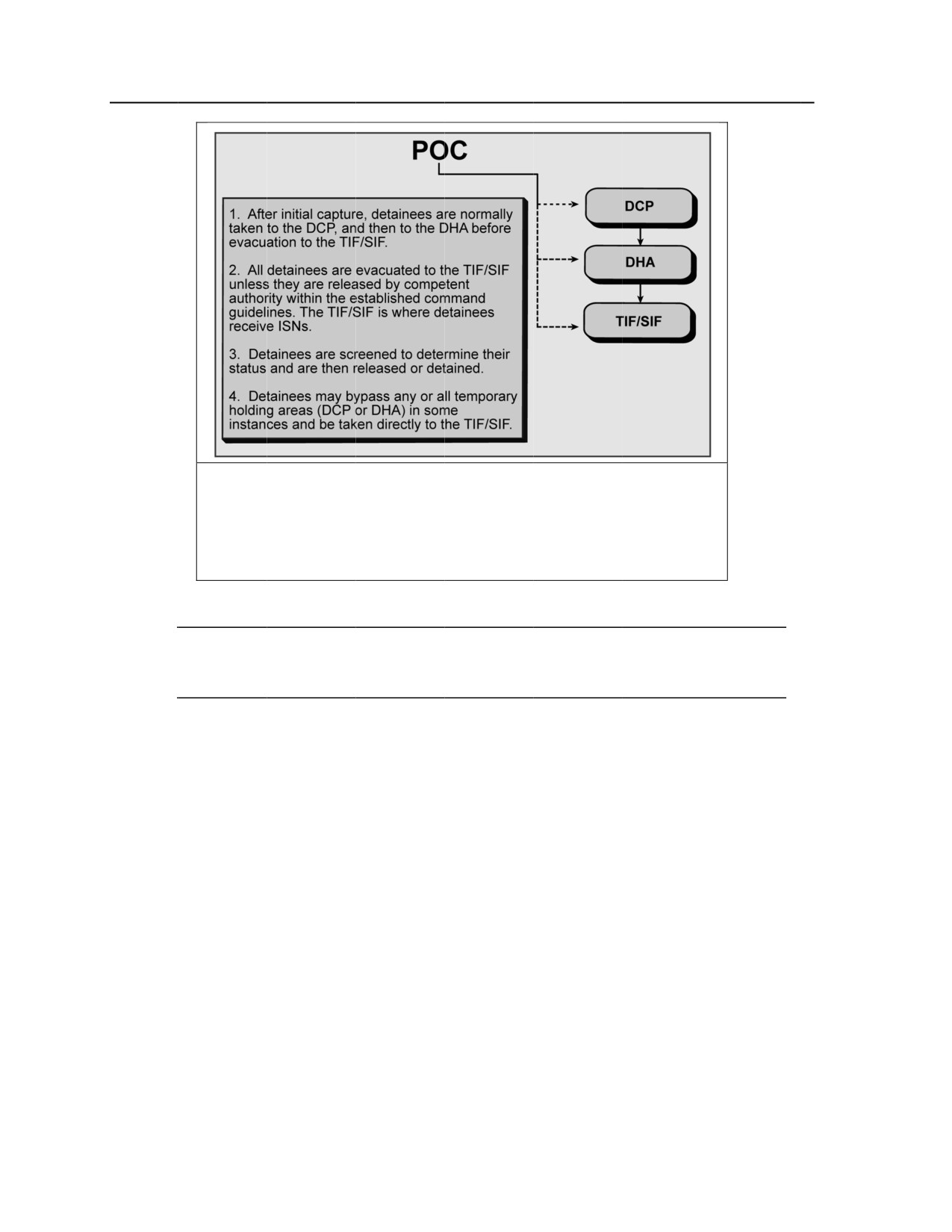
Chapter 4
Legend:
DCP
detainee collection point
DHA
detainee holding area
POC
point of capture
SIF
strategic internment facility
TIF
theater internment facility
Figure 4-1. Detainee flow
Note. All personnel, including those from
other government agencies, must adhere to DOD
practices and
procedures when conducting detention or interrogation
operations within DOD
facilities.
BRIGADE
COMBAT TEAM AND BELOW
4-4.
Detainee operations begin at the BCT or
armored cavalry regiment level. At the POC, the person
responsible for detainee operations might be a team or squad
leader. The senior member of the capturing
unit is
responsible for ensuring the
humane treatment and proper handling of
detainees. The capturing unit
evacuates detainees to the DCP when transportation is available. This evacuation is conducted to reduce the
threat
to detainees associated with
any ongoing conflict or operation and to place them in a
location where
U.S. armed forces
can fulfill legal and policy
requirements for the treatment and administration of
detainees. The capturing unit typically releases detainees to the
custody of the military police operating the
DCP.
(See figure 4-2.) The military police platoon leader serves as the officer in charge for detainee
operations at the DCP unless there are multiple DCPs and the requirements exceed the
military police
capability within the
BCT (for example, during
extended stability operations and high detainee capture
rates typical during
counterinsurgency operations). In instances where a military police platoon leader
is
not the
officer in charge of a DCP, the BCT PM
advises BCT
and subordinate commanders, ensuring that
technical oversight is exercised so
that detainees are treated humanely and
within the parameters of ARs
and U.S. and international laws. High-value detainees are typically taken directly from the POC to the TIF
Wounded or injured detainees may
need to be taken directly to a medical treatment facility.
4-2
FM 3-39.40
12 February 2010
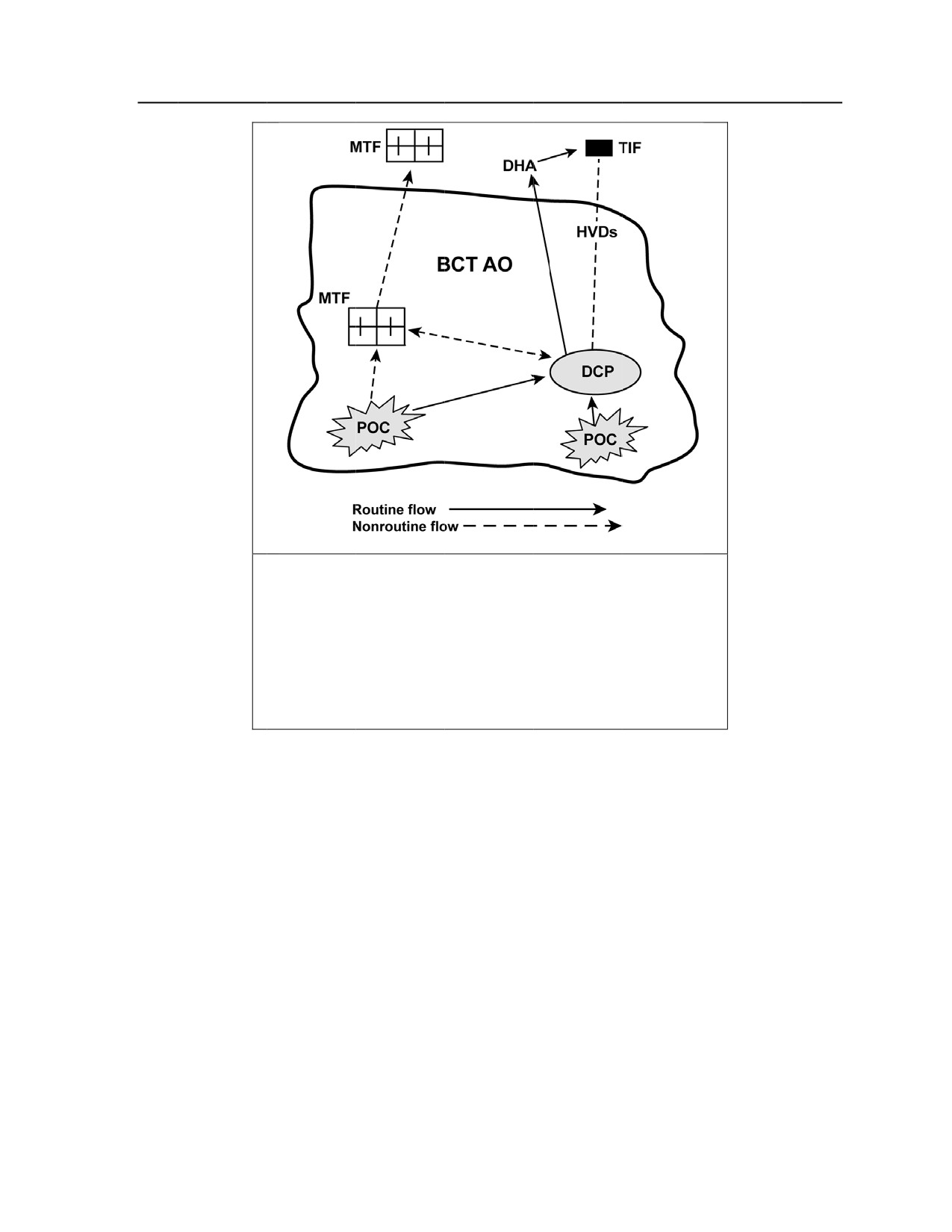
Capture, Initial Detention, and Screening
Legend:
AO
area of operations
BCT
brigade combat team
DCP
detainee collection point
DHA
detainee holding area
HVD
high-visibility detainee
MTF
medical treatment facility
POC
point of capture
TIF
theater internment facility
Figure 4-2. POC to TIF detainee flow
4-5. The DCP
is austere. It may be relocated based on operational
needs and normally consists of
detention, interrogation, and medical operations. The military police platoon that is organic to the brigade
special troops battalion or any
other military police platoon task-organized to the unit operates the
DCP.
Military police
personnel at the DCP coordinate and synchronize efforts with the various units with the
BCT. These efforts may range from ensuring proper medical support at the DCP to
engineer support in
building and sustaining the DCP.
4-6. The military police platoon leader exercises control over all personnel and units while they are within
the DCP. The
military police platoon ensures that intelligence and medical operations are conducted
according to U.
.S. policy regarding humane
treatment. In
addition, the
military police platoon maintains
custody and control of detainees. This
responsibility
includes overseeing joint, interagency, and
multinational personnel conducting intelligence and medical operations within the DCP
4-7. Soldiers who provide medical support
or conduct interrogation operations may
not be present
at all
times. The medical elements
from the medical company
of the support battalion and the interrogation
elements from the MI company of the brigade special troops battalion come and go as
the mission dictates.
The MI commander is responsible for conducting interrogations, coordinating with
the HUMINT and
counterintelligence staff officer (S-2X) for the control of
interrogations
and other intelligence operations,
ensuring the proper use of doctrinal approaches and techniques, and providing the control of interrogation
activities through technical channels. The
medical unit is responsible for conducting medical activities
12 February 2010
FM 3-39.40
4-3

Chapter 4
within the DCP and establishing priorities over those activities. The units incorporate technical direction
from higher headquarters to ensure adherence to applicable U.S. laws and regulations, international laws,
execution orders, FRAGOs, and other operationally specific guidelines.
4-8. The BCT PM serves as the technical advisor on detainee operations for the BCT or subordinate
commander and military police platoon leaders. The BCT coordinates for the transportation and security of
detainees to the DHA. Detainee evacuation depends on the availability of transportation and the completion
of time-sensitive MI exploitation. The BCT PM and logistics staff officer (S-4) coordinate transportation
with the supporting sustainment brigade and coordinate military police escort with the MEB or higher
headquarters.
Note. The standards used to process detainees at the DCP are the same as those for the DHA.
DIVISION ECHELON
4-9. While larger than a DCP, the DHA is also a temporary tactical holding area. Under rare
circumstances, a DHA may be moved based on operational needs. At the division level, a military police
company from a military police battalion, typically assigned or attached to the division MEB, normally
operates the DHA within the division AO. When an MEB is not assigned to the division, a military police
company assigned to a higher echelon military police battalion/brigade may operate the DHA. The senior
military police commander, in coordination with the division PM and G-2, advises the division commander
on detainee operations and recommends local policy and procedures for the division commander’s approval
and publication. The PM at each echelon and military police command structure provides technical
guidance, through established technical channels, to military police units conducting detainee operations as
directed by the CDO.
4-10. In some instances, a DHA may be established within a BCT AO. In this case the BCT organic
military police platoon may be tasked to supplement the operation of the DHA. Depending on the tactical
situation and availability of military police, nonmilitary police units may be tasked to operate the DHA.
The division PM must advise the division commander and subordinate PMs to ensure that technical
oversight is exercised and that detainees are treated humanely and within the parameters of ARs, U.S. and
international laws. The division PM, SJA, and G-2 advise the division commander on all aspects of
detainee operations and recommend local policy and procedures for the division commander’s approval and
publication. The PM provides technical guidance to units conducting detainee operations.
4-11. The military police company commander who is assigned the DHA mission serves as the DHA
commander and exercises tactical control over personnel and units not assigned while they are operating
within the DHA. The DHA commander ensures the humane treatment, evacuation, custody, and control
(reception, processing, administration, internment, and safety) of detainees; protection measures; and the
operation of the internment facility. Units typically operating within the DHA include medical elements
from the medical support command supporting the division and MI elements from the battlefield
surveillance brigade, MI battalion. The MI unit is responsible for conducting interrogations. It also
prioritizes effort
(through technical direction from higher headquarters), conducts other intelligence
operations, ensures the proper use of doctrinal approaches and techniques, and provides technical guidance
for interrogation activities. The medical unit is responsible for conducting medical activities within the
DCP and establishing priorities over those activities. The unit provides technical authority over those
activities to ensure adherence to applicable U.S. laws and regulations, international laws, execution orders,
FRAGOs, and other operationally specific guidelines. Once transportation is available and MI personnel
have completed interrogating detainees at the division level, the detainees are evacuated to the TIF.
ECHELONS ABOVE DIVISION
4-12. The theater level will typically include one or more TIFs that are centrally or regionally located. The
military police commander who is designated as the CDO varies, depending on the number of TIFs in an
operation area (OA), the size of the TIFs, the number of detainees, the size of the units operating within the
TIFs, and the complexity of the detainee operation. The number of TIFs is determined by the number of
detainees. There are many possible task organizations for detainee operations at this level. However, two
4-4
FM 3-39.40
12 February 2010

Capture, Initial Detention, and Screening
basic scenarios provide the foundation situations. The scenarios are an OA with a single TIF or multiple
small TIFs or an OA with multiple TIFs (one is large).
4-13. The TIF is normally operated by an I/R battalion. It is considered a semipermanent facility at the
theater level. The units operating within and in support of the TIF are generally constant. The TIF
commander exercises tactical control over units/elements operating within the TIF for the humane
treatment, evacuation, custody, and control (reception, processing, administration, internment, and safety)
of detainees; protection measures; and the operation of the internment facility. In an OA with a single TIF
or multiple small TIFs, the military police brigade commander is typically designated as the CDO and may
require augmentation to perform CDO functions.
Note. In some cases, another military police officer
(brigade commander, deputy brigade
commander) could serve as the TIF commander. A TIF commander will not normally also be
designated as the CDO.
4-14. In an OA with multiple TIFs (one or more are large) where an MPC is present in the theater, the
MPC commander is normally designated as the CDO. It may be appropriate to designate the military police
brigade commander as the CDO if an MPC is not present or if the CDO is required to report directly to a
joint force commander instead of an Army forces commander. Designating the MPC commander as CDO
in this latter case would result in the MPC commander reporting to the joint force commander for detainee
operations and to the Army forces commander for other military police operations, possibly degrading the
unity of command.
4-15. In both cases, the primary units operating in the TIF are an I/R battalion assigned to a military police
brigade, all or a portion of an MI battalion organic to a theater intelligence brigade, and a medical element
(perhaps a medical treatment facility). Units and personnel not assigned to the I/R battalion are under the
tactical control of the TIF commander for the humane treatment, evacuation, custody, and control
(reception, processing, administration, internment, and safety) of detainees; protection measures; and the
operation of the internment facility while operating in the TIF.
4-16. The MI unit is responsible for conducting interrogations, prioritizing the interrogation effort through
technical direction from its intelligence chain, and conducting other intelligence operations to ensure the
proper use of doctrinal approaches and techniques and for providing technical guidance for interrogation
activities. The medical unit is responsible for conducting all medical activities within the DCP and
establishing priorities over those activities. The units maintain technical authority over those activities to
ensure adherence to applicable U.S. laws and regulations, international laws, execution orders, FRAGOs,
and other operationally specific guidelines.
DETAINEE PROCESSING
4-17. Detainee processing begins when U.S. armed forces capture an individual. It is accomplished at the
POC for security, control, intelligence, and the welfare of detainees while in evacuation channels. All
detainee processing must be accomplished with care to collect critical intelligence effectively, preserve
evidence, maintain accountability, and protect detainees from danger or harm.
4-18. Detainee processing starts at the POC, continues at the DCP and DHA, and is completed at the TIF.
Each subsequent location builds on processing completed at the previous location until the detainee is fully
processed. Table 4-1, page 4-6, depicts the functions that are essential to performing detainee processing
across the spectrum of operations, from the POC to the TIF or until the detainee is released.
12 February 2010
FM 3-39.40
4-5

POC
DCP
DHA
TIF
SIF
Actions
• Process the detainee
• Handle the detainee using
• Handle the detainee using
• Handle the detainee using the search,
• Handle the detainee using the
according to the “5 Ss
the search, tag, report,
the search, tag, report,
tag, report, evacuate, segregate, and
search, tag, report, evacuate,
and T” technique and
evaluate, segregate, and
evacuate segregate, and
safeguard technique; and return the
segregate, and safeguard
return the detainee’s
safeguard technique; and
safeguard technique; and
detainee’s protective equipment.
technique.
protective equipment.
return the detainee’s
return the detainee’s
• Transfer custody of the detainee using
• Transfer custody of the
• Restrain/control the
protective equipment.
protective equipment.
DD Form 2708.
detainee using DD Form
detainee.
• Transfer custody of the
• Transfer custody of the
• Maintain accountability.
2708, and annotate the ISN.
• Establish and maintain
detainee using
detainee using
Transfer custody of evidence and
• Maintain accountability.
accountability.
DD Form 2708.
DD Form 2708.
personal property using
Transfer custody of
Remove weapons and
• Maintain accountability.
• Maintain accountability.
DA Form 4137.
evidence and personal
equipment from the
Transfer custody of
Transfer custody of
Conduct an inventory of the
property using
detainee, and annotate
evidence and personal
evidence and personal
detainee’s property, and record it on
DA Form 4137.
them on DD Form
property using
property using
DA Form 4137.
Conduct an inventory of the
2745.
DA Form 4137.
DA Form 4137.
• Move the detainee while the detainee
detainee’s property, and
Remove the detainee’s
Conduct an inventory of
Conduct an inventory
is restrained.
record it on DA Form 4137.
personal items, and
the detainee’s property,
of the detainee’s
• Report/investigate detainee abuse
• Move the detainee while the
annotate them on
and record it on
property, and record it
incidents.
detainee is restrained.
DA Form 4137
DA Form 4137.
on DA Form 4137.
• Conduct a medical evaluation to
• Report/investigate detainee
(Evidence/Property
• Move the detainee while
• Move the detainee while
identify, document, and treat wounds,
abuse.
Custody Document) if
the detainee is restrained.
the detainee is restrained.
injuries, and illnesses.
• Conduct a medical evaluation
circumstances permit.
• Report/investigate
• Report/investigate
• Move or release the detainee.
to identify, document, and
Identify items of
detainee abuse incidents.
detainee abuse.
treat wounds, injuries, and
• Confirm the detainee’s category (use
possible intelligence
• Conduct a preliminary
• Conduct a preliminary
illnesses.
an Article 5 tribunal as necessary).
value.
medical screening to
medical screening to
• Initiate strategic interrogation.
• Collect biometric information and
Record event
identify, document, and
identify, document, and
enter data in the DRS.
• Evacuate or release the
circumstances
treat wounds, injuries, and
treat wounds, injuries, and
• Issue the detainee an ISN, and enroll
detainee.
(DA Form 2823 [Sworn
illnesses as appropriate.
illnesses as appropriate.
the detainee in the DRS.
• Formally inprocess the
Statement] is
• Perform a more detailed
• Continue HUMINT/
• Report new detainees on
detainee to the internment
recommended).
HUMINT/
counterintelligence
DA Form 2674-R.
facility using the DRS.
• Move the detainee, using
counterintelligence
screening.
• Cross-reference the detainee’s
• Maintain biometric information
restraints.
screening.
• Conduct a detailed MI
DD Form 2745 number with the
in the DRS.
• Report/investigate
• Continue tactical
interrogation.
detainee’s ISN on all records.
• Coordinate with the NDRC.
detainee abuse incidents.
interrogation, and start
• Continue tactical
• Provide enhanced shelter and cover
• Provide enhanced shelter and
• Provide first aid for
operational interrogation.
interrogation, and start
for the detainee.
cover for the detainees.
wounds and injuries.
• Conduct an initial
operational interrogation.
• Develop and maintain the detainee’s
• Report new detainees on DA
• Conduct initial screening.
HUMINT/
• Evacuate or release the
medical records if not completed.
Form 2674-R.
counterintelligence
detainee.
• Provide preventive care.
• Maintain the detainee’s
interrogation (if MI
• Continue categorization.
medical records if not
• Ensure that the facility meets
personnel are not present,
• Collect biometric
cleanliness and sanitation standards.
completed.
conduct tactical
information.
• Provide for hygiene maintenance.
• Provide preventive care.
questioning according to
• Provide shelter and cover
• Anticipate ICRC queries and visits.
• Ensure that the facility meets
the CCIR).
for the detainee.
cleanliness and sanitation
• Use approved compliance techniques
to ensure behavioral control.
standards.

POC
DCP
DHA
TIF
SIF
Actions (continued)
• Conduct an initial
• Evacuate or release the
• Develop and maintain the
• Develop and employ physical
• Anticipate ICRC queries and
HUMINT/
detainee.
detainee’s medical records
security and antiterrorism measures.
visits.
counterintelligence
• Conduct initial
if not completed.
• Anticipate media attention, and
• Use approved compliance
interrogation (if MI
categorization.
• Provide preliminary
conduct media operations.
techniques to ensure behavioral
personnel are not
• Collect biometric
preventive care as
control.
present, conduct tactical
information on DD Form
appropriate.
• Develop and employ physical
questioning according to
2745 and, if desired, on
• Provide for basic hygiene
security and antiterrorism and
the CCIR.
supporting locally
as appropriate.
protection measures.
• Evacuate or release the
produced and approved
• Anticipate ICRC queries
• Anticipate media attention, and
detainee.
forms.
and visits.
conduct media operations.
• Provide shelter and cover
• Use approved compliance
for the detainee.
techniques to ensure
behavioral control.
• Provide dedicated security
forces.
Organization
Capturing unit.
Normally a military police
Normally a military police
Normally an I/R battalion.
Normally a military police brigade
platoon.
company.
with joint assets.
Legend:
5 S and T
search, silence, segregate, speed, safeguard, and tag
CCIR
commander’s critical information requirements
DA
Department of the Army
DCP
detainee collection point
DD
Department of Defense
DHA
detainee housing area
DRS
detainee reporting system
HUMINT
human intelligence
ICRC
International Committee of the Red Cross
ISN
internment serial number
MI
military intelligence
NDRC
National Detainee Reporting Center
POC
point of capture
SIF
strategic internment facility
TIF
theater internment facility

Chapter 4
4-19. Processing is not bound by a traditional linear-time model or specific time constraints. The model
accommodates operational changes in current OEs. Detainees can be evacuated from any direction and
point and from the POC to any DCP. They can also be evacuated directly to a DHA. Regardless of where
they are evacuated from, they will continue to be processed until complete.
Note. Some functions performed at the POC (for example, search, accountability, and custody
transfer) must be repeated as the detainee is processed from the POC through each subsequent
level.
4-20. The goal is to efficiently move detainees through processing. However, at each point between the
POC and TIF, leaders must make a deliberate decision whether to retain and evacuate detainees to the next
level or release them. The decision to retain or release detainees must be made based on an assessment of
the circumstances of the detainee’s capture, their intelligence value, and/or evidence that they committed a
crime and on additional direction from the chain of command. Each location may provide additional
processing and screening criteria that should be included in the assessment and decision to retain or release.
POINT OF CAPTURE
4-21. Detainees pose significant operational risks that can hinder mission success in numerous ways. Most
detainees are captured during a combat engagement and will most likely have weapons with unused
ammunition and explosives. Detainees must be disarmed and secured to ensure that no further harm can be
inflicted on them or U.S. armed forces. Noncompliant detainees require greater control measures that may
become resource-intensive. It is critical that all Soldiers involved in combat operations receive training on
detainee operations (to include detainee treatment) and procedures conducted at the POC.
4-22. Upon capturing detainees, Soldiers must monitor and control their emotions and monitor those of
fellow Soldiers. Perhaps only moments earlier, these very detainees may have tried to kill, killed, or
wounded fellow Soldiers. Soldiers must rely on the Army values and strictly adhere to U.S. military policy
and the published ROE. Under no circumstances, can Soldiers allow themselves or others to retaliate or
otherwise allow harm to befall detainees under U.S. armed forces control.
4-23. The POC represents the most vulnerable point at which Soldiers will process detainees. It often
requires Soldiers to disarm, search, and guard detainees in an unsecured environment among other potential
combatants, sympathizers, or counterinsurgents. Small units at the POC will probably not have enough
resources and manpower to provide for a large number of detainees, but still must begin processing
detainees while waiting for the arrival of additional resources and transportation. Here, leaders and Soldiers
may have to assess the risks between providing security against potential attacks and other combatants or
sympathizers in the area and providing enough security to control the detainees.
4-24. The POC is where most detainee abuse allegations occur; it is the point where emotions following
enemy contact may run high and where there is a need to collect immediate intelligence information that
may prevent additional casualties. Leaders and Soldiers must monitor unit and individual stress to prevent
violations of U.S. military policy.
4-25. The POC is the first decision point at which a detainee will be released or transferred to the next
echelon. Soldiers performing operations in which detainees are taken into custody should be aware of all
considerations and requirements when making this decision. Once the decision is made, the information in
table 4-2 should be applied.
4-8
FM 3-39.40
12 February 2010

Capture, Initial Detention, and Screening
Table 4-2. POC processing standards
Requirements
Actions
Search and inspect detainees and their possessions, to include clothing, shoes, and
Search1
headgear.
Inspect personal protective equipment. Once all items have been searched and deemed
Inspect
safe by U.S. and multinational forces, return them to the detainee. For this operation,
protective
protective gear such as helmets and CBRN protective clothing and equipment will remain
equipment
with the individual.
Document detainee property using DA Form 4137. Any property returned to the detainee
Conduct
must be signed for using DA Form 4137.
property
Coordinate with interrogation/intelligence teams (if available) to determine which confiscated
accountability
items have intelligence value. Personal items (diaries, letters from home, family pictures)
may be taken by interrogation/intelligence teams for review.
Ensure that DA Form 2823, DA Form 4137, DD Form 2708, and DD Form 2745 are
complete before detainees are evacuated.
Enter the following information on DD Form 2745 (locally produced forms may be used to
supplement, but do not replace, DD Form 2745):
Tag
• Date and time of capture.
• Capturing unit.
• POC.
• Circumstances of capture.
Report the number of detainees by category and gender at each POC through appropriate
Report
command channels. This aids in determining transportation and security requirements.
Segregate
Ensure that detainees are segregated.
Safeguard
Provide first aid and medical treatment, as available, for wounded and sick detainees.
Complete detainee processing. Once processing is complete, evacuate detainees from the
Evacuate2
POC through appropriate channels as humanely and quickly as possible.
Complete detainee processing. Once processing is complete, and if directed by appropriate
Release3
command authority, release detainees as humanely and quickly as possible.
Notes:
1Conduct same-gender searches when possible. If mixed-gender searches are necessary for speed or security,
conduct them in a respectful manner and avoid any action that could be interpreted as sexual misconduct. To
prevent allegations of sexual misconduct, the on-site commander/leader must provide appropriate supervision,
with more mature and experienced personnel conducting mixed-gender searches.
2Units designated to receive detainees at the DCP will prepare a DD Form 2708 (with a list containing each
detainee’s name attached) and provide a copy of the paperwork to the escort.
3The decision to release an individual at the POC may be made by the senior-ranking person on the ground,
based on command directives and guidance. Once a detainee is processed into a DCP or DHA the senior
echelon commander holds release authority (typically, the battalion commander or brigade commander,
respectively).
Legend:
CBRN
chemical, biological, radiological, and nuclear
DA
Department of the Army
DCP
detainee collection point
DHA
detainee housing area
DD
Department of Defense
POC
point of contact
12 February 2010
FM 3-39.40
4-9

Chapter 4
DETAINEE PROCESSING KIT
4-26. Detainee processing kits enable capturing units at the POC to properly secure; quickly, efficiently,
and safely process; and quickly move detainees to the DHA away from the POC. The platoon leader will
distribute necessary additional items or equipment based on mission requirements and mission variables.
4-27. At a minimum, a detainee processing kit should be maintained and contain the following items:
z
Disposable restraints.
z
Disposable restraint removers.
z
Latex or vinyl search gloves.
z
Plastic trash bags for detainee property.
z
Plastic bags for evidence.
z
Plastic document protectors for important papers.
z
String, twine, or 550 cord.
z
Duct, packing, or adhesive tape.
z
Blindfold material.
z
Unit SOP for handling and processing detainees and evidence.
z
Visual language cards.
z
Paper, envelopes, and tape (various sizes).
z
Digital camera and video camera (with backup batteries).
z
Explosive-residue detection kit.
z
DD Forms 2708, DD Forms 2745, and any supporting locally approved and produced capture
tags.
z
Multilingual version of DA Forms 2823 and DA Forms 4137 as appropriate for the location.
z
Colored, permanent markers and chalk.
z
Event log (simple Microsoft® Office Word or Microsoft Office Excel document).
z
Sketch pad (anything can suffice).
z
Meal, ready to eat boxes, for documents/files.
z
Voice recording device (optional).
Note. Units may add extra items as needed to the detainee processing kit based on mission
variables.
TACTICAL UNIT PREPARATION
4-28. Critical operational planning considerations for the POC and detainee operations include the
following:
z
Ensure that operations are consistent with Army values and U.S. policy.
z
Expedite detainee evacuation according to military necessity.
z
Preserve, document, and control evidence and items that may be of intelligence value.
z
Support tactical questioning and interrogation requirements.
z
Deescalate events at the POC.
z
Ensure that Soldiers are trained and rehearsed on the ROE and RUF.
z
Prevent attempts to escape, disrupt operations, or harm U.S. armed forces.
z
Provide adequate resources.
4-29. When planning tactical-level operations that may include capturing detainees—
z
Plan for detainee processing regardless of the mission. Consider—
Using the latest intelligence for capture estimates.
Using detainee processing kits to process detainees at the POC.
Planning security to provide protection against external threats.
4-10
FM 3-39.40
12 February 2010

Capture, Initial Detention, and Screening
Planning for transportation and resource requirements.
Establishing DCPs and DHAs.
z
Brief the Soldiers on the detainee mission. Consider—
Establishing search, security, and escort teams.
Ensuring that search team members (designated search personnel, guards, and interpreters)
clearly understand their roles and responsibilities.
Reviewing the ROE and RUF and reinforcing the treatment of detainees according to
military policy.
z
Brief the Soldiers on how to reach a decision of detaining or releasing an individual. The
current CCIR will assist in determining whether to detain. Other indicators to determine if
an individual should be detained include—
The detainee shows hostility toward detention personnel.
The detainee dropped his weapon and attempted to escape.
There are physical differences in appearance between the detainee and other captured
detainees.
There is a language difference between the detainees in the group (that reflects educational
or regional differences within the group).
Multiple identification documents were found on the detainee.
z
Rehearse detainee operations, from the POC to transfer or release. Consider having Soldiers
rehearse—
Capture, search, security, and escort functions.
The ROE and RUF.
Scenarios that will build Soldiers’ skills and confidence.
4-30. Leaders at the POC must review the circumstances of an individual’s capture, the confiscated items,
and the individual’s intelligence and evidentiary value to provide a thorough assessment. Accordingly,
sufficient information should be reported up the chain of command so they can make an informed decision
on whether to retain or release the individual.
4-31. The capturing unit may perform tactical questioning. Tactical questioning is considered direct
questioning
(by DOD personnel) of a captured or detained person to obtain time-sensitive tactical
intelligence (at or near the POC) that is consistent with applicable laws. Documentation of the event of
capture is best transcribed on DA Form 2823; however, if time or circumstances do not permit, other means
(note paper) may be used.
4-32. The military police platoon that is organic or task-organized to the BCT can provide the capturing
unit with subject matter expert skills in collecting, processing, and evacuating detainees from immediate
danger as soon as possible. Certain detainees with significant intelligence value could be required to remain
close to the POC pending the exploitation of time-sensitive intelligence information by trained HUMINT
and counterintelligence collectors.
DETAINEE PROCESSING TECHNIQUE
4-33. Upon capture, Soldiers must process detainees using the
“search, silence, segregate, speed,
safeguard, and tag (5 Ss and T)” technique. This technique provides a structure to guide Soldiers in
conducting detainee operations until they transfer custody of detainees to another authority or location.
Complete the “5 Ss and T” technique as follows:
z
Search. Neutralize a detainee and confiscate weapons, personal items, and items of potential
intelligence and/or evidentiary value.
z
Silence. Prevent detainees from communicating with one another or making audible clamor such
as chanting, singing, or praying. Silence uncooperative detainees by muffling them with a soft,
clean cloth tied around their mouths and fastened at the backs of their heads. Do not use duct
tape or other adhesives, place a cloth or either objects inside the mouth, or apply physical force
to silence detainees.
12 February 2010
FM 3-39.40
4-11

Chapter 4
z
Segregate. Segregate detainees according to policy and SOPs (segregation requirements differ
from operation to operation). The ability to segregate detainees may be limited by the
availability of manpower and resources at the POC. At a minimum, try to segregate detainees by
grade, gender, age (keeping adults from juveniles and small children with mothers), and security
risk. MI and military police personnel can provide additional guidance and support in
determining the appropriate segregation criteria.
z
Speed. Quickly move detainees from the continuing risks associated with other combatants or
sympathizers who may still be in the area of capture. If there are more detainees than the
Soldiers can control, call for additional support, search the detainees, and hold them in place
until reinforcements arrive.
z
Safeguard. Protect detainees and ensure the custody and integrity of all confiscated items.
Soldiers must safeguard detainees from combat risk, harm caused by other detainees, and
improper treatment or care. Report all injuries. Correct and report violations of U.S. military
policy that occur while safeguarding detainees. Acts and/or omissions that constitute inhumane
treatment are violations of the law of war and, as such, must be corrected immediately. Simply
reporting violations is insufficient. If a violation is ongoing, a Soldier has an obligation to stop
the violation and report it.
z
Tag. Ensure that each detainee is tagged using DD Form 2745. Confiscated equipment, personal
items, and evidence will be linked to the detainee using the DD Form 2745 number. When a DA
Form 4137 is used to document confiscated items, it will be linked to the detainee by annotating
the DD Form 2745 control number on the form.
Note. Segregation is not intended to be used as an interrogation technique. (See FM 2-22.3.) In a
detention facility, segregation should only be used for security reasons or to separate groups
required to be grouped by the Geneva Conventions (grade, nationality, family).
4-34. To ensure accountability, each detainee is tagged by the capturing unit using DD Form 2745.
Military police at DCPs and DHAs check each tag for—
z
Date and time of capture.
z
Capturing unit.
z
POC.
z
Circumstances of capture.
4-35. Decisions regarding a detainee’s current and future status are based on the initial processing at the
POC. Proper processing ensures that U.S. armed forces can take the appropriate action to release, detain,
transfer custody, prosecute, or adjudicate detainees.
CUSTODY AND ACCOUNTABILITY OF PROPERTY, EVIDENCE,
AND INTELLIGENCE INFORMATION
4-36. The accountability of detainees, detainee property, and items with evidentiary or intelligence value
begins at the POC by documenting the information on DD Form 2745. Locally approved and produced
forms may be used to supplement the DD Form 2745, but they do not replace the DD Form 2745. The DD
Form 2745, and any supplemental forms are kept together with (preferably attached to) the detainee. The
DD Form 2745 number is used to link the detainee to all confiscated property. The DD Form 2745 number
is also used to link the detainee to other records such as property accountability forms, medical conditions,
treatment records, interrogation data, and custody transfer records. The DD Form 2745 number is the only
number used to account for a detainee and the detainee’s property until an ISN is assigned at a TIF. DD
Form 2745 is a permanent part of the detainee’s record and the property custody and accountability system
even after the detainee is issued an ISN.
Note. An ISN is normally issued as soon as possible, typically upon processing at a TIF/SIF,
according to DOD policy.
4-12
FM 3-39.40
12 February 2010

Capture, Initial Detention, and Screening
4-37. DD Form 2745 is a three-part, perforated form with an individual serial number. It is constructed of
durable, waterproof, tear-resistant material with reinforced eyeholes at the top of Parts A and C. Part A is
attached to the detainee’s clothing with wire, string, or another type of durable material. The capturing unit
maintains Part B in its records. Part C is attached to the confiscated property so that the owner can be
identified later.
4-38. Everything confiscated from a detainee (weapons, personal items, items of intelligence and/or
evidentiary value) must be documented on DA Form 4137 and linked to the detainee by annotating the
form with the DD Form 2745 number. Always transport the detainee and the confiscated items to ensure
that both are available to MI personnel during screening and tactical interrogation. Further documentation,
such as a photograph taken of the detainee and the detainee’s property at the POC, allows for the increased
ability to prosecute criminal detainees in courts of law. While photographs greatly enhance the possibility
of future prosecution, they are only taken for official purposes and must be guarded from unauthorized use
or release.
(See AR 190-8.) If a detainee is suspected of committing, being involved in, or having
knowledge of terrorist acts, crimes against humanity, war crimes, or other crimes, the PM and legal advisor
must become involved with the case immediately. It is also imperative that an uncontaminated, unbroken
chain of evidence be maintained to ensure a fair hearing if the detainee is brought to trial.
4-39. Proper and accurate documentation of the capture circumstances (DD 2745 and, if desired, a locally
produced and approved supplemental form) provides information to support continued assessments on
whether to detain or release the detainee; to make determinations on the detainee’s status (CI, RP, or enemy
combatant); to prepare for criminal proceedings; and/or to, ultimately, transfer custody of the detainee.
Proper documentation also provides an official historic record of the events surrounding the capture of a
detainee, which may prove invaluable to counter future false claims (such as the loss of personal property).
Documentation initiates the chain of custody for evidence required to prosecute detainees who are
suspected of committing crimes.
4-40. All Soldiers should possess the required detainee processing kit, which contains the items essential
for the safe and proper processing of a detainee. The kit contains essential forms and expendable equipment
to restrain a detainee and establish accountability for the detainee and their confiscated items. If time or the
situation does not allow for the use of DA Form 4137 to document confiscated items, items are placed in
the large resealable bag included in the detainee processing kit. The detainee’s DD Form 2745 number is
carefully marked on the bag using a permanent marker. The property inventory can then be transferred later
to DA Form 4137 at the DCP.
RETAINED ITEMS
4-41. Retained items are items that detainees may keep during their captivity. (Initially, all items are
confiscated.) Retained items are generally divided into two groups. The first group consists of items taken
during the reception portion of inprocessing, and they may be returned later during processing. It contains,
but is not limited to—
z
Military mess equipment (except knives and forks).
z
Helmets.
z
CBRN protective suits and masks.
z
Clothing.
z
Badges of grade and nationality.
z
Military decorations.
z
Identification cards and tags.
12 February 2010
FM 3-39.40
4-13

Chapter 4
4-42. The second group consists of items that detainees may keep at all times. It contains, but is not limited
to—
z
Religious literature (within reason).
z
Personal items that have sentimental value (such as rings and pictures).
Note. Allow the detainees to retain their own rations in the early stages of detention.
CONFISCATED ITEMS
4-43. Confiscated items are weapons, ammunition, and military equipment other than those items allowed
for personal protection. Medications in a detainee’s possession are confiscated and placed in a plastic bag
that is clearly marked. Medical personnel determine if detainees are permitted to retain their medication on
their person for emergency treatment (such as an inhaler). All other medications are administered by
medical personnel as required and/or directed. Some items (potential weapons, documents of intelligence
value) should always be confiscated when searching detainees.
4-44. Military police coordinate with the MI HUMINT and counterintelligence collectors to determine
which confiscated items are of evidentiary and/or intelligence value. Personal items such as diaries, letters
from home, and family pictures may be taken by the MI teams for review but are later returned to the
military police so that they can be returned to their owners. Items with evidentiary value must be marked
(for example, engraved) in such a manner that the item can be positively linked to the detainee and to the
supporting statements rendered by the detainee or witnesses of the suspected criminal activity. Evidence
documented on DA 4137 must be transported to a centralized storage facility that has procedures in place
regarding proper accountability, storage, and security until final disposition.
4-45. Per AR 190-8, currency is only confiscated on the order of a commissioned officer. DA Form 4137 is
used as a receipt for currency. Confiscated currency may be impounded, retained as evidence of a crime, or
retained for specific intelligence purposes. In any case, currency must be particularly safeguarded and
promptly evacuated into appropriate security channels until final and proper disposition is determined.
4-46. Impounded items are not returned to detainees during detention because they make escape easier or
compromise U.S. security interests. Items normally impounded are cameras, radios, and currency. (For a
more in-depth discussion about confiscated and impounded property, see AR 190-8 and DFAS-IN 37-1.)
4-47. Property should be bundled or placed in bags to keep it intact and separated from other detainees’
possessions. Accounting for property is not only important for returning items and preventing claims
against the U.S. government, but also to link detainees to their property for intelligence exploitation.
Property accountability is critical to possible criminal proceedings by the HN. Military police--
z
Use DA Form 4137 as a receipt for confiscated and impounded property.
z
Prepare DA Form 4137 for signature by the detainee and the receiver for any currency and/or
negotiable items.
z
List currency and negotiable items on DA Form 4137, but treat them as impounded property and
possibly counterfeit material.
z
Keep original receipts with the property during evacuation.
z
Give detainees a copy of DA Form 4137 as a receipt for their property.
z
Instruct detainees (in their own language, if possible) to keep the receipts to expedite the return
of their property when they are released.
z
Have MI personnel sign for property on DA Form 4137 and sign for detainees on DD Form
2708.
z
Ensure that confiscated property is cleared by MI teams and returned to supply.
z
Coordinate with the supported S-2X to ensure that items kept by MI personnel for intelligence
value are forwarded through MI channels.
4-14
FM 3-39.40
12 February 2010

Capture, Initial Detention, and Screening
z
Evacuate property retained by the detainee when the detainee is moved to the next detention
level.
z
Maintain controlled access to confiscated and impounded property.
DETAINEE MOVEMENT
4-48. When detainees have been processed and are ready for movement, leaders—
z
Report detainee status through military police channels to the CDO.
z
Request transportation, rations, and water from logistics channels.
z
Ensure that DD Forms 2708 for detainees are ready for the escort guard’s signature.
z
Ensure that property taken from detainees for security or intelligence reasons is properly tagged
and given to the guards who are moving the detainees to a DCP or DHA.
Note. All movements at or after the TIF are documented and executed using the Detainee
Reporting System.
4-49. Prior to movement and when possible, detainees should be given clear, brief instructions in their own
language. Military necessity may require delays in movement. When this occurs, ensure that there is an
adequate food supply; potable water; and appropriate clothing, shelter, and medical attention available.
4-50. From the POC, detainees can be moved by a number of methods. Prior to movement ensure the
detainees and transportation asset are searched for weapons or contraband. Develop a manifest for use as an
official receipt of transfer and as a permanent record to ensure accountability of each detainee until release.
The manifest should contain the following:
z
Each detainee’s—
Name, grade, and status.
DD Form 2745 control number.
Nationality and their power served.
Physical condition.
z
The transport vehicle and destination.
4-51. Maintain control and accountability of detainees and their property until releases or transfers are
received by the appropriate authorities. Joint inventories of pertinent documentation and confiscated items
must be completed before any transfer or release. Confiscated items should be transported along with the
detainee, annotated on a DA Form 4137, and identified by the DD Form 2745 control number. The
DD Form 2745 control number should also be noted on the DA Form 4137. Strict accountability will be
maintained throughout all movement.
4-52. Before movement, an interpreter should be used to brief detainees on—
z
Actions to take upon hearing the word “Halt.”
z
The need to remain silent at all times.
z
Actions to take during an emergency (such as a delay, crash, or enemy attack).
z
Signals used to direct detainee movement.
z
Responses to escape attempts according to the ROE and RUF.
4-53. Detainees should not be daisy-chained during transport. In addition, restraining detainees to fixed
structures or objects while in transport is prohibited unless specifically approved by the facility
commander.
Note. Restrained detainees will always be assisted on and off any mode of transportation to
prevent injury.
12 February 2010
FM 3-39.40
4-15
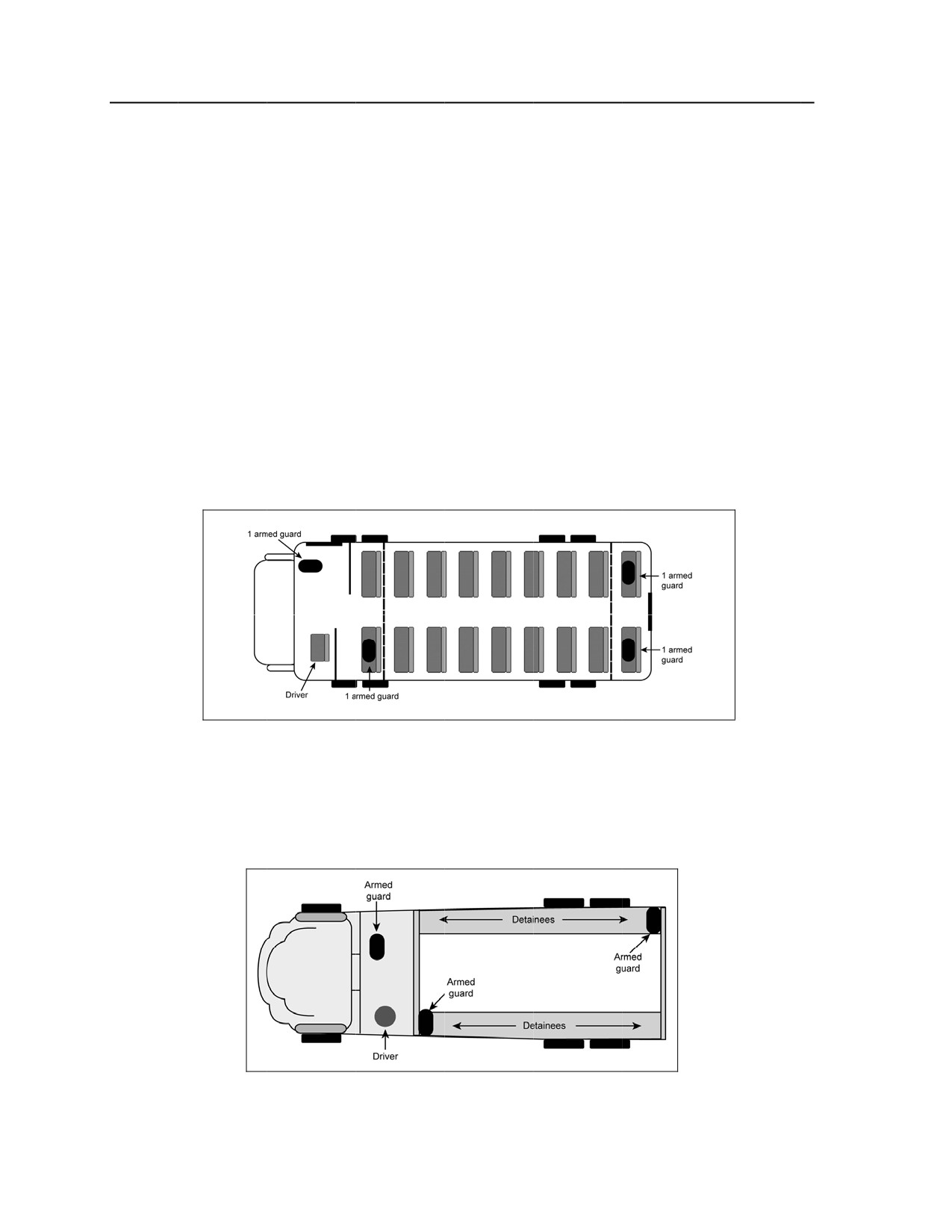
Chapter 4
METHODS OF TRANSPORTATION
FOOT
4-54.
Movement by
foot is the least preferred transportation method. It is often used, as necessary, to move
detainees from the POC to the DCP. Distances do not normally
exceed 5 miles. If movement by foot must
occur,
ensure that detainees are fully ambulatory
and have appropriate footgear. Movement by foot is not
used for uncooperative detainees.
WHEELED VEHICLE
4-55.
Movement by
vehicle is the
most common and most reliable method
of transporting detainees.
If
possible, avoid using team vehicles
(such as
high-mobility
multipurpose
wheeled vehicles). Conceal
detainees inside wheeled vehicles by covering vehicle windows and other openings with tarps and window
coverings when possible. Guards should always
be placed to the rear of vehicles with open
tops or backs.
Conduct a search of the vehicle
for potential
weapons or contraband before loading detainees. Escort
security vehicles should be considered for front, rear, and flank
security.
BUS
4-56.
During bus movement, planners should plan for two detainees per seat. (See figure 4-4.) Do not
allow
detainees to stand, sit, or lie
on the floor.
Lock doors from external threats. When multiple vehicles
are used, escort security vehicles may also be necessary.
Figure 4-4.
Movement by bus
CARGO TRUCK TRANSPORT
4-57.
The use of tarp-covered vehicles is another method of transporting
detainees. (See figure 4-5.)
Tightly position detainees along the bench seat without restraining them to the bus infrastructure or other
fixed
objects. Soldiers should not
allow detainees to stand, sit, or lie on the floor of the
vehicle. When
multiple cargo trucks are used, escort security vehicles may also
be necessary
Figure 4-5. Movement by cargo truck
4-16
FM 3-39.40
12 February 2010
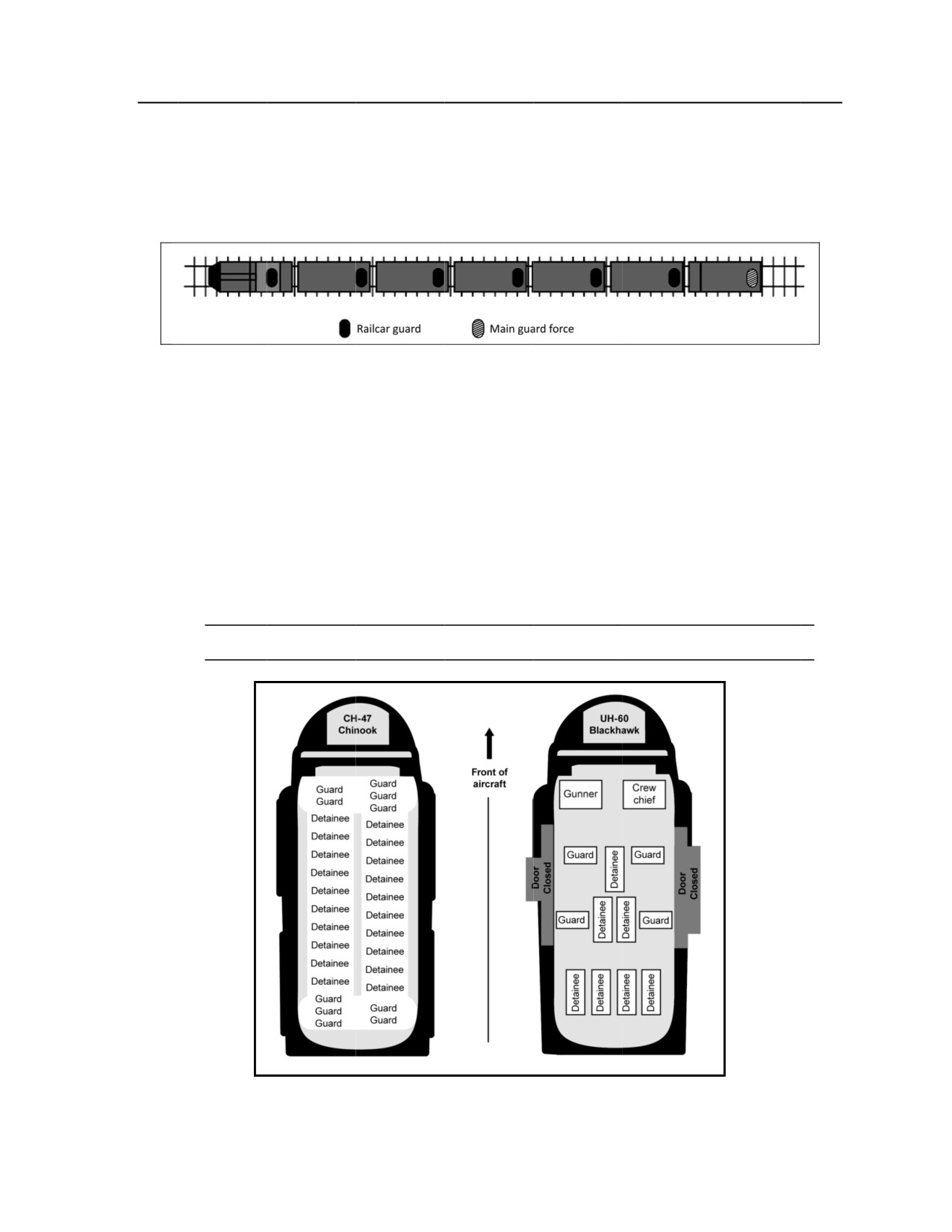
Capture, Initial Detention, and Screening
RAIL
4-58. Movement of detainees
by rail is rare
and only available in industrialized locations. (See figure
4-6.)
The disadvantages to movement by rail are that trains are easily disrupted
by improvised explosive devices,
detainees require additional transportation
to rail stations or other stopping points,
and the mission is
vulnerable at critical sites during transport.
. The preferred
method of rail transportation is via passenger
railcars.
Figure 4-6. Movement by rail
4-59. During movement, position mobile security teams at critical urban crossing sites, bridge crossings,
and at stations or other stopping points if possible. Conceal detainees using railcars and window coverings
when possible,
and always position guards
at the rear of
open-top railcars. Railcars should be thoroughly
searched before
boarding detainees, and detainees should
never be restrained to the railcar infrastructure.
Loading and seating arrangements are based
on the size and
configuration
of railcars.
HELICOPTER
4-60. The critical planning factor to remember during
air transport
by helicopter
is that the aircraft
commander is in charge of that aircraft and will likely
dictate how the transportation and security of
detainees will be enforced. (See figure 4-7.)
Some of the disadvantages to air movement are that it requires
additional training and rehearsals, is weather-dependent, requires a higher guard-to-detainee ratio, and
often
entails different
ROE. An advantage to air movement is the speed with
which a detainee is moved off the
battlefield.
Note. Do not use firearms aboard an aircraft.
Figure 4-7. Movement by CH-47 and UH-60
12 February 2010
FM 3-39.40
4-17
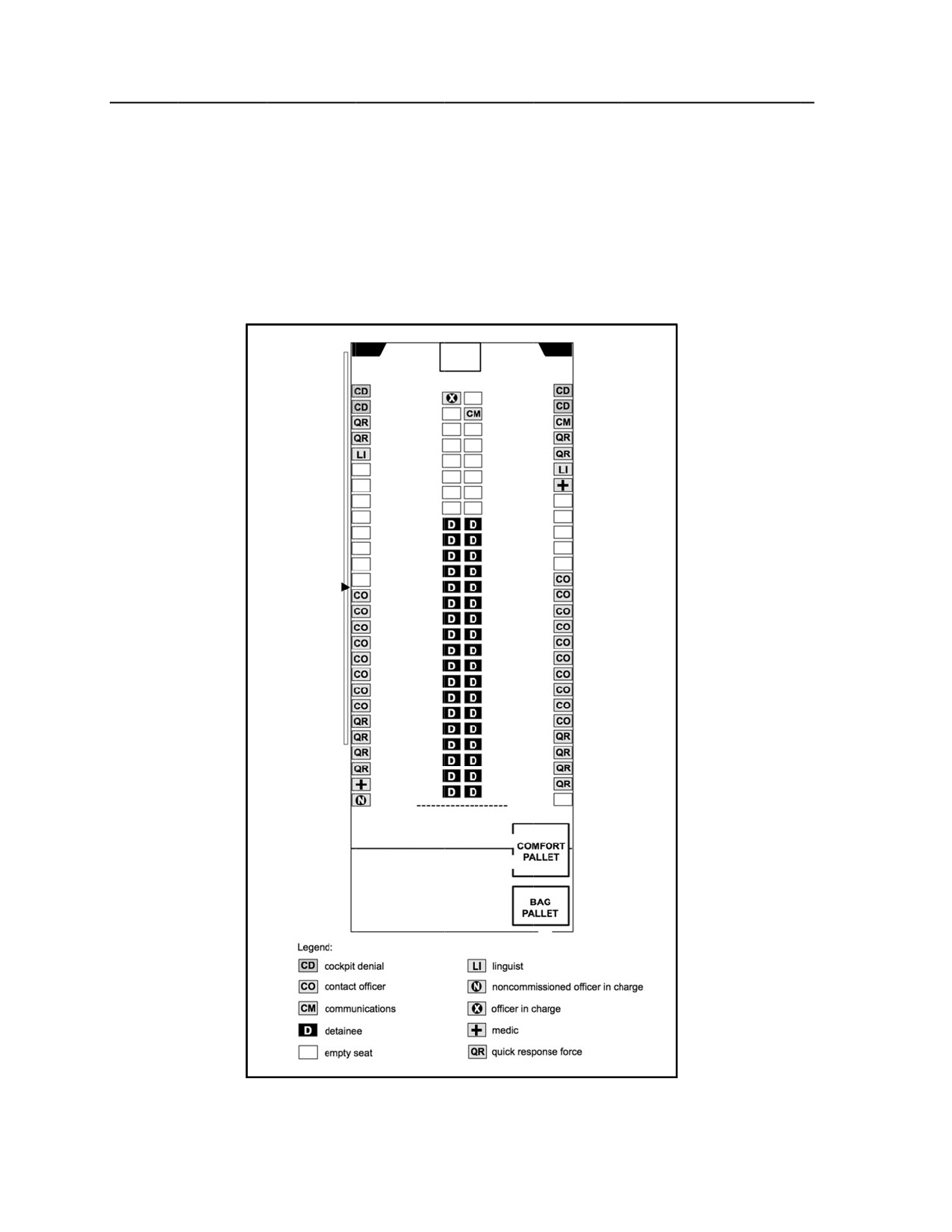
Chapter 4
AIRPLANE
4-61.
Movement by
airplane has
similarities to movement by helicopter
and other potential types of
aircraft. An example
of transport
by C-130 is provided in figure 4-8. This
example is but one of several
variations based on
the mission variables, but the basic relationships and positioning should be applicable
in most situations. Variations that
will affect the
maximum number of detainees transported on an aircraft
include, but are not limited to, elevation, fuel
load, passenger collective
weight, and
other necessary
considerations. The
empty seats shown in this
example may
be further filled with additional detainees,
Soldiers escorting detainees, and
aircraft crew
members. Once the aircraft
is airborne, selected contact
officers and members of the cockpit denial element leave their seats to conduct roving
patrols of the
detainees and ensure that they are better positioned to watch and
respond to detainee actions
Figure 4-8. Movement by C-130 aircraft
4-18
FM 3-39.40
12 February 2010

Capture, Initial Detention, and Screening
DETAINEE RELEASE
4-62. Commanders responsible for detainee operations must understand the proper authority for the release
of detainees at any echelon. (See chapter 9.) When a release is approved, the commander must—
z
Ensure that detainees are segregated, outbriefed, and medically screened before release.
z
Determine the receipt or transfer location.
z
Determine the movement routes to the transfer location, and coordinate all routes through the
appropriate combatant commanders.
z
Make public notification of release and/or transfer only in consultation and coordination with the
proper authority due to operations security concerns.
z
Ensure that releasable confiscated personal property accompanies the detainees.
z
Conduct an inventory of personal property and identify any discrepancies.
z
Ensure that the detainees sign property receipts.
z
Provide the detainees with appropriate and adequate food, clothing, and equipment for safe
transition and movement.
12 February 2010
FM 3-39.40
4-19

This page intentionally left blank.

Chapter 5
Detainee Operations
Combat operations and stability operations in the war on terrorism continue to result
in the detention of criminals, combatants, and civilians as military forces seek to
support emerging democracies, mitigate the threat from terrorists, and quell
insurgencies. A common lesson is the requirement to prepare for and conduct
detainee operations as an integral part of full spectrum operations. Modern military
actions, whether in a contiguous or noncontiguous environment characteristic of the
war on terrorism, result in the capture of many and varied detainees. The war-on-
terrorism detainee differs significantly from traditional EPWs of past conflicts and
presents a potentially different and greater type of security threat during processing,
escorting, and handling.
COMMAND AND CONTROL
5-1. The synchronization and clear understanding of C2 at all echelons is critical to the overall mission
success. C2 clarifies key commander roles and responsibilities from POC to the Army service component
command level. Although policy and joint doctrine updates are pending, this FM lays the groundwork for,
and is nested with, current and emerging policy and joint doctrine regarding C2 during detainee operations.
RESPONSIBILITIES AT ECHELONS OF COMMAND
5-2. At each location and echelon of command conducting detainee operations, a commander must be
responsible for those operations and exercise commensurate command authority to meet legal and
operational requirements. Commanders at all units must ensure that detainees are accounted for and treated
humanely. Elements not assigned to the commander executing detainee operations will be placed under
tactical control or another appropriate command and support relationship to the internment commander for
the humane treatment, evacuation, custody, and control (reception, processing, administration, internment,
and safety) of detainees and the operation of the DCP, DHA, or internment facility. Tactical control
provides authority for controlling and directing the application of force or capability for an assigned
mission or task. It is intended for temporary situations and for specific tasks and missions that are normally
explicitly stated. The MI commander is responsible for conducting interrogation operations (including
prioritizing the effort) and controlling interrogation or other intelligence operations through technical
channels.
5-3. At the theater Army level, the commander responsible for detainee operations is designated as the
CDO. The senior military police commander normally serves as the CDO. The CDO does normally not
serve as a detention facility commander. The CDO develops local policy and procedures for the
commander’s approval and dissemination and provides input to operation orders to ensure the uniform
application of detainee operations policy and procedures at subordinate echelons. MI and medical units
performing their assigned functions within a detainee facility establish and maintain a support chain
through technical direction from their respective technical chain.
5-4. A military police commissioned officer should serve as the officer in charge of all U.S. DCPs unless
no military police officer is available due to the operational situation. If a military police officer is not
available to perform duties as the officer in charge of a DCP, the designated officer in charge must
coordinate with the echelon PM for technical guidance regarding the treatment and processing of detainees
to comply with Army regulations and U.S. and international laws. All DHAs and internment facilities will
be commanded by a military police officer. However, this commissioned officer does not establish medical
and interrogation priorities. The commander/officer in charge is responsible for the oversight of detainee
12 February 2010
FM 3-39.40
5-1

Chapter 5
operations and must have unfettered access to all areas and operations. The commander/officer in charge
provides technical direction to subordinate echelons.
5-5. The commander/officer in charge for detainee operations makes detainees available to authorized
intelligence personnel for interrogation to the maximum extent possible, commensurate with requirements
for humane treatment, custody, evacuation, protection, and administration. The commander/officer in
charge is responsible for ensuring that policy and technical procedures for intelligence and medical
operations are enforced through technical channels. The commander/officer in charge coordinates with the
MI unit commander who is responsible for conducting interrogation operations. The intelligence staff
maintains control through technical channels for interrogation operations to ensure adherence to applicable
laws and policies and ensure the proper use of doctrinal approaches and techniques. Applicable laws and
policies include U.S. laws, the law of war, relevant international laws, relevant directives (including
DODD 2310.01E and DODD 3115.09), DODIs, operation orders, and FRAGOs. The officer in charge is
also responsible for joint, interagency, and multinational personnel who are conducting detainee operations
in U.S. facilities within an assigned AO.
Note. Non-DOD agencies must observe the same standards for the conduct of interrogation
operations and the treatment of detainees as do Army personnel. The officer in charge of
detainee operations possesses the authority over these personnel and is obligated to terminate or
deny access to the facility and/or the detainees, as necessary, to stop or prevent inhumane
treatment or a loss of custody and control. All personnel who observe or become aware of
violations of Army interrogation operation standards will immediately report the infractions to
the commander/officer in charge. For personnel who are not subject to the detainee operations
chain of command and others who have been denied access to the facility or detainees, the
officer in charge will report such access denial up the chain of command for resolution.
PLANNING CONSIDERATIONS
5-6. Detainee operations involve a wide array of operational and sustainment support to ensure
compliance with U.S. and international laws. Proper planning before operations commence is vital and
includes positioning military police, engineer, and other essential support element assets and construction
materials early in the time-phased force deployment list. Commanders must also recognize that conditions
for the successful execution of detainee operations are historically set in the planning phase of operations.
To this end, commanders should establish planning mechanisms that ensure the effective consideration of
potential detainee-related issues and the development of plans and procedures to respond to these issues as
early in the planning process as feasible. In addition, training requirements, proper procedures, and an
enhanced security plan all go into developing and maintaining a location where detainees are held and
treated in a humane manner.
5-7. The planning should focus across the doctrine, organization, training, materiel, leadership and
education, personnel, and facilities
(DOTMLPF) domains to ensure that all requirements are met.
Synchronization with adjacent staff elements and commands is another important element that must be
considered.
5-8. Food sanitation, personal hygiene, and field sanitation standards must be met to prevent diseases and
ensure the cleanliness of the facility. (See AR 190-8.) These standards are as follows:
z
Provide adequate space within housing units to prevent overcrowding.
z
Provide sufficient showers and latrines for detainees, and ensure that showers and latrines are
cleaned and sanitized daily.
z
Teach detainees working in the dining facility the rules of proper food sanitation, and ensure that
they are observed and practiced.
z
Dispose of human waste properly to protect the health of detainees and U.S. armed forces
associated with the facility according to the guidelines established by preventive medicine.
z
Provide sufficient potable drinking water and food service purposes. At a minimum, detainees
should receive the same amount of water that is afforded U.S. military personnel.
5-2
FM 3-39.40
12 February 2010

Detainee Operations
z
Provide sufficient water for bathing and laundry.
z
Provide necessary materials for detainee personal hygiene.
z
Train U.S. military personnel on the proper disposal of garbage (dining facility and personal) so
as not to breed insects and rodents that can contribute to health hazards.
z
Establish measures against standing water within the facility.
z
Conduct pest control activities as required.
z
Conduct medical, occupational, and environmental health surveillance.
5-9. Planning for detainees requires extensive and continuous coordination with supporting organizations.
The construction of detainee holding facilities must meet health, well-being, and security requirements.
Detainee operations may require support from all classes of supply, specifically—
z
Class I items are required for detainees and military police personnel. Detainees are entitled to a
sundry pack.
z
Class II clothing is required for detainees, taking into consideration religious beliefs and
accoutrements.
z
Class III items may be focused on power production with some vehicular requirements.
z
Class IV supplies are be required and coordinated with engineer personnel to ensure that specific
construction requirements are met.
z
Nonlethal Class V supplies, such as small arms ammunition, are required for security personnel.
z
Class VI items are required and supplied to detainees.
z
Transportation is a critical requirement for detainee movement.
INTELLIGENCE AND INTERROGATION
5-10. Collecting intelligence from detainees will support intelligence operations and be valuable to
operational success. It is critical to plan for adequate HUMINT collectors to interrogate detainees and meet
intelligence and other information requirements. Interrogations may occur at all echelons (POC to the
TIF/SIF). At the TIF/SIF, interrogations will normally occur at a colocated JIDC. Only qualified HUMINT
personnel who have been trained and certified to perform interrogations will interrogate detainees.
5-11. HUMINT collectors screen all arriving ones to determine which detainees have information that may
be of immediate tactical intelligence value to the maneuver commander. Military police facilitate control
during screening.
5-12. To facilitate collecting enemy tactical information, MI personnel will collocate interrogation teams at
the internment facility. This provides MI personnel with direct access to detainees and their equipment and
documents. Military police and MI personnel coordinate to establish operating procedures that include the
accountability of detainees.
5-13. An interrogation area is established away from the receiving and processing line so that MI personnel
can interrogate detainees and examine their equipment and documents. If detainees or their equipment
and/or documents are removed from the receiving and processing line, account for them on DD Form 2708
and DA Form 4137. Military police will escort detainees to and from the detainee building within the
internment facility and will guard detainees during interrogations.
5-14. Interrogations of prisoners must be monitored, except as provided for under DODD 3115.09, even if
questioning is being carried out by joint, interagency, or multinational personnel. If the monitored party
does not adhere to DOD policies and procedures, the monitor will immediately terminate the interrogation.
Additionally, the monitor will ensure that no recording which contains credible evidence of a suspected or
alleged violation is destroyed.
5-15. The use of physical or mental torture or coercion of any kind is absolutely prohibited. Detainees are
not threatened, insulted, or exposed to unpleasant or disparate treatment because of their refusal to answer
questions. MWDs, contracted dogs, or any other dog in use by a government agency will not be used as
part of an interrogation approach nor used to harass, intimidate, threaten, or coerce a detainee for
12 February 2010
FM 3-39.40
5-3

Chapter 5
interrogation purposes. Failure to adhere to these outlined actions constitutes a serious violation of
international laws and the UCMJ. All violations must be stopped by the monitor and reported immediately.
5-16. Intelligence representatives from the G-2X, J-2X, C-2X, and/or MI unit will provide interrogation
expertise to the CDO staff. The HUMINT and counterintelligence representative will advise the CDO on
all HUMINT and counterintelligence policy and operations.
5-17. Military police and MI personnel have associations with detainees, but each has different roles and
responsibilities. According to U.S. policy, military police provide custodial care (to include subsistence,
hygiene facilities, and accountability procedures), internment security, detainee escorts, and facility
protection. MI personnel perform interrogation operations by using approved interrogation techniques. (See
FM 2-22.3.) The execution of interrogation operations is coordinated with the detention facility commander
to ensure visibility on detainee movement and accountability. Military police will not be directly or
indirectly involved in interrogation operations or in setting conditions for interrogations beyond the
responsibilities for monitors that are stated above. Military police may support MI personnel by providing
detainee escorts and/or additional security (for example, for combative detainees) as requested. (See table
5-1.)
Table 5-1. Military police versus HUMINT responsibilities
Military Police
HUMINT
•
Process and restrain/control the
•
Screen and question detainees at
detainee.
traffic control points and checkpoints.
•
Conduct liaison with military and
•
Question contacts, local civilians, and
Major
civilian agencies.
detainees.
Functions
•
Transfer custody and maintain
•
Conduct liaison with military and
Performed
accountability of the detainee,
civilian agencies.
from POC
evidence, and property.
•
Report information obtained.
through
Evacuation
•
Collect biometric information.
•
Ensure that detainee abuse is
•
Move the detainee while he/she is
reported.
restrained.
•
Support document and media
•
Report/investigate detainee abuse.
exploitation.
•
Detain and guard I/R populations.
•
Debrief guards.
•
Conduct reception and processing
•
Screen detainees for PIR and IR.
operations.
•
Provide linguist support when
•
Coordinate for Class I, II, and VIII
possible.
supplies.
•
Observe detainees under military
•
Coordinate NGO, private
police control.
Internment
organization, and interagency visits.
•
Ensure that detainee abuse is
Facility
•
Ensure that detainee abuse is
reported.
Tasks
reported.
•
Conduct interrogations.
•
Transport detainees within the
•
Report information obtained.
internment facility to the interrogation
•
Cross-cue other intelligence
area.
disciplines as needed.
•
Maintain security during interrogation
•
Support document exploitation.
operations.
Legend:
HUMINT
human intelligence
IR
information requirements
NGO
nongovernmental organization
PIR
priority information requirements
POC
point of capture
5-4
FM 3-39.40
12 February 2010

Detainee Operations
5-18. Standard military police security, police intelligence operations, and I/R functions are the only
involvement military police have in the interrogation process. Military police will—
z
Exercise overall responsibility for the safety of detainees and HUMINT collectors, even in cases
where detainees are in temporary custody of MI personnel or other agency personnel for
interrogation.
z
Never participate in the interrogation of detainees, set conditions for future interrogation
operations, or provide or allow MWDs to be used to intimidate detainees in an effort to collect
information.
z
Maintain custody and control of the detainees.
z
Provide observations of detainee actions and interactions to their chain of command and
HUMINT personnel as appropriate.
5-19. MI personnel coordinate the implementation of the approved interrogation plan with the detention
facility commander (or the security officer in charge at lower echelons) to synchronize interrogations. The
detention facility commander/security officer in charge will also review interrogation plans with MI
interrogators to develop or enhance appropriate safeguards and ensure humane treatment. Military police,
guards, and/or security personnel are not responsible for reviewing, validating, or implementing
interrogation plans. All military police noncommissioned officers (NCOs) and officers involved in detainee
operations must be trained to understand interrogation policies, techniques, and legal limits to be capable
monitors of interrogation activities and identify potential law and policy violations. Commanders must
coordinate with MI and SJA to ensure that training includes the most current information and command
guidance regarding approved interrogation activities. Military police also refer to FM 2-22.3 to identify
general, approved interrogation techniques. The detention facility commander may coordinate with MI
personnel to determine the best way for them to support interrogations without actually setting the
conditions for interrogation activities.
5-20. Military police work closely with MI interrogation teams at the DCP to determine if detainees and
their equipment and weapons are of intelligence value. This process is accelerated when HUMINT and
counterintelligence collectors observe detainee arrival and in processing. If HUMINT collectors are
language-qualified, they may be used as interpreters during this phase. Before detainees are interviewed by
MI personnel, military police ensure that they have a DD Form 2745 attached to their clothing and are
accounted for on DD Form 2708.
5-21. Military police follow strict guidelines concerning access to detainees, while ensuring that detainees
are available for interrogation by approved HUMINT collectors. Accompanied and unaccompanied access
to detainees must be coordinated and approved in advance by the military police commander (or the
commander’s designated representative) who is responsible for detainees. When a HUMINT collector
coordinates detainee interrogations, military police escort detainees to the interrogation site and verify that
the HUMINT collector has been given authorized access to the detainee. Depending on security concerns,
the HUMINT collector may request that escorting military police remain at the interrogation site until (to
ensure positive control or depart from) detainees are ready to be returned to their living areas. If escorting
military police remain at the interrogation site, their functions are to maintain security, account for
detainees, and maintain the safety of detainees and other personnel at the site. If positive control is not
possible, detainees are signed over to the HUMINT collectors on DD Form 2708.
5-22. Commanders may consider implementing a standard practice in which detainees are medically
screened before and after interrogations. This will ensure that a detainee’s medical condition is always
documented during all phases of internment.
5-23. Non-DOD personnel will coordinate with the military police and MI commander to sign for
detainees that they want to question and will follow the same procedures established for DOD personnel. In
all instances, non-DOD agencies are required to observe the same standards for the conduct of interrogation
operations and treatment of detainees as do Army personnel.
5-24. HUMINT collectors will not turn over the detainee to anyone other than the escorting military police.
Specifically, HUMINT collectors will not allow another government agency to assume custody directly
from them. The HUMINT collector must return the detainee to the custody of the escorting military police,
12 February 2010
FM 3-39.40
5-5

Chapter 5
and the agency seeking custody of the detainee will then be required to receive custody of the detainee
from the escorting military police. Likewise, HUMINT collectors will not assume custody of a detainee
directly from another government agency, but will direct that agency’s personnel to return the detainee
directly to the positive control of the escorting military police.
5-25. Military police may provide HUMINT collectors with information pertaining to the detainee’s
behavior and overall demeanor while in the TIF or SIF (such as a detainee’s behavior during recreation and
the type of people the detainee interacts with). Before turning the detainee over to a HUMINT collector for
interrogation, the military police escort should inform the HUMINT collector of the detainee’s behavior
and demeanor during the detainee’s movement to the interrogation site.
5-26. Military police keep records on detainees who appear to be leaders, create disturbances, and
participate in hunger strikes. They observe patterns of behavior or communication within the detainee
population that indicate unruly behavior. This type of information can be useful for HUMINT collectors
during the interrogation process.
5-27. Any information provided to HUMINT collectors by military police should also be provided to the
organic unit intelligence officer. Military police provide passive intelligence collection support through
organic unit intelligence channels by reporting observations acquired in the course of their normal custodial
and security duties.
5-28. Military police may provide incentives in support of interrogation operations if the incentives—
z
Are requested by HUMINT personnel and have the MI commander’s concurrence.
z
Are coordinated with, and approved by, the detention facility commander.
z
Do not violate standards of humane treatment.
z
Do not violate detainee custody and control guidelines or facility security guidelines.
5-29. The commander may approve positive incentives at the local level. Any reduction in incentives or
privileges must be approved by the first general officer in the detainee operations chain of command. The
removal of incentives from detainees undergoing interrogation must be coordinated with the officer in
charge of the interrogation element before removing the incentive.
Note. As long as incentives do not violate detainee custody or control or facility security, they
may be used. For example, if MI personnel request that military police provide an incentive to
the detainee (such as specialty food), but the detainee is acting inappropriately, that facility
commander may deny the incentive. This response reduces the impact of reinforcing improper
behavior. Additionally, denying a HUMINT personnel request for positive incentive will be
coordinated with the MI commander and HUMINT personnel. Providing and withdrawing
incentives does not affect the standards of humane treatment.
MEDICAL SUPPORT
5-30. Detainees will receive medical care that is consistent with the standard of medical care that applies
for U.S. military personnel in the same geographic area. Medical personnel will provide detainees with the
same care rendered to U.S. military personnel in the theater, which is generally a higher level of care than
what is available locally. Medical support and the level of care available during detainee operations will
vary based on the location of the facility, the situation, and the availability of qualified medical personnel
and resources. The levels of care may be characterized as follows:
z
Level I and II care includes—
Emergency and essential dental care.
Daily (sick call) routine care.
Monthly health assessments.
Simple laboratory work.
Optometry.
Portable radiology.
5-6
FM 3-39.40
12 February 2010

Detainee Operations
z
Level III care normally includes (in addition to Level I care)—
An intensive care unit.
An operating room.
A radiology unit and a full lab.
5-31. Medical care at a DCP is provided according to necessity and is limited to emergency medical care
only. DHA medical care is limited, but may include Levels I and II care. A TIF must provide at least Level
II care and may be capable of Level III care. A hospital with the capabilities to support detainee operations
is normally found at a SIF.
(See appendix I for more information on medical support to detainee
operations.)
5-32. Medical personnel are required to identify, treat, and document existing medical conditions and
injuries of detainees. Distinguishing scars, marks, and tattoos will be documented by medical personnel and
entered into the Detainee Reporting System by the facility Detainee Reporting System operator at theater
level facilities for identification purposes. Medical personnel also prepare medical documentation, generate
and control the disposition of medical records, and manage the release of medical information.
5-33. All medical screenings, examinations, and/or treatments conducted at prior locations, such as the
DCP or DHA, will be available for review and inclusion in the detainee’s medical record. All information
that the Level I or Level II medical treatment facility documented on DD Form 1380 (U.S. Field Medical
Card), Standard Form (SF) 558 (Medical Record-Emergency Care and Treatment [Patient]), and SF 600
(Health Record-Chronological Record of Medical Care), and/or other medical forms will accompany the
detainee throughout the levels of medical care. Many times, these forms contain important information
regarding the detainee’s health status immediately after capture. Each entry helps provide a chronological
picture of the detainee’s medical condition during the time of the initial detention. In addition, the medical
treatment facility may have taken useful photographs of injuries that were healing or were already healed
by the time the detainee arrived at the TIF.
5-34. Commanders must consider the following when establishing medical care at the internment facility:
z
A credentialed health care provider examines detainees monthly and records their weight on DA
Form 2664-R (Weight Register [Prisoner of War]). The Detainee Reporting System requires
weight data from the medical community.
z
The general health of detainees, their nutrition, and their cleanliness are monitored during
inspections.
z
The detainees are examined for contagious diseases (especially tuberculosis), lice, louse-borne
diseases, human immunodeficiency virus (HIV), and sexually transmitted diseases.
z
All medical treatment facilities must provide immunizations for, and isolation of, detainees with
communicable diseases.
z
Retained medical personnel and detainees with medical training are used to the fullest extent
possible in caring for sick and wounded detainees.
z
Detainees who require a high level of care are transferred to military or civilian medical
installations where the required treatment is available.
z
Military police escort detainees to medical treatment facilities and remain with them until
medical examinations are complete.
z
Detainees interned at the TIF receive Level II or higher medical care as required (including
dental and optometric care).
Note. Details of medical operations specific to the DCP, DHA, TIF, and SIF are provided in
each location discussion. (See appendix H and AR 190-8.)
5-35. All Behavioral Science Consultation Team members are authorized to make psychological
assessments of the character, personality, social interactions, and other behavioral characteristics of
interrogation subjects and to advise authorized personnel performing lawful interrogations regarding such
assessments. Those who provide such advice may not provide medical care for detainees, except in an
emergency when another health care provider cannot respond adequately. All behavioral science
12 February 2010
FM 3-39.40
5-7

Chapter 5
consultation team members serving in behavioral science consultant positions should receive structured
training on their roles and responsibilities while functioning in this capacity. In addition, MI personnel
should clearly understand the defined roles, responsibilities, and limitations of behavioral science
consultants.
5-36. Military police will provide security, retain custody, and maintain control of detainees during all
medical interactions, to include simple examinations. Detainee health care personnel will not provide
detainee security, custody, or control for even brief instances, nor will there ever be the perception that
health care personnel provide such functions (for example, they will not carry handcuffs or disposable
restraints). Detainees are entitled to receive, and medical personnel will try to allow, some level of privacy
consistent with security requirements. The medical staff finds contraband on a detainee during the course of
a medical examination, they will give it to appropriate security personnel.
5-37. Military police also provide behavioral control. Any detainee who fails to follow orders or rules can
be disciplined appropriately by military police. Medical personnel should not discipline or participate in the
discipline of detainees. They will immediately report any problems to the onsite military police authority.
5-38. Medical interactions must always involve military police overwatch, whether inside or outside the
compound. As a rule, medical personnel will not carry weapons within the detention compound. (This is for
their safety and is generally dictated by the MPC.) Since most outpatient care occurs inside the detention
compound, military police must be vigilant in protecting the safety of medical personnel. Even the most
friendly or helpful detainee may be harboring the desire to harm a Soldier, even if that Soldier is a medical
provider.
5-39. Military police or other internment facility personnel will never have routine access to open medical
records, and a detainee’s medical information will never be used during interrogation. Medical personnel
will provide military police medical information required in the Detainee Reporting System. Further,
medical personnel must keep military police and MI personnel apprised of any medical conditions that
detainees have when could affect the conduct of detainee interrogation operations. For example, military
police and MI personnel should know that a detainee is diabetic to prevent harm that might result from
changes in the detainee’s diet. Because the internment facility military police chain of command is
ultimately responsible for detainee care and treatment and the welfare of assigned personnel, they require
and should receive adequate and appropriate medical information to keep apprised of detainee medical
conditions. (See appendix H.) For example, detainees who are suspected of having infectious diseases
should be separated from other detainees. Guards and other personnel who come into contact with such
detainees should be informed about their health risks and apprised on how to mitigate those risks. When
transferring detainees from one facility to another, sealed medical records may be transported by military
police who are escorting them.
5-40. Any detainee refusing food for 72 hours is considered to be on a hunger strike. Military police will
refer detainees who are refusing food to medical personnel for evaluation and possible treatment.
5-41. Medical personnel will immediately report allegations or suspicions of abuse to military police or
CID personnel, but will not conduct investigations. When physical, sexual, or emotional abuse is alleged or
suspected, medical personnel will immediately report the situation to the military police and the supporting
CID unit. It is the role of CID personnel and/or the military police are responsible for investigating
allegations, collecting evidence (such as photographs), and identifying perpetrators.
DENTAL SUPPORT
5-42. The scope of dental services available to detainees is determined by the detainee operations medical
director according to established theater policy. Operational dental support (emergency and essential) is
normally available within a joint operations area. Comprehensive dental care is normally provided in a
support base, but not in a deployed setting. Internment facilities do not have organic dental personnel or
equipment. Depending upon the anticipated dental workload, dental assets may be colocated with the
internment facility. If dental assets are not colocated with the internment facility, coordination with the
supporting dental facility is required. The internment facility must provide the required guard support for
detainees who are being transported to the supporting dental facility.
5-8
FM 3-39.40
12 February 2010

Detainee Operations
SPECIFIC DETAINEE SUPPORT REQUIREMENTS
5-43. There are numerous requirements for support and care of detainees within U.S. military control. The
following paragraphs provide details regarding selected detainee support requirements. These requirements
and their implementation should be addressed within unit SOPs. (See paragraph 5-103.)
MAIL AND CORRESPONDENCE
5-44. Detainees may be permitted to send and receive correspondence. They may also address complaints
(in writing) to U.S. military authorities and the protecting power. CIs may be denied communication rights
in cases where absolute military security requires. Commanders should consult with their supporting SJA
on a case-by-case basis to determine privileges afforded to detainees.
5-45. There are no restrictions on the number of letters, cards, or parcels detainees may receive. Detainees
will be permitted to send no more than two letters and four cards monthly, in addition to the capture cards
provided for in Article 70, GPW. Letters and cards from detainees sent by ordinary mail are postage free.
5-46. Detainees will not send maps, sketches, or drawings in outgoing correspondence. They will not be
permitted to mail or receive registered, certified, insured, or cash-on-delivery mail. Detainees may not write
letters for others who are able to write. If a detainee is unable to write, the detention facility commander
may permit another person to write a message for him/her. The person writing the message will
countersign.
5-47. Detainees may be authorized to receive individual parcels and collective shipments containing the
following items if they do not impede security procedures within the facility:
z
Foodstuffs.
z
Medical supplies.
z
Articles of a religious, educational, or recreational nature.
5-48. Detainees will not be permitted to mail parcels. Any parcels received for transferred persons will be
forwarded immediately.
5-49. Correspondence procedures are as follows:
z
Outgoing letters and cards will be secured by using locked boxes or similar means.
z
Only authorized U.S. military personnel will handle mail. Detention facility commanders will
designate a U.S. Soldier to supervise the opening of all mail pouches containing incoming letters
and cards for detainees. These items will be carefully examined by the U.S. Soldier before
delivery to detainees. The contents of all incoming parcels will be examined at the facility by a
U.S. officer in the presence of the addressee or the named representative.
z
The detention facility commander may request that parcels be examined by a censorship element
when considered necessary. The articles in each parcel will be removed. The wrappings, the
outer container, and any extraneous items found in the parcel will not be given to the detainee.
Examination will be close enough to reveal concealed articles and messages; however, will
avoid undue destruction of parcel contents.
5-50. A censorship policy of detainee mail may be instituted by the theater commander as follows:
z
Outgoing letters and cards may be examined and read by the detention facility commander or a
designated representative.
z
Mail will be returned to the sender to rewrite portions that contain obvious deviations from
regulations, and a copy will be provided to the supporting counterintelligence element.
z
Outgoing letters and cards will be sent, unsealed, directly from the facility to the theater
commander’s designated censorship element. All incoming letters and cards that arrive at a
facility without having been censored will be sent to the designated censorship element before
delivery to detainees.
12 February 2010
FM 3-39.40
5-9

Chapter 5
5-51. Letters and cards addressed to persons other than representatives of a protecting power or to U.S.
military authorities will not—
z
Contain complaints or criticism of any governmental agency or official.
z
Refer to events of capture.
z
Compare camps.
z
Contain quotations from books or other writings.
z
Contain numbers, ciphers, codes, music symbols, shorthand, marks, or signs other than those
used for normal punctuation.
z
Contain military information on the number of detainees.
5-52. Should any such correspondence be discovered, it will be turned over to the supporting
counterintelligence element.
TELEGRAMS AND TELEPHONE CALLS
5-53. Detainees may send and receive telegrams as determined by the detention facility commander. The
cost of sending the telegram is deducted from the detainee’s account. Detainees are prohibited from making
or receiving telephone calls. (See AR 190-8 for more information on sending and receiving telegrams and
telephone communications.)
DETAINEE REPRESENTATION
5-54. A limited system of representation will improve communications between U.S. armed forces and the
detainees, thus improving control. According to AR 190-8 and the Geneva Conventions, the senior detainee
officer assigned to each facility is recognized as the senior detainee representative, unless the senior
detainee representative is declared incompetent or incapacitated by U.S. authorities. Enlisted detainees may
elect an enlisted representative if there is no officer representation at the facility. In officer detainee
compounds within internment facilities, one or more advisors are chosen by the interned officers to assist
the senior representative. An internment facility of a mixed population of officers and enlisted Soldiers will
have one or more enlisted advisors elected to assist the detainee officer representative.
5-55. Within current and future OEs, it is highly likely that large numbers of civilian detainees and
members of armed groups with no recognized grade structure will be detained. At a minimum, CIs and
detainees with no formal leadership will be authorized to elect a committee of representatives every 6
months or upon the vacancy of a representative position.
5-56. Elected and appointed representatives must have the same nationality, customs, and language as
those they represent. Each group of detainees interned in separate internment compounds (because of
language, customs, or ideology) may have an elected representative.
5-57. The primary duties of elected detainee representatives are to promote the spiritual, physical, and
intellectual well-being of the detainees they represent. Representatives may be given the freedom of
movement within security requirements. They do not have the authority to discipline prisoners, but may be
allowed to—
z
Inspect work details.
z
Receive supplies.
z
Communicate with—
U.S. armed forces authorities.
Protecting powers. (Protecting powers will periodically inspect the internment facility and
interview the detainees regarding the conditions of their internment and welfare and the
protection of their rights under international laws.)
The ICRC and its delegates.
Medical commissions.
Other organizations authorized to assist detainees.
z
Use postal and other appropriate facilities (within constraints previously described).
5-10
FM 3-39.40
12 February 2010

Detainee Operations
5-58. Representatives should not perform any other work that interferes with their duties as representatives.
Each representative is elected by secret ballot and serves a term of up to 6 months.
5-59. Detainees are permitted to consult freely with their representative and, in turn, the representative is
allowed to represent them before—
z
The ICRC.
z
Protecting powers.
z
U.S. armed forces authorities.
z
Other relief or aid organizations (NGOs and IOs) authorized to represent detainees.
5-60. The detention facility commander is designated as the final approval authority for each elected
detainee representative. If the detention facility commander disapproves of an elected member, the reasons
are stated in writing and forwarded through channels to the TDRC, NDRC, and protecting powers. If the
commander dismisses a representative, the detainees are permitted to elect another representative. After the
approval process is complete, the representatives may assume their duties. Each elected representative may
appoint assistants. The assistants are also subject to the approval of the detention facility commander.
5-61. Medical and chaplain personnel are classified as RP and will receive, at a minimum, the benefits and
protection afforded EPWs by the GPW. (See chapter 1.) The detainee operations medical director and (or
designated representative) or the foreign national medical officer at each internment facility is responsible
for the activities of retained medical personnel. Senior retained medical officers and chaplains have the
right to correspond and consult with the detention facility commander on all questions concerning their
duties.
EMPLOYMENT AND COMPENSATION
5-62. Basic policies and procedures for the administration, employment, and compensation of detainees in
the custody of the U.S. armed forces are discussed in AR 190-8. This regulation also implements the
provisions of the Geneva Conventions that relate to the treatment of CIs who are interned by the U.S. in the
occupied territory of their country.
VISITATION
5-63. Detainee visitations are a deliberate operation, resource-intensive, and a significant IO builder. The
detention facility commander may grant visitation privileges depending upon the detainee’s conduct and
disposition while in detention. Visitation must be formally requested and scheduled with the fixed facility
detainee visitation office by the person(s) wishing to visit with a detainee. Scheduled visitation is based on
the number of visitations that may be accommodated for a specific visitation day. Visitors requesting to
visit with a detainee must provide or obtain their own transportation to the fixed facility on the specific day
that a visitation is scheduled. Visitation staff and guard forces must know in advance who was scheduled
for visitation, and security measures must be put in place. Visitations take place within the site and require
the following security measures before visitors can be granted access:
z
Visitors are only allowed to arrive and request permission to enter through a specific gate. They
must check in with the U.S. guards manning the visitation security gate access point.
z
Guard forces must verify that personnel requesting visitation are scheduled and that they provide
a legitimate form of identification before access is granted. Upon verification of identity and
scheduled visitation for that particular day, visitors move to the visitor holding area that
immediately follows the visitor access point.
z
Once inside the facility, the visitor’s identification is checked a second time by the visitation
staff. Visitation staff members used interpreters to explain visitation procedures to visitors.
Visitors are required to submit to physical searches and biometrics enrollment using the
Biometrics Automated Toolset before they are allowed to move to the next phase of visitation
processing. If a visitor refuses to be searched or fails biometrics enrollment/verification, the
visitor should not be authorized to visit the detainee and should be escorted off the compound by
security personnel. Additionally, if a visitor refuses to complete inprocessing requirements, the
visitation staff records it.
12 February 2010
FM 3-39.40
5-11

Chapter 5
z
Once biometrics enrollment and verification is complete, visitors, are seated in a lobby and
provided a visitor orientation.
z
When detainees are removed from fixed facility compounds, detainee ISNs are verified by the
compound guard commander, and the detainee’s ISN is entered into the Detainee Management
System. As detainees are removed from compounds, they are secured and then escorted to the
bus that transports them to the visitation area.
z
Separate bus or truck guards are used to control the detainees after they are placed on vehicles.
When all detainees are on buses or trucks, they are transported to the visitation area under escort.
Escorts are used to prevent detainees from talking to or intimidating each other, coordinating, or
planning any subversive action against guard forces.
z
At the visitation area, guards remove detainees from buses and escort them to a secure holding
area out of sight of visitors. When all detainees are in the secure compound and an accurate
headcount of detainees is complete, they are searched a second time by guard forces who are
conducting the escort. Detainees are left in the secure holding area, under guard, until removed
and escorted to the building where the visitation takes place. Guards escort all detainees
receiving visitations in the same building at the same time.
z
Generally, only eight to ten detainees are allowed to conduct visitations in the same building at a
time. Three visitation buildings are used at a time for visitations. The guard-to-detainee coverage
is mission variable-dependent but averages one guard to every six detainees. HN corrections
officers assist in guarding and observing visitations in each individual visitation building.
Detainees are escorted into the visitation building and seated by position on the visitation roster.
Once seated and briefed on visitation rules, guards escort the visitors and position them across
from the visited detainee. The visitation building is split down the middle by a wall with open
window cutouts to allow visitors and detainees to sit across from, and maintain view of, one
another.
z
During the visitation session, visitors are not allowed to have any physical contact with the
detainee or pass anything through the opening without the expressed consent of the guards. Any
detainee caught attempting to have physical contact or take something from a visitor without
proper consent is immediately removed from the visitation site, searched, and escorted back to
the holding area.
Note. Detainee visitors are not be allowed to interact with, view, or overhear conversations of
MI personnel (and their associated colleagues) or any other U.S. or multinational person who is
waiting to interact with, or detainees. When planning the layout of interrogation rooms (visiting
booths and areas in the immediate vicinity of corridors leading to and from these areas)
commanders and staffs must keep detainee visitors isolated from other individuals who are
working in the I/R facility, specifically MI personnel and their associated colleagues. Finally,
when establishing an SOP for interrogations and detainee visits, consideration for precluding the
interaction of detainee visitors and MI personnel and their associated colleagues are carefully
addressed.
5-64. Visitations normally last between 1 and 2 hours, depending on the number of visitations scheduled.
While detainees are conducting visitations, guard forces strictly monitor visitation events and
conversations. Guards and interpreters should observe detainee or visitor verbal and nonverbal actions.
Additionally, guards should look for gestures that may be used as codes or actions that may be symbolic of
some sort of clandestine communications method.
Note. Guard forces and fixed-facility staff reserve the right to end visitation sessions any time
the threat environment within the fixed facility increases for any reason. In the event this occurs,
detainees are to be placed back into the holding area and visitors are escorted back to the
visitation processing center and then offsite through the visitation gate.
5-65. Following visitation, detainees are placed back in a holding area and searched. At the same time,
visitors are returned to the visitation reception area, searched, and escorted to the gate for release from the
5-12
FM 3-39.40
12 February 2010
//////////////////////////////////////////