Military reference books and manuals (2009-2023, Volume 8) - page 8
Appendix B
Table B-1. Quick-reference guide to PSYOP input to the MDMP (continued)
Information Sources
MDMP Task
(Inputs)
PSYOP Actions
PSYOP Results
ORDERS
• Approved COA.
• Ensure PSYOP input (such
• PSYOP
PRODUCTION—
as EEFI and PSYOP tasks
synchronization
• Refined commander’s
PHASE 7
to subordinate units) is
matrix.
guidance.
placed in base
• PSYOP Appendix
• Refined commander’s
OPLAN/OPORD.
or Tab to OPLAN/
intent.
• Finalize PSYOP Appendix
OPORD is
• PSYOP estimate.
or Tab.
completed.
• PSYOP execution
• Conduct other staff
matrix.
coordination.
• Finalized PSYOP
mission statement,
PSYOP concept of
support, POs, SPOs,
and PTAL.
B-22
FM 3-05.301
30 August 2007
Appendix C
Product Numbering Country Codes
The Department of State (DOS) recognizes 192 sovereign nation states as of June
2006. In addition, the DOS recognizes several other political entities. These entities
range from disputed territories to autonomous regions. Some of the other categories
of special administrative areas are territories, special administrative zones, and
commonwealths. All DOS-recognized sovereign states and other recognized areas
have a two-letter country code. This is the standard that will be used for all PSYOP
products in the numbering system. It is the first field in the product number.
The DOS does not recognize all disputed territories or special administrative areas with
a code. In addition, contingencies may arise that require identification of a smaller
political entity than a recognized nation as the target area. If an area is not recognized
in the following table (Table C-1, pages C-1 through C-11) and is not the subject of a
named operation, the POTF commander in a joint or combined operation will provide
guidance for a two-letter code. In a PSYOP support element, the commander will
coordinate with the approving authority to establish a two-letter code.
Table C-1. Product numbering country codes
STATE
FIPS
Code
Short-Form Name
Long-Form Name
(Note 2)
Capital
Total count of Independent States: 192
* - Diplomatic relations with the United States
+ - Member of United Nations
Afghanistan *+
Islamic Republic of Afghanistan
AF
Kabul
Albania *+
Republic of Albania
AL
Tirana
People’s Democratic Republic
Algeria *+
AG
Algiers
of Algeria
Andorra *+
Principality of Andorra
AN
Andorra la Vella
Angola *+
Republic of Angola
AO
Luanda
Antigua and Barbuda *+
(no long-form name)
AC
Saint John’s
Argentina *+
Argentine Republic
AR
Buenos Aires
Armenia *+
Republic of Armenia
AM
Yerevan
Australia *+
Commonwealth of Australia
AS
Canberra
Austria *+
Republic of Austria
AU
Vienna
Azerbaijan *+
Republic of Azerbaijan
AJ
Baku
30 August 2007
FM 3-05.301
C-1

Appendix C
Table C-1. Product numbering country codes (continued)
FIPS
Code
Short-Form Name
Long-Form Name
(Note 2)
Capital
Bahamas, The *+
Commonwealth of The Bahamas
BF
Nassau
Bahrain *+
Kingdom of Bahrain
BA
Manama
Bangladesh *+
People’s Republic of Bangladesh
BG
Dhaka
Barbados *+
(no long-form name)
BB
Bridgetown
Belarus *+
Republic of Belarus
BO
Minsk
Belgium *+
Kingdom of Belgium
BE
Brussels
Belize *+
(no long-form name)
BH
Belmopan
Benin *+
Republic of Benin
BN
Porto-Novo
Bhutan +
Kingdom of Bhutan
BT
Thimphu
La Paz (administrative)
Bolivia *+
Republic of Bolivia
BL
Sucre (legislative/judiciary)
Bosnia and Herzegovina *+
(no long-form name)
BK
Sarajevo
Botswana *+
Republic of Botswana
BC
Gaborone
Brazil *+
Federative Republic of Brazil
BR
Brasília
Brunei *+
Negara Brunei Darussalam
BX
Bandar Seri Begawan
Bulgaria *+
Republic of Bulgaria
BU
Sofia
Burkina Faso *+
(no long-form name)
UV
Ouagadougou
Burma *+
Union of Burma
BM
Rangoon
Burundi *+
Republic of Burundi
BY
Bujumbura
Cambodia *+
Kingdom of Cambodia
CB
Phnom Penh
Cameroon *+
Republic of Cameroon
CM
Yaoundé
Canada *+
(no long-form name)
CA
Ottawa
Cape Verde *+
Republic of Cape Verde
CV
Praia
Central
Central African Republic
CT
Bangui
African Republic *+
Chad *+
Republic of Chad
CD
N’Djamena
Chile *+
Republic of Chile
CI
Santiago
China *+ (Note 3)
People’s Republic of China
CH
Beijing
Colombia *+
Republic of Colombia
CO
Bogotá
Comoros *+
Union of Comoros
CN
Moroni
Congo (Brazzaville) *+
Republic of the Congo
CF
Brazzaville
(Note 4)
Congo (Kinshasa) *+
Democratic Republic
CG
Kinshasa
(Note 4)
of the Congo
Costa Rica *+
Republic of Costa Rica
CS
San José
Côte d’Ivoire *+
Republic of Côte d’Ivoire
IV
Yamoussoukro
Croatia *+
Republic of Croatia
HR
Zagreb
C-2
FM 3-05.301
30 August 2007
Product Numbering Country Codes
Table C-1. Product numbering country codes (continued)
FIPS
Code
Short-Form Name
Long-Form Name
(Note 2)
Capital
Cuba +
Republic of Cuba
CU
Havana
Cyprus *+
Republic of Cyprus
CY
Nicosia
Czech Republic *+
Czech Republic
EZ
Prague
Denmark *+
Kingdom of Denmark
DA
Copenhagen
Djibouti *+
Republic of Djibouti
DJ
Djibouti
Dominica *+
Commonwealth of Dominica
DO
Roseau
Dominican Republic *+
Dominican Republic
DR
Santo Domingo
East Timor *+
Democratic Republic of Timor-Leste
TT
Dili
Ecuador *+
Republic of Ecuador
EC
Quito
Egypt *+
Arab Republic of Egypt
EG
Cairo
El Salvador *+
Republic of El Salvador
ES
San Salvador
Equatorial Guinea *+
Republic of Equatorial Guinea
EK
Malabo
Eritrea *+
State of Eritrea
ER
Asmara
Estonia *+
Republic of Estonia
EN
Tallinn
Federal Democratic Republic
Ethiopia *+
ET
Addis Ababa
of Ethiopia
Fiji *+
Republic of the Fiji Islands
FJ
Suva
Finland *+
Republic of Finland
FI
Helsinki
France *+
French Republic
FR
Paris
Gabon *+
Gabonese Republic
GB
Libreville
Gambia, The *+
Republic of The Gambia
GA
Banjul
Georgia *+
Republic of Georgia
GG
Tbilisi
Germany *+
Federal Republic of Germany
GM
Berlin
Ghana *+
Republic of Ghana
GH
Accra
Greece *+
Hellenic Republic
GR
Athens
Grenada *+
(no long-form name)
GJ
Saint George’s
Guatemala *+
Republic of Guatemala
GT
Guatemala
Guinea *+
Republic of Guinea
GV
Conakry
Guinea-Bissau *+
Republic of Guinea-Bissau
PU
Bissau
Guyana *+
Cooperative Republic of Guyana
GY
Georgetown
Haiti *+
Republic of Haiti
HA
Port-au-Prince
Holy See *
(no long-form name)
VT
Vatican City
Honduras *+
Republic of Honduras
HO
Tegucigalpa
Hungary *+
Republic of Hungary
HU
Budapest
Iceland *+
Republic of Iceland
IC
Reykjavík
India *+
Republic of India
IN
New Delhi
Indonesia *+
Republic of Indonesia
ID
Jakarta
30 August 2007
FM 3-05.301
C-3
Appendix C
Table C-1. Product numbering country codes (continued)
FIPS
Code
Short-Form Name
Long-Form Name
(Note 2)
Capital
Iran +
Islamic Republic of Iran
IR
Tehran
Iraq *+
Republic of Iraq
IZ
Baghdad
Ireland *+
(no long-form name)
EI
Dublin
Israel *+
State of Israel
IS
Jerusalem (Note 5)
Italy *+
Italian Republic
IT
Rome
Jamaica *+
(no long-form name)
JM
Kingston
Japan *+
(no long-form name)
JA
Tokyo
Jordan *+
Hashemite Kingdom of Jordan
JO
Amman
Kazakhstan *+
Republic of Kazakhstan
KZ
Astana
Kenya *+
Republic of Kenya
KE
Nairobi
Kiribati *+
Republic of Kiribati
KR
Tarawa
Korea, North +
Democratic People’s Republic of Korea
KN
Pyongyang
Korea, South *+
Republic of Korea
KS
Seoul
Kuwait *+
State of Kuwait
KU
Kuwait
Kyrgyzstan *+
Kyrgyz Republic
KG
Bishkek
Laos *+
Lao People’s Democratic Republic
LA
Vientiane
Latvia *+
Republic of Latvia
LG
Riga
Lebanon *+
Lebanese Republic
LE
Beirut
Lesotho *+
Kingdom of Lesotho
LT
Maseru
Liberia *+
Republic of Liberia
LI
Monrovia
Great Socialist People’s Libyan Arab
Libya *+
LY
Tripoli
Jamahiriya
Liechtenstein *+
Principality of Liechtenstein
LS
Vaduz
Lithuania *+
Republic of Lithuania
LH
Vilnius
Luxembourg *+
Grand Duchy of Luxembourg
LU
Luxembourg
Macedonia *+
Republic of Macedonia
MK
Skopje
Madagascar *+
Republic of Madagascar
MA
Antananarivo
Malawi *+
Republic of Malawi
MI
Lilongwe
Malaysia *+
(no long-form name)
MY
Kuala Lumpur
Maldives *+
Republic of Maldives
MV
Male
Mali *+
Republic of Mali
ML
Bamako
Malta *+
Republic of Malta
MT
Valletta
Marshall Islands *+
Republic of the Marshall Islands
RM
Majuro
Mauritania *+
Islamic Republic of Mauritania
MR
Nouakchott
Mauritius *+
Republic of Mauritius
MP
Port Louis
C-4
FM 3-05.301
30 August 2007
Product Numbering Country Codes
Table C-1. Product numbering country codes (continued)
FIPS
Code
Short-Form Name
Long-Form Name
(Note 2)
Capital
Mexico *+
United Mexican States
MX
Mexico
Micronesia *+
Federated States of Micronesia
FM
Palikir
Moldova *+
Republic of Moldova
MD
Chisinau
Monaco *+
Principality of Monaco
MN
Monaco
Mongolia *+
(no long-form name)
MG
Ulaanbaatar
Morocco *+
Kingdom of Morocco
MO
Rabat
Mozambique *+
Republic of Mozambique
MZ
Maputo
Namibia *+
Republic of Namibia
WA
Windhoek
Yaren District
Nauru *+
Republic of Nauru
NR
(no capital city)
Nepal *+
Kingdom of Nepal
NP
Kathmandu
Amsterdam
Netherlands *+
Kingdom of the Netherlands
NL
The Hague (seat of
government)
New Zealand *+
(no long-form name)
NZ
Wellington
Nicaragua *+
Republic of Nicaragua
NU
Managua
Niger *+
Republic of Niger
NG
Niamey
Nigeria *+
Federal Republic of Nigeria
NI
Abuja
Norway *+
Kingdom of Norway
NO
Oslo
Oman *+
Sultanate of Oman
MU
Muscat
Pakistan *+
Islamic Republic of Pakistan
PK
Islamabad
Palau *+
Republic of Palau
PS
Koror
Panama *+
Republic of Panama
PM
Panama City
Independent State of Papua New
Papua New Guinea *+
PP
Port Moresby
Guinea
Paraguay *+
Republic of Paraguay
PA
Asunción
Peru *+
Republic of Peru
PE
Lima
Philippines *+
Republic of the Philippines
RP
Manila
Poland *+
Republic of Poland
PL
Warsaw
Portugal *+
Portuguese Republic
PO
Lisbon
Qatar *+
State of Qatar
QA
Doha
Romania *+
(no long-form name)
RO
Bucharest
Russia *+
Russian Federation
RS
Moscow
Rwanda *+
Republic of Rwanda
RW
Kigali
Saint Kitts and Nevis *+
Federation of Saint Kitts and Nevis
SC
Basseterre
Saint Lucia *+
(no long-form name)
ST
Castries
Saint Vincent and
(no long-form name)
VC
Kingstown
the Grenadines *+
30 August 2007
FM 3-05.301
C-5
Appendix C
Table C-1. Product numbering country codes (continued)
FIPS
Code
Short-Form Name
Long-Form Name
(Note 2)
Capital
Samoa *+
Independent State of Samoa
WS
Apia
San Marino *+
Republic of San Marino
SM
San Marino
Democratic Republic of Sao Tome and
Sao Tome and Principe *+
TP
São Tomé
Principe
Saudi Arabia *+
Kingdom of Saudi Arabia
SA
Riyadh
Senegal *+
Republic of Senegal
SG
Dakar
Serbia and Montenegro*+
(no long-form name)
YI
Belgrade
Seychelles *+
Republic of Seychelles
SE
Victoria
Sierra Leone *+
Republic of Sierra Leone
SL
Freetown
Singapore *+
Republic of Singapore
SN
Singapore
Slovakia *+
Slovak Republic
LO
Bratislava
Slovenia *+
Republic of Slovenia
SI
Ljubljana
Solomon Islands *+
(no long-form name)
BP
Honiara
Somalia *+
(no long-form name)
SO
Mogadishu
Pretoria (administrative)
South Africa *+
Republic of South Africa
SF
Cape Town (legislative)
Bloemfontein (judiciary)
Spain *+
Kingdom of Spain
SP
Madrid
Colombo
Democratic Socialist Republic of
Sri Lanka *+
CE
Sri Jayewardenepura Kotte
Sri Lanka
(legislative)
Sudan *+
Republic of the Sudan
SU
Khartoum
Suriname *+
Republic of Suriname
NS
Paramaribo
Mbabane (administrative)
Swaziland *+
Kingdom of Swaziland
WZ
Lobamba (legislative)
Sweden *+
Kingdom of Sweden
SW
Stockholm
Switzerland *+
Swiss Confederation
SZ
Bern
Syria *+
Syrian Arab Republic
SY
Damascus
Tajikistan *+
Republic of Tajikistan
TI
Dushanbe
Dar es Salaam
Tanzania *+
United Republic of Tanzania
TZ
Dodoma (legislative)
Thailand *+
Kingdom of Thailand
TH
Bangkok
Togo *+
Togolese Republic
TO
Lomé
Tonga *+
Kingdom of Tonga
TN
Nuku’alofa
Trinidad and Tobago *+
Republic of Trinidad and Tobago
TD
Port-of-Spain
Tunisia *+
Tunisian Republic
TS
Tunis
Turkey *+
Republic of Turkey
TU
Ankara
Turkmenistan *+
(no long-form name)
TX
Ashgabat
Tuvalu *+
(no long-form name)
TV
Funafuti
C-6
FM 3-05.301
30 August 2007

Product Numbering Country Codes
Table C-1. Product numbering country codes (continued)
FIPS
Code
Short-Form Name
Long-Form Name
(Note 2)
Capital
Uganda *+
Republic of Uganda
UG
Kampala
Ukraine *+
(no long-form name)
UP
Kiev
United Arab Emirates *+
(no long-form name)
AE
Abu Dhabi
United Kingdom of Great Britain
United Kingdom *+
UK
London
and Northern Ireland
United States +
United States of America
US
Washington, D.C.
Uruguay *+
Oriental Republic of Uruguay
UY
Montevideo
Uzbekistan *+
Republic of Uzbekistan
UZ
Tashkent
Vanuatu *+
Republic of Vanuatu
NH
Port-Vila
Venezuela *+
Bolivarian Republic of Venezuela
VE
Caracas
Vietnam *+
Socialist Republic of Vietnam
VM
Hanoi
Yemen *+
Republic of Yemen
YM
Sanaa
Zambia *+
Republic of Zambia
ZA
Lusaka
Zimbabwe *+
Republic of Zimbabwe
ZI
Harare
OTHER
Taiwan (Note 6)
(no long-form name)
TW
T’ai-pei
NOTES
Note 1: In this listing, the term “independent state” refers to a people politically organized into a sovereign state
with a definite territory recognized as independent by the United States.
Note 2: Federal Information Processing Standard (FIPS) 10-4 codes.
Note 3: With the establishment of diplomatic relations with China on January 1, 1979, the U.S. Government
recognized the People’s Republic of China as the sole legal government of China and acknowledged the
Chinese position that there is only one China and that Taiwan is part of China.
Note 4: “Congo” is the official short-form name for both the Republic of the Congo and the Democratic Republic
of the Congo. To distinguish one from the other, the U.S. DOS adds the capital in parentheses. This practice is
unofficial and provisional.
Note 5: Israel proclaimed Jerusalem as its capital in 1950. The United States, like nearly all other countries,
maintains its embassy in Tel Aviv.
Note 6: Claimed by both the Government of the People’s Republic of China and the authorities on Taiwan.
Administered by the authorities on Taiwan (Note 3).
Source: Office of The Geographer and Global Issues, Bureau of Intelligence and Research, U.S. Department of
State, Washington, D.C.
DEPENDENCIES AND AREAS OF SPECIAL SOVEREIGNTY
FIPS
Code
Short-Form Name
Long-Form Name
Sovereignty
(Note 1)
Capital
American Samoa
Territory of American Samoa
United States
AQ
Pago Pago
Akrotiri Sovereign Base
Episkopi
Area
Akrotiri Sovereign Base Area
United Kingdom
AX
(Note 16)
(Note 15)
Anguilla
Anguilla
United Kingdom
AV
The Valley
30 August 2007
FM 3-05.301
C-7
Appendix C
Table C-1. Product numbering country codes (continued)
FIPS
Code
Short-Form Name
Long-Form Name
Sovereignty
(Note 1)
Capital
None
Antarctica
(no long-form name)
AY
None
(Note 2)
Aruba
(no long-form name)
Netherlands
AA
Oranjestad
Administered from
Ashmore and Cartier
Territory of Ashmore
Australia
AT
Canberra
Islands
and Cartier Islands
Administered from
Baker Island
(no long-form name)
United States
FQ
Washington, D.C.
Bermuda
Bermuda
United Kingdom
BD
Hamilton
Bouvet Island
(no long-form name)
Norway
BV
Administered from Oslo
British Indian Ocean
British Indian Ocean Territory
United Kingdom
IO
None
Territory (Note 3)
Cayman Islands
Cayman Islands
United Kingdom
CJ
George Town
Territory of
The Settlement
Christmas Island
Australia
KT
Christmas Island
(Flying Fish Cove)
Administered from
Clipperton Island
(no long-form name)
France
IP
French Polynesia
Territory of Cocos (Keeling)
Cocos (Keeling) Islands
Australia
CK
West Island
Islands
Cook Islands
(no long-form name)
New Zealand
CW
Avarua
Coral Sea
Administered
Coral Sea Islands
Australia
CR
Islands Territory
from Canberra
Dhekelia Sovereign
Dhekelia Sovereign Base
Episkopi
United Kingdom
DX
Base Area (Note 15)
Area
(Note 16)
Falkland Islands (Islas
Falkland Islands (Islas
United Kingdom
FK
Stanley
Malvinas)
Malvinas)
(Note 4)
Faroe Islands
(no long-form name)
Denmark
FO
Tórshavn
French Guiana
(Note 5)
French Polynesia
Territory of French Polynesia
France
FP
Papeete
French Southern and
Territory of the French
Antarctic Lands
France
FS
Administered from Paris
Southern and Antarctic Lands
(Note 6)
Gibraltar
Gibraltar
United Kingdom
GI
Gibraltar
Greenland
(no long-form name)
Denmark
GL
Nuuk (Godthåb)
Guadeloupe
(Note 5)
Guam
Territory of Guam
United States
GQ
Hagatna
Guernsey
British Crown
Bailiwick of Guernsey
GK
Saint Peter Port
(Note 7)
Dependency
Heard Island and
Territory of Heard Island
Administered from
Australia
HM
McDonald Islands
and McDonald Islands
Canberra
Hong Kong Special
China
Hong Kong
HK
None
Administrative Region
(Note 8)
C-8
FM 3-05.301
30 August 2007

Product Numbering Country Codes
Table C-1. Product numbering country codes (continued)
FIPS
Code
Short-Form Name
Long-Form Name
Sovereignty
(Note 1)
Capital
Administered from
Howland Island
(no long-form name)
United States
HQ
Washington, D.C.
Administered from Oslo
Jan Mayen
(no long-form name)
Norway
JN
(Note 9)
Administered from
Jarvis Island
(no long-form name)
United States
DQ
Washington, D.C.
British Crown
Jersey
Bailiwick of Jersey
JE
Saint Helier
Dependency
Administered from
Johnston Atoll
(no long-form name)
United States
JQ
Washington, D.C.
Administered from
Kingman Reef
(no long-form name)
United States
KQ
Washington, D.C.
Macau Special Administrative
China
Macau
MC
Macau
Region
(Note 10)
British Crown
Man, Isle of
(no long-form name)
IM
Douglas
Dependency
Martinique
(Note 5)
Territorial Collectivity of
Mayotte
France
MF
Mamoudzou
Mayotte
Administered from
Midway Islands
(no long-form name)
United States
MQ
Washington, D.C.
Montserrat
Montserrat
United Kingdom
MH
Plymouth
Administered from
Navassa Island
(no long-form name)
United States
BQ
Washington, D.C.
Netherlands Antilles
(no long-form name)
Netherlands
NT
Willemstad
(Note 11)
Territory of New Caledonia
New Caledonia
France
NC
Nouméa
and Dependencies
Niue
(no long-form name)
New Zealand
NE
Alofi
Norfolk Island
Territory of Norfolk Island
Australia
NF
Kingston
Northern Mariana
Commonwealth of the
United States
CQ
Saipan
Islands
Northern Mariana Islands
Administered from
Palmyra Atoll
(no long-form name)
United States
LQ
Washington, D.C.
undetermined
Paracel Islands
(no long-form name)
PF
None
(Note 12)
Pitcairn, Henderson, Ducie,
Pitcairn Islands
United Kingdom
PC
Adamstown
and Oeno Islands
Commonwealth of Puerto
Puerto Rico
United States
RQ
San Juan
Rico
Reunion (Note 5)
30 August 2007
FM 3-05.301
C-9
Appendix C
Table C-1. Product numbering country codes (continued)
FIPS
Code
Short-Form Name
Long-Form Name
Sovereignty
(Note 1)
Capital
Saint Helena
Saint Helena
United Kingdom
SH
Jamestown
(Note 13)
Saint Pierre and
Territorial Collectivity of Saint
France
SB
Saint-Pierre
Miquelon
Pierre and Miquelon
South Georgia and the
South Georgia and the South
United Kingdom
SX
None
South Sandwich Islands
Sandwich Islands
(Note 4)
undetermined
Spratly Islands
(no long-form name)
PG
None
(Note 14)
Svalbard
(no long-form name)
Norway
SV
Longyearbyen
Tokelau
(no long-form name)
New Zealand
TL
None
Turks and Caicos
Turks and Caicos Islands
United Kingdom
TK
Grand Turk
Islands
Virgin Islands, U.S.
United States Virgin Islands
United States
VQ
Charlotte Amalie
Virgin Islands, British
Virgin Islands, British
United Kingdom
VI
Road Town
Administered from
Wake Island
(no long-form name)
United States
WQ
Washington, D.C.
Territory of the Wallis and
Wallis and Futuna
France
WF
Matâ’utu
Futuna Islands
To be
Western Sahara
(no long-form name)
WI
None
determined
NOTES
Note 1: Federal Information Processing Standard (FIPS) 10-4 codes.
Note 2: Antarctica consists of the territory south of 60 degrees south latitude. This area includes claims by
Argentina, Australia, Chile, France, New Zealand, Norway, and the United Kingdom, the legal status of which
remains in suspense under the terms of the Antarctic Treaty of 1959. The United States recognizes no claims to
Antarctica.
Note 3: Chagos Archipelago (including Diego Garcia).
Note 4: U.K. Overseas Territory (also claimed by Argentina).
Note 5: French Guiana, Guadeloupe, Martinique, and Reunion are departments (first-order administrative units)
of France, and are therefore not dependencies or areas of special sovereignty. They are included in this list only
for the convenience of the user. The Department of Guadeloupe includes the nearby islands of Marie-Galante,
La Desirade, and Iles des Saintes, as well as Saint Barthelemy and the northern three-fifths of Saint Martin (the
rest of which belongs to Netherlands Antilles). The islands of Bassas da India, Europa Island, Glorioso Islands,
Juan de Nova Island, and Tromelin Island are administered from Reunion; all these islands are claimed by
Madagascar, and Tromelin Island is claimed by Mauritius.
Note 6: “French Southern and Antarctic Lands” includes Île Amsterdam, Île Saint-Paul, Îles Crozet, and Îles
Kerguelen in the southern Indian Ocean, along with the French-claimed sector of Antarctica, “Terre Adélie.”
The United States does not recognize the French claim to “Terre Adélie” (Note 2).
Note 7: The Bailiwick of Guernsey includes the islands of Alderney, Guernsey, Herm, Sark, and nearby
smaller islands.
Note 8: Under a Sino-British declaration of September 1984, Hong Kong reverted to Chinese control on July 1,
1997. It is now a semi-autonomous entity that exists pursuant to international agreement and maintains its own
government apart from the People’s Republic of China.
C-10
FM 3-05.301
30 August 2007
Product Numbering Country Codes
Table C-1. Product numbering country codes (continued)
Note 9: Administered from Oslo, Norway, through a governor resident in Longyearbyen, Svalbard.
Note 10: Under the Sino-Portuguese Joint Declaration on the Question of Macau signed in 1987, Macau
reverted to Chinese control on December 20, 1999. It is now a semi-autonomous entity that exists pursuant to
international agreement and maintains its own government apart from the People’s Republic of China.
Note 11: Netherlands Antilles comprises two groupings of islands: Curaçao and Bonaire are located off the
coast of Venezuela; Saba, Sint Eustatius, and Sint Maarten (the Dutch two-fifths of the island of Saint Martin) lie
800 km to the north.
Note 12: South China Sea islands occupied by China but claimed by Vietnam.
Note 13: The territory of Saint Helena includes the Island group of Tristan da Cunha; Saint Helena also
administers Ascension Island.
Note 14: South China Sea islands claimed in entirety by China and Vietnam and in part by the Philippines and
Malaysia; each of these states occupies some part of the islands.
Note 15: U.K. military bases on the island of Cyprus.
Note 16: The joint force headquarters under the Commander of the British Forces, Cyprus administers both
sovereign base areas from Episkopi.
Source: Office of The Geographer and Global Issues, Bureau of Intelligence and Research, U.S. Department of
State, Washington, D.C.
30 August 2007
FM 3-05.301
C-11
This page intentionally left blank.
Appendix D
Aerial Dissemination
Aerial leaflet dissemination is usually one of the first methods PSYOP Soldiers use to
influence target audiences (TAs). This method is also where the tactical level meets
the joint/operational level in PSYOP. Leaflet calculations must be executed and
relayed to United States Air Force (USAF), United States Navy (USN), and United
States Army (pilots, weaponeers, and bombardiers) to get a leaflet bomb dropped on
target. This appendix also describes the manual method for executing leaflet
calculations anywhere in the world. Manual method execution is a critical PSYOP
skill set that all PSYOP officers, NCOs, and Soldiers must understand prior to
deployment.
GENERAL
D-1. Dissemination is the delivery of PSYOP products directly to the desired TA. PSYOP forces must use
as many different media and dissemination means as possible to ensure access to the targeted foreign
population.
D-2. Dissemination planning begins during target audience analysis (TAA) and culminates in Phase VI
(Dissemination) of the PSYOP process. TAA results help determine the appropriate means of
dissemination, and during Phase VI, a decision will be made whether to use aerial dissemination.
D-3. Suitability of leaflet drops, the appropriate density on the ground, and the frequency of delivery
determine the minimal requirements needed to ensure the PSYOP message reaches the TA. For example, a
TAA determined there are few literate people in a town being targeted. The social structure is such that
there are fewer than ten key communicators who make up the leadership. In this situation, only a few
leaflets would be necessary. Leaflet density per 100 square meters would be appropriate at the minimum of
10 because the inhabitants of the village would likely take them to their leadership or to the few members
who can read.
D-4. In preparation for a dissemination mission, PSYOP Soldiers must determine the best size and weight
for the leaflets. The content has no effect on the dissemination, but the size and weight are critical elements
in determining the leaflets’ ballistic data. If the mission dictates a leaflet characteristic that is not standard-
sized, personnel should choose the closest size and weight. A standard-size leaflet is 3 inches by 6 inches,
20-pound paper (regular photocopy paper).
D-5. Successful leaflet-drop missions depend upon a basic understanding of aerodynamics for leaflets
falling through the air. Once released, drift and diffusion affect leaflet dispersion. Drift is the movement of
the center of the leaflet cloud. Diffusion is the spread of the leaflets caused by wind turbulence and the
ballistic characteristic of the leaflet. Leaflets do not fall at the same rate. Individual differences among the
leaflets and variations in air currents cause identical leaflets to fall at slightly different rates. These
differences and variations create a cloud that is taller than it is wide making an oblong pattern on the
ground (Figure D-1, page D-2). Plotting the ground dispersal pattern is essential to ensure leaflets cover the
target area as needed. Multiple release points may be required.
30 August 2007
FM 3-05.301
D-1

Appendix D
Figure D-1. Oblong pattern of leaflets on the ground
D-6. Before determining the release point, proper dissemination pattern, and leaflet density, planners must
know the following information:
Density desired (6 to 30 leaflets per 100 square meters, depending on terrain and population of
target area).
Size and weight of the leaflet being used (needed for the appropriate descent and spread factors).
Type of platform.
Location of the target.
Size of the target.
Wind speed and azimuth around the target area in 1,000-foot increments below 10,000 feet and
2,000-foot increments above 10,000 feet.
D-7. A number of factors must be assessed to determine proper leaflet density for aerial dissemination.
These factors include the concentration or dispersion of TAs, type of terrain, the military situation, delivery
capability, production capability, cost and importance of the message, and building density. To simplify the
calculation process and increase both leaflet drop accuracy and efficiency, a Johns Hopkins University
study determined that most leaflet densities should range from 6 to 30 leaflets per 100 square meters
(written as m²). For example, 6 leaflets per 100 m² would be appropriate for low population density, and
low building density TA areas. However, the requirement would rise to 30 leaflets per 1000 m² for high
population density, high building density TA areas. Open terrain versus mountainous terrain is also a factor
when determining leaflet density calculations. A leaflet density of 6 leaflets per 1,000 m² would be
appropriate for open, level terrain with low TA density, while
22 leaflets per
1,000 m² would be
appropriate for mountainous terrain with high TA density. The study defined low population density as 0 to
2,000 people per square kilometer (km²) and high population density as 8,000 to 10,000 people per km².
Logically, medium population density would fall between 2,000 to 8,000 people per km² with the true
median point being 5,000 people per km². Since the study also found that there are very few general target
areas with a population density of 2,000 people per km², at the most, a low density figure of 2,000 people
D-2
FM 3-05.301
30 August 2007

Aerial Dissemination
per km² would need no more than 6,000 leaflets per km² . (A kilometer is 1,000 meters and at 6 leaflets per
m² multiplied by 1,000 meters, the result is 6,000 leaflets per km².) Put into chart form, the preceding
information would appear as follows in Figure D-2 with the number of leaflets expressed per m².
Figure D-2. Leaflet density chart
D-8. Although the determination for minimum and maximum leaflet densities was derived from scientific
methods, determining other leaflet densities using that information is simple arithmetic. Using the
preceding information, the following rule of thumb can be used to determine leaflet density per km² in
urban environments:
Low building density, low population density - 6,000 leaflets per km².
Medium building density, medium population density - 18,000 leaflets per km².
High building density, high population density - 30,000 leaflets per km².
D-9. Leaflet density can be determined in other variations. For example, in an environment where there is
a low building density, but a medium population (such as a town sheltering refugees from other areas), the
number of leaflets (15,000) will simply be the intersection of low building density and medium population.
A similar process applies to a rural environment:
Open terrain, low enemy troop concentration - 6,000 leaflets per km².
Hilly terrain, medium enemy troop concentration - 14,000 leaflets per km².
Mountainous terrain, high enemy troop concentration - 22,000 leaflets per km².
D-10. As with an urban environment leaflet density assessment, determining variations for a rural
environment is simply the point where the degree of terrain ruggedness (low, medium, or high) meets the
degree of concentration for enemy troops. When deciding leaflet density, the previous information aids in
determining the best number of leaflets to disseminate per km² to reach the TA, while helping avoid
wasting leaflets when a lower number can achieve the same result. In any case, there are other steps
involved in leaflet dissemination, of which one of the most important is the plotting of the actual drop.
30 August 2007
FM 3-05.301
D-3
Appendix D
D-11. At least 48 hours prior to dissemination, PSYOP Soldiers must meet with the aircrews for mission
planning. On the day of the mission, the PSYOP mission planner must meet with the aircrews to go over
any last minute data.
PLOTTING
D-12. The following items are needed:
Pencil.
Protractor (a navigation plotter works well for this and as a scale ruler).
Map (preferably 1/100,000).
Leaflet calculation work sheet.
Tables with rates of descent, leaflet spread factors, and descent time factors.
Calculator.
Scale ruler.
Overlay paper or acetate.
Current weather data from the staff weather officer (SWO).
STEP 1
D-13. The first step in the leaflet drop calculation is to determine the size of the leaflet and the weight of
the paper being used, which have a direct influence on how the leaflets will fly. Personnel fill in the
information on the top of the leaflet work sheet (Figure D-3).
Size: ____________ Weight of paper: ________ Autorotator: Y or N ____ Leaflets per lb: _____________
Ground Rate of Descent (VO): _______________
Cloud Spread Factor (Rt/TO): ________________
WIND DRIFT
ALTITUDE (Ks)
VO
(Time x WIND SPEED
=
DRIFT (NM)
@ AZIMUTH (AZ)
Down)
(Knots)
(degrees)
___________
___________ x
___________
=
___________
@
___________
___________
___________ x
___________
=
___________
@
___________
__________
___________ x
___________
=
___________
@
___________
__________
___________ x
___________
=
___________
@
___________
__________
___________ x
___________
=
___________
@
___________
__________
___________ x
___________
=
___________
@
___________
__________
___________ x
___________
=
___________
@
___________
__________
___________ x
___________
=
____________
@
___________
__________
___________ x
___________
=
____________
@
___________
NET DRIFT is line drawn from Function Point to Impact: Distance in Nautical Miles: _______ AZ: _______
MAXIMUM DEVIATION Normal to Net Vector: Distance in Nautical Miles: ________
GROUND PATTERN
MAJOR AXIS: (1/2 Release Altitude/6060) + (Net Drift x Rt/TO) = __________ nautical miles
MINOR AXIS: (1/2 Release Altitude/6060) + (Maximum Deviation x Rt/TO) = _________ nautical miles
DISPERSAL
AREA: (.785 x MAJOR AXIS x MINOR AXIS) = __________ nautical miles
MEAN DENSITY per square nautical miles: (number of leaflets / AREA) = ___________ leaflets
DENSITY per 10,000 square meters: (MEAN DENSITY / 343) = __________ leaflets per 100-meter square
Figure D-3. Leaflet calculation work sheet example
D-4
FM 3-05.301
30 August 2007
Aerial Dissemination
STEP 2
D-14. Personnel determine the rate of descent and spread factor from Table D-1 based on the size and
weight of the leaflet. They fill in the information at the top of the work sheet. Example: Using a 6- x 3-inch
leaflet of 20-pound paper, the rate of descent is 2.5, the spread factor is 1.11, and the leaflet autorotates.
STEP 3
D-15. Using the leaflet descent time factor tables (Tables D-1 through D-4, pages D-5 through D-7),
personnel write the time factors for each altitude from the surface to the projected release point making
sure to use the autorotating or nonautorotating table as appropriate. Using the wind data that the SWO
provided, personnel write the wind speeds (in knots) in the wind speed column of the work sheet so they
coincide with the altitudes that are in the first column. Personnel must change the wind directions provided
by the SWO from magnetic to grid azimuths and place them in the azimuth (AZ) column of the work sheet.
Table D-1. Standard leaflet rates of descent and spread factor
Paper Size
Paper Weight (in Pounds)
(in Inches)
9
13
16
20
60
2.9
2.5
2.7
2.8
8.5 x 8.5
0.24
0.31
0.26
0.35
2.7
3.4
3.8
5.2
8.5 x 4.25
0.20
0.25
0.68
0.71
3.0
3.2
3.6
1.9
8.5 x 3.09
0.15
0.15
0.65
0.42
1.8
7.5 x 3
0.51
2.3
2.7
3.3
4.0
6 x 4
0.26
0.37
0.63
0.46
3.1
3.6
4.7
2.5
1.8
6 x 3
0.48
0.89
1.04
1.11
0.54
2.3
1.3
1.6
1.7
6 x 2
0.67
0.59
0.36
0.22
1.8
1.5
2.1
2.1
6 x 1.5
0.30
0.09
0.17
0.22
2.0
2.2
2.4
2.6
4 x 4
0.31
0.12
0.20
0.19
2.2
2.4
2.6
3.0
4 x 3.2
0.18
0.12
0.11
0.16
2.2
2.6
2.8
3.1
4 x 2.67
0.30
0.13
0.20
0.16
2.1
1.8
1.5
1.7
4 x 2
0.13
0.27
0.05
0.05
1.3
1.3
1.4
1.7
4 x 1.6
0.56
0.16
0.23
0.05
1.3
1.5
1.6
1.6
4 x 1.23
0.24
0.34
0.28
0.65
1.3
1.6
1.9
2.1
4 x 1
0.18
0.50
0.63
0.54
NOTES: 1.
The first number is the rate of descent; the second number is the spread factor.
2.
Underlined numbers are leaflets that autorotate.
3.
Bold numbers are for the standard-sized leaflet.
4.
* denotes size and weights not normally used for leaflet drops and there are no calculations.
30 August 2007
FM 3-05.301
D-5

Appendix D
Table D-2. Standard leaflets per pound
Paper Size
Paper Weight (in Pounds)
(in Inches)
9
13
16
20
60
8.5 x 8.5
288
199
162
129
8.5 x 4.25
575
398
324
259
8.5 x 3.09
791
548
445
356
7.5 x 3
416
6 x 4
866
599
487
390
6 x 3
1,154
799
649
519
440
6 x 2
1,731
1,199
974
779
6 x 1.5
2,309
1,598
1,299
1,039
4 x 4
1,299
899
730
584
4 x 3.2
1,623
1,124
913
730
4 x 2.67
1,948
1,349
1,096
877
4 x 2
2,597
1,798
1,461
1,169
4 x 1.6
3,247
2,248
1,826
1,461
4 x 1.23
4,220
2,922
2,374
1,899
4 x 1
5,194
3,596
2,922
2,338
NOTES: 1. Underlined numbers are leaflets that autorotate.
2. * Highly unlikely to ever be used in an airdrop; therefore, not calculated and listed in Low, Medium
and High Altitude Leaflet Dissemination Guide, Johns Hopkins University study, 1978.
Table D-3. Autorotating leaflets descent time factors
Auto
Thousands of Feet
rotating
Descent
Surface
1
2
3
4
5
6
7
8
9
10
12
14
16
18
20
23
25
Rate
1.3
.11
.21
.21
.21
.21
.20
.20
.20
.20
.19
.28
.37
.35
.34
.33
.39
.37
.48
1.4
.10
.20
.20
.19
.19
.19
.19
.18
.18
.18
.26
.34
.33
.32
.30
.36
.34
.45
1.5
.09
.18
.18
.18
.18
.18
.17
.17
.17
.17
.24
.32
.31
.29
.28
.34
.32
.42
1.6
.09
.17
.17
.17
.17
.17
.16
.16
.16
.16
.23
.30
.29
.28
.27
.32
.30
.40
1.7
.08
.16
.16
.16
.16
.16
.15
.15
.15
.15
.21
.28
.27
.26
.25
.30
.28
.37
1.8
.08
.15
.15
.15
.15
.15
.15
.14
.14
.14
.20
.26
.25
.25
.24
.28
.27
.35
1.9
.07
.15
.14
.14
.14
.14
.14
.14
.13
.13
.19
.25
.24
.23
.22
.27
.25
.33
2.0
.07
.14
.14
.14
.13
.13
.13
.13
.13
.13
.18
.24
.23
.22
.21
.25
.24
.31
2.1
.07
.13
.13
.13
.13
.12
.12
.12
.12
.12
.17
.23
.22
.21
.20
.24
.23
.30
2.2
.06
.13
.12
.12
.12
.12
.12
.12
.12
.11
.17
.22
.21
.20
.19
.23
.22
.28
2.3
.06
.12
.12
.12
.12
.12
.11
.11
.11
.11
.16
.21
.20
.19
.18
.22
.21
.27
2.4
.06
.12
.11
.11
.11
.11
.11
.11
.11
.10
.15
.20
.19
.18
.18
.21
.20
.26
2.5
.06
.11
.11
.11
.11
.11
.10
.10
.10
.10
.15
.19
.18
.18
.17
.20
.19
.25
2.6
.05
.11
.11
.10
.10
.10
.10
.10
.10
.10
.14
.18
.18
.17
.16
.19
.18
.24
2.7
.05
.10
.10
.10
.10
.10
.10
.10
.09
.09
.14
.18
.17
.16
.16
.19
.18
.23
2.8
.05
.10
.10
.10
.10
.09
.09
.09
.09
.09
.13
.17
.16
.16
.15
.18
.17
.22
2.9
.05
.10
.09
.09
.09
.09
.09
.09
.09
.09
.13
.16
.16
.15
.15
.17
.16
.22
NOTES: 1. Descent rate is measured in feet per minute.
2. Decimal numbers denote percentage of an hour. Example: 0.45 of an hour equals 27 minutes.
D-6
FM 3-05.301
30 August 2007
Aerial Dissemination
Table D-4. Nonautorotating leaflet descent time factors
Non-
Autorotating
Thousands of Feet
Descent
Surface
1
2
3
4
5
6
7
8
9
10
12
14
16
18
20
23
25
Rate
3.0
.03
.09
.09
.09
.09
.09
.09
.09
.09
.09
.13
.16
.16
.15
.15
.17
.16
.21
3.1
.03
.09
.09
.09
.09
.09
.09
.09
.08
.08
.12
.16
.15
.15
.14
.17
.16
.20
3.2
.03
.09
.09
.09
.09
.08
.08
.08
.08
.08
.12
.15
.15
.14
.14
.16
.15
.20
3.3
.03
.08
.08
.08
.08
.08
.08
.08
.08
.08
.12
.15
.14
.14
.13
.16
.15
.19
3.4
.03
.08
.08
.08
.08
.08
.08
.08
.08
.08
.11
.15
.14
.13
.13
.15
.14
.18
3.6
.03
.08
.08
.08
.08
.07
.07
.07
.07
.07
.11
.14
.13
.13
.12
.14
.14
.17
3.8
.03
.07
.07
.07
.07
.07
.07
.07
.07
.07
.10
.13
.13
.12
.12
.14
.13
.16
4.0
.02
.07
.07
.07
.07
.07
.07
.07
.07
.06
.10
.12
.12
.11
.11
.13
.12
.16
4.7
.02
.06
.06
.06
.06
.06
.06
.06
.05
.08
.11
.10
.10
.09
.11
.10
.13
.17
STEP 4
D-16. To determine the drift in nautical miles (NM), personnel should multiply the descent time factor by
the wind speed at each altitude. The drift identifies how far the leaflets will move laterally through that
altitude.
Example: (This information is used for all following examples.)
Descent Time
Altitude
Factor
Wind Speed
Drift (NM)
at
AZ (degrees)
Surface
0.06
5 knots (kt)
0.30
at
180
1,000 feet
0.11
7 kt
0.77
at
196
2,000 feet
0.11
10 kt
1.1
at
210
Total drift = 2.17
STEP 5
D-17. Personnel start at the center of the target on a map. For illustrative purposes, a satellite image is used
in Figures D-4 through D-6, pages D-8 through D-10, to graphically show the process in relation to a
physical location; distances are approximated. The USAF provides wind azimuths for the direction the
wind is coming from, so when plotting from the surface up, it is not necessary to calculate back azimuths.
Using the example, personnel start with the surface drift distance (0.30) and azimuth (180). Using the
protractor or plotter, personnel mark a 180-degree line from their target center. They use the scale ruler or
plotter and mark a point 0.30 nautical miles away from the target center along the 180-degree azimuth.
Next, they mark a 196-degree line from the last point they marked. Personnel measure 0.77 nautical miles
along this azimuth, and plot the 2,000-foot drift distance. The intended path of the leaflet cloud is shown in
the example in Figure D-4, page D-8.
STEP 6
D-18. The maximum deviation is the greatest distance between the net drift line and the actual flight pattern
of the leaflets. The maximum deviation line shows how far the leaflets will stray from the net drift line and
is used to determine the minor axis of the ground pattern. In the example (Figure D-4), the maximum
deviation is 1 nautical mile.
30 August 2007
FM 3-05.301
D-7

Appendix D
Figure D-4. Intended path of the leaflet cloud
STEP 7
D-19. Personnel determine the major axis. The major axis is the long axis that follows the leaflet path. It is
calculated by using this formula: 0.5 (release altitude) / 6076.115 + (total drift) spread factor = NM. The
path of the leaflet cloud is shown in Figure D-5, page D-9. The total drift distance for this example is 2.17
NM; 6076.115 is used to convert feet to nautical miles.
Example:
Release Altitude
+
(Total Drift) Spread Factor
=
NM
0.5 (2000) / 6076.115
+
(0.3 + 0.77 + 1.1) 1.11
=
2.565
1000 / 6076.115
+
(0.3 + 0.77 + 1.1) 1.11
=
2.565
0.165
+
(0.3 + 0.77 + 1.1) 1.11
=
2.565
0.165
+
(2.17)
1.11
=
2.565
0.165
+
2.4
=
2.565
STEP 8
D-20. Personnel determine the minor axis. The minor axis is the greatest width of the short axis of the
leaflet pattern. It is calculated similarly to the major axis. The only difference is that the maximum
deviation distance is substituted for the total drift distance. The minor axis is calculated by using this
formula: .5 (release altitude) / 6076.115 + (maximum deviation) spread factor = NM. It is plotted by taking
the total from the formula and plotting it perpendicular to the major axis and over the target area. The
maximum deviation for this example is 1 NM. Figure D-6, page D-10, shows the final pattern in which 90
percent of the leaflets will land.
D-8
FM 3-05.301
30 August 2007

Aerial Dissemination
Example:
(Maximum Deviation)
Release Altitude
+
Spread Factor
=
NM
0.5 (2000) / 6076.115
+
(1.02)
1.11
=
1.297
1000 / 6076.115
+
(1.02)
1.11
=
1.297
0.165
+
(1.02)
1.11
=
1.297
0.165
+
1.132
=
1.297
Figure D-5. Path of the leaflet cloud
STEP 9
D-21. The final steps show if the leaflet density coincides with the commander’s intent of 10 to 30 leaflets
per 100 square meters. First, personnel determine the area of the leaflet pattern on the ground. The formula
to determine the area is 0.785 (major axis) minor axis = NM; 0.785 is used to calculate an ellipse and is π
(pi, or 3.14) divided by 4.
Example: 0.785 (2.565) 1.297 = 2.612 NM
STEP 10
D-22. Personnel determine the mean density per square nautical mile. For this formula, the area of the
pattern (2.612) must be used. The formula is number of leaflets / area = leaflets per nautical mile.
Example: 20,000 / 2.612 = 7656.968 leaflets per NM
30 August 2007
FM 3-05.301
D-9

Appendix D
Figure D-6. Pattern in which 90 percent of the leaflets will land
STEP 11
D-23. Personnel determine the density per 100 square meters. This portion tells the commander if the
required density of 10 to 30 leaflets per 100 square meters on the ground will be achieved given this set of
target data. Using the mean density (7656.968), the formula is mean density / 343 = leaflets per 100 square
meters. Personnel should note that there are 343 units of 100 square meters in one square nautical mile.
Example: 7656.968 / 343 = 22.324 rounded off to 22 leaflets per 100 square meters
STEP 12
D-24. All the calculations and map plotting are now completed. The key point in the calculation process is
the release altitude. The plotter should ask himself the following questions:
What are the flight requirements of the aircraft?
Does the release altitude fit in with the flight requirements of the air platform being used?
Is there a minimum/maximum altitude?
Does it have to follow a strict air corridor?
Is the aircraft appropriate for the altitude and type of flight being conducted?
Does the ground pattern cover the desired target area and does the number of leaflets per 100
square meters meet the commander’s requirements?
D-25. If these questions are answered with a “yes,” the mission should be successful. If not, there are some
ways to meet the mission requirements. If the ground pattern does not cover the target, personnel should go
up in altitude. The higher the altitude, the larger the area covered. If the number of leaflets per 100 square
meters is not enough, two things can be considered—increase the number of leaflets being dropped or
lower the altitude of the drop. If the leaflets per 100 square meters are over the limit, personnel should stay
with the original release point using fewer leaflets or go up in altitude and make the ground pattern larger.
Before the altitude is changed, personnel must ensure that the air planners and pilots are informed and that
they agree to the change in altitude. Figure D-3, page D-4, provides an example of a leaflet calculation
D-10
FM 3-05.301
30 August 2007
Aerial Dissemination
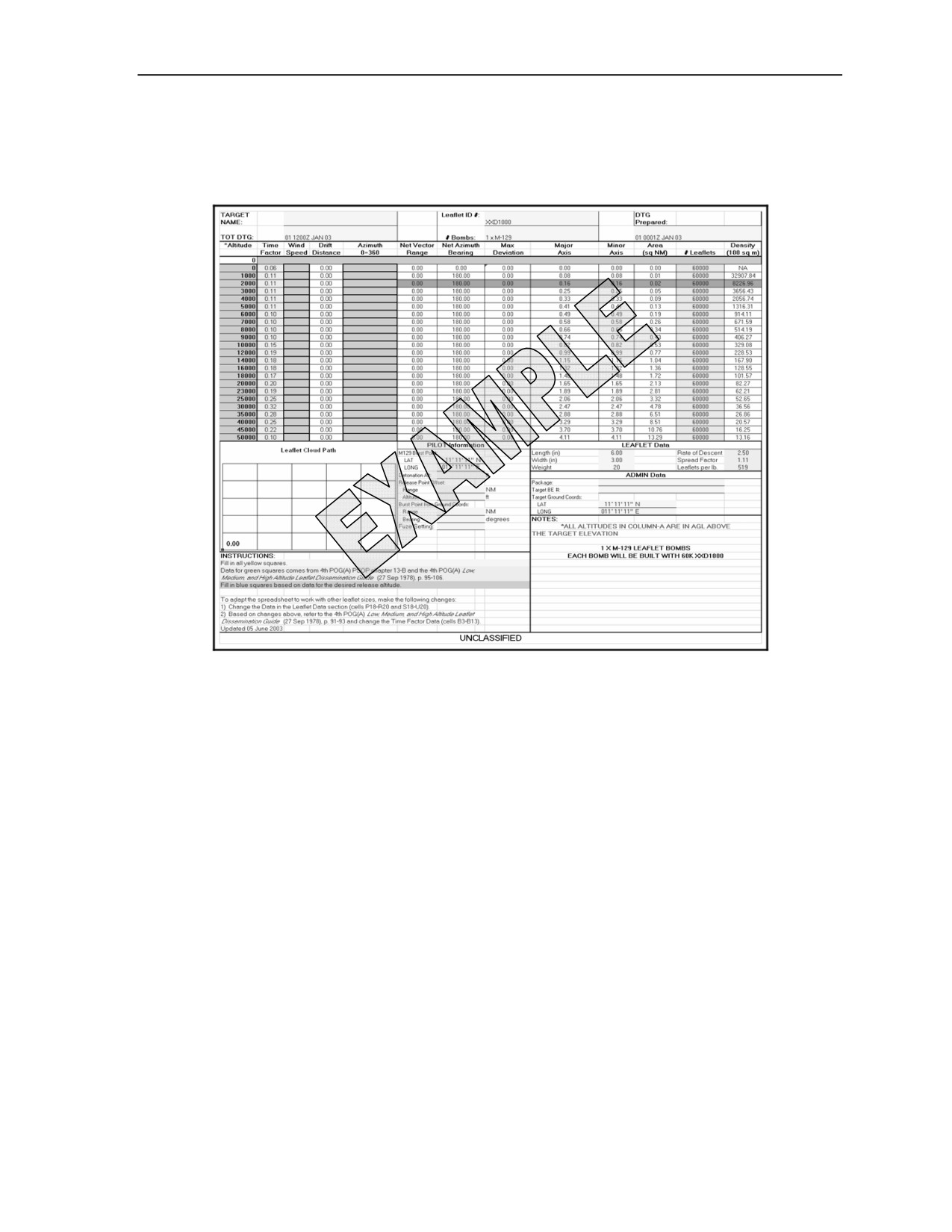
work sheet used for leaflet dissemination planning. Figure D-7 is an example of the electronic Excel
spreadsheet that automatically calculates the drop parameters when the pertinent data is input. Although the
electronic version is normally available to PSYOP Soldiers, all PSYOP Soldiers should know the manual
process in case the electronic version is unavailable for use.
Figure D-7. Example of the electronic wind calculation sheet
D-26. There is one last caution PSYOP planners should address when planning a mission. Attention must
be paid to the possibility of violating sovereign international boundaries during leaflet operations.
Notification and coordination must be made whenever there is a possibility that either aircraft or leaflets
may cross into or land in a third country.
AIRCRAFT
D-27. Most DOD fixed- and rotary-wing platforms can be used to disseminate leaflets. Leaflets can be
disseminated by leaflet bomb, leaflet box, trash bag, and by hand depending on the aircraft type and
tactical situation. Leaflets can be dropped from several different platforms, such as the C-130, F-16, B-52,
and A-10. Several cargo helicopters may also be used with caution (rotor and intake issues), such as the
UH-60, CH-46, and CH-47. All four fixed-wing aircraft are certified to drop leaflets. The USAF and USN
have a variety of aircraft capable of performing M129/PDU-5/B leaflet bomb missions. The new leaflet
bomb (PDU-5/B), a more versatile and stronger steel-shell canister type, can be dropped by Air Force
F-16s and Navy/Marine FA-18s operating from aircraft carriers. This newer leaflet bomb replaces the
World War II-era M129 leaflet bombs (fiberglass type), which may break apart during high-speed turns or
carrier launches. The C-130 and all helicopters use the static-line box-drop method to disseminate leaflets.
D-28. The C-130 is used when there is minimal threat in the area and the airplane can fly at low altitudes.
This method is beneficial because the lower the drop, the less effect wind gusts will have on the flight of
the leaflet. The C-130 has the ability to carry well over 1 million leaflets in 20 boxes. PSYOP Soldiers may
be required to help the loadmaster in the responsibilities of hooking and kicking the boxes out of the
airplane. The airplane should fly at 190 knots when the leaflets are released. Speeds greater than 190 knots
30 August 2007
FM 3-05.301
D-11
Appendix D
cause the leaflets to get sucked back into the airplane. The release altitude on a C-130 drop is always left
up to the pilots flying the mission. They know the safety issues of the aircraft and the current intelligence
and air threat from the target area. In the meeting 48 hours out, the OIC or noncommissioned officer in
charge of the leaflet mission should discuss what the optimum altitude should be with the navigator. They
should determine a “no higher than” and a “no lower than” limit. Once these altitudes are determined, they
can be used for planning purposes. The actual altitude will not be known until the winds are determined for
the actual day of the drop. On the mission day, the altitude that suits the required leaflet coverage is used.
D-29. Aircraft, such as the F-16, A-10, F/A-18, and B-52, will be used when the target is in a higher threat
area and the airplanes must fly at higher altitudes to avoid air defenses. This method does not affect the
leaflet planning directly because these aircraft drop either the M129 or PDU-5/B leaflet bombs. The M129
and PDU-5/B use an altitude fuse that detonates the bomb at a predetermined burst altitude. Thus, the
aircraft can fly at the altitude desired to avoid the threat, and the leaflet bombs are set to detonate at the
altitude the leaflet OIC and aircraft commander determine will give proper target coverage. In planning the
F-16, A-10, F/A-18, or B-52 drop, an important fact to know is that the leaflet bombs can be stored after
they have been packed, and the fuse does not have to be set by munitions personnel until it is loaded onto
the airplane. This information is helpful to the leaflet OIC and other personnel involved in the mission. The
personnel can pack the bomb as soon as the leaflets are printed and do not have to wait until the day of the
mission, as long as they mark the bomb with paint using the leaflet number, the target desired, and the
number of leaflets packed. However, prior to packing the bomb, Air Force personnel must rig the bomb
with detonation cord to blow the casing apart upon release, and then seal the bomb and attach the tail fin
assembly. Once the fuse is set and the airplanes are off the ground, the fuse cannot be reset—if the winds
change in flight, the distance the bomb travels before detonation cannot be changed. The PSYOP planner
tells the pilot the latitude and longitude, the desired approach azimuth, and the burst altitude. The pilot
determines everything else.
Leaflet Bomb Preparation
Just before Operation IRAQI FREEDOM began, PSYOP Soldiers were assigned to a
USN aircraft carrier for leaflet bomb preparation. USN personnel were quick to
understand the effectiveness of such operations and requested ad hoc instruction on
preparing leaflet bombs for operation. Carriers have machinists and other personnel
who can fabricate equipment such as packing rings that are necessary to build leaflet
bombs. Once specific, detailed instruction had been given regarding the loading of
both types of leaflet bombs, Navy personnel could simply order leaflet bomb casings
through their normal supply channels and prepare their own leaflet bombs. PSYOP
planners needed only to get missions approved, and provide the Navy support
elements with the desired number of leaflets, target location, burst altitude, and
desired approach azimuth. Eventually, aircraft personnel were able to use their own
on-board print facilities to print and cut leaflets to the correct size using the correct
weight paper. The USN was then empowered and enabled to carry out the mission,
freeing PSYOP Soldiers to concentrate on other missions.
D-30. Rotary-wing aircraft, such as the CH-47, UH-60, and others, can be used to disseminate leaflets.
Leaflet boxes, trash bags, and simply tossing leaflets out by hand are some common dissemination methods
used. In some cases, the aircrew will not allow static-line leaflet boxes to be used because of the risk of the
boxes (after deployment) being sucked up into the rotors due to the rotor wash. Personnel should check
with the aircrew or liaison prior to mission execution.
D-31. Trash bags can be a means of dissemination as well. This method alleviates the risk of anything
attached to the aircraft coming into contact with the rotors. However, this is the least accurate and efficient
method and should be used only when no other means are available.
D-12
FM 3-05.301
30 August 2007

Aerial Dissemination
D-32. Using trash bags is a field-expedient dissemination method and should not be relied upon as a
primary means of dissemination. To use this method, personnel should—
Untie the opening of the trash bag.
With one hand on the opening, push forward with the other hand from the bottom toward the
opening, turning the trash bag inside out.
Once emptied, secure the trash bag out of the way and continue.
D-33. Improvised leaflet boxes are another method of disseminating leaflets from rotary-wing aircraft. The
boxes in which the leaflets are distributed after printing can be modified into field-expedient leaflet boxes
with a capacity of 20,000 to 30,000 leaflets. Meal, ready to eat (MRE) boxes, though not preferred because
of their extremely sturdy construction, can also be modified to disseminate leaflets. However, MRE boxes
only hold 10,000 to 15,000 leaflets. As with the trash bags, this method alleviates the risk of anything
attached to the aircraft encountering the rotors. In addition, the boxes add a measure of protection for the
leaflets and prevent leaflets from coming loose inside the aircraft. However, like the trash bag, this is only
a field-expedient method and should not be the primary method used. To use this method, personnel
should—
Hold the box by the handle at the edge of the door.
On command execute a quick jerking motion causing the bottom of the box to open and the
leaflets to disseminate.
Once emptied, secure the box out of the way and continue.
MK129 LEAFLET DELIVERY SYSTEM
D-34. The MK129E1 and MK129E2 leaflet bombs are commonly obtained through Air Force ordnance
channels. Each leaflet bomb weighs about 52 kilograms (115 pounds) empty and about 100 kilograms (225
pounds) when loaded. The leaflet bomb can carry approximately 60,000 leaflets. Before the leaflets are
placed in the bomb, certified munitions personnel emplace the detonating cord in the seam between the two
halves and install the altitude fuse (Figure D-8). The PSYOP Soldier stacks leaflets by hand into the
bottom half of the MK129 leaflet bomb (Figure D-9, page D-14). It is not necessary to roll the leaflets for
use in the MK129. Air Force munitions personnel will attach the upper half and tail fin assembly, and set
the altitude fuse. Figure D-10, page D-14, shows the MK129 leaflet bombs in final stages of preparation.
Figure D-8. MK129 casing rigged with detonation cord prior to packing
30 August 2007
FM 3-05.301
D-13

Appendix D
Figure D-9. MK129 being packed (mission is painted on casing)
Figure D-10. MK129 leaflet bombs in final stages of preparation
PDU-5/B LEAFLET DELIVERY SYSTEM
D-35. The PDU-5/B leaflet bomb (SUU-76C/B without leaflet payload) is a demilitarized Mk-7 munitions
dispenser canister with tail cone. It is 95 inches long and weighs approximately 140 pounds, with an
interior diameter of 11 inches and a maximum carrying capacity of 152 pounds. When packing the
PDU-5/B, the leaflets must be rolled by hand using techniques described in the following paragraphs. It is
important that the leaflet bomb is balanced from front to rear. If imbalanced, the sudden acceleration of a
carrier launch can cause the bomb to “buck,” possibly causing the casing to strike the underside of the
aircraft wing increasing the risk of catastrophic failure in one or more aircraft components. Consequently,
the PDU-5/B requires exactly 20 properly packed leaflet rolls.
D-14
FM 3-05.301
30 August 2007

Aerial Dissemination
Procedures for Making Leaflet Rolls
D-36. Before making leaflet rolls, personnel ensure that they inspect all equipment for serviceability:
1 x packing ring (11 inches in diameter, 4 inches tall).
3 x steel banding rings (1 x 29 inches, 1 x 18 inches, 1 x 15 inches).
D-37. Personnel ensure that the packing ring is free from any major dents and still holds a circular shape
when placed on a flat surface. Also, personnel ensure that steel banding rings are not warped and bent.
They should be rigid enough to hold leaflets in place, but not so stiff that they cannot be deflected (Figure
D-11).
D-38. Other equipment needed includes the following:
3-Inch brown box tape.
Any type of adhesive tape.
Scale.
NOTE: The PSYOP dissemination team on-site should already have the packing rings and steel
banding rings. If personnel are deploying to a place without a dissemination team already in
place, they must be sure to bring these items with them. If this is not possible, they should
follow the instructions below on how to create the packing ring and steel banding rings.
Figure D-11. Packing ring and steel banding ring
D-39. A packing ring can be made using any material that is sturdy enough not to collapse in on itself when
stood up. Sheet metal is the preferred material; however, stiff plastic or other materials can also be used. Its
dimensions should be cut so that when formed into a circle, the circle’s diameter is 11 inches, and it stands
anywhere from 3 to 4 inches tall. The securing of the metal band to itself can be done using any means
available, so long as it does not interfere with the rolling of leaflets. The ideal dimensions of the ring are 11
inches in diameter, 4 inches tall, and made of 1/16 (0.063 inches thick) sheet metal.
D-40. Banding rings need to be sufficiently rigid to hold leaflets in place, but not so stiff that they cannot
be deflected. Rings made of steel box banding (0.75 inches wide x 0.031 inches thick) work well. Rings
that are made too stiff will not uniformly contact the leaflets inside the packing ring. To reduce the tearing
30 August 2007
FM 3-05.301
D-15
Appendix D
of leaflets, personnel should roll the ends of the banding rings onto themselves. There should be three
banding rings measuring 29 inches, 18 inches, and 15 inches long.
D-41. Personnel follow the steps listed below to make leaflet rolls:
Step 1. Line the inside of the packing ring with 3-inch brown box tape; use adhesive tape to
secure the two ends of the brown box tape together.
Step 2. Place the 29-inch steel banding ring inside the packing ring.
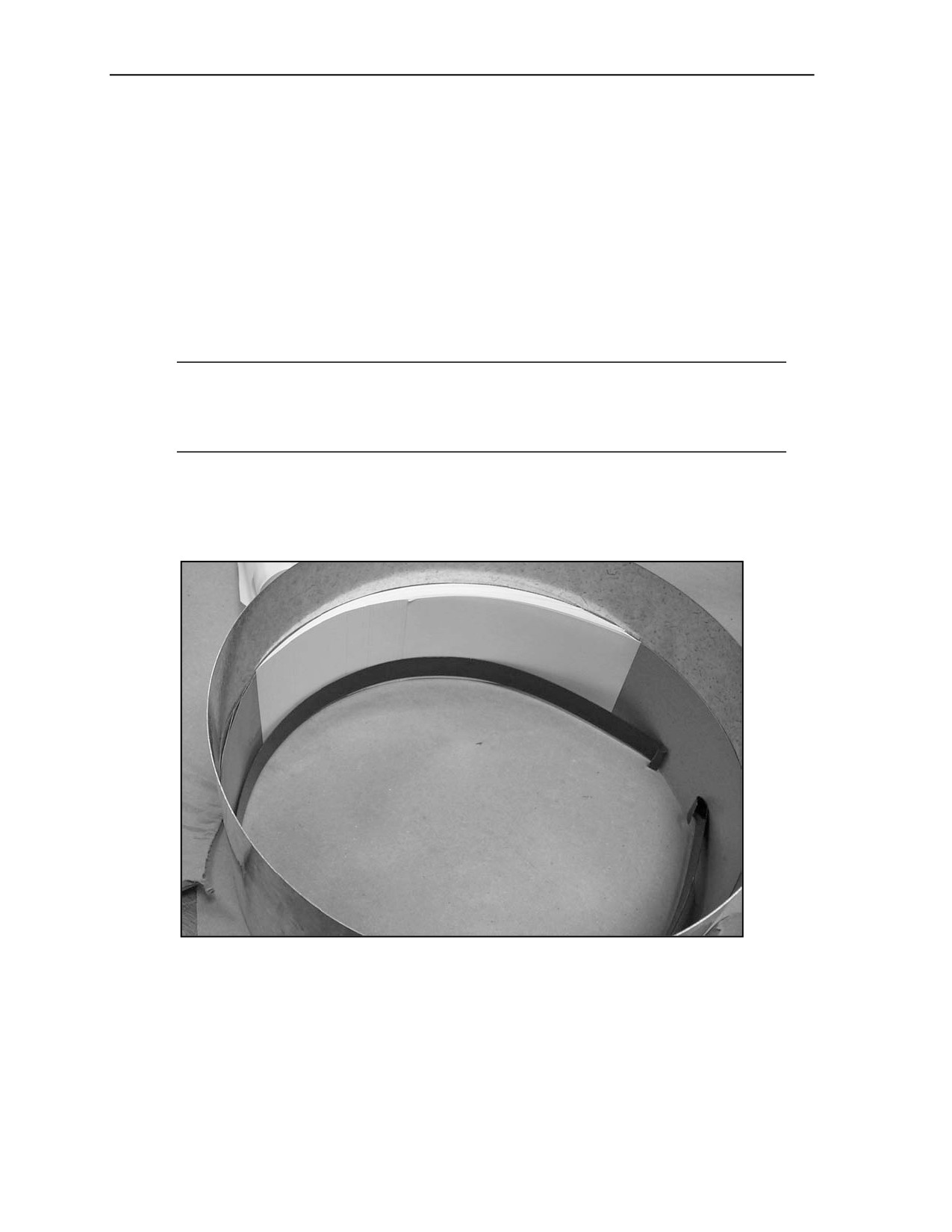
Step 3. Take a small stack of leaflets and fan them so that each leaflet has an exposed edge
(leaflets should have a “stair step” effect); place the leaflets into the packing ring, between the
brown box tape and the steel banding ring (Figure D-12).
Step 4. Continue fanning stacks of leaflets and inserting them into the packing ring. This
procedure should be done in a continuous circle, ensuring that the fanned ends of each new
stack interlock with the fanned ends of the previous stack.
NOTE: As the circle gets tighter, personnel will have to switch out banding rings to allow for
the smaller area. After they remove the shortest banding ring, they will begin to pack the leaflets
by hand. Personnel should always try to pack the leaflet rolls as tightly as possible. There should
be little to no opening left in the center of the roll when it is finished.
Step 5. After the center of the roll has been tightly packed, lift the packing ring three-fourths of
the way off of the leaflet roll. Then locate the seam where the two ends of the brown box tape
overlap, and secure the outer part of the brown packing tape to itself using adhesive tape.
Step 6. Weigh the roll to ensure that it is 7.5 pounds.
Figure D-12. Placement of leaflets in packing ring
D-16
FM 3-05.301
30 August 2007
Aerial Dissemination
Procedures for Loading the PDU-5/B Leaflet Delivery System
D-42. These procedures are for the most common size leaflet (3 x 6 inches). All rolls will be 11 inches in
diameter regardless of the leaflet size. Table D-5 provides information on using different-sized leaflets.
Table D-5. Leaflet sizes and weights
Leaflet Size
Individual Roll Weight
(in Inches)
Rolls Needed
(in Pounds)
3 x 4
20
7.5
3 x 6
20
7.5
4 x 4
15
10
6 x 6
10
15
D-43. Before loading the PDU-5/B, personnel ensure that they inspect all equipment for serviceability:
1 x Cardboard tube (cut into half lengthwise).
2 x Cardboard end caps.
4 x Foam spacers (3 thick and 1 thin).
1 x PDU-5/B.
D-44. Personnel ensure that the equipment is free from cuts, dents, tears, water damage, or anything else
that may impair the function of the equipment. They also ensure the inside of the PDU-5/B is empty. Other
equipment needed includes the following:
Cutting utensil.
Masking tape.
Grease pencil.
NOTE: All items for the PDU-5/B are stored inside of the bomb section. If the tail section has
not already been removed before beginning, personnel should notify an authorized bomb
technician to remove the tail section.
D-45. Personnel follow the steps listed below to load the PDU-5/B Leaflet Delivery System (LDS):
Step 1. Load 20 leaflet rolls into cardboard tube half; ensure that the weight of the tube does not
exceed 152 pounds (Figure D-13, page D-18).
NOTE: When loading the leaflet rolls into the cardboard tube, personnel will be almost out of
room at roll number 19. To get roll number 20 loaded, personnel should have one Soldier brace
one of the sides of the tube and have another Soldier forcefully push the leaflet rolls into the
tube until they all fit. There may be a slight protrusion from either end of the cardboard tube.
Step 2. Cut the brown protective tape on each roll two-thirds the width of the roll (the roll
should be 3 inches wide; the cut should be 2 inches) (Figure D-14, page D-18).
Step 3. Place the other half of the cardboard tube on top of the first half; use masking tape to
secure the two halves together—use five pieces of tape on both sides, spreading out equally
along the length of the seam of the two halves (Figure D-15, page D-18).
NOTE: When the top half of the tube is put on, it does not necessarily have to be flush with the
other half of the tube.
30 August 2007
FM 3-05.301
D-17

Appendix D
Roll #20
Figure D-13. Leaflet rolls
2 Inches
Figure D-14. Brown protective tape
Figure D-15. Cardboard tube placement
D-18
FM 3-05.301
30 August 2007

Aerial Dissemination
Step 4. Place the two cardboard end caps on both sides of the cardboard tube; secure the end
caps to the tube using masking tape (Figure D-16).
Step 5. Using the grease pencil, write the product number of the leaflets in the tube on the top of
the cardboard tube and on both end caps (Figure D-16).
Step 6. Using two Soldiers, load the cardboard tube into the PDU-5/B; ensure cardboard tube is
as far forward in the body of the bomb as possible (Figure D-17).
Step 7. While the cardboard tube is inside the bomb, observe the product number written on the
cardboard end cap; using the grease pencil, write the product number on the side of the
PDU-5/B.
Step 8. Load the foam spacers into the bomb; load the three thick spacers first, then the thin
spacer.
Step 9. Notify bomb technician that the tail section is ready to be attached.
Write product number here
on both end caps.
Figure D-16. Cardboard end cap
Figure D-17. Loading the cardboard tube into the PDU-5/B
30 August 2007
FM 3-05.301
D-19

Appendix D
Step 10. Observe the product number written on the side of the PDU-5/B; using the grease
pencil, write the product number on the top fin of the tail.
NOTE: Tail section will be attached to bomb body when the product number is written on fin.
D-46. Figure D-18 shows technicians attaching a PDU-5/B LDS to an FA-18 Hornet. [Electronic version of
this manual includes a video of the PDU-5/B.]
Figure D-18. Technicians attach a PDU-5/B LDS to an FA-18 Hornet
Procedures for Unloading the PDU-5/B Leaflet Delivery System
D-47. Personnel follow the steps listed below to unload the PDU-5/B LDS:
Step 1. Notify bomb technician that the tail section is ready to be removed.
Step 2. Remove foam spacers from the body of the bomb.
Step 3. Remove cardboard tube containing the leaflet rolls.
NOTE: To get the tube out of the bomb, the bomb technician has to lift the nose of the bomb.
Step 4. Remove cardboard end caps and the top half of the cardboard tube; use masking tape to
repair the cuts made on the brown protective paper of the leaflet rolls.
Step 5. Remove leaflet rolls from the cardboard tube; label each roll with the product number so
that it can be easily identified for future use.
Step 6. Return cardboard tube, cardboard end caps, and foam spacers to the bomb.
Step 7. Notify authorized bomb technician to return tail section to bomb.
STATIC-LINE BOX
D-48. At high altitudes, the use of leaflet bundles or boxes opened by a static line has proven effective. Figure
D-19, page D-21, shows the steps required to prepare boxes for high-altitude, static-line dissemination.
Through use of rollers on the deck of the aircraft, boxes weighing up to 49.9 kilograms can be ejected with
minimum exertion. The box is rolled out of the aircraft, and as the container comes to the end of the static line,
the sides of the box split. In effect, the box is turned inside out, and the leaflets fall away from the empty box.
D-20
FM 3-05.301
30 August 2007

Aerial Dissemination
Step 1
Step 2
Step 3
Cut four 2 1/2- by 3/4-inch holes
Cut two slits connecting the holes on
Place pieces of webbing 2 inches
along the outside edges of the
opposite sides of the box.
wide through the holes, one
bottom of the box in the middle of
lengthwise and one crosswise.
each side.
Step 4
Step 5
Step 6
Place a
3- or
4-inch strip of
Flip the box over and cut the corners
Place two strips of tape across
masking tape over the webbing
from the top to about three-fourths of
each corner.
outside the box.
the way down.
Step 7
Step 8
Step 9
Fill the box with leaflets and run
Run the metal cable connector at
Cut a hole in the center of the
the static line through the
one end of the static line through the
box top and pull through enough
webbing loops.
loop at the opposite end and pull
of the static line to connect to the
tight. Fold the static line S-fashion
cable. Close the box and seal the
and lay it on top of the leaflets.
flaps with tape.
Figure D-19. Steps in the assembly of the static-line box
30 August 2007
FM 3-05.301
D-21
This page intentionally left blank.
Appendix E
Use of Interpreters
There are over 6,800 spoken languages; ninety-six percent of them are spoken by
four percent of the population. The use of interpreters is often the best or only option
to communicate effectively. The proper use and supervision of interpreters can play a
decisive role in the mission. Properly utilized, an effective and professional
interpreter can greatly facilitate interaction with foreign audiences, clearly
communicating the intended PSYOP message, gathering valuable information, and
adding credibility to the PSYOP effort.
Interpreter Example
In early spring of
1999, four Soldiers from A Company, 8th PSYOP Battalion
(Airborne), deployed to the Republic of Yemen in support of humanitarian demining
operations. Tasked with training a team of Yemeni military officers in developing and
conducting mine awareness campaigns and leading the setup of a Yemeni product
development center, the PSYOP team relied heavily on their interpreter/translator,
Yassin. Highly educated and demonstrating superb fluency in English and Arabic,
Yassin worked tirelessly, translating over 80 hours of classes and interpreting day in
and day out for the entire PSYOP team inside and outside the classroom. Through
Yassin’s efforts, the PSYOP team was able to establish good rapport with the
Yemeni officers and conduct effective training. By the end of the deployment, the
joint efforts of the PSYOP team and their Yemeni counterparts had produced a
national mine awareness campaign and had begun direct support of the regional
demining units, traveling to area villages prior to demining operations to educate and
inform the local populace. The PSYOP mission was judged to be a military and
diplomatic success, in no small part due to the talents and hard work of the
interpreter, Yassin.
INTERPRETER SELECTION
E-1. In some operational or training settings abroad, PSYOP Soldiers are not faced with the problem of
selecting an interpreter—they simply are assigned one by the chain of command or the host government. In
other cases, interpreters are chosen from a pool provided by the host government. Finally, in many
operational situations, interpreters are hired from the general HN population. Whatever the case, the
following guidelines are critical to successful mission accomplishment. The PSYOP Soldier can use this
opportunity to influence the outcome of the mission effectively. Interpreters should be selected based on
the criteria discussed in the following paragraphs.
NATIVE SPEAKER
E-2. The interpreters should be native speakers of the socially or geographically determined dialect. Their
speech, background, and mannerisms should be completely acceptable to the TA so that no attention is
given to the way they talk, only to what they say.
SOCIAL STATUS
E-3. In some situations and cultures, interpreters may be limited in their effectiveness with a TA if their
social standing is considerably lower than that of the audience. Examples include significant differences in
30 August 2007
FM 3-05.301
E-1
Appendix E
military rank or membership in an ethnic or religious group. Regardless of the PSYOP Soldier’s personal
feelings on social status, he should remember the job is to accomplish the mission, not to act as an agent
for social reform. The PSYOP Soldier must accept local prejudices as a fact of life.
ENGLISH FLUENCY
E-4. An often-overlooked consideration is how well the interpreter speaks English. As a rule, if the
interpreter understands the PSYOP Soldier and the PSYOP Soldier understands the interpreter, then the
interpreter’s command of English should be satisfactory. The PSYOP Soldier can check that
“understanding” by asking the interpreter to paraphrase, in English, something the PSYOP Soldier said; the
PSYOP Soldier then restates the interpreter’s comments to ensure that they are in sync. In addition, the
interpreter must be able to convey the information expressed by the interviewee or TA.
INTELLECT
E-5. The interpreter should be quick, alert, and responsive to changing conditions and situations. He must
be able to grasp complex concepts and discuss them without confusion in a reasonably logical sequence.
Although education does not equate to intelligence, generally speaking, the better educated the interpreter,
the better he will perform due to increased exposure to diverse concepts.
TECHNICAL ABILITY
E-6. In certain situations, the PSYOP Soldier may need an interpreter with technical training or
experience in special subject areas. This type of interpreter will be able to translate the “meaning” as well
as the “words.” For instance, if the subject is very technical or specialized, with terms such as nuclear
physics, background knowledge is useful.
RELIABILITY
E-7. The PSYOP Soldier should beware of the potential interpreter who arrives late for the interview.
Throughout the world, the concept of time varies widely. In many less-developed countries, time is
relatively unimportant. The PSYOP Soldier should make sure the interpreter understands the culture’s
perception of punctuality.
GENDER, AGE, RACE, CULTURE, ETHNICITY, AND NATIONALITY
E-8. Gender, age, race, culture, ethnicity, and nationality have the potential to seriously impact the
interpreter’s effectiveness. One example is the status of females in Muslim society. In predominantly
Muslim countries, cultural prohibitions may render a female interpreter ineffective in certain
circumstances. Another example is the Balkans, where the ethnic divisions may limit the effectiveness of
an interpreter from outside the TA’s group. Since traditions, values, and biases vary from country to
country, the in-country assets or area studies should be checked for specific taboos or favorable
characteristics.
COMPATIBILITY
E-9. The PSYOP Soldier and the interpreter must work as a team. The TA is quick to recognize
personality conflicts between the PSYOP Soldier and the interpreter, which can undermine the
effectiveness of the communication effort. If possible, when selecting an interpreter, the PSYOP Soldier
should look for compatible traits and strive for a harmonious working relationship.
E-10. If several qualified interpreters are available, the PSYOP Soldier should select at least two. This
practice is of particular importance if the interpreter will be used during long conferences or courses of
instruction. The exhausting nature of these types of jobs makes approximately four hours of active
interpreting about the maximum for peak efficiency. Whatever the mission, with two or more interpreters,
one can provide quality control and assistance to the active interpreter. Additionally, this technique is
useful when conducting coordination or negotiation meetings, as one interpreter is used in an active role
E-2
FM 3-05.301
30 August 2007
Use of Interpreters
and the other pays attention to the body language and side conversations of the others present. Many times,
the PSYOP Soldier gains important side information that assists in negotiations from listening to what
others are saying among themselves outside the main discussion.
SECURITY CONCERNS
E-11. If the interpreter is not U.S. military or a U.S. citizen, his first loyalty is presumably to his country or
subgroup and not to the United States. The security implications of using local nationals are clear. The
PSYOP Soldier must be cautious about what information he gives his interpreter. The PSYOP Soldier must
always keep possible security issues in mind. Certain tactical situations may require the use of uncleared
indigenous personnel as “field expedient” interpreters. Commanders should be aware of the increased
security risk involved in using such personnel and carefully weigh the risk versus the potential gain. If
uncleared interpreters are used, any sensitive information should be kept to a minimum.
E-12. Interpreters must be honest and free from unfavorable notoriety among the local inhabitants. Their
reputation or standing in the community should be such that persons of higher rank and standing do not
intimidate them.
RAPPORT ESTABLISHMENT
E-13. The interpreter is a vital link to the TA. Without a supportive interpreter, the mission could be in
jeopardy. Mutual respect and understanding are essential to effective teamwork. The PSYOP Soldier must
establish rapport early in the relationship and maintain rapport throughout the joint effort. Personal contact
is key to establishing rapport.
E-14. The PSYOP Soldier begins the process of establishing rapport before he meets the interpreter for the
first time. The Soldier should do his homework. Most foreigners are reasonably knowledgeable about the
United States. The PSYOP Soldier should do some basic research on the HN. Useful information may
include population, geography, ethnic groups, political system, prominent political figures, monetary
system, business, agriculture, and exports. A good general outline can be obtained from a recent almanac
or encyclopedia. More detailed information is available in the area handbook for the country, and current
newspapers and magazines.
E-15. The PSYOP Soldier should understand the interpreter’s background. He should show a genuine
concern for the interpreter’s family, aspirations, career, education, and so on. Many cultures place great
emphasis on family over career, so the PSYOP Soldier should start with understanding the interpreter’s
home life. He should also research cultural traditions to understand the interpreter and the HN better.
Although the PSYOP Soldier should gain as much information on culture as possible before entering an
HN, his interpreter can be a valuable source to fill gaps.
E-16. The PSYOP Soldier should gain the interpreter’s trust and confidence before addressing sensitive
issues, such as religion, likes, dislikes, and prejudices. The PSYOP Soldier should approach these areas
carefully and tactfully. Although deeply personal beliefs may be very revealing and useful in the
professional relationship, the PSYOP Soldier must gently and tactfully gather that information from his
interpreter.
ORIENTATION
E-17. Early in the relationship with interpreters, the PSYOP Soldier should make sure interpreters are
briefed on their duties and responsibilities. The PSYOP Soldier should orient the interpreters as to the
nature of their duties, standards of conduct expected, techniques of interview to be used, and any other
requirements necessary. The orientation may include the following:
Current tactical situation.
Background information obtained on the source, interviewee, or TA.
Specific objectives for the interview, meeting, or interrogation.
Method of interpretation to be used—simultaneous or alternate: Simultaneous (interpreter listens
and translates at the same time).
30 August 2007
FM 3-05.301
E-3
Appendix E
Alternate (interpreter listens to an entire phrase, sentence, or paragraph, then translates during
natural pauses).
Conduct of the interview, lesson, or interrogation.
Need for interpreters to avoid injecting their own personality, ideas, or questions into the
interview.
Need for interpreter to inform interviewer (PSYOP Soldier) of inconsistencies in language used
by interviewee. During interrogations or interviews, this information is used as part of the
assessment of the information obtained from the individual. For example, someone claims to be
a college professor, yet speaks like an uneducated person.
Physical arrangements of site, if applicable.
Possible need for interpreter to assist in after action reviews or assessments.
INTERPRETER TRAINING
E-18. As part of the initial training with the interpreter, the PSYOP Soldier should tactfully convey that the
instructor or interviewer must always direct the interview or lesson. The PSYOP Soldier should put the
interpreter’s role in proper perspective and stress the interpreter’s importance as a vital communication link
between the PSYOP Soldier and the TA. The PSYOP Soldier should appeal to the interpreter’s
professional pride by clearly describing how the quality and quantity of the information sent and received
are directly dependent upon the interpreter’s skills. The PSYOP Soldier should mention how the interpreter
functions solely as a conduit between the PSYOP Soldier and the subject.
E-19. The PSYOP Soldier must be aware that some interpreters, because of cultural differences, may
attempt to “save face” by purposely concealing their lack of understanding. They may attempt to translate
what they think the PSYOP Soldier said or meant without asking for a clarification or vice versa. Because
this situation can result in misinformation and confusion and can impact credibility, the PSYOP Soldier
should let the interpreter know that when in doubt he should always ask for clarification. The PSYOP
Soldier should create a safe environment for this situation as early in the relationship as possible.
E-20. Other points for the PSYOP Soldier to cover while orienting and training the interpreter are—
Importance of the training, interview, or interrogation.
Specific objectives of the training, interview, or interrogation, if any.
Outline of lesson or interview questions, if applicable.
Background information on the interviewee or TA.
Briefing, training, or interview schedules. Double or triple time may be needed when using an
interpreter to convey the same information. For that reason, the interpreter may be helpful in
scheduling enough time.
Copy of the briefing, questions, or lesson plan, if applicable. Special attention should be given
to develop language proficiency in the technical fields in which the interpreters will be
employed. In general, a copy of the material gives the interpreter time to look up unfamiliar
words or ask questions to clarify anything confusing.
Copies of handout material, if applicable.
General background information on subject.
Glossary of terms, if applicable.
FORCE PROTECTION
E-21. The interpreter must be thought of and treated as a member of the team. Just as force protection is
considered for team members, so should it be for interpreters. Alternating work schedules and varying
routes when going to and from work will help increase their safety. Interpreters should receive instruction
on antiterrorism and force protection. Interpreters should also receive individual equipment like that of the
other team members. When possible, interpreters should receive body armor, uniforms, and helmet. They
should also be taught how to use communication systems.
E-4
FM 3-05.301
30 August 2007
Use of Interpreters
INTERVIEW PREPARATION
E-22. The PSYOP Soldier selects an appropriate site for the interview. He positions and arranges physical
setup of the area. When conducting interviews with very important persons or individuals from different
cultures, this arrangement can be significant.
E-23. The PSYOP Soldier instructs the interpreters to mirror the PSYOP Soldier’s tone and personality of
speech. He instructs the interpreters not to interject their own questions or personality. He also instructs the
interpreters to inform him if they notice any inconsistencies or peculiarities from sources.
INTERVIEW CONDUCT
E-24. Whether conducting an interview or presenting a lesson, the PSYOP Soldier should avoid
simultaneous translations; that is, both the Soldier and the interpreter talking at the same time. The PSYOP
Soldier should speak for a minute or less in a neutral, relaxed manner, directly to the individual or
audience. The interpreter should watch the PSYOP Soldier carefully and, during the translation, mimic the
PSYOP Soldier’s body language and interpret the verbal meaning. The PSYOP Soldier should observe the
interpreter closely to detect any inconsistencies between the interpreter’s and PSYOP Soldier’s manners.
The PSYOP Soldier must be aware not to force the interpreter into literal translation by being too brief.
The PSYOP Soldier should present one major thought in its entirety and allow the interpreter to reconstruct
it in his language and culture.
E-25. Although the interpreter does some editing as a function of the interpreting process, he must transmit
the exact meaning without additions or deletions. As previously mentioned, the PSYOP Soldier should
insist that the interpreter always ask for clarification, before interpreting, whenever not absolutely certain
of the PSYOP Soldier’s meaning. However, the PSYOP Soldier should be aware that a good interpreter,
especially if he is local, can be invaluable in translating subtleties and hidden meanings.
E-26. During an interview or lesson, if questions are asked, the interpreter should immediately relay them
to the PSYOP Soldier for an answer. The interpreter should never attempt to answer a question, even
though he may know the correct answer. Additionally, neither the PSYOP Soldier nor interpreter should
correct the other in front of an interviewee or class—all differences should be settled away from the subject
or audience.
E-27. Just as establishing rapport with the interpreter is vitally important, establishing rapport with
interview subjects or the TA is equally important. The PSYOP Soldier and the interpreter should
concentrate on rapport. To establish rapport, the subjects or audiences should be treated as mature,
important human beings who are capable and worthy.
COMMUNICATION TECHNIQUES
E-28. An important first step for the PSYOP Soldier in communicating in a foreign language is to polish
his English language skills. These skills are important even if no attempt is made to learn the indigenous
language. The clearer the Soldier speaks in English, including diction, the easier it is for the interpreter to
translate. Other factors to consider include use of profanity, slang, and colloquialisms. In many cases, such
expressions cannot be translated. Even those that can be translated do not always retain the desired
meaning. Military jargon and terms such as “gee whiz” or “golly” are hard to translate. In addition, if a
technical term or expression must be used, the PSYOP Soldier must be sure the interpreter conveys the
proper meaning in the target language. The PSYOP Soldier should speak in low context, simple sentences.
For instance, he may want to add words usually left off, such as “air” plane, to ensure the meaning is
obvious and he is not talking about the Great Plains or a wood plane.
E-29. When the PSYOP Soldier is speaking, he must think about what he wants to say. He should break
his thoughts down into logical bits, and say them a small piece at a time using short, simple words and
sentences and low context, which can be translated quickly and easily. As a rule, the PSYOP Soldier
should never say more in one sentence than he can easily repeat word for word immediately after saying it.
Each sentence should contain a complete thought without being verbose.
30 August 2007
FM 3-05.301
E-5
Appendix E
Transitional Phrases and Qualifiers
E-30. Transitional phrases and qualifiers often confuse and waste valuable time. Examples are “for
example,” “in most cases,” “maybe,” and “perhaps.” The PSYOP Soldier should be cautious about using
American humor. Cultural and language differences can lead to misinterpretations by foreigners. The
PSYOP Soldier should determine early on what the interpreter finds easiest to understand and translate
meaningfully. In summary, the PSYOP Soldier should—
Keep the entire presentation as simple as possible.
Use short sentences and simple words (low context).
Avoid idiomatic English.
Avoid tendency toward flowery language.
Avoid slang and colloquial expressions.
E-31. Whenever possible, the PSYOP Soldier should identify any cultural restrictions before interviewing,
instructing, or conferring with particular foreign nationals. For instance, when is it proper to stand, sit, or
cross one’s legs? Gestures, being learned behavior, vary from culture to culture. The interpreter should be
able to relate a number of these cultural restrictions, which, whenever possible, should be observed in
working with the particular group or individual.
Dos and Don’ts
E-32. The following are some dos and don’ts for the PSYOP Soldier to consider while working with an
interpreter. The PSYOP Soldier should—
Position the interpreter by his side (or even a step back). This method keeps the subject or
audience from shifting its attention or from fixating on the interpreter and not on the PSYOP
Soldier.
Always look at and talk directly to the subject or audience. Guard against the tendency to talk to
the interpreter.
Speak slowly and clearly. Repeat as often as necessary.
Speak to the individual or group with culturally appropriate tone, gestures, and body language.
Considerable nonverbal meaning can be conveyed through voice and body movements.
Encourage the interpreter to reflect the PSYOP Soldier’s tone and body language.
Periodically check the interpreter’s accuracy, consistency, and clarity. Have another American,
fluent enough in the language, sit in on a lesson or interview to make sure the translation is not
distorted, intentionally or unintentionally. Another way to be sure is to learn the target language
so that the interpreter’s loyalty and honesty can be personally checked.
Check with the audience whenever misunderstandings are suspected and clarify immediately.
Using the interpreter, ask questions to elicit answers that will tell whether the point is clear. If not
clear, rephrase the instruction differently and illustrate the point again. Use repetition and examples
whenever necessary to facilitate learning. If the class asks few questions, it may mean the
instruction is “over the heads” of the audience or the message is not clear to the audience.
Make the interpreter feel like a valuable member of the team. Give the interpreter recognition
commensurate with the importance of his contribution.
E-33. The PSYOP Soldier should not—
Address the subject or audience in the third person through the interpreter. Avoid saying, “Tell
them I’m glad to be their instructor.” Instead say, “I’m glad to be your instructor.” Address the
subject or audience directly.
Make side comments to the interpreter that he should not translate. This action usually creates
the wrong atmosphere for communication.
Be a distraction while the interpreter is translating and the subject or audience is listening. The
PSYOP Soldier should not pace the floor, write on the blackboard, teeter on the lectern, drink
beverages, or carry on any other distracting activity while the interpreter is actually translating.
E-6
FM 3-05.301
30 August 2007

Appendix F
Weights, Measures,
and Conversion Tables
Tables F-1 through F-5, pages F-1 and F-2, show metric units and their U.S.
equivalents. Tables F-6 through F-15, pages F-2 through F-5, are conversion tables.
Table F-1. Linear measure
Unit
Other Metric Equivalent
U.S. Equivalent
1 centimeter
10 millimeters
0.39 inch
1 decimeter
10 centimeters
3.94 inches
1 meter
10 decimeters
39.37 inches
1 decameter
10 meters
32.8 feet
1 hectometer
10 decameters
328.08 feet
1 kilometer
10 hectometers
3,280.8 feet
Table F-2. Liquid measure
Unit
Other Metric Equivalent
U.S. Equivalent
1 centiliter
10 milliliters
0.34 fluid ounce
1 deciliter
10 centiliters
3.38 fluid ounces
1 liter
10 deciliters
33.81 fluid ounces
1 decaliter
10 liters
2.64 gallons
1 hectoliter
10 deciliters
26.42 gallons
1 kiloliter
10 hectoliters
264.18 gallons
Table F-3. Weight
Unit
Other Metric Equivalent
U.S. Equivalent
1 centigram
10 milligrams
0.15 grain
1 decigram
10 centigrams
1.54 grains
1 gram
10 decigrams
0.035 ounce
1 decagram
10 grams
0.35 ounce
1 hectogram
10 decigrams
3.52 ounces
1 kilogram
10 hectograms
2.2 pounds
1 quintal
100 kilograms
220.46 pounds
1 metric ton
10 quintals
1.1 short tons
30 August 2007
FM 3-05.301
F-1

Appendix F
Table F-4. Square measure
Unit
Other Metric Equivalent
U.S. Equivalent
1 square centimeter
100 square millimeters
0.155 square inch
1 square decimeter
100 square centimeters
15.5 square inches
1 square meter (centaur)
100 square decimeters
10.76 square feet
1 square decameter (are)
100 square meters
1,076.4 square feet
1 square hectometer (hectare)
100 square decameters
2.47 acres
1 square kilometer
100 square hectometers
0.386 square mile
Table F-5. Cubic measure
Unit
Other Metric Equivalent
U.S. Equivalent
1 cubic centimeter
1,000 cubic millimeters
0.06 cubic inch
1 cubic decimeter
1,000 cubic centimeters
61.02 cubic inches
1 cubic meter
1,000 cubic decimeters
35.31 cubic feet
Table F-6. Temperature
Convert From
Convert To
Fahrenheit
Celsius
Subtract 32, multiply by 5, and divide by 9
Celsius
Fahrenheit
Multiply by 9, divide by 5, and add 32
Table F-7. Approximate conversion factors
To Change
To
Multiply By
To Change
To
Multiply By
Inches
Centimeters
2.540
Ounce-inches
Newton-meters
0.007062
Feet
Meters
0.305
Centimeters
Inches
3.94
Yards
Meters
0.914
Meters
Feet
3.280
Miles
Kilometers
1.609
Meters
Yards
1.094
Square inches
Square
6.451
Kilometers
Miles
0.621
centimeters
Square feet
Square meters
0.093
Square
Square inches
0.155
centimeters
Square yards
Square meters
0.836
Square meters
Square feet
10.76
Square miles
Square
2.590
Square meters
Square yards
1.196
kilometers
Acres
Square
0.405
Square
Square miles
0.386
hectometers
kilometers
Cubic feet
Cubic meters
0.028
Square
Acres
2.471
hectometers
F-2
FM 3-05.301
30 August 2007
Weights, Measures,
and Conversion Tables
Table F-7. Approximate conversion factors (continued)
To Change
To
Multiply By
To Change
To
Multiply By
Cubic yards
Cubic meters
0.765
Cubic meters
Cubic feet
35.315
Fluid ounces
Millimeters
29.573
Cubic meters
Cubic yards
1.308
Pints
Liters
0.473
Millimeters
Fluid ounces
0.034
Quarts
Liters
0.946
Liters
Pints
2.113
Gallons
Liters
3.785
Liters
Quarts
1.057
Ounces
Grams
28.349
Liters
Gallons
0.264
Pounds
Kilograms
0.454
Grams
Ounces
0.035
Short tons
Metric tons
0.907
Kilograms
Pounds
2.205
Pounds-feet
Newton-meters
1.356
Metric tons
Short tons
1.102
Pounds-inches
Newton-meters
0.11296
Nautical miles
Kilometers
1.852
Table F-8. Area
To Change
To
Multiply By
To Change
To
Multiply By
Square
Square inches
0.00155
Square inches
Square
645.16
millimeters
millimeters
Square
Square inches
9.155
Square inches
Square
6.452
centimeters
centimeters
Square meters
Square inches
1,550
Square inches
Square meters
0.00065
Square meters
Square feet
10.764
Square feet
Square meters
0.093
Square meters
Square yards
1.196
Square yards
Square meters
0.836
Square
Square miles
0.386
Square miles
Square
2.59
kilometers
kilometers
Table F-9. Volume
To Change
To
Multiply By
To Change
To
Multiply By
Cubic
Cubic inches
0.061
Cubic inches
Cubic
16.39
centimeters
centimeters
Cubic meters
Cubic feet
35.31
Cubic feet
Cubic meters
0.028
Cubic meters
Cubic yards
1.308
Cubic yards
Cubic meters
0.765
Liters
Cubic inches
61.02
Cubic inches
Liters
0.016
Liters
Cubic feet
0.035
Cubic feet
Liters
28.32
Table F-10. Capacity
To Change
To
Multiply By
To Change
To
Multiply By
Milliliters
Fluid drams
0.271
Fluid drams
Milliliters
3.697
Milliliters
Fluid ounces
0.034
Fluid ounces
Milliliters
29.57
Liters
Fluid ounces
33.81
Fluid ounces
Liters
0.030
Liters
Pints
2.113
Pints
Liters
0.473
Liters
Quarts
1.057
Quarts
Liters
0.946
Liters
Gallons
0.264
Liters
Gallons
3.785
30 August 2007
FM 3-05.301
F-3

Appendix F
Table F-11. Statute miles to kilometers and nautical miles
Statute Miles
Kilometers
Nautical Miles
Statute Miles
Kilometers
Nautical Miles
1
1.61
0.86
60
96.60
52.14
2
3.22
1.74
70
112.70
60.83
3
4.83
2.61
80
128.80
69.52
4
6.44
3.48
90
144.90
78.21
5
8.05
4.35
100
161.00
86.92
6
9.66
5.21
200
322.00
173.80
7
11.27
6.08
300
483.00
260.70
8
12.88
6.95
400
644.00
347.60
9
14.49
7.82
500
805.00
434.50
10
16.10
8.69
600
966.00
521.40
20
32.20
17.38
700
1127.00
608.30
30
48.30
26.07
800
1288.00
695.20
40
64.40
34.76
900
1449.00
782.10
50
80.50
43.45
1000
1610.00
869.00
Table F-12. Nautical miles to kilometers and statute miles
Nautical Miles
Kilometers
Statute Miles
Nautical Miles
Kilometers
Statute Miles
1
1.85
1.15
60
111.00
69.00
2
3.70
2.30
70
129.50
80.50
3
5.55
3.45
80
148.00
92.00
4
7.40
4.60
90
166.50
103.50
5
9.25
5.75
100
185.00
115.00
6
11.10
6.90
200
370.00
230.00
7
12.95
8.05
300
555.00
345.00
8
14.80
9.20
400
740.00
460.00
9
16.65
10.35
500
925.00
575.00
10
18.50
11.50
600
1110.00
690.00
20
37.00
23.00
700
1295.00
805.00
30
55.50
34.50
800
1480.00
920.00
40
74.00
46.00
900
1665.00
1033.00
50
92.50
57.50
1000
1850.00
1150.00
Table F-13. Kilometers to statute and nautical miles
Kilometers
Statute Miles
Nautical Miles
Kilometers
Statute Miles
Nautical Miles
1
0.62
0.54
60
37.28
32.38
2
1.24
1.08
70
43.50
37.77
3
1.86
1.62
80
49.71
43.17
4
2.49
2.16
90
55.93
48.56
5
3.11
2.70
100
62.14
53.96
F-4
FM 3-05.301
30 August 2007

Weights, Measures,
and Conversion Tables
Table F-13. Kilometers to statute and nautical miles (continued)
Kilometers
Statute Miles
Nautical Miles
Kilometers
Statute Miles
Nautical Miles
6
3.73
3.24
200
124.28
107.92
7
4.35
3.78
300
186.42
161.88
8
4.97
4.32
400
248.56
215.84
9
5.59
4.86
500
310.70
269.80
10
6.21
5.40
600
372.84
323.76
20
12.43
10.79
700
434.98
377.72
30
18.64
16.19
800
497.12
431.68
40
24.86
21.58
900
559.26
485.64
50
31.07
26.98
1000
621.40
539.60
Table F-14. Yards to meters
Yards
Meters
Yards
Meters
Yards
Meters
100
91
1000
914
1900
1737
200
183
1100
1006
2000
1828
300
274
1200
1097
3000
2742
400
366
1300
1189
4000
3656
500
457
1400
1280
5000
4570
600
549
1500
1372
6000
5484
700
640
1600
1463
7000
6398
800
732
1700
1554
8000
7212
900
823
1800
1646
9000
8226
Table F-15. Meters to yards
Meters
Yards
Meters
Yards
Meters
Yards
100
109
1000
1094
1900
2078
200
219
1100
1203
2000
2188
300
328
1200
1312
3000
3282
400
437
1300
1422
4000
4376
500
547
1400
1531
5000
5470
600
656
1500
1640
6000
6564
700
766
1600
1750
7000
7658
800
875
1700
1860
8000
8752
900
984
1800
1969
9000
9846
30 August 2007
FM 3-05.301
F-5
This page intentionally left blank.
Glossary
SECTION I - ACRONYMS AND ABBREVIATIONS
AM
amplitude modulation
AO
area of operations
AOR
area of responsibility
AZ
azimuth
BCT
brigade combat team
BLUF
bottom line up front
Bn
battalion
C2
command and control
CA
Civil Affairs
CARVER
criticality, accessibility, recuperability, vulnerability, effect, recognizability
CC
critical capability
CCDR
combatant commander
CCIR
commander’s critical information requirement
CD
compact disc
CDR
commander
C/E
cause-and-effect (chart)
CJCS
Chairman of the Joint Chiefs of Staff
CJCSI
Chairman of the Joint Chiefs of Staff instruction
COA
course of action
COG
center of gravity
CONOPS
concept of operations
COS
chief of staff
CPOTF
combined Psychological Operations task force
CR
critical requirement
CV
critical vulnerability
DAPS
Deployable Audio Production System
DOD
Department of Defense
DOS
Department of State
DP
decision point
DSN
Defense Switched Network
DTG
date-time group
DVD
digital video disc
ECM
electronic countermeasures
EEFI
essential elements of friendly information
FFEO
Face-to-Face Encounter Outline
FIPS
Federal Information Processing Standard
30 August 2007
FM 3-05.301
Glossary-1
Glossary
FM
field manual; frequency modulation
FMI
field manual-interim
FRAGORD
fragmentary order
G-2
Assistant Chief of Staff, Intelligence
G-3
Assistant Chief of Staff, Operations and Plans
G-4
Assistant Chief of Staff, Logistics
G-7
Assistant Chief of Staff, Information Operations
GCC
geographic combatant commander
GCCS
Global Command and Control System
HDR
humanitarian daily ration
HMMWV
high-mobility multipurpose wheeled vehicle
HN
host nation
HPF
Heavy Print Facility
HPT
high-payoff target
HQ
headquarters
HVT
high-value target
IAW
in accordance with
IED
improvised explosive device
INTELINK
intelligence link
INTELINK-S
intelligence link-Secret
INTSUM
intelligence summary
IO
information operations
IPB
intelligence preparation of the battlefield
IR
information requirement
ISO
in support of
ISR
intelligence, surveillance, and reconnaissance
J-2
intelligence directorate of a joint staff
J-3
operations directorate of a joint staff
J-5
plans directorate of a joint staff
JCCC
joint combat camera center
JCS
Joint Chiefs of Staff
JOA
joint operations area
JP
joint publication
JRFL
joint restricted frequency list
JSCP
Joint Strategic Capabilities Plan
JSOTF
joint special operations task force
JTF
joint task force
kHz
kilohertz
km
kilometer(s)
km²
square kilometer(s)
kt
knot(s) (nautical miles per hour)
Glossary-2
FM 3-05.301
30 August 2007
Glossary
kW
kilowatt(s)
LDS
Leaflet Delivery System
MDMP
military decision making process
MEDCAP
medical civic action program
METT-TC
mission, enemy, terrain and weather, troops and support available, time
available, civil considerations
MHz
megahertz
MIPR
military interdepartmental purchase request
MOC
Media Operations Center
MOE
measure of effectiveness
MOS
military occupational specialty
MRE
meal, ready to eat
NATO
North Atlantic Treaty Organization
NCO
noncommissioned officer
NGO
nongovernmental organization
NIPRNET
Non-Secure Internet Protocol Router Network
NLT
not later than
NM
nautical mile(s)
OEF
Operation ENDURING FREEDOM
OGA
other government agency
OIC
officer in charge
OPCON
operational control
OPLAN
operation plan
OPORD
operation order
OSD
Office of the Secretary of Defense
PAW
product/action work sheet
PDC
product development company
PDS
product distribution system
PDW
Product Development Workstation
PIR
priority intelligence requirement
PO
Psychological Operations objective
POB
Psychological Operations battalion
POG(A)
Psychological Operations group (airborne)
POTF
Psychological Operations task force
PSE
Psychological Operations support element
PSYACT
Psychological Operations action
PSYOP
Psychological Operations
PTA
potential target audience
PTAL
potential target audience list
PTM
Psychological Operations transmission matrix
RFI
request for information
30 August 2007
FM 3-05.301
Glossary-3
Glossary
ROE
rules of engagement
S-2
intelligence staff officer
S-3
operations staff officer
S-7
information operations staff officer
SAM
surface-to-air missile
SCAME
source, content, audience, media, effects
SCW
series concept work sheet
SDW
series dissemination work sheet
SecDef
Secretary of Defense
SEM
series execution matrix
SF
Special Forces
SIPRNET
SECRET Internet Protocol Router Network
SITREP
situation report
SJA
staff judge advocate
SOF
special operations forces
SOP
standing operating procedure
SPA
special Psychological Operations assessment
SPO
supporting Psychological Operations objective
SPS
special Psychological Operations study
SSD
strategic studies detachment
SW
shortwave
SWO
staff weather officer
TA
target audience
TAA
target audience analysis
TAAM
Target Audience Analysis Model
TAAW
target audience analysis work sheet
TPC
tactical Psychological Operations company
TPD
tactical Psychological Operations detachment
TPDD
tactical Psychological Operations development detachment
TPT
tactical Psychological Operations team
TTP
tactics, techniques, and procedures
TV
television
U.S.
United States
USAF
United States Air Force
USAID
United States Agency for International Development
USAJFKSWCS
United States Army John F. Kennedy Special Warfare Center and School
USAR
United States Army Reserve
USCENTCOM
United States Central Command
USD(P)
Under Secretary of Defense for Policy
USG
United States Government
USN
United States Navy
Glossary-4
FM 3-05.301
30 August 2007
Glossary
UXO
unexploded ordnance
VETCAP
veterinary civic action program
WARNORD
warning order
SECTION II - TERMS
accessibility
The availability of an audience for targeting by Psychological Operations.
adversary
A party acknowledged as potentially hostile to a friendly party and against which the use of force may
be envisaged. (JP 1-02)
appeal
The overall approach used to present the main argument. It is the flavor or tone of the argument.
approval process
The tiered system of authorities that scrutinizes a Psychological Operations program or series for
effectiveness, legality, and appropriateness, and which must approve subsequent production and
dissemination activities.
attitudes
The beliefs, feelings, values, and disposition that cause an individual to respond in a particular way to
a given object, person, or situation.
behavior
Overt actions exhibited by individuals.
behavior modification
A technique of altering an individual’s or group’s behavior and reactions to stimuli through positive
and negative reinforcement.
beliefs
Convictions about what is true or false based on experiences, perceptions, public opinion, supporting
evidence, authorities, or faith.
cause-and-effect analysis
A cognitive behavioral model designed to identify the motivations and consequences of the target
audience’s current behavior.
causes
The conditions that lead to the target audience’s current behavior. Causes motivate or trigger a
behavior. Causes can be internal or external conditions that motivate a target audience to behave in a
particular way.
centers of gravity
Those characteristics, capabilities, or sources of power from which a military force derives its freedom
of action, physical strength, or will to fight. Also called COGs.
characteristics
Target audience qualities, traits, and attributes.
coalition
An ad hoc arrangement between two or more nations for common action. (FM 1-02)
conditions
The existing elements tht affect a target audience’s behavior. Conditions can be external, such as
situations and events, or internal, such as values, beliefs, and attitudes.
30 August 2007
FM 3-05.301
Glossary-5
Glossary
counterpropaganda
Programs of products and actions designed to nullify propaganda or mitigate its effects. (FM 1-02)
country team
The senior in-country coordinating and supervising body, headed by the chief of the U.S. diplomatic
mission, and composed of the senior member of each represented U.S. department or agency, as
desired by the chief of the U.S. diplomatic mission. (FM 1-02)
defense support to public diplomacy
Those activities and measures taken by the Department of Defense components to support and
facilitate public diplomacy efforts of the United States Government. (JP 1-02)
dissemination
The delivery of Psychological Operations products directly to the target audience.
distribution
The movement of completed products from the production source to the point of dissemination. This
task may include the temporary physical or electronic storage of Psychological Operations products at
intermediate locations.
effectiveness
The ability of the target audience to accomplish the desired behavioral change (accomplish the
supporting Psychological Operations objective).
effects
The consequences that result from and immediately follow the target audience’s current behavior.
These consequences can be positive or negative. They can strengthen or weaken a behavior, therefore
increasing or decreasing the likelihood of the behavior occurring again.
foreign internal defense
Participation by civilian and military agencies of a government in any of the action programs taken by
another government to free and protect its society from subversion, lawlessness, and insurgency.
(FM 1-02)
host nation
A nation that receives the forces and/or supplies of allied nations, coalition partners, and/or NATO
organizations to be located on, to operate in, or to transit through its territory Also called HN.
(FM 1-02)
impact indicators
Specific, measurable, and observable behaviors performed by the target audience that answer
Psychological Operations assessment criteria questions.
information environment
The aggregate of individuals, organizations, and systems that collect, process, disseminate, or act on
information. (JP 1-02)
information operations
The employment of the core capabilities of electronic warfare, computer network operations,
psychological operations, military deception, and operations security, in concert with specified
supporting and related capabilities, to affect and defend information and information systems and to
influence decisionmaking. Also called IO. (FM 1-02)
internal review board
The reviewing body that scrutinizes a complete series package for effectiveness, legality, and
appropriateness prior to submission to the approval chain. Also called murder board.
joint Psychological Operations task force
A joint special operations task force composed of headquarters and operational assets. It assists the
joint force commander in developing strategic, operational, and tactical Psychological Operations
Glossary-6
FM 3-05.301
30 August 2007
Glossary
plans for a theater campaign or other operations. Mission requirements will determine its composition
and assigned or attached units to support the joint task force commander. Also called JPOTF.
(FM 1-02)
key communicator
An individual to whom the target audience turns most often for an analysis or interpretation of
information or events.
main argument
The reason that the target audience should engage in the desired behavior. If the target audience
members accept this reason, they should engage in the desired behavior.
media
Transmitters of information and Psychological Operations products. (FM 3-05.30)
motives
Anything that is required or desired by the target audience (needs and wants).
negative consequences
The conditions resulting from behaviors that are undesirable to the target audience; these conditions
decrease the likelihood that the behavior will occur again.
negative reinforcement
Increases the likelihood of a behavior occurring again because the behavior results in the removal or
avoidance of an undesirable consequence for a target audience.
operational environment
A composite of the conditions, circumstances, and influences that affect the employment of military
forces and bear on the decisions of the unit commander.
perceived reward
What the target audience perceives as being beneficial (positive consequences) for engaging in the
desired behavior.
perceived risk
What the target audience perceives as being the cost (negative consequences) for engaging in the
desired behavior.
positive consequences
The conditions resulting from behaviors that are desirable to the target audience; these conditions
increase the likelihood that the behavior will occur again.
positive reinforcement
Involves engaging in a behavior to get something desirable, such as food, money, or praise.
power of immediate gratification
Short-term pleasurable activities usually outweigh long-term consequences. Immediate consequences
usually have the greatest influence.
primary actors
Those individuals or groups that are engaging in or likely to engage in the behavior targeted by the
supporting Psychological Operations objective. These are considered the “doers.”
primary motives
Physiological needs such as food, water, and air, and safety needs such as security and shelter.
product/action work sheet
The document which specifically details the components of a product or action from which
Psychological Operations Soldiers develop a product or plan a Psychological Operations action. Also
called PAWS.
30 August 2007
FM 3-05.301
Glossary-7
Glossary
production
The transformation of approved Psychological Operations product prototypes into various media
forms that are compatible with the way foreign populations are accustomed to receiving information.
propaganda
Any form of communication in support of national objectives designed to influence the opinions,
emotions, attitudes, or behavior of any group in order to benefit the sponsor, either directly or
indirectly. (FM 1-02)
psychographics
Psychological characteristics of a target audience. These are internal psychological factors—attitudes,
values, lifestyles, motivations, and opinions.
Psychological Operations
Planned operations to convey selected information and indicators to foreign audiences to influence
their emotions, motives, objective reasoning, and ultimately the behavior of foreign governments,
organizations, groups, and individuals. The purpose of Psychological Operations is to induce or
reinforce foreign attitudes and behavior favorable to the originator’s objectives. Also called PSYOP.
(FM 1-02)
Psychological Operations action
Action or activity planned primarily for its psychological impact. Also called PSYACT.
Psychological Operations argument
The overall argument (reason) and approach used to obtain the desired behavior from the target
audience. Includes both the main argument, supporting arguments, appeal, and techniques.
Psychological Operations assessment criteria
The objective measures used to monitor and assess changes in target audience behavior over time.
Psychological Operations assessment criteria are written as questions. Initially developed during
planning and refined during target audience analysis, these questions are based upon the specific,
measurable, and observable desired behaviors that Psychological Operations forces want to influence.
Psychological Operations assessment team
A small, tailored team (approximately four to twelve personnel) that consists of Psychological
Operations planners and product distribution/dissemination and logistics specialists. The team is
deployed to theater at the request of the combatant commander to assess the situation, develop
Psychological Operations objectives, and recommend the appropriate level of support to accomplish
the mission.
Psychological Operations development section
A generic term describing a Psychological Operations (PSYOP) element which develops PSYOP
products. Can be used to describe a tactical PSYOP development detachment, product development
company, or other element responsible for developing PSYOP products.
Psychological Operations impact indicator
An observable event or a discernible subjectively determined behavioral change that represents an
effect of a Psychological Operations activity on the intended foreign target audience at a particular
point in time. It is measured evidence, ascertained during the analytical phase of the Psychological
Operations development process, to evaluate the degree to which the Psychological Operations
objective is achieved. Also called PSYOP impact indicator.
Psychological Operations objective
A statement of a measurable response that reflects the desired attitude or behavior change of a selected
foreign target audience as a result of Psychological Operations. Also called PO.
Glossary-8
FM 3-05.301
30 August 2007
Glossary
Psychological Operations plan
A series of Psychological Operations programs conducted at the theater level to achieve short- and
mid-term objectives in support of a geographic combatant commander’s goals. Also called PSYOP
plan.
Psychological Operations process
A seven-phase process that must be completed to conduct Psychological Operations. It consists of
planning; target audience analysis; series development; product development and design; approval;
production, distribution, and dissemination; and evaluation. Also called PSYOP process.
Psychological Operations product
Any audio, visual, or audiovisual communication intended to change the behavior of foreign target
audiences. Also called PSYOP product.
Psychological Operations program
A Psychological Operations program that supports U.S. national policy and objectives and is approved
by the Secretary of Defense through the interagency process. Approved Psychological Operations
programs provide the framework for the execution of PSYOP in support of the range of military
operations. Psychological Operations programs include PSYOP objectives, themes to stress, themes to
avoid, potential target audiences, attribution posture, means of dissemination, a concept of operations,
and funding sources. Also called PSYOP program.
Psychological Operations series package
All actions and products concurrently developed in support of a single supporting objective and single
target audience combination.
Psychological Operations support element
A tailored element that can provide limited Psychological Operations support. Psychological
Operations support elements do not contain organic command and control capability; therefore,
command relationships must be clearly defined. The size, composition, and capability of the
Psychological Operations support element are determined by the requirements of the supported
commander. A Psychological Operations support element is not designed to provide full-spectrum
Psychological Operations capability; reachback is critical for its mission success. Also called PSE.
Psychological Operations task force
A task force composed of Psychological Operations units formed to carry out a specific psychological
operation or prosecute Psychological Operations in support of a theater campaign or other operations.
The Psychological Operations task force may have conventional nonpsychological operations units
assigned or attached to support the conduct of specific missions. The Psychological Operations task
force commander is usually a joint task force component commander. Also called POTF.
Psychological Operations transmission matrix
The document containing specific instructions as to the time and manner of disseminating audio or
audiovisual products. Also called PTM.
refugee
A person who, by reason of real or imagined danger, has left their home country or country of their
nationality and is unwilling or unable to return. (FM 1-02)
reinforcement
Anything that follows a behavior that increases the likelihood of that behavior occurring again.
Reinforcement may be social or material.
secondary actors
Those individuals or groups that have the ability to directly or indirectly influence the behavior of the
primary actors. Secondary actors are often leaders and key communicators.
30 August 2007
FM 3-05.301
Glossary-9
Glossary
secondary consequences
The results of the target audience’s behavior on others. As with causes, these effects can be internal or
external conditions.
secondary motives
Learned through association with primary motives or in more complex social interaction.
series
All actions and products developed in support of a single supporting objective and single target
audience combination.
series concept work sheet
The document containing specific instructions for making a given product prototype in a series. Also
called SCW.
series dissemination work sheet
The document containing specific instructions as to the time, place, and manner of disseminating a
given product. Also called SDW.
series execution matrix
The document specifically describing the time and manner of execution of a Psychological Operations
series. Also called SEM.
situation
An existing factor or collection of factors in the target audience’s environment that affects behavior.
special Psychological Operations study
With narrower focus than a basic Psychological Operations study, it may address a variety of different
subjects. It can cover a particular target group, a region within a country, a significant social
institution, and media analysis. It can also cover local audiences’ perceptions of the United States and
its policies, or an issue of particular importance to the population of a given area. Also called SPS.
spontaneous event
Includes any friendly, neutral, or hostile action that affects the target audience’s behavior (other than
the Psychological Operations series), or any event that demonstrates the impact of a specific
Psychological Operations series.
supporting arguments
Used to provide factual evidence, address causes and effects, and exploit vulnerabilities. They increase
the target audience’s motivation to accept the main argument.
susceptibility
The vulnerability of a target audience to particular forms of Psychological Operations approaches.
symbol
Any visual, audio, or audiovisual object having cultural or contextual significance to the target
audience. Often a symbol invokes an emotion or thought in addition to its obvious and immediate
significance or meaning when presented to a particular target audience.
tactical Psychological Operations company
Psychological Operations unit that normally provides tactical-level Psychological Operations support
to a division- or equivalent-sized element. Also called TPC.
tactical Psychological Operations development detachment
A company-level planning and analysis detachment which conducts Psychological Operations
planning, target audience analysis, and product/action development, and supports a division- or
equivalent-sized element. Also called TPDD.
Glossary-10
FM 3-05.301
30 August 2007
Glossary
tactical Psychological Operations team
Psychological operations unit that normally provides tactical-level psychological operations support to
a brigade- or equivalent-sized element, to include a marine expeditionary unit, a special forces group,
an armored cavalry regiment, a separate infantry regiment, or a brigade. Also called TPT. (FM 1-02)
target audience
An individual or group selected for influence or attack by means of Psychological Operations. Also
called TA.
target audience analysis
The process by which potential target audiences are identified and analyzed for effectiveness,
accessibility, and susceptibility. Also called TAA.
Target Audience Analysis Model
An analytical eight-step model that provides information for developing Psychological Operations
products and actions. Also called TAAM.
target audience analysis work sheet
The document summarizing the assessment of conditions and vulnerabilities for one target audience
which is used in product/action development. Also called TAAW.
theme
An overarching subject, topic, or idea. Often comes from policymakers and establishes the parameters
for conducting Psychological Operations. (FM 3-05.30)
values
Conceptions of ultimate right and wrong.
vulnerabilities
Characteristics, motives, or conditions of the target audience that can be used to influence behavior.
30 August 2007
FM 3-05.301
Glossary-11
This page intentionally left blank.
References
SOURCES USED
These are the sources quoted or paraphrased in this publication.
ARMY PUBLICATIONS
FM 3-05.30, Psychological Operations, 15 April 2005
FM 3-05.302, Tactical Psychological Operations Tactics, Techniques, and Procedures,
28 October 2005
FM 5-0, Army Planning and Orders Production, 20 January 2005
Psychological Operations Handbook: Equipment Types, Specifications, and Capabilities, April 2005
DEPARTMENT OF DEFENSE PUBLICATIONS
DOD Directive O-3600.1, (O) Information Operations (IO), 14 August 2006
DOD Directive S-3321.1, (S) Overt Psychological Operations Conducted by the Military Services in
Peacetime and in Contingencies Short of Declared War (U), 26 July 1984
JOINT PUBLICATIONS
CJCSI 3110.05C, Joint Psychological Operations Supplement to the Joint Strategic Capabilities Plan
FY 2002 (CJCSI 3110.01 Series), 18 July 2003
JP 1-02, Department of Defense Dictionary of Military and Associated Terms (As Amended Through
13 June 2007)
JP 2-01.3, Joint Tactics, Techniques, and Procedures for Joint Intelligence Preparation of the
Battlespace, 24 May 2000
JP 3-05.1, Joint Special Operations Task Force Operations, 26 April 2007
JP 3-53, Joint Doctrine for Psychological Operations, 5 September 2003
OTHER PUBLICATIONS
Axtell, Roger E., Do’s and Taboos Around the World, Third Edition, Parker-Pen Company, 1993
Cooper, J., Heron, T., Heward, W., Applied Behavior Analysis, Second Edition, Prentice Hall, 2006
Hunt, M., The Story of Psychology, Doubleday, 1994
Underwood, David G., Low, Medium and High Altitude Leaflet Dissemination Guide,
7th Psychological Operations Group, 1978
30 August 2007
FM 3-05.301
References-1
This page intentionally left blank.
Index
interpreter selection, E-1
A
C
accessibility, 1-12, 1-23, 2-4,
cause-and-effect chart, 2-10
K
2-21, 2-22, 3-6, 3-8, 4-16,
through 2-13, 2-17, 2-25,
key communicators, 2-4
6-12, 6-15
2-29, 2-30
through 2-6, 4-18, 4-19,
analysis,
Cialdini's six principles of
6-10, 6-13, D-1
influence, 2-28, 2-29
cause-and-effect, 1-12, 2-9,
L
2-10, 2-13, B-9
principle of authority, 2-28
layout,
center of gravity (COG),
principle of consistency, 2-29
elements of, 4-7
1-13, 1-18, 1-19, 1-22
principle of liking, 2-29
principles of, 4-5, 4-7, 4-13
appeals,
principle of reciprocity, 2-29
leaders, 2-4 through 2-7, 2-10
bandwagon, 2-26
principle of scarcity, 2-28
through 2-13, 2-14, 2-24, 2
in group-out group, 2-26
principle of social proof, 2-28
27, 2-29, 3-2, 4-22, 5-1, 6-6,
inevitability, 2-26
6-10, B-2, B-15
combined Psychological
legitimacy, 2-26
Operations task force
leaflets, 1-7, 1-10, 2-17, 3-2,
(CPOTF), 1-1, 6-5
3-3, 3-10, 4-5, 4-14 through
nostalgia, 2-26
criticality, accessibility,
4-17, 6-2, 6-3, 6-7, 6-16,
self-interest, 2-26
recuperability, vulnerability,
6-17, A-1, A-2, D-1 through
argument,
effect, recognizability
D-21
main, 1-2, 2-24, 2-25, 3-2,
(CARVER), 1-18, 1-22, 1-24,
local national assets, 6-5, 6-8,
3-6, 3-8, 4-2, 4-14, 4-24,
1-25
6-24
6-11, 6-19, B-15
D
M
Psychological Operations
(PSYOP), 2-1, 2-3, 2-4,
demographics, 1-11, 1-12, 2-5,
M129 leaflet bomb, 6-7, 6-17,
2-17, 2-20 through 2-24,
2-6, 2-16 through 2-19, 2-29,
D-11, D-12
2-27, 3-1, 3-6, 3-8, 4-1, 4-2,
6-16, B-10, B-12
Media Operations Center
4-14, 4-23 through 4-27,
dissemination,
(MOC), 4-20, 4-21, 6-7, 6-8
5-2, 6-9, 6-10, 6-17 through
aerial, 4-15, 6-7, 6-16, D-1
media types, 3-1, 3-5, 3-6
6-19, 6-24, 7-3
through D-21
motives,
supporting, 1-2, 2-24, 2-25,
broadcast, 6-12
2-27, 3-2, 3-3, 3-7, 3-8, 3-9,
critical, 2-17
contracted, 6-17
4-2, 4-14, 4-23, 4-24, 4-27,
long-term, 2-17
6-11, 6-19, 6-21 through
digital, 6-17
primary, 2-17
6-23, B-10, B-15
leaflet, 6-7, 6-16, D-1, D-3,
secondary, 2-17
assessment criteria, ix, x, 1-26,
D-11
short-term, 2-17
1-29, 1-30, 2-4, 2-30 through
dissemination factors, 6-9
2-32, 7-1 through 7-7, B-17,
dissemination means, 6-10
N
B-20, B-21
dissemination platforms, 6-9
negative consequences, 2-11,
audio
2-13, 2-15, 2-16, 2-20, 2-30,
assets, 4-18 through 4-20
F
B-13
media, 3-5, 4-18 through
face-to-face communication,
newspaper and magazine
4-20
1-23, 4-18, 6-9, 6-10, 6-12,
production, 4-6
6-14, B-15
audiovisual
nonprobability samples, 4-21,
Face-to-Face Encounter
4-22
assets, 4-18 through 4-20
Outline (FFEO), 6-10, 6-11
media, 3-5, 4-20
O
products, 1-11, 4-2, 4-20,
H
organic print assets, 4-5, 6-2
4-21, 6-1, 6-2, 6-5, 6-6, 6-9,
heavy print facility, 6-2
organizations, 1-11, 2-1, 2-4
6-14, B-1, B-2
through 2-6, 3-5, 6-8, 6-16
I
B
internal review board, 1-2,
behavior modification, 2-15,
4-28, 5-1, 5-2
2-16, 2-22, 2-29
30 August 2007
FM 3-05.301
Index-1
Index
P
Psychological Operations task
Target Audience Analysis
force (POTF), 1-1, 1-2, 1-6,
Model (TAAM), 2-1, 2-3, 2-4,
PDU-5/B, 6-7, 6-17, D-11,
1-7, 1-10 through 1-13, 1-18,
2-32
D-12, D-14, D-17, D-19,
1-19, 1-22, 1-24, 1-25, 1-27,
D-20
target audience analysis work
2-2, 3-3, 3-5, 4-26, 5-2, 5-3,
sheet (TAAW), ix, 2-2, 2-4,
positive consequences,
B-1, B-3, C-1
2-12, 2-23, 2-32, 3-1, 3-3,
acceptance/affiliation, 2-11,
3-6, 3-17, 4-1, 4-2, 4-27,
R
2-14, 2-17
4-28, 5-4, B-9 through B-15
radio, 1-7, 1-10 through 1-12,
access to tangibles, 2-11,
techniques,
1-29, 2-22, 2-23, 3-2, 3-3,
2-14, 2-17
3-5, 3-10, 3-17, 4-6, 4-15,
compare and contrast, 2-27
escape/avoidance, 2-11,
4-18 through 4-20, 4-27, 6-2,
compare for similarities, 2-27
2-14, 2-17
6-4, 6-6, 6-8, 6-9, 6-12
explanations, 2-27
justice/revenge, 2-11, 2-14,
through 6-14, 6-17 through
2-17
6-19, 6-24, 7-1, A-1, A-2,
glittering generalities, 2-27
power/control, 2-11, 2-14,
B-14
illustrations and narratives,
2-17
2-27
S
primary influence tactics, 2-28
insinuation, 2-27
secondary consequences,
probability samples, 4-21, 4-22
least of evils, 2-27
2-11, 2-13, 2-15, 2-30, B-12
procedures
name-calling, 2-27
special PSYOP study, 2-2,
for making leaflet rolls, D-15,
B-13, B-16
plain folks or common man,
D-16
2-27
special PSYOP assessment,
for loading the PDU-5/B,
2-2, B-13, B-16
presenting the other side,
D-17 through D-20
2-27
static-line box, 6-7, D-11, D-20,
for unloading the PDU-5/B,
D-21
simplification, 2-27
D-20
strategic studies detachment
specific instances, 2-27
product/action concept, 4-1,
(SSD), 1-1, 1-2, 1-10, 1-12,
statistics, 2-27
4-2, 4-4
1-30, 2-2, 2-3, 2-6, 2-32, 3-1,
testimonials, 2-27
3-18, 4-22, 4-28, 5-2, B-16
psychographics, 2-16 through
transference, 2-27
2-18, 2-25, 2-29, B-10, B-12
susceptibility,
television, 1-6, 1-11, 1-12,
Psychological Operations
assessing, 2-20
2-22, 2-23, 3-2, 3-5, 3-10,
action (PSYACT), 1-8, 2-3,
determining, 2-21 through
4-2, 4-6, 4-18, 4-20, 6-2, 6-5,
2-4, 2-16, 2-17, 2-20, 2-21,
2-23
6-6, 6-8, 6-9, 6-14 through
2-23, 2-25, 2-29, 2-30, 4-3,
rating, 2-21
6-19, 6-24, 7-1, A-1, A-2
4-18, 6-23, 7-4, 7-6, B-15,
survey sampling, 4-21, 4-26
test groups, 4-21, 4-22, 6-18
B-16, B-18
testing results, 4-27, 6-19
Psychological Operations
T
program approval, 1-2
text writing, 4-17
target audience,
through 1-8
identify and refine, 2-4
V
Psychological Operations
through 2-7
vulnerabilities,
support element (PSE), 1-1,
1-2, 1-10, 3-3, 3-5, 5-2
types of, 2-4, 2-5
determine, 2-3, 2-16
through 5-4, B-2, B-3
identify, 1-17, 2-3, 2-4, 2-15
Index-2
FM 3-05.301
30 August 2007
FM 3-05.301
30 August 2007
By Order of the Secretary of the Army:
GEORGE W. CASEY, JR.
General, United States Army
Chief of Staff
Official:
JOYCE E. MORROW
Administrative Assistant to the
Secretary of the Army
0722201
DISTRIBUTION:
Active Army, Army National Guard, and U.S. Army Reserve: To be distributed in accordance with
initial distribution number 115177, requirements for FM 3-05.301.
PIN: 081210-000
GTA 41-01-005
RELIGIOUS
FACTORS
ANALYSIS
JANUARY 2008
DISTRIBUTION RESTRICTION: Distribu ion authorized to U.S. Government agencies and
their contractors only to protect technical or operational information from automatic
dissemination under the International Exchange Program or by other means. This
determination was made on 24 October 2007. Other requests for this document must be
referred to Commander, United States Army John F. Kennedy Special Warfare Center and
School, ATTN: AOJK-DTD-CA, Fort Bragg, NC 28310-9610.
DESTRUCTION NOTICE: Destroy by any method that will prevent disclosure of contents or
reconstruction of the document.
FOREIGN DISCLOSURE RESTRICTION (FD 6): This publication has been reviewed by the
product developers in coordination with the United States Army John F. Kennedy Special
Warfare Center and School foreign disclosure authority. This product is releasable to
students from foreign countries on a case-by-case basis only.
HEADQUARTERS, DEPARTMENT OF THE ARMY
GTA 41-01-005
Religious Factors Analysis
Table of Contents.
Page
Introduction
1
Why Religion Matters
2
A Two-Front War
4
Reeducation Process
4
Religion and Politics
7
Why Religion is Missing
8
A New Approach
11
Integrated Approach
14
Religious Terrain Assessment
15
Gap Identified in Current PSYOP Analysis Model
19
Religious Leader Assessment
22
Religious Support in Civil-Military Operations
24
Advising the Command
24
Alignment With IPB
27
Integrated Approach
31
Religious Factors Analysis—Expedient Assessment
32
Army Special Operations Forces Implications
33
Providing Information for Target Analysis
44
Civil Affairs Implications
46
January 2008
i
Psychological Operations Implications
48
Acronyms
49
Recommended Sources
51
January 2008
ii
GTA 41-01-005
INTRODUCTION
This document represents an effort by the United States Army John F.
Kennedy Special Warfare Center and School
(USAJFKSWCS)
Directorate of Training and Doctrine (DOTD) to equip Army special
operations forces
(ARSOF) with a better tool for understanding
religious considerations in mission planning. Today’s culturally centric
warfare places ARSOF Soldiers in high demand. Soldiers trained in the
skills of cultural competence and cultural analysis provide an effective
mission planning tool for developing an understanding of the
operational environment.
Since 9/11, ARSOF have been at the forefront of the War on Terrorism.
They are recognized as one of the greatest force multipliers in the
United States (U.S.) military arsenal, because of their expertise in
military operations, which ranges from counterinsurgency to nation
building.
The War on Terrorism has made U.S. leaders more aware of the
importance of religious identity and caused them to increasingly focus
on religious ideology. Secretary of Defense Donald Rumsfeld’s
2
February 2006 press conference addressed the need to counter the
religious ideology of extremist Islamic groups. Doing so will require
not only a deeper understanding of religion’s effects upon society than
is currently provided by intelligence analyses and products but also an
increased emphasis on including religious factors in mission planning.
The changing dynamics of conflict are driving a profound change in
ARSOF operations. Finding the center of gravity (COG) of the conflict
may require translating unfamiliar religious traditions into mission
factors. Religion, in the form of nonstate actors, faith-based
transnational networks, polygonal insurgency operations, and
transcendent ideology, challenges the power of secular organizations.
January 2008
1