Military reference books and manuals (2009-2023, Volume 8) - page 9
GTA 41-01-005
The answer to overcoming this challenge is not to exclude religion
from planning but rather to increase the ARSOF’s understanding of
religious factors. They need to examine the application of religious
factors to mission planning and develop a synchronized process within
the intelligence preparation of the battlefield (IPB). There is a need to
integrate a new religious factors analysis (RFA) into the IPB process so
that religious factors become actionable elements of the mission plan.
WHY RELIGION MATTERS
Given religion’s complexity and power, it is imperative that ARSOF
understand the way it shapes modern warfare and the modern
battlefield. There are several reasons for religion’s ability to shape the
battlefield:
• Religion answers some of life’s big questions, such as why
there is death and war. Religion is relevant to all conflict.
• Religion adds a higher intensity, severity, brutality, and
lethality to conflict than other factors do.
• Religion offers a stronger identity to participants in conflicts
than nationality, ethnicity, politics, or language.
• Religion can motivate the masses quickly and cheaply, and it
often remains outside the view of nation-state security forces.
• Religion offers an ideology—or a platform for a political
ideology—that resonates more strongly than other forms of
propaganda. Theology will trump ideology in most conflicts.
• Religious leaders are often the last leaders left when states fail,
and they offer a voice to the disempowered or oppressed.
• Religious leaders are often the first to seek peace and
reconciliation after a conflict.
January 2008
2
GTA 41-01-005
• Religious factors are fundamental to conflict resolution and
conflict management.
• Religious nongovernmental organizations (NGOs) supply a
major portion of support to humanitarian efforts in military
missions.
Given the nature of ARSOF missions, understanding religious factors is
critical to predicting the human response to these operations. One
definition of religion is “the human response to the perceived sacred.”
As a human response, it can be positive or negative. Understanding the
positive and negative aspects of an operation is critical to explaining
the human response. Trying to win the hearts and minds of local
populations without understanding their religious beliefs deprives
ARSOF of one of the greatest avenues of approach available. In short,
combating religious insurgents without understanding religious factors
limits ARSOF’s abilities.
Although not engaged in a religious war, ARSOF must understand
religious factors if they are to gain a clear view of the battlefield.
Religion has shaped many past conflicts. There are indicators that its
influence will only grow. For this reason alone, ARSOF Soldiers must
seek to understand the impact that religious factors have on their
missions and must learn to leverage those factors. Sometimes the
impediment to understanding is not the lack of tools for analysis but
rather the failure to apply them. The mission of each ARSOF unit calls
for a different emphasis in religious analysis, but a good way to begin
is to examine why religious factors need to be emphasized. If ARSOF
do not know why religion is important to a culture, they may fail to
correctly interpret the culture’s responses to military actions. The first
step in analyzing religious factors is to examine the Soldier’s beliefs.
January 2008
3
GTA 41-01-005
A TWO-FRONT WAR
A culturally centric war is fought on two fronts. The first front is within
the Soldier’s view of culture and religion. Biases about religion will
often prejudice his analysis and limit his ability to leverage cultural
understanding. Secular tendencies within Western culture also limit the
Soldier’s ability to understand religion in other cultures. In mission
analysis, a line is frequently drawn between religion—which is
relegated to the private realm—and the rest of the mission. ARSOF
Soldiers commonly quote the misperception that “we don’t do religion”
as evidence of this bias. Not
“doing” religion for fear of
misunderstanding often results in a lack of in-depth religious analysis
in mission planning. If religion is analyzed, it is often skewed by
internal biases, which again limit the ability to leverage cultural
understanding.
The second front in a culturally centric war involves understanding
religion from the standpoint of the indigenous population. Doing this
allows the Soldier to make a predictive analysis of civilian reaction to
military operations. First, the Soldier must compartmentalize his own
belief system to understand the religious practices of the population.
Second, he must comprehend how and to what degree the theology of
the practiced religion influences the indigenous population’s
worldview. To accomplish this, the Soldier needs to have a sense of
self-awareness and a sensitivity to the faith factors of the population. A
reeducation process aimed at fighting a two-front war will allow the
soldier to understand the religious experience.
REEDUCATION PROCESS
The Western education system embraces the idea of the separation of
church and state. This separation often results in a minimalist view of
religious factors. This Western concept is shared by less than one-sixth
of the world’s population, and it is foreign to the indigenous
January 2008
4
GTA 41-01-005
populations of most of today’s areas of military activity. This view can
prevent an accurate area analysis in military operations. To prevent
errors from occurring and to increase the understanding of religious
factors in mission planning, ARSOF must develop a basic
understanding of religious worldviews that links spiritual values with
earthly actions. Soldiers must develop a view of religion that erases the
separation between private religion and public action. This does not
mean that the Soldier must convert to a particular religious view, but he
must understand religion if he is to leverage it in mission planning. If
ARSOF do not comprehend religion, they will miss a tremendous
opportunity to use the COG in many conflicts.
Note the line of separation in the Western view and the placement of
religion into the private world
(Figure
1, page
6). In the pure
monotheistic worldview, the line disappears and religion is not
relegated to the private realm. Monotheism, a belief in one god,
represents the theological view of Christianity, Islam, and Judaism. The
Western religious worldview represents the influence of the
enlightenment or secular thought.
January 2008
5

GTA 41-01-005
Figure 1. Western religious worldview compared
to a monotheistic worldview
January 2008
6
GTA 41-01-005
RELIGION AND POLITICS
A quick study of the link between international politics and religion
will improve the Soldier’s understanding of religion. Providing security
is a major goal of political powers. As Barry Rubin of the Global
Research in International Affairs Center states:
In many areas of the world, religion should be seen as a
central political pillar maintaining the power of any ruler—a
major pole in determining the people’s loyalty—and as a key
ingredient in determining a nation’s stability or
instability.…[R]eligion plays a key role as an important
defining characteristic of politically contending communities.
For many societies, religion is the richest form of public motivation. It
allows unrelated groups to coexist peacefully and gives people a higher
motive for selfless service. U.S. presidents have understood religion’s
power to reassure the nation in difficult times.
Soldiers who have dealt with mass movements or riots started by a
religious leader or a religious ritual understand the power of religion to
shape the mission. Normally, the U.S. Soldier thinks in terms of
providing security through strength and firepower—bringing religion
into the formula requires a deeper understanding of the linkage between
politics and religion. Osama bin Laden has used his understanding of
the link and has exploited it. His fatwas, or religious edicts, against the
U.S. presence in Saudi Arabia and his classification of the Americans
as infidels play to a disempowered populace and provide them the
promise of security through a religious hope. He has linked religious
and political ideology with psychological finesse. How can ARSOF
counter this exploitation of religion for ideological and political
purposes? By understanding how religion interacts with society and
exploiting the weaknesses of bin Laden’s ideology through
unconventional countermeasures and tactical diplomacy.
January 2008
7
GTA 41-01-005
In The Great Theft: Wrestling Islam from the Extremists, Khaled Abou
El Fadl states: “[N]othing helps the puritans’ cause as much as Western
ignorance, prejudice, and hate.” Promoting a deeper understanding of
religion and political security gives the Soldier a countermeasure to use
against those who believe that he is spreading Americanization—also
labeled as globalization or Westoxification—to other parts of the
world. Leveraging this understanding could help the Soldier find
innovative approaches for helping indigenous people retain their group
identity while working with ARSOF. It would also rob a religiously
motivated insurgency of its ability to use ideology to promote
insecurity and to divide the indigenous population. When Soldiers of
the 1st Battalion, 19th Special Forces Group, were in Afghanistan, they
used money from the Commander’s Emergency Response Program to
refurbish several mosques in Konar Province. Refurbishing the
mosques countered the messages of al-Qaeda and the Taliban that the
Americans hated Islam. It was a psychological action that had deep
resonance with the Afghani people. As members of the local population
observed the U.S.-funded effort, they developed a trust for the ARSOF
units throughout the area. This is an example of the effective use of
religion in a military mission.
WHY RELIGION IS MISSING
In an age when ARSOF should be seeking cultural intelligence to
understand the indigenous society and the insurgent ideology, there
seems to be a tendency to minimize a major human factor—religion.
This minimized dimension of mission analysis could exact a high cost
for the United States and limit the Soldier’s ability to predict future
reactions. As the author Thomas Friedman says,
“While we were
celebrating 11/9 [the fall of the Berlin Wall], the seeds of another
memorable date—9/11—were being sown.” Internationally, ARSOF
missed the impact of religion on world politics. Strategists and futurists
January 2008
8
GTA 41-01-005
wrote religion off as a declining factor in society and missed the
implications of a religious resurgence.
There are several reasons for the minimization of religion in mission
planning. First, religion is a complex subject. There are no definitive
templates for religion. Too often, religion is oversimplified with broad
statements, such as
“All religions are basically the same” or
“All
religions share universal beliefs.” Try the simple exercise of defining
religion among a group of people. Each person will have a different
definition. Although an analysis of religion does not fit well within
most analytical studies, this does not mean that religion’s complexity
makes it incomprehensible. Author and professor Marc Gopin offers
several recommendations for governmental and nongovernmental
agencies in performing religious analysis. Summarized, these
recommendations represent a good start for that analysis in military
planning:
1. Study the fears and resentments of religious worldviews that oppose
present civil societies, and develop policies that do not increase those
fears.
2. Study causal chains that link religious violence to both internal and
external religious traditions, and understand how mass traumas affect
groups.
3. Know religious traditions affected by the mission and anticipate the
impact on religious life, religious institutions, and religious leaders.
4. Know when religion or religious figures have influenced social
transformation in a positive sense, and reinforce policies that continue
positive transformation.
5. Know the most negative expression of a religion’s or a culture’s
interpersonal behavior patterns to anticipate causes and develop
counteractive measures.
January 2008
9
GTA 41-01-005
6. Study the perceived and remembered traumas of a society from its
religious interpretations, and involve the religious community in
healing any trauma.
7. Bring all parties—no matter how violent or exclusive—into
interactions. Doing so short-circuits the martyr complex.
8. Isolate violent groups not by confrontation, which strengthens them,
but by co-opting; address the grievances of the violent groups through
cooperation with religious leaders and organizations.
The consideration of any one of these recommendations would aid the
Soldier in leveraging religion.
A second reason religion is minimized in mission planning is that it is
often seen as irrelevant. The belief that religion is a cover for other
motivating factors causes the connections between religious ideology
and societal responses to military actions to be underestimated. This
belief still misses the point that even if an insurgent is misusing
religious ideology to gain a political end, he is nonetheless “thinking”
religiously. Until ARSOF gain a better understanding of religious
factors, they will not defeat religiously motivated terror. Bullets will
not defeat
“spiritual warriors,” and the more the Soldier thinks in
purely secular terms, the more the religiously motivated insurgent
becomes empowered. As Professor Mark Juergensmeyer states, “When
governments abandon their own moral principles in responding to
terrorism, they inadvertently validate the religious activists’ most
devastating critique of them: that secular politics are devoid of
morality.”
A third reason for the minimization of religion in mission planning is a
limited cultural understanding by Soldiers and staff members. As one
senior Special Forces Soldier stated about his initial understanding of
the operational environment of Fallujah, Iraq:
“I didn’t know the
difference between Shi’a and Sunni when I deployed into the area …
January 2008
10
GTA 41-01-005
and I didn’t know enough to ask about it. … You don’t know to ask
about what you don’t know.”
Too often, cultural briefs on religion are either limited to one
practitioner of a faith or conducted by a staff that is not religiously
oriented. The unit chaplain should be used to give the Soldier a broader
view of religion’s influence on the mission. Although chaplains are not
subject-matter experts in world religions, they are an internal resource
that can aid the staff in exploring and bringing into focus factors that
might affect mission planning. Chaplains provide the staff with a
religious perspective that can assist in exploring the religious impacts
on mission planning, and they provide a theological voice throughout
the mission-planning process. Their role as religious and military
leaders and their education in religious schools uniquely position them
to understand religion from an insider’s view.
One word of caution in this area is in order, however, because some
chaplains—and other religiously oriented Soldiers—often lack the
theological flexibility to advise the command on religious issues. Too
often, individual and theological prejudices overshadow religious and
cultural considerations in mission planning. Still, it is better to have
some understanding of religion than to have none, and the inclusion of
chaplains in the planning process enhances the understanding of
religious factors.
A NEW APPROACH
The current doctrinal guidance for mission analysis gives credence to
religious factors. The formal doctrine of each ARSOF branch includes
a mention of
“religious analysis” as part of the overall mission-
assessment process. None of these doctrines give much detail to the
process or attempt to align the assessment process with IPB. The
doctrine for chaplains on RFA contains several steps that help in an
overall assessment. However, the lack of alignment with the IPB
January 2008
11
GTA 41-01-005
decreases the harmony of the process. (See Field Manual [FM] 1-05,
Religious Support, Appendix G,
“Religious Area Assessment,” or
Training Circular [TC] 1-05, Religious Support Handbook for the Unit
Ministry Team, Table D, “Religious Area/Impact Assessment.”)
A new approach to templating and integrating religious factors into
mission planning would need to consider critical religious factors. It
would need to align these factors with the rest of the IPB process and
would require the evaluation of implicational considerations. Since
religious factors are so difficult to encapsulate into a process, the
approach would need to have a measure of flexibility in understanding
religious conditions unique to the area of operations (AO). Religious
factors do not exist in a vacuum, but too often, the considerations for
inclusion leave them outside mission planning. For this reason, two
critical factors for RFA in mission planning are imperative:
intentionality and interpretation. Intentionality is the vital commitment
to continual consideration of religious factors in all stages of the IPB
process. Interpretation of the religious factors is the most difficult step
in the planning process, because religious meaning is subjective.
Translating religion through only anthropological or social-science
disciplines of study leaves the process incomplete. Triangulating the
interpretation of religious factors through the additional study of
theology yields a more accurate picture of how religion affects the
military mission and allows commanders to properly understand their
enemies and potential allies on the ground (Figure 2, page 13). This
triangulation requires careful consideration of the local applications of
a religious worldview.
January 2008
12

GTA 41-01-005
Figure 2. Balanced analysis
According to Dr. Scott Appleby:
The unique dynamism of lived religion—its distinctive
patterns of interaction not only with secular, nationalist,
ethnic[,] and other elements of political or personal identity
but also with its own sacred past—means, among other
things, that religious behavior cannot be predicted merely on
the basis of an individual’s or group’s affiliations with
specific religious traditions.…[Therefore] there is no
substitute for continual on-site analysis, fieldwork of a highly
specialized and particular sort that is best conducted by
experts in the religious tradition(s) in questions.
Given the warnings of working with the sacred, the need to understand
and interpret religious factors in military planning demands that
January 2008
13
GTA 41-01-005
ARSOF approach the subject of religion in an analytical manner.
Synchronizing religious analysis with the present IPB process would
give the military planner the best approach to the integration of
religious factors and allow the reexamination of assumptions
throughout the total process, which would keep the process transparent
and applicable to the final mission.
INTEGRATED APPROACH
FM 34-130, Intelligence Preparation of the Battlefield, gives the
following steps for an abbreviated IPB process: work ahead, focus on
the essentials, stay objective-oriented, and use minimal essentials.
Adapting these steps to the RFA would give the mission planner the
following advantages:
• Work ahead. Working ahead to recognize religious factors in
the AO would save time and give an understanding of how
religious factors may affect the mission. Building an analysis
of religious factors would give the staff flexibility during
contingency planning and save time in mission planning.
• Focus on the essentials. Religion is complex, but the essentials
for understanding the reaction of a religious group are similar,
regardless of the AO. Thinking through the essential religious
factors begins the integration process.
• Stay objective-oriented. If the intent is to help commanders
and staffs plan a mission efficiently, then integrating the
religious factors must begin early in the process. Including the
effect of religious factors on the mission objective requires
continual integration by the staff. When oriented on the
mission objective, religious factors integration includes:
Understanding the impact of religion on the mission
objective.
January 2008
14
GTA 41-01-005
Understanding the risks involved.
Factoring religious risks into the COA development
process.
• Use the minimum essentials. In the case of religious factors,
identifying the minimum essentials for planning begins with
the most obvious factors and moves to the most difficult.
In synchronizing these factors within the four-step IPB process, the
intentionality and skill of the commander and staff determine the
usefulness of the factors in mission execution. Building a model for
RFA can ensure that the process stays objective-oriented while using
the minimum essentials for planning.
RELIGIOUS TERRAIN ASSESSMENT
The terrain of religion is vast and sometimes restrictive, but it is open
to understanding. Navigating the terrain requires an understanding of a
few basic factors before beginning the analysis process. It is the nature
of religion to espouse beliefs and to endow the physical world with a
transcendent reality. Where the sacred affects the physical world is a
beginning point for terrain assessment in the IPB process. Using three
areas (Figure 3, page 16, and Figure 4, pages 17 and 18) in which
religion intersects with the physical world in a visible, somewhat
measurable focus would allow ARSOF Soldiers to begin navigating the
religious terrain.
The first area of religious terrain is the visible expression of religion.
This stage of assessment asks where religion is practiced in the AO.
Assessment in this area locates religious sites and seeks to understand
their use, their priority to the populace, and their symbolism to the
community. It is the first stage in the RFA and the easiest to assess.
January 2008
15

GTA 41-01-005
Figure 3. Religious analysis integrated into the IPB process.
The second area of religious terrain is human assessment. It focuses on
the religious actors in the AO. Actors can range from formal religious
leaders to religiously motivated laymen. They can fill the ranks of the
political leadership or religious insurgent groups, but they all operate
within a religious sphere, and understanding their role gives insight to
their influence. In this area, the mission planner seeks to identify who
the leaders are and determine their rank or status, resources, lines of
communication, and location. Religious leaders are often the only voice
of stability in disrupted societies. They provide powerful leadership
that should be acknowledged and included in the larger mission.
January 2008
16
GTA 41-01-005
The Abbreviated RFA Process
For an abbreviated process, the concept focuses on meanings.
In the physical terrain, the Soldier should identify the following:
• Location of holy sites and sacred places to the religious
group.
• Prioritization of the value of these sites to the group.
• Determination of the uses of the sites by the group.
• Description of the symbolism of the site, past and
present.
• Prediction of reactions by the group to actions near the
sites.
In the human terrain, the Soldier should identify the following:
• Determination of the position, rank, and educational
level of the religious leader.
• Locations of the leadership.
• Role of the religious leader.
• Area of influence of the religious leader.
• Resources of the religious leader.
• Relationship of the religious leadership with outside
groups, such as the regime, political leaders, and other
religious group leaders.
Figure 4. The abbreviated RFA process
January 2008
17
GTA 41-01-005
• Prediction of the reactions of the religious leadership.
In the ideological terrain—perhaps the hardest to assess—the
Soldier should identify the following:
• Central beliefs of the religious group.
• Codes—written and unwritten—of the group.
• Central practices of religious expression.
• Prioritized holy days and calendar events.
• Symbols and meanings of the belief.
• Historic narratives.
• Heroes and villains.
• Interconnectedness to society and other groups.
• Variances between orthodox beliefs and local beliefs.
• Prediction of responses to the mission objectives.
Figure 4. The abbreviated RFA process (continued)
The third area of religious terrain is ideology. Identifying religious
ideology includes gaining knowledge of the values, codes, practices,
holy days, symbols, history, heroes, and villains of the religious
population. Ideological factors are the most difficult to assess in an
RFA, but they yield a deeper understanding of the culture’s core
elements. Understanding the way that religious ideology shapes
individuals and the larger society can provide the commander with the
greatest ability to shape the battlefield of the hearts and minds.
This level of assessment often requires reaching out to local cultural or
academic specialists to gain deeper insight. All three levels require an
January 2008
18
GTA 41-01-005
effects-based assessment. This is the most difficult skill to develop in
assessing religion. Identifying religious sites is easier than
understanding their meaning, but a thorough assessment is required to
accurately predict the impact of religion on the mission. Continually
asking the “So what?” question keeps the RFA relevant to the mission
for the ARSOF Soldier.
In summary, the consideration of religious factors will not guarantee
mission success. It has been said that all politics are local, and so it is
with religion. Those who engage in religious analysis must understand
that religion is too broad a subject to predict accurately, but that does
not eliminate the need to study and interpret religion’s impact on the
mission. A cursory glance at religion as part of cultural awareness is
often the training solution, but this solution’s lack of depth often leads
to errors in the analysis.
GAP IDENTIFIED IN CURRENT PSYOP
ANALYSIS MODEL
Psychological Operations (PSYOP) are planned operations to convey
selected information and indicators to foreign audiences to influence
the emotions, motives, objective reasoning, and, ultimately, the
behavior of foreign governments, organizations, groups, and
individuals
(Joint Publication
[JP]
3-53, Doctrine for Joint
Psychological Operations). The foundation of any PSYOP effort to
change a behavior in a target audience (TA) is target audience analysis
(TAA). TAA is an in-depth analysis of historical, cultural, and, to a
limited degree, religious factors that shape the TA. Basically, TAA is a
tool that enables PSYOP personnel to provide a commander with sound
advice on the psychological implications of conducting military
operations and an effective means to change TA behavior within his
AO. As part of planning, PSYOP personnel can help devise the best
possible course of action (COA) to modify the TA’s behavior and
achieve mission objectives. However, unless religious factors specific
January 2008
19
GTA 41-01-005
to a particular society are examined, TAA alone may not provide the
depth and breadth of information necessary for sound decision making.
RFA builds upon TAA by specifically assessing the degree religion
influences TAs. The results of RFA provide essential information that
is vital to evaluating the operational environment. In essence, PSYOP
assesses TAs in order to monitor the adversary situation and how
changes may impact the current COA; identify and select key friendly,
adversarial, and neutral TAs; determine the key communicators and
agents of influence; and define the current situation (who, what, where,
when, and why). Addressing the shortfalls of current analysis is
necessary to determine how to change the undesired behavior.
PSYOP TAA examines groups of people and defines current behavior
and its causes. It also specifies procedures to establish and maintain
desired behavior. The ultimate goal of TAA is to determine the best
way to change behavior in a given group. However, military planning
gives inadequate emphasis to religion, a key component in many of the
conflicts the United States is involved in. It is vital to the success of
PSYOP, in particular, that religious factors be assessed to avoid
inadvertent operational mistakes that can undermine months or years of
intensive work. RFA is a good supplement to TAA, enabling PSYOP
personnel to more effectively advise commanders on the psychological
impact of military operations in religiously focused regions. The
information the RFA provides can help commanders avoid mistakes
that may have strategic implications.
Mistakes related to violations of religiously based customs and taboos
have infrequently occurred in military operations. However innocent
the relatively few incidents may or may not have been is irrelevant.
Any incident can make world headlines. A series of such incidents can
seriously undermine otherwise successful military operations. RFA can
help prevent such incidents in two ways. In the near-term, such analysis
better determines limits for U.S. forces during operations in religiously
January 2008
20
GTA 41-01-005
focused societies. In the long-term, the TAA/RFA linkage provides a
comprehensive framework for PSYOP addressing religious issues,
should restrictions on such activities be relaxed in the future.
Many conflicts, particularly in the Middle East, can be viewed as
regional wars between local leaders who are striving to modernize their
societies and radicalized religious movements or factions that are
seeking to impose a more extreme, restrictive vision onto those same
societies. Viewed in this context, these conflicts can be characterized as
discordant interpretations of religion. However, this analysis is not
exclusively useful in the Middle East. It has application to any
religiously focused society, whether TAs are Jainists in Asia or
animists in Africa. PSYOP personnel must know how religion affects
societies in order to provide the depth and breadth of advice necessary
to support operations.
PSYOP change behavior through Psychological Operations actions
(PSYACTs) and products. PSYACTs are usually conducted by non-
PSYOP personnel in an effort to influence the behavior of the TA.
These agents of action must understand the motivations that drive
human behavior. This knowledge, in turn, enables tactical- and
operational-level units to understand the impact military operations
have upon TAs. PSYOP personnel must thoroughly understand what
influences affect TA behavior, assess any barriers to behavior change,
and determine how to overcome those barriers, or changing undesired
behavior will largely be unsuccessful. Identifying religious barriers is
critical to achieving specific behaviors and to providing essential
information for developing tailored PSYACTs and PSYOP products to
overcome them.
In-depth analysis yields specific information that aids sound decision
making during mission planning and execution. RFA is helpful in step
two of the military decision-making process and in the formulation of
the commander’s critical information requirements. The information
January 2008
21
GTA 41-01-005
gathered to meet these requirements directly affects mission success
and provides specific direction on targeting and targeting objectives.
For ARSOF, RFA augments target value analysis and aids in the
determination of high-value targets. In addition, RFA is very relevant
to mission analysis when conducting IPB.
RELIGIOUS LEADER ASSESSMENT
Perhaps the most powerful influence in religion is the leadership.
Whether he is called priest, reverend, monk, bishop, mullah, imam, or
mufti, the leader possesses great power to persuade. The factors that
influence a religious leader are determined by three indicators; what is
the popularity of the regime in its local area; what is the agenda of the
opposition; and what are the resources of the leader and his
organization. Often, the higher-ranking religious leader is more likely
to cooperate with the local government than the religious leader who
serves a smaller group in the community. The lower-ranking leader
may oppose the local government on a social issue and gain support
among his congregation for opposing the larger dominions of society.
An example is to apply these indicators to Grand Ayatollah Ali Hussein
al-Sistani and Shi’i cleric Muqtada al-Sadr in Iraq to determine their
cooperation or opposition with the government.
To assess religious leadership, Soldiers should use the following matrix
(Figure 5, page 23) to determine the religious leader’s cooperation or
conflict with the mission.
January 2008
22

GTA 41-01-005
Figure 5. Religious leader matrix: cooperation or conflict
In assessing religious leaders, remember they think in terms of their
god and their people. Transnational and transcendent factors often
influence religious leaders, making them difficult to control. Their
influence can have wider effects than the operational environment. The
Soldier must understand his religious convictions when dealing with
religious leaders of a similar faith. If a Soldier gives more credence to a
person of a similar faith than one of another faith, it can negatively
affect the mission.
January 2008
23
GTA 41-01-005
RELIGIOUS SUPPORT IN CIVIL-MILITARY
OPERATIONS
Throughout U.S. history, chaplains have supported commanders by
advising them on the interface between religious-support operations
and civil-military operations
(CMO). The necessary guidelines for
chaplains to engage in this role as required by their commanders are
outlined below. Figure 6, pages 25 through 27, list religious support
tasks in CMO.
ADVISING THE COMMAND
Chaplains will advise the commander in the following areas that may
influence CMO:
• Indigenous religious, ethnic, and cultural influences.
• Beliefs, practices, and customs of religious groups in the AO.
• Religious issues of displaced civilians.
• NGOs and international organizations (IOs).
• Relations with indigenous religious leaders when directed by
the commander.
Chaplains should not—
• Directly participate in negotiations or mediations as the sole
participant.
• Conduct human intelligence collection.
• Perform target acquisition.
January 2008
24
GTA 41-01-005
•
Advise the command of moral considerations affected
by religion.
•
Advise the command on accommodating religious
practices in the AO. Monitor the care of displaced
civilians to ensure it is moral and ethical.
•
Advise the command on the religious support plan for
displaced civilians.
•
Plan religious support activities. Assist CMO personnel
in coordinating with local religious leaders for
implementation of CMO activities.
•
Assist the command in meeting human welfare needs in
conjunction with religious NGOs and IOs (clothing, food,
and shelter).
•
Advise CMO personnel on the role and influence of
religion in cultural affairs.
•
Assess distinct religious, cultural, ethnic, and gender
ministry needs.
•
Brief the commander of religious influences on
contingency operations.
•
Advise the command of the impact of local religions,
sites, and facilities that could affect the mission.
•
Advise the command on the training of Soldiers with
respect to religious beliefs, practices, sites, and
facilities.
Figure 6. Religious support tasks in CMO
January 2008
25
GTA 41-01-005
• Implement religious support in combined or joint areas
of operation with consideration to host-nation religious
background.
• Perform analyses of local religions as they affect the
mission.
• Prepare the religious support annex to the operations
order, which includes the impact of indigenous religions
on the AO and mission.
• Provide input to CMO personnel regarding local
religions.
• Advise leadership on negative changes in Soldier
attitude and how those changes affect the local
population.
• Coordinate religious support for enemy prisoners of
war.
• Provide religious support for humanitarian assistance
survey team operations.
• Coordinate religious support activities with CMO
personnel and local religious leaders.
• Provide religious support to CMO personnel.
Figure 6. Religious support tasks in CMO (continued)
January 2008
26
GTA 41-01-005
• In coordination with the CMO center, provide certain
religious support to refugees and displaced persons
when directed by the commander after consultation with
the office of the Staff Judge Advocate.
• Make every effort to include indigenous religious
leadership in meeting these needs.
Figure 6. Religious support tasks in CMO (continued)
ALIGNMENT WITH IPB
During IPB, RFA results are important in determining the influence
religious leaders and institutions exert over a given society and its
members. This assessment allows for a more thorough understanding of
religiously based power relationships within a TA’s society and shows
how to exert influence over them. An RFA may even aid in
determining relationships between religious entities and the
government, and potentially in revealing exploitable discord.
RFA improves the quality of advice PSYOP personnel provide to
commanders. The RFA is particularly useful in determining operational
constraints, such as which human and geographic targets should be off-
limits or handled with great care. For example, a relatively small
percentage of the congregation may actually be involved in weapons
storage at a religious site chosen for a raid. Avoiding alienation of
members who are uninvolved is crucial to preventing strong negative
reactions within the congregation. U.S. and allied forces may also use
the incident as a way to divide the members of the congregation from
the hostile forces that misused their place of worship and endangered
their lives. While determining constraints, RFA leads planners to
certain critical facts and assumptions that affect all subsequent
activities.
January 2008
27
GTA 41-01-005
As planners identify this key information (Figure 7, pages 29 through
31), RFA can increase the number of facts and decrease the number of
assumptions. The facts will allow for more effective mission planning.
Although assumptions will always exist, RFA-based assumptions fall
into the realm of educated guesses derived from specific information.
Consequently, RFA helps achieve a higher degree of accuracy. The
review of key facts and assumptions in follow-on planning will be
easier as long as the analysis is kept current. RFA will have established
the baseline data that defines the battlefield.
A risk assessment is more accurate if the quantity of known facts
exceeds the number of assumptions. Knowledge of expected population
reaction to combat operations weighs heavily in determining if the
amount of force is adequate for the planned operation. Whether the
attitude of the people is for, against, or indifferent to the operation
greatly affects the operational scope and dangers that friendly forces
may encounter.
Finally, when conducting the mission analysis briefing, the use of
specific facts gleaned from the RFA will increase the likelihood that
well-devised plans are approved. RFA also aids contingency planning,
since the population’s reaction will be thoroughly assessed. At that
point, potential pitfalls will have been considered and countermeasures
devised to offset potential undesired consequences. As a result, RFA
provides facts that clarify the briefing and address outstanding issues.
Overall, RFA will help PSYOP personnel achieve success, which
means success for the supported force, as well.
January 2008
28
GTA 41-01-005
1. Define the battlefield environment. Breakdown the area of
interest and AO by—
• Dominant religions.
• Demographic layout of—
Religious groups.
Tribes.
Sects, divisions, and overlaps.
• External and internal influence.
• Exploitable norms, values, beliefs, and traditions.
Religious groups.
Tribes.
Sects, divisions, and overlaps.
• Government’s vulnerability to being influenced by religion.
Key events and celebrations (daily, weekly, monthly,
and annually).
Religious biases and problems.
2. Describe the battlefield effects. The determination of how the
battlefield environment affects both enemy and friendly operations.
How do ARSOF actions affect religious factors in and around the
battlespace? The Soldier must determine cause and effect. Based
upon previous actions, the Soldier can determine a specific
reaction that the enemy or the local population is likely to have.
How do these reactions benefit or hinder military activities?
Figure 7. Religious factors in the IPB process
January 2008
29
GTA 41-01-005
• What is the sentiment of religious leaders, both external
and internal to the conflict COG
(positive, negative,
neutral, or passive)?
• How does the sentiment of religious leadership affect
the local populace?
• Will certain actions cause religious “no-go” areas?
• What is the impact on ethnic and cultural beliefs?
• How will sects or denominations fracture or align based
upon military actions? Is there a way to exploit the
situation?
• Are there targeting considerations that may restrict
engagement?
• Specific clergy or leadership.
• Religious structures or holy sites.
3. Evaluate the Threat. What are the—
• Religious capabilities and methods used to influence
the populace? (Examples of methods and means are
rallies, propaganda, rhetoric, radio, and fliers.)
• Is there corruption in the religious entities? If so, can it
be exploited?
• Goals? Specifically, what goals are against U.S. or rival
religious sects’ efforts?
Figure 7. Religious factors in the IPB process (continued)
January 2008
30
GTA 41-01-005
• Motivations? Are the motivations ideological
(jihad),
monetary, or power-based?
• Limitations? Is there an insufficient support network or a
lack of resources?
4. Determine Threat COA. Determine how religious entities or
groups will act based upon the activities conducted by U.S.
forces. (This might not be applicable for determining religious
aspects, since this factor was covered in previous paragraphs.)
Figure 7. Religious factors in the IPB process (continued)
INTEGRATED APPROACH
To overcome the deficiencies of current analysis systems, Civil Affairs,
PSYOP, ARSOF, and the chaplaincy combined their individual
assessments and tailored the new RFA format to a religious context.
The RFA format provides the necessary depth and breadth of
information needed to address the religious implications of military
operations. RFA provides specific information that goes further in
predicting how a population may react to military operations involving
religious figures and sites. RFA then serves as a model for predicting
potential behavior that must be addressed in mission planning.
Furthermore, RFA provides information for ARSOF intelligence on
where and how to reach the TA through key communicators that
influence the battlefield. Using PSYOP capabilities, ARSOF can be
more attuned to psychologically resonant images, symbols, and
language that elicit compliance, if not cooperation, from the population.
Conversely, RFA may reveal important information about what actions,
symbols, and language the Soldier should avoid, because of possible
negative behavioral effects. In essence, RFA allows PSYOP to better
define and understand the specific TAs and enables ARSOF to be more
January 2008
31
GTA 41-01-005
cognizant of the psychological consequences of their actions. This
knowledge directly affects mission analysis and subsequent planning.
Comprehensive and well-conducted planning determines success, and
RFA aids in both analysis and planning.
RELIGIOUS FACTORS ANALYSIS—EXPEDIENT
ASSESSMENT
Crisis action planning often necessitates modification of either the
military decision-making process or joint operation-planning process,
either because of time constraints or the direction of the commander.
Whatever the cause, expedient planning should never totally omit an
initial, even if abbreviated, RFA of the targeted AO. Available
information may come from either classified or open sources, may be
dated, or may be unverifiable, forcing the development of planning
assumptions prior to deployment.
In a time-constrained planning environment, certain key RFA
information will—
• Contribute to the overall civil considerations analysis and the
IPB process.
• Enhance cultural awareness of the AO.
• Identify key leaders, communicators, and spheres of influence.
• Contribute to both the lethal and nonlethal targeting process.
• Assist in populace and resource-control planning.
• Provide the basis for a more in-depth analysis.
Figure 8, pages 33 through 36, is a suggested expedient RFA template.
It uses the complete template (Figure 9, pages 37 through 44) as a
source document. As with any assessment and analysis process,
January 2008
32
GTA 41-01-005
continuous information gathering is essential upon entry into the AO to
validate the initial assessment and satisfy identified information gaps.
ARMY SPECIAL OPERATIONS
FORCES IMPLICATIONS
Religious awareness will not always enable ARSOF to predict what the
enemy and noncombatants will do, but it will help Soldiers better
understand the motivations behind the actions. A well-conducted RFA
will assist with mission preparation before, during, and after
deployment. It will also help the operational detachment-A, as well as
follow-on forces, with their overall mission.
Religious Group
Country
Regional Area
Prepared By
Date Prepared
1. Religious entities in the area
a. What religions are indigenous?
b. Are the religious entities associated with specific families,
clans, tribes, ethnic groups, or races?
2. History and background
a. What are the past conflicts involving religion?
b. What is the historical relationship with the government?
Figure 8. Religious factors analysis—expedient format
January 2008
33
GTA 41-01-005
3.
Holy days, rituals, and customs
a. What holy days or festivals may affect military operations?
b. What are important religious “dos and don’ts” to observe?
c. What are the sexual customs and mores (interrelationships
and intermarriages)?
d. What are the dietary habits and restrictions?
e. What are the group’s distinctive symbols and colors, and
what is their significance?
f.
How does the group worship? What are the forms, nature,
location, frequency, and traits of worship?
g. How many forms of worship are there? What are the
different sects or denominations?
h. What is the role of women within the religion?
4.
Sites and shrines
a. What and where are the places of worship, pilgrimage, and
memorial sites? Why?
b. Where are the cemeteries and sacred areas located? What
is the character of their makeup?
c. Is there a distinctive architecture unique to the group’s
gathering place? What do these distinctions represent to the
group?
d. What religious sites are off-limits? When? Why?
Figure 8. Religious factors analysis—expedient
format (continued)
January 2008
34
GTA 41-01-005
e. How do the locations, architecture, or uses of holy spaces
support or detract from the mission objectives?
f.
What is the location and composition of religious records
(property, marriage, birth, and death)?
g. What is the location and makeup of ecclesiastic archives or
relics?
5.
Primary values
a. What are the major tenets and beliefs of the religion?
b. How are beliefs initially formed (family, tribe, or religious
center)?
c. What are the religious members willing to die for?
d. What subjects incite emotional responses in the religion’s
members?
e. What value is placed on women, children, ancestors,
animals, or objects?
6.
Leadership
a. Who are the religious leaders (official and unofficial), and
what are their affiliations?
b. What is the political role of religious leaders?
c. What is the relationship of religious leaders to government
officials?
d. What is the scope of the government’s influence on religious
leaders (and vice versa)?
Figure 8. Religious factors analysis—expedient
format (continued)
January 2008
35
GTA 41-01-005
e. What is the religious leader’s scope of influence on the
populace and area?
f.
What is the relationship among religious leaders, other
religions, and NGOs?
7.
Tolerance and religious intensity
a. What is the degree of religious commitment or conviction in
each group (nominal, mild, strong, inclusive, exclusive,
pluralistic, radical, or fanatical)?
b. How do they perceive modernization, globalization and
secularization?
c. How do they view the United States and Western society?
8.
Relationship to society
a. What is the relationship of religious or spiritual leaders to
government officials?
b. What political influence do religious or spiritual leaders have?
c. What is the socioeconomic influence of the religion on the
society?
9.
Organization
a. What are the locations of the religious learning centers?
b. What is the size, attendance, and influence of each center?
10.
Doctrine and myths
a. What are the sources of doctrinal authority?
b. What is the spiritual focus or COG for the religion’s belief
system?
Figure 8. Religious factors analysis—expedient
format (continued)
January 2008
36
GTA 41-01-005
1.
Local religious entities
a. What religions are indigenous?
b. Are religious entities organized or unorganized?
c. Are the religions national, regional, or local?
d. Are the religions predominately rural or urban?
e. Are the religious entities associated with specific families,
clans, tribes, ethnic groups, or races?
2.
History and background
a. What is the religious history of the area?
b. What ethnic groups came into the area and when?
c. Did the religion arrive by trade, conquest, or some other
manner?
d. How were the religions affected by colonization?
e. What past conflicts involved religion?
f.
What are the historical relationships of the entities with the
government?
g. How were they affected by recent history, major shifts,
social changes, and status in society (in the past 100
years)?
h. How did groups weather changes?
3.
Holy days, rituals, and customs
a. What holy days or festivals may affect military operations?
b. What are important religious “dos and don’ts” to observe?
Figure 9. Religious factors analysis
January 2008
37
GTA 41-01-005
c.
What are the sexual customs and mores (interrelationships
and intermarriages)?
d.
What are the dietary habits and restrictions?
e.
What are the group’s distinctive symbols and colors, and
what is their significance?
f.
How does the group worship? What are the forms, nature,
location, frequency, and traits of worship?
g.
What are appropriate protocols for issues related to birth,
marriage, and death?
h.
How do these protocols affect the local culture?
i.
How many forms of worship are there? What are the
different sects or denominations?
j.
What are the membership requirements?
k.
Are distinct rites of passage observed for conversion,
initiation, youth-to-elder, single-to-married, baptism,
confirmation, warrior induction, and commissioning? If so,
what observances and customs mark their passing?
l.
Are there unique festival celebrations that may affect military
operations?
m.
How are religious observances prioritized?
n.
What is the role of women within the religion?
o.
What are the rituals for mediation, forgiveness (cleansing of
guilt), reconciliation, and retribution?
Figure 9. Religious factors analysis (continued)
January 2008
38
GTA 41-01-005
4.
Sites and shrines
a. What and where are the places of worship, pilgrimages, and
memorial sites? Why?
b. Where are cemeteries and sacred areas located? What is
the character of their makeup?
c. Is there a distinctive architecture unique to the group’s
gathering place? What do these distinctions represent to the
group?
d. What religious sites are off-limits? When? Why?
e. How do the locations, architecture, or uses of holy spaces
support or detract from the mission objectives?
f.
What is the location and composition of religious records
(property, marriage, birth, and death)?
g. What is the location and makeup of ecclesiastic archives or
relics?
5.
Primary values
a. What are the major tenets and beliefs of the religion?
b. How are beliefs initially formed (family, tribe, or religious
center)?
c. What are religious members willing to die for?
d. What subjects incite emotional responses in the religion’s
members?
e. What behaviors does the group reward? What behaviors are
punished? What are accepted rewards or punishments?
Figure 9. Religious factors analysis (continued)
January 2008
39
GTA 41-01-005
f.
What value is placed on women, children, ancestors,
animals, or objects?
g. How are values transferred (oral, written, symbolic, or other
means)?
h. How do outside influences threaten (real or perceived) these
values?
i.
Is the religion or group more focused on the individual or the
community?
6.
Leadership
a. Who are the official and unofficial religious leaders?
b. How many leaders are there, and where are they located?
c. What is the political role of religious leaders?
d. What is the relationship of religious leaders to government
officials?
e. What is the scope of the host-nation government’s influence
on religious leaders (and vice versa)?
f.
What are the motivations of the religious leaders? Are they
theological, ideological, or politically driven?
g. How are they organized (administration, clergy, ranks, titles,
roles)?
h. What does their jurisdiction cover, and how are they
connected to a higher organization?
i.
What is the religious leader’s scope of influence on the
populace and area?
Figure 9. Religious factors analysis (continued)
January 2008
40
GTA 41-01-005
j.
Do the religious leaders have an impact on the armed forces?
k. What is the level of religious integration in the military?
l.
What do religious leaders wear to symbolize their position?
m. How are leaders selected and trained?
n. What methods of religious education, legitimization, ordination,
and discipline are in place?
o. How are religious leaders monitored? What missionary efforts
are present? What is their base support?
p. What is the relationship among religious leaders, other
religions, and NGOs?
q. What role do religious leaders play in the cultural society?
7.
Tolerance and religious intensity
a. What is the degree of religious commitment or conviction in
each group (nominal, mild, strong, inclusive, exclusive,
pluralistic, radical, or fanatical)?
b. How accepting are the group’s leaders of conversion of their
members to other groups?
c. How are competing groups viewed and received?
d. How easily can others join and quit the group? Are there
repercussions?
e. How tolerant are adherents if other members convert to
different groups or religions?
f.
How do members react to bad behavior within their own ranks?
g. How do they perceive modernization, globalization, and
secularization?
Figure 9. Religious factors analysis (continued)
January 2008
41
GTA 41-01-005
h. How do they view the United States and Western society?
i.
What factors are present that affect fundamentalism?
8.
Relationship to society
a. How does the society relate to the religious group?
(1) Group eradication
(2) Group containment
(3) Group assimilation
(4) Group power sharing
(5) Group pluralism
b. How is this group viewed?
(1) Religious group
(2) Secret society
(3) Protest movement
c. Political party
d. Does the group have a distinct subculture or communal life?
e. How does the group seek to influence society?
f.
How does the group use media resources to relate to or
influence society?
g. What is the relationship of religious or spiritual leaders to
government officials?
h. What political influence do religious or spiritual leaders
have?
Figure 9. Religious factors analysis (continued)
January 2008
42
GTA 41-01-005
i.
What is the socioeconomic influence of the religion on the
society?
j.
What is the relationship of a secular education to a religious
education? How are they legally distinct from each other?
9.
Organization
a. What is the official hierarchy within the religious institutions?
If in name only, what is the de facto power structure?
b. What subgroups (sects) are present within the religion?
c. What are the locations of religious learning centers? What is
the size, attendance, and influence of each center?
10.
Doctrine and myths
a. What are the sources of doctrinal authority?
b. What are the sources of ethics?
c. What are the group’s concepts of justice?
d. Who are the historical heroes, villains, friends, foes, and
rivalries (past, present, future) of the group?
e. What are its concepts of the afterlife and salvation?
f.
What is the spiritual focus or COG for the religion’s belief
system?
g. What are the central truths of the group’s most famous
myths?
h. What are the local interpretations of their myths?
Figure 9. Religious factors analysis (continued)
January 2008
43
GTA 41-01-005
i.
How can these truths and interpretations affect operations?
j.
How much variance is there between official and folk
doctrine and teachings?
11. References/sources
Figure 9. Religious factors analysis (continued)
PROVIDING INFORMATION FOR TARGET
ANALYSIS
The first steps of an effective assessment include an analysis of the
operational area’s predominate religions, their influence on the
instruments of national power, and the effect this influence has at the
regional and local levels. Emphasis should be given to how enemy
forces leverage religion to influence these instruments and how ARSOF
can guide friendly operations to counter this influence. Considerations
include:
• Diplomatic: Define the boundaries of a religion versus that of
the state to define AO and area of interest for an operational
detachment-A.
• Information: Analyze any religious influence on media to
determine methods of effecting change in those outlets.
Include popular perceptions of media organizations, verbal
and visual religious symbols used, and common religious and
political myths.
• Military/Law: Determine the effect of religious law on
military operations to understand religious restraints and
limitations for indigenous troops in both foreign internal
defense (FID) and unconventional warfare (UW).
January 2008
44
GTA 41-01-005
• Economic: Analyze the effect of religion on the state and local
economics in order to understand potential influence as it
relates to religious structures, organizations, and individuals.
The human terrain—the location and loyalties of the population—
becomes as important as the physical terrain in shaping the operational
environment. Military and intelligence planners need detailed
intelligence on the human terrain to conduct effective operations.
In accurately defining the religious considerations of the operational
environment, there is an apparent need to develop a keen understanding
of the religious intricacies that drive the population. These include—
• Identifying the linkages between influential religious leaders
and leaders of tribes, clans, and local governments as well as
their influence in the media.
• Defining the linkages between religious influence and the
economic, political, and social conditions of the AO.
• Defining the areas controlled by influential religious leaders
and their organizational structure.
On the battlefields of Iraq and Afghanistan, enemy forces commonly
have leaders playing the dual role of religious and military leader,
which often involves a complex chain of command. Identifying
linkages will help mission planners determine not only the relationships
but also the weight of those relationships. Leader analysis includes—
• Identifying religious leaders who support legitimate
government efforts (FID or counterinsurgency missions).
• Identifying religious leaders who support a resistance
movement
(during UW missions) and the reasons for
resistance to government).
• Reducing the resistance to U.S. operations.
January 2008
45
GTA 41-01-005
Targeting friendly infrastructure. ARSOF must assess who supports
what efforts. They need to know which leaders support the resistance
movement, insurgency (potential government), or current government.
This information is valuable in targeting through lethal and nonlethal
means and to synergize, align, and leverage friendly or neutral forces to
support the mission. Targeting includes—
• Identifying religious leaders who support an insurgency (in
support of FID or counterinsurgency operations).
• Identifying religious leaders who support government efforts
(during UW missions).
Targeting hostile infrastructure. In ARSOF, targeting does not always
equate to destroying. A situational analysis is done to develop possible
COAs that will have a desired effect. To achieve this effect, COAs may
be lethal, such as a direct action strike, or they may be as nonlethal as
having tea with a local sheikh. The purpose of an analysis is to identify
intelligence gaps that need to be filled to develop a plan of execution.
CIVIL AFFAIRS IMPLICATIONS
Analysis of the civil considerations of the operational environment is a
capability that Civil Affairs (CA) Soldiers provide to the supported
commander. Through the area assessment process, CA describes the
civil components of the operational environment both in general terms
and definitively by CA functional specialty concentration. The goal of
any CA analysis is to identify key and decisive ASCOPE present in an
AO and to determine how they interact with one another.
Analysis of the religious aspects of an area has always been a
consideration in the development of the cultural relations section of the
CA area assessment. In-depth RFA is necessary at the lowest echelons
to clarify the interactions between religious influence and the
January 2008
46
GTA 41-01-005
population’s leadership, politics, economics, rule of law, and
governance.
Conducting a detailed RFA has the potential to further clarify the
overall cultural environment of the AO and provide the information
necessary to—
• Identify the linkages between influential religious leaders and
tribal, clan, and local government leaders.
• Identify those religious leaders to empower. Determine which
leaders support legitimate government efforts to provide a
secure environment and a better quality of life to the populace.
• Identify those religious leaders to isolate from the populace in
support of counterinsurgency operations as part of an overall
populace- and resource-control plan.
• Define the linkages between religious influence and the
economic condition of the AO.
• Provide a more detailed perspective of the civil components of
the supported commander’s common operational picture.
• Define the areas controlled by influential religious leaders and
their organizational structure.
• Provide additional data to the targeting process through the
identification of local holy sites and shrines for inclusion to
the list of restricted fire locations.
• Increase cultural awareness information for dissemination to
Soldiers.
January 2008
47
GTA 41-01-005
• Increase the supported unit’s situational understanding of the
impact of religion on the local populace.
• Continually monitor the RFA process, and update and
disseminate new information as it becomes available.
PSYCHOLOGICAL OPERATIONS IMPLICATIONS
Contemporary perspectives of current conflicts are heavily influenced
by a worldview that does not recognize separation between religion and
politics, economics, or other facets of human society. Such a belief
system significantly influences TA thought, beliefs, attitudes, and,
ultimately, behavior. To reach those audiences, PSYOP personnel must
thoroughly understand the influences affecting TA behavior; otherwise,
attempts at behavioral modification will be unsuccessful. RFA, as a
supplement to TAA, can increase the ability of PSYOP to specifically
address behavior. Identifying religious barriers is critical to achieving
specific changes in behavior and provides essential information that
aids in developing effective PSYACTs and products.
January 2008
48
GTA 41-01-005
ACRONYMS
AO—area of operations
ARSOF—Army special operations forces
ASCOPE—areas, structures, capabilities, organizations, people, and
events
CA—Civil Affairs
CMO—civil-military operations
COA—course of action
COG—center of gravity
DOTD—Directorate of Training and Doctrine
FID—foreign internal defense
FM—field manual
IO—international organization
IPB—intelligence preparation of the battlefield
JP—joint publication
NGO—nongovernmental organization
PSYACT—Psychological Operations action
RFA—religious factors analysis
TA—target audience
TAA—target audience analysis
TC—training circular
January 2008
49
GTA 41-01-005
USAJFKSWCS—United States Army John F. Kennedy Special
Warfare Center and School
UW—unconventional warfare
January 2008
50
GTA 41-01-005
RECOMMENDED SOURCES
1.
Appleby, R. Scott. The Ambivalence of the Sacred: Religion,
Violence, and Reconciliation. Rowman & Littlefield Publishers,
1999.
2.
Christian-Muslim Encounters. Edited by Yvonne Yazbeck Haddad
and Wadi Z. Haddad. University Press of Florida, 1995.
3.
Cragg, Kenneth. The Call of the Minaret. Oneworld Publications,
2000.
4.
El Fadl, Khaled Abou. Islam and the Challenge of Democracy.
Princeton University Press, 2004.
5.
El Fadl, Khaled Abou. The Great Theft: Wrestling Islam from the
Extremists. HarperOne, 2007.
6.
Gopin, Marc. Between Eden and Armageddon: The Future of
World Religions, Violence, and Peacemaking. Oxford University
Press, 2002.
7.
Interfaith Dialogue and Peacebuilding. Edited by David R.
Smock. United States Institute of Peace Press, 2002.
8.
Islamism and Its Enemies in the Horn of Africa. Edited by Alex de
Waal. Indiana University Press, 2004.
9.
Juergensmeyer, Mark. Terror in the Mind of God: The Global Rise
of Religious Violence. University of California Press, 2003.
10.
Kimball, Charles. When Religion Becomes Evil: Five Warning
Signs. HarperOne, 2003.
11.
Muslim-Christian Encounters in Africa. Edited by Benjamin F.
Soares. Brill Academic Publishers, 2006.
January 2008
51
GTA 41-01-005
12. Muslim Perceptions of Other Religions: A Historical Survey,
Edited by Jacques Waardenburg. Oxford University Press, 1999.
13. Nakash, Yitzhak. The Shi’is of Iraq. Princeton University Press,
2003.
14. Norris, Pippa, and Ronald Inglehart. Sacred and Secular: Religion
and Politics Worldwide. Cambridge University Press, 2004.
15. Oliver, Roy. Globalized Islam: The Search for a New Ummah.
Columbia University Press, 2006.
16. Peace and Conflict Resolution in Islam: Precept and Practice.
Edited by Abdul Aziz Said, Nathan C. Funk, and S. Ayse
Kadayifci. University Press of America, 2001.
17. Religion and African Civil Wars. Edited by Niels Kastfelt.
Palgrave Macmillan, 2005.
18. Religion and Security: The New Nexus in International Relations.
Edited by Robert A. Seiple and Dennis R. Hoover. Rowman &
Littlefield Publishers, 2004.
19. Religion, the Missing Dimension of Statecraft. Edited by Douglas
Johnston and Cynthia Sampson. Oxford University Press, 1995.
20. Smith, Huston. Why Religion Matters: The Fate of the Human
Spirit in an Age of Disbelief. HarperOne, 2006.
21. The Battle of Algiers. Directed by Gillo Pontecorvo. 1966.
22. The Oxford Handbook of Global Religions. Edited by Mark
Juergensmeyer. Oxford University Press, 2006.
23. The Sacred and the Sovereign: Religion and International Politics.
Edited by John D. Carlson and Erik C. Owens. Palgrave
Macmillan, 2003.
January 2008
52
GTA 41-01-005
24. Weigert, Stephen L. Traditional Religion and Guerrilla Warfare in
Modern Africa. Palgrave Macmillan, 1996.
January 2008
53
THIS PAGE INTENTIONALLY LEFT BLANK.
FM 3-05.132
Army Special Operations Forces Chemical,
Biological, Radiological, and Nuclear Operations
November 2009
DISTRIBUTION RESTRICTION: Distribution authorized to U.S. Government agencies and their contractors only
to protect technical or operational information from automatic dissemination under the International Exchange
Program or by other means. This determination was made on 30 October 2009. Other requests for this document
must be referred to Commander, United States Army John F. Kennedy Special Warfare Center and School,
ATTN: AOJK-DTD-JA, Fort Bragg, NC 28310-9610, or by e-mail to JAComments@soc.mil.
DESTRUCTION NOTICE: Destroy by any method that will prevent disclosure of contents or reconstruction of the
document.
FOREIGN DISCLOSURE RESTRICTION (FD 6): This publication has been reviewed by the product developers in
coordination with the United States Army John F. Kennedy Special Warfare Center and School foreign disclosure
authority. This product is releasable to students from foreign countries on a case-by-case basis only.
Headquarters, Department of the Army
This publication is available at
General Dennis J. Reimer Training and Doctrine
*FM 3-05.132
Field Manual
Headquarters
No. 3-05.132
Department of the Army
Washington, DC, 30 November 2009
Army Special Operations Forces
Chemical, Biological, Radiological,
and Nuclear Operations
Contents
Page
PREFACE
iv
Chapter 1
INTRODUCTION
1-1
ARSOF CBRN Mission
1-1
Passive Defense
1-1
Active Defense
1-6
Offensive Operations
1-6
Spectrum of Conflict
1-6
Operating Environments and Potential CBRN Threats
1-7
CBRN Support Available at Direct Reporting Units
1-11
Chapter 2
SPECIAL FORCES GROUP CHEMICAL DETACHMENTS
2-1
Chemical Reconnaissance Detachment
2-1
Chemical Decontamination Detachment
2-3
CBRN Staff Elements
2-4
Chapter 3
75TH RANGER REGIMENT DECONTAMINATION
AND RECONNAISSANCE TEAMS
3-1
Mission
3-1
Manning
3-1
DISTRIBUTION RESTRICTION: Distribution authorized to U.S. Government agencies and their contractors only
to protect technical or operational information from automatic dissemination under the International Exchange
Program or by other means. This determination was made on 30 October 2009. Other requests for this document
must be referred to Commander, United States Army John F. Kennedy Special Warfare Center and School,
ATTN: AOJK-DTD-JA, Fort Bragg, NC 28310-9610, or by e-mail to JAComments@soc.mil.
DESTRUCTION NOTICE: Destroy by any method that will prevent disclosure of contents or reconstruction of the
document.
FOREIGN DISCLOSURE RESTRICTION (FD 6): This publication has been reviewed by the product developers
in coordination with the United States Army John F. Kennedy Special Warfare Center and School foreign
disclosure authority. This product is releasable to students from foreign countries on a case-by-case basis only.
*This publication supersedes FM 3-05.132, 31 August 2007.
i
Contents
Command Relationships
3-1
CBRN Staff Elements
3-3
Chapter 4
160TH SPECIAL OPERATIONS AVIATION REGIMENT
4-1
CBRN Staff Elements
4-1
Chemical Defense
4-2
Nuclear Defense
4-2
Decontamination
4-3
Chapter 5
SITE EXPLOITATION SUPPORT
5-1
Phases of a Site Exploitation Operation
5-1
Site Exploitation Support
5-1
Special Operations Forces Site Exploitation Collection Teams
5-3
Exploitation Analysis Center—Organic
5-4
Employment
5-5
Chapter 6
CBRN STAFF CONSIDERATIONS AND PLANNING TOOLS
6-1
Mission Analysis
6-1
Mission Planning
6-5
CBRN Staff Responsibilities
6-7
Mission Preparation
6-8
Planning for CBRN Support and Interface
6-11
Chapter 7
PASSIVE DEFENSE OPERATIONS
7-1
Contamination Avoidance
7-1
Individual Protective Equipment
7-2
Collective Protection
7-2
Early Warning Systems
7-2
Decontamination
7-3
Appendix A
UNIT AND CBRN ORGANIC SUPPORT
A-1
Appendix B
PERSONAL PROTECTIVE EQUIPMENT
B-1
Appendix C
ADVANCED CBRN TRAINING
C-1
Appendix D
CBRN SAMPLING TECHNIQUES AND PROCEDURES
D-1
Appendix E
SPECIAL OPERATIONS FORCES ELEMENT
DECONTAMINATION OPTIONS
E-1
GLOSSARY
Glossary-1
REFERENCES
References-1
INDEX
Index-1
ii
FM 3-05.132
30 November 2009
Contents
Figures
Figure 1-1. CBRN CWMD core task crosswalk
1-2
Figure 2-1. Chemical reconnaissance detachment organization and manning
2-1
Figure 2-2. Chemical decontamination detachment organization and manning
2-4
Figure 3-1. Decontamination and reconnaissance team organization and manning
3-1
Figure 5-1. Site exploitation support cycle
5-2
Figure 5-2. Exploitation Analysis Center organization and manning
5-4
Figure 6-1. Support assets
6-2
Figure 6-2. Host nation interoperability considerations
6-6
Figure 6-3. PCISE tasks
6-12
Figure B-1. Levels of personal protective equipment use
B-1
Figure D-1. Sampling guidance issues
D-1
Figure D-2. Air and vapor sampling with Draeger kits
D-11
Figure D-3. Storing samples in the amber sample bag
D-12
Figure D-4. Storing samples in the blue sample bag
D-14
Figure D-5. Sample label
D-18
Figure E-1. Operational element decontamination procedures
E-1
Figure E-2. Expedient personnel decontamination site
E-3
Figure E-3. One-piece cutout
E-4
Figure E-4. Two-piece cutout
E-5
Figure E-5. EPDS rucksack component data
E-6
Figure E-6. Aircrew decontamination stations
E-7
Tables
Table B-1. Required protective equipment
B-2
Table B-2. Equipment level requirements
B-4
30 November 2009
FM 3-05.132
iii
Preface
Field Manual (FM) 3-05.132 is an Army special operations forces (ARSOF) Tier 2 publication. The acronym
ARSOF represents Special Forces (SF), Rangers (RGR), special operations aviation (SOA), Psychological
Operations (PSYOP), and Civil Affairs (CA)—all supported by the Sustainment Brigade (Special Operations)
(Airborne) (SB[SO][A]).
PURPOSE
FM 3-05.132 serves as a reference document for ARSOF commanders and staff, training developers, and
doctrine developers throughout the United States Army Special Operations Command (USASOC). It provides
commanders with doctrinal considerations for organizing their individual CBRN operations and putting them
into action to accomplish missions.
SCOPE
This publication describes ARSOF CBRN missions and tasks for the chemical reconnaissance detachment
(CRD), chemical decontamination detachments (CDDs), ARSOF CBRN reconnaissance and survey operations,
decontamination and reconnaissance teams
(DRTs), and ARSOF sensitive site exploitation
(SSE), and
discusses reachback capability. This publication provides a basis for understanding the requirements of
individual special operations forces
(SOF) personnel operating in CBRN environments, as well as the
requirements of ARSOF staff planners across the range of military operations. The manual also provides
guidance for commanders who determine force structure, equipment, material, and operational requirements
necessary to conduct SOF CBRN missions described herein.
APPLICABILITY
FM 3-05.132 provides CBRN mission guidance to the CRD, CDD, and DRT commanders, and all CBRN
personnel throughout ARSOF. This manual gives ARSOF commanders and staffs a capabilities manual of what
the new assets can provide ARSOF in the CBRN environment. FM 3-05.132 also functions as a reference
document for training and doctrine developers throughout USASOC. This publication applies to the Active
Army, Army National Guard (ARNG)/Army National Guard of the United States (ARNGUS), and United
States Army Reserve (USAR) unless otherwise stated.
ADMINISTRATIVE INFORMATION
This manual is unclassified to ensure Armywide dissemination and to facilitate the integration of ARSOF in the
preparation and execution of campaigns and major operations. Unless this publication states otherwise,
masculine nouns and pronouns do not refer exclusively to men. The proponent of this manual is the United
States Army John F. Kennedy Special Warfare Center and School (USAJFKSWCS). Submit comments and
recommended changes on DA Form 2028 (Recommended Changes to Publications and Blank Forms) directly
to Commander, USAJFKSWCS, ATTN: AOJK-DTD-JA, Fort Bragg, NC 28310-9610, or by e-mail to
JAComments@soc.mil.
iv
FM 3-05.132
30 November 2009
Chapter 1
Introduction
This chapter illustrates how ARSOF CBRN units and capabilities support the
National Military Strategy for combating weapons of mass destruction (NMS-CWMD).
It serves to familiarize conventional staffs with the dynamics of SOF operational
support. It describes tactics, techniques, and procedures
(TTP), and capabilities
tailored to the CBRN dimension in special operations (SO) missions and activities.
ARSOF CBRN MISSION
1-1. The United States Special Operations Command (USSOCOM) is responsible for synchronizing
planning for global operations against terrorist networks, which it does in coordination with other combatant
commands, the Services, and, as directed, appropriate United States (U.S.) government agencies. As
directed, USSOCOM executes global operations against terrorist networks. As a subordinate unit, the
USASOC has an important role in CWMD operations and recognizes that the probability of operating in a
CBRN environment exists; therefore, ARSOF must specifically organize, train, and equip to be successful in
a CBRN mission. The term CBRN environment includes the deliberate, accidental employment, or threat of
CBRN weapons and attacks with CBRN or toxic industrial materials (TIMs). ARSOF CBRN forces provide
CBRN reconnaissance, surveillance, and exploitation support for SOF in support of strategic, operational, and
tactical objectives in all environments (permissive, uncertain, and hostile) to support the geographic and
functional combatant commanders’ (CCDRs’) intent and objectives. This section defines the relationships
between ARSOF core tasks and the military mission areas identified in the NMS-CWMD and describes how
ARSOF CBRN units support the execution of the ARSOF core tasks across the spectrum of combating
weapons of mass destruction (CWMD) operations (Figure 1-1, page 1-2). Joint Publication (JP) 3-40,
Combating Weapons of Mass Destruction, Chapters 1 and 4, provide a complete description of the
NMS-CWMD.
PASSIVE DEFENSE
1-2. ARSOF units are capable of providing a wide range of specialized support to CWMD operations but
are generally not resourced to conduct large-scale CWMD operations. As such, the CBRN capabilities within
ARSOF are mostly used for passive defense and to support the execution of ARSOF core tasks. CBRN
capabilities are aligned with the four subtasks of CBRN passive defense: sense, shape, shield, and sustain. In
addition to minimizing the vulnerability to and effects of WMD attacks, the ARSOF CBRN capabilities also
minimize vulnerability to the effects of TIM accidents or events.
SENSE
1-3. CBRN “sense” is defined in JP 3-11, Operations in a Chemical, Biological, Radiological, and
Nuclear (CBRN) Environment, as “activities that provide CBRN threat and hazard information and
intelligence to support the common operational picture.” ARSOF units’ primary defense against CBRN
contamination is to avoid becoming contaminated. Thus, the primary focus of ARSOF staff elements and
the specialized ARSOF CBRN units (CRD, CDD, DRT) is to prevent the contamination of ARSOF units
by providing them with the most relevant information and intelligence products. CBRN sense covers the
tasks of contamination avoidance and reconnaissance/detection. Executed together, these tasks produce the
initial intelligence picture of what potential threats and environmental considerations exist in the area of
operations (AO). Additionally, the reconnaissance/detection capabilities of ARSOF CBRN units provide
30 November 2009
FM 3-05.132
1-1
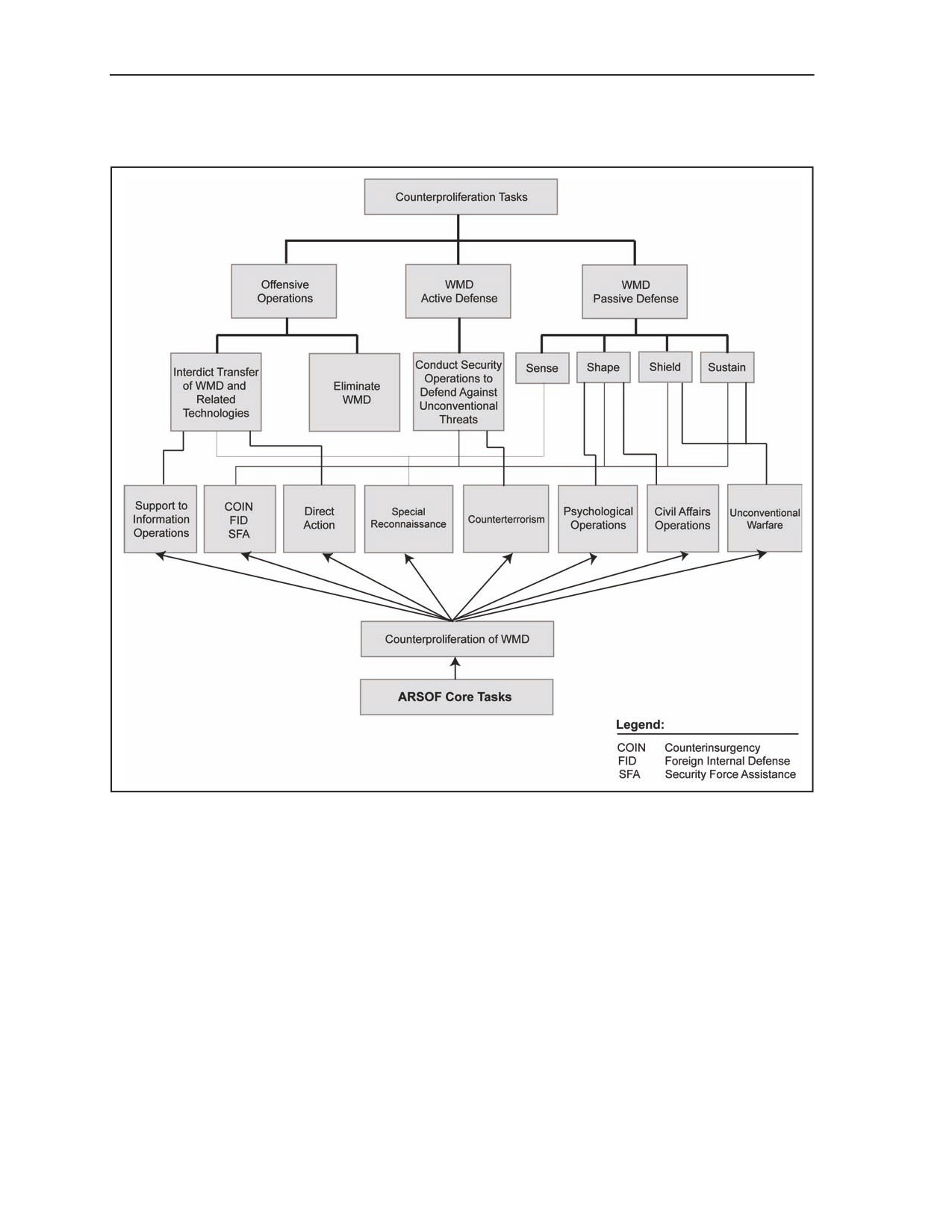
Chapter 1
the geographic combatant commanders (GCCs) and SOF commanders with an effective, deep CBRN
strategic-reconnaissance capability to detect and assess WMD in any environment.
Figure 1-1. CBRN CWMD core task crosswalk
Contamination Avoidance
1-4. Reducing ARSOF vulnerability to a CBRN event (whether accidental or threat initiated) begins with
the contamination avoidance process during the planning phases of an operation. Contamination avoidance
begins during the intelligence preparation of the operational environment (IPOE) process. The unit CBRN
officer and noncommissioned officer (NCO) examine map data, geospatial imagery products, meteorological
data, and intelligence products, such as target information packets, human intelligence (HUMINT) reports,
or site surveys, to determine which areas have the greatest probability for force contamination. The unit
officer can then provide the commander with knowledge concerning what areas in the AO present the
greatest risk of contamination to the force.
1-5. Contamination avoidance is not a static process. The CBRN officer and NCO must continually
update their assessment of CBRN hazards in the AO to provide the commander with the most relevant
information of the greatest potential for the force to avoid being contaminated should a CBRN event occur.
1-2
FM 3-05.132
30 November 2009
Introduction
Example Scenario
SFODA XXXX has developed a target packet on a suspected insurgent leader with
ties to heroin production. In preparation for a strike, the battalion S-2 section reviews
available imagery of the site and notices a large collection of metal barrels outside of
the compound. Due to the target’s ties to heroin production, the battalion CBRN cell
also reviews the imagery and is able to identify the barrels as potentially containing
the hazardous chemicals required for refining opium into heroin.
Reconnaissance and Detection
1-6. Every company-level organization within USASOC possesses a limited capability to conduct CBRN
reconnaissance and detection. The Army common equipment issued to each unit will detect the presence of
most military chemical compounds and high levels of beta and gamma radiation. Still, this equipment only
alerts the unit to the presence of significant levels of military chemical compounds and radiation, may
show false positive readings, and maintains extremely high detection thresholds. Only the CRD, CDD, and
DRT possess the specialized equipment and training to deliver a presumptive analysis of a potential CBRN
substance. It is the presumptive analysis that gives the commander data of such quality that operational
decisions can be made relying on this data.
1-7. The ARSOF core tasks special reconnaissance (SR) and counterproliferation of weapons of mass
destruction (CPWMD) are supported by the CBRN core task sense. CRDs and DRTs provide operational
support to SR and CPWMD missions.
Example Scenario
At 0330L, a massive explosion rocks the desert in western Iraq. The explosion is of
such magnitude that seismic detectors in Baghdad recorded the event; however, no
imagery assets were available to record what happened. As word spreads, there is
concern that the explosion might have been a low-order nuclear detonation. SFODA
XXXX is tasked with infiltrating to the vicinity of the explosion site and confirming or
denying the presence of residual radiation. A 2-man element from the CRD is
attached to the SFODA to provide technical assistance in determining the presence,
type, and strength of radiation.
SHAPE
1-8. CBRN “shape” is defined in JP 3-11 as “the command and control (C2) activity that integrates the
sense, shield, and sustain operational elements to characterize CBRN hazards and threats and employ
necessary capabilities to counter their effects.” Given the unique capabilities of ARSOF CBRN units,
CBRN shape is broken down into two subtasks—CBRN staff functions and exploitation. CBRN shape is
the most critical of the four core elements as this is the integration and fusion of CBRN-related information
into the decision-making and mission-planning processes to minimize the effects of a CBRN threat or
event.
Staff Functions
1-9. The ARSOF CBRN staff has a critical role in ensuring that CBRN-related information is thoroughly
analyzed and developed to provide CBRN situational awareness of potential areas of vulnerability within
the SOF area of responsibility (AOR). The ARSOF CBRN staff will then develop a CBRN risk assessment
and vulnerability analysis in accordance with (IAW) FM 3-11.14, Multiservice Tactics, Techniques, and
Procedures for Nuclear, Biological, and Chemical Vulnerability Assessment. To enhance situational
awareness, the SOF CBRN staff establishes and maintains open lines of communication between the
different staff sections; CBRN cells at higher, subordinate, and adjacent units; and the leadership of all
assigned or attached CBRN units. The staff integration part of CBRN shape is used to support FID,
counterterrorism (CT), PSYOP, Civil Affairs operations (CAO), and information operations (IO) ARSOF
30 November 2009
FM 3-05.132
1-3
Chapter 1
core tasks. The commonality of these tasks is that none of them have active CBRN roles; however, if the
CBRN cell is not fully integrated with the other staff sections, indicators of CBRN activity or vulnerability
may be missed. In addition, PSYOP, when properly planned, are a valuable capability that may be used to
not only shape the operation, but mitigate possible negative effects of an adversary’s use of CBRN. The
following scenario further explains the importance of CBRN cells.
Example Scenario
SFODA XXXX has developed a target packet on a suspected insurgent leader with ties to
heroin production. In preparation for a strike, the battalion S-2 reviews available imagery
of the site and notices a large collection of metal barrels outside of the compound. Due to
the target’s ties to heroin production, the battalion CBRN cell also reviews the imagery
and is able to identify the barrels as likely containing the hazardous chemicals required for
refining opium into heroin. This information is passed to the SFODA prior to the strike.
The SFODA is then able to update its protection measures in the event that the barrels
are destroyed during the strike and/or an operational heroin lab is discovered, thus
reducing the possibility of casualties received from inhaling any hazardous fumes
released.
Exploitation
1-10. The primary ARSOF organic asset that supports special operations forces site exploitation (SOFSE)
operations is the CRD. ARSOF CBRN assets support SOFSE by providing tactical situational awareness
concerning the contents of the objective to the maneuver commander, packaging that information for
transmittal to higher echelons, and ensuring an uninterrupted chain of custody for any items removed from
the objective. This information provides intelligence assets at higher echelons high-quality data to analyze,
which in turn will assist maneuver commanders in determining future mission priorities. Exploitation
support is associated with direct action (DA) and CPWMD SOF core tasks. Chapter 5 outlines specific
topics concerning ARSOF CBRN asset support to SOFSE. The following scenario also further explains
exploitation.
Example Scenario
SFODA XXXX has developed a target packet on a suspected insurgent leader with ties to
heroin production. In preparation for a strike, the battalion S-2 reviews available imagery
of the site and notices a large collection of metal barrels outside of the compound. The
battalion CBRN cell is able to identify the barrels as likely containing the hazardous
chemicals required for refining opium into heroin. This information is passed to the
SFODA prior to the strike. The SFODA is then able to update its protection measures in
the event that the barrels are destroyed during the strike and/or an operational heroin lab
is discovered, thus reducing the possibility of casualties received from inhaling any
hazardous fumes released. Additionally, the SFODA requests a 4-man CRD team to
confirm/deny the presence of drugs on the objective. At the appointed hour, the mission
proceeds. The SFODA is successful in securing the compound and detaining the target.
With the objective secured, the CRD team conducts a sweep of the compound. A swipe
test of the target’s hands shows positive for heroin, which allows the team intelligence
sergeant (18F) to ask more direct questions during a tactical questioning of the target.
Additionally, once the photographs, site sketches, samples, and evidence collected are
sent to higher headquarters (HQ) for analysis, it is determined that the SFODA has
disrupted a primary source of income for a regional insurgent network, which in turn will
help shape future operations to further disrupt insurgent activity in the region.
SHIELD
1-11. CBRN “shield” is defined in JP 3-11 as “individual and collective protection measures essential to
mitigating the effects of CBRN hazards.” ARSOF units place the priority of effort for CBRN defense on
1-4
FM 3-05.132
30 November 2009
Introduction
active denial operations, counterproliferation (CP) operations, and contamination avoidance to significantly
reduce the threat capability to use CBRN materials in an attack against SOF lines of effort. However, these
efforts cannot be relied upon exclusively to eliminate the threat of a CBRN attack; therefore, ARSOF units
maintain limited passive CBRN protection and operational protection measures. Should an ARSOF unit be
forced to continue operations in a contaminated environment, the ARSOF unit will depend entirely on
collocated conventional units for life support and collective protection (COLPRO) requirements. This
section is subdivided into passive protection measures and operational protection measures. Passive
protection measures differ from operational protection measures by accounting for naturally occurring
events, such as malaria outbreaks or industrial contamination and deliberate attacks while operational
protection measures are only used to protect friendly forces against a CBRN attack. All SOF core tasks are
somewhat supported by CBRN shield as ARSOF will always have access to protective measures against
CBRN threats wherever they go. Specifically, though, CBRN shield supports unconventional warfare
(UW) and FID, especially since ARSOF units conducting these missions will be working with indigenous
forces that may request protective equipment from SOF elements if their government or organization is
unable to provide it. These types of requests could present a challenging problem if there is limited
stockage of U.S. protective equipment in the theater.
Passive Protection Measures
1-12. ARSOF use passive protection measures to avoid CBRN contamination. The passive protection
measures used are developed by the CBRN staff in conjunction with the S-3 and S-2 sections during
predeployment planning. Based upon the threat capabilities, naturally occurring hazards, indigenous
activities in the AO, and any other relevant concerns, the staff sections will make a recommendation to the
commander on which passive protection measures to employ.
1-13. Medical surveillance of U.S. forces and indigenous populations is a critical part of a passive
defense. ARSOF units, especially CA elements, excel at conducting medical surveillance of indigenous
populations through the conduct of medical civic action program (MEDCAP) and veterinary civic action
program (VETCAP) operations. These operations can provide early warning of a biological or radiological
event. Should any unusual events or trends be identified by medical personnel, the CBRN staff along with
the S-2 can aid in determining if the event was a naturally occurring event or a biological/radiological
attack and advise the command on the best course of action (COA) in conjunction with the medical
personnel.
Operational Protection
1-14. ARSOF units only possess COLPRO equipment at the battalion level and higher. Thus, any ARSOF
personnel operating away from these locations will depend entirely on collocated conventional units for
COLPRO requirements. The only operational decontamination assets organic to ARSOF units are held in
the CDD, DRT, and at battalion-level or higher HQ. Appendix A provides additional information about
unit and CBRN organic support.
SUSTAIN
1-15. Due to the constantly changing and highly mobile mission set performed by ARSOF, the organic
capabilities to restore combat power after a CBRN attack are somewhat limited. The best defense against a
CBRN attack for an ARSOF element is generally avoidance. If, however, an ARSOF element becomes
contaminated either during a CBRN attack or accident, the unit’s combat power must be restored as
quickly as possible. To that end, the ARSOF element would implement one or all of the main tenets of
CBRN “sustain,” which include decontamination, resupply, medical support, and site remediation. Similar
to CBRN shield, CBRN sustain supports all ARSOF core tasks in general, but only UW and FID
specifically, and for the same reasons.
Decontamination
1-16. Decontamination is the process by which contamination is removed from a contaminated surface.
The primary decontamination units in ARSOF are the CDDs organic to SF groups and the DRTs organic to
30 November 2009
FM 3-05.132
1-5
Chapter 1
the Ranger regiment. The primary decontamination capability that ARSOF units have is the expedient
personnel decontamination system (EPDS). This capability allows ARSOF to conduct immediate and
operational-level decontamination; however, SOF must be supported by conventional CBRN units for
thorough decontamination.
Resupply
1-17. To reconstitute an ARSOF unit quickly, an effective resupply/refit mechanism must be in place.
This function is primarily handled through existing ARSOF logistics channels. The reconstitution process
begins with a thorough decontamination of equipment as soon as operationally feasible after the
contaminated unit completes EPDS procedures. If thorough decontamination is not feasible, all
contaminated equipment is destroyed in place to render it useless to enemy forces and to prevent the spread
of contamination. Logistics channels must be able to replace major end items of equipment assigned to that
contaminated unit in order to restore combat power.
Medical Support and Site Remediation
1-18. ARSOF units are not manned or equipped to provide large-scale medical support to indigenous
populations or U.S. forces if a CBRN accident or attack occurs. Similarly, SOF units are not equipped to
conduct contaminated site remediation operations. Both of these functions of CBRN sustain are beyond the
scope of ARSOF missions and must be handled by units specifically trained and equipped to conduct those
types of operations. In the absence of U.S. or coalition medical or area decontamination support, ARSOF
personnel may act as advisors to host nation (HN) agencies as they conduct operations.
ACTIVE DEFENSE
1-19. The ARSOF core task DA directly supports this military mission area. ARSOF units are only
capable of diverting, neutralizing, or destroying WMD or their delivery means on the ground. If the WMD
are being delivered by aerial means (aircraft spray, missile, bomb, or indirect fire), ARSOF units have no
organic capability to actively defend against the WMD attack.
OFFENSIVE OPERATIONS
1-20. These missions are short-duration strikes and other small-scale offensive surgical actions by SOF or
SO-capable units to seize, destroy, capture, or recover a WMD threat. DA missions include raids;
ambushes and direct assaults; standoff attacks; terminal guidance operations; precision destruction
operations; recovery operations
(including noncombatant evacuation); and antisurface, mine, and
amphibious warfare. ARSOF units perform the following:
z
WMD interdiction. If directed, SOF can conduct or support DA, SR, CT, CP, and IO missions to
deter or prevent the acquisition of WMD, neutralize proliferation where it has occurred, and
operate against the threats by WMD to defeat them. ARSOF are tasked with organizing,
training, equipping, and otherwise preparing to conduct operations in support of United States
Government (USG) CP objectives.
z
WMD elimination. ARSOF units are not organized to conduct WMD elimination operations.
However, the highly specialized capabilities of ARSOF CBRN units can provide unique types
of support to a WMD elimination mission.
SPECTRUM OF CONFLICT
1-21. Where proliferation has occurred in regions of potential conflict, deterrence of an adversary’s
CBRN weapons employment is a principal U.S. national objective. USASOC trains and prepares forces to
meet the requirements for planned, contingency, and unexpected (but plausible) operations in CBRN
environments in the GCC’s AOR. ARSOF CBRN assets provide the GCCs and SOF commanders with an
effective, deep CBRN strategic-reconnaissance capability to detect and assess WMD in any environment.
1-6
FM 3-05.132
30 November 2009
Introduction
1-22. Proliferation of CBRN weapons places an increased reliance on intelligence-collection efforts. The
evidence from such efforts defines the threat capability to develop, produce, stockpile, and employ CBRN
weapons. U.S. foreign policy decisions and initiatives depend heavily on the evidence of using (or
preparing to use) CBRN weapons in conflicts not directly involving the United States.
1-23. SOF are deployed worldwide across the range of military operations in peace and war. Since the
1960s, the United States has dealt with a series of asymmetric threats that have increased in lethality
exponentially over time. The evolution of terrorism has shown trends over time that evolved conventional
Cold War threats into asymmetric threats. Foreign terrorism continues to be active against U.S. targets
overseas. This activity mandates allocating additional resources to combat asymmetrical threats and protect
U.S. national interests.
1-24. Emerging asymmetric threats (such as WMD) challenge the safety of this nation and its coalition
partners. In response to these emerging threats, U.S. forces must be capable of conducting special CBRN
reconnaissance activities to provide security assistance and support to interagency or joint operations; FID,
UW, and CT operations; and CPWMD.
OPERATING ENVIRONMENTS AND POTENTIAL CBRN THREATS
1-25. CBRN weapons and hazards can directly influence the operational environment in which ARSOF
operate. The most notable influences of the physical environment are weather and terrain. Weather
conditions are the “uncontrollable wild card” of CBRN employment and provide useful clues to probable
times and places for CBRN use. Diligent tracking of weather conditions aids in the assessment of risks to
SOF from CBRN weapons, as well as TIM hazards. In concert with weather conditions, the terrain
influences where CBRN effects may concentrate (for example, chemical agents in low-lying areas) and in
many cases, it influences enemy CBRN targeting, such as exploiting or creating chokepoints. The AORs in
which SOF operate may contain several environments, each with a distinct set of CBRN planning factors
and considerations.
URBAN AREAS
1-26. Urban structures such as sewers, storm drains, reinforced concrete buildings, subways, and
basements can protect against spray attacks of chemical or biological agents and the effects of nuclear blast
and radiation. However, this exchange for overhead cover creates other problems. Chemical agents tend to
act differently in urban areas and will tend to collect in low areas; nonpersistent agents may enter buildings
or seep into piles of rubble. ARSOF personnel should avoid these low areas. Also, ARSOF personnel
should attempt to shut down ventilation systems in urban structures to prevent the spread of vapor or
aerosol hazards. The persistency of an agent can greatly increase when it has settled in these areas. Once an
attack has occurred, detection of chemical contamination becomes very important. Personnel must
thoroughly check areas before attempting to occupy or traverse them.
1-27. The stable environment of an urban area may increase the persistency of live biological agents and
the effectiveness of toxins. Existing food and water supplies are prime targets for biological agents.
Personal hygiene becomes very important. Leaders must establish and consistently enforce sanitary and
prophylactic measures, including immunizations. They must also ensure that all personnel drink safe water
and never assume that any local water is safe.
1-28. The population density of an urban area must be considered. During planning, the potential of
encountering a large number of contaminated, panicked, injured, and dying people must be considered.
Urban areas can be susceptible to an adversary’s use of TIMs as a weapon, especially if there is a sizable
chemical industry or storage facilities associated with the area. SOF should be aware of potential hazardous
materials (HAZMAT) they may encounter. FM 3-11.4, Multiservice Tactics, Techniques, and Procedures
for Nuclear, Biological, and Chemical (NBC) Protection, provides additional information.
30 November 2009
FM 3-05.132
1-7
Chapter 1
DESERT AREAS
1-29. Desert operations may present additional problems. Desert daytime temperatures can vary from
90° Fahrenheit (F) to 125°F resulting in unstable temperature gradients that are not particularly favorable
to chemical or biological (CB) attacks. Evaporation of chemical agents during the day will rapidly create a
downwind hazard and an inhalation problem. However, with nightfall, the desert cools rapidly, and a stable
temperature gradient occurs, creating the possibility of night or early morning attacks. FM 3-11.4 provides
further information.
LOW-TERRAIN, TEMPERATE ZONE AREAS
1-30. An adversary’s use of CB or TIMs can be effective in this environment when forces are not
prepared. These weapons (nonpersistent) are more efficient when used at night and during periods of
inversion conditions. Terrain features, such as tall grass or scrub brush, have the tendency to retard the
flow of an agent cloud, thus reducing the overall size of the contamination. Also, the grass and brush may
absorb the chemical agent, which would not pose a significant effect on the mission. However, movement
through the area requires care, as the absorbed agent may be released when the vegetation is disturbed or
crushed, creating a secondary toxic hazard. Persistent agents can cling to vegetation, creating surface
exposure and an off-gassing during daylight. TIMs, such as chlorine, may tend to meander, as would a fog.
1-31. Movement of a biological aerosol over grass and brush reduces the concentration as the particles
impact on vegetation and settle out of the air. However, the cover provided by vegetation protects the
biological agent from the weather and, thus, favors the agent’s survivability, specifically the wet aerosols.
FM 3-6, Field Behavior of NBC Agents
(Including Smoke and Incendiaries), provides additional
information.
MOUNTAIN AREAS
1-32. Terrain and weather in mountainous areas magnify the requirement for a high degree of CBRN
defense preparedness. Rugged terrain limits the employment of large forces, reduces maneuver, and
impedes logistical support. Shelters are difficult to dig and may require improvisation using existing rocks,
snow, and timber. However, this same terrain may also provide caves, ravines, and cliffs as a natural
source of protection.
1-33. Chemical agents are heavier than air and will settle in valleys and depressions. Subject to mountain
breezes, agents will move down and within the valley. Thus, high dosages are less likely on crests or sides
of ridges or hills.
1-34. Radiation contamination will be erratic due to rapid changes in wind patterns, but at the same time,
the range of thermal effect increases with the clarity of mountain air. The location of hot spots may be
erratic. Additionally, a nuclear blast can produce rock and snow slides.
JUNGLE AREAS
1-35. Tropical climates require the highest degree of individual discipline and conditioning to maintain
effective CBRN defensive readiness. Leaders and staff planners must expect and plan for a rapid decrease
in unit efficiency. They must also anticipate heat casualties. Strict adherence to field sanitation is
necessary. In addition, they must ensure that special precautions are taken to maintain unit CBRN defense
equipment in usable condition. The rapid mildew, dry rot, and rust inherent in jungle areas necessitate this
requirement.
1-36. Dominant climatic features of jungle areas are high, constant temperatures; heavy rainfall; and very
high humidity. These features increase the survivability of biological agents. In thick jungle, there is
usually little or no wind, and the canopy blocks most of the sunlight from the ground, thus providing
excellent conditions for adversary use of biological agents and toxins. The same canopy that may provide
slight shielding from radiation may also enhance blast effect with tree blow-downs and projectiles. Also, a
lack of penetrating wind may result in decreased downwind hazards.
1-8
FM 3-05.132
30 November 2009
Introduction
1-37. A jungle canopy creates good overhead cover from aircraft spray. However, persistent agents
delivered by artillery or bombs may penetrate the canopy before being released, thus creating a hazard in
the immediate area of impact. Additionally, rains can wash radiation into water collection areas, producing
hot spots.
COLD-WEATHER REGIONS
1-38. Cold-weather conditions create many added problems in CBRN defense. During the winter months,
45 percent of the North American landmass and 65 percent of the Eurasian landmass are characterized by
extreme cold and deep snow. These areas include Korea, China, Bosnia, Kosovo, Russia, Ukraine,
Kazakhstan, and the United States. The former Soviet Union developed procedures to weaponize a series
of agents to be effective in extreme cold weather. Some of those agents do not have known freezing points.
In temperatures from -20°F to -40°F, agents such as Sarin (GB) become like a thickened Soman (GD).
Choking agents have increased persistency from 0°F to -40°F. Even hydrogen cyanide (AC), which
solidifies at -14°F, can be disseminated as fine particles, thereby increasing its effective time and threat.
Mustard agents employed through pyrotechnic devices create effective vapor hazards far below the
freezing point of mustard.
MARITIME ENVIRONMENTS AND RIVERINE AREAS
1-39. ARSOF operating in maritime environments have the potential of encountering chemical, biological,
or radiological attacks from the shoreline. However, a chemical attack is considered the most likely. Delivery
of a nonpersistent chemical agent, in favorable climatic conditions, is no different across open water from
that of low, rolling terrain. The effects of wind and heavy surf tend to disperse a chemical cloud. Direct use
of persistent agents against deploying forces is not considered feasible, but contamination of a beach would
provide a formidable barrier. Mustard agents can remain for extended periods of time on the surface of the
water. Surface vessels operating in support of SOF risk being attacked by artillery, missile, or air depending
on their offshore location. The feasibility of using biological agents, except against large targets, is low.
However, radiological contamination as a barrier should be considered in any plan.
1-40. Operations on and around rivers present situations that have a potential to disrupt operations. Use of
both persistent and nonpersistent agents will require ARSOF to establish mission-oriented protective
posture (MOPP) levels that could degrade personnel effectiveness. During inversion climatic conditions,
nonpersistent chemical agent clouds have the tendency to follow a river’s path when channeled by the high
grass and brush along the banks. Persistent agents could be used to contaminate the riverbanks. FM 3-6
provides additional information.
CHEMICAL AGENTS
1-41. Chemical warfare (CW) agents produce both immediate and delayed effects that will degrade
operations through lethal, incapacitating, or other damaging effects to individuals as well as contamination
of equipment, supplies, and critical terrain features. The types of CW agents that could be encountered by
USSOCOM forces can be classified according to their physiological effects or their military use. These
types of CW agents include choking, nerve, blood, blister, and incapacitating agents. Agents may exist as
solids, liquids, or gases. In addition, TIMs and potentially dangerous herbicides or pesticides could be
encountered accidentally or employed by an adversary.
1-42. Choking, nerve, blood, and blister agents are chemical substances intended for use in military
operations to kill, seriously injure, or hinder military operations through their physiological effects. They
are classified as nerve, choking, or blood agents. Nerve agents are considered the primary agents of threat
to the U.S. military because of their high toxicity and effectiveness through multiple routes of entry. Nerve
agents attack the body’s nervous system. Even small quantities are extremely toxic and can cause death in
less than 15 minutes if personnel are not treated.
1-43. Incapacitating agents include blister (mustards) and compounds that affect the nervous system
(quinuclidinyl benzilate and lysergic acid diethylamide [LSD]).
30 November 2009
FM 3-05.132
1-9