Military reference books and manuals (2009-2023, Volume 8) - page 7
Chapter 4
Example of Understanding
A PSYOP Soldier is pretesting a handbill. The handbill TA is “parents of school-age
children in the Adhamiya district,” the SPO is “TA increases reports of terrorist
activity,” the PSYOP arguments
(argument and technique) are based on an
argument that the terrorists do not discriminate and will not hesitate to kill children for
their cause, and the technique is a compare-and-contrast between the TA reporting
terrorist activity and the results if the TA does nothing. Pretest dialogue may follow
the following scenario:
PSYOP Soldier: “What does this handbill tell you to do?”
TA member: “It says that I should call this number to report terrorists.”
PSYOP Soldier: “Why does the handbill say you should do that?”
TA member: “Because my children are in danger from terrorists and if I do
nothing, they may die.”
The above illustrates that the PSYOP Soldier has strong evidence that the argument
is clearly delivered with this handbill. Consider the following negative or nonspecific
response:
TA member: “It says that children are going to die.”
PSYOP Soldier: “How will they die? Who will kill them?”
TA member: “I don’t know, it is not clear…in this picture everything is fine
and in this picture, children are dead.”
The PSYOP Soldier has evidence that the argument is not clearly understood and
the next question may be tailored to find out how to better deliver the argument:
PSYOP Soldier: “We want to show parents that life will be better and their
children safer if they report terrorist activity…how could we change this handbill to
show that?”
Acceptance of the PSYOP Argument
4-60. Given that the PSYOP argument is clearly understood by the TA, PSYOP Soldiers must ask if the
TA is likely to engage in the desired behavior and if the argument is persuasive enough to be effective.
Looking at the four components of the PSYOP argument (main argument, supporting arguments, appeals,
and the persuasion techniques), PSYOP Soldiers must determine if the product is strong enough to change
behavior. The most effective way to test for acceptance of the argument, such as determining TA
understanding of the PSYOP product’s message, is through the use of a series of straightforward, open-
ended questions:
“After reading/hearing/seeing this product, do you think that parents in Adhamiya will report
terrorist activity?” “Why?” “Why not?”
“What would be the main reason parents would report terrorist activity?”
4-61. The preceding questions are not aimed at the TA member’s behavior, but rather at the behavior of his
peers, which helps alleviate pressure on the TA member to answer positively and gives the TA member a
chance to safely project a personal opinion while attributing the answer to “others.” An example of
acceptance of the PSYOP arguments is on pages 4-25 and 4-26.
4-24
FM 3-05.301
30 August 2007
Phase IV: Product Development and Design
Figure 4-11. Example of a message conveyed by a handbill
Example of Acceptance of the PSYOP Arguments
A PSYOP Soldier is pretesting a handbill. The handbill TA is “parents of school-age
children in the Adhamiya district,” the SPO is “TA increases reports of terrorist
activity,” the PSYOP arguments (argument, appeals, and technique) are based upon
an argument that the terrorists do not discriminate and will not hesitate to kill children
for their cause, and the technique is a compare-and-contrast between the TA
reporting terrorist activity and the results if the TA does nothing. Pretest dialogue may
follow the below scenario:
PSYOP Soldier: “After reading/hearing/seeing this handbill, do you think
that parents in Adhamiya will report terrorist activity?”
TA member: “Yes. Of course I would report any terrorists I saw, but many of
the people here are scared of the terrorists. If anyone reports to the police, they will
be killed by the terrorists. They will just keep their children inside and take their
chances.”
30 August 2007
FM 3-05.301
4-25
Chapter 4
In this case, although the TA member answers “yes” for himself, he freely admits that
others will not report terrorists, evidence that the arguments may not be persuasive
enough to change the TA’s behavior. If this answer is common among those tested,
the PSYOP argument would require modification in the form of emphasis on a
terrorist reporting program run by coalition forces and that participation in the
program is anonymous. The PSYOP Soldier conducting the pretest requires more
information before drawing any conclusions and changing the PSYOP argument:
PSYOP Soldier: “What would be the main reason parents would report
terrorist activity?”
TA member: “The people hate the terrorists…we want to get rid of them, but
people are very scared. If people could give information without anyone knowing they
did it, they might. Also, this is a very poor area, and the terrorists pay many of the
young men to work for them. They bribe officials to stay quiet. Money is very
powerful. Is there a reward for the information?”
Through these questions, two clear motivators for the desired behavior have been
identified—anonymity and money. If this is a common result of pretesting, the
PSYOP argument should be modified to emphasize these two motivators.
Sample Size and Composition
4-62. Once a pretest questionnaire is developed from the pretest guidance in the PAW, a determination of
the pretest sample size and composition is required. Using proper survey sampling methodology to
maintain objectivity and attain a statistically valid response is desirable, but the sample size and
composition is largely dependent on mission, enemy, terrain and weather, troops and support available,
time available, civil considerations (METT-TC). There are some general guidelines, though, that will assist
in planning the pretest:
Ideally, a combination of a panel of experts, a panel of representatives, and as large a portion of
the TA as possible should be tested to provide accurate results. However, available time and
resources rarely allow thorough pretesting of any one PSYOP product.
The larger and broader the TA, the larger the survey sample. National-level products
disseminated to multiple TAs or across widespread geography should be tested across the major
demographic and geographic groups. This dissemination is more a problem of having too broad
and dissimilar of a TA and less an issue about numbers of the TA. Tactical-level products,
aimed at specific TAs in specific geographic locations, require a much smaller survey sample.
Findings should be reported in terms of numbers sampled by type (TA members, panel of
experts, panel of representatives) rather than percentage pretested. The survey sample is almost
never large or random enough to be statistically valid. The sample becomes misleading when
stated as “80 percent pretested understood the product” when the sample consisted of ten local
nationals from the camp cleaning crew. In this example, it is best stated as “eight of the ten local
nationals pretested understood the product.” In this way, the POTF can judge whether sufficient
pretesting has taken place and include this information during product approval.
Objectivity is highly desired, but is difficult to obtain. PSYOP Soldiers should choose quality
over quantity of testing; rely on interviewing different TA members, TA representatives, and
experts independently from one another; and look for similar comments and trends to keep the
pretest as objective as possible.
When pretesting PSYOP products, a useful technique is to have three variations of a product
with different appeals and/or influence techniques. After testing for understanding and
acceptance of the arguments, the TA can be asked which of the products is the most persuasive.
4-26
FM 3-05.301
30 August 2007
Phase IV: Product Development and Design
EVALUATING TESTING RESULTS
4-63. The results of product pretesting are evaluated to determine improvements or other changes to the
product. The steps to evaluating pretesting results are—
Identify recurring comments or patterns in the results.
(Example: “7 of 10 TA members
interviewed mentioned that the TA would be too scared of reprisals to report terrorist activities,”
or “3 of 4 members of the panel of representatives recommended using the color green for the
banner instead of red.”)
Identify critical/major deficiencies by category (Understanding, Acceptance, and Exposure).
(Example: Understanding: “5 of 10 TA members did not understand the use of the before-and
after photos; they thought they showed two separate events.” Acceptance: “7 of 10 TA members
interviewed mentioned that the TA would be too scared of reprisals to report terrorist activities.”
Exposure: “0 of 10 TA members interviewed reported hearing the radio products for this
series.”)
Recommend changes. Based upon the recurring comments and patterns, the major deficiencies
can be identified, and from these deficiencies, modifications can be recommended. These
modifications usually fall into four major categories:
Change to a product/series. These are usually mechanical changes
(wording, colors,
symbols, images, and so on) to an individual product or throughout the series. They most
often are discovered from answers to the test questions for Understanding. (Example: From
our testing example, the TA member did not understand the compare-and-contrast pictures
intended to show the choices of reporting or not reporting terrorists. If this result were
common among several of the test interviews, a recommended change to that product, and
any similar products in that series, would be appropriate.)
Change to the PSYOP argument. These are fundamental changes to the PSYOP argument
that may require modification or a complete redesign of the PSYOP series. The need for
changes is most often discovered from answers to the test questions for acceptance of the
PSYOP argument. If recurring comments indicate that all or a portion of the PSYOP
argument (supporting arguments or persuasion technique) is not persuasive, it must be
considered for revision. (Example: From our testing example, the TA member indicated that
parents would be too scared to report terrorist activity. If this is a recurring comment, the
recommended change to the PSYOP argument might be to emphasize that reporting is
anonymous.)
Change to dissemination. These are changes in the dissemination time, frequency, or
method for a given product in a PSYOP series. They are usually discovered from answers to
the test questions for Exposure. If recurring comments indicate that certain products are not
reaching the TA, that dissemination method/time/frequency may need to be modified.
(Example: In the major deficiencies list above for Exposure, 0 of 10 TA members had heard
any of the radio products for the series. This situation may indicate a need to change the
radio station, change the air time, increase the frequency that they air, or discontinue radio
products and focus on other media. What type of change to dissemination is necessary
would also be determined by the test results.)
Refinement of TA. These are usually further divisions or qualifiers of the TA. They can be
discovered from answers to test questions for Exposure, Understanding, or Acceptance of
the PSYOP argument. Often the need for refinement becomes obvious when there are
disparate and conflicting testing results for the TA.
(Example: In the testing example
used—parents of school-age children in Adhamiya district—differing results fell right along
religious lines. Red Tribe TA members answered very differently than Blue Tribe members.
This result would indicate that the TA should be refined into two separate TAs: Red Tribe
parents and Blue Tribe parents.)
Summarize results. PSYOP Soldiers should summarize results of the pretest and include the
following: TA, SPO, Series #, sample size and composition, location of interviews, recurring
comments or patterns, critical/major deficiencies, and recommended changes. PSYOP Soldiers
should annotate this information on the TAAW.
30 August 2007
FM 3-05.301
4-27
Chapter 4
INTERNAL REVIEW BOARD
4-64. Once a product or its prototype is developed and pretested, an internal review board is conducted.
The time for conducting the board is reverse-planned from the suspense date on the SEM. It is further
reverse-planned from the anticipated time to incorporate changes. The board looks at all the products
within a series and ensures that each accomplishes its intended goal. While reviewing each individual
product, the board reviews the series documentation and the TAAW to ensure continuity. The board also
ensures that each product reinforces each of the products in the series and that no contradictions exist. This
review is the last examination of the series before submission to the external approval authority, which is
Phase V (Approval) of the PSYOP process. The time necessary to incorporate changes may be brief, as in
the case of scripts, to approaching an equal time to that allowed for initial development, as in the case of
complex visual products. A review board should be composed of the following representatives:
Representatives from all sections of the PSYOP detachment and all sections of the TPDD.
Liaison officers from the dissemination battalion and contractors.
SSD representatives.
PDC or tactical Psychological Operations company (TPC) commander, first sergeant, and other
representatives.
SUMMARY
4-65. Phase IV (Product Development and Design) of the PSYOP process is a complex method that takes
guidance from planning, TAA, and series development to conceptualize and develop product prototypes
that are tailored for effecting behavior change in specified TAs. Product development and design applies
the documents from Phases II and III (TAAW, SCW, SDW, and SEM) to produce PAWs, which steer
product conceptualization and design, and provide guidance for pretest and posttest questionnaires. After
completing product development and design, pretest questionnaires are finalized and a pretest of products
is conducted, with PSYOP Soldiers making any necessary changes to the products based on pretest results.
Prototypes are then examined by an internal review board for further review. When done correctly, the
steps in this phase ensure that each product reinforces its corresponding PSYOP series and, ultimately, be
more effective in accomplishing the desired behavioral change. Upon completion of the internal review
board, finalized products are included with the series approval package discussed in Chapter 5, Phase V:
Approval.
4-28
FM 3-05.301
30 August 2007
Chapter 5
Phase V: Approval
Once the PSYOP series product prototypes are pretested and any changes completed,
Phase V: Approval begins. During the approval process, the PSYOP series package is
assembled and an internal review board is conducted. Once PSYOP leaders review
and verify that all appropriate changes have been made, the PSYOP series package
(submitted as a Change to the PSYOP Tab/Appendix) is staffed out for review and
signature by the official approval authority. Once approved, the PSYOP series
becomes part of a fragmentary order (FRAGORD) issued and executed by the
supported units.
The series package provides the supported commander with a clearly articulated plan
detailing how PSYOP will support the achievement of his objectives. Submitting the
series package as a Change to the PSYOP Tab/Appendix, PSYOP Soldiers use the
military orders process to fully integrate PSYOP into the supported unit’s operations.
Phase V: Approval is one of the most challenging aspects of the PSYOP process.
PSYOP must be planned and conducted under a high level of scrutiny and to an
exacting standard due to potential far-reaching strategic effects of PSYOP products
and actions. However, without proactive and timely management of the series
approval process, PSYOP cannot remain effectively engaged in military operations.
At the end of Phase V, PSYOP Soldiers will have an approved PSYOP series ready
for execution that is coordinated and synchronized with ongoing military operations
and U.S. strategic communications.
PREAPPROVED PSYOP PROGRAMS
5-1. Preapproved PSYOP programs and clearly articulated product/series approval authorities are crucial
to executing timely, coordinated PSYOP series that are consistent with U.S. policy objectives and strategic
communications. (Chapter 1 contains more information on PSYOP programs and approval authorities.)
The United States Government (USG) regards PSYOP as a predominantly operational- and tactical-level
activity that can have strategic effects. As a result, the Chairman of the Joint Chiefs of Staff (CJCS)
regularly publishes and updates an instruction designed to clarify the PSYOP approval process. Chairman
of the Joint Chiefs of Staff Instruction (CJCSI) 3110.05C outlines the specific processes necessary to gain
PSYOP approval authorities. Its purpose is to “establish CJCS policy and requirements for planning and
conducting joint psychological operations (PSYOP) across the entire range of military operations as
specified in the base JSCP” for each fiscal year. CJCSI 3110.05C applies to the joint staff, Military
Services, combatant commands, and all other DOD activities and agencies. As outlined in CJCSI
3110.05C, combatant commanders (CCDRs) and Service chiefs are responsible for incorporating PSYOP
into their deliberate and contingency planning cycles. This document is unclassified and is available on the
joint staff Web page through Army Knowledge Online. All PSYOP planners must be intimately familiar
with this document to effectively execute contingency and deliberate PSYOP planning in support of (ISO)
tactical- and operational-level PSYOP.
5-2. CJCSI 3110.05C is a powerful tool that grants preapproval of PSYOP programs for contingency use
during noncombatant evacuation operations, humanitarian operations, counterdrug operations,
humanitarian mine action operations, introduction of U.S. forces into an AOR/force protection operations,
30 August 2007
FM 3-05.301
5-1
Chapter 5
and maritime interdiction operations/visit and shipboarding searches/seizures. In addition, CJCSI 3110.05C
covers PSYOP policy and planning guidance; PSYOP program, plan, and product approval process and
authorities; and C2 of PSYOP forces. These topics are covered within the frameworks of peacetime
employment of PSYOP, contingencies (lesser and complex), declared war, and interagency support.
PSYOP APPROVAL PROCESS
5-3. Operational and tactical PSYOP are similar in that, after pretesting, but before production and
dissemination, PSYOP products go through both an internal and external approval process (Chapter 4 has
specific information on pretesting). Once pretesting is complete and any needed corrections made, the
series is ready for internal review. This is the first step in the approval process. The product development
company (PDC) commander or the tactical Psychological Operations development detachment (TPDD)
officer in charge (OIC) usually chairs the internal review board, which has representatives from the various
sections. He convenes the board to assess each PSYOP product prototype, usually as part of an entire
series. An excellent resource to help the board judge series are members of the strategic studies detachment
(SSD) who can draw upon their regional cultural expertise during the internal review board process.
Reviewing products in this manner accomplishes several tasks. First, it allows the PDC commander to
evaluate the potential impact of the entire series, ensuring that each product reinforces the other supporting
products in that series. Secondly, the internal review board ensures the PSYOP argument is consistent
throughout the series and across all media. Finally, the pretesting results show how the TA reacts to the
product and how it potentially affects the targeted behavior. After considering the entire series, the PDC
commander decides whether to approve the series and individual products.
5-4. If approved, the series prototypes are sent to the Psychological Operations task force (POTF) or
Psychological Operations support element (PSE) commander (at the operational level) or to the tactical
Psychological Operations company (TPC) commander (at the tactical level) for consideration. At the
tactical level, if the TPC commander approves the series, the division IO chief and the division
commander, in that order, are generally the last two reviewers before the series is sent to the approval
authority. The supported unit may modify this chain at any time, and PSYOP Soldiers should have
contingency plans ready to ensure continuity of PSYOP support.
5-5. If disapproved, the series may be returned to the PSYOP development section for correction or
further refinement. If approved, the series will continue up the approval chain, eventually reaching the
division or joint task force (JTF) commander, who retains approval authority and makes a final decision.
He may decide to disapprove and return the series to the development section for extensive reworking,
approve the series provided the recommended changes are made, or approve the series over the objections
of his subordinates. Generally, if the changes are relatively minor, the commander will approve the series
with the guidance to make the necessary changes. Only if the series is fundamentally flawed (for example,
improper themes, messages, incorrect symbols/colors, or timing the release of products prior to production)
would outright disapproval likely result.
5-6. PSYOP planners work to ensure only required personnel are in the product approval chain. The
product approval chain starts with the PSE/PDC commander and ends with the appropriate supported
commander. Normally, the approval authority designates several key members of the staff to provide input
on PSYOP products. These key members may include the chief of staff (COS), G-3, G-7 IO, political
advisor, SJA, and possibly others.
5-2
FM 3-05.301
30 August 2007
Phase V: Approval
Operation IRAQI FREEDOM
In Operation IRAQI FREEDOM II/III, a TPDD assigned to Multi-National Division
Baghdad supported a division with six brigades and attached tactical Psychological
Operations detachments (TPDs). In addition, it provided limited support to the corps
PSE, adjoining Marine forces to the south (one TPD), the combined joint special
operations task force, and a TPC operating out of Mosul. In such a demanding
scenario needing quick responses, the approval process had to be equally
responsive. To ensure timely approval, the chain consisted of the TPDD commander,
the TPC commander, the division IO chief, and the division commander. Judge
Advocate General legal advisors were also included in the review to ensure legal
compliance, but had no authority in the actual approval. From submission of
completed series to approval for production and dissemination, the entire approval
process could be completed in only a few hours, depending on operating tempo.
However, if the series was not a high priority and time was not an issue, 24 hours
was the customary time for the TPDD to receive a final decision.
5-7. Determining the approval process during Phase I of the PSYOP process has proven successful in
minimizing the time needed to staff PSYOP products. In addition, conducting simultaneous staffing is
simply the most efficient way of incorporating staff input in a timely manner. Having the products come
back to the POTF or PSE commander before being sent to the approval authority also allows the POTF or
PSE commander the opportunity to work through any staff comments or concerns as necessary prior to
submitting the product for approval to the appropriate general officer. Figure 5-1, pages 5-3 and 5-4, is an
example of an approval process explanation to a division or corps JTF OPORD. Paragraph 3A in this
sample appendix outlines the PSYOP approval process for the supported unit.
1. SITUATION. This appendix outlines the approval process within XXX HQ for the staffing and approval of
PSYOP activities and products.
2. MISSION. See Annex.
3. EXECUTION. See Annex.
A. Concept of the Operation.
(1) General. In order to make PSYOP a timely and responsive player in XXX operations, the staffing
and approval process must be responsive and expedited quickly. COMXXX, or his designated
approval authority, is the sole decision maker on the approval or disapproval of PSYOP activities
and products.
(2) Staffing/Approval Process.
a. Staffing. The POTF/PSE commander is responsible for the packaging, staffing, and final
disposition of all staffed PSYOP activities and products. POTF/PSE commander will conduct
staffing per SOP. All series approval requests are typically staffed simultaneously with the Chief
IO, political advisor, and SJA. These staffing agencies will not have approval/disapproval
authority over any PSYOP products or activities. For planned operations, the POTF/PSE
commander will submit PSYOP series staffing requests at 0800 each day. IF NO RESPONSE
IS RECEIVED BY CLOSE OF BUSINESS ON THE DAY OF SUBMISSION, CONCURRENCE
IS ASSUMED AND THE SERIES APPROVAL REQUEST WILL ENTER THE APPROVAL
CHAIN. After completion of the staffing process, the POTF/PSE commander will consolidate
comments and prepare the request for entry into the approval chain. Staffing sections will make
comments on the form provided or attach a point paper with their comments about the product.
SERIES STAFFING REQUESTS WILL NOT RETURN TO THE PRODUCT DEVELOPMENT
SECTION FOR CHANGES AT ANY POINT IN THIS PROCESS UNTIL FINAL
APPROVAL/DISAPPROVAL.
b. Approval. After all staffing actions are complete, PSYOP series approval requests will be
submitted to the G-3 for review and comment. All staffing sections’ comments will be available
for review with explanations/comments from the POTF/PSE commander. The G-3 will
recommend approval or disapproval and forward the request through the COS to the
commander.
Figure 5-1. Example of approval process explanation
30 August 2007
FM 3-05.301
5-3
Chapter 5
c. Postapproval/disapproval actions. Following COMXXX's final decision, the POTF/PSE
commander will incorporate any changes directed by the approval chain and prepare the
product or activity for execution. If the product or activity is disapproved, the POTF/PSE
commander will file the request and determine if an alternate means to achieve the same
desired effect can be developed. All staffing and approval sheets will be maintained on file with
the POTF/PSE commander for the duration of the operation.
4. SERVICE SUPPORT. See Annex.
5. COMMAND AND CONTROL. See Annex.
Figure 5-1. Example of approval process explanation (continued)
CHANGE TO THE PSYOP TAB/APPENDIX
5-8. The series approval package is submitted as a Change to the PSYOP Tab/Appendix (Figure 5-2,
pages 5-5 and 5-6). This Change to the PSYOP Tab/Appendix is issued in the standard five-paragraph
format, with seven enclosures or tabs. The format is as follows:
Paragraph 1 (Situation) of the Change contains any changes that have occurred in the PSYOP
situation (friendly, enemy, neutral, or attachments or detachments) since the last change or the
initial appendix was published. These variations in the situation may or may not be related to the
execution of the series.
Paragraph 2 (Mission) should not have any changes from the initial tab/appendix unless the POs
have changed.
Paragraph 3 (Execution):
Paragraph 3a (Scheme of PSYOP) identifies the series to be executed, the stages and
decision points (DPs) of that series, the SPO, the TA, the start and end dates, the types of
products to be used, the actions to be conducted, and the area where the series will be
executed.
Paragraph 3b (Tasks) assigns clear responsibility for all elements executing the series,
including the element that is writing the Change.
Paragraph 3c (Coordinating Instructions) discusses dissemination and usually references
Enclosure 2, Series Execution Matrix (SEM).
Paragraph
4 (Administration and Logistics) only contains changes if the series requires
additional service and support requirements (for example, contracting and distribution) that were
not covered in the initial appendix.
Paragraph 5 (Command and Control):
Paragraph 5a (Command) details any changes in reporting requirements or command
relationships—for example, placing additional TPTs with a different TPD for a specific
short-duration mission may not require attachment, but may require stating the support
relationship in the division order for the execution of the series.
Paragraph
5b
(Control) typically references Enclosure
7
(Psychological Operations
Transmission Matrix [PTM]) for all PSYOP broadcasts occurring in the execution of the
series. The initial appendix that this change is referencing is located in Appendix B of this
manual.
Enclosure 1 - Executive Summary for the series.
Enclosure 2 - Series Execution Matrix (SEM).
Enclosure 3 - Product/Action Work Sheet (PAW) Index.
Enclosure 4 - Target Audience Analysis Work Sheet (TAAW).
Enclosure 5 - Series Concept Work Sheet (SCW).
Enclosure 6 - Series Dissemination Work Sheet (SDW).
Enclosure 7 - Psychological Operations Transmission Matrix (PTM).
5-4
FM 3-05.301
30 August 2007
Phase V: Approval
XX PSYOP Company
XX, XX
DTG
Change 1 (Series XX04A02ka) to Tab D (Psychological Operations) to Appendix 3 (Information Operations)
to Annex C (Operations) to XX Operation Order Number X
Time Zone used throughout the order: Local.
1. SITUATION.
a. Hostile. Recent insurgent propaganda activity indicates that insurgents have acquired a limited, single-
color, mass print capability (30,000 per hour) employed in the XX area. Products produced by this
capability and used with insurgent actions indicate the enemy propaganda objective is to reduce the
effectiveness of the local XX government by exploiting the following arguments:
(1) The XX Government is a puppet for the U.S. occupiers.
(2) The XX Government cannot provide security for the citizens of XX.
(3) The XX Government cannot provide basic services for the citizens of XX.
b. Friendly. No change.
c. Neutral. Because of the deteriorating security situation, the Humanitarian Relief Commission has
suspended its information campaign in the XX ID AOR.
d. Attachments and Detachments. No change.
2. MISSION. No change.
3. EXECUTION.
a. Scheme of PSYOP (Add). Execute series XX04A02ka to increase the number of insurgent activities
reported by the parents of young XX children in XX. This series will be executed beginning NLT 1
September 2004 and ending no sooner than 1 October 2004. This series will be conducted in three
stages with two DPs. The execution of Stage II will be dependent upon success in Stage I, and the
execution of Stage III will be dependent upon success in Stage II. DP 1 is for the execution of Stage II
and will be NLT 181200Z SEP 04. DP 2 is for the execution of Stage III and will be NLT 251200Z SEP
04. This series will include the dissemination of handbills, radio broadcasts, loudspeaker broadcasts,
newspaper inserts or editorials, and face-to-face communication. Individual product translation,
pretesting, production, distribution, dissemination, and posttesting will be executed in accordance with
(IAW) the Series Execution Matrix (SEM) (Enclosure 2). Pretesting will be conducted using the panel of
representatives method. Posttesting will be conducted IAW instructions contained in the Enclosures to
Tab C of this change. Organic assets will produce audio and visual products. Distribution will be timely,
and both the sender and the receiver will confirm receipt of electronic transmissions.
b. Task to Subordinate Units.
(1) TPC HQ: No change.
(2) TPDD: Translate and produce audio and visual products IAW Enclosure 2.
(3) TPD XXX: Execute series XX04A02ka IAW attachments.
c. Coordinating Instructions.
(1) Presidential and SecDef themes. No change.
(2) PTAs. No change.
(3) Timelines for dissemination of PSYOP products will be IAW Enclosure 2 (SEM).
(4) Requests for PSYOP support. No change.
(5) Aerial delivery of PSYOP products. No change.
(6) SITREP format. No change.
Figure 5-2. Example of a Change to the PSYOP Tab/Appendix
30 August 2007
FM 3-05.301
5-5
Chapter 5
4. SERVICE SUPPORT. No change.
5. COMMAND AND CONTROL.
a. Command. TPT XXX (X Brigade) and XXX (X Brigade) will be under OPCON of and receive logistics
support from X Brigade from 110001Z SEP 04 through 272359Z SEP 04.
b. Signal. Transmissions. See Enclosure 7.
Enclosure 1 - Executive Summary (example in Chapter 5)
Enclosure 2 - SEM (example in Chapter 3)
Enclosure 3 - PAW Index (example in Chapter 4)
Enclosure 4 - TAAW (example in Appendix B)
Enclosure 5 - SCW (example in Chapter 3)
Enclosure 6 - SDW (example in Chapter 3)
Enclosure 7 - PTM (example in Chapter 3)
Figure 5-2. Example of a Change to the PSYOP Tab/Appendix (continued)
HEADER CONVENTIONS
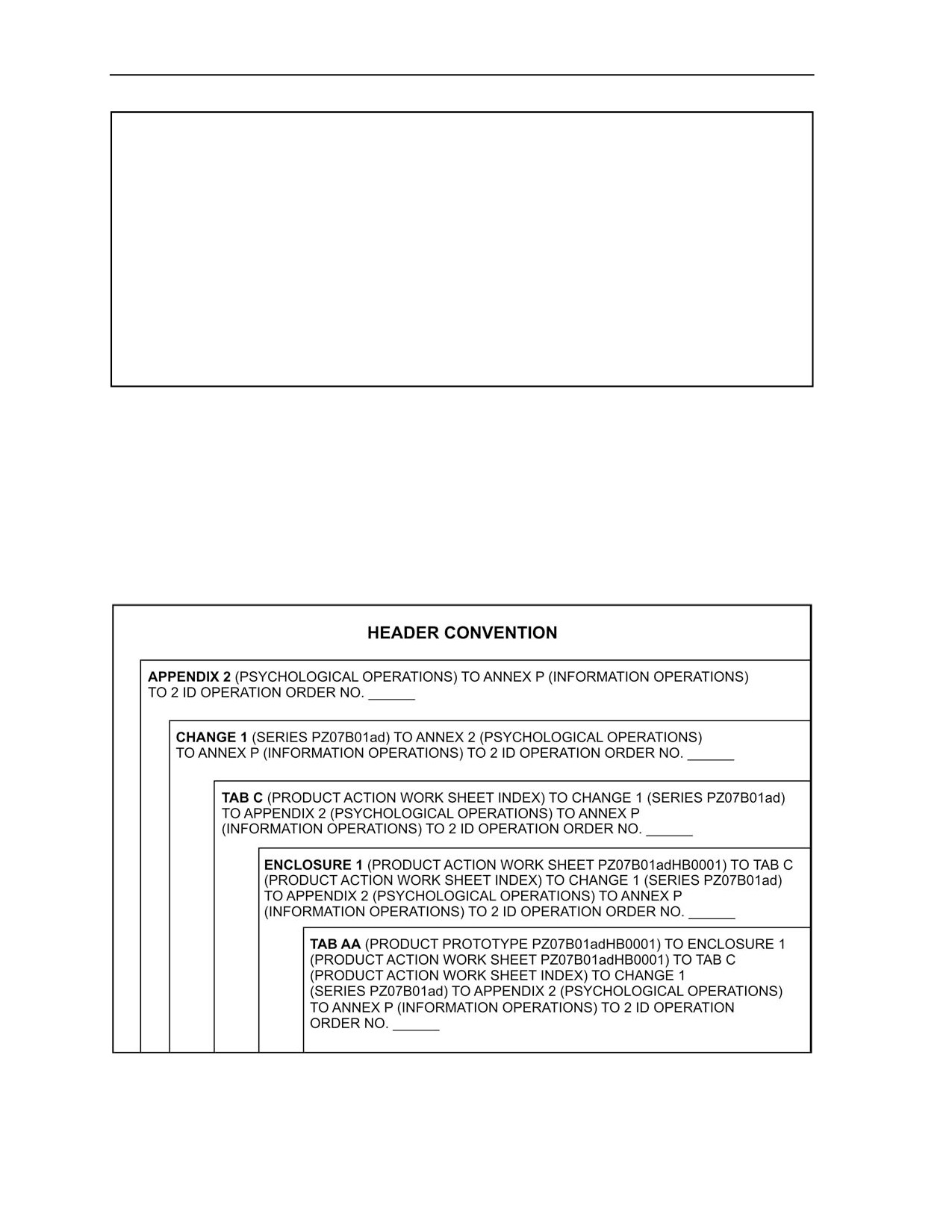
5-9. Figure 5-3 shows the succession of attachments and header conventions for a Change to the PSYOP
Appendix. Appendix 2 is the base document, which is being altered by the Change document. The Change
will include 7 tabs. Tab C is the only attachment that will have subsequent enclosures and expanding tabs.
Enclosures will be the PAWs themselves and the header convention is written as an Arabic number
beginning with
1. Each enclosure will reference the higher tab. The expanding tabs will be the
corresponding testing documents and the prototype or substitute for the PAW in the enclosure.
Figure 5-3. Example headers for Change to PSYOP Appendix
5-6
FM 3-05.301
30 August 2007
Phase V: Approval
EXECUTIVE SUMMARY FOR THE SERIES
5-10. The next step in preparing the series for approval is to write the executive summary for the series.
This summary describes the series concept for the supported commander. The executive summary should,
at a minimum, contain the PO, TA, behavior change (SPO), media used, units involved, schedule (stages
and DPs) for the series in general terms, and the geographic locations for the execution of the series. Figure
5-4 presents a brief example of an executive summary.
Enclosure 1 (Executive Summary) to Change 1 (Series XX06A02ka) to Tab D (Psychological Operations) to
Appendix 3 (Information Operations) to Annex C (Operations) to XX Operation Order Number X
Series XX06A02ka will help to set the conditions to reduce the effectiveness of insurgent activity through
increased reporting of insurgent activity by the parents of young children in XX. Series XX06A02ka will be
executed from 12 September 2006 through 29 September 2006 in three stages with two DPs. The first DP
(DP 1) is to execute Stage II and is not later than (NLT) 181200Z SEP 06. DP 1 depends on the TA
accepting that the XX Security Forces can and will arrest insurgents (Stage I) and will be determined by
posttesting of Stage I. The second DP (DP 2) is to execute Stage III and is NLT 251200Z SEP 06. DP 2
depends on the TA accepting that they can anonymously report insurgent activity to XX Security Forces
(Stage II) and will be determined by posttesting of Stage II. Stage III is getting the TA to accept that reporting
insurgents is in the best interest and safety of their children and that they can increase their family’s security
in so doing. Series XX06A02ka will include handbills, newspaper inserts, radio broadcasts (local radio
stations), loudspeaker broadcasts, and face-to-face communication, as well as one PSYACT by the XX
Security Forces. The evaluation criteria for Series XX06A02ka is the number of calls to the telephone number
provided exclusively for this series
(Stage II) from
19 September 2006 through 16 October 2006, as
measured weekly, as well as posttesting after the completion of each stage. To meet the planned timeline, as
articulated in the SEM (Tab B), this series must receive approval NLT 010001Z SEP 06.
WILLIAM J. REASON
MAJ, PO
Commanding
Figure 5-4. Example of an executive summary for the series
ENCLOSURE 3 (PRODUCT/ACTION WORK SHEET INDEX)
5-11. The PAW Index is Enclosure 3 (Figure 5-5) to the Change to the base PSYOP Tab/Appendix. This
enclosure will list the product numbers for all products in the series. The PAW for each product number
listed is a tab to Enclosure 3 (PAW Index). The number of products and actions in the series determines the
number of enclosures.
Enclosure 3 (Product/Action Work Sheet Index) to Change 1 (Series XX07A02ka) to Tab D (Psychological
Operations) to Appendix 3 (Information Operations) to Annex C (Operations) to XX Operation Order Number X
Product Numbers
Series XX07A02ka
Tab AA - XX07A02kaHB0001
Tab BB - XX07A02kaNP0002
Tab CC - XX07A02kaCB0001
Tab DD - XX07A02kaRD0001
Tab EE - XX07A02kaRD0002
Tab FF - XX07A02kaRD0003
Figure 5-5. Enclosure 3 (PAW Index) to Change 1 to Tab D (PSYOP)
5-12. Each tab to Enclosure 3 (PAW) will have three expanding enclosures that consist of the product
prototype or substitute, the pretesting results, and the posttesting questionnaire or survey. Expanding
30 August 2007
FM 3-05.301
5-7
Chapter 5
enclosures to a tab are written as double numbers with the first and second number being “1.” For
subsequent expanding enclosures, the first number remains constant, and the second number follows in
numerical order (1-1, 1-2, 1-3, and so on).
5-13. The final step in preparing the series for approval is preparing the input to the FRAGORD to the
supported unit’s base order. This input is normally in the form of identifying supported unit elements that
are required to execute the series and referencing them to the PSYOP Tab. This input should include
elements of the supported unit that are affected by changes in command relationship that are called for in
executing the series. When this step is complete, the series is prepared for approval.
5-14. Once the PSYOP approval authority approves the series, the supported unit’s operations section
issues the FRAGORD. This FRAGORD includes any changes to the PSYOP Tab/Appendix and orders the
execution of the series. The FRAGORD is an order to all elements of the supported command to execute
the series IAW the instructions contained in the Change to the PSYOP Tab and all of its attachments.
SUMMARY
5-15. Series approval is a detailed and focused task that, when done correctly, allows for the approval of a
complete plan that will enable PSYOP to help change TA behavior and facilitate the accomplishment of the
SPO. Approval of PSYOP programs and series will always receive a high level of scrutiny due to potential
far-reaching strategic effects of PSYOP products and actions. However, without proactive and timely
management of the series approval process, PSYOP cannot remain effectively engaged in military
operations. At the end of Phase V, PSYOP Soldiers will have an approved PSYOP series ready for
execution that is coordinated and synchronized with ongoing military operations and U.S. strategic
communications. Once series and/or product approvals are granted, and a FRAGORD is issued, Phase VI
of the PSYOP process begins.
5-8
FM 3-05.301
30 August 2007
Chapter 6
Phase VI: Production, Distribution,
and Dissemination
Once product approval is granted, Phase VI of the PSYOP process begins. Phase VI
can be considered the action phase, as PSYOP products are produced and delivered to
the intended target audience (TA) to achieve the desired effects. This phase consists
of the production, distribution, and dissemination of PSYOP products in a series, and
the subsequent posttesting of these products. The results of the posttesting are
analyzed in the Phase VII (Evaluation) phase, which is described in the following
chapter. The series execution matrix (SEM), the series dissemination work sheet
(SDW), and the change to the PSYOP appendix cover the timelines for Phase VI.
Accuracy and timeliness of the dissemination of a PSYOP series and the method
selected are critical in today’s rapidly evolving information environment. Whenever
possible, PSYOP forces must contract for use of local production assets and facilities
to ensure timely production of products in theater. In some cases, the host nation
government nationalizes fixed facilities during a crisis. The use of these facilities is
planned and coordinated in advance. In many situations, PSYOP forces may opt to
contract local companies to produce multimedia products or use organic assets when
available. Throughout the execution of this phase, the goals of quality assurance and
timeliness of the PSYOP series are paramount to successful PSYOP.
QUALITY CONTROL
6-1. Regardless of whether PSYOP forces use organic or nonorganic production assets, quality control
must be conducted. Generally, a member of the product development section/tactical Psychological
Operations development detachment (TPDD) and a translator will conduct a quality-control check. For
visual products, the product development section/TPDD must verify that the initial production run
corresponds with the original approved prototype. The translator must also verify that none of the
translated text has become obscured or distorted, or that any of the words have run together. For audio
products, the product development section/TPDD must ensure that the recording has no distortion and that
it is in the correct format. The translator is responsible for verifying that the audio recording is
understandable in the target language and the audio corresponds to the translated script. For audiovisual
products, the product development section/TPDD verifies that the product corresponds with the approved
storyboard, that the recording quality is good, and that it is produced in the correct format for broadcasting.
The translator checks the product to verify that it is understandable in the target language. The translator
and the PSYOP Soldier verify that there are no cultural discrepancies. Once the quality-control check is
completed, full-scale production begins and the required quantity is produced as stated on the SDW. The
SDW determines the location and time that each product will be disseminated.
PRODUCTION
6-2. After a series has been approved and any changes incorporated, the products go into production.
During series development, the products that go to production first, IAW the SEM, are determined. The
SEM allows the plans and programs section to time, synchronize, and deconflict translation, testing,
production, distribution, and dissemination within the series to maximize effects. The product/action work
sheet (PAW) also states the production means, which can be either organic or nonorganic assets. The
30 August 2007
FM 3-05.301
6-1

Chapter 6
production process ranges from simple to complex. An example of a simple production process is a
10-word, two-color leaflet for a target of opportunity. This product can be produced with organic assets
and may take a few hours to a few days from concept to production depending on the design of the leaflet.
Preparing a field video production to support a PSYOP series requires careful coordination between the
requesting PSYOP unit and the production facility, as well as significantly more man-hours in design,
editing, and production. For example, filming one hour of raw footage may take 8 man-hours. Therefore, 4
hours of raw footage will require 32 man-hours. Afterwards, editors condense the 4 hours of the raw video
footage to between 30 seconds and 2 minutes of finished video. Before choosing this media format to
disseminate messages, PSYOP planners must consider a variety of factors, some of which include
ensuring—
They have enough lead time to design/produce/disseminate the audiovisual product.
The message is of long-term value and will not be overcome by events.
Enough audiovisual dissemination platforms exist to cover the required area.
The intended TAs possess the radios or TVs needed to receive the transmissions in the first
place.
ORGANIC PRINT ASSETS
6-3. The Heavy Print Facility (HPF) is a large nondeployable system consisting of four Heidelberg
Quickmaster Direct Image Digital Presses (Figure 6-1). Each press is capable of print speeds up to 10,000
sheets per hour and the HPF can produce 800,000 four-color, two-sided leaflets in a 24-hour period. The
quality of work that these presses produce is comparable to the newspaper and film image-setting
industries. The Heidelberg presses are organic to the 4th POG(A), Fort Bragg, North Carolina. Print
personnel assigned to the HPF are trained in product layout and formatting, limited press repair, and are
capable of producing multicolor products of various sizes, such as business-card-sized hotline tips cards,
leaflets, posters, handbills, books, magazines, and tabloid newspapers.
Figure 6-1. Heidelberg Digital Press
6-2
FM 3-05.301
30 August 2007

Phase VI: Production, Distribution,
and Dissemination
6-4. The Modular Print System contains three modules: A, B, and C (Figure 6-2). Module A contains
printing equipment that is no longer used. Module B consists of two expandable shelters, each containing one
Heidelberg GTOZP52 offset press that can print in two colors at one time or one color, front and back. The
maximum paper dimensions for this system is 14 inches by 20 inches, with the largest product measuring
13 3/8 inches by 20 inches, allowing for marginal areas. Module C is also expandable and contains a large
paper cutter, press plate marker, and a small light table. Modules B and C are capable of limited paper storage
space when expanded.
Figure 6-2. Modular Print System
6-5. The Risograph is a deployable digital duplicator that combines the basic output speed of a small press
(120 copies per minute) with the simplicity of a copier (Figure 6-3). It can produce up to 93,000 single-color
leaflets in a 24-hour period. Although Risographs do not require connection to a computer, a direct connection
to a computer does provide a better image quality and the ability to develop print products at the PDC or
TPDD, and produces print materials farther forward, thus reducing distribution and dissemination time.
Risographs are organic to some PSYOP units and are pre-positioned in many theaters of operations.
Figure 6-3. Risograph
30 August 2007
FM 3-05.301
6-3

Chapter 6
6-6. The Deployable Print Production Center is an M1037 high-mobility multipurpose wheeled vehicle
(HMMWV)-mounted/transportable print system
(Figure
6-4). The print system includes a Product
Development Workstation (PDW)-Light, a high-speed digital duplicator (Risograph), an electric paper
cutter, a generator, and an environmental conditioning unit, some of which is mounted on a trailer for
transport. The PDW-Light is a system that provides forward-deployed units in the field limited PSYOP
product development (Figure 6-5). It also provides users the capability to electronically transmit and
receive PSYOP product files and related information via the product distribution system (PDS). The PDS
is a commercial off-the-shelf satellite communications earth terminal, Moving Picture Experts Group-2
encoder workstation, and a Windows NT server used for secure and nonsecure product distribution (Figure
6-6, page 6-5). The PDS transmits products via commercial/military satellite transmissions, single-channel
ground and airborne radio system radios, or through phone lines. The system consists of a ruggedized
laptop computer, removable hard drive, and printer. The PDW-Heavy is similar in concept to the PDW-
Light, but uses a desktop computer and color laser printer for increased printing quality.
Figure 6-4. Deployable Print Production Center
Figure 6-5. Product Development Workstation-Light
6-4
FM 3-05.301
30 August 2007

Phase VI: Production, Distribution,
and Dissemination
Figure 6-6. Product Distribution System
NONORGANIC PRINT ASSETS
6-7. PSYOP Soldiers may have access to nonorganic assets that can be used for various product printing
requirements. These print assets may be privately owned by foreign nationals or may be part of coalition
members’ militaries. For example, the combined Psychological Operations task force (CPOTF) in the
Republic of Korea routinely exercises nonorganic printing assets by using both local national print assets
and print assets in the Korean Army.
Local National Print Facility Contracting
6-8. Contracting with a local national company during the initial stages of military operations is cost-
effective and allows for timely, responsive production of PSYOP products. This coordination will be made
through a contracting officer, usually through the supported unit or U.S. Embassy. An advantage to using
local national assets is that they are often more cost effective and will resonate more with the TA. When
contracting with a nonorganic asset, PSYOP forces must be aware of operational security issues and should
produce any sensitive products with organic assets. Local national assets are best suited for the production
of long-use products such as newspapers and magazines. In addition, local assets can be a viable source for
producing command and public information products. Additional consideration must be given to the fact
that some local national production facilities may not have the experience, knowledge, or resources to
maintain their equipment. Print and audiovisual specialists may assist in training local personnel on the
proper ways to repair and service their machines and equipment. This assistance may help establish rapport
with the local national facilities, thereby facilitating the production of PSYOP products.
Contracted Audiovisual Production Assets
6-9. In an effort to ensure the widest dissemination of audiovisual products, a contracting officer may be
able to establish contracts with one of the local TV stations to help produce, edit, and make copies of
approved products in correct formats for distribution and dissemination. Another asset to consider for
30 August 2007
FM 3-05.301
6-5
Chapter 6
audiovisual production is contracting with local acting or modeling companies for personnel to narrate or
to become a spokesperson or newscaster for PSYOP audiovisual products. A professional spokesperson
will catch the attention of the TA and will add credibility to the PSYOP message being aired.
OTHER PRODUCTION ASSETS
6-10. PSYOP forces conduct operations directed by the President and SecDef in close cooperation with
other Services and agencies. Occasionally, due to limited assets, PSYOP forces must make use of the
production assets and facilities of other Services and USG agencies.
Joint Combat Camera Center
6-11. The joint combat camera center (JCCC) focuses on photos that tell the Army story from an American
point of view. The photos must be carefully examined prior to use to ensure that they express a viewpoint
that is culturally relevant to the intended TAs. The JCCC coordinates inputs from the individual Services’
combat camera units. Combat camera units can be a valuable source of visual and audiovisual products.
Another option that may be researched is the coalition press information center. They may have
audiovisual capabilities in-theater that may be useful in making copies of approved products.
American Forces Information Service
6-12. The American Forces Information Service produces news, feature articles, and TV reports on all
aspects of military life. These products focus on what senior defense leaders are saying on all aspects of
military life. News and feature articles are uploaded throughout the day, seven days a week. TV news
reports are available daily on the Web and are broadcast on the Pentagon Channel
United States Navy
6-13. PSYOP forces can also use the experience and expertise of other Services within the U.S. military.
The Navy has the capability to produce audiovisual products from the Fleet Audio-Visual Command,
Pacific; Fleet Imagery Command, Atlantic; fleet combat camera groups; various film libraries; and Naval
Imaging Command. Naval assets have the capability to broadcast AM/FM radio from ships offshore, with a
range of up to 40 kilometers (km) inland, and produce documents, posters, articles, and other materials for
PSYOP. In addition, the Navy and Marine Corps EA-6B aircraft have the capability of broadcasting
prerecorded .wav files across a wide variety of communication systems, including FM radio.
United States Air Force
6-14. The 193d Special Operations Wing of the United States Air Force (USAF) has as its primary mission
to broadcast on standard AM, FM, high frequency and high-frequency TV, and military communications
bands. Six EC-130E/J (COMMANDO SOLO) aircraft, assigned to the Pennsylvania Air National Guard,
broadcast PSYOP as their primary mission. COMMANDO SOLO flies during either day or night, and is
air-refuelable. Additionally, Air Force Special Operations Command is equipped with a number of aircraft
capable of accomplishing broadcast and leaflet operations.
PACKAGING
6-15. The final consideration for PSYOP product production is how the product will be packaged for
distribution and dissemination. Some questions to consider include—
How many separate elements are going to disseminate the products and in what quantities? Will
it be to the TPD or TPTs? How many? What is the distance to each of their locations?
How will the products be disseminated? Is it by paper, video, or audio for loudspeaker or radio
broadcast?
What environmental conditions will the products be exposed to during distribution? During
shipping, PSYOP Soldiers must ensure the packages can handle rough treatment, ensure that the
6-6
FM 3-05.301
30 August 2007
Phase VI: Production, Distribution,
and Dissemination
print is in large legible letters and includes the unit location, point of contact, and phone number.
If the product is packaged and sent via the Internet, PSYOP Soldiers must ensure that the
appropriate security parameters are enforced, that the final approved product is being sent, and
that it is sent in the appropriate format for printing.
6-16. Packaging of leaflets for distribution is determined by the dissemination means. The standard static-
line box is 12 inches by 12 inches by 16 inches. Therefore, products by static-line leaflet dissemination are
packaged with approximately 25,000 per box.
6-17. Using leaflet bomb dissemination, the products are packaged with approximately 30,000 per box.
This arrangement saves significant man-hours in loading leaflet bombs, as each M129 holds about 60,000
leaflets and may contain two or more products. The two types of leaflet bombs are the—
M129 leaflet bomb, which holds about 60,000 leaflets and can be used to disseminate two or
more products simultaneously. The M129E1/E2 leaflet bomb is dropped from fixed-wing
aircraft. It requires two to four Soldiers to assist in the loading of PSYOP leaflets. Leaflets are
hand-rolled before placement inside the bomb. USAF personnel are responsible for loading the
bomb on the aircraft and fusing it. The M129E1/E2 can be used only on aircraft requiring forced
ejection for release from a bomb shackle. F-16, B-52, and FA-18 aircraft can carry the
M129E1/E2.
PDU-5/B, which is a modified MK-20 Rockeye II canister-type bomb designed to replace the
M129E1. It is used to drop leaflets from high-performance aircraft such as the F-16. Each
PDU-5/B can deliver about 45,000 leaflets in 20 rolls.
NOTE: Leaflets must be rolled into 20 uniform rolls to completely fill the PDU-5/B. This
process requires time and experienced leaflet-rolling personnel. Leaflets cannot be stacked in the
PDU-5/B as in the M129. Appendix D includes more information on leaflet bombs and aerial
dissemination.
DISTRIBUTION
6-18. Distribution is the movement of approved products, either physically or electronically, from the
production location to the point of dissemination. Distribution may also involve the temporary storage of
products for later dissemination. Timelines for distribution are determined during series development and
incorporated into the SEM. Product distribution within the theater often consists of using surface or air
assets for physical delivery of products to PSYOP units for dissemination to the intended TA, as directed
by the SEM. Military air assets may be used to distribute products, and are coordinated through the
operations section of the PSYOP unit’s higher HQ. Products that are distributed electronically are usually
transmitted via the SECRET Internet Protocol Router Network (SIPRNET). The use of the SIPRNET is
also facilitated by the Global Command and Control System (GCCS). The GCCS is a mobile and rapid-
deployable dissemination system. It consists of two flyaway transit cases containing two Nera international
maritime satellite M-4 phones, one Panasonic Toughbook, a Cisco router, Klas-TA Terminal, a Netgear
Switch, a KIV-7, a compact disc (CD) drive/burner, and a Sony video camera. It is designed to provide
secure data, voice, and video communications anywhere in the world by dialing into the GCCS base station
to access the file transfer protocol server at Fort Bragg, North Carolina. It provides video teleconferencing
capabilities through the use of NetMeeting. Additional computers and telephones can be connected to the
system so that a small voice and data network can communicate over a single secure satellite link.
REACHBACK
6-19. To make the best use of all available technologies and resources stateside at Fort Bragg, North
Carolina, such as the four stationary Heidelberg digital presses in the Media Operations Center (MOC) of
the 3d Dissemination Battalion, PSYOP elements may use reachback. The main capabilities required by the
deployed PSYOP element to implement reachback are access to the 4th POG(A) Web servers, point-to
point file transfer, access to SIPRNET and Non-Secure Internet Protocol Router Network (NIPRNET)
for file transfer and e-mail, and the intertheater distribution of PSYOP products. This concept allows a
30 August 2007
FM 3-05.301
6-7
Chapter 6
portion of PSYOP forces located at Fort Bragg to support forward-deployed elements with product
development, design, production, and distribution to the forward elements. Current and emerging
technologies (both military and commercial) support the reachback concept by providing secure, digital
communications paths for transferring PSYOP products between Fort Bragg and deployed PSYOP units.
These secure communication links include, but are not limited to, the SIPRNET, the PDS, and GCCS.
6-20. Under reachback, a portion of the PDC of the regional PSYOP battalion remains at Fort Bragg with
the MOC, depending on mission requirements. These personnel work on long-range planning, develop
products based on mission requirements, and then provide them to the forward-deployed forces. Deployed
forces will develop, produce, and disseminate products using internal assets or other military or civilian
assets in the AOR to support military operations at the tactical and operational levels.
CONTRACTED DISTRIBUTION
6-21. PSYOP Soldiers may use local national delivery companies to deliver products to various parts of an
area of operations (AO). Large quantities of magazines or posters can be delivered to different areas within
the country. PSYOP Soldiers may contract a local company for delivery on a weekly, biweekly, or a
monthly basis. This contract will ensure the delivery of the products without overburdening military
transportation assets or PSYOP Soldiers. The contracting officer works out all the legal issues concerning
payment, insurance, and the selection of delivery companies.
6-22. PSYOP Soldiers should strive to build bonds with the local nationals by working together with their
military, OGAs, or nongovernmental organizations
(NGOs). By working with the local military, if
available, or NGOs, PSYOP forces will be able to coordinate combined distribution efforts to many of the
areas that need to be reached, but exceed the organic dissemination capabilities of the PSYOP units and
personnel. This coordination helps establish a greater working relationship between PSYOP forces and the
local nationals, and places PSYOP in a positive light with the local populace.
LOCAL NATIONAL ASSETS
6-23. PSYOP Soldiers should consider employing locally available assets, whether commercial vendors,
nationalized enterprises, or nongovernment agencies, to maximize coverage of PSYOP products in the AO.
Existing broadcasting facilities may have the power and range required to reach the intended TA with radio
or TV. Programming can be introduced immediately without having to wait for the installation of organic
PSYOP transportable systems.
6-24. NGOs are not legal entities under international law as states are. An exception is the International
Committee of the Red Cross, which is based on the international humanitarian laws of the Geneva
Convention. NGOs are not directly affiliated with any national government but often have a significant
impact on the social, economic, and political activity of the country or region involved. Many of the
largest, most significant NGOs have relationships and sometimes official associative status with
intergovernmental organizations, such as the United Nations or the World Bank.
6-25. The list of NGOs in any given area may be quite extensive. The latest United Nations report on
global governance estimated that there are nearly 29,000 international NGOs. Many NGOs now prefer the
term private voluntary organization or private development organization. However, NGO remains the most
recognized and widely used label. Searching the Internet is one method to obtain information regarding
NGOs, including their profiles, operating in the target country. Some of the organizations that may be of
service are the—
United Nations High Commissioner for Refugees.
International Police Task Force.
International Organization for Migration.
6-26. There are different types of NGOs, each having its own particular agenda. PSYOP Soldiers should
research a particular NGO prior to establishing contact. The United States Agency for International
Development (USAID) is the best source of information regarding NGOs. The USAID publishes a yearly
report entitled Voluntary Foreign Aid Programs. The PSYOP commander can obtain this report from the
6-8
FM 3-05.301
30 August 2007
Phase VI: Production, Distribution,
and Dissemination
higher HQ or the USAID representative assigned to the U.S. Embassy. The USAID maintains an updated
database of the NGOs that are registered with the agency.
DISSEMINATION
6-27. Dissemination is the actual delivery of the PSYOP message to the TA. Giving out handbills while
conducting face-to-face communication with the TA, putting up a poster, speaking through a family-of
loudspeakers system, and leaflet drops in a section of a town or city are all examples of disseminating
products. Having multiple means of dissemination is preferred. Radio and TV broadcasts, leaflets,
loudspeakers, and other means are used throughout the world to disseminate PSYOP products. These
products are disseminated in timeless ways, such as by face-to-face and paper, and also by the Internet and
big-budget TV commercials.
DISSEMINATION FACTORS
6-28. In today’s Information Age, there is an increasing reliance on sophisticated, near-real-time media
dissemination. Information, or sometimes the withholding of information, is power. Once PSYOP
arguments and messages have been chosen, the PSYOP commander must decide the most effective way to
convey them to the TA. The state or entity most able to effectively control or manage information,
especially managing the perceptions of particular TAs, will be the most influential.
6-29. Using target audience analysis (TAA), PSYOP Soldiers determine the most effective means of
dissemination. By carefully considering the effects of these factors and using the delivery techniques of
each medium to its full extent, PSYOP units can disseminate PSYOP products effectively. To make this
determination, they must assess the following factors that may affect the selected means:
Political.
Military.
Physical conditions (geography and weather).
Opponent’s disruption capabilities.
TA’s comprehension level of selected media.
Communications infrastructure.
Availability of dissemination platforms.
Availability and credibility of media.
DISSEMINATION PLATFORMS
6-30. PSYOP forces have numerous platforms to disseminate approved PSYOP visual, audio, and
audiovisual products to specific TAs in a designated location. These dissemination systems include the
following:
Airborne, vehicle, or portable (manpack) loudspeaker systems.
Leaflet bombs.
Portable Amplitude Modulation Transmitter.
Transportable AM Transmitter.
Portable Frequency Modulation Transmitter.
Special Operations Media System-B.
NOTE: The Psychological Operations Handbook: Equipment Types, Specifications, and
Capabilities has specific information on these and other PSYOP-unique systems. As
technological advances are made and new equipment is fielded, this stand-alone publication is
updated.
30 August 2007
FM 3-05.301
6-9
Chapter 6
DISSEMINATION MEANS
6-31. PSYOP forces use numerous dissemination means to communicate a message. Each of these
methods is discussed in the following paragraphs.
Face-to-Face Communication
6-32. Face-to-face communication is the conveyance of a message by the sender in the sight or presence of
the receiver. Face-to-face communication ranges from two or more individuals in informal conversation to
planned persuasion among groups. The credibility of the PSYOP messages delivered by face-to-face
communication is increased when the communicator is known and respected. By disseminating through
face-to-face communication, PSYOP forces have the opportunity to interact with the local populace and get
direct and immediate feedback and reactions from the TA.
6-33. PSYOP Soldiers should consult with local leaders (key communicators) prior to disseminating
posters. These leaders can provide PSYOP Soldiers information as to the best locations to put up posters to
gain maximum visibility. Care should also be taken when placing posters at sensitive locations, such as
religious facilities. PSYOP Soldiers should check with the facility manager; there may be specific
guidelines for where, how, and when a poster is put up due to fears of retribution or other perceived
threats. PSYOP Soldiers may place posters up within their specific AO using tape, staples, poster paste, or
spray adhesive. Poster paste or spray adhesive is the preferred method since they make removing or
recycling the product as a counterpropaganda product more difficult.
6-34. Printing novelty items with the PSYOP message is an extremely effective means to reach people.
PSYOP Soldiers use novelty items, such as notebooks, soccer balls, pens and pencils, and T-shirts, all with
the PSYOP message printed on them. An effective dissemination technique is to hand out products at the
same time and place on a regular schedule in coordination with other activities such as MEDCAPs and
VETCAPs. When PSYOP Soldiers distribute these products, they inform the local populace that they will
be back on a certain date and time. This practice sets up a specific dissemination location where the TA
knows it will receive new products and information on a regular basis. (PSYOP Soldiers employ this
practice only in a secure theater and not in a hostile environment.) When passing out handbills and novelty
items, PSYOP Soldiers should take care to adhere to cultural norms. For instance, some cultures frown on
adults other than parents having direct contact with or talking to children. Cultural awareness is key to
gaining the trust and respect of the TA.
6-35. A keen awareness of the TA’s culture coupled with skillful face-to-face communication can lead to
successful PSYOP. PSYOP Soldiers can use face-to-face communication to present persuasive appeals and
complex material in detail. They can repeat portions of the communication as required and use slight
variations to influence a specific TA. The importance of appropriate gestures and physical posture in the
communication process must not be overlooked. What may be an appropriate gesture in one culture may be
viewed quite differently in another. The most important part of face-to-face communication is the
immediate feedback that can be obtained from the TA. PSYOP Soldiers can obtain valuable information
from this feedback and may realize the true meaning of the message that PSYOP Soldiers may have
overlooked due to a lack of political awareness or cultural differences. This information may change the
message intent or the message itself. PSYOP Soldiers should take every opportunity to hone and enhance
their ability to conduct effective face-to-face communication. PSYOP Soldiers need to rehearse face-to
face communication to practice favorable body language while eliminating unfavorable gestures and
posture. Body language is as important as the verbal message and should appear natural, not labored or
uncomfortable.
6-36. PSYOP Soldiers should use the Face-to-Face Encounter Outline (FFEO) to organize and plan their
encounters. The FFEO (Figure 6-7, page 6-11) addresses each of the four parts of the face-to-face
encounter: introduction and rapport building, presenting a PSYOP argument, answering questions/
overcoming objections, and the exit strategy/closing. The introduction and rapport-building section
includes a sample introduction and recommends culturally specific actions or conversation topics to put the
TA at ease and establish credibility and rapport. The PSYOP argument section takes the components of the
PSYOP argument—the arguments, appeal, and technique—and creates specific talking points with
6-10
FM 3-05.301
30 August 2007
Phase VI: Production, Distribution,
and Dissemination
supporting facts and examples to assist the PSYOP Soldier in presenting the product. The answering
questions and overcoming objections section lists the most likely questions and objections that may arise
during the encounter, and, most importantly, provides a prepared response to each. By anticipating the
responses of the TA and developing effective responses in advance, the PSYOP Soldier greatly increases
his chances of success. The exit strategy or closing section provides sample closing remarks, lists any
actions that need to take place, and provides recommended plans of action if the encounter does not go
well. Once the FFEO is complete, the PSYOP Soldier can use the outline to rehearse and prepare his team
and interpreters. One effective rapport-building technique is called “mirroring.” Mirroring subtly mimics
another person’s body language and vocal qualities. People are naturally more comfortable around those
who seem the same as themselves. It is important to remember that mirroring must be subtle and appear
natural, and may not be appropriate in every culture or situation.
SPO - Specific behavior being sought.
Supporting Argument - Portion that will be used in this encounter.
A. Introduction and Rapport Building.
1. Introduce self and team.
2. Discuss the reason for being there.
3. Engage in culturally specific formalities, such as shaking hands, drinking tea, or conversing politely
(about weather, health, sports, and so on).
B. Presentation of Main and Supporting Arguments.
1. Main Argument.
a. Specific point or facts.
b. Specific point or facts.
2. Supporting Argument 1.
a. Specific point or facts.
b. Specific point or facts.
3. Supporting Argument 2.
a. Specific point or facts.
b. Specific point or facts.
C. Answers to Questions and Discussion to Overcome Objections.
1. Predict possible question or objection.
a. Answer with prepared response.
2. Predict possible question or objection.
a. Answer with prepared response.
3. Predict possible question or objection.
a. Answer with prepared response.
D. Exit Strategy or Closing.
1. Encounter has gone well.
a. Leave a deliverable, if appropriate.
b. Extract a commitment to behave in desired manner.
2. Encounter has gone poorly.
a. Exit quickly without escalation.
b. Determine if different approach would be successful. Document primary reason why encounter went
poorly.
Figure 6-7. FFEO format
30 August 2007
FM 3-05.301
6-11
Chapter 6
6-37. To learn more about gestures, posture, and other mannerisms used when communicating face-to
face, PSYOP Soldiers should consult individuals who have lived in the HN and are aware of these
customs. A good source of this information is to talk with and ask questions of the interpreters who are
assigned in the AO. Another source of additional information is the Do’s and Taboos Around the World
book, which contains chapters on hand gestures and body language, giving and receiving gifts, a quick
guide to the ways of the world, and information about the importance of colors, jargon, slang, and humor.
6-38. PSYOP forces should maintain a close working relationship with Civil Affairs (CA) personnel.
Working with CA personnel allows PSYOP to leverage the positive aspects of humanitarian assistance
projects that CA personnel typically get involved in. Through working with the CA units, PSYOP forces
can also coordinate the mutual dissemination of products.
6-39. There are many advantages of face-to-face communication. Some examples include the following:
Relationship. Face-to-face communication employs an interpersonal relationship.
Audience selection. The audience can be deliberately selected and the appeal directed and
tailored for the audience.
Assessment of impact. Feedback is immediate. The communicator can immediately assess the
impact of his message and adjust his approach to obtain the desired response.
Requirement for limited support. Limited technical and logistical support is required.
Credibility. Face-to-face communication can be more credible than other methods because the
TA can evaluate the source.
Presentation. Complex material can be presented in detail. Frequent repetition and slight
variations can be readily used to influence the audience.
Expeditious. In some instances, particularly in underdeveloped areas, face-to-face
communication may be the most timely or efficient method of disseminating messages or
command information.
6-40. There are also disadvantages of face-to-face communication. Some examples include the following:
Limited use in tactical situations. Use is limited in war due to the inaccessibility of the target
individual or group. Use is limited in combat since the PSYOP Soldier has little face-to-face
communication with the adversary until they are captured or they defect.
Close control necessary. Face-to-face dissemination must be controlled, especially at the lowest
levels where each communicator has the responsibility to interpret policy and objectives. The
control factor is best illustrated by trying to pass an oral message, one person at a time,
throughout a group. By the time the message reaches the end of the group, it does not resemble
the original message. Reinforcement by other media is necessary to eliminate this problem.
Limited use in secure areas. Security considerations limit the conduct of face-to-face
communications. As the security situation improves and more areas are secure, area coverage in
secure areas can be extended.
Limited range of voice. The range of the human voice and the need for visual contact limit this
method.
Broadcast Dissemination
6-41. PSYOP forces have numerous platforms to disseminate approved PSYOP audio products to
designated TAs within an AO or joint operations area (JOA). Organic radio broadcasting equipment
provides a variety of capabilities for the PSYOP force to meet their specific needs and the requirements of
the operation. Some equipment is designed specifically for ease of transport and operation. Other more
powerful systems, such as longer-range broadcast platforms, require multiple airlifts to transport and
several days to install. (The Psychological Operations Handbook: Equipment Types, Specifications, and
Capabilities include the specifications and capabilities of these systems.)
6-12
FM 3-05.301
30 August 2007
Phase VI: Production, Distribution,
and Dissemination
Radio
6-42. Radio provides entertainment, news, and instructions along with the desired PSYOP message. Radio
broadcasts reach local audiences, cross international boundaries, and reach behind enemy lines. Although
the tactical situation may hinder radio broadcasts, they are not complete barriers. Since radio can reach
TAs quickly, it is useful for all types of PSYOP.
6-43. As with all other media, the selection of radio will depend greatly on the availability of, and access
to, radios by the TA, the tactical situation, and the ability of the radio signal to reach the TA. PSYOP
Soldiers can contact local radio stations to have a live on-air show that broadcasts weekly to speak with the
local populace, as a means to disseminate PSYOP messages and command information. In addition, they
can contact and coordinate with area commanders and key communicators for interviews on local radio
stations. This contact provides direct interaction with, and access to, the local populace and helps reinforce
the objectives of the area commander while adding credibility to the message. Advantages of radio
include—
Speed. Radio programs can be quickly prepared for broadcast. Speed is important when
attempting to capitalize on targets of opportunity.
Wide coverage. Radio programs can reach large and varied audiences simultaneously.
Ease of perception. When done correctly, radio programs require little or no effort on the part of
the listener to visualize the message. Illiteracy does not prevent the listener from forming his
individual image as he listens.
Versatility. Radio is easily adaptable to many types of programs, including drama, music, and
news.
Emotional power. A skilled radio announcer can exert tremendous influence on the listener
simply with pitch, resonance, inflection, or timing.
Availability of receivers. Where availability or ownership of receivers is common, listening to
radio is a habit. Ownership of receivers has increased greatly with the invention of transistors.
Disadvantages of radio include—
Enemy restrictions. The government may censor all media making it difficult to reach the TA,
thereby reducing the effectiveness of radio broadcasts.
Jamming possibilities. Jamming can prevent the TA from receiving radio broadcasts.
Technical problems. Technical problems include, but are not limited to, equipment
malfunctions, signal strength, and atmospheric conditions.
Lack of receivers. In certain areas, so few receivers are available that radio may not be an
effective medium.
Fleeting impressions. Oral media does not have the permanency of written media. Messages
may be quickly forgotten or distorted.
6-44. Radio programming consists of planning the schedule, content, and production of programs during a
stated period. Words, music, and sound effects are put together in various ways to produce the different
kinds of programs. Some of the major types of radio programs are—
Straight news reports (without commentary).
Musical (whatever genre is popular with the TA).
Drama.
Speeches, talks, discussions, or interviews.
Sports.
Special events, such as on-the-spot coverage of an election or the arrival of an important visitor.
Religious.
Variety—a combination including music, skits, or comedy.
Announcements.
30 August 2007
FM 3-05.301
6-13
Chapter 6
Radio principles include the following factors:
Regularity is an essential element of programming. The radio programmer must create habitual
program patterns to build a regular audience. Content, style, and format should follow an
established pattern.
Radio programming builds listenership by following a set time schedule. Listeners must know
when they can tune in for the programming they want to hear. This time schedule allows the TA
to form a regular habit of listening to the program. If the time schedule varies on a daily basis,
listeners will become frustrated and turn to another station.
Repetition is necessary for oral learning; therefore, repeating key themes, phrases, or slogans
will ensure the TA gets the desired message. If a certain message airs only once, or is only aired
at one time every day, the listener has a good chance of missing the information.
The radio program must suit the taste and needs of the audience. Program style and format
should follow the patterns to which the audience is accustomed.
Announcers with attractive voice features are essential to successful radio operations. Some
factors to consider include—
The emotional tone conveyed by the voice, which may influence the listener more than the
logic of arguments.
Avoiding announcers whose accents are similar to those of unpopular individuals or groups.
Television
6-45. TV is a proven means of persuasion worldwide and is a vital asset in PSYOP dissemination. TV
appeals to a number of senses, making it the closest medium to face-to-face communication. TV has been
responsible for swaying the opinion of entire nations. A thoroughly prepared PSYOP TV product can be
extremely effective if PSYOP planners fully understand the unique properties of TV and do not limit their
imagination in its use. TV, including videotape recording, is one of the most effective mediums for
persuasion. TV offers many advantages for PSYOP, and its wide application in other fields contributes to
its acceptance and use. TV is appropriate for use across the range of military operations. In places where
TV is not a common communication medium, receivers may be distributed to public facilities and selected
individuals. A possible limitation in enemy countries is that TV receivers may be set to allow reception on
only one or two channels under government control. TV is an all-encompassing mass communication
medium. Like radio, TV makes use of the sense of hearing to convey an idea. Like printed material, TV
makes use of the sense of sight, adding the element of motion. Moreover, like the motion picture, TV
combines sight, sound, and motion. TV is immediate; in effect, it places the viewer in two locations
simultaneously, creating the illusion of participating in a distant event.
6-46. PSYOP forces have several dissemination platforms for approved PSYOP audiovisual products to
designated TAs within an AO or JOA. These dissemination systems are transportable and consist of
multiple broadcast and production subsystems. (The Psychological Operations Handbook: Equipment
Types, Specifications, and Capabilities includes specifications and capabilities of these systems.)
6-47. There are many advantages of broadcasting PSYOP messages via TV. Some examples include—
Speed. TV programs can reach large segments of the TA rapidly. The transmission of events can
be instantaneous.
Audience illiteracy. Illiteracy is not a barrier; an audience need not be able to read.
Unification. TV brings people in widely separate locations closer together by exposing them
visually to the same ideas and concepts.
Aural-visual effect. TV appeals to two senses—hearing and seeing, with each reinforcing the
other, and gives the viewer a sense of involvement.
6-48. There are also disadvantages of TV. Some examples include—
Range. Geography and atmospheric conditions affect the strength and range of the signal. The
signal may, however, be boosted with relay stations, airborne transmitters, or satellite relay to
increase the transmission range. Airborne antenna relay domes extend the range of a central
transmitter, but at great expense.
6-14
FM 3-05.301
30 August 2007
Phase VI: Production, Distribution,
and Dissemination
Reception. TV sets are unevenly distributed throughout the world. Messages disseminated by
TV will normally be received only by those within an above-average income range and
economic class in many areas of the world, particularly in developing nations. In some
developing nations, however, group listening and viewing centers may be available, negating the
link between income and access to TV. The association should be carefully determined for each
target country.
Equipment incompatibility. Receivers in the target area may not be compatible with the
transmission equipment.
Power. Most TV receivers require an outside source of electric power. Many areas of the world
lack this power. The introduction of self-contained power packs partially eliminates this
problem. If broadcasts are to be made from areas lacking power facilities, special generators and
a fuel supply may be needed.
Vulnerability. Equipment and parts are fragile and extremely vulnerable to damage. Stations are
easily identified and make excellent targets. Receivers are difficult to hide.
Program requirements. A substantial production staff and supporting equipment are required to
produce daily programs. Each day’s operation requires a large amount of film, videotape, and
live programming to sustain a program schedule.
Maintenance. Maintenance is highly technical, requiring trained and skilled technicians and
engineers; such people are difficult to find.
Personnel. TV is a complicated communication medium, demanding specialized personnel with
a wide range of scarce skills.
Audience accessibility. Difficulty in reaching audiences in hostile areas due to incompatibility of
receivers, extreme distortions caused by multiple transmitters on the same wavelength, jamming,
and censorship limit the use of TV broadcasts.
6-49. To take full advantage of TV as a medium, PSYOP Soldiers must realize that TV has always been
primarily a means of entertainment. However, the vast majority of viewers accept events seen on the TV
screen as fact. The implied actions of the characters seen on the TV screen manipulate viewers’
understanding of what they see. This impact is what sets TV apart from all other media. Before selecting
TV as a PSYOP medium, PSYOP Soldiers must determine the degree of credibility TV holds for the TA
and its degree of access. The TA’s accessibility to TV may be limited by many factors, including religious,
economic, and geographic. In remote areas, videotape or DVD may be the proper alternative to TV.
Advantages of these formats include the following:
The results of the “take” can be seen immediately; if editing is necessary prior to release to the
audience, the editing can be done electronically as the material is being produced.
Videotape or DVD can be reused a number of times, erasing itself as it is run through the
recorder, or it can quickly be erased on equipment made for that purpose, and then reused.
Videotapes and DVDs are virtually indestructible and can be used in almost any environment.
Videotape can be placed on readily available videocassette players that feed directly into
commercial TV receivers. With special equipment, videotaped scenes can be projected onto
large motion picture viewing screens. The requirement for special projection equipment is not
unique, as special equipment is also required to project filmed scenes on TV screens.
Videotapes and DVDs can instantaneously project scenes in black and white or color, with
natural or dubbed sound, on open (public) or closed (limited audience) circuits.
Scenes may be recorded for a permanent record or for future use.
Disadvantages of videotape are the same as those inherent in the TV medium.
6-50. An analysis of TV in the area of intended PSYOP provides valuable information about its specific
regional characteristics. Popular programs provide models for PSYOP TV products and help keep the
message subtle. Before developing or producing a new product, PSYOP Soldiers should ensure that they
research the information about a nation’s popular TV programs and shows. This research may provide
answers and insight into what is credible within that AO. PSYOP Soldiers should also seek the opinions of
interpreters, as they may be able to give thorough insight into the views of the TA. PSYOP Soldiers may
30 August 2007
FM 3-05.301
6-15
Chapter 6
research information in the libraries and universities, as well as the local marketing companies that do
market research in the AO. Area studies produced by universities are valuable, along with information
from religious organizations with missionaries in the host or target nation. PSYOP Soldiers can also
determine a great deal of information through research about literacy rate, viewing habits, opinions,
distribution of TV sets, and political views. The local marketing companies can be extremely useful by
gathering survey information and categorizing by demographics, age, location, most frequently viewed
program, best times to air, and so on. Using the information that is available through research and
investigation, PSYOP elements are capable of producing relevant and sophisticated products. A thoroughly
prepared PSYOP TV product can be extremely effective if PSYOP planners fully understand the unique
properties of TV and do not limit their imagination in its use.
Aerial Dissemination
6-51. Another means available for the dissemination of a product to areas that are difficult to reach is the
leaflet. PSYOP Soldiers must determine which method will be used—surface delivery or air-to-ground
delivery. Coordination must be made with the unit’s air operations personnel for scheduling the proper
aircraft. When preparing for leaflet dissemination, the method of delivery depends on a variety of factors.
PSYOP Soldiers should examine the following items for their effect on the mission:
Political or military denial to the TA.
Opponent or enemy countermeasure capabilities.
TA population density.
Geographical denial.
Number and size of printed material.
Availability of delivery devices.
Availability of air sorties.
Weather.
Multiple leaflet dissemination.
Production time.
Mixed media requirements.
Product priority.
6-52. Paper quality affects the drift of airdropped leaflets. If a leaflet, which offers little or no wind
resistance, is dropped from a flying aircraft, the leaflet will be blown at about the same speed and direction
as the wind. If there are updrafts or downdrafts, the leaflet will still follow the general direction of the
wind. In areas of no turbulence, the constant pull of gravity acting upon the leaflet will cause it to fall at a
fairly constant rate. The basic objective of leaflet drops is to place sufficient leaflets on the ground to
ensure that every member of the TA will see (not necessarily possess) a leaflet. PSYOP Soldiers use
several air-to-ground delivery methods:
Aerial dissemination. Leaflets printed or distributed in areas of high humidity tend to stick
together. Ruffling one or both ends of the leaflet stack ensures complete dispersion.
Airdrop by hand (low altitude). Leaflets are dropped by hand through aircraft doors or ports in
areas where low-level delivery is feasible. Leaflets should be dropped in small quantities at very
close intervals. This method results in an almost continuous release of leaflets evenly distributed
downwind and parallel to the flight of the aircraft. Two Soldiers can dispense thousands of
leaflets per minute using this efficient technique.
High altitude. Leaflets are dispensed from aircraft flying at altitudes up to 15,000 meters
(50,000 feet). This technique is well suited for leaflet drops directed at large general target areas.
This technique requires long-range planning and preparation to ensure prompt reaction to
favorable wind conditions.
Static-line technique. At high altitudes, the use of leaflet bundles or boxes opened by static line
has proven effective. Through use of rollers on the deck of the aircraft, boxes weighing up to
110 pounds (50 kilograms) can be ejected with minimum exertion. The box is rolled out of the
6-16
FM 3-05.301
30 August 2007
Phase VI: Production, Distribution,
and Dissemination
aircraft, and as the container comes to the end of the static line, the sides of the box split. In
effect, the box is turned inside out and the leaflets fall away followed by the empty box.
Leaflet bomb (M129E1 and M129E2). The M129E1 and M129E2 leaflet bombs are Air Force
items, obtained through Air Force ordnance channels. Each leaflet bomb weighs about 115
pounds (52 kilograms) empty and about 225 pounds (100 kilograms) when loaded. The leaflet
bomb can carry approximately 60,000 leaflets. Before the leaflets are placed in the bomb, the
Air Force or Navy munitions experts place the detonating cord in the seam between the two
halves. When the bomb is released, the fuse functions at a predetermined time, detonating the
primer cord separating the two body sections, detaching the fins, and releasing the leaflets.
Leaflet bomb (PDU-5/B). The PDU-5/B leaflet bomb (SUU-76C/B without leaflet payload) is an
Air Force item, obtained through Air Force ordnance channels. It weighs about 140 pounds (64
kilograms) empty and has a maximum carrying capacity of 152 pounds (69 kilograms). The
PDU-5/B can be loaded with 20 rolls of 3- x 6-inch leaflets. Each leaflet roll will measure 11
inches in diameter, and total fiber tube weight (with leaflet rolls) must be between 148 and 152
pounds. Other leaflet sizes include—
3 x 4 inches, 20 rolls, weighing 7.5 pounds per roll.
4 x 4 inches, 15 rolls, weighing 10 pounds per roll.
6 x 6 inches, 10 rolls, weighing 15 pounds per roll.
NOTE: Appendix F consists of conversion tables that may be used to convert measurements
from U.S. standard terms to metric when mission requirements or environments change.
Digital Dissemination
6-53. The Internet has become an integral part of U.S. and other societies, and has become a preferred
source of information in many regions of the world. The PSYOP officer can coordinate with the IO
section, which may have greater resources available to establish Web sites to disseminate information. The
IO section may have a Web site already established.
6-54. PSYOP Soldiers must ensure that they check Web sites that are posting propaganda to gain a better
understanding of enemy capabilities or opposing information. Viewing Internet propaganda will assist
PSYOP Soldiers in developing quality products that will resonate with the TA. The PSYOP operations
officer can obtain Web sites by contacting either the G-2 section or the IO section, and should be able to
assist in the search for such Web sites.
CONTRACTED DISSEMINATION
6-55. The PSYOP contracting officer will help establish external means of dissemination within the AO to
maximize the effectiveness of the PSYOP message to the TA. Using all necessary means of external media
available, PSYOP Soldiers can ensure the dissemination of products reaches the widest range of the TA.
The contracting officer will establish contracts with local newspapers, radio stations, TV stations, and
billboard companies. The contracting officer will work out the legal issues with payment and establishment
of purchasing times and space with each of the media assets. By maximizing all media assets within the
AO and contracting with local companies, PSYOP Soldiers will expand their range of dissemination to
reach the TA and influence attitudes and behavior.
POSTTESTING
6-56. PSYOP Soldiers conduct posttesting at key decision points during the development of PSYOP series
and directly following series execution. During posttesting, PSYOP Soldiers assess TA exposure to the
PSYOP series, as well as the understanding and acceptance of the PSYOP argument. Essentially,
posttesting helps the PSYOP Soldiers determine which products in the series are reaching the TA, what
portions of the PSYOP argument are resonating with the TA, and what degree of influence the PSYOP
series has on the TA. Unlike pretesting, which focuses on individual PSYOP products, posttesting assesses
30 August 2007
FM 3-05.301
6-17
Chapter 6
the effect of the PSYOP argument on the intended TA. Also, although a pretest can be conducted with the
TA, a panel of experts, or a panel of representatives, posttesting must be conducted with members of the
TA. (More information on pretesting and test groups is in Chapter 4.)
SAMPLE SIZE AND COMPOSITION
6-57. It is desirable to conduct a number of posttests to increase the reliability of the data. The ultimate
sample size of respondents to a posttest largely depends on METT-TC. The larger the TA, the larger the
sample needs to be. National-level products should be tested across the major demographic and geographic
groups. Tactical-level products, aimed at specific TAs in specific locations, require a smaller sample. The
outcome is usually described in terms of the numbers sampled and the composition of the group surveyed;
for example, “8 of 10 local nationals interviewed understood the PSYOP argument.”
CONDUCTING THE POSTTEST
6-58. When conducting posttesting, PSYOP Soldiers keep in mind the main components universal to all
communication: the sender, the receiver, and the message. The sender of the message asks the following
basic questions:
Was the message received by the receiver?
Was the message understood?
Will or did the receiver comply with the message?
All three of these questions apply to posttesting of the PSYOP series and are designed to solicit the
following information:
Exposure: Has the TA read/heard/seen any of the PSYOP series? To what extent?
Understanding: Are the key messages conveyed by the PSYOP series clearly understood by the
TA?
Acceptance of the PSYOP argument: Is the TA likely to engage in the desired behavior as a
result of the PSYOP argument presented in the series?
6-59. Questions designed to gauge the exposure of the TA to a series are usually asked first during
posttesting and may include questions such as—
“Have you seen any of these products? (Displaying series products) Where? When?”
“What have you heard about coalition forces’ efforts to… on the radio? Where? When?”
This information helps the PSYOP Soldier determine the proper media to increase the TA’s exposure to the
PSYOP argument. Asking members of the TA straightforward, open-ended questions is the best way to test
exposure.
Example of Exposure
A PSYOP Soldier is conducting a posttest of a PSYOP series urging the TA to report
insurgent activity to the security forces. A posttesting interview (testing for exposure)
could begin like this:
PSYOP Soldier: “What kind of announcements have you seen or heard
about a campaign for people in Adhamiya to report insurgent activity?”
TA member: “The police are asking for this on the radio.”
PSYOP Soldier: “Have you heard this message anywhere else?”
TA member: “Oh, yes. There are posters all over the streets and in the shop
windows. I have seen announcements from the American forces on the national TV
channel.”
6-18
FM 3-05.301
30 August 2007
Phase VI: Production, Distribution,
and Dissemination
PSYOP Soldier:
(Pulling out prepared folder)
“Are any of these the
announcements that you have seen?”
TA member: “Yes, that one…the poster with the policeman and the children,
and also the one with the terrorist blowing up the school from TV.”
PSYOP Soldier: “How often have you seen the TV spot?”
TA member: “I see it all the time. At night when we eat, it is on after the
news.”
PSYOP Soldier: “How about the poster—where did you see it?”
TA member: “It is all over the place. When I go to the Kabeer Market, it is
posted on many of the shops there.”
From this series of questions, the PSYOP Soldier has now established what products
in the series the TA member has seen, and where, when, and a general idea of how
often. Through several such interviews, patterns of exposure can be identified and
changes made as required.
UNDERSTANDING: PSYOP Soldiers test for understanding by using
straightforward, open-ended questions, such as “What did the radio/TV message
say? What did the poster/handbill/leaflet tell you to do? What does it say? What does
this mean to you?” From such responses, the PSYOP Soldier may continue with
more specific follow-up questions to ensure that the TA understood the PSYOP
argument. These questions confirm the pretesting results, ensuring that the message
received by the TA is understood as intended by PSYOP. This information is
particularly important if the TA was unavailable for pretesting. (More information on
testing for understanding is in Chapter 4.)
ACCEPTANCE: After confirming understanding, Soldiers test to determine if the
PSYOP argument has been accepted. The TA accepts the PSYOP argument by (1)
agreeing with the main/supporting arguments, and (2) indicating they did/will engage
in the desired behavior. The following questions might be asked to verify the level of
acceptance:
“Do you think the drug cartels are ruining the integrity of Patriotsville?”
(supporting argument)
“Do you feel it is your duty to report drug smugglers to the police?”
(supporting argument)
“Do you think conditions in Patriotsville would improve for you and your
family if the drug cartels were gone?” (main argument)
“Do you think that your neighbors would report drug smuggling activity to
the Patriotsville police?” (desired behavior [SPO])
EVALUATING TESTING RESULTS
6-60. The results of posttesting are evaluated to determine if PSYOP series require improvements or
modifications. Steps include identifying recurring comments or patterns in the results, identifying
deficiencies by category
(understanding, acceptance, and exposure), and recommending changes.
Recommended changes usually fall into four major categories: change to a product/series, change to the
PSYOP argument, change to dissemination, and refinement of the TA. (More information on evaluating
testing results is in Chapter 4.) Through posttesting, PSYOP series are assessed and changes are recommended
to improve the future effectiveness of the PSYOP effort.
6-61. Figure 6-8, page 6-20, is an example of a series execution matrix (SEM). In this figure, Series
XX07A02ka consisted of 14 PSYOP products and 1 PSYOP action executed during a two-month period.
TPTs conducted posttesting immediately following product dissemination when possible, and the PSYOP
company summarized and reviewed results at each of three decision points (I, II, III).
30 August 2007
FM 3-05.301
6-19

Chapter 6
Figure 6-8. SEM example
6-62. Figure 6-9, page 6-21, is an example of a product from Series XX07A02ka. Also, Figure 6-10, page
6-21, is an example of pretest and posttest guidance from the PAW. PSYOP Soldiers developed posttesting
questionnaires using the posttesting guidance provided on the PAW (Figure 6-10), and used by TPT members
to conduct the posttest.
6-20
FM 3-05.301
30 August 2007

Phase VI: Production, Distribution,
and Dissemination
Figure 6-9. Example of a product from Series XX07A02ka
1. Pretest Guidance: Methodology: Simple random sample XX citywide. Fifty parents drawn equally from
all city school districts. Rapport questions: Number of children? Ages of children? Extracurricular
activities? Personal exposure to harm from terrorists? Survey section questions: Critical elements: Does
subject believe terrorists are chief threat to children? Does subject believe XX Security Forces can
defeat or destroy the terrorists? Does subject believe XX Security Forces will act upon reports? Bottom-
line questions: Do you understand what is being said? Will you report terrorists? Will end to insurgency
make you safer? Future direction questions: Do you like receiving informational flyers (handbills)?
Reporting guidance: Electronic filing of compiled questionnaire results will be sent not later than (NLT)
7 September 2007 via SIPRNET to POTF S-3. Paper copies of questionnaire will be sent to POTF S-3
NLT 9 September 2007.
2. Posttest Guidance: Posttesting of this product will be with all other Stage I products
(XX07A02kaFF0001, XX07A02kaRD0001, XX07A02kaLS0001, and XX07A02kaAC0001) and must
determine if TA has accepted supporting argument one of the PSYOP argument to support DP 1.
Methodology: Simple random sample XX citywide. Fifty parents drawn equally from all city school
districts. Rapport questions: Pretest questions unchanged. Additionally: Knowledge of AC0001 and
other arrests. Survey section questions: Same as pretest. Bottom-line questions: Same as pretest.
Additionally: Have you reported terrorists? Future direction questions: Do you like receiving
informational flyers (handbills)? Reporting guidance: Electronic filing of compiled questionnaire results
will be sent NLT 17 September 2007 via SIPRNET to POTF S-3. Paper copies of questionnaire will be
sent to POTF S-3 NLT 20 September 2007.
Figure 6-10. Example of pretest and posttest guidance from the PAW
6-63. Based upon the posttesting guidance, 50 members of the TA were selected using simple random
sampling. They were interviewed with emphasis placed upon discovering the degree of exposure to the
PSYOP series and their acceptance of the supporting arguments.
6-64. Figure 6-11, page 6-22, is an example of a posttest questionnaire used for the series. As the example
shows, this questionnaire was conducted during Phase I of the series, after the dissemination of handbill
XX07A02kaHB0001. After several rapport-building questions, the interviewer asks the TA several
30 August 2007
FM 3-05.301
6-21
Chapter 6
questions regarding exposure to the PSYOP products and tests for acceptance of the supporting arguments
for the PSYOP argument. The interviewer then confirms the TA understanding of the product, and ends
with questions regarding the desired behavior (SPO).
Tab AC (Posttest Questionnaire Stage 1 XX07A02kaHB0001) to Enclosure 1 (Product/Action Work Sheet
XX07A02kaHB0001) to Tab C (Product/Action Work Sheet Index) to Change 1 (Series XX07A02ka) to
Appendix
2
(PSYOP) to Annex P
(Information Operations) to XX Operation Order
Number
X
Posttest Questionnaire
Product/Action Number: Stage 1 XX07A02kaHB0001
Interview Date:
Interview Location:
Interviewer:
Subject:
Rapport Questions:
1. How many children do you have?
2. How old are the children?
3. What schools do they go to?
4. Has anyone you know, or even someone in your family, been harmed by the insurgents?
5. What have you heard about the XX Security Forces raid near the market on September 12th?
6. What have you heard about the arrests of insurgents?
7. Have you seen this handbill before?
Survey Questions:
1. What do you think are the main threats to the safety of your children?
2. How effective are the XX Security Forces at fighting the insurgents?
3. If you reported a suspected insurgent, what do you think the XX Security Forces would do?
4. What does this handbill say to you?
5. Have you or any of your neighbors reported any suspicious characters?
6. What do you think your neighbors would do if they saw insurgents or insurgent activity?
7. How would you feel if the insurgents left this area?
8. What is your opinion of this handbill and handbills like this in general?
Figure 6-11. Posttest questionnaire example
6-65. Series XX07A02ka posttesting results for Phase I products demonstrated a distinct
lack
of
confidence in XX Security Forces’ ability and willingness to engage and defeat insurgent fighters. This
conclusion was reached based upon survey sample responses to two questions:
How effective are the XX Security Forces at fighting the insurgents?
If you reported a suspected insurgent, what do you think the XX Security Forces would do?
6-22
FM 3-05.301
30 August 2007
Phase VI: Production, Distribution,
and Dissemination
6-66. Questionnaire results showed that 67 percent of all respondents answered negatively to one or both
questions. Based upon this feedback, PSYOP Soldiers determined that the TA had not accepted Supporting
Argument 1, “XX Security Forces will arrest identified insurgents.” Further review of the questionnaire
responses showed a trend in the answers given by respondents responding negatively to one or both
questions:
82 percent of negative responses cited the lack of ability/training of XX Security Forces
(ineptitude).
58 percent of negative responses cited the corruption of XX Security Forces.
47 percent of negative responses cited ethnic prejudices of XX Security Forces (will only
protect their own).
6-67. After careful review of these posttesting results, PSYOP Soldiers briefed the supported unit
commander and made the following recommendations:
Increase joint coalition/XX Security Forces “presence” patrols in Nashburg during the month of
November to boost TA confidence (coordinated PSYACTs.)
Develop new Phase I PSYOP products highlighting accomplishments and training of XX
Security Forces.
Reset timeline execution for revised PSYOP Series XX07A02ka to begin Phase I in the second
and third weeks of November, capitalizing on increased presence patrols.
6-68. Figure 6-12 is an example of a revised product for Series XX07A02ka and Figure 6-13, page 6-24, is
the revised SEM. As most of the products were already developed, only the production of the new revised
Phase I products are shown.
Eight insurgents captured
in Nashburg raid
XX Security Forces captured eight
suspected insurgents in a daring late night
raid in the Rubayallah district of Nashburg.
Acting on an anonymous call placed to the
Nashburg Security Forces information
hotline, security forces quickly mobilized
and executed an assault on the insurgent
safe house.
“We train for this action every day, but it
would not have been possible without the
cooperation of the community,” stated
Colonel Saleem Hiyad, Nashburg Security
Forces commander. “We stand ready to
fight these murderers, and will stop them,
God willing,” continued Colonel Hiyad.
The captured men were taken to a holding
facility and will face charges for crimes
against the state.
Figure 6-12. Revised Product XX07A02kaNP0004
30 August 2007
FM 3-05.301
6-23

Chapter 6
Figure 6-13. Revised SEM for XX07A02ka
6-69. Posttesting is usually conducted by organic PSYOP forces, but is best conducted by individuals other
than the military to ascertain unbiased responses from the sample TA. Many times local nationals are
employed in conjunction with PSYOP Soldiers to conduct posttesting. Local national marketing and
advertising firms may also be employed to conduct the posttest. The U.S. Embassy is often an excellent
source of information on local nationals that conduct this type of research for businesses. An additional
area of focus for posttesting is discovering through what means (media type and products) and how often
the TA was exposed to the PSYOP argument. Posttesting is conducted in Phase VI, but the results of
posttesting are analyzed in Phase VII.
SUMMARY
6-70. Phase VI of the PSYOP process covers product production, distribution, dissemination, and
posttesting. Timely production, distribution, and dissemination of PSYOP products are essential to the
success of PSYOP series. Conducting the PSYOP process requires the careful planning and execution of
the production, distribution, and dissemination phases as laid out in the SEM. PSYOP Soldiers must be
flexible and adaptable in selecting the best means available to disseminate a series to the TA in the
timeliest manner. PSYOP Soldiers have various organic assets to produce, distribute, and disseminate
products, but they may have to rely on existing local national assets to accomplish the mission.
Increasingly, PSYOP Soldiers will need to conduct unit-level training or use outside vendors to train on
TV and radio program management. PSYOP Soldiers also need to use existing DOD contractor training to
6-24
FM 3-05.301
30 August 2007
Phase VI: Production, Distribution,
and Dissemination
become proficient in the contracting process. In either case, the production, distribution, and dissemination
of PSYOP series require extensive planning, quality control, coordination, and follow-up to ensure that the
best possible results are achieved.
30 August 2007
FM 3-05.301
6-25
This page intentionally left blank.
Chapter 7
Phase VII: Evaluation
PSYOP evaluation is the process for evaluating achievement of SPOs and assessing
the overall impact of PSYOP series on TA behavior. At any given time, a PSYOP
series is only one of numerous competing influences on a TA’s behavior.
Consequently, assessment of the impact of PSYOP on TA behavior is complex and
requires that objective measures be supplemented by a degree of subjective analysis.
This chapter discusses the methodology for conducting evaluation of PSYOP.
Operation IRAQI FREEDOM
During Operation IRAQI FREEDOM, the 307th Tactical Psychological Operations
Company (TPC) conducted a PSYOP series to influence Baghdad citizens to
“increase reporting of insurgent activities.” Prior to the execution of the PSYOP
series, the Tips Hotline established by the Coalition Provisional Authority received
only one or two calls per day. The 307th TPC executed a comprehensive PSYOP
series informing the population of the Tips Hotline and emphasizing the anonymous
nature of the calls. Using billboards, posters, wallet cards, and radio and TV spots,
and using local news media to publicize the program’s successes, the Tips Hotline
received enormous exposure throughout the Baghdad area. Within the first months
of the PSYOP series, the call volume rose from its baseline of 1 or 2 a day to a range
of 6 to 8 a day, a 688 percent increase in calls. Posttesting results showed that the
Tips Hotline cards, able to be placed into a pocket and easily carried or hidden, were
by far the most successful product. Consequently, the initial printing of 400,000 was
ultimately increased to more than 1 million. Reports of billboards being burned or
otherwise destroyed, and posters being ripped down were further evidence of the
success of the program, and the fear generated within the insurgent groups of this
PSYOP series. As the series continued, the 307th TPC worked with the supported
unit to continuously track the call volume. Increasing and decreasing trends in call
volume were compared to significant events in the area. In the days immediately
following a high-profile insurgent attack on Iraqi citizens, the call volume would
increase and then decline. As the 30 January elections drew closer, the call volume
increased dramatically, peaking at 17 calls in one day. When a new competing tip
hotline that covered the entire nation was implemented, the call volume on the
Baghdad Tips Hotline began to decline.
The 307th TPC received widespread praise for the success of the Tips Hotline,
culminating with the 1st Cavalry Division commanding general personally thanking
each Soldier in the company for his vital contribution, and presenting each with his
commander’s coin of excellence. By establishing solid assessment criteria and
closely monitoring the progress of their efforts, the 307th TPC was able to make
adjustments as needed and capitalize on developments on the ground, thereby
achieving and exceeding the objective and winning the trust and confidence of the
supported unit commander.
30 August 2007
FM 3-05.301
7-1
Chapter 7
OVERVIEW
7-1. PSYOP evaluation begins with the development of the initial assessment criteria during Phase I,
Planning. Initial assessment criteria provide guidance in developing intelligence requirements and
coordinating collection with the supported unit’s intelligence assets. In the example, the initial assessment
criteria developed by the 307th TPC revolved around collection of any reports of insurgent activity. During
Phase II, TAA, the initial assessment criteria are refined to specific, measurable, and observable TA
behaviors. For the 307th TPC, the initial assessment criterion “any reports of insurgent activity” was
refined to
“calls to the Baghdad Tips Hotline reporting insurgent activity.” Initial answers to the
assessment criteria are collected prior to series execution to serve as baseline data against which future
behavior change will be measured. In the above example, the baseline was the 1 to 2 calls a day coming in
to the hotline. PSYOP testing and evaluation personnel conduct evaluation but rely heavily on information
provided through the supported unit’s intelligence-collection assets. The 307th TPC, working with the
supported unit, monitored the call volume at regular intervals, and analyzed this information along with
other possible events and external influences affecting TA behavior. Through this evaluation, the 307th
was able to gauge the impact of the PSYOP series on TA behavior. There are four primary components of
PSYOP evaluation:
PSYOP assessment criteria.
Impact indicators.
Spontaneous events.
Posttesting results.
PSYOP ASSESSMENT CRITERIA
7-2. PSYOP assessment criteria are the objective measures used to monitor and assess changes in TA
behavior over time. These behavioral trends are then analyzed in relation to PSYOP series execution.
Monitoring a TA’s behavior is essential in determining the overall achievement of the SPO; however,
PSYOP are just one of many influences on a TA’s behavior. Friendly, neutral, and hostile actions and other
unforeseen events also exert influence on TA behavior. Therefore, PSYOP are not solely responsible for
behavior change, but just one tool that the supported unit commander possesses to influence TA behavior
in order to achieve his objectives. PSYOP assessment criteria support the commander’s measures of
effectiveness (MOEs), which are more definitive tools used to measure results achieved in the overall
mission and execution of assigned tasks.
7-3. PSYOP assessment criteria are written as questions. Initially developed during planning and refined
during TAA, these questions are based upon the specific, measurable, and observable desired behaviors
that PSYOP forces want to influence. (Chapters 1 and 2 include further discussion on developing initial
evaluation criteria and refinement.) The following are examples of PSYOP assessment criteria:
“How many IEDs were placed along coalition routes in Nashburg during the month of June, and
how many injuries/deaths resulted?”
“How many Red Tribe members voted in the Patriotsville national elections in July?”
“How many reports of insurgent activity were made in June to the coalition Hotline?”
“How many vehicle accidents involving coalition forces and local nationals occurred on Route
Nashville in April?”
IMPACT INDICATORS
7-4. Impact indicators are the answers to the PSYOP assessment criteria questions. They are specific,
measurable, and observable behaviors performed by the TA. These indicate behavioral change. Analysis of
the impact indicators over time will show behavior trends, which determine whether the SPOs are being
achieved. The following are examples of impact indicators.
7-2
FM 3-05.301
30 August 2007
Phase VII: Evaluation
SPO: TA decreases emplacement of IEDs along coalition routes.
PSYOP Assessment Criteria: “How many IEDs were placed along coalition routes in Nashburg during
the month of X, and how many injuries/deaths resulted?”
Impact Indicators: In May, there were 92 IEDs, resulting in 48 injuries and 13 deaths.
In June, there were 74 IEDs, resulting in 22 injuries and 12 deaths.
In July, there were 110 IEDs, resulting in 60 injuries and 13 deaths.
SPO: TA enlists in national security forces.
PSYOP Assessment Criteria: “How many Blue Tribe members 18-25 years old enlisted in the National
Guard in Birmingville for the month of X?
Impact Indicators: In September, 874 Blue Tribe members 18-25 years old enlisted.
In October, 1,013 Blue Tribe members 18-25 years old enlisted.
In November, 1,176 Blue Tribe members 18-25 years old enlisted.
SPONTANEOUS EVENTS
7-5. Many of the events that influence TA behavior or indicate PSYOP success or failure are
unanticipated and outside the control of PSYOP. These spontaneous events must be taken into
consideration when assessing the impact of PSYOP. Spontaneous events include any friendly, neutral, or
hostile actions that affect the TA’s behavior (other than the PSYOP series), or any events that demonstrate
the impact of a specific PSYOP series. Spontaneous events must be considered along with the impact
indicators when determining to what degree PSYOP are influencing the TA’s behavior. Examples
include—
Fatwa issued by Grand Mullah of Brcko in August declaring coalition an “ally of God.”
Two coalition soldiers accused of manhandling a Brcko native.
Recent rash of kidnappings spurring sectarian violence.
Bombing of a sacred mosque by extremists resulting in renewed sectarian violence.
Manufacturing plant shutdown causing widespread unemployment.
TPT pelted with rocks by an angry crowd while distributing wanted posters.
7-6. Spontaneous events may have a positive or negative effect on the TA behavior. PSYOP series can be
negated by unanticipated events. When this occurs, the TAA must be reviewed because conditions and the
resulting vulnerabilities have changed. Because of these unplanned changes, PSYOP Soldiers may need to
modify the series or develop a completely new series to achieve the objective.
POSTTESTING RESULTS
7-7. Testing is discussed in detail in Phase IV and Phase VI. Posttesting is primarily conducted to
determine what portions of the PSYOP arguments have been accepted and if the PSYOP series need any
adjustments to be more successful. The results of testing are reported to the testing and evaluation section
where PSYOP Soldiers analyze the data and take the appropriate action.
7-8. For the purposes of PSYOP evaluation, the posttesting results help assess the degree of influence of
the PSYOP series on TA behavior. When assessing this influence, PSYOP Soldiers must analyze
posttesting results to determine the following:
To what degree the TA has been exposed to the PSYOP series.
How well the arguments were understood.
To what degree the TA accepted the arguments.
If the TA indicated that they would engage in the desired behavior.
7-9. By analyzing posttesting results along with the impact indicators and spontaneous events, PSYOP
Soldiers can better explain TA behavior and draw conclusions as to the overall influence of the PSYOP
30 August 2007
FM 3-05.301
7-3
Chapter 7
series. PSYOP Soldiers determine if the posttesting results are consistent with the observed behavior
(impact indicators) and why or why not.
ANALYSIS OF SERIES RESULTS
7-10. PSYOP forces execute a series of products and actions to influence a TA’s behavior. Various means
are employed (PSYOP units or ISR assets) to obtain impact indicators. All impact indicators are then
analyzed in relation to the products disseminated and the PSYACTs conducted to see if there is a
correlation between the PSYOP series timeline and the behavior exhibited by the TA. Through this
analysis, the PSYOP commander or officer in charge (OIC) can evaluate to what extent he has or has not
achieved his objectives and determine whether an adjustment of resources or TTP is necessary.
7-11. The determination as to whether PSYOP forces are being effective can only be assessed after an
analysis of impact indicators and the impact of spontaneous events over a specified duration of time. This
evaluation will indicate to the PSYOP commander and the supported unit commander the degree to which
the SPO, and ultimately the PO, is achieved.
7-12. In Figure 7-1, page 7-5, two TAs have been initially identified for SPOs 1 and 2, and a PSYOP
assessment criterion has been determined for each TA. The PSYOP assessment criteria (questions), when
answered over time, give insight into whether behavior has changed. The first impact indicators collected
are for the first week of July. This data is considered the baseline data against which future behavior is
measured. PSYOP forces will execute PSYOP series in an attempt to increase enlistments in the armed
forces and increase reporting of insurgent activities to the local authorities. The PSYOP assessment criteria
are collected at regular intervals (weekly, in this example) so that PSYOP forces can monitor behavior
change over time—before, during, and following the PSYOP series.
7-13. For SPO 1, the impact indicators show that the number of enlistments in the armed forces has
gradually increased since the first week of July, with the exception of the fourth week when a spontaneous
event occurred in the Red Tribe area—a suicide bombing at a recruiting station. For SPO 2, the impact
indicators show little change in reports and arrests the first two months, then a significant jump in the
second two months. Another spontaneous event is noted when the local news ran a story regarding the
success of the local police, with the cooperation of the townspeople in the reporting and arrest of
insurgents. Taking the impact indicators and the spontaneous events and assessing them against the
PSYOP series dissemination timeline and posttest results will provide some indication of the effects
PSYOP are having on a particular TA for a given SPO.
7-14. When analyzing the PSYOP assessment criteria for SPO 1, “TA enlists in the armed forces,” the
impact indicators show that the number of enlistments is increasing, except for the bombing of the
recruiting station in the Red Tribe area, which likely accounts for the recruiting drop in the fourth week.
The impact indicators for the PSYOP assessment criteria for SPO 2, “TA reports insurgent activities to
local authorities,” show a significant increase in the number of reports over a period of four months, and a
spike after a news story regarding the success of cooperation between residents and local authorities to
locate insurgents. Considering all these impact indicators and spontaneous events, and assessing them
against the PSYOP series execution timeline, allows the PSYOP force to evaluate if they have succeeded
over the last month in increasing enlistments in the armed forces and the reporting of insurgents over a
period of months.
7-4
FM 3-05.301
30 August 2007

Phase VII: Evaluation
Figure 7-1. Example of PSYOP assessment criteria
MECHANICS OF EVALUATION
7-15. As demonstrated in the previous examples, the impact indicators and spontaneous events must be
compared to the series conducted to determine the correlation between PSYOP and the TA’s behavior. The
SPO is the lowest-level objective for PSYOP forces, so the evaluation process attempts to determine to
what extent each SPO has been achieved. To accomplish this, each series is evaluated separately and the
results are combined to evaluate how successful PSYOP have been in relation to a given SPO. The
evaluation is conducted at the lowest level to determine which series are being effective. To evaluate the
SPOs, PSYOP forces must have the various series dissemination graphics, impact indicators, spontaneous
events, and posttesting results that relate to the SPO being evaluated. Figure 7-2, page 7-6, is an example of
a PSYOP assessment matrix that collates all this data, so that the relationship between the TA’s behavior
and PSYOP can be determined. Making a similar grid for each series within a SPO allows the PSYOP
force to identify the series that are working and the ones that are not, and the reasons why.
30 August 2007
FM 3-05.301
7-5

PSYOP Assessment Matrix
PO A: Increase support for the provisional government.
SPO #1: TA enlists in the armed forces.
Assessment Criteria
Jul week 1
Jul week 2
Jul week 3
Jul week 4
Total
How many enlisted in the armed forces in the
Dubai province last week?
TA 1: Red Tribe males ages18+
4
7
12
2
25
TA 2: Blue Tribe males ages 18+
3
5
10
12
30
Aug week 1
Aug week 2
Aug week 3
Aug week 4
Spontaneous Events
Date
Suicide bombing of Nashburg
19 July
0
0
4
10
14
recruiting office
Call from Grand Mullah to stop
5 September
12
10
15
16
53
violence
New recruiting office opens
14 August
Sep week 1
Sep week 2
Sep week 3
Sep week 4
External Influences
Date
12
10
13
9
44
National election
16 August
22
20
25
30
97
Birthday of prominent religious
10 October
Oct week 1
Oct week 2
Oct week 3
Oct week 4
leader
8
10
12
10
44
28
31
27
34
97
SPO #2: TA reports insurgent activities to local authorities.
Assessment Criteria
July
August
September
October
Total
How many reports of insurgent activity were
made to local authorities last week, and how
many arrests were made?
TA 1: Mothers of school-age children
2/0
2/0
9/5
11/15
24/20
TA 2: Residents of Nashburg village
0/0
1/0
6/2
12/6
19/8
Spontaneous Events
Date
News story on local authorities
15 September
rounding up and arresting local
insurgents.
External Influences
Date
Increased coalition presence
1 August
patrols.
Figure 7-2. PSYOP assessment matrix example
7-16. To evaluate the SPO, PSYOP Soldiers must monitor behavior change and template each series
together. After each series is analyzed, the effectiveness of the PSYOP effort is assessed and series that
need to be allocated more time and resources are identified.
7-17. PSYOP progress can be reported in an objective summary statement and/or with a spreadsheet.
Figure 7-3, page 7-7, is a sample format for a PSYOP evaluation report. The first paragraph is written in
the bottom line up front
(BLUF) format. The report details the results of a PSYOP series, draws
conclusions about the overall impact on TA behavior, and makes recommendations for future PSYACTs.
7-6
FM 3-05.301
30 August 2007
Phase VII: Evaluation
1) Header (PO, SPO, PSYOP series, period of evaluation, and date of report).
2) BLUF statement (short summary of results and conclusions).
3) PSYOP series information (execution windows, TAs, overview of dissemination area).
4) Roll-up of PSYOP assessment criteria/impact indicators before, during, and following execution time frame.
5) Relevant spontaneous events affecting behavior; review of posttesting results (brief discussion).
6) Conclusion (and optional—suggested actions).
Figure 7-3. Format for the evaluation report
7-18. A complete evaluation report can be written up using the format shown in Figure 7-3. Figure 7-4,
pages 7-7 and 7-8, provides an example of an evaluation report.
EVALUATION REPORT
PO: Increase support for provisional government
SPO: TA reports insurgent activity
TA: Mothers of school-age children
PSYOP Series: AZ06001
Period of evaluation: 1 July-31 October 06
Date of report: 10 November 06
SUMMARY STATEMENT: There is an increase in support for the new provisional government. From July
through October, there was a significant increase in the reporting of insurgent activity to local authorities and
subsequent arrests made. Reporting went from 2 per month to over 11 per month, and arrests went from
zero to 15.
PSYOP SERIES: AZ06001 targeted mothers of school-age children in the Anhar province. The series was
executed from 1 July through 31 October. Series AZ06001 included the PSYACTs that involved arrests of
known insurgents and several MEDCAPs in the Nashburg area. (See attached Series Execution Matrix.)
PSYOP ASSESSMENT CRITERIA/IMPACT INDICATORS
*JUL
AUG SEP OCT
% CHANGE
REPORTS
2
9
9
11
(450%)
ARRESTS
0
0
2
6
(200%)
* = Baseline Data
SPONTANEOUS EVENTS
12 JUL 06 - Two coalition soldiers accused of assaulting local national.
24 JUL 06 - Bombing of local market kills 10 local nationals and injures 27 (attack linked to
anticoalition forces [ACF]).
26 AUG 06 - Mullah Council statement denouncing market bombing.
14 SEP 06 - ACF propaganda discovered denouncing coalition information efforts; refers to
PSYOP products (Series AZ06001).
29 SEP 06 - Coalition raid captures three high-level ACF leaders and several documents.
12-18 OCT 06 - Dust storms sweep through Anhar and Barundi provinces.
Figure 7-4. Example of evaluation report
30 August 2007
FM 3-05.301
7-7
Chapter 7
POSTTESTING RESULTS
Exposure
51 of 65 Red Tribe members interviewed recognized products from the PSYOP series
Understanding
44 of 51 interviewed demonstrated understanding of the products and portions of the argument
presented
Acceptance
32 of 51 interviewed indicated that their community would engage in the desired behavior
CONCLUSION
The coalition is making progress toward achievement of the SPO. The PSYOP series appears to be having
an impact on TA behavior, significantly aided by recent events turning popular sentiment against the ACF as
well as recent military successes in capturing members of their leadership. PSYOP forces recommend that
another series be developed to capitalize on this turn of events.
Figure 7-4. Example of evaluation report (continued)
SUMMARY
7-19. Ultimately, PSYOP evaluation is about trend analysis. First, PSYOP Soldiers closely monitor TA
behavior before, during, and after the PSYOP series, looking for trends. (Is the desired behavior increasing
or decreasing?) Second, PSYOP Soldiers look at posttesting results and spontaneous events to explain why
these trends occurred. PSYOP evaluation allows PSYOP forces to monitor behavior change in foreign TAs
and provides vital feedback to guide the PSYOP effort. PSYOP evaluation is challenging and success
relies heavily on comprehensive planning, research, coordination, and analysis.
7-8
FM 3-05.301
30 August 2007

Appendix A
PSYOP Mapping Symbols
Table A-1 consists of mapping symbols used for PSYOP (friendly sources). Table A-2,
page A-2, consists of mapping symbols used for propaganda (hostile, neutral, and
unknown sources).
Table A-1. Mapping symbols for PSYOP
Symbol Title
Description
Symbol
Psychological
The location of PSYOP unit.
Operations (PSYOP)
The location for hand dissemination of PSYOP leaflets, handbills,
PSYOP Written
flyers, and posters.
PSYOP Leaflets,
The location for the helicopter dissemination center of impact
Helicopter
area of PSYOP leaflets.
(Rotary-Wing)
The area for the airborne dissemination center of impact area of
PSYOP Leaflets,
PSYOP leaflets. Military or commercial fixed-wing aircraft may
Aerial (Fixed-Wing)
make delivery.
PSYOP Target
The location of a PSYOP target audience.
Audience Location
PSYOP Loudspeaker
The location of a ground-based mounted PSYOP loudspeaker
Broadcast, Wheeled-
broadcast event or loudspeaker team.
Vehicle Mounted
PSYOP Loudspeaker
The location of a helicopter- (rotary-wing) mounted loudspeaker,
Broadcast, Helicopter
PSYOP broadcast mission or event, or a helicopter loudspeaker
(Rotary-Wing)
system or unit.
Mounted
PSYOP Broadcast,
The location of an aerial broadcast transmitted over radio or
Aerial (Fixed-Wing)
television frequencies, or a location of an aerial broadcast
Station
PSYOP system or unit.
PSYOP Radio
The location of a civilian- or military-operated radio broadcast
Broadcast
tower or station used to broadcast PSYOP messages.
PSYOP Television
The location of a civilian- or military-operated TV broadcast tower
Broadcast
or station used to broadcast PSYOP messages.
The location of direct face-to-face of tactical PSYOP, used in
PSYOP Face-to-Face
establishing legitimacy and credibility of messages with foreign
populations.
PSYOP Printing
The location of a civilian- or military-operated print facility used to
Service
print PSYOP messages.
The location of a civilian- or military-operated distribution facility
PSYOP Distribution
or area used as a holding or distribution point for PSYOP
Center
messages.
30 August 2007
FM 3-05.301
A-1

Appendix A
Table A-2. Mapping symbols for propaganda
Symbols
Symbol Title
Description
Hostile
Neutral
Unknown
Propaganda
The location of propaganda.
The location for hand dissemination of
Propaganda Written
propaganda leaflets, handbills, flyers, and
posters.
Propaganda
The location for the helicopter
Leaflets, Helicopter
dissemination center of impact area of
(Rotary-Wing)
propaganda leaflets.
The area for the airborne dissemination
Propaganda
center of impact area of propaganda
Leaflets, Aerial
leaflets. Military or commercial fixed-wing
(Fixed-Wing)
aircraft may make delivery.
Propaganda Target
The location of a propaganda target
Audience Location
audience.
Propaganda
The location of a ground-based mounted
Loudspeaker
propaganda loudspeaker broadcast event
Broadcast, Wheeled-
or loudspeaker team.
Vehicle Mounted
Propaganda
The location of a helicopter- (rotary-wing)
Loudspeaker
mounted loudspeaker, propaganda
Broadcast,
broadcast mission or event, or a
Helicopter (Rotary-
helicopter loudspeaker system or unit.
Wing) Mounted
The location of an aerial broadcast
Propaganda
transmitted over radio or television
Broadcast, Aerial
frequencies, or a location of an aerial
(Fixed-Wing) Station
broadcast propaganda system or unit.
The location of a civilian- or military-
Propaganda Radio
operated radio broadcast tower or station
Broadcast
used to broadcast propaganda messages.
The location of a civilian- or military-
Propaganda
operated TV broadcast tower or station
Television Broadcast
used to broadcast propaganda messages.
The location of direct face-to-face of
Propaganda Face-
tactical propaganda, used in establishing
to-Face
legitimacy and credibility of messages with
foreign populations.
The location of a civilian- or military-
Propaganda Printing
operated print facility used to print
Service
propaganda messages.
The location of a civilian- or military-
Propaganda
operated distribution facility or area used
Distribution Center
as a holding or distribution point for
propaganda messages.
A-2
FM 3-05.301
30 August 2007
Appendix B
Sample PSYOP Formats
PSYOP planners will write the PSYOP Tab to the supported unit’s OPLAN. At the
joint force level (JTF, joint force land component commander, joint force maritime
component commander, joint special operations task force [JSOTF]), the PSYOP
planner writes the PSYOP Tab (Tab D) to the IO Appendix (Appendix 3) to the
Operations Annex (Annex C) to the supported unit’s plan. Figure B-1, pages B-1
through B-5, provides an example of a PSYOP Tab D. At the Service level, the
PSYOP planner writes the PSYOP Appendix (Appendix 2) to the IO Annex (Annex
P). Figure B-2, pages B-5 and B-6, provides an example of the PSYOP SITREP.
Figure B-3, pages B-6 and B-7, provides a trip report format. Figure B-4, pages B-7
through B-9, provides a PSYOP estimate format. Figure B-5, pages B-9 and B-10,
provides an example of the TAAW checklist. Figure B-6, pages B-11 through B-15,
provides the TAAW example. Table B-1, pages B-16 through B-22, provides an MDMP
checklist designed to assist the PSYOP planner during the supported unit’s MDMP.
CLASSIFICATION
TAB D (PSYCHOLOGICAL OPERATIONS) TO APPENDIX 3 (INFORMATION OPERATIONS) TO ANNEX
C (OPERATIONS) TO OPERATION ORDER NUMBER X
1. SITUATION:
a. Hostile: Insurgent forces in the metropolitan areas around XXX, XXX, and XXX have propaganda
capability. Primary capability is rudimentary visual production. Recent propaganda found in XXX has
had the primary objective of trying to convince the populace that local and national governments are
unable to protect the citizens.
b. Friendly: X TPC supporting X Division. XX POB supporting XX. POTF supporting JTF XXX. No PSYOP
programs are being conducted in the area of interest at this time. COMMANDO SOLO and print
facilities aboard naval vessels are available to support the production and dissemination of PSYOP
products. These capabilities are coordinated for through the POTF (see paragraph 3c[4]).
c. Neutral: XXXX TV network. Has ability to be either pro- or anti-U.S. policy. Tends to broadcast material
detrimental to U.S. objectives.
d. Attachments and Detachments:
(1) One Deployable Audio Production System (DAPS) team attached.
(2) TPD XXX is detached from X TPC effective date-time group (DTG) and attached to the JSOTF
effective DTG.
(3) TPD XXX is detached from X POB effective DTG, and further attached to 3d Brigade XX effective
DTG. Responsible for the distribution and dissemination of audio, visual, and audiovisual products
within their AO. Responsible for series testing within their AO.
(4) TPD XXX attached to 2d Brigade XX effective DTG. Responsible for the distribution and
dissemination of audio, visual, and audiovisual products within their AO. Responsible for series
testing within their AO.
CLASSIFICATION
Figure B-1. PSYOP Tab example
30 August 2007
FM 3-05.301
B-1
Appendix B
CLASSIFICATION
(5) TPD XXX attached to 1st Brigade XX effective DTG. Responsible for the distribution and
dissemination of audio, visual, and audiovisual products within their AO. Responsible for series
testing within their AO.
2. MISSION: X TPC conducts PSYOP in support of XX Division within AO XXXX by increasing participation
in democratic institutions, reducing effectiveness of insurgent activity, and decreasing casualties due to
mines and UXO no earlier than DTG.
3. EXECUTION:
a. Scheme of PSYOP: X TPC will conduct PSYOP by executing series that support each SPO (see Tab
A).
b. Tasks to Subordinate Units:
(1) TPC HQ: Responsible for the distribution of the series to the TPDs.
(2) TPDD: Responsible for all contracts for airtime of audio and audiovisual products. Responsible for
the development of PSYOP series.
(3) DAPS team: Reports to the TPDD OIC.
c. Coordinating Instructions:
(1) Presidential and SecDef themes to stress or avoid:
(a) Themes to stress:
• Coalition forces will act decisively in response to attacks upon its forces, installations, or
civilian agencies operating under International sanction.
• Coalition forces are operating under robust rules of engagement (ROE) and have the
authorization and capability to respond rapidly and proportionately in response to any acts
of violence.
• Coalition forces will take every precaution to minimize collateral damage and will act only
as a last resort to prevent violence or loss of life.
• Continued violence will not accomplish the objective of any organization or group.
• Coalition forces are professional, subordinate to internationally recognized codes of conduct.
• Commitment to peace is in the best long-term interests of the region.
• Those who advocate continued violence are acting against the interest of the citizens of
XXXXX.
(b) Themes to avoid:
• Any theme that implies support for or legitimizes the XXX Regime.
• References to coalition forces as an occupying Army.
• Minority group independence.
• Portrayal of all religious leaders as terrorist supporters.
• Any reference to religious affiliations.
• Any ultimatum that cannot be immediately carried out.
• Portrayal of favoritism or special treatment for a particular group.
(2) SEM will be published once a series is approved. The SEM will be placed on the division’s shared
drive and updated daily.
(3) Reachback will be used for the distribution of products not produced in theater. The TPDD may
coordinate directly with the corps PSE for reachback support.
CLASSIFICATION
Figure B-1. PSYOP Tab example (continued)
B-2
FM 3-05.301
30 August 2007
Sample PSYOP Formats
CLASSIFICATION
(4) TPDD will coordinate for support from assets referenced in paragraph 1b through the POTF S-3.
(5) All propaganda will be reported to the TPDD for immediate analysis. This will be accomplished
through the unit’s supporting PSYOP forces and S-2 channels. If a supporting PSYOP force is not
available, propaganda will be reported to the division through S-2 and G-2 channels.
(6) Additional POs, SPOs, PTAs, TAs, and MOEs can be added through a change to this appendix as
necessary.
(7) Any targets nominated by subordinate commands for engagement by a PSYOP capability must be
vetted through the TPC before engagement. This lead time will allow for development of PSYOP
series to support these target nominations.
4. SERVICE SUPPORT:
a. Command-Regulated Classes of Supply: Additional printing and audio materials will be requested
through the G-4 and purchased through contracts.
b. Supply Distribution Plan: XX supply channels will provide all Army common items. PSYOP-peculiar
equipment will be requested through PSYOP channels to the ALE. Division logistical network will be
used to distribute PSYOP series whenever possible.
5. COMMAND AND SIGNAL:
a. Command:
(1) Succession of command is X TPC commander, TPDD commander, TPD XXX commander, TPD
XXX commander, and TPD XXX commander. TPC HQ and TPDD are collocated with XX.
(2) PSYOP approval process is outlined in Tab B. Tactical PSYOP elements, when necessary, can
create impromptu provisional loudspeaker and face-to-face products concerning only deception,
force protection, or civilian noninterference.
b. Signal: Division communication support will be provided for all subordinate PSEs. Daily SITREPs will
be digitally sent through S-3 channels and to the TPDD by 1900 Zulu each day.
Enclosure 1 - PSYOP Objectives, Supporting PSYOP Objectives, Potential Target Audiences, and PSYOP
Evaluation Criteria
Enclosure 2 - PSYOP Approval Process
Enclosure 3 - PSYOP SITREP
TAB A
DTG
PO A - Decrease violence in the AO.
SPOs:
1. TA decreases acts of interethnic violence.
a. PTAL: Red Tribe, Blue Tribe, Green Tribe, Orange Tribe.
b. Initial PSYOP Assessment Criteria: How many acts of interethnic violence occurred each week, and
how many injuries/deaths resulted?
2. TA decreases acts of criminal violence.
a. PTAL: Red Tribe youth, Red Tribe adults, Green Tribe youth, Green Tribe adults, Orange Tribe youth,
Orange Tribe adults.
b. Initial PSYOP Assessment Criteria: How many acts of criminal violence occurred last month, and how
many injuries/deaths resulted?
CLASSIFICATION
Figure B-1. PSYOP Tab example (continued)
30 August 2007
FM 3-05.301
B-3
Appendix B
CLASSIFICATION
PO B - Decrease casualties due to mines and UXO.
SPOs:
1. TA increases reporting of the location of mines and UXO.
a. PTAL: Blueland school-age children, postal workers, school teachers, farmers.
b. Initial PSYOP Assessment Criteria: How many mines/UXO were reported each week?
2. TA decreases handling of mines and UXO.
a. PTAL: Blueland school-age children, farmers, school teachers.
b. Initial PSYOP Assessment Criteria: How many reported injuries due to handling each week?
PO C - Increase participation in democratic institutions.
SPOs:
1. TA increases voting registration.
a. PTAL: Orange Tribe males, Orange Tribe females, Red Tribe males, Red Tribe females.
b. Initial PSYOP Assessment Criteria: How many registered to vote on a daily basis?
2. TA increases voting in elections.
a. PTAL: Orange Tribe males (18+), Orange Tribe females (18+), Red Tribe males (18+), Red Tribe
females (18+), Green Tribe males (18+), Green Tribe females (18+).
b. Initial PSYOP Assessment Criteria: How many voted in the most recent election?
TAB B
DTG
PSYOP APPROVAL PROCESS
1. SITUATION: This appendix outlines the internal approval process within XX HQ for the staffing and
approval of PSYOP series.
2. MISSION: See base appendix.
3. EXECUTION:
a. Concept of the Operation: To make PSYOP timely and responsive in XX operations, the internal
staffing and approval process must be as quick and simple as possible. Commander XX, or his
designated approval authority, is the sole decision maker on the approval or disapproval of PSYOP
series.
b. Where Approval Maintained at the XX Level:
c. Staffing and Approval Process:
(1) Staffing: The A/9POB TPDD Commander is responsible for the packaging, staffing, and final
disposition of all staffed PSYOP series. The A/9POB TPDD commander will conduct internal
staffing per SOP and then staff all series approval requests, simultaneously, with the information
operations coordinator, SJA, and public affairs officer. These staffing agencies will not have
approval or disapproval authority over any PSYOP series. For planned operations, the A/9POB
TPDD commander will submit PSYOP series staffing requests at 0800. IF NO RESPONSE IS
RECEIVED BY CLOSE OF BUSINESS ON THE DAY OF SUBMISSION, CONCURRENCE IS
ASSUMED AND THE SERIES APPROVAL REQUEST WILL ENTER THE APPROVAL CHAIN.
After completion of the staffing process, the A/9POB TPDD commander will consolidate comments
and prepare the request for entry into the approval process. Staffing sections will make comments
CLASSIFICATION
Figure B-1. PSYOP Tab example (continued)
B-4
FM 3-05.301
30 August 2007
Sample PSYOP Formats
CLASSIFICATION
on the form provided or will attach a point paper with their comments about the series. SERIES
STAFFING REQUESTS WILL NOT RETURN TO THE TPDD FOR CHANGES AT ANY POINT IN
THIS PROCESS UNTIL FINAL APPROVAL OR DISAPPROVAL. After completion of the staffing
process, the A/9POB TPDD commander will consolidate comments and prepare the request for
entry into the approval process, including any considerations of nonconcurrence as a result of
staffing.
(2) Approval: After all staffing actions are completed, PSYOP series approval requests are submitted
to the G-3 for review and comment. All staffing sections’ comments will be available for review with
explanations or comments from the A/9POB TPDD commander. The G-3 recommends approval
or disapproval and forwards the request through the chief of staff to the XX commander or his
designated approval authority for final approval.
(3) Postapproval or disapproval actions: Following the XX commander‘s final decision, the A/9POB
TPDD commander will incorporate any changes directed by the approval chain and will prepare
the series for execution. If the series is disapproved, the A/9POB TPDD commander will file the
request and determine if an alternate means to achieve the same desired effect can be
developed. All staffing and approval sheets will be maintained on file with the A/9POB TPDD
commander for the duration of the operation.
4. SERVICE SUPPORT: See base appendix.
5. COMMAND AND SIGNAL: See base appendix.
TAB C
DTG
CLASSIFICATION
Figure B-1. PSYOP Tab example (continued)
CLASSIFICATION
PSYOP SITREP
MISSION: Operation RAGING EAGLE
SUBJECT: TPD SITREP Number
PERIOD COVERED:
1. PSYOP FORCES: Include status of personnel here; ensure that total numbers are included. Include
PSYOP support systems and sensitive items—such as weapons, night vision goggles, protective masks,
loudspeakers, Risographs, print presses, or radio stations, by element.
a. Deployed.
b. Attached.
c. Detached.
d. Principal Duty.
2. PAST OPERATIONS: Summarize the key activities of the last 24 hours in which PSYOP forces
participated. Do not provide details here, as they will be covered elsewhere.
3. CURRENT OPERATIONS: List the major focus of ongoing and planned PSYOP the next 24 hours.
4. FUTURE OPERATIONS: List any missions that are upcoming in the next 48 hours that PSYOP will be
supporting. Inform higher HQ if there will be any problems with executing PSYOP series as directed.
CLASSIFICATION
Figure B-2. PSYOP SITREP example
30 August 2007
FM 3-05.301
B-5
Appendix B
CLASSIFICATION
5. IMPACT INDICATORS AND SUMMARY: Detail the results of any patrols, dissemination missions,
surveys, media meetings, and any impact indicators (answers to PSYOP evaluation criteria). Also attach
any requested pretest and posttest results in tabular data here. This paragraph is the location to detail
any PSYOP-relevant information for future use. List all products disseminated, locations of dissemination,
and quantities of products disseminated per location.
6. LOGISTICS:
a. Maintenance Status: Identify any non-mission-capable equipment here. If needing help with
maintenance, request that here.
b. Supply Status: List any supplies needed here, by quantity and priority.
c. Available Assets: All available PSYOP assets—such as loudspeakers, radio equipment, and vehicles.
d. Sensitive Items Report: Initial report: Entire inventory, by serial number. Subsequent reports: Status
only.
7. PRODUCT REQUEST: Identify any products needed from the existing inventory in this location. Request
products by product number and quantity.
8. COMMANDER’S COMMENTS: The senior PSYOP representative makes any necessary comments here.
CLASSIFICATION
Figure B-2. PSYOP SITREP example (continued)
Trip Report
Unit Attention
Line Date_________
MEMORANDUM THRU Commander, Product Development Company, XXX Psychological Operations
Battalion (Airborne), Fort Bragg, NC 28310 [if applicable] Commander, XXX Psychological Operations
Battalion (Airborne), ATTN: S-3, Fort Bragg, NC 28310
Commander, Xth Psychological Operations Group (Airborne), ATTN: S-3, Fort Bragg, NC 28310 FOR
Commander, United States Army
SUBJECT: Trip Report, ______________________
1. REFERENCES: (Examples are JCET joint mission commander’s responsibilities, other related message
traffic, initiating directives, and so on.)
2. MISSION: (PSYOP-specific mission.)
3. TASK ORGANIZATION: (Show where/how PSYOP fit into the exercise organization.)
4. CONCEPT OF OPERATION:
a. Overview. (In one paragraph, provide a synopsis of the mission. Synopsis will cover all events from
start to finish.)
b. Phases. (Break down exercise into phases specific to PSYOP Soldiers.)
c. PSYOP Training. (Briefly describe PSYOP-specific training that is planned.)
Figure B-3. Trip report format
B-6
FM 3-05.301
30 August 2007

Sample PSYOP Formats
5. SUMMARY OF ACTIVITIES:
a. Itinerary. (In chronological order, list the major/significant events or activities that occurred during the
conference.)
b. Highlights of Coordination Activities. (This area will be specific. Write as if someone else will attend the
next event. Write as if you are taking over a new mission in mid-stream and this document is the only
continuity/handoff you will receive. Subparagraphs can include, but are not limited to, military
interdepartmental purchase request
(MIPR)/budget requirements, communications, transportation,
memorandums of agreement, programs of instruction, training locations/facilities, billeting,
rations/meals, laundry, medical facilities, or future planning conferences.)
c. Points of Contact. (List POCs with job title, phone, address, and e-mail.)
6. ISSUES: (Summary of issues. Be specific.)
a. Issue: #1.
(1) Discussion.
(2) Recommendation.
b. Issue: #2.
(1) Discussion.
(2) Recommendation.
7. EXERCISE MILESTONES: (In chronological order, list all relevant dates, conferences, suspenses, and so
on. Publish subsequent milestones as truth changes.)
8. POINT OF CONTACT AND PHONE NUMBER:
Signature Block
Enclosures (Can include, but are not limited to, memorandums of understanding, MIPR requests, operating
fund requests, calendars, and so on.)
Figure B-3. Trip report format (continued)
Headquarters
Place
Date, time, and zone
PSYOP ESTIMATE OF THE SITUATION NO._______
(U) REFERENCES:
a. ( ) List maps and charts.
b. ( ) Include other relevant documents (SPSs, SPAs, and intelligence estimates).
(1) ( ) When the PSYOP estimate is distributed outside the issuing HQ, the first line of the heading is
the official designation of the issuing command, and the final page of the estimate is modified to
include authentication by the originating section, division, or other official, according to local
policy.
(2) ( ) Normally, PSYOP estimates are numbered sequentially within a calendar year. The estimate is
usually distributed as an appendix to the operations annex.
Figure B-4. PSYOP estimate format
30 August 2007
FM 3-05.301
B-7
Appendix B
1. ( ) MISSION.
a. ( ) Supported unit’s restated mission resulting from mission analysis.
b. ( ) PSYOP mission statement. Describe the PSYOP mission to support the maneuver commander’s
mission.
2. ( ) SITUATION AND CONSIDERATION.
a. ( ) Characteristics of the AO.
(1) ( ) Weather. How will weather affect the dissemination of PSYOP products and access to TAs?
(Winds - leaflet drops; precipitation - print products.) End Product - PSYOP Weather Overlay.
(2) ( ) Terrain. How will terrain affect dissemination of PSYOP products and movement of tactical
PSYOP elements? End Product - PSYOP Terrain Overlay.
(3) ( ) Analysis of media infrastructure. (Location and broadcast range of radio and TV broadcast
facilities, retransmission towers, print facilities, distribution and dissemination nodes;
identification of denied areas [not accessible by particular medium].) End Product - PSYOP
Media Infrastructure Overlay.
b. ( ) Key target sets. (Note: These sets will be further refined into a PTAL. The TAs will then be analyzed
and further refined during the TAA process.) (Reason: FM 101-5 labels this section “Enemy Forces.”
This is not the only target set that PSYOP Soldiers will have to deal with. To fully support the
supported unit commander, PSYOP Soldiers must consider all key target sets, not solely enemy
forces.) PSYOP key target set overlays (hostile, friendly, neutral) include the following:
(1) ( ) Hostile target sets. For each hostile target set, identify strength, disposition, composition,
capabilities (ability to conduct propaganda, ability to help or hinder the PSYOP effort), and
probable COAs as they relate to PSYOP.
(2) ( ) Friendly target sets. For each friendly target set, identify strength, disposition, composition,
capabilities (ability to conduct propaganda, ability to help or hinder the PSYOP effort), and
probable COAs as they relate to PSYOP.
(3) ( ) Neutral target sets. (Include target sets whose attitudes are unknown.) For each neutral target
set, identify strength, disposition, composition, capabilities (ability to conduct propaganda, ability
to help or hinder the PSYOP effort), and probable COAs as they relate to PSYOP.
c. ( ) Friendly forces.
(1) ( ) Supported unit COAs. State the COAs under consideration and the PSYOP-specific
requirements needed to support each COA.
(2) ( ) Current status of organic personnel and resources. State availability of organic personnel and
resources needed to support each COA under consideration. Consider PSYOP-specific
personnel, other military occupational specialties (MOSs), and availability of PSYOP-specific
equipment.
(3) ( ) Current status of nonorganic personnel and resources. State availability of nonorganic
resources needed to support each COA. Consider linguistic support, COMMANDO SOLO,
leaflet-dropping aircraft, and USAR PSYOP forces.
(4) ( ) Comparison of requirements versus capabilities and recommended solutions. Compare PSYOP
requirements for each COA with current PSYOP capabilities. List recommended solutions for
any shortfall in capabilities.
(5) ( ) Key considerations (evaluation criteria) for COA supportability. List evaluation criteria to be
used in COA analysis and COA comparison.
d. ( ) Assumptions. State assumptions about the PSYOP situation made for this estimate. (For example,
Assumption: Enemy propaganda broadcast facilities will be destroyed by friendly forces not later
than [NLT] D+2.)
3. ( ) ANALYSIS OF COAs.
a. ( ) Analyze each COA from the PSYOP point of view to determine its advantages and disadvantages
for conducting PSYOP. The level of command, scope of contemplated operations, and urgency of
need determine the detail in which the analysis is made.
Figure B-4. PSYOP estimate format (continued)
B-8
FM 3-05.301
30 August 2007

Sample PSYOP Formats
b. ( ) The evaluation criteria listed in paragraph 2.c.(5) above establish the elements to be analyzed for
each COA under consideration. Examine these factors realistically and include appropriate
considerations that may have an impact on the PSYOP situation as it affects the COAs.
(Throughout the analysis, the staff officer must keep PSYOP considerations foremost in his mind.
The analysis is not intended to produce a decision, but to ensure that all applicable PSYOP factors
have been considered and are the basis of paragraphs 4 and 5.)
4. ( ) COMPARISON OF COAs.
a. ( ) Compare the proposed COAs to determine the one that offers the best chance of success from the
PSYOP point of view. List the advantages and disadvantages of each COA affecting PSYOP.
Comparison should be visually supported by a decision matrix.
b. ( ) Develop and compare methods of overcoming disadvantages, if any, in each COA.
c. ( ) State a general conclusion on the COA that offers the best chance of success from a PSYOP
perspective.
5. ( ) RECOMMENDATIONS AND CONCLUSIONS.
a. ( ) Recommended COA based on comparison (most supportable from the PSYOP perspective). Rank
COAs from best to worst.
b. ( ) Issues, deficiencies, and risks for each COA, with recommendations to reduce their impact.
(signed) _____________________
G-3/G-7 PSYOP Officer
ANNEXES:
DISTRIBUTION:
Figure B-4. PSYOP estimate format (continued)
1.
Header Data:
a. Include date and analyst name.
b. Define supporting PSYOP objective.
c. Define target audience.
d. Include classification.
2.
Effectiveness:
a. Define the specific desired behavior.
b. Consider TA’s authority, power, and control.
c. Consider any restrictions on TA.
d. Consider how success with the TA would affect overall SPO.
e. Rate on scale of 0 to 5.
f.
If effectiveness rating is 0, 1, or 2, stop analysis and select another TA.
3.
Conditions:
a. Identify conditions by using cause-and-effect analysis.
b. Define the TA’s current behavior.
c. Identify the motivations and consequences of the TA’s current behavior.
d. Understand that conditions can be internal and external.
e. Categorize causes as Economic, Political, Social/Cultural, Environmental/Physical, or
Military/Security.
f.
Understand that Effects/Consequences are positive, negative, and secondary.
Figure B-5. TAAW checklist
30 August 2007
FM 3-05.301
B-9
Appendix B
g. Number sequentially.
h. Note sources.
i.
Note assumptions.
4.
Vulnerabilities:
a. Define as characteristics, motives, or conditions of the TA that can be used to influence behavior.
b. Derive four types of vulnerabilities: motives, psychographics, demographics, and symbols.
c. Understand that vulnerabilities may not be directly related to SPO behavior, but evoke a
consistent/predictable emotional or behavioral response from the TA.
d. Cite any conditions linked to each motive.
5.
Susceptibility:
a. Define as likelihood that the TA will be open to persuasion.
b. Assess Perceived Risks, Perceived Rewards, and Consistency with values and beliefs for the TA to
engage in the desired behavior.
c. Rate on scale of 1 to 5.
d. Make recommendation on how to proceed with the TA, focusing on a PSYOP argument or
PSYACTs, or combination of both, and possibly other TAs to target first or simultaneously.
6.
Accessibility:
a. List each medium individually.
b. Give each medium its own rating from 1 to 5.
c. Explain each rating—pros and cons.
7.
PSYOP Argument/PSYACTs:
a. Include guidance for the development of a PSYOP series of products and actions.
b. Include a main argument, supporting arguments, appeal, and techniques for the PSYOP argument.
c. Understand that the main argument is the conclusion that PSYOP Soldiers want the TA to reach.
d. Understand that supporting arguments lead to a conclusion and are derived from vulnerabilities and
conditions.
e. Understand that techniques are persuasion and influence tactics that PSYOP Soldiers can use to
deliver the supporting arguments.
f.
Consider vulnerabilities when recommending techniques and when developing specific products and
actions.
g. Understand that PSYACTs are actions taken by other than PSYOP forces to influence TA behavior.
h. Derive recommended PSYACTs from vulnerabilities and consequences with the intent of changing
conditions of the TA.
i.
Understand that PSYACTs are recommended and coordinated by PSYOP Soldiers, but planned
and executed by the supported unit/other agency.
8.
Refined Assessment Criteria:
a. Refine the Initial PSYOP Assessment Criteria determined during planning.
b. Include measurable and observable impact indicators based upon the current/desired behavior of
the TA.
c. Phrase as a question that when answered, over time, will assist in determining achievement of the
SPO.
Figure B-5. TAAW checklist (continued)
B-10
FM 3-05.301
30 August 2007
Sample PSYOP Formats
Enclosure 4 (Target Audience Analysis Work Sheet) to Change 1 to Tab D (Psychological Operations) to
Appendix 3 (Information Operations) to Annex C (Operations) to XX Operation Order Number X
TARGET AUDIENCE ANALYSIS WORK SHEET
Analyst Name: SGT Smith
Date: 15MAY06
SPO: TA votes in June national elections
TA: Red Tribe Males Age 18+ in Nashburg
1) EFFECTIVENESS
Desired Behavior: Red Tribe males (voting age) register to vote and vote in upcoming June national
elections.
What degree of power, control, or authority does the TA have in regard to the targeted behavior?
The TA has the undisputed right to register and vote in the national election, and has free access to
registration and voting sites. Traditionally, males are considered the head of household and make decisions
for the family. Therefore, if members of the TA decide to vote, they are likely to influence female members of
their household to vote as well.
What restrictions affect the TA in regard to the targeted behavior?
The Red Tribe leadership has announced that they are boycotting the elections. In the TA’s culture,
emphasis is placed on obeying the leaders of their tribe. Most TA members will feel compelled to obey their
tribal leaders, and may be shunned (social restriction) by other members of the tribe if they vote in defiance
of the boycott.
If the TA takes the desired action, what is the overall effect on the SPO?
While the Red Tribe only makes up 20 percent of the overall population in Nashburg, they are the largest
ethnic group actively boycotting the elections. If the TA is convinced to vote, this will have a significant effect
on the overall accomplishment of the SPO. Additionally, some White Tribe members may end their opposition
to the elections as well.
RATING: 3 (Moderately effective)
2) CONDITIONS
Current Behavior: Red Tribe
males in Nashburg are refraining from registering to vote and are threatening
to boycott upcoming government elections.
CAUSES
External:
(1) Red Tribe political party candidate, Abu Hasan Al Hussein, withdrew from the election race in April,
citing threats against him and his family, evidently from militia groups loosely linked to Sheik Khaled
Kasim, Blue Tribe leader and current province governor. (Intel report 345-03)
(2) A long history of ethnic discrimination exists between the Red Tribe and members of the Blue Tribe;
ongoing ethnic tensions have resulted in numerous incidents between the two groups. (SPA dated
04APR06)
(3) Drought conditions in and around the Nashburg area for the last 2 years has caused widespread
hunger leading to discontent with the provisional government among the TA. (SPA page 3 dated
12MAY06)
(4) Prior to coalition operations, the Red Tribe dominated Nashburg government. With the fall of the old
regime, Blue Tribe, the clear majority, has gained significant power in the provisional government.
Red Tribe members are increasingly disenfranchised with the political process, disgruntled by their
loss of power in the region, and concerned about their tribe’s future prosperity. (SPA page 8 dated
20MAY06)
(5) Unemployment rate for the TA is estimated at 35 percent. (Provisional government report dated
03AUG 06)
Figure B-6. TAAW example
30 August 2007
FM 3-05.301
B-11
Appendix B
Internal:
(6) TA believes that Blue Tribe members are taking all the good-paying jobs in the area. (Nashburg
Times news article dated 04JUL06, TPT 952 SITREP 12JUL06)
(7) TA believes that only candidates from their own tribe would represent them fairly if elected.
(Statements by tribal leadership reported in Nashburg Times article dated 14JUL06)
(8) TA perceives the new government as a puppet of the coalition. (Statement by Red Tribe Leader Sheik
Omar Hussein following installment of provisional government, 04MAY06)
(9) TA believes that Blue Tribe leadership has taken control of election process, and widespread “ballot
box stuffing” can be expected, consequently Red Tribe has no chance for a fair election. (Statements
taken from meeting between COL Jones and Grand Sheik Mahmoud, Red Tribal Supreme Elder,
28APR06)
(10) TA perceives that their participation does not matter, because they are such a small minority. The
only position that will matter is the Prime Minister, and he will be from the Blue Tribe (Interviews with
TA, TPT 345 SITREP dated 08MAY07.)
EFFECTS
Positive Consequences:
(11) TA avoids potential retribution from Blue Tribe militia groups. (Interviews with TA, TPT 345 SITREP
dated 08MAY07.)
(12) They are following the guidance of respected tribal leaders… doing the “right thing.” (Assumption)
(13) Gain/maintain respect of peers for following tribal leadership. (Assumption)
(14) By not participating, delegitimizes the election results. (AP news story, 07MAY06)
(15) Act of defiance. (Statements by tribal leadership reported in Nashburg Times article dated 14JUL06.)
Negative Consequences:
(16) Red tribe will have no representation in the new government of Nashburg. (Assumption)
(17) Increased disenfranchisement of TA from the political process. (Assumption)
(18) Blue Tribe will further dominate government positions in Nashburg, gain more power and influence.
(Assumption)
Secondary Consequences:
(19) White Tribe boycotting elections after Red Tribe leaders announced their boycott. (INTSUM 234-12)
(20) Weakening of the provisional government’s authority/legitimacy in the international community.
(Reuters article 09MAY06)
(21) United Nations sending delegation to oversee and evaluate election preparations and voting
procedures (CCDR Brief dated 12MAY06)
3) VULNERABILITIES
Motives
(1) TA wants equal representation in the government. (Conditions 4/7/9)
(2) TA wants increased power and influence in Nashburg. (Condition 4)
(3) TA wants security from Blue Tribe militia intimidation. (Conditions 1/2)
(4) TA wants jobs/employment. (Conditions 3/5/6)
Demographics
(1) Members of the TA over age 50 have lived through the last three civil wars and, consequently, are
highly cynical of efforts by the new government to establish a democratic system. (Interviews with TA,
TPT 345 SITREP dated 08MAY07.)
(2) The TA lives in an extremely remote and mountainous region, and information from the outside is
very scarce. Consequently, the TA is very open to any sources of information and will actively seek
out any sources available. (SPA, JUN 05)
(3) TA has an 85 percent literacy rate. (Central Intelligence Agency World Fact Book, 2006)
Psychographics
(1) TA considers any effeminate characteristics/actions by males to be very shameful/embarrassing. This
includes crying, caring for children, housework, and physical displays of affection such as holding
hands and hugging between men. (SPS, NOV 2001)
Figure B-6. TAAW example (continued)
B-12
FM 3-05.301
30 August 2007
Sample PSYOP Formats
(2) Red Tribe males are expected to work outside the home and provide for their immediate family and
often other elderly/infirm members of their extended family. (SPS dated 20NOV01)
(3) TA places a high value on education and will make great sacrifices to ensure the best education for
their children.
(4) TA is frustrated by the lack of access to quality medical care. (Interviews with TA, TPT 345 SITREP
dated 08MAY07.)
(5) TA is frustrated by lack of progress on reconstruction efforts, particularly in districts of Nashburg
dominated by Red Tribe. (Interviews with TA, TPT 345 SITREP dated 08MAY07.)
Symbols
(1) A red lion standing on top of a mountain conjures feelings of pride and honor. (Interviews with TA,
TPT 345 SITREP dated 08MAY07.)
(2) Any symbols that contain a large lidless eye are considered to be associated with witchcraft/evil,
which the TA finds highly disturbing. (SPA, dated MAY 06)
(3) Clasped hands, one on top of the other (see attached image) is a “universal” sign in the AO of unity
and agreement. (Interviews with TA, TPT 345 SITREP dated 08MAY07.)
(4) Image of Ameer Al Kareem, former monarch in the 1930s. His image is closely associated with the
“golden years” of Patriotsville, when the area was very prosperous, and Red, White, and Blue Tribes
were relatively united. (Interviews with TA, TPT 345 SITREP dated 08MAY07.)
(5)
“Lone Branch” (see attached image) is the symbol of loneliness, solitude. This is a negative image,
most often associated with someone who has been cast out or forced out of the tribe. (SPA dated
15MAY06)
5) SUSCEPTIBILITY
What are the perceived risks (negative consequences) by the TA to engage in the desired behavior?
If they vote, they disobey the will of their tribal leadership, and risk social criticism and diminished social
status in the community. Since they believe that the election will not be fair, if they vote, they feel they will be
legitimizing the new government, which is dominated by the rival Blue Tribe and the “puppet” of the coalition.
(Moderate risk)
What are the perceived rewards (positive consequences) by the TA to engage in the desired
behavior?
This is the difficulty… there is little perceived reward for the TA to vote, based upon their existing beliefs that
the elections will be corrupted,
and that their minority status denies them any real voice in the new
government. TA must believe that elections will be fair, and that the TA will be duly represented in the new
government system. (Low-to-moderate rewards)
How consistent is the desired behavior with the values and beliefs of the TA?
Voting in a democratic election
is very consistent with the values and beliefs of the TA. Tribal law states that
every man in the tribe has a voice at community meetings, and democratic ideals have been debated in the
society for decades. However, acting against the will of tribal leaders is NOT consistent with values and
beliefs. Several traditional “moral” stories among the Red Tribe center around a similar storyline, “the young
not obeying/listening to the tribal elders, and getting into trouble.” (Somewhat consistent)
RATING: 3
RECOMMENDATION: TA is mainly lacking information on the measures being taken to ensure fair elections,
the benefits of voting, and the new government structure. A PSYOP series focused mainly on informational
products could be very influential; however, the Red Tribe leadership’s support is crucial to influencing this
TA to vote. Recommend PSYACTs focused on drawing leadership into political process, and perhaps a
separate PSYOP series for the TA: Nashburg Red Tribe leadership.
6) ACCESSIBILITY
Radio: Nashburg has three radio stations that operate: IKJF, IABC, and ILVM. IKJF broadcasts at 91.5
megahertz (MHz) from a 10 kilowatt (kW) transmitter located at BD23679754. IABC broadcasts at 880
kilohertz (kHz) from a 5 kW transmitter located at BD23729688. ILVM broadcasts at 98.5 MHz from a 15 kW
transmitter located at BD25049563. The three radio stations operate from 0600 until 2200. Approximately 85
percent of the adult population listens to at least 2 hours of programming per day that is commonly a mix of
morning hour and evening hour entertainment. The most common programming is entertainment. This
entertainment is almost exclusively music consisting of both regional and modern western formats. All three
stations are known to be moderately antigovernment.
Figure B-6. TAAW example (continued)
30 August 2007
FM 3-05.301
B-13
Appendix B
Advantages: High percentage of TA has access to and receives information from radio broadcasts.
Disadvantages: TA listens mostly for entertainment; therefore, lengthy advertisements or other
announcements may cause the TA to change the station or turn off its radios.
Rating: 4
Newspapers: Two newspapers are currently produced and in circulation within Nashburg.
(1) The Nashburg Times is a moderately coalition-supportive publication that is a semiweekly. Circulation
for The Nashburg Times is estimated at 10,000 copies per edition. It is generally disseminated
throughout the day near marketplaces and public buildings and areas by hand (such as the street
corner paperboy of the early 1900s in the United States). This publication is almost exclusively black
and white. When color is used, it is only to add importance and to draw the attention of the reader.
Pages one and two of the paper are local news articles that are of major interest; the TA is actively
engaged in this portion of the paper, especially letters to the editors.
(2) The Nashburg Voice is an anticoalition publication that is biweekly. This publication is almost
exclusively black and white. When color is used, it is only to add importance and to draw the attention
of the reader. Circulation for The Nashburg Voice is estimated at 3,500 copies per edition. The
publication is generally disseminated within specific neighborhoods known to be supportive of Red
militia activities. When and how dissemination is conducted is unknown.
Advantages: Both papers are widely read beyond actual distribution numbers. Both papers have relatively
low-cost advertising rates.
Disadvantages: Neither paper is capable of full color. The Nashburg Voice is unlikely to publish anything
procoalition regardless of proposed monetary compensation. The Nashburg Times, although procoalition, is
regarded as having slightly suspect credibility with the TA.
Rating: 3
TV: ICBS is the only TV station available in XX. It leans toward the progovernment side. It airs from 0700 to
2200 daily. News programming dominates the time slots from 0700 to 1000 and from 1800 to 2000. All other
time slots are entertainment-based, carrying multiple shows via satellite from other countries. Men who are
employed generally view the TV between 0700 and 0800, and from 1800 to 2000 for the news. Those who
are unemployed generally watch
the TV off and on throughout the day. Commercials are shorter than the
common blocks found in U.S. programming. Each commercial is generally 20 seconds long, with a total
commercial block of 1 minute. The government is currently using commercials to disseminate civic-action
program information. The TA does not turn to the TV for editorial-type programming. It seems to be more
concerned with gathering information that will improve the quality of life.
Advantages: There is a large viewership during the evening hours. ICBS is generally eager to air any
information that is helpful to the citizens.
Disadvantages: Credibility is still questioned by the TA. Under the previous regime, information was
routinely censored and manipulated. Any information disseminated via TV must be true and accurate.
Anything offered or promised that is not exact will increase the lack of trust.
Rating: 3
Handbills: TA is used to seeing handbills in the range of 5 inches by 7 inches, up to 7 inches by 9 inches.
They are normally used by religious leaders to provide information about celebrations or ceremonies and
commonly disseminated at locations such as the marketplace. The literacy rate in adults (age 16 and over) is
75 percent (82 percent for males, 68 percent for females). Complex thoughts, words, and sentence structures
are frequently used. Most of the handbills the TA has seen are of photocopy quality. Most are strictly black
and white with only a few religious symbols on them. Color is not used as a general rule because of a lack of
color copiers. A prototype may be printed in color; however, mass production is usually done through a copy
machine.
Advantages: Handbills are long-term. There is a sense of permanency because they are easy to store and
keep. This may allow the TA to be exposed to the same PSYOP arguments several times by the same
product, thus reinforcing the arguments. The TA generally trusts the handbills as a source of accurate
information, especially when the TA receives the handbills from a respected religious leader or
representative.
Figure B-6. TAAW example (continued)
B-14
FM 3-05.301
30 August 2007
Sample PSYOP Formats
Disadvantages: The relatively small size does not allow for much explanation of the PSYOP arguments.
Product text must be short and to the point. There is a risk of reprisals if the TA is caught with them.
Rating: 4
Face-to-Face Communication: Face-to-face communication is a common method for the TA to convey
opinions and other types of information. Whether it is through loudspeakers or public address systems
(common means of dissemination used at marketplaces or public gatherings), or through speeches, debates,
or general conversation, the TA seems to enjoy engaging others. Religious leaders and representatives are
highly regarded and often address groups of people. The TA’s culture lends itself to face-to-face
communication, as it feels it can see through the words and truly judge the message by the appearance of
the communicator.
Advantages: TA will readily engage in conversation when it does not feel threatened. This method of
dissemination allows for questions and further explanation. This in turn allows for the TA to obtain more
information that can be tailored individually to convey the idea presented.
Disadvantages: The TA may be leery of engaging U.S. or coalition forces due to the fear of reprisals. Use of
translators without rehearsals can also lead to confusion in the conversation. This method also can allow the
TA to dwell on a single thought, which can become a roadblock to moving the conversation toward a goal.
Rating: 4
7) ARGUMENTS/PSYACTs
Main Argument: Red Tribe members voting in secure and fair elections will lead to a truly representative
government for Patriotsville and a better future for the Red Tribe.
Supporting Arguments:
(1) Coalition forces and Patriotsville security forces will ensure the safety of all voters.
(2) United Nations advisors will be overseeing the election and working to ensure fair results.
(3) Government representation
(through voting) will improve Red Tribe’s power and influence in
Nashburg.
(4) Newly elected government will represent all citizens of Patriotsville.
(5) By not voting, Red Tribe influence will continue to diminish, while the Blue Tribe grows in power and
prestige.
(6) Although the Red Tribe
is
a minority, each tribe gets to elect several delegates regardless of the
overall numbers.
(7) Government representation will result in government support for medical care, reconstruction,
employment, and education.
Appeal: Self-interest (appeal to loss).
Techniques: Common man and compare and contrast.
Recommended PSYACTs:
(1) Arrange meeting between Red Tribe leadership and provisional government.
(2) Coordinate media events
(with public affairs) putting out information on how new government
structure will represent all tribes.
8) REFINED ASSESSMENT CRITERIA
Desired behavior: Red Tribe males (voting age) in Nashburg register to vote and cast ballots in upcoming
June national elections.
Current behavior: Red Tribe males in Nashburg are refraining from registering to vote and are threatening
to boycott upcoming government elections.
Initial assessment criteria: How many citizens voted in the elections?
Refined assessment criteria: How many Red Tribe males 18+ registered and voted in the June elections?
Figure B-6. TAAW example (continued)
30 August 2007
FM 3-05.301
B-15
Appendix B
Table B-1. Quick-reference guide to PSYOP input to the MDMP
Information Sources
MDMP Task
(Inputs)
PSYOP Actions
PSYOP Results
RECEIPT OF
• Higher HQ
•
Understand higher HQ
• General overview
MISSION—
OPLAN/OPORD.
OPLAN/OPORD.
of current situation.
PHASE 1
• Commander’s initial
•
Receive the commander’s
• PSYOP input to
guidance.
initial guidance.
initial WARNORD.
• Higher HQ PSYOP
•
Perform an initial PSYOP
• PSYOP estimate
estimate.
assessment. (What can
is begun.
PSYOP do to support?)
• SPA, SPS, and PSYOP
appendix.
•
Prepare for planning.
•
Allocate time to perform
PSYOP tasks.
MISSION
• Higher HQ
•
Understand higher
• Higher HQ mission
ANALYSIS—
OPLAN/OPORD
commander’s intent and
is understood.
(particularly the PSYOP
concept of operation.
ANALYZE THE
• PSYOP-related
HIGHER HQ
Appendix/Tab).
•
Analyze the mission from
tasks assigned to
ORDER—
• Commander’s intent two
a PSYOP perspective.
the unit.
PHASE 2
echelons up.
•
Determine PSYOP-related
(STEP 1)
• Commander’s initial
tasks assigned to the unit
PSYOP guidance.
by higher HQ.
MISSION
• Higher HQ IPB.
•
Perform PSYOP input to
• Weather analysis.
ANALYSIS—
• Higher HQ staff
IPB.
• Terrain analysis.
CONDUCT IPB—
estimates.
•
Identify initial key target
• Media
PHASE 2
sets.
• Higher HQ
infrastructure
(STEP 2)
OPLAN/OPORD.
•
Analyze weather and
analysis.
• SPAs, SPSs, and SSD
terrain as it pertains to
• Target groups
dissemination.
input.
overlay.
• Analyze media
• Other PSYOP IPB
• Nominations to
infrastructure.
sources: Internet, OGAs,
high-value target
HN assets.
• Conduct cultural/religious
(HVT) list for lethal
assessment.
and nonlethal
attack (targeting).
• Initiate PSYOP estimate.
MISSION
• Specified and implied
• Identify specified and
• Initial PSYOP POs,
ANALYSIS—
PSYOP-related tasks
implied PSYOP-related
SPOs, and PTAL.
DETERMINE
from higher HQ
tasks in the higher HQ
• Provide critical
SPECIFIED,
OPLAN/OPORD.
OPLAN/OPORD.
asset list to G-3.
IMPLIED, AND
• Higher HQ estimates.
• Begin development of
• PSYOP input to the
ESSENTIAL
POs, SPOs, and PTAL.
• SPAs, SPSs and SSD
command targeting
TASKS—
input.
• Identify potential
guidance.
PHASE 2
• Other PSYOP IPB
PSYACTs.
(STEP 3)
sources.
• Develop PSYOP input to
the command targeting
guidance.
MISSION
• Current PSYOP force
• Identify organic PSYOP
• List of available
ANALYSIS—
structure.
assets and resources.
PSYOP assets and
REVIEW
capabilities
• PSYOP unit capabilities.
• Identify nonorganic/HN
AVAILABLE
(PSYOP estimate).
additional resources (such
• Complexity of proposed
ASSETS—
as print support assets)
• Submission of
operation/mission.
PHASE 2
needed to execute
requests for
(STEP 4)
• Nonorganic PSYOP
PSYOP.
additional PSYOP
support assets.
resources needed.
• Compare available assets
and resources to PSYOP-
related tasks.
B-16
FM 3-05.301
30 August 2007
Sample PSYOP Formats
Table B-1. Quick-reference guide to PSYOP input to the MDMP (continued)
Information Sources
MDMP Task
(Inputs)
PSYOP Actions
PSYOP Results
MISSION
• Commander’s initial
• Identify constraints
• List of constraints
ANALYSIS—
guidance.
(requirements and
on PSYOP.
DETERMINE
prohibitions) on PSYOP.
• Higher HQ
• Development of
CONSTRAINTS—
OPLAN/OPORD.
• Determine
plan on how to
PHASE 2
Cultural/Religious No-
overcome or
• Availability of resources.
(STEP 5)
Go Areas/Options and
mitigate constraint
• PSYOP-specific ROE
Targeting Restrictions.
issues.
(for example, State
Department
prohibitions/limitations).
MISSION
• Higher HQ
• Identify facts and
• List of facts and
ANALYSIS—
OPLAN/OPORD with
assumptions concerning
assumptions
IDENTIFY CRITICAL
assumptions.
PSYOP elements.
pertinent to
FACTS AND
PSYOP elements
• Commander’s initial
• Submit PSYOP IRs that
ASSUMPTIONS—
(PSYOP estimate).
guidance.
will confirm or disprove
PHASE 2
facts and assumptions.
• Staff estimates.
(STEP 6)
MISSION
• Higher HQ
• Identify and assess
• List of assessed
ANALYSIS—
OPLAN/OPORD.
hazards associated with
hazards to
CONDUCT RISK
conducting PSYOP.
PSYOP.
• IPB.
ASSESSMENT—
• Identify physical threats
• PSYOP input to risk
• Commander’s initial
PHASE 2
to PSYOP forces.
assessment.
guidance.
(STEP 7)
• Begin to determine initial
• List of provisional
PSYOP assessment
PSYOP measures.
criteria.
• Establish provisional
PSYOP measures.
MISSION
• PSYOP IRs.
• Determine information
• PSYOP IRs
ANALYSIS—
needed to make critical
nominated as
DETERMINE
PSYOP decisions or to
CCIR.
INITIAL CCIR—
assess PSYOP actions.
• Initial PSYOP
PHASE 2
(Initial PSYOP
Assessment
(STEP 8)
assessment criteria).
Criteria by SPO
• Identify PSYOP IRs to be
and PTA.
recommended as CCIR.
MISSION
• Initial IPB.
• Identify gaps in
• Submission of any
ANALYSIS—
information needed to
additional PSYOP
• PIR/PSYOP IR.
DETERMINE
support PSYOP planning
IRs.
INITIAL
and to support execution
• Coordination for
RECONNAISSANCE
and assessment of early-
intelligence assets
AND
initiation actions.
that can assist in
SURVEILLANCE
• Confirm that the initial
identifying PSYOP
ANNEX—PHASE 2
reconnaissance and
impact indicators.
(STEP 9)
surveillance annex
includes PSYOP IRs.
30 August 2007
FM 3-05.301
B-17
Appendix B
Table B-1. Quick-reference guide to PSYOP input to the MDMP (continued)
Information Sources
MDMP Task
(Inputs)
PSYOP Actions
PSYOP Results
MISSION
• Revised G-3 time plan.
• Determine time required
• PSYOP timeline
ANALYSIS—
to accomplish PSYOP
(provided to G-3),
PLAN USE OF
tasks (PSYACTs, series
with emphasis on
AVAILABLE TIME—
development, and
the effect of
PHASE 2
analysis).
PSYOP on long
(STEP 10)
lead-time events.
• Compare time available
to accomplish essential
PSYOP tasks within the
higher HQ timeline and
the adversary timeline
developed during IPB.
• Refine initial time
allocation plan.
MISSION
• Initial PSYOP mission.
• Ensure PSYOP
• PSYOP-related
ANALYSIS—WRITE
considerations have
essential tasks.
• Initial PSYOP
THE RESTATED
been included in
objectives.
• Restated PSYOP
MISSION—PHASE 2
restated mission.
mission.
(STEP 11)
MISSION
• PSYOP estimate.
• Prepare to brief PSYOP
• Updated PSYOP
ANALYSIS—
portion of mission
estimate briefed.
• Unit SOP.
CONDUCT MISSION
analysis, much of which
ANALYSIS BRIEFING
is in the PSYOP
—PHASE 2
estimate.
(STEP 12)
• Brief PSYOP estimate.
MISSION
• Restated mission.
• Receive and understand
• None.
ANALYSIS—
the approved mission
• Mission analysis
APPROVE THE
statement.
briefing.
RESTATED
MISSION—PHASE 2
(STEP 13)
MISSION
• Higher HQ
• Develop recommended
• Recommendation
ANALYSIS—
commander’s intent.
PSYOP input to the
of PSYOP input to
DEVELOP INITIAL
commander’s intent.
the commander’s
• Results of mission
COMMANDER’S
intent.
analysis.
INTENT—
PHASE 2
• PSYOP estimate.
(STEP 14)
MISSION
• Higher HQ
• Receive commander’s
• Prepare to develop
ANALYSIS—ISSUE
OPLAN/OPORD.
guidance and
PSYOP input to
COMMANDER’S
understand it as it
COAs that are in
• Mission statement.
GUIDANCE—
pertains to PSYOP.
line with
PHASE 2
• Commander’s intent.
commander’s
• Develop recommended
(STEP 15)
guidance.
PSYOP input to the
commander’s guidance.
• Recommended
PSYOP input to the
commander’s
guidance.
• Recommended
PSYOP targeting
guidance.
B-18
FM 3-05.301
30 August 2007
Sample PSYOP Formats
Table B-1. Quick-reference guide to PSYOP input to the MDMP (continued)
Information Sources
MDMP Task
(Inputs)
PSYOP Actions
PSYOP Results
MISSION
• Commander’s
• Prepare input to the
• WARNORD sent
ANALYSIS—ISSUE
restated mission,
WARNORD. Input may
to unit preparing
WARNING ORDER —
guidance, and intent.
include—
for mission.
PHASE 2
Develop early taskings
(STEP 16)
to subordinate units.
Reconnaissance and
surveillance taskings.
MISSION
• Commander’s
• Review PSYOP facts and
• Updated facts
ANALYSIS—REVIEW
guidance and intent.
assumptions.
and
FACTS AND
assumptions.
• Approved restated
• Write initial PSYOP mission
ASSUMPTIONS—
mission.
statement for appendix or
• PSYOP mission
PHASE 2
tab.
statement to
(STEP 17)
• PSYOP estimate.
supported unit’s
plan.
COA
• IPB.
• Analyze PSYOP effects on
• Determination of
DEVELOPMENT—
TAs.
potential impact
• Task organization.
ANALYZE RELATIVE
• Determine what/where
of PSYOP and
COMBAT POWER—
• PSYOP estimate.
supported unit
PSYOP must be conducted
PHASE 3
to achieve commander’s
actions.
(STEP 1)
objectives and/or counter
enemy actions.
• Analyze psychological/
cultural/ religious impact of
proposed supported unit
actions on TAs.
COA
• Commander’s
• Develop different ways for
• Determination of
DEVELOPMENT—
guidance and intent.
PSYOP to support each
PSYOP concept
GENERATE
COA.
of support for
• IPB.
OPTIONS—
• Determine the appropriate
each COA.
PHASE 3
• PSYOP estimate.
PSYOP forces needed to
(STEP 2)
accomplish each task.
• Determine how to focus
PSYOP on the objective.
• Determine the role of PSYOP
in the decisive and shaping
operations of each COA.
COA
• Mission statement.
• Allocate assets to each
• Initial PSYOP
DEVELOPMENT—
PSYOP concept of support.
asset locations.
• Commander’s
ARRAY INITIAL
• Identify requirements for
• Submission of
guidance and intent.
FORCES—
additional resources.
additional PSYOP
PHASE 3
• IPB.
resource
• Consider if a “deception
(STEP 3)
requirements.
story” needs to be
developed.
• Deception story
proposed to
commander.
30 August 2007
FM 3-05.301
B-19
Appendix B
Table B-1. Quick-reference guide to PSYOP input to the MDMP (continued)
Information Sources
MDMP Task
(Inputs)
PSYOP Actions
PSYOP Results
COA
• COAs.
For each COA—
For each COA—
DEVELOPMENT—
• Ensure all PSYOP elements’
• IPB.
• PSYOP-related
DEVELOP SCHEME
actions are coordinated.
HPT nominations
OF MANEUVER—
• Determined PSYOP
• Nominate selected HVTs as
are submitted.
PHASE 3
support concept.
high-payoff targets (HPTs).
• PSYOP execution
(STEP 4)
• PSYOP estimate.
• Refine PSYOP risk
timeline is
assessment.
determined.
• Develop initial PSYOP task
• PSYOP input to
execution timeline.
risk management
• Develop initial assessment
plan is submitted.
criteria for PSYOP support
• Initial PSYOP
to each COA.
assessment criteria
• Consider any support
are determined.
required for PSYOP to
• Support request is
execute its mission.
prepared to submit
• Develop PSYOP
if COA is chosen.
assessment plan.
• Conduct a risk assessment
for each PSYOP COA.
COA
•
IPB.
• Develop task-organization
• Submission of
DEVELOPMENT—
recommendation for
task-organization
•
COA with its
ASSIGN
PSYOP units.
recommendation
corresponding
HEADQUARTERS—
for PSYOP units
PSYOP support
PHASE 3
and resources to
concept.
(STEP 5)
tasks assigned.
•
PSYOP estimate.
•
PSYOP tasks by
element.
COA
•
COA statement.
• Prepare input for each COA
• Submission of
DEVELOPMENT—
statement/sketch to G-3.
input for each COA
•
PSYOP concepts of
PREPARE COA
statement/sketch.
support for each
• Prepare PSYOP concept of
STATEMENTS AND
COA.
support sketch for each
SKETCHES—
COA, if needed.
PHASE 3 (STEP 6)
COA ANALYSIS—
• COAs.
• Develop evaluation criteria
• An evaluation of
PHASE 4
for each COA.
each PSYOP COA
• IPB.
in terms of criteria
• Synchronize PSYOP
• PSYOP input work
established before
activities with supported
sheets.
the war game.
unit activities.
• PSYOP execution
For each COA—
• Synchronize PSYOP tasks
timeline.
performed by different
• Refined PSYOP
• PSYOP estimate.
PSYOP elements.
CONOPS.
• War-game friendly PSYOP
• Refined POs.
capabilities against
• Refined PSYOP
adversary vulnerabilities.
tasks.
• War-game cultural/religious
• Refined PSYOP
impact on operations.
input to attack
guidance matrix
and target
synchronization
matrix.
B-20
FM 3-05.301
30 August 2007
Sample PSYOP Formats
Table B-1. Quick-reference guide to PSYOP input to the MDMP (continued)
Information Sources
MDMP Task
(Inputs)
PSYOP Actions
PSYOP Results
COA ANALYSIS—
• War-game adversary
• PSYOP IRs and
PHASE 4
propaganda capabilities
requests for
(CONTINUED)
against friendly
information
vulnerabilities, cultural/
identified during
religious use as enemy
war game.
force multiplier.
• Refined EEFI and
•
Refine and synchronize
PSYOP
PSYOP targeting guidance
vulnerabilities.
and HPT list.
• Completion of
•
Ensure PSYOP elements
paragraph 3,
have required time and
PSYOP estimate.
resources for each COA.
• Submission of
•
Determine decision points
PSYOP input
and coordination
to G-3
requirements for executing
synchronization
PSYOP measures.
matrix.
•
Ensure COA is consistent
• Submission of
with higher PSYOP plans.
PSYOP input to
HPT list.
COA
• COA evaluations from
•
Compare the COAs with
• PSYOP advantages
COMPARISON—
COA analysis.
each other to determine the
and disadvantages
PHASE 5
advantages and
for each COA.
• COA evaluation
disadvantages of each.
criteria.
• Determination of
Cultural/religious feasibility/
which COA
• PSYOP estimate.
acceptability/suitability.
is most supportable
•
Determine which COA is
from a PSYOP
most supportable from a
perspective.
PSYOP perspective.
• PSYOP COA
•
Determine which COA
decision matrix.
contributes most to
• Completion of
achievement of the most
paragraph 4,
critical SPOs.
PSYOP estimate.
COA
• Results from COA
•
Provide PSYOP input to
• Finalized PSYOP
APPROVAL—
comparison.
COA recommendation.
CONOPS to
PHASE 6
approved COA.
• Recommended COA.
•
Reevaluate PSYOP input to
the commander’s guidance
• Finalized POs,
• PSYOP estimate.
and intent; refine PSYOP
SPOs, PTAL, and
concept of support, POs,
Initial PSYOP
SPOs, and PSYOP tasks for
Assessment
selected COA.
Criteria.
• PSYOP input to
•
Prepare PSYOP input to
WARNORD.
the WARNORD.
•
Participate in COA decision
briefing.
30 August 2007
FM 3-05.301
B-21