Military reference books and manuals (2009-2023, Volume 8) - page 6
Chapter 2
during planning and from incoming data and intelligence. This analytical model is based on eight
sequential and interrelated steps. Each step is as important as the next, as the precision and relevancy of the
resulting information will serve as the basis for the creation of the PSYOP arguments and for the
determination of the appropriate PSYACTs to influence the intended audience. The analysis is captured in
a TAAW, which provides the recommended arguments and PSYACTs that PSYOP Soldiers use to develop
PSYOP series. (Chapter 3 discusses series development.) The PSYOP TAAM consists of the following
eight steps:
Step 1: Identify and refine TAs.
Step 2: Determine effectiveness.
Step 3: Identify conditions.
Step 4: Identify vulnerabilities.
Step 5: Determine susceptibility.
Step 6: Determine accessibility.
Step 7: Develop PSYOP arguments and recommend PSYACTs.
Step 8: Refine assessment criteria.
STEP 1: IDENTIFY AND REFINE TARGET AUDIENCES
2-15. PTAs were identified and approved as part of the PSYOP plan during Phase I based upon very
limited information, and included only general categories of groups. This list was intentionally broad and
encompassed a target country or region. The PTAL, along with the POs and SPOs, established the overall
left and right limits for PSYOP activity. Given that the PTAL contains nonspecific TAs, the first step of the
TAAM is to identify and refine TAs for further analysis.
2-16. TAs are identified in relation to a given SPO. Each SPO targets a specific behavior of a particular
group. The intended TA should be comprised of those groups or individuals who are not engaging in
behavior that supports U.S. objectives.
2-17. When identifying TAs in relation to a given SPO, they are divided into two categories: primary and
secondary actors. Primary actors are comprised of those individuals or groups that are engaging in or likely
to engage in the behavior targeted by the SPO. These are considered the “doers.” For the SPO “TA votes in
national election,” primary actors are the TAs who would cast their ballots, and for the SPO “TA decreases
emplacement of IEDs along coalition routes,” primary actors are the individuals or groups who are
engaging in or likely to engage in planting IEDs. Secondary actors are those individuals or groups that
have the ability to directly or indirectly influence the behavior of the primary actors. Secondary actors are
often leaders and key communicators. For the SPO “TA votes in national election,” secondary actors are
those TAs able to exert influence on primary actors to vote or not to vote. For the SPO “TA decreases
emplacement of IEDs along coalition routes,” these are the TAs who may exert influence on the primary
actors to plant or not plant IEDs.
2-18. Identifying effective TAs becomes less difficult as operations progress. During initial mission
analysis, broad PTAs are identified based upon incomplete information and limited time available for
planning. A refinement of the broad PTAs begins at the initial stages of TAA. As operations advance,
PSYOP Soldiers usually have greater access to the TAs and an ever-expanding body of information to
analyze, making it easier to refine the TAs and identify additional ones. Ideally, TAA will become
increasingly more focused on specific TAs with more detailed and factual information, improving its
reliability and usefulness.
Types of Target Audiences
2-19. PSYOP can better influence a well-defined and thoroughly researched TA. For example, the TA
“Greater Albania political party members, Kacanik municipality, Kosovo” is a very well-defined TA.
“Farmers growing coca to supplement income, Chapare region, Bolivia” is also a well-defined TA.
Defining a TA as completely as possible is essential in TAA. One method to facilitate this is to categorize
individuals or groups. Typically, there are four types of PSYOP TAs:
Organizations.
Demographic sets.
2-4
FM 3-05.301
30 August 2007
Phase II: Target Audience Analysis
Leaders.
Key communicators.
Organizations
2-20. People form or join organizations to achieve some goal or purpose. Military units; political, religious, or
social advocacy groups; profit-making enterprises; political or legislative bodies; unions; charities; and
professional associations are examples of this type of TA. Members of an organization are goal-oriented and
although they may develop close ties with some members within the organization, they typically view them
as associates or coworkers. PSYOP Soldiers consider organizations to be the best type of TAs in terms of
the members’ shared purpose, common attributes, and exposure to many of the same internal and external
sources of information. The members share a common interest that PSYOP Soldiers can exploit.
Demographic Sets
2-21. Demographic sets are collections of people who share specific demographic characteristics. They are
the most commonly exploited TA by PSYOP. There is no limit to the size or description of demographic
sets. They may be very broad or extremely well defined. The more specifically defined the demographic
set, the better the TA for PSYOP. The problem with demographic sets is that, even if they are specifically
defined, they may not share similar characteristics or attributes, motivations, or experiences, except in the
broadest sense. Blue-collar factory workers between the ages of 21 and 35 are an example of a fairly well-
defined demographic set. Some examples of TA demographics include—
Geographic area (region, district, town, or province).
Gender.
Age.
Ethnicity.
Tribe.
Socioeconomic status (rural poor, urban rich, middle class, elite, and so on).
Occupation.
Religion.
Education level.
Political affiliation.
Leaders
2-22. Leaders are individuals or small groups whose power over others is known and acknowledged, most
often by virtue of their position within society, self-imposed or otherwise, or within a given organization.
Leaders can occupy positions of authority and power over varying sizes and types of groups, geographic
areas (sectors, regions, territories, or nation-states), government agencies, private entities, security forces
(sanctioned or otherwise), criminal organizations, and political, economic, social, or religious
organizations. Leaders can make very effective TAs, as they can potentially affect the thoughts and actions
of those they lead. However, they are not easily susceptible to persuasion by PSYOP. When leaders can be
persuaded, the impact can be tremendous. The Korean Worker’s Party Central Committee Secretariat is an
example of leaders whose susceptibility to PSYOP is extremely low, but their potential to affect change is
great. Therefore, if they could be persuaded, they could begin a series of events contributing to a change in
their government’s policies.
Key Communicators
2-23. Key communicators are individuals deemed credible by members of a specific TA. Members of the
TA trust and rely on a particular key communicator for information, opinions, or interpretation of
information. In this case, the TA is more susceptible if the message is delivered by a key communicator
that they trust. Identifying and communicating with key communicators, whether they are teachers,
principals, religious figures, town elders, or prominent businessmen, can be very helpful. A key
communicator can also be used as a spokesperson in a series of PSYOP products. The use of key
communicators can significantly enhance the credibility of PSYOP.
30 August 2007
FM 3-05.301
2-5
Chapter 2
Refining Target Audiences
2-24. As the SSD analyst and the PSYOP Soldiers conduct research on the AO, the SPOs and PTAL
generated during planning (Phase I) provide focus and direction in identifying those specific leaders, key
communicators, organizations, and demographic sets that are related to each of the targeted behaviors
addressed by the SPOs. By answering three questions, TAs can be identified and further refined:
What TAs are engaging (or likely to engage) in the targeted behavior (SPO)? These are primary
actors.
What TAs are directly or indirectly influencing the behavior of the primary actors? These are
secondary actors.
What are the subcategories among the primary and secondary actors? (Specific individuals,
organizations, and demographic sets.) These are refined TAs.
2-25. Refined TAs should follow logically from the broader categories identified in the first two questions.
Subcategories are developed from further subdivision by relevant demographics (geography, age, sex,
political affiliation, and so on) and the identification of specific organizations (institutions, military units,
or councils) down to specific individuals
(leaders and key communicators). The following example
illustrates how TAs are identified and refined using these questions.
PO: Decrease sectarian violence in the area of operations.
SPO: TA decreases acts of kidnapping and murder of rival ethnic groups.
PTAL: Red Tribe, White Tribe, and Blue Tribe.
Question 1: What TAs are engaging (or likely to engage) in the targeted behavior (SPO)? (These are the
primary actors; in this case, the TAs who are carrying out the kidnappings/murders.)
Answer: Red militia groups, White militia groups, and Blue militia groups.
Question 2: What TAs are directly or indirectly influencing the behavior of the primary actors?
Answer:
Red religious leaders
White religious leaders
Blue tribal leaders
Red tribal leaders
White tribal leaders
Blue civic leaders
Red militia members’ families
White militia members’ families
Blue militia members’ families
Red political groups
White political groups
Blue political groups
Question 3: What are the subcategories among the primary and secondary actors? (These are the specific
individuals, organizations, and demographic sets.) The response to this question can potentially yield
an extensive list of TAs.
Answer: (This example addresses the Red Tribe only. The White and Blue Tribes would each have a
number of subgroups.)
Red militia groups:
Red religious leaders:
Nashburg Martyr Brigade:
Ali Al Muhammed
Leader: Ali Al Asamani
Abdul Rahman
Full-time fig hters
Muqtada Al Sa rani
Reserve fig hters
Ayatollah Ra feeq Al Ha reiri
Birmingville Martyr Brigade:
Grand Council on Religious Faith (GCRF)
Leader: Muhammed Al Barani
Red tribal leaders:
“Old Guard” (inner circle)
Sijan Tribe: Sheik Muhammed
“New Guard” (new recruits)
Ruhani Tribe: Sheik Ali Al Sarani
Faithful of Ali Militia:
Rafeek Tribe: Sheik Fariq Al Jiran
Leader: Faris Al Disinjani
Tareeq Tribe: Sheik Abu Hameed
Full-time fig hters
Red political groups:
Reserve fighters
Sons of the Faith Movement (SFM)
Martyrs of the Fa ith Un ion ( M FU)
Council of Ali
2-26. Initially, TAs identified through answering these questions may only be broad categories. As
additional information is collected and more in-depth TAA is possible, the answers to these three questions
evolve over time. Further subcategories (specific individuals, organizations, and key demographics) can be
2-6
FM 3-05.301
30 August 2007
Phase II: Target Audience Analysis
identified, relationships between TAs determined, and the level of influence of any given TA on the overall
behavior can be better ascertained.
STEP 2: DETERMINE EFFECTIVENESS
2-27. In PSYOP TAA, effectiveness refers to the ability of the TA to accomplish the desired behavioral
change (accomplish the SPO). Effectiveness is a term that is used widely throughout PSYOP and the
military. Its use in TAA should not be confused with the overall impact of the PSYOP effort or how well
products will work. The purpose of determining TA effectiveness is so that PSYOP can accurately target
those audiences who have the greatest probability of accomplishing the mission. PSYOP Soldiers can then
prioritize targets to conserve limited resources and time.
2-28. Before TA effectiveness can be determined, the PSYOP Soldier must define the desired behavior.
The desired behavior is the specific action this TA must take to accomplish the SPO. The guidelines for
defining specific behaviors are as follows:
Can the number of times the behavior occurs be counted? Answer should be “Yes.”
Will collectors (intelligence collectors, TPTs, planners, and so on) know exactly what to look
for by the description of the behavior? Answer should be “Yes.”
NOTE: If the answer was “No” to either question, then the desired behavior is too vague and
needs to be further quantified. The desired behavior must be specific, measurable, and
observable to be effectively targeted by PSYOP.
The following is an example of defining the desired behavior.
SPO: TA decreases acts of kidnapping and murder of rival ethnic groups.
TA 1: Reserve Fighters in the Nashburg Martyr Brigade (NMB)
Desired behavior: NMB Reserve Fighters lay down arms, resign or leave the NMB, and return to their homes.
TA 2: Senior Leadership of NMB
Desired behavior: NMB senior leadership makes public statements ordering NMB militia members to
discontinue violence against Red Tribe members.
The following questions should be answered in determining the TA’s effectiveness to accomplish a given
SPO.
2-29. What degree of power, control, or authority does the TA have in regard to the desired behavior? For
a TA to be effective, it must have some type of power, control, or authority. In other words, TA members
have some control over their environment, they have the authority to act or make decisions, and they have
the power to accomplish a goal. In the example SPO “TA decreases acts of kidnapping and murder of rival
ethnic groups,” the various militia members carrying out the attacks have a significant amount of power,
control, and authority over their own actions. The militia leaders, who give the orders and plan the attacks,
have an even greater amount of power, control, and authority to affect the behavior.
2-30. What restrictions affect the TA in regard to the desired behavior? No TA is all-powerful. All TAs
will have some restrictions on their effectiveness. The following are the most common types of restrictions,
but the list is not exhaustive:
Physical/environmental restrictions:
TA is physically unable.
TA is geographically restrained.
Political restrictions:
TA lacks political power.
TA’s alliances prevent action.
Economic restrictions:
TA lacks economic power.
TA must sacrifice livelihood.
30 August 2007
FM 3-05.301
2-7
Chapter 2
Legal restrictions: Desired behavior violates laws or regulations.
Sociological restrictions: Desired behavior would cause expulsion or censure of TA from group
or society.
Psychological restrictions: TA’s fears or phobias prevent action.
2-31. If the TA takes the desired action, what is the overall effect on the SPO? Assuming the PSYOP series
of products and actions are successful in persuading the TA to change its behavior, what effect will this
particular TA have on the overall accomplishment of the SPO? To accomplish any given SPO, numerous
TAs must be influenced. However, some TAs will exert more influence on the SPO than others. For
example, using the SPO “TA decreases acts of kidnapping and murder of rival ethnic groups,” information
received shows that 90 percent of all acts of kidnapping and murder of rival ethnic groups in the AO occur
between Red and White Tribe militia groups. Only 10 percent are instigated by or involve Blue Tribe
militia groups. Therefore, if PSYOP are completely successful and persuade every member of every Blue
Tribe militia group to stop, the overall effect on the SPO is limited to 10 percent of acts. Consequently, the
effectiveness of Blue Tribe militia groups would be markedly less than Red and White Tribe militia
groups, when considering overall achievement of the SPO within the AO.
2-32. The effectiveness rating is one factor considered in prioritizing multiple TAs when resources are
scarce. Once the potential effectiveness of a TA has been analyzed, the effectiveness is rated on a scale
from 0 to 5, with 0 being undetermined and 5 being very effective:
5 = Very effective.
4 = Effective.
3 = Moderately effective.
2 = Minimally effective.
1 = Not effective.
0 = Undetermined. (This category is used if there is insufficient information on a TA to make a
determination on the TA’s effectiveness.)
NOTE: If TA effectiveness is undetermined or rated very low (1 or 2), the analyst should
consider halting the analysis and choosing another TA.
The following is an example of Step 2: Determine Effectiveness.
TA: Reserve Fighters of the Nashburg Martyr Brigade (NMB)
SPO: TA decreases engagement in acts of kidnapping and murder of rival ethnic groups.
Desired behavior: NMB Reserve Fighters cease kidnappings and murders of White Tribesman, lay down
arms, and return to their homes.
What degree of power, control, or authority does the TA have in regard to the desired behavior? As
primary actors carrying out the kidnappings and murders against White tribesmen, the TA has a
significant degree of control and power to stop their participation in attacks.
What restrictions affect the TA in regard to the desired behavior? Although the TA may stop its own
participation, the leadership of the brigade will continue to call or demand that this activity continue.
Consequently, full-time or core members will continue to carry out attacks. The TA may be coerced by
the other members to resume its involvement in violent activities.
If the TA takes the desired action, what is the overall effect on the SPO? The overwhelming majority
(over 90 percent) of all acts of kidnapping and murder of rival ethnic groups in the AO involves the Red
and White Tribes. The NMB is the main group carrying out attacks in the southern portion of the AO, and
other Red Tribe militia groups have been inspired by their success. If the TA is persuaded to stop, a
significant decrease in kidnappings and murders could be expected to occur in the southern portion of the
AO, and potentially demoralize other Red Tribe militia groups, causing a decrease in similar acts in other
areas.
Effectiveness Rating: 3 (Moderately Effective)
2-8
FM 3-05.301
30 August 2007
Phase II: Target Audience Analysis
STEP 3: IDENTIFY CONDITIONS
2-33. To influence or change a behavior, PSYOP Soldiers must first understand that behavior. While
identifying conditions, the PSYOP Soldiers are focused on trying to understand why the TA is behaving the
way it is (not engaging in the desired behavior) by looking at the causes and effects of the current behavior.
2-34. All behavior serves a purpose. Therefore, any given behavior is based upon a continual cost benefit
analysis. As long as the TA believes that the benefits sufficiently exceed the costs, it will engage in a
behavior. By identifying the causes and effects of the TA’s current behavior, PSYOP Soldiers gain insight
into how to influence that behavior.
2-35. Conditions are defined as the existing elements that affect a TA’s behavior. Conditions can be
external, such as situations and events, or internal, such as values, beliefs, and attitudes. External
conditions include the following:
Situations—an existing factor or collection of factors in the TA’s environment that affects
behavior.
Example: Members of the Red Tribe cannot safely conduct business in the affluent White
Tribe-dominated section of Nashburg.
Events—any occurrence that affects the behavior of the TA.
Example: A series of recent mine/UXO explosions in and around Birmingville have resulted
in serious injuries involving numerous children.
Internal conditions include the following:
Attitudes—consistent, learned predispositions to respond in a particular way to a given object,
person, or situation.
Example: Blue Tribe members have a negative attitude regarding supporting coalition efforts
because of several well-publicized incidents of poor treatment by coalition forces in the area
within the past year.
Values—conceptions of ultimate right and wrong.
Example: Maintaining the family honor is of supreme importance and is the fundamental duty
of the TA at any cost.
Beliefs—convictions about what is true or false based on experiences, perceptions, public
opinion, supporting evidence, authorities, or faith.
Example: TA is inclined to distrust White Tribe members and blame them for a series of
attacks targeting Red Tribe businesses.
Cause-and-Effect Analysis
2-36. Cause-and-effect analysis identifies the motivations and consequences of the TA’s current behavior,
and often, those that impede or restrict the TA from engaging in the desired behavior. Cause-and-effect
analysis is a cognitive behavioral model that draws from numerous disciplines, including psychology,
sociology, and anthropology. The model is a conceptual framework for understanding human behavior,
which includes thoughts and actions in the context of the social and physical environment. This model of
behavior incorporates established principles and concepts of psychological and behavioral functioning into
a coherent pattern of how people think, feel, behave, and experience. The purpose of this model is to
achieve a better understanding of what functions behavior serves. There are three primary components to
cause-and-effect analysis:
Behavior: Overt actions exhibited by individuals, such as committing acts of sectarian violence,
giving money or other types of financial support to insurgents, casting votes in national
elections, or reporting terrorist activities to authorities. The term behavior refers to the specific
behavior that the TA is currently engaging in.
Causes: The conditions that lead to the TA’s current behavior. Causes motivate or trigger a
behavior. Causes can be internal or external conditions that motivate a TA to behave in a
particular way. Examples may include acts of physical violence, discrimination, cultural values,
tribal influences, strikes, boycotts, beliefs regarding legitimacy of current government, and
disputes over resources (land, water, and so on).
30 August 2007
FM 3-05.301
2-9
Chapter 2
Effects: The consequences that result from and immediately follow the TA’s current behavior.
These consequences can be positive or negative. They can strengthen or weaken a behavior,
therefore increasing or decreasing the likelihood of the behavior occurring again. Examples may
include revenge for perceived wrongs, no danger of getting caught, threats of injuries or deaths,
destruction of property, praise from peers/leaders, avoiding unsafe situations, financial gain, and
increased political power.
2-37. Determining the conditions is the key to understanding the behavior of TAs. If PSYOP Soldiers can
understand what causes and reinforces a particular behavior, they are more likely to be able to influence or
change that behavior. Identifying conditions is accomplished through cause-and-effect analysis using a
cause-and-effect chart (C/E chart).
2-38. The C/E chart is used to organize information by recording the type of behavior observed and the
conditions that precede and follow the behavior. Observing and recording these conditions answers the
question, “Why is the TA engaging in its current behavior?” and identifies aspects of the behavior (causes
and effects) that can be manipulated to change that behavior. Figure 2-1, page 2-11, is a sample format and
guide for the C/E chart.
NOTE: More information on cause-and-effect analysis is available in the book, Applied
Behavior Analysis, by J. Cooper, T. Heron, and W. Heward.
Completing the C/E Chart
2-39. There are four tasks to completing the C/E chart. They are—
Task 1: Fill in the header data.
Task 2: Define the current behavior for the TA.
Task 3: Identify the causes of the current behavior.
Task 4: Identify the effects of the current behavior.
Task 1: Header Data
2-40. This data provides a frame of reference for the PSYOP Soldiers, and assists in record-keeping and
information management. Additional information may be provided, but, at a minimum, the header data
should include the classification, the analyst’s name, date of analysis, the TA, and the SPO.
Task 2: Defining TA Behavior
2-41. In filling out this section of the C/E chart, the first step is to define the TA’s current behavior (the
behavior PSYOP Soldiers are trying to change). The PSYOP Soldier should attempt to define the TA’s
behavior as specifically as possible with the information available. As further research is conducted, this
definition can be refined. The following is an example.
SPO: TA decreases acts of kidnapping and murder of rival ethnic groups.
TA: Reserve Fighters in the Nashburg Martyr Brigade (NMB)
Current behavior: NMB Reserve Fighters are carrying out attacks against White Tribe civilians and
engaging in small-scale skirmishes with various White Tribe militia groups in Nashburg. Attacks
against White Tribe civilians include shootings and kidnappings of prominent White Tribe businessmen
in and around Nashburg.
2-42. The definition of TA current behavior may be very similar to the SPO, or very different depending
on the targeted behavior and the TA. Specifically defining this behavior frames and focuses the rest of the
analysis. Once the analyst has a well-defined TA and a well-defined behavior, in-depth analysis can begin.
The same guidelines for defining specific behaviors should be used when defining the desired behavior
(paragraph 2-28, page 2-7).
2-10
FM 3-05.301
30 August 2007
Phase II: Target Audience Analysis
CLASSIFICATION
HEADER DATA
Analyst: Name and Rank (Example: SGT Smith)
Date: Current or last revision
TA: Refined TA (Example: Maroon Martyr Brigade Members, Nashburg Elder Council)
SPO: Targeted behavior from PSYOP Tab or Appendix (Example: TA votes in June national elections)
CURRENT BEHAVIOR: The specific actions of the TA in relation to the SPO. How is the TA currently behaving?
CAUSES
Conditions directly or indirectly contributing to the current behavior.
EXTERNAL CONDITIONS
What are the situations/events contributing to the TA’s current behavior? Examples:
•
Boycott.
•
Police brutality.
•
Specific acts of violence.
•
Poor access to government resources.
•
Calls from religious leaders.
INTERNAL CONDITIONS
What are the attitudes/values/beliefs contributing to the TA’s current behavior? Examples:
•
Tribal values.
•
Anger resulting from past events.
•
Racial prejudices.
•
Distrust of government.
These conditions can fall under several broad categories, such as—
•
Economic.
•
Political.
•
Social/cultural.
•
Environmental/physical.
•
Military/security.
EFFECTS
Conditions that result (immediately following) from the TA engaging in the current behavior. What are the consequences of the
TA’s current behavior?
POSITIVE CONSEQUENCES
How is the TA rewarded for this behavior? Examples:
•
Financial gain.
•
Increased prestige.
•
Increased political power.
•
Revenge for perceived wrongs.
Positive consequences fall under several broad categories:
•
Escape/avoidance.
•
Access to tangibles.
•
Justice/revenge.
•
Power/control.
•
Acceptance/affiliation.
NEGATIVE CONSEQUENCES
How is the TA punished for this behavior? What are the undesirable consequences of this behavior for the TA? Examples:
•
Financial loss.
•
Risk of death or capture.
•
Separation from family.
•
Loss of prestige.
SECONDARY CONSEQUENCES
How does this behavior affect other groups and behaviors? Examples:
•
Increased security patrols by coalition forces.
•
Destabilizing central government.
•
Closure of central marketplace.
•
Increased power for rival political faction.
CLASSIFICATION
Figure 2-1. Cause-and-effect chart
30 August 2007
FM 3-05.301
2-11
Chapter 2
Task 3: Identifying Causes of Behavior
2-43. Conditions directly or indirectly motivating the TA’s current behavior are listed under the CAUSES
section of the C/E chart. The PSYOP Soldier is attempting to answer the question, “What is contributing to
the occurrence of this behavior?” These conditions can be external (situations and events) and/or internal
(attitudes, values, and beliefs) conditions affecting the TA, and may be grouped under five broad
categories:
Economic (income, employment, infrastructure).
Political (laws, elections, leaders, issues).
Social/cultural (cultural norms, religious beliefs).
Environmental/physical (droughts, earthquakes, terrain, sanitation, health).
Military/security (disposition, status, relation to TA, crime rate).
2-44. All conditions listed on the C/E chart should cite a specific source (intelligence report, SITREP,
article, interview, and so on) whenever possible. Logical assumptions can be made as they can be very
beneficial for the analysis, but should be annotated as such. (This is particularly true when identifying
internal conditions.) Figure 2-2, pages 2-12 and 2-13, identifies example causes of behavior.
2-45. Some categories may not be applicable for every TA or behavior. Furthermore, these categories are
not all-encompassing, but only serve as guides, and should not limit the analysis. The PSYOP Soldiers can
identify as many conditions as necessary to capture all the relevant factors motivating the behavior, from a
small handful to several pages. The PSYOP Soldier must remember that conditions will change; the
TAAW should be kept on file and updated regularly. (Appendix B provides an example of a completed
TAAW.)
EXTERNAL: “What are the situations and/or events contributing to this behavior?”
ECONOMIC
TA is offered large sums of money to plant IEDs along coalition travel routes. (Intelligence
report 372-01)
Unemployment rate for the TA is estimated at 30 percent. (Provisional government report
dated 03AUG06)
POLITICAL
Mullah Ali Bin Saleem calls for unity among the warring tribes. (Nashburg Times article dated
27JUL06)
TA political party candidate withdraws from election race, citing threats against him and his
family. (Intelligence report 345-03)
SOCIAL/CULTURAL
A long history of ethnic discrimination exists between the TA and members of the Blue Tribe;
ongoing ethnic tensions have resulted in numerous incidents between the two groups. (SPA
dated 04APR06)
Desecration of TA cultural landmarks in Birmingville has resulted in numerous retaliation
strikes against Blue Tribe public centers. (Intelligence report 363-01)
ENVIRONMENTAL/PHYSICAL
Drought conditions in and around the Nashburg area for the last
2 years have led to
widespread hunger and discontent with the provisional government among the TA. (SPA dated
May 06)
Poor sanitary conditions in White Tribe residential areas have led to recent outbreaks of
cholera and dysentery. (Nashburg Times article dated 12JUL06)
MILITARY/SECURITY
Recent coalition raids looking for rebel groups in the Nashburg area have resulted in a
backlash of resentment toward the coalition, including several public demonstrations by the TA.
(TPT 961 SITREP dated 05AUG06, Intelligence report 456-05)
Patriotsville security forces have been unable to stop recent attacks on the TA by rebel groups.
(Intelligence report 234-09)
Figure 2-2. Example causes of behavior
2-12
FM 3-05.301
30 August 2007
Phase II: Target Audience Analysis
INTERNAL: “What are the attitudes/values/beliefs contributing to this behavior?”
ECONOMIC
Belief that Blue Tribe members are taking all the good-paying jobs in the area. (Nashburg
Times news article dated 04JUL06, TPT 952 SITREP dated 12JUL06)
TA is optimistic about its economic future under the new government. (TPT 933 SITREP
dated 08JUN06; Birmingville Banner editorial, 15JUN06)
POLITICAL
TA members believe that only candidates from their own tribe will represent them fairly if
elected. (Statements by tribal leadership reported in Nashburg Times article dated 14JUL06)
TA perceives the new government as a puppet of the coalition. (Statement by Sheik Omar
Hussein following installment of provisional government, 04MAY06)
TA places a high value on its tribal affiliation. Loyalty to the tribe is expected, especially to
tribal leaders. Tribal members can be expected to support any political candidates from their
tribe. (Assumption based upon results of past political elections)
SOCIAL/CULTURAL
TA is highly distrustful of strangers and is predisposed to blame any negative events on them.
(SPS dated April 06)
TA’s cultural beliefs necessitate all disputes be resolved by the community elders versus
provincial police or state judicial system. (SPS dated April 06)
Belief that the male is solely responsible for supporting his family, and that females do not
work outside the home. (Cultural Assessment, April 06)
ENVIRONMENTAL/PHYSICAL
TA members believe that drought conditions are a sign of God’s displeasure with them. (TPT
344 SITREP dated 22JUN06)
TA believes that the poor sanitary conditions of the local water sources are a result of illegal
dumping/sabotage by rival White Tribe members. (CA Environmental Assessment Survey,
30JUL06)
MILITARY/SECURITY
TA believes that local security forces are ineffectual and pawns of the coalition. (TPT 445
SITREP dated 27MAY06 and SCAME report dated 10AUG06)
TA members perceive people that enlist in the provisional military are traitors to their tribe.
(Public statements by tribal leadership reported in Nashburg Times dated 31JUL06, and
attacks on recruits, Intelligence report 768-02)
Figure 2-2. Example causes of behavior (continued)
Task 4: Identifying Effects of Behavior
2-46. The conditions that result from and immediately follow the TA’s current behavior
(the
consequences) are listed under the EFFECTS portion of the C/E chart. These consequences can be positive
or negative and can strengthen or weaken a behavior. Consequences of behavior determine the probability
or likelihood that a behavior will occur again in the future. Consequences that are desirable to a TA have a
strong motivational effect, whereas undesirable consequences reduce motivation. Generally, the more
immediate the consequences following a behavior, the more influence the consequence has on the
behavior. Consequences are primarily governed by two laws or principles of behavior:
Law of effect: Behavior that is reinforced will be repeated.
Power of immediate gratification: Short-term pleasurable activities usually outweigh long-term
consequences. Immediate consequences usually have the greatest influence.
2-47. In PSYOP cause-and-effect analysis, three categories of consequences are identified—positive,
negative, and secondary. Positive consequences are the conditions, resulting from behavior, that are
desirable to the TA and increase the likelihood that the behavior will occur again. Negative consequences
are the conditions, resulting from behavior, that are undesirable to the TA and decrease the likelihood that
the behavior will occur again. Secondary consequences are the results of the TA’s behavior on others. As
with causes, these effects can be internal or external conditions.
30 August 2007
FM 3-05.301
2-13
Chapter 2
Task 4a: Positive Consequences
2-48. Positive consequences increase the likelihood of a behavior occurring. These include both positive
and negative reinforcement.
NOTE: All forms of reinforcement increase the likelihood of a behavior occurring.
2-49. Reinforcement that follows a behavior increases the likelihood of that behavior occurring again;
therefore, any consequence that increases the likelihood of a behavior occurring again is a reinforcer. A
reinforcer may be specific to a TA. A reinforcer for one TA may do nothing for another, or even have the
opposite effect. A reinforcer can be anything a TA finds desirable (pleasant) or undesirable (unpleasant).
2-50. Positive reinforcement involves engaging in a behavior to get something desirable, such as food,
money, or praise from peers. Positive reinforcement increases the likelihood of the behavior occurring
again because this behavior results in a desirable consequence (for example, fear in enemies) for a TA.
2-51. Negative reinforcement involves engaging in a behavior to remove or avoid something undesirable,
such as being injured, ostracized, or feelings of anxiety and frustration. Negative reinforcement increases
the likelihood of the behavior occurring again because performing the behavior removes or avoids an
undesirable outcome (for example, death, injuries, or other reprisals).
2-52. Reinforcement may be social or material. Social reinforcers are affirmations received from others,
such as peers and formal/informal leaders. These can include verbal, nonverbal, and physical gestures.
Social reinforcers can be very powerful in many cultures. Material or tangible reinforcers are objects,
things, and possessions that are coveted. These may include money, equipment, land, and so on.
NOTE: By decreasing positive consequences of the current behavior and/or increasing positive
consequences of the desired behavior, PSYOP can influence the TA to achieve the SPO.
2-53. All behavior is purposeful. Positive consequences ultimately answer the question, “What purpose
does the behavior serve?” Most positive consequences for behavior will fall into the following categories:
Escape/avoidance: Usually occurs in response to a specific person, event, or request; used to get
out of doing something or away from something unpleasant.
Access to tangibles: Often occurs when something is denied or taken away; used to obtain
something desirable.
Justice/revenge: Used to punish others or pay back for perceived wrongs.
Power/control: Used to gain or maintain control of others; to dominate, be in charge of, or
control their environment.
Acceptance/affiliation: Belonging or gaining acceptance from a group; used to impress members
of a peer group.
The following are examples of positive consequences.
How is the TA rewarded for this behavior? (What does the TA get out of this?)
TA receives $500 for every IED it successfully plants and detonates. (Access to tangibles)
TA gains social status for taking revenge for wrongs against its tribe. (Acceptance/affiliation;
justice/revenge)
TA avoids retribution from insurgent groups by refraining from reporting their activities.
(Escape/avoidance)
White Tribe members are fleeing area, reducing their influence in Red Tribe areas.
(Power/control)
NOTE: More information on positive consequences is available in the book, The Story of
Psychology, by M. Hunt.
2-14
FM 3-05.301
30 August 2007
Phase II: Target Audience Analysis
Task 4b: Negative Consequences
2-54. Negative consequences decrease the likelihood of a behavior occurring. These are the risks,
drawbacks, or punishments a TA receives for engaging in a behavior. These might include risk of injuries
to self and others, losing rights or privileges, or a lack of sovereignty. It is important to note that the TA is
often unaware or dismissive of these consequences. The following are examples of negative consequences.
What are the drawbacks (undesirable/negative effects) for the TA engaging in this behavior?
TA risks capture, injuries, and death when it attacks White Tribe members.
TA is shunned by other tribesmen in its community for cooperating with coalition forces.
TA risks significant financial losses if it refuses to support the local warlord.
Feelings of remorse for actions against fellow tribesmen (from interviews with local chieftain).
NOTE: By increasing negative consequences of the current behavior and/or decreasing negative
consequences of the desired behavior, PSYOP can influence the TA to achieve the SPO.
Task 4c: Secondary Consequences
2-55. Secondary consequences are the effects or consequences of the TA’s behavior on others. These
consequences are often unintended and do not directly impact the TA’s behavior. These may include
increasing the power of rival factions, influencing others to engage in similar behaviors, and reducing the
effectiveness of a new government. By analyzing secondary consequences, PSYOP Soldiers gain a fuller
understanding of TA behavior in relation to other TAs and behaviors. The following is an example of
secondary consequences.
How does the behavior affect other groups? (What is the relationship to other TAs/behaviors?)
Increased security patrols by coalition forces as a result of recent rebel group attacks.
White Tribe members riot in Birmingville following boycott by TA of national elections.
Birmingville militia groups start attacking coalition targets following success of similar
Nashburg militia attacks against coalition forces.
Legitimacy of upcoming elections questioned by international community following boycott by
TA (opposition party).
STEP 4: IDENTIFY VULNERABILITIES
2-56. The key to influencing behavior is to identify a TA’s vulnerabilities. These vulnerabilities are then
used to change the causes and effects of the TA’s current behavior. The manipulation of causes and effects
is a way that PSYOP can control and influence human behavior.
2-57. A TA’s behavior can be influenced through modification of the real or perceived motivations and
rewards for the behavior (causes and effects). This modification is accomplished through a series of actions
and media products. All behavior serves some purpose and consequences drive behavior based upon a
continual cost-benefit analysis. As long as the TA believes that the benefits exceed the costs, it will engage
in a behavior. By emphasizing, de-emphasizing, or changing the perceived benefits
(positive
consequences) or costs (negative consequences), PSYOP can influence behavior.
Behavior Modification
2-58. Behavior can be modified by changing the conditions or situations that lead up to the TA’s current
behavior. Behavior can also be modified by the manipulation of the consequences of the TA’s current
behavior or by introducing new consequences (rewards and punishments) a TA receives for engaging in
a behavior.
2-59. Decreasing a behavior involves devaluing or reducing the positive consequences and increasing the
value of the negative consequences a TA receives. Removing something desirable or pleasant to a TA that
is currently reinforcing a behavior, or introducing something into the TA’s environment that it finds
unpleasant, are ways of decreasing a behavior.
30 August 2007
FM 3-05.301
2-15
Chapter 2
2-60. Increasing a behavior involves increasing the value of the positive consequences and decreasing the
value of the negative consequences a TA receives. Introducing or emphasizing things in the TA’s
environment that are desirable or pleasant when it engages in the desired behavior, or removing things that
are unpleasant when it engages in the desired behavior, are ways of increasing a behavior.
2-61. Behavior change can be accomplished by challenging or emphasizing beliefs. Also, manipulating
existing consequences or introducing new ones can bring about behavior change. The following are
examples of changing behavior through modifying conditions.
(1) SPO: TA decreases acts of kidnapping and murder of rival ethnic groups.
Condition: Disintegration of law and order in area due to weak government security forces, resulting in
complete freedom of movement of militia members.
How to modify condition/change behavior: If security or coalition forces are able to reestablish security
in the area, they can decrease the movements of the militia members and reduce acts of kidnapping and
murder. Military forces might change this condition through a series of cordon and searches and increased
use of security checkpoints. A PSYOP series offering large rewards for reports of militia activity might
also result in reduction of militia movements.
(2) SPO: TA votes in national elections.
Condition: TA believes voting is unsafe due to threats of physical violence made recently by militia
groups.
How to modify condition/change behavior: TA is avoiding voting out of fear of physical harm. To
change behavior, PSYOP might challenge this belief. A PSYOP series emphasizing coalition and
government security forces will safeguard voting sites during the election, providing specific examples of
past success in products, and conducting PSYACTs (such as increased presence patrols) might result in
this condition being modified to influence the desired behavior.
(3) SPO: TA decreases implanting IEDs along coalition routes.
Condition: TA is offered $500 per IED placed and detonated along coalition-traveled routes. This sum of
money is almost a month’s wages for the TA.
How to modify condition/change behavior: This condition represents a powerful positive consequence
of the TA’s behavior. PSYOP could potentially change this condition by offering a competing or larger
reward for reporting this activity to the security forces.
(4) SPO: TA decreases acts of kidnapping and murder of rival ethnic groups.
Condition: TA believes that justice (righteousness of actions) is done by taking revenge on enemies. This
action is justified by tribal law.
How to modify condition/change behavior: PSYOP might emphasize the deaths of innocent bystanders
(wrongs committed by the TA) in the process of seeking vengeance. Doing so would increase the
negative consequences of the TA behavior and potentially reduce the activity.
NOTE: More information on behavior modification is available in the book, The Story of
Psychology, by M. Hunt.
Determining Vulnerabilities
2-62. Vulnerabilities are characteristics, motives, or conditions of the TA that can be used to influence
behavior. Characteristics refer to TA qualities, traits, and attributes. Motives are anything that is required or
desired by the TA (needs and wants). Conditions refer to current situations and events, and attitudes,
values, and beliefs of the TA. During TAA, four categories of vulnerabilities are identified:
Motives.
Psychographics.
Demographics.
Symbols.
2-16
FM 3-05.301
30 August 2007
Phase II: Target Audience Analysis
Motives
2-63. Behavior serves many purposes. One purpose of behavior is to satisfy needs and wants. The desire of
the TA to fulfill, alleviate, or eliminate a need or want provides the motivation for the TA to change its
behavior. These needs and wants fall into two categories: primary and secondary.
2-64. Primary motives involve physiological needs such as food, water, and air, and safety needs such as
security and shelter. These basic needs give rise to motives. When people feel hunger, they are motivated
to eat; when people feel pain, they are motivated to reduce the source of the pain. Primary motives are
extremely powerful in driving behavior and overwhelm other needs and wants. During Operation DESERT
STORM, many Iraqi units were cut off from their supply lines for weeks and subjected to fierce coalition
air strikes. PSYOP leaflets promising food, shelter, and fair treatment for surrender were very successful,
and thousands of Iraqi soldiers surrendered to coalition forces.
2-65. Secondary motives are learned through association with primary motives or in more complex social
interaction. For example, people learn to want money because it can be exchanged for food and other
desired goods. Aggression, power/control, achievement, confidence, and reassurance are all types of
learned social motives. Secondary motives include money or goods, education, infrastructure,
governmental representation, healthcare, and so on. Examples of secondary motives include—
TA wants better education opportunities for its children.
TA wants better-paying jobs.
TA wants its interests represented by the government.
TA wants revenge for perceived wrongs.
TA wants self-rule.
To determine motives, PSYOP Soldiers—
Review each condition on the C/E chart, as well as the list of psychographics and
demographics. Motives do not have to be directly related to the SPO to be useful for influence.
Identify any primary motives. These are strong vulnerabilities to influence and, in most cases,
override other issues of the TA. Primary motives must be satisfied before secondary motives.
Identify secondary motives. How a TA satisfies secondary motives is reflected in the positive
consequences of behavior. Humans satisfy needs and wants for many reasons, but most fall into
the five categories of positive consequences: escape/avoidance, access to tangibles,
justice/revenge, power/control, and acceptance/affiliation.
Prioritize motives as critical, short-term, and long-term. PSYOP Soldiers prioritize motives by
immediacy of the need or want, and/or delay in satisfaction. Critical motives are immediate
biological/safety needs to sustain life (for example, food and water). Short-term motives are
very important to the TA, and they are currently satisfying them or actively making efforts to
satisfy them in the near future (for example, improved security, better jobs, and access to
healthcare). Long-term motives are desired by the TA but are not immediately important, and
satisfaction may be delayed until some point in the future
(for example, democratic
representation).
NOTE: Vulnerabilities should be numbered sequentially. A source for each listed vulnerability
should be included whenever possible.
Psychographics
2-66. Psychographics are psychological characteristics of a TA. These are internal psychological factors—
attitudes, values, lifestyles, motivations, and opinions. Psychographics might include characteristics such
as fears, loves, hates, cultural norms, and values. Psychographics are vulnerabilities because they provoke
an emotional response from the TA that can be used to increase the effectiveness of a PSYOP argument or
PSYACT. Although often difficult to derive from standard intelligence and open sources, they can prove to
be very effective in persuasion.
30 August 2007
FM 3-05.301
2-17
Chapter 2
2-67. Psychographics include the following:
Fears: What does the TA fear?
Hates: What does the TA hate?
Anger: What angers the TA?
Loves: What does the TA love?
Shame or embarrassment: What does the TA consider shameful or embarrassing?
What is the TA dissatisfied with? (What are its gripes?)
What are the cultural norms? (How is the TA expected to act?)
What does the TA value? (What is important to the TA?)
What are the frustrations? (What does the TA want that it cannot get?)
Some examples of psychographics include the following:
Green Tribe fighters have a very acute fear of fire/being burned alive based upon past
experiences while fighting the Ruskinian Army in the 1980s. The Ruskinians used incendiaries,
to include napalm, on Green Tribe positions.
TA considers any effeminate characteristics/actions by males to be very shameful/embarrassing.
These actions include crying, caring for children, housework, and physical displays of affection,
such as holding hands and hugging between men.
Male members of the TA are expected to work outside the home and provide for their immediate
family and often other elderly/infirm members of their extended family.
Red Tribesmen in the Birmingville area are highly dissatisfied with the perceived lack of
progress on the electrical distribution system in the city.
TA places a high value on education and will make great sacrifices to ensure the best education
for its children.
2-68. Additional motives can be derived from TA psychographics. Frustrations occur when a want is not
met. What a TA hates is also a source of strong frustration. By examining what is causing a TA frustration,
additional vulnerabilities can be determined. What a TA values can also be used as a source of
motives/wants. The following are some examples of frustrations and values:
TA is frustrated by the lack of access to quality medical care (wants quality medical care).
TA is frustrated by corruption in the local police forces (wants police free from corruption).
TA is frustrated by his tribe’s inability to agree on a particular issue (wants his tribe to have
strong leadership).
TA hates the thought of his country being occupied (wants troops to leave).
TA values education (wants educational opportunities).
Demographics
2-69. Specifically, PSYOP Soldiers are looking for any demographic characteristics of the TA or the
circumstances of its immediate environment that significantly affect the TA’s emotions or behavior. The
fact that a TA is extremely poor, illiterate, well-educated, 80 percent unemployed, married with 2.5
children, or lives in a primitive rural village or a modern urban city can have a significant impact on how it
views the world, and on its behavior. Demographic characteristics that might be considered include—
Gender.
Religion.
Age.
Socioeconomic status.
Ethnicity.
Political affiliation.
Level of education (very important in determining how to access and persuade).
Occupation.
Geography (beliefs and values can vary widely from region to region).
2-18
FM 3-05.301
30 August 2007

Phase II: Target Audience Analysis
2-70. Not all demographic characteristics will be useful as vulnerabilities. The challenge is to determine
which of these characteristics have a significant impact on the TA’s emotional or behavioral responses and
under what circumstances. For a given TA’s members, their ethnicity may significantly affect their
behavior and emotions regarding voting and politics, but have almost no effect on whether they enlist in
the military. Demographic characteristics provide additional insight on the motivations of the TA. Some
examples of demographics include the following:
Members of the TA over age 50 have lived through the last three civil wars and, consequently,
are highly cynical of efforts by the new government to establish a democratic system.
The TA lives in an extremely remote and mountainous region, and information from the outside
is very scarce. Consequently, the TA is very open to any sources of information and will
actively seek out any sources available.
The TA is well-educated and usually works as a professional or owns a business. TA members
work long hours and stay very busy. They react strongly to any mention of economic problems.
Symbols
2-71. For the purposes of PSYOP, symbols are any visual, audio, or audiovisual object having cultural or
contextual significance to the TA (Figure 2-3). Often a symbol invokes an emotion or thought in addition
to its obvious and immediate significance or meaning when presented to a particular TA. Symbols can be
very powerful in persuasion. “A picture is worth a thousand words,” as the saying goes and, like pictures,
so symbols serve to convey complex ideas and emotions in relatively simple images and/or sounds. By
associating or avoiding symbols that evoke certain emotions or convey certain ideas to the TA, PSYOP can
greatly increase the persuasiveness of an argument.
Figure 2-3. Examples of symbols
2-72. Cultural differences provide a significant challenge in using symbols in PSYOP. What is meaningful
and powerful for one TA may be ambiguous, arbitrary, or possibly insulting for another. People interpret
30 August 2007
FM 3-05.301
2-19
Chapter 2
symbols subjectively, based on their own personal and cultural understanding. For symbols to be useful,
they must meet three criteria:
Symbols must be recognizable by the TA. Marketers and advertisers spend millions of dollars
and great time and effort developing, designing, and familiarizing their TAs with symbols that
will help convey their messages. This process is called product branding. PSYOP Soldiers rarely
have the time, manpower, or funding to create new symbols for their messages. Therefore,
PSYOP Soldiers should always strive to use symbols that are already recognizable to the TA. If
a new symbol is created, then it is best to use something closely related to a symbol that is
already familiar to the TA.
Symbols must have meaning for the TA. Without meaning, the symbol will not carry the
message. Once the TA recognizes the symbol, it must be able to easily discern its meaning.
Symbols must convey or support the argument. Even if the TA recognizes the symbols and they
have meaning for the TA, the symbols must be appropriate for the PSYOP argument and
product. PSYOP Soldiers must pay particular attention to the use of state and religious symbols.
If overused, they may offend or annoy the TA. Additionally, patriotic or religious symbols
might offend the TA if used by “outsiders.” An option may be the subtle use of symbols, such as
in the background of a poster.
STEP 5: DETERMINE SUSCEPTIBILITY
2-73. Susceptibility is the likelihood the TA will be open to persuasion. Determining susceptibility aids in
prioritizing targets, as well as in developing PSYACTs to influence the TA to achieve the SPO. If
susceptibility is moderate to high, then a PSYOP series using an argument focused mainly on media
products (few PSYACTs) may be the recommended COA. If susceptibility is low, then a PSYOP series
composed mostly of PSYACTs may be the best method to achieve the SPO. Susceptibility is determined
by assessing the susceptibility, rating the susceptibility, and then making a recommendation.
Task One: Assessing the Susceptibility
2-74. The first task in determining susceptibility is to assess the susceptibility by looking at the perceived
risk, perceived reward, and the consistency with values and beliefs. To do this, the PSYOP Soldier must
answer the following questions:
Perceived risk: What are the perceived risks (negative consequences) by the TA to engage in the
desired behavior?
Perceived reward: What are the perceived rewards (positive consequences) by the TA to engage
in the desired behavior?
NOTE: Risks and rewards can be social, emotional, financial, and physical. Risks may include
the threat of physical harm, financial loss, or disapproval of peers. Rewards may include
financial gain, political power, approval of peers, or increased self-esteem. Risks and rewards
can be immediate to long-term. Immediate risks and rewards are stronger than long-term risks
and rewards. Example: Very few people are willing to walk a tightrope (immediate risk), but
many people smoke (long-term risk). The higher the perceived rewards and the lower the
perceived risks, the more likely the behavior will occur.
Consistency with values and beliefs: How consistent is the desired behavior with the values and
beliefs of the TA?
NOTE: Generally, behavior will be consistent with the relative moral or ethical, religious,
political, and cultural beliefs, values, and norms of the TA. Behavior that is inconsistent or
incongruent with values and beliefs will decrease over time. Alternately, if behavior continues to
be incongruent with values and beliefs, then TAs are likely to justify this behavior by modifying
their values and beliefs. The more consistent a desired behavior change is with the TA’s values
and beliefs, the more likely the behavior will occur.
2-20
FM 3-05.301
30 August 2007
Phase II: Target Audience Analysis
Task Two: Rating the Susceptibility
2-75. Once susceptibility has been assessed, a rating is determined. This rating aids in prioritizing TAs for
PSYOP, as well as determining a recommended PSYOP COA to achieve the SPO. Susceptibility is rated
on a 1 to 5 scale:
5 = Very susceptible (high-to-moderate reward, low risk, and consistent with values and
beliefs).
4 = Susceptible (high-to-moderate reward, moderate-to-low risk, mostly consistent with values
and beliefs).
3 = Moderately susceptible (moderate-to-low reward, moderate-to-low risk, somewhat consistent
with values and beliefs).
2 = Slightly susceptible (low reward, moderate-to-low risk, somewhat consistent with values
and beliefs).
1 = Not susceptible (low reward, moderate-to-high risk, not consistent with values and beliefs).
Task Three: Making a Recommendation
2-76. Based upon the assessment of susceptibility, a recommendation is given. This recommendation is a
guide for use in Step 7 of TAA, Develop PSYOP Arguments and Recommend PSYACTs, as well as in the
next phase of the PSYOP process, Series Development.
2-77. The lower the susceptibility rating, the less likely a PSYOP product will be successful in influencing
TA behavior, which does not mean that the TA cannot still be influenced. The lower the susceptibility, the
more conditions will need to be modified for behavior change to occur. Therefore, more PSYACTs will
need to be incorporated into the PSYOP series to accomplish the SPO. The following is an example of
Step 5: Determine Susceptibility.
SPO: TA decreases acts of kidnapping and murder of rival ethnic groups.
TA: Reserve Fighters in the Nashburg Martyr Brigade (NMB)
Desired behavior: NMB Reserve Fighters lay down arms, resign or leave the NMB, and return to their
homes.
Perceived risks: The TA could be attacked by other members of the militia if it does not follow orders. The
TA will lose any additional income it would receive from the militia. If the TA leaves the militia, it could
be ostracized by the militia and others in the community sympathetic to the militia’s cause. As membership
in the militia carries some prestige, that prestige will be lost.
Perceived rewards: If the TA members stop carrying out attacks, they will not be imprisoned or killed by
government or coalition forces. As part-time members, they have left their families and old life behind;
they can return to their families and their normal lives and jobs.
Consistency with values and beliefs: The need for revenge is strong in the culture and these attacks are
viewed as justified action. However, forgiveness is considered a virtue in the TA’s religion and the TA’s
actions are driven more by perceived wrongs and ideological differences than ethnic hatred. The greatest
barrier is the value placed on loyalty to one’s tribe. Stopping attacks would violate the existing orders of
the tribal and militia leadership, violating the TA’s values and beliefs.
Susceptibility rating: 2 (Slightly susceptible)
Recommendation: TA susceptibility is low enough that many PSYACTs will need to be incorporated into
the PSYOP series to achieve the SPO. Additionally, the PSYOP Soldier must target other TAs that have
influence over the primary TA.
STEP 6: DETERMINE ACCESSIBILITY
2-78. Accessibility is defined as the availability of an audience for targeting by PSYOP Soldiers. In
evaluating TA accessibility, PSYOP Soldiers determine which media can reach the TA and to what degree
the TA can be influenced by each media type. Determining TA accessibility seeks to answer the question,
“What types of media will effectively carry PSYOP to the TA?” Questions to ask include—
How is the TA receiving information currently?
30 August 2007
FM 3-05.301
2-21
Chapter 2
What are the most credible media and familiar formats to the TA?
What media are most practical for use by PSYOP to reach the TA?
2-79. Determining accessibility consists of eight tasks that allow PSYOP Soldiers to evaluate each form of
media for a specific TA. The following paragraphs explain each of these tasks.
Task One: Determine How the TA Currently Receives Information
2-80. This task involves determining the types of media the TA actively accesses or uses and their formats.
Answering several questions with regard to various forms of media can accomplish this task. The
following are examples of questions:
Does the TA access radio? Is it FM, AM, or SW? Does the TA most frequently receive
messages in the form of ads, talk shows, news, or documentaries? What is the length of ads, talk
shows, news, or documentaries? What are the formats of the radio stations they listen to: news
or entertainment?
Are the newspapers the TA receives all black and white or do they have color photos and ads?
Does the TA receive information through articles, editorials, ads, or all? What size are ads: 1/4,
1/2, or full page? Do the newspapers use inserts?
How does the TA receive information through TV? What is the most prevalent format: ads,
documentaries, comedy, or other programs? What is the normal length of each type?
Task Two: Determine Current Media Patterns and Usage
2-81. This task allows the PSYOP Soldiers to select the best media from those that the TA receives. The
two primary methods of determining media patterns are reach and frequency:
Reach is the total number of TA members that receive the medium at least once during a given
period. Many marketers and advertisers use a four-week period. Any time period can be used,
but it must be consistent for all media; therefore, the PSYOP Soldier must pick a standard and
use it for all forms of media being evaluated. For printed material, such as newspapers,
magazines, or newsletters, reach equals readership, which is the subscription rate plus other
sales plus secondary readership. For example, a household would only be counted once for
subscription rate. However, if there were three other people who read the same paper, in
addition to the subscriber, this would result in a readership rate of 4. A common mistake with
radio and TV is to count the number of radio receivers and TV sets owned. In some parts of the
world, there may be only one TV set for every 50 people. Yet if 25 people regularly watch that
one TV set, that equals a reach of 50 percent. Thus, viewership for TV and listenership for radio
are more important than the number of radios and TVs owned.
Frequency is the number of times an individual member of the TA receives a particular medium
during a given time period. If a TA member subscribes to a newspaper five days a week and the
given time period is four weeks, then the TA member would have a frequency rate of 20 for that
medium. Most people will see or access certain types of media on a routine basis. This
information is important for PSYOP Soldiers since repetition and reinforcement of a PSYOP
argument are essential to behavior modification.
2-82. An example of reach and frequency for the TA is truck drivers working for a soft drink company in
Blueland and the medium is billboards:
Reach: 90 (+) percent of the TA has exposure in a one-week time period.
Frequency: 5. Each driver passes the billboard once a day when he picks up his soft drink and
thus is exposed five times during a week.
Task Three: Determine How the TA Uses the Medium
2-83. It must be determined if and why the TA members access the medium. Do they access this medium
for entertainment or for news and information? If they access it for entertainment, they may not listen to
serious messages. If they access the media for news and information, a longer, more serious message may
be well received.
2-22
FM 3-05.301
30 August 2007
Phase II: Target Audience Analysis
Task Four: Determine How Involved the TA Is in the Process
2-84. This task determines if the TA is actively or passively engaged. If the TA members actively access
the medium for news or information, there is a greater probability it will be easier to gain and maintain
their attention, and it is more likely that the TA will absorb and understand the message. If the TA
passively accesses the media, such as listening to a radio while working, it will be more difficult to gain
and maintain attention and the TA may not absorb the message.
Task Five: Determine Whether the TA Accesses the Media Individually or With Others
2-85. Accessing a medium in the presence of others will affect their perception of the message; however, it
may lead to further discussion of the message enhancing its effectiveness. Therefore, if the TA discusses
and thinks about the PSYOP argument, the better the chance that the TA will be persuaded.
Task Six: Determine What New Media Can Be Used to Access the TA
2-86. New media is anything that the TA does not currently receive. New media may attract and hold the
TA’s attention, simply because of its uniqueness or the novelty of the media. Additionally, new media may
increase the overall reach and frequency by filling voids left by other media. There are disadvantages to
new media that must be considered. New media may focus all attention on the media itself and detract from
the actual message.
Task Seven: Include All of the Information on the TAAW
2-87. PSYOP Soldiers must include the following information for each medium:
List medium. PSYOP Soldiers list the medium as specifically as possible; for example, TV spot,
radio spot, newspaper insert, highway billboard, or video documentary. They do not list the
medium as a major category; for example, TV, radio, print, audio, visual, or audiovisual.
Describe format. As specifically as possible, PSYOP Soldiers describe the format. This
description should include size, shape, number of pages, length (in time), color versus black and
white, and so on. Also included are the names of any particular media outlets available, such as
names of specific newspapers, magazines, or TV and radio stations.
List advantages and disadvantages. PSYOP Soldiers list all advantages and disadvantages in
using this medium for the TA. They include reach, frequency, literacy rate, TA involvement,
and the TA’s perception of the credibility of the medium.
Rate media. PSYOP Soldiers rate each medium on a scale of 1 to 5, with 1 being the least
preferred and 5 being the most preferred. This is a subjective rating based on the PSYOP
Soldier’s interpretation of the medium; however, a consistent standard should be kept
throughout the TAAW. This is a critical rating as it will guide the product development team
during series development in determining how many and what types of products to design.
Task Eight: Articulate the Technical Aspect of Each Media
2-88. To clearly articulate this, the PSYOP Soldier must know the physical location, frequency, and power
of radio and TV transmitters, as well as the physical location, distribution methods, dissemination
quantities, and technical capabilities of print media facilities. All of this information is crucial to
determining the proper media and completing the PSYOP transmission matrix in Phase III.
STEP 7: DEVELOP PSYOP ARGUMENTS AND RECOMMEND PSYOP ACTIONS
2-89. In this step, the PSYOP Soldiers provide guidance and recommendations used to develop the
PSYOP series. This guidance consists of two separate but related components: the PSYOP argument and
recommended PSYACTs.
30 August 2007
FM 3-05.301
2-23
Chapter 2
PSYOP Argument
2-90. The PSYOP argument is the overall argument and approach used to obtain the desired behavior from
the TA. It is not a slogan or tagline and does not provide the specific messages or wording for individual
product development, which is conducted in Phase IV. The PSYOP argument provides the guidance and
overall framework for constructing the PSYOP series that will ultimately persuade the TA to behave in the
desired manner. There are four steps to developing the PSYOP argument:
Articulate a main argument.
Identify any necessary supporting arguments.
Determine what type of appeal will be useful to present the main argument.
Determine which persuasion techniques have the greatest possibility of success (how PSYOP
will present the supporting arguments).
Main Argument
2-91. The main argument is the reason that the TA should engage in the desired behavior. If the TA
members accept this reason, they should engage in the desired behavior. If supporting arguments are
presented using effective techniques, the TA should agree with the main argument.
2-92. Main arguments are developed to persuade the TA to adopt a particular COA. The TA members are
motivated by telling them what action is desired, why it is desirable to them, and then showing how it
satisfies needs or wants.
2-93. The main argument should be written in one or two sentences, summarizing the conclusion that the
TA must reach to engage in the desired behavior. The main argument is constructed by linking the desired
behavior with one or more vulnerabilities. The vulnerabilities provide the reasons for engaging in the
desired behavior. The general format for this main argument is “Engaging in X (desired behavior) will
result in Y (desirable outcomes for the TA).” Examples are—
By voting, Red Tribe members will have a better future.
Reporting insurgent activity will lead to a safer environment.
Growing alternative (legal) crops will provide a good income and stable future for the TA’s
family.
By surrendering to coalition forces, the TA will receive food and water immediately.
Not interfering with coalition forces in the area because the coalition is there to help the new
provisional government stabilize the TA’s country by restoring law and order.
Reporting suspected terrorist activities on the coalition hotline will allow authorities to make the
TA’s town safe and secure.
Participating in government business loan programs will bring economic prosperity to the TA’s
town.
Stopping the emplacement of IEDs along roads will result in law and order and coalition troops
going home quickly.
Voting in national elections allows the people to choose the leaders who represent them.
Nominating a secular political candidate will result in someone who supports all people and not
just one faith.
Not interfering with coalition troops is the way to ensure the safety of the TA’s families.
Supporting the building of new schools in the community by reporting terrorists who interfere
with coalition efforts.
Turning in military-grade weapons so that sectarian violence will not continue and the TA’s
town will experience economic prosperity.
Reporting sectarian violence to authorities for justice; seeking revenge only leads to an endless
cycle of violence.
Civic leaders publicly condemning acts of sectarian violence will break the cycle of martyrdom.
2-24
FM 3-05.301
30 August 2007
Phase II: Target Audience Analysis
Supporting Arguments
2-94. Supporting arguments are used to provide factual evidence, address causes and effects, and exploit
vulnerabilities. They increase the TA’s motivation to accept the main argument (give the TA more reasons
to believe the main argument). Points to consider regarding supporting arguments include—
Supporting arguments are more effective when using facts and specific examples.
Additional vulnerabilities may be used as supporting arguments.
Consequences identified on the C/E chart are a good source of supporting arguments.
Not every vulnerability may be used as a supporting argument. Some vulnerabilities may be
better addressed with PSYACTs, or lead to another TA or behavior.
Supporting arguments are not slogans or the specific language to be used in the PSYOP series.
They provide guidance and direction for series and product development.
The following is an example of the main argument with supporting arguments.
SPO: TA decreases emplacement of IEDs along roadways.
TA: Red Tribe insurgents in Nashburg.
Vulnerabilities:
TA wants coalition to leave. (Secondary motive.)
TA wants law and order restored. (Secondary motive.)
TA wants employment opportunities. (Secondary motive.)
TA members are frustrated by slow reconstruction efforts in their area. (Psychographics.)
TA members place great importance on caring for/taking care of their families; failure to do this
brings shame. (Psychographics.)
Conditions:
TA members are paid $100.00 to plant IEDs by foreign fighters. (Positive consequence.)
Significant social reinforcement for being part of “Great Jihad.” (Positive consequence.)
TA members have been injured/killed/captured making/emplacing IEDs.
(Negative
consequence).
Coalition increases their presence and activity in high IED areas. (Negative consequence.)
No one invests in economic ventures in dangerous areas. (Negative consequence.)
Significant injuries/deaths to civilians, including many children. (Secondary consequence.)
Main argument: Stopping the emplacement of IEDs along roads will result in law and order and coalition
troops going home quickly.
Supporting arguments:
Reporting those who emplace IEDs along roadsides will result in a safer city, which will in turn
allow economic investment.
IEDs killed over 150 civilians and wounded 300 in the last six months.
For the TA’s family to be safe, roadside IEDs must stop.
IEDs contribute to lawlessness and an unsafe environment; therefore, no jobs will come to the
TA’s town.
Security forces need the TA’s help to stop the IEDs.
Coalition forces will not leave until the IEDs stop.
There were 50 IEDs planted along the roadside last month that killed 45 and wounded 70
innocent people, 32 of whom were children.
Economic prosperity requires an IED-free area.
Reconstruction efforts are hindered by IED attacks.
Those caught planting IEDs or assisting those who do will be dealt with harshly by the
authorities.
Appeals
2-95. An appeal is the overall approach used to present the main argument. It is the flavor or tone of the
argument. Appeals gain the TA members’ attention and maintain their interest throughout the argument.
Appeals are selected based upon the conditions and vulnerabilities of the TA. For example, a TA that does
not believe the government of its country is legitimate will not be swayed by an appeal to legitimacy,
30 August 2007
FM 3-05.301
2-25
Chapter 2
whereas a military TA may be greatly affected by an appeal to authority. The following is a list of general
persuasive appeals commonly used in PSYOP:
Legitimacy.
Inevitability.
In group-out group.
Bandwagon.
Nostalgia.
Self-interest (gain/loss).
2-96. Legitimacy appeals use law, tradition, historical continuity, or support of the people. The following
are types of legitimacy appeals:
Authority: An appeal to laws or regulations, or to people in superior positions in the social
hierarchy. For example, the Uniform Code of Military Justice, NCOs and officers, police
officers, parents, or government officials. The TA must recognize the authority for the appeal to
work.
Reverence: An appeal to a belief-teaching institution or individual that is revered or worshiped;
for example, the Dalai Lama, the Roman Catholic Church, or even a sports figure such as
Michael Jordan.
Tradition: An appeal to that which the TA is already used to. It is behavior that is repeated
continually without question. Why do people have turkey on Thanksgiving? Because it has
always been that way.
Loyalty: An appeal to groups to which the TA belongs. Examples are military units, family, or
friends. This appeal is usually used to reinforce behavior that already occurs.
2-97. Inevitability appeals most often rely on the emotion of fear, particularly fear of death, injury, or
some other type of harm. For example, if a person does not surrender, he will die, or if a person does not
pay his taxes, he will go to jail. It can also be an appeal to logic. Both require proof that the promised
outcome will actually occur. Therefore, it is crucial that credibility be gained and maintained throughout
the argument.
2-98. An in group-out group appeal seeks to divide a TA or separate two TAs. It creates an enemy of one
group, and encourages the other group to rebel/discriminate against them. This appeal frequently points out
major differences between TAs, or factions of a TA. If PSYOP cannot effectively portray the in group in a
negative manner, the appeal will fail.
2-99. Bandwagon appeals play upon the TA’s need to belong or conform to group standards. The two
main types of bandwagon appeal are an appeal to companionship and an appeal to conformity. Peer
pressure is an example of the conformity type of bandwagon appeal.
2-100. Nostalgia appeals refer to how things were done in the past. This appeal can be used to encourage
or discourage a particular behavior. In a positive light, it refers to the “good old days” and encourages the
TA to behave in a manner that will return to those times. In the negative, it points out how things were bad
in the past and how a change in behavior will avoid a repeat of those times.
2-101. Self-interest appeals are those that play directly to the wants and desires of the individuals that
make up a TA. This type of appeal can play upon the TA’s vulnerability for acquisition, success, or status.
A self-interest appeal can be presented in the form of a gain or loss. An appeal to loss would be exploiting
the fact that if the TA does not engage in the desired behavior, PSYOP cannot satisfy a want. An appeal to
gain would inform the TA that to satisfy a want, the TA must engage in a desired behavior.
Techniques
2-102. For the purposes of TAA, techniques refer to the specific methods used to present information to
the TA. Effective persuasion techniques are based on the conditions affecting the TA and the type of
information being presented. Determining the most effective technique or combination of techniques to
persuade the TA is only accomplished through a cultivated understanding of the TA and its behavior.
2-26
FM 3-05.301
30 August 2007
Phase II: Target Audience Analysis
2-103. Persuasion and influence are the primary tools of PSYOP. As such, PSYOP Soldiers must strive to
become familiar with, and ultimately develop, tactical and technical proficiency in the use of persuasion
techniques. The following are some specific techniques used to present supporting arguments to the TA:
Glittering generalities. These are intense, emotionally appealing words so closely associated
with highly valued concepts and beliefs that the appeals are convincing without being supported
by fact or reason. The appeals are directed toward such emotions as love of country and home,
and desire for peace, freedom, glory, and honor.
Transference. This technique projects positive or negative qualities of a person, entity, object, or
value to another. It is generally used to transfer blame from one party in a conflict to another.
Least of evils. This technique acknowledges that the COA being taken is perhaps undesirable,
but emphasizes that any other COA would result in a worse outcome.
Name-calling. Name-calling seeks to arouse prejudices in an audience by labeling the object of
the propaganda as something the TA fears, loathes, or finds undesirable.
Plain folks or common man. This approach attempts to convince the audience that the position
noted in the PSYOP argument is actually the same as that of the TA. This technique is designed
to win the confidence of the audience by communicating in the usual manner and style of the
audience. Communicators use ordinary or common language, mannerisms, and clothes in
face-to-face and other audiovisual communications when they attempt to identify their point of
view with that of the average person.
Testimonials. Testimonials are quotations (in and out of context) that are cited to support or
reject a given policy, action, program, or personality. The reputation or the role of the individual
giving the statement is exploited. There can be different types of testimonial authority. Official
testimonials use endorsements or the approval of people in authority or well known in a
particular field. Personal sources of testimonials may include hostile leaders, fellow soldiers,
opposing leaders, famous scholars, writers, popular heroes, and other personalities.
Insinuation. Insinuation is used to create or increase TA suspicions of ideas, groups, or
individuals as a means of dividing the adversary. The PSYOP Soldier hints, suggests, and
implies, but lets the TA draw its own conclusions.
Presenting the other side. Some people in a TA believe that neither of the belligerents is entirely
virtuous. To them, messages that express concepts solely in terms of right and wrong may not be
credible. Agreement with minor aspects of the enemy’s point of view may overcome this
cynicism.
Simplification. In this technique, facts are reduced to either right, wrong, good, or evil. The
technique provides simple solutions for complex problems and offers simplified interpretations
of events, ideas, concepts, or personalities.
Compare and contrast. Two or more ideas, issues, or choices are compared and differences
between them are explained. This technique is effective if the TA has a needs conflict that must
be resolved.
Compare for similarities. Two or more ideas, issues, or objects are compared to try and liken
one to the other. This technique tries to show that the desired behavior or attitude (SPO) is
similar to one that has already been accepted by the TA.
Illustrations and narratives. An illustration is a detailed example of the idea that is being
presented. It is an example that makes abstract or general ideas easier to comprehend. If it is in a
story form, it is a narrative.
Specific instances. These are a list of examples that help prove the point.
Statistics. Statistics have a certain authority, but they must be clear enough to show the TA why
they are relevant. In most cases, it is best to keep the statistical evidence simple and short so the
TA can easily absorb it.
Explanations. These are used when a term or idea is unfamiliar to the TA.
30 August 2007
FM 3-05.301
2-27
Chapter 2
Primary Influence Tactics
2-104. These primary influence tactics are widely applicable to many situations, cultures, and TAs. By
using the appropriate influence tactics in products and actions, the persuasiveness of PSYOP will be
magnified. The following are examples of primary influence tactics:
Rewards and punishments: “If you do X, you will get Y,” or “if you do not do X, Y will happen
to you.” Example: “Surrender, and you will be treated well; continue to fight, and you will be
killed.”
Expertise: “Speaking as an authority on the subject, I can tell you that rewards/punishments will
occur if you do or do not do X.” Example: “Oil Minister Gregor (key communicator/expert)
states that if rebel groups continue to sabotage oil pipelines, the national economy will be
seriously affected.”
Gifts: Giving something as a gift before requesting compliance. The idea is that the target will
feel the need to reciprocate later. Example: “This well and cistern are a gift to the people of
Birmingville from the coalition forces…demonstration of our good will and hope for mutual
cooperation in the future.”
Debt: Calling in past favors. Example: “Coalition forces have done a lot for Birmingville, Elder
Chang: the new school, the well in the center of town… these insurgents are endangering all we
have worked for together. We need your help in stopping these groups by reporting any
information you and your people may discover.”
Aversive stimulation: Continuous punishment, and the cessation of punishment, is contingent on
compliance. Example:
“We will continue to bomb your position unless you surrender
immediately.”
Moral appeal: Entails finding moral common ground, and then using the moral commitments of
a person to obtain compliance. Example: “The killing of innocent civilians is wrong; please help
the security forces stop this tragic loss of innocent life by reporting any information on terrorist
activities.”
Positive and negative self-feeling: “You will feel better/bad if you do X.” Example: “Become
part of something bigger than yourself, know honor and take pride in your work…join the
national security forces!”
Positive and negative altercasting: “Good people do X / Bad people do Y.” Example: “Red
Tribe members are brave and honorable people who care about the future of their country and
are not intimidated by rebel groups. Call and report insurgent activity now on the coalition hotline.”
Positive and negative esteem of others: “Other people will think highly/less of you if you do X.”
Example: “Earn the respect of your friends and the pride of your family…join the Patriotsville
National Guard now!”
Fear: “Bad things will happen to you if you do X.” Example: “Only death and fire await those
who continue to fight…surrender now.”
Cialdini’s Six Principles of Influence
2-105. These six principles are relevant to virtually any culture and any TA. By applying and combining
these six basic principles, PSYOP Soldiers can increase their effectiveness in persuading a TA. These
principles are particularly effective in face-to-face PSYOP:
Principle of scarcity: People value more what they can have less of. They typically associate
greater value with things that are rare, dwindling in availability, or difficult to acquire. PSYOP
Soldiers should highlight unique benefits and exclusive information to persuade.
Principle of authority: People are more easily persuaded by individuals perceived to be
legitimate authorities or experts. They defer to experts who provide shortcuts to decisions
requiring specialized information. PSYOP Soldiers should not assume their expertise is
self-evident.
Principle of social proof: People often look to the behavior of those around them for direction
about what choices to make. This action is heightened when those around them are similar in
2-28
FM 3-05.301
30 August 2007
Phase II: Target Audience Analysis
terms of age, education, social standing, and experience. PSYOP Soldiers should use peer
pressure whenever and wherever available.
Principle of liking: People prefer to say yes and to comply with the requests of those they like.
To influence, PSYOP Soldiers should uncover real similarities and offer genuine praise.
Principle of reciprocity: If someone grants favors, invited or uninvited, an overpowering need to
repay that favor immediately blooms within the recipient of that favor. This human trait
transcends all cultures and races.
Principle of consistency: The desire for consistency is a central motivator of behavior. The drive
to look and be consistent is a highly potent weapon of social influence, often causing people to
act in ways that are clearly contrary to their own best interests. People do not like to appear
inconsistent to others. Inconsistent behavior produces psychological tension that must be
avoided. It is human nature that people strive to feel good about themselves, which includes
behaving IAW their important values and beliefs. When the behavior is consistent with who
people are and what they value, they feel good. People align with their clear commitments.
PSYOP Soldiers should make others’ commitments active, public, and voluntary.
Psychological Operations Actions
2-106. PSYACTs are conducted by military forces that are planned and conducted as part of a PSYOP
series or a supporting program. PSYACTs are developed during Phase III of the PSYOP process, Series
Development, and are used in conjunction with other types of products to modify the behavior of a TA.
Specific PSYACTs are developed in a similar manner to other products and are annotated on a
product/action work sheet
(PAW). The plans and programs section or PSYOP planner submits the
recommended PSYACT concept along with its supported series to the supported commander for approval
and further planning and execution. The supported command’s operation section coordinates PSYACTs
separately, but PSYOP Soldiers must work closely with the section to ensure that each PSYACT is
properly integrated and synchronized to ensure it has the proper effect on the TA.
Types of Psychological Operations Actions
2-107. PSYACTs are conducted to influence TA thoughts and perceptions. Ultimately, PSYACTs
influence the TA in one of three ways: (1) modifying conditions (causes and effects) identified on the C/E
chart, (2) exploiting identified vulnerabilities (psychographics, demographics, and motives), or (3) building
rapport
(remove barriers to persuasion). Only the limitations of the supported unit in planning and
accomplishing the action and the imagination of PSYOP Soldiers restrict the variety of operations that can
be considered PSYACTs. Any planned activity or action can be a PSYACT. Some military examples of
PSYACTs are—
Raids/strikes.
Humanitarian assistance distribution.
Civil Affairs (CA) projects.
Shows of force.
Demonstrations.
Meetings with civic leaders.
Civic action programs (medical, dental, and veterinary).
Defense support to public diplomacy.
Sewer, water, electricity, and trash.
2-108. Units conducting PSYACTs provide an extra dimension to the overall PSYOP plan. PSYACTs
that are properly planned, coordinated, and included as a part of a PSYOP series allow PSYOP Soldiers to
capitalize on the success of the actions and use that success in the conditioning or behavior modification of
the TA.
30 August 2007
FM 3-05.301
2-29
Chapter 2
Recommending Psychological Operations Actions
2-109. During TAA, the PSYOP Soldiers recommend potential PSYACTs for further consideration in
series development. These PSYACTS are based upon the conditions and vulnerabilities. The PSYOP
Soldiers review each condition on the C/E chart and the list of vulnerabilities, answering each of the
following questions:
What causes could be most readily modified to achieve the desired behavior change?
What positive consequences could be most readily decreased to influence behavior change?
What negative consequences could be most readily increased to influence behavior change?
What secondary consequences could be most readily exploited to influence behavior change?
How can U.S./friendly forces change the conditions to modify the TA’s current behavior?
How can the desired behavior be made more desirable to the TA? (Perceived rewards, motives.)
How can the current behavior be made less desirable to the TA? (Perceived risks, motives.)
What vulnerabilities can be exploited to influence TA behavior?
The following are examples of PSYACTs derived from conditions and vulnerabilities.
Condition: TA has been harassed by insurgent groups and threatened not to work.
How to use: Changing security situation for Red Tribe.
Recommended PSYACT: Increase security presence at work sites.
Condition: TA members believe that the new government is hostile to Red Tribe and does not represent
their interests.
How to use: Challenge erroneous beliefs.
Recommended PSYACT: Publicized media event of new provisional government leadership sending
representative/delegation to Red Tribe.
Condition: TA distrusts coalition forces and believes they are in the AO to exploit natural resources.
How to use: Emphasize good intentions/legitimacy of coalition.
Recommended PSYACTs: Medical civic action programs (MEDCAPs), veterinary civic action programs
(VETCAPs), and dental civic action programs can be used to build trust and establish rapport, in addition to
fulfilling needs/wants for medical care.
Condition: TA has no confidence in local security forces and only trusts coalition troops to fight rebels.
How to use: Coalition and local security forces are working to restore order and need the TA’s
cooperation.
Recommended PSYACT: Media event publicizing joint coalition/local police efforts to arrest insurgents.
Condition: Suicide bombers are lauded and regarded as martyrs.
How to use: Change the social reinforcement for the behavior.
Recommended PSYACT: Key leader holds public demonstration/march through the streets speaking out
against the dishonorable act of suicide bombing.
STEP 8: REFINE ASSESSMENT CRITERIA
2-110. The initial PSYOP assessment criteria are determined during initial planning and are provided
along with the POs, SPOs, and PTAs. (Chapter 1 discusses initial PSYOP assessment criteria.) The initial
PSYOP assessment criteria are refined at the conclusion of TAA based upon the TA-specific desired and
current behavior. These refined assessment criteria determine what impact indicators must be collected for
a given TA.
2-111. Impact indicators are the answers to the PSYOP assessment criteria questions. They are specific,
measurable, and observable behaviors performed by the TA. These are the indicators of behavioral change.
2-30
FM 3-05.301
30 August 2007
Phase II: Target Audience Analysis
Analysis of the impact indicators over time will show behavior trends, which determine whether the SPOs
are being achieved.
2-112. The refined PSYOP assessment criteria should ask for specific, measurable, and observable data
regarding the TA’s behavior. Measurable means the data can be quantified, observable means the data can
be seen or heard, and specific refers to the criteria that behavior change is measured against. Refined
PSYOP assessment criteria typically include several of the following specific elements:
Setting: City, town, or area (Example: Patriotsville, AO).
Frequency: How often a behavior occurs (day/week/month) (Example: 3 times per day, 12
instances a month).
Intensity: Consequences or severity (results) (Example: 11 injuries, 4 deaths).
Rate: Number of occurrences per time unit (Example: Attacks continue to occur at a rate of 1
every 2.5 days).
Place: Specific location (Example: Nashburg marketplace, morning prayer at the Blue Mosque).
Time: Time period that the behavior occurred (Example: Mid-afternoon, morning, evening).
2-113. When refining PSYOP assessment criteria, the PSYOP Soldier must review the current and
desired behavior definitions for the TA. If the SPO is increasing a behavior (“TA increases…”), then the
refined PSYOP assessment criteria are derived from the TA’s desired behavior definition. If the SPO is
decreasing a behavior (“TA decreases…”) then the refined PSYOP assessment criteria are derived from
the TA’s current behavior definition. The following are examples of Step 8: Refine Assessment Criteria.
Example 1:
SPO: TA votes in government elections.
TA: Voting-age Blue Tribe males in Patriotsville.
Desired behavior: Voting-age male blue tribesmen in Patriotsville vote in the upcoming June elections.
Current behavior: Blue tribesmen are making statements challenging the legitimacy of the interim
government and threatening to boycott government-held elections.
Initial assessment criteria: How many citizens voted in the elections?
Refined assessment criteria: How many Blue Tribe males in Patriotsville voted in the June elections?
Note: In this example, the SPO is increasing a behavior; therefore, the refined assessment criteria measures
changes in the TA’s desired behavior.
Example 2:
SPO: TA decreases acts of kidnapping and murder of rival ethnic groups.
TA: Reserve Fighters in the Nashburg Martyr Brigade (NMB).
Desired behavior: NMB Reserve Fighters lay down arms, resign or leave the NMB, and return to their
homes.
Current behavior: NMB Reserve Fighters are carrying out attacks against White Tribe civilians and
engaging in small-scale skirmishes with various White Tribe militia groups in Nashburg. Attacks against
White Tribe civilians include shootings and kidnappings of prominent White Tribe businessmen in and
around Nashburg.
Initial assessment criteria: How many acts of kidnapping and murder occurred this month?
Refined assessment criteria: How many acts of kidnapping and murder occurred/were reported last month
in Nashburg, and how many injuries/deaths resulted?
Note: In this example, the SPO is decreasing a behavior; therefore, the refined assessment criteria measures
changes in the TA’s current behavior.
Example 3:
SPO: TA decreases injuries from mines/UXO.
TA: Rural Green Tribe adolescents.
Desired behavior: Green Tribe adolescents avoid mines/UXO.
30 August 2007
FM 3-05.301
2-31
Chapter 2
Current behavior: Green Tribe adolescents are being injured and killed by hidden mines/UXO.
Initial assessment criteria: How many injuries/deaths from mines/UXO occurred last month?
Refined assessment criteria: How many injuries/deaths from mines/UXO occurred last month in rural
farming areas around Patriotsville?
Note: In this example, the SPO is decreasing a behavior; therefore, the refined assessment criteria measures
changes in the TA’s current behavior.
SUMMARY
2-114. The ability of PSYOP to modify the behavior of a foreign TA is largely dependent upon the results
of TAA. The TAAM offers PSYOP Soldiers the best possible framework from which to devise the most
effective means to influence behaviors. The most thorough and complete information and analysis in the
TAAW greatly enhances the PSYOP Soldiers’ ability to produce a series of products and actions that will
successfully modify the TA’s behavior. Employing the eight-step model can be time consuming for both
the PSYOP Soldier and the SSD analyst, but TAA is an essential task toward achieving success.
Furthermore, detailed TAA will facilitate the PSYOP product approval process, as it yields substantial
documentation outlining the rationale behind each series of products. Once a TAAW is completed, it is
sent to the product development section or tactical Psychological Operations development detachment
(TPDD) for series design.
2-32
FM 3-05.301
30 August 2007
Chapter 3
Phase III: Series Development
Phase III of the PSYOP process is a complex, creative, and collaborative process that
creates synergy between multiple products and actions to achieve the desired
behavior change for a single target audience (TA). The goal of changing this behavior
is to support the accomplishment of a supporting Psychological Operations objective
(SPO). History demonstrates that it is only on rare occasions that a single product can
change the behavior of a TA. Research shows that a TA is best influenced by a
consistent and coordinated series of multiple products and actions that incorporate an
appropriate mix of media. PSYOP series are all actions and products developed in
support of (ISO) a single SPO and single TA combination.
The target audience analysis work sheet (TAAW) is the source document for a series.
The size of the series is determined by what is required to change the behavior of the
TA. Series development requires forethought and planning while mitigating many of
the problems PSYOP Soldiers encounter when creating one product at a time; for
example, trying to achieve too much with a single product, focusing on a single
product versus a broader approach, and difficulties in determining potential effects of
a single product. Five tasks are involved in series development:
Task 1: Complete a series concept work sheet (SCW).
Task 2: Complete a series dissemination work sheet (SDW).
Task 3: Complete a series execution matrix (SEM).
Task 4: Complete the Psychological Operations transmission matrix (PTM).
Task 5: Conduct an internal series review board.
TASK 1: SERIES CONCEPT WORK SHEET
3-1. The SCW is the tool used to begin development of a series. Series development is enhanced when
conducted as a group effort, where many ideas can come together into a comprehensive plan. The group
examines the TAAW and discusses the path the TA must be led down to arrive at the desired behavior
change. Although the TAAW recommends the PSYOP argument and media, series concept development
selects specific arguments and the types of media to use. The question is, “How does the TA proceed from
its current behavior to the desired one?” Using the TAAW as the source document, the group determines
the types of products and actions necessary to change the targeted behavior of the TA. The group
determines any specific phrases or symbols to be repeated for all or most of the products in the series. Input
from media personnel, SSD representatives, and other experts is considered to ensure that the agreed-upon
concepts are feasible and compatible with the proposed media types.
30 August 2007
FM 3-05.301
3-1
Chapter 3
Series Development Example
In the fall of 2001, during the early days of Operation ENDURING FREEDOM (OEF)
in Afghanistan, U.S. Army Special Forces (SF) and, later, other coalition forces were
inserted in northern Afghanistan. Their purpose was to conduct unconventional
warfare ISO the Afghan Northern Alliance forces. Northern Alliance forces began to
move through northern Afghanistan to take back key towns and cities controlled by
the Taliban and al-Qaeda. There was great concern at this time that the U.S. and
coalition forces not be viewed by the Afghan people as just another invading force
like the Soviets in the 1980s. With this in mind, PSYOP planners crafted their first
Psychological Operations objective (PO), “Reduce the effectiveness of Taliban and
al-Qaeda forces in Afghanistan.” This PO was supported by several SPOs. The first
SPO was “TA increases support to the Northern Alliance and U.S./coalition forces.”
The main argument was “Coalition forces are here to help the people of Afghanistan
to end the rule of the Taliban and al-Qaeda.” Supporting arguments were (1) The
forces of al-Qaeda are not Afghan—they are foreign invaders; (2) al-Qaeda has
empowered the Taliban to oppress the people of Afghanistan into doing what al-
Qaeda wants the people of Afghanistan to do; (3) Mullah Omar and other Taliban
leaders are merely puppets controlled by al-Qaeda; (4) Coalition forces are here to
help the people of Afghanistan establish a government for Afghanistan run by the
people of Afghanistan—not by foreign invaders; and (5) The United States and
coalition forces have delivered thousands of tons of food and aid supplies to the
people of Afghanistan. What have the Taliban and al-Qaeda done to help the people
of Afghanistan?
The main technique employed in the construction of these supporting arguments was
compare and contrast. PSYOP messages compared the Afghan people with the
foreign invaders that often did not even speak their native dialects. Al-Qaeda was
portrayed as an army of foreign invaders—terrorists—bent upon using the people
and the land of Afghanistan to support their own worldwide terrorist objectives. The
Taliban and al-Qaeda were portrayed as self-interested groups not concerned with
the welfare of the Afghan people. Leaflets and radio broadcasts were made that
showed the tons of food supplies and economic aid that the international community
had provided the people of Afghanistan over the years and compared that with what
the Taliban and al-Qaeda had done to the people of Afghanistan.
During the early days of OEF, the U.S. and coalition footprint in Afghanistan was very
small. Special Forces operational detachments A were working with Afghan Northern
Alliance forces to destroy Taliban and al-Qaeda forces, first in northern Afghanistan
and then moving further south to Kandahar. As a result, there was not enough of a
U.S. physical security presence to enable PSYOP forces to plan for the use of local
radio, TV, or newspaper services to communicate with the people of Afghanistan.
Mark-129 leaflet bombs dropped from B-52s and the radio broadcasts from United
States Air Force (USAF) EC-130s (COMMANDO SOLO) flying over Afghanistan
were the two most effective methods chosen to get these messages out to the
people of Afghanistan. Series development was very important for a number of
reasons during this phase of OEF. Due to the mountainous terrain, which limited the
reach of AM and FM broadcasts, the Afghan people were culturally receptive to
receiving their news on shortwave
(SW) radio. The British Broadcasting
Corporation—the most trusted international source of news in this area of the
world—broadcast on SW. Further analysis determined that COMMANDO SOLO
aircraft could reach most of Afghanistan with SW broadcasts. B-52s, flying
supporting missions ISO the Northern Alliance and U.S. SF, could also be detailed to
drop Mark-129 leaflet bombs holding 60,000 leaflets each. Care was taken during
series development to ensure that the supporting arguments were staged (executed)
chronologically beginning with supporting argument one.
3-2
FM 3-05.301
30 August 2007
Phase III: Series Development
As supporting argument one was communicated to the TA, different ways of saying
the same message or theme (the forces of al-Qaeda are not Afghan—they are
foreign invaders of Afghanistan) were developed. Leaflets and radio broadcasts were
developed to be executed over the same times and places on the ground. Eventually,
reports regarding the Afghan people’s response to the message came back to
PSYOP planners in the Psychological Operations task force (POTF) from face-to
face contact between the liberated Afghans and PSYOP Soldiers and other SOF
personnel on the ground. Early reports indicated that the voices used on the radio
broadcasts sounded like “old men with bad Afghan accents.” In response, PSYOP
planners changed the voices on the broadcasts to include the voice of a young
female. Another comment from the people on the ground was that the PSYOP music
used as the hook during PSYOP broadcasts was too modern. In response, PSYOP
planners went on a buying trip to Afghan populations within the United States and
purchased more traditional Afghan folk music. This music had largely not been
played on Afghan radio since before the Soviet invasion. The music functioned as an
emotional time machine taking Afghans back to a happier time prior to the Soviet
invasion and subsequent rule of the Taliban and al-Qaeda. On an emotional level,
the music, coupled with the messages, helped the Afghan people to believe that
better times were coming. This growing hope and faith in the future of Afghanistan
was vital to later PSYOP efforts.
In one instance when the Northern Alliance and U.S. forces were about to capture a
key northern city formerly held by the Taliban and al-Qaeda forces, the local
Northern Alliance commander gave his personal word that if the inhabitants of the
city would open their gates and surrender, no retribution would occur on the surviving
noncombatant members of the city. This message was broadcast by COMMANDO
SOLO. The city gates opened and the city surrendered without further loss of life.
3-2. The exchange of ideas, exhaustive research and analysis reflected in the TAAW, and creativity are
all keys to successful series development. The five steps discussed in the following paragraphs will assist
the working group in efficiently developing a series concept. Figure 3-1, page 3-4, is an example of
a series.
STEP 1: PRODUCT NUMBERING AND TRACKING
3-3. To effectively manage a PSYOP plan, there must be a product tracking mechanism in place. A
product numbering system is used throughout the PSYOP process to track and manage products. In
addition to being a tracking mechanism, product numbers describe the intent of each product by annotating
the PO, SPO, TA, and media type. The PSYOP product numbering system is a tool designed to allow
products to be accurately and easily sorted, tracked, and filed.
3-4. An established universal product numbering system greatly facilitates work when different units are
involved in an operation. The high possibility that a POTF or Psychological Operations support element
(PSE) will consist of tactical and regional elements from both Active Army and USAR forces necessitates
an established system. A product number is designed to follow a product from beginning to end. This
number is established during the planning phase and becomes a fifteen-character code by the series
development phase. Once established, the product number does not change and is therefore easily tracked
within a database. This system allocates 15 characters that distinguish each individual product according to
the following criteria:
Country Code/Mission Code: First two-character code (AA-ZZ) identifies the country or named
operation. (Appendix C includes information on Department of State [DOS]-approved country
codes.)
Calendar Year Code: The third and fourth characters denote the last two digits of the calendar
year the product was developed (07-99).
PSYOP Objective: The fifth character code (A-Z) is designated in the PSYOP Tab.
30 August 2007
FM 3-05.301
3-3

Chapter 3
Supporting PSYOP Objective: The sixth and seventh characters (01-99) are designated in the
PSYOP Tab.
Target Audience: The eighth and ninth characters (aa-zz) are designated by the target audience
analysis section.
Product Type: The tenth and eleventh characters (AA-ZZ) are designated in the product type
information chart, Figure 3-2, page 3-5.
Product Number: The twelfth through fifteenth characters (0001-9999) are the actual product
number in sequence for each TA.
Figure 3-1. Example of a series within the framework of a PSYOP plan
3-4
FM 3-05.301
30 August 2007

Phase III: Series Development
TC—Tactical
AC—Action
FF—Face to Face
NP—Newspaper/Insert
Communication
BB—Billboard
GF—Graffiti
NV—Novelty
TE—T-shirt
BU—Button/Pin
HB—Handbill
OO—Other
TF—Tri-fold
CB—Comic Book
HV—Hat/Visor
PM—Pamphlet
TH—Theater
CL—Clothing (Other)
IN—Internet
PS—Poster
TV—Television
DE—Decal/Sticker
LF—Leaflet
RD—Radio
TY—Toy
DG—Durable Goods
LS—Loudspeaker
RL—Rally/Demonstration
VD—Video/Cinema
EM—E-Mail
LT—Letter
SP—Sports Equipment
WR—Wireless Message
FD—Packaged Food
MS—Medical Supply
SS—School Supply
VG—Video Game
Figure 3-2. Product type information chart
3-5. In the example in Figure 3-3, product number LY07A01abHB0001 depicts handbill “0001” for
South Korean audience “alpha bravo.” It corresponds to SPO “01,” which falls under PO “A.” Country
codes (Appendix C) are standardized according to the DOS list. Use of this list ensures understanding not
only between PSYOP units and DOS assets, but also establishes a single convention for organizations,
such as the Department of Justice and the Drug Enforcement Administration. The POTF or PSE
commander, based on guidance from the supported unit commander or land component commander, will
designate a two-letter code for a mission or named operation.
Figure 3-3. PSYOP numbering and filing system
3-6. The different methods used to transmit a PSYOP product or action are limitless, and new technology
will no doubt create new media. The standardized list in Figure 3-2 will cover the vast majority of products
and actions. Most products will fall under the above-stated categories, and PSYOP Soldiers should avoid
making numerous additional designations. The product type of Novelties (NV) is a broad category that can
cover several types of products, such as key chains or lighters. Durable goods (DG) is also a broad
category that includes consumer goods, other than clothing, that will be of use in homes and offices for a
long period of time. Examples include small radios, dishes, or cups. The category of other (OO) is
designated not only for current products that may be difficult to categorize under existing categories but
also to serve as a catchall for emerging media. The designation OO will be used for all products that fall
outside the categories presented in Figure 3-2.
3-7. Product numbers for visual media are placed in the bottom right-hand corner of the product. Product
numbers should contrast in color with the background of visual media types, but not so much as to detract
from the intended impact of the product. The font size of product numbers on visual media will be small
enough so that it does not interfere with the TA’s perception of the product. Placing product numbers on
visual media is extremely helpful with the evaluation process as feedback can easily be matched with its
corresponding product. Product numbers for audio and audiovisual media are placed in the top right-hand
corner of the scripts and annotated on the label and cover of the compact disc (CD), digital video
disc (DVD), videocassette, or audiocassette. Placing the actual product number on the disseminated
product is at the discretion of the commander, based on mission requirements and local security conditions.
30 August 2007
FM 3-05.301
3-5

Chapter 3
STEP 2: DETERMINE THE ARGUMENTS THAT WILL SUPPORT THE PSYOP ARGUMENTS
3-8. A PSYOP argument is the main argument, the supporting arguments, appeals, and persuasive
techniques. To provide an analogy, if the PSYOP argument is the house that PSYOP Soldiers want to
build, then the foundation is the main argument or central idea. Supporting arguments are the interior and
exterior walls, which make the house unique. The persuasive technique or techniques used are the roof.
They cap off the house and give it style. It is only when they are all put together that a house is built
(Figure 3-4). To decide how many walls are needed in the house, PSYOP Soldiers analyze the TA’s
specific vulnerabilities and then develop supporting arguments. As stated in Chapter
2, supporting
arguments are used to provide factual evidence, address cause and effects, and exploit vulnerabilities.
Considering the sequence of arguments, the suitability of an argument for a specific media type, the
number of arguments that the media type can convey on one product, and how the arguments can be
reinforced through media mix will help determine which supporting arguments to use. (Chapter 2,
paragraphs 2-90 through 2-94, discusses main and supporting arguments.)
Figure 3-4. Argument analogy
STEP 3: DETERMINE MEDIA TYPES TO BE EMPLOYED
3-9. Media are selected based upon the accessibility determination made during TAA and subsequently
annotated on the TAAW. By evaluating all available media, PSYOP Soldiers determine the best way to
communicate with the TA. In evaluating TA accessibility, PSYOP Soldiers determine which media can reach
the TA and to what degree the TA can be influenced by each media type. Determining TA accessibility helps
to answer the question, “What types of media will effectively carry arguments to the TA?” It is critical to
select types of media that ensure an appropriate mix and sufficient coverage of the TA. A good media mix
allows the TA to see the same arguments through various media forms, with each subsequent exposure
reinforcing the overall PSYOP argument. An example of media mix is shown in Figure 3-5, page 3-7.
3-6
FM 3-05.301
30 August 2007

Phase III: Series Development
Media mix: doing it right
An example of media mix can be taken from counter-narcoterrorism operations in Colombia. The
PSYOP support element in Colombia used a variety of media to send a recurring argument to the
TA, young women illegally transporting drugs. Products were primarily placed in and around
international airports, where TAA determined they would have the most impact. The media mix
included video on closed-circuit television [the electronic version of this manual includes the video], as
well as print through billboards and advertising space on trash receptacles. All products could
stand alone, but used as a series, were mutually supportive and created a greater overall impact.
Figure 3-5. Media mix example
30 August 2007
FM 3-05.301
3-7
Chapter 3
STEP 4: DETERMINE THE AMOUNT OF EACH MEDIA TYPE
3-10. PSYOP Soldiers should review the supporting arguments and determine how many products by
media type they will need. When determining the proper mix of media, the PSYOP Soldier considers the
complexity of the PSYOP argument. The complexity of the PSYOP argument is determined by the number
of supporting arguments needed to convey the main argument to the TA. The greater the number of
supporting arguments used may increase the number of products required within each media type. The
PSYOP Soldier also considers the number of supporting arguments that each type of media can convey on
a single product and the arguments best suited for the specific type. Accessibility of the TA and the
duration of the series are factors that help determine how many products over a period of time will be
needed to maintain the TA’s interest.
STEP 5: DETERMINE HOW THE SERIES IS TO BE STAGED
3-11. A PSYOP argument has several supporting arguments that are carefully planned out and sequenced
and build on one another. Each supporting argument may be a distinct stage. In that situation, supporting
argument 2 (stage II) products, for example, should not be disseminated if the TA has rejected supporting
argument 1 (stage I). Therefore, at a decision point (DP), after the products in one stage have been
disseminated, PSYOP forces determine if the TA is ready for the products in the next stage. The stages
must be articulated in the SCW.
NOTE: Once these five steps have been completed, an SCW is produced, similar to the example
provided in Figure 3-6, pages 3-8 and 3-9.
Enclosure 5 (Series Concept Work Sheet) to Change 1 (Series XX07A02ka) to Tab D (Psychological
Operations) to Appendix 3 (Information Operations) to Annex C (Operations) to XX Operation Order Number
XX
SERIES CONCEPT WORK SHEET
Series Number: XX07A02ka.
PO: Reduce effectiveness of insurgency.
SPO: TA increases insurgent activities reported.
TA: Parents of young XX children in XX City.
Date: 15 August 2007.
Main Argument: Reporting insurgent activity will increase security.
Supporting Argument 1: XX Security Forces will arrest identified insurgents.
Supporting Argument 2: Reporting can be done anonymously.
Supporting Argument 3: Reporting insurgent activity is the most direct way parents can protect their children.
Appeal: Self-preservation. Appealing to the TA’s desire for security and offering it the ability to participate in
its own protection.
Technique: Compare and Contrast. Emphasize the positives if reporting happens—for example, peaceful
neighborhoods. Emphasize the negatives if nobody reports insurgent activity—for example, children being
killed or maimed.
Symbols to Use: XX Security Force shield. It is important that the TA associates its security to the XX
Security Forces.
Stages: Stage I: All the products and actions that stress supporting argument 1; Stage II: All the products and
actions that stress supporting
argument 2; Stage III: All the products and actions that stress supporting
argument 3.
Media Type 1: 8.5-inch by 5.5-inch two-sided handbill.
Number of Media Type 1: Three.
Products:
XX07A02kaHB0001 - Emphasize main argument and supporting argument 1.
Figure 3-6. PSYOP SCW example
3-8
FM 3-05.301
30 August 2007
Phase III: Series Development
XX07A02kaHB0002 - Emphasize main argument and supporting argument 2.
XX07A02kaHB0003 - Emphasize main argument and supporting argument 3.
Media Type 2: Radio Script
Number of Media Type 2: Three.
Products:
XX07A02kaRD0001 - This script must be no longer than 30 seconds; however, hit upon entire argument
while focusing on supporting argument 1.
XX07A02kaRD0002 - This script must be no longer than 30 seconds; however, hit upon entire argument
while focusing on supporting argument 2.
XX07A02kaRD0003 - This script must be no longer than 30 seconds; however, hit upon entire argument
while focusing on supporting argument 3.
Media Type 3: TV
Number of Media Type 3: Three.
Products:
XX07A02kaLS0001 - Emphasize main argument and supporting argument 1.
XX07A02kaLS0002 - Emphasize main argument and supporting argument 2.
XX07A02kaLS0003 - Emphasize main argument and supporting argument 3.
Media Type 4: One-page newspaper insert.
Number of Media Type 4: Two
Products:
XX07A02kaNP0001 - Letter to the editor focusing on entire argument.
XX07A02kaNP0002 - Informational in nature stressing argument 2.
Media Type 5: Face-to-face communication.
Number of Media Type 5: Three.
Products:
XX07A02kaFF0001 - Will be disseminated with HB0001 and should stress the same arguments.
XX07A02kaFF0002 - Will be disseminated with HB0002 and should stress the same arguments.
XX07A02kaFF0003 - Will be disseminated with HB0003 and should stress the same arguments.
Media Type 6: PSYACT.
Number of Media Type 6: One.
Product:
XX07A02kaAC0001 - Raid by Iraqi police on insurgent safe house. This will legitimize supporting argument 1
in the eyes of the TA.
Figure 3-6. PSYOP SCW example (continued)
TASK 2: SERIES DISSEMINATION WORK SHEET
3-12. The SDW sequences and synchronizes the dissemination of all products and actions within the series
as reflected on the SCW. There are several considerations in completing the SDW. PSYOP Soldiers begin
the SDW by determining the overall series duration. The duration can begin and end based on a specific
date, a phase of an OPLAN or OPORD, or based upon specific events.
3-13. The arguments used in a series must be planned and sequenced in the proper order. There are several
factors to consider when sequencing supporting arguments. Sometimes supporting arguments stand alone,
sometimes they are mutually supporting, and sometimes a supporting argument cannot be introduced until
a previous supporting argument is accepted. PSYOP Soldiers must avoid oversaturating the TA with
products at any one time but ensure sufficient coverage to change the behavior of the TA. Determining the
quantity of products is determined by several factors, such as population of the TA and method of delivery.
30 August 2007
FM 3-05.301
3-9
Chapter 3
3-14. The SDW determines the location and time that each product will be disseminated. Information
obtained through situation reports (SITREPs) and answers to IRs may be necessary to complete and update
the SDW accurately. Figure 3-7, pages 3-10 through 3-12, provides an example of the SDW. Six criteria
for product dissemination to consider are the following:
Duration is the start and end date for a particular product. If a product is staged, the stage must
be identified here. Like series duration, a calendar date or a specific event can be the
determining factor in product duration. Duration reflects the amount of time the product must be
accessible by the TA to ensure sufficient exposure to the argument.
Timing is the time of the day, week, month, or year that the product is to be disseminated.
Frequency is the number of times during the duration period that the product will be
disseminated.
Location is the geographic area where the product is to be disseminated. The area is dictated by
the location of the TA. For mass media, the location is the broadcast agent.
Placement is the physical placement of the product within the geographic location—for
example, on telephone poles, in shop windows, in schools, or at local markets. For products
going out through mass media, placement is the type of outlet (radio, TV, or newspaper) and the
portion of programming or section of the periodical the product should be inserted into.
Quantity refers to the number of copies that need to be produced. Quantity is determined by the
type of media; for example, face-to-face products will require one copy per disseminating unit,
and radio will require one per disseminating station. Printed products will usually require, at
most, one for each member of the TA. The one notable exception is when targeting a small TA
located in a denied area. In this case, to ensure at least minimal coverage, the number of leaflets
should exceed the number of TA members. Saturation of the TA and the dissemination means
will help determine the number of leaflets needed for a particular TA.
Enclosure 6 (Series Dissemination Work Sheet) to Change 1 (Series XX07A02ka) to Tab D (Psychological
Operations) to Appendix 3 (Information Operations) to Annex C (Operations) to XX Operation Order Number
XX
SERIES DISSEMINATION WORK SHEET
Series Number: XX07A02ka.
PSYOP Objective: Reduce effectiveness of insurgency.
Supporting PSYOP Objective: TA increases insurgent activities reported.
Target Audience: Parents of young XX children in XX City.
Date: 15 August 2007.
Series Duration: 4 September 2007 through 1 October 2007.
Product Number: XX07A02kaHB0001.
Duration: Stage I product. Disseminated on 12 September 2007, with XX07A02kaFF0001 and
XX07A02kaLS0001.
Timing: At the public market between 1100 and 1300 local.
Frequency: Once.
Location: Public market in XX City.
Placement: Given to TA attending the marketplace.
Quantity: 500.
Product Number: XX07A02kaHB0002.
Duration: Stage II product. Disseminated on 19 September 2007, with XX07A02kaFF0002 and
XX07A02kaLS0002.
Timing: At the public market between 1100 and 1300 local.
Frequency: Once.
Figure 3-7. PSYOP SDW example
3-10
FM 3-05.301
30 August 2007
Phase III: Series Development
Location: Public market in XX City.
Placement: Given to TA attending the marketplace.
Quantity: 500.
Product Number: XX07A02kaHB0003.
Duration: Stage III product. Disseminated on 26 September 2007, with XX07A02kaFF0003 and
XX07A02kaLS0003.
Timing: At the public market between 1100 and 1300 local.
Frequency: Once.
Location: Public market in XX City.
Placement: Given to TA attending the marketplace.
Quantity: 500.
Product Number: XX07A02kaRD0001.
Duration: Stage I product. 12 September through 15 September 2007.
Timing: Between the hours of 0700 and 1000, and 1900 and 2200 local.
Frequency: Three times during morning block and three more times during evening block.
Location: XX City - Three different stations.
Placement: IKJF, IABC, and ILVM.
Quantity: Three.
Product Number: XX07A02kaRD0002.
Duration: Stage II product. 19 September through 23 September 2007.
Timing: Between the hours of 0700 and 1000, and 1900 and 2200 local.
Frequency: Three times during morning block and three more times during evening block.
Location: XX City - Three different stations.
Placement: IKJF, IABC, and ILVM.
Quantity: Three.
Product Number: XX07A02kaRD0003.
Duration: Stage III product. 26 September through 29 September 2007.
Timing: Between the hours of 0700 and 1000, and 1900 and 2200 local.
Frequency: Three times during
morning block and three more times during evening block.
Location: XX City - Three different stations.
Placement: IKJF, IABC, and ILVM.
Quantity: Three.
Product Number: XX07A02kaLS0001.
Duration: Stage I product. Disseminated on 12 September 2007, with XX07A02kaFF0001 and
XX07A02kaHB0001.
Timing: At the public market between 1100 and 1300 local.
Frequency: Once.
Location: Public market in XX City.
Placement: Broadcast to TA attending the marketplace.
Quantity: One.
Product Number: XX07A02kaLS0002.
Duration: Stage II product. Disseminated on 19 September 2007, with XX07A02kaFF0002 and
XX07A02kaHB0002.
Timing: At the public market between 1100 and 1300 local.
Frequency: Once.
Location: Public market in XX City.
Placement: Broadcast to TA attending the marketplace.
Quantity: One.
Product Number: XX07A02kaLS0003.
Duration: Stage III product. Disseminated on 26 September 2007, with XX07A02kaFF0003 and
XX07A02kaHB0003.
Figure 3-7. PSYOP SDW example (continued)
30 August 2007
FM 3-05.301
3-11
Chapter 3
Timing: At the public market between 1100 and 1300 local.
Frequency: Once.
Location: Public market in XX City.
Placement: Broadcast to TA attending the marketplace.
Quantity: One.
Product Number: XX07A02kaNP0001.
Duration: 19 September and 26 September 2007.
Timing: Throughout the day.
Frequency: Each Sunday edition.
Location: XX City.
Placement: Full page in The XX City Times on page 2.
Quantity: One.
Product Number: XX07A02kaNP0002.
Duration: 22 September and 29 September 2007.
Timing: Throughout the day.
Frequency: Each Sunday edition.
Location: XX City.
Placement: Full page in The XX City Times.
Quantity: One.
Product Number: XX07A02kaAC0001.
Duration: Stage I product. 10 September 2007.
Timing: 1100-1300.
Frequency: Once.
Location: XX City.
Placement: Near Marketplace in XX City.
Quantity: One.
Product Number: XX07A02kaFF0001.
Duration: Stage I product. Disseminated on 12 September 2007, with XX07A02kaHB0001 and
XX07A02kaLS0001.
Timing: At the public market between 1100 and 1300 local.
Frequency: Once.
Location: Public market in XX City.
Placement: Given to TA attending the marketplace.
Quantity: One
Product Number: XX07A02kaFF0002.
Duration: Stage II product. Disseminated on 19 September 2007, with XX07A02kaHB0002 and
XX07A02kaLS0002.
Timing: At the public market between 1100 and 1300 local.
Frequency: Once.
Location: Public market in XX City.
Placement: Given to TA attending the marketplace.
Quantity: One.
Product Number: XX07A02kaFF0003.
Duration: Stage III product. Disseminated on 26 September 2007, with XX07A02kaHB0003 and
XX07A02kaLS0003.
Timing: At the public market between 1100 and 1300 local.
Frequency: Once.
Location: Public market in XX City.
Placement: Given to TA attending the marketplace.
Quantity: One.
Figure 3-7. PSYOP SDW example (continued)
3-12
FM 3-05.301
30 August 2007
Phase III: Series Development
TASK 3: SERIES EXECUTION MATRIX
3-15. The SDW is the source document for the SEM. The SEM graphically depicts the execution of a
series and is used to—
Confirm that each product and action is coordinated and synchronized.
Allow the plans and programs section to deconflict the execution of multiple series easily.
Allow the supported commander and staff to visualize how and when a series will be executed.
Determine the suspense dates for all product prototypes—either calendar dates (for example,
1 September) or operational dates (for example, D+1).
Establish the timelines for translation, pretesting, production, distribution, dissemination, and
posttesting.
Identify stages (if present) of series by placing stage number in dissemination blocks.
Demonstrate timing of DPs for the execution of the stages.
3-16. The SEM allows the plans and programs section to time, synchronize, and deconflict translation,
testing, production, distribution, and dissemination of all products within a series. The SEM, when
complete, allows the plans and programs section to determine the priorities for the execution of a series.
The responsibilities are formally assigned in the Change to the Appendix, which is written in Phase V
(Approval) of the PSYOP process.
3-17. DPs control the execution of stages within the series. DPs are indicated on the SEM by the presence
of a five-pointed star containing a number. There are a number of factors that a DP is based on; for
example, impact indicators, political or operational considerations, and spontaneous events. A
determination must be made on whether the TA has accepted the arguments presented in the previous stage
before executing the next stage. A DP may be placed before the first dissemination in a series. DPs are
crucial to ensuring that time and resources are allocated properly.
3-18. The SEM also establishes the suspense dates for all product prototypes and actions in the series. The
product prototype suspense dates are determined so that the internal series review board convenes prior to
the approval phase. In the following examples (Figures 3-8 through 3-11, pages 3-14 through 3-17), the
SEMs cover a three-month period. The various sections within the organization may use the SEM for
management purposes, and may organize the SEM by day, week, or two-week periods to fit their needs.
30 August 2007
FM 3-05.301
3-13

Chapter 3
Figure 3-8. SEM example annotating series and product numbers
NOTE: There are fifteen total products in the series.
3-14
FM 3-05.301
30 August 2007

Phase III: Series Development
Figure 3-9. SEM example annotating dissemination and decision points
NOTE: Although there is no set method or steps to filling out the matrix, it can be beneficial to
start with dissemination and work backward, deconflicting dates as needed.
30 August 2007
FM 3-05.301
3-15

Chapter 3
Figure 3-10. SEM example annotating key events leading up to the dissemination
and decision points
3-16
FM 3-05.301
30 August 2007

Phase III: Series Development
Figure 3-11. Completed SEM example
TASK 4: PSYOP TRANSMISSION MATRIX
3-19. The PTM (Figure 3-12, page 3-18) is the document that lists all transmissions that will occur within
a series. Examples of PSYOP transmissions include radio, TV, Internet, telephone (fixed and cellular), and
fax machine. The PTM is the primary document to coordinate PSYOP transmissions with electronic
warfare activity occurring in the supported unit’s AO. Normally, the PTM is coordinated by the IO officer
or the electronic warfare officer at the corps/JTF and above levels. The electronic warfare officer will
deconflict the requested PSYOP frequencies with the joint restricted frequency list (JRFL). The JRFL is a
management tool designed to minimize frequency conflicts between friendly communications/
noncommunications emitters and friendly jamming equipment. More specifically, the JRFL is a time and
geographical listing of prioritized frequencies essential to the conduct of the battle and restricted from
targeting by friendly electronic countermeasures
(ECM). The JRFL is constructed and maintained
throughout the battle to graphically depict the commander’s priorities for electromagnetic spectrum use. It
displays to the staff and operational forces the frequencies guarded for signals intelligence use or restricted
from friendly jamming due to criticality of friendly operations. Candidate nodes/nets are submitted for
ECM protection of the Joint Communications-Electronics Warfare System. This submission includes net
designation, frequency, type equipment, type modulation, location, time period, and a short justification.
The technical information listed in the PTM originates from the TAAW.
30 August 2007
FM 3-05.301
3-17

Chapter 3
Enclosure 7 (Psychological Operations Transmission Matrix) to Change 1 (Series XX04A02ka) to Tab D
(Psychological Operations) to Appendix 3 (Information Operations) to Annex C (Operations) to XX Operation
Order Number X
Product
Transmission
Transmitter
Number
Times
Dates
Frequency
Location
Power
Organization
0705-0706
0805-0806
0905-0906
91.5
12-15
kilohertz
BD12345678
10 kilowatts (kW)
IKJF
1905-1906
Sep 04
(kHz)
2005-2006
2105-2106
0715-0716
0815-0816
A02ka
12-15
RD0001
0915-0916
880 kHz
BD87654321
5 kW
IABC
Sep 04
2015-2016
2115-2116
0725-0726
0825-0826
98.5
0925-0926
12-15
megahertz
BD98761234
10 kW
ILVM
1925-1926
Sep 04
(MHz)
2025-2026
2125-2126
Figure 3-12. Example of a PTM
TASK 5: INTERNAL SERIES REVIEW BOARD
3-20. The purpose of the internal series review board is to evaluate a series using the following criteria:
Duration—it is long enough to achieve the desired behavioral response.
Types of products.
Appropriate mix of products.
Product sequencing.
Appropriate arguments addressed.
Potential conflicts in the execution of the series.
Availability of the resources to execute the series.
The review board is usually made up of the entire plans and programs section as well as outside experts,
such as the company first sergeant, company commander, and analysts from the SSD.
3-21. Once the internal series review board is complete, the plans and programs section can begin to write
the Change to the Appendix, which is explained and completed in Phase V of the PSYOP process. At this
point, the series moves into the development and design phase.
SUMMARY
3-22. Phase III of the PSYOP process is a complex, creative, and collaborative process that creates
synergy between multiple products and actions to achieve the desired behavior change for a single TA. The
goal of changing this behavior is to support the accomplishment of a SPO. History demonstrates that it is
only on rare occasions that a single product can change the behavior of a TA. Developing an entire series
allows PSYOP to focus on changing behavior. By using series development, no single product is relied
upon to change a behavior. PSYOP forces maximize planning and forethought, and are able to develop
products that make the best use of the work put into TAA.
3-18
FM 3-05.301
30 August 2007
Chapter 4
Phase IV: Product Development and Design
Phase IV of the PSYOP process is guided by planning, target audience analysis
(TAA), and series development to conceptualize and develop product prototypes that
are tailored for effecting behavior change in specified target audiences
(TAs).
Documents from Phase II
(Target Audience Analysis) and Phase III
(Series
Development) aid in the development of product/action work sheets (PAWs). PAWs
guide product conceptualization and design, and provide the framework for pretest
and posttest questionnaires.
OVERVIEW
4-1. Product development begins with the conceptualization of the product on the PAW and ends when
the product action/concept portion of the PAW is completed. Development is conducted by PSYOP
Soldiers with input from experts within the organization and outside technical experts (when available)
who specialize in different forms of media. Multimedia Illustrators (25M) and Broadcast Journalists (46R)
specialize in developing media. These experts can provide assistance during product development.
4-2. Upon completion of product design, pretest and posttest questionnaires are finalized and a pretest of
products is conducted. PSYOP Soldiers make any necessary changes to the products based on pretest
results. Products are then examined by a product review board for further scrutiny. When done correctly,
the steps in this phase ensure that each product reinforces the PSYOP series and accomplishes the desired
behavioral change. Upon completion of the product review board, finalized products are included with the
series approval package (discussed in Chapter 5).
PRODUCT/ACTION WORK SHEET DEVELOPMENT
4-3. The PAW is a source document and conceptual tool for creating products and providing guidance for
pretest and posttest questionnaires. The conceptualization and development of a product is based on the
information in the target audience analysis work sheet (TAAW), series concept work sheet (SCW), and
synchronized within the series dissemination work sheet (SDW). The result of product development is a
product concept in the form of a PAW. One PAW is completed for each product concept and a prototype is
produced by the product development section. A PAW contains the following information (Table 4-1, page
4-2, details the source for each item on the PAW):
Product/action number.
PSYOP objective.
Supporting PSYOP objective.
Series-disseminated products.
Target audience.
PSYOP arguments/symbols.
Media description.
Prototype suspense.
Product/action concept.
30 August 2007
FM 3-05.301
4-1
Chapter 4
Pretest guidance.
Posttest guidance.
Table 4-1. Source documents for the PAW
Line
Source
1. Product/Action Number:
SCW, SDW
2. PSYOP Objective:
Annex, SCW, SDW
3. Supporting PSYOP Objective:
Annex, SCW, SDW
4. Series-Disseminated Products:
SEM, SDW
5. Target Audience:
TAAW, SCW, SDW
6. PSYOP Argument and Symbols:
TAAW, SCW
7. Media Description:
SCW, SDW
8. Prototype Suspense:
SEM
9. Product/Action Concept: left/right (L/R) limits: TAAW, SCW, SDW, SEM.
None
10. Pretest Guidance: L/R limits: TAAW, SCW, SDW.
None
11. Posttest Guidance: L/R limits: TAAW, SCW, SDW.
None
LINES 1 THROUGH 8, HEADER DATA
4-4. The first five items on the PAW are similar to the header data on a TAAW. The PSYOP Soldier
working on the PAW writes out these items to provide a constant frame of reference during product
conceptualization, allowing him to refer to the TA and the desired behavioral change. The series-
disseminated products item/line lists all those products within the current series that are being disseminated
at the same time as this particular product, as well as those in other series that are also being disseminated
in the same time frame.
4-5. The sixth item/line on the PAW is the PSYOP argument and symbols. It contains the symbols used
in the product and the four elements of the PSYOP argument: main argument, supporting arguments,
appeals, and persuasion technique. The seventh item, media, fully describes the media used to include all
the necessary technical aspects for designing the prototype. This item includes such things as paper size
and weight for visual products and transmission conventions for TV. Adequately articulating this line
includes consultation with technical experts in the production of the media used. In addition, the PSYOP
Soldier may need additional technical information not listed on the TAAW. The eighth item, prototype
suspense, is listed on the PAW and is the same suspense listed on the series execution matrix (SEM). Each
product in the series has the same suspense for prototype production. Therefore, individual products may
have milestones that need to be established by reverse planning from this date.
LINE 9, PRODUCT/ACTION CONCEPT
4-6. The product/action concept line is a detailed description that provides information so that a prototype
can be produced. The description must be complete and precise. The description should be written in a
technical style of writing versus a narrative style. The PSYOP Soldier should avoid scripting the product to
the point of producing a prototype. The concept line articulates the exact captions of a visual product and
summarizes the key points of a long article. All symbols, graphics, pictures, colors, and textures are listed,
including their exact sizes and locations on the product. If specific instances are used, the pictures or
articles are cited by date and location. Rudimentary sketches may be included, but they are not necessary if
an adequate picture is described by the text.
4-7. The entire script of an audio or audiovisual product should only be summarized by key points and
can include sound effects, formats, and major shots and transitions. With all audiovisual products, except
face-to-face, a storyboard must supplement the verbal description of the product conceptualized in line
nine. Figure 4-1, page 4-3, is an example of a storyboard.
4-2
FM 3-05.301
30 August 2007
Phase IV: Product Development and Design
Figure 4-1. Example of a storyboard
4-8. A storyboard is a graphic, sequential depiction of scenes of a video, theatrical product, or video
game. Storyboards contain illustrations that are often hand drawn. The graphics can be rudimentary stick
figure drawings to high-resolution digital photos. Storyboards should include all necessary stage and
camera directions. They may include dialogue cues, but these are not required. The visual displays are what
the audience will see. If working with an agency or contractor, the PSYOP Soldier should obtain
guidelines about the storyboard format before beginning. Unit standing operating procedure (SOP) will
dictate the format for all storyboards. Although traditionally used for film, TV, or theater, a storyboard may
be necessary to conceptualize the before, during, and after events of a Psychological Operations action
(PSYACT). The storyboard drawn for a PSYACT includes a brief scene-by-scene description of the
product disseminations before and after the PSYACT and a detailed conceptualization of the flow of the
PSYACT. This storyboard can be as simple as one or two frames for something like an air strike to several
slides “choreographing” the flow of a medical civic action program (MEDCAP) or police raid.
LINES 10 AND 11, PRETEST AND POSTTEST GUIDANCE
4-9. Pretest and posttest guidance is provided upon completion of the development of the PSYOP
product. However, the methodology and preliminary test questions may be developed concurrently with the
product to maximize the use of time available. Pretest guidance conveys sufficient information so that the
pretest questionnaire can be written. The exact questions are not written out in this line; rather, several
points are laid out that will be transformed into fully articulated questions on a pretest questionnaire. This
line states the methodology to be used in the conduct of the pretest and determines the critical elements that
need to be known. These critical elements are then transformed into basic question form. Step-by-step
30 August 2007
FM 3-05.301
4-3
Chapter 4
procedures for pretesting PSYOP products are discussed later in this chapter. Posttest questions are
identical to those on the pretest with additional questions concerning the TA’s exposure to the product, if
they are engaging in the desired behavior, and to what degree. Figure 4-2, pages 4-4 and 4-5, is an example
of a completed PAW.
Enclosure 1 (XX07A02kaHB0001) to Tab C (Product/Action Work Sheet Index) to Change 1 (Series
XX07A02ka) Appendix 2 (Psychological Operations) to Annex P (Information Operations) to XX Operation
Order Number XX
Product/Action Work Sheet
DATE: 2 Aug 07
1. Product/Action Number: XX07A02kaHB0012.
2. PSYOP Objective: Reduce effectiveness of insurgency.
3. Supporting PSYOP Objective: TA increases terrorist activities reported.
4. Series-Disseminated Product: XX07A02pr, XX07A02ma, XX07B01ka, XX07A01ka, and XX07A01pr.
5. Target Audience: Parents of young XX children in XX.
6. PSYOP Argument and Symbols: Main Argument: Reporting terrorist activity will increase security.
Supporting Argument 1: XX Security Forces will arrest identified terrorists. Appeal: Self-preservation.
Appealing to the TA’s desire for security and offering it the ability to participate in its own protection.
Technique: Compare and contrast (emphasize the positives if reporting happens—for example, peaceful
neighborhoods. Emphasize the negatives if nobody reports terrorist activity—for example, children being
killed or maimed). Symbols: XX Security Force shield. It is important that the TA associates its security to
the XX Security Forces.
7. Media Description: 8.5-inch by 5.5-inch, two-sided handbill on 20-pound bond paper. The product will
be produced by a contracted facility that has four-color capability.
8. Suspense: 15 August 2007.
9. Product/Action Concept: Identical front and back handbill will place XX Security Forces shield in upper
right corner of handbill and 33 percent larger XX Security Forces shield in lower left corner of handbill.
Picture of XX Security Forces displaying weapons cache in background in semi-watermark with irregular
halo effect at outermost edges
of
picture leaving no usable white space. Picture of child casualty stretching
from lower right corner up to
1/3 from bottom of page but not thematically obscuring safe house raid
picture. Superimposition of article headline from 11 June 2007 XX Times with byline: “Three militia
captured, two killed,” with broken-edge bottom on article, as if torn from paper. Top caption reading “The
XX Security Forces can stop the terrorists.” Caption at top right-hand side of child casualty photo reading,
“Parents, you can prevent this!” Caption at bottom right-hand side of child casualty photo reading, “Report
all terrorists.”
10. Pretest Guidance: Methodology: Simple random sample XX citywide. One hundred parents drawn
equally from all city schools’ rosters of home addresses. Rapport questions: Number of children. Ages of
children. Extracurricular activities. Personal exposure to harm from terrorists. Survey section questions:
Critical elements: Does subject believe terrorists are chief threat to children? Does subject believe XX
Security Forces can defeat or destroy the terrorists? Does subject believe XX Security Forces will act upon
reports? Bottom-line questions: Do you understand what is being said? Will you report terrorists? Will end
Figure 4-2. Example of a PAW
4-4
FM 3-05.301
30 August 2007
Phase IV: Product Development and Design
to insurgency make you safer? Future direction questions: Scaled response: Do you like receiving
informational flyers (handbills)? Reporting guidance: Electronic filing of compiled questionnaire statistics
will be sent not later than (NLT) 7 September 2007 via Secret Internet Protocol Router Network (SIPRNET)
to POTF S-3. Paper copies of questionnaire will be sent to POTF S-3 NLT 9 September 2007.
11. Posttest Guidance: Posttesting of this product will be with all other Stage I products
(XX07A02kaFF0001, XX07A02kaRD0001, XX07A02kaLS0001, and XX07A02kaAC0001) and must
determine if TA has accepted supporting argument one of the PSYOP argument to support DP 1.
Methodology: Simple random sample XX citywide. One hundred parents drawn equally from all city
schools’ rosters of home addresses. Rapport questions: Pretest questions unchanged. Additionally:
Knowledge of AC01 and other arrests. Survey section questions: Same as pretest. Bottom-line questions:
Same as pretest. Additionally: Have you reported terrorists? Future direction questions: Scaled response:
Do you like receiving informational
flyers (handbills)? Reporting guidance: Electronic filing of compiled
questionnaire statistics will be sent NLT 17 September 2007 via SIPRNET to POTF S-3. Paper copies of
questionnaire will be sent to POTF S-3 NLT 20 September 2007.
Figure 4-2. Example of a PAW (continued)
PRODUCT DEVELOPMENT AND DESIGN CONSIDERATIONS
4-10. All PSYOP products fall into three basic categories or types: visual, audio, and audiovisual. Each
type of product has specific considerations that must be addressed during development. Knowing the basic
principles of layout, format, and writing is essential to developing effective product concepts. When the
planned dissemination method is an e-mail or other electronic media, consideration must be given to the
variety of formats used on different computer systems or other electronic devices. Use of correct formats
helps to avoid text e-mail messages that are unreadable, pictures and other graphics not appearing on
computer screens as intended, and Web pages that are inaccessible.
VISUAL PRODUCTS
4-11. With the use of organic or nonorganic print assets, visual products can convey persuasive messages
to a TA that otherwise may not be readily accessible. A visual product is usually a combination of text,
symbols, and pictures or drawings that are used in a variety of media. These include posters, handbills,
leaflets, newspapers, pamphlets, magazines, electronic messages, Web sites, pens, pencils, rulers, erasers,
backpacks, matchbooks, and other items. Other examples of visual products include the dissemination of
key chains and T-shirts in the Philippines, comic books disseminated in Bosnia, and soccer balls given out
in Latin America and Kosovo. Many visual products have redefined exactly what can be used to
disseminate a PSYOP message. When text containing a PSYOP message or a symbol or picture is placed
on a product with the absence of any sound, then the product is a visual PSYOP product.
4-12. PSYOP products are being delivered by new and different means. Emerging technologies have
created new opportunities to get visual PSYOP products out to various types of TAs. PSYOP products can
target individuals within the governmental and military hierarchies of foreign nations, whereas Web sites
can reach millions of people 24 hours a day.
4-13. There are many advantages of using visual products. Some advantages are as follows:
The printed word has a high degree of credibility, acceptance, and prestige.
Printed matter is unique and can be passed from person to person without distortion.
Illiterates can understand photographs and graphic illustrations.
A permanent message cannot be changed unless physically altered.
Dissemination is to, and is read by, a larger, widespread TA. The TA can reread for reinforcement.
30 August 2007
FM 3-05.301
4-5
Chapter 4
Complex and lengthy material can be explained in detail.
Products may be hidden and read in private.
Messages can be printed on almost any surface, including useful novelty items.
Printed material can gain prestige by acknowledging authoritative and expert authors.
4-14. There are also disadvantages of using visual products. Some disadvantages are as follows:
A high illiteracy rate requires the developer to limit the use of text in the printed product.
Printing operations require extensive logistical support.
Production, distribution, and dissemination of bulk or nonstandard products can be costly and
time-consuming, requiring the use of special facilities and conveyances.
Dissemination can be prevented or interfered with.
Products can be less timely than other means of communication.
Products can be collected and destroyed.
The message can be easily altered.
Newspaper and Magazine Production
4-15. Newspapers and magazines are an excellent means of transmitting a PSYOP message, as they are
durable and lasting. Therefore, PSYOP Soldiers should use them as a means to disseminate messages of
enduring importance, such as “the long-term stability of your country hinges upon a representative
government—vote in the upcoming elections.” Newspapers and magazines have unique production
considerations. Both media can be costly; therefore, care should be taken to ensure they are used in the
most critical phase of an operation. Most TAs consider newspapers authoritative and credible; however,
analysis may indicate that the TA believes local newspapers lack credibility due to government censorship
or control. It is then important to determine whether a newspaper produced by PSYOP would be
considered credible by the TA or would also be regarded as biased. Newspapers are best used in news- and
information-denied areas. They will often be ineffective if the TA continues to receive news by means such
as international radio or TV news organizations, as these media can be difficult to compete against.
4-16. Newspapers produced by PSYOP should provide timely, truthful news and entertainment in a format
familiar to the TA. Articles should include current events, meaningful stories, and leisure articles. The
persuasive messages contained within should convey enduring themes that directly or indirectly
incorporate U.S. national objectives in an effort to achieve long-term behavior changes in the TA. Stories,
such as those that exemplify positive accomplishments of the coalition forces, should be balanced with
human interest and some entertainment features. PSYOP messages should be clear with an identifiable
source. News stories must be as unbiased as possible. Credibility is critical. Carrying a story that may
initially be damaging to the image of U.S. or host nation (HN) forces (for example, coverage of an
accidental mistargeting of munitions) may pay off in both credibility and positive public opinion. It may
also encourage the free flow of ideas and information associated with a free press.
4-17. Newspapers must be produced in a professional manner with quality newsprint and inks. The
incorporation of some color should be considered, although it will raise production costs. A newspaper
should not be produced if it cannot be sufficient in size and content to be attractive to the TA.
4-18. Newspapers may be produced on a contractual basis with HN assets. An effective period for a
PSYOP-produced newspaper may be when HN assets are incapable of printing their own. When HN
papers begin to publish again, the PSYOP newspaper can cease production or it can transition to
production of a magazine on a less-frequent production schedule. The Herald of Peace newspaper in
Bosnia is a prime example of such a transition. As Bosnian newspapers began printing again, The Herald
of Peace became the monthly magazine, The Herald of Progress. The magazine was able to retain and
build on the credibility established by the PSYOP-produced newspaper.
4-19. Production concerns and considerations for magazines are similar to newspapers. A magazine done
well, on glossy paper with quality-color illustrations, is expensive. However, a magazine of less-than-high
quality is usually a waste of resources and talent. Magazines allow for longer, more scholarly articles
supporting PSYOP arguments. A magazine should have interesting and entertaining articles and features as
4-6
FM 3-05.301
30 August 2007
Phase IV: Product Development and Design
well. A magazine may have broad appeal to multiple TAs, but it is unreasonable to expect one magazine to
be all things to all TAs.
Elements of Layout
4-20. Elements of layout are common to all visual products. Although they apply in every case to paper
media, the same basic principles apply to novelties, durable goods, and complex visual products (a
magazine). The elements of layout should not be ignored, even in areas where at first glance PSYOP
Soldiers may think the elements do not apply, such as graffiti or Web pages. There are common elements
of visual product layout. These elements are—
Format. The presentation of visual products should be in a customary format. Unfamiliar
formats may detract from the product’s credibility and appeal.
Display lines. These include the headline, subheadline, and caption. They should attract
attention and enhance the message.
Headline. Large type at the top of the article, the headline contains a short message that is
designed to grab the reader’s attention. It is easily read, quickly understood, and thought
provoking. The headline should match the content of the article and should not end in a
preposition or modifier.
Subheadline. The subheadline bridges the gap between the headline and the copy text. It is
smaller type than the headline, but larger than the body of the text.
Captions or cutlines. A cutline is the caption near a photograph in a newspaper. It informs the
reader of who, what, when, where, and why or how about the photograph. Because photographs
depict events frozen in time, the first sentence of a cutline is always written in the present tense.
A standard cutline is written as such: (Noun) (verb) (direct object) during (proper event name) at
(proper noun location) in (city) on (day of the week), (month) (date), (year). For example: Local
residents (noun) rebuild (present-tense verb) an elementary school (direct object) in the St.
Marie District (proper noun location) near the intersection of Fitzhugh Avenue and Monarch
Street in Pointala (city) on Thursday (day of the week), July (month) 1 (date), 2004 (year).
Illustrations and photographs. They enable the reader and nonreader to visualize the message
without reading the text. Illustrations should contrast with the background so that they are
recognizable at distances. They should be tied to the text.
Copy text. Copy text expresses the printed material’s main content and includes a variety of
types of articles, to include those that are there for PSYOP purposes.
White space. As the name implies, white space is an area of the product that is blank. The
amount of white space should be based upon a format that is familiar to the TA.
Principles of Layout
4-21. In addition to the common elements of layout, there are two overriding principles—balance and eye
direction. Balance and eye direction aid in forming the chosen elements of layout for a visual product into a
single, logical message that facilitates the TA’s understanding of the message. Balance and eye direction
principles of layout are discussed in the following paragraphs.
30 August 2007
FM 3-05.301
4-7

Chapter 4
Balance
4-22. Balance refers to the distribution of volume of text and illustration on either side of the optical
center. The optical center of a printed product is one-third of the distance from the top edge of a sheet of
paper. The optical center of nonstandard visual products can differ or may need to be created by
highlighting or mechanical eye direction. Balance includes the following:
Formal balance: The content is equally distributed on either side of the optical center. It is good
for dignity, conservatism, and stability, but lacks visual appeal (Figure 4-3).
Figure 4-3. Example of formal balance
4-8
FM 3-05.301
30 August 2007

Phase IV: Product Development and Design
Informal balance: Text and graphics are casually spread across a page (Figure 4-4). It is more
dynamic and provocative.
Figure 4-4. Example of informal balance
30 August 2007
FM 3-05.301
4-9

Chapter 4
z
Informal diagonal balance: The content is distributed diagonally across the optical center. An
example would be to place the illustrations and text opposite each other on either side of the
optical center (Figure 4-5).
z
Grouping: The use of two or more forms of balance in a single presentation.
Figure 4-5. Example of informal diagonal balance
4-10
FM 3-05.301
30 August 2007

Phase IV: Product Development and Design
Eye Direction
4-23. The other principle of layout is eye direction. Eye direction refers to the ability of the visual material
to lead the reader through the presentation from the optical center through the layout to the main message.
There are three categories of eye direction:
Suggestive eye direction: Uses tones, shadings, and postures of figures to direct the eye. It is the
most effective technique because, when properly executed, the reader is not aware that his
attention is being manipulated. It is the subtlest form of eye direction (Figure 4-6).
Figure 4-6. Example of suggestive eye direction
30 August 2007
FM 3-05.301
4-11

Chapter 4
Sequential eye direction: Capitalizes on the eye’s ability to follow an established logical
sequence of shapes, colors, and numbers or letters. The image of a clock face that directs the eye
in a clockwise direction is an appropriate example (Figure 4-7).
Figure 4-7. Example of sequential eye direction
4-12
FM 3-05.301
30 August 2007

Phase IV: Product Development and Design
Mechanical eye direction: The most obvious of eye directions since it uses guiding lines and
arrows to direct the reader’s eye to significant points. This is the most obvious method;
however, the reader may realize it and resent being manipulated. Figure 4-8 provides an
example of mechanical eye direction.
Figure 4-8. Example of mechanical eye direction
Permanency, Color, and Shape
4-24. In addition to the elements and principles of layout, there are physical characteristics, such as
permanency, color, and shape that must be considered. Permanency is the durability of the product.
Permanency is not necessarily synonymous with indefinite shelf life. A laminated poster that will last for
30 August 2007
FM 3-05.301
4-13
Chapter 4
several months has permanency; however, an unlaminated poster that will only last a month does not have
permanency.
4-25. Color is the first detail the TA sees on a visual product and impacts how well the product is received.
Colors can persuade, tempt, frighten, promote, motivate, and more—while conveying messages. PSYOP
Soldiers must think about any cultural significance of a given color or colors used. To attain an effective
color scheme, PSYOP Soldiers should select colors that complement the four elements of the PSYOP
argument for a given product: the main argument, supporting arguments, appeals, and persuasion
technique. For example, for an “Introduction of Forces” leaflet, warm colors should be chosen to foster a
sense of comfort. If the visual product is meant to be informative with the words carrying most of the
weight, such as a handbill providing directions to an internally displaced person camp, product colors
should be plain and not distracting.
4-26. Colors often have significance in many cultures. For example, green has significance in the Islamic
world as it is associated with Islam and the Prophet Mohammed. In the West, green is often associated with
health, safety, and nature, and generally has no religious significance. Red to an American may signify
danger, whereas, in China, red signifies luck. In the United States, blue is a color that represents trust and
strength; however, in Korea, trust is associated with pastels, namely pink. An understanding of what colors
represent to the TA will help guide the development of products with appeal. The following factors should
be considered when using color:
To attract attention, color in a leaflet should usually contrast sharply with the predominant color
of the terrain over which the leaflet is to be disseminated. On occasions, however, color in a
leaflet may be planned to blend with the terrain in areas where punitive or other sanctions have
been imposed to prohibit the reading of leaflets.
Blended or multicolor or near-photo-quality products generally present a more attractive and
professional look and may make the TA more inclined to take an interest in them, although cost
concerns may prohibit the free use of color in products such as newspapers or magazines.
Favorite colors of the TA may be used frequently. For example, canary yellow is favored in
China, and green in Ireland. Colors included in the national flags of countries are usually “safe”
colors to use.
Colors must be appropriate to the culture of the audience in order to convey an idea and elicit a
behavior.
Colors may be used to harmonize with the moods of the illustrations or message within the
frame of reference of the TA. In some countries, red may be used to suggest violence, blue or
green for peaceful scenes, and black or white for death.
4-27. Shapes by themselves can convey a message. For example, the red crescent is the symbol, in Islamic
countries, for the International Committee of the Red Cross and has meaning in Islamic culture. However,
a Western audience may not recognize this symbol as that of a humanitarian aid organization. Shapes have
the advantage of either communicating or complementing the product’s persuasive message and extracting
a wide range of psychological reactions that can subtly influence the TA.
Product Design Considerations
4-28. Printed products on paper follow several general production guidelines. Posters, handbills, and
leaflets may have a message printed on one or both sides of the sheet of paper. White space should be
avoided on printed products; cross-hatching on otherwise empty areas of products, particularly on the back
of posters or handbills, is an effective method for preventing the use of printed products by adversaries and
other belligerents for propaganda purposes. In addition to the obvious chance for an enemy to deface or
otherwise negatively alter a product by printing on the blank side, an enemy may welcome the supply of
paper to simply print his own message.
4-29. Posters, handbills, and leaflets have no standard size, shape, or format. In selecting the size, shape,
and weight of the paper, the primary consideration is that the paper accommodates the message and is easy
to distribute. Obviously, the paper must be available and compatible with the equipment used to print, cut,
and package the product. For leaflets, the recommended size, provided the message can be accommodated,
4-14
FM 3-05.301
30 August 2007
Phase IV: Product Development and Design
is 6 inches by 3 inches (15.25 by 7.72 centimeters) on 7.25- or 9.06-kilogram paper (16 or 20 pound).
Leaflets of this size and weight have very favorable aerial dissemination characteristics. (Appendix D
discusses leaflet operations in detail.) During recent operations in the Middle East, 6-inch by 3-inch,
20-pound paper has become the default standard for leaflets primarily because leaflets of this dimension
and paper weight autorotate on their long axis and spread out on the ground uniformly. Leaflets require the
planner to consider special factors in production. Paper size and weight affect whether or not a leaflet
autorotates, which affects the rate of descent, spread factor, and ultimately the choice of delivery system
for the leaflets. The planner must consider the purpose of the leaflet. For example, safe conduct passes
should always be printed on durable, high-quality paper, but special-situation leaflets, which are typically
used only once and are used to exploit a specific tactical event, do not require such durability. Posters
generally will not be printed smaller than 11 by 17 inches (27.94 by 43.18 centimeters). Handbills are
commonly either 5.5 by 8.5 inches or 8.5 by 11 inches.
4-30. Printed product production is affected by the physical characteristics of paper, such as shape, texture,
quality, size, and weight. Paper quality and texture noticeably affect legibility and color reproduction. A
high grade of paper is needed for correct color reproduction. Quality also affects durability. The major
factors involved in selection of paper weights and product sizes are—
Message length.
Artwork required.
Dissemination means.
Press capabilities.
Material available.
4-31. When producing novelties or consumer goods, the quality of materials must be considered on a case-
by-case basis. The PSYOP planner must balance good quality with production cost. The general rule with
products in this arena is that the product should never be produced with less-than-high-quality materials
that have durability. If cost is prohibitive, the PSYOP planner should always err on the side of not
producing a product that will not perform its intended role for as long or longer than a similar consumer
good available for purchase by the TA. For instance, putting a PSYOP message on a basketball with a
poor-quality valve could damage the credibility of the USG as much or more than an offensive leaflet
or radio message. Low-quality or poorly conceived PSYOP products may leave a negative impression on
the TA.
4-32. Print products may be categorized as persuasive, informative, and directive. The persuasive product
attains its objective through use of reason. Facts are presented so that the audience is convinced that the
conclusions reached by the author are valid. The informative product is factual. In presenting facts
previously unknown to the audience, this approach attracts a reading public by satisfying curiosity.
Directive print material directs action when analysis indicates the target is receptive. This type of product
may be used to disrupt enemy production or to save the lives of noncombatants by giving advance warning
of bombing attacks and suggesting that workers in enemy production facilities protect themselves by
staying away from work. During stability and foreign internal defense operations, directive products assist
in maintaining law and order and in publicizing government programs.
4-33. Prepackaged visual products contain general messages intended for repeated use in all types of
operations. They are particularly valuable in no-notice deployments, contingencies, and fast-moving
tactical situations when PSYOP units are unable to prepare products to fit rapidly changing situations.
Figure
4-9, page
4-16, shows examples of prepackaged leaflets developed and produced by
6th
Psychological Operations Battalion (Airborne), 4th POG(A), in support of (ISO) JTF Liberia in 2003.
4-34. The content of prepackaged products used ISO foreign internal defense, unconventional warfare, and
stability operations varies widely. A catalog of standard leaflets simplifies the task of integrating selected
leaflets into tactical operations. The advantages of prepackaged leaflets apply to other visual products and
are as follows:
Are preapproved by the PSYOP approval authority (division commander or JTF commander),
which saves time.
Are responsive to emerging tactical and operational needs.
30 August 2007
FM 3-05.301
4-15

Chapter 4
Permit rapid dissemination of a variety of messages.
Are prepared in advance, stockpiled in bulk, or loaded in disseminating devices for storage or
immediate delivery, which provides flexibility for the use of PSYOP at all levels of command.
Permit standardization of selected themes or messages, ensuring consistency of content.
Are easily cataloged.
Permit a joint production agency to better control printed materials.
Permit pretesting well in advance of dissemination.
Ensure continuation of the PSYOP effort even though reproduction equipment may be destroyed
or temporarily disabled.
Disadvantages of prepackaged visual products are as follows:
They are usually less effective than products tailored for a specific action or situation.
They are subject to deterioration.
Circumstances and conditions can make them obsolete; they can be overcome by events in the
battlespace.
Stockpiles of products can become a logistical burden.
Oversaturation and repeated use of any one product may lead to decreased effectiveness,
especially if there was no noticeable behavior change in the TA.
Figure 4-9. Examples of prepackaged leaflets
Leaflets
4-35. Leaflets are used when the TA is in a denied area or in an area where friendly forces have not
established control on the ground. The use of leaflets diminishes in favor of other, more appropriate media
once security is established and the TA’s accessibility to more sophisticated forms of media increases.
Special-situation leaflets are used when the prepackaged leaflet message is inadequate to exploit a
particular opportunity, situation, or objective. These leaflets are developed when intelligence indicates the
existence of a specifically exploitable, but transient and presumably nonrecurring, psychological
opportunity. Special-situation leaflets are intended for use only once because the circumstances that govern
their preparation are seldom duplicated. Tactical PSYOP achieve maximum results when leaflets have
specific relevance at the moment of receipt, when psychological pressures are greatest, and when a
4-16
FM 3-05.301
30 August 2007
Phase IV: Product Development and Design
reasonable course of action (COA) is presented. For example, surrender becomes a reasonable COA only
when under current conditions no alternative action seems plausible.
4-36. Posters and handbills can be the best way to respond to special situations. For instance, a tactical
Psychological Operations team (TPT) can respond to a specific short-term need by distributing handbills
quickly modified from a prepackaged product and printed by their tactical Psychological Operations
development detachment
(TPDD) on a Risograph, a digital printer-duplicator
(the Psychological
Operations Handbook: Equipment Types, Specifications, and Capabilities has more information on the
Risograph). Lack of aircraft, timeliness, length of message, or the desirability of the face-to-face
distribution of handbills may necessitate such a COA.
Text Writing
4-37. The PSYOP Soldier attempts to eliminate ethnocentricities and bias when writing for the TA. The
writer depends upon intelligence agencies and TAA for information upon which to base his appeals. This
information must not be adapted to fit the writer’s own personal views. Rather, the information must fit
the emotional state and thought process of the audience and be pertinent to the primary interests of
its members.
4-38. The composition of copy text is very important in the development of the message. Although leaflets
are generally small, they should contain comparatively large print, particularly when directed toward the
enemy. However, a small leaflet with large print makes it necessary to use a text that is brief, to the point,
and immediately attractive. Since enemy personnel and civilians in areas under enemy control are usually
prohibited from picking up or reading leaflets from external sources, the large print enables them to read
the message without touching the leaflet.
4-39. Type must be large enough to be perfectly legible and familiar to the audience. Although the heading
and subheading may vary in size, body type should be eight points or larger. If the Latin alphabet is not
used in the target area, provision must be made to obtain the proper type of reproduction capability. Factors
contributing to effective message writing include the following:
A good, practical knowledge of the TA language, including current idioms and slang, to enable
the writer to effectively translate the ideas to be incorporated into the product.
Recent residence in the target location and familiarity with current happenings in that area.
(Politics, cultural patterns, and even language vernacular often change rapidly, and the skillful
writer must stay abreast of all these changes.)
Familiarity with the organization of the TA’s leadership, equipment, and arms should enable the
writer to know the average TA member’s emotional and sociological background, including his
ambitions, prejudices, likes, and dislikes.
Familiarity with the civilian population and the political, sociological, economic, and
psychological environment within which the writer functions.
Access to personnel with experience in one or more of the following fields:
Advertising.
Journalism.
Public relations.
Marketing.
4-40. The PSYOP planner considers all of the principles of writing copy text with the production of
novelties and consumer goods. The development of the PSYOP message will often depend upon the
physical characteristics of the message platform. With items such as school supplies or sports equipment, a
single visually appealing, but linguistically simple, message is often the best approach. The effective text
message will make its point in a single short phrase or sentence. E-mail messages targeting individuals can
be more detailed. The PSYOP planner should avoid writing overly lengthy messages and risk losing the
reader’s attention.
30 August 2007
FM 3-05.301
4-17
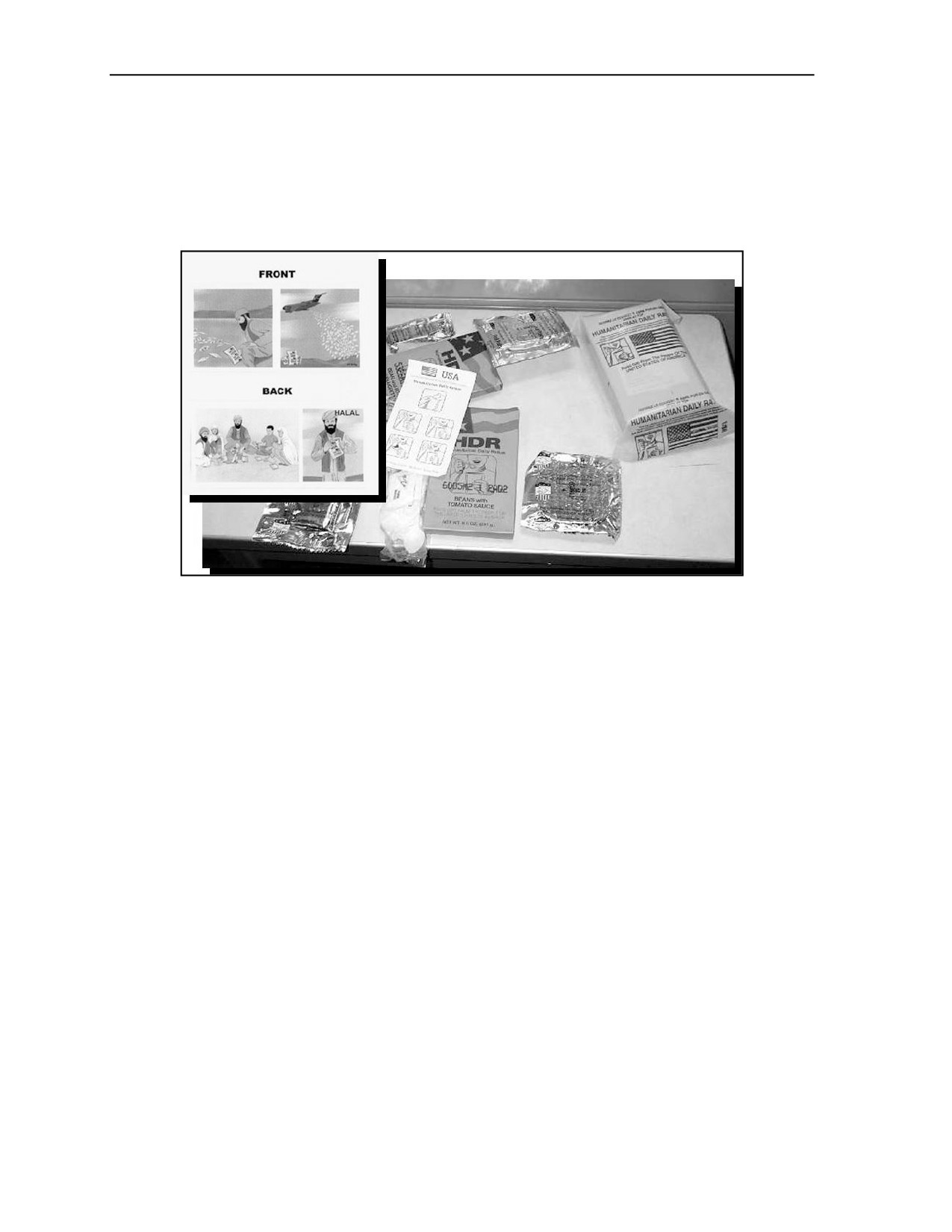
Chapter 4
4-41. The Department of Defense (DOD) humanitarian daily ration with “A Food Gift from the People of
the United States of America” printed on the packaging is a type of PSYOP message (Figure 4-10). There
can be great value with simply distributing goods either unilaterally or with coalition partners. In many
cultures, goodwill items must be given freely and with no behavioral expectations attached. In all cases, the
PSYOP planner must balance any written message against the PSYACT value of distributing useful or
essential goods with implicit rather than explicit messages.
Figure 4-10. DOD humanitarian daily rations marked with PSYOP message
AUDIO AND AUDIOVISUAL ASSETS
4-42. The PSYOP dissemination battalion provides complete audio and audiovisual production and
broadcast transmission support and is responsible for the setup and operation of organic radio and TV
transmitters. A secondary mission is to repair, interface with, and operate HN or foreign TV production
and broadcast facilities. TPTs use loudspeakers to broadcast messages that adhere to many of the same
production guidelines and parameters as radio. In addition, TPTs conduct face-to-face communications,
which are one of the most powerful means of audiovisual communications.
Audio Media
4-43. PSYOP Soldiers develop audio, radio, loudspeaker, and telephonic messages. Audio products
depend on sound alone for their effectiveness and are useful for brief, simple messages. A benefit to audio
messages is that they require little or no effort on the part of the audience and overcome the barrier of
illiteracy. The key to the success of audio media is repetition. Audio messaging is addressed in the
following paragraphs.
4-44. Radio provides entertainment, news, and instructions along with the desired PSYOP message. As
with all other media, selecting to use the radio will depend greatly on the availability of and access to
radios by the TA and the ability of the signal to reach the target. Truthful, credible, and accurate news
reporting is the best way to gain and hold attention. Radio broadcasts can be transmitted to local audiences,
across national boundaries, and behind enemy lines. Political boundaries or tactical situations may hinder
radio broadcasts, but they are not complete barriers. Since radio can reach mass TAs quickly, radio is
useful for all types of PSYOP. Where radio stations are not common and radios are rare or nonexistent,
radios may be airdropped or otherwise distributed to key communicators, public installations, and selected
individuals. Public listener systems may also be set up.
4-18
FM 3-05.301
30 August 2007
Phase IV: Product Development and Design
4-45. PSYOP Soldiers can contact local radio stations to have a live on-air show that broadcasts weekly to
speak with the local populace, as a means to disseminate PSYOP messages and command information. In
addition, they can contact and coordinate with area commanders and key communicators for interviews on
local radio stations. This contact provides direct interaction with, and access to, the local populace and
helps reinforce the objectives of the area commander while adding credibility to the message. Advantages
of radio include—
Speed. Radio programs can be quickly prepared for broadcast. Speed is important when
attempting to capitalize on targets of opportunity.
Wide coverage. Radio programs can reach members of large and varied audiences
simultaneously.
Ease of perception. Radio requires little or no effort to visualize the radio message. Illiteracy
does not prevent the listener from forming his individual image as he listens.
Versatility. Radio is easily adaptable to drama, music, news, and other types of programs.
Emotional power. A skilled radio announcer can exert tremendous influence on the listener
simply with pitch, resonance, inflection, or timing.
Availability of radios. Where availability or ownership of radios is common, listening to radio is
a habit.
Disadvantages of radio include—
Enemy restrictions. The target group may be subjected to severe censorship, thereby reducing
the effectiveness of radio broadcasts. Some countries have only single-channel radios with the
frequency set to the government-owned station.
Jamming possibilities. Jamming may prevent the target group from receiving radio broadcasts.
Technical problems. The signal may be made inaudible or distorted by fading or static due to
unfavorable atmospheric conditions.
Lack of radios. In certain areas, so few radios are available that this type of media may not be
effective.
Fleeting impressions. Oral media do not have the permanency of written media. Messages may
be quickly forgotten or distorted.
4-46. Radio programming consists of planning the schedule, content, and production of programs during a
stated period. Words, music, and sound effects are put together in various ways to produce the different
kinds of programs. Despite the type of radio program, the one consideration that holds true for all programs
is focus. Some of the major types of radio programs are—
Straight news reports (without commentary).
Musical (whatever genre is popular with the TA).
Drama. Although this genre has virtually disappeared from American radio programming, many
foreign countries still produce popular radio dramas that range from soap operas to radio theater.
In many areas of the world, particularly in emerging countries or failed states, soap opera radio
program formats are the favorite program of general TAs.
Speeches, talks, discussions, interviews, and radio call-in shows.
Sports.
Social events, such as on-the-spot coverage of an election or the arrival of an important visitor.
Religious.
Educational.
Variety—a combination including music, skits, or comedy.
Announcements.
4-47. Radio principles are important. These principles include the following factors:
Regularity is an essential element of programming. The radio programmer must create habitual
program patterns to build a regular audience. Content, style, and format should follow an
established pattern. Frequent change of content, style, or format can result in loss of listenership.
30 August 2007
FM 3-05.301
4-19
Chapter 4
Radio programming builds listenership by following a set time schedule. Listeners must know
when they can tune in for the programming they want to hear. This time schedule allows the TA
to form a regular habit of listening to the PSYOP program. If the time schedule varies on a daily
basis, listeners will become frustrated and turn to another station.
Repetition is necessary for reinforcement of key phrases or slogans, and should be repeated to
ensure the TA gets the desired message. If a certain message is only aired once or is only aired
at one time every day, the listener has a good chance of missing the information.
The radio program must suit the taste and needs of the audience. Program style and format
should follow the patterns to which the audience is accustomed.
Discussion or presentation of banned books, plays, music, and political topics is readily received
by the audience. The same is true for news withheld by censors. In breaking censorship, the
PSYOP Soldier must be certain that the reason for censoring the items was political and not
moral.
4-48. Announcers with attractive voice features are essential to successful radio operations. Some factors
to consider include—
The emotional tone conveyed by the voice may influence the listener more than the logic of
arguments.
Announcers whose accents are similar to those of unpopular groups should not be used.
Female voices are used to exploit nostalgia, sexual frustration, or to attract female audiences.
However, in some parts of the world, due to the status of women, female voices are resented.
4-49. Radio programs have three classifications. They are classified according to—
Content. The most common and useful radio program classification is by content. News
reporting, commentaries, announcements, educational or informative documentaries, music,
interviews, discussions, religious programs, drama, and women’s programs are the most
common examples.
Intent. Classification by “intent” is useful in planning to obtain a desired response with a
particular broadcast. Programs are produced to induce such emotional reactions as confidence,
hope, fear, nostalgia, or frustration.
Origin. Classification by “origin” pertains to the source of the message; for example, official,
unofficial, authoritative, high military command, or political party.
Audiovisual Media
4-50. The continued advancement of new technology greatly increases the need for PSYOP to keep pace
with emerging audiovisual media capabilities and means of dissemination. Audiovisual media combine the
impact of sight and sound, and are the most powerful communications system in history. TV, movies, and
now video transmitted over the Internet have the power to invoke deep emotional responses. The
proliferation of TVs, videocassette recorders, and video compact disc and digital video disc (DVD) players
brings electronic audiovisual products into remote locations. Satellite technology carries real-time news
worldwide, and video production technology is available in a majority of countries. As PSYOP forces
expand their scope for audiovisual media production, distribution, and dissemination, PSYOP Soldiers
frequently rely upon organic digital video and still cameras found in their electronic news gathering kits to
capture images of the local countryside and the local populace of the AO carrying out their everyday
activities. The product development company (PDC) then uses the digital video and photos for producing
products that are both relevant and appropriate to a particular TA.
4-51. Audiovisual production is a major undertaking and will entail input from 37Fs, 25Vs, interpreters,
and other personnel in the PSYOP organization. (Appendix E provides information for the proper use and
supervision of interpreters.) An example of an organic PSYOP audio, visual, and audiovisual asset is the
Media Operations Center (MOC) located at Fort Bragg, North Carolina, which has the capacity to produce
commercial-quality print, radio, and TV products. MOC capabilities require a significant amount of lead
time, often requiring 30 to 60 days to produce and distribute (via reachback) audio, visual, and audiovisual
products to the requesting unit. The Psychological Operations Handbook: Equipment Types,
4-20
FM 3-05.301
30 August 2007
Phase IV: Product Development and Design
Specifications, and Capabilities provides detailed information on the MOC. In addition, reachback
capability through satellite systems assists production requirements. PSYOP Soldiers work off the PAW
for guidance when developing an audiovisual product and review initial drafts internally before creating
the final draft of a new product. Once a finalized draft is produced, the product is examined at the product
review board before submission for product approval.
PRETESTING PSYOP PRODUCTS
4-52. The primary purpose of pretesting is to evaluate TA understanding and acceptance of the arguments
conveyed in a PSYOP product prior to Phase V (Approval) of the PSYOP process. Pretesting guidance for
each PSYOP product is reflected in the product’s corresponding PAW. This guidance includes several key
points that are further articulated in a questionnaire, expresses the preferred pretest methodology, and
specifies the critical information needed to assess the potential effectiveness of the PSYOP product on the
TA. The information gained during pretesting guides the necessary changes and corrections to the product
prior to series approval and dissemination to the TA. Additionally, pretesting can help identify overlooked,
but potentially important, issues relevant to the PSYOP product’s series, and help shape and refine pretest
information-gathering activities. There are two techniques used for pretesting PSYOP products: survey
sampling and test groups. The following shows the importance of pretesting and is an example of avoiding
undesired effects.
Example of the Importance of Pretesting
In January 2005, following the first general elections in Iraq, 1st Cavalry Division
sought to capitalize on the election’s success by disseminating PSYOP products on
the streets of Baghdad as soon as possible. Within 24 hours, the 307th Tactical
PSYOP Company produced several prototypes, which were then translated and
subsequently approved by the 1st Cavalry Division commander. Due to the short-
notice requirement, the PSYOP company had to forgo pretesting the prototypes prior
to approval in order to meet the division commander’s suspense. Once approved, the
products were electronically sent to a contracted local printer. The following morning,
the PSYOP company found time to pretest the products and received the exact
opposite response than the one intended. One handbill in particular contained a
picture of a Shi’a woman holding her right index finger, which was covered with
voting ink, in the air with the phrase, “A lifetime of waiting, a day of reckoning.”
Unfortunately, Sunni target audience members interviewed thought this product was
a Shi’a rallying call for retribution against Sunnis for the years of subjugation the
Shi’as experienced at the hands of a Sunni-dominated government. Once the pretest
results were assessed, the PSYOP company immediately contacted the local printer
and canceled the print order for this handbill, preventing a potentially embarrassing
situation or violent reaction from the TA.
SURVEY SAMPLING
4-53. Survey sampling is the method where the TA is sampled directly through questionnaires and
personal interviews. Survey sampling requires trained personnel to collect and interpret data. Most
personal interviews follow a prescribed formal pattern with the wording and order of questions determined
in advance. An informal interview can be based on a detailed list, which indicates the subject matter to be
covered. An informal interview permits the interviewer to vary the wording and order of the subject matter
to obtain the maximum amount of information. The survey sample addresses the TA directly and helps
PSYOP Soldiers determine the potential effects of a PSYOP product on a TA. Survey sampling can be
further divided into probability and nonprobability samples.
30 August 2007
FM 3-05.301
4-21
Chapter 4
Probability Samples
4-54. Probability samples consist of simple random, stratified random, and cluster surveys. Each of these is
discussed below:
Simple random sample. Each person in the TA has an equal chance of being included in the
sample. For example, members of the TA (voters) are randomly selected from a list of all
registered voters in the Adhamiya district.
Stratified random sample. Members of the TA are chosen based upon predetermined
characteristics. Using two or more of these characteristics as a basis, the TA is divided into
strata or groups. The PSYOP Soldier then draws a simple random sample from each group. The
combinations of these subsamples form the total sample group. To conduct this sample, a list of
the members of the TA and a list of the characteristics that form the group are needed. For
example, at a university, teachers might be grouped into strata according to their education level;
then, a certain number of teachers are further selected from each stratum, or education level.
Cluster survey sample. The TA is divided into large geographical areas. After sampling the
region, the samples are drawn from the next smaller area. For example, the PSYOP Soldier
draws a sample from the Commonwealth of Independent States, then the Baltic States, followed
by a sample from the next smaller administrative division, the Republic of Estonia. This pattern
is followed until the samples become smaller, such as individual TA members within a
particular town or city.
Nonprobability Samples
4-55. These samples include accidental samples and quota samples, such as man-on-the-street interviews
and product surveys of customers in stores. Each of these is discussed below:
Accidental sample. Members of the TA are interviewed at a specific location. This sample is the
easiest to conduct; however, it does not accurately represent the TA. For example, a street
corner is chosen in a city or village and TA members are interviewed as they walk by. This
sample is inaccurate because it only represents the part of the TA that happened to walk by the
street corner when the sample took place. The street corner chosen for the sample may only
attract a certain type of TA member; therefore, it would not truly represent the whole TA. A
street corner near a factory would attract different TA members than a street corner near an
exclusive department store.
Quota sample. A specific type and number of the TA are interviewed. This sample is more
desirable than the accidental sample because it designates the type and number of TA members
to be interviewed. One drawback to this method is that the TA members who are most available
or willing are interviewed. An individual within a specific category may also represent a special
segment of that particular category. Once the quota is filled for one group, another category of
TA member is interviewed. For example, the following groups within the TA are chosen for
interview: farmers, students, laborers, and merchants; fifty TA members from each category are
required for interview. The survey begins with the farmers and once fifty farmers are
interviewed, fifty students are interviewed. The process continues until the remaining TA
member categories are interviewed.
TEST GROUPS
4-56. Test groups are useful as they have the ability to provide in-depth discussion of PSYOP products.
Test groups include the following:
Panel of experts. This panel is a group of individuals who have studied the TA and are
thoroughly acquainted with the TA’s language and culture, although they may not actually be a
member of the TA; their expertise is drawn from education or experience often acquired from
living in the country for several years. Panel of experts members include translators, local
nationals with expertise in advertising or journalism, strategic studies detachment
(SSD)
representatives, and local native civic or community leaders.
4-22
FM 3-05.301
30 August 2007
Phase IV: Product Development and Design
Panel of representatives. This panel consists of current or former members of the TA and may
include enemy prisoners of war/civilian internees/dislocated civilians, defectors, translators, and
others who approximate the TA as closely as possible. Conditions that affect a former TA
member will not be exactly the same as a current TA member. Pretests conducted with such
groups can indicate what persuasion techniques are likely to be effective, what should be
emphasized, and what should be avoided. The composition and structure of such a panel can
vary from as few as five representatives to as many as a hundred.
NOTE: The term “panel” is used loosely, as individuals can be interviewed one at a time or in
groups, formally or informally.
Target audience members. These are the actual members of the TA. When conducting
pretesting, the first questions asked may very well be to determine if they are actually members
of the TA. Ideally, PSYOP Soldiers should pretest as many members of the TA as possible.
CONDUCTING THE PRETEST
4-57. During the course of pretesting, it is easy to become distracted with many of the technical aspects of
the product (for example, change happy to glad, blue to green, and the picture of smiling kids in a city to a
picture of smiling kids in a village) and lose sight of the few critical questions that must be answered.
When conducting pretesting, PSYOP Soldiers should keep the main components universal to all
communication in mind: the sender, the receiver, and the message. The sender of the message asks two
basic questions:
Understanding of the messsage: Is the message conveyed by the PSYOP product clearly
understood by the TA?
Acceptance of the PSYOP argument: Is the TA likely to engage in the desired behavior as a
result of the supporting arguments, appeals, and persuasion technique?
Understanding
4-58. When the TA reads, hears, or sees the PSYOP product, the TA should understand it the way PSYOP
Soldiers intended. This understanding includes not only the translation of the text, but also the cultural
context of the product. For example, a joke can be translated from English to Arabic and the TA members
understand every word, but they still do not get the joke as the information—intended for a Western
audience—is processed and understood in a different way.
4-59. The best way to test for understanding of the product’s message is a straightforward, open-ended
question, such as “What does this tell you to do?”, “What does this say?”, or “What does this mean to
you?” Follow-up questions become more specific after the TA’s response to the initial question.
Figure 4-11, page 4-25, is an example of a handbill that must be pretested to determine if the TA
understands the message. The following is an example of understanding.
30 August 2007
FM 3-05.301
4-23