Military reference books and manuals (2009-2023, Volume 7) - page 12
Appendix B
B-11. The end state of the security effort should be an environment in which the local populace can
provide for its own security with limited government support at the national level. The local police or
constables should be a viable deterrent to the residue of an internal threat organization, and the civilian
populace must have a continued, reliable, and safe means to report internal threats. Although each situation
is specific, the types, magnitude, and prevalence of crimes and security threats that are handled in the United
States by Federal law enforcement agencies provide a general baseline for what sort of security situation must
exist at the local level in the HN and what basic Federal agencies and capabilities must be in place.
NEUTRALIZATION
B-12. Neutralization is a political concept that sufficiently marginalizes an insurgent or criminal element so
that it is effectively irrelevant to and unable to affect the process of governance. Neutralization applies to
elements of the insurgencies deemed unfit to enter into dialog. In addition, entire organizations that
corporately hold a wholly irreconcilable position must be neutralized. A good example of sufficient
marginalization is the white supremacist movement in the United States or the Communist Party in Japan.
Both exist and have at times garnered headlines and small numbers of fanatic loyalists through tactics such
as inflammatory rallies, but both lie beyond even the fringe of legitimate politics. Enfranchisement of
former insurgents into the mainstream political life of the HN falls under the function of mobilization.
Neutralization accomplishes several goals:
z
Makes an insurgent or criminal force irrelevant to the political process.
z
Separates the threatening elements (physical and psychological) from the population.
z
Includes all lawful activities (except those that degrade the government’s legitimacy) to disrupt,
preempt, disorganize, and defeat the internal threat.
z
Involves public exposure and the discrediting of leaders during a period of low-level unrest with
little political violence.
z
Involves arrest and prosecution when laws have been broken.
z
Involves combat action when the adversary’s violent activities escalate.
B-13. All neutralization efforts must be legal. They must carefully observe constitutional or other codified
provisions regarding rights and authority. This is particularly true of a HN operating under the provision of
legislated or imposed martial law or other extraordinary powers. The HN may need to exceed the minimum
standards of the letter of the law and to set the moral and ethical standard for conduct. This may include
foregoing some special powers. For instance, President Lincoln was well within the (then) perceived letter
of constitutional law when he suspended habeas corpus in selected instances during the American Civil
War; however, political opposition and criticism for doing so extended even to members of his own
political party. Some supporters perceived this action as excessive and some detractors attempted to
capitalize politically on this action.
B-14. In the case of President Lincoln, the legitimate use of duly authorized emergency powers caused
friction in some quarters and bolstered support for his administration in others. There are numerous
instances when governments or government officials have exceeded and abused emergency powers around
the globe. Some of those instances have been disastrous to the governments under which the abuse
happened. The need for officials and agencies to act lawfully and morally is essential not only for
humanitarian reasons, but also because this reinforces government legitimacy while denying the adversary
an exploitable issue. Denying the adversary an opportunity to seize on and exploit legitimate issues against
the government disarms the leaders and propagandists of an internal threat. Army planners and trainers
must begin indoctrinating this ideal at the lowest levels of the HN government and military. In an
operational environment that may include the presence of international news or entertainment media with a
real-time audiovisual transmission capability, the excesses of a single, low-ranking HN policeman or
military member may be as damaging as the misstep of a national-level politician.
B-4
FM 3-05.2
1 September 2011
Internal Defense and Development Strategy
MOBILIZATION
B-15. Mobilization provides organized manpower and materiel resources and includes all activities to
motivate and organize popular support of the government. This support is essential for a successful IDAD
program. If successful, mobilization maximizes manpower and other resources available to the government
while it minimizes those available to the internal threat. It is important to realize, however, that this effect
may not be directly proportional. Organized crime, a sectarian insurgency, and other entities may continue
to maintain viability even as their base of support erodes. Subversion, lawlessness, insurgency, terrorism,
and other threats receiving aid from a third party can magnify this effect. This effect is further magnified
when the third-party support is effectively immune to interdiction at its source. Mobilization seeks to—
z
Strengthen existing government, economic, military, and social institutions in processes,
procedures, and capabilities.
z
Legitimize and, if necessary, reform those institutions.
z
Develop new institutions to respond to demands.
z
Enlist and enfranchise all members of society to contribute in some way.
z
Discredit and belittle internal threats permanently.
z
Assess and adjust program emphasis continuously.
z
Instill the sense that the change is permanent.
z
Create a national vision toward achieving greater goals, if necessary.
B-16. Mobilization runs hand-in-hand with enfranchisement of the population. Mobilization is of limited
value if it excludes any portion of the population other than internal threats; however, defectors from
internal threat ranks should not be marginalized but rather reintegrated through a reconciliation and
integration plan. Those who have been reconciled and reintegrated can aid in the further development of
recruiting and reintegration of former insurgents. Mobilization can include members of the population who
traditionally or statutorily have not been part of the institutions they are now party to. This is particularly
true of the many societies around the globe that are polarized on sectarian lines. Planners must recognize
that the mobilization of the population can require cultural upheaval. It is now inconceivable in the United
States that increased access to a well or a market could have major social implications that could threaten
to spark violence for years, but this is the reality in many countries around the world. Ideologically, the
vast majority of Americans and U.S. military, DOD civilians, and contractors have difficulty even
imagining such conditions in our national past as racial segregation. Army planners and Soldiers must
remain culturally attuned to the fact that many members of the HNs in which Soldiers conduct FID
operations may be part of a legacy that includes unfounded prejudices for races, ethnicities, tribes, or
religious affiliations in their country.
ASSESSING THE FUNCTIONS
B-17. The HN begins with established MOE that are a series of benchmarks for its IDAD program. It
should have a way to collect feedback for future planning, refinement of strategy, and continued
formulation of strategic national policy. The HN should then continually analyze this feedback. However,
Army forces supporting the HN IDAD program may have to initially institute and conduct this process at
various levels until HN personnel become proficient. FID operational personnel must fully use advisor
techniques in this instance. This is the case not only to efficiently build the skill of HN personnel, but also
to foster the perception (based on fact) that HN personnel are proficient and legitimate rather than mere
functionaries or lackeys to U.S. national interests. Soldiers in the trainer and mentor function may need to
bolster the warrior ethos of their HN counterparts during this constant examination of feedback as they
critically assess themselves and potentially deal with temporary reversals or gains that develop slowly.
1 September 2011
FM 3-05.2
B-5
Appendix B
PRINCIPLES
B-18. Although each situation is specific, certain principles guide efforts in the four functional areas to
prevent or defeat an internal threat. Planners must apply the IDAD strategy and these principles to each
specific situation. The principles are—
z
Responsive government.
z
Unity of effort.
z
Maximum use of intelligence, MISO, and CAO.
z
Minimum use of violence.
RESPONSIVE GOVERNMENT
B-19. The fundamental goal of FID operations is to prevent an insurgency or other form of lawlessness or
subversion by forestalling and defeating the threat and by working to correct conditions that prompt
violence. Subversion includes actions designed to undermine the military, economic, psychological, or
political strength or morale of a governing authority. At the core of the FID task is the ability to develop an
effective, responsive government to prevent the actions of subversion from creating a failed state. Positive
measures are necessary to ensure responsive government at all levels with the ability to mobilize
manpower and resources and to distribute them equitably. These governments must foster a view in the
populace that they are administratively, managerially, and technically competent.
B-20. Typically, HNs build responsive government from the top down (for example, national levels down
to local levels); however, it is measured by its success at the local level. A HN can have a legitimately
elected national government that is highly effective at national-level reconciliation and legislation;
nevertheless, the government fails because it does not translate this down to the local level in the form of
increased security and improved materiel conditions. Although an oversimplification, the term responsive
local government may best describe this principle. IDAD strategy developers should keep this idea in mind.
UNITY OF EFFORT
B-21. Unity of effort is essential to prevent or defeat any internal threat. Unity of effort, however, requires
coordination and cooperation among all forces and agencies toward a commonly recognized objective
regardless of the command or coordination structures of the participants. In IDAD strategy development, a
necessary precursor to unity of effort is recognizing the disparate or conflicting goals between portions of
the populace and, more importantly, from an organizational standpoint between government agencies.
Although this is typically accomplished by non-DOD agencies prior to the participation of Army elements,
it is necessary for Soldiers to be cognizant of the essential points of the IDAD strategy as it is and
understand the genesis of that strategy and any residual conflicts associated with the current strategy. One
of the first hurdles FID planners must consider is overcoming reluctance, or even opposition, on the part of
their HN military counterparts to the HN government’s plan, or from civilian agencies toward portions of
strategy championed by the military. The specific capability and institutional knowledge of CA Soldiers to
mediate and negotiate should be used to anticipate, plan for, and overcome these conflicts.
MAXIMUM USE OF INTELLIGENCE, MILITARY INFORMATION SUPPORT OPERATIONS, AND
CIVIL AFFAIRS OPERATIONS
Intelligence
B-22. All operations require detailed and often specialized intelligence to achieve the desired effects from
employment of forces. FID operations require the flexible applications of all sources and disciplines within
the intelligence warfighting function to support conventional forces and ARSOF units.
B-23. FID operations invariably have a strong emphasis on human intelligence and CI. FID operations
conform to this model, and, like other irregular warfare may place a disproportional emphasis on CI and
B-6
FM 3-05.2
1 September 2011
Internal Defense and Development Strategy
human intelligence out of operational necessity. Cellular organizations will likely remain impenetrable (at
least in some cases) by means other than CI and human intelligence in the foreseeable future. As
adversaries become aware of the full reach of other U.S. intelligence disciplines, it is reasonable to assume
that their countermeasures will include more and more compartmentalization that relies on decidedly
nontechnological answers to trafficking information within and between cells. Total success in FID
operations may not be won exclusively through human intelligence, but abject failure through its exclusion
is a planning reality.
B-24. Planners must balance operational security and CI programs and procedures to protect friendly FID
operations with the inherent risks of sharing intelligence with the HN. Countering or penetrating opposing
force intelligence collection operations may build on DOD success prior to the commitment of forces to
FID. Intelligence and CI operations must accurately assess the capabilities of subversion, lawlessness,
insurgency, terrorism, and other threats to provide timely warnings to HN and U.S. FID forces and to
penetrate and be prepared to compromise hostile operations on order.
B-25. Planners must provide for sufficient assets to support the IDAD strategy and the FID operation.
Typically, the HN is not fully capable of performing these missions effectively upon the commitment of
U.S. FID forces. In this case, the United States must deploy additional intelligence assets to accomplish
these missions. Planning maximizes the coordination lines with and use of assets under the purview of the
COM and any that may be present under the GCC. Army personnel may be the chief trainers of HN
internal intelligence and security forces developed to overcome intelligence capability gaps, enhance
existing capabilities, and educate the HN military on using these assets in operational and tactical planning.
Personnel conduct this training within the confines of USG directives and instructions of the COM and as
deemed appropriate by the supporting GCC.
Military Information Support Operations
B-26. The principal battleground of FID operations is the human environment—the HN citizens and the
human elements that can affect the HN. The key of this battleground is the human will. Army principles
encompass disciplines that are dedicated to or familiar with shaping the human environment. They
strengthen the will of allies and break the will of adversaries. All FID operations accomplish one of these
polar opposites. Maximum use of MISO complements and exploits the success of SOF and conventional
units, as well as USG and HN government agencies conducting IDAD support operations. The battle for
influence begins before commencement of FID operations and extends throughout the existence of the HN
IDAD program. Failure to analyze and plan the fight to persuade in the formulation of IDAD strategy
almost guarantees mission failure.
B-27. The use of the informational component of national power often predates the formulation of an
IDAD strategy and the commencement of FID activities. Typically, the American Embassy will already be
addressing the conditions that elevated into the need for conducting FID. The embassy PAO—either singly
or with additional support from the Bureau of International Information Programs—articulates the USG’s
position on conditions within the HN through press releases, public comments, and media products. MIS
forces may deploy to support this effort and be present early in the formation of an IDAD strategy. If not,
early entry of MIS assessors and planners into the process of IDAD program planning is critical. Some of
the specific tasks MIS units can plan to conduct include the following:
z
Articulate the conditions and mandate for the entry of U.S. or multinational forces.
z
Communicate the end state of FID operations.
z
Communicate the planned exit (even if indefinite) of U.S. or multinational forces.
z
Reduce civil interference with military operations.
z
Support civil order programs and HN law enforcement.
z
Support and exploit CMO.
z
Prepare the populace for elections.
z
Reduce the effectiveness of rumors and disinformation.
1 September 2011
FM 3-05.2
B-7
Appendix B
z
Support the countering of domestic (within the borders of the HN) and international propaganda.
z
Promote the legitimacy of the HN government.
z
Reduce sectarian strife.
Civil Affairs Operations
B-28. CA planners are a driving force behind the analysis of the current physical conditions affecting the
HN citizenry. After assessment, CA planners should be at the forefront of integrating the balanced
development function of the IDAD program. Although not the only agent of project development to
improve the material conditions of the HN population, CA units may constitute the center of a coordinated
development plan including U.S., HN, IGO, and NGO assets. In addition, the coordinated use of civil
information management provides another avenue to shape the information environment. Some of the CA
tasks within the IDAD strategy include the following:
z
Promote U.S. policy objectives before, during, and after combat operations by influencing the
civil component of the operational area.
z
Fulfill responsibilities of the military under U.S. domestic and international laws relevant to
civilian populations.
z
Reduce civil interference with military operations.
z
Coordinate military operations with civilian agencies of the USG, indigenous populations and
institutions, IGO, and NGOs.
z
Exercise civil administration in liberated areas until HN authorities can assume control.
z
Provide direct assistance to the HN.
z
Support civilian efforts to provide assistance to meet the life-sustaining needs of the
civilian population.
z
Provide expertise and advice in rehabilitating or restoring civil-sector functions.
MINIMUM USE OF VIOLENCE
B-29. Throughout human history, civil conflicts have proved to be some of the most violent of any war or
strife. Even in civil strife that has primarily been fought observing the laws, rules, and codes of conflict
acceptable at the time, pockets of excessive and sometimes wanton violence have existed. For instance, the
violence in parts of Kentucky and along the Kansas-Missouri border during the American Civil War rose
to heights far above those in any other theater, and that violence was widely condemned. A rapid escalation
of violence that far exceeds necessary force may happen on both sides of a civil conflict. The challenge in
the formulation and execution of an IDAD strategy is to—
z
Examine all COAs carefully in response to the internal violence.
z
Choose strategies that can best minimize violence.
z
Formulate clear ROE.
z
Develop means and methods to enforce the ROE.
z
Publish how ROE violators are disciplined.
z
Determine if additional, specific criminal statutes are necessary to deal with threats.
z
Plan for the potential of escalation and determine the thresholds for de-escalation.
z
Assess the maximum potential for detainee levels.
z
Determine if an amnesty program is feasible.
z
Distance the current HN government psychologically from past abuses.
z
Punish past abusers, if practicable.
z
Anticipate deception, disinformation, and propaganda.
z
Assess the potential benefit or detriment of a demonstration of overwhelming force.
B-8
FM 3-05.2
1 September 2011
Internal Defense and Development Strategy
B-30. The IDAD strategy stresses the minimum use of violence in maintaining order and communicates
that intention from the highest levels. The IDAD strategy should consciously seek to seize the moral high
ground in the earliest stages of FID operations. This does not necessarily prohibit the use of overwhelming
force. The confidence the populace has in the government’s ability to provide security is invariably derived
from the belief that the government possesses strength superior to the internal threat. However, the
populace loses confidence in the government or coalition forces if it perceives that strength as uncontrolled
or ineffective. Therefore, claims of inevitable success may often be detrimental. In addition, collateral
damage, even if perceived as necessary, erodes support over time. In other instances, it is necessary to
proceed with caution, extending the duration, but limiting the intensity or scope of violence. A balance of
the discreet use of force as a rule and the atypical use of force that is deliberately overt and overwhelming
to maximize its psychological effect must be achieved.
ORGANIZATIONAL GUIDANCE
B-31. The following discussion provides a model for an organization to coordinate, plan, and conduct
IDAD activities. Actual organizations may vary from country-to-country to adapt to existing conditions,
and the organizational model for planning may evolve into a different form for execution. Organizations
should follow the established political organization of the nation concerned. The organization should
provide centralized planning and direction and facilitate decentralized execution of the plan. The
organization should be structured and chartered so that it can coordinate and direct the IDAD efforts of
existing government agencies; however, it should minimize interference with those normal functions of
those agencies. Building new agencies or organizations in the HN government presents profound
challenges, but studying the feasibility of this may be necessary. Modification or expansion of existing
institutions invariably presents fewer challenges. Examples of national and subnational organizations show
how to achieve a coordinated and unified effort at each level.
NATIONAL-LEVEL ORGANIZATION
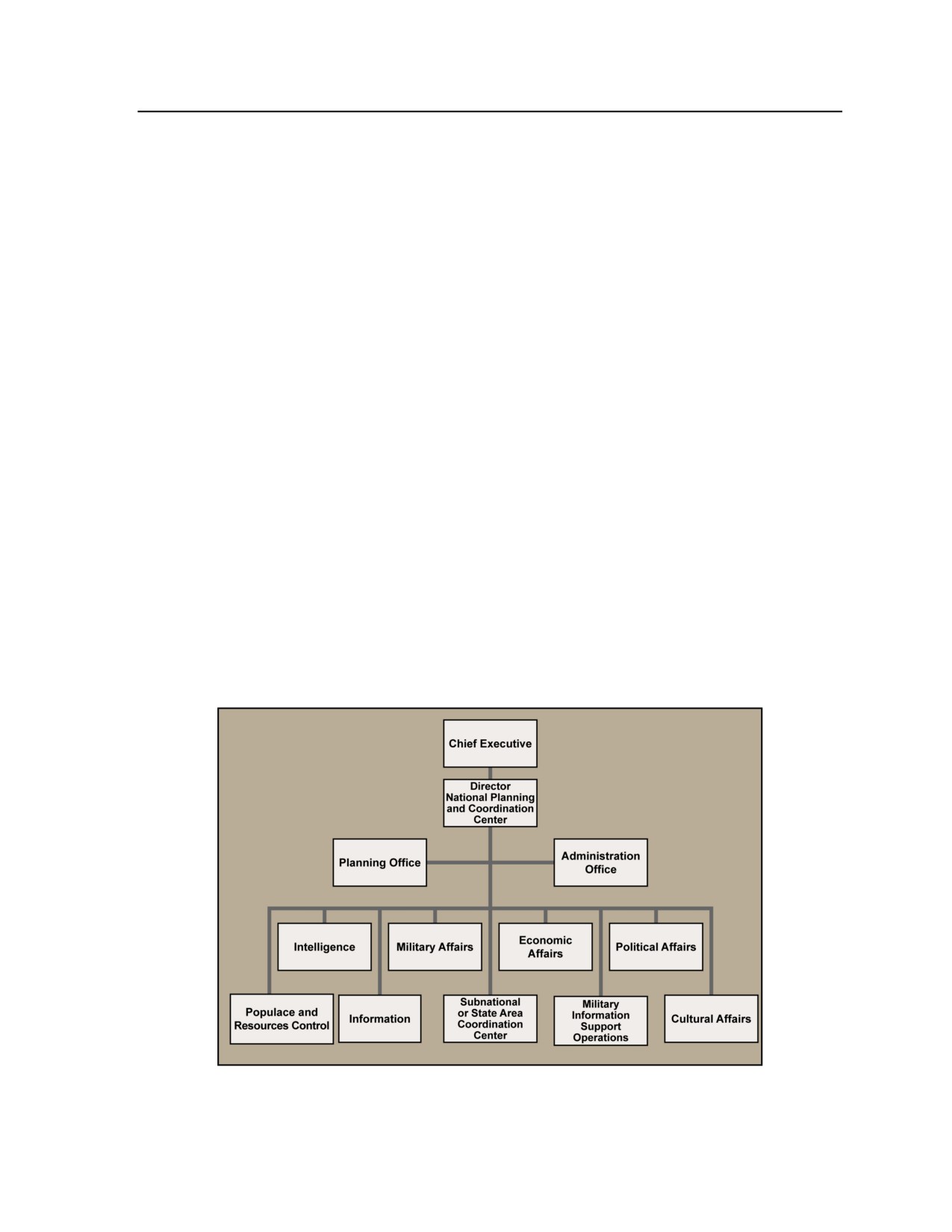
B-32. An internal threat planning and coordination office is a national-level organization that formulates
and facilitates the IDAD program. Its major offices normally correspond to branches and agencies of the
HN government, taking into consideration the type of internal threat or insurgency. Figure B-2 depicts an
example of a planning and coordination organization at the national level.
Figure B-2. National-level internal threat planning and coordination organization
1 September 2011
FM 3-05.2
B-9
Appendix B
B-33. The planning office is responsible for long-range planning to prevent or defeat the threat. Its plans
provide the chief executive with a basis for delineating authority, establishing responsibility, designating
objectives, and allocating resources. HN civilian control of this office is not a foregone conclusion in some
nations. Planners and advisors may need to stand ready to explain the necessity of civilian oversight.
B-34. The intelligence office develops concepts, directs programs, and plans and provides general
guidance on intelligence related to national security. The intelligence office also coordinates intelligence
production activities and correlates, evaluates, interprets, and disseminates intelligence. Representatives
from intelligence agencies and police and military intelligence staff this office. At a minimum, units
conducting FID must have access to the products of this office either directly or through their supported or
higher unit. Additionally, subject-matter experts may be attached to this office to provide input in their
areas of expertise.
B-35. The population and resources control office develops economic policies and plans and provides
general operational guidance for all forces in the security field. Representatives of government branches
concerned with commerce, as well as law enforcement and justice, staff this office. CA personnel should
be tasked to coordinate with and support this office. In addition, a planning or liaison element from the
deployed MIS organization can augment civil information management activities.
B-36. The military affairs office develops and coordinates general plans for the mobilization and allocation
of the regular armed forces and paramilitary forces. Representatives from all major components of the
regular and paramilitary forces staff this office.
B-37. Five separate offices covering MISO, information, economic affairs, cultural affairs, and political
affairs represent their parent national-level branches or agencies, and develop operational concepts and
policies for inclusion in the national plan. The social and political sensitivities of the HN must be taken into
account when designating a MIS office. Characterizing this office in less military terms may be necessary;
however, even the appearance of deception can be catastrophic to the future legitimacy of MIS products.
Truthful representations of the composition, mandate, and legal parameters of the MIS office must be
socio-politically acceptable to the HN populace.
B-38. The administration office performs support activities for the national organization and other duties as
directed. It typically serves as the communication hub of the organization and provides the necessary
logistical resources from the national organization. The administration office may be tasked with receiving
all requests and communications from the HN population and routing them to their appropriate office.
SUBNATIONAL-LEVEL ORGANIZATION
B-39. Area coordination centers may function as combined civil-military headquarters at subnational, state,
and local levels. Area coordination centers plan, coordinate, and exercise OPCON over all military forces,
and may direct civilian government organizations within their respective areas of jurisdiction. The center
does not replace unit tactical operations centers or the normal government administrative organization in
the joint operations area.
B-40. Area coordination centers perform a two-fold mission:
(1) they provide integrated planning,
coordination, and direction for all internal defense efforts, and (2) they ensure an immediate, coordinated
response to operational requirements. These centers should conduct continuous operations and
communications. Senior government officials supervise and coordinate the activities of the staffs
responsible for formulating internal defense plans and operations in their areas of interest or regional
commands. The staffs contain selected representatives of major forces and agencies assigned to or
operating in the center’s area of operations. Each area coordination center includes members from the—
z
Area military command.
z
Area police agency.
z
Local and national intelligence organization.
z
Public information and MIS agencies.
B-10
FM 3-05.2
1 September 2011
Internal Defense and Development Strategy
z
Paramilitary forces.
z
Local and national government offices involved in the economic, social, and political aspects
of IDAD.
B-41. There are two types of subnational coordination centers that a government may form—regional and
urban. The choice depends upon the environment in which the center operates.
B-42. Regional centers normally locate with the nation’s first subnational political subdivision with a fully
developed governmental template (state, province, or other). These government subdivisions are usually well
established, having exercised government functions in their areas before the emergence of an internal threat.
However, during FID operations in which a natural disaster has occurred or where an insurgency or other
force has been operating unchecked, the apparatus of government may exist in little more than name only.
B-43. Regional centers often are the lowest level of administration able to coordinate all IDAD programs.
A full range of developmental, informational, and military capabilities may exist at this level. Those that
are not part of the normal government organization should be added when the coordination centers
activate. This augmentation enables the area coordination centers to coordinate its activities better by using
the existing structure.
B-44. Select urban areas may require separate coordination centers in order to plan, coordinate, and direct
IDAD efforts. Urban coordination centers are appropriate for cities and heavily populated areas that might
tend to overtax a regional center or become the focus of efforts at the expense of less populated areas in the
subnational division. In some instances, this may require the collocation of a regional center and a separate
urban area coordination center in the same city. The decision to physically collocate or share personnel or
resources is controlled by the HN government according to its statutes and protocols. Urban centers
organize like the centers previously described and perform the same functions. They contain elements from
national-level organizations, but the urban area coordination centers also include representatives from local
government and public service agencies.
B-45. If the urban area comprises several separate political subdivisions with no overall political control,
the area coordination centers establish the control necessary for proper planning and coordination. This
generally includes suburbs and communities within a greater metropolitan area. If the HN urban area has
sufficiently advanced transportation, this may be defined as the area within the range of commuting
workers. Although the urban area coordination centers may be delineated by the beginning of agricultural
lands, this may be problematic in countries with high population densities, since small-scale agriculture
may be intermingled with urban socioeconomic features. The incorporation of shantytowns, refugee camps,
or other fluid populations within the jurisdiction of an urban coordination center may be warranted.
Conversely, certain advantages may be gained with such populations in fostering a continued sense of
identification with their original communities by bringing them under the authority of the regional
coordination center. Operationally this can make the transition of such populations back to those original
homes easier.
CIVILIAN ADVISORY COMMITTEES
B-46. Committees comprised of influential citizens help coordination centers at all levels monitor the
success of their activities and gain popular support. These committees evaluate actions affecting civilians
and communicate with the people, and they provide feedback for future operational planning. Involvement
of leading citizens in committees increases their stake in and commitment to government programs and
social mobilization objectives.
B-47. The organization of a civilian committee varies according to local needs; changing situations require
flexibility in structure. The chair of the committee should be a prominent figure either appointed by the
government or (preferably) elected by the membership. In some instances, it may be useful to select a
1 September 2011
FM 3-05.2
B-11
Appendix B
nonvoting moderator who is perceived as neutral. In this case, such a moderator should not be a coalition,
HN, or U.S. official. An IGO or NGO official is one example of such a moderator. General committee
membership includes leaders in civilian organizations and other community groups who have influence
with the target population. These leaders may include—
z
Political leaders:
Retired government officials.
Former dissenters or dissidents.
Returned expatriates.
z
Religious leaders.
z
Credible sports, arts, and entertainment stars.
z
Education officials (distinguished professors and teachers).
z
Respected medical personalities.
z
Minority group representatives.
z
Labor officials.
z
Leaders of domestic charities.
z
Heads of local news media, distinguished writers, journalists, and editors.
z
Business and commercial leaders.
z
Fraternal order leaders.
z
Wildcards (unanticipated new popular figures).
B-48. In addition to the list given above, it may be useful to consider placing former insurgents on civilian
committees to effect reconciliation. Planners must balance the possible benefits of enfranchising the former
insurgent and providing him with a nonbinding forum to redress grievances with the risk of the committee
becoming mired in sectarian issues. The general maxim, however, is that inclusion rather than exclusion is
the goal, because the success of a committee hinges on including leading participants from all major
political and cultural groupings, including minorities.
B-12
FM 3-05.2
1 September 2011
Appendix C
Intelligence Support Operations
Intelligence support is an integral part of FID operations. Because of the common
tactic of cellular organizations to compartmentalize information, there is a near
certainty that information gaps will exist because of the covert or clandestine nature
of subversion, lawlessness, insurgency, terrorism, and other threats. This challenge is
not insurmountable for organic intelligence personnel, but it clearly places the burden
on confirming information processed into user-level intelligence is correct. FID
operations, like all subsets of irregular warfare, require intelligence personnel to
collect and analyze information that typically would not be of such great importance
in a conventional operation against the nation-state’s military forces. The challenges
of intelligence support to FID operations require unconventional and critical thinking
to counter an adaptive adversary that is indistinct and often unpredictable using an
irregular and unbalanced approach as an advantage.
Intelligence analysis in FID environments is a key factor in enabling the HN in
becoming proactive in its attempt to predict the future impact of the threat, terrain
and weather, and civil considerations on operations. Actionable intelligence in FID is
an example of bringing the characteristics of effective intelligence together with
information that answers operational requirements. Intelligence operations for FID
environments comprise the use of intelligence products and frequently emphasize
human intelligence collection and CI in the operational environment. Although not
the only relevant intelligence disciplines to FID operations, the nature of the threat
typically places great emphasis on human factors. However, all means of available
information gathering should be used; and, somewhat paradoxically, open-source
intelligence may provide large portions of the intelligence necessary for FID
operations. For instance, open-source intelligence may provide the vast majority of
necessary infrastructure intelligence or provide a coherent and complete picture of
the last elections held in the HN. In short, despite its emphasis on human factors, FID
operators should use all disciplines when analyzing subversion, lawlessness,
insurgency, terrorism, and other threats.
ROLE OF INTELLIGENCE
C-1. The primary duty of intelligence personnel engaged in FID operations is to produce intelligence to
prevent or defeat subversion, lawlessness, insurgency, terrorism, and other threats. Army units must be
ready to train, advise, and help HN personnel in intelligence operations. The third-order effect of HN
intelligence support to FID operations will benefit U.S. security goals. Intelligence personnel must collect
information and produce intelligence on almost all aspects of the FID environment. When insurgents,
terrorists, or common criminals receive aid from an external power, intelligence personnel must determine
the degree of the external power’s role and seek out vulnerabilities in this connection for exploitation. In
the contemporary environment, intelligence personnel cannot assume that an entity, even nation-states,
have traditional motivators or values. Since the end of the Cold War, former client states of the United States
and the former Soviet Union (feeling they lacked alternatives or as an augmentative strategy) have sought
advantage through criminal enterprises, such as counterfeiting and drug trafficking. Many internal threats are
influenced by the examples of nation-states. Information is needed not only on internal threats but also on their
1 September 2011
FM 3-05.2
C-1
Appendix C
infrastructure organizations and their relationships with the populace. These relationships make the populace a
lucrative source of information.
C-2. A sound collection program and proper use of the various collection agencies and information
sources result in a heavy volume of information flowing into the intelligence production element. Because
of the complexities of the social environment, politics, and military tactics, intelligence personnel
frequently can only meet intelligence requirements by reporting minute and sometimes technical details on
a great variety of subject areas. Each detail may appear unrelated to others and may seem insignificant by
itself. Nevertheless, when mapped and chronologically recorded over long periods and analyzed with other
reported details, these details may lead to definitive and predictable patterns of insurgent or other internal
threat activity.
C-3. Even in a cellular organization, the threat leadership recognizes the shortcomings in their security
(for example, viral targeting) and military posture. Therefore, the leader minimizes the weaknesses inherent
in using and supporting isolated, unsophisticated forces (such as adversaries with lesser technological
assets) that may use ponderous and primitive logistics systems. In addition, although sophisticated
communications systems may be employed at times, circumstances may force the internal threat leader to
rely on the most basic form of communications, namely a human courier. A leader uses the weather, terrain
(including complex urban geometry), and populace to employ deception, secrecy, surprise, and simplicity.
The plans and actions these unsophisticated forces generally carry out must be simple, comprehensive, and
repetitive if they are to develop a pattern of success. Most internal threats must demonstrate perseverance
and focus on the attrition of HN and U.S. forces when prosecuting the insurgency. Consequently,
subversion, lawlessness, insurgency, terrorism, and other threats often seek a solution that diametrically
opposes TTP that a conventional force would use. Although much of an internal threat’s structure may be
relatively simplistic, such as cellular and improvised weaponry, they may also use the complexities of the
Internet to recruit, propagandize, and even send message traffic that may be, in essence, encoded.
Note: Viral targeting is a type of “defeat mechanism” that disrupts the human element around
rare and valuable skills of insurgent groups, with minimal civil impacts.
INTELLIGENCE REQUIREMENTS AND THE ENVIRONMENT
C-4. In FID operations, the adversary is compromised of the populace, either civilian supporters or
members of an internal threat. The differences between supporters and members are usually ill-defined at
best. A complete awareness and intimate knowledge of the environment is essential to conducting current
intelligence operations. The basic nature of the internal security problem requires an intensive initial
intelligence effort to pinpoint the roots of subversion, criminality, or other antigovernment behavior.
C-5. In conventional operations, a force may succeed in capturing a military objective by attacking with
overwhelming strength. A force can sometimes attain success in this situation without timely and detailed
intelligence. Such success is not the likely case in FID operations. An internal threat seldom holds terrain.
Even in an urban environment, they may move from location to location. Typically, an internal threat will
only overtly commit when cornered or when the odds heavily favor their chances of winning. The one
exception would be a target of such high value or high payoff in terms of its psychological or strategic
import that it is determined to be worth the expenditure of lives and resources. It is critical, regardless of an
internal threat’s actions, to remember that their base of operations is the populace itself. The internal threat,
therefore, cannot be easily detected and overwhelmed as long as it maintains the cooperation of the populace
or continues to successfully coerce a sufficient portion of the populace to support them. Internal threats require
scrutiny, delicate and discriminating analysis, and aggressive and accurate countermeasures.
INTELLIGENCE PROCESS
C-6. The intelligence process (Figure C-1) does not change across operational themes or the specific type
of operation. FID operations require intelligence that adheres to the basic principle of the intelligence process,
namely, that it is not linear just as the adversary is not linear. Army personnel can simultaneously conduct
C-2
FM 3-05.2
1 September 2011

Intelligence Support Operations
or support all steps and activities of the intelligence process during FID operations. Army FID intelligence
operations are conducted by performing four steps that constitute the intelligence process:
z
Plan.
z
Prepare.
z
Collect.
z
Produce.
C-7. Additionally, there are four continuing activities that occur across the four intelligence process steps:
z
Generate intelligence knowledge.
z
Analyze.
z
Assess.
z
Disseminate.
C-8. Accurate, detailed, and timely intelligence is vital to successful FID operations. This dependence on
intelligence and CI can be greater in FID operations than in conventional operations. The intelligence
required is of the type, quantity, and quality that—
z
Supports the deduction of motivators and other human factors to understand the adversary.
z
Provides goals for daily or major operations (for example, intelligence that locates guerrillas for
tactical counterguerrilla operations).
z
Enables HN forces to retain or regain the initiative.
z
Enables HN forces to continuously increase the pressure on an internal threat’s security and
life support.
Figure C-1. Intelligence process
PLAN
C-9. Planning the intelligence process in FID operations turns general intelligence requirements and the
specific requirements of FID into a clear collection plan. During FID operations, this generally begins with
1 September 2011
FM 3-05.2
C-3
Appendix C
identifying gaps in HN and U.S. intelligence. The internal threat is often a patchwork quilt with several
patches missing in intelligence terms at the beginning of the FID operation. Planning may also have to
answer how to mitigate limited collection assets as well. Direction of the plan in the case of FID operations
is more complex because of joint, multinational, intergovernmental, and nongovernmental partner
considerations and possibly classification issues. Intelligence personnel may face limitations on the ability
to release products or disclose sources, and as a result, they will have to deal with extra directional hurdles.
PREPARE
C-10. Preparation is the key to successful intelligence analysis and collection. ARSOF preparation of the
environment may include activities conducted by selectively trained SOF to develop an environment for
potential future special operations to include FID. In FID, the prepare step requires adherence to those
tasks articulated in FM 2-0, Intelligence, Chapter 4; however, the specific situation arises in FID that
proper preparation typically involves
(ideally) military intelligence
(Soldiers’ participation) in the
predeployment site survey. Intelligence analysts must use a FID collection plan to prepare products and
produce orders for the commander and his staff. Failure to properly prepare for intelligence collection and
the development of intelligence products can cause many avenues of counterproductive or inefficient use
of limited FID resources. The prepare step includes those staff, leader, and Soldier activities that take place
upon receiving the relevant plan, order, or commander’s intent to improve the unit’s ability to execute FID.
The preparation for FID operations may include preliminary surveillance and reconnaissance necessary to
determine the methodology and assets for a collection plan. In addition, in a FID operation (particularly in
an austere environment) the prepare step typically focuses on identifying any likely and potential collection
and processing shortfalls. FID operations in remote locations typically present less than ideal manning and
equipment levels. This presents risks but can be properly mitigated or assumed based on operational
priorities.
COLLECT
C-11. In FID operations, the problem is to identify and locate the adversary. In an insurgency, the front is
everywhere. The same is generally true for other threats, such as criminal elements. Even after identifying
and establishing operational patterns of members and patterns of life on key members of the internal threat,
the local police or security force must find and fix a location on these adversaries before they can plan a
capture. There are essentially three methods of obtaining contact intelligence:
z
Patrols. After developing some knowledge of the behavioral patterns of the internal threat from
a study of their past movements, patrols or police squads can search for physical evidence
(tracks, campsites, safe houses, abandoned vehicles, and so on). If there is a consistent pattern,
patrols can be selectively dispatched based on anticipated movements. Unmanned aircraft
systems conducting surveillance, both with and without Soldiers on the ground, are the
equivalents of patrols in some cases. Unmanned aerial systems cannot be considered as a
substitute for Soldier-based reconnaissance in other salient areas of interest, such as caves, thick
vegetative areas, areas of intentional deception, urban undergrounds, or hydrographic surveys.
z
Forced contacts. When internal threats are separated from the populace, their normal supply
channels are cut off, and this separation forces the guerrillas or other internal threat members
into the open to contact their command or support elements. After identifying members, the
police can arrest them. The remaining threats will then have to visit the fewer members of their
support elements, thus further narrowing the targeting of remaining support.
C-4
FM 3-05.2
1 September 2011
Intelligence Support Operations
z
Informants. Using informants is a reliable and quick means of obtaining specific data required in
contact intelligence. Through a process designed to protect their identity, informants pass
information about movements, positions, and activities of the subversion, lawlessness,
insurgency, terrorism, and other threats almost immediately. If the local security force receives
this information, its commander should be authorized to take immediate action on his own
authority with no requirement to seek approval from higher authorities. It must be noted that,
barring voluntary information by a member of the populace, only specially trained Soldiers are
authorized to solicit or use informants.
C-12. Intelligence personnel must consider the parameters within which an internal threat operates. For
example, insurgents frequently establish a centralized intelligence-processing center to collect and
coordinate the amount of information required to make long-range intelligence estimates. Army and HN
long-range intelligence efforts focus on the stable factors existing in an insurgency or other ongoing
internal threat. For example, various demographic factors (ethnic, racial, social, economic, religious, and
political characteristics of the area in which the underground movement takes place) are useful in
identifying the members of the underground, criminal hierarchy, or other internal threat structure.
Discerning multiple parallel and competing structures may be necessary as well. Information about the
internal threat’s organization at the national, district, and local levels is fundamental to FID operations.
C-13. Collection of specific short-range intelligence about the rapidly changing variables of a local
situation is critical. Intelligence personnel must gather information on members of the internal threat, their
movements, and their methods. Biographies and photos of suspected members and detailed information on
their homes, families, education, work history, and associates are important elements of short-
range intelligence.
C-14. Destroying insurgent threat tactical units is not enough to defeat the typical FID adversary. Focusing
on this myopic approach rather than a comprehensive approach may aggravate the root causes, actually
fostering larger numbers of armed resistors, and trigger the need for FID operations to gain support of the
populace. Nevertheless, tactical success against armed elements is an integral part of a comprehensive FID
program. Initially, however, forces must neutralize the internal threat’s underground cells or infrastructure,
because this infrastructure is the main source of tactical intelligence and populace control. Eliminating the
infrastructure within an area achieves two goals:
z
Ensures government control of the area.
z
Cuts off the enemy’s main source of intelligence.
C-15. FID operations need an intelligence and operations command center at the district or province level.
This organization accomplishes a fusion of actionable intelligence for operations against the internal threat
infrastructure with feedback from the operational element. In addition to U.S. informational and
intelligence sources, information on internal threat infrastructure targets should come from sources such as
the national police and other established intelligence nets, agents, and individuals (informants). In addition,
FID operators should use all electronic intelligence available to track activities such as cell phone use.
C-16. Security forces can induce individuals among the general populace to become informants. Security
forces use various motives (civic-mindedness, patriotism, fear, punishment avoidance, gratitude, revenge
or jealousy, and financial rewards) as persuasive influence. The motivation of the informant should be
taken into account when determining trustworthiness and whether the HN should act on the information.
They use the assurance of protection from reprisal as a major inducement. Security forces must maintain
the informant’s anonymity and must conceal the transfer of information from the source to the security
agent. The security agent and the informant may prearrange signals to coincide with everyday behavior.
C-17. Surveillance, the covert observation of persons and places, is a principal method of gaining and
confirming intelligence information. Surveillance techniques naturally vary with the requirements of
different situations. The basic procedures include electronic observation (for example, video, wiretaps, or
concealed microphones), observation from fixed locations, and physical surveillance of subjects.
1 September 2011
FM 3-05.2
C-5
Appendix C
C-18. Whenever security forces apprehend a suspect during an operation, a hasty interrogation by qualified
personnel or tactical questioning by any Soldier takes place to gain immediate information that could be of
tactical value. An interpreter who was briefed beforehand is used if the interrogator or questioner is unable
to speak the detainee’s language. Recording devices may also help the interrogator, but at a minimum, a
note taker should record all sessions. The recorder allows the interrogator a more free-flowing
interrogation. The recorder allows a knowledgeable interpreter to elaborate on points the detainee has
mentioned without the interrogator or questioner interrupting the continuity established during a given
sequence. The interpreter and the interrogator or questioner must be well trained to work as a team. The
interpreter has to be familiar with all procedures, and his pre-interrogation briefings must cover the current
situation, background information on the detainee, administrative particulars, and any other specific
information required. Successful interrogation or tactical questioning is contingent upon continuity and a
well-trained interpreter.
C-19. Documenting ongoing collection in FID operations is similar to conventional tactical situations. FID
operations require large amounts of information on a continuous basis; therefore, most records contain
everything from raw information to processed intelligence. All records, therefore, are living documents that
may simultaneously have analysts executing more than one category of the intelligence process.
C-20. Typical ongoing collection files consist of—
z
Incident overlay.
z
Internal threat situation overlay.
z
Trap overlay.
z
Personalities and contact overlay.
z
Individual local personality and organization file.
z
General military intelligence worksheet.
z
Internal threat analysis worksheet.
z
Hot file.
z
Propaganda file and overlay.
z
Area studies file.
C-21. Intelligence analysts promptly compare new information with existing information and intelligence
to determine its significance. To a large degree, the extent of the recording effort depends upon the internal
threat activity in the area.
C-22. Depending on the echelon of responsibility, the state of internal threat activity in the area, and the
degree of knowledge of the adversary, the current intelligence graphic requires at least two annotated maps:
z
Incident overlay.
z
Internal threat situation overlay.
C-23. The incident overlay provides historic, cumulative information on insurgent activity trends or
patterns. These should be maintained regardless of databases similar to how geographic profiles in law
enforcement are recorded on maps. Properly maintained entries allow the intelligence analyst to make
judgments about the—
z
Nature and location of internal threat targets.
z
Relative intensity of internal threat interest in specific areas.
z
Internal threat’s control over or support from the populace.
z
Potential areas of internal threat operations.
C-24. The internal threat situation overlay represents intelligence. Analysts build much of the situation
overlay around the information recorded on the incident map. They find it difficult to pinpoint internal
threat installations and dispositions with the same degree of confidence as in a conventional, tactical
C-6
FM 3-05.2
1 September 2011
Intelligence Support Operations
situation. Many internal threats can displace on short notice, which can make a report outdated before it
can be confirmed. The situation overlay can graphically substantiate the trends or patterns derived from the
incident overlay, which improves the economy and effectiveness of the collection effort. The situation
overlay provides a ready guide for briefing the commander, the civil authorities, or other interested parties.
C-25. Other annotated maps include the trap overlay and the personalities and contacts overlay. The trap
overlay is used if the internal threat is capable of sabotage or terrorist action. It portrays particularly
attractive target locations for sabotage or terrorism. The trap overlay is used by the operations and
intelligence sections to predict where threat organizations may strike. When used in conjunction with the
line of communications overlay, it provides the operations section with a template for planning interdiction
points along likely egress routes. Targets may be road and railroad bridges, communications centers,
theaters and assembly halls, governance and security buildings, relief centers, and places where the terrain
is a target for ambushes and raids. The trap overlay was derived from the operations in low-intensity
conflict and can be facilitated by development of the terrorist trends overlay. The terrorist trends overlay
can be used in lieu of a situation template. Security forces should use the technique that graphically
illustrates the threat or adversary COAs and options. FM
2-01.3, Intelligence Preparation of the
Battlefield/Battlespace, provides more information on situation templates and techniques to help develop a
list of high-value targets. Another memory aid that may be helpful is the six categories of civil
considerations—areas, structures, capabilities, organizations, people, and events (or ASCOPE), which
provides an in-depth analysis of the civil considerations that are vital for the long-term success against an
insurgency. Detailed information on the analysis of civil considerations using ASCOPE can be found in
FM 3-24.2, Tactics in Counterinsurgency. ASCOPE overlays and matrices should be conducted in
partnership with HN security forces and local government officials. Recent experience with improvised
explosive devices has shown that apart from being on a likely route of travel for HN or U.S. forces, their
placement is otherwise irrelevant or purposefully misleading (similar to military deception) and illogical.
These areas are plainly marked on the overlay maps, directing attention to possible internal threat access
and escape routes.
C-26. Initial intelligence about the internal threat situation may be information on locations and activities
of individual agents (espionage, agitation, organization, and liaison). Personality is a critical factor when
analyzing the threat or adversary. Attention often must be focused on individuals in an attempt to link them
to other known or unknown elements of the group. This process takes time. Threat or adversary
organizations can be depicted through multidimensional link analysis (determining relationships between
critical personalities, interests, and then, their group association). FM 2-22.2, Counterintelligence, provides
detailed information on link analysis diagrams. The personalities and contacts overlay records the
appearances, movements, meetings, and disappearances of these agents. A large-scale city street map or
town plan is required to track the individuals. Dated symbols indicate observations, electromagnetic
intercepts, and incidents. Depending on the amount of internal threat activity, intelligence analysts can
combine this overlay with the incident overlay. A good reference manual for detailed information on
source coverage overlays or matrices, to include pattern analysis, is FM 2-22.3.
C-27. Each identifiable internal threat personality also has an individual local personality and organization
file, whether named or not. (Filing by a nickname, alias, or number is acceptable in the latter case.) If the
local police force carries out surveillance, it can transfer basic identifying and biographical information
from dossiers to an electronic or, if necessary, card file. This file helps train friendly forces to recognize
key personalities on sight. The organization section of this file contains information on the—
z
History and activities of the internal threat organization.
z
Other subversive or suspected groups and their leaders.
z
Overlapping directorates of, membership in, and liaison among different internal threat groups
or local organizations.
C-28. A general military intelligence worksheet and the annotated maps serve to isolate problem areas and
establish links between items of information and intelligence collected. In the early phase of an insurgency,
the enemy builds its own organization; therefore, the organizational procedures and tactics are specific.
The intelligence analyst must study personalities and analyze incidents.
1 September 2011
FM 3-05.2
C-7
Appendix C
C-29. An internal threat analysis worksheet helps identify information and intelligence needed to satisfy
priority intelligence requirements and information requirements. It provides a guide for analysis of an
environment for operations short of war.
C-30. The hot file, designated by multiple names, is the most important working file. It includes all
available materiel pertaining to an incident or groups of possibly related incidents of current interest. This file
contains information on persons, agents, suspects, or places likely to be involved in internal threat activity.
C-31. If propaganda is a part of the internal threat effort in the area, a current propaganda file and resultant
overlay should contain items pertaining to the grievances and resultant vulnerabilities and susceptibilities
the internal threats exploit. Figure C-2, page C-9, shows an example of characteristics of the information
environment that affect friendly MISO and threat propaganda. The MIS planner focuses on defining the
environment that MISO are primarily employed in—the information environment. Overlays are used to
enhance visualization of the information environment. There is no set format for the characteristics
overlay, as significant characteristics vary widely based on the operational environment and type of FID
operation or mission. Items in such a file include—
z
Any hard copies of propaganda.
z
Background material:
Photographs and recordings of adversarial propaganda.
Propaganda analyses.
Any past counterpropaganda measures.
z
Analyses of local grievances:
Target audience analyses.
Lists of other grievances by nontargeted audiences.
Upcoming counterpropaganda.
C-32. Area study files provide a baseline of important data that acts as a starting point for any detailed
information requests. The files are also updated as new intelligence is made available. The files contain
data on—
z
Demographics.
z
Geography.
z
Hydrography.
z
Climate.
z
Political and economic characteristics.
z
HN military and paramilitary forces.
z
Internal threat organization.
z
Targets.
C-33. Finally, a resource or archival file contains all information collected but assessed not of immediate
value. This file may include inactive incident files, inactive personality and organization files, and
photography. Information later judged to be of no value or erroneous can be maintained, possibly only in
digitized form, to aid in lessons learned for future collection plans and to possibly discern adversary
misinformation or disinformation operations.
PRODUCE
C-34. Production is the category of the intelligence process through which information begins to become
intelligence. Production includes first-phase imagery exploitation, data conversion and correlation,
document translation, and signal decryption, as well as reporting the results of these actions to analysis and
production elements. Certain factors are specific to the FID environment. Intelligence analysts must apply
these factors to determine internal threat capabilities and COAs and provide the intelligence needed for all
facets of FID operations. An often-overlooked technique of determining what the internal threat is doing to
influence the population can be found in open-source media. Analysts must make a concerted effort to
C-8
FM 3-05.2
1 September 2011

Intelligence Support Operations
review and capture any propaganda found on the Internet, television, radio broadcast, and newspapers, as
well as signs or graffiti. Once propaganda is collected, intelligence analysts must track and measure the
propaganda against future actions of the internal threat and population. These messages support
understanding of the internal threat’s thought process that planners can consider in counteractions.
Figure C-2. Information environment characteristics overlay example
C-35. Intelligence production happens only after intelligence analysts have compared it with other
information and interpreted it to determine its significance. All-source analysts primarily conduct analysis
and production. These analysts fuse information from all intelligence disciplines. This multidiscipline
fusion effort results in all-source intelligence. All-source intelligence deduces the probable meaning of new
information and determines its implications for future internal threat activities. The meaning of the
information is determined in relation to the internal threat situation and their probable COAs. In his search
for related information, the intelligence analyst checks the incident file, the friendly and suspect personality
files, and the organizational file. After obtaining all related items of information from the intelligence files,
he begins to assemble the available information to form as many logical pictures or hypotheses as possible.
1 September 2011
FM 3-05.2
C-9
Appendix C
Alternative methods of assembly are an essential prerequisite to any valid all-source interpretation. The
assembly of information to develop logical hypotheses requires good judgment and considerable
background knowledge. In formulating hypotheses, the intelligence analyst must avoid limitations resulting
from preconceived opinions.
C-36. At a joint command, the intelligence analyst uses the joint intelligence preparation of the operational
environment. At a SOTF or other Army command, the analyst uses the intelligence preparation of the
battlefield process for intelligence production. The staff develops other IPB products during mission
analysis. That collaboration should result in the drafting of initial priority intelligence requirements, the
production of a complete modified combined obstacles overlay, a list of high-value targets, and unrefined
event templates and matrices. Intelligence preparation of the battlefield should provide a clearer
understanding of the threat’s or adversary’s center of gravity, which then can be exploited by friendly
forces. FM 2-01.3 provides detailed information. Intelligence preparation of the operational environment
supports commanders and their staffs in the decision-making process. The commander directs the
intelligence preparation of the operational environment effort through the commander’s critical information
requirement. All other staff elements are active participants in the intelligence preparation of the
operational environment.
GENERATE INTELLIGENCE KNOWLEDGE
C-37. Generate intelligence knowledge is a continuous and user-defined continuing activity driven by the
commander. It begins before mission receipt and continues throughout an operation. This activity occurs
whenever there is a need to analyze and understand the broad scope of the operational environment beyond
the narrow focus of a specific mission. The purpose of generating intelligence knowledge is to provide the
intelligence staff with relevant knowledge required to conduct operations. It serves as the foundation for
performing intelligence preparation of the battlefield and mission analysis. The primary products of
generating intelligence knowledge are the initial data files and the initial intelligence survey.
C-38. Generating intelligence knowledge is essentially the same as in other operations; however, FID
operations generate information that may take extremely long timeframes to be vetted. In fact, information,
such as CA- or MIS-specific demographic information may have a generational shelf life. In generating
intelligence knowledge, the products from processed information may be catalogued within a larger
repository of information that cannot be processed without further input.
ANALYZE
C-39. Analysis is the examination of information to determine its intelligence value. The intelligence
analyst’s knowledge and judgment play a major role in analyzing information; therefore, he must know the
theory of insurgency and the mindset of antigovernment internal threats. In considering if a fact or event is
possible, he must realize that certain events are possible, even if they have not previously occurred and
have been thought unlikely to occur. Intelligence analysis takes confirmed intelligence and puts it into a
form usable by the requestor. All available processed information is evaluated, analyzed, and interpreted to
create products that satisfy the commander’s priority intelligence requirements or requests for information.
ASSESS
C-40. Assessment is the continuous monitoring and evaluation of the current situation, particularly the
enemy, and progress of an operation (ADP 3-0). Assessment plays an integral role in all aspects of the
intelligence process. Assessing the situation and available information begins upon receipt of the mission
and continues throughout the intelligence process. The continual assessment of intelligence operations in
FID is to—
z
Ensure the information requirements are answered.
z
Ensure intelligence requirements are met.
z
Redirect collection assets to support changing requirements.
z
Ensure operations run effectively and efficiently.
C-10
FM 3-05.2
1 September 2011
Intelligence Support Operations
z
Ensure proper use of information and intelligence.
z
Identify enemy efforts at deception and denial.
DISSEMINATION
C-41. The final step of the intelligence cycle is integrating and sharing the intelligence that was processed.
Intelligence and combat information are of little value if not delivered when needed. Failure to disseminate
this intelligence defeats a thorough and successful collection and processing effort. Because of the
intelligence preparation of the battlefield, the senior intelligence officer produces a variety of templates,
overlays, association and event matrices, and flowcharts appropriate to the operational environment. The
intelligence products are presented in a timely manner for approval and guidance. The senior intelligence
officer promptly provides the correct products to the right consumers and also ensures these products are
adequate for and properly used by the consumers. Where appropriate, the senior intelligence officer must
advise and coach nonintelligence personnel in the use of the products. He must also use his intelligence
products to identify gaps in the intelligence database and redirect his collection effort.
FOREIGN INTERNAL DEFENSE INTELLIGENCE PREPARATION
C-42. Whether using the fundamentally similar joint intelligence preparation of the operational
environment or intelligence preparation of the battlefield, certain categories of information stand out as
critical to obtaining a complete intelligence picture for FID. JP 3-22 divides joint intelligence preparation
for FID operations into five categories:
z
Operational environment evaluation.
z
Geographic analysis.
z
Climatology analysis.
z
Population analysis.
z
Threat analysis.
C-43. FID information requirements fall under those five categories; however, information requirements
may require more detail and specificity than those of other operations. The following sections describe the
five joint categories highlighting FID-specific characteristics, as well as those relevant to the entire force
whether joint, multinational, or intergovernmental. Intelligence products
(for example, the incident
overlay) share information with the Army living collection files, and others receive input from other files.
All collaborative partner elements engaged in FID operations are represented in these categories and
personnel must include terms that place all relevant intelligence on the final products, not just data
compiled by Army units. ARSOF-specific subcategories of files and overlays are included under the five
categories of intelligence preparation analysis and evaluations. Reciprocation of higher-echelon or joint,
multinational, and intergovernmental analysis products and Army products with other collaborative
partners in FID operations is essential for a complete picture of the operational environment.
OPERATIONAL ENVIRONMENT EVALUATION
C-44. During the evaluation of the operational environment, information is collected to satisfy basic
intelligence requirements across a comprehensive spectrum that includes political, military, economic,
religious, social, geographic, psychological, cultural, friendly forces, adversaries, third-party forces, and
the health status of the local population. Area study files can contribute greatly to this evaluation.
Depending on the conditions in the HN, notably the maturity of the threat groups, the basic level for any
area may comprise large amounts of data. One of these areas is the civil considerations; hence, of particular
interest in this category is the evaluation of the MISO and CMO situations.
1 September 2011
FM 3-05.2
C-11
Appendix C
Military Information Support Operations Evaluation
C-45. The MISO assessment and any available studies identify potential target audiences, available and
needed media, themes and symbols, and adversary propaganda capability. This information is analyzed by
MIS personnel with the support of fulfilled information requirements from organic and higher-echelon
intelligence assets. Analysts developing a resultant MIS operational environment evaluation also focus on,
but do not limit themselves to identifying the—
z
Ethnic, racial, social, economic, religious, and linguistic groups of the area and the location and
density of each group.
z
Key leaders and communicators in the area, such as politicians and government officials, clergy,
labor leaders, media personalities, business people, and so on.
z
Cohesive and divisive issues within the HN and select areas.
z
Literacy rates and levels of education of the local population.
z
Types of media consumed by potential target audiences and its level of credibility.
z
Third-country organizations or nationals in the HN, their stated purpose, their actual actions,
their truthfulness, and their effects on the HN populace.
z
Production and trade, including significant trade agreements, restrictions, and sanctions or lack
thereof.
z
Issues of use and ownership of natural resources, industry, and agriculture of the HN.
z
Intended HN programs and target audience(s).
z
Types of propaganda encountered and any background on the source.
C-46. In the course of the operational environment evaluation, the MIS planners (with HN counterparts, if
available) coordinate with military and embassy target audience personnel to prepare a matrix or other
graphic identifying groups, their leaders, preferred media, and key issues that should be developed.
Planners also identify target groups and potential target audiences. In addition, MISO and public affairs
programs must accomplish deconfliction to prevent information destruction. The locations of mass and
local media facilities in the area that can be used for the dissemination of MISO programs and public
affairs products and the identification of the operational characteristics and capacities of these media
outlets are important in the selection of the best dissemination vehicle for these products. In addition,
guerrilla or underground media facilities (or products if facilities are obscured or covert) are also assessed.
In particular, the MIS planner must evaluate—
z
Studios and transmitters for radio and television and their operational characteristics (wattage,
frequency, programming, and costs).
z
Heavy and light printing facilities, including locations, types, and capacities of equipment that
can provide or supplement the capabilities of MIS units.
z
Accessibility of such facilities to MIS forces; for example, who controls them and whether they
will cooperate with the United States.
z
Possible HN media donors and contributors in the MISO program.
z
Propaganda outlets ranked from immediate to lesser concern.
Civil-Military Operations Evaluation
C-47. Operational environment evaluation of CMO in FID operations comprises an evaluation of HN civic
action programs, PRC, civilian labor, and materiel procurement. The CMO planner also evaluates future
sites and programs for civic action undertaken in the operational environment by the HN unilaterally or
with U.S. support through CAO, such as FHA and HCA. In making the overarching evaluation, the planner
uses local and regional assets of the HN and the supported command to obtain an accurate feel for the internal
threats that may exist in the HN. ARSOF units conducting site surveys supplement these assets at the national
and local levels. If deployed, a CA planning team assists and provides data for this evaluation.
C-12
FM 3-05.2
1 September 2011
Intelligence Support Operations
C-48. Typically, CA support to the CMO evaluation of the operational environment uses the ASCOPE
model to determine what, when, where, and why civilians might be encountered in the area of operations.
This helps to determine what civilian activities in the area of operations might affect military operation
(and vice versa) and what the commander must do to support and interact with those activities. The model
also aids in nonlethal targeting within the civilian component of the operational environment. Other data is
typically derived from CA area studies and assessments.
GEOGRAPHIC ANALYSIS
C-49. The next intelligence preparation category to support FID operations is the geographic analysis,
which considers the terrain’s effect on a wide range of factors that include the political, military, economic,
religious, social, psychological, and cultural significance of the area. Normally, the seven map overlays
described below are a result of the geographic analysis.
Cover and Concealment Overlay
C-50. The cover and concealment overlay graphically depicts the availability, density, type, and location of
cover and concealment from the ground, as well as from the air. In areas of significant threat of aerial
attack or observation, overhead cover and concealment may be important considerations for threat
selection of base camps, mission-support sites, drug laboratories, or other adversary areas. Surface
configuration primarily determines cover, including natural and manmade features, such as mines, bunkers,
tunnels, and fighting positions. Vegetation is the primary feature that provides concealment. The canopy
closure overlay is critical for the determination of areas that offer concealment from aerial observation,
particularly in tropical rain forests, and is incorporated into the cover and concealment overlay for rural
and other forested areas. In built-up areas, manmade structures are also assessed for the cover and
concealment offered. When used with the population status overlay, the cover and concealment overlay can
be used to determine dwelling and work places, safe houses, routes of movement, and meeting places.
C-51. It is worthy to note that both cover and concealment for an internal threat member may be hiding in
plain sight as he blends back into and is indistinguishable from ordinary citizens, and he, therefore, may
obtain cover and concealment outside a vegetated terrain. Skillful use of canyons, washes, manmade
objects (particularly subterranean features such as the underground irrigation canals of the Middle East)
and other physical features can provide improvised, although less than desirable, concealment with perhaps
adequate cover.
Logistics Sustainability Overlay
C-52. Logistics are essential to friendly and internal threat operations. The detection and location of supply
lines and bases are critical to finding and defeating hostile activities. Attention is given to basic food,
water, medicine, and materiel supply; however, it may extend to irregular and highly technical means. For
example, insurgencies, criminal enterprises, and terrorists have used the Internet to conduct fund-raising
from expatriates (notably the Tamil insurgency in Sri Lanka before its defeat), foreign and domestic
criminal activity
(Hezbollah in the United States and domestic internal threats in Columbia and the
Philippines), intellectual and maritime piracy (Paraguay and Indonesia), and complicated international
financial fraud. Such activity may necessitate a separate supplemental overlay, and nation-states may help
funding and logistics through ideological parity with the internal threat or out of simple self-interest.
Criminal organizations may help toward purely mercenary ends.
C-53. In rural areas, the logistics sustainability overlay depicts potable water supplies, farms, orchards,
growing seasons, and other relevant items. In built-up areas, this overlay depicts markets, food warehouses,
pharmacies, hospitals, clinics, and residences of doctors and other key medical personnel. In some HNs,
religious institutions can also serve as care providers. Vital to preparing this overlay is knowledge of
internal threat and friendly forces, their logistic requirements, and the availability and location of materiel
and personnel to meet these requirements. Included in this analysis and overlay is any third-party logistics
sources. For instance, an NGO may not wittingly support an armed combatant; however, they may not
1 September 2011
FM 3-05.2
C-13
Appendix C
detect (or even attempt to detect) a combatant who has left his weaponry elsewhere and joined in with
civilians seeking relief supplies or medical aid.
Target Overlay
C-54. The target overlay graphically portrays the location of possible adversary targets within the area. In
FID environments, this overlay depicts banks, bridges, electric power installations, bulk petroleum and
chemical facilities, military and government facilities, the residences and work places of key friendly
personnel, and other specific points most susceptible to lethal attack based on threat capabilities and
intentions. Increasingly, threats willing to use terror tactics have savagely targeted civilian market places,
schools, playgrounds, and sports facilities. Increasingly, sacred buildings—such as temples, churches, and
mosques—have also been targeted, typically during significant holy days.
C-55. Hazard estimates are prepared for those targets with collateral damage potential. For example, the
threat to a large air base may focus on airframes; crew billets; and petroleum, oils, and lubricants storage—
as opposed to runways, aprons, or the control tower. The target overlay is significant to the friendly
commander’s defensive planning because it shows where defenses need to be concentrated and,
conversely, where defenses can be diffused. It also provides CI personnel with a focus for indicators of
threat preparation to attack (for example, to discover an indigenous worker pacing off the distances
between perimeter fences and critical nodes). The target overlay is useful in disaster relief operations by
identifying likely locations for rioting, pilfering, looting, or areas of potential collateral damage. Nonlethal
targeting can be included in one overlay, a second target overlay, or in the MISO and CAO overlays.
Line of Communication Overlay
C-56. The line of communication overlay highlights transportation systems and nodes within the area, such
as railways, roads, trails, navigable waterways, airfields, drop zones, and landing zones. In urban
environments, mass public transit routes and schedules; underground sewage, drainage, and utility tunnels;
ditches; culverts; and large open areas that could be used for drop zones and landings are shown. Where
applicable, this overlay also shows seasonal variations. Personnel should carefully compare recent imagery
and other geospatial intelligence, adding any new lines of communications to the final product. In many
situations, line of communication products may be readily available from the HN or other local sources.
The preparer annotates internal threat lines of communications (or known portions thereof) on one overlay
or on a supplemental overlay for clarity.
Incident Overlay
C-57. The incident overlay plots security-related incidents by type and location. Clusters of similar
incidents represent a geographic pattern of activity. FID operators further analyze these incidents for time
patterns, proximity to population grouping, lines of communications, targets, and areas of cover and
concealment. This analysis assists in the day-to-day application of security resources. The preparer of the joint
overlay should combine the Army incident overlay and internal threat situation overlay whenever practicable
and releasable in a collaborative environment with joint, multinational, and intergovernmental partners.
Military Information Support Operations and Civil-Military Operations Geographical
Overlays
C-58. MISO and CMO considerations also affect the geographic analysis and produce several possible
overlays that are dependent upon geography rather than internal threat activity. Typically, MIS and CA
units produce these overlays, but commanders and staffs may use them in commanders and staffs briefings,
as well as in daily, weekly, or other scheduled briefs.
C-14
FM 3-05.2
1 September 2011
Intelligence Support Operations
C-59. MISO in a geographic analysis focus on how geography affects the population of the area and the
dissemination of MIS products. This step may include preparation of a radio line-of-sight overlay for radio
and television stations derived from an obstacle overlay depicting elevations and line-of- sight information.
For example, MIS terrain analysis focuses on determining the respective broadcast footprints and signal
strength from the significant broadcast stations identified during operational environment evaluation.
Adversary threat and treaties with or the stated desires of neighboring countries can dictate denied areas for
leaflet dissemination, Commando Solo orbits, or no-broadcast spillover areas. Increasingly, areas of cell
phone and wireless connectivity and hard-line Internet connectivity are relevant as well as terrain-limiting
loudspeaker broadcasts may be relevant.
C-60. CMO considerations in geographic analysis include the identification of critical threats to
government and governance mechanisms and infrastructures, other threats to food and water storage
facilities, toxic industrial material sites, resupply routes, and base locations. In addition, a primary
consideration in FID operations is how terrain affects the ability of U.S. and HN forces to conduct CMO
and CAO. For example, extremely rugged or thickly vegetated areas may be unsuited to some CMO
projects because of inaccessibility to the necessary manpower and equipment needed to run such projects.
CLIMATOLOGY ANALYSIS
C-61. Climatology can greatly affect Army and internal threat operations. Periods of dangerously low
visibility, such as dust storms, gale-force or higher winds, or severe blizzard conditions, can affect air
operations. Weather conditions and altitude can affect other means of infiltration; exfiltration; and survival,
evasion, resistance, escape, and personnel recovery. High winds, acoustic shadow, or precipitation can
grievously affect MIS dissemination. Adverse weather can affect CAO as well. Weather conditions affect
subversion, lawlessness, insurgency, terrorism, and other threats as well, but not always adversely. Having
essentially interior lines of communications, internal threats may capitalize on climate effects that limit one
or more Army fires or modes of mobility. Internal threats may also capitalize on the acclimatization phase
of incoming units. In addition, insurgents or other internal threats may have traditional operational seasons.
For instance, in a HN with harsh winters, internal threats may go to ground in sheltered areas. A
climatology analysis may produce one or more overlays as appropriate and as directed by the commander.
POPULATION ANALYSIS
C-62. In FID operations as in unconventional warfare operations, the local population is the key element to
the successful execution of the operation. Consequently, planners must conduct a population analysis of the
FID operational environment. During this analysis, the planner identifies, evaluates, and produces overlays
and other products as appropriate for the following factors:
z
Social organization.
z
Economic organization and dynamics.
z
Political organization and dynamics.
z
History of the society.
z
Nature of the internal threat.
z
Nature of the government.
z
Effects on noncombatants.
z
COAs of the insurgents, the HN government, and noncombatants.
C-63. The generic population status overlay graphically represents the sectors of the population that are
pro-government, antigovernment, pro-threat, anti-threat, and uncommitted or neutral. This overlay is
important because the population can provide support and security to friendly or threat forces. This graphic
may also display educational, religious, ethnic, or economic aspects of the population. A more refined
product in an urban environment may display the home and work places of key friendly and threat military
or civilian personnel and their relatives. In this instance, large-scale maps or imagery are used to accurately
plot information by marking rooftops of buildings. Planners should cross-reference a refined product with
1 September 2011
FM 3-05.2
C-15
Appendix C
the defined threat characteristics that are similar to the represented data, such as personality files or faction
and organization files.
C-64. In evaluating social organization, planners look at—
z
Density and distribution of population by groups, balance between urban and rural groups, sparsely
populated areas, and concentrations of primary racial, linguistic, religious, or cultural groups.
z
Race, religion, national origin, tribe, caste, economic class, political party and affiliation,
ideology, education level, union memberships, management class, occupation, and median age
of the populace.
z
Any overlaps among classes and splits within them, such as the number and types of religious
and racial groups that union members belong to and ideological divisions within a profession.
z
Composite groups based on their political behavior and the component and composite strengths
of each (those who actively or passively support the government or the threat and those who
are neutral).
z
Active or potential issues motivating the political, economic, social, or military behavior of each
group and subgroup.
z
Population growth or decline, age distribution (notably significant indentions in the population
pyramid), and changes in location by groups.
z
Potential and identified MIS target audiences.
z
Factor analysis to determine which activities and programs accommodate the goals of most of
the politically and socially active groups and which groups and composite groups support, are
inclined to support, or remain neutral toward the government.
C-65. In evaluating economic organization and performance, planners specifically look at—
z
The principal economic ideology of the society and local innovations or adaptations in the
operational area, including—
The enforcement of intellectual property rights.
The existence and characteristics of shadow economies.
The nature of foreign investment.
Corruption—both incidental and de facto taxation to meet local officials’ salaries.
z
The economic infrastructure, such as resource locations, scientific and technical capabilities,
electric power production and distribution, transport facilities, and communications networks.
z
Economic performance, such as gross national product, gross domestic product, foreign trade
balance, per capita income, inflation rate, and annual growth rate.
z
Major industries and their sustainability, including the depth and soundness of the economic
base, maximum peak production levels and duration, and storage capacity.
z
Performance of productive segments, such as public and private ownership patterns;
concentration and dispersal; and distribution of wealth in agriculture, manufacturing, forestry,
information, professional services, mining, and transportation.
z
Public health factors that include, but are not limited to, birth and death rates, diet and nutrition,
water supply, sanitation, health care availability, endemic diseases, health of farm animals, and
availability of veterinary services.
z
Foreign trade patterns, such as domestic and foreign indebtedness (public and private) and
resource dependencies.
z
Availability of education, including access by individuals and groups; sufficiency for individual
needs; groupings by scientific technical, professional, liberal arts, and crafts training; and
surpluses and shortages of skills.
z
Unemployment, underemployment, and exclusion of groups, as well as horizontal and vertical
career mobility, including—
Taxing authorities, rates, rate determination, disproportional burdens, graft, and corruption.
Economic benefit and distribution, occurrence of poverty, and concentration of wealth.
C-16
FM 3-05.2
1 September 2011
Intelligence Support Operations
Population shifts and their causes and effects; as examples, rural-to-urban, agriculture-to
manufacturing, and manufacturing-to-service.
Economic program values and resources that might generate favorable support, stabilize
neutral groups, or neutralize threat groups.
Nepotism, party monopolies, and other inequitable criteria for employment.
C-66. In evaluating political organization and dynamics, planners specifically look at—
z
The formal political structure of the government and the sources of its power
(pluralist
democracy based on the consensus of the voters or strongman rule supported by the military).
z
The informal political structure of the government and its comparison with the formal structure
(deciding if the government is nominally a democracy but in reality a theocracy, kleptocracy, or
one party oligarchy).
z
Legal and illegal political parties and their programs, strengths, and prospects for success, as
well as the prospects for partnerships and coalitions between the parties.
z
Nonparty political organizations, motivating issues, strengths, and parties or programs they
support, such as political action groups.
z
Nonpolitical interest groups and the correlation of their interests with political parties or
nonparty organizations such as churches, cultural and professional organizations, and unions.
z
The mechanism for government succession, the integrity of the process, roles of the populace
and those in power, regularity of elections, systematic exclusion of identifiable groups, voting
blocs, and patron-client determinants of voting.
z
Independence or subordination and effectiveness of the judiciary. Does the judiciary have the
power of legislative and executive review? Does the judiciary support constitutionally
guaranteed rights and international concepts of human rights? Are there multiple channels of
judicial redress and authority, for instance secular and sacred law in parallel?
z
Independence or control of the press and other mass media and the alternatives for the
dissemination of information and opinion.
z
Centralization or diffusion of essential decisionmaking and patterns of inclusion or inclusion of
specific individuals or groups in the process.
z
Administrative competence of the bureaucracy. Are bureaucrats egalitarian in practice or in
words only? Can individuals and groups make their voices heard within the bureaucracy? Are
the bureaucracies merely inept, antiquated, overburdened, or without resources?
z
Political, economic, and social groups and identification of political programs to neutralize
opposing groups, as well as to provide programs favorable to friendly groups.
C-67. In evaluating the history of the society, planners specifically look at—
z
The origin of the incumbent government and its leadership, to include the following:
Was it elected?
Does it have a long history?
Have there been multiple peaceful successions of government?
z
The history of political violence, to include the following:
Is violence a common means for the resolution of political problems?
Is there precedent for revolution, coup d’état, assassination, or terrorism?
Does the country have a history of consensus building?
Does the present insurgency have causes and aspirations in common with historic
political violence?
z
The legitimacy of the government, acceptance of violent and nonviolent remedies to political
problems by the populace, the type and level of violence to be used by friendly and threat forces,
and the groups or subgroups that support or oppose the use of violence.
z
Is there an enduring figurehead (for example a monarch or religious prelate) in the country?
Does he or she have any real political power?
1 September 2011
FM 3-05.2
C-17
Appendix C
Does he or she have a bully pulpit?
Can the figurehead be leveraged against an internal threat?
C-68. In evaluating the nature of the insurgency or other internal threat, planners specifically look at—
z
The ideology or lack thereof of the internal threat, and determine if it is—
Political or religious.
Criminal.
Disingenuous (for instance pseudo-political narcoterrorists).
z
The desired end state of the internal threat, clarity of its formulation, openness of its articulation,
commonality of the point-of-view among the elements of the internal threat, and differences
between the internal threat and the government.
z
The stated dogma versus tangible actions.
z
The groups and subgroups supporting the general objectives of the internal threat.
z
The divisions, minority views, and dissension within the internal threat.
z
The groups that may have been deceived by the threat concerning the desired end state of the
internal threat.
z
The organizational and operational patterns used by the internal threat, variations and
combinations of such, and shifts and trends.
C-69. Finally, analysts determine the stage and phase of the insurgency or other internal threat, as well as
how far and how long it has progressed and regressed over time. The analysts also identify unity and
disagreement with front groups, leadership, tactics, primary targets, doctrine (if any), training, morale,
discipline, operational capabilities, and materiel resources. They evaluate external support, to include
political, financial, and logistical assistance. This should include not only the sources of support but also
specific means by which support is provided and critical points through which the HN could slow, reduce,
negate, or stop this support. The planners determine whether rigid commitment to a method or ideological
tenet or other factor constitute an exploitable vulnerability or a weakness on which the government can
build strength.
C-70. When examining hostile groups, planners examine the following from hostile perspectives:
z
The leadership and staff structure and its psychological characteristics, skills, and mission
command resources.
z
The patterns of lawless activities (for example, illicit drug trafficking, extortion, piracy, and
smuggling) or insurgent operations, base areas, lines of communications, and supporters outside
the country concerned.
z
The intelligence, operations security, deception, media exploitation, and propaganda capabilities
of the hostile groups. This should include all media in league with or sympathetic to the
internal threat.
z
The appeal of the hostile groups to those who support them.
C-71. In evaluating the nature of the government response, planners specifically examine—
z
General planning or lack of planning for countering the insurgency, lawlessness, or subversion,
as well as planning comprehensiveness and correctness of definitions and conclusions.
z
Organization and methods for strategic and operational planning and execution of plans, such as
resource requirements, constraints, and realistic priorities.
z
Population and resources and the effects on each group.
z
Organization, equipment, and tactical doctrine for security forces, for example, how the
government protects its economic and political infrastructure.
z
Areas where the government has maintained the initiative.
z
PRC measures.
z
MISO and public affairs programs.
z
Economic development programs.
C-18
FM 3-05.2
1 September 2011
Intelligence Support Operations
z
HN irregular or niche capacity for countering subversion, lawlessness, insurgency, terrorism,
and other threats.
z
Government and internal threat strengths and weaknesses and identification of necessary
changes in friendly programs, plans, organization, and doctrine.
C-72. Finally, planners determine the strengths and weaknesses of the noncombatants, the depth of their
commitment to retain their inertia, and the requirements to make them remain or become neutral, or to
support friendly forces.
C-73. In evaluating the effects on noncombatants, planners specifically answer the following questions:
z
What are the categories of noncombatants?
z
What are mechanisms for monitoring noncombatant attitudes and responses?
z
What are common objectives of groups neither supporting nor opposing the internal threat?
z
What are the effects on the populace of government military, political, economic, and social
operations and programs, to include the following:
Does the government often kill or wound civilians in its operations?
Does the government often cause collateral damage to neutral or friendly civilians?
Is the government and military credible in either words or deeds?
z
Are benefits of government aid programs evenly distributed?
z
To whom is the populace inclined to provide intelligence?
C-74. Analysts evaluate COAs for threat forces, the government, and noncombatants with the above
factors to determine probable outcomes for each element.
THREAT ANALYSIS
C-75. Threat analysis focuses on the examination of the threat’s ends, ways, means, vulnerabilities, centers
of gravity, and friendly methods for gaining the initiative, exploiting success, and achieving early victories
(even if only of limited tactical reward). Subversion, lawlessness, insurgency, terrorism, and other threats
are potentially quite vulnerable in some areas. Internal threats typically—
z
Are normally outnumbered and outgunned by the security forces, although they may have local
fire superiority.
z
Are deficient in mobility, communications, medical, and logistical support.
z
Are considered illegal by the government in power, the United States, and part of the
world community.
z
Lack a stable political, economic, and territorial base.
z
Suffer from fragmentation and internal competition.
z
Suffer leadership problems. Examples are—
Cult of personality susceptible to decapitation of the leader.
Too many chiefs.
z
Contain members that may have more loyalty to self-aggrandizement than group loyalty.
z
Contain co-opted or coerced members that are vulnerable to defection appeals.
z
Contain monetarily motivated members subject to buyoff or the financial interdiction of the
internal threat.
1 September 2011
FM 3-05.2
C-19
Appendix C
C-76. Subversion, lawlessness, insurgency, terrorism, and other threats are generally aware of their
difficult situation; therefore, they must protect and overcome their vulnerabilities. They must maintain
security while building strength and support. They can do this by—
z
Developing a niche capability.
z
Developing underground, cellular organizations, and support systems.
z
Infiltrating government organizations for intelligence and political purposes.
z
Persuading the willing or coercing the unwilling from the populace for intelligence, logistics,
and manpower support.
z
Establishing remote and fluid base areas within the HN or in a bordering nation.
z
Using multiple routes.
z
Using caches.
z
Maintaining small but constant attrition to HN and U.S. forces through low-risk attacks or
improvised explosive devices, mines, and booby traps.
z
Maintaining psychological pressure through tactically dubious but, nonetheless, harassing actions.
z
Exploiting all avenues of propaganda and media exposure.
z
Building external support.
z
Striking the HN or supporting nation’s assets abroad in lower-risk operations.
z
Combining or switching tactics.
C-77. Subversives, insurgents, terrorists, and other threats must gain and maintain the initiative by carrying
out actions that distract security forces—forcing the security forces to take a defensive posture. This is
accomplished by a need to form what is essentially fixed fortifications (at least in terms of dedicated
security personnel), which has long been proven counterproductive to interdiction. Internal threats also can
gain and maintain the initiative by carrying out actions that weaken the government’s power. They weaken
the government by attacking its political and economic infrastructure through acts of terror, armed attacks
against economic targets, and the skillful use of propaganda. In addition, subversives, insurgents, terrorists,
and other threats increasingly and deliberately target innocent civilians rather than hard targets, such as
police or military forces.
C-78. Security is essential for the internal threat’s success, providing the time necessary to make a long-
term strategy work. Therefore, they must protect their vulnerabilities and maintain the ability to exercise
initiative. Security is the internal threat’s true center of gravity. Internal threats cannot maintain security
without significant support from the HN populace, and co-opting of their supporters is a chief thrust of FID
operations. The government must use intelligence to expose vulnerabilities, regain the initiative, and
destroy the internal threat-developed intelligence-oriented strategy. The HN forces must focus their efforts
on planning and conducting operations that reduce the insurgents’ freedom of action and attack the internal
threat’s vulnerabilities. A common mistake is to reduce this to a manhunt in the mistaken belief that
liquidating the right personality will end an insurgency or stop a national criminal enterprise. Although
decidedly utilitarian, this manhunt is secondary to the goal of separating the internal threat from its
supporters. In addition, the potential short- and long-term repercussions of decapitation interdiction must
be considered.
Threat Characteristics Intelligence in a Battle Without Order
C-79. Threat characteristics are as important in FID operations as in conventional combat operations. The
intelligence section obtains this information from sources that include intelligence reach; research; data
mining; database access; academic studies, products, or materials; intelligence archives; and open-source
intelligence. Nevertheless, the intelligence analyst must recognize that in most FID operations, with the
exception of a mature FID operation with significant internal threat forces, wide variances in equipment
and organizational approaches will occur within the internal threat. Threat characteristics factors differ in
FID environments from conventional operations. For instance, subversion, lawlessness, insurgency,
terrorism, and other threats to security are typically cellular organizations to at least some degree and,
whether political or criminal, it may be difficult to develop detailed organizational charts that assist in the
C-20
FM 3-05.2
1 September 2011
Intelligence Support Operations
analysis of threat characteristics. This can be mitigated, however, as additional cells are identified and
consistencies in gaps indicate typical numbers within cells or other subgroup members. As part of the
analysis, the intelligence section should develop a threat capabilities matrix to determine how the threat is
organized and equipped, what the threat capabilities are, and how the threat has employed forces in the
past. A recent dangerous phenomenon, as expressed by al Qaeda as the independent jihad, is the
spontaneous sole actor of small-cell operations acting without specific coordination or instruction.
Typically, a local target of opportunity is chosen; however, intelligence protocols and TTP for other
cellular organizations are useful against this sort of threat as well.
C-80. There may be organizational variants in different areas where internal threats possess greater or
lesser influence. These can differ greatly; however, information on one of the elements often leads to a
reevaluation or alteration of information previously received on another element. The normal practice of
developing and maintaining threat characteristics may not apply to FID in which a new or less-defined
threat or adversary exists. The nature of the internal threat and the phased development (or lack thereof as
in a criminal internal threat that only seeks a status quo to maintain incomes and influence) of its forces require
a more detailed threat characteristics analysis down to the cell level. The following paragraphs address the
threat characteristics analysis of the threat or adversary factors and explain their applicability to FID situations
to determine how the threat or adversary normally conducts operations under similar circumstances.
Composition
C-81. In some threat organizations, the armed forces of the HN are only one of several instruments through
which the subversives, insurgents, terrorists, and other threats seek power. Development of an armed force
has the lowest priority during the early stages of an insurgency. For instance, narcoterrorists may rely on
selective terrorist acts (for example, targeting police and the judiciary), only as long as the HN government
attempts to curtail trafficking. As long as the party core and civil organizations are established and move
effectively toward the goal of the internal threat, the armed or military arm may either be dormant or exist
in cadre form until needed as a support arm. A military wing can exist primarily as a political bargaining
chip. A prime example is the Moro Islamic Liberation Front in the Philippines. Although a virulent
insurgent force for several years, when the Philippine government entered into peace talks with the group,
members of the armed resistance stood down from armed action. Eventually some members were
assimilated into the Philippine military.
Political Structures
C-82. There may be tightly disciplined party organization, formally structured to parallel the existing
government hierarchy, at the center of some subversives, insurgents, terrorists, and other threats. In most
instances, this organizational structure consists of committed organizations at the village, district, province,
and national levels. Within major divisions and sections of an insurgent military headquarters, totally
distinct, but parallel command channels may exist. Such a model usually exists in the leftist threat from
which the model originated. The party ensures complete domination over the military structure by using its
own parallel organization. The party dominates through a political division in an insurgent military
headquarters or a party cell or group in an insurgent military unit.
C-83. Conversely, other threats can have a political character far different from the classic communist
model. A theocratic internal threat may implant political beliefs within a similar command structure. In
global operations against terrorist networks, the same approach has typically been used by radical Islamists
where political, military, and theological leaders are one in the same and may run a shadow political
organization that acts as the department of justice through sharia as the jurisprudence of law. A radical
religious belief is not a basis for any real organizational outline. The Irish Republican Army in Northern
Ireland used religion as a point of rhetoric and propaganda, but they maintained a secular command
structure. In addition, religion was a point of dogma rather than the fundamental cause of the Irish
insurgency, which rested primarily with the economic disparity of many Catholics in Northern Ireland. In
addition, the Irish Republican Army maintained a separate and legal political arm in the Irish Republic,
namely Sinn Fein. Other internal threats may also follow this model. Political and military structure in a
criminal internal threat is often synonymous as well. The organization of such an internal threat is akin to a
1 September 2011
FM 3-05.2
C-21
Appendix C
feudalist structure; however, a criminal internal threat can use political organizations to further its control.
Typically, this is through co-opting legitimate politicians, law enforcement officials, and jurists through
intimidation and bribery.
Armed Units
C-84. The organization of internal threat armed units is dependent on the needs, the tactics, and the
availability of personnel and equipment. Frequently, internal threat units employ subordinate elements of
smaller units independently. The ambiguity of decentralization of mission command is often a comfortable
operational theme for subversion, lawlessness, insurgency, terrorism, and other threats. In some instances,
this autonomy can be chaotic, with little central control, which presents difficulties in producing predictive
intelligence but may help in tactical successes against uncoordinated action by internal threats. The
intelligence analyst who receives a confirmed report of an internal threat unit operating in his area cannot
assume that a parent unit or even a leader acting as a liaison from a higher echelon is present.
Disposition
C-85. Determining the disposition of the internal threats involves locating their operational training and
supply bases, lines of communications, and areas of political control. The intelligence analyst can arrive at
the internal threats’ potential dispositions by developing patterns of activity for cells and patterns of life for
individuals. These patterns originate from map study, signals intelligence, human intelligence, time-
distance analysis, and knowledge of internal threat tactics. Internal threat base areas, for instance, are
normally near areas they control through politics, intimidation, or bribery, thereby providing an early
warning system. Ideological commitment, fear, or the perception of material gain can bolster this in the
populace. The intelligence analyst can select possible enemy dispositions and possible areas of tactical
deployment by plotting internal threat sightings and combining this information with weather conditions,
time factors, propaganda clues, symbolic dates or targets, detailed investigation of internal threat incidents,
and after action reports. These areas, while appearing to be under the control of internal defense forces,
may be under the political or otherwise de facto control of the insurgents. A necessary factor in analyzing
disposition of internal threats in FID is the fact that these threats very frequently have an effect far greater
than their actual numbers.
Strength
C-86. Intelligence analysts must understand that the strength of the insurgent forces is a combination of
armed units, political cadres (if any), foreign backing, and domestic popular support. The intelligence
analyst can apply some aspects of conventional methods of strength computation to determine internal
threat strength. For instance, raw numbers and weaponry are tangible, measurable, and relevant in a
conventional battle. However, subversion, lawlessness, insurgency, terrorism, and other threats need only
to persevere the ability to conduct sporadic small-scale attacks to maintain credibility in the realm of
domestic and international perceptions. In addition to the classic analysis of real combat power, analysts
should track the perceived strength of threats.
C-87. Subversives, insurgents, terrorists, and other threats ideally try to have their strengths overestimated
by the HN security elements. Underestimation of strength affords the use of deception in drawing HN
forces into a fight where the internal threat has localized superiority. To give this false impression, the
subversives, insurgents, terrorists, and other threats may rapidly move their units and use multiple
designations for a single element. The possibility also exists for an internal threat to develop ghost or
phantom units. Subversives, insurgents, terrorists, and other threats may use deceptive communications as
well. In addition, as internal threats are often capable of completely blending in with the populace, they
may deliberately conduct understrength attacks. An understrength attack is a high casualty or even suicidal
attack launched purely for its potential effects to lure HN or U.S. forces to other locales before launching
full-strength attacks. The intelligence analyst views reports from the populace on internal threat strengths
with caution and stresses the importance of actual counts of adversary personnel. He may find it more
difficult to determine the popular support for the internal threats—although a guide may be the percentage
C-22
FM 3-05.2
1 September 2011
Intelligence Support Operations
of an area functioning under government control as opposed to the percentage under internal threat control.
Indicators in determining the extent of internal threat control is the willingness of the populace to report
information on internal threats or the ability of the HN to exercise authority in a specific area.
Tactics
C-88. Subversives, insurgents, terrorists, and other threats may be more flexible in their application of
doctrine than regular military organizations. Indeed, in the absence of centralized training and codified
doctrine or procedures, actual tactics may vary from location to location and commander to commander.
Execution of tactics may be highly dependent on the ability of the leader and individual. The friendly
forces must know and understand the doctrine (or lack thereof) that guides the internal threat if they are to
counter adversary efforts effectively. The choice and application of internal threat tactics is an appraisal of
HN and U.S. vulnerabilities against localized or situational internal threat strengths. Internal threat tactics
typically involve political, military, psychological, and economic approaches—all closely integrated. This
is a matter of necessity rather than choice. Countering any one section of this unified approach weakens the
others. Speed, surprise, and heavy application of available firepower and mobility describe an internal
threat’s military tactics. The likelihood of threats using terror tactics is a distinct possibility. Suicide
bombings, for instance, are not the sole province of Islamic terrorists. Until their interdiction, members of
the Liberation Tigers of Tamil Elam used such tactics for many years against the government of Sri Lanka.
Training
C-89. Internal threat training levels can vary greatly. Generally, internal threat training closely relates to
the tactics they use. This is because their capacity and resources to train personnel is often limited. An
internal threat may rely on recruiting members already trained with specialty skills and concentrate on
developing baseline capacity with rank-and-file members. Typically, training includes vigorous political
and psychological indoctrination. Internal threat training can couple this with vetting the potential member
for zeal or loyalty. Analysts should seek to gain knowledge of the price of failure to any recruit. The
combat groups and people within an area under the internal threat’s political domination receive training as
the situation allows, and internal threats carefully plan and train for individual operations and phases of
movements. An internal threat using the Maoist approach to insurgency may well have a completely different
approach to building a trained force. Specifically, they (as with all phases) protract the development and
training of cadre and rank-and-file in order to develop more combat power before striking.
Logistics
C-90. In FID operations as in conventional warfare, an internal threat’s effectiveness is dependent on its
logistical support. In the early stages of a FID operation, the requirements for military equipment and
supplies are typically less than in later stages. For instance, an incipient insurgency may have a highly
disproportional effect on the HN psychodynamic with a single Molotov cocktail. Accurate intelligence of
the internal threat’s sources and availability of supplies and equipment are essential to determine its
capability to maintain and expand its struggle against the HN. FID planners should assess the internal
threat’s capability to capture or cannibalize HN equipment.
Effectiveness
C-91. Effectiveness describes the qualitative capability of the internal threat to achieve its economic,
political, or military purposes. One measure of internal threat effectiveness is the type and number of
operations it is able to perform. Empirical polling of the HN populace as to the internal threat’s support, as
well as anecdotal evidence of popular support, can also gauge the effectiveness of the internal threat. The
ability to garner international support or deter other nations from intervening on behalf of the HN shows
effectiveness as well. In addition, economic barometers can provide evidence of an internal threat’s
success. An example would be the pullout of foreign investors. The type and sophistication of internal
threat propaganda may show effectiveness as well.
1 September 2011
FM 3-05.2
C-23
Appendix C
Personalities
C-92. Planners do not list personalities as a separate threat characteristics factor in a conventional situation,
but they do list detailed organizational charts to assist in analysis. Planners, however, list them in FID
operations along with recruitment and support because of the increased importance. Recruitment deals not
only with selecting people to become members of the cell but also with developing a network of supporters
of the organization who may or may not claim membership. Threat or adversary support includes local,
regional, national, international, and popular support. FM
2-0 provides further information.
Overemphasizing analysis of personalities detracts from analysis of root causes for FID operations.
Underemphasizing personality analysis potentially misses the ability to turn, neutralize by nonlethal means,
or lethally interdict critical leaders or members of an internal threat.
Communications and Intelligence
C-93. In the early stages of threat characteristics, there is often either a lack of uniform communications
procedures by the internal threat or an overreliance on one means of communication. The latter situation
may typically be highly exploitable but temporary in nature as the internal threat learns the danger of one
means of communication. The former generally prevents the development of an extensive electronic
technical database. Very-high-frequency citizens band sets may play a role in early internal threat
operations. Equipment available to an internal threat ranges from the most primitive to the most modern.
Information may be passed using high-frequency short-wave radios, cellular phones, the Internet, mail,
couriers, face-to-face meetings, citizens band sets, the drop system, or ham radio sets. Even equipment not
generally available in the armed forces of major world powers, such as spread spectrum and frequency
hoppers, can be easily obtained if the internal threat possesses the financial means. Cell phones and
Internet communications, to include social media, have become prevalent with subversives, insurgents,
terrorists, and other threats due to increased access. Internal threats conduct a variety of intelligence tasks
in preparation for insurgent activities with intelligence personnel and leaders.
INTERNAL THREAT COUNTERINTELLIGENCE AND SECURITY
C-94. Because FID is one of the principal arms of the IDAD program for restoration of internal security in
the HN, it demands a vigorous and coordinated effort to win over, neutralize, or, as a last resort, lethally
interdict internal threats. Subversives, insurgents, terrorists, and other threats may generate broad,
sophisticated, and ruthless CI and security programs to thwart government penetrations. Because they are
also citizens of the HN, they have an inherent understanding of the agents who would try to penetrate their
organization; therefore, they set up security and early warning nets in rural and urban areas. These systems
are composed of carefully recruited individuals chosen primarily because their work places them near
sensitive internal threat installations and, in some cases, individuals or command cells. Typically, lookouts
may be newspaper vendors, building janitors, young students, farmers, small shopkeepers, or even indigent
street people. As internal threats increase their organization and sophistication, they may focus on
persuading or co-opting persons of status to help CI efforts, especially members of the HN intelligence or
police organizations.
C-95. Lookouts report possible government raids or other operations to liaison men and women chosen
because they can travel without attracting attention. Liaison men are often letter carriers, taxi drivers, or
traveling vendors who pass the information to internal threat officials. Higher-level sources may have a
dedicated contact instead of an ordinary liaison. Internal threats that are more sophisticated may employ drops.
C-96. The security and CI wing of the internal threat’s political organization produces false birth
certificates, identification papers, and travel permits that the agents require for travel, jobs, and other
activities. To make it difficult for the police to check the authenticity of a forged document, the fictitious
birthplace listed is often in a difficult location to verify. Identity papers frequently list the bearer as a
peddler, freelance writer, or artist because these occupations are difficult for the police to check. Insurgents
sometimes avoid the forgery problem by stealing or buying genuine documents from some individual who
they then may kill.
C-24
FM 3-05.2
1 September 2011
Intelligence Support Operations
C-97. Meeting sites are a security problem. Subversives, insurgents, terrorists, and other threats prefer sites
in which the arrival of several persons at about the same time may not attract attention or arouse suspicion.
They may use woods, parks, and other secluded areas. When they must hold meetings at a house or
apartment, they try to avoid those neighborhoods in which well-known antigovernment agitators live; such
areas may be under surveillance. They change meeting places frequently. When possible, they arrange
meetings to coincide with some outwardly legal, proper reason for bringing individuals together. They stagger
the arrivals and departures, and family members answer the door. Guards stay after the meeting to look for
incriminating items left behind.
C-98. Internal threat groups routinely conduct security checks of members, potential members, and
collaborators. Normally, they do not accept a recruit until they have investigated his present and past
family, jobs, political activities, and close associates. A probationary period follows. If they urgently need
a person with special skills, the internal threat group may bring in a person but assign him or her very
limited tasks until the investigation is completed. Internal threats may also employ an incrimination process
where prospective members must earn trust through a verifiable act of murder, sabotage, kidnapping, or
other offense against the HN.
C-99. Subversives, insurgents, terrorists, and other threats may test clandestine agents regularly. The
internal threat’s security personnel may summon, without warning, an individual to test his reaction. If he
is guilty of disloyalty, he may sense possible exposure and desert. The internal threat’s security personnel
may keep a suspect ignorant of a change in meeting place. If government security forces show up at the
original site, the internal threat organization knows the suspect is a government informant. Strict
conformance with security procedures is required. Cell members are almost invariably subject to
punishment if they do not report violations. Typically, security sections liquidate hostile agents. Beyond
this, reprisals against the agent’s family may serve as an intimidation technique as well. They spend as
much time, if not more, watching their own personnel as they do the HN personnel.
FRIENDLY FORCES SECURITY AND COUNTERINTELLIGENCE
C-100. The techniques pertaining to friendly clandestine collection operations also apply to covert CI
activities. The emphasis, however, is on information of CI interest rather than intelligence interest.
Nevertheless, CI operations may uncover information of intelligence interest. CI personnel should pass this
information to interested agencies.
C-101. Most of the CI measures used are overt in nature and aimed at protecting installations, units, and
information and detecting espionage, sabotage, and subversion. Examples of CI measures used include—
z
Conducting background investigations and record checks of persons in sensitive positions, as
well as persons whose loyalty may be questionable.
z
Maintaining files on organizations, locations, and individuals of CI interest.
z
Conducting internal security inspections of installations and units.
z
Maintaining control of civilian movement within government-controlled areas.
z
Creating identification systems that minimize the chance of insurgents gaining access to
installations and moving freely on installations.
z
Conducting unannounced searches and raids on suspected meeting places.
z
Conducting censorship of outgoing personal and official communications.
1 September 2011
FM 3-05.2
C-25
This page intentionally left blank.
Appendix D
Illustrative Interagency Plan
for Foreign Internal Defense
Agencies conducting FID operations use several planning and execution documents,
including those used by the ARSOF units covered within this manual. OGAs use
other types of planning and execution documents that may be in different formats
than those used by the DOD units involved in FID operations. In addition, acronyms
and terms may either vary or be unfamiliar to another USG agency. An illustrative
interagency plan (IIP) for FID is a coordinating and synchronizing document that
ensures unity of effort between all U.S., HN, and coalition agencies by placing the
planned actions of all agencies in chronological order. JP 3-08 provides details on
further aspects of interagency and interorganizational coordination.
PURPOSE
D-1. IIPs are typically prepared by one designated agency or coordinating group. Each agency must
submit all planning and synchronization documents to the designated agency or group developing the IIP.
Prior to launch of FID operations, the IIP can facilitate planners and agencies in final coordination to
ensure that all agencies have full visibility on all the activities planned to support the HN IDAD effort. It
can also serve as a final scrub to ensure that all agencies have a common understanding of terms,
acronyms, and any possible impediments to standardized communication between agencies. IIPs for FID
operations accomplish the following:
z
Ensure the agencies fully use all the instruments of U.S. national power available to support the
HN in concert with each other.
z
Establish clear criteria for transition of phases.
z
Identify and sequence a checklist of taskings for each USG agency over time.
z
Provide a mechanism for USG programs to be mutually supporting.
z
Provide a final deconfliction of disparate or contradictory actions by individual agencies.
z
Include clear MOEs and measures of performance (MOPs) working toward clearly defined goals.
z
Integrate USG activities with those of HN and other interested parties.
z
Ensure all agencies communicate the same policies and strategic communication themes.
z
Justify future budget requirements.
z
Inform and guide future strategies and plans.
CONTENT
D-2. Because there is no set format for an IIP, the commander or the lead agent for FID operations will
dictate the exact form to use. Certain items, however, are critical to developing a comprehensive and
effective IIP for FID. An IIP for FID operations includes the following minimum components.
1 September 2011
FM 3-05.2
D-1
Appendix D
POLICY PLANNING GUIDANCE
D-3. The policy planning guidance section summarizes guidance provided by the President or other
national security decisions pertaining to the situation. This section may include the guidance of the U.S.
Ambassador as the direct representative of the USG. Limiting treaties or further policy guidance from HN
policy makers or coalition partners (as endorsed by the President or his designee) should be included in
this section as well.
UNITED STATES INTERESTS AT STAKE
D-4. This section states the U.S. interests at stake that warrant U.S. FID assistance. The preparer does not
need to be wordy in this section, but it should include all U.S. national interests at stake. Clearly stated,
transparent motives devoid of any unstated or hidden agendas greatly facilitate the application of the
informational and diplomatic instruments of national power. Examples that warrant U.S. FID assistance
may include interests in the reduction of transnational crime or the promotion and spread of human rights
and democracy.
UNITED STATES STRATEGIC PURPOSE
D-5. The United States conducts FID operations in a HN with strategic purpose. Increasingly, the
strategic purpose of FID transcends the borders of the HN to encompass a regional or global strategic
purpose. This is especially true of FID operations that help the prosecution of global operations against
terrorist networks. FID extends regionally and globally in the persistent engagement of adaptive
adversaries. FID builds partner capacity to increase legitimacy of the HN and provides a sustained effort
against terrorists, insurgents, and transnational criminal networks. Legitimacy enables the HN to
overcome internal threats over the long term nature of conflict. The U.S. FID strategic purpose includes
stabilizing a country for the sake of regional stability, countering narcotrafficking or narcoterrorism to
provide economic security, and providing security assistance to reduce the potential for proliferation of
weapons of mass destruction.
MISSION STATEMENT
D-6. This mission statement should provide answers to the interrogatives (who, what, where, when, how,
and why) of a USG FID. The mission statement should be in sufficient detail to encompass generalities on
how the instruments of national power are going to be applied so that each agency involved in FID
operations can infer its level of participation. The mission statement is a comprehensive overview of
significant operations with scheduling. For instance, the mission statement may include mention that
during the FID operation, national elections will occur on a specified date. The why should be one of the
most complete and least general portions of the mission statement and should comply with and
encapsulate U.S. policy, interests, and strategic purpose in the context of the HN IDAD needs.
DESIRED END STATE
D-7. This section describes the desired outcome of all FID assistance. The preparer should describe the
end state in measurable and quantifiable terms rather than generalities. An example might be a situation
where a HN is stabilized to the point that an insurgency is reduced from a national security threat to a
moderate to minor law enforcement problem. In this case, the level of insurgents might be quantified by a
specific number (expressed in an acceptable plus or minus range) coupled with an objectively verifiable
metric, such as the actual number of insurgent attacks.
OPERATIONAL CONCEPT
D-8. This section describes in broad terms how the USG will employ the instruments of national power in
the FID operation. The operational concept is not the equivalent of a military concept of operation. The
level of detail within an IIP operational concept will typically be less than the details in a concept of
operation. The IIP operational concept focuses on a description of the interaction and coordination
D-2
FM 3-05.2
1 September 2011
Illustrative Interagency Plan
for Foreign Internal Defense
required of agencies involved in the FID operation to leverage all instruments of national power to effect
political-military conditions in the HN.
PHASES
D-9. This section describes phases of USG assistance to a HN. Examples might be support to a HN’s
transition to a new strategy, support to a HN operation to regain the initiative, support to a HN offensive
operation, support to a HN consolidation of COIN gains, and rehabilitation. Each phase includes triggers
or transition points for movement to the next phase. Another approach to phasing is to outline phases in
terms of significant steps in the type of support given by the United States to the HN as shown in Table
D-1. Yet another alternative type of phasing is geographical; for instance, pacifying the eastern three
regions of a country, then the center, then the west.
Table D-1. Phase model based on significant U.S. operational focus shifts
PHASE
END EVENT/TRIGGER
I—Operational Assessment
All provincial assessments complete. HN military, national police, and
intelligence services assessments complete.
II—Train and Equip
HN COIN brigade trained and conventional force at not less than 80 percent
of target manning/equipping.
III—Direct Support
Insurgent hotbed provinces X, Y, and Z reduced to not more than two
insurgent attacks per month and all safe havens identified in operational
assessment destroyed.
IV—Indirect Support
All provinces and capital insurgent incidents down 85 percent and HN
intelligence services capacity sufficient for unsupported collection and
analysis.
V—Transition
Duty of countering remaining insurgent cells transferred from HN military to
national and provincial police.
VI—Redeployment*
Return of HN military to garrison locations.
*Indirect and direct FID support typically continues as necessary.
LINES OF OPERATION AND POLITICAL-MILITARY OBJECTIVES
D-10. This section describes FID activities that the USG will conduct and the objectives within activities.
An example of a line of operation is support to HN security forces to enhance their capacity to deal with
insurgency. Political-military objectives of a primarily military nature within that line of operation could
include training and equipping a COIN brigade, supplying
100 helicopters to a HN, conducting
intelligence sharing, and training the HN police to defend their stations against insurgent attacks.
Political-military objectives of a primarily political nature within that line of operation might include
reducing corruption within the HN military and government, rallying popular support for HN COIN
efforts, and capitalizing on improvements of HN military capacity to combat insurgents through MISO
and HN public information programs. In addition, lines of operation may embrace both political and
military factors. An example is a tip and rewards program that may include lethal or nonlethal
interdiction. Supporting efforts are derivative, complementary, and synchronized with main efforts. As
stated in ADP 3-0, “Army leaders are responsible for clearly articulating their concept of operations in
time, space, purpose, and resources.” The operational framework does not restrict Army leaders to a
specific conceptual framework when organizing operations. FID and irregular warfare require prioritizing
main and supporting efforts within the framework. The main effort may be decisive political-military
objectives, and the supporting efforts may be shaping through training and equipping the HN forces.
AGENCY RESPONSIBILITIES
D-11. This section of the IIP outlines the primary responsibilities of each USG agency involved in the
FID operation. In the case of multiple agencies having areas of commonality, limiting or delineating
1 September 2011
FM 3-05.2
D-3

Appendix D
points may be established. This section includes information on the lead and coordinating agency for a
line of operation or effort that involves multiple agencies.
IMPLEMENTATION MATRIX
D-12. This section of the IIP displays the political-military objectives for each phase in a sample format
to be used as a guide. The implementation matrix is for individual use and will vary substantially for each
FID operation; therefore, no record or transmission of data is required. Table D-2 shows one possible
sample implementation matrix.
Table D-2. Sample implementation matrix for interagency plan
LINE OF
PARTNER
OPERATION/
LEAD AGENCY
AGENCY
EFFORT
START DATE
END DATE
LOCATION
ISSUES
Phase I: Operational Assessment
HN political-
Republic
DOS
U.S. Army
military
01 Sep 2011
01 Nov 2011
HN IDAD
MOD
evaluation
Phase II: Train and Equip
Military plan,
ASD/SOLIC&IC
Security force
Republic FSF
resource,
U.S. Army
15 Nov 2011
15 Apr 2012
USSOCOM
assistance
Headquarters
generate, and
employ
Phase III: Direct Support
Combat full
spectrum
operations
Republic
U.S. Army
Allow the HN to
Air Force
defense of
15 Jan 2012
15 Feb 2012
Capital
take the offensive
critical HN
Airport
IDAD
infrastructure
Phase IV: Indirect Support
U.S. Army
Republic
FMS
15 Nov 2011
15 Apr 2012
AMC
MOD
American
USASAC
Embassy Country
DOS
USASATMO
United States
Team and
IMET
01 Feb 2012
15 Mar 2012
DSCA
of America
language skills
AAC
Phase V: Transition
Balance
Republic FSF
population centric
U.S. Army
HN FSF
COIN
15 Apr 2012
15 May 2012
Sectors
with adversarial
targeting
Phase VI: Redeployment
HN IDAD
HN capability to
U.S. Army
HN FSF
15 May 2012
31 May 2012
strategy
Republic
sustain
Security
MOD
DOS
USASAC
15 May 2012
15 May 2013
Prioritize needs
assistance
Legend:
AAC—Army Acquisition Corps
AMC—Army Materiel Command
ASD/SOLIC&IC—Assistant Secretary of Defense for Special Operations/Low Intensity Conflict & Interdependent Capabilities
DIA—Defense Intelligence Agency
FSF—foreign security forces
MOD—Ministry of Defense
USASAC—United States Army Security Assistance Command
USASATMO—Security Assistance Training Management Organization
D-4
FM 3-05.2
1 September 2011
Illustrative Interagency Plan
for Foreign Internal Defense
LINES OF OPERATION ANNEXES
D-13. Annexes contain key tasks, each with its MOEs, MOPs, costs, and issues for each line of action.
Annexes may be annotated by agency or line of operation. If the annex is annotated by agency, all
relevant lines of operations for that agency should be listed.
ARMY FORCES INPUT AND CONCERNS
D-14. Army involvement in FID runs the gamut of being the only DOD unit involved in FID operations
to being a component of a large, joint DOD force executing FID operations. ARSOF units involved in
FID early will be engaged substantially throughout FID, and may be the sole agent of action in some
areas, and may also remain after redeployment of conventional forces. Contingency or habitual FID roles
for ARSOF units may develop in certain countries in which conventional military units rarely take part.
For instance, in the United States Southern Command operational environment, SF personnel have had a
long-term presence in several countries supporting the IDADs of those HNs conducting counterdrug,
counterinsurgent, and counterterrorist operations. Even in a large-scale FID operation involving SOF and
conventional forces, the contribution of ARSOF units remain of such significant proportions that failure
to include these units in the IIP is problematic.
D-15. ARSOF units frequently bear specific mention under the agency responsibilities section of the IIP.
SFODAs, MIS elements, and CA may have a greater responsibility for training HN military personnel
even in FID operations that also employ robust conventional forces. A small MIS element may be the sole
agent for MISO for FID; however, the agency with approval authority or responsibility for MISO resides
with the COM or designee, or the combatant commander or his delegated subordinate. In addition to these
examples, units may have agency responsibilities in many other political-military actions. Planners must
also be proactive in identifying potential taskings and ramifications for their units in relation to lines of
operations for which other agencies are the responsible agent.
D-16. Army units almost invariably operate in close contact with the HN populace and tailor training
products and projects to be culturally attuned, relevant, and acceptable to the trainees. A driving factor in
understanding and operating within a cultural context that maximizes the effectiveness of Soldiers and
units is to understand the political-military factors that shape the operational environment within the HN.
Indeed, political-military factors may be the driving or even the sole stimuli for the insurgent movement
that causes the need for FID operations. All sections within the IIP—like the U.S. strategic purpose or the
policy planning guidance—are considered by all FID units. These sections are not necessarily restated or
communicated to the HN populace by the unit. However, it may be the day-to-day operational task of
units to instill the ideas represented within these sections to HN personnel being trained or to broadcast
these ideas to HN populace through multimedia.
D-17. Normally at some point during FID operations, operational units or liaisons will operate in an
interagency environment. Frequently, interaction occurs at the lowest echelons. In addition, this
interaction may continue past the redeployment of a larger force. A thorough IIP not only serves to liaise
and synchronize the effort of all the agencies involved in FID, but it also provides a planning tool that can
ensure that the effects of all instruments of national power reinforce and magnify one another. If
necessary, Army commanders should initiate the discussion of generating an IIP early in the FID planning
process.
RELATIONSHIP OF JOINT AND ARMY PLANNING
D-18. Typically, a joint force conducts FID operations. In the case of large-scale FID operations, the
joint interagency task force or other joint interagency structure may generate the IIP. During joint
operations, the joint interagency task force provides the combatant commander and subordinate joint force
commanders with an increased capability to coordinate with other USG agencies and departments. If the
JSOTF is the senior or stand-alone JTF, then the JSOTF assumes the primary responsibility as the focal
point in the interagency process. If the IIP is the product of a joint interagency task force or other joint
1 September 2011
FM 3-05.2
D-5
Appendix D
interagency working group, it may precede or follow the production of the relevant OPLAN’s Annex V,
Interagency Coordination. In either case, the IIP should reflect and agree with Annex V. In addition,
although no portion of an OPLAN should be overlooked in producing an IIP, scrutiny must ensure that no
line of operation on the IIP conflicts with Annex Y, Strategic Communication, or Annex G, Civil-Military
Operations. Likewise, an IIP must be synchronized and deconflicted with the relevant operation order.
STABILITY OPERATIONS INFORMATION CENTER CONCEPT
D-19. A new idea that emerged from COIN operations and lessons learned in Iraq and Afghanistan on
how to better gather, exchange, and merge data is the Stability Operations Information Center concept
known as the SOIC concept. It is meant to capture the broad civil-military information sharing charter,
active operations, and proactive shaping in the COIN operational environment. The SOIC concept is a
collaborative effort that ensures a population-centric focus. The situational awareness required in COIN
and FID goes beyond the six civil considerations expressed in FM 6-0, Mission Command,—areas,
structures, capabilities, organizations, people, and events
(or ASCOPE). The Stability Operations
Information Center concept would fuse information from military and civil entities under one tent,
enabling all relevant parties and information to interact and create a comprehensive and shared
understanding of complex operations.
D-6
FM 3-05.2
1 September 2011
Glossary
SECTION I - ACRONYMS AND ABBREVIATIONS
AECA
Arms Export Control Act
AFP
Armed Forces of the Philippines
AIDS
acquired immune deficiency syndrome
ALLP
Army Lessons Learned Program
AOR
area of responsibility
AR
Army regulation
ARNG
Army National Guard
ARNGUS
Army National Guard of the United States
ARSOF
Army special operations forces
ASCOPE
areas, structures, capabilities, organizations, people, and events
CA
Civil Affairs
CAO
Civil affairs operations
CATS
Combined Arms Training Strategy
CI
counterintelligence
CJCS
Chairman of the Joint Chiefs of Staff
CJTF
combined joint task force
CMO
civil-military operations
COA
course of action
COIN
counterinsurgency
COM
chief of mission
DEA
Drug Enforcement Administration
DOD
Department of Defense
DOS
Department of State
DSCA
Defense Security Cooperation Agency
ESAF
El Salvador Armed Forces
FAA
Foreign Assistance Act
FHA
foreign humanitarian assistance
FID
foreign internal defense
FM
field manual
FMLN
Farabundo Marti National Liberation Front
FMS
foreign military sales
G-2
Army or Marine Corps component intelligence staff officer
GCC
geographic combatant commander
GEF
Guidance for Employment of the Force
HCA
humanitarian and civic assistance
HIV
human immunodeficiency virus
1 September 2011
FM 3-05.2
Glossary-1
Glossary
HN
host nation
HSS
health service support
IDAD
internal defense and development
IGO
intergovernmental organization
IIP
illustrative interagency plan
IMET
international military education and training
IO
information operations
J-3
operations directorate of a joint staff
J-4
logistics directorate of a joint staff
J-5
plans directorate of a joint staff
J-9
civil-military operations staff section
JOPES
Joint Operation Planning and Execution System
JP
joint publication
JSCP
Joint Strategic Capabilities Plan
JSOTF
joint special operations task force
JSOTF-P
joint special operations task force-Philippines
JTF
joint task force
KMAG
military assistance advisory group Korea
LOA
letter of offer and acceptance
MAAG
military assistance advisory group
MATA
military assistance training advisor
MCA
military civic action
MIS
Military Information Support
MISO
Military Information Support Operations
MOE
measure of effectiveness
MOP
measure of performance
MOS
military occupational specialty
MTT
mobile training team
NATO
North Atlantic Treaty Organization
NGO
nongovernmental organization
NSC
National Security Council
NSPD
national security Presidential directive
OEF-P
Operation ENDURING FREEDOM-Philippines
OGA
other government agency
OPCON
operational control
OPLAN
operation plan
PAO
public affairs officer
PRC
populace and resources control
ROE
rules of engagement
RP
Republic of the Philippines
Glossary-2
FM 3-05.2
1 September 2011
Glossary
S-2
intelligence staff section
S-3
operations staff section
S-4
logistics staff section
SAMM
Security Assistance Management Manual
SAO
security assistance organization
SB(SO)(A)
Sustainment Brigade (Special Operations) (Airborne)
SecDef
Secretary of Defense
SF
Special Forces
SFODA
Special Forces operational detachment A
SOAR
Special Operations Aviation Regiment
SOF
special operations forces
SOTF
special operations task force
TC
training circular
TSCP
theater security cooperation plan
TSOC
theater special operations command
TTP
tactics, techniques, and procedures
U.S.
United States
USAID
United States Agency for International Development
USAJFKSWCS
United States Army John F. Kennedy Special Warfare Center and School
USAR
United States Army Reserve
USASOC
United States Army Special Operations Command
USC
U.S. Code
USDR
United States defense representative
USG
United States Government
SECTION II - TERMS
counterproliferation
Those actions taken to defeat the threat and/or use of weapons of mass destruction against the United
States, our forces, allies, and partners. Also called CP. (JP 3-40)
covert operation
An operation that is so planned and executed as to conceal the identity of or permit plausible denial by
the sponsor. (FM 1-02)
foreign internal defense
Participation by civilian and military agencies of a government in any of the action programs taken by
another government or other designated organization to free and protect its society from subversion,
lawlessness, insurgency, terrorism, and other threats to its security. Also called FID. (JP 3-22)
insurgency
The organized use of subversion and violence by a group or movement that seeks to overthrow or
force change of a governing authority. Insurgency can also refer to the group itself. (JP 3-24)
1 September 2011
FM 3-05.2
Glossary-3
Glossary
operational environment
A composite of the conditions, circumstances, and influences that affect the employment of
capabilities and bear on the decisions of the commander. Also called OE. (JP 3-0)
overt operation
An operation conducted openly, without concealment. (FM 1-02)
preparation of the environment
An umbrella term for operations and activities conducted by selectively trained special operations
forces to develop an environment for potential future special operations. Also called PE. (JP 3-05)
resistance movement
An organized effort by some portion of the civil population of a country to resist the legally
established government or an occupying power and to disrupt civil order and stability. (JP 3-05)
security force assistance
The Department of Defense activities that contribute to unified action by the United States
Government to support the development of the capacity and capability of foreign security forces and
their supporting institutions. Also called SFA. (JP 3-22)
special operations
Operations requiring unique modes of employment, tactical techniques, equipment and training often
conducted in hostile, denied, or politically sensitive environments and characterized by one or more of
the following: time sensitive, clandestine, low visibility, conducted with and/or through indigenous
forces, requiring regional expertise, and/or a high degree of risk. Also called SO. (JP 3-05)
subversion
Actions designed to undermine the military, economic, psychological, or political strength or morale
of a governing authority. (JP 3-24)
terrorism
The unlawful use of violence or threat of violence to instill fear and coerce governments or societies.
Terrorism is often motivated by religious, political, or other ideological beliefs and committed in the
pursuit of goals that are usually political. (JP 3-07.2)
theater special operations command
A subordinate unified command established by a combatant commander to plan, coordinate, conduct,
and support joint special operations. Also called TSOC. (JP 3-05.1)
weapons of mass destruction
Chemical, biological, radiological, or nuclear weapons capable of a high order of destruction or
causing mass casualties and exclude the means of transporting or propelling the weapon where such
means is a separable and divisible part from the weapon. Also called WMD. (JP 3-40)
Glossary-4
FM 3-05.2
1 September 2011
References
SOURCES USED
These are the sources quoted or paraphrased in this publication.
ARMY PUBLICATIONS
ADP 3-0, Unified Land Operations, 10 October 2011.
AR 11-6, Army Foreign Language Program, 31 August 2009.
AR 11-31, Army International Security Cooperation Policy, 24 October 2007.
AR 11-33, Army Lessons Learned Program (ALLP), 17 October 2006.
AR 12-1, Security Assistance, Training, and Export Policy, 23 July 2010.
AR 12-15, Joint Security Cooperation Education and Training, 3 January 2011.
FM 1-02, Operational Terms and Graphics, 2 February 2010.
FM 1-04, Legal Support to the Operational Army, 15 April 2009.
FM 1-06, Financial Management Operations, 4 April 2011.
FM 1-20, Military History Operations, 3 February 2003.
FM 2-0, Intelligence, 23 March 2010.
FM 2-01.3, Intelligence Preparation of the Battlefield/Battlespace, 15 October 2009.
FM 2-22.2, Counterintelligence, 21 October 2009.
FM 2-22.3, Human Intelligence Collector Operations, 6 September 2006.
FM 3-05, Army Special Operations Forces, 1 December 2010.
FM 3-05.40, Civil Affairs Operations, 29 September 2006.
FM 3-07, Stability Operations, 6 October 2008.
FM 3-07.1, Security Force Assistance, 1 May 2009.
FM 3-07.10, Advising: Multi-Service Tactics, Techniques, and Procedures for Advising Foreign
Forces, 10 September 2009.
FM 3-24, Counterinsurgency, 15 December 2006.
FM 3-24.2, Tactics in Counterinsurgency, 21 April 2009.
FM 5-0, The Operations Process, 26 March 2010.
FM 6-0, Mission Command, 13 September 2011.
FM 7-0, Training Units and Developing Leaders for Full Spectrum Operations, 23 February 2011.
FM 27-10, The Law of Land Warfare, 18 July 1956.
Graphic Training Aid 31-01-003, Detachment Mission Planning Guide, 1 March 2006.
TC 31-73, Special Forces Advisor Guide, 2 July 2008.
USASOC/ARNG Regulation 350-1, Training: Army Special Operations Forces (ARSOF) Active
Component and Reserve Component, 1 September 2005.
JOINT PUBLICATIONS
JP 1, Doctrine for the Armed Forces of the United States, 2 May 2007.
JP 1-02, Department of Defense Dictionary of Military and Associated Terms, 8 November 2010.
JP 1-04, Legal Support to Military Operations, 17 August 2011.
JP 3-0, Joint Operations, 11 August 2011.
JP 3-05, Special Operations, 18 April 2011.
1 September 2011
FM 3-05.2
References-1
References
JP 3-05.1, Joint Special Operations Task Force Operations, 26 April 2007.
JP 3-07.2, Antiterrorism, 24 November 2010.
JP 3-07.3, Peace Operations, 17 October 2007.
JP 3-08, Interorganizational Coordination During Joint Operations, 24 June 2011.
JP 3-22, Foreign Internal Defense, 12 July 2010.
JP 3-24, Counterinsurgency Operations, 5 October 2009.
JP 3-29, Foreign Humanitarian Assistance, 17 March 2009.
JP 3-33, Joint Task Force Headquarters, 16 February 2007.
JP 3-40, Combating Weapons of Mass Destruction, 10 June 2009.
JP 3-57, Civil-Military Operations, 8 July 2008.
JP 5-0, Joint Operation Planning, 11 August 2011.
USSOCOM Directive 350-3, Joint Combined Exchange Training, 18 November 2005.
OTHER DOCUMENTS
CJCS Instruction 3126.01, Language and Regional Expertise Planning, 23 January 2006.
CJCS Instruction 3141.01D, Management and Review of Campaign and Contingency Plans,
24 April 2008.
CJCS Instruction 3150.25D, Joint Lessons Learned Program, 10 October 2008.
DOD Directive S-3321.1, Overt Psychological Operations Conducted by the Military Services in
Peacetime and in Contingencies Short of Declared War, 26 July 1984.
DOD Directive 5101.1, DoD Executive Agent, 3 September 2002.
DOD Directive 5105.65, Defense Security Cooperation Agency (DSCA), 31 October 2000.
DOD Directive 5132.03, DOD Policy and Responsibilities Relating to Security Cooperation,
24 October 2008.
DOD Directive 5200.41, DoD Centers for Regional Security Studies, 30 July 2004.
DOD Instruction 2205.02, Humanitarian and Civic Assistance (HCA) Activities, 2 December 2008.
DOD Manual 5105.38-M, Security Assistance Management Manual (SAMM), 3 October 2003.
Kilcullen, David, Twenty-Eight Articles: Fundamentals of Company-level Counterinsurgency,
March 2006.
Lawrence, T.E., Twenty-Seven Articles, Arab Bulletin, 20 August 1917.
National Security Decision Directive 130, United States International Information Policy,
6 March 1984.
NSPD 1, Organization of the National Security Council System, 13 February 2001.
NSPD 44, Management of Interagency Efforts Concerning Reconstruction and Stabilization,
7 December 2005.
Public Law 87-195, Foreign Assistance Act of 1961, Section 541, General Authority, Chapter 5,
Internal Military Education and Training, 4 September 1961.
Public Law 99-433, Goldwater-Nichols Department of Defense-Reorganization Act of 1986,
Section 212, Initial Review of Combatant Commands, 1 October 1986.
Public Law 101-510, National Defense Authorization Act of 1991, Section 1004, Additional Support
for Counter-drug Activities, 5 November 1990.
Public Law 102-511, The Freedom Support Act, 24 October 1992.
Section 503, Nonproliferation and Disarmament Activities in the Independent States.
Section 504, Nonproliferation and Disarmament Fund.
References-2
FM 3-05.2
1 September 2011
References
Public Law 105-85, National Defense Authorization Act for Fiscal Year 1998, Section 1033, Authority
to Provide Additional Support for Counter-drug Activities of Peru and Colombia,
18 November 1997.
Public Law 108-25, United States Leadership Against HIV/AIDS, Tuberculosis, and Malaria Act of
2003, 27 May 2003.
Public Law 108-287, Department of Defense Appropriations Act, 2005, 5 August 2004.
Public Law 108-375, Ronald W. Reagan National Defense Authorization Act for Fiscal Year 2005,
28 October 2004.
Section 1208, Support of Military Operations to Combat Terrorism.
Section 1224, Availability of Warsaw Initiative Funds for New NATO Members.
Public Law 109-13, Emergency Supplemental Appropriations Act for Defense, the Global War on
Terror, and Tsunami Relief, 2005, 11 May 2005.
Public Law 109-163, National Defense Authorization Act for Fiscal Year 2006, 6 January 2006.
Section 1206, Authority to Build the Capacity of Foreign Military Forces.
Section 1207, Security and Stabilization Assistance.
Public Law 110-181, National Defense Authorization Act for Fiscal Year 2008, 28 January 2008.
Title X, Counterdrug Activities, Subtitle C:
Section 1021, Extension of Authority for Joint Task Forces to Provide Support to Law
Enforcement Agencies Conducting Counter-Terrorism Activities.
Section 1022, Expansion of authority to Provide Additional Support for Counter-drug
Activities in Certain Foreign Countries.
Section 1023, Report on Counternarcotics Assistance for the Government of Haiti.
Title XIV, Other Authorizations, Section 1405, Drug Interdiction and Counter-drug Activities,
Defense-wide.
Public Law 110-252, Supplemental Appropriations Act, 2008, Section 9202, 30 June 2008.
Public Law 110-329, Consolidated Security, Disaster Assistance, and Continuing Appropriations Act,
2009, 30 September 2008.
Title II, Other Supplemental Appropriations.
Title VIII, General Provisions, Section 8012.
Public Law 110-417, Duncan Hunter National Defense Authorization Act for Fiscal Year 2009,
14 October 2008.
Section 941, Enhancement of Authorities Relating to Department of Defense Regional
Centers for Security Studies.
Section 1021, Extension of reporting requirement regarding Department of Defense
Expenditures to Support Foreign Counter-drug Activities.
Section 1022, Extension of Authority for Joint Task Forces to Provide Support to Law
Enforcement Agencies Conducting Counter-terrorism Activities.
Section 1023, Extension of Authority to Support Unified Counter-drug and Counterterrorism
Campaign in Colombia and Continuation of Numerical Limitation on Assignment of United
States Personnel.
Section 1024, Expansion and Extension of Authority to Provide Additional Support for
Counter-drug Activities of Certain Foreign Governments.
Section 1025, Comprehensive Department of Defense Strategy for Counter-narcotics Efforts
for United States Africa Command.
Section 1026, Comprehensive Department of Defense Strategy for Counter-narcotics Efforts
in South and Central Asian Regions.
1 September 2011
FM 3-05.2
References-3
References
Section 1204, Extension of Temporary Authority to use Acquisition and Cross-servicing
Agreements to Lend Military Equipment for Personnel Protection and Survivability.
Section 1206, Modification and Extension of Authorities Relating to Program to Build the
Capacity of Foreign Military Forces.
Section 1207, Extension of Authority and Increased Funding for Security and Stabilization
Assistance.
Section 1208, Extension and Expansion of Authority for Support of Special Operations to
Combat Terrorism.
Section 1209, Increase in Amount Available for Costs of Education and Training of Foreign
Military Forces Under Regional Defense Combating Terrorism Fellowship Program.
Section 1405, Drug Interdiction and Counter-drug Activities, Defense-wide.
Public Law 111-8, Omnibus Appropriations Act, 2009, 11 March 2009.
Public Law 111-32, Supplemental Appropriations Act, 2009, 24 June 2009.
Public Law 111-84, National Defense Authorization Act for Fiscal Year 2010, 28 October 2009.
Section 1011, Unified Counter-drug and Counterterrorism Campaign in Colombia.
Section 1012, Joint Task Forces Support to Law Enforcement Agencies Conducting Counter-
terrorism Activities.
Section 1013, Reporting Requirement on Expenditures to Support Foreign Counter-drug
Activities.
Section 1014, Support for Counter-drug Activities of Certain Foreign Governments.
Section 1015, Border Coordination Centers in Afghanistan and Pakistan.
Section 1016, Comptroller General Report on Effectiveness of Accountability Measures for
Assistance from Counter-narcotics Central Transfer Account.
Section 1202, Expansion of Authority and Modification of Notification and Reporting
Requirements for use of Authority for Support of Special Operations to Combat Terrorism.
Section 1404, Drug Interdiction and Counter-drug Activities, Defense-wide.
Section 1515, Drug Interdiction and Counter-drug Activities, Defense-wide.
Public Law 111-383, Ike Skelton National Defense Authorization Act for Fiscal Year 2011, 7 January
2011.
Section 1011, Unified Counter-drug and Counterterrorism Campaign in Colombia.
Section 1012, Extension and Modification of Joint Task Forces Support to Law Enforcement
Agencies Conducting Counter-terrorism Activities.
Section 1013, Reporting Requirement on Expenditures to Support Foreign Counter-drug
Activities.
Section 1014, Support for Counter-drug Activities of Certain Foreign Governments.
Section 1015, Notice to Congress on Military Construction Projects for Facilities of the
Department of Defense and Foreign Law Enforcement Agencies for Counter-drug Activities.
Section 1407, Drug Interdiction and Counter-drug Activities, Defense-wide.
Section 1514, Drug Interdiction and Counter-drug Activities, Defense-wide.
USC Title 10, Armed Forces, 1 February 2010.
Section 127d, 10 USC, Allied Forces Participating in Combined Operations: Authority to Provide
Logistic Support, Supplies, and Services.
Section 166a, Combatant Commands: Funding Through the Chairman of Joint Chiefs of Staff.
Section 168, Military-to-Military Contacts and Comparable Activities.
Section 184, Regional Centers for Security Studies.
References-4
FM 3-05.2
1 September 2011
References
Section 401, Humanitarian and Civic Assistance Provided in Conjunction with Military
Operations.
Section 402, Transportation of Humanitarian Relief Supplies to Foreign Countries.
Section 404, Foreign Disaster Assistance.
Section 407, Humanitarian Demining Assistance: Authority; Limitations.
Section 408, Equipment and Training of Foreign Personnel to Assist in Department of Defense
Accounting for Missing United States Government Personnel.
Section 1051, Multilateral, Bilateral, or Regional Cooperation Programs: Payment of Personnel
Expenses.
Section 2010, Participation of Developing Countries in Combined Exercises: Payment of
Incremental Expenses.
Section 2011, Special Operations Forces: Training with Friendly Foreign Forces.
Section 2249c, Regional Defense Combating Terrorism Fellowship Program: Authority to use
Appropriated Funds for Costs Associated with Education and Training of Foreign Officials;
Limitation.
Sections 2341-2350, Subchapter I, Acquisition and Cross-Servicing Agreements.
Section 2557, Excess Nonlethal Supplies: Availability for Homeless Veteran Initiatives and
Humanitarian Relief.
Section 2561, Humanitarian Assistance.
USC Title 22, Foreign Relations and Intercourse, 1 February 2010.
Section 1461(a), Dissemination of Information Abroad.
Section 2292a, Authorization of Appropriations.
Section 2318, Special Authority.
Section 2347, Part V, International Military Education and Training: General Authority.
Section 2348, Part VI, Peacekeeping Operations: General Authorization.
Section 2348d, Part VI, Peacekeeping Operations: Data on Costs Incurred in Support of United
Nations Peacekeeping Operations.
Sections 2348-2348d, Part VI, Peacekeeping Operations.
Section 2349aa-10, Part VIII, Antiterrorism Assistance: Antiterrorism Assistance.
Section 2349bb, Part IX, Nonproliferation and Export Control Assistance: Purposes.
Section 2392, Government Agencies.
Section 2761, Sales from Stocks.
Section 2762, Procurement for Cash Sales.
Section 2763, Credit Sales.
Section 2769, Foreign Military Construction Sales.
USC Title 31, Money and Finance, 1 February 2010.
Chapter 13, Appropriations.
Section 1341, Limitations on Expending and Obligating Amounts.
Chapter 15, Appropriation Accounting.
Section 1535, Agency Agreements.
Chapter 33, Depositing, Keeping, and Paying Money.
USC Title 50, War and National Defense, 1 February 2010.
US Department of State, Principles of Democracy, April 2005.
1 September 2011
FM 3-05.2
References-5
This page intentionally left blank.
Index
counterdrug operations, 1-7,
host nation (HN), v, 1-1 through
A
1-15, 1-16, 2-8, 2-18, 5-4
1-11, 1-14 through 1-19, 2-1
advising, 1-8, 2-5, 2-13, 2-17,
through 2-6, 2-8, 2-9, 2-11,
Counterterrorism Fellowship
2-18, 3-5, 3-9, 3-12, 4-11,
2-12, 2-13, 2-15, 2-16, 2-18
Program, 6-3
5-20, 5-21, 5-22, 5-23, 6-15,
through 2-22, 3-1, 3-2, 3-3,
6-21, 7-1, 7-10, A-19, A-20,
Country Team, 1-2, 1-3, 1-6,
3-6, 3-7, 3-9, 3-11 through
B-3
1-7, 1-9, 1-10, 1-15, 1-16,
3-18, 4-1 through 4-11, 5-1
2-2, 2-11, 2-12, 2-13, 2-17,
advisory assistance, 4-9, 4-10,
through 5-7, 5-12 through
2-21, 2-22, 3-9, 3-14, 4-10,
4-11, 5-4, 5-19, 5-20
5-23, 6-1 through 6-22, 7-1,
4-11, 5-2, 5-3, 5-5, 5-18,
7-2, 7-3, 7-4, 7-6, 7-7, 7-8,
annual defense appropriations,
5-20, 5-21, 6-2, 6-5, 6-8,
7-11, A-1 through A-14,
A-23
6-12, 6-13, 6-15, 6-18, A-16,
A-19, A-25, A-26, B-1
Arms Transfer Management
A-18, A-26, D-4
through B-12, C-1 through
Group, 2-5, 6-2
cultural attaché, 2-15
C-5, C-7, C-8, C-11, C-12,
assessment, 2-18, 3-5, 3-6,
C-14, C-15, C-18 through
culture, 1-2, 2-5, 3-15, 3-17,
3-13, 3-14, 3-17, 3-18, 4-2,
4-3, 4-4, 4-7, 5-20, 6-10
C-25, D-1 through D-5
5-19, 5-20, 6-7, 6-11, 6-13,
host nation law, A-5
6-15, A-19, B-8, C-10, C-12,
D
humanitarian and civic action
D-3
defense attaché office, 2-13
(HCA), 1-14, 1-15, 2-10,
B
Defense Security Cooperation
2-12, 5-13, 6-6 through 6-8,
Agency (DSCA), 1-10, A-18
A-9, A-12, A-13, A-14, A-16,
Bureau of International
Information Programs, 2-7,
Department of Agriculture, 2-9
C-12
B-7
Department of Justice, 2-8, 2-9,
I
Bureau of International
2-15
indirect support, 1-10, 1-14,
Narcotics and Law
Department of State (DOS),
2-6, 2-18, 2-20, 2-21, 3-13,
Enforcement Affairs, 1-3, 2-8
1-2, 2-6, 2-15, 3-3
4-9, 5-2, 5-12, 6-1, 6-2, 6-6,
Department of Treasury, 2-6,
6-12, 6-13
C
2-9
instruments of national power,
chief of mission (COM), 1-10,
direct support, 1-6, 1-10, 1-11,
v, 1-2, 1-3, 1-5, 1-6, 1-7, 1-8,
2-2, 2-6, 2-12, 2-13, 2-15,
1-14, 1-16, 2-5, 2-6, 2-21,
1-11, 1-18, 2-1, 2-2, 2-4, 2-6,
5-2, 6-10, A-16, A-26, B-7,
4-1, 4-9, 4-11, 5-4, 5-12,
2-17, 3-1, 3-7, 3-10, 3-13,
D-5
5-22, 6-1, 6-6, 6-11 through
5-1, 6-22, A-18, B-2, D-2,
Civil Affairs, v, 1-1, 2-19, 2-20,
6-16, 7-4
D-5
B-6, B-8
insurgency and
Civil-Military Operations
E
counterinsurgency, 6-20
(CMO), 5-7, 6-6, C-12, C-14,
exchange programs, 1-11,
intelligence support, 5-1, 5-18,
D-6
1-14, 3-4, 4-7, 6-1, 6-6
C-1
coalitions, 2-16, 2-22, 6-2, C-17
F
interagency plan, 3-2, 5-18,
combat operations, 1-5, 1-6,
Fiscal law, A-6
D-1, D-4
1-10, 1-15, 1-17, 1-19, 2-4,
2-5, 2-6, 2-15, 2-18, 2-21,
foreign humanitarian
internal defense and
3-2, 3-3, 3-12, 3-14, 4-1, 4-9,
assistance (FHA), 1-7, 1-15,
development (IDAD), v, 1-1,
2-20, 5-4, 5-12, 5-13, 6-6,
1-3, 1-4, 1-6, 1-7, 1-8, 1-9,
4-11, 5-1, 5-2, 5-7, 5-13,
5-20, 5-22, 5-23, 6-1, 6-6,
6-7, 6-8, 6-19, C-12
1-10, 1-15 through 1-19, 2-1,
through 2-6, 2-11, 2-12,
6-12, 6-14, 6-15, 6-16, 6-17,
Foreign Military Sales (FMS),
2-15, 2-16, 2-19, 2-20, 3-1,
6-19, 6-20, 6-21, 6-22, 7-4,
6-2, A-20
3-2, 3-18, 4-2, 4-7, 4-9, 5-1,
A-2, A-10, B-8, C-20
foreign-military financing
5-4, 5-6, 5-13, 6-1, 6-2, 6-7,
conventional forces, v, 1-1, 1-3,
program, 1-13
6-8, 6-9, 6-12, 6-15, 6-16,
1-9, 1-10, 1-15, 2-4, 2-11,
6-17, 6-19, 6-20, 7-2, 7-7,
2-16, 2-17, 2-18, 3-11, 4-1,
H
A-7, A-14, B-1, B-2, B-3,
4-4, 4-7, 4-11, 5-1, 5-2, 5-3,
health service support (HSS),
B-5, B-6, B-7, B-8, B-9,
5-5, 5-14, 6-1, 6-2, 6-4, 6-5,
3-16, 5-12, 5-13, 5-14, 5-20,
B-11, C-24, D-1, D-2, D-4
6-12, 6-14, 6-16, 6-20, 7-1,
6-20, 7-4
7-5, B-6, D-5
holistic interaction, 1-6
1 September 2011
FM 3-05.2
Index-1
Index
internal defense and
national objectives and policy,
security cooperation planning,
development principles, 2-15
1-18
1-11, 3-4, A-5
international law, 1-7, A-1, A-2,
National Security Council
security force assistance
A-3, A-4, A-5, A-8
(NSC), 1-5, 2-2, 2-5, 2-6, 3-2
(SFA), 1-2, 1-8, 1-9, 2-18,
2-19, 2-22, 3-14, 4-1, 5-2,
International Military Education
nonproliferation, 1-11, 6-2,
5-6
and Training (IMET), 1-13,
A-22
1-14, 2-10, 4-7, 6-2, 6-3, 6-5,
site survey, 3-14, 3-17, 4-5,
O
A-20, A-21, D-4
4-8, 5-7, 5-15, 5-16, 5-17,
operational environment, v,
5-19, 5-20, 6-11, 7-3, C-4
International Security Affairs,
1-1, 1-9, 2-4, 2-18, 2-19,
2-10
Special Forces, v, 1-1, 2-17,
2-20, 2-22, 3-9, 3-16, 3-17,
2-18, 2-19, 3-11, 3-12, 4-11
J
4-5, 5-7, 5-18, 5-20, 6-7, 6-8,
sustainment, 1-11, 3-5, 3-10,
6-9, 6-11, 6-15, 6-17, 6-19,
joint combined exchange
5-5, 6-16, 6-20
7-11, B-4, C-1, C-8, C-10,
training, 1-14, 6-4
C-11, C-12, C-13, C-15, D-5,
T
L
D-6
terrorism, v, 1-1, 1-3, 1-5, 1-7,
language, 1-1, 1-2, 2-17, 2-18,
P
1-8, 1-16, 1-19, 2-4, 2-18,
2-22, 3-3, 3-10, 3-12, 4-1,
2-21, 3-1, 3-9, 3-13, 3-15,
postmission debriefing, 4-8, 7-3
4-3, 4-4, 4-5, 4-7, 4-8, 4-11,
3-18, 5-3, 5-4, 5-6, 5-8, 6-1,
6-4, 6-5, 7-7, A-16, C-6, D-4
R
6-2, 6-3, 6-6, 6-7, 6-10, 6-15,
language and culture, 4-8
6-16, 6-17, 6-21, 6-22, A-1,
rule of law, 1-7, 2-2, 2-22, 5-1,
A-2, A-5, A-16, A-18, A-24,
letter of offer and acceptance
A-1, A-2, A-5
A-25, B-2, B-5, B-7, C-1,
(LOA), 1-10, A-20, A-21
rules of engagement (ROE),
C-2, C-5, C-7, C-15, C-17,
1-17, 3-9, 4-6, 4-11, 5-17,
M
C-19, C-20, C-22
5-18, 5-20, 6-1, 6-6, 6-13,
Military Information Support
Title 10, 3-9, A-10, A-11, A-14
6-17, 6-19, A-10, B-8
Operations (MISO), 1-14,
Title 22, 3-9, A-18
1-15, 2-3, 2-7, 2-11, 2-15,
S
2-17, 2-21, 2-22, 3-3, 3-9,
U
security assistance, 1-8, 1-10,
3-10, 3-13, 3-18, 4-10, 5-2,
1-11, 1-12, 1-13, 1-14, 1-18,
U.S. diplomatic mission, 1-10,
5-3, 5-4, 5-7, 5-10, 5-11,
2-2, 2-5, 2-6, 2-9, 2-10, 2-12,
2-12, A-9
5-12, 5-14, 5-18, 6-6, 6-8,
2-13, 2-17, 2-20, 3-3, 3-4,
U.S. law, 1-8, 1-13, 6-4, 6-12,
through 6-13, 6-15, 6-17,
3-7, 3-8, 3-13, 3-14, 4-9,
A-1, A-5
6-19, 7-7, 7-8, 7-10, A-5,
4-10, 5-4, 5-20, 5-23, 6-1,
A-8, A-25, A-26, B-6, B-7,
United States Agency for
6-2, 6-3, 6-5, 6-7, 6-8, 6-9,
B-10, C-8, C-11, C-12, C-14,
International Development
6-12, 6-13, 6-15, 6-19, A-2,
C-15, C-18, D-3, D-5
(USAID), 1-3, 1-4, 2-6, 2-7,
A-5, A-8, A-9, A-11, A-12,
2-9, 2-15, 2-22, 5-12, A-12,
mission handoff procedures,
A-18, A-19, A-20, A-21,
A-13, A-15
7-3
A-23, D-2
United States defense
mobile training team (MTT),
security assistance
representative (USDR),
2-11, 6-3, 6-5
organization (SAO), 1-10,
2-13, 2-14
multinational force, 1-14, 3-11
2-12, 2-13, 2-19, 3-3, 4-2,
4-9, 4-10, 4-11, 5-17, 5-18,
W
N
6-2, 6-5, A-8, A-9, A-26
weapons of mass destruction,
nation assistance, 1-7, 1-8, 2-4,
security assistance programs,
1-8, 2-7, 6-3, D-2
2-20, 2-21, 3-4, 6-6, 6-7, 6-8
1-10, 1-13, 3-3, A-18
National Defense Authorization
Security Assistance Training
Act (NDAA), 3-14, A-1, A-10,
Management Organization,
A-16, A-17, A-23, A-24, A-25
1-10, 5-17, D-4
Index-2
FM 3-05.2
1 September 2011
D
By Order of the Secretary of the Army:
MARTIN E. DEMPSEY
General, United States Army
Chief of Staff
Official:
JOYCE E. MORROW
Administrative Assistant to the
Secretary of the Army
1122807
DISTRIBUTION:
Active Army, Army National Guard, and United States Army Reserve: Not to be distributed; electronic
media only.
PIN: 102282-000
TC 2-22.7
Geospatial Intelligence Handbook
February 2011
DISTRIBUTION RESTRICTION: Distribution authorized to U.S. Government agencies only because it requires
protection in accordance with AR 380-5 or as specified by DCS G-3 Message DTG 091913Z Mar 04. This
determination was made on 19 March 2010. Contractor and other requests for this document must be referred to
ATTN: ATZS-CDI-D, U.S. Army Intelligence Center of Excellence, Fort Huachuca, AZ 85613-7017, or via e-mail
at ATZS-FDC-D@conus.army.mil.
DESTRUCTION NOTICE: Destroy by any method that will prevent disclosure of contents or reconstruction of the
document in accordance with AR 380-5.
Headquarters, Department of the Army
FOR OFFICIAL USE ONLY
This publication is available at
General Dennis J. Reimer Training and Doctrine
TC 2-22.7
Headquarters
Training Circular
Department of the Army
No. 2-22.7
Washington, DC, 18 February 2011
Geospatial Intelligence Handbook
Contents
Page
PREFACE
v
INTRODUCTION
vi
Chapter 1
GEOSPATIAL INTELLIGENCE (GEOINT) OVERVIEW
1-1
Definitions
1-1
GEOINT Data Layering
1-2
The National System for Geospatial Intelligence
1-6
GEOINT Support to Combatant Commands
1-12
Intelligence Products and GEOINT
1-12
Chapter 2
IMAGERY
2-1
Imagery Sources
2-1
Imagery Resolution
2-23
Imagery Types
2-24
Sensor Types
2-27
Chapter 3
IMAGERY INTELLIGENCE
3-1
Role
3-1
Imagery Requirements Management
3-1
Imagery Tasking
3-2
Imagery Intelligence Production
3-3
Imagery Intelligence-Related Reports and Products
3-4
Imagery Intelligence in the Joint Environment
3-6
Chapter 4
GEOSPATIAL INFORMATION
4-1
Geospatial Information and Services
4-1
Geospatial Engineering
4-1
DISTRIBUTION RESTRICTION: Distribution authorized to U.S. Government agencies only because it requires
protection in accordance with AR 380-5 or as specified by DCS G-3 Message DTG 091913Z Mar 04. This
determination was made on 19 March 2010. Contractor and other requests for this document must be referred to
ATTN: ATZS-CDI-D, U.S. Army Intelligence Center of Excellence, Fort Huachuca, AZ 85613-7017, or via e-mail
at ATZS-FDC-D@conus.army.mil.
DESTRUCTION NOTICE: Destroy by any method that will prevent disclosure of contents or reconstruction of the
document in accordance with AR 380-5.
i
FOR OFFICIAL USE ONLY
Contents
Integrating Geospatial Support
4-3
Integrating Processes
4-4
Geospatial Data Management
4-6
Data Sources
4-8
Terrain-Related Products
4-10
Chapter 5
ARMY GEOINT IMPLEMENTATION
5-1
The GEOINT Cell
5-1
GEOINT Activities
5-2
Army Organizations
5-7
Personnel Duties and Responsibilities
5-10
Chapter 6
GEOINT SUPPORT TO PLANNING AND OPERATIONS
6-1
Support to Planning
6-1
Support to Operations
6-2
Support to Additional Operations
6-5
Appendix A
GEOINT ATTACHMENTS TO ORDERS AND PLANS
A-1
Appendix B
THE GEOINT ARCHITECTURE
B-1
Appendix C
SENSOR/PLATFORM CHARACTERISTIC MATRIX
C-1
Appendix D
GEOINT TRAINING
D-1
Appendix E
SUPPORT DOCUMENTS
E-1
GLOSSARY
Glossary-1
REFERENCES
References-1
INDEX
Index-1
Figures
Figure 1-1. GEOINT data layering
1-2
Figure 1-2. GEOINT foundation
1-3
Figure 1-3. Value-added layers
1-3
Figure 1-4. GEOINT product—imagery and geospatial information
1-4
Figure 1-5. GEOINT product—imagery and IMINT and geospatial information
1-5
Figure 1-6. GEOINT product—GEOINT and civil considerations
1-6
Figure 2-1. U-2 manned aircraft system
2-6
Figure 2-2. E-8C JSTARS manned aircraft system
2-7
Figure 2-3. ARL manned aircraft system
2-8
Figure 2-4. ARMS manned aircraft system
2-9
Figure 2-5. MARSS manned aircraft system
2-10
Figure 2-6. Constant Hawk manned aircraft system
2-11
Figure 2-7. EMARSS manned aircraft system
2-12
Figure 2-8. Project Liberty manned aircraft system
2-13
Figure 2-9. RQ-11B Raven UAS
2-16
ii
TC 2-22.7
18 February 2011
FOR OFFICIAL USE ONLY
Contents
Figure 2-10. RQ-7B Shadow UAS
2-17
Figure 2-11. MQ-1C Gray Eagle UAS
2-18
Figure 2-12. MQ-5B Hunter UAS
2-19
Figure 2-13. Warrior Alpha UAS
2-20
Figure 2-14. MQ-9 Reaper UAS
2-21
Figure 2-15. Global Hawk UAS
2-22
Figure 2-16. Controlled image base imagery
2-25
Figure 4-1. GPC providing updated data to NGA
4-7
Figure 4-2. LIDAR (with elevation tint)
4-9
Figure 5-1. GEOINT activities
5-3
Tables
Table 2-1. Other manned aircraft systems
2-14
Table 3-1. Sample imagery intelligence reports
3-5
Table 3-2. Sample imagery intelligence products
3-6
Table 5-1. GEOINT cell functions
5-2
Table 5-2. GEOINT activities correlation chart
5-3
Table 5-3. Still imagery exploitation
5-4
Table 5-4. Motion imagery exploitation
5-5
Table C-1. Passive imagery sensor/platform characteristic matrix
C-1
Table C-2. Active imagery sensor/platform characteristic matrix
C-2
Table D-1. Geospatial engineer 12Y initial entry training courses
D-1
Table D-2. Geospatial engineering technician 125D WOBCs
D-2
Table D-3. Geospatial engineering technician 125D WABCs
D-2
Table D-4. Geospatial engineering technician 125D WOSCs
D-3
Table D-5. Imagery analyst 35G initial entry training courses
D-3
Table E-1. Sample electronic target folder items
E-3
18 February 2011
TC 2-22.7
iii
FOR OFFICIAL USE ONLY