Military reference books and manuals (2009-2023, Volume 6) - page 21
Appendix A
A-16. Method B: Two sensor teams are assigned to each firing battery. The firing battery recommends
sensor positions to the ABMOC officer in charge. The S-3 coordinates these positions with the battalion S-
2 and division air defense and air space management (ADAM) cell. The S-3 recommends approval or
changes and forwards the approved positions to the firing battery commander.
A-17. The AD battalion commander must consider certain deployment factors to determine which of the
two methods (A or B) to consider. These factors include, but are not limited to or affected by, the
following:
z
Mission.
z
Deployment of supported forces.
z
Deployment of fire units.
z
The enemy threat (air and ground).
z
Terrain.
z
Electronic warfare environment.
IMPROVED SENTINEL RADAR SENSOR
A-18. The mission of the Improved Sentinel radar sensor (AN/MPQ-64A1) is much the same as the
AN/MPQ-64 Sentinel. Additional information for the AN/MPQ-64A1 Sentinel radar can be found in TM
9-1430-741-10.
NORMAL OPERATION
A-19. Normal operation of the A1 is controlled at the FAAD C2 control point. Once the A1 is turned on and
initialized, the operation of the A1 is automatic. Target data and target classification data are supplied
automatically to a data link.
A-20. During normal operation, the A1 is controlled by the operational program software loaded into the
A1 computer. In the operational program, the computer commands a continuous 360-degree (6,400-mil)
search. When detection is received, a verification beam is sent at the azimuth of detection. If another
detection is made at the same range, the computer commands the beginning of the track mode for that
target, while continuing the search mode over the rest of the search sector.
RADAR COLLECT AND PROCESS CYCLES
A-21. In the collect cycle, the transmitter and receiver are active, and radar detections are made and stored.
A-22. During the process cycle, the stored radar data is processed to determine targets.
A-23. Collect and process cycles occur at the same time. However, the collect cycle is for the current radar
beam, whereas the process cycle is for the previous beam. The computer processes data continuously and
operates on data that is input from the A1 during the process cycle.
EQUIPMENT FEATURES
A-24. The A1 consists of an ATG and HMMWV M1097. The ATG includes the antenna-transceiver and
the sensor interface unit mounted on a modified HMMWV trailer. The antenna-transceiver contains all
radar microwave generation, transmission, and receiving components.
A-25. The sensor interface unit contains circuits and components for radar control, signal and data
processing, and communication interface.
A-26. The major differences between the AN/MPQ-64 and the AN/MPQ-64A1 are listed below:
z
Transmitter blower.
z
Low-voltage compartment.
z
Power amplifier module compartments.
z
Receiver/exciter compartment.
A-4
FM 3-01.11
23 October 2007

Sentinel Radar Systems
Figure A-2 shows the A1, curbside and roadside, respectively.
Figure A-2. Improved Sentinel, AN/MPQ-64A1
Note: It is imperative that AD battalion commanders and operators know the capabilities,
limitations, and characteristics of the Sentinel radar systems.
23 October 2007
FM 3-01.11
A-5
This page intentionally left blank.
Appendix B
Air Defense and Airspace Management Cell
This appendix provides an overview of the ADAM cell operations. It discusses its
mission and role in the force protection cell, AC2, and airspace management. It also
describes the roles that the ADAM cell plays in supporting various missions and the
equipment required. Additional information can be found in FMI 3-01.50.
MISSION
B-1. The ADAM cell deploys worldwide with the corps, division, BCTs (Heavy Brigade Combat Team
[HBCT], Infantry Brigade Combat Team [IBCT], and Stryker Brigade Combat Team [SBCT]) to: plan;
coordinate; and establish connectivity with JIM sensors and C2, communications, computers, and
intelligence activities/controller networks, as well as airspace users. ADAM cell also provides SA and
early warning, conducts continuous planning and execution of airspace management requirements for the
supported unit/echelon, and conducts AMD and Aviation planning and coordination to determine ADA
and Aviation requirements across full spectrum operations.
ROLE
B-2. The ADAM cell is integrated into the three echelons in the Army’s transformation to the modular
“brigade-based” Army. These three echelons are the higher echelon units (corps and division), the BCTs
(Infantry, Heavy, and Stryker) and the support brigades—Combat Support Brigade (CSB) Maneuver
Enhancement (ME), Battlefield Surveillance Brigade
(BfSB), Aviation, Fires, and Sustainment—as
explained below:
z
Corps and division are provided with an ADA cell as follows:
Corps: A corps air defense element is positioned in the TAC CP. Additional ADA personnel
are positioned in the Corps Main CP.
Division: A division air defense element is positioned in both the Division Main CP and
TAC CP.
z
Brigade combat teams:
The Infantry, Heavy, and Stryker BCTs are provided with an ADAM/Brigade Aviation
Element (BAE) cell. This element combines ADA and Aviation personnel.
z
The support brigades are provided with a support air defense element.
AUGMENTATION
B-3. Although each of these cells is fielded with the same equipment (AN/TSQ-282 with common
equipment), the manning and placement within the headquarters staff section is different in each case.
Their functions include the following:
z
Conduct ADA augmentation planning and coordination.
z
Conduct Aviation augmentation planning and coordination.
z
Conduct risk management to minimize the potential for fratricide
(air/ground
positive/procedural identification, et cetera) for the BCT.
z
Provide early warning of enemy aerial attack.
z
Develop, display, and disseminate the common operational picture and single integrated air
picture to the BCT to provide SA and facilitate SU.
23 October 2007
FM 3-01.11
B-1
Appendix B
z
Contribute to AC2 planning and execution.
z
Contribute to joint/local airspace deconfliction.
z
Contribute to operational protection.
z
Advise and update the commander on adjacent ADA unit location, plans, and intent.
z
Take responsibility for the continuous assessing of ADA augmentation requirements.
z
Identify the sensor requirements for the commander during development of the ISR collection
plan.
z
Integrate operations using the Army Battle Command System
(ABCS) (Advanced Field
Artillery Tactical Data System, AMDWS, All Source Analysis System, Force XXI battle
command—brigade and below, Global Command and Control System-Army, maneuver control
system, and Tactical Airspace Integration System [TAIS]) with JIM units/organization.
z
Request, maintain, and disseminate AC2 measures or restrictions.
REACH
B-4. The ADAM/BAE cell (HBCT/IBCT) and ADAM cell (SBCT) equipment provides the commander
at all echelons with the force multiplier of “reach.” Reach is the ability of a deployed military force to
rapidly access information, conduct collaborative information-sharing with, and receive support from,
other units deployed in-theater but not in the chain of command and from out of theater assets
unconstrained by geographic proximity, echelon, or command relationship. The capability for reach
enhances its force effectiveness by allowing the commander and staff to exploit a multitude of non-organic
resources to accomplish assigned missions.
B-5. The staff executes reach on a routine, deliberate basis as a combat power and sustainment multiplier
in five primary areas:
z
Fires.
z
Intelligence and information.
z
Planning and analysis.
z
Protection.
z
Sustainment.
B-6. In addition to enhancing the staffs’ ability to accomplish their assigned mission, reach also enhances
its operational agility. Reach is executed primarily through Army forces, although the Army forces may
authorize direct linkages between the unit and resource providers when it is prudent and efficient to do so.
Staffs must understand the capabilities available through reach and how best to employ them for mission
success.
B-7. Reach allows the supporting headquarters to provide detailed analytical support to the unit
commander and staff. This support includes anticipating and initiating collection against long lead-time
requirements, synthesizing available information on the area of operation, and orchestrating the collection
efforts of existing intelligence organizations and sophisticated computer analysis of a course of action
(COA) to help speed the military decision-making process. The degree of support needed depends on the
factors of METT-TC and should be tailored, as the operation develops, to ensure seamless intelligence
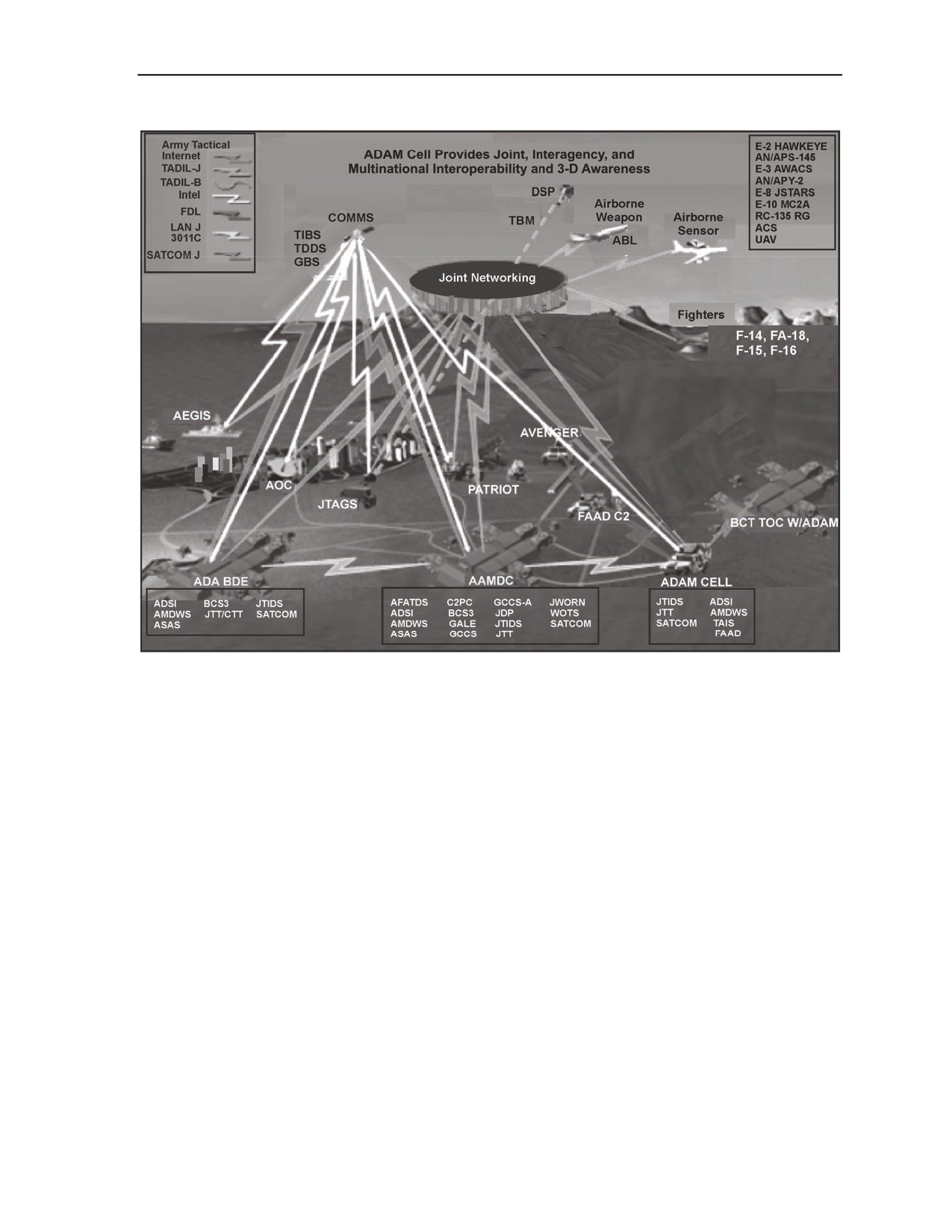
support. Figure B-1 depicts the reach provided by the ADAM/BAE cell (HBCT/IBCT) and ADAM cell
(SBCT) and the degree of interoperability.
B-2
FM 3-01.11
23 October 2007
Air Defense and Airspace Management Cell
Figure B-1. ADAM cell interoperability
ENHANCED SITUATIONAL UNDERSTANDING
B-8. The ADAM/BAE cell (HBCT/IBCT) and ADAM cell (SBCT) employ a multilevel, integrated suite
of ABCS surveillance assets to develop and share a COP throughout the force. These information systems
provide the commander with a unique capability to visualize, describe, and direct the unit through full
spectrum operations and terrain in which the unit may be operating.
B-9. The COP is an operational picture tailored to the commander's requirements for information of
friendly forces, enemy forces, and terrain. It is based on common data and information shared with
subordinate or adjacent commands. Analysis of the COP, together with a commander’s application of
experience, expertise, intuition, and judgment, establishes a relationship among the factors of METT-TC
that leads to SU. SU facilitates decision making by identifying opportunities for mission accomplishment,
threats to the force, and gaps in information. Although critical information may be available via national
and theater reach assets, the ADAM/BAE cell (HBCT/IBCT) and ADAM cell (SBCT) are a major resource
for providing data and combat information to build the knowledge base necessary for the unit to achieve
SU.
JOINT, INTERAGENCY, AND MULTINATIONAL
INTEROPERABILITY
B-10. Although the unit is expected to always operate under Army forces command, the operational
environment may require it to maintain direct links with multinational forces and U.S. and foreign
23 October 2007
FM 3-01.11
B-3

Appendix B
governmental and nongovernmental organizations involved in the conflict, crisis, or instability. In many
situations, the unit will benefit from exploiting the knowledge and capabilities residing within these
organizations. Effective interaction is especially important in an environment where the adversary is
primarily employing unconventional capabilities rather than conventional military power to achieve an end.
In some circumstances, the unit headquarters or subordinate elements actively participate in civil-military
operations. Interoperability with these organizations is essential and is best facilitated through the exchange
of a liaison officer. The fact that the unit communications systems may not be compatible with the JIM
organization increases the need for an exchange of knowledgeable liaison officers properly equipped to
communicate according to the TOE. (See Figure B-1.)
FULL SPECTRUM OPERATIONS
B-11. The ADAM/BAE cell (HBCT/IBCT) and ADAM cell (SBCT) are manned and equipped to conduct
operations in an operational environment. However, conditions may develop that require added capabilities
not resident within the BCT. When the BCT participates in a major combat operation, it will do so as a
subordinate element of a division or corps. Its mobility and organic ISR assets make it invaluable to a
division or corps commander in a major combat operation. As with any brigade, adjustments to task
organization may be required. Likely additions to the BCT task organization may include aviation, armor,
engineers, and air and missile defense.
ADAM CELL EQUIPMENT
B-12. The ADAM cell is used at the SBCT and the support brigades CSB (ME, Aviation, Fires, Battlefield
Surveillance, and Sustainment). The ADAM cell is used in conjunction with the BAE at the IBCT and the
HBCT and is at the corps, division, and Army headquarters level. The equipment
(hardware and
communications) within the ADAM cell is described here, as well as system hardware capabilities.
ADAM CELL HARDWARE
B-13. The ADAM cell is comprised of a prime mover, an AN/TSQ-253 shelter, and power generation
equipment with trailer. See Figure B-2.
Figure B-2. ADAM cell
B-4
FM 3-01.11
23 October 2007

Air Defense and Airspace Management Cell
Prime Mover
B-14. An M1113 heavy chassis HMMWV transports and serves as the bed for the ADAM cell shelter. This
vehicle has a stronger load and pulling capacity than the standard HMMWV. The rigid wall shelter (RWS)
protects ADAM cell personnel from CBRN attacks and has power, local area network (LAN), and antenna
connections on both sides of the structure.
Shelter
B-15. Standardized integrated command post system RWS is a transportable HMMWV-mounted shelter
integrated with ECU, electromagnetic interference and circuit breaker protection, equipment racks, and
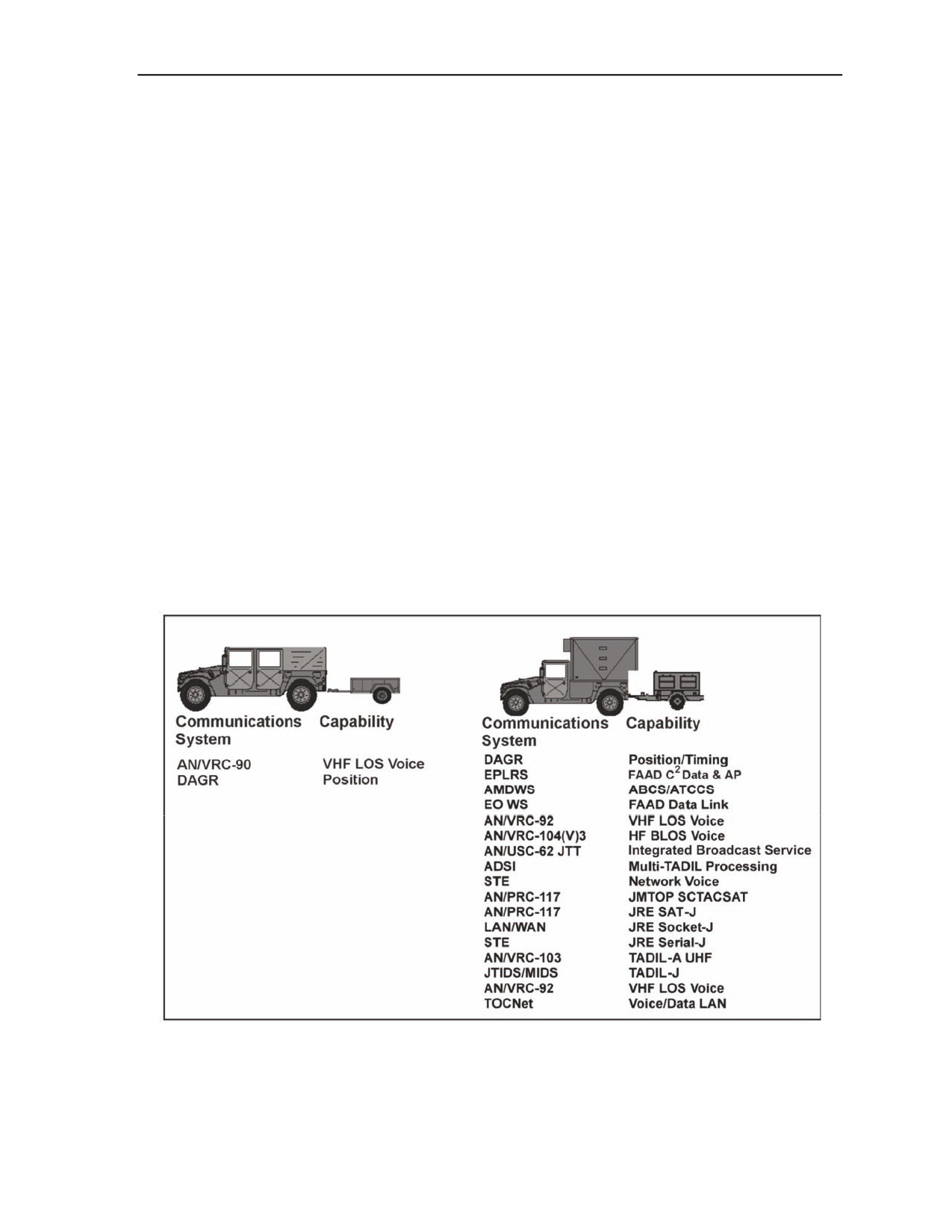
power/signal wiring. Figures B-3 and B-4 illustrate the ADAM command post platform (CPP) layout
aboard the HMMWV.
Figure B-3. Roadside equipment in CPP ADAM cell
Roadside Equipment in the Command Post Platform
z
Bullfrog laptop—Solaris/Unix and Windows-based operating system laptop capable of FAAD
C2 and intelligence activities. FAAD C2 and intelligence activities provide the capability to
manage air defense engagements to the cell.
z
Sun processor console—keyboard/mouse and display for FAAD C2, intelligence activities, and
AMDWS.
z
Defense advanced global positioning system receiver—provides precise positioning service
support and position, velocity, navigation and timing to all missions that involve land-based
war-fighting operations.
z
Printer—network printer for the CPP ADAM cell.
z
Cisco switch (3750)—hubs for the CPP ADAM cell’s primary LAN.
z
Secure wireless LAN—wireless LAN component for continuity of LAN while on the move and
the initial LAN prior to wire being emplaced.
z
ECU—maintains correct operational temperatures for the equipment inside the CPP shelter.
23 October 2007
FM 3-01.11
B-5

Appendix B
z
Server—Windows server used at the discretion of the user. Can act as exchange server for the
unit or as an additional network storage component.
z
Serial patch panel—physically transfers data to multiple components of the CPP ADAM cell.
z
KIV-7—Embeddable KG-84 COMSEC modules cryptographic devices that provide protection
for digital and voice communications.
z
Media converter—gigabit Ethernet copper-to-fiber converters combine existing
100-meter
category-5(E) UTP and fiber-optic segments to deliver gigabit data across the network.
z
Keyboard-video-mouse for Processor—keyboard, video, mouse processor for the Sun processor.
z
Air defense system integrator (ADSI)—provides three functions for the ADAM cell:
A routing capability to support the following TADILs: B Link 11B, and J Link 1.
The capability to receive intelligence information from the Integrated Broadcast System
(IBS), specifically TIBS and Tactical Data Distribution System (TDDS).
A set of air defense command and control functions to the crew.
Figure B-4. Curbside equipment in the CPP ADAM cell
Curbside Equipment in the Command Post Platform
z
Joint tactical terminal (JTT)—provides access to the IBS system via TIBS and TDDS.
z
Multifunction Information Distribution System (MIDS)—provides access to the TADIL-J (Link
16) data network for the receipt of air tracks.
z
Crew access unit—the primary man-machine interface for the TOC net intercommunication
system. Interactive screens are presented to the user on the amber electroluminescent quarter
video graphics array display.
z
EPLRS—provides robust, on-the-move, high-speed, automated data exchange using a
contention-free networking architecture. This guarantees speed of service to time-critical users.
with unit readout: EPLRS data input control unit.
B-6
FM 3-01.11
23 October 2007
Air Defense and Airspace Management Cell
z
AN/VRC-104—provides command and control capability in the high frequency band. It
supports the brigade operations and intelligence net.
z
AN/PRC 117 w/battery eliminators—provides command and control capability in the UHF and
satellite communications (SATCOM) band. Also used to transmit secure data over the satellite
network.
z
Secure telephone equipment (STE)—the evolutionary successor to the secure telephone unit
Type III (STU-III). The STE program improved secure voice communications by changing out
the analog STU-III products with digital-based STE products.
z
AN/VRC-103—provides command and control capability in the UHF and SATCOM band.
z
IP 6600—industrial rated router featuring two serial ports and two Ethernet LAN ports.
z
TAC LINK 2000—provides a modem-like interface for computer workstations employed by
joint and allied military services. Allows data transfer to unique military tactical devices used on
the emerging digital battlefield.
z
SINCGARS—provides VHF-FM (30 to 88 megahertz) combat net radio communication with
ECCM capability (frequency hopping) and digital data capability (data rate adapter).
z
Micro central switching unit—communications platform that provides the operation center
voice/data communication throughout the center.
Support Vehicle and Trailer
B-16. An M1097 HMMWV serves as transport and support vehicle for the ADAM cell, along with a high-
mobility trailer that can carry a 1¼-ton load. This vehicle carries the bulk of the crew and equipment. See
Table B-1. Figure B-5 shows the ADAM cell when remoted from the HMMWV.
Table B-1. AN/TSQ-282 system capabilities, linkages, and enabling device
23 October 2007
FM 3-01.11
B-7

Appendix B
Figure B-5. ADAM cell remoted from shelter
Power Generation
B-17. PU 798 tactically quiet generator (TQG) is a trailer-mounted, 10-kw, 60-Hz generator.
COMMUNICATIONS EQUIPMENT
B-18. MIDS LVT2/JTIDS is a TADIL J. Link 16 is an improved adaptable link used to exchange near-
real-time information and is a communications, navigation, and identification system that supports
information exchange between tactical C2. These high-capacity UHF line of sight frequency hopping data
communications terminals provide secure, jam-resistant digital data exchange. They operate on the
principle of time division multiple access, which provides 12-second frames divided into 1535 time slots
using 51 frequencies operating between 960 and 1215 MHz in different hopping patterns. The JTIDS
terminals provide precise position determination and a positive self-identification. Forces on-the-move
benefit from the terminal's flexibility; the omni-directional antenna provides 7.5dB gain around the full 360
degrees of azimuth.
B-19. The advanced system improvement program SINCGARS VHF-FM radio set is compatible with all
current U.S. and allied forces VHF-FM. These radios are used for voice or data communications able to
communicate in single-channel or frequency hop, in secure or nonsecure mode. They operate between 30
and 88 MHz with a channel separation of 25 kHz, and can change between 100 frequencies per second.
B-20. JTT provides near-real-time tactical intelligence and targeting information, and supplies the critical
data link to battle managers, intelligence centers, air defense, fire support, and aviation nodes across all
services. The terminals allow Army, Air Force, Navy, and Marine Corps users to exploit TIBS and TDDS.
The JTT is a family of special application UHF tactical intelligence terminals which provide the capability
to disseminate time sensitive and battlefield targeting information to tactical commanders and intelligence
nodes.
B-8
FM 3-01.11
23 October 2007
Air Defense and Airspace Management Cell
B-21. EPLRS is a synchronous time division multiple access system that provides identification, position,
location, and navigation information to a centralized net control station automatically. It reports this
information to commanders and supported users within the EPLRS community upon request. It provides
near-real-time data communications support to weapon system sensors and other battlefield automated
systems.
B-22. The Harris AN/PRC-117 covers the entire
30- to
512-MHz frequency range while offering
embedded COMSEC and Have Quick I/II ECCM capabilities. This advanced software reprogrammable
digital radio provides 20 watts FM and 10 watts AM transmit power along with Have Quick I/II capability
in the UHF band. The system is fully compatible with the TSEC/KY-57 in voice and data modes, including
full transmit and receive SARK operations mode. Radio operating parameters and status can be accessed
through the remote control capability of the radio. The asynchronous remote control data interface is either
RS-232E or RS-422. A built-in-test feature checks system performance down to the module level.
B-23. The Harris AN/VRC-103 multiband, multimission vehicular radio system includes an AN/PRC-117F
multiband, multimission tactical radio and the AM-7588 multiband power amplifier. This system covers
the entire 30- to 512-MHz frequency range offering 50 watts PEP transmit power, embedded COMSEC,
SATCOM, and ECCM capabilities. Fully compatible with the TSEC/KY-57 and the advanced narrowband
digital voice terminal/KYV-5 in voice and data modes, the AN/VRC-103 (V) 1 is also compatible with
Fascinator equipment in voice mode and the KG-84C in data mode. Transmit and receive SARK
operations are fully supported for each COMSEC interoperability mode. The radio supports both DS-101
and DS-102 fill interfaces and all common fill devices. It also supports a KY-57/VINSON compatible
interface to ease backwards interoperability with fielded equipment. An embedded demand assigned
multiple access and SATCOM modem complies with MIL-STD-188-181B, -182A, and -183A and is
software reconfigurable to accommodate changes to these standards. An external GPS interface accepts
time and position data. The radio is interoperable with both the SINCGARS and Have Quick I/II ECCM
operations in voice and data modes.
B-24. The Harris AN/VRC-104 is an advanced high frequency radio which operates from 1.6 MHz to
29.9999 MHz using sky wave (upper side band, lower side band, continuous wave, and amplitude
modulation equivalent) modulations with selectable low (1.0 watts), medium (5.0 watts), and high (20.0
watts) output power. It operates from 20.000 MHz to 59.9999 MHz in FM with maximum power of 10
watts.
B-25. Secure terminal equipment nonsecure voice: telephone service interoperable with conventional
integrated services digital network and public switched telephone network telephones, STE, and STE and
STU-III terminals, narrowband devices and digital nonsecure voice terminal. Secure voice: interoperable
with other STE, STU-III, or OMNI terminals. Secure facsimile: interoperable with units supported by
other STE, STU-III, or OMNI terminals. Secure data: interoperable with units supported by other STE,
STU-III, or OMNI terminals.
B-26. AN/PSN-13, defense advanced GPS receiver (DAGR) is a self-contained, hand-held, 12-channel,
dual-frequency GPS receiver. It uses next-generation GPS receiver technology including “all in view”
satellite tracking and the Selective Availability Anti-Spoof Module (SAASM) device to access the precise
positioning service signal. The DAGR is 3.5” wide by 6.5” high and weighs just under 1 pound with
batteries. It provides highly accurate position, velocity, and timing data to individual warfighters and
integrated platform users. When operated with COMSEC, the DAGR provides enhanced anti-spoof and
anti-jam protections. The DAGR supports position location, target location, rendezvous and enroute and
terminal navigation. The DAGR is the replacement for the PLGR, a 5-channel GPS receiver first fielded in
1994. The DAGR will provide ICD-GPS-153 and NMEA 0183 compliant serial data interfaces for weapon
system integrations. The DAGR will be delivered with a multi-year manufacturer’s warranty and will be
backward compatible with PLGR. Weapon system managers will develop installation kits for specific
platforms.
23 October 2007
FM 3-01.11
B-9
Appendix B
Antennas
B-27. JTIDS (VHF/UHF, JTIDS, and UHF SATCOM systems): Unique capabilities include high power
(10,000-watt average) capable antennas, multiband (VHF through L-Band) apertures, as well as rapid-
erection UHF SATCOM antennas for fixed and portable deployments.
B-28. OE-254 is a bi-conical antenna that uses a BALUN (balanced/unbalanced) transformer to match the
50-ohm coax line and radio to the 200-ohm antenna. It covers the 30- to 88-MHz frequency range without
any element adjustments and, therefore, is said to have an instantaneous bandwidth. The OE-254 was
designed for frequency hopping and conventional radios and will work anywhere in the 30- to 88-MHz
bandwidth.
B-29. Quick-erect antenna mast (QEAM) is a manual, screw-drive mast which holds up to a maximum 50
pounds (23 kg) of payload and extends to a maximum 50 feet (15 m). The QEAMs are available with or
without integrated antennas and can be vehicle-, shelter-, or ground-mounted. In addition, guy lines, guy
stakes, and erection tools, optional mounting brackets for HMMWV variants, armored personnel carriers,
and shelters are available.
B-30. SATCOM antennas are as described below:
z
AV 2040 is a foldable, manpack, high gain, and UHF SATCOM antenna designed for special
missions where portability and high gain are required. It has a frequency range of 240 MHz to
400 MHz.
z
AV 2011 is a foldable, high gain, UHF SATCOM antenna designed to withstand wind loading
in excess of 80 miles per hour. This high performance antenna can be set up and deployed in
less than 3 minutes using arctic gloves. The AV 2011 antenna system is directly compatible with
AN/PSC-3, AN/WSC-3, URC-110, HST-4A, LST-5B, AN/PSC-5, AN/PSC-117 or equivalent
ground, shelter or manpack communication systems. It has a range of 240 to 318 MHz.
z
Near vertical incidence skywave is an antenna with a very high radiation angle, approaching or
reaching 90 degrees and used to establish reliable communications over a radius of 0 to 300
miles. This antenna was used in World War II and again in Vietnam to provide tactical
communications under various topographic conditions.
z
AT-197 antenna, discone, is intended for use as an antenna for a ground radio transmitter and
receiver such as the AN/GRC-27, AN/GRC-29, and AN/TRC-32 for communication with
aircraft equipped with UHF command radio sets and such ground UHF stations as necessary in
the UHF terminal area. It is designed to operate at an impedance of 50 ohms. Its frequency range
is 225 to 500 MHz.
System Hardware Capabilities
B-31. The ADAM cell is comprised of the major end items which are described in this section. Also
discussed are the equipment capabilities.
Air Defense System Integrator
B-32. The ADSI provides interoperability with multiple data links (TADIL A, B, J, LAN J, SATCOM J,
and IBS/TBS/TRAP) to provide joint ADA SA and intelligence data to the BCT. The MIDS, JTT, and
AN/PSC-5 provide communications support to the ADSI. A multilink C2 system, the ADSI provides
operators and commanders from theater level down to the ADAM cell a joint, integrated air picture. To
accomplish this, it physically ties into the AMDWS and TAIS and provides routing capabilities to support
TADIL A, B, and J; JTIDS; the FDL, North Atlantic Treaty Organization (NATO) Link 1; Army tactical
data link 1 (ATDL1); and the IBS. The IBS offers the crew the ability to receive intelligence and tactical
information to include space-based intelligence. The ADSI plays a vital role in the functioning of the
AMDWS and TAIS because it feeds tracking and other tactical information it receives via its links to the
AMDWS and TAIS processors. Without ADSI input, AMDWS and TAIS cannot perform their jobs of
providing AD early warning and SA.
B-10
FM 3-01.11
23 October 2007
Air Defense and Airspace Management Cell
B-33. The ADSI provides three functions to the third dimension air picture. First, it provides routing
capabilities to support TADIL A, B, and J. It also provides the capability to receive intelligence
information from the IBS, specifically from TIBS and TDDS. It provides a set of command and control
functions to the crew of the ADAM cell.
Tactical Airspace Integration System
B-34. TAIS is the Battlefield Automated System of ABCS. It revolutionizes the management of airspace
and conduct of air traffic services. By providing interoperability within ABCS, standardization of software,
commonality of hardware components and configurations, and the interoperability with joint coalition,
civil aviation, and forces, TAIS effectively bridges the gap between technology and military doctrine for
legacy, interim, and objective forces. The near-real-time integrated air and ground picture displays the
airspace control order in two and three dimensions.
B-35. TAIS provides the ADAM cell the ability to manage airspace in its area of operations and the
deconfliction of aerial platforms and objects operating in that airspace. It offers automated airspace C2 and
air traffic management and deconfliction capabilities for operators and commanders at levels above corps
down to the ADAM cell at support brigades. A member of the ABCS, TAIS interfaces with the Air Force’s
theater battle management core system and civil and military airspace management systems and agencies. It
also links with the ADSI, which feeds it tracking and tactical information. This networking, combined with
automation software, allows the operator to provide the commander with a near-real-time, 3-D AC2 picture
of the third-dimension operational environment. The operator can also synchronize and deconflict the
airspace to prevent fratricide and assist commanders in mission accomplishment.
B-36. The ADAM cell operator accomplishes these tasks from the TAIS workstation, which functions as
an airspace information center. From the TAIS workstation, the operator can follow flights transiting
through BCT airspace, receive and process flight advisories, issue air warnings, and provide real-time
positive control of BCT airspace. For example, when the TAIS operator receives information that a BCT
artillery unit has received a fire mission, he can immediately generate a 3-D AC2 picture of the airspace
impacted by the flight of the artillery rounds and ascertain if they will conflict with friendly aircraft
transiting BCT airspace. Automation allows the operator to make this determination in seconds and reroute
aircraft, if necessary, to prevent fratricide. The TAIS receives the recognized air picture through several
communication links providing near-real-time SA for both friendly and enemy air activity. Visualization of
four dimensions, SA, airspace deconfliction, and fratricide avoidance, TAIS receives input from the
following:
z
ADSI.
z
AWACS TADIL-A Link.
z
Theater battle management core system.
z
Contingency theater air control system automated planning system.
z
FAAD C2.
z
TADIL-A Link.
z
TADIL-B Link.
z
TADIL-J Link.
z
International Civil Aviation.
z
Federal Aviation Administration.
B-37. TAIS will also receive a text message copy of the airspace control order from the higher Air Force
Air Operations Center or the Army's Battlefield Coordination Detachment, then convert it into a graphic
format and display it on the flat screen. This precludes the operator from manually inputting the airspace
control measures onto the map overlays. An operation that took several man-hours to complete, now takes
seconds.
Forward Area Air Defense C2 Workstation
B-38. FAAD is the engagement operations piece of the ADAM cell element. FAAD collects, stores,
digitally processes, and displays and disseminates real-time tactical cueing and tracking information, the
23 October 2007
FM 3-01.11
B-11
Appendix B
common tactical air picture, and command, control, and intelligence information to all ADA weapons.
FAAD also provides the local air picture to joint and multinational forces to protect friendly aircraft and
facilitate management of the air battle. Interoperability and horizontal integration is maintained with all
Army air defense systems, including Patriot and THAAD. Distribution of the local air picture is with
tactical and special purpose radios and includes integration with the AWACS, ABCS, and joint and
multinational air and missile defense command and control systems FAAD C2, which currently support
several global war on terrorism operations, including homeland defense.
B-39. A standard FAAD C2 processor also provides the ADAM cell the ability to manage air defense
engagements and early warning. Specifically, it provides the Army's FAAD datalink (Sentinel radar
picture) and controls the air and missile defense engagement operations.
Sentinel
B-40. The Sentinel radar sensor is an asset organic to heavy divisions. It is designed to operate in all types
of weather, severe ECM environments, and survive antiradiation missile attacks.
B-41. The Sentinel is essential to the mission in providing a local air picture in the BCT operations area.
The ADAM cell will have access to the COP through a variety of communications and air picture linkages.
However, these linkages do not provide enough detail to ensure effective management of the local ADA
and Aviation assets in operation; for example, the Sentinel is essential for UAS identification.
B-42. The Sentinel alerts and/or cues Avenger and dismounted MANPADS Stinger teams of hostile and
unknown aircraft (FW, RW, CMs, and UASs). It protects friendly forces from fratricide and provides air
situational data to command and control centers. Sentinel track data is broadcast to ADA weapons and
command posts through the FAAD C2 system or, in the event a sensor node is not available, directly to the
fire units over EPLRS or SINCGARS. The method of transmission is operator-selectable from the RCT
during initialization.
B-43. To provide EW, the ADAM cell receives air tracks from external sources such as the Sentinel radar
sensor, AWACS, Patriot, Aegis, and the joint tactical air ground station. The ADAM cell correlates those
tracks and sends them to the BCT elements tactically located on the battlefield. The Sentinels receive that
air track data, correlate it with their own data, and send the data to supported ADA batteries, platoons,
sections, and fire units. To ensure the widest dissemination of EW, the BCT force uses both voice
procedures and the ABCS 6.4 network to alert the brigade. All descending echelons repeat the EW. The
ADAM cell operators verbally notify the BCT TOC of an air attack and then transmit a free-text message
to all subordinate battalion TOCs, which triggers them to display the current air picture on their ABCS.
B-44. Digital warning messages from higher sources can arrive directly from the origin sensor or via
networks. Additionally, digital air attack EW may originate internally within the BCT when air defense
sensors are employed. If the AMDWS is configured to alert when hostile criteria tracks approach preset
volumes, the AMDWS will automatically generate digital alerts. For example, when a hostile track crosses
an established “Dynamite line,” the AMDWS alerts the operator and generates E-500 (air strike warning)
messages. When the operator clears the alert, these digital warnings are sent to addresses on the networked
LAN of the brigade.
Air and Missile Defense Workstation
B-45. AMDWS is a collaborative operational environment awareness information management system that
contributes to combat effectiveness by retrieving, fusing, and distributing time-sensitive information
necessary to achieve decision-cycle dominance. AMDWS retrieves operational environment awareness
information from many sources: joint headquarters, the ABCS network, national intelligence assets, all-
source centers, and tactical and strategic sensors. AMDWS uses this information to provide an area-
complete, combat-operations display that combines ground, air and space-based sensor inputs and
command and staff data with automated planning tools. Distribution is accomplished over tactical and
special purpose communications in near-real-time, while supporting concurrent interaction with joint C2
networks, sensor sources, and ABCS.
B-12
FM 3-01.11
23 October 2007
Air Defense and Airspace Management Cell
B-46. The AMDWS system is the FO piece of the FAAD C2I network system supporting ADA battalions
and brigades. AMDWS is also the foundation software platform for the ADATF planner for Patriot
battalion units. The ADAM cell holds one AMDWS linked to both the EO monitor and the ADSI, where it
can obtain external air tracks. At the brigade level, the digitized ADA battery CP operating in the brigade
TOC will have one AMDWS and an EO monitor, along with its associated laptops, printers, and
communications infrastructure.
23 October 2007
FM 3-01.11
B-13
This page intentionally left blank.
Appendix C
Training Devices and Aerial Targets
Today’s highly technical air defense arsenal of systems and their operations require
the best professional support of effective training programs and training devices to
promote the skills, knowledge, and expertise required for maintainer and crew
proficiency. This chapter describes the various training devices and aerial targets used
when training with MANPADS for the SHORAD weapon systems, Patriot, THAAD,
and the Sentinel radar.
TRAINING DEVICES
C-1. Training devices for ADA systems consist of simulators, interactive mockups, virtual modeling,
static equipment, and maintenance trainers.
AVENGER
C-2. Avenger training devices provide familiarization and training, to include live-fire exercises, to
maintain crew efficiency in all aspects of SHORAD operations. Avenger personnel must be
knowledgeable in both Avenger and MANPADS engagement roles. Listed below are Avenger-unique
training devices:
z
Avenger force-on-force trainer (FOFT).
z
Avenger table-top trainer (TTT.)
z
Institutional conduct of operations trainer (ICOT).
z
Captive flight trainer (CFT).
z
Aerial targets (pages C-10 and C-11).
Force-on-Force Trainer
C-3. The Avenger FOFT is an integrated laser engagement simulator used in the multiple-integrated
laser engagement system (MILES) FOFT exercises. It provides simulation of missile firings, weapons
effects, signature simulation, and real time target assessment. The FOFT is used for realistic training in
combat training center exercises for gunners in a simulated wartime environment.
Table-Top Trainer
C-4. The Avenger TTT is an interactive graphics trainer with the principle features of the Avenger
turret gunner station. A 17-inch monitor presents the out-of-window (canopy) view and the gunner’s
FLIR display. In addition, a FLIR field of view footswitch and a tactical gunner hand station provide
for the gunner/machine interface.
Institutional Conduct of Operations Trainer
C-5. The FAAD system C2, communications, and intelligence activities ICOT is a computer-based
training device used with Avenger at USAADASCH. This device trains initial entry and transition level
personnel. It simulates all software operations of the C2 and information systems nodes such as air battle
management operations center (ABMOC), TOC, and BCP. ICOT provides sensor C2 node simulations
such as air tracking and bearing data, symbology, target ranges, weapon control orders and their status,
air defense warnings (ADWs), fault simulations, and BIT operations, during continuous operations.
23 October 2007
FM 3-01.11
C-1
Appendix C
Each ICOT consists of six student stations and one instructor station. The ICOT is used for realistic
training for all operators and AD officers.
Captive Flight Trainer
C-6. The CFT consists of an actual Stinger missile guidance section assembly without the rocket motor
and warhead and is used with the Avenger configuration only. The guidance section provides realistic
training for target acquisition and tracking engagement procedures. The launch tube assembly is similar
to the missile-round in weight, size, and external appearance, except the “fly-away” simulator module is
mounted on the forward end of the launch tube. The CFT is designed to maintain and sustain the
required training tasks to maintain operator proficiency to meet requirements at unit level.
SHORAD
C-7. Listed below are the MANPADS (shoulder-fired) support trainers for shoulder-fired Stinger:
z
Training set, GM, tracking head trainer (THT), M160.
z
Field handling trainer (FHT).
z
Stinger troop proficiency trainer (STPT).
z
Improved moving target simulator (IMTS).
z
Aerial targets (on pages C-10 and C-11).
Training Set, Guided Missile, Tracking Head Trainer
C-8. The Stinger THT, M160, has the same seeker and general appearance as the RMP/Block1 missile-
round as shown in Figure C-1. Components of the THT include the trainer battery, missile simulator,
IFF simulator with interconnecting cable, and the performance indicator annunciator box. The
performance indicator annunciator provides a means to maintain, evaluate, and enhance gunner
proficiency by conducting on-the-spot corrections and evaluations. The THT is used to train gunners in
sustainment training. The service school trains entry-level personnel. The IMTS, AN/FSQ-187, trains
for varied target engagement scenarios, inside or outside the IMTS. A benefit of the THT is quality of
training for operators and the reduction of ammunition expenditures. Audio indications of IFF response,
gyro spin-up, and target acquisition (seeker lock-on) are features of this training equipment. Color
identification consists of four, 1-inch blue squares located at each end of the THT launch tube. The
THT trainer battery (noticeably taller than the BCU and rechargeable) supplies electrical power only to
the trainer and has two, 1-inch blue squares located one on each side of the battery and one on each side
of the battery receptacle. The trainer battery will provide at least fourteen 47-second training missions.
The THT belt-pack is identified by blue squares about its waist. Argon coolant is housed in the launch
tube and pressurized with argon as needed. The THT gripstock is maintained by maintenance personnel
only. Stinger operators are not authorized to remove or install this gripstock. The trainer battery and IFF
simulator belt-pack have blue squares located at same locations as the FHT. The THT shipping and
storage container has the same outward appearance as the weapon-round container.
C-2
FM 3-01.11
23 October 2007

Training Devices and Aerial Targets
Figure C-1. Stinger tracking head trainer
Field Handling Trainer
C-9. The Stinger FHT, M60, is assigned and used at service schools and unit level. Stinger operators
use the FHT to practice manual skills of weapon handling, operation, sighting, ranging, and crew quick-
reaction drills. The FHT can be used to track live aircraft or remotely piloted vehicle targets. It allows
the operator to practice attaching or removing the gripstock from the launch tube, inserting and
removing the battery coolant unit, and connecting and removing the IFF belt-pack interconnecting cable
from the gripstock. The aforementioned components—gripstock, battery, and IFF belt-pack—are
labeled as
“Dummy.” There are no internal functioning components; however, the FHT and its
components are the same size, weight, and external appearance as the Stinger weapon-round (36.1
pounds) with gripstock and battery installed. Audio indications of target acquisition and IFF responses
are not a feature of the FHT. Trainer color code markings and associated components consist of four, 1-
inch bronze squares located at each end of the launch tube and the word “Dummy” embossed along the
aft section of the launch tube. Two, 1-inch bronze squares are located on the gripstock, one on each side
of the battery receptacle. The belt-pack has a solid bronze band about the center with the word
“Dummy” embossed.
Stinger Troop Proficiency Trainer
C-10. The STPT is a computer-based device that generates digitized targets and backg1round onto the
weapon system's optics. The STPT is used in the shoulder-fired configuration only for realistic training
of both active and reserve component Stinger gunners in a simulated wartime environment and
eliminates the need for actual aircraft, aerial targets, firing angle considerations, and missile
expenditures. The STPT is used for training entry-level personnel and to sustain training in engagement
procedures and skills at unit level.
Improved Moving Target Simulator
C-11. The IMTS, AN/FSQ-187, is a computer-driven indoor training facility. The IMTS, among other
mission requirements, can project battlefield backg1round scenes and moving aircraft target scenarios on
a 360-degree, 40-foot diameter hemispherical dome screen to create a realistic battlefield environment.
See Figure C-2. The first generation simulators were limited to the 180-degree aspect.
C-12. An instructor console located in the dome controls all scenario selections for video IR/NUV
projections, sound generation, target maneuvers, and countermeasures. Up to three Stinger gunners can
23 October 2007
FM 3-01.11
C-3

Appendix C
be trained simultaneously. Student performance evaluations are possible during training exercises,
using the instructor console. The IMTS is used to train Stinger gunners in target acquisition and
engagement skills at unit, service school, and overseas command levels.
Figure C-2. Improved moving target simulator
PATRIOT
C-13. Patriot training devices serve to train initial entry personnel and sustain unit operator and
maintainer efficiency in fighting the air defense battle and maintaining the Patriot system's operational
readiness. The training devices described are—
z
Patriot organizational maintenance trainer (POMT).
z
Patriot conduct-of-fire trainer (PCOFT).
z
RS march order and emplacement trainer (MOET).
z
Patriot communications system task trainer (PCSTT).
z
Data link upgrade (DLU) task trainer.
z
Radio frequency comparator task trainer.
z
Cooling liquid electronic tube (CLET) removal and replacement (R&R) task trainer.
z
Antenna element task trainer (AETT).
z
Embedded trainer.
z
Empty round trainer (ERT).
z
Missile-round trainer (MRT).
z
Patriot intermediate maintenance instructional trainer (PIMIT).
Patriot Organizational Maintenance Trainer
C-14. The POMT provides a realistic static mockup of the ECS (interior and exterior) with operator
consoles interchangeable to the battalion ICC configuration, and the interior and exterior of the RS
shelter. The POMT consists of the active maintenance trainer simulator and the parts task trainer. It is
used to train maintenance personnel in the use of display-aided maintenance (DAM), non-display-aided
maintenance (non-DAM), and built-in test equipment (BITE) indicator procedures to diagnose, fault
locate, remove and replace defective components, and use software routines for the RS, ECS, and ICC.
Patriot Conduct-of-Fire Trainer
C-15. The PCOFT is an institutional training device for Patriot. It is a computer-driven battlefield
system training device used at USAADASCH and outside continental United States (OCONUS). The
PCOFT allows running Patriot tactical troop proficiency trainer (TPT) software using four enhanced
WCC operator tactical trainers. The PCOFT has eight student consoles that are reproductions of the
C-4
FM 3-01.11
23 October 2007
Training Devices and Aerial Targets
Patriot ECS and ICC tactical system operator consoles. One instructor station is used for controlling and
monitoring the student consoles. The PCOFT is used to train battalion TDs, TDAs, firing battery TCOs,
and TCAs. Training is conducted on initialization procedures and AD battles, individually or paired
FUs, paired battalion or netted FUs, and battalion. One PCOFT can simulate up to four battalions.
Radar Set March Order and Emplacement Trainer
C-16. The Patriot RS MOET is an institutional training device. The MOET is a mock-up of the Patriot
RS physical characteristics as applied to MOET tasks. The trainer consists of an RS trailer with
electrical power, a rotating platform with antenna face, a shelter, and outriggers. The MOET is used to
train Patriot missile crew members, operators, system mechanics, system maintenance technicians, and
AD officers in march order and emplacement tasks. All march order and emplacement tasks can be
trained using this device instead of the tactical system.
Patriot Communications System Task Trainer
C-17. The PCSTT consists of two tactical UHF radio stacks, a patch panel, an antenna control unit,
and three communications systems controls. It also has a power distribution panel to provide hands-on
training in initialization, operation, and maintenance of the AN/GRC-103 UHF radio communications
systems.
Data Link Upgrade Task Trainer
C-18. The Patriot DLU task trainer consists of a rack of tactical DLU equipment to provide hands-on
training in operation of the DLU system. Although the same basic classroom configuration as the DLU
modified DLT on the ECS, the assemblies comprising the trainer are different. The DLU modification
adds the SINCGARS radio AN/VRC-9O as the over-the-air communications link. A fiber-optics unit is
not included due to its cost. Instead, the radio transmitters need to be loaded (dummy load) the same as
the unmodified DLT. A signal is picked up and connected to the other DLU receiver via hardwire. The
DLU task trainer enables the student to perform the following emplacement tasks:
z
DLT module A2 energizing.
z
DLT module A2 de-energizing.
z
DLT power up.
z
Radio AN/VRC-90 loading.
z
DLT self-test.
z
DLT synchronizing.
z
Security unit TSEC/KY-57 loading.
Radio Frequency Comparator Task Trainer
C-19. The Patriot RF comparator task trainer is a mockup of the tactical radar RF comparator and
consists of tactical and mockup battery replaceable units (BRUs). The following is a list of the removal
and replacement tasks that can be taught with the RF comparator task trainer, remove and replace—
z
Radome with support and cooling (A139).
z
Pressure switch (S1).
z
Tube axial fan 81 or 82.
z
Radome feed assembly.
z
Main comparator horn assembly (A140) housing.
z
Microwave device assemblies A142, A143, or A144 air duct hose assembly.
23 October 2007
FM 3-01.11
C-5
Appendix C
Cooling Liquid Electronic Tube Removal and Replacement Task Trainer
C-20. The Patriot CLET R&R task trainer is a mockup of the right rear of the RS shelter, a simulated
CLET rear door, and all associated hardware to perform R&R procedures. The CLET mockup includes
four coolant hoses and two electrical cables.
Antenna Element Task Trainer
C-21. The Patriot AETT is a task training device used to train the removal and insertion of the
individual elements in the Patriot phased array radar antenna. The radar antenna systems group
diagnostics are performed using either the ECS or the POMT. Identifying particular faulty elements is
accomplished using full-scale silk screen drawings, partial scale photographs, or overhead projections
of line drawings or photographs. Using one of these media in lieu of tactical equipment better fills
requirements of student/instructor safety and convenience, and off-loads time from tactical equipment
to training devices.
Embedded Trainer
C-22. Patriot ETs are TPTs with software programs that are built into the tactical system and provide
training in simulated AD battle scenarios. TDs, TCOs, TDAs, and TCAs receive sustainment training
and collective training in detection, acquisition, identification, and engagement in ECM environments.
Empty Round Trainer
C-23. The Patriot ERT canister is a reworked expended Patriot missile-round canister with appropriate
markings. The ERT is used in the institution and units to train Patriot missile crew members in
transporting, handling, and unloading procedures of expended missile-round canisters.
Missile-Round Trainer
C-24. The Patriot MRT emulates a Patriot ready-round missile in size, weight, shape, and electrical
connections. The MRT is used in both institutional and units to teach Patriot missile crew members
handling, loading, and electrical checks without using a ready round.
Patriot Intermediate Maintenance Instructional Trainer
C-25. The PIMIT is a training device used to provide intermediate maintenance level training to
students in the use of diagnostic programs, adjustments, and calibration procedures. It also provides
training in the use of test, measurement, and diagnostic equipment, parts location, and troubleshooting
of system malfunctions.
TERMINAL HIGH-ALTITUDE AIR DEFENSE
C-26. THAAD training devices are used to support new equipment training, and institutional and unit
training. THAAD embedded trainer (ET) system capabilities are used to the maximum extent possible.
The following devices make up THAAD’s training aids, devices, simulators, and simulations
(TADDS), which are described in detail in THAAD’s Operational Requirements Document:
z
User system operator trainer (USOT).
z
Radar training laboratory (RTL).
z
MOET.
z
Missile-round trainer (MRT) and missile-round pallet trainer (MRPT).
z
Explosive ordnance disposal trainer (EODT).
Practical EOD system trainer (PEST).
Classroom EOD system trainer (CEST).
C-6
FM 3-01.11
23 October 2007

Training Devices and Aerial Targets
Training Aids, Devices, Simulators, and Simulations/Embedded Trainer Strategy
C-27. The following paragraphs explain TADSS capabilities necessary to support Block 06 THAAD
system training. It is important to note that ET capabilities are used whenever and wherever possible.
Quality Soldier training is the prime consideration for determining and selecting TADSS functional
requirements, per AR 350-1. See Figure C-3.
Figure C-3. THAAD Block 06 TADSS
User System Operator Trainer
C-28. The USOT (Figure C-4) will provide training on the operational use of the THAAD fire control
Block 06 configuration. It will replicate TOS workstation hardware interfaces and permit training of
operational functions. This design is based on user inputs and will be updated as required. The THAAD
USOT is an interim training solution, and streamlined approaches may be used. Also, training
effectiveness and efficiency cannot be compromised.
23 October 2007
FM 3-01.11
C-7

Appendix C
Figure C-4. User system operator trainer
Radar Training Laboratory
C-29. The RTL provides a stand-alone radar training capability for hands-on operator training in a
controlled environment. It uses hardware and software which emulates the tactical operations
environment of the EEU for familiarization of system operations. The RTL also provides training for
the operator who sits at the EEU enhanced operator terminal console and allows operators to perform
state and mode transition.
March Order and Emplacement Trainer
C-30. The purpose of this device is to train THAAD personnel to march order and emplace the
THAAD radar. It is used in conjunction with the HEMTT tractor for training. The MOET consists of
the antenna element (AE), PPU, CEU, and EEU. These components are described in the following
paragraphs:
z
AE: The trainer replicates the appearance and size of the AE. The simulator is used to train
Soldiers in the actual road march, march order, and emplacement procedures. It is used to train
the Soldiers in the proper connection of the electrical and cooling lines to the CEU and signal
data lines to the EEU.
z
PPU: The trainer replicates the appearance and size of the PPU. The simulator is used to train
Soldiers in the actual road march, march order, and emplacement procedures. The PPU also
trains the Soldiers in the proper connection of the electrical lines to the CEU.
z
CEU: The trainer replicates the appearance and size of the CEU. The simulator is used to train
Soldiers in the actual road march, march order, and emplacement procedures. It trains Soldiers
in the proper connection of the electrical and cooling lines to the AE.
z
EEU: The trainer replicates the appearance and size of the EEU. The simulator is used to train
Soldiers in the actual road march, march order, and emplacement procedures. It trains Soldiers
in the proper connection of the electrical, signal, and data lines to the AE.
Missile-Round Trainer
C-31. The MRT consists of two separate configurations—the missile-round pallet trainer (MRPT) and
the MRT. The purpose of the MRPT and the MRT is to train operators handling procedures of the
THAAD missile at the institutional and unit levels. Both configurations are used in conjunction with the
THAAD launcher for training. The MRPT and MRT will simulate weight, balance, and physical
characteristics of the missile, missile loading/reloading procedures, hangfire/misfire procedures, missile
handling, and transport procedures.
C-8
FM 3-01.11
23 October 2007
Training Devices and Aerial Targets
Explosive Ordnance Disposal Trainer
C-32. The purpose of this device is to train explosive ordnance disposal (EOD) personnel to recognize
inherent hazards associated with the components of missile and practice EOD handling procedures.
There are two separate EOD trainers. They are the PEST and the CEST. The PEST is a full-scale inert
model of the production THAAD missile system and canister. The CEST is a half-scale inert model of
the production THAAD missile and canister that has a cutaway of the areas containing explosive,
hazardous, and classified components.
Embedded Training
C-33. Unit sustainment training is accomplished through the use of an embedded TPT capability
within the THAAD system. The software simulates operational tactical battlefield information and
provides training to support both EO and FO procedures. The TPT allows operators, commanders, and
staff personnel to maintain proficiency in the tactical decision-making processes and console
operations. During ET, operators interact with the system in the same manner as they would under
actual combat conditions. Training may be conducted within a single battery, battalion, or concurrently
with other THAAD batteries and battalions to support joint and combined training.
SENTINEL SENSOR RADAR
C-34. The Sentinel sensor radar is not a training device, but is required when Sentinel training devices
listed below are used:
z
Sentinel TPT.
z
Sentinel institutional maintenance trainer (SIMT).
z
Sentinel training system (STS).
z
Aerial targets (on pages C-10 and C-11).
Sentinel Troop Proficiency Trainer
C-35. The Sentinel TPT is embedded into, and used with, the actual Sentinel equipment. The Sentinel
TPT displays incoming and outgoing information that stimulates operator procedural actions. This
provides real time, free play interactive simulation that is representative of initialization, BIT/BITE
operation and evaluation of data/error messages. The Sentinel TPT provides reports of operator actions
and summary reports used to determine if operator performance meets the required standards for
proficiency.
Sentinel Institutional Maintenance Trainer
C-36. The SIMT is a 3-D trainer used for maintenance training. It is an institutional trainer consisting
of an instructor console and four student stations. The instructor console initializes, controls, and
monitors any combination of training stations. The SIMT is capable of training at least 100 different
maintenance tasks.
Sentinel Training System
C-37. The STS is capable of training students to operate the Sentinel system. The STS simulates the
functional, physical operations, and characteristics of the system. The instructor operator station (IOS)
has the capability to interface with, and provide up to, eight student stations with operator level scenario
training associated with the Sentinel. The IOS also has the capability to select individual student
stations and perform different task levels depending on the student progression.
AERIAL TARGETS
C-38. Aerial targets are used to familiarize and qualify crewmen during gunnery training and system
qualifications. Normally, all AD live-fire training is conducted using high-performance unmanned
23 October 2007
FM 3-01.11
C-9
Appendix C
aerial targets. These targets must be capable of simulating combat aircraft characteristics and require the
AD weapon system to use its maximum capability. Numerous types of aerial targets, operated by troop
units or furnished and operated by contract personnel, are available for AD service practice. Three
categories of aerial targets (drone, towed, and ballistic) are described in Tables C-1 through C-3.
Table C-1. Drone targets
Description
Characteristics
Augmentation
Formation flights are
possible depending
• Speed: 250 to 500 kts.
on—
MQM-107 Streaker
Subscale: Subsonic
• Altitude: 50 to 40,000 ft.
• Range
FW
• Flight time: 60 minutes.
availability.
• Guidance: command.
• Scoring
capability.
Formation flights are
possible depending
• Speed: 220 to 550 kts.
on—
Subscale: Subsonic
• Altitude: 100 to 55,000 ft.
BQM-34 Firebee
• Range
FW
• Flight time: 60 min.
availability.
• Guidance: command.
• Scoring
capability.
• Speed: Hover at 0 to 100
• IR flare.
Full-scale,
kts.
• Dispenser
QUH-1 Huey
remotely-piloted,
• Altitude: 50 to 10,000 ft.
capable with
RW aircraft.
ECMs.
• Flight time: 90 min.
Table C-2. Towed targets
Description
Characteristics
Augmentation
•
48 in long.
• Bullet-counter
Aerial Gunnery
scoring.
•
7 in diameter.
Towing provides 1 sq m
Towed Target
RCS in I-band
• Tow-capable by
• Towed by a 2-ft by
coverage.
MQM-107 or
12-ft multistream
banner.
BQM-34.
• Towed from 8,000-ft
TRX-4A Radar Tow
•
99 in long.
tow line.
Tow-capable by MQM-
Bee
•
9 in diameter.
• Provides an 8 sq ft
107 or BQM-34.
RCS in the X-Band.
C-10
FM 3-01.11
23 October 2007
Training Devices and Aerial Targets
Table C-3. Ballistic target
Description
Characteristics
Augmentation
• Speed: .88 to 3.6 mach
• Contractor-
operated only.
• Altitude: 7,000 to
141,400 ft
• Obsolete
Lance Missile
surface-to-
• Range: 130 km
Telemetry; hit indicator.
surface tactical
• Guidance: inertial
missile.
guidance and control
• Emulates
• Track-mounted or
SCUD’s B & C.
towed
23 October 2007
FM 3-01.11
C-11
This page intentionally left blank.
Glossary
Section 1 — Acronyms and Abbreviations
AC2
Airspace Command and Control
ABCS
Army Battle Command System
ABL
airborne laser
ABMOC
Air Battle Management Operations Center
ABT
air-breathing threat
ACUS
area common user system
AD
air defense
ADA
air defense artillery
ADAM
air defense and airspace management
ADATF
air defense artillery defense task force
ADSI
air defense system integrator
ADW
air defense warning
AE
antenna element
AETT
antenna element task trainer
AEU
antenna equipment unit
AFCC
Avenger fire control computer
AMD
air and missile defense
AMDWS
air and missile defense workstation
AMG
antenna mast group
ANCD
automated network control device
ASM
air-to-surface missile
ASV
antenna support vehicle
ATG
antenna-transceiver group
AVT
automatic video tracker
AWACS
Airborne Warning and Control System
BAE
Brigade Aviation Element
BALUN
balanced/unbalanced
BCP
battery command post
BCT
brigade combat team
BCU
battery coolant unit
BfSB
Battlefield Surveillance Brigade
BIT
built-in test
BITE
built-in test equipment
BLOS
below line of sight
BM
ballistic missile
BMD
ballistic missile defense
BMDS
ballistic missile defense system
23 October 2007
FM 3-01.11
Glossary-1
Glossary
BRU
battery replaceable unit
BSC
battery support center
btry
Battery
C2
command and control
CAU
crew access unit
CBRN
chemical, biological, radiological, and nuclear
ccw
Counterclockwise
CDT
computer display terminal
CEM
carrier electronics module
CEST
classroom explosive ordnance disposal system trainer
CEU
cooling equipment unit
CFT
captive flight trainer
CLET
cooling liquid electronic tube
CM
cruise missile
COA
course of action
COMSEC
communications security
COP
common operational picture
COTS
commercial off-the-shelf
CP
command post
CPP
command post platform
CRG
communications relay group
CSB
Combat Support Brigade
CSV
cable support vehicle
CTT-H
commander’s tactical terminal-hybrid
CVC
combat vehicle crewman
cw
Clockwise
DACS
divert attitude control system
DAGR
defense advanced global positioning system receiver
DAM
display-aided maintenance
dB
Decibel
DLT
data link terminal
DLU
data link upgrade
DSP
Defense Satellite Program (acquisition sensor)
ECCM
electronic counter-countermeasures
ECM
electronic countermeasures
ECS
engagement control station
ECU
environmental control unit
EEU
electronic equipment unit
ELES
enhanced launcher electronics system
EMP
electromagnetic pulse
endo
Endoatmosphere
Glossary-2
FM 3-01.11
23 October 2007
Glossary
EO
engagement operations
EOD
explosive ordnance disposal
EODT
explosive ordnance disposal trainer
EPLRS
enhanced position location reporting system
EPP
electric power plant
EPU
electric power unit
ERT
empty round trainer
ET
embedded trainer
exo
Exoatmosphere
FAAD
forward area air defense
FCC
fire coordination center
FDL
FAAD data link
FHT
field handling trainer
FLIR
forward-looking infrared
FM
field manual; frequency modulation
FO
force operations
FOFT
force-on-force trainer
FOL
fiber optic link
ft
Foot
FU
fire unit
FW
fixed wing
gal
Gallon
GEM
guidance-enhanced missile
GFE
government-furnished equipment
GM
guided missile
GMD
ground-based midcourse defense
GMT
guided missile transporter
GPFU
gas particulate filter unit
GPS
global positioning system
HBCT
Heavy Brigade Combat Team
HEMTT
heavy expanded mobility tactical truck
HMMWV
high-mobility multipurpose wheeled vehicle
hr
Hour
HSI
heat-sensitive indicator
HTU
handheld terminal unit
Hz
Hertz
IBCT
Infantry Brigade Combat Team
IBS
Integrated Broadcast System
ICBM
intercontinental ballistic missile
ICC
information and coordination central
ICOT
institutional conduct of operations trainer
23 October 2007
FM 3-01.11
Glossary-3
Glossary
ICSS
interim contractor support system
IFF
identification, friend or foe
IMTS
improved moving target simulator
in
Inch
IOS
instructor operator station
IR
Infrared
IRCM
infrared countermeasures
ISR
intelligence, surveillance, and reconnaissance
JDN
joint data network
JECN
joint engagement coordination network
JIM
joint, interagency, and multinational
JMMN
joint mission management network
JTIDS
Joint Tactical Information Distribution System
JTT
joint tactical terminal
kg
Kilogram
kHz
Kilohertz
km
Kilometer
kts
Knots
kw
Kilowatt
LAN
local area network
LCS
launch control station
LEM
launcher electronics module
LHS
load handling system
LOS
line of sight
LRF
laser range finder
LRPT
large repair parts transporter
LS
launching station
LSDU
launching station diagnostic unit
LTDA
lower-tier defended area
m
Meter
MANPADS
man-portable air defense system
MC
maintenance center
MCPS
Mobile Command Post System
ME
Maneuver Enhancement
METT-TC
mission, enemy, terrain and weather, troops and support available, time
available, civil considerations
MHz
Megahertz
MIDS
Multifunction Information Distribution System
MILES
multiple-integrated laser engagement system
min
Minute
mm
Millimeter
Glossary-4
FM 3-01.11
23 October 2007
Glossary
MOET
march order and emplacement trainer
MOTS
military off-the-shelf
mph
miles per hour
MR
missile round
MRBM
medium-range ballistic missile
MRC
missile-round container
MRP
missile-round pallet
MRPT
missile-round pallet trainer
MRT
misisle-round trainer
MSE
mobile subscriber equipment
NATO
North Atlantic Treaty Organization
NPG
network participation group
NUV
negative ultraviolet
OCONUS
outside continental United States
PAC-3
Patriot Advanced Capabilities-3
PCOFT
Patriot conduct-of-fire trainer
PCSTT
Patriot communications sytem task trainer
PDB
post deployment build
PEST
practical explosive ordnance disposal system trainer
PIMIT
Patriot intermediate maintenance instructional trainer
PLGR
precision lightweight GPS receiver
POL
petroleum, oils, and lubricants
POMT
Patriot organizational maintenance trainer
PPU
prime power unit
PSE
peculiar support equipment
PTL
primary target line
QEAM
quick-erect antenna mast
RADC
regional air defense commander
RCS
radar cross section
RCT
remote control terminal
RCU
remote control unit
RF
radio frequency
RFI
radio frequency interference
RMP
reprogrammable micro-processor
R&R
removal and replacement
RS
radar set
RSTA
reconnaissance, surveillance, and target acquisition
RTL
radar training laboratory
RW
rotary wing
RWCIU
radar weapons control interface unit
RWS
rigid wall shelter
23 October 2007
FM 3-01.11
Glossary-5
Glossary
S-2
intelligence staff officer
S-3
operations staff officer
SA
situational awareness
SADC
sector air defense commander
SATCOM
satellite communications
SBCT
Stryker Brigade Combat Team
SHORAD
short-range air defense
SIMT
Sentinel institutional maintenance trainer
SINCGARS
single-channel ground and airborne radio system
SRBM
short-range ballistic missile
SRPT
small repair parts transporter
STANAG
standardization agreement (NATO)
STC
sensitivity time control
STE
secure telephone equipment
STPT
Stinger troop proficiency trainer
STS
Sentinel training system
SVML
standard vehicle-mounted launcher
TAC
tactical (command post)
TADIL
tactical digital information link
TADSS
training aids, devices, simulators, and simulations
TAIS
Tactical Airspace Integration System
TBM
tactical ballistic missile
TCA
tactical control assistant
TCO
tactical control officer
TCS
tactical command system
TD
tactical director
TDA
tactical director assistant
TDDS
Tactical Data Distribution System
TF
task force
TFCC
THAAD fire control and communications
THAAD
terminal high-altitude air defense
3-D
three-dimensional
THT
tracking head trainer
TIBS
tactical information broadcast service
TM
theater missile; technical manual
TOC
tactical operations center
TOE
table(s) of organization and equipment
TOS
tactical operations station
TPT
troop proficiency trainer
TSEC
transmission security
TSG
tactical station group
Glossary-6
FM 3-01.11
23 October 2007
Glossary
TTT
table-top trainer
TVM
track via missile
UA
unmanned aircraft
UAS
unmanned aircraft system
UHF
ultrahigh frequency
VAC
volts, alternating current
VHF
very high frequency
WAN
wide area network
WCC
weapons control computer
WRC
weapon-round container
Section II — Terms
air-breathing threat
A platform which uses atmospheric effects to create lift or guidance to achieve flight. This term is
synonymous with nonballistic track, target, or threat.
area of operations
An operational area defined by the joint force commander for land and naval forces. Area of
operations do not typically encompass the entire operational area of the joint force commander, but
should be large enough for component commanders to accomplish their missions and protect their
forces. For Army forces, it is a geographical area, including the airspace above, usually defined by
lateral, forward, and rear boundaries assigned to a commander, by a higher commander, in which he
has responsibility and the authority to conduct military operations.
ballistic missile
Any missile that does not rely upon aerodynamic surfaces to produce lift and consequently follows a
ballistic trajectory when thrust is terminated.
command and control
The exercise of authority and direction by a properly designated commander over assigned and
attached forces in the accomplishment of a mission. Commanders exercise command and control
through a command and control system.
command and control system
The arrangement of personnel, information management, procedures, and equipment and facilities
essential for the commander to conduct operations.
command post
A unit’s headquarters where the commander and staff perform their activities.
common operational picture
An operational picture tailored to the user’s requirements based on common data and information
shared by more than one command.
defense design
A sub-process of defense planning in which a specific laydown of friendly elements, along with
initializing and controlling parameters, is developed to achieve the commander’s desired outcome.
defense planning
The holistic process by which the commander envisions a desired outcome, lays out effective ways of
achieving it, and communicates to his subordinates his vision, intent, and decisions, focusing on the
23 October 2007
FM 3-01.11
Glossary-7
Glossary
results he expects to achieve.
fire unit
The smallest group of personnel and equipment capable of conducting a complete engagement from
detection through destruction. In Patriot and THAAD, a firing battery is a fire unit, although a fire
unit less than a firing battery can be deployed and employed (for example, as a minimal engagement
capability package during early entry operations). An Avenger platform satisfies the term “fire unit”
by itself.
operational environment
A composite of the conditions, circumstances, and influences that affect the employment of military
forces and bear on the decisions of the unit commander.
Organic
Assigned to and forming an essential part of a military organization. For AMD, the application
includes attachment to a military organization as a result of task force tailoring using METT-TC.
Planning
The process by which commanders (and staff if available) translate the commander’s visualization into
a specific course of action for preparation and execution, focusing on the expected results.
Situational awareness
The ability to have accurate and timely information of friendly, enemy, neutral, and noncombatant
locations and activities. This information is essential for developing the common operational picture
and provides the basis for situational understanding.
Situational understanding
The product of applying analysis and judgment to the common operational picture to draw METT-TC
conclusions.
task force
A temporary grouping of units, under one commander, formed for the purpose of carrying out a
specific operation or mission. In the context of this concept of operations document, a task force is a
deployable ADA force that has been tailored per METT-TC to achieve its assigned mission.
Glossary-8
FM 3-01.11
23 October 2007
References
REQUIRED PUBLICATIONS
These sources must be available to the intended users of this publication.
None
RELATED PUBLICATIONS
These sources contain relevant supplemental information. Most Army doctrinal publications are
available on-line at http://www.usapa.army.mil/. Most joint publications are available on-line
at http://www.dtic.mil/doctrine/s_index.html.
ARMY PUBLICATIONS
TB 380-41, Security: Procedures for Safeguarding, Accounting, and Supply Control of COMSEC
Material, 15 March 2006
SOURCES USED
These are the sources quoted or paraphrased in this publication.
ARMY PUBLICATIONS
AR 350-1, Army Training and Leader Development, 3 August 2007
FM 3-0, Operations, 14 June 2001
FM 3-01.48, Divisional Air and Missile Defense Sentinel Platoon Operations, 12 December 2003
FM 3-01.85, Patriot Battalion and Battery Operations, 28 April 2006
FM 3-01.87, Patriot Tactics, Techniques, and Procedures, 14 August 2006
FM 3-01.94, Army Air and Missile Defense Command Operations, 08 April 2005
FM 34-130, Intelligence Preparation of the Battlefield, 08 July 1994
FM 44-18-1, Stinger Team Operations, 31 December 1984
FM 44-100, US Army Air and Missile Defense Operations, 15 June 2000
FM 100-12, Army Theater Missile Defense Operations, 31 March 2000
FMI 3-01.9, Air and Missile Defense Battalion Operations, 12 November 2005
FMI 3-01.50, Air Defense and Airspace Management Cell Operations, 27 February 2007
STP 44-14S14-SM-TG, Soldier’s Manual and Trainer’s Guide, MOS 14S, Avenger Crew Member,
Skill Levels 1, 2, 3, and 4,1 September 2004
TM 9-1425-433-10, Operator’s Manual for Guided Missile Battery Control Central, Vehicle-Mounted
AN/TWQ-1 Avenger Air Defense Weapon System (NSN 1430-01-378-6963) (EIC: NWC)
(1430-01-409-1965) (EIC: NWB), 6 October 1997 (Change 3, 07 May 2001)
TM 9-1430-741-10, Operator’s Manual for Sentinel, AN/MPQ-64 (NSN 1430-01-420-8077), 21 April
2006
TM 9-2320-280-10, Operator’s Manual for Truck, Utility, Cargo/Troop Carrier, 1 ¼-Ton 4X4, M998
(NSN 2320-01-107-7155) (EIC: BBD); M998A1 (2320-01-371-9577) (EIC:BBN); Truck,
Utility: Cargo/Troop Carrier, 1-1/4 ton, 4X4, W/Winch, M1038 (2320-01-107-7156) (EIC:
BBE); M1038A1 (2320-01-371-9578) (EIC: BBP); Truck, Utility: Heavy Variant, 4X4,
M1097 (2320-01-346-9317) (EIC: BBM); M1097A1 (2320-01-371-9583) (EIC: BBU);
M1097A2 (2320-01-380-8604) (EIC: BB6); Truck, Utility: Tow Carrier, Armored, 1-1/4 Ton,
4X4, M966 (2320-01-107-7153) (EIC: BBC); M966A1 (2320-01-372-3932) (EIC: BBX);
23 October 2007
FM 3-01.11
References-1
References
Truck, Utility: Tow Carrier, Armored, 1-1/4 TON, 4X4, W/Winch, M1036 (2320-01-107-
7154) (EIC: BBH); Truck, Utility: Tow Carrier, W/Supplemental Armor, 1-1/4 Ton, 4X4,
M1045 (2320-01-146-7191); M1045A1 (2320-01-371-9580) (EIC: BBR); M1045A2 (2320-
01-380-8229) (EIC: BB5); Truck, Utility: Tow Carrier, W/Supplemental Armor, 1-1/4 Ton,
4X4, W/Winch, M1046 (2320-01-146-7188); M1046A1 (2320-01-371-9582) (EIC: BBT);
Truck, Utility: Armament Carrier, Armored, 1-1/4 Ton, 4X4, M1025 (2320-01-128-9551)
(EIC: BBF); M1025A1 (2320-01-371-9584) (EIC: BBV); M1025A2 (2320-01-380-8233)
(EIC: BB3); Truck, Utility: Armament Carrier, Armored, 1-1/4 Ton, 4X4, W/Winch, M1026
(2320-01-128-9552) (EIC: BBG); M1026A1 (2320-01-371-9579) (EIC: BBQ); Truck, Utility:
Armament Carrier, W/Supplemental Armor, 1-1/4 Ton, 4X4, M1043 (2320-01-146-7190);
M1043A1 (2320-01-372-3933); M1043A2 (2320-01-380-8213) (EIC: BB4); Truck, Utility:
Armament Carrier, W/Supplemental Armor, 1-1/4 TON, 4X4, W/Winch, M1044 (2320-01-
146-7189); M1044A1 (2320-01-371-9581); Truck, Utility: S250 Shelter Carrier, 4X4, M1037
(2320-01-146-7193) (EIC: BBK); Truck, Utility: S250 Shelter Carrier, 4X4, W/Winch,
M1042 (2320-01-146-7187); Truck, Ambulance, 2-Litter, Armored, 4X4, M996 (2310-01-
111-2275) (EIC: BBB); M996A1 (2310-01-372-3935) (EIC: BB2); TRuck, Ambulance, 4-
Litter, Armored, 4X4, M997 (2310-01-111-2274) (EIC: BBA); M997A1 (2310-01-372-3934)
(EIC: BBZ); M997A2 (2310-01-380-8225) (EIC: BB8); Truck, Ambulance, 2-Litter, Soft Top,
4X4, M1035 (2310-01-146-7194); M1035A1 (2310-01-371-9585) (EIC: BBW); M1035A2
(2310-01-380-8290) (EIC: BB9), 31 January 1996 (Change 3, 15 July 2004)
TM 9-6115-642-10, Operator’s Manual for Generator Set Skid-Mounted, Tactical Quiet, 10-kw, 60
and 400 Hz MEP-803A (60 Hz) (NSN 6115-01-275-5061) MEP-813A (400 Hz) (6115-01-
274-7392), 30 December 1992 (Change 2, 30 October 1996)
TM 11-5820-890-10-8, Operator’s Manual for SINCGARS Ground Combat Net Radio, ICOM
Manpack Radio, AN/PRC-119A (NSN 5820-01-267-9482) (EIC: L2Q), Short Range
Vehicular Radio AN/VRC-87A (5820-01-267-9480) (EIC: L22), Short Range Vehicular Radio
with Single Radio Mount AN/VRC-87C (5820-01-304-2045) (EIC: GDC), Short Range
Vehicular Radio with Dismount AN/VRC-88A (5820-01-267-9481) (EIC: L23), Short
Range/Long Range Vehicular Radio AN/VRC-89A (5820-01-267-9479) (EIC: L24), Long
Range Vehicular Radio AN/VRC-90A (5820-01-268-5105) (EIC: L25), Short Range/Long
Range Vehicular Radio with Dismount AN/VRC-91A (5820-01-267-9478) (EIC: L26), Short
Range/Long Range Vehicular Radio AN/VRC-92A (5820-01-267-9477) (EIC: L27) used with
Automated Net Control Device (ANCD) (AN/CYZ-10) Precision Lightweight GPS Receiver
(PLGR) (AN/PSN-11) Secure Telephone Unit (STU) Frequency Hopping Mutiplexer
(FHMUX), 1 December 1998
INTERNATIONAL STANDARDIZATION AGREEMENTS
STANAG 3700, Joint Air and Space Operations Doctrine—AJP-3.3, Edition 6, 10 October 2000
STANAG 3805, Doctrine for Joint Airspace Control—AJP-3.3.5(A), Edition 8, 5 April 2006
STANAG 3880, Counter Air—AJP-3.3.1(A), Edition 5, 5 April 2006
JOINT AND MULTISERVICE PUBLICATIONS
CJCSM 6120.01D, Joint Multi-Tactical Data Link Operating Procedures (JMTOP), 22 November
2005
JP 1-02, Department of Defense Dictionary of Military Terms and Associated Terms, 12 April 2001
(as amended through 12 July 2007)
JP 3-0, Joint Operations, 17 September 2006
JP 3-01, Countering Air and Missile Threats, 05 February 2007
JP 5-0, Joint Operation Planning, 26 December 2006
References-2
FM 3-01.11
23 October 2007
References
PRESCRIBED FORMS
None
REFERENCED FORMS
DA Form 2028, Recommended Changes to Publications and Blank Forms
23 October 2007
FM 3-01.11
References-3
This page intentionally left blank.
Index
A
battery command post (BCP),
FDL, A-3, B-3, B-10
2-5, 2-6, C-3
ADA composite battalion, 4-1
forward area air defense
through 4-8
battery coolant unit (BCU), 1-2,
(FAAD), 1-12, A-1 through
1-4 through 1-6, 1-8, 1-9,1-
A-4, B-3, B-5, B-10 through
aerial targets, viii, C-1, C-2, C-9
12, C-2
B-12, C-3
through C-11
battery support center (BSC),
fire coordination center
air and missile defense (AMD),
3-7
(FCC), 4-1, 4-2, 4-8
v, vii, viii, 2-1, 2-2, 4-8, B-1
Brigade Aviation Element
FM, 4-6, 4-7, B-7 through B-
air and missile defense
(BAE), B-1 through B-4
9
workstation (AMDWS), 2-3,
2-5, B-2, B-5, B-10, B-12, B-
built-in test (BIT), 1-4, C-2, C-9
HF BLOS, B-7
13
built-in test equipment (BITE),
IBS, B-7
air defense artillery (ADA), v,
C-4, C-9
ICC, 2-2 through 2-4, 2-8 , 2-
vii, viii, 1-1, 1-13, 2-1, 3-3, 3-
C
12, 4-2, 4-4, 4-6 through 4-8,
4, A-1, C-1
C-4
captive flight trainer, C-2
air defense artillery (ADA)
JDN, 4-6, 4-7
classroom explosive ordnance
composite battalion, 4-1
disposal system trainer
JECN, 4-6, 4-7
through 4-8
(CEST), C-6 through C-8
JMMN, 4-6, 4-7
air defense artillery fire control
common operational picture
officer (ADAFCO), 4-1, 4-8
joint networking, B-3
(COP), 4-8, B-2, B-3, B-12
air defense artillery task force
JTIDS, 4-6, A-3, B-3, B-8
communications
(ADATF), 4-4
through B-10
ACUS, 4-7
communications, 4-6 through
JTT, 2-3, B-3, B-6, B-8, B-10
4-8
ADSI, B-3, B-5, B-7, B-10
LAN, B-3, B-5, B-7, B-10, B-
through B-12
operations, 4-4, 4-5
12
AM 1780/VRC, 1-2
air defense system integrator
MIDS, B-6, B-7, B-8, B-10
(ADSI), B-6, B-10, B-11, B-
AMG, 2-8, 2-11
MSE, 4-6
13
AN/PRC-117, B-6, B-7
OE-254 bi-conical antenna,
Airborne Warning and Control
AN/PSN-11 PLGR, 1-2
B-11
System (AWACS), 4-8, B-11,
AN/PSQ-6 EPLRS, 1-2
RT-1439/VRC-91(A) RT, 1-2
B-12
AN/VRC-90, B-7
SATCOM, B-3, B-7, B-10, B-
air-breathing threat (ABT), 2-9,
11
2-10
AN/VRC-92A, SINCGARS,
1-2, 1-13, 2-4, 2-7, 4-7, A-3,
STE, B-6, B-7, B-9
air-to-surface missile (ASM), 2-
B-8 through B-10, B-13, C-5
TAC link, B-6, B-7
2, 4-4
AN/VRC-103, B-6, B-7
tactical satellite (TACSAT),
antenna mast group (AMG), 2-
AN/VRC-104, B-6, B-7
2-3
8, 2-11
AS-1729/VRC antenna, 1-2
TADIL-J, 4-6, B-6, B-11
Airspace Command and
Control (AC2), vii, A-3, B-1,
BCT TOC with ADAM cell,
TAIS, B-2, B-3, B-8, B-10, B-
B-2, B-11
B-3
11
Army Battle Command System
C-2298/VRC control box, 1-2
TDDS, B-3, B-6, B-8, B-10
(ABCS), B-2, B-3, B-7, B-11
common data link interface,
TFCC, 3-3, 3-4
through B-13
2-3
TIBS, 4-8, B-3, B-6, B-8, B-
Avenger, viii, 1-1 through 1-4,
COMSEC, 4-2, B-6, B-9
10
4-1, 4-3 through 4-6, A-1, B-
CP-1995/U SHTU, 1-2
TOC, 2-5, 4-4, 4-5, 4-7, B-6,
12, C-1, C-2
B-7, B-12, B-13, C-1
CRG, 2-2, 2-4, 2-8, 2-12
B
UHF, 2-4, 2-8, 4-6, 4-7, B-7,
commander’s tactical
ballistic missile (BM), vii, viii, 3-
B-8, B-9, B-10, C-5
terminal-hybrid (CTT-H), 4-8
1, 3-2, 3-3, 4-1
VHF LOS voice, B-7
CVC helmet, 1-2
Ballistic Missile Defense
voice/FAX, 4-6
System (BMDS), 3-1, 3-2, 3-
DAGR, B-7
4
WAN, B-7
EPLRS, 1-2, 1-13, A-3, B-6,
B-7, B-9, B-13
23 October 2007
FM x-xx.x
Index-1
Index
communications relay group
guidance-enhanced missile
joint data network (JDN), 4-6,
(CRG), 2-2, 2-4, 2-8, 2-12,
(GEM), 2-9, 2-10
4-7
4-7
guided missile (GM), 1-5, 2-2,
joint engagement coordination
conduct of fire trainer, Patriot
2-10 through 2-12, C-2
network (JECN), 4-6, 4-7
(PCOFT), C-4
guided missile transporter
Joint, Interagency, and
cooling equipment unit (CEU),
(GMT), 2-10, 2-12
Multinational (JIM), vii, 4-1,
3-6, 3-7, C-8
B-1 through B-3
H
cruise missile (CM), vii, 1-1, 1-
joint mission management
handheld terminal unit (HTU),
2, 2-7, 2-9, 2-10, 4-1, 4-4, B-
network (JMMN), 4-6, 4-7
1-4
12
Joint Tactical Information
heat-sensitive indicator (HSI),
E
Distribution System (JTIDS),
1-9
4-6, A-3, B-8 through B-10
electric power plant III (EPP
Heavy Brigade Combat Team
III), 2-2, 2-11, 2-13
joint tactical terminal (JTT), 2-
(HBCT), B-1 through B-4
3, B-3, B-6, B-8, B-10
electronic equipment unit
heavy expanded mobility
(EEU), 3-6, 3-7, C-8
Joint Theater Missile Defense,
tactical truck (HEMTT), 2-2,
3-3
engagement control station
2-6, 2-7, 2-10, 2-12, 2-13, 3-
(ECS), 2-2, 2-4 through 2-8,
4, C-8
L
2-10, 2-11, 4-1, 4-3, 4-6, C-4
high-mobility multipurpose
large repair parts transporter
through C-6
wheeled vehicle (HMMWV),
(LRPT), 2-10, 2-12
enhanced launcher electronics
1-1, 1-3, 2-5, A-1, A-3, A-4,
laser range finder (LRF), 1-12
system (ELES), 2-7
B-5, B-7, B-10
launch control station (LCS), 2-
enhanced position location
I
4, 3-4, 4-5, 4-7
reporting system (EPLRS),
identification, friend or foe
launch tube assembly, 1-7, C-2
1-2, 1-4, A-2, A-3, B-6, B-9,
(IFF), 1-2 through 1-12, A-1,
B-12
launcher
A-2, C-2, C-3
F
Patriot, 2-7, 2-12, 4-3
improved moving target
FAAD data link (FDL), A-3, B-3,
simulator (IMTS), C-2
THAAD, 3-3 through 3-5, 4-
B-10
through C-4
5, C-8
fiber optics, 2-7, 3-4, C-5
Infantry Brigade Combat Team
launching station (LS), 2-7, 2-8,
(IBCT), B-1 through B-4
2-11, 2-12, 4-1
field handling trainer (FHT), C-
2, C-3
information and coordination
launching station diagnostic
central (ICC), 2-2 through 2-
unit (LSDU), 2-7
fire coordination center (FCC),
4, 2-8 , 2-12, 4-2, 4-4, 4-6
load handling system (LHS), 3-
4-1, 4-2, 4-8
through 4-8, C-4
4, 3-5
fire direction center (FDC), 2-2
infrared (IR), 1-5 through 1-7,
local area network (LAN), B-3,
force-on-force trainer (FOFT),
C-3, C-10
B-5, B-7, B-10, B-12
C-1
institutional conduct of
lower-tier defended area
force operations (FO), 3-4, 4-7,
operations trainer (ICOT), C-
(LTDA), 4-5
B-12, C-8
1, C-2
M
forward-looking infrared (FLIR),
instructor operator station
1-1, 1-3, 1-4, C-1
maintenance center, 2-10, 2-
(IOS), C-9
11, 2-12
G
Integrated Air Defense System,
man-portable air defense
gas-particulate filter unit
4-8
system (MANPADS), 1-1, 1-
(GPFU), 2-2, 2-4
Integrated Broadcast System,
2, 1-4, 1-5, 1-13, A-1, B-12,
global positioning system
B-7
C-1, C-2
(GPS), 1-2, B-5, B-9
intelligence, surveillance, and
Avenger, viii, 1-1 through 1-
gripstock
reconnaissance (ISR), vii, B-
13, 4-1, 4-3 through 4-6, A-1,
Avenger, 1-2
2, B-4
B-12, C-1 through C-4
FHT, C-3
intercontinental ballistic missile
Stinger (shoulder-fired), viii,
(ICBM), 3-2
1-1, 1-4 through 1-13, A-1,
RMP/Block, 1-6
intermediate-range ballistic
B-12, C-2 through C-4
Stinger, 1-4 through 1-6, 1-8
missile (IRBM), 3-1 through
Maneuver Enhancement (ME),
THT, C-2
3-3
B-1, B-4
ground-based midcourse
J
defense (GMD), 3-2
Index-2
FM 3-01.11
23 October 2007
Index
march order and emplacement
Patriot intermediate
remote control unit (RCU), 1-1,
trainer (MOET), C-4, C-5, C-
maintenance instructional
1-3, 1-4
6, C-8
trainer (PIMIT), C-6
remotely piloted vehicle target,
medium-range ballistic missile
Patriot MOET, C-5
C-3
(MRBM), 3-1, 3-3
Patriot organizational
reprogrammable
missile
maintenance trainer
microprocessor (RMP), 1-1,
(POMT), C-4
1-5, 1-6, 1-8, 1-10, C-2
Patriot, 2-7 through 2-10, 2-
12
Patriot RF comparator task
rigid wall shelter (RWS), B-5
trainer, C-5
Stinger, 1-4 through 1-6
S
Patriot system, viii, 2-1 through
THAAD, 3-2 through 3-5
satellite communications
2-13
(SATCOM), B-3, B-7, B-10,
missile-round, 1-2, 1-4, 1-6, 3-
antenna mast group, 2-8, 2-
B-11
3, 3-5, 3-6, C-2
11
missile-round container (MRC),
sector air defense commander
communications, 2-1, 2-2, 2-
(SADC), 4-8
1-12
3, 2-4, 2-5, 2-8, 4-6, 4-7
missile-round pallet (MRP), 3-
secure telephone equipment
communications system task
(STE), B-6, B-7, B-9
4, 3-5
trainer, C-5
sensitivity time control (STC),
missile-round pallet trainer
missiles, 2-7 through 2-12
1-4
(MRPT), C-6, C-8
PAC-2, 2-7, 2-9, 2-12
Sentinel radar, viii, 4-1, 4-3, A-
missile-round trainer (MRT), C-
1 through A-5, B-13
4, C-6, C-8
PAC-3, 2-7, 2-8, 2-10, 2-12,
4-4
Sentinel institutional
mission, enemy, terrain and
maintenance trainer (SIMT),
weather, troops and support
training devices, C-4 through
available, time available, civil
C-6
C-9
considerations (METT-TC),
Sentinel training system (STS),
peculiar support equipment
4-1, 4-4, B-2, B-3
C-9
(PSE), 3-7
Mobile Command Post System
short-range air defense
practical explosive ordnance
(MCPS), B-4
(SHORAD), viii, 1-1, 2-1, C-
disposal system trainer
1, C-2
mobile subscriber equipment
(PEST), C-6, C-7
(MSE), 4-7
Avenger, viii, 1-1 through 1-
precision lightweight GPS
13, 4-1, 4-3 through 4-6, A-1,
Multifunction Information
receiver (PLGR), 1-2, A-3,
Distribution System (MIDS),
B-9
B-12, C-1 through C-4
B-7, B-9, B-11
Stinger, viii, 1-4 through 1-
prime power unit (PPU), 3-6, 3-
13, A-1, B-12, C-2 through
multiple-integrated laser
7, C-8
engagement system
C-4
Q
(MILES), C-1
short-range ballistic missile
quick-erect antenna mast
(SRBM), 3-1, 3-3, 4-4, 4-5
N
(QEAM), B-11
single-channel ground and
negative ultraviolet (NUV), 1-5
R
airborne radio system
through 1-7, 1-9, C-3
radar cross-section (RCS), 2-9,
(SINCGARS), 1-2, 1-4, 2-4,
network participation group
2-10, C-10
2-7, 4-7, A-2, B-7 through B-
(NPG), 4-6, 4-7
radar set (RS) (C-4, Patriot), 2-
9, B-12, C-5
P
2, 2-6, 2-10, 2-11, 4-1
single-integrated air picture, B-
Patriot antenna element task
1
radar training laboratory (RTL),
trainer, C-4
C-6, C-8
situational awareness (SA), vii,
Patriot CLET removal and
4-8, B-1, B-10, B-11
radar weapons control interface
replacement task trainer, C-6
unit (RWCIU), 2-4, 2-6
situational understanding (SU),
Patriot communications system
vii, B-1, B-3
radio relay terminal (RRT), 2-4
task trainer (PCSTT), C-4,
receiver transmitter (RT), 1-2
slew-to-cue system, 1-4
C-5
reconnaissance, surveillance,
small repair parts transporter
Patriot conduct-of-fire trainer
and target acquisition
(SRPT), 2-10, 2-12
(PCOFT), C-4, C-5
(RSTA), viii, 1-1
standard vehicle-mounted
Patriot data link upgrade task
regional air defense
launcher (SVML), 1-1, 1-2
trainer, C-5
commander (RADC), 4-8
Stinger, viii, 1-4 through 1-13,
Patriot embedded trainer, C-6
remote control terminal (RCT),
A-1, B-12, C-1 through C-4
Patriot empty round trainer, C-6
A-2, B-13
23 October 2007
FM 3-01.11
Index-3
Index
Stinger troop proficiency trainer
tactical director assistant
tracking head trainer (THT), C-
(STPT), C-3
(TDA), 2-2, C-5, C-6
2
Stryker Brigade Combat Team
tactical information broadcast
training aids, devices,
(SBCT), B-1 through B-4
service (TIBS), 4-8, B-6, B-8,
simulators, and simulations
B-10
(TADSS), C-7 through C-9
T
tactical operations center
transmission security (TSEC),
table-top trainer (TTT), C-1
(TOC), 2-5, 4-4, 4-5, 4-7, B-
1-10, 1-11, B-9, C-5
tactical air operations center, 4-
6, B-7, B-12, B-13, C-1
troop proficiency trainer (TPT),
8
tactical operations station
C-4, C-6, C-9
Tactical Airspace Integration
(TOS), 3-4, 4-7, C-7
turret gunner’s station, 1-2, 1-3,
System (TAIS), B-2, B-3, B-
tactical station group (TSG), 3-
C-1
8, B-10, B-11
4, 4-7
U
tactical ballistic missile (TBM),
targets, aerial
2-2, 2-7, 2-9, 2-10, 3-1, 4-4,
unmanned aircraft (UA), 1-1, 1-
4-5
ballistic, C-11
6, 1-10, 4-4
tactical command system
drone, C-10
unmanned aircraft system
(TCS), 2-3, 4-2, 4-4, 4-7, 4-8
(UAS), vii, 1-1, 1-2, 1-6, 2-2,
towed, C-10
B-12
tactical control assistant (TCA),
task force (TF), 2-1, 4-1, 4-4, 4-
2-5, C-5, C-6
5, 4-7, B-12
W
tactical control officer (TCO), 2-
weapon-round container
terminal high-altitude air
5, C-5, C-6
(WRC), 1-12
defense (THAAD) system,
Tactical Data Distribution
viii, 2-1, 3-1 through 3-8, 4-4
System (TDDS), B-3, B-6, B-
through 4-6, B-13, C-1, C-6
8, B-10
through C-9
tactical digital informational link
THAAD fire control and
(TADIL) A, B, and J, 2-5, 4-
communications (TFCC), 3-
6, B-6, B-7, B-8, B-10, B-11
3, 3-4
tactical director (TD), 2-2, C-4
track via missile (TVM), 2-9, 2-
10
Index-4
FM 3-01.11
23 October 2007
FM 3-01.11
23 October 2007
By Order of the Secretary of the Army:
GEORGE W. CASEY, JR.
General, United States Army
Chief of Staff
Official:
JOYCE E. MORROW
Administrative Assistant to the
Secretary of the Army
0727501
DISTRIBUTION:
Active Army, Army National Guard, and U.S. Army Reserve: Not to be distributed: Electronic media
only.
PIN: 084398-000
FM 3-01 (FM 44-100)
U.S. Army Air and Missile Defense Operations
NOVEMBER 2009
DISTRIBUTION RESTRICTION: Distribution authorized to U.S. Government agencies and their
contractors only to protect technical information. This determination was made on 15 July 2008. Other
requests for this document must be referred to Commandant, Air Defense Artillery School, ATTN:
ATSA-C, Fort Sill, OK 73503.
DESTRUCTION NOTICE: Destroy by any method that will prevent disclosure of contents or
reconstruction of the document.
Headquarters, Department of the Army
This publication is available at
the General Dennis J. Reimer Training and Doctrine
Digital Library website at www.train.army.mil.
*FM 3-01 (FM 44-100)
Field Manual
Headquarters
Department of the Army
No. 3-01
Washington, DC, 25 November 2009
U.S. Army Air and Missile Defense Operations
Contents
Page
PREFACE
v
INTRODUCTION
vi
Chapter 1
CHAPTER TITLE
1-1
Army Air Defense Artillery Mission
1-1
Army ADA in the Multi-Dimensional Battle
1-1
Unified Action
1-2
Air and Missile Defense Objectives
1-3
Mission-Essential Tasks
1-5
Air Defense in Relation to the Army Operational Concept
1-8
Air Defense in Full Spectrum Operations
1-8
Theater Air and Missile Defense Operations
1-8
Chapter 2
FUNDAMENTALS OF ARMY AIR AND MISSILE DEFENSE OPERATIONS . 2-1
Air Defense Artillery Employment Principles
2-1
Air Defense Artillery Employment Guidelines
2-2
Types of Defense
2-3
Alert Statuses and Warnings
2-3
Rules of Engagement
2-5
Sectors of Fire and Primary/Secondary Target Lines
2-8
Methods of Fire
2-8
Airspace Coordinating Measures
2-9
Airspace Command and Control (AC2)
2-11
DISTRIBUTION RESTRICTION: Distribution authorized to U.S. Government agencies and their
contractors only to protect technical or operational information for official use. This determination was
made on 15 July 2008. Other requests for this document must be referred to Commandant, Air Defense
Artillery School, ATTN: ATSA-C, Fort Sill, OK 73503.
DESTRUCTION NOTICE: Destroy by any method that will prevent disclosure of contents or
reconstruction of the document.
*This publication supersedes FM 44-100, U.S. Army Air Defense Operations, 15 June 2000.
i
Contents
Chapter 3
COMMAND AND CONTROL
3-1
Battle Command
3-1
Engagement and Force Operations
3-1
Force Operations Processes
3-4
Engagement Operations Principles
3-4
Joint Command Structure
3-5
ADA Command and Control Nodes
3-9
Command and Support Relationships
3-11
Coordination and Liaison
3-14
Integrated AMD Operations
3-17
Tactical-Level AMD Considerations
3-19
Air and Missile Defense Planning
3-20
Planning Processes for AAMDC, ADA Brigade, and Battalion
3-21
Multinational AMD Operations Considerations
3-23
Chapter 4
OFFENSIVE AND DEFENSIVE OPERATIONS
4-1
Air and Missile Defense in the Offense
4-1
Theater Air and Missile Defense Attack Operations
4-2
Defensive Operations
4-4
Theater Air and Missile Defense
4-5
Chapter 5
STABILITY OPERATIONS AND CIVIL SUPPORT OPERATIONS
5-1
Characteristics of Stability Operations
5-1
Security Assistance Operations
5-2
Humanitarian Assistance and Disaster Relief
5-2
Combating Terrorism
5-2
Peace Operations
5-3
Characteristics of Civil Support Operations
5-4
Environment
5-5
Key Enablers
5-6
Ballistic Missile Defense System (BMDS) Integration
5-7
Homeland Security
5-7
Homeland Air Security
5-8
Support to Counter Drug Operations
5-10
Chapter 6
ARMY ADA AND INFORMATION SUPERIORITY
6-1
Characteristics of Information Superiority
6-1
The Information Environment
6-1
Relevant Information
6-2
Intelligence, Surveillance, and Reconnaissance
6-3
Information Management
6-4
Information Systems
6-4
Information Superiority Execution
6-4
Chapter 7
SUSTAINMENT
7-1
Modular Sustainment
7-1
Sustainment Overview
7-1
Sustaining ADA Organizations
7-2
ii
FM 3-01
25 November 2009
Contents
Logistics
7-3
ADA Brigade and Battalion Roles in Sustainment
7-5
Appendix A
INTELLIGENCE PERPARATION OF THE BATTLEFIELD
A-1
Process
A-1
Define the Operational Environment
A-1
Describe the Operational Environment’s Effects
A-2
Evaluate the Threat
A-4
Determine Threat Courses of Action
A-7
Appendix B
THREAT
B-1
Overview
B-1
Appendix C
AIR AND MISSILE DEFENSE PLANNING
C-1
Air and Missile Defense Planning
C-1
Operational Planning Process
C-4
Air Defense Estimate and Annex Process
C-7
Appendix D
IMPACT OF TECHNOLOGY ON ADA FORCES
D-1
Impact of Technology
D-1
Emerging
D-4
GLOSSARY
Glossary-1
Section I - Acronyms and Abbreviations
Glossary-1
Section II - Terms and Definitions
Glossary-7
REFERENCES
References-1
INDEX
Index-1
Figures
Figure 1-1. Army GBMD/HAS
1-6
Figure 3-1. AAMDC connectivity
3-2
Figure 3-2. Joint force commander
3-6
Figure 3-3. Command relationships
3-12
Figure 3-4. MDMP process
3-23
Figure 4-1. Joint counterair
4-7
Figure 4-2. Defensive counterair operations
4-8
Figure 5-1. HAS air threat spectrum
5-5
Figure 5-2. An Avenger protects a high-value asset
5-8
Figure 5-3. Four phases of the HAS concept command and control
5-9
Figure 6-1. Simplified tactical Internet components at brigade level
6-6
Figure B-1. Platforms and payloads
B-4
Figure B-2. Tactical ballistic missiles
B-5
Figure B-3. Rockets, artillery, and mortars
B-6
Figure B-4. Large caliber rockets
B-7
Figure B-5. Characteristics of cruise missiles
B-8
25 November 2009
FM 3-01
iii
Contents
Figure B-6. Characteristics of tactical air-to-surface missiles
B-9
Figure B-7. Characteristics of unmanned aircraft systems
B-10
Figure B-8. Helicopters
B-11
Figure B-9. Fixed-wing aircraft
B-12
Figure B-10. Intercontinental ballistic missiles
B-13
Figure B-11. Characteristics of space systems
B-14
Figure C-1 Integrated air and missile defense planning
C-2
Figure C-2. CAL-DAL development process
C-3
Figure C-3. AAMDC integration with JAOC and BCD
C-5
Figure C-4. Development of air defense and fire support annexes
C-6
Figure C-5. AMD estimate general format
C-8
Figure C-5. AMD estimate general format (continued)
C-9
Figure C-5. AMD estimate general format (continued)
C-10
Figure C-6. AMD annex general format
C-11
Figure C-6. AMD annex general format (continued)
C-12
Figure D-1. PAC 3, Configuration-3 enhancements
D-3
Figure D-2. Example of single-integrated air picture
D-6
Figure D-3. Kill box
D-7
Tables
Table 2-1. Notional ADA weapons alert designators
2-4
Table 2-2. Alert state
2-5
Table 2-3. Airspace definitions
2-12
Table 3-1. ADA support relationships
3-14
iv
FM 3-01
25 November 2009
Preface
FM 3-01 is the Army Air Defense Artillery’s (ADA) capstone doctrinal publication. The seven chapters that
make up this edition of Air and Missile Defense Operations constitute the Army ADA’s view of how it
conducts prompt and sustained operations and sets the foundation for developing the other fundamentals and
tactics, techniques, and procedures detailed in subordinate field manuals. FM 3-01 also provides operational
guidance for commanders and trainers at all echelons.
•
Chapter 1 provides a general overview of Army Air and Missile Defense (AMD) operations and
the Air Defense Artillery (ADA) mission. The strategic, operational, and tactical levels of war
are discussed and AMD operations are defined in terms of their contribution to the Army
Operational Concept of Full Spectrum Operations and the Joint Counterair mission.
•
Chapter 2 describes the basic concepts inherent in air and missile defense operations which have
been developed and improved through many years of operations, both combat and real world
deployments. This includes employment principles and guidelines, and engagement operations
principles.
•
Chapter 3 addresses Command and Control in AMD operations and conforms to Joint Air and
Missile Defense doctrine as updated with the lessons learned in Operation Iraqi Freedom (OIF).
•
Chapter 4 describes Army Air Defense participation in offensive and defensive operations.
Offensive operations aim is to defeat the enemy decisively by using overwhelming, aggressive
force. Defensive operations defeat an enemy attack, buy back time, economize forces, and/or
develop conditions favorable for offensive operations. Air defense elements protect friendly
forces and geopolitical assets and accomplish other missions assigned by the JFC. At the
Strategic level of war ADA forces protect high visibility JIIM and national assets, as a layer
within the ballistic missile defense system (BMDS) and supports homeland defense operations.
At the Operational level of war, ADA forces protect the theater assets based on the JFCs critical
asset list (CAL) like, seaports of embarkation, air ports of embarkation, cities, logistic centers,
religious centers, and lines of communications (LOC). At the tactical level of war, Army ADA
forces support the Land Component Commanders (LCC)/ARFOR scheme of maneuver while
protecting Theater, Corps, Division, and Brigade Combat Teams (BCTs) forces according to the
JFC’s defended asset list (DAL) priorities.
•
Chapter 5 describes the participation of ADA forces in stability operations and civil support
operations. Stability operations are conducted outside the U.S. and its territories to promote and
protect U.S. national interests. Civil support operations are conducted to address the
consequences of natural or manmade disasters, accidents, and incidents within the U.S. and its
territories. This chapter describes ADA participation in support of Homeland Security,
Homeland Air Security, and counter-drug operations. ADA units may be tasked to provide
soldiers and ADA equipment for civil support operations.
•
Chapter 6 describes the Army ADA contribution to and benefit from achieving information
superiority. Information superiority is the operational advantage derived from the ability to
collect, process, and disseminate an uninterrupted flow of information while exploiting or
denying an adversary’s ability to do the same. Information superiority is the product of
intelligence, surveillance, and reconnaissance
(ISR), information management
(IM), and
information operations (IO). Information superiority enables ADA forces to see first, understand
the situation more quickly and accurately, and act faster than their adversaries.
•
Chapter 7 discusses the sustainment of Air Defense Artillery (ADA) organizations and the
unique challenges to the commanders and staffs of these organizations.
Four appendixes complement the body of the manual. Intelligence Preparation of the Battlefield is in Appendix
A. Air and missile threats facing Army ADA forces and systems are in Appendix B. Air and missile defense
planning is in Appendix C. A discussion of the impact of technology on ADA forces is in Appendix D.
25 November 2009
FM 3-01
v
Introduction
This field manual is the Army Air Defense Artillery (ADA) keystone doctrinal manual for the air defense
operations within the protection warfighting function. This manual bridges the gap between Army doctrine and
joint and multinational Air and Missile Defense (AMD) doctrine. This manual provides the basis for doctrine,
organizations, training, materiel, leader development, personnel and facilities (DOTMLPF) development to
meet Army Transformation initiatives for a more agile and responsive force. This manual supersedes FM 44-
100, dated 15 June 2000. FM 3-01 details the Army ADA contributions to joint and multinational counterair
and theater air and missile defense (TAMD) operations. It also addresses the range of offensive and defensive
actions to counter the air and missile threat. This manual provides the doctrinal basis for integrating the air
defense function into planning and during strategic, operational, and tactical levels of operations.
FM 3-01 provides doctrinal guidance for commanders and their staff, trainers, and leaders at all levels and is the
basis for Army ADA service school curricula development. The primary target audience for this keystone
manual includes field grade and above officers. In addition, the other Services and joint organizations can use
this manual to gain insight to Army AMD operations. This manual also provides the doctrinal basis for the
implementation of air and missile defense operational measures in all Army units. The tactics, techniques, and
procedures in the 3-0 series of field manuals complement FM 3-01.
This manual describes Army ADA in the near term or current force operations. This manual also discusses the
emerging changes to Army ADA which include the transformation from weapon system capabilities to a Joint
team at the strategic, operational, and tactical levels. The driving forces for these changes are: TRADOC
Pamphlet 525-3-01.94, the Operational and Organizational (O&O) Concept, and FM 3-0. These concept
changes are envisioned to occur after the publication of this manual.
This publication implements an international agreement — Standardization Agreement (STANAG) 3805,
Doctrine and Procedures for Airspace Control in Times of Crisis and War (ATP-40 B). The proponent of this
manual is United States Army Training and Doctrine Command (TRADOC). This publication applies to the
Active Army, the Army National Guard (ARNG)/Army National Guard of the United States (ARNGUS), and
the United States Army Reserve (USAR) unless otherwise stated. Send comments and recommendations on DA
Form 2028 (Recommended Changes to Publications and Blank Forms) directly to Commandant, Air Defense
Artillery School, ATTN: ATSA-C, Fort Sill, Oklahoma 73503.
vi
FM 3-01
25 November 2009
Chapter 1
AIR AND MISSILE DEFENSE OVERVIEW
This chapter provides a general overview of Army Air and Missile Defense (AMD)
operations and the Air Defense Artillery (ADA) mission. The strategic, operational,
and tactical levels of war are discussed and AMD operations are defined in terms of
their contribution to the Army Operational Concept of Full Spectrum Operations and
the Joint Counterair mission.
ARMY AIR DEFENSE ARTILLERY MISSION
1-1. The mission of U.S. Army ADA organizations and elements is to protect the force and selected
geopolitical assets from aerial attack, missile attack, and surveillance. ADA forces accomplish this mission
by: providing AMD, contributing to situational awareness/situational understanding (SA/SU), contributing
to Army airspace command and control (AC2), and contributing to operational protection.
1-2. Army ADA forces, fighting interdependently with other elements of the joint, interagency,
intergovernmental, multinational (JIIM) team at strategic, operational, and tactical levels, will provide
AMD and contribute to SA/SU, airspace management, early warning (EW), and operational force
protection in order to deter or defeat enemy aerial threats, protect the force and high value assets, enable
freedom to operate, and contribute to victory. This mission is normally executed within a joint theater and
requires integration and close coordination between Army ADA forces and other counterair forces.
1-3. The four elements of the ADA vision statement; Dominate-Enable-Exploit-Protect have specific
meanings within the context of Army ADA. These elements are imperative to focus on ADA Branch
transformation for the future. The Dominate-Enable-Exploit-Protect cycle contributes synergistically to the
other elements. Army ADA Branch transformation will address capability gaps as part of a larger Joint
Counterair transformation effort.
ARMY ADA IN THE MULTI-DIMENSIONAL BATTLE
1-4. FM 3-0, Operations identifies six warfighting functions: movement and maneuver, intelligence, fires,
sustainment, command and control, and protection. Each of the six warfighting functions has multiple
subordinate Army Tactical tasks. The warfighting functions exist at all echelons of command. Successful
operations occur when the warfighting functions interact horizontally and vertically. Horizontal interaction
occurs when all warfighting functions interact at the same echelon to maximize combat power. Vertical
integration occurs when higher and lower echelons within each warfighting function interact to synchronize
operations. ADA commanders synchronize their operations by integrating them horizontally with other
warfighting functions and vertically within the protection warfighting function.
1-5. The protection function is the related tasks and systems that preserve the force so commanders can
apply maximum combat power. Preserving the force includes protecting personnel
(combatant and
noncombatant), physical assets, and information of the United States and multinational partners. It includes
the following task areas:
z
Air and missile defense.
z
Personnel recovery.
z
Information protection.
z
Fratricide avoidance.
z
Operational area security.
z
Antiterrorism.
25 November 2009
FM 3-01
1-1
Chapter 1
z
Survivability.
z
Force health protection.
z
Chemical, biological, radiological, nuclear, and high-yield explosives (CBRNE) operations.
z
Safety.
z
Operations security (OPSEC).
z
Explosive ordnance disposal.
UNIFIED ACTION
1-6. In unified action the combatant commander (CCDR) synchronizes the actions of subordinate units
under combatant command authority to achieve unity of effort and accomplish the CCDR’s objectives.
Army forces, utilizing the capabilities of joint, interagency, and multinational, and commands, seek to
expand, strengthen and compensate for limitations, and provide operational and tactical depth to the
battlefield.
1-7. Unified action includes a wide scope of actions including the synchronization of activities with
governmental and nongovernmental agencies taking place within unified commands, subordinate unified
commands, or joint task forces under the overall direction of the commanders. Under unified action,
commanders integrate joint, single-service, special, and supporting operations with interagency,
nongovernmental, and multinational-to include United Nations (UN) operations.
LEVELS OF WAR
1-8. The three levels of war are strategic, operational, and tactical. Understanding the relationship of all
three helps commanders visualize a logical flow of operations, allocate resources, and assign tasks. AMD
actions within the three levels are not associated with a particular command level, unit size, or force.
Actions are based on their effect or contribution to achieving strategic, operational, or tactical objectives.
Strategic Level of War
1-9. The strategic level of war is that level at which a nation, often as one of a group of nations,
determines national/multinational security objectives and guidance; develops and uses national resources to
achieve these objectives. Army ADA forces protect geopolitical assets and accomplish other missions
assigned. These national strategic objectives facilitate theater-strategic planning. Military strategy is the
basis for all operations.
1-10. The strategic level of war involves the use of military and other national capabilities to achieve
national or global strategic security objectives. To counter our use of surprise, adversaries will use
commercial space-based surveillance and the worldwide media to assist in gathering intelligence on U.S.
actions and intent. Adversaries will attempt to deter U.S. involvement or limit its scope and intensity; they
will attack using terrorist tactics, Special Operations Forces (SOF) teams, ballistic missiles (BMs), cruise
missiles (CMs), and missiles with weapons of mass destruction/effects (WMD/E) warheads.
1-11. Today’s Army ADA forces provide support of homeland defense and are used to protect populations
and infrastructure from aerial attack. Key infrastructure may include nuclear power plants, power
distribution facilities, governmental centers, dams, bridges, and transportation facilities. Attacks may also
occur against power projection platforms, embarkation points and national symbols of strength.
1-12. AMD is inherently a joint operation. Defense against air and missile attacks that originate outside the
combatant commander’s operational environment may also be global operations. Defense of theater and
global forces and geopolitical assets may be a critical vulnerability that could affect national resolve; Army
ADA units are critical during stability and support operations and during major combat operations.
Operational Level of War
1-13. At the operational level of war, theater commanders participate in national, alliance, and coalition
strategy development. They design the theater campaign plan so that it relates to both national strategies
and operational activities. The theater campaign plan sets the desired end state and is the basis for
1-2
FM 3-01
25 November 2009
Air and Missile Defense Overview
operational-level planning. Combatant and subordinate commanders plan and execute campaigns.
Commanders employ military forces and arrange their efforts in time, space, and purpose.
Tactical Level of War
1-14. The tactical level of war encompasses the ordered arrangement of maneuver units in relation to each
other, the terrain, civil-considerations and the enemy. Tactics is the realm of close combat, where friendly
aircraft and air and missile defense systems are in immediate contact. ADA tactical operations defeat or
destroy air and missile threats while supporting the maneuver force. The employment of air and missile
defense at the tactical level is the primary concern of Army ADA commanders.
AIR AND MISSILE DEFENSE OBJECTIVES
1-15. Air and Missile defense objectives are similar at all levels of war. Army ADA commanders plan their
operations to support the accomplishment of the supported commander’s strategic, operational or tactical
objectives by protecting critical assets and forces from air and missile attack and surveillance.
STRATEGIC OBJECTIVES
1-16. ADA forces protect forces or geopolitical and military assets of strategic significance at the theater-
strategic level. Such assets or forces are critical to the successful achievement of national objectives.
Normally, the requirements to protect strategic assets are established by the President and Secretary of
Defense. Strategic missions can be assigned to ADA units at every echelon of command. Protection of
strategic assets could include cities, economic facilities, and religious or cultural sites that must be
protected in the host nation or other regional power. The protection of such assets may be a precondition
for the introduction of U.S. forces into the region, for basing privileges, or for the formation and
maintenance of a friendly coalition.
Note: Geopolitical assets are nonmilitary assets that U.S., allied, or host nation civil authorities
nominate for air and missile defense protection on the Combatant Commander’s (CCDR) critical
asset list
(CAL). These assets could be political, religious, ethnic, historical, cultural, or
territorial in nature. Since protection of geopolitical assets may not directly support military
operations, integration of geopolitical assets into the ADA defended asset list
(DAL) is
accomplished at the highest level. Geopolitical assets may include U.S. territories. Geopolitical
assets are designated as strategic-, operational-, or tactical-level assets.
OPERATIONAL OBJECTIVES
1-17. The Joint Force Commander (JFC) employs counterair and theater air and missile defense (TAMD)
forces to achieve two primary operational objectives: first, control of the environment and second,
protection of the force and selected assets.
1-18. Control of the environment may change with time and range from limited local air superiority in a
specific part of the operational environment, to air supremacy over the entire area of operations (AO) or
theater.
1-19. Army ADA units protect priority forces and assets in the theater according to the JFCs and Joint
Forces Land Component Commanders (JFLCC) priorities. In addition, ADA units conduct defensive
operations using active and passive measures for defense of assets.
TACTICAL OBJECTIVES
1-20. Tactical operational objectives are to protect forces as commanders’ plan and execute battles and
engagements, protect forces and assets from attack and surveillance, provide freedom from air threats so
forces can maneuver, and to destroy enemy aircraft and missiles in flight. The emphasis at the tactical level
is protecting the force.
25 November 2009
FM 3-01
1-3
Chapter 1
Ensure the Freedom of Maneuver
1-21. Freedom to maneuver at the tactical level of war is crucial to achieving superior combat power.
ADA forces provide the Army the freedom to maneuver and facilitate the ability of land and air forces to
shape the operational environment and achieve tactical advantage. Friendly forces must anticipate enemy
efforts to deny or disrupt operations.
1-22. At Corps and below, the focus shifts increasingly toward providing freedom to maneuver by
protecting the force. These perspectives relate directly to the different battlefield characteristics and
requirements at each command level.
Achieve Information Superiority
1-23. Information operations (IO) involve actions taken to affect adversary information and information
technology systems while defending one’s own information and information systems.
1-24. U.S. and friendly forces must rapidly collect, process, and disseminate information to permit combat
units to operate in depth and maintain initiative, agility, and synchronization. The force’s dependence on
the prompt flow of information makes battle command centers prime targets for enemy air and missile
defense operations. Protection of battle command centers is a key objective of air and missile defense
operations.
1-25. Denial of enemy Intelligence, Surveillance, and Reconnaissance (ISR) data is extremely important.
ADA forces destroy the links between enemy commanders and airborne sensors by engaging air threats
possessing sensors and capabilities providing ISR to the enemy. The enemy must then operate blindly and
lose offensive potential while U.S. forces infiltrate the enemy’s decision cycle.
Right Force at the Right Place and Time
1-26. ADA commanders tailor forces to match the factors of mission, enemy, terrain and weather, troops
and support available, time available, civil considerations
(METT-TC). ADA systems are deployed
throughout the depth of the AO. Commanders must ensure that ADA systems are positioned where they are
needed to provide critical asset protection.
Sustain the Battle
1-27. ADA systems engaged in combat operations must protect vital assets and forces that perform force
sustainment functions. This includes lines of communication; fixed and mobile support facilities; and in
decisive, shaping, and sustaining operations. Additionally, ADA forces protect combat/field trains and
forward arming and refueling points (FARP). ADA protection of rear logistic facilities includes petroleum,
oils, and lubricants
(POL), ammunition, and maintenance areas. Other facilities may require ADA
protection depending on the theater. Sustaining the battle also includes ensuring continuous operational
availability of ADA systems and other Army ADA resources such as Class V (ammunition) and IX (parts)
re-supply.
Destroy Enemy Aircraft and Missiles the First Time
1-28. Destroying enemy air and missile threats the first time sustains friendly combat power by denying
enemy air attacks, and aerial ISR to prevent the destruction of friendly forces and assets. The combination
of combat losses and effective passive measures erodes the enemy’s expectation of successful air
operations and disrupts enemy air and missile capability.
1-29. AMD operations must overmatch enemy capabilities to ensure the cost of enemy attack operations is
prohibitive. AMD operations must achieve this objective early in the conflict and ensure ADA forces retain
the capability to rearm, reconstitute, reorganize, and regenerate. There may be tactical situations and
operations in which commanders restrict weapon systems from engaging enemy air to prevent fratricide, or
support a deception.
1-4
FM 3-01
25 November 2009
Air and Missile Defense Overview
MISSION-ESSENTIAL TASKS
1-30. The mission essential tasks for Army air defense (AD) are derived from Joint doctrine, Universal
Joint Task List (UJTL), Army doctrine, Army Universal Task List (AUTL), Air Defense doctrine, lessons
learned, METT-TC for employing ADA forces and operational requirements of the commanders. AMD
mission essential tasks describe what well trained, superbly led, and well-equipped soldiers do to protect
the force from enemy air attack. To accomplish the mission, ADA units must execute the following mission
essential tasks described below:
z
Homeland Defense.
z
Theater Air and Missile Defense.
z
Conduct Airspace Information Superiority Operations.
z
Support Offensive Operations.
z
Integrate with BMDS Operations.
z
Army Airspace Management.
z
Early Warning of Air and Missile Attack.
HOMELAND DEFENSE
1-31. -Army ADA forces provide critical capabilities to support Global Ballistic Missile Defense (GBMD)
and Joint and interagency Homeland Air Security (HAS) operations (Figure 1-1). ADA forces will maintain
dedicated command and control structured to plan, integrate, and coordinate Army ADA support to GBMD
and HAS. Army ADA forces will support standing Ground-Based Midcourse Defense (GMD) by
deploying tailored modular, scalable, multi-functional ADA task forces (TF). These capabilities will be
part of a responsive, layered offensive and defensive system capable of deterring, preventing or defeating
air and missile threats against the Homeland. GBMD forces will have connectivity, coordination, and
integration with the ADA forces and activities fighting inside Joint Forces Commander’s (JFC) Joint
operations Area (JOA). Examples of such activities include attack operations or SOF launch point denial
missions against long-range missiles, sharing of relevant sensor data, intelligence and early warning.
1-32. GMD systems are manned by joint personnel under the operational control of United States Northern
Command (USNORTHCOM). GMD comprises the joint AD role in Ballistic Missile Defense System
(BMDS).
1-33. The ground-based segments will include ground-based systems capable of destroying ballistic
missiles during their midcourse flight phase in either the endo- or exo-atmosphere, at altitudes that will
preclude ground effects of WMD/E to prevent collateral damage.
25 November 2009
FM 3-01
1-5

Chapter 1
Figure 1-1. Army GBMD/HAS
1-34. Homeland Air Security (HAS) operations. To support HAS operations, Army ADA forces will
deploy tailored task forces to areas within the U.S. as part of a layered Joint and interagency integrated
ADA network. Continental United States (CONUS) based operations require interagency coordination,
limited public visibility, and tight rules of engagement to create unique deployment, employment, and
execution challenges for ADA leaders and Soldiers. These ADA TFs will protect designated critical assets
and symbols of national power such as the National Capitol, major cities, seaports, power-projection
platforms, National Security Special Events (e.g., the Olympics and Super Bowl), and other critical
elements of national infrastructure from aerial threats. In all of these situations, the ADA task forces will be
integrated and networked with JIIM land, sea, air and space sensors and communications system elements
to facilitate early warning, combat identification, long-range cueing, and target detection and to contribute
to local situational understanding, airspace management, and the local protection stance.
THEATER AIR AND MISSILE DEFENSE
1-35. The JFC exercises control of AMD operations. The JFC integrates theater air and missile defense
(TAMD) systems and forces into the command, control systems supporting theater air and missile defense.
The JFC normally assigns overall responsibility for AMD to an area air defense commander (AADC). The
commander of the Army Air and Missile Defense Command (AAMDC) supports the AADC for AMD
operations as the deputy AADC for AMD (DAADC [AMD]).
1-36. The AAMDC is the Army’s operational lead for Army AMD operations. The AAMDC is the senior
Army ADA commander, and coordinator. The AAMDC organization is the command and control (C2),
communications system, and intelligence headquarters for ADA forces in theater.
1-37. The AAMDC coordinates with joint and multinational partners to develop procedures for combined
TAMD operations, interoperability, and training. The AAMDC is the focal point for TAMD intelligence
support to Army component forces and other joint/multinational forces.
1-38. The AAMDC plans, coordinates, integrates, and executes AMD for the COCOM/Army forces
(ARFOR) commander or the Combined/Joint Force Land Component Commander (C/JFLCC). TAMD
operations include the following:
z
Sharing TAMD intelligence preparation of the battlefield (IPB) information with the fires cell
(FC) of the battlefield coordination detachment (BCD).
1-6
FM 3-01
25 November 2009
Air and Missile Defense Overview
z
Providing TAMD target nominations to the FC for immediate targeting of time- sensitive
targets.
z
Providing liaison officers (LNO) to accomplish the essential coordination needed to prosecute
the TAMD fight.
z
Provides the Air Defense Fire Control Officer (ADAFCO) to the air operations center (AOC) or
regional air defense commander (RADC)/sector air defense commander (SADC) to support
fire/engagement coordination with ADA TF elements.
z
Coordinating with the higher echelon ADA unit defense designs to ensure that their respective
operations are integrated and synchronized with the theater area air defense plan (AADP).
CONDUCT AIRSPACE INFORMATION SUPERIORITY OPERATIONS
1-39. Airspace information superiority operations involve collecting, processing, and disseminating an
uninterrupted flow of airspace information while denying an enemy’s ability to do the same. Airspace
information superiority is the synergistic product of successfully executed Army, joint, multinational,
and/or interagency command and control (C2), communications system, intelligence, surveillance, and
reconnaissance (ISR) and enables precise, distributed, and agile force operations. Army ADA forces
conduct airspace information superiority operations by employing ground-based sensors, elevated sensors,
as well as communications system elements. These sensors, along with command and control (C2) enables
real-time and near real-time situational awareness/situational understanding of the third dimension of the
joint operational environment.
SUPPORT OFFENSIVE OPERATIONS
1-40. Army ADA forces support offensive operations by proactively destroying or disrupting enemy
aircraft, unmanned aircraft systems (UAS), cruise missiles (CM), or ballistic missiles (BMs). To support
offensive operations, ADA forces provide target-nominations on threat launch sites prior to or as soon as
possible after launch to preclude influence on friendly operations. Army ADA, through its employment of
sensor and communications system elements, will support offensive operations by providing timely tailored
situational understanding to Army, joint and multinational strike elements, enabling them to destroy time-
critical targets such as missile and UAS launch platforms and the supporting command and control and
support infrastructure.
INTEGRATE WITH BMDS OPERATIONS
1-41. BMDS operations involve the employment of BMDS system capabilities to enhance C2,
communications systems and intelligence, facilitate the maneuver of forces, and reduce the commander’s
uncertainty. BMDS operations complement air and missile defense operations, intelligence collection, and
sustainment operations. Satellite-based sensors detect missile launches. Sensor data is processed and
distributed by joint tactical ground stations (JTAGS). Information is passed through command structures to
fully integrate ground-based missile defense (GMD) system operations to provide robust ADA capabilities
worldwide.
ARMY AIRSPACE MANAGEMENT
1-42. Army airspace management involves identifying, coordinating, integrating and regulating Army
airspace needs and users, and ensuring that airspace use is synchronized in time, space, and purpose
interdependently with joint and multinational forces. Army ADA forces will employ air defense airspace
management (ADAM) cells with the airspace control cells at selected echelons to support these operations.
EARLY WARNING OF AIR AND MISSILE ATTACK
1-43. Early warning involves disseminating air and missile attack warnings to forces, the President and
Secretary of Defense and where appropriate, to civilian populations. Army ADA forces support early
warning by employing sensors to detect air and missile attacks. Communications system elements
(including JTAGS) process sensor data and employ communications networks to disseminate focused early
warnings (and “all clear”) only to at-risk forces, and when appropriate, to at-risk populations.
25 November 2009
FM 3-01
1-7
Chapter 1
AIR DEFENSE IN RELATION TO THE ARMY OPERATIONAL
CONCEPT
1-44. ADA, as an integral part of Army, joint, interagency and multinational forces, contributes to the
force’s ability to see first, understand first, act first, and finish decisively. The future Army ADA forces
will possess the versatility, speed, capability and endurance to effectively execute and support
simultaneous, multidimensional, distributed operations. The domination, enabling, exploitation, and
protection of the third dimension permit the Future Force to be decisive at any point on the spectrum of
joint military operations.
AIR DEFENSE IN FULL SPECTRUM OPERATIONS
1-45. The Army Operational Concept is Full Spectrum Operations (see FM 3-0, chapter 3, for more
information). The elements of full spectrum operations are offense, defense, stability operations, and civil
support operations. Army AMD operations support the operational concept through the application of the
ADA employment principles and guidelines.
THEATER AIR AND MISSILE DEFENSE OPERATIONS
1-46. Theater air and missile defense (TAMD) operations are interdependent. Air defense targets include
manned aircraft, CM, and UAS, while TAMD targets are comprised of theater missiles (TM). Theater
missiles include ballistic missiles, cruise missiles and air-to-surface missiles within a given theater of
operation.
1-47. The requirement to avoid fratricide of friendly aircraft mandates strict, highly centralized control of
theater air defense engagements. The unique challenges posed by TAMD require a highly responsive
command, control and communications (C2) structure permitting decentralized execution to the lowest
engagement level. Enemy aircraft conducting attack operations against the force are vulnerable to defensive
fires for extended periods of time while missile engagement opportunities are measured/conducted in
seconds.
AIR AND MISSILE DEFENSE IN THEATER OPERATIONS
1-48. Army ADA plays a key role in joint counterair and TAMD operations at the strategic, operational,
and tactical levels of war. Army ADA contributes to joint defensive counterair (DCA), joint offensive
counterair (OCA), and TAMD operations during attack and defense operations. The Army ADA forces
support joint operations by providing protection for critical maneuver forces and assets in the theater base
or in the combat zone.
1-49. Unity of effort is achieved through integration and coordination of joint counterair (CA) and TAMD
operations by the joint force air component commander (JFACC)/AADC/airspace control authority (ACA).
The AADC contributes through the development and promulgation of JFC approved rules of engagement
(ROE) and ADA positive and supplemental procedures and control measures.
1-50. Army ADA is supported by the integrated application of all combined arms. For offensive counterair
(OCA) and TAMD attack operations, the Army executes deep operations through the Fires Cell primarily
employing special operations forces (SOF), aviation and field artillery units to attack the enemy’s ground
based air and missile assets before they are launched against the JFLCC critical theater assets. Active
defensive counterair (DCA) and TAMD active defense operations conducted by Army forces are in
response to immediate enemy air, missile, and surveillance threats. The Army provides dedicated “mud to
space” air and missile defense systems to protect the force and geopolitical assets and ensure the JFLCC’s
freedom to maneuver.
ARMY AIR DEFENSE ARTILLERY FORCES
1-51. Army ADA forces contain AAMDCs, ADA brigades, ADA battalions and ADA batteries. The ADA
family of systems provides protection over the battle area, with each system having its own capabilities and
limitations.
1-8
FM 3-01
25 November 2009
Air and Missile Defense Overview
1-52. ADA commanders allocate forces based on the supported commander’s priorities. The mission is
broadly written to include protection of critical assets, installations, and facilities along with joint and
multinational forces when required.
1-53. The Air Defense and Airspace Management (ADAM) Cell deploys worldwide with the Stryker
brigade combat team (SBCT), brigade combat team (BCT) to—
z
Plan, coordinate, and establish connectivity with JIIM sensors and communications
system/controller networks, as well as airspace users.
z
Provide aerial situational awareness and early warning.
z
Conduct continuous planning and execution of airspace management requirements for the
supported unit/echelon.
z
Conduct AMD and Aviation planning and coordination to determine AMD and Aviation
requirements across the full spectrum of operations.
1-54. The ADAM Cells are embedded within the echelon headquarters tactical operations centers to
support their AMD and airspace management requirements. As a critical component of these organizations
they remain the only organic air defense element assigned to them. The Army developed the BCTs to fill
the current operational gap between its heavy and light forces and to create a modular “brigade based”
Army that responds effectively to the needs of regional combatant commanders. All BCTs have the
capability of fighting independently — much as the separate brigade could under the legacy division
structure — or a commander can plug it into a larger Division/Corps.
THEATER
1-55. The focus at the theater level is on conducting joint or multinational operations and employing
military forces to attain theater-strategic objectives in a theater of war and operational objectives in a
theater of operations. The AAMDC is the theater level organization to which ADA brigades are assigned.
1-56. Patriot is employed to protect operational forces and assets from air and theater missile attack. ADA
brigades and/or other ADA units may become involved in strategic or theater-strategic operations.
1-57. A BCT and its accompanying ADAM Cell can find itself as an integral component of an early entry
force, as a part of a Division or Corps, or as a stand-alone unit. Soldiers assigned to a BCT or who support
the BCT must train and be prepared to fight across the spectrum of conflict. The BCT when deployed can
operate jointly with coalition forces, allies, and other services within the theater. Operationally, the BCT
will normally fight under a Division or Corps headquarters, which acts as the Division/Corps ARFOR or
Army joint task force (JTF) headquarters within a joint or combined force command.
BRIGADE AND BELOW
1-58. ADA forces at brigade and below include both non-divisional and maneuver base systems. These
systems are employed to protect operational forces and assets from air and missile attack. The ADA
brigade commander advises the AAMDC commander on overall counterair and AMD integration,
synchronization, and employment.
1-59. ADA Battalions can consist of Patriot batteries that are organized with a short-range air defense
(SHORAD)/Avenger unit, forming an air defense battalion with an AMD mission. The battalions can be a
Patriot
(P), Avenger (A), or composite Patriot/Avenger (P/A). ADA battalions are flexible, allowing
deployment as modular, scalable, mission tailored task forces that may consist of platoon, battery, or
battalion-sized elements. Weapon system configurations are a combination of Avenger and Patriot. Plans
are developed with contingencies for different sized and configured ADA task forces, as dictated by
mission requirements. As combat theaters mature, additional modules of task force elements may be added
to meet changing METT-TC requirements and to tailor the task force to the employment principles of mass,
mix, mobility, and integration.
1-60. Unit of employment ADA forces will be force-pooled and flexible to respond to the needs of the
Joint force, across the range of military operations, with appropriate mission tailored packages. Air and
25 November 2009
FM 3-01
1-9
Chapter 1
missile defense forces will be habitually associated with organizations at each level, yet will possess the
versatility to operate when and where required in support of the JIIM and Army team.
1-61. Air Defense Artillery forces will be scalable, modular, and tailorable. While recent conflicts have
resulted in the deployment of the majority of Army ADA units, ADA forces can reduce the deployment
footprint considerably for short durations or as METT-TC allows.
Air and Missile Defense in Forward-Based and Contingency Missions
1-62. Army forces conduct air and missile defense operations in forward-based and contingency missions
both of which require integrated Army AMD planning.
Forward-Based
1-63. Characteristics of a forward-based mission include in-place commitments and alliances with joint
and multinational forces. The mission typically contains a large number of high-value, fixed assets and a
well-known threat. Because of the threat, counterair and TAMD forces are typically in place during
peacetime for deterrence and wartime readiness.
Contingency Theaters
1-64. The contingency mission lacks the sophisticated command and control, logistics infrastructure, and
in-place forces of the forward-based mission. Without adequate AMD protection, initial entry forces are
susceptible to catastrophic damage in the initial stages of an operation.
1-65. Entry operations are usually short-duration operations, but may transition to protracted war. In the
initial stages of the force-projection operation, there are normally few high-value assets. Counterair and
TAMD forces must protect those assets to ensure the continued buildup and expansion of the lodgment
area.
1-10
FM 3-01
25 November 2009
Chapter 2
Fundamentals of Army Air and Missile Defense Operations
This chapter describes the basic concepts inherent in air and missile defense
operations which have been developed and improved through many years of
operations, both combat and real world deployments. This includes employment
principles and guidelines, and engagement operations principles.
AIR DEFENSE ARTILLERY EMPLOYMENT PRINCIPLES
2-1. ADA employment principles (mix, mass, mobility, and integration) enable air defense forces to
successfully perform combat missions and support overall force objectives.
MIX
2-2. Mix is the employment of a combination of weapon and sensor systems to protect the force and
assets from the threat. Mix offsets the limitations of one system with the capabilities of another and
complicates the situation for the attacker. Joint, interagency and multinational ADA capabilities are
considered when applying this principle. Proper mix causes the enemy to adjust their tactics. Enemy tactics
designed to defeat one system may make the enemy vulnerable to another friendly system.
MASS
2-3. Mass is the concentration of air defense combat power. It is achieved by assigning enough firepower
to successfully defend the force or the asset against air and missile attack or surveillance. To mass air
defense combat power in one area, commanders may have to accept risks in other areas of the battlefield.
Mass may also be interpreted to include the launching of more than one interceptor against a target.
MOBILITY
2-4. Mobility is defined as a quality or capability of military forces, which permits them to move from
place to place while retaining the ability to fulfill their primary mission.
2-5. ADA units move from place to place, and mass where needed while retaining the ability to fulfill the
AMD mission. The mobility of supporting air defense resources is sufficient to provide continuous
protection to a supported maneuver force on the move. Tactical situations may dictate frequent and rapid
moves to enhance survivability of ADA and maneuver forces.
INTEGRATION
2-6. Integration is the addition and fitting together of the forces, systems, functions, processes and
information acquisition and distribution required to efficiently and effectively perform/support Army AMD
and TAMD tasks. Integration combines separate systems, capabilities, functions, etc. in such a way that
those individual elements can operate singly or in concert without adversely affecting other elements.
Integration has three sub elements: functional, operational, and architectural integration.
2-7. Functional integration consists of those activities associated with the definition, distribution,
horizontal and vertical integration, and synchronization of TAMD functions into the Army’s theater
architecture. These activities are the basis for establishing both the information required and the means to
acquire, produce, exchange and distribute that information for planning, coordination, decision, control,
and execution purposes.
25 November 2009
FM 3-01
2-1
Chapter 2
2-8. Operational integration consists of those activities associated with enabling and optimizing the
performance and collective effectiveness and efficiency of theater air and missile defense (TAMD) within
the total theater resources.
2-9. Architectural integration consists of those activities associated with establishing, assuring, and
enhancing the information interchange within the TAMD component elements (organizations, weapons,
and communications systems/components) and with the Army theater information architecture (hardware,
software, operations, and personnel).
AIR DEFENSE ARTILLERY EMPLOYMENT GUIDELINES
2-10. Planning during defense design and positioning ADA units involves applying six employment
guidelines. Optimum protection of the items on the JFC’s Critical Asset List (CAL) must be the goal. The
guidelines are mutual support, overlapping fires, balanced fires, weighted coverage, early engagement, and
defense-in-depth. Defense planners apply these guidelines vertically and horizontally to account for the
variety of altitudes and ingress routes from which the enemy can attack or conduct ISR operations.
MUTUAL SUPPORT
2-11. Mutual Support. Weapons are positioned so that the fires of one weapon can engage targets within
the dead zone of the adjacent weapon systems. For gun systems, this dead zone is usually small. For missile
systems, the dead zone may be large and mutual support is a critical element. Mutual support can also
cover non-operational units or units at lower states of readiness.
OVERLAPPING FIRES
2-12. Overlapping Fires. Weapons are positioned so that their engagement envelopes overlap. Because of
the many altitudes from which the enemy can attack or conduct surveillance operations, defense planners
must apply mutual supporting and overlapping fires vertically and horizontally. It is desirable that
overlapping fires be achieved as a minimum during defense design.
BALANCED FIRES
2-13. Balanced Fires. Weapons are positioned to deliver an equal volume of fires in all directions. This is
necessary for air defense in an area where the terrain does not canalize the enemy or when the avenue of
approach is unpredictable. However, it is also a desired characteristic of defense design.
WEIGHTED COVERAGE
2-14. Combining and concentrating weapons coverage (engagement area) toward the most likely enemy air
avenues of approach or direction of attack achieve weighted coverage. Based on the tactical situation, a
commander may risk leaving one direction of attack unprotected or lightly protected to weight coverage
toward another direction. A risk assessment is recommended before this guideline is implemented.
EARLY ENGAGEMENT
2-15. Early engagement is achieved by positioning sensors and weapons so they can engage the enemy
before aircraft ordnance release or friendly target acquisition by the enemy. Early engagements enable
destruction of enemy platforms over enemy forces and unoccupied areas thereby reducing the possibility of
friendly collateral damage and fratricide.
DEFENSE-IN-DEPTH
2-16. Defense-in-depth is achieved by positioning sensors and weapons so the enemy is exposed to a
continuously increasing volume of fire as it approaches the friendly protected asset or force. Defense-in-
depth decreases the probability that attacking missiles and aircraft will reach the defended asset or force.
2-2
FM 3-01
25 November 2009
Fundamentals of Army Air and Missile Defense Operations
TYPES OF DEFENSE
2-17. ADA forces provide area, point, and self-defense of assets located in their area of operations (AO).
AREA DEFENSE
2-18. Area defense uses a combination of weapon systems (for example, aircraft and surface-to-air-missiles
[SAM]) to defend broad areas.
2-19. The best area defense is one that provides contiguous all-altitude area coverage throughout the depth
of the defended area. Optimum area defenses are not always achievable because of the limited number of
available ADA systems.
2-20. Force defense involves protecting maneuver forces
(division/brigade/battalion) throughout full
spectrum operations. Defense of maneuver forces by ADA includes protecting their support and
sustainment capabilities. Avenger is the primary system used to protect maneuver forces. Depending on
METT-TC, these systems and units can be task-organized to provide support to the maneuver force.
POINT DEFENSE
2-21. Point defense protects limited areas, normally a defense of vital elements of forces or installations.
For example, a SAM unit positioned to protect an airfield is considered point defense. However, aerial
ports of debarkation (APOD) / seaports of debarkation (SPOD) (/), logistics, communications, geopolitical
and cultural assets throughout the combat zone (CZ) will most certainly require point defense protection.
ADA systems such as Patriot and Avenger are used in this type of defense since they can provide air-
breathing threat (ABT)/tactical ballistic missile (TBM) protection. There are two types of point defenses—
a weighted defense and a balanced defense.
2-22. A weighted defense should be used only when there is a very high probability the attack will come
from a particular direction and there are sufficient number of ADA systems/battalions available. The
weighted defense is the norm for ABT/TBM defenses when the threat direction is known.
2-23. A balanced defense should be used when there are multiple avenues of attack from ABT/TBM
threats and there are limited numbers of ADA systems available. Balanced defenses are planned and
implemented by determining force allocations, task organizing when/and where appropriate, and by
defining the zones and areas of responsibility within which battalions or task forces operate.
SELF DEFENSE
2-24. A combatant commander has the authority and obligation to use all necessary means available and to
take all appropriate action to defend all U.S. forces in their vicinity from a hostile act or hostile intent.
Force used should not exceed that which is necessary to decisively counter the hostile act or intent and
ensure the continued safety of U.S. forces or other persons and property they are ordered to protect. U.S.
forces may employ such force in self-defense only so long as the hostile force continues to present an
imminent threat. However, engagement of a self-defense target may be denied at the discretion of the
engagement authority.
ALERT STATUSES AND WARNINGS
2-25. Alert statuses and warning procedures provide information to forces, units, and weapon systems to
the presence and general location of unidentified and hostile forces. Receipt of this information causes units
to prepare for action. Warning procedures and alert statuses have specific application for ADA forces.
DEFENSE READINESS CONDITIONS
2-26. Defense readiness conditions describe progressive alert postures primarily for use between the Joint
Chiefs of Staff and the commanders of unified commands. Defense readiness conditions are graduated to
match situations of varying military severity, and are numbered 1-5 as appropriate.
25 November 2009
FM 3-01
2-3
Chapter 2
WEAPONS ALERT DESIGNATORS
2-27. Weapons alert designators (WADs), Table 2-1, describe a progressive system of alert postures. They
are used by the ADA commander to specify minimum percentages of ADA fire units within parent
organizations that are required to be at given states of readiness. ADA commanders use weapons alert
designators to condition systems to meet the enemy threat, provide time for maintenance, and allow crew
rest.
Table 2-1. Notional ADA weapons alert designators
WAD
RTF
5 min
15 min
30 min
1 Hour (or more)
A
ALL
B
80%
10%
10%
C
60%
10%
20%
10%
D
40%
20%
20%
20%
E
30%
70%
Note: x% = % of fire unit at each readiness condition. RTF = Ready to Fire.
ALERT STATES
2-28. Alert States provide guidance to commanders on how to configure their system when used in
conjunction with the surface-to-air missile tactical order
(STO) and Emissions Control
(EMCON)
authority. The alert state defines a battery’s readiness posture. The proper use and execution of the alert
state results in units achieving a directed readiness posture.
2-29. ADA commanders use WAD, and alert state to ready the force/systems in a rapid logical way for
action against the enemy while retaining the ability to stand down units for rest or maintenance (relief in
place). ADA battalion commanders establish and control the alert state for subordinate batteries, platoons,
and fire units. Alert state drive personnel manning requirements to support the schedule. Table 2-2
(classified when filled in) is an example of alert states for Patriot units; other systems may/will vary.
Actual timelines and manning requirements are determined by theater plans or unit tactical standing
operating procedures (TSOPs) taking into account the factors of METT-TC.
2-4
FM 3-01
25 November 2009

Fundamentals of Army Air and Missile Defense Operations
Table 2-2. Alert state
AIR DEFENSE WARNINGS
2-30. The Air Defense Warning (ADW) states the probability of air raid based on the threat assessment and
their IPB. The AADC establishes the baseline ADW for the joint force, which may be different for an air
breathing threat and a missile threat. Subordinate air defense commanders may issue higher, but not lower
ADW for their region or sector. ADWs are disseminated though C2 channels to all air and missile defense
elements and fire units.
z
ADW Red: An attack by hostile aircraft or missile is imminent or in progress.
z
ADW Yellow: An attack by hostile aircraft or missile is probable.
z
ADW White: An attack by hostile aircraft or missile is improbable.
AIR DEFENSE EMERGENCY
2-31. Air defense emergency is an emergency condition, declared by the Commander, North American
Aerospace Defense Command. It indicates that attack upon the continental U.S., Canada, or U.S.
installations in Greenland by hostile aircraft or missiles is considered probable, is imminent, or is taking
place.
RULES OF ENGAGEMENT
2-32. Rules of engagement (ROE) are the positive and procedural management directives that specify the
circumstances and limitations under which forces will initiate or continue combat engagement with enemy
forces. The joint standing ROE is found in the Chairman of the Joint Chiefs of Staff instruction CJCSI
3121.01B.
25 November 2009
FM 3-01
2-5