Volkswagen Arteon (2023 year). Manual in english - page 3
The 12 V vehicle battery will drain if the emergency flashers remain on for a long period of time, even if the ignition is switched off.
Depending on vehicle equipment, the brake lights may blink quickly if you brake hard while driving at speeds above approx. 50 mph (approx. 80 km/h) or
brake the vehicle to a complete stop. This is done to warn traffic behind your vehicle. If the braking continues, the emergency flashers will switch on automatically
when the vehicle speed is below approx. 6 mph (approx. 10 km/h). The emergency flashers will switch off automatically when you accelerate.
Emergency equipment
First aid kit
Depending on the country and the vehicle equipment, the first aid kit may be located in a storage compartment, in a holder in the luggage compartment, under the
luggage compartment floor, or in the vehicle interior.
The first aid kit must meet the legal regulations.
Note the expiration date of the contents.
Replace contents after use, if necessary, and put the first aid kit securely back into place.
Warning triangle
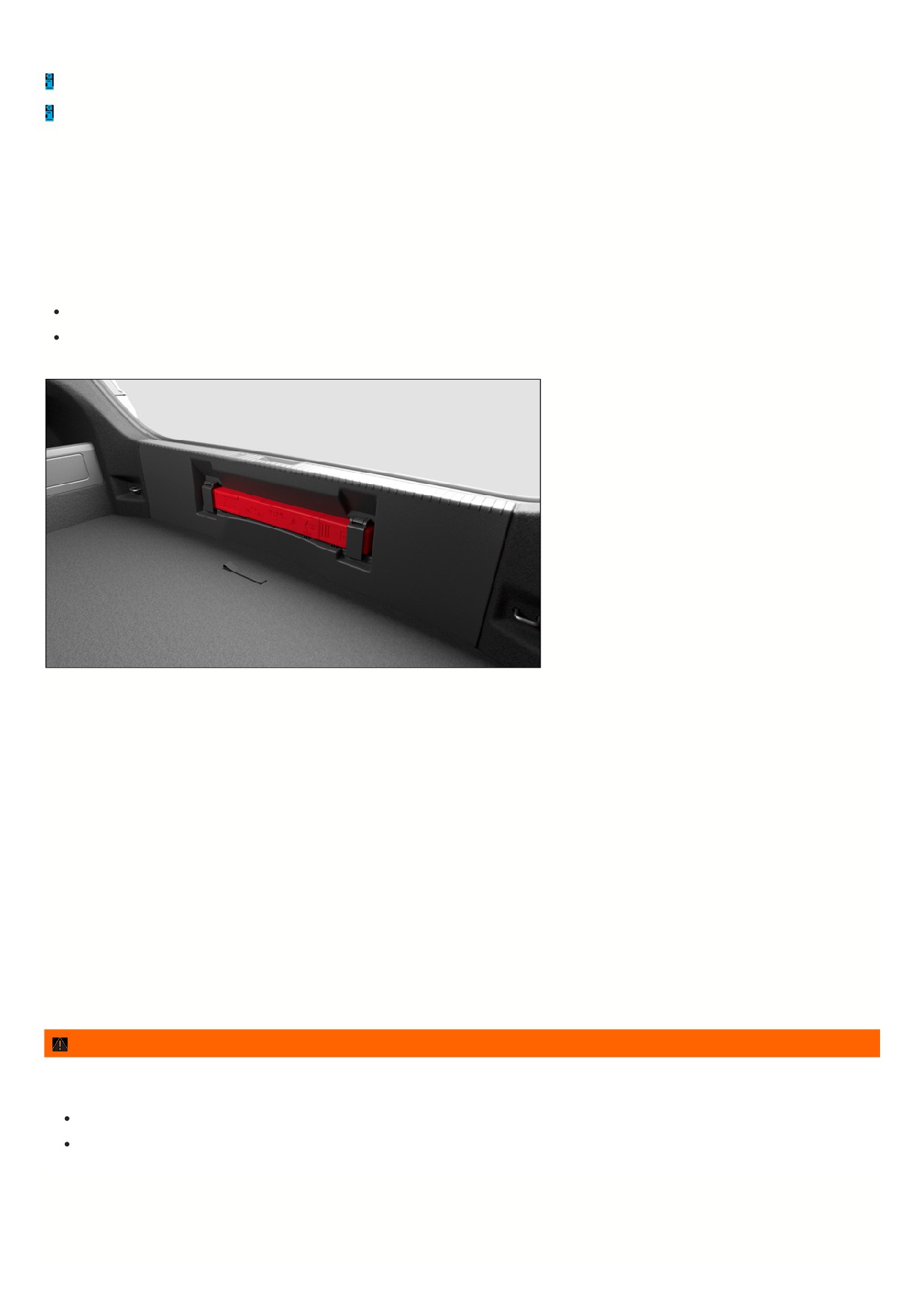
Fig. 43 Underneath the load sill: holder for the warning triangle.
Depending on the country and the vehicle equipment, the warning triangle may be in a holder underneath the loading edge fig. 43.
1. Press on both catches of the holder.
2. Open the catches and remove the sleeve of the warning triangle.
3. After use, store the warning triangle back in the sleeve, insert the sleeve back into the holder and lock it.
The warning triangle must meet the legal regulations.
Reflective vest
Depending on the country and the vehicle equipment, the safety vest may be located in a storage compartment in the front door trim panel or in the glove
compartment ⇒ Driver door, ⇒ Passenger’s side.
The reflective vest must meet the legal regulations.
Fire extinguisher
Depending on the vehicle equipment and country of use, a fire extinguisher may be located in a holder in the footwell under the front passenger seat.
The fire extinguisher must meet the legal regulations, always be ready to operate, and be checked regularly - see inspection seal on the fire extinguisher.
WARNING
Objects that are loose or secured incorrectly can be thrown around the vehicle interior during sudden driving or braking maneuvers or in a collision and cause
serious injuries.
Always position the first aid kit, warning triangle and fire extinguisher securely in the holders provided in the vehicle.
Store the reflective vest in a storage compartment so that it is easy to access.
Re-active hood
63
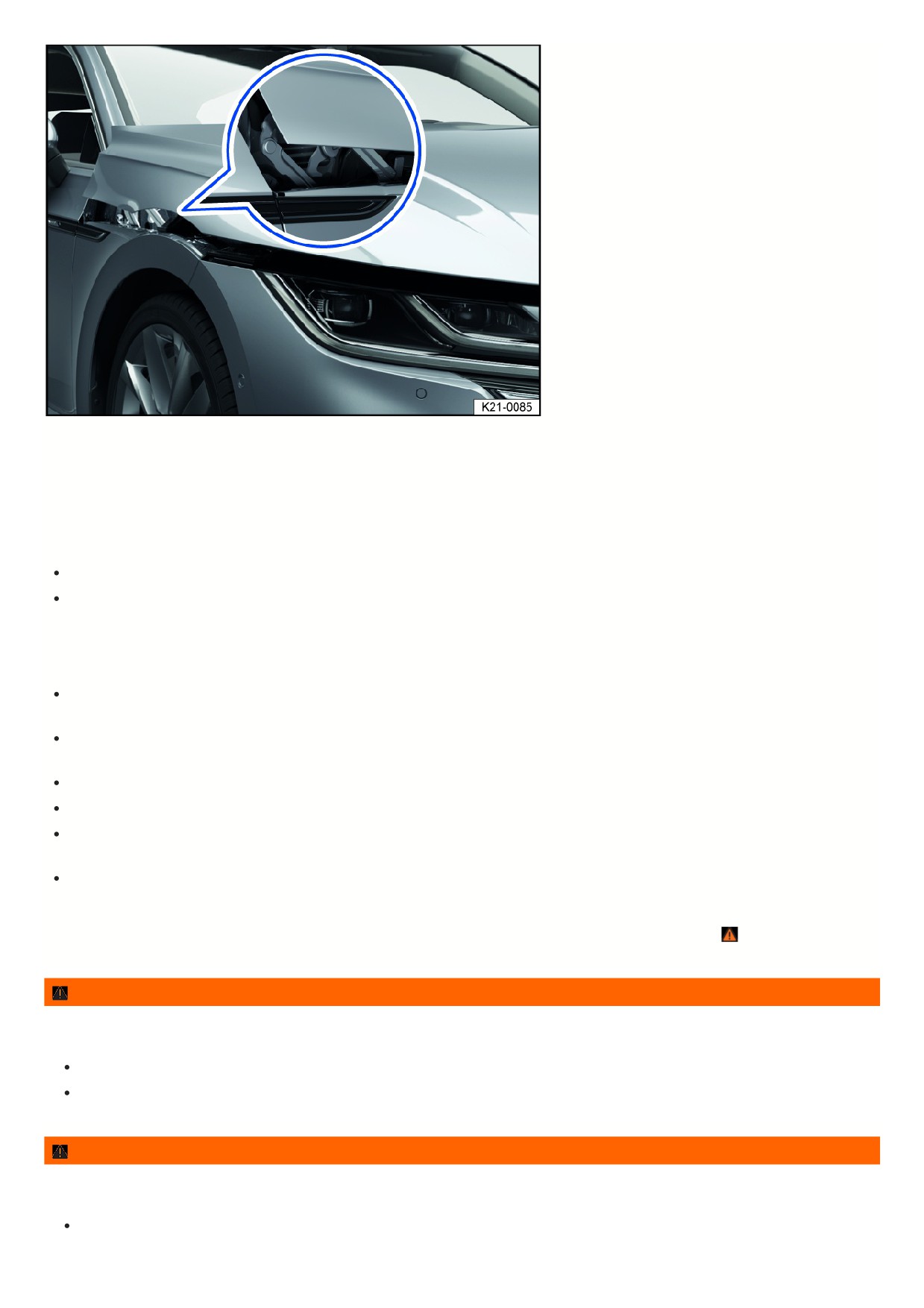
Fig. 44 Triggered re-active hood (general example).
In a front-end collision, the re-active hood is triggered by sensors in the front bumper at speeds of around 15-34 mph (around 25-55 km/h). This raises the hood in
front of the windshield by a few centimeters, for example to create an additional crumple zone above the engine in the head area for a pedestrian who has been hit.
The “re-active hood” system can only be correctly deployed if the hood has not been previously deformed by external forces.
In some cases the system may trigger even when there is no pedestrian involved in the collision. The system may, for instance, be triggered in the following
situations:
Front impact with objects or animals.
A gentle collision or impact on uneven ground.
When the re-active hood is triggered, the hood in front of the windshield is raised by a few centimeters. Special hinges lock the engine hood in the open position
fig. 44 (magnifying glass). In addition, a message is displayed in the instrument cluster display until the system is repaired.
When the re-active hood is triggered, complete the following instructions:
Contact an authorized Volkswagen dealer or authorized Volkswagen Service Facility directly. Volkswagen recommends contacting an authorized Volkswagen
dealer or authorized Volkswagen Service Facility.
The system must be repaired by an authorized Volkswagen dealer or authorized Volkswagen Service Facility. Volkswagen recommends contacting an
authorized Volkswagen dealer or authorized Volkswagen Service Facility.
You may only continue driving when the vehicle is roadworthy again.
Do not drive faster than around 50 mph (80 km/h).
If necessary, adjust your seat position ⇒ Seating position. You must have a clear, unhindered view through the windshield even with the re-active hood
triggered.
If your vehicle has a trailer mode, uncouple the trailer.
Repairing the triggered re-active hood
A triggered re-active hood may only be repaired by an authorized Volkswagen dealer or authorized Volkswagen Service Facility
⇒ . Volkswagen recommends
contacting an authorized Volkswagen dealer or authorized Volkswagen Service Facility.
WARNING
The intelligent technology of the pedestrian protection system “re-active hood” cannot overcome the natural laws of physics and it can only operate within the
limits of the system. Do not allow the increased protection offered by the pedestrian protection system “re-active hood” tempt you into taking risks.
Always adapt your speed and driving style to the visibility, weather, road and traffic conditions.
Do not drive faster than around 50 mph (80 km/h) with a triggered re-active hood.
WARNING
Repairs and modifications that are performed incorrectly can cause vehicle damage and malfunctions as well as impair the effectiveness of the driver
assistance systems. This can cause accidents and serious injuries.
Only have repairs or modifications made to your vehicle by an authorized Volkswagen dealer or authorized Volkswagen Service Facility. Volkswagen
recommends contacting an authorized Volkswagen dealer or authorized Volkswagen Service Facility.
64
WARNING
Improper closing of the triggered re-active hood can cause accidents and severe injury, especially to the hands.
A triggered re-active hood may only be repaired by an authorized Volkswagen dealer or authorized Volkswagen Service Facility. Volkswagen
recommends contacting an authorized Volkswagen dealer or authorized Volkswagen Service Facility. Never attempt to close the engine hood yourself.
NOTICE
Improper closing of the triggered re-active hood may damage the vehicle.
Under no circumstances should you attempt to push down a triggered re-active hood, for example with your hands on the engine hood. The engine hood
and its hinges may be damaged by this.
The symbols in the instrument cluster display may vary depending on the version.
Information Call, Roadside Assistance Call and Emergency Call Service
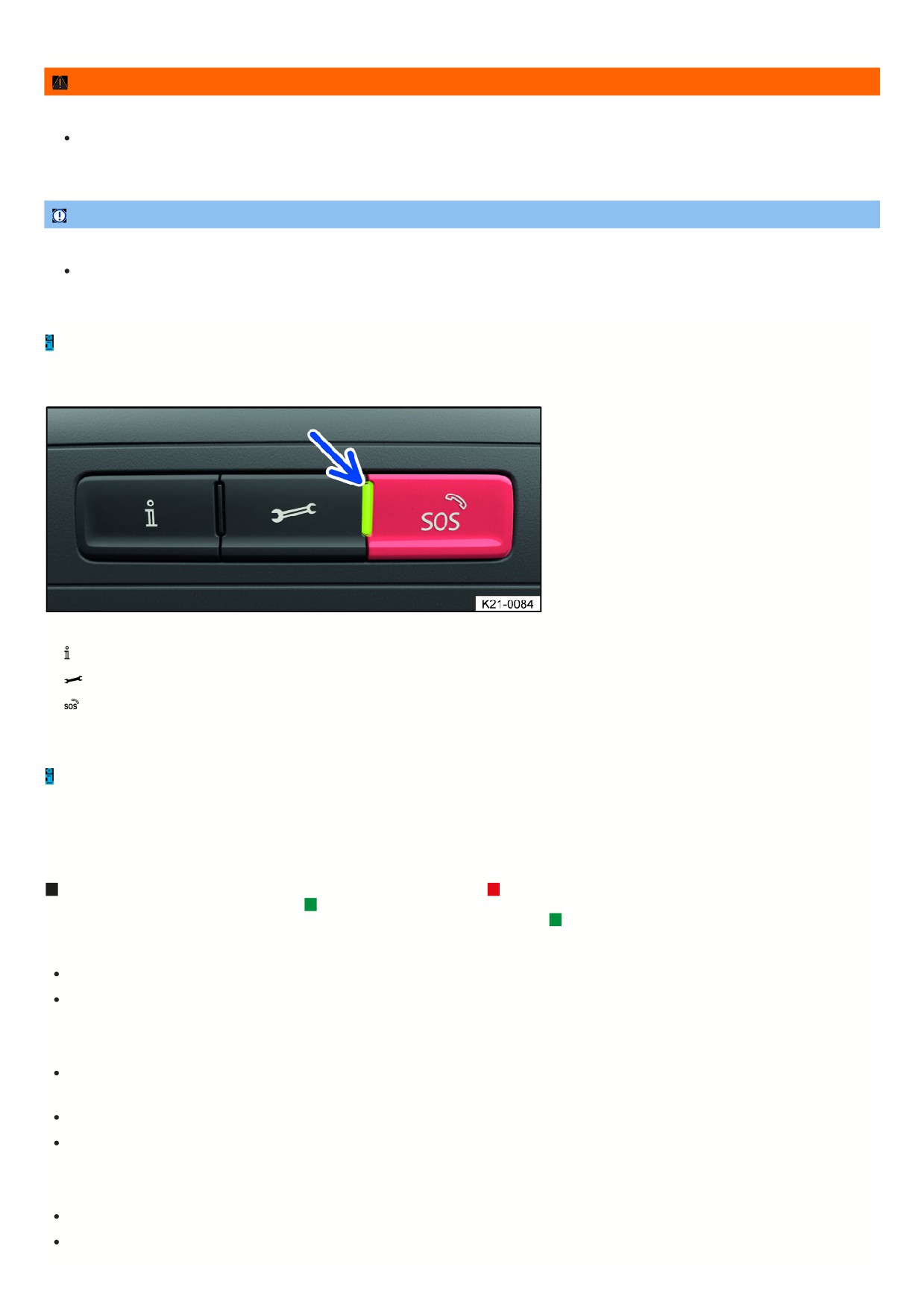
Fig. 45 In the roof console: Controls for call services and indicator light.
Information call.
Roadside assistance call.
Emergency Call Service.
The control in the roof console fig. 45 can be used for voice services, depending on the vehicle equipment and country of use. The required connection is produced
by a control module installed by the manufacturer.
Note the additional information on VW Car-Net® ⇒ ®.
Indicator lights for the Emergency Call Service
An indicator light fig. 45 (arrow) for voice and data transmission services is located in the control panel. The indicator light comes on in different colors and light
patterns depending on the vehicle operating status of the Emergency Call Service:
The indicator light does not light up: The vehicle is offline and has no connectivity.
The red indicator light comes on and remains on: system error. The
Emergency Call Service is limited or not available. The green indicator light lights up: Displays the availability of mobile radio signal. Does not display whether
VW Car-Net services have been purchased and are active, except for the Emergency Call Service. The indicator light blinks green: there is a call in progress.
Information call
With an information call, a call can be made to the VW Car-Net call center for questions regarding VW Car-Net services.
The contact person will communicate in the language of the country in which the vehicle was registered with VW Car-Net, or in the language of the country for
which the vehicle was produced.
Roadside assistance call
If you break down, you can contact an authorized Volkswagen dealer or authorized Volkswagen Service Facility for assistance with the roadside assistance
call.
Some vehicle data, e.g. its current location, is transferred in parallel to the voice call.
The contact person will communicate in the language of the country in which the vehicle was registered with VW Car-Net, or in the language of the country for
which the vehicle was produced.
Emergency Call Service
Using the Emergency Call Service, assistance can be organized as quickly as possible in dangerous situations.
The Emergency Call Service is only available if a corresponding license is acquired.
65

If the Emergency Call Service is triggered, a call to the VW Car-Net call center will be made.
If an emergency call is triggered manually or by a collision with airbag deployment or safety belt pretensioner deployment, data that is relevant to the
emergency call, such as the vehicle's current location, is automatically transmitted ⇒ Customer information.
The contact partner will communicate in the language that is set in the vehicle's Infotainment system. If this language is not available at the current emergency
call location, English will be used.
WARNING
The following conditions may restrict or prevent a manual or automatic emergency call:
The emergency call location is in an area with no cell phone and satellite reception, or insufficient reception.
You are in a location where there is sufficient mobile phone and satellite reception, but the telecommunications provider's mobile communications
network is unavailable.
The Emergency Call Service is not permitted by law in some countries.
VW Car-Net has not been activated.
No valid license for the use of the Emergency Call Service has been acquired or the license has expired.
The vehicle components required for manual or automatic emergency calls are damaged or do not have sufficient power.
The vehicle's ignition is not switched on.
Triggering an emergency call manually
1. If fitted, press on the button cover briefly and fold the cover downward.
2. Press the emergency call button fig. 45 until the green indicator light starts to flash.
The emergency call is triggered and a voice call to the VW Car-Net call center is established.
If you pressed the emergency call button by mistake, cancel the emergency call immediately:
1. Press the emergency call button again until the indicator light remains green.
Automatic emergency call
The automatic emergency call is only triggered when the ignition is on.
A call will automatically be made to the VW Car-Net call center immediately after the airbags or safety belt pretensioners deploy. The automatic emergency call
cannot be stopped by pressing the emergency call button fig. 45.
If questions from the VW Car-Net® call center are not answered, rescue operations will automatically start.
Integrated battery
The integrated battery ensures that the Emergency Call Service will still be available for some time if the 12 V vehicle battery is disconnected or faulty.
If the integrated battery is drained or faulty, a message indicating this will be displayed in the instrument cluster. If this message is shown, immediately consult an
authorized Volkswagen dealer or authorized Volkswagen Service Facility and have the integrated battery replaced. Volkswagen recommends contacting an
authorized Volkswagen dealer or authorized Volkswagen Service Facility.
Have the integrated battery checked, and if necessary, replaced by an authorized Volkswagen dealer or authorized Volkswagen Service Facility after
approximately three years. Volkswagen recommends contacting an authorized Volkswagen dealer or authorized Volkswagen Service Facility.
Data transmission
The available data will be sent to the VW Car-Net call center during an emergency call to determine what rescue measures are needed.
The data regarding the location of the vehicle is continuously overwritten, so that only the ten most recent saved locations as required for the Emergency Call
Service to function are available. The vehicle cannot be tracked on a continuous basis.
The emergency call data is only processed to ensure the proper function of the Emergency Call Service.
The following data will be sent:
The current vehicle position at the time the emergency call was triggered
Nine other vehicle positions shortly before the emergency call was triggered (from the route driven, a few km (around 2 miles)).
Vehicle Identification Number (VIN)
Type of vehicle drive.
Vehicle model
Trigger type (automatic or manual)
Call type.
Direction in which the vehicle was moving at the time the emergency call was triggered.
66

Accident severity.
Accident direction.
Time of impact
Reliability of the positioning data
Data set version.
Counter of the data sets transmitted per call
Calculated number of passengers.
Language selected in the Infotainment system.
Optional data ID.
The Emergency Call Service function may be limited by any after-market Infotainment systems that are installed.
Troubleshooting
Emergency Call Service malfunction
The red indicator light in the emergency call button comes on and remains on . The message
Error: Emergency call function. Service vehicle may also be
displayed in the instrument cluster.
There is a system error with the Emergency Call Service. You may not be able to make an emergency call.
1. Contact an authorized Volkswagen dealer or authorized Volkswagen Service Facility immediately and have the fault rectified. Volkswagen recommends
contacting an authorized Volkswagen dealer or authorized Volkswagen Service Facility.
Emergency Call Service limited
The red indicator light in the emergency call button comes on and remains on . The message
Emergency call function limited. Service vehicle may also be
displayed in the instrument cluster.
The Emergency Call Service function has restricted availability. For example, you cannot make a voice call to the VW Car-Net® call center.
1. Contact an authorized Volkswagen dealer or authorized Volkswagen Service Facility immediately and have the fault rectified. Volkswagen recommends
contacting an authorized Volkswagen dealer or authorized Volkswagen Service Facility.
67
Opening and Closing
Vehicle key
Vehicle key functions
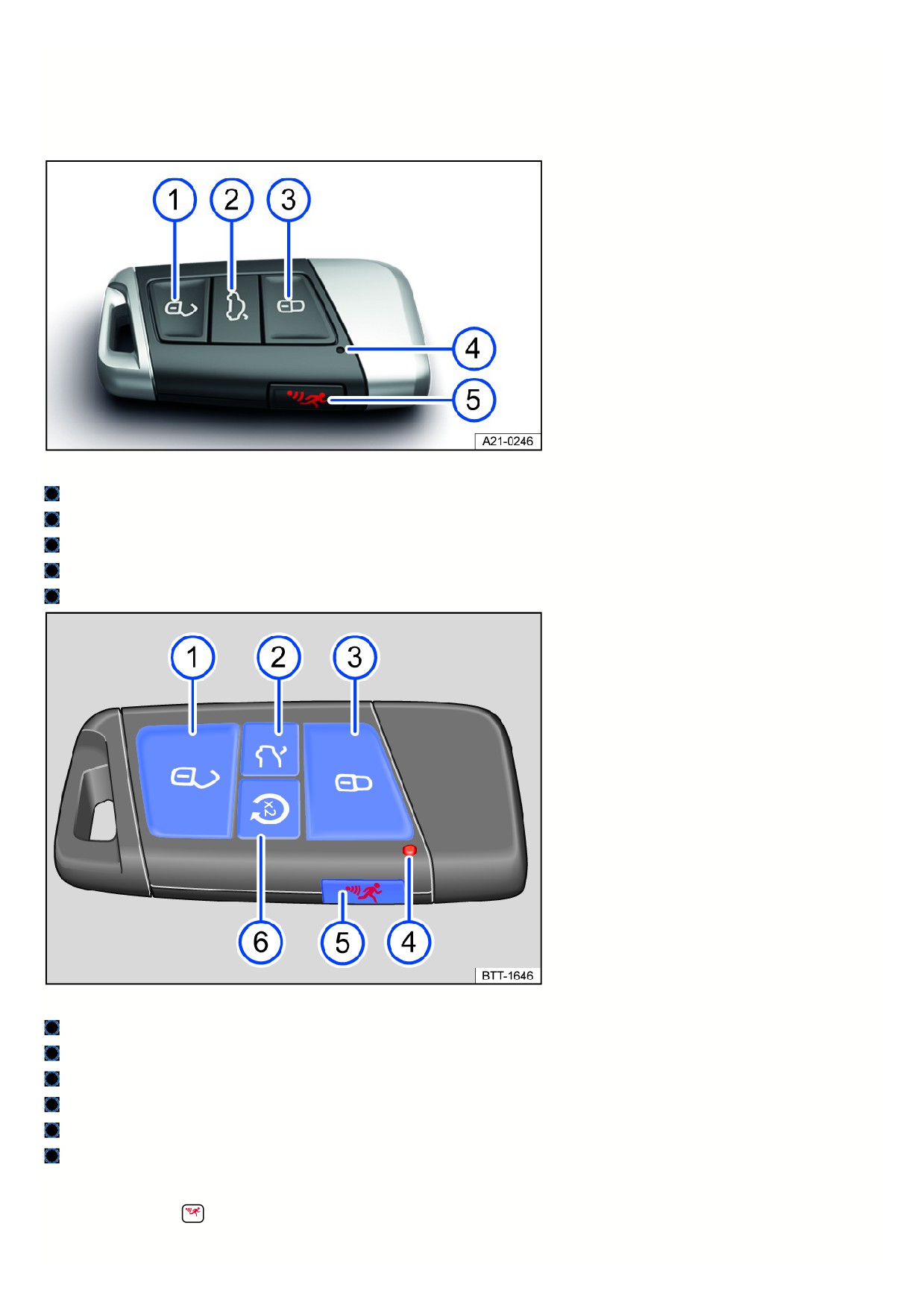
Fig. 46 Vehicle key without key bit.
Unlock the vehicle. All turn signals will flash twice.
Unlock the trunk lid separately. All turn signals will flash twice.
Lock the vehicle. All turn signals will flash once.
Indicator light: flashes when a button is pressed.
Panic button (depending on vehicle equipment).
Fig. 47 Vehicle key with remote start relay function.
Unlock the vehicle. All turn signals will flash twice.
Unlock the trunk lid separately. All turn signals will flash twice.
Lock the vehicle. All turn signals will flash once.
Indicator light: flashes when a button is pressed.
Panic button (depending on vehicle equipment).
Remote start relay function (depending on the vehicle equipment).
Panic button (depending on vehicle equipment)
Only use the panic button
in case of an emergency. When you press the panic button, the horn will sound and the vehicle lights will flash. Pressing the panic
button again switches off the alarm.
68
Remote start relay button (depending on vehicle equipment)
1. To carry out the remote start, press the
button once and press the
button twice ⇒ Remote start function.
During remote start, the parking light turns on. Pressing the
button switches off the engine.
WARNING
Careless or unintended use of the vehicle key can cause crashes and serious injuries.
Always take all vehicle keys with you when leaving the vehicle. Children or unauthorized people could lock the doors and/or the trunk lid, start the engine,
or switch on the ignition and activate electrical equipment, such as the power windows.
Never leave children or people requiring assistance alone in the vehicle. In an emergency, they will not be able to leave the vehicle unassisted or care for
themselves. For example, depending on the season, the temperature inside the vehicle could become very high or low, which can lead to serious injuries,
illness or death, especially for very young children.
NOTICE
Protect the vehicle key from moisture and strong impacts.
Regular use of comfort systems and other usage patterns shorten the service life of the button cell in the vehicle key.
Emergency key (vehicle key without key bit)
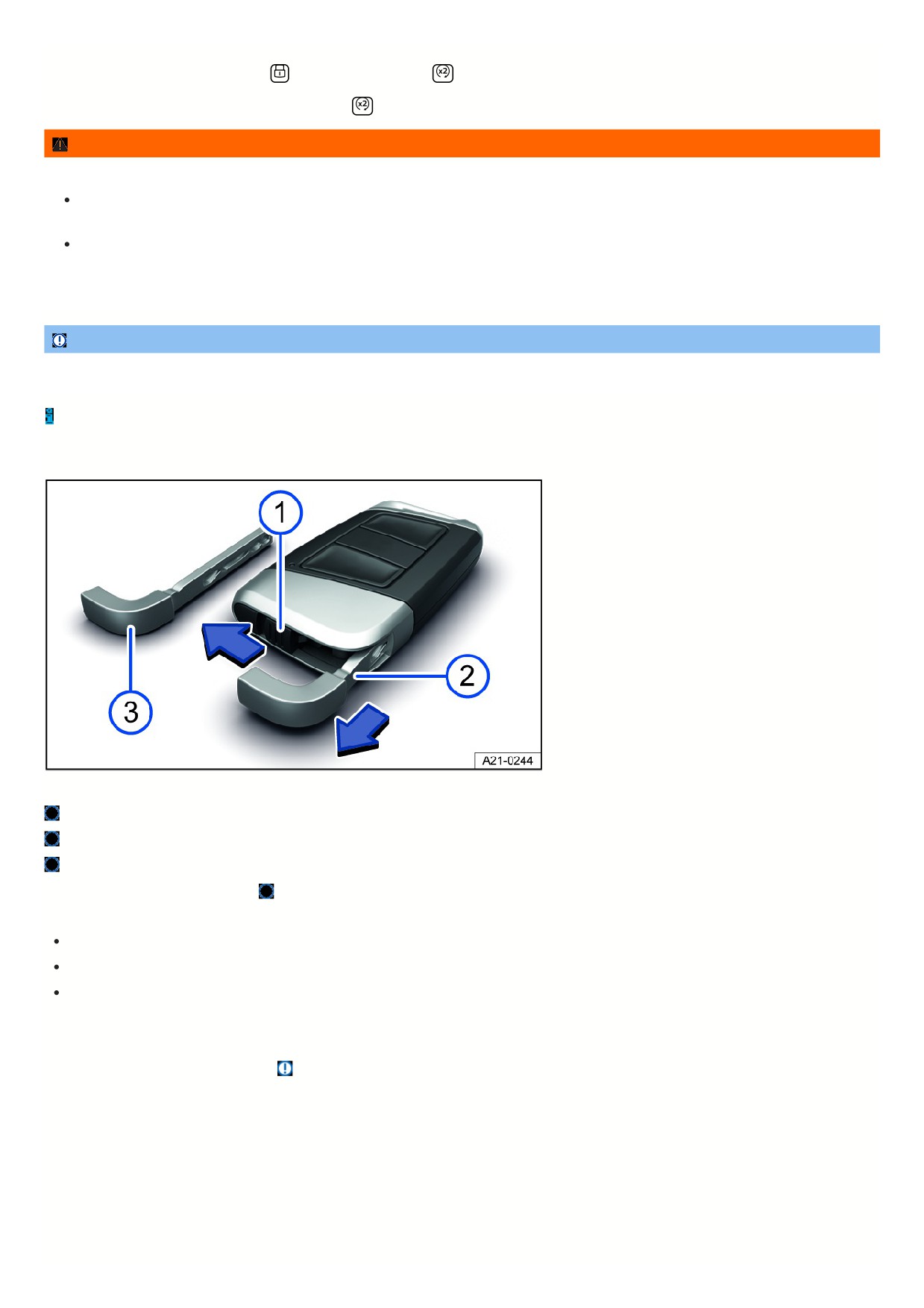
Fig. 48 Vehicle key: Unlocking the emergency key (general example).
Push the locking mechanism in the direction of the arrow.
Remove the emergency key in the direction of the arrow.
Emergency key.
There may be an emergency key fig. 48
located in the vehicle key that can be used to manually unlock and lock the vehicle.
Possible functions:
Unlock and lock the glove compartment.
Unlock and lock the vehicle manually ⇒ Vehicle key functions.
Switch the childproof lock on and off ⇒ Child safety lock.
Replacing the button cell battery
Volkswagen recommends having the button cell changed by suitably qualified professionals. Volkswagen recommends contacting an authorized Volkswagen deale
or authorized Volkswagen Service Facility ⇒
69
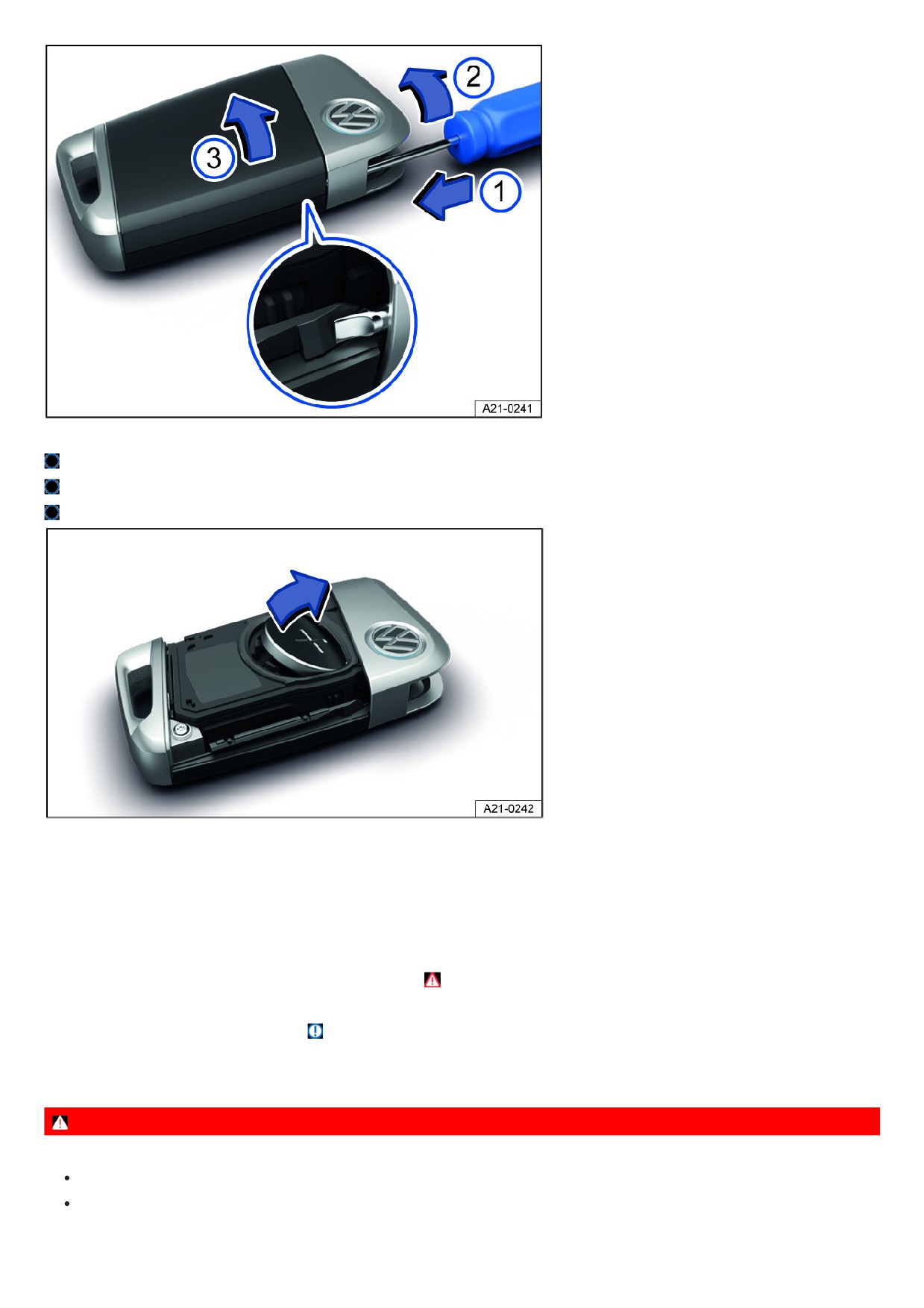
Fig. 49 Vehicle key: opening the battery compartment cover.
Insertion into the outer guide.
Direction of rotation of the flat-bladed screwdriver.
Cover
Fig. 50 Vehicle key: replacing the button cell battery
1. Remove the emergency key ⇒ Emergency key (vehicle key without key bit) .
2. Slide the blade of the flat-bladed screwdriver in the direction of the arrow approximately 1 cm (approx. 0.4 in) into the outer guide on the emergency key in the
remote control vehicle key fig. 49.
3. Turn the flat-bladed screwdriver clockwise until the cover pops up fig. 49.
4. Push the cover in the direction of the arrow and remove it fig. 49.
5. Lift the button cell battery out of the battery compartment fig. 50 , ⇒
6. Press the new button cell battery into the battery compartment.
7. Press the cover out of the housing fig. 49 , ⇒
8. Store the emergency key ⇒ Emergency key (vehicle key without key bit) .
9. Dispose of drained battery in a way that will not harm the environment.
DANGER
If button cell batteries are swallowed or enter the windpipe, serious or fatal injuries will occur within a very short time due to choking or internal burns.
Seek medical assistance immediately if you suspect that a button cell battery has been swallowed.
Always keep the remote control and key fob with button cell batteries out of the reach of children.
7

NOTICE
If the button cell battery is replaced incorrectly or batteries are unsuitable, it can damage the vehicle key.
Only replace a drained battery with a new battery of the same voltage, size, and specification.
Make sure the battery is facing in the right direction when inserting it.
If the battery cover cannot be closed, do not use the remote control.
The type of batteries used in the remote control of your vehicle key can contain perchlorate. This requires special handling. Observe all legal requirements
regarding the handling and disposal of these batteries ⇒ Disposal of old batteries and electronic devices. Volkswagen recommends having this service carried
out for you by suitably qualified professionals. Volkswagen recommends contacting an authorized Volkswagen dealer or authorized Volkswagen Service
Facility.
Synchronizing a vehicle key
If the vehicle cannot be unlocked or locked using the vehicle key, synchronize the vehicle key or replace the button cell battery
⇒ Replacing the button cell battery
Synchronizing a vehicle key
1. Stand next to the vehicle.
2. Press the
button on the vehicle key twice, quickly.
Or:
1. Remove the emergency key ⇒ Emergency key (vehicle key without key bit) .
2. If necessary, remove the cap from the driver's door handle
⇒ Locking the front passenger door and rear doors in an emergency .
3. Press the
button on the vehicle key.
4. Unlock the vehicle using the emergency key.
5. Open the driver door.
If the vehicle is equipped with an anti-theft alarm system, the alarm will be triggered immediately ⇒ Anti-theft alarm system.
6. Switch the ignition on.
Please note: To switch on the ignition, put the remote control vehicle key in the cup holder or in the storage compartment in the center console
⇒ Troubleshooting.
This completes the synchronization.
Troubleshooting
Vehicle cannot be locked or unlocked
Remote control is disrupted by objects, poor weather conditions or transmitters on the same frequency band close to the vehicle (e.g. cell phones), as well as by a
drained button cell.
The central locking switches off briefly to protect it from overloading.
1. Close the driver door.
Or: Synchronize the vehicle key ⇒ Synchronizing a vehicle key .
Or: Change the battery cell in the vehicle key
⇒ Replacing the button cell battery .
The indicator light is not blinking
If the indicator light in the vehicle key does not blink when you press one of the buttons, then the button cell battery in the vehicle key must be replaced.
You can get an additional or replacement vehicle key from an authorized Volkswagen dealer or authorized Volkswagen Service Facility.
“Keyless Access” with push-button start
Introduction
Keyless Access makes it possible to unlock and lock the vehicle without actively using the key. A valid vehicle key must be present within the vicinity of the vehicle t
use this function.
Unlocking or locking using Keyless Access
71
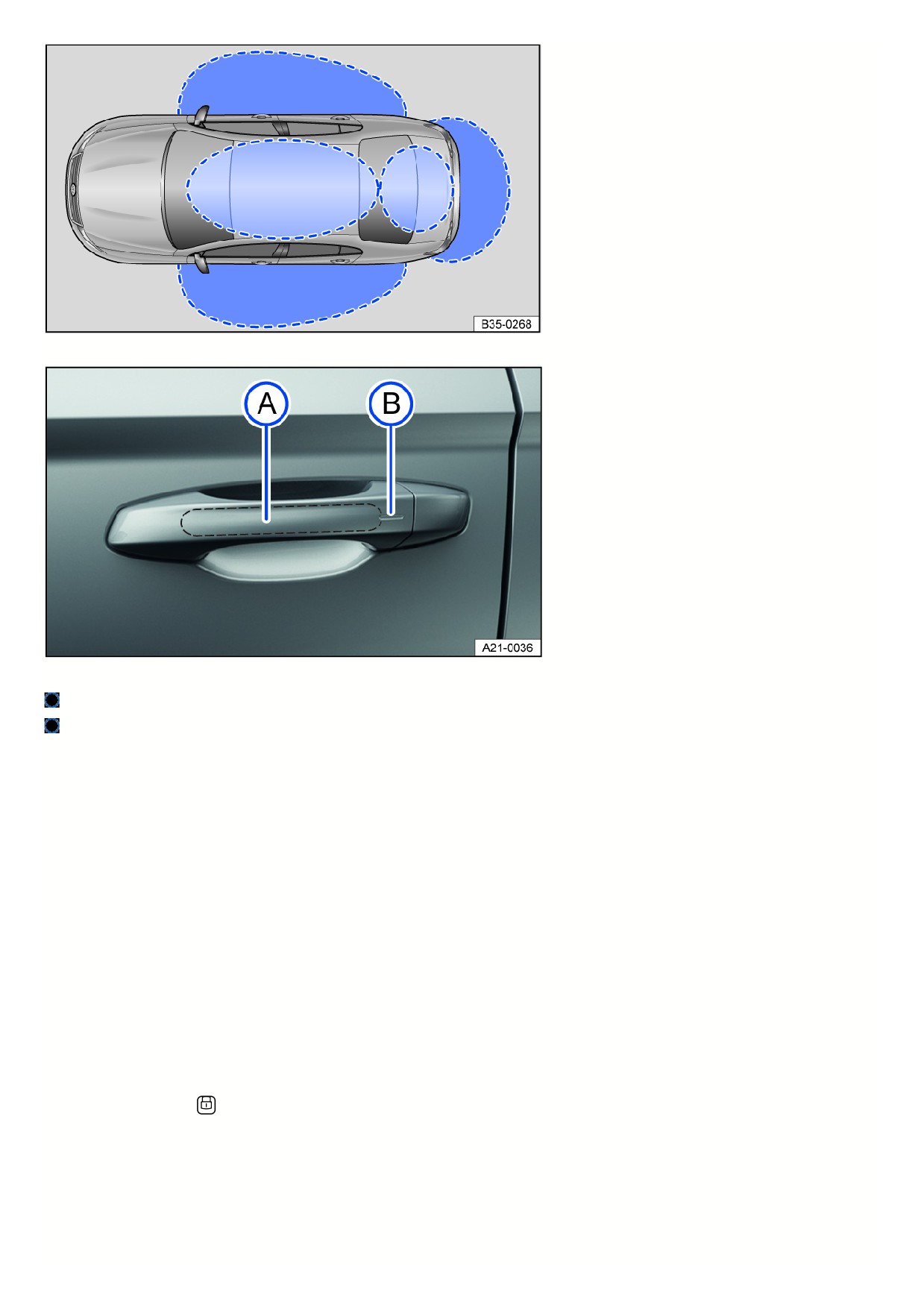
Fig. 51 Keyless Access: sensor range.
Fig. 52 In door handle: sensors.
Sensor on the inside of the driver or passenger door handle.
Sensor on the outside of the driver or passenger door handle.
Unlocking the vehicle
1. Touch the sensor on the inside of the driver or passenger door handle fig. 52.
Locking the vehicle
1. Switch the ignition off.
2. Close the driver door or front passenger door.
3. Touch the sensor on the outside of the driver or passenger door handle fig. 52.
The turn signals flash twice when unlocking and blink once when locking.
Unlocking and locking the trunk lid
If the vehicle is locked and a vehicle key is within the trunk lid sensor range, the trunk lid will unlock automatically when opened fig. 51.
The trunk lid locks automatically after it closes.
The trunk lid will not lock automatically if the vehicle is completely unlocked.
Deactivating Keyless Access temporarily
You can temporarily deactivate Keyless Access using the following steps to prevent the vehicle from being unlocked and started by unauthorized people:
1. Lock the vehicle with the
button on the vehicle key.
2. Then, within five seconds of locking the vehicle, touch the sensor on the outside of the door handle once fig. 52. Do not grasp the door handle during this
process.
Keyless Access is now temporarily deactivated.
3. To check that it has actually been deactivated, wait at least 10 seconds and then pull on the door handle.
The door should not open.
The next time the vehicle is unlocked, you must use the vehicle key. Keyless Access will be reactivated the next time the vehicle is unlocked.
72

Operating convenience functions
The electric windows close automatically.
On vehicles with a tilting and sliding panoramic sunroof, the sunroof also closes.
1. Press and hold the sensor on the driver or passenger door handle for a few seconds fig. 52.
The sensor functions can be adjusted in the Vehicle settings menu in the Infotainment system.
The unlock function is deactivated for several seconds so that you can check if the vehicle locked correctly.
If the sensor is touched twice, the entire vehicle will unlock even after a single door is unlocked.
Troubleshooting
If Keyless Access is not working
The sensor function may be impaired if the sensor is dirty.
1. Clean the sensors.
If all turn signals flash four times
The vehicle key that was last used is still in the vehicle.
1. Remove the key and lock the vehicle.
Automatic sensor deactivation
The sensors will deactivate automatically under the following conditions:
If the vehicle is not unlocked or locked for a long period of time
If a sensor is triggered too frequently
Reactivating the sensor pads:
1. Unlock the vehicle using the
button on the vehicle key.
Valid vehicle key cannot be detected
The yellow indicator light turns on. A message will also appear in the instrument cluster display.
The vehicle key is no longer in the vehicle or within range of the sensors.
1. Do not switch the ignition off.
2. Bring the vehicle key back into the vehicle or within range of the sensors.
If the problem persists, contact an authorized Volkswagen dealer or authorized Volkswagen Service Facility. Volkswagen recommends contacting an authorized
Volkswagen dealer or authorized Volkswagen Service Facility.
NOTICE
Strong streams of water or vapor could activate the sensors in the door handles if a valid vehicle key is located near the vehicle. If at least one window is open
and the sensors in one door handle are permanently activated, then all windows will close. If the stream of water or vapor is removed briefly from the sensor in a
door handle and then redirected at the sensor, all of the windows may open.
If the message Keyless faulty. appears in the instrument cluster display, there may be a malfunction in the Keyless Access system. Contact an authorized
Volkswagen dealer or authorized Volkswagen Service Facility. Volkswagen recommends contacting an authorized Volkswagen dealer or authorized Volkswagen
Service Facility.
Doors and central locking button
Introduction
The doors can be manually locked and in some cases unlocked, for example if the vehicle key or the central locking system is malfunctioning.
The central locking system allows you to unlock and lock all doors, the trunk lid, and the fuel filler flap from one location.
The vehicle can be locked when the ignition has been switched off or if the driver has exited the vehicle when the engine is stopped.
An image in the instrument cluster display indicates if one or more doors have not opened or closed correctly
⇒ Driver information.
Do not continue driving!
Open the respective door and close it again.
The image is also displayed when the ignition is switched off, and it turns off several seconds after the doors are closed and the vehicle has been locked.
WARNING
If a door is not closed correctly, it can open suddenly while driving and cause serious injuries.
73

Stop immediately and close the door.
When closing the door, make sure it engages securely and completely. When closed, the door must be flush with the areas of the vehicle body that are
around the door.
Do not open or close the doors if anyone is in the way.
WARNING
When the door is being held open by the door arrester, it may close by itself in high winds or on inclines, which can cause injuries.
Always hold the door handle firmly when opening and closing the door.
WARNING
The area within the range of motion for the doors and trunk lid can be dangerous and there is the potential for injuries.
Do not open or close the doors and trunk lid if anyone is in the way.
WARNING
Locking the doors carelessly can cause serious injuries.
When the vehicle is locked from the outside, the doors and power windows cannot be opened from the inside.
The central locking system locks all the doors. When the vehicle is locked from the inside, it reduces the risk of opening the doors unintentionally and of
unauthorized people entering the vehicle. In case of an emergency or an accident, locked doors can make it more difficult for first responders to access
the vehicle interior to help the passengers.
Never leave children or people requiring assistance in the vehicle. All doors can be locked from the inside using the central locking button. This can result
in locking yourself inside the vehicle. Individuals locked in the vehicle could be exposed to very high or very low temperatures.
Depending on the season, the temperature inside the vehicle could become very high or low, which can lead to serious injuries, illness or death,
especially for very young children.
Never leave anyone in a locked vehicle. In an emergency, these people may not be able to exit the vehicle without assistance or help themselves.
NOTICE
When using the emergency locking or emergency unlocking feature, remove and reinstall the affected parts carefully and correctly to reduce the risk of vehicle
damage.
Indicator light in the driver's door
Please read the introductory information and heed the Warnings and Notice ⇒
and Introduction.
The indicator light for the central locking system is located in the driver door
⇒ Driver door.
Vehicle is locked: the red LED light blinks for approximately two seconds, and then flashes more slowly after that. The indicator light does not flash if the vehicle wa
locked using the central locking button in the driver's door ⇒ Central locking button.
Automatic locking and unlocking
Please read the introductory information and heed the Warnings and Notice ⇒
and Introduction.
Depending on how your vehicle is equipped, settings for the central locking can be configured in the Vehicle settings menu in the Infotainment system.
Automatic locking (Auto Lock)
The vehicle locks automatically at speeds of about 9 mph (15 km/h) or higher. If the vehicle is locked, the
indicator light will turn yellow in the central locking
button.
Automatic unlocking (Auto Unlock)
If one of the following conditions apply, all doors and the trunk lid will unlock automatically:
For vehicles with an automatic gearbox: The parking lock is engaged and the ignition is switched off.
Or: if the door handle has been pulled.
Or: if airbags have deployed during a collision
⇒ Troubleshooting.
The Auto Unlock function makes it possible for first responders to access the inside of the vehicle.
74
Central locking button
Please read the introductory information and heed the Warnings and Notice ⇒
and Introduction.
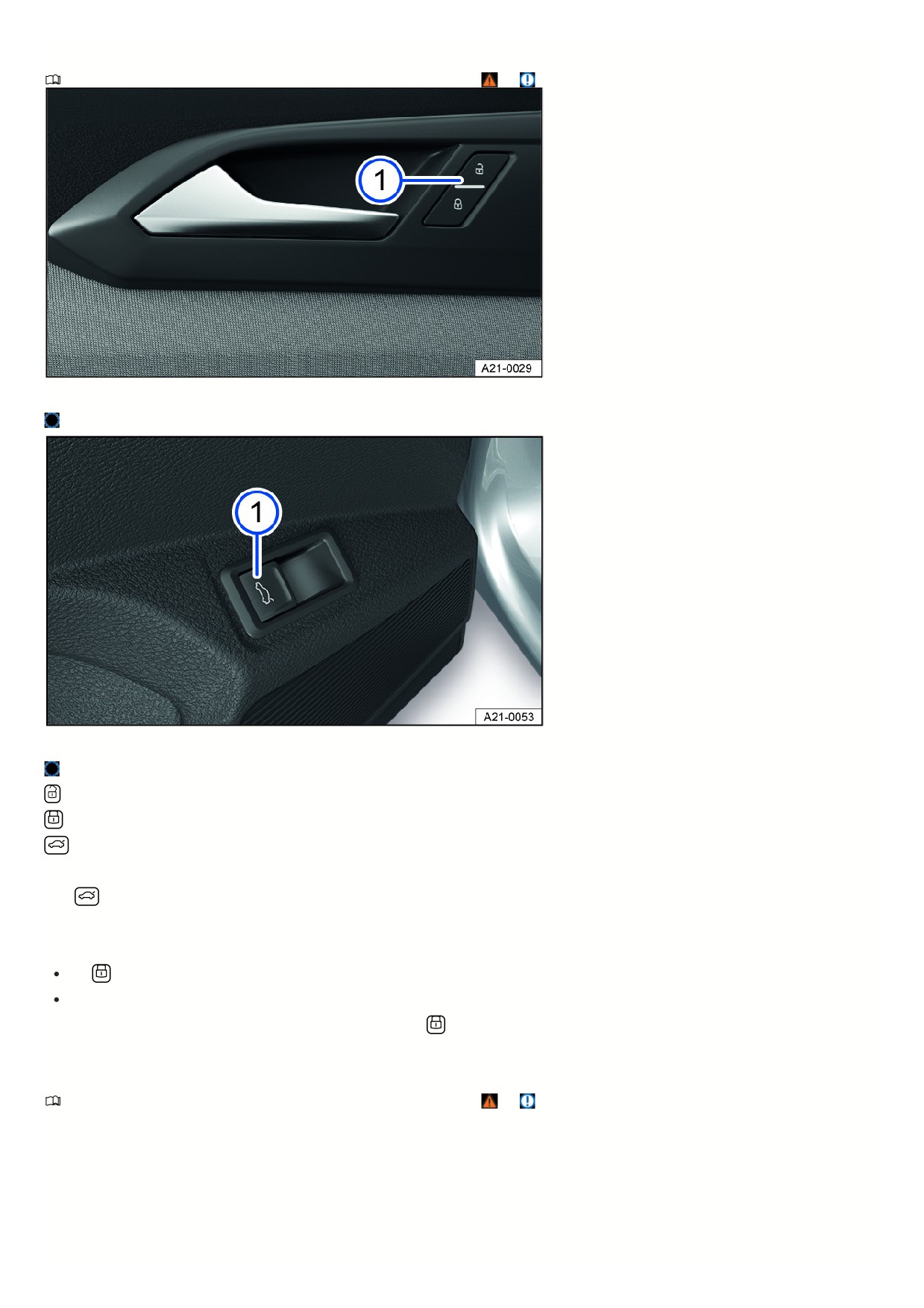
Fig. 53 In the driver's door: Central locking button (general example).
Central locking button.
Fig. 54 In the driver's door: Button for powered opening of the trunk lid (general example).
Button for powered opening of the trunk lid.
- Unlock the vehicle.
- Lock the vehicle.
- Open the trunk lid.
The central locking button functions both when the ignition is on or off, but only when all the doors are closed.
If the
button in the driver door is pressed, only the trunk lid will open. All doors remain locked.
If the vehicle is locked from the outside using the vehicle key, the central locking buttons will be disabled.
If the vehicle is locked from the inside using the central locking button, then:
The
indicator light in the button will turn yellow if all doors are closed and locked.
The anti-theft alarm system will not be activated ⇒ Anti-theft alarm system.
The doors can be opened from the inside by pulling the door handle. The
indicator light in the button turns off. The unopened doors and the trunk lid will remai
locked and cannot be opened from the outside.
Opening and closing the driver's door in an emergency
Please read the introductory information and heed the Warnings and Notice ⇒
and Introduction.
75
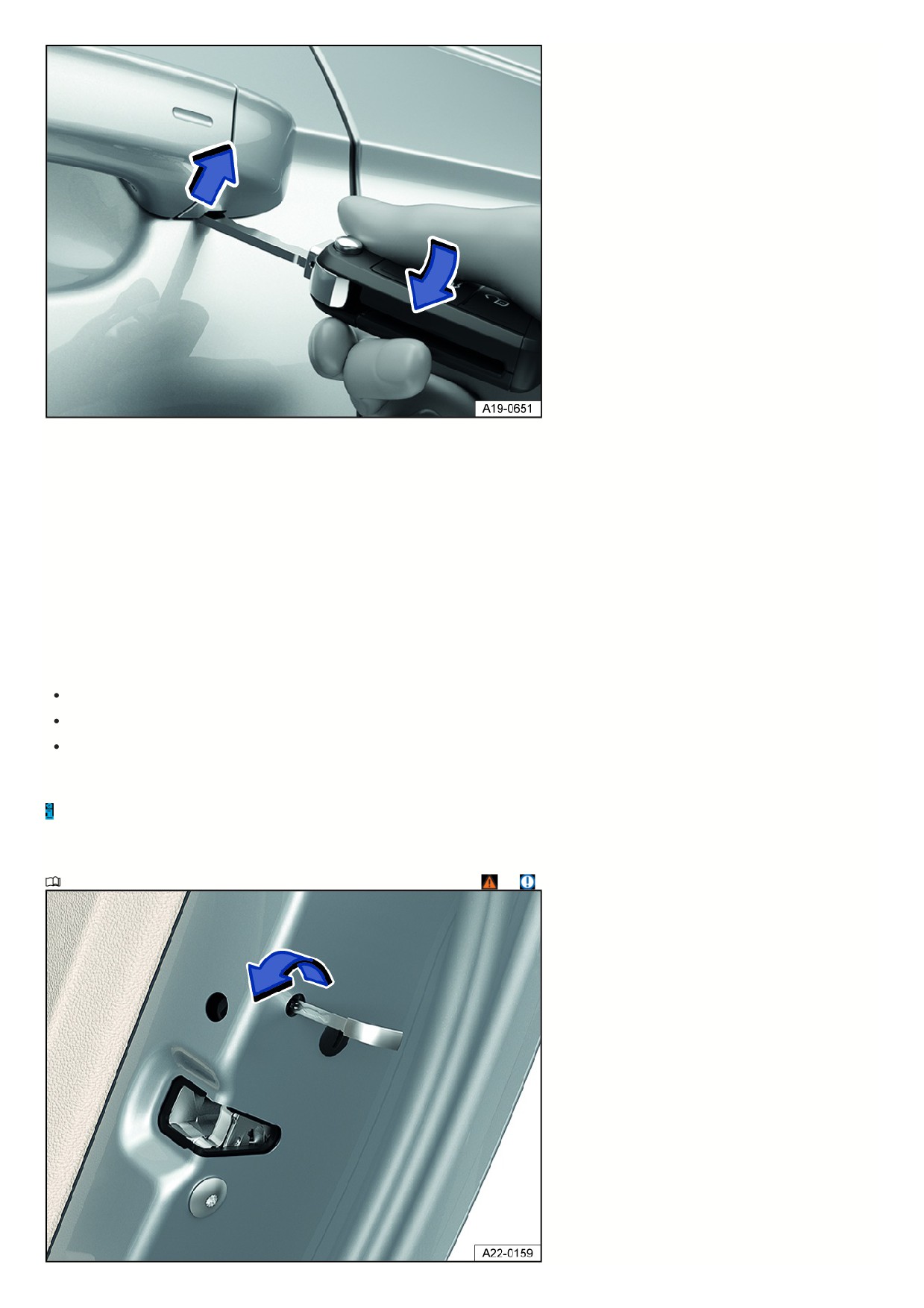
Fig. 55 Driver’s door handle: prying off the cap.
Generally, all doors will lock when locking manually. Only the driver door will unlock when unlocking manually.
Note the information about the anti-theft alarm system ⇒ Anti-theft alarm system.
1. Remove the emergency key from the vehicle key ⇒ Emergency key (vehicle key without key bit) .
2. On the driver door handle, insert the mechanical key from below into the opening on the cover fig. 55 (arrow).
3. Pull on the driver door handle, carefully removing the cover by pulling upwards from below.
4. Insert the mechanical key into the lock cylinder and lock or unlock the vehicle. If necessary, also pull the driver door handle slightly.
5. Push the mechanical key into the opening on the vehicle key until the mechanical key locks in place
⇒ Emergency key (vehicle key without key bit) .
6. Pull on the driver door handle and fit the cover onto the lock cylinder from the back to the front.
Special considerations for manual unlocking
An alarm is triggered when the driver's door is opened ⇒ Anti-theft alarm system.
An emergency start must be performed after unlocking ⇒ Troubleshooting.
Switch the ignition on to turn off the alarm.
The electronic immobilizer will detect a valid vehicle key.
The anti-theft alarm system is not activated when the vehicle is manually locked using the key bit
⇒ Anti-theft alarm system.
Locking the front passenger door and rear doors in an emergency
Please read the introductory information and heed the Warnings and Notice ⇒
and Introduction.
76
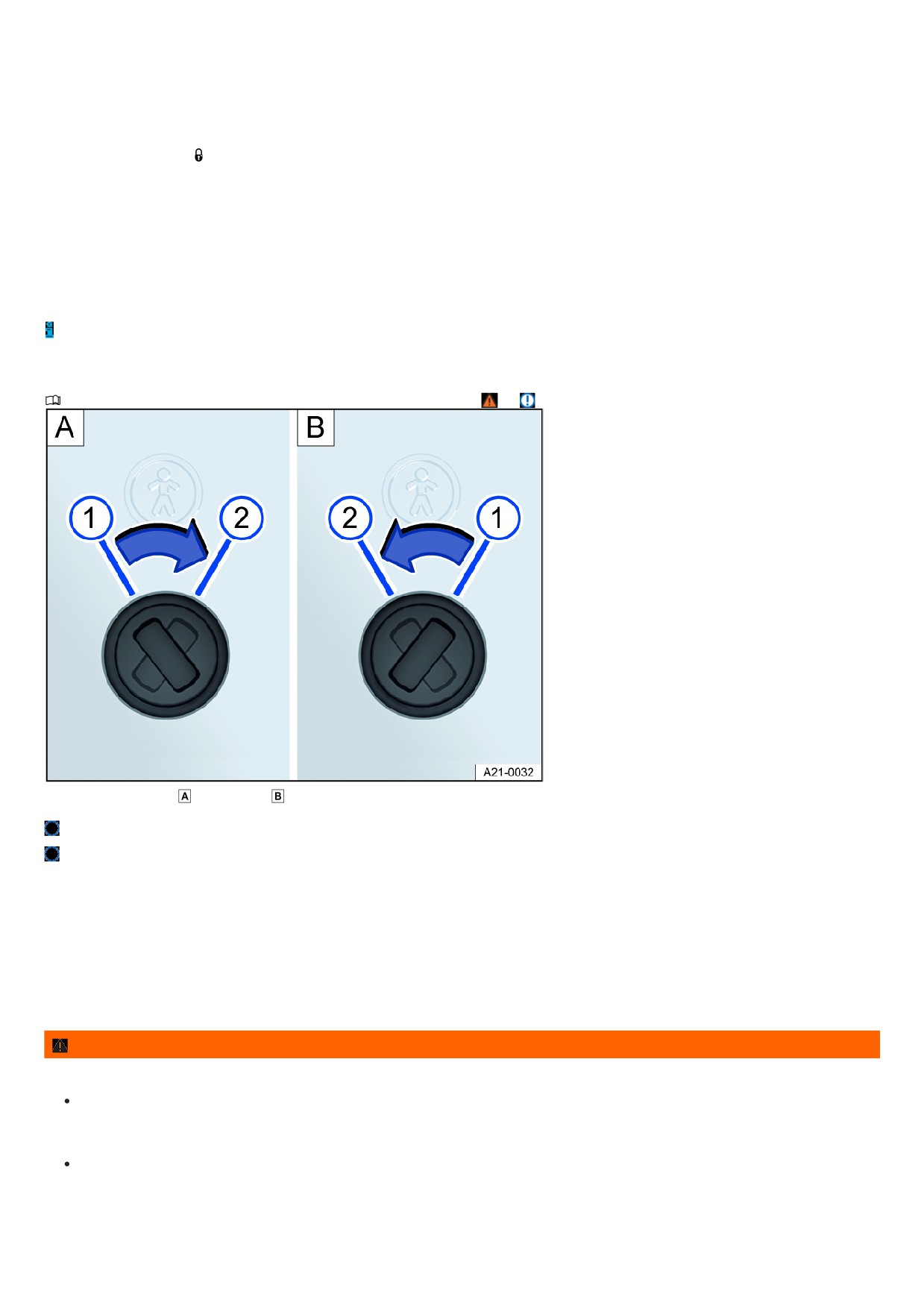
Fig. 56 In the front edge of the rear right-hand door: Vehicle emergency lock for using the emergency (mechanical) key.
The front passenger door and the rear doors can each be locked manually.
The anti-theft alarm system is not activated when this happens ⇒ Anti-theft alarm system.
1. Open the door.
2. Remove the rubber seal in the front of the door.
3. Insert the emergency key in the vertical slot and turn it inwards fig. 56.
4. Reattach the rubber seal.
5. Check that the door is locked.
6. Have the vehicle checked immediately by a suitably qualified professional. Volkswagen recommends contacting an authorized Volkswagen dealer or authorized
Volkswagen Service Facility.
If a door is locked manually, it will unlock again when the vehicle is unlocked or if that door is opened from the inside.
Doors can be unlocked and opened from the inside by pulling the door handle.
Child safety lock
Please read the introductory information and heed the Warnings and Notice ⇒
and Introduction.
Fig. 57 Child safety lock:
left rear door,
right rear door.
Child safety lock is switched off.
Child safety lock is switched on.
The child safety locks are located on the inner door panels of the rear doors.
The child safety lock reduces the risk of the rear doors being opened from the inside.
When the child safety lock is switched on, the door can only be opened from the outside.
Switching the child safety lock on or off
1. Unlock the vehicle the open the respective rear door.
2. Bring the slot into the corresponding position fig. 57.
WARNING
When the child safety lock is switched on, that door cannot be opened from the inside.
Never leave children or people requiring assistance unattended in the vehicle when the doors are locked. Otherwise, they could become locked inside the
vehicle. In case of an emergency, these individuals would not be able to leave the vehicle without assistance or care for themselves. Individuals locked in
the vehicle could be exposed to very high or very low temperatures.
Depending on the season, the temperature inside the vehicle could become very high or low, which can lead to serious injuries, illness or death,
especially for very young children.
Troubleshooting
77

Please read the introductory information and heed the Warnings and Notice ⇒
and Introduction.
If the indicator light does not turn off
The red LED in the vehicle door flashes briefly and then stays on.
There is a malfunction in the locking system.
1. Contact a suitably qualified professional. Volkswagen recommends contacting an authorized Volkswagen dealer or authorized Volkswagen Service Facility.
If the turn signals are not flashing
The turn signals are not blinking as confirmation when locking the vehicle:
1. Check whether all of the doors and the trunk lid and engine hood are closed.
2. Close any doors and trunk lid or engine hood that are not closed.
If the vehicle is locking automatically
The vehicle will lock again automatically after approximately 45 seconds if one of the following conditions apply:
The vehicle was unlocked, but not opened
The ignition was not switched on
The trunk lid was not opened.
Locking with a second vehicle key
For vehicles with Keyless Access with push-button start: If a second vehicle key is used to lock the vehicle from outside, the vehicle key inside the vehicle is
immediately disabled so that it cannot be used to start the engine; it is still possible to perform an emergency start, however.
1. Press the
button on the remote control vehicle key inside the vehicle to enable the vehicle key inside the vehicle so that it can be used for to start the engin
as usual.
Locking the vehicle after an airbag deploys
The entire vehicle unlocks when an airbag deploys in a collision. Depending on the severity of the damage, it may be possible to lock the vehicle as follows after the
collision:
1. Switch the ignition off.
2. Open the driver door and shut it again.
3. Lock the vehicle.
NOTICE
Strong streams of water or vapor could activate the sensors in the door handles if a valid vehicle key is located near the vehicle. If at least one window is open
and the sensors in one door handle are permanently activated, then all windows will close.
It may not be possible to unlock or lock the vehicle using Keyless Access if the 12 V vehicle battery or button cell battery in the vehicle is weak or drained. The
vehicle can be manually unlocked or locked.
If there is no valid vehicle key in the vehicle or one is not detected, a message will appear in the instrument cluster display. This can occur if another signal
interferes with the remote control vehicle key or if the remote control vehicle key is covered by an object, such as a metal case.
Anti-theft alarm system
The vehicle may be equipped with an anti-theft alarm system.
The anti-theft alarm system monitors the doors, the hood, and the trunk lid.
The anti-theft alarm system is automatically activated when you lock the vehicle.
If an attempt is made to access the vehicle without using the appropriate vehicle key, this triggers the anti-theft alarm system, which emits audible and visual
warning signals for up to five minutes.
When is the alarm triggered?
If a door that was unlocked manually using the vehicle key is opened.
If the hood is opened.
If the trunk lid is opened.
If the ignition is switched on with an invalid vehicle key.
Switching off the alarm
1. Unlock the vehicle with the
unlock button on the vehicle key.
2. Grasp the door handle ⇒ “Keyless Access” with push-button start .
78

3. Switch the ignition on.
The anti-theft alarm system will not work correctly if the 12 V vehicle battery is weak or drained.
Disconnecting the 12 V vehicle battery may set off the anti-theft alarm system.
If you have integrated a trailer into the anti-theft alarm system, breaking the connection to the trailer may trigger the anti-theft alarm system
⇒ Trailer towing
Trunk lid
Introduction
The trunk lid is unlocked and locked together with the doors.
On vehicles with Keyless Access, the trunk lid is automatically unlocked when opening
⇒ “Keyless Access” with push-button start .
If individual door opening or the opening of one side of doors is activated in the Infotainment system settings for opening and closing, you must press the
but
on the remote control vehicle key twice to unlock the trunk lid.
On vehicles with Keyless Access you must press the sensor on the inside of the driver's or front passenger's door handle twice to do this.
WARNING
Uncontrolled or unintentional release: opening and closing the trunk lid can cause accidents and serious injuries.
Do not open or close the trunk lid if anyone is in the way.
After closing the trunk lid, check that it is properly closed. When closed, the trunk lid must be flush with the areas of the vehicle body that are around the
door.
Always keep the trunk lid closed while driving.
Never open the trunk lid when cargo is secured on it, such as bicycles. Additional weight can cause the trunk lid to begin closing by itself. If necessary,
prop the trunk lid open or remove the cargo beforehand.
Close and lock the trunk lid and all doors when the vehicle is not in use. Make sure that no one remains in the vehicle.
Never let children play in or on the vehicle unattended, especially when the trunk lid is open. Children could enter the luggage compartment, close the lid,
and then lock themselves in. Depending on the season, the temperature inside the vehicle could become very high or low, which can lead to serious
injuries, illness or death, especially for very young children.
WARNING
Unlocking or opening the trunk lid incorrectly or carelessly may lead to serious injuries.
The vehicle may not always detect when the trunk lid is not latched if a cargo rack that is carrying cargo is mounted on the trunk lid. If the trunk lid is not
latched, it may open suddenly while driving.
WARNING
If there is a heavy load of snow or cargo on the trunk lid, the additional weight may cause the lid to lower, which can result in serious injuries.
Never open the trunk lid if there is a heavy load of snow or cargo such as a cargo rack on it.
Remove the snow or cargo before opening the trunk lid.
WARNING
Do not press on the rear window of the trunk lid with your hand. The rear window could crack, which can result in injuries.
NOTICE
Never attach or secure cargo on the opening mechanisms. This could cause damage that could prevent the trunk lid from closing.
NOTICE
Never attach cargo to the rear spoiler or use the rear spoiler to hold cargo in place. This could cause damage that could result in the rear spoiler breaking off.
Opening and closing the trunk lid
Please read the introductory information and heed the Warnings and Notice ⇒
and Introduction.
79
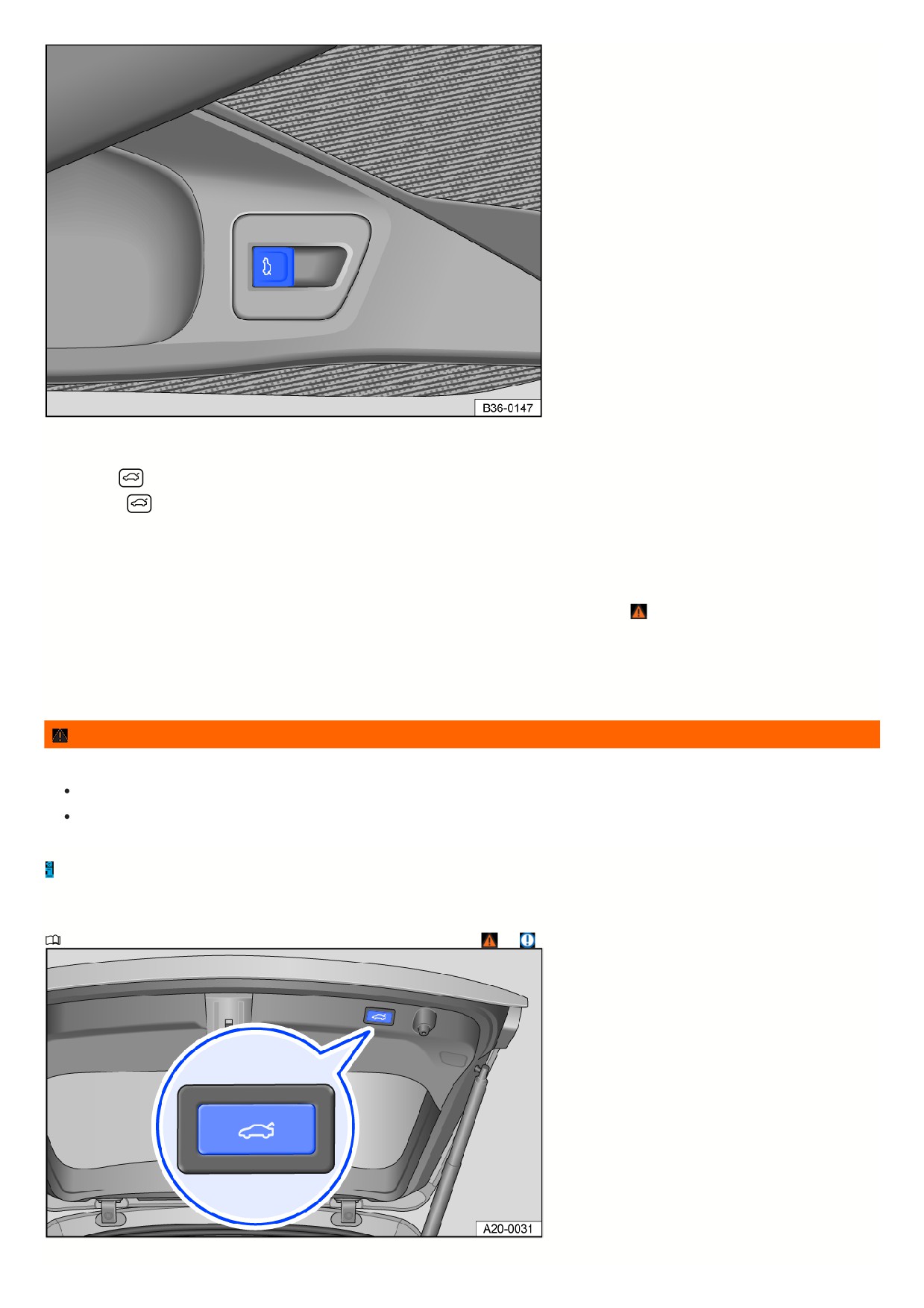
Fig. 58 In the driver's door: unlock button for the trunk lid.
Opening the trunk lid
1. Press the
button on the vehicle key.
Or: pull the
button in the driver door upward fig. 58.
Or: press on the top of the Volkswagen emblem.
The trunk lid will open automatically.
Closing the trunk lid
1. Pull the trunk lid downward firmly using the handle in the interior trim panel until it latches shut in the lock
⇒
The trunk lid will also lock when the doors are locked.
An image in the instrument cluster display indicates if the trunk lid has not opened or closed correctly.
The trunk lid locks automatically while driving.
WARNING
Closing the trunk lid incorrectly or carelessly may lead to serious injuries.
When closing the trunk lid, make sure your hands are not within the closing range of the lid.
When opening the trunk lid, take care to pull it all the way up.
If the trunk lid is not opened within several minutes after unlocking, it will lock again automatically.
Power opening and closing the trunk lid
Please read the introductory information and heed the Warnings and Notice ⇒
and Introduction.
Fig. 59 In the open trunk lid: Button for power closing the trunk lid.
8

Power opening the trunk lid
1. To unlock the trunk lid, press and briefly hold the
button on the remote control vehicle key.
Or: pull the
button in the driver door upward.
Or: press on the top of the Volkswagen emblem.
The trunk lid will open automatically.
Power closing the trunk lid
1. Press the button in the trunk lid when it is open fig. 59.
Or: pull the
button in the driver door upward when the ignition is switched on until the trunk lid is closed.
Or: On vehicles with Keyless Access with push-button start: briefly press and hold the
button on the vehicle key. The vehicle key must be nearby to use
this feature.
Or: press on the top of the Volkswagen emblem.
Or: Begin closing the trunk lid by hand until it closes by itself.
The trunk lid is closed.
Interrupting the opening or closing process
1. Press the
button while the lid is opening or closing.
Or: press on the top of the Volkswagen emblem while the lid is opening or closing.
The trunk lid can now be moved by hand. It is necessary to use more force when doing this.
Pressing the
button again moves the trunk lid back to the original position.
Chimes
When the trunk lid is opened or closed from inside the vehicle or using the vehicle key, chimes will sound.
Changing and saving the opening angle
If the space behind or above the vehicle is not large enough to allow the trunk lid to open completely, you can change how far the trunk lid opens.
1. Interrupt the opening process at the desired open position. It must be at least half open.
2. Press and hold the
button in the trunk lid until the emergency flashers start blinking fig. 59.
The adjusted opening angle is saved.
There will be an audible signal and the emergency flashers will flash to indicate that the setting was saved.
Resetting and saving the opening angle
For that the trunk lid to open fully again, the opening angle must be reset and saved again.
1. Push the open trunk lid all the way up by hand. It is necessary to use more force when doing this.
2. Press and hold the
fig. 59 button in the trunk lid until the emergency flashers start blinking.
This resets the opening angle.
An audible signal will sound and the emergency flashers will flash to indicate that the process is completed.
NOTICE
Check that there is enough space to open or close the trunk lid before opening or closing it, for example if the vehicle is in a garage.
Trunk lid with Easy Open motion sensor
Please read the introductory information and heed the Warnings and Notice ⇒
and Introduction.
81
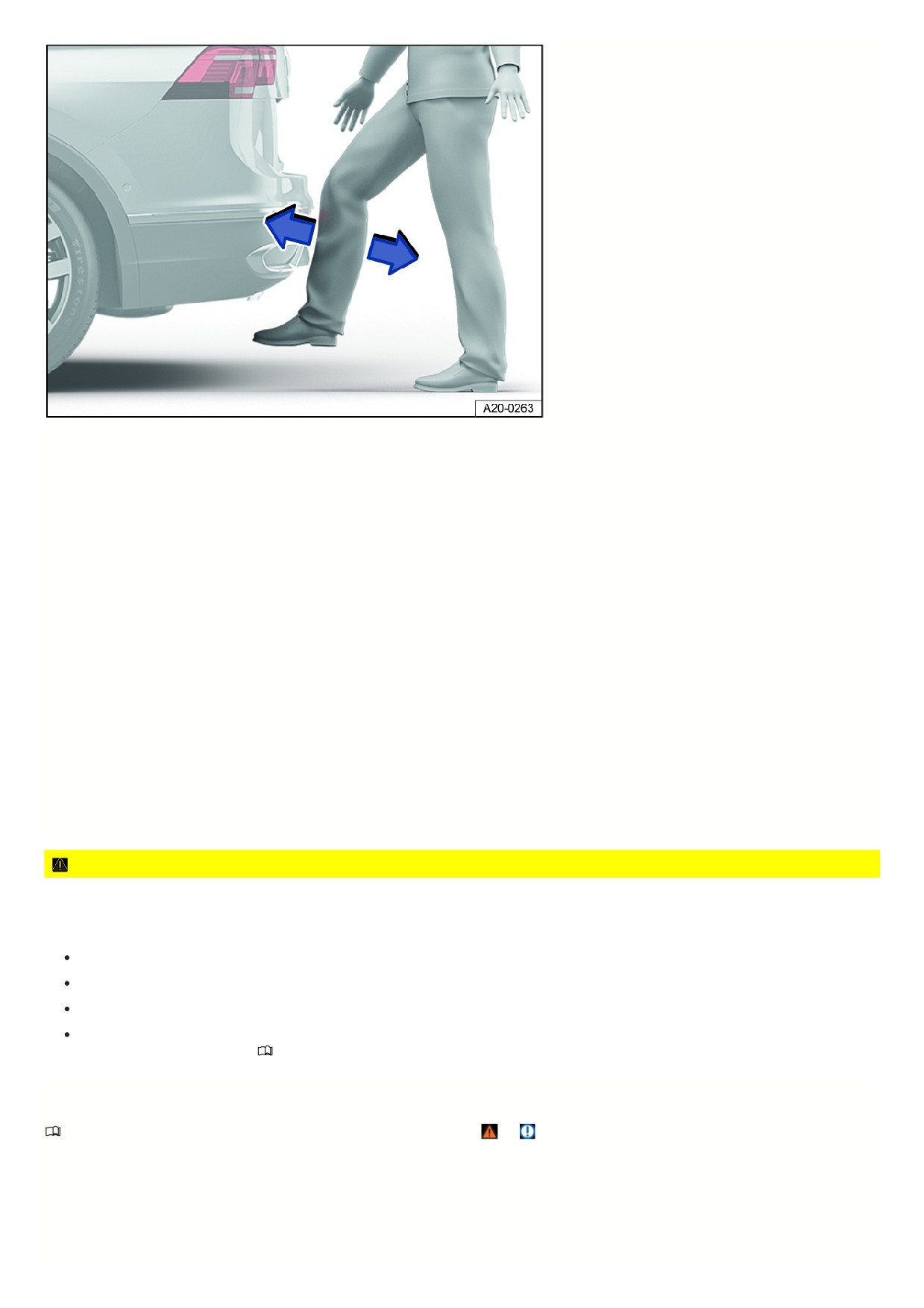
Fig. 60 General example of the sensor-controlled luggage compartment opener (Easy Open).
If a valid vehicle key is located near the trunk lid, the trunk lid can be unlocked and opened with foot motion.
1. Position your foot behind the middle of the bumper.
2. Quickly swing the lower part of your leg close to the bumper fig. 60.
3. Quickly remove the lower part of your leg once more from the bumper.
Visual feedback is given via the turn signals. The trunk lid will open.
Activating or deactivating the Easy Open function
The Easy Open function can be activated and deactivated in the nfotainment system:
1. Select the Vehicle menu.
2. Select the Exterior submenu.
3. Swipe to the side and activate or deactivate Easy Open.
Or:
1. Swipe to the side and select the Central locking menu item.
2. Scroll down the list and activate or deactivate Easy Open.
If Easy Open is activated, Easy Close is also active, depending on the vehicle equipment
⇒ Automatic trunk lid closing Easy Close.
The Easy Open function is only available when Keyless Access is activated ⇒ “Keyless Access” with push-button start .
CAUTION
If a valid vehicle key is detected near the trunk lid, the Easy Open function may trigger unintentionally and open the trunk lid, for example if there is a sweeping
motion under the rear bumper, if a strong stream of water or steam passes by the bumper, or during maintenance and repair work in the rear bumper area. If the
trunk lid opens unintentionally, it may cause injuries to people and/or damage to objects within the trunk lid’s range of motion.
Always make sure that no valid vehicle keys are left unattended near the trunk lid.
Always turn off the Easy Open function via the Infotainment system before any and all maintenance and repair work is performed on the vehicle.
Always turn off the Easy Open function via the Infotainment system before washing the vehicle.
Always turn off the sensor-controlled luggage compartment opener (Easy Open)/Easy Close function via the Infotainment system before mounting a
bicycle rack or hitching a trailer ⇒
Introduction.
Automatic trunk lid closing Easy Close
Please read the introductory information and heed the Warnings and Notice ⇒
and Introduction.
82
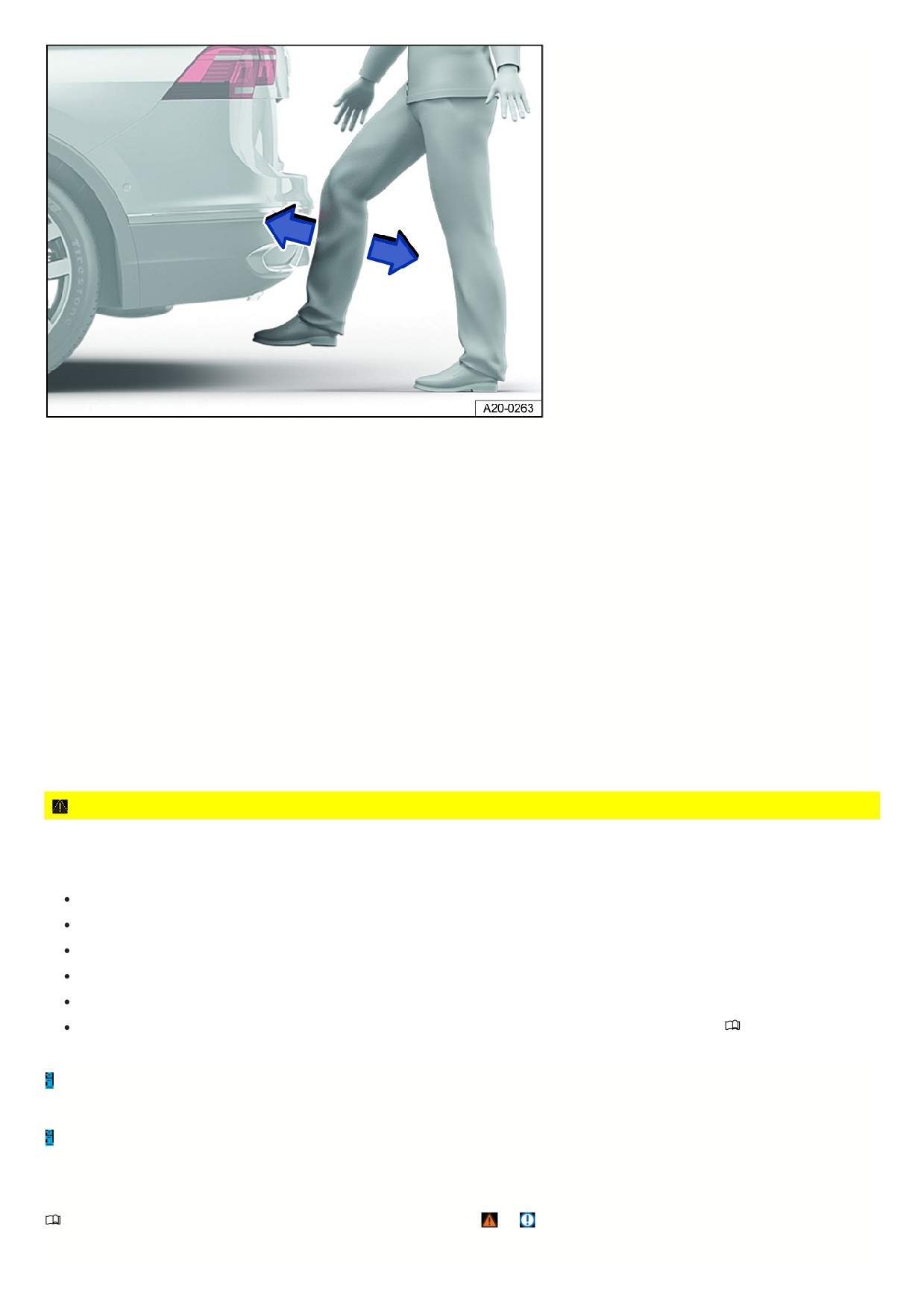
Fig. 61 General example of the trunk lid with sensor-controlled closing (Easy Close).
You can only activate the Easy Close function if a valid remote control vehicle key is detected near the trunk lid.
1. Position your foot behind the middle of the bumper.
2. Quickly swing the lower part of your leg close to the bumper fig. 61.
3. Quickly remove the lower part of your leg once more from the bumper.
Easy Close is activated for approx. 20 seconds. A chime will confirm successful activation.
The trunk lid is closed as soon as all valid vehicle keys are removed from the area near the trunk lid.
The trunk lid will lock automatically after it closes if the vehicle was previously locked and there is not a valid vehicle key inside the vehicle.
Easy Close permits locking a maximum of one vehicle key in the luggage compartment.
The locking procedure is interrupted as soon as a vehicle key returns nearby. The trunk lid re-opens.
Activating or deactivating the Easy Close function
The function Easy Close can be activated or deactivated together with the sensor-controlled luggage compartment opener (Easy Open) function in the Vehicle
menu in the Infotainment system ⇒ Trunk lid with Easy Open motion sensor.
The Easy Close function is only available when Keyless Access is activated ⇒ “Keyless Access” with push-button start .
CAUTION
If a valid vehicle key is detected near the trunk lid, the Easy Close function may trigger unintentionally and close the trunk lid, for example if there is a sweeping
motion under the rear bumper, or during maintenance and repair work in the rear bumper area. If the trunk lid closes unintentionally, it may cause injuries to
people and/or damage to objects within the trunk lid’s range of motion.
Always make sure that no valid vehicle keys are left unattended near the trunk lid.
Always make sure that there are no people in the swivel range of the trunk lid.
Do not hold on to anything in the path of the trunk lid.
Always switch off the Easy Close function via the Infotainment system before any and all maintenance and repair work is performed on the vehicle.
Always switch off the Easy Close function via the Infotainment system before washing the vehicle.
Always switch off the Easy Close function via the Infotainment system before mounting a bicycle rack or hitching a trailer
⇒ Introduction.
If another trunk lid function is activated while closing the trunk lid or objects are detected in the area of the trunk lid, the closing process is automatically
interrupted.
If the vehicle is locked and the Easy Close function is started, the trunk lid will lock automatically once it is closed. If the vehicle is completely unlocked and the
Easy Close function is started, the trunk lid will not lock automatically once it is closed.
Mechanically unlocking the trunk lid using the emergency release
Please read the introductory information and heed the Warnings and Notice ⇒
and Introduction.
83
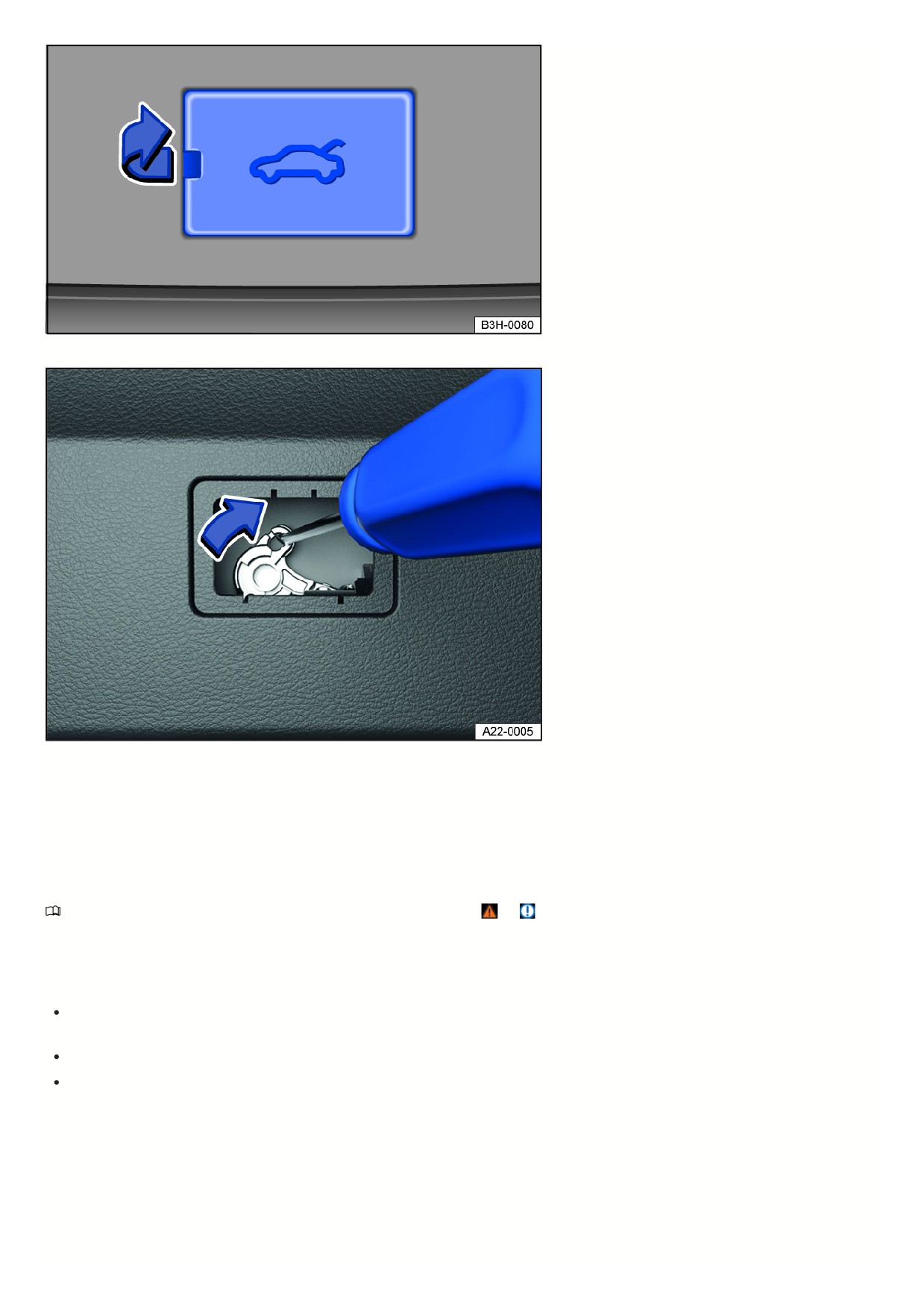
Fig. 62 In the trunk lid: cover for the trunk lid emergency release.
Fig. 63 In the luggage compartment: trunk lid emergency release.
Mechanically unlocking the trunk lid using the emergency release
1. Pry off the square cover in the inner trim panel of the trunk lid using a screwdriver fig. 62.
2. Place a suitable object in the opening for the release lever and press in the direction of the arrow to release the trunk lid fig. 63.
3. You will need to use more force to open the trunk lid.
Troubleshooting
Please read the introductory information and heed the Warnings and Notice ⇒
and Introduction.
If the trunk lid will not open or close
1. Check if the trunk lid is being blocked by an object.
The trunk lid can be moved by hand. It is necessary to use more force when doing this.
If the trunk lid is operated too frequently within a short period of time, then the lid motor will automatically switch off to reduce the risk of overheating. Until the l
motor has cooled down, the trunk lid can be opened and closed by hand using extra force.
When in trailer mode, the power trunk lid can only be opened and closed at the trunk lid.
If the 12-volt vehicle battery or fuse is disconnected or malfunctioning, the trunk lid must be closed by hand.
If all turn signals flash four times
The vehicle key that was last used is still in the vehicle.
1. Remove the key and lock the vehicle.
If the trunk lid is difficult to move
The mechanism for opening the trunk lid may not always work automatically when the outside temperatures are around the freezing point.
1. Guide the trunk lid farther upward by hand.
84
The Easy Open sensor function is not working
Easy Open only works when the ignition is switched off.
Clean the sensors in the rear bumper.
The trailer hitch is extended.
The vehicle was retrofitted with a trailer hitch.
Easy Open (sensor-controlled luggage compartment opener) may be deactivated in heavy precipitation to reduce the risk of false activation.
Automatic trunk lid closing Easy Close does not work
Switch the ignition off and close the driver door.
The trunk lid must be open at least half way.
Disconnect the trailer ⇒ Trailer towing.
There is more than one vehicle key in the luggage compartment.
Press the Easy Close button again.
Windows
Opening and closing the windows
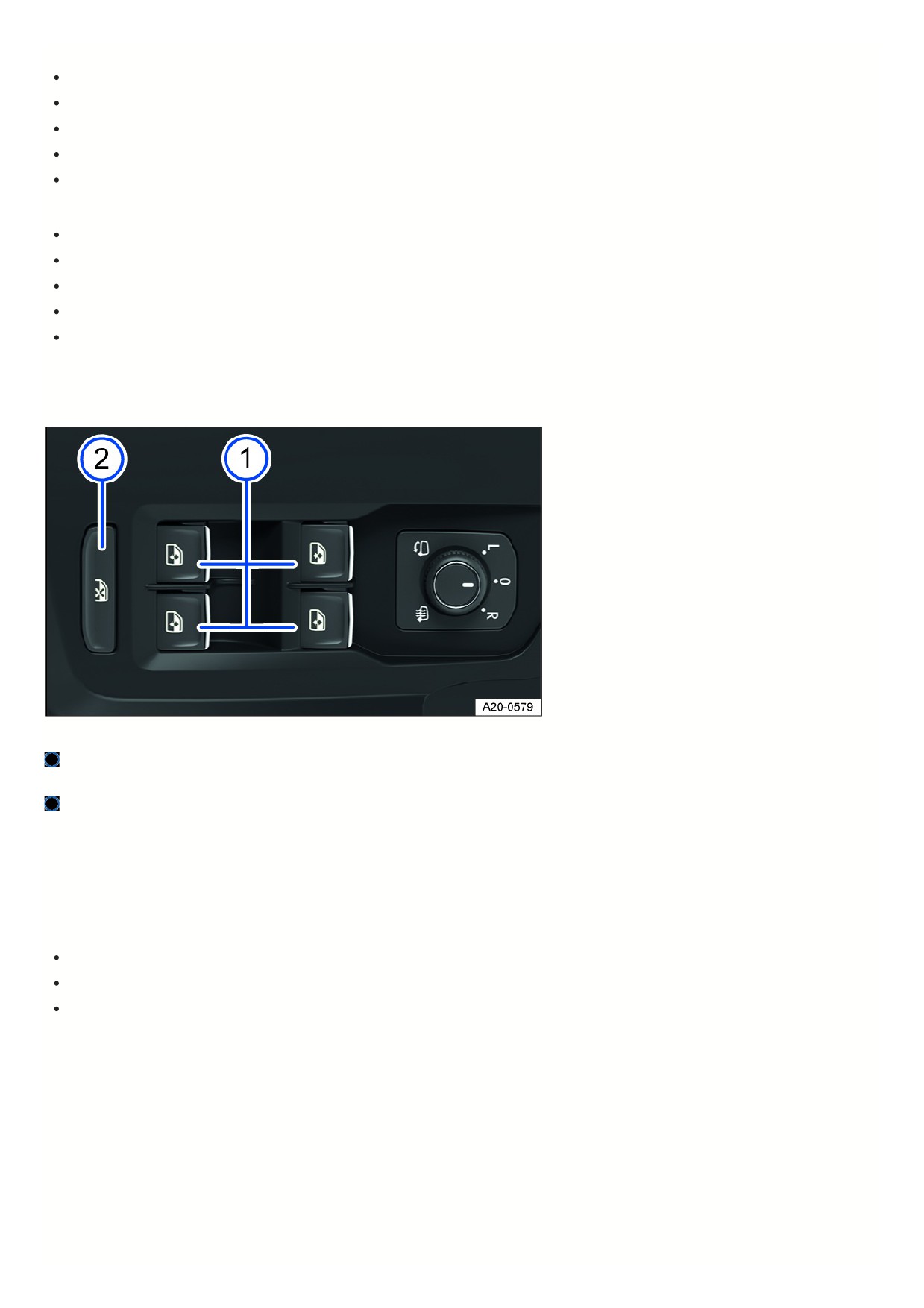
Fig. 64 In the driver door: Power window buttons.
Opening the window: press the switch.
Closing the window: pull the switch.
Deactivating the power window buttons in the rear doors: press the switch.
This button is only located in the driver door.
The windows can still be opened or closed using the switches in the doors for a brief period after the ignition has been switched off, as long as the driver’s or front
passenger door is not opened.
One-touch opening and closing function
The one-touch opening and closing function allows the windows to be completely opened or closed. To use this feature, do not hold the window switch up or down.
To start the one-touch closing function, pull the window switch upward briefly to the second level.
To start the one-touch opening function, press the window switch downward briefly to the second level.
To stop the one-touch opening or closing function, pull or press the switch for that window again.
Convenience opening and closing
Opening
The windows can be opened from outside the vehicle using the vehicle key when the ignition is switched off.
1. Press and hold the unlock button on the vehicle key.
2. To stop the function, release the unlock button.
Closing
1. On vehicles with Keyless Access with push-button start: press the sensor surface or locking button on the door handle for a few seconds, until the windows are
closed ⇒ “Keyless Access” with push-button start . The vehicle key must be nearby to use this feature.
When all of the windows and the power sunroof are closed, the turn signals will blink once as a confirmation.
85

2. To stop the function, remove your finger from the sensor or switch.
You can select the convenience opening settings in the Vehicle settings menu in the Infotainment system.
WARNING
Careless or unintended use of the power windows can cause serious injuries.
Do not open or close the power windows if anyone is in the way.
Never leave children or people requiring assistance unattended in the vehicle when the vehicle is locked. The windows cannot open in an emergency
situation.
Always take all vehicle keys with you when leaving the vehicle. The windows can still be opened or closed using the switches in the doors for a brief
period after the ignition has been switched off, as long as the driver’s or front passenger door is not opened.
When driving with children seated on the rear bench seat, always disable the rear power windows so that the windows cannot be opened or closed.
NOTICE
If the windows are open, rain could enter the vehicle and soak the interior, causing vehicle damage.
If the power windows are malfunctioning, the one-touch opening and closing function and the pinch protection may not function correctly. Contact a suitably
qualified professional. Volkswagen recommends contacting an authorized Volkswagen dealer or authorized Volkswagen Service Facility.
Convenience opening and closing only functions if the one-touch opening and closing function is activated for all the power windows.
Power window pinch protection
The power window pinch protection can reduce the risk of being pinched and injured when the windows are closing.
If the window cannot close due to resistance or an obstacle, then the window will reopen immediately
⇒
1. Check why the window did not close.
2. Try again to close the window.
If the window will not close again, then the pinch protection will be disabled for several seconds.
If the window still cannot close, then the window will stop at the place where it meets resistance. If you press the switch again within several seconds, the window
will close without pinch protection ⇒
Closing windows without pinch protection
1. Try to close the windows again within a few seconds by holding the switch. This will disable the pinch protection.
If the closing process takes longer than several seconds, then pinch protection will be enabled again. If there is resistance to the window moving or an obstacle
is blocking the window, then the window will reopen automatically.
2. If the window still cannot close, then contact a suitably qualified professional. Volkswagen recommends contacting an authorized Volkswagen dealer or
authorized Volkswagen Service Facility.
WARNING
Closing the window when pinch protection is disabled can result in serious injuries.
Always be careful when closing the windows.
Never allow anyone to be in the window operating area, especially if a window is closing when pinch protection is disabled.
The pinch protection does not prevent fingers or other parts of the body from becoming injured by being pressed against the window frame.
Pinch protection also occurs when using the convenience closing function with the vehicle key.
Troubleshooting
One-touch up/down feature
If the 12 V vehicle battery is disconnected or drained when the windows are not completely closed, then the one-touch up/down feature will not work. It must be
reprogrammed using the following steps:
1. Switch the ignition on.
2. Close all windows and doors.
3. Pull the switch for the desired window and hold it in that position for several seconds.
86
4. Release the switch, then pull it upward again and hold it.
The one-touch up and down features will then be fully functional.
The automatic power windows can be reprogrammed individually, or multiple windows can be reprogrammed at the same time.
Controls are responding differently than expected
Moisture, dirt and grease may limit the functioning of the controls.
1. Always keep the control panels clean and dry.
Sunroof
Opening and closing the tilting and sliding panoramic sunroof
The term “sunroof” is used as a synonym for the panoramic sliding/tilting sunroof.
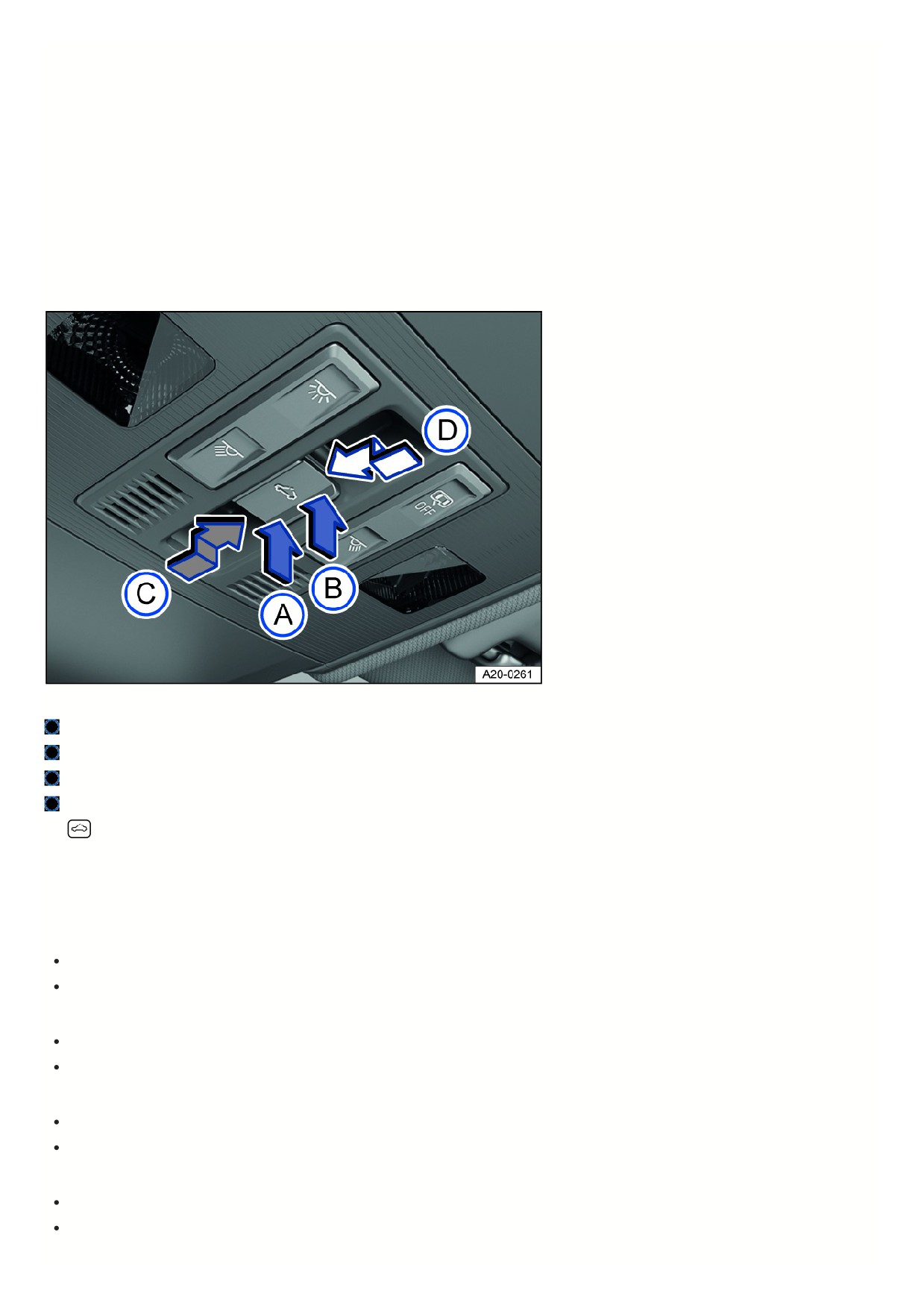
Fig. 65 In the headliner: sunroof button.
Close the power sunroof when tilted.
Tilt the power sunroof.
Open the power sunroof or stop the automatic process.
Close the power sunroof or stop the automatic process.
The
button has two levels.
First level: tilt, open, or close the sunroof completely or partially.
Second level: automatically open or close the sunroof completely.
You can stop the automatic process by pressing the button again.
Tilting the power sunroof
Manual process: press the fig. 65 button until the first level is reached.
Automatic process: press the fig. 65 button until the second level is reached.
Closing the power sunroof when tilted
Manual process: press the fig. 65 button until the first level is reached.
Automatic process: press the fig. 65 button until the second level is reached.
Opening the power sunroof
Manual process: press the fig. 65 button until the first level is reached.
Automatic process up to comfort position: press the fig. 65 button until the second level is reached.
Closing the power sunroof
Manual process: press the fig. 65 button until the first level is reached.
Automatic process: press the fig. 65 button until the second level is reached.
87

Stopping the automatic opening or closing process
1. Press the fig. 65 or fig. 65 button again.
WARNING
Careless or inattentive use of the sunroof can cause serious injuries.
Do not open or close the power sunroof if anyone is in its path.
Always take all vehicle keys with you when leaving the vehicle.
Never leave children or people requiring assistance unattended in the vehicle, especially if they have access to the vehicle key. Inattentive use of the
vehicle key can lock the vehicle, start the engine, switch the ignition on, or operate the sunroof.
The sunroof can still be opened or closed for a brief period after the ignition has been switched off, as long as the driver’s or front passenger's door has
not been opened.
NOTICE
To reduce the risk of damage, remove ice and snow from the vehicle roof before opening or tilting the power sunroof in winter weather.
Always close the power sunroof before leaving the vehicle and when there is precipitation. If the sunroof is open or tilted, rain or snow could enter the
vehicle interior and cause extensive damage to the electrical system. This could also result in further vehicle damage.
Keep the power sunroof closed when using the roof rack.
Remove leaves and other loose objects from the power sunroof guide rails regularly, either by hand or with a vacuum cleaner.
The pinch protection will not function correctly if the sunroof is malfunctioning. Contact a suitably qualified professional. Volkswagen recommends contacting
an authorized Volkswagen dealer or authorized Volkswagen Service Facility.
Tilting and sliding panoramic sunroof convenience opening and closing
Convenience opening and closing
The sunroof can be opened and closed from outside the vehicle using the vehicle key.
Does not apply to the US or Canada: Press and hold the unlock or lock button on the vehicle key. The sunroof will be tilted or closed.
For vehicles with Keyless Access with push-button start: Hold your finger on the unlock sensor in the door handle for several seconds until the tilting and slidin
panoramic sunroof is closed ⇒ Unlocking or locking using Keyless Access .
Remove your finger from the unlock or lock button to stop the function.
When using the convenience closing function, all windows in the doors and the sunroof will be closed. When all of the windows and the power sunroof are closed,
the turn signals will blink once as a confirmation.
Settings for the sunroof can be adjusted in the vehicle settings in the Infotainment system
⇒ Driver information.
Sunroof pinch protection
The pinch protection reduces the risk of pinching injuries
⇒ . If the sunroof is obstructed while it is closing, it will open again automatically.
1. Check why the sunroof is not closing.
2. Try again to close the sunroof.
3. If the sunroof is still not able to close, close the sunroof without pinch protection.
Closing the sunroof without pinch protection
1. Press the
button to the second level until the sunroof is completely closed
⇒ Opening and closing the tilting and sliding panoramic sunroof .
This will close the sunroof without pinch protection.
2. If the power sunroof still cannot close, then contact a suitably qualified professional. Volkswagen recommends contacting an authorized Volkswagen dealer or
authorized Volkswagen Service Facility.
If you release the switch during the closing process, then the sunroof will open again automatically.
WARNING
Closing the sunroof without pinch protection may result in serious injuries.
Always be careful when closing the power sunroof.
Never allow anyone to be within the sunroof range of operation, especially if it is closing without pinch protection.
88
The pinch protection does not prevent fingers or other parts of the body from becoming injured by being pressed against the roof frame.
Pinch protection also occurs when convenience closing the windows and sunroof with the vehicle key.
Troubleshooting
If the sunroof is not closing
The sunroof only works when the ignition is on. The sunroof can still be opened or closed for a brief period after the ignition has been switched off, as long as
the driver’s or front passenger's door has not been opened.
If it is not possible to close the sunroof using the power controls, the sunroof must be closed manually. Some vehicle components must be removed in order to
close the sunroof manually. Contact an authorized Volkswagen dealer or authorized Volkswagen Service Facility. Volkswagen recommends contacting an
authorized Volkswagen dealer or authorized Volkswagen Service Facility.
Controls are responding differently than expected
Moisture, dirt and grease may limit the functioning of the controls.
1. Always keep the control panels clean and dry.
89
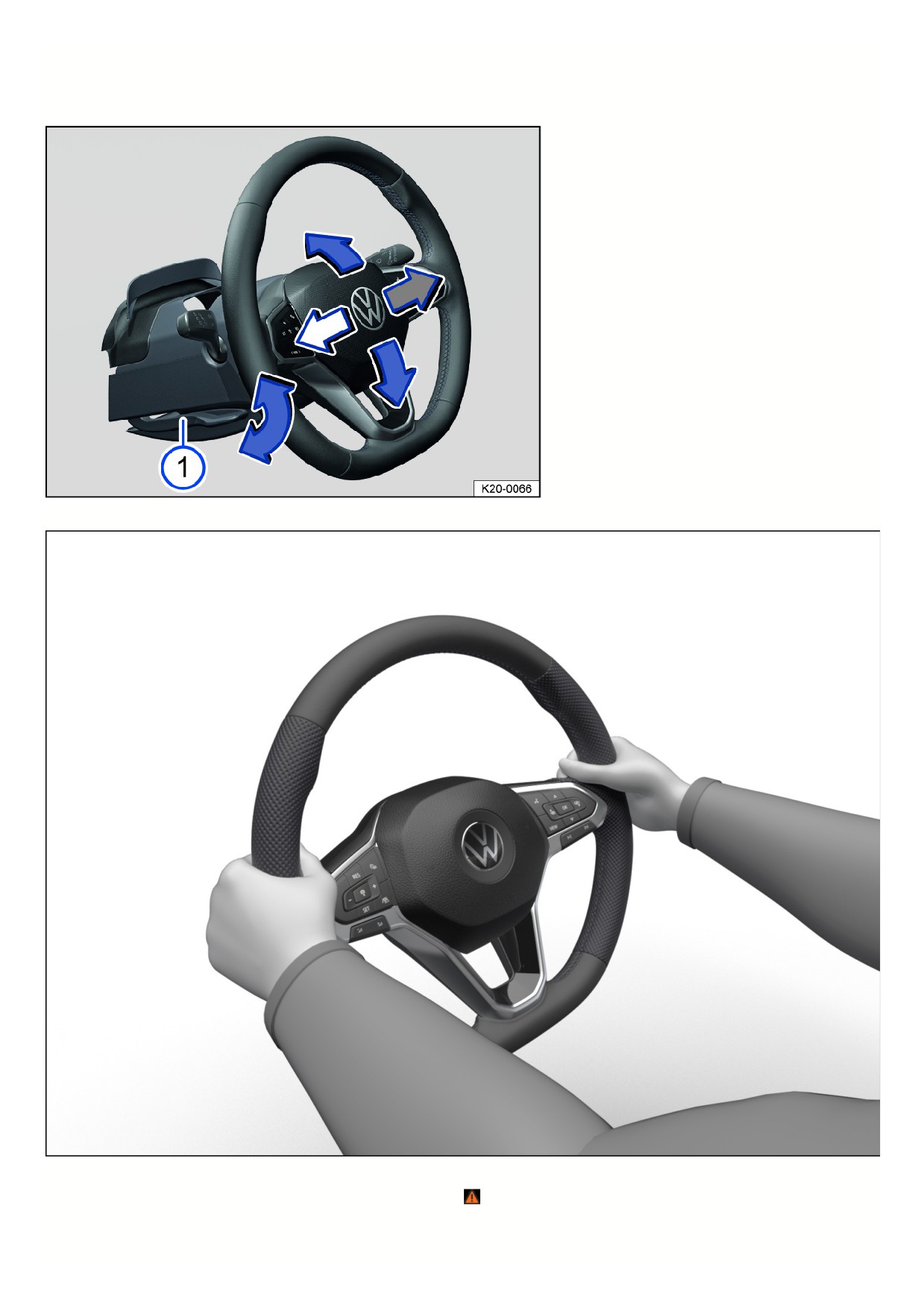
Steering wheel
Adjusting the steering wheel position
Fig. 66 Under the steering wheel in the steering column trim panel: lever to adjust the steering wheel position manually (general example).
Fig. 67 On the steering wheel: nine o’clock and three o’clock position.
Only adjust the steering wheel before driving or while the vehicle is stationary
⇒
1. Tilt the lever fig. 66 downward.
2. Adjust the steering wheel so that it can be firmly held at the outer edge with both hands at the nine o’clock and three o’clock position fig. 67.
9
3. Press the lever all the way up until it locks flush with the steering column trim panel
⇒
WARNING
Incorrect use of the steering wheel adjuster and an incorrect steering wheel adjustment could cause serious or fatal injuries.
Always push the lever fig. 66
upward into its locked position after adjusting so that you do not change the steering wheel position unintentionally while
driving.
Never adjust the steering wheel while driving. If you find the steering wheel must be adjusted while driving, stop the vehicle safely and adjust the steering
wheel correctly.
The steering wheel must always face toward the chest and never toward the face. Otherwise, the protective function of the driver’s front airbag may be
limited in the event of an accident.
To reduce the risk of injuries if the driver's front airbag deploys, always hold the outer edge of the steering wheel firmly with both hands in the nine o'clock
and three o'clock position fig. 67.
Never hold the steering wheel in the twelve o'clock position or in any other way, such as holding the center of the steering wheel. Otherwise, the arms,
hands, and head could be seriously injured if the driver’s front airbag deploys.
91

Seats and head restraints
Front seats
Introduction
The following information describes the various options for adjusting the front seats. Always make sure the seats are adjusted to the correct position
⇒
Introduction.
WARNING
Driving in an incorrect seating position due to seats being adjusted incorrectly may cause serious injuries.
Adjust the front seats according to the correct seating position each time before driving and make sure all passengers have their safety belts fastened
correctly.
Move the front passenger seat all the way back.
WARNING
Adjusting the seats incorrectly can cause accidents and serious injuries.
Only adjust the seats when the vehicle is stationary. Otherwise, the position of the seats could change unexpectedly while driving and you could lose
control of the vehicle. You could also put yourself in an incorrect seating position.
Only adjust the height, angle, and forward/back position of the front seats when there is no one within the seat’s range of movement.
Do not restrict the movement of the seats by placing objects within their range of movement.
The adjusting and locking areas of the seats must not be dirty.
WARNING
Using seat covers or protective covers incorrectly can result in unintentionally operating the seat adjusters, and the front seats could move unexpectedly while
driving. This could cause you to lose control of the vehicle. This can cause accidents and injuries. The electrical components in the front seats could also be
damaged.
Never install or secure seat covers and protective covers on the electrical controls.
Only use seat covers or protective covers that are specifically approved for use in your vehicle.
WARNING
Lighters in the vehicle can become damaged or ignite unintentionally. This can cause severe burns and vehicle damage.
Before adjusting any seat, always make sure that there are no cigarette lighters near the moving parts of the seat.
NOTICE
Objects with sharp edges can damage the seats.
Never touch the seats with sharp-edged objects. Sharp-edged objects, such as zippers, rivets on clothing, or belts, can cause surface damage. Open
hook and loop fasteners can also cause damage.
Manually adjusting front seats
Please read the introductory information and heed the Warnings and Notice ⇒
and Introduction.
The information that follows describes all possible controls. Depending on the seat version, the number of controls may vary.
The controls on the front passenger seat are a mirror image of those for the driver seat.
A seat may have both manual and power controls.
92