Volkswagen Golf Variant / Jetta. Manual - part 626
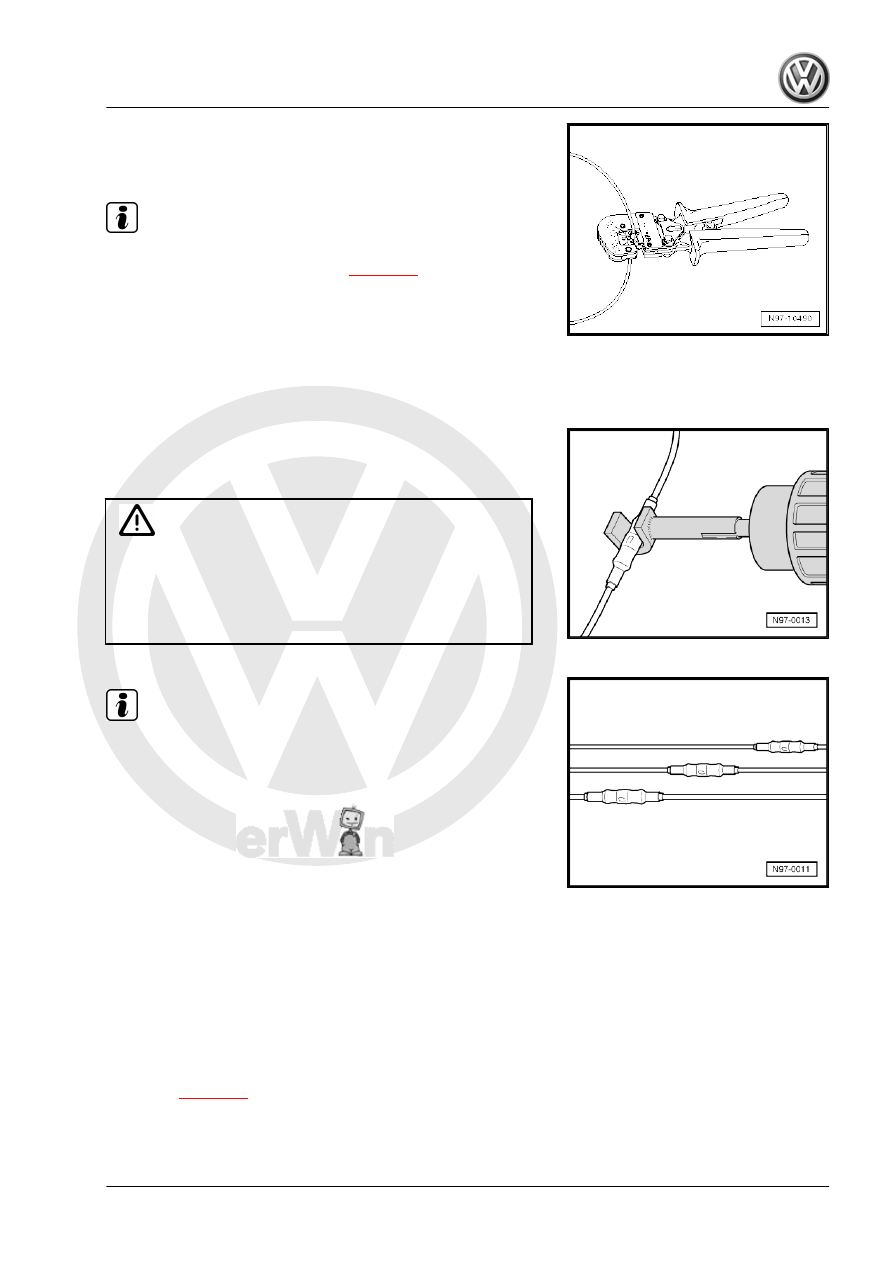
to both wire ends.
– Repeat this procedure on the other end of the repair wire.
Note
♦
Ensure without fail that the correct crimp recess is chosen for
the crimp connectors being used
♦
The insulation on the wires must not be crimped.
After crimping, the crimp connector has to be shrink fitted using
the hot air blower, 220 V/50 Hz -VAS 1978/14- in order to prevent
any ingress of moisture.
– Place shrink element for hot air blower -VAS 1978/15- on hot
air blower, 220 V/50 Hz -VAS 1978/14- .
– Heat up the crimp connector using the hot air blower -VAS
1978/14- along a straight line, working from the middle out‐
wards, until it is sealed completely and the adhesive escapes
from the ends.
Caution
When shrink-fitting, take care not to damage any other wiring,
plastic parts or insulating material with the hot air blower, 220
V/50 Hz -VAS 1978/14- .
Observe ⇒ Operating instructions for hot air blower, 220 V/50
Hz -VAS 1978/14- .
Note
♦
Ensure that, where several wires have to be repaired, the
crimp connectors are not directly adjacent to each other. To
prevent the circumference of the wiring harness from becom‐
ing to great, position the crimp connectors so they are offset
slightly.
♦
If the repair position was already wrapped, this section has to
be wrapped again with yellow insulation tape once the repair
has been carried out.
♦
Attach the repaired wiring harness with a cable tie to prevent
it from generating noise when the vehicle is in motion.
2.5
Repairs to contact housings and con‐
nectors
2.5.1
Notes on repairs to contact housings
and connectors
♦ Observe the general notes on repairs to the vehicle electrical
.
♦ Allocation of the appropriate crimp contacts to the contact
housings is by way of the part number stamped on the contact
housing. Listed in illustration 198 (electrical connecting ele‐
ments) in ⇒ Electronic parts catalogue “(ETKA)” are the part
2. Repairs to wiring harnesses and connectors
101