Volkswagen Golf Variant / Jetta. Manual - part 624
 

  Index      Volkswagen     Volkswagen Golf Variant (2007), Jetta (2005) - service repair manual


Search            


Content   ..  622  623  624  625   ..


Volkswagen Golf Variant / Jetta. Manual - part 624


only be repaired using wiring harness repair set -VAS 1978- /

wiring harness repair set -VAS 1978A- / wiring harness repair

set -VAS 1978 B- .

♦ Observe vehicle stickers indicating high voltage components.

Before carrying out repairs, allow residual voltage to dissipate

⇒  General body repairs, interior; Rep. Gr.  69 .

♦ For repairs to wiring in the airbag and belt tensioner system,

a maximum of two positions may be repaired. The more the

repairs there are in the wiring, the greater the resistance and

this can trigger faults in the self-diagnosis of the system.

♦ To avoid corrosion, the crimp connectors are always to be

shrink-fitted when performing airbag or belt tensioner wiring

harness repairs.

♦ Only use yellow wires for repairs to wiring harnesses.
♦ Do not incorporate the repaired wiring back in the vehicle's

own wiring harness and mark the area of repair clearly with

yellow insulating tape.

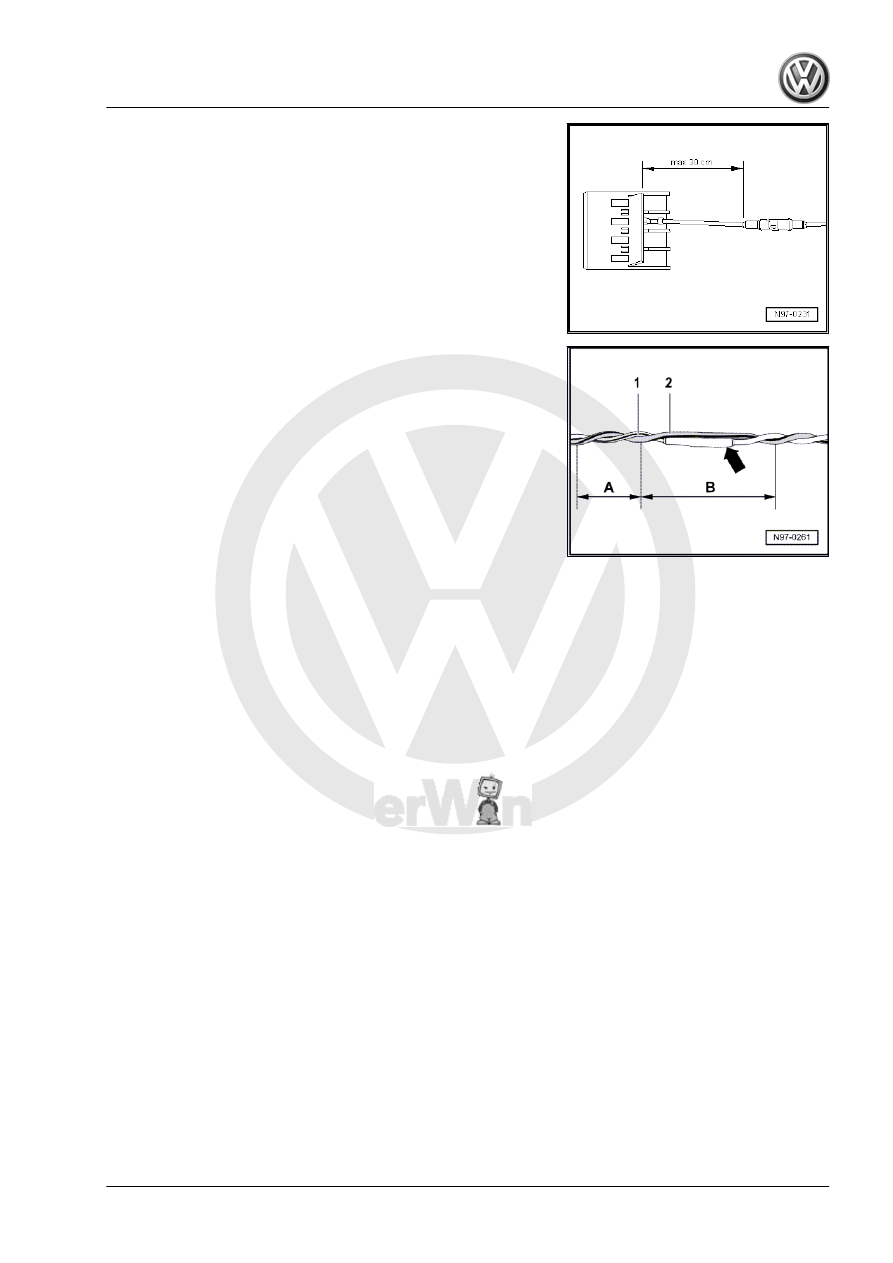
♦ Repairs in the area of the airbag or belt tensioner should not

be more than 30 cm from the next contact housing. Together

with the yellow insulating tape, this gives a clear indication of

repairs that have already been carried out.

♦ In series production, the wires leading to the trip units (airbags)

are twisted with a length of lay of 20 mm ±5 mm. This length

of lay is ensured in series production by means of standard-

part numbers for pairs of wires and must be adhered to under

all circumstances when sections of twisted wires are repaired.

♦ During repairs, the wiring to the trip units (airbags) must have

the same length. When wires -1- and -2- are twisted, the length

of lay of A = 20 mm ±5 mm must be adhered to under all cir‐

cumstances.

♦ It must be ensured that no part of the wiring, including wiring

in the vicinity of crimp connectors -arrow-, is longer than B =

100 mm without the wires being twisted.

2.4.3

Notes on repairs to fibre-optic cables

There is no provision for fibre-optic cable repairs at Volkswagen.

In the event of repairs, the entire fibre optic wiring harness must

be replaced. To do this, the following safety precautions must be

observed:
♦ Avoid sharp bends in the fibre-optic cable; the bend radius

should be no tighter than 25 mm.

♦ Do not route fibre-optic cables over sharp edges.
♦ The end pieces (lenses) must not be made dirty or touched

with bare hands.

2. Repairs to wiring harnesses and connectors    

93

copper wire is not permissible.

2.4.4

Notes on repairs to CAN bus wiring

♦ An unshielded two-wire line -1- and -2- with a cross section of

0.35 mm

2

 or 0.5 mm

2

 is used for CAN bus wiring.

♦ The colour codes of the CAN bus wiring can be gleaned from

the following table:

Powertrain CAN, high

Orange/black

Convenience CAN, high

Orange/green

Infotainment CAN, high

Orange/violet

CAN low wire, all

Orange/brown

♦ Repairs to CAN bus wiring can be carried out either with sec‐

tions of repair wiring with the correct cross section or with

entwined wires “green/yellow” or “white/yellow” from the re‐

placement parts catalogue ⇒  Electronic parts catalogue “ET‐

KA” .

♦ When repairs are performed, both bus wires must have the

same length. When twisting the wires -1- and -2- together, the

length of each complete twist must be A = 20 mm.

♦ It must be ensured that no part of the wiring, including wiring

in the vicinity of crimp connectors -arrow-, is longer than B =

50 mm without the wires being twisted.

♦ Mark the area of repair with yellow insulation tape to make it

easy to identify.

2.4.5

Notes on replacement of aerial cables

A new repair concept has been developed for repair work on aer‐

ial wires. Now connecting wires in different lengths and various

adapter cables are available as replacement parts instead of a

complete aerial wire.

94

must be replaced only by connecting wires and adapter cables

offered as genuine parts.

♦ The replacement parts can be found in the ⇒  electronic parts

catalogue “(ETKA)” .

♦ These genuine parts are suitable for all aerial wires and wire

diameters which may need to be replaced.

♦ The connector housings for aerial cables are only available as

replacement parts in one colour. However, they can be used

for all colours of aerial connector.

♦ No provision has been made for replacement of individual

aerial connectors in the event of repair.

♦ The wires can be used retroactively for all VW vehicles, with

all installed aerial wire diameters.

♦ All adapter and connection wires are suitable for all transmitter

and receiver signals.

♦ This repair method can also be used for testing or retrofitting.
Assembly overview - aerial wire
Example: aerial wire between radio -R- and aerial -R11- is de‐

fective. The following wires are required for the repair:
1 - Adapter cable for connecting to the radio -R- . Length ap‐

prox. 30 cm.

2 - Connecting wire available in different lengths.
3 - Adapter cable for connection to the aerial -R11- . Length

approx. 30 cm.

Installing a new aerial wire

Note

Note that the total length of an aerial wire, depending on vehicle

equipment level, can be divided into sections by aerial selection

control unit -J515- , control unit for traffic information -J559- or

aerial amplifier -R24- . Only the defective section of aerial wire

must be replaced.

Carry out following procedures:
– Pull defective aerial wire connections off units.
– Determine the routing of the defective aerial wire in vehicle

and measure the total length of the aerial connecting wire to

be replaced.

2. Repairs to wiring harnesses and connectors    

95

of adapter cables required -1- and -3- and the connecting wire

-2-.
– To determine the length of connecting wire required, subtract

60 cm from the measured total length of aerial connecting wire

-2-.

– Procure the required adapter cables -1- and -3- and connect‐

ing wire -2- at length calculated as genuine part from the parts

catalogue.

– Cut off connectors of defective aerial wire.
The remainder of the defective aerial wire remains in the vehicle.
– Connect adapter cables -1- and -3- to equipment in vehicle.
– Route and attach the connection line -2- in the immediate vi‐

cinity of the factory routing.

Note

Do not kink or excessively bend aerial wires! The bending radius

must not be below 50 mm.

– Connect connecting wire to adapter cables.
– Perform a functional check.

2.4.6

Repairs to wiring with cross sections up

to 0.35 mm

2

For repairs to wiring with cross sections up to 0.35 mm

2

, it is es‐

sential that contacts are crimped on using crimping pliers for JPT

contacts -VAS 1978/9A- or crimping pliers (base tool) -VAS

1978/1-2- with attached head adapter for JPT contacts -VAS

1978/9-1- . Due to the low current strength of these wires in the

micro and thousandths range, incorrectly crimped contacts cause

electrical resistance and result in faults or failure in the respective

system. The most common applications of these contacts are:
♦ Lambda probe
♦ Engine speed sender
♦ Air mass meter
With the use of crimping pliers for JPT contacts -VAS 1978/9A-

or crimping pliers (base tool) -VAS 1978/1-2- with attached head

adapter for JPT contacts -VAS 1978/9-1- , the correct connection

between crimp contact, wire and single wire seal is assured. The

tool is only to be used for the application described.

Note

Crimped to the repair wiring are normal contacts and gold-plated

contacts. The repair contact must always be the same type as the

contact installed in the factory.

Crimping on new contact with single wire seal
– Insert head adapter for JPT contacts -VAS 1978/9-1- in crimp‐

ing pliers (base tool) -VAS 1978/1-2- 

⇒ page 89

 .

96


Content   ..  622  623  624  625   ..