Volkswagen Golf Variant / Jetta. Manual - part 623
 

  Index      Volkswagen     Volkswagen Golf Variant (2007), Jetta (2005) - service repair manual


Search            


Content   ..  621  622  623  624   ..


Volkswagen Golf Variant / Jetta. Manual - part 623


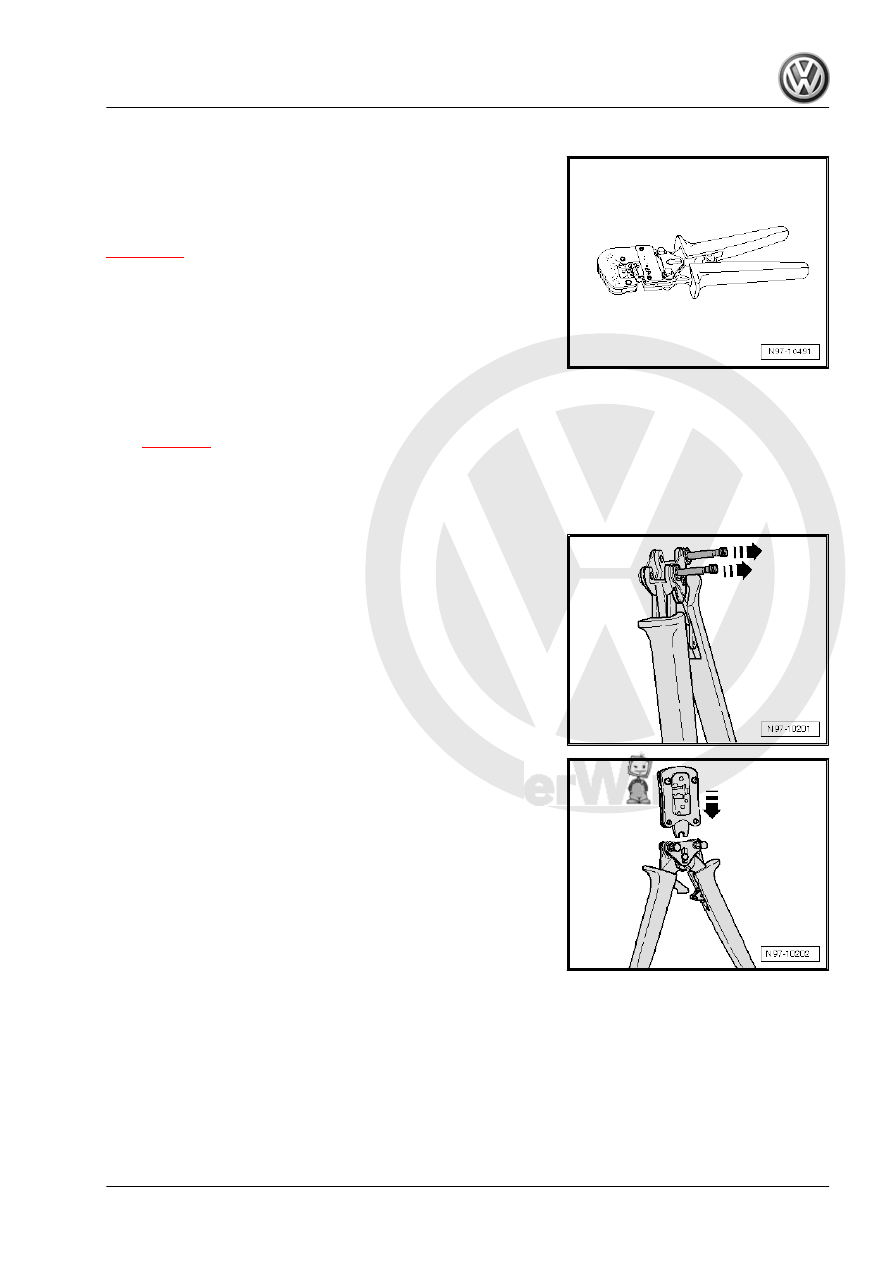
Crimping pliers -VAS 1978/1A-

Crimping pliers -VAS 1978/1A- or crimping pliers (base tool) -VAS

1978/1-2- together with head adapter 0.35-2.5mm/2 -VAS

1978/1-1- and head adapter 4.0-6.0mm/2 -VAS 1978/2A- are

used to crimp connectors from wiring harness repair sets.
Crimping connectors using crimping pliers -VAS 1978/1A-

⇒ page 100

 .

The following heads adapters are available for crimping pliers

(base tool) -VAS 1978/1-2- :
♦ Head adapter 0.35 mm² - 2.5 mm² -VAS 1978/1-1-
♦ Head adapter 4.0 - 6.0 mm² -VAS 1978/2 A-
♦ Head adapter for JPT contacts -VAS 1978/9-1-
In conjunction with head adapter for JPT contacts -VAS

1978/9-1- , the crimping pliers are used to crimp contacts to single

wires during repairs to wiring with cross sections up to 0.35

mm

2


⇒ page 96

 .

Replacing head adapter
– Open up the crimping pliers (base tool) -VAS 1978/1-2- com‐

pletely.

– Unclip both locking pins -arrows- from the base of the crimping

pliers (base tool) -VAS 1978/1-2- .

– Insert the required head adapter from above -arrow- in the

base of the crimping pliers (base tool) -VAS 1978/1-2- .

2. Repairs to wiring harnesses and connectors    

89

base of the crimping pliers (base tool) -VAS 1978/1-2- .

2.3

General notes concerning repairs to ve‐

hicle electrical system

Caution

When battery -A- is disconnected and reconnected, the pro‐

cedure  described  in  the  workshop  manual  must  be  strictly

observed ⇒  Electrical system; Rep. Gr.  27 .

WARNING

Some tools are equipped with a tool safety device. This must

be pushed over the tip of the tool after use in order to protect

the tip and prevent personal injury.

♦ Observe the latest notes in the respective workshop manual

when carrying out repairs.

♦ Comply with country-specific regulations.
♦ Always disconnect battery -A- before working on electrical

battery -A- (open circuit) ensures a safe working environment

for repairs to the electrical system. Only the battery's positive

cable needs to be disconnected for removal of the battery -A- .

♦ Before starting repairs, it is important to identify the cause of

damage (e.g. sharp edges on body panels, defective electrical

components, corrosion, etc.).

♦ For further information on procedures such as the removal and

installation of individual components, please refer to the rele‐

vant workshop manual.

♦ Soldering is not permitted for repairs to vehicle wiring.
♦ Wiring harness and connector repairs to vehicle electrical sys‐

tem may only be carried out using wiring harness repair set -

VAS 1978- / wiring harness repair set -VAS 1978A- / wiring

harness repair set -VAS 1978 B- .

♦ Only use yellow wires for repairs to wiring harnesses.
♦ Wiring harness repairs may not be integrated in the vehicle's

own wiring harness and must be marked with the use of yellow

adhesive tape.

♦ These yellow wires and any part of the wiring harness marked

with yellow insulating tape indicate a previous repair.

♦ Crimp connectors may never be repaired. Lay wiring parallel

to the defective wiring.

90

the hot air blower, 220 V/50 Hz -VAS 1978/14- , in order to

prevent any ingress of moisture.

♦ It is essential that the supplementary information is observed

regarding repairs to wiring harnesses in airbag and belt ten‐

sioner systems, fibre-optic cables, CAN bus lines, aerial ca‐

bles and wiring with cross sections up to 0.35 mm

2

⇒ page 96

 .

♦ Carry out a function test after every repair. It may be necessary

for the fault memory to be interrogated, erased and/or for the

systems to be reset.

♦ If possible, do not loosen any earth wires from the body (dan‐

ger of corrosion).

♦ Wiring harness repair set -VAS 1978 B- and previous versions

do not cover all wiring cross sections that occur in the vehicle.

If the required wiring cross section is not available, the next

largest one should be used.

♦ Screened wires must not be repaired. If damaged they must

be replaced complete.

♦ Heat resistant wiring can be found in various places in the ve‐

hicle, mainly in the engine compartment. Heat resistant wiring

can be identified by its slightly matt and softer insulation. To

repair these wires, only heat resistant wiring may be used.

2.4

Repairs to wiring harnesses

Note

Observe the general notes on repairs to the vehicle electrical

system 

⇒ page 90

 .

♦ Notes on repairs to wiring harnesses 

⇒ page 91

 .

♦ Notes on repairs to airbag and belt tensioner wiring

⇒ page 92

 .

♦ Notes on repairs to fibre-optic cables 

⇒ page 93

 .

♦ Notes on repairs to CAN bus wiring 

⇒ page 94

 .

♦ Notes on replacement of aerial cables 

⇒ page 94

 .

♦ Notes on repairs to wiring with cross sections up to 0.35

mm

2


⇒ page 96

 .

♦ Notes on repair of wiring open circuit with one repair position

⇒ page 98

 .

♦ Notes on repair of wiring open circuit with two repair positions

⇒ page 100

 .

2.4.1

Notes on repairs to wiring harnesses

♦ Observe the general notes on repairs to the vehicle electrical

system 

⇒ page 90

 .

♦ The wiring cross sections that can be found in the vehicle are

not all available in wiring harness repair set -VAS 1978- / wiring

harness repair set -VAS 1978A- . If the required wiring cross

section is not available, the next largest one should be used.

♦ Wiring harness and connector repairs to the vehicle electrical

system may only be carried out using wiring harness repair set

-VAS 1978- / wiring harness repair set -VAS 1978A- .

♦ Soldering is not permitted for repairs to vehicle wiring.

2. Repairs to wiring harnesses and connectors    

91

own wiring harness and must be marked with the use of yellow

adhesive tape.

♦ A yellow wire or a section of wiring wrapped with yellow insu‐

lating tape always indicates a previous repair.

♦ Crimp connectors may never be repaired. Lay wiring parallel

to the defective wiring.

♦ After crimping, crimp connectors must to be shrink fitted using

the hot air blower, 220 V/50 Hz -VAS 1978/14- , in order to

prevent any ingress of moisture.

♦ Screened wires must not be repaired. If damaged they must

be replaced complete.

♦ Heat resistant wiring can be found in various places in the ve‐

hicle, mainly in the engine compartment. Heat resistant wiring

can be identified by its slightly matt and softer insulation. To

repair these wires, only heat resistant wiring may be used.

♦ It is essential that the supplementary information is observed

regarding repairs to wiring harnesses in airbag and belt ten‐

sioner systems, fibre-optic cables, CAN bus lines, aerial ca‐

bles and wiring with cross sections up to 0.35 mm

2

.

2.4.2

Notes on repairs to airbag and belt ten‐

sioner wiring

In addition to the general notes on repairs to wiring harnesses,

the following instructions must be observed on how to repair wir‐

ing in airbag and belt tensioner systems:

WARNING

♦ Airbag and seat belt tensioner can fail.
♦ Faulty repairs to the airbag and seat belt tensioning sys‐

tem can cause malfunctions in the passenger protection

system.

♦ For repair work on airbag and seat belt tensioner wiring

harnesses, only contacts, connectors and wiring designed

specifically for this purpose may be used ⇒  Electronic

parts catalogue“(ETKA)” .

92


Content   ..  621  622  623  624   ..