Volkswagen Golf / Golf Plus. Manual - part 202
 

  Index      Volkswagen     Volkswagen Golf (2004) / Golf Plus (2005) - service repair manual


Search            


Content   ..  200  201  202  203   ..


Volkswagen Golf / Golf Plus. Manual - part 202


s

p

e

c

t

 t

o


th

e

 c

o

rr

e

c

t

n

e

s

s


o

f

in

fo

r

m

a

tio

n

 in

 th

is

 d

o

c

um

en

t.

C

o

py

rig

ht b

y


V

olk

sw

a

ge

n


A

G.

4.36

Tyre repair set: Check bottle for damage

and if used; check and enter date of tyre

sealant

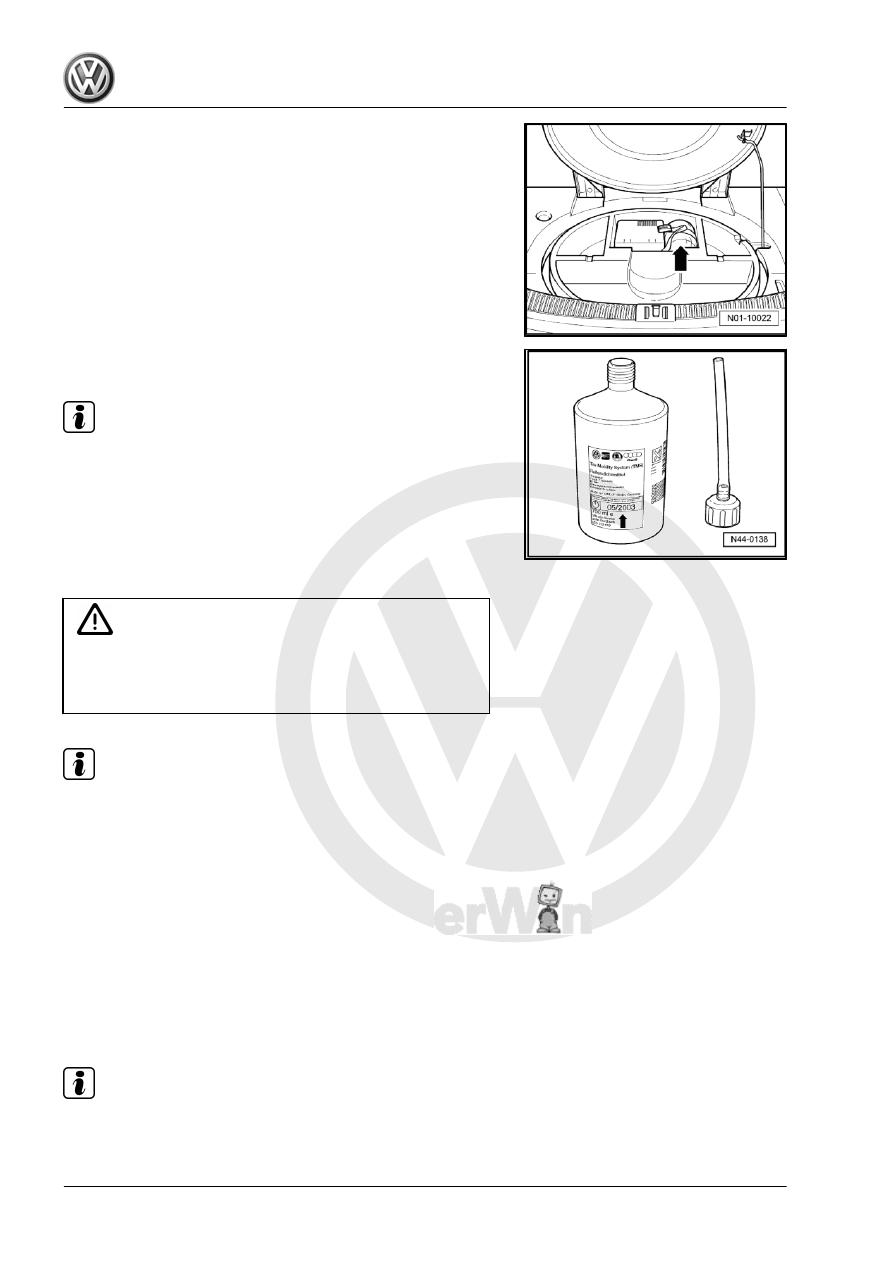
The tyre repair set is located in the spare wheel well -arrow-

The tyre repair set consists of the compressor and a tyre filler

bottle with sealant.

Note

The tyre sealant in the bottle has a limited expiry date.

Therefore the expiry date is indicated on the bottle -arrow-.

This example shows that the expiry date 05/2003 has been ex‐

ceeded, then the bottle has to be renewed.
– Check the expiry date and enter this in maintenance tables.
– Renew tyre sealant if the expiry date has been reached.

Caution

♦ The tyre sealant must not be more than 4 years old.
♦ If the bottle was opened e.g. at a "flat tyre", it must also be

renewed.

Note

Residual tyre sealant or bottles which are filled and the expiry

date has been exceeded, must be disposed of.

Old tyre sealant or residual sealant must not be mixed and

disposed of with other fluids.

Observe disposal regulations!

4.37

Dust and pollen filter: Clean housing and

renew filter element

Procedure
Heating, ventilation, air conditioning system ⇒  Rep. Gr.  80 →

Repairing heating system → Removing and installing dust and

pollen filter

Note

For technical reasons it is possible that several cross references

are not directed to the correct chapter. In this case select the pro‐

cedure manually in the information.

Maintenance - Edition 11.2009

118

    4. Descriptions of work

s

p

e

c

t

 t

o


th

e

 c

o

rr

e

c

t

n

e

s

s


o

f

in

fo

r

m

a

tio

n

 in

 th

is

 d

o

c

um

en

t.

C

o

py

rig

ht b

y


V

olk

sw

a

ge

n


A

G.

4.38

Headlight adjustment: Check

♦ Checking headlight adjustment 

⇒ page 119

♦ Headlights with gas discharge bulbs, perform basic setting

⇒ page 122

 .

♦ Adjusting headlights 

⇒ page 122

♦ Adjusting fog lights and other additional lights 

⇒ page 124

 .

4.38.1

Checking headlight adjustment

Special tools and workshop equipment required
♦ Headlight adjustment unit -VAS 5046- or

♦ Headlight adjustment unit -VAS 5047-
Checking and adjusting prerequisites:
♦ Tyre pressures OK.
♦ Lenses must not be damaged or dirty.
♦ Reflectors and bulbs OK.
♦ Vehicle must be loaded.
The vehicle must be rolled forward or backward several metres

or front and rear springs must be bounced fully several times so

that springs settle.
♦ Vehicle and headlight adjuster must be on a level surface.
♦ Vehicle and headlight adjuster must be aligned.
♦ Inclination must be set.
♦ If the vehicle is equipped with separate dipped and main

beam, adjust main beam additionally. When adjusting main

beam ensure that the adjustment unit is set to 0 %.

– Observe headlight adjuster operating instructions!
Inclination information in “%” is stamped into trim above headlight.

Headlights must be adjusted according to this information. Per‐

centage given is based on a projection distance of 10 metres. For

example: inclination of 1.0 % converts to approx. 10 cm.
Notes for vehicles with halogen headlights:
Manual headlight range control (if fitted):
♦ The headlight range adjuster thumb wheel must be in basic

setting -0-.

Maintenance - Edition 11.2009

4. Descriptions of work    

119

s

p

e

c

t

 t

o


th

e

 c

o

rr

e

c

t

n

e

s

s


o

f

in

fo

r

m

a

tio

n

 in

 th

is

 d

o

c

um

en

t.

C

o

py

rig

ht b

y


V

olk

sw

a

ge

n


A

G.

Note

For certain export markets a manually regulated headlight

range control is not offered, thus the -0- position is discontin‐

ued.

For NAR vehicles the side adjustment of headlight is not per‐

mitted, therefore the adjustment bolt is secured against turn‐

ing. Adjustment is only allowed once when the headlight is to

be exchanged. When the side adjustment bolt has been ad‐

justed once, it must be secured with a cap ⇒  Electronic parts

catalogue ETKA . In this case, push securing cap into opening

of lateral adjustment until it is correctly seated.

Loading: With one person or 75 kg on the driver seat and the

vehicle otherwise unloaded (unladen weight).
The unladen weight is the weight of vehicle ready for operation

with a full fuel tank (at least 90 %) including weight of all equip‐

ment usually carried (e.g. spare wheel, tools, jack, fire extinguish‐

er etc.).
If the fuel tank is not at least 90 % full, then load as follows:
– Read level of fuel in fuel tank on fuel gauge. Determine addi‐

tional weight from following table and place weight in luggage

compartment.

Fuel gauge table

Fuel

gauge

Additional weight

in kg

1/4

30

1/2

20

3/4

10

Full

0

Example:
When the fuel tank is half full an additional weight of 20 kg must

be placed in the luggage compartment.

Note

The additional weight is best produced using fuel canisters filled

with water (a 5 litre fuel canister filled with water weighs approx.

5 kg).

Notes on vehicles with headlights with gas discharge bulbs

Note

On vehicles with headlights with gas discharge bulbs the fault

memory should be cleared before every headlight adjustment us‐

ing vehicle diagnostic tester and the headlight range control

should be set to basic setting 

⇒ page 122

 .

Maintenance - Edition 11.2009

120

    4. Descriptions of work

s

p

e

c

t

 t

o


th

e

 c

o

rr

e

c

t

n

e

s

s


o

f

in

fo

r

m

a

tio

n

 in

 th

is

 d

o

c

um

en

t.

C

o

py

rig

ht b

y


V

olk

sw

a

ge

n


A

G.

Checking headlight adjustment:

Note

With dipped beam switched on, the horizontal bright/dark

boundary must not exceed the dividing line -1-.

The light beam of the main beam must lie on the centre mark

-3-.

Please check the following:
– Whether, with the dipped beam switched on, the horizontal

bright/dark boundary contacts the dividing line -1- of the test

area and

– Whether the breaking point -2- between the horizontal part of

the blight/dark boundary on the left and the rising part on the

right lies on the vertical line of the central point -3-. The bright

core of the light beam must be to the right of the vertical line.

Note

To simplify finding the breaking point -2-, cover and uncover

left (from driver perspective) half of the headlight a few times.

Then check dipped beam again.

After correct adjustment of dipped beams, the centre point of

the main beam must lie on the centre mark -3-.

For the previous test screen with 15° setting line, adjust as for

new test screen. To avoid incorrect settings, ignore the 15 °

setting line.

Checking headlight adjustment on fog lights:
– Check whether the upper bright/dark boundary touches the

setting line and runs horizontally over the entire width of the

test screen.

Other additional lights:
Additionally retrofitted lights of other systems must be checked or

set according to valid guidelines.

Maintenance - Edition 11.2009

4. Descriptions of work    

121


Content   ..  200  201  202  203   ..