Volkswagen Golf / Golf Plus. Manual - part 83
 

  Index      Volkswagen     Volkswagen Golf (2004) / Golf Plus (2005) - service repair manual


Search            


Content   ..  81  82  83  84   ..


Volkswagen Golf / Golf Plus. Manual - part 83


If the difference is greater than 1.3 mm, the lateral runout is too

great.

In this case, you can reduce lateral runout by match mounting the

tyre 

⇒ page 330

 .

Extreme values on the tyre gauge due to small irregularities in the

rubber may be disregarded.
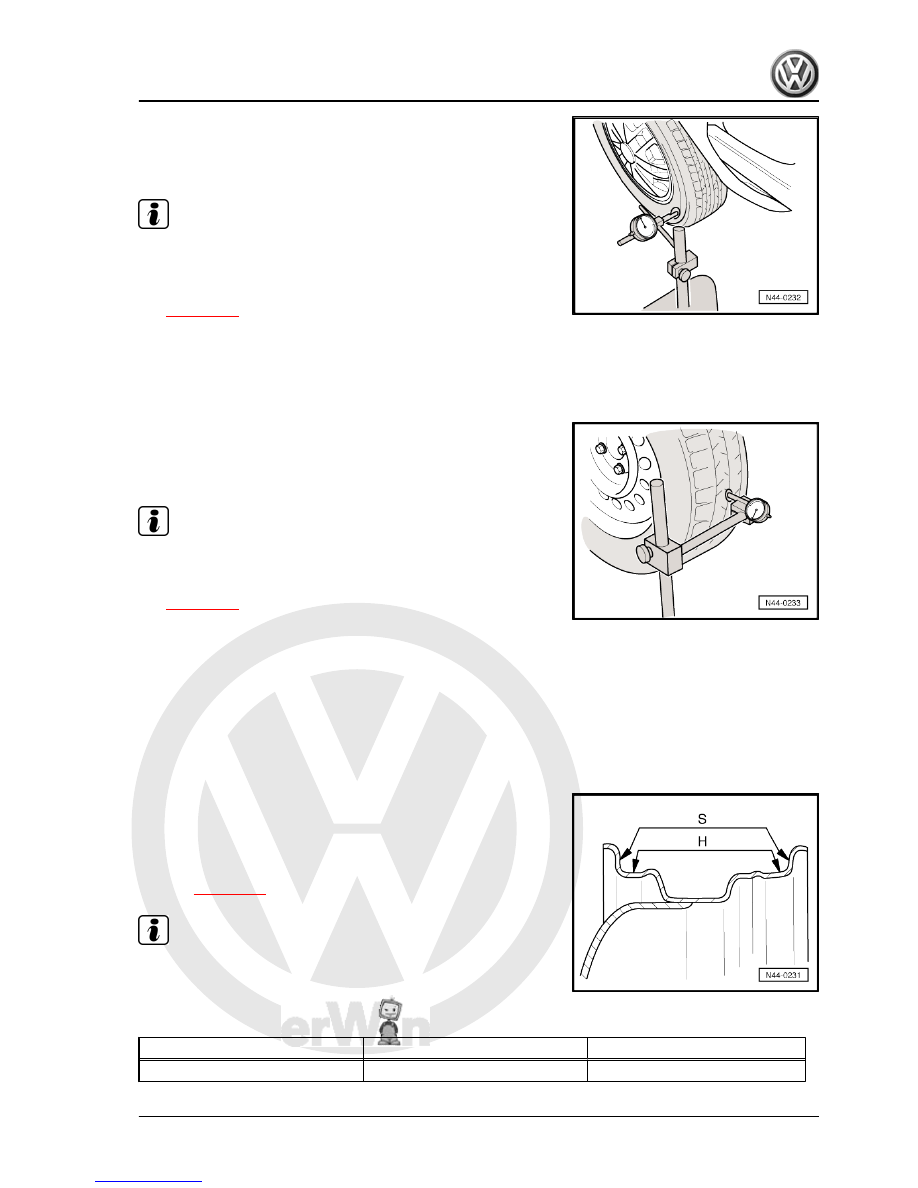
Checking radial runout
– Preload tyre gauge about 2 mm.

– Set the tyre gauge against the tyre tread.
– Slowly rotate the wheel.
– Note the smallest and the largest dial readings.

Note

If the difference is greater than 1 mm, the radial runout is too great.

In this case, you can reduce radial runout by match mounting the

tyre 

⇒ page 330

 .

12.9

Checking radial and lateral runout on

wheel

– Mount the wheel on the wheel balancer .
– Use the wheel balancing machine centring system -VAS

5271- .

– Preload tyre gauge about 2 mm.
– Slowly rotate the wheel.
– Note the smallest and the largest dial readings.
S - Lateral runout
H - Radial runout
– Compare the measured values with the specifications in the

table 

⇒ page 329

 .

Note

Extreme values on the tyre gauge due to small irregularities may

be disregarded.

Specifications for radial and lateral runout on wheel

Wheel

Radial runout (mm)

Lateral runout (mm)

Steel wheel

0.5

0.5

12. Rough running due to wheels/tyres - causes and rectification    

329


Lateral runout (mm)

Alloy wheel

0.5

0.8

Note

If the measured value exceeds the specification, acceptably

smooth running cannot be attained.

12.10

Matching

General
When radial or lateral runout of the wheel and tyre coincide, the

imbalance of the wheel is amplified by the tyre.
For technical reasons, 100% true running is not possible

⇒ page 328

 .

Before match mounting the used wheels which are fitted on the

vehicle, run the tyres warm. This will eliminate any flat spots

caused by storage or handling, 

⇒ page 331

 .

Procedure for match mounting
– Deflate the tyre.
– Press the tyre beads off the rim flanges.
– Coat the tyre bead all round with tyre fitting paste .
– Rotate the tyre 180° relative to the wheel.
– Inflate the tyre to approx. 4 bar.
– Mount the wheel with tyre on the wheel balancer.
– Check true running, that is, radial and lateral runout.

Note

If the specified values for radial and lateral runout are not ex‐

ceeded, the wheel can be balanced to 0 gram. Specified

values appear on 

⇒ page 328

 .

If the radial and lateral runout is not within the specifications,

the tyre must be rotated again.

– Deflate the tyre and press off the tyre beads from the rim

flanges.

– Rotate the tyre 90° with respect to the wheel (1/4 of a turn).
– Inflate the tyre to 4 bar again and check true running.

Note

If the specified values for radial and lateral runout are not ex‐

ceeded, the wheel can be balanced to 0 gram.

If the radial and lateral runout are not within the specified val‐

ues, the tyre must be rotated again.

– Press the tyre off the rim flanges again as described above.
– Rotate the tyre 180° with respect to the wheel (1/2 a turn).

330

     Rep. Gr.44 - Wheels, tyres, vehicle geometry


⇒ page 329

 .

If the measured values for radial and lateral runout of the wheel

are within the specified values, the tyre has an impermissibly high

radial or lateral runout. In this case, the tyre must be renewed.

Note

After fitting the tyres there will be fitting lubricant between the

tyres and the rim flanges.

Therefore, severe braking and acceleration manoeuvres must

be avoided for the first 100 or 200 km driven. The tyres may

otherwise rotate on the rims and your work will have been in

vain.

12.11

Flat spots caused by storage or handling

What is a flat spot?
The term flat spot describes a type of wear where one patch or

spot of the tyre has become flat.
Flat spots caused by storage or handling also cause vibration in

the same way as incorrectly balanced wheels do. It is important

that flat spots on the tread are identified as such.
Flat spots caused by storage or handling cannot be balanced and

they can reoccur at any time due to various circumstances. Flat

spots caused by storage or handling can be eliminated without

complicated special tools. Assuming it is not a flat spot caused by

full-on braking ⇒  Wheel and Tyre Guide - Series; Rep. Gr.  44 ;

Rolling noises due to tyres, locked brake flat spots .

Note

Flat spots caused by hard braking cannot be repaired. Such tyres

must be renewed.

Reasons for flat spots caused by storage or handling:
♦ The vehicle has been left standing in one place without being

moved for several weeks.

♦ The tyre inflation pressure is too low.
♦ The vehicle was placed in a paint shop drying booth after being

painted.

♦ The vehicle was parked with warm tyres in a cool garage or

similar for a long period of time. In this case, a standing flat

spot may even occur overnight.

Eliminating flat spots caused by storage or handling
♦ Flat spots caused by storage or handling cannot be eliminated

from the tyre using workshop equipment.

♦ Flat spots caused by storage or handling can be removed only

by running the tyres warm.

♦ The method described below is not recommended in cold and

wintry weather.

Requirements and conditions:
– Check and, if necessary, correct inflation pressures.

12. Rough running due to wheels/tyres - causes and rectification    

331


WARNING

♦ Do not endanger yourself or other road users during this

road test.

♦ Observe the highway code and speed limitations in force

when performing the road test.

– Raise the vehicle immediately following the road test.
– Remove the wheels from the vehicle.
– Balance the wheels on a stationary wheel balancer

⇒ page 325

 .

332

     Rep. Gr.44 - Wheels, tyres, vehicle geometry


Content   ..  81  82  83  84   ..