Volkswagen Golf / Golf Plus. Manual - part 82
 

  Index      Volkswagen     Volkswagen Golf (2004) / Golf Plus (2005) - service repair manual


Search            


Content   ..  80  81  82  83   ..


Volkswagen Golf / Golf Plus. Manual - part 82


wheels

If a customer brings a vehicle to the workshop complaining about

“vibration”, a road test is essential prior to balancing the wheels.
♦ This will give you information about the nature of the rough

running.

♦ You will be able to determine in which speed range the rough

running occurs.

– Raise the vehicle on a lifting platform immediately after the

road test.

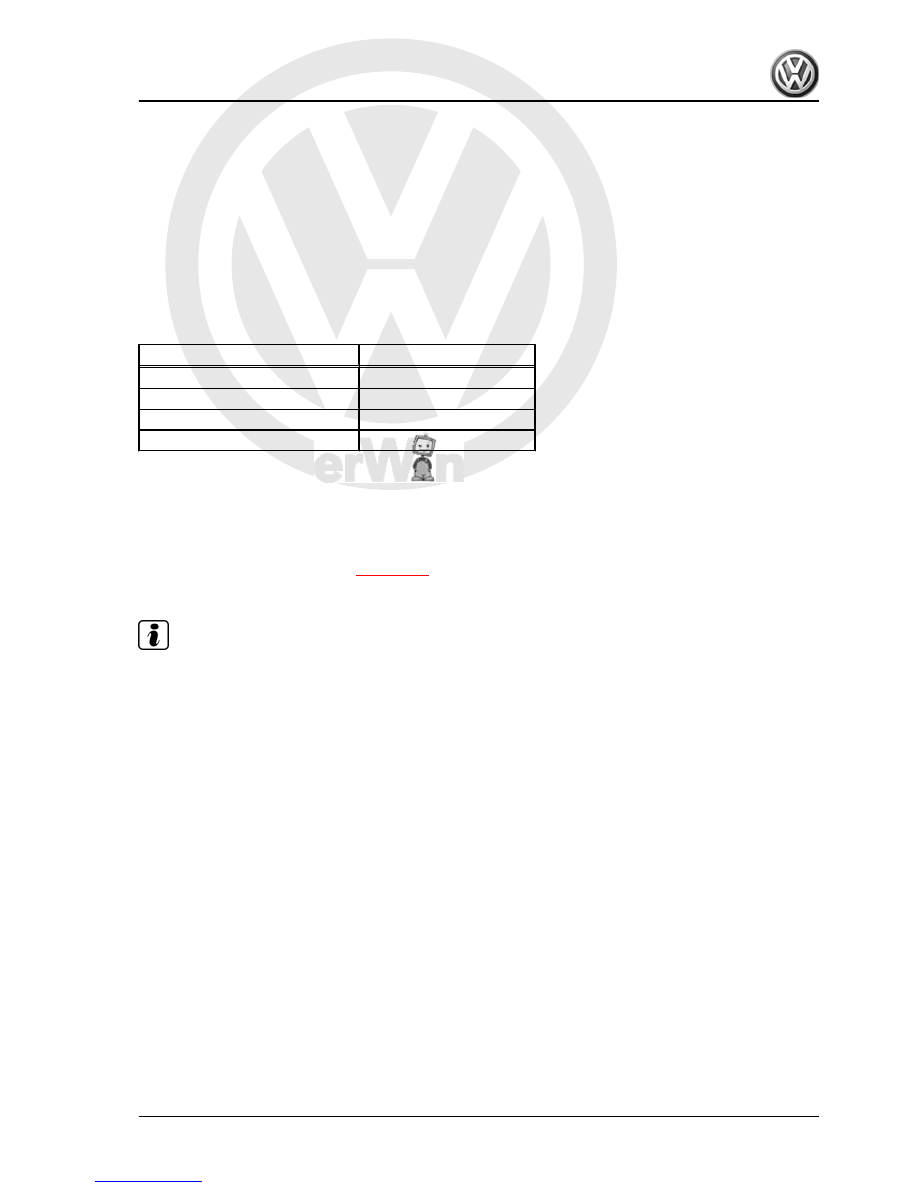
– Mark the positions of the tyres on the vehicle.

Tyre position

Marked with ...

Front left tyre

FL

Front right tyre

FR

Rear left tyre

RL

Rear right tyre

RR

– Remove wheels from vehicle.
– Balance the wheels.

12.4

Balancing wheels on stationary wheel

balancing machine

• Road test has been carried out 

⇒ page 325

 .

Clamp wheel into wheel balancing machine

Note

When balancing wheels, please remember that cleanliness is ab‐

solutely essential, as indeed it is in the case of any other repair

work you carry out. Only then can you attain a flawless result!

Dirt and rust in the area of the contact surfaces and centre of the

wheel distort the result.
– Clean the contact surfaces, the centre of the wheel and the

recess on the inside of the wheel before mounting the wheel

on the wheel balancer.

– Mount the wheel with tyre on the wheel balancer.

12. Rough running due to wheels/tyres - causes and rectification    

325


To clamp the wheel, use e.g. centring system for wheel bal‐

ancing machines -VAS 5271- .

This ensures that the wheel is 100% centred and that the

wheel will be clamped without damage!

The wheel cannot be centralised 100% with conical clamping

elements on the wheel balancing machine.

A deviation of 0.1 mm from the centre results in an imbalance

of 10 grams at the wheel/rim.

Procedure for balancing wheels and tyres
– Rotate wheel and tyre on wheel balancer.
– Check that the indicator lines on the sidewall of the tyre near

the wheel rim flange run evenly.

– Check that the body of the tyre runs evenly while the wheel

and tyre are rotating.

Note

If one-sided wear, flat spots from braking or severely washed out

spots are apparent, balancing cannot achieve smooth running. In

this case, the tyre must be renewed.

– Check the true running of the wheel and tyre. If the wheel and

tyre do not run true although there are no flat spots, radial or

lateral runout may be the cause.

– Check the wheel for radial or lateral runout 

⇒ page 328

 .

– If radial and lateral runout are within the specified tolerance,

balance the wheel and tyre.

Note

More than 60 grams of weight per tyre should not be used.

If more weight is required, you may be able to achieve smooth‐

er running by "matching" the tyre and rim. Matching tyres

⇒ page 330

 .

The wheel balancer display should indicate 0 gram.

As an alternative to match mounting, you could use the vibra‐

tion control system -VAS 6230- 

⇒ page 327

 .

– Bolt the wheel to the vehicle.
– First hand-tighten the lowest wheel bolt to about 30 Nm.
– Then tighten the remaining wheel bolts diagonally to about

30 Nm. This process centres the wheel on the hub.

– Lower vehicle onto its wheels.
– Now use a torque wrench to tighten the wheel bolts to the

specified torque in diagonal sequence.

Carry out road test
– After balancing the wheels and tyres, carry out a road test.

326

     Rep. Gr.44 - Wheels, tyres, vehicle geometry


wheels and hubs could cumulate. This too can lead to vibration.

This can be alleviated using a finish balancer. 

⇒ page 327

12.5

Vibration control system -VAS 6230-

Using the vibration control system -VAS 6230- you can perform

more functions than just stationary balancing.
A special feature of this system is the testing of the radial force of

the wheel and tyre while rolling.
A roller presses against the wheel with a force of about 635 kg.

This simulates the vertical tyre force against the road surface

during travel.
Radial and lateral runout in the wheel and tyre and differences in

the stiffness of the tyre cause the vertical force of the wheel to

vary.
The -VAS 6230- detects and stores the position of the maximum

measured radial force in the tyre. Then the position of the smallest

distance between the wheel rim flange and the centre of the rim

is measured.

12.6

Finish balancer

Note

Before working with a finish balancer , the mechanic needs to

have been instructed by the manufacturer of the balancer.

To balance the wheels, set the wheels of the driven axle on

the sensor platforms (only the front wheels of a front-wheel

drive vehicle, all four wheels of a four-wheel drive vehicle).

If you determine a residual imbalance greater than 20 grams

when balancing the wheels, you should rotate the mounting po‐

sition of the wheel on the hub.
– Mark the point at which the imbalance is indicated.
– Unbolt the wheel and rotate its position on the hub so that the

marking points downwards.

Note

The hub must not rotate during this procedure.

– First hand-tighten the lowest wheel bolt to about 30 Nm.
– Then tighten the remaining wheel bolts diagonally to about

30 Nm. This process ensures that the wheel is centred prop‐

erly on the hub.

– Check whether the imbalance is less than 20 grams using the

finish balancer.

12. Rough running due to wheels/tyres - causes and rectification    

327


change the balance weight.

– If necessary, remove the wheel bolts again.
– Rotate the wheel relative to the hub once more, turning it one

or two wheel bolt holes further.

– Tighten the wheel bolts using the method described above.

Note

Do not try to reduce the imbalance using balance weights until

the imbalance is less than 20 grams.

– Balance the wheels until the imbalance is less than 5 grams.
– Tighten wheel bolts to specified torque if you have not already

done so.

WARNING

Always tighten wheel bolts to specified torque using a torque

wrench!

12.7

Radial and lateral runout of wheels and

tyres

Radial and lateral runout occur when the wheel and tyre do not

run absolutely true.
For technical reasons, 100% true running is not possible.
Therefore, the manufacturers of these components allow a pre‐

cisely determined tolerance.
Mounting the tyre in an unfavourable position on the wheel can

cause the maximum allowed tolerance for wheel with tyre to be

exceeded.
The table shows the maximum permissible tolerances for a wheel

with mounted tyre.
Tolerances for radial and lateral runout of wheels with tyres

Wheel with tyre

Radial runout (mm)

Lateral runout (mm)

Passenger cars

0.9

1.1

(1.3 in vicinity of lettering)

12.8

Checking radial and lateral runout on

wheels and tyres with tyre gauge -V.A.G

1435-

Checking lateral runout
– Preload tyre gauge about 2 mm.

328

     Rep. Gr.44 - Wheels, tyres, vehicle geometry


Content   ..  80  81  82  83   ..