Volkswagen Golf / Golf Plus. Manual - part 81
 

  Index      Volkswagen     Volkswagen Golf (2004) / Golf Plus (2005) - service repair manual


Search            


Content   ..  79  80  81  82   ..


Volkswagen Golf / Golf Plus. Manual - part 81


wheels

WARNING

Perform the checks and follow the instructions listed below.

This is important to ensure that the wheel bolts and the wheels

are properly secured.

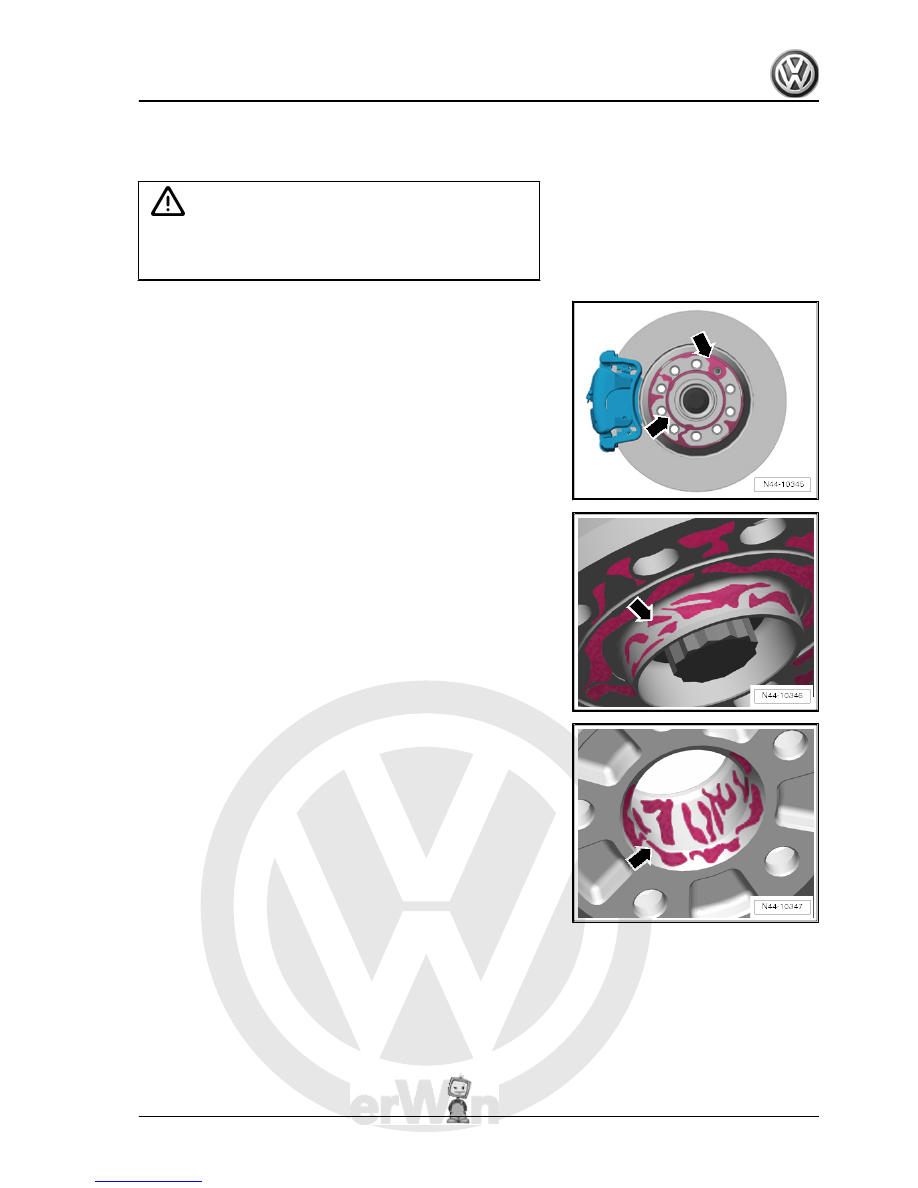
– Check to ensure that contact surfaces -arrows- on brake disc

are free of corrosion and dirt.

– Check to ensure that contact surface -arrow- on centring seat

of brake disc are free of corrosion and dirt.

– Check to ensure that contact surface -arrow- on inner side of

wheel (rim) and also centring seat of rim are free of corrosion

and dirt.

– The spherical caps 

*

 in the holes for the wheel bolts and the

threads of the wheel bolts must also be free of corrosion and

dirt, oil or grease.

*

 A spherical cap is the curved surface of a section of a sphere

cut by a plane.

10. Instructions for changing or fitting wheels     

321


the bore in the brake disc -arrow-.

If the thread of the wheel bolt touches the hole -arrow-, turn the

brake disc relative to the wheel hub accordingly.
Remove dirt and corrosion, oil or grease from the contact surfa‐

ces, threads in the wheel hub and/or wheel bolts as necessary.

WARNING

Damaged, badly corroded or difficult to remove wheel bolts

must be renewed.

10.1

Fitting wheels

– Preserve wheel centring seat 

⇒ page 323

 .

1 - When fitting the wheel, screw in all wheel bolts uniformly by

hand.

2 - Tighten the wheel bolts in diagonal sequence to approx. 30

Nm.

3 - Lower the vehicle to the floor and tighten all wheel bolts di‐

agonally to the specified torque using the torque wrench

⇒ page 288

 .

WARNING

Do not use an impact driver when screwing in the bolts!

322

     Rep. Gr.44 - Wheels, tyres, vehicle geometry


against corrosion

Valid for light alloy and steel wheels
When a wheel is installed, wheel centring seat should be waxed

with
Wax spray -D 322 000 A2-
to prevent corrosion between the wheel centring seat and the

wheel rim.
– Remove wheel.
– Clean wheel centring seat of hub and centring ring of wheel

rim.

– Apply wax to centring ring -arrow- with a brush.
Ensure that only centring ring -arrow- but not contact surface of

wheel rim has been waxed. Otherwise, the brakes will be soiled,

which would reduce the braking efficiency.

WARNING

Wheel bolts, contact surfaces of wheel hub and wheel rim and

wheel hub threads must not be waxed. Never treat wheel se‐

curing bolts with lubricant or corrosion protection materials!

– Install wheel and tighten 

⇒ page 288

 .

11. Protecting wheel centring seat against corrosion    

323


causes and rectification

Causes of rough running 

⇒ page 324

Balancing wheels 

⇒ page 324

Conducting a road test before balancing wheels 

⇒ page 325

Balancing wheels on stationary wheel balancing machine

⇒ page 325

Vibration control system -VAS 6230- 

⇒ page 327

Finish balancer 

⇒ page 327

Radial and lateral run-out on wheels and tyres 

⇒ page 328

Checking radial and lateral runout on wheels and tyres with tyre

gauge -V.A.G 1435- 

⇒ page 328

Checking radial and lateral run-out on wheel rim 

⇒ page 329

Matching 

⇒ page 330

Flat spots caused by storage or handling 

⇒ page 331

12.1

Causes of rough running

Rough running can have a number of different causes. It can also

be caused by tyre wear. Tyre wear caused by driving is not always

evenly spread across the entire running surface of the tyre. This

causes slight imbalances which affect the smooth running of a

wheel which was previously exactly balanced.
Minor imbalances will not be felt at the steering wheel, but that

does not mean that they are not there. They increase wear on the

tyre and thus reduce the tyre service life.
Recommendation
To ensure
• optimal safety,
• smoothest possible running and
• even wear
throughout a tyre's service life, we recommend having the wheels

and tyres balanced at least twice during the tyre's service life.

12.2

Balancing wheels

Before you start balancing the wheels, the following requirements

must be met.
• The tyre pressure must be OK.
• The tyre tread must not show one-sided wear and should be

at least 4 mm deep.

• The tyre must not show any signs of damage, for example

cuts, piercing, foreign bodies, etc.

• The wheel suspension, steering and steering linkage, includ‐

ing the shock absorbers, must be in perfect condition.

• You must have conducted a road test.

324

     Rep. Gr.44 - Wheels, tyres, vehicle geometry


Content   ..  79  80  81  82   ..