Mercedes-Benz ML320. Service manual - part 773
GF18.40-P-4111-02A
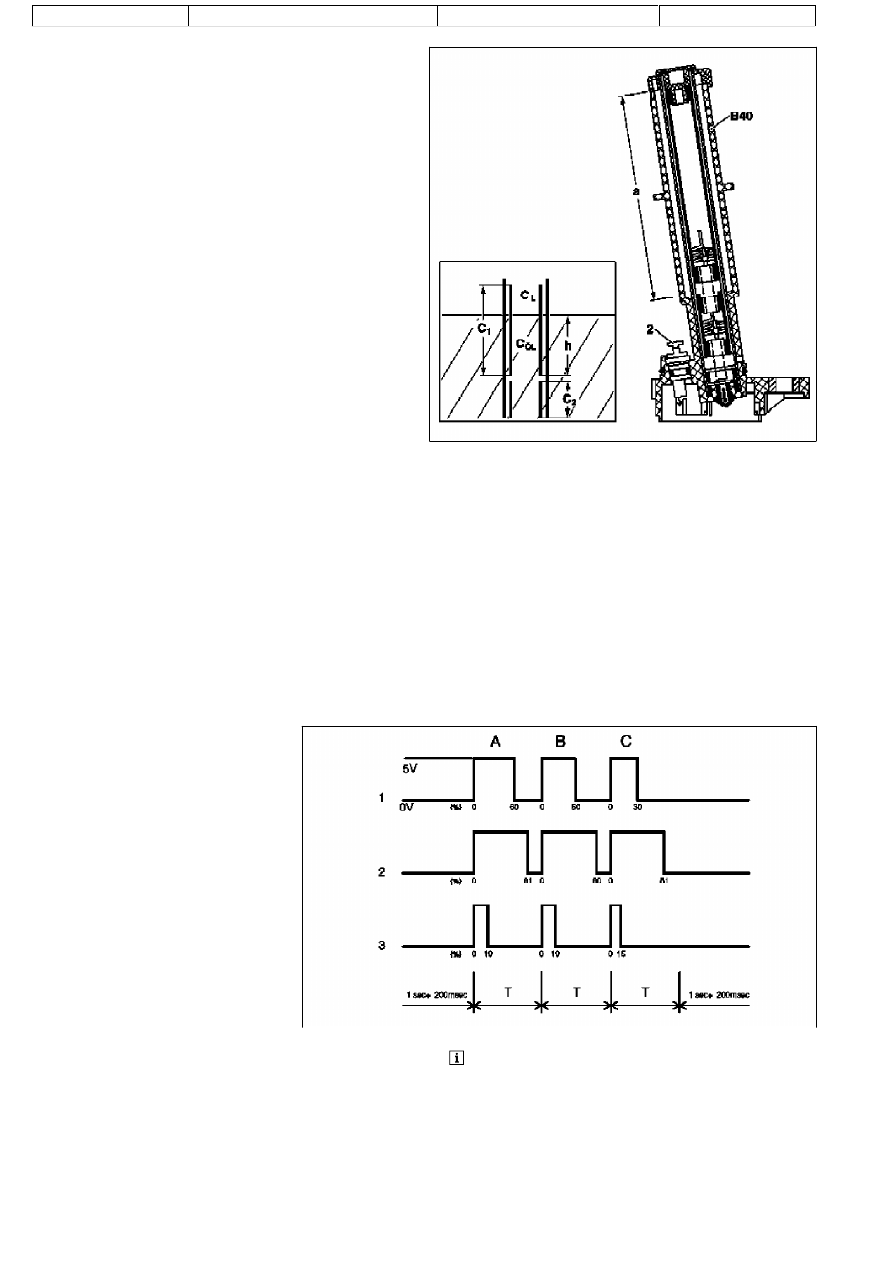
Oil sensor function
n
P18.40-2046-12
B40 Oil sensor (oil level, temperature and quality)
2
Temperature sensor (PT1000)
A
Capacitive measuring range
C1
Top condenser
CL Capacitive air
COIL
Capacitive engine oil
C2
Bottom condenser
h
Fill level
Oil level and oil quality are detected on the basis of the capacitance
of the engine oil (dielectric). The oil temperature is detected by the
temperature sensor. All the signals are processed in the electronics
to form a PWM signal and transferred to the engine control unit.
The measuring principle of the oil sensor is a capacitance
measurement, whereby the capacitance is dependent upon the oil
level. The measuring system consists of two cylinder condensers
which possess a metal pipe as a common external electrode. Both
other electrodes are arranged over each other as an inner pipe.
The dielectric constant of the engine oil is determined by the lower
condenser (C2) which is always full of oil (e approximately 2.3 to 4.0).
The fill level (h) is then determined by the upper condenser (C1)
using the dielectric constant. The capacitance of the upper
condenser (C1) is calculated on the basis of a parallel connection
with two condensers which have air and engine oil as a dielectric
material.
The condensers are located in a plastic housing which serves as a
damping cup. The engine oil flows through the feed bore holes into
the housing between the condensers.
The measuring range for the oil level is 80 mm
(normal level
F
40 mm), accuracy of measurement approx.
F
3 mm.
The voltage for the oil sensor (approx. 5 V) is supplied by the engine
control unit.
P07.61-0445-05
Signal assignment oil sensor
1
On/off ratio signals
Okay
A
Oil temperature
20 to 80%
B
Oil level
20 to 80%
C
Oil quality
20 to 80%
2
On/off ratio signals
>80 %
A
Oil temperature
> +160 °C
B
Oil level
>80 mm
C
Oil quality
e>6
3
On/off ratio signals
<20 %
A
Oil temperature
< - 40 °C
B
Oil level
<0 mm
C
Oil quality
e< 1
T
pulse duty factor
100 %
Each information block consists of three successive square-wave
signals, This is followed by a short pause.
A measured variable is assigned to each square-wave signal (A, B,
C). The quantisizing in each case is based on the on/off ratio (T) of
approx. 20 to 80 %.
Because oil level and oil quality (capacitance of the engine oil) are
dependent of each other, this information is first compensated for in
the engine control unit, before it is transmitted via CAN databus to
instrument cluster.
The following faults at the oil sensor are detected by the engine
control unit and entered in the fault memory:
- Duty cycle of a signal less than 17 % or more than 83 %
- Dielectric constant of engine oil longer than 100 seconds greater
than 5.8 (e.g. because of a lot of water in the engine oil).
Copyright DaimlerChrysler AG 05.06.2006 CD-Ausgabe G/10/04 . This WIS print-out will not be recorded by Modification services.
Page 1